
Home Posts tagged Education (Page 22)
Business of Aging Sections

Into the Light


Dr. Katherine White

Dr. Katherine White says tanning can be a difficult habit to break, due to the way it makes people look and feel.

In recent years, many teens have turned to tanning beds to enhance their looks on prom night and graduation day. But that practice is no longer possible, due to a new state law that Gov. Charlie Baker signed in February that bans anyone under the age of 18 from using a tanning bed.

Prior to passage of this measure, Massachusetts allowed teenagers between the ages of 14 and 17 to visit tanning salons with consent from a parent or legal guardian, and those under age 14 to tan if a parent or guardian was present.

However, research by the American Academy of Dermatology, the Melanoma Research Foundation, the American Assoc. for Cancer Research, and other prestigious groups have led to legislation in 42 states prohibiting young people from using tanning beds due to studies that prove exposure to artificial ultraviolet light before the age of 35 increases the risk of melanoma by up to 75%.

Melanoma is not only the deadliest form of skin cancer, it is the most common form of cancer in young adults 25 to 29 years old, and the second-most common form in young people 15 to 29 years old. It is also the leading cause of cancer death in women aged 25 to 30 and the second-leading cause of death in women between the ages of 30 and 35. In addition, ultraviolet radiation emitted by tanning beds can lead to basal-cell and squamous-cell cancer and cause wrinkles, lax skin, brown spots, and other signs of premature aging.

Dr. Catherine White, a dermatologist and founder of Hampshire Dermatology and Skin Health Center in Northampton, said dermatologists have been advocating for changes in the law for years, and herald the newly passed legislation, as well as the fact that the U.S. Food and Drug Administration proposed two new rules last year regarding tanning beds. The first would not only restrict use of sunlamps in salons to individuals 18 and older, but also mandate that users sign a certificate before their first tanning session and every six months thereafter acknowledging they have been informed of the risks to their health.

The second proposal would require sunlamp manufacturers and tanning facilities to take additional measures to improve the overall safety of their devices. Suggestions include improving eye safety by limiting the amount of visible light allowed through protective eyewear; improving labeling on replacement bulbs to ensure tanning facility operators are using the correct bulbs, which would reduce the risk of accidental burns; preventing the installation of stronger bulbs without recertifying and re-identifying a device with the FDA; and requiring all sunlamp products to have an emergency shut-off switch that users can easily find and identify by touch or sight.

Artificial tanning has become a $2.5 billion industry, so these measures are deemed critical to people’s safety. Approximately 7.8 million adult women and 1.9 million adult men in the U.S. tan indoors, and reports show that 35% of American adults, 59% of college students, and 17% of teens have used a tanning bed.

White acknowledges that most tanning salons are small businesses that are often owned by women and add vibrancy to local communities, and says it’s important to recognize that fact, but agrees with other experts that medical information regarding tanning beds must be transmitted to clients in a clear way that outlines the risks.

“The World Health Organization has said that ultraviolet light is a known human carcinogen,” she told BusinessWest. “Using a tanning bed is a dangerous activity and increases the risk of developing basal-cell cancer, squamous-cell cancer, and potentially life-threatening melanoma.”

Overcoming Obstacles

Dr. Richard Arenas, chief of Surgical Oncology at Baystate Medical Center, has seen patients in their early 20s with melanoma, and says researchers believe the intensity and type of ultraviolet radiation emitted by tanning beds may be forcing changes at an accumulated rate in cells. Environmental factors may also be at play, and some people may be more sensitive to UV light than others and have family histories that could predispose them to getting skin cancer.

Dr. Richard Arenas

Dr. Richard Arenas says the incidence of melanoma, which is a life-threatening cancer, is on the rise in young people.

“But the biggest challenge is determining at what age a person is capable of making a decision to acknowledge the potential risk of using a tanning bed,” he explained, adding that there has not been enough publicity about the dangers and the fact that the rate of melanoma is on the rise, especially in young Caucasian women.

White concurs, and says education needs to be ongoing, especially since tanning is part of youth culture; college students often rent limos and go tanning as a group, and she has heard of cheerleading coaches who bring their teams to a tanning salon prior to a meet.

“The light and warmth may feel good, and there may be social benefits, but the fact is, when ultraviolet light hits the skin, it damages genetic material,” she noted. “A tan is an emblem of injury, and is the body’s last-ditch effort to prevent DNA damage and protect against damage to the cells. Sometimes the body can repair the damage, but it’s not always possible.”

Still, most human beings love the sun, and the reasons for visiting tanning salons are complex and include societal reinforcements — people often tell others with a tan they look great — and many women consider going to a tanning salon a way to pamper themselves.

But the dangers that have come to light are clear, and the Commonwealth’s new legislation mirrors similar laws in California, Delaware, the District of Columbia, Hawaii, Illinois, Louisiana, Minnesota, Nevada, New Hampshire, North Carolina, Oregon, Texas, and Vermont that ban the use of tanning beds for all minors under 18.

However, experts say tanning not only is it a difficult habit to break, it can be addictive, which was documented in studies released in 2013 that show ultraviolet light increases the release of endorphins or feel-good chemicals that relieve pain and generate feelings of well-being.

“People like to tan. It’s calming, relaxing, and something that they may regard almost like a treat. And although most adults know it’s not a good thing to do, they have the right to visit a tanning salon. But they need information about the risks spelled out clearly,” White said, adding that dermatologists hope the FDA’s proposal to have adults sign consent forms acknowledging the risks of tanning beds will be adopted nationwide.

As for the addictive nature of the habit, researchers often compare tanning to cigarette smoking. “Both industries can injure customers, and it is to their benefit to start people young before they are able to make informed decisions. And both have an addictive quality which make them difficult to break,” White told BusinessWest.

Misconceptions also exist that range from benefits associated with ultraviolet light and vitamin D — experts say taking supplements is safer — to the fact that some people believe it’s a good idea to get a base tan in the winter before going to a sunny locale such as Florida or the Caribbean.

But that is indeed a myth. “There is nothing protective in going to a tanning salon before a trip, because each exposure increases the risk of developing skin cancer, especially in young people,” White said. “We know that intense ultraviolet exposure is more dangerous early in life than it is later on, and people with a history of childhood sunburns are at greater risk for cancer.”

Prevention is Key

Ultraviolet radiation is made of UVA and UVB wavelengths, or rays. UVA rays cause aging of the skin, while UVB rays are short, more powerful, and can lead to cancer.

The sun delivers both, but Arenas says tanning beds deliver a more significant dose of both UVA and UVB.

“The damage caused at a young age can carry forward for the rest of a person’s life. Tanning beds are an unnatural source of UV radiation and are dangerous,” he noted, adding that the propensity for problems may be exacerbated if people are fair-skinned, sport red hair, or have a lot of moles. In addition, the fact that people are living longer means they will have more exposure to the sun, so putting oneself in harm’s way at a young age is even more dangerous than it may have been generations ago.

Arenas urges people to be their own advocates when it comes to skin cancer, and said everyone should get a full skin checkup each year.

“Insist that your doctor examine your entire body, including the cracks and crevices,” he told BusinessWest, explaining that skin cancer can occur on the palms of the hands and bottoms of the feet, as well as in the genital and anal areas. “You really need to have respect for your skin. We can’t avoid the sun, but people need to appreciate the fact that it causes changes that could lead to skin cancer.”

White says people who love the look of a tan can achieve the same result with spray tans, bronzers, and gradual self-tanners, and since many salons offer spray tans, clients who have purchased tanning packages should ask to have their sessions converted to spray tans. She also advises people using tanning as a means of pampering themselves to think of other ways to reward themselves that they find equally relaxing.

“The bottom line is that skin cancer can be prevented, and the new laws will help,” Arenas said. “All it takes is good judgment.”


Briefcase Departments

Tishman Construction, Fontaine Brothers Win MGM Garage Contract

SPRINGFIELD — MGM Springfield, the urban announced it has awarded a construction contract to Tishman Construction, a wholly-owned subsidiary of AECOM, in partnership with Springfield-based construction manager Fontaine Brothers Inc. Together these companies will be responsible for erecting the seven-level, 3,400-space parking garage structure. Construction is set to begin this month and be completed in approximately 20 months. “We are delighted about our continuous progress toward building MGM Springfield. Today’s announcement is yet another example of how we are engaging top global companies and local businesses to develop this tremendous project,” said Michael Mathis, president and COO, MGM Springfield. “We are excited to see construction on the garage move forward as the foundation is poured and we watch this structure rise out of the ground over the coming months.” MGM Springfield is expected to open in fall 2018, and is currently the largest construction project under development in Western Mass. The resort will feature a luxury hotel and a variety of entertainment offerings, including dining, shopping, gaming, and amusements, expected to attract millions of visitors and locals to downtown Springfield. “We are thrilled to be part of another iconic MGM Resorts development and excited to continue our work with the city of Springfield, Pioneer Valley Building Trades, and Fontaine Brothers Inc. to bring the vision of MGM Springfield to life,” said Edward Cettina, COO of AECOM’s building construction group. MGM Springfield is committed to engaging the community and maintaining diversity across its workforce, partners, and supply chain. In alignment with this commitment, Tishman Construction will host information sessions for diverse companies interested in working as subcontractors on the project. Tishman is partnering with Fontaine Brothers to manage the parking-garage project, including solicitation of subcontractors and other procurement efforts. Fontaine Brothers is a local, fourth-generation, family-owned construction firm. In Springfield, Fontaine is best-known for its work on major construction and renovation projects including Symphony Hall, the MassMutual Center, Hilton Garden Inn, and dozens of educational institutions. “Fontaine Brothers is elated to partner with Tishman Construction and MGM Springfield on this exciting project,” said David Fontaine Jr., vice president, Fontaine Bros. “We are thrilled to join this world-class team and to play an active role in the continuing revitalization of the city we call home. We look forward to working with Tishman to manage the construction effort while continuing to help the team connect and partner with talented contractors based here in Western Massachusetts.”

Business Leaders Purchase South Hadley Plaza

SOUTH HADLEY — South Hadley Plaza, located at 501 Newton St., is officially under new ownership. The new owners are a triumvirate of local business leaders: Rocco Falcone of Rocky’s Hardware, Peter Picknelly of Peter Pan Bus Lines, and the Yee Family, whose other South Hadley businesses include Johnny’s Bar and Grille, Johnny’s Taproom, and IYA Sushi & Noodle Kitchen. The plaza is home to Rocky’s Hardware, Friendly’s, Dunkin’ Donuts, General Cleaners, and Mandarin Gourmet. There are currently vacancies in the former Movie Gallery and Big Y locations. That is due to change under the new ownership. “We’re in a great position to attract a mix of local and national businesses,” Falcone said. “This is a vibrant community, and we want to deliver some exciting options and breathe new life into South Hadley Plaza. The former Big Y site in particular, with its 60,000 square feet of space, is a unique offering that we’re exploring some interesting ideas for.” The new owners bring the resources and pedigree to draw new business and connect with the South Hadley community. Rocky’s Hardware has 31 stores in New England and four in Florida. Meanwhile, this will be the second collaboration for Picknelly and the Yee Family, who purchased and revitalized Springfield’s historic Student Prince restaurant in 2014. “It’s essentially three family businesses coming together — big families with big businesses, but families all the same,” Falcone said. “We look forward to expanding the horizons of this space and being a great resource for the community.”

State Unemployment Drops to 4.2% in April

BOSTON — The state’s unemployment rate dropped to 4.2% in April from the March rate of 4.4%, the Executive Office of Labor and Workforce Development announced. The preliminary job estimates from the Bureau of Labor Statistics indicate Massachusetts continues to gain jobs, with 13,900 added in April. The April gain follows March’s revised gain of 6,600 jobs. From December 2015 to April 2016, Massachusetts has added 35,600 jobs. In April, over-the-month job gains occurred in the professional, scientific, and business services; leisure and hospitality; trade, transportation, and utilities; education and health services; other services; information; financial activities; and manufacturing sectors. The April state unemployment rate remains lower than the national rate of 5.0% reported by the Bureau of Labor Statistics. “We see continued strong job gains in many of the traditional economic drivers for the state,” Secretary of Labor and Workforce Development Ronald Walker II said. “The strong job gains in April are on the heels of 6,600 jobs added in March and 13,900 jobs added in February.” The labor force increased by 15,400 from 3,581,500 in March, as 19,000 more residents were employed and 3,500 fewer residents were unemployed over the month. Over the year, the state’s seasonally adjusted unemployment rate dropped 0.8% from 5.0% in April 2015. There were 27,100 fewer unemployed people and 404,000 more employed people over the year compared to April 2015. The state’s labor force participation rate — the total number of residents 16 or older who worked or were unemployed and actively sought work in the last four weeks — increased 0.3% to 65% over the month. The labor-force participation rate over the year has decreased 0.3% compared to April 2015. Over the year, the largest private-sector percentage job gains were in construction; professional, scientific, and business services; other services; information; and education and health services.

State Launches Campaign for Good Samaritan Law

BOSTON — Gov. Charlie Baker and Attorney General Maura Healey announced a new public-information campaign to encourage people to call 911 for emergency medical services at the first signs of a drug overdose. Along with Health and Human Services Secretary Marylou Sudders, Department of Public Health Commissioner Monica Bharel, and members of the law-enforcement community, state officials launched the $250,000 Make the Right Call campaign to promote the Massachusetts 911 Good Samaritan Law. This law provides protection to individuals seeking medical assistance for themselves or someone else experiencing a drug-related overdose, including opioid-related overdoses, without the risk of charges of possession of a controlled substance. “Today we’re proud to announce, along with the attorney general, a partnership for a $250,000 campaign to encourage people to call 911 at the first sign of a drug overdose,” Baker said. Added Healey, “what the Good Samaritan Law says is that, if you see someone overdosing, or if you’re with someone who is overdosing, call 911. Get them help. And if you do call 911 to save that person’s, life you will not be prosecuted for drug use or possession.” Sudders noted that addiction is a disease, and “just like if we saw someone on the side of the street who had collapsed from a heart attack, we would stop, and we would call 911, and that is what this campaign is about.” Baker added that “this 911 Good Samaritan Law, will reinforce to bystanders and first responders alike that the most important step to take when someone is having an overdose is to save their life, and that someone shouldn’t face legal consequences for taking that step.”

Departments People on the Move
Michael Moran

Michael Moran

Michael Moran has been appointed president and chief administrative officer of Baystate Health’s Eastern Region. He had been serving in this role in an interim capacity since Jan. 29. “Since January, Mike has been deeply engaged with community members, seeking input as the Eastern Region evolves to meet the contemporary needs of patients in Ware, Palmer, and surrounding communities,” said Nancy Shendell-Falik, senior vice president, Hospital Operations, Baystate Health. “He is working with Baystate Health colleagues to bring more primary care and specialty care to the Eastern Region, has ensured the current level of emergency care in Ware will continue, and is building relationships with Eastern Region team members, local leaders, community groups, the region’s EMS services, and many others.”
Moran came to the Eastern Region from a health-system role as vice president for Clinical, Facilities & Guest Services. In his 14 years at Baystate Health, he has had a vast scope of responsibility, at one point overseeing 13 departments and more than 1,300 team members throughout the system. He has been responsible for a broad spectrum of services including cancer, behavioral health, neurosciences and rehabilitation, food and nutrition, facilities, and more. He is known for building high-performing teams, fostering engagement, and serving as executive leader for Baystate Medical Center’s complex cardiovascular and emergency-room facilities-improvement projects. He led the building of the orthopedic surgery and cancer centers in Springfield and the surgical center under construction at Baystate Franklin Medical Center. He has co-led the health system’s largest and most complex Lean project, which improved patient flow at Baystate Medical Center and resulted in efficiencies of more than $5 million.  The Baystate Health board of trustees and board members for the Eastern Region voted unanimously to make Moran’s appointment permanent. “Michael brings 27 years of experience in multiple industries, including the military, recreation, hospitality, education, and healthcare,” said Shendell-Falik. “His community involvement includes service to several boards and committees throughout Western Massachusetts. His skills and experiences are well-suited to fulfill the leadership needs of the Eastern Region.”

•••••

Robert Kleine III

Robert Kleine III

Robert Kleine III has been named Dean of the Western New England University (WNEU) College of Business, effective July 1. He succeeds Dean Julie Siciliano, who is retiring after 30 years at WNEU. Linda Jones, WNEU provost and vice president for Academic Affairs, announced the appointment, citing Kleine’s academic accomplishments and strong record of institutional leadership. “I am pleased to welcome Dr. Kleine as our new dean, and I look forward to working closely with him as we continue to develop new academic programs and to advance the College of Business and the university,” she said. Kleine was previously associate dean and James F. Dicke professor of Marketing at Ohio Northern University, where he served for 14 years. While there, he collaboratively led the creation of several programs, including a whole-campus entrepreneurial mindset initiative; the pharmaceutical business major, for which he served as coordinator for several years; and, more recently, a risk management & insurance major. Prior to that, he served as marketing faculty, with graduate faculty status, at Arizona State University, and served as a marketing consultant to the U.S. Army Recruiting Command. He earned a PhD in marketing from the University of Cincinnati and a bachelor’s degree in business administration from the University of New Hampshire. Kleine’s research, published in top marketing journals including the Journal of Consumer Research, Psychology & Marketing, and the Journal of Personal Selling & Sales Management, is widely cited and influential. He received the Ferber Award for best interdisciplinary article based on a dissertation published in the Journal of Consumer Research. The Marketing Science Institute recognizes his work as “essential reading in marketing.” Kleine is an accomplished educator and certified master teacher. In 2012, he received the Instructional Innovation Award, recognizing his innovative experiential curricular-development efforts. He is a member of Alpha Mu Alpha, Beta Alpha Psi, Beta Gamma Sigma, Gamma Theta Upsilon, and Phi Kappa Phi. “Western New England University generally, and the College of Business specifically, presents a great opportunity,” Kleine said. “The university is blessed with strong leadership, and the College of Business has an abundance of talented faculty and staff. As dean, I look forward to building on the college’s strengths, working collaboratively across the university campus to strengthen existing programs, and to identifying unique, high-value, differentiated new-program opportunities in ways that positively impact the college’s enrollment and reputation.”

•••••

Thomas McDowell

Thomas McDowell

Springfield Bishop Mitchell Rozanski has appointed Thomas McDowell Interim Head of School for Pope Francis High School. He will begin his position in late July or early August. Meanwhile, a national search for a permanent head of school has been undertaken. McDowell is a retired school superintendent, having served most recently as interim superintendent in Wethersfield, Watertown, and Tolland, Conn. He also has served as superintendent of schools in Plymouth, Conn., and in Westfield. He said he looks forward to the new interim position at Pope Francis High School. “It’s exciting, building something new,” he said. “I like the idea of having one school as a superintendent, with a smaller group of kids.” He said the advantage of serving a smaller group of students will be the opportunity for more communication and more presence in the school community. “What I miss most about being a superintendent is being close to students.” McDowell will oversee day-to-day school operations while Paul Gagliarducci remains on as executive director of the Pope Francis High School project, focusing on construction of a new facility as well as other elements regarding the creation of this new Catholic secondary school. In September, the students and staff of Holyoke Catholic High School in Chicopee and Cathedral High School in Springfield will officially merge, becoming Pope Francis High School in its temporary location on the present Holyoke Catholic campus. Construction of the new Pope Francis High School building on Wendover Road in Springfield is expected to begin later this year, with an anticipated completion date in 2018.

•••••

Jynai McDonald was recently hired as Regional Manager of the Training Resources of America Inc. (TRA)  Western Mass. offices located in Holyoke and Springfield. McDonald holds a bachelor’s degree in digital marketing and social-media management, an associate’s degree in business administration, and a paralegal program certificate in legal studies, all from Bay Path University. She brings significant leadership, supervisory, and job-development experience to her new position. Training Resources of America, headquartered in Worcester, is a private, nonprofit organization that has been providing quality education, employment, and training services in Massachusetts since 1975. Over the years, its efforts have enabled thousands of educationally and economically disadvantaged youth and adults to improve their quality of life by learning new skills, developing self-confidence, and finding pathways to self-sufficiency through education, employment, and training. It has training sites in Brockton, Fitchburg, Holyoke, New Bedford, Quincy, Salem, Springfield, and Worcester.

•••••

John Mieczkowski

John Mieczkowski

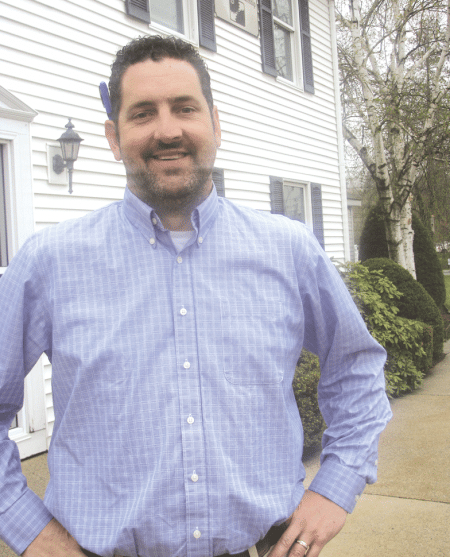
The Hampshire Mall management team recently welcomed Operations Manager John Mieczkowski. John has more than 20 years of both commercial and industrial construction experience. He is the longtime owner and operator of Arc Welding and has served as a firefighter for over 20 years, currently as a lieutenant with the Hadley Fire Department. He continues to reside in Hadley where he was born and raised, and is a member of the PTO, Young Men’s Club, and Firemen’s Assoc. “We are excited to have John join our team at Hampshire Mall. With his vast experience in construction and project management, he will be a valuable asset to us,” said General Manager Lynn Gray.

Agenda Departments

Beer and Wine Tasting

June 5: The Junior League of Greater Springfield will present its second annual Beer and Wine Tasting fund-raising event on Sunday, June 5 from 3 to 6 p.m. at the Holyoke Canoe Club. The event will include a silent auction, live music by Berkshire Hill Music Academy, and hors d’oeuvres by Lattitude. Proceeds from the event will support the Junior League’s scholarship fund. Every year, the Junior League awards a scholarship to a graduating high-school female who has exhibited exemplary leadership and community service. “There are many young women who demonstrate strong leadership skills and dedication to volunteerism,” said Shana Wilson, president of the Junior League of Greater Springfield. “We are proud to recognize one of them with a scholarship, and this event ensures that we can continue to support young female leaders for years to come.” The event is open to the public and sponsored by Sarat Ford Lincoln of Agawam and Commonwealth Packaging Corp. of Chicopee. Tickets cost $30 and can be purchased at www.jlgs.org/wine–beer-tasting-2016.html. “This event will help highlight the vitally important work the Junior League of Greater Springfield provides to the local community as well as reward a graduating high-school female for her hard work and service,” Wilson added.

‘Archetypes at Work’

June 7: The owner of both Cultivate and Nest and Beloved Earth will offer a free workshop geared toward the small-business owner or freelancer who wants to learn how to take his or her business to the next level. Terra Missildine will offer “Archetypes at Work” from 5 to 7 p.m. at Cultivate and Nest, 2 Bay Road, Suite 100, Hadley. The workshop will focus on discovering participants’ personality archetypes and exploring how they can use that knowledge more effectively in their branding and in attracting their ideal clients. “Participants will have fun and have a chance to be introspective while digging deep to discover who they really are in business and, more importantly, how they are perceived in the marketplace,” Missildine said. An experienced entrepreneur, she and her husband, David, launched Beloved Earth, a ‘green’ cleaning business, 10 years ago, and she founded Cultivate and Nest, a membership-based co-office space that incorporates a child-care component, in January. The workshop is free, but seats are limited. E-mail [email protected] to reserve a spot. For more information, visit cultivateandnest.com or contact Missildine at (413) 345-2400.

Cybersecurity Luncheon

June 8: Peritus Security Partners, Gaudreau Group Insurance Agency, and CMD Technology Group will present a cybersecurity luncheon from 11 a.m. to 1 p.m. at Center Square Grill, 84 Center Square, East Longmeadow. The event — designed for small to medium-sized businesses faced with threats to client and employee data — will present three key elements to building a solid foundation for managing cyber risk. Peritus Security Partners will discuss the importance of building proper policies, procedures, and controls to manage cyber risk and compliance. The Gaudreau Group will discuss the importance of using cyber insurance as a tool to manage risk that cannot be practically controlled through policy or technical controls. CMD Technology Group will focus on some practical technology solutions that help reduce the risks of a cyber attack. The event will culminate with a practical discussion on current and emerging threats and how businesses can use these three strategies to protect against a data breach. Reservations are required. To register, call (413) 525-0023 or e-mail [email protected].

Charles’ Angels Walk for Diabetes Education

June 11: Three years ago, Clara Thatcher, a Hampshire Regional High School student, organized an annual walk in memory of her father, who passed away from complications with diabetes. The fourth annual Charles’ Angels Walk for Diabetes Education will take place from 8:30 a.m. to noon at Hampshire Regional High School, rain or shine. Proceeds from the walk will benefit the Cooley Dickinson Medical Group Diabetes Center, a program of Cooley Dickinson Health Care. Clara’s father, Charles Thatcher, died in 2009. In his memory, Clara, her sister, Kayla Thatcher, and their mother, Mandy Caputo, established the first Charles’ Angels Walk for Diabetes Education fund-raiser in 2013. All proceeds support diabetes education through the Diabetes Center, which teaches those living with diabetes how to best manage their health through exercise, nutrition, medications, and follow-up care. For more information, visit charlesangels.weebly.com or e-mail [email protected].

Northampton Garden Tour

June 11: Come visit eight gardens on display for the 2016 Northampton Garden Tour, a fund-raiser for Friends of Forbes Library Inc. The event will be held from 10 a.m. to 3 p.m., rain or shine. The Garden Tour aims to inspire and educate everyday gardeners with plantings in a variety of appealing and unique landscaping styles and creative use of hardscape. In contrast to the 2015 tour that was localized in the center of Northampton, this year’s tour takes participants on a scenic and varied 18-mile route to the outer reaches of the community. Tickets come with directions to this self-guided tour of gardens within easy driving distance of the library. There is no obvious, easiest route, but suggestions will be available to make the tour both safe and expedient. At each garden, there are descriptions of the plantings, and garden guides will be on hand to answer questions. The terrain of this year’s tour broadly circles Northampton, making gardens accessible by car or a bicycle ride for the recreational peddler comfortable with 20-plus miles. Tickets for the tour are $15 in advance at Forbes Library, Bay State Perennial Farm, Cooper’s Corner, Hadley Garden Center, North Country Landscapes, and State Street Fruit Store. The cost is $20 on the day of the tour at the library only. The Garden Tour also includes a raffle to win organic compost, gift certificates, garden supplies, a landscape consultation, and more. Raffle tickets are available at Forbes Library through the day before the tour as well as at one of the gardens on the day of the tour. All event proceeds benefit Friends of Forbes Library to support programs, events, and projects for the library that could not otherwise be funded. For details: on the organization, visit www.forbeslibrary.org. For more information about the Garden Tour, call Lyn Heady at (413) 584-7041.

‘Leverage Technology to Do More with Less’

June 15: Comcast Business will present “How to Leverage Technology to Do More With Less,” part of the BusinessWest/HCN Lecture Series, at the Lyman & Merrie Wood Museum of Springfield History, 21 Edward St., Springfield. Registration will begin at 7:15 a.m., followed by breakfast and a panel discussion from 7:30 to 9 a.m. The panelists — influential minds in the IT field — will discuss issues that every business IT department is being forced to deal with, including rising demands to make changes to existing systems, increasing efficiency and improving security, and how budget restrictions impact IT. Panelists include Michael Feld, CEO, VertitechIT, and interim CTO, Baystate Health and Lancaster General Hospital; Frank Vincentelli, chief technology officer, Integrated IT Solutions; and Patrick Streck, director, IT Services, Baystate Health / Information & Technology. Admission is free, but pre-registration is required by June 7. To register, go HERE or call (413) 781-8600 for more information.

40 Under Forty

June 16: The 10th annual 40 Under Forty award program, staged by BusinessWest, will be held at the Log Cabin Banquet & Meeting House in Holyoke, honoring 40 of the region’s rising stars under 40 years old. An independent panel of judges chose the winners, and their stories were told in the pages of the April 18 issue. The event is sponsored by Northwestern Mutual and Paragus Strategic IT (presenting sponsors), EMA Dental, Health New England, Isenberg School of Management at UMass Amherst, Moriarty & Primack, United Bank, and the Young Professional Society of Greater Springfield. The event is sold out.

Sunbeam Social Club

June 20: Sunshine Village is introducing its Sunbeam Social Club, designed for people with memory loss and their family members. Sunshine Village has a long history of providing innovative programming for people with cognitive disabilities. Sunbeam Social Club will provide a safe, supportive, and engaging environment for people who often have fewer opportunities for socializing and fun. The debut of Sunbeam Social Club coincides with Alzheimer’s Awareness Day on Monday, June 20, the longest day of the year. The day is designed to shine a light on the millions of people living with memory disorders. The gathering will be held from 10 to 11:30 a.m. in the Community Room at the Emily Partyka Central Library at 449 Front St. in Chicopee. Group and individualized activities are planned, and refreshments will be served. Volunteers from Sunshine Village’s Community Based Day Program will be on hand, as well as local professional resources. “We are thrilled to introduce the Sunbeam Social Club,” said Sunshine Village Executive Director Gina Kos. “This program is intended to provide joy to both people with memory disorders and their care partners. People with vascular dementia, Alzheimer’s disease, and other memory disorders are all invited to attend with their family members.” For more information or to register for the June gathering of the Sunbeam Social Club, call Sunshine Village at (413) 592-6142.

‘Building Your Exit’

June 22, 23: The Vann Group and Epstein Financial Services will present “Building Your Exit: The Owner Succession Planning Process Defined,” part of the BusinessWest/HCN Lecture Series, on Wednesday, June 22 at the Student Prince/the Fort in Springfield, and Thursday, June 23 at Hadley Farms Meeting House in Hadley. Registration both days will begin at 7:15 a.m., followed by breakfast and a panel discussion from 7:30 to 9 a.m. One of the largest challenges facing business owners today is the question of how to get out of their business. These seminars will present a step-by-step breakdown of the succession-planning process and what to expect along the way, including the many benefits to transitioning business ownership. Panelists include Kevin Vann and Michael Vann of the Vann Group and Charlie Epstein of Epstein Financial Services and Epstein Financial Group. Admission is free, but RSVP is requested by June 14 for the first seminar and by June 15 for the second. To register, go HERE or call (413) 781-8600 for more information.

Departments Picture This

Email ‘Picture This’ photos with a caption and contact information to [email protected]

Pleasant Encounters

 The Greater Springfield Convention & Visitors Bureau


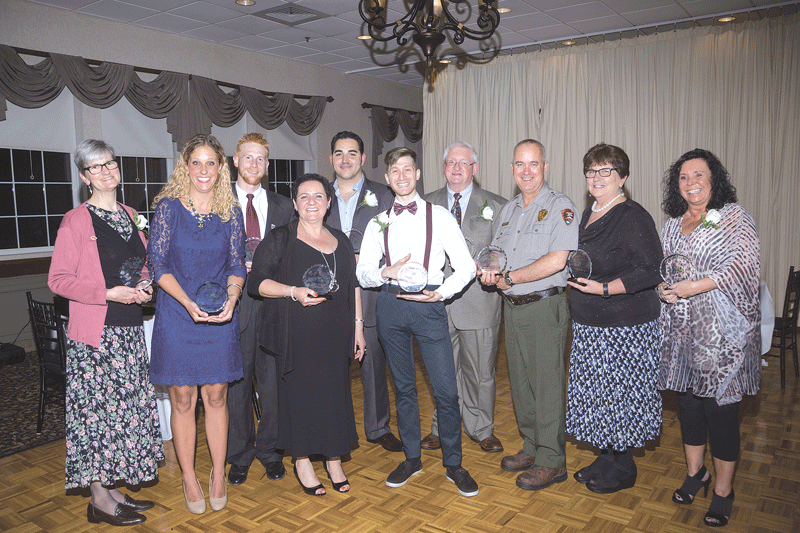
The Greater Springfield Convention & Visitors Bureau honored 11 individuals from the region’s hospitality sector on May 16 at the 21st annual Howdy Awards for Hospitality Excellence. They are, in alphabetical order: Monique Ball, desk clerk, Hampton Inn & Suites, Greenfield (category of accommodations); Silvana Cardaropoli, server, Palazzo Café, Springfield (food – casual); Andrew Demers, server, Bertucci’s, West Springfield (food – tableside); Michael Gabis, merchandise manager, Springfield Falcons (attractions); Carmine Manzi, bartender, Villa Napoletana, East Longmeadow (People’s Choice winner); Alicia Ralph, Visitors Center associate, Greater Northampton Chamber of Commerce (public service); James Saul, motorcoach operator, Peter Pan Bus Lines, Springfield (transportation); Tom Savage, sales associate, Yankee Candle Village, South Deerfield (business/retail); the Springfield Armory National Historic Site (Spotlight winner); Gina Stevens, bartender, Atlas Pub, Chicopee (beverage); and Rebecca Whiteford, event planner, the Log Cabin, Holyoke (banquet and meetings).

Appreciating the Military

National Military Appreciation Month

In conjunction with National Military Appreciation Month in May, Lee Premium Outlets unveiled two reserved veteran/military parking spaces with a ribbon-cutting ceremony on May 20. Front row, from left: State Rep. William Pignatelli, VFW Post #448 Commander Arnie Perras, American Legion Post #68 Commander Bernie LaFramboise, U.S. Army Staff Sgt. Aaron Pierce, and Lee Premium Outlets General Manager Carolyn Edwards.

Wild Success

Advertising Club of Western Massachusetts’ Creative Awards

“Make. Believe.” was the theme of the Advertising Club of Western Massachusetts’ Creative Awards, the club’s annual recognition of creative excellence. The event was held May 19 at Open Square in Holyoke, and the judges included Kevin Grady, global head of design and communication for brand strategy firm Siegel + Gale, and Nikita Prokhorov, a freelance designer, author, and professor based in Brooklyn, N.Y. Among the winners was Wild Apple Design Group, which won a bronze award for designing and building the website for the 2015 Western Mass. Business Expo, the annual event presented by BusinessWest.


Walk This Way
IMG_3695

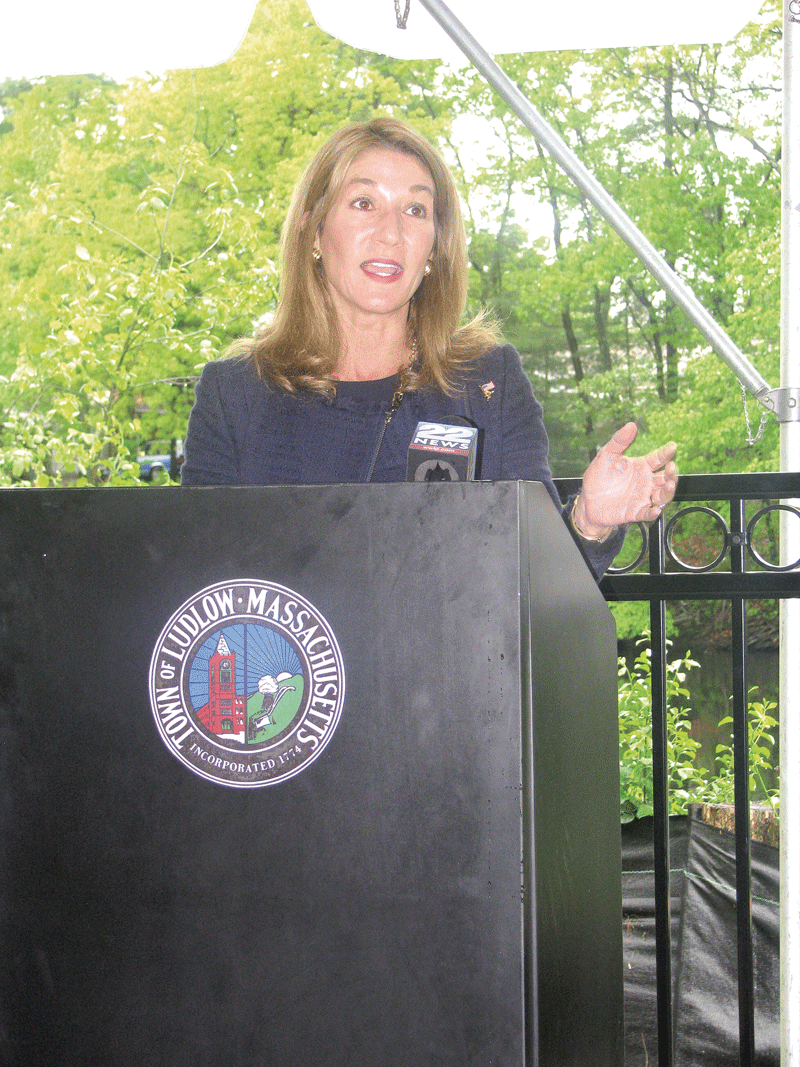
Lt. Gov. Karyn Polito visited the ongoing Ludlow Mills development on May 24 to announce a $429,500 MassWorks grant to the Ludlow Mills Riverwalk project, located behind the mill complex. The funding will boost pedestrian safety and education on the 3,500-foot trail along the Chicopee River, including lighting, benches, signage educating walkers about the history of Ludlow’s mills, and other improvements. The Riverwalk — funded initially with $600,000 from HealthSouth Rehabilitation Hospital and Westmass Area Development Corp. — opened up a previously inaccessible area of the riverfront with a paved walkway. Westmass bought the 170-acre Ludlow Mills complex five years ago with the intention of developing a mixed-use complex in the old mills, including Mill 8 with its iconic clock tower (pictured). It has since attracted $75 million in public and private investment, including the $26 million HealthSouth facility and a $24.5 million, 75-unit senior housing project by WinnDevelopment. Ludlow Selectman William Rooney (pictured bottom, with Polito and State Rep. Thomas Petrolati) praised the partnerships forged between the town, state agencies, and private interests in building momentum at Ludlow Mills. “Because of these partnerships, the future of Ludlow, especially the downtown area, are bright.”

Lt. Gov. Karyn Polito visited the ongoing Ludlow Mills development on May 24 to announce a $429,500 MassWorks grant to the Ludlow Mills Riverwalk project, located behind the mill complex. The funding will boost pedestrian safety and education on the 3,500-foot trail along the Chicopee River, including lighting, benches, signage educating walkers about the history of Ludlow’s mills, and other improvements. The Riverwalk — funded initially with $600,000 from HealthSouth Rehabilitation Hospital and Westmass Area Development Corp. — opened up a previously inaccessible area of the riverfront with a paved walkway. Westmass bought the 170-acre Ludlow Mills complex five years ago with the intention of developing a mixed-use complex in the old mills, including Mill 8 with its iconic clock tower (pictured). It has since attracted $75 million in public and private investment, including the $26 million HealthSouth facility and a $24.5 million, 75-unit senior housing project by WinnDevelopment. Ludlow Selectman William Rooney (pictured bottom, with Polito and State Rep. Thomas Petrolati) praised the partnerships forged between the town, state agencies, and private interests in building momentum at Ludlow Mills. “Because of these partnerships, the future of Ludlow, especially the downtown area, are bright.”

IMG_3719


Up for the Challenge

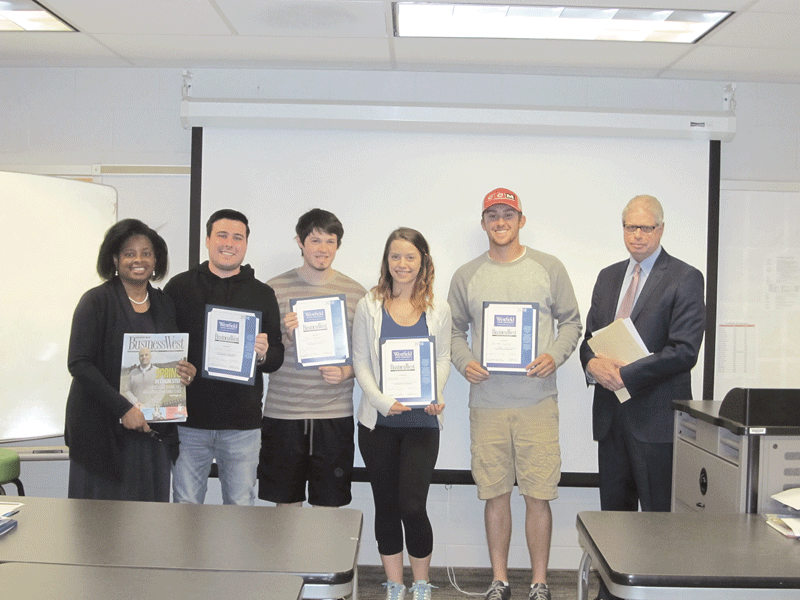
The BusinessWest News Challenge is a program designed to engage students in the world of business, communication, journalism, and media. It was created by Westfield State University (WSU) Professor Janine Fondon and judged by BusinessWest Editor George O’Brien, who recently visited Fondon’s “Writing for the Media” class to announce the winners as well as lecture on the topic of journalism and news writing. Pictured, from left, are Fondon, Tom Lyon (honorable mention), Ian Flannery (third place), Meaghan Jablonski (second place), and Nate Barnes (first place).

The BusinessWest News Challenge is a program designed to engage students in the world of business, communication, journalism, and media. It was created by Westfield State University (WSU) Professor Janine Fondon and judged by BusinessWest Editor George O’Brien, who recently visited Fondon’s “Writing for the Media” class to announce the winners as well as lecture on the topic of journalism and news writing. Pictured, from left, are Fondon, Tom Lyon (honorable mention), Ian Flannery (third place), Meaghan Jablonski (second place), and Nate Barnes (first place).

Daily News

GREENFIELD — How can colleges support student success in online courses? That is just one topic to be discussed at Greenfield Community College on June 2 when more than 220 educators from Massachusetts public community colleges and universities gather for the 11th annual Conference on eLearning.

“Sharing Best Practices,” the theme of the conference sponsored by Massachusetts Colleges Online (MCO), sums up the work those faculty, administrators, and technologists will do during a day packed with presentations and hands-on training. Carlos Santiago, state commissioner of Higher Education, will present the keynote address.

Featured at the conference will be the Courses of Distinction Award Showcase, sessions describing online and hybrid courses recognized by the MCO institutions as representing the best uses of online instructional technology to enhance student success. Hybrid courses combine online instruction with classroom time. GCC Social Sciences faculty member Linda McCarthy and Medical Office Management instructor Jeanne Dodge will receive Courses of Distinction Awards for courses they teach at GCC: McCarthy for her fully online course “Principles of Sociology” and Dodge for her hybrid course “Medical Terminology.”

The conference sessions will address increasing access to higher educational opportunities through online and blended learning and managing the dramatic growth of online and blended programs in Massachusetts public higher education. Conference attendees will also discuss reaching students in new pedagogical ways, meeting the technical demands of online education delivery, and the administrative and student-services challenges related to online education.

“This conference will pull together the best practices from campuses across the state,” said Lynn Zayac, director of the Center for Instructional Technology at Westfield State University and chair of the MCO conference committee, adding that attendees will learn from each other and return to their campuses with strategies they can use to improve online learning at their institutions.

“This is a crucial time to have thoughtful discussions about online higher education,” said GCC President Bob Pura. “Done well, online education is an important tool for both access and excellence. Measuring the impact of online education is not as easy as some want to suggest, yet it is critical that we do that. Focusing on best practices and challenging ourselves to do it better is at the core of this conference.”

Daily News

SPRINGFIELD — Shatz, Schwartz and Fentin, P.C. announced that attorney Michele Feinstein will lead a full-day Massachusetts Continuing Legal Education (MCLE) symposium at the Hotel Northampton on Thursday, June 16.

With game-changing case decisions and new emerging regional trends, this day-long conference will provide attorneys with an in-depth update on Massachusetts estate planning. The event, running from 9 a.m. to 4 p.m., will explore how the governor’s budget has potential to influence elder-law planning in conjunction with Medicaid.

MCLE is a nonprofit corporation that provides hands-on educational programs and reference materials for attorneys. This continuing-education program arranges more than 250 presentations annually in a variety of in-person and online formats.

Feinstein concentrates her practice in the areas of estate planning and administration, elder law, probate litigation, health law, and corporate and business planning, including all aspects of planning for the succession of business interests, representation of closely held businesses and their owners, and representation of physicians in their individual and group practices. She is a cum laude graduate of the Western New England University School of Law, and earned her bachelor’s degree and master of laws in taxation at Boston University.

To register for the conference, visit mcle.org/store/cart. MCLE will offer a new-lawyers discount for attorneys who were admitted after 2013 and law students.

Daily News

WARE — Country Bank recently sponsored a Credit for Life Fair at Ware High School. Credit for Life is a financial-literacy exercise where more than 350 seniors from Ware, Palmer, Belchertown, and Pathfinder Regional high schools are asked to make decisions on how to spend their money.

Students role-played a 25-year old adult with a career, salary, and credit score. They were assigned a mock checking and savings account and possibly a student-loan payment, depending on the career they selected. Based on their mock salary, they made decisions that affected their finances, such as renting an apartment on their own or having a roommate, buying or leasing a vehicle, purchasing furniture, and saving for their retirement.

“The goal of this event is for students to gain a better understanding of their future fiscal responsibilities. They learned about balancing a budget and making choices about their finances. They also learned how one financial choice can greatly impact another,” said Jodie Gerulaitis, financial education officer at Country Bank.

More than 70 volunteers from Country Bank and the business community staffed the booths and offered advice on money management. Every booth included choices that would be encountered in real life. Students had the option to ‘buy’ a high-end set of furniture, for example, or opt for furniture at a more affordable price. This approach blends real-life scenarios with everyday financial decisions in an organized, hands-on format. Seeing the actual cost of things leaves students with a new perspective on true financial management.

Country Bank sponsored four Credit for Life Fairs in 2016, reaching more than 1,500 students at 11 high schools. To learn more about this program, visit countrybank.com/student/high-school.

Daily News

BOSTON — This week, Gov. Charlie Baker and Lt. Gov. Karyn Polito introduced “An Act to Reform Sick Time,” aimed at limiting sick-time accruals that have led to exorbitant payouts upon retirement from state government.

The legislation would cap accrual of sick time for state employees in the Executive Department at no more than 1,000 hours, equivalent to six months of work. The bill grandfathers in approximately 5,800 current state employees who already have more than 1,000 hours accrued. Those employees would be capped at their current earned amount as of the date of enactment. Once the legislation is passed, the policy will take effect immediately.

“Sick leave is a benefit designed to offer employees a way to deal with health and family issues, not a retirement bonus,” Baker said. “Bringing the Commonwealth’s sick-leave-accrual policy in line with other private- and public-sector employers just makes sense and is the fiscally responsible thing to do.”

Added Polito, “this legislation ensures the use of sick time remains consistent with its intended purpose. Benefits for Executive Department employees will remain competitive while we implement an accrual policy that is fair to Massachusetts taxpayers.”

Under current law, employees can accrue a maximum of 15 sick days per year, and those employees who retire are permitted to cash out 20% of unused sick time. In FY 2015, 378 employees had an accrual of more than 1,000 hours upon retirement. While this represents only about one-third the number of retiring employees, the cashouts for these employees accounted for nearly 80% of the total cashout cost. Based on the last three fiscal years, if fully implemented, a 1,000-hour cap on accruals would have saved an average of $3.5 million in cashouts per year.

“Sick days serve an important purpose, but they must be used in an appropriate and accountable way for our compensation system to have the integrity and transparency taxpayers deserve,” said Senate Minority Leader Bruce Tarr.

Added House Minority Leader Bradley Jones Jr., “recent media reports highlighting excessive sick-leave payouts in the public higher-education system clearly demonstrate the need to crack down on these types of abuses. The reforms proposed by the Baker-Polito administration will help to provide greater transparency and accountability to the state’s taxpayers.”

Daily News

WINDSOR LOCKS, Conn. — The New England Knowledge Corridor, an interstate partnership of regional economic-development, planning, business, tourism, and educational institutions, will host its annual State of the Region Conference on Friday, June 3 starting at 8 a.m. at the Sheraton at Bradley International Airport.

The Knowledge Corridor is home to higher-education institutions large and small. This year’s conference will focus on the current and potential impact of their presence in the region beyond their core academic missions.

Participants will include Ed Klonoski, president, Charter Oak State College; Lynn Pasquerella, president, Mount Holyoke College; Hartford Mayor Luke Bronin; Michael Malone, vice chancellor for Research and Engagement, UMass Amherst; Rhona Free, president, University of Saint Joseph; Wilfredo Nieves, president, Capital Community College; and Robert Landino, founder and CEO, Centerplan Companies, LLC.

For more information or to RSVP, contact Patrick Beaudry at [email protected] or (413) 210-4658.

Daily News

SPRINGFIELD — Baystate Medical Center and its Community Benefits Advisory Council (CBAC) announced a request for proposals (RFP) for the newly established Better Together Grants Program.

Formerly known as the DoN Grant Program, Better Together unites healthcare and community-based nonprofit organizations across Baystate Health’s service areas to shape future healthcare and human services. The aim is to develop approaches that, by targeting the social determinants of health, will improve people’s overall well-being and make area communities healthier places to live.

In a more rigorous application and transparent awarding process than in past years, Better Together will utilize values and decision-making criteria as rubrics for the critical evaluation of proposals. Specifically, Better Together will aim to fund evidence-based and data-driven programs that provide an authentic path for alignment with Baystate’s community benefits mission and community health priorities, as described in the RFP.

The Better Together grants program will award outcomes-based grants (one to three years), mini-grants (one or two years), and community education and training grants (one year) to eligible nonprofit organizations with current IRS-designated 501(c)(3) status that have projects directly benefiting residents of Hampden County, with a focus on the underserved and vulnerable populations in Greater Springfield.

Click here for the full RFP. Grant proposals are due before Friday, July 1. Grant award decisions will be issued in early August, with awardees completing a pre-launch implementation planning process from August through September. Grant funding will be released after Oct. 1.

For more information, contact Annamarie Golden at [email protected] or (413) 794-7622.

Daily News

HOLYOKE — Hampden County Sheriff Michael J. Ashe Jr. will be honored with a Distinguished Service Award at the Holyoke Community College (HCC) commencement on May 28.

In a letter informing Ashe of the award, HCC President William Messner wrote, “your tireless work on behalf of inmates to bring greater educational opportunities over the past 30 years is a shining example for the region.”

The Education Program of the Hampden County Sheriff’s Department offers comprehensive educational services in its various facilities and in community-based education centers. More than 4,600 offenders in the custody of the Hampden County Sheriff’s Department have earned their GED/HiSET high-school equivalency diplomas during Ashe’s tenure as sheriff.

“One of the characteristics of the profile of the typical inmate who is brought to us is poor educational attainment,” Ashe said. “We offer the challenge and opportunity for them to better themselves educationally, in the same way we do with substance-abuse issues, job readiness, anger management, victim impact awareness, etc. What we are always seeking to do is lessen the baggage that is holding people down so that they can reach their potential as positive, productive, law-abiding citizens.

“I accept this honor not really for myself,” he went on, “but for the people of Hampden County who have supported our education program; the staff who has labored so passionately, unheralded, to bring educational opportunity to those in our custody; and for all the men and women who have risen to the challenge and opportunity of our education programs to better themselves and their lives.”

Daily News

BOSTON — The state’s unemployment rate dropped to 4.2% in April from the March rate of 4.4%, the Executive Office of Labor and Workforce Development announced Thursday.

The preliminary job estimates from the Bureau of Labor Statistics indicate Massachusetts continues to gain jobs, with 13,900 added in April. The April gain follows March’s revised gain of 6,600 jobs. From December 2015 to April 2016, Massachusetts has added 35,600 jobs.

In April, over-the-month job gains occurred in the professional, scientific, and business services; leisure and hospitality; trade, transportation, and utilities; education and health services; other services; information; financial activities; and manufacturing sectors. The April state unemployment rate remains lower than the national rate of 5.0% reported by the Bureau of Labor Statistics.

“We see continued strong job gains in many of the traditional economic drivers for the state,” Secretary of Labor and Workforce Development Ronald Walker II said. “The strong job gains in April are on the heels of 6,600 jobs added in March and 13,900 jobs added in February.”

The labor force increased by 15,400 from 3,581,500 in March, as 19,000 more residents were employed and 3,500 fewer residents were unemployed over the month.

Over the year, the state’s seasonally adjusted unemployment rate dropped 0.8% from 5.0% in April 2015. There were 27,100 fewer unemployed people and 404,000 more employed people over the year compared to April 2015.

The state’s labor force participation rate — the total number of residents 16 or older who worked or were unemployed and actively sought work in the last four weeks — increased 0.3% to 65% over the month. The labor-force participation rate over the year has decreased 0.3% compared to April 2015.

Over the year, the largest private-sector percentage job gains were in construction; professional, scientific, and business services; other services; information; and education and health services.

Daily News

SPRINGFIELD — Jynai McDonald was recently hired as regional manager of the Training Resources of America Inc. (TRA) Western Mass. offices located in Holyoke and Springfield.

McDonald holds a bachelor’s degree in digital marketing and social-media management, an associate’s degree in business administration, and a paralegal program certificate in legal studies, all from Bay Path University. She brings significant leadership, supervisory, and job-development experience to her new position.

Training Resources of America, headquartered in Worcester, is a private, nonprofit organization that has been providing quality education, employment, and training services in Massachusetts since 1975. Over the years, its efforts have enabled thousands of educationally and economically disadvantaged youth and adults to improve their quality of life by learning new skills, developing self-confidence, and finding pathways to self-sufficiency through education, employment, and training. It has training sites in Brockton, Fitchburg, Holyoke, New Bedford, Quincy, Salem, Springfield, and Worcester.

Education Sections
Joan Kagan

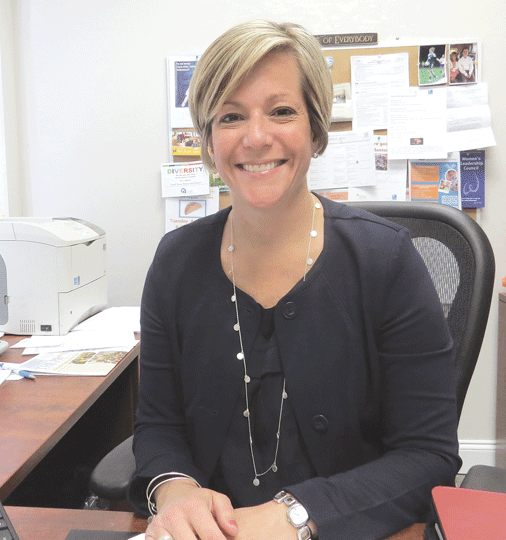
Joan Kagan, Square One president and CEO

For more than 130 years, Square One has met the challenge of providing quality early-childhood education, thus serving not only young people, but also their families and the community. Today, as the importance of such education becomes ever more apparent, the challenges to providing it continue to mount. Square One is trying to meet those challenges through vital connections to a host of constituencies.

By Sarah Leete Tsitso

When a water main broke and created a massive sinkhole in the middle of downtown Springfield two weeks ago, Square One President and CEO Joan Kagan could empathize with those who were displaced.

She has seen more than her fair share of disasters and led her team back from the brink. In June 2011, a tornado tore through Square One. Eighteen months later, another of its buildings was destroyed by a gas explosion downtown. Even now, the view from the Square One administrative offices on Main Street is obscured by bulldozers, dirt piles, and orange fencing that are all part of MGM’s massive construction project.

Through — or despite — it all, this 133-year-old nonprofit organization continues to thrive, serving 700 children and their families each day, even in the face of adversity. When the tornado hit on a Wednesday evening, the agency reopened on Monday morning and had space for every single child in the program. After the gas explosion, it got tougher; the team was weary from living in crisis mode and struggling to find the energy to regroup and rebuild. Still, despite the loss of two sites, it had to turn away only 17 children, helping those families find other programs that met their needs.

“The key to the survival of Square One is our adaptability and responsiveness to the needs of the community,” said Kagan. “We have a great, committed staff and team, a board that is willing to take occasional leaps of faith, and a caring community.”

To further strengthen the organization, Kagan and the board of directors recently made a bold decision to expand the resource development team. She hired Kristine Allard in July as vice president of development, then added Dawn DiStefano in January to serve as director of grant development.

Together with Kagan, this experienced team is already making an impact in raising funds and awareness.

Building a Solid Foundation

Square One’s mission is to ensure that all children and families have the opportunity to succeed at school, at work, and in life by providing educational programs, family-support services, health and fitness resources, and a voice in the community. At the core of everything it does is a belief, confirmed by research, that children who begin learning early become better learners for life.

Programs at Square One include center-based child care; preschool and kindergarten; home-based child care in 40 locations throughout the region; after-school, weekend, and summer programming for children living in homeless shelters; fitness and nutrition initiatives; job-skills training for parents; parent education for incarcerated and post-incarcerated parents; supervised visitation; peer support groups for victims and survivors of domestic violence and parents recovering from addiction; and family literacy programs.

Kristine Allard

Kristine Allard, vice president of Development for Square One, says the agency hopes to build support by creating connections.

Taking a holistic, whole-family approach to early-childhood education ensures that the needs of the child are met, with a belief that family success contributes to educational success. As science and research have expanded to show the importance of early-childhood education, the demand for highly qualified teachers has risen dramatically over the past couple of decades. Unfortunately, salaries for these teachers have not kept pace, which presents a near-constant issue for organizations like Square One.

Kagan said early-childhood education has been a focus in terms of curriculum development and resources; however, there is still a lot of work to do in ensuring that programs can attract — and retain — energetic, committed, qualified teachers to lead these classrooms and undertake the important work happening inside.

For many years, early-childhood education was called nursery school, and was focused on keeping children safe and entertained while their parents were at work. Now, these programs are geared toward preparing children for public school, making sure they are ready to learn and interact with their peers when they enter kindergarten.

As this evolution progressed, the need for trained and educated teachers expanded. But supply has not kept up with demand, particularly since jobs in early-childhood education have notoriously low pay rates. Kagan said it is increasingly difficult to find and keep these teachers. As their level of education and training increase, they often leave to take better-paying jobs in the public school system.

Because Square One mostly serves at-risk children and families, Kagan and Allard stressed the need for teachers and others who can meet the unique needs of this population. Of the 700 children served each day, only four are privately paid. The others receive some sort of subsidy that enables them to access services.

Many of Square One’s children have at least one parent who is incarcerated. Others are involved with the Department of Children and Families, are homeless, have at least one parent in recovery, or have a teen parent. With this wide array of needs, Square One employs social workers, therapists, and others who can provide support services to the children and their families.

Many of these family issues have an impact on education, as well as the children’s social and emotional growth. If a child is hungry or malnourished, it affects that child’s ability to focus in school. If a child has a toothache, he or she may not be as cooperative and open to learning.

Kagan noted that 85% of brain development occurs between birth and age 5; if a child does not have a solid foundation, he or she will fall behind, resulting in lifelong implications for future success. To give a strong start to as many children as possible, Square One has partnered with the YMCA, Head Start, and the Springfield School Department on a pilot program geared toward providing free early education to 4-year-olds who had never before participated in a formal program. The school department, which received a four-year grant from the state, provides coaches who work with the teachers at Square One to ensure that the curriculum aligns with state standards.

“We realized there is a large pool of children entering kindergarten who have had no access to formal child care or preschool, so those children were entering kindergarten completely unprepared for it,” said Allard. “This means they are already way behind their peers, even when it comes to basics like how to stand in line or take instructions from a teacher.”

The program launched in September, with 60 children in three classrooms participating at Square One. Kagan reports that, while there have been challenges, the children’s growth has been remarkable.

If You Fund It, They Will Learn

Funding for pilot programs like the one at Square One is important, but only scratches the surface of the organization’s true financial needs. Kagan spends a considerable amount of time lobbying legislators at the state level to increase funding for education programs.

While she understands there is only so much money to go around, and plenty of worthwhile causes looking for a piece of the pie, she believes access to early-childhood education is crucial to the growth and development of society as a whole. She and others in the field have spent years advocating for adequate funding to cover the cost of doing business, which includes paying teachers a living wage and providing exceptional classroom experiences.

At Square One, the annual cost to provide high-quality early education and care is $15,000 per child. The state reimburses $9,000 of that cost, leaving a $6,000 gap for each child, every year.

“The state has to understand that this is really about getting children off to a good start,” she said. “We want them to succeed in school, graduate, go to college or vocational training, and become productive members of society. We also need the state and other stakeholders to understand the savings involved; when you invest in early education, the research has shown that there are significant savings down the road in costs associated with social welfare, criminal justice, and special-needs programs.”

Financial limitations have resulted in fewer programs offering these services to children statewide, and fewer seats in the remaining classrooms. In recent years, the number of available spots for those seeking early-childhood education in Massachusetts has shrunk by 3,000. This reduction in capacity is due to several factors, including the difficulty finding teachers and ever-increasing state regulations. If programs cannot find staff and cannot comply with state licensing requirements around the quality of the teachers they do find, they are closing their doors. It’s a simple business problem — it is not possible to operate without quality staff and enough money to pay the bills. When these centers close, it is the children who suffer.

Square One

At the core of everything Square One does is a belief, confirmed by research, that children who begin learning early become better learners for life.

If a child doesn’t have access to early-education programs, they have difficulty keeping up with their peers once they enter the public schools. The struggles are academic, social, and behavioral, and are challenging to address once the ship has sailed. For many of these struggling students, Kagan noted, it’s like going to a job every day where your boss yells at you for doing it wrong, but never shows you the right way.

This is where public and private investment in early-childhood education comes into play. Advocating for increased government funding is one way to raise needed funds, but it can’t be an organization’s only revenue stream. This is where Allard and DiStefano come in.

Developing a Brand

Since joining the team almost a year ago, Allard said she has been asking a lot of pointed questions. Did people in the community know the Square One brand? Did they know about the wrap-around services provided for families? Were they aware that there is more to Square One than preschool? Had people made the mental transition from the organization’s old identity — Springfield Day Nursery — to its new one?

The team sought answers to those questions, and built its development plan around the answers. This included implementation of a new annual fund-raising campaign, more marketing, bigger special events, and expanded outreach on new grant opportunities. The equation is simple: if they can raise more money, they can serve more kids, pay higher teacher salaries, and have a greater impact on the community.

“When you look at our families and the challenges they face, it can consume you,” said Allard. “Or, you can identify a need and perhaps make a call, write a grant, make a connection in the community, and, in the end, find a solution.”

While Greater Springfield does not have a deep pool of donors, the businesses and individuals here are generous with both their time and money. However, with fierce competition for limited dollars and volunteers, nonprofits like Square One are focused on tracking results. Donors look at their contributions as investments, and want to see those investments yield dividends. Kagan and Allard believe their donors appreciate the work done by the organization and understand how it benefits the community. But there are still those who may not be familiar with Square One and its mission.

Special events are one way to help spread the word and engage new supporters. While labor-intensive and time-consuming, events are about more than making money. They are also about making friends.

“Events let us get in front of people and provide them with that personal connection to the people we serve,” said Allard. “They get to meet the people their money supports and hear their stories first-hand. It’s different coming from the person who lived it. Afterward, people walk away with a better understanding of their community.”

That awareness also gives Square One and other nonprofit organizations a platform to advocate for what they need to meet their mission. For example, Kagan cited the Kentucky Derby-themed event held on behalf of Square One on May 7 at the Colony Club. This event, she noted, provides an opportunity to talk about the early-education and family-support services the organization provides.

“From understanding comes compassion,” she said. “That’s a big part of what comes from hosting an event like this. It’s about funds, friends, and advocacy. And, of course, it’s about having fun.”

Kagan and her staff bring that philosophy directly into the classroom, promoting friendship and fun as well as education. This long-standing commitment to families and children’s education has resulted in a large, dynamic group of donors and supporters who are always willing to lend a hand. Kagan recalls how, after the tornado, when she and her team escaped with nothing more than the items in their pockets, they were setting up shop in temporary space all over the city. A local business heard about their plight and showed up on their doorstop with a big box of office supplies.

“It may not seem like a big deal, a box full of pens and notebooks, but it was a very big deal for us,” she said. “You take those things for granted until you don’t have them. We literally had nothing; we got out with our lives, but that was about it. So, for someone to think about that basic need and make their way to our door with that box? It’s just one example of how this community rallies around its friends and neighbors in need.”

Community Spotlight Features

Community Spotlight

Mayor William Martin

Mayor William Martin says renovations are being made to transform the century-old former Lunt Silversmiths building into medical offices.

Mayor William Martin says projects that were started years ago are coming to fruition in Greenfield, and new ones are underway that will help the town continue down its path to independence, as well as addressing areas that need revitalization.

The Town Council just approved a $5 million bond to create a municipal Internet, phone, and data-services company called Greenfield Community Energy and Technology (GCET) that will be paid for by the company after it is established. Free Internet service is being provided on Main and High streets until the project is completed, thanks to a $500,000 pilot program, and 82% of voters voiced approval for GCET, which will provide the bandwidth and speed needed to stay competitive and attract new businesses, as the town has lost some in the past due to a lack of technology.

“We’ve been given the green light to move forward with this project,” Martin said, noting that, in addition, Greenfield Light and Power began operating as a municipal aggregation plan more than a year ago and brought not only lower-cost electricity to the community, but measures to procure the energy from renewable sources.

“The company went online Jan. 1 last year, and now all of our electricity is 100% green,” the mayor told BusinessWest, adding that the public utilities will increase the likelihood of retaining businesses, encouraging them to expand, and enticing new businesses to move to the community.

GCET will also allow the Greenfield School Department to administer the Partnership for Assessment of Readiness for College and Careers (PARCC) exam to public-school students; the test is aligned with Common Core standards and replaces the Massachusetts Comprehensive Assessment System (MCAS) test.

Other compelling reasons for installing an up-to-date fiber-optic system include the fact that Greenfield Community College has a downtown campus, and the town established the Mass. Virtual Academy at Greenfield five years ago on Main Street, the Commonwealth’s first virtual K-12 public school.

Public utility companies will play a vital role in maintaining the town’s independence, but they are only a part of other major initiatives taking place. The new, $66 million Greenfield High School opened its doors last September, and the new, $73 million Greenfield Trial Court is expected to open in October, benefiting downtown businesses and restaurants that suffered when construction began on the courthouse about three years ago and operations were temporarily moved several miles away.

Keeping Pace

Martin told BusinessWest that, although some people over the age of 50 still think of downtown Greenfield primarily as a place to do retail shopping, that business has moved to malls, which makes developing a new identity critical to the neighborhood’s future.

“Greenfield is fortunate to have maintained some of its luster and attractions that are extremely unique, such as the century-old Wilson’s department store and Gardens seven-screen cinema,” he said, noting that the downtown area also contains new ethnic restaurants as well as federal, state, and county agencies, including the courthouse, Baystate Franklin Medical Center, the county jail about a mile away, and the new, $14 million intermodal John W. Olver Transit Center that serves Franklin County Transit Authority bus routes and provides intercity bus service as well as a train station that houses Amtrak’s Vermonter line.

Greenfield Trial Court

The new, $60 million Greenfield Trial Court is expected to open in October and restore lost foot traffic to downtown businesses and restaurants.

In spite of these major institutions, the temporary courthouse move did affect a number of downtown businesses. However, some made accommodations to make up for revenue that was lost, including restaurants that started delivery services.

But when the Greenfield Trial Court opens next fall, the attorneys, courthouse employees, and people scheduled to appear in court are expected to help to restore the regional downtown center to its former vitality.

However, city officials are well aware that academics, government, education, and manufacturing are the fast-growing industries in the Pioneer Valley.

“So we’ve applied a special focus to advancing our downtown in these specific areas,” Martin said. “Downtowns of the future will be more service-oriented, with attention paid to the needs of individuals and families, rather than the wants. And an increase in pedestrian traffic will stimulate the development of other small businesses offering entertainment, food, boutique shopping, and social, cultural, and religious gatherings.”

He added that the town’s focus on healthcare is exemplified by the planned development of the former Sears Department store into medical, dental, and professional offices. The Lunt Silversmiths property about 1.5 miles from Main Street is also undergoing substantial reconstruction for conversion to a residential medical treatment center of 65 beds operated by Behavioral Health Network and other clinics, which complements Greenfield’s regional position as host to Baystate Franklin Medical Center.

“We’re actively soliciting medical groups,” Martin noted, adding that Patriot Care, which provides medical marijuana, has purchased the former American Legion building at 7 Legion St. just off Main Street, and is renovating it to suit its needs, and a former convenience store a half-mile from downtown was purchased by a cardiology practice with several hundred clients and is expected to open in June.

Other efforts are being made to enhance the downtown, and last month the Town Council approved spending $4.2 million to build a new community center on a one-acre site a block from Main Street, which will serve as a senior center during the day and offer space for classes in the evenings and on weekends.

Martin said a 100-year-old building on the site which currently houses the central office for the school department will be either demolished or converted to housing, and the office will be moved to the middle school.

In addition, a central communications center for the county is in the planning stages, and will be located in a strategic area on West Main Street, which Martin describes as “an area that requires stimulation and planning with both private and public development.

“It is blighted, so we want to fill it in and make it more attractive to stimulate further development,” he told BusinessWest, adding that a number of buildings there have already been demolished, redeveloped, or scheduled for major renovations or redevelopment.

Town officials are also working to create a village of tiny houses, which are growing in popularity, on a ¾-acre lot at 102-106 Deerfield St. A bike path is situated to the rear of the lot, and a formal bike lane was established on Route 2 after the town adopted the Complete Streets program, a transportation and design initiative that promotes safe travel for walkers and cyclers.

Greenfield also received a $177,000 grant to create a new dog park a short distance away at Green River Park off of Petty Plain Road, as well as a $400,000 PARC grant to install a new playground, signage, basketball court, and pickleball court and revamp the parking lot.

“It will be a big expansion,” Martin said. “Right now, the park only contains two softball fields, a basketball court, and a parking lot. But in addition to the improvements and expansion, next year we expect to create a mile-long walking and biking path around the park that will provide a quiet, meditative place where individuals and families people can take their kids to enjoy a walk by the river.”

Measures have also been taken to address flooding from the Green and Deerfield rivers on Deerfield Street, which have caused real problems in the past for Mohawk Meadow Golf Course and the Department of Public Works treatment plant. Streetscape and engineering work has been done to prevent future floods, including the installation of a unique set of storm doors on the DPW building.

Martin added, however, that condemned properties with flooded basements are still monitored, while fire ravaged-buildings have been removed.

Continued Growth

Greenfield hopes to build a new library to replace the current structure on Main Street, built in 1880, which lacks the space and modern amenities needed to keep pace with today’s needs. A state grant was procured to pay for a design, and a forum was held last month to inform residents about evolving plans.

Martin said the town’s finances are in good shape, and it was fortunate to be able to negotiate contracts with the unions that will allow it to maintain a steady cost of living, while reducing the increase over time.

Although the residential tax rate is high, he noted — Greenfield ranks fourth in the state in that category — valuations are low, so the average homeowner pays $3,934 in real-estate taxes, ranking 211th in the Commonwealth.

So, the combination of new projects and long-awaited ones coming to fruition has officials excited about the future.

“We’re looking to continuously strengthen our unique approach to reframing Main Street, and our next step will be to make it an attractive destination for young people with curious minds,” Martin said, adding that the town hopes to open an innovation center and a program that would allow businesses to share services.

He told BusinessWest that two manufacturing companies have plans to move Greenfield, and officials hope to build on the success of businesses that have been in town for years and work with the school department to shorten the path from graduation to job security.

“We believe that municipal investment will act as a catalyst for private investment and set the town up to repair and replace institutional buildings and needed infrastructure,” the mayor added, noting that new sewer and water lines and pump stations are being installed throughout the town.

Upcoming challenges will include a lack of parking when the new courthouse opens because it was built on a former parking lot.

“But we’re looking forward to the revival of foot traffic, which will help downtown businesses, although things won’t really settle down until construction on a new multi-storied garage is complete,” Martin continued, explaining that strategies to deal with the issue may include measures such as a shuttle service to distant parking lots.

But the town is keeping pace by installing utilities and technology that will keep it independent, attract young people, and offer businesses all they need to be successful in the years to come.

Education Sections

New-school Thinking

Carlos Santiago says it would be one of those proverbial ‘good problems to have.’

He was referring to the possibility that so many individuals will seek to take part in the Commonwealth Commitment program — an ambitious, first-of-its kind initiative designed to incentivize more people to enter college and complete their degree — that there are potential logistical and financial challenges for the state’s four-year public colleges and universities.

Carlos Santiago

Carlos Santiago

Santiago, the Commonwealth’s commissioner of Higher Education, stopped short of predicting that would actually happen. But he didn’t hesitate to say he expected this program to address a number of concerns facing the state, its institutions of higher learning, and families faced with the daunting task of paying for a college education.

These include smaller high-school graduating classes, a demographic phenomenon that is certainly effecting recent enrollment, especially at the 15 community colleges; still-problematic graduation rates, or ‘completion rates,’ at the public schools; the spiraling cost of college, which is keeping many from entering or finishing a degree program; and, last but not least, a serious skills gap facing businesses in virtually every sector of the economy.

Commonwealth Commitment was blueprinted with all that as the backdrop, said Santiago, adding that he believes it can brighten each of those pictures.

“We think this is the right message at the right time,” he said, while acknowledging there are risks for the four-year colleges due to the financial incentives offered to participants. “The Commonwealth needs more people to enter into our institutions, and for more students to graduate with less loan burden. This is the right message.”

Here’s how it works: Students will begin their studies at one of the community colleges, enrolling in one of the 24 Commonwealth Commitment/Mass Transfer Pathways programs that will roll out this fall. That list includes (for September) biology, chemistry, economics, psychology, and history, and (starting in the fall of 2017) early childhood education, computer science, criminal justice, and others. Students must attend full-time and maintain a cumulative GPA of 3.0.

After earning an associate’s degree in two and half years or less, students will transfer to one of nine state universities or five UMass campuses to earn a baccalaureate degree. At the end of every successfully completed semester, students will earn a 10% rebate on tuition and fees, payable in the form of a check, or may opt to receive a voucher to use for books and other education-related expenses — the program does not discount room and board. And tuition is frozen for the duration of the duration of the degree program, which must be completed in 4½ years.

While there is no shortage of that proverbial cautious optimism regarding Commonwealth Commitment, no one is really sure what will happen. But they can speculate, and, when pressed by BusinessWest, they did.

Monica Perez, interim vice president of Academic Affairs at Holyoke Community College, said the program will likely become an effective incentive for students to not only enroll at a community college, but quickly harden their focus on a degree program and the path for completing it. She noted that, historically, students have lost time, credits, and money while trying to settle on a major. Commonwealth Commitment will likely expedite the process through its monetary incentives.

Monica Perez

Monica Perez

“Every time a student changes his or her major, especially if you’re going from something that’s relatively general, like arts and sciences, to something specific, like health, and then back out again, to criminal justice, you’re going to lose credits,” she explained. “And when you lose credits, you have to start again.”

What the new program will likely do, through its time-based incentives, is prompt students to think harder about a major, lock in it on it, and stay on that path.

Ira Rubenzahl, the retiring president of Springfield Technical Community College, agreed, and noted that STCC was one of the first schools in the Commonwealth to undertake a program similar in structure and mission. He said there is already evidence that they work as intended — meaning, to get people into college and reduce the price of that education by starting at schools like his.

“This will hopefully encourage more people to consider community colleges for the first two years of their college education,” he said. “And it will provide incentives to complete, which is important because, while getting people to start down this path is one thing, the goal is to get them to the end.”

For this issue and its focus on education, BusinessWest takes an in-depth look at Commonwealth Commitment and how it could potentially change the landscape for the state and its public institutions.

Course Change

They become known as ‘$30K degrees,’ and that term goes a long way toward explaining what they are.

Yes, these are bachelor’s degrees that cost $30,000 (or less, in many cases) and involve earning an associate’s degree at one of the participating community colleges and then transferring, through a host of articulation agreements (such as the ones STCC and HCC have with Westfield State University) to a four-year institution.

Ira Rubenzahl

Ira Rubenzahl

These programs have worked out very well, said Santiago, adding that Commonwealth Commitment takes matters statewide and at least one step further with its rebates, locked-in tuition, and additional 10% off the total price.

They will take the sticker price of a college education down well below $30,000 in most cases, he went on, to $23,000 or even $22,000, and bring a higher level of sophistication to the model whereby students start at a community college and finish at one of the state’s public universities — with the accent on ‘finish.’

“As I saw what was developing, I said to myself, ‘this is great, if you live in one of these regions,’” he recalled. “I thought, ‘why can’t we do this across the entire system of higher education? Why can’t a student from any two-year campus follow a similar pathway to any four-year campus or UMass?’”

Starting this fall, they can, he went on, adding that, as this expanded program started coming together, the initial plan was to call it the ‘Commonwealth $30K Degree.’ But this was determined to be less than accurate, because there would be some cases where the cost would exceed that number, but a great many more where it wouldn’t reach it.

But a far bigger challenge than naming the initiative would be selling it — or so Santiago and others thought.

As things turned out, while Commonwealth Commitment presents some inherent risks for the four-year schools, Santiago acknowledged, noting that the tuition waivers and locked-in prices could pose challenges, it received what amounted to universal buy-in from those schools when this initiative was put on the table. It even came from the two specialty schools — Massachusetts Maritime Academy and Massachusetts College of Art and Design— which many thought would have reservations about the comcept.

“In Massachusetts, public higher education is a very decentralized system,” he explained. “Just because we have what we think is a good mean doesn’t mean everyone is going to buy into it. But the reality is they did — they supported it, across the board.”

Santiago believes there are many reasons for this buy-in, chief among them being those smaller high-school graduating classes, a trend expected to continue for at least another eight years, according to most experts.

These declining numbers of traditional college students has left colleges and universities across the country looking for imaginative ways to boost enrollment while at the same time keeping their standards high — methods such as the recent decision by the University of Maine to charge out-of-state students the rate they would be paying to attend their home state’s university.

And these discussion points bring Santiago to the contention that Commonwealth Commitment is about far more than affordability, although that is a huge part of it. It’s also about getting people onto a path toward a degree — and onto a path more likely to get them to the end than what existed previously.

Perez believes the program has a good chance of succeeding with that mission through the various incentives, or forms of motivation, that it provides to finish, finish quickly, and earn a degree in a field where job prospects are solid.

With that, she returned to her thoughts about how this program might sharpen a student’s focus and thus eliminate lost time and expense.

“Community-college students often take 80 or more credits to get a two-year degree,” she noted, adding that this number should be closer to 60. “At the four-year level, they’re taking anywhere from 130 to 134 credits to get a 120-credit degree.

“Part of the design of this program is to get students on the pathway they need to finish it,” she went on, “and guide them along the way so they can finish in a timely manner and not waste time or money.”

If Commonwealth Commitment can succeed in getting more people into college and through to a degree, it will help Massachusetts with another huge challenge, he said: the pending retirement of workers from the Baby Boom generation and the need to replace those talented individuals.

“One-third of our labor force is 55 years of age or older,” he explained. “It’s the most educated component of our labor force, and they’re going to be retired in 10 years. The Commonwealth must find a way to start replacing these individuals.”

Degree of Inspiration

Returning to the possibility of hundreds, or even thousands, of individuals taking full advantage of Commonwealth Commitment, Santiago added an adverb to his commentary.

“That would be a really good problem to have,” he told BusinessWest, adding that, if that scenario becomes reality, steps will be taken to address it.

“We’ll bring resources to bear — we’ll make it work,” he said, adding that, at the very least, he expects this initiative to prompt more people to take the path it lays out.

And if that happens, those individuals, their families, the colleges, and businesses across the state all stand to benefit.

George O’Brien can be reached at [email protected]

Business Management Sections

Getting to Know You

Ross Giombetti

Ross Giombetti, president of Giombetti Associates

Thirty years ago, Rick Giombetti developed a concept, called Performance Dynamics, that links personality with business productivity and potential. His Hampden-based company, Giombetti Associates, has grown significantly since then, helping hundreds of companies succeed by understanding personalities and building better leaders. His son, Ross, recently took the reins of the firm, but doesn’t expect much to change — least of all the passion he and his father share for making a difference in clients’ lives.

It’s not always easy, Ross Giombetti says, to be a client of his business-consulting firm, Giombetti Associates.

“We want to build the relationship and build the trust so clients know we care about the demands of their business, then deliver feedback that is true, real, and honest — tell them what they need to hear, not what they want to hear. And sometimes it stings,” said Giombetti, who recently succeeded his father, Rick — who co-founded the Hampden-based firm 30 years ago — in the president’s chair.

“I’ve certainly been called ‘direct’ before,” Ross went on, “but you’ll also find we back that up with support and compassion, so when we have to deliver a message you’re not going to like, you walk away trusting it, and knowing it’s what you needed to hear to make you and your organization better.”

That message varies wildly from client to client, as it always has; Giombetti Associates deals in leadership development and training, team-building, talent acquisition and recruitment, pre-employment assessment, and strategic executive coaching, among other roles.

“But the foundation of it all is building high-performance, world-class companies through people,” he explained — an idea he would return to several times during his talk with BusinessWest.

“There’s one constant in every business, regardless of size or industry — people, who have character traits that drive their behavior, and can cause issues and conflict,” he explained. “Our clients come to us to help them solve challenges related to personality and leadership. It could be they have a team that doesn’t get along really well or isn’t maximizing their potential or their results. There could be a talent gap in the organization that they want us to help solve, or it could be them wanting us to protect their business from making bad hiring decisions.”

The heart of Giombetti Associates is a concept called Performance Dynamics — a means of assessing personality and understanding how it affects behavior in the workplace — created in 1986 by Ross’s father, Rick, and his business partner, Paul Alves. At the time, the pair — former human-resources professionals who had struck out on their own — had virtually no money, and even scraping up enough to fly to Washington to visit the U.S. Patent and Trademark Office was a challenge.

But their idea paid off, and today, the company boasts hundreds of business clients worldwide — from mom-and-pop operations to Fortune 500 companies — helping them make hiring decisions, train executives, build leadership skills, handle office conflict, and perform a host of other interpersonal tasks.

Simply put, Performance Dynamics explores personality and applies it to leadership in business. Before quitting his job to become a consultant 30 years ago, Rick Giombetti used his human-resources experience and psychology education to develop personality-assessment exercises that companies could use to understand and manage their hiring and personnel issues. These assessment tools measure factors ranging from personality traits and mental maturity to overall understanding of leadership and how people cope with conflict.

“They’re validated and defined by major psychological think tanks,” Ross said. “We put them together in a trademarked process. My father and Paul Alves, they were well beyond their time, extremely progressive as it related to personality and leadership. That’s how it all started — with a dream and a philosophy.”

With clients boasting anywhere from five employees to 100,000, in industries ranging from landscape design to advanced manufacturing; from medical facilities to banking and insurance, the one common denominator is people, he went on. “That’s one reason why we work in all those different industries. You can change the function, change the geography, but people exist in every single one of them.”

Let’s Talk

When a company hires Giombetti, it should be ready to talk.

“Our work is a combination of things and involves a lot of fact finding, a lot of exploration, a lot of open-ended conversations in an attempt to get to know a person, a team, an organization, or an entire culture. That’s where we start,” he said.

That said, “we don’t take on new business without knowing what we’re walking into. They have to believe philosophically same things we believe. If they don’t, we’re not afraid to walk away from business. We’re not afraid to fire a customer.

“Once we know what we’re looking at,” he explained, “to really help develop an individual, a team, or a culture, we have a series of personality instruments we use that go really deep, identify the ‘why’ behind the ‘what.’ It’s not hypothetical, not conceptual; it’s concrete and real.”

A few of the team members

A few of the team members at Giombetti Associates, from left: Miklos Ats, Ross Giombetti, and Amanda Collins.

As one example, he cited a client in the Midwest founded on the core belief of purpose-driven products. “They don’t really care as much about the money they make or the success they have; they want their employees to wake up with purpose. So they’re founded on the right philosophy.”

However, Giombetti went on, the company’s leader was simply too nice and struggled with making difficult decisions, and that held his organization back.

“I’d like to think that, after working more than five years with them, his own leadership and the culture as a whole have gotten much stronger and better,” he said. “They now blend family and balance of life with accountability.”

After all, he continued, bosses can care deeply about their employees’ family time, work-life balance, and having fun at work, but at the end of the day, there has to be accountability and a focus on growing the business. Now, he said, “their organization is an example of an organization we would all want to work for.”

Another client — a local firm, Notch Mechanical Constructors in Chicopee — had a much different issue. It’s a company run by five siblings who balance their input well. “They maintain boundaries and keep each other accountable and grounded, and they make good business decisions,” Giombetti said. But they struggled with finding a strong financial leader.

“We have close to a 20-year relationship with this family, and we wanted to make sure they hire the right person. We went through a lot of due diligence, and it took us longer than we or they would like, but the story has a happy ending. We found somebody who is a great cultural fit — the same philosophy, grounded, humble, but tough and smart. They’re pretty happy with the decision we made. Sometimes making the right decision takes longer.”

In both cases — a company leader who had to change his way of thinking, and bringing in the right person from the outside for a key role — it all came down to the importance of people, he stressed.

“Great organizations believe that building a strong team with great people is largely what makes you successful. You can have a great product, you can have great service, you can have a great business model, but without the people, you won’t capitalize on your opportunities. You’ll have nothing.”

Smart Growth

Giombetti currently employs six people and is actively looking for a couple more to meet the needs of an expanding client base nationwide.

“But we’re careful about the business we take on,” he said. “We don’t take on business just for the sake of growing. That philosophy will never change as long as I’m tied to the organization. I learned that from my father, that bigger is not always better; better is better. I want to do it the right way, to continue to treat our clients like their business was ours, and I don’t want to lose touch with the close relationships we have with most of them. So we’re really careful about how we run our business.”

In part, that means running the business like that client in the Midwest who prioritizes his workers’ lives away from the office, saying he wants to do the same for team members like Miklos Ats, senior associate; Amanda Collins, office manager (who’s being groomed for a larger, human-resources generalist role), and Monica Childers, who doesn’t have a title beyond ‘protector’ and ‘boss of all of us,’ Giombetti joked.

“When I’m not working, I’d rather be spending time with my wife and three kids and a million hobbies,” he said. “I’d rather see Mik spend time with his lovely wife and go eat at more great restaurants. I’d like to see Amanda spend more time honing her trivia skills, and see Monica spend more time with her awesome husband, who recently learned how to make sushi, and their fantastic two boys. We believe in ‘work hard, play hard.’”

At the same time, he wants the firm to continue giving back to the community, through its efforts with Habitat for Humanity and other local organizations. Meanwhile, Giombetti coaches youth sports and launched a mentorship program at Minnechaug Regional High School in 2012 — efforts that, along with his business success, contributed to his selection to BusinessWest’s 40 Under Forty class of 2016.

“We’re passionate about developing young people,” he said. “Most students don’t know who they are or what they want to do, but if we can help them better understand who they are, they’ll have a lot less stress and anxiety in their young life and career.”

These efforts are just one more way Giombetti is committed to the Western Mass. region. “The Pioneer Valley will always be our home. I don’t have visions about moving our office into a big city to be closer to bigger business and more opportunities. I’m happy being where we’re at, doing what we do, supporting awesome clients and individuals.

“Philosophically, we treat our clients’ businesses like our own, and we’re going to protect that,” he went on. “Our clients trust us to know their people, know their culture, know their business, and protect it like it was our own.”

As for Ross’ father, Rick Giombetti may have relinquished his president’s title this year, but he remains active in some project work as a strategic advisor, which Ross appreciates. “His legacy will live on forever here. He’s a fantastic leader.”

One who has long been committed to building up the leadership potential of others, a passion he certainly passed along to his son.

“It sounds cliché, but I wake up every morning truly being motivated to inspire people and make a difference,” Ross said. “When students are coming out of college, when they’re asked the question, ‘what do you want to do?’ a majority say, ‘make a difference,’ but they don’t know what that means — and don’t know how.

“That is the passion I live every day,” he went on. “When I see somebody grow, develop, and become a better person, become a better husband or wife, become a better teammate or leader, that keeps me coming back for more.”

Joseph Bednar can be reached at [email protected]

Business Management Sections

Words to Live By

By Patricia Fripp


In a perfect world, you would have an unlimited budget to hire top keynote speakers for all your meetings and conventions. Since you don’t, here are some proven suggestions that have been successfully incorporated by many companies and associations. Adopt them into your meeting-planning process and become a hero for getting the most for your meeting dollar.

One seasoned association executive director had six days of speaking and seminar slots to fill. As part of the overall convention, instead of assigning each slot to a different speaker, she suggested to the conference committee that they maximize the contribution of a few top presenters, hiring three of them to fill three different roles. That’s how they made 1 + 1 + 1 = 9. Three speakers used in three ways equals nine slots filled.

Here’s how such a move can save your organization time and money and let you trade up to professional speakers you might have thought you couldn’t afford.

Save on Hotels and Airfare

Cutting the number of speakers will most likely reduce the total nights of lodging needed. You will definitely save on transportation — for instance, three round trips versus nine.

Speakers May Reduce Fee

Many speakers will conduct multiple presentations for the same fee and discount several days in the same location. Perhaps your prior speakers might have been more flexible if you had only thought to ask, “after your keynote, could you conduct a breakout session?” or “while you are here, could you emcee one morning?” or “could you moderate a panel?” Even, “our chairman is a bit nervous. Could you coach him on the opening of his keynote speech?”

Speakers and trainers who travel across country will frequently charge considerably less for three consecutive days at one hotel, rather than three separate dates months apart.

The Answer Is ‘No’ If You Don’t Ask

One Realtors Assoc. event organizer asked, “after your luncheon speech, could you deliver a breakout seminar on your topic and go deeper?” That thrilled the speaker, who wanted to prove he had more to offer than the 45 minutes of ideas presented in his keynote speech.

One seasoned professional speaker always makes a habit of suggesting a breakout following her keynote. One of her clients said, “well, the agenda is already slotted in. However, we’d love it if you would emcee our ‘Top Producers’ panel, the first breakout session after lunch.”

It’s Easier to Get Sponsors

Trading up to a more seasoned or bigger-name speaker makes it easier for you to get sponsors. If you have ever said, “we can’t afford your fee,” instead ask, “if we can find a sponsor to help pay for your presentation, would you be willing to have a book signing in their booth?”

Who would sponsor your event? Consider approaching the exhibitors at your conventions or whoever sells to your members or whoever wants good PR with the people in the audience. List these ‘angels’ prominently in the program and meeting audio-visual presentations.

At many conventions, the sponsor has the opportunity to introduce the speaker and handle the Q and A. Ahead of time, introduce your speakers to their sponsors, and encourage them to incorporate a couple of lines into their presentation that tie into their sponsor.

For example, one keynote speaker, in her speech to an 800-person audience at a national convention, thrilled the association, audience, and sponsor. After her opening story, she quoted the founder of her corporate sponsor, gave examples from the sponsor’s newsletters to reinforce her points, and incorporated its name in her walk-away line.

When your speakers are wise enough to feature their sponsors in their presentations, you will not have a problem getting sponsorship for future conferences.

Three Invaluable Bonuses

Having speakers on hand throughout your event gives you far greater flexibility in scheduling. In case of a last-minute speaker cancellation or no show, they can substitute. And continuity can establish a powerful connection between audience and speakers.

With six days of speaking and seminar slots to fill, our seasoned association executive director said, “we found that, when we triple-book speakers, they become even more popular, really getting to know our association members, who always enjoy their staying around longer. Our members feel they know them as friends when they can talk to them in the trade show and after-hour events as the speakers are with us for several days.”

Continuity, during an event or from year to year, means your speakers are able to notice and volunteer to help your organization in special ways you may not have considered.

More Bang for Your Buck

Many successful meeting planners are able to negotiate with their speakers for extras.

Wise speakers figure that, as long as they are there anyway and are being paid well, their time belongs to the client. Therefore, they are happy to take on extra tasks.

The next time you are planning a conference, consider the multiple ways you might incorporate your speakers’ talents. In addition to what you are engaging them to do, it doesn’t hurt to ask if the speaker would be willing to do one of these:

• Deliver one or two breakout sessions to the schedule;
• Add a partner/guest program;
• Introduce other speakers;
• Emcee part of the event;
• Moderate a panel;

Sign autographs;

• Coach company or association leaders on their presentations; or
• Appear in the sponsor’s booth to make their sponsorship more of an investment.

If your speaker does not ask how else he can serve you, perhaps you should consider continuing the search.

Patricia Fripp is a keynote speaker, executive speech coach, and sales presentation skills trainer. Meetings and Conventions magazine named her “one of the most electrifying speakers in North America.” She is virtually everywhere with her online learning platform FrippVT. Many of the courses earn continuing-education credits earned through XtraCredits.

Building Permits Departments

The following building permits were issued during the month of April 2016.

AMHERST

Hampshire College
15 Middle St.
$67,000 — Installation of ground-mounted PV system

CHICOPEE

Assumption of Blessed Virgin Mary
94 Springfield St.
$27,000 — Repairs to roof

La Quinta
10 Center St.
$42,000 — Replace roof

Motel 6
Johnnycake Hollow Road
$76,000 — Install new fire alarm system

Pride
363 Burnett Road
$15,000 — Remove and replace exhaust hood and system

RitmarRealty Corporation
628 Center St.
$6,000 — Remodel office space

GREENFIELD

Country Club of Greenfield
180 Country club Road
$20,000 — Construct new deck

Franklin Medical Center
53 Becon St.
$4,000 — Install new fire-rated door on 1st floor

Greenfield Hotel Inc.
17 Colrain Road
$70,000 — Remodel interior of 99 Restaurant

Greenfield Housing Authority
1 Elm St.
$24,000 — Kitchen conversion

Stoneleigh Burnham School
574 Bernardston Road
$4,150 — Install new fire suppression system

LUDLOW

A & C Realty Company
149 Center St.
$50,000 — Fire rebuild

Burger King
419 Center St.
$45,000 — Commercial alterations

Dunkin Donuts
4 Harding Ave.
$190,000 — Commercial alterations

NORTHAMPTON

Atwood Drive, LLC
8 Atwood Dr.
$140,000 — Interior build-out of 1st-floor office space

Kissel, Inc.
168 Industrial Dr.
$77,000 — Interior renovations to offices

Marley Electrical services
175 Main St.
$54,000 — Renovate interior

Rental Realty, LLC
32 Main St.
$50,000 — Interior renovations

Smith College
23 West St.
$7,300 — Office renovations at Lily Hall

PALMER

Flamingo Motorsports
2 Wilbraham St.
$33,000 — Install footing and framing for new building

SOUTH HADLEY

Sugartown Investors
426 Newton St.
$20,000 — New roof

SPRINGFIELD

City of Springfield
474 Armory St.
$14,000 — Replace glass doors struck by vehicle

City of Springfield
1170 Carew St.
$7,000 — Interior renovations

CNR Springfield, LLC
655 Page Blvd.
$2,138,000 — Repairs to existing building for new office building

Garrett Lumsden
1304 Worcester St.
$13,000 — Office buildout

MGM
95 State St.
$925,000 — Interior renovation to building

Old First Church
50 Elm St.
$10,000 — Install new roof

Premier Education
189 Brookdale Ave.
$100,000 — Subdivide large rooms for three medical training labs

Company Notebook Departments

Tighe & Bond Honored for Advancing Women in Engineering Field

WESTFIELD — The Connecticut chapter of the Women’s Transportation Seminar (WTS CT) honored Tighe & Bond as Employer of the Year during its recent annual awards dinner on April 14 at St. Clement’s Castle in Portland, Conn. The recognition applauded the firm’s support of WTS, and for providing ongoing opportunities to advance women in their engineering and transportation careers. “It’s an honor for our firm to receive this award, and we are thrilled that WTS CT selected us,” said David Pinsky, president and CEO of Tighe & Bond, who accepted the award on the firm’s behalf. “Our firm takes recruiting, retaining, and advancing women in engineering seriously. More than 30% of Tighe & Bond’s 270-plus employees are female, and approximately 14% of these women hold key management and/or leadership positions at our firm. Last year, more than 30% of Tighe & Bond’s new hires were female, and this year the number is even higher.” For more than 18 years, WTS CT has been dedicated to advancing women in transportation. It provides a forum for transportation professionals to meet and interact, sharing experiences and expertise. Member benefits include professional development, career support, mentorship, and student outreach.

Country Bank Sponsors Financial Literary Fair at WPI

WARE — Recently, Country Bank sponsored its first Financial Literacy Fair for college students at Worcester Polytechnic Institute (WPI) in Worcester. This program was a partnership with WPI’s Student Aid and Financial Literacy Department. The event featured the Next Step, a financial-literacy exercise where college students are asked to step into their very near future by visiting 10 financially informative booths to make real-world decisions. “Students learn about many of the next steps that they will encounter after they graduate from college,” said Jodie Gerulaitis, the bank’s financial education officer. “They learn that the decisions they make today will affect their finances in the future, such as the unexpected expenses of owning a vehicle, saving for retirement, renting an apartment, or owning a home, and how location can be a deciding factor in their finances.” The booths the students visit include credit, housing, student loans, insurance, budgeting, fraud prevention, transportation, savings and investing, career development, and employment benefits. The goal is for students to have a better understanding of their future fiscal responsibilities. They learn about balancing a budget and making educated choices about their finances. They also learn how one financial choice can greatly impact another.

Chamberlain Group Named 2016 Exporter of the Year

BOSTON — The Small Business Administration (SBA) has named the Great Barrington-based Chamberlain Group the 2016 Exporter of the Year for Massachusetts and New England. “Lisa and Eric Chamberlain are saving lives with the products they create in the medical-simulation industry,” said Robert Nelson, SBA Massachusetts district director. “They are connecting with new customers all over the globe and establishing an international distribution network throughout Europe, Asia, the Middle East, and Mexico.” Founded in 1999, the Chamberlain Group designs and builds mimetic organs for surgical and interventional training. Working in close collaboration with medical-device companies and teaching hospitals, the company creates models that address training needs for clinicians, sales, marketing, device research, and development. In 2000, Lisa Chamberlain became a client of the Massachusetts Small Business Development Center (MSBDC), and her business plan for the Chamberlain Group won first prize in the UMass Five College Business Plan Competition. In 2003, the company was recognized with the Governor’s Entrepreneurial Spirit Award for spurring job creation and economic development.
Today, after 17 years in business, the company has grown to 21 employees, and it exports more than 500 products directly from its Great Barrington office to more than 50 countries worldwide. “We’re honored and delighted to be recipients of this year’s Exporter of the Year awards in the Commonwealth and the New England region,” Chamberlain said. “Eric and I have been well guided by the advice and encouragement we have received from the MSBDC and the Mass Export Center. It’s made the process of growing our business and our international reach viable, knowing we have subject experts to consult with who have our best interests at heart.” The company was nominated by Ann Pieroway, regional director of the Massachusetts Export Center.

44 Business Capital Becomes Division of Berkshire Bank

PITTSFIELD — Berkshire Bank completed its asset purchase transaction with 44 Business Capital, LLC of Blue Bell, Pa., and Parke Bank of Sewell, N.J., under which Berkshire Bank has acquired the business model of 44 Business Capital and certain other assets of Parke Bank’s Small Business Administration (SBA) 7(a) loan program operations. 44 Business Capital is now operating as a direct small-business lending division of Berkshire Bank, reporting up through the bank’s already-established small-business line, and originating SBA loans for Berkshire Bank. 44 Business Capital has consistently been one of the top SBA originators and a market-leading provider and facilitator of SBA-guaranteed loans to small businesses in Pennsylvania, New Jersey, Delaware, Maryland, Northern Virginia, and Washington, D.C. 44 Business Capital’s entire team, along with its leadership — Greg Poehlmann, Phil Rapone, Jeff Sherry, and Joe Dreyer — have joined Berkshire Bank. “We’re pleased to welcome the employees and customers of 44 Business Capital,” said Berkshire Bank CEO Michael Daly. “This combination increases the client offerings for both companies, diversifies our loan portfolio, and provides a valuable future growth channel.” Added Poehlmann, senior vice president of Business Banking for Berkshire Bank and former president of 44 Business Capital, LLC, “as a division of Berkshire Bank, 44 Business Capital will continue to leverage our staff’s experience to build out an exceptional SBA lending platform that will serve the SBA’s mission on a larger scale. We are extremely excited to become part of Berkshire Bank, and look forward to establishing ourselves collectively as a major player in the SBA-lending market.”

Circle K Convenience Store Opens in Holyoke

HOLYOKE — Holyoke Mayor Alex Morse, Greater Holyoke Chamber of Commerce President Kathleen Anderson, and Circle K franchisee Yasser (Sunny) Hussain gathered on May 5 for the grand opening of the new Circle K convenience store at 337 Appleton St. in Holyoke. Hussain, the site’s owner, took a vacant and abandoned building in the downtown area and completely renovated the space into a new, state-of-the-art Circle K convenience store. The store is open 24 hours a day and carries everything from morning coffee to late-night snacks, as well as a wide selection of cold drinks, fresh roller grill items, and staples like milk and eggs.

Comcast Spotlight Leases Space at Agawam Crossing

AGAWAM — Comcast Spotlight has signed a lease for a new, 3,157-square-foot space in Agawam Crossing, located at 200 Silver St. in Agawam. This is the final space at Agawam Crossing, a class A professional office building. Comcast Spotlight recently moved into its new home alongside Baystate Rehabilitation, Life Laboratories, and Associates in Women’s Health, among others. Comcast Spotlight is an advertising sales company that provides video solutions to local, regional, and national businesses through television and digital advertising. It provides local market coverage across multiple platforms (cable TV, satellite, telco, online, VOD) and can target customers geographically, demographically, and by message to reach specific audience segments. Development Associates of Agawam was the leasing agent and project manager for the construction of Comcast Spotlight’s new offices. The tenant was represented by Bob Peterson, managing broker at REAL Partners, LLC, and Daniel Moore of NAI Plotkin of Springfield.

Friendly’s Sells Retail Ice-cream, Manufacturing Division

WILBRAHAM — Friendly’s Ice Cream announced it has sold its retail ice-cream and manufacturing business to Texas-based Dean Foods Co. for $155 million in cash. “We are thrilled at the prospects the Friendly’s Ice Cream acquisition brings to Dean Foods,” said Dean CEO Gregg Tanner. “Coupled with the momentum of Dean Foods’ current regional brands, the Friendly’s brand will be a catalyst in our strategy to grow our existing ice-cream business and branded portfolio. Friendly’s is an ideal complement to our other heritage brands across the country and fills a manufacturing and retail ice-cream void in our nationwide footprint.” Dean Foods is the largest processor and direct-to-store distributor of fresh fluid milk and other dairy and dairy-case products in the U.S., the company said. Friendly’s Ice Cream had $166 million in net sales of ice cream to supermarkets in 2015. After the transaction closes late in the second quarter of 2016, Dean Foods plans to continue producing ice cream at the current Friendly’s plant in Wilbraham, which employs about 200 people. “Friendly’s ice cream strongly resonates with consumers throughout the Northeast,” Tanner added. “Very similar to the traditions shared by consumers who grew up enjoying our existing regional milk and ice-cream brands, such as Mayfield or Dean’s, we believe the Friendly’s Ice Cream brand represents and promotes what Dean Foods has built itself around and is a great fit in our branded portfolio. Dean Foods is rooted in the traditional goodness of dairy, making Friendly’s more than just a good business and financial opportunity.” Added Friendly’s President and CEO John Maguire, “today marks a new chapter for Friendly’s retail and manufacturing ice-cream business. Dean Foods Company has recognized the growth momentum that Friendly’s retail ice cream has experienced over the last five years, and I am thrilled that Dean Foods will be the ongoing steward of the retail ice-cream business, led by the current experienced retail and creamery teams.” Friendly’s Restaurants, which boasts 260 locations in the U.S., will continue to be owned and operated by an affiliate of Sun Capital Partners Inc. and will license use of the Friendly’s trademark to Dean’s under a license agreement entered into as part of the transaction.

Keller Williams Pitches in at Springfield Boys & Girls Club

SPRINGFIELD — On Thursday, May 12, Keller Williams Realty associates around the globe donated hundreds of thousands of hours to their local communities during RED Day. Introduced in 2009, RED Day, which stands for renew, energize, and donate, is Keller Williams Realty’s annual day of service. Each year on the second Thursday of May, associates spend the day away from their businesses serving worthy organizations and causes in their communities. As part of the RED Day effort, Keller Williams Realty – Pioneer Valley chose to spend the day with the Springfield Boys & Girls Club at 481 Carew St. to paint the inside and outside of the facility, paint parking-lot lines, and landscape. The Springfield Boys & Girls Club provides, in a safe environment, programs that inspire, educate, guide, enable, and support all young people to realize their full potential as productive, responsible, respectful citizens and leaders. “RED Day is built on the belief that people can and should come together to achieve extraordinary things to help others,” said Mike Dombrowski, associate partner of Keller Williams Realty – Pioneer Valley. “It just happens to be a one-day expression of the constant state of the Keller Williams culture. We see a need, and we take action to help the Springfield community.” Since the first RED Day in 2009, Keller Williams associates have given almost a half-million hours of community service through activities ranging from food and blood drives to cleaning up trash in public parks; from revamping gardens at nursing homes to rebuilding homes and schools for community members in need. For more information about RED Day, visit www.kw.com/kw/redday.

Country Bank Supports Palmer Celebrations

PALMER — Representatives from Country Bank presented the Palmer 300th Anniversary Committee and the Celebrate Palmer Committee with donations totaling $5,000. “We are so pleased to be a major sponsor of both of these meaningful events,” said Shelley Regin, senior vice president, Marketing at Country Bank. “We look forward to celebrating with the town of Palmer, and we commend both committees for their tireless effort to make them a success.” For more information on these events, visit palmer300th.org or townofpalmer.com. For more information about Country Bank, call (800) 322-8233 or visit countrybank.com.

Departments People on the Move
William Fisher

William Fisher

Springfield College School of Social Work Professor and Director of Field Education William Fisher is the lead author of a recently released report titled “Findings from the 2015 State of Field Education Survey: A Survey of Directors of Field Education on Administrative Models, Staffing, and Resources.” Guided by Fisher’s leadership, this national survey of social-work field directors sought information on a number of important issues related to how field education programs are organized. The research also analyzed who is leading the programs and how the programs respond to unique student needs. Additional in-depth reports based on the findings are planned for the future. The research was conducted with the support of the Council on Social Work Education (CSWE), the accrediting body for social-work programs in the U.S., and the Council on Field Education, which is part of CSWE’s governance and policy-recommending structure. CWSE has designated field education as the ‘signature pedagogy’ of social-work education, meaning that it is through field experiences and practice in the real world, in conjunction with classroom and project-based learning, that students learn to be social-work professionals. Fisher has more than 25 years of experience in the social-work field, with emphasis in mental-health and substance-abuse counseling, community organizing, and community mental-health program development.

•••••

Robinson Donovan, P.C. announced that attorney Kevin Chrisanthopoulos has been appointed to the Hampden County Bar Assoc. board of directors. Founded in the same decade as Robinson Donovan more than 150 years ago, the Hampden County Bar Assoc. represents the interests of lawyers in Hampden County. This volunteer organization of attorneys serves lawyers, the justice system, and the public by providing support, education, and networking opportunities. Its purpose is to maintain the honor of the profession, promote the administration of justice, and encourage overall cooperation and goodwill among the members of the bar. “Kevin is not only an outstanding litigator, but a natural leader,” said attorney Jeffrey McCormick, a senior partner at the firm and past president of both the Hampden County Bar Assoc. and the Massachusetts Bar Assoc. “We’re very proud that he has taken on a leadership role at the Hampden County Bar Association. Kevin’s steadfast commitment to the preservation of justice will make him a valuable addition to the board of directors. He will be carrying on a decades-old tradition at Robinson Donovan of bar-association service.” Chrisanthopoulos exclusively practices litigation. He earned his bachelor’s degree from Western New England University and his juris doctor at Roger Williams University School of Law. He is also very active in his community, serving as an advisor to the board of directors for the Amelia Park Arena and Memorial Garden, past president of the Westfield Youth Hockey Assoc., assistant coach for the St. Mary’s High School hockey team, and a Massachusetts Bar Assoc. mock-trial judge. He is also a member of the Board of Bar Overseers disciplinary hearing committee and has been listed as a Massachusetts Super Lawyer since 2014.

•••••


Shauna Ziemba

Shauna Ziemba

Shauna Ziemba, business manager for McKenna Orthodontics, was recently appointed to the board of directors of New England Dental Office Managers, a study group comprised of dental administrative professionals who meet to learn, network, exchange experiences, share knowledge, discuss challenges, and provide support and encouragement. As a new board member, Ziemba represents the Pioneer Valley Chapter. She has been actively involved in dental-office administration for 17 years, and offers the group proven expertise in office administrative solutions. As business manager of McKenna Orthodontics, she is responsible for handling office procedures and systems of the three office locations in Longmeadow, Feeding Hills, and Chicopee.

•••••

Northeast IT Systems Inc. welcomed Tony Shepard to the team as a Systems Administrator. Shepard found his initial passion with IT and electronics by building his own speaker cabinets. When the car audio craze came along, he designed and built high-end car systems. After that, he focused on computers. His favorite part of the job is the challenge. “There is always something different to do,” he said, “and you learn something new every day.” His certifications include A+ certification, MCP certification, a license to teach in the state of Massachusetts, and certificates in electronic technology. He also has experience as Dell field engineer, IT manager, networking instructor, and systems field engineer.

Agenda Departments

Museums10 Summit

May 16: Arts educator Patty Bode will discuss ways museums can engage with their communities and broaden their audiences in the 21st century, in a keynote address at the fourth annual summit of Valley-based collaborative Museums10. Bode’s talk, “Museums, Engagement, and Creating Social Change,” will take place at 4 p.m. at the Yiddish Book Center at 1021 West St. in Amherst. It is free and open to the public. Bode has decades of experience working with museums through hands-on practice as an educator in urban schools, community arts programs, and teacher education, with a particular emphasis on collaborating with marginalized communities. In her address, she will discuss why access to and participation in museum life is a civil and human right in our democratic society. She will also offer case studies that demonstrate ways museums have been successful in engaging a wide range of audiences across race, social class, language, sexual orientation, and religion. Currently a teacher at Springfield Conservatory of the Arts, a magnet public school, Bode is the former director of Art Education for Tufts University in affiliation with the School of the Museum of Fine Arts in Boston, and was a visiting associate professor at Ohio State University’s Department of Arts Administration, Education and Policy. For more information, visit fivecolleges.edu and click ‘events.’ Museums10 is a collaboration of seven campus and three campus-affiliated museums that work together to celebrate the collections and promote the programs of its member museums to local, regional, and national visitors. Museums10 is facilitated by Five Colleges.

Mental Health and Wellness Fair

May 18: In celebration of Mental Health Awareness Month, Clinical & Support Options Inc. (CSO) will host its 14th annual Mental Health and Wellness Fair at the Energy Park in Greenfield from 10 a.m. to 2 p.m. Featuring CSO’s Green River House and Quabbin House Clubhouse members, the fair will be an afternoon of music, singing, poetry, and testimonials by members to highlight mental-health illness, wellness, and recovery. The fair started in 2002 in an effort to bring awareness and information to the community about mental-health illness and recovery. The event is an opportunity to dispel the stigma around mental-health illness, encourage people to seek support, and spotlight agencies available to assist. This year, the theme is “Mental Health Matters.” In addition to local community providers sharing information, there will be live music, a food vendor, and raffles, and WHAI will be on site doing a live broadcast. For more information, call the Green River House at (413) 772-2181.

Ad Club Creative Awards

May 19: Ad agencies, design firms, marketing departments, and other members of the Western Mass. and Northern Conn. creative community have submitted work for the Advertising Club of Western Massachusetts’ Creative Awards, the club’s annual recognition of creative excellence. Each year, they come together to celebrate the region’s best creative work with a festive evening of camaraderie. This year’s event — titled “Make. Believe.” — will be held at Open Square in Holyoke. The judges for this year’s Creative Awards include Kevin Grady, global head of design and communication for brand strategy firm Siegel + Gale, and Nikita Prokhorov, a freelance designer, author, and professor based in Brooklyn, N.Y. “We were really fortunate to get two judges who are at the top of their field,” said Lynn Saunders, co-chair of the Ad Club’s Creative Awards. “They held the work to a very high standard.” On May 19, the region’s creatives and guests will convene to find out which works Grady and Prokhorov deemed worthy, and to set the bar for the upcoming year of local advertising and communications. The event will feature hors d’oeuvres, a cash bar, live music, a champagne toast to the local creative community, and the opportunity to rub shoulders with, and celebrate with, colleagues whose creative work will be on display. Tickets are $35 for members, $50 for non-members, and $20 for students. For more information about the 2016 Creative Awards or to purchase tickets, go to adclubwm.org or call (413) 736- 2582. This year’s Creative Awards sponsors include Andrew Associates, BusinessWest, Cecco – the Design Office of David Cecchi, Common Media, 423 Motion Inc., Marcus Printing, Meyers Brothers Kalicka, P.C., Milltown Productions, Six-Point Creative Works Inc., Stephanie Craig Photography, TSM Design, and WWLP-22News.

IBS Explores Value of IT

May 20: Innovative Business Systems will explore the ways IT can return more value to organizations. The lunch-and-learn session will take place at 163 Northampton St., Easthampton, from noon to 2 p.m. Ideally, every IT dollar spent should provide a return by helping to increase revenues, decrease costs, or improve efficiencies. Over lunch, participants will learn many value-driven best practices, while demonstrating how IBS best adds value through its client engagements. Topics will include how the use of automation can reduce support costs due to economies of scale, how providing streamlined access to support can improve efficiencies, what skills are required and how to staff the IT function within an organization, and disciplined project selection, management, and budgeting best practices. An open-discussion IT roundtable will be faciliated by IBS immediately following the lunch-and-learn session. To register online, visit www.for-ibs.com/news/simple-registration-form.

Storyteller Series on Women in History

May 22, June 5, June 26: Wistariahurst will host artist Tammy Denease in a series of historical storytelling performances. At each of the Sunday sessions, Denease will bring to life a woman from the past. The women featured in the series are Clo Pratt, born into slavery but self-employed after being freed; local hero Elizabeth “Mum Bett” Freeman, who successfully sued Col. Ashley for her freedom in 1781; and Bessie Coleman, “First Negro Aviatrix.” The family-friendly performances will take place in the Belle Skinner Music room at 3 p.m. on each of the days, and are free and open to the public of all ages. This series is supported in part by a grant from the Holyoke Local Cultural Council, a local agency supported by the Massachusetts Cultural Council, and the New England States Touring program of the New England Foundation for the Arts, made possible with funding from the National Endowment for the Arts Regional Touring Program and the six New England state arts agencies. Educational programming at Wistariahurst is supported by Historic Holyoke at Wistariahurst.

Garden Party

June 5: The Garden: A Center for Grieving Children and Teens will host a Garden Party fund-raiser from 4 to 6:30 p.m. Guests will enjoy live music, appetizers, and drinks. Representatives from the Western Mass. Master Gardeners Assoc. will speak about the significance and meaning of herbs and flowers. There will also be a silent auction of artist-designed watering cans. The cost is $35 per person, and all funds raised will change the life of a grieving child. For more information, contact Shelly Bathe Lenn, coordinator at the Garden, at (413) 582-5312 or [email protected].

Northampton Garden Tour

June 11: Come visit eight gardens on display for the 2016 Northampton Garden Tour, a fund-raiser for Friends of Forbes Library Inc. The event will be held from 10 a.m. to 3 p.m., rain or shine. The Garden Tour aims to inspire and educate everyday gardeners with plantings in a variety of appealing and unique landscaping styles and creative use of hardscape. In contrast to the 2015 tour that was localized in the center of Northampton, this year’s tour takes participants on a scenic and varied 18-mile route to the outer reaches of the community. Tickets come with directions to this self-guided tour of gardens within easy driving distance of the library. There is no obvious, easiest route, but suggestions will be available to make the tour both safe and expedient. At each garden, there are descriptions of the plantings, and garden guides will be on hand to answer questions. The terrain of this year’s tour broadly circles Northampton, making gardens accessible by car or a bicycle ride for the recreational peddler comfortable with 20-plus miles. Tickets for the tour are $15 in advance at Forbes Library, Bay State Perennial Farm, Cooper’s Corner, Hadley Garden Center, North Country Landscapes, and State Street Fruit Store. The cost is $20 on the day of the tour at the library only. The Garden Tour also includes a raffle to win organic compost, gift certificates, garden supplies, a landscape consultation, and more. Raffle tickets are available at Forbes Library through the day before the tour as well as at one of the gardens on the day of the tour. All event proceeds benefit Friends of Forbes Library to support programs, events, and projects for the library that could not otherwise be funded. For details: on the organization, visit www.forbeslibrary.org. For more information about the Garden Tour, call Lyn Heady at (413) 584-7041.

‘Leverage Technology to Do More with Less’

June 15: Comcast Business will present “How to Leverage Technology to Do More With Less,” part of the BusinessWest/HCN Lecture Series, at the Lyman & Merrie Wood Museum of Springfield History, 21 Edward St., Springfield. Registration will begin at 7:15 a.m., followed by breakfast and a panel discussion from 7:30 to 9 a.m. The panelists — influential minds in the IT field — will discuss issues that every business IT department is being forced to deal with, including rising demands to make changes to existing systems, increasing efficiency and improving security, and how budget restrictions impact IT. Panelists include Michael Feld, CEO, VertitechIT, and interim CTO, Baystate Health and Lancaster General Hospital; Frank Vincentelli, chief technology officer, Integrated IT Solutions; and Patrick Streck, director, IT Services, Baystate Health / Information & Technology. Admission is free, but pre-registration is required by June 7. Register online HERE, or call (413) 781-8600 for more information.

40 Under Forty

June 16: The 10th annual 40 Under Forty award program, staged by BusinessWest, will be held at the Log Cabin Banquet & Meeting House in Holyoke, honoring 40 of the region’s rising stars under 40 years old. Their stories were told in the pages of the April 18 issue. The winner of the second annual Continuing Excellence Award, honoring a past 40 Under Forty honoree who has continued to build on his or her success, will also be revealed at the gala. The event is sponsored by Northwestern Mutual and Paragus Strategic IT (presenting sponsors), EMA Dental, Health New England, Isenberg School of Management at UMass Amherst, Moriarty & Primack, United Bank, and the Young Professional Society of Greater Springfield.

Daily News

SPRINGFIELD — Smith & Wesson Corp. recently hosted its annual live comedy show, “A Night of Laughter,” to support two local children’s charities: Shriners Hospitals for Children – Springfield and the Ronald McDonald House of Connecticut & Western Massachusetts. The show featured two comedians, local morning-show host Chris Zito and National Comedy Clubs comedian Tony V.

Sponsors included EMT Metals, United Personnel, Springfield Spring, and PIP Printing. In addition, staff and students from the Chicopee Comprehensive High School’s culinary-arts program volunteered their services to prepare food for event attendees. Sponsors and the local community also supported the event by purchasing tickets and donating raffle items.

Those efforts, combined with support from Smith & Wesson, yielded a successful event that allowed both charities to receive funding for their initiatives. Over the past five years, donations from the annual comedy night have totaled more than $200,000 to benefit Shriners Hospitals for Children and the Ronald McDonald House.

Shriners Hospitals for Children is changing lives every day through innovative pediatric specialty care, world-class research, and medical education. It provides advanced care for children with orthopedic conditions, burns, spinal-cord injuries, and cleft lip and palate. The Ronald McDonald House program provides a home away from home for hospitalized children’s families so they can remain nearby their child at little or no cost.

Smith & Wesson, headquartered in Springfield, is a leader in firearm manufacturing and design. The company gave back more than $250,000 last year to organizations in the region.

Daily News

PITTSFIELD — The Berkshire Bank Foundation announced it has awarded $84,318 in grants and pledges to 20 nonprofit organizations in the Pioneer Valley during its first-quarter grants cycle.

The funding supported a variety of organizations, including DevelopSpringfield, supporting the construction of the Springfield Innovation Center in downtown Springfield; Volunteers in Public Schools of Westfield, supporting the Westfield Credit for Life Fair; Ludlow Community Center & Randall Boys & Girls Club in Ludlow, supporting its Project Learn academic-success program; Revitalize Community Development Corp. in Springfield, supporting its Green-N-Fit Neighborhood Block Rebuild; HAP Inc. in Springfield, supporting its first-time homebuyer counseling and education program; and United Way of Pioneer Valley in Springfield, supporting the creation of a financial-success center.

“We are proud to partner with these great organizations as we work collaboratively to make our communities stronger,” said Lori Gazzillo, foundation vice president and director. “It’s only through broad-based support from individuals, foundations, and businesses working alongside these nonprofits that we’ll successfully improve our community. We’re proud to play a small role in that effort.”

In addition to financial support, the XTEAM, the bank’s employee-volunteer program, provides employees with paid time off to volunteer during regular business hours. In 2015, more than 70% of Berkshire Bank’s employees provided more than 40,000 hours of service to benefit community organizations across the bank’s service area.

Daily News

LONGMEADOW — Bay Path University will hold its 119th commencement on Saturday, May 14, at 3 p.m. at the MassMutual Center in Springfield. More than 730 graduates will receive bachelor’s and master’s degrees, and more than 940 graduates in total will receive degrees, making this the largest graduating class in the university’s history.

Kirk Arnold, CEO of Data Intensity, will be the commencement speaker and honorary degree recipient. As leader of a high-growth, cloud-based services and data-analytics provider, she is a role model for women in the exploding market of data analytics. For more than 35 years, Arnold has been an active member of the technology and business community of Greater Boston. She sits on the boards of digital-marketing service provider Cramer Marketing; EnerNOC, a leading provider of energy-intelligence software; and the Commonwealth Institute. Arnold and Data Intensity were recognized among the Boston Globe’s “Top 100 Women-Led Businesses in Massachusetts” last fall. She was also inducted into Bay Path’s 21st-Century Women Business Leaders Hall of Fame in 2004, its inaugural year.

In addition, Jim Trelease, author of The Read-Aloud Handbook, will be presented with an honorary doctorate of humane letters degree for his accomplishments as an author, educator, and passionate champion of reading aloud to children. Trelease dedicated much of his career to leading seminars and lecturing school groups, parents, teachers, and librarians in all 50 states on the fundamental importance of youthful reading. He was one of the most sought-after speakers on the subject of education in the U.S., a frequent keynote speaker at educational conferences, and is credited with sparking read-aloud movements across the nation. Early in his career, Trelease was also a writer and staff artist for the Springfield Daily News (now known as the Republican).

The commencement is open to the public and is handicap-accessible.

Daily News

NORTHAMPTON — The Academy of Music is launching a new, 15-hour teacher-education workshop taking place July 17-21 at the historic theater in Northampton.

In an effort to expand the theater’s successful youth programming efforts into teacher education and professional development, starting this July, a new Arts Integration Workshop will offer opportunities for teachers to think, plan, test, revise, and create curriculum for the classroom infused with the arts as the drive for content across all subject areas. The Academy of Music is a certified professional-development provider with the state Department of Elementary and Secondary Education.

The workshop will look at arts integration from a teacher and/or director’s perspective: how the work is organized, the purpose of the activity, and how to create standards-based activities that integrate theater, movement, and music into the classroom. Additionally, teachers from grades K-6 will use activities with the elementary-age children in the theater’s summer youth workshops. Participants will be onstage, putting lessons into action.

Daytime hours offer self-guided visits to area museums to experience and immerse educators in the arts possibilities for their classrooms. Additional planning time and spaces are available throughout downtown Northampton. The cost for the week is $600, which includes all materials and supplies. Additional time is available for visits to schools to support programs and productions.

E-mail questions to Education Director Martha Potyrala at [email protected].

Daily News

SPRINGFIELD — The Realtor Assoc. of Pioneer Valley, MassHousing, Martin Luther King Jr. Family Services Inc., Neighborhood Housing Services, and participating financial institutions are hosting an Affordable Housing and Community Resources Block Party on Thursday, May 12 from 4 to 7 p.m. at the Martin Luther King Family Services campus on Concord Terrace in Springfield.

More than 30 organizations have partnered to help educate the community on the programs available to them, including affordable-housing programs such as Buy Springfield Now, summer youth employment, summer camps, healthy-living services, community healthcare providers, domestic-violence prevention and intervention, recreational and cultural programs, and education and academic support groups, to name a few. Attendees will have the opportunity for on-site registrations for these programs and services.

In addition to obtaining knowledge of the various programs, attendees and their families can enjoy food and beverages, entertainment, face painting, bounce houses, free gift-basket raffles, as well as a chance for a prospective new homeowner to win a $1,000 Visa gift card donated by the participating organizations. There is no fee to attend. On-site registration is required the day of the event to gain entry to the party.

For more information, contact Tracye Whitfield at Martin Luther King Family Services at (413) 746-3655.

Daily News

WARE — Michael Moran has been appointed president and chief administrative officer of Baystate Health’s Eastern Region. He had been serving in this role in an interim capacity since Jan. 29.

“Since January, Mike has been deeply engaged with community members, seeking input as the Eastern Region evolves to meet the contemporary needs of patients in Ware, Palmer, and surrounding communities,” said Nancy Shendell-Falik, senior vice president, Hospital Operations, Baystate Health. “He is working with Baystate Health colleagues to bring more primary care and specialty care to the Eastern Region, has ensured the current level of emergency care in Ware will continue, and is building relationships with Eastern Region team members, local leaders, community groups, the region’s EMS services, and many others.”

Moran came to the Eastern Region from a health-system role as vice president for Clinical, Facilities & Guest Services. In his 14 years at Baystate Health, he has had a vast scope of responsibility, at one point overseeing 13 departments and more than 1,300 team members throughout the system. He has been responsible for a broad spectrum of services including cancer, behavioral health, neurosciences and rehabilitation, food and nutrition, facilities, and more.

He is known for building high-performing teams, fostering engagement, and serving as executive leader for Baystate Medical Center’s complex cardiovascular and emergency-room facilities-improvement projects. He led the building of the orthopedic surgery and cancer centers in Springfield and the surgical center under construction at Baystate Franklin Medical Center. He has co-led the health system’s largest and most complex Lean project, which improved patient flow at Baystate Medical Center and resulted in efficiencies of more than $5 million.

The Baystate Health board of trustees and board members for the Eastern Region voted unanimously to make Moran’s appointment permanent.

“Michael brings 27 years of experience in multiple industries, including the military, recreation, hospitality, education, and healthcare,” said Shendell-Falik. “His community involvement includes service to several boards and committees throughout Western Massachusetts. His skills and experiences are well-suited to fulfill the leadership needs of the Eastern Region.”

Daily News

SPRINGFIELD — Dr. Martha Potvin has been named provost and vice president for Academic Affairs at Springfield College, beginning June 30. She brings more than 25 years of academic administrative experience to Springfield College.

Most recently, Potvin served as executive vice president for Academic Affairs and provost at Montana State University (MSU) since January 2011. Potvin also served as a professor in the Department of Ecology at MSU.

Nationally, she serves as board member of the Assoc. of Chief Academic Officers. Prior to MSU, Potvin served for 10 years as dean of the College of Arts and Sciences and professor of Biology at the University of North Dakota. As dean, she was active in the Council of Colleges of Arts and Sciences and served on its board of directors for three years.

Potvin began her career as a faculty member at West Chester University of Pennsylvania. During her 16 years at that institution as an assistant, associate, and full professor, she served as chair of the department of Biology for 11 years and as interim dean of Graduate Studies and Extended Education.

Potvin has a bachelor’s degree in biology from UConn, a master’s degree in botany and plant ecology from Michigan State University, and a PhD from the University of Nebraska in ecology and evolutionary biology.

Daily News

AMHERST — Arts educator Patty Bode will discuss ways museums can engage with their communities and broaden their audiences in the 21st century, in a keynote address at the fourth annual summit of Valley-based collaborative Museums10 on Monday, May 16. Bode’s talk, “Museums, Engagement, and Creating Social Change,” will take place at 4 p.m. at the Yiddish Book Center at 1021 West St. in Amherst. It is free and open to the public.

Bode has decades of experience working with museums through hands-on practice as an educator in urban schools, community arts programs, and teacher education, with a particular emphasis on collaborating with marginalized communities. In her address, she will discuss why access to and participation in museum life is a civil and human right in our democratic society. She will also offer case studies that demonstrate ways museums have been successful in engaging a wide range of audiences across race, social class, language, sexual orientation, and religion.

Currently a teacher at Springfield Conservatory of the Arts, a magnet public school, Bode is the former director of Art Education for Tufts University in affiliation with the School of the Museum of Fine Arts in Boston, and was a visiting associate professor at Ohio State University’s Department of Arts Administration, Education and Policy. For more information, visit fivecolleges.edu and click ‘events.’

Museums10 is a collaboration of seven campus and three campus-affiliated museums that work together to celebrate the collections and promote the programs of its member museums to local, regional, and national visitors. Museums10 is facilitated by Five Colleges, which provides administrative support for the partnership.

Daily News

SPRINGFIELD — Springfield Mayor Domenic Sarno will deliver the commencement address to graduate and undergraduate students and receive an honorary degree from American International College (AIC) at its commencement ceremony on Sunday, May 15 at 3 p.m. at the MassMutual Center.

The mayor will receive an honorary doctor of laws degree in recognition of his commitment to economic development, financial stewardship, and community-based programs that address quality-of-life issues, education, and public safety.

Now in his fourth term, Sarno was first elected mayor in 2007, and won re-election in 2009, 2011 and 2015. He is the first mayor in the city’s history to be elected to a four-year term. During his time in office, Sarno has shepherded Springfield through financial challenges and natural disasters. His leadership has inspired businesses and residents of Springfield to look to a brighter future through redevelopment and renewal projects.

A native son, Sarno is a graduate of Westfield State College, where he earned a bachelor’s degree in psychology. He also attended American International College, where he majored in political science.

Features

A Y’s Guy

Scott Berg

Scott Berg

Scott Berg has a long history with both the institution of the YMCA and the Greater Springfield Y, the second-oldest in the country. Thus, he has a firm understanding of the many challenges now facing the local agency and the need for strong partnerships, or connections, as he called them, to bring about a more solid financial footing.

Scott Berg was certainly no stranger to the Greater Springfield YMCA when he walked through the doors of its Chestnut Street facility that day in January, his first as president and CEO.

In fact, one could make a strong argument that no one knew this organization, launched nearly a full decade before the first shots were fired during the Civil War — not to mention the myriad challenges it was now facing — better than he did.

Indeed, he first started working at the facility more than 20 years ago, when then-director Steve Clay tapped him to be senior program director of the organization’s youth and camping services. He would go on to play the lead role in the development and chartering of the Scantic Valley branch of the Springfield Y in Wilbraham, and then direct all aspects of a $6.5 million capital campaign to build a home for that branch and renovate other YMCA facilities.

And after he left the Y’s employ to pursue other career opportunities, including key development roles at both Springfield College and Western New England University, he remained involved with the organization, especially as a long-time board member.

So he certainly knew his way around the Chestnut Street offices when he arrived in January as successor to Kirk Smith — especially the route to a small conference room of sorts that he fashioned out of an old administrative office that, decades earlier, had served as what amounted to the front desk when the Y operated a hotel-like operation on its upper floors.

“I knew we needed a better place to have meetings — a quiet place where we could brainstorm,” said Berg of his small-scale renovation project.

And there has been quite a bit of that brainstorming over his proverbial first 100 or so days in office. Meetings in that new conference room have involved everything from the difficult but necessary decision to shut down the branch the Y opened in Agawam only 18 months ago due to membership levels far below those projected, to a desperately needed refinancing of the Y’s debt — a deal negotiated with a half-dozen area financial institutions led by Monson Savings Bank, to the ongoing saga involving the Dunbar Community Center.

“I came into this with my eyes wide open,” Berg said of his career decision, noting that these are some of the more challenging times this organization has seen in its long history.

They are in many ways similar to the perilous financial straits the Y maneuvered through during his time in the mid-’90s. What enabled the organization to navigate that whitewater, he explained, was a combination of imagination, determination, and the ability to both forge new partnerships with the broad community the Y serves and connect people with the institution. And he expects that same formula will propel the Springfield institution to better, far more solid footing.

Chestnut Street

When Scott Berg talks about a “new YMCA,” he’s not necessarily talking about replacing the building on Chestnut Street, opened in 1968.

“What I want to do with the team is address the most pressing challenges — financially and programmatically — that face us now,” he explained. “We have to look at the problems that will be confronting us over the next two or three years, but at the same time determine where we want to see ourselves past that three-year mark moving forward.”

Looking ahead, he noted that, as the Y prepares to mark its 165th birthday, the facility on Chestnut Street — part of a huge urban-renewal effort in Springfield’s North End — will approach the half-century mark itself, a milestone that has already prompted considerable talk of a ‘new Y.’

Berg uses that term himself, but not necessarily in the context of a replacement for the aging Chestnut Street facilities — a step he acknowledges is still many years away. Instead, he uses it to refer to the organization as a whole and if and how it should be reshaped to better serve constituencies ranging from its members to the larger community.

“The YMCA is not a building,” he insisted. “The Y is a mission, and we need to go where the people are. The Y can go anywhere and be anywhere.”

For this issue, BusinessWest sat down with Berg in that new meeting room he created to talk about the organization, its challenges, its future, and how he considers himself fully equipped to lead the organization to better times.

A Good Fit

As he walked through the Y after his interview with BusinessWest on his way to the fitness center for some pictures, Berg stopped to talk with several individuals.

They ranged from an obviously pleased teen sitting in the front lobby who had just that morning secured his driver’s license, to an elderly gentleman in the locker room who has been coming to the Chestnut Street facility since the day it opened in 1968, to a Springfield-based lawyer walking some laps on the fitness center’s track, something he’s been doing for decades.

If he seemed totally at ease in those surroundings and with such people, it was with good reason. Indeed, Berg said he’s been around and, in many ways, part of YMCAs his whole life, dating back to when his mother was a volunteer at the original Agawam branch back in the ’70s.

He took part in a number of its programs, including what was known then as Y Indian Guides with his father.

For Berg, the Y shifted in nature — from being something he participated in to something he aspired to do for his career — when he worked as a staffer at Camp Sloper in Southington, Conn. while in high school and college.

As things turned out, he was far from the only future YMCA director working or staying at the camp during his tenure; there were several, in fact, and they remain in touch today, said Berg, talking about everything from their respective families to common challenges facing their Ys.

Berg started his career with the Y organization in 1991, a year after earning a degree in English at Boston College, as youth and family director of the Waltham Family Branch of the YMCA of Greater Boston.

In 1994, Clay, whom Berg had met while both were working for Ys in the eastern part of the state, offered him a somewhat similar opportunity in Springfield, as youth and camping services program director, and he accepted it.

“It was really good timing,” he recalled. “He was looking for a youth and camping director, and I was a youth and family director. At the time, we were just starting a family … it was a great opportunity.”

Over the next decade, he would hold several titles with the YMCA of Greater Springfield, but was most noted for his work with the creation of the Scantic Valley branch — a name that stems from the river that runs through several communities in that area.

It all started with Clay deciding to act upon multiple requests he’d received for a teen center in Wilbraham, an assignment he gave to Berg. Over time, Y leaders saw a need for additional YMCA programming, he noted, adding that this led to the eventual creation of a new Y branch that provided services through partnerships with, and facilities at, Wilbraham Monson Academy, Healthtrax, area schools, and other sites.

Growing participation in such programs led to a feasibility study that concluded there was ample demand for a full Y branch in the Wilbraham area, said Berg, who led the efforts to raise money to build the current facility in Post Office Park on Route 20.

Berg ran that Y for a few years before leaving for different opportunities. After a brief stint with Action Fire Restoration in Chicopee, which he served as general manager, Berg would shift his career path and segue into higher education and, more specifically, development efforts.

At Western New England University, he served as director of Major Gifts & Planned Giving and, among others, took a lead role in the capital campaign to expand the institution’s law school. And at Springfield College, he was assistant vice president for Development, managing a team that raised an a average of $4.5 million each of the five years he was in that role.

When Clay retired from the Y, Berg said he thought briefly about seeking the president’s role, but quickly determined that the job, which can be something approaching a seven-day-a-week proposition — “it’s a lifestyle more than it is a job,” he noted —  was not the right opportunity at that time, given the young age of his four children.

But Berg, who had been serving on the Y’s board since 2007, stepped down from that panel in 2011 to seek the director’s position when James Morton left to lead the YMCA of Greater Hartford. He did not prevail in that search, but again put out his name in for consideration last fall, because of what he called “devotion to the YMCA” — a phrase he used to reference not only the Greater Springfield operation — the second-oldest in the country — but the institution as a whole.

“I’m a Y person by nature and by birth — this has always been near and dear to my heart,” he said, while noting that the phrase ‘dream job’ doesn’t exactly fit the description for his new position. Instead, he chose to say it’s the right job at this time in his life — and a stern challenge he’s willing to accept.

The Shape of Things to Come

Leaning up against one wall in the new meeting room Berg created is a board honoring the groups and individuals that donated to the so-called Growing Together campaign he led to not only build the Scantic Valley YMCA, but also purchase and renovate Blessed Sacrament Church into the North End Youth Center.

He recalls this as a time when the community rallied behind the Y — one of countless times it has done so during its history — and help propel it to new heights. And also as a tremendous learning experience for him on a number of levels.

“The Y gave me the gift of being able to be a capital-campaign director, and I learned it all, soup to nuts,” he explained, adding that his experiences conceptualizing and then building the new Y branch helped him in those roles at Springfield College and WNEU. “That’s where I cut my teeth on serious fund-raising; we had hundreds of volunteers, there were timelines, expectations … it was really interesting because you have some great conversations, and you never really know where people’s interests are. That was an unbelievable experience.”

He had some others with the two colleges, he said, adding that what he learned from all that work is what he considers the most important lesson concerning development.

“It’s not about asking for money,” he told BusinessWest. “It’s about developing relationships and seeing if people have an interest in supporting the cause; it becomes super effective if you can connect people to your mission. And if you believe in what you’re doing, it’s much easier to get that support.”

Believing in what he’s doing certainly won’t be an issue for Berg in his new role, given his passion for the Y organization and the Greater Springfield institution. And he hopes to use that passion — which permeates the agency, he said — to connect more people to its broad-based and ever-evolving mission.

“We have a great story to tell in terms of the number of young people we serve, the number of teens we serve, and the people we assist who have low and moderate incomes; last year, we gave out more than $750,000 in financial aid,” he explained. “We need to tell that story better and make sure we’re in the businesses that we should be in.”

Moving forward, one of those businesses should include a strong focus on wellness and prevention, he went on, adding that this is one of the recognized needs within the community as the population ages, and the direction in which healthcare, in general, is moving.

“Moving forward, there’s more and more need at YMCAs across the country, including ours, to look at the health-and-wellness component as people age,” Berg explained. “How can we be part of their family and part of their lifestyle and partner with their medical providers and their families to make sure they get the care they need?”

Seeking Fiscal Fitness

More and stronger connections and partnerships will be needed in the months and years to come, he said, because this Y is facing some stern fiscal challenges and difficult decisions.

branch in Agawam

The fiscal problems facing the YMCA of Greater Springfield have prompted many difficult decisions, including the one to close the branch in Agawam, opened in 2014.

One of those decisions has already been made with the announced closing of the 10,000-square-foot Agawam branch at the end of May, closing the book on an operation that looked good on paper, but never lived up to expectations.

“The members there really love it, and they’re wonderful people,” he told BusinessWest. “We just didn’t have enough of them.”

But the Agawam branch’s failure to reach the break-even point is just one factor contributing to the difficult budget situation, he went on, adding that, as expenses have grown over the years, revenues have struggled to keep pace and, in general, have failed to do so.

Dunbar is an example. The Mason Square institution, which has been operating under the dark cloud of foreclosure for more than two years, turned over operations to the Y in 2011.

Those operations have been expensive, said Berg, who summoned the phrase “turning the corner” to describe them from the standpoint of breaking even. The city of Springfield recently threw a lifeline to Dunbar when it announced it would pursue purchasing of the facility, and Berg said the Y might emerge as the winner of a search for an entity to run the operation — hopefully in a more cost-effective fashion.

The mounting financial challenges have forced the organization to do what all businesses and nonprofits do when they reach such a point — take steps to bring the two sides of the ledger, revenues and expenses, into better balance.

Closing the Agawam branch was one step, Berg noted, while another was the refinancing of the Y’s accumulated debt. Several institutions have come together to assist the Y in this endeavor, he said, adding that it should help the $12 million operation with cash flow.

As for the future, and that ‘new Y’ he referenced, Berg said a replacement structure for the Chestnut Street is always something in the back of his mind, but something simply not realistic now or in the foreseeable future.

But, as he said, the Y is not a building, so a ‘new Y’ doesn’t mean a new structure.

“Once we get through our immediate challenges, we need to examine what the Y facility of the future looks like, or should look like,” he said, adding that this means everything from the facilities to the programming. “We need to anticipate what the needs and demands will be over the next 25 to 50 years and then look at how to meet them.”

View to the Future

Aside from providing convenient space for meetings, that renovated office at the Y also offers a great view of the side entrance to the facility, said Berg.

And that allows those conducting business to maintain a focus, figuratively but also quite literally, on what — and whom — they’re in business to serve.

“We can just look out there and see what we’re here for,” he said, adding that this vantage point should help the team at the Y not only weather the current storm but hone its mission to effectively meet changing societal needs in the years and decades to come.

“I look at the Y as a lifestyle — it’s not something you join, it’s something you live,” he said in conclusion, adding this is especially true for him, and this attitude fully explains why he’s now looking out the window every day.

George O’Brien can be reached at [email protected]

Employment Sections

Hire Education

By SARAH LEETE TSITSO

Maria Cokotis

Maria Cokotis, assistant director of Career Development for the College of Business at Western New England University, helps Michael Jednak, a senior finance major, prepare for a job opportunity at a company in Boston.

Within weeks, the job market will be flooded with newly minted college graduates clutching both diplomas and dreams of the perfect job — or at least a solid opportunity with which to begin their chosen career.

Andrea St. James, director of the Career Development Center at Western New England University, said most young professionals will fare well in their pursuits given the current economic climate — particularly those who have completed their degrees in subject areas where there is high demand for trained, qualified candidates.

And that description certainly pertains to sectors including information technology, computer science, information management, accounting, actuarial science, and business analytics.

Candice Serafino, interim director of UMass Amherst Central Career Services, agrees that many of the technical majors are seeing high rates of employment upon graduation. For some students at UMass, job offers have been coming for several months now.

“There is high demand for all of the STEM [science, technology, engineering, and math] majors,” said Serafino. “For many of these jobs, firms are recruiting students in the fall semester. These students are faring quite well, and already have their jobs lined up well before graduation. Employers are looking for the analytical and problem-solving skills these students possess.”

The ability to creatively solve problems is a common theme for this year’s graduating seniors, with career counselors crediting this skill with their success in the job market.

Andrea St. James

Andrea St. James says career-services professionals and students need to have frank, honest conversations about which jobs are hot — and which are not.

“Employers are finding that this cohort of students is filled with lifelong learners who use their critical-thinking skills to approach problem solving,” said Serafino. “Our students are looking at problems from a big-picture perspective, communicating at a high level, and working as part of a team to achieve results. They are motivated, hardworking, upwardly mobile, and resourceful. All of this makes them very appealing to employers.”

St. James agrees, noting that the 2016 graduates are comfortable sharing their opinions, are willing to take calculated risks, and have a desire to work for innovative entrepreneurs.

“Employers are going to see young professionals who are hungry to gain experience while, at the same time, making a difference in their communities,” she said. “They are a creative bunch who are ready to add value to organizations across the board.”

Laurie Cirillo, executive director of career and life planning at Bay Path University, told BusinesWest she believes this generation is sometimes “misunderstood,” with some employers believing these young professionals want high salaries and accolades without putting in the requisite work.

“That’s just not true,” she said. “The work ethic is there — when employers are able to find what motivates them. My experience with this generation is that they are pushing hard to excel and achieve. They take risks and are not afraid to try something new. Employers can catch this wave and cultivate some pretty extraordinary talent.”

Entrepreneurial thinking is a skill many of these young professionals have cultivated, which means more are looking for outside-the-box opportunities when it comes to employment.

“We’re seeing students who want to create their own machine instead of being a cog in someone else’s,” said Serafino. “Students are interested in innovative startups and niche jobs.”

Finding Their Niche

When it comes to niche professions, Cirillo noted that providing new, cutting-edge majors is critical for students’ long-term success.

She said areas like healthcare and information technology are booming, with high levels of job placement for graduates.  Total enrollment at Bay Path has grown 42% since 2011, with 100% growth in graduate programs since 2001, primarily in Occupational Therapy, Physician Assistant, Clinical Mental Health Counseling and Accounting.

She added that 96% of the 2015 graduates from the university’s traditional-student programs are employed, enrolled in graduate school, or both. She also noted that the state’s unemployment rate for March was 4.4%, well below local and national average, another benefit for job seekers. Overall, she attributes the success of Bay Path graduates to strategic decisions to offer programs and majors that reflect hiring trends and needs within the workforce.

“We build our programs and majors around where we see job growth,” Cirillo said, citing Bay Path’s new cyber security major as just one example.

Laurie Cirillo

Laurie Cirillo says she believes the current generation of students is largely “misunderstood” by employers.

Serafino said UMass takes the same approach. This year, the university noted an increase in employer interest in its life-sciences programs, so it held a career fair specifically for those students and prospective employers. “It was hugely successful, and we plan to expand on it next year.”

But if some fields are at various levels of ‘hot,’ others are cooling off, having reached a saturation point in today’s competitive job market. St. James said she’s seen a “leveling off” in law, education, communications, and marketing, for example.

And such trends warrant frank discussions between career-services professionals and students pursuing degrees in those fields, she went on.

“When we have students pursuing a major where we’re noticing a market saturation or fewer potential jobs, we’re poised to have an honest conversation with them, advising them to look at different opportunities where they can still utilize their skills and be successful,” said St. James. “In these cases, students need to look at what else they can do to diversify and translate their skills [into a career]. We want them to be ready when the economy shifts or new innovations change the marketplace.”

Serafino agrees that jobs in certain creative fields are experiencing a slowdown. However, she notes that technology and other innovations have shifted the demand to new niches. For example, the need for social-media professionals is opening up a whole new area of career opportunities for graduates.

Degrees of Success

Another challenge many college graduates are facing is the need for advanced degrees. Having a bachelor’s degree is often required, but in many industries it is becoming just as important to have a master’s or other advanced degree.

“You can still get a position in your field, but if you want to move up, master’s degrees are becoming the new bachelor’s degree,” said St. James. “We are also seeing an increased need for certificates and advanced study for certain professions, which is creating a niche market for specific areas of expertise.”

At Bay Path, where some of the most popular majors are science-based, advanced degrees are a necessity. Areas of study with high rates of students seeking advanced degrees include occupational therapy, physician assistant, accounting, clinical and mental-health services, and education (special education in particular).


Click HERE for a list of Western Mass. Employment Agencies


Even though some careers are now requiring a higher level of education, Serafino said she is still seeing many undergraduates who are able to secure great jobs. The question is, how are they doing it?

All three career-services professionals agree that there are several ways graduating students can get a leg up on their competition in the open market.

The first is by connecting early and often with career counselors. This includes attending job fairs, being paired with mentors who have experience in the student’s chosen field, and job-shadowing opportunities.

St. James noted that Western New England University is part of the College Career Centers of Western Massachusetts, along with American International College, Bay Path University, Holyoke Community College, Elms College, Westfield State University, Springfield College, and Springfield Technical Community College. Together, this collaborative recently hosted a career fair that helped cross-promote the colleges while also providing a one-stop shop for prospective employers.

“Hosting a career fair that is open to eight colleges really allows businesses to see the breadth and depth of the candidates we have here in Western Mass.,” said St. James. “We had a number of large employers in attendance who really got a chance to see a range of candidates from a wide variety of majors and schools.”

Serafino said UMass also hosted a number of job fairs this year, bringing more than 500 employers to that campus.

In terms of providing students with the information and guidance they need to prepare for the workforce, St. James said it is important to have career counselors with real-world experience in a specific industry.

“Our career counselors need to be able to connect students with professionals in the industry so those students can have real conversations and experiences with innovators who are working in the trenches,” she said.

Cirillo said career exploration is built directly into the curriculum at Bay Path, from the student’s first year until they complete their course of study.

“We want every student to have a plan for the future before they cross that stage on graduation day,” she said. “We spend four or more years preparing them to make connections, continuously think about and modify their education and life plan, and take the steps they need to be empowered and successful in whatever career they have chosen.”

Second, internships are more crucial than ever. Bay Path University requires internships for nearly all of its undergraduate students, for example.

Cirillo said studies have shown that employers are more likely to hire a candidate if he or she has a grade point average above 3.0 and has experience in the field. Internships provide that experience and, for many prospective employees, enable them to make connections within their industry that can lead to permanent positions. Internships help students feel confident in their chosen career path, as well as provide them with experience that often translates into higher starting salaries.

At Western New England University, students are eligible for an academic internship in their junior year. St. James noted that some majors require an internship, while others do not. That said, St. James said her career counselors always recommend internships, whether or not the student receives course credit for the experience.

“For most students, they have never done any real work in that career field,” she said. “Internships help students determine if they really want to do such work and if that career is right for them. Experiencing it first-hand, as early as possible, either reaffirms their career choice or enables them to redirect their efforts.

“When our students take that first step into the workforce, it can be a scary experience, especially if they have no knowledge or realistic expectations about work in the field,” she went on. “That can make the transition into the workforce much more difficult.”

Serafino said internships are a win/win proposition, often ensuring that talented young professionals stay in the area. She noted that employers like hiring students who have interned with their company, because those interns have a better understanding of that organization’s needs and culture.

At UMass, Serafino said a recent survey showed that close to 65% of seniors in the class of 2015 participated in some type of experiental learning, whether it was a formal internship, community-service opportunity, or job shadowing.

Cirillo also noted that internships can keep talent local.

“Employers who offer internship opportunities are cultivating their own pipeline,” she said. “It helps keep talent here in our region.

Balancing Act

As students celebrate their graduation, they are also experiencing anxiety.

Debt is front of mind for many, and so is the desire for that elusive work/life balance. As St. James noted, students want to work for companies that are socially responsible and that offer opportunities for employees to volunteer in the community. Some students want to wear a suit every day, but some don’t.

This duality is challenging for employers looking to attract and retain young talent. One commonality is a desire for mentors, and the development of strong relationships among co-workers.

“Those relationships are important to this generation of employees,” said St. James. “They need to like and value their jobs and the people around them. For them, it’s about more than a paycheck. It’s about forming relationships that have value, making a difference, progressing within their chosen field, and building a strong network. That’s what our students are looking for as they enter the job market.”

Employment Sections

A Transition in the Law

By Karina L. Schrengohst, Esq. and Jennifer Butler, Esq.

Discrimination based on transgender status or gender identity is a developing area of the law.

Recently, there has been considerable debate on the local, state, and national levels over access to bathrooms for transgender individuals. As the public debates this issue, legislators, administrative agencies, and courts are shaping the law that prohibits gender discrimination, including discrimination against transgender individuals.

In light of this, businesses that are open to the public should understand how to navigate through the legal landscape of an evolving area of discrimination law.

Karina L. Schrengohst

Karina L. Schrengohst

Jennifer Butler

Jennifer Butler

In 2012, with the passage of An Act Relative to Gender Identity (also known as the Transgender Equal Rights Bill), Massachusetts added gender identity as a protected class under the state’s anti-discrimination law, which defines gender identity as “a person’s gender-related identity, appearance, or behavior, whether or not that gender-related identity, appearance, or behavior is different from that traditionally associated with the person’s physiology or assigned sex at birth.” Massachusetts law prohibits discrimination against an individual based on that individual’s gender identity, transgender status, or perceived nonconformity with gender stereotypes in the context of employment, housing, education, and credit.

Massachusetts public-accommodation law, however, currently does not explicitly prohibit discrimination based on gender identity or transgender status. Massachusetts law prohibits discrimination in a place of public accommodation based on race, color, national origin, ancestry, religious creed, sex, sexual orientation, and disability.

A place of public accommodation is essentially any place open to the general public. This includes, for instance, hotels, restaurants, bars, retail stores, theaters, sports stadiums, museums, libraries, parks, gyms, swimming pools, beaches, laundromats, gas stations, and public transportation. In other words, this means that, for example, it is unlawful for a restaurant to refuse service or a movie theater to refuse entry to an individual based on his or her gender.

Gender identity will likely soon be a protected class under Massachusetts public-accommodation law. In fact, a bill is now under review by the state Legislature that seeks to add the term ‘gender identity’ to the existing law to expressly prohibit discrimination against transgender individuals in the context of places of public accommodation. In addition, the proposal specifically aims to increase the scope of anti-discrimination law to explicitly grant transgender individuals access to public areas legally separated by gender, like bathrooms and locker rooms, consistent with their gender identity.

The proposed legislation has gained an increasing amount of support from the business community. Earlier this month, more than 40 businesses supporting the public-accommodations bill joined Attorney General Maura Healey in an open letter to lawmakers, urging them to take a favorable vote on the bill.

In the meantime, even in the absence of an explicit prohibition on discrimination based on gender identity, business owners should understand that denying access to transgender individuals could result in a lawsuit based on gender discrimination, which is explicitly prohibited by Massachusetts public-accommodation law.

In the employment context, federal law does not explicitly prohibit discrimination based on gender identity.  Despite this, federal courts and the Equal Employment Opportunity Commission have recognized that discrimination based on gender identity or transgender status is a form of unlawful gender discrimination. A lawsuit could similarly be brought in the context of public-accommodation law.

Because change is on the horizon, and considering the current trend of interpreting gender-discrimination law, to reduce the risk of litigation, business owners would be wise to take steps to ensure that their policies and practices do not deny access and otherwise discriminate against individuals based on gender identity, transgender status, or perceived non-conformity with gender stereotypes.

Additionally, as most places of public accommodation are subject to employment-discrimination law, business owners should educate their employees that discrimination based on gender identity is unlawful and will not be tolerated in the workplace. Because this is a developing area of the law, business owners should consult with counsel with any questions concerning transgender-discrimination law.

Karina L. Schrengohst, Esq. and Jennifer Butler, Esq. specialize exclusively in management-side labor and employment law at Royal, P.C., a woman-owned, boutique, management-side labor and employment law firm, which is certified as a women’s business enterprise with the Massachusetts Supplier Diversity Office, the National Association of Minority and Women Owned Law Firms, and the Women’s Business Enterprise National Council. Schrengohst can be reached at (413) 586-2288 or [email protected]. Butler can be reached at (413) 586-2288 or [email protected].

Departments Incorporations

The following business incorporations were recorded in Hampden, Hampshire, and Franklin counties and are the latest available. They are listed by community.

AMHERST

Holla Magazine Inc., 441 West St., Amherst, MA 01002. Ingrid Claudia Askew, 33 Kellogg Ave. #2, Amherst, MA 01002. Non-profit organization organized for charitable purposes.
 
CHICOPEE

Jesse James Charity Inc.,  1735 Donahue Road, Chicopee, MA 01020. Casey Ostrander, same. Non-profit organization organized for charitable purposes.
 
Martinez Tree Services Inc., 882 Chicopee St., Apt. 4L, Chicopee, MA 01013. Jorge Luis Martinez, same. Construction.
 
EAST LONGMEADOW

Lucky Cat Inc., 50 Industrial Ave., East Longmeadow, MA 01028. Reza Shafii, 27 Juniper Dr., Deerfield, MA 01342. Retail print and copy shop.
 
FEEDING HILLS

Leos Trucking Inc., 160 Valley Brook Road, Feeding Hills, MA 01030. Leonid Shevchuk, same. Operating specialty and dedicated services of transporting foods, commercial goods, vehicles, and other commodities via flatbed, container, and heavy hauling trailers on a for-hire basis
 
GREAT BARRINGTON

Jaisai Corporation, 179 Main St., Great Barrington, MA 01230. Howard Na, same. Dry cleaning service.
 
INDIAN ORCHARD
          
Iglesia Arca De Refugio Pentecostes, 58 Pasco Road, Indian Orchard, MA 01151. Luis Alberto Epulveda. 95 Main St., Chicopee, MA 01020. Angel Salgado, 555 South Summer St., Holyoke, MA  01104. A local church by the direction of the Lord Jesus Christ and under the leadership of the Holy Spirit in accordance with all of the Commandments and provisions set forth in the Holy Bible, the irrevocable word of God.
 
NORTHAMPTON

Jacob & Tina Chen Inc., 261 King St., Northampton, MA 01060. Yi Qiang Chen, 80 Barrett St., Apt. 11, Northampton, MA 01060. Food service.
 
Lighthouse Darkroom Inc., 111 Franklin St., Northampton, MA 01060. Sakchai (Chris) Tamma, 44 Fort St., Apt. 1, Northampton, MA 01060. A photographic arts collective, community darkroom, photo lab, education center, and gallery.
 
McCallum Dry Goods Inc., 150 Main St., Suite 310, Northampton, MA 01060. Dror Shmerling, same. Retail Sales.
 
Mocha Inc., 76 ½ Maple St., Northampton, MA 01062. Michael Dinelle, same. Equipment leasing to businesses and individuals to help with Internet visibility.
 
PITTSFIELD

Joss Management Co., 54 Alpine Trail, Pittsfield, MA 01201. Suzanne Chung, same. Restaurant managing and consulting business.
 
SPRINGFIELD

Immaculate Cleaning Service Inc., 64 Melha Ave., Springfield, MA 01104. Shukrallah Reissour, same. Cleaning services.
 
Neuro-Ophthalmology and Eyecare P.C., 159 Sumner Ave., Apt 8, Springfield, MA 01108. Erkan Mutlukan, MD, PHD, 1964 Boston Road, Wilbraham, MA 01095. Optometrist.
 
Our Journey at OD Fitness, Inc., 441 White St., Springfield, MA  01108.  Yardley Mellon, 44 Eleanor Road, Springfield, MA 01108. Exercise and fitness program.
 
WEST SPRINGFIELD

LK Express, Inc., 27 Morton St., West Springfield, MA 01089. Leonid Kukharchuk, same. Specialty and dedicated services of transporting foods, commercial goods, vehicles, general freight and other commodities via flatbed, container, and heavy hauling trailers on a for-hire basis.
 
WILBRAHAM

Om Racing Mart Inc., 5 Patriot Ridge Lane, Wilbraham, MA 01095. Rakeshkumar V. Patel, same. Convenience store.

Briefcase Departments

Leadership Pioneer Valley Seeks Class of 2017

SPRINGFIELD — Leadership Pioneer Valley (LPV) is now accepting applications for enrollment in its class of 2017. The regional leadership-development program begins in September.
LPV utilizes a 10-month, topically relevant, ever-changing curriculum designed to challenge and engage emerging leaders from all sectors of the community within the Pioneer Valley region. The curriculum consists of both classroom and hands-on, experiential learning through retreats, day-long seminars, field experiences, and team projects. To date, more than 180 individuals representing more than 82 companies, organizations, and municipalities have participated.
LPV is seeking applicants from nonprofits, businesses, and government who are eager to increase their leadership skills and take action to better the region. Applicants are considered in a competitive application process that prioritizes diversity by employment sector, geography, race, gender, and sexual orientation. Emerging leaders, mid-career professionals with leadership potential, and those looking to better the Pioneer Valley should consider applying.
In its five years running, the program has filled a critical need for a leadership program that builds a network of emerging leaders to address the challenges and opportunities of the region. Fifty-three percent of alumni have a new leadership role at work, 64% have joined a new board of directors, and 99% made new, meaningful connections.
The deadline for LPV class of 2017 applications is July 1. Applications and further information can be found at www.leadershippv.org.

State Unveils Low-cost Bachelor’s Degree Plan

LOWELL — Gov. Charlie Baker and Lt. Gov. Karyn Polito joined public higher-education leaders Thursday to announce the ‘Commonwealth Commitment,’ an innovative college affordability and completion plan to help more students achieve the dream of a college degree.
The Commonwealth Commitment, the first agreement of its kind in the nation, was signed by UMass President Marty Meehan, Worcester State University President Barry Maloney, and Middlesex Community College President James Mabry, representing the three segments of the public higher-education system, at a ceremony at Middlesex Community College. The plan commits every public campus to providing 10% rebates at the end of each successfully completed semester to qualifying undergraduate students, in addition to the standard MassTransfer tuition waiver received upon entering a four-year institution from a community college. Students who meet the program requirements will, depending on the transfer pathway they choose, be able to realize an average savings of $5,090 off the cost of a baccalaureate degree. Also, as part of the Commonwealth Commitment’s goal to increase cost savings and predictability, tuition and mandatory fees will be frozen for program participants as of the date they enter the program.
Students will begin their studies at one of the state’s 15 community colleges, enrolling in one of 24 Commonwealth Commitment/Mass Transfer Pathways programs that will roll out in fall 2016 (14 programs) and fall 2017 (10 additional programs). They must attend full-time, and must maintain a cumulative GPA of 3.0. After earning an associate’s degree in two and a half years or less, students will transfer to a state university or UMass campus to earn a baccalaureate degree.
“I am pleased that our higher-education leaders have worked collaboratively to create this program to decrease the cost of a college degree and accelerate on-time completion,” Baker. “Even though public higher education in Massachusetts is already a great value, the Commonwealth Commitment will make it even easier for students to go to school full-time and to enter the workforce faster and with less debt.”

Springfield Among Cities Gaining Jobs

BOSTON — Local unemployment rates dropped in 12 labor market areas, remained the same in nine areas, and increased in three areas in the state during the month of March, the Executive Office of Labor and Workforce Development reported. The rates were down in all areas compared to March 2015.
A total of 14 areas added jobs over the month, with the largest gains in the Boston-Cambridge-Newton, Springfield, Worcester, Framingham, and Barnstable areas. The Lowell-Billerica-Chelmsford area recorded the only loss over the month. From March 2015 to March 2016, 14 areas added jobs, with the largest percentage gains in the Haverhill-Newport-Amesbury, Brockton-Bridgewater-Easton, and Barnstable areas. The Lynn-Saugus-Marblehead area jobs level remained unchanged.

Hydropower Project Upgrades Announced

WEST SPRINGFIELD — State energy officials announced more than $1 million in funding to support upgrades to hydroelectric facilities in three communities. Facilities receiving grant funding are Mini-Watt Hydroelectric in Orange, Pioneer Hydro Electric in Ware, and A&D Hydro Inc. in West Springfield. The initiatives, announced during Earth Week, are aimed at increasing Massachusetts’ clean-energy generation.
“In filing legislation for the procurement of cost-effective, low-carbon hydropower, our administration recognizes the importance of improving renewable-energy facilities to help the Commonwealth continue to lead the way on clean energy, energy efficiency, and the adoption of innovative technologies,” said Gov. Charlie Baker. “These grants to make hydropower facilities more efficient and increase hydropower production will help us meet our greenhouse-gas emissions goals and continue to increase the role of renewables in our energy portfolio.”
The upgrades, which are being funded through the Massachusetts Clean Energy Center’s Hydropower Program, will allow the facilities to annually produce an average of 1.2 million more kilowatt hours of renewable electricity.
“Upgrading local hydroelectric facilities further diversifies the Commonwealth’s energy portfolio, while helping to reach our ambitious greenhouse-gas emissions-reduction goals,” said Energy and Environmental Affairs Secretary Matthew Beaton. “Hydropower is a low-cost, clean resource that allows us to provide reliable electricity to Massachusetts residents while protecting the environment.”

Departments People on the Move
Arlene Rodriguez

Arlene Rodriguez

The Professional Women’s Chamber (PWC) announced that Arlene Rodriguez, Vice President of Academic Affairs for Springfield Technical Community College, has been named the PWC 2016 Woman of the Year. The Woman of the Year is presented to a woman in the Western Mass. area who exemplifies outstanding leadership, professional accomplishment, and service to the community. The award has been given annually since 1954 and is publically recognized as one of the most prestigious honors given to any citizen for distinguished service and selfless giving.

“We’re thrilled with this year’s honoree — a truly inspiring and accomplished woman like Dr. Rodriguez,” said PWC Board President Janet Casey. “She is a trailblazer amongst women and a staunch advocate for education, empowerment, and advancement, and her passion to help young people succeed is unparalleled.”

A celebration in her honor will be held on Tuesday, May 24 at 5:30 p.m. at the Carriage House, Storrowton Tavern, 1305 Memorial Ave., West Springfield. Reservations are $55 and may be made online at www.springfieldregionalchamber.com or by contacting Kara Cavanaugh at [email protected]. At STCC, Rodriguez oversees all faculty in the academic schools at the college, and formerly was the school’s dean of the School of Arts, Humanities and Social Sciences. She has also served as the Honors College coordinator and professor at the college, and is the first Latina vice president of academic affairs at the College.

Rodriguez grew up in New York City, spending each of her summers in Aibonito, Puerto Rico, a rural mountain town where her parents’ roots grow deep. Life in New York taught her an appreciation for an expansive, fast-paced city life with all peoples, cultures, and languages, while Aibonito showed her the importance of family, neighbors, and their stories. Born in the Bronx to parents who never finished high school, Rodriguez, the youngest of four, learned to read by reading articles aloud from the newspaper to her mother as she cooked breakfast every morning. At a young age, she developed a love for the written word, devouring everything from newspapers to magazines and classic literature. Rodriguez speaks English and Spanish, and longs to add Italian to that list. Her love of literature led her to earn three degrees in English, including her undergraduate degree from Fordham University, a master’s from Lehigh University, and her doctorate from UMass Amherst.

Rodriguez has been a journalist and a short-fiction writer. For more than 10 years, she taught English at Springfield Technical Community College. She has served as the college’s dean of the School of Arts, Humanities, and Social Sciences from 2005 to 2015, when she was then promoted to vice president of Academic Affairs, the first Latina to serve in that position. She was recently honored with the Springfield Women’s Commission Unsung Heroine Award, was named among BusinessWest’s 40 Under Forty in 2007, and was honored with the STCC Anthony Scibelli Endowed Chair in 2005.

She is a member of the YWCA Board of Directors, and serves on Springfield’s Rosa Parks Organizing Committee, the Springfield Ward 7 Democratic City Committee, the Springfield Armory Council, and the WGBY Board of Tribunes and Latino Advisory Board.

•••••

Florence Bank, a mutually owned savings bank serving the Pioneer Valley through nine branch locations, has promoted Kurt Shouse of to the position of Information security officer/cyber security administrator. Shouse joined Florence Bank in 2014 as a cyber security administrator. He earned a bachelor’s degree from UMass Amherst, as well as a master’s in cybersecurity, with a concentration in computer forensics and cyber operations. He also has earned a Global Essentials Security certification. Florence Bank President and CEO John Heaps Jr., said, “we’re pleased to promote Kurt to this expanded role with our bank. We take a very proactive stance where security and information security is concerned, and Kurt is someone whose expertise will continue to be of great value to our bank and our customers.”

•••••

Jean Deliso

Jean Deliso

Jean Deliso, CFP, from the CT Valley General Office of New York Life, recently joined a select group of agents who are authorized to offer AARP members a range of financial solutions through AARP life insurance, annuity, and long-term-care options from New York Life. To become part of this group of agents, Deliso followed a certification process established by New York Life, which includes extensive training on products and regulations, education on evaluating client needs, state licensing, and a commitment to service. AARP Services, AARP’s for-profit subsidiary, provides quality control over the certification process and training. Deliso is president and owner of Deliso Financial and Insurance Services, a firm focusing on comprehensive planning designed to help position clients for a solid financial future. Her extensive experience in several areas has helped lead to a reputation for certain specializations, such as assisting people in planning for their financial future, particularly in preparation for retirement as well as in times of transition such as divorce or widowhood. After graduating from Bentley University, Deliso spent seven years in the public accounting profession before transitioning to financial services, in which she has been working for more than 20 years. New York Life has been offering AARP-branded products to AARP members since 1994. Since then, the relationship has grown to include a portfolio of annuity products (added in 2006) and, most recently, long-term care options in 2016.

•••••

David Bohl

David Bohl

Garvey Communication Associates Inc. (GCAi) recently announced that David Bohl has been promoted to digital marketing analyst. GCAi also announced that Bohl is now the agency’s third Google AdWords qualified planner. Bohl started his career at GCAi in 2014 as a digital marketing intern. When he was hired as digital marketing assistant by GCAi in 2015, he began to develop e-mail marketing campaigns. Mr. Bohl now manages content marketing, e-mail marketing, and social-media marketing campaigns for GCAi and clients in entertainment, healthcare, financial services, manufacturing, and hospitality.

He also presented, along with Google, Carbonite, Corporate Ink, and Brandwatch, on e-mail marketing at the recent Digital Marketing Innovation Summit in Hyannis. As a Google AdWords qualified planner, Bohl is required to pass tests in the areas of AdWords fundamentals, search advertising, display advertising, and video advertising on a recurring basis. GCAi is the only agency in the region to hold the Google Partner status. Bohl is a magna cum laude graduate of Western New England University in Springfield, where he earned a bachelor’s degree in communications with a concentration in public relations. He is a member of the Advertising Club of Western Mass. and the Young Professional Society of Greater Springfield, and is an associate member of the Public Relations Society of America.

•••••

van Schouwen Associates, LLC (vSA) announced the addition of Todd Lucht as art director and web developer for its business-to-business marketing team. Lucht adds extensive graphic and interactive design and creative software engineering to vSA. As the head of creative for Sounds True, a Colorado-based multi-media publisher, Lucht most recently oversaw that firm’s art direction and brand management. Previously, he supervised the art department for mortgage broker Urban Lending Group and worked with Florida-based ad agency Provident Creative. “Todd’s interactive development and design skills will enhance our programs for our many business-to-business clients,” said Michelle van Schouwen, vSA president. “His experience producing digital assets will appeal to our clients as B2B and launch marketing rapidly continue to expand.” Lucht has a master’s degree in technology management from the University of Denver and a bachelor’s degree from International Fine Arts College. He has developed asset-management websites and applications, motion graphics, and online catalogs. In addition to his work in the creative and marketing industry, Lucht played professional hockey in Russia for four years.

Agenda Departments

‘Wolf to Woof’

Through May 12: In today’s society, dogs enhance the lives of millions of people in countless ways, but they are also some of our oldest friends. Ancient clues like cave paintings and burials reveal that dogs and people have lived together for thousands of years. But why have humans formed such close relationships with dogs, and not cows or chickens? “Wolf to Woof: The Story of Dogs” is the largest and most comprehensive traveling exhibition ever created on the history, biology, and evolution of dogs. The exhibit, on view at the Springfield Science Museum through May 12, attempts to sniff out the facts on dogs and explore what makes the human/dog relationship so unique. It uses the familiarity and love of these four-legged friends to explore science and biological concepts. The exhibit has four themed sections including multi-media displays, artifacts, photo murals, and dioramas of taxidermied wild canines and sculpted modern dog breeds. Additionally, interactive, hands-on components demonstrate key exhibit concepts. For example, visitors can enter a ‘howling area’ and guess what dogs are saying, test their nose against a dog’s great sense of smell, and examine fossil and genetic evidence of how modern-day dogs are descended from wolves. “Wolf to Woof: The Story of Dogs” is sponsored by United Bank. MassMutual is the 2015-16 Premier Sponsor of the Springfield Museums.

Valley Gives Day

May 3: Nearly 500 community organizations will participate in the Pioneer Valley’s 24-hour e-philanthropy event, Valley Gives — the fourth year for the event, but the first time it is being held in the spring. Valley Gives is hosted by the Community Foundation of Western Massachusetts. Valley Gives will take place from 12 a.m. to 11:59 p.m. Participating community organizations span the Pioneer Valley and are eligible if their work is focused on Franklin, Hampden, or Hampshire county. Organizations include nonprofits, schools and educational institutions, places of worship/religious organizations, and local community groups that can be fiscally sponsored by nonprofit organizations. Since Valley Gives began in December 2012, $5.8 million has been raised from more than 24,000 donors in support of 559 nonprofits that are doing good work in every corner of the Pioneer Valley. With nearly 500 organizations signed on to participate this May, Valley Gives is expected to add substantially to those numbers again this year.

Kentucky Derby Day

May 7: Starting at 4:30 p.m., the Colony Club in Springfield will the setting for hats, horses and hors d’oeuvres to celebrate the 142nd annual Kentucky Derby. Presented by The Gaudreau Group, with support from Northeast IT, as well as the Colony Club and host Jeffrey Lomma, the event will raise much-needed funds for Square One’s programs and services. Tickets are $35 and include big screen monitors to enjoy the race, hearty hors d’oeuvres, and a complimentary mint julep. Prizes will be awarded for the best Derby attire. Tickets may be purchased via Eventbrite or by contacting Heather at Inspired Marketing at (413) 303-0101.

‘Creating a Western Massachusetts Renaissance’

May 11: The Springfield Regional Chamber, in partnership with the Western Mass. Economic Development Council (EDC), will present a panel discussion, “Creating a Western Massachusetts Renaissance,” from 7:15 to 9 a.m. at the MassMutual Center, 1277 Main St., Springfield, sponsored by People’s United Bank. Panelists will discuss the Massachusetts economy and how communities across the Commonwealth can work together to create a broader and more robust economy. Panelists will also outline local economic-development initiatives at work in Western Mass. and how the region can capitalize on its existing assets and develop its growth engines, and the important role the healthcare sector plays in developing centers of excellence for future growth. Panelists will include John Traynor, executive vice president and chief investment officer at People’s United Bank; Rick Sullivan, EDC president; and Dr. Mark Keroack, president and CEO of Baystate Health, and the discussion will be moderated by David Hobert, the bank’s regional president. Reservations for the breakfast event are $35 and may be made online at www.springfieldregionalchamber.com or by e-mailing Sarah Mazzaferro at [email protected].

Community Enterprises 40th-Anniversary Luncheon

May 12: Richard Venne, president and CEO, invites the public to join Community Enterprises Inc. in celebrating 40 years of empowering individuals with disabilities to live, learn, work, and thrive in the community. A luncheon will be held at the Log Cabin in Holyoke from 11:30 a.m. to 2:30 p.m. Individual tickets are $50 per person, a reserved table for eight is $400, and tickets for clients and staff of Community Enterprise are $30. For more information about tickets, sponsoring the event, or placing an ad in the program, e-mail Krystle Bernier at [email protected] or call (413) 584-1460, ext. 120. Community Enterprises is a human-service organization that provides employment, education, housing supports, and day supports for people with disabilities. Headquartered in Northampton, it maintains 27 service locations in Massachusetts, Connecticut, New York, Oklahoma, Rhode Island, and Kentucky. Massachusetts offices include Gloucester, Greenfield, Holyoke, Pittsfield, Plymouth, Salem, Somerville, Springfield, Wakefield, and Worcester.

‘Maximize Your Website for Business Growth’

May 13, 20, 27: MarketingWorks, a series of educational programs for business owners, marketing professionals, and entrepreneurs hosted by Stevens 470 in Westfield, announced an upcoming program called “Maximize Your Website for Business Growth.” It meets weekly for three Friday mornings, May 13, 20, and 27. Customers, prospects, and associates make an immediate assessment of a business based on the content of its website. Participants in this group program will evaluate their current website and clarify the steps needed to make it the company’s most valuable marketing channel. For program details, visit www.stevens470.com/educational-programs.html or call Tina Stevens at (413) 568-2660.

Youth Mental-health First-aid Training

May 13, 20: Funded by a three-year grant by the Substance Abuse and Mental Health Service Administration (SAMHSA) through the White House’s “Now is The Time” initiative, Clinical & Support Options Inc. is now offering free youth mental-health first-aid trainings to the community. The free, two-day training will be held at CSO’s administrative offices in Northampton; attendance both days is required. Youth mental-health first aid is designed to teach parents, family members, caregivers, teachers, school staff, peers, neighbors, health and human services workers, and other caring citizens how to help an adolescent (age 12-18) who is experiencing a mental health or addiction challenge or is in crisis. The training is primarily designed for adults who regularly interact with young people. The course introduces common mental-health challenges for youth, reviews typical adolescent development, and teaches a five-step action plan for how to help young people in both crisis and non-crisis situations. Topics covered include anxiety, depression, substance use, disorders in which psychosis may occur, disruptive behavior disorders (including ADHD), and eating disorders. Identified on SAMHSA’s National Registry of Evidence-based Programs and Practices, the training helps the public better identify, understand, and respond to signs of mental illnesses. Registration is required; e-mail [email protected] for a registration form. CSO is also available to bring this training on site to local agencies and businesses that wish to have a group of people trained for free. For more information on bringing this training to your agency or business, contact Allison Garriss, director, Business Development and Projects at CSO, at (413) 773-1314, ext. 5502 or [email protected].

‘Grieving the Death of a Child’ Workshop

May 14: The Garden: A Center for Grieving Children and Teens announced a free workshop, “Grieving the Death of a Child,” from 12:30 to 4 p.m. The workshop is open to adult parents and caregivers who have experienced the death of a child. The workshop will include a screening of the video “Helping Parents Grieve: Finding New Life After the Death of a Child,” which was produced by Paraclete Press and features real stories about families who have lost a child. The video has five parts, including knowing you are not alone, loss of hopes and dreams, death of a baby, families, and honoring and remembering. Following each section there will be a break for discussion and an activity. Parents and caregivers who have experienced the death of a child are welcome, and there are no limits on how, where, or when the child died. The workshop is for appropriate for adults only and is open to the public. It will be held at the Cooley Dickinson VNA & Hospice, 168 Industrial Dr., Northampton. The event is free, but registration is required. For more information, contact Shelly Bathe Lenn, coordinator at the Garden, at (413) 582 5312, or [email protected].

Mental Health and Wellness Fair

May 18: In celebration of Mental Health Awareness Month, Clinical & Support Options Inc. (CSO) will host its 14th annual Mental Health and Wellness Fair at the Energy Park in Greenfield from 10 a.m. to 2 p.m. Featuring CSO’s Green River House and Quabbin House Clubhouse members, the fair will be an afternoon of music, singing, poetry, and testimonials by members to highlight mental-health illness, wellness, and recovery. The fair started in 2002 in an effort to bring awareness and information to the community about mental-health illness and recovery. The event is an opportunity to dispel the stigma around mental-health illness, encourage people to seek support, and spotlight agencies available to assist. This year, the theme is “Mental Health Matters.” Local mental-health and wellness providers are welcome to present their materials and programming for free by registering for a table by calling the Green River House at (413) 772-2181. In addition to local community providers sharing information, there will be live music, a food vendor, and raffles, and WHAI will be on site doing a live broadcast. For questions or more information on how to be a part of this event, call the Green River House at (413) 772-2181.

‘Women Lead Change’

May 23: The Women’s Fund of Western Massachusetts (WFWM) will host “Women Lead Change,” a celebration of the Leadership Institute for Political and Public Impact (LIPPI) class of 2016, at the Log Cabin in Holyoke from 6 to 8 p.m. The event will include remarks from Mass. Lt. Gov. Karyn Polito, and a keynote address from Julie Chavez Rodriguez, special assistant to the president and senior deputy director of Public Engagement at the White House. WFWM will acknowledge the lieutenant governor as well as Rodriguez with a “She Changes the World” award presented to honor exceptional contribution to social change, creating economic and social equity for women and girls. More than 300 participants are expected to attend the annual celebration of graduates of the Women’s Fund LIPPI program. LIPPI is the only program of its kind in Massachusetts. Through 11 sessions over eight months, the program is designed to respond to the shortage of women stepping into leadership at all levels. LIPPI gives women the tools and confidence they need to become more involved as civic leaders in their communities and to impact policy on the local, state, and national levels. The event is open to the public with online registration at www.womensfund.net. The current graduating LIPPI Cohort  represents 60% women of color, and LIPPI graduates also embody a wide spectrum of backgrounds, ethnic groups, and ages with ranges from 18 to 60. They represent the entire state of Massachusetts, from the Berkshires to Boston-area counties. Together, graduates form a strong cohort of like-minded women who support each other when they run for office, meet with policy makers, form coalitions, and get-out-the-vote efforts. The Women’s Fund of Western Massachusetts (WFWM) is a public foundation that invests in local women and girls through strategic grant-making and leadership development. Since 1997 the Women’s Fund has awarded more than $2 million in grants to over 100 organizations in Western Mass.

40 Under Forty

June 16: The 10th annual 40 Under Forty award program, staged by BusinessWest, will be held at the Log Cabin Banquet & Meeting House in Holyoke, honoring 40 of the region’s rising stars under 40 years old. An independent panel of judges has chosen the winners, and their stories were told in the April 18 issue. This is a sell-out event, and only a limited number of standing-room-only tickets remain. The event is sponsored by Northwestern Mutual and Paragus Strategic IT (presenting sponsors), EMA Dental, Health New England, Isenberg School of Management at UMass Amherst, Moriarty & Primack, United Bank, and the Young Professional Society of Greater Springfield. For more information, call (413) 781-8600s, ext. 100.

Daily News

SPRINGFIELD — Robinson Donovan, P.C. announced that attorney Kevin Chrisanthopoulos has been appointed to the Hampden County Bar Assoc. board of directors.

Founded in the same decade as Robinson Donovan more than 150 years ago, the Hampden County Bar Assoc. represents the interests of lawyers in Hampden County. This volunteer organization of attorneys serves lawyers, the justice system, and the public by providing support, education, and networking opportunities. Its purpose is to maintain the honor of the profession, promote the administration of justice, and encourage overall cooperation and goodwill among the members of the bar.

“Kevin is not only an outstanding litigator, but a natural leader,” said attorney Jeffrey McCormick, a senior partner at the firm and past president of both the Hampden County Bar Assoc. and the Massachusetts Bar Assoc. “We are very proud that he has taken on a leadership role at the Hampden County Bar Association. Kevin’s steadfast commitment to the preservation of justice will make him a valuable addition to the board of directors. He will be carrying on a decades-old tradition at Robinson Donovan of bar-association service.”

Chrisanthopoulos exclusively practices litigation. He earned his bachelor’s degree from Western New England University and his juris doctor at Roger Williams University School of Law. He is also very active in his community, serving as an advisor to the board of directors for the Amelia Park Arena and Memorial Garden, past president of the Westfield Youth Hockey Assoc., assistant coach for the St. Mary’s High School hockey team, and a Massachusetts Bar Assoc. mock-trial judge. He is also a member of the Board of Bar Overseers disciplinary hearing committee and has been listed as a Massachusetts Super Lawyer since 2014.