What’s the Big Idea?
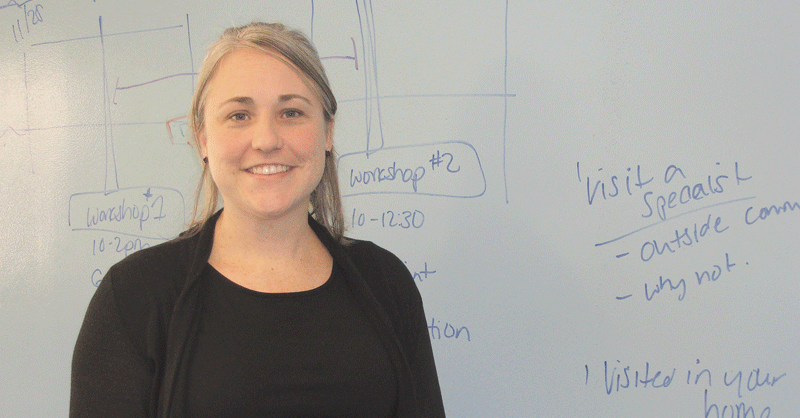
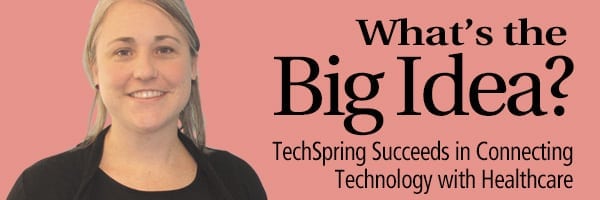
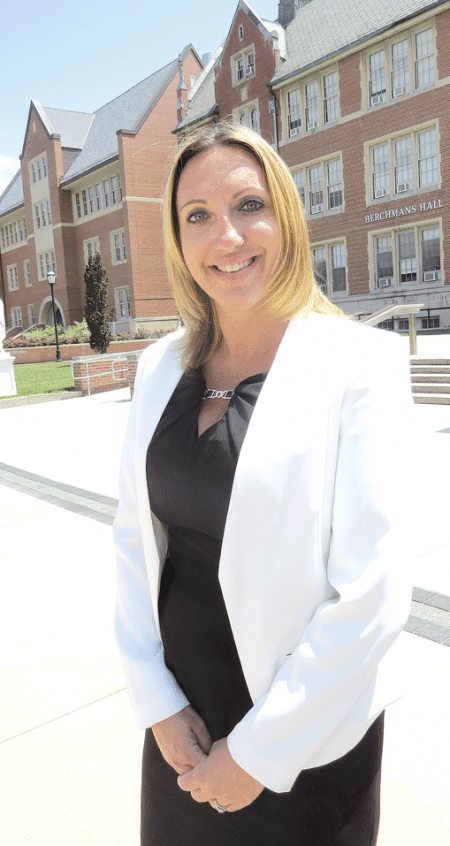
Jill McCormick says TechSpring focuses on technology that’s practical, usable, and can be applied now to help Baystate Health succeed.
When TechSpring opened two years ago in downtown Springfield, its leaders knew they were flying blind, at least at first. That’s how uncharted this territory was. But the concept — connecting technology companies, large and small, with the region’s largest health system to solve pressing problems — proved a compelling one, and today, TechSpring has numerous success stories to tell. It’s a conversation, they say, that needs to continue.
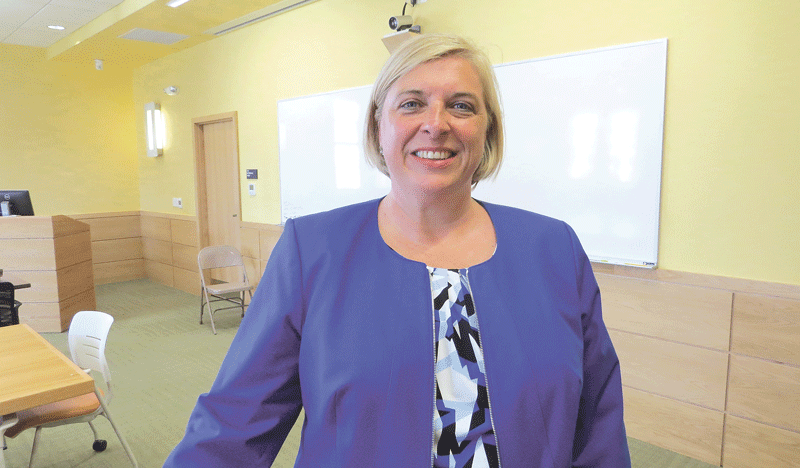
Eric Harry says genomics is one of those “sexy” areas of healthcare, and scientists are certainly engaged in exciting work to learn how genes influence disease.
“But we know for a fact,” he went on, “that zip code is a greater determiner of health outcomes than your genes. And we have a lot of high-risk patients at Baystate. There’s a lot of poverty here, a lot of patients at risk because of their zip code.”
Harry, community manager at TechSpring, Baystate Health’s technology innovation center in downtown Springfield, was talking with BusinessWest about a far different discipline than genomics: data analytics. When TechSpring opened two years ago, one of its partners, Dell, went to work in this area, trying to identify which patients are most at risk of becoming “high utilizers” of healthcare — or are, in other words, one major event from becoming very sick.
“What was their medical record like before they got sick, and who has those indicators now?” asked Jill McCormick, manager of the innovation center, adding that such studies are critical to the growing field of population health, which is critical at a time when hospitals must move away from the old, inefficient fee-for-service model into a value-based care model that seeks to keep people out of the hospital altogether.
“Our population will benefit if we make these changes,” she added — and analytics will be an important piece of the puzzle.
TechSpring, which opened two years ago in Springfield’s emerging downtown innovation district, matches private enterprises with partners and expertise from across the Baystate Health system to take on some of healthcare’s most difficult challenges. The goal is to create new technology solutions and products that could be used to improve health outcomes.
It’s a startup within a large health system, so you just have to start trying stuff. What works? What’s scalable? What can you do in that space?”
TechSpring owes its existence in large part to a $5.5 million grant from the Massachusetts Life Sciences Center, an investment agency charged with implementing then-Gov. Deval Patrick’s 10-year, $1 billion Life Sciences Initiative that supports life-sciences innovation, research, development, and commercialization.
TechSpring offers partners flexible space to work and the ability to collaborate directly with providers from Baystate Health on their projects, assessing the needs to be met in today’s healthcare environment, and testing potential responses to those needs.
“We work closely with Baystate Health to identify problem areas, or where they are investing in problems that need to be fixed,” McCormick said. “For example, where do they see population health going?”

Eric Harry says TechSpring partners first learn what Baystate’s needs are and then develop technology-based solutions.
One possibility is working with organizations like Partners for a Healthier Community on how to incorporate data on poverty and housing issues into patients’ health records, so a doctor recognizes that the housing situation is contributing to the person’s health status.
The idea, she added, is to arm providers with the data they need to empower patients to take more control of their own lives. The fact that TechSpring is located in a demographically diverse region is one of its strengths.
“Springfield is geographically interesting, between New York and Boston,” she said. “It has a great mix of rural and urban, and it has interesting economic challenges, that made this the ideal proving ground for technology solutions that represent what the U.S. market looks like, versus your Cadillac medicine or high-tech areas.”
Actually, McCormick added, TechSpring leaders tend to shy away from the word ‘high tech,’ focusing on how technology can solve problems in areas like population health, rather than on what’s new and hot in technology itself.
“It’s really about what is practical and usable and can be applied now in helping the health system succeed,” she explained, “by addressing the needs of the population and helping patients achieve better health outcomes.”
Free Falling
When TechSpring opened in late 2014, it had already lined up a number of partners — companies that were proven and experienced in the industry, including IBM, Premier Inc., Cerner Corp., Dell, Medecision, and Mainline Information Systems. But the goals were still ambiguous.
“It’s a startup,” McCormick said. “It’s a startup within a large health system, so you just have to start trying stuff. What works? What’s scalable? What can you do in that space?
“What does it mean to change the industry?” she went on. “What does it mean to drive positive change? What are you working on, what is Baystate working on, and how do we bring you together to actually do something, and do it in a way that’s designed for learning and proving, rather than sales and acquisition?”
Harry compared the experience to jumping out of a plane for the first time, but McCormick amended the analogy. “Actually,” she said, “we’re building the plane while we’re flying it.”
Whatever the comparison, Harry said, TechSpring was a risky venture because nothing like it had been attempted in the region, and it demanded a total buy-in from Baystate and its partners to succeed.
There have been 22 such partners so far, including a handful of large companies, about five tiny startups, and a dozen or so companies in the middle, size-wise.
For example, a company called Praxify is working to help doctors balance efficiency and patient satisfaction in the era of electronic health records, or EHRs. “Oftentimes, documentation gets in the way of direct patient care,” McCormick said.
Other projects have involved remote patient monitoring — and how to get recorded outcomes into medical records so providers can make care decisions between patient visits — and advanced clinical decision support, or ACDS, which aims to turn medicine into more science than art by establishing, through hard data, the right course of action in various clinical situations.
Originally, potential partners were bringing ideas to Baystate, and the health system was trying to fit their ideas into its framework. That has changed, however, into what Harry called a “marketplace.”
“Now we’re going into Baystate and talking to providers and figuring out where the problems are, really defining those problems, and then we go out and look for innovators, telling them, ‘here are the problems we’ve defined. Can you solve them?’ We’re creating a match-making process. We have a list of problems, well-defined, already sourced, and innovators submit a statement of interest to solve those problems, as opposed to saying, ‘hey, I have this solution. Can I work with you at Baystate?’”
The partners, interestingly, are not being paid for their work; in fact, they pay to access Baystate’s resources and human capital through TechSpring. But if they get to a point where a solution works, they have a direct line to become a successful vendor at Baystate and beyond.
“They’re developing a true solution, solving a real problem, and if they can do that here, they can do it anywhere,” Harry said.
That setup works well for large partners with significant financial resources, but perhaps isn’t as ideal for early-stage startups, so TechSpring is working to develop a model to improve access to companies that can’t afford to pay up front.
Boston-based CarePort Health, one of TechSpring’s initial partners, specializes in helping providers optimize post-acute outcomes and costs by guiding patients across the care continuum and tracking their recovery in real time. “They earned a commercial customer relationship with Baystate and had broad market success from there,” McCormick said, adding that the company was recently purchased by Allscripts, a major EHR vendor.
“When you finish working with TechSpring,” McCormick said, “it should either put you in a position to receive additional funding or propel your solution toward broad market success.”
Happy Employees
Meanwhile, a TechSpring partner called Imprivata works on the security side of healthcare, developing products like a badge that employees swipe at their computers to enter any program they have access to, instead of having to remember passwords for each one. Another current project is a biometric palm-vein reader. Each scan is recorded in a database, and physicians can then swipe anyone entering the ER and immediately pull up their medical records.
“We have a nice pipeline with Imprivata; they’re already popular and well-received in the hospital, and we get to work on what’s next for them,” McCormick ssaid. “They look for intersections between convenience and patient security. When I bring these solutions to the health system, they’re psyched because they know Imprivata is going to make their lives easier.”
Such solutions, however, begin with conversations — between providers and TechSpring partners, and between the tech companies themselves — and that’s another area where the innovation center excels, Harry said. “We’re really driving ecosystem thinking within healthcare.”
To that end, TechSpring also offers co-working, office, and event space in flexible month-to-month memberships for anybody working at the intersection of technology and healthcare. Meanwhile, a monthly networking event called Tap into TechSpring features networking and content-rich speaker programs, so various stakeholders get a sense of what everyone is working on, and sometimes new collaborations form.
“I’d say a lot of people in the healthcare sector are cynical about this type of thinking. ‘Show me the money’ is their way of thinking,” Harry said. “We’re helping people understand there probably is money, and a way that everyone can benefit, but until we get together, that can’t happen.”
Added McCormick, “it’s not that we’re just dreaming about what the future of healthcare could be. We’re actually executing against what we think the future of healthcare can be.”
At the end of the day, Harry said, TechSpring is about solving health problems — at a time of great shifts in the way care is delivered — and, ultimately, changing lives.
“Can everyone win?” McCormick asked. “We think so. Our bet is they can. And we’re taking all these opportunities to prove that everyone can win — especially patients.”
Joseph Bednar can be reached at [email protected]
 For starters, smartphones have put a world of personal finance in people’s hands. For example, Personal Capital offers simple charts and graphs of the user’s income, spending, and investment performance so they can easily monitor their finances.
 Business Insider reports that Intuit’s Mint gives users a real-time look into all their finances, from bank accounts and credit cards to student loans and 401(k) accounts. “It automatically tracks your spending, categorizes it, and alerts you when/if you approach your budget limit. You can even ask for custom savings tips within the app,” the publication notes. “Everything is shown in simple, intuitive graphs and charts, making it one of the most popular personal-finance apps in the world.”
 Meanwhile, Business Insider also recommends GoodBudget, an app that brings the envelope-budgeting method into the smartphone. Users create ‘envelopes’ for each of their budget categories, such as groceries, transportation, and shopping, and pre-determine how much they want to allocate in each envelope. They can then record and track how much they’re spending from each envelope. “It may not be as sophisticated as some of the other apps, but Goodbudget offers a simple way to stick to your budget and keep your spending really disciplined.”
 What about financial security? Investopedia recommends Prosper Daily, a personal-finance security service that tracks spending and protects credit cards from fraud and errors. Users can quickly view balances and recurring charges across all their credit and debit cards.
 One of the most popular nutrition apps is MyFitnessPal, which offers a wealth of tools for tracking what and how much the user eats, and how many calories they burn through activity, explains PC Magazine. “Of all the calorie counters I’ve used, MyFitnessPal is by far the easiest one to manage, and it comes with the largest database of foods and drinks. With the MyFitnessPal app, you can fastidiously watch what you eat 24/7, no matter where you are.”
 But nutrition is only part of the story when it comes to fitness — exercise is the other key discipline. But where to start? One possibility is the Nike+ Training Club, which takes the concept to the next level, offering more than 100 workouts to choose from. Users can also opt for a customized, full-body, four-week plan. “A trainer leads you through the routines, plus you get instructional video clips of the moves,” notes Fitness magazine. “Don’t like burpees? The updated app lets you swap drills you hate for ones you love.”
 For those who prefer being outdoors to get in shape, Strava Running and Cycling GPS monitors running or cycling routes via GPS, notes Digital Trends. “It also gamifies your cardio workout and pairs with leaderboards, achievements, and challenges, bringing a competitive spirit to your routine.”
 For a more comprehensive training assistant, Men’s Fitness recommends Jefit, which creates personalized workout routines by tracking and analyzing the user’s workout progress and diligently recording weight, reps, and time.
 Countless popular apps focus on education and learning for all ages. For kids, the Children’s MD blog recommends Khan Academy, which collaborates with the U.S. Department of Education and myriad public and private educational institutions to provide a free, world-class education for anyone.
 Meanwhile, Photomath focuses on, well, math, and does it well, Digital Trends reports. “For high-school students who just need a bit more guidance on how to isolate ‘x’ in their algebra homework, Photomath is essentially your math buddy that can instantly solve and explain every answer. Simply snap a photo of the question (you can also write or type), and the app will break down the solution into separate steps with helpful play-by-play, so that you can apply the same principles to the rest of your homework.”
 For language learning, Children’s MD recommends Duolingo, which provides interactive foreign-language education in 15 languages so far. It’s appropriate for both kids and adults, and one independent study found that a person with no knowledge of Spanish would need about 34 hours with Duolingo to cover the material in the first college semester of Spanish classes.
 Learning means expanding one’s horizons, of course, and where better to do that than the NASA App, which aggregates a wide range of NASA content. “Space enthusiasts and curious minds will love how it packs a wealth of news stories, features, images, video, and information about the space agency’s activities into this one mobile app,” PC Magazine reports.
 Let’s face it, though — smartphone users want apps that are just plain fun as well. For music enthusiasts, it’s hard to go wrong with Spotify. Wired notes that users can access a huge catalog of music for a small monthly fee, creating their own playlists or enjoying the app’s curated stations.
 Sports fans might dig ESPN Score Center, which allows users to check game progress from more sports than most other apps, PC Magazine reports, including baseball, basketball, football, soccer, ice hockey, cricket, rugby, and more.
 For those whose idea of fun is improving their cooking skills, plenty of apps do the job. Digital Trends recommends two. Big Oven features more than 250,000 recipes, and provides grocery lists based on them, lets users add your own, and import recipes from friends. “If you like (or want to like) to cook, start with Big Oven.”
 But the publication also raves about Yummly, which offers access to thousands of unique recipes. “On top of recipe and grocery-list functionality, Yummly takes user preferences into account to provide recipe recommendations, for when you just can’t decide what to eat.”
 Finally, if the kitchen doesn’t provide enough action and adventure, Mashable recommends downloading Action Movie, the brainchild of Star Wars and Star Trek director J.J. Abrams. The app allows anyone with an iPhone introduce movie-level special effects to their short videos.
 Now in its 27th year, the Springfield Regional Chamber’s Super 60 program celebrates the success of the fastest-growing privately-owned businesses in the region. This year’s class, which will be feted on Oct. 28 at Chez Josef, hail from 17 communities across the region and represent all sectors of the economy, including nonprofits, transportation, energy, healthcare, technology, manufacturing, retail, and service, with the winners in the Total Revenue category combining for more than $1.3 billion in revenues last year, and the Revenue Growth winners all posting gains in excess of 25% — and one-third recording more than 60% growth. It goes to show, says chamber President Nancy Creed, that “small business is the backbone of our region and our continued growth engine, and the success of this year’s winners is a clear indication that our regional economy is strong.”



 Built when Chester A. Arthur was patrolling the White House and UMass Amherst was known as the Massachusetts Agricultural College, Old Chapel has witnessed a great deal of history. Yet, much of its own recent history has been one of neglect and disuse. But thanks to the vision and determination of the school’s chancellor, this landmark that has been such a big part of the school’s past will now play an intriguing role in its future.





























 >Fireworks Shows Various Locations
 > Glasgow Lands Scottish Festival
 > Mattoon Street Arts Festival
 > Jacob’s Pillow Dance Festival
 > Mahaiwe Performing
 > New England Peace Pagoda
 > Six Flags New England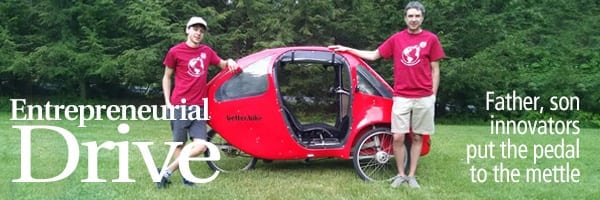

 The same goes for another trait — entrepreneurship, although the two acknowledged they had a lot to learn about the difficult process of transforming an idea into a business. With that in mind, they applied to become part of Valley Venture Mentors’ second accelerator class, and were accepted.