Daily News

SPRINGFIELD — Mayor Domenic J. Sarno and Kevin Kennedy, the City’s Chief Development Officer, announced that the MGM 95% Construction Design submittals are consistent with the commitments outlined within the city’s Host Community Agreement (HCA).

“As we move closer to the completion and grand opening of this unique urban development, I am pleased to be able to announce another milestone as the city accepts the 95% Construction Design submittals,” said Sarno. “Through this continued collaborative effort between the city of Springfield and MGM, the designs submitted remain consistent with what has been outlined within the Host Community Agreement.”

This determination of compliance is based on a detailed review of the submittal documents by a number of city departments, including the Office of Planning & Economic Development, Law Department, Building Department, Department of Public Works and the Casino Liaison Office. A full review of the 95% Construction Design documents was also completed by The Chicago Consultants Studio Inc., an urban planning consultant that has been used extensively by the City of Springfield throughout the casino design/review process.

“Based on a thorough review and engaged process over the past few months, we believe that MGM’s 95% Construction Documents continue to illustrate a high quality, attractive, and innovative design,” said Kim Goluska of the Chicago Consultants Studios Inc. “MGM’s cooperation with the city and its positive enhancements and completion of the key design components has resulted in a project that not only conforms to the HCA intent and requirements but also creates a new, truly innovative precedent for urban casino developments.”

As with the 50% Construction Design Submittals, one of the key aspects reviewed was the calculations of both retail and food and beverage floor areas. As noted in the summary report, the current program floor area calculations, as depicted in the plans, are consistent with the use commitments of the HCA. Other areas of review included building materials, program elements, landscaping, exterior lighting, signage, as well as other areas of design.

“With MGM Springfield nearing completion and the numerous other economic development efforts underway throughout the city, including the recent grand opening of Union Station, we are really starting to see the new Springfield take shape,” said Kennedy. “Our focus will continue to be on capitalizing on these larger transformative developments to help attract other private investment and jobs to the city of Springfield.”

Daily News

SPRINGFIELD — Recently, Freedom Credit Union supported the Center for Human Development’s (CHD) Disability Resources program with a $1,000 donation to help improve access for children and adults to age-appropriate social, emotional, and physical opportunities through adaptive sports and recreation.

According to President Glenn Welch, “Freedom Credit Union recognizes how important it is to invest in local programs like CHD’s Disability Resources. Delivering services and fostering a caring program that promotes positive social engagement, exercise, and education to people as young as 5 and as old as 60 are the core values of Disability Resources.”

Daily News

SPRINGFIELD — Plenty of folks who donned the virtual-reality goggles at the Western Mass. Business Expo last year were wowed by the experience of stepping into a different world. But Ed Zemba, a principal with Link to VR, says he wants to do more than blow people’s minds. No, he wants those minds to consider the potential of virtual reality — and augmented reality, which layers the physical world with virtual elements — in various business settings.

“Last year, Link to VR introduced virtual reality to the Western Mass. region, and for many businesses and individuals from the community, that was their first chance to see what was possible with virtual reality,” said Zemba, who is also president of Robert Charles Photography. “But virtual and augmented reality also have applications for the medical, education, and business spaces.”

Link to VR will be back on the floor at this year’s event, produced by BusinessWest and the Healthcare News, and retitled the Business & Innovation Expo of Western Mass. to reflect its growing status as a showcase for cutting-edge technology in addition to a wide range of traditional businesses.

“A big part of what we’re talking about at the show is answering the question: why are companies the size of Apple, Facebook, Microsoft, and Google investing millions of dollars in virtual and augmented reality, and why are regional organizations like MGM, UMass, Bay Path, and others announcing that they’re investing time, energy, and resources into determining how this could impact their industries?” Zemba said. “It’s one of the most significant technical shifts I’ve seen in my lifetime.”

But Link to VR won’t be the only high-tech attraction on the Expo floor at the MassMutual Center on Nov. 2. Here are a few others:

• Kitchens by Curio will demonstrate virtual-reality demonstrations of their kitchen and bath remodels. Attendees can chose cabinet colors, flooring, countertops, etc. and view a completely remodeled room in augmented reality.

• Smith Vocational and Agricultural High School will be represented by its Collision Repair program, which will bring a Sims virtual paint simulator, a trailer-hitch cover project, and a virtual-welding simulator. The school’s Machine Technology program will demonstrate a 3D printer and bring along a sampling of various machine projects students have worked on.

• The Graphic & Visual Design Program from the Lower Pioneer Valley Education Collective will showcase how they make packaging using 3D modeling, while the collective’s Information Support Systems and Networking Program will demonstrate how they build their clear computer cases.

• The Community Service Institute will demonstrate neurofeedback. Over the past 30 years, researchers have discovered it is possible to retrain or learn different brainwave patterns. The brain is taught to engage in the tasks of living with greater efficiency and ease. This leads to improvements in concentration, relaxation, and clarity, and has been compared to physical exercise or physical-therapy training for the brain.

• Open Pixel, an animation company based in Western Mass., will present a program called “Become a Character!” Participants will choose a character they wish to become from a variety of options and stand on a marker. The camera will watch their motions, and as they speak, so will the character. Attendees can also enter a raffle for a chance to have Open Pixel create an animated logo for their company.

The Business & Innovation Expo of Western Mass. will also feature more than 150 exhibitor booths, educational seminars, breakfast and lunch programs, and a day-capping Expo Social. Current sponsors include Comcast Business (presenting sponsor), Johnson & Hill Staffing Services and Wild Apple Design Group (executive sponsors), Inspired Marketing (show partner), MGM Springfield (corporate sponsor), Isenberg School of Management at UMass Amherst (education sponsor), Xfinity (social sponsor), Elms College (information booth sponsor), Smith & Wesson (Workforce Support Center sponsor), Savage Arms (JoinedForces parking sponsor), and the Better Business Bureau (contributing sponsor). Additional sponsorship opportunities are available. Exhibitor spaces are also available; booth prices start at $800. For more information on sponsorships or booth purchase, call (413) 781-8600, ext. 100.

Daily News

EAST LONGMEADOW — Strategic Alliances at Bay Path University will host “Negotiating Your Way to Success” with Dr. Joshua Weiss on Thursday, Oct. 5 and Friday, Oct. 6 from 9 a.m. to 5 p.m. at the Philip H. Ryan Health Science Center, One Denslow Road, East Longmeadow.

In this workshop, participants will be challenged to rethink what they know about negotiation, understand why negotiation is a critical work and life skill, learn how to approach negotiation from a cooperative perspective, and be provided with practical tools and tips to put them on a road to negotiation boldness. Weiss will touch upon strategic approaches for dealing with all negotiations, the two primary models in negotiation and when to use them, the positional approach and the interest-based approach, and the three key dynamics in negotiation.

Weiss is a senior fellow at the Harvard Negotiation Project (HNP), a subsidiary of Harvard University’s Program on Negotiation, a consortium comprised of faculty, staff, and students from Harvard, MIT, and Tufts University. He is also the co-founder of the Global Negotiation Initiative at the HNP. He is currently the director of Bay Path University’s MS in Leadership and Negotiation.

In addition, Weiss is the founder of Negotiation Works Inc., and consults for a number of Fortune 500 companies, the United Nations, and the U.S. government. He delivers negotiation and mediation training and courses, and is tasked with negotiation and mediation at the organizational, corporate, government, and international levels. He received his PhD in 2002 from the Institute for Conflict Analysis and Resolution at George Mason University.

“Negotiating Your Way to Success” is sponsored by Strategic Alliances at Bay Path University. Strategic Alliances is recognized by the SHRM to offer professional-development credits (PDCs) SHRM-CPSM or SHRM-SCPSM. This two-day learning experience offers 9.25 PDCs. Registration is $500 per attendee and is available by clicking here.

Daily News

HOLYOKE — Girl Scouts of Central and Western Massachusetts (GSCWM) announced the recipients of the inaugural ToGetHerThere Awards. The five award recipients have a shared vision of creating a culture of creativity and caring, where young women feel confident in their ability to work hard, dream big, and face with courage any obstacle that stands in the way of making their dreams come true. The winners have affected hundreds of lives and serve as role models for other organizations grappling with how to support underserved members in their communities. The awardees are:

• Entrepreneur: Cassandra Abramson, president and founder, ECi Stores;

• Financial Literacy: Amy Roberts, vice president of Human Resources, Balise Auto Group;

• Health & Wellness: Katie Gauvin, regional safety director, SODEXO; major, Logistics Readiness Squadron, 104th Fighter Wing, Barnes Air National Guard Base;

• Man Enough to Be a Girl Scout: Timothy Murphy, Esq., partner, Skoler, Abbott & Presser, P.C.; and

• STEM: Martha Baker, associate dean, College of Natural Sciences, UMass Amherst.

“The ToGetHerThere Award winners embody Western Massachusetts’ spirit of courage and determination,” said Pattie Hallberg, GSCWM CEO. “We are humbled and inspired by their efforts. These individuals remind us that we all hold the power to inspire hope and build up communities. We all can be a force for good.”

The 2017 ToGetHerThere Awardees were selected by a panel of business, community and civic leaders. Girl Scouts of Central and Western Massachusetts will honor the winners at the ToGetHerThere Awards Luncheon on Friday, Nov. 3 at the Tower Square Hotel (formerly the Springfield Marriott). Tickets are $50 each or tables of 10 for $500.

To order tickets and for more info on each awardee, visit www.gscwm.org/en/events/special-events/TGHTA.html or contact Melanie Bonsu at (413) 584-2602, ext. 3623, or [email protected].

Daily News

SPRINGFIELD — American International College (AIC) announced its second-largest freshman class since 2007 with a total enrollment of 504 new students.

“The demographics in New England are declining and are projected to drop for the foreseeable future. This geographic area is dense with colleges in a highly competitive landscape. With those considerations in mind, we are very pleased to have reached and surpassed our enrollment goal,” said Jonathan Scully, dean of Undergraduate Admissions. “This is also one of the most academically competitive classes we have accepted in the last five years. Incoming students are from richly diverse backgrounds, and many are first-generation, which has long been central to the AIC mission.”

AIC offers new students 26 majors to choose from as they progress through their college career, including traditional, blended, and online degree programs such as RN to BSN, occupational therapy, physical therapy, and Evenings at AIC. The College’s Center for Academic Success, dedicated entirely to the advancement of the individual student, offers assistance with courses through support structures that include peer tutoring and writing help. The federally-funded AIC Core Education program, operated specifically for first-generation college students, facilitates in navigating the new world of higher education and provides tools designed to foster achievement now and help plan for continued success after graduation.

“We are extremely pleased to welcome such a robust class of freshmen,” AIC President Vince Maniaci said. “Considerable credit goes to the dedicated Undergraduate Admissions team who go the extra mile to assist students. Staff members will drive to some students’ homes over the summer to help with paperwork or simply reinforce the message that they have made the right choice by coming to college. Collaboration across campus additionally contributes to this success: AIC’s program offerings provide a foundation on which students can build to reach their full potential and are taught by faculty who strive to provide a student-centered learning environment that fosters intellectual growth and personal development.”

Meanwhile, he added, “AIC athletics’ staff and coaches work diligently to recruit students both nationally and internationally while fostering the ‘student’ in student-athlete, and Student Affairs is committed to helping students learn about living through organizations, clubs, leadership programs on campus, and a commitment to community involvement off campus. Our administrative departments, such as Marketing and Communications, assist in outreach and are instrumental to our collective success.”

Daily News

WINDSOR LOCKS, Conn. — Waterford Hotel Group announced the appointment of Jaime O’Connor as director of sales at the Sheraton Hartford Hotel located inside Bradley International Airport. The Sheraton Bradley is managed by Waterford Hotel Group, a national hotel and convention-center management firm.

As director of Sales, O’Connor is responsible for the total sales efforts for the hotel, as well as supervising sales-related personnel and implementing sales and marketing strategies to maximize profits while also maintaining guest satisfaction.

O’Connor started her career in hospitality at the Sheraton Springfield in 2001. She quickly grew within the property, holding the positions of executive meeting manager and senior executive meeting manager, before joining Waterford Hotel Group as a sales manager at the Marriott Hartford in 2005. Most recently, she has been working as director of sales at the Sheraton Hartford South.

“We are pleased to welcome Jaime back to the Waterford Hotel Group team,” said Karen Bachofner, vice president of Sales and Marketing at Waterford Hotel Group. “We look forward to working with her in this new role.”

Daily News

SPRINGFIELD — With the upcoming departure of DevelopSpringfield’s President and CEO Jay Minkarah, the organization has tapped Jeff Daley to provide consulting services on an interim basis to manage project oversight.

Daley is founder and principal of CJC Development Advisors, LLC with more than 15 years of experience in real-estate development, construction project development, government relations, and public-private partnership development.

He was formerly the Economic Development director for the city of Westfield, executive director of the Westfield Redevelopment Authority, and a member of the Pioneer Valley Transit Authority board of directors, in addition to roles on other nonprofit boards and advisory panels.

“I am excited for the opportunity to assist the team at DevelopSpringfield to move their projects forward,” Daley said. “CJC Development Advisors has been engaged in development projects around the region, and I feel this is a perfect opportunity to help DevelopSpringfield through their transition on some very important projects.”

Nick Fyntrilakis, DevelopSpringfield’s board chair, added that “we are pleased to have Jeff step in to help ensure the advancement of DevelopSpringfield’s projects. Jeff has a strong background in large-scale development projects, and I’m confident his experience will be invaluable to the organization as we look to begin a search for a permanent replacement for Jay Minkarah.”

Daily News

SPRINGFIELD — The Economic Development Council of Western Massachusetts (EDC) announced that several of its members came together to donate a total of $50,000 to Valley Venture Mentors (VVM) to fulfill a match put forth by the Irene E. and George A. Davis Foundation. VVM will now receive $100,000 that will go towards programs providing mentorship, education, and community for entrepreneurs, ultimately fueling economic development in the region.

“Once again, EDC members have come together leading the region in driving innovation and commerce,” said EDC President Rick Sullivan. “Valley Venture Mentors outcomes are astounding. Their entrepreneurs are creating jobs, revenue, and investment that are transforming Springfield and Western Mass. The Davis Match is a great example of how leaders of the business community are working to ensure economic prosperity for .”

Organizations that donated to the Davis match include Balise Motor Sales, Bulkley Richardson, Columbia Gas, Mercy Medical Center, Chicopee Savings Bank Charitable Foundation, the Republican, and UMass Amherst.

Daily News

HOLYOKE — Attorney Karen Jackson of Jackson Law, an elder-law and estate-planning firm, will teach a series of classes highlighting the latest developments in elder law and estate planning at Holyoke Community College. The six-hour course, called “Elder Law and Estate Planning: What You Need to Know,” will be presented in three two-hour sessions, on Mondays, Oct. 16, 23, and 30, from 6 to 8 p.m.

Jackson will present comprehensive subject matter on what she calls “The Core Estate Plan,” in which she will explain core documents and provide stories and examples. She will also discuss “The Probate Process, Start to Finish” and “Medicare, Community Care Programs, and MassHealth Planning.”

“The course will explain the basic building blocks of an estate plan and a plan for home and nursing-home care,” Jackson said. “From that foundation, we will also consider the various specialized trust documents that support this planning. I will clarify the probate process and what it means to probate a will. And, finally, we will explore current MassHealth issues that are affecting seniors.”

While participants may attend one, two, or all three sessions, they must still pay the full course cost of $85. To register, call Holyoke Community College at (413) 552-2500 or visit www.hcc.edu/bce.

Daily News

SPRINGFIELD — The Business & Innovation Expo of Western Mass., the seventh annual business-to-business show produced by BusinessWest and the Healthcare News, will introduce a new feature this year, called the “Ask an Expert Roundtable.” Ten business professionals in the community will share their expertise with a table of guests for 45 minutes. During that time, they will give a rundown of their professional experience, take questions, and participate in an open, relaxed dialogue with attendees.

Confirmed participants include Pam Thornton of Name Net Worth (who will focus on LinkedIn and social-media marketing); Amy Royal of Royal, P.C. (focus on employment law); Jenny MacKay of the Gaudreau Group (focus on healthcare reform); Sheila Magalhaes of Heartsong (focus on modern mindfulness); Angela Lussier of Speaker Sisterhood (focus on finding one’s voice and being more assertive); Ira Bryck of the Family Business Center of Pioneer Valley (focus on family-business work balance); Tracey Gaylord of Granite State Development Corp. (focus on funding one’s next big idea, big or small); Lorenzo Macaluso of the Center for EcoTechnology (focus on how to make a company green); and Jonathan Butler of 1Berkshire Chamber (focus on board of director succession planning).

The Expo, set for Thursday, Nov. 2 at the MassMutual Center, will also feature more than 150 exhibitor booths, educational seminars, breakfast and lunch programs, and a day-capping Expo Social. Current sponsors include Comcast Business (presenting sponsor), Johnson & Hill Staffing Services and Wild Apple Design Group (executive sponsors), Inspired Marketing (show partner), MGM Springfield (corporate sponsor), Isenberg School of Management at UMass Amherst (education sponsor), Xfinity (social sponsor), Elms College (information booth sponsor), Smith & Wesson (Workforce Support Center sponsor), Savage Arms (JoinedForces parking sponsor), and the Better Business Bureau (contributing sponsor). Additional sponsorship opportunities are available. Exhibitor spaces are also available; booth prices start at $800. For more information on sponsorships or booth purchase, call (413) 781-8600, ext. 100.

Daily News

LONGMEADOW — Robert Donovan Jr., senior commercial officer for the U.S. Department of Commerce’s Commercial Services, will present, “Si, Oui, Já: How to Get a Yes Overseas,” at Bay Path University on Wednesday, Sept. 27. The presentation will be held at Breck Suite in Wright Hall on the university’s Longmeadow campus.

Donovan will share his expert insights through humor and storytelling, walking attendees through the fortunes and pitfalls of international relations. He will discuss the U.S. Foreign Commercial Service, explain how to embark on a career with this department of government, and share his business experiences from Poland to China to Tanzania.

Donovan began his federal government career in 1993 as a policy analyst on Vice President Al Gore’s Reinventing Government Task Force. He later served as deputy director of the Trade Promotion Coordinating Committee, where he helped develop the national export strategy that was the first cross-cutting export-promotion plan from the Clinton administration. He has also served as director for Policy Coordination in the Office of the Undersecretary for International Trade in Washington, D.C., director of Commerce’s Office of Financial Services Industries, lead U.S. negotiator on the Joint Commission on Commerce & Trade, and senior commercial officer in Warsaw. In these roles, Donovan has worked closely with global firms, developed strategies to open key emerging markets for American firms, and implemented presidential initiatives.

This presentation is part of the Kaleidoscope series sponsored by Strategic Alliances at Bay Path University, which fosters openness, curiosity, and dialogue concerning issues and topics in the local and global communities. Registration is strongly encouraged and available at www.baypath.edu/events-calendar.

Daily News

SPRINGFIELD — Bacon Wilson announced that Joy Rizos has joined the firm as an associate attorney. She is a member of the firm’s bankruptcy department and also handles matters of business and corporate law.

Rizos is a 2016 graduate of the Northeastern University School of Law, and received a bachelor’s degree magna cum laude from Suffolk University in 2013. She works primarily from Bacon Wilson’s Springfield location.

Daily News

AGAWAM — The Employers Assoc. of the NorthEast (EANE) will present its annual Employment Law and HR Practices Conference on Thursday, Nov. 2 at the Sheraton Monarch Place in Springfield. The full-day conference, which draws attendees from throughout the region, will address the ever-changing employment-law landscape and HR best practices in today’s modern workplace.

“Building on the momentum from our recent sold-out Compensation and Benefits Conference, we are excited to bring together speakers and topics focusing on the vital developments in employment law,” said Meredith Wise, EANE president.

The program will featured keynote speaker Jennifer McClure, CEO of Unbridled Talent and co-founder of DisruptHR. McClure helps leaders leverage their influence to solve real-world business problems. She will present “DisruptHR: the Rebellious Future of HR,” challenging attendees to think differently about the way they approach people and talent by taking risks, stirring the pot, and disrupting the future of work.

Other sessions will include a comprehensive update on the recent developments in state and federal employment law, plus breakout sessions covering topical issues such as stay interviews, immigration, employee retirements, remote workers, safety, and more.

The cost for the program is $285 per person with discounts for three or more with early-bird pricing prior to Oct. 13. Register at www.eane.org/employment-law-hr-practices-update-2 or call (877) 662-6444. The program will offer 5.25 credits from the HR Certification Institute and SHRM.

Daily News

HOLYOKE — Holyoke Medical Center announced that Esmat Ezzat and Tom Hazen will each be honored with a Lifetime Achievement Award for their outstanding dedication and hard work on behalf of Holyoke Medical Center and the Holyoke community.

Valley Health Systems, which includes Holyoke Medical Center, Holyoke VNA Hospice Life Care, River Valley Counseling Center, and Western Mass. Physician Associates, will also recognize select members of the VHS team who exemplify exceptional care. Award recipients will be honored at this year’s ACE Awards event on Saturday, Oct. 7 at UMass Amherst.

“The dedication and continued support provided to Holyoke Medical Center and the entire Pioneer Valley from both Mrs. Ezzat and Mr. Hazen make them true assets to our community. We are honored to recognize them for a lifetime of service,” said Spiros Hatiras, president and CEO of Holyoke Medical Center and Valley Health Systems Inc. “The ACE Awards allow us to highlight the work of our dedicated employees who deliver quality healthcare every day, as well as community members who work behind the scenes to support and advance our mission.”

Ezzat retired as the director of Speech and Hearing at Holyoke Medical Center in 2007, after a 40-year-long career with the hospital as a speech pathologist. She developed many innovative programs and built a reputation for the center as a regional leader in speech and language therapy. She credits the success of her career and of the center to the support she received from the community and her staff.

“The support we have received from the community over the years has been tremendous,” said Ezzat. “When we needed something, the community gave it to us.”

Hazen is a past partner in his family’s Holyoke-based Hazen Paper Co. and served on the board of directors for Holyoke Medical Center for 11 years. He continues to be involved with the hospital and currently serves on the investment committee. He has also been an active member in the community, serving in volunteer leadership roles for many local and regional organizations, including the Holyoke Public Library, the Holyoke mayor’s Industrial Development Advisory Committee, the Holyoke Chamber of Commerce, the Holyoke Taxpayers Assoc., Associated Industries of Massachusetts, the Economic Development Council of Western Massachusetts, the Pioneer Valley Planning Commission, and the Massachusetts Taxpayers Foundation.

“I’ve had a long kinship with the Holyoke community,” Hazen said. “The people I’ve had the pleasure of working with over the years are a distinguished group. I have many fond memories of citizens and friends who are dedicated to both the hospital and the Holyoke community, and contribute readily to the long-term well-being of both.”

ACE Awards will also be given in the categories of Best Physician, Best Caregiver, Best Supporting Employee, and Best Leader. Tickets to the event, which is open to the public, are available by contacting Denise Rebmann at (413) 534-2579 or [email protected].

Daily News

SPRINGFIELD — The Business & Innovation Expo of Western Mass., the seventh annual business-to-business show produced by BusinessWest and the Healthcare News, slated for Thursday, Nov. 2 at the MassMutual Center, will feature a wide range of activities, including the Springfield Regional Chamber’s Speed Networking Event from 2:45 to 4:15 p.m. in the Expo Show Floor Theater.

A fast and fun way to make connections, the event is like speed dating for business. Attendees are divided into two groups seated across from each other. The limit is one participant per company in order to give everyone a chance to meet a contact from a new company each time participants rotate. Attendees are invited to continue networking at the Expo Social after the event, where a cash bar will be available.

The cost is $20 for chamber members, $30 general admission. All Expo vendors may attend Speed Networking at chamber-member pricing. For more information and to register, visit www.springfieldregionalchamber.com.

The Expo will feature more than 150 exhibitor booths, educational seminars, breakfast and lunch programs, and a day-capping Expo Social. Current sponsors include Comcast Business (presenting sponsor), Johnson & Hill Staffing Services and Wild Apple Design Group (executive sponsors), Inspired Marketing (show partner), MGM Springfield (corporate sponsor), Isenberg School of Management at UMass Amherst (education sponsor), Xfinity (social sponsor), Elms College (information booth sponsor), Smith & Wesson (Workforce Support Center sponsor), Savage Arms (JoinedForces parking sponsor), and the Better Business Bureau (contributing sponsor). Additional sponsorship opportunities are available. Exhibitor spaces are also available; booth prices start at $800. For more information on sponsorships or booth purchase, call (413) 781-8600, ext. 100.

Daily News

BOSTON — Local unemployment rates decreased in all labor-market areas in the state during the month of August, the Executive Office of Labor and Workforce Development reported. Compared to August 2016, the rates were up in 24 labor-market areas.

Three of the 15 areas for which job estimates are published recorded seasonal job gains in August. The gains occurred in the Taunton-Middleborough-Norton, Leominster-Gardener, and Lawrence-Methuen-Salem areas. From August 2016 to August 2017, all 15 areas added jobs, with the largest percentage gains in the New Bedford, Haverhill-Newburyport-Amesbury, Boston-Cambridge-Newton, Leominster-Gardener, and Brockton-Bridgewater-Easton areas.

In order to compare the statewide rate to local unemployment rates, the Bureau of Labor Statistics estimates the statewide unadjusted unemployment rate for August was 3.7%.

Last week, the Executive Office of Labor and Workforce Development reported the statewide seasonally adjusted unemployment rate dropped to 4.2% in the month of August. The statewide seasonally adjusted jobs estimate showed a 10,800 job gain in August, and an over-the-year gain of 57,400 jobs.

The unadjusted unemployment rates and job estimates for the labor market areas reflect seasonal fluctuations and therefore may show different levels and trends than the statewide seasonally adjusted estimates. The estimates for labor force, unemployment rates, and jobs for Massachusetts are based on different statistical methodology specified by the U.S. Department of Labor’s Bureau of Labor Statistics.

Daily News

WESTFIELD — Witalisz & Associates Inc., a real-estate company based in Western Mass., recently celebrated its new office space with a ribbon-cutting ceremony and grand opening. The firm recently moved to 2 Broad St. in Westfield, situated across the hall from the Tavern Restaurant.

“We are incredibly excited and grateful for this opportunity to relocate to the best place in Westfield,” said broker/owner Kathy Witalisz. “Working with the leadership team at the Tavern has been remarkable, and we are very much looking forward to a bright future in our new location.”

The open space will help accommodate the company’s plans for future growth. Witalisz & Associates has already expanded its educational programs to include a real-estate school, training seminars, career nights, and a number of public events.

The grand opening was attended by both local dignitaries and prominent members in the community. State Sen. Donald Humason, state Rep. John Velis, Westfield Mayor Brian Sullivan, and Greater Westfield Chamber of Commerce Executive Director Kate Phelon all presented citations in recognition of the company’s move.

Daily News

EAST LONGMEADOW — Facial Cosmetic & Maxillofacial Surgery, P.C. announced the promotion of Leslie Leone to clinical nurse supervisor.

“Leslie has been an outstanding student, employee, nurse, and professional,” said Practice Administrator Fredrika Ballard. “We have enjoyed being part of her professional development over the past eight years. We feel honored to have such a wonderful, caring, and talented nurse to lead our team and take exceptional care of our patients.”

Leone joined the practice in 2009 as a licensed dental assistant after graduating from Porter & Chester. She was hired to work exclusively with owner Dr. Richard Fraziero at the East Longmeadow location. After working alongside Fraziero for a few years, he encouraged her to further her education to become a registered nurse. She completed pre-requisites at Springfield Technical Community College and transferred to American International College, graduating from AIC in 2014 with a bachelor’s degree in nursing, and became an RN at Facial Cosmetic & Maxillofacial Surgery.

In addition to her eight years in the oral-surgery field, Leone is also DAANCE-, ACLS-, and CPR-certified. She is involved in pre- and post- surgery direct patient care, as well as managing medication inventory for in-office surgeries, code preparation, and readiness.

Her new position as clinical nurse supervisor allows her to use her wide-ranging skills to oversee the entire clinical department. “I enjoy providing patient-centered care on a daily basis while also mentoring the clinical staff,” she said.

Daily News

SPRINGFIELD — The Hampden County Bar Assoc. will hold a Legal Help Hotline in conjunction with Western New England University School of Law today, Sept. 21, from 4 to 7 p.m. at Western New England University School of Law, 1215 Wilbraham Road, Springfield.

The volunteers will provide legal advice on a variety of topics, including divorce and family law, bankruptcy, business, landlord/tenant, and real estate. Additionally, in light of recent immigration developments, attorneys with immigration-law experience will also be available to answer questions. Spanish-speaking attorneys will also be available. Individuals needing advice should call (413) 796-2057 to speak to a volunteer.

Daily News

SPRINGFIELD — Ralph Crowley Jr., president and CEO of Polar Beverages, will serve as the keynote speaker at the Springfield Regional Chamber’s Super 60 event on Friday, Oct. 27. Now in its 28th year, the program celebrates the success of the fastest-growing and privately-owned businesses in the region which continue to make significant contributions to the strength of the regional economy.

Worcester-based Polar Beverages was founded by Crowley’s great-grandfather, Dennis Crowley, in 1882, primarily as a wholesale and retail liquor business. However, prohibition put a stop to the family’s liquor sales, forcing them to focus on bubbly waters and bottled water instead. Under the entrepreneurial and visionary leadership of fourth-generation Ralph Crowley Jr., Polar Beverages has grown to be the largest privately owned soft-drink bottler in the U.S., having completed more than 30 acquisitions, including proprietary brands Adirondack, Waist Watcher, Clear ‘n’ Natural, and national brands 7Up, A&W, Sunkist, Seagram’s, Royal Crown, and Diet Rite, along with new-age brands Snapple, AriZona, Fiji Water, O Water, HyDrive, and Nantucket Nectars. Polar also bottles home and office water.

In September 2001, Polar Beverages formed a joint venture with Cott Corporation. The partnership is known as Northeast Retailer Brands, LLC. This joint-venture partnership produces and distributes most of the retailer-branded beverages in the Northeast. At one time, Polar Beverages maintained a warehouse in Springfield.

“Polar Beverages is an example of a regional, family-owned business that has remained true to its roots, while at the same time growing its brand by smart acquisitions and innovative, entrepreneurial thinking,” said Springfield Regional Chamber President Nancy Creed. “Its founder could probably not have envisioned a line of mythically inspired, limited-edition cans of seltzer with names like Mermaid Songs, Unicorn Kisses, and Dragon Whispers that, in 2017, fly off of store shelves.”

The Super 60 Celebration event honoring this year’s class will be held from 11:30 a.m. to 1:30 p.m. at Chez Josef, 176 Shoemaker Lane, Agawam. Reservations are required. The cost is $60 for members, $75 for general admission. Reservations may be made for tables of eight or 10. The deadline for reservations is Oct. 18. No cancellations will be accepted after that date, and no walk-ins will be allowed. Reservations may be made online at www.springfieldregionalchamber.com or by e-mail to [email protected].

The Super 60 event is presented by Health New England and sponsored by Farmington Bank. The event is also sponsored by the Republican, the Regional Employment Board of Hampden County, and Zasco Productions.

Daily News

SPRINGFIELD — The Young Professional Society of Greater Springfield (YPS) announced the election of Ashley Clark as president of the organization. Clark has previously served in various capacities on the board, including terms as secretary and vice president and chair of the annual YP Cup Dodgeball Tournament.

“I am thankful to have an employer who understands the value of giving back — and encourages it,” said Clark, a cash-management officer at Berkshire Bank in Springfield. “I am excited to take on this new role and hope to strengthen our impact in the communities we serve. Our emerging and existing leaders need a space for mentorship, opportunity, and social engagement, and YPS plans to continue to provide that. With the organization’s first ever all-women executive committee, and a diverse board beside us, we can increase our impact over the next few years.”

This year, YPS is celebrating 10 years of impact in the Greater Springfield area. Moving forward, the organization will focus on membership growth, community-driven events, and additional programing. Events to round out 2017 include Oktoberfest Third Thursday at the Munich Haus and Santacon: a Community Engagement, in partnership with the Springfield Thunderbirds.

Daily News

SPRINGFIELD — After nearly five years as president and CEO of DevelopSpringfield, Jay Minkarah announced his upcoming resignation to assume leadership of a regional planning commission in New Hampshire.

“I have truly appreciated the opportunity to help play a role in advancing community revitalization in Springfield,” said Minkarah. “It has been an honor to be a part of what is sure to be a great renaissance for the city. There are strong community partnerships working together with great projects poised for success.”

Under Minkarah’s tenure, the organization has worked to advance a series of critical economic-development and revitalization projects in Springfield. Notable projects include the purchase and remediation of a blighted property at 700 State St.; phase-one stabilization and remediation at the historic Gunn Block at the corner of Walnut and State streets; phase-one completion of the Lower Maple Business Park, including the rehabilitation of the Ansel Phelps House at 83 Maple St.; and the advancement of plans for the Springfield Innovation Center on Bridge Street.

“We are grateful to Jay for the expertise he has provided and the commitment he has shown to Springfield,” said Nick Fyntrilakis, board chair. “As an organization, we have taken on some of the most challenging projects in the city in an effort to create opportunity for positive economic activity, Jay has been a driving force in our efforts thus far and has helped prepare us for future success.”

DevelopSpringfield’s staff and board are working to complete transition plans with a focus on advancing its mission toward revitalization in the city of Springfield. The board will also begin a search process for a new president and CEO.

Daily News

WEST SPRINGFIELD — The Advertising Club of Western Massachusetts will kick off its 2017-18 season of events and meetings at the Big E on Wednesday, Sept., 27. Tickets for this members-only event can be purchased online at www.adclubwm.org, where interested parties may also register to become a member of the Ad Club for the 2017-18 season.

The event includes cocktails and hors d’oeuvres from 4 to 6 p.m. and a special viewing of the parade from the Brooks Building Terrace. The club will also announce its new president and board of directors. Deadline for registration to this members-only event is Thursday, Sept. 21 in order to allow time for delivery of credentials.

The Ad Club and the Eastern States Exposition have a long, shared history. The club presented exposition founder Joshua Brooks and trustee Horace Moses with the Pynchon Award for community service in 1916, and the exposition’s Betsi Sheehan Taylor served as president of the Ad Club in 1977-78.

Daily News

LENOX — Kimball Farms Lifecare in Lenox will host a showing of a Not in Our Town documentary on Wednesday, Oct. 4 at 3:30 p.m. Those wishing to attend are asked to RSVP to (413) 637-7000 by Monday, Oct. 2.

The film, Light in the Darkness, is a documentary about a community response to a hate crime in Patchogue, Long Island. After the film showing, there will be a panel discussion moderated by Gwendolyn Van Sant of Multicultural Bridge. The panelists include Eleanore Velez, chair of Berkshire Communty College’s Multicultural Center; Liliana Bermudez, Latin-American community activist; Charles Park, director of the Immigrant Oral History Project; Steve O’Brien, chief of the Lenox Police Department; and Chris Tucci, co-director of the Railroad St. Youth Project. Audience members will be invited to stay for small group conversations.

Not In Our Town is a national project that uses documentary film, new media, and organizing to stop hate, address bullying, and build safe, inclusive communities.

Daily News

SPRINGFIELD — The Business & Innovation Expo of Western Mass., the seventh annual business-to-business show produced by BusinessWest and the Healthcare News, slated for Thursday, Nov. 2 at the MassMutual Center, will present a lunch event featuring keynote speaker Ron Insana, senior analyst and commentator with CNBC.

Titled “Trumponomics,” Insana’s talk will address how Washington will affect the economy in the years ahead. As the U.S. and global economies move toward recovery, Insana will apply his journalistic perspective to how Wall Street, Main Street, and Washington shape what the new normal means for everyone.

The event runs from 11:30 a.m. to 1 p.m., with registration starting at 11:30 a.m. Pricing and registration details will be announced next week.

A financial journalist with the experience of working for and running his own hedge fund, Insana offers clear insights on the ever-changing status of the economy. Currently host of a nationally syndicated daily radio show in addition to his roles at CNBC, he has access to the top financial players in Washington and on Wall Street and translates the market signals and political maneuvers into information everyone understands. His hands-on experience in the financial industry — through some of the markets’ most turbulent times — give an added depth of perspective. He offers practical advice on what individuals and businesses can and should do now to protect what they have and to find opportunities in any type of market condition. Insana is the author of Traders’ Tales, The Message of the Markets, TrendWatching, and most recently How to Make a Fortune from the Biggest Bailout in U.S. History: A Guide to the 7 Greatest Bargains from Main Street to Wall Street.

The Expo will feature more than 150 exhibitor booths, educational seminars, breakfast and lunch programs, and a day-capping Expo Social. Current sponsors include Comcast Business (presenting sponsor), Johnson & Hill Staffing Services and Wild Apple Design Group (executive sponsors), Inspired Marketing (show partner), MGM Springfield (corporate sponsor), Isenberg School of Management at UMass Amherst (education sponsor), Xfinity (social sponsor), Elms College (information booth sponsor), Smith & Wesson (Workforce Support Center sponsor), Savage Arms (JoinedForces parking sponsor), and the Better Business Bureau (contributing sponsor). Additional sponsorship opportunities are available. Exhibitor spaces are also available; booth prices start at $800. For more information on sponsorships or booth purchase, call (413) 781-8600, ext. 100.

Daily News

CHICOPEE — Phillips Insurance Agency Inc. was one of 13 agents in the Northeast and the only agent in Western Mass. to earn the exclusive Chairman’s Club Award from Liberty Mutual Insurance.

The Chairman’s Award is designed to recognize the contributions of the top-performing commercial-lines agencies in the country. Phillips Insurance had earned the Liberty Mutual President’s Club for 10 years in a row prior to achieving this top echelon of Liberty agents. Phillips Insurance President Joe Phillips will accept the award at the Chairman Dinner in Jackson Hole, Wyo. later this month.

Phillips Insurance Agency, established in 1953, is a full-service risk-management firm with a staff of 25 professionals. The agency handles the personal and commercial insurance needs for thousands of individuals and businesses throughout the Northeast.

Daily News

SPRINGFIELD — Dr. Albert Manero, president of Limbitless Solutions, a company that makes artificial limbs for children through 3D printing technology, will give a presentation today, Sept. 20, at Springfield Technical Community College as part of the HSI STEM Speaker Series. The event will take place from 11 a.m. to noon in the Scibelli Hall (Building 2) auditorium.

Manero will talk about the innovative work that his company does through the use of 3D printing technology. Attendees will learn how the creation of inexpensive artificial limbs through 3D printing can have a positive impact on the lives of children around the world, intersecting the areas of engineering, health, and philanthropy. Manero designed a prosthetic arm that actor Robert Downey Jr., in character as Tony Stark from Iron Man, gave to a boy in 2015.

Features

Soaring Expectations
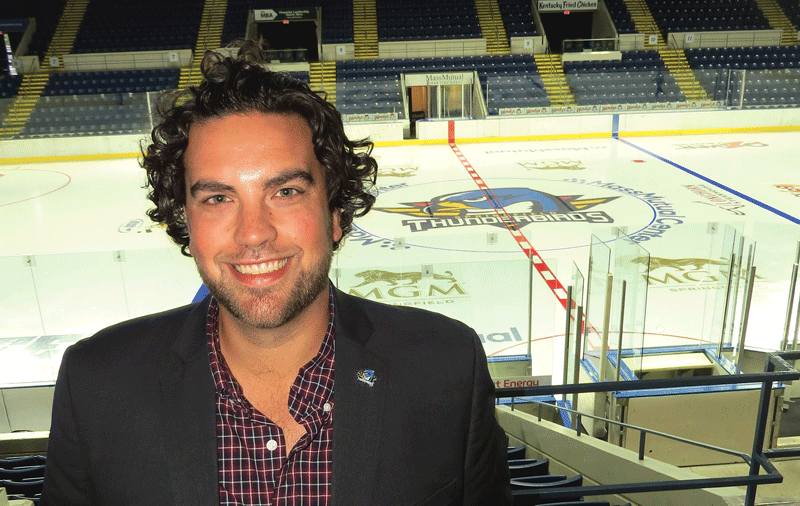
Nate Costa, president

Nate Costa, president

David Ortiz is coming to the MassMutual Center this fall, and that’s only one of many ways in which the AHL’s Thunderbirds continue to build momentum — and their fan base — as they prepare for their second season on the ice in Springfield.

A “significant investment.”

That was Nate Costa’s careful, well-thought-out, and quite predictable answer to the question ‘what did it take to get retired Red Sox slugger/legend David Ortiz to come to Springfield for a Springfield Thunderbirds game in November?’

The response from the Thunderbirds’ recently promoted chief executive (he now has the title ‘president’), while guarded in nature, nonetheless carried significant meaning, both literally and figuratively.

By ‘significant investment,’ he meant, obviously, a large fee commensurate with Ortiz’ status as celebrity and New England sports folk hero. And that word ‘investment’ means, well, just what the dictionary definition says: ‘the use of money for future profit.’

And in this case, the profit is indeed monetary in nature — how much is obviously to be determined, but that is both the goal and the expectation — but it goes well beyond that and predominantly falls into a category that Ortiz himself would be quite familiar with — that infinitely precious commodity known as momentum.

Indeed, the Thunderbirds, the American Hockey League franchise soon to begin its second year of operations in Springfield, remains in what Costa called the “acquisition mode,” or the building stage, or the momentum-building stage. He described this state of development as one where profits are certainly important, but what’s more critical is getting ever-larger numbers of fans into seats at the MassMutual Center, not for one game, but several, and preferably a season’s worth of them.

“We’re focused on continually growing the business and getting more bodies in the building,” he explained. “That’s how we’re going to generate revenue and momentum.”

These sentiments explain why a Coors Light will cost even less on a Friday night than it did at the end of last year — $3 for a cup, to be precise — while hot dogs will be $2 and sodas $1, in addition to live music. “I forgave some popcorn to get another dollar off the beer,” he said of the negotiations with the MassMutual Center. It’s also why ticket prices remained the same as last season, and why the team made that investment in Ortiz.

“The phone starting ringing right after the press conference where we announced this, and we sold out in four hours,” said Costa in reference to a special meet-and-greet offer involving Ortiz that sold for $134, a price chosen as a nod to the number he wore: 34.

And it’s also why Ortiz, while certainly the headline-grabbing promotion for the coming season — everything he does is headline-worthy, it seems — is just one of many coming attractions, if you will.
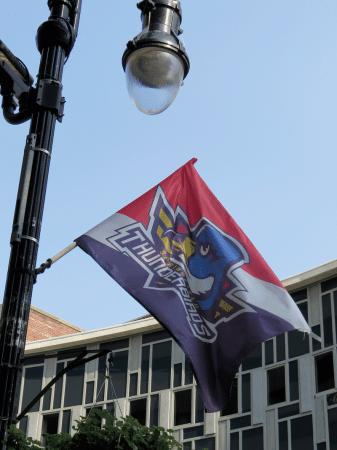
A Thunderbirds banner

A Thunderbirds banner flaps in the breeze in downtown Springfield, another example of the team’s success in remaining highly visible.

Others include everything from a special salute to Willie O’Ree, who broke hockey’s color barrier in 1958, more than a decade after Jackie Robinson gained much more acclaim for doing the same thing in baseball, to a ‘Blast from the Past’ night that will pay homage to the Springfield Indians, the name that was on the home team’s jerseys for decades.

Collectively, these initiatives and many others speak to how the club, which did well on the ice in its first season (falling just short of the playoffs), but even better off it — especially in the form of retained and new season ticket sales, as well as a number of sales-related awards from the league at its annual marketing meeting — certainly isn’t resting on any laurels.

“Those awards were validation for all the hard work we put in, and it was great to be able to celebrate our success with the entire staff,” Costa said. “I knew if we stuck to hard work, I knew if we put our head down and ignored the noise and did our jobs, we could meet our goals.

“It’s an exciting thing to see the reaction of the local community and to see the change from negativity in some ways to being overly positive,” he went on. “There are a lot of challenges still to overcome, but we have high expectations for this year.”

For this issue, BusinessWest talked at length with Costa about the Ortiz coup, but also, and especially, the ongoing efforts to build additional momentum for the Thunderbirds and pro hockey in Springfield.

Flying High

Costa’s office at the MassMutual Center holds a trove of artifacts from his brief but already significant career in sports management. They include several bobbleheads, a small collection of hockey sticks, and a autographed Tony Parker jersey, a souvenir from his days working in group sales for the AHL’s San Antonio Rampage, which played its home games in the AT&T Center, also home to the NBA’s Spurs.

There’s a new addition to the collection, and it has already drawn a good amount of attention, and rightfully so. It’s a pilot’s helmet signed by every member of the U.S. Air Force’s Air Demonstration Squadron (the Thunderbirds) that appeared at Barnes Municipal Airport in Westfield last month.

It was a return gift, if you will, from the team members, who were presented with customized Thunderbirds jerseys.

“The Thunderbird pilots are numbered 1 through 8, so we had each jersey numbered 1 through 8, and we put their names on the back as well,” Costa explained. “They were really blown away by it; they said it was the first time they’d ever been presented with sports jerseys. It was a natural tie-in for us.”

Actually, those jerseys were just one of the ways the hockey team honored its namesake  — Costa said the name ‘Thunderbirds’ was chosen in part to recognize the strong military presence at both Barnes and Westover Air Reserve base in Chicopee — while also doing what it seemingly does best: making its presence known.
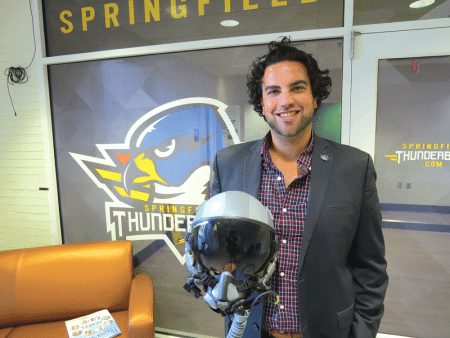
Nate Costa displays his helmet, a gift from the Air Force’s Thunderbirds

Nate Costa displays his helmet, a gift from the Air Force’s Thunderbirds. The hockey team gained significant exposure during the recent air show in Springfield.

Indeed, if you thought the Thunderbirds name, logo, and mascot were everywhere this past spring and summer, you weren’t imagining things.

The logo was on banners in downtown Springfield, on the temporary fencing set up in front of the United Bank branch now under construction at Monarch Place, on large banners gracing ‘Thunderbird Thursday’ events staged by the Springfield Business Improvement District, in the windows of office spaces available for lease downtown, and seemingly everywhere else.

As for the mascot, ‘Boomer,’ well, he set what those at Thunderbirds headquarters believe is a record for appearances in a month — 25 of them by Costa’s count — during August.

“There was one Saturday where he was at three different locations,” he recalled. “And that’s an important part of what we’re doing; we’ve trying to accommodate anyone and everyone who’s asked us to be part of what they’re doing. We don’t charge people for an appearance, and it’s a way to show people that we mean what we say when we say we’re going to be part of the fabric of the community.”

Costa said there are certainly quantitative measures for all this exposure the team is getting, especially when it comes to social media and analytics, but there are more qualitative indicators, such as that line ‘I see your logo everywhere,’ or words to that effect.

“We’ve heard it all summer — people will say, ‘I’m seeing you,’ or ‘it’s noticeable,’ or ‘you’re out there,’ and that’s a validation for us that we’re doing the right things,” he went on. “We’ve tried to be community-focused.”

All of this strategic visibility comes with a single goal — to build the Thunderbirds brand, said Costa, circling back to that reference he made to the team still being in ‘acquisition mode.’

And these efforts, coupled with effective pricing, free parking, and other initiatives and incentives, have enabled the Thunderbirds to lead the league in something other than wins and points, and something in many ways more important — a statistic called ‘recovered revenue.’

As Costa explained, this is a metric that the AHL tracks — essentially a measure of the number of renewed and new season tickets sold. The team stood at 115% at last check, a strong number that speaks volumes about the team behind the team on the ice.

“We were over 100% when the season ended, and that’s a testament to our fans renewing in a timely manner,” he explained, “but also to our staff being ready to start having conversations in February; it’s a great metric for us, and it’s something that hasn’t been done here in quite a while. Our season-ticket business has been strong, and our corporate business has been strong as well.”

Covering All the Bases

When asked if not making the AHL playoffs last spring brought any sort of advantage to the team, especially in the form of more time to plan for this season (there was very little time to prep for the 2016-17 campaign, you might recall), Costa quickly dismissed that notion.

“We’d much rather make the playoffs — that’s what we’re all in this for — to win a Calder Cup,” he said. “I talk a lot about promotions and themes and community involvement, but at the end of the day, winning the Calder Cup helps selling better than all that.”

But while the team didn’t win on the ice as much as the fans and management would have liked, it has taken full advantage of every other opportunity to build its brand and its fan base.

And Ortiz’ visit to the City of Homes is a big part of that.

As he talked about it, Costa said the team, fresh off last season’s hugely successful promotional event featuring wrestling icon Ric Flair, was thinking even bigger for this year — but it wasn’t really thinking about the retired Red Sox slugger.

Indeed, Costa told BusinessWest that he was considering big-name bands for a post-game concert and was making inquiries about the Dropkick Murphys.

“We were really close on that,” he recalled, “but then I really looked at it from the business side, and I thought, ‘we’re in the business of running hockey games,’ so it made me really nervous about getting in that other business of promoting a concert with all those other expenses.

“But in the conversations we had with a couple of different groups about talent and a couple of bands we thought might work, someone had seen our Ric Flair night and said, ‘hey, we also do appearances,’” he went on, adding that one thing led to another, and eventually Big Papi was signed on the dotted line.

The makeup of the Ortiz appearance is still a work in progress, said Costa, adding that several options are being discussed.

The emerging plan is to dedicate one of the two intermissions to him and do some “fun stuff” that he doesn’t do at most appearances, Costa went on, such as taking the Zamboni for a spin while tossing out T-shirts, perhaps, or maybe hitting some signed foam baseballs into the crowd.

“We really want to do something unique,” he said, adding that this adjective describes many of the team’s initiatives off the ice.

Such as the night honoring Willie O’Ree’s breakthrough. It will mark the 60th anniversary of his first appearance with the Boston Bruins, but also commemorate his time spent playing in Springfield in the AHL before being called up.

Other promotional events include bringing back Rene Rancourt, who has sung the national anthems of the U.S. and Canada before Bruins games for 40 years; another Star Wars night, and a Wednesday tilt in November that will become a “school-day game,” as Costa called it, with a 10:30 a.m. puck drop and special emphasis on getting schoolchildren in the stands.

And while being creative with promotions, Costa believes the team is doing the same with its prices — by not raising them.

“We talked about not having any barriers for people — we didn’t want to put any negative thoughts into people’s minds when it came to renewal time or for this season when someone comes out to a game,” he explained. “I didn’t want any conversion to focus on ‘geez, they went up $2 on tickets; maybe we won’t go now.’

“That might come in time,” he went on. “But for now, we want to focus on getting more bodies in the building instead of focusing on the small piece of revenue we might generate by going up on ticket prices.”

Hitting It Out of the Park

When asked if the team was likely to recover that significant investment it has made in Ortiz, Costa smiled and said, “we’re well on our way.”

That phrase covers many other aspects of the Thunderbirds operation and the team’s ambitious plans moving forward.

It works when it comes to goals for selling tickets, gaining brand recognition, creating momentum, and making this team part of the region’s fabric and economy.

There is considerable work still be done, and Costa, as noted, strives for continuous improvement. But for now, this team is doing what its honored guest on Nov. 11 did his whole career — hitting home runs.

 George O’Brien can be reached at [email protected]

Features

Raising the Steaks

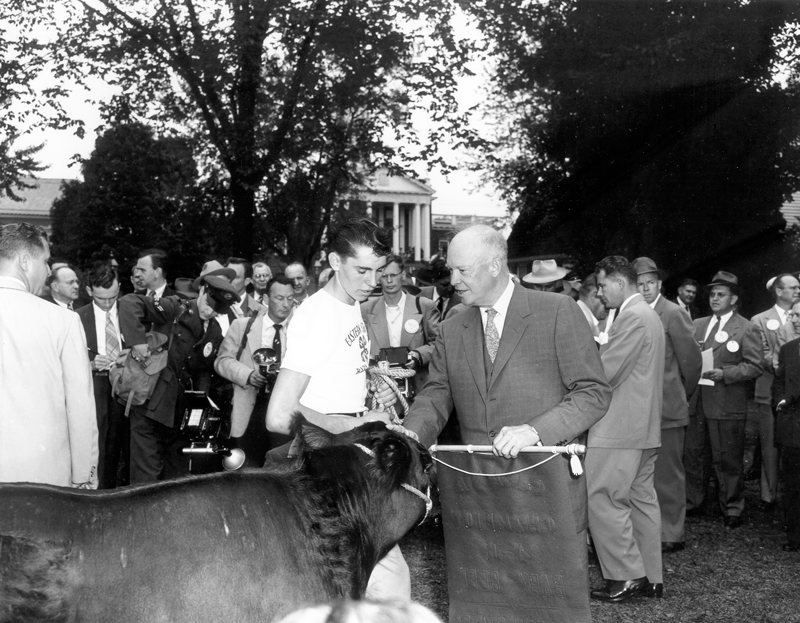
The iconic photo of President Eisenhower from the 1953 Big E

The iconic photo of President Eisenhower from the 1953 Big E. He was there to check in on the steer raised on his farm in Pennsylvania.

It is one of the most iconic photos taken during the 101-year history of the Big E.

Captured in 1953, it depicts President Dwight Eisenhower (the only sitting president to ever visit the Big E during the fair) meeting with Fred Scoralick, age 18, from Dutchess County, N.Y., that year’s winner of the 4-H Beef program, and his grand champion steer.

By now, most have seen the image — it was one of several to gain considerable exposure (pun intended) during the Big E’s various centennial happenings a year ago, and it was among a handful that made the cover of a commemorative book marking that occasion. But most don’t know the full story behind the photo, said Donna Woolam, who relates it often.

As Woolam, director of Agriculture and Education for the Big E, tells it, Eisenhower, then nine months into his first term in the White House, didn’t just happen by the Big E that year, and he had much more than casual interest in the 4-H Beef program and the winning black angus steer in question.

Indeed, it was raised on his farm just outside Gettysburg, Pa. — not far from the Civil War battlefield and now a national historic site — and sold to Scoralick’s family with the intention of entering it in the 4-H competition.

“He was the breeder of that steer, and he was here to see the animal being shown,” said Woolam. “That’s why he came.”

The story behind the Eisenhower photo falls into the category of ‘little-known history,’ and that phrase pretty much sums up the 4-H Beef program, or the Baby Beef program, as it was known in its early years. There is considerable history attached to it — 86 years of it, to be exact — but it is known to a relative few, meaning those who participate and those who support agriculture and events like this one.

Woolam and Big E President Gene Cassidy would like to make this a bigger constituency. More importantly, though — and this goal is directly related to that first one — they want to write many more chapters in the history of the beef program.

And that will be a challenging assignment as agriculture continues to decline as a business — and as part of the culture and landscape — in the Northeast.

“In this day and age, especially in urban areas, I wish there were more people better informed about 4-H; it should be part of the curriculum,” Cassidy said. “It’s important for our children, and for all of us, to have food literacy; it’s important for our health, and it’s important for our economy.”

Raising the stakes (or steaks, if you will), Cassidy went so far as to issue a call of support for the many aspects of the 4-H Beef program. They include not only the competition, but the auction of this year’s steers, where the beef is often contributed to area community food pantries, as the Big E itself did last year when it bought one of the steers and donated the meat to the West Springfield Parish Cupboard.

“The Big E challenges you and your business … SUPPORT NEW ENGLAND AGRICULTURE,” read the ad in the Sept. 4 issue of BusinessWest, which featured all those capital letters for emphasis and went on provide details of the auction, set for Sept. 25 at the Big E’s Mallory Agriculture Complex.

Cassidy is hoping the challenge will be answered, and, overall, he’s also hopeful that more business owners and area residents will realize the all-too-real threats to agriculture in this part of the country and be part of efforts to preserve what’s left, cherish those traditions (and businesses), and secure a future for this sector of the economy.

Meat and Greet

Look closely at that photo from 1953, and you’ll notice that President Eisenhower is holding one of Scoralick’s prizes from that year’s competition — the winner’s banner, or ribbon.

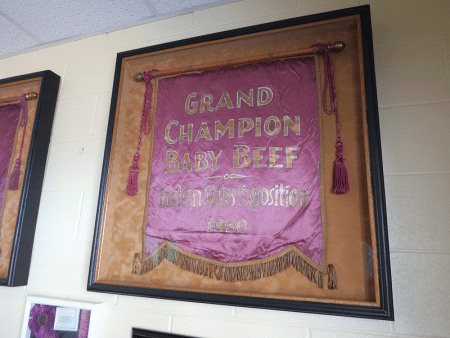
You can’t read it, because it’s facing the wrong way, but it has the words ‘Grand Champion 4-H Beef ’ and ‘Eastern States Exposition’ as well as the year on there somewhere. These colorful, bright-purple awards have become part of the history of the competition, said Woolam, who has two of them mounted in frames hanging on the back wall of her office.

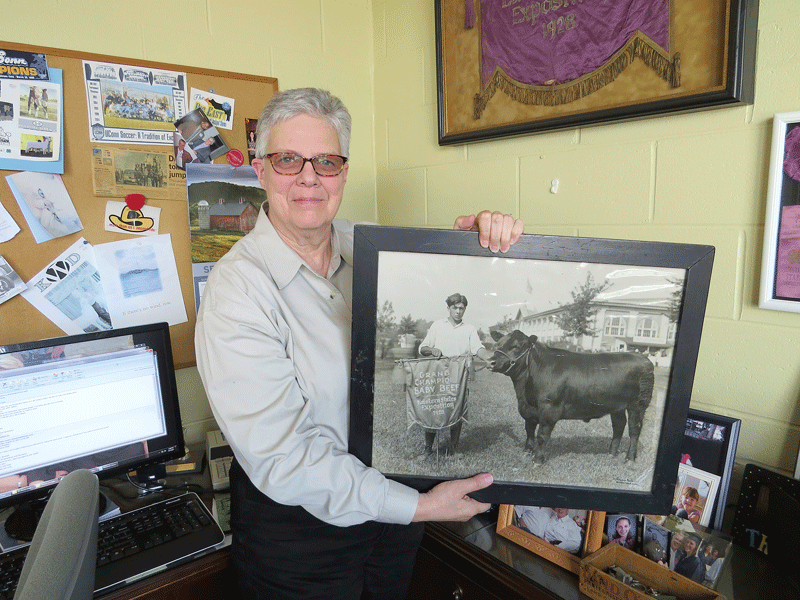
They were a gift were a gift from the family of Lee Jenks, from Agawam, and they represent his winning achievements in what was then the Baby Beef competition in both 1928 and 1930.

“The family walked in here one fair and said that these needed to hang here, in the Mallory, where it all happened,” said Woolam, referring to not only ‘grand champion’ banners but also a photo of Lee, who passed away several years ago, with one of his prized steers. “We’re very proud to have them.”

woolam

As are the owners of the other 85-odd champion banners that have been handed out over the years, she said, adding that they have become keepsakes and are often prominently displayed. Winning the beef competition is a proud moment, she went on, so much so that, when a past champion passes away, their accomplishments at the Big E are almost always noted in his or her obituary.

But over time, and especially in recent years, the 4-H Beef program has become much more than a competition among dozens of young people ages 12 to 18. Indeed, it has become everything from a vehicle for helping to feed to those in need to a way for participants to earn needed money for college (and often a degree in agriculture science), to a showcase for a declining agriculture sector, especially in the Northeast.

Overall, the competition hasn’t changed much since it was started in 1921, said Woolam. Young heifers and steers are acquired from breeders (like Eisenhower) and raised for roughly 10 or 11 months prior to the Big E in which they will compete. The heifers are raised as breeding stock, while the steers are destined for the aforementioned auction, with the meat going to the buyers or designated charities.

The animals, which represent a number of different breeds, are judged against industry standards, Woolam explained, adding that this year’s judge hails from Tennessee.

“He’ll be looking for animals with a lot of natural muscling, a lot of structural soundness, visual eye appeal, and more,” she explained, adding that many of the competing livestock are crossbreeds.

This year, 45 steers are expected to be entered, and perhaps 30 of those will be sold, she went on, adding that the winning animal could fetch $5 or more per pound, and last year, the average selling price for the 24 steers that went to auction was $2.70 per pound.

Participants, meaning the young people that raise the animals, are from the six New England states and Dutchess County in the southeastern part of New York. The returning champion (she actually won in both 2015 and 2016) is Olivia Oatley, from Exeter, R.I. She has kept the champion’s banner in the family — her brother won a few times before she did — and has three steers in this year’s competition.

The program, like all 4-H endeavors, is educational in nature, said Woolam, adding that, during the Big E, participants will take part in a host of programs and competitions to test their abilities and knowledge of the cattle industry.

And while participants are furthering their education when it comes to agriculture and agribusiness, Cassidy hopes the public can do the same.

“With our lack of food literacy, there’s such a misunderstanding about food product,” he explained. “And this breeds activism, which harms agriculture.”

As an example, he cited the referendum question on last year’s ballot in Massachusetts that would prohibit sales within the state of eggs from caged hens. It passed, and the measure will take effect in 2021, said Cassidy, who expects that it will put the only remaining poultry farm in the state out of business and significantly raise the price of eggs in the Bay State.

Donna Woolam

Donna Woolam shows off the photo of Lee Jenks, Baby Beef competition winner in 1928 and 1930, that was gifted to the Big E.

“In California, where they passed a similar referendum several years ago, a dozen eggs cost three times what they do in Massachusetts,” he explained. “People here can buy a dozen eggs now for $1.65; that ballot question will take the price to way over $3.”

Cassidy said he sees a direct parallel between programs like 4-H and Future Farmers of America and food literacy. And that’s why he maintains that initiatives like the 4-H Beef program must not only continue, but garner additional support — at the auction, and in other ways as well.

Woolam agreed.

“This is a program with a lot of history,” she told BusinessWest. “And we hope it’s a program that will continue for many more years.”

Gaining Ground

Take one more look at the photo of President Eisenhower, and you’ll notice the large and very well-dressed press contingent (this was 1953, remember) in the background.

It would take a sitting president on the Big E grounds for the 4-H Beef competition and the grand champion steer to get anything approaching that kind of attention, and Gene Cassidy knows that.

That’s not exactly what he’s looking for. He is looking for a little more attention, some additional support, and a better understanding of the business of agriculture and its importance to the region.

In short, he’s looking to secure opportunities to create more — make that much more — little-known history.

George O’Brien can be reached at [email protected]

Opinion

Editorial

Richard Sullivan, president and CEO of the Economic Development Council of Western Mass., was no doubt channeling his inner Mavis — as in Mavis Wanczyk, winner last month of the largest single Powerball payout in history — when he told the local press, “you have to be in the game to win.”

He was referring, of course, to a game with a different kind of huge payout — and one that also features astronomically long odds. That would be the contest to become home to Amazon’s second North American headquarters.

The prize there is considerable — maybe 50,000 jobs over the next few decades, tens of millions of dollars in tax revenue, thousands of construction jobs (this is estimated to be a $5 billion project, five times the size of MGM Springfield’s initiative), and everything else that comes to being home — or one of the homes — to Amazon.

The odds of winning this contest are obviously better than those of winning Powerball (an estimated 1 in 292 million), but in many respects, not much better. Indeed, every state, every county, and most municipalities would like to get into this competition, and most of them will. And many have much more to offer that this region does.

Western Massachusetts is in the early stages of piecing together some kind of response to Amazon’s request for proposals, Sullivan told the local press, adding that there are many forms such a bid might take. The region might construct its own proposal, or it may partner with the state, or with Hartford, for example.

As with Powerball — the analogy works in many ways, so we’ll stay with it — the odds are certainly long, and it’s tempting to just not bother. But if you don’t play, you simply can’t win.

And, as Sullivan noted, the region can benefit just by submitting a proposal.

How? These exercises are good practice for a region, and in many respects, the Pioneer Valley is somewhat out of practice when it comes to such competitions.

They’re beneficial because they help a region identify its strengths and weaknesses, put them down on paper, and perhaps see where it comes up short in the competition in question and what it needs to work on.

The Amazon RFP identifies a few things the company is looking for:

• A stable and business-friendly environment (check, sort of. Massachusetts is still not exactly business-friendly, although it was friendly enough to land GE last year);

• Urban or suburban locations with the potential to attract and retain strong technical talent (we can’t check that one, because we haven’t shown that ability yet. The state certainly has, though); and

• Communities that, in its words, “think big and creatively when considering locations and real-estate options” (check, sort of. There has been some creative thinking, but nothing hugely imaginative and along the lines of what Amazon is probably looking for).

We don’t have a crystal ball, but it’s very likely that Amazon will choose a city or county that has, or can easily assemble, an extremely large, shovel-ready parcel; has abundant tech-savvy talent, or can easily lure it; and that has a top-shelf public transportation system and a bicycle-friendly infrastructure.

And that pretty much leaves the 413 out of this competition. But as Mavis (wherever she is) can certainly tell you, you never know, and you do have to play the game to win.

In the meantime, the region will be getting some very valuable practice and an opportunity to tell a story that is getting better with each passing year.

In other words, this is a very worthwhile exercise. v

Opinion

Opinion

By Kimberley Lee

It’s hardly news that growing up can be stressful. What may be news is that your son or daughter is likely more interested in talking things over with you than you realize. It’s always a good time to talk about how they’re feeling inside, how things are going at school and with friends, and about life in general. Last week was Suicide Prevention Week, but that shouldn’t be the only opportunity to begin a meaningful conversation with someone you know and love by simply asking, “how are you?”

Nearly 40,000 people in the U.S. die from suicide each year — one death every 12.8 minutes. According to the Centers for Disease Control and Prevention, more people die by suicide than from automobile accidents or homicide. Suicide is the tenth-leading cause of death among all Americans and the third-leading cause of death among young people (ages 15 to 24).

Health professionals tell us it’s important to correctly educate children and teenagers about mental illness. It helps dispel misconceptions and stigma, and it provides them with the understanding and resources they need if they or someone they know struggles with mental illness.

If you haven’t had a ‘mental health check-in’ talk with your middle-school or high-school student recently, this week lends a great opportunity to do just that. Help your son or daughter to feel safe in sharing their feelings and opinions with you. Be aware of changes in their behavior, and trust your instinct.

I asked my colleague Nina Slovik, a licensed clinical social worker at the Center for Human Development (CHD), to share some professional insights regarding suicide prevention. “When someone thinks or talks about suicide, they actually have mixed feelings about dying,” she said. “Most often, suicidal feelings come from having a mental illness, and these illnesses can be treated with professional help, including medication and talk therapy. The best way anyone can help an individual experiencing depression is to get that person the help they need. People with a mental illness are not expecting you to fix them; they just want to be understood.”

As a major social-service organization for our region, CHD offers extensive behavioral-health programs, including services designed to identify and treat mental illness. We help people who have mental-health needs, and also educate members of our community to develop greater acceptance toward mental-health issues and people who have them.

You’d seek help from a healthcare professional for a broken arm or a cough that doesn’t go away. It should be the same when it comes to managing your mental health — or that of someone you care about. If someone seems withdrawn socially, starts associating with the wrong crowd, or acts out in ways that just aren’t right, help is available.

Kimberley Lee is vice president of Development at the Center for Human Development.

Community Spotlight Features

Community Spotlight

Mike Vezzola

Mike Vezzola says Enfield has cultivated a diverse economic landscape, with retail, manufacturing, and warehousing and distribution all playing key roles.

Commuters whisking past Enfield, Conn. on I-91 — especially exits 47E and 48, which drain into the heavily trafficked corridors of Routes 220 and 190, peppered with shopping centers and fast-casual restaurants — no doubt see the stretch as a retail mecca, but a closer look casts doubt.

Take the Enfield Square Mall, for instance, which has been heavily buffeted by store departures and doesn’t draw nearly the traffic it used to.

“From a retail perspective, yes, we lost some of the anchor stores of the mall — Macy’s, Sears — but I know there has been some interest from new stores to go into the mall,” said Mike Vezzola, executive director of the North Central Connecticut Chamber of Commerce, noting, as one example, a new Party City on the property, one of the biggest among the chain’s New England stores.

“I spoke to the folks at the mall last week, and we’re starting to see the retail aspect rebound a little bit,” he went on. “But it’s definitely more of a mixed bag. Ten years ago, we were looking at Enfield as the retail hub between Springfield and Hartford. I feel that’s shifted to Manchester. Instead, we’re now an all-inclusive package drawing from all aspects of economic development.”

Take, for instance, a strong uptick in small and sole-proprietor businesses coming online in the past year, reflective of an entrepreneurial wave that has been noticeable in Western Mass. as well. Or a wave of warehousing and distribution companies that have set up shop in Enfield over the past year or two.

Enfield Square Mall

Enfield Square Mall

“It’s a combination of a few things,” Vezzola said, noting that the manufacturing, warehousing, and distribution niches have been bolstered by the likes of Veritiv, Plastipak, and Conval all moving into Enfield in the past year. “We’ve also seen a lot of interest from property managers and developers who have been purchasing open lots here in town, with intentions of perhaps bringing more distribution and manufacturing businesses into the area.”

Recognizing an opportunity to create a pipline of local talent for such companies, Asnuntuck Community College unveiled its new, 27,000-square-foot Advanced Manufacturing Technology Center in the spring, part of an overall $25 million campus expansion plan. The new space will allow Asnuntuck to double its enrollment in its undergraduate manufacturing-technology programs. Meanwhile, the college is extending its tuition rate for Connecticut residents to students from Massachusetts. All these moves are aimed at bolstering what is becoming a key part of Enfield’s — and, perhaps, the region’s — economy.

Enfield, Conn. at a glance

Year Incorporated: 1683 in Massachusetts; annexed to Connecticut in 1749
Population: 44,654 (2010)
Area: 34.2 square miles
County: Hartford
Residential Tax Rate: $31.43 (plus fire district tax)
Commercial Tax Rate: $31.43 (plus fire district tax)
Median Household Income: $67,402
Median Family Income: $77,554
Type of Government: Town Council, Town Manager
Largest Employers: MassMutual, Retail Brand Alliance, Lego Systems
* Latest information available

“Within the past year, the state has given much support to Asnuntuck to focus on advanced manufacturing and programs that are more of a specific niche in terms of a career path,” Vezzola told BusinessWest. “The expansion of that school has been phenomenal, everything from the infrastructure to the subtleties like offering in-state tuition prices to Massachusetts residents.”

Other developments have local officials equally excited about Enfield’s position, from a planned transit center in the Thompsonville section of town to MGM Springfield’s opening in 2018 and, perhaps, a second casino just to the south in East Windsor.

“If anything, I think Enfield is going to be more appealing over the next five years with the institution of a new commercial rail system and the casinos going up,” Vezzola said. “I can see Enfield really being the middle-ground tourist attraction, the alternative place to stay between those two points of interest.”

All Aboard

As for that railroad, service on a New Haven-to-Springfield line should be up and running in the spring of 2018. Enfield — specifically, its Thompsonville neighborhood on the Connecticut River — is one of the proposed stops along that line, although the station won’t be up and running immediately. Nor will it be built in a vacuum, as the town has been planning a transformation of the future station site into an intermodal transit center in a walker-friendly village.

“It’s a rather large and complicated project,” said Peter Bryanton, the town’s director of Community Development, adding that the sticking point has been a former power-plant site that sits on the river. “That site is owned by Eversource, and we started negotiating with Eversource about five years ago to go on the property and do environmental testing, because we need to know what kind of contaminants are there before we can do anything. We’re now at the point where we have an access agreement with them, and we’re in the process of getting a firm to do the work for us.”

Depending on the results of that survey, if the site needs to be remediated or capped, the transit-center could be looking at a three- to five-year timeline. In the meantime, the state will build a basic rail station, with an elevated, double-tracked platform on each side. Later on, the town will build in some parking, bus facilities, and outdoor recreation, such as walking trails and overlook areas so people can enjoy the view of the river.

“Hopefully the commuter-rail system revives some of the walkability in town,” Vezzola added. “The service will start running in 2018 — we’re the only stop on the Connecticut River itself — and the Thompsonville project will be greatly affected by that once it’s instituted. We really want to take the train station and make a livable, walkable atmosphere, with restaurants and retail shops from the train station all the way up to Town Hall, all the way up Main Street. It all kind of works together.”

There isn’t room for a lot of retail at the site, Bryanton said, but one four-story commercial building, acquired by the Enfield Community Development Corp., will feature some ground-level retail and housing on the upper floors.

“We’ve gone through the conceptual phase, and we’re now in the construction planning phase,” he noted. “The rail-station plans are almost completed — the state is working on that — and with our environmental work, we can move on our construction plans for the infrastructure around the rail station.”

Sure Bet

Vezzola noted that the chamber’s role is to foster economic growth and development in the four towns it represents. “We’re here as a supporter of local commerce and want to be a driving force behind keeping our region an appealing, attractive place to grow your business.”

That’s why he’s cheered by some of the initiatives taking shape in and around Enfield, from workforce-development progress to the future transit center to a pair of casinos, although the East Windsor, while approved by the Connecticut Legislature, isn’t quite a done deal.

“I think Springfield is a sure bet, and that is most certainly going to help tourism in this particular area,” he said. “We have plenty of restaurants in Enfield, the Hampton Inn and Holiday Inn hotels in Enfield will be pretty much occupied, and it’s only going to be bigger if the East Windsor casino comes to fruition as well, because we’re right in the middle. We’re not a 45-minute commute, like coming from Northampton or West Hartford; we’re your driveable destination.”

Joseph Bednar can be reached at [email protected]

Features

Learning Opportunities

expologo2017webIt’s often said that business owners and managers are good at what they do, good at their particular business, but not necessarily good at — well, fill in the blank.

And there are many things to fill in that blank with, from information technology (and how to make the most of it) to employee benefits; from social media to ever-changing employment laws. There are dozens more ways to fill in the blank, as anyone doing business in today’s ultra-challenging environment can attest.

That’s why experts in such matters are so valuable. And that’s also why the 2017 Business & Innovation Expo of Western Mass., set for Nov. 2 at the MassMutual Center in downtown Springfield, will feature a host of experts.

They will have ‘a seat at the table,’ to borrow a popular phrase from business, and those attending the Expo can have one as well.

Indeed, there will be a number of  industry-expert panelists, as well as ‘Ask an Expert’ roundtables that present attendees with an opportunity to have a small-group, 45-minute session with regional industry leaders. (Space is limited to 10 at each ‘Ask an Expert’ table, and pre-registration is required at www.wmbexpo.com.

Overall, the show’s many programs are designed to help attendees become more innovative and work ‘on’ their business, not merely in it.

“Innovation comes in many forms,” said BusinessWest Associate Publisher Kate Campiti. “It might mean new-product development, new and improved technology, or new ways of doing business. But it also means looking at the many aspects of running a business in different ways, with an eye toward greater efficiency and continuous improvement.

“The Expo will put a premium on all these forms of innovation,” she continued, “and the expert tables, as we’re calling them, are just part of that equation.”

Other elements of the Expo, once again presented by Comcast Business, include a number of seminars with panels of, yes, more experts; robotics demonstrations; presentations from area technical high schools focused on how they’re readying students for the jobs of today and tomorrow; and much more.

As for the expert roundtables noted above, these will be tables of 10. The presenter will make a brief presentation and then field what will certainly be a host of questions from those filling the other nine seats.

Commitments are still being secured, but at present, experts have signed on to focus on such topics as social media, healthcare reform, employment law, improving public-speaking skills and being more assertive, issues with family businesses, and funding a business venture.

Other elements of the day-long seminar include:

• A fund raising breakfast for Revitalize CDC’s JoinedForces program. The event will take place from 7:30 to 9 a.m. on the Expo show floor. The master of ceremonies will be state Rep. Aaron Vega. Revitalize CDC has been supporting veterans for more than 25 years. JoinedForces, in partnership with businesses, civic organizations, and other nonprofit agencies, provides veterans and their families with critical repairs and modifications on their homes to help make them safe, healthy, and energy-efficient. Parking in the Civic Center garage will be validated at the conclusion of the breakfast. Additional sponsorship opportunities are available. Call (413) 781-8600 for additional information;

• Several educational seminars, including a number of panel discussions. These include a panel addressing common marketing myths, another featuring area media representatives who will discuss how business owners and managers can make better use of the media resources available to them, a seminar titled “How to Build Skills to Help You Succeed,” and other panels addressing cybersecurity and marijuana in the workplace;

• A lunch program, 11:30 a.m. – 1 p.m., featuring keynote speaker Ron Insana, senior analyst and commentator for CNBC, addressing the impact of “Trumponomics.” For ticket information, call (413) 781-8600 or visit www.wmbexpo.com;

• A Retail Marketplace in the atrium of the MassMutual Center. Retail vendors will include LuLaRoe, Springfield Macarons, Springfield Thunderbirds, SKM Jewelers, Sassy Mama’s Delectable Cupcakes, Lipsense, Rodan & Fields, Fork Art, the Shops at Marketplace, and more. In addition, there will be numerous booth demonstrations, giveaways, and specials. For example, Kitchens by Curio will offer virtual-reality demonstrations of their kitchen and bath remodels, Dani Fine Photography will offer a headshot session plus digital images for only $49, and DiGrigoli Salon will return to the Expo with free haircuts and manicures, just to name a few;

• The day-capping Social Expo, sponsored by Xfinity, from 3:30 to 5 p.m. This popular networking event will feature a ‘best in show’ food-sampling competition. Restaurateurs interested in participating should call (413) 781-8600; and

• More than 150 exhibitor booths featuring businesses in virtually every sector of the economy.

In addition to Comcast Business, sponsors include Johnson & Hill Staffing Services and Wild Apple Design Group (executive sponsors), Inspired Marketing (show partner), MGM Springfield (corporate sponsor), Isenberg School of Management at UMass Amherst (education sponsor), Xfinity (social sponsor), Elms College (information booth sponsor), Smith & Wesson (Workforce Development sponsor), Savage Arms (JoinedForces and Workforce Development parking sponsor), and the Better Business Bureau (contributing sponsor). Additional sponsorship opportunities are available.

Exhibitor spaces are also available; booth prices start at $800. For more information on sponsorships or booth purchase, call (413) 781-8600, ext. 100.

Cover Story Manufacturing Sections

A New Spin

Vince Simonds

Vince Simonds stands by the Truvis V machine with one of the products of the same name.

Over the past century or so, golf balls — and golf-ball history — have been made in Chicopee. Indeed, the sprawling plant on Meadow Street that once bore the name ‘Spalding’ and now ‘Callaway’ has been home to a number of innovations and new products. In recent years, though, that tradition — not to mention the number of workers at the plant — has been in decline. However, a new and exciting golf-ball design is changing the landscape, in all kinds of ways.

They’re calling it the Truvis V.

That’s the name given to a large, sophisticated piece of machinery recently installed at the sprawling Callaway plant in Chicopee. It was built to carefully place the 12 pentagons that have become the distinctive design pattern for the Truvis golf ball, as well as the Callaway name and the player number, all in accordance with USGA rules and regulations.

This machine is cutting-edge when it comes to such work, said Vince Simonds, senior director of Global Golf Ball Operations for Callaway, adding that it packs as much symbolism as it does science and technology.

Indeed, the Truvis V is perhaps the most visible evidence — except for perhaps the soccer-ball-like product the company has developed — of a compelling turnaround in the history of golf-ball manufacturing in Chicopee.

It’s a long history, to be sure, one that dates back to the late 1800s, but recent chapters have certainly not been as glorious. Decades ago, the talk about this plant was mostly reserved to the tens of millions of golf balls produced there annually. Lately, though, it’s been about the dwindling numbers of men and women working inside; decades ago, more than 1,000 people were employed at the plant, and only a few years ago that number dipped below the century mark.

It’s now at or near 200 and steadily climbing, and there were essentially two catalysts for that growth. The first was the arrival of Chip Brewer as the company’s president and CEO in 2012, a move that energized Callaway in many ways, Simonds noted. The second was the development of the Chrome Soft golf ball, or the “ball that changed the ball,” as the company says in its marketing materials.

This became the ball that essentially changed the fortunes of the Chicopee plant as well, Simonds went on, adding that the product has helped Callaway become the number-two ballmaker in the world (well behind the leader, Titleist), and it has also spurred those growing employment numbers in Chicopee.

The ‘Made in Chicopee’ banner at the Callaway plant

The ‘Made in Chicopee’ banner at the Callaway plant has new meaning these days.

And the Truvis model of the Chrome Soft is a very big part of this improved and still-changing picture.

It is still relatively new — it’s been on the market for a few years now — and no one on the PGA Tour is using it yet (more on that later), although Tom Watson is using it on the Champions Tour for players over age 50. But it is certainly catching on among amateurs.

As the name implies, the ball’s claim to fame is that is it is easier to see and enables players to focus better. The product has won some supporters among older players, said Dan Gomez, director of Golf Ball Supply Chain at the Chicopee operation, and among the younger clientele as well, who see is as a break from golf’s staid (some would say stuffy) image.

“It’s something new and different, and some would argue that’s just what’s needed in golf right now,” said Simonds.

The response has been so good that Callaway is having a hard time keeping up with demand. In fact, it isn’t keeping up.

“We’re capacity-constrained right now,”Gomez said with a laugh. “We’ve been sold out on this product for two years; everything we make goes right out — we can’t make enough of them.”

This development explains the Truvis V, but also the fact that space has cleared on the production floor for several more of these machines, and the company plans to add 30 to 40 more workers to operate them.

Indeed, Callaway is quite convinced that the strong interest in the Truvis ball does not represent a fad, like colored golf balls were when first introduced 40 years ago, but rather a business it can build on for years to come. And it is investing heavily in new equipment and plant reconfiguration.

It is also taking very necessary steps to ensure that it will have workers to staff those machines in the years to come. Like all manufacturers, Callaway is having a difficult time finding qualified help, and it is forging (that’s an industry term) relationships with area technical schools to help create a better pipeline.

Part of this relationship building involves tours — officials at Springfield Technical Community College recently visited, for example — designed to impress upon schools and the young people they educate that golf-ball making is alive and well in Chicopee.

And that’s something that really couldn’t have been said just a few years ago.

Round Numbers

Speaking of history, there is quite a bit of it on display, literally, in a row of cases in the hallway leading from the executive offices to the main production floor at the Callaway plant.

There’s more than two centuries of golf-ball technology and product developments behind the glass, including a reproduction of a ‘feathery,’ an 18th-century product that, as the name might suggest, was essentially leather-covered feathers. There’s also some gutta percha balls, or ‘gutties,’ as they were called — products used in the 1800s that were made from dried gum resin from guttiferous trees — as well as dozens of balls from the 20th and 21st centuries with the Spalding name on them, as well as those of several subsidiaries acquired over the years.

There’s even a ball that commemorates the historic moon shot, or moon golf shot, taken by Alan Shepard during the Apollo 14 mission in 1971. (Simonds said there is some ambiguity as to just which brand of ball Shepard used for his famous lunar 6-iron, but he signed a promotional deal with Spalding soon after his return from that mission.)

Dan Gomez, left, and Vince Simonds show off some of the Chrome Soft products that have changed the dynamic at the Chicopee plant.

Dan Gomez, left, and Vince Simonds show off some of the Chrome Soft products that have changed the dynamic at the Chicopee plant.

Further down the hall, there is another display case. Its top rows are currently populated with a number of variations on the Truvis theme — meaning a host of color schemes and a few speciality balls, such as one produced for Australian pro Mark Leishman that has the shape of Australia printed inside the pentagons.

There are rows of empty racks waiting to be filled, as well as the confidence that they will be — something that probably didn’t exist just a few years ago.

Indeed, as he talked about Callaway’s acquisition of Spalding’s assets, including the Chicopee plant, in 2003, Simonds said the ensuing years were certainly not what the leaders at that company hoped they would be.

The company’s consistently sluggish performance in the golf-ball business was coupled with the fact that it was overcapitalized — actually, way overcapitalized — especially with regard to the sprawling Chicopee plant, which was much too big for the company’s needs.

Out of necessity, Callaway downsized and rightsized, said Simonds, adding that it sold the Chicopee plant and is currently leasing back roughly 275,000 square feet, maybe one-quarter the footprint of the original facility.

The rightsizing coincided with Brewer’s arrival as president and CEO of the company and the introduction of new products, especially the Chrome Soft, which is essentially technology that enables lower-compression golf balls to perform as well as higher-compression balls years ago.

These developments led to a dramatic increase in market share — from just over 7% in 2013 to more than 14% at present — which has in turn fueled investments in new product development, and especially the Truvis.

Today, the company is making 200,000 to 250,000 balls a day, and the workforce has steadily grown over the past few years to roughly the 200 mark, about a 50% increase, with more hiring planned, primarily in response to the strong early performance of the Truvis.

“It’s been a phenomenal success,” said Simonds, adding quickly that the company has taken steps, patent-wise (from both a manufacturing and design standpoint), in efforts to protect itself from competitors developing something similar, something he believes they’ll try to do.

At present, there are black pentagons on yellow (popular with fans of the Boston Bruins and Pittsburgh Steelers) and red-on-white options in this country, and a blue-on-white model sold in Japan, he went on, adding that there have been a number of custom orders as well, including green on white for Dick’s Sporting Goods, white on pink for the Susan G. Komen Foundation and Mother’s Day, and red maple leaves to commemorate the 150th anniversary of Canada.

The response has been so strong — those balls shipped to Canada sold out quickly — that Callaway has mapped out an ambitious, three-year capital expansion plan to produce the balls.

The Truvis V, as noted, is merely the first of many that will be installed at the Chicopee plant.

And this is very specialized, and expensive, equipment.

“This is an involved process,” Simonds explained. “When you think about stamping such a large design on a spherical object … you have to distort the artwork so that it doesn’t look distorted on the ball. And we’ve developed some techniques to purposefully and mathematically distort the artwork so that, when it’s placed on the ball, it looks normal.”

Another challenge will be finding qualified individuals to operate these machines, he said, adding that this is why the company is reaching out to STCC and the technical high schools in the area, with the goal of establishing relationships and putting Callaway back on the radar screen for young people looking for career opportunities.

In the meantime, Callaway officials look forward to the day — and they predict it will come — when a PGA tour regular starts playing the Truvis, a development that would give the ball a huge boost in terms of both exposure and credibility.

“Most of the tour pros have them, and they use them for chipping and practicing,” Simonds explained. “But most PGA tour pros are too traditionalist to put those in play. But I think it will happen someday.”

Growth Patterns

There’s another item of interest on the shop floor to the administrative offices at the Callaway plant.

It’s a large banner hanging from a utility duct that features images of the Chrome Soft ball, with the Truvis product well-represented. Above those images, in large white letters, are the words ‘Made in Chicopee, MA.’

Such banners and such words have been seen at the plant for decades, obviously, but today, there is more meaning behind them, more optimism, and more promise, if you will.

A plant that has made a good deal of golf balls — and a great deal of golf-ball history — is entering a new era in which it will produce more of both.

George O’Brien can be reached at [email protected]

Manufacturing Sections

Moving Experience

Company President Carol Campbell shows off new CIC’s new 40-60 Hoist.

Company President Carol Campbell shows off new CIC’s new 40-60 Hoist.

When Chicopee Industrial Contractors (CIC) officially marked a quarter-century in business a few months back, it did so with an elaborate open house at its headquarters in Chicopee.

This meant that a good number of those invited — especially a host of the company’s best customers — had to rely on their car’s navigation systems to get them to the ceremonies.

That’s because, for starters, they’d almost certainly never been there before — and also because this business is not exactly easy to find. Indeed, North Chicopee Street is a dead-end road in the northwest corner of the city, not far from Route 391. Meanwhile, the company’s facility is a somewhat non-descript building, with its claim to fame being that it housed Hampden Brewing Co., maker of Hampden Ale, decades ago.

Those customers, most all of them manufacturers — although there are some other sectors in the mix, including area municipalities — don’t come to CIC, because it comes to them, specializing, as it does, in rigging, heavy lifting, machinery moving, machine installation, millwrighting, machine repair, plant relocations, and more.

Once they found the place, open-house attendees could see that the company boasts a large inventory of equipment, space to store machinery for some customers, a training room where employees hone both technical and soft skills (more on that later), and even a large picture of the property with the Hampden Brewery sign on the roof.

Most of the guests probably won’t be back until there’s another round-number anniversary, said Carol Campbell, the company’s energetic president and CEO, who told BusinessWest that she’s marking her anniversary, in part, with steps and strategic planning to ensure that there are such occasions.

“We’ve done some looking back at where we’ve been and what we’ve accomplished,” she said of anniversary celebrations that officially began in February. “But we’re really looking ahead to what we need to do as a company. We want to be here in another 25 years.

“And what we really need to do is build on our strengths, and there any many of those,” she went on, “while also making ourselves more versatile and better-equipped to take on more kinds of jobs.”

There is much that goes into that phrase ‘better-equipped,’ including initiatives such as the company’s most recent acquisition, a 40/60 Hoist, as it’s called. The numbers reflect the fact that can handle loads of 40,000 to 60,000 pounds, and Hoist is both the name of the manufacturer and a description of what it does.

The machinery was acquired to give CIC more flexibility and the ability to work more efficiently, said Campbell, adding that it’s a solid investment in the company’s future.

As are other measures that fall into that category of being ‘better equipped,’ such as the many training programs carried out in a classroom carved out of space on the building’s second floor and other efforts to build and strengthen the CIC team.

“What makes CIC unique is that this is a group of individuals, brought together by skills, that believe in the company,” she told BusinessWest. “And they not only believe in our mission and our vision — they believe in CIC. It’s not ‘Carol Campbell’s company,’ it’s CIC, and that became apparent at our open house.”

The new piece of wall art at Chicopee Industrial Contractors tells a compelling story.

The new piece of wall art at Chicopee Industrial Contractors tells a compelling story.

But while Campbell said the 25th anniversary was a chance for her to thank customers such as Lenox, Smith & Wesson, Olympic Manufacturing, and others, as well as that team she talked about in such glowing terms, that second constituency turned the tables and thanked her with a gift.

This was a sculpture of sorts — a collection of the various tools of this trade (turnbuckles, chains, wrenches, and even a bottle opener as a nod to the building’s past as a brewery) welded into something approximating the number ‘25.’

Now holding down a prominent piece of wall space at CIC headquarters, the artwork is symbolic in that those tools, and employees’ mastery of them, made ‘25’ possible. This is a success formula that Campbell won’t be changing — but she may add some new ingredients to ensure that higher numbers can be reached.

Weighty Matters

As she talks about economic cycles, and especially downturns, both modest and severe, Campbell does so with tremendous recall and attention to detail.

Most people who have a business within the construction sector or who have a customer base dominated by manufacturers have such ability, and for good reason. Those are sectors that are among the most vulnerable to recessions, and, as noted, CIC is tied to both.

So she speaks from experience, and lots of it, when she says her business is what she calls a ‘lagger.’ That’s not a real word, but one nonetheless often used to describe a business that lags behind others when a recession hits. And that’s because there’s work to do soon after the economy turns south.

For CIC, that work translates into handling assignments for companies that are downsizing — or worse, as in closing their doors.

After work of this nature is done, then the recession hits for CIC. Which means that, while the phones stopped ringing at most businesses just a few hours after the planes struck the Twin Towers on 9/11, they didn’t really stop ringing at CIC until several months later. And it was the same later in the decade; while 2008, the height of the Great Recession, was the year of doom for most businesses, it was 2009 for CIC.

But while the declines come later, they are still profound, said Campbell, adding that one of her goals as she looks at what’s ahead for CIC is to reduce the impact of such declines, or, in other words, make the ups and downs (or at the least the downs) less dramatic.

This will be difficult, given the nature of the customer base and the general portfolio of products and services, but initiatives such as the new 40/60 Hoist will certainly help, she said.

In the meantime, the company will look to make itself more of a force when the economy is doing relatively well. And this involves sticking to the playbook first drafted in 1992, the one that enabled that sculpture to take the shape it did, and making the team carrying out those plays even stronger.

Elaborating, Campbell said one of her priorities moving forward is securing leadership for the future — at all levels.

“As we’ve brought new employees on from 10 years ago and 12 years ago, and even some of the more recent additions from the past few years, we’ve trained them to take leadership roles,” she explained. “So as we say ‘goodbye’ and ‘thank you’ to our senior staff, leadership can be transferred to that younger generation.”

And while developing leadership abilities, the company is continually building upon the skills of its team members, one of the keys to its ongoing success, Campbell noted, adding that this was one of the matters she’s stressed to employees as the company has marked 25 years in business.

“I told them that we got here by continuing to sharpen our skills, whether it be our technical skills or our soft skills,” she said, while noting that the latter, which involves team interaction with customers, is just as important as the former. “This has certainly served us well, and we will continue on that path.”

One of the biggest challenges the company faces moving forward is securing enough talented workers to handle the various types of assignments CIC undertakes.

Campbell said she has struggled for many years now to build the workforce when expansion was possible and needed, and like almost every owner of a manufacturing company or contractor, she’s concerned about the prospect of replacing those workers who will retire in the years to come.

“It’s definitely been a challenge — for us, and for everyone,” she told BusinessWest, adding quickly that the generally frustrating search for talent is not exactly stifling the company’s growth efforts, and it’s certainly not keeping CIC from taking on work. But it is a concern moving forward, and one of the many matters to address as the company ponders what the next 25 can and should be like.

Carrying the Load

As she posed for a few pictures around and on the 40/60 Hoist, Campbell looked ready to put it through its paces.

But she’ll leave that to her talented, experienced crews.

Instead, she’ll continue to do what she’s done from the start — manage, do some selling, build relationships, be active within the community and, most important, set a tone for the company she founded.

That would be a tone of continuous improvement and performing well as a team — something her father, Vic Fusia, who coached the UMass Amherst football team in the ’60s, would certainly appreciate.

Those attributes are responsible for the sculpture now gracing the hallway of the old brewery in Chicopee, and they’re the ones that will carry the company to new milestones — and moving experiences of all kinds.

George O’Brien can be reached at [email protected]

Business of Aging Sections

Re-connecting the Dots of Life

By Alta J. Stark

From left, Beth Cardillo, Terry Hodur, and Susan O’Donnell.

From left, Beth Cardillo, Terry Hodur, and Susan O’Donnell.

Helen S. is in her 80s. She’s lived at Armbrook Village Senior Living Residence in the northwest corner of Westfield since June 2016.

A resident of the community’s assisted-living homes, she receives help with many activities of daily living. When Helen moved here, she exhibited many of the cognitive challenges of aging, which can range from basic memory loss to Alzheimer’s disease. She would stay in her room and watch TV. Aides would guide her to and from meals and visit with her, but Helen didn’t socialize or make friends with other residents.

A long-time friend of hers, Terry Hodur, says she was getting discouraged. “There was a care meeting about a year ago when we discussed how quiet and reserved Helen had become. She would never step out, and she would always say ‘that isn’t my business,’ and she would turn away from people. It seemed like there was no way to help her, and we were told we needed to prepare ourselves for a possible move into the memory care unit.”

Then, Beth Cardillo, the residence’s executive director, mentioned a new program that was getting underway at Armbrook called ConnectedLIFE. The program is designed to meet the unique needs of those beginning to show signs of dementia.

“They might not process as quickly as they used to, or maybe they don’t remember things like how to play a card game, or people’s names, so they tend to isolate themselves in their room; they don’t engage in social activities and they tend to become depressed, frustrated and angry,” she explained. “This program helps them maintain connectedness, independence, and confidence.”

A few weeks after Cardillo mentioned the program, Helen started participating, and soon, Hodur saw a transformation she says is nothing short of amazing.

Helen S., Terry Hodur’s formerly shy, reserved friend, enthusiastically took part in a tea party for Queen Elizabeth’s 90th birthday at Armbrook Village.

Helen S., Terry Hodur’s formerly shy, reserved friend, enthusiastically took part in a tea party for Queen Elizabeth’s 90th birthday at Armbrook Village.

“She’s doing well and she’s so happy,” said Hodur. “The ‘aha’ moment for me, came one night after dinner when Helen left her walker by me and walked over to a woman in a wheel chair who could really benefit from someone helping her, and Helen just started to push her into the room where residents gather. When she came back to me, I said ‘Helen, that was phenomenal,’ and she said ‘what do you mean? Of course I was going to do that!’

“To me, that was just a giant step,” Hodur went on. “This very quiet, reserved person is now someone who jumps in to help her friends. She wasn’t going to breakfast, now she is; she was losing weight early on, and now she’s starting to gain it back. ConnectedLIFE is providing a significant service, helping people like my friend Helen.”

Life’s Work

Susan O’Donnell, a certified dementia practitioner, is the director of the ConnectedLIFE program at Armbrook, and she explained how it came to be.

“We noticed that many of our assisted living residents were wandering around the building and not going to their preferred activities. They didn’t really have anything to do, and wouldn’t get up til noon, or one o’clock in the afternoon. So we designed a specific program that not only jumpstarts their days but also meets their therapeutic goals. It’s a set of failure-free activities that provides just the right challenge for them to be successful.” O’Donnell says the program is an intimate peer group of people who have a lot in common.

“We try to foster fun and laughter, because laughter is a good medicine. It’s one of the brain chemicals that get released and when you laugh, it makes you feel good,” she told BusinessWest. “We also talk a lot about relationships and reminisce, because these women (the group is presently all women) have a lot of things in common, and they don’t realize it. But the program helps them start to help each other and they empathize with each other.

“It’s kind of amazing,” she added.  “Take Helen for example. She’s playful now, and everybody knows about Helen at Armbrook.”

The ConnectedLIFE program starts after breakfast each morning. All of the a.m. programming is done in the same place to help people remember where they need to be, an important consideration.

“We had one woman living with dementia who was living independently with her husband. When he died, she moved into assisted living, but kept going back to her old apartment, because she didn’t remember where the new one was,” said Cardillo. “I remembered she and her husband sailed a lot, and I had a nice photo of a sailboat, so I hung it by her new apartment, so that whenever she got off the elevators, she’d follow the sailboat.”

The first activity is really a coffee klatch — a time to look at the daily paper, see what’s going on, what the weather’s going to be, and what happened in history that day. “I want them to realize, ‘yup, it’s August; yup, it’s hot,’ and that it’s normal. That’s what we’re trying to do, normalization,” said O’Donnell.

After coffee hour, there’s usually a cognitive game that gets the women remembering and sharing things like what they fed their kids, or what they did with them in the car on long road trips. “Everything flows from one activity to the next,” said O’Donnell. “The activities are usually about 45 minutes in total, because that’s the attention span we have,” she added. A snack is served midmorning. After the snack, residents take part in a physical game to get them revved up for lunch.

“At this point, their minds are alert,” O’Donnell noted, “and now I want their bodies to be as well. We really focus on whole-brain fitness. It’s the whole package of body, mind and spirit.”

After lunch, there’s another physical game to keep the residents active. When the weather’s good these activities tend to be outside, including games like golf or corn toss.

In the fall, they’ll move inside and into the kitchen for the wonderful aromatherapy of baking. After the physical game, they may move into the den and play bingo or other games.

“We work a lot with reminiscing. We have a lot of books that are … ‘finish the phrase; finish the line; finish the lyrics.’ We do a lot with music. Thanks to YouTube, we can find pretty much anything they want, including Sinatra and Perry Como. They also love cute baby pictures and puppies,” said O’Donnell.

The last half hour before dinner is all about chilling out and cooling down. “These people are tired. They’ve been going since 8 in the morning, so by 4:30, they’re spent, and if they want to take a little snooze before dinner, that’s o.k.,” says O’Donnell.

The final program of the day is after dinner, at 6:15 p.m. While it’s geared to ConnectedLIFE, it’s open to the whole community, which gives residents a chance to see what the program is all about.

Still Growing

Recently, ConnectedLIFE expanded programming to include weekends. “We were hearing from families that when they came to visit loved ones on Saturdays, they didn’t have much to do. We listened to that feedback and added weekend programming,” said Cardillo. “This is way more than a day program.”

Presently, there are 14 people participating in ConnectedLIFE, and Cardillo hopes there will be more.

“We started last September with a small group and have seen about 20 come through the program,” she said. “We don’t know where this is going to take us, maybe a second tract, but for now we know it works.

With ConnectedLIFE, seniors get as many chances as they need to get the bean bag into the hole.

With ConnectedLIFE, seniors get as many chances as they need to get the bean bag into the hole.

Hodur agreed. “When Helen came here, I was hoping she’d have a friend, someone to get coffee with; well now, she’s got a baker’s dozen friends. It’s so fabulous.”

Families are kept up to speed with quarterly assessments and a bi-annual care plan meeting where they go over goals for each resident. Cardillo also e-mails or texts families weekly to keep them updated and aware of what’s going on.

ConnectedLIFE is another example of how Armbrook Village, one of 14 senior living residences owned, operated and managed by Senior Living Residences (SLR), continues to innovate and create new programs to meet residents’ needs.

Twelve of the SLR communities are in the Boston area, with Armbrook Village the only community in Western Mass. The first ConnectedLIFE program started in SLR’s Canton, Mass. community, and once Cardillo heard about it, she said “we have to do this.”

Cardillo praises SLR for being innovative.

“They’re incredibly progressive, and proactive; every month all of the executive directors meet with the company president,” she explained. “At one meeting, I brought up how we were seeing people walking around, and we weren’t serving their needs, and everyone said ‘that’s a problem for us, too.’ ConnectedLIVING is the end result.”

Canton was a start-up community at the time, she went on, and it was decided to pilot the program there as an opening-up venture.

Cardillo is also proud of another first-of-its-kind educational program that started at Armbrook.

“We have the distinction of being the first Dementia Friendly Community on the east coast,” she noted. “It’s part of a drive to make towns friendlier and safer to those experiencing dementia. We wanted to create an environment where, if an individual with memory loss went into a restaurant or other establishment, staff would know the right steps to handle the situation.”

Every EMT in Westfield has been trained in the program, along with Baystate Noble Hospital, Baystate Noble VNA, Councils on Aging, schools, chambers of commerce, family members, and the community at large.

“My job is really to educate people,” she explained. “We feel it’s really important to prepare people for interactions with someone whose memory may be a little topsy-turvy. We started this campaign here, then all Senior Living Residences decided to do that in their community, and now there’s a whole movement called Dementia Friendly Massachusetts.”

Community Resource

Armbrook Village also provides support groups once a month for people in the community. Presently there are about 15-20 people who attend each month, sharing experiences, advice, and sympathy.

“Our role is to make sure everybody gets a chance to talk, and get their questions answered,” said Cardillo. “It’s meaningful for them, and us. We’ve gotten really close with these people.”

Cardillo said she sees Armbrook Village as an educational resource in the community. “We see a need, and we figure out what to do to meet the need,” she says.

Armbrook offers a variety of options along the continuum of aging, its 122 units encompassing independent living, assisted living, and what’s known as Compass Memory Support Neighborhood, a secure setting where residents receive constant treatment and supervision.

Research-based memory support programs, including Reconnections lifelong learning, and specialized art and music classes, contribute to increased social engagement and greater cognition.

“Four or five women are of Italian descent, so we started to learn Italian,” said O’Donnell. Every day she puts up a vocabulary word for the day and the women practice. “It brings them back to their childhood, and their roots.”

A year ago, Armbrook started a Memory Café for people in the community newly diagnosed with Alzheimer’s disease or other dementias. “We offer a place for folks to go monthly with their caregivers to meet other people like them. It’s not a support group; it’s a chance for them to meet people who have the same stuff going on, and share an activity from yoga and painting to art and ice cream sundae socials,” said Cardillo.

Her next venture, which is still in the research phase, involves a new movement of music therapy called the ‘Giving Voice Chorus.’

“All the current research points to the importance of music in people’s lives,” said Cardillo. “And we’re seeing amazing success stories of people living with dementia coming together and forming a chorus.”

Stay tuned.

“We’ve learned to be flexible,” Cardillo said in conclusion. “We want to give our residents the best quality of life possible, and we keep raising the bar. We work until we get it right.”

Business of Aging Sections

Passing Interest

It’s hardly news that America’s Internet and smartphone culture has transformed the way people live.

But not everyone knows they’re also changing the way people die — or, more specifically, how they plan for death and the often-difficult process of transferring key information, end-of-life wishes, and even treasured memories to their loved ones.

cakeTake Cake, for instance. This free online platform helps people determine and share their end-of-life wishes. Similar to the popular dating app Tinder, Cake outlines and organizes these wishes by presenting users with a number of questions on which they can swipe yes or no. Based on the answers, the app creates a profile divided into four categories — legacy, health, legal/financial, and funeral — each of them accompanied by action steps one could take to carry out those wishes.

“Each and every one of us should have a say in how we live our lives, from beginning to end (and even beyond),” the Boston-based Cake creators note. “Gift your loved ones with the information of what you would want, and how you want to be remembered.”

For many people, they note, thinking about the end of life isn’t a morbid activity, but can be a motivating factor to live life to the fullest. “It can put things in perspective and give you and your loved ones more peace of mind. It is a very considerate act to let your loved ones know what you would want. You can go at your own pace, and plan as much as feels right to you.”

Even folks with a will can benefit from such a service, the company notes, because many aspects of end-of-life planning — right down to the food one would want served at one’s funeral — are typically not be covered in that document.

“Additionally, medical preferences can be difficult to think through,” they go on. “Cake helps uncover your values so you can be clearer on your preferences, and so that your loved ones can be clear on them too.”

Plenty of Options

But Cake is far from the only player on this unique scene, which mixes some time-honored concepts with a decidedly 21st-century twist. Here are some of the others.

everplansEverplans, in some ways similar to Cake, is a digital vault for a person’s end-of-life plans, described as “a complete archive of everything your loved ones will need should something happen to you.” The app allows users to securely store wills, passwords, funeral wishes, and more in a shareable vault. Documents may include anything from wills, trusts, and insurance policies to bill-payment schedules, advance directives and do-not-rescuscitate orders, as well as final wishes and funeral preferences.

Users begin by taking a short assessment survey to see how much planning they’ve already done, how much else they need to do. Based on that information, the service, which costs $75 per year, creates a to-do checklist and helps prioritize that list. The user then assigns specific ‘deputies’ for the plan, so loved ones can find everything neatly in one place.

mydirectivesMore of an emergency-care tool than an strictly an end-of-life plan, MyDirectives allows people to speak for themselves — digitally. Users populate their ‘medical ID’ with date such as their health information and end-of-life plans. This allows doctors to have access to this information right from a patient’s iPhone lock screen.

The four basic parts to this free service are ‘My Decisions,’ which outlines care preferences, values, and treatment goals; ‘My Thoughts,’ which uses messages, video posts, music, and photos to help caregivers know more about the patient; ‘My Healthcare Agents,’ which outlines who represents the patient during a health crisis when he or she can’t communicate; and ‘My Circle,’ which keeps key contact information in one place.

principled-heartThe creator of Principled Heart, a certified financial planner, said his goal was to help answer a common question: where do we keep all our planning documents and information — and how will my loved ones know what to do? His site encourages people to keep only what is necessary, including passwords (or instructions on where to find them) for financial accounts, social media, and other accounts. Other features include instructions for pet care, key contacts, and space to upload up to 60 documents.



Three specified people are required to validate the account owner’s death, and then the site, which costs $45 a year for up to one gigabyte of storage, will provide access to all the information stored inside.

afterstepsAfterSteps, created by a Harvard Business School student, also requires the names of three verifiers, who will be notified in the event of the user’s death and will get access to all information stored on the site, which includes wills and other legal forms, passwords and instructions for digital accounts, funeral-arrangement wishes, and other data. It costs $60 a year or $299 for life.

Most services of this sort are recent developments, but a few have a longer history. DocuBank was created in 1993 as a registry to give members 24-hour access to their advance directives. More than 200,000 members have used the service ($55 per year) since then, and DocuBank has added new features, including an online vault called SAFE that provides a place for members to store files. The site’s latest ‘Digital Executor’ feature allows members to designate one person who will be able to access all of their online files once they’ve presented proof of the member’s death or permanent incapacity.

Celebrating Life After Death

Many end-of-life planning apps are about more than financial and funeral arrangements; however, crossing over into the realm of preserving history and sharing memories.

safebeyondFor example, SafeBeyond ($48 to $96 per year) defines itself as a ‘legacy-management service.’ As such, this app allows users to keep record of their life story in the form of meaningful digital content. SafeBeyond’s distribution capabilities then allow for the future delivery of this content in the form of personalized messages accessible by specific loved ones – almost like emotional life insurance through which one can be remembered.

“Everyone’s life story is unique and constantly affected by change,” the creators write. “Our platform provides an innovative online and mobile-app solution for the easy and secure management of your life story and your meaningful digital content, with enhanced distribution capabilities for the future delivery of personalized messages and digital assets. You decide when, where, and with whom your messages and other digital assets will be shared.”

The app allows people to record text, audio, and video messages throughout their life and store them in a heavily encrypted ‘digital vault.’ Then, SafeBeyond will send messages on behalf of its clients for up to 25 years after they die. Many users choose to schedule those messages on birthdays or on the anniversary of their passing. After the user dies, their recipients are e-mailed a notification telling them to download the app so that they can, one day, receive a message from the grave.

eterniamMeanwhile, Eterniam provides a free, secure online locker for one’s personal digital assets, including photos, videos, and other documents, and then releases them after the user’s death to whomever he or she specifies. Rather than focus on death, the app encourages users to ‘celebrate life,’ and to capture moments and upload them to the cloud.

Bcelebrated ($20 yer year, $100 for a lifetime membership) enables members to create a multi-media website that will become their autobiographical memorial site when the time comes. They may share their story in words, images, and audio; write password-protected private messages for loved ones; and essentially leave a permanent site where friends and family can celebrate a life.

Members create password-protected private pages for loved ones, record their last wishes, and assign a charity to receive donations on their behalf. The service also sends automated notification e-mails at the time of a member’s death and provides a list of numbers for those who need to be called.

Finally, on a different, slightly more downbeat note, Life Countdown is a free app that asks users to pick the date they think they’ll live to, then sends notifications at random intervals about how much time they theoretically have left. The app, its creators say, has a philosophical bent: “to cultivate the contemplation of death.”

Some might feel that’s a worthy-enough goal. For those who want to do more than contemplate, but instead do some real planning about what they’ll leave behind, today’s online culture offers plenty of options.

Home Builders Sections

On the House

A sunroom built by Vista Home Improvement.

A sunroom built by Vista Home Improvement.

Brian Rudd parlayed 14 years of experience with his father’s large home-improvement company into his own small firm in 2008 — one he has grown into one of the larger players on the regional landscape. But that growth, he insists, has been measured and smart, because he doesn’t want to lose the emphasis on customer service that continues to drive impressive repeat and referral business.

Brian Rudd graduated from college with a degree in accounting, but spent about six months in that field before deciding he’d rather work for his father’s company, Patriot Home Improvement.

That was in 1994, and he worked his way up to operations manager in that organization before the elder Rudd began contemplating retirement. Brian made an offer to buy the business, but his father didn’t take it — so he struck out on his own.

“I learned a lot about what to do and what not to do” during his years at Patriot, he said, but when he launched Vista Home Improvement in a second-floor apartment in 2008, he didn’t realize he’d soon be staring into the teeth of a global financial crisis and resulting recession.

“We didn’t think about the economic landscape; we thought about what we wanted to accomplish,” Rudd told BusinessWest, adding that the company’s small size — he did $319,000 in business his first year — was actually a benefit during a time when larger companies were struggling to keep their large crews busy. In other words, he earned enough business to survive and grow, one customer at a time.

“Whether times are tough or not, your house — outside of your children — is your number-one investment, and you’re going to need to have it fixed,” he explained. “And at that time, people were more selective about who to spend money with. We were always obsessed with taking care of the customer. And that’s how we grew.”

Starting with a focus on siding, windows, and roofing, Rudd hung up a shingle on Elm Street in West Springfield soon after, then moved to Vista’s current location on Riverdale Street three years ago — a space he’s already outgrowing, with 26 full-time employees and 24 more installers in the field. Last year, the company did $6 million in sales.

To reach that point took a lot of hard work and hustle, particularly while building a name that first year. “I’d be at Home Depot at 6 in the morning picking up lumber, then off to work a bunch of appointments.”

Brian Rudd says smart growth — not taking on more than the company could handle without losing its personal touch — has been a successful philosophy.

Brian Rudd says smart growth — not taking on more than the company could handle without losing its personal touch — has been a successful philosophy.

Weekends saw him at home shows, flea markets, and other events, soliciting for appointments, and then it was back to work early Monday morning for another non-stop week. But by doing so much himself in the early days, he was able to hone a customer-service philosophy he says has always driven his business.

“I really wanted to focus on customer service, because unfortunately, in this business, so many people get burned,” he said. “It’s a great business to be in — even now, I’ll be out checking out job sites for cleanliness, helping finishing up jobs … it’s a blast.”

Rudd knew he wanted to forge a more intimate, person-to-person model of business than his father’s large firm, so he has grown gradually, never taking on more than he could handle without losing that service-oriented touch.

“Our big thing is growing one good person at a time,” he said. “And as we get bigger, I’m still concerned with giving customers the ‘wow’ factor. They can choose anyone, so you have to give a great experience. That’s what we do. We’re not perfect, but when we make a mistake, we hold ourselves accountable for it and take care of it.”

Windows to Success

That philosophy, Rudd said, has helped grow Vista largely through repeat and referral business. “We might do a roof for a customer, and three years later, we’re back there doing the windows because they remembered the good experience we delivered.”

Today, Vista specializes in all types of exterior remodeling — custom doors and entryways, windows, awnings, decks, gutters, and sunrooms in addition to roofing and siding projects — but also installs bath and shower systems.

“We got into bathroom systems because, in the wintertime, when it’s cold, we want to keep working,” he said, adding that Vista has become one of the top dealers for its manufacturer of choice, Luxury Bath Technologies.

It’s a good niche to be in, he noted, because, while many homeowners enjoy tackling DIY projects around the house, they’re often loath to look behind the tiled walls of their bathroom and deal with issues of mold, poor plumbing, and other problems that might arise. Rudd recalled someone he knows who started a bathroom remodel on his own and still isn’t done six months later.

“Eventually you get so much mold and mildew buildup, you can’t avoid the project — it has to get done,” he said. “What’s your time worth to you? We can do it in a single day.”

However, quick turnaround doesn’t mean cheap materials, he noted. “I do not sell the cheapest products — they’re not the least expensive or the lowest-quality. Companies that do that are just putting lipstick on a pig. If you buy the cheapest windows, and five years later, there are problems with that window, and no warranty on it, well, that poor customer is out buying it again. We see this all the time. I partner with good manufacturers that have great warranties and great customer service. That is so key.”

For instance, Vista is one of about 200 Owens Corning platinum preferred contractors. As part of that program, the installers attend annual trainings, and each project is factory-inspected by Owens Corning when done, so the manufacturer knows the roof is installed to the correct specifications.

That program also provides lengthy warranties — “not the kind where you have to read the fine print, but true warranties, so if there’s a system failure 10 years from now, I’m covered by the manufacturer, and so is the customer.”

Vista’s headquarters on Riverdale Street is its third home in a decade, and the company is already threatening to outgrow the space.

Vista’s headquarters on Riverdale Street is its third home in a decade, and the company is already threatening to outgrow the space.

In short, Rudd said, customers shopping for roofing or other home-improvement needs get what they pay for, but Vista does try to work within each customer’s budget and offers no-money-down financing, which makes large, necessary projects slightly more amenable to a household budget. “It’s like when people are looking at a car — they’re not looking at the $50,000 price tag; they’re looking at the monthly payment.”

More customers each year are choosing Vista for those exterior and bathroom needs, he noted, and not only from Western Mass. The company has also opened an office in Northborough to service the central and eastern parts of the state. “We get a lot of referral business there, so having an office out there is so much easier.”

But at the end of the day, Rudd says Vista has grown because of the way customers and employees are treated.

“It’s all about customer service,” he told BusinessWest. “To me, the number-one person in the company isn’t me; it’s my employees. If you treat the employees like they’re number one, they’ll treat the customers like they’re number one, and that’s how it works here.

“We don’t have to be the least expensive guy to be the best,” he went on. “We provide very high-quality products and build off referrals and repeat business.”

High Grades

The accolades speak for themselves — Super Service Awards from Angie’s List the past six years, an ‘A’ rating with the Better Business Bureau, and the aforementioned platinum status with Owens Corning, to name a few.

While always looking to expand on the company’s product lines, Rudd said he won’t take on work he’s not accustomed to doing just to get a contract. But he said the region’s remodeling companies form a tight network, and will refer customers to each other.

“I love what I do; to me, it’s not work. I take care of my customers, and making money is secondary,” he said, adding that he expects to keep growing in the coming years. “It’s a fantastic business. As long as people live in houses, you’re in business. But a lot of companies are top-heavy; they don’t pay their help. And the help is what makes the customer happy.”

In fact, one hindrance to growth is the ever-present challenge of finding quality employees at a time when the trades are struggling to attract young talent.

“It’s hard to find good people, but I’m blessed to have great employees. That’s what makes it happen,” he said. “There’s a ton of opportunities, but you also have to pay people. Typically in this business, a lot of people don’t want to pay for talent.”

Rudd wants to go beyond that, and has a goal of making Vista an employee-owned firm, with profit sharing, within five years — which would help the company become even more of an employer of choice.

“We’re happy with where we are now,” he added. “We could grow more if we had the right people, but we’ll find them.”

Meanwhile, he’ll keep his boots on the ground as much as he can, in between managing the day-to-day affairs of a company that is a far cry from its humble beginnings in a small apartment at the start of the Great Recession.

“I run appointments, go to see customers, I’m moving bundles of shingles, I’m loading trucks. I absolutely love it,” Rudd said. “I’m a people person. I enjoy working with people, and it’s good for my employees to see me out there. Besides, it’s good exercise.”

Sure, but love it?

“I really do,” he said. “The minute I can’t do that, I probably won’t be happy. It’s that important.”

Joseph Bednar can be reached at [email protected]