Home Posts tagged Education (Page 24)
Daily News

AMHERST — The Montessori School of Northampton and Amherst Montessori School will host a screening of Most Likely to Succeed, the educational documentary that has been inspiring conversation about a model for education that prepares students for the 21st century.

The film will screen on Tuesday, March 29 at 6:30 p.m. at Amherst College’s Pruyne Auditorium in Fayerweather Hall. Doors will open at 6:15 p.m., and the run time is 89 minutes. The screening is free and open to the public. Seating is limited, so reservations are encouraged. To reserve a ticket, e-mail [email protected] or call (413) 586-4538.

The film, written and directed by Greg Whitely, debuted at the Sundance Film Festival in 2015 and has been named “among the best edu-documentaries ever produced” by Education Week.

Corey Hadden, the teacher recently hired to launch the Montessori School of Northampton’s new middle school, feels that the ideas the film describes parallel the approach to education used in Montessori schools. “What the film reveals as new about what motivates students — opportunities to act on their curiosity, find a deep connection with their work, and work with their peers — has been at the heart of a Montessori education for over 100 years.”

Daily News

SPRINGFIELD — Kevin Pearce — former professional snowboarder, inspirational public speaker, and co-founder of LoveYourBrain LLC — will be a guest speaker at Springfield College on Tuesday, March 29, starting at 7 p.m. at Blake Arena. The event is free and open to the public, and is presented by the Springfield College Office of Student Activities; Office of Athletics; School of Health, Physical Education, and Recreation; and School of Health Sciences and Rehabilitation Studies.

While training for the 2010 Olympic trials, Pearce suffered a life-altering brain injury, effectively cutting his snowboarding career short. After a rigorous recovery, he became an advocate for the prevention of brain injuries and the promotion of a brain-healthy lifestyle for all people.

Together with his brother, Adam, he co-founded LoveYourBrain LLC, which supports traumatic brain-injury survivors and their caregivers to participate in gentle yoga and meditation classes tailored to their needs.

Pearce’s career began in 2005 when he became a professional snowboarder at just 18 years old, and he went on to earn numerous accolades, including a silver medal in the 2009 Winter X Games.

Pearce’s journey was recently chronicled in the HBO documentary The Crash Reel. Currently, he is a sports ambassador for the National Down Syndrome Society, as well as the founder of the Kevin Pearce Fund to support nonprofit organizations across the country that assist those affected by brain injuries, Down syndrome, and other challenges. He also is the 2014 recipient of the Dana and Christopher Reeve Inspiration Award from Craig Hospital and the 2011 Victory Award from the National Rehabilitation Hospital in Washington, D.C.

Daily News

SPRINGFIELD — Inspirational stories of courage and healing will take center stage during a book signing on Wednesday, March 23 from 5 to 7 p.m. at the UMass Center at Springfield. Authors Patricia P. Martin and Helene D. Houston will present readings and discussion from their book The Other Couch: Discovering Women’s Wisdom in Therapy as part of a Women’s History Month observance.

“We try to remove the stigma of mental illness and acknowledge that the wisest people are the ones that seek help,” said Houston. “We provide a caution about our digital age and the increased isolation of the individual and the danger that the sharing of wisdom through stories will become a lost art.”

The Other Couch explores the lives of 36 spirited women who struggle and overcome their challenges with courage, resilience, and commitment. Martin and Houston focus on the wisdom patients bring to their therapists as they introduce women diagnosed with bipolar disorder, depression, obsessive compulsive disorder, anxiety disorder, multiple personality disorder, chronic suicidal ideation, and substance abuse. Each chapter conveys an important life lesson about the human condition and touches on situations including abusive relationships, addiction, and the death of loved ones.

The event will include a book reading and signing by the authors, an opportunity for networking, and light refreshments. This event is being held in conjunction with the Art for the Soul Gallery.

“We are celebrating Women’s History Month by promoting and hosting community events that empower women, girls, and those concerned about this segment of our population,” said Jamina Scippio-McFadden, director of Marketing & Community Relations at the UMass Center. “This particular book relates to physical and emotional health, to which several of our academic programs support as well.”

Scippio-McFadden highlighted the center’s programs related to the broader healthcare field, specifically the Nursing program, the Addictions Counselor Education Program (ACEP), the recent addition of extensive training offered by Berkshire AHEC, and the developing Psychological and Brain Sciences @ Springfield research program.

Copies of The Other Couch will be available. To RSVP for this free event, call (413) 788-6277 or e-mail [email protected]. Walk-ins are welcome. Light refreshments will be served.

Education Sections

Now Friendly Rivals

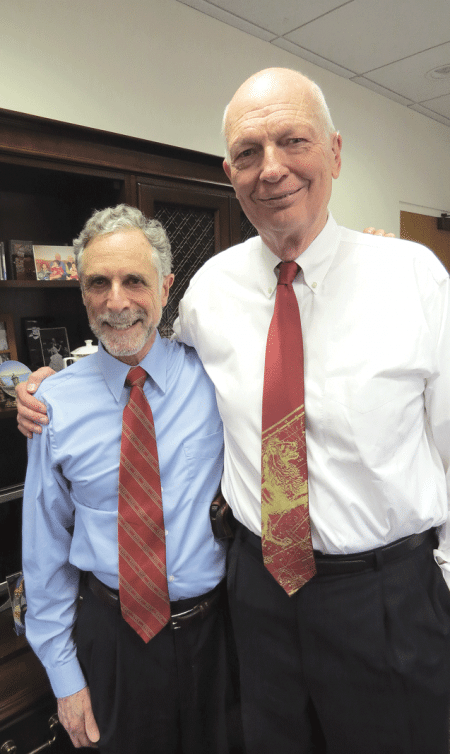
Bill Messner, right, and Ira Rubenzahl.

Bill Messner, right, and Ira Rubenzahl.

Located just seven miles apart as the crow flies, Holyoke Community College and Springfield Technical Community College have always competed, and in vigorous fashion, for everything from students to press coverage to state funding for capital projects. But when they arrived at their respective campuses in 2004, Presidents Bill Messner and Ira Rubenzahl found the relationship between the schools to be a case not of healthy competition, but unhealthy animosity. So they set about changing that equation. And as both men prepare to retire, they talked about what would have to be considered a stunning new attitude that prevails at both schools.

Neither man recalls which one of them actually picked up the phone and called the other.

What they clearly remember, though, is that a call, the first of many, was made. And, considering all that’s happened since the conversation ended, it could only be described with the adjective ‘historic.’

Ira Rubenzahl and Bill Messner had been at their new positions, as president of Springfield Technical Community College and Holyoke Community College, respectively, for just a few months (Rubenzahl arrived a few weeks earlier) in that summer of 2004. And while they hadn’t learned everything about the challenges that lay ahead, they did know one thing — that the relationship between the two schools, located just seven miles apart, had to change, and soon.

“Let’s just say that the institutions had not been working well together,” said Messner, his tone blending understatement with a dose of sarcasm as he described what he found upon his arrival. “And that was really not productive.”

Added Rubenzahl, “it didn’t take long to figure out that there was this problem. And we basically said, together, ‘we have to stop competing and start working together.’”

Actually, the competition hasn’t stopped, and both presidents agree that it can’t and won’t because, as the old saying goes, it’s good for the parties involved. But the animosity that prevailed a dozen years ago is mostly gone. And it hasn’t been missed.

For evidence of this, Rubenzahl and Messner pointed to a number of initiatives involving everything from workforce development to adult basic education; from legislative get-togethers to initiatives to train workers for MGM’s planned $900 million casino in Springfield’s South End.

They even listed the fact that the two travel together to meetings in Boston and elsewhere, and did so with a note of wonder in their tone that speaks volumes about just how bad things were.

Perhaps the very best piece of evidence, though, is the Deval Patrick Award for Workforce Development, presented by the Boston Foundation, which the schools earned together in 2014 for their collaborative effort known as TWO (Training & Workforce Options); more on that later.

Getting from where relations (if one could call them that) were in 2004 to where they are now didn’t happen overnight and would never be described as easy, both men noted.

“There are areas in which we’re much better off collaborating than we are competing,” said Messner. “But it took us a couple of years to get our arms around what those areas were, and how we could collaborate effectively.”

Also, the mountain to climb in terms of the level of animosity to be overcome was high and steep, said Rubenzahl.

“Bill and I got comfortable very quickly,” he noted. “But it took a while for the troops to line up because it was so inbred.”

Eventually, the troops did fall in line, both men noted, but the movement clearly started at the top.

Which is exactly why BusinessWest met with both presidents in Messner’s office in Frost Hall earlier this month. They’ve both announced that they’re retiring, with Rubenzahl due to exit stage left in June, and Messner a month or two later.

Yes, the presidents who arrived in the Pioneer Valley together will be leaving it together. And they’re leaving behind a track record of collaboration that couldn’t have been imagined a decade and a half ago.

Perhaps the best news is that both believe this pattern of cooperation has become so ingrained — and so welcomed by the schools’ respective boards — that they find it difficult to imagine a scenario in which it won’t continue after they’ve left their respective campuses.

“It will probably change in some ways to reflect the personalities of the two folks who are going to be following us,” said Messner. “But I think it’s grounded enough that it will continue. And my sense is that, if those two folks don’t choose to continue to collaborate, they’ll pay a price of some sort.”

New Course of Action

To put the dramatic change in the relationship between the two colleges in perspective, both Rubenzahl and Messner took a quick trip back to last summer and a press event that was significant on a number of levels.

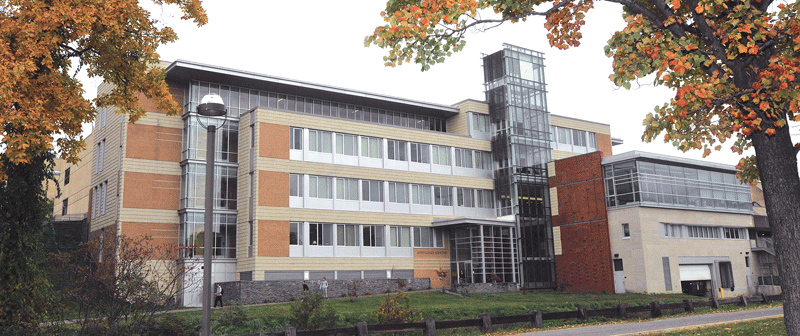
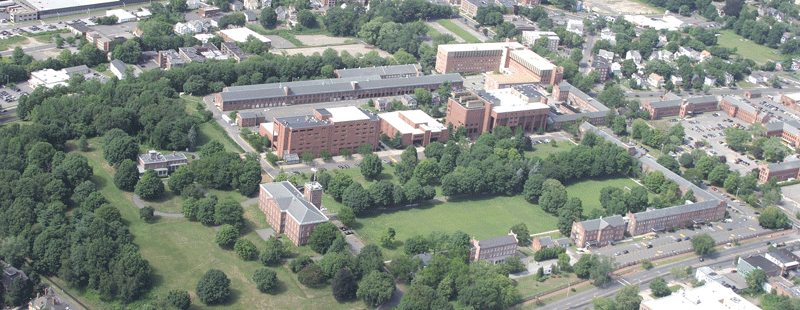
Gov. Charlie Baker was coming to Western Mass. to deliver good news for both schools: HCC was getting $2.5 million for much-needed renovations of its cramped, antiquated, and leaky campus center, and STCC was getting $3 million for design work on a planned $50 million project to convert the historic structure known as Building 19 — one of the oldest buildings on the Springfield Armory complex later repurposed into the community college — into a new campus center.

He would announce both awards in a single ceremony at HCC, an arrangement STCC quickly signed off on.

“Before we came, they would never have dared to do that,” said Rubenzahl, saying those words slowly for additional emphasis and using the word ‘they’ to mean both the institutions and their presidents. “There would have been huge objections to doing that.”

Messner agreed, and, like his counterpart, treaded lightly, and diplomatically, when asked about the root causes of the sentiments that prevailed when he arrived.

HCC’s Kittredge Center

The opening of HCC’s Kittredge Center is one of the highlights of Bill Messner’s tenure, which was defined by improved relations with STCC.

However, it was well-known across the region, and even across the state, that the leaders’ predecessors — David Bartley, previously speaker of the Massachusetts House, at HCC, and Andy Scibelli, former Springfield city official and nephew of powerful state Rep. Anthony Scibelli, at STCC — didn’t exactly get along and were ferociously competitive, to put it mildly. And their institutions followed their lead — with a passion.

To explain the mood, Rubenzahl recalled some dialogue at a meeting he convened with several senior staff members at STCC not long after arriving.

“Someone referred to the ‘enemy,’” he recalled. “I said, ‘what enemy? Do you mean Holyoke?’ And he said, ‘yes, Holyoke.’ I was really taken aback by that, and said, ‘they’re not the enemy.’”

Rubenzahl believes that aforementioned phone conversation with Messner had already occurred by that point, but the chosen terminology cemented in his mind — actually both men’s minds, because similar language was being used in the campus off Homestead Avenue in Holyoke — that change was necessary.

And it came about, they said, partly due to those changes at the top, but also because it simply made sense.

Indeed, both presidents and their staffs had concluded that, while the schools would go on competing — “like Ford and Chevy do,” said Messner — they could also collaborate in many ways and, while doing so, achieve much more together than they ever could separately.

Examples abound, but TWO is clearly the most visible and perhaps the most impactful.

Messner described it as a “mechanism” for collaboration, the initiative that resulted from that somewhat time-consuming process he described earlier of determining in which realms the schools could collaborate, and how.

As the name suggests, the program involves creation of individually tailored programs to help solve workforce problems, specifically those related to the skills gap that has impacted virtually every sector of the economy.

Since its creation five years ago, TWO has assisted large corporations, small businesses, and broad economic sectors, said Rubenzahl, and it’s an example of something the schools could do with some success independent of one another, but to a much greater level of achievement together.

School of Thought

While TWO is the most visible manifestation of the new climate of cooperation between the two schools, there are many others, said the two presidents — starting with the meeting they were at just before sitting down with BusinessWest.

This was a gathering of state legislators to discuss matters involving public higher education, especially funding for the schools and individual initiatives. Years ago, there would have been two of these sessions, said Rubenzahl, one for HCC and one for STCC, because, well, that’s how it was done. (Actually, Greenfield Community College and Berkshire Community College had their own sessions as well.)

Now, there’s a single gathering — a practice that began the spring after the two presidents arrived — and it involves not only those two schools, but all seven public colleges and universities in Western Mass. Thus, the sessions are usually more productive because there are more people in the room, and far more convenient for legislators.

“I called Bill and said, ‘doesn’t it make sense to just have one?’” Rubenzahl recalled. “And for a lot of reasons; you’re more likely to get more legislators, and you can be more effective if you have several colleges saying the same thing as opposed to each one stating their individual needs.”

The legislative get-together is a simple yet effective example of collaboration, said Messner, adding that many others share its basic reason for being: common sense.

STCC

STCC President Ira Rubenzahl says his campus now looks for ways to collaborate with its competitor in Holyoke.

That list includes everything from faculty-development programs to the joint hiring of a consultant to create so-called wage grids; from adult basic education — something STCC has become more proficient at thanks to assistance from HCC — to the somewhat daunting task of training hundreds, and perhaps thousands, of the individuals MGM will eventually hire.

When looking back at how the current partnership on casino training came about, both presidents said this is another example of something that wouldn’t have materialized 13 years ago because of the animosity between the schools.

“We have this trust … we have this agreement — we don’t do things separately,” said Rubenzahl, adding that, years ago, the two schools probably would have fought tooth and nail for the entire pie. In this new era of cooperation, they agreed to split the pie long before the Gaming Commission determined the winner of the Western Mass. license.

“It wasn’t clear where the casino was going. Was it going to go to Palmer? Was it going to Springfield? Was it going to go to Holyoke?” he recalled. “But before we knew where it was going, we said, ‘an individual campus is not going to get involved in the training; we’re going to do it together.

“It winds up going in Springfield, but instead of fighting over it, we had already lined up our ducks,” he went on. “We had already figured out that, because Holyoke is really strong in culinary arts, if there’s culinary training, they’re going to get it. They can do it; we can’t do it. And we’re going to do some of the IT training, perhaps.”

Whenever there’s a meeting with MGM officials, the schools go together, said Messner, adding that the casino project is a good example of how the schools work together to meet the workforce needs of the five major sectors of the economy — manufacturing, healthcare, technology, hospitality, and financial services — because neither school can do all that alone.

As still another example of something happening now that wouldn’t have happened years ago — this one involving geography, or territory, as much as anything else — Messner cited initiatives blueprinted by Holyoke schools’ receiver  Stephen Zrike for Dean Technical High School.

“He wants two programs connected to college work,” Messner explained. “One is going to be in healthcare, and we’ll do that one, and the other is manufacturing, and we’re going to do that in conjunction with STCC; we’re not going to try to do that alone.”

Added Rubenzahl, “because of this [new relationship], we can do things we couldn’t do otherwise. Before, you couldn’t do that — you couldn’t go into the other college’s hometown and run a public-school program.”

Class Act

As for those shared rides to Boston and other destinations for gatherings of public-school leaders, both men laughed as they talked about how the practice has evolved and how it never would have happened with their predecessors.

“I drive, and he talks,” said Messner, referring to how a typical journey unfolds.

But while they carpool to such meetings, they usually don’t sit together once they arrive — a tradition that is more strategic than any kind of statement about how the schools, and presidents, get along.

“We don’t want to look like a two-headed monster,” said Rubenzahl, adding that the two are usually of a similar mind on most matters and don’t want to appear to be delivering comments in stereo.

Messner agreed. “You can’t cluster your strength all in one part of the room — you have to spread it out.”

In truth, and despite those seating arrangements, the schools have indeed become a two-headed monster — of collaboration.

George O’Brien can be reached at [email protected]

Education Sections

The Language of Business

Pioneer Valley Chinese Immersion Charter School

At the Pioneer Valley Chinese Immersion Charter School, puppets and other props help young students master the Chinese language.

Richard Alcorn has not forgotten the frustration he felt when he owned a business that imported goods from China and had to communicate with non-English-speaking customers on the other side of the globe.

“There were times when I spent 45 minutes or an hour with an interpreter only to realize they had absolutely no idea what I was talking about,” he told BusinessWest.

That experience, combined with the fact that Alcorn’s wife, Kathleen Wang, wanted their children and others to be prepared to work in a changing, global economy, led the couple to establish Pioneer Valley Chinese Immersion Charter School (PVCICS) in Hadley. It was important to them because both Alcorn and Wang were involved in the Massachusetts Initiative for International Studies, a statewide initiative to instill more international focus into K-12 education.

The school opened its doors in 2007 to kindergartners and first-graders, and today boasts roughly 440 students from 39 communities in kindergarten through grade 11. The continued expansion led the couple to outgrow their space, and last year the school was enlarged with a 40,000-square-foot addition.

Next year, PVCICS will add grade 12, and the first class that will matriculate will receive international baccalaureate diplomas that will open the door to continuing-education opportunities in other countries, while providing students with skills needed to work for Chinese employers or companies that do business in that country.

Through dedication and hard work, Alcorn, Wang, and others who are passionate about their mission have established a new model for education: PVCICS is the first fully articulated K-12 Chinese-language and cultural-immersion public charter school in the country.

“In addition to learning the language, our students learn about cultural differences,” said Wang, the school’s principal, as she explained that small things make a difference; for example, in China, the proper way to hand someone a business card is with two hands, rather than one.

Knowledge of such customs is important to engender respect and good relationships while communicating with Chinese customers, suppliers, and business owners.

“The State Department has deemed Chinese as a language critical to the future of the country’s economic and national security,” Wang said, noting that more employers are looking for people proficient in this language and the country’s cultural norms.

Tricia Canavan, president of United Personnel, a temporary and full-time staffing agency in Springfield, agreed.

“We’re starting to see a demand for employees who speak Mandarin Chinese, and we are recruiting them for jobs,” she said. “It speaks to the global nature of commerce; China is the world’s second-largest economy, and there is a need for fluency in the language.”

Alcorn, executive director of PVCICS, pointed to Chinese-owned CRRC USA Rail Corp., which broke ground in September on a new, $95 million subway-car factory in Springfield, as an example of the presence Chinese companies are establishing in the U.S.

Richard Alcorn and Kathleen Wang

Richard Alcorn and Kathleen Wang, founders of the Pioneer Valley Chinese Immersion Charter School.

“From the time we started this school, it was clear to us that, if local companies want to conduct business with China and local communities want to encourage Chinese companies to make local investments, we need people who know the language,” he told BusinessWest.

“Massachusetts, like all of New England, is trailing the nation in developing language and cultural-immersion programs that offer students the opportunity to develop skills needed to compete globally,” he went on. “When we first opened, there were only 15 Chinese-immersion programs in the U.S., and now there are over 150 public-school programs like this.”

The vast majority of the student body at PVCICS knew no Chinese when they entered, which reflects the growing movement to make students who speak English at home bilingual.

New York City has about 180 dual-language programs where students are learning Arabic, Chinese, French, Haitian-Creole, Hebrew, Korean, Polish, Russian, and Spanish. Delaware and North Carolina have joined their ranks, while 9% of public elementary-school students in Utah are enrolled in dual-language programs, and one in every five kindergartners in Portland, Ore. are in a dual-language program.

“These programs are economic-development initiatives,” said Alcorn. “People in the workforce who are employed in global businesses really need to be bilingual.”

Rapid Growth

PVCICS opened in 2007 with 42 students. Classes were held in a strip mall in South Amherst, and as the student body grew and grade levels were added, the school moved into a 26,000-square-foot former health club in Hadley. The space was completely renovated, and last year the building underwent that 40,000-square-foot expansion to keep pace with the growing number of students.

Growth continues, and demand for seats in this free public charter school is high. Students are chosen by lottery, and more than 100 applications pour in every year for 44 kindergarten slots.

Students can also enter in sixth or ninth grades, and those who do start in introductory Mandarin Chinese, while those who entered in elementary school are in a higher-level Mandarin class.

In grades kindergarten and grade 1, 75% of daily instruction is in Chinese, and 25% is in English. In grades 2 through 5, 50% of instruction is in Chinese, and 50% is in English. As the need for an expanded vocabulary and skills in English grow, the time spent in Chinese classes is decreased. Starting in sixth grade, 25% of daily instruction is in Chinese, and 75% is in English.

Research shows that early immersion in a foreign-language program makes it easier to become fluent. Mandarin Chinese can be especially difficult for adults to learn because the language is tonal and doesn’t have an alphabet.

And PVCICS ninth-graders are proud of their language skills.

Talia O’Shea entered the school in first grade and didn’t really understand what her teachers were saying until the middle of the school year, despite the use of drawings, puppets, and other props. But by the middle of second grade, she was speaking in Chinese.

Today, she does math in the language because she learned it initially in Chinese and says she sometimes finds herself thinking in the language, rather than in her native English.

But she regards the ability to do so as a bonus.

Ninth graders Talia O’Shea, Gabe Crivelli, and Amanda Doe

Ninth graders Talia O’Shea, Gabe Crivelli, and Amanda Doe enjoy learning subject matter in two languages.

“China is a very significant nation in terms of politics and economics on the world stage, so being fluent in both English and Chinese will be a benefit when I get a job,” the 14-year-old told BusinessWest, adding that her proficiency could help prepare her for a government career or allow her to work as a translator.

Amanda Dee also entered PVCICS in first grade, and although she had heard Chinese spoken at home, the language really didn’t take hold until she began conversing with her peers and interacting at school.

“When you learn to speak Chinese at a really young age, it gives you a deeper understanding of the language,” she said.

Ninth-grader Gabe Crivelli entered the charter school in sixth grade because he was seeking a challenging course of academics. He found it at PVCICS, and said the combination of rigorous standards and the challenge of learning a new language exceeded his expectations. He is glad he changed schools, and believes his bilingual skills will help him in the future since he hopes to own a business.

“Students in almost every other country learn a foreign language,” he noted, adding that his sister is also a student at the school, and they sometimes speak Chinese at home.

Parents also tout the school’s benefits. Canavan said she and her husband chose to send two of their sons to PVCICS and are happy they did.

“We felt it was important for our children to be fluent in another language so they could become global citizens,” she said, adding that they were also attracted by the focus on academic rigor and character building.

Ongoing Efforts

Alcorn and Wang tried to get a Chinese-immersion school program started in Amherst before they applied to the state to start a charter school in Hadley. And although their proposal was rejected, today they are happy with the outcome.

PVCICS has been highly successful and was a recipient of the 2015 Confucius Classrooms of the Year Award, which was presented to 10 schools across the world for excellence in teaching and learning, curriculum, cultural richness, community engagement, and extracurricular activities. Only three schools in the U.S. received the award, which Alcorn accepted from the Confucius Institute at its World Conference in Shanghai. In addition, last year its students received some of the highest MCAS scores in the Commonwealth.

Parental demand for the school’s program has fueled its continued expansion. Interest in Chinese has grown, and the school has enjoyed the support of the U.S. Department of Education and the U.S. Department of Agriculture, Rural Development.

In short, this couple’s vision is yielding positive results as PVCICS helps to establish a pipeline of students whose fluency in Mandarin Chinese will enhance the local economy and give them the skills needed to flourish in a fast-changing world.

Cover Story Entrepreneurship Sections

Land of Opportunity

Gokul Budathoki and Mena Tiwari

After years in a Nepalese refugee camp, Gokul Budathoki and Mena Tiwari found a new life — and business — in Springfield.

If all Ascentria Care Alliance did for refugees was help them get established in the U.S. and find jobs, it would be important work. But, thanks to an initiative launched in 2010 called the Microenterprise Development Program, Ascentria is actually putting many of its clients on the road to business ownership, through education, assistance with permitting and other hurdles, and small loans. The result, so far, is a patchwork of intriguing startups across the Pioneer Valley owned by people who truly appreciate their new opportunity, and have their sights set on continued growth.

Mena Tiwari’s story begins much like that of many refugees.

She was born in Bhutan, but, at age 2, her family fled that country’s inter-ethnic conflict, and she wound up in a refugee camp in Nepal, where she spent the next two decades.

While growing up there, owning a business — in the United States, no less — was the furthest thing from her mind.

“Back in the refugee camp, we didn’t get the chance to do anything like that,” Tiwari said, noting that her family ran a little shop in the camp, but it resembled in no way the complexity of opening a store in the U.S.

“Basically, we had a lot of love, but we didn’t have money,” she said, recalling how people would work with their hands — carving sandalwood into sticks for incense, for example — to make a little profit, and if they were able to scrape up enough for, say, a picnic outing, they appreciated it. “I always look for happiness in the little things. They made me happy because I worked for it.”

Tiwari met Gokul Budathoki in the camp, and after they immigrated to the U.S. — she in 2009, staying with family in Buffalo, N.Y., and he to New Hampshire in 2011 — they reconnected, and eventually married in late 2011; a year later, to the day, their son was born.

Tiwari worked in a salon as a hairdresser before moving to New Hampshire after the wedding, and Budathoki had been working at a Walmart, gaining a knowledge of retail he would put to use when the couple started talking about opening a business.

“Nobody was here to support us; her parents were in Buffalo, and my parents were back in country, so we had to support ourselves,” said Budathoki, who eventually enrolled at a community college and landed a new job with a mental-health nonprofit. “We said, ‘why don’t we open our own thing?’ So, after the baby was born, we put him in the carseat and drove around the countryside, looking.”

What they found was a new life in the Pioneer Valley — as proud owners of Interstate Mart near the ‘X’ in Springfield — with the help of the Microenterprise Development Program at Ascentria Care Alliance.

“We’re a resettlement agency,” Emil Farjo said of ACA, which has offices in Westfield and Worcester and was previously known as Lutheran Social Services. “We have refugees come from overseas, and we help them get an apartment, furniture, their first IDs, benefits from welfare and MassHealth, Social Security numbers, and ESL classes.”

Beyond those basic services, however, is the microenterprise program, which was created in partnership with the federal Office of Refugee Resettlement in 2010, with the goal of helping refugees launch businesses and reach economic self-sufficiency.

Nazar al Khaled

Nazar al Khaled was a famous singer in Iraq; now he hawks his wife’s authentic cuisine in West Springfield.

Farjo was hired to lead the program in 2012, leveraging his education, background in computer science, and experience as a business owner in Iraq, where he’d owned three very different enterprises, in engineering and HVAC, food distribution, and wholesale.

After fleeing Iraq in 2004 for the safety of his family and spending six years in Syria, he immigrated to the U.S. and connected with what was then Lutheran Social Services, working with other refugees on computer classes, vocational training, and other skills before being tapped to lead the business-startup program.

“I was very successful in my business, but when we fled our country, we left everything behind,” he told BusinessWest. “My experiences help me understand how these people think. I can be a bridge from their former country to the American system. This is my passion. I find everyone’s success is my success. I love what I’m doing, and I want to help them make their dreams come true.”

First Steps

The microenterprise program provides business planning, financing, and training to refugees in the Bay State. Applicants receive guidance in budgeting, marketing, finance, and obtaining permits and licenses. Typically, refugees lack sufficient credit history or loan collateral to receive traditional business loans, so the program provides small startup loans, typically in the range of $500 to $15,000.

To date, the program has helped spawn 32 businesses in Greater Springfield and 12 more in Worcester, ranging from child care to cleaning services; web-based services to landscaping and farming; delivery services to auto repair. Most owners are Iraqi or Bhutanese, with a smattering of refugees from Liberia, Lithuania, and Burundi.

“They’re new to the system, so we provide classes in financial literacy and money management, how to write a business plan, how to budget,” Farjo said. “We’re also a microlender; we don’t ask for credit, we just want them to take their first steps in business loans, and prepare them for the next step, which is traditional loans from traditional lenders.”

Mike Garjian, a serial entrepreneur who has been working with Farjo in the program, added that these classes tend to be full. “There’s a thirst for knowledge; they’re fully engaged. And that translates to business success.”

Farjo also works one on one with participants on hurdles such as site selection, licensing, and permitting. “They would be lost without us. We’re dealing with surrounding cities, and each city is different. It’s a hassle for them.”

For Tiwari and Budathoki, the hassles since opening almost 10 months ago have been worth it. Their store sells both American and ethnic food products, as well as an impressive array of Bhutanese clothing. Their customer base has been steadily growing, and they’re looking to establish a space for community gatherings in additional space at the back of the store.

“It began with a little stress,” Tiwari said, “but we can say we are happy.”

Nazar al Khaled is also pleased with his new business. He was a famous Iraqi singer — “very famous, not normal famous,” he noted — whose life, like that of so many countrymen, was turned upside down after the U.S. invasion in 2003. He caught a bit of a break when the New York Times and other sources reported him dead in an airstrike in 2004, as some Muslim groups that rose up after Saddam’s fall were targeting singers and other artists, and the report took some of the pressure off.

In 2009, he arrived in the U.S. with his family and stayed for a couple of years in New York before moving to Western Mass. in 2011 for a quieter lifestyle.

program director at Ascentria

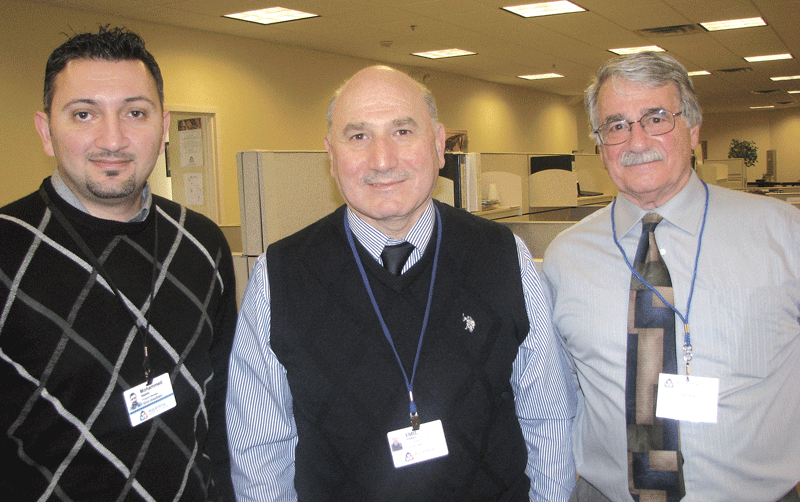
From left, Mohammed Najeeb, program director at Ascentria, with Emil Farjo and Mike Garjian.

Recently — recognizing the culinary skills of his wife, Asmaa Mohammed, and wishing to go into business for himself — al Khaled connected with Farjo and opened Ahalna Foods on Main Street in West Springfield, a multi-ethnic neighborhood where eight of Ascentria’s refugee clients have launched enterprises. To hear him tell it, he definitely needed Farjo’s help.

“In America, there are many ways to start work, but no one tells you the right way,” he said of his earlier dealings with banks and municipal officials. “There are many rules, and nobody answers you, nobody smiles at you, nobody does anything for you. I say, ‘I want to open this business.’ They say, ‘OK, come back next month.’”

Ascentria, on the other hand, “brings us together and teaches us how to work with the banks, how to start a business,” he went on. “Any license or anything else we need, they help us with that.”

Iraqi cuisine, al Khaled said, is based on tradition that extends back 8,000 years, adding that his wife’s creations — which lean heavily on beef, lamb, and chicken — are meant to be savored by all the senses and demand the diner’s entire focus, as opposed to American “technology food” (his term for heavily processed fare) swallowed quickly in front of the TV.

Currently, Ahalna prepares meals for takeout, but also caters events, and aims to eventually move into wholesale distribution. So far, his clientele is mainly people who have already experienced and enjoy Iraqi fare, but he hopes to attract Americans who seek an authentic culinary experience.

“Americans don’t want to change,” he said, “but some Iraqi families have friends and neighbors, and when they bring them our food, they give it a taste and find it’s something different, and after that, they come here to buy it.”

Untapped Potential

Garjian believes Ascentria’s success helping refugees launch businesses should receive more attention than it does.

“This is a sector that’s been really invisible, but it’s a very powerful and interesting component to the region’s economic vitality,” he said. “They are competent, highly energized people.”

He recalled hiring a Vietnamese refugee from Lutheran Services 20 years ago for one of his businesses. She had been a mathematician in her homeland, but had never worked with computers. After he introduced her to one and showed her how to operate Excel, she was quickly running complex equations. What Ascentria’s microenterprise program does, he noted, is help people with these types of skills — or at least the potential to quickly attain them — achieve business success in a very different environment from where they began.

Take the three Iraqi refugees who operate Chicopee Auto Service & Sales Center on Front Street, for example. “We did not want to work for anybody,” said Ahmed Mustafa, who partnered with his brother, Abraheem Mustafa, and a friend, Omar Abdul Razzak, to establish the business early in 2015. They arrived in the U.S. by way of Syria after fleeing their homeland a few years after the invasion.

Chicopee Auto Service & Sales Center

From left, Abraheem Mustafa, Ahmed Mustafa, and Omar Abdul Razzak are partners at Chicopee Auto Service & Sales Center.

“It was the war,” Ahmed Mustafa said when asked why they left. “It’s always the war.”

But he credited Ascentria and Farjo for helping the partners navigate the permitting process to launch the business, on the site of a former, then-closed used-car dealership. They started with 13 cars for sale and now have 25 on the lot, and typically service about 15 cars at any given time. They recently installed a second repair bay to conduct alignments, and do state safety inspections as well.

Mustafa said there are challenges to starting a business, but he welcomes some of them, like the gradually growing presence of other auto-related businesses in the Chicopee Falls neighborhood. “Having more than one dealer is better for the business that has better prices and better quality,” he said, already speaking the language of a businessman who embraces competition.

Growing the business will bring other benefits as well, he added, not the least of which is being able to hire other immigrants, especially those who struggle with the English language and, therefore, find it challenging to land a job.

Farjo has high hopes for all the businesses his agency helps launch, but he always cautions against overly optimistic expectations.

“They need to be patient. They might not be successful right when they open. Taking a risk is not easy. Starting a business is not easy, even for Americans,” he said. “But when they find someone who will speak with them as a person, someone who cares, that makes a difference. I just want to go the extra mile to see these people be successful, and at the end of the day, they thank me for helping them out.”

Credit Where It’s Due

Budathoki and Tiwari say they have qualities that complement each other: his fortitude and her business mind, for starters. But both say Ascentria was a key element in their success.

“I cannot thank them enough,” Tiwari said. “We wanted to find a way to find success and feed our family, but we went to City Hall and and so many places before we met with Emil. Back in my country, I didn’t know the meaning of a business plan.”

But Farjo says his agency is merely helping them open doors. “They have our support, but it’s their skills and ambition and effort that makes them succeed.”

In a country that accepts some 70,000 refugees a year, Garjian said the microenterprise program serves a social purpose even beyond raising the standard of living for its handful of participants and boosting economic development region-wide. At a time when so many Americans look suspiciously at immigrants and refugees, these small-business owners (who are, like anyone who receives Ascentria’s services, thoroughly vetted and screened) might well be changing a few perceptions.

“Many of them are coming from areas of tyranny and loss of hope,” Garjian told BusinessWest. “To them, each breath is a gift. I’ve seen people walk off the elevators here and take their first breath of freedom. That’s so profound to me.”

Joseph Bednar can be reached at [email protected]

Environment and Engineering Sections

Generation Next

President David Pinsky

President David Pinsky says Tighe & Bond projects run the gamut from wastewater-facility design to coastal engineering; from alternative-energy initiatives to the Westfield River levee trail.

In its first 90-plus years, Tighe & Bond had emerged as a Western Mass. leader in civil engineering, carving out a strong reputation and myriad civil-engineering projects around the region. But over the past decade, the company has embarked on an impressive growth trajectory, adding offices, expanding its services, and adding 100 employees. The current vision, President David Pinsky says, involves staying independent, nimble, sensitive to industry trends, and increasingly driven by a burgeoning youth movement.

With 105 years in business and a workforce of 270, Tighe & Bond boasts numerous employees whose experience stretches back four and five decades. But many more are just beginning their career journey.

It’s a healthy mix, David Pinsky says.

“For the first time, Millennials are the largest generation at Tighe & Bond,” the firm’s president noted. “I think it’s exciting — four generations working together. We’ve got young professionals working with seasoned people, and they’re all learning from each other. We have some wonderful young talent; I’m so excited.”

At the same time, many of the company’s long-time clients are experiencing the same shift, as Baby Boomers begin to retire and Millennials climb the leadership ladder. It’s just one more reminder that nothing stays the same in the world of civil engineering, which is why Tighe & Bond has maintained an ambitious schedule of growth and expansion over the past decade.

“It starts with a vision for the company,” Pinsky said, holding a copy of a strategic plan, titled “Vision 2020,” the latest iteration of an exercise the company conducts every few years. “We sit down and talk and develop a strategic plan, and that starts with a vision of where we want to go. The real challenge is executing that plan.”

The most basic goal, he told BusinessWest, is to remain a privately owned, independent company at a time of great consolidation in the industry, with larger firms constantly acquiring smaller ones.

“We like exactly where we are; it provides some unique opportunities. We’re a regional, northeast firm — no longer just a Western Mass. firm, but not a national firm. We know our place, and it’s a sweet spot for us. We continue to grow, but not for growth’s sake. We want to grow profitably and be better able to serve our clients.”

That growth has been significant in nature; Tighe & Bond saw its workforce increase from 170 to just over 200 from 2006 to 2011, and the past five years have seen an even more dramatic surge, to a current roster of 270 — what Pinsky calls moderate and steady, but not “crazy,” growth, of between 5% and 10% per year. “That’s comfortable for us, and not overwhelming for employees.”

Growth has come in two ways, he added: Geographic expansion and adding new services. For the former, over the past five years, the company has opened up new offices in Portsmouth, N.H. — allowing it to reach customers in that state as well as Northeastern Mass. and Southern Maine, Pinsky said — as well as new branches in Westwood, serving Eastern Mass., and Red Hook, N.Y.


Go HERE for a PDF chart of the region’s engineering firms


The company had already tackled projects in these areas, Pinsky noted, and expanding its footprint simply enabled it to better serve those clients, as well as shift some employees who live in those areas and had been commuting long distances. In the case of Portsmouth, Tighe & Bond acquired an existing firm, doubled its office size, and retained many of its employees and leadership.

Chief Additions

Partly in response to that growth, Tighe & Bond has added two new leadership positions over the past two years, hiring Bill Hardy as chief operating officer and Bob Belitz as chief financial officer. “It’s been great having their experience and work ethic on the team, helping us as we continue to grow,” Pinsky said.

For more than a century, the company lacked those specific roles. Founded in 1911 to consult on broad-based civil-engineering projects, Tighe & Bond eventually came to specialize in environmental engineering, focusing on water, wastewater, solid-waste, and hazardous-waste issues, and now boasts eight offices in Massachusetts, Connecticut, New Hampshire, and New York.

Holyoke’s new treatment facility

Tighe & Bond designed Holyoke’s new treatment facility that disinfects drinking water using ultraviolet light.

The firm’s diversity of expertise, said Pinsky, has been a buffer against economic downturns in any one area. Currently, about 60% of its projects are public contracts with municipalities and state government agencies throughout New England and New York, and 40% is private work for a diverse group of industries, from healthcare to education to utilities.

Meanwhile, Tighe & Bond has significantly ramped up its expertise and focus on MEP (mechanical, electrical, and plumbing) services, Pinsky said, as well as increasing its presence in the realm of coastal engineering.

“That’s a really important service, recognizing that rising tides, storm events, and the effects of climate change can wreak havoc with infrastructure along the coastline, as well as inland near waterways,” he noted, explaining that the company has the expertise to plan and design facilities that are more resilient to events, like Superstorm Sandy in 2012, that threaten public and private infrastructure near coastlines. “It dovetails well with the services we already provide.”

The firm has also expanded its presence in renewable-energy projects over the past decade, Pinsky noted, adding that municipalities and developers in the Northeast are increasingly valuing alternative energy sources, and Tighe & Bond has established itself as an expert in the field, working on numerous photovoltaic, wind, and hydro power projects.

As an example, he said the firm has undertaken a number of solar projects where photovoltaic solar has been placed on capped landfills.

“Since we had expertise on the landfill side and expertise on the solar side, there’s a great synergy there,” he noted. “A lot of those projects are happening here.”

While seeing growth in all its markets, however, Tighe & Bond, like all such firms, has faced an increasingly complex regulatory and permitting landscape, one where environmental concerns once considered minor are now paramount.

“The permitting hurdles for most projects are very significant,” Pinsky said. “But we have experts on staff who are very skilled at navigating their way through the process; that’s absolutely something we bring to our clients. Permits can affect schedule, cost, and project viability to a significant extent, so having that expertise is very helpful.”

One advantage of being such a large, regional company is that employees are often called upon to work with other offices, whether by commuting or videoconferencing, if they bring a specific skill set to a challenging job, he went on. “We’re a very collaborative firm, so projects are done across offices all the time. We don’t consider a project to be a Westfield project or a Portsmouth project; it’s a Tighe & Bond project. We bring in the best talent we have to suit the needs of the client.”

Priming the Pump

Because that talent is critical to a project’s success, Pinsky said, it’s vital that Tighe & Bond retain its key staffers while continually bringing in new blood.

“It’s absolutely a big challenge,” he told BusinessWest. “We talk about the war for talent, and we’re certainly in the middle of that. People have so many opportunities coming out of school, a lot of choices. A lot of companies are looking for people who want to make a difference in engineering and the environment, and we do as well.”

Tighe & Bond now employs more Millennials

Tighe & Bond now employs more Millennials than any other generation, which bodes well for its future.

While engineering programs at colleges and universities are generally drawing attention, competition can be fierce for graduates, he went on, and firms especially value those who have worked in the field between three and 10 years, as they have some experience but also plenty of potential to grow.

“There’s a shortage of them. We certainly do a good job growing them internally, always thinking that a person we’re hiring today, in three years, will be one of those people. We make a lot of training programs, both internal and external, available to employees, and we certainly immerse them in a lot of project work by surrounding them with experienced people they can learn from and be mentored by.”

To be sure, Tighe & Bond employees regularly volunteer in classroom programs to encourage the next generation of scientists and engineers, but it also seeks to be an “employer of choice,” Pinsky said, for college graduates launching their careers.

“People want to work for great firms — they want to go to firms where they can grow and develop their careers, where there are strong core values, and for us, those values include respect, integrity, commitment, excellence, and reliability. They want to know they are contributing to the firm’s overall vision.”

The days of writing a vision plan and stashing it in the CEO’s top drawer are over, he added, noting that Vision 2020 was developed in conjunction with the whole team and distributed to each of them.

One recent change was the dramatic renovation of the firm’s Westfield headquarters, which increased the floor space from 32,000 to 42,000 square feet, accommodating 180 employees in one building instead of 130 in two, and adding more space for collaborative work. The project included ‘green’ elements like LEED-certified carpeting, LED lighting and more natural light, and a stepped-up recycling initiative to reduce waste. Similar expansion projects have been undertaken at the Worcester, Portsmouth, and Middletown, Conn. branches.

“We’ve improved our offices, invested in technology, and, overall, invested in people. That’s extremely important to us. We’ve created an environment where our people love being here,” Pinsky said. “Sometimes little things matter. It’s the culture of the organization — being connected with clients, and everyone in the office knowing they’re appreciated for the time they put in and the good work they do.”

Joseph Bednar can be reached at  [email protected]

Departments Incorporations

The following business incorporations were recorded in Hampden, Hampshire, and Franklin counties and are the latest available. They are listed by community.

AMHERST

Christopher Blount Designs Inc., 6 Lawrence Circle, Amherst, MA 01002. Christopher Blount, same. Manufacturing of medical instruments.
 
Holla Magazine Inc., 441 West St., Amherst, MA 01002. Ingrid Claudia Akkew, 33 Kellogg Ave. #2, Amherst, MA 01002.
 
CHCIOPEE

DVM Electric Corp., 18 Whittier Place, Chicopee, MA 01013. Denis Mikha Ylichenko, same. Electrical installation, repair, maintenance to the general public and commercial entities on a for-hire basis
 
Fidelity Cleaning Services Inc., 18 Dwight St., Chicopee, MA 01013. Baudilio Abundio Navarro Monzon, same. Cleaning services.
 
Enso Inc., 491 Chicopee St., Chicopee, MA 01013. James Lowe, same. Import and export of goods
 
FEEDING HILLS

Cold Spring Academy Inc., 926B Springfield St., Feeding Hills, MA 01030. Katherine Marian Anderson, same. The specific purposes for which the corporation is organized are to manage, operate, guide, direct, and promote Cold Spring Academy. The corporation is organized and operated exclusively for educational and charitable purposes pursuant.
 
HOLYOKE

DC Remodeling Co., 3 Overlook Dr., Holyoke, MA 01040. Ana C De Alba, same. Home remodeling services.
 
LONGMEADOW

Fairway Corp., 785 Williams St, Suite 352, Longmeadow, MA 01106. Louis Masaschi, same. Real estate services.
 
Fred Astaire Dance International Corp., 10 Bliss Road, Longmeadow, MA 01106. John Rothweiler, same. Dance studio with instruction classes.
 
PERU

First Congregational Church of Peru, 2 West Main Road, Peru, MA 01235. Charlene Steele, 25 South Road, Peru, MA 01235. Church shall be to provide for and maintain the public worship of God; to promote the spiritual welfare of its members; and to extend the kingdom of Christ in the world.
 
PITTSFIELD

Explore Leadership & Coaching Inc., 78 Glory Dr., Pittsfield, MA 01201. Michael J. Schroth, same. Oganization provides education, training, consultation and other related services.
 
WEST SPRINGFIELD

Dillon Bodley & Associates, P.C., 63 Myron St., West Springfield, MA 01089. Brian Dillon, 22 Pomeroy St., Easthampton, MA 01027. Provides personal accounting and tax services to business owners, executives, independent professionals and households.
 
WILBRAHAM

Fairway Morgans Inc., 25 Cypress Lane, Wilbraham, MA 01095. Kelly Gilmartin, Same. Promote the Morgan Horse through amateur showing and breeding in addition to fostering and rescuing Morgan Horses. The amateur showing will take place in regional and national competitions including but not limited to New England regional horse show and the Morgan Grand Nationals.

Briefcase Departments

Employer Confidence Weakens in February

BOSTON — Confidence among Massachusetts employers weakened for the fifth time in seven months during February, but businesses remain optimistic overall about the ability of the Massachusetts economy to ride out uncertainty abroad and an increasingly curious election season in the U.S. The Associated Industries of Massachusetts (AIM) Business Confidence Index shed 0.7 points to 55.1 last month, still comfortably above the 50 mark that denotes a positive economic outlook. However, the reading was 4.7 points below its level of a year earlier, weighed down by growing concern about the slowing U.S. economy. That concern was confirmed Friday when the government said U.S. economic growth slowed to 1% during the fourth quarter of 2015. “We’re seeing some ambivalence among employers as they look at the economy, especially the turmoil in some overseas markets, but all within the range of general optimism about 2016,” said Raymond Torto, chair of AIM’s Board of Economic Advisors (BEA) and lecturer at Harvard Graduate School of Design. “Ambivalence indeed seems to define most views of the U.S. economy, as we saw last week when the annual economic report of the president noted the strong rebound since 2008 while acknowledging that economic forces, including the rapid pace of technological change, are weighing on American industry.” The AIM Index, based on a survey of Massachusetts employers, has appeared monthly since July 1991. It is calculated on a 100-point scale, with 50 as neutral; a reading above 50 is positive, while below 50 is negative. The index reached its historic high of 68.5 on two occasions in 1997-98, and its all-time low of 33.3 in February 2009. The index has remained above 50 since October 2013.

Governor Signs Landmark Opioid Bill into Law

BOSTON — Last week at the State House, Gov. Charlie Baker signed landmark legislation into law to address the deadly opioid and heroin epidemic plaguing the Commonwealth. He was joined by a group including Health and Human Services Secretary Marylou Sudders, Senate President Stanley Rosenberg, House Speaker Robert DeLeo, Attorney General Maura Healey, Auditor Suzanne Bump, members of the Legislature, law enforcement, healthcare providers, community leaders, individuals in recovery, and others. The bill, titled “An Act Relative to Substance Use, Treatment, Education, and Prevention,” passed with unanimous votes in both legislative chambers and includes numerous recommendations from the Governor’s Opioid Working Group, including prevention education for students and doctors and a seven-day limit on first-time opioid prescriptions. “Today, the Commonwealth stands in solidarity to fight the opioid and heroin epidemic that continues to plague our state and burden countless families and individuals,” Baker said. “I am proud to sign this legislation marking a remarkable statewide effort to strengthen prescribing laws and increase education for students and doctors. While there is still much work to be done, our administration is thankful for the Legislature’s effort to pass this bill and looks forward to working with the attorney general and our mayors to bend the trend and support those who have fallen victim to this horrific public health epidemic.” Added Lt. Gov. Karyn Polito, “today, we take another step forward by passing landmark legislation that will help the individuals and communities affected by the deadly opioid and heroin epidemic. We are grateful for the Legislature’s progress and for the partnership of Attorney General Healey, our mayors, and several others as we continue pursuing aggressive reforms to combat this crisis from the Berkshires to the Cape.” The bill includes the first law in the nation to limit an opioid prescription to a seven-day supply for a first-time adult prescriptions and a seven-day limit on every opiate prescription for minors, with certain exceptions. Other provisions from the governor’s recommendations include a requirement that information on opiate use and misuse be disseminated at annual head-injury safety programs for high-school athletes, requirements for doctors to check the Prescription Monitoring Program (PMP) database before writing a prescription for a Schedule 2 or Schedule 3 narcotic, and continuing-education requirements for prescribers, ranging from training on effective pain management to the risks of abuse and addiction associated with opioid medications. Several measures were passed to empower individuals and update current prevention efforts. Patients will receive access to non-opiate directive forms and the option of partially filling opioid prescriptions in consultation with doctors and pharmacists. Schools must annually conduct verbal substance-misuse screenings in two grade levels and collaborate with the departments of Elementary and Second Education and Public Health (DPH) around effective addiction-education policies. To reduce the prevalence of unused medication, manufacturers of controlled substances in Massachusetts must participate in either a drug stewardship program or an alternative plan as determined by DPH. This bill strengthens access to insurers and the bed-finder tool website; requires that patients receive information on FDA-approved, medication-assisted therapies after being discharged from a substance-use treatment program; and ensures civil-liability protection for individuals who administer Narcan. The opioid epidemic continues to impact every community in Massachusetts. According to the most recent data, it is estimated that there were nearly 1,200 unintentional and undetermined opioid deaths in 2014. The estimated rate of 17.4 deaths per 100,000 residents for 2014 is the highest ever for unintentional opioid overdoses and represents a 228% increase from the rate of 5.3 deaths per 100,000 residents in 2000. And the trend isn’t slowing. Preliminary data estimations show there were over 1,100 opioid deaths between January and September 2015.

United Way Wins Veteran Financial-literacy Grant

SPRINGFIELD — Massachusetts Treasurer Deborah Goldberg announced that the United Way of Pioneer Valley (UWPV) was one of five recipients of a grant that supports financial education to veterans and military families. Known as the Operation Money Wise: Financial Education Opportunity Grant and funded through the Office of Economic Empowerment, these grants aim to increase the scope of financial education for military families by providing them with the tools they need to achieve financial stability. Many of these workshops will include strategy sessions on managing money, planning for college, preparing for retirement, and monetary decision making. “These financial-literacy grants will further empower our military community to make informed financial decisions,” Goldberg said. “I am honored to support organizations that work to bring economic stability to the men, women, and families who help keep our country safe.” With three Thrive financial-literacy centers up and running in Holyoke and Springfield, and the Volunteer Income Tax Assistance (VITA) program flourishing throughout the region, UWPV is already a leader in improving fiscal education and responsibility among those it serve. The Thrive centers have served hundreds of student and seniors, helping them improve their credit ratings and open their first bank accounts. Last year, VITA helped 4,594 working families keep $2,462,549 through the Earned Income Tax Credit.

State Issues $9.3 Million in Workforce Skills Grants

BOSTON — Gov. Charlie Baker and Lt. Gov. Karyn Polito announced $9.3 million in workforce skills equipment grants to 35 high schools, community colleges, and vocational training providers across the Commonwealth for vocational-technical education and training equipment purchases that connect Massachusetts students and residents to economic opportunities in high-demand industries. “Workforce skills education and training plays an enormous role in economic and personal development by helping residents acquire the skills they need to connect with promising careers,” Baker said. “These vocational-technical education equipment grants will help build stronger communities and a more competitive business environment that ensures more residents have the skills they need to succeed in and support the Commonwealth’s economic future.” Added Polito, “these workforce-development grants will build bridges between residents seeking careers to build a future on and the employers who need a skilled workforce to grow the state’s economy. Today, too many good-paying jobs are going unfilled because employers are struggling to find skilled employees. This investment in training equipment will enable high schools and community colleges across the Commonwealth to equip students with the skills they need to secure a bright future.”
The Workforce Skills Capital Grant Program is a new initiative of the Governor’s Workforce Skills Cabinet, which seeks to align education, workforce, and economic-development strategies across the state. Western Mass. recipients of the new round of grants include:
• Berkshire Community College, Pittsfield, $465,119 to upgrade and modernize its manufacturing and engineering program, utilizing new hydraulics, pneumatics, electrical controls, materials testing, CNC, and 3-D printing equipment to train students and adult learners for careers in advanced manufacturing, engineering, and biotechnology;
• Dean Technical High School, Holyoke, $393,156 to transform its existing machine technology shop into an advanced-manufacturing shop that aligns with current industry practices and technologies, in order to connect Holyoke students to career opportunities in the Pioneer Valley’s skilled manufacturing workforce;
• Franklin County Technical School, Montague, $52,500 to revamp its computer programming and web-design programs and expand the programs’ capacity to reach adult learners;
• Lower Pioneer Valley Educational Collaborative, West Springfield, $257,100 to expand the capacity of its recently-founded high school Machine Technology Program, and to extend programming to adult learners, including unemployed and underemployed individuals facing barriers to employment;
• McCann Technical School, North Adams, $121,128 to revamp its welding and metal-fabrication equipment to train students for careers in Berkshire County’s aerospace, defense, commercial, medical-device, and power-generation industries, and enable re-training for unemployed workers;
• Roger L. Putnam Vocational Technical Academy, Springfield, $441,500 to launch a new program to equip students with the skills to enter the construction workforce, including training with heavy equipment; and
• Springfield Technical Community College, $499,785 to enhance training in its Laser Electro-Optics and Advanced Manufacturing Engineering Technology programs by creating an advanced-laser-machining laboratory and a one-year Laser Materials Processing Certificate of Completion, in order to meet the needs of the Commonwealth’s rapidly growing laser-manufacturing industry.

Company Notebook Departments

Trinity Health Awards Grant for Mercy Project

SPRINGFIELD — Trinity Health, the parent organization of Mercy Medical Center, has selected Mercy’s new community health project as a recipient of a grant under its Transforming Communities Initiative (TCI), a program that will result in the investment of $80 million in grants, loans, community-match dollars, and services in six communities over the next five years. As one of the six initial grant recipients, Mercy Medical Center will receive up to $500,000 per year to support a collaborative program that will improve health and well-being in the local community. The Springfield-based TCI partnership involves Mercy Medical Center and Live Well Springfield (LWS), a multi-sector, community-based coalition that includes more than 26 organizations working in the city. The program aims to provide services and improve policies that target low-income adults and children disproportionately impacted by health conditions related to poor diet, inactivity, tobacco use, and other social determinants. Specific strategies include enhancing early-education and care sites through nutrition and physical activity, school-nutrition improvements, Complete Streets infrastructure, and tobacco-use prevention. Partners currently include Mercy Medical Center and LWS members Martin Luther King Jr. Center, HAPHousing, Square One, Springfield Food Policy Council, Pioneer Valley Planning Commission, and Partners for a Healthier Community, serving as co-conveners and evaluators. Expected community benefits for the Springfield community include reduced rates of smoking, reduced youth obesity rates, improved access to nutrition and physical activity opportunities, fewer health disparities, and enhanced community wellness and resiliency. “The partnership between Mercy Medical Center and Live Well Springfield is truly a collaborative effort that brings numerous agencies together to improve the health of our community and each person we serve,” said Doreen Fadus, executive director of Community Benefit and Health, Mercy Medical Center. “It also reaffirms our commitment to population health management that calls us to identify specific individuals with particular needs within a given population, and then create care systems that work to improve the care and the health for individuals, particularly those at high risk or with chronic disease.” Mercy Medical Center earned the grant after responding to an RFP that defined appropriate multi-sector partners for these funded community collaborations. Potential partners included community groups, businesses, social-service agencies, schools, and others. The collaboration is expected to leverage system, hospital, and community expertise, funding, and other resources to improve community health. “We are delighted to be providing Mercy Medical Center and Live Well Springfield with this support,” said Dr. Bechara Choucair, senior vice president for Safety and Community Health, Trinity Health. “Mercy Medical Center and Live Well Springfield have a strategic collaboration and shared commitment to improving people’s lives. It’s a great investment.” In addition to the partnership between Mercy Medical Center and Live Well Springfield, Trinity Health has selected community partnerships in New Jersey, Illinois, Maryland, Idaho, and New York for participation in TCI. All of these programs will focus specifically on policy, system, and environmental changes that can directly impact identified areas of high local need and which can reduce tobacco use and obesity, leading drivers of preventable chronic diseases and high healthcare costs in the U.S.

Lee Bank Announces Alliance with St. Germain

LEE — Lee Bank President and CEO Chuck Leach announced that Lee Bank and St. Germain Investment Management have entered into a strategic alliance called October Mountain Financial Advisors, by which St. Germain will provide investment-management and financial-planning services to Berkshire County clients from its new offices in Lee. “Lee Bank is thrilled to offer a Berkshire County-focused wealth-management platform staffed with Berkshire residents who care deeply about their customers and community,” said Leach. “We’re extremely pleased to join forces with St. Germain Investment Management as we embark on this new endeavor. Furthermore, with our recently granted trust powers, we look forward to working closely with attorneys, CPAs, and our clients on trust and estate-planning matters right here in Berkshire County. We have long considered tackling the wealth-management space because it’s a natural extension of what we do extremely well — building strong relationships with our customers and community. It is logical for us to be working with St. Germain given their deep bench of talented investment professionals, most of whom I have worked closely with in the past, and their commitment to remaining independent and committed to our same core values.” Prior to being named president and CEO of Lee Bank last July, Leach served as senior vice president/managing director of wealth management and chief investment officer at Berkshire Bank Wealth Management. Previous positions include vice president/senior portfolio manager at TD Bank Wealth Management Group and vice president of the Gilder Technology Group and the Telecosm Fund. According to Tim Suffish, senior vice president and head of equities at St. Germain Investment Management, “we place the highest value on client relationships and locally made investment decisions, whether it’s a family’s nest egg or a nonprofit’s endowment. We believe that October Mountain Financial Advisors is well-positioned to avoid the conflicts of interest, persistent fee increases, and key person risks inherent with most investment options available today. As a long-time resident of Pittsfield, I’m thrilled to bring our highly qualified team to the Berkshire community.” Along with Suffish, October Mountain Financial Advisors’ principal team includes St. Germain Investment Management’s Michael Matty, president and director; Richard Bleser, vice president, portfolio manager; Matthew Farkas, vice president, portfolio manager; and Thaddeus Welch, portfolio manager. October Mountain Financial Advisors is now open for business at the bank’s branch in Lee and at St. Germain’s offices in Springfield and Hartford, Conn. October Mountain’s permanent headquarters will be located at 103 West Park St., adjacent to Lee Bank, and is slated to open in the spring following renovations to the building.

Waterfront Tavern Re-opens in Holyoke

HOLYOKE — Earlier this month, the Waterfront Tavern held a grand re-opening event at its newly renovated facility on Main Street, featuring Damn Yankee BBQ. Events slated for the restaurant and nightclub include concerts, dancing, and comedy. Private events can be booked in one of the three banquet rooms, with capacities ranging from 50 to 300 people. “Holyoke is a great spot to set up shop. We’re thrilled to be part of such a committed group of impassioned business owners,” owner Don Robert said. “The ease of obtaining the required permits went way above my expectations. This is definitely a business-friendly city.” Robert, one of the partners at the Waterfront Tavern, has been in the restaurant business since he was 14, starting at Lacroix’s, his family-owned business in Willimansett. He is the owner of Maximum Capacity in Chicopee, which he acquired in 2004. Waterfront Tavern’s restaurant partner is Rich Davieau, owner of Damn Yankee BBQ, a full-service barbeque catering company that has been in business, developing its own barbeque rubs and sauces, since 2010.

Taylor Street Dental Offers Free Lunch at Hot Table

SPRINGFIELD — In a new campaign, Taylor Street Dental is offering patients a voucher for a free meal at Hot Table restaurants when they make an appointment. “For a lot of people, it’s hard to make time in their schedule for a dental appointment,” said Dr. David Peck, owner of Taylor Street Dental. “We thought we’d make their lives a little easier, in case they had to skip breakfast or miss their lunch break to come in.” Peck established his practice on Worthington Street 30 years ago. In 2015, he moved to the historic Stacy Building on Taylor Street. He completely refurbished the building with the latest state-of-the-art technology and equipment, in addition to adding new dentists and associates. “John Devoie from Hot Table and I are both committed to investing in Springfield and helping the city thrive,” Peck said. “Their Tower Square location is very popular with downtown businesspeople and local neighborhood folks, the same people who make up a large part of my patient base. This promotion is designed to make everyone happy.” Patients must mention the Hot Table offer while making their appointment in order to claim the gift card when they come in. The gift card has a $20 value.

Big Y Announces Make-A-Wish Promotion

SPRINGFIELD — In honor of its 80th Anniversary, Big Y Foods has partnered with Make-A-Wish Massachusetts and Rhode Island, inviting customers to purchase ‘Wish Stars’ in checkout lines at all 61 Big Y World Class markets, including at 30 stores in Massachusetts. Stars cost $1 each, and customers are welcome to write their name on their star for display in their store. Funds raised through the sale of Wish Stars in Massachusetts throughout March will help grant wishes for children with life-threatening medical conditions throughout the Big Y communities. On Thursday, March 17, Big Y will match all Wish Star purchases and any additional donations up to $8,000.

Columbia Gas Recognizes 75th Anniversary of USO of Pioneer Valley

SPRINGFIELD — Columbia Gas of Massachusetts has supported the USO of Pioneer Valley in its efforts to keep military families together. This year, as the USO celebrates its 75th anniversary, Columbia Gas continues its tradition by gifting the USO $2,500 in support of its programs for 2016. According to the United Service Organizations (USO), America’s 1.3 million active-duty service members receive an estimated annual total of 10 million acts of connection from USO centers, services, and volunteers. The Pioneer Valley USO, located at the Westover Air Reserve Base, is one of those centers that has made a significant difference. “Columbia Gas is proud to support the work of the Pioneer Valley USO, which provides an abundance of services to hundreds of families it serves from all branches of the military. As a company that actively recruits and employs veterans, we feel privileged to work with organizations such as the USO that focus on our military men and women as well as their families,” said Andrea Luppi, manager of Communications and Community Relations. Added Allan Tracy, executive director of the Pioneer Valley USO, said the organization “is extremely thankful for the continued support from Columbia Gas.
This partnership over many years has helped the Pioneer Valley USO continually meet the ever-changing needs of our local military and their families.”

Departments People on the Move
Attorney Kenneth Albano

Attorney Kenneth Albano

Bacon Wilson announced that Attorney Kenneth Albano will assume the role of Managing Shareholder, effective Jan. 1, 2017. For the remainder of 2016, he will share the role with Bacon Wilson’s current managing shareholder, Stephen Krevalin, who has led the firm for the past 15 years, during which time Bacon Wilson has become one of the largest regional, full-service law firms in Hampden and Hampshire counties. “I am thrilled at the choice of attorney Albano as my successor,” Krevalin said. “Ken was the unanimous choice among the shareholders, and I have every confidence that he will do a phenomenal job as the firm’s next managing shareholder.” Albano is a senior partner and a member of the firm’s corporate, commercial, and municipal practice groups. In addition to his legal practice, he is active in the community, chairing the board of the March of Dimes Western Mass Division and serving on the board of the New England Chapter of the March of Dimes. He is a board member with Behavioral Health Network, where he has served for over 20 years. He also works with the American Cancer Society, Make-A-Wish, and the ALS Assoc. Last June, Albano was honored with the Massachusetts Bar Assoc. Community Service Award in recognition of his volunteer work. Bacon Wilson, P.C. boasts total of 43 lawyers and approximately 60 paralegals, administrative assistants, and support staff. The firm’s offices are located in Springfield, Northampton, Amherst, Holyoke, and Westfield. For more information, visit www.baconwilson.com.

•••••


Elyse Merrigan

Elyse Merrigan

Sevane Khatchadourian

Sevane Khatchadourian

Mila Renkas

Mila Renkas

Meyers Brothers Kalicka, P.C. (MBK) announced the hiring of three new associates: Elyse Merrigan, MSA, Sevane Khatchadourian, and Mila Renkas.
Merrigan is an Associate in the Tax department. She previously held a career as a trial paralegal with a regional law firm. However, based on her strong aptitude with numbers, she decided to pursue the necessary advanced education that would allow her to transition into the field of public accounting. She is a graduate of the Commonwealth College at UMass Amherst and recently earned her master’s degree in accounting from Western New England University. She joined the Mass. Society of Certified Public Accountants (MSCPA) and the American Institute of Certified Public Accountants (AICPA) as a student during her graduate studies and is currently a candidate to sit for the CPA exam.
Khatchadourian is beginning her career in public accounting in the Audit and Accounting (A&A) practice at MBK. As an A&A Associate, she will help service a wide variety of A&A clients throughout the year. She graduated from Westfield State University in 2015 with a bachelor’degree in business management with a concentration in accounting, and is currently pursuing her master’s degree in accounting at the same school. As a current graduate student, Sevane is a student member of the MSCPA and AICPA.
Renkas, who is also an A&A Associate, brings five years of bookkeeping experience and fluency in three languages to her new position. She earned a bachelor’s degree in accounting from Elms College in 2015 and is currently pursuing her master’s degree in accounting at Westfield State University. She has been recognized for her significant academic achievements though her membership with various honors societies and scholarships, including the Western Mass Women magazine scholarship.

•••••

Stuart Jones

Stuart Jones

Springfield College announced the hiring of Stuart Jones as Vice President for Enrollment Management, effective April 1. An enrollment-management professional in higher education for more than 20 years, Jones was vice president for Enrollment Management at Trine University in Angola, Ind. since 2013. Prior to that role, he was vice president for Enrollment Management at Averett University in Danville, Va. and dean of Enrollment and executive director of the Student Success Center at Manchester University in North Manchester, Ind. At Springfield College, Jones will work to further strengthen the college’s competitive position through enrollment growth in traditional undergraduate and graduate programs. He has a bachelor’s degree in interpersonal and public communications from Purdue University, a master’s degree in divinity and theology from the Christian Theological Seminary in Indianapolis, and a Ph.D. in higher education leadership from Northcentral University in Prescott Valley, Ariz.

•••••


Toby Grader

Toby Grader

Bob Pion Buick GMC recently welcomed Toby Grader to the team. Grader has worked in the auto industry for more than 25 years and is a GM certified service manager. He took time off to open his own restaurant, but is now excited to start a new chapter at Bob Pion Buick GMC. “I enjoy the challenge of working in the auto industry. Helping people find the car of their dreams and making them happy is very rewarding,” he said. “Being in the auto industry for over 25 years, you make a lot of friendships. It makes the hard work worthwhile.”

•••••


Jennifer Butler

Jennifer Butler

Attorney Jennifer Butler has joined Royal, P.C., the management-side only labor and employment law firm, and will focus her practice in labor law and complex employment litigation. With her experience, Butler counsels companies on the multitude of state and federal employment laws impacting them, including employment discrimination and harassment, wage-and-hour law, disability and leave law, workplace safety, OSHA, affirmative action, and contract negotiations. Her other preventive work includes drafting employee manuals; preparing non-disclosure, non-solicitation, and non-compete agreements; and conducting management training. Butler is a graduate of Norwich University and Western New England University School of Law.

•••••

Monson Savings Bank (MSB) announced the following:
Kylie LaPlante has been promoted to branch manager of the bank’s Ware office. She began her career at Monson Savings in 2011 as a customer service associate in Wilbraham and quickly rose to customer service associate supervisor. In 2015, she moved to the Ware branch as assistant branch manager and now to branch manager. She is a graduate of Assumption College with a bachelor’s degree in business management;
Clare Ladue has been promoted to Commercial Loan Officer. Ladue, formerly one of MSB’s retail banking officers, has more than 20 years of experience in banking. She is a graduate of the Mass Bankers New England School of Financial Studies, holds numerous professional certifications, and is active in several community organizations.

•••••


Keith Nesbitt

Keith Nesbitt

Keith Nesbitt has joined the Springfield office of NUVO Bank as Regional Commercial Credit Officer. Nesbitt, joins NUVO, a division of Merchants, bringing a vast wealth of knowledge with 11 years of experience in commercial lending, portfolio management, and credit administration in regional and community banking institutions. He received his undergraduate degree from the University of Georgia, his master’s degree from Georgia State University, and his MBA from Keller Graduate School of Management. He is also a candidate for the chartered financial analyst (CFA) designation and will sit for the CFA Level III exam in June. Nesbitt is a high-school and college football official and a member of the Western Massachusetts Football Officials Assoc. and the Eastern Assoc. of Intercollegiate Football Officials.

•••••


Margo Jones

Margo Jones

The 2016 Jury of Fellows from the American Institute of Architects (AIA) elevated 149 AIA members to its prestigious College of Fellows, an honor awarded to members who have made significant contributions to their profession. Margo Jones, principal of Jones Whitsett Architects (formerly Margo Jones Architects), was nominated and elected to the College of Fellows in recognition of her leadership in the field and her service to the communities of Western Mass. Jones, who holds a master’s degree in architecture from Massachusetts Institute of Technology, has practiced architecture in Greenfield for more than 30 years. As principal of her own design firm since 1984, she has designed numerous award-winning schools, public projects, and significant historic-preservation projects, including Sanderson Academy in Ashfield, several projects at the Bement School in Old Deerfield, renovations to the Ted Shawn Dance Theater at Jacob’s Pillow in Becket, and, most recently, the renovation of Colegrove Park Elementary School in North Adams, a project currently being considered for a Massachusetts Historic Commission Preservation Award. Jones has also served on the board of directors of the National Council of Architectural Registration Boards, the Massachusetts Board of Registration of Architects, and the board of directors of the Western Mass. chapter of the American Institute of Architects. Out of a total AIA membership of nearly 88,000, fewer than 3,200 members are distinguished with the honor of fellowship. Jones will be honored at an investiture ceremony at the AIA convention in Philadelphia in May.

•••••

J. Polep Distribution Services announced the promotion of Eric Polep to Executive Vice President and Chief Operating Officer. Polep has been with the company since 2002, most recently as director of sales. Over the past 14 years, he has worked his way up through the company, working in warehouse-control positions, cutting and stamping cigarettes, warehouse inventory, and as equipment delivery representative, field sales representative, and district manager. He has also played a key role in building and transforming J. Polep’s technology marketing and sales capabilities, in the process simplifying store managers’ everyday duties.

•••••

Name Net Worth announced the hiring of Pam Thornton as Chief Operating Officer. Thornton has had an extensive career in the human-resources field, beginning in 1996 with LEGO Systems Inc. in Enfield, Conn. There, she was able to acquire hands-on experience with recruitment, interviewing, and training of year-round and part-time field personnel. Additionally, she was responsible for employee relations, benefits administration, and staff performance management. She also served in a management role with K2 Sports, where she hired a field merchandising staff of 100 employees. She was also business development manager for United Personnel, a woman-owned staffing firm in Springfield, and most recently served as a member of the HR legal team with the Employers Assoc. of the NorthEast. Name Net Worth, a startup app launched by Jeremy Casey and currently in beta testing, is a connective platform that leverages trusted relationships to measure and strengthen personal and professional networks, allowing the ability to measure the success of connections and easily manage follow-ups. The company was accepted to the Valley Venture Mentors accelerator program and has received investment capital.  Thornton serves on the board of directors for the Human Resources Management Assoc. of Western New England and leads its membership effort. She is a past president and served on the board of directors for the Young Professional Society of Greater Springfield. She has also held her Professional in Human Resources (PHR) certification from the Society for Human Resource Management since 2003.

•••••

Cumulus Springfield announced that Bridget Lynott is back in radio and on 94.7 WMAS weekdays from 10 a.m. to 2 p.m. She is also the promotion director for 94.7 WMAS and 1450 WHLL. “I’ve been in love with music for as long as I can remember … that love of music brought me to radio,” said Lynott, whose previous stints on the region’s airwaves include time at 1250 WARE, 560 WHYN, and 97.9 WPKX. “Growing up a shy kid, it was a shock for others to hear me on the air … but like an actor that delivers lines every night without fear, radio is my stage, and I love it. It is such an exciting time to be back on the air in the Springfield market and working with an incredible team.”

Features

Forward Thinking

Mayor Domenic Sarno

Mayor Domenic Sarno with a just a tiny piece of the vast collection of items now on display in his office.

Now in his ninth year as Springfield’s CEO, Domenic Sarno says much has been accomplished since he took office. He’s proud of these feats and will list them if prodded, but he’s more focused on the hard work still to come in the ongoing efforts to return the city to prominence. He’s buoyed by mounting evidence that cities, in general, are making a comeback, and that his, battle-tested by various forms of adversity, is more than ready to break out.

Domenic Sarno has now been mayor of Springfield for eight years and three months, give or take a few days. That means he’s been in that office longer than anyone in nearly six decades.

And if one wants to get an appreciation for everything’s that’s gone down in that time, all he or she has to do is visit Sarno’s office on the second floor of City Hall and take a good look around. But it would be wise to schedule a good bit of time for that assignment, if one wants to do it right.

Indeed, while most all mayors amass and display items that have come their way over their tenures, it’s unlikely that any corner-office holder can top this collection.

Almost every inch of Sarno’s large desk has been obliterated by a host of items, and all but the highest reaches of the tall, paneled walls are covered, mostly by photographs. Meanwhile, a decent chunk of floor space has been lost to items that can stand, like the nearly two dozen ceremonial shovels given to the mayor at groundbreakings for everything from MGM’s casino to CRRC’s subway-car manufacturing plant; from AIC’s new dining commons to Central High’s new science labs.

As for the photographs, they come in all shapes and sizes and portray a wide range of subjects. Framed shots of his family — father, mother, wife Carla, and daughters Cassandra and Chiara — sit on a shelf directly across the room from the center of his desk, for easy viewing, something he says he does often, and particularly when the going gets tough.

As for the rest of the photos, most of them unframed and printed from his computer or the sender’s, they run the gamut, and feature the mayor with individuals and groups of all sizes. There are some celebrities in the mix — Rob Gronkowski, John Kerry, Hillary Clinton, Charles Barkley, and the late Tom Menino, long-time mayor of Boston, would all qualify for that category. But most portray city residents with no claims to fame, and especially children in settings ranging from the classroom to the Big Balloon Parade.

Together, the items tell a story — actually, two of them.

First, they do a decent job of chronicling major developments and milestones during Sarno’s tenure — a list that includes everything from MGM’s historic decision to choose Springfield for a Western Mass. casino to the 25th anniversary of the Spirit of Springfield, conveyed in a large book that takes up a good amount of that desktop.

But the compendium also tells you a good deal about the person — an admittedly poor delegator who likes to be hands-on — who amassed it, hung all those pictures himself, and defies attempts by his staff to thin the herd of collectibles.

Together, he says, they speak to matters that are important to him — it would appear, then, there is very little that is unimportant — and that he doesn’t display them for his own viewing pleasure.

“People send me stuff all the time, and they love it when they come in, whether it’s for a meeting or a cup of coffee, and they see that photo that they sent or the gift they presented,” said Sarno, adding that he can help people in that quest because he knows where everything is. “It makes them feel part of the city, part of the administration.”

What this vast collection doesn’t convey, and obviously can’t, is what happens next.

Sarno admitted that many of the goals he set when he became mayor — everything from improved finances (the city now boasts the highest bond rating in its history) to more vitality downtown to sharp reductions in crime rates — have been achieved, to one degree or another.

Springfield is primed

Mayor Sarno says Springfield is primed to take full advantage of a movement back to cities by young professionals and retiring Baby Boomers.

But perhaps the biggest goal — restoring a sense of pride that has been missing since long before he took office — is still very much a work in progress.

When he became mayor, Sarno’s stated objective was to prompt people to stop saying ‘why Springfield?’ and start saying ‘why not Springfield?’ And while most have made an adjustment of sorts, many are still using some variation of the old language, and he wants that to change.

“We’ve shown what we can do, but we have to continue to confront, in concrete ways, the naysayers and the haters,” he explained. “I think this happens in every urban center — people get the sense that you can’t succeed. I know we can succeed, but we have to change the morale, the psyche of the city.”

For this issue, BusinessWest talked at length with Sarno about what’s been accomplished, what remains to be done, and how he intends to build on the collection in his office, even though there’s no room left for anything bigger than a commemorative thumbtack.

Picture Perfect

Sarno’s résumé is replete with career stops that have provided him with experience and mentorship that have helped him navigate eight years as the city’s CEO.

That list includes his four terms on the City Council and time as its president; his presence on the Financial Control Board that essentially ran the city for several years, including his early time in office; a lengthy stint as executive director of the South End Community Center; work in Hampden County District Attorney William Bennett’s office, where, among other things, he directed a program for juvenile probationers; and two years spent in the small office just a few feet away from the one he currently occupies, as aide to Mayor Mary Hurley.

But the top line on that résumé — or the bottom one, depending on how things are arranged chronologically — fits that category as well.

It reads simply ‘flooring installer, Corby Co.,’ four words that don’t begin to convey all that Sarno, then in his early 20s, gleaned from that job.

“Let me start by saying that I hated grouting — I mean, I really hated it,” he said, referring to the work of placing grout between tiles to keep them in place. “But I learned a lot on that job about working hard, getting your hands dirty, and taking pride in your work — and that’s why I always leave that line on my résumé.”

There is little, if anything, about his current job that he hates, although he admits there are frustrating days — many of them, in fact.

“There are times when I want to bang my head against the wall, and there are times when I want to bang someone else’s head against a wall,” he said, sounding a tiny bit like the Republican frontrunner for president. “And then you’ll get a thank-you card or letter or run into someone on the street, and they say, ‘thanks, mayor — you helped that individual or that cause or that family.’ And that keeps you going.”

He said he’s also had to endure a steep learning curve, despite all that he observed as Hurley’s aide, a city councilor, and Control Board member, and says the learning never stops.

Echoing sentiments he expressed to BusinessWest just a few months after taking office in 2008, when the top of his desk was uncluttered and the walls clear, he said that one can’t fully appreciate what it’s like to be mayor until one actually has that title on his or her business card — only Sarno doesn’t carry business cards.

Instead, he carries ‘Text-a-Tip’ cards, which, as that name suggests, implores the holder to text in tips that might help prevent or solve a crime, and he hands them out to everyone. But that’s another story.

Getting back to this one, Sarno said that when he talks about how his a 24/7 job, he means it.

“You can never turn off being mayor,” he explained. “When someone reaches out to you, no matter what day or time, night or day, you can’t say, ‘time out, I’m not the mayor right now.’ It’s part of your DNA.”

And this is especially true when his office, and the city itself, are in crisis mode. And there’s been a lot of that over the past eight years, including disasters of the Mother Nature-induced variety, such as the June tornado and October Nor’easter in 2011; the man-made type, such as the 2012 natural-gas explosion; and the Great Recession, which is in a category all its own.

Sarno told BusinessWest that weathering these storms has left the city — and him — battle-tested, for lack of a better term, and in some ways better able to tackle the hard work that remains.

Talking the Talk

Referring back to that learning curve he mentioned, Sarno said it takes many forms and includes virtually all aspects of the job, including that part about not being able to please everyone — something he knew already, but needed to experience as mayor, not as someone merely advising that office holder.

Also in that category is the art of public speaking, something he has to do almost every day. He believes he’s getting better at it, and constantly perfecting a style that blends unprepared remarks, humor, and his signature ending: ‘God bless you all, and God bless Springfield.’

“I don’t like to be on script — I like going off the top of my head,” he explained. “You need to do your homework and know your subject, but you also need to come from your head, your heart, and your gut. And you need to personalize and know your audience; you need to know when a dissertation is not warranted.”

Most all of his speeches also make reference to what he calls ‘priorities 1A and 1B.’ These would be education and jobs, respectively, and they represent the keys, he said, to alleviating the vexing problems of crime and poverty, not only in Springfield, but in every major urban center.

Big Balloon Parade

Seen here at the Big Balloon Parade, Mayor Sarno says Springfield has made progress, but work remains to improve the city’s psyche.

So while maintaining his focus on constituent service and what he calls the “meat and potatoes” of this job — making sure the trash gets picked up and the roads are plowed, for example — he places special emphasis on 1A and 1B, and believes progress has been achieved in both realms.

“People are less likely to get into that vicious cycle of poverty or involved in public-safety issues if they have a career trajectory,” he said, adding that his administration’s focus on jobs includes everything from attracting large new employers like MGM to encouraging entrepreneurship and innovation, through a variety of programs.

Overall, Sarno wants Springfield to be a place where people will want to raise a family, start a business, or both, and that stated goal is a tacit admission that people have been wary of doing so in recent years, and such attitudes still persist.

And this brings him back to that challenge of improving the city’s collective psyche. It won’t happen through a marketing initiative, although that might help, and the city has created one, he said. No, it will come about only if and when Springfield creates sufficient vibrancy and quality of life to become a destination.

Other urban centers have scripted impressive turnaround stories, he said, listing Lowell, Mass. and Brooklyn, N.Y. as examples, while noting that he’s buoyed by mounting evidence that cities are making a comeback decades after many residents and businesses abandoned them for the suburbs.

“We want to build on this phenomenon that’s happening across the country — empty nesters and Baby Boomers, besides young professionals, want to come back to their core city,” he said, “if you keep it clean and safe and give them the amenities they’re looking for — market-rate housing, job opportunities, and excitement.”

As for that marketing video, he said his administration thought about creating one several years ago, but didn’t believe there were enough success stories to tell. Now, there are more than enough, he noted, citing $2.5 billion in public and private investments taking place or recently completed.

Such numbers, and images, should help change some attitudes outside the city, he went on, adding that he’s probably more concerned about the outlook of those already living and or working in Springfield.

“This will get people to take a new look at themselves and the city,” Sarno explained. “Sometimes, we’re our own worst enemy, and we need to address that. I’m not going to paint a panacea of urban America — there are issues that you have to deal with day to day, and we’re doing that, but there are good things happening in Springfield.”

Collective Thoughts

As he looked around his office, Sarno all but acknowledged what his staff has been telling him for a long time now — that his office collection is due for some downsizing.

He’s not sure when or even if he’s going to get started on that project, or where he will put the items that come down off the walls or his desktop.

He does know that he probably has at least three years and nine months still to serve in this capacity, and that means more photos, T-shirts, ball caps, ceremonial shovels, and other items. His office isn’t going to get any bigger, so something will have to give.

What won’t give is his resolve to keep moving forward in his bid to achieve a real turnaround in Springfield. Progress has been made, but the job is far from finished.


George O’Brien can be reached at [email protected]

Community Spotlight Features

Community Spotlight

Marcos Marrero

Marcos Marrero stands across the lower canal from a planned condo project that he says will offer “beachfront property.”

As he talked about Holyoke and the broad economic-development plan he put in place for it when he became mayor just over four years ago, Alex Morse listed a number of key strategic planks in that platform.

They include everything from improving and broadening the housing stock, especially with market-rate options that would attract young professionals, to programs that would encourage entrepreneurship; from public investments aimed at spurring private development to a focus on expanding the creative economy; from public-private partnerships to bolstering the hospitality industry.

And for evidence of progress in all those realms, he pointed (figuratively, although he could also have done so literally from a window in his office in City Hall) to the many developments taking place on — or that can been seen from — Race Street.

Indeed, that north-south artery that runs along what’s known as the lower canal in this gateway city, famous for its legacy of paper making, represents a microcosm of the progress Holyoke has seen in recent years, said Morse, and the promise it holds for the future.

Along a three-block stretch, one can see perhaps the best example of the creative economy in motion in the Gateway City Arts venture, a mixed-use property that will soon feature a new restaurant. Moving south, one encounters the aptly named Cubit building (that’s the shape it takes), which will soon house Holyoke Community College’s Culinary Arts program on the first and second floors and residential space on the third and fourth floors, in an ambitious public-private partnership.

In between those properties is a vacant lot that will become home to the latest expansion effort involving Bueno Y Sano, the Mexican-food chain launched in Amherst two decades ago that now has six locations in Massachusetts and Vermont. The Holyoke facility will be a site for manufacturing some of the food items, but it will also have an eatery.

Across the street, and then across the canal, one can see the sprawling Canal Gallery complex. Once a home to artists and vacant for several years, it is the site of a planned 50-unit condominium complex, one with dozens of windows facing the canal, thus becoming what Marcos Marrero, Holyoke’s economic-development director, affectionately calls “beachfront property.”

From Race Street, one can see the city’s new railway platform, built on the site of Holyoke’s original train station, which is being hailed as one instrument in the city’s efforts to attract new businesses and residents. And one can also see the Massachusetts Green High Performance Computing Center, touted as a spark for more technology-related ventures.

Mayor Alex Morse

Mayor Alex Morse says the developments on — and that can be seen from — Race Street are a microcosm of the progress Holyoke is experiencing.

Also visible, but much further south, is the property at 216 Appleton St., a former mill being repurposed into housing, and still farther south is the former Parsons Paper building, which will soon be razed for a much-needed expansion of Aegis Energy Services, a provider of modular combined heat and power (CHP) systems for a variety of applications.

There are dozens of other developments in various stages of progress across the city, but the view of and from Race Street explains why there is a good deal of optimism and momentum in Holyoke, said Marrero, as well as some challenges that probably couldn’t have been envisioned a half-decade ago, but definitely fall in the ‘good-problem-to-have’ category.

“The progress over the past several years is quite dramatic, and we’re running into problems of success,” he explained. “Four years ago, very few people were saying, ‘our problem is we have too many people who want to be downtown, and we don’t have enough parking for everyone.’

“Four years ago, most people, not just in Holyoke, but across the region, would not have given this city a second glance or perceived it as a place they wanted to be,” he went on. “Now, that’s not the case; there’s a lot of momentum happening.”

For this, the latest installment of its Community Spotlight series, BusinessWest takes an in-depth look at the many forms of progress in the Paper City, and at what the future holds for this historic city on the comeback trail.

It Looks Good on Paper

As he gave BusinessWest a walking tour of the area east of City Hall down to Race Street, Marrero stopped at one point to admire the view as the limited amount of sun light on that warm March afternoon danced on the water in the upper canal near the city’s acclaimed children’s museum in Heritage Park.

Soon — and ‘soon’ is admittedly a relative term — there will be many more people enjoying similar views as residents of the city.

By Marrero’s count, there are approximately 450 units of housing — condos and apartments across a wide mix of price ranges — that are already planned or in the proverbial pipeline.

“There’s more housing in the downtown to be constructed or rehabbed than at any time since the city was first built,” he explained, while listing several projects within a few blocks of one another.

And housing represents a key component of the city’s broad development strategy, said the mayor, adding that Holyoke’s population, which was once at or near 60,000, sank below 40,000 in the ’90s, but is now back above 40,000, with hopes that it will continue to rise.

There are many reasons why the population decreased, said Morse, and, coincidentally, they mirror those economic-development platforms listed earlier, and range from a shortage or jobs to a dearth of attractive housing, to a distinct lack of incentive on the part of the development community to build such housing.

Indeed, until recently, the prevailing sentiment in Holyoke was, ‘you can built it, but will anyone come?’ with enough accent on the question mark to dissuade developers.

Recent interest in those properties on or near Race Street would seem to indicate a more positive attitude, which was effectively expressed by Denis Luzuriaga, who, with his brother, Marco, acquired the Cubit building and blueprinted its mixed-use plans (more on those in a bit).

“I see Holyoke as being not only a great place to live,” said Luzuriaga, who has called the city home for nearly 11 years, “but a place for potentially good returns on real estate as well.”

The basic development strategy for Holyoke is similar to the ones being blueprinted for other Gateway cities, said Morse, noting that, in simple terms, it involves making the community a more attractive place to live, work, and start a business — which Holyoke was until fairly recently.

There are many moving parts within this strategy, he went on, listing everything from job creation to new housing options; from incubator space in which new businesses can take root to rail service that can connect residents to jobs and clients, and connect others with Holyoke.

It will take years, perhaps even decades, for the canvas to fill in completely, but pieces to the puzzle are falling into place. And to see this — although in many cases the assignment requires imagination because projects haven’t started yet — we return to Race Street.

This artery certainly speaks to Holyoke’s past — it is dotted with old mills that manufactured everything from paper to wire, with emphasis on the past tense — but also its present and future.

Regarding the former, many of those properties have been vacant or underutilized for years, if not decades. As for the latter, the projects on the drawing board reflect broad optimism for a more vibrant city.

The Shape of Things to Come

The Luzuriaga brothers are in many ways typical of what could be considered a new generation of investors in Holyoke, lured by attractively priced but structurally sound real estate, but moreso by the city’s potential to reverse its fortunes.

Denis Luzuriaga told BusinessWest that he was a dabbler in commercial real estate, focusing on multi-family homes, when he decided to takes things up a notch — or two. And when deciding where to scale up his activities, he focused on the Paper City because of its attractive opportunities and recognizable momentum.

The Luzuriagas hadn’t officially closed on the 50,000-square-foot Cubit building (purchase price $350,000) when Holyoke Community College put out a request for proposals for a location in the city’s downtown in which to relocate its Culinary Arts program, but they submitted a proposal anyway.

It wasn’t chosen by the school (none of the bids in that round were), but it did garner some attention. And when the winner of the next round of submissions couldn’t make that plan materialize, the school went back to the Cubit building.

Denis Luzuriaga

Denis Luzuriaga, who, with his brother, Marco, is rehabbing the Cubit building, is among a new generation of investors in Holyoke.

Work on that project is slated to begin in a few months, said Luzuriaga, adding that roughly the same timetable applies to the residential component of the property — 18 units of market-rate apartments. At present, work is ongoing to replace the large windows that pour natural light into the property, which has housed operations manufacturing everything from shoelaces to corsets to wire.

Looking back to when he arrived in Holyoke, Luzuriaga said he liked what he saw — an old mill city with history, character, and potential. And now, he likes the picture that much more.

“There was something about this city, beyond the people and the way it looked, especially in the downtown area, that was very attractive to me,” he said. “I could see the potential for all kinds of positive change.”

So could Lori Divine, when she and fellow artist Vitek Kruta created Gateway City Arts in 2012. The venture has grown over the years, and now puts under one roof everything from learning areas to co-working space; from an event facility to incubator facilities for food-service businesses.

Actually, it’s two roofs (there are adjoining buildings along Race Street), and the expansion process is ongoing.

Indeed, the venture now includes Gateway City Live, which, as that name suggests, hosts a wide variety of live entertainment and events ranging from ‘tango nights’ to weddings. Coming next is the Gateway City Bistro, set to open in June, which will bring another much-needed eatery to the downtown area.

Divine and Kruta were so intrigued by the possibilities downtown that they acquired the Steam Building further down Race Street, so called because it once housed a steam-equipment manufacturer, and renamed it the STEAM (Sustainability Technology Entrepreneurship Art Media) building, with intentions for more mixed-use activity. It currently hosts a few businesses, including a web-design company and an alternative education program called Lighthouse, and will soon be home to a karate studio.

Assessing the scene along Race Street, and Holyoke in general, Divine sees momentum accumulating at a solid pace.

“It’s really exciting,” she said. “The Canal Walk is beautiful, the area is safe — and I know safety is a big issue for people — and it’s fun. It’s just a great place to be.”

Looking forward, the obvious goal is to prompt more residents and business owners to say just that, said Morse, adding that there is progress on both fronts.

The Parsons Paper demolition and cleanup, a long-awaited development after fire extensively damaged the site two years ago, will enable Aegis Energy Services, one of Holyoke’s fastest-growing companies, to expand in the city, he said.

Meanwhile, programs such as the SPARK (Stimulating Potential, Assessing Resource Knowledge) initiative, launched by the Greater Holyoke Chamber of Commerce, helps residents develop ideas into businesses.

“We want to encourage entrepreneurship, and we’re been recognized as one of the leading cities in that regard,” he explained, citing the city’s presence on a listing in Popular Mechanics. “This is a city with a history of entrepreneurship and innovation, and it continues today.”

Building Momentum

Luzuriaga believes Holyoke can and will attract more investors, turn its fortunes around, and become a true destination. And that optimism stems from the fact that he’s seen such a reversal of fortune up close and personal.

That was in Jersey City, N.J., a community across the Hudson River from Manhattan that had fallen on hard times and was making progress with the hard work of getting back on its feet while Luzuriaga lived and worked there.

“When I moved there 20 years ago, you could see that it had seen better days,” he explained. “It took a lot of effort by developers and city officials to get a steady pace of growth going, and I see the same type of thing happening in Holyoke; all the indicators are there.”

Luzuriaga says Jersey City was just starting to hit its stride by the time he relocated to Holyoke nearly 11 years ago. But he visits friends there often and marvels at the turnaround.

In Holyoke, he expects to not only witness the turnaround, but be a real part it. And he’ll have a front-row seat — right there on Race Street, at his beachfront property.

George O’Brien can be reached at [email protected]


Holyoke at a glance

Year Incorporated: 1850
Population: 40.135 (2012)
Area: 22.8 square miles
County: Hampden
Residential Tax Rate: 19.12
Commercial Tax Rate: 39.86
Median Household Income: $33,242
Family Household Income: $39,130
Type of government: Mayor, City Council
Largest employers: Holyoke Medical Center, Holyoke Community College, ISO New England, Universal Plastics, Marox Corp.
* Latest information available

Opinion

Editorial

In many ways, it’s easy to see why a relationship most often described with the word ‘adversarial’ — and usually with an adverb in front of it for good measure — developed between Holyoke Community College and Springfield Technical Community College.

After all, when the latter was established in the mid-’60s, there were many people, including most everyone associated with HCC, which was established 20 years earlier, who wondered out loud if another community college was needed just seven miles away from HCC.

Actually, they did more than wonder. They answered that question with a definitive ‘no.’

But STCC was created anyway, and it’s fair to say that it began its life with a sizable chip on its shoulder. It had to prove it was not only needed, but that it could deliver a high-quality education and effectively serve the region.

It took a while, but this was accomplished. And during the lengthy tenure of President Andy Scibelli, the school rose to national and even international prominence, especially through the emergence of its technology park.

Through all of that, the adversarial relationship prevailed as the schools competed fiercely for students across a number of common programs, but also for funding, capital projects, and recognition.

To their credit, Ira Rubenzahl, who succeeded Scibelli, and Bill Messner, who followed David Bartley as president of HCC, saw that, while the schools would always compete, and that such a rivalry was good for both schools because it helps promote continuous improvement, the animosity between the institutions was unnecessary and, indeed, counterproductive for the region.

‘Counterproductive’ is a strong word, but it’s applicable here because, while both HCC and STCC are fine schools, there are many things they can do if they work together, but not if they remain islands unto themselves.

The best example of this, of course, is that nagging and ongoing challenge known to all as the skills gap. We’ve said it many times before, but it bears repeating: this is probably the most pressing problem facing the business community at present and the largest single impediment to growth for companies, business sectors, and the region as a whole.

Businesses cannot flourish if they don’t have a reliable pipeline of quality workers. Working independently, neither STCC not HCC could create such pipelines. But by working together collaboratively, they can address the problem much more effectively, and they have, through the TWO (Training & Workforce Options) initiative (see story, page 15). It has assisted a number of individual businesses and sectors through creation of programs to provide individuals with the specific skills needed to meet recognized workforce challenges.

And while both schools and both presidents (each set to retire in a few months) are very proud of the Deval Patrick Award for Workforce Development, awarded by the Boston Foundation, which they won together for TWO, they’re far more proud of the way the program has provided answers for the business community.

There are many other examples of how the schools have worked collaboratively in recent years, and together they make a statement — one powerful enough for us to note that, while Messner and Rubenzahl will be recognized for all they did for their individual schools, they may be best remembered for what they, and their institutions, did together.

Daily News

SHEFFIELD — Berkshire Taconic Community Foundation announced the second round of deadlines for competitive grants in 2016. Covering the period from April through June, the spring cycle of deadlines is open to regional nonprofits, students, schools, and community members.

The Wassermann-Streit Y’diyah Memorial Fund supports projects and programs that encourage people to learn about Judaism with an aim to dispel religious prejudice, bias, and intolerance. Grants of $500 will be awarded. Applications are due April 1.

The Fund for Williamstown’s DeMayo Bright Futures Innovation Award recognizes organizations, institutions, businesses, or individuals who are passionate about solving community challenges with innovative practices in Williamstown. The award recipient will receive $1,000. Nominations are due April 15.

Berkshire Taconic administers 30 individual scholarship funds for students in Berkshire County who plan to attend an accredited college, university, or graduate program. Scholarships generally range from $1,000 to $10,000 and support a variety of academic interests, including engineering, history, nursing, and more. Many scholarship funds offer annual grants to students throughout the course of their undergraduate or graduate careers, provided that the recipient continues to meet the fund’s requirements. All scholarship applications are due April 1, unless otherwise noted. To see a full list of Berkshire County scholarships, visit www.berkshiretaconic.org/berkshirescholarships.

Eight education enrichment funds will award grants to individual schools and school districts in Berkshire County this spring. Grants of up to $5,000 will support extracurricular projects to inspire and engage students: field trips, artists in residence, travel grants, robotics and nutrition programs, and more. Application deadlines are from April 1 to June 30. To see a full list of education enrichment funds and their deadlines, visit www.berkshiretaconic.org/berkshireeducationenrichment.

The William J. & Margery S. Barrett Public Service Award for Adams, Cheshire & Savoy celebrates individuals who make a significant contribution to the well-being of these towns through paid or volunteer work. Nominations are due May 1. The selected nominee will be allowed to designate a nonprofit organization to receive a cash award of $1,000 in his or her name.

For the grant-application process, visit www.berkshiretaconic.org/searchgrants. For the scholarship-application process, visit www.berkshiretaconic.org/searchscholarships.

Daily News

GREENFIELD — The Greenfield Community College Foundation’s 2016 annual campaign, Opening Doors to the Future, will kick off on March 31 with campaign co-chairs Rich Fahey and Nicole Fahey at the helm. Rich Fahey is returning as co-chair, while daughter-in-law Nicole is joining the campaign for the first time this year.

Greenfield Community College serves 5,500 students in five locations throughout Franklin and Hampshire counties. The 2016 campaign has established a goal of $825,000 by May 31 in support of students and programs at the college.

“Our nation’s higher-education system is increasingly replicating the great divide of our nation’s economic system. Social and economic mobility has all but disappeared — so too the middle class,” said GCC President Bob Pura. “But GCC, our foundation, alumni, and community have created a contradiction to that national narrative. We all help keep the doors to education and a better life open for all who are eager to work hard to achieve it.”

Rich Fahey, retired Advertising director for the Greenfield Recorder, noted that “many believe the cost of a higher education is becoming too expensive for many families. What we are doing in support of GCC is helping keep the doors open for all who come to the college to better themselves and enter into the middle class. I didn’t hesitate when I was asked to return for a third year helping out with the GCC Foundation annual campaign. My wife, daughter, and daughter-in-law are just a few whose lives were changed by GCC, and many generations into the future will continue to benefit from our work today.”

Nicole (Duprey) Fahey, a clinician at the Franklin County House of Corrections, enrolled at GCC at age 16 as an early-entrant student from Pioneer Valley Regional School in 2000, marking the start of a focused and accelerated educational journey from high-school sophomore to recipient of a master’s degree in just five years.

“My GCC experience laid the groundwork for a career that I love,” she said. “Everybody at the college — teachers and classmates — opened their doors and were so welcoming. And attending classes at GCC, with the range of ages and experiences each classmate represented, was humbling and inspiring. Witnessing their hard work to effect positive change encouraged me to direct my life’s work to helping do the same for others.”

For more information about the GCC Foundation and supporting the annual campaign, visit www.gcc.mass.edu/give or contact Regina Curtis, executive director of Resource Development and the GCC Foundation, at (413) 775-1600.

Daily News

WARE — Country Bank will honor 15 high-school seniors who exemplify a commitment to community spirit and volunteerism through its Country Bank for Higher Education Scholarship Program. Fifteen awards of $2,000 each will be presented to high-school seniors who will be attending a two- or four-year college in the fall.

Applications and complete rules are available at guidance offices of public high schools in the Country Bank market area, as well as at www.countrybank.com/about-us/community-scholarship-program, or at any of the bank’s 14 branches.

A selection committee will review each entry, and winners will be notified by mid-May. Any questions should be referred to Deb Gagnon, Corporate Relations officer, at [email protected] or (413) 277-2236.

Daily News

SPRINGFIELD — The Springfield Central Cultural District recently welcomed 15 new organizations to its membership. They include the Armory Quadrangle Civic Assoc., Bay Path University, the Bing Arts Center, Blues to Green, the Drama Studio, Classical Condominiums, Enchanted Circle Theatre, Martin Luther King Family Services, New England Farmworkers Council, Panache Productions, Partners for a Healthier Community, the Performance Project, Springfield Public Forum, Springfield Technical Community College, and SilverBrick Lofts. They will join the ranks of 25 current members, mostly comprised of downtown arts and culture organizations.

The Springfield Central Cultural District (SCCD) is an independent nonprofit that attained the designation of cultural district from the Massachusetts Cultural Council in 2014. Its mission is to foster civic engagement and arts education in the city of Springfield by creating and sustaining a vibrant cultural environment that positions the city as the cultural capital of the region.

“We are honored to have such amazing members join the fold,” said Morgan Drewniany, executive director of the SCCD. “Increasing the size of our membership only increases the possibility of work we can do in making Springfield more friendly to arts and culture. Having a connected network of not only arts organizations, but businesses and higher ed, helps the district grow stronger together.”

For more information about current and new members, how to become a member, or the work the SCCD is doing, visit springfieldculture.org or contact Drewniany at [email protected] or (413) 781-1592.

Daily News

BOSTON — Yesterday at the State House, Gov. Charlie Baker signed landmark legislation into law to address the deadly opioid and heroin epidemic plaguing the Commonwealth.

He was joined by a group including Health and Human Services Secretary Marylou Sudders, Senate President Stanley Rosenberg, House Speaker Robert DeLeo, Attorney General Maura Healey, Auditor Suzanne Bump, members of the Legislature, law enforcement, healthcare providers, community leaders, individuals in recovery, and others.

The bill, titled “An Act Relative to Substance Use, Treatment, Education, and Prevention,” passed with unanimous votes in both legislative chambers and includes numerous recommendations from the Governor’s Opioid Working Group, including prevention education for students and doctors and a seven-day limit on first-time opioid prescriptions.

“Today, the Commonwealth stands in solidarity to fight the opioid and heroin epidemic that continues to plague our state and burden countless families and individuals,” Baker said. “I am proud to sign this legislation marking a remarkable statewide effort to strengthen prescribing laws and increase education for students and doctors. While there is still much work to be done, our administration is thankful for the Legislature’s effort to pass this bill and looks forward to working with the attorney general and our mayors to bend the trend and support those who have fallen victim to this horrific public health epidemic.”

Added Lt. Gov. Karyn Polito, “today, we take another step forward by passing landmark legislation that will help the individuals and communities affected by the deadly opioid and heroin epidemic. We are grateful for the Legislature’s progress and for the partnership of Attorney General Healey, our mayors, and several others as we continue pursuing aggressive reforms to combat this crisis from the Berkshires to the Cape.”

The bill includes the first law in the nation to limit an opioid prescription to a seven-day supply for a first-time adult prescriptions and a seven-day limit on every opiate prescription for minors, with certain exceptions. Other provisions from the governor’s recommendations include a requirement that information on opiate use and misuse be disseminated at annual head-injury safety programs for high-school athletes, requirements for doctors to check the Prescription Monitoring Program (PMP) database before writing a prescription for a Schedule 2 or Schedule 3 narcotic, and continuing-education requirements for prescribers, ranging from training on effective pain management to the risks of abuse and addiction associated with opioid medications.

Several measures were passed to empower individuals and update current prevention efforts. Patients will receive access to non-opiate directive forms and the option of partially filling opioid prescriptions in consultation with doctors and pharmacists. Schools must annually conduct verbal substance-misuse screenings in two grade levels and collaborate with the departments of Elementary and Second Education and Public Health (DPH) around effective addiction-education policies. To reduce the prevalence of unused medication, manufacturers of controlled substances in Massachusetts must participate in either a drug stewardship program or an alternative plan as determined by DPH.

This bill strengthens access to insurers and the bed-finder tool website; requires that patients receive information on FDA-approved, medication-assisted therapies after being discharged from a substance-use treatment program; and ensures civil-liability protection for individuals who administer Narcan.

The opioid epidemic continues to impact every community in Massachusetts. According to the most recent data, it is estimated that there were nearly 1,200 unintentional and undetermined opioid deaths in 2014. The estimated rate of 17.4 deaths per 100,000 residents for 2014 is the highest ever for unintentional opioid overdoses and represents a 228% increase from the rate of 5.3 deaths per 100,000 residents in 2000. And the trend isn’t slowing. Preliminary data estimations show there were over 1,100 opioid deaths between January and September 2015.

Daily News

NORTHAMPTON — Richard Venne, president and CEO, invites the public to join Community Enterprises Inc. in celebrating 40 years of empowering individuals with disabilities to live, learn, work, and thrive in the community.

A luncheon will be held at the Log Cabin in Holyoke on Thursday, May 12 from 11:30 a.m. to 2:30 p.m. Individual tickets are $50 per person, a reserved table for eight is $400, and tickets for clients and staff of Community Enterprise are $30. For more information about tickets, sponsoring the event, or placing an ad in the program, e-mail Krystle Bernier at [email protected] or call (413) 584-1460, ext. 120.

Community Enterprises is a human-service organization that provides employment, education, housing supports, and day supports for people with disabilities. Headquartered in Northampton, it maintains 27 service locations in Massachusetts, Connecticut, New York, Oklahoma, Rhode Island, and Kentucky. Massachusetts offices include Gloucester, Greenfield, Holyoke, Pittsfield, Plymouth, Salem, Somerville, Springfield, Wakefield, and Worcester.

Daily News

SPRINGFIELD — Raj Parikh has joined American International College (AIC) as executive vice president for Academic Affairs. Prior to joining AIC, he was professor of Accounting and Finance and dean of the Walker College of Business and Management at Mercyhurst University in Erie, Pa.

Parikh has more than 30 years of experience as an academic executive and five years as a financial executive. Prior to joining AIC, he served as a senior-level administrator at several universities, including Mercyhurst, Southern Oregon University, Delaware State University, Wilmington University Delaware, and St. Bonaventure University. He also served as the commissioner for academic accreditation for the government of the United Arab Emirates. In addition to expanding programs and increasing enrollments, he has led or been actively involved in strategic planning, budgeting, and academic prioritization. He has led accreditation efforts at several institutions.

Parikh co-authored World Accounting, a three-volume treatise on international accounting which is updated semi-annually. He has presented his research in accounting, finance, and organizational leadership at several regional and national conferences, in addition to being an invited guest speaker.

Parikh is passionate about higher education, international education, and improving access to traditional students and working adults. As an academic entrepreneur, he has successfully engaged in a variety of ventures, such as establishing and enhancing branch campuses, increasing enrollments and retention, creating new academic programs, and establishing programs in international locations in partnership with local institutions.

“In coming to AIC, I was intrigued by the opportunity to use my experience as a dean to help the college climb to even higher levels of academic excellence,” he said. “I am sincerely honored to join President [Vincent] Maniaci’s leadership team and look forward to this opportunity to make a difference.”

A graduate of the Indian Institute of Technology, Parikh completed graduate work in chemical engineering. He received a Ph.D. in accounting and finance at the State University of New York at Buffalo. In addition, he is a certified managerial accountant (CMA), a certified financial manager (CFM), and a chartered financial analyst (CFA). For obtaining the highest score in the nation on the CMA examination, he was awarded the Robert Bayer Gold Medal.

Daily News

SPRINGFIELD — The African Hall subcommittee of the Springfield Museums is seeking nominations for the 25th annual Ubora Award and the seventh annual Ahadi Youth Award.

The African Hall subcommittee is a volunteer group comprising educators, business people, and community leaders from the African-American community. The nomination deadline for both awards is March 31. The awards will be presented at a ceremony at the Springfield Museums in September.

The Ubora Award is presented to an African-American adult who has demonstrated a commitment to the Greater Springfield area and exhibited excellence in the fields of community service, education, science, humanities, or the arts. The Swahili word ‘ubora’ means ‘excellence.’

Named for the Swahili word for ‘promise,’ the Ahadi Youth Award is presented to a young African-American who has excelled in academics and performed admirable service to the Greater Springfield community. Eligible candidates must be age 19 or younger, live in or have strong ties to the Greater Springfield area, and be currently enrolled in grades 10, 11, or 12. The Ahadi Award is not a scholarship and does not include a monetary award.

Nomination forms can be downloaded by visiting springfieldmuseums.org/ubora. Nominations may be e-mailed to Valerie Cavagni at [email protected] or mailed to African Hall Subcommittee, c/o Valerie Cavagni, Springfield Museums, 21 Edwards St., Springfield, MA 01103. For additional information, call (413) 263-6800, ext. 325, or e-mail [email protected].

Daily News

AMHERST — The Amherst Area Chamber of Commerce announced its call for nominations of individuals, businesses, and organizations throughout the Amherst area that have made a positive difference. The annual A+ Awards will be presented at the A+ Awards Dinner, presented by PeoplesBank, on Oct. 6 at the UMass Amherst Student Union Ballroom.

The A+ Awards, formerly the Millicent H. Kauffman Distinguished Service Awards and the Janet & Winthrop Dakin Community Service Citations, were renamed in 2010 to extend the chamber’s branding. These awards are designed and named to reflect the chamber’s mission; “to create, maintain, and promote a vital, thriving business climate throughout the Amherst area, and to initiate and support the civic, education, recreational and economic well-being of the Amherst area.”

A+ Awards are given in the following categories: Legacy, Most Valuable Player, Community Service, Lifetime Achievement in Business, and Young Professionals. The Legacy Award is given to an individual that has made an outstanding contribution to the Amherst area and has changed the lives of its citizens for future generations. The Most Valuable Player Award is given to an individual that has gone above and beyond the call of service in aiding, assisting, and promoting the chamber.

The Community Service Award seeks to recognize an individual, nonprofit, or business that has made a positive change in the lives of the citizens of the Amherst area through community work and outreach. The Lifetime Achievement in Business Award seeks to honor and recognize a chamber member business that has made an exceptional difference in the Amherst community. Finally, the Young Professionals Award, which was created last year, was created to recognize youthful businesses or individuals that are making a positive investment in the community.

“The A+ Awards are the most prestigious honor the chamber can bestow upon its recipients,” said Executive Director Don Courtemanche. “As you look through the list of past winners, you get an overwhelming sense of just how special this community is. This year’s crop of nominations will be no exception.”

Nominations may be made by e-mailing Courtemanche at [email protected]. Nominations must include the nominee’s name, short bio, and relevant facts that the awards committee should know. Nominations are due to the chamber office by April 15.

Briefcase Departments

Council Approves Revised MGM Springfield Design

SPRINGFIELD — The Springfield City Council approved MGM Springfield’s revised site plan Monday, voting 12-1 in favor of the $950 million casino project and changes that include the elimination of a 25-story hotel tower. Council President Michael Fenton was the sole vote against the altered proposal. MGM will replace the initially planned 25-story hotel tower on State Street with a six-story, 250-room hotel on Main Street. In another change, MGM’s host-community agreement with Springfield allows MGM to move about 54 proposed market-rate apartments from the casino grounds to a location near the casino. MGM Springfield has begun demolition and site preparation for the casino development, which is expected to open in September 2018 and bring thousands of construction and casino jobs to the city.


UMass Announces Progress on Renovations

BOSTON — The University of Massachusetts now spends three out of four capital dollars on renovation and repair and has significantly reduced its maintenance backlog in recent years, President Marty Meehan said this week. In a letter submitted to state government leaders, Meehan noted that UMass has gone through a building boom over the past 20 years, largely in response to enrollment and faculty-innovation booms, but said the university over the past decade has placed a significant emphasis on maintenance and renovation. “The building that has taken place across the UMass system has been critical to our ability to step forward and emerge as a great public university. While we have constructed new facilities, we have also recognized the need to repair facilities that aged over the years,” he noted. One of the fastest-growing universities in the nation, the five-campus UMass system experienced a 44% surge in enrollment in the past two decades and built academic buildings and student housing to accommodate the increase of 22,000 students. It also constructed laboratories and other facilities needed as it emerged as a global research university. But UMass also recognized that it had to repair as well as build, Meehan said, and has been guided in its efforts by Sightlines, a company that advises more than 400 colleges and universities across the nation and in Canada on facilities-management issues. In his letter to state government leaders, President Meehan said recent reports from Sightlines show that, between 2009 and 2015, UMass Amherst reduced its project backlog from $2 billion to $1.5 billion, achieving a 25% decrease. UMass Amherst saw deferred maintenance decrease significantly during this period, declining from $869 million to $596 million, for an even larger percentage reduction of 31%. This occurred at a time when backlog at public universities in the U.S. grew by nearly 20%, according to Sightlines. Meanwhile, Sightlines calculates that the UMass system is on course to reduce its current $1.45 billion in deferred maintenance by nearly 40% to $900 million by fiscal year 2019, when the university’s current capital plan concludes. It is also projected that the backlog for the UMass system will decline from $3.2 billion to $2.26 billion over the next three years. Backlog refers to those facilities projects that should be handled over the next decade, and deferred maintenance is the term for projects that need to be addressed within three years. “We are not declaring victory or minimizing the work that lies ahead, but I think it’s important to note that UMass has charted this prudent course,” Meehan said. Added Victor Woolridge, chairman of the UMass board of trustees, “the University of Massachusetts has taken the responsible course in addressing the needs of buildings that in some cases are 40-plus years old. We have taken on issues that we needed to confront in order to be able to provide really good students with the high-quality facilities they need to be able to compete in the contemporary environment.” Among other key points in Meehan’s letter, nearly three-quarters of the current UMass capital program is dedicated to projects that will reduce the five-campus system’s project backlog; since 2008, UMass has included a maintenance reserve for every new building constructed by the university; and enrollment at UMass has increased by 44.5% over the past 20 years, soaring from 51,044 to 73,761 students. Of the 22,717 students UMass has added, 14,673 are in-state students, while out-of-state students increased by slightly more than 8,000.

Mass Insight Education Honors 11 Area Teachers

BOSTON — Eleven teachers in Western Mass. have been honored with Mass Insight Education’s Partners in Excellence Award for helping students take advanced-placement (AP) courses with success as they prepare for college. The winners include Melissa Ferris and Patrice Latrell, Taconic High School, Pittsfield; Carla Comeau and Jennifer Gaudette, Pittsfield High School; Jill Keenan, Jennifer Levesque, and Tawnya Tiskus, Westfield High School; Michelle Fontana, Christopher Rea, and Diana Sands, Ludlow High School; and Marissa Lapointe, Springfield Central High School. The award recognizes 54 Massachusetts AP teachers for their outstanding contributions to student achievement and their dedication to college success during the 2014-15 academic year. The teachers were selected out of a pool of more than 600 AP teachers who participated in Mass Insight Education’s AP STEM and English program. “The teachers Mass Insight supports in AP partnerships across the state are the backbone of the schools’ role preparing students for college success,” said William Guenther, president, CEO, and founder of Mass Insight Education. “We’re very pleased to recognize the AP teacher partners who have produced especially outstanding results with their high-school students.” Mass Insight Education’s content directors selected the teachers based on their ability to increase their students’ access to AP classes, their students’ improved performance on the AP exams, and their students’ resulting college readiness. The award recipients will be honored at Mass Insight Education’s Partners in Excellence Award Celebration on Tuesday, April 5 from 6:30 to 9 p.m. at Seaport Hotel in Boston. Eric Waldo, executive director of First Lady Michelle Obama’s Reach Higher initiative, will be the keynote speaker. Each award winner will be recognized for his or her achievement and will receive a check for $1,000. Mass Insight Education (MIE) is a national nonprofit dedicated to improving student achievement and increasing college success through district restructuring and rigorous academic programs. This is particularly important within the urban ‘gateway’ communities in which MIE operates, as youth from economically challenged communities are not as typically afforded the personalized, high-caliber instruction that is provided in the AP environment. Mass Insight Education’s AP STEM and English program encourages more students to take AP classes in an effort to increase their confidence while providing them with the academic skills they need to succeed in post-secondary education. The AP STEM and English program is a key part of MIE’s innovative College Success Campaign. Annually, more than 10,000 students at more than 75 Mass Insight Education partner schools take part in the program. These schools typically double or triple their enrollment in AP classes, and double the number of students earning qualifying scores on the AP exam. To help students prepare for the AP exams, Mass Insight Education supports them in several ways, including hosting a series of weekend classes. The goal is to have students take an AP class as an introduction to the level of work they will need to do in college. The hope is that the experience inspires many to enroll in college who previously thought themselves incapable of that work. Getting a qualifying score earns them college credit, thus allowing them to finish college more quickly and at a lower cost. Statistics show that 78% of Mass Insight Education students who took at least one AP math, science, or English course in high school attended a two- or four-year college after graduating high school. Ninety-three percent continued with two years of college, and 82% either graduated or are still in school four years after graduating from high school. Mass Insight Education also provides extra training for AP instructors to strengthen their teaching skills.

Departments People on the Move

Wolf & Co., P.C. announced the promotion of Ryan Gorman, CPA, to Member of the firm. He has 15 years of experience in providing audit, review, and business-advisory services to middle-market businesses within various industries and ownership structures. A significant focus of Gorman’s practice includes private-equity and family owned manufacturers, distributors, retail, and service organizations. In addition to his private-company practice, he also works with publicly traded companies and performs audits of employee benefit plans. Gorman, a graduate of Stonehill College, is a founding member of Wolf’s audit quality task force, a committee established to ensure the company is equipped with the appropriate training, tools, and techniques to deliver effective, quality services.

•••••


Howard Bruck

Howard Bruck

Howard Bruck has been named president and CEO of Farm Credit Financial Partners Inc. (FPI). With 30 years of experience in general business and financial services, Bruck was most recently chief information officer with Sterling National Bank in New York, responsible for information technology and banking operations. “The breadth and depth of Howard’s business and technology experience and expertise will bolster our collective and individual efforts to better serve our customers and continue to evolve our organizations,” said Bob Bahl, chairman of the board. “His vision builds on FPI’s 21-year history of providing technology to the Farm Credit System.” Bruck has an MBA in accounting from Fordham University and a bachelor’s degree in mathematics from Long Island University. He also served as an adjunct professor at Fordham University, teaching technology, information-management systems and security, and project and operations management for the past 10 years. He has also advised major corporations, investment managers, and technology providers in those areas. “FPI has an impressive history of providing important technologies to the Farm Credit System for over 20 years,” Bruck said. “I am honored to have the opportunity to lead the organization as we embark into an exciting era of business-technology transformation. Realizing the opportunity to strengthen our products and services and support the business objectives of our customers will require us to be innovative, proficient, and competitive. A big part of my job will be to insure that we focus on creating and delivering great solutions and be recognized as thought leaders and valued partners.”

•••••

Greenfield Mayor William Martin and Northampton Mayor David Narkewicz announced the hiring of Teri Anderson as the new Executive Director of the Franklin Hampshire Employment & Training Consortium (FHETC) and the Franklin Hampshire Career Center. FHETC is the administrative entity established by the two mayors in 1981 to operate public employment services in the 50-community Franklin, Hampshire, and North Quabbin region. Utilizing federal and state funds associated with the Workforce Innovation and Opportunity Act, the agency delivers services through one-stop career centers in Greenfield and Northampton, and a satellite office in the North Quabbin region. The previous director of the center, Michael Truckey, retired in May 2015 after 38 years with FHETC. An interview team including representatives of the mayors’ offices, the career center, the Franklin Hampshire Regional Employment Board (REB), and the Mass. Division of Career Services conducted a thorough search process, looking for a person with the right combination of leadership, planning, and management skills to take on the job. Anderson is past economic development director for the city of Northampton and brings many years of experience in planning, project development, grants management, and economic development. Patricia Crosby, executive director of the Franklin Hampshire REB, which oversees workforce services in the region, quoted from the letter sent on behalf of the interview team to the mayors, saying, “we firmly believe that Teri has both the big-picture visioning and the day-to-day administrative skills needed for this important position, and that her deep knowledge of the Franklin/Hampshire region, planning expertise, and calm, steady presence will serve us well in this critical transitional period.” Anderson has recently has held positions with Common Capital and the Mass Broadband Institute. In addition, Crosby noted, she is no stranger to the workforce-development activities of the Career Center and the REB, having served in the past on the board as a representative of the former Northampton mayor’s office.

•••••


Eric Martinez

Eric Martinez

HUB International New England, a division of HUB International Limited, announced that Eric Martinez has joined the company as Personal Lines Account Manager. He will be based in the East Longmeadow office and will assist clients with their homeowner’s, auto, and personal-liability umbrella coverages. Martinez joins HUB International with more than 10 years of experience in the personal-lines field. His past job responsibilities have included supervising and scheduling staff, resolving client issues, working to maintain carrier relationships, and assisting in planning and implementing marketing programs. His role at HUB International includes assisting in the day-to-day needs of clients, reviewing and updating policies and certificates, maintaining existing client relationships, generating new business, and keeping abreast of the changing market. Timm Marini, president of HUB International New England, noted that “Eric’s personality and strengths will certainly be beneficial as we continue to expand into one of the largest agencies throughout New England.”

•••••

Peter Pan Bus Lines announced that Danielle Veronesi has been named Marketing Director. She will be responsible for overseeing Peter Pan’s Marketing Department, which includes but is not limited to creating digital advertising in multiple markets through multi-media platforms. Veronesi brings more than 15 years of experience in the marketing and promotions industry. She previously worked at iHeartMedia, where she served as the company’s Marketing and Promotions director.

•••••

Matthew Sosik, president and CEO of bankESB, announced the following:

Kirsten Barkman

Kirsten Barkman

• Kirsten Barkman has joined the bank as Assistant Vice President, Portfolio Manager. Barkman most recently served as a portfolio manager at Chicopee Savings Bank, where she had been working since 2012. She has more than 15 years of experience in the financial industry. She earned a bachelor’s degree in economics from Tufts University. She has also passed Level 1 and Level 2 of the Chartered Financial Analyst examinations, and she is a Risk Management Assoc. member; and

Erin Joyce

Erin Joyce

• Erin Joyce has been named Special Assets Officer. Joyce joined the bank in October 2014 as special assets manager. She has had many years of banking experience within the local banking industry, the last six in the area of residential and consumer collections. She attended UMass and has completed numerous Center for Financial Training courses and received certificates and diplomas in many areas of finance, lending, appraisals, and compliance. Joyce is a volunteer tax preparer for the IRS Volunteers in Tax Assistance Program. She was a parent volunteer and fund-raising coordinator for the Northampton Youth Football League and Northampton High School Booster club. She has also served as treasurer for the John F. Kennedy Middle School PTO.

•••••

Jay Smith, founder and president of Sports Travel and Tours, has been named Vice Chair of the executive board for the board of directors of the National Tour Assoc. for 2016. NTA is the leading business-building association for travel professionals in the packaged travel and tour industry. Smith, whose sports-travel business entered its 20th year this fall, has served for four years on the NTA as a tour-operator board member and as its secretary last year. NTA was founded in 1951 and is now the leading business-building association for professionals serving customers traveling to, from, and within North America. Smith founded Sports Travel and Tours in 1996. Its mission is to offer hassle-free trip options to sports fans so they can attend games and other events across the U.S. and Canada.

•••••

Homewatch CareGivers announced the hiring of Deborah Epstein as business development manager for Hampshire and Franklin counties. She will work in tandem with Kate Tyler, who also works in those two counties. Epstein comes to Homewatch CareGivers with a skill set in public relations, program development, and administration. She has a master’s degree in public health from the UMass Amherst School of Public Health and Health Sciences with a focus in health policy management and community health education. This complements her dual bachelor’s degree in management and psychology from Simmons College in Boston. She also works as a marketing and health-promotion consultant for various organizations, including Orchard Medical Associates of Indian Orchard. She brings a wealth of experience through her work for Massachusetts General Hospital, Cooley Dickinson Hospital, Baystate Medical Center, various senior centers, and as coordinator of the Franklin-Hampshire RSVP Osteoporosis Exercise/Nutrition Program. Epstein will begin her role immediately, seeking out partners in the medical community who can assist Homewatch CareGivers in building alliances to better serve Western Mass. residents in securing appropriate homecare options.

•••••

Berkshire Health Systems announced the appointment of Dr. Nina Molin, a board-certified internal-medicine practitioner, to the physician staff of Berkshire Osteopathic Health of BMC. A veteran of both private and academic practice in the Berkshires since 1995, Molin received her medical degree from the State University of New York at Stony Brook School of Medicine, and completed her residency in primary-care internal medicine from the University of Rochester. Molin is presently a fellow in the Integrative Medicine Fellowship of the Academy of Integrative Health and Medicine, where she is the recipient of the Council for Responsible Nutrition scholarship. She has served as associate professor of Medicine at UMass Medical School. Molin served at Canyon Ranch in Lenox for 13 years as an integrative medicine specialist, lecturing and consulting in many areas, including integrative medicine, preventive medicine, women’s health, digestive wellness, inflammatory conditions, and Ayurveda. She has offered integrative-medicine consultations in her private practice, Ananda Health, and has offered primary care throughout the Berkshires since 1995, including as a volunteer physician at Berkshire Volunteers in Medicine.

Daily News

SPRINGFIELD — Trinity Health, the parent organization of Mercy Medical Center, has selected Mercy’s new community health project as a recipient of a grant under its Transforming Communities Initiative (TCI), a program that will result in the investment of $80 million in grants, loans, community-match dollars, and services in six communities over the next five years.

As one of the six initial grant recipients, Mercy Medical Center will receive up to $500,000 per year to support a collaborative program that will improve health and well-being in the local community.

The Springfield-based TCI partnership involves Mercy Medical Center and Live Well Springfield (LWS), a multi-sector, community-based coalition that includes more than 26 organizations working in the city. The program aims to provide services and improve policies that target low-income adults and children disproportionately impacted by health conditions related to poor diet, inactivity, tobacco use, and other social determinants. Specific strategies include enhancing early-education and care sites through nutrition and physical activity, school-nutrition improvements, Complete Streets infrastructure, and tobacco-use prevention.

Partners currently include Mercy Medical Center and LWS members Martin Luther King Jr. Center, HAPHousing, Square One, Springfield Food Policy Council, Pioneer Valley Planning Commission, and Partners for a Healthier Community, serving as co-conveners and evaluators. Expected community benefits for the Springfield community include reduced rates of smoking, reduced youth obesity rates, improved access to nutrition and physical activity opportunities, fewer health disparities, and enhanced community wellness and resiliency.

“The partnership between Mercy Medical Center and Live Well Springfield is truly a collaborative effort that brings numerous agencies together to improve the health of our community and each person we serve,” said Doreen Fadus, executive director of Community Benefit and Health, Mercy Medical Center. “It also reaffirms our commitment to population health management that calls us to identify specific individuals with particular needs within a given population, and then create care systems that work to improve the care and the health for individuals, particularly those at high risk or with chronic disease.”

Mercy Medical Center earned the grant after responding to an RFP that defined appropriate multi-sector partners for these funded community collaborations. Potential partners included community groups, businesses, social-service agencies, schools, and others. The collaboration is expected to leverage system, hospital, and community expertise, funding, and other resources to improve community health.

“We are delighted to be providing Mercy Medical Center and Live Well Springfield with this support,” said Dr. Bechara Choucair, senior vice president for Safety and Community Health, Trinity Health. “Mercy Medical Center and Live Well Springfield have a strategic collaboration and shared commitment to improving people’s lives. It’s a great investment.”

In addition to the partnership between Mercy Medical Center and Live Well Springfield, Trinity Health has selected community partnerships in New Jersey, Illinois, Maryland, Idaho, and New York for participation in TCI. All of these programs will focus specifically on policy, system, and environmental changes that can directly impact identified areas of high local need and which can reduce tobacco use and obesity, leading drivers of preventable chronic diseases and high healthcare costs in the U.S.

Daily News

SPRINGFIELD — Massachusetts Treasurer Deborah Goldberg announced that the United Way of Pioneer Valley (UWPV) was one of five recipients of a grant that supports financial education to veterans and military families.

Known as the Operation Money Wise: Financial Education Opportunity Grant and funded through the Office of Economic Empowerment, these grants aim to increase the scope of financial education for military families by providing them with the tools they need to achieve financial stability. Many of these workshops will include strategy sessions on managing money, planning for college, preparing for retirement, and monetary decision making.

“These financial-literacy grants will further empower our military community to make informed financial decisions,” Goldberg said. “I am honored to support organizations that work to bring economic stability to the men, women, and families who help keep our country safe.”

With three Thrive financial-literacy centers up and running in Holyoke and Springfield, and the Volunteer Income Tax Assistance (VITA) program flourishing throughout the region, UWPV is already a leader in improving fiscal education and responsibility among those it serve. The Thrive centers have served hundreds of student and seniors, helping them improve their credit ratings and open their first bank accounts. Last year, VITA helped 4,594 working families keep $2,462,549 through the Earned Income Tax Credit.

“This $5,000 grant will help us broaden our reach and make our financial-literacy offerings more robust and sustainable,” said Sylvia deHaas-Phillips, senior vice president of Community Impact at UWPV. “We are honored and grateful to be selected for this grant.”

Cover Story

The Big Picture

Kay Simpson

Kay Simpson

Kay Simpson started working at the Springfield Museums as an intern from Smith College more than 30 years ago, and has subsequently spent her career at the Quadrangle. She’s had many titles on her business card in that time, most recently ‘president,’ after the Museums board dropped the adjective ‘interim’ earlier this month. Simpson arrives at that position at a critical time in the history of the museum complex, one where it will work to use the global popularity of Dr. Seuss to gain recognition and get to the proverbial next level.

Kay Simpson says she was in her office the last Saturday in February, working energetically to clear some paperwork off her desk, when she was told she had a call.

On the other end was a member of Hillary Clinton’s campaign staff. He informed Simpson, president of Springfield Museums, that the Democratic frontrunner wanted to stage a rally in Springfield on the eve of the March 1 primary, and that team Hillary would like to place the Lyman and Merrie Wood Museum of Springfield History in the mix as a possible site.

Upon hearing from Simpson that such an event was doable, the caller informed her that there was still some scouting work to be done, and that someone would get back to her.

Someone did, thus setting in motion a wild 48 hours that would culminate in more than 600 people jamming their way into the museum’s SIS Center to hear from the candidate and then vie to be one of the lucky ones to press some flesh.

For Simpson and the staff at the Museums, the visit provided a rare and “fascinating” — a word she used early and often to describe the process — look at campaign machinations and how such a detail-laden event comes together quickly and seamlessly.

More importantly, though, it became an effective — although how effective can be debated — and completely unexpected component of a broad and ongoing effort to raise the profile of the four-museum (and soon to be five) complex and take it to the proverbial next level.

Indeed, Matt Longhi, director of public relations & marketing for the Museums, who tracks such things, said the list of news outlets that mentioned the institution by name in their reporting of Clinton’s visit was lengthy. It includes the New York Times, the Globe & Mail of Toronto, National Public Radio, the Boston Globe (although the front-page story in that publication mentioned only a “Springfield history museum”), the Boston Herald, the Atlanta Journal-Constitution, and the International Business Times, in addition to all the local outlets.

What do all those mentions mean? Simpson said it’s difficult to measure it all and quantify how much it helps provide visibility, but she stated the obvious by noting, “it certainly doesn’t hurt.”

And, as mentioned, the Clinton visit is only one out-of-the-blue element of the profile-raising effort, the largest component of which involves a name with much more star power in Springfield than Clinton — Ted Geisel, a.k.a. Dr. Seuss. The museum that will bear his name and house many of his works — not to mention some of his famous bowties — is now under construction and expected to open in roughly 15 months. (That timetable for opening, one that has been pushed back from the original plan, will coincide with the 15th anniversary of the Dr. Seuss National Memorial Sculpture Garden).

The Welcome Center at the Quadrangle

The Welcome Center at the Quadrangle is slated for renovation and expansion in anticipation of soaring visitorship to be spawned by the new Dr. Seuss Museum.

The Seuss museum is expected to increase visitorship by a full 25%, to more than a half-million annually, Simpson noted, and attract fans of the children’s author from across the country and around the world.

The Seuss museum represents a key opportunity to introduce, or reintroduce, the Quadrangle to generations of people, she added, and thus she and her staff are ultimately charged with making the very most of that opportunity, a challenge she doesn’t take lightly.

“Marketing is just a constant effort for us,” she noted. “But of all the things you can pull out of your toolbox, Dr. Seuss is something you have to take advantage of, something you need to exploit. This is a really exciting opportunity for us.”

The Seuss museum is obviously the top line on the to-do list for Simpson, who has spent her entire career at the Quadrangle, was named interim president last summer, and was recently told by her board to drop the adjective from her business card, which she has.

She told BusinessWest that her ascendency to president — the latest in a series of career opportunities that have kept her at the Springfield landmark for more than 30 years — coincides with a pivotal moment in the institution’s history.

For this issue, she talked about how that moment is likely to unfold, and what it means for the Museums — and the city of Springfield.

Art and Soul

While it was large in scope and logistically challenging in some ways, Clinton’s visit to the Quadrangle was hardly disruptive, said Simpson.

The rally came on a Monday — the Museums are closed to the public that day — and that meant there were no interruptions to schedules or inconveniences for visitors. And although the Museums’ security staff was quite involved with that aspect of the production, Clinton’s staff brought all its own equipment and handled all aspects of the set-up for the event.

“Everything just came together — it was incredible; once they understood our facility, they really took care of things,” said Simpson, adding that this was fortuitous, because she has enough on her plate already.

A rendering of the new Dr. Seuss museum

A rendering of the new Dr. Seuss museum, slated to open in the summer of 2017.

At the top of that list would be a $7 million capital campaign, now in the so-called ‘quiet phase,’ that will fund not only the Seuss museum (a roughly $3.5 million endeavor) but also improvements to the other museums, especially the George Walter Vincent Smith Art Museum and the welcome center, which must be expanded to accommodate the projected rise in visitorship.

As for the Seuss museum, it has a number of moving parts, everything from the finalizing of exhibits to the construction of an elevator in the historic, but not handicap-accessible, William Pynchon Memorial Building, to finding a home for those bowties, which were purchased by Dr. Seuss Enterprises and donated to the Museums.

Overseeing all this, on top of a host of other responsibilities, represents a quantum leap from Simpson’s first job description at the Museums, the very informal one handed to her as an unpaid intern from Smith College, where she was majoring in Art History.

“I was a volunteer, and it was a great experience — I loved what I was doing,” she said. “And I never left; I kept getting opportunities that kept me here.”

Elaborating, she said there were times over the years when she was presented with opportunities at other, sometimes larger and more prestigious institutions, but circumstances kept her feet planted in the complex off Edwards Street.

“Every time I had entered into a discussion or was asked if I would be interested in applying for a position at another museum, something happened here,” she went on. “So it was really serendipity, and I never thought I’d stay as long as I have. But I really love these museums.”

While her business address has never changed, the title on the business card has, many times, and those positions have enabled her to be a part of almost every aspect of museum management, from education initiatives, which is where she started, to outreach programming; from grant writing to fund-raising. The list of titles she has held over the years speaks to the depth of her experience. It includes education assistant, assistant curator of education, curator of education, public programs administrator, director of museum education, director of education and institutional advancement, and vice president.

It was in that last position, which she assumed in 2010, that she played a key role in setting institutional priorities and strategic planning, and also coordinating the organization’s successful application for accreditation by the American Alliance for Museums in 2013, a designation bestowed on only 6% of the nation’s museums.

Following the departure of Holly Smith-Bove last June, Simpson was named interim president, and soon thereafter was asked by the board to prepare a 90-day plan, with the goal of initiating a search in the fall.

However, when the calendar turned to September, board members instead asked for another 90-day plan, she went on, and in December, they called off plans for a search altogether and unofficially dropped ‘interim’ from her title. It was formally removed last week.

Simpson said she has seen a great deal of change at the Quadrangle over the past three and half decades, including the opening of the Wood museum and the sculpture garden, the launching of the Seuss museum, the centralization of the Quadrangle museums, and a great deal of progress in that historic area of Springfield. And she’s excited about the prospects of helping to write the next chapter.

Display of Optimism

As she used that term ‘next level’ and described efforts to reach it, Simpson said this was not necessarily something quantitative, such as a list of top museums nationally, or even qualitative.

Rather, it represents simply marked, and continuous, progress in efforts to make the Quadrangle a true destination and a big part of efforts to revitalize the City of Homes.

“The obvious goal is more national recognition,” she said in defining ‘next level.’ “The more that we are known on a national level, the more we’ll be appreciated — not only here, in our own backyard, but across the region and the country.

“Our collections are extraordinary, and we’re definitely first-class in terms of our exhibitions and our facilities,” she went on. “For us, the challenge is to become better-known in terms of marketing, in terms of people knowing that we’re here.”

And the Seuss museum, which will be the only one of its kind in the world, is at the very heart of those efforts.

Simpson said many of those who have come to the sculpture garden over the years have done so with expectations of visiting a Seuss museum, and some voice both surprise and disappointment when they find out there isn’t one.

This anecdotal evidence, coupled with the truly global reach and popularity of the children’s author — an estimated 60 million of his books have been sold worldwide — lead to those projections of a 25% increase in visitorship, said Simpson, who believes those numbers are realistic.

And they’re impactful as well, she said, adding that the additional visitors attracted by the Seuss museum will hopefully find not only some or all of the other museums at the site, but other attractions in Greater Springfield as well.

“Many who come to the sculpture garden will express surprise and say, ‘I didn’t know you had four museums here,’” she told BusinessWest, adding that a good number will explore those facilities and the city that surrounds it.

Kay Simpson, seen here in the Lyman & Merrie Wood Museum of Springfield History

Kay Simpson, seen here in the Lyman & Merrie Wood Museum of Springfield History, says the Museums, and Springfield, are poised to become greater destinations.

Another 100,000 or more visitors to the Museums would increase that already-significant impact, she went on, adding that the Quadrangle is thus positioned to be a significant role player in a city-wide resurgence she says is unfolding, exciting to watch, and rewarding to be part of.

“I think the Museums are already a destination, but we can’t be an island; we need to be part of the fabric of the city,” she said, adding that ongoing efforts to create a stronger, more cohesive fabric are very encouraging.

“It’s been very exciting to see the culturally related organizations and other businesses come together and establish the cultural district and get state designation for it,” she went on, in a reference to what’s known officially as the Springfield Central Cultural District, or SCCD, as it’s known to some. “And also all the work that the city of Springfield is doing, including Union Station, the innovation district, the work of the Business Improvement District, and more.

“This collective energy is what will really transform Springfield,” she said in conclusion. “And it’s exciting to think that the Springfield Museums are a big part of that, and that Springfield is on the verge of being able to revitalize and re-energize the city as a destination.”

Brush with Fame

As she walked with BusinessWest and posed for a few photographs in the history museum, Simpson marveled at how quickly and completely all traces of Clinton’s visit had vanished.

The only remaining evidence was a Channel 40 news crew getting some footage for the upcoming 5 o’clock news near the front entrance — yet another bit of exposure for the Springfield Museums.

Future steps to raise the profile of the institution will be more elaborate, detailed, and, hopefully, far-reaching, she said, adding that her focus is on the big picture, in every sense of that phrase.

George O’Brien can be reached at [email protected]

Banking and Financial Services Sections

Not Business as Usual

PeoplesBank’s new Northampton branch

PeoplesBank’s new Northampton branch models some of the latest innovations, from ‘green’ construction to two-way video in the drive-up lanes to iPad stations.

When innovations like online and mobile banking began to emerge, banking leaders pondered how they would impact the role of brick-and-mortar branches. Specifically, would customers simply have no need to stop by? The answer to that question, at least so far, has been a resounding no. However, that doesn’t mean branches should stop evolving, say area bank executives who have seen their institutions alter customer interaction in ways both big and small, aiming to provide a more high-tech, yet still highly personalized, experience.

When customers engage the drive-up tellers at PeoplesBank in Northampton, they’re communicating via a video screen. That in itself may not be innovative, but the bank is intrigued by what it could eventually lead to.

“We still have drive-up like a traditional bank, but we have two-way video,” said Stacy Sutton, senior vice president, retail administration. “It’s almost a stepping stone for a future technology — a remote teller. This would be the first step in that process. The customer is getting the personal touch by seeing a teller, but the teller is not necessarily there — they could be back at corporate headquarters in Holyoke, but serving customers here.”

Matthew Bannister, the bank’s vice president, corporate responsibility, compared the idea to how the NFL runs instant replay from one location in New York, with referees from multiple cities around the country communicating with that site.

“It would allow us to have longer branch hours and, from a staffing point of view, more tellers without having to spread them around the area,” he noted.

That’s just one way the bank is looking to the future, discussing concepts and testing out ideas in its customer innovation lab, ideas that may someday be instituted in the branches.

“Technology is always changing, and we’ve got to stay at the forefront of that,” Sutton said. “Of course, not everything we throw against the wall is going to stick or be the best thing for customers or the bank.”

In recent years, questions have arisen in the banking industry about the need for new branches, given the emergence of online and mobile services for customers. But the way PeoplesBank and others see it, branches may be evolving in how they’re designed and what the customer experience is like, but they’re not going away.

“Every customer survey we do says that branches are important to the customer,” Sutton said. “They feel that the brick-and-mortar presence is important. And we do find that they like to come in and see people, have that conversation. That’s why we’re making these offices more inviting places they’ll want to come and stay.”

For example, newer PeoplesBank branches have eliminated teller lines in favor of smaller teller ‘pods’ for a more personal touch. In addition, a quick look around the Northampton branch on King Street — the bank’s newest — reveals refreshment and coffee stands and iPad stations for customers to use, drawing on the facility’s Wi-Fi.

Berkshire Bank

Berkshire Bank has adopted many modern branch-design elements, including teller pods to eliminate counters and lines.

Berkshire Bank has incorporated similar changes in its new branches, said Tami Gunsch, executive vice president, retail banking.

“We’ve enhanced our branch design over the past five years; the new design includes smaller square footage, which allows for a more-personalized experience, greater site-selection opportunities, and overall lower operating costs,” she noted, adding that kiosk-like pods allow customers and tellers to interact quickly without the physical barrier of a teller line. Also like at PeoplesBank, Berkshire customers take advantage of in-branch cafés for coffee and refreshments.

“We have seen the needs of our customers change, with the desire to bank when and where it is convenient for them,” Gunsch noted, explaining why it’s important to make branches more inviting spaces. “Customers want to take advantage of multiple channels to do their banking inclusive of online, mobile, ATM, and branch visits. Meeting their needs is an important component in driving the relationship.”

Checks and Balance

When Connecticut-based Farmington Bank moved into the Western Mass. market, it incorporated some of the same trends adopted by PeoplesBank and Berkshire Bank, including open floor plans and replacing counters and lines with personal bankers serving customers at pods. Its first two offices in the region opened in the fall in West Springfield and East Longmeadow.


Click HERE to view a PDF listing of Banks in Western Mass.


Ken Burns, executive vice president at Farmington, said it was important to get the branch design right because physical locations are critical to a bank’s growth, particularly one new to a region.

“We find that well over 80% of our customers believe branch location in proximity to their house or their work is important for them,” he told BusinessWest. “It’s well-documented that it is very difficult to compete and grow through a geographic area and get new accounts — unless you’re a national competitor with a huge marketing budget — without some sort of physical location, some physical proximity to where your customers are. A lot of statistics drive that; it’s not just a guess.”

That said, Sutton noted, the customer experience is changing as the industry moves to online banking, mobile banking, mobile check deposit, Apply Pay, and other innovations, and those factors are influencing branch design — for example, with the iPad stations.

“We wanted to do something different, and we did a lot of research and looked at a lot of national companies; Apple was one of them,” she said. “We went to the West Coast to see what they’re doing; we took ideas from everyone and have tried to incorporate them into PeoplesBank. We want to be innovative, to introduce new technology to customers, make it inviting to them; we want them to come visit PeoplesBank.”

One shift that has more to do with training than technology is the concept of ‘universal bankers,’ who are able to help customers with a range of tasks, from deposits to loan applications, as opposed to the traditional model, which separates those roles.

“Any one of the employees can help with anything; it doesn’t matter who the customer sees here,” Sutton said, noting that the new Northampton branch is modeling the idea, and other concepts, that will eventually move to other locations. “We hope to take elements of this building and incorporate them in other buildings, such as teller pods, two-way video, anything we see coming down the pike in the future. That is the plan.”

Berkshire Bank has begun to adopt the universal-banker model as well, Gunsch said, emphasizing the need for 21st-century branches to be both high-tech and high-touch.

“The new branch design has evolved to leverage new technology to enhance the customer’s experience in conjunction with our shift to staffing our branches with more universal-banker roles who can address any needs a customer may have, versus needing to deal with multiple team members,” she noted. “This maximizes teamwork through an efficient floor plan.”

Another shift in branch design is actually one being incorporated in myriad types of business — going ‘green’ to maximize energy efficiency and minimize environmental impact. In recent years, PeoplesBank has opened three offices certified by the national LEED (Leadership in Energy and Environmental Design) program.

Indoor and outdoor LEED elements at the King Street location include large windows allowing plenty of natural light, an energy-efficient HVAC system, carpeting and paint products that emit low levels of VOCs (volatile organic compounds), drought-resistant plantings, a rain garden directing water runoff back into the ground as opposed to drainage systems, and, car-charging stations free to anyone.

In addition, the bank built on an existing site instead of clearing trees from a new property, recycled 98% of all materials from demolishing the existing building, and brought in new building materials from within 500 miles. Other banks in the region have also targeted existing sites for new branches, such as Farmington Bank, which revitalized a landmark building in West Springfield once occupied by the West Springfield Trust Co.

Stacy Sutton

Stacy Sutton says PeoplesBank’s customer innovation lab is always discussing ways to improve the customer experience.

For Peoples, the LEED efforts are part of its well-known environmentally conscious culture. “That’s a core value of PeoplesBank — to be sustainable and eco-friendly,” Sutton said. “It’s great for staff and customers who come into the building.”

She expects other banks to make similar efforts as time goes on, if only because building codes are moving toward green design as a baseline.

“We’ve had positive response to doing these offices,” she added. “I’m sure we’ll continue to ramp up, and we’ll see other people incorporate aspects of this type of building going forward.”

Earning and Learning

Finally, Sutton noted, some branch-design elements are aimed simply at making a bank a community meeting place of sorts. Moveable furniture in the Northampton branch allows the staff to conduct customer-education seminars on anything from first-time homebuying to financial strategies to, yes, environmental topics.

Similarly, Berkshire Bank has incorporated community rooms in many branch locations, available to be used for anything from PTA meetings to birthday parties to Little League sign-ups. “The community room is equipped with Wi-Fi, a large presentation monitor, a conference phone, and the newest gaming systems, all at no cost to the group,” Gunsch said. “This has been a differentiator in our local markets.”

It’s all part of efforts to get people into the branches, she noted.

“Customers have shifted away from being solely reliant on the branch to conducting their banking online. However, the majority of customers still visit a branch location at least monthly,” she told BusinessWest. “Person-to-person interaction remains important to the customer and the financial institution. We believe the branch still matters; we just needed to redefine the branch experience.”

Joseph Bednar can be reached at [email protected]

Sections Women in Businesss

Stepping Up

Northampton Police Chief Jody Kasper

Northampton Police Chief Jody Kasper says LIPPI helped empower her to move aggressively up the department’s career ladder to the top rung.

Women who participate in LIPPI (the Leadership Institute of Political and Public Impact), a program launched by the Women’s Fund of Western Mass., use many terms to describe how it has impacted their lives and careers. Most eventually say the experience left them empowered — to seek public office, to apply for a job a few rungs higher on the ladder, or to take on a challenge they once thought was beyond them. In short, LIPPI helped take them far out of what had been their comfort zone.

It’s called the ‘impostor syndrome,’ a.k.a. the ‘impostor phenomenon’ and the ‘fraud syndrome.’

The term was originally coined nearly 40 years ago by clinical psychologists Dr. Pauline Clance and Dr. Suzanne Imes, who contrived it to describe high-achieving individuals who possess an inability to internalize their accomplishments and, as those above names suggest, live in what amounts to persistent fear that they will be exposed as an impostor or fraud.

Dr. Valerie Young, after first realizing that she suffered from that syndrome and that she was hardly unique in that self-diagnosis, would go on to become one of the world’s leading experts on the subject and write perhaps the definitive book on the matter: The Secret Thoughts of Successful Women: Why Capable People Suffer from the Impostor Syndrome and How to Thrive in Spite of It.

She has also taken her work regarding the syndrome on the road, speaking before hundreds of groups of various sizes and demographic breakdowns. One of them was a gathering last fall of the 2015-16 cohort of the Leadership Institute of Political and Public Impact, or LIPPI, as it’s more commonly called.

Created by the Women’s Fund of Western Mass. in 2010, LIPPI has hosted a number of speakers, like Young, who have helped change careers and lives by giving women of all ages something — or many things — to think about, insight that would stay with them long after the talk ended.

Jody Kasper, Northampton’s police chief, can recall one specific speaker — although she states with regret that she can’t remember her name — who certainly helped put her career on the path to the title that now graces her business card and office door.

“She said that a big difference between men and women becomes apparent when there’s an opportunity for a special assignment or promotion,” recalled Kasper, who was a detective with the force while participating in the 2012-13 LIPPI class. “She said a male candidate may — even if he didn’t know the material — say, ‘I’m going to put in for it, and I’ll figure it out once I get the job.’ And she said women candidates would be more likely to say, ‘I don’t really know how to do the job, so I’m not going to put in for it now; I’ll learn, and then, in a few years, I’ll put in for it when I feel more ready to do it.’

“That really stuck with me for some reason — that attitude holds women back,” Kasper went on, adding that those words were resonating with her when the post of detective lieutenant, one she admits to feeling not totally ready to seek at that time, came open — and she became an eventually successful candidate. The same attitude prevailed when the captain’s position came open.

“I had that same thought process … ‘should I be putting in for this? It’s a big job with a lot of responsibility; have I mastered what I’m doing now?’” she said of her eventual candidacy for captain. “And the answer was that I hadn’t mastered what I was doing; I was still in the learning stages of the detective lieutenant’s position. But I had the confidence to go for it.”

There are many similar stories to be told by LIPPI graduates, as they’re known. Indeed, while, as the name of the program implies, it puts emphasis on introducing women to careers in public service and helping them take on such challenges, it can — and does — provide women traveling down, or contemplating, a wide variety of career paths with more and deeper leadership skills.

When participants leave the stage with their diplomas in May, LIPPI organizers want them to take two things with them, said Ellen Moorhouse, who, as program officer for the Women’s Fund, has administration of LIPPI on her job description.

“The first is sisterhood,” she said, adding quickly that classmates form relationships that go on for years. “And also some tangible business skills — what it takes to write a professional e-mail, how we conduct ourselves in a meeting … what we call the nuts and bolts.”

For this issue and its focus on women in business, we take an in-depth look at how LIPPI provides not only nuts and bolts but the tools to use them, and how it leaves participants empowered to take on — and overcome — the many challenges their lives and careers will throw at them.

Learning Experiences

When asked what she considered her best takeaway from her LIPPI experience, Kasper, who was named chief last summer, paused for a moment, as if to indicate there were several aspects to be considered.

“I’m much more inclined to say ‘yes’ to things that are outside my comfort zone,” she said eventually, adding quickly that, because of this, that zone is now much larger and, thus, fewer challenges lie outside it.

While it’s not actually written down on a mission statement or anywhere else, providing women with a broader comfort zone is essentially what LIPPI is all about.

It accomplishes this through a series of monthly programs that essentially run along a typical college year — September to May with a break in December, said Moorhouse.

She told BusinessWest that the topics covered at those sessions speak volumes about what LIPPI was designed to provide for its participants.

Valerie Young’s program last October, for example, covered ‘Resilience, Public Speaking, and the Impostor Syndrome.’ In November, the subjects for discussion were ‘Social Justice, Race, and Equality.’ In January, it was ‘Mentoring and the Power of Your Network,’ and for February, the topic was ‘Conflict Resolution.’

Still to come are a broad March program focused on everything from communications and marketing to debating. Final presentations are in May, followed by an elaborate graduation ceremony at the Log Cabin on May 23.

Several of the monthly programs drive home one of the unique aspects of this leadership program — its focus on encouraging women to seek public service and helping them succeed if they do.

In late September, for example, the program was called ‘Performance Nuts & Bolts; Policy Advocacy; and Fund-raising Part 1.’ Part 2 came in March, along with a focus on personal finances, campaign finances, and ‘boardroom basics.’ In April, the program will be ‘Nuts & Bolts of Campaigning; Digital Tools and the Campaign,’ and on May 7, state Treasurer Deb Goldberg will be among those leading a discussion called ‘Women in Local, State, and National Politics — After the Campaign.’

It’s always a diverse group of women taking in these sessions, said Moorhouse, adding that this year’s class is especially so, with participants ranging in age from their early 20s to their mid-60s, and from a wide variety of backgrounds.

“This is our most diverse class yet — we have people coming from up and down the I-91 corridor and even New Bedford, and one of the women is almost 70 years old,” she noted, adding that the program draws women from the four Western Mass. counties, who must apply for the available seats — usually 30 to 40 a year.

When asked what the committee that weighs those applications is looking for, Moorhouse said simply, “passion.”

“And in whatever focus that might be,” she went on. “It could be political, or higher education … whatever their passion may be, it just has to shine through.”

The diversity of the LIPPI program, but especially the all-women nature of the program, makes it unique among the many leadership programs in the area and attractive to many potential candidates, Moorhouse went on, adding that many participants enjoy sharing common experiences, challenges, and approaches to business and problem solving.

Linda Tyer

Linda Tyer

Pittsfield Mayor Linda Tyer, a member of the LIPPI class of 2013-14, agreed. She told BusinessWest that, while mixed-gender leadership programs certainly have value, and women in every field must work alongside men, there are many benefits to having only women in the room.

“I’ve always been an advocate for advancing women in politics and in business, and this was an opportunity to participate in that pipeline, not only for myself, but for the women around me,” she explained. “And what happens when you participate in leadership programs for women is that you start to recognize yourself in others, and this enables you to learn from their experiences.

“Women have a collaborative nature versus a competitive nature,” she went on, listing another reason why she LIPPI’s program is valuable. “And you learn that collaborations do lead to success — everything isn’t a competition.”

Positions of Strength

Over the years, LIPPI has not only inspired women to consider and then pursue public service, but helped hone the skills and, yes, broaden the comfort zone of those already in office.

Tyer falls into both categories, actually. She was the city’s clerk when she became part of the LIPPI class of 2013-14, and prior to that served on the City Council.

She said the LIPPI experience helped provide her with the will and confidence needed to seek the corner office.

“I had an aspiration to become mayor, and participating in the program gave me more confidence in my leadership abilities to take that big step forward,” she noted, adding that several factors, including everything from her family situation to her collective experience in city government, collided to convinced her it was time to seize the moment.

And since taking office in January, she said there have been many times when situations and challenges have prompted her to summon lessons learned during her LIPPI sessions.

“I carry with me important lessons about public speaking and giving yourself a presence in a room,” she explained, adding that these represent just a few of the many ways in which LIPPI continues to influence her life and career.

Denise Hurst, a Springfield School Committee member, tells a similar story.

Denise Hurst

Denise Hurst

She had been on the board a short time when she was asked to be part of LIPPI’s inaugural class, and admits to having doubts about whether she really needed it.

Just a few sessions in — and actually before the cohort began its work — those doubts were completely erased.

“I sat on a panel that the Women’s Fund held as a kickoff for LIPPI, and it was probably then that it became readily apparent to me that I needed to go through this,” she recalled, “because there was so much that I didn’t know about being an elected official.

“I didn’t come from a political family — I had no real experience in politics or elected office,” she went on. “So I felt very much behind the curve with respect to my colleagues on the School Committee, but the types of training and workshops provided by LIPPI were extremely helpful.”

Elaborating, she described her LIPPI experience as an internship of sorts, one that provided hands-on training and many types of invaluable experience. And, like others we spoke with, she said that what LIPPI helped provide, above all else, is that priceless commodity known as confidence.

“You can listen to all the speakers in the world about how you build confidence and how you should be confident and how you shouldn’t be scared, but the reality is that, when you walk into the School Committee chambers or the City Council chambers or state government, you’re there alone … your mentor is not there,” she told BusinessWest. “You have to be quick, you have to be able to think on your feet, and LIPPI helps you do that; it helps you strategize.”

Speaking of Empowerment…

A visitor to Pittsfield City Hall would quickly learn that the mayor’s LIPPI diploma is not the only one proudly displayed.

Indeed, several members of what would be called the Tyer administration were part of the class of 2013-14, and Roberta McCulloch-Dews, director of Administrative Services, is one of them.

A former journalist who later started her own communications company and then held several positions, including assistant to the president, at the Massachusetts College of Liberal Arts in North Adams, McCulloch-Dews said she wasn’t really thinking about a shift into public service when she participated in LIPPI.

What she was thinking about was taking advantage of any opportunity that would expand her horizons.

“I’m a knowledge seeker — I love to learn,” she explained. “And I love to challenge myself with new ways of thinking. So when I heard about LIPPI and how it encouraged women to think about public service as another outlet, I thought it was important to learn about this area — even though moving into that realm wasn’t really feasible at that time.”

Roberta McCulloch-Dews

Roberta McCulloch-Dews

Or so she thought. Indeed, McCulloch-Dews said one of the many thoughts she took home from her LIPPI experience was the notion that one doesn’t have to wait until the conditions — especially a proper balance of work and family — are perfect to take a step into public service, or any other arena, for that matter.

“I would say that I came away from LIPPI empowered to know that I didn’t need to have everything fit perfectly to make the decision to go into public service,” she told BusinessWest. “I didn’t know at the time that I would be in public service now, but I think it was fitting to have that foundation, because it served to enrich what I’m doing now.”

Katherine VanBramer, Tyer’s executive assistant, was another member of that class of 2013-14, and she was technically already in public service while attending those sessions.

In fact, she was working for Tyer, as senior clerk.

Last November, Mayor-elect Tyer asked her to stay with her and become her executive assistant. This role would present a new set of challenges and even more work directly with constituents. But she credits LIPPI with helping to impart her with not only the confidence to make the shift, but the desire to take on a role where she would often be a liaison between the mayor and city residents.

“LIPPI definitely provided me with more self-confidence in dealing with the public,” she said. “And it really inspired me to appreciate how important it is to help people navigate their government, because it can be a tricky process sometimes. If there’s anything I can do to make the process more simple or more understandable, I’m happy and willing to do that.”

While all those we talked with related how LIPPI provided them with confidence and empowerment, they also talked with one voice about the power of mentoring, learning from others who have been through similar experiences, and how the relationships forged during their year certainly didn’t end when the diplomas were handed out.

They spoke also about how the program left them determined to mentor others and share collective knowledge and experience with those who are younger and walking where they were years ago.

“LIPPI has caused me to be more thoughtful about mentoring young women who are interested in getting into non-traditional fields,” said Kasper, noting that police work certainly falls into that category, and few women look in that direction simply because they lack role models — something she has become, and takes quite seriously.

“I’m in a position where I have a great opportunity to be a mentor,” she went on. “It’s an attitude I had before LIPPI, but that program really strengthened it.”

Moving Forward

Experts on the impostor syndrome say it is quite common, difficult to completely cure, but, in most cases, quite manageable.

The process starts with recognizing the condition, understanding that many others suffer from it, and addressing it. The last part of that equation generally amounts to building confidence and thus erasing those nagging doubts about one’s abilities, and developing a strong support system that can help keep them from coming back.

All of that isn’t on LIPPI’s mission statement, either, but that’s exactly what this unique program does.

That, and providing women across Western Mass. with a much bigger comfort zone.

George O’Brien can be reached at [email protected]

Health Care Sections

On the Front Lines of a Crisis
Dr. Louis Durkin

Dr. Louis Durkin says heroin overdoses represent simply the tip of the iceberg when it comes the nation’s opioid crisis.

The nation’s opioid crisis has permeated every corner of the country and every facet of life, from the home to the workplace to the college campus. It is also much in evidence in hospital emergency rooms — the front lines of this epidemic in many respects — where caregivers confront everything from overdose cases to individuals desperate for prescription painkillers.

Dr. Niels Rathlev says it was maybe a year ago that he started hearing, anecdotally, that the emergency room at Baystate Medical Center was rumored to be a place where a visitor could quite easily get some prescription pain meds — if they were so inclined.

Fast-forward to just a few months ago, when, he noted with noticeable pride in his voice, he heard — this time directly from people who were so inclined — that this was no longer the case.

“We actually overheard a couple of people in a back hallway here talking,” said Rathlev, chair of the Department of Emergency Medicine at Baystate. “They were saying that it’s much more difficult to get opioids from the doctors here.”

This significant change in dialogue about Baystate’s ER — and the reasons behind it — speak volumes about the many ways in which the ongoing opioid crisis is impacting life in area emergency departments, which are, in many ways, the front lines in this battle, and how they are responding to this epidemic.

The most visible, or news-making, aspect of this crisis and the way it’s affecting ERs is the alarmingly high number of heroin-overdose cases reported across the region. Since last fall, BMC is averaging at least one case a day, and often there are several, said Rathlev, adding that, thanks to naloxone, a medication sold under the brand name Narcan, among others, many of those who overdose can be saved. Still, some do not arrive in time to be revived, he went on, as almost weekly reports from area media outlets make clear.

When asked how many have died, he said simply, “I don’t have a number … obviously, too many.”

But heroin overdoses represent just the proverbial tip of the iceberg with the opioid crisis, said Dr. Louis Durkin, an emergency medicine physician at Mercy Medical Center, noting that there are many manifestations of this problem that are far less headline-grabbing, but nonetheless concerning.

This is especially true of addiction to prescription pain medications, which for years has revealed itself in individuals with chronic pain wandering from ER to ER looking for a prescription to Percocet, OxyContin, or myriad other drugs — and, until recently, having generally good luck obtaining one.

It’s certainly not a new problem; Durkin says he’s dealt with it throughout his 20 years as an emergency-room doctor. But it’s one that has grown in scope because of the manner in which those drugs were prescribed — and over-prescribed — for years, leaving people addicted to them and often desperate to get them.

“We see far more people with opioid issues, especially addiction, than we do with opioid overdoses,” he explained. “And we’ve been working very hard over the past five or six years to mitigate that, because this is clearly a high-risk group for overdoses.”

Indeed, hospitals like Baystate and Mercy have responded with comprehensive programs — greatly assisted by the state Prescription Monitoring Program (PMP), established in 2010 — that identify frequent visitors to ERs, and especially those who come in search of painkillers.

“We look at patients who are high-frequency users of ED services, and that is a pretty good screen, at least to begin with, and we track them,” Rathlev explained. “If you see someone who has been here 50 times in a year, that’s a good indicator.”
Dr. Niels Rathlev

Dr. Niels Rathlev says Baystate, and all area hospitals, are working diligently to control the prescribing of addictive painkillers.

Such information is shared among the hospitals, said Durkin, adding that Mercy has a similar registry, if you will. There are now roughly 600 names on it, he went on, noting that care plans are developed for such individuals with the goal of treating their pain and reducing their risk of an opioid overdose.

In many ways, the region’s ERs serve as a microcosm of the opioid crisis — from the way it has permeated every region of the state, urban and rural, to the many ways the epidemic manifests itself; from the frustration that comes from reviving an overdose victim, only to see that individual back in the ER — or the morgue — just days later, to clear uncertainty about whether the crisis has peaked or is still getting progressively worse.

For this issue and its focus on healthcare, BusinessWest spoke with several ER administrators about the many faces of this crisis and how, in many ways, the ER has become ground zero in a war with many fronts.

Doses of Reality

Dr. Rakesh Talati says Greenfield is like many rural communities stung by the opioid epidemic — only there are some unique circumstances that make the situation there even worse.

Indeed, this city of 18,000 people sits right on I-91, the major north-south corridor for heroin trafficking, and is only a few miles from the Vermont border, where the opioid problem is especially acute, and a shortage of supply has prompted many entrepreneurial-minded individuals to energetically attempt to meet demand.

That makes heroin readily accessible and usually quite cheap, said Talati, chair of the Emergency Department at Baystate Franklin Medical Center (BFMC), adding that all this has also made it extremely, and alarmingly, popular.

“Our younger population seems to be using it quite a bit — heroin is the dangerous drug of choice in our area,” he said. “The problem is probably as prevalent here as it is in Springfield or Holyoke, because we’re just another stop off 91.”

Baystate Franklin sees only a fraction of the overdose cases that the Springfield-based hospitals do (maybe one a week) because it serves a wide but sparsely populated area, said Talati, but it handles its share, partly due to the aforementioned accessibility of heroin, but also because this is the only hospital in Franklin County, and those from the area who have overdosed can’t easily drive past it to get treatment somewhere else, which an individual might do if he or she lived in Northampton, Holyoke, or Westfield, also homes to community hospitals.

“When it’s 40 minutes to the next hospital, or to Springfield, people have a tendency to stop here,” he said, adding that this is also why the hospital sees a comparatively large number of stroke and heart-attack patients for its size. “We’re essentially the one shop in town, so we have to be ready for anything.”

This same geographic characteristic certainly limits the options for those seeking prescription painkillers, he went on, adding that BFMC sees every aspect of the opioid problem.
Dr. Rakesh Talati

Dr. Rakesh Talati

And none of the them would qualify as recent phenomena, he stressed repeatedly, adding that heroin overdoses and patients coming to the ER in quest of powerful painkillers are problems addressed by generations of ER doctors.

But the scope of the problem continues to escalate, said Talati and the others we spoke with, noting that, while the huge amount of attention given the problem on the regional, state, and federal levels has certainly raised awareness of the issue, recent numbers would indicate that progress is elusive.

That is especially true when it comes to heroin overdoses, said Rathlev, adding that, while the effectiveness and improved accessibility of naloxone — one can now get it at Baystate’s pharmacy, for example, with only a $4 co-pay — have certainly made a difference when it comes to saving the lives of those who have overdosed, the number of cases continues to escalate, as does the number of deaths.

Quantifying the matter as best he could, Rathlev said Baystate saw roughly 150 overdose cases in the fiscal year that ended last Sept. 30. But in the first two months of the new year, it saw 109, and is on pace to more than double last year’s total and approach one case per day on average, with perhaps 60% of those cases involving men ages 15-30.

“Whether that was a blip, we don’t know,” he said of the start of the new fiscal year, “but we nearly tripled the rate of the year before for that same time period, and that is certainly concerning.”

Durkin agreed, and said there are many reasons for this rise, including those aforementioned efforts by all ERs — and the medical community in general — to curb the availability of prescription opioids.

“People are switching to heroin because it’s cheap and its available,” he noted, adding quickly that, nationally, overdoses of prescription opioids are still nearly three times as common as those involving heroin — roughly 28,000, compared to about 10,000.

Another reason for the rise in heroin overdoses is the potency of the products now being found on the streets. Some shipments, such as the highly publicized batches of ‘Hollywood’-stamped heroin that reached the area late last year, are quite lethal, he said.

But perhaps the biggest problem, he continued, is that users simply don’t know what they’re getting when they make a buy.

“The problem with an illicit drug is there’s no control,” he explained, “so the potency can vary by orders of magnitude — one batch can be 10 to 100 times more potent than another batch.”

Meanwhile, treating heroin overdoses is only part of the story, said Talati, adding that what happens after a patient is revived is becoming a growing source of frustration among ER personnel.

Such individuals require counseling, detox, and medication-assisted therapy, or MAT, meaning methadone or Suboxone, among other treatments for opioid dependency.

Often, they leave the ER and the hospital without any of the above, because they don’t want it or it’s not available.

“The majority of the patients that overdose on heroin that we revive are uninterested in treatment at that time and just want to go home, and they range in vocalness and belligerency concerning that,” he explained. “Addiction is a very difficult disease, and when they’re right in the midst of that addiction, even a near-death experience isn’t enough to shake them at that moment.”

Often, even for those who are shaken, securing proper treatment can be a challenge.

“What we really struggle with in the ER is that we can stabilize the patient, but then, if they want treatment, getting them into a center is not as easy as it should be,” said Talati. “So, oftentimes, we can’t get them the treatment they want.”

Bitter Pills

As Durkin noted, heroin overdoses represent only the tip of the iceberg with this crisis. Equally alarming is that problem of addiction to prescription painkillers, and efforts to use ERs as a dispensary.

Many chronic pain sufferers resort to the ER because, in most cases, there are few, if any, other options, he said, adding that many have essentially fired their primary-care physician — or been fired by that doctor — because they can’t get want they want there.

And what they’re finding, a trend verified by that conversation Rathlev overheard in the hallway, is that it is now increasingly difficult to obtain what they need in the ER, because those facilities are far more careful about how they dispense such medications.

The state PMP, which collects dispensing information on certain controlled substances, puts information in the hands of ER physicians, who then use it in efforts to control prescription drug abuse.

To explain the problem, and how ERs have responded, Rathlev cited a case that is in many ways typical of what ER doctors see on a regular basis.

“This was a young man who complained of back pain, and he had this pain for quite some time,” he told BusinessWest. “As I recall, he had seen an orthopedic surgeon, and surgery was either scheduled or had been postponed, and now he was in a lot of pain.

“Initially, I was prepared to give him opioids because he appeared to be in a lot of pain,” he went on. “As things unfolded, I checked with the PMP, I looked at his medical records, and I then called his primary-care physician, who said, ‘this is actually an issue for this patient, and you should be really careful what you prescribe.’ I think I did give him one dose of morphine, but I didn’t given him anything after that.”

Elaborating, Rathlev said incidents like this one — and the numbers of them are not declining — turn ER doctors into “sleuths” as they treat pain-related cases that come before them.

And, while such work is necessary, it is at times difficult because it collides head-on with any physician’s primary mission — to ease the pain and suffering of their patients.

“Our attitude is to try limit our prescribing as much as possible,” said Baystate Franklin’s Talati. “But we don’t want to swing in a direction so that some patient with true pain doesn’t get treated for that pain, either.

“It’s a very difficult thing to figure out sometimes,” he went on, adding that one compounding factor is the lack of quality dental care in some low-income populations, which often causes chronic pain — a problem prevalent in Franklin County.

Meanwhile, the new protocols can also lead to some stressful moments, said Durkin, adding that, while more patients seemingly understand why the ER doctor says ‘no’ when they ask for a painkiller, that is not the answer they are looking for.

“There are some very, very angry patients,” he explained. “It can be a difficult conversation, but it can be very rewarding, too, when you get someone into a better, safer place. But it’s not easy; it’s a challenge, and it’s going to be a challenge for a long time.”

Prescription for Progress?

When asked if the medical community, and society in general, had turned any kind of corner with regard to the opioid crisis, those we spoke with all expressed a desire to be optimistic, and to a large extent, they are. But they clearly conveyed the message that anything approaching real progress is still far off.

“I think we’ve hit the peak and are probably on our way down from the prescription-opioid problem — I think there’s now enough support for providers to try to limit, control, and decrease the amount of prescriptions we’re giving, which we didn’t have 10 years ago,” said Durkin. “A decade ago, the culture would be that, if a patient complained that you were not giving them pain medication, you’d be fired as a physician. Now, there’s much more support to limit the amount of prescribing.

“The problem, however, is that we have an incredible number of opioid-dependent people out there that we need to get into treatment, or they’ll turn to heroin,” he went on. “That aspect of the problem will continue to grow until we get a real handle on it.”

Talati agreed, and said there are many aspects of this crisis that would lead him to conclude that it has not peaked yet.

“The thing that concerns me is the age of the people we’re seeing who are using heroin and overdosing on it — people in their teens and early 20s,” he explained. “This means that the education for this has to be for preteens, and that’s a real challenge. Meanwhile, there’s a virtually unlimited supply of cheap, high-quality heroin, and until we can do something about that, it’s clear that we’re not going to make much progress.”

What is also clear is that the region’s ERs will continue to constitute the front lines in this fight, and they will continue to respond imaginatively and responsibly to a crisis defined by a host of stern challenges.

George O’Brien can be reached at [email protected]

Health Care Sections

Check Point

 By KATHLEEN MITCHELL

Maura McQueeney

Maura McQueeney says telemonitoring equipment is so compact, a nurse of yesteryear could have fit it in her briefcase.

Every morning at exactly 10 a.m., Barbara Kobak weighs herself, takes her blood pressure, attaches a clip to her finger that measures her oxygen-saturation rate, then answers a series of computerized questions specific to her condition, which are presented out of sequence from one day to the next to ensure she thinks carefully about her response.

Within two minutes, the results are transmitted electronically to a registered nurse at Porchlight Visiting Nurse Assoc./Home Care in Chicopee, who calls the 84-year-old if anything doesn’t fall within the parameters Kobak’s doctor set for her.

The service is called telemonitoring, and Porchlight brought the equipment to Kobak’s home in January after she was released from the hospital. She had been diagnosed with congestive heart failure, and after an initial meeting with a nurse liaison in the hospital, a registered nurse spent several days in her home making sure she understood how to use the technology.

Home visits were spaced farther apart as time went on, which is typical; the goal is to help the person learn to manage their disease by recognizing potentially dangerous symptoms, making changes in their diet, and taking all medications prescribed for them.

“The equipment is really easy to use; I depend on it and don’t know what I would do without it. It’s reassuring to have someone call me if my blood pressure is up,” she noted, adding that there have been days when her pressure has been high in the morning, but when she puts the cuff on later in the day, she is relieved to see it has returned to normal.

The Chicopee octogenarian is one of a growing number of people who are benefiting from telemonitoring services. The equipment is made by a variety of manufacturers, and it allows healthcare providers to keep a close watch on the patient from a remote setting.

“We call new patients every day until they become comfortable with the equipment,” said Sandra Peret, a registered nurse at Porchlight and associate director of intake/community service. “We tell patients to use it at the same time every day, but if they are not feeling well, they can recheck the values.”

Telemonitoring is typically used to treat people with congestive heart failure or chronic obstructive pulmonary disease (COPD), which can make it difficult to breathe, although an additional module can be added if the person is diabetic and doesn’t have another reliable method to measure their blood-sugar levels.

Experts say it is valuable because people who are newly released from the hospital can feel overwhelmed when they get home due to the trauma of their diagnosis, the amount of information presented to them, and the lifestyle changes they must make to keep their condition from exacerbating, which can lead to rehospitalization.

“These conditions require a lot of self-management and usually include dietary changes such as cutting down sodium intake,” said Melissa Pouliot, a registered nurse and Porchlight’s intake/telemonitoring manager, noting that telemonitoring helps the patient see a direct correlation between their behavior and their health. For example, if someone eats Chinese food, their weight is likely to rise the next day due to its high salt content.

When that happens, a registered nurse calls the patient and conducts an assessment by phone to determine if the doctor needs to be notified. In some cases, there is no need for alarm, while in other instances, the person’s physician may be called to see if medication changes are in order.

From left, Melissa Pouliot, Sandra Peret, and Kathleen Stezko

From left, Melissa Pouliot, Sandra Peret, and Kathleen Stezko say patients being telemonitored are given a finger clip that measures oxygen saturation.

However, patients sometimes don’t follow instructions given to them, which can have a direct effect on their vital signs. For example, they might fail to weigh themselves at the same time each day or wear heavy shoes or clothing while they are on the scale.

In any case, the patient is followed closely, and if the weight gain continues, the doctor is contacted. “The ultimate goal is keep the patient from having an acute attack,” said Sue Pickett, director of Mercy Home Care, adding that patients track their symptoms themselves on a calendar even though the results are stored in the computer.

“Telemonitoring is a wellness proactive measure that allows us to catch symptoms early before they exacerbate and become a crisis,” she told BusinessWest. “The reason why these programs are so important is because is because rehospitalization is very common for people with congestive heart failure. We have patients who have been in and out of the hospital every other week.”

Nuts and Bolts

Major advances have been made in telemonitoring equipment in recent years, said those we spoke with.

In the past, people needed a landline to transmit information remotely, but today Bluetooth, cellular, and satellite technology make it possible to provide the service whether or not the person has a phone in their home.

The equipment patients receive from the VNA or home-healthcare service usually includes a blood-pressure cuff, an oxygen sensor that is clipped onto a finger, and a scale, which is plugged into a monitor with a touchscreen that not only transmits the information, but stores it, although there are some variations according to the company producing the equipment.

Pouliot said people tap the screen on the monitor Porchlight uses, and when a voice asks them what they want to do, they hit the corresponding icon. When they are finished with their reporting, which takes less than 10 minutes, a voice on the monitor asks the patient a series of questions which can range from “has the doctor changed your  medications?” to “do you want someone to call you?” as well as reminders to take their medication.

However, these systems are not appropriate for some, including people with dementia or individuals with a disability who don’t have a caregiver.

“The person has to want to do this and be able and willing to use the equipment every morning,” said Sheryle Marceau, manager of clinical practice for Mercy Home Care.

The remote monitoring is combined with education that takes place during visits to the person’s home. Mercy’s patients are given printed materials with valuable information including symptoms that should not be ignored by people with congestive heart failure. They include unexpected or rapid weight gain; weakness or fatigue; dizziness or faintness; swelling of the legs, ankles, feet, or abdomen; more frequent visits to the bathroom at night; chest pain; and other signs.

“Exacerbation can be prevented, but people need to know what they can do every day, which includes reading food labels, taking their medication, and eating foods low in sodium,” Marceau said.

She added that hospital stays are usually short, so the staff doesn’t have time to teach the patient all they need to know. In addition to the goal of keeping them from returning to the hospital, they want patients to be able to maintain their quality of life and stay active in the community.

So, while the technology is important, it’s what people do with the information gleaned from daily readings that makes a difference.

“It helps patients connect the dots,” said Maura McQueeney, president of Baystate VNA and post-acute executive.

For example, if a patient has a big holiday dinner and their blood pressure and weight rise the next day, it will trigger a call from the nurse who will discuss what they have eaten and determine whether the doctor needs to be involved.

Medication is critical, but unless patients understand the importance of each drug prescribed for them and know exactly what it does, they may take it inconsistently or fail to get it refilled, particularly if they are on a fixed income.

“We try to update each patient’s medication list because the physician may make changes during an office visit, and monitoring allows us to see if the new medication is working,” McQueeney told BusinessWest.

Baystate typically uses telemonitoring for patients who have experienced heart failure. They usually keep the equipment 30 to 45 days or until the nurse feels the patient is capable of caring for himself or herself and has learned the association between symptoms that may indicate their disease is getting worse.

Insurance doesn’t pay for telemonitoring, but local visiting-nurse associations find it so valuable, they do not charge patients for the equipment or the service.

“It’s a tool that provides us with consistent information,” McQueeney said, adding that Baystate began tracking the effectiveness of telemonitoring in high-risk patients about 18 months ago and found their rates of rehospitalization are lower than the national average.

“If a patient calls at 8 p.m., we can have them slip on the blood-pressure cuff and the oxygen clip and get on the scale, which gives the nurse valuable information,” she noted.

In many cases, people have more than one chronic condition, which complicates matters, but a registered nurse has the ability to discern whether pain from a surgery or anxiety is likely the cause of shortness of breath, heart palpitations, or other complaints.

It takes a long time for most chronic diseases to become apparent, but there are points at which the disease progresses.

“Without monitoring, it can seem that the disease got worse overnight, but when a patient can chart their vital signs on a daily basis and know they are being watched by a registered nurse, trends can be identified that alert them to changes that require the doctor to become involved,” McQueeney told BusinessWest. “Telemonitoring is a tool that helps keep people out of the hospital. It involves education and a collaboration with the patient, the registered visiting nurse, and their physician.”

As a result, the service can make a critical difference in a person’s life.

The American Health Care Assoc. reports that the majority of people with chronic heart disease or COPD are elderly, and being readmitted to a hospital increases the risk of complications and infections during their stay as well as the likelihood that their functioning will be decreased when they return home. In addition, every hospitalization exacts an emotional toll on the patient and increases the cost of Medicare, since people are living longer and the incidence of chronic diseases has increased dramatically over the last three decades.

Weighing In

Before nurses discharge patients from home-based services, Marceau said, they make sure they have absorbed what they need to know and have a blood-pressure cuff and scale so they can continue to weigh themselves daily. “We have purchased scales for people who are unable to afford them and teach people when to call their doctors,” she noted.

However, Porchlight has found some patients or their families opt to pay for the telemonitoring service even when the person no longer needs it because it gives them peace of mind.

“It’s great for family members who are concerned about a loved one,” Pouliot said, adding that the service costs about $100 per month, and people on fixed incomes can apply for reduced rates.

Kathleen Stezko agrees. “People get nervous and aren’t sure who to call or whether they should call anyone if they don’t feel well. But telemonitoring provides them with reassurance; they know someone is checking on them each day and will get in touch with them and their physician if it is necessary,” said Porchlight’s vice president of clinical services, adding that people using the equipment can call at any time of the day or night if they have concerns.

Indeed, the peace of mind and patient learning that results from telemonitoring is so important that most VNAs and home-care agencies that use it keep adding more equipment, which helps patients and also ultimately reduces the cost of healthcare.

Kobak can attest to the comfort it provides. “When my friends visit and see this,” she said, “they are so impressed.”

Daily News

SPRINGFIELD — The Gray House will hold its 25th annual Spaghetti Supper on Wednesday, March 9 from 5 to 7 p.m. at the Greek Cultural Center, 22 St. George St., Springfield.

“This special event is a crucial fund-raiser for the Gray House, attracting approximately 400 attendees,” said Dena Calvanese, executive director. “All proceeds will help the Gray House provide food, clothing, and educational services to our neighbors in need. We couldn’t do this without the support of our community and sponsors.”

This year’s platinum sponsors include Columbia Gas of Massachusetts, Freedom Credit Union, and Charlie Arment Trucking Inc. Tickets for the event are a minimum donation of $5. Children 6 and under are free, and all tickets can be purchased at the door. In addition to the supper, the event will include a ticketed raffle and a Chinese raffle. The East Longmeadow Knights of Columbus Council #9960 will once again be cooking the meal.

This year, the Gray House will honor Bill Toller, deacon at Holy Cross Church in Springfield. “Deacon Bill has been at Holy Cross Parish for 15 years and has been a long-time supporter of the Gray House,” Calvanese said. “His own generosity, volunteer time, and support are commendable on their own, and yet Deacon Bill has done much more by creating awareness and excitement about the Gray House and our mission. He has introduced an incredible number of very dedicated supporters to the Gray House, and I look forward to honoring him at this year’s Spaghetti Supper.”

The Gray House is a small, neighborhood agency located in and serving the North End of Springfield, one of the city’s poorest neighborhoods and one of the poorest in the state, where more than 50% of residents live in poverty and struggle to meet their daily needs. The Gray House assists by providing food, clothing, adult education, and after-school and summer programming for children. The agency assisted nearly 8,000 people in 2015.

For more information or to purchase tickets to the supper or the raffle, contact the Gray House at (413) 734-6696 or [email protected], or visit www.grayhouse.org.

Daily News

SPRINGFIELD — Springfield College President Mary-Beth Cooper announced the hiring of Dr. Stuart Jones as vice president for Enrollment Management, effective April 1.

“I am delighted that Stuart will join the leadership team at Springfield College,” Cooper said. “His extensive experience in enrollment management and data analysis, coupled with his engaging personality, will make him a great addition to our college community.”

An enrollment-management professional in higher education for more than 20 years, Jones was vice president for Enrollment Management at Trine University in Angola, Ind. since 2013. Prior to that role, he was vice president for Enrollment Management at Averett University in Danville, Va. and dean of Enrollment and executive director of the Student Success Center at Manchester University in North Manchester, Ind.

At Springfield College, Jones will work to further strengthen the college’s competitive position through enrollment growth in traditional undergraduate and graduate programs. He has a bachelor’s degree in interpersonal and public communications from Purdue University, a master’s degree in divinity and theology from the Christian Theological Seminary in Indianapolis, and a Ph.D. in higher education leadership from Northcentral University in Prescott Valley, Ariz.

Daily News

HOLYOKE — Meyers Brothers Kalicka, P.C. (MBK) announced the hiring of three new associates: Elyse Merrigan, MSA, Sevane Khatchadourian, and Mila Renkas.

Merrigan is an associate in the Tax department. She previously held a career as a trial paralegal with a regional law firm. However, based on her strong aptitude with numbers, she decided to pursue the necessary advanced education that would allow her to transition into the field of public accounting. She is a graduate of the Commonwealth College at UMass Amherst and recently earned her master’s degree in accounting from Western New England University. She joined the Mass. Society of Certified Public Accountants (MSCPA) and the American Institute of Certified Public Accountants (AICPA) as a student during her graduate studies and is currently a candidate to sit for the CPA exam.

Khatchadourian is beginning her career in public accounting in the Audit and Accounting (A&A) practice at MBK. As an A&A associate, she will help service a wide variety of A&A clients throughout the year. She graduated from Westfield State University in 2015 with a bachelor’degree in business management with a concentration in accounting, and is currently pursuing her master’s degree in accounting at the same school. As a current graduate student, Sevane is a student member of the MSCPA and AICPA.

Renkas, who is also an A&A associate, brings five years of bookkeeping experience and fluency in three languages to her new position. She earned a bachelor’s degree in accounting from Elms College in 2015 and is currently pursuing her master’s degree in accounting at Westfield State University. She has been recognized for her significant academic achievements though her membership with various honors societies and scholarships, including the Western Mass Women magazine scholarship.

“MBK is excited to have the opportunity to welcome such a diverse and academically achieved group of women to our firm,” said MBK Partner Howard Cheney. “We work hard to find and attract the best and brightest to our firm because we know that the key to sustained, quality service for our clients is having great people at every level in our organization. We are proud that Elyse, Sevane, and Mila have chosen to pursue their careers in public accounting with MBK.”

Daily News

BOSTON — Gov. Charlie Baker and Lt. Gov. Karyn Polito announced $9.3 million in workforce skills equipment grants to 35 high schools, community colleges, and vocational training providers across the Commonwealth for vocational-technical education and training equipment purchases that connect Massachusetts students and residents to economic opportunities in high-demand industries.

“Workforce skills education and training plays an enormous role in economic and personal development by helping residents acquire the skills they need to connect with promising careers,” Baker said. “These vocational-technical education equipment grants will help build stronger communities and a more competitive business environment that ensures more residents have the skills they need to succeed in and support the Commonwealth’s economic future.”

Added Polito, “these workforce-development grants will build bridges between residents seeking careers to build a future on and the employers who need a skilled workforce to grow the state’s economy. Today, too many good-paying jobs are going unfilled because employers are struggling to find skilled employees. This investment in training equipment will enable high schools and community colleges across the Commonwealth to equip students with the skills they need to secure a bright future.”

The Workforce Skills Capital Grant Program is a new initiative of the Governor’s Workforce Skills Cabinet, which seeks to align education, workforce, and economic-development strategies across the state.

Western Mass. recipients of the new round of grants include:

• Berkshire Community College, Pittsfield, $465,119 to upgrade and modernize its manufacturing and engineering program, utilizing new hydraulics, pneumatics, electrical controls, materials testing, CNC, and 3-D printing equipment to train students and adult learners for careers in advanced manufacturing, engineering, and biotechnology;

• Dean Technical High School, Holyoke, $393,156 to transform its existing machine technology shop into an advanced-manufacturing shop that aligns with current industry practices and technologies, in order to connect Holyoke students to career opportunities in the Pioneer Valley’s skilled manufacturing workforce;

• Franklin County Technical School, Montague, $52,500 to revamp its computer programming and web-design programs and expand the programs’ capacity to reach adult learners;

• Lower Pioneer Valley Educational Collaborative, West Springfield, $257,100 to expand the capacity of its recently-founded high school Machine Technology Program, and to extend programming to adult learners, including unemployed and underemployed individuals facing barriers to employment;

• McCann Technical School, North Adams, $121,128 to revamp its welding and metal-fabrication equipment to train students for careers in Berkshire County’s aerospace, defense, commercial, medical-device, and power-generation industries, and enable re-training for unemployed workers;

• Roger L. Putnam Vocational Technical Academy, Springfield, $441,500 to launch a new program to equip students with the skills to enter the construction workforce, including training with heavy equipment; and

• Springfield Technical Community College, $499,785 to enhance training in its Laser Electro-Optics and Advanced Manufacturing Engineering Technology programs by creating an advanced-laser-machining laboratory and a one-year Laser Materials Processing Certificate of Completion, in order to meet the needs of the Commonwealth’s rapidly growing laser-manufacturing industry.

Daily News

SPRINGFIELD — Marian Kent has joined American International College (AIC) as director of grants for institutional advancement. Kent is an attorney and professional writer whose career has focused on relationship building and fund-raising in the nonprofit sector.

Kent, who began her career in legal services, has long been committed to work in the social-justice arena. She previously served as executive director of Safe Passage in Northampton. She was a member of the annual fund team at Amherst College and, most recently, worked as grant writer for HAPHousing in Springfield. She earned her undergraduate degree and juris doctorate at the University of Pittsburgh.

Of making the transition back to higher education, Kent said, “I love working in the college atmosphere, and I’m behind the mission of AIC. The college has a dynamic student body along with faculty and staff who are both engaged and engaging.”

Employment Sections

Addiction in the Workplace

WokrplaceAddictionArt
One of many things the ongoing opioid crisis has brought to light is that addiction, of all kinds, knows no boundaries. It impacts people of all races and income levels, those who live in cities and those residing in the suburbs, the young and the not-so-young. Because of this, it also impacts businesses of every size and across every sector. And, in many cases, it’s a problem employers are not fully aware of and are not adequately equipped to handle. Experts on the subject strongly suggest that they educate themselves on all aspects of this issue, because they could pay a steep price — in many different ways — if they are not properly prepared.

Rene Pinero says antiquated beliefs persist about individuals who become addicted to alcohol or drugs, despite recent headlines and ample evidence to the contrary.

“People think they’re homeless, don’t work, and have a low level of education,” Pinero, clinical director for Outpatient Behavioral Health at the Center for Human Development (CHD), told BusinessWest. “If you ask someone to describe an addict, they may paint that picture, but they don’t realize it can happen to anyone, and they don’t think about professionals such as doctors and lawyers.

“Addiction is a medical condition, like diabetes or hypertension,” he went on. “And well-educated people who have good resources are able to hide their problems better than those who don’t.”

Amy Royal agreed. “There are high-functioning people with addiction problems who are really good at concealing it,” said the founding partner of Royal, P.C. in Northampton, whose law practice deals exclusively with employment law and representing businesses.

But whether addiction is obvious or goes unnoticed for a long period of time, it has a profound effect on the workplace. Studies show addiction costs employers roughly $250 billion annually in lost productivity, absenteeism, attrition, safety issues, worker’s compensation claims, and hidden healthcare expenditures.

The National Business Group on Health reports that employees with substance-abuse issues often fail to fulfill major work obligations at work, home, or school; use substances in situations where it is physically hazardous to do so, which can include operating or working on machinery and driving company vehicles while impaired; and have recurrent legal or financial problems. In addition, they continue to abuse substances in spite of persistent or interpersonal difficulties.

Related statistics are certainly eye-opening. The American Council for Drug Education reports that 70% of substance abusers are employed, and 75% of workers have used drugs within the past year.

Although the belief persists that people are responsible for their addiction and can choose to stop their drug or alcohol use at any time, experts say people with the problem often suffer from a mental illness and initially try to alleviate symptoms with drugs or alcohol. However, as their tolerance to alcohol or the drug rises, they need to use more and more to combat their troubling symptoms, which causes side effects such as hangovers and depression.

“The majority of clients we see with an addiction problem also have a mental-health problem,” said William Davila, vice president of clinical services for CHD, the Springfield-based social-service agency that boasts 70 programs, many of which focus on the broad issue of substance abuse in some manner.

William Davila, left, and Rene Pinero

William Davila, left, and Rene Pinero say many people who struggle with addiction also have mental-health issues.

Pinero agreed, telling BusinessWest that, when clients come to CHD’s Pine Street Clinic in Springfield, it’s not uncommon to find that life situations led to their addiction. “Many have a co-occurring disorder and are dealing with anxiety, depression, or a past trauma. It’s rare to see someone who only has a problem with substance addiction.”

For example, someone with post-traumatic stress disorder who suffers from anxiety, depression, frequent nightmares, or disturbing memories may self-medicate so they can stop thinking about these issues, while a person with undiagnosed bipolar disorder may try to cope with the mood swings that accompany it by using alcohol, marijuana, or cocaine purchased on the street, or medications that have been prescribed for them.

“It’s a more severe form of what occurs when someone says they had a bad day at work and need a stiff drink,” Davila said. “These people are looking for a way to alleviate stress, exhaustion, or fatigue, and many times they start with one drink or one pill and it snowballs. The problem is often magnified when someone has a mental-health issue.”

Pinero agreed. “A lot of the clients we see are trying to cope with serious issues and are at the point of desperation,” he told BusinessWest, adding that many fear admitting to the problem due to the stigma associated with substance abuse and fear that they will lose their job if anyone finds out.

But they are often unable to focus while they are work due to their preoccupation about how or when they will be able to use the drug again and whether people will notice their condition. “It adds pressure, and the increase in stress can actually cause the person to use more,” Pinero said.

For this issue and its focus on employment, BusinessWest wades into the tide of addiction, what employers need to know, and how they can equip themselves to cope with this issue.

Dose of Reality

Massachusetts has initiated a so-called State Without Stigma campaign in response to statistics showing that about four people in the Commonwealth die every day as a result of their addiction to opioid painkillers. The goals of the initiative include creating new pathways to treatment, reducing the stigma that prevents people from seeking help, acknowledging addiction as a chronic medical condition, and a host of concrete measures.

“If someone fell and broke their leg on the way to work, they would not be embarrassed to seek medical treatment,” Pinero told BusinessWest. “But people with an addiction problem think they have to keep it under wraps. Eventually, it starts to consume their life.

“And if they don’t get the support they need, they are absent from work more often, late more often, and can engage in unsafe behavior,” he went on. “People with addictions are five times more likely than their co-workers to have an injury at work or injure others.”

Davila said signs that indicate an employee may have an addiction problem are many and are usually recognizable to those who know what to look for. They include unexplained absences, mood swings, changes in attitude, difficulty relating to others, a decrease in productivity, lack of focus or concentration, and work that fails to meet expectations.

On the other hand, there are people who drink excessively during lunch or during the workday and are skilled at hiding it. “By the time it’s discovered, many people have been using for months or years,” he explained.

An Opioid Task Force was created in Greenfield to cope with growing numbers of people in the Franklin County and North Quabbin regions of Massachusetts who are addicted to heroin and opiates, and it’s an example of what’s being done in many regions and cities.

The list of participating agencies and healthcare groups is lengthy, but the mission is clear: to prevent heroin and prescription-drug addiction and help people who are already hooked.

And there are many reasons to help people with addiction issues, starting with the fact that employers care about the people who work for them and value them for what they are — real assets, but also human beings.

“Employers want to do the right thing and support someone who is having a tough time,” Royal said. “There really is a desire to preserve employment, especially if someone has been a good employee and is well-liked.”

There are financial considerations as well, specifically the large investment employers have made in searching for, selecting, and training personnel.

But, since they know being under the influence at work presents liabilities and potential exposure to lawsuits, employers must conduct a delicate balancing act as they attempt to both help their employee and protect themselves from liability.

Amy Royal

Amy Royal says employers often want to protect employees, but need to consider liability issues if they let addiction-related problems fester.

Royal cited a case in which a nursing home was sued after something went awry with a resident due to an employee’s irresponsible behavior. After the incident occurred, other employees told the family they had observed the person working in an altered state in the past, and, as a result, management was found negligent because it failed to do something about the problem.

“It can be a dilemma,” Royal explained. “An employer may really like the employee and want to help, but they need to weigh that against the risk of liability.”

She added that, in an office setting, concerns manifest themselves that have less to do with safety and more with the company’s reputation or the way it is perceived. For example, a receptionist who slurs his or her speech and has glassy eyes can be detrimental to interactions with the public or with clients.

However, the main concern for many employers is safety, which can be critical in a factory where machinery is involved, or when the person works for a nonprofit and engages in one-to-one care with a vulnerable population, as in the example of the nursing home.

Addressing the Issue

Royal gets a lot of questions about when, if ever, to insist that an employee undergo drug testing, but she says Massachusetts does not have a drug-testing statue.

“However, there is a privacy statue that is very broad and is utilized in the employment context,” she noted, explaining that mandating a drug test can be considered an invasion of privacy. However, the courts have implemented a balancing test where they weigh privacy against legitimate business interests.

Safety is considered a legitimate reason to test, but Royal noted that any employer who mandates a drug test needs objective criteria it can present to a court if it is challenged.

“I suggest that front-line supervisors document their observations in a concrete way,” she told BusinessWest, adding that evidence cannot be subjective, and she has worked with clients to prepare a checklist of behaviors that include odor, the way someone walks and speaks, erratic behavior, shakiness, and whether the employee’s eyes appear glassy. “But first, I try to find out what an employer’s concerns are and whether or not they want to preserve the employee.”

Regardless of their goal, it’s important to provide supervisors with training regarding the legalities of what constitutes suspicious behavior.

“A supervisor needs to be able to recognize and document it, and a company shouldn’t assume the person is armed with these skills without some type of training,” Royal went on. “The supervisor also needs to understand that their role includes being accessible and present in the workplace.”

If an employer decides to confront an employee, Pinero said, they should be understanding and tell the person they want to do whatever it takes to help them keep their job and address their addiction.

“One of the best things employers can do is to establish a policy and an employee-assistance program to handle these problems,” he told BusinessWest, adding that employers should emphasize that any information shared with employee-assistance counselors is confidential.

Davila has been a manager for many years, and says there have been times when he suspected something was wrong with an employee. But he added that erratic behavior does not always result from addiction.

“The employee may have suffered a loss in their family, have financial problems, or problems with housing that can be as distracting as addiction,” he said. “Employers don’t want to police their staff, but they need to be vigilant and proactive so they can help.”

He suggests explaining to an employee that changes have been observed in their behavior that can include mood, self-care, or asking colleagues for money. “Tell the person you are concerned, there is a program that can help, and you recommend they try it,” he advised. “You should also emphasize that you are happy to talk to them about any of their concerns.”

However, experts admit that addiction can be a lifelong struggle, and in some cases, the person isn’t ready to admit they have a problem.

Bottom Line

Addiction in the workplace is a complex issue, and despite all the media attention focused on it, outdated notions persist.

“People with addictions are not held in high esteem,” Royal said. “But it is a disease, not a conscious choice, even though people may perceive it that way.”

And there are definite benefits to helping someone recover.

“It’s a win-win situation for the employer, the person’s family, and the community,” Pinero said. “Some people start with outpatient services or peer-support programs, while others have to go to a detox program to deal with the physical aspects of addiction. But recovery is a process, and they will continue to need treatment.”

Which means employers need to be alert to potential problems and deal with them in a manner that is caring, but also addresses issues of liability.

“Just don’t be judgmental,” Pinero suggested. “Most people with an addiction want treatment, but often feel ashamed, and are waiting for someone to ask them to get help.”

Business of Aging Sections

New Frontiers

Dr. Matthew Richardson (left) and Dr. John McCann

Dr. Matthew Richardson (left) and Dr. John McCann say Baystate’s clinical-trials program both helps current patients and advances research down the road.

When Linda Tedone was diagnosed in September with multiple myeloma, it wasn’t long before her oncologist at Baystate Medical Center, Dr. Syed Ali, came across an opportunity not available to many patients — yet.

It was a national clinical trial, one of dozens in which Baystate patients are enrolled at any given time. In Tedone’s case, her chemotherapy includes a drug, carfilzomib, that was FDA-approved in 2012, but only for relapsed patients who had undergone other therapies. Now, researchers are studying its effectiveness for first-time diagnoses.

“They explained it to me and my family, and we talked about it and were very interested,” Tedone told BusinessWest. “I have a lot of confidence in Dr. Ali. Being in a clinical trial, not only do I have him and his expertise, but lots of other great minds are involved in this, all watching my progress. And I’m reacting well to the medication; the chemotherapy is doing exactly what Dr. Ali wanted it to do.”

A robust clinical-trials program at Baystate — patients are currently participating in about 60 different ones — is available for both adult and pediatric patients, depending on need and what’s available, said Dr. John McCann, a medical oncologist at Baystate who works with adult cancer patients.

“Basically, we’re an academic medical center, so we’ve had a clinical-trials program here for quite a few years,” he explained. “The newer clinical trials are focusing on the specific molecular features of patients’ individual cancers and bringing new treatments to the cancer center that we can use. Because we have an entire team of clinical researchers working with us, we’re able to do sophisticated clinical trials right here at home, so patients don’t have to travel to go to another academic medical center.”

He cited, as one example, a new trial that seeks to evaluate three immunotherapy drugs given simultaneously for patients with advanced melanoma. “It’s very important that patients get really leading-edge clinical trials right here in Western Mass.,” he added, noting that Baystate’s clinical-trials division accesses national trials through organizations like the National Cancer Institute, the National Institutes of Health, and pharmaceutical companies.

And Baystate isn’t alone. When Cooley Dickinson Hospital merged with Mass General Hospital in 2014, it opened up a referral pipeline for oncology patients being treated at CDH to enroll in the kind of clinical trials Mass General has been involved in for decades.

“We joke that doctors frequently have hallway conversations, and we have the same thing, except the hallway is Route 90,” said Avital Carlis, administrative director of the Mass General Cancer Center at Cooley Dickinson Hospital, which opened last fall. “And these relationships are where our connections to clinical trials emanate from.

“I’m very excited that the Mass General Cancer Center will be integrated with the clinical trials available there,” she went on. “Our doctors constantly review cases, and if a patient has unique circumstances, they’ll reach out to their colleagues in Boston, and the doctors in Boston might say, ‘great trial available,’ or ‘perfect match’ or ‘we really should get them in this,’ and we can get our patients involved in these clinical trials. There is a huge spectrum of trials open to us.”

Mercy Medical Center, like Cooley Dickinson, will soon be able to access trials through a new affiliation — in its case, with Smilow Cancer Hospital at Yale-New Haven Hospital, with which is has signed a letter of intent to pursue a relationship that will enhance cancer care at Mercy.

The partnership with Smilow will create new opportunities for patients in Western Mass. to enroll in clinical trials for a wide variety of cancers, said Dr. Philip Glynn, director of medical oncology at the recently expanded Sr. Caritas Cancer Center on the Mercy campus.

Dr. Philip Glynn

Dr. Philip Glynn

“Trials are really important because people get a chance to see if a new treatment can help them — or help a population of patients in general,” he explained. “It’s almost like having a built-in insurance policy; you know you’re getting the most recent treatment. It’s been reviewed by experts, and you’re being very carefully monitored by your doctor.”

The downside, of course, is that previously unknown side effects may arise, and the treatment simply may not work.

“Ideally, you’re being carefully monitored so you can be taken off if it becomes clear it’s not working and there are another alternatives,” Glynn said. “Another downside is that some of these trials have placebos, and people don’t necessarily get the treatment they hoped they’d get.”

With more hospitals joining Baystate locally in providing access to clinical trials available nationwide, it’s a decision patients will increasingly have to answer.

Put to the Test

Simply put, Glynn said, a clinical trial is a research study, and patients participate to answer a question or help improve or advance treatment of a disease.

“In my field, oncology, patients volunteer for clinical trials that test new treatments, to see how they compare with current treatment standards. Sometimes they test lifestyle changes to see if it lowers the chances of getting cancer. Sometimes they test new ways of finding out if people have cancer — diagnostic studies.”

Typically, trials are divided into three types, he explained. Phase 1 trials, which are most commonly conducted in a university setting, aim to answer questions about safety in terms of timing, dosage, and side effects. Phase 2 — the type of trial most-often available locally — delves further into safety but focuses more on effectiveness. Phase 3 trials compare the new treatment with the current standard, by placing patients randomly (and blindly) into one group or the other.

Not everyone who wants to take part in a trial may do so, Glynn noted, due to any number of contraindication factors. “There are times people may want to be in a study but are excluded based on pre-existing conditions.”

But plenty are able to enroll, McCann said, noting that some patients inquire about what opportunities are available to try new therapies, while others are steered toward trials by their doctor.

“If a patient is eligible for a trial, we go through the process in detail and talk about risks and potential benefits,” he explained. “Then the patient makes the decision whether or not they wish to participate in the trial.”

Which means they’re well-informed of all known risk factors, he went on. “Every clinical trial has risks associated with it. We are committed to the highest standards in terms of minimizing risk and also explaining very clearly to patients what risks are associated with the treatment.”

In many cases, however, patients have reached a point of desperation, said Dr. Matthew Richardson, a pediatric oncologist with Baystate Children’s Hospital.

“For some conditions, where the prognosis with traditional medicine is poor or at least not optimistic, I think people are motivated to try new things,” he told BusinessWest. “They also realize it may help other children in the future. I think that appeals to many patients — that ability to help other families and other people’s children in the future.”

The goal of any clinical trial, particularly in phase 3, is to compare new treatments or tests to standard tests, and that can’t be done with just one or two patients; researchers need hundreds — and because certain pediatric cancers are so uncommon, no single center will be able to provide that, he explained. That’s why Baystate is part of the Children’s Oncology Group (COG), which gives patients there access to the same trials offered at other children’s hospitals across the country.

Richardson is one of several doctors — as well as pharmacists and people not directly involved in the medical community — who sit on an institutional review board (IRB) that evaluates clinical-trial opportunities to make sure they’re appropriate for Baystate, that the science is sound, and that potential risks are not worse than the standard treatment — or, if the risks are high, that the potential benefit outweights the risk.

“We conduct a very thoughtful analysis, through very extensive discussions, before a clinical trial even begins at the hospital,” he said. “And if a member of the IRB is involved in the clinical research, they’re not allowed to weigh in on approval.”

Expanding the Pipeline

An added benefit to clinical trials, Glynn noted, is that people feel gratified to be able to help advance new types of research.

“That’s absolutely true,” said Tedone, the Baystate patient. “I mean, this is definitely my journey, and I want to have success, but at the same time, I also know that, if this is going to work for me, it will work for other people and make their journey easier, too. I’m all about research, and we need to get rid of this horrible disease — get rid of all these cancers.”

Patients intrigued by opportunities to participate in this type of research have to be gratified by the new opportunities cropping up in Western Mass., from Mercy to CDH to, yes, a widening pipeline at Baystate.

We’re referring to UMMS-Baystate Health, a campus of UMass Medical School expected to open in Springfield in the fall of 2017. The project — a collaboration between the medical school, UMass Amherst, and Baystate Health — is intended to meet three goals: increasing access to students in Massachusetts seeking an affordable medical education, responding to the healthcare needs of the Commonwealth by increasing the number of Massachusetts physicians trained in urban and rural primary care, and applying academic research to improve population health, reduce health disparities, and make healthcare better integrated, more efficient, and more effective.

“It’s really a game changer for the region,” said Dr. John Schreiber, chief physician executive for Baystate Health, and one of the reasons is access to new avenues for clinical trials through UMass Medical School. “We’ll be able to offer patients in the Pioneer Valley much more than we have previously.”

And one of the goals for physicians coming out of the program is that they understand how to be part of a clinical trial and how to connect patients with experimental therapies. “We want to be able to access that across the Baystate system, not just in Springfield. The outlook is bright.”

With all the optimism over clinical trials, CDH’s Carlis stressed that eligibility criteria can be narrow. “What’s nice about our relationship with our colleagues in Boston is, many of these physicians are world-renowned experts in their field; they know these criteria backward and forward. So, if we think a patient might be eligible, there’s no assumption made until they speak with the people in Boston for a full criteria check.”

That said, the big picture is important. “Through clinical trials, we’re trying to identify where care is going in the future, what are the best combinations of drugs. It opens opportunities for patients they would not otherwise have access to.”

Glynn agreed. “Clinical trials are designed by experts to answer specific questions about therapies,” he explained. “It’s very important, especially today, because there are so many new therapies available for patients in oncology. We want to be able to offer patients as broad a spectrum of potential treatment options as we can.”

Seeking Answers

After all, Richardson concluded, these are matters of life and death.

“We’ve gone from acute lymphoblastic leukemia in children being a uniformly fatal disease to having some types of leukemia with a 90% cure rate,” he said. “And that’s only been through cooperative clinical trials.”

Tedone, who has been active in her trial for more than four months, tracks other cancer research as well.

“In the past few months, three new medications came out for my specific cancer; the FDA has approved them,” she told BusinessWest. “They’re making progress on my specific cancer by leaps and bounds, which is good news for me, that’s for sure.”

In the meantime, she said, “I’m being positive. I feel like I’m getting great care, and if I have lots of scientists watching me, that just more people on my side.” n

Joseph Bednar can be reached at

[email protected]

Departments Incorporations

The following business incorporations were recorded in Hampden, Hampshire, and Franklin counties and are the latest available. They are listed by community.

AGAWAM

Ronak Food Mart Inc., 650 Suffield St., Agawam, MA 01001. Mukesh K. Patel, same. Neighborhood convenience store.

CONWAY

The “V” Project Inc., 1352 Ashfield Road, Conway, MA 01341. David Donald Chevalier Sr., same. Organization for charitable, religious, educational, and scientific purposes to combine veterans and volunteers to fulfill the needs of the less fortunate; reintegrate veterans and their families into civilian life.

EAST LONGMEADOW

MM Acquisition Inc., 35 Industrial Dr., East Longmeadow, MA 01028. Steven L. Graham, same. Real estate.

HAMPDEN

North Road consulting Inc., 379 North Road, Hampden, MA 01036. Jeffrey Smith, same. Accounting and bookkeeping consulting.

HOLYOKE

Ministerio Alimentando A Los Necesitados Inc., 156 Allyn St., Holyoke, MA 01040. Elsie Diaz, same. Assist needy, homeless, anyone else in need of support by providing spiritual and material needs; spread the word of Jesus Christ.

LENOX

Silver Sunami Inc., 19 Bolton Dr., Lenox, MA 01240. Kendra Macleod, same. Transitional and liquidation services.

LUDLOW

Shifa Comprehensive Health Center P.C., 185 West Ave., Ludlow, MA 01056. Shaukat Matin, same. To provide quality medical services to the local population.

NORTHAMPTON

Western Massachusetts Directors of Special Education Inc., 240 Main St., second floor, Northampton, MA 01060. Sharon Jones, 556 Mt. Hermon Station, Northfield, MA 01360. Organization for charitable, scientific, literary, and educational purposes for educational training and professional guidance to providers of special education.

SOUTH HADLEY

Mosier School PTO Inc., 101 Moshier St., South Hadley, MA 01075. Anita Montanez-Barcome, 45 Applewood Lane, South Hadley, MA 01075. Enhance the educational experience for the children who attend the Moshier School.

SPRINGFIELD

Senrab Seven Inc., 63 Orpheum Ave., Springfield, MA 01118. Catherine E. Kagan, same. Distribution of bread and bakery products.

Supreme Autobody and Collision Center Inc., 361 Taylor St., Springfield, MA 01105. Michael E. Freedman, 71 Woodsley Road, Longmeadow, MA 01106. Collision repair and restoration of vehicles.

Tina M. Chandler, EA Inc., 1205 Boston Road, Springfield, MA 01119. Tina M. Chandler, same. Income tax services.

Trinity Auto Carrier Inc., 373 White St., Apt 1, Springfield, MA 01108. Andres Delgado, same. Auto transportation.

Z Ali Inc., 555 State St., Springfield, MA 01109. Zeeshan Ali, 47 Amherst Ave, Feeding Hills, MA 01030. Furniture and general merchandise.

WEST SPRINGFIELD

Quick Transportation Corp., 284 Main St., First Floor, West Springfield, MA 01089. Ahmed Aljanabi, same.

WESTFIELD

MVK Corporation, 126 Union St., Unit 201, Westfield, MA 01085. Mikhail Kolesnichenko, same. Trucking.

WILLIAMSTOWN

U-A Fine Hair Studio Inc., 173 Water St., Suite 3, Williamstown, MA 01267. Karen Brown, 4 Doanes Lane, North Adams, MA 01247. Hair salon.