Home Posts tagged Employment (Page 15)
Sections Women in Businesss
Jo-Ann Davis Becomes First General Counsel for Baystate System
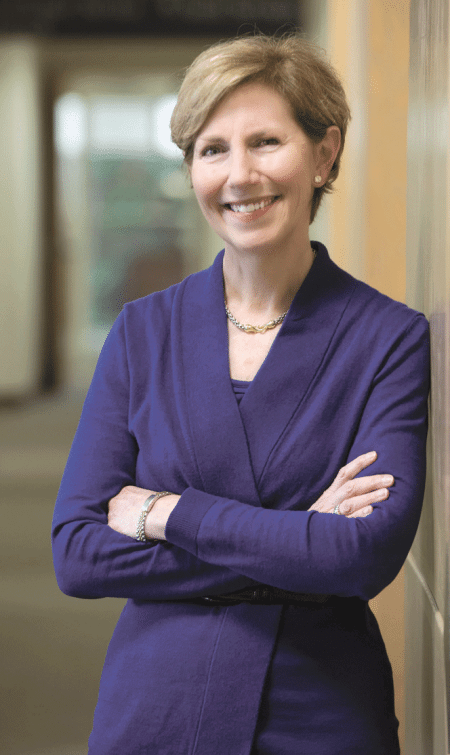
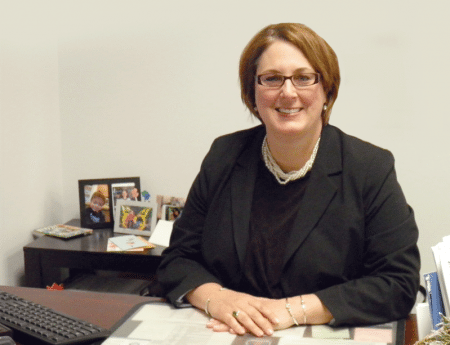
Jo-Ann Davis

Jo-Ann Davis says her office will handle matters ranging from bond financing to mergers and acquisitions to labor negotiations — and much more.

When Baystate Health administrators decided last fall to move ahead with plans to hire the system’s first chief general legal counsel, they asked Jo-Ann Davis, serving then as Baystate’s vice president of Human Resources Consulting and Employee Relations, if she would serve on the search committee that would evaluate candidates for that important post.

She agreed to take on that assignment, but not long afterward came to the conclusion that she was at least as qualified for this position, if not more so, than the applicants she would be screening.

“I started to scratch my head and say, ‘I think that I could actually do this … I’d like to throw my hat into the ring,” she told BusinessWest, adding that, by sharing this observation with those same Baystate administrators, she went from being an assessor of candidates to a candidate being assessed.

Fast-forward a few months, and Davis now has what she considers to be the best job within what would be considered the region’s legal community.

Her new business card identifies her as senior vice president and chief general counsel, which means she’s responsible for overseeing the handling of all legal matters involving a system that now includes four hospitals (Baystate Medical Center, Baystate Franklin Medical Center, Baystate Mary Lane Hospital, and Baystate Wing Hospital — with negotiations underway for a fifth, Noble Hospital in Westfield), more than 11,700 employees, and nearly $2 billion in net revenues.

This is a multi-faceted position, she said, one that involves everything from labor contracts to real-estate matters; from regulatory compliance to litigation management. She will also serve as primary legal advisor to the chief executive and the president’s cabinet, and chief legal officer to the board of trustees.

“This involves planning, overseeing, and managing all legal services for the system,” she said, reading directly from the lengthy job description that came with that business card, adding this is a professional challenge she fully embraces.

“I’m very excited about this for a lot of reasons,” she explained. “One, we need this role and function here. Two, there’s an excitement for me when it comes to building a department and starting from scratch, and as a professional woman, I’m very proud of the fact that Baystate, when it had the opportunity to hire its first senior leader and general counsel, they chose a woman for the position.”

Jo-Ann Davis says her office will handle matters ranging from bond financing to mergers and acquisitions to labor negotiations — and much more.
[/caption]Davis said one of the first items on her to-do list is to assemble a staff — one that she believes will eventually consist of several lawyers (perhaps five to eight) and several support staff, including paralegals. And before deciding the size and makeup of that staff, she said she must first itemize, if you will, the system’s legal needs and then decide how best to meet them.

Historically, the system has contracted with several area firms to handle matters ranging from bond financing (for the massive, $353 million Hospital of the Future project, for example) to mergers and acquisitions to labor negotiations. And it will continue to do so with the new general-counsel structure, although more matters will now be handled in house.

Davis said the Baystate system has long considered adopting the general-counsel model — one used by most major corporations and health systems — and new President and CEO Mark Keroack, who took the helm 11 months ago, made it one of the priorities of his administration.

“As the system grows and expands, and as healthcare and health law become increasingly complex, you need to have in-house counsel so you have that expertise at your fingertips,” she explained, adding that, while the system is expecting to lower its overall legal bills through this model, the primary motivation is to more effectively manage (that’s a word she would use often) the myriad legal services required by a system of Baystate’s size.

For this issue, BusinessWest talked at length with Davis about her new role and all that entails.

Offering Testimony

Davis began her law career in 1982 as a human-resources consultant for the Springfield-based law firm Sullivan & Hayes, where she landed after earning first a bachelor’s degree in political science at Wheaton and then a master’s in education at Harvard.

She would add a juris doctor to her educational résumé in 1988, graduating from Western New England University, and became an associate with Sullivan & Hayes that year. She made partner in 1994 and remained with the firm until 1998, when she joined Springfield-based Skoler Abbott & Presser, becoming a partner in 1999.

At Skoler Abbott, she worked with a wide range of clients, developing strategies with regard to the many aspects of employment and labor-law matters, and representing them in federal and Massachusetts courts and before such bodies as the Equal Employment Opportunity Counsel (EEOC), the Mass. Commission Againt Discrimination (MCAD), and the National Labor Relations Board. Baystate wasn’t one of her clients (although the firm did some work for it); however, the system became the next line on her résumé.

She came on board as director of Employee Relations in 2003, and became director of Human Resources Consulting and Employee relations in 2009, and vice president overseeing that department in 2012.

In those latter roles, she built, developed, and managed the department, supervising six HR directors system-wide and leading a staff of 25. She also handled the full gamut of employment and labor-related matters, including employment litigation in state and federal courts, before the EEOC, MCAD, and other bodies.

It was the breadth and depth of her experience with the system, and also in private practice, that convinced her she was capable of handling the general counsel’s role — and not merely coordinating the search for that individual — and those who did conduct that search eventually came to the same conclusion.

Indeed, Davis, who prevailed over a host of candidates from across the country, took on her new role in late March. And she’s spent the past two months undertaking that aforementioned analysis of the system’s legal needs.

“A big part of my role is to build the department,” she explained, adding that this means analyzing how much is spent (she said she was still getting her arms around the budget), where it’s spent — in business transactions or employment and labor matters, for example — and then determining what types of lawyers should be hired (meaning which aspects of the law they specialize in) as well as which work will be handled in-house and which assignments will be contracted out.

“This analysis is typical of what any general counsel’s office would do,” she went on. “You have to decide what your bread and butter is — what you can handle internally — and what is too complex and sophisticated, where you really need specialists.”

This will be an involved analysis, she continued, adding that she expects it will take several months to determine the size and character of her staff and fill those positions.

When it’s staffed and operating, she expects that the general counsel’s office will bring more efficiency to the task of managing the system’s legal matters, simply because those individuals are in house and employed by Baystate.

“I sit on the president’s cabinet, and when we meet weekly, there isn’t an issue or strategy or business imperative, or any discussion around patient care, that doesn’t involve or have legal implications,” she explained. “To have that expertise sitting at the table, in the moment, is invaluable.”

Using the Hospital of the Future as an example, she said that huge project involved everything from bond financing to regulatory compliance matters to construction issues. Outside counsel was used for each aspect of that initiative, but with the general-counsel model, many, though certainly not all, of these matters can be handled in house.

“Areas that are very sophisticated, that are not done on a day-to-day basis … you still want to contract those out,” she explained. “But things internally that we’ll be doing include general contract review, employment and labor relations, physician contracting, professional-services agreements, and much more.”

Summary Judgment

As she talked about why she left private practice and a partnership with one of the region’s leading employment-law firms to join Baystate a dozen years ago, Davis said there were many motivating factors, but primarily a desire to represent one client, not a portfolio of them.

“When you work for a private firm, a lot of it becomes marketing your own services instead of practicing law,” she explained. “I got to the point where I wanted to represent one client; you form deep relationships with that one client, and you have a vested interest in the success and opportunities of that one client.”

Today, she’s not only representing that client, but representing it as general counsel. That role represents a host of responsibilities, but a tremendous opportunity as well. “As a lawyer in this community, I have the best job,” she said.

Not bad for someone who was originally asked to weigh the candidates for that job.

Daily News

SPRINGFIELD — The Affiliated Chambers of Commerce of Greater Springfield (ACCGS), in collaboration with the Greater Chicopee, Easthampton, Holyoke, and Westfield chambers of commerce, will present a panel discussion on health-plan changes associated with the Affordable Care Act (ACA) on Tuesday, June 23 from 3 to 4 p.m. at the UMass Center at Springfield, 1500 Main St., Springfield.

Sponsored by the Regional Employment Board of Hampden County, Massachusetts Assoc. of Health Plans (MAHP) President and CEO Lora Pellegrino and Senior Vice President Eric Linzer will present “The State of the Massachusetts Marketplace.”

Despite the Commonwealth’s 2006 Health Care Reform Law serving as the model for the ACA, according to MAHP, Massachusetts faces significant challenges five years after its passage. Massachusetts employers, particularly small and mid-size companies, will need to confront significant changes to the marketplace, which, MAHP says, will have a substantial impact on health-care costs, including the expansion of the small-group market to include companies with up to 100 employers and the elimination of the state’s rating factors.

Pellegrino and Linzer will discuss the current state of the health-plan market, what the ACA changes mean for employers, how employees can address the impact of the ACA changes, how mandated benefits and other changes at the state level may exacerbate the challenges employers face, and what employers can do to get involved.

The cost is $10 for members of the participating chambers and $15 for general admission. To register, visit one of the chambers online or e-mail Kara Cavanaugh at [email protected].

Daily News

BOSTON — The New England Information Office of the U.S. Bureau of Labor Statistics has released New England and state unemployment numbers for April 2015. These data are supplied by the Local Area Unemployment Statistics (LAUS) program, which produces monthly and annual employment, unemployment, and labor-force data for U.S. Census regions and divisions, states, counties, metropolitan areas, and many cities, by place of residence. Some highlights in the release:

• The New England unemployment rate was essentially unchanged from March, at 5.0% in April. One year ago, however, the New England jobless rate was higher, at 6.1%.

• Five New England states posted jobless rates that were significantly different from the U.S. rate of 5.4%. Vermont (3.6%), New Hampshire (3.8%), Maine (4.7%), and Massachusetts (4.7%) recorded lower-than-average unemployment rates. By contrast, Connecticut (6.3%) had a jobless rate that was significantly higher than the national average in April.

• Over the past year, five New England states recorded statistically significant unemployment-rate decreases, with declines ranging from 2.0% in Rhode Island to 0.4% in Vermont.

Daily News

SPRINGFIELD — Baystate Health is announcing a reduction in its workforce in response to current fiscal challenges and changes in the provision of healthcare.

This week, 24 Baystate employees received notifications that their employment in their current positions will end in 30 days, and 17 employees are seeing their hours reduced. An additional 45 open positions at Baystate Health are being eliminated, effective immediately.

Driving the decision to eliminate these positions is a current budget shortfall of about $22 million across Baystate Health. The shortfall represents the difference between Baystate Health’s budget for the year — the financial performance required to enable the organization to reinvest in its services, facilities, and technology in the coming year — and current projections for its yearly financial results.

All the affected positions are Springfield-based, mainly at Baystate Medical Center. No bedside nurses or physicians are losing their employment. The jobs include management positions.

“We take any decision to end any person’s employment very seriously, and we regret the necessity of it,” said Nancy Shendell-Falik, chief operating officer of Baystate Medical Center. “We will do everything possible to help those affected find new opportunities, either within or outside Baystate Health.” Affected employees will receive severance pay and extension of benefits in accordance with their tenure of service, as well as job-placement assistance.

These actions are part of a multi-faceted effort to reduce costs and return the system to its budgeted operating margin, including work underway in supply chain, process improvement, energy efficiency, and other areas. Every dollar of positive margin at the end of a fiscal year is reinvested into Baystate’s facilities, technology, programs, and services. Improvements such as the renovation of operating rooms at Baystate Franklin Medical Center and construction of the MassMutual Wing and Davis Family Heart & Vascular Center at Baystate Medical Center, as well new clinical technologies and equipment and the development of new clinical programs, are funded primarily by that margin.

“Like many healthcare providers, we are facing a need to adjust our human, material, and financial resources to adapt to the rapidly changing healthcare environment,” said Shendell-Falik. “Difficult decisions such as these make it possible for us to continue to invest in the services we’re able to provide our patients, whether it’s a new program, a new or renovated facility, surgical supplies, or a CT scanner.”

Baystate Medical Center is one of the largest providers of Medicaid services in Massachusetts, and provided more than $112 million in unreimbursed care in 2014. “We are committed to providing these services in line with our charitable mission; unfortunately, the reimbursements we receive for providing Medicaid services are well short of our costs, typically between 70 and 80 cents on the dollar,” said Shendell-Falik.

Law Sections
As Effective Date Approaches, Many Questions Remain

By KARINA L. SCHRENGOHST, Esq. and OLGA SERAFIMOVA, Esq.

Many employers are struggling to roll out new policies and payroll practices that are compliant with the new Massachusetts Earned Sick Leave law by the July 1, 2015 effective date, which is fast approaching.

Karina Schrengohst

Karina Schrengohst

Olga Serafimova

Olga Serafimova

Last fall, Massachusetts voters passed a law mandating that employers provide up to 40 hours of sick leave per calendar year to their employees. Since then, employers have eagerly anticipated guidance from the Massachusetts Attorney General’s Office, which recently issued proposed regulations. Although the regulations clarify some aspects of this complex new law, ambiguities remain, and the regulations raise new questions and are subject to change after public comment. As public comment is open until June 10, the final regulations will not be issued until very close in time to the law’s effective date.

In light of this, as a compromise, Attorney General Maura Healey recently announced that employers who have a paid-time-off policy in existence as of May 1, 2015 that provides employees with at least 30 hours of paid time off during the calendar year 2015 will have until Jan. 1, 2016 to fully comply with the new law’s requirements.

In order to take advantage of this safe-harbor provision, employers must extend at least 30 hours of paid time off to all employees, and leave taken between July 1, 2015 and Dec. 31, 2015 must be job-protected and subject to the law’s non-retaliation and non-interference provisions. This means that, under the safe-harbor provision, employers would likely have to provide at least some part-time, temporary, and seasonal employees with more sick leave than they would otherwise accrue under the new law.

Consequently, practically speaking, this safe-harbor provision could potentially prove to be more costly for those employers with a significant portion of their workforce employed on a part-time, temporary, or seasonable basis.

In a nutshell, under the new sick-leave law, employers with 11 or more employees must provide paid sick leave, while employers with less than 11 employees must provide unpaid sick leave. The law broadly applies to full-time, part-time, temporary, and seasonal employees, without regard to exempt or non-exempt status, and interns.

The purposes for which employees may use sick leave are similarly broad. An employee may use sick time to care for his or her own physical or mental illness, injury, or medical condition, or to attend routine medical appointments. An employee may also take sick time to care for or attend medical appointments with his or her child, spouse, parent, or parent of a spouse. In addition, sick time may be used to address the psychological, physical, or legal effects of domestic violence committed against the employee or his or her dependent child.

When the need to take leave is foreseeable, employers may require up to seven days’ advance notice; for unforeseeable leave, employees must give notice as soon as practicable. Medical documentation supporting the need for sick leave may be required only after an employee has been absent for at least 24 consecutive work hours (for example, three eight-hour days).

The accrual rate of sick time under this new law is proving to be administratively challenging, baffling employers and payroll companies alike. Specifically, an employee accrues one hour of sick time for every 30 hours worked. For purposes of accrual, exempt employees are assumed to work 40 hours per week, unless their job specifies fewer. Although new employees begin to accrue sick time on their date of hire, they cannot use it until they have been employed for at least 90 days. Current employees begin to earn sick leave on the day the law goes into effect and are likewise not able to use it until they have been employed for 90 days. An employee may carry over up to 40 hours of accrued but unused sick leave from one year to the next. Unlike accrued vacation time, accrued sick time does not have to be paid to an employee upon separation.

Some of the provisions of the proposed regulations brought welcome news. For instance, during the transition year, employers are not required to provide more than 40 hours of paid sick leave, and any paid time off taken prior to July 1, 2015 will be credited. In addition, employers may substitute their vacation or other paid time off (PTO) policies if certain requirements are met. Also, as an administrative relief for some employers, for purposes of tracking sick-leave use and accrual, employers may select any consecutive 12-month period (i.e. calendar year, fiscal year, the year running from an employee’s anniversary date of employment).

Additionally, an employee may be required to verify in writing that he or she has used sick leave for an allowable purpose under the law after any absence. Further, where an employee’s absence from work requires his or her employer to hire a replacement, the employer may require the employee to use up to a full shift of earned sick time. In all other cases, sick-leave use must be tracked by no greater than one-hour increments.

Notably, under the proposed regulations, employees committing fraud or abusing sick leave or exhibiting a clear pattern of taking leave on days when the employee is scheduled to perform duties perceived as undesirable may be disciplined. Because there are explicit prohibitions on retaliating against employees for taking sick leave, employers would be wise to consult with employment counsel before disciplining employees based on abuse of sick leave.

In the same vein, per the proposed regulations, attendance policies that reward employees for good attendance are permissible so long as employees who exercise their rights under this law are not subject to any adverse action. Further, employers may choose to offer a payout of up to 40 hours of unused sick leave at the end of the calendar year, as long as the employee is provided at least 16 hours of sick leave at the beginning of the new calendar year.   

In light of this new law, employers will need to revise their current vacation or paid-time-off policies or create a separate sick-time policy to ensure compliance with the law.

Karina L. Schrengohst, Esq. and Olga Serafimova, Esq. are attorneys at Royal LLP, a woman-owned, boutique, management-side labor and employment law firm. Royal LLP is a certified Women’s Business Enterprise with the Massachusetts Supplier Diversity Office, the National Assoc. of Minority and Women Owned Law Firms, and the Women’s Business Enterprise National Council; (413) 586-2288; [email protected]; [email protected]

Daily News

BOSTON — The Associated Industries of Massachusetts (AIM) Business Confidence Index fell 1.8 points in May to 57.3, its second consecutive monthly decline after reaching a 10-year high in March.

“We’re up 2.5 points from last May, but coming off an upward surge from August through March, business confidence seems to have lost momentum,” said Raymond Torto, Chair of AIM’s Board of Economic Advisors (BEA) and lecturer at Harvard Graduate School of Design. “The index performed well during the first quarter of this year, when the national economy barely grew, but now it is weakening even as growth appears to be picking up.”

Torto noted that economists’ forecasts for expansion in 2015 have moderated. “Our survey does reflect lower expectations for the six months ahead. We also see lagging confidence among manufacturers, whose exports are hurt by the strong dollar, and among mid-size companies.”

AIM’s Business Confidence Index has been issued monthly since July 1991 under the oversight of the Board of Economic Advisors. Presented on a 100-point scale on which 50 is neutral, the index attained a historical high of 68.5 in 1997 and 1998; its all-time low was 33.3 in February 2009.

The sub-indices based on selected questions or respondent characteristics almost all declined from April to May, though all were up from a year before. The U.S. Index assessing national business conditions lost 3.7 points to 50.1, and Massachusetts Index of conditions within the Commonwealth was off 2.7 at 55.9.

“It is now six full years that the state indicator has led its national counterpart,” said BEA member Katherine Kiel, professor of Economics at the College of the Holy Cross. “Our state’s favorable industry mix and skilled workforce have enabled it to perform relatively well economically during a period of recovery and slow growth.”

The Current Index, tracking employers’ assessment of existing business conditions, was down 0.9 to 57.4 points, while the Future Index, measuring expectations for the next six months, lost 2.8 points to 57.1. “These results indicate that Massachusetts employers do not foresee better business conditions over the period ahead,” Kiel said. “The readings are solidly positive, but expectations for marked improvement have faded.”

Two of the three sub-indices related to survey respondents’ own companies lost ground in May: the Company Index, which assesses the situations of their own operations, was off 0.8 to 60.2 points, and the Sales Index dropped 1.7 points to 60.0. The Employment Index, meanwhile, added 0.7 to 58.0 points, “its highest reading since September 2005,” noted Michael Goodman, executive director of the Public Policy Center at UMass Dartmouth. “Employment expectations for the next six months are particularly strong, as 37% of responding employers plan to add staff, while 14% expect reductions. This compares favorably to a 23%-12% split for the past six months.”

Daily News

SPRINGFIELD — As a leading labor and employment law firm serving the Greater Springfield area, Skoler, Abbott & Presser, P.C. understands the complexities of the Earned Sick Leave Law passed by voters in November 2014 and the new ‘safe-harbor’ provision for employers, which was recently announced by state Attorney General Maura Healey.

The Earned Sick Leave Law, which goes into effect July 1, entitles employees to earn up to 40 hours of paid sick time each year if they work for businesses with 11 or more employees. Businesses with fewer than 11 employees must still provide up to 40 hours of annual sick leave, but it can be unpaid. According to a new provision announced by Healey, employers that already offer paid sick time to their employees will have until the end of the year to adjust their policies and comply with the new law.

“Employers who do not comply with the new law risk civil sanctions and lawsuits from wrongfully disciplined or terminated employees,” said John Gannon, an attorney with Skoler, Abbott & Presser. “The new provision announced by the attorney general gives businesses that already offer earned sick time to their employees more time to comply without risk of legal action.”

According to Healey’s safe-harbor provision, employers with a policy that exists as of May 1 that provides at least 30 hours of paid time off to employees for the 2015 calendar year will be in compliance with the law through Jan. 1, 2016.

“These businesses do not need to worry about providing additional paid leave or developing an accrual system under the Earned Sick Leave Law for the employees who are covered under their paid-time-off policy until the beginning of next year,” Gannon said. “However, employers cannot retaliate against or otherwise interfere with an employee who requests and/or uses available paid time off after July 1. Employer policies that were permissible before July 1 — including policies related to attendance, occurrences, notice protocol, and holiday pay — may still need to be changed prior to the law’s effective date.”

If employees are not currently covered by a paid-time-off plan, employers can amend their policies to offer 30 hours of paid time off to employees who do not currently qualify for paid leave, or they can comply with the new law by beginning accrual for other workers at the rate of one hour for every 30 hours worked, beginning July 1.

Business owners seeking assistance in understanding or complying with the Earned Sick Leave Law or safe-harbor provision may contact the employment law attorneys at Skoler, Abbott & Presser, P.C. For information, visit skoler-abbott.com or call (413) 737-4753.

Daily News

TAUNTON — Skoler, Abbott & Presser, P.C., a leading labor and employment law firm, announced that partner Susan Fentin will host a seminar for employers regarding the new Earned Sick Leave Law and other leaves of absence. The event, sponsored by FBinsure, will be held Wednesday, May 27 at the Holiday Inn, 700 Myles Standish Blvd., Taunton.

Massachusetts employers have been hit with a number of new statutes that require them to permit employees to take time off. Foremost among these is the new Earned Sick Leave Law, which goes into effect on July 1. In addition, Massachusetts has a new Parental Leave Act and a Domestic Violence Leave Act that will affect many employers, in addition to other legally mandated leaves such as Family and Medical Leave and a medical leave of absence that might be required under the Americans with Disabilities Amendments Act or parallel state law.

“The legal environment is rapidly evolving, with more labor-related rules and regulatory requirements for employers to understand,” Fentin said. “Without proper guidance and understanding, the complex responsibilities placed on employers regarding leaves of absence can leave them feeling overwhelmed. Employers need a strong understanding of their statutory obligations in order to protect themselves from inadvertent exposure to costly risks.”

Attendees will learn the basics of Massachusetts’ new Earned Sick Leave Law, what other leave laws and regulations affect company of various sizes, the responsibilities of an employer, and effective strategies to manage leaves of absence.


“Leaves of absence are among the most complicated issues for employers and employees,” said Fentin. “The new Earned Sick Leave Law will create huge headaches for Massachusetts employers. It’s critically important for employers to understand their obligations under this and other leave laws to be sure that employees get all the leave to which they are entitled and also to protect the employer from litigation. Understanding how those laws interact can help business owners make informed decisions about leaves of absence and potentially avoid costly litigation.”

Registration and breakfast begin at 8:30 a.m. The program begins at 9 a.m. and ends at noon. To register, visit fbinsure.com/seminars.

Fentin has been a partner at the firm since 2004. Her practice concentrates on labor and employment counseling, advising large and small employers on their responsibilities and obligations under state and federal employment laws, and representing employers before state and federal agencies and in court. She speaks frequently to employer groups, conducts training on avoiding problems in employment law, and teaches master classes on both the FMLA and ADA. Since 2010, she has been ranked as one of the top labor and employment attorneys in the state of Massachusetts by the prestigious Chambers USA rating firm.

Daily News

BOYLSTON — Skoler, Abbott & Presser, P.C., a leading labor and employment-law firm serving the Greater Springfield area, announced that Partner Kimberly Klimczuk will present a briefing focusing on the Massachusetts Earned Sick Leave Law on Wednesday, May 13 at the Cyprian Keyes Golf Club, 284 East Temple St., Boylston.

The program, from 9 to 11 a.m., will highlight the Massachusetts attorney general’s regulations implementing the Earned Sick Leave Law that goes into effect July 1 and how the law and the accompanying regulations will affect businesses. The program is sponsored by CMEA the Employers Assoc., a nonprofit organization established to help employers promote positive employer/employee relations.

The Earned Sick Leave Law, which entitles employees to earn up to 40 hours of paid sick time each year if they work for businesses with 11 or more employees, appeared on the November 2014 election ballot and was passed by voters. Businesses with fewer than 11 employees must still provide up to 40 hours of annual sick leave, but it can be unpaid leave.

“The proposed regulations issued by the attorney general’s office address a number of key issues regarding when and how employees may accrue and use sick leave under the law,” said Klimczuk. “Massachusetts is only the third state to pass this kind of law, and it is the most onerous in the country. It is critically important for employers to know what they are legally responsible for before it goes into effect in July.”

Registration and continental breakfast will begin at 8:45 a.m. The cost to attend is $45 for CMEA members, $60 for non-members. The program is approved for two general recertification credit hours toward PHR and SPHR recertification through the Human Resource Certification Institute. For information about certification or recertification, visit hrci.org.

Klimczuk joined Skoler, Abbott & Presser, P.C. in 2004 and concentrates her practice on labor law and employment litigation. She became a partner with the firm in 2011. She graduated from the University of Pennsylvania and received her juris doctor from Duke University School of Law. Her experience includes negotiating collective-bargaining agreements and advising on contract interpretation, and successfully defending clients in state and federal court and before administrative agencies in a variety of areas of employment law, including wage/hour law, discrimination, harassment, wrongful discharge, breach of contract, and workers’ compensation claims. In addition, she has assisted employers in compliance matters involving the Office of Federal Contract Compliance Programs and drafted numerous affirmative action plans for them. She is a frequent speaker for a wide variety of associations and organizations.

Daily News

BOSTON — The New England Information Office of the U.S. Bureau of Labor Statistics has released New England unemployment numbers for March 2015. These data are supplied by the Local Area Unemployment Statistics program, which produces monthly and annual employment, unemployment, and labor-force data for census regions and divisions, states, counties, metropolitan areas, and many cities.

Among the report highlights, the New England unemployment rate was essentially unchanged at 5.2% in March. One year ago, the New England jobless rate was higher, at 6.2%. Five New England states posted jobless rates that were significantly different from the U.S. rate of 5.5%; Vermont (3.8%), New Hampshire (3.9%), and Maine (4.8%) recorded lower-than-average unemployment rates, while Connecticut (6.4%) and Rhode Island (6.3%) had jobless rates that were significantly higher than the national average in March. Massachusetts tracked closest to the national rate.

Meanwhile, over the last year, four New England states recorded statistically significant unemployment-rate decreases, with declines ranging from 1.9% in Rhode Island to 0.6% in New Hampshire.

Daily News

NORTHAMPTON — Due to the high volume of interest, Royal LLP will present an encore of its seminar pertaining to three major changes in employment law that every employer needs to be aware of for 2015. The event will take place Thursday, May 21 from 8 to 9 a.m. at Royal LLP, 270 Pleasant St., Northampton.

This informative roundtable, led by founding partner Amy Royal, will focus on the topics of sick leave, domestic-violence leave, and paternity leave. It will also touch on the Affordable Care Act relating to healthcare reimbursement, as well as minimum wage.

The cost is $30 per person. Mail your payment, and make your check payable, to Royal LLP, 270 Pleasant St., Northampton, MA 01060. Advance registration is required, and seating will be limited. E-mail Ann-Marie Marcil at [email protected] to register or with any questions about this seminar.

Daily News

SPRINGFIELD — Skoler, Abbott & Presser, P.C., a leading labor and employment-law firm serving the Greater Springfield area, announced that partners Susan Fentin and Timothy Murphy will present a Breakfast Briefing on Friday, May 15 at Sheraton Springfield, One Monarch Place.

The event, “Your 2015 Handbook: New Developments That Employers Must Understand,” will highlight recent legal developments that have affected policies in the workplace, including the Domestic Violence Leave Act, the Parental Leave Act, the Earned Sick Leave Law, and the March memorandum from the general counsel of the National Labor Relations Board (NLRB) regarding impermissible handbook language.

“This has been quite a year for employers in Massachusetts. Beginning last August, there have been three new statutes impacting employment policies,” said Fentin. “The Earned Sick Leave Law, passed by referendum in November, is slated to go into effect on July 1, and the attorney general’s regulations on that statute were issued in April. The Breakfast Briefing will cover the statute and those regulations and their potential impact on your obligations under the law.”

In addition, Murphy noted, “the National Labor Relations Board has had employee handbooks under a microscope, finding certain, common policies to be unfair labor practices that subject an employer to liability, even if none of the employer’s workers are unionized.”

The Breakfast Briefing will focus on these new developments and will cover the policy changes required by the new laws and the NLRB. Attendees will review the handbook provisions that may need to be changed under the Earned Sick Leave Law, as well as those that have been ruled to be violations under the National Labor Relations Act. “If a handbook review is in your future — and we think it should be — you won’t want to miss this important Breakfast Briefing,” said Fentin.

The continental breakfast and registration begin at 8 a.m. The program begins at 8:30 a.m. and ends at 10 a.m. The cost of the event is $25. For more information or to register, visit www.skoler-abbott.com.

Employment Sections
Do Employers Have to Tolerate Attendance Problems Under the ADA?

By ERICA E. FLORES, Esq.

Erica Flores

Erica Flores

Today, just about any physical, mental, or emotional ailment will likely qualify as a ‘disability’ under the Americans with Disabilities Act (ADA), giving rise to a growing number of requests by employees for workplace accommodations. And, increasingly, such accommodations implicate what is perhaps the single most fundamental requirement of any job — attendance.

So how can Western Mass. employers best position themselves for potential ADA litigation when considering an employee’s request for an attendance-related accommodation? A recent decision out of the U.S. Court of Appeals for the Sixth Circuit offers some helpful guidance.

Jane Harris worked for Ford Motor Co. as a resale buyer of raw steel for auto parts. At first, her performance was strong, but it quickly began to decline, and by her final year at Ford, she ranked in the bottom 10% of her peers. Harris’s poor performance was due largely to her poor attendance, which was related to her disability — irritable bowel syndrome.

Harris disclosed her condition to her supervisor, and Ford approved a series of accommodations. First, Ford granted Harris a flexible schedule, allowing her to work four 10-hour days per week and telecommute as needed. Despite this flexibility, Harris’s attendance was irregular and unreliable, and she failed to perform the core objectives of the job.

Ford next provided Harris with workplace reporting guidelines and then allowed her to telecommute both during and after core business hours. Harris’s attendance problems continued, however, and she finally requested permission to work from home permanently up to four days per week.

In response to the request, Harris’s supervisor and two HR representatives met with her to discuss the essential functions of her position. They identified 10 different essential responsibilities and discussed her ability to accomplish each of those duties from home. Harris admitted that she could not complete four of her duties from home at all — including attending meetings with suppliers, attending internal meetings, and creating price quotes — and Ford concluded that Harris also could not effectively perform four of her other duties from home.

Accordingly, Ford denied her telecommuting request as unreasonable, but proposed two alternative accommodations — moving Harris’s workspace closer to the restroom or transferring her to a position better suited for a flexible telecommuting arrangement. Harris declined these offers and instead filed a charge of discrimination with the Equal Employment Opportunity Commission, which took up her case and filed a lawsuit against Ford on her behalf.

Ford won the case both in the district court and on appeal before the U.S. Court of Appeals for the Sixth Circuit. The court agreed with Ford that a trial was not necessary, finding that regular and predictable on-site attendance was an essential function of Harris’s job, and the accommodation she requested was unreasonable because it would have eliminated that essential function.

Although Harris disagreed that her physical presence at work was necessary, the court noted that an employee’s definition of the essential functions of her position is not valid when it is based solely on her personal viewpoint and experience. Although Ford allowed other resale buyers to telecommute, those employees telecommuted no more than one set day per week.

And, finally, there was no evidence that improved technology eliminated the need for Harris to participate in face-to-face interactions. In short, regular, on-site attendance was an essential function of Harris’s job because it was “job-related, uniformly enforced, and consistent with business necessity”; there was no accommodation available that would have allowed her to perform that essential function; and Ford had acted in good faith by maintaining an interactive dialogue with Harris and trying to accommodate her illness.

The Sixth Circuit’s opinion provides useful guidance for employers who may face requests for attendance-related accommodations.

Most importantly, employers must be able to clearly articulate the essential functions of each and every job in their workforce, including the attendance requirements. Those essential functions should be documented in written job descriptions that are provided to new employees at the time of hire and updated as job duties change.

Additionally, employers who make flexible schedules, telecommuting, or other alternative attendance arrangements available (upon request or through a policy, for example) should consider developing specific eligibility or other criteria designed to ensure that such arrangements do not impede the effective performance of the other essential functions of each position.

If employers do this homework ahead of time, they will be in a good position to handle a request for an attendance-related accommodation and will be able to better assess whether that requested accommodation is reasonable, whether it would instead eliminate an essential attendance requirement, and whether any other reasonable accommodations might be available.

Erica E. Flores is an attorney at Skoler, Abbott & Presser, P.C ., which exclusively represents management in labor and employment matters. She has successfully defended employers before state and federal courts and administrative agencies. In addition to her litigation practice, she regularly advises clients with respect to day-to-day employment issues, including decisions regarding adverse employment actions and litigation avoidance. This article is not intended as legal advice related to individual situations. If your business is facing a specific legal problem, consult your labor and employment counsel for legal advice and planning; (413) 737-4753; [email protected]

Banking and Financial Services Sections
Merchants Bank to Acquire NUVO Bank & Trust Co.

M. Dale Janes says customers won’t feel any impact when NUVO Bank & Trust becomes a subsidiary of Merchants Bank later this year — no negative impacts, anyway.

“From our point of view, this is an outstanding marriage, for us and Merchants,” Janes said of the agreement announced last week, in which Merchants plans to acquire Springfield-based NUVO for about $21.8 million in stock and cash, representing $7.15 per share.

“We’re a good bank; we’re growing, and we’re doing well,” said Janes, NUVO’s CEO, who will become regional president under the deal. “But Merchants has a wider array of products for businesses and consumers, like a trust division with investment-management options.

NUVObankLOGO“But, most importantly, we’re a small-business, mid-market lender, and this allows us to bring more capital and more loans to the community, and approach larger businesses,” he told BusinessWest. “Our legal lending limit is $3 million, and our in-house limit is $2.5 million. Their comfort level is around $20 million. That’s a big, big difference for us. They’re a great-performing bank, and they’re really good folks who understand community banking, and they want to be in Springfield and Western Mass.”

NUVO, which launched eight years ago, focuses on providing business loans, deposits, and cash-management services to small and medium-sized businesses and individuals in Western Mass. On Dec. 31, 2014, NUVO reported approximately $153 million in assets, $139 million in loans, and $134 million in deposits. Merchants had approximately $1.7 billion in total assets as of Dec. 31, 2014.

“Merchants is a 166-year-old community bank, and NUVO is not quite that old,” Geoffrey Hesslink, Merchants’ president and CEO, told BusinessWest, with more than a bit of understatement. “But it’s a very similar business. It’s a commercially oriented business, and we were impressed with their track record, impressed with their management team, and what they’ve done over the past eight years, while going through a tough economic cycle.”

When leaders of Vermont-headquartered Merchants and NUVO’s leaders, including Janes and President and Chief Loan Officer Jeffrey Sattler, sat down to discuss a possible partnership, “it occurred to us that, by joining forces, we could make NUVO, this great bank, even better, and grow it even faster in its core commercial business, but also add some ancillary business,” Hesslink continued. “It was really a cultural fit, and the management expertise was a major attractor for us — and, of course, the Springfield market has a breadth and depth that appeals to us.”

Michael Tuttle, president and CEO of Merchants Bancshares, added that the market has witnessed a great deal of change recently, but he too is impressed with the NUVO team and the growth opportunity presented by the bank’s market. “We plan to invest in and grow the NUVO team and business. While operational areas will be combined, the value created in this merger will be more attributable to revenue growth than expense reduction.”

The agreement has been approved by both institutions’ boards of directors. The closing is anticipated to occur during the fourth quarter of 2015, subject to approval by NUVO shareholders, receipt of required regulatory approvals, and other customary closing conditions.

NUVO’s chairman, Donald Chase, is expected to join the board of directors of Merchants Bank. In addition, Merchants has entered into employment agreements with Janes and Sattler. NUVO will remain a distinct brand and operate as a division of Merchants Bank.

“There is tremendous opportunity in our market, and we believe that we can best capitalize on it by leveraging the liquidity, expanded lending limits, lower-cost deposit base, and broader product range of a strong partner like Merchants,” Chase said. “Additionally, Merchants’ publicly traded stock and dividends will be attractive to our shareholders. We have admired Merchants for some time, and getting to know their team better has reinforced the fact that we share common values and a similar operating philosophy.”

While Janes becomes regional president, Sattler will be managing director and remain the bank’s chief lender in the Greater Springfield market. “But neither of us is concerned about titles,” Janes told BusinessWest. “All we’re concerned about is being able to continue to grow at a better pace, and we’re excited about that.

“There aren’t any negatives for customers,” he reiterated. “The lending team is staying in place, the leadership team is staying, and almost all the employees will be here. This is not a slash-and-burn acquisition; this is about growth.”

— Joseph Bednar

Briefcase Departments

MassDOT Awards Contract for I-91 Viaduct Project
SPRINGFIELD — The Mass. Department of Transportation has awarded a contract for the rehabilitation of the I-91 viaduct structure in Springfield to the joint venture JF White-Schiavone. The bid price submitted by the joint venture was $148,000,150, making JF White-Schiavone the lowest responsible bidder for the project. There were three bids in total. The total project cost — which, in addition to the bid price, includes railroad flaggers, traffic details, protections against cost overruns, and an incentive clause for the contractor to expedite the work — is approximately $183,325,172. The approval of the contract allows for the replacement and rehabilitation of the concrete deck, repair and replacement of the supporting steel, and major improvements to drainage and lighting. First built in the 1960s, the viaduct has experienced significant deterioration and requires frequent emergency repairs, which exacerbates traffic congestion. While a long-term solution will be determined through a corridor-planning study currently under development, this contract guarantees lower maintenance costs and a reduction in the need for emergency repairs for the next 30 years. “The I-91 project will not only address immediate regional transportation needs for the Greater Springfield community, but will also ensure reduced maintenance costs and longer serviceability over the next three decades,” said MassDOT Secretary and CEO Stephanie Pollack. Work on the project is anticipated to begin in early summer of this year and last through late February 2019, a duration of approximately three and a half years. Accelerated bridge-construction techniques will be used to reduce the number of traffic impacts and minimize disruptions to traffic flow caused by construction. The contract also provides for an incentive of $50,000 per day for each day the contractor completes the work early, up to 180 days, meaning the contractor would be eligible to receive a total of $9 million as a maximum bonus. Likewise, the contract has a disincentive clause that penalizes the contractor $50,000 for each day the work continues on past the expected point where drivers should be expected to have full use of the corridor. For the duration of the work, two travel lanes will be maintained in both directions; the on- and off-ramps within the project limits will be closed for the length of the project. Traffic seeking to access downtown streets will be diverted off I-91 before and after the project limits. The total cost for the project is being funded with 80% federal highway funding and 20% state funding. 

Grant Awarded for Façade Improvements
SPRINGFIELD — DevelopSpringfield announced it has awarded a $20,000 grant for facade improvements to 595 Main Street, the new location for Glory Inc., a family-owned South End department store. The grant is made possible under DevelopSpringfield’s Corridor Storefront Improvement Program, which provides grants of up to $10,000 per storefront for exterior improvements to first-floor businesses located on State and Main streets in Springfield. Improvements to this space included renovations to multiple storefronts. The recently awarded funds were used to create larger window openings, as well as for new signage, lighting, and doors. “DevelopSpringfield is pleased to support the Lee family in the rehabilitation of new space for their successful retail business and in helping to support the reuse of a vacant commercial building on Main Street in the South End,” said Jay Minkarah, president and CEO of DevelopSpringfield. A $7,963 grant was also recently provided to Islazul Realty, LLC to support the substantial rehabilitation of a building located at 2547 Main St. in Springfield’s North End. The project included the installation of new, large windows, as well as a door, lighting, and an awning to convert a former commercial garage into professional office space that will attract additional service businesses to the neighborhood. DevelopSpringfield’s Corridor Storefront Improvement Program was established in 2009. Funds are no longer available to support new projects except for properties located on State Street in the Mason Square area and on Main Street in the North End. For more information on the Corridor Storefront Improvement Program, go to www.developspringfield.com and click on ‘programs’ or contact Minkarah at (413) 209-8808 or [email protected].

Unemployment Rates Decline Across State
BOSTON — The state Executive Office of Labor and Workforce Development recently reported that the seasonally unadjusted unemployment rates for March were down in all 24 labor market areas over the month and over the year, according to the Bureau of Labor Statistics (BLS). During March, 12 of the 15 areas for which job estimates are published recorded seasonal job gains, one area had no change in jobs, and the remaining two areas lost jobs. The largest job gains were in the Boston-Cambridge-Newton, Worcester, Springfield, Barnstable, and Peabody-Salem-Beverly areas. Taunton-Middleborough-Norton was the only area with no change in its jobs level. Since last March, all 15 areas added jobs, with the largest percentage gains in the Lynn-Saugus-Marblehead, Barnstable, Lowell-Billerica-Chelmsford, Worcester, Lawrence-Methuen-Salem, and Peabody-Salem-Beverly areas. In order to compare the statewide rate to the local unemployment rates, BLS estimates that the statewide unadjusted unemployment rate for March was 5.0%, down 0.4% from the revised February 2015 rate. Over the year, the statewide unadjusted rate was down 1.3% from the March 2014 rate of 6.3%.

Construction Industry ‘Hits Soft Patch’
WASHINGTON, D.C. — Even as construction firms added jobs in 41 states between March 2014 and March 2015, construction employment declined in 29 states and the District of Columbia between February and March, according to an analysis of Labor Department data by Associated General Contractors of America. Association officials cautioned that ongoing D.C. gridlock over how to pay for needed infrastructure improvements and declining demand for oil-related projects likely contributed to so many states shedding construction jobs last month. “While the year-over-year data remains relatively positive, it is troubling to see so many states losing construction jobs during the past month,” said Ken Simonson, the association’s chief economist. “As energy firms cancel or delay projects and congressional action on transportation and other infrastructure measures remains stalled, many construction firms appear to be reducing headcount, at least temporarily.”
Added Stephen Sandherr, the association’s CEO, “the construction industry has clearly hit a soft patch. Passing needed infrastructure measures will certainly help keep construction employment levels from backsliding.”

Leadership Pioneer Valley Produces Positive Results
SPRINGFIELD — Leadership Pioneer Valley (LPV), now in the recruitment process for the fifth year of its 10-month leadership-development program, has seen positive results in careers and community as a result of participation in the program. LPV, working with Denny Consulting, has evaluated skills transfer, learning, and career and community impact of both program participants and alumni over the past four years. The overall satisfaction with the program has increased each year, with 100% rating the program as either ‘good’ or ‘excellent’ (54%). The LPV curriculum focuses on developing leadership skills, creating broader connections, and increasing regional understanding leading to action. Nearly all (99%) LPV participants reported having made meaningful connections with fellow participants, and 64% reported having made meaningful connections with other leaders met through opportunities provided by the program. Most participants reported statistically significant skill increases in collaboration, leading teams, creativity, confidence, managing conflict, and understanding personality types. Meanwhile, 76% of participants increased their cultural competency, and 53% of alumni have a new leadership role at work, while 29% have taken a new job with increased responsibility. Finally, 64% of alumni have joined a new board of directors, and 31% of alumni have initiated a new community project. “We are astounded to already be making such an impact in the region after only four years,” said Lora Wondolowski, executive director. “It is incredibly humbling to see the kind of changes that our alumni are making as a result of their participation in Leadership Pioneer Valley.”

State Voters Oppose Boston Olympic Bid

BOSTON — With a proposed referendum still more than 18 months away, Massachusetts voters are leaning against Boston’s bid to host the 2024 Olympic Summer Games, according to the latest survey from the Western New England University Polling Institute. The telephone survey of 427 registered voters, conducted April 6-14, found that only 40% of voters support Boston’s bid for the games, while 46% are opposed and 14% are undecided. The sample has a margin of sampling error of plus or minus five percentage points. The 427 registered voters were part of an overall sample of 499 adults, and among all adults sentiment was more closely divided; 42% of all adults support the proposal, while 43% are opposed, and 15% are undecided. The U.S. Olympic Committee has selected Boston as the nation’s entry in the competition to host the 2024 Olympic Summer Games. The International Olympic Committee is scheduled to select the host city in 2017. With other polls showing public support for the bid in decline, the private group that is developing the Olympic bid, Boston 2024, has agreed that it will not proceed with the bid unless voters approve of the idea in a statewide referendum in November 2016. Organizers also have said approval must come from voters in the Boston area in the referendum in order for the bid to go forward for consideration in 2017. The survey found a potentially ominous sign for Boston 2024 and other supporters of the bid. Voters who said they had heard a lot of information or some information about the bid were more likely to oppose it than were voters who had heard only a little or no information. Among voters who said they had heard a lot of information, 62% opposed the bid, and 27% supported it. Among those who had heard a little information, 45% supported the bid, and 39% were opposed. Among voters who said they had heard no information, 51% supported the bid, and 29% were opposed. “When you are trying to win public support for a proposal, you obviously hope your information is getting through to voters and that the information is persuasive,” said Tim Vercellotti, director of the Polling Institute and a professor of Political Science at Western New England University. “These results suggest that, as people get more information, they are less likely to support the bid. Boston 2024 appears to be losing the public-relations debate right now.”

Features
Plan for Progress Gets a 10-year Overhaul

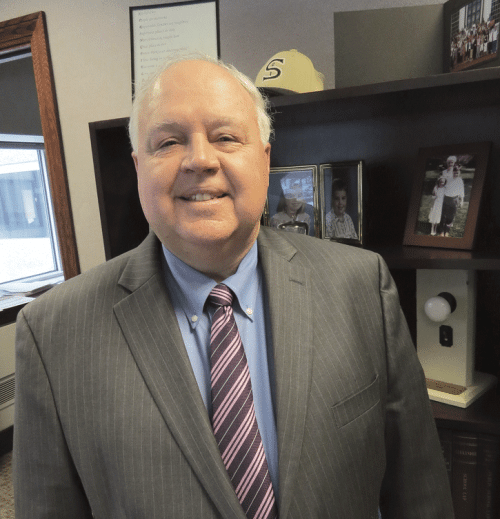
PVPC Executive Director Tim Brennan

PVPC Executive Director Tim Brennan

Tim Brennan acknowledged that it was a loose analogy, but thought it worked effectively.

He was comparing the Plan for Progress — a document first drafted two decades ago by the Pioneer Valley Planning Commission (PVPC), which he serves as executive director — to an automobile.

“They both need regular maintenance, like oil changes,” Brennan explained, noting that the plan requires periodic fine-tuning to reflect changes in everything from demographics to economic-development strategies to government funding priorities. “And they both need major engine overhauls.”

For the Plan for Progress, those overhauls come every 10 years — less-involved updates are undertaken every five — which means the one announced May 4 is the second since the document was first inked in 1994.

And it stresses a number of priorities for this region moving forward, especially the all-important matter of workforce supply and creating more of it. Many Baby Boomers have retired, and tens of millions more will do so over the next 10 years or so, said Brennan, and the task of replacing them will severely test the region and pose a significant challenge for virtually all business sectors, from healthcare to manufacturing to the huge service industry.

This isn’t exactly a news flash, Brennan acknowledged, noting that the Plan for Progress and a host of other reports have sounded the alarm on this phenomenon for more than a decade. But the situation — which was in many ways helped by the Great Recession and its impact on retirement-savings efforts, which forced many Boomers to stay in the workforce longer than they planned — will soon reach a critical stage, if it hasn’t already.

That means the region will soon have to address the matter far more aggressively, and effectively, than it has, despite all those warnings.

“On the talent side, we’re having this whoosh,” he said, using that term to describe the Boomers who have left the workforce or soon will. “Talent is job one; the most important issue for economic development isn’t tax breaks or raw materials or land — it’s really talent now.

“This has been going on for a while,” he went on. “But it’s becoming more intense, and all the projections for the next 10 to 15 years are for labor shortages. We need to intervene.”

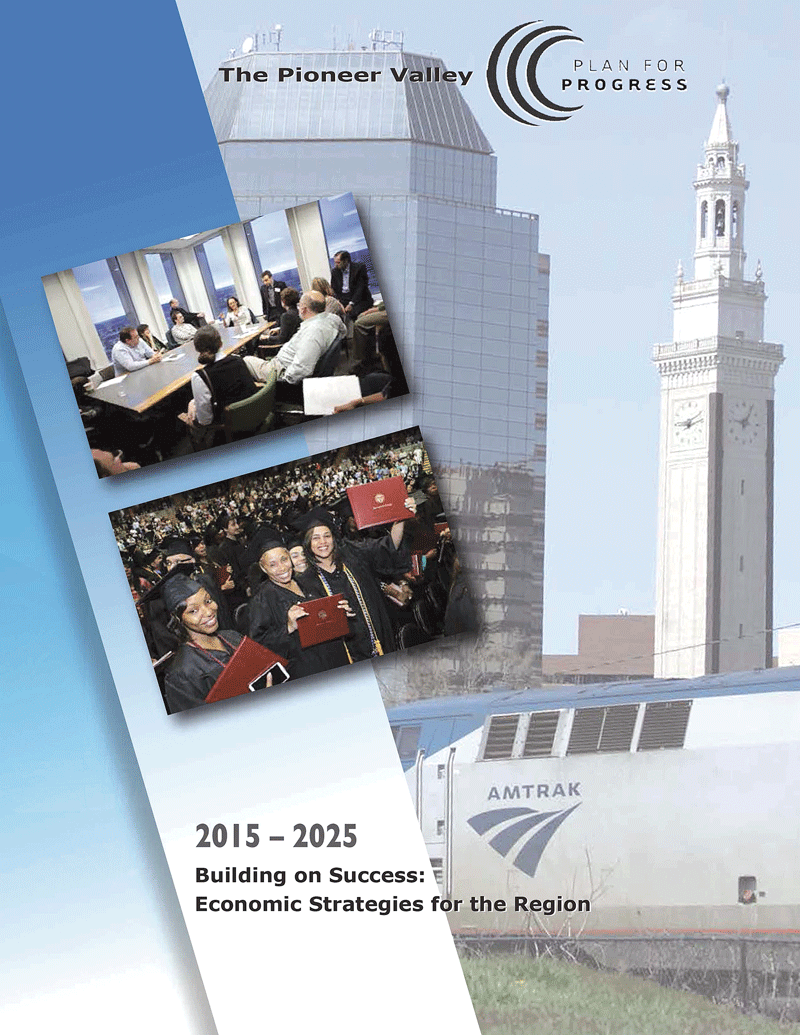
There are many other focal points, or so-called ‘decade declarations,’ within the 27-page report, titled “2015-2025: Building Strategies for the Region,” which is available for viewing at www.pvpc.org. They come in three forms — goals, key opportunities, and key challenges — and all of them are regional in scope and focus.

Improving flow in the talent pipeline obviously falls in that last category, where it is joined by “fragile infrastructure systems” and “retention and growth of existing businesses.”

The updated Plan for Progress

The updated Plan for Progress identifies a number of goals, opportunities, and challenges, all with a regional focus.

The key opportunities, meanwhile, involve “leveraging new connections that significantly enhance the region’s economic competitiveness” — a reference to everything from enhanced rail service to broadband networks; “leading the Commonwealth’s clean-energy transformation while moving the region toward a balanced and diversified energy portfolio”; and “harnessing the economic-development potential of the New England Knowledge Corridor.” That’s something Brennan says both Western Mass. and Northern Conn. have essentially failed to do since the corridor was conceptualized 15 years ago.

As for goals, well, there are four of them, which essentially encompass both those challenges and opportunities:

• Develop and maintain a globally competitive and regionally engaged talent pool;
• Foster an environment where established, new, and growing businesses and organizations can thrive;
• Implement and enhance the infrastructure that connects, sustains, and ensures the safety and resiliency of the region; and
• Conduct economic-development activities in a regionally responsible manner, prioritizing collaboration and engagement.

Of course, putting goals, challenges, and opportunities — all identified by a large Plan for Progress coordinating council over the past 16 months or so — down on paper is only one step in the process, said Brennan, adding that the report also identifies specific strategies for reaching those goals and addressing concerns.

As an example, he cited the plan’s last major overhaul, which, among other things, identified a critical need to cultivate young leadership in the region. Strategies to address that matter included creation of what came to be known as Leadership Pioneer Valley, which has created an extensive program to groom young leaders and familiarize them with the region.

Regarding the stated goal of developing a talent pool, the report recommends strategies ranging from bolstering early education to improving K-12 achievement and graduation rates, to enhancing career and workforce training initiatives.

For this issue, BusinessWest takes a look under the hood at the latest update of the Plan for Progress and the priorities it has identified.

Borderline Opportunities

Over the past 15 years, Brennan noted, the Knowledge Corridor, the region stretching from the Vermont border to New Haven, has become a brand. Just how well-recognized a brand it is, both regionally and nationally, is a subject for debate, he said, but added that it clearly hasn’t become much more than a brand.

Moving forward, however, it must do so, he went on, noting that, when it comes to economic development and attracting and retaining employers, there is obviously strength in numbers. The corridor has those, he said, citing a combined population of more than 2.7 million people. It also has more than 40 institutions of higher learning, several major healthcare providers, an international airport, and a host of other assets.

All of these must be exploited and effectively sold, he told BusinessWest, because promoting the Valley’s place in this broader region is perhaps its best hope for growth, given trends Brennan believes will only accelerate in the years and decades to come.

“That critical mass makes us the 20th-largest market in the country, and that’s not inconsequential,” he said. “Our future fortunes are tied to moving beyond this being a brand, and putting as much substance as we possibly can into this and working together.

“It’s a whole new economic ballgame out there; we have to put a different team on the field, and we’ve got to play differently than we did 10 or 20 years ago,” he said, adding that the two states and their leaders will have to put aside the parochialism that his existed historically. “Our nation is going to morph into about a dozen mega-metropolitan regions, and we need to be part of that. I remember one guy said, and I’ll never forget this, ‘you guys better watch out, or you’ll become a cul-de-sac in New England.’”

Harnessing the potential of the Knowledge Corridor is one of the opportunities identified by the report, said Brennan — and they are opportunities, he added, even if some people don’t necessarily recognize them as such. He puts the corridor, those aforementioned ‘connections’ — especially rail service — and the potential to lead the state’s clean-energy transformation firmly in that category.

Regarding rail service, which Brennan has long advocated as a potential economic engine, the emphasis moving forward must be on not only enhancing north-south connections — which have dominated the discussion and the progress made to date — but expanding east-west connections as well.

At present, there is one train a day (the Vermonter) running from Vermont to Springfield, and real potential to bring perhaps a dozen trains a day running between Springfield and New York. A Springfield-Boston connection is further from reality and will come with a hefty price tag, probably hundreds of millions of dollars, said Brennan, but there is considerable interest in one, there have been some signals of support from the Baker administration, and a 2024 Boston Olympics may provide the needed incentive to get the job done.

In the years to come, Tim Brennan says, the Knowledge Corridor must become much more than a brand.

In the years to come, Tim Brennan says, the Knowledge Corridor must become much more than a brand.

“We think this has a lot of benefit potential,” he said of rail service in any direction. “Wherever you have a place where trains land, whether it be at Union Station [in Springfield] or one of the platforms to the north, you get these sort of hotspots of development around it — a quarter-mile or half-mile around the station, you tend to get a development surge.

“If you have enough service and it’s reliable out on that rail line,” he went on, “young people and seniors tend to gravitate toward this kind of living situation more and more.”

He cited Boston as an obvious example, even with all the problems that visited the Massachusetts Bay Transportation Authority this past winter.

“We’re not arguing that we’re Boston, but we have a toehold on north-south connections to New York,” he explained. “And if we can offer good, robust, reliable service … we’re an affordable area, and people can commute from here. We think we can capture folks, and that’s one way to build the talent pool in the Valley.”

As for the movement away from fossil fuels, this could be an opportunity to create jobs, said Brennan, and also maneuver around what is becoming a growth-stifling problem with natural-gas distribution.

“I think there’s a transformation going on,” he said of what some call a nationwide trend toward greener sources of energy. “And those who lead it are going to be in a better situation to be economically competitive.

“The numbers seem to indicate that we’re a leader inside a state that’s a leader,” he went on. “So let’s keep that going.”

Going into Labor

While the report urges action on the many opportunities it identifies, the main thrust of the document is its focus on the talent pool — how to ensure there is a deep one for the years and decades to come, and the sense of urgency that must be attached to efforts to address this concern.

“One of our biggest assets in the Valley and the Knowledge Corridor is one of the most highly productive workforces in the country,” said Brennan. “But the question we’re facing is, how do we replace those men and women and keep that asset in place?

“On the supply side, we need lots of replacement troops,” he went on, adding that, while the situation hasn’t reached a critical stage (at least in some sectors) because many individuals are working longer than they anticipated a decade ago and others have embarked on what’s known as ‘soft retirement,’ where they’re still in the workforce but on a part-time basis, serious crunch time is fast approaching.

The emphasis isn’t solely on numbers, he said, adding that the accumulated talent must possess the skills required by businesses — and there will be many of them — with ‘help-wanted’ signs out. “On the demand side, you have lots of jobs that are opening, but do the bodies have the skills to fill those posts?” Brennan asked rhetorically, adding that, too often, the answer is ‘no.’ “So it’s a two-pronged problem.”

The region’s employers, not to mention workforce-related agencies such as the regional employment boards, have long recognized the existence of a skills gap, Brennan went on, and there have been efforts to address it.

Moving forward, there must be more initiatives such as Training & Workforce Options (TWO), created by Springfield Technical Community College and Holyoke Community College to assist employers with the challenge of training individuals for specific jobs, and Westfield Vocational Technical High School’s new program to train people for jobs in the aviation field.

“We need to intervene over the next decade,” said Brennan, “so that, by the end of this 2015-2025 period, we’re not wringing our hands about how we had a problem, we forecast it, and yet we didn’t do enough it to change it.”

Such intervention efforts must involve a number of players, including the workforce-development agencies and the region’s many colleges, he said, adding that the focus will be on everything from early childhood education to training and retraining those already in the workforce or on the outside looking in, to stemming the so-called brain drain.
“There’s a lot of talk about how we get more of the public and private colleges to offer internships in jobs that are in the career paths of young men and women, so they get a job as they come out with their degree,” he said, adding that the talk needs to turn to action. “The message has gotten through, but we need a lot of implementation out there to tackle this for the long term.”

But talent is only one of the issues facing area business owners and managers, said Brennan, noting that one of the updated plan’s goals is to foster an environment where established and new businesses can thrive.

Like efforts to grow the talent pool, meeting this goal will be a multi-pronged effort, he said, adding that there is a great deal of entrepreneurial energy in the region and thus a large number of startups and early-stage businesses. Likewise, there are a number of businesses led by Baby Boomers who will be retiring soon and are thus facing the many daunting issues involved with transitioning to the next generation — or deciding if there will be a transition.

These ventures will need assistance in forms ranging from capital to succession planning to, yes, talent, Brennan said, noting that the region must build on an already-significant support network.

“When we did a growth-business study with the Donahue Institute, they said the good news from the recession period was that most of the small businesses hung in there — we didn’t have an avalanche of closures; they sort of held their ground,” he explained. “And now, many of these companies are growing; what resources will they need in order to continue growing?

“Many of them need an infusion of capital, and some of them are so small that they can’t get away from the oven or the drill press to go look for help,” he went on. “We need to create ways to get information to these small businesses in a user-friendly way, and we need to make these services more seamless so they don’t have to go here for this and there for that.”

Driving Forces

Like the original Plan for Progress and the first 10-year update, this latest document is intended to serve as a road map of sorts, said Brennan, identifying preferred routes and speed bumps on the way to a more prosperous future for the Pioneer Valley.

With this latest overhaul, the region now has some directions to follow, he went on, adding that, if area leaders stay on course, they should reach the intended destination.

But the road ahead has a number of curves, he implied, and the region would be wise to heed both the speed limit and the many caution signs.

George O’Brien can be reached at [email protected]

Employment Sections
United Personnel Engages in Professional Matchmaking

UnitedPersonnelDPart
Jennifer Atwater says partnerships are at the foundation of United Personnel’s 30-year history of success.

“We don’t just put bodies in jobs; we do much more than that. We take a proactive role and partner with our customers so both they and our job seekers can meet their goals,” said the company’s vice president of operations. “Employers often tell us they need a candidate who can hit the ground running, while job candidates can be so anxious to find employment, they say they are willing to take whatever we have available.

“But it’s important for us to talk to the employer in depth to get to the bottom of what they really need,” she continued, noting that these meetings often reveal that the position the customer wants to fill entails responsibilities not included in the job title or description. “It’s also important for us to extrapolate a job candidate’s strengths from their résumé, pare them down, and make sure the work environment will be a good fit for their personality and what they want to do.”

In 1984, Mary Ellen Scott and her late husband, Jay Canavan, opened the job-placement agency in Hartford, under the moniker United Temporary Professional and Industrial Staffing. Five years later, they moved to Springfield, where they quickly were recognized for their ability to provide local companies with staffing and employment solutions. Today, the business operates in three locations — the others are in Easthampton and Pittsfield — and continues to be run by family members.

Although Jay is deceased and Mary Ellen has retired (she serves as chairman emerita of the board), their daughter Patricia is president, and daughter Andrea also sits on the board of directors.

The company’s professional job-matching service has led to a bevy of long-time and new clients who include sole proprietors that need someone part-time, manufacturers in need of temporary employees throughout the year, and businesses seeking to fill permanent positions. And United has done well despite the ebb and flow of the economy over the past three decades. Business is currently booming in its offices, which employ a total of 30 people.

“As the economy improves and things pick up, many of our customers find they need an extra pair of hands, but are not yet ready to commit to a full-time employee,” Atwater told BusinessWest, adding that, over the past year or two, the number of companies using United to fill full-time positions has risen. Overall, the company placed and paid 2,700 employees last year, and 303 were hired full-time by the businesses where they were placed.

She noted that many companies don’t have a job recruiter, and the responsibilities of advertising, sifting through résumés, and interviewing job candidates often interfere with efficient operations when added to a busy employee’s schedule.

“It can also be difficult for businesses that need temporary employees to keep pace with ever-changing employment laws,” she said, noting that United’s commitment to staying knowledgeable and keeping clients informed about changing legislation sets them apart from other job-placement agencies.

Atwater cited progressive discipline as an example, and said firing temporary employees is not as simple as it was years ago.

“The mentality toward temporary staffing has changed. In the past, if the employer didn’t like a temporary worker, they could demand that the agency find someone else. But today, more goes into the equation; we don’t want to run into a situation where an employee feels they have been treated unfairly,” she told BusinessWest, noting that United makes sure laws are followed to avoid accusations or lawsuits claiming discrimination.

Complex Formula

United Personnel has grown considerably since its early beginnings.

The agency opened a second office in Northampton in 1994, then moved to Easthampton when it outgrew its space there. However, that branch will soon move back to Northampton in a building the company purchased on Brewster Court to accommodate its increasing client load.

A third office also opened in Pittsfield three years ago after Canavan contacted area business owners and determined there was a need for their services in Berkshire County.

In addition to finding temporary workers for employers who need to fill a position for a pre-determined period of time, the agency also does ‘temp-to-hire’ placements in which they put people in temporary jobs that can lead to full-time positions.

UnitedPersonnelLOGO“It gives the person a foot in the door so they can see what the climate of the company is like, and lets the employer assess the person’s skills and see whether they can fulfill the duties they need them to accomplish,” Atwater said.

United also provides direct hires, which range from administrative assistants to executive positions such as human resource managers, chief financial officers, and sales directors. “We do all the vetting and have a wide database of candidates to choose from,” she noted. “We advertise for the positions through our website, MassLive, and social media.”

However, after a preset, limited number of candidates are selected, the customer typically conducts its own interviews and makes the final determination as to who will get the job.

And United spends a considerable amount of time with each client before they search their database to find a qualified applicant. Atwater said company representatives visit customers and speak with them at length, as well as view the environment the new employee will be working in. “It’s important because not everyone wants to be in a cubicle or at a company with more than 20 people.”

The firm also delves deeply into what the employee will need to do on a daily basis. “Companies have called us saying they need someone to answer the phone, but when we meet with them, we discover the person also needs to be able to work with Excel and Outlook. We spend a long time at their business so we can fine-tune exactly what they are looking for,” she continued.

The selection process for job candidates begins when they fill out an application. After it is reviewed, they are contacted by phone, and if United feels they can help them find employment, an interview is scheduled at one of its branches to get more information about what the person does best, their job history, and what they are seeking.

“We also look for skills that are transferable because they may be able to transition into a new industry,” said Atwater. “For example, United has had great in-house success hiring people with sales backgrounds, as our jobs are fast-paced and customer-oriented.”

After a placement is made, United continues to solicit feedback from the customer to ensure things are going well, which can be especially important in manufacturing, where a diverse range of skills can be required.

Atwater said it’s reassuring for customers to know that United’s phones are manned 24 hours a day, seven days a week, to handle any problems that might arise. A staff member is available until 9 p.m., and after that, a live answering service takes over. If a temporary employee calls in sick, they are expected to call in and notify United as well as the firm they are working for.

Atwater added that it’s important for both the employer and employee to be happy. “If someone is going to spend eight to 12 hours a day in a position, they need to like what they are doing.”

Careful Screening

The partnerships United Personnel forms extend into the community. Indeed, its employees are actively involved in nonprofit organizations, and many serve as ambassadors at their local chambers of commerce or are members of Northampton Young Professionals or the Young Professional Society of Greater Springfield.

“Every employee also has a professional-development plan which they draw up with their manager. It insures that they continue their training,” said Atwater, adding that it is critical for them to keep up with changes in employment law, such as the Right to Know Act for temporary workers, which was passed last year and requires employers to give industrial job candidates specifics in writing that include their rate of pay, work location, and job duties.

Canavan is active in at least 11 local nonprofits, and the combined efforts of her employees allow the agency to stay in tune with local workforce needs while networking and solidifying relationships.

The agency also supports organizations including Girls Inc., the Women’s Fund of Western Massachusetts, and the Berkshire Community Foundation, and has sponsored events and nonprofits including the Outlook Legislative Luncheon, Go Red for Women, Dakin Humane Society, Springfield Bright Nights, Dress for Success, DevelopSpringfield, the Springfield Public Forum, and more.

Although the groups United Personnel works with have changed over the course of three decades, its services have always been in demand.

“When the economy is poor and our customers have to lay people off, they need temporary help because they still have to produce the same amount of product,” Atwater said.

Once the economy shifts into a higher gear, however, temporary employees may be able to transition into full-time jobs. “Our job is to work with customers, figure out their needs and provide them with the most qualified job candidates,” she continued. “We want everyone we serve to be happy.”

Which involves a very specialized type of matchmaking that requires knowledge and insight far beyond the skills listed on a résumé.

Employment Sections
Recent SJC Rulings Reject Efforts to Constrain Employers

By PETER VICKERY, Esq.

Peter Vickery

Peter Vickery

In April, the State Supreme Judicial Court (SJC) issued two important employment-law decisions. In both cases, the SJC rejected arguments that would have further constrained the ability of employers to run their businesses flexibly and efficiently.

The first relates to the Tips Act (M.G.L. c. 149, §152A) and should come as good news to restaurateurs and bar owners. The second case involves the independent-contractor law (M.G.L. c. 149, §148B), and, although it concerns the highly regulated field of Boston taxi cabs, the way the SJC interpreted the statute may help businesses in other fields rebut the legal presumption that any given individual performing a service is, by default, an employee.

The case about tips, Meshna v. Scrivanos, concerned a Dunkin’ Donuts franchisee that adopted a no-tipping policy. In Massachusetts, employers have to ensure that employees receive their tips by the end of the day or in their next paycheck at the latest. Violating the Tips Act can have drastic consequences: having to pay restitution plus 12% interest, and criminal penalties ranging from hefty fines to one year’s imprisonment (for a first offense).

To avoid both potential liability under the Tips Act and the administrative costs of dividing up tips among the employees, the franchisee adopted a policy of prohibiting tips altogether. In addition to telling employees not to accept tips, the employer put up signs for customers stating “no tipping” and “thank you for not tipping.”

Prior to the Meshna case, two Superior Court justices and one federal district court had ruled no-tipping policies lawful under the Tips Act. Nevertheless, some current and former Dunkin’ Donuts employees, all of whom earned at least the minimum wage, filed suit in Superior Court alleging that the no-tipping policy violated the law.

The Tips Act provides that no employer “shall demand, request, or accept from any staff employee, service employee, or service bartender any payment or deduction from a tip or service charge given to any such staff employee, service employee, or service bartender by a patron.” The employees and the Labor Relations and Research Center at UMass Amherst (which filed an amicus brief) argued that the words ‘deduction from’ are flexible enough to mean ‘prohibit’ — i.e. no employer shall prohibit an employee from receiving a tip.

Not so, said the SJC. When it enacted the statute, the Legislature’s intent was to bar employers from deducting or retaining tips that customers had given to the waitstaff. Making it unlawful for restaurant and bar owners to keep or skim tips is not the same as forbidding employers from trying to prevent customers from tipping in the first place. A no-tipping policy simply does not violate the statute. And so long as the owner clearly communicates the policy to customers, if they still leave money behind, the servers do not have the right to claim that money as theirs. The employer is not breaking the law by keeping it or giving it away.

The take-away for employers? If you have a no-tipping policy, make sure that you get the message across to your customer clearly.

In the second case, Sebago v. Boston Cab Dispatch Inc., the issue was whether licensed Boston taxi drivers were independent contractors or the employees of the defendants (taxi-cab license owners, radio associations, and a taxi-servicing garage). Three drivers, together with the Massachusetts AFL-CIO, argued that the separate defendants really constituted one monolithic industry, a sham designed to evade the strictures of wage and overtime laws.

The SJC disagreed, holding that the various entities were not all one and the same and that “distinctions in services within the taxi-cab industry as a whole are not illusory, but quite real.”

Much of the court’s decision revolves around the municipal rule that regulates taxis in Boston, namely Police Department Rule 403, which establishes four possible business models for cabs. One permissible model allows the owners of medallions (taxi licenses) to lease their medallions to drivers at a flat rate, not a percentage of the fares. This was the model at issue in the Sebago case: the drivers paid the medallion owners a fixed amount rather than a cut of their takings.

Rule 403 requires parties using that business model to sign a City of Boston Hackney Carriage Shift Lease Agreement, which includes an optional independent-contractor clause. Under the independent-contractor clause of the city-mandated contract, the drivers are free to operate anywhere they choose, and to pick and choose which radio dispatches to accept. As the SJC noted, drivers “may lease taxicabs and medallions from whomever they wish … each day of the week, they may lease from a different owner, each using a different radio association… earn as much as they are able and need not accept a single dispatch.” Moreover, the statutes governing workers’ compensation, unemployment insurance, and income-tax withholding all exclude taxi drivers operating under flat-rate leases from the definition of ‘employee.’

Nevertheless, the plaintiffs argued that they were employees. This is because, under Massachusetts default rule, the onus is on the defendant to rebut the presumption that an individual is an employee, and this can be done only by clearing three distinct hurdles. The defendant has to prove that:

(1) the individual is free from control and direction in connection with the performance of the service, both under his contract for the performance of service and in fact;
(2) the service is performed outside the usual course of the business of the employer; and
(3) the individual is customarily engaged in an independently established trade, occupation, profession, or business of the same nature as that involved in the service performed.

The Sebago case hinged on the second factor, i.e. whether the service that the drivers provide is outside the usual course of the defendants’ business. That depends on whether the service is necessary to that business or merely incidental to it. So is taxi-driving necessary or incidental to the medallion owners’ business? Incidental, said the SJC. The medallion owners are in the business of leasing medallions, something that is “not directly dependent on the success of the drivers’ endeavors.”

At first blush, this interpretation of the term ‘usual course of the [defendant’s] business’ may appear a stretch. How can cab drivers be merely incidental to — rather than necessary to — the business of a company whose sole raison d’être is the leasing of taxi licenses? After all, without the drivers, the medallions would be worthless. In fact, this was the approach that the Superior Court judge took in denying the defendants’ motion for summary judgment.

But the SJC said that the judge’s reasoning “proves too much.” Taken to its logical conclusion, it would mean that “all lessees would be deemed presumptive employees of their lessors.” Instead, the SJC stated that the second prong (the ‘usual course of the business’) does not include all aspects of the business.

The nutshell for business owners? First, Sebago arose in a unique regulatory environment involving city-prescribed contracts governing the leasing of city-issued licenses. Second, the courts remain vigilant for Rube-Goldbergian contractual arrangements involving several legal entities designed to evade the Wage Act. But with those two caveats, business owners operating several connected but distinct entities should remember that individuals claiming to be employees rather than independent contractors must establish — and not simply assert — that the several entities are merely alter egos.

If the companies are not organized as part of a ruse but are legitimately separate, the courts will be more likely to define the ‘usual course of the business’ narrowly, to the benefit of the business owner. So, while the Massachusetts independent contractor remains an endangered species, it is not yet extinct.


Peter Vickery practices law in Amherst; (413) 549-9933; www.petervickery.com

Daily News

GREENFIELD — Skoler, Abbott & Presser, P.C., a leading labor- and employment-law firm serving the Greater Springfield area, announced that partner Susan Fentin will address attendees of the Franklin County Chamber of Commerce “Wake-Up Wednesday,” series on Wednesday, May 6 from 7:30 to 9:30 a.m. at Greenfield Community College, 270 Main St., Greenfield, first floor.

Fentin, alongside Lisa DeLisle, Human Resources director at Mayhew Steel Products and Deerfield Packaging, will discuss best practices for employers conducting job interviews.

“Employers want to make the best decisions possible when hiring new employees,” said Fentin. “It’s imperative that employers understand not only how to put their interviewee at ease, but also how to make the most of the time they have to spend with their potential new hire. I encourage both Franklin County Chamber members and non-members to take advantage of this opportunity to learn about the legal aspects of the interview process.”

Several federal and Massachusetts laws limit what employers can ask during the interview process, including questions about an applicant’s age, gender, national origin, disability, or any other questions related to a person’s protected status that are not directly related to the qualifications for the position. Fentin and DeLisle will address the entire interview process — from the time the candidate walks through the door to the extended job offer. The presentation will include the legal aspects of the interviewing process as well as provide informative, real-life examples of situations they have encountered. The presentation will conclude with a question-and-answer session for attendees to learn more.

The event is free and open to the public, but seating is limited. Coffee and light refreshments will be provided. For reservations, visit www.gcc.mass.edu/wakeup, call (413) 586-6506, or e-mail [email protected].

Fentin has been a partner at the firm since 2004. Her practice concentrates on labor and employment counseling, advising large and small employers on their responsibilities and obligations under state and federal employment laws, and representing employers before state and federal agencies and in court. She speaks frequently to employer groups, conducts training on avoiding problems in employment law, and teaches master classes on both the FMLA and ADA. Since 2010, she has been ranked as one of the top labor and employment attorneys in the state of Massachusetts by the prestigious Chambers USA rating firm.

DeLisle holds both the PHR (professional in human resources) and SHRM-CP (certified professional) designations from the Human Resources Certification Institute and the Society of Human Resources Management. She has spent the majority of her career in therapeutic education. She has spent the past three years as the director of Human Resources for Mayhew Steel Products, the global leader in punch and chisel manufacturing.

Daily News

CHICOPEE — For even the most seasoned CEOs and HR professionals, the Affordable Care Act (ACA) can seem like an unintelligible regulatory minefield in which compliance is near to impossible.

On Friday, May 15, from 11:45 a.m. to 1 p.m., management-side labor and employment attorney Meghan Sullivan, managing partner of Sullivan, Hayes & Quinn, will speak to Greater Chicopee Chamber of Commerce members about how the law works and how the ACA landmines can be disarmed so employers can better understand and comply with the ACA.

She will engage the participants so that employers will better understand the most significant ACA issues their businesses face, including measurement obligations and how employers are responding to government compliance issues.

The event will take place at Hampton Inn, 600 Memorial Dr., Chicopee. Lunch will be provided by Hamel’s Catering. For more information or to register, call (413) 594-2102 or visit www.chicopeechamber.org.

Daily News

SPRINGFIELD — Merchants Bancshares Inc., the parent company of Merchants Bank, and NUVO Bank & Trust Co. jointly announced the signing of a definitive agreement pursuant to which Merchants will acquire NUVO for approximately $21.8 million in stock and cash, which represents $7.15 per share.

Headquartered in Springfield, NUVO is focused on providing business loans, deposits, and cash-management services to small and medium-sized businesses and individuals in Western Mass. At Dec. 31, 2014, NUVO reported approximately $153 million in assets, $139 million in loans, and $134 million in deposits. Merchants had approximately $1.7 billion in total assets as of Dec. 31, 2014, with total shareholder equity of approximately $125.8 million.

“We are excited to enter the Greater Springfield market through a combination with NUVO Bank & Trust,” said Michael Tuttle, president and CEO of Merchants Bancshares. “The market has witnessed a great deal of change recently, the NUVO team is extremely experienced, and the growth opportunity is significant. We plan to invest in and grow the NUVO team and business. While operational areas will be combined, the value created in this merger will be more attributable to revenue growth than expense reduction. We look forward to welcoming the NUVO banking team to our Merchants family.”

Under the terms of the agreement, shareholders of NUVO may elect to receive either 0.2416 shares of Merchants common stock or $7.15 in cash for each share of NUVO common stock outstanding, subject to total consideration being comprised of approximately 75% stock and 25% cash. Holders of NUVO common-stock options will receive a cash payment for the difference between $7.15 and the exercise price of the option, while warrant holders of NUVO may either be cashed out in a similar fashion or receive an equivalent warrant to acquire Merchants stock. The merger price of $7.15 per share is equivalent to approximately 133% of NUVO’s tangible book value at Dec. 31, 2014 and 51.9 times NUVO’s last 12 months’ earnings.

The agreement has been approved by both institutions’ boards of directors. The closing is anticipated to occur during the fourth quarter of 2015, subject to approval by NUVO shareholders, receipt of required regulatory approvals, and other customary closing conditions. Merchants expects the transaction to be accretive to its earnings in the first full year of combined operations.

NUVO’s chairman, Donald Chase, is expected to join the boards of directors of both Merchants Bancshares Inc. and Merchants Bank. In addition, Merchants has entered into employment agreements with M. Dale Janes, NUVO’s CEO, and Jeffrey Sattler, NUVO’s president and chief loan officer. NUVO will remain a distinct brand and operate as a division of Merchants Bank.

“There is tremendous opportunity in our market, and we believe that we can best capitalize on it by leveraging the liquidity, expanded lending limits, lower-cost deposit base, and broader product range of a strong partner like Merchants,” Chase said. “Additionally, Merchants’ publicly traded stock and dividends will be attractive to our shareholders. We have admired Merchants for some time, and getting to know their team better has reinforced the fact that we share common values and a similar operating philosophy.”

Added Geoffrey Hesslink, president and CEO of Merchants Bank, “the NUVO banking team will be able to lead credit opportunities of greater size, close more aggregate volume, and fund the business at a lower cost of funds with our combined balance sheet. In addition, we will be able to provide their team additional products, including municipal banking and wealth and asset management, as well as expanded mortgage offerings, with which to serve their market while keeping their own unique operating brand.”

Daily News

Even as construction firms added jobs in 41 states between March 2014 and March 2015, construction employment declined in 29 states and the District of Columbia between February and March, according to an analysis today of Labor Department data by the Associated General Contractors of America. Association officials cautioned that ongoing D.C. gridlock over how to pay for needed infrastructure improvements and declining demand for oil-related projects likely contributed to so many states shedding construction jobs last month. “While the year-over-year data remains relatively positive, it is troubling to see so many states losing construction jobs during the past month,” said Ken Simonson, the association’s chief economist. “As energy firms cancel or delay projects and Congressional action on transportation and other infrastructure measures remains stalled, many construction firms appear to be reducing headcount, at least temporarily.” 

California added more new construction jobs (46,300 jobs, 6.9%) between March 2014 and March 2015 than any other state. Other states adding a high number of new construction jobs for the past 12 months included Texas (39,300 jobs, 6.2%), Florida (37,400 jobs, 9.7%), Washington (18,900 jobs, 12.1%) and Illinois (16,600 jobs, 8.4%). Idaho (14.8%, 4,800 jobs) added the highest percentage of new construction jobs during the past year, followed by North Dakota (12.1%, 4,000 jobs), Washington and Colorado (10.4%, 14,500 jobs). Nine states shed construction jobs during the past 12 months while construction employment was unchanged in D.C. West Virginia (-2,400 jobs, -7.2%) and Mississippi (-2,400 jobs, -4.7%) were tied for the most construction jobs lost. Other states that lost a high number of construction jobs for the year were Indiana (-1,900 jobs, -1.6%), Ohio (-1,400 jobs, -0.7%) and Nebraska (-600 jobs, -1.6%.) 

Texas (-5,800 jobs, -0.9%) lost the most construction jobs between February and March. Other states experiencing large monthly declines in total construction employment included Ohio (-4,500 jobs, -2.3%), Kentucky (-4,100 jobs, -5.4%), Georgia (-3,500 jobs, -2.2%) and Arkansas (-3,400 jobs, -6.9%). Arkansas lost the highest percent of construction jobs, followed by Kentucky, West Virginia (-4.3%, -1,400 jobs) and New Mexico (-3.0%, -1,300 jobs). “The construction industry has clearly hit a soft patch,” said Stephen E. Sandherr, the association’s chief executive officer. “Passing needed infrastructure measures will certainly help keep construction employment levels from backsliding.”

Briefcase Departments

Rapid Population Growth in State to Continue
HADLEY — Newly updated population projections by the UMass Donahue Institute say recent growth in the state’s population will be sustained through 2015, with the rate then slowing through 2035. The newly released report, “Long-term Population Projections for Massachusetts Regions and Municipalities,” was developed by researchers at the UMass Donahue Institute’s (UMDI) Population Estimates Program and Dr. Henry Renski, associate professor of Regional Planning and director for the UMass Center for Economic Development at UMass Amherst. It provides detailed projections, or expected populations, at five-year intervals through 2035 by age and sex for all Massachusetts cities and towns and eight distinct Massachusetts regions. This 2015 series updates the last set released by UMDI in 2013. The study, produced with support from Mass. Secretary of the Commonwealth William Galvin, forecasts 11.8% growth in state’s population from 2010 to 2035, with population increasing by 771,840 over the 25-year term to a new total of 7,319,469. “Massachusetts has been growing very rapidly in the past few years”, said Susan Strate, Population Estimates Program manager. “It’s been growing more than twice as fast as the Northeast average, and twice as fast as it had between Census 2000 and 2010 on average. The new projections pick up on this recent, rapid growth before the natural forces of an aging population eventually start to slow things down.” Among the study’s most significant findings, the population aged 65 and over will almost double in 25 years, increasing from 902,724 in 2010 to 1,679,917 by 2035 — changing from 14% of the state’s total population to 23% by 2035. At the opposite end, the population aged 19 and under is expected to decrease by 57,000 people, changing from 25% of the state population to just 21% by 2035. Some areas of the state — including the Greater Boston, MetroWest, and Central regions — are predicted to grow at rates well above the state average, while others, including regions in Western Mass., will experience only slow growth. The Cape Cod region is expected to lose resident population if recent trends in migration, fertility, and mortality continue. This projection series picks up on the recent, rapid growth experienced in Massachusetts through 2014, estimated at 3% cumulatively since the 2010 Census and averaging 0.7%, or 46,492 persons per year, according to U.S. Census estimates. According to UMDI projections, growth will be sustained at this rate through 2015, adding about 245,000 persons in the first five-year period, and then gradually diminish over time, slowing to 0.2% annual growth from 2030 to 2035. By comparison, Massachusetts grew by 3.1% cumulatively in the 10 years from 2000 to 2010.

State Announces $1 Million Expansion of AgEnergy Grants
BOSTON — Gov. Charlie Baker announced that Massachusetts farmers will soon be able to apply to the expanded Department of Agricultural Resources (MDAR) AgEnergy Grant Program, thanks to new funding from the Department of Energy Resources (DOER). As a result of the efforts of Energy and Environmental Affairs Secretary Matt Beaton, DOER Acting Commissioner Dan Burgess, and MDAR Commissioner John Lebeaux, DOER will provide $1 million to support a two-year expansion of the existing AgEnergy Grant Program. “A vibrant agricultural community in Massachusetts is essential to building healthy communities and a stronger economy across the Commonwealth,” said Baker. “As we celebrate the impact agriculture brings to our economy and history today, the expansion of the AgEnergy grants will help our Commonwealth’s farmers address their energy needs and increase their future opportunities for competitiveness in the global marketplace.” Added Beaton, “the AgEnergy Grant Program is an important part of keeping Massachusetts farms operational and competitive, while ensuring safe, long-term local food production.” The AgEnergy initiative is an annual competitive program for Massachusetts agricultural operations seeking funds to build energy projects to improve energy efficiency and facilitate adoption of alternative clean-energy technologies. By implementing these projects, agricultural operations can become more sustainable, and the Commonwealth can maximize the environmental and economic benefits from these technologies. “Supporting local agricultural operations through clean-energy investments and equipment upgrades is beneficial for the Commonwealth’s farmers, local consumers, and our clean-energy industry,” Burgess noted. Since its inception in 2009, the AgEnergy program has helped 156 farms build a variety of energy-efficiency and renewable-energy projects, providing funding of more than $2.2 million toward $12.3 million in total project-construction costs, achieving more than $900,000 in either annual energy savings or energy generation. Projects have included installations of variable-speed-drive vacuum pumps and heat recovery for dairy operations; thermal curtains, biomass boilers, and high-efficiency heaters for greenhouses; cold storage and high-efficiency refrigeration for vegetable farms and orchards; high-efficiency arches, heat-recovery, and reverse-osmosis equipment for maple-syrup operations; anaerobic digesters; and a variety of photovoltaic projects for all farming sectors. “These new funds will provide a tremendous boost toward strengthening MDAR’s resources and our ability to serve the Massachusetts’ farm community in its own efforts to become more sustainable in their energy use and choice,” Lebeaux said.

Unemployment Holds Steady in New England
BOSTON — The New England Information Office of the U.S. Bureau of Labor Statistics (BLS) has released New England and state unemployment numbers for February 2015. These statistics are supplied by the Local Area Unemployment Statistics (LAUS) program, which produces monthly and annual employment, unemployment, and labor-force data. Among the key points, the New England unemployment rate was unchanged at 5.3% in February. One year ago, the New England jobless rate was higher, at 6.3%. Four New England states posted jobless rates that were significantly different from the U.S. rate of 5.5%. New Hampshire and Vermont (3.9% each) recorded lower-than-average unemployment rates. In contrast, Connecticut (6.4%) and Rhode Island (6.3%) had jobless rates that were significantly higher than the national average in February.

Departments People on the Move

Anne Paradis

Anne Paradis

The Professional Women’s Chamber (PWC) announced that Anne Paradis, Chief Executive Officer for MicroTek Inc. in Chicopee, has been named the PWC 2015 Woman of the Year. The award, given annually since 1954, is presented to a woman in the Western Mass. area who exemplifies outstanding leadership, professional accomplishment, and service to the community. A celebration in Paradis’s honor will be held on May 19 at 5:30 p.m. at the Carriage House, Storrowton Tavern in West Springfield. “We are thrilled with this year’s honoree — a truly inspiring and accomplished woman like Anne Paradis,” said Janet Casey, PWC board president. “She is a domestic trailblazer among women in the high-tech industry, and the opportunity that she has provided to people with disabilities speaks so deeply to her sense of compassion. Her achievements are spectacular and her generosity admirable.” Microtek was founded in 1983 with the mission of integrating individuals with disabilities into the workforce. The company provides custom cable and wire configurations, control panels, and enclosures for customers in the medical equipment, scientific test and instrumentation, life sciences, industrial, and retail industries. Paradis was tapped to lead the organization in 1987. Under her guidance, the company has grown an average of 15% each year, expanded its product lines and client base, and created more than 80 jobs. As well, Paradis has led the organization through construction of a new 22,000-square-foot manufacturing facility, obtained industry certifications as well as ISO 9001:2008 and ISO 13485:2003 registrations, and has been awarded the Massachusetts quality-of-service certification with distinction for employment services every year since 1996. Prior to joining MicroTek, Paradis served as a management and training consultant, served as the marketing director and employment design specialist for New England Business Associates, and spent nearly 10 years in the mental-health field. She is a member of the Baystate Health board of trustees and vice chair of its audit committee, past president of the Women’s Fund of Western Massachusetts board of directors, corporator of the Wentworth Institute of Technology, and former president of the National Assoc. of Supported Work Organizations board of directors. She also served on the reference services advisory board for UMass and the electronic advisory committee for Chicopee Comprehensive High School. She is also active in the Social Enterprise Alliance, the Wire Harness Manufacturer’s Assoc., the Women Presidents’ Organization, and the Human Right Campaign, and in 2009 was named to the 21st Century Women Business Leaders Hall of Fame at Bay Path University. Tickets for the May 19 celebration, sponsored by BusinessWest, are $55. To register, visit www.myonlinechamber.com or e-mail [email protected].
•••••
Paul Kleschick

Paul Kleschick

Paul Kleschick has joined American International College (AIC) as its new Registrar. Kleschick recently performed consulting work for a variety of colleges and universities. Prior to working as a consultant, he was registrar at St. Joseph’s University in Philadelphia. He previously served as the associate registrar at Georgetown University and Temple University. Kleschick graduated from Cabrini College in Pennsylvania with a bachelor’s degree in biology. He earned his master’s degree from Temple University and his MBA from Philadelphia University.
•••••
Melinda Graulau

Melinda Graulau

The Affiliated Chambers of Commerce of Greater Springfield announced that Eastfield Mall and Auburn Crossing General Manager Melinda Graulau has been chosen as its 2015 recipient of the Leadership Community Service Award. The award will be presented at the Leadership 2015 graduation ceremonies on April 16 at the Springfield Sheraton. Leadership 2015 is a unique collaboration between the ACCGS and Western New England University (WNEU) to teach middle- and upper-level managers the crucial thinking and problem-solving skills needed to prepare participants to be effective leaders in service to the community and their workplaces. Since 1990, the award has been presented annually to a citizen or organization that exemplifies the program’s values of leadership in the workplace and in the world and a commitment to community service. A 2012 graduate of the program, Graulau moved to Western Mass. in 2009 to take on the role of general manager at the two shopping malls for Mountain Development Corp. She leads a team of 40 and is responsible for temporary and permanent leasing, expense control, personnel development, contract negotiations, and community relations.
•••••
J. Polep announced the promotion of Adam Kramer to vice president of Purchasing and Food Service. Kramer has been with J. Polep since 2006, most recently as director of Food Service. Over the past nine years, he has also been a field sales representative, district manager, and president of Grote & Weigel (a division of J. Polep).
•••••
Country Bank’s annual meeting was held at the Worcester Art Museum last month. The evening’s agenda included the election of trustees, corporators, and officers, as well as a report of 2014 highlights and financials. The 10 new incorporators are: Dr. Mohammed Ahmed, Sheila Cuddy, Brian D’Andrea, Robert Dik, Mary Falardeau, Janice Kucewicz, Lauren Miller, Timothy Murray, James Paugh III, and Richard Poissant.
•••••
The Westfield-based engineering firm Tighe & Bond announced the following:
Christina Jones

Christina Jones

The American Council of Engineering Companies of Massachusetts (ACEC/MA) named Christina Jones, a project engineer in the company’s Westfield office, the recipient of the 2014 ACEC/MA Young Professional of the Year Award. The recognition took place during ACEC/MA’s Engineering Excellence and Awards Gala on March 18 at the Royal Sonesta Hotel in Cambridge. Each year, this competitive award recognizes the accomplishments of one engineer, 30 years old or younger, based on their work and its societal impact. Jones, who is a licensed engineer in Massachusetts, was recognized for achieving significant successes within just five years of launching her civil- and environmental-engineering career. For the city of Chicopee, she provided construction administration and observation, research, and analysis for the first paving project in Massachusetts to implement cutting-edge intelligent-compaction technology. The result was a more streamlined, cost-efficient paving process, and better-quality pavement that is slated to have a longer life. Jones is also developing an integrated management plan for Chicopee, which will include working with regulators to advance green infrastructure as an alternative approach to separating combined sewer overflows. In addition, she is developing a unidirectional flushing plan for cleaning water-distribution pipes that will improve water quality and pressure throughout Chicopee. For two of Connecticut’s major water suppliers, Jones has developed hydraulic models of critical water reservoirs to assess the impact of new fish-habitat-friendly stream-flow regulations on reservoir management. This research enabled her to assist with reservoir-management decisions. Jones earned her bachelor’s degree in civil engineering and environmental engineering, as well as her master’s degree in environmental engineering, from UMass Amherst. Her professional affiliations include the American Water Works Assoc., the New England Water Works Assoc. (where she is a programs committee member), and Engineers without Borders. She also previously served as a student activities committee member for the New England Water Environment Assoc; and
Michael Toto

Michael Toto

Michael Toto has been hired to manage the company’s mechanical, electrical, and plumbing (MEP) team. A senior electrical engineer with more than 21 years of experience, Toto has managed a wide range of commercial, industrial, and institutional engineering projects. He has provided engineering services to numerous well-known industry giants and prominent institutions. His expertise includes the study, design, permitting, construction management, construction administration, and startup of numerous building and infrastructure facilities. His portfolio of projects includes all phases of engineering for electrical infrastructure. As a project manager, he has led many project teams during various phases of projects simultaneously, and has been the leader on several jobs with multiple owners during his professional experience. Toto earned his bachelor’s degree in electrical power engineering from Rensselaer Polytechnic Institute. His professional affiliations include the Institute of Electrical and Electronics Engineers Power Engineering Society, the National Fire Protection Assoc., the Illuminating Engineering Society of North America, and the Assoc. of Energy Engineers.
•••••
The regional law firm Bacon Wilson, P.C. announced that Attorney Kenneth Albano was recently appointed to the board of directors of the New England Chapter of the March of Dimes. Albano is also currently serving a second term as board chair of Massachusetts’ Western Division Chapter. The March of Dimes is a national organization whose primary mission is to reduce birth defects, premature birth, and infant mortality. Upon learning of his appointment to the New England Board, Albano noted that “I am very pleased to continue my service to the important mission of the March of Dimes. The good work of the March of Dimes improves the health of Massachusetts babies and provides support to their families.” Albano is a senior partner with Bacon Wilson and a member of the firm’s corporate, commercial, and municipal practice groups. Bacon Wilson is one of the largest firms in Western Mass., with a total of 40 lawyers and approximately 60 paralegals, assistants, and support staff.
•••••
Beloved Earth, the Pioneer Valley’s first ‘green’ cleaning company, hired Andrew Sbrega of Chicopee as its first residential services manager for Hampden County. Over the past four years, Sbrega worked for Tropical Smoothies in Holyoke and oversaw a team of employees while keeping the shop space clean and building customer relations. Beloved Earth owner Terra Missildine said Sbrega’s leadership experience will positively influence his work as a services manager. As a residential services manager, Sbrega will oversee a cleaning team designated to the Springfield area. Since beginning the position in January, Sbrega has gained residential and office clients in West Springfield and Longmeadow. He and Missildine are currently in the process of hiring Sbrega’s team. Beloved Earth’s current teams focus on clients in Hampshire County and book an average of 250 hours of cleaning per week. Missildine wants to expand into Hampden County, and she sees Sbrega as an ideal leader to begin that outreach. “Andrew is committed to green living. He really walks the walk,” she said.
•••••
The Dowd Insurance Agencies announced that Nadine West has joined the organization as a commercial-lines account manager. “We are very excited to have Nadine join our team of insurance professionals,” said John Dowd Jr., president and CEO of the Dowd Insurance Agencies. “She has a great deal of industry experience and brings a lot of enthusiasm for customer service.” West has been specializing in property and casualty insurance since 1998. She is a licensed property and casualty producer and holds the Certified Insurance Service Representative designation. Prior to joining Dowd, West was employed by Borawski Insurance of Northampton. As a commercial-lines account manager, West will manage a roster of insurance clients at Dowd’s Holyoke office and support producers with business-development initiatives. She has a strong focus on customer service and is dedicated to continuing education opportunities as the industry advances. “I consistently challenge myself to stay on top of industry trends and learn all I can about my competitors and carriers to strengthen my industry relationships,” said West. “I have extensive training in sales, management, and customer service, and I look forward to applying these skills for the benefit of our customers at the Dowd Insurance Agencies.”
•••••
Jonathan Soucy

Jonathan Soucy

Molding Business Services (MBS) announced it has taken on a new partner, Jonathan Soucy of Plymouth. He joins forces with partners Terry Minnick, Joel Minnick, and Andrew Munson, and will help bolster the firm’s M&A advisory and recruiting efforts. Soucy has more than 25 years of experience in precision injection molding and manufacturing. He holds a bachelor’s degree in plastics engineering UMass Lowell and an MBA from Suffolk University. For the past six years, Soucy served as the CEO of Plainfield Precision, a multi-national manufacturer of injection-molded components, metal stampings, and complex assemblies. During his tenure with Plainfield, he led a corporate-wide turnaround, developed and executed a strategic plan to build value, and successfully sold the various Plainfield companies to maximize shareholder return. Soucy’s move to MBS coincides with a Jan. 30 transaction that saw Plainfield Precision sell its final production facility — a precision automotive injection molder in San Luis Potosi, Mexico — to the U.S. subsidiaries of Nissha Printing Co. Ltd. Based in Japan, Nissha is a global manufacturer of printed films and owns Eimo Technologies, a Michigan-based manufacturer of decorative, injection-molded components. MBS advised Plainfield in the transaction. Soucy also spent nearly two decades with a Plainfield predecessor company called Pixley Richards. Pixley was a custom plastic-injection-molding company specializing in tight-tolerance parts. During his tenure there, Soucy held various roles in engineering and operations management until eventually leading a management buyout of the company and assuming the role of owner and CEO.
•••••
The Springfield Falcons announced that Corey Cowick has been named the team’s winner of the IOA/American Specialty AHL Man of the Year Award for his outstanding contributions to the Springfield community during the 2014-15 season. The Falcons’ left winger has gone above and beyond with his efforts to give back to the community. He constantly takes part in appearances and volunteer opportunities, meeting fans and doing his part to help improve the local area. The Falcons have a strong dedication to bettering quality of life in the Springfield community by promoting awareness of education, exercise, and health along with donating time and resources. Cowick has been at the forefront of these initiatives, making countless appearances in schools, libraries, and community centers. He became the main speaker for the Falcons’ Stick to Reading program presented by Columbia Gas of Massachusetts, the Teamwork program presented by TD Bank, and the Play It Forward program. Cowick has spoken to numerous students and young fans around the Greater Springfield area about the importance of literacy, ways to stay active and lead a healthy lifestyle, and the qualities of leadership and anti-bullying. Cowick also frequented Friends of the Homeless and served meals to clients along with personally donating winter and toiletry items during the holidays. He visited patients at Shriners Hospitals for Children and donated his time to answer phones at the 14th Annual 94.7 WMAS Radiothon for Baystate Children’s Hospital. He also participated in the sale of team-signed ornaments and green mystery pucks with proceeds donated to Toys for Tots and Baystate Children’s Hospital, respectively. Additionally, Cowick visited the Pioneer Valley PSO, where he visited with military families and spent a great deal of time conversing and getting to know each family. Cowick is now one of 30 finalists for the American Hockey League’s 2014-15 Yanick Dupre Memorial Award, honoring the overall IOA/American Specialty AHL Man of the Year. The league award is named after the former Hershey Bears forward and AHL All-Star who died in 1997 following a 16-month battle with leukemia. The winner of the Yanick Dupre Memorial Award will be announced by the AHL later this month.
•••••
Florence Bank announced that Stephen Bourgeois Jr. of Amherst has been named to the President’s Club for 2015. The President’s Club affords employees opportunities to nominate their peers for the honor, which recognizes superior performance, customer service, and overall contribution to Florence Bank. Bourgeois was nominated by numerous colleagues at Florence Bank. He is a senior teller and customer-service representative at the bank’s King Street office, and joined the bank in 2012. John Heaps Jr., president and CEO of Florence Bank, said, “we received so many comments about Stephen — everything from ‘he is the first to volunteer to take on projects or help in any way’ to ‘he maintains the perfect balance of professionalism and friendliness with our customers.’ His commendable work ethic and genuine desire to contribute make Stephen an outstanding member of the President’s Club.”
•••••
Dr. Laura Iglesias Lino

Dr. Laura Iglesias Lino

Praised for her leadership and for using her skills in geriatrics and palliative care to help Spanish-speaking and other immigrant populations in Springfield, Dr. Laura Iglesias Lino has been named a recipient of the 2015 Hastings Center Cunniff-Dixon Physician Award. Iglesias Lino, medical director for Geriatrics and Palliative Care at Baystate Brightwood Health Center/Centro de Salud and associate medical director for Hospice at Baystate Medical Center, is one of five physicians nationwide recognized with the award. The awards program honors leaders who advance palliative care in underserved areas and forge ties with various medical specialists to help people with cancer. “This cohort of physicians demonstrates that compassion, competency, and a healing presence are cherished by patients and their families and admired and respected by their colleagues,” said Dr. Richard Payne, chairman of the selection committee and the Esther Colliflower Professor of Medicine and Divinity at Duke University and the John B. Francis Chair in Bioethics at the Center for Practical Bioethics. “The awards will make a difference for their careers, and will assist them in building palliative-care programs in their communities.” Each of the five recipients was noted as being exemplary in one or more of four areas: medical practice, teaching, research, and community. Awards were made in three categories: senior, mid-career, and early-career. Recognized in the early-career category, Iglesias Lino will receive $15,000 to further her work in palliative care in Springfield. “Although I was her teacher and am decades older, I hope to match her dedication to patients one day,” said Dr. Maura Brennan, chief of the Division of Geriatrics, Palliative Care & Post-acute Medicine at Baystate Medical Center, and hospice medical director for the Baystate Visiting Nurse Assoc. & Hospice. “Dr. Iglesias Lino has an unassuming, gentle nature and is more likely to design programs for patents in need than write scholarly articles for publication. She has a beautiful soul and is precisely the type of physician our aging society needs. Dr. Iglesias Lino combines the best parts of a geriatrician and a palliative-care physician and is eminently worthy of this prestigious award.” Iglesias Lino received her medical degree from the Universidad Nacional San Agustin de Arequipa in Peru. She completed her internal medicine residency at St. Luke’s Roosevelt Hospital/Columbia University College of Physicians and Surgeons in New York, followed by a geriatrics fellowship at Baystate Medical Center. She is board-certified in both geriatrics and palliative care. While at Baystate Brightwood Health Center, Iglesias Lino has developed a team-based program to ease caregiver stress and provide quality of life for patients with advanced dementias. Her knowledge and diagnostic abilities put her in high demand as a physician and consultant. Her teaching and caregiving skills have generated culture change in a clinic with little previous experience in geriatric or palliative care. The Cunniff-Dixon Foundation, whose mission is to enrich the doctor-patient relationship near the end of life, funds the awards. The Hastings Center, a bioethics research institute that has done groundbreaking work on end-of-life decision-making, co-sponsors the awards. Duke University Divinity School’s Program in Medicine, Theology, and Culture oversees the selection process.

Agenda Departments

CPE Forum
April 21 to June 2: The Continuing Professional Education Forum, held at the Westfield Athenaeum, has announced its seven-week spring series. All programs are three hours in length and start at 3 p.m. on the following Tuesdays:
• April 21: “The Dollars and Cents of Divorce,” Attorney Julie Dialessi-Lafley, Bacon Wilson;
• April 28: “Social Security Questions Answered,” Tim Flynn, Edward Jones;
• May 5: “Dealing with IRS Collection Division,” Attorney Eric Green, Green & Sklarz;
• May 12: “Income T’s: Today, Tomorrow, and Taxes,” Garry Heiney, Income & Wealth Advisors;
• May 19: “Why Are We Afraid to Invest?” Michael Callahan, Retirement Plan Advisory Services;
• May 26: “Exchange-traded Funds in Retirement Planning,” Michael Callahan, Retirement Advisory Plan Services; and
• June 2: “Massachusetts Employment-law Update,” Attorney Karina Schrengohost, Royal LLP.
The CPE Forum was established in 1980 by Josephine Sarnelli, CPA. She continues to volunteer her services in organizing 40 hours of educational programming each year. “The CPE Forum’s mission is to provide high-quality educational programs at a low cost to business professionals, including certified public accountants, enrolled agents, and others seeking continuing professional educational credits for licensing purposes,” she said. “It is also open to the general community.” The cost of attending the entire series is $50, which provides 21 hours of continuing professional education (CPE) credits. “Besides being an incredible value, the CPE Forum offers a place for business professionals to meet, exchange ideas, and network,” Sarnelli added. All sessions are held at Lang Auditorium at the Westfield Athenaeum, 6 Elm St., Westfield. Payment is due at the time of attending. For more information, visit www.cpeforum.org or call (413) 746-9067.

Elevator-pitch Contest
April 22: Six local community banks will sponsor a live elevator-pitch competition at the 12th annual awards banquet for the Harold Grinspoon Charitable Foundation’s Entrepreneurship Initiative. Representatives from each institution — Berkshire Bank, Country Bank for Savings, First Niagara Bank, PeoplesBank, United Bank, and Westfield Bank — will also serve as judges at the annual event at the Log Cabin in Holyoke. An elevator pitch is an overview of an idea for a new business. The name reflects the fact that an elevator pitch can be delivered in the time span of an elevator ride. The term is used when an entrepreneur pitches an idea to a venture capitalist to receive funding. The competition will feature a student representative from each of the participating local colleges: American International College, Amherst College, Bay Path University, Elms College, Greenfield Community College, Hampshire College, Holyoke Community College, Mount Holyoke College, Smith College, Springfield College, Springfield Technical Community College, UMass Amherst, Western New England University, and Westfield State University. The judges will pick the top three students, who will receive cash awards, with the winner receiving $1,000. Other features of the banquet include keynote speaker Aaron St. John, co-founder and CEO of Springfield-based HitPoint; entrepreneur and awardee exhibits featuring 76 student entrepreneurs from area colleges; and recognition of the Grinspoon, Garvey & Young Alumni Award winner, Bill Goldfarb of Lefty’s Brewery. For more information about the Harold Grinspoon Charitable Foundation, visit hgf.org or contact Cari Carpenter at (413) 335-3535 or [email protected].

Springfield Restaurant Week
April 23 to May 2: The Springfield City Council’s young professionals subcommittee, partnered with the Springfield Business Improvement District (BID), will serve up mouth-watering meals during Springfield Restaurant Week 2015. Many downtown and riverfront restaurants are featured in this event, including Chef Wayne’s Big Mamou, Currents (Marriott), Champions (Marriott), Luxe Burger Bar, Nadim’s Mediterranean, Panjabi Tadka, PICKS/MVP (Sheraton), Plan B Burger, the Fort/Student Prince, Theodore’s, Pizzeria Uno, Adolfo’s, McCaffrey’s Public House, Blackjack Steakhouse, and Shakago. Each restaurant will offer a special two- or three-course dinner menu for a set price of $20.15 per person. Further details and menus will be posted on springfielddowntown.com/dinespringfield. Event sponsors include Baystate Health, Williams Distributing, White Lion Brewing Co., Garten, LLC Landscaping and Services, Farmington Bank, MassLive, and Inspired Marketing Inc.

Breast Cancer Survivors’ Day 
April 25: Adrianne Haslet-Davis, a professional ballroom dancer who lost her lower left leg in the 2013 Boston Marathon bombing, will be the keynote speaker at the 18th annual Rays of Hope Breast Cancer Survivors’ Day from 8 a.m. to 2 p.m. at the MassMutual Center. “I refuse to be called a victim. I am not defined by what happened in my life. I am a survivor, defined by how I live my life,” said Haslet-Davis. The former corporate manager recently returned to the dance floor after having to relearn her craft. Through her appearances on CNN, Dancing with the Stars, The View, and other television shows — as well as at personal appearances before corporate and private audiences both large and small — she hopes her emotional honesty has served as an example to others looking to overcome adversity in their lives. Haslet-Davis has been honored with the 2013 Med Star Gala Victory Award and was recognized along with first responders from the bombing scene at the 2013 Schwartz Center Gala in Boston. She has also been honored with an On Cue Tribute Award and was named one of Cosmo’s Most Powerful Women of 2013. A CNN documentary detailing her first year after the marathon bombing, The Survivor Diaries, with Anderson Cooper, was recently nominated for an Emmy Award. In addition to the keynote address by Haslet-Davis, participants will be able to select from two workshops on a number of topics, including “Breast Reconstruction,” “Hormone Therapy and Sexuality after Breast Cancer,” “Tai Chi – Regain 8 Years of Youth,” Safe and Effective Skin Care Products after Treatment,” “Why Laughter is the Best Medicine,” and others. There will also be two sessions offered in Spanish only: “Yoga en Movimiento” and “Cómo Enfrentar los Efectos Psicológicos y Emocionales del Cancer.” This year’s event will again include an art display from the Rays of Hope-sponsored Art from the Heart program facilitated by Pat Hayes. Participants will also be able to choose from two interactive stations during the day. In “Paint Social Art!” a local artist will guide painters — no experience necessary — in creating their own mini-painting which they can display at home. At the “Creative Card Bar,” women from Life’s Memories and More will assist participants in a do-it-yourself card-making session. There will also be networking opportunities throughout the day and the chance to visit with several exhibitors selling a variety of breast-related products and more. A continental breakfast and buffet luncheon will be served. Registration is required. The cost is $35 per person, with the remaining expenses underwritten by Rays of Hope. Parking will be validated for the Civic Center Parking Garage only. For those unable to afford the fee, a limited number of scholarships are available for breast-cancer survivors by calling Sandra Hubbard at the Rays of Hope Outreach Office at (413) 794-9556. For more information on the 18th annual Breast Cancer Survivors’ Day, or to request a registration form, call (413) 794-9556. For more information on Rays of Hope, visit www.baystatehealth.org/raysofhope.

Family Craft Day
April 25: Forastiere Family Funeral & Cremation, which has served the Greater Springfield community since 1905, announced its first ever Family Craft Day, to be held from 9 a.m. to noon at Captain Charles Leonard House on Main Street in Agawam. “This is the time of year when we are celebrating Mother’s Day and Father’s Day. As part of our commitment to our community, we wanted to offer families a fun and creative way to mark those holidays, regardless of whether or not they have lost a loved one,” said Frank Forastiere, president and funeral director of Forastiere Family Funeral & Cremation. All are invited to create gifts for Mother’s and Father’s Day, for teachers and grandparents, as a remembrance of a lost loved one, or as a simple thank you. The Family Craft Day is free and open to the public. Refreshments will be served. To reserve a spot, call (413) 525-2800. For information about Forastiere Family Funeral & Cremation, visit forastiere.com.

Military Ball & Gala
April 25: The Pioneer Valley USO announced that the fifth annual Military Ball & Gala Honoring Our Troops will begin at 5:30 p.m. at the Log Cabin in Holyoke. Presenting sponsors include Steve Lewis Subaru and 1812 Auto Body, and the Purple Heart sponsor is Bay Path University. Music will be provided by the Bronx Wanderers. Tickets are available by calling the USO office in Chicopee at (413) 557-3290. The Military Ball & Gala is the largest fund-raising effort of the year and funds many of the Pioneer Valley USO’s programs and services. It was designed in keeping with the long-standing traditions of formal military balls while allowing the public to attend and participate in a gala evening. Military formal and business dress is required. The Pioneer Valley USO serves the needs of active military and their families through the individual efforts of the volunteers, board of directors, and the public.

VVM Awards Ceremony
April 30: Valley Venture Mentors (VVM) will host its inaugural Accelerator Awards event at the MassMutual Center in Springfield. The event will honor recent graduates of its new Accelerator Program, which is currently grooming 29 startup teams from across the Pioneer Valley for success by imparting meaningful business knowledge, structure, and tools. During the awards ceremony, the organization will award grants of up to $50,000 each to startup teams selected as finalists. The event runs from 5 to 8:30 p.m. and will include a lively networking reception as well as a dinner and awards program, featuring startup teams and an address by John Harthorne, founder and CEO of MassChallenge. This year’s Accelerator Program is funded by MassMutual, the Community Foundation of Western Massachusetts, Irene E. & George A. Davis Foundation, the Commonwealth of Massachusetts, and the Massachusetts Technology Collaborative, with the mission to support an entrepreneurial renaissance in Springfield and the Pioneer Valley. During the four-month Accelerator Program, each team is assigned to a peer-supported group, introduced to VVM advisors, and provided free co-working space in downtown Springfield. The teams engage in investment-readiness boot camps with hands-on training, expert-led lectures, peer collaboration, advisor meetings, and practice judging rounds. Teams also participate in VVM’s ongoing weekly workshops that cover strategy, innovation, marketing, sales, team building/dynamics, best practices, fund-raising, and introductions to term-sheet and valuation processes. The positive, rigorous training program is structured around the Lean LaunchPad curriculum, which emphasizes achieving the highest possible investment-readiness level and overcoming the three main causes of startup death: failing to achieve product-market fit, premature scaling, and team-member dynamics.

Not Just Business as Usual
April 30: The Springfield Technical Community College (STCC) Foundation’s Not Just Business as Usual (NJBAU) event is one of the premiere networking events for business leaders in Western Mass. This annual celebration, in its sixth year, is a celebration of innovative thinking which gives participants the opportunity to learn from business experts while raising significant funding for the STCC WORKS scholarship program. The event will be held at the Naismith Memorial Basketball Hall of Fame. A cocktail and networking reception will be held from 5:30 to 7 p.m., with dinner and the keynote speaker, Google Engineering Director Steve Vinter, to follow from 7 to 8:30 p.m. Vinter has overseen the growth of Google’s Cambridge site from 15 software engineers in 2007 to more than 900 today. He is responsible for developing digital-publishing products such as Google eBooks, Google Play Newsstand, and Play for Education, and has over 20 years of industry experience working in the Boston area, focusing on building products and services for hundreds of millions of users of mobile and cloud computing. He also is the co-founder of MassCAN, a partnership of organizations which collaborate to inspire and educate students in Massachusetts to learn computing and prepare them to lead and innovate the future economy, which will be driven by computer technology. This year, NJBAU will feature interactive workstations featuring the STCC Mobile SIM and Engineering program. Tickets and sponsorship opportunities are now available. Tickets are $100 each, and sponsorships begin at $1,500. For additional information or to become a sponsor, contact Christina Tuohey, STCC director of Annual Giving and Alumni Relations, at (413) 755-4475 or [email protected]. To purchase tickets online, visit www.stcc.edu/njbau.

EASTEC
May 12-14: With manufacturing a driving force of economic growth in the Northeast, as well as across the U.S., more than 12,000 business owners, engineers, designers, production managers, and purchasing executives will gather at EASTEC, the East Coast’s premier manufacturing event. Produced by SME, the biennial event takes place at the Eastern States Exposition in West Springfield and features more than 650 exhibitors and three days of complimentary educational sessions. In its 34th year, the event showcases the latest manufacturing technologies from additive manufacturing/3D printing to waterjet cutting, and provides access to industry experts sharing insights on how to foster innovation, increase productivity, and improve profits. This year, attendees will also get to see more than 300 new products being highlighted at the show. Attendees will have the opportunity to connect with resources, research and purchase the latest technologies, and discover ways to improve productivity and increase profits. Meanwhile, the complimentary educational sessions will address trending topics such as automation innovations and Lean creativity, along with other major advancements in manufacturing. New features in 2015 will include keynote presentations from Carl Palme, applications product manager, Rethink Robotics; and Jason Prater, vice president of Development, Plex Systems. To learn more about EASTEC, view full conference and exhibit details, or register, visit easteconline.com.

40 Under Forty
June 18: The ninth annual 40 Under Forty award program, staged by BusinessWest, will be held at the Log Cabin Banquet & Meeting House. The event honors the region’s most accomplished and civic-minded professionals under age 40, whose stories are told in this issue. Tickets to the event cost $65, and tables of 10 are still available. Order by calling (413) 781-8600, ext. 100, or by visiting HERE. Sponsors include Northwestern Mutual (presenting sponsor), Fathers & Sons, the Isenberg School of Mamagement at UMass Amherst, Moriarty & Primack, Paragus Strategic IT, and United Bank.

Western Mass. Business Expo
Nov. 4: Comcast Business will present the fifth annual Western Mass. Business Expo at the MassMutual Center in downtown Springfield, produced by BusinessWest and the Healthcare News in partnership with Go Graphix and Rider Productions. The business-to-business show will feature more than 100 booths, seminars and Show Floor Theater presentations, breakfast and lunch programs, and a day-capping Expo Social and the return of the Valley Venture Mentors Pitch Contest. Details about specific events, programs, and featured speakers will be printed in future issues of BusinessWest. Current sponsors include MGM Springfield, Expo Social sponsor; the Isenberg School of Business at UMass Amherst, education sponsor; DIF Design, silver sponsor; and 94.7 WMAS, media sponsor. Additional sponsorship opportunities are available. Exhibitor spaces are also available, with booth prices starting at $750. For more information on sponsorships or booth purchase, call (413) 781-8600, ext. 100.

Daily News

SPRINGFIELD — Irene E. and George A. Davis Foundation Executive Director Mary Walachy will be the recipient of the 2015 Springfield College Humanics Achievement Award as part of the undergraduate commencement ceremony on May 17 at the MassMutual Center in Springfield. The award recognizes an individual or group who has exhibited courage in the face of adversity, demonstrated leadership in service to others, advanced diversity and inclusion, served as a champion for the oppressed, furthered education in spirit, mind and body, or contributed significantly to the understanding of the universe. Walachy took on the role of executive director of the Irene E. and George A. Davis Foundation in 1997, with her primary responsibilities including the development of the organization’s strategic direction and new funding initiatives and guidelines, as well as providing general oversight of the foundation’s administration. Walachy has overseen the Cherish Every Child Initiative as it assisted in the passing of universal PreK legislation in Massachusetts and highlighted the importance of long-term return on investing in early childhood education. Along with her work with Cherish Every Child, Walachy directed the Davis Foundation into new collaborative endeavors, including the CAN DO initiative between the Robert Wood Johnson Foundation and the Hampden County Regional Employment Board, which focuses on the nursing shortage in Western Mass. She also developed a partnership with Lumina, Balfour, and Boston Foundations to establish the Achieving the Dream Initiative, designed to address community college retention and graduation rates. Walachy’s dedication to the community does not end at the Davis Foundation. She is a co-chair for Homes Within Reach, a member of the Springfield Chamber of Commerce board of directors and executive committee, and a member of the steering committee for the Massachusetts Early Education for All campaign. Prior to joining the Davis Foundation, Walachy served as an executive director for the Mental Health Association of Greater Springfield after earning a master of Social Work from the University of Connecticut.

Daily News

NORTHAMPTON — Amy Royal, principal and founding partner of Royal LLP, the boutique woman-owned, women-managed labor and employment law firm, was honored recently by the Massachusetts Clubhouse Coalition (MCC) at a ceremony at the State House in Boston. She was recognized for her efforts to diversify Royal LLP’s workforce by employing individuals with mental illness from the local community, with the support of Star Light Center and the MCC. State Rep. Ellen Story was on hand to present the award to Royal.

40 Under 40 The Class of 2015
Associate Attorney, Skoler, Abbott & Presser, P.C.; Age 29

Amelia Holstrom

Amelia Holstrom

When Amelia Holstrom was growing up, her parents held jobs in management and spoke about their work at home. As a result, she witnessed their struggles when they had to terminate an employee and saw how others reacted in the small community where they lived.

“I’ve always wanted to be an attorney, and my parents helped to shape my worldview about how difficult it is for business owners and managers to do the right thing,” Holstrom said. “When people think about businesses, they tend to forget they are run by ordinary individuals who have to make difficult decisions.”

Today, she takes pride in helping clients with a wide array of employment and labor-related issues.

“An employer never wants to terminate an employee. They understand the person may have a spouse or a family and needs the paycheck,” she told BusinessWest. “People are deeply affected by it, and it’s never a decision that is taken lightly. So I help my clients make decisions about employees, so they can do the right thing and operate within the law. It’s always a real challenge to follow complicated and seemingly ever-changing employment laws.”

Meanwhile, her compassion for others is also reflected in service to the community. She is on the board of directors for the Girl Scouts of Central and Western Massachusetts, which she joined after her niece became a scout, and believes in the organization’s mission of helping girls “develop courage, confidence and character.”

Holstrom is also an ad hoc member of the personnel committee for the Food Bank of Western Mass. and organizes her firm’s participation in the annual Legal Food Frenzy conducted by the Mass. Attorney General’s Office to help local food banks solicit donations. The cause has always been important to her, and Holstrom coordinated a program that served the hungry and the homeless in Burlington, Vt. when she was a college student. “These people are often overlooked. There is a stigma associated with being homeless, but assistance, food, and programs are needed to help them,” she said.

Holstrom is also a speaker on employment-related issues for a wide variety of organizations, contributes regularly to the Massachusetts Employment Law Letter as well as her firm’s blog, and writes for local publications, including BusinessWest. “It’s important to me to support people at all levels,” she said. “My work is meaningful because I have always wanted to help people and build lasting relationships.”

Last month, Holstrom and her husband Stephen began another relationship — with their new baby boy, Carter.

— Kathleen Mitchell

Photo by Denise Smith Photography

Daily News

BOSTON — The New England Information Office of the U.S. Bureau of Labor Statistics (BLS) has released New England and state unemployment numbers for February 2015. These statistics are supplied by the Local Area Unemployment Statistics (LAUS) program, which produces monthly and annual employment, unemployment, and labor-force data.

Among the key points, the New England unemployment rate was unchanged at 5.3% in February. One year ago, the New England jobless rate was higher, at 6.3%. Four New England states posted jobless rates that were significantly different from the U.S. rate of 5.5%. New Hampshire and Vermont (3.9% each) recorded lower-than-average unemployment rates. In contrast, Connecticut (6.4%) and Rhode Island (6.3%) had jobless rates that were significantly higher than the national average in February.

Daily News

SPRINGFIELD — Skoler, Abbott & Presser, P.C., a labor and employment law firm serving the Greater Springfield area, announced that partner Susan Fentin will host a webinar for employers regarding how to master odor and allergy accommodations under the Americans with Disabilities Act (ADA). The webinar, provided in part by BLR (Business & Legal Resources), will be held Thursday, April 16 from 1:30 to 3 p.m.

“ADA accommodations are a common HR challenge,” said Fentin, “and employee allergies to fragrances and odors present a real compliance conundrum. Their complaints include headaches, respiratory problems, nausea, chest tightness, asthma, and skin rashes. This can make it difficult to impossible for the employee to work, leading to many absences and other problems in the workplace.”

Fragrance sensitivity may be covered by the ADA, depending upon the severity of the condition and how limiting it is to the worker. Figuring out how to accommodate these impairments so employees can perform essential job functions can be tricky for human resources to navigate. To avoid annoying complaints, lost productivity due to employee absences, or even threats of a lawsuit, it’s crucial to have a plan to address scent-related allergies.

The webinar will touch on how allergies to odors and fragrances affect employees, when allergies to fragrances and odors constitute an ADA disability, possible accommodations for employees with fragrance allergies, how to create a company culture mitigating odors, how to create a fragrance-free environment for allergic employees, how companies reduce exposure to odors and how much is necessary to comply with the law, how to implement a fragrance-free workplace policy, possible Equal Opportunity Employment Commission (EEOC) claims employers face, and more.

To register for the webinar, call (800) 274-6774 or visit store.hrhero.com/events/audio-conferences-webinars/odors-041615. The program has been approved for up to 1.5 recertification credit hours through the HR Certification Institute.

Fentin has been a partner at the firm since 2004. Her practice concentrates on labor and employment counseling, advising large and small employers on their responsibilities and obligations under state and federal employment laws, and representing employers before state and federal agencies and in court. She speaks frequently to employer groups, conducts training on avoiding problems in employment law, and teaches master classes on both the Family and Medical Leave Act and the ADA. Since 2010, she has been ranked as one of the top labor and employment attorneys in Massachusetts by the Chambers USA rating firm.

Daily News

WESTFIELD — The Continuing Professional Education Forum, held at the Westfield Athenaeum, has announced its seven-week spring series. All programs are three hours in length and start at 3 p.m. on the following Tuesdays:

• April 21: “The Dollars and Cents of Divorce,” Attorney Julie Dialessi-Lafley, Bacon Wilson;
• April 28: “Social Security Questions Answered,” Tim Flynn, Edward Jones;
• May 5: “Dealing with IRS Collection Division,” Attorney Eric Green, Green & Sklarz;
• May 12: “Income T’s: Today, Tomorrow, and Taxes,” Garry Heiney, Income & Wealth Advisors;
• May 19: “Why Are We Afraid to Invest?” Michael Callahan, Retirement Plan Advisory Services;
• May 26: “Exchange-traded Funds in Retirement Planning,” Michael Callahan, Retirement Advisory Plan Services; and
• June 2: “Massachusetts Employment-law Update,” Attorney Karina Schrengohost, Royal LLP.

The CPE Forum was established in 1980 by Josephine Sarnelli, CPA. She continues to volunteer her services in organizing 40 hours of educational programming each year. “The CPE Forum’s mission is to provide high-quality educational programs at a low cost to business professionals, including certified public accountants, enrolled agents, and others seeking continuing professional educational credits for licensing purposes,” she said. “It is also open to the general community.”

The cost of attending the entire series is $50, which provides 21 hours of continuing professional education (CPE) credits. “Besides being an incredible value, the CPE Forum offers a place for business professionals to meet, exchange ideas, and network,” Sarnelli added.

All sessions are held at Lang Auditorium at the Westfield Athenaeum, 6 Elm St., Westfield. Payment to the CPE Forum is due at the time of attending. For more information, visit www.cpeforum.org or call (413) 746-9067.

Daily News

SPRINGFIELD — The Professional Women’s Chamber (PWC) has announced that Anne Paradis, chief executive officer for MicroTek Inc. in Chicopee, has been named the PWC 2015 Woman of the Year.

The award, given annually since 1954, is presented to a woman in the Western Mass. area who exemplifies outstanding leadership, professional accomplishment, and service to the community. A celebration in Paradis’s honor will be held on Tuesday, May 19 at 5:30 p.m. at the Carriage House, Storrowton Tavern, 1305 Memorial Ave., West Springfield.

“We are thrilled with this year’s honoree — a truly inspiring and accomplished woman like Anne Paradis,” said Janet Casey, PWC board president. “She is a domestic trailblazer among women in the high-tech industry, and the opportunity that she has provided to people with disabilities speaks so deeply to her sense of compassion. Her achievements are spectacular and her generosity admirable.”

Microtek was founded in 1983 with the mission of integrating individuals with disabilities into the workforce. The company provides custom cable and wire configurations, control panels, and enclosures for customers in the medical equipment, scientific test and instrumentation, life sciences, industrial, and retail industries.

Paradis was tapped to lead the organization in 1987. Under her guidance, the company has grown an average of 15% each year, expanded its product lines and client base, and created more than 80 jobs. As well, Paradis has led the organization through construction of a new 22,000-square-foot manufacturing facility, obtained industry certifications as well as ISO 9001:2008 and ISO 13485:2003 registrations, and has been awarded the Massachusetts quality-of-service certification with distinction for employment services every year since 1996.

Prior to joining MicroTek, Paradis served as a management and training consultant, served as the marketing director and employment design specialist for New England Business Associates, and spent nearly 10 years in the mental-health field. She is a member of the Baystate Health board of trustees and vice chair of its audit committee, past president of the Women’s Fund of Western Massachusetts board of directors, corporator of the Wentworth Institute of Technology, and former president of the National Assoc. of Supported Work Organizations board of directors.

She also served on the reference services advisory board for UMass and the electronic advisory committee for Chicopee Comprehensive High School. She is also active in the Social Enterprise Alliance, the Wire Harness Manufacturer’s Assoc., the Women Presidents’ Organization, and the Human Right Campaign, and in 2009 was named to the 21st Century Women Business Leaders Hall of Fame at Bay Path University.

Tickets for the May 19 celebration, sponsored by BusinessWest, are $55. To register, visit www.myonlinechamber.com or e-mail Kara Cavanaugh at [email protected].

Opinion
Olympics Numbers Just Don’t Add Up

By Andrew Zimbalist

The UMass Donahue Institute’s recent report on the economic impact of a 2024 Summer Olympics in Boston wasn’t surprising, given its assumptions and methodology — it projected gains of more than 50,000 jobs and billions of dollars.

While parts of the report are well-reasoned, the predicted impacts are suspect. That’s because the institute accepted the unrealistic assertions of the Boston 2024 organization regarding costs, revenues, and financing; used an inappropriate input-output methodology; ignored scholarly literature on the economic impact of hosting mega-sporting events; and misapprehended some items contained in the Boston bid.

In essence, the report’s results flow out of the assumptions that all operating costs will be covered by revenue from the Games, all construction costs will be covered privately, and the federal government will pick up 100% of the security costs (optimistically forecast at only $1 billion).

Consider each of these elements. The Boston 2024 bid shows operating costs and revenues at $4.7 billion. To get to this figure, Boston 2024 invokes $1 billion in “additional” or “other” revenue, the sources of which are not revealed. Boston 2024 also assumes it will take in $1.15 billion in ticket sales. London had an 80,000-seat Olympic Stadium, replete with luxury boxes and other revenue-generating accoutrements. Boston 2024 is planning a temporary, spartan, 60,000 seat stadium. London generated only $990 million in ticket sales. How will Boston top that by more than 16%?

Boston 2024’s operating costs include a $600 million payment to the U.S. Olympic Committee in recognition that some of the domestic sponsorship money will come from corporate relationships built by the USOC. Illogically, the new report figures $220 million of this money will go toward creating business and employment in Boston. This number is then multiplied by roughly 1.9 (the new employment generates new income, which brings new consumption, etc.), according to the IMPLAN model used in the report.

But this model is inappropriate for estimating the economic impact of mega-events. The sheer volume of construction around mega-events leads to the use of companies and workers from outside the hosting region, leading to much larger leakages out of the local economy and unrealistically high multipliers, among other problems.

It is noteworthy that most macro-economic models of the entire U.S. economy have multipliers of around 1.2. Since the Boston economy is only a small fraction of the U.S. economy, it is not feasible that it would have a multiplier that is more than 50% larger. Yet, that is what the report’s results depend on.

Although the institute expresses some skepticism, its report incorporates Boston 2024’s claim that all the venues will be built with private money. Why would a U.S. company build an Olympic stadium that will be torn down? Or a velodrome? Or a pentathlon stadium? Why has no company stepped forward and declared its intention to even explore this opportunity?

Based on its IMPLAN model, the report estimates that hosting the Olympics will generate more than 50,000 new jobs in 2024. It says these workers will spend some of the money they earn here, further boosting the local economy. But that makes no allowance for the fact that Olympic Games are notorious for relying on voluntary labor.

The Donahue report also examines the uncertainty of the impact of hosting on tourism, both during the games and after. It mentions that London tourism during the summer of 2012 was down by 8% compared with 2011. The report might have added that 2012 was one year further removed from the financial crisis of 2008-09, and, other things equal, we would expect higher tourism figures in 2012. The report neglects to mention that tourist arrivals in Beijing in 2008 were down 20%. Despite this evidence, and that from scholarly studies, the report curiously projects a substantial boost to Boston’s tourism.

If one builds an empirical model and simply assumes that all the investment will be private and that the investment won’t displace other investments, it is easy to show output and job growth. But these rosy projections are no more realistic than Boston 2024’s starry-eyed claim that no public money will be spent.

Andrew Zimbalist is a professor of economics at Smith College. His new book is “Circus Maximus: The Economic Gamble Behind Hosting the Olympics and World Cup.”

Law Sections
Recent Cases Should Serve as Wake-up Calls for Employers

By JOHN S. GANNON

John Gannon

John Gannon

Managing employee medical leaves of absence can certainly give employers a headache.

The Family and Medical Leave Act (FMLA) and the Americans with Disabilities Act (ADA) have been around for more than two decades, yet human-resource professionals still consider these laws to be among the most challenging to navigate.

When an employee requests medical leave, employers are left to ponder a multitude of questions. Do we need to grant this request? What can we do while the employee is out of work? What kind of documentation can we ask for? How long is too long?

To further complicate things, recent legal developments prove one thing: ADA and FMLA violations are fertile ground for both class-action and single-plaintiff litigation. The Equal Employment Opportunity Commission (EEOC), which is responsible for enforcing federal laws prohibiting employment discrimination, has taken aim at vulnerable employer medical leave-of-absence policies in two lawsuits. What follows is an overview of those suits.

Case #1: Equal Employment Opportunity Commission v. United Parcel Service Inc.

In this case, the EEOC claims that United Parcel Service (UPS) violated the ADA by denying medical leaves of absence for its employees with disabilities. The lawsuit contends that these medical leaves were required as a reasonable workplace accommodation.

According to the EEOC’s lawsuit, since 2002, UPS maintained a leave-of-absence policy that “administratively separated from employment” any employee who took more than 12 months of medical leave. UPS did not make exceptions to this policy based on the employee’s job or the nature of the disability.

For example, one employee took a 12-month leave of absence from work when she began experiencing symptoms of multiple sclerosis. After the leave, she returned to work for a few weeks, but started feeling negative side effects from her medication. The employee needed another two weeks off to receive therapeutic treatment, but instead of granting her request for additional leave, UPS fired the employee, citing its rigid 12-month leave policy. Other employees were also fired under UPS’ “inflexible” leave-of-absence policy after requesting leave for longer than 12 months.

The EEOC filed a class-action suit alleging that UPS violated the ADA by failing to accommodate its disabled employees. The ADA requires employers to provide employees (or applicants for employment) with reasonable workplace accommodations, unless such accommodation would cause an undue hardship. Common workplace accommodations can include an unpaid, job-protected leave of absence, in addition to job restructuring, modified or part-time scheduling, modified workplace policies, and transfer to vacant positions for which the employee is qualified.

Once an employer becomes aware of the need for a reasonable accommodation, the ADA obligates it to engage in an interactive process with the employee to identify and implement appropriate, reasonable accommodations. In the UPS case, the employer did not engage in any interactive process to determine whether it could accommodate its employees. Instead, the employer administratively terminated disabled employees as soon as they exceeded the 12-month leave-of-absence high-water mark. UPS filed a motion to dismiss the class action last year, but its motion was denied by the court, and the litigation is ongoing.

Case #2: Equal Employment Oppor-tunity Commission v. ValleyLife

Last month, the EEOC filed a lawsuit against ValleyLife, a disability-support-services company, alleging ADA violations, once again linked to the employer’s leave-of-absence policy. The lawsuit claims the employer discriminated against disabled employees by refusing to provide them with reasonable accommodations after they exhausted their available leave under the Family Medical Leave Act.

The FMLA provides eligible employees with 12 weeks of job-protected leave for a variety of medical and family reasons if they work for a covered employer. According to the EEOC’s lawsuit, ValleyLife’s “inflexible” leave-of-absence policy called for automatic termination of employees who requested medical leave after exhausting all of their FMLA time. The EEOC claims that ValleyLife did not consider whether an extended leave of absence was a reasonable accommodation option and therefore failed to engage in the interactive process.

In one case, the EEOC alleges that ValleyLife forced out an employee who used up all available FMLA leave and needed another surgery. ValleyLife did not engage in any interactive process to determine whether any accommodations (including additional leave) were possible.

Another employee was unable to return to her job after her 12 weeks of FMLA benefits were used up. ValleyLife allegedly terminated her employment pursuant to its leave-of-absence policy without considering whether the additional leave would impact the business.

Tips for Employers

The EEOC has made it clear that an “inflexible” leave-of-absence policy calling for automatic termination after an employer-established medical leave threshold violates the ADA.

For instance, many employers put a hard six- or 12-month cap on the amount of medical leave available to employees. These policies will not pass muster under the ADA because of their rigidity. Instead, employers must engage in the interactive process with every leave request based on an employee’s disability to determine whether the request poses an undue hardship to the business. Often, a six- or 12- month leave of absence will have harmful staffing implications or impact customer satisfaction, particularly where the position is not suitable for temporary employment or backfilling.

Under those circumstances, the employer might be able to deny the request if it properly considers the business impact and discusses other options with the employee.

Bottom Line

Denying medical leave-of-absence requests without careful consideration puts employers at risk of costly and time-consuming litigation. If you need assistance reviewing and analyzing a medical leave-of-absence request, you should contact experienced employment counsel for assistance. n

John S. Gannon is an associate with Skoler, Abbott & Presser, P.C., and practices in the firm’s Springfield office. Since joining the firm in 2011, he has defended employers against claims of discrimination, retaliation, harassment, wrongful-termination claims, as well as actions arising under the Family Medical Leave Act and wage-and-hour law. Gannon also has experience with lawsuits seeking to enforce restrictive covenants and protect trade secrets; (413) 737-4753; [email protected]

Sections Travel and Tourism
Berkshire East Positions Itself as Outdoor Adventure Center

Berkshire East’s new mountain coaster

Berkshire East’s new mountain coaster opened last October and has earned the distinction of being the longest alpine mountain coaster in North America.

In the fall of 1976, Roy Schaefer drove his family from Michigan to Charlemont to look at Thunder Mountain Ski Resort, which was about to go bankrupt.

Although it was failing, Schaefer was optimistic that he could bring it back to life, and he and a partner purchased it from Greenfield Savings Bank for $1, plus a debt of several hundred thousand dollars.

Schaefer renamed the resort Berkshire East, and although his hard work and dedication paid off, he dedicated only the fall and winter months to the operation.

“My father and his partner operated a ferryboat company in the summer on Mackinaw Island in Michigan, and when the ski area ended, all of their energy shifted there,” said Roy’s son, Jonathan Schafer, who co-owns Berkshire East Mountain Resort with his family.

However, Roy and his partner kept the area alive, and it became a place where generations of families learned to ski. But, because it was a seasonal operation dependent on weather, he battled Mother Nature for decades. However, his commitment and belief that outdoor recreation is a sustainable model for economic growth not only helped area businesses and provided seasonal employment, but was passed on to his four children.

Today, the resort is undergoing a $5 million transformation and is ushering in a bevy of recreational activities designed to transform it into a year-round destination that offers not only alpine skiing, but snow tubing, ziplining, mountain biking, whitewater rafting, and the opportunity to ride North America’s longest mountain coaster.

The family also added overnight accommodations to the resort last September by purchasing the nearby, 530-acre Warfield House Inn and Farm, a bed and breakfast located just over a mile from Berkshire East that operates as a working farm complete with llamas, cattle, chickens, and gardens.

Jonathan has worked alongside his father for years, and says he and his brothers developed their own vision for expanding the family ski resort into a year-round retreat years ago.

“We were all ski racers who traveled the world, and due to our racing, we got to see a lot of things: bungee jumping in New Zealand, mountain biking, and other amazing activities,” he said. “We knew that we wanted to bring them to Charlemont and also realized that the Berkshires compare to any mountain range anywhere.

“We never had a written master plan, but we knew where we wanted to go with the resort due to our shared experience,” he went on, “and our goal now is to become the number-one family, four-season resort in Southern New England.”

The vision morphed into reality in 2008, when Jonathan’s brother, James, who lives in New York City, bought out his father’s business partner in Michigan.

Change began almost immediately, and in 2009, Berkshire East installed its first new recreational venue, Zipline Canopy Tours, that would change its status from a winter resort into one that offered year-round activities.

For this issue and its focus on travel and tourism, BusinessWest looks at the many changes and additions at Berkshire East, and how the resort is now at the top of its game — in more ways than one.

Reaching New Heights

The expanded venue has been a success, and people can choose three different zipline options that begin with a ride up the mountain on a chair lift that offers panoramic views of the Deerfield Valley. The descent is exciting, moving from platform to platform through mountainous terrain, and Zipline Canopy Tours was named by USA Today as one of the top 10 ziplines in the nation.

“The tours are guided and were built to fit in with the landscape. It’s a great adventure that lasts two to two and a half hours,” Jonathan said.

The Schaefer family has always strived to be in tune with nature, and in 2011 they installed a wind turbine, followed by a 10-acre solar field in 2012.

“We were the first ski area to produce all of our own electricity, and we remain the only ski area in the world to produce renewable energy on site,” Jonathan told BusinessWest.

Berkshire Whitewater

Berkshire Whitewater will begin offering rafting trips in May, with a variety of excursions designed for people of different ages and abilities.

The wind turbine powers the pumps that transform water into snow, and from 2009 to 2013, Berkshire East made dramatic upgrades to its snowmaking operation. “We also added a mountaintop pond, which allowed us to double our snow guns and open earlier each season,” Jonathan said, adding that the resort contains 160 skiable acres. “We opened the last weekend in November, and this year is our longest season ever.”

Another new attraction has increased business and added to the operation’s year-round status. It’s a 5,400-foot, all-season mountain coaster that opened last October on Columbus Day weekend.

“It was built as a diversification against the weather; ski weekends can be wiped out due to cold and snow, so we needed a way to drive business and give people a great experience,” said Jonathan. “The things we have done allow us to be open 365 days a year, and we built a 12,000-square-foot addition onto our lodge last year. It’s beautiful, as it’s made from hand cut timber.”

He noted that the lodge has two floors, two restaurants, and a bar, and has been a tremendous boost to the property. “Many couples book their weddings here, and now their guests will be able to enjoy the activities we offer year-round.”

The mountain coaster is one of them, and it’s a noteworthy attraction. “It is the longest mountain coaster in the nation and the third-longest in the world. It’s powered by our wind turbine and solar panels, and is an inviting way for people to enjoy the outdoors, as there are no fitness or skill requirements,” Jonathan said.

The coaster’s construction proved to be an extraordinary engineering feat, because each section had to be designed to adapt to the contour of the mountain with minimal impact to the landscape. The sections were installed in 10-foot lengths, and each car is towed up the mountain by a stainless-steel cable and strategically released when it reaches the top.

“Each car is independent of the others and has its own braking system, which allows people to slow down or speed up by pulling on the handles,” Jonathan said. “However, if one car gets within 80 feet of another going down the mountain, the brakes automatically stop it.

“The track twists and turns down a mountainside of cliffs and trees, so it’s a wild ride on a dynamic hillside,” he added. “Anticipation builds in riders who are going up, as they can see others coming down because the course crosses uphill four times.”

The new attraction has attracted coaster enthusiasts from across the nation, and groups have already booked trips there this summer.

Growing Venues

Berkshire East enjoyed a cooperative partnership with Moxie Outdoor Adventures for years, and recently acquired its Deerfield River rafting operation. It has been renamed Berkshire Whitewater, and although it kept most of Moxie’s river guides, Berkshire East purchased 10 new rafts designed exclusively for the river, along with other state-of-the art equipment.

“We have 60 spots on the river, plan to open in May, and will continue the rafting trips until it gets too cold to run them in the fall,” said Jonathan. “We can’t add 1,000 vertical feet to the ski area, so we are adding world-class activities to show off what a beautiful spot we have here.”

Trips will be available five days a week and will begin when the hydroelectric Bear Swamp Generating Station releases water, which is done on a regular, scheduled basis. Since it stores approximately 1.7 billion gallons of water almost 800 feet above the river, when it is released, it turns the river into an ideal spot for rafters, kayakers, and downriver canoeists.

A variety of adventures along different sections of the river are planned for different age groups and abilities, but all rafters will receive a 20-minute safety lecture before they leave. A picnic lunch is provided for people who opt for one of the easier excursions, while another, more advanced course ends with a barbecue.

Each trip lasts four or five hours, and there are options to satisfy everyone, including a leisurely, half-day float trip that families with children ages 5 and up can enjoy.

“They float along in a whitewater raft, and there are places for them to get out, splash around, and swim,” Jonathan noted.

In addition, guided kayaking trips will be offered daily, and children ages 5 and up can accompany an adult in a boat on the four-hour adventures.

Since some people have already rafted on the Deerfield River, Jonathan said, Berkshire Whitewater is offering trips on the Millers River, east of Greenfield, and the West River in Jamaica, Vermont. “But they all start here, and people are taken to those sites in vans,” he told BusinessWest.

skiing remains a major part of Berkshire East

Despite the resort’s all-season changes, skiing remains a major part of Berkshire East’s roster of offerings.

The Schaefer family is also building a new mountain-biking park and commissioned a group from Whistler Mountain, whose track record includes building the largest and most dynamic bike trail in the world, to construct 10 miles of trails down the mountain. “We plan to open the park in early July and will have a major focus on beginners, with a learn-to-ride program,” Jonathan said.

Meanwhile, because the Schaefers know that many people want to enjoy their resort for more than a day, the purchase of the mountaintop complex that contains the Warfield House Inn will allow them to offer overnight lodging.

“It was a logical move because there was no housing at the ski area and this was a beautiful facility that needed new life. We thought it would be a great complement to our business,” he said.

The bed and breakfast, which was recently renovated, contains a meeting facility, restaurant, and pavilion with mountaintop views. “It’s a gorgeous place to get married,” Jonathan said, adding that the farm is also known for its maple-sugaring operation, producing about 1,000 gallons of the sweet treat each year.

Endless Possibilities

Over the past few years, Berkshire East also installed a new Sky Trac Quad chair lift, with the help of a helicopter and an army of loyal employees, that can deliver 2,400 people an hour to the top of the mountain to ski, mountain bike, hike, and enjoy other outdoor activities.

“For many years, we were just a ski area, and we have continued to expand the skiing and offer a lot of learn-to-ski programs for children,” Jonathan said. “But it’s a sport that takes skill. There is a learning curve, and it requires equipment, so we wanted to add other year-round activities that would give families the experience of a lifetime.”

He added that his brother Bill, who lives in Iowa, is part-owner of the whitewater-rafting business and has purchased rental properties in the area; his brother Tom, who lives in California, has also purchased rental properties; and he, his brother James, and their father run the day-to-day operation of the resort and remain committed to providing healthy, recreational outdoor activities.

Today, the family is excited about the expansion, and their goal is for Berkshire East to become known as “New England’s Outdoor Adventure Center,” Jonathan said.

“We think it is possible,” he noted, “because we have added attractions that will drive business and give people a great experience here 365 days a year.”

Agenda Departments

‘Victorian Opulence’ Exhibit
Through April 2016: On April 7, the Lyman and Merrie Wood Museum of Springfield History unveiled a new exhibit titled “Victorian Opulence: Springfield’s Industrial Elite.” The exhibit, which runs through April 10, 2016, features a representative selection of the kinds of luxury and everyday items that would be found in the typical upper-class Victorian homes, while also exploring the lives and values of many of these prominent families. Using beautifully ornate objects from the Springfield Museums’ own collections, this exhibit provides a window into the lives of America’s privileged classes both at home and at play during the Victorian era. Some of the fine clothing and personal items, like elegant men’s pocket watches and ladies’ jewelry and hair combs, will be familiar to fans of Downton Abbey. Objects like grandfather clocks and gentleman’s ceremonial items exhibit a level of craftsmanship no longer evident today. The items on view tell many stories about their owners, the time and place in which they lived, and the level of wealth that allowed them to possess such luxury items. The exhibit covers the period between 1840 and 1900, a time when Springfield was a powerhouse of innovation and industry. Wealthy industrialists like Everett Barney, the inventor of the clamp-on ice skate, and railroad president and Congressman Chester Chapin displayed their success through their philanthropic pursuits and by making their homes into showpieces for their newfound wealth. The spirit of philanthropy shown by individuals like James Rumrill and George Walter Vincent Smith helped create some of Springfield’s most venerable institutions, including Forest Park and the Springfield Museums themselves.

Employment-law Seminar
April 9: Due to the high volume of interest, Royal LLP will present an encore of its seminar pertaining to three major changes in employment law that every employer needs to be aware of for 2015. The seminar will take place from 8 to 9 a.m. at the company’s offices at 270 Pleasant St., Northampton. At this roundtable, the company will focus on sick leave, domestic-violence leave, and paternity leave, and will also flag an issue with respect to the Affordable Care Act relating to healthcare reimbursement, as well as minimum wage. The seminar will be led by principal Amy Royal. Cost is $30 per person; payments may be mailed to Royal LLP, 270 Pleasant St., Northampton, MA 01060. Advance registration is required, and seating will be limited. Contact Ann-Marie Marcil at [email protected] to register.

Remembrance Service
April 19: Families who have experienced the death of a child over the past year are invited to attend the annual Service of Remembrance held by Baystate Children’s Hospital. All family members and friends are invited to attend the event, which will be held at 1 p.m. at Baystate Medical Center’s Chestnut Conference Center at 759 Chestnut St., Springfield. It is also open to families with losses prior to 2014. Baystate Children’s Hospital staff will be in attendance at the event to remember and pay tribute to the children and families who were under their care. Families are asked to respond by April 13 with the number of adults and children planning to attend the event, as well as their child’s name, if they would like it printed in the memorial-service program. Families with earlier losses are simply asked to call and register. To respond, call Marge Bloom (413) 794-5559. “We hope that the Service of Remembrance and the reception that follows will provide a unique opportunity for a special group of families to come together to remember and honor their children,” said Bloom. The service will include readings, music, and a ceremony of light. Families can share a photograph or other memento of their child on a ‘table of memories’ at the event. They may also choose to have their child’s name printed in the program and read aloud during the service, regardless of whether they can attend. As part of the service, families will be given a piece of fabric which they can personalize in memory of their child before it is added, along with others, to create a memory quilt. The quilt will be displayed this September, along with other quilts created in past years, at Baystate’s annual Memorial Quilt Exhibit. For more information on Baystate Children’s Hospital, visit www.baystatehealth.org/bch.

Restaurant Week
April 23 to May 2: The Springfield City Council’s young professionals subcommittee, partnered with the Springfield Business Improvement District (BID), will serve up mouth-watering meals during Springfield Restaurant Week 2015. Many downtown and riverfront restaurants are featured in this event, including Chef Wayne’s Big Mamou, Currents (Marriott), Champions (Marriott), Luxe Burger Bar, Nadim’s Mediterranean, Panjabi Tadka, PICKS/MVP (Sheraton), Plan B Burger, the Fort/Student Prince, Theodore’s, Pizzeria Uno, Adolfo’s, McCaffrey’s Public House, Blackjack Steakhouse, and Shakago. Each restaurant will offer a special two- or three-course dinner menu for a set price of $20.15 per person. Further details and menus will be posted on springfielddowntown.com/dinespringfield. City Councilor Justin Hurst, who chairs the young professionals subcommittee, noted that the event “is an opportunity for not only young professionals, but families and the community at large to experience the unique spread the city has to offer.” Added BID Assistant Director Morgan Drewniany, “we’re proud to forge a partnership with the YP subcommittee to promote a vibrant downtown through supporting Springfield restaurants.” Event sponsors include Baystate Health, Williams Distributing, White Lion Brewing Co., Garten, LLC Landscaping and Services, Farmington Bank, MassLive, and Inspired Marketing Inc.

Bowl for Kids’ Sake
April 25: Big Brothers Big Sisters of Franklin County will host Bowl for Kids’ Sake, the mentoring organization’s biggest annual fund-raiser, at the French King Entertainment Center in Erving from 11 a.m. to 4 p.m. The 45 year-old, donor-funded organization challenges everyone — mentors and mentees, their friends and families, business people, community leaders, and others who may not have time to mentor, but still support Big Brothers Big Sisters’ mission — to join Bowl for Kids’ Sake help change the life of a child forever. For more than 40 years, Bowl for Kids’ Sake has supported Big Brothers Big Sisters agencies across the country, becoming its premiere fund-raising event and raising $20 million nationwide each year. People interested in forming a team should contact Big Brothers Big Sisters of Franklin County directly, via [email protected] or (413) 772-0915. Once a team is formed, each team member should starting soliciting donations from friends, colleagues, or family members. The minimum total pledge amount, per team member, is $75. In addition, Big Brothers Big Sisters of Franklin County is still accepting corporate sponsors for this event. Bowl for Kids’ Sake 2015 challenges bowlers to dress like a superhero. Prizes will be awarded to teams and individuals for creativity and team unity. In addition, all bowlers can qualify for gift certificates to area restaurants by raising $100 or more; all bowlers who raise $75 or more automatically receive a free T-shirt. The day will also include 50/50 raffles, a photo booth provided by Base Camp Photo, music, food, drink, and more.

Military Ball & Gala
April 25: The Pioneer Valley USO announced that the fifth annual Military Ball & Gala Honoring Our Troops will begin at 5:30 p.m. at the Log Cabin in Holyoke. Presenting sponsors include Steve Lewis Subaru and 1812 Auto Body, and the Purple Heart sponsor is Bay Path University. Music will be provided by the Bronx Wanderers. Tickets are available by calling the USO office in Chicopee at (413) 557-3290. The Military Ball & Gala is the largest fund-raising effort of the year and funds many of the Pioneer Valley USO’s programs and services. It was designed in keeping with the long-standing traditions of formal military balls while allowing the public to attend and participate in a gala evening. Military formal and business dress is required. The Pioneer Valley USO serves the needs of active military and their families through the efforts of volunteers, the board of directors, and the public.

Not Just Business as Usual
April 30: The Springfield Technical Community College (STCC) Foundation’s Not Just Business as Usual (NJBAU) event is one of the premiere networking events for business leaders in Western Mass. This annual celebration, in its sixth year, is a celebration of innovative thinking which gives participants the opportunity to learn from business experts while raising significant funding for the STCC WORKS scholarship program. The event will be held at the Naismith Memorial Basketball Hall of Fame. A cocktail and networking reception will be held from 5:30 to 7 p.m., with dinner and the keynote speaker, Google Engineering Director Steve Vinter, to follow from 7 to 8:30 p.m. Vinter has overseen the growth of Google’s Cambridge site from 15 software engineers in 2007 to more than 900 today. He is responsible for developing digital-publishing products such as Google eBooks, Google Play Newsstand, and Play for Education, and has over 20 years of industry experience working in the Boston area, focusing on building products and services for hundreds of millions of users of mobile and cloud computing. He also is the co-founder of MassCAN, a partnership of organizations which collaborate to inspire and educate students in Massachusetts to learn computing and prepare them to lead and innovate the future economy, which will be driven by computer technology. This year, NJBAU will feature interactive workstations featuring the STCC Mobile SIM and Engineering program. Tickets and sponsorship opportunities are now available. Tickets are $100 each, and sponsorships begin at $1,500. For additional information or to become a sponsor, contact Christina Tuohey, STCC director of Annual Giving and Alumni Relations, at (413) 755-4475 or [email protected]. To purchase tickets online, visit www.stcc.edu/njbau.

VVM Awards Ceremony
April 30: Valley Venture Mentors (VVM) will host its inaugural Accelerator Awards event at the MassMutual Center in Springfield. The event will honor recent graduates of its new Accelerator Program, which is currently grooming 29 startup teams from across the Pioneer Valley for success by imparting meaningful business knowledge, structure, and tools. During the awards ceremony, the organization will award grants of up to $50,000 each to startup teams selected as finalists. The event runs from 5 to 8:30 p.m. and will include a lively networking reception as well as a dinner and awards program, featuring startup teams and an address by John Harthorne, founder and CEO of MassChallenge. This year’s Accelerator Program is funded by MassMutual, the Community Foundation of Western Massachusetts, Irene E. & George A. Davis Foundation, the Commonwealth of Massachusetts, and the Massachusetts Technology Collaborative, with the mission to support an entrepreneurial renaissance in Springfield and the Pioneer Valley. According to VVM founder Paul Silva, “this event is the ideal opportunity to see firsthand the excitement that VVM and the Accelerator Program are generating, so we hope everyone who is interested in learning about VVM’s work will join us for an inspiring evening.” During the four-month Accelerator Program, each team is assigned to a peer-supported group, introduced to VVM advisors, and provided free co-working space in downtown Springfield. The teams engage in investment-readiness boot camps with hands-on training, expert-led lectures, peer collaboration, advisor meetings, and practice judging rounds. Teams also participate in VVM’s ongoing weekly workshops that cover strategy, innovation, marketing, sales, team building/dynamics, best practices, fund-raising, and introductions to term-sheet and valuation processes. “VVM takes a lovingly critical approach to training its startups,” Silva said. “We put the entrepreneur first in every endeavor.” The positive, rigorous training program is structured around the Lean LaunchPad curriculum, which emphasizes achieving the highest possible investment-readiness level and overcoming the three main causes of startup death: failing to achieve product-market fit, premature scaling, and team-member dynamics. “We provide comprehensive, effective resources for our teams,” Silva added. “Our real aim is to provide our groups with preparation beyond the presentation. We want them to build their businesses for the long term.”

EASTEC
May 12-14: With manufacturing a driving force of economic growth in the Northeast, as well as across the U.S., more than 12,000 business owners, engineers, designers, production managers, and purchasing executives will gather at EASTEC, the East Coast’s premier manufacturing event. Produced by SME, the biennial event takes place at the Eastern States Exposition in West Springfield and features more than 650 exhibitors and three days of complimentary educational sessions. In its 34th year, the event showcases the latest manufacturing technologies from additive manufacturing/3D printing to waterjet cutting, and provides access to industry experts sharing insights on how to foster innovation, increase productivity, and improve profits. This year, attendees will also get to see more than 300 new products being highlighted at the show. Attendees will have the opportunity to connect with resources, research and purchase the latest technologies, and discover ways to improve productivity and increase profits. Meanwhile, the complimentary educational sessions will address trending topics such as automation innovations and Lean creativity, along with other major advancements in manufacturing. New features in 2015 will include keynote presentations from Carl Palme, applications product manager, Rethink Robotics; and Jason Prater, vice president of Development, Plex Systems, that will help with solving complex issues that U.S. manufacturers face today. EASTEC also will highlight the Bright Minds Program, designed to educate the next-generation workforce on the advancements in manufacturing that make it an exciting and rewarding career path. Winners of the Bright Minds Dream It! Do It! Student Challenge will be recognized at a special program during the three-day event. EASTEC is recommended for professionals in industries such as aerospace, defense, medical, automotive, commercial machinery, electronics, fabricating, and plastics. The event is nearly sold out, so SME encourages companies to reserve exhibit space before it’s too late. To learn more about EASTEC, view full conference and exhibit details, or register, visit easteconline.com.

40 Under Forty
June 18: The ninth annual 40 Under Forty award program, staged by BusinessWest, will be held at the Log Cabin Banquet & Meeting House. Details on the event, which honors the region’s most accomplished and civic-minded professionals under age 40, will be published in upcoming issues. The class of 2015 will be revealed and profiled in the April 20 issue.

Valley Fest
Aug. 29: White Lion Brewing Co. announced that it will host its inaugural beer festival, called Valley Fest, at Court Square in downtown Springfield. MGM Springfield will be the presenting sponsor. The festival is poised to be White Lion’s signature annual event, introducing the young brand to craft-beer enthusiasts throughout New England and beyond. White Lion Brewing Co., the city of Springfield’s only brewery, launched in October 2014. Founder Ray Berry and brewmaster Mike Yates have released three selections under the White Lion brand and have been busy promoting their efforts in venues all over Massachusetts and other New England states. “Valley Fest will have the best of the best local, regional, and national beer and hard cider brands,” Berry said. “Even in our inaugural year, Valley Fest will be the largest one-day beer festival in Western Massachusetts. We expect to draw up to 2,000 enthusiasts from throughout New England. We are very excited to showcase the fourth-largest city in New England and all of its amenities.” Berry anticipates that more than 50 breweries and many local food vendors will converge on Court Square for two sessions. Enthusiasts will have an opportunity to sample more than 100 varieties of beer and hard cider alongside pairing selections by local chefs. Michael Mathis, MGM Springfield president, said “the local entrepreneurial spirit of White Lion Brewing, coupled with the historic Court Square setting, is a winning combination to start a new Springfield tradition.” A number of sponsors have already committed to the event, including MassMutual Financial Group, the Young Professional Society of Greater Springfield, the Dennis Group, Springfield Sheraton Monarch Place, Paragus Strategic IT, Williams Distributing, and the Springfield Business Improvement District (BID). “We are honored to sponsor Valley Fest and look forward to it being an annual event that shares in the facilitation of growth within the downtown community,” said Chris Russell, executive director of the Springfield BID. Visit www.valleybrewfest.com for event details, ongoing updates, and sponsorship opportunities.

Opinion
Cutting Tourism Dollars Isn’t the Answer

We understand that Massachusetts Gov. Charlie Baker has a huge budget deficit to close — more than $750 million, by most estimates — and we don’t intend to overanalyze his efforts to do so, because almost all budgets are unpopular — and debatable.

But his announced intentions to slash funding for both the Mass. Office of Travel and Tourism (from $14.2 million to $6.1 million) and the regional tourism councils (from $5 million to $500,000) represent a tack we wouldn’t recommend.

That’s because the tourism sector is becoming an increasingly important contributor to the state’s economic health and well-being, and it will be even more so in the years to come as the casinos currently on the drawing board open their doors to the millions expected to visit those resorts each year. And also because, in this sector, perhaps even more than in some others, you really do have to spend money to make money.

Already, state legislators who understand the importance of tourist dollars to the cities and towns they represen are casting serious doubt about whether the governor’s proposal will fly, and we hope they’re right in their assessments. Dollars spent to promote the state and individual regions like Greater Springfield, the Berkshires, or the Amherst-Northampton corridor are not so much expenditures as they are investments, and the new governor’s administration needs to recognize that and find another way to trim some $12 million from the budget.

In a way, we can understand the administration’s thinking with regard to tourism funding, especially given the dearth of attractive options when it comes to cutting the budget. After all, the Commonwealth’s major attractions and convention facilities are not exactly state secrets, and Internet-savvy site finders have a wealth of information at their disposal.

But as traditional sources of employment and economic vitality (especially manufacturing) have declined in recent years, competition for tourism dollars has become increasingly intense.

And in this environment, visibility is critically important. Even states and cities that have long been popular destinations, spots that one might think wouldn’t need to advertise — Florida, California, Hawaii, New York City, and Las Vegas all come to mind — have invested millions in keeping themselves front and center when it comes to the minds and wallets of tourists.

Such a mindset has created a good amount of momentum locally, especially with regard to conventions and meetings. Greater Springfield is an attractive — and reasonably priced —alternative for convention planners, and these assets have been a big factor in an increase in bookings in recent years.

And now, those pushing this area as a convention or meeting site have something more to sell — the resort casino that will soon be taking shape in Springfield’s South End.

That’s an attractive addition, one that has the potential to make this area a real player in that segment of the tourism industry and one that should open some doors that were previously closed.

But for that door to open all the way, this state and this region have to be able to promote themselves — and now. Indeed, many conventions are booked years in advance, and now is the time to strike.

As we said at the top, closing a $750 million budget gap will be difficult, and it’s easy to say ‘don’t cut here’ or ‘don’t cut there.’ But in the case of funding for the Office of Travel and Tourism and the individual convention and visitors bureaus, cuts now could have some serious consequences later.

Education Sections
Springfield Takes a Bold Step to Bring Diversity to the Classroom

Daniel Warwick

Daniel Warwick says Reach to Teach is an imaginative effort to address the national problem of diversity in the classroom.

Like most urban centers in this country, Springfield struggles to have its teaching force match — or even approach — the diversity and demographic nature of the students sitting in the classrooms.

But unlike most of those cities, it is taking a unique, aggressive, and highly imaginative approach to addressing that critical issue.

It’s called Reach to Teach, an ambitious partnership with Westfield State University, renowned for its education programs throughout its 175-year history (in fact, it was once known as Westfield Teachers College). The program, launched in February, seeks to recruit, mentor, and train Springfield middle- and high-school students of color and eventually return them to the classrooms of their youth through guaranteed employment in the city’s public schools.

One of its primary goals is to attract people to high-need areas, such as math, science, and special education, said Springfield School Superintendent Dan Warwick, who called this a “grow-our-own” initiative. It’s a model he believes is unique, and one that comes complete with myriad benefits for Springfield schools and their future students, the young people recruited into the program, and Westfield State.

“Rather than trying to recruit minority teachers from elsewhere, when there’s a shortage everywhere, this was a way to grow our own kids and get them to come back to Springfield,” said Warwick, himself a product of Westfield State’s education program, adding that research has shown that, when students have teachers who come from the same racial and cultural background they do, they perform better academically, have higher self-esteem, stay in school longer, and graduate at higher rates. “If they do come back, they’re more likely to live in the city, and they’re more likely to stay in the profession.”

Cheryl Stanley, dean of Education at Westfield State and a classmate of Warwick’s at Springfield’s Cathedral High School, agreed, and noted that creating more diversity in the teaching ranks is now a national priority.

“We are now seeing this as a call to duty — for all institutions to start thinking about recruitment strategies to increase the diversity in our teacher-preparation programs,” she said, adding that WSU has been addressing this issue in various ways for years. “And it results from the increased number of students of color in the public schools.

“We’re being asked to be creative in our responses to this problem,” she went on, “and part of doing that is establishing partnerships with school districts, and the best school districts to partner with are in the urban settings because this is where these students are.”

Here’s how Reach to Teach works. The initiative will provide up to 20 eligible students from Springfield with automatic admission to Westfield State, technical support on the application process, available scholarship funding during junior and senior years, and, most importantly, a guaranteed job with mentorship for one year post-graduation in the Springfield Public School (SPS) system.

There are no firm quantitative goals for this initiative, said Warwick and Springfield’s assistant superintendent, Lydia Martinez, only a determined quest for “progress” in the current number of minorities among the ranks of faculty and staff members, and they believe this can certainly be accomplished.

But there is more to it than just diversity, said Martinez, a Springfield native who graduated from Westfield State’s Urban Education program and embodies the main thrust of Reach to Teach. She said SPS teachers who grew up in Springfield share more than a birthplace with their students.

“This program also helps us with the cultural piece, not just in terms of diversity of race,” she explained. “Through Reach to Teach, we can have more teachers who grew up in Springfield and are a part of the fabric of the city here, having come up through the system. It’s coming back home to what you know and helping the next cadre get to where they need to be.”

For this issue and its focus on education, BusinessWest takes an in-depth look at the Reach to Teach initiative and its potential to change the landscape in Springfield’s schools.

New School of Thought

Springfield Public School enrollment numbers underscore the need for more teachers of color.

Indeed, 88% of the system’s students are non-white, while only 11% of SPS faculty and staff are non-white, according to 2013-14 enrollment data published by the Mass. Department of Elementary and Secondary Education. Similarly, at Westfield State for the 2014-15 year, only 11% of undergraduate, post-baccalaureate-certificate, and graduate-education-licensure candidates combined are non-white.

Reach to Teach was conceived to address this disparity, thus benefiting both entities, said Warwick, adding that discussions between the parties began last year and ended with a memorandum of understanding inked early this year.

In many ways, Reach to Teach is an effort to take an already-strong relationship between the Springfield Public Schools and Westfield State to an even higher level. Indeed, for decades now, WSU has been the lead source of teachers for not only the Springfield system but many others in the region, said Warwick, adding that the entities have partnered in many ways over the years, including a program that brings WSU students into the city’s schools for experience in an urban setting.

“This was a natural affiliation — Westfield State has a history of a great educational program, and that’s still true today,” he said, adding that Reach to Teach will tap into that relationship to address what has been a persistent and nagging challenge.

Indeed, as he talked about the need to recruit more people of color to the teaching ranks in the Springfield Public Schools, Warwick stressed repeatedly that the problem is hardly unique to Springfield.

“Like all other urban districts, we face a huge challenge recruiting and retaining a diverse, highly qualified staff,” he explained. “If you look at most school systems in the country, especially urban districts, there’s an under-representation with regard to minority teachers — and they’re all trying to do something about it.”

Thus, every major urban center is working hard to recruit minorities to its classrooms, he went on, adding that they are generally fishing in the same pond — schools with both education programs and high percentages of minority students.

“Every other major urban center is trying to do the same thing,” he said. “And they’re probably going to the African-American colleges, to Puerto Rico, and other areas; they’re all recruiting from the same places, and the competition for qualified candidates is intense.”

Cheryl Stanley, seen here with Springfield Mayor Domenic Sarno

Cheryl Stanley, seen here with Springfield Mayor Domenic Sarno, says the key to achieving diversity in the classroom is partnerships with urban school districts like Springfield’s.

In a way, Reach to Teach is creating a new pond, said those involved with the initiative, although there are still plenty of challenges to overcome when it comes to achieving the desired diversity at the front of the classroom.

Indeed, there are many reasons why there is a distinct shortage of minorities in teaching roles, ranging from the difficulty with attaining a degree and becoming certified to teach both a specific subject and at a specific level, to the comparatively low rate of pay in this field, at least when compared to other professions requiring college degrees.

“The low rate of pay to start is certainly an issue, and there’s also the testing protocol that kids have to go through now to qualify as education majors — there are a lot of barriers to people pursuing education today, said Warwick, adding that Reach to Teach will encourage young students to pursue that profession and then mentor them and assist with clearing the many hurdles involved.

“The problem with the minority teacher shortage is that not enough minority students are going on to college to pursue education,” he explained. “We want to really encourage young people to enter this field, so Westfield State has put together a framework to offer them assistance to get through college, and our head of guidance is providing some assistance in high school, encouraging them to pursue this.

“And we said that, if we can bring our kids back, and they complete Westfield State’s program, we’d be glad to hire them,” he went on.

This guarantee of employment is one of the program’s best selling points, said Martinez, adding that the process by which Springfield will seek to grow its own will begin with recruitment of students while they’re still in middle school, although for the first few years the targets will obviously be high-school students and those already in the workforce seeking a possible career change.

“We want to identify potential candidates as early as possible, ideally in middle school,” she explained, adding that, by doing so, the SPS can mentor the students and help prepare them for the road ahead through participation in the Future Teachers of America program and other initiatives. “We want to teach them as they enter high school so we can mentor them, track them, help them get to Westfield State University, and then help them come back.”

While those involved hoped to have some students enrolled in the education program at WSU this fall, they expect the initiative to really get rolling in the fall of 2016.

There is a need for minority teachers across the board, said Stanley, but the need is especially acute in the STEM fields (science, technology, engineering, and mathematics), mostly because of the rugged path to attaining licensure to teach those subjects, the perception that such positions are beyond one’s grasp, and the immense competition across several fields for students who develop such aptitudes.

“When you think about the best and the brightest, we’re competing against many other occupations for those individuals,” she told BusinessWest. “This includes corporations that can offer much more in terms of dollar signs. So the world has really opened up, and all fields are looking for people of color, and they have choices. And teaching doesn’t appear to be as rewarding as other fields where you might get a bonus up front, a full scholarship right up front, and a guaranteed job right up front. That’s what teaching is competing against.”

Despite all that competition, Stanley said the Reach to Teach initiative is already garnering some interest within the community — primarily because of the guaranteed jobs for students who successfully complete the program — and noted that some potential career changers are making inquiries.

Learning Curves

As he talked about the demographic disparity in the SPS between the students and those teaching them, Warwick said he didn’t have any hard numbers when it came to percentage of teachers who would be considered minorities.

“Let’s just say it’s not what we want it to be and we need it to be,” he told BusinessWest. “I think inroads have been made, but there’s certainly more opportunity there.”

To realize those opportunities, something bold and imaginative is needed, he went on, adding that Reach to Teach certainly fits that description.

If it succeeds as planned, other urban centers may have an effective blueprint to follow. Meanwhile, and more importantly, Springfield will have a base of faculty and staff far more reflective of the community being served.


George O’Brien can be reached at [email protected]

Health Care Sections
Community Hospital Explores Affiliation with Baystate Health

Noble HospitalNine years ago, Baystate Health was in serious talks to bring Noble Hospital into its system, but the potential deal fell through late in 2006.

But that was a much different time, said Ronald Bryant, who became Noble’s president and CEO four years ago and is engaged in revived talks to become a Baystate affiliate — the fifth acute-care hospital, in fact, under the Baystate banner.

“It’s a different healthcare environment today,” he told BusinessWest, while being unable to specifically address what happened in 2006. “Noble is a different organization, and Baystate Health is a different organization. I can only deal with what’s in front of me.”

Specifically, that’s a financial and care-delivery landscape that has changed significantly for hospitals over the past decade, as economic pressures, technology costs, and regulations governing safety and quality have all increased, creating a perfect storm for small, independent, community hospitals like Westfield-based Noble.

For that reasons, the boards of trustees of Noble Hospital and Baystate Health have authorized the organizations to sign a letter of intent exploring, once again, the potential of Noble becoming a member of Baystate Health. That changing landscape, Bryant said, could make a merger a more attractive scenario for both entities.

“A few things are driving this change,” he said. “Obviously, the healthcare environment and new regulations are forcing hospitals to act differently from a reimbursement and quality angle. The market is being driven toward alternative payment methodologies and population health, and if we’re going to compete in those areas, we should be part of a system with greater resources.

“With that said, we’re all being measured more on quality today than at any other time. That’s only going to increase. If we want to maintain the quality we provide — and Noble has some of the best quality scores in the Valley — we want the resources and access that allows you to do that,” Bryant continued. “Because of the changing healthcare environment and demands on us to maintain quality and programs and equipment and our employee base, there’s pressure on community hospitals. As part of a system, we can ensure that we have healthcare in Westfield for many years to come. So, really, this is a product of the marketplace.”

Ron Bryant

Ron Bryant says community hospitals are being squeezed by a tighter fiscal environment and increasing regulatory demands.

It helps, he added, that Baystate and Noble are partners (along with other hospitals) in a regional heart-attack program that expedites emergency cases to Baystate Medical Center, the region’s designated angioplasty center. In addition, Baystate and Noble collaborate on telemedicine for stroke patients and women’s services, partnerships that have grown stronger since the failed merger in 2006.

“We have worked closely with Noble and its team of caregivers for a long time, and we recognize the excellent quality of care and compassion they provide to their patients,” said Dr. Mark Keroack, president and CEO of Baystate Health. “Given our common commitments to high-quality and high-value care, I share with our board members a strong belief that this potential partnership would serve the missions of both organizations and the needs of our communities.”

Taking Wing

The announcement comes just six months after Wing Memorial Hospital in Palmer officially became part of Baystate Health. Wing was the region’s third community hospital to join the system, following Franklin Medical Center in Greenfield in 1986 and Mary Lane Hospital in Ware in 1991.

Baystate officials said the Wing affiliation strengthens what the health system calls its Eastern Region, which also includes Baystate Mary Lane. Noble would represent a significant western expansion, as Noble serves patients from Westfield, Southwick, Agawam, and the hilltowns.

“We talk informally with many other organizations from time to time,” said Ben Craft, director of Public Affairs for Baystate Health, noting that the time seemed right to reconvene affiliation talks with Noble.

“It’s hard to pinpoint a formal start date, but our discussions with the Noble organization picked up in the past several months,” he told BusinessWest. “In the current environment, with all its change and strains, I’d say the majority of healthcare providers are looking at their current relationships and affiliations and any potential new ones, and assessing what’s going to be best for the patients and communities they serve.”

Craft said moves like the Wing merger and a similar potential move with Noble don’t spread Baystate Health too thin, but rather strengthen both the system and its individual hospitals.

“We believe a well-coordinated, cost-effective, and high-quality regional network of care is a critical element of the long-term health and success of our Western Massachusetts community,” he explained. “We believe this potential new relationship would help us better coordinate healthcare and wellness efforts, provide high-level care as close to home as possible, and reduce instances where patients need to travel outside their community for care when they prefer not to.”

Baystate and Noble have a history of working together, and this new partnership would be building on existing relationships, including referral relationships in which Noble’s providers already refer a significant number of patients to Baystate. Baystate Reference Laboratories provides clinical diagnostic services in partnership with Noble, which also maintains its own on-site lab services and Blood Donor Center.

“Our organizations already collaborate in many areas, including lab services, heart and vascular care, women’s services, and neurology,” Craft noted. “There is a strong referral relationship between Noble and Baystate. We’ve learned from these partnerships how well we can work together, and that leads us to believe that both organizations, and most importantly our patients, would benefit from a closer relationship.”

Bryant agreed. “Having a strong working relationship just makes the transition easier,” he said. “Any time you have an organization of their caliber so close, and they can help you bring more resources to your organization and to your patients — which they have been doing — it just makes any type of relationship going forward that much easier and stronger. The physicians are already familiar with each other at some levels, management is familiar with each other, and so are many employees. It makes for a more natural, fluid process.”

Bryant noted that many patients who come to Noble’s emergency room are transferred to Baystate, the region’s only level-1 trauma center and tertiary-care center, receiving referrals from across Western Mass. “In many ways, we’ve already been complementing them, and they’ve been complementing us for years.”

He emphasized the latter point, noting that Baystate isn’t the only organization bringing value to a potential merger. “We’ve done tremendous things in the community. Four years ago, we employed one primary-care physician; now we have 16 at Noble Medical Group. Our physician-practice group has gone from 35 employees to 70.”

In addition, recent improvements include a renovated patient wing; a new Comprehensive Primary Care Office building; a new, $450,000 Noble Walk-In Express Care service next door that sees some 1,100 patients monthly; a urology practice; new orthopedic offices; and comprehensive breast cancer services with a full-time breast surgeon.

“We’ve done more and more each year, and we want to continue to do that, to provide more services to the community,” Bryant said. “If we partner with Baystate, we want to be sure we complement them and they complement us. It would really be a win for Westfield and the surrounding area. You could walk into Noble Hospital with the confidence that we’re backed up by an academic, tertiary-care center with the status of Baystate Health.”

What’s Next?

Noble’s potential affiliation with Baystate Health now enters a period of review and due diligence within the organizations and in partnership with relevant regulatory and oversight bodies — work expected to occur over the next several months. In the meantime, Bryant and Keroack said, it will be operations as usual for both organizations.

“At this stage, we’re at the beginning of a discussion about this potential partnership, and patients should not expect to see any changes for the near future,” Craft noted. “I think we share with the leadership of Noble a lot of optimism about the potential in this proposed relationship, and we’d certainly apply that optimism to the future of Noble Hospital if we move forward.”

Added Bryant, “we’re in the due-diligence phase, where we share documents and regulatory agencies look at bylaws and financial-quality indicators. We want to make sure each organization is comfortable with the other. It’s a feeling-out process. Once we go through that and both sides are comfortable, then we’ll continue.”

Of course, there’s the matter of what a merger would do to Noble’s employment needs and which positions, if any, might be consolidated. Noble now boasts about 750 employees, while Baystate Health employs some 11,500 across its network of hospitals and other provider practices.

It’s much too early to say what might happen with staffing after a merger, Bryant told BusinessWest. “We do know, certainly, that there’s apprehension among the employees. That part is natural. But this is about increasing utilization and access to care in our community.”

“There’s a lot of complexity in healthcare today,” he added. “But this is a process — a natural process.”

And one that might become more common for community hospitals weighing the benefits of joining a larger system or standing alone.

Joseph Bednar can be reached at [email protected]

Departments People on the Move

PeoplesBank has announced the promotions of several key associates:

Karen Buell

Karen Buell

Karen Buell has been promoted to Vice President, Customer Innovation Lab. Buell possesses more than a decade of banking experience. She joined the bank in 2006 and previously served as assistant vice president, eChannel officer. Buell holds an MBA from the Isenberg School of Management at UMass Amherst and a bachelor’s degree in business administration from Houghton College. In 2010, she was recognized as a BusinessWest 40 Under Forty award winner, and she received the Uncommon Volunteer award from the Greater Northampton Chamber of Commerce in 2011. Buell volunteers at Chicopee Comprehensive High School, where she teaches financial literacy.



Gail Richard

Gail Richard

Gail Richard has been promoted to Vice President, Information Systems. Richard has more than four decades of banking experience. She joined the bank in 1971 and previously served as assistant vice president, Information Systems Officer. A resident of South Hadley, she graduated from the Mass. Bankers Assoc. School of Banking.


Michael Sugrue

Michael Sugrue

Michael Sugrue has been promoted to Vice President, Compliance. Sugrue has close to two decades of banking and auditing experience. He joined the bank in 2009 and previously served as assistant vice president, Compliance. Sugrue holds an MBA from the Isenberg School of Management at UMass Amherst and a bachelor’s degree in marketing from American International College. He is a graduate of the ABA Stonier Graduate School of Banking at the Wharton School of the University of Pennsylvania. Sugrue is vice president and a board member of the Western Mass. Compliance Assoc.
Cynthia Wszolek has been promoted to Cash Management Officer. She has 15 years of banking experience. She joined the bank in 2013, serving as a cash management sales and support specialist. She volunteers for the American Cancer Society, serving on the planning committee for the Evening of Hope Gala. Ms. Wszolek is currently working toward an associate degree in business administration at Springfield Technical Community College.
Starr McGrath has been promoted to Consumer Loan Officer. She has more than three decades of banking experience. She joined the bank in 1983 and previously served as consumer loan analyst.
Patricia O’Brien has been promoted to Underwriter Officer. With more than two decades of banking experience, she joined the bank in 2008 and previously served as underwriter. O’Brien holds an associate degree in business administration from Holyoke Community College. She serves as a director of the Holyoke Kiwanis Club.
•••••
Moyah Smith

Moyah Smith

William Crawford IV, CEO of United Financial Bancorp Inc. and United Bank of Glastonbury, Conn., announced the hiring of Moyah Smith, who has taken on the primary role of United’s community outreach officer, responsible for covering Western Mass. In this role, Smith has assumed a number of key responsibilities, including organizing and participating in financial-literacy programs and classes where local residents can learn more about a range of important topics such as money management, the homebuying process, and how to repair and maintain good credit. She will also leverage her mortgage banking experience and strong ties to the Western Mass. region to promote and guide local residents through the entire homebuying process from application to closing. Her volunteerism and reputation in the Western Mass. community is extensive; she has dedicated her time to several nonprofit organizations, including Habitat for Humanity, Rebuilding Together Springfield, Relay for Life, the Alzheimer’s Assoc., and Project Clean Up Springfield, among others. She also volunteers weekly as a personality for the local nonprofit community radio station WTCC-FM at Springfield Technical Community College. In addition to serving as the community outreach officer in Western Mass, Smith will also hold the title of mortgage loan officer for United Bank. She gained considerable mortgage banking experience while working as a MLO for Wells Fargo Home Mortgage in West Springfield from 1998 to 2004. Smith was also a Realtor and MLO with Keller Williams Realty in Longmeadow from 2004 to 2009. Before coming to United, Smith was a regional account executive with Elavon Inc., where she worked with banks and credit unions in delivering business solutions for small to mid-sized banks and providing merchant services to the company’s commercial customer base. Smith is based at United Bank’s offices at 95 Elm St. in West Springfield. She reports to Lisa Kraus, vice president and Western Mass. sales manager.
•••••
The Springfield Symphony Orchestra (SSO) announced that Peter Salerno will return to the post of Executive Director for an interim period as the board of trustees begins a nationwide search for permanent leadership. Salerno, a local business leader and long-time member of the orchestra’s board of trustees, served in this capacity prior to the hiring of outgoing Executive Director Audrey Szychulski. In January of this year, Szychulski announced her acceptance of a new position with the Colorado Springs Philharmonic, leaving the Springfield Symphony Orchestra with enhanced sponsorship and a strengthened business plan. In addition to serving on the orchestra’s board of trustees, Salerno teaches at Bay Path University and Clark University, serves as Finance chair of the Hampden-Wilbraham Regional School Committee, and is lead consultant for Management Solutions, LLC. He looks forward to bringing his decades of business experience to his position with the symphony. In the upcoming months, the SSO board of trustees will oversee a nationwide search for a permanent executive director, with the goal of having that individual in place by early fall 2015, as the symphony enters the beginning of its 72nd season.
•••••
Nicole Griffin

Nicole Griffin

Nicole Griffin, president of Griffin Staffing Network, LLC in Springfield, has been selected as the recipient of the Urban League Community Builder Award for 2015. Griffin began her career in the financial industry, but after 12 years, she shifted into the staffing and recruitment field. She has several years of experience as a human-resources professional, including employee relations, recruitment, and retention. Her ability to understand the needs of a client led her to establish Griffin Staffing Network (GSN), now made up of a team with a combined 26 years of experience in staffing and recruitment. Focusing more on quality than quantity, GSN places top talent from call-center to C-level management positions in temp, temp-to-hire, contract, and permanent-placement structures. Griffin says her goal is to empower the community through employment opportunities and career development. Griffin was named to the 40 Under Forty by BusinessWest magazine in 2014. She serves on the board of SABIS International Charter School, the board of directors for Intercity Youth Inc., the committee of the Women Leadership Council, and the Plan for Progress Coordinating Council, and is a participant in the 2014-15 Leadership Institute for Political and Public Impact Program. For more information about Griffin Staffing Network, visit www.griffinstaffingnetwork.com. For more information about the Urban League of Springfield, visit www.ulspringfield.org.
•••••
Samantha Peia

Samantha Peia

Residence Inn Chicopee announced that Samantha Peia has been appointed the hotel’s new Director of Sales. The four-story, 115-room hotel is located at 500 Memorial Dr. and has been open since September 2013. In her new role, Peia will be responsible for leading and directing the development and implementation of strategic sales and marketing plans. Prior to joining Residence Inn, she was senior sales manager at Courtyard by Marriott in Farmington, Conn. She holds a bachelor’s degree in hospitality management from Boston University and has worked in multiple positions with Marriott hotels. “Based on Samantha’s outstanding record, we are confident that she will be instrumental in ensuring the success of the Residence Inn Chicopee,” said Karen Warren, the hotel’s general manager.
•••••
Climate scientist and Distinguished Professor Raymond Bradley, director of the Climate System Research Center at UMass Amherst, has won a 2015 national Texty award for excellence for his book, Paleoclimatology: Reconstructing Climates of the Quaternary, which provides an overview of methods for reconstructing ancient climatic and of historical climate changes during the past 3 million years. The Text and Academic Authors Assoc. (TAA) announced seven 2015 Texty awards on Feb. 25. They will be presented to the authors during a lunch at the association’s 28th annual Textbook & Academic Authoring Conference in Las Vegas in June. Bradley’s 700-page text, published in its third edition by the academic press division of Elsevier this year, discusses such topics as natural climate variation, dating methods, ice cores, marine sediments, lake sediments, non-marine geologic evidence, pollen, corals, tree rings, and historical documents. In the introduction, he explains that paleoclimatology is the study of climate in the period before the tiny fraction of the Earth’s history that can be told using instrument measurements. He points out that a longer view can be obtained by studying climate-dependent natural phenomena that provide a proxy record of climate in the past. Such records can be combined and built up to help scientists theorize and test hypotheses about causes and mechanisms of climate variation that may still be at work today. Bradley, professor of Geosciences at UMass Amherst, said, “I was quite surprised to learn about this award, but I’m really pleased. I learned a lot writing the book, so it’s gratifying to know that others appreciate the result.” The TAA is the only nonprofit membership association dedicated solely to assisting textbook and academic authors. Its mission is to support textbook and academic authors in creating top-quality educational and scholarly works that stimulate love of learning and foster the pursuit of knowledge.