

Home Posts tagged Employment (Page 14)
Employment Sections

Not Feeling Well

SickLeaveDPart

When Massachusetts voters approved a law mandating paid sick leave for a vast swath of workers, many employers worried about the expenses and legal issues the new law would raise. While the final version of the law, which went into effect on July 1, smoothed over some of those concerns, anxieties remain, over issues ranging from higher operating costs to strained employee relations to the potential for abuse.

As new laws go, this one is causing employers to feel … well, a little sick.

“I would say many are confused and anxious,” said Mark Adams, director of HR Services for the Employers Assoc. of the NorthEast (EANE), when asked about member reaction to Massachusetts’ earned-sick-leave law, which took effect on July 1.

“They’re frustrated as well, in the sense that many of our members who have been doing the right thing, that already have paid sick-leave benefits, have had to unwind many aspects of that to come into compliance with some of the finer points of the law. There are some components built in that have given employers pause.”

At its heart, the law requires businesses with 11 or more employees to offer 40 hours of paid sick time per year. Companies with fewer than 11 employees must still provide 40 hours of sick leave, but it can be unpaid.

“We’ve done a number of briefings to educate companies, and for a lot of them, especially for companies that operate in multiple states, this has been particularly challenging,” Adams said, noting that many businesses with existing sick-leave policies must revamp their payroll systems and handbooks — mid-year, no less — to comply with the new law.

“They’ve provided this benefit all along, with favorable feedback from employees, and it costs time and effort to retool to meet the requirements,” he went on. “Then, you look at things being put forward on the federal level that would apply to federal contractors, a potential executive order that might require federal contractors to pay sick leave. If that ever comes to fruition, it would make it even more complicated to try to comply with both federal and state law, and you’re creating this ever-evolving patchwork of regulations on a benefit that, for many companies, they apply across the board. It makes it harder for many businesses that have been trying to do the right thing all along.”

Attorney Susan Fentin, a partner with the Springfield-based employment-law firm Skoler, Abbott & Presser, P.C., agreed with that assessment.

Susan Fentin

Susan Fentin says employers worry about the potential of employees abusing the new law, especially because workers are protected from employer retaliation for asserting their right to paid sick time.

“Most of our clients offer some form of paid leave,” she told BusinessWest. “The problem with the sick-leave law is, it expands the types of issues that somebody can take leave for; you’re not only allowed to take leave because of your own illness, but because of the illness of a parent, spouse, or parent in law. You can also take leave for medical or dental appointments, and to travel to and from these appointments. That’s obviously a need for many employees, but it’s generally not permissible under most employee sick-leave policies.

“So it’s an added burden,” she went on. “Perhaps a justifiable one, given the demands of society; individuals do have family members who are ill and need medical attention. But it’s nonetheless a burden on the employer.”

Attorney Olga Serafimova, an associate with Royal LLP, said the Northampton-based employment-law firm was peppered with questions leading up to July 1, as many clients were scrambling to adjust their policies, but it has been “dead silence” since, as though employers are holding their breaths and hoping they’ve instituted the changes correctly.

“Really it was smaller businesses that didn’t have leave policies previously that were affected the most,” she said. “A lot of those businesses fluctuate between 10 and 11 employees or around that number. For them, it’s an added expense.”

The attorney general’s office, she noted, did address many employer concerns in its final regulations, tightening up rules concerning sick-time accrual, employee justification for time off, and other details. “Of course, many businesses still feel it’s way too broad, way too generous, and a financial burden. And for smaller employees, this will have more of an impact.”

Potential for Abuse

That issue of justification for time off — in other words, the doctor’s note — is one element of the law that has employers on edge, because of its potential to breed abuse. The draft regulations stated that employees are not required to produce proof of illness until the time off exceeds 24 hours.

“For a part-time employee, that could mean more than a week, depending on how long the shifts are,” Serafimova said. “In the final regulations, it was changed to 24 consecutive hours or three consecutive days, even for part-timers. That was something the attorney general’s office picked up on and adjusted.”

The three-day rule, however, promises to be irksome to many employers, Fentin said.

“Previously, if an employee had an unplanned absence, the employer might have said, ‘I need a doctor’s note for that.’ Now the employee isn’t required to get a doctor’s note until, at minimum, a three-day absence.

“We represent management, so we’re always a shade cynical,” she went on. “The potential for abuse is pretty high with this law, the way it’s been drafted. Some changes to the draft regulations made it a little more palatable. For instance, now, the minimum amount of time you can use is an hour, so you can’t walk in 15 minutes late and say, ‘I was sick.’

“Of course,” she noted, “you can walk in an hour late and say, ‘I was sick.’ The employer would just have to forgive that. Frankly, somebody could take every Friday afternoon off all summer long because of so-called ‘medical appointments.’”

Serafimova noted that some employers might opt to provide 40 hours of sick time right at the beginning of employment, instead of having it accrue gradually, so they don’t have to change their payroll systems. “But that goes to the question about abuse. Giving one week up front creates the possibility for people to use it up and move on to the next business.”

This is especially true for employers with seasonal or temporary employees, she added. “As much as it sounds like it would make things simpler, [front-loading sick time] wouldn’t be a benefit for many employers. It saves them some money in adjusting their payroll systems, but they may end up paying anyway to people who are only there for a short period of time and take their sick leave, then give their notice. The requirements are so broad, there’s little limitation on how you can use sick leave. Businesses have had to really think about what is the better option.”


Click HERE to download a PDF chart of the region’s Employment Agencies


On top of that, Adams said, the law might turn out to be an employee-relations minefield for businesses that had existing sick-leave policies in place.

“Many companies are dealing with employees who might have false expectations based on what they’ve heard in the media, who think they’re getting more benefits than they’re accustomed to, when really, that’s not the case,” he explained. “These companies have already been providing fair and competitive benefits, but now they’re dealing with angst from employees who aren’t getting anything additional — but, frankly, never asked for it.”

Serafimova agreed. “Some employers who had a paid-time-off policy in place opted to reduce it and make 40 hours of it sick leave,” she said. “So people who were previously offered three weeks vacation time, saw that changed to two weeks vacation and one week sick leave. Unfortunately, while that keeps the expenses of the employer the same, the perception in the workforce is that they lost a benefit, and that creates discontent and morale issues. A lot of businesses are struggling that that decision.”

It’s just one way, Adams said, that “a law aimed at a small segment of businesses has created burdens for a large number of them.”

Navigating a Minefield

A large number indeed, to hear Fentin tell it.

“The way this is written, it’s the most generous, but, from an employer perspective, the most draconian, most burdensome sick-leave law in any state in the country — including California, which says a lot.”

Where it becomes dangerous for employers and not simply burdensome is in the law’s anti-retaliation language, and the potential for lawsuits if an employer tries to infringe upon a worker’s leave rights — or even the perception of infringement.

“They said they would not come down on employers for a while, give everyone some time to work out the bugs,” she said, regarding communications from the attorney general’s office. “That was encouraging. How long that lasts, we don’t know. All it takes is a couple of employees filing complaints.”

Serafimova said her clients, too, are anxious to see how issues play out.

Olga Serafimova

Olga Serafimova says the attorney general’s final regulations addressed some initial concerns about the sick-leave law, but many businesses still find the measure burdensome.

“The final regulations say you can discipline an employee who commits fraud or abuse, that people cannot use sick leave as an excuse to come late to work. At the same time, the law says you can’t punish an employee for exercising sick leave. What is abuse to one side may be the exercise of their rights to another. To me, this sounds like future litigation waiting to happen.

“We’re going to wait and see how that plays out because, again, it is enforced by the Attorney General’s Office, and if there’s any basis [for a complaint], they will proceed to investigate. On one hand, that’s good for someone who’s fighting over their sick time at work. But, at the same time, it opens the proverbial floodgates for anyone who’s not happy with their employer for any reason.”

And while defending against a complaint could be expensive for an employer, it’a free for the employee, she added. “Ultimately, it falls on the employer to defend against a meritless claim, because there’s absolutely no barrier to filing a claim, not even a $5 filing fee.”

That’s why it’s important that human-resources staff train managers in how to handle leave requests in this new environment, Serafimova said.

“If I come up to the employer and say, ‘I’m not feeling well today. Can I go home?’ I have asked for job-protected sick leave,” she explained. “Now, if I am late three times in one week, or say, ‘I’m not feeling well, can I go home?’ an untrained manager might say, ‘oh, not again, I’m going to discipline you.’ But, with the job protection this law provides, you can’t do that anymore. If people aren’t properly trained, it could lead to trouble for the employer.”

Fentin has been sharing similar advice. “We like keeping clients out of trouble; that’s much easier than defending them when they get in trouble,” she told BusinessWest. “We want them to do the right thing. We’re all on the same page.”

Still, she added, “we’re really in the weeds here. This is going to be a problem for employers for a long time going forward. Although a lot of my clients have made changes, they’re waiting to see what happens.”

That’s true with EANE members as well, Adams said. “Eventually, it will become easier to manage, but until we get through this transition, we’re going to see considerable frustration and confusion for the foreseeable future as companies continue to come to grips with the law.”

Joseph Bednar can be reached at [email protected]

Employment Sections

Beware Section 150

By PETER VICKERY, Esq.

Peter Vickery

Peter Vickery

How much could an employer end up paying for violating the anti-retaliation provisions of the Wage Act? Much more than you might expect.

A recent case in Worcester Superior Court involved an employer that fired an employee over her request for unpaid wages in the amount $3,750. To come close to the damages the court awarded the employee, multiply that figure by 50.

The name of the case is Wessell v. Mink Brook Associates. The plaintiff, Mary Ellen Wessell, served as the business manager for a home-restoration company called Mink Brook, whose president is Robert Stone. Wessell’s annual salary was $50,000. In late 2011, Wessell told Stone she believed one of his employees was stealing from the company.

In January 2012, Stone (who seems not to have shared her suspicions) demoted Wessell and installed as business manager the very employee Wessell suspected of stealing. Two months later, Stone refused to issue Wessell her paycheck. When they met — in the presence of Wessell’s new superior, whom she had accused of stealing — Stone accused Wessell herself of stealing, and fired her. At that point, in March 2012, the amount due Wessell in wages and unused vacation time was $3,750.

A little over two years later, in January 2014, the trial judge told the jury, “if you find that Ms. Wessell was terminated unlawfully from making a complaint regarding the Wage Act, then she is entitled to damages of the amount she would have earned if she had not been wrongfully discharged from the date of her termination, forward to this date.” The final damage award, after factoring in the termination-to-trial period (and deducting the $54,000 Wessell had earned elsewhere after her firing from Mink Brook) and then trebling the figure: an eye-watering $187,111.38.

Affirming the decision, the Appeals Court held that “an employee terminated by an employer for asserting a wage right may recover damages stemming from the termination … [which] may include earnings from the date of termination up to trial.” So the employer is liable not only for what it should have paid prior to termination but also for everything the employee would have earned during the years between termination and trial, minus whatever the employee actually earned elsewhere in the meantime.

That could be a sizable sum. It certainly was in Wessell v. Mink Brook Associates.

In arriving at this decision to affirm the judgment, the Appeals Court interpreted three sections of the Wage Act: Sections 148A, 27C, and 150. Section 148A begins, “no employee shall be penalized by an employer in any way as a result of any action on the part of an employee to seek his or her rights under the wages and hours provisions of this chapter.” It goes on to provide that any employer that fires or otherwise discriminates against an employee who has sought his or her rights “shall be punished or shall be subject to a civil citation or order as provided in section 27C.”

According to the defense, this language should limit the range of penalties available against Mink Brook to the civil and criminal sanctions described in Section 27C, and rule out the possibility of an award for back pay. The court rejected this argument, pointing to Section 150, which reads, “an employee claiming to be aggrieved by a violation of sections … 148A … may … institute and prosecute … a civil action for injunctive relief, for any damages incurred, and for any lost wages and other benefits … An employee so aggrieved who prevails in such an action shall be awarded treble damages, as liquidated damages, for any lost wages and other benefits and shall also be awarded the costs of the litigation and reasonable attorneys’ fees.”

So, although Section 27C imposes certain penalties, those penalties are not — contrary to the defense’s contention — exclusive. They could only be exclusive if the Legislature had not enacted Section 150 as well. But the Legislature did enact Section 150, whose clear and unambiguous language enables an employee to obtain “treble damages … for any lost wages.” Does that term ‘lost wages’ include back pay? Yes, said the court.

In a nutshell, if an employee rightfully complains about owed wages, and the employer responds by firing her, the employer had better hope that the fired employee finds another (highly paid) job, and fast. Even better, at the risk of stating the obvious, employers should refrain from retaliating against employees to whom they owe wages.

Finally, it is worth noting that Section 150 also applies to the earned-sick-time law, which went into effect at the beginning of July (see related story, page 28). This means employers violating any aspect of the new law face the prospect of treble damages and attorneys’ fees. For example, the sick-time law does not allow employers to ask for a doctor’s note if an employee has been out ‘sick’ for less than 24 hours. Demanding a doctor’s note in those circumstances could amount to interfering with, retraining, or denying the exercise of that employee’s rights, as could using the absence as a ‘negative factor’ when conducting a performance evaluation or when considering promotion, discipline, or termination.

Certainly, the attorney general’s sick-time regulations permit employers to seek verification if they suspect abuse of the law in some situations. But those situations are quite narrow in scope. For example, if an employer has “reasonable suspicion” that an employee aged 17 or younger is misusing sick time, the employer can seek verification from a parent or guardian. And an employer may discipline an employee of any age who is “exhibiting a clear pattern of taking leave just before or after a weekend, vacation, or holiday.”

But if the party night of choice happens to become, say, Monday instead of Friday, Saturday, or Sunday (behavioral norms having been known to adapt to changes in a legal regime), may the employer take disciplinary action upon observing a clear pattern of calling in sick on Tuesday mornings? Not under the current regulations, and not without casting a wary glance over the shoulder at Section 150.

Peter Vickery, Esq. is an employment-law specialist based in Amherst; (413) 549-9933.

Employment Sections

Raising the Stakes

By JOHN GANNON

John S. Gannon

John S. Gannon

The U.S. Department of Labor (DOL) recently proposed changes to the Fair Labor Standards Act (FLSA) that will impact payroll considerations for a majority of businesses across the country.

The changes will guarantee overtime pay for almost all employees making less than $50,440 per year in base rate pay, regardless of job duties or title. The changes are expected to take effect in early 2016.

FLSA Overtime Rules

Employees may be classified as exempt from the FLSA’s overtime compensation requirement — meaning they are not entitled to time-and-a-half when working more than 40 hours in a week — if they meet one of the FLSA’s exemptions.

The most commonly relied-upon exemptions are the ‘white collar’ exemptions, which apply to executive, administrative, professional, and outside sales employees. Exempt employees must meet the “primary duties” test for each exemption, and need to be paid at or above the minimum salary threshold, which is currently $23,660 per year ($455 per week).

There are narrow exceptions to the minimum salary threshold for certain professional employees and those working in outside sales. Other than those exceptions, employees who are paid less than the minimum salary threshold must be paid an overtime premium if they work more than 40 hours in a workweek. The FLSA also requires more rigorous record keeping when tracking the hours worked and compensation of non-exempt employees.

Minimum Salary Threshold Set to Double

Last month, the DOL released a proposed rule that would increase the annual minimum salary threshold to $50,440 ($970 per week) in 2016.

Businesses expected an increase in this salary threshold, although perhaps not to the $50,440 level. In March 2014, President Obama had directed the secretary of Labor to modernize the FLSA’s overtime rules for white-collar workers because those rules did not reflect the reality of the modern economy. According to the president, millions of Americans lack the protection of overtime compensation because of the outdated regulations.

The new minimum salary threshold represents the 40th percentile of weekly earnings for full-time salaried workers, according to data provided by the Bureau of Labor Statistics. In its proposed rule, the DOL explained that it has increased the salary level only seven times — in 1940, 1949, 1958, 1963, 1970, 1975, and 2004.

“The lapses between rulemakings have resulted in salary levels that are based on outdated salary data and thus ill-equipped to help employers assess which employees are unlikely to meet the duties tests for the exemptions,” according to the department.

The DOL estimates that almost 5 million workers will no longer qualify as exempt based on the new salary level. Notably, the DOL also proposes automatically updating to the minimum salary threshold annually so that it does not become outdated in a few years.

The DOL plans to publish a notice with the new salary level at least 60 days before the updated rates would become effective.

No Changes to Exempt Duties

The proposed rules do not alter any of the white-collar job duties, or otherwise change the exempt-duties tests. There was speculation that the duties tests would be modified to ensure that more managerial employees, in particular those who are ‘working supervisors,’ would be entitled to overtime. This did not happen; however, the DOL is soliciting questions from the public about how best to alter the duties tests.

Next Steps

Although these are only proposed changes, which must go through a public notice-and-comment rule-making process, we anticipate little if any changes to the new proposed minimum salary threshold. Those who are interested in submitting comments should visit www.regulations.gov and reference rule Identification Number 1235-AA11. The public has until Sept. 4 to comment.

Employers should start budgeting for these changes now. Some options include:

• Increasing base salaries to $50,440 for those employees who work any overtime, to preserve exempt status, with plans to increase incrementally every year. This is the easiest solution, but might not be in everyone’s 2016 budget;
• Keep salaries the same and start paying time and a half when employees making less than $50,440 work more than 40 hours a week. This is another quick fix, but could be problematic if you anticipate the employee will work a lot of overtime;
• Limit or eliminate overtime opportunities for employees earning less than $50,440. This option involves careful planning to be sure you have sufficient labor power to meet business demands. Employers who go this route may have to hire more workers; or
• Establish your employees’ current hourly rate, and reduce that rate in 2016, taking into consideration anticipated overtime costs. This option may net good results from a budgeting perspective, but will certainly impact employee morale.

If you need assistance planning for the FLSA overtime changes, contact employment counsel for guidance.

John S. Gannon is an associate with Skoler, Abbott &; Presser, P.C., and practices in the firm’s Springfield office. Since joining the firm in 2011, Gannon has defended employers against claims of discrimination, retaliation, harassment, wrongful-termination claims, as well as actions arising under the Family Medical Leave Act and wage-and-hour law. He also has experience with lawsuits seeking to enforce restrictive covenants and protect trade secrets; (413) 737-4753;[email protected]

Briefcase Departments

MGM Springfield Opening Delayed by One Year

BOSTON — The Massachusetts Gaming Commission, receptive to arguments regarding the impact of a major highway reconstruction on I-91, agreed to allow MGM Springfield to push the opening of its $800 million resort casino to September 2018. It was originally expected to open in the fall of 2017. MGM Springfield officials said the state’s reconstruction of the I-91 viaduct through downtown Springfield — a project expected to begin this year and end by August 2018, although financial incentives to finish by 2017 are in play — must be complete before MGM Springfield can open. The highway project includes ramp closures next to the casino site, and severe traffic congestion would keep visitors away and inconvenience those who do show up, said MGM officials, who still need the city’s approval to push back the opening date.

Business Confidence Up in Massachusetts in July

BOSTON — The Associated Industries of Massachusetts (AIM) Business Confidence Index added 2.9 points in July to 59.2, ending a string of three consecutive monthly losses. “Bouncing back from its dip in the second quarter, confidence among Massachusetts employers is fairly strong,” said Raymond Torto, Chair of AIM’s Board of Economic Advisors (BEA) and lecturer at Harvard Graduate School of Design. “The AIM Index is up three points from last July and, apart from its recent crest in February and March, is at its highest level since December 2006.” Torto noted that the Index’s recent performance extends a pattern that has prevailed for much of the post-Great Recession period. “Like the economy itself, the Index has followed a long-term trend of improvement, but the upward course has been longer and bumpier than most past recoveries.” AIM’s Business Confidence Index has been issued monthly since July 1991 under the oversight of the Board of Economic Advisors. Presented on a 100-point scale on which 50 is neutral, the Index attained a historical high of 68.5 in 1997 and 1998; its all-time low was 33.3 in February 2009. The sub-indices based on selected questions or respondent characteristics all rose from June to July, and most were up from a year before. The U.S. Index assessing national business conditions gained 2.5 points to 50.1, and Massachusetts Index of conditions within the Commonwealth rose six-tenths to 57.5. “The domestic economy, after a weak first quarter, is experiencing solid expansion, and Massachusetts continues to perform well in the national context,” said BEA member Sara Johnson, senior research director of Global Economics at IHS Global Insight. “Growth in international trade, however, has been disappointing, as improving conditions in Europe have been more than offset by the slowdown in Asia.” The Current Index, tracking employers’ assessment of existing business conditions, was up 3.5 to 59.7, while the Future Index, measuring expectations for the next six months, added 2.2 to 58.6. “The rating of current conditions is the best we have seen since the same reading in October 2006,” Johnson said. “The slightly lower future expectations probably reflect the Federal Reserve Board’s expressed intent to raise interest rates.” The three sub-indices related to survey respondents’ own companies were all well ahead in July. The Company Index, which assesses the overall situations of their operations, was up 3.7 points to 61.7; the Sales Index rose 5.3 to 63.2; and the Employment Index added 2.5 to 57.2. “The Company and Sales indicators are at their highest levels since 2006, and the Employment Index is also in its pre-recession range,” noted Elliot Winer, chief economist at Northeast Economic Analysis Group LLC, a BEA member. “These results are consistent with survey respondents’ favorable appraisal of prevailing business conditions and with recent state employment reports.” In July, confidence remained higher among employers within Greater Boston (61.3, up 3.9) than among those outside the metropolitan area (55.8, up 1.1). Manufacturers continued to be less confident (55.7, up 3.1) than other employers (62.9, up 2.9). “Massachusetts manufacturers, many of them in the central and western parts of the state, are seeing exports suffer because of the strong dollar and difficult conditions in key markets,” Winer said. “The indicators from the manufacturing sector and for the state outside Greater Boston are the only sub-indices that have lost ground, though less than a point each, over the past year.” There was little variation in confidence between small, medium-size, and larger employers.

Report: America’s Economy in Good, but Not Great, Shape

WASHINGTON, D.C. — The U.S. economy added 215,000 jobs in July after economists surveyed by CNNMoney predicted the economy would add 216,000 jobs. Anything above 200,000 is considered very solid. The unemployment rate stayed the same at 5.3%, which is its lowest point since April 2008. Wage growth — the missing piece to America’s economic progress — remained sluggish in July, the report notes. Average hourly earnings only rose 2.1% compared to the prior year. Wage growth is the reason many Americans haven’t felt the benefits of the economy’s recovery. The Federal Reserve wants to see annual wage growth closer to 3.5%. The jobs report is especially important now because the Fed is close to raising its key interest rate for the first time in over nine years. The Fed has said it will hike rates only if it believes the economy is healthy enough, especially for workers. A rate increase would be a good sign for how far the economy’s health has come since the recession ended. Although the Fed wants to see better wage growth before raising rates, wage growth isn’t a requirement. The Fed raised its key interest rate in June 2004 when average weekly earnings were 1.7% compared to the prior year. Average weekly earnings in July were 2.4%. Economic growth has been solid this year, though weaker than in 2014. Last year, the economy added 240,000 jobs a month on average between January and July. This year, that figure is 178,000. However, CNNMoney reports, many experts believe the current jobs report is strong enough to justify the Fed’s first rate hike taking place in September.

Volunteers Needed for Source to Sea River Cleanup This Fall

GREENFIELD — The Connecticut River Watershed Council’s (CRWC) 19th annual Source to Sea Cleanup will be held Friday and Saturday, Sept. 25 and 26. The annual, two-day event is coordinated by CRWC in all four states of the 410-mile Connecticut River basin. Each fall, thousands of volunteers of all ages and abilities head out to clean the Connecticut River and its tributaries on foot or by boat. Volunteers remove trash along rivers, streams, parks, boat launches, trails, and more. “Source to Sea Cleanup volunteers have worked hard to combat litter and illegally dumped trash,” said Alicea Charamut, CRWC river steward and organizer of the cleanup. “Their hard work and dedication is impressive and inspiring.” In 2014, more than 2,000 volunteers hauled over 47 tons of trash from riverbanks and waterways in Massachusetts, New Hampshire, Vermont, and Connecticut. Volunteers use human power and sometimes heavy equipment to pull out everything from recyclables, fishing equipment, and food waste to tires, televisions, refrigerators, and junk cars. To date, volunteers have prevented more than 897 tons of trash from polluting area rivers. There are three ways to get involved in the cleanup: report a trash site in need of cleaning, find a cleanup group near you to join, or organize and register your own local cleanup group. For more information or to register for the event, visit www.ctriver.org/cleanup. “If your group wants to get involved but needs a cleanup site, contact us to learn about reported trash sites that may be near you,” said Charamut. Anyone with questions or trash tips can contact Charamut at [email protected] or (860) 704-0057. “Generous financial support from lead sponsors — NRG’s Middletown Generating Station, Pratt & Whitney, and TransCanada — enables us to organize the thousands of volunteers who participate in the cleanup, and to take on complex projects that require the use of heavy equipment, scuba divers, and other professionals to get those really trashed places cleaned up,” said CRWC Executive Director Andrew Fisk. CRWC plans to continue efforts on cleaning up the tire dump along the Deerfield River in Greenfield, as well as removing an abandoned exposed pipe in the Connecticut River in Holyoke and a number of fuel tanks in various rivers in New Hampshire and Vermont. The Connecticut River Watershed Council works to protect the watershed from source to sea. To learn more about CRWC, or to join the effort and help protect local rivers, visit www.ctriver.org.

Springfield Seeks Developer for Former Chestnut Junior High Site

SPRINGFIELD — The city of Springfield is releasing a request for proposals (RFP) for the eight parcels of land that formerly comprised the home of the Chestnut Junior High School at 495 Chestnut St. The school building was destroyed in a fire in September 2013, and the site has since been fully cleared. “With $2.8 billion in ongoing economic development in the city of Springfield, now is not the time to rest,” said Mayor Domenic Sarno. We are looking to capitalize on our momentum and bring new jobs and development to the city.” The RFP became available yesterday. Interested parties must return their proposal to the city by Monday, Sept. 14. The site is a total of 166,617 square feet, or 3.825 acres. The lump assessed value for all eight parcels is $127,900. The property was cleared by Associated Building Wreckers of Springfield, which removed all building elements, including foundations. “While the fire resulted in a great loss of the historic school, the site is now fully cleared and available for development,” said Springfield’s Chief Development Officer Kevin Kennedy. “To find a nearly four-acre site so close to major employers is rare. We expect strong interest in this property.” The neighborhood is home to Baystate Health, Mercy Medical Center, and Shriners Hospital for Children, as well as numerous private medical office buildings. Among many potential uses, the site could be appropriate for additional office development, retail development, or workforce housing targeting employees in the so-called ‘medical district.’ Proposers will be expected to address any zoning needs as well as work closely with the neighborhood to ensure a positive redevelopment of the site. The city recently commissioned an economic analysis of the medical district to examine its employee base of more than 10,000 people to better understand the opportunities that exist for new housing, retail, and commercial space that would not only serve the neighborhood but also these employees. The report can be found on the city’s Planning and Economic Development website at www.springfieldcityhall.com. Parties interested in obtaining the RFP should call the Office of Procurement at (413) 787-6284.

Daily News

SPRINGFIELD — Robinson Donovan, P.C. announced that seven of its attorneys were listed in The Best Lawyers in America 2016.

Since it was first published in 1983, Best Lawyers has become widely regarded as a guide to legal excellence. The program is based on an exhaustive peer-review survey. More than 79,000 attorneys have cast more than 6.2 million votes to date on the legal abilities of other lawyers in their practice areas. Lawyers are not required or allowed to pay a fee to be listed. Corporate Counsel magazine has called Best Lawyers “the most respected referral list of attorneys in practice.”

Patricia Rapinchuk has been selected by her peers for inclusion in The Best Lawyers in America 2016 in the fields of employment law, management; and litigation, labor and employment. Additionally, she was recognized by Best Lawyers as the 2016 Lawyer of the Year in Springfield in the field of litigation, labor and employment.

“I am honored to have been selected by The Best Lawyers in America as the 2016 Lawyer of the Year in Springfield for my work in employment litigation,” Rapinchuk said. “The Springfield area is home to a number of interesting and diverse businesses, and it is a pleasure to help business leaders and employees realize their full potential.”

Meanwhile, Richard Gaberman has been selected for inclusion in The Best Lawyers in America 2016 in the fields of corporate law, real-estate law, tax law, and trusts and estates. Previously, he was named the Best Lawyers 2014 trusts and estates Lawyer of the Year in Springfield and the 2013 real-estate Lawyer of the Year in Springfield. His practice focuses on corporate and business counseling, commercial real estate, and estate-planning law.

James Martin was selected for inclusion in the fields of franchise law and real-estate Law. He practices corporate and business counseling, litigation, and commercial real-estate law.

Jeffrey McCormick practices litigation and was selected by his peers for inclusion in the fields of personal-injury litigation, defendants; and personal-injury litigation, plaintiffs. He was previously named the Best Lawyers 2011 personal-injury litigation Lawyer of the Year in Springfield.

Carla Newton was selected for inclusion in the field of family law. She practices divorce and family law, litigation, corporate and business counseling, and commercial real estate.

Nancy Frankel Pelletier was selected in the field of personal-injury litigation, defendants. She exclusively practices litigation.

Finally, Jeffrey Roberts practices corporate and business counseling and estate planning and has been selected by his peers for inclusion in the fields of corporate law and trusts and estates. Previously, Roberts was recognized by Best Lawyers as the 2013 corporate-law Lawyer of the Year in Springfield and the 2012 trusts and estates Lawyer of the Year in Springfield.

Daily News

SPRINGFIELD — Four lawyers from Skoler, Abbott & Presser, P.C. were honored recently among the Best Lawyers in America 2016, including partners Jay Presser and John Glenn, named Lawyers of the Year in Springfield in the categories of management and arbitration, respectively.

Since it was first published in 1983, Best Lawyers has become widely regarded as a guide to legal excellence. The program is based on an exhaustive peer-review survey. More than 79,000 attorneys have cast more than 6.2 million votes to date on the legal abilities of other lawyers in their practice areas. Lawyers are not required or allowed to pay a fee to be listed. Corporate Counsel magazine has called Best Lawyers “the most respected referral list of attorneys in practice.”

Presser was also listed in The Best Lawyers in America 2016 in the categories of employment law, management; labor law, management; and litigation, labor and employment. Glenn was also listed in the categories of arbitration; employment law, management; and labor law, management.

Presser has more than 35 years of experience litigating employment cases. He has successfully defended employers in civil actions and jury trials and handled cases in all areas of employment law, including discrimination, sexual harassment, wrongful discharge, wage-hour, FMLA, ERISA, and defamation. He has won appeals before the Supreme Judicial Court and the First and Second Circuit Courts of Appeals and represented employers in hundreds of arbitration cases arising under collective-bargaining agreements. He has been selected by his peers for inclusion in Best Lawyers every year since 1991.

“Recognition by one’s peers is among the most meaningful form of praise in the legal profession. To consistently earn the respect and recognition of my peers is humbling,” said Presser. “It is an honor to accept Best Lawyers recognition as Lawyer of the Year in Springfield for my practice of employment law, management.”

Glenn has been a partner of the firm since 1979 and spent his career representing management in labor relations and employment-related matters. In addition to providing employment-related advice to employers, he assists clients in remaining union-free and represents employers before the National Labor Relations Board (NLRB). He has extensive experience negotiating collective-bargaining agreements, representing employers at arbitration hearings, and before state and federal agencies. He has been selected by his peers for inclusion in Best Lawyers every year since 1995.

“It is a pleasure to accept Best Lawyers recognition as Lawyer of the Year in Springfield for my practice of arbitration,” said Glenn. “Recognition by my peers is a humbling — and significant — honor. I am fortunate to work alongside so many talented colleagues here at Skoler Abbott, many of whom have also earned the respect of the profession, the media, and the public from Best Lawyers, the most reliable, unbiased source of legal referrals anywhere.”

Meanwhile, partner Ralph Abbott Jr. was listed in Best Lawyers in the categories of arbitration; employment law, management; labor law, management; and mediation. A partner since 1975, he is known throughout the legal community for his work representing management in labor relations and employment-related matters, providing employment-related advice to employers, assisting clients in remaining union-free, and representing employers before the NLRB. Abbott also has numerous credits as an author, editor, and teacher, and a record of civic and community involvement. He has been selected by his peers for inclusion in Best Lawyers every year since 1989.

“We are honored to be listed in The Best Lawyers in America 2016,” said Abbott. “The recognition is especially humbling because each lawyer is independently nominated and subject to an extensive peer review process.”

Finally, partner Timothy Murphy has been listed in Best Lawyers in the categories of employment law, management; labor law, management; and litigation, labor and employment. Murphy joined Skoler Abbott after serving as general counsel to an area labor union and serving as an assistant district attorney for the Hampden County District Attorney’s Office. His practice includes labor relations and employment litigation, as well as employment counseling. He has been selected by his peers and listed by Best Lawyers every year since 2013, and was named the Best Lawyers 2015 Lawyer of the Year in Springfield for labor and employment law.

Daily News

BOSTON — The New England Information Office of the U.S. Bureau of Labor Statistics (BLS) has released New England and state unemployment numbers for June 2015. These data are supplied by the Local Area Unemployment Statistics program, which produces monthly and annual employment, unemployment, and labor-force data for Census regions and divisions, states, counties, metropolitan areas, and many cities, by place of residence. Among the highlights:

• The New England unemployment rate was essentially unchanged at 4.8% in June, lower than the national rate (5.3%). One year ago, the New England jobless rate was higher, at 5.9%.

• Two New England states posted jobless rates that were significantly different from the U.S. rate of 5.3%. Vermont (3.6%) and New Hampshire (3.8%) recorded lower-than-average unemployment rates.

• Over the last year, all six New England states recorded statistically significant unemployment-rate decreases, with declines ranging from 1.8% in Rhode Island to 0.5% in New Hampshire and Vermont. In fact, Rhode Island had the largest jobless-rate decline nationwide.

Law Sections

Classified Information

By DAVID McBRIDE, Esq.

David McBride

David McBride

This July, two developments touching on the topic of independent contractors and the issue of potential worker misclassification have been in the news.

As background, it’s nearly impossible for Massachusetts employers to classify a worker as anything other than an employee: the state’s Independent Contractor Law is very narrow, and most workers will not meet the test for independent-contractor status.

Nonetheless, last month, the federal District Court for Massachusetts ruled that federal law preempts part of Massachusetts’ Independent Contractor Law as it applies to businesses that can be considered ‘motor carriers.’ Just one week later, the U.S. Department of Labor issued an administrator’s interpretation on how to determine whether workers should be classified as employees or independent contractors under the Fair Labor Standards Act.

For most Massachusetts employers, however, neither of these developments represents a significant change.

Part of State’s Independent-contractor Test Pre-empted by Federal Law

In 2013, the Massachusetts Delivery Assoc. (MDA), a trade organization representing businesses involved in same-day delivery services, filed a lawsuit in federal court claiming that Massachusetts’ independent-contractor test is preempted by the Federal Aviation Administration Act (FAAA).

In brief, the FAAA preempts state laws “related to a price, route, or service of any motor carrier … with respect to the transportation of property.” The problem for MDA and its member businesses was that, based on the plain language of the state’s independent contractor law, they all would fail the test because the services provided by the drivers are directly within the members’ ordinary course of business, known as ‘prong B’ of the Independent Contractor Law’s ‘ABC’ test.

MDA argued that, to comply with the Independent Contractor Law, its members must change their national business model or risk penalties. National companies that utilize independent owner-operators to deliver products in the other 49 states are unable to do so in Massachusetts; no other state has made the use of this business model unlawful.

Complying with the Massachusetts statute, therefore, would drive up costs and adversely affect prices, routes, and services. Additionally, not only is the Independent Contractor Law expressly pre-empted by the FAAA, but it also imposes an impermissible burden on interstate commerce. The District Court agreed with the MDA that the FAAA pre-empts prong B of the ABC test because, if it were applied to any motor carriers, their drivers would have to be classified as employees rather than independent contractors. Motor carriers have a long history of using independent contractors to perform deliveries. Therefore, forcing MDA’s member businesses to classify the drivers as employees would necessarily affect prices, routes, or services.”

However, the court made it clear that its ruling is limited to only motor carriers and that the pre-emption is limited to prong B of the statute’s ABC test, not the entire test, and therefore it is still possible that the motor carriers could fail the other two prongs of the test and be required to treat drivers as employees.

Shedding Light on Federal Misclassification Analysis

On a national level, misclassification of employees as independent contractors has been on the radar screen for the U.S. Department of Labor for some time. The administrator’s interpretation issued by the DOL on July 15 is, at its essence, a guidance document explaining the factors and considerations taken into account by the DOL when analyzing cases involving independent-contractor misclassification cases.

In contrast with the Massachusetts statute, the DOL uses the ‘economic-reality test’ to decide whether a worker is an employee or an independent contractor. The guidance explains how all of its numerous factors are applied in each case, with none of the factors dominating over the others.

According to the DOL, the test is almost more of an economic-dependence test than an economic-reality test, in the sense that the central question that all the factors contribute to is whether the worker in question is “economically dependent on the employer or truly in business for him or herself.” This is not a shift in philosophy, just a clarification on the existing process. For Massachusetts employers, this guidance will be relevant in misclassification cases brought under the FLSA.

Significance for Massachusetts Employers?

Neither the MDA case nor the DOL guidance have an effect on the way that most Massachusetts employers should classify their workers. Massachusetts’ independent-contractor statute remains one of the toughest in the nation, and almost all workers in the state should be considered employers, not independent contractors.

The MDA case is of great significance to motor-carrier employers, but has little relevance to most employers. The DOL guidance relates only to the analysis under federal law and is not a change in their current process, but rather a further explanation of how the DOL is interpreting the law. Massachusetts employers are bound by state law when determining whether their workers should be classified as employees or independent contractors.

Because violations of the Independent Contractor Law can create huge liability, Massachusetts employers should consult with labor and employment counsel to ensure they are complying with both state and federal law in this complicated area.


David McBride is an associate with the labor and employment firm Skoler, Abbott & Presser, P.C., concentrating his practice on labor relations and employment law for management; (413) 737-4753.

Health Care Sections

Roundtable Refinements

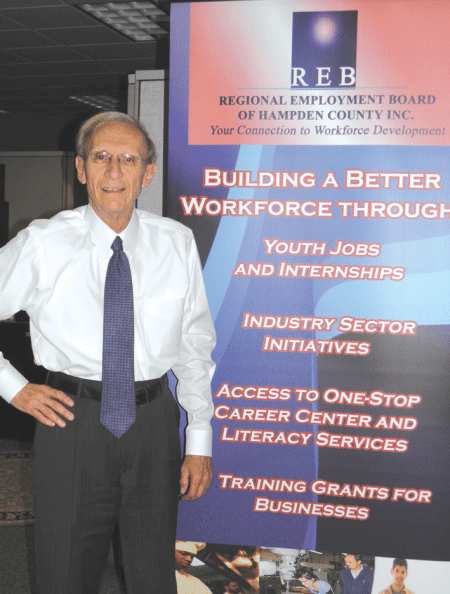
David Cruise

David Cruise says employers consider the partnership a good way to find quality workers, among other benefits.

Anticipating the workforce needs of healthcare providers five, 10, or 20 years down the road doesn’t require a crystal ball. It does require forward thinking, initiative, and effective partnerships between the many players involved with creating a large, effective workforce. And these are the ingredients that go into the Healthcare Workforce Partnership of Western Mass., an arm of the Regional Employment Board of Hampden County.

Dramatic changes are expected to take place in the field of healthcare and the way it is delivered over the next five years. But graduates from local colleges should be well prepared to fill the needs of regional employers, thanks to the Healthcare Workforce Partnership of Western Mass., an arm of the Regional Employment Board of Hampden County, or REB.

“Our partners come together to think through strategies to respond to ever-changing workforce needs,” said David Cruise, the REB’s president and CEO. “Part of the challenge is to be forward-thinking, innovative, and able to anticipate and balance supply versus demand within the healthcare workforce sector.”

The partnership has two divisions: the Western Mass. Nursing Collaborative, composed of employers and nursing school deans, directors, and faculty members; and the Allied Health Committee, which includes employers, educators, training providers, one-stop career centers, and project managers and personnel. They have each collaborated on a number of new programs and initiatives that Cruise believes are making a difference in educating, attracting, and retaining qualified healthcare professionals.

One of the workforce partnership’s current projects is an on-the-job training program that allows new hires to earn while they learn, and provides them with the knowledge or skills needed to succeed in their specific position. It’s funded through a two-year grant, and reimburses employers 50% of the workers’ salaries during a pre-set training period that cannot exceed 20 weeks.

Cruise said the first year was spent developing the program with employers. And although the wage reimbursement offsets the cost of the additional training the program provides, employers say it’s a secondary benefit.

“They believe it’s an efficient way to find good candidates and regard the reimbursement simply as a value added,” Cruise told BusinessWest as he talked about the process of selecting and presenting employers with a pool of qualified job applicants.

They come from a variety of venues, and a significant number are referred by local colleges. Others come from the one-stop career centers (FutureWorks and Career Point) which conduct assessments before choosing candidates, while the remainder apply directly for advertised positions in a traditional manner.

However, a large percentage have some clinical experience, because the grant can only be used to fund training for nurses or people in allied healthcare fields, and each employer has to provide the REB with a monthly progress report on their new hires.

Although the grant limits what professions are eligible for reimbursement, the program was enhanced in late June by a $25,000 grant from Bank of America that does not specify what jobs it can be used for.

“It will offer us greater flexibility and can be cobbled with other grants,” Cruise explained. “The REB is matching the $25,000, and the money will provide reimbursements for 10 new employees in nursing, medical assisting, health information technology, medical billing/coding, and other positions that include pharmacy technicians and community health workers.

“We’re trying to shorten the recruitment period for employers with this program,” he went on. “They have complete authority over the final hires, and this is putting people to work and giving them opportunities.”

Targeting Young People

The Healthcare Workforce Partnership works on many fronts, but has prioritized its goals, said Cruise.

They include creating more workforce diversity in Hampden, Franklin, and Hampshire counties; educating more advanced nurse practitioners and physician assistants; the formation of a Career Pathways Initiative that brings together high schools and community colleges to create industry-specific programs that align education, training, and employment opportunities for today’s youth; support for new graduates as they transition into jobs; and education that promotes team-based healthcare.

Cruise said Chicopee Comprehensive High School and Holyoke Community College are piloting a Pathways to Prosperity Health Sciences program that is similar to a grade-9-to-14 career path model that was launched several years ago at West Springfield High School to fill jobs in the precision manufacturing sector.

The impetus began after Cruise contacted Kenneth Widelo, Comp’s career and technical education director, and explained the grade-9-to-14 model, then met with officials from Holyoke Community College (HCC) and set up a meeting between the two schools.

“It quickly became obvious that a program could be mutually beneficial, and although there wasn’t any funding to create a healthcare model, they felt it was so important that they cobbled resources to make it work,” said Cruise.

Widelo said they had several meetings with representatives from HCC to create an appropriate curriculum before the program was launched. “We had researched healthcare-delivery systems used by other vocational technical schools, but they all put students into one very specific track, such as working as a certified nursing assistant,” he told BusinessWest, adding that their goal was to offer a broader range of options.

The pilot program kicked off two years ago with 10th graders, which allowed the high school to make refinements to the curriculum. It has been highly successful, and allows students to earn 21 credits at HCC before they graduate high school.

“After they matriculate, they can transfer to the community college or attend a four-year college and go into nursing, work to become a doctor, or pursue a degree in healthcare business management,” Widelo said, noting that internships are part of the curriculum.

However, both schools are looking forward to the fall semester, which will mark the first class of incoming freshmen in their newly created Medical Science Academy, which is in line with the grades-9-to-14 career pathway they set out to establish.

Wideo said recruitment efforts for participants involved a variety of measures. Students from the city’s two middle schools completed a career-assessment survey, and two career counselors talked with them, then worked with the middle school guidance departments to identify interested candidates. They were interviewed, and a group of 40 graduating eighth-graders was selected and will begin their course of study this month in HCC’s science laboratory.

“We’re really excited about the program,” said Widelo, adding that students had expressed interest in healthcare careers in the past before the track was created.

Cruise said the students are enthusiastic and understand that the program will help them jumpstart a career.

“The academy has a rigorous academic program that has been aligned with the demands students need to satisfy in order to move seamlessly into an associate-degree program,” he told BusinessWest, noting that the five college courses they take in high school will save each student approximately $3,000 in tuition.

“It’s a model we think could be used by other schools, and once we get the template down, there is no doubt that it could be replicated,” he went on. However, it will require willing partners and involvement by the private sector, which could include summer jobs that bring the students’ academic studies to life.

Filling a Critical Need

The Western Mass. Nursing Collaborative, meanwhile, is also doing its best to guarantee there will be enough well-educated nurses to fill a growing need in Western Mass., which is especially important because registered nurses represent the largest segment of the healthcare workforce.

“They’re working from a set of priorities and updating their strategic plan by setting specific goals,” Cruise noted. “We have more than 40 very active educational institutions and employers who are members, and it’s important to provide a forum for them because the healthcare landscape is changing rapidly. The needs are so dramatic that they have to be innovative and responsive as they make plans to move forward and meet the workforce needs of the future.”

Their priorities include increasing the diversity of the nursing workforce, ensuring that nurses have the competencies and full scope of practice needed to meet the changing health needs of the community; increasing the number of nurses with a bachelor’s degree or higher; increasing the supply and diversity of nursing faculty in area programs and the retention of new nurses in all care settings; and sustaining the partnership.

Patricia Samra, a registered nurse and director of Clinical Workforce Planning and Finance for Baystate Health, said the Western Mass Nursing Collaborative was formed in 2006, thanks to a three-year grant, and was initially called Partners Invested in Nursing. “It focused on workforce initiatives and marked the first time that major healthcare providers and educators in the region convened,” she said, explaining that they included all area schools of nursing along with employers that ranged from hospitals to long-term care providers, who have been working steadily to make sure there is a pipeline of qualified nursing students who are supported after they graduate and get jobs.

The support is imperative, because approximately 30% of nurses leave the profession less than two years after they begin working.

“They burn out due to a lack of confidence,” said Samra, adding that Baystate has created a program to lower that rate.

It brings newly hired nurses together monthly to share emotions as well as clinical challenges, and they are given a case study to analyze, which involves discussing best practices and allows them to reflect on their own experiences.

“They may go into our simulation lab and practice techniques, but the goal is not to gain clinical experience, it’s about critical thinking at the bedside centered around quality care and patient safety,” said Samra, noting that their retention rate has risen significantly since the program began.

Karen Rousseau, director of the Division of Nursing at American International College, says the school works closely with Baystate, and some of its staff members are clinical instructors.

The school also has alliances with other employers, because nursing students have to complete a designated number of clinical hours, which is done in a variety of settings.

“One of the biggest projects our students have been involved with in the past two years is helping patients transition from an acute-care setting to their homes,” said Rousseau, noting that they have shadowed nurses from visiting nurse associations, then worked with the nurses to identify gaps to improve care.

AIC is also a partner in the Health Inter-professional Educators of Pioneer Valley, which seeks to promote communication between students in areas such as ethical dilemmas.

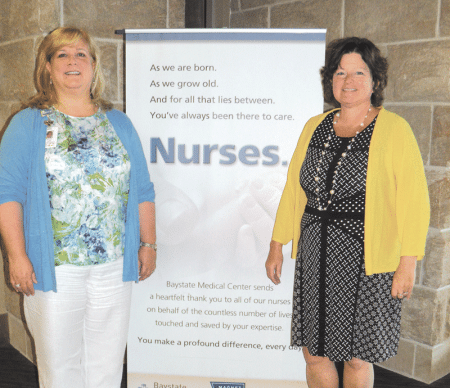
Baystate’s Patricia Samura (left) and AIC’s Karen Rousseau

Baystate’s Patricia Samura (left) and AIC’s Karen Rousseau say the Western Mass. Nursing Collaborative has forged strong bonds between hospitals and nursing schools.

“It grew out of the Cooperating Colleges of Greater Springfield, and encompasses AIC, Western New England University, Elms College, Springfield Technical Community College, HCC, Baypath University, Springfield College, Westfield State University, UMass Amherst, and members from Baystate Medical Center who are interested in supporting interprofessional education and collaboration in health care,” Rousseau said.

Keeping Pace

The programs created by the Healthcare Workforce Partnership of Western Mass under REB’s umbrella ensure that communication takes place between schools, training facilities, and employers. “It’s a challenge to meet the headwinds we are facing, but there is a growing demand for healthcare professionals both at the patient level and away from the bedside,” Cruise noted.

As a result, the collaborations that are formed are taken seriously by members.

“We all believe the partnership is very valuable,” said Samra. “The REB helps get organizations to the table for two to four hours each month, and even though we are all busy, full-time working professionals, it’s worthwhile because it adds value to all of our programs.”

And it also helps ensure a steady flow of workers in the pipeline to meet the growing healthcare needs of this region for years to come.

Sections Travel and Tourism

Fair Forecast

Big E Crowd

Since taking over as CEO of the Eastern States Exposition in 2012, Gene Cassidy has overseen record-setting attendance during the 17-day Big E fair and a robust series of year-round events that, together, generate nearly a half-billion dollars in economic impact. But that success is no fluke; it’s a result of year-round work and the ability to plan years down the road. That road will soon bring several challenges, from increased competition for dollars (notably from a Springfield casino) to a very worrisome highway reconstruction. But with a century of history behind it, the Big E seems poised for a promising future.

Gene Cassidy buys groceries just like everyone else, but he doesn’t look forward to it.

“I’ve said this before: There are very few places to work, places you can establish yourself as a professional, where your patrons look forward to supporting you,” said Cassidy, CEO of the Eastern States Exposition (ESE). “Don D’Amour [CEO of Big Y] is a good friend of mine, but, as much as I like Don, I hate grocery shopping. But people want to come to the fair. So we have to work 24/7/365 to make sure this stays relevant in people’s minds and they come to support us.”

That year-round effort — which is intensifying this month as the Big E, the ESE’s flagship, 17-day agricultural fair, prepares to open on Sept. 18 — has resulted in record-setting attendance figures every year since Cassidy, who has been with Eastern States since 1993, took the reins from Wayne McCary in 2012.

Gene Cassidy

Gene Cassidy says record-setting attendance for the past three fairs is a result of year-round planning.

“Obviously, our goal is to set records,” he said. “We want to create an event that people want to be a part of, and we really operate 365 days a year with that in mind. We want people to buy into the whole product that is the Eastern States Exposition.”

And they do, he continued. But it’s fun with a purpose.

“We’re geared toward families and geared toward fun, but we have a mission,” Cassidy told BusinessWest. “We are stewards of a nonprofit organization that’s charged with the promotion of agriculture and industry for the six New England states.”

Cassidy reveres the fair’s founder, Joshua L. Brooks, an industrialist so concerned that agriculture was losing ground in New England at the turn of the last century — with so much being produced out of the Midwest and South Central states — that he persuaded the National Dairy Show to move its annual event from Chicago to West Springfield in 1916, christening the new event the Eastern States Agricultural and Industrial Exposition.

“That name was so cumbersome that, in 1923, Mr. Brooks shortened it to Eastern States Exposition,” Cassidy said. “But he was an industrialist; he wanted to make sure we pay attention to industry in our region, and that’s something that’s easily lost in translation to the average fair patron. Even residents of West Springfield may not associate Eastern States with industry, but we play a significant role in supporting educational endeavors to that end.”

As treasurer of the Regional Employment Board of Hampden County (REB), Cassidy has long been involved in efforts to meet the workforce needs of area industries by supporting education and training programs. “We need to make sure we have the resources to keep building a workforce for the future.”

He noted that trades aren’t taught in high schools like they were 25 years ago, having been replaced by an emphasis on preparing students for a liberal-arts education in college, and that shift has contributed to a skills gap area companies grapple with today.

From Maine lobster to Rhode Island chowder

From Maine lobster to Rhode Island chowder to anything that can possibly be deep-fried, the Big E offers food for every taste.From Maine lobster to Rhode Island chowder

“The machine-tool industry will need 44,000 more people in the next 10 years, and at the rate we’re educating these kids, we can only produce half that number,” he said. “We have to change the way we’re doing things today if we want to keep these core industries relevant in our economy. Otherwise, those companies will move somewhere else.”

The Big E has long played a role in raising awareness of industry in the region, but that has become an increasingly difficult task.

“We’ve struggled with that,” Cassidy said. “There was a time at the fair when there were more elements of industry; we had big trucks and combines, machine-tooling equipment on display. In this age, there are now trade shows that satisfy those specific markets, and they advertise on the Internet.”

Years ago, he explained, companies like Westinghouse and General Electric would introduce new products at the Big E, and Nash Motors would put brand-new models on display. “In this contemporary age, fairs don’t fill that need anymore; there are other means by which companies communicate with customers.”

To fill that gap, Cassidy and his team bring as many niche trade shows as possible to the fairgrounds throughout the year, but the Big E itself has had to evolve past its industry-centric roots. No worries, though — there’s still plenty on tap.

Farm System

Agriculture, for instance.

“The lion’s share of our revenue goes to supporting best practices in agriculture production,” Cassidy told BusinessWest, and it’s an effort that extends throughout the year.

“Because of the way agriculture has changed over the past 100 years, our reach goes way beyond New England,” he added. “Last week, we had a youth sheep show that attracted people from 20 states, including Michigan, Missouri, and Oklahoma.

“Our agriculture schedule takes place all year,” he went on. “Obviously, it’s very important for us, as it was to our founder. We play a material role in subsidizing the horse-show industry. Two of the oldest horse shows in the country are produced during our fair. It’s historically important — a part of our DNA.”

But Cassidy admitted that plenty of people attend the Big E for the wide array of food.

“We’re always searching for new food products, and that search goes on every day,” he said, noting that the recent food-truck festival held on the fairgrounds — which featured 41 trucks and attracted almost 30,000 attendees, double the expected turnout — reflects how important food offerings are to the success of the fair. “And nowadays, the food trailers have incredible technology; they can cook virtually anything.”

Still, he added, “it’s not easy to get into the Big E. We’re very, very concerned about people’s health. We work very closely with the town of West Springfield’s health inspector, and we also have an independent health inspector on our own payroll to make sure the food products are second to none,” he said, noting that, for example, all frying oil must be changed daily, where restaurants might reuse a batch for two or three days.

In a time when an incident can spread across social media with viral speed, the Big E takes its reputation seriously.

“Food safety is extremely important to all of us,” he added. “All you need is one person to get sick, and that’s the end of you. You’ve got to be diligent with refrigeration. It’s not inexpensive to be a food purveyor on the fairgrounds because we insist on high standards.”

The animal shows and competitions also feature much more behind the scenes than patrons realize, he added.

“We have very high ethical standards on our agricultural programming; in fact, the code of ethics at Eastern States has been copied by other agricultural entities across the country. If you’re competing at that level, people will drug their cattle, so we have to do a lot of animal testing. Just like with steroids in baseball, we make sure they’re not chemically tampered with.

“We take that stuff seriously,” he went on. “Just this week, the headlines in the agriculture industry were that all the people showing cattle at the Indiana State Fair last year were stripped of their ribbons after it was determined there was some drugging going on. We wouldn’t want our cattle show to be compromised. That’s our frontline reputation, same as if someone got sick with salmonella at a food stand.”

This year has brought another threat — breakouts of avian flu, which is lethal to poultry.

“The avian flu is a big issue for us. That’s why this is the first year in maybe 60 years we won’t have a chick hatchery,” Cassidy explained. “We just can’t take a chance of contributing to the spread. It doesn’t harm humans, but we don’t want to take any chance of spreading avain flu to other birds.

“People won’t like that,” he said regarding the hatchery closing. “They do look forward to it. But we’ll have an exhibit about poultry, educating people about avian flu.”

Music, Music, Music

Musical entertainment has been a staple of the Big E for generations. But every year, Cassidy noted, it has become more expensive to book top acts, so several years ago, the Big E started charging for a top musical act or two while charging fair attendees nothing for the rest.

The midway lined with carnival rides

The midway lined with carnival rides is typically a big hit with the younger set at the Big E.

“You have to budget for a profit so you can pay your bills, but you have to invest in your product so people can enjoy their experience. We give away a lot of entertainment, so that everyone can participate at no extra cost,” he said, noting that this year’s live concerts include Kansas, Ace Frehley, Bridgit Mendler, the Charlie Daniels Band, Southside Johnny & the Asbury Jukes, Anita Ward, and about a dozen more, including a visit from DJ Paris Hilton, who, it turns out, enjoys spinning records when she’s not earning tens of millions annually in the fashion world.

“Now, as we speak, in the early weeks of August, we’re really focused on 2016,” Cassidy said, adding that John Juliano, the Big E’s long-time special-events director, is already working on securing entertainment contracts for next fall. “He’s constantly building his contact network so we’re able to attract good-quality talent. So much of our ability to promote ourselves is connected to these big names.”

He added that the Big E has a strong reputation in the entertainment industry for managing talent, which is critical. “We make it so these people have a great experience here, so we can attract the next batch. And we have to be really good at it, because we’re competing in a very difficult marketplace.”

It’s a constant battle, he went on. “Within three days of the fair closing down, John is in Nashville, meeting with talent agents, and the management team from Eastern States will be fully engaged, out at national conventions, looking for exhibitors and vendors. It’s a lot of fun, but it’s a lot of work. You have to get 2016 booked up; if you don’t have everyone lined up by May 1, you’re in trouble.”

There’s plenty at stake when planning a successful fair, he noted. According to a report the ESE produced last year, the 17-day Big E, plus all the other events that take place on the fairgrounds each year — which feature exhibitions for animal lovers, car enthusiasts, gun owners, campers, and dozens of other groups — benefit the region with an annual economic impact of $479 million.

The tax revenues alone include $3 million in income tax, $1.4 million in sales tax, $427,000 in hotel tax, and $3.3 million in food and beverage tax. More significantly, events generate $299 million in gross regional product and account for 3,000 jobs in Hampden County that generate $91.9 million in personal income. The exposition’s impact on the rest of New England and New York include 2,000 jobs generating $134 million in personal income. In all, 2.5 million visitors stop by the fairgrounds each year, well over 1 million for the Big E alone.

“A lot of my time is dedicated to discovering more non-fair events, trying to draw people to the region year-round with trade shows and other stuff,” he said. “It’s a means by which to promote the region, get more people here to our hotels, drive people to our airports, and create a mechanism for commerce.”

Home Stretch

Of course, most of the staff’s attention is acutely tuned to the Big E — everything from the big picture to the smallest details.

“We’re making sure the fairgrounds are tuned up,” Cassidy said. “Everything has to be tested — door locks, fire suppression, make sure the drains are clear. We do a lot of maintenance during the year, but this is the time everything gets tested.

“If we didn’t start setting up the fair until very late, we’d have way too many people working way too many hours, and mistakes would happen,” he added. “So, right now, we’re a steam locomotive going downhill.”

That preparation mingles with a healthy dose of hope — mostly for favorable weather, as a weekend of steady rain can wreak havoc with revenues. But weather isn’t the only challenge. As Cassidy mentioned, the entertainment market has been crowded in recent decades by the two Connecticut casinos (and more to come in Massachusetts, including MGM Springfield right across the river in 2017), civic centers, and other venues.

showcase for local talent from schools and clubs

The annual fair also provides a showcase for local talent from schools and clubs.

“The addition of the [Springfield] casino is terrific in terms of a rising tide lifting all boats,” he told BusinessWest. “I’m looking forward to a time when we can help them with promotion and some talent, and maybe they would be interested in helping us as well. Working in unison, they can benefit from the traffic we drive to them, and people experiencing their facility for the first time may learn about the existence of the Eastern States Exposition.”

That casino might not open until 2018, however, thanks to a major highway reconstruction project that will shut down a portion of I-91 in downtown Springfield for more than two years.

“The highway job scares the hell out of me; it really, really does,” Cassidy said. “This could extend beyond two fairs, and it’s something we have very serious concerns about. Frankly, everyone in the region who is in business needs their awareness raised about this. Once it’s done, it will be a marvelous thing, a terrific improvement. But between now and then, it’s going to tax businesses — and the ability of facilities such as ours to attract people.”

But, when it comes to such challenges, he’s accustomed to planning ahead, because that’s how a century-old institution remains vital in the public’s mind.

“In a 100-year-old organization, I have to be thinking 25 years out,” he said. “This place has got to be as relevant in 2040 as it is in 2015. Mr. Brooks, when he conceived of this place, he was thinking way into the future.”

The fairgrounds have seen plenty of change; Cassidy recalled how the site was once an ice-hockey mecca before the rink was eliminated in 1992. And he showed BusinessWest detailed plans for how the Big E grounds might have been used for several Olympic events in 2024, including cycling and cross-country — plans that are now defunct, obviously, since Boston is no longer competing to host those Games. But the effort demonstrates how Eastern States Exposition leaders need to think outside the box to remain relevant in the next 100 years.

“We have a responsibility to families to maintain ourselves as a place that provides a family environment an outlet for socializing and learning about agriculture and industry, and I think those things won’t change; those are staples of American society,” he said. “There’s a sense of community at Eastern States, and fewer and fewer places have that sense.”


Joseph Bednar can be reached at [email protected]

Briefcase Departments

State Economy Expands Robustly in Q2, UMass Journal Reports

AMHERST — Massachusetts real gross domestic product grew at an estimated annual rate of 5.4% in the second quarter of 2015 according to the MassBenchmarks Current Economic Index, released today by MassBenchmarks, the journal of the Massachusetts economy published by the UMass Donahue Institute in collaboration with the Federal Reserve Bank of Boston. U.S. real gross domestic product grew at an annual rate of 2.3%, according to the advance estimate of the U.S. Bureau of Economic Analysis. Based on the latest available information, it’s estimated that, in the first quarter of 2015, the state economy expanded at a 2.1% annualized rate while the nation grew at a 0.6% annualized rate. In the second quarter, the state’s economy rebounded strongly from the weather-induced slowdown of the first quarter, with robust growth in employment and spending. Massachusetts payroll employment expanded at a 3.1% annual rate in the second quarter, nearly twice as fast as in the first quarter, when employment grew at a 1.7% annualized rate. Nationally, payroll employment grew at a 1.7% annual rate in the second quarter, down from 2.2% in the first quarter. The state’s unemployment rate fell from 4.8% in March to 4.6% in June, while the U.S. unemployment rate fell from 5.5% to 5.3% during the same period. The state’s unemployment rate has reached pre-recession levels. “The rising tide appears to finally be lifting the boats of the long-term unemployed, even though conditions for these workers remain difficult,” noted Dr. Alan Clayton-Matthews, MassBenchmarks senior contributing editor and associate professor of Economics and Public Policy at Northeastern University, who compiles and analyzes the Current and Leading Indexes. The broader U-6 measure of unemployment, which includes part-time workers who want full-time work and those who are unemployed but marginally attached to the labor force, declined significantly in the second quarter. “For the 12-month period ending in June, the Massachusetts U-6 rate fell to 10.4%, a 0.6-percentage-point drop from the 12-month period ending in March,” he noted. “In June, Current Population Survey-based estimates put the Massachusetts U-6 rate at 9.7%. The corresponding U.S. rate in June was 10.5%.” Massachusetts income and spending growth was also very strong in the second quarter. Based on withholding tax revenues, state wage and salary income in the second quarter grew at a 4.8% annual rate, following growth of 4.8% in the first quarter. Consumer and business spending on goods subject to the state’s regular sales and motor-vehicle sales tax increased dramatically in the aftermath of the snowiest winter on record. In the second quarter, spending grew at a whopping 19.3% annual rate, following 1.8% growth in the first quarter. The ability and willingness of households and businesses to spend reflects the underlying strength of the state economy and bodes well for future growth, the report asserts. The MassBenchmarks Leading Economic Index for June is 4.8%, and the three-month average for April through June is 5.0%. The leading index is a forecast of the growth in the current index over the next six months, expressed as an annual rate. Thus, it indicates that the economy is expected to grow at an annualized rate of 4.8% over the next six months (through December 2015), suggesting that the state’s solid economic performance will continue through the rest of the year. It is projecting real state gross-product growth of 5.1% in the third quarter and 4.8% in the fourth quarter. However, while the state economy appears to be in the midst of a solid economic expansion that positions the Commonwealth for solid future growth, risks to the outlook remain. Weak international economic conditions and geopolitical uncertainty continue to weigh heavily on the economic outlook for Massachusetts and the nation. The strong dollar, combined with sluggish growth in Europe and slowing growth in China, has had a significant impact on state and national exports. For the first five months of this year, Massachusetts merchandise exports are down 14.0% as compared to the first five months of 2014, while U.S. merchandise exports are down 5.2% during the same time period.

Markey, Delegation Call for Greater Access to Opioid Overdose Prevention Treatment

WASHINGTON — In a letter sent Wednesday to the Department of Health and Human Services (HHS), U.S. Sen. Edward J. Markey (D-Mass.) and eight members of the Massachusetts Congressional delegation called on the agency to take action to support broader access to the opioid-overdose-prevention treatment naloxone. There has been much documented success preventing fatalities with the use of naloxone by medical professionals and first responders, and there has been a recent movement to expand access to the overdose treatment for use by trained community and family members, who are most likely to be present during an opioid overdose. More than 1,000 people died of an opioid overdose last year in Massachusetts. The Mass. Department of Public Health (MDPH), which collects rescue reports on episodes where non-medical bystanders and community members use naloxone supplied by MDPH, has documented 5,000 rescues, with more than 1,000 of them reported in 2015 so far. Joining Markey on the letter are U.S. Sen. Elizabeth Warren and U.S. Reps. Michael Capuano, Katherine Clark, Jim McGovern, Seth Moulton, William Keating, Joe Kennedy, and Richard Neal. “The routine practice of distributing naloxone or co-prescribing naloxone with prescriptions for opioid painkillers may help to get naloxone into households that may otherwise not have easy access to this life-saving antidote,” write the lawmakers in the letter to HHS Secretary Sylvia Burwell. “Thousands of Americans who are currently taking prescription opioid painkillers, whether legitimately for the treatment of pain or illicitly without doctor supervision, could potentially be saved from accidental overdose by having wider access to naloxone.” In the letter, the lawmakers call on HHS to explore issuing recommendations that could be used to institute best practices for co-prescribing naloxone with opioid painkillers and examine establishing demonstration programs, encouraging federally funded health centers to adopt policies for co-prescribing, and reducing payment barriers for naloxone coverage and reimbursement.

Home Sales Rise in June in Pioneer Valley

SPRINGFIELD — The Realtor Assoc. of Pioneer Valley reported that single-family home sales in June were up 4.9% compared to the same time last year. The median price, meanwhile, dropped 1.5%, from $204,000 last year at this time to $201,000 this year, as first-time buyers continue to come into the market. The association reported that, across the Pioneer Valley, sales in June 2015 totaled 552, compared to 526 a year ago. In Hampden County, sales were up 11.4% over the same month last year (370 in 2015 and 332 in 2014), with the median price down 2.2%. In Hampshire County, meanwhile, sales remained the same (135 both years), with the median price down 4.6%. In Franklin County, though, sales were down 22% (42 in 2015 and 54 in 2014), and median prices were up 8.8%.

Unemployment Rates Rise in Most Areas

BOSTON — The Executive Office of Labor and Workforce Development (EOLWD) reported that seasonally unadjusted unemployment rates went down in two areas during the month of June and increased in 22 areas in the state. According to data from U.S. Department of Labor Bureau of Labor and Statistics, Nantucket and Vineyard Haven were the two areas where unadjusted unemployment rates dropped in June. Eleven of the 15 areas for which job estimates are published recorded seasonal job gains in June, with the largest gains in Boston-Cambridge-Newton, Barnstable, Framingham, Pittsfield, and Lawrence-Methuen, as well as Salem, N.H. Compared to June 2014, unemployment rates are down in all labor markets measured by the Bureau of Labor Statistics. The EOLWD also reported the statewide seasonally adjusted unemployment rate remained at 4.6% for the second consecutive month. The unemployment rate is down 1.1% over the year. The statewide seasonally adjusted jobs estimate showed a 10,500-job gain in June and an over-the-year gain of 72,700 jobs.

Departments People on the Move

Local news hires, promotions, awards, and appointments August 10, 2015

Kathy Tobin

Kathy Tobin

The Food Bank of Western Massachusetts announced the appointment of Kathy Tobin as its new director of Development and Marketing. In this role, she will oversee all fund-raising and marketing activities for the Food Bank, including special events, individual donor cultivation, communications, corporate relations, grants, and education outreach. She will assume her position on Aug. 31. “We’re very excited to have Kathy joining our organization,” said Food Bank Executive Director Andrew Morehouse. “She brings with her a breadth of knowledge and experience from her current role at Friends of the Homeless in Springfield — a member agency that receives food from us — as well as her career in media.  We are confident that her proven track record for leadership and creativity will be a tremendous asset in forwarding the mission of the Food Bank.” Since 2009, Tobin has served as the director of Program Development for Friends of the Homeless, where she increased visibility for the nonprofit and helped more community partners learn about the critical role it plays in meeting the needs of homeless in the region. Under her direction, it established a formalized annual appeal, expanded corporate outreach, coordinated volunteer engagement, and held an annual donor event. In addition, she oversaw the establishment of the Friends of the Homeless Store, providing people with access to free personal-care items and clothing. Tobin will continue in her current position at Friends of the Homeless through the end of August. “Her talents will certainly be missed,” said Bill Miller, executive director of Friends of the Homeless. “I know I speak for our board, our staff, and our clients in acknowledging her efforts to initiate and sustain a development program for the organization. We will build upon the foundation Kathy helped us establish as we expand the support required to meet the needs of our homeless population.” Moving forward, Friends of the Homeless will be seeking someone to assume the responsibility of development and community outreach and will formalize a search process to identify someone who can continue to build on its established programs, Miller said. Prior to joining Friends of the Homeless, Tobin enjoyed a 30-year career as a television news journalist with WGGB ABC40 in Springfield, where she was honored with a number of awards for news coverage, including the prestigious Edward R. Murrow Award. Among the many issues she covered during her television career were the plight of area homeless and the community campaign and planning which led to the development and construction of the Friends of the Homeless Resource Center on the organization’s Worthington Street campus. Tobin is also involved with a number of community organizations. She serves as a trustee for Elms College in Chicopee, a director of Spirit of Springfield, a director of the Women’s Commission in Springfield, and a scholarship committee member for the Valley Press Club.

•••••

Cristina Perez

Cristina Perez

Tighe & Bond, an environmental engineering and consulting firm, recently hired Cristina Perez to lead and expand its asset-management services for the firm’s clients. A civil and environmental engineer with more than 15 years of consulting experience, she has more than nine years of experience with infrastructure asset management, capital-improvement planning, and geographic information systems (GIS). Perez will work primarily out of Tighe & Bond’s new Westwood, Mass. office. Perez has consulted with numerous public and private clients on asset-management, GIS, facilities-management, pavement-management, sustainability, and climate-change projects. She leverages her background in civil engineering for designing and architecting targeted asset-management solutions for her clients. “We are happy to welcome Cris to our growing team of experts,” said David Pinsky, president and CEO of Tighe & Bond. “Her expertise will benefit our communities and clients greatly as they become increasingly focused on asset management to prioritize and properly budget improvements within the constraints of limited funding.” Perez earned her master’s degree in civil and environmental engineering from Tufts University. She received her bachelor’s degree in civil engineering from the Universitat Politecnica de Catalunya in Barcelona, Spain.

•••••

Robert Accorsi

Robert Accorsi

Springfield College has named Robert Accorsi its faculty athletic representative to the National Collegiate Athletic Association (NCAA). Appointed by Springfield College President Mary-Beth Cooper, Accorsi is currently an associate professor of Sport Management and Recreation at the College. He succeeds immediate past Dean and Associate Professor of Exercise Science and Sports Studies Charles Redmond, who retired following this past academic year. As faculty athletic representative, Accorsi will represent the college to the NCAA, the New England Women’s and Men’s Athletic Conference, the Eastern Collegiate Athletic Conference, and all other athletic conferences and associations. Accorsi will oversee that academic integrity, institutional control of intercollegiate athletics, and enhancement of student-athletes’ experience are college priorities. Accorsi will also advise the college president, director of athletics, faculty, students, and other constituencies on intercollegiate athletics. Additionally, he will monitor student-athletes’ eligibility, academic progress, and graduation rates, and support their nominations for various awards. Student-athletes may discuss any aspect of their student-athlete experience with him, and he will consult with NCAA legislative services for interpretations. “I am delighted that Bob has agreed to serve in this critical position for the college. His deep understanding of sport and the needs of our student-athletes make him a perfect fit for assuming this leadership role,” Cooper said. “I look forward to working with him in this capacity. He is more than qualified to represent and advise Springfield College on intercollegiate athletics.”

•••••

Doreen Fadus

Doreen Fadus

Doreen Fadus, executive director of Community Benefit and Health at Mercy Medical Center, has been tapped to serve as president of the board for the National Health Care for the Homeless Council, a network of more than 10,000 doctors, nurses, social workers, patients, and advocates who work to eliminate homelessness by ensuring comprehensive healthcare and secure housing for all. In this role, Fadus serves as the council’s lead representative on the national stage for advocacy issues such as the Accountable Care Act, Medicaid reimbursements, and housing and health collaboration. “Doreen personifies our mission to serve as a transforming, healing presence. She is a tremendous advocate for the local homeless community, and her selection to this national position will allow her dedication and talent to benefit a greater number of individuals,” said Yvonne Boudreau, senior vice president of Mission Services for the Sisters of Providence Health System. As Mercy’s executive director of Community Benefit and Health, Fadus oversees the hospital’s community health programs, including Health Care for the Homeless, which works in partnership with the city of Springfield and Open Pantry to provide primary-care services at 23 homeless shelters, soup kitchens, job-placement sites, and transitional programs. These services are delivered to more than 2,200 people each year in Hampden, Hampshire, and Franklin counties. She also oversees Mercy’s Vietnamese Health Project, Faith Community Nursing, High End Utilizer Program, and Community Benefit. Fadus began her career at Mercy Medical Center as director of Health Care for the Homeless in 2001, and she has an extensive background in community service. She currently serves as co-chair of the Western Mass. Network to End Homelessness; an advisory board member of the Hampden County Continuum of Care Board, the Catholic Charities Diocesan Board, and the Western Mass. Task Force on Homelessness; and a member of the Regional Employment Board of Hampden County. The founder and past president of Dress for Success Western Massachusetts, Fadus also serves on the board of Friends of the Homeless. “The National Health Care for the Homeless Council works with government agencies and private institutions to foster collaboration on the varied and complex problems associated with homelessness,” said Fadus. “These remarkable individuals have dedicated their lives to this important cause, and it is an honor to serve as their leader.”

Daily News

BOSTON — The Associated Industries of Massachusetts (AIM) Business Confidence Index added 2.9 points in July to 59.2, ending a string of three consecutive monthly losses.

“Bouncing back from its dip in the second quarter, confidence among Massachusetts employers is fairly strong,” said Raymond Torto, Chair of AIM’s Board of Economic Advisors (BEA) and lecturer at Harvard Graduate School of Design. “The AIM Index is up three points from last July and, apart from its recent crest in February and March, is at its highest level since December 2006.”

Torto noted that the Index’s recent performance extends a pattern that has prevailed for much of the post-Great Recession period. “Like the economy itself, the Index has followed a long-term trend of improvement, but the upward course has been longer and bumpier than most past recoveries.”

AIM’s Business Confidence Index has been issued monthly since July 1991 under the oversight of the Board of Economic Advisors. Presented on a 100-point scale on which 50 is neutral, the Index attained a historical high of 68.5 in 1997 and 1998; its all-time low was 33.3 in February 2009.

The sub-indices based on selected questions or respondent characteristics all rose from June to July, and most were up from a year before.

The U.S. Index assessing national business conditions gained 2.5 points to 50.1, and Massachusetts Index of conditions within the Commonwealth rose six-tenths to 57.5.

“The domestic economy, after a weak first quarter, is experiencing solid expansion, and Massachusetts continues to perform well in the national context,” said BEA member Sara Johnson, senior research director of Global Economics at IHS Global Insight. “Growth in international trade, however, has been disappointing, as improving conditions in Europe have been more than offset by the slowdown in Asia.”

The Current Index, tracking employers’ assessment of existing business conditions, was up 3.5 to 59.7, while the Future Index, measuring expectations for the next six months, added 2.2 to 58.6.

“The rating of current conditions is the best we have seen since the same reading in October 2006,” Johnson said. “The slightly lower future expectations probably reflect the Federal Reserve Board’s expressed intent to raise interest rates.”

The three sub-indices related to survey respondents’ own companies were all well ahead in July. The Company Index, which assesses the overall situations of their operations, was up 3.7 points to 61.7; the Sales Index rose 5.3 to 63.2; and the Employment Index added 2.5 to 57.2.

“The Company and Sales indicators are at their highest levels since 2006, and the Employment Index is also in its pre-recession range,” noted Elliot Winer, chief economist at Northeast Economic Analysis Group LLC, a BEA member. “These results are consistent with survey respondents’ favorable appraisal of prevailing business conditions and with recent state employment reports.”

In July, confidence remained higher among employers within Greater Boston (61.3, up 3.9) than among those outside the metropolitan area (55.8, up 1.1). Manufacturers continued to be less confident (55.7, up 3.1) than other employers (62.9, up 2.9).

“Massachusetts manufacturers, many of them in the central and western parts of the state, are seeing exports suffer because of the strong dollar and difficult conditions in key markets,” Winer said. “The indicators from the manufacturing sector and for the state outside Greater Boston are the only sub-indices that have lost ground, though less than a point each, over the past year.” There was little variation in confidence between small, medium-size, and larger employers.

Commenting on the July Business Confidence Index survey results, Richard Lord, AIM’s president and CEO and a BEA member, stressed the positive assessment of business conditions among respondents.

“Over the previous three months, we saw that confidence can be damaged by uncertainty, even in peripheral areas like the Greek crisis,” he said. “In July, we see that, as such concerns fade, the underlying strength of the economy, and of confidence among Massachusetts employers, comes to the fore again.”

Lord noted, however, that the results included contrasting views of the state’s business climate. “There is a 10-point regional gap in how respondents rate Massachusetts conditions — very positive within Greater Boston, barely positive elsewhere. This reminds us that good economic analysis and policy must take account of the broad range of industries and communities.”

By employer size, Lord added, the smallest firms, up to 25 employees, rated in-state conditions higher than mid-sized and larger employers.

“Here we see a significant turnaround compared to the recent past,” he said. “Along with a stronger economy, these small employers — who often feel vulnerable to government mandates — are encouraged by a sense that Beacon Hill recognizes their concerns on issues ranging from MBTA reform to smooth implementation of the paid-sick-leave law.”

Daily News

SPRINGFIELD — The Regional Employment Board of Hampden County (REB) received a $2,500 grant award from PeoplesBank to support the work of the Talk/Read/ Succeed (TRS) program.

Talk/Read/Succeed is a place-based holistic program and currently serves 150 low- to moderate-income families at two Springfield Housing Authority (SHA) developments in Springfield. The goal of TRS is to have all children enter kindergarten ready to learn and go on to read proficiently by fourth grade.

The $2,500 grant award is part of PeoplesBank’s Community Care Program and will be used to support parent-education programs at the SHA sites that will focus on how to support children in reaching critical developmental milestones, family health and wellness, adult education and career exploration, and financial literacy.

In announcing the award, Susan Wilson, first vice president of PeoplesBank, indicated that, “at Peoples Bank, we welcome the opportunity to help others. As part of your community, we take an active interest in supporting programs that promote academic excellence for our youth.”

David Cruise, REB president and CEO, noted that “this award from PeoplesBank allows the REB and its partners to strengthen our parenting-education and school-engagement programming to support parents as active partners in our work to accelerate student achievement.”

Added William Abrashkin, executive director of the SHA, added that “building community support is vital to the success of Talk/Read/Succeed and its families and children. In particular, it is so important that PeoplesBank, a key member of the business community, has chosen to provide its support. We all know that, without an educated workforce, businesses cannot grow and create wealth, and the most effective way to create an educated workforce is to reach families when their children are very young to help ensure that the children are brought up with positive values, including a love of reading, learning, and achievement. That is what TRS is all about, making this a win-win for both the business community and the families we serve.”

Daily News

SPRINGFIELD — Dave’s Soda and Pet City will have a Goodwill donation box at each of its Massachusetts stores on Aug. 3-15. Gently used clothing and household items are welcome.

Donations will be accepted at 151 Springfield St. in Agawam, 335 Russell St. in Hadley, 433 Center St. in Ludlow, 142 North King St. in Northampton, 1330 Carew St. in Springfield, and 140 West St. in Ware.

“We are grateful for the chance to be in each of the six Massachusetts stores and can only say that everyone’s donation will be put to the best of uses — helping disadvantaged and disabled people find jobs,” said Steve Mundahl, president and CEO of Goodwill Industries of the Pioneer Valley. “All donations are weighed, sorted, and sold in one of our nine stores in Hampden and Hampshire counties.”

Goodwill Industries of the Pioneer Valley offers employment and training programs, adult foster care, and community-based day services in addition to operating nine retail stores throughout the Pioneer Valley.

Daily News

AMHERST — Massachusetts real gross domestic product grew at an estimated annual rate of 5.4% in the second quarter of 2015 according to the MassBenchmarks Current Economic Index, released today by MassBenchmarks, the journal of the Massachusetts economy published by the UMass Donahue Institute in collaboration with the Federal Reserve Bank of Boston.

U.S. real gross domestic product grew at an annual rate of 2.3%, according to the advance estimate of the U.S. Bureau of Economic Analysis. Based on the latest available information, it’s estimated that, in the first quarter of 2015, the state economy expanded at a 2.1% annualized rate while the nation grew at a 0.6% annualized rate.

In the second quarter, the state’s economy rebounded strongly from the weather-induced slowdown of the first quarter, with robust growth in employment and spending. Massachusetts payroll employment expanded at a 3.1% annual rate in the second quarter, nearly twice as fast as in the first quarter, when employment grew at a 1.7% annualized rate. Nationally, payroll employment grew at a 1.7% annual rate in the second quarter, down from 2.2% in the first quarter. The state’s unemployment rate fell from 4.8% in March to 4.6% in June, while the U.S. unemployment rate fell from 5.5% to 5.3% during the same period. The state’s unemployment rate has reached pre-recession levels.

“The rising tide appears to finally be lifting the boats of the long-term unemployed, even though conditions for these workers remain difficult,” noted Dr. Alan Clayton-Matthews, MassBenchmarks senior contributing editor and associate professor of Economics and Public Policy at Northeastern University, who compiles and analyzes the Current and Leading Indexes.

The broader U-6 measure of unemployment, which includes part-time workers who want full-time work and those who are unemployed but marginally attached to the labor force, declined significantly in the second quarter. “For the 12-month period ending in June, the Massachusetts U-6 rate fell to 10.4%, a 0.6-percentage-point drop from the 12-month period ending in March,” he noted. “In June, Current Population Survey-based estimates put the Massachusetts U-6 rate at 9.7%. The corresponding U.S. rate in June was 10.5%.”

Massachusetts income and spending growth was also very strong in the second quarter. Based on withholding tax revenues, state wage and salary income in the second quarter grew at a 4.8% annual rate, following growth of 4.8% in the first quarter. Consumer and business spending on goods subject to the state’s regular sales and motor-vehicle sales tax increased dramatically in the aftermath of the snowiest winter on record. In the second quarter, spending grew at a whopping 19.3% annual rate, following 1.8% growth in the first quarter. The ability and willingness of households and businesses to spend reflects the underlying strength of the state economy and bodes well for future growth, the report asserts.

The MassBenchmarks Leading Economic Index for June is 4.8%, and the three-month average for April through June is 5.0%. The leading index is a forecast of the growth in the current index over the next six months, expressed as an annual rate. Thus, it indicates that the economy is expected to grow at an annualized rate of 4.8% over the next six months (through December 2015), suggesting that the state’s solid economic performance will continue through the rest of the year. It is projecting real state gross-product growth of 5.1% in the third quarter and 4.8% in the fourth quarter.

However, while the state economy appears to be in the midst of a solid economic expansion that positions the Commonwealth for solid future growth, risks to the outlook remain. Weak international economic conditions and geopolitical uncertainty continue to weigh heavily on the economic outlook for Massachusetts and the nation. The strong dollar, combined with sluggish growth in Europe and slowing growth in China, has had a significant impact on state and national exports. For the first five months of this year, Massachusetts merchandise exports are down 14.0% as compared to the first five months of 2014, while U.S. merchandise exports are down 5.2% during the same time period.

Columns Sections

Business Law: Marking a Milestone

By OLGA M. SERAFIMOVA, Esq.

Olga Serafimova

Olga Serafimova


July 26 marked the 25th anniversary of the passage of the Americans with Disabilities Act (ADA) — landmark legislation that created rights for individuals with physical and mental disabilities in employment, government facilities and services, places of public accommodations, telecommunications, and transportation.

In recent years, employers have seen a significant increase in discrimination litigation under the ADA and its state law counterpart, M.G.L. c. 151B. According to the Equal Employment Opportunity Commission (EEOC), the federal agency responsible for the enforcement of the ADA’s employment provisions, over the past 10 years there has been a fast and steady increase in the number of charges filed with the EEOC premised on disability discrimination, from about 19% of all charges in 2004 to almost 29% by 2014. This increase is particularly noticeable since the 2008 amendments to the ADA went into effect, which significantly expanded the medical conditions that qualify as disability for purposes of the act.

The same bears true with regard to complaints filed before the Mass. Commission Against Discrimination (MCAD), the agency that enforces c. 151B. Specifically, since at least 2008, disability discrimination claims have been present in approximately one third of all complaints filed with the MCAD, resulting in more than 1,000 disability complaints each year. For example, last year, of the 3,127 complaints filed with the MCAD statewide, 1,187 contained at least one count of disability discrimination.

Given these statistics, it is absolutely crucial for businesses to be familiar with the responsibilities imposed upon them by the state and federal disability anti-discrimination statutes.

In the employment context, there are four types of possible disability discrimination claims: (1) disparate treatment; (2) failure to accommodate; (3) hostile work environment; and (4) retaliation.

A disparate-treatment claim alleges that a disabled person is treated differently (less favorably) than non-disabled co-workers solely because of the person’s disability. The difference in treatment does not have to come from a malicious place to be unlawful and may constitute a less-obvious omission, such as the failure to consider someone for a promotion or to offer training necessary for advancement.

Disparate treatment claims are most often brought by employees who are currently suffering from a serious physical or mental impairment. In addition to apparent disabilities, such as an inability to see, hear, speak, or walk, employees with latent physical afflictions, such as diabetes, disc herniation, cancer, and HIV/AIDS, may also be covered. Employees diagnosed with a wide spectrum of mental disabilities may also be protected, including, for instance, major depression, ADHD, and bipolar disorder.

Many employers are unaware of the fact that disability-discrimination claims may also be brought by employees who are not currently disabled. Specifically, a disparate-treatment claim may be brought by an employee with a past history of a serious medical impairment, as well as by a healthy employee who, for one reason or another, may be perceived by his or her employer as disabled.

Also, under what is known as “associational discrimination,” an employee who is closely associated with a disabled individual, such as a spouse or a child, is likewise protected from discrimination.

The second type of disability discrimination — failure to accommodate — is perhaps the most complicated area of the law. Employers must provide reasonable accommodations to employees who are actually disabled. The most important thing for employers to know is that, once a request for an accommodation is made or the need for one becomes apparent, an employer must engage with the employee in what is called the “interactive process.”

This process can be as simple as a conversation aimed at finding out what accommodation is necessary and sufficient to permit the employee to perform the essential functions of his or her job. Employers should also keep in mind that taking too long to engage in this process or to grant a request for a reasonable accommodation can likewise lead to litigation and result in liability. Lastly, while there is an exception for requests that would put an undue financial burden on the employer, this standard is very hard to meet, and so the exception should rarely be relied upon.

As suggested by its name, a hostile-work-environment claim alleges that an employee who is disabled is subjected to an abusive work environment by others in the workplace. The law prohibits speech or conduct that is severe or pervasive and not merely unpleasant or uncivil. Nevertheless, employers are well advised to take all complaints of harassment seriously in order to reduce the risk of litigation.

Lastly, in retaliation claims, employees most often allege that they were fired in retaliation for either requesting a reasonable accommodation or speaking up about what they believe to be discrimination. Employers should know that conduct short of a termination, such as a reduction in hours or a change in shifts, may also result in litigation if perceived by the employee as retaliatory.

One way employers can reduce their risk of litigation is to have a well-trained management team. Supervisors need to know how to recognize requests for accommodations and how to handle complaints of harassment. Good documentation is also crucial. Oftentimes, employers find themselves defending against a disparate treatment or retaliation claim after taking well-deserved disciplinary action towards an employee. In these situations, a written record of poor performance, attendance, or other employment issues and a documented consistency in application of policies will make all the difference.

Olga M. Serafimova, Esq. is an attorney at Royal LLP, a woman-owned, boutique, management-side labor and employment law firm. Royal LLP is a certified women’s business enterprise with the Mass. Supplier Diversity Office, the National Association of Minority and Women Owned Law Firms, and the Women’s Business Enterprise National Council; (413) 586-2288; [email protected]

Briefcase Departments

Meehan Praises UMass Transparency Measure in New State Budget
BOSTON — The new state budget will allow UMass to bring a key business practice into the national mainstream, and dramatically advances the cause of “straightforwardness and transparency” in billing, UMass President Marty Meehan said Friday. The fiscal year 2016 budget signed into law by Gov. Charlie Baker will allow UMass, as of 2016-2017, to retain the tuition paid by resident undergraduate students, rather than passing those funds along to the state. “I am pleased that the governor signed what the Legislature sent to him and that the reform UMass has sought for more than two decades has become law. This is a victory for students, for UMass and for transparency,” Meehan said. At the same time, Meehan said he was disappointed by a veto that reduced funding for the five-campus UMass system from the $531.8 million approved by a House-Senate conference committee to $526.6 million. “This veto presents challenges that we must now assess as we pursue our overarching goals of building quality, while at the same time protecting the university’s long-term fiscal stability,” Meehan said. In allowing UMass to retain tuition payments, the budget brings Massachusetts in line with virtually every state in the nation. In recent years, UMass was given the authority to retain the tuition paid by out-of-state students, but had been unable to extend the practice to resident undergraduate students until now. The new policy, which will not take effect until next year, is responsive to calls from state and federal officials for greater transparency and accountability in higher education.

Report: Massachusetts Economy on the Upswing
BOSTON — In a number of important respects, the Massachusetts economy is experiencing its strongest expansion since the heady days of the late 1990s, according to the editorial board of MassBenchmarks. As the board anticipated, this year’s severe winter weather had only a transitory, and ultimately minor, impact on economic conditions in the Bay State. Employment and the labor force are growing strongly, and payroll survey shows consistent and strong growth in employment. And gross state product growth, as estimated by the MassBenchmarks Current Economic Index (CEI), continues to outpace that of the nation. Once again, the state’s knowledge-intensive sectors are its primary growth drivers. Industrially, the expansion is being led by the dynamic professional, scientific, and technical services sector, which includes architectural, engineering, and specialized design services; computer services; computer-systems design; consulting services; research services; and other related services. Employment in software development is also growing strongly. These sectors rely heavily upon the Commonwealth’s highly educated work force, which remains in high demand, as reflected by the fact that college-educated workers continue to have the lowest unemployment rate among all socioeconomic groups in the state. While conditions for less well-educated workers have improved, unemployment and underemployment rates in many communities remain troublingly high. Economic growth continues to be disproportionately concentrated in the Greater Boston region and within the Route 495 belt. While there are notable exceptions to this pattern of imbalanced growth, including the cities of Lowell and Worcester, conditions in regions outside of the Greater Boston region are improving, but their economic performance continues to lag. Notwithstanding the solid performance of the Massachusetts economy, there are a number of short- and long-term threats to growth that could serve to slow and in some cases derail the Commonwealth’s expansion. Growth pressures in the immediate Greater Boston region are placing increased stress on the state’s transportation infrastructure, which this past winter’s severe weather revealed to be in serious need of attention and investment. These same growth pressures, along with inadequate housing production, are fueling rapidly rising home prices throughout Eastern Massachusetts. While this is good news for incumbent homeowners, it puts upward pressure on the cost of living, making it more difficult for the Greater Boston region to attract the highly educated workers it needs to meet the needs of growing knowledge-intensive organizations. And the state’s high electricity prices, which have risen in every corner of the state, are beginning to limit economic growth in regions that are sorely in need of more economic opportunities. In Berkshire, Franklin, and Hampshire counties, new natural-gas hookups have been suspended, which is directly constraining business expansions in Western Massachusetts. Additionally, the relatively slow growth of the global economy and considerable economic and geopolitical uncertainty continue to weigh heavily on the economic outlook for the nation and the Commonwealth. Greece and Puerto Rico appear to be headed for sovereign debt defaults, with highly uncertain impacts for Europe and North America. Critically important trading partners in Asia, including China and Japan, continue to face serious economic challenges. And the Middle East and Eastern Europe remain politically volatile. Going forward, while the Commonwealth’s leaders have little control over what happens internationally, it is well within their power to tackle the challenges presented by aging infrastructure and imbalanced growth patterns, MassBenchmark’s board notes. Toward this end, policies that improve the state’s transportation systems, both within Greater Boston and beyond, and extend educational and economic opportunities to more people and regions that have yet to experience the full benefits of the current economic expansion, should be priorities going forward.

REB Receives Grant from PeoplesBank to Support Talk/Read/Succeed Program
SPRINGFIELD — The Regional Employment Board of Hampden County, Inc. (REB) has received a $2,500 grant award from PeoplesBank to support the work of the Talk/Read/ Succeed (TRS) program. Talk/Read/Succeed is a place-based holistic program and currently serves 150 low- to moderate-income families at two Springfield Housing Authority (SHA) developments in Springfield. The goal of TRS is to have all children enter kindergarten ready to learn and go on to read proficiently by 4th grade. The $2,500 grant award is part of PeoplesBank’s Community Care Program and will be used to support parent education programs at the SHA sites that will focus on how to support children in reaching critical developmental milestones, family health and wellness, adult education and career exploration, and financial literacy. In announcing the award, Susan B. Wilson, first vice president of PeoplesBank said, “at PeoplesBank, we welcome the opportunity to help others. As part of your community, we take an active interest in supporting programs that promote academic excellence for our youth.” David M. Cruise, president & CEO of the REB indicated that, “this award from PeoplesBank allows the REB and its partners to strengthen our parenting education and school engagement programming to support parents as active partners in our work to accelerate student achievement.” William H. Abrashkin, Executive Director of the SHA said “Building community support is vital to the success of Talk/Read/Succeed and its families and children. In particular, it is so important that PeoplesBank, a key member of the business community, has chosen to provide its support. We all know that without an educated workforce, businesses cannot grow and create wealth, and the most effective way to create an educated workforce is to reach families when their children are very young to help ensure that the children are brought up with positive values, including a love of reading, learning, and achievement. That is what TRS is all about, making this a win-win for both the business community and the families we serve.”

Departments People on the Move

Springfield-based United Personnel announced the promotion of two staff members, Danielle Cirillo and Marlene Johnson:

Danielle Cirillo

Danielle Cirillo

Marlene Johnson

Marlene Johnson

Cirillo, who most recently has served as a staffing consultant in United Personnel’s Light Industrial Staffing Division, has been promoted to Project Manager for one of United Personnel’s larger accounts. In her new role, Cirillo will oversee all aspects of account management, including on-site staffing support, recruitment, employee relations, and project-based initiatives. She is a member of the Young Professional Society of Greater Springfield. “I am pleased to receive this promotion, and I look forward to working with our clients to produce great results for them,” said Cirillo, an alumni of Western New England University.
Johnson, who most recently served as a recruiter for United’s Professional Division, has been promoted to Staffing Consultant. In that role, she will work with both candidates and client companies, serving as the liaison between the two. “If you work hard, persevere, and persist, you will accomplish all that you desire,” said Johnson, who holds a bachelor’s degree in business administration from Monroe College in New York City, and also serves as United’s Diversity Program Coordinator. She serves on the advisory committee for the School of Business and Information Technologies and is a member of the Young Professional Society of Greater Springfield. “We are pleased to recognize the dedication and results-oriented approach of both Danielle and Marlene,” said Tricia Canavan, president of United Personnel, “and look forward to the positive impact they will have for our clients and candidates in their new roles.”
•••••
Stuart Kirshner

Stuart Kirshner

Environmental Compliance Services Inc. (ECS) announced that Stuart Kirshner has joined the firm as Health and Safety Manager. Kirshner has more than 18 years of experience in the environmental and safety sectors. His key skills include environmental health and safety (EHS) management program development, implementation, and administration. He applies compliance-enforcement policies through motivation, training, and process control, and his collaborative leadership style promotes team building, engagement, and a compliance culture. In his capacity as ECS’ health and safety manager, Kirshner is responsible for occupational safety and health for 25 office locations in 11 states, as well as enhancement of the firm’s safety culture through motivation and engagement of the workforce. His initial tasks include collaborating with the firm’s Information Technology department to redevelop the existing environmental health and safety program into a computer-based management system. He is also integrating EHS processes into the business-process-management system. Kirshner holds a bachelor’s degree in environmental management, as well as an undergraduate certificate for project management. He is a certified hazardous materials manager and a combat life saver certified by the U.S. Army.
•••••
Cheryl Hoey

Cheryl Hoey

Geoffrey Frost

Geoffrey Frost

Gomes, DaCruz & Tracy, P.C. recently announced the hiring of Cheryl Hoey, CPA, and Geoffrey Frost. Hoey has been hired as a Staff Accountant. She specializes in small-business and individual tax returns. Before joining the firm, she worked as a senior financial-risk consultant for an insurance company as well as a tax preparer for a local accountant during tax season. Frost has been hired as a Staff Accountant. He is a recent graduate from Elms College and has volunteered for Junior Achievement.
•••••
Freedom Credit Union announced the new executive committee of the board of directors, the appointment of a new board member, and two appointments to the leadership team of the credit union. At the recent annual meeting of the credit union, Lawrence Bouley was elected Chairman of the board of directors for the next three years. Bouley has been a board member of Freedom for the past 11 years and, prior to that, served on the FHBT Credit Union Board for 25 years. During his tenure, he will play an active role in the strategic direction of the credit union. Along with Bouley, the following board members were elected to three-year posts on the board’s executive committee: Donald Emerson, Vice Chairman; Louis Guillette, Treasurer; William Carey, Clerk; and John Reigner, Security Officer. Brian Harrington has been appointed to the board of directors to fulfill the unexpired term of a recently vacated seat. Harrington is an attorney and a deputy regional director in the Springfield office of the Mass. Department of Environmental Protection. While on the Freedom board of directors, he will be a member of the auditing committee, site committee, and security committee. In other news, David Chase Sr. has joined Freedom Credit Union as Vice President of Member Business Lending. Chase has more than 25 years of experience in the banking industry with an extensive background in commercial lending. Most recently, he was vice president of Commercial Lending at Hampden Bank. Chase is actively involved with several organizations, including the West of the River Chamber of Commerce as a board member. Chase is also a vice president of the board of Gray House and also serves as a member of the town of Agawam Planning Board. Finally, Christine Williams has been promoted to branch officer of the Freedom branch in Easthampton. In this capacity, she will oversee the financial and lending operations of the branch and develop new business opportunities with individuals and companies. For the past two years, Williams has been the assistant branch officer at the Easthampton Branch, and, prior to that, she worked at Citizens Bank. She has more than eight years of banking and credit-union experience.
•••••
Greg Richane

Greg Richane

Leadership Pioneer Valley (LPV) announced that Greg Richane has joined the LPV team as Program Coordinator. In this role, Richane will be responsible for coordinating and facilitating LPV’s signature 10-month regional leadership-development program and helping to recruit future participants. Richane comes to Leadership Pioneer Valley with a background in advocacy, events, and community engagement. Most recently, he worked as an organizer with the Federation of Protestant Welfare Agencies, where he mobilized human-service professionals, clergy, and others to advocate for the needs of New York’s most vulnerable residents. In earlier roles, heworked as a housing advocate, campaign field organizer, and manager of large-scale fund-raising events, collaborating with professional and volunteer constituencies ranging from homeless adults to elected officials. Richane is a volunteer with the Northampton Survival Center and an active member of First Churches of Northampton. He holds a degree in theater studies from Boston University’s School of Fine Arts.
•••••
The American Network of Community Options and Resources (ANCOR) recently recognized John Frederick of New England Business Associates in Springfield as the 2015 Direct Support Professional of the Year for Massachusetts. “We at New England Business Associates are proud of John. “The award shows the dedication Frederick has to support people with disabilities and reflects the quality of services provided by New England Business Associates,” said Jeannine Pavlak, executive director. The award was presented at the 2015 ANCOR Annual Conference, “Ignite!” in Arlington, Va. Direct support professionals (DSPs) — also referred to as caregivers, personal assistants, and direct-care or home-care aides — provide a rich mosaic of daily support services for the many Americans with disabilities. DSPs are integral in helping people with disabilities participate in their communities and lead full and independent lives. Since 2007, ANCOR has honored exceptional DSPs with the Direct Support Professional Recognition Award for exemplary work in furthering community inclusion and full participation for the many Americans living with intellectual, developmental, and other disabilities. “The work that DSPs do is so important, not just to the people with disabilities they serve, but also to the social and economic lives of their communities,” said Chris Sparks, president of ANCOR. “DSPs like John deserve recognition for the difficult but inspiring work they do every day.” ANCOR’s Direct Support Professional Recognition Award is given to those who personify the values of ANCOR’s National Advocacy Campaign, which works to ensure a well-trained and sustainable direct-support workforce. Nominees are judged on the work they’ve done to build social networks, substantive community participation, and advocating for the people they serve. New England Business Associates is a nonprofit organization whose mission is to improve quality of life for individuals with disabilities through integrated employment and community involvement. Through its 32 years of service, NEBA has maintained an employment rate at or above 85%, serving more than 400 individuals annually.
•••••
The YWCA of Western Massachusetts board of directors met recently and elected the following individuals: Ann Donah, director of Development for Easter Seals Massachusetts; Nicole Griffin, president of Griffin Staffing Network; Pastor Gail Hill of Family Church in Springfield; Arlene Rodriquez, dean of the School of Arts, Humanities and Social Sciences at Springfield Technical Community College; attorney Deborah Saremi, general counsel of Future Health, LLC and Saremi, LLP Property Management Co.; Jamina Scippio-McFadden, director of Marketing & Community Relations at the UMass Center at Springfield; and Nancy Urbschat, principal and owner of TSM Design. Ann Turnberg, Coldwell Banker and president of the YWCA board of directors, was elected for a second term.

Court Dockets Departments

The following is a compilation of recent lawsuits involving area businesses and organizations. These are strictly allegations that have yet to be proven in a court of law. Readers are advised to contact the parties listed, or the court, for more information concerning the individual claims.

HAMPDEN SUPERIOR COURT
Agawam Funeral Home Inc. v. Curran-Jones Inc. and Vincent Govoni
Allegation: Breach of non-compete agreement: $25,000
Filed: 5/4/15

Foster Company Inc. v. American Eagle Construction, LLC
Allegation: Failure to pay for costs of labor and materials provided for office renovation: $29,398.10
Filed: 5/18/15

New England Practice Management Inc. and Healthcare Management Inc. v. Southern New England Primary Care, P.C., Western Mass Primary Care, P.C., and Frank J. Stirlacci, M.D.
Allegation: Breach of contract for medical billing and claims processing services and unfair and deceptive trade practices: $231,197.42
Filed: 5/1/15

HAMPSHIRE SUPERIOR COURT
Janice E. Boudreau v. Belchertown Day School and Patricia Bruni
Allegation: Employment discrimination: $83,776.80
Filed: 5/5/15

Jean Bouthiller d/b/a All Custom Masonry v. James J. Welch & Co. Inc. and Cottage Square Apartments, L.P.
Allegation: Non-payment of goods sold and delivered: $74,667.78
Filed: 5/8/15

NORTHAMPTON DISTRICT COURT
Maple Street Condominium LLC v. Academic and Behavioral Clinic Inc.
Allegation: Breach of lease agreement: $36,173.30
Filed: 5/28/15

Timepayment Corporation v. Topitz, LLC and Michael Pinard
Allegation: Breach of lease agreement: $8,005.49
Filed: 6/19/15

PALMER DISTRICT COURT
Kim A. Mongeau Ring v. Dave’s Soda & Pet City
Allegation: Negligent placement of display rack causing injury: $5,000
Filed: 6/16/15

SPRINGFIELD DISTRICT COURT
Hailey Martin, ppa Alyssa Reyes v. The Arbor Kids, LLC
Allegation: Minor plaintiff fell from a rock wall structure at the defendant’s daycare and sustained injury: $23,172.50
Filed: 6/1/15

Michael and Kathi Donahue v. Enduris Inc. and J.R. Kakley and Son Inc.
Allegation: Negligence causing property damage and breach of contract: $14,000
Filed: 5/22/15

Pride Convenience Inc. v. Witconn Enterprises, LLC d/b/a Concord Transportation and Richard Connery and Karen Whitney
Allegation: Non-payment of goods sold and delivered: $5,184.62
Filed: 5/7/15

WESTFIELD DISTRICT COURT
Richard Roy and Ma Fe Roy v. CVS Pharmacy
Allegation: Negligent dispensing of prescription causing illness and emotional distress: $2,363.50
Filed: 6/26/15

Community Spotlight Features

Mayor Richard Cohen, seated, and Marc Strange


Mayor Richard Cohen, seated, and Marc Strange, the city’s new director of Planning & Community Development, say redevelopment of the Walnut Street Extension area remains a priority.

When you ask Mayor Richard Cohen to talk about Agawam, the city that still likes to be called a town, be prepared for a non-stop, enthusiastic, 30-minute sales pitch for the community where he has lived for the past 27 years, and served as mayor for seven non-consecutive terms.

And while that might be expected from the individual sitting in the corner office, especially someone who has invested so much time and energy in the city, Cohen said his enthusiasm — and optimism about what’s next — are well warranted.

The fifth-largest Hampden County community in population (neck and neck with West Springfield at around 28,000), Agawam has long endured the image of a town dominated by industrial parks, condos, strip malls, farms, golf courses (there are four of them), and, of course, the largest amusement park in New England. But is is fast becoming known for much more.

Indeed, while Cohen places great value in the town’s fully occupied Agawam Industrial Park, and in the town’s measures to preserve open farm space, his enthusiasm level rises to a new height when he talks about Agawam’s new School Street Park, a 50-acre project he calls “the largest development of its kind in the region in the last 25 years.”

The first phase of the park opened in 2008, with basketball courts, playing fields, play-scapes, and baseball fields. In early July, a ribbon-cutting was staged to open the second phase of the park, which features a concert band shell, a spray park, a disc golf course, a volleyball court, a large pavilion and numerous smaller shade pavilions, and walking trails throughout the park.

“This is truly a park for all ages,” noted Cohen, “and a great example of how family friendly the town of Agawam is. That’s what I want the image of Agawam to be.”

The park has been drawing great crowds in the few weeks that the second phase has been open, said Cohen, whose enthusiasm is also evident when he talks about the new, two-acre dog park, off Maple Street, scheduled to open in the fall. The facility is being built through a $250,000 grant from the Stanton Foundation.

What makes Agawam special though, says Cohen, and differentiates it from a lot of other communities, are taxes and services.

“Agawam has the lowest split tax rate in the area, but we’re able to deliver a lot of services for that money. The residents of Agawam get a great bang for their tax buck. Our schools are fully funded, and we have a great, Level-2-rated school system. We provide full services with no fees. We have weekly trash pickup with no fee, and free kindergarten for every student.”

One of the results of Agawam’s low tax rate and high-service government, said Cohen, is the stability of the town’s residential real estate values.

“When you buy a home in Agawam,” he said, “your investment tends to hold its value very well because of the efficiency of our taxes and services. Our community is one of the safest in the Commonwealth, and we’ve got a great school system. This is what families want.”

The engine that makes all this possible is Agawam’s industrial tax base.

With a fully occupied Agawam Industrial Park and nearly full Shoemaker Industrial Park, Agawam benefits from tax receipts as well as employment opportunities generated by a healthy list of companies that would be the envy of many area towns. Cohen rattles off names like OMG, the largest manufacturer of roofing fasteners in the world, HP Hood, Southworth, Sound Seal, Ebtec, Simmons Mattress, Fisher Scientific, and Six Flags.

“Who wouldn’t love to have Six Flags, one of the biggest attractions in the country, right there on Main Street in your town,” Cohen said proudly. “It’s been a great asset to the town, in terms of revenue, tourism, and job opportunities, especially for our young people, and that’s important.”

Being Industrious

To talk about the next big project on the table for Agawam, Cohen introduced the town’s new Planning & Community Development Director, Marc Strange, who took over the job three months ago from 32-year veteran Deborah Dachos upon her retirement.

Strange, formerly a private practice attorney, will be heavily involved in the long-awaited project to redevelop the Walnut Street Extension area, long a source of frustration and stagnation.

“Our vision is to turn this into a downtown pedestrian walking area,” said Strange, “with retail shops, housing, professional services, restaurants and green spaces, and make it a focal point of Agawam.”

Cohen acknowledged that such talk has been going on for years, if not decades, but there is renewed optimism that something can be done in this once-thriving retail area.

“This is a project that’s been on the drawing board for many, many years,” said the mayor, “but now we’re making some real progress, and I’m confident we can make it happen.”

The need for a “more-focused, city-center shopping area” is echoed by long-time Agawam business woman Kate Gourde, owner of Cooper’s Gifts, Apparel and Home and the developer of the adjacent Cooper’s Commons, an eclectic mix of shops and services housed in the former Country Squire Furniture building on Main Street.

“Agawam is a great town and a wonderful place to do business,” said Gourde. “But we’re not thought of as a great retail destination because our stores are spread out along many different streets.”

Kate Gourde, developer of Cooper’s Commons

Kate Gourde, developer of Cooper’s Commons, says Agawam needs a more focused shopping area to become a true retail destination.

Gourde, who has been running the family business for 28 years, said she welcomes competition from new stores that might open in the redeveloped Walnut Street Extension area. “I think it would be great for business and for everyone in Agawam, and I fully support it. We can really use a downtown retail center.”

Another factor in Agawam retailing that can’t be overlooked, is the effect of the Big E, the 17-day September fair that has grown into one of the largest fairs in the country. The Big E, in West Springfield, is literally a stone’s throw from Main Street in Agawam. When asked about it, Gourde just smiled and shrugged.

“Well, the Big E was here long before we were, and yes, it hurts our business for two weeks like it does most stores in town,” she told BusinessWest. “But we don’t whine about it. Over the years we’ve learned how to market a bit differently during the Fair, to the point where it’s not a huge factor anymore. In fact, it’s a great time to shop at Cooper’s Gifts.”

Kathy Ayre, owner of Ayre Real Estate, also on Main Street, disagreed slightly with Cohen’s assessment of the stability of residential real estate in the town. “We went into a downturn in 2005, just like the rest of Western Mass did, but that has gradually been leveling off,” she said. “And this year has been great. We just had the best quarter we’ve had in the past 10 years, and it’s still going in July.”

Ayre, whose company is traditionally one of the leaders in market share of Agawam real estate adds, “the mayor is correct though in that, compared to many other towns around, residential properties in Agawam do tend to hold their value very well.”

She cites the low tax rate, excellent school system, and the town’s services, as the main reasons for Agawam’s healthy residential real estate market. “It’s a great place to raise a family,” she said, “and it’s also a great location, abutting Connecticut. Suffield is an upscale town and we get a lot of business from Connecticut people looking to lower their costs or get more house.”

Ayre also cites easy access to the area’s highways and to Bradley International Airport as factors in the town’s location.

Like every other greater Springfield community, Agawam awaits the impact of the MGM Casino opening, two to three years down the road.

“I don’t know,” Cohen said flatly when asked to gauge its potential impact. “But we’re going to find out; we’ll be doing some baseline studies on a number of factors, to help us assess the impact during our ‘look-back’ intervals, to see if additional mitigation is warranted.”

Regaining his normal optimistic enthusiasm, Cohen added, “I hope the casino does great. I hope it’s a tremendous success for Springfield, because all of the surrounding towns benefit from a healthy, robust Springfield.”

Gourde looks upon the MGM Casino as an opportunity for Agawam businesses. “I don’t think it will hurt our business in any way, and I’ll be happy to take my shot at getting some of those casino patrons across the river and into our shops.”

Ayre is pragmatic. “No one knows if the casino will have any effect on the real estate market, but I really can’t see it hurting us. The one thing I do know, is that the town of Agawam will be here long after the casino opens, and it will still be a great town for families to live in.”

The Bottom Line

That last comment brings the discussion about Agawam full circle.

While officials there are looking for change, especially with the problematic Walnut Street Extension area — and the retail scene in general — one thing they don’t want to change is that image of being family friendly.

And that character trait extends well beyond the rides at Six Flags.

Agawam at a glance

Year Incorporated: 1761
Population: 28,608
Area: 35.75 square miles

County: Hampden
Residential Tax Rate: $15.74
Commercial Tax Rate: $28.29
Median Household Income: $49,390
Family Household Income: $59,088 (2013)
Type of government: Mayor; City Council
Largest Employers: Six Flags New England, OMG Inc., Agawam Public Schools
* Latest information available

Education Sections

Life Lessons

Vincent Maniaci

Vincent Maniaci says AIC has a three-pronged plan for growth that includes programs to help students become prepared to enter the workforce.

American International College President Vincent Maniaci has been studying the booklet for weeks.

It contains quick snapshots of each member of the incoming freshmen class. His goal is to commit them all to memory so he can greet every student by name when classes begin this fall. Although it’s a small measure, Maniaci believes it’s important for him to make students feel special, especially since 44% of the student population is aiming to become first-generation college graduates.

“We try to get to know our students on a personal basis, and first- generation students always struggle more than those who come from an affluent background and have parents who have gone to college,” Maniaci explained, adding that understanding a student’s history helps staff give advice that is pertinent to each individual’s situation and aspirations.

Susanne Swanker agrees, and told BusinessWest that AIC has been successful in developing a sense of community between staff and students.

“It’s uncommon to walk anywhere on campus without having people greet you,” said the school’s acting chief academic officer and dean of the School of Business, Arts and Sciences. “It doesn’t matter whether you know them or not; it’s part of a culture in which everyone is supported and encouraged to do their best.”

That culture has been carefully cultivated by Maniaci and stems from his personal experience. Indeed, his path to success differs greatly from most people in his position, and he said it has made him aware of the importance of providing students with exposure and access to college, as well as what it takes to keep them there.

“I come from a blue collar background and had no plans to attend college; it was very alien to me,” he said, adding that no one in his family had a college degree and the only reason he enrolled at City College of San Francisco, a community college, was because he and a friend wanted to continue playing football after they graduated from high school.

So he signed up for courses, but didn’t attend a single class and had no plans to do so until he injured his knee during the third game of the season. At that point, Maniaci realized that the only way he could continue interacting with other team members was to show up for class.

“I’ve always been competitive, and once I started I did well,” he said, as he outlined the rest of his educational career.

But he will never forget his first day on campus.

“Adjusting to the environment is especially difficult for students from socio-economic backgrounds where college attendance is not a given,” he said, explaining how intimidated he felt when other students began quoting famous people he had never heard of.

Today he believes that mixing students from different backgrounds adds depth to the curriculum and helps prepare them for the world of work.

“The diversity that results from a population with mixed backgrounds is one of our strengths; we’re very student-centric and believe a college education is more than academic and intellectual growth,” he noted. “It includes personal, spiritual and professional development entwined with emotional intelligence, which takes place both inside and outside of the classroom. We all see things through a different prism based on the environment we come from, so being culturally diverse leads to deeper discussions.”

Course of Action

AIC has a strategic plan for growth that is focused on three areas, said Maniaci.

“Our first goal is to build the demand curve — we need to give parents and students a better reason to come here, give them a reason to borrow money or pay out of pocket for schooling; education is expensive, and they need to know what the return on their investment will be,” he explained, adding that students and their families need to understand that in addition to the fact that college graduates earn $1 million more over their lifetime than non-graduates, valuable lessons result from dealing with social, interpersonal, or political issues on campus.

The second pillar of the plan is to increase capacity, an initiative that runs the gamut, from the quality of the dining experience to student safety and course offerings, while the third component is to identify new programs that would benefit students.

“The world is changing so quickly that it’s important to identify future trends as we develop new programming,” Maniaci said.

Susanne Swanker says AIC’s new master’s program in Resort and Casino Management will help individuals take full advantage of opportunities in that industry.

Susanne Swanker says AIC’s new master’s program in Resort and Casino Management will help individuals take full advantage of opportunities in that industry.

Initiatives have been established to meet these goals, and for the past two years Dean of Students Brian O’Shaughnessy has worked closely with his staff to make sure that what is taught in the classroom correlates to students’ outside activities, something he said employers are looking for.

To that end, AIC also has a new four-year career-development program. Students in the federal work-study program, which comprise the majority of the population, apply for positions on campus during their first semester by working with career development staff members who help them to create a preliminary resume and teach them interviewing skills. Students receive assistance in applying for campus positions suited to their interests or major.

“In the past, students walked into different departments and asked if there were any job openings,” O’Shaughnessy said, adding that they are also bridging classroom connections by inviting underclassmen to attend sessions in their residence halls on topics such as using social media as a tool to market themselves, while upperclassmen are offered classroom presentations specific to their field of study.

The way housing is assigned has also changed, and the assumption that seniors are entitled to better options is not the rule of thumb. Every freshman on campus lives in a residence hall with a roommate and shares experiences and common spaces, including bathrooms.

“If they develop a sense of community and pride in their residence hall and feel safe and secure, it reduces the likelihood of damage or student-on-student crime,” O’Shaughnessy told BusinessWest, adding that for some students, feeling pride in the place they live in is a new concept.

During their sophomore or junior year, students can move into a suite which gives them more space. “A bathroom might be shared by four people instead of 30,” O’Shaughnessy said. “And seniors are eligible for full kitchens which provide them with opportunities to shop and maintain a household.”

Each student is also assigned a professional academic advisor who works with them during their freshman and sophomore years. They are experts in the college’s shared general-education requirements, which is helpful because many aren’t sure about what they want to major in. Swanker said they transition to a faculty advisor in their field of study during their junior year, a model adopted in 2013 that helps them focus on specifics that will help them find employment.

She added that the support they receive is especially important to first-generation college students who are highly motivated but often under a great deal of pressure if their family has invested everything they have into their education.

There is also a Center for Student Engagement and Leadership Develop-ment linked to clubs and organizations on campus.

“I tell all incoming freshmen that what they are learning is not specific to textbooks,” said O’Shaughnessy. “They’re learning how to think critically and solve problems whether they are a member of a club, dealing with an issue with their roommate, or in a leadership role on campus. We also stress that the skills they learn here can be applied to careers that haven’t even been invented yet.”

And since AIC works to respond to student’s individual needs, a number of new programs have been added to its Center for Academic Success. Today, they include the ACE (AIC Core Education) Program, a federally-funded initiative for first-generation college students as well as those with limited financial means. Services range from personal mentoring to academic support, career counseling, disability referral services, financial aid assistance, graduate school preparation, and specialized workshops and activities.

AIC also has a Supportive Learning Services program, which operates under the umbrella of its Curtis Blake Learning Services. It’s a fee-based program that provides students with one-on-one tutorial assistance to help with goal-setting, note-taking, time management, study skills, test taking, written expression, and self-advocacy.

Keeping Pace With the Times

Over the past few years, AIC has developed a number of new majors, and last November, officials finalized a decision to create a master’s degree program in Resort and Casino Management. Although it had been talked about when casino legislation was passed in 2011, Swanker said the school waited until voters cast ballots last November that ensured casinos would become a reality.

“The program will start this fall, and include courses in business specific to resort and casino management,” she said. “We’ve worked with executives at MGM to review the curriculum and make sure we’re covering topics that are relevant. We see career possibilities for graduates locally and in the region.”

Meanwhile, seven students were awarded a bachelor of science degree in Public Health for the first time during the commencement ceremonies in May.

“It’s a new, four-year program. We started it two years ago, but had some transfer students move into the major,” Swanker explained, adding that graduates have a wealth of opportunities in the growing healthcare field.

Another new offering is a graduate Family Nurse Practitioner degree. “We launched the program last fall; it’s very exciting because it’s an area of tremendous growth relevant to the direction in which healthcare professions are moving,” she continued.

AIC’s doctorate in Physical Therapy program also continues to thrive, and enrollment in its master’s program in Occupational Therapy is growing, thanks to its excellent reputation and the increase in students interested in health services.

Swanker said people employed in that field typically take part in team meetings that address specifics to a patient, so to prepare them for that aspect of a job, AIC began holding day-long workshops two years ago to mirror what they will experience when they begin their clinical rotations.

There are also new undergraduate majors, and last year a Visual and Digital Arts degree was offered for the first time. “It allows students with an artistic bent to combine their interest with technology,” Swanker said. “It was something that was missing because we didn’t have a major for people interested in the arts.”

Some students in the program are minoring in business or taking a double major in both fields, which will be beneficial if they want to run a small theater or an art gallery.

“The beauty of this degree is that it can be tailored to a student’s interests, because it includes writing, directing, acting and costume design. It has increased our enrollment and we have students coming here just for this major,” Swanker said.

Another new offering is a minor in Fraud and Financial Crime, which includes courses in criminal justice and accounting. “Students can take an exam when they complete the course and become certified in the field, which increases their chances for employment,” Swanker said.

Forging Ahead

Ground was broken in May on an $8 million renovation to the dining commons. The new, state-of-the-art space will include a wide variety of seating options as well as food choices and services, including customized preparation, an open concept kitchen with a Mongolian grill, a wood-fired pizza oven, and more.

“The dining commons is an important student and academic hub on campus,” Maniaci told BusinessWest. “The new facility will give students a more comfortable and modern place to come together and was designed to serve their needs and expectations.”

It’s part of a larger effort to create a campus that caters to the needs of students today, and will enhance the new programs that are helping students succeed and integrate lessons they learn inside and outside of the classroom.

“We’re teaching them that everything they do here can play a role in their future career, which ranges from how they present themselves to how they speak or how they conduct themselves as a member or leader of an organization on campus,” O’Shaughnessy explained in summation.

The changes have all been positive, and Maniaci is optimistic about the future. This sentiment is backed by facts: The Chronicle of Higher Education named AIC as one of the fastest-growing colleges from 2002-2012, due to a growth rate of 127%, which more than doubled their enrollment in ten years.

And the upward trajectory is expected to continue, thanks to the welcoming culture and the efforts to create new programs and majors that meet the changing needs of students today.

“I expect to make as much progress in the next 10 years as we’ve made in the last decade,” Maniaci said.

Daily News

SPRINGFIELD — Doreen Fadus, executive director of Community Benefit and Health at Mercy Medical Center, has been tapped to serve as president of the Board for National Health Care for the Homeless Council, a network of more than 10,000 doctors, nurses, social workers, patients, and advocates who work to eliminate homelessness by ensuring comprehensive health care and secure housing for all. In this role, Fadus serves as the council’s lead representative on the national stage for advocacy issues such as the Accountable Care Act, Medicaid reimbursements, and housing and health collaboration. “Doreen personifies our mission to serve as a transforming, healing presence. She is a tremendous advocate for the local homeless community and her selection to this national position will allow her dedication and talent to benefit a greater number of individuals,” said Yvonne Boudreau, senior vice president of Mission Services for the Sisters of Providence Health System.

As Mercy’s executive director of Community Benefit and Health, Fadus oversees the hospital’s Community Health programs, including Health Care for the Homeless, which works in partnership with the city of Springfield, and Open Pantry to provide primary care services at 23 homeless shelters, soup kitchens, job placement sites and transitional programs. These services are delivered to more than 2,200 people each year in Hampden, Hampshire and Franklin counties. She also oversees Mercy’s Vietnamese Health Project, Faith Community Nursing, High End Utilizer Program and Community Benefit. Fadus began her career at Mercy Medical Center as Director of Health Care for the Homeless in 2001, and she has an extensive background in community service. She currently serves as co-chair of the Western Mass. Network to End Homelessness, as an Advisory Board member of the Hampden County Continuum of Care Board, the Catholic Charities Diocesan Board and the Western Mass. Task Force on Homelessness, and as a member of the Regional Employment Board.

The founder and past president of Dress for Success Western Massachusetts, Fadus also serves on the Board of Friends of the Homeless. “The National Health Care for the Homeless Council works with government agencies and private institutions to foster collaboration on the varied and complex problems associated with homelessness,” said Fadus. “These remarkable individuals have dedicated their lives to this important cause and it is an honor to serve as their leader.”

Daily News

SPRINGFIELD — Skoler, Abbott & Presser, P.C., a labor and employment law firm serving employers in the Greater Springfield area, announced that attorney John S. Gannon will participate in the 2015 Employment Association of the NorthEast (EANE) Compensation and Benefits Conference. The one-day conference will take place July 22 at the Publick House in Sturbridge from 8 a.m. to 4 p.m., and will feature the latest compliance issues and total rewards strategies from presenters. Gannon will be representing the firm at the event, and will review proposed Fair Labor Standards Act (FLSA) regulations impacting pay exemptions in a session titled, FLSA — Raising the Bar for Employee Exemption – How Will it Affect Your Organization? from 12:45 to 1:30 p.m. The conference brings together experts to share their knowledge and acumen in a day that combines plenary and breakout sessions with case studies, discussions and networking. This year’s event will focus on the challenges of attracting, retaining and engaging talent, which remain a constant for compensation and benefits professionals. The FLSA prescribes standards for the basic minimum wage and overtime pay, which affects most private and public employment. It requires employers to pay covered employees who are not otherwise exempt at least the federal minimum wage and overtime pay if they work more than 40 hours in a workweek. The act is administered by the Employment Standards Administration’s Wage and Hour Division within the U.S. Department of Labor (DOL). The DOL has just announced pending revisions to the governing regulations that would vastly increase the number of non-exempt workers in the American workforce, beginning in the spring of 2016. “Complex government regulations are increasingly adding to the challenge of compliance and risk management in the workplace. This conference will provide attendees with the insight needed to meet these new and ongoing challenges,” said Gannon. The conference will highlight:
• Possible FLSA government regulations impacting pay exemptions;
• Affordable Care Act (ACA) regulations impacting health care benefits;
• How to prepare for DOL audits;
• Performance reviews… to do or not to do?; and
• Why you need a pay design strategy.

The cost for to attend the conference is $285 per participant, or $255 per participant for three or more. To register, visit eane.org.

Opinion
Social Security: A Modest Suggestion

By BEN BRANCH

The U.S. retirement system is beset with challenges. First, the shift from defined-benefit to defined-contribution plans coupled with low contribution rates and poor investment performance means many will have inadequate resources at retirement. Second, longer life expectancies and declining birth rates are increasing the ratio of retirees to workers. Third, the Social Security trust fund is projected to run dry in about 20 years.

The present system does provide a comfortable retirement for those with generous coverage under the remaining defined-benefit plans as well as for those with large sums in their defined-contribution accounts or elsewhere. Those having modest pre-retirement incomes may, however, have little or nothing built up in their retirement accounts. They must largely look to Social Security, which was not designed to be their sole support.

Moreover, unless something is done about it, the Social Security System will in the future be unable to continue to fully fund its payment obligations.

Suggested approaches include increasing the Social Security tax rate and/or increasing the standard retirement age (very difficult politically). Moreover, a higher standard retirement age would force everyone to defer retirement or accept a lower benefit when many people are physically unable to continue working. And even if something is done to improve the system’s finances, that would not necessarily address the problem facing those who retire with too little put aside to live comfortably.

Under the current system, those over age 62 who wish to retire prior to their standard retirement age (66 for most people) must do so at a reduced benefit rate. If, however, they are willing to defer drawing benefits beyond their standard retirement age, their benefit rate increases by 8% for each year they defer up to their 70th birthday.

Note, however that each additional year deferred has a greater impact in terms of reducing the post-retirement payments. A 66-year-old with a 20-year life expectancy who defers a year reduces the years of drawing benefits by 1/20th. One who defers one more year, five years later, with a 15-year life expectancy, has reduced the remaining years of drawing benefits by 1/15th.

To the extent that people can be induced to defer their retirement, our Social Security system benefits both from the additional tax revenues and from the years for which benefits are not paid. Similarly, the overall economy benefits from the additional production of those who continue working. Even the Medicare system would benefit to the extent that those covered by their employer would defer signing up for Medicare.

Clearly, increasing the propensity of people to defer their retirement has many pluses for both the individual and the economy. Can such deferrals be increased? I suggest the following ways for encouraging people to defer their retirement:

• Allow the benefit rates to continue to increase for those who wish to defer retirement past age 70;
• Allow retirees the option of drawing partial benefits while the percentage of benefits that are deferred continue to be increased;
• Promote SSI-benefit-payment deferrals with an education campaign; and
• Encourage additional years of deferral by increasing the rate of increase in the benefit. For example, benefits could be increased by 7% for the first year, 7.5% in the second, 8% in the third, and so on. This process would reflect the advantage to the system for people retiring well past age 66.

Clearly, increasing retirement deferrals would reduce the payments going out while increasing the funds coming in to the Social Security trust fund. Once benefits begin, the benefit rate will be higher, but paid for fewer years. Thus, the total amount paid out may not be very different from what would have been paid out without the deferral. Indeed, the overall economic system would also have been helped out by the tax payments resulting from the additional years of working.

This modest proposal would not only allow, but encourage those who are able to do so to continue to work productively well past the standard retirement age, without forcing continued employment on those who would find such a requirement onerous.


Ben Branch is a professor of Finance at the Isenberg School of Management at UMass Amherst; [email protected]

Columns Sections
EEOC Targets Gender Discrimination Against Transgender Individuals


By KARINA L. SCHRENGOHST, Esq.

Karina L. Schrengohst

Karina L. Schrengohst


Discrimination based on transgender status or gender identity is a developing area of employment law.

Some states, including Massachusetts, have recognized gender identity as a protected class under state anti-discrimination laws. Federal courts are increasingly finding that laws prohibiting gender discrimination apply to transgender individuals. In the past year, the Equal Employment Opportunity Commission (EEOC), the federal administrative agency responsible for enforcing Title VII of the Civil Rights Act of 1964, the federal law prohibiting, among other things, sex (gender) discrimination in the workplace, has filed the first three lawsuits ever filed by the EEOC alleging sex discrimination against a transgender individual.

The EEOC has identified sex discrimination against lesbian, gay, bisexual, and transgender individuals as an enforcement priority. Citing a 2011 UCLA study, Mary Jo O’Neill, regional attorney for the EEOC Phoenix District Office, stated that “78% of transgender employees nationwide reported harassment or mistreatment at work because of their gender identity.”

On Sept. 25, 2014, the EEOC filed the first lawsuit alleging that a transgender employee of a Detroit funeral home was fired two weeks after telling her employer that she was transitioning from male to female. (See EEOC v. R.G. & G.R. Harris Funeral Homes, Inc., Civ. No. 2:14-cv-13710.) That same day, the EEOC filed a second lawsuit alleging that a transgender employee of a Florida eye clinic was fired after she began to present at work as a woman and informed her employer she was transitioning from male to female; in April 2015, this case was settled for $150,000. (See EEOC v. Lakeland Eye Clinic, P.A., Civ. No. 8:14-cv-2421.)

Most recently, early last month, the EEOC filed a third lawsuit alleging that Britney Austin, a long-term and satisfactorily performing transgender employee, was subjected to sex discrimination by her employer, Deluxe Financial Services Corp., a check-printing and financial-services corporation. (See EEOC v. Deluxe Financial Services Inc., Civ. No. 0:15-cv-02646.)

Specifically, the EEOC alleges that, after Austin began to present at work as a woman and told her supervisors that she was transgender, her employer refused to let her use the women’s restroom. In addition, it is alleged that Austin’s supervisors and co-workers subjected her to a hostile work environment, including making derogatory statements and intentionally referring to her by the wrong gender pronoun.

Commenting on this case, Rayford Irvin, district director for the EEOC’s Phoenix District Office, noted that “a long-term, well-respected employee should not be rewarded for her years of dedicated service by being forced to face the indignity and danger of using a restroom inconsistent with her gender identity, simply because a company’s management subscribes to sex stereotypes and believes co-workers may feel uncomfortable.”

This case is similar to the most recent EEOC decision involving sex discrimination against a transgender individual. On April 1, 2015, the EEOC ruled that denying employees use of a restroom consistent with their gender identity and subjecting them to intentional use of the wrong gender pronouns constitutes sex discrimination in violation of Title VII. (See Lusardi v. McHugh, Appeal No. 0120133395.)

This litigation follows the landmark case of Macy v. Bureau of Alcohol, Tobacco, Firearms and Explosives. Mia Macy, a transgender woman, filed a complaint against ATF alleging employment discrimination in violation of Title VII.

Macy applied for a job as a ballistics technician with ATF. After a telephone interview, Macy was informed that she would be hired if she passed the background check. However, after learning that Macy was transitioning from male to female, ATF informed her that the position was no longer available due to budget cuts. Macy later learned that ATF hired someone else for the position.

On April 20, 2012, the EEOC, for the first time, concluded that discrimination against a transgender individual because that person is transgender is gender discrimination prohibited by Title VII. The EEOC stated that gender discrimination occurs when “an employer discriminates against an employee because the individual has expressed his or her gender in a non-stereotypical fashion, because the employer is uncomfortable with the fact that the person has transitioned or is in the process of transitioning from one gender to another, or because the employer simply does not like that the person is identifying as a transgender person.” (See Macy v. Department of Justice, Appeal No. 012012082.)

Following the EEOC’s decision, the Department of Justice investigated and, on July 8, 2013, found that ATF discriminated against Macy based on her transgender status.

The year before Macy filed her complaint with the EEOC, Massachusetts became the 16th state to prohibit discrimination on the basis of gender identity. An Act Relative to Gender Identity (also known as the transgender equal-rights law), which was effective July 1, 2012, prohibits private employers with six or more employees from discriminating against applicants and employees on the basis of gender identity. Under Massachusetts law, gender identity is defined as “a person’s gender-related identity, appearance, or behavior, whether or not that gender-related identity, appearance, or behavior is different from that traditionally associated with the person’s physiology or assigned sex at birth.”

Massachusetts state and federal law prohibit discrimination based on gender, transgender status, and gender identity. This means that employers may not make decisions regarding hiring, promotion, termination, and other terms and conditions of employment based on an applicant’s or an employee’s transgender status, gender identity, or perceived non-conformity with gender stereotypes.

To reduce the risk of litigation, employers should ensure that their policies and practices are compliant with state and federal law. Also, employers should educate employees that discrimination and harassment based on transgender status and gender identity is unlawful and will not be tolerated in the workplace.

In addition to ensuring that policies related to discrimination and harassment are compliant with state and federal law, as a proactive measure, employers should consider implementing written policies and guidelines for managing gender transition, which address use of gender-specific facilities such as bathrooms and locker rooms, dress code and appearance standards, confidentiality and privacy rights, and updating personnel records. Employers should also consider working with transgender employees to develop individual plans for workplace transitions.

Finally, employers should train their managers and supervisors on how to respond when employees approach them regarding gender transition and how to address questions and reactions from co-workers. Because this is a developing area of the law, employers would be wise to consult with their employment-law counsel when issues arise in the workplace concerning transgender employees.


Karina L. Schrengohst, Esq. is an attorney at Royal LLP, a woman-owned, boutique, management-side labor and employment law firm. Royal LLP is a certified women’s business enterprise with the Massachusetts Supplier Diversity Office, the National Assoc. of Minority and Women Owned Law Firms, and the Women’s Business Enterprise National Council; (413) 586-2288; [email protected]

Briefcase Departments

Baystate Finalizes Noble Hospital Acquisition
WESTFIELD — The trustees of Baystate Health and Noble Hospital announced that Noble and its affiliated entities are now part of Baystate Health. The hospital is now known as Baystate Noble Hospital and will join Baystate’s team of community hospitals in Greenfield, Palmer, and Ware. Ronald Bryant, currently president and CEO of Noble Hospital, will accept the position of president of Baystate Noble Hospital, in accordance with Baystate Health’s structure for its community-hospital leadership. Bryant will report to Dennis Chalke, senior vice president of Community Hospitals for Baystate Health. “We’re proud to welcome Noble and its team members to the Baystate family and to bring their proud tradition of outstanding, compassionate care into our organization,” said Dr. Mark Keroack, president and CEO of Baystate Health. “Now, we’ll move on to the most important part of this change: advancing the quality, access, and value of care provided to the Westfield community.” As president of Baystate Noble, Bryant will continue to provide strategic, executive, and operational leadership for the hospital, which offers a variety of inpatient and outpatient services including medical, surgical, pulmonary rehabilitation, cardiac, and emergency services for more than 100,000 local residents. “For me, this is a new phase and an extension of an already-strong relationship,” said Bryant. “From heart-attack care to neurosciences to obstetrics, the Noble community has a long-standing and thriving relationship with Baystate Health. I’m honored to be able to play a part in this new relationship — and step forward — in service of the Westfield community’s health.” Added Chalke, “Ron has led Noble to success in the most challenging of environments for community hospitals. We’re very pleased to work with him as we continue our efforts to provide as much care as possible close to home, effectively and efficiently, for our communities in Western Massachusetts.” Baystate continues its tradition of upholding the histories of partner organizations that endure in their names, Chalke noted. “We’re very pleased to honor the memory of Reuben Noble and continue to provide the outstanding care that patients have come to expect from Noble.” Bryant earned his undergraduate degree from Assumption College and has a master’s degree in health administration from St. Joseph’s College. He also is a licensed certified public accountant. He is a member of the American College of Healthcare Executives and the Mass. Hospital Assoc. board of trustees. Noble has about 750 employees who will join Baystate Health’s team of 11,500 across Western Mass. Noble Hospital trustees Robert Bacon and Harriet DeVerry will join the Baystate Health board of trustees as representatives of Noble and its community. Baystate Noble will not retain a separate board of trustees. Noble Hospital has served the Greater Westfield community since 1893, when Westfield native Reuben Noble bequeathed a large portion of his estate to establish a local hospital. The original hospital had 20 beds and was staffed by eight physicians. The Nurses’ Training School opened in 1905 and graduated 144 nurses before closing in 1936. In 1958, a new hospital was built featuring updated facilities and equipment. Noble Hospital has seen many changes in its 122 years, including new service lines, state-of-the-art medical enhancements, and facility additions and improvements. The new Baystate Noble Hospital name and logo will be integrated into all signage and materials in the weeks to come. The Noble Visiting Nurse & Hospice logo has also been updated to reflect its connection to Baystate Health.

MGM Springfield Seeks One-year Delay
SPRINGFIELD — The Massachusetts Gaming Commission will consider a formal request by MGM Springfield to delay the opening of its South End resort casino by one year. MGM Springfield President and Chief Operating Officer Michael Mathis appeared before the commission recently to discuss the request. He cited, as the main reason, the rehabilitation of the Interstate 91 viaduct through downtown Springfield — a project expected to last into the summer of 2018. The casino was originally expected to open in late 2017, and Mathis said opening a casino during viaduct construction is not feasible. MGM is asking to open the casino in September 2018, or one month after the completion of viaduct work. The I-91 project is expected to limit the number of lanes in both directions, creating considerable traffic. Initial viaduct work is expected to start this July, with ramp and lane closures beginning in late fall. The Gaming Commission, which must sign off on any change in the casino construction schedule, could make a decision on at its July meeting.

Jobless Rate Unchanged in New England in May
BOSTON — The New England Information Office of the U.S. Bureau of Labor Statistics (BLS) has released New England and state unemployment numbers for May 2015. These data are supplied by the Local Area Unemployment Statistics program, which produces monthly and annual employment, unemployment, and labor-force data for census regions and divisions, states, counties, metropolitan areas, and many cities, by place of residence. Among highlights in the release:
• The New England unemployment rate was essentially unchanged at 4.9% in May. One year ago, the New England jobless rate was higher, at 6.0%.
• Four New England states posted jobless rates that were significantly different from the U.S. rate of 5.5%. Vermont (3.6%), New Hampshire (3.8%), Massachusetts (4.6%), and Maine (4.7%) recorded lower-than-average unemployment rates.
• Over the last year, five New England states recorded statistically significant unemployment rate decreases with declines ranging from 2.0% in Rhode Island to 0.4% in Vermont. In fact, Rhode Island had the largest jobless-rate decline nationwide.

State Lowers Business Rate for Workers’ Compensation
BOSTON — The Baker-Polito administration will reduce the assessment employers pay to the state on workers’ compensation insurance policies by 0.05%, offering companies some tax relief. For fiscal year 2016, employers will pay an assessment on their total insurance premium of 5.75%, which is remitted to the state. The previous rate was 5.8%. The new rate went into effect July 1. The Department of Industrial Accidents (DIA) administers the workers’ compensation insurance system and annually establishes assessment rates. “After reviewing the current assessment rate and the economic outlook for next year, we recommended lowering the rate. This will further support businesses, and anything we can do to support businesses and spur job growth is a very good thing,” said Labor and Workforce Development Secretary Ronald Walker II. The Massachusetts workers’ compensation system is in place to make sure workers are protected by insurance if they are injured on the job or develop a work-related illness. Under this system, all employers in Massachusetts are required by state law to carry workers’ compensation insurance covering their employees, including themselves if they are an employee of their company. The insurance pays for any reasonable and necessary medical treatment for job-related injury or illness, pays compensation for lost wages after the first five calendar days of full or partial disability, and in some cases provides retraining for employees who qualify. DIA is funded through assessments on workers’ compensation policies and self-insurance programs for employers operating in Massachusetts. In addition, DIA collects statutory fines and fees. DIA also acts as a court system responsible for resolving disputed workers’ compensation claims, overseeing and adjudicating about 12,000 disputed cases each year.

Employers Grapple with Earned Sick Leave Law
SPRINGFIELD — Massachusetts Attorney General Maura Healey filed final regulations on June 19 regarding the new Earned Sick Leave Law that took effect this month, leaving employers with only eight business days to make payroll and policy changes to stay in compliance of the law. The final regulations addressed questions about the law’s ambiguities that have been raised throughout the Commonwealth, including several by local employment-law attorney Kimberly Klimczuk, partner at Skoler, Abbott & Presser, P.C. Klimczuk testified before the attorney general during the public hearing in Springfield in May, advocating for employers. “This public-notice and comment period offered by the attorney general was our opportunity to gain clarity on behalf of employers,” said Klimczuk. “Over the last six months, I have presented to almost a dozen groups of human-resource professionals and clients that had questions not clearly answered within the law or previously issued regulations.” Klimczuk brought the questions to the attention of the attorney general so that ambiguities could be addressed within the final regulations. The final regulations clarified several issues, such as whether sick leave can be used concurrently with leave taken pursuant to the Family and Medical Leave Act or other leave laws, whether differential pay would be included in sick pay, and whether policies that condition holiday pay on attendance the day before and the day after the holiday would be acceptable under the non-retaliation provisions of the law. “I was impressed with how responsive the attorney general and her staff were to employer concerns,” she said. “Many of the issues I raised at the public hearing were explicitly addressed in the final regulations, such as the provision about holiday policies, which was a huge relief to many of my clients. While not everything was resolved in exactly the way we had hoped, in many areas, we at least have the information we need to provide a definitive answer to our clients’ questions.” Still, given the short period of time between the issuance of the final regulations and the effective date of the law, many employers have been scrambling to make the policy changes necessary to come into compliance.

Census Pinpoints State’s Oldest, Youngest Counties
WASHINGTON, D.C. — Based on median age, the U.S. Census Bureau recently reported on which counties in Massachusetts had the oldest populations and which had the youngest. The U.S. median age ticked up from 37.6 on July 1, 2013 to 37.7 on July 1, 2014. These estimates examine population changes among groups by age, sex, race, and national origin, as well as in all states and counties, between April 1, 2010, and July 1, 2014. The counties in Massachusetts with the highest median age on July 1, 2014 were Barnstable at 52, Dukes at 46.7, and Berkshire at 46.1. This means that half the population was older than this age, and half younger. The youngest counties — that is, those with the lowest median age — were Suffolk at 32.4, Hampshire at 35.7, and Middlesex at 38.4. As the nation aged, so did most counties in Massachusetts, with the exception of Norfolk, Essex, Nantucket, Hampden, and Middlesex, where the median age remained the same between 2013 and 2014. Nationally, non-Hispanic, single-race whites represented the largest group in 2014, at 197.9 million. Hispanics were next, with a population of 55.4 million, followed by blacks, at 45.7 million, Asians (20.3 million), American Indians and Alaska natives (6.5 million), and native Hawaiians and other Pacific Islanders (1.5 million). In Massachusetts, there were 3,144,704 non-Hispanic single-race whites. Other races, alone or in combination, included 731,206 Hispanics, 639,843 blacks, 475,356 Asians, 69,207 American Indians or Alaska natives, and 14,205 native Hawaiians or other Pacific Islanders. Unless otherwise specified, the statistics refer to the population who reported a race alone or in combination with one or more races. Censuses and surveys permit respondents to select more than one race; consequently, people may be one race or a combination of races. The sum of the populations for the five ‘race alone or in combination’ groups adds to more than the total population because individuals may report more than one race.

Classic Cars Return to Springfield This Summer
SPRINGFIELD — The Duryea Motor Wagon Co., the first American firm to build gasoline automobiles, had its beginnings in Springfield back in 1895. Now classic and antique cars are making their way back to Springfield for Cruise Night, occurring every Monday this summer. The event offers not only classic and antique cars, but also great music and delicious food. “I was thrilled that downtown could play host to Cruise Night,” said Chris Russell, executive director of the Springfield Business Improvement District. “With all the history of the automobile in Springfield, we thought it only made sense to have a car show. If you love the classic automobiles as much as I do, please join us next Monday night. And if you have a classic car of your own, don’t forget to register, too.” Cruise Night at Stearns Square features classic and antique cars that are 20 years or older. Individuals who want to register a car may do so beginning at 5 p.m. Registration is on Worthington Street across from Stearns Square. Registration fees are currently being waived. At the end of each night, trophies will be awarded. For more information, visit springfielddowntown.com/cruise-night.

ACCGS Seeks Super 60 Nominations
SPRINGFIELD — The Affiliated Chambers of Commerce of Greater Springfield (ACCGS) is seeking nominations for its annual Super 60 awards program, sponsored by Berkshire Bank and WWLP-TV 22. Now in its 26th year, the awards program celebrates the success of the fastest-growing privately owned businesses in the region. Each year, the program identifies the top-performing companies in revenue growth and total revenue. Last year, total revenue winners combined for revenues of over $1 billion with an average revenue of more than $35 million. One-third of the winners in the revenue-growth category experienced growth in excess of 50%, with the average growth of all the honorees in that category at more than 49%. To be considered, companies must be based in Hampden or Hampshire county or be a member of the ACCGS, report revenues of at least $1 million in the last fiscal year, be an independent and privately owned company, and have been in business for at least three full years. Companies are selected based on their percentage of revenue growth over a full three-year period or total revenues for the latest fiscal year. Companies may be nominated by financial institutions, attorneys, or accountants, or be self-nominated. Companies must submit a nomination form and provide net-operating-revenue figures for the last three full fiscal years, signed and verified by an independent auditor. All financial information must be reported under generally accepted accounting principles and will be held and considered confidential and not released without prior approval. Nomination forms are available by contacting Kara Cavanaugh at [email protected] or (413) 755-1310. Nominations must be submitted no later than Aug. 14. The Super 60 awards will be presented at the annual luncheon and recognition program on Oct. 23 from 11:30 a.m. to 1:30 p.m. at Chez Josef in Agawam.

Report Outlines State Underemployment Stats
BOSTON — The New England Information Office of the U.S. Bureau of Labor Statistics (BLS) has released “Alternative Measures of Labor Underutilization in Massachusetts 2014,” with data supplied by the Current Population Survey (CPS) program, a monthly survey of households conducted by the Bureau of Census for the BLS. The comprehensive body of data includes labor force, employment, unemployment, persons not in the labor force, hours of work, earnings, and other demographic and labor-force characteristics. Among the highlights from the release:
• In 2014, the broadest measure of labor underutilization, designated U-6 (which includes the unemployed, workers employed part-time for economic reasons, and those marginally attached to the labor force), was 11.5% in Massachusetts, down from 13.2% in 2013. Nationally, the U-6 rate averaged 12.0% in 2014.
• As measured by U-3 (the official concept of unemployment, which includes all jobless persons who are available to take a job and have actively sought work in the past four weeks), the unemployment rate in Massachusetts was 5.8%. By comparison, 6.2% of the labor force was unemployed nationally.
• Massachusetts had 204,800 unemployed residents in 2014 according to the CPS, and another 164,300 were employed part-time for economic reasons (also known as involuntary part-time). These individuals worked part-time because of slack work or business conditions, or because they were unable to find a full-time job. Nationwide, there were 7.2 million individuals working part-time for economic reasons in 2014.
• Discouraged workers, included among the marginally attached, are persons who are not currently looking for work because they believe no jobs are available for them. In 2014, there were 13,500 discouraged workers in Massachusetts.
• In 2014, Massachusetts was among the 23 states where all six measures of underutilization significantly decreased over the year.

Court Dockets Departments

The following is a compilation of recent lawsuits involving area businesses and organizations. These are strictly allegations that have yet to be proven in a court of law. Readers are advised to contact the parties listed, or the court, for more information concerning the individual claims.

HAMPDEN SUPERIOR COURT
Belmont Laundry Inc. v. DEE Services Inc. of Springfield
Allegation: Breach of contract for uniform rental: $32,250.58
Filed: 6/1/15

Central New England Agricultural Services Inc. v. J. Calabrese, LLC and Joseph T. Calabrese
Allegation: Breach of lease agreement: $25,625
Filed: 6/3/15

U.S. Fluids Inc. v. Connecticut Safety and Maintenance, LLC
Allegation: Breach of contract when goods paid for were not delivered: $10,000
Filed: 5/26/15

HAMPSHIRE SUPERIOR COURT
Fillion’s Landscaping Inc. v. Ford Motor Co.
Allegation: Breach of contract: $25,000+
Filed: 4/21/15

Gary Mallows v. Hub International New England, LLC
Allegation: Breach of contract: $40,000
Filed: 6/16/15

Laurie McGuire v. Berkel Inc.
Allegation: Product liability: $77,261
Filed: 6/2/15

NORTHAMPTON DISTRICT COURT
Bernard P. Gawle and Julia A. Gawle v. Michael F. Pinard d/b/a Topitz
Allegation: Breach of lease agreement: $9,664
Filed: 6/19/15

PALMER DISTRICT COURT
Jamy Lazarick v. Hulmes Transportation Services, American International Group, and James Fateau
Allegation: Fateau, while driving a vehicle in the employment of Hulmes, ran over the plaintiff’s foot and left the scene of the accident: $3,461.03
Filed: 6/12/15

Tara Lavertue v. Gil’s Gym & Racquet Health Club d/b/a All Day All Night Fitness
Allegation: Defendant refused to cancel health membership and improperly collected monthly payment: $502
Filed: 6/9/15

SPRINGFIELD DISTRICT COURT
Helen Skelton, as POA for Anastasia Skelton v. Extremely Clean Energy, LLC a/k/a Extremely Clean 2
Allegation: Breach of contract for repairs and renovations to residential property: $20,000
Filed: 4/29/15

J & E Roof Systems v. Craig McCarthy d/b/a Quality Renovations
Allegation: Monies due in previous judgment: $7,248.23

Perkins Paper, LLC v. Diamond Gourmet Meat and Deli, LLC
Allegation: Non-payment of goods sold and delivered: $2,002.66
Filed: 5/11/15

WESTFIELD DISTRICT COURT
Westfield Bank v. Susanne C. McLean d/b/a Northeastern Transport
Allegation: Breach of security agreement for car loan: $14,216.80
Filed: 6/22/15

Daily News

SPRINGFIELD — The American Network of Community Options and Resources (ANCOR) recently recognized John Frederick of New England Business Associates in Springfield as the 2015 Direct Support Professional of the Year for Massachusetts.

“We at New England Business Associates are proud of John. “The award shows the dedication Frederick has to support people with disabilities and reflects the quality of services provided by New England Business Associates,” said Jeannine Pavlak, executive director.

The award was presented at the 2015 ANCOR Annual Conference, “Ignite!” in Arlington, Va. Direct support professionals (DSPs) — also referred to as caregivers, personal assistants, and direct-care or home-care aides — provide a rich mosaic of daily support services for the many Americans with disabilities. DSPs are integral in helping people with disabilities participate in their communities and lead full and independent lives.

Since 2007, ANCOR has honored exceptional DSPs with the Direct Support Professional Recognition Award for exemplary work in furthering community inclusion and full participation for the many Americans living with intellectual, developmental, and other disabilities.

“The work that DSPs do is so important, not just to the people with disabilities they serve, but also to the social and economic lives of their communities,” said Chris Sparks, president of ANCOR. “DSPs like John deserve recognition for the difficult but inspiring work they do every day.”

ANCOR’s Direct Support Professional Recognition Award is given to those who personify the values of ANCOR’s National Advocacy Campaign, which works to ensure a well-trained and sustainable direct-support workforce. Nominees are judged on the work they’ve done to build social networks, substantive community participation, and advocating for the people they serve.

New England Business Associates is a nonprofit organization whose mission is to improve quality of life for individuals with disabilities through integrated employment and community involvement. Through its 32 years of service, NEBA has maintained an employment rate at or above 85%, serving more than 400 individuals annually.

Daily News

BOSTON — In a number of important respects, the Massachusetts economy is experiencing its strongest expansion since the heady days of the late 1990s, according to the editorial board of MassBenchmarks.

As the board anticipated, this year’s severe winter weather had only a transitory, and ultimately minor, impact on economic conditions in the Bay State. Employment and the labor force are growing strongly, and payroll survey shows consistent and strong growth in employment. And gross state product growth, as estimated by the MassBenchmarks Current Economic Index, continues to outpace that of the nation. Once again, the state’s knowledge-intensive sectors are its primary growth drivers.

Industrially, the expansion is being led by the dynamic professional, scientific, and technical services sector, which includes architectural, engineering, and specialized design services; computer services; computer-systems design; consulting services; research services; and other related services. Employment in software development is also growing strongly.

These sectors rely heavily upon the Commonwealth’s highly educated work force, which remains in high demand, as reflected by the fact that college-educated workers continue to have the lowest unemployment rate among all socioeconomic groups in the state. While conditions for less well-educated workers have improved, unemployment and underemployment rates in many communities remain troublingly high.

Economic growth continues to be disproportionately concentrated in the Greater Boston region and within the Route 495 belt. While there are notable exceptions to this pattern of imbalanced growth, including the cities of Lowell and Worcester, conditions in regions outside of the Greater Boston region are improving, but their economic performance continues to lag.

Notwithstanding the solid performance of the Massachusetts economy, there are a number of short- and long-term threats to growth that could serve to slow and in some cases derail the Commonwealth’s expansion. Growth pressures in the immediate Greater Boston region are placing increased stress on the state’s transportation infrastructure, which this past winter’s severe weather revealed to be in serious need of attention and investment.

These same growth pressures, along with inadequate housing production, are fueling rapidly rising home prices throughout Eastern Massachusetts. While this is good news for incumbent homeowners, it puts upward pressure on the cost of living, making it more difficult for the Greater Boston region to attract the highly educated workers it needs to meet the needs of growing knowledge-intensive organizations. And the state’s high electricity prices, which have risen in every corner of the state, are beginning to limit economic growth in regions that are sorely in need of more economic opportunities. In Berkshire, Franklin, and Hampshire counties, new natural-gas hookups have been suspended, which is directly constraining business expansions in Western Massachusetts.

Additionally, the relatively slow growth of the global economy and considerable economic and geopolitical uncertainty continue to weigh heavily on the economic outlook for the nation and the Commonwealth. Greece and Puerto Rico appear to be headed for sovereign debt defaults, with highly uncertain impacts for Europe and North America. Critically important trading partners in Asia, including China and Japan, continue to face serious economic challenges. And the Middle East and Eastern Europe remain politically volatile.

Going forward, while the Commonwealth’s leaders have little control over what happens internationally, it is well within their power to tackle the challenges presented by aging infrastructure and imbalanced growth patterns, MassBenchmark’s board notes. Toward this end, policies that improve the state’s transportation systems, both within Greater Boston and beyond, and extend educational and economic opportunities to more people and regions that have yet to experience the full benefits of the current economic expansion, should be priorities going forward.

Daily News

BOSTON — The New England Information Office of the U.S. Bureau of Labor Statistics (BLS) has released New England and state unemployment numbers for May 2015. These data are supplied by the Local Area Unemployment Statistics program, which produces monthly and annual employment, unemployment, and labor-force data for census regions and divisions, states, counties, metropolitan areas, and many cities, by place of residence. Among highlights in the release:

• The New England unemployment rate was essentially unchanged at 4.9% in May. One year ago, the New England jobless rate was higher, at 6.0%.

• Four New England states posted jobless rates that were significantly different from the U.S. rate of 5.5%. Vermont (3.6%), New Hampshire (3.8%), Massachusetts (4.6%), and Maine (4.7%) recorded lower-than-average unemployment rates.

• Over the last year, five New England states recorded statistically significant unemployment rate decreases with declines ranging from 2.0% in Rhode Island to 0.4% in Vermont. In fact, Rhode Island had the largest jobless-rate decline nationwide.

Employment Sections
Carpet-cleaning Venture Advances HRU’s Mission

Zerorez’s Luis Cerrano (center) demonstrates the company’s equipment

Zerorez’s Luis Cerrano (center) demonstrates the company’s equipment for Sue Mastroianni, board member of the Gray House in Springfield, and HRU president Don Kozera.

When Human Resources Unlimited (HRU) decided that its core mission — training and placing people with disabilities in meaningful jobs — would benefit from partnering with a national franchise, carpet cleaning didn’t seem like the most exciting option.

“We looked around the country and found there were few not-for-profits owning franchises, and then we set up specific criteria around what we hope to achieve, how much revenue we need, how much risk we’re willing to accept, and what the tradeoff is between profits and mission,” said Don Kozera, HRU’s long-time president.

The agency wound up looking at 600 chains, then took a harder look at 60 of them, before narrowing its search to three that fit the organization’s criteria. One of those was Zerorez, a carpet-surface cleaning company based in Salt Lake City with a national presence — except in New England.

“What attracted us was its patented ‘green’ approach to cleaning,” he said of Zerorez’s innovative use of what it calls “empowered water” (more on that later). “And if you can innovate in carpet cleaning, you can probably innovate the world. It’s also a technology-based company. With this phone in my hand, I know where all the vehicles are, if their machines are on, how much we booked today, where those leads came from … I know exactly what’s going on.”

But there was some hesitancy based on the perceived lack of a ‘wow’ factor. “People said, ‘really? Carpet cleaning? Don’t we want to do something more exciting?’ But the more we investigated it, the more we talked to franchises across the country and sat down with the owners and looked at their technology, looked at the environmentally friendly detergents being used, that there was a social cause, it made sense.”

So HRU opened its first Zerorez franchise in Holyoke in March, with more likely to follow. “We have a bigger strategy,” Kozera said. “We have the rights to the Hartford and Boston markets. We didn’t do this to own one franchise; we did it as a strategy of revenue generation and job development. It’s solely owned by HRU, but it might not be solely owned in the future; it depends on how much capital we need for expansion plans.”

None of this, of course, answers the question of why Human Resources Unlimited, which trains and places clients in some 120 area businesses and has started and closed myriad businesses of its own to achieve the same goals, embraced the franchise model. Simply put, Kozera said, it’s because HRU eventually wants to do some franchising of its own.

Active Intent

It starts with a program HRU created called Move to Work.

“It’s a platform designed to help people who have been out of the workforce — chronically unemployed people, not just people with disabilities. It’s a unique approach that uses physical health, emotional health, and financial health to create a healthy, productive worker.”

The concept is explained by the program’s original title, the admittedly clunkier Changing Habits and Transforming Lives. It takes principles not typically applied to job training, including exercise and physical fitness, and meshes them with conventional job training and the ‘soft skills’ — communication skills, personal work habits, etc. — so in demand by companies.

“With most people who are chronically unemployed, the data will show they’re physically not healthy, emotionally not healthy,” Kozera said. “Of course, being unemployed for a long time can lead to bad habits and losing self-esteem.”

Move to Work, he went on, “was originally to better our services. If people exercise for 20 to 40 minutes at 60% to 80% of their maximum heart rate, their ability to learn and retain information is greatly increased for up to four hours. That’s a scientific fact. So every one of our sessions starts with that.

“But, really, the foundation is our soft-skills training program,” Kozera explained. “Employers in this area are saying, ‘we cannot find qualified workers — at any level.’ The Federal Reserve did a report on Springfield five years ago that really outlined those issues. Companies said, ‘what do we need? People who come to work on time, with a good social skill set. We’ll train them on what we do technically. But we need those types of people.’”

So Move to Work was developed as an eight- or 16-week course to build those skills while incorporating the benefits of exercise for greater mental focus. Recently, HRU applied the program at Tech Foundry, a nonprofit that trains high-school students for information-technology jobs.

Having demonstrated its value, Human Resources Unlimited would like to turn Move to Work into a national model. And that’s something the agency has never before attempted.

“Our goal is to bring this new model into the marketplace as both an innovative program and something that can earn money,” Kozera told BusinessWest. “But it’s not easy to do. How can we raise enough revenue to support the expansion of that model?”

The answer was another question. “It’s taking a self-replicating model to the marketplace, and who does that? Franchises. They take a brand and replicate the brand. Through this confluence of activities, we said, ‘well, if we’re going to learn more about the replication and expansion of a brand into a national model, where else to learn from than franchises?’ So we started looking around, saying, ‘maybe we can start a franchise and look at owning franchises as a way to support ourselves and learn how to be a franchisor of Move to Work.’”

Workplace Legacy

A company like Zerorez is certainly new terrain for HRU. But doing things a little differently has long been the agency’s bread and butter.

Realizing that many employers didn’t believe people with developmental disabilities could work in complicated job environments, Human Resources Unlimited — then knwn as the Carval Workshop — was created in 1970 to be the vocational training center for Belchertown State School residents and provide employment opportunities for residents of the facility.

Zerorez

Zerorez recently donated its services to clean high-traffic areas of the Gray House to demonstrate its work and help another mission-driven organization.

It has expanded and evolved over the years, now offering a broad range of services, from assistance for individuals moving from public assistance to the workplace to a ‘day habilitation’ program called Pyramid for people with developmental disabilities; from commercial endeavors, of which Zerorez is the latest, to a series of so-called ‘clubhouses’ that provide members with a supportive environment where they can get specialized assistance with vocational skills and transition into good jobs at area companies, as well as increasing their participation in the community.

Kozera, who joined the organization in 1980 as fiscal director before moving into the president’s chair, said Zerorez is a good match for HRU because of it’s mission-driven approach to cleaning.

“Zerorez uses technology that was borrowed from the oil-cleanup industry,” he explained. What the national company calls ‘empowered water’ is actually electrolyzed and oxidized to create an environmentally friendly cleaning solution.

Traditional steam cleaning, the company notes, uses heated water mixed with soaps, detergents, and toxic chemicals that are injected into the carpet under pressure, which soak the carpets, pads and backing. Even though some of the soap, dirt, and water are removed, a considerable portion of this mixture remains embedded in the carpet. As the carpet dries, the detergent attaches to the carpet fibers and acts as a magnet for dirt and other substances. Empowered water, on the other hand, is applied to carpet fibers by a patented high-pressure spray system that loosens embedded dirt and removes it.

Zerorez cleans rugs, tiles, wood floors, furniture, counters … basically anything that people walk on, sit on, or work on, Kozera said. The primary market is residential, although it has commercial clients as well.

“We haven’t burst on the market,” he added, noting that the Holyoke franchise, which boasts three trucks and four employees to start, had 37 clients in May and is on track for 50 in June. But in the long run, Zerorez’s established structure and recognized name will help the local office succeed and, importantly, grow its roster of employees and fleet of trucks.

“What has a higher rate of success in business, Joe’s Burger Shop or McDonald’s? With a franchise, there’s a system, a proven model, there’s support. Other franchisees are amazing about sharing everything they know. They help each other. I don’t know how many networks are like that. They tell us what’s successful, what’s not successful. It’s a nice family created by the franchisors.”

Kozera said franchisors wanted HRU to commit to more than one market, adding that, overall, franchised businesses are more often sold to corporations than individuals these days. “You can’t buy just one; you have to buy three, so you have to have $2 million just to enter the market.”

At the same time, national networks have become more willing to sell franchises to nonprofits, while nonprofit boards, which tend to be conservative in their risk taking, like the security of partnering with a known commodity.

Furthermore, “Zerorez has a 90% retention rate in an industry that probably has a 10% retention rate,” Kozera said. “The other appealing part of this is that every customer has to rate us … and if they don’t rate us at least 9 out of 10, we fail.” The idea, he added, is to leverage great customer service into customers for life, one floor at a time.

Destination Unknown

Kozera knows that nothing is a given in any industry. “Any time you open a business,” he said, “the reality is, you don’t know what’s going to happen.”

But if it succeeds, the Holyoke Zerorez office — the first of what might be several across the region — will benefit HRU in three ways, by generating revenue, providing an education in franchising the agency can apply to Move to Work, and, of course, providing jobs for clients.

“It has a call center, and we place a lot of people in call centers at multiple locations; that’s a skill base many of our members have, and they’ve been very successful at that job,” he said, adding quickly, “we’re not creating jobs that don’t exist. We have one technician for one van; we’re not going to put two people there just to create a job.”

As for Human Resources Unlimited in general — which recently moved to a larger headquarters in Springfield — a (slowly) strengthening economy is ramping up demand for qualified workers at all kinds of companies, which can only benefit clients.

“We want to use these franchise concepts throughout the whole business, not just Zerorez,” Kozera said, referring mainly to the key factors of consistency and trust that drive consumers to known brands.

“We want to apply that to everything we do. We don’t have a whole lot of experience in business to business. But the sales process and the marketing process are things that will help us organizationally because human services — in particular placement organizations — don’t invest a lot in marketing and sales. We invest a lot in human capital; we just don’t measure it well.”

HRU’s first franchise business could help change that, while creating cross-learning opportunities across the organization that, hopefully, help more individuals find work.

And that, more than anything, is what makes carpet cleaning exciting.

Joseph Bednar can be reached at [email protected]

Employment Sections
Supreme Court to Weigh Claims of ‘Class-action Abuse’

By PETER VICKERY

Peter Vickery

Peter Vickery

The U.S. Supreme Court has agreed to take a case concerning the scope of two kinds of mass employee lawsuits against employers — class actions and a similar procedure created by the federal Fair Labor Standards Act (FLSA) called collective actions. If the justices tighten the standards for certifying class actions and collective actions, it would come as a relief to companies with large numbers of workers — and a major setback for the law firms that target them.

So the plaintiffs’ bar and employers alike are watching and waiting for the outcome in Tyson Foods Inc. v. Bouaphaeko, one among a host of overtime cases that two class-action law firms, Smith & McElwain and Kenney McCafferty, have brought against the food company.

Mass lawsuits are costly to defend, which means employers often settle them prior to trial rather than take the risk of going to a jury. When the other side is receiving help from state and federal agencies, the incentive to settle is even greater. But before one of these lawsuits can move forward, a judge has to certify it as a class/collective action.

Certifying an action has a dramatic impact on the lawsuit’s value and, consequently, on a company’s competitiveness and productivity. So the standard for determining whether to grant or deny certification is something that matters a great deal to companies that might find themselves in the crosshairs of mass employee lawsuits.

At issue in the Tyson cases is the amount of compensation that the company should pay its employees for the time they spend donning and doffing protective gear and walking between the locker room and the production line. Tyson pays its clerical workers ‘punch to punch,’ i.e. from the time they punch the clock in to the time they punch out. But it pays production-line workers according to ‘gang time,’ i.e. the time they are actually at their work stations while the line is moving. It does not keep track of how much time each employee spends donning, doffing, and walking, but generally pays an additional four to seven minutes per shift to cover these activities. In the last few years, it has been paying more.

Tyson started paying donning-and-doffing time after a Supreme Court case involving its corporate predecessor, IBP, made clear that this was legally necessary.

Tyson compensates its workers for donning and-doffing at the regular rate of pay. But according to the plaintiffs, under FLSA and state wage-and-hour laws, the company should be paying them overtime (time and a half). In some cases, the plaintiffs enjoy the support of the U.S. Department of Labor, which files amicus briefs to bolster the employees’ argument in favor of overtime. Given the large numbers of current and former employees, the difference is enormous. So far, the donning-and-doffing lawsuits have cost the company millions of dollars in jury awards and settlements.

Sometimes Tyson wins, and sometimes it loses. For example, in two separate cases, Acosta and Gomez, juries awarded combined damages of $24 million. In contrast, in another pair of cases, Guyton and Lopez, which concerned the very same issues — whether donning, doffing, and walking required overtime — juries found in favor of Tyson, and sent away the plaintiffs and their lawyers empty-handed.

With such unpredictable jury results, it is no surprise that Tyson sometimes opts to settle, as it did in a Tennessee case for $7.75 million and another in Georgia for $32 million. But in Bouaphakeo, the jury’s reliance on a controversial formula has prompted Tyson to go all the way to the Supreme Court.

The plaintiffs in Bouaphakeo are hourly workers at Tyson’s Storm Lake, Iowa pork-processing facility, which employs approximately 1,600 people. The class-action lawyers wanted to include all hourly workers at the facility in the class, but the court limited membership to workers in the kill, cut, and re-trim departments. Employees in these three departments have to wear various kinds of protective gear depending on the nature of their work, e.g. hard hats, steel-toed boots, hair/beard nets, ear protectors, gloves, aprons, belly guards, and scabbards. Those who use knives have to dip them in sanitizer at the start and end of each shift. How long an individual takes to don and doff (and dip) depends on the gear.

In the Gomez case, the plaintiff’s expert witness, Kenneth Mericle, a labor economist and professor emeritus at the University of Wisconsin, Madison, School for Workers, testified that, by his calculations, based on analysis of video footage, the workers spent 25 to 29 minutes donning and doffing. Even though Tyson presented no expert testimony of its own to counter Mericle, after listening to his answers on cross-examination, the jury found that the donning-doffing time was closer to six minutes.

This is a significant divergence in view of the number of workers involved and the amount of money at stake. Nevertheless, in Bouaphakeo, the plaintiff’s expert witness used Mericle’s time-studies as the basis for calculating damages. Again, the jury found that the donning-doffing time was just a fraction of what Mericle’s statistics claimed, awarding damages of less than half the amount the plaintiffs claimed they were entitled to receive.

When the Court of Appeals denied Tyson’s request for rehearing, Justice Beam dissented, noting that “giving the best gloss available to the plaintiffs under the evidence they themselves adduced, well more than one-half of the certified class of 3,344 persons have no damages whatever, and the balance have markedly lower individual damages that are now virtually impossible to accurately calculate.” And this constitutes the nub of Tyson’s argument to the Supreme Court: for class/collective actions, there needs to be a way to determine individual damages so as to avoid the practice of ‘trial by formula,’ which the Supreme Court disapproved of in the 2011 case of Wal-Mart Stores Inc. v. Duke.

Tyson argues that the use of Mericle’s statistics amounted to trial by formula. Because of the range of differences between class members, plus the fact that some class members sustained no damages at all, the district court should not have granted class/collective action certification in the first place, said Tyson. The question, as the company presents it, is whether a trial court should be allowed to certify a class/collective action (1) if the court determines liability and damages with statistical techniques that presume all class members are identical to the average observed in a sample, ignoring the differences among individual class members, and (2) when the class contains hundreds of members who were not injured and have no legal right to any damages.

Tyson and allies such as the U.S. Chamber of Commerce would like the Supreme Court to answer ‘no,’ so as to make it harder for cases to qualify as class/collective actions. They characterize the slew of actions against Tyson as class-action abuse, and probably interpret the fact that the court has taken the case as an encouraging sign. Arguments are scheduled for the fall term.


Peter Vickery is an employment-law attorney in Amherst; (413) 549-9933.

Employment Sections
Failure to Hire Muslim Woman Was Religious Discrimination

By KIMBERLY KLIMCZUK

Kimberly Klimczuk, ESQ.

Kimberly Klimczuk, ESQ.

It is well-settled that employers may not discriminate against employees or applicants on the basis of religion. On June 1, the Supreme Court ruled that Abercrombie & Fitch unlawfully discriminated against applicant Samantha Elauf when it failed to hire her because she wore a headscarf.
Abercrombie & Fitch maintains a so-called ‘look policy’ for all employees in order to project a particular image across all of its stores. The policy specifically prohibits employees from wearing “caps,” because, according to the company, they are too informal for Abercrombie & Fitch’s image.

Elauf, a practicing Muslim, wore a headscarf in observance of her religion. She applied for a position in an Abercrombie & Fitch store and wore a headscarf to her interview. Heather Cooke, the assistant manager who interviewed Elauf, rated her according to Abercrombie & Fitch’s applicant-evaluation system and determined that she was qualified to be hired. However, Cooke was concerned that wearing a headscarf would violate the company’s prohibition against caps.

The look policy does not include a definition of the term ‘cap,’ so Cooke asked her district manager, Randall Johnson, whether Elauf’s headscarf would violate the look policy. She also told Johnson that she believed Elauf wore the headscarf because of her religion. Johnson told Cooke that all headwear, including Elauf’s headscarf, would violate the look policy, and he told Cooke not to hire Elauf.

Elauf filed a complaint with the Equal Employment Opportunity Commission, which sued Abercrmbie & Fitch on her behalf, alleging that Abercrombie had violated Title VII of the Civil Rights Act of 1964 when it refused to hire Elauf. The district court for the Northern District of Ohio found in favor of Elauf, but the Tenth Circuit Court of Appeals reversed the ruling, holding that an employer cannot be liable for failing to provide a religious accommodation until the applicant or employee provides the employer with actual knowledge of her need for a religious accommodation.

Abercrombie had argued that, because it hadn’t known for sure that Elauf wore the headscarf for religious reasons, and therefore didn’t know whether she would need an accommodation, it couldn’t be liable for religious discrimination.

The Supreme Court disagreed, pointing out that Title VII makes it unlawful for employers to fail to hire an applicant “because of” her religion, which includes religious practice. The court noted that, unlike other anti-discrimination laws, such as the Americans with Disabilities Act, Title VII does not include any knowledge requirement. Rather, Title VII prohibits discriminatory motives, such as, in this case, the desire to avoid potentially having to accommodate a religious practice.

The court also clarified that an applicant only has to show that her need for accommodation was a “motivating factor” in the decision not to hire her. The court found that was the case here, stating that “the employer at least suspected that the practice was a religious one. Its refusal to hire was motivated by the desire to avoid accommodating that practice, and this is enough.”

Abercombie argued that Elauf could not demonstrate a discriminatory motive because its look policy is neutral — it prohibits all headwear, religious or otherwise. However, the court pointed out that Title VII does more than require that religious practices be treated no worse than other practices; it gives religious practices favored status, requiring employers to accommodate religious practices unless doing so would create an undue hardship.

Because the Tenth Circuit dismissed the case on other grounds, the Supreme Court did not discuss whether allowing Elauf to wear a headscarf would be an undue hardship for Abercrombie, but the court ordered that the case be sent back to the Tenth Circuit for a ruling on that issue.

So what can employers learn from Abercrombie & Fitch’s mistakes? First, employers should not jump to conclusions about applicants’ need for religious accommodation, and, if they do, they cannot simply decide not to hire an applicant based on that conclusion. Rather, employers have an obligation to explore whether a religious practice can be accommodated.

Here, for example, Abercrombie could have hired Elauf and then, if she asked to be allowed to wear her headscarf at work, decided whether it could accommodate that practice in light of its look policy. Another option would have been to inform Elauf during the interview of Abercrombie’s look policy and to determine at that point whether allowing Elauf to wear a headscarf would create an undue hardship for the company.

Although the Abercrombie decision does not signify any change in religious-discrimination law, it serves as an important reminder to employers of their obligations under the law.


Kimberly Klimczuk is a partner at the management-side labor and employment firm Skoler, Abbott & Presser, P.C.; (413) 737-4753; [email protected]

Daily News

SPRINGFIELD — Massachusetts Attorney General Maura Healey filed final regulations on June 19 regarding the new Earned Sick Leave Law that will take effect tomorrow, leaving employers with only eight business days to make payroll and policy changes to stay in compliance of the law.

The final regulations addressed questions about the law’s ambiguities that have been raised throughout the Commonwealth, including several by local employment-law attorney Kimberly Klimczuk, partner at Skoler, Abbott & Presser, P.C. Klimczuk testified before the attorney general during the public hearing in Springfield in May, advocating for employers.

“This public-notice and comment period offered by the attorney general was our opportunity to gain clarity on behalf of employers,” said Klimczuk. “Over the last six months, I have presented to almost a dozen groups of human-resource professionals and clients that had questions not clearly answered within the law or previously issued regulations.”

Klimczuk brought the questions to the attention of the attorney general so that ambiguities could be addressed within the final regulations. The final regulations clarified several issues, such as whether sick leave can be used concurrently with leave taken pursuant to the Family and Medical Leave Act or other leave laws, whether differential pay would be included in sick pay, and whether policies that condition holiday pay on attendance the day before and the day after the holiday would be acceptable under the non-retaliation provisions of the law.

“I was impressed with how responsive the attorney general and her staff were to employer concerns,” she said. “Many of the issues I raised at the public hearing were explicitly addressed in the final regulations, such as the provision about holiday policies, which was a huge relief to many of my clients. While not everything was resolved in exactly the way we had hoped, in many areas, we at least have the information we need to provide a definitive answer to our clients’ questions.”

Still, given the short period of time between the issuance of the final regulations and the effective date of the law, many employers are scrambling to make the policy changes necessary to come into compliance by the July 1 effective date. To assist employers in this endeavor, Skoler, Abbott & Presser, P.C. attorneys Susan Fentin and David McBride are presenting a seminar this morning on the new Earned Sick Leave Law and the final regulations at the Sheraton Springfield. The firm is also planning a seminar in Worcester, date and time to be announced.

Daily News

BOSTON — The New England Information Office of the U.S. Bureau of Labor Statistics (BLS) has released “Alternative Measures of Labor Underutilization in Massachusetts 2014,” with data supplied by the Current Population Survey (CPS) program, a monthly survey of households conducted by the Bureau of Census for the BLS.

The comprehensive body of data includes labor force, employment, unemployment, persons not in the labor force, hours of work, earnings, and other demographic and labor-force characteristics. Among the highlights from the release:

• In 2014, the broadest measure of labor underutilization, designated U-6 (which includes the unemployed, workers employed part-time for economic reasons, and those marginally attached to the labor force), was 11.5% in Massachusetts, down from 13.2% in 2013. Nationally, the U-6 rate averaged 12.0% in 2014.

• As measured by U-3 (the official concept of unemployment, which includes all jobless persons who are available to take a job and have actively sought work in the past four weeks), the unemployment rate in Massachusetts was 5.8%. By comparison, 6.2% of the labor force was unemployed nationally.

• Massachusetts had 204,800 unemployed residents in 2014 according to the CPS, and another 164,300 were employed part-time for economic reasons (also known as involuntary part-time). These individuals worked part-time because of slack work or business conditions, or because they were unable to find a full-time job. Nationwide, there were 7.2 million individuals working part-time for economic reasons in 2014.

• Discouraged workers, included among the marginally attached, are persons who are not currently looking for work because they believe no jobs are available for them. In 2014, there were 13,500 discouraged workers in Massachusetts (accounting for nearly 29% of the marginally attached in the state).

• In 2014, Massachusetts was among the 23 states where all six measures of underutilization significantly decreased over the year.

Sections Women in Businesss
Jo-Ann Davis Becomes First General Counsel for Baystate System

Jo-Ann Davis

Jo-Ann Davis says her office will handle matters ranging from bond financing to mergers and acquisitions to labor negotiations — and much more.

When Baystate Health administrators decided last fall to move ahead with plans to hire the system’s first chief general legal counsel, they asked Jo-Ann Davis, serving then as Baystate’s vice president of Human Resources Consulting and Employee Relations, if she would serve on the search committee that would evaluate candidates for that important post.

She agreed to take on that assignment, but not long afterward came to the conclusion that she was at least as qualified for this position, if not more so, than the applicants she would be screening.

“I started to scratch my head and say, ‘I think that I could actually do this … I’d like to throw my hat into the ring,” she told BusinessWest, adding that, by sharing this observation with those same Baystate administrators, she went from being an assessor of candidates to a candidate being assessed.

Fast-forward a few months, and Davis now has what she considers to be the best job within what would be considered the region’s legal community.

Her new business card identifies her as senior vice president and chief general counsel, which means she’s responsible for overseeing the handling of all legal matters involving a system that now includes four hospitals (Baystate Medical Center, Baystate Franklin Medical Center, Baystate Mary Lane Hospital, and Baystate Wing Hospital — with negotiations underway for a fifth, Noble Hospital in Westfield), more than 11,700 employees, and nearly $2 billion in net revenues.

This is a multi-faceted position, she said, one that involves everything from labor contracts to real-estate matters; from regulatory compliance to litigation management. She will also serve as primary legal advisor to the chief executive and the president’s cabinet, and chief legal officer to the board of trustees.

“This involves planning, overseeing, and managing all legal services for the system,” she said, reading directly from the lengthy job description that came with that business card, adding this is a professional challenge she fully embraces.

“I’m very excited about this for a lot of reasons,” she explained. “One, we need this role and function here. Two, there’s an excitement for me when it comes to building a department and starting from scratch, and as a professional woman, I’m very proud of the fact that Baystate, when it had the opportunity to hire its first senior leader and general counsel, they chose a woman for the position.”

Jo-Ann Davis says her office will handle matters ranging from bond financing to mergers and acquisitions to labor negotiations — and much more.
[/caption]Davis said one of the first items on her to-do list is to assemble a staff — one that she believes will eventually consist of several lawyers (perhaps five to eight) and several support staff, including paralegals. And before deciding the size and makeup of that staff, she said she must first itemize, if you will, the system’s legal needs and then decide how best to meet them.

Historically, the system has contracted with several area firms to handle matters ranging from bond financing (for the massive, $353 million Hospital of the Future project, for example) to mergers and acquisitions to labor negotiations. And it will continue to do so with the new general-counsel structure, although more matters will now be handled in house.

Davis said the Baystate system has long considered adopting the general-counsel model — one used by most major corporations and health systems — and new President and CEO Mark Keroack, who took the helm 11 months ago, made it one of the priorities of his administration.

“As the system grows and expands, and as healthcare and health law become increasingly complex, you need to have in-house counsel so you have that expertise at your fingertips,” she explained, adding that, while the system is expecting to lower its overall legal bills through this model, the primary motivation is to more effectively manage (that’s a word she would use often) the myriad legal services required by a system of Baystate’s size.

For this issue, BusinessWest talked at length with Davis about her new role and all that entails.

Offering Testimony

Davis began her law career in 1982 as a human-resources consultant for the Springfield-based law firm Sullivan & Hayes, where she landed after earning first a bachelor’s degree in political science at Wheaton and then a master’s in education at Harvard.

She would add a juris doctor to her educational résumé in 1988, graduating from Western New England University, and became an associate with Sullivan & Hayes that year. She made partner in 1994 and remained with the firm until 1998, when she joined Springfield-based Skoler Abbott & Presser, becoming a partner in 1999.

At Skoler Abbott, she worked with a wide range of clients, developing strategies with regard to the many aspects of employment and labor-law matters, and representing them in federal and Massachusetts courts and before such bodies as the Equal Employment Opportunity Counsel (EEOC), the Mass. Commission Againt Discrimination (MCAD), and the National Labor Relations Board. Baystate wasn’t one of her clients (although the firm did some work for it); however, the system became the next line on her résumé.

She came on board as director of Employee Relations in 2003, and became director of Human Resources Consulting and Employee relations in 2009, and vice president overseeing that department in 2012.

In those latter roles, she built, developed, and managed the department, supervising six HR directors system-wide and leading a staff of 25. She also handled the full gamut of employment and labor-related matters, including employment litigation in state and federal courts, before the EEOC, MCAD, and other bodies.

It was the breadth and depth of her experience with the system, and also in private practice, that convinced her she was capable of handling the general counsel’s role — and not merely coordinating the search for that individual — and those who did conduct that search eventually came to the same conclusion.

Indeed, Davis, who prevailed over a host of candidates from across the country, took on her new role in late March. And she’s spent the past two months undertaking that aforementioned analysis of the system’s legal needs.

“A big part of my role is to build the department,” she explained, adding that this means analyzing how much is spent (she said she was still getting her arms around the budget), where it’s spent — in business transactions or employment and labor matters, for example — and then determining what types of lawyers should be hired (meaning which aspects of the law they specialize in) as well as which work will be handled in-house and which assignments will be contracted out.

“This analysis is typical of what any general counsel’s office would do,” she went on. “You have to decide what your bread and butter is — what you can handle internally — and what is too complex and sophisticated, where you really need specialists.”

This will be an involved analysis, she continued, adding that she expects it will take several months to determine the size and character of her staff and fill those positions.

When it’s staffed and operating, she expects that the general counsel’s office will bring more efficiency to the task of managing the system’s legal matters, simply because those individuals are in house and employed by Baystate.

“I sit on the president’s cabinet, and when we meet weekly, there isn’t an issue or strategy or business imperative, or any discussion around patient care, that doesn’t involve or have legal implications,” she explained. “To have that expertise sitting at the table, in the moment, is invaluable.”

Using the Hospital of the Future as an example, she said that huge project involved everything from bond financing to regulatory compliance matters to construction issues. Outside counsel was used for each aspect of that initiative, but with the general-counsel model, many, though certainly not all, of these matters can be handled in house.

“Areas that are very sophisticated, that are not done on a day-to-day basis … you still want to contract those out,” she explained. “But things internally that we’ll be doing include general contract review, employment and labor relations, physician contracting, professional-services agreements, and much more.”

Summary Judgment

As she talked about why she left private practice and a partnership with one of the region’s leading employment-law firms to join Baystate a dozen years ago, Davis said there were many motivating factors, but primarily a desire to represent one client, not a portfolio of them.

“When you work for a private firm, a lot of it becomes marketing your own services instead of practicing law,” she explained. “I got to the point where I wanted to represent one client; you form deep relationships with that one client, and you have a vested interest in the success and opportunities of that one client.”

Today, she’s not only representing that client, but representing it as general counsel. That role represents a host of responsibilities, but a tremendous opportunity as well. “As a lawyer in this community, I have the best job,” she said.

Not bad for someone who was originally asked to weigh the candidates for that job.

Briefcase Departments

MGM Springfield Could Seek Delay in Opening
SPRINGFIELD — City officials confirmed Tuesday that MGM Springfield may coordinate its $800 million casino project in the South End with the reconstruction of the Interstate 91 viaduct through the city’s downtown, which could delay the casino opening until 2018. The original target date was late 2017. “While the actual opening date is subject to the approval by the Massachusetts Gaming Commission, the city recognizes that changes may be required to the schedule set forth in the host-community agreement to coordinate with the viaduct construction schedule,” said City Solicitor Ed Pikula. “The city intends to work cooperatively with MGM, the Massachusetts Department of Transportation, and the Massachusetts Gaming Commission to hold MGM to the promises it made in the host-community agreement, while allowing for the flexibility required to assure a successful opening.” An MGM Springfield spokesman said the company plans to bring the discussion before the Gaming Commission. Its host-community agreement with Springfield sets financial penalties for opening more than 33 months after licensing, which occurred on Nov. 7, 2014. The I-91 viaduct project is expected to last until the summer of 2018, but financial incentives for an early finish could see it completed by February 2018.

DCR Seeks Applications for Park-improvement Effort
BOSTON — The state Department of Conservation and Recreation (DCR) is now seeking applications for the first phase of the fiscal year 2016 Partnerships Matching Funds Program from park-advocacy groups, civic and community organizations, institutions, businesses, municipal governments, and dedicated individuals with an interest in improving the Commonwealth’s natural, cultural, and recreational resources. Through the program, DCR will allocate $1.25 million in matching funds to finance capital projects at the agency’s parks, beaches, and other facilities. Past projects include the design and construction of a new playground, repairs to historic buildings, trail and path enhancements, and landscape improvements. “The Partnerships Matching Funds Program is a great example of how DCR works together with residents and stakeholder organizations to improve our public resources,” said DCR Commissioner Carol Sanchez. “We are proud to continue to build upon the success of the Partnership Matching Funds Program, which has been responsible for a combined investment by the Commonwealth and public and private partners in trails, green spaces, historic structures, and water resources of more than $10 million since 2004.” Applications for DCR’s matching-funds program must provide a match of non-state funds for capital projects at the agency’s parks, beaches, and facilities to be considered. Projects that require more than one year to plan and complete will be under consideration. Once approved, DCR will manage the implementation of the projects in close consultation with the partners making contributions. The agency will match projects dollar for dollar and will also consider providing a two-to-one match in certain instances. For more information on the program, and to receive an application, call (617) 626-4989 or e-mail [email protected]. Information and applications are also available at www.mass.gov/dcr; click the ‘Get Involved’ tab, then click on ‘Partnerships.’

Business Confidence Falls Again in May
BOSTON — The Associated Industries of Massachusetts (AIM) Business Confidence Index fell 1.8 points in May to 57.3, its second consecutive monthly decline after reaching a 10-year high in March. “We’re up 2.5 points from last May, but coming off an upward surge from August through March, business confidence seems to have lost momentum,” said Raymond Torto, Chair of AIM’s Board of Economic Advisors (BEA) and lecturer at Harvard Graduate School of Design. “The index performed well during the first quarter of this year, when the national economy barely grew, but now it is weakening even as growth appears to be picking up.” Torto noted that economists’ forecasts for expansion in 2015 have moderated. “Our survey does reflect lower expectations for the six months ahead. We also see lagging confidence among manufacturers, whose exports are hurt by the strong dollar, and among mid-size companies.” AIM’s Business Confidence Index has been issued monthly since July 1991 under the oversight of the Board of Economic Advisors. Presented on a 100-point scale on which 50 is neutral, the index attained a historical high of 68.5 in 1997 and 1998; its all-time low was 33.3 in February 2009. The sub-indices based on selected questions or respondent characteristics almost all declined from April to May, though all were up from a year before. The U.S. Index assessing national business conditions lost 3.7 points to 50.1, and Massachusetts Index of conditions within the Commonwealth was off 2.7 at 55.9. “It is now six full years that the state indicator has led its national counterpart,” said BEA member Katherine Kiel, professor of Economics at the College of the Holy Cross. “Our state’s favorable industry mix and skilled workforce have enabled it to perform relatively well economically during a period of recovery and slow growth.” The Current Index, tracking employers’ assessment of existing business conditions, was down 0.9 to 57.4 points, while the Future Index, measuring expectations for the next six months, lost 2.8 points to 57.1. “These results indicate that Massachusetts employers do not foresee better business conditions over the period ahead,” Kiel said. “The readings are solidly positive, but expectations for marked improvement have faded.” Two of the three sub-indices related to survey respondents’ own companies lost ground in May: the Company Index, which assesses the situations of their own operations, was off 0.8 to 60.2 points, and the Sales Index dropped 1.7 points to 60.0. The Employment Index, meanwhile, added 0.7 to 58.0 points, “its highest reading since September 2005,” noted Michael Goodman, executive director of the Public Policy Center at UMass Dartmouth. “Employment expectations for the next six months are particularly strong, as 37% of responding employers plan to add staff, while 14% expect reductions. This compares favorably to a 23%-12% split for the past six months.”

State Announces $10M Energy-storage Initiative
BOSTON — The Baker-Polito administration announced the launch of a new, $10 million initiative aimed at making Massachusetts a national leader in energy storage. The Energy Storage Initiative (ESI) includes a $10 million commitment from the Department of Energy Resources (DOER) and a two-part study from DOER and the Massachusetts Clean Energy Center (MassCEC) to analyze opportunities to support Commonwealth storage companies, as well as develop policy options to encourage energy-storage deployment. “The Commonwealth’s plans for energy storage will allow the state to move toward establishing a mature, local market for these technologies that will, in turn, benefit ratepayers and the local economy,” said Gov. Charlie Baker. “Massachusetts has an exciting opportunity to provide a comprehensive approach to support a growing energy-storage industry with this initiative’s analysis, policy, and program development.” Added EEA Secretary Matthew Beaton, “Massachusetts is nationally recognized for energy efficiency and clean-energy job growth. This Energy Storage Initiative will ensure the Commonwealth continues to be on the forefront of advancing innovative clean technology. Through this initial $10 million announcement and the subsequent studies, Massachusetts is primed to leverage the expertise of the storage industry to reduce barriers to project implementation, ultimately advancing a crucial component of modernizing our electric grid.” Massachusetts’ $10 billion clean-energy industry already supports a promising energy-storage cluster, said MassCEC CEO Alicia Barton. “By launching the Energy Storage Initiative and fostering this sector at home, Massachusetts will position itself to grab a disproportionate share of the economic opportunities arising out of the fast-growing global markets for storage technology.” The worldwide market for grid-scale energy storage alone is estimated to reach $114 billion by 2017, according to an analysis by Lux Research. Common methods of energy storage include batteries, flywheels, compressed-air energy storage, pumped storage, hydrogen storage, and thermal-energy storage. The two-part study will start by analyzing the industry landscape, economic development, and market opportunities for energy storage, while also examining potential policies and programs that could be implemented to better support energy-storage deployment in Massachusetts. The second part of the study will provide policy and regulatory recommendations along with cost-benefit analysis for state policymakers. In parallel, DOER will leverage $10 million in Alternative Compliance Payments (ACPs) to establish and support the Commonwealth’s energy-storage market. DOER will work to identify and evaluate the appropriate value of the services energy storage can provide to ratepayers and the grid through a market signals assessment, while funding demonstration projects from the utility to residential scales. DOER will work with MassCEC and key market players, in state and across the country, to assist in the development of innovative projects in the Commonwealth. Through this initiative, Energy and Environmental Affairs will hold several forums to engage experts and industry in storage-policy opportunities in the coming months. “Massachusetts continues to play a leading role in creating solutions for a more flexible and resilient grid,” said Matt Roberts, executive director of the Energy Storage Assoc. “These investments … will undoubtedly spur continued advancement in the industry.”

DevelopSpringfield, ReGreen Springfield to Plant on Pine Street
SPRINGFIELD — DevelopSpringfield announced a collaborative project with ReGreen Springfield to provide plantings to help spruce up a vacant DevelopSpringfield-owned lot on Pine Street in the Maple High Six Corners neighborhood. ReGreen Springfield collaborates with a variety of community organizations, businesses, and government agencies to promote reforestation in Springfield. Founded following the 2011 tornado, the organization has since planted nearly 2,000 trees across the city and provided educational programming throughout its neighborhoods. “DevelopSpringfield is pleased to support and partner with ReGreen Springfield on this project. Like ReGreen, we are committed to encouraging sustainable redevelopment, especially in tornado-impacted areas, and we always strive to collaborate with other aligned nonprofit organizations. Working with ReGreen Springfield is a natural fit,” said Jay Minkarah, president and CEO of DevelopSpringfield. In 2013, DevelopSpringfield purchased several residential lots in the Central Street corridor with a goal of preparing them for redevelopment into owner-occupied housing. Some of the properties are currently under redevelopment. The Pine Street location will be among the lots available for a future development. In the meantime, the plantings will create an attractive, environmentally sustainable backdrop that will help jumpstart tree growth in the neighborhood in advance of site redevelopment. For more information on DevelopSpringfield, visit www.developspringfield.com.

MMS Launches Website on Opioid, Prescription Abuse
WALTHAM — The Mass. Medical Society (MMS) announced the launch of the Smart Scripts MA website (www.massmed.org/smartscriptsma) as part of a comprehensive effort to reduce prescription-drug abuse in the Commonwealth. The website is the cornerstone of the campaign announced last month by the physicians’ group to educate doctors and patients about safe prescribing and the storage and disposal of prescription pain medications. “There are two groups that perhaps more than any others can help to reduce prescription drug abuse. They are the physicians who write the prescriptions and the patients who take the medicines,” said Dr. Dennis Dimitri, president of the Mass. Medical Society. “This new website reaches out to both groups. By helping physicians ensure that opioids are available only to patients who truly need them, and by educating patients about the proper storage and disposal of prescription drugs, we believe we can make a big impact on the Commonwealth’s opioid crisis.” The medical society’s campaign consists of three components: guidelines for prescribers, free educational courses for prescribers, and information on storage and disposal of prescription drugs. The new website establishes all three components in one, easily accessible location. The prescriber-education section includes the MMS’ recently released Opioid Therapy and Physician Communication Guidelines for physicians. The section also contains links to its continuing medical-education courses, offered free to all prescribers until further notice, Dr. Dimitri said, “to remove as many barriers as possible to prescriber education.” Courses include those on managing pain, identifying drug dependence, opioid prescribing, and principles of palliative care. Five courses are currently available, with more to be added later this month. Recognizing the critical importance of proper storage and disposal of prescription medicines by patients, Smart Scripts MA includes separate sections on medication storage and medication disposal. According to the Centers for Disease Control, more than 80% of people who misuse prescription pain medications are using drugs prescribed to someone else, and the MMS believes patient education must be a key component of any effort to reduce prescription abuse. The website also includes content from the Partnership for Drug-Free Kids, a nonprofit organization founded in 1987 and dedicated to reducing teen substance abuse and helping families impacted by addiction, and a link to the Medicine Abuse Project, a five-year campaign by the Partnership that aims to prevent a half-million teens from abusing medicine by the year 2017. “Opioid abuse has become a public-health crisis affecting every community,” Dimitri said. “Physicians and patients can make a real difference in reducing the abuse of prescription drugs. We believe our effort can help both groups do just that — make a difference — because people’s lives depend on it.”

Company Notebook Departments

Baystate Announces Workforce Reduction
SPRINGFIELD — Baystate Health recently announced a reduction in its workforce in response to current fiscal challenges and changes in the provision of health care. On June 4, 24 Baystate employees received notifications that their employment in their current positions will end in 30 days, and 17 employees are seeing their hours reduced. An additional 45 open positions at Baystate Health are being eliminated, effective immediately. Driving the decision to eliminate these positions is a current budget shortfall, across Baystate Health, of about $22 million. The shortfall represents the difference between Baystate Health’s budget for the year — the financial performance required to enable the organization to re-invest in its services, facilities and technology in the coming year — and current projections for its yearly financial results. All the affected positions are Springfield-based, mainly at Baystate Medical Center. No bedside nurses or physicians are losing their employment. The jobs include management positions. “We take any decision to end any person’s employment very seriously, and we regret the necessity of it,” said Nancy Shendell-Falik, chief operating officer of Baystate Medical Center. “We will do everything possible to help those affected find new opportunities, either within or outside Baystate Health.” Affected employees will receive severance pay and extension of benefits in accordance with their tenure of service, and job placement assistance. Baystate’s actions are part of a multi-faceted effort to reduce costs and return the system to its budgeted operating margin, including work underway in supply chain, process improvement, energy efficiency and other areas.  Every dollar of positive margin at the end of a fiscal year is re-invested into Baystate’s facilities, technology, programs and services. Improvements such as the renovation of operating rooms at Baystate Franklin Medical Center and construction of the MassMutual Wing and Davis Family Heart & Vascular Center at Baystate Medical Center, as well new clinical technologies and equipment and the development of new clinical programs, are funded primarily by that margin. “Like many healthcare providers, we are facing a need to adjust our human, material and financial resources to adapt to the rapidly changing healthcare environment,” said Shendell-Falik. “Difficult decisions such as these make it possible for us to continue to invest in the services we’re able to provide our patients, whether it’s a new program, a new or renovated facility, surgical supplies or a CT scanner.” Baystate Medical Center is one of the largest providers of Medicaid services in Massachusetts, and provided more than $112 million in unreimbursed care in 2014. “We are committed to providing these services in line with our charitable mission; unfortunately the reimbursements we receive for providing Medicaid services are well short of our costs, typically between 70 and 80 cents on the dollar,” said Shendell-Falik. Baystate Medical Center remains the lowest-cost teaching hospital in Massachusetts. 
 
MBA, Five Banks Launch ‘Common Cents’ Program
BOSTON — The Mass. Bankers Assoc. (MBA) and five banks, including Holyoke-based PeoplesBank, have launched Common Cents, a financial-education competition with participating high-school students from around the state. The program is featured online at www.masscommoncents.com. Recorded last autumn, Common Cents is a quiz-show competition hosted by the MBA and the five bank partners located around the Bay State: Bank of America, BayCoast Bank, Cape Cod Five Cents Savings Bank, PeoplesBank, and the Savings Bank. The 80 high-schoolers compete for prizes and learn about important financial-education concepts and practices along the way. The schools include Barnstable High School, Barnstable; Madison Park High School, Boston; Chicopee Comprehensive High School, Chicopee; Chicopee High School, Chicopee; Lynnfield High School, Lynnfield; Natick High School, Natick; Gateway to College Program, Fall River; Dennis-Yarmouth Regional High School, South Yarmouth; and Wakefield High School, Wakefield. Common Cents is being introduced to every Massachusetts high school with a guide and special classroom instructions that can also be found on the website. In addition, a video of the program has been sent to public-access television stations across the Commonwealth, encouraging both students and the general public to engage and embrace the important financial information highlighted in the competition. The 2015 Common Cents program, the third of its kind, was produced in support of the Financial Literacy Pilot Program established by the Massachusetts Legislature in 2012. This three-year pilot in 10 high schools in gateway cities throughout the Commonwealth is designed to test the potential viability of installing required financial-education programs in all Massachusetts high schools. Hosted by New England Cable News anchor Latoyia Edwards, radio celebrity Ashlee Feldman of JAM’N 94.5, and financial expert Jeffrey Fuhrer, executive vice president of the Federal Reserve Bank of Boston, the program also features a special guest appearance by former New England Patriot Jermaine Wiggins. For more information and to view the program, visit www.masscommoncents.com.

Dowd Holds Open House at Renovated Location
INDIAN ORCHARD — The Dowd Insurance Agencies staged an open house to celebrate its newly renovated space on Main Street in Indian Orchard on May 20. The open house featured a ribbon cutting with the Affiliated Chambers of Commerce of Greater Springfield (ACCGS) and provided customers and neighbors the opportunity to tour the new office space. Moskal-Dowd and Orchard-Dowd recently moved to 485 Main St., Indian Orchard, to provide more services under one roof. Moskal-Dowd was originally acquired by the Dowd Insurance Agencies in 2009; Orchard-Dowd was acquired in early 2014. The new location offers easier access to agents in one convenient location. “In an era when online and 800-number agencies proliferate, we remain what we have been since 1898: a community-based company committed to insurance professionalism with local service,” said John Dowd Jr., president and CEO of the Dowd Insurance Agencies. “Our new facility will allow us to provide more personalized attention to our valued customers.” The benefits of the new office include ample parking, a large conference room for meetings, and, most important, a larger staff to provide customers a broader range of service. Services available at the new Indian Orchard location include personal insurance, including auto, homeowner, boat, RV, and umbrella insurance; commercial insurance for businesses of all sizes; and life insurance and employee benefits.

Baystate Announces Leadership Changes After Bradley Steps Down
GREENFIELD — Dennis Chalke, senior vice president of Community Hospitals for Baystate Health, announced that Steven Bradley, president of Baystate Franklin Medical Center (BFMC) and Baystate Health’s Northern Region, is stepping down from his position to deal with unexpected and urgent family-related issues. Dr. Thomas Higgins, chief medical officer of BFMC and the Northern Region, will take on the additional role of interim president of the hospital and the region, effective immediately. “Steven played a major role in moving forward BFMC’s project to modernize and renovate its operating rooms, and over the years strengthened Baystate Health’s relationships with many community-based organizations. We thank him for those contributions, and we wish him well in his future endeavors,” said Chalke. In his prior role at Baystate Health, as vice president of Government and Community Relations and Public Affairs, Bradley was a crucial contributor to Baystate’s work to bring healthcare out of the hospital and into the community, advocating for social justice and public health and partnering with community-based organizations across Western Mass. Higgins is a graduate of Boston University with a bachelor’s degree in medical science; he continued at BU to earn his medical degree. He completed his internship and residency in internal medicine at the Cleveland Clinic. He completed a residency in anesthesiology, was chief resident, and completed a fellowship in critical care at Massachusetts General Hospital. He also earned an MBA at the Isenberg School of Management at UMass Amherst. Higgins joined Baystate Health in 1996 as chief of Baystate Medical Center’s Critical Care Division. Since 2012, he has served as vice chair for Clinical Affairs in the Department of Medicine and as interim chief in the Division of General Medicine/Community Health. He is a professor of Medicine, Surgery, and Anesthesiology at Tufts University School of Medicine. “Serving as the chief medical officer for BFMC and the Northern Region — and seeing for myself the ways a community hospital can influence a community’s health — has inspired me,” Higgins said. “I’m eager to accept this new challenge and continue the work of advancing our mission in Franklin County.”

UMass System Issues Faculty Awards Totaling $1.17 Million
BOSTON — Describing faculty research and scholarship as work that “distinguishes us as a university and is essential to our quest for a better and richer future,” UMass President Robert Caret announced the awarding of $1.17 million in grants to faculty members. The awards will fund work ranging from a project that will see faculty members engage with industry partners in the development of a big-data research center in Amherst, to a project aimed at bringing local history to life for Lawrence school children. Caret made the announcement as the board of trustees’ committee on academic and student affairs held its quarterly meeting in Boston. The grants are being made available via two programs established to spur research, scholarship, and outreach throughout the UMass system. The President’s Science and Technology Initiative Fund this year is awarding $914,000 to support nine promising research projects. Including this year’s awards, this fund, created in 2004, has provided $11 million in funding for nearly 90 projects that have helped to accelerate research on all five UMass campuses. The UMass presidential funding has helped to attract more than $245 million in federal and private funding. The President’s Creative Economy Initiatives Fund this year provides nearly $260,000 for nine projects aimed at enhancing the quality of life in communities across the Commonwealth. Including this year’s awards, the fund has, since 2007, distributed more than $2 million for 82 projects and has contributed to historical preservation, artisan cooperatives, music, theater, and many other projects. Trustee Alyce Lee, chair of the Committee on Academic and Student Affairs, said both programs support the trustees’ strategic priority of strengthening the university’s research enterprise and “contribute to the economic and social well-being of the Commonwealth.”