Home Posts tagged Employment (Page 19)
Court Dockets Departments

The following is a compilation of recent lawsuits involving area businesses and organizations. These are strictly allegations that have yet to be proven in a court of law. Readers are advised to contact the parties listed, or the court, for more information concerning the individual claims.

FRANKLIN SUPERIOR COURT
Anne-Therese Stark v. Stop & Shop Supermarket, LLC
Allegation: Slip and fall on foreign subject causing injury: $290,000
Filed: 6/20/14

Kelli J. Fortin v. Baystate Medical Practices and Pioneer Women’s Health
Allegation: Unauthorized disclosure of private information to third party: $25,000+
Filed: 7/31/14

GREENFIELD DISTRICT COURT
Fuelrite, LLC v. Robert N. Tatro d/b/a Tatro Trucking
Allegation: Non-payment of goods sold and delivered: $11,481.57
Filed: 8/5/14

HAMPDEN SUPERIOR COURT
Kilnapp Enterprises Inc d/b/a Real Clean v. Eliezer Claudio d/b/a Star Auto Detailing
Allegation: Defendant breached the non-compete and non-solicit provisions of a business-to-business contract: $45,000
Filed: 7/22/14

Thomas Sullivan v. Jen-Coat Inc.
Allegation: Defendant unjustly terminated plaintiff’s employment after treatment for colon cancer in violation of the Americans with Disabilities Act: $25,000+
Filed: 7/23/14

HOLYOKE DISTRICT COURT
Jacqueline Diaz v. Ransome Idealease, LLC and Jonah Pitts
Allegation: Negligent operation of tractor trailer truck: $24,000
Filed: 7/29/14

SPRINGFIELD DISTRICT COURT
Beacon Sales Co. v. Jamie Ludwig and Courtney Ludwig d/b/a Luggy’s Roofing and Construction
Allegation: Non-payment of goods sold and delivered: $6,363.17
Filed: 6/30/14

Comcast Spotlight Inc. v. Smithfest Events Inc.
Allegation: Non-payment of advertising services rendered: $9,606.17
Filed: 6/30/14

ICC Trucking v. JCL Trucking Inc.

Allegation: Breach of contract: $26,500.17
Filed: 8/7/14

Liberty Mutual Fire Insurance Co. and LM Insurance Corp. v. HB Roofing Contractor, L.P.
Allegation: Non-payment of workers compensation policies: $12,903.98
Filed: 7/3/14

Rosalinda Rosa, Carlos F. Rivera and Pedro Principe v. Bertera Chrysler Jeep Dodge Inc. and Joseph Deausealt
Allegation: Sale of motor vehicle that did not comply with warranty: $24,999.99
Filed: 7/30/14

Tamara Walker v. 227 Mill Street, LLC, The Mercy Hospital Inc. d/b/a Methadone Maintenance Treatment Program, and Sisters of Providence Health System Inc.
Allegation: Negligent maintenance of property: $20,000
Filed: 8/11/14

Daily News

HOLYOKE — There are still spots open for a free manufacturing production technician training program that begins Sept. 15.

The 10-week accelerated program is a joint effort between Holyoke Community College and Springfield Technical Community College, with support from the Mass. Community Colleges and Workforce Development Transformation Agenda, which is funded through a $20 million grant from the U.S. Department of Labor, Employment and Training Administration.

The program begins on Sept. 15 and runs Monday through Thursday, from 3:30 p.m. to 8:30 p.m., until Nov. 20. Classes are split between HCC’s Picknelly Adult & Family Education Center, 206 Maple St., Holyoke, and Dean Technical High School, 1045 Main St., Holyoke. Students will spend 160 hours in the classroom learning subjects such as machining, workplace math, measuring, instrumentation, communication, and production. Those who successfully complete the program will receive a certificate as a manufacturing production technician.

To register, contact Paul Sheehan at (413) 755-6504 or [email protected].

Daily News

SPRINGFIELD — The Affiliated Chambers of Commerce of Greater Springfield (ACCGS) announced that Sarah Mazzaferro has joined the ACCGS team as its member services director, succeeding long-time director Cecile Larose, who retired in July.

Mazzaferro will be responsible for the sale and enrollment of new memberships and the retention of existing memberships to meet growth objectives. She will also manage the existing member-benefits program, recruit and manage new-member benefits, identify and implement affinity programs, and manage the membership database. Working with the entire ACCGS team, Mazzaferro will organize and execute member events, serve as the primary administrative and registration support at events, and oversee both the ACCGS golf and ambassadors committees.

Mazzaferro comes to the ACCGS with nearly 15 years of experience with customer and member services, human resources, and special-event planning. An ACCGS ambassador, Mazzaferro is well-versed in the ACCGS, its affiliates, and member services, and served in that capacity for the past two years, assisting the ACCGS at events, new-member visits, and as committee secretary.

Most recently, she was a senior staffing consultant with United Personnel, responsible for recruitment strategies and client relationships. Prior to that, she served in numerous sales, recruitment, and membership capacities with JCPenney, Daytona Employment, the Ladies Professional Golf Assoc., and International Speedway Corp. in her native Florida.

Daily News

NORTH ADAMS — State Secretary of Labor and Workforce Development Rachel Kaprielian and state Health and Human Services Secretary John Polanowicz recently joined legislators and local workforce-development officials at a ribbon-cutting ceremony to officially open a worker-assistance center inside North Adams City Hall.

The center is the latest effort to marshal state resources in helping 530 area residents who lost their jobs when North Adams Regional Hospital (NARH) and its affiliates closed in March.

“The Patrick Administration is committed to making sure no worker or region is left behind as the state’s economy continues to improve and enjoys record job growth,” said Kaprielian. “This center and the skills-training opportunities the state is allocating will help get these residents back to work.”

The Mass. Department of Public Health has been instrumental in helping the hospital reopen as a healthcare facility and restore regional healthcare services. Three months ago, Berkshire Health Systems opened an emergency room in the facility and hired approximately 150 former NARH employees.

“Massachusetts is committed to ensuring that quality healthcare is accessible in every region across the Commonwealth,” said Polanowicz. “This worker assistance center in North Adams reinforces the administration’s commitment to the region’s healthcare community, and to supporting workers, patients, and families.”

Added North Adams Mayor Richard Alcombright, “a huge ‘thank you’ to our state partners at the Executive Office of Labor & Workforce Development, and our local partners at Berkshire County Regional Employment Board and BerkshireWorks, for providing this wonderful opportunity to the residents of our Greater Northern Berkshire region. This center will provide significant resources to the unemployed and underemployed that will help them seek out opportunities and provide training for the skills necessary to attain employment. What is also very exciting is that this center will be located right next to our Veteran’s Services Office, providing an on-the-spot resource for our local veterans seeking employment.”

Daily News

WASHINGTON, D.C. — Construction employment expanded in 223 metro areas, declined in 72, and was stagnant in 44 between July 2013 and July 2014, according to a new analysis of federal employment data released by Associated General Contractors of America.

As employment grows, 25% of firms report that labor shortages are forcing them to turn down work, according to a new survey conducted by SmartBrief, an industry leader in curated business news and custom content, in partnership with the association. “Many construction firms looking to expand their payrolls are finding a surprisingly tight labor market,” said Ken Simonson, the association’s chief economist. “These expanding labor shortages threaten to impact construction schedules as firms struggle to find enough qualified workers.” These labor shortages are also having an impact on construction salaries, with 70% of firms reporting they are paying more for skilled labor than they did last year.

Briefcase Departments

Ludlow Riverwalk Moves Forward
LUDLOW — The Westmass Area Development Corp. has announced that it is seeking bids for phase one of the Riverwalk project, part of the approved Ludlow Mills Preservation and Redevelopment Master Plan, and has advertised for bids from contractors. Bids will be opened on Aug. 21, with construction expected to begin in the fall. The Riverwalk is one of the early commitments that Westmass made to the town of Ludlow and its residents, and is being funded through a partnership between HealthSouth and Westmass. The Riverwalk will offer public space for foot traffic and passive recreation, opening up the Chicopee River to Ludlow Mills businesses and residents of Ludlow. This phase of the project will start near Center Street, just east of the town common, run along the river toward the new HealthSouth Hospital, and then return through the proposed future park and reconnect with the recently installed municipal sidewalk system on State Street. This initial phase of construction is expected to cost more than $500,000. “The solicitation of bids to construct the Ludlow Mills Riverwalk represents another important development as the project begins to realize its potential as a significant mixed-use economic resource for Ludlow and for all of Western Mass.,” said Kenn Delude, president and CEO of Westmass. He noted that the Ludlow Mills project would not have been possible without the support of the Western Mass. legislative delegation, particularly the efforts of state Rep. Tom Petrolati and state Sen. Gail Candaras. Together, the proposed Riverwalk and future public park will cover approximately 52 acres, or roughly one-third of the Ludlow Mills project site. Westmass intends to convey that entire area to the town so that it will remain in public use. These open spaces and recreational areas are intended to integrate the Ludlow Mills project into the neighborhood and community, said Delude, and also support the many existing and new businesses that are attracted by the vibrancy of the Ludlow Mills. Redevelopment of the Ludlow Mills complex over the next 15 to 20 years will create and retain more than 2,000 jobs and stimulate up to $300 million in private investment, he said, adding that the initiative is a mixed-use project with a primary focus on commercial and industrial development.

Business Confidence Index Climbs in July
BOSTON — The Associated Industries of Massachusetts (AIM) Business Confidence Index showed further strength in July, adding 2.5 points to 56.2. “Business confidence in Massachusetts, after sliding into the neutral range for more than a year, has climbed back to within a point of its post-recession high of 57.1 in April 2012,” said Raymond Torto, chair of AIM’s Board of Economic Advisors (BEA) and lecturer at the Harvard Graduate School of Design. The index was up 3.7 points compared to July 2013. Last year, Torto noted, uncertainty arising from political deadlock in Washington and the threat of financial crisis in Europe, plus fiscal drag from tax increases and unsteady economic growth in the U.S. and globally, held down confidence. “However, this year, we have seen rising business confidence and, not coincidentally, more robust job creation,” he went on. “The biggest year-to-year gainers among our sub-indices are those tracking general business conditions in the state and nation, which appears to reflect a growing sense among employers that they are operating in something like a normal economy.” AIM’s Business Confidence Index has been issued monthly since July 1991 under the oversight of the Board of Economic Advisors. Presented on a 100-point scale on which 50 is neutral, its historical high was 68.5, attained in 1997 and 1998; its all-time low was 33.3 in February 2009. All but one of the sub-indices based on selected questions or respondent characteristics were up from June to July, and all were above their levels of a year before. The Current Index, tracking employers’ assessment of existing business conditions, added three points from June to 55.8, while the Future Index, measuring expectations for the next six months, rose two points to 56.6. “Since its stumble in the first quarter, the economy has rebounded well, and employment has been trending up,” remarked BEA member Michael Tyler, chief investment officer at Eastern Bank Wealth Management. “It is gratifying to see more people returning to the workforce and finding jobs. If this trend continues to gain momentum, the Federal Reserve will need to rein in overly optimistic expectations by raising interest rates sometime next year.” The U.S. Index of business conditions prevailing nationally rose 3.7 points in July to 51.9, and the Massachusetts Index of conditions within the Commonwealth gained 4.9 to 55.8. Compared to last July, these sub-indices were up 5.9 and 6.4, respectively. “The state indicator is higher and has risen more, but was at this level as recently as April 2012,” said Tyler. “The U.S. Index, by contrast, has not been this high since August 2007, or above 50 since October 2007, before the recession. The national economy faced something of a stress test in the first quarter of this year, and passed it.” The Company Index, which measures survey respondents’ overall confidence in the situations of their own operations, rose 1.5 points in July to 58.0. The Employment Index added 1.4 points to 56.0, and the Sales Index edged up three-tenths to 57.9. Each was up between two and three points on the year. “Many Massachusetts employers added staff in the first half of the year, with additions outweighing reductions by almost three to one (34% to 12%), and expectations for the next six months are similar,” said Sara Johnson, senior research director of Global Economics at IHS Global Insight, a BEA member. “Greater confidence in the stability of the economy is at last making employers more willing to hire.” Confidence was up in July among manufacturers (+5.1 to 56.6) and off slightly among other employers (-0.8 to 56.0). There was a similar small difference in confidence levels between employers outside Greater Boston (56.6, +3.8) and those within the metropolitan area (56.0, +1.8). Large employers were somewhat more confident than small ones, but all size groupings were on the positive side. “We have been seeing greater consistency in our survey responses across sector, geography, and size for several months, and that continued in July,” Johnson noted. “In Massachusetts, as in the country as a whole, some regions and industries came back from the recession much more quickly than others, but as time goes on, the differences are evening out, or at least becoming less stark.”

Attorney General Files Suit Against Evan Dobelle
WESTFIELD — Massachusetts Attorney General Martha Coakley filed a lawsuit against former Westfield State University President Evan Dobelle on Thursday, alleging that he improperly spent nearly $100,000 in university resources on personal expenses. Filed in Suffolk Superior Court, the suit alleges that Dobelle, who resigned his position in November 2013 amid searing controversy about his lavish spending, filed false reports to Westfield State to justify $59,000 in personal expenses and $39,000 in personal travel. The suit said Dobelle claimed to be attending conferences, raising money, or doing other university business when he was primarily there on personal business. “We allege the former president of the university blatently misued public funds for trips that were nothing but week-long vacations with family and friends,” said Coakley in a statement. “This pattern of inappropriate spending of state funds is unacceptable, as leaders of public schools should be enforcing their policies instead of knowingly violating them for their own personal benefit.”

State Labor Secretary Visits Tech Foundry
SPRINGFIELD — Labor and Workforce Development Secretary Rachel Kaprielian recently sat in on the first class of students at Tech Foundry, a new workforce-development program that will recruit, train, and place urban high-school students, unemployed college graduates, and veterans in jobs within the high-tech industry in the Pioneer Valley. Tech Foundry is just one of a number of organizations participating in the Commonwealth’s YouthWorks program, which subsidized jobs and training for more than 4,800 at-risk teens and young adults in 31 communities this summer. “This is the kind of innovative use of YouthWorks funding that the Patrick Administration would like to see replicated across the state,” said Kaprielian. “Tech Foundry partnered with the Hampden Regional Employment Board (REB) and New England Farm Workers’ Council, which operates the YouthWorks program in Springfield, to introduce these students to in-demand careers and fill the shortage of computer-science professionals in Western Mass.” Kaprielian shadowed 17-year-old Arian Richardson, one of 22 students in the inaugural class who is taking classes and earning ‘badges’ in hard and soft skills to set them up for entry-level jobs in the tech industry. The high-school students are learning how to dress professionally and interview, as well as basic computer science like scripting and network management. In between classes, the students intern at local tech firms. “I know that successful business leaders have to know much more about technology than ever before to be competitive in their industry,” said Richardson. “I want to learn technology so that I can be a better leader down the road.” Added Delcie Bean, president of Tech Foundry and owner of Paragus Strategic IT, “we believe our approach to badge-based learning combined with a curriculum that is 100% driven by regional employers is a unique model that is not only going to someday make Springfield a large employer of IT talent in the country, but also serve as a model for other industries. We are incredibly grateful to have such a great relationship with the REB and Farm Workers’ Council.” David Cruise, executive director of the Hampden Regional Employment Board, noted that “Tech Foundry represents an innovative opportunity for students to experience a summer of work and learning that exposes them to educational and career pathways in a high-demand industry. The REB is excited about this partnership with Tech Foundry and looks forward to expanding its partnership going forward.”

Patrick Signs Bill to Stimulate Growth
BOSTON — Gov. Deval Patrick has signed H.4377, “An Act to Promote Economic Growth in the Commonwealth,” building on his administration’s economic-development strategy of investing in education, innovation, and infrastructure. The economic-development package provides new tools and training to ensure the Massachusetts workforce meets the needs of employers, invests in Gateway Cities to promote development across the entire state, and provides incentives to create jobs and stimulate the economy. Patrick also refiled legislation that limits the use of non-compete agreements and adopts the Uniform Trade Secrets Act to ensure that government acts to retain talented entrepreneurs, supports individual career growth, and encourages the development of new, innovative businesses to drive future economic growth. The legislation also includes a provision to give local governments across Massachusetts control over the number of liquor licenses in their jurisdiction. Placing the authority to approve liquor licenses in the hands of municipal officials will allow local communities to make responsible decisions regarding their economic development and growth, helping to free the Legislature from time-consuming local issues. “In important ways, this legislation improves existing tools and provides a few new ones to continue our strong job growth, and I thank the Legislature for being so responsive,” said Patrick. “At the same time, we have unfinished business, so I am filing further legislation today to give innovators and municipalities all the tools they need to grow jobs and opportunity.” The act bolsters the economic revitalization of the Commonwealth’s Gateway Cities with $15 million for the Gateway Cities Transformative Development Fund and encourages the reuse of brownfields in economically distressed areas of Massachusetts with $10 million in funding. “This legislation makes many targeted investments in our emerging industries, like big data and advanced manufacturing, that are necessary to create a competitive environment here in Massachusetts and grow our status as a leader in the world economy,” said Senate President Therese Murray. “By capitalizing on our state’s existing and developing industries, as well as investing in a strong, educated workforce, we are outlining a path to success for our residents and promoting economic development throughout the entire Commonwealth.” Added House Speaker Robert DeLeo, “this comprehensive bill will help ensure that residents, businesses, and communities are able to compete and excel in a dynamic economy. We’ve made substantial gains in strengthening our economy and must now focus on broadening the circle of prosperity beyond Greater Boston to all regions of the Commonwealth. This bill does just that while preparing future leaders through provisions like MassCAN, a computer-science-education partnership, and the Talent Pipeline Initiative.” In the area of workforce development and training, the act includes $12 million for the Middle Skills Job Training Grant Fund to support advanced manufacturing, mechanical and technical skills at vocational-technical schools, and community colleges. Also, the Workforce Competitiveness Trust Fund will receive $1.5 million to prepare Massachuse tts residents for new jobs in high-demand occupations, helping close the middle-skills gap and creating a seamless pathway to employment. The economic-development legislation also includes a number of initiatives to expand the Commonwealth’s world-class innovation economy, including $2 million for a Big Data Innovation and Workforce Fund to promote the use of big data, open data, and analytics, and $2 million for the Innovation Institute Fund at the Massachusetts Technology Collaborative. The legislation also creates a $1 million talent-pipeline program that will provide matching grants aimed at increasing technology and innovation internships, and another $1 million for a startup mentoring program to connect early-stage entrepreneurs, technology startups, and small business with experienced business enterprises and capital financing.

Berkshire Museum Wins Energy-incentive Grants
PITTSFIELD — Berkshire Museum has been awarded energy-incentive grants totaling $83,600 from Berkshire Gas and Western Massachusetts Electric Company (WMECo) in partial funding for a project to incorporate energy-efficiency measures into the museum’s heating, ventilation, and air-conditioning (HVAC) building systems. Berkshire Gas awarded $50,000, and WMECo provided $33,600 for an innovative solution to control humidity, which is necessary to protect the museum’s collections of art, historical objects, and natural specimens. The design innovation recycles the heat byproduct from a new high-efficiency chiller, thereby saving energy while providing humidity control. The HVAC improvements were implemented over the past year as part of the museum’s 21st Century Energy project, which included changes to the building envelope and lighting systems, also with the aim of reducing energy consumption. An engineering study determined that the museum will reduce both electricity and gas use for an annual savings of $60,000 at current prices. Lead funding for the museum’s 21st Century Energy project was provided by a $1 million award from the U.S. Department of Energy’s National Energy Technology Laboratory in September 2012. “We are thrilled to have contributed in this way to the important mission of the Berkshire Museum,” said Berkshire Gas President Karen Zink. “Innovative energy-management technologies and practices will allow visitors to experience the treasures of the past and present well into the future.” Berkshire Museum Executive Director Van Shields said that “the representatives from WMECo and Berkshire Gas played a critical role in helping us sort through different approaches to control temperature and humidity, while improving energy conservation. Having their expertise on the design team from the very beginning helped us create the innovative solution to meet our needs. We are very grateful to our energy providers for their proactive participation in helping design systems to conserve energy, and for the grants that helped us implement our plans.” Located at 39 South St. in downtown Pittsfield, Berkshire Museum is open from 10 a.m. to 5 p.m. Monday through Saturday, and noon to 5 p.m. on Sunday. Admission is $13 for adults, $6 for children, and free for members and children age 3 and under. For more information, visit www.berkshiremuseum.org or call (413) 443-7171.

Departments People on the Move

The Women’s Fund of Western Massachusetts (WFWM) has named Elizabeth Barajas-Román the foundation’s new CEO. Barajas-Román has been a leader in progressive movements, including advocating at the national level for the health and rights of immigrant women and their families. Most recently, she was a manager at the Pew Charitable Trusts, where she directed a portfolio of partners that campaigned for state and federal policy change to improve government performance on issues that impact children’s health. Barajas-Román brings a background in impactful philanthropy, data-driven strategy design, fund-raising through philanthropic partnerships, and creating coalitions and mobilizing partners. “We are very excited to have Elizabeth as the new head of the Women’s Fund,” said Michelle Theroux, chair of the WFWM board of directors. “Her experience, nationally as well as locally, provides a unique perspective for the fund as we continue to grow and bring attention to the issues surrounding women, girls, and our community.” Previously, as the director of policy at the National Latina Institute for Reproductive Health (NLIRH), Barajas-Román directed the organization’s Washington, D.C.-based office, where she was instrumental in expanding the visibility of NLIRH on the national stage. Barajas-Román was frequently invited to be a voice in national policy discussions in the media, at the White House, on Capitol Hill, and in target states. In addition, Barajas-Román’s leadership has been recognized by several national fellowships, including the Center for Progressive Leadership Executive Fellowship, the Rockwood Leadership Institute, and an appointment to the American Public Health Assoc. Committee on Women’s Rights. “I’m thrilled to be leading this dynamic public foundation at such an important time,” said Barajas-Román. “Women are at the center of every issue impacting families today: healthcare, equal pay and economic security, safety and freedom from violence. A Women’s Fund is able to highlight these issues, aggregate resources, and collaborate with existing community organizations to develop impactful, sustainable solutions.” Barajas-Román’s background also includes positions as a journalist, researcher, and director of policy and operations at a primary-care clinic for uninsured youth in Boston. She is a certified project-management professional, is a graduate of Oberlin College, and received her master’s degree in international policy from Harvard University.

The American Red Cross of Massachusetts announced the selection of Kim Goulette as the new Executive Director of the Pioneer Valley Chapter. With more than 20 years of experience in nonprofit administration, she succeeds Rick Lee, who retired on Aug. 6 after 30 years of service to the Red Cross. Goulette began her new role on Aug. 4. “I am thrilled to welcome Kim to the American Red Cross of Massachusetts,” said Ralph Boyd, Red Cross of Massachusetts CEO. “Kim is a successful administrator with a strong skill set in growth management, and I am confident that her steady leadership and excitement for the work of the Red Cross will effect a seamless transition and guarantee the continued success of the Pioneer Valley Chapter in delivering essential services to the community.” In her new position, Goulette will provide leadership to the local volunteers and paid employees who serve the residents of the Pioneer Valley with life-saving programs and services. “I’m honored to be selected for this key role with an amazing organization,” she said. “I look forward to working with the dedicated volunteers, employees, board members, community partners, and donors to strengthen our communities and help people in need.” Goulette most recently served as executive director of Lorraine’s Soup Kitchen and Pantry Inc. in Chicopee, where she managed day-to-day operations and worked with board members and committees to raise funds to support the work of the organization. Previously, she served as director of Employment and Community Based Day Services at Aditus in East Longmeadow, as well as regional director of the Make-A-Wish Foundation of Massachusetts. Goulette earned her bachelor’s degree from Franklin Pierce College in New Hampshire and serves as a Chicopee Rotarian, a member of the Chicopee Chamber of Commerce, and a board member and services committee chair at the Food Bank of Western Massachusetts.

Jeffrey LaValley was recently appointed Community Outreach Manager at Greater Springfield Habitat for Humanity. LaValley’s primary responsibility is the development and execution of strategies to increase awareness and financial support of the affiliate’s mission. LaValley will play a pivotal role in implanting the organization’s capacity-building efforts, specifically the 30 in 3 campaign, the affiliate’s vision to serve 30 families in three years. He also will oversee Habitat’s annual resource-development plan, including outreach efforts to foster a positive identity for the affiliate in the community. Most recently, LaValley served as executive director and director of sales and marketing for Shaker Farm Farms Country Club in Westfield. Previously, he served as associate director of donor relations for Shriners Hospital for Children in Springfield. Prior to that, he was the community-development coordinator at Noble Hospital in Westfield and director of alumni and parent relations at Keene State College in New Hampshire. LaValley received a bachelor’s degree in journalism/public affairs and a master of education in curriculum and instruction from Keene State College. He also earned a certificate in fund-raising from UMass Amherst.

Fallon Health, a nationally recognized healthcare-services organization, announced the appointment of B. John “Jack” Dill to its board of directors. Dill is President and CEO of Colebrook Realty Services Inc., a privately owned, full-service commercial real-estate firm headquartered in Springfield. Dill oversees commercial real-estate development, management, finance, brokerage, and consulting. Prior to this role, Dill was executive vice president of SIS Bancorp and SIS Bank (now TD Bank). Dill holds a Counselors of Real Estate designation and is a fellow of the Royal Institute of Chartered Surveyors. He is a founding director of the Massachusetts Housing Investment Corp. (MHIC), a nonprofit equity investor/financer of affordable housing, among other services. To date, MHIC has placed in excess of $1 billion in qualified developments. Dill is currently chairman of the Board of Springfield School Volunteers Inc., a member of Springfield Business Leaders for Education, and director of the Springfield Education Fund. Additionally, he is the current campaign chair of WFCR New England Public Radio’s 50th Anniversary Capital Campaign. Dill has held leadership roles on the boards of many organizations, including Baystate Health System and Baystate Medical Center, Mercy Medical Center, Counselors of Real Estate, Western Mass. Life Care Corp., WGBY public television, and American International College. An alumnus of Williams College, Dill pursued a P.M.D. at Harvard Business School and attended the School of Mortgage Banking at Northwestern University.

New England Promotional Marketing announced that former abc40 anchor Maggie Pereiras has joined its team. She will be contributing to the NEPM sales force and creating a cohesive social-media platform for the company while highlighting the success of its clients. Pereiras acquired her bachelor’s degree in communications with honors from Marist College in Poughkeepsie, N.Y. after graduating from Minnechaug Regional High School. She began her professional career as an editor for Avon Products Inc. and then Victoria’s Secret, both in New York City. Upon returning to Western Mass., she began working as an account executive for WGGB Channel 40/Fox 6. Shortly thereafter, she transitioned from advertising sales and became the host, executive producer, and editor for abc40’s local lifestyle program, SimplyLiving. The program allowed her to sharpen her creativity and build lasting relationships with many businesses throughout the area. Once SimplyLiving had run its course, she transitioned again to become a reporter and anchor for abc40’s news team. Pereiras has a strong background in creative marketing and social media.

Brian Kane, a professor and researcher at UMass Amherst, is this year’s co-recipient of the International Society of Arboriculture’s (ISA’s) prestigious Alex L. Shigo Award for Excellence in Arboricultural Education. The award honors ISA members for enhancing the quality and professionalism of arboriculture through education. Kane is the Mass. Arborists Assoc. professor of Commercial Arboriculture at UMass Amherst. He is an ISA-certified arborist who started climbing trees professionally 25 years ago. Kane invites his students to participate in his tree research, supports them in their tree-climbing competitions, and guides them to be skilled future workers and business owners in arboriculture. ISA honored Kane at a ceremony on Aug. 3 in Milwaukee as part of the 90th annual ISA International Conference and Trade Show.

Lathrop Communities recently announced the appointment of Mauria Sirum, RN, as the new director of Wellness and Home Care. Sirum is a graduate of Vermont Technical College and Excelsior College in Albany, N.Y., and has a broad range of healthcare experience, including supervision and leadership. Early in her career, Sirum served as a CNA at Berkshire Health Systems and worked as a staff nurse and nursing supervisor for the Sisters of Providence Health System. Just prior to joining the Lathrop team, she was director of nurses at Wingate Healthcare, where she oversaw the nursing department and memory-care neighborhood. She is devoted to transparency, communication, a person-centered wellness philosophy, preventive health education, and initiatives for residents and those who care for them, as well as staff development and team building. In her spare time, Sirum serves on the board of directors for Arena Civic Theater and works as a costumer for plays in her community. Lathrop is a not-for-profit affiliate of the Kendal Corp., and manages independent-living communities in Northampton and Easthampton, serving older adults in the Quaker tradition.

Court Dockets Departments

The following is a compilation of recent lawsuits involving area businesses and organizations. These are strictly allegations that have yet to be proven in a court of law. Readers are advised to contact the parties listed, or the court, for more information concerning the individual claims.

CHICOPEE DISTRICT COURT

Michael Kelleher v. Wendy’s Old Fashioned Hamburgers of New York Inc.
Allegation: Negligence in food preparation causing illness and hospitalization: $11,972.83
Filed: 7/17/14

W & I Construction Inc. v. C.L. Diesel Repair Inc.
Allegation: Breach of contract for failure to repair work vehicle: $3,000+
Filed: 7/8/14

HAMPDEN SUPERIOR COURT

Sabrosura Supermarket Inc. v. Domingo Jiminez d/b/a Cuba Supermarket, LLC
Allegation: Breach of lease agreement: $300,000
Filed: 7/18/14

The Mack Group, LLC v. Greater Western Steel, LLC and Tower View, LLC
Allegation: Breach of contract under a mechanics lien: $132,000
Filed: 7/9/14

HAMPSHIRE SUPERIOR COURT

Jennifer Fernandez v. RBS Assoc., N.A. and Citizens Financial Group
Allegation: Employment discrimination: $25,000+
Filed: 5/22/14

Joan Tremblay and Dorothy Dougherty v. Ryder Funeral Home, et al
Allegation: Breach of contract and negligent interference with a dead body: $100,000+
Filed: 6/10/14

NORTHAMPTON DISTRICT COURT

Prospect Woods Homeowner’s Assoc. v. Federal Home Loan Mortgage Corp.
Allegation: Failure to pay assessments imposed by homeowner’s association: $5,589.69
Filed 6/18/14

PALMER DISTRICT COURT

Adler Tank Rentals, LLC v. GML Construction Inc.
Allegation: Breach of contract: $6,817.51
Filed: 6/20/14

Commerce Insurance Co. a/s/o Judy Joaquin and Melinda Alves v. FedEx Ground Package System Inc. and Kenneth Allen Jr.
Allegation: Negligent operation of FedEx vehicle causing injury: $10,608.73
Filed: 5/22/14

SPRINGFIELD DISTRICT COURT

Liberty Mutual v. Larovere Design/Build Corp.
Allegation: non-payment of a workers’ compensation policy: $11,272.80
Filed: 6/27/14

Mary Perello v. Northeast Properties d/b/a F & P Realty Trust, 58 Realty Trust, and West Street Realty Trust
Allegation: Breach of implied covenant of habitability: $9,000
Filed: 7/9/14

Michelle Smith v. Swift Transportation
Allegation: Negligence causing injury: $24,999
Filed: 6/20/14

Sections Travel and Tourism

The Big E Continues to Be an Economic Engine

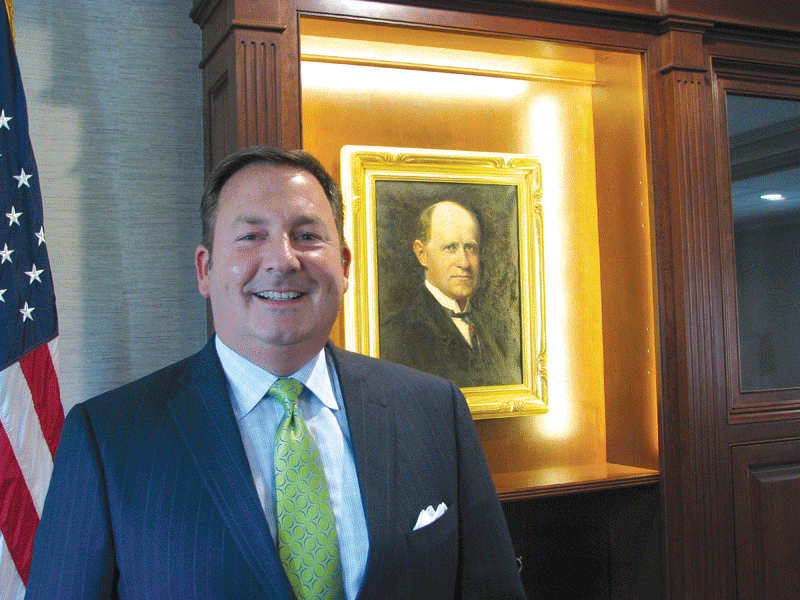
Eastern States Exposition CEO Gene Cassidy and the man who inspires his work, fair founder Joshua Brooks.

Eastern States Exposition CEO Gene Cassidy and the man who inspires his work, fair founder Joshua Brooks.

Joshua L. Brooks was a man who got things done. And Gene Cassidy, CEO of the Eastern States Exposition, doesn’t let anyone forget it, hanging a large portrait of Brooks, the fair’s founder, at the front of the conference room where he meets with his staff.

“Mr. Brooks was concerned about agriculture,” Cassidy told BusinessWest. “He was an industrialist, but he saw that agriculture was losing ground in New England at the turn of the last century, with so much agriculture being produced out of the Midwest and South Central estates. So he established the Eastern States Agricultural and Industrial Exposition.”

Specifically, he got the National Dairy Show to move its annual event from Chicago to West Springfield in 1916, but only after he transformed a bare plot of land into a property where the expo could be staged.
“There’s a great story of how he capitalized the fairgrounds and got people to donate incredible sums of money,” said Cassidy, citing, as an example, the night of Feb. 1, 1914, when a major blizzard hit the Pioneer Valley. A fund-raiser was scheduled for that night, and Noyes Fisk, owner of Fisk Tire Co. in Chicopee — which later became Uniroyal — was given the responsibility of raising $750,000. “Even in that blizzard, with limited attendance, he was able to raise $450,000. That was the initial capital providing resources to build these facilities, including A Barn, B Barn, and C Barn.”

All three of those barns, including several other structures built in the early years of the fair, still stand today, while the fairgrounds has added many others over the years. More importantly, however, the fair — its name eventually shortened to the Eastern States Exposition and known colloquially as the Big E — has built a nearly century-old legacy that’s measured by more than its impressive regional economic impact (more on that later).

“The impact of Eastern States is dramatic, and it’s important to the region,” said Cassidy, who joined the Big E 20 years ago as chief financial officer and took the reins from longtime CEO Wayne McCary. Cassidy’s first two fairs as CEO set records for attendance, but he has been equally successful with another mission: bringing the expo’s history to life, partly by decorating the expo’s offices with dozens of posters, documents, and artifacts from the past 98 years, including more than one celebrating the work of the man he respectfully calls Mr. Brooks.

“Since I became CEO, my goal has been to reconnect and resurrect, if you will, the spirit of our founder, Mr. Brooks,” Cassidy said. “This building was pretty sterile before, but I think the history is important, and it’s important for all of us who work here to be reacquainted with why we’re here — and what, really, is the purpose of the Eastern States Exposition.”

As the 99th edition of the Big E gets set to roll out in two weeks, Cassidy sat down with BusinessWest to answer that question in a number of ways.

Animal Attraction

Although the words ‘agricultural’ and ‘industrial’ are no longer in the fair’s name, Cassidy said, it would be a mistake to underestimate their importance to what the Big E is all about.

“Yes, entertainment drives people’s interest, and we make a big deal about food; that drives people’s interest as well. And certainly the midway is an attraction, so making sure we have a good, clean, safe, attractive midway is key,” he explained. “Behind the scenes, though, we’re engaged in producing an event that serves the agricultural industry and the commodities industry for all of New England. Those are less exciting things for some people, but we get very excited about them.”

He said the fair has become known over the decades as a prime showcase for what he called the “bovine, equine, and swine” categories of livestock shows, as well as for produce and other food products. “If you win a blue ribbon at the Eastern States Exposition, whether it’s for cheese or cattle or goats, whatever it is, that gives you national cachet, national attention. Most fairgoers aren’t cognizant of that, but it’s very important for both the agriculture and industry that drives a large part of the New England economy.”

The fair has always educated people about livestock and agriculture, and Cassidy feels that mission is more important than ever, with so many Americans, particularly of the younger generations, unaware of what goes into putting their food on the table.

“So much time has passed from 1916 to today, and people are so distant from production agriculture. In many cases, animals [at the show] are viewed as if they’re domestic pets and not domestic food products. Youth today have no connection, no understanding of where their food actually comes from,” he said, adding that this disconnect isn’t limited to the agricultural side, and he’d like to see more fair offerings that teach people about food processing as well.

In addition, “it’s a continuing battle with animal-rights organizations,” Cassidy noted. “We get blowback from rogue groups that raise money on the Internet, anonymously, and they influence our programs in a way that’s detrimental to the general public.”

For example, “my office is two miles from the house where I was born and raised,” he continued. “When I was a kid, the Eastern States Exposition had a carcass exhibit, and a butcher butchering beef cattle and explaining the different cuts of beef. People would be mesmerized, and would learn where the loin comes from, the shoulder, and so on. In this day and age in New England, you could never have an exhibition like that, and it’s sad.”

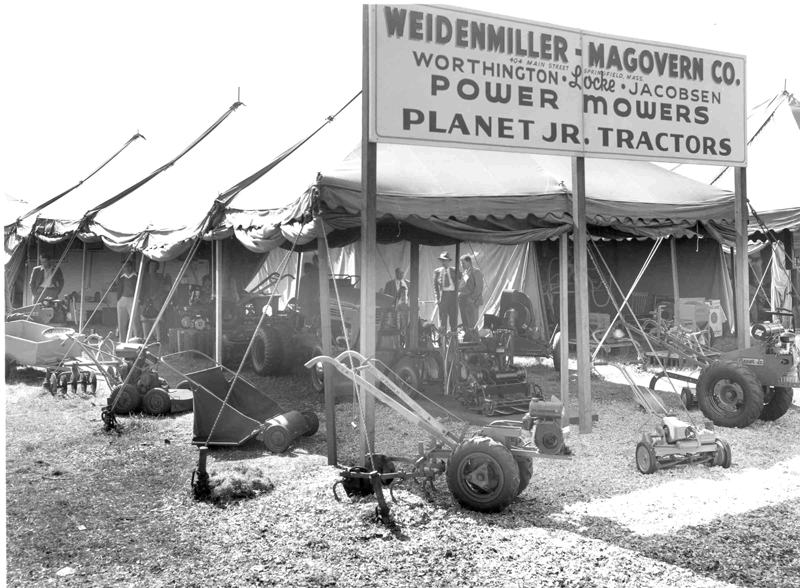
Just like today, fairgoers have long been able to peruse and buy the latest products at the Big E.

Just like today, fairgoers have long been able to peruse and buy the latest products at the Big E.

While maintaining as much of the expo’s agricultural focus as possible, Cassidy said he would like to strengthen the connections the fair has to other notable industries, such as machine tools, using the fair as a platform to grow those businesses and generate jobs as well. He also believes promotion of consumer products still has a place.

“Companies used to use fairs as a means of promoting their new products,” he noted. “With the advent of television, fairs became less attractive for, say, Westinghouse or General Electric to launch their latest washing machine or other product. But we’re working very hard here to create opportunities for companies to re-engage people on the one-to-one level.”

This year’s fair will showcase the Ford Mustang, which made its debut at the New York World’s Fair 50 years ago. The Big E will display one of the Mustangs that was actually on display in New York in 1964, and Sarat Ford has produred a few rare special-edition Mustangs to display as well. “In many ways, we’re celebrating the World’s Fair,” Cassidy said. “It’s a throwback feature, which I’m really excited about.”

Eat, Listen, Love

Cassidy told BusinessWest that he fully understands the fair’s appeal to tradition and nostalgia that repeat visitors enjoy — everything from the livestock shows to the parades and circuses to the state buildings, where the six New England states promote their most popular foods, crafts, and other products. The challenge, of course, is maintaining those traditions while keeping the fair fresh.

Entertainment is a large part of that, and the Big E has long offered free concerts to visitors — this year’s extensive lineup features up-and-comers like The Voice winner Cassadee Pope and veterans like Eddie Money — while mixing in a few bigger-name shows that require an extra admission fee, including Darius Rucker, Little Big Town, and ZZ Top.

“I’ve been trying to get ZZ Top for 10, maybe 15 years, and I finally got them, so I’m very excited,” Cassidy said, adding that financial changes in the entertainment-booking world have made charging for some acts necessary.

“You’ve got to have good entertainment — that’s the thing that puts the buzz in the air. But that’s extremely difficult to do, and every year, it’s harder and harder. When I started here in 1994, we could book the biggest acts in Las Vegas for $40,000 or $50,000, and they would do two shows a day. Now, in the current age, we can’t afford these acts,” he said, noting that booking Reba McEntire in 2011 cost $335,000. “So we’ve been forced to charge now for the biggest acts, and we do our best to find solid acts we can give away.”

He credited John Juliano, the long-time special-events director for the Big E, with always being able to book talent on the rise, from Beyoncé before Destiny’s Child was popular to Hunter Hayes last year to Pope next month.

Still, for many fairgoers, music isn’t the number-one attraction; they’re more interested in finding out how many foods can be successfully deep-fried.

“Talent is such an important way of keeping people interested, but the other way is gastronomically,” Cassidy said of the Big E’s extensive selection of fair food. “I love cheese curds, and this is the only place in the world I get cheese curds. But we also have to continually discover new products and find means by which to bring new products to the fairgoing public.”

After all, the vitality and continuing popularity of the Big E has a direct economic impact on the region. According to a report the Eastern States Exposition produced this year, the 17-day Big E, plus all the other events that take place on the fairgrounds each year — which feature exhibitions for animal lovers, car enthusiasts, gun owners, campers, and dozens of other groups — benefit the region with an annual economic impact of $479 million.

The tax revenues alone include $3 million in income tax, $1.4 million in sales tax, $427,000 in hotel tax, and $3.3 million in food and beverage tax. More significantly, events generate $299 million in gross regional product and account for 3,000 jobs in Hampden County that generate $91.9 million in personal income. The exposition’s impact on the rest of New England and New York include 2,000 jobs generating $134 million in personal income. In all, 2.5 million visitors stop by the fairgrounds each year, well over 1 million for the Big E alone.

“We need all the stakeholders — which include the fair patrons, business leaders from throughout the region, and our own board of trustees — to be able to draw a direct link toward the Eastern States as a mechanism to drive the economy and jobs,” Cassidy said. “The fair has a broad impact on agriculture worldwide, but has its most important role in this region. It plays a very important role in generating business on a grand scale, and that ripples throughout the economy at many different levels.”

Into the Next Century

At one point, Cassidy pulled out an old, worn book filled with stock certificates that Brooks sold to some of Greater Springfield’s most notable citizens in the fair’s early days — then later bought back so that no individual or group could set the event’s agenda.

To continue Brooks’ legacy for the next 100 years, Cassidy knows that the fairgrounds need some attention, starting with those century-old buildings. Renovating the large B Barn, otherwise known as the Coliseum, is a $60 million endeavor, and that’s just one structure. Last year, the fair generated about $5 million in profit — a success, of course, but not the kind of revenue flow needed to sustain multiple improvement projects.

“We need to continue to grow, not just because we’re a 100-year-old facility with a great deal of deferred maintenance, but to re-educate the fair-going public,” he said. “I think we’re the most successful fair in the country; we’re recognized nationally as a best-practices organization. We’re one of the largest fairs, and the largest fair that’s not state-subsidized, which is really remarkable. But we need to put a lot of attention into this 100-year-old plant.”

To do that, Cassidy says it’s crucial to generate regional philanthropy, like Brooks did when he reached out to his wealthy friends to launch the exposition in 1916. “We’re a 501(c)(3) public charity, and financially, we’re a very stable organization, but we need to reinvigorate our stakeholders — not just to sustain ourselves, but we owe it to the region to grow, so the region grows.”

As board treasurer of the Regional Employment Board of Western Mass., Cassidy is keenly aware of the region’s need to retain talent to grow a number of its industries, and he feels like the Big E and its myriad activities can play a role in that, if only by improving quality of life in the Pioneer Valley.

“We have access to the best education in the world, and we’re exporting our graduates. Any company executive who scoffs at that is not being responsible in their duty to grow the economy and make their mark on the general citizenry,” he told BusinessWest. “It’s all about quality of life. My hope is that the Eastern States Exposition adds to quality of life for people in West Springfield and all of Greater Springfield.”

It’s an easy thing to get excited about, Cassidy added. “People pay to get in, and they’re predisposed to happiness. There are very few jobs in the world where the person coming through the gate is coming in to have a good time. You go to the grocery store because you have to, or go to the tire store because you need tires. You don’t have to come to the Big E.

“Our job,” he concluded, “is to deliver a product that makes you want to be here. If we can take our presence here and use it as a multiplier to drive industry in the local economy, we’ve succeeded.”

Joseph Bednar can be reached at [email protected]

Back to School Sections

New Programs Prepare People for Careers in Manufacturing

Several weeks ago, Bob LePage met with a fourth-generation manufacturer who is having problems finding new employees with the right skills to fuel his company’s growth.

“He told me his competitors were also having a difficult time and he gained new customers when another fourth-generation manufacturing company went out of business because they could not find enough talent,” said Springfield Technical Community College’s vice president of Foundation & Workforce Training.

In response to the growing need for skilled workers in the manufacturing sector, STCC launched several new programs this summer and expanded existing programs that provide training and retraining for careers in the field.

Specifically, STCC’s associate-degree program in precision machining doubled in size last September from 40 to 80 students, thanks to a $2 million upgrade of the school’s Smith & Wesson Technology Applications Center. “We have all new CNC machines, computers, high-end computer workstations, and software. We also hired two new faculty members as well as technicians,” said STCC President Ira Rubenzahl, adding that there will be a total of about 250 students in non-credit and for-credit manufacturing-related programs this fall.

From left, West Springfield High School students Lexi Pastore, Jared Schelb, and Chris Brown prepare to make key fobs under the direction of STCC Professor John LaFrancis.

From left, West Springfield High School students Lexi Pastore, Jared Schelb, and Chris Brown prepare to make key fobs under the direction of STCC Professor John LaFrancis.

And on Aug. 28, a class of 15 students who were carefully honed from a field of 60 applicants will graduate from a free, 10-week, intensive accelerated manufacturing technician production program. It was created collaboratively by STCC and Holyoke Community College, with input from more than 50 manufacturers. Participants range from recent high-school graduates to an individual in his 50s returning to the field after years away from the industry.

The accelerated program includes a combination of classroom and hands-on training in machining, and will continue this fall, with a class at STCC’s Smith & Wesson Center and another sponsored by HCC. The latter will consist of evening sessions held at Dean Vocational Technical High School, with hands-on training there and in the Smith & Wesson Center.

“The program provides students with production, foundational machining, and fabrication skills,” said LePage. It includes classes on machinery, instrumentation, LEAN production, blueprint reading, teamwork, and manufacturing math. Students are also given exposure to the industry via speakers and field trips.

When the first class graduates later this month, members will receive certificates of completion, OSHA 10-hour cards, and mechanical-aptitude certificates. Companies have already interviewed them in anticipation of the upcoming commencement, and LePage said starting salaries should between average between $35,000 and $40,000.

The program was funded by the Massachusetts Competitive Partnership, MassMutual, Suffolk Construction, and Smith & Wesson.

LePage said the college has weekly meetings with administrators at Smith & Wesson, who invested more than $200,000 in the center five years ago and continue to support it.
“Our plan is to expand the program; we want to offer it at UMass Amherst and in two other communities in addition to Holyoke,” he explained. “We need to grow capacity so we can meet the volume needs for the region.”

Other measures to fill the gap include an increase in the number of training sessions for employees of manufacturing companies, accomplished through a partnership with the Regional Employment Board of Hampden County (REB). It allows individuals and small groups working in the field to update their skills at the Smith & Wesson Center. Larger manufacturers with six or more employees have the option of sending them to the center or having instructors from the college conduct on-site trainings in their locations.

Credit and certificate programs are also part of the mix, and STCC offers a CNC certificate in design, a CAD-CAM certificate, and an associate’s degree in mechanical engineering technology. Classes are held four nights a week to meet the needs of people already employed who want to step up their careers, as well as those in traditional degree programs.

Early Exposure

STCC and its partners are also looking to the future, and this summer, the REB paid for a group of 10 students from West Springfield High School to attend a new, two-week summer session called “Pathways to Prosperity” at the Smith & Wesson Center.

The teens, who will be entering their sophomore year this fall, were selected by the school and were among a group of 60 students who toured the center in the spring. “The program gave us the opportunity to expose students from a non-vocational high school to manufacturing,” said John LaFrancis, professor of Mechanical Engineering.

The students learned how to design parts using computer software programs, then took the design for a small bottle-style container with four sides to a rapid prototyping machine.

LaFrancis said they worked as a group to decide what to emblazon on two sides of the container, and chose their high-school Terrier logo for one side and put their names and/or a quotation on the other.

“This was an additive process which required them to add material to manufacture their bottles,” said LaFrancis. “Each student got to keep their container, and they will make good holders for pens and pencils.”

The students also chose a design for a brass key fob, and emblazoned ‘STCC’ on one side and their name or something else on the flip side. “The key fob was a subtractive process in which they removed material to reveal their individual designs,” LaFrancis explained. “The program has been a real success, and we would like to hold it again. But we want to expand it to two campuses so we can expose more students to manufacturing.”

STCC and its partners are doing all they can to meet that goal and interest young people in manufacturing. “The program was part of a strategy to build awareness about career opportunities,” LePage said.
Rubenzahl added that exposure to opportunities in manufacturing should start in middle school. “Students can have careers as engineers, run CNC machines, do design work, programming, quality control, or go into sales and marketing,” he noted. “Manufacturing is a hot field for employment in the Pioneer Valley, and, given the economy, it’s important for people to understand this and take advantage of it, because if there are not enough new employees, companies won’t survive.”

One reason for the shortage of skilled workers is the number of Baby Boomers who are retiring. “We believe the region will need 300 to 400 workers in the next few years,” said LePage. “One company that recently partnered with us told me they expect to lose two-thirds of their staff to retirement.”

The need has echoed throughout the Valley, and the new programs have been created through proactive collaborations with the REB, Holyoke Community College, and high schools with vocational technical programs, as well as information elicited from local manufacturers.

“We’ve been working to improve our ability to educate students for the manufacturing sector for 10 years, and people are wowed by what we are doing,” said Rubenzahl. “Manufacturing is the most important sector for revitalization in the Pioneer Valley; the area was a center for manufacturing during the 19th century, and there are many legacy companies, new companies, and a lot of skill in terms of business acumen to build on. An expansion of manufacturing will be the basis for building a robust economy here. Plus, these jobs pay well, and the college wants to provide the education students need to get good-paying positions.”

He added that STCC’s partnerships with manufacturers are growing in number, which heightens the school’s ability to link graduates to jobs while raising awareness about career opportunities through tours and informational sessions.

Solid Foundation

LePage said many people are unaware of the number of small manufacturers in the region who provide specialized products for the medical, auto, and aerospace industries. Pay for entry-level positions averages from $12 to $17 an hour; people with a one-year certificate earn between $40,000 and $50,000, and those with an associate degree gross about $50,000, or $70,000 with overtime.

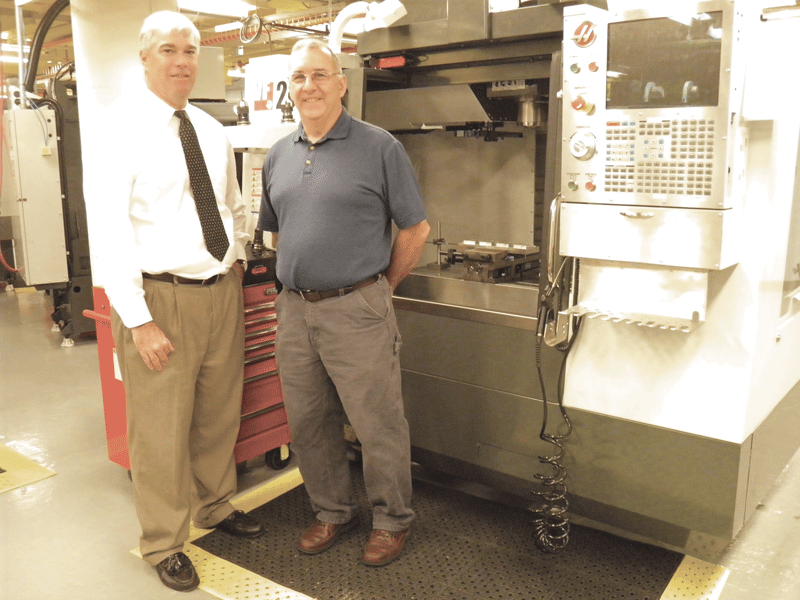
Bob LePage, left, and John LaFrancis show off one of the new machines in the Smith & Wesson Technology Application Center at STCC.

Bob LePage, left, and John LaFrancis show off one of the new machines in the Smith & Wesson Technology Application Center at STCC.

“Machinists, highly skilled machine operators, and those who support the process are in demand, and we now have training for all three levels,” LePage said.

Although STCC and HCC have created new programs, Rubenzahl said economic-development agencies and department heads need to place more emphasis on manufacturing. “I believe they need to make it an important priority because there is a huge potential future in terms of jobs and industry growth if we can all get on the same page,” he told BusinessWest.

He cited, as one example, the $1.5 billion appropriated by the Legislature to replace rail cars on the Mass. Bay Transit Authority Orange and Red lines, since it has been mandated that they must be manufactured in the state.

“We would like Western Mass. to become so prominent in the manufacturing sector that it would be the logical and most cost-effective place to do this work,” LePage said. “But we need to raise our game to be able to attract that type of business.”

This requires an educated workforce, especially since the manufacturing sector is very dynamic and large capital investments are required for companies to be successful. “We can’t compete with Mexico and India in terms of labor, but we can compete by making high-end devices, which are some of the key products which companies in this region specialize in,” Rubenzahl said, adding that he spoke to a manufacturer who showed him a $1 million machine and said he would be happy to pay someone $50,000 to $60,000 a year to run it.

“Companies have made huge investments in order to be successful, but they need highly educated people,” he went on. “And there are a lot of small, local companies here doing tremendously sophisticated work.”

Future Outlook

LePage argues that long-term planning has been critical in developing the new programs. “No one institution can solve the problem — it takes a collaborative regional approach,” he said. “But we plan to continue to add new components to our program at STCC meet the region’s needs.”

Gary Masciadrelli, chair of the Mechanical Engineering Technology Department, agreed.

“STCC is fully supportive of supplying the manufacturing industry with current and future workers today, evidenced by our programs in the high schools and for adult learners,” he said. “We look forward to continuing them in the future to meet demand.”

Features

At a Time of Change in Retail, Holyoke Mall Marks 35 Years

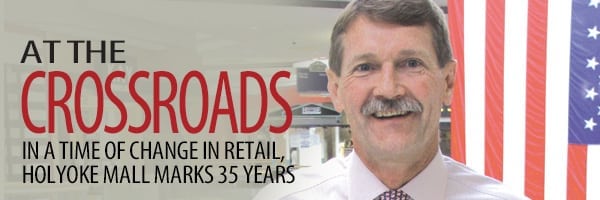
Holyoke Mall General Manager William Rogalski

Holyoke Mall General Manager William Rogalski

When the Holyoke Mall opened in the Ingleside section of the city in 1979, shopping malls were the hottest trend in retail.

These days, as the center celebrates its 35th anniversary, they’re anything but, losing ground to online retail options and smaller shopping centers. But Holyoke Mall remains a draw, said General Manager William Rogalski.

“Certainly, our traffic is good. In recent years, sales have fluctuated with the economy, but we’re still a significant part of people’s shopping experience,” he told BusinessWest. “Online shopping does affect us, but I’m still of the belief that people still like to see it, touch it, feel it, and try it on before they buy.”

To get shoppers inside the mall, though, variety and a fresh experience are key — part of the mall’s mission to get visitors to “stay longer and shop more,” to quote an oft-repeated mantra at Ingleside.

“We’ve always tried to be a shopping center where everyone can go, from the high end — like Apple, Sonoma, Pottery Barn, and a new store opening up, Michael Kors — to traditional retail tenants, to value tenants like Burlington Coat Factory and everything in between,” said Rogalski. “That’s what makes the difference for people here — there’s something for everyone.”

The fact is, despite the surge in online retail, consumers still visit brick-and-mortar stores for the vast majority of their shopping, according to a 2013 Nielsen report titled “Brick by Brick: The State of the Shopping Center.”

“Shopping centers aren’t just places to buy things,” the report notes. “They’re social centers, places for entertainment, and employment hubs. They’re also transforming what consumers can expect from a shopping experience.”

With the increasing diversification and aging of the U.S. population, the report continues, the line between shopping, entertainment, and community building has blurred, and this blending of experiences has created an opportunity for retail centers to strengthen social ties within communities that are looking for communal experiences.

“It’s a gathering point, even for people who don’t even shop, like mall walkers; for them, it’s a social experience,” Rogalski said. “And it’s nice to have them. Frankly, they’re a good source of information. They’re here every day, as we are, but we don’t see everything. In some cases, they become our eyes and ears. We’ve made some relationships, made some good friends.”

The goal of any mall, of course, is to ring up sales, and to that end, Rogalski — and Pyramid Management Group, which owns Holyoke Mall and 19 other properties in Massachusetts and New York — are not sitting on past laurels, instead moving forward with a series of renovations and possible future additions to keep the crowds coming back and spending money.

For this issue, Rogalski — a West Springfield native who actually worked at the just-opened Holyoke Mall in 1979, at Blake’s department store — sits down with BusinessWest to discuss some of those changes, and why he believes malls are far from irrelevant in the 21st century.

The Mall’s Changing Face

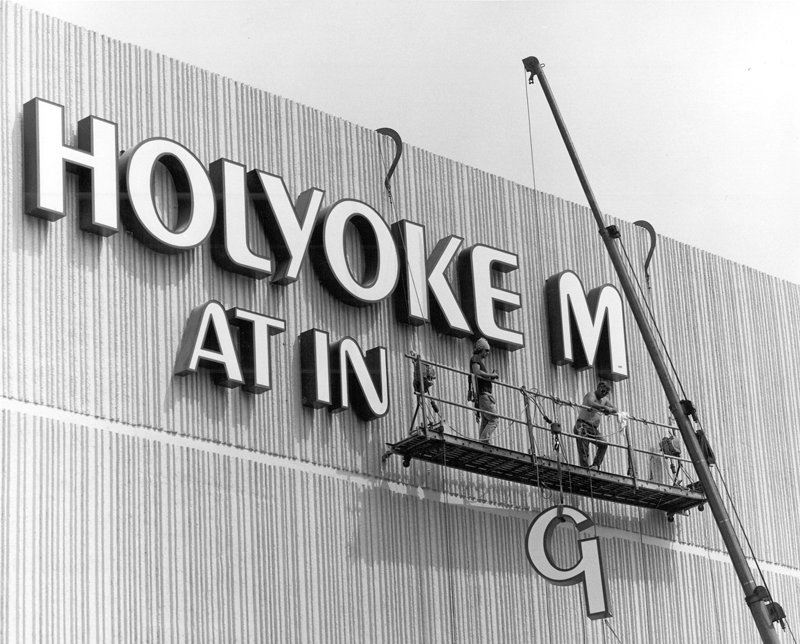
Signage goes up at Holyoke Mall in 1979.

Signage goes up at Holyoke Mall in 1979.

At its opening, Holyoke Mall was one of the largest shopping centers in the Northeast, with 125 stores covering 1.1 million square feet and surrounded by 5,000 parking spaces. Today, almost 200 stores (counting kiosks) sprawl across 1.6 million square feet of shopping space, and the construction of additional parking garages has expanded vehicle capacity to 7,052.

But the mall still needed some work, said Rogalski, who has managed the facility for a dozen years. “We’re working on a major renovation now, retiling the whole center. We’re redoing the wood trim, replacing the wooden handrails with metal handrails, upgrading restrooms, and putting in a new guest-services area.”

Other changes will include refacing the mall’s signature glass elevator, new directional signage in the hallways, a continuation of energy-efficient lighting upgrades, new interior landscaping, and what’s known in the industry as ‘soft seating areas’ to help guests relax and extend their stay.

“It’s a pretty significant renovation. People will notice,” Rogalski said, adding that the work is largely taking place overnight so as not to disrupt shoppers. During BusinessWest’s visit, much of the the top floor had been torn out, awaiting new white tile, and fire alarms were being tested in the future location of Michael Kors.

He added that customer feedback has guided some of the changes, and mall management is also listening when it comes to future additions — including, perhaps, a movie theater. The Ingleside Eight Screen Cinema, which opened in 1979 and was located downstairs, beside the current food court, was shuttered in 1998.

“Of [Pyramid’s] 14 enclosed centers, we are one of two that does not have a movie theater. That’s definitely in the cards somewhere down the road for us,” he said, noting, however, that the mall is currently about 95% leased. “In one regard, that’s a good thing. But in another, it’s not so good, because we need to create space to include a movie theater. We’d be fine from a parking aspect; it’s a matter of getting contiguous space to do a theater.”

Pyramid is exploring other entertainment options as well, Rogalski added. “There’s always a buzz that gets created when we bring in new stores, restaurants, or entertainment. A lot of the changes happen gradually, but it’s always good to add new blood.”

Holyoke Mall, which attracts between 18 million and 19 million visitors a year, saw a downturn when the economy went south six years ago, but the hit wasn’t as severe as it was for retail centers in other regions.

“That’s probably more a reflection of Western Mass. as a whole as related to the general economy. Maybe because it’s our Yankee roots’ we’re a bit more conservative,” he noted. “When the nation is on a high, we don’t hit the high peaks; we roll a little bit below that. And when the nation hits lows, we roll a little bit above that; we skew more along the center line and don’t waver too far. That’s not to say we don’t have ups and downs, but they’re not as dramatic.”

Rather, the dramatic shifts come with the seasons, especially the holiday rush, from Thanksgiving through New Year’s Day, when many retailers find out whether they will turn a profit for the year.

“We’re in our second-best season now, back-to-school time,” Rogalski said. “Then we’ll have a little dip, accentuated by having the Big E for three weeks, drawing everyone’s attention. We certainly don’t shut down, but we feel the impact. Then we ramp up for the holidays. It’s a critical time, and it has been extended with the advent of gift cards — now it really flows into the end of December and the beginning of January.”

He added that malls tend to be slaves to the weather, citing a downturn in sales due to this year’s harsh, extended winter. “That impacted spring sales because people just weren’t in the mood. That’s one thing we can’t control.”

Gauging the Future

There’s plenty that malls can control, however, and it’s critical that they keep an eye on trends that have battered some shopping centers and helped others.

On the plus side for Holyoke Mall is its enviable location at the crossroads of two major interstates. While malls located away from highways have struggled in recent decades, Ingleside’s location draws shoppers from as far away as New York to the west, Hartford to the south, Worcester to the east, and Vermont and New Hampshire to the north. “We are at the intersection of 90 and 91,” Rogalski said. “Pyramid definitely paid attention to Marketing 101: location, location, location.”

America’s first enclosed mall, Southdale Center in Edina, Minn., was a true innovation in the way it invited people to browse, eat, hang out with friends, or just wander about. Early malls encouraged walking by placing anchor stores as far apart as possible, forcing visitors to pass dozens of small shops.

The model caught on big time, and the number of regional malls more than doubled from 1973 to 2006, topping 1,500 nationally, according to CoStar Realty Information. But since 2006, only one traditional enclosed mall has been built, in Salt Lake City. Analysts point to a number of factors hurting enclosed malls, from the growing popularity of smaller outdoor shopping centers to the rise in e-commerce.

But Pyramid has been proactive with freshening up a number of its properties, Rogalski said, including Walden Galleria near Buffalo, N.Y., Destiny USA in Syracuse, N.Y., Palisades Center in West Nyack, N.Y., and, of course, Ingleside.

Of course, no property that’s been around as long as Holyoke Mall will look much like it did 35 years ago, if only because the retail world is constantly in flux. Of the original 125 stores at Ingleside, only a few remain, including anchors JCPenney and Sears, as well as American Eagle Outfitters, Deb, Foot Locker, General Nutrition, Kay Jewelers, Motherhood Maternity, and Radio Shack.

Enclosed malls have been hurt by the decline of traditional anchors; Holyoke’s other two original anchors, G. Fox and Steiger’s, are long gone. But at the same time, the definition of an anchor has broadened significantly, and Holyoke Mall now boasts 12 anchors after launching with only four.

“We were probably the first developer out there that saw value in bringing in big-box retail,” Rogalski said. “Some said it can’t be done, that they want to be in strip locations, pad locations. But now you see the Targets, the Best Buys, you see Babies R Us, Hobby Lobby, AC Moore, those type of retailers. We thought they would be successful in a closed shopping center, and they’ve been wildly successful.

“Sometimes it takes retailers a while to think out of the box and get them out of their comfort zone,” he said. “But, at the end of the day, this is the Northeast; we aren’t sunny and 70 degrees 12 months of the year. It’s a nice convenience for shoppers to have all this under one roof.”

That kind of convenience, he said, will continue to make the Holyoke Mall a destination, especially given its prime location at the crossroads of the Pioneer Valley.

“It’s easy to get to, easy to park, easy to walk,” Rogalski said. “It definitely is an attraction.”

Joseph Bednar can be reached at [email protected]

Departments Incorporations

The following business incorporations were recorded in Hampden, Hampshire, and Franklin counties and are the latest available. They are listed by community.

ADAMS

Adams Police Association Inc., 4 School St., Adams, MA 01220. Joshua Baker, same. To receive gifts, contributions, and grants for money or property from individuals, private organizations, public sources and any agency of the town of Adams, the Commonwealth of Massachusetts, and to apply, pay over, or disburse those gifts, contributions and grants or their proceeds for the benefit of the people residing in the town of Adams, with this objective to be furthered by funding, assisting, or undertaking programs and activities designed to strengthen the services, organization, performance, competence, and professionalism of the police department of the town of Adams (the “police department”) and its officers and members.
 
AMHERST

Cross the Waters Institute for Cultural Exchange Inc., 33 Kellogg Ave., #2, Amherst, MA 01002. Ingrid Claudia Askew, same.
 
CHICOPEE

A Child’s Potential Inc., 47 Royal St., Chicopee, MA 01020. Gabrielle Morgan, same. Education for families, professionals, and the public on increasing social, play, and communication skills for children on the autism spectrum. The focus will be to help all families, but especially those who may have more limited resources, develop strategies to help their children become more active participants in family and community life.
 
AGS Floors Inc., 49 Dakota Dr., Chicopee, MA 01013. Nikita Zhuk, same. Flooring sales and installation.
 
EAST LONGMEADOW

CrossFit Iron Will Inc., 288 Somers Road, East Longmeadow, MA 01028. David Heath Speckman, same. Exercise and physical training programs and services.
 
HOLYOKE

A 3 Petroleum Corp. USA, 636 Main St., Holyoke, MA 01085. Adeeba Abdul Rehman, 14 Arnold St., Westfield, MA 01085. Gas station and convenience store
 
B.O.S.S. Prostaffing Inc., 3 Valley Mill Road, Holyoke, MA 01040. Tyler Fernandez, 24 Kenmore Dr., Bloomfield, CT 06002. Business of recruiting and staffing of personnel for employment on both a temporary and permanent basis, and shall engage in other business activities lawfully conducted by a corporation in Massachusetts.
 
Brick Stone Tavern Inc., 330 Whitney Ave., Suite 440 Holyoke, MA 01040. William Cunningham Sr., 71 Exeter Ave., Longmeadow, MA 01106. Restaurant.
 
ES Pleasant Street Car Wash Inc., 47 Jackson St., Holyoke, MA 01040. Eric Suher, 28 Jefferson St., Holyoke, MA 01040. Car wash.
 
LUDLOW

Bocage Inc., 247 Cady St., Ludlow, MA 01056. Arlindo R. Alves, 247 Cady St., Ludlow, MA 01056. Bar.
 
CLF Holdings Inc., 30 River St., Ludlow, MA 01056. Carlos Figueiredo, same. Distribution of bakery products.
 
PITTSFIELD

Berkshire Electric Transmission Consulting Corp., 47 Greenings Ave., Pittsfield, MA 01201. George Gela, same. Consulting services.
 
Big City Trails Inc., 10 Wendell Ave., Ext. Suite One, 2nd Floor, Pittsfield, MA 01201. Franklin Pena, 626 Mercer St., Albany, N.Y. 12208. Transportation of passengers in a motor coach.
 
Center for Chiropractic Care Inc., 510 North St., Pittsfield, MA 01201. Christian Loidice, 126 Mountain View Dr., Pittsfield, MA 01201. Chiropractic services.
 
SPRINGFIELD

Bowles Realty Inc., 281 State St., Springfield, MA 01103. Stephen Reilly Jr., same. Real estate sales.
 
Dunn-Wright Recovery Network Inc., 151 Prouty St., Springfield, MA 01119. Luz Mejia, same. Recover assets for creditors.
 
THREE RIVERS

EMC Masonry Inc., 19 Bourne St., Three Rivers, MA 01080. Eric Przybycien, same. Masonry and construction services.
 
WEST SPRINGFIELD

A & E Transporation Inc., 76 Ashley St., West Springfield, MA 01089. Elshad Hasanzade, same.
 
WESTFIELD

And Inc., 4 Russell Road, Westfield, MA 01085. Mubeen Ishtiaq, 25 New Ludlow Road, Chicopee, MA 01020.
 
Davenport Flooring & Remodeling Inc., 97 Fairfield Ave., Westfield, MA 01085. Michael Davenport, same. Flooring installation and home remodeling.
 
EFE & Omercan Inc., 57 Southwick Road, Westfield, MA 01085. Nurcan Cayan, same. Pizza restaurant.

Daily News

SPRINGFIELD — Keith Minoff was recently selected by his peers for inclusion in The Best Lawyers in America 2015 in the fields of commercial litigation and corporate law.

Best Lawyers is based on an exhaustive peer-review survey. More than 52,000 leading attorneys cast more than 5.5 million votes on the legal abilities of other lawyers in their practice areas. Minoff specializes in business litigation and employment law. His office is located in downtown Springfield.

Daily News

SPRINGFIELD — Skoler, Abbott & Presser, P.C., an employment-law firm serving the Greater Springfield area, announced that four of the firm’s partners — Ralph Abbott Jr., John Glenn, Timothy Murphy, and Jay Presser — were listed in 2015 edition of Best Lawyers in America. In addition, Murphy was named the Best Lawyers 2015 litigation, labor and employment Lawyer of the Year in Springfield.

Those honored as Lawyer of the Year have received particularly high ratings in surveys by earning a superior level of respect among their peers for their abilities, professionalism, and integrity. Best Lawyers is based on an exhaustive peer-review survey. More than 52,000 leading attorneys cast more than 5.5 million votes on the legal abilities of other lawyers in their practice areas. Lawyers are not required or allowed to pay a fee to be listed; therefore, inclusion in Best Lawyers is considered a singular honor.

• Abbott has been listed in Best Lawyers in the categories of arbitration; employment law, management; labor law, management; and mediation. He has been a partner at the firm since 1975 and is known throughout the legal community for his work representing management in labor relations and employment-related matters, providing employment-related advice to employers, assisting clients in remaining union-free, and representing employers before the National Labor Relations Board (NLRB). Abbott also has numerous credits as an author, editor, and teacher and a record of civic and community involvement. He has been selected by his peers for inclusion in Best Lawyers every year since 1989.

• Glenn has been listed in Best Lawyers in the categories of arbitration; employment law, management; and labor law, management. He has been a partner of the firm since 1979 and has spent his career representing management in labor relations and employment-related matters. In addition to providing employment-related advice to employers, he assists clients in remaining union-free and represents employers before the NLRB. He has extensive experience negotiating collective-bargaining agreements and representing employers at arbitration hearings and before state and federal agencies. Prior to joining Skoler, Abbott & Presser, Glenn was employed by the NLRB in Cincinnati. He has served as an adjunct professor of Labor Law at Western New England University School of Law and is a member of the American Academy of Hospital Attorneys. He has been selected by his peers for inclusion in Best Lawyers every year since 1995.

• Murphy has been listed in Best Lawyers in the categories of employment law, management; labor law, management; and litigation, labor and employment. He joined Skoler Abbott after serving as general counsel to an area labor union and as an assistant district attorney for the Hampden County District Attorney’s Office. His practice includes labor relations and employment litigation, as well as employment counseling. A native of the Springfield area, Murphy is a graduate of the Western New England University School of Law. He has also taught courses in employment law at WNEU. He is a frequent contributor to business and human-resource publications and a contributing author to the Massachusetts Employment Law Letter. He has been selected by his peers for inclusion in Best Lawyers every year since 2013.

• Presser has been listed in Best Lawyers in the categories of employment law, management; labor law, management; and litigation, labor and employment. He has more than 35 years of experience litigating employment cases and has successfully defended employers in civil actions and jury trials and handled cases in all areas of employment law, including discrimination, sexual harassment, wrongful discharge, wage hour, FMLA, ERISA, and defamation. He has won appeals before the Supreme Judicial Court and the First and Second Circuit Courts of Appeals, and represented employers in hundreds of arbitration cases arising under collective-bargaining agreements. He has been selected by his peers for inclusion in Best Lawyers every year since 1991.

Daily News

SPRINGFIELD — Four attorneys from Sullivan, Hayes & Quinn, LLC have been selected by their peers for inclusion in the 21st edition of Best Lawyers in America in the areas of labor law and employment law, management, as well as litigation, labor and employment. Receiving the prestigious award this year were Meghan and Frederick Sullivan, Gordon Quinn, and Richard Hayes.

The 2015 list also highlights the achievements of Managing Partner Meghan Sullivan by naming her the 2014-15 Springfield “Lawyer of the Year” in the practice area of labor law, management. Only a single lawyer in each practice area in each community is honored as Lawyer of the Year.

“This is the third year that Meghan Sullivan has been selected as Lawyer of the Year,” said founding partner Frederick Sullivan. “Her SH&Q colleagues are extremely proud to be working with an employment-law attorney so recognized for her exceptional accomplishments on behalf of the firm’s clients.”

Best Lawyers is based on an exhaustive peer-review survey and is regarded as a definitive guide to legal excellence. Inclusion in Best Lawyers is considered a singular honor, as lawyers are not required or allowed to pay a fee to be listed. The firm’s two founding partners Frederick Sullivan and Richard Hayes, have been listed in Best Lawyers numerous times throughout their careers. Sullivan was first honored with the designation in 1989, with Hayes following suit in 1993. To view the latest digital edition of the New England Best Lawyers in America in which the SH&Q partners are featured, visit www.bestlawyers.com.

Daily News

BOSTON — Gov. Deval Patrick has signed H.4377, “An Act to Promote Economic Growth in the Commonwealth,” building on his administration’s economic-development strategy of investing in education, innovation, and infrastructure.

The economic-development package provides new tools and training to ensure the Massachusetts workforce meets the needs of employers, invests in Gateway Cities to promote development across the entire state, and provides incentives to create jobs and stimulate the economy. Patrick also refiled legislation that limits the use of non-compete agreements and adopts the Uniform Trade Secrets Act to ensure that government acts to retain talented entrepreneurs, supports individual career growth, and encourages the development of new, innovative businesses to drive future economic growth.

The legislation also includes a provision to give local governments across Massachusetts control over the number of liquor licenses in their jurisdiction. Placing the authority to approve liquor licenses in the hands of municipal officials will allow local communities to make responsible decisions regarding their economic development and growth, helping to free the Legislature from time-consuming local issues.

“In important ways, this legislation improves existing tools and provides a few new ones to continue our strong job growth, and I thank the Legislature for being so responsive,” said Patrick. “At the same time, we have unfinished business, so I am filing further legislation today to give innovators and municipalities all the tools they need to grow jobs and opportunity.”

The act bolsters the economic revitalization of the Commonwealth’s Gateway Cities with $15 million for the Gateway Cities Transformative Development Fund and encourages the reuse of brownfields in economically distressed areas of Massachusetts with $10 million in funding.

“This legislation makes many targeted investments in our emerging industries, like big data and advanced manufacturing, that are necessary to create a competitive environment here in Massachusetts and grow our status as a leader in the world economy,” said Senate President Therese Murray. “By capitalizing on our state’s existing and developing industries, as well as investing in a strong, educated workforce, we are outlining a path to success for our residents and promoting economic development throughout the entire Commonwealth.”

Added House Speaker Robert DeLeo, “this comprehensive bill will help ensure that residents, businesses, and communities are able to compete and excel in a dynamic economy. We’ve made substantial gains in strengthening our economy and must now focus on broadening the circle of prosperity beyond Greater Boston to all regions of the Commonwealth. This bill does just that while preparing future leaders through provisions like MassCAN, a computer-science-education partnership, and the Talent Pipeline Initiative.”

In the area of workforce development and training, the act includes $12 million for the Middle Skills Job Training Grant Fund to support advanced manufacturing, mechanical and technical skills at vocational-technical schools, and community colleges. Also, the Workforce Competitiveness Trust Fund will receive $1.5 million to prepare Massachusetts residents for new jobs in high-demand occupations, helping close the middle-skills gap and creating a seamless pathway to employment.

The economic-development legislation also includes a number of initiatives to expand the Commonwealth’s world-class innovation economy, including $2 million for a Big Data Innovation and Workforce Fund to promote the use of big data, open data, and analytics, and $2 million for the Innovation Institute Fund at the Massachusetts Technology Collaborative. The legislation also creates a $1 million talent-pipeline program that will provide matching grants aimed at increasing technology and innovation internships, and another $1 million for a startup mentoring program to connect early-stage entrepreneurs, technology startups, and small business with experienced business enterprises and capital financing.

Daily News

BOSTON — The Executive Office of Labor and Workforce Development reported that preliminary estimates from the Bureau of Labor Statistics (BLS) show Massachusetts added 13,800 jobs in July for a total of 3,422,100 jobs, and the total unemployment rate edged up 0.1% to 5.6% from the June rate. The rate is still the lowest since August 2008 and is below the 6.2% national unemployment rate.

Since July 2013, Massachusetts has added a net of 67,300 jobs, with 66,400 jobs added in the private sector. The total unemployment rate for the year is down 1.6% from the July 2013 rate of 7.2%. BLS also revised its June job estimates to a 2,500-job gain from the 3,700 previously reported for the month. Here is the July employment overview:

• Professional, scientific, and business services added 5,000 jobs (+1.0%) over the month. Over the year, professional, scientific, and business services added 13,300 (+2.6%) jobs.

• Education and health services gained 3,800 jobs (+0.5%) over the month. Over the year, education and health services gained 24,000 (+3.3%) jobs.

• Construction added 1,900 jobs (+1.5%) over the month. Over the year, the sector has added 2,400 (+2.0%) jobs.

• Trade, transportation, and utilities added 1,900 jobs (+0.3%) over the month. Over the year, trade, transportation, and utilities gained 12,800 (+2.3%) jobs.

• Financial activities gained 1,000 jobs (+0.5%) over the month. Over the year, the sector added 2,500 (+1.2%) jobs.

• Other services added 800 jobs (+0.6%) over the month. Over the year, jobs are up 3,300 (+2.7%) in this sector.

• Leisure and hospitality gained 600 jobs (+0.2%) over the month. Over the year, the sector added 4,300 (+1.3%) jobs.

• Manufacturing added 500 jobs (+0.2%) jobs over the month. Over the year, manufacturing lost 600 (-0.2%) jobs.

Briefcase Departments

State IG Report: Dobelle ‘Violated the Public Trust’
WESTFIELD — A long-awaited report from the state inspector general’s office claims that former Westfield State University President Evan Dobelle improperly used hundreds of thousands of dollars from school accounts to pay for personal expenses, including a number of trips, and then covered these actions by filing false reports. “Dobelle knowingly disregarded university policies, misled the WSU board of trustees, abused his authority, and exploited public funds for personal benefit,” Inspector General Glenn Cunha wrote in his scathing, 60-page report. “Dobelle’s self-characterization as a ‘visionary’ does not absolve him from the obligation to follow the rules … Dobelle violated the public trust.” The report detailed dozens of incidents where Dobelle charged personal expenses to university credit cards, including more than $63,000 for 17 trips to San Francisco where, he told school officials, he was meeting potential donors and tech-sector business executives. However, the IG’s report found he was mostly attending social events. Dobelle resigned from the university in November 2013 amid a firestorm of criticism concerning his lavish spending. The Boston Globe reported that Cunha’s report raises the prospect that Dobelle could face criminal investigation. The paper quotes a spokesperson for Attorney General Martha Coakley saying, “this report raises serious concerns and allegations about the use of Westfield State resources by its former president. We have been conducting our own investigation into this matter and anticipate additional action soon.” In a prepared statement, WSU Interim President Elizabeth Hall Preston said, “while this has been a difficult period for all of us, the faculty and staff at the university have persevered and focused on the work of providing our students with an outstanding education. We approach the start of our new academic year with a sense of excitement and new momentum.”

State Economy Bounces Back in Second Quarter
BOSTON — Massachusetts real gross domestic product grew at an estimated annual rate of 4.9% in the second quarter of 2014, according to the MassBenchmarks Current Economic Index, released Wednesday by MassBenchmarks, the journal of the Massachusetts economy published by the UMass Donahue Institute in collaboration with the Federal Reserve Bank of Boston. In contrast, according to the U.S. Department of Commerce, national real gross domestic product grew at an annual rate of 4.0% in the second quarter, based on the advance estimate of the U.S. Bureau of Economic Analysis. State and U.S. economic growth bounced back from the surprisingly weak first quarter as labor markets gained strength both locally and nationally. Based on the most recent data available, MassBenchmarks now estimates that, in the first quarter of 2014, the state’s economy contracted at an estimated annual rate of 0.3%, while the U.S. economy declined at an annual rate of 2.1%. “The steep downward revision in the estimate of Massachusetts economic growth for the first quarter (originally reported as positive 2.6%) is primarily due to the correspondingly large downward revision in U.S. economic growth in the first quarter, originally reported as positive 0.1%,” noted Alan Clayton-Matthews, MassBenchmarks’ senior contributing editor and associate professor of Economics and Public Policy at Northeastern University, who compiles and analyzes the Current and Leading Indexes.

“The downward revisions in U.S. GDP reflect large reductions in two components — consumer spending and exports — that were most affected by the unusually harsh winter weather. This sharply lowered estimates of national and state productivity growth, meaning fewer business sales per employee and thus a significant reduction in the first quarter estimates of economic growth.” Massachusetts payroll employment grew at a 1.7% annual rate in the second quarter, up from 1.2% in the first quarter, while U.S. payroll employment grew at a 2.2% annual rate in the second quarter up from 1.5% in the first quarter. During the second quarter, the unemployment rate in Massachusetts fell from 6.3% (in March) to 5.5% (in June), while the U.S. unemployment rate fell from 6.7% to 6.1% during the same period. Year to date (through June), the state’s unemployment rate has fallen 1.6%, while the national unemployment rate has fallen 0.6%.

Nominations Sought for ACCGS Super 60
SPRINGFIELD — The Affiliated Chambers of Commerce of Greater Springfield is seeking nominations for its annual Super 60 awards program.  Now in its 25th year, Super 60, formerly the Fabulous 50, celebrates the success of the fastest-growing privately owned businesses in the region that continue to make significant contributions to the strength of the regional economy. Each year, the program identifies the top-performing companies in revenue growth and total revenue. Last year, one-third of the winners in the revenue-growth category experienced growth in excess of 50%, with the average growth of all the honorees in that category at more than 49%. Total revenue winners combined for revenues of more than $1 billion, with an average revenue of more than $35 million. To be considered, companies must be based in Hampden or Hampshire county or be a member of the ACCGS, have produced revenues of at least $1 million in the last fiscal year, be an independent and privately owned company, and have been in business for at least three full years. Companies are selected based on their percentage of revenue growth over a full three-year period or total revenues for the latest fiscal year. Companies may be nominated by financial institutions, attorneys, or accountants, or be self-nominated. Companies must submit a nomination form and provide net operating revenue figures for the last three full fiscal years, signed and verified by an independent auditor. All financial information must be reported under generally accepted accounting principles and will be held and considered confidential and not released without prior approval. Nomination forms are available by contacting Kara Cavanaugh at [email protected] or (413) 755-1310. Nominations must be submitted no later than Sept. 5. The Super 60 awards will be presented at the annual luncheon and recognition program on Nov. 7, from 11:30 a.m. to 1:30 p.m. at Chez Josef in Agawam.

Bribery Probe Costs Smith & Wesson $2M
SPRINGFIELD — Gun maker Smith & Wesson has agreed to pay $2 million to settle civil charges by federal regulators that it bribed foreign officials to sell firearms in other countries. The Securities & Exchange Commission (SEC) said the company violated the Foreign Corrupt Practices Act by making improper payments as it sought to sell guns overseas to police and military groups from 2007 to 2010. In 2008, according to the SEC, Smith & Wesson hired a third-party agent in Pakistan to help secure a sale with a Pakistani police department. Company officials also authorized the agent to provide more than $11,000 worth of guns to Pakistani police officials as gifts and to make additional cash payments to them. Smith & Wesson eventually won a contract to sell 548 pistols to the Pakistani police for a profit of $107,852, the SEC said.

Mohegan Sun Ending Lease of Site in Palmer
PALMER — The Republican reported that Mohegan Sun is ending its 99-year lease with Northeast Realty for the former casino site off Thorndike. The casino giant cited an inability to find a major retailer to anchor a proposed development there as the reason for its action. In a prepared statement, Northeast Realty said the move comes as no surprise and “confirms Northeast’s position that Mohegan Sun never intended to legitimately pursue non-gaming development” at the site. Former town councilor Paul Burns agreed with that sentiment. In a strongly worded statement e-mailed to BusinessWest, he said, “the statement today from Mohegan Sun regarding their desire to abandon Palmer is hardly surprising to those of us who have followed the trail of broken promises and misstatements since Mohegan entered into negotiations with Suffolk Downs in October, well before Palmer’s voters had even had their say.” He continued, “the premise, however, that Mohegan Sun has spent any significant amount of time trying to find a tenant is laughable. As recently as April, Mohegan Sun reps, in response to a request from three Palmer town councilors, indicated that they simply did not have time to pursue development in Palmer, as they were busy with the Revere project. Now barely three months later they have somehow completed an extensive search for a partner and came up empty? Clearly Mohegan Sun had no interest in developing this site for any purpose other than a casino. I believed, when they initially claimed interest in non-gaming development, that they were simply attempting to hold onto the site to prevent another company from building there should MGM not be awarded the Western Mass. license. Now, barely 30 days after MGM secures that license, Mohegan Sun’s actions speak loud and clear.  From where I sit, it is clear — they had no intention of building here. Obviously Mohegan Sun is not the ‘good neighbor’ they claimed to be.”

Community Foundation Issues $1.2M to Nonprofits
SPRINGFIELD — The Community Foundation of Western Massachusetts is awarding more than $1.2 million in competitive grants to local nonprofit organizations. A total of 99 Pioneer Valley projects will receive funding, with awards ranging from $2,000 to $52,500. The Community Foundation awards competitive grants each year, with funds targeting projects addressing community needs inclusive of arts and culture, education, the environment, health, housing, and human services for residents of Hampden, Hampshire, and Franklin counties. More than 60 of the projects funded were supported by trusts administered by Bank of America. The Community Foundation receives and reviews grant applications on behalf of Bank of America for four charitable trusts for which the bank serves as a trustee. “This substantial investment in our community is made possible through the generosity of our donors, the commitment of our many volunteers, and the hard work and dedication of the nonprofits that we are privileged to support,” said Community Foundation Vice President for Programs Nancy Reiche. Funding for the grant program comes from distributions from 47 funds established by various individuals and groups committed to supporting local nonprofits. These donors rely on the Community Foundation’s volunteers and staff to focus their funds for effective use by nonprofit agencies in Hampden, Hampshire, and Franklin county communities. Thirteen volunteer members of the Community Foundation’s distribution committee and 21 project reviewers evaluated 109 applications for funding requests totaling nearly $1.5 million.

Retail Trade Group Lowers Annual Sales Forecast
WASHINGTON, D.C. — The nation’s largest retail trade group has lowered its annual sales forecast because of slower-than-expected growth during the first half of the year tied to winter storms and some lingering economic woes. The National Retail Federation said Wednesday that it now expects retail sales to rise 3.6% this year to $3.19 trillion, instead of its original projection of a 4.1%, released in early February. The figures include sales in stores and online, but exclude automotive sales and sales at gas stations and restaurants.

Construction Industry Added 6,000 Jobs in June
WASHINGTON, D.C. — The U.S. construction industry added 6,000 jobs in June, according to the July 3 report of the Bureau of Labor Statistics (BLS). However, non-residential construction added only 700 of those jobs, and the heavy and civil engineering sector lost 700 jobs. “Although non-residential construction’s performance is somewhat disappointing, the general tenor of today’s employment report is upbeat. It is worth noting that non-residential construction tends to lag that of the overall economy,” said Associated Builders and Contractors Chief Economist Anirban Basu. “Today’s jobs numbers are largely a reflection of the softer growth recorded by the U.S. economy for much of last year and during the initial months of 2014. Given that the economy added over 200,000 jobs for the fifth consecutive month in June, there is some optimism about improvement in the second quarter; however, the lack of monthly construction employment growth, particularly in the non-residential sector, is troubling.” Although the national construction unemployment rate stands at 8.2% on a non-seasonally adjusted basis, there are parts of the nation in which unemployment is far lower, Basu added. “In fact, there are emerging shortages of industrial construction workers in growing segments of the south, which will trigger large increases in wages and per diems during the year ahead. By contrast, there are communities in which construction unemployment remains well above the 8.2% average, suggesting that wage inflation will be meaningfully experienced only in certain communities.” According to the BLS household survey, the national unemployment rate fell to 6.1% in June, reaching its lowest level since September 2008. The civilian labor force expanded by 81,000 in June. Individual sectors saw the following changes:
• Non-residential building construction employment increased by 2,100 jobs for the month, but is up by 22,200 jobs, or 3.3%, since June 2013.
• Residential building construction employment rose by 4,500 jobs in June and is up by 50,600 jobs, or 8.3%, on an annual basis.
• Non-residential specialty trade contractors lost 1,400 jobs for the month, but employment in that category is up by 29,500 jobs, or 1.4%, from the same time last year.
• Residential specialty trade contractors gained 2,100 jobs in June and have added 55,700 jobs, or 3.6%, since June 2013.

Law Sections
Robinson Donovan Is in a Growth Mode

Jeff Roberts

Jeff Roberts, managing partner with Robinson Donovan, P.C.

Jeff Roberts, managing partner with Robinson Donovan, P.C.[/caption]For Jim Martin, understanding where Robinson Donovan, P.C. is headed requires an appreciation of the past.

“I always think it’s illustrative, when we talk about Robinson Donovan, to acknowledge our historical connections,” he said of the Springfield-based law firm that will mark its 150th anniversary in 2016. “We trace our roots back to Gov. George Robinson, and we’re the longest continuing law firm in the Pioneer Valley — perhaps in the state.”

Martin, a partner at the firm, said the late Milton Donovan — one of the founders of the practice long known as Robinson Donovan Madden & Barry — always stressed client service, and that’s what the six current partners and nine associates continue to emphasize today. “We feel we’re able to deliver high-quality legal services in an effective manner.”

According to Jeffrey Roberts, the longest-tenured partner at Robinson Donovan, building that reputation has been a multi-generational effort.

“When I started here, there were six or seven lawyers,” he told BusinessWest. “But even at that size, I never had the impression that the firm was being run by a few owners doing it for themselves, who didn’t care to leave anything behind. And today, I think all the partners want this firm to keep going after they’re gone.

“That’s why we keep hiring, why we made the decision to remodel the place,” he said of the firm’s offices high in Tower Square. “We’re looking for people to come here in the early stage of their career and stay here, stay in the community. And it’s working. It’s enjoyable to see everyone working as a team here and growing. Even through the recent recession, we’ve been in the game the whole time and expanding again.”

A general-practice firm, Robinson Donovan specializes in a number of legal niches, including corporate and business law, commercial real estate, estate planning and administration, divorce and family law, employment law, and litigation. After a period of rapid contraction last decade — more than 30 lawyers worked there as recently as 15 years ago — business is growing in virtually all those specialties, Roberts said, and the practice is on the rise again, hiring five attorneys over the past five years.

“With employment-law work, we’re talking about all types of employment-law issues — harassment, wrongful termination, age discrimination, all kinds of discrimination claims, and counseling employers,” Roberts explained. “Another area that’s been really active for us has been family-law work — divorce and domestic relations.

“We continue to have a lot of demand,” he said, “so we’ll likely keep hiring. But we try to be careful in how we grow, so we don’t grow just for the sake of growing. We want to keep our level of service up, keep our expertise up, while bringing in more people. We’re pretty confident, notwithstanding swings in the economy, that we’ll keep growing.”

For this issue’s focus on law, BusinessWest sits down with several attorneys with Robinson Donovan to talk about why this firm with an extensive history is anticipating a bright future.

Raising the Bar

Roberts was quick to note that the firm’s recent hires have spanned most of its specialties.

“It’s interesting to note, when you look at the people we’ve hired, they work in general litigation, trusts and estates, corporate transaction law, labor and employment, domestic relations. In each one of those areas, the partners and lawyers say there’s more work coming in, and we need to hire more people. That’s a good indication where the key practice areas are in Western Mass.”

He and Martin said Robinson Donovan has been quick to assimilate fast-growing subspecialties into its roster of services. Take, for example, the growth of solar projects and other installations involving ‘green’ forms of energy production — projects that require legal services to navigate a host of real-estate, zoning, and regulatory issues.

Associate Mike Simolo

Associate Mike Simolo, right, says younger attorneys at Robinson Donovan benefit from a culture of mentorship promoted by Jim Martin, left, and the other partners.


“Every time you pick up the paper, there’s something new with these projects,” Roberts said. “We’ve become involved in these opportunities to the point where one of our younger lawyers, Nick Lata, is extremely knowledgable about them.

“We now have a considerable amount of expertise in solar work,” he continued. “There aren’t too many wind farms around, but Jim started representing a company putting up windmills. As you do these projects, you learn a lot, acquire a lot of expertise. We’re excited about that.”

Martin, an expert in transactions who is also a leading automotive franchise attorney, said the transfer of closely held businesses is another fast-growing field. “People would be very surprised how difficult it is to effectuate a smooth transition of a family business from one generation to the next. It’s fraught with variables and rarely as smooth as the owners or their successors would like it to be.”

Nancy Frankel Pelletier, a partner who specializes in litigation, also has plenty on her plate these days, including municipal issues ranging from zoning to civil rights. “It’s a substantial amount of work. The law is very broad, but the aspect of litigation is somewhat specialized. You need someone experienced in the courtroom, and we are.”

One growth area in litigation involves dissolving business partnerships in which only one partner wants to walk away. “In these cases, no one really thought about what would happen if they didn’t want to stay together anymore; they didn’t create an agreement that didn’t allow for someone to walk away. I’ve seen a spike in people trying to get out of those arrangements.”

Jeff Trapani, another associate who works in litigation, noted that cost factors tend to drive trends, which is why alternative dispute resolution and arbitration continue to rise in popularity.

Meanwhile, Roberts noted that estate planning has taken on new importance at a time when Baby Boomers are aging and estate-tax rules have drastically changed, with exemptions rising from $1 million in 2000 to $5.5 million today.

All these factors, he said, contribute to a fertile environment in which a law firm can thrive and expand its reach — and he expects Robinson Donovan to continue to do just that.

The Next Generation

Martin said this growth is possible because the firm has long emphasized a culture of mentoring, with senior partners, influenced by those who came before, constantly training the younger generation, including tax-law specialist Lata, estate-planning specialist Michael Simolo, and family-law specialist Katherine McCarthy. “We continue to build a foundation of new talent, which we’re proud of.”

Simolo, for one, appreciates that culture. “It’s comforting to me to know I’ve got help available to me from both the partners and associates and the paralegals, if I need to turn to someone with an issue.”

Gesturing to Roberts and Martin, he noted, “there’s probably 65 years worth of legal experience sitting at this table, and it’s nice to be able to draw on that both in terms of not only getting the work done in a professional manner, but also client development. The culture here is to be applauded. Frankly, I feel totally comfortable going to any one of the partners with a question — ‘want to grab lunch? I’ve got an issue I want to talk over.’ That kind of thing happens here all the time. It’s very collegial, very team-oriented. For me, that’s one of the real pluses.”

It’s also a practical matter, Roberts said, to make sure all attorneys are up to speed.

“We’re big enough that we can take on big projects. On the other hand, we’re not too big. Clients want effiency, they want service, and when things go awry, they want someone to talk to,” he explained. “We’re well-positioned to do that. When we get young lawyers in, we get them involved right away in things that the other lawyers are doing. We don’t hide them for five years; we get them directly involved with clients. It gives a lot of depth to the practice. I’m on vacation, they know who to call. If somebody’s in a meeting or out of the office for two days, there’s always somebody they can call.”

Martin also praised the firm’s paralegal staff, many of whom have been at Robinson Donovan for many years. “We work as a team here, and we draw on their areas of training and deliver services in an efficient way, which is important to us.”

Attorneys Jeff Trapani and Nancy Frankel Pelletier

Attorneys Jeff Trapani and Nancy Frankel Pelletier say their litigation work has become more complex in recent years.

The firm has also built strong bonds in the community, with partners and associates serving on the boards of dozens of area nonprofits.

“It’s hard to do because everyone is so busy at work,” Roberts said, before emphasizing that such efforts are more than worth the time and energy. “I don’t think we’re any different than any other law firm. It’s hard to have a family, do all your work, and stay involved in the community. When somebody is able to do that, it really reflects some strong character. And we really like to see it.”

Looking Up

Robinson Donovan has come a long way since its early days, when it was best known for George Robinson’s successful defense of Lizzie Borden on double murder charges in 1892. These days, Martin noted, the firm is being recognized in a host of ways, such as the citations many of its attorneys have received from organizations like Best Lawyers, Super Lawyers, and Martindale-Hubbell. Simolo expects more of the same in the future.

“I think they’ve made some great hires since I’ve been here,” he said. “It’s encouraging to me to see the partners investing in the future of the firm.

“They’re very pragmatic and results-oriented in helping people solve issues,” Simolo continued. “They do that very well, as a result of having decades of experience. And it works out very well for the client.”

“We’re very results-oriented,” Frankel Pelletier agreed. “People don’t always perceive it this way, but we’re problem solvers. That’s what we do.”

Joseph Bednar can be reached at  [email protected]

Law Sections
Questions Can Cause Problems During Fitness-for-duty Exams

By CHANNEZ M. ROGERS, Esq.

Employers, beware of the questions you ask your employees during their annual fitness-for-duty examinations. All-too-familiar questions regarding family medical history and past trips to the hospital may run afoul of the Americans with Disabilities Act (ADA) and the Genetic Information Nondiscrimination Act of 2008 (GINA) when posed by employers on questionnaires meant to determine whether employees can do their jobs.

Channez M. Rogers

Channez M. Rogers

“Have you or any of your family members had any of the following medical conditions?” This is a routine question we all answer at the doctor’s office without hesitation. However, for employers, this question in the context of an employee’s annual fitness-for-duty exam can be a minefield.

The Equal Employment Opportunity Commission (EEOC) has found seemingly routine questions requesting family medical history, as part of an employer’s fitness-for-duty exam, violate the ADA and GINA.

GINA prohibits employers with 15 or more employees from using genetic information to make employment decisions, in order to protect an employee from adverse employment action because an employer thinks the employee is at an increased risk for developing a disease. Therefore, inquiries regarding family history used for the purpose of discovering an employee’s likelihood of having a certain disease or disorder violate GINA.

Likewise, the ADA prohibits employers with 15 or more employees from discriminating against employees based on a disability. Typically, the ADA does not allow for disability-related inquiries or medical examinations for current employees unless the employee has made the employer aware of a disability and requests an accommodation, or if the employer has noticed a change in the employee’s performance that makes him question the employee’s ability to do his job.

So, when may an employer ask health-related questions without violating the ADA or GINA?

Like GINA, the ADA carves out an exception for fitness-for-duty exams for employees in fields affecting public safety. Employers may require employees to submit to an annual fitness-for-duty exam in order to assess whether they are able to perform the essential functions of their jobs as long as there is a legitimate business reason for the inquiry. The purpose of the exam must be to gauge whether an employee is physically able to do his or her job or if the employee will pose a direct threat to safety due to a medical condition. The types of questions and the scope of the medical exam must be job-related and consistent with business necessity.

Appropriate Question Content

The EEOC found that the question regarding family history did not align with the ADA’s requirement that disability-related inquiries be narrowly tailored to address specific, job-related concerns. After all, the employee’s health matters, not her family’s. The question above was too broadly stated and required employees to reveal much more information than is necessary to address their ability to do their job.

Another question the EEOC cautioned employers against asking was whether an employee had been hospitalized overnight for any reason in the past five years. Such a question requires an employee to list any number of ailments or injuries that would require hospitalization, but may have nothing to do with the employee’s ability to do the job now. Additionally, requiring a five-year medical history across the board for employees asks them to reveal information about conditions that may not even affect their ability to work anymore.

A question regarding whether an employee has seen a doctor in the last year for anything other than a routine checkup also violates the ADA in that it is too general and does not address a specific, job-related concern. Instead, such an inquiry requires an employee to reveal private information about a medical condition that may be completely unrelated to the employee’s work, which should not be used to assess the employee’s ability to perform.

Even if no adverse action is taken against an employee, employers should beware of information they receive from a fitness-for-duty examination that might open the door to an obligation to engage in a conversation with the employee to determine whether or not he or she is entitled to a reasonable accommodation to aid in job performance (the interactive process). Absent a showing of undue hardship, which is very rare, an employer is required to provide a reasonable accommodation to an employee with an impairment who has requested and needs one.

Finally, employers should be aware that, if an employee is terminated based on information disclosed in response to a question on the fitness-for-duty form, the employee would likely fall under the protection of the ADA. As a result, the employer would be required to show that the employee could not perform the job’s essential functions or, where the concern is safety, that the employee would pose a “direct threat.”

In light of the EEOC’s explicit warnings regarding medical history and disability-related inquiries, employers would do well to tread lightly when asking questions that may be deemed too broad during their fitness-for-duty exams. When drafting questionnaires for fitness-for-duty exams, employers should carefully consider the employees’ job descriptions, pose only questions specifically related to the abilities required to successfully complete the work, and consult employment counsel with any questions.

Employers should specify on the forms for medical examination that they are only looking for certain information and request medical professionals do not provide anything beyond what is asked. This may ensure employers do not inadvertently receive too much information from third-party medical providers.

Finally, employers should make sure their managers and supervisors are up-to-date with their training to ensure that the interactive process is followed when necessary, and that no medical information is being used inappropriately.

Channez M. Rogers, Esq. is an attorney at Royal LLP, a woman-owned, SOMWBA-certified, boutique, management-side labor and employment law firm; (413) 586-2288; [email protected]

Law Sections
EEOC Issues Enforcement Guidance on Pregnancy Discrimination Act

By SUSAN G. FENTIN, Esq.

Employers’ obligations under the Pregnancy Discrimination Act made news in July when the U.S. Equal Employment Opportunity Commission (EEOC) issued new enforcement guidance on the Pregnancy Discrimination Act (PDA). This announcement from the EEOC follows the U.S. Supreme Court’s July 1 decision agreeing to hear Young v. UPS, a case that arises out of an employer’s decisions regarding a pregnant employee who was unable to perform the essential functions of her position.

SUSAN G. FENTIN

Susan G. Fentin

The PDA was enacted to extend the protections of Title VII to encompass pregnancy, childbirth, or related medical conditions, considering discrimination based on those circumstances to be a form of sex discrimination in violation of Title VII. The issue in the Young case involves a UPS policy that limits light-duty assignments to individuals with work-related injuries or those who are considered disabled under the ADA. UPS denied a light-duty assignment to Ms. Young because her lifting restrictions were not work-related and she was not considered disabled under the ADA, with the result that she was forced to take unpaid leave from her job.

Her suit against UPS was dismissed on the grounds that a pregnant worker with a temporary lifting restriction isn’t “similar in her ability or inability to work” to the other types of employees for whom UPS willingly provided light duty. UPS successfully argued that its policy is “pregnancy blind” and therefore not discriminatory. The Appeals Court decision dismissing the case was appealed to the Supreme Court, which has accepted the case for its 2014-15 term.

Significantly, the new enforcement guidance specifically covers the issue pending before the court: whether a pregnant employee is entitled to light duty if her employer would grant a light-duty assignment to other workers who are subject to the same work restrictions.

The EEOC Guidance

Although the EEOC’s PDA enforcement guidance does not have the force of law, it’s generally considered persuasive by the federal courts. So the provisions of this new guidance are significant for employers who are considering their obligations to their pregnant workers. Much of the guidance restates an employer’s existing obligations to its pregnant employees:

• The PDA and Title VII protect women who are currently or have been pregnant, could potentially or are trying to become pregnant, and medical conditions that result from pregnancy;

• Employers may not make decisions about pregnant employees based on stereotypes, assumptions, or fears that a pregnant worker could harm herself or her baby by continuing to work;

• Employees who are breastfeeding are also considered protected under Title VII;

• Employers may not discriminate against employees who have had or are contemplating an abortion; and

• Employers are cautioned against making employment decisions based on a woman’s potential caregiving responsibilities.

Potentially Problematic Provisions

However, some of the provisions of the new guidance could be potentially problematic for employers. The guidance states that even a seemingly neutral policy, such as a weight-lifting requirement, could have a disproportionate impact on pregnant women.

Although such cases generally require statistically significant data, the guidance suggests that such evidence might not be required if all or substantially all pregnant women would be negatively affected by the policy. To defend such a claim, an employer must be able to show that the requirement is “necessary to safe and efficient job performance,” and even then, an employer can still be held liable if there is a less discriminatory alternative, but the employer refuses to implement it.

Similarly, a company policy, such as the UPS policy in Young, can be considered a violation of the PDA if it denies light duty or other accommodations to pregnant women while granting those benefits to other employees with similar restrictions. The guidance specifically states that that a pregnant worker with a work restriction who is denied light duty can establish a case of discrimination by identifying any other employee, including employees injured on the job and/or covered by the ADA, who is similar in his or her ability or inability to work and who was accommodated or granted light-duty work. In this section of the guidance, the EEOC specifically rejected the idea that an employer does not have to provide light duty for a pregnant worker if it has a policy that limits light duty to workers injured on the job and/or to employees with disabilities under the ADA.

In addition, the new guidance states that a policy that restricts sick leave might also have a disparate impact on pregnant women, citing examples where a 10-day ceiling on sick leave and a policy denying sick leave during the first year of employment have been found to disparately impact pregnant women. The guidance also underscores the impact of the 2008 amendments to the ADA, noting that, while pregnancy itself is not a disability, pregnancy-related impairments may be disabilities under the new version of that statute.

Of course, this is not news to Massachusetts employers, who have long been required to consider pregnancy-related conditions as disabilities under state law. And the guidance specifically states that an employer’s health-insurance plan must cover “prescription contraceptives on the same basis as prescription drugs, devices, and services that are used to prevent the occurrence of medical conditions other than pregnancy,” although the EEOC concedes that it does not address whether an employer may maintain a religious exemption from this requirement, as dictated in the Supreme Court’s recent Hobby Lobby decision.

The new enforcement guidance is available at www.eeoc.gov/laws/guidance/pregnancy_guidance.cfm. The EEOC has also published a fact sheet for small employers at www.eeoc.gov/eeoc/publications/pregnancy_factsheet.cfm.

Bottom Line

Employers should exercise caution when making decisions about the ability of pregnant employees to perform the essential functions of their positions. If an employer cannot accommodate any worker with a lifting restriction, regardless of whether or not that employee is female and pregnant, then a claim for failure to accommodate or pregnancy discrimination will not likely be successful.

But employers who limit their light-duty policies to those with work-related injuries should be careful about denying a light-duty position to a pregnant worker with work restrictions. And Massachusetts employers should continue to engage in the interactive process with their pregnant workers to determine whether there are any accommodations that would allow a pregnant worker with a restriction to perform the essential functions of her job.

Attorney Susan G. Fentin is a partner at Springfield-based Skoler, Abbott & Presser. Her practice concentrates on labor and employment counseling, advising large and small employers on their responsibilities and obligations under state and federal employment laws, and representing employers before state and federal agencies and in court. She speaks frequently to employer groups, conducts training on avoiding problems in employment law, and teaches master classes on both the FMLA and ADA; (413) 737-4753; [email protected]

Employment Sections
Sunshine Village Provides Opportunities for Clients, Solutions for Employers

Gina Golash Kos

Gina Golash Kos says Sunshine Village has made a significant difference in the lives of individuals with disabilities.

Gina Golash Kos says Sunshine Village gives people with disabilities the opportunity to fulfill their potential, become independent, and learn valuable work skills.

“People’s lives are better today because of a dream conceived by a small group of parents in 1967 who wanted to create a warm, welcoming organization to help their children and other people with disabilities,” said Kos, the agency’s executive director. “That dream was and is Sunshine Village, and today the organization helps people find employment, make friends, and do things they never thought they could.”

The agency serves 400 adults age 22 and older, and has formed close ties with many local businesses that augment their employee base with trained workers who are available on a temporary, seasonal, or permanent basis.

“It’s a win-win situation because people with disabilities get the opportunity to work and businesses get great employees who show up on time and do the job correctly,” Kos told BusinessWest.

She added that using Sunshine Village as a subcontractor is cost-effective because it pays for traditional employee-related benefits and its employees are prescreened, trained, and overseen by a supervisor who accompanies them to the worksite each day.

“We typically meet with the employer, tour their operation, talk to them about the work they need done, and help them determine how we can help them save time and money through group or individual placements, before we assign people to a job,” Kos said.

Last November, Callaway Golf Balls Operations Inc. in Chicopee hired a six-person team from Sunshine Village to help fulfill a number of orders. “We put them on the assembly line and also had them label and unpack golf balls,” said Georgia London, Callaway’s maintenance, repair, and operating buyer and parts-crib supervisor. “They were here for six months, and we grew to love them. They showed up every day smiling, ready for the next challenge, and their smiles never diminished, no matter what we asked them to do. I was impressed and amazed by how conscientious they were and by their focus on quality. It was an excellent situation, and as soon as business picks up, we will hire them again.”

Kos said people who work for Sunshine Village are happy to be given the opportunity to earn a paycheck. Although some might not be able to meet the demands of a workplace on their own, the supervision they receive allows them to be successful.

“The workers we place are proud to do jobs that others might find repetitive or boring,” Kos said. “So many people with disabilities want to work and have the chance to prove themselves, and with our support, they are able to meet employers’ expectations and often exceed them.”

For this issue and its focus on employment, BusinessWest takes an in-depth look at Sunshine Village and its strong track record of providing opportunities for its clients and solutions for area employers.

Work in Progress

The village became a reality 47 years ago, thanks to the efforts of a group of parents whose children had disabilities. Under the direction of P. Joseph Casey of Chicopee, they procured 13 acres of donated land and built their program.

“They started with a nursery school and playground,” Kos said, adding that Sunshine Village soon grew to include three large buildings and a ballfield. “Over time, it went from a grassroots organization led by parents to a well-respected, sophisticated organization led by a board of directors.”

Sunshine employees

Sunshine employees (from left) Colleen Brosnan, Jonathan Gelula, and Richard Klisiewicz say their training center prepares people to work in industrial and commercial settings.

The agency employs more than 200 staff members, and its annual operating budget exceeds $10 million, which comes from federal and state money, boosted by private funding and proceeds from an annual fund-raising golf tournament.

Services provided by clients range from packaging to document preparation, catalog assembly, custom display assembly, box folding, labeling, collating, shrink-wrapping, clamshell and blister packaging, liquid pouring, and more.

Many begin their careers by working in the Employment Services Division’s integrated training center on the Chicopee campus, which prepares individuals to work in industrial and commercial settings.

“It’s a hub where we help people find jobs,” Kos said, adding that individuals with and without disabilities are trained alongside each other and fulfill orders that companies outsource to the facility.

The jobs can range from redoing work that was done incorrectly, such as removing inappropriate stickers and replacing them with the right ones, or removing products from boxes that were packed incorrectly, then repacking them. “We support a lot of manufacturers,” she added.

Sunshine Village also has a federal contract, and its employees maintain and clean all of the buildings and hangars at Westover Air Reserve Base. In addition, some perform other janitorial work, such as dusting, vacuuming, and emptying wastebaskets at local companies.

In addition, Sunshine Village opened a Community Based Day Service last month to allow individuals to find their own jobs while enhancing their professional skills through internships and volunteer opportunities, while enjoying an array of social and recreational activities.

Kos says the unpaid internships give people the opportunity to experience different types of jobs and work environments. “It’s important because some individuals are not sure what they would like to do,” she explained. “They may enjoy sitting and working quietly or prefer a fast-paced environment with a lot of other people around them.”

The volunteer work is also helpful. “Our clients have helped local churches with cleaning and spent time in local food pantries, at the Chicopee Public Library, and in the Thomas J. O’Connor Animal Control and Adoption Center,” Kos said. “Volunteering is a great way for people to get ready for their first job and give back to the community.” She added that groups planning nonprofit events are invited to call Sunshine Village if they need volunteers.

Expanded Horizons

In addition to its Employment Services Division, Sunshine Village offers a Day Habilitation Services Program, which runs year-round and helps people acquire the skills they need to become productive members of their communities. It is a medically based model with offerings tailored to meet each individual’s strengths and needs.

“Physical, speech, and occupational therapies are incorporated into music, culinary, art, and sport therapy programs,” Kos said. “People might work on gross motor skills in music therapy or fine motor skills in art therapy. Music therapy helps them communicate and express themselves while they have fun and socialize with others. They also learn to prepare food in our culinary program and participate in yoga and tae kwon do classes in our sports program. We focus on developing functional life skills, improving coping strategies, and increasing independence.” Adaptive devices and equipment are also used to maximize each person’s potential.

Jonathan Scytkowksi and Samuel Whittle fill out job applications with help from Miguel Colon.

Jonathan Scytkowksi and Samuel Whittle fill out job applications with help from Miguel Colon.

These programs are conducted at a variety of locations. In addition to providing services at Sunshine Village’s main campus on Litwin Lane in Chicopee, the agency also operates community-based sites in Three Rivers, Westfield, Springfield, and Chicopee Falls, said Kos, adding that the organization receives a great deal of support from the community.

The golf tournament, for example, allows the agency to pay for improvements to its buildings, new technology, and holiday parties, as well as adaptive equipment and extra supplies, she noted.

Meanwhile, the Chicopee Elder Council 69 of the Knights of Columbus and Fairview Council #4044 have made generous donations to the agency, and many businesses provide ongoing support. “We are very fortunate to have so many people helping us,” Kos said.

As a result, Sunshine Village’s programs continue to grow. “We’re developing a day program specifically designed to meet the needs of people with autism-spectrum disorders,” she noted. “We want to help them live independent lives by promoting social and daily living skills and improving communication.”

The program is still in the planning stages, but the demand for it is clear. “Autism is a growing problem, and during the last year we have talked with our funding sources, local sources, and parents to determine the types of services that are needed,” Kos said.

People employed by Sunshine Village are proud that, since 1968, all of the organization’s programs have received the highest level of accreditation by the Commission on Accreditation of Rehabilitation Facilities. “And the most recent accreditation, which was highly complimentary, was completed in April,” Kos told BusinessWest.

Bright Prospects

Sunshine Village has made a significant difference in the lives of individuals with disabilities.

“Everything we do, which includes the people participating in services, our experienced and caring employees, our innovative programs, and our effective outcomes, is a realization of our founders’ dream,” Kos said.

“We serve so many people who are truly happy, and we are proud of our history and what we achieve day by day,” she went on. “Our partnerships are growing and will continue to expand, which allows us to help people find jobs while providing employers with good employees. So we are confident about the future of our organization, because our success is sustained by compassion and enthusiasm and realized through strategic planning and effective leadership.”

Employment Sections
Three Recent Rulings Issued by the MCAD Are Ones to Remember

By PETER VICKERY

Is a worker who had a heart attack ‘handicapped’ in the legal sense of the word? Is a manager handicapped even if he can work nine hours a day, five days a week? Can a professor win $200,000 in emotional-distress damages without presenting any medical records as evidence? According to the Massachusetts Commission Against Discrimination (MCAD), the answer to all three questions is ‘yes.’

Our Commonwealth’s fair-employment-practices law, Chapter 151B, prohibits employers from discriminating on the basis of race, color, religious creed, national origin, sex, sexual orientation, age, ancestry, or handicap. The agency that has the job of adjudicating complaints under that law is the MCAD. If the MCAD finds probable course, the case goes to a public hearing. If the losing side appeals, it goes to the full commission. Either side can seek judicial review of the full commission’s decision.

Although the MCAD is not a court, its opinions influence the way judges interpret the statute. The judiciary tends to defer to the MCAD’s view of the scope and meaning of Chapter 151B — not always, but often enough. So when the full commission issues a decision, it matters.

Three of the decisions that the full commission issued over the past 12 months provide employers with some useful pointers about the legal presumptions and interpretations MCAD’s hearing officers use, and the potential cost of not knowing what they are. In all three cases, the hearing officer awarded the employee damages for emotional distress, the full commission affirmed the award, and it took at least five years from filing the complaint to the commission’s final decision — in one case, nine years. In addition to those commonalities, each of the three decisions is noteworthy in its own right.

Glynn v. Massasoit Industrial Corp.

One of the key questions in this case was whether the employee had a handicap. Chapter 151B defines a handicap primarily as “a physical or mental impairment which substantially limits one or more major life activities of a person.” In the context of the statute’s ban against discrimination on the basis of immutable characteristics such as gender, race, ethnicity, and national origin, a reasonable reader could infer that the Legislature meant to prohibit discrimination against people with lifelong (or at least lengthy) disabilities.

But the way the MCAD interprets the word, an ‘impairment’ does not have to be permanent to qualify as a handicap. Even a temporary impairment may qualify, as in the case of 74-year old Mr. Glynn, who suffered pneumonia and a heart attack leading to a one-month hospital stay. Glynn’s employer terminated him, allegedly for his failure to show up at work or to call in.

A supervisor testified that the company had not known the reason for Glynn’s absence. But the testimony the hearing officer found more credible was that of Glynn’s daughter-in-law, who said that she had visited the workplace twice to explain about the pneumonia, heart attack, and hospitalization.

The hearing officer took into account Glynn’s 22 years of service with the company, his age, plus the difficulty of finding another job at age 74, and decided that he deserved compensatory damages of $54,600. Based on Glynn’s testimony about how he felt after losing his job (lost, lonely, and disappointed) she awarded him $35,000 for emotional distress. As well as affirming the damages, the full commission ordered the employer to pay almost $52,000 in legal fees and costs. In total, the company had to pay just under $142,000. This six-figure price tag should help serve as a reminder that even temporary ailments can constitute a handicap.

The MCAD has a duty to construe Chapter 151B liberally, which as a practical matter tends to help employees and hurt employers. The Legislature wrote this liberal-construction rule into the text of the law, but there are some equally important rules that do not appear in the statute itself. They have emerged through the common-law process of judges applying the law to individual cases.

Anderson v. UPS

One such rule, which employers may think of as a thumb on the scales in favor of employees, made its presence felt in Anderson v. UPS, namely the broad presumption in favor of finding individuals disabled.

A manager asked his employer to reassign him to the day shift because working 12-hour shifts at night exacerbated his bipolar depression and anxiety disorder. Noting that Mr. Anderson said that, despite his condition, he could work nine hours a day, five days a week, the company determined that he was not legally handicapped and refused to engage in a discussion with him. Instead, it terminated him. This was a mistake, and quite an expensive one.

In combination, the statutory liberal-construction rule and the judge-made presumption in favor of finding individuals disabled tilted the scales heavily against UPS. Applying those two principles, the MCAD hearing officer found that Anderson was handicapped, and that UPS should have realized as much on the basis of the medical records describing his symptoms in detail, plus his lengthy hospital stays.

Because Anderson was handicapped in the Chapter 151B sense of the word, the MCAD held that UPS should have engaged in an interactive dialogue about providing reasonable accommodations. The failure to do so led to an award of approximately $575,000 in damages (including $125,000 for emotional distress), $8,000 in costs, and legal fees of $90,000, for a grand total of $673,000.

Anderson v. UPS shows that, even if an employee can put in a full working week, the employer should not conclude, on that basis alone, that the employee is outside the definition of ‘handicapped.’ That employee may still be entitled to Chapter 151B protection as a ‘qualified handicapped person,’ triggering the employer’s duty to engage in a good-faith, two-way discussion about reasonable accommodations.

Lulu Sun v. UMass Dartmouth

Liberal construction and the presumption in favor of deeming employees disabled are legal principles that affect the cost of day-to-day decisions in the workplace. The third case, Lulu Sun v. UMass Dartmouth, highlights the impact of another rule: the deference that the full commission accords to the hearing officer’s decisions about witness credibility.

In this case, a professor filed two complaints against her employer, UMass Dartmouth. One alleged that the university had denied her promotion on the basis of her gender, race/ancestry, and national origin, and the second alleged retaliation. The professor prevailed at the hearing, and, in addition to awarding damages, the hearing officer ordered UMass to promote her to full professor, pay a civil penalty of $10,000, and undergo training.

UMass appealed only the civil penalty, the training, and the emotional-distress award, which amounted to $200,000. At the root of the emotional-distress award was the hearing officer’s assessment of the credibility of the professor and her witnesses (the professor’s father and two faculty members) regarding her sleeplessness, timidity, a rash on her hands and legs, and her loss of both weight and verve. The hearing officer stated, “the vivacity, confidence, and vigor the complainant exhibited prior to the events at issue are hard to square with the fragile and wan woman who presented herself for public hearing.”

Pointing to the dearth of medical evidence, UMass challenged the emotional-distress damages. But the full commission upheld the $200,000 figure and awarded attorneys’ fees of almost $425,000.

It is important to note that the commissioners do not rehear the case, so they are not in a position to see the witnesses in the flesh. Instead, in a rule that works somewhat like a presumption, they defer to the hearing officer. As it noted in Lulu Sun, the commission shows “great deference” to the hearing officer’s decisions about the credibility of witnesses, the weighing of disputed issues of fact, and the assessment of damages. So unless it concludes that the officer’s decision was arbitrary, capricious, an abuse of discretion, or otherwise unlawful, the commission will affirm that decision.

The main lesson of this case is simple: live testimony matters. The physical appearance and demeanor of a complainant-employee and the way witnesses comport themselves under questioning are factors that the hearing officer will take into account, both in deciding liability and calculating damages. Because the full commission will defer to the officer on these matters, employers would be wise — particularly when sums in the half-million-dollar range are at stake — to treat MCAD hearings as make-or-break events.

Bottom Line

In summary, these three cases help remind employers that: (1) hearings matter, and persuading the full commission to overturn the decision of the hearing officer is an uphill battle; (2) the MCAD can — and does — award damages for emotional distress, sometimes six-figure sums; and (3) even before judicial review, the amount of time likely to elapse between the employee filing the complaint and the full Commission rendering a decision may be upward of five years.

Sometimes, of course, this last point redounds to the employer’s advantage, so long as management and counsel alike prepare themselves for a marathon, not a sprint.


Peter Vickery, Esq., practices law in Amherst; www.petervickery.com

Employment Sections
Beware Some of the Many Costly Mistakes Employers Make

By Kathryn S. Crouss, Esq.

Kathryn S. Crouss, Esq.

Kathryn S. Crouss, Esq.

Employee handbooks communicate employers’ expectations to employees. While such manuals are not required, they are recommended.

Having formal, written procedures in place will reduce the possibility of confusion regarding company policy, thereby enabling employers to spend less time, energy, and money explaining rules and regulations.

Handbooks also serve as good references regarding applicable federal, state, and local law, which lessens employers’ exposure to litigation. As such, it is good practice to be cognizant of the current laws in force, make note of any changes or new developments, and adjust policies accordingly. The best advice regarding employee handbooks is to develop a good organizational style, so that the handbook is user-friendly, and avoid using overly broad or narrow language.

Some suggested topics to focus on include:

Sexual Harassment Policy

Employers can be held liable for sexual harassment on the part of their employees in certain circumstances. If an employer is found to have been aware of sexually harassing conduct from one co-worker to another, and did not act reasonably to prevent it, the employer can be held liable for the behavior. For this reason, employers are well advised to adopt a policy against sexual harassment.

The policy should include a description and examples of sexual harassment, provide a description of the process for filing a complaint, and state that it is unlawful to retaliate against someone for filing a complaint. Employees should be required to sign an acknowledgment of their understanding of the policy, which employers should keep in each employee’s personnel file.

E-mail and Internet Use Policy

A good employee handbook should include a comprehensive e-mail and Internet use policy. Recent case law suggests that employers may be liable for the conduct of their employees when they use the company’s e-mail and Internet connections. However, courts also recognize that employees have a reasonable expectation of privacy in the workplace.

A good e-mail and Internet policy will clearly outline the employer’s expectations regarding Internet and e-mail usage in the workplace, to avoid conflict between the two competing interests. Such a policy should:

• Inform employees whether personal use of the Internet or e-mail is permitted. It is advisable to prohibit all personal use of Internet and electronic mail on company time and equipment.

• Advise employees that their Internet and e-mail activity is monitored.

• Inform employees what uses of e-mail and Internet are prohibited.

• Develop an easy process for employees to report mistakes or violations.

• Provide employees with information regarding the consequences of violating the e-mail and Internet use policy.

As with an employer’s sexual harassment policy in a handbook, employers are advised to require employees to sign a statement acknowledging receipt of the policy.

Other Topics to Include

The handbook should explain that eEmployee health benefits may be continued at the employee’s expense for up to 18 months after a voluntary or involuntary termination (for employers with 20 or more employees) through the Consolidated Omnibus Budget Reconciliation Act (COBRA). At the state level (often referred to as mini-COBRA), Massachusetts continued coverage is available for the same amount of time for employers with two to 19 employees.

A good handbook will also address workers’ compensation, at-will employment, anti-discrimination policies, sick and personal days, vacation time (Massachusetts employers are not required to pay terminated employees for unused sick or personal days, but unused vacation time is considered wages and must be paid upon termination), the Family Medical Leave Act, access to personnel files (in Massachusetts, employees have the right to access their records within five days of submitting a written request), and jury-duty leave (in Massachusetts, if an employee is scheduled to work for three months prior to the jury duty, he or she is entitled to regular wages for the first three days of jury-duty leave).

Avoiding the Contract Trap

Employers should include a clause in the handbook stating that nothing in the handbook constitutes an employment contract. Courts now find that an employee handbook can be construed as an employment contract, binding the employer to certain obligations. For example, an employer’s failure to adhere to a handbook policy regarding progressive discipline may be used as evidence of an improper termination.

Therefore, it is critical that employers be familiar with their own employee handbook and ensure that its practices conform to the stated policies. It is also important that the language in a handbook is flexible enough to allow employers to alter and adjust such policies as needed. Consequently, employers are urged to invest some effort and carefully draft their employee handbooks to reflect their business needs.

To prevent an employee handbook from being considered a contract:

• Retaining the right to unilaterally modify the contact;

• Do not negotiate any terms of the handbook with the employee;

• Make sure the handbook provides only guidance to employees regarding the company’s policies;

• Make sure the handbook never states a term or length of employment;

• Call special attention to the handbook during the hiring process; and

• Do not require that the employee sign the handbook.

If you need assistance with drafting or reviewing your employee handbook, you are urged to contact an attorney or an employment specialist.

Kathryn S. Crouss, Esq. is a member of Bacon Wilson’s litigation department and handles all aspects of civil litigation, including employee- and management-side employment-law litigation, personal injury, and domestic-relations litigation; (413) 781-0560; baconwilson.com/attorneys/crouss

Daily News

SPRINGFIELD — Labor and Workforce Development Secretary Rachel Kaprielian recently sat in on the first class of students at Tech Foundry, a new workforce-development program that will recruit, train, and place urban high-school students, unemployed college graduates, and veterans in jobs within the high-tech industry in the Pioneer Valley.

Tech Foundry is just one of a number of organizations participating in the Commonwealth’s YouthWorks program, which subsidized jobs and training for more than 4,800 at-risk teens and young adults in 31 communities this summer.

“This is the kind of innovative use of YouthWorks funding that the Patrick Administration would like to see replicated across the state,” said Kaprielian. “Tech Foundry partnered with the Hampden Regional Employment Board (REB) and New England Farm Workers’ Council, which operates the YouthWorks program in Springfield, to introduce these students to in-demand careers and fill the shortage of computer-science professionals in Western Mass.”

Kaprielian shadowed 17-year-old Arian Richardson, one of 22 students in the inaugural class who is taking classes and earning ‘badges’ in hard and soft skills to set them up for entry-level jobs in the tech industry. The high-school students are learning how to dress professionally and interview, as well as basic computer science like scripting and network management. In between classes, the students intern at local tech firms.

“I know that successful business leaders have to know much more about technology than ever before to be competitive in their industry,” said Richardson. “I want to learn technology so that I can be a better leader down the road.”

Added Delcie Bean, president of Tech Foundry and owner of Paragus Strategic IT, “we believe our approach to badge-based learning combined with a curriculum that is 100% driven by regional employers is a unique model that is not only going to someday make Springfield a large employer of IT talent in the country, but also serve as a model for other industries. We are incredibly grateful to have such a great relationship with the REB and Farm Workers’ Council.”

David Cruise, executive director of the Hampden Regional Employment Board, noted that “Tech Foundry represents an innovative opportunity for students to experience a summer of work and learning that exposes them to educational and career pathways in a high-demand industry. The REB is excited about this partnership with Tech Foundry and looks forward to expanding its partnership going forward.”

Daily News

SPRINGFIELD — The American Red Cross of Massachusetts announced the selection of Kim Goulette as the new executive director of the Pioneer Valley Chapter. With more than 20 years of experience in nonprofit administration, she replaces Rick Lee, who retired on Aug. 6 after 30 years of service to the Red Cross. Goulette began her new role on Aug. 4.

“I am thrilled to welcome Kim to the American Red Cross of Massachusetts,” said Ralph Boyd, Red Cross of Massachusetts CEO. “Kim is a successful administrator with a strong skill set in growth management, and I am confident that her steady leadership and excitement for the work of the Red Cross will effect a seamless transition and guarantee the continued success of the Pioneer Valley Chapter in delivering essential services to the community.”

Added Sarah Corrigan, Red Cross Pioneer Valley Chapter board chair, “as we open this new chapter in the life of the organization, we are certain that Kim is the right person to lead us forward. Kim has a proven ability to create clarity, drive growth, and deliver results, and her passion for helping others will ensure that the Pioneer Valley Chapter continues to save and impact lives here in our local community.”

In her new position, Goulette will provide leadership to the local volunteers and paid employees who serve the residents of the Pioneer Valley with life-saving programs and services. “I am honored to be selected for this key role with an amazing organization,” she said. “I look forward to working with the dedicated volunteers, employees, board members, community partners, and donors to strengthen our communities and help people in need.”

Goulette most recently served as executive director of Lorraine’s Soup Kitchen and Pantry Inc. in Chicopee, where she managed day-to-day operations and worked with board members and committees to raise funds to support the work of the organization. Previously, she served as director of Employment and Community Based Day Services at Aditus in East Longmeadow, as well as regional director of the Make-A-Wish Foundation of Massachusetts.

Goulette earned her bachelor’s degree from Franklin Pierce College in New Hampshire and serves as a Chicopee Rotarian, a member of the Chicopee Chamber of Commerce, and a board member and services committee chair at the Food Bank of Western Massachusetts.

Daily News

BOSTON — The Associated Industries of Massachusetts (AIM) Business Confidence Index showed further strength in July, adding 2.5 points to 56.2.

“Business confidence in Massachusetts, after sliding into the neutral range for more than a year, has climbed back to within a point of its post-recession high of 57.1 in April 2012,” said Raymond Torto, chair of AIM’s Board of Economic Advisors (BEA) and lecturer at the Harvard Graduate School of Design.

The index was up 3.7 points compared to July 2013. Last year, Torto noted, uncertainty arising from political deadlock in Washington and the threat of financial crisis in Europe, plus fiscal drag from tax increases and unsteady economic growth in the U.S. and globally, held down confidence.

“However, this year, we have seen rising business confidence and, not coincidentally, more robust job creation,” he went on. “The biggest year-to-year gainers among our sub-indices are those tracking general business conditions in the state and nation, which appears to reflect a growing sense among employers that they are operating in something like a normal economy.”

AIM’s Business Confidence Index has been issued monthly since July 1991 under the oversight of the Board of Economic Advisors. Presented on a 100-point scale on which 50 is neutral, its historical high was 68.5, attained in 1997 and 1998; its all-time low was 33.3 in February 2009. All but one of the sub-indices based on selected questions or respondent characteristics were up from June to July, and all were above their levels of a year before.

The Current Index, tracking employers’ assessment of existing business conditions, added three points from June to 55.8, while the Future Index, measuring expectations for the next six months, rose two points to 56.6.

“Since its stumble in the first quarter, the economy has rebounded well, and employment has been trending up,” remarked BEA member Michael Tyler, chief investment officer at Eastern Bank Wealth Management. “It is gratifying to see more people returning to the workforce and finding jobs. If this trend continues to gain momentum, the Federal Reserve will need to rein in overly optimistic expectations by raising interest rates sometime next year.”

The U.S. Index of business conditions prevailing nationally rose 3.7 points in July to 51.9, and the Massachusetts Index of conditions within the Commonwealth gained 4.9 to 55.8. Compared to last July, these sub-indices were up 5.9 and 6.4, respectively.

“The state indicator is higher and has risen more, but was at this level as recently as April 2012,” said Tyler. “The U.S. Index, by contrast, has not been this high since August 2007, or above 50 since October 2007, before the recession. The national economy faced something of a stress test in the first quarter of this year, and passed it.”

The Company Index, which measures survey respondents’ overall confidence in the situations of their own operations, rose 1.5 points in July to 58.0. The Employment Index added 1.4 points to 56.0, and the Sales Index edged up three-tenths to 57.9. Each was up between two and three points on the year.

“Many Massachusetts employers added staff in the first half of the year, with additions outweighing reductions by almost three to one (34% to 12%), and expectations for the next six months are similar,” said Sara Johnson, senior research director of Global Economics at IHS Global Insight, a BEA member. “Greater confidence in the stability of the economy is at last making employers more willing to hire.”

Confidence was up in July among manufacturers (+5.1 to 56.6) and off slightly among other employers (-0.8 to 56.0). There was a similar small difference in confidence levels between employers outside Greater Boston (56.6, +3.8) and those within the metropolitan area (56.0, +1.8). Large employers were somewhat more confident than small ones, but all size groupings were on the positive side.

“We have been seeing greater consistency in our survey responses across sector, geography, and size for several months, and that continued in July,” Johnson noted. “In Massachusetts, as in the country as a whole, some regions and industries came back from the recession much more quickly than others, but as time goes on, the differences are evening out, or at least becoming less stark.”

Daily News

Construction employment expanded in 215 metro areas, declined in 80 and was stagnant in 44 between June 2013 and June 2014, according to a new analysis of federal employment data released today by the Associated General Contractors of America. Association officials noted that uncertainty about a range of federal infrastructure and construction programs could weigh on future growth for the sector.
“Contractors have been expanding their work force in about two-thirds of the country for several months in a row,” said Ken Simonson, the association’s chief economist. “Some metro areas are adding workers at a strong clip, but the gains remain modest and sporadic in many localities.” Dallas-Plano-Irving, Texas added the largest number of construction jobs in the past year (11,700 jobs, 10%), followed by Los Angeles-Long Beach-Glendale, Calif. (10,000 jobs, 9%), Chicago-Joliet-Naperville, Ill. (8,200 jobs, 7%) and Baton Rouge, La. (5,900 jobs, 13%). The largest percentage gains occurred in Monroe, Mich. (29%, 600 jobs), Lake Charles, La. (25%, 2,700 jobs), Pascagoula, Miss. (25%, 1,500 jobs) and El Centro, Calif. (23%, 500 jobs). The largest job losses from June 2013 to June 2014 were in Bethesda-Rockville-Frederick, Md. (-4,200 jobs, -13%), followed by Phoenix-Mesa-Glendale, Ariz. (-2,900 jobs, -3%), Gary, Ind. (-2,300 jobs, -12%) and Putnam-Rockland-Westchester, N.Y. (-1,800 jobs, -6 %). The largest percentage decline for the past year was in Cheyenne, Wyo. (-18%, -700 jobs), followed by Bethesda-Rockville-Frederick, Vineland-Millville-Bridgeton, N.J. (-13%, -300 jobs), Gary, and Steubenville-Weirton, Ohio-W.V. (-12%, -200 jobs). Association officials noted that signs of uncertainty about a range of federal infrastructure and construction programs could undermine future construction employment growth. They urged Congress to quickly pass a “continuing resolution” that would set federal spending levels for next year and to enact long-term surface transportation legislation. Having these measures in place would make it easier for many construction firms to make hiring, purchasing and expansion plans, they added. “Even as the overall economy continues to recover, many firms that work on federally-funded projects are having a hard time making hiring, equipment purchasing and expansion plans,” said Stephen E. Sandherr, the association’s chief executive officer. “It is hard to make sound business decisions when you don’t know how much work will be available in the near future.”

Daily News

BOSTON — Massachusetts real gross domestic product grew at an estimated annual rate of 4.9% in the second quarter of 2014 according to the MassBenchmarks Current Economic Index, released Wednesday by MassBenchmarks, the journal of the Massachusetts economy published by the UMass Donahue Institute in collaboration with the Federal Reserve Bank of Boston. In contrast, according to the U.S. Department of Commerce, national real gross domestic product grew at an annual rate of 4.0% in the second quarter based on the advance estimate of the U.S. Bureau of Economic Analysis. 

State and U.S. economic growth bounced back from the surprisingly weak first quarter as labor markets gained strength both locally and nationally. Based on the most recent data available, MassBenchmarks now estimates that in the first quarter of 2014, the state’s economy contracted at an estimated annual rate of 0.3%, while the U.S. economy declined at an annual rate of 2.1%. “The steep downward revision in the estimate of Massachusetts economic growth for the first quarter (originally reported as positive 2.6%) is primarily due to the correspondingly large downward revision in U.S. economic growth in the first quarter, originally reported as positive 0.1%,” noted Alan Clayton-Matthews, MassBenchmarks’ senior contributing editor and associate professor of Economics and Public Policy at Northeastern University, who compiles and analyzes the Current and Leading Indexes.

”The downward revisions in U.S. GDP reflect large reductions in two components — consumer spending and exports — that were most affected by the unusually harsh winter weather. This sharply lowered estimates of national and state productivity growth, meaning fewer business sales per employee and thus a significant reduction in the first quarter estimates of economic growth,” Clayton-Matthews added. Massachusetts payroll employment grew at a 1.7% annual rate in the second quarter, up from 1.2% in the first quarter; while U.S. payroll employment grew at a 2.2% annual rate in the second quarter up from 1.5% in the first quarter. During the second quarter, the unemployment rate in Massachusetts fell from 6.3% (in March) to 5.5% (in June), while the U.S. unemployment rate fell from 6.7% to 6.1% during the same period. Year to date (through June), the state’s unemployment rate has fallen 1.6 percentage points while the national unemployment rate has fallen 0.6 percentage points. Wage and salary income declined at an 11.6% annual rate in the first quarter, as estimated from state withholding taxes. This does not necessarily imply a drop in regular earnings but rather it likely reflects the strong wage and salary income growth over the previous two quarters (12 to 15%) due to bonuses and other non-regular lump-sum wage payments. Year over year (between second quarter 2013 and second quarter 2014), total wage and salary income was up 3.4%. Consumer spending in Massachusetts continued to grow strongly in the second quarter. Spending on items subject to the state’s regular sales and motor vehicles sales taxes — a good proxy for consumer discretionary spending — grew at an annual rate of 7.4% in the second quarter, up from a 6.1% rate in the first quarter. By this measure, year over year (second quarter 2013 to second quarter 2014) spending on these taxable items in the Bay State has grown 7.0%. The MassBenchmarks Leading Economic Index for June was 3.8%, and the three-month average for April through June was 4.0%. The leading index is a forecast of the growth in the current index over the next six months, expressed at an annual rate. Thus, it indicates that the economy is expected to grow at an annualized rate of 3.8% over the next six months (through December 2014).

Community Spotlight Features
Hadley Takes Steps to Enhance Commercial Growth

David Nixon says Hadley’s mix of open space, farmland, commerce, and homes has positioned it well for the future.

David Nixon says Hadley’s mix of open space, farmland, commerce, and homes has positioned it well for the future.

The town of Hadley has always strived to achieve a balance between open land, agricultural enterprise, and retail business. But over the past year, special efforts have been made to enhance commercial opportunity along the 13-mile stretch of Route 9 that runs through the town. The effort includes proactive measures, partnerships, and infrastructure improvements.

“We admire and respect people who are trying to establish and maintain a business. It’s a very difficult thing to do and takes a lot of sacrifice,” said Town Administrator David Nixon. He added that building lots are available on Route 9 and the town has been approached by a number of business owners who want to expand, particularly in the shopping-mall area of the roadway.

“There is a lot of new construction taking place,” he told BusinessWest, listing several expamples. “Texas Roadhouse is in the permitting process, a Starbucks store is under construction, and other businesses are being built or are under design. It’s good for the community and good for America, so we are doing whatever we can to support them and give owners the opportunity to flourish.”

A major milestone was reached several months ago when the state granted the town 12 new liquor licenses it applied for last fall. “The restaurant/hospitality trade is very important to our local economy, and last November, the town reached its quota of liquor licenses,” Nixon explained. “We knew there was a market for them, and we wanted to be able to provide opportunity for new restaurants and stores that would address the need for dining and entertainment. As a result of our petition, six new licenses for malt and wine and six for all-alcohol were granted.”

The licenses are for establishments on Route 9. One has already been applied for, and interest has been expressed in the remainder. “We expect more applications for them in the near future,” he said.

Hadley has also been proactive in helping 13 small businesses recover from losses suffered in a fire last October that leveled the strip mall at 206 Russell St. that housed them. “We developed a coalition to help the owners get back on their feet and find new locations to re-establish their businesses. It includes the Chamber of Commerce, United Way of Hampshire County, the town of Hadley, and our legislative delegation, as well as banks and charitable institutions,” Nixon said.

The coalition worked to make sure the owners received insurance money and any benefits available to them, he explained, adding that some of the businesses were quite successful and had been established by immigrants who realized the American dream through hard work and sweat equity put forth by their families.

The coalition also helped the owners create business plans and document their history so they could receive bank loans and apply for grant money. “Some have reopened, and others are still looking for the right location, but our work with them is ongoing,” Nixon said.

For this, the latest installment of its Community Spotlight series, BusinessWest looks at how this town strategically positioned between Northampton and Amherst is certainly the right place at the right time for commercial development.

Setting the Stage

Nixon said the town has also been proactive in taking steps to ensure that existing and potential business owners have the infrastructure they need to thrive. To that end, town officials partnered with the Mass. Department of Transportation to improve travel along Route 9 for vehicular traffic as well as for pedestrians and bicyclists.

Progress is being made, and new walking paths will be installed within the next year that will connect residential neighborhoods to shopping areas. In addition, a plan to widen and recondition the road is in the design stage and is expected to be complete next summer. It includes bicycle lanes, which will be enhanced by an upgrade of the Norwottuck Rail Trail by the Department of Conservation Resources.

Nixon said promoting bicycle use is part of the town’s ongoing strategy to reduce energy consumption, and officials have collaborated with the Pioneer Valley Planning Commission to realize that goal. The project includes a study paid for by a Community Innovation Challenge grant received last year, and the final report is expected in the near future.

“We also just received grant money to purchase three bicycle racks,” Nixon said. Two will be installed on municipal property along Route 9, and the third will be stationed at a local business chosen by the Select Board.

Town officials are also working with the state Department of Transportation to install safe pedestrian crossings along Route 9. Nixon said this is critical because the town common, which stretches a mile and a half and is the longest intact town common in New England, is being used for an increasing number of events.

Over the past year, these have included a farmer’s market, a 5K road race, and the town’s annual Asparagus Festival, which was held in early June. The festival kicked off for the first time last year at the Seven Sisters Market Bistro & Long Hollow Bison Farm at 270 Russell St., and this year, it was moved to the town common.

“It was extremely successful,” said Nixon. “People came from as far away as Brooklyn, and a story about it was published in Yankee magazine.”

But parking and walking to the common is problematic. People who attend such events often park in the Hopkins Academy lot or along Route 9, which means they have to cross the busy road on foot. “If they park on the south end of the road, they have to walk across four lanes of traffic,” Nixon explained, adding that the new crossings will be a boon to pedestrian safety.

The problem of aging water lines is also being addressed. “The lines we have are about 75 years old and will be replaced with higher-capacity ones and better materials,” he noted. The town plans to borrow money to finance the project, and officials are working with legislators to procure state funding to help pay for the improvement. Nixon said the preliminary cost for phase 1 is $400,000, and an additional $500,000 will be needed to complete phase 2.

A program to upgrade the town’s fire hydrants is also underway, and water valves are being tested by the Fire Department and Department of Public Works.

“We are also repairing our wastewater lines because we want to be sure there is enough capacity for our wastewater-treatment plan to handle an expansion,” he said. “It’s important to have this infrastructure in place and working properly so business owners know there is abundant water for their needs as well as enough to put out fires.”

Growth Patterns

Agriculture has always been an important part of Hadley’s economy, and the steps taken to bring new business to Route 9 and support firms already there have the potential to spur economic growth, since the town’s agricultural profile includes enterprises such as Carrs Cider, which is sold in package stores and restaurants; Valley Malt, which provides ingredients to make locally produced beer; and V-One Vodka, which can be purchased in Hadley and has plans to expand.

“Many Hadley restaurants support local agriculture, and we have six dairy farms and thousands of acres used to grow vegetables and fruit, such as strawberries, asparagus, corn, potatoes, squash, and pumpkins. So opportunities for new restaurants are linked to an opportunity for growth in both commercial and agricultural areas,” Nixon said.

He told BusinessWest the town is a leader in land preservation and has thousands of acres protected for agriculture and wildlife.

“But we also want to have the right kinds of commerce to provide people with employment as well as services they need, want, and enjoy,” he said in conclusion. “The commercial base helps to keep our taxes affordable, and the mix of open land, commerce, and residences in small villages and neighborhoods has provided Hadley with a very stable and vibrant community that is well-positioned to handle the challenges of the future.”

Hadley at a glance

Year Incorporated: 1661
Population: 5,520 (2010)
Area: 24.7 square miles
County: Hampden
Residential Tax Rate: $10.64
Commercial Tax Rate: $10.64
Median Household Income: $51,851 (2010)
Family Household Income: $61,897 (2010)
Type of government: Open Town Meeting, Board of Selectmen
Largest Employers: Super Stop & Shop, Evaluation Systems Group Pearson, Elaine Center at Hadley, Home Depot, Lowe’s Home Improvement
* Latest information available

Opinion
Adjusting to a New Economic Reality

Andre Mayer appears to be right, but we sure hope he’s wrong.

Mayer, senior vice president for communications and research at Associated Industries of Mass., was talking with BusinessWest about the economy and, more specifically, the recovery and why it really hasn’t materialized (see story, page 6).

And he proffered the opinion that, five years after the recession ended, it might be time to say this just might be as good as the recovery is going to get.

Like we said, we hope he’s wrong about that.

The regional economy has really seen only modest growth since the end of the Great Recession, maybe a percentage point or two each year, and many business owners are still waiting for that surge, boost, spurt, whatever one chooses to call it, that officially signals the end of a downturn and the start of real recovery.

What Mayer is saying, and he’s apparently not alone in this thinking, is that what we’re seeing is real recovery, or at least the new reality when it comes to the economy.

It comes with modest growth in jobs (and even that has arrived mostly in recent months) and only slight gains in gross domestic product. These are just some of the defining elements of something called ‘secular stagnation,’ an economic theory supported by former Treasury Secretary Larry Summers and many others, which contends that a host of factors, from advancing technology to globalization, are keeping this recovery from gaining any real steam in many sections of the country.

Secular stagnation might indeed be real, but our regional economy should be doing better. As Bob Nakosteen, professor of Economics at UMass Amherst, pointed out, conditions for pronounced growth are there, especially an improvement in the financial situation in many households, and businesses as well. Many have reduced debt and righted balance sheets that certainly contributed to the severe downturn at the end of the last decade.

What’s still missing, in many cases, is that all-important commodity known as confidence. A lack of it is still holding a number of business owners back when it comes to expanding their ventures and adding to their workforces. Some sectors are experiencing modest growth, including education and healthcare, the pillars of the local economy, but many are still treading water.

And while the state’s June employment report was encouraging — the jobless rate was at its lowest point since 2008, and another 3,700 jobs were added — there were disturbing declines in the manufacturing and construction sectors, two areas that were supposedly on the upswing.

As area commercial lenders told BusinessWest, business owners read and hear about improving conditions, job gains, and an uptick in business confidence, but don’t necessarily believe what they’re seeing or hearing.

Thus, many are still hunkering down and continuing to do the things that got them through the recession — tightening their belts, creating greater efficiency, and hiring only when they have to.

Mayer believes that some attitudes may be changing when it comes to the economy and the recovery. He believes that some business owners are recognizing that maybe that surge everyone is waiting for simply isn’t going to happen, and that it doesn’t make sense to continue waiting for it. Better still, he believes that some are coming to the conclusion that, by not waiting, they may actually help facilitate that surge.

On this point, we hope he is correct.

If he is, then maybe the current state of the recovery doesn’t have to be the new reality, and this is not as good as it’s going to get.

Briefcase Departments

Valley Gives Opens Registration to Nonprofits
WESTERN MASS. — Valley Gives, the highly successful fund-raising event launched in 2012, has opened registration to nonprofits in Hampden, Hampshire, and Franklin counties. Set for Dec. 10, Valley Gives is a 24-hour e-philanthropy program that encourages supporters of nonprofits based in Hampden, Hampshire, and Franklin counties to log on and contribute via www.valleygivesday.org — a centralized, web-enabled, mobile giving platform. The initiative is organized and hosted by the Community Foundation of Western Massachusetts. Joining the effort as partners are eight of the leading funding organizations in Western Mass., including the Jewish Federation of Western Massachusetts, the Jewish Endowment Foundation, the Women’s Fund of Western Massachusetts, United Way of Hampshire County, United Way of Franklin County, United Way of Pioneer Valley, the Irene E. & George A. Davis Foundation, and the Beveridge Family Foundation. In its first two years, Valley Gives has raised more than $3 million from more than 15,000 donors. “This year’s goal is to encourage as many people as possible to donate to their favorite group or groups. Our survey last year indicated that an overwhelming 99% of participants that completed our survey want to donate again this year,” said Kristin Leutz, vice president of Philanthropic Services for the Community Foundation of Western Massachusetts. “Could we get to 20,000 participants this year? We think this is a realistic and exciting goal.” Nonprofits that participate this year will find some changes with the way the event is organized. Based on suggestions of past participants, nonprofits will find a more flexible sign-up period with easier registration, a new prize-pool structure making it easier for nonprofits of all sizes to win, and even more training opportunities that will be provided on an expanded schedule both in person and online. Nonprofit organizations that serve Hampden, Hampshire, and Franklin counties have until Nov. 14 to register to participate. Interested nonprofits may register at www.valleygivesday.org. Nonprofits that register by Sept. 1 will be eligible to win one of three randomly selected $500 awards donated by the Community Foundation of Western Massachusetts.

UMass President Announces Science and Technology Awards

BOSTON — UMass President Robert Caret announced $865,000 in grants to faculty members from the President’s Science and Technology Initiatives Fund to support several promising research projects. They range from using big-data analytics in climatology and healthcare to developing radar-like laser technology known as LIDAR to study wind energy and ocean and forested environments. The initiatives showcase a range of innovative research being undertaken by UMass faculty members that contribute to the growth of the Commonwealth’s economy, especially in the science and technology areas, and extend the boundaries of human knowledge. The grants help accelerate research activity across all five campuses and position researchers to attract larger investments from external sources to expand the scope of their projects. “With the level of the federal government’s support of R&D still in question, we must do all we can to support the university’s role in the state’s innovation economy,” Caret said. “We are committed to strengthening our economic engagement in strategic areas such as clean energy, the environment, life sciences, and big data, and these grants are another step in that direction.” This is the 11th year of awards from the President’s Science and Technology Initiatives Fund, one of three funds that Caret supports to help advance the work of UMass faculty members. The other two are the Creative Economy Initiatives Fund and the Commercial Ventures and Intellectual Property Technology Development Fund. Since 2004, the Science and Technology fund has provided $10 million to UMass researchers, which in turn has helped to generate $240 million in funding from federal and private sources. These science and technology investments have been one of the factors in helping the university grow its research and development budget to nearly $600 million. The investments have helped to establish some of the most important R&D centers across the state, including the Center for Hierarchical Nanomanufacturing at UMass Amherst; the Center for Personalized Cancer Therapy at UMass Boston; the Center for Scientific Computing and Data Visualization Research at UMass Dartmouth; the Massachusetts Medical Device Development Center and New England Robotics and Validation & Experimentation Center at UMass Lowell; and the UMass Center for Clinical and Translational Science at UMass Worcester. Nearly 80 projects representing the breadth of academic inquiry at UMass have been funded to date. This year’s projects receiving grants from the Science and Technology Initiatives Fund include:
• UMass Cancer Avatar Institute, Dale Greiner and Giles Whalen, UMass Medical School: a proposed multi-campus institute that would provide mice engineered as ‘avatars’ of individual human patient tumors, enabling technology developed for diabetes research to be used to integrate biomarker identification platform for multiple cancer types. The initiative has three components: establishment of a tumor bank, which has already begun via internal funds; clinical pathology evaluation of tumors in these specialized mice; and a new ‘humanized mouse core’ to link the tumor bank to individual investigators in multiple cancer-research fields. Award: $125,000 (not including an additional $25,000 matching grant provided by the medical school, for a total of $150,000 in funding to the research team).
• Center for Computational Climatology & Paleoclimatology, Robert DeConto and Raymond Bradley, UMass Amherst: an effort that brings together academic scientists and engineers, industrial researchers, and users of high-performance computing resources to the issue of climate change. The grant will help develop a center for climate-related computation and numerical modeling of value to the Commonwealth, and contribute to the field of climate science by applying big-data computational analysis, modeling, data mining, and visualization to climate-change research. Award: $104,000.
• Center for MicroBiome Research, Beth McCormick, UMass Medical School: a project that proposes to develop a center of research and education for the ‘microbiome,’ the term used to describe the ecosystem of the 100 trillion bacteria in the human body, in collaboration with UMass Amherst’s new Life Sciences Laboratories and the UMass Dartmouth Center for Scientific Computing and Data Visualization Research. The exploration of the microbiome — and its role in health, development, and disease — is a vast, mostly untapped area of biomedical research and therapeutic potential. The center proposes to use big-data analysis (advanced computational and bioinformatics) to research microbiome-related genomic and clinical data, and involves multiple industry partners. Award: $125,000 (not including an additional $25,000 matching grant provided by the medical school, for a total of $150,000 in funding to the research team).
• Mass. BioFoundry, Center for Discovery & Synthesis of Bioactive Molecules, Elizabeth Vierling and Susan Roberts, UMass Amherst: an initiative establishing a ‘biofoundry’ with the goal of discovering valuable molecules from unique plant and microbial species and developing processes, either biological or chemical, by which they can be produced in quantities sufficient for medical or industrial applications. This research center will include a natural-products library (3,500 plant species) donated by an industry partner, along with related research equipment, valued at more than $1 million. The team will work with the medical school’s Small-Molecule Screening Facility and Northeastern University’s Antimicrobial Discovery Center. Award: $150,000.
 
Developer Sought for Tornado-damaged Elias Brookings School
SPRINGFIELD — The city of Springfield has released a request for proposals seeking a developer for the former Elias Brookings School building located on Hancock Street in the Six Corners neighborhood. “We’re very excited about the potential of this property and bringing new life back to a former school building,” said Mayor Domenic Sarno. “There has been significant interest in this opportunity, and we expect that will translate into strong competition for the property.” The former Elias Brookings School site is an important part of the overall revitalization of the Six Corners and Old Hill neighborhoods. The building is located in the midst of significant infrastructure investments planned for the next two years, which include roadway improvements, upgraded streetscapes and lighting, a new middle school, a renovated park, and new, single-family homes along Central Street. The city has already committed $13 million in Community Development Block Grant Disaster Recovery (CDBG-DR) funds for several projects in the neighborhood. Construction of the new Elias Brookings School has already begun, and the school is scheduled to open in 2015. Further, infrastructure-improvement projects such as the realignment of Central Street and installation of streetscape improvements are anticipated to begin in the next construction season. The RFP is available in the Office of Procurement, Springfield City Hall, 36 Court St., Room 307. Proposals are due on Sept. 12 by 2 p.m.

Community Foundation Awards Team Jessica $25,000 for Playground
BELCHERTOWN — Team Jessica Inc. has been awarded a $25,000 grant from the Credit Data Services Inc. Fund and the Edwin P. and Wilbur O. Lepper Fund at the Community Foundation of Western Massachusetts. Team Jessica will use these funds to support the building of Jessica’s Boundless Playground (JBP), an effort that has been ongoing for the past four years. JBP will be the only 100% all-inclusive playground in the area. It is designed to be a multi-generational activity structure that engages people of all ages and abilities. JBP will also allow wounded veterans in long-term rehab to experience the healing power and simple joy of playing with their own children. The playground equipment and poured-in-place rubber surfacing will cost approximately $405,000. Team Jessica has hosted several fund-raising events over the past four years, and the effort has raised more than $300,000, including three Community Preservation Act grants from the town of Belchertown totaling $140,000, and a $40,000 grant from the Beveridge Family Foundation. This $25,000 Community Foundation grant will bring the fund-raising total to $325,000. “We’re in the last phase of fund-raising, working very hard every day,” said Vicky Martins Auffrey, Team Jessica president and mother of the playground’s namesake. “We plan to order the equipment on Aug. 1 and start the community build Sept. 13. Being awarded this grant is such an honor and makes all our plans closer to reality.” Added Patti Thornton, Team Jessica’s grant writer, “these final weeks before ordering the playground equipment are crucial in regard to fund-raising. We are waiting to hear back from a few key players, so getting the letter from the Community Foundation was something we needed. It is helping us keep the momentum into the home stretch.” To learn more, visit www.teamjessicaonline.com, www.facebook.com/teamjessicainc, and www.twitter.com/teamjessicainc.

State Unemployment Rate Drops to 5.5% in June
BOSTON — The Executive Office of Labor and Workforce Development, citing preliminary estimates from the Bureau of Labor Statistics, reported that Massachusetts added 3,700 jobs in June for a total of 3,409,500 jobs, and the total unemployment rate edged down one-tenth of a percentage point to 5.5% from the May rate. The rate is the lowest since August 2008. Since June 2013, Massachusetts has added a net of 48,900 jobs, with 49,400 jobs added in the private sector and 500 jobs lost in the public sector. The total unemployment rate in June was down 1.6% from the June 2013 rate of 7.1%.

State Announces Grants for Water Protection, Habitat Restoration
BOSTON — Energy and Environmental Affairs Secretary (EEA) Maeve Vallely Bartlett announced $429,239 in grants from the Massachusetts Environmental Trust (MET) for projects to protect and restore rivers, watersheds, and wildlife across the Commonwealth, including two awards in Western Mass. “The Massachusetts Environmental Trust has been a critical conservation leader in protecting the vital waterways of Massachusetts for over 20 years,” said Bartlett. “By communities and conservation partners collaborating and working together with the Commonwealth, we can develop important projects for maintaining and protecting our clean waters for generations to come.” Ranging from $15,000 to $50,000, the grants will help support 13 projects in Amherst, Great Barrington, Ipswich, Lee, Lincoln, Methuen, Newton, Plymouth, Provincetown, Taunton, Wareham, Weston, and Westport. The local projects include:
• Town of Amherst, $36,100 to study the contamination of Fearing Brook, and to develop and begin to implement remedial strategies to improve the water quality of the brook.
• Town of Great Barrington, $30,000 to study water quality in Lake Mansfield.
• Housatonic Valley Assoc. in Lee, $15,911 to design and install stormwater vegetative buffers to reduce roadway runoff into Churchill Brook in Pittsfield.
Since it was founded in 1988 as part of the Boston Harbor cleanup, MET has awarded more than $19 million in grants to organizations statewide that provide a wide array of environmental services, from supporting water projects in communities to protecting coastal habitats.

UMass President Awards $270,000 for Creative-economy Initiatives
BOSTON — President Robert Caret announced $270,000 in grants from the President’s Creative Economy Initiatives Fund to support eight projects by UMass faculty members in the arts, humanities, and social sciences that will bring new creative resources to Massachusetts communities. The initiatives include supporting an LGBT community archives and education center in Northampton, developing a marketing toolkit to help nonprofit arts and cultural organizations involved in the creative economy in the Fall River-New Bedford area, and collaborating with the Peace Institute in the Dorchester section of Boston to assist victims of violence. “The Creative Economy Initiatives Fund provides us with a unique opportunity to contribute the talent and resources of the University of Massachusetts to communities and organizations across the state that are helping to enrich the quality of life in the Commonwealth,” said Caret. “These projects — and the partnerships with nonprofits and creative industries that stem from them — are foundational to our role as an institution that is committed to making a difference wherever and whenever we can.” The fund was created in 2007 to complement the President’s Science and Technology Initiatives Fund. In its eight years of operation, the Creative Economy Initiatives Fund has made 73 awards totaling more than $2 million. It has supported preservation of the W.E.B. Du Bois boyhood home in Great Barrington and established both the Lowell Youth Orchestra and a permanent Jack Kerouac education and tourism site in Lowell. It has brought UMass Dartmouth students together with Durfee High School students to create a photographic history of Fall River’s neighborhoods, helped establish a women artisans’ cooperative in New Bedford, developed a workers’ upholstery co-op in Springfield, and sponsored numerous music, dance, and theatre performances in Boston, Amherst, and Lowell. This year, the Creative Economy Initiatives Fund will provide $270,000 in grants to the following local initiatives and faculty members:
• Judyie Al-Bilali, Gilbert McCauley, and Priscilla Page, Theatre Department, UMass Amherst: “Art, Legacy & Community.” Project staff will work with community groups in the Greater Springfield area to produce an original theater production and develop Du Bois Performance Workshops for education in multicultural theater, with both activities to take place in Springfield. Amount awarded: $32,000.
• Mitch Boucher, University Without Walls; Julio Capo Jr., History Department and Commonwealth Honors College; and Jessica Johnson, History Department, all at UMass Amherst: “A LGBTQI Community Archives and Education Center.” This project will support the Sexual Minorities Archives (SMA) in Northampton, helping SMA preserve, build, and provide wider access to its resources; develop regional walking tours and other interactive programs; and establish greater national and international community links for these unique and valuable historical materials. Amount awarded: $29,334.

Construction Industry Adds 6,000 Jobs in June
WASHINGTON, D.C. — The U.S. construction industry added 6,000 jobs in June, according to the July 3 report of the Bureau of Labor Statistics (BLS). However, non-residential construction added only 700 of those jobs, and the heavy and civil engineering sector lost 700 jobs. “Although non-residential construction’s performance is somewhat disappointing, the general tenor of today’s employment report is upbeat. It is worth noting that non-residential construction tends to lag that of the overall economy,” said Associated Builders and Contractors Chief Economist Anirban Basu. “Today’s jobs numbers are largely a reflection of the softer growth recorded by the U.S. economy for much of last year and during the initial months of 2014. Given that the economy added over 200,000 jobs for the fifth consecutive month in June, there is some optimism about improvement in the second quarter; however, the lack of monthly construction employment growth, particularly in the non-residential sector, is troubling.” Although the national construction unemployment rate stands at 8.2% on a non-seasonally adjusted basis, there are parts of the nation in which unemployment is far lower, Basu added. “In fact, there are emerging shortages of industrial construction workers in growing segments of the south, which will trigger large increases in wages and per diems during the year ahead. By contrast, there are communities in which construction unemployment remains well above the 8.2% average, suggesting that wage inflation will be meaningfully experienced only in certain communities.” According to the BLS household survey, the national unemployment rate fell to 6.1% in June, reaching its lowest level since September 2008. The civilian labor force expanded by 81,000 in June. Individual sectors saw the following changes:
• Non-residential building construction employment increased by 2,100 jobs for the month, but is up by 22,200 jobs, or 3.3%, since June 2013.
• Residential building construction employment rose by 4,500 jobs in June and is up by 50,600 jobs, or 8.3%, on an annual basis.
• Non-residential specialty trade contractors lost 1,400 jobs for the month, but employment in that category is up by 29,500 jobs, or 1.4%, from the same time last year.
• Residential specialty trade contractors gained 2,100 jobs in June and have added 55,700 jobs, or 3.6%, since June 2013.
• The heavy and civil engineering construction segment lost 700 jobs in June, but job totals are up by 28,300, or 3.2%, on a year-over-year basis.

Home Prices Up,but Sales Slower
WASHINGTON, D.C. — U.S. home prices rose 8.8% in May compared with a year earlier, but the pace of gains has slowed as more homes have come onto the market, data provider CoreLogic reported this week. On a month-to-month basis, prices rose 1.2% from April to May, but CoreLogic’s monthly figures aren’t adjusted for seasonal patterns, such as warmer weather, which can affect sales. Prices increased the most in western states, including Hawaii, California, and Nevada.

Departments People on the Move

Royal LLP, a management-side only labor and employment law firm, announced the following:

Channez Rogers, Esq.

Channez Rogers, Esq.

Channez Rogers, Esq. has joined the firm as an Associate Attorney. Prior to joining Royal LLP, Rogers worked in the general counsel’s Office at Western New England University, handling employment matters. In her role at Royal, Rogers represents companies in myriad employment-law cases in state and federal court and before administrative agencies. She also counsels companies on the multitude of state and federal employment laws impacting them, including employment discrimination and harassment, wage and hour, disability and leave, workplace safety, OSHA, affirmative action, and contract negotiations. Her other preventive work includes drafting employee manuals; preparing non-disclosure, non-solicitation, and non-compete agreements; and conducting management training. Rogers is a summa cum laude graduate of Western New England University and a cum laude graduate of Western New England University School of Law.
Crystal Boateng

Crystal Boateng

Crystal Boateng has joined the firm as a Law Clerk. Boateng is a cum laude graduate of Mount Holyoke College with a bachelor’s degree in French and political science. She is in her final year of studies in a four-year program for obtaining her juris doctor at the University of Connecticut School of Law and her MBA at the University of Connecticut School of Business.


•••••
Drew McNary

Drew McNary

Meredith-Springfield Associates Inc., a plastics manufacturer specializing in extrusion blow molding and injection stretch blow molding, announced the addition of Drew McNary as Director of Engineering at the Ludlow-based manufacturing facility. McNary has more than 30 years of broad-based industry experience driving the development of highly successful, market-leading consumer products, packaging, and medical devices. In his new role at Meredith-Springfield, he will oversee all technical functions and staff.
•••••
The Berkshire Museum announced the addition of Britney Schline to the staff as Collections Manager. Berkshire Museum, a Smithsonian affiliate, holds encyclopedic collections comprised of more than 30,000 objects, including art, artifacts, decorative arts, ethnography, natural specimens, and living collections. In her new role, Schline will oversee the museum’s permanent collections as well as work closely with the exhibition team led by Maria Mingalone, the museum’s director of interpretation. “Britney’s approach to collections management is in line with our institutional goals to bring collections alive for our visitors. She has a fresh perspective on how collections can leverage the 21st-century museum as a place where people have meaningful experiences with one another around objects,” said Mingalone. “Schline also brings a passion to finding innovative means to connect our visitors to our collections and to one another, whether it is in the galleries, through special programming, on our website, or through social media.” Schline is a recent graduate of the Cooperstown Graduate Program and holds a master’s degree in museum studies. Before completing her graduate degree, she held the position of decorative arts collections assistant at the Berkshire Museum, assisting the museum in cataloguing its ceramic and Asian art collection under an IMLS grant. Most recently, she served in the collections department at the Fenimore Art Museum and the New York State Historical Assoc. Last summer, Schline was an Edward I. Koch fellow at the Historic House Trust of New York City, where she coordinated the Roof Raisers Curatorial Brigade volunteer program. She has also previously interned at Wadsworth Atheneum and the Schoharie County Historical Society.
•••••
David Pickart

David Pickart

David Pickart, Senior Environmental Scientist at Vanasse Hangen Brustlin, has relocated to the firm’s Springfield office. In his role, he will continue to manage projects that address the identification and assessment of natural resources. Pickart will oversee the preparation and processing of permit applications to local, state, and federal environmental regulatory agencies. Additional responsibilities include growing and leading a team of environmental scientists to service existing and new clients located in Western Mass. and Central Conn. Pickart has 28 years of experience working on complex projects throughout the Northeast.
•••••
Massachusetts College of Liberal Arts (MCLA) announced that Gov. Deval Patrick recently appointed Lisa Chamberlain, Managing Partner of the Chamberlain Group, based in Great Barrington, as the newest member of the MCLA board of trustees. She succeeds outgoing trustee Steve Crowe, who recently completed his term of service. Founded in 1999, the Chamberlain Group is a Massachusetts-based studio that designs and builds mimetic organs for surgical and interventional training. It is a collective of sculptors, designers, fabricators, engineers, and model makers who work collaboratively with medical-device manufacturers, leading surgeons, and teaching hospitals worldwide. A graduate of Princeton University with graduate work at Yale, Chamberlain later joined the Academy Award-winning, New York City-based design and effects studio R/GA, where she met and collaborated with Eric Chamberlain. Together, they were instrumental in building R/GA’s reputation for work in feature films, graphic design, computer graphics, and digital video. Their combined film credits include effects, opening titles, and feature campaigns for Superman, The World According to Garp, Zelig, Predator, Predator II, The Big Chill, Tootsie, Gandhi, Body Double, Ghostbusters, Judge Dredd, Eraser, and The Matrix.
•••••
New England Environmental Inc. (NEE) announced that Michèle Grenier has joined its Amherst office as a Senior Scientist. Grenier is a professional wetland scientist, certified wetland scientist, and associate wildlife biologist, and is also OSHA 40-hour HAZWOPER certified. She has bachelor’s and master’s degrees in biology from Cornell University. Grenier has more than 20 years of experience in environmental consulting. Her experience includes state and federal wetland and riverfront delineation, wildlife-habitat evaluations, functions and values assessment, vernal-pool identification, and municipal, state, and federal permitting. She currently serves on the Conservation Commission in the town of Dracut. With offices in Amherst and Middlefield, Conn., NEE is a full-service environmental-consulting firm.
•••••
Karen Curran, Financial Consultant at Thomson Financial Management, has received her CFP (certified financial planner) designation. The CFP mark distinguishes those individuals who have met the rigorous experience and ethical requirements of the CFP board, successfully completed financial-planning coursework, and passed the extensive CFP certification examination. Curran has worked at Thomson Financial since 2008 and is a registered representative, with securities and financial planning offered through LPL Financial, a registered investment advisor, member FINRA/SIPC.
•••••
William Crawford IV, CEO of United Bank and United Financial Bancorp Inc., announced that David Reynolds Jr. recently joined United Northeast Financial Advisors, a division of United Bank, as Assistant Vice President. United Northeast Financial Advisors, located at United Bank and Rockville Bank, provides customized investment solutions to customers. As United’s newest financial advisor, Reynolds will be responsible for covering the bank’s branches in Suffield, Agawam, Feeding Hills, and Windsor Locks. He is based at Rockville Bank’s Suffield branch located at 275 Mountain Road. Reynolds comes to United Bank with more than 20 years of experience in investment and securities-related organizations, including expertise in investment-product and brokerage-industry knowledge and defined contribution, pension, and investment-product sales experience. Most recently, he was regional sales director for American United Life Insurance Co. in Glastonbury from 2007 to 2014, where he was responsible for half of the company’s New England territory, earning recognition for top-10 sales performance. From 2000 to 2007, Reynolds was regional vice president for Wachovia Bank/Evergreen Investments in Hartford, and was vice president and principal of USI Consulting Group in Glastonbury, an employee-benefit consulting firm, for 11 years. His extensive career in financial services also includes his role as vice president of Finance and treasurer for North American Holding Corp., a diversified financial-services firm.
•••••
Kandace Kukas

Kandace Kukas

Kandace Kukas has joined Western New England University School of Law as the Assistant Dean and Director of Bar Admissions Programs. Kukas will design, administer, and oversee the law school’s bar-examination preparation efforts and activities, including teaching classes, counseling bar applicants, and working with students on an individual and group basis. The position was created to assist Western New England School of Law students with the increasingly complex process of applying to and preparing for the bar examination. Working closely with faculty, staff, and commercial bar-preparation companies, Kukas will be responsible for implementing a comprehensive bar-passage program commencing in a student’s first year of law school and continuing throughout the law-school program.
Kukas has worked in test preparation for the Kaplan and Pre-Multistate Bar Review organizations for 18 years, specifically focusing on bar review for nearly 10 years. She has created curricula for bar-preparation courses, taught bar-review programs at several law schools, and tutored and lectured in commercial bar classes. She practiced law for five years before moving into academic-support roles. Kukas received her juris doctor with honors from Suffolk University School of Law, and a bachelor’s degree in social work, also with honors, from Salem State University.
•••••
Janet Casey

Janet Casey

At its annual meeting in June, the Professional Women’s Chamber (PWC), an affiliate of the Affiliated Chambers of Commerce of Greater Springfield, elected Janet Casey President of its board of directors, serving a two-year term. Casey is the Principal at Marketing Doctor in West Springfield, a marketing and advertising agency. Before establishing Marketing Doctor, she was a senior sales account executive for LIN Media and advertising account executive for Guy Gannett Broadcasting. She is a Massachusetts delegate to Vision 2020, a national coalition united in the commitment to achieve women’s economic and social equality, and is a corporate committee member for the Women’s Fund of Western Massachusetts. A graduate of the UMass Isenberg School of Management, Casey has served on the PWC board since 2007, most recently as its vice president.

Daily News

WASHINGTON, D.C. — Construction firms added jobs in 38 states and the District of Columbia over the past 12 months, but they reduced headcount in 27 states between May and June, according to a recent analysis of Labor Department data by the Associated General Contractors of America (AGCA). Association officials said the employment gains help, but that construction employment remains below peak levels in every location except North Dakota.

“The overall trend in construction employment remains favorable, with three-fourths of states adding jobs on a year-over-year basis,” said Ken Simonson, the association’s chief economist. “But the recovery remains choppy, not steady. In June, monthly gains occurred in fewer than half the states, and the nation added just 6,000 construction jobs.” Florida led all states in percentage and total gains in construction employment (11.5%, 41,700 jobs) between June 2013 and June 2014. Twelve states shed construction jobs during the past twelve months, with New Jersey losing the highest percent and total (down 8.1% and 11,200 jobs).

AGCA officials noted that the number of states adding new construction jobs for the month declined compared to the prior month. Uncertainty around the future state of federal infrastructure funding prompted some construction firms to put expansion plans on hold, officials suggested. They urged the Senate to enact a House-passed bill that keeps federal transportation funding at current levels through May of next year and act on unfinished appropriations bills to fund other infrastructure measures.

“It is hard for firms to grow when they don’t know how much work will be available in just a few weeks,” said Stephen Sandherr, the association’s CEO. He added that a series of measures designed to make it easier for states to attract funding for infrastructure, announced recently by President Obama, should help boost construction employment.

Daily News

SPRINGFIELD — Skoler, Abbott & Presser, P.C., a labor and employment-law firm serving the Greater Springfield area, announced that partner Susan Fentin will host a webinar on July 22 from 1:30 to 3 p.m. titled “Bipolar and Other Mood Disorders, Asperger’s, and ADHD: Keys to Legally Managing Productivity.”

Human-resource professionals and supervisors alike will benefit from the webinar, which highlights how to spot and address performance triumphs and the challenges workers with these conditions may experience — without violating increasingly broad laws.

“One emerging concern surrounds the fact that some of those individuals entering the workforce right now may have grown accustomed to being treated differently under special-education requirements in school,” said Fentin. “Many human-resource professionals question whether they need to provide similar accommodations in the workplace under the Americans with Disabilities Act.”

The live webinar will address managing employees with increasingly common mental conditions and best practices for day-to-day performance and example scenarios that arise from mood, concentration, and social-skill challenges. Under the ADA, employers have a duty to grant reasonable accommodation to an employee with a covered disability, and given the broad expansion through the ADA Amendments Act, more mental conditions now qualify employees for protection than ever before. Attendees will learn:

• Symptoms employees with mood disorders and other mental conditions may exhibit, including bipolar disorder, depression, ADHD, and Asperger’s syndrome;

• When an employee with one or more conditions may be entitled to an ADA accommodation;

• What accommodations might be required for employees who suffer from one of these conditions;

• What a supervisor should do if an employee can’t seem to stay organized or fails to meet deadlines;

• How to draft an agreement laying out clear expectations, any applicable accommodations, and the consequences of not meeting specific performance standards;

• How to master day-to-day challenges from an employee’s difficulty in handling stress or keeping their emotions in check;

• Attendance issues that come to light when a mood disorder or other mental condition is present and how to respond;

• Strategies for managing co-worker interactions and tips on how to recognize harassment and eradicate bullying that may be occurring against affected employees; and

• What supervisors and managers can do to help manage compliance risks under the ADA, FMLA, and HIPAA.
To register for the webinar, visit store.hrhero.com/events/audio-conferences-webinars/adhd-bipolar-employees-072214.

Daily News

NORTHAMPTON — Royal LLP, a management-side-only labor and employment-law firm, announced some recent additions to the staff. Channez Rogers, Esq. has joined the firm as an associate attorney, and Crystal Boateng has joined the firm as a law clerk.

Prior to joining Royal LLP, Rogers worked in the General Counsel’s Office at Western New England University, handling employment matters. In her role at Royal, she represents companies in myriad employment-law cases in state and federal court and before administrative agencies. She also counsels companies on the multitude of state and federal employment laws impacting them, including employment discrimination and harassment, wage and hour, disability and leave, workplace safety, OSHA, affirmative action, and contract negotiations. Her other preventive work includes drafting employee manuals; preparing non-disclosure, non-solicitation, and non-compete agreements; and conducting management training. Rogers is a summa cum laude graduate of Western New England University and a cum laude graduate of Western New England University School of Law.

Boateng is a cum laude graduate of Mount Holyoke College with a bachelor’s degree in French and political science. She is in her final year of studies in a four-year program for obtaining her juris doctor at the University of Connecticut School of Law and her MBA at the University of Connecticut School of Business.

Briefcase Departments

Legislature Approves UMass Funding Increase
BOSTON — UMass President Robert Caret commended the state House and Senate for approving a major funding increase for the UMass system, funding sufficient for a second consecutive tuition and mandatory-fee freeze for in-state undergraduate students. “UMass is poised at the brink of a new era as a result of what would be an extraordinary, two-year, $100 million state investment in its future and in the futures of the tens of thousands of students who bring their aspirations and abilities to our campuses every year,” Caret said. “We are honored by this expression of support from the Legislature, particularly because the members of the House and Senate, given how in tune they are with their constituents, take this step because they recognize the vital role that UMass plays in every corner of the Commonwealth.” Henry Thomas III, chairman of the UMass board of trustees, called the Legislature’s action “historic,” adding: “over the past two years, the University of Massachusetts has received one of the largest increases of any public university in the nation, and this provides opportunity for our students and a strong foundation for our Commonwealth’s future. In addition to thanking the Legislature and its leaders, I want to commend President Caret for his leadership and vision and note the key role the chancellors play in making this process work. We are here in part because we have demonstrated the significant steps the university has taken in the areas of efficiency, transparency, and accountability — and these steps have been championed by our leadership team at the system and campus levels.” He added, “this historic moment would not be occurring without the support of our governor, as Gov. Patrick has been our university’s staunch ally throughout his tenure in office, vividly understanding education’s transformative power.” The fiscal year 2015 state budget approved by the House and Senate funds UMass at $519 million — a $40 million increase over FY 2014 and enough for the second tuition-and-fee freeze as envisioned under Caret’s 50-50 proposal. The state budget approved by the Legislature now goes to Patrick, who has 10 days to review it. Because the $40 million appropriation increase the university received in FY 2014 carried with it an additional $10 million in state fringe-benefit funding, UMass actually saw a $50 million hike in state funding during the year — a pattern that would be repeated in FY 2015 if funding for UMass remains at $519 million. Advanced by Caret after he assumed the UMass presidency in July 2011, the 50-50 plan called for a two-year, $100 million increase in state funding for UMass, with the goals of strengthening the university overall and equalizing the amount of money students and the state provided for educational programs. UMass said it would freeze tuition and mandatory fees in each of the years it received full funding of the 50-50 program. UMass received the first year of 50-50 funding during 2013-14 and froze tuition and fees for in-state undergraduate students. Student charges vary from campus to campus, but under the rates recently approved by the UMass board of trustees, tuition and mandatory fees for in-state undergraduate students at UMass Amherst in 2014-15 will remain at $13,258. The cost of attending the university’s flagship campus with room and board factored in would be $24,215. “College affordability is an issue that is on people’s minds in every corner of the Commonwealth,” Caret said. “Students and parents want to be sure that there is going to be an affordable, high-quality educational opportunity available for the young man or young woman who has worked hard and has achieved at the K through 12 level. And that is what is so important about the action the House and Senate has taken. The Legislature is saying that the Commonwealth of Massachusetts and the University of Massachusetts stand ready to be your partners in achievement. That is a critical message, and one that is being heard across the state.”

State Business Confidence Off in June, Up on Year
BOSTON — The Associated Industries of Massachusetts (AIM) Business Confidence Index recorded a reading of 53.7 in June, making for a second-quarter average of 53.8. “The positive quarterly average reflects the diminution in recent months of major economic-policy conflict in Washington, which has contributed to stronger business confidence,” said Raymond Torto, global chairman of research at CBRE and chair of the AIM Board of Economic Advisors (BEA). “With less ambient uncertainty, employers are becoming more positive about adding personnel, a sign of confidence that is reflected in our survey. The other notable improvement is in responses from small employers, those with 25 or fewer employees, who are now about as optimistic as mid-size firms.” The AIM Index has appeared monthly since July 1991. It is calculated on a 100-point scale, with 50 as neutral; a reading above 50 is positive, while below 50 is negative. The index reached its historic high of 68.5 on two occasions in 1997-98, and its all-time low of 33.3 in February 2009. In June 2013 it stood at 48.9. Nearly all of the sub-indices based on selected questions or categories of respondent were down from May, but all were up from last June. The Massachusetts Index, assessing business conditions within the Commonwealth, was up 3.3 points on the year to 50.9, and the U.S. Index of national business conditions was 7.6 points ahead of last June at 48.2. “Massachusetts has generally outperformed the nation economically since the onset of the recession,” said Alan Clayton-Matthews, professor at the School of Public Policy and Urban Affairs at Northeastern University, and a BEA member. “Our state is well-positioned to continue to thrive, but is inevitably standing out less as the rest of the country returns to normal performance.” The Current Index, which assesses overall business conditions at the time of the survey, was 4.1 points above last June’s level at 52.8, and the Future Index, measuring expectations for six months out, was up 6.7 points from a year before at 54.6. “The consensus of economic forecasts calls for faster growth through the rest of this year and into 2015, and most respondents to our survey agree,” Clayton-Matthews noted. “Small and large employers are more optimistic about the near future than mid-size companies; manufacturers rate current conditions lower than other employers, but have similar expectations for the second half of the year.” The Company Index, reflecting survey respondents’ assessments of conditions for their own operations, was up 5.3 points on the year to 56.5. The Employment Index was up the same amount at 54.6, and the Sales Index gained even more, 7.6 points to 57.6. All three were off fractionally from May. “The employment results, even with a marginal loss for the month, continue to reflect a moderate upward trend,” said BEA member Elliot Winer, chief economist for Northeast Economic Analysis Group LLC. “Among employers responding to the survey, 41% expected to add personnel in the next six months, while only 10% foresaw staff reductions, a marked improvement from the already positive 38%-23% split for the prior six months.” Confidence fell in the manufacturing sector (down 2.9 to 51.5) but rose among other employers (up 2.8 to 56.8), and lower outside Greater Boston (52.8, down 1.5) than within the metropolitan area (54.1, down 0.2). Small employers (25 or fewer employees) were about as confident as mid-size firms (26 to 100 employees), while employers of more than 100 were more positive. “Responses on employment were, however, remarkably uniform,” Winer noted, “by region, for manufacturers and other employers, and for companies of all sizes.”

Construction Spending Inches Higher in May
WASHINGTON, D.C. — Total construction spending edged higher for the third straight month in May, as solid increases in private non-residential and public construction outweighed a downturn in residential projects, according to an analysis of new Census Bureau data by the Associated General Contractors of America. Association officials cautioned that the pickup in highway spending is in jeopardy of reversing sharply unless policy makers act urgently to shore up the federal Highway Trust Fund. “The May figures show that construction activity continues to expand, but with lots of variability by month and project type,” said Ken Simonson, the association’s chief economist. “These uneven patterns seem likely to continue for the rest of the year.” Construction put in place totaled $956 billion in May, 0.1% above the upwardly revised April total and 6.6% higher than in May 2013. For the first five months of 2014, total spending rose 8.2% from the January-May 2013 total. Private residential construction spending in May retreated 1.5% from April, when homebuilders may have put in extra hours to make up for adverse winter weather in many regions. The May total was 7.5% above the May 2013 level, representing an 11% increase in single-family spending, a 31% boost for multi-family, and a 2.4% decline in improvements to existing housing. Private non-residential spending rose 1.1% in May and 11% over 12 months. The largest private segment, power construction — comprising work on oil and gas fields and pipelines as well as electricity projects — rebounded 4.3% from a sharp drop in April and was up 30% year-over-year. Among other major private nonresidential segments, commercial construction climbed 6.5% over 12 months, manufacturing construction rose 6.7%, and office work jumped 23%. Public construction spending rose 1.0% for the month and 1.2% year over year.

Cost of Unemployment Insurance to Fall
BOSTON — Massachusetts employers will save money on unemployment insurance under legislation signed by Gov. Deval Patrick Thursday as part of a compromise to raise the state’s minimum wage. The new law freezes the rates for the insurance this year at 2013 levels, and lowers them slightly in 2015, 2016, and 2017. Currently, Massachusetts has the fourth-highest unemployment-insurance cost, with companies spending $714 per employee, on average. Under the new law, the minimum wage in Massachusetts will increase to $11 per hour by 2017, from $8.

Greenfield Launches Technology Master Plan
GREENFIELD — The town of Greenfield announced recently that implementation of the town’s technology master plan is underway. The master plan, an initiative started by Mayor William Martin in the fall of 2010, is another step in the mayor’s continuing “Stabilize and Expand Greenfield” Campaign, an effort to create a sustainable and resilient community that also prepares for opportunities created by external forces in the form of jobs, grants, loans, and recreational, cultural, and societal enhancements, as well as upgrades related to infrastructure, buildings, and quality of life. The plan includes upgrading the town’s information-technology assets and building a town-wide ‘last-mile’ broadband infrastructure to serve every business and resident that chooses to subscribe. “This is the culmination of three years of independent research and planning,” Martin said. “We have read and reread the information, discussed with internal and external experts, and now seek to follow a pathway outlined by this research and discussion that will produce a new, technology-rich future for the town of Greenfield. It will allow us, as local providers, to serve our citizens and businesses in a proactive, efficient, and user-friendly manner. We will have the ability to provide Internet access to many of our citizens who cannot currently access the Internet today or are prevented from a rapid and broad connection.” Beginning in 2010, Martin and Economic Development Director Robert Pyers began an effort to focus on the town’s lack of telecommunications and information-technology infrastructure. They believed that an investment in technology would help spur economic development, enhance public-health and public-safety communications, increase quality educational opportunities, and encourage government efficiency and local democracy. Research had also shown that investing in technology would help the town retain technology-based businesses and spur a knowledge-based economy while helping residents take advantage of the global educational, economic, and entertainment resources available through the Internet. “Over the course of the past three years, we have engaged three consulting firms to plan our approach,” said Martin. “The three Massachusetts-based consulting firms include Kelley Management Group Inc. of Wilbraham, JFK Systems of Somerset, and the Skyline Group from Uxbridge. Each has completed their studies and presented their strategic recommendations, which we are now deploying.” Kelley Management Group produced a Municipal Telecommunications Business Plan, which recommends that Greenfield move forward as a municipal telecommunications services provider with full town ownership and control. KMG’s business plan suggests the town will provide the best telecommunications services to every municipal entity, business, and residence at the lowest possible cost. Martin has accepted this plan and is moving forward with the creation of a town-owned Greenfield Technology Division, which will operate a break-even business with reserves for investment into future capital expenditures. JFK Systems developed a comprehensive municipal information-technology strategic plan, which defines and coordinates how the town focuses its IT resources and provides a consistent process necessary to link the various IT departments’ plans and initiatives with the needs of the citizens of Greenfield. The Skyline Group produced a municipal LAN/WAN site-assessment report and recommendations for the town’s municipally owned and town-occupied buildings. This report gives an assessment, inventory, and analysis of current network infrastructure, along with the risks associated with the current deployment. It also provides recommendations to achieve network enrichments in preparation for the town’s new municipal telecommunications network and services. Implementation of the technology master plan is a three-step process that is currently underway. The process begins with upgrading and/or selecting new municipal IT business applications that support the town’s business processes and incorporate industry standards and best-practice functionality and technologies. The next step in the process involves a redefinition of the technical requirements of the newly selected municipal IT business applications — requirements such as CPU speed, memory, data-networking speed, storage, data management, security, data sharing, etc. — and then building an optimal IT infrastructure, including computers, printers, servers, local area networking, etc., required to support it. The final step is the town’s most ambitious and will have the greatest impact on the community: Greenfield will build a low-cost, high-speed ‘last-mile’ broadband infrastructure to support the town’s new IT infrastructure, and to meet the voice, data, and Internet needs of every business and resident.

2015 Healthcare Costs Projected to Grow 6.8%
Growth in healthcare spending is expected to tick upward next year, in part because consumers are now seeking care they put off during the economic downturn, according to a report released this week. Authored by PricewaterhouseCoopers’ Health Research Institute, the report forecasts medical cost growth of 6.8%, compared to 6.5% for this year. The projected increase is slight compared to double-digit increases seen before the downturn, but the rate of growth had been slowing in the past five years, so the upward shift is worth noting, said Ceci Connolly, managing director of the institute.

Number of Jobless Seeking Aid Falls
WASHINGTON, D.C. — The number of Americans seeking unemployment benefits declined late last month, the latest evidence that an economic slowdown earlier this year hasn’t caused employers to cut jobs. Weekly applications fell 2,000 to a seasonally adjusted 312,000, the U.S. Labor Department said. The four-week average rose 2,000 to 314,000, but the average has fallen 9% since Jan. 1.

Home Sales Post Largest Gain Nationally Since 2011
WASHINGTON, D.C. — Sales of previously owned homes posted the best gain in nearly three years in May, the National Assoc. of Realtors reported, rising 4.9% to a seasonally adjusted rate of 4.89 million. That gain was the fastest since August 2011; still, sales are 5% below the pace of May 2013. And the pace of home sales is well below the 5.1 million homes sold in 2013 and off the pace of 5.5 million annual sales that would reflect a healthy economy. Sales were dampened by last year’s rise in mortgage rates, tight supplies, and tougher lending standards.

Cover Story
All Bets Are Off on the State’s Casino Referendum

COVERl0714aPaul Robbins calls it “casino fatigue.”

He describes this condition as being burned out by the long, drawn-out, often controversial process of bringing casino gambling to the Bay State, to the point where this frustration will manifest itself at the polls in November when state residents will vote on a referendum that will decide the fate of the industry here.

“You may have voters who say, ‘you know what? This was an experiment, it came and went, it’s a mixed bag, there’s a lot of questions … let’s just vote ‘no,’” said Robbins, principal with the marketing and public relations firm Paul Robbins Associates, adding quickly that the amount of casino fatigue that exists now — and will exist come Nov. 4 — is one of a great many unknowns when it comes to what will be perhaps the most expensive and most closely watched referendum vote in the state’s history.

Some others? Here’s just a short list:

• Will the casino operators come together and form an effective coalition to fight the referendum question?
• How hard will Mohegan Sun — which has proposed a casino at Suffolk Downs in Revere, but is the short answer to the question ‘who benefits most if the anti-casino forces prevail?’ because of its operation in Connecticut — fight to win this referendum battle?
• How will area communities (like Longmeadow and Northampton) that are not necessarily happy with MGM’s plans for a casino in Springfield, or the way they’ve been treated by the company, vote come November?
• How will MGM, which has drawn considerable praise for the campaign to win the vote in Springfield and then the Western Mass. license, scale up its campaign and make it statewide?
• How prominently will Springfield, the only community with a casino license, and its story, involving everything from high unemployment to tornado damage, be on display in this campaign? And how will that story be received?
• How will the highly publicized struggles of the casino industry in Atlantic City — several facilities have closed or gone bankrupt in recent months — play into the equation in Massachusetts?
• How will the casino referendum impact the many political races on the ballot this fall, from the governor’s contest to the pitched battle for the Senate seat being vacated by Gail Candaras?
• How will the confusing nature of the question itself — a ‘yes’ vote means opposition to casinos and a ‘no’ vote means you support them — impact the outcome?
• What will ultimately determine how this casino vote will go?
Mike Mathis

Mike Mathis, like Springfield Mayor Domenic Sarno, used the word ‘grassroots’ early and often as he talked about the upcoming campaign concerning the casino referendum question.

Many of these questions are not yet answerable, but BusinessWest put them to a host of key players, including analysts like Robbins and Tony Cignoli, president of A.L. Cignoli Co.; Springfield Mayor Domenic Sarno; Mike Mathis, president of MGM Springfield; and others.

They are, for the most part, predicting a close contest, one where Springfield’s story will get a considerable amount of play, and one where the outcome will likely be determined by how effective the rival camps are at getting their points across and separating fact from conjecture — words that have different meanings to different people.

For example, Mathis noted, casino opponents and some analysts say that economic conditions have changed considerably since the gaming legislation was passed in 2011, and believe there is sentiment that casinos are no longer needed as a stimulus for jobs and economic development. But Mathis said that whatever progress has been made is more or less confined to the eastern part of the state, and conditions elsewhere, and especially Springfield, remain dire.

“In November 2011, the state’s unemployment rate was 7%. Today, it’s about 5.5% across the state, but lower in the east, so clearly the Greater Boston area is in the middle of a recovery,” he explained. “In November 2011, the unemployment rate in Springfield was 10.5%, and today, it’s still 10.5%, and across the region it’s probably 7.5%. It’s great that the rest of the state is recovering, but Springfield still needs this economic injection.”

Cignoli said that sentiment has been borne out in some recent headlines, such as those from North Adams — the mayor there said the fiscally struggling city was “one cycle away from Detroit” — and suggested that a case can, and will, be made that cities and towns need casino revenue.

Tony Cignoli

Tony Cignoli says Western Mass., and especially the city of Springfield, will likely play a big role in the upcoming referendum fight.

“I can see the gaming folks showing up in North Adams and saying, ‘gosh, we realize that you’re about to go under; you’re one year away from insolvency,’” he said. “They can make a case to the people of North Adams — ‘here’s your salvation, here’s that chunk of change you need.’”

Overall, there is no shortage of speculation concerning this referendum and the factors that will determine the outcome. For this issue, BusinessWest takes an indepth look at the many nuances of this critical moment in the state’s history and what will likely determine the fate of the casino industry in the Commonwealth.

Playing the Odds

Mathis told BusinessWest that MGM has not faced a referendum question quite like the one in Massachusetts — where companies that have earned licenses can have them swept away by a vote of the residents — but it has confronted statewide votes on casino issues, such as a recent, hotly contested bid to expand gaming in Maryland with a sixth license in Prince George’s County.

MGM learned a number of lessons from that campaign and others like it, he said, including several involving not underestimating the opposition — and the many forms it takes.

Indeed, he noted that, in addition to in-state opponents to the planned expansion, there were casino rivals in neighboring states that had a vested interest in the outcome, and thus injected themselves into the fray by secretly funneling money to those opposing the measure.

“When the state Supreme Judicial Court ruled that this question could go on the ballot, there were lawmakers and different businesses in Connecticut and Rhode Island that were given a real gift — the possibility that they can keep their operations in full force and Massachusetts would continue to give them hundreds of millions of dollars in tax revenues and tens of thousands of jobs,” he said. “We are very concerned about the outside influences that may impact this campaign and try to protect their own across state lines.

“Foxwoods is looking for a potential license in the southeast part of the state, and Mohegan is looking for a license in Boston, but a facility like Twin River in Rhode Island has no conflict of interest — they clearly want this law to go away so their slots facility can continue to generate the millions of dollars of revenue that they see,” Mathis went on. “So there’s a real potential for outside influence, and I suspect it will come through late financial contributions to casino opponents, and it will come in such a form that you won’t find out where the money came from until after the race is over.”

But outside influence is just one of many factors that those we spoke with believe could possibly determine the outcome of the referendum question. Others range from the amount of money that will be spent to present both sides of the argument to the tone of the messages that are sent, to that aforementioned ‘casino fatigue’ and just how much of it exists.

The most recent polls, including one conducted by the Boston Globe just before the SJC’s decision on the referendum, show there that there is still support for casinos in the state, with more than 50% of those queried backing the licensing of up to three facilities.

But Robbins said the poll numbers can, and often do, change quickly in the heat of campaigns. He noted that the numbers on this referendum are narrowing and that opposition forces have certainly picked up momentum in recent months, in part because of changing economic conditions since the legislation was passed, and also because casinos in other states are struggling.

But there are other factors in play as well, he said, noting that casino operators made a number of mistakes during the licensing-contest portion of this process that have cast the industry in a more negative light. He lists everything from Hard Rock’s proposal to place a casino on the Big E grounds — a plan that drew considerable criticism inside and outside West Springfield — to what he considers Mohegan Sun’s bungling of its plans to place a casino off Turnpike exit 8, a gambit that ended abruptly when Palmer voters narrowly rejected the proposal last November.

Paul Robbins

Paul Robbins says the so-called ‘casino fatigue’ factor is one of many unknowns going into what is expected to be an intense campaign leading up to the referendum question.

“Somehow, Mohegan took a consistent 20-point lead in polling over the past two years and lost a nail-biter — by less than one percentage point,” Robbins wrote in a recent blog post titled “The Massachusetts Casino Wars.”

“Some of this was just bad communications or a lack of communications,” he went on. “Mohegan presented its casino renderings — affectionately called by some opponents ‘the spaceship,’ because it looked like one and it landed in front of voters with no input from the local community. Mohegan also promoted one of the traffic options being a five-lane access road — communicating this proudly on the front of mailers to residents living in a two-lane, rural community. Not terribly smart.”

Robbins said the fate of the referendum may come down to how deep — and effective — a coalition of supporters becomes. And he threw into question, as other analysts have, just how hard Mohegan Sun will fight for this question.

“They’re conflicted, there’s no doubt about it,” he said. “At the end of the day, they’re the ones that stand to benefit most if gaming is defeated.”

Mathis concurred. “What Mohegan is proposing at Suffolk Downs is a $1 billion facility; what they have in Connecticut is a $5 billion facility,” he explained. “They pay an 18% tax rate in Connecticut, and in Massachusetts they would pay a 25% tax rate — anyone can do the math. I think they do want a presence in Boston, and I think they are fighting hard for that license, but at the same time, I don’t think they’d be harmed if, at the end of the day, they didn’t have that license.”

Dicey Situation

Overall, Mathis expects the emergence of a broad pro-casino coalition, one that will involve not only the casino operators, but also labor groups, business and economic-development organizations, convention and visitors bureaus, and elected leaders in communities, like Springfield, that have the most at stake.

“The issue for us it to make it as broad as we can and make sure that all the different supporters who have a stake in this are part of the effort,” he explained. “When most people think about a coalition, they think about MGM Springfield and the other casino applicants, but that’s secondary to us; what we’re attempting to do is build a coalition around Massachusetts stakeholders who are already here.

“We compete for these licenses from time to time, and we understand that we go in not knowing if we’re going to be successful or not,” he went on. “Frankly, we can afford to lose and life will go on for us, and we’ll do it again in another jurisdiction, probably internationally. But what we’ll leave behind is a great gateway city like Springfield that is in the middle of a renaissance partly inspired by what we’re trying to do downtown. Those are the people that the rest of the Massachusetts residents need to hear from.”

Sarno agreed. He expects that the city’s story — all of it, from its economic struggles to its resiliency in the face of natural disasters — will be a big factor in the referendum battle. And he believes the task at hand is to convince those who don’t want a casino in their backyard that there will be benefits — for the state, this region, and especially Springfield — to putting one in someone else’s backyard.

“What’s important for people across the state to know is that, in Springfield, we’re trying to stand on our two feet, and that’s not easy because we don’t get a tremendous amount of unrestricted government or local aid,” he explained. “We have to send out a heartfelt message that, while someone may not want a casino in their community, this is important for our city, it’s an outside-the-box proposal, and it’s woven into the fabric and the mosaic of Springfield.”

MGM’s $800 million casino plan translates to $25 million in direct aid to Springfield each year, he went on, as well as 2,500 to 3,000 permanent jobs, a unique opportunity to revitalize 15 blighted, tornado-ravaged acres in the South End, and a real chance to move the city out of decades of stagnation. And he believes that story will resonate around the Commonwealth.

As they talked about the campaign ahead, Mathis and Sarno made repeated use of the word ‘grassroots.’ They said this was the tone of the initiative that was successful in Springfield, and it will be scaled up and taken statewide.

“The Springfield campaign was door-to-door, and we think that’s the key to a successful campaign statewide,” Mathis explained. “The question is how do you scale it up, and how do you make sure that the rest of the state, which isn’t directly impacted by all the great things that are happening in Springfield, understands at least how important it is to Springfield.

“We’re going to do that in a number of ways,” he went on. “Most importantly, we’re going to go back to our supporters in Springfield and Western Mass. and make sure that they’re engaged and they’re talking to their friends and neighbors and colleagues across the state about how important this industry and this development is to them; it’s as simple as that.”

Elaborating, he said the broad strategy will boil down to two primary missions: educating and communicating.

“This is a new industry in Massachusetts, so what we did in Springfield was educate them about the industry, which is not the old industry,” he told BusinessWest. “What the antis [opponents] want to do is put us in a box and rely on old, tired stereotypes. We at MGM are a Fortune 500, international hospitality company; we got that message across in Springfield, and we need help getting that message out to the rest of the state.”

Bill Mandel, a professor of Political Science at Western New England University who believes that pro-casino forces will prevail come November, said one key for gaming supporters is to drive home all the economic-development aspects of their argument and convince voters in every corner of the state that this is a critical matter for some communities — like Springfield.

“Leaders in Springfield really need to go out and sell this to the rest of the state as something that we need and want,” he explained. They need to go out there and say ‘we want it,’ and explain to the people of Arlington, Belmont, and Foxborough that, while it may seem abstract to them, it’s very important to us. That may be a critical strategy.”

Playing Their Cards Right

Cignoli told BusinessWest that, while there are many question marks concerning the upcoming referendum fight, some things are known.

For starters, it appears certain that the turnout will be high — perhaps record-setting, given the casino question and a number of high-profile races, especially the one for governor. What isn’t known, although there is speculation, is which side gets helped the most by that turnout.

Robbins said conventional wisdom holds that the side that spends the most money benefits from a high turnout. However, Cignoli said a high turnout generally brings out opponents.

What’s also certain is that this will be a lucrative year for the media, with the pro-casino forces expected to spend heavily on print, radio, television, and social media to get their message across, said Cignoli, who projects that $10 million and perhaps much more could be spent on the casino referendum, because of the stakes involved.

“There’s so much on the line, not only for the developers, but all the people around them who will try to motivate this issue,” he explained. “There are the political consultants, the lawyers, the lobbyists — this has been a full-employment bonanza for a lot of these people, especially in the Boston area. So they’re going to double down, no pun intended, and go the full nine yards.”

And he expects the Western Mass. market to get a decent share of that windfall, because he believes this region will play an important role in this contest, even though the vast majority of votes are concentrated in the eastern part of the state.

“It’s going to be close, so that means every vote is going to count,” he explained. “It’s polling 50-50 right now, and in a tight race, you have to pay attention to Western Mass., especially because of the urban base in Springfield, which can turn out a significant vote. You need every single vote you can get in Western Mass.”

And to get votes, in this region and elsewhere, Cignoli believes the pro-casino forces will lean heavily on MGM and the strategy that worked well for it in Springfield — primarily a focus on jobs, economic development, and revitalizing the tornado-ravaged South End — as well as Penn National’s slots parlor in Plainville, which is already under construction.

“MGM ran a fantastic public-relations campaign leading up to Sarno choosing them to move forward,” said Cignoli, “and they ran a very good referendum campaign. So you can use the better elements of that out and about and in the other 350 cities and towns. They were textbook perfect in their campaign in Springfield — can that translate and help them elsewhere? That’s the big question.

“Also, Penn National will be front and center as well,” he continued. “They won a license for slots, and they’re in the ground. They’re pouring concrete, you can see cranes, you can see jobs, you can see economic impact already.”

But while the stories in Springfield and Plainville may sway some of the voters in communities not directly impacted by casinos, the question of ‘what’s in this for me?’ may ultimately decide how this referendum question goes, he went on.

“That’s the big litmus test this year,” he told BusinessWest. “If I live in Pittsfield, North Adams, or Fall River, what’s in this for me? Why should I care if this benefits Revere, Everett, Greater Boston, Springfield, or Plainville? You have to motivate those voters in those other places.

“And if you’re a proponent of casinos, you have to worry about the parochial aspects of this,” he went on. “Longmeadow may be getting a settlement from MGM, but do the people there really want this? This is their first opportunity to vote for or against this. And in Northampton, there’s always been that rivalry with Springfield, and Northampton has been out there very clearly with their concerns about a revival in Springfield and MGM in Springfield and what that means to their nightlife and their entertainment district. Casino proponents have to make a case to everyone and explain what’s in it for them.”

Cignoli told BusinessWest, and several other media outlets, that conventional wisdom suggests that it’s easier to secure ‘no’ votes in such referendum questions, and in this case, ‘no’ is a vote against casinos.

But Mandel said that conventional wisdom may not apply in this case, because of the many factors mentioned earlier, and especially the large amounts of money that pro-casino forces will spend to get their messages out.

“There’s a good amount of time left, and there’s going to be a lot of money thrown into this,” he noted. “Any thoughts right now as to how this may go might well be off the mark.”

No Sure Bets

There is considerable time before November, leaving plenty of opportunities for speculation about the vote and what might drive its outcome.

What’s certain is that this will be a high-profile, high-stakes contest, where, as Cignoli suggested, all the parties involved will be doubling down.

That’s because, when this is over, all the chips will be in the middle of the table, and the winner really will take all. n

George O’Brien can be reached at [email protected]

Architecture Sections
Jablonski DeVriese Architects Strives to Preserve the Past

Steve Jablonski, left, and Brian DeVriese

Steve Jablonski, left, and Brian DeVriese say the Northeast offers a rich lode of opportunity in preservation and renovation work.

Their business cards read ‘preserve, adapt, renew.’ That’s the philosophy Stephen Jablonski and Brian DeVriese bring to each of their architectural projects — whenever possible, anyway.

Take, for example, the Clifford A. Phaneuf Environmental Center at Forest Park, which has housed the Environmental Center for Our Schools (ECOS) program — utilized by thousands of Springfield public-school students and teachers annually — since 1970.

The structure was built in the 1930s as a warming house for ice skaters, Jablonski said. “It was built by the Springfield DPW, right after the Depression, but it’s basically sat there for 70, 80 years without any renovation whatsoever.”

Hence the $2.5 million expansion and renovation expected to go out to bid to contractors soon. The plan is to update the building and bring it up to safety codes; provide space for revenue-generating activities during after-school hours, weekends, and the summer months; and incorporate ‘green’ technologies such as a hydro-geothermal HVAC system; cutting-edge insulation; and energy-efficient windows, all of which will contribute to the project’s LEED Silver rating.

“It’s a fairly major expansion and renovation,” Jablonski said before detailing how the design reflects all three elements of Jabonski DeVriese Architects.

“We’re preserving it, maintaining its character; we had to submit documentation to the Mass. Historical Commission,” he explained. “We’re adapting it because it wasn’t originally designed as an educational facility. And we’re renewing it by adding on and preparing for the future.”

Nearby, however, another project at Forest Park does none of those things. The firm has designed a new storage facility for the Bright Nights displays, which Spirit of Springfield had been keeping in a ramshackle horse barn.

“Preserve, adapt, renew isn’t practical in this case because all the posts are rotted, and there aren’t any character elements to this horse barn,” Jablonski said, although the new structure will include classrooms for a skills-training center for the manufacturing and contstruction trades, part of a federally funded workforce-training program that will involve local unions, Springfield Technical Community College, Roger L. Putnam Vocational Technical Academy, and the Regional Employment Board of Hampden County.

So, yes, there is some ‘adapting’ going on.

“It’s kind of a niche market that’s prevalent in Western Mass., and in the Northeast in general — historical-preservation projects, adapting, preserving, renewing,” Jablonski told BusinessWest. When he and DeVriese merged their solo practices in 2011, “we figured, well, everyone seems to have a specialty. We were trained to do anything. But people want to know if you have a specialty now.”

Simply put, he said, “we preserve old buildings. It’s something that’s really starting to grab hold in society. Preservation is good. People are moving back to urban areas. Mid-size cities that have architectural character, like Springfield, are on their way up, no matter what people say about the city. I live in Springfield, I was born here, and I’m a big fan of Springfield. That’s not to say that problems don’t exist, but it’s on its way up. ”

When some people see a neglected building, DeVriese added, their first instinct is to knock it down, but he and and his partner see potential — not just to maintain and enhance the strucutre’s architectural heritage, but to improve its environmental impact. “After all,” he said, quoting noted architect Carl Elefante, “the greenest building is the one already standing.”

For this issue’s focus on architecture, Jablonski and DeVriese talked with BusinessWest about some specific ways in which they’ve preserved some of the region’s heritage by putting their names to some truly unique projects.

Together Again

Jablonski had been working as a sole practitioner in Springfield since 1995, and DeVriese had managed a solo practice in Shelburne Falls since 1997, when they began collaborating on projects, notably the design of the Museum of Springfield History at the Quadrangle — a classic adaptive-reuse project, since it’s housed in a former Verizon office building.

“Steve approached me about helping with the Springfield Museums project, and that was a significant project for both of us,” said DeVriese. “We started doing more and more together over the years, and in 2011 we incorporated as partners. We were very, very busy at the time.”

For example, the museum project led to Springfield College hiring the firm for its complete renovation of Judd Gymnasia, renamed the Stitzer YMCA Center. For that design, Jablonski DeVries received the Paul E. Tsongas Award from Preservation Massachusetts, as well as the Springfield Preservation Trust Award for restoration and stewardship.

“For me, there was a lot more activity in this area than in Franklin County, an opportunity to work on larger projects with a longer duration,” DeVriese said. “I like Steve, and he’s great to work with.”

As for Jablonski, he said he’d occasionally been frustrated by a reluctance by state and municipal officials to award large contracts to solo architects — and he wanted an occasional day off. “For me, taking on a partner made a lot of sense, just having the ability to take a vacation and share the burden of production.

“To be honest, a lot of people advised me not to do it,” he continued. “To them, it was counterintuitive: ‘you started it, you should keep it to yourself and benefit from it.’ What they don’t realize is keeping it to yourself is not strategic; sure, you can keep it to yourself, and not get bigger projects, or run yourself into the ground because you can’t take vacations. You can have it all to yourself, but life isn’t as good.”

The pair made headlines soon after their merger when Springfield College — a long-time Jablonski client — tapped the firm to work with Erland Construction of East Windsor, Conn. to repair three residence halls hard hit by the June 2011 tornado.

The pair went through every room in every dorm and itemized all the damage to help the contractor develop a repair estimate. Once they decided the structures were salvageable, the architects and contractors had a significant challenge: to complete the work in 10 weeks, in time to house returning students.

Clifford A. Phaneuf Environental Center at Forest Park

A rendering of the new Clifford A. Phaneuf Environental Center at Forest Park, which houses an environmental-education program for Springfield students but hasn’t been renovated in more than 70 years.

The goal was not just to repair, however, but to improve the dorms where possible. After seeing several architectural renderings, in addition to replacing windows and doors torn apart by the twister, the college decided to replace the original building exteriors with higher-quality, better-insulated panels than what had existed before.

Ten weeks and $5 million after the twister ripped through, little evidence remained of anything other than a summer remodeling job. That project earned a Rebuilding Project of the Year Award in 2012 from the New England chapter of the Construction Management Assoc. of America, which selected the effort from all renovation and modernization projects under $10 million.


College Try

Architectural design for college campuses is nothing new for the firm. “We’re identified really strongly with three or four sectors,” Jablonski explained, including higher education; municipal and government work, which includes schools, libraries, park buildings, and museums; and historical buildings of all kinds, which can cut across many sectors.

“It’s been harder than Brian and I ever thought to break into new markets,” he said, “but we both decided that we can’t put all our eggs in one basket — like the city of Springfield — especially when we have an economic downturn.”

That said, “I’d say about 90% of our clients are repeat customers,” he noted, citing Springfield College and the city of Springfield as two of the most long-standing, going back 20 years. “That says we have to be doing something right. It’s not just what drawings you do; it’s showing up on time and having some flexibility, because there’s always an issue, always some problem, so you have to be flexible. When we get repeat customers, we’re pretty sure we’re doing something right, or they’d go somewhere else. There’s definitely competition in the Valley.”

Jablonski said the firm is willing to do residential restoration, although they don’t actively market in that arena, but there isn’t enough of such work to make a living doing it exclusively. Still, “when someone approaches us, obviously we do it. We recently got a really nice, very large total rehab in Longmeadow.”

And they don’t limit themselves to high-profile jobs, recently taking on, for example, several dentistry offices and small projects for the city of Northampton, as well as preparing to tackle a cold-storage warehouse with a commercial kitchen on Warehouse Road in Springfield for the city’s school system, which recently expanded its free-lunch program to all students.

“I enjoy working with municipalities professionally and appreciate the quality of people involved in local government,” said DeVriese, who has been a selectman in Heath for 15 years. “I’ve done a lot of work with small towns over the years, so it’s nice to know they can come to us to get their problem solved.”

Meanwhile, the Springfield Museums project caught the attention of the Coast Guard Academy in New London, Conn., which tapped Jablonski DeVriese to design an addition to its athletic hall of fame.

“It’s not the first time someone called us up because they’d seen our work, but it is a good example of how we must be doing something right,” Jablonski told BusinessWest. “There is a lot of complexity in this business, and it’s nice to get some confirmation from someone looking at something and saying, ‘ooh, that’s nice.’”

Building for the Future

Things are looking equally good at the Springfield offices of Jablonski  DeVriese, where the partners are growing a promising future.

For one thing, they’ve hired two junior architects. Nirati Shukla, who earned a bachelor’s degree from the Center for Environmental Planning & Technology in Gujarat, India, and a master’s from the New Jersey Institute of Technology, is certified as LEED AP and specializes in sustainable design.  Marcel Alvarez immigrated from Ecuador and is currently a U.S. citizen. He is a graduate of Holyoke Community College and the architecture program at UMass Amherst.

And, as both Jablonski and DeVriese repeatedly stressed, there’s no shortage of opportunities to turn inadequate or neglected buildings into something that will reflect the future while respecting the past.

“Smart people are finally putting two and two together,” Jablonski said. “Instead of a continuous cycle of building new, let’s preserve it, adapt it, renew it.”


Joseph Bednar can be reached at [email protected]