Home Posts tagged Events (Page 38)
Chamber Corners Departments

ACCGS
www.myonlinechamber.com
(413) 787-1555

Jan. 4: Business@Breakfast, 7:15-9 a.m. at the Sheraton Springfield. The monthly breakfast pays tribute to individuals, businesses, and organizations for major contributions to civic and economic growth and for actions that reflect honor on the region. The chamber breakfast gives your company exposure to business owners, upper management, and salespeople. Each month, September through June, the event is hosted at a different location throughout the ACCGS community. To reserve tickets, contact Cecile Larose at (413) 787-1555 or [email protected]

Jan. 4: After 5, 5-7 p.m. Network, build relationships, and forge strategic partnerships. The ACCGS After 5, held the second Wednesday of certain months September through June, offers business professionals from diverse industries an opportunity to exchange business leads while socializing in a casual atmosphere. For more information, contact Cecile Larose at (413) 787-1555 or [email protected]

Amherst Area Chamber of Commerce
www.amherstarea.com
(413) 253-0700

Jan. 11: Amherst Area Chamber Breakfast & Annual Meeting, 7:15-9 a.m., at the Courtyard by Marriott. Tickets: $12 for members, $15 for non-members.

Jan. 25: Amherst Area Chamber After 5, 5-7 p.m. Cost: $5 for members; $10 for non-members. The new chamber Web site will debut.

Franklin County Chamber of Commerce
www.franklincc.org
(413) 773-5463

Jan. 17: Business After Hours, 5-7 p.m. at the Farm Table at Kringle Candle, Bernardston. Tickets: $5 for members, $8 for non-members.

Jan. 27: Breakfast Series, 7:30-9 a.m. at the Greenfield Corporate Center. Program TBA. Co-sponsored by F/H Career Center. Tickets: $12 for members, $15 for non-members.

Greater Easthampton Chamber of Commerce
www.easthamptonchamber.org
(413) 527-9414

Jan. 26: Chamber Annual Meeting & Awards Dinner, 5 p.m. at Southampton Country Club. Annual awards presentation for business, business person, and nonprofit members of the year. Also, a review of a successful, 2011, and a celebration of member milestones. Cost: $30 per person, inclusive. For more information, visit [email protected]

Greater Holyoke Chamber of Commerce
www.holycham.com
(413) 534-3376

Jan. 11: 2011 Winners Circle, 5-7 p.m., at the Yankee Pedlar, 1866 Northampton St., Holyoke. Sponsored by Dowd Insurance Agency; Holyoke Community College; Holyoke Medical Center; PeoplesBank; Resnic, Beauregard, Waite & Driscoll; and Universal Plastics. Cost: $25. Call the chamber at (413) 534-3376.

Jan. 18: Chamber After Hours, 5-7 p.m., at Mrs. Mitchell’s Kitchen, 514 Westfield Road, Holyoke. Sponsored by Holyoke Credit Union. Cost: $10 for members, $15 cash for non-members.

Greater Northampton Chamber of Commerce
www.explorenorthampton.com
(413) 584-1900

Jan. 4: January Arrive@5, 5-7 p.m., at Verizon Wireless/Wireless Zone, 162 North King St., Northampton. Sponsored by Normandeau Communications Inc. Cost: $10 for members. Arrive@5 is a casual mix and mingle with your colleagues and friends.

Northampton Area Young Professional Society
www.thenayp.com
(413) 584-1900

Jan. 12: NAYP Monthly Networking Event, 5-7 p.m., at the World War II Club, 50 Conz St., Northampton. Cost: free for members, $5 for guests.

Professional Women’s Chamber
www.professionalwomenschamber.com
(413) 755-1310

Jan. 18: Professional Women’s Chamber Business Expo, 11:30 a.m.-1:30 p.m., at Max’s Tavern at the Basketball Hall of Fame. Accepting reservations for the 14th Annual Tabletop Expo. Last year’s successful expo was a sellout. Sign up today to showcase your company’s products and services or to attend the event. Display price includes a draped table and lunch for one. General admission tickets include specialty sandwiches, fruit, chips, and dessert.  For more information, contact Lynn Johnson at (413) 787-1555 or [email protected]

Greater Westfield Chamber of Commerce
www.westfieldbiz.org
(413) 568-1618

Jan. 9: Mayor’s Coffee Hour, 8-9 a.m., at Dunkin’ Donuts, 625 East Main St., Westfield. Cost: free.

Jan. 18: WestNet networking event, 5-7 p.m., at Tucker’s Restaurant, 625 College Highway, Southwick. Opportunity to meet other local businesses and chamber members. Cash bar and free hors’doeuvres. Tickets: $10 for chamber members, $15 for non-members. Your first WestNet is always free.

Chamber Corners Departments

ACCGS
www.myonlinechamber.com
(413) 787-1555
• Dec. 6: Springfield Chamber of Commerce Executive Directors’ meeting, noon-1 p.m. i• the  EDC Conference Room, Springfield.
• Dec. 7: ACCGS Business@Breakfast, at the Delaney House i• Holyoke. Doors ope• at 7:15 a.m. Tickets: $20 for members; $30 for non-members.
• Dec. 9: ACCGS Legislative Steering Committee, 8-9 a.m. i• the TD Bank Conference Center, Springfield.
• Dec. 14: ACCGS After 5, 5-7 p.m., at WWLP TV-22, Chicopee. Tickets: $10 for members; $20 for non-members.
• Dec. 15: ACCGS Executive Committee meeting, noon-1 p.m., i• the TD Bank Conference Room, chamber offices.
• Dec. 21: ERC Board of Directors’ Meeting, 8-9 a.m., at The Gardens of Wilbraham, Community Room, 2 Lodge Lane, Wilbraham.
Dec. 21: ACCGS Ambassadors Meeting, 4-5 p.m., EDC Conference Room, Springfield.

AMHERST AREA
CHAMBER OF COMMERCE
www.amherstarea.com
(413) 253-0700
• Dec. 14: Amherst Area Chamber After 5/Holiday Party, 5-7 p.m. at the Amherst Brewing Company, 100 University Dr., Amherst, MA 01002. Admission: $5 for members; $10 non-members. For more information, visit www.amherstarea.com

CHICOPEE CHAMBER
OF COMMERCE
www.chicopeechamber.org
(413) 594-2101
• Dec. 6: Holiday Party, 4:30-6:30 p.m. Hosted by the Chicopee Chamber of Commerce. Free to members.
• Dec. 21: Salute Breakfast, 7:15-9 a.m., at the Castle of Knights, Chicopee.  Advance tickets: $19 for members; $26 for non-members; at the door: $21 for members; $28 for non-members.

GREATER HOLYOKE
CHAMBER OF COMMERCE
www.holycham.com
(413) 534-3376
• Dec. 14: Holiday Salute Breakfast, 7:30 a.m., at the Yankee Pedlar, 1866 Northampto• St. Co-sponsored by Holyoke Gas & Electric and Health New England. Tickets: $20 for members; $25 for non-members.
• Dec: 21: Holyoke Chamber After Hours, 5-7 p.m. Hosted and sponsored by the Delaney House, 3 Country Club Road, Holyoke Tickets: $10 for members; $15 for non-members.

GREATER NORTHAMPTO• CHAMBER OF COMMERCE
www.explorenorthampton.com
(413) 584-1900
• Dec. 7: December Arrive @5, 5-7p.m. at Thornes Marketplace. Sponsored by King Auto Body, Johnso• & Hill Staffing, and United Bank. Tickets: $10 for members
• Dec. 13: New-member lunch, noon-1 p.m. Hosted by the Northampto• Chamber of Commerce, 99 Pleasant St., Northampton.

NORTHAMPTO• AREA YOUNG PROFESSIONAL SOCIETY
www.thenayp.com
(413) 584-1900
• Dec. 8: NAYP monthly networking event, at the Hotel Northampton
36 King St., Easthampton. Featured nonrofit is the Food Bank of Wester• Mass.

WEST OF THE RIVER
CHAMBER OF COMMERCE
www.ourwrc.com
(413) 426-3880
• Dec. 8: Food Fest West, 6-8 p.m., at Crestview Country Club, 281 Shoemaker Lane, Agawam. Tickets: $25 i• advance; $30 at the door. All proceeds go to WRC’s Educational Fund, providing scholarships and business educatio• grants to West Springfield and Agawam. For more information, contact Tamara Fricke, [email protected] or (413) 426-3880

GREATER WESTFIELD
CHAMBER OF COMMERCE
www.westfieldbiz.org
(413) 568-1618
• Dec. 9: Holiday breakfast, 7:30-9 a.m. at Shaker Farms Country Club, 866 Shaker Road.  Sponsors: Gold, Westfield Bank; Silver, Easthampto• Savings Bank and The Carso• Center for Huma• Services Inc. Highlights: the holiday benefactor this year is the Boys & Girls Club of Greater Westfield; attendees are asked to bring unwrapped gifts for childre• ages 5-15; age-appropriate games and toys are desired. Tickets: $25 for members; $30 for non-members

YPS-Young Professional Society of Greater Springfield
www.springfieldyps.com
• Dec. 15: Third Thursday, 5-7 p.m., Mckinney & Burbach Tavern, 1127 Mai• St., Springfield, 01105.  For more informatio• o• this event, visit www.springfieldyps.com

Opinion
Gas Tax Isn’t a Simple Cure for Transit Ills

The trial balloons keep coming for some sort of transportation revenue. There was Lt. Gov. Murray’s August trial balloon for a gas-tax increase. Then public discussions about needing four times more funding to maintain the Big Dig tunnels, and Gov. Patrick’s trip to attend President Obama’s press conference on federal transportation legislation. Make no mistake about it, there will be a push to raise transportation revenues, most likely through the gas tax, in the coming year.
But the administration faces a real uphill battle to get it passed.
Over the past two years, the Commonwealth massively restructured the state’s transportation agencies. A new entity, MassDOT, now oversees most major pieces of transportation infrastructure, including those formerly held by the now-dissolved Massachusetts Turnpike Authority. The 2009 law included additional reforms that held the promise of increased efficiency and lower costs.
The outcome of the reforms? We don’t know.
MassDOT was to report consistently on key performance measures. But they have not provided enough in terms of data content or informing the public. The department has done a far better job of communicating tactical successes — innovative projects and reform-related events. But these press events don’t say anything about progress on many key measures — measures that matter to the public.
Without this strategic communication, MassDOT will rightly struggle to make the public case that it is managing our assets and our money more wisely than in the past. For a public with Big Dig cost overruns and MBTA service failures lodged firmly in our collective psyche, changing a negative perception of transportation spending and management is a herculean task, made more challenging without a consistent method of communicating performance and accountability. And reports over the summer that senior engineers at MassDOT purposely avoided tracking maintenance issues do not help.
Any tax-increase proposal must be akin to a social contract — you taxpayers pay this, and we, the government, will give you value in return. Without refocusing the transportation agency on consumer-centered metrics, why would the public think that an increase in the gas tax will lead to service improvements?
A two-way request for more tax dollars paired with specific performance benchmarks — e.g. reduced congestion, increased on-time performance, and fewer structurally deficient bridges — might get us to that elusive destination called compromise, while a one-way offer to siphon more tax revenue into a black hole will land squarely in the breakdown lane.
A two-way contract with the public would change MassDOT’s focus from a strong emphasis on expansion to addressing long-term neglect of maintenance. Expansion projects that do not significantly address ‘customer-service’ issues and, in fact, further burden the MBTA with a crippling debt load, such as the multi-billion-dollar South Coast Rail project, would no longer be a priority.
Instead, the agency would focus on meeting the hundreds of millions of dollars in annual unfunded maintenance needs outlined in the state’s transportation capital plan. Subway riders and highway commuters know well what the neglect of maintenance means — delay, congestion, and aggravation.
The days of expanding the system without the finances to pay for or even operate it are gone. As Federal Transit Administrator Peter Rogoff stated in Boston last year, “if you can’t afford to operate the system you have, why does it make sense for us to partner in your expansion?’’
If an increase in the gas tax means funding expansions that leave us in precisely the same situation 10 years from now, but with a larger portfolio of assets, you can forget about it. If it prioritizes maintenance and improves our current system’s operations, sustainability, and efficiency, then the politics might work.
That’s a tall order for the governor. Reshaping perceptions and the politics of transportation means lessening the emphasis on politically expedient (but financially disastrous) expansions. It means communicating to the public consumer-based goals and drilling them into agencies used to very different marching orders.
There’s no doubt that our transportation system is underfunded. But asking for more money to make the problem bigger is not the answer.

Steve Poftak is director of research at the Pioneer Institute.

Chamber Corners Departments

ACCGS
www.myonlinechamber.com
(413) 787-1555

• Dec. 2: East of the River 5 Town Chamber Annual Holiday Breakfast, at Twin Hills Country Club, Longmeadow. Doors Open at 7:15 a.m. Tickets: $20 for members; $30 for non-members.
• Dec. 6: Springfield Chamber of Commerce Executive Directors’ meeting, noon-1 p.m. in the  EDC Conference Room, Springfield.
• Dec. 7: ACCGS Business@Breakfast, at the Delaney House in Holyoke. Doors open at 7:15 a.m. Tickets: $20 for members; $30 for non-members.
• Dec. 9: ACCGS Legislative Steering Committee, 8-9 a.m. in the TD Bank Conference Center, Springfield.
• Dec. 14: ACCGS After 5, 5-7 p.m., at WWLP TV-22, Chicopee. Tickets: $10 for members; $20 for non-members.
• Dec. 15: ACCGS Executive Committee meeting, noon-1 p.m., in the TD Bank Conference Room, chamber offices.
• Dec. 21: ERC Board of Directors’ Meeting, 8-9 a.m., at The Gardens of Wilbraham, Community Room, 2 Lodge Lane, Wilbraham.
Dec. 21: ACCGS Ambassadors Meeting, 4-5 p.m., EDC Conference Room, Springfield.

AMHERST AREA CHAMBER OF COMMERCE
www.amherstarea.com
(413) 253-0700

• Dec. 14: Amherst Area Chamber After 5/Holiday Party, 5-7 p.m. at the Amherst Brewing Company, 100 University Dr., Amherst, MA 01002. Admission: $5 for members; $10 non-members. For more information, visit www.amherstarea.com

CHICOPEE CHAMBER OF COMMERCE
www.chicopeechamber.org
(413) 594-2101

• Dec. 6: Holiday Party, 4:30-6:30 p.m. Hosted by the Chicopee Chamber of Commerce. Free to members.
• Dec. 21: Salute Breakfast, 7:15-9 a.m., at the Castle of Knights, Chicopee.  Advance tickets: $19 for members; $26 for non-members; at the door: $21 for members; $28 for non-members.

FRANKLIN COUNTY CHAMBER OF COMMERCE
www.franklincc.org
(413) 773-5463

• Dec. 2: Holiday Hor D’oeuvres Party, 6-9 p.m. This is a great event for adults to socialize, learn about wine, and jazz. Live music by Espresso jazz (6-9). Hosted by Chandler’s located at Yankee Candle Village, Routes 5 &10 in South Deerfield. Tickets: $40 per person.

GREATER HOLYOKE CHAMBER OF COMMERCE
www.holycham.com
(413) 534-3376

• Dec. 14: Holiday Salute Breakfast, 7:30 a.m., at the Yankee Pedlar, 1866 Northampton St. Co-sponsored by Holyoke Gas & Electric and Health New England. Tickets: $20 for members; $25 for non-members.
n Dec: 21: Holyoke Chamber After Hours, 5-7 p.m. Hosted and sponsored by the Delaney House, 3 Country Club Road, Holyoke Tickets: $10 for members; $15 for non-members.

GREATER NORTHAMPTON CHAMBER OF COMMERCE
www.explorenorthampton.com
(413) 584-1900

• Dec. 7: December Arrive @5, 5-7p.m. at Thornes Marketplace. Sponsored by King Auto Body, Johnson & Hill Staffing, and United Bank. Tickets: $10 for members
• Dec. 13: New-member lunch, noon-1 p.m. Hosted by the Northampton Chamber of Commerce, 99 Pleasant St., Northampton.

NORTHAMPTON AREA YOUNG PROFESSIONAL SOCIETY
www.thenayp.com
(413) 584-1900

• Dec. 8: NAYP monthly networking event, at the Hotel Northampton
36 King St., Easthampton. Featured nonrofit is the Food Bank of Western Mass.

SOUTH HADLEY/GRANBY CHAMBER OF COMMERCE
www.shchamber.com
(413) 532-6451

• Dec. 3: South Hadley Holiday Stroll, 2:30 p.m. The event begins for youngsters at the Town Common where festive music will ring out beginning at 2:30 p.m. At 3, Santa and his elves will parade to the Common with the help of the South Hadley High Tiger Pride Marching Band. There will be an opportunity for youngsters to sit with Santa and have mom or dad take pictures. New this year, bring your own camera for pictures with Santa. Musical performances will continue until 5 p.m. when the tree lighting will take place on the Common. Festivities will be held at the Common in South Hadley.

THREE RIVERS CHAMBER OF COMMERCE
www.threeriverschamber.org
(413) 283-6425
• Dec. 5: Monthly meeting of the Three Rivers Chamber of commerce, 7-8 p.m.Hosted by the Three Rivers Chamber of Commerce, 2376 Main St.

WEST OF THE RIVER CHAMBER OF COMMERCE
www.ourwrc.com
(413) 426-3880

• Dec. 8: Food Fest West, 6-8 p.m., at Crestview Country Club, 281 Shoemaker Lane, Agawam. Tickets: $25 in advance; $30 at the door. All proceeds go to WRC’s Educational Fund, providing scholarships and business education grants to West Springfield and Agawam. For more information, contact Tamara Fricke, [email protected] or (413) 426-3880

GREATER WESTFIELD CHAMBER OF COMMERCE
www.westfieldbiz.org
(413) 568-1618

• Dec. 9: Holiday breakfast, 7:30-9 a.m. at Shaker Farms Country Club, 866 Shaker Road.  Sponsors: Gold, Westfield Bank; Silver, Easthampton Savings Bank and The Carson Center for Human Services Inc. Highlights: the holiday benefactor this year is the Boys & Girls Club of Greater Westfield; attendees are asked to bring unwrapped gifts for children ages 5-15; age-appropriate games and toys are desired. Tickets: $25 for members; $30 for non-members

YPS-Young Professional Society of Greater Springfield
www.springfieldyps.com

• Dec. 15: Third Thursday, 5-7 p.m., Mckinney & Burbach Tavern, 1127 Main St., Springfield, 01105.  For more information on this event, visit www.springfieldyps.com

Features
Here, Shop Owners Help Foster Community Spirit

Bobby Scott and Jess Imbriglio

Bobby Scott and Jess Imbriglio say East Longmeadow was and is the perfect location for their Brush Salon.

Giuseppe “Pino” DeGuglielmo is a man who knows pizza.
He joked that he loves food. “Take a look at me,” he laughed, holding his sides. He’s really not as wide as he thinks, though, and talking about the scope of his business, he said that he’s just one guy making pizza every day, seven days a week. But the busy stream of customers, in and out of his restaurant, Peppa’s Pizza, on Harkness Avenue, tells a different story.
He’s lived in a few different places since he was born in Springfield, perhaps most notably as a pizza man in New Haven, but he went to school in East Longmeadow. When a location opened up in the small plaza just off the bustling thoroughfare of Route 83, he knew it was time to come home.
East Longmeadow’s business community is among the more vibrant in the towns of the southern Pioneer Valley. On the one hand there is an industrial sector, with, among many others, Hasbro Games and Lenox, but for much of the populace in the smaller outlying towns, this is the destination for their retail needs.
The larger shopping plazas, containing chains such as Starbucks, Panera Bread, and Home Goods, are attractively maintained, and vacancies, if any at all, are neither large nor visible. This creates a bustling venue for smaller operations, and alongside the famous national names, are a few local stand-outs. With A.O. White, Rocky’s Hardware, Spoleto’s Italian restaurant, and numerous others, East Longmeadow is a busy town.
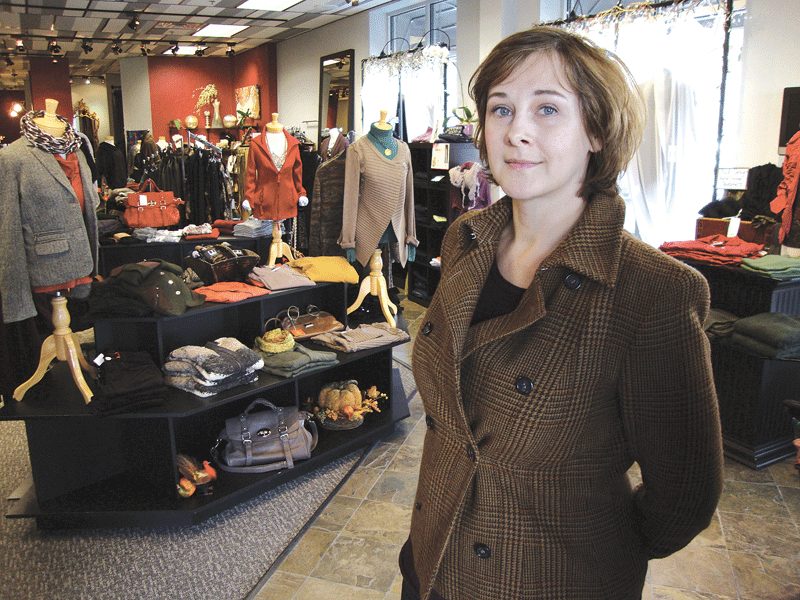
When Kate Vishnyakov was deciding where to open a clothing store for women, to be called Kate Gray, this was the strong retail environment that she had in mind.
“To say that all roads go into East Longmeadow … it’s a bit of a trite statement, but it is, if anything, an understatement,” she said.
“Just to think about that rotary,” she continued, referring to the famous, or infamous, union of seven roads, just outside her store. “All those spokes — there are times of the day that it’s incredibly busy.”
Her clothing store is a destination for shoppers from not only East Longmeadow and surrounding towns, but also for clients willing to travel an hour or more. “Customers do business with people whom they know and trust,” she said, “and we work to provide that. There’s much more to this business than just selling clothes.”
In another facet of the world of fashion and beauty, the same philosophical statement could just as easily be applied. For the co-owners of Brush Salon, Bobby Scott and Jess Imbriglio, the ability to transform lives, both for clients and charitable deeds, is very important.

Kate Vishnyakov

Kate Vishnyakov says the line ‘all roads lead to East Longmeadow’ is, if anything, an understatement.

“We make people feel good about themselves,” Scott said. Of his salon’s work with local groups like Girls Just Want to Have Fun, and organizations helping survivors of breast cancer, he added, “Helping women change the way they feel is something that you just couldn’t put a value upon. And is it that much out of our lives to make such an impact on someone?”
Their salon is just over a year old, and opened during a slow time for the beauty industry and the economy in general. But, like others in town, it’s that role in their community which makes them happy to be doing business in East Longmeadow.
As Vishnyakov added, “It’s not about being in a centralized location, but in a good location.”

I Did it My Way
Across the room from a glass display case stuffed with pizza varieties like cheeseburger, Buffalo chicken, and one with a particularly interesting combination — bacon, seasoned french fries, and cheddar — DeGuglielmo hooked his thumb at that array and said, “we try to make things a bit different here.”
He’s been making pizza since he was 11 he said, and during that spell in New Haven, a foodie mecca, he said he was given some pointers on the bench. But it was while he was running his cousin’s restaurant in Chicopee, John’s Pizza, that he realized he wanted to own his own shop.
Nine years ago, he bought the business, and in short order, he transformed the operation. “It was smaller scale, no delivery,” he said. “I brought in a fryer, really started up the ability to do more for sporting events. And it was then I brought in a lot of crazier ideas for pizza also.”
Cheese fries, barbecued chicken, shepherd’s pie, and garlic knot crust, are just a few of the “reinventions” of pizza, as he calls them, that have people lining up to order by the slice or entire pie.
He says that his current store is a little hidden, off the main road, but on a weekday during lunch, and in fact for many times throughout the week, no one has any trouble finding it. DeGuglielmo recently opened another branch, called Peppa’s Express, in close proximity to Western New England University.
Business is brisk at the home location, though, so much so that he said at some point soon, he’s going to have to expand, either in the present location or one close by. He’s pretty modest about what he does, stating matter-of-factly, “I love to make pizza, I’m here seven days a week, and my wife comes in to work, also.”
But one thing that is as important to him as his love of food is helping out in his hometown, “any way I can,” he said. “Anytime there’s something going on in the community, I like to be a part of it.”
A business can only benefit from that level of charitable commitment, Scott agreed. And in the one year that his salon has been transforming hair and makeup for its clients, it also strives to make over an entire brand.
“Yes, this about hair and aesthetics,” he continued, “but if you really need to put your donated time into a business perspective, sure, it is free advertising. We speak at colleges, and hospitals, and if we get two people that become customers from it, then that’s beneficial for everyone.”
Scott and Imbriglio make beauty look easy — he as a master stylist for hair and she as a skin therapist — but their business involves hard work and long days. When asked to recall their shared backstory, Imbriglio smiled and deferred to her co-owner’s memory. “He tells it so much better.”
“She was a model at a fashion show where I had been doing hair, and I couldn’t for the life of me remember her name,” he said. “I kept calling her ‘Blondie’ that entire night, and through some subsequent social events. But then I found out that Jess, when finally learning her real name, was more than a model; she was a professional aesthetician who also had an interest in creating her own business.
“We chatted, and realized that our visual concepts for a salon were very much on the same page, from how it should be run, to what the vibe would be like, how people should be treated,” he continued. “And here we are.”
Here is also on Harkness Avenue, and Scott explained that there never was a thought to open his first salon anywhere but East Longmeadow.
“This town is kind of like the Las Vegas strip with the amount of salons here,” he said. “Everyone tends to come to East Longmeadow to get their hair done. I boomed fast when I was younger, getting a good clientele; it was important for me to have a place convenient for them.”
That level of competition is good, Imbriglio said, because it keeps their business on its toes. “It makes you want to do that much better. One key message here above all else is to focus on our clients, making them feel welcome.”
And that simple message is one of the key components to what their far-reaching clientele says makes Brush a salon like none other. But not for long, because the pair have grand designs on taking that first location and branching out elsewhere.
“Not that we aren’t content to be here, not at all,” she explained. “But there is always the thought of what more can we do, and where can we go from here?”
Scott joked that people accuse him of too frequently looking into “the crystal ball” at what the future might hold. “Initially, I could see three or four stores. But still where everyone knows your name.”
It’s not hard to imagine that growth, either, because the pair has racked up a strong and successful business in such an unforgiving economy. “Everyone strongly advised us against opening,” Scott remembered of their debut in June 2010. “We were crazy, they’d say. Even our clients were saying that. It is naturally slower during the summer months for a salon, and then to add the recession on top of that; my philosophy was that it can’t get any worse.
Fast forward to today, and he said that the salon has grown every month, not exponentially, but steadily. The partners carry the TIGI line of products, makers of Bed Head, and that company recently told them that theirs is the number-one small business in sales for the line in Massachusetts.
Looking across to his business partner, Scott added, “They say that during a recession, everyone wants to feel better.” After an appointment with those two and their staff, everyone would look better, also.

Gray Matters
“I knew I wanted to have the business named after a person, and my last name wasn’t the best choice,” Vishnyakov told BusinessWest. “It’s neither memorable, nor easy to say!”
Growing up in Russia, she said that her dolls had the best wardrobe of any that she knew. The passion for fashion may have been lifelong, but it was honed during the final days of the clothing store Yale Genton, where she managed the women’s clothing section for six years. “Being there really allowed me to fine-tune my approach to quality clothing,” she added.
The process of creating a brand wasn’t one she took lightly, and that went all the way to what the name would be. “Gray for gray matter — the brains,” she explained. “I have always loved to work with women who are grown-up, confident, who just enjoy being the way they are. She doesn’t necessarily need to be professional, she could be a mom — but definitely sophisticated.
“One of the sales reps with whom I had worked for a long time said, ‘Oh, gray the color — not so black and white,’” she continued. “Everyone’s perception is different. But in the end, I had a box of Earl Grey tea before me, which I drink constantly. I wrote ‘Kate Gray’ down, and I said, ‘This is it.’
She did some research after that, talking to her customers from all professions and backgrounds, and asked what the name ‘Kate Gray’ conveyed to them. “They said it sounds like it had been in business for a long time, it sounded reliable,” she explained, “and that was the message I wanted to send — quality, tradition, classical, but very modern as well.”
After four years of owning her own store, Vishnyakov said that her clientele has come to appreciate her role not just as a merchant, but in matters less tangible. “This is a business of trust. I sell clothes, yes, but more than that, I sell confidence.”
Reflecting on her role in the tightly-knit community of East Longmeadow — whose connections were once again put to a test by Mother Nature, this time in the freak October snowstorm that knocked out power town-wide for almost a full week — she said that beyond even her role as a trusted salesperson, being a small-business owner means so much more than just the items on the rack.
“Yes, it can be exciting, going shopping in Boston or New York, but in the end, the money that you spend here in your home community stays here,” she said. “We merchants shop locally, we employ people from the community, and we donate to local organizations.
And those relationships are beneficial to her customers, as well, she said. “I get so much repeat business every year at the holidays because people know they can get a gift very easily here with personalized care. Sometimes we’ll even know the person well, and can prepare very special gifts, just for them.”


Chamber Corners Departments

Affiliated Chambers of Commerce of Greater Springfield
www.myonlinechamber.com
(413) 787-1555

• Nov. 9: ACCGS After 5, 5 to 7 p.m., Fran Johnson’s, 1050 Riverdale St., West Springfield. Network, build relationships, and forge strategic partnerships. The After 5 offers business professionals from diverse industries an opportunity to exchange business leads while socializing in a casual atmosphere. To register for the event, contact Cecile Larose at
[email protected]

• Nov. 9: PWC November Meeting, 11:30 a.m. to 1 p.m., Basketball Hall of Fame, Springfield. Speaker: Jamie Williamson, MCAD Commissioner, presenting “Up the Ladder, The Public Sector.” To register, contact Lynn Johnson at (413) 755-1310 or [email protected]

Amherst Area Chamber of Commerce
www.amherstarea.com
(413) 253-0700

• Nov. 16: After 5, 5 to 7 p.m., Chandler’s Restaurant at Yankee Candle Village, South Deerfield. Cost: $5 for members, $10 for non-members. Register online at www.amherstarea.com

Chicopee Chamber of Commerce
www.chicopeechamber.org
(413) 594-2101

• Nov. 16: November Salute Breakfast, 7:15 to 9 a.m., Summit View Banquet & Meeting House. Cost: $19 for members, $26 for non-members. Register online at www.chicopeechamber.org

Greater Westfield Chamber of Commerce
www.westfieldbiz.org
(413) 568-1618

• Nov. 7: Coffee Hour with Mayor Daniel Knapik, 8 to 9 a.m., Tiger’s Pride, Westfield Vocational & Technical High School, 33 Smith Ave., Westfield.

• Nov. 17: Greater Westfield Chamber of Commerce Annual Meeting and Awards Dinner, 6 p.m. cocktail hour followed by dinner and award presentations from 6:30 to 8:30 p.m., School Street Bistro, 10 School St., Westfield. Awards include: Large Business of the Year, Westfield State University; Small Business of the Year, Pioneer Valley Railroad; Businesswoman of the Year, Cathy Gendreau, owner of Peppermill Catering, LLC; Businessman of the Year, Bruce Turcotte, CFO of Columbia Manufacturing, Inc.; Don Blair Community Service Award, John Whalley III. Cost: $45 for members, $50 for non-members. VENTS

Accounting and Tax Planning Sections
Or, a Primer on How to Make Friends with Your Auditor

Donna Roundy, CPA

Donna Roundy, CPA

Summer has passed, and it’s time to focus on the balance of the year, which includes preparing your fiscal records for your accountant. Generally, the focus at year end is tax-motivated — keeping your money in your pocket rather than Uncle Sam’s. Another focus for many, however, is getting information together for their auditor.
While preparing for an audit can seem arduous, there are many benefits of having an audit. An auditor can help you analyze and better understand your company’s financials and show you where improvements within your company can be made. An audit assesses any risks to your company, as well as the efficiency and quality of your company’s processes. One of the most important benefits of an audit could be the realization of fraud and illegal activities taking place within your company.
Recognizing and optimizing the benefits of an audit can help your company become more efficient and more profitable. This article will describe the steps involved in preparing for an audit, and how to optimize the value of an audit for your company.
Many organizations must prepare for a year-end audit at the end of each fiscal year. Whether your business is public, private, or nonprofit, you may be required to have an audit performed on your company. This requirement can be government-required (such as for nonprofit organizations). It can also come from a variety of other groups, such as investors, financial institutions, or a board of directors.
‘Audit’ is not a word many business owners want to hear, but with preparation and focus, an audit can go smoothly and prove to be a valuable exercise.
The best time to start preparing for the audit is right after the auditors leave at the beginning of the year. A significant focus of an audit is on internal controls and the organization’s policies and procedures. Sometimes your auditor may, either verbally or in writing, make suggestions to better segregate duties or create a step of review. Discuss with your fiscal director how best to implement those suggestions.
Due to these changes and possibly due to changing staff levels, the flow of information in your company may change subtly in ways that will require your policies and procedures manual to be updated. Providing your auditor with updated procedures is important because he or she needs to assess risk and ascertain that things are actually happening as intended.
Soon after Jan. 1, begin to close your books for the current fiscal year. Transactions should be posted to the year in which it occurred, including receivables and sales, inventory purchases, cost of goods sold, and operating costs. You also must reconcile all sub-ledgers to make sure they are accurate with your trial balance. Performing reconciliations for all balance-sheet accounts to accurately prepared schedules and third-party statements (bank statements, loan and vendor statements) is a large part of preparing your books for year end.
If you are finding that significant adjustments are necessary at this time, look back to the monthly closing process and see where procedures need to change. A monthly close is a mini-year end, and reconciliations should be performed in a timely manner. If this isn’t happening, the reports being used are inaccurate, and decisions are being made based on wrong information.
Normally your auditors will provide you with a list of the items they need for the audit. Gathering together the entirety of this list and having it in one place for the auditors the first day they walk in has a few benefits. Saving your auditor time from having to ask for things they’ve already asked for makes him or her more efficient, which can mean a lower fee. The auditor will need your time and attention during the audit, so it’s less stressful for you if you don’t also have on your agenda to pull together items they need throughout the day. More preparation can make the audit process easier for you and your company.
Auditors will be looking for a variety of information before they begin the audit. This information will include company bylaws, corporate charters, state registrations, formal policies, a procedure manual, and loan and lease agreements. Annually you must provide to your auditors any new loan or lease agreements and minutes from shareholders or board of directors meetings through the date of your audit. Any information explaining events during the fiscal year that could potentially have an impact on the financial statements must also be provided to your auditor.
Inform your employees when the audit will begin and how long the audit will last. Indentify which employees will be working with the auditors side-by-side on a day-to-day basis. You must make sure that these employees have an open schedule during the audit period. There also must be a workspace prepared for the auditors based on their needs.
Your responsibilities during the audit process are just as important as the steps taken leading up to the audit. Be prepared to explain your procedures for any of the following processes: payroll, cash receipts, accounts receivables/sales, computer systems and software, and how you identify and implement controls to minimize fraud risks. Set aside time during the audit to ask questions of the auditor or to answer any questions the auditor may have.
An audit of cash can provide a business with validity and accuracy of the cash flow within the company, as well as provide a better understanding of where errors may occur and tests to make sure they are not occurring.
Accounts receivables is frequently the largest asset a company can have. An auditor looks at all levels of accounts receivable to help you better understand the risks that could occur and the red flags to look for to prevent these risks.
Inventory audits are designed to keep track of a company’s products and merchandise. This procedure often leads to the influencing of future policies and decision-making within companies.
For your income and expenses, the auditor will typically prepare an expectation of what your income and expense balances should be. This will be based on your organization and your discussions with the auditor. Be prepared to explain fluctuations for accounts that may fall outside of these expectations. Audits performed on income and expenses are some of the most necessary of all.
Income or revenue is required to be recorded for tax purposes. If not properly kept track of, your tax return could be misleading causing larger problems in the long run. An audit of expenses ensures that internal controls are being followed, the reasonableness of your expense costs, and timeliness of the invoice to ensure reliability of the expense. Expense audits also ensure that vendors are real businesses and exist, as well as the accuracy of all contracts, invoices, and signatures.
An audit should be a positive and productive experience. When your staff and the auditors work together, you will save money, the audit will be completed efficiently, and the transaction or requirement that created the need for the audit can be fulfilled. You and your staff will also be in a greater position to understand the financial, data-system, and workflow-process needs of your firm, which will enable you to better plan for future challenges and capitalize on future opportunities.

Donna Roundy is a senior audit manager with the Holyoke-based certified public accounting firm Meyers Brothers Kalicka, P.C.; (413) 536-8510.

Agenda Departments

Forum Welcomes
Robin Wright
Nov. 9: The Springfield Public Forum series will host foreign affairs analyst Robin Wright at 7:30 p.m. at Springfield Symphony Hall. Wright will present “Rage and Rebellion in the Middle East.” The lecture is free to the public with no reservations required. For more information, visit www.springfieldpublicforum.org.

Serious Fun Event
Nov. 10: MassINC and CommonWealth magazine will host a seriously funny look back at the year in politics and media with pols, pundits, and the press. All proceeds will support MassINC’s CommonWealth Campaign for Civic Journalism as well as a scholarship program for those entering the field. The event is planned at the John F. Kennedy Presidential Library and Museum, with cocktails at 6 p.m. and dinner and the program starting at 7:30 p.m. For more information, visit www.seriousfun2011.org or contact Lauren Louison at (617) 224-1613 or [email protected].

Author Lecture
Nov. 11: Christina Asquith, author and journalist, will account her years in hiding in Iraq that resulted in her book, Sisters in War, as part of the Ovations special events series at Springfield Technical Community College. Her presentations are at 10:10 a.m. and 11:15 a.m. in Scibelli Hall Theater. For more information or to bring a group, contact Phil O’Donoghue at (413) 755-4233 or [email protected].

Willie Ross School Partners with Baystate
Nov. 15: The Willie Ross School for the Deaf is partnering with Baystate Health Continuing Education in sponsoring a conference titled “Educating Deaf and Hard-of-Hearing Children: From Research to Practice.” The conference is geared toward physicians, nurses, audiologists, speech/language therapists, and educators of the deaf and hard-of-hearing. Families of deaf or hard-of-hearing children are also encouraged to attend. Registration begins at 8:30 a.m., and the program concludes at 3 p.m. Tuition through Nov. 1 is $50 online and $60 by mail (after Nov. 1, the cost is $60 online and $70 by mail), which includes continental breakfast and lunch. Tuition is waived for parents of deaf or hard-of-hearing children, who can register on the Willie Ross Web site. The seminar will offer perspectives on the development and education of deaf and hard-of-hearing children and provide information and guidance in educational placement decisions, amplification choices and early intervention. For more information on the event, visit www.baystatehealth.org/learn.

Forum Welcomes
Siddhartha Mukherjee
Nov. 15: The Springfield Public Forum series will host Pulitzer Prize winner Dr. Siddhartha Mukherjee at 7:30 p.m. at Springfield Symphony Hall. Mukherjee will present “Cancer: The Emperor of All Maladies.” The lecture is free to the public, and no reservations are required. For more information on the event, visit www.springfieldpublicforum.org.

HAPHousing Symposium
Nov. 16: “Envisioning a Resurgent Springfield Metro” will be the theme of HAPHousing’s annual symposium at the MassMutual Center in Springfield. A keynote address is planned by Winston-Salem, N.C. Mayor Allen Joines. The event begins with an afternoon symposium and panel at 3 p.m. about the importance of community-wide collaboration in envisioning a revitalized and resurgent Springfield and metro area. HAP Executive Director Peter Gagliardi will moderate a panel that will include information from other resurgent cities, with participation by Joines; Gerald Hayes, co-chairman of Rebuilding Springfield, the entity coordinating tornado recovery in the city; as well as other panelists. Joines will address attendees during dinner, which begins at 6 p.m. In addition, awards will be presented to community leaders, including Ronald and Brenna Sadowsky, for their community involvement and leadership in collecting and distributing household resources for homeless families and those displaced by the tornado. Ron Ancrum, president of the Community Foundation, will also be recognized for spearheading the City-to-City initiative in Springfield that linked city metro leaders with those in Winston-Salem. For more information, call HAP at (413) 233-1500.

All-Schubert Program
Nov. 20: Members of the Chamber Music Society will perform “Piano Quintet in A Major,” known as the ‘Trout Quintet,’ at 3 p.m. at Wistariahurst Museum, 238 Cabot St., Holyoke. The score captures the air of the Austrian mountains, the rushing streams, the slippery grace of fish eluding the fisherman’s net, and the wit of friends in a tavern after a day’s hike. The all-Schubert program is in the style of the lively musical gatherings of the composer and his friends in 1820s Vienna. The musicians will perform in period costume. The program includes songs, a duet, and a rarely heard vocal quartet performed by Junko Watanabe, soprano; Eileen Ruby, mezzo-soprano; Peter Shea, tenor; and David Perkins, baritone. For more information and reservations, call (413) 322-5660 or visit www.chambermusicwistariahurst.com.

MassEcon Awards
Nov. 22: Massachusetts Gov. Deval Patrick will be the featured speaker at the eighth annual Team Massachusetts Economic Impact Awards Luncheon at the Seaport Hotel in Boston. Registration begins at 11 a.m., followed by networking at noon and a lunch with master of ceremonies Anthony Everett, co-anchor and reporter of WCVB-TV’s Chronicle. Honorees are: ‘Gold,’ A123 Systems, Central; Airxchange, Southeast; Communispace, Greater Boston; Kiva Systems, Northeast; Smith & Wesson, West; ‘Silver,’ Acacia Communications, Central; Coca-Cola, West; Dassault Systems, Greater Boston; Horizon Beverage, Southeast; Jessica’s Brick Oven, Northeast; ‘Bronze,’ General Dynamics AIS, West; GT Advanced Technologies, Northeast; HubSpot, Greater Boston; Reinhart Food Service, Southeast; and Simonds International, Central. ‘Gateway City Champions’ are Biomedical Research Models, Worcester; and Solectria Renewables, Lawrence. Jerry Sargent, president of Citizens Bank, will receive the Chairman’s Award. For information on tickets and sponsorships, contact Sean Getchell, (781) 489-6262, ext. 13.

Forum Welcomes
Chris Matthews
Dec. 1: The Springfield Public Forum series will host Hardball host Chris Matthews at 7:30 p.m. at Springfield Symphony Hall. Matthews will present “JFK and the Presidency, Past and Present.” The lecture is free to the public; no reservations are required. For more information on the event, visit www.springfieldpublicforum.org.

Company Notebook Departments

Mercy Joins HNE’s Medicare Advantage Provider Network
SPRINGFIELD — Health New England (HNE) recently announced that Mercy Medical Center has become a part of its Medicare Advantage provider network. Any HNE member, regardless of product, can now access the services available at Mercy Medical Center. The hospital and physicians of the Sisters of Providence Health System (SPHS), which Mercy is a part of, have been in HNE’s commercial and Mass Health product networks for several years, and HNE is the health-insurance provider for the employees of SPHS. “HNE is excited about the extension of our partnership with SPHS,” said Peter Straley, HNE president and CEO. “We know that one of the most important components of any health-insurance product is the network of hospitals and physicians available to the members. This addition to our Medicare Advantage provider network enables us to be a viable option for all Medicare beneficiaries in our region.” Daniel Moen, SPHS president and CEO, echoed those sentiments. “Mercy Medical Center welcomes this opportunity to further our relationship with HNE,” he said. “Mercy’s participation as a member of the HNE Medicare Advantage provider network ensures that Medicare beneficiaries in our region are able to access the high-quality, high-value care at Mercy, no matter which Medicare plan they choose for health care coverage.”

Hampden Bank Offers Second Chance Mortgage
SPRINGFIELD — Hampden Bank has announced the availability of a new mortgage product specifically designed for those whose credit has been adversely affected by the recession. Robert Michel, senior vice president of retail lending, noted that the Second Chance Mortgage is a viable solution for those deemed ‘not bankable’ during these difficult economic times but who are working conscientiously to rebuild their credit. “Whether it’s directly due to the recession, job loss, bankruptcy, reduction of income, or other life events, such as divorce or illness, we know there are many good, hardworking people out there who, for one reason or another, have taken a serious hit in recent times,” he said. “We also know that many of these same people have been working hard to re-establish their credit, and we feel they at least deserve a second look and perhaps a second chance.” Michel added that the Second Chance Mortgage “could be the solution to get them back into home ownership.” Specific underwriting criteria must be met, and qualification will be determined on a case-by-case basis, with previous strong credit history and current ability to repay being major considerations.

Monson Savings Bank Wins SBA Award
MONSON — The Small Business Administration (SBA) recently announced that Monson Savings Bank has won the Lender of the Quarter Award for the third quarter of fiscal year 2011. The award was given to the bank in recognition of its “excellent” SBA activity for the quarter, according to Steven Lowell, president of Monson Savings. The bank had six SBA loan approvals from April 1 through June 30, which ranked it in the ‘Top 15 SBA Lenders in the State’ category. Additionally, the bank tripled its overall SBA activity since 2010 with 18 loans through the first three quarters of the SBA fiscal year. “We are very pleased to be able to help so many customers by leveraging the SBA lending programs,” said Lowell. “I’m not surprised we are ahead of so many larger banks statewide in this arena, because we specialize in working with small and mid-sized businesses.”

Companies Partner to Provide Cobiax Product for Miami Art Museum
LUDLOW — Meredith-Springfield Associates Inc. recently announced its partnership with Barker Steel, LLC to provide high-tech materials for the new, $220 million Miami Art Museum (MAM). Meredith-Springfield is a plastic-extrusion blow-molding manufacturing and engineering company that manufactured thousands of spheres from recycled plastic which were set into steel wire cages for Barker Steel, the licensed distributor for the Cobiax voided concrete system, headquartered in Milford. The wire cages and spheres were shipped in tower-crane-ready bundles for use in concrete slabs in the construction of the MAM. With Cobiax building units, the building slabs are up to 35% lighter than solid flat concrete slabs, and present up to 15% less load on foundations, which allows increased freedom for structural conception. “This type of building system also allows for up to 20-meter spans with no obstructing beams, which amounts to 40% fewer columns,” said Mel O’Leary, president and CEO of Meredith-Springfield. “By using spherical-resin products, strategically encased in concrete with reinforcing steel, one can leave out as much concrete as possible while maintaining the full flexural strength of the slab and allowing a biaxial load transfer. The result is overall weight reduction, increased seismic performance, cost reduction, and environmental sustainability.” The MAM design involves large spans of floor and ceiling without the typical number of columns so that the view from sea to land or vice versa is not completely obstructed. The museum building itself, totaling 120,000 square feet at the core, includes a wide stair connecting the platform to the sea and a promenade. The hanging gardens from ceiling to floor are not interrupted by numerous columns, and the building becomes part of the shoreline and helps visitors gradually transition from Miami’s tropical climate to the museum’s more regulated interior.

Study Rates MassMutual #1in Satisfaction
SPRINGFIELD — In Boston Research Group’s 2011 Defined Contribution Plan (DCP) Retirement Advisor Satisfaction and Loyalty Study, MassMutual’s Retirement Services Division earned the number-one overall satisfaction rating from retirement-plan advisors among all 17 record keepers in the study. MassMutual scored 13 points higher than its nearest competitor and 28 points above the industry average overall. MassMutual placed in the top quartile in every category ranking and garnered the most number-one ratings among all record keepers in the study, clinching the top rating in each of the following: overall satisfaction, wholesaler accessibility/availability, wholesaler expertise in the retirement services industry, thought leader in the 401(k) industry, partners with you (advisor) for success, marketing assistance (proposals, presentations, seminars), internal wholesaler ability to resolve problems, and making it easy to do business with them. The nationwide survey of retirement advisors was conducted from February to April 2011, and the results of the recordkeeping portion represent 17 leading defined-contribution retirement-plan providers. Findings are based on the percentage of advisors who were ‘very satisfied’ with the record keeper.

Chamber Corners Departments

ACCGS
www.myonlinechamber.com
(413) 787-1555

• Nov. 2: Business @ Breakfast, 7:15 to 9 a.m., The Cedars, Springfield. The monthly breakfast pays tribute to individuals, businesses, and organizations for major contributions to civic and economic growth and for actions which reflect honor on the region. The breakfast gives your company exposure to business owners, upper management, and salespeople. To register, contact Cecile Larose at [email protected]

• Nov. 9: ACCGS After 5, 5 to 7 p.m., Fran Johnson’s, 1050 Riverdale St., West Springfield. Network, build relationships, and forge strategic partnerships. The After 5 offers business professionals from diverse industries an opportunity to exchange business leads while socializing in a casual atmosphere. To register, contact Cecile Larose at [email protected]

• Nov. 9: PWC November Meeting, 11:30 a.m. to 1 p.m., Basketball Hall of Fame, Springfield. Speaker: Jamie Williamson, MCAD Commissioner, presenting “Up the Ladder, The Public Sector.” To register, contact Lynn Johnson at (413) 755-1310 or [email protected]

Amherst Area Chamber of Commerce
www.amherstarea.com
(413) 253-0700

• Nov. 16: After 5, 5 to 7 p.m., Chandler’s Restaurant at Yankee Candle Village, South Deerfield. Cost: $5 for members, $10 for non-members. Register online at www.amherstarea.com

Chicopee Chamber of Commerce
www.chicopeechamber.org
(413) 594-2101

• Nov. 16: November Salute Breakfast, 7:15 to 9 a.m., Summit View Banquet & Meeting House. Cost: $19 for members, $26 for non-members. Register online at www.chicopeechamber.org

Greater Easthampton Chamber of Commerce
www.easthamptonchamber.org
(413) 527-9414

• Nov. 2: Taming the Social Media Beast, 5:30 to 7:30 p.m., UMass Amherst Campus Center, Room 1011. To register, contact Heidi at [email protected] or (888) 865-1244.

Greater Northampton Chamber of Commerce
www.explorenorthampton.com
(413) 584-1900

• Nov. 2: Arrive @5, 5 to 7 p.m., Northampton Brewery, 11 Brewster Court, Northampton. A casual mix and mingle with colleagues and friends. Register online at www.explorenorthampton.com

Greater Westfield Chamber of Commerce
www.westfieldbiz.org
(413) 568-1618

• Nov. 2: WestNet After 5 networking event, 5 to 7 p.m., Westfield Bank, 300 Southampton Road, Westfield. Great networking opportunity, so bring business cards. Cost: $10 for members, $15 for non-members.

• Nov. 7: Coffee Hour with Mayor Daniel Knapik, 8 to 9 a.m., Tiger’s Pride, Westfield Vocational & Technical High School, 33 Smith Ave., Westfield.

• Nov. 17: Greater Westfield Chamber of Commerce Annual Meeting and Awards Dinner, 6 p.m. cocktail hour followed by dinner and award presentations from 6:30 to 8:30 p.m., School Street Bistro, 10 School St., Westfield. Awards include: Large Business of the Year, Westfield State University; Small Business of the Year, Pioneer Valley Railroad; Businesswoman of the Year, Cathy Gendreau, owner of Peppermill Catering, LLC; Businessman of the Year, Bruce Turcotte, CFO of Columbia Manufacturing, Inc.; Don Blair Community Service Award, John Whalley III. Cost: $45 for members, $50 for non-members.

Health Care Sections
There Are Many Such Matters Involved with ‘the Long Goodbye’

Todd C. Ratner

Todd C. Ratner

November is National Alzheimer’s Disease Awareness Month as well as National Family Caregiver Month. To appreciate the breadth of these issues, it is helpful to understand that, according to the Alzheimer’s Assoc., 5.4 million people live with the disease, as well as about 15 million unpaid family caregivers; $183 billion in annual costs are associated with it.
Alzheimer’s disease, the most common form of dementia, is a physical and terminal illness that causes difficulties with memory, thinking, and behavior. It is not a normal part of aging.
According to the Alzheimer’s Assoc., there are 10 common warning signs of Alzheimer’s disease:
• Memory changes that disrupt daily life;
• Challenges in planning or solving problems;
• Difficulty completing familiar tasks;
• Confusion with time or place;
• Trouble understanding visual images and spatial relationships;
• New problems with words in speaking or writing;
• Misplacing things and losing the ability to retrace steps;
• Decreased or poor judgment;
• Withdrawal from work or social activities; and
• Changes in mood and personality.
Alzheimer’s gets worse over time; however, one advantage of a timely diagnosis is that the person living with the disease can often participate in their own estate planning. This allows them to decide who will make medical and financial decisions on their behalf in the later stages of the disease, provided, of course, that they still have the legal capacity — the level of judgment and decision-making ability — needed to sign legal estate-planning documents.
As such, it is imperative that someone diagnosed with Alzheimer’s begin making legal and financial plans as soon as possible, to the extent that they can. If there are any questions as to whether or not your loved one has the necessary legal capacity, a medical provider should be consulted.
The following should be considered immediately in the event that your loved one does not have a current or updated plan in place.

Estate Planning
Estate planning, in its most basic essence, is a process for nominating a trusted person to make medical and financial decisions and planning for the disposition of your assets upon death. Regardless of the size of your estate, there are several essential considerations.
Everyone needs a will, the most basic estate-planning document. It provides for the orderly distribution of your estate upon your death. In Massachusetts, the state has already drafted a will for you, designating that your assets pass in proportions of 50% to your spouse and 50% to your children, so if you want any customization, you’d better have an attorney draft a personalized version for you.
Another essential estate-planning tool is a health care proxy. This document allows a designated person, called a health care agent, to make health-related decisions for you if you become incapacitated and cannot make them yourself. This becomes especially prevalent when Alzheimer’s disease progresses, as your loved one will understand your wishes regarding care and end-of-life decisions.
Another critical estate planning tool is a durable power of attorney. This document gives a person called the attorney-in-fact the ability to handle your financial affairs during your lifetime when you are incapacitated. This will prevent your loved ones from having to go to court and obtain the legal right to pay your bills and handle your finances on your behalf when your disease progresses.
Estate planning is a broad term that can encompass many things, and there are more estate-planning choices available today than ever before. You may also consider various trusts to provide for the continued financial support of your family members after you lose the ability to care for them yourself.

Long-term Care Financing
While most families prefer to keep their loved one at home as long as possible, it is common for an individual with Alzheimer’s to have to go to a nursing home when family members can no longer provide the necessary round-the-clock care. Due to the characteristics of the disease, Alzheimer’s residents typically reside in nursing homes longer than other residents. Since the average cost of a nursing-home placement in Massachusetts is approximately $10,000 per month, long-term care financing is a critical component of the planning process for a loved one with Alzheimer’s disease. As such, effective planning for long-term care financing is a must to preserve your family’s assets against being drained by a nursing home.
The available options to pay for nursing-home care include private payment, long-term care insurance, and Medicaid. Private payment can quickly evaporate a lifetime of savings and significantly limit the amount passed to designated heirs, so it is generally preferred to find an alternative form of payment.
Long-term care insurance is a wonderful way to pay for a nursing home stay, but one must be insurable in order to be eligible to purchase such insurance, which precludes most people living with Alzheimer’s. It may also be expensive, thereby making it an unaffordable option.
Many people think that they can simply give away their money to family and friends freely. They often don’t understand that complicated Medicaid laws include a specific look-back period on all assets, and such transfers will delay Medicaid eligibility, requiring you or your loved one to find alternative financial resources until the waiting period is satisfied. Without proper planning, this delay could financially devastate your family, but Medicaid planning or asset preservation can be accomplished by properly transferring assets in accordance with Medicaid laws, and an estate or elder-law attorney can guide you through that process. It may be your best way to prepare for an anticipated nursing-home stay.
Even if a loved one is afflicted with Alzheimer’s disease and does not have an updated plan, it may not be too late. However, it is important to see a qualified estate-planning and elder-law attorney as soon as possible to ensure that the ever-changing and intricate laws and requirements regarding estate planning and long-term care planning are followed. Such an advisor is the best resource for determining how to effectively draft an effective estate plan that can help preserve your family’s resources.
You can be a voice and an advocate for the 5.4 million Americans living with Alzheimer’s disease. The local office of the Massachusetts/New Hampshire Chapter will be hosting events throughout the month of November to celebrate and promote awareness of the disease. Log onto alz.org/manh to find out more.

Todd C. Ratner is an estate-planning, elder-law, business, and real-estate attorney with the regional law firm Bacon Wilson, P.C. He serves as the co-chair for the Alzheimer’s Assoc. Tri-County (Hampden, Hampshire, and Franklin) Partnership and is a member of the National Academy of Elder Law Attorneys and the Estate Planning Council of Hampden County. He is also a recipient of Boston Magazine’s Super Lawyers Rising Stars distinction from 2007 to 2010; (413) 781-0560; baconwilson.com

Cover Story
From the Editor and Publisher

For nearly 30 years now, BusinessWest has been shining a spotlight on the business community of Western Massachusetts and, at the same, serving as an invaluable resource for this large, diverse constituency. It’s been our mission to inform, educate, inspire, and make those all-important connections between area businesses and the communities they serve. And over the years, the methods for doing all this have evolved and expanded.

Indeed, we’ve moved beyond the printed word and also into electronic media and a host of events, including the hugely successful Forty Under 40 and Difference Makers programs, enabling us to say that we make connections in print, on line, and in person.

And this fall, BusinessWest takes things to an even higher level as producer of the inaugural Western Mass Business Expo, on Oct. 18 at the MassMutual Center in Springfield. We decided to take the leadership role in making this event reality because we believe, first and foremost, that the business community truly deserves an event of this magnitude and quality. What’s more, we are dedicated to finding new and exciting ways to carry out that aforementioned mission, and the Expo is the perfect vehicle for doing so.

In conjunction with the event-planning firm Rider Productions, BusinessWest has assembled an all-star lineup of area business leaders, elected officials, and experts in several fields to lead more than two dozen seminars, panel discussions, and special presentations on the pressing issues confronting all business owners today.

We’ve also brought together more than 135 companies representing every sector of the economy — from health care to information technology; from higher education to ‘green’ energy.’ Together, they illustrate the strength and diversity of our business community and a wealth of talent and experience with which attendees should want to do business.

We’ve billed the inaugural Western Mass Business Expo as the “place to be” on Oct. 18, and it is exactly that. There, exhibitors and guests will be part of a large audience of decision-makers, contributing to a room filled with energy and excitement.

This is the event that business owners across our region have been asking for, and it is our privilege to be able to present it.

Enjoy!

George O’Brien, Editor
John Gormally, Publisher
Kate Campiti, Associate Publisher

Event Schedule

Tuesday, Oct. 18, 2011

Kickoff Breakfast
7 a.m.; Registration
7:30-8:50 a.m.; Program; keynote speaker,
John Morse, president, Merriam-Webster

Ribbon Cutting
9 a.m.; Show Floor Theater

Exhibition Hall
9 a.m. to 4 p.m.

On the Expo Floor:
• The Whalley Computer and Valley
Communications Technology Corridor
• The HealthcareNews Health Corridor
• The DiGrigoli Artistic Team

Show Floor Theater:

Session One: 9:15-10 a.m.
Thriving in a Wildly Changing Market Place

Session Two: 10:15-11:15 a.m.
The Forecast: A Look at What’s Ahead for the State and Regional Economy

Session Three: 11:30 a.m.-noon
The Anti Resume Revolution

Session Four: 12:15-12:45 p.m.
Laugh For No Reason

Session Five: 1-1:45 p.m.
Blood From A Stone: How to Get Motivated and Do More Business in Any Economy

Session Six: 2-2:30 p.m.
The 401(k) Coach

Session Seven: 2:45-3:15 p.m.
Empower Your Workforce

Session Eight: 3:30-4 p.m.
You Don’t Have to Be Perfect to Be Great

Educational Seminars,
Meeting Rooms 1, 2, and 3
Continuously, from 9:15 a.m. to 4 p.m.

ACCGS & BBB Torch Awards Luncheon
11:30 a.m.; Registration
Noon-1:30 p.m.; Program; keynote speaker,
Michael Kittridge II, founder and former chairman,
Yankee Candle Corp.
Special presentation: the Better Business Bureau’s Torch Awards honoring: • Baystate Dental P.C., Springfield;
• St. Germain Insurance Inc., Ware; and
• Amy Alaimo of Agawam, Student of Integrity Award Winner

2011 Expo Social
presented by Meyers Brothers Kalicka P.C.
4-6 p.m.; Atrium

Show Floor Presentations

Click Here to Download the PDF: WMBEshowFloorPresentationsBW1011a

Educational Seminar Schedule

Click Here to Download the PDF: WMBEseminarSchedulesBW1011a

Floor Plan and List of Exhibitors

Click Here to Download the PDF: WMBEFloorPlan

Opinion
The Region’s Show of Force

A few weeks back, we referenced how long and difficult this year has been for the region and its business community given all the natural disasters and near-disasters, as well as the lingering recession and its many effects.
Despite all that, we said, there is still much to be proud of and to look forward to as we gauge the strength and diversity of the region’s economy and its prospects for the future. And we’ll get a chance to prove it on Oct. 18 at the MassMutual Center, when the curtain rises on the first Western Mass Business Expo.
Technically, this gathering is a trade show, a business-to-business event featuring the exhibits of more than 130 companies, as well as informational seminars and presentations designed to inform and entertain, and a day-capping networking social. But in reality, it is a celebration of the region’s business community, and we hope that you’ll take part in that celebration.
That’s because, while BusinessWest is producing the expo and the MassMutual Center is hosting it, the event really belongs to the business community, and it will be responsible for providing the energy in the room and, ultimately, the momentum that can be taken from it.
But let’s back up a minute. BusinessWest made the decision to produce this event — and also change its name and character — as part of its ongoing and ever-evolving mission to turn a mirror on the region’s business sector and spotlight the people and the individual companies that define it.
For the better part of two decades, this was done via the printed word, in a monthly and then twice-monthly publication. In recent years, we’ve added special events such as the 40 Under Forty and Difference Makers recognition programs, which salute, respectively, the rising stars and individuals who find new and compelling ways to give back to the community and contribute to quality of life in Western Mass. We’ve also become an active partner with the region’s chambers of commerce, working with them in many ways to bring benefits to members and enable area businesses to become more competitive in today’s global, ultra-competitive marketplace.
The Western Mass Business Expo takes our mission a step further and to a different medium, if you will. We’re still shining a mirror, in many respects, but going much further as well, with informational seminars and programs, and the creation of the networking events aimed at helping area businesses make the all-important connections needed to grow and get to the next level.
As we said, this is a BusinessWest production, but it is really an event owned by the business community. And, ultimately, the success of a trade show isn’t measured by how many companies are exhibiting, but by how much those in attendance can take home with them and how much positive energy the event creates.
We’ve spent the spring and summer creating programs that will provide a number of take-aways for all those in attendance. They feature decision makers and they are designed for both design makers and those who carry our their decisions. But that positive energy? Well, that’s up to all those work and do business in this region.
We hope that everyone who is able will be at the MassMutual Center on Oct. 18. It’s an event that promises to be time well-spent — and it just might help people forget what a trying year this has been and focus on how great next year can be.

Holiday Party Planner Sections
Restaurants, Banquet Facilities Optimistic about Upcoming Party Season

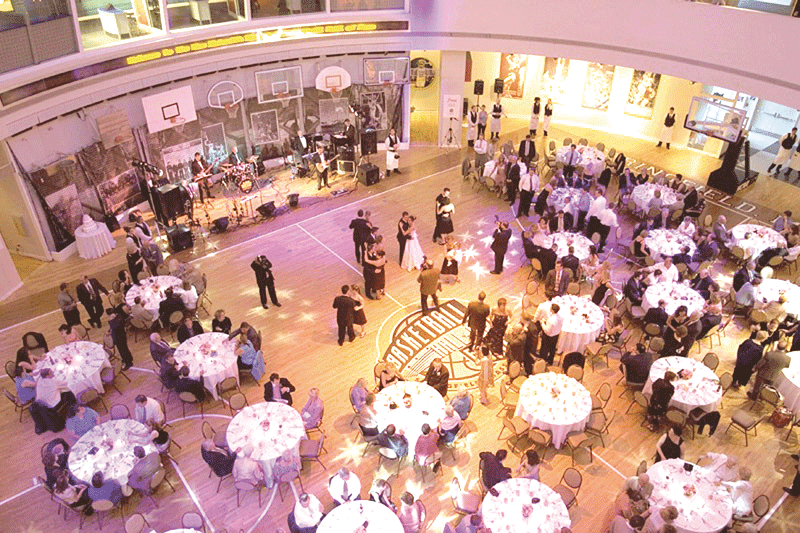
Center court at the Basketball Hall of Fame provides one of the region’s unique party environments.

Center court at the Basketball Hall of Fame provides one of the region’s unique party environments.

The past several years have been up and down for venues that host corporate holiday parties. On one hand, the recession has affected companies’ celebration budgets, yet most employers still see value in thanking their staffs for a year of hard work. As a result, area party bookings have largely remained steady, although many companies have scaled back on their size and cost. Still, restaurants and banquet facilities say the early signs are positive that the end of 2011 could be a merry season.

Early October is when things finally settle down on Memorial Avenue in West Springfield. For Jeffrey Daigneau, who’s busy booking holiday parties at his restaurant, Lattitude, they’re just heating up.
“We’re getting calls now. We probably have 15 or 20 parties already booked,” said Daigneau, who spoke with BusinessWest the day after the Eastern States Exposition — which dominates his street and hinders business for two and a half weeks — ended its 2011 run. “We haven’t gotten many calls with the Big E going on, but our busy season really starts today.”
Other restaurant owners and banquet-facility managers are reporting the same. So far, they say, business is looking up.
“Many companies feel parties are very important,” said Joe Stevens, owner of Hofbrauhaus in West Springfield. “They want to say thank you to their people who have been with them year-round — and we’re grateful to have them.”
He noted that the majority of companies that have booked parties have returned. “They want this certain Friday, this specific Saturday; usually, as they’re leaving, they say, ‘see you next year,’ and we just put them in the books.

Joe Stevens, with his wife, Liz

Joe Stevens, with his wife, Liz, says his holiday-party business at Hofbrauhaus has been bolstered by repeat customers.

“We’ve been blessed over the years because this place has been here since 1935, and most of our customers that have had Christmas parties over the years have stayed with us,” he added.
Newer venues are optimistic about a strong season as well, including Mill One at Open Square in Holyoke, which offers exposed brick, hardwood floors, and not much else in the way of permanent décor, allowing party planners to design their own night.
“It’s a beautiful facility from the 1800s,” said Michelle St. Jacques, property manager of Open Square. “It’s a blank slate, so we let people know that their event can be how they want it to turn out, without having the carpeting or wallpaper interfering with that.
“In addition, we have a selection of caterers to choose from, or you can choose your own, as long as they’re licensed and insured,” she continued. “We try to cater to individual wants. People can design their parties themselves in a very unique venue. They enjoy the fact that there are no set decorations that could interfere and conflict with their decisions. On the whole, people love it.”
For this issue, BusinessWest talks to several area dining facilities to get a feel for how they’re marketing the holiday season to area companies — and why they’re feeling good about the prospects so far.

They Shoot, They Score
“Right now, things are starting to pick up for the holiday season. We already have some bookings for December,” said Josh Belliveau, corporate event manager at the Basketball Hall of Fame.
That’s good news after a stretch of years in which employers across the U.S. have scaled back such late-fall, early-winter shindigs. According to Amrop Battalia Winston, a global executive-search firm that tracks a number of business trends, last year reflected the worst holiday-party slump in 22 years, with 79% of companies conducting some kind of celebration — lower than even the 81% figure recorded in both 2008 and 2009, at the peak of the recession.
Belliveau said it helps to be able to offer partygoers an uncommon experience.
“If you book your holiday party at the Hall of Fame, it’s a unique venue,” he said. “Our guests have many options — to tour the museum or do some additional fun things, like a scavenger hunt, shooting contests on center court, music, and dancing. We can even do [an electronic] sign outside the building, welcoming guests of that company. That makes it personal to employees who are attending. We think our facilities have the ability to provide that special atmosphere.”
Belliveau has booked a range of different groups, from formal sit-down dinner receptions to social receptions on the court, with hors d’ouevres, interactive play, and DJs and bands. “It’s a social atmosphere.”
Evan Mattson, controller at Tucker’s restaurant in Southwick, has seen the same variety of celebration styles.
“We do sit-down parties, we do station parties, we do buffets — we host all kinds of different parties,” said Mattson, adding that the facility handles gatherings of all sizes — “20 on up to 150” — and also conducts functions off-site when desired. Of all the options, he noted, “I think the station parties are becoming more and more popular.”
Stevens said there isn’t much Hofbrauhaus can’t do when it comes to party planning for groups ranging from less than 10 to more than 300. He noted that the facility hosts both formal sit-down services and cocktail parties with food stations and a cash or open bar.
“I’d say most people enjoy being served, getting waited upon, especially when it comes to the holiday season and businesses saying thank you to their staff,” he told BusinessWest. “Personally, I prefer a party where you can move around; I’m big into food stations and passed-around hors d’ouevres. I like to see people and circulate and not be confined to a certain table. But that’s just me.”
St. Jacques agreed, noting that many companies are getting away from sit-down dinners, and not just for budgetary reasons. “They realize there’s more interaction when people are getting up and getting food, passing by other guests, and that seems to be the trend, from what I’ve seen.”
She said Open Square is a good option for people who have very specific catering needs. “They can provide the food they like; some people like ethnic dishes and have to go to a certain caterer. You can’t get that at some facilities with their regular banquet staff.
“I think our venue is good because you can pick a theme and set the food choices,” she continued. “If you want to have an hors d’ouevres party, those are becoming popular. Cocktail parties are a nice holiday option without breaking the bank. That can be a good choice in this economy.”
Lattitude is making some improvements to enhance its party offerings, Daigneau added, including making the ‘wine room,’ where many functions are held for groups of 15 to 20, two to three times bigger; that renovation will be complete before the December rush of events.
But he said smaller parties are more common these days than large ones. “We do big Christmas parties, but what I’m seeing is parties of 25, 30.”

Looking Up?
That reflects the trends reported by Amrop Battalia Winston last year (this year’s survey won’t be released until November). In 2010, 28% of companies responding to the survey said their parties had become more modest — on the heels of the nearly half (49%) that downsized in 2009. Meanwhile, only 11% intended to hold more lavish parties.
In addition, company parties have increasingly become an employees-only zone. Only 26% of surveyed businesses planned to include family members, while 5% intended to invite clients and friends. The 69% of parties labeled employees-only was up from 52% just four years earlier.
Of those employers deciding to forgo having a party altogether, 55% said they did not consider it appropriate in tough economic times, compared to 27% who said a get-together just wasn’t within their budget. On the other hand, 37% of those having a holiday party said the primary reason was to celebrate a good year, 33% cited employee morale, and 29% said they wanted to project optimism about the future to clients and employees.
If holiday parties are, indeed, reflective of the economic mood, area restaurants and banquet facilities may be reporting some good news for the region overall.
“Some companies have done very well,” Stevens said. “Some have downsized their parties, but others have actually gotten too big for us; they can’t do their parties here anymore because they passed the 300 mark. It runs the gamut.”
Mattson said he’s optimistic about 2011 as well.
“They’re booking now. We have several booked already for December,” he told BusinessWest, noting that, even in a sluggish economy, many employers still want to thank their employees by making merry at what they hope will be the most wonderful time of the year.

Joseph Bednar can be reached at [email protected]

Agenda Departments

Museums10 Focuses on Photography
Ongoing: Museums10, a collaboration of 10 college-affiliated museums in the Pioneer Valley, features seven photography exhibitions this fall, related lectures and discussions, and a symposium on Trans-Asia photography, all presenting a world that is at once far away and close at hand. With works of art from Asia, Africa, Europe, and the Americas, the exhibitions and events collectively reveal a globalized world and distinct styles of photography. Mount Holyoke College Art Museum (www.mtholyoke.edu/artmuseum) will present “World Documents,” works by international photographers, through Dec. 18, while the Smith College Museum (www.scma.smith.edu/artmuseum) will showcase the El Muro photography series by Cuban artist Eduardo Hernández Santos. “Cuba Seen Through Photographic Collages and Lithographs” will be on display through Oct. 6 at the Hampshire College Liebling Center Mann Gallery (www.hampshire.edu), while “Bagels & Grits: Exploring Jewish Life in the Deep South” will be featured at the Yiddish Book Center (www.yiddishbookcenter.org) through Sept. 30. Rounding out the exhibitions are “The Instant of Combustion: Barbara Morgan Dance Photography” at the University Museum of Contemporary Art (www.umass.edu/fac/umca) through Oct. 16, and “A Memorial Display in Honor of Jerome ‘Jerry’ Liebling, Photographer, Filmmaker, Educator,” at the Mead Art Museum (www.amherst.edu/museums/mead) through Oct. 23. Historic Deerfield will also host the Hallmark Institute of Photography exhibition through December (www.historic-deerfield.org). For more information on lectures and related events, visit www.museums10.org.

Retirement Planning Roundtable
September 29: The Affiliated Chambers of Commerce of Greater Springfield will present a roundtable discussion titled “Focus: Your Corporate Retirement Plan” from 8:30 to 10 a.m. at the Springfield Sheraton. A continental breakfast will be served from 8 to 8:30 a.m. Department of Labor representative Mary Rosen, associate regional director of the Boston office, will discuss the key provisions of recent legislation affecting defined contribution plans. Participants will gain insights from research on more than 1,000 U.S. plan sponsors to determine how one plan stacks up against another. A presentation by Alliance Bernstein, facilitated by the New England Wealth Management Group of Morgan Stanley Smith Barney, is also planned. Pre-registration is required for the free event. To register, e-mail Lynn Johnson at [email protected].

Patents Webinar
Oct. 4: Donald Holland, Esq. will present a webinar titled “The Basics of Patents” beginning at 11 a.m. for approximately 40 minutes. He is the senior partner at Holland & Bonzagni, P.C., based in Longmeadow. Webinar attendees will have the opportunity to ask specific questions at the end of the presentation. For more information or to register, visit www.hblaw.org/webinars or call (413) 567-2076.

Western Mass. Business Expo
Oct. 18: Businesses from throughout Hampden, Hampshire, Franklin, and Berkshire counties will come together for the premier trade show in the region, the Western Mass. Business Expo, produced by BusinessWest, and staged at the MassMutual Center in Springfield. The show will feature breakfast and lunch programs arranged by the Affilaited Chambers of Commerce of Greater Springfield, nearly two dozen seminars on the business issues of the day, several presentations in the Show Floor Floor Theater on timely topics, and the sophisticated networking program known as Mine Your Business. The day will conclude with a networking social from 2 to 4 p.m. The cost for a 10-by-10 booth is $700 for members of all area chambers, and $750 for non-members; corner booths are $800 for all chamber members and $850 for non-members, and a 10-by-20 booth is $1,200 for all chamber members and $1,250 for non-members. For more information, log onto www.businesswest.com or www.wmbexpo.com, or call (413) 781-8600, ext. 100.

Trade Secrecy Protection Webinar
Oct. 20: Donald Holland, Esq. will present a webinar titled “Trade Secrecy Protection” beginning at 11 a.m. for approximately 40 minutes. He is the senior partner at Holland & Bonzagni, P.C., based in Longmeadow. Webinar attendees will have the opportunity to ask specific questions at the end of the presentation. For more information or to register, visit www.hblaw.org/webinars or call (413) 567-2076.

Cartoonist Lecture
Oct. 21: Cartoonist Leigh Rubin, renowned for the comic strip Rubes, will be the featured speaker as the Ovations special-events series continues this fall at Springfield Technical Community College. Rubes is syndicated in more than 400 newspapers and publications worldwide. His presentations, at 10:10 a.m. and 11:15 a.m. in Scibelli Hall Theater, will cover art, satire, and communication. For more information or to bring a group, contact Ovations coordinator Phil O’Donoghue at (413) 755-4233 or [email protected].

We’ve Got Your Back
Run/Walk
October 22: New England Neurosurgical Associates will sponsor its first We’ve Got Your Back 5K Run/Walk at Forest Park in Springfield, beginning at 9 a.m. The event, which will benefit the Spinal Research Foundation, will also include a spinal health fair beginning at 8 a.m. The certified 5K race begins at 9, followed by a one-mile run/walk. Winners of the race will receive cash prizes ranging from $50 to $300. All children who finish the one-mile run/walk will be given a commemorative medal. For more information, call (413) 781-2211.

Entrepreneurship Lecture
October 27: Sue Morelli, chief executive officer and president of ABP Corp., will be the guest speaker at Bay Path College’s Innovative Thinking & Entrepreneurship Lecture Series in Longmeadow. Since joining Au Bon Pain in 1988, Morelli has worked her way up the ranks of the Boston-based, fast-casual bakery and café to become president and CEO in 2006. Under her leadership, the company now has more than 300 store locations, with almost 200 in the U.S. and the remainder in Thailand, India, South Korea, and the Middle East. She is currently leading a redesign of store interiors, a major menu transformation, and the opening of more than 30 new cafés per year. The lecture begins at 8:15 a.m.; a networking continental breakfast starts at 7:30 a.m. For more information, visit www.baypath.edu.

Licensing Intellectual Property Webinar
November 1: Donald S. Holland, Esq. will present a webinar titled “Licensing Intellectual Property” beginning at 11 a.m. for approximately 40 minutes. He is the senior partner at Holland & Bonzagni, P.C., based in Longmeadow. Webinar attendees will have the opportunity to ask specific questions at the end of the presentation. For more information or to register, visit www.hblaw.org/webinars or call (413) 567-2076.

Serious Fun Event
Nov. 10: MassINC and CommonWealth magazine will host a seriously funny look back at the year in politics and media with pols, pundits, and the press. All proceeds will support MassINC’s CommonWealth Campaign for Civic Journalism as well as a scholarship program for those who are entering the field. The event is planned at the John F. Kennedy Presidential Library and Museum, with cocktails at 6 p.m. and dinner and the program starting at 7:30 p.m. For more information, visit www.
seriousfun2011.org or contact Lauren Louison at (617) 224-1613 or [email protected].

Author Lecture
November 11: Christina Asquith, author and journalist, will account her years in hiding in Iraq that resulted in her book, Sisters in War, as part of the Ovations special events series at Springfield Technical Community College. Her presentations are at 10:10 a.m. and 11:15 a.m. in Scibelli Hall Theater. For more information or to bring a group, contact Ovations coordinator Phil O’Donoghue at (413) 755-4233 or [email protected].

Chamber Corners Departments

Greater Easthampton Chamber of Commerce
www.easthamptonchamber.org
(413) 527-9414

•  Oct. 8: Casino Night, 6-11 p.m., One Cottage St., Easthampton. Come try your luck and win prizes at an array of gaming tables. Hors d’oeuvres and cash beer and wine bar throughout the evening. Sponsored by Easthampton Savings Bank and Finck & Perras Insurance Agency. Cost: $25 in advance, $30 at the door.

• Oct. 13: Networking by Night Business Card Exchange, 5-7 p.m., Easthampton Fore Department, 32 Payson Ave. Sponsored by Greater Easthampton’s Jr. Miss Program. Hors d’oeuvres by Glory Days Restaurant, door prizes. Cost: $5 for members, $15 for non-members.

• Oct. 24: Celebrity Bartenders Night, 6-9 p.m., Opa-Opa Steakhouse and Brewery, 169 College Highway, Southampton. Join us for a night of fun with local celebrities mixing your drinks. Tips benefit the chamber’s Holiday Lighting Fund. Raffles and fun. Cost: free.

Greater Holyoke Chamber of Commerce
www.holycham.com
(413) 534-3376

• Oct. 12: Autumn Salute Breakfast, 7:30-9 a.m., the Log Cabin. Sponsored by Holyoke Medical Center. Cost: $20 for members, $25 for non-members. Call Wanda Zabawa at (413) 534-3376 to reserve tickets or register online at holyokechamber.com

• Oct. 18: Mine Your Business Two-on-Two Networking Event, 2-4 p.m., MassMutual Center, Springfield. Sponsored by the Greater Holyoke Chamber of Commerce, BusinessWest, Chicopee Chamber of Commerce, First American Insurance, Holyoke Community College, Log Cabin-Delaney House, Marcotte Ford, and Meyers Brothers Kalicka. To take place at the Western Mass. Business Expo. Make your reservation by calling Wanda Zabawa at (413) 534-3376. Cost: table fee of $350 includes a buffet.

• Oct. 19: Holyoke Chamber After Hours, 5-7 p.m., hosted and sponsored by Country Inn & Suites, One Country Club Road. Cost: $10 for members, $15 for non-members. Call the chamber at (413) 534-3376 to sign up, or register online at holyokechamber.com

• Oct. 20: Holyoke City Council Candidate Forum, 6:30-9 p.m., Dean Technical High School Cafetorium, 1045 Main St.

• Oct. 26: Holyoke City Council Candidate Forum, 6:30-9 p.m., Dean Technical High School Cafetorium, 1045 Main St.

Northampton Area Young Professional Society
www.thenayp.com
(413) 584-1900

• Oct. 5: October Arrive @5, chamber’s annual open house, 5-7 p.m., Greater Northampton Chamber of Commerce, 99 Pleasant St. Sponsored by Crocker Communication, Pioneer Training, and Innovative Business Systems. The must-go networking event of the year. Cost: $10 for members.

• Oct. 7: October Meet & Eat Breakfast, 7:30-9 a.m., hosted and sponsored by the Hotel Northampton. “Beyond Sound Bytes: What Is Really Going On with the Economy,” featuring Owen Ullman, news editor of USA Today. Sponsored by Dietz & Company Architects and Calvin Coolidge Nursing & Rehabilitation Center for Northampton. Cost: $20 for members, $30 for non-members.

Greater Westfield Chamber of Commerce
www.westfieldbiz.org
(413) 568-1618

• Oct. 3: Mayor’s Coffee Hour, 8-9 a.m., Elm Street Diner, 266 Elm St. Cost: free. To register, call the chamber office at (413) 568-1618 or e-mail Carrie Dearing at [email protected]

• Oct. 12: WestNet after-5 “Oktoberfest” networking event, 5-7 p.m., East Mountain Country Club. Speed connecting (a business card exchange), cash bar, and complimentary food. Cost: $10 for members, $15 for non-members. Walk-ins always welcomed. To register, call the chamber office at (413) 568-1618 or e-mail Carrie Dearing at [email protected]

Cover Story
Why Area Businesses Need a Disaster Recovery Plan

There’s no doubt that the summer of the tornado, hurricane, and earthquake in Western Mass. got more businesses thinking about the importance of a disaster-recovery plan. But the truth is, it doesn’t take a natural disaster to suddenly shut a company down; a freak fire or flood will do the trick, too. Employers who have developed business-continuation strategies in case of an adverse event — and those who wish they had done so sooner — agree that there’s plenty of value in preparing for the worst.

No one goes to work expecting the roof to come off. Gretchen Neggers certainly didn’t.
She’s the town administrator in Monson, and she recalls the fateful late afternoon of June 1, when a tornado cut a path right through downtown.
“It passed right over our town offices and police station, causing significant damage to that structure,” she told BusinessWest. “It essentially blew the roof off.”
The initial concern, of course, was to see if anyone was physically hurt. The next was how to keep municipal services running at a time when residents would need them more than ever.
“Obviously, that facility houses critical operations,” she said. “All the town’s vital data, our permanent records, everything was housed in that building, and all the essential functions we perform as a town happen there. So it was a challenge to respond to the needs of residents in the community, and at the same time deal with the disaster within our own building.”
One of the town’s first calls was to CMD Technology Group in East Longmeadow, which handles a variety of information-technology services for Monson.
“We said, ‘we need to get our servers out of here,’” Neggers said. In the meantime, someone had the sense to do what they could to protect them before CMD was able to move them — in this case, covering the equipment with a tarp and setting up a fan to blow cool air at it.

Charlie Christianson

Charlie Christianson says disaster-recovery plans should have many facets, from IT to relocation to communication plans if the phones go down.

“We were very fortunate that our data survived,” she told BusinessWest. “There was some blessing in that; had we lost our data, the recovery would have been much harder. We did have some limited backup, but we didn’t have any off-site backup, which is something I now strongly recommend. It was a lesson learned.”
The town offices were relocated, and the town undertook what she called “an intense effort” to get operations up and running in a few days. Importantly, no municipal employees had any paychecks delayed.
“It was something you say, ‘that’ll never happen,’” Neggers said. “Unfortunately, what we learned is that the unthinkable can happen, and you do have to be prepared for it.”
After a summer when Western Mass. was hit with a tornado, the remnants of a hurricane (and plenty of flooding), and even a minor earthquake, companies, municipalities, and nonprofit agencies are looking more seriously at having a plan in place to keep their business operating even if their place of business is no longer usable.
Joan Kagan knows what that’s like. The president and CEO of Square One, whose Springfield headquarters was demolished by the tornado, did indeed have a disaster-recovery plan in place, meaning luck was less of a factor than it was at Monson’s town hall.
“We had completed the first phase of our plan, which was focused on our financial data, which we backed up every night on computer servers down in Connecticut, far from any of our facilities,” she said. “All our our financial data was backed up every night. That allowed us to get back into business right away, and we didn’t lose any of our data. That was critical to us.”
Why? For one thing, “we bill the state electronically for 1,200 kids every month,” Kagan said. “What if we had to go back and recreate the ID numbers and what the services are that we provided that month, so we could bill the state for it? We’d probably still be working on it now. Instead, we were able to get back in business right away.”
For a business like child care, where so many clients depend on those services every day, that continuity is particularly important, she added.
Joan Kagan (center, with Sarah Smith, vice president of Finance, and Phil Klimoski, director of IT)

Joan Kagan (center, with Sarah Smith, vice president of Finance, and Phil Klimoski, director of IT) says Square One not only had a disaster plan, but actively practiced it.

“These are critical services for families, and also, our employees depend on us for their paychecks,” she said. “Some are single or heads of household. You’re talking about hundreds of people who could be impacted if they go without paychecks. But we were able to get payroll out three days after the tornado because we had a backup system. A lot of people lost jobs because of that storm, but we were able to keep everyone employed.”
In this issue, BusinessWest examines the issue of disaster response, and how having a plan — and, just as important, making sure employees understand it and train on it — can make the difference between being helpless and staying in business when there’s no longer a physical business to go to.

Banking on Trouble
Paul Scully knows a little about disaster planning. That’s because Country Bank, of which Scully is president and CEO, has long had such a plan, and trained on it often — which turned out to be extremely fortunate the day a fire broke out at its main office in Ware in 2008, causing no injuries but significant smoke damage.
“It doesn’t matter what the size of your company is; if you could potentially have an interruption in cash flow and business, you have a problem,” Scully said. “You should never think you’re too small to prepare, even if you’re just a two-person company.”
With 44,000 square feet of space rented nearby, stocked with dozens of spare computers, and plenty of server redundancy, every bank office except the one affected by the fire (which had to be cleaned and renovated) was open for business the following morning (a Saturday), with no loss of data for any customer.
“The real key to having a plan is testing it — on an annual basis at mininum — but, in addition to testing it, updating it,” he said. “We do a mock disaster drill every year; we literally make the switch over as if we had just had a disaster. Not only do we switch the operating system over to backup, but we have people come in and do testing at the backup site that day.”
The reasons for repeating the training often are obvious, he said.
“A lot of folks wear different hats, their job responsibilities might change, or they might leave the organization,” he explained. “If Joe was in charge of making sure everyone is accounted for, and suddenly Joe’s gone, then who is the person responsible for that?”
Kagan also stressed the importance of having staff trained in disaster-recovery procedures — “particularly, in our case, with safety measures, evacuating children, which allowed us to avoid any tragedies or having anyone injured. We practice that in our centers and have fire drills once a month, so the staff are trained in how to safely evacuate, and children know how to go to a safe place. That worked to our advantage.”
She emphasized the need for a communication plan after an event. “We make sure that people have their cell phones, that people are in communication and identifying what the needs are,” she explained. “We were able to do that, and the next morning we were able to use our contacts in the community to help us identify space [to set up shop]. The community was very responsive, and from day one people offered us space.”
Dave Delvecchio, president of Innovative Business Systems in Easthampton, recently opened a data center in Marlborough that acts not only as a remote office, but as a disaster-recovery suite for clients. If a customer’s place of business is suddenly rendered unusable, IBS can transfer the contents of the client’s entire network to the Marlborough office, which is equipped with four workstations, in effect providing a location for that customer to continue to operate.
It’s not just disasters business owners should worry about, he said, but everyday mishaps. For tenants in a mixed-use, multi-tenant building, he explained, the odds of a localized disaster — anything from a candle fire to a knocked-out sprinklerhead — go up by a factor of 10. But the past summer’s weather events have really got clients talking.
“We’ve definitely received some cold calls from a few folks about disaster response this year,” he said — as well as a humorous moment the day the Valley trembled. “I was talking with a client one day about potential solutions, and he said, ‘is the floor moving?’ As soon as the earthquake ended, he said, ‘all right, you’ve made the earth move — I’ll sign anything!’”
On a serious note, though, sometimes it takes a disaster for people to realize the importance of their computer infrastructure.
“They don’t have paper-based forms to fall back on anymore. A hotel can’t make a reservation without going online. Insurance companies can’t process claims without going online. Whether you’re a large, regional bank, a single-location business with 10 employees, or a nonprofit agency, we’re finding that disaster planning is meaningful to businesses.”

In Touch and in Business
Charlie Christianson, president of CMD and its sister company, Peritus Security, which offers risk-management services to businesses, echoed the importance of backing up data off-site.
“A lot of people just plug a USB drive into the server and create another hard drive — but all the hard drives are sitting on one site,” he said. “What if the building gets crushed? It’s great on a day-to-day basis if a file gets lost, but it certainly doesn’t protect against catastrophic failures. If a catastrophic event comes through, or an electrical event occurs, you run the risk of losing it all.”
And that means possibly losing business — permanently. After the tornado, the CMD/Peritus offices had no phone connections or Internet access; even cellular service wasn’t active. So the team “triaged,” Christianson said, at a local coffee shop where service was available.
“We started going down the customer list and calling our clients, letting them know how to get hold of us, finding out what they needed, and we started slapping priorities on things,” he said. “You could have people who have been customers for years, and when they can’t get hold of you during an event like this, instead of thinking, ‘maybe there’s a problem with the phones,’ it’s ‘oh, we hope you’re not out of business.’ That’s how quickly people turn nowadays.
“You have to have systems in place on the technology side,” he added, “and it’s equally important to have this stuff written down. Because as calm and cool as people think they’re going to be when stuff hits the fan, that’s not a good time to be figuring things out.”
Scully agrees with the importance of a business-continuity plan. “What do you do if the building isn’t accessible for months? How would you operate? Sure, you may have business insurance, and that may help with cash flow, but what it doesn’t do is satisfy your customer base, and that’s a risk you can’t quantify.”
Some customers would go elsewhere, he said, while competitors would have no problem exploiting the situation and reaching out to welcome them. “I don’t think you can underestimate the the impact of not having a disaster-recovery plan or a business-interruption plan. It’s worth its weight in gold.”
That goes for all kinds of operations, Neggers said.
“A lot of business are regulated — like banking — and are required to have disaster-recovery plans, but I can see why it’s something that everyone should put a lot more attention into,” she told BusinessWest. “It’s not something you want to develop after a disaster happens.”
And just having a plan isn’t enough, she said. “Your plan needs to be precise, it needs to be comprehensive, and you need to train on it. What are you going to do if you can’t go to the office tomorrow, if you don’t have your computer, don’t have your files, don’t have your phone? How are you going to perform the essential functions of your business?
“I hope our experience is something that other entities can learn from,” she continued. “We were lucky in many ways because we didn’t lose our server, but you can’t have your critical functions reliant on luck. It’s something I know we’ll take a lot more seriously moving forward.”

Shelter from the Storm
Christianson still marvels at the sudden outburst by Mother Nature.
“Western Mass. never used to have such radical swings in weather. Maybe once in a great, great while,” he said. “But during the course of the summer, we had a tornado, an earthquake, a hurricane, multiple borderline tornadic events — it seemed like every two weeks we were having a windfall of activity.
“It certainly kept us busy,” he added. “You don’t like to see it happen to people, of course. But no sooner than we’d get one mess cleaned up, the next thing you know, another storm ripped through, causing damage or flooding.”
It shouldn’t take a natural disaster to get employers preparing for the worst, he said, but it’s an effective reminder.
“You need to step back and think outside your box,” he said. “You can’t just say, ‘oh, it’ll never happen,’ because we saw it happen.”

Joseph Bednar can be reached at [email protected]

Company Notebook Departments

Paul Robbins Associates Wins International Award
WILBRAHAM — Paul Robbins, owner of Paul Robbins Associates, took home a Silver Award in the 2011 Summit Creative Award competition for his documentary-style video titled Housing First, produced for the Western MA Network to End Homelessness. Robbins previously won a Summit Creative Award in 2008 and again in 2009 for videos he produced for HAP Housing, the region’s housing partnership. The video tells the story of the Housing First initiative in Western Mass., which is designed to help families and individuals avoid homelessness by providing housing and support services, through the eyes of four people helped by the initiative in Hampden, Hampshire, Franklin, and Berkshire counties. The video can be viewed on the network’s blog, westernmasshousingfirst.org. This year’s panel of international judges included a host of creative directors from design agencies around the world, including Brazil, Kuwait, Australia, Denmark, Dubai, Malaysia, Canada, and the U.S.  Entries in 23 creative categories are judged against a stringent set of standards. During the blind judging events (entering company names are withheld), judges search for innovative and creative concepts, strong execution, and the ability to communicate and persuade. This year’s creative competition included entries from companies in 22 countries, including Austria, China, Hong Kong, India, New Zealand, Northern Ireland, the United Arab Emirates, the United Kingdom, Spain, the Netherlands and the U.S. Paul Robbins Associates is a strategic-communications consultancy providing public-relations and marketing planning, design, and execution; crisis communication services; compelling video presentations; Web site design; and blog creation and content management for companies, nonprofit organizations, and policy initiatives.

Bacon Wilson Blog Earns Recognition
SPRINGFIELD — Bacon Wilson, P.C.’s blog, Employment Law Bits, has been nominated as a Top 25 Employment Law Blog by LexisNexis. Employment Law Bits was launched in June 2005, and since then has supplied readers with weekly posts regarding legal issues facing both employees and employers in both text and video format. “We are very pleased to have our work singled out in a sea of about 2 million employment-law blogs,” noted Employment Law Department Chairman Paul Rothschild, Esq. “Our blog demonstrates a six-year commitment to informing employees, employers, and HR managers of changes within the law that affect them, and we intend to continue putting out such information that helps our constituency.” Employment Law Bits can be found at bwlaw.blogs.com. Bacon Wilson has offices in Springfield, Westfield, Northampton, and Amherst, and employs 43 attorneys and 65 paralegals, secretaries, and support staff..

MassMutual Offers New TPA Business Implementation Kit
SPRINGFIELD — MassMutual Retirement Services recently launched its latest version of the Third-Party Administrator (TPA) New Business Implementation Kit, further streamlining the plan installation process and increasing ease of use. The kit provides TPAs with all necessary documents to complete the plan installation process, facilitating each retirement plan’s smooth transition to MassMutual Retirement Services. The enhanced version has been recognized to increase ease of use, by simplifying and grouping related questions and incorporating funding and Web site applications. The incorporation of these applications reduced, on average, four signature requirements, according to Gary Stamborski, vice president of TPA and new business operations. “MassMutual is committed to providing TPAs, advisors, and sponsors with the best plan installation service in the marketplace today,” said Stamborski. “The new kit is one way we are striving to exceed the expectations of everyone involved throughout the plan installation experience.” Stamborski noted that the kit will continue to undergo an annual review to incorporate industry best practices and efficiencies as well as valuable feedback from TPAs, advisors, and sponsors.

Six Flags to Add
Goliath Coaster
AGAWAM — Six Flags New England  announced the addition of Goliath, a suspended, looping, boomerang coaster. New England’s newest coaster will reside in the Crack Axle Canyon section of the park and will make its debut in late spring of 2012. The ride experience will begin when guests are strapped into chairs suspended from the track above; then Goliath sends riders dangling face-down out of the station and up the first tower. Once riders reach the top of the tower, they are dropped into a complete vertical 18-story freefall, reaching speeds of 65 mph before racing head over heels on the outside of a 102-foot-tall vertical loop, followed by a 110-foot-tall butterfly turn before rocketing up the second 19-story tower. “Six Flags New England is thrilled to announce the addition of Goliath to our already-amazing arsenal of rides,” said Jason Freeman, Six Flags New England park president. “This ride delivers pure adrenaline from start to finish and solidifies our commitment to adding high-volume fun for the entire family.” Goliath joins a large lineup of coasters, including Cyclone, Batman the Dark Knight, Mind Eraser, and Bizarro

Chamber Corners Departments

CHamber corners: Upcoming Events

ACCGS
www.myonlinechamber.com
(413) 787-1555
• Sept. 14: After 5, 5-7 p.m. at Mama Iguana’s, Mai• Street, Northampton. Members, $10; non-members, $20. To reserve tickets, contact Cecile Larose at (413) 755-1313 or [email protected].
• Sept. 15: ACCGS board of directors meeting, 8-9 a.m., TD Bank Conference Center, Springfield.
• Sept. 19: ACCGS Golf Tournament, Ludlow Country Club, Tony Lema Drive, Ludlow. Shotgu• start at noon. Cost per golfer, $150. Contact Cecile Larose, [email protected].
• Sept. 21: ERC board of directors meeting, 8-9 a.m., the Gardens of Wilbraham, Community Room, 2 Lodge Lane, Wilbraham.
• Sept. 21: ACCGS ambassadors meeting, 4-5 p.m., EDC Conference Room, Springfield.
• Sept. 21: PWC Luncheon, “Up the Ladder: The Power of Education.” Special guest speaker: Carol Leary, president, Bay Path College. Reserve tickets through Lyn• Johnson, [email protected].
• Sept. 30: Hampden/Wilbraham Golf Classic, Country Club of Wilbraham. Shotgu• start at noon. Cost per golfer: $110. Contact Sarah Tsitso, [email protected].

Amherst Area Chamber of Commerce
www.amherstarea.com
(413) 253-0700
• Sept. 21: Chamber breakfast, 7:15-9 a.m. Hosted by: Applewood at Amherst. Topic updates o• North and South Amherst and Kendrick Park. Sponsored by Elite Home Health Agency. Tickets: $15 for chamber members; $20 for non-members.
RSVP at (413) 253-0700 or [email protected].

Chicopee Chamber of Commerce
www.chicopeechamber.org
(413) 594-2101
• Sept. 21: Salute breakfast, 7:15-9 a.m. at the MassMutual Learning & Conference Center, 350 Memorial Dr., Chicopee. Tickets: $19 for members; $26 for non-members.
• Sept. 27: Rake i• the Business Table Top Expo & Business Networking Event, 4:30- 7 p.m. at the Castle of Knights, 1599 Memorial Dr., Chicopee. Presented by the Chicopee, Greater Holyoke, Greater Westfield, and the North Central Connecticut Chambers of Commerce. Exhibitor fee: $100 per table. Admissio• fee: $5 pre-registered, $10 at the door. Sig• up online www.chicopeechamber.org, or call (413) 594-2101

Greater Easthampto• Chamber of Commerce
www.easthamptonchamber.org
(413) 527-9414
• Sept. 24: Recycling Day, 8:30 a.m-1 p.m. Responsibly dispose of your old computer, monitor, television, stereo and/or home and office appliances. Ope• to all members of area communities. Location: Valley Recycling, 245 Easthampto• Road (Route 10), Northampton. Contact the chamber office at (413) 527-9414 or [email protected] for recycling fees. Recycling services courtesy of Duseau Trucking, Hatfield. Proceeds to benefit chamber community programs.

Holyoke Chamber of Commerce
www.holyokechamber.com
(413) 534-3376
• Sept. 14: Holyoke Chamber Clambake, 5 to 7:30 p.m., Holyoke Country Club. Presented by United Water and sponsored by Kittredge Center at Holyoke Community College, Reidy Heating & Cooling Inc., Weld Management. and Westfield Bank. A seafood feast: lobster, steamers, clam chowder, make your ow• strawberry shortcake bar, and much more. Raffle prizes, cash-prize putting contest, discounted golf, 50/50 raffle. Cost: $30. Call (413) 534-3376 to reserve tickets, or register online at holyokechamber.com
• Sept. 16: Legislative Coffee Hour, 7:45 to 9:15 a.m., Yankee Pedlar Inn, 1866 Northampto• St. Sponsored by Dowd Insurance Agency and Loomis Communities. Featuring Sen. Michael Knapik and Rep. Michael Kane discussing the challenges and opportunities facing the Commonwealth, Holyoke, and local businesses i• the months ahead. Cost: $20 for members, $25 for non-members. Call Wanda Zabawa at (413) 534-3376 to reserve tickets, or register online at holyokechamber.com
• Sept. 21: 2011 Pacesetter Awards Recognitio• Breakfast, 7:30 a.m., the Log Cabin. Sponsored by Ferriter & Ferriter, Attorneys; Lester Halper• & Co., P.C.; People’s United Bank; and Ross Insurance Agency. The Pacesetter Awards go to exceptional small businesses and nonprofit agencies, entrepreneurs, and advocates who make other businesses successful. Cost: $20. Call (413) 534-3376 to reserve tickets, or register online at holyokechamber.com
• Sept. 27: The 14th Annual Rake i• the Business Table Top Showcase, 4:30 to 7 p.m., Castle of Knights, 1599 Memorial Dr., Chicopee. Presented by the Greater Holyoke, Chicopee, Greater Westfield, and North Central Connecticut chambers of commerce. A cost-effective networking opportunity for one’s business, with opportunities to meet potential new customers and clients. Cost: $100 for chamber member exhibitors, $5 for the public. Call (413) 534-3376 to reserve tickets.

Northampto• Area Young Professional Society
www.thenayp.com
(413) 584-1900
• Sept. 15: Vote the Valley, 5-7 p.m., Springfield Country Club, West Springfield. YPS (Young Professional Society of Greater Springfield) i• Partnership with NAYP (Northampto• Area Young Professionals) bring back Vote the Valley.

Quaboag Hills Chamber of Commerce
www.qvcc.biz
(413) 283-2418

South Hadley/Granby
Chamber of Commerce
www.shchamber.com
(413) 532-6451
• Sept. 13: Skinner Museum Stroll, 5-7 p.m. Sponsored by Mount Holyoke College. Special guest: Lyn• Pasquerella, president of Mount Holyoke College. Highlights: tours of Skinner Museum collection; refreshments under the tent. Tickets: $5 for chamber members.

Greater Westfield Chamber of Commerce
www.westfieldbiz.org
(413) 568-1618
• Sept. 12: Mayor’s Coffee Hour, 8-9 a.m. Hosted by the Holiday In• Express, Barnes Meeting Room. Complimentary coffee and Danish. Call the Chamber office at (413) 568-1618 if you pla• o• attending.
• Sept. 16: Chamber September Breakfast. Registratio• begins at 7:15 a.m. Hosted by 104th Fighter Wing Air National Guard Base, 175 Falco• Dr., Westfield. Guest speaker will be Alla• W. Blair, President and CEO of the Economic Development Council of Wester• Mass. Cost: members, $20; non-members, $25. Contact Carrie Dearing at (413) 568-1618 or at [email protected].
• Sept. 27: 14th Annual Rake i• the Business Table Top Showcase. The Greater Westfield, Chicopee, Greater Holyoke, and North Central Connecticut Chambers of Commerce will hold a multi-chamber trade show. Members may purchase a table for $100; purchase includes four complimentary admissio• tickets. Admissio• for the public is $5 for anyone who pre-registers, $10 at the door. Sponsorship opportunities are also available at a platinum, gold, or silver level. Call the Carrie at (413) 568-1618 or e-mail, [email protected].

YPS – Young Professional Society of Greater Springfield
www.springfieldyps.com
• Sept. 15: Vote the Valley, 5-7 p.m. at Springfield Country Club, West Springfield. YPS (Young Professional Society of Greater Springfield) i• Partnership with NAYP (Northampto• Area Young Professionals) bring back Vote the Valley.

Agenda Departments

AIM Executive Forum
Sept. 16: Ralph de la Torre, chairman and CEO of Steward Health Care Systems, will be the guest speaker at the Associated Industries of Massachusetts Executive Forum at the Waltham Westin Hotel. He will discuss how his organization has grown into the largest integrated community health care organization in New England and its plans to reshape the health delivery landscape. Registration, which includes breakfast, is $55 per person, $90 for non-members, for the 7:45 to 9:15 a.m. program. To register, visit www.aimnet.org or call Julie Fazio at (617) 262-1180.

Classic Car Show
Sept. 18: The Chicopee Rotary Club will sponsor its 10th annual Classic Car Show in the Big Y parking lot on Memorial Drive in Chicopee. The event, staged from 9 a.m. to 3 p.m., recognizes over 30 different classes of cars with awards. The committee is soliciting for sponsorships as well as car registrations. Preregistration is $10, while registration that morning is $15. Trophies will be given in all categories, and all presenters will receive a dash plaque. Admission to the car show is free to the community and includes an airbag-deployment demonstration at noon. Refreshments will be available throughout the day. As a fund-raising event, the show raises money for the club’s many projects, including its Helping Hands Program, which provides holiday meals to economically disadvantaged families, and also supports the Polio Plus Project, which fights to eliminate polio throughout the world. Proceeds from this event will also directly benefit the Chicopee Elks Club’s annual Veteran’s Day Dinner. For more information or to obtain a registration, call Don Roy’s Auto Body at (413) 593-5010.

Trademarks Webinar
Sept. 20: Donald Holland, Esq. will present a webinar titled “Protect Your Trademarks” beginning at 11 a.m. for approximately 40 minutes. He is the senior partner at Holland & Bonzagni, P.C., based in Longmeadow. Webinar attendees will have the opportunity to ask specific questions at the end of the presentation. For more information or to register, visit www.hblaw.org/webinars or call (413) 567-2076.

STCC Ovations Series
Sept. 21: Mime Robert Rivest will lead off the Ovations special-events series at Springfield Technical Community College with performances scheduled at 10:10 a.m. and 11:15 a.m. in Scibelli Hall Theater. For more information or to bring a group, contact Ovations coordinator Phil O’Donoghue at (413) 755-4233 or [email protected].

Instant Issues Lunch Series
Sept. 21: The Hon. Patrick Binns, Canadian consul general to New England, will be the guest speaker at the Instant Issues Brown Bag Lunch Series, sponsored by the World Affairs Council of Western Mass. His noon lecture is titled “Beyond the Border: Canada-New England Relations.” Before coming to Boston in 2010, he served as Ambassador of Canada to Ireland. The event is planned at One Financial Plaza, community room, third floor, at 1350 Main St. (corner of Main and Court), Springfield. The cost is $5 for members, $15 with lunch; or $10 for nonmembers, $20 with lunch. For reservations prior to Sept. 19, call (413) 733-0110.

Filmmaker at STCC
Sept. 23: Lawrence Hott, documentary filmmaker, will talk about his upcoming work, The War of 1812, as part of the Ovations special events series at Springfield Technical Community College. His presentations are scheduled at 10:10 a.m. and 11:15 a.m. in Scibelli Hall Theater. In describing this war, Hott will also bring attendees into the world of the documentary film and its process. For more information or to bring a group, contact Ovations coordinator Phil O’Donoghue at (413) 755-4233 or [email protected].

Patents Webinar
Oct. 4: Donald Holland, Esq. will present a webinar titled “The Basics of Patents” beginning at 11 a.m. for approximately 40 minutes. He is the senior partner at Holland & Bonzagni, P.C., based in Longmeadow. Webinar attendees will have the opportunity to ask specific questions at the end of the presentation. For more information or to register, visit www.hblaw.org/webinars or call (413) 567-2076.

Western Mass. Business Expo
Oct. 18: Businesses from throughout Hampden, Hampshire, Franklin, and Berkshire counties will come together for the premier trade show in the region, the Western Mass. Business Expo, produced by BusinessWest, and staged at the MassMutual Center in Springfield. The show will feature breakfast and lunch programs arranged by the Affilaited Chambers of Commerce of Greater Springfield, nearly two dozen seminars on the business issues of the day, several presentations in the Show Floor Floor Theater on timely topics, and the sophisticated networking program known as Mine Your Business. The day will conclude with a networking social from 2 to 4 p.m. The cost for a 10-by-10 booth is $700 for members of all area chambers, and $750 for non-members; corner booths are $800 for all chamber members and $850 for non-members, and a 10-by-20 booth is $1,200 for all chamber members and $1,250 for non-members. For more information, log onto www.businesswest.com or www.WMBExpo.com, or call (413) 781-8600, ext. 100.

Trade Secrecy Protection Webinar
Oct. 20: Donald Holland, Esq. will present a webinar titled “Trade Secrecy Protection” beginning at 11 a.m. for approximately 40 minutes. He is the senior partner at Holland & Bonzagni, P.C., based in Longmeadow. Webinar attendees will have the opportunity to ask specific questions at the end of the presentation. For more information or to register, visit www.hblaw.org/webinars or call (413) 567-2076.

Cartoonist Lecture
Oct. 21: Cartoonist Leigh Rubin, renowned for the comic strip Rubes, will be the featured speaker as the Ovations special-events series continues this fall at Springfield Technical Community College. Rubes is syndicated in more than 400 newspapers and publications worldwide. His presentations, at 10:10 a.m. and 11:15 a.m. in Scibelli Hall Theater, will cover art, satire, and communication. For more information or to bring a group, contact Ovations coordinator Phil O’Donoghue at (413) 755-4233 or [email protected].

Entrepreneurship Lecture
October 27: Sue Morelli, chief executive officer and president of ABP Corp., will be the guest speaker at Bay Path College’s Innovative Thinking & Entrepreneurship Lecture Series in Longmeadow. Since joining Au Bon Pain in 1988, Morelli has worked her way up the ranks of the Boston-based, fast-casual bakery and café to become president and CEO in 2006. Under her leadership, the company now has more than 300 store locations, with almost 200 in the U.S. and the remainder in Thailand, India, South Korea, and the Middle East. She is currently leading a redesign of store interiors, a major menu transformation, and the opening of more than 30 new cafés per year. The lecture begins at 8:15 a.m.; a networking continental breakfast starts at 7:30 a.m. For more information, visit www.baypath.edu.

Serious Fun Event
Nov. 10: MassINC and CommonWealth magazine will host a seriously funny look back at the year in politics and media with pols, pundits, and the press. All proceeds will support MassINC’s CommonWealth Campaign for Civic Journalism as well as a scholarship program for those who are entering the field. The event is planned at the John F. Kennedy Presidential Library and Museum, with cocktails at 6 p.m. and dinner and the program starting at 7:30 p.m. For more information, visit www.seriousfun2011.org or contact Lauren Louison at (617) 224-1613 or [email protected].

Columns Sections
Know the Rules of the Road — and the Restaurant — to Avoid Trouble

Jennifer Reynolds

Jennifer Reynolds

Questions continually arise regarding various types of employee expenses, reporting requirements, and the deductibility of certain kinds of expenses. With heightened scrutiny by the IRS, it can be difficult to determine whether or not a meal, entertainment event, or a travel expense qualifies for a tax deduction.  This article will describe the most common expense reimbursements paid by employers, as well as the deduction rules and reporting requirements mandated by the IRS.

Meals and Entertainment
The IRS requires a taxpayer to jump through a number of hoops in order to qualify for this deductible expense. Once the documentation requirements are met, the deduction is limited.
In order for meals and entertainment expenses to qualify for the deduction, the expense must first be an ‘ordinary and necessary’ business expense. This criteria is not exclusive to meals and entertainment; rather, all business expenses must meet the general deductibility requirement of being ordinary and necessary. This term is broad and implies customary or usual in carrying on business. Therefore, if it is reasonable in your business to entertain clients or other business people, you should pass this test.
Second, the expense must be ‘directly related to’ or ‘associated with’ the business.  ‘Directly related to’ involves an active discussion with the anticipated result of gaining immediate revenue. Here, as a business owner or employee of a business, you must anticipate receiving a specific concrete business benefit. General goodwill or making a client, customer, or associate view you in a favorable light will not qualify under this test.  Further, the principal purpose for attending this event must be business, and you must be actively engaged in business discussion during the event or meeting.
Alternatively, the ‘directly related’ test can be met if the meal or entertainment takes place in a clear business setting, in furtherance of your business. Meetings or discussions that take place at venues such as sporting events, nightclubs, or cocktail parties (i.e. social events) would not meet this test.
However, if the ‘directly related’ test cannot be met, the expense may still qualify under an alternative ‘associated with’ test, where the expense may qualify if it is associated with the active conduct of business, or if the meal or entertainment event precedes or follows (basically takes place on the same day as) a substantial and bona fide business discussion. This test is much easier to satisfy, because it allows the ‘goodwill’-type entertainment, such as the sporting event, nightclub, or cocktail party referenced earlier, to qualify as serving a business purpose.
The event will be considered ‘associated with’ the active conduct of a trade or business if its purpose is to get new business or encourage your existing clients or customers to continue their business relationship with your company. For meals, the owner or an employee of the company must be in attendance at the event. This means that, if you simply cover the cost of a client’s meal after a business meeting but you do not join him or her, that expense will not qualify as a deductible business expense.
Assuming the expense meets the ‘directly related’ or ‘associated with’ test, the expense must then be adequately substantiated to prove that it qualifies as a deductible business expense. The use of reasonable estimates is not sufficient to stand up to an IRS challenge; you must be able to establish the amount spent, the time and place, the business purpose, and the business relationship of the individuals involved.
Careful and detailed recordkeeping procedures should be maintained in order to keep track of each business meal and entertainment event, and the justification for its business connection. Further, for expenses of $75 or more, documentary proof (such as a receipt) is required.
Once the business purpose test is met, the expenditure is subsequently limited to a 50% deduction. For example, if you spend $2,500 per year on meals and entertainment, only $1,250 will be deductible, further limiting the tax benefit of business meals and entertainment.

Auto Expenses
Another area of heightened IRS scrutiny is auto-related deductions. The business standard mileage rate is the most common method of reimbursing an employee’s auto expense. Reimbursements based on the business mileage rate are in lieu of reimbursing employees for the actual fixed and operating costs, such as depreciation, maintenance, fuel, etc.
If an employer pays an employee a mileage reimbursement, this reimbursement may be excluded from income provided that the time, place, and business purpose for the travel are substantiated. This substantiation must meet or exceed the amount of allowance paid by the employer. Proof generally is made by substantiating the dates, location, miles, and business purpose of the travel. For 2011, the optional standard mileage rate is set at 51 cents per mile for business use through June 30, 2011 and 55.5 cents per mile on or after July 1, 2011.
If, however, the allowance paid to the employee exceeds the actual substantiated mileage rate, the excess must be treated as taxable compensation on the employee’s W-2.  It is important to note that not only employees, but business owners must comply with the substantiation requirements for mileage allowances. Even though there may be no question as to the deductibility of the expense, the expense may be disallowed by the IRS for lack of contemporaneous documentation to properly substantiate the expense.

Out-of-town Travel
Business deductions are allowed for business conducted out of town, which reasonably requires an overnight stay. The actual cost of travel, including plane fare, cab fare to the airport, etc., are deductible, in addition to the cost of meals and lodging. Meals will be deductible even if they are ‘personal,’ (not connected with business), although they will again be limited to the reduced deduction (generally 50%).
Personal entertainment costs incurred on the trip are not deductible, but business-related costs such as dry cleaning, phone calls, or computer rentals will be deductible.  Further, if a meal or lodging expense is considered ‘lavish or extravagant,’ a term interpreted to mean ‘unreasonable,’ no deduction will be allowed.
If you combine business and pleasure on a trip, it will be necessary to allocate deductible versus non-deductible business expenses. For example, if you fly to a location for five days of business meetings and stay for an extended period of vacation, only the costs of meals, lodging etc. for the travel days pertaining to business are deductible. The IRS does not allow deductions for expenses incurred during personal vacation days.
However, with respect to the travel itself (plane fare, for example), if the trip is ‘primarily’ business, the travel cost is fully deductible.  Alternatively, if the trip is primarily personal, none of the travel costs are deductible.  A significant, but not exclusive, factor in determining the primary purpose of the trip is the amount of time spent on each. The IRS has heightened scrutiny surrounding conventions and seminars.   They will check the nature of the meetings carefully to determine if they are vacations in disguise. It is important to save all materials helpful in establishing the business or professional nature of the travel.
In addition, the rules for deducting costs incurred for a spouse accompanying an employee or business owner on a trip are very restrictive. No deduction for additional spousal travel costs will be allowed unless the spouse is an employee and there is a business purpose for the travel. Moreover, personal expenses incurred at home as a result of taking a business trip are not deductible. For example, pet boarding while away is not a deductible business expense.
This article is intended to give some general guidance surrounding deductibility of business expenses. As always, you should consult your tax advisor or legal advisor before applying this general information to your specific tax situation.

Jennifer Reynolds is a tax manager with the certified public accounting firm Meyers Brothers Kalicka, P.C., in Holyoke.

Health Care Sections
How to Ease a Loved One’s Transition to the World of Assisted Living

Patrick Laskey

Patrick Laskey says educating families about what assisted living is — and isn’t — goes a long way toward relieving anxiety.

It’s something that seniors and their loved ones are often reluctant to talk about. But the topic of assisted living should be addressed long before it becomes necessary, say administrators and marketing coordinators at area retirement communities. But even for families who have had those conversations, making the transition from independent to assisted living can be challenging. Here’s how to make it a little easier — and why many residents find that what they once feared is a lifestyle they now love.

It’s something no one wants to think about, but should.
“In today’s society, seniors are very willing to talk about what they’re going to do early in retirement, and willing to talk about what they’ll do with their estate after they’re gone, but they’re very reluctant to have a conversation about when they will need care,” said Elena Leon, director of community relations for Orchard Valley at Wilbraham.
“They don’t know what needing care means: is it when they can no longer prepare meals? When they can’t walk so well, hear so well, see so well? When it’s no longer safe to walk out of the tub or shower?”
The fast-growing field of assisted living provides an opportunity for older Americans to enjoy the comforts of a home-like setting, plenty of activities and socialization, along with the help they might need — from bathing and dressing to housecleaning and medication reminders — to get through each day.
Yet, many are so attached to the house they might have called home for decades that leaving it is terrifying, even when diminished faculties, and perhaps the loss of the ability to drive, have left them isolated.
“If you’re sitting looking at the four walls or the TV all day, but your human interactions are lost, you may be staying at home, but what’s the value of that life?” Leon asked. “Are you living life, or just waiting for the end? The thing about assisted-living communities is, there’s a life to be lived, so let’s live it, not just look at the calendar and check off another day.”
Administrators at several area senior-care facilities had similar perspectives on the value of assisted living. But the transition from independent living to a different model can still cause plenty of anxiety for seniors terrified of giving up the familiarity of what they have, and families worried about an aging parent’s safety but confused about the care options available.
Patrick Laskey, administrator of Loomis Village in South Hadley, said the challenges of entering assisted living can vary greatly depending on the circumstances surrounding the transition.
“Some people come in crisis; they’ve been alone and independent, or with their spouse, and then some event happens that brings them to the hospital — some difficulty comes to light — and they suddenly need assisted living,” Laskey said. “That’s often the most difficult for residents and families because they’re the least prepared for it. They’re discharged from the hospital, and it’s, ‘oh my God, what are we going to do?’
“They’re under duress, because they haven’t planned it out,” he added, noting that it’s a good idea for families to begin thinking about such contingencies in advance, in case a loved one suddenly does need additional care.
Leon agreed. “I’m a big advocate of having a plan,” she told BusinessWest. “Otherwise, you’re waiting for a hip fracture, or a wandering incident with dementia, or some other precipitating incident that forces the move, and why put yourself and your loved one through that suffering? The last thing you want is to have this suddenly thrust upon you at the hospital bedside.”
In this issue, the BusinessWest explores the questions families must grapple with when a loved one needs more care than they can get at home — and why they shouldn’t put those questions off.

When a House Isn’t a Home

Mary Phaneuf

Mary Phaneuf says a house can become a prison for many seniors, and assisted living frees them to keep on living in a quality way.

Mary Phaneuf, regional marketing director of the Arbors, said it’s natural to want to stay in a house that might have been home for decades, but sometimes an older person needs some prodding to realize it’s no longer an ideal place to be.
“They say, ‘I want to keep that house,’ but when the house doesn’t benefit you anymore, it becomes a prison,” she said. “Assisted living opens up opportunities to keep on living in a quality way.”
What is changing is the public awareness of assisted living, a care model between independent senior housing and nursing homes that has come into prominence in the past 20 years, and will continue to grow as the Baby Boomers head into the retirement years.
“Adult children want to see their parents enjoying things, and they see they’ve lost that in their homes — their eyesight is bad, their hearing is bad, they can’t drive anymore, and when they’re home, they tend to isolate themselves,” Phaneuf said. “But when those opportunities are available to them again, they tend to blossom and enjoy life again.
“We don’t cure diseases, and we don’t prevent people from aging,” she added. “We don’t fix any of those things. But we can allow them to enjoy life to the best of their ability until they’re no longer with us. That’s what our goal is.”
But potential residents and families need to educate themselves first on the benefits of assisted living — and to do it well in advance of actually needing it, said Beth Vettori, administrator of Rockridge Retirement Home in Northampton.
“There’s a trend in society that people generally don’t start thinking about whether they need to move or need services until something happens that forces their hand,” she said. “So one thing assisted-living communities do to help facilitate the transition is to offer a lot of programs and informational sessions for families and potential residents.”
Education has become even more important in recent years, Laskey noted, considering that the trend — perhaps driven by economic strains — seems to be people waiting longer to make the move.
“They feel a need to stay in their houses as long as possible, and they’re presenting themselves with a greater number of challenges, in terms of their own health and support,” he explained. “They may have two, three, four chronic medical conditions, and they’re coming in with what we call a higher acuity level, needing more support than in the past.”
Laskey pointed out that educating families about what assisted living is — and isn’t — helps ease anxieties simply by painting an accurate picture of what to expect. And it’s an important part of the process, since the term ‘assisted living’ has been used in the elder-care community to describe a wide range of models, from home care to skilled nursing care.
For Loomis, “assisted living is residential care; it’s a residential environment, not a health care facility,” he noted. “There’s still a lot of misinformation — some people expect a health care facility, and even people who say ‘I want to be independent’ often have a desire for more medical support.
“So we do a lot of educating,” he continued. “Our approach to assisted living is to assist people with being more independent, not to take care of people. We want you to have the highest level of function, comfort, and safety, but people are still independent, and have rights of privacy, self-determination, and choosing their own providers. That’s our day-to-day philosophy here.”
Jacqueline Marcell, an author, speaker, and advocate for elder care issues, also argues for starting the conversation early — while the potential resident is still in good health — in an essay published at www.seniorhousingnet.com.
“Getting them used to the idea beforehand will make it easier when the time comes,” she writes, adding that the senior’s safety is the most important factor, so families should not be deterred by his or her reluctance to discuss the issue.
“If you know that they cannot remain in their home safely, don’t let your emotions override what you know needs to be done,” Marcell adds. “Don’t wait for a broken hip, a car accident, or a crisis call before you step in. Recognize that, when you were a child, your parents would have done everything possible to keep you safe. Now, as hard as it is, you have to be the ‘parent,’ and you have to make the best decisions for their safety.”

Moving Right Along
Even for someone who recognizes the need for assisted living, the move itself can be traumatic, Laskey said, especially if leaving behind a large house, as opposed to an independent-living apartment.
“A major barrier can be how they’re going to downsize,” he told BusinessWest. “That can intimidate a lot of people into avoiding the decision to move — they just have too much stuff.”
To that end, Loomis provides professional organizers to help wade through the downsizing process, which can be daunting, especially for someone who has lived in the same house for many years.
“You can’t fit a 13-room house into a two-room apartment, so you bring the most important things with you,” Leon said, adding that family members can be great helps in whittling down the pile to the most treasured possessions. “You don’t leave your life behind — you take it with you, and look forward.”
She admits it’s not an easy task for many Baby Boomers.
“I’ve moved a dozen times in my adult life, and the next generation [to retire] will probably know how to move, but this current generation, they didn’t move. They didn’t change careers; they purchased or built one home, and that’s still the home they’re in, and they don’t relate to the whole process of relocation. And they can become frozen with fear because it’s too large a concept to think about, and it’s easier to do nothing.”
Vettori stressed the importance of furnishing a unit with the resident’s favorite furniture and decorative items, but just as important is relieving their loved one as much as possible of the burden of the actual, physical move.
“I highly suggest making sure they set up the apartment, cottage, or suite beforehand, so when they person moves in, they’re not faced with that overwhelming sense of, ‘oh my goodness, look at all this stuff boxed up that I have to unpack.’ Instead, they have the ability to walk into a very familiar, very welcoming place.”
Even after the move, many seniors initially struggle with anxiety over this new life, but most adjust well, Vettori said, adding that residents tend to support newcomers with a welcoming committee or buddy system to get them active in their new community.
Laskey said a hospitality committee at Loomis takes new residents under its wing for the first week or so, taking them to dinner and events and basically making the transition as painless as possible.
“We’re not into bringing in people who don’t want to be here and don’t belong here,” he said. “But it can be traumatic when a person moves in; they can feel a loss of individuality, and some have trouble adjusting. That’s not abnormal. But most people stay, and, if you talk to them, most of them love it.”
Leon reported similar experiences at Orchard Valley.
Assisted living is “about safety and care, but also about that social element,” she told BusinessWest. “Aging is not kind, but we want to make it the best, most joy-ridden experience we can. We have to learn how to play again and take pleasure, and not just endure.”

Joseph Bednar can be reached at [email protected]

Opinion
Finding Ways to Engage Young People

Diane Garcia will tell you that she didn’t enter the General Business program at Western New England University with the intention of pursuing a career in the nonprofit realm. By her junior year, when people said the word ‘boardroom,’ she was thinking about Corporate America, multi-national corporations, and money.
By the time she graduated in the spring of 2009, however, those words meant something else altogether — the word ‘community.’ That’s because she’d not only been in a boardroom, but had a seat in one — serving the YMCA of Greater Springfield. Indeed, Garcia was a participant in the pilot program that became the school’s nonprofit board internship initiative (see story, page 24).
Inspired by her tenure at the Y, she accepted an Americorps Vista position in the National Development Office of Jumpstart in Boston upon graduation, and today works for a search firm that specializes in finding executives for nonprofits. Her story speaks to the success of WNEU’s program in accomplishing its broad mission of benefiting both students and area nonprofits by injecting youth onto those agencies’ boards. But it also speaks volumes about the ongoing need to engage more young people in this community, its businesses, and institutions.
More evidence is provided by the story on page 50, which relates the work done by Smith College student Annie Waters to help piece together a strategy to utilize the arts to bring more vibrancy to Springfield’s downtown.
As these programs clearly show, everyone wins in these situations, and especially the region, even if those young people don’t stay in the 413 area code.
Backing up a bit, the WNEU initiative was started with the idea that by placing top students on nonprofit boards and giving them full voting privileges, the students would gain experience, confidence, and a front-row seat with which to view the important work these agencies do in the community — something they couldn’t accomplish in the classroom.
Students have had the opportunity to help plan and execute such events as the YMCA’s annual fundraising breakfast, the Springfield Boys & Girls Club’s Festival of Trees, and the Hometown Heroes breakfast staged by the Pioneer Valley Chapter of the American Red Cross. And while doing so, they’ve gained an appreciation not simply for the work these agencies do, but how much support they need to keep on fulfilling their missions. And, by sitting on the boards and taking part in key votes, they can see first hand the importance of leadership and involvement in quality of life.
Meanwhile, the nonprofits have received an infusion of youth, a different perspective on the issues to come before the board, and probably an experienced voice when it comes to the matter of fully utilizing technology and social media to inform and educate.
In short, what was a theory three years ago is no longer a theory; it’s fact. And along the way, this program has provided more evidence that when we engage young people from our colleges and universities in the community, good things result, and for all the parties involved.
Moving forward, this region needs more programs like this, initiatives that not only offer real-world experiences, as people like to call them, but thrust students into the community, and into leadership roles as well. Placing a 21-year-old on a board with full voting privileges is an extreme, but there are myriad other ways in which area schools can put the talent in area classrooms to work in area businesses, nonprofits, city halls, and town halls.
On the flip side, too many businesses look upon internships and co-ops as time-consuming endeavors that are more trouble than they’re worth. This thinking is shortsighted and a hindrance to the long-term vibrancy of the region.
As Diane Garcia’s story and others like it show, the word ‘classroom’ has many definitions, and most of them don’t involve four walls and a blackboard. We need to create more ways to expand that definition further, and strengthen our region in the process.
All it takes is a little imagination.

Chamber Corners Departments

ACCGS
www.myonlinechamber.com
(413) 787-1555

• Sept. 6: Springfield Chamber of Commerce board of directors meeting, noon-1 p.m. at the TD Bank Conference Center, Springfield.

• Sept. 7: Business @ Breakfast, 7:15-9 a.m.,Twin Hills Country Club. Members, $20; non-members, $30. To reserve tickets, contact Cecile Larose at (413) 755-1313 or [email protected].

• Sept. 9: ACCGS Legislative Steering Committee meeting, 8-9 a.m., TD Bank Conference Center, Springfield.

• Sept. 14: After 5, 5-7 p.m. at Mama Iguana’s, Main Street, Northampton. Members, $10; non-members, $20. To reserve tickets, contact Cecile Larose at (413) 755-1313 or [email protected].

• Sept. 15: ACCGS board of directors meeting, 8-9 a.m., TD Bank Conference Center, Springfield.

• Sept. 19: ACCGS Golf Tournament, Ludlow Country Club, Tony Lema Drive, Ludlow. Shotgun start at noon. Cost per golfer, $150. Contact Cecile Larose, [email protected].

• Sept. 21: ERC board of directors meeting, 8-9 a.m., the Gardens of Wilbraham, Community Room, 2 Lodge Lane, Wilbraham.

• Sept. 21: ACCGS ambassadors meeting, 4-5 p.m., EDC Conference Room, Springfield.

• Sept. 21: PWC Luncheon, “Up the Ladder: The Power of Education.” Special guest speaker: Carol Leary, president, Bay Path College. Reserve tickets through Lynn Johnson, [email protected].

• Sept. 30: Hampden/Wilbraham Golf Classic, Country Club of Wilbraham. Shotgun start at noon. Cost per golfer: $110. Contact Sarah Tsitso, [email protected].

Amherst Area Chamber of Commerce
www.amherstarea.com
(413) 253-0700

• August 31: The University of Massachusetts Amherst & Amherst Area Chamber of Commerce 45th Annual Community Breakfast, 7:30-9. Hosted by UMass Amherst Student Union Ballroom (free parking in the Campus Center Garage). Sponsored by UMass Amherst and the Amherst Area Chamber of Commerce. Tickets are $8 when you register and pay on-line at www.umassconferenceservices.com/registration. Tickets will be available at the door for $10. For more information, call (413) 577-1101, or [email protected].

• Sept. 7: Multi Chamber After 5 Networking Event, 5-7 p.m. at Cooley Dickinson Hospital. (Amherst Area Chamber, Greater Easthampton Chamber, and Greater Northampton Chamber). Sponsored by: Traditional Health First, UMass Fine Arts Center, and Murphy McCoubrey Attorneys at Law. Tickets: $5 for chamber members; $10 for non-members. RSVP at (413) 253-0700, or [email protected].

• Sept. 21: Chamber breakfast, 7:15-9 a.m. Hosted by: Applewood at Amherst. Topic updates on North and South Amherst and Kendrick Park. Sponsored by Elite Home Health Agency. Tickets: $15 for chamber members; $20 for non-members.
RSVP at (413) 253-0700 or [email protected].

Chicopee Chamber of Commerce
www.chicopeechamber.org
(413) 594-2101

• Sept. 7: Summer Sizzle, 4:30-7:30 p.m., Chicopee Moose Family Center #1849, 244 Fuller Road, Chicopee. Tickets: $20 for members, or if you have five or more employees, $18 each; $25 for non-members. Sponsors: Championship: Pilgrim Interiors Inc., Chicopee Electronics, LLC, and United Bank; Pennant: Dave’s Truck Repair Inc., Days Inn, and Wingate at South Hadley.

• Sept. 21: Salute breakfast, 7:15-9 a.m. at the MassMutual Learning & Conference Center, 350 Memorial Dr., Chicopee. Tickets: $19 for members; $26 for non-members.

• Sept. 27: Rake in the Business Table Top Expo & Business Networking Event, 4:30- 7 p.m. at the Castle of Knights, 1599 Memorial Dr., Chicopee. Presented by the Chicopee, Greater Holyoke, Greater Westfield, and the North Central Connecticut Chambers of Commerce. Exhibitor fee: $100 per table. Admission fee: $5 pre-registered, $10 at the door. Sign up online www.chicopeechamber.org, or call (413) 594-2101

Greater Easthampton Chamber of Commerce
www.easthamptonchamber.org
(413) 527-9414

• Sept. 7: Multi-Chamber Networking Event, 5-7 p.m., Cooley Dickinson Hospital, Northampton. Join with the Greater Easthampton, Amherst Area, and Greater Northampton Chambers for a special evening of business networking. Sponsored by: Fleury Lumber Company and Innovative Business Systems. Door prizes, hors d’ouevres, host beer and wine. Tickets: $10. RSVP to [email protected] or (413) 527-9414 by Sept. 6.

• Sept. 24: Recycling Day, 8:30 a.m-1 p.m. Responsibly dispose of your old computer, monitor, television, stereo and/or home and office appliances. Open to all members of area communities. Location: Valley Recycling, 245 Easthampton Road (Route 10), Northampton. Contact the chamber office at (413) 527-9414 or [email protected] for recycling fees. Recycling services courtesy of Duseau Trucking, Hatfield. Proceeds to benefit chamber community programs.

Northampton Area Young Professional Society
www.thenayp.com
(413) 584-1900

• Sept. 15: Vote the Valley, 5-7 p.m., Springfield Country Club, West Springfield. YPS (Young Professional Society of Greater Springfield) in Partnership with NAYP (Northampton Area Young Professionals) bring back Vote the Valley.

Quaboag Hills Chamber of Commerce
www.qvcc.biz
(413) 283-2418

South Hadley/Granby Chamber of Commerce
www.shchamber.com
(413) 532-6451

• Sept. 13: Skinner Museum Stroll, 5-7 p.m. Sponsored by Mount Holyoke College. Special guest: Lynn Pasquerella, president of Mount Holyoke College. Highlights: tours of Skinner Museum collection; refreshments under the tent. Tickets: $5 for chamber members.

Greater Westfield Chamber of Commerce
www.westfieldbiz.org
(413) 568-1618

• Sept. 12: Mayor’s Coffee Hour, 8-9 a.m. Hosted by the Holiday Inn Express, Barnes Meeting Room. Complimentary coffee and Danish. Call the Chamber office at (413) 568-1618 if you plan on attending.

• Sept. 16: Chamber September Breakfast. Registration begins at 7:15 a.m. Hosted by 104th Fighter Wing Air National Guard Base, 175 Falcon Dr., Westfield. Guest speaker will be Allan W. Blair, President and CEO of the Economic Development Council of Western Mass. Cost: members, $20; non-members, $25. Contact Carrie Dearing at (413) 568-1618 or at [email protected].

• Sept. 27: 14th Annual Rake in the Business Table Top Showcase. The Greater Westfield, Chicopee, Greater Holyoke, and North Central Connecticut Chambers of Commerce will hold a multi-chamber trade show. Members may purchase a table for $100; purchase includes four complimentary admission tickets. Admission for the public is $5 for anyone who pre-registers, $10 at the door. Sponsorship opportunities are also available at a platinum, gold, or silver level. Call the Carrie at (413) 568-1618 or e-mail, [email protected].

YPS-Young Professional Society of Greater Springfield
www.springfieldyps.com

• Sept. 15: Vote the Valley, 5-7 p.m. at Springfield Country Club, West Springfield. YPS (Young Professional Society of Greater Springfield) in Partnership with NAYP (Northampton Area Young Professionals) bring back Vote the Valley.

Commercial Real Estate Sections
Arts Initiative Strives to Breathe New Life into Springfield’s Central Business District

Evan Plotkin and Annie Waters

Evan Plotkin and Annie Waters in the soon to be “activated” courtyard at Morgan Square. At top, one of Waters’ sketches of what the rejuvenated block would look like.

Evan Plotkin is a firm believer in the power of the arts as an economic driver. He says he’s utilized the creative economy to improve the ‘quality of life and experience’ for the tenants in two downtown office buildings — One Financial Plaza and 1550 Main — and now he’s planning to take his so-called “downtown revitalization through the arts” initiative to another dimension with ambitious plans for the Morgan Square area. As with those other properties, his plan is to take dormant or underutilized facilities, and “activate” them.

Evan Plotkin needed both hands as he gestured to various components of the spacious courtyard within the Morgan Square apartment complex in downtown Springfield — the ornate clock, the large shade trees, the walkway to the back door of the deli that’s been closed for nearly a decade, and an alleyway that would connect the courtyard with Main Street, except the gate at the front is always locked.
“It’s a beautiful area, but very underutilized,” said Plotkin, president of Springfield-based NAI Plotkin, which recently won a contract to manage the property. “It’s asleep … and we need to wake it up.”
He would use similar language as he discussed other aspects of the massive Morgan Square/Armory Commons complex — including a host of vacant storefronts, another courtyard behind a building along Taylor Street, and a traditionally large inventory of vacant residential space — and other properties in that section of downtown.
The word he used most often, and pointedly so, as he talked about various properties and assets was “activate.”
That’s what he intends to do through the expansion of an ambitious project he calls the “downtown revitalization through the arts” initiative, which, as that name suggests, attempts to use the arts as an economic driver to change the look and feel of that part of Springfield. There are many moving parts, but the concept is fairly simple — to incentivize artists to live and work in that area, and to provide them with vehicles for showcasing — and selling — their work.
Plotkin is quite optimistic about the prospects for the Morgan Square property, which would be rebranded as the “Art Space at Morgan Square,” because he’s already conducted a good amount of ‘activation’ in other buildings managed by NAI Plotkin, and with considerable success in his estimation.
He pointed to 1350 Main St., the office tower also known as One Financial Plaza, as an example. There, a long-dormant fountain has been restored, a café has been opened on the ground floor, the lobby’s walls have become artists’ galleries, and a small patio area has become a venue for performing artists. These changes and added amenities have no doubt contributed to a higher occupancy rate and success in turning on the lights within several previously dark floors, said Plotkin.

The lobby at 1550 Main

The lobby at 1550 Main, rebranded as the 1550 Gallery, is one of many locations downtown, where artists can now display their work.

Similar activation has occurred at 1550 Main St., the former federal building now occupied by the Springfield School Department, Baystate Health, and other tenants. Outdoor performances, art in the lobby (now branded as the 1550 Gallery) and imaginative landscaping have helped improve quality of life for tenants while bringing vibrancy to a location that for years had been cordoned off by Jersey barriers following the Oklahoma City bombing.
The Morgan Square project represents the latest and most comprehensive activation effort to date, said Plotkin. Based on models created in Pittsfield, North Adams, Washington, D.C., and other communities, the arts initiative calls for attracting artists to the vacant retail spaces in Morgan Square through reduced or forgiven rent, and using downtown office buildings, such as 1550 Main, One Financial Plaza, and others, as well as perhaps the downtown hotels, as galleries to showcase the art.
The broad objective is to use the arts to create energy in the downtown and make it a true destination, said Plotkin, who has spent the past several years advancing his theory that the creative economy is one of the keys — and perhaps the key to revitalizing Springfield’s central business district.
“This is the culmination of a lot of thinking, a lot of thought about the creative economy,” he said. “It’s a chance to really make something happen in the city; I almost look at this as the great Springfield experiment.”

Works in Progress
Plotkin told BusinessWest that the arts initiative amounts to a manifestation of a philosophy that defines the Plotkin company’s approach to property management.
“While most management companies can perform the perfunctory physical aspects of managing the property, our approach also focuses on improving the quality of life and experience for the individuals who live and work downtown,” he explained. “This is achieved in part by programming events, and improving downtown parks, neighborhoods, and other public places.”
The Morgan Square initiative contains all these elements, said Annie Waters, a Smith College student, artist (some of her work is currently hanging in the lobbies at 1550 Main), and summer intern at Plotkin who nonetheless has her own business card, complete with the title “chief imagination officer.”
Waters has been involved in many arts-related projects over the past few months, including a proposal to use scrap metal from Springfield junkyards to create industrial- history-themed sculptures — depicting the Duryea brothers’ car, the monkey wrench, and other Springfield firsts — that would be displayed at 1350 and 1550 Main St.
But most of her time has been spent blueprinting a plan of action for Morgan Square, an initiative aimed at removing those ‘Now Leasing’ signs from storefronts (some of which have been in the windows for years) and otherwise activating dormant or underutilized properties.
The broad goals are to inspire more artists to live and work in the complex, she explained, adding that the endeavor is modeled after a number of successful programs, such as Mather Studios in the Penn neighborhood of Washington, D.C. The 10-floor building has 50 loft-style condos occupied exclusively by artists, and it has become a destination, not simply a mailing address.
Moving past images from D.C., North Adams, and Pittsfield on a Powerpoint presentation she’s shown to many in the area, Waters stopped at images of the vacant storefronts in Morgan Square. Outlining the plans for the complex, she and Plotkin said these commercial spaces will be offered at reduced rents to qualified artists.
There will be a lottery of sorts, said Plotkin, noting that applicants must complete a questionnaire and impress those reviewing them with answers to such questions as ‘how do you plan to utilize the studio and gallery space if accepted?’ and ‘how do you plan to actively participate and contribute to the creative economy at Morgan Square?’
Other components of the initiative call for development of a restaurant/coffee shop (probably on the site of the former deli) and reactivation of that aforementioned courtyard through outdoor seating for the restaurant, decorative lighting, sculpture, art, and music.
In addition, the apartments would be marketed to teachers who work in the city’s public schools and Baystate employees working at 1550 Main. “The goal is to develop market-rate apartments that will attract talented professionals to housing in downtown Springfield,” he said. “The new workforce and talent pool will eventually attract site selectors and new businesses downtown.”
Still another component is to create gallery space in the downtown’s office buildings and perhaps its hotels, said Plotkin, adding that the overarching goal is help artists and their ventures become more economically viable.
“What we’re trying to do is offer artists living space, studio space, and gallery space,” he said. “They need all three to be successful.”
Plotkin told BusinessWest that he’s optimistic about the plans for Morgan Square, and this positive outlook is fueled by what has transpired at 1350 and 1550 Main St., but also by other developments currently unfolding or on the drawing board.
These include the ambitious development projects launched by the New England Farmworkers Council and its president, Heriberto Flores — the expanded portfolio now includes the Hippodrome and the Bowles Building (home to the Fort restaurant), across Main Street from Morgan Square — and the planned redevelopment of Union Station, which can be seen out the windows of some of the apartments.
“If I was a single person and an artist, I couldn’t think of a cooler place to do my work,” he said, expressing the hope that others will be saying such things in the not-too-distant future.

Brush with Fame
Time will tell how Plotkin’s great Springfield experiment, or at least the Art Space at Morgan Square component, shapes out.
But he believes that in time, and probably not much of it, the project will become a poignant symbol of how the creative arts have helped revitalize the downtown area.
Always the optimist, Plotkin said there is already plenty of evidence that the arts can improve the experience of working and living downtown, and he’s energized by the prospects of creating more.
“This is a very exciting project for Springfield that could really change the feel of this area,” he said, while standing in the Morgan Square courtyard. “All we have to do is activate the many assets we have.”

George O’Brien can be reached at [email protected]

Education Sections
WNEU Program Introduces Young People to the Nonprofit Realm

Julie Siciliano

Julie Siciliano says the board intern program has injected youth into area institutions, while opening students’ eyes to the world of community service.

Julie Siciliano says that things tend to move slowly in the world of academia, especially when it comes to the process of taking concepts for new learning initiatives from the drawing board to the classroom — in whatever form it may take.
There is a great deal of due diligence involved in such matters, noted Siciliano, dean of the College of Business at Western New England University, adding that at her school — and across higher education in general — building consensus on if, when, and how to proceed with new ideas can often be a time-consuming proposition.
Such was not the case, however, with a relatively new course of study at WNEU — the so-called “nonprofit-board-internship” program. As the name suggests, the for-credit initiative places students on the boards of area nonprofits — the YMCA of Greater Springfield, the Pioneer Valley Chapter of American Red Cross, and the Springfield Boys & Girls Club were early participants — and gives them full voting privileges.
First suggested by College of Business adjunct faculty member Gerry Fitzgerald in early 2008, the program was ready to be implemented for the next semester, a much quicker pace than is generally the rule with such matters.
“That’s because everyone could see early on that this was going to be a real win-win,” said Siciliano. “It was going to be a win for the nonprofits, and a win for the students taking part; the organizations would get an injection of youth on their boards, and the students would gain an appreciation for the important work these nonprofits do — and become involved in that work.”
And just three years in, it’s apparent that this optimism, not to mention those fast-tracking efforts, were well warranted.
Tashia Kay

Tashia Kay says her time spent on the board of the Springfield Boys & Girls Club provided a number of learning experiences.

Consider these comments from Tashia Kay, who spent a year on the board of the Boys & Girls Club, as exhibit A: “It was great to be part of an organization that was passionate about the kids and the community, and not just focused on money and profits,” she said, drawing a distinction between what she saw in her Business classes and what she observed on the board. “I was very lucky to be part of the board for the seven months I was there.”
As for input on the nonprofit side, Rick Lee, director of the Pioneer Valley chapter of the Red Cross, was among the many who went into the program with optimism and high expectations. But even with all that, he remembers being pleasantly surprised, not by the many ways his organization has benefitted — he fully anticipated that an infusion of youth would become a real asset — but how the participating students gained confidence he could see and hear as the year went on.
Rick Lee, director of the Pioneer Valley chapter of American Red Cross

Rick Lee, director of the Pioneer Valley chapter of American Red Cross, says the board intern program has helped introduce young people to career possibilities in the nonprofit realm.

“While these young people have certainly made some contributions to our organization and helped to move things forward, I also saw in the time each one of them was with us, progress in their own personal development that was just as gratifying and just as important,” he explained. “They brought youth to the discussion and different viewpoints, and over the course of their year gained a great deal of confidence and ability to express opinions and back up what they were saying.”
Beyond this development professionally, there are many other benefits to be derived from this program, said Lee, especially the ability to introduce young people to the realm of nonprofit management and perhaps inspire them to make this a career.
“As someone who has been in nonprofit work for more than 30 years now, I’ve always been aware of how important it is to attract young people to the kind of work we’re in,” he said. “Whether it’s attracting them as a paid staffer in the future, or, as we’re trying to do here, getting them to think about their role as a leader so they may choose a different career path — as a leader in a nonprofit organization when they’re a young professional, not just when they’re in their  ’40s.”
This is exactly what has happened with Diane Garcia, a business major who graduated in 2009 and took part in the pilot program that launched the nonprofit-board initiative. She said her experiences with the YMCA of Greater Springfield definitely helped determine her career course, which has taken her into the nonprofit realm in a few different ways.
Indeed, upon graduating from WNEU, she accepted an Americorps Vista position in the National Development Office of Jumpstart in Boston. And today, she works for Boston-based Commongood Careers, an executive search firm that specializes in finding top-level managers for nonprofits.
“My position at the YMCA really jump-started me into thinking about going that route,” she said, adding that she didn’t arrive at WNECU’s business school thinking about working for nonprofits, but her role on the board definitely widened her scope of thinking.

Seats at the Table
Garcia admits that she’s not a big baseball fan. She can’t recall, for example, which member of the Red Sox organization took the podium as keynote speaker for the YMCA’s huge spring fundraising breakfast in 2009 (it was knuckleballer Tim Wakefield).
What she does remember, however, is all the hours she spent helping to plan the event and then work it. Specifically, she recalls the teamwork necessary to pull off such a happening, and the satisfaction that comes when it is staged successfully.
“It was a lot of work, and it was interesting to see how it all came together,” she said. “Working on the event gave you an appreciation for the organization and the role it plays in the community.”
This is what Fitzgerald, Siciliano and others at WNEU had in mind when they blueprinted the nonprofit-board program. They wanted to create learning environments that would accomplish a number of goals — everything from giving students confidence-building experiences, to opening their eyes to the intriguing world of nonprofit management, to injecting youth onto those boards.
The program is still a work in progress, but most believe that to say it is accomplishing those goals would be an understatement.
Here’s how it works: Students in Business, Management, and Accounting are encouraged to apply for the internships, said Siciliano, adding that many are actually recruited by faculty members. There are a few prerequisites — a 3.0 grade point average, for example — but mostly, faculty and administrators are looking for individuals with leadership skills and an interest in serving the community.
Meanwhile, they are also recruiting nonprofits on which students can serve, organizations that, first and foremost, are open to the idea of a 21-year-old sitting on their board with full voting privileges (some are not) and that can offer those valuable learning experiences mentioned earlier.
It’s all part of a comprehensive matching process, said Siciliano, adding that from the beginning, the school has worked to create solid fits that maximize the experience for both parties.
And for this coming year, the school has created five such matches, involving the YMCA, Boys Club, Red Cross, United Way, and Dress for Success. The individual experiences will be different, said Siciliano, but there are important common denominators — especially opportunities to learn and participate.
And both of these qualities come in a number of varieties, said Gary McCarthy, executive director of the Springfield Boys & Girls Club. He noted that his organization has nearly two dozen board members, but even within that large group, the WNEU students who have served on that body have managed to stand out and make notable contributions.
“We found that the young people from Western New England were very committed to the process,” he said. “They were very vocal, and when they were passionate about something they definitely spoke up and put in their 2 cents and their recommendations on things.”
He specifically recalls them being active in efforts to engage the large alumni base.
“They were involved with some others in getting a Facebook page up and staging reunions,” he recalled. “They also got engaged in our fundraising events, like the Festival of Trees, and so they learned about the many aspects of putting on large events, like recruiting volunteers and public relations work, but they were also there on the front lines and doing the work.”
Meanwhile, the students also helped build stronger bridges between the club and the college, creating more connections in matters such as mentoring, he said, adding the organization has had student board members from both WNEC and UMass Amherst, and has forged stronger relationships with both institutions through those programs.

Votes of Confidence
Kay remembers all the work that went into the Festival of Trees, the hugely popular program in which businesses, institutions, and area families donate decorated trees, which are then raffled off, with the proceeds supporting club programs.
“I got to take part in the planning and behind-the-scenes work,” she explained, “but I really had no idea just how big this was and how many companies got involved to help the club. The day of the event, I was running around, helping everyone put trees together, getting the electricity going, making sure there was enough room for everyone, working on the premiere party, selling raffle tickets … and it was great to see what everyone was working so hard for.”
What she remembers more from her year on the board, though, was taking part in key votes on a proposal to merge the agency with another Boys & Girls Club, a concept that was eventually rejected.
“I got to be part of that decision, which was a real learning experience,” she recalled. “There was a feasibility study to determine if it was beneficial for us to move forward with the merger, and in the end, we decided that it just didn’t make sense to do it.
“Each club gets grant money, and if there was a merger, there would be one entity, and less money to go around,” she continued. “Taking part in that important vote was a real experience for me.”
Other participants in the program have had the opportunity to become involved with similarly important decisions and the research that goes into them.
Indeed, Lee told BusinessWest that the injection of youth to his board has come at a time of what he called “watershed change” for the Red Cross, and the interns have added tremendously to the dialogue.
“It began three years ago, and it has escalated over the past 11 months,” he said of the fast-paced evolutionary process. “It has literally changed the way chapter borders are defined, and changed the roles of staff members and board members; it has upset a number of apple carts as we try, to extend the analogy, and restack the fruit for the 21st century.
“And having young people be part of those discussions has helped with the breadth of the discussions we’ve had,” he continued, “and brought some different perspective to the conversation.”
Lee and other nonprofit managers we spoke with expressed the hope that the students’ experiences would inspire them to continue their involvement with nonprofits after they left the respective boardroom — and the college. And the reality is that many of them are.
Kay, for example, said she does a lot of work with nonprofits as a part-time accountant with Nicholas Lapier, CPA, and is confident that wherever her career takes her she will make time to get involved in the community.
Meanwhile, Garcia said her work with Jumpstart, as well as her current position with Commongood are reflections of her desire to make work within the community part of her career portfolio.
“I really enjoy working at Commongood,” she explained, “ because it’s a combination of the two things I love the most — working with nonprofits and HR and recruiting, which I developed an interest in while I was in college. This is perfectly in the intersection of the two.”
Her sentiments about nonprofits are reflected in the comments she offered for a piece in the spring-summer edition of the newsletter for the School of Business: “My internship on the board of the YMCA opened my eyes to a whole different idea of what business can be,” she said, “and how my skills can really serve others.”

The Bottom Line
Tom Marsh will be among the students serving on boards starting this September. His assignment is with the YMCA, and he’s hoping to take his experiences in sports and fundraising — he founded the club soccer program at WNEU, which involves both — and his desire to get involved in the community, and make them the basis for what he believes will be a memorable learning experience.
“I’m really excited about the prospects of getting a real-world experience and seeing how decisions are made and ideas arise,” he said when asked about his upcoming stint on the Y board. “I’m just hoping that I can contribute to the process and learn things I can take with me on my career path.”
Those who have done this before him would say he’ll accomplish all that and much more.

George O’Brien can be reached at [email protected]

Briefcase Departments

Business Confidence Index Stabilizes
BOSTON — The Associated Industries of Massachusetts (AIM) Business Confidence Index stabilized in July after drops in May and June, adding a half-point to 50.5. “The index remains near the neutral midpoint of its 100-point scale, and results overall are very similar to what we saw in June,” said Raymond Torto, global chief economist at CB Richard Ellis Group Inc., chair of AIM’s Board of Economic Advisors. “July brought more evidence of a lackluster economy, with the deadlock in Washington adding to the uncertainty about prospects for future growth. The deal reached at the end of the month to end the debt crisis may or may not restore faith in national leadership; it will not end the uncertainty, however, because we don’t know what the impact will be on the economy.” AIM’s Business Confidence Index has been issued monthly since July 1991 under the oversight of the Board of Economic Advisors. Its historical high was 68.5, attained in 1997 and 1998; its all-time low was 33.3 in February 2009. Although the index is up 2 points from last July, and about 10 points over two years, Torto noted, “a more realistic interpretation is that we saw confidence grow steadily from March 2009 to June 2010, and have bumped along since then.”

Baystate to Eliminate
354 Positions
SPRINGFIELD  — Citing continued cuts in state reimbursement and “the government’s inability to properly fund the expansion of health care,” as well as the lingering impact of a weak economy, Baystate Health recently announced a reduction in workforce totaling 354 positions. The cuts, announced on July 20, involve positions held by 169 managers and staff, as well as another 185 vacant, funded positions. Affected employees will receive severance pay and other benefits “in accordance with Baystate Health’s workforce-transition policy,” said Gregory Harb, executive vice president and COO at Baystate Health. “Our leadership carefully reviewed all positions system-wide, and … announced a reduction in our workforce by 354 positions.” Baystate Health, the region’s largest employer, took the action to ensure its financial viability and ability to fulfill its charitable mission, focused on improving the health of the people of Western Mass., said Mark Tolosky, president and CEO of the system. The combination of continued reductions in state reimbursements, inadequate funding of the expansion of health care, and a soft economy is creating dire situations for health care organizations throughout the state, and Baystate Health is not immune from these challenges, he added. Baystate senior leaders project a $25 million budget shortfall in 2011 growing to $54 million in 2012 unless expenses are reduced. Plans are to continue to monitor the situation closely to ensure the long-term viability of the system. “At Baystate Health, we embrace changing models of patient care and health coverage expansion; however, these changes are not based on a properly funded plan,” said Tolosky. “Massachusetts has expanded and enhanced health care for our residents, which we applaud, but the Commonwealth is not paying for these commitments.” Elaborating, he said that health care providers are facing intense pressures to transition to a less costly, highly coordinated, patient-centered model of care amid an environment of continuing underpayments. Massachusetts health care providers are faced with freezes in reimbursements for patient care by Medicaid and other state programs, Tolosky explained, while medical inflation is rising by 3% to 4% annually. The disparity created by decreasing revenues and increasing costs threatens the financial viability of hospitals throughout the Commonwealth. Baystate, like so many others within health care, is being paid less than the cost of the care it provides, he went on. The three hospitals of Baystate Health — Baystate Medical Center in Springfield, Baystate Franklin Medical Center in Greenfield, and Baystate Mary Lane Hospital in Ware — were underpaid $26.5 million by the state government for the cost of care for Medicaid patients in 2010. Medicaid patients represent 26% of the patient population at Baystate’s hospitals, resulting in significant financial loss for care of these patients.

Springfield Sells School Offices to Developer
SPRINGFIELD — The Springfield City Council voted last month to sell the vacant for School Department office building at 195 State St. to CSM North of Acton for $1. In exchange, CSM North must deliver on its commitment to use private funds to develop the site into 30 to 35 market-rate apartments. The School Department moved out of the building a year ago, relocating to the old federal courthouse building. The 195 State St. property is considered one of many efforts by the city to encourage the development of market-rate housing in the city’s central business district, and therefore one of the keys to revitalization of that area.

East Baking Co. Approved for Tax-incentive Program
HOLYOKE — The Holyoke Office of Planning and Development announced last month that the Mass. Economic Assistance Coordinating Council had approved the East Baking Co. certified project. The certified project status allows the company to be eligible for state investment tax credits and local property-tax exemptions. East Baking Co. is relocating and expanding operations to its new facility at 104 Whiting Farms Road, located within the Holyoke Economic Opportunity Area. Prior to the state approval, the Holyoke City Council approved the project, which includes a tax-increment financing agreement. East Baking Co. is a five-year-old Massachusetts company that manufactures baked goods. It counts UMass Amherst and Baystate Health among its many clients. The company outgrew its original location and is consolidating all of its operations at the 28,000-square-foot facility in Holyoke.

Survey: Salaries to Increase — for Some
NEW YORK — Despite ongoing uncertainty, companies are betting on their best workers — and are willing to pay more to prove it, according to a recent survey. After years of stagnant wages, nearly all — 97% — of the 1,200 U.S. employers polled in a compensation survey by Mercer said they plan to increase salaries in 2012. The average increase in base pay is expected to be 3% in 2012, up slightly from 2.9% in 2011 and 2.7% in 2010, the consulting firm said. However, the top-performing employees — just 8% of the workforce — will see their salaries increase by an average of 4.8% next year, the survey said.

Springfield Wins Square Dance Convention
SPRINGFIELD — The City of Homes will become the city of square dancing for a week in 2015, following the Greater Springfield Convention & Visitors Bureau’s successful bid to win a major convention. After a lengthy sales process, organizers of the National Square Dance Convention agreed to bring their event to Springfield for the first time. Nearly 7,000 attendees are expected for the convention.

Big E to Feature Diverse Lineup of Talent, Events
WEST SPRINGFIELD — The 2011 Big E, slated for Sept. 16 to Oct. 2, will feature a diverse lineup of talent this year, including Reba, Blake Shelton, and Darius Rucker. New England’s largest fair will also present two weekday Mardi Gras parades, sponsored by Mohegan Sun; the Big E Super Circus, sponsored by Coca-Cola; along with a assortment of rides, crafts, food, animals, and the best of the old and new that fairgoers have come to expect. The fair opens Friday, Sept. 16 with Be a Kid for a Day — all ages pay the children’s price of $10 — and Military Appreciation Day, honoring the men and women of the armed services; admission is free for military personnel and dependents with ID, as well as veterans with ID (copy of DD-214 or proof of membership to any veterans’ organization). For tickets, showtimes, and detailed information, visit thebige.com; www.facebook.com/thebige; or
twitter.com/the_big_e. Appearing on the Comcast Arena Stage will be:
Reba — Country-music legend and winner of seven CMAs and two Grammys, Oct. 2 at 7:30 p.m. (tickets: $69/$59/$49).
• Blake Shelton — Country sensation with four out of five gold albums, Oct. 1 at 7:30 p.m. (tickets: $39/$29).
• Darius Rucker — Rising country star and former lead singer of Hootie and the Blowfish, Sept. 23 at 7:30 p.m. (tickets: $39/$29).
• Freestyle Motocross — Sept. 16 at 7:30 p.m. and Sept. 17 and 18 at 2 and 7:30 p.m. (free).
• Bowzer’s Rock & Roll Party — John Bauman stars as his alter ego Bowzer, featuring his band, the Stingrays, and a lineup of 50s and 60s bands, Sept. 24 at 7:30 p.m. (free).
• Jake Owen — CMA-nominated, rising country star, Sept. 25 at 7:30 p.m. (free).
• An Evening with Cheap Trick — 70s icons, writer and producer of The Colbert Report theme song, Sept. 30 at 7:30 p.m. (free).
Appearing on the Court of Honor Stage, sponsored by Comcast, will be:
• Extreme Vegas — Spectacular illusions, acrobatics, and more, daily at 11 a.m., 3 p.m., and 8 p.m.;
• Frankie Lymon’s Legendary Teenagers — Sept. 16-22 at 1 and 6:30 p.m.;
• The Buckinghams — “Kind of a Drag,” “Don’t You Care,” Sept. 23-27 at 1 and 6:30 p.m.;
• Yvonne Elliman — Disco diva, Sept. 28-Oct. 2 at 1 and 6:30 p.m.
• Galaxy Girl — Tina Winn, who swings on a 120-foot sway pole, daily at 2, 5, and 7 p.m.

OPAL Real Estate Named Preferred Developer for Court Square Project
SPRINGFIELD – A development group led by local businessman Peter Picknelly has been designated the preferred developer for a project to convert a long-vacant office building on Elm Street at Court Square into a multi-million-dollar project with a mix of retail, office, and residential uses. The Springfield Redevelopment Authority, which owns the six-story office building at 13-31 Elm St. and four connected properties, voted unanimously in July to designate OPAL Real Estate Group of Springfield as preferred developer. The preferred-developer designation is for 120 days and, if successful, would culminate with the sale of the property to the developer. Picknelly is president of OPAL and Peter Pan Bus Lines. The OPAL team also includes Demetrios Panteleakis, managing partner; Robert Schwarz, executive vice-president; and Mark Healy, vice president of brokerage.

Chamber Corners Departments

Chicopee Chamber of Commerce
www.chicopeechamber.org
(413) 594-2101
• Aug. 24: Business After Hours, 4:30 to 7:30 p.m., hosted on a C-5 at Westover Air Reserve Base. Cost: $10 for members, $20 for non-members. Registration is required.

Greater Holyoke Chamber of Commerce
www.holycham.com
(413) 534-3376
• Aug. 24: Chamber Business Salute Breakfast, 7:30 to 9 a.m., hosted by the Yankee Pedlar, 1866 Northampton St., Holyoke. Sponsored by Lyon & Fitzpatrick LLP. Cost: $20 for a buffet breakfast. Call the chamber at (413) 534-3376 to reserve tickets or log onto www.holycham.com.

West of the River Chamber of Commerce
www.ourwrc.com
(413) 426-3880
• Aug. 22: 8th Annual Golf Tournament, hosted by Oakridge Country Club, Agawam. Registration at 11:30 a.m., lunch on terrace at 12 noon, shotgun start at 1 p.m. (scramble format), sit-down banquet dinner at 5:30 p.m. Cost: golf and dinner, $99 per player; dinner only: $35 per person; tee or green sponsor, $75. Other sponsorships available; contact chamber for more information. Fees include green fees, 18 holes of golf with cart, lunch on terrace, refreshments on course, and formal banquet dinner. Banquet dinner includes raffles; silent auction; prizes for first-, second-, and third-place teams, hole in one, closest to the pin, longest drive, and most accurate drive.

Banking and Financial Services Sections
Chicopee Savings Seeks to Soar on the Wings of Creativity

CSB President Bill Wagner

CSB President Bill Wagner

Like all financial institutions in the region, Chicopee Savings Bank is struggling to grow in a challenging environment marked by historically low interest rates, razor-thin margins, and unparalleled competition. Despite the hurdles, the institution has managed to grow market share, increase deposits, and, in general, position itself for when there is less turbulence.

Bill Wagner says that the last time Chicopee Savings Bank drew out a five-year plan was as it was making its conversion to a publicly traded institution in late 2006.
It was solid in most respects, he said, but it couldn’t possibly have taken into account the events that would trigger the so-called Great Recession less than two years later, not to mention a string of governmental actions to stem its impact. These steps have brought interest rates to historic lows, cut bank margins to razor-thin levels, and, ultimately, made it extremely difficult, if not impossible, for financial institutions to post the kind of solid growth that was commonplace in the decade preceding the crash.
It didn’t anticipate the housing bubble, which was aggravated significantly more than past housing bubbles by the failure of certain types of financial institutions that engaged in the secondary mortgage market, he explained. “There were two years of extremely high unemployment that weren’t in the plan, either, and we didn’t anticipate the unprecedented interference in the free-market cost of money by the Fed and the Treasury Department.
“We don’t do five-year plans anymore,” Wagner added with a wry smile. “That’s too far ahead to plan; we do three years now; every year we do a three-year plan.”
And even three years is a virtual eternity in the current environment, marked by challenging conditions, a lack of confidence among business owners, virtually non-existent organic growth in the business community, and spiraling competition in all areas, especially commercial lending.
In this climate, said Wagner, the dean of the local bank presidents now in his 27th year at the helm at CSB, the goals are to take advantage of the opportunities that do arise, work diligently to create new opportunities, and properly position the institution for the time when conditions improve. Meanwhile, the bank needs to remain true to its mission, be a positive force within the community, and, in a word, be creative.
And CSB is doing all of that, he said, listing, as evidence, everything from positive gains in market share in commercial lending across the region to some new products and services, such as a rewards checking program, and even the fiberglass replica C-5 Galaxy transport plane now sitting in the bank’s headquarters on Center Street.
It is one of three planes sponsored by the Chicopee Savings Bank Foundation in a program to raise funds for a new senior center in the city. Like Springfield’s sneakers, West Springfield’s terriers, and Easthampton’s bears, the planes, with 7-foot wingspans, are themed artistically, and sponsored by area businesses and individuals. The plane in the lobby is called “In Your Honor,” and features the likenesses of Chicopee veterans who have fought in each of the nation’s wars.
“This is what it means to be part of the community,” Wagner said of the bank’s contributions to the program as he looked over the plane and pointed out veterans of various conflicts. “We’ve been here for nearly 170 years, and we’re going to keep on being here.”
And CSB will keep on slugging it out in a difficult environment where the choppy air is persistent and gaining altitude is a real challenge.

He’s Not Winging It
As he wrapped up his talk with BusinessWest, Wagner gave a quick tour of the Central Street facilities, focusing on the C-5 model and the many pieces of artwork hanging in his office, the hallways, and especially the ground-level conference room, which was the last stop.
There, among several framed pieces, are paintings by local artist Ted Fijal of Chicopee landmarks. There’s one of the main administration building at Elms College that dominates the back wall, and another looking down the hill on Springfield Street past the old Rivoli Theater and City Hall to the massive Cabotville Industrial Park, which has played such a big role in the city’s business history, dating back to the days when Civil War uniforms were manufactured there.
The artwork, along with the plane in the lobby, provide evidence of CSB’s devotion to the city that’s been its home since 1854, said Wagner, as does the fact that, while other institutions have removed geographic references from their names, this one hasn’t.
Nor has it struck the word ‘savings’ from the name either, years after most all other institutions thought it prudent to remove the adjective in a nod toward their institutions’ broader mission.
Rather than acknowledge change with new signage, CSB has done it with action, said Wagner, noting everything from the bank’s conversion to a public institution five years ago to its geographic expansion efforts (most recently in South Hadley and Ware; more on that later) to its ongoing evolution from a savings bank to an institution with a host of commercial and consumer products.
And that evolution continues, even in this current, ultra-challenging environment, said Wagner, adding that the bank continues to make solid gains in the realms of commercial lending and commercial real estate.
Indeed, as he looked over the latest statistics concerning commercial loan volume in individual communities, especially in the $100,000-to-$3 million range, or what he called the bank’s “sweet spot,” Wagner said CSB continues to grow market share.
“We’ve been pretty successful, in spite of the environment we’re in, in growing our commercial-loan department and maintaining asset quality,” he said, noting that, in many area cities and towns, the bank is at or near the top in volume of those sweet-spot-sized loans, and total volume of outstanding loans has gone from $51 million in 2008 to $75 million in 2010 and past $80 million this year. In the area of commercial real-estate loans, the numbers have risen from $150 million outstanding in 2008 to $178 million through the first half of this year.
It has been helped in these efforts, he continued, by continuing consolidation in the banking community (Berkshire Bank’s merger with Legacy is the latest example; see story on page 32) and movement away from such institutions and toward smaller community banks on the part of many business owners. But he also credits the bank’s team of experienced lenders that have enabled CSB to grow market share at a time when there has been marginal business growth across the region.
“It’s very difficult to grow as we have,” Wagner explained. “We have a solid, seasoned commercial lending team, we have a lot of technical skills, and we have the ability to service commercial accounts at a level business owners are comfortable with. We seldom lose a good commercial account, and we certainly gain a good deal more a year than we lose.”
And beyond sheer volume, the commercial portfolio boasts great diversity, he said, adding that this has been another asset during the recession and modest recovery. “It’s enabled us to go through this environment, knock on wood, without too many bruises and cuts; we’ve had higher-than-normal losses, but they’re still well within industry averages.”

Taking Flight
When asked what was in the bank’s latest three-year plan, Wagner said he wasn’t at liberty to reveal any specific details — in keeping with the rules governing the dissemination of information involving publicly traded institutions.
Speaking in general terms, though, he said there are no immediate plans for additional territorial expansion, and that one of the immediate goals is to grow the South Hadley and Ware branches, both opened in 2009, which are off to decent starts given the conditions.
Those branches represent the bank’s first foray in Hampshire County (although South Hadley borders Chicopee), and the Ware office represents its deepest move east. It was a common-sense move, said Wagner, adding that the location — near the Wal-Mart that serves the Greater Palmer area and not far from turnpike exit 8 — is ideal, and Ware, although headquarters to Country Bank, is not in the ‘overbanked’ category as so many area communities are.
“I went out to Ware one day to look at a piece of property and went by the Wal-Mart, and the place was packed,” he said while recounting how the journey to Ware started. “I drove through the shopping center and said to myself, ‘in this whole 10- or 12-town area, this has to be the busiest place.
“We thought that this would be the place to put a bank, and thus far, it’s worked out for us,” he continued. “It’s probably going to take a little longer than most branches, but it’s still progressing at an acceptable rate.”
While building up deposits in the new branches and gaining market share in commercial lending and deposits, the bank is taking other steps that would fall into the realm of building volume and effectively positioning itself for the day — whenever it comes (the Fed recently announced that it would keep its interest rate at nearly zero through the middle of 2013) — when interest rates start to rise and paper-thin margins start to increase.
“We’re going to continue to operate our franchise in the best interest of our stockholders and our customers,” he said. “And we’re going to continue to try the commercial sector as well as the retail sector, and try to be creative and differentiate ourselves from other banks.”
Rewards checking is one example of this creativity, Wagner said, adding that the product, rolled out several months ago, pays interest on accounts that maintain a certain level of activity in electronic banking services. It has helped the bank grow its retail portfolio in the same manner it has registered gains on the commercial side of the ledger.
“As a result of that and other efforts, we increased our demand deposits by $11 million over the past three months,” he explained. “This is part of our plan to continue to develop a high percentage of core deposits so that, when rates do go up, we have cheap money on our books.”
Meanwhile, the bank will continue its mission within the community, he said, adding that, beyond the planes purchased to help build the new senior center in Chicopee, the institution has been aggressive in its efforts to help victims of the recent tornadoes.
The bank has partnered with Salvation Army, the O’Connell Oil Co., and Channel 22 to assist in tornado-relief efforts. As of late July, more than $60,000 had been raised at CSB’s nine branches, and through parallel efforts involving the bank’s foundation and O’Connell’s convenience stores, the total has exceeded more than $120,000.

Soft Landing
Through nearly a half-century in banking (48 years to be exact, starting at the old Security National Bank in downtown Springfield), Wagner says he has been through six major bank crises by his count.
That includes the so-called ‘machine-shop recession’ of 1972, he said, recalling that, with severe cutbacks in defense spending as the Vietnam War was winding down, most of the machine shops in the area were hurt, and many didn’t survive. There was also the housing bubble of 1976, the deep recession of the early ’90s, which was particularly hard on banks, and others to follow. Comparing the current crisis to the one 20 years ago, he said the earlier one claimed more banks, obviously, “but this one has been very painful; it’s like comparing a broken arm to a broken leg — it all depends on whether you’re sitting or standing as to which one hurts more.”
Though they were all different in some respects, he went on, the common denominator with each crisis was the need for creativity and cautious aggressiveness to maneuver through the choppy air and be better positioned for when the skies cleared.
This time of challenge is no different, continued Wagner, who was exercising some plane speaking — literally and figuratively.

George O’Brien can be reached at [email protected]

Health Care Sections
Using Photos and Music to Trigger Memories

Steve Berube

Steve Berube turned a painful, challenging time in his life into a business that helps people recover their memories.

Steve Berube’s life changed forever in 1995 when a horrific car accident left him with multiple injuries, a double concussion, and serious memory loss. Years later, while trying mightily to recapture memories of time spent with family years earlier, Berube mixed pictures and music from his own youth. And some of the memories came back. Now, he’s trying to change other people’s lives through a product he’s developed called ‘photographic journeys.’

As a teenager growing up in the music-rich mid-’70s, Steve Berube remembers becoming almost obsessed with the work of Bruce Springsteen.
“I remember being in high school in 1975 when Born to Run came out…” he said, not finishing that thought, but instead shaking his head a number of times to effectively get his point across about how deeply the music impacted him.
He couldn’t possibly have imagined then that, more than 20 years later, subsequent songs from the Boss would help trigger memories of moments he, his wife, Lisa, and their two older children shared together — recollections he thought were lost forever after a horrific car accident in 1995 led to a double concussion, several other injuries, and tormenting memory loss.
Recalling the years after that mishap and his lengthy and difficult recovery, Berube said he would grow increasingly depressed as his daughter and son would play in the room in front of him and he would have to ask them their names. Equally maddening was staring at the seemingly endless array of Disney memorabilia in the Berube home, collected during multiple trips to Orlando, and not being able to remember anything from those excursions.
But then, through a combination of fate, hope, and something approaching science, Berube put together a chronological sequence of pictures of his children when they were young, including several from those Disney trips, and set them, digitally, to Springsteen music — specifically “Candy’s Room” and “The River.”
And some of those presumably lost memories came back.
“I was able to find the path to Disney for a number of things,” he said. “I had recollections of things I couldn’t remember before.”
It would be several years later before Berube would determine that this effective blend of sequential pictures of specific subjects and music to which an individual has an emotional attachment might constitute a successful therapy for some individuals suffering from memory loss.
On that occasion, he created a video featuring a similar mix of music and pictures for a woman suffering from Alzheimer’s, and, more specifically, the occasion of her entering an assisted-living facility.
“Three weeks later, I saw the woman’s daughter at the supermarket,” Berube recalled. “She dropped her bags, ran over to me, gave me a hug, and started bawling; she said her mother had called her by name for the first time in three months.”
Fast-forwarding a little (many more details later), Berube is working diligently toward building a business venture out of what can truly be called his discovery, this blend of two already-recognized memory-loss therapies — music and pictures. It’s called Moving Pictures Inc., featuring a product called ‘photographic journeys,’ or what he terms “cognitive memory therapy for the 21st century.”
The marketing materials recently developed for the product, a clinically based digital video production, says it “walks through a lifetime in pictures and music.” In doing so, that brochure continues, the journey “aims to improve face and name recognition, enhance self-identity, and reduce stress for the entire family.”
The literature makes heavy use of phrases like ‘aims to’ and ‘strives to,’ and the word ‘can’ (rather than ‘will’), because, in reality, the method has been used with only a handful of individuals, but with a high degree of success, said Berube. He noted that ongoing clinical trials involve several dozen people and, he predicts, add several layers of statistical evidence that this process can be a solution for some of those suffering memory loss due to Alzheimer’s, dementia, and head injuries.
Indeed, while developing his product, Berube has studied the suspected link between music and memories extensively, and said his development supports the findings of Petr Janata, an associate professor of Psychology at the University of California Davis and its Center for Mind and Body. Recently, Janata has done extensive work on the relationship between music, emotion, and memory, studying what he calls “music-evoked autobiographical memories.”
“What seems to happen is that a piece of familiar music serves as a soundtrack for a mental movie that starts playing in your head,” he said in a press release detailing his work. “It calls back memories of a particular person or place, and you might all of a sudden see that person’s face in your mind’s eye; we can see the association between those two things — the music and the memories.”
For this issue, BusinessWest takes an indepth look at the concept Berube has developed, as well as the business he’s looking to build from it.

A Discovery of Note
Berube says that, 16 years after the auto accident, he still has issues with short- and long-term memory. Unfortunately, though, one thing he remembers clearly is that early-morning mishap that changed his life in so many ways.
Brought to the surface by hypnosis for one of the legal proceedings that ensued, he said the memories have stayed with him. He remembers that he was heading home from MassMutual, where he worked as a systems analyst, at about 1 in the morning. His normal shift had him working until 3 a.m., but with advances in technology, he and others in that role were able to do more of their work from home, and on this morning he was intent on doing so.
Having made the trek down State Street at that time of day countless times before, Berube said he knew the sequence of traffic lights by heart. As he approached the light at State and Main, it was red, but he knew it would be green by the time he reached the intersection. As he coasted through, however, the car coming south on Main went through a red light, he said, and hit him broadside, propelling his vehicle into the large office building at the corner.
The recovery from numerous injuries was long and difficult, he said, adding that, among other things, he suffered from what he called “unbearable headaches,” which set off deep depression. Later, there were seizures, and tinnitus, or ringing in the ears, has lingered for some time.
There were also the issues with memory and how his brain processed information, which made it impossible to go back to work as a systems analyst, said Berube, adding that, while the inability to resume his promising and fulfilling career was frustrating, moreso was coping — or failing to cope, as the case may be — with the many lost pieces of his personal life.
He was especially frustrated by the fact that he had to keep asking his children their names, even though one of them, his daughter, was essentially named after him; he is Stephen Michael, and she is Stephanie Michelle. “I ended up trying to tie it back that way, and it still didn’t work,” he said.
The memory loss and resulting depression ultimately led him to try various things to bring out recollections.
“I needed to find a way to start being able to look at my kids and know who they were,” he said. “I needed to bring back the memories; I knew we went to Disney — we were Disney freaks and still are to some extent. We had all these pictures and all this stuff, but I had no memories. All these things were a blank.”
And because the house was decorated largely with Disney — his son’s room was “all Lion King” and his daughter’s room was “one of the Disney princesses, I don’t remember which one” — he couldn’t escape the maddening inability to remember.
Eventually, Berube scanned a number of photographs of his children and created what he called “digital videos” of their lives. And when he blended these images with “Candy’s Room” (for his daughter) and “The River” (for his son), some of the memories started coming back.
“I remembered this party we had for our daughter when she was a year and half old. I remember her getting picked up by a Hawaiian dancer. I was able to find that, and when you find things like that, other memories come back.”
Berube told BusinessWest that merely looking at old pictures didn’t trigger such memories. Rather, it was the blending of sequential pictures and music that has meaning in one’s life. Using “Candy’s Room” as an example, he said the song isn’t really about a child’s room, but to him it is, and more than that, it’s a key to unlocking memories of time spent with his daughter.
“That song, and watching that video over and over and over again for hours a day, day after day, week after week, eventually brought things back,” he said, “and it allowed me to start moving forward and not be so depressed about not remembering their names.
“The music, to me, is the key, but it has to be their music,” he said. “It has to be that individual’s favorite music from when they were growing up.”

For the Record
As he talked about how he would eventually take his concept and build a business around it, Berube said that this, too, was a long, trying process. Actually, since the accident, there have a few other forays into entrepreneurship, none of them successful.
One of these was a company that centered around the use of video to help children learn sports activities, such as hitting a baseball or shooting free throws in basketball. It was a good concept, Berube insists, noting that he sunk considerable resources into the venture, but it never took off.
The road to Moving Pictures was paved with the help of a hobby of sorts that he developed — creating videos detailing the lives of the recently deceased. He had created several of these videos, shown continuously at funerals, when he was approached by that aforementioned woman whose mother had Alzheimer’s.
“They got me the pictures, and I sat down at the computer and scanned them in,” he recalled, “and it struck me that her pictures were organized exactly like mine were for my kids. What this woman did was ask her siblings to give her pictures of them and their mom; almost every picture had the mom in it, and each would have a kid and the mom — they were in sequence, with the kid and the mom, until the kid was an adult.
“That brought me right back to my computer in Agawam trying to remember my kids,” he continued. “And I kept the photos in that order. I forget the music I used, but it was great music.”
After that encounter in the supermarket, Berube starting thinking that there was much more to the two incidents than coincidence, and so he continued to do research into the broad subject of memory and, more specifically, the ways in which pictures and music — two therapies that had been tried individually, but not in concert — could help people recover moments from their past.
His research took him to Janata’s work, which seemed to bolster Berube’s contention that music, coupled with carefully arranged pictures, could restore some memories.
“He [Janata] wired people so he could tell which parts of the brain would light up when subjects heard certain things,” Berube explained. “He found that, when people hear songs that they like, a certain part of the brain lights up.”
Other researchers have found that what triggers the memories isn’t the music as much as the emotional attachment to the music, he continued. “As certain songs are played, I can feel myself changing with the song, because each one brings you to parts of your life that your brain is attached to. When you’re young, and you listen to the same song over and over again, like I did with Springsteen, you have emotions tied to that song; that’s what you’re storing. The emotional part is stored forever, so when that song comes up, the part that stores the emotion … lights up.
“We hope that, by lighting up a part of the brain that we know works, we can reteach people,” he continued, adding that, by seeing pictures and hearing music, Berube believes individuals can relearn peoples’ names and remember things from their past.
As he explained how the photographic journeys process works, Berube popped in a display video, the same one that’s on the company’s Web site, www.journeys2remember.com. A composite of random photographs, the video doesn’t represent an actual family, but shows how the process works. Starting with the subject male’s wife, it proceeds to show photographs of an extended family, including children and grandchildren.
Each individual is moved digitally to the center of the photograph, and their name appears on or near the image. There is accompanying information as well, such as ‘first daughter’ and ‘oldest grandchild.’ This chronological collage is then set to music that, in most cases, the individual would have listened to in his or her teens and 20s.
Moving Pictures was incorporated roughly a year ago, and over the course of that time Berube has been hard at work trying to get a business started with what he considers a sound idea, but limited capital. Along the way, five photographic journeys were essentially given away to selected clients, with four of them experiencing positive results — meaning a real difference in their ability to recognize people and recall events — and the fifth at such an advanced stage of Alzheimer’s that improvement should not have been expected, in Berube’s estimation.
After some false starts with the concept, some venture capital has been raised, and an office has been created in Feeding Hills. The plan moving forward is to aggressively market the concept through the Internet and pitches to individual assisted-living communities.
Clinical trials involving perhaps 150 individuals are currently underway, Berube noted, adding that he is confident that the trials will yield considerably more statistical support for the product and act as a strong selling tool.

All the Way Home
Time will tell if photographic journeys can make the leap from clinical concept to successful business product.
Berube knows that, like his road back from his accident and the subsequent physical and neurological ailments, this trek is a long and winding road.
But he firmly believes that the memories summoned by photos of his children and some old Springsteen songs are not the product of chance, but rather a clinical success story he hopes to rewrite for people around the world.
In short, he believes this product, this breakthrough, was — as his favorite musician might say — born to run.

George O’Brien can be reached at [email protected]

Chamber Corners Departments

Chicopee Chamber of Commerce
www.chicopeechamber.org
(413) 594-2101

• Aug. 3: Red Sox Bus Trip to Fenway Park vs. Cleveland Indians. Game time: 7:10 p.m. Cost: $105 each. Limited tickets are still available.
• Aug. 24: Business After Hours, 4:30 to 7:30 p.m., hosted on a C-5 at Westover Air Reserve Base. Cost: $10 for members, $20 for non-members. Registration is required.

Greater Easthampton Chamber of Commerce
www.easthamptonchamber.org
(413) 527-9414

• Aug. 11: Networking by Night Business Card Exchange, 5-7 p.m., hosted by Nicky D’s, 164 Northampton St., Easthampton. Sponsored by 5 Star Building Corp. Door prizes, hors d’ouevres, host beer and wine. Cost: $5 for members, $15 for non-members.
Greater Holyoke Chamber of Commerce
www.holycham.com
(413) 534-3376

• Aug. 24: Chamber Business Salute Breakfast, 7:30 to 9 a.m., hosted by the Yankee Pedlar, 1866 Northampton St., Holyoke. Sponsored by Lyon & Fitzpatrick LLP. Cost: $20 for a buffet breakfast. Call the chamber at (413) 534-3376 to reserve tickets or log onto www.holycham.com.

South Hadley/Granby Chamber of Commerce
www.shchamber.com
(413) 532-6451

• Aug. 9: “Step Away” for Chamber, 8-11 a.m., hosted by Wingate Nursing Home, Rt. 202, South Hadley. No cost, but There is no cost, but members must RSVP to Kay Sordillo at [email protected] by Aug. 5.  Chamber members only.

West of the River Chamber of Commerce
www.ourwrc.com
(413) 426-3880

• Aug. 22: 8th Annual Golf Tournament, hosted by Oakridge Country Club, Agawam. Registration at 11:30 a.m., lunch on terrace at 12 noon, shotgun start at 1 p.m. (scramble format), sit-down banquet dinner at 5:30 p.m. Cost: golf and dinner, $99 per player; dinner only: $35 per person; tee or green sponsor, $75. Other sponsorships available; contact chamber for more information. Fees include green fees, 18 holes of golf with cart, lunch on terrace, refreshments on course, and formal banquet dinner. Banquet dinner includes raffles; silent auction; prizes for first-, second-, and third-place teams, hole in one, closest to the pin, longest drive, and most accurate drive.

Architecture Sections
At Studio One, Knocked Down Doesn’t Mean Knocked Out

Greg Zorzi (right, with Chris Novelli)

Greg Zorzi (right, with Chris Novelli) says it was important to get back to work after the tornado, for the sake of not just ongoing projects, but also Studio One employees.

When remembering the events that took place on June 1 and 2, Greg Zorzi paused and looked out the window onto the streetscape below in downtown Springfield, and when he began to talk again, his words were shaken, yet strong and clear.
Like many in Springfield and beyond, the historic tornado changed Zorzi’s world in a single day. The stately Civil War-era brick block known as South Commons that his parents, the original Studio One architects, had renovated and owned was badly damaged one day, then demolished the next. Among several other businesses were the offices of Studio One architects and planners, as well as the Zorzi home.
Sitting in the offices that became the latest headquarters for this architectural firm that has been in existence in Springfield since 1974, he said that, while the business was dealt a great blow both physically and spiritually, the show must go on.
“I strongly believe in the expression that whatever doesn’t kill you makes you stronger,” he said, smiling. “We had a city water main break about 10 years ago down there, and we were flooded. We thought that was bad!
“But not only was it important for us to get back to work, to get to the projects that we had been working on right after the tornado hit,” he continued, “I’m responsible to all these people who work here. That is what kicked in. We can’t focus on the negative; we have to move forward.”
Talking about what has driven Studio One since the earliest days of the firm, back when his parents, Peter and Melinda Zorzi, were principals, he said that one of the greatest factors in their strength is wrapped in one word, endurance. “You need a tremendous amount of drive to succeed in this business.”
It’s not just all sweat that makes a good architect, he went on. “What we do, and what my father taught me from an early age, was to build goodwill with clients. That means going the extra mile, never mind whether something is an additional service or not. That’s the best advice I ever got. And because of that, folks call us back.”
Very soon after their offices were destroyed, Studio One relocated to 115 State St., and it was here that Zorzi spoke to BusinessWest. In a suite of rooms that doesn’t have the appearance of a makeshift space created on the quick, Zorzi told the story of how he came to be where he is today.
Glossy images of the buildings his firm has designed over the years line the walls, and with that backdrop, he said that the South Commons location may have been part of the firm’s identity — having been its home for over 25 years — but there’s a silver lining somewhere in that story, somehow.  It’s clear that the endurance he talks about will give Studio One a firm footing to set forth on its next endeavor (more on that later), to be started this fall.

Historic Preservation
A solid book of work in Studio One’s portfolio comes from multi-family housing and SRO (single-room occupancy) projects, and this goes back to the days when Greg’s father Peter was at the helm. Projects have ranged from luxury condo units to the redevelopment of historic properties for housing in Westfield, with a range that covers most of Southern New England.
The firm was one of the businesses instrumental in the revitalization of the historic Matoon Street area in Springfield. Years later, historically sensitive new construction took place in that district, and that, Zorzi said, is one area where his firm excels.
Reiterating the notion of goodwill that he mentioned earlier, he said this has been a great asset not just for his clients, but for his business as well. With many projects over the years funded by HUD money, sometimes going the extra mile meant a repeat customer — many times over.

South Commons, pre-tornado,

South Commons, pre-tornado, was Studio One’s home for more than 25 years.

“One of the distinctions of our firm is that we are very willing to work up front with our clients, especially with those HUD projects,” he said. “They might need assistance with funding, or any amount of assistance in getting their project off the ground. Oftentimes we’re not paid a nickel until the construction documents are 100% done. Then we receive DPG [demonstration program grant] monies from HUD — and then we’re paid. We’re way out there though from the start.”
Repeat customers, from HAP Inc. to Domus in Westfield to the Sisters of Saint Joseph, have been a significant component to how Zorzi’s firm has kept busy and how, unlike other firms its size, it has never had to downsize in staff. “Again, from working with my father, this is how I learned how to build a business,” he said.
With his father in a strong leadership role from the start, Zorzi laughed when talking about succession issues when he became president. While Peter is still active in the firm — “he knows so many people in the industry; he’s an incredible asset, and we still get work from his numerous contacts” — it was natural for the child who started running errands at the age of 10 to eventually take over someday.
After graduating from Boston Architectural College in the 1980s, Zorzi went to work for a large firm in the Hub. It was good experience, he said, but he knew he wanted to return to a smaller-sized shop.
“I was still working there,” he remembered, “when I asked my dad one day at a wedding, ‘are you going to ask me to join the firm or not?’ His response was, ‘I thought you were happy in Boston!’ and then, ‘of course!’”

Student Loans
There are many events that can shape the history of a business. While the events that took place after the tornado are a significant obstacle, Zorzi firmly said that this is a hurdle, but not a dead end.
His comments were carefully thought out, and it’s clear there’s a lot of hurt still there. But he repeated again that one word as an overarching answer to all of what transpired: “endurance.”
“When the city demolished South Commons, we were all greatly saddened,” he said. “I thought the city’s approach was heavy handed and capricious, and not thought out. Those buildings were secured. When we found that block in 1980, it was in worse shape than what happened by the tornado — the section of wall that was damaged and knocked down was a non-load-bearing wall.
“But the worst part,” he continued, “is that we’re licensed architects, and we weren’t even consulted on the fate of those buildings. We were told by City Hall that FEMA was calling the shots, but we later found out that was wrong, that the building commission was. No question in my mind, those buildings on the National Register of Historic Places could have been saved. It’s hurtful. I think the city has made some grave errors in judgment, and we’re calling them out on that.”
Then he stood up from the desk and called in his project manager, Chris Novelli. “There might be a good ending to this story after all,” Zorzi said.
It will start this fall, as Novelli teaches a graduate-level seminar in the Architecture + Design Department at UMass Amherst, to be held in Court Square. “It’s going to be a South End reconstruction studio,” Novelli said. “It’s still in the planning stages at this point for scope and focus. And this is not going to be a purely tornado-based program, but rather taking a broader-based look at the South End — the history of it, what problems exist, and how to create development opportunities.
“I think the biggest goal is that the students learn something,” he continued. “But I personally hope that some of these ideas that the students will eventually come up with will help the city leaders and planners see potential for what they can do, rather than trying to get in any developer who is just willing to do anything there.”
Zorzi added that he would like to see business and civic leaders engaged in the session as well, to act as ‘clients’ of a sort for the students’ projects.
“This is about healing. Even if it’s just a vision for what can be, it’s a healing process,” Zorzi said. He was referring specifically to the UMass program, but it was clear that this architectural firm’s president was also thinking about Studio One, and the city he has called home most of his life.

Features
The Maccabi Games Will Bring the World to Springfield

Organizers of the upcoming Maccabi Games

Organizers of the upcoming Maccabi Games, from left: Francis Mirkin; Stuart Greene; Jeff Grodsky, vice president of the Harry Grodsky & Co.; and Michael Paysnick.

The digital display in the lobby of the Springfield Jewish Community Center (SJCC) has been counting down the days, hours, minutes, and seconds to the start of the Maccabi Games since early this year.
What the current numbers translate to is crunch time, said Michael Paysnick, executive director of the center, noting that the kickoff ceremonies on Aug. 14 are virtually right around the corner. Most all of the really hard work, from recruiting sponsors to finding host parents (although some still need to be secured) to arranging security for the estimated 900 athletes (ages 12-16), 250 coaches and delegates, and 5,000 spectators, has been handled, “and now we’re down to the fine details.”
And they are what ultimately add up to a successful week (Aug. 14-19), said Paysnick, adding that the final pieces are coming into a place for an event that truly brings the world to Western Mass.
Indeed, athletes from across the country and several foreign nations, including Israel, Canada, and Mexico, will descend on the region in mid-August for an event that mirrors the Olympics in many ways, starting with elaborate opening ceremonies at the MassMutual Center, said Francis Mirkin, an attorney with the Springfield-based firm Bacon Wilson and co-chairman of the Games.
“Like the Olympics, the Maccabi Games bring people together from across the country and other nations,” he explained. “They compete against each other, but they also learn from each other and share ideas and memories. It’s a learning and growing experience as much as it is an athletic competition.”
The games mirror the Olympics in another respect as well: putting them on is a huge undertaking, a challenging test for a region and its hospitality infrastructure, but with rewards there as well.
Indeed, while the games are, at their core, a series of athletic competitions with medals for the top performers, said Mirkin, they have become an economic boon for the hosting region and, in the case of Springfield, which hosted the games before, in 1992, a showcase of its tourism facilities, communities, colleges, and universities, many of which will host sporting events, and the business community as well.
“In many ways, this region is perfect for the games,” Mirkin explained. “It has the strong support network and communities with hundreds of willing host families. But it also has the colleges, the facilities, such as those at the MassMutual Center, and the attractions like Six Flags and the Basketball Hall of Fame. And while the games have benefited from coming here, this region has benefited from being host.”
For this issue, BusinessWest goes behind the scenes as the region again prepares to host nearly 900 young Jewish athletes and create another of those learning experiences Mirkin described.

Winning Proposition
Stuart Greene, director of Health & Physical Education at the SJCC, coordinated the games when they came to Springfield in 1992, and he has that assignment again this year.
He brings to the job nearly two decades of experience with the games, starting in 1992, when he took a delegation from the SJCC to its first Maccabi event in Boston. Since then, he’s led subsequent delegations as they’ve competed in Denver, Baltimore, Philadelphia, San Diego, and other cities.
The Maccabi movement was started in 1895, but it was not until 1932, when the first official Maccabiah Games — originally conceived by Yosef Yekutieli, a 15-year-old inspired by the 1912 Stockholm Olympic Games — were held in Israel. And it wasn’t until 1982 that the first games were staged in North America, in Memphis.
Like Mirkin, Greene said the games represent much more than a chance to compete in sports ranging from basketball, soccer, and volleyball on the team level to tennis, swimming, golf, and track and field at the individual level — although that’s certainly a big part of it.
“It’s a chance to see other places, meet lots of new people, forge friendships, compete, and learn,” he said. “It’s a rewarding experience on so many levels.”
The same can be said of the art and science of hosting the games, he continued, adding that Springfield and Philadelphia stepped forward to co-stage the event (it’s usually held in several venues each year) when many other cities were simply unable to, due in large part to a still-sluggish economy.
The work actually began more than a year ago, when the host cities were announced, said Paysnick, and it will continue until long after the countdown is officially over and even after the athletes and coaches have gone home.
There is a virtual mountain of logistics involved, said Paysnick, adding that perhaps the most challenging is finding host families for the athletes. That work continues even in the final weeks, he said, adding that additional beds are still being sought.
But there are myriad other details to be worked out, he continued, from the securing of venues for the various athletic events to the recruitment of hundreds of volunteers; from security arrangements (which are not as elaborate as they were in 2002, only months after the 9/11 terrorist attacks, but are still comprehensive) to coordination of transportation for all those athletes.
In all, 33 delegations will descend on Springfield and the surrounding region. In addition to three international teams, there will be squads representing neighborhoods of big cities (Bensonhurst in New York and North Miami Beach, for example) and entire cities, including Hartford, Houston, Chicago, San Antonio, and Jacksonville.
They will be competing in events staged at several area colleges and facilities, including the MassMutual Center, Springfield College, American International College, Holyoke Community College, several area golf courses, and other venues.
The total budget for the SJCC games is approaching $1 million, and is covered through contributions, in cash and in-kind donations, from a host of individuals and corporate sponsors. That latter list includes PeoplesBank, Big Y, C&S Wholesale Grocers, Harry Grodsky & Co., Bacon Wilson, Williams Distributing, and many others.
“It’s a huge undertaking that wouldn’t be possible without the donations of time, money, and energy from many people and businesses,” said Mirkin.

Let the Games Begin
As the numbers get smaller on the digital display at the SJCC, the anticipation builds for an event that will showcase not only young athletes, but Western Mass. and its proficiency at staging large, and ultimately successful, events.
In that respect, there will be winners on many levels as these games are played out in mid-August, and rewards for the all those participated — and those who were part of the effort to bring the event back to Greater Springfield.

George O’Brien can be reached at [email protected]

Chamber Corners Departments

ACCGS
www.myonlinechamber.com
(413) 787-1555

• July 8: ACCGS Legislative Steering Committee, 8-9 a.m., TD Bank Conference Center, Springfield.
• July 11: ACCGS Annual Golf Tournament, Ludlow Country Club, 11 a.m. to 7 p.m., $150 per person.
• July 20: ACCGS Ambassadors Meeting, 4-5 p.m., EDC Conference Room, Springfield.

Amherst Area
Chamber of Commerce
www.amherstarea.com
(413) 253-0700

• July 18: 8th Annual Amherst Area Chamber of Commerce Golf Tournament, 11:30 a.m. to 7 p.m., Hickory Ridge Golf Course, Amherst. Sponsors: Hampshire Hospitality Group, Cooley Dickinson Hospital, Applied Mortgage Services, Blair, Cutting & Smith, J.F. Conlon, Blue Cross Blue Shield, the Mass. Business Assoc., MetLife, Health New England, and Fallon Community Health. Cost: $125 per player, $500 per foursome, includes lunch, tournament, dinner, gift, and goody bag. Register at [email protected] or (413) 253-0700.

Greater Easthampton
Chamber of Commerce
www.easthamptonchamber.org
(413) 527-9414

• July 14: Networking By Night Business Card Exchange, “Waterski Show Night,” 5-7 p.m., hosted by Oxbow Water Ski Show Team, 100 Old Springfield Road, Northampton. Sponsored by Columbia Gas of Massachusetts. Gala waterski show, door prizes, hors d’ouevres, host beer and wine. Cost: $5 for members, $15 for non-members.
• July 29: 27th Annual Greater Easthampton Chamber of Commerce Golf Tourney, 9 a.m. shotgun start – scramble. Hosted by Southampton Country Club, College Highway, Southampton. Major sponsor: Easthampton Savings Bank. Golf with cart, lunch, dinner, gift, contests. Win a Buick hole in one sponsored by Cernak Buick; $10,000 hole in one sponsored by Finck & Perras Insurance. Cost: $100 per person, $400 per foursome.

Greater Westfield
Chamber of Commerce
www.westfieldbiz.org
(413) 568-1618

• July 14: 34th Annual Pancake Breakfast, 7-11 a.m., Westfield South Middle School, rain or shine. Cost: $5, $4 for seniors, $2 for children. Vendor tables available for $75 for members, $100 for non-members. Call chamber office at (413) 568-1618 for tickets.

Sections Supplements
Forget Time Management … Are You Managing Your Energy?

Phrases like ‘manage your time’ and ‘do more with less’ have become buzzwords for this decade. The idea is that, if you can manage your time well, you’ll be more productive in all areas of life.
The only flaw in this thinking is that time is finite. In other words, you can manage time all you want and continually push yourself to get more done. But all this managing and pushing tires your brain, drains your spirit, and disengages your soul. That’s when mistakes occur and burnout ensues. The key, then, is not simply to manage your time, but also to manage your energy.
Unlike time, energy is restorable. And when you manage your energy well, you’ll have more energy for your priorities, whether they are personal or professional in nature. If you don’t manage your energy, you can’t manage your time. Sure, you can think about all the things you need to do, and you can even schedule them, but if you don’t have the energy to do the tasks, you won’t be able to accomplish them appropriately.
Realize, too, that managing your energy goes beyond work/life balance. While many people talk about work/life balance (devoting ample time to all areas of your life), few address those things that make life rich and fun.
With so many things competing for your attention daily, you need to give attention to energy replenishment so you can devote time your life’s priorities demand. This is why it’s important to manage your energy before you manage your time.
Keeping your energy in check means giving attention to your brain, your spirit, and your soul. Think of it like a three-legged stool. For the stool to be useful, you need all three legs. Remove one leg from the equation, and the stool topples over and is useless. The same is true for your energy. Therefore, to keep your energy replenished, implement the following suggestions into your daily life.

Stimulate Your Brain
The human brain likes control and certainty, and it’s very good at predicting the next thing that is likely to happen based on the information it has. That’s why you often feel better when you perceive you have control over a situation and feel stressed if you think you have no control over events.
Additionally, the brain is programmed to fear. This is a good thing, though, because the inborn fear is what has allowed our species to evolve. The only drawback to this natural fear is that the brain will take three pieces of information and make a story out of it — usually a negative one. This negative story becomes your reality until you get another piece of data. Talk about an energy drain on your brain!
In order to replenish your brain’s energy, do the following:
• Since your brain is part of your body, it needs to be fed the right food for optimum health. Eat three nutritious meals a day, exercise to increase the oxygen flow to your brain, and drink plenty of water to keep hydrated.
• Reconstruct your stories. You have to purposefully stop the story and seek out the missing pieces of information. For example, if you get an e-mail from your boss telling you not to take part in a task you volunteered for, with no explanation why, you would likely think your boss doesn’t believe you’re capable of the task. In reality, your boss may need you for another task, he or she may think the task is not challenging enough for you, or your boss may simply not need any assistance on the task any longer. But you’ll never know (and never stop the negative story) until you ask.
• Analyze what helps and hurts your thinking ability. For instance, do 200 e-mails staring at you first thing in the morning make you exhausted before you even start the day? If so, then don’t do that task first thing. Do the most important things when you’re alert and at your best, as those tasks will actually energize you so you’re able to handle the stressful tasks later.
• Give yourself two hours a day for focused attention on a key project — the earlier in the day, the better. No multi-tasking during this time! Whether you are a night person or a morning person, the fact is that your brain is rested after you sleep, so this is the key time for focused attention and productivity.

Awaken Your Spirit
The human spirit yearns to soar. The spirit enjoys lofty goals and challenging tasks to accomplish. How spirited someone is often relates to how purposeful he or she is. In fact, it’s common that, when people lose their purpose in life, they feel deflated and even depressed. Hence the phrase ‘her spirit was broken.’
An energized spirit is what catapults you out of the mundane and into a new and exciting endeavor. In order to replenish your spirit’s energy, do the following:
• Do one thing every day that makes your spirit soar. Whether it’s reading poetry or listening to music, if you feel your spirit is fed by that, do it.
• Think about what you want to do in your life. Dream big! Give planned time to your future in order to nurture your spirit.
• Read things that stretch your mind. Your spirit wants to reach for the next best thing. Unleash the power of your spirit by exposing your mind to new things — even things that you feel are impossible to accomplish right now.
• Take time each day to think and concentrate. Many people are in knowledge-oriented jobs and need some degree of quiet time. So even though a particular task must get done, that task often requires planning and thinking. Your spirit can’t gain energy to tackle big goals unless it has some quiet time to prepare. So let people know that you require quiet thinking time, and actually put this time in your schedule. If others know your needs and intentions, they will respect them.

Feed Your Soul
The human soul likes the familiar, the deep, and the poignant. The soul likes ritual, doing the same thing at the same time every day. It also enjoys the simple things in life, beauty, and nature. The soul is what connects you to life and to what is deeply meaningful to you.
In order to replenish your soul’s energy, do the following:
• Clarify your intentions and plan what you want your tomorrow to be like before you go to bed. This allows your subconscious to work on your challenges and big decisions while you sleep.
• Take time for enchantment. Linger through a museum. Enjoy preparing a simple, elegant meal. Go outside regularly and really look at nature. Your soul loves beauty and wants a connection with the earth.
• Experience the present fully. Focus on the things around you — the colors and textures. Be mindful of your current surroundings and activities rather than always trying to multi-task. Really engage in life in the moment. Feel yourself breathe.
• Build rituals for yourself and your family. Even something as simple as eating dinner at the same time every day is a ritual. Both your soul and your brain crave ritual and gain energy from it.

Energize!
By focusing on these three areas of your life — your brain, your spirit, and your soul — you’ll gain the much-needed energy to tackle life with enthusiasm and zest. With your energy fully replenished, time will no longer be an issue. You’ll feel ready to handle anything that comes your way with ease … and you’ll do it much faster.
So make it a habit to stimulate your brain, awaken your spirit, and feed your soul. It’s one investment in yourself you can’t afford not to make.

Jean Kelley, industrial sociologist and founder of Jean Kelley Leadership Consulting, has personally interviewed more than 20,000 people.  She is the author of Get a Job; Keep a Job and Dear Jean: What They Don’t Teach You at the Water Cooler; www.jeankelley.com.

Health Care Sections
How Best Buddies Helps Young People Come to an Understanding

Theresa Ruszczyk (right) and her buddy, Lucy Pasche

Theresa Ruszczyk (right) and her buddy, Lucy Pasche, say their friendship has benefited both of them in several ways.

“So far this month we have done the movie night at Cinemark. This event was a lot of fun and we both enjoyed the movie. We have also gone out to lunch at Wendy’s in Hadley. We were originally going to do ice cream but then Liz wanted to go out to lunch and Wendy’s is her favorite restaurant. Liz’s best friend Charlene came with her buddy Emily. This was really fun and it also gave me the chance to meet her dad for the first time. Liz has also come to one of my soccer games. She came to the game because she really wanted to see me played [sic]. I really wanted her to come. Overall, me and Liz [sic] are getting along really well and we already have a bunch of fun activities planned for the upcoming months :)”
This synopsis, known in the parlance as a ‘friendship update,’ does a remarkable and efficient (just 139 words) job of explaining just what the program Best Buddies is all about, and how it creates an abundance of those grammatical smiley faces like the one seen at the end of this missive.
Written by a young woman from Northampton, this monthly update report tells of how two people have become, well … buddies, and how they are spending increasing amounts of time together, finding out about one another, supporting each other, and anticipating a relationship that will continue to grow.
Better than any lengthy brochure, this simple update gets to the heart of the matter when it comes to Best Buddies, which pairs individuals who have intellectual and developmental disabilities (IDD) with people of the same age who do not. New friends, or buddy pairs, commit to contacting each other weekly and participating in a one-to-one activity together monthly. In addition, members plan and participate in at least four group activities each year.
Participation in the program becomes a unique growing and learning experience, said Kate Crowther, director, since last fall, of an area that includes Central and Western Massachusetts.
“While there is a service component and a mentoring component to the programs,” she explained, “we really try to support and enforce the idea that each student is of service to the other; it’s a mutually benefiting relationship. And so it’s not about spending an obligated amount of time with someone to fulfill your own personal desire to be of service to someone — it’s about taking steps to become more aware of people with intellectual and developmental disabilities, what their capabilities are, and to integrate the two demographics together.”
Theresa Ruszczyk (pronounced ruzz-ik) would certainly agree.
A junior at Northampton High School, she’s been involved with Best Buddies for two years now and is currently president of the Northampton Club, as these groups are called. At a matching party last fall, she was paired with Lucy Pasche, a senior at NHS who has Down syndrome.
Over the past several months, the two have gone to a number of Best Buddies-organized events together, including a dance, a few movies, a day of ice skating, a Halloween party, and a holiday-season get-together at which participants crafted gingerbread houses to be displayed in downtown businesses. Meanwhile, they ‘talk,’ which usually means texting, every day, and have formed a friendship that has benefited both young women in a number of ways.
“I’ve gained a lot more respect and patience and the knowledge that everyone is capable of doing something,” said  Ruszczyk. “I’ve realized a lot more about everyone, especially people with disabilities. I never look at Lucy and think about what she can’t do. I’m focused on what she can do, like run track and be a team captain, be a teacher’s assistant, and much more.”
Meanwhile, Pasche used the phrase “that was fun” to describe a number of the activities that have been part of the Best Buddies experience, especially the dance and gingerbread-house-building activities.
For this issue, BusinessWest takes an indepth look at Best Buddies and how Crowther is being aggressive in her efforts to build awareness of the program and thus create more opportunities for those smiley faces and strong relationships like the one forged by Theresa and Lucy.

The Buddy System
When asked about these efforts to raise the profile of Best Buddies in her large region, Crowther offered a significant sigh and a telling smile.
“It’s a 24/7 effort,” she said, adding quickly that she was exaggerating, but only slightly. Indeed, getting the word about this organization and expanding its already considerable footprint constitutes the top line of Crowther’s job description. It’s an intriguing challenge for an organization that locally is far less a household name than its leading spokesperson — New England Patriots quarterback Tom Brady.
But it has made significant strides over the past several years, said Crowther, noting that the area she leads now boasts more than 800 members and 19 chapters involving colleges, high schools, and a few middle schools.
In Western Mass., the colleges are Mount Holyoke, Smith, Springfield, and UMass Amherst. Meanwhile, there are eight area high schools involved — Amherst, Athol, Chicopee, Minnechaug, Monument Mountain, Northampton, Pittsfield, and Westfield — and two middle schools, Amherst and Glenbrook, both in Longmeadow.
Crowther said her twin goals are to grow the number of chapters  — to the extent the budget will allow — and strengthen existing programs. This is what’s happening nationally and internationally for an organization started in 1989 by Anthony Kennedy Shriver and that exists with the ultimate goal of essentially putting itself out of business.
“We enhance the quality of life for people with IDD,” Crowther explained, “while striving toward our long-term goal of establishing a society in which people with IDD are so successfully integrated that our services are no longer needed.”
Best Buddies pairs non-disabled students (peer buddies) with individuals (participant buddies) who have intellectual and developmental disabilities such as Down syndrome, autism, William’s syndrome (a genetic condition characterized by medical problems, including cardiovascular disease, developmental delays, and learning disabilities), Asperger’s syndrome, and other conditions.
The Boston-area office of the organization opened in 1995, said Crowther, and as demand for such programs in the central and western parts of the state grew, an office to serve that large region opened in 2005. It operates with the same guiding principles as the others, and that overriding goal of creating learning experiences for all those involved.
The many benefits of the program can be seen in the findings of a study conducted at Yale University in 2005. “Best Buddy relationships appear to offer unique benefits to the psychological adjustment of adolescents with mental retardation,” wrote the physicians who conducted the study. “The frequency of contact [adolesecents with intellectual disabilities had with their non-disabled peer buddies] was associated with lower frequencies of peer victimization, better adaptive behavior, higher levels of self-esteem, fewer psychological symptoms, and increased socialization.”

Equal Share
They can also summarized in an annual survey of the Best Buddies program conducted by Michael Hardman, dean of the Department of Special Education at the University of Utah. Results of several recent years showed that:
• 90% of high school peer buddies and 86% of college peer buddies have a more positive attitude about people with intellectual disabilities;
• 80% of the participants with intellectual disabilities demonstrated improved social behaviors;
• 77% of special-education faculty felt Best Buddies heightened awareness of the special-education department and its students among other faculty and non-disabled peers;
• 74% of the participants without intellectual disabilities were more aware that people with intellectual disabilities can hold jobs; and
• 92% of high-school peer buddies (without intellectual disabilities) and 85% of buddies with intellectual disabilities viewed their Best Buddies experience as enjoyable. Meanwhile, 97% of college peer buddies and 83% of college buddies viewed their Best Buddies experience as enjoyable.
“As with any successful social movement, the key to reform is changing people’s minds and hearts,” Hardmann wrote. “By introducing one person with a disability to a peer who does not have a disability, Best Buddies Massachusetts meets the immediate need for socialization and effects long-term change in people’s attitudes toward those with intellectual disabilities.”
Ruszczyk said the Northampton chapter has grown and evolved over the past few years. When she joined, most members were seniors, and when she graduated, the chapter had just a handful of participants. But it has grown to nearly 50 over the past year.
Some of these members have buddies, but many do not (lack of transportation often makes it difficult to meet some of the requirements), and these individuals are essentially friends to all those with IDD, said Ruszczyk.
“They don’t look at not having a buddy as being a barrier,” she explained. “They went beyond that; they’re very social and friends with everyone.”
“We want to be as welcoming as we can,” she continued, adding that the chapter’s get-togethers are open to all students at the school, not simply members. Meanwhile, the Northampton chapter will collaborate with the one at Amherst High School on events to create larger gatherings that help build awareness of the organization and its many goals.
By building greater awareness, Crowther hopes to be able to take the Best Buddies model to more middle schools, high schools, and colleges in Western and Central Mass., and, ultimately, make her region self-sustaining.
Achieving this goal will require greater financial stability and flexibility, she continued, adding that Best Buddies Massachusetts provides most of the funding for the regional office, but grants have also been secured and several fund-raising events have been added in recent years to provide that stability.
A fashion show staged at Thornes Market in Northampton this past spring was one such activity, while a golf tournament, slated for later this month, is another. The most successful fund-raiser to date, however, is an endeavor known as Artistic Abilities, an event that showcases and various talents of area buddies. Artists from the community will partner with individuals involved with Riverside Arts Industries, an Easthampton-based organization that provides services to those with intellectual and developmental disabilities.
Moving forward, the organization wants to take its fund-raising activities to a higher level, she continued, but from a big-picture perspective, the success of best Buddies lies in relationship-building on a number of levels — with participating schools, area businesses, and the community at large.

Getting Together
Pasche will be attending Holyoke Community College this fall, with a specific course of study to be determined later. Ruszczyk, meanwhile, is just starting the process of looking at schools, and for now, she’s equally undecided about a career path.
One thing she has decided is that she wants to continue her involvement with Best Buddies. “I hope the school I go to has a chapter — I’m pretty passionate about it,” she told BusinessWest, to which Crowther replied that, if that institution didn’t, she could always try to start one.
But that’s down the road. For now, she and Pasche are focused on the summer, finding ways to stay in touch (a cell phone greatly facilitates that process), and building upon a friendship that has already provided some enduring memories and important lessons that will linger well beyond their time at Northampton High School.
And that, in a nutshell, is what Best Buddies is all about.

George O’Brien can be reached at [email protected]

Health Care Sections
Tornadoes Spur New Chapters in Hospitals’ Books on Preparedness

Ann Carroll

Ann Carroll had already been thinking about tornado preparation when the events of June 1 put Springfield’s hospitals to the test.

Ann Carroll spent most of the morning on June 1 preparing a PowerPoint presentation on, of all things, tornadoes and what hospitals should be thinking about to be fully ready in case one strikes.
This work, which falls under her job description as emergency preparedness coordinator at Mercy Medical Hospital, was inspired by the events in Joplin, Mo. eight days earlier, when a mile-wide tornado devastated that community, killing at least 155 people. It hit the nine-story St. John’s Regional Medical Center head-on, and many of the stories of out of Joplin detailed how the hospital’s staff scrambled to safeguard patients during the few moments of warning they had, and how they carried on, despite great adversity, after disaster struck and cleared the hospital in less than 90 minutes.
Believing there were poignant lessons from Joplin, Carroll started logging information about that event and tornadoes in general to add to Mercy’s database on such matters. What she learned, or had reinforced, among other things, was the fact that tornadoes can ‘hop’ — touching down in one area, rising off the ground for what could be a few hundred yards or several miles, and then touching down again.
“Another thing I learned is that they generally take on the color of the ground,” she said. “If they’re coming just over grass, they’re green, but when they’re black, it means they’re picking up debris.”
Little did Carroll know that, by day’s end, she would have some first-hand knowledge of these phenomena and many others to add to her presentation — which remains a work in progress — and perhaps a few new pages for the binder on the bookshelf behind her desk titled ‘Weather Emergencies.’
Indeed, the series of tornadoes that hit Western Mass. late that afternoon, and especially the one that arrived in downtown Springfield around 4:30, gave new meaning to the phrase ‘learning experience’ for all involved, said Carroll, and in this case provided just one of the myriad ironic twists that fateful day.
Tom Lynch

Tom Lynch said any emergency plan has a certain amount of flexibility built into it, because it’s impossible to predict precisely what type of disaster will strike.

Tom Lynch agreed. He’s the director of Security at Baystate Health, and he, too, was going over material written about Joplin in the days leading up to the Massachusetts tornadoes. And while doing so, he put special focus on how St. John’s and its parent system, based in Springfield, Mo., handled the broad matters of information management and communication.
“One of the things that becomes critical is how you communicate with your staff and how you communicate with the community,” he said, “because, if there’s a need to access services or if there’s a question of whether you should come to work and, if so, how you should do it, then the ability to get that information out becomes a challenge.”
Like Carroll and most everyone else at Baystate and Mercy, he would have some personal accounts to add to his base of knowledge by the time the sun went down on June 1, and some thoughts about where changes or improvement may be needed in disaster readiness. Like Carroll, he said the collapse of cell-phone service was unexpected and problematic. Meanwhile, he said, overall, things could have been much worse that day if, for example, the tornadoes had done considerable damage to one of the arteries it passed right over, including I-91, Route 5, and the Memorial Bridge. And he believes plans should be made for such specific calamities.
For this issue, BusinessWest looks at how Joplin put tornadoes on the radar screen here and elsewhere, in a figurative sense, and how this region’s own experiences brought those lessons home in ways no one could have imagined on May 31.

Getting Wind of It
Recalling the events of that fateful Wednesday, Dan Moen, president and CEO of the Sisters of Providence Health System, which includes Mercy Medical Center, said there wasn’t much talk of tornadoes that morning, and very little in the way of what would be considered heightened alert of additional preparedness other than people “being aware of what could be a pretty significant storm.
“I think that, sometimes, we don’t pay enough attention to those types of storm warnings,” he continued, adding that it’s fair to say that the word ‘tornado’ will never be regarded the same way in this region. “I don’t think anyone will underestimate those storm warnings in the future.”
Although the first tornado touched down in Westfield, and then again in West Springfield, there was very little warning to speak of at Mercy Medical Center, said Carroll, whose basement-level office at Mercy has no windows. She added that there was a warning around 1 p.m. that conditions were ideal for severe thunderstorms and perhaps a tornado, and the first real warning — but for possible tornadoes much further north, in the Amherst/Belchertown area — came at 4:23 p.m., just seven minutes before the funnel cloud then making its way across the Connecticut River showed up on a camera fixed atop the hospital’s roof.
No one at Mercy really knew about the tornado until they heard about that image from the roof camera or saw the funnel for themselves, said Carroll, adding that she was walking through a tunnel between the hospital and Memorial House when the tornado crossed the river into Springfield, and first saw it when she emerged at the other end. She immediately told staffers to seek shelter, and within seconds, warnings had been sent to the pagers and cellphones of employees, and Mercy swung into what’s known as a ‘Medical Alert Code 1,’ the lowest of four levels, with a ‘4’ translating into full-scale evacuation of the hospital.
In the Code 1 scenario, personnel at the hospital were asked to work beyond their traditional shifts (which vary with the position in question), and additional personnel were placed on standby. Meanwhile, patients were moved away from windows — a step already in the response book but reinforced by the events at Joplin — and Moen took up a command post in the hospital’s ER with the mindset that a tornado in an urban area like Springfield could result in a large number of injuries.
“We anticipated that there would be many more victims than what we actually experienced,” he said. “We started to work on the staffing piece — asking people to stay beyond their shifts and calling some people whose skills we knew we’d need, not knowing whether they could get in at that point.”
At Baystate, very much the same thing was happening as that hospital shifted into what it calls a Plan D (for disaster), said Lynch, noting that the facility first went into standby mode for that particular response scenario, and then, when the tornado officially touched down in Springfield, went into the actual Plan D.
There have been a few occasions over the years when this has happened, he said, adding that, in his 16 years at the hospital, the only direct comparison he could draw to the tornado in terms of the type and degree of response and general level of mobilization was the Jahn Foundry explosion in February 1999 that sent 12 workers to Baystate with burn injuries; three of them would later die as a result.
“The similarities are the spontaneity of it, the fact that we had some self-drives — not everyone came by ambulance — and the level of preparation activity,” he said, adding that the nature of the foundry injuries, severe burns requiring that patients be stabilized and then moved to burn centers, made that case different in some respects.
Baystate does not have a specific contingency plan for a tornado, said Lynch, adding that such a development would be covered under what’s known as hazard-vulnerability analysis, which looks at 35 to 40 different things that can happen — from a terrorist attack to a severe blizzard — and prioritizes them in terms of the likelihood of their occurrence, the kinds of damage each might cause in terms of operation, and preparedness level. Tornadoes do not appear on the list (although ‘severe weather’ does), he told HCN, and they’re certainly not a high-priority consideration, or at least they weren’t before June 1.
“When you design a weather-emergency plan, there’s a certain amount of flexibility in there,” he explained. “It might be snow, ice, or severe thunderstorms that take things out of play.”

Imperfect Storm
Given the population density in downtown Springfield and the neighborhoods surrounding it, personnel at both Mercy and Baystate were preparing for a high volume of injuries that, thankfully, never materialized.
At Baystate, for example, the hospital moved into what the system calls ‘mass casualty mode.’
“With the damage you’re hearing about — with the collapses, the closed-off neighborhoods, and the closed-off streets, the anticipation is that you’re going to get large numbers of wounded people here,” Lynch explained. “So you move into the mass-casualty mode, which then ramps up different aspects of the operation, particularly the clinical things.”
Elaborating, he said that Dr. Reginald Alouidor, attending physician in Baystate’s Level One trauma unit, the only facility of its kind in Western Mass., was forming trauma teams, and the Emergency Department staff were moving patients and creating room for a crush that was far less severe than it could have been.
Baystate eventually treated 25 people, 10 of them in the trauma unit; seven were admitted. Mercy, meanwhile, treated a total of 35 people, none of them with life-threatening injuries, and all were treated and released.
Many of these individuals transported themselves to the hospital, which made this situation unique in some ways. “I remember this one car that drove up … the roof was V-shaped,” said Carroll. “A tree had fallen on top of it, and the windows were blown out; there was a baby in the car, and they needed two wheelchairs to get the occupants out and into the emergency room.”
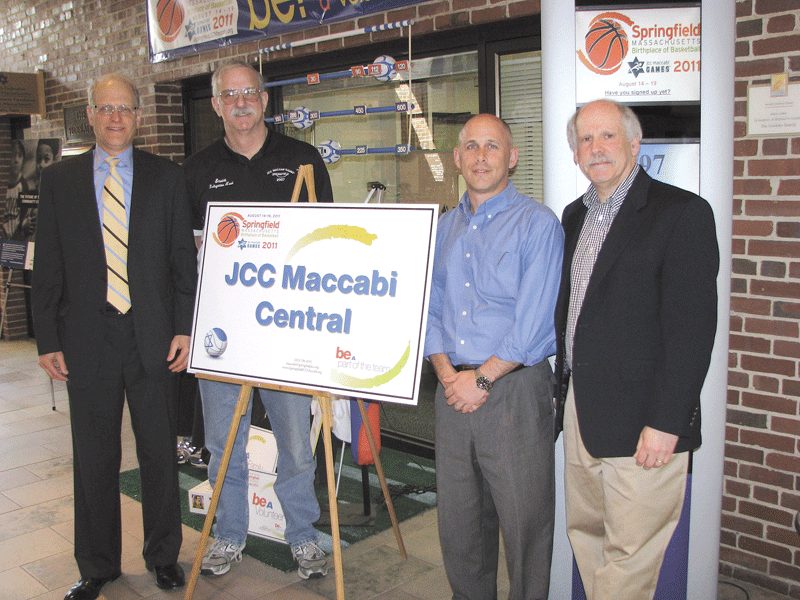
While dealing with the injured from the first tornado, both hospitals soon went on alert for more twisters, especially one that was reportedly moving southwest from Chicopee, right into the path of the two facilities.
Moen said these reports prompted staffers to once again move patients away from windows and consider additional steps to ensure both patient safety and efficient handling of large numbers of injuries.
When asked what lessons Mercy and other hospitals could take away from the events of June 1 — just as they are all learning from Joplin — Carroll started with the need to pay a little more attention to the weather, a need she’s already addressed.
“Someone told me Radio Shack was having a special on hazard-alert radios, for $29.99,” she said. “They were getting rid of last year’s models, so I went and bought five of them; we’re going to place them at the security booth, the front desk, at the switchboard, which is also in the basement, and the fourth floor of the Weldon Center, because they saw it out the window about the same time I did.”
Beyond that, she and Lynch said much of the focus has been on the ineffectiveness of cellphones — again, something that wasn’t anticipated — and steps that may be taken in the future as a result.
“I received only one call in two hours, and every call I tried to make didn’t go through,” she said, adding that backup contingencies, ranging from land lines to two-way radios to texting, kept most of the lines of communication open.

In the wake of the tornadoes, Mercy will look into having more ham radios tuned to the SkyWarn channel, another stormchasers’ outlet. “Many times, they’re the first to see the first touchdown.”
Said Lynch, “It’s a stunning thing for people to dial something on a cell phone and get busy circuits all the time. You have to look at what that impacts. It didn’t affect our operations, but when you live though it like this, you ask questions about what happens next time.”
As is typical with such events and the drills that replicate them, he added, there is a comprehensive debriefing exercise, at which those involved discuss what went well and what didn’t. In this case, most all matters fell into that first category.
“But in this particular case, we’re going well beyond that, because it was an actual event, and we’re really soliciting information from our clinical people,” Lynch said. “They did fabulous work, and they organized this so rapidly; it’s not a surprise, but it’s always great to see. People take the training, and they take the understanding, and they do what they have to do, and do it remarkably well.”

Lasting Impressions
Caroll is still working on that PowerPoint presentation she talked about. The pictures and accounts of the Joplin disaster offer some important lessons for Mercy and all hospitals.
“We wanted to look at the types of damage done to the hospital in Joplin, and the things that we would need to consider in our planning,” she said, “such as the safest places to seek shelter in the buildings, warning systems, and so on.”
All that will still go on, but now there are other, far more personal accounts of what to do when a tornado strikes. They are one of the more positive things to take away from a day that won’t ever be forgotten. n

George O’Brien can be reached at [email protected]

Opinion
The Law of Unintended Consequences

I had an appointment with a client recently who told me that she was shocked to see how empty a restaurant was in downtown Springfield a few nights earlier. The reason she was so surprised was that this particular restaurant was relatively untouched by the tornado that tore through the center of the city on June 1. The owner stated that the reason things were so quiet was that people were simply afraid to come back.
Having read or viewed many articles and newscasts discouraging people from traveling to impacted areas (for completely understandable reasons) immediately after the tornadoes struck, I believe the law of unintended consequences might be starting to take effect in this region.
For instance, I myself have tried to stay clear of any impacted areas (unless going there to help with cleanup efforts). However, even though these intentions have been sound, the businesses that exist in these locations are suffering continued damages by this mindset. Many of these organizations were already struggling due to the recent, prolonged recession well before the tornadoes touched down. If their difficulties are now compounded by a sustained dropoff in business, a large number of them might not make it through to the other side. This could create a second wave of negative events for our region.
I write this in the hope that those who are in a position to do so can help spread the word regarding those conducting business in areas impacted by the recent tornado. I’ve already reached out to the leadership of Springfield encouraging them to use their amplified microphone to continue to spread the word that businesses are open and eager to serve — and that, when possible, individuals and business owners should do what they can to support these ventures.
I truly feel that those living and working in bordering communities need to be encouraged to travel back into impacted areas. The average local resident catches the news only on occasion, so it will take a genuine, concerted effort to convince people that it’s not only OK to come back, but such support is genuinely needed.
What we need is for individuals and business owners to think about both the direct and indirect victims of the tornadoes when they make decisions about where to stage the next staff luncheon or where to have their next date night. I’m a small-business owner in East Longmeadow, and I’ve been thinking a lot about how fortunate I’ve been to escape these tornadoes unscathed. But I’ve also been thinking about my counterparts in downtown Westfield, the center of West Springfield, the South End of Springfield, Wilbraham, or Monson who have been far less fortunate.
All businesses in our area are challenged by the economy, competition, and other factors. Businesses located in the paths of the tornadoes have been dealt an added blow that may prove crippling unless people step up and help in very simple ways.
My concern is long-term. If things are handled well, our entire region could use this experience as an opportunity to grow and prosper. However, if mishandled, we could see large-scale business closures and abandoned homes that could take many years to recover from.
Perhaps if we each do a little, then it might be enough to keep our collective community growing in the right direction.

Edward Zemba is president and co-owner of Robert Charles Photography; (413) 525-4263.

Chamber Corners Departments

ACCGS
www.myonlinechamber.com
(413) 787-1555

• July 8: ACCGS Legislative Steering Committee, 8-9 a.m., TD Bank Conference Center, Springfield.
•July 11: ACCGS Annual Golf Tournament, Ludlow Country Club, 11 a.m. to 7 p.m., $150 per person.
•July 20: ACCGS Ambassadors Meeting, 4-5 p.m., EDC Conference Room, Springfield.

Amherst Area Chamber of Commerce
www.amherstarea.com
(413) 253-0700

•July 18: 8th Annual Amherst Area Chamber of Commerce Golf Tournament, 11:30 a.m. to 7 p.m., Hickory Ridge Golf Course, Amherst. Sponsors: Hampshire Hospitality Group, Cooley Dickinson Hospital, Applied Mortgage Services, Blair, Cutting & Smith, J.F. Conlon, Blue Cross Blue Shield, the Mass. Business Assoc., MetLife, Health New England, and Fallon Community Health. Cost: $125 per player, $500 per foursome, includes lunch, tournament, dinner, gift, and goody bag. Register at [email protected] or (413) 253-0700.

Greater Easthampton Chamber of Commerce
www.easthamptonchamber.org
(413) 527-9414

• July 14: Networking By Night Business Card Exchange, “Waterski Show Night,” 5-7 p.m., hosted by Oxbow Water Ski Show Team, 100 Old Springfield Road, Northampton. Sponsored by Columbia Gas of Massachusetts. Gala waterski show, door prizes, hors d’ouevres, host beer and wine. Cost: $5 for members, $15 for non-members.
• July 29: 27th Annual Greater Easthampton Chamber of Commerce Golf Tourney, 9 a.m. shotgun start – scramble. Hosted by Southampton Country Club, College Highway, Southampton. Major sponsor: Easthampton Savings Bank. Golf with cart, lunch, dinner, gift, contests. Win a Buick hole in one sponsored by Cernak Buick; $10,000 hole in one sponsored by Finck & Perras Insurance. Cost: $100 per person, $400 per foursome.

Greater Westfield Chamber of Commerce
www.westfieldbiz.org
(413) 568-1618

• July 14: 34th Annual Pancake Breakfast, 7-11 a.m., Westfield South Middle School, rain or shine. Cost: $5, $4 for seniors, $2 for children. Vendor tables available for $75 for members, $100 for non-members. Call chamber office at (413) 568-1618 for tickets.

Chamber Corners Departments

ACCGS
www.myonlinechamber.com
(413) 787-1555

• June 15: ACCGS Annual Meeting, 11:30 a.m.-1:30 p.m., Marriott Springfield. Tickets: $40 for members; $60 for non-members. Speaker: Greg Bialecki, secretary of Housing and Economic Development. For more information and to purchase tickets call (413) 787-1555.

CHICOPEE CHAMBER OF COMMERCE
www.chicopeechamber.org
(413) 594-2101

•  June 10: Global to Local — A Workshop Series, Part 3 Growth Strategy: A New Approach, 8 a.m. to 11 a.m., Hampton Inn Chicopee, 600 Memorial Dr.  Cost: $65 for members, $75 non-members.

FRANKLIN COUNTY CHAMBER OF COMMERCE
www.franklincc.org
(413) 773-5463

• June 24: Annual Meeting and Legislative Breakfast, 7:30 – 9 a.m., Eaglebrook School.

GREATER HOLYOKE CHAMBER OF COMMERCE
www.holycham.com
(413) 534-3376

• June 15: Chamber After Hours, 5-7 p.m., Wistariahurst Museum. Sponsored by Sunshine Village. Admission is $5 for members; $10 cash for non-members. For more information, call (413) 534-3376 or sign up at holyokechamber.com.

• June 23: Job Fair, presented by the Greater Holyoke Chamber of Commerce, CareerPoint, Chicopee Chamber of Commerce, and Elms College. Hosted by Elms College, 291 Springfield St., Chicopee. Please check holyokechamber.com for details.

GREATER NORTHAMPTON CHAMBER OF COMMERCE
www.explorenorthampton.com
(413) 584-1900

• June 21: June Meet & Eat Breakfast, 7:30-9 a.m., Smith College Conference Center, Elm St., Northampton. Cost: $15 for members.

NORTHAMPTON AREA YOUNG PROFESSIONAL SOCIETY
www.thenayp.com
(413) 584-1900

• June 9: Party with a Purpose, the NAYP Non-Profit Board Fair, 5-8 p.m., at the
Smith College Conference Center, Elm Street Northampton. Free for NAYP members as well as Easthampton, Northampton, and Amherst Chamber members; $5 for non-members.

WEST OF THE RIVER CHAMBER OF COMMERCE
www.ourwrc.com
(413) 426-3880

• June 15: Table Top, 4:30-7:00 p.m, Fathers & Sons, 214 New Bridge St. West Springfield. This event will feature tabletop displays of various businesses. The WRC is looking for sponsors of this event. For more information, call (413) 426-3880.

GREATER WESTFIELD CHAMBER OF COMMERCE
www.westfieldbiz.org
(413) 568-1618

• June 8: WestNet, the after 5 networking event,  5-7 p.m. Hosted by the YMCA of Greater Westfield @ Camp Shepard. Come and shoot hoops to support the chamber’s Scholarship fund. Tickets: $10 for members; $15 for non-members. For more information, call  (413) 568-1618; [email protected].

• June 10: Chamber June Breakfast, hosted by: Tekoa Country Club, 459 Russell Road, Westfield. Registration begins at 7:15 a.m.; program, 8-9. Guest Speaker: Timothy Brennan, executive director, Pioneer Valley Planning Commission. Sponsors: Platinum Sponsor: First Niagara; Gold Sponsors: Westfield State University, United Bank, Noble Health Systems; Silver Sponsor Westfield Bank. Tickets: $25 for members; $30 for non-members. For more information, call (413) 568-1618; [email protected].

• June 20: 50th Annual Golf Tournament, 10 a.m. to 7 p.m., at Tekoa Country Club, 459 Russell Road, Westfield. Title Sponsor: United Bank. For morte information or to sign up, call Sandy Sorel at (413) 779-0075.

YPS-YOUNG PROFESSIONAL SOCIETY OF GREATER SPRINGFIELD
www.springfieldyps.com

• June 9: Martini Magic, 6-9 p.m., Max’s Tavern at The Basketball Hall of Fame, 1000 West Columbus Ave., Springfield. Join YPS at Max’s Martini Magic and help support the Ronald McDonald House. The event will include a creative selection of cocktails, exquisite hors d’oeuvres, carving stations, and live music. Tickets: $65 per person.
A $10 discount will be given to YPS members who purchase their tickets before May 27. Tickets are limited. For reservations please contact AnnMarie Harding at [email protected]; or by phone at (413) 746-6299, Ext. 381.

• June 19: Lighthouse’s 1st Annual ‘Cue it up for Employment’ Billiards Tournament,  3 p.m., Smith’s Billiards, Worthington Street, Springfield. Doors open at 3; match play begins at 4. Sponsored by: Mercy Medical Center, Burger King, Sisco, and YPS. Tickets: $20 for players; $10 for spectators. Player tickets are limited. For reservations please contact Jeff Trant at [email protected], or call (413) 736-8974, Ext. 101. All proceeds benefit Lighthouse, a division of Human Resources Unlimited, a 501(c)(3) not for profit organization serving disabled and disadvantaged adults.