Home Posts tagged Law (Page 29)
Law Sections
Skoler, Abbott & Presser Helps Employers Navigate Legal Minefields

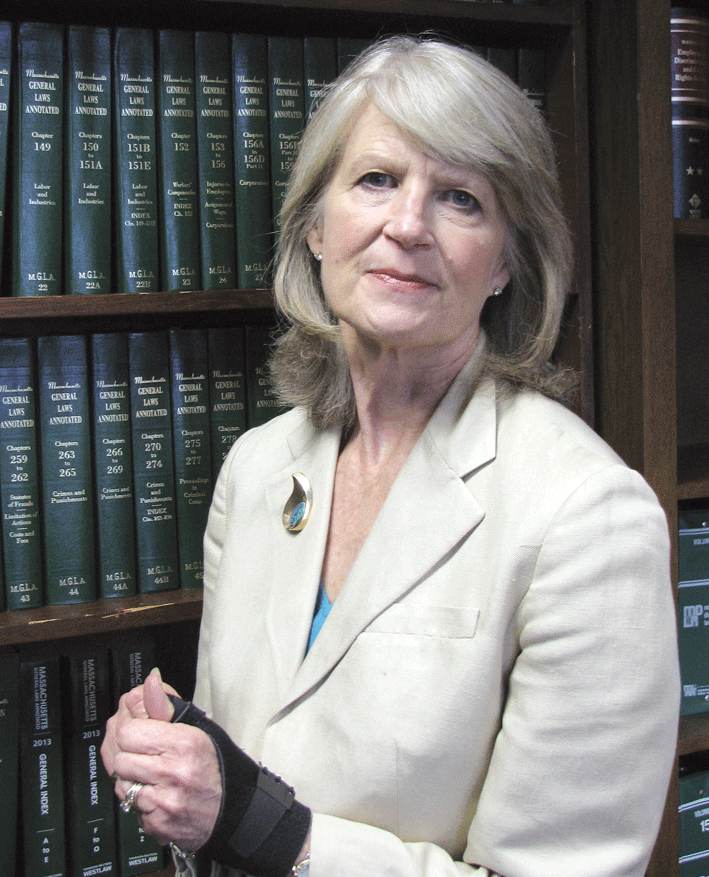
Susan Fentin

Susan Fentin says she much prefers helping clients sidestep employment-law pitfalls than defending them in court.

Employment litigation was a lot easier a generation ago.
“In the late ’70s and early ’80s, the courts started looking for exceptions to employment at will,” said Ralph Abbott, a partner with Springfield-based employment-law firm Skoler, Abbott & Presser, referring to a company’s right to fire someone for any reason. “Prior to that, when somebody sued a company on an employment matter, you went to court and said the magic words ‘employment at will,’ and then it was over.”
However, the regulatory landscape surrounding employment law has changed dramatically since Title VII of the Civil Rights Act of 1964 barred discrimination on the basis of sex, race, color, religion, and national origin. The evolution of that law, and new protections under the Americans with Disabilities Act (ADA) of 1990 and the Family Medical Leave Act (FMLA) of 1993, just to name two developments, have significantly broadened the scope of workers’ rights.
“Now, if an employee feels they’ve been treated unfairly and looks around for a reason to file a lawsuit, it’s pretty easy to find one,” said Susan Fentin, another partner at the firm.
“It’s just become so much more complicated,” added Timothy Murphy, another partner. “You really do need to have the support of a law firm that specializes in this.”
Specifically, Skoler, Abbott & Presser practices only management-side employment law, counting among its clients businesses of all types, from mom-and-pop companies to multinationals. However, its work spans much more than defending companies against worker grievances in court.
“We much prefer keeping clients out of trouble than defending them when they get into trouble,” Fentin said. “With just a 15-minute phone call, we can say, ‘let’s handle it this way.’ It doesn’t always mean we avoid litigation, but they can set themselves up in a better position.”
Abbott explained that the practice is divided into three “buckets.” There’s traditional labor work, such as negotiations, arbitrations, and advising clients on remaining union-free. Another bucket is employee litigation, including actions under the Mass. Commission Against Discrimination and a host of other state and federal agencies. The third area of practice is the everyday work, as Fentin described, of advising clients on the ever-changing world of employment law and how it applies to their companies.
Take wage-and-hour claims, which Abbott called the “lawsuit du jour” in his field these days, with issues ranging from unpaid overtime hours to misclassification of employees as independent contractors.
“The state law changed a few years ago, with triple damage mandatory for any state wage-and-hour violation — even ones that are good-faith mistakes,” Murphy noted. “As you can imagine, as these claims become more lucrative, more folks are looking at these types of lawsuits, so we’ve seen a real spike there.”
The result, Abbott said, is that there’s more risk than ever for employers and their management and human-resources teams, who often don’t have the resources to keep up with how quickly regulations are changing.
“People aren’t born to be managers; they don’t come out of the womb like that,” he told BusinessWest. “They’ve been promoted, usually because of meritorious service, but they need the skills and training to avoid the pitfalls. People just don’t know this stuff.
“That’s where we come in,” he continued. “We see employers as basically well-meaning people trying to do the right thing under difficult circumstances.”
They might do everything right and still get sued, Fentin noted. “All we can do is manage the level of risk and minimize the possibility of a suit to the greatest extent possible.”

Union Labels
Since its inception in 1964, Skoler, Abbott & Presser has worked with employers in the realm of labor relations and collective bargaining, including all aspects of the National Labor Relations Act of 1935.
But that law, too, has evolved with the times. “One major change is that it’s starting to expand the concept of protected, concerted activity into areas where it was never utilized before,” Abbott said. “We’re seeing that they’re poking more into employment relationships than they have in the past.”
Take the brave new world of social media, for example. The National Labor Relations Board (NLRB), which administers labor law under the act, has made several high-profile rulings regarding the right of employees to complain about their jobs on Facebook and other sites.
Abbott cited the term ‘electronic water cooler’ when talking about the Internet and social media. “In the old days, when employees gathered around and moaned and groaned about their supervisor or what the company was going or not doing, they’d do it around the water cooler. Now it’s done online, and that has created problems for employers, who see all their dirty linen exposed to the world.”
The NLRB has stepped forcefully into this new paradigm, ruling on multiple occasions that such speech is protected. “The world has changed, and (so has) the way people communicate; people will say things on Facebook and not realize the implications,” Abbott said — and companies must understand and learn to deal with this reality.
This federal push for expanded workers’ rights comes at a time when only seven in 100 private-sector workers in the U.S. are in a union, Murphy noted.
“The NLRB is trying to establish some relevance in an environment where the standard labor relationship is not as predominant as it used to be,” Fentin added.
Abbott agreed. “We’re not seeing the uptick in union organizing — in New England and other parts of the country — that was expected with the present administration and its pro-labor view,” Abbott said of President Obama’s five years at the helm. “That hasn’t materialized into greater numbers of new members for unions or significant organizing drives, so the NLRB is now looking for relevance; they’re looking to expand their clout in the world.”
That’s evident in the recent strikes of fast-food restaurants by employees looking to significantly increase their wages. “That’s not related to a union,” he said, “but it’s clearly aided and supported by unions that want to pressure the fast-food industry on the wage issue.”
Meanwhile, unions are certainly not dead, Fentin said, which is why the firm continues to offer strategies to clients looking to remain non-unionized. “The manufacturing sector in Massachusetts has obviously shrunk over the years,” she noted, “but a fair number of clients in human-services agencies are now big targets for unions. We’ve had a couple of clients targeted by union-organizing drives.”

Educate and Connect

The firm’s client training goes well beyond union avoidance, however, encompassing seminars and briefings on topics such as personnel policies, sexual harassment, wage-and-hour laws, discipline and documentation, drug testing, workplace safety, and, of course, the broad implications of the aforementioned ADA and FMLA.
“The firm teaches master classes in both of those,” Fentin said. “The FMLA is a complicated statute to administer; it requires a lot of procedural paperwork.”
It also has a higher profile than it used to, she added. “More people are aware of it, and more likely to believe that they were treated wrongly because of their protected class.”
In addition, “we do a lot of training in discipline and documentation to make sure supervisors understand the importance of being fair and having a business-based reason” for firing, she explained. “We have an at-will law in Massachusetts, but, frankly, if you don’t give a good reason, people will feel they’re not being treated fairly.”
The firm’s educational efforts extend beyond its clients, she added. “We also write and edit the Massachusetts Employment Law Letter. That requires us to be constantly on top of what’s going on. It’s really written for the HR professional — it’s not esoteric; it’s written in plain language so anyone can take an issue we’re talking about and apply it to their own situation.”
Fentin said her work sometimes feels more like family law than business law because it often involves people with long-standing relationships, and when someone feels wronged, the process can get messy. “I had a mediation yesterday that failed because the employee wanted her day in court, and wanted to be vindicated,” she recalled. “It can be an emotional relationship.”
Murphy said the firm encourages clients to talk with a lawyer before they make any personnel decision that can lead to litigation.
“We walk through what the options are so the problem doesn’t happen,” he said. “We take a lot of pride in keeping people out of trouble, even though that’s not the most lucrative course. We’re building long-term relationships — we’ve had some clients since the 1960s. We don’t want to have one transaction with a client; we want to understand their business and be a partner with them, to help them thrive without having to worry about litigation or union problems.”
Abbott said a good result often comes down to simply treating people well and keeping the lines of communication open. “Unions aren’t going to get any traction in a company that treats their employees fairly. You don’t have to be the best-paying company in the world, but you do have to be focused on the employer-employee relationship. And that commitment starts at the top of the company.”
Fentin sees much of her role as trying to keep honest business people out of trouble. “All they’re trying to do is run their businesses. They don’t want to discriminate against anybody, and they want to make sure they’re doing things the right way.
“It is expensive if it ends up in court,” she added. “Talk about a drain on management morale, a time drain, a financial drain. It’s not fun. The better route is to develop strategies that keep you out of trouble.”

Something New
From anti-bullying policies in the workplace to regulations regarding the use of smartphones at work, “there’s always something new bubbling up,” Fentin said. “There’s never a dull month.”
Medical marijuana is another one of those new, hot issues, partly because of the rift between state laws, in states like Massachusetts where its use has been sanctioned, and federal law, which still maintains that it’s illegal. For instance, what if someone uses marijuana for health reasons at home, then fails a drug test at work because traces are still in his system?
“We’re still looking for court guidance on that,” she said. “Frankly, these decisions will take a long time to bubble through.”
Yet, such uncertainty isn’t frustrating to Fentin, but gratifying in a way, because she knows that clients have much at stake from such issues, and she and her fellow attorneys at Skoler, Abbott & Presser are equipped to help employers deal with them.
“This isn’t something abstract — I’m talking about people and how to help them keep their jobs and make their businesses more efficient,” she said. “I love my clients; my clients are my friends.”
Abbott had a similar take. “I believe a lot of people think of a company as a logo, a building, a product,” he said. “Our view of a company is of people — it’s managers, it’s HR people, trying to do the best they can under tough circumstances.”

Joseph Bednar can be reached at [email protected]

Opinion
The Tech Tax, from a Tech Firm’s Angle

By DELCIE BEAN

In July, Massachusetts imposed a 6.25% sales tax on ‘computer system design services,’ which means this state now has the highest tax on computer and software services in the country.
Large and small tech firms across the state are dismayed at the new tax’s potential effect on our businesses. We are confused by the vagueness of the tax — it’s unclear in many cases what services are to be taxed and what aren’t. The state Department of Revenue originally promised a clearer definition of what was and wasn’t taxable by October; however, it now appears to be backing off even that date.
Meanwhile, the tax still must be collected, all the way back to July 31, one day after the DOR first offered a definition of the tax. We feel ambushed by the 11th-hour manner in which it was pushed through, just before legislators’ summer break, with no allowance for consumer or business input.
One of the particular challenges of this law is that the staff of my company, Paragus Strategic IT, collectively records approximately 500 unique billable events each day and would therefore need to train its entire staff on how to make very complex assessments of whether each of the individual tasks they performed was taxable or not — using a definition so complex that the state can’t even define it.
Couple this with the fact that Paragus, like most IT companies, uses a ticketing system to keep track of the billable work it does for its clients, and that these systems were not designed to allow technicians to mark work as taxable or non-taxable. In order to properly manage these changes without compromising profitability and efficiency, six to 12 months would have been required. Instead, Paragus is faced with having an administrator spend 20 to 30 hours a month going through the billable work of all technical employees and identifying which work is taxable or not.
We are not alone. As reported in the Boston Globe, Springfield attorney Scott Foster, a partner with the law firm Bulkley, Richardson and Gelinas, LLP, has announced plans to challenge the tax in court, declaring it unconstitutional. This announcement resulted in Gov. Deval Patrick officially going on the record as saying he was concerned about the impact on the state’s efforts to expand its technology industry.
I started the company that became Paragus Strategic IT when I was 13 years old. What was once a one-man operation has turned into a company with 31 full-time employees and clients all over New England. For the past two years, we were named in the top third of Inc. magazine’s annual ranking of the 5,000 fastest-growing businesses. In 2012 we were named the second-fastest-growing outsourced IT firm in all of New England. Our growth has allowed us to add a staff member approximately every six weeks.
Like other local tech companies, we are doing what we can to bring jobs and economic vitality to the Pioneer Valley. This new tax isn’t making our job any easier.
In the near term, I am worried about how our clients will react to the new charges and how we will possibly become compliant in the very short period of time allotted. In the long term, I am concerned about the tax’s effect on one of the state’s major growth industries. This new tax is one more sign that Massachusetts might not truly be vested in the long-term best interests of the technology sector, making it harder to attract the biggest employers.
A 2014 ballot initiative is being filed to repeal the tax. Until then, we are doing what we can to operate under this new tax, to the best of our understanding, with as minimal impact to our clients as possible. We do encourage people to take a look at the tax and to think about the role of the tech industry in the Pioneer Valley, both now and in the years to come — and to think about whether there might be a smarter way to raise the extra revenue.

Delcie Bean is founder and president of Paragus Strategic IT.

Law Sections
Genetic Information, Employment Discrimination, and the Law

Karina L. Schrengohst

Karina L. Schrengohst

In May 2013, actress Angelina Jolie announced that she underwent a preventive double mastectomy after learning through genetic testing that she carries a genetic mutation (BRCA1), which significantly increases her risk of breast and ovarian cancer. The very same month, the Equal Employment Opportunity Commission (EEOC) brought the first lawsuits it ever filed alleging genetic discrimination under the Genetic Information Nondiscrimination Act (GINA).
This relatively new federal law, which was passed in 2008, prohibits employers with 15 or more employees from discriminating against applicants or employees because of their genetic information. Massachusetts’ anti-discrimination law, which applies to employers with six or more employees, also prohibits discrimination on the basis of genetic information. Genetic information includes, for instance, information about an individual’s genetic tests and the genetic tests of family members, as well as information related to an individual’s family medical history. This means that employers cannot request genetic information of applicants or employees and cannot use genetic information as a basis for employment decisions such as hiring, firing, pay, promotion, and other terms or conditions of employment.
GINA protects individuals, like Jolie, from being discriminated against because an employer believes they are at an increased risk of developing certain medical conditions, such as cancer. Jolie’s genetic information, however, can be found in publicly available sources, which falls within one of GINA’s narrow exceptions.
On May 7, 2013, the EEOC filed its first-ever lawsuit under GINA against fabric distributor Fabricut Inc., which had offered a temporary employee, Rhonda Jones, a permanent job subject to a pre-employment drug test and physical. As part of her medical examination, which was conducted by a third-party medical examiner, Jones was required to fill out a standard questionnaire, which asked her to disclose family medical history, such as whether there was a history of heart disease, hypertension, cancer, diabetes, arthritis, or mental disorders in her family. Fabricut rescinded its job offer after Jones’ medical examination resulted in the conclusion that she needed further evaluation to determine whether she suffered from carpal tunnel syndrome.
The EEOC filed a lawsuit claiming that Fabricut violated GINA when it asked for Jones’ family medical history in its post-offer medical examination (and violated the Americans with Disabilities Act when it refused to hire her because it regarded her as disabled). Fabricut immediately settled the case for $50,000.
In its press release about the Fabricut settlement. The EEOC noted that one of the six national priorities identified in its strategic enforcement plan is emerging and developing issues in equal-employment law, which includes genetic discrimination. Thus, it came as no surprise when, on the heels of this lawsuit, on May 16, 2013, the EEOC filed its first-ever class-action lawsuit under GINA against Founders Pavilion Inc., a nursing and rehabilitation center. Similar to the Fabricut situation, the EEOC claimed that Founders violated GINA by requesting family medical history from prospective and current employees as part of its pre-employment, annual, and return-to-work medical exams. The EEOC also alleges that Founders violated the Americans with Disabilities Act by withdrawing offers of employment based on the results of post-offer medical exams.
In light of the EEOC’s recent heightened interest in enforcing employee rights under GINA, employers should take steps to reduce their risk of liability. Obviously, employers should be careful to ensure that they do not inquire about an applicant’s or an employee’s genetic information.
Another way employers can reduce their risk is to include the following cautionary language on all forms requesting medical information about applicants or employees: “The Genetic Information Nondiscrimination Act of 2008 (GINA) prohibits employers and other entities covered by GINA Title II from requesting or requiring genetic information of an individual or family member of the individual, except as specifically allowed by this law. To comply with this law, we are asking that you not provide any genetic information when responding to this request for medical information. ‘Genetic information,’ as defined by GINA, includes an individual’s family medical history, the results of an individual’s or family member’s genetic tests, the fact that an individual or an individual’s family member sought or received genetic services, and genetic information of a fetus carried by an individual or an individual’s family member or an embryo lawfully held by an individual or family member receiving assistive reproductive services.”
This safe-harbor provision from the GINA regulations provides a level of protection because genetic information received in response to a request for medical information, such as those pursuant to the Americans with Disabilities Act or the Family Medical Leave Act, will be deemed inadvertent and, thus, not a violation of GINA. Finally, the two recent cases filed by the EEOC illustrate the importance of employers working with their third-party medical providers to ensure that the providers’ practices do not violate GINA by requesting family medical history or other genetic information.
Just as Angelina Jolie took preventive measures to reduce her risk of cancer, employers can take preventative steps to reduce their risk of facing a lawsuit for genetic discrimination.

Karina L. Schrengohst, Esq. is an attorney at Royal LLP, a woman-owned, SOMWBA-certified, boutique, management-side labor and employment law firm; (413) 586-2288; [email protected]

Law Sections
10 Things You Should Know About Reverse Mortgages

ANN I. WEBER, Esq.

ANN I. WEBER, Esq.

If you watch TV these days, it’s hard to avoid Fred Thompson, Robert Wagner, and a host of other actors encouraging you to consider a reverse mortgage if you are strapped for cash.
Although these financial tools can be useful, they are expensive, both in terms of bank fees and interest payments, and they can put your financial health, your home ownership, and your children’s inheritance at risk.
Because of these problems, the default rate on reverse mortgages has been significant. In response, Congress recently passed the Reverse Mortgage Stabilization Act of 2013, which gives new powers to federal regulators to change the rules of the program “to improve … fiscal safety and soundness.” As a result, most homeowners will no longer have access to large lump-sum payments up front, they may be required to set up escrow accounts for insurance and property taxes, and financial assessments will be required.
If you are thinking about applying for a reverse mortgage, here are 10 things you should know before proceeding.

1. A reverse mortgage is a loan, which accumulates interest over the life of the loan. The homeowner remains responsible for ongoing taxes and home insurance.
A reverse mortgage is similar to a purchase mortgage in that it is a loan from a bank or mortgage company to an individual. However, instead of using the funds advanced by the bank for purchase of a residence, a senior homeowner (62 or older) can use a portion of his or her home equity as collateral and receive cash in return. Reverse mortgages have fees due upon origination and servicing fees annually, and the loan will have to be repaid with interest, which accumulates over the life of the loan. The principal and accumulated interest are due when the homeonwer dies or no longer lives in the home as their principal residence.
There are three types of reverse mortgages:
• Single-purpose loans for home repair, handicap access, etc. issued by state, local, or charitable agencies. These are usually the least expensive;
• Home Equity Conversion Mortgages (HECMs), issued by banks or mortgage companies that are approved Federal Housing Authority lenders. They are federally insured and regulated. These are the most common and have some consumer safeguards due to federal regulation; and
• Proprietary loans backed by the companies that develop them. You are on your own here, but greater amounts are frequently available from these lenders.
The home is still owned by the borrower, who remains responsible for upkeep, real-estate taxes, and insurance on the home. Failure to maintain these payments can result in default and foreclosure, and as a result, escrow accounts may be required under the new law.

2. Reverse mortgage loans can be structured in a variety of ways.
The loan can be structured to make equal monthly payments to the homeowner for as long as the homeowner lives in the home or over a fixed number of years. Alternatively, the loan can create a line of credit that the homeowner can draw down at any time until the line of credit is exhausted. Some reverse-mortgage companies offer a combination of the above options. The loan plus accumulated interest is due when the homeowner dies or leaves the home for 12 months or more.
Note that, as of April 1, 2013, the federal government will no longer allow standard fixed-rate HECM mortgages to offer a lump-sum payment. Smaller lump-sum payments are still available under the HECM Saver program, which pays out a smaller percentage of the equity value of the home.

3. The amount available depends on several factors.
The older the homeowner, the more the homeowner can borrow against the value of their home. HECM loan maximums are determined based on the age of the borrower, the equity in the home,  and the current interest rate. Under federal law, loans may not exceed $625,500. However, under the new law, amounts available will be based on a lower percentage of equity, and borrowers with credit issues or little income may find that reverse mortgages are no longer a viable option for them because a financial assessment is now required.

4. Interest rates and fees are significantly higher than for conventional mortgages.
Interest rates for reverse mortgages are higher, sometimes significantly so, than for conventional mortgages, and reverse mortgages have frontloaded fees such as points, origination fees ($2,000 or 2% of the value of the home, regardless of the loan amount, whichever is higher), mandatory counseling, appraisal fee, financial-assessment fee, credit-report fee, pest inspection, flood insurance if applicable, as well as mortgage insurance. There may also be annual servicing fees charged over the life of the mortgage;  $10,000 in fees is not unusual for an upfront fee even for a relatively modest loan.

5.  The home should be mortgage-free.
While you may be able to borrow enough money to pay off an existing mortgage depending on your age and the amount of the existing mortgage, this will reduce the amount of cash that you can receive under the reverse mortgage. Consequently, it is generally more cost-effective to utilize a reverse mortgage with a home that is mortgage-free.

6. A reverse mortgage is not a good option if you are planning to sell or move in the foreseeable future.
Most reverse mortgages are not used over a short-term period due to the upfront fees. Therefore, a home-equity line or conventional mortgage may be more appropriate to provide liquidity over the short term. Also remember that the state or local government may have lower-cost loans for specific purposes.

7. Reverse mortgage payments are not taxable, nor are the payments considered countable income for purposes of MassHealth (Medicaid) eligibility.
However, lump-sum payments or any part of a monthly payment retained after the month of receipt will be part of countable assets. If you or your spouse are facing the possibility of long-term or nursing care, the monthly payments you receive under a reverse mortgage do not affect MassHealth eligibility. However, if you receive a lump sum or do not spend the entire monthly payment, the amount remaining after the month of receipt will be considered a countable asset.
Also, if you vacate your home for an extended period of time, usually 12 months or more for any reason, including a stay in a nursing home, the reverse mortgage may be called by the bank or mortgage company. If you do not have the funds to pay off the mortgage, the home can then be foreclosed upon and lost to the homeowner should he or she later be able to return home.

8. If the borrower is married, both spouses should be listed on the mortgage.
If only one spouse is listed on the mortgage, should the borrower spouse die, the survivor can be evicted if his or her name is not on the mortgage. In addition, problems have arisen for surviving spouses when only the deceased spouse is listed as a property owner on the deed. This situation can arise when couples opt to put a reverse mortgage in the name of the older spouse in order to maximize the loan’s proceeds. The federal government is considering instituting provisions later this year to address this problem.

9. This probably should be the option of last resort.
If you have other sources of funds for your living expenses, it is generally better use those first before moving to the reverse mortgage because of the outlay in fees and accumulating interest. You may want to consult with an attorney to be sure you understand the rules and review all your options.

10. If a reverse mortgage seems right for you, calculate all the fees and shop around.
Closing fees can vary significantly among lenders, so vigilance in comparing vendors can really pay off.

Attorney Ann (Ami) I. Weber is a partner with Springfield-based Shatz, Schwartz and Fentin, and concentrates her practice in the areas of estate-tax planning, estate administration, probate, and elder law, and she has a particular interest in creative estate planning for authors, artists, farmers, and landowners. She is a board member and past president of the Estate Planning Council of Hampden County Inc., and is a former (and founding) board member and current member of the Massachusetts Chapter of the National Academy of Elder Law Attorneys. She has recently been named one of the Top Fifty Women Lawyers in New England by Super Lawyer magazine. She is a frequent author and speaker on issues regarding estate planning, (413) 737-1131; [email protected]

Law Sections
Understanding the New 3.8% Investment Income Tax

Richard Gaberman

Richard Gaberman

The new 3.8% tax on ‘passive’ income known as the Medicare tax, which was included in the Patient Protection and Affordable Care Act, will now affect individuals whose adjusted gross income, depending on marital and filing status, is more than $125,000, $200,000, or $250,000.
However, it does affect trusts and estates with adjusted gross income in excess of $11,950. Thus, it is more important than ever for the executor or trustee to determine the adjusted gross income for the individual beneficiaries in order to determine whether to distribute income from the estate or trust to such beneficiary to avoid the 3.8% tax if that beneficiary’s modified adjusted gross income is below his or her applicable threshold.

Some Basic Information
• This new tax was effective as of Jan. 1, 2013.
• The tax applies to all taxpayers whose income exceeds a certain ‘threshold amount.’
• With respect to individuals, the NIIT is equal to 3.8% of the lesser of (a) net investment income (NII) or (b) the excess (if any) of the modified adjusted gross income (MAGI) less the threshold amount. This is basically adjusted gross income but increased for certain items of an income and for the earned-income exclusion. The threshold amounts for individuals are $250,000 if married and filing jointly, $200,000 if single, and $125,000 if married but filing separately. These are not inflation-protected.
• With respect to estates and trusts, the NIIT is equal to 3.8% of the lesser of (a) the undistributed NII or (b) the excess (if any) of the adjusted gross income over the dollar amount at which the highest tax bracket begins for that taxable year. For 2013, the highest tax bracket applicable to estates and trusts starts at $11,950. The estate and trust threshold amount is inflation-protected.
• NII includes interest, dividends, annuity distributions (if taxable), rents, royalties, income derived from passive activity, and net capital gain derived from disposition of property. It does not include salary, wages or bonuses, distributions from IRAs or qualified plans, any income taken into account for self-employment-tax purposes, gain on a sale of an active interest in a partnership or S corporation, and items that are otherwise excluded or exempt from income under the income-tax laws, such as tax-exempt bond interest, capital gain excluded under IRC §121, and veterans’ benefits.
• The NIIT will be paid with Form 1040 or Form 1041. The NIIT is subject to estimated tax penalties.
• NII includes income and gains from trades and businesses that are either passive activities (within the meaning of IRC §469) or a trade or business of trading in financial instruments or commodities. Note that, under IRC §469(c)(1), passive activity is any activity involving a trade or business in which the taxpayer does not ‘materially participate.’ Thus, one needs to review the passive-activity rules. If the taxpayer does materially participate in the activity, then NIIT will not apply to that income. The IRS regulations describe material participation for individuals, but not for an estate or trust.
• Dispositions of an interest in partnerships and S corporations require advanced planning. If the taxpayer is not active in the business, the 3.8% tax will apply to the capital gains. Note that there are ways to avoid (or defer or reduce) the 3.8% tax. Examples would involve a charitable sale, an installment sale, a 1031 real-state exchange, and a sale to family members in lower tax brackets provided the later sale to a third party occurs after two years.
Also, with respect to estates and trusts, how does an estate or trust become active in a trade or business? The executor or trustee must be active in the trade or business. An active beneficiary (who is not a trustee) will not cause the estate or trust to be ‘active.’ For example, a mother is the trustee of the trust that owns a business, but the business owned by the trust is managed by her child, who is the beneficiary of that trust.

Estates and Trusts
• The estate trust that accumulates income will pay the income taxes attributable thereto unless and to the extent that such income is distributed to any beneficiaries thereof. Note that, if a beneficiary is below his own applicable threshold, then the estate/trust may avoid the 3.8% NIIT to the extent the NII is distributed to such beneficiary who, after that distribution, is still below his threshold.
• However, note that if an irrevocable trust is a ‘grantor trust,’ then all of the income of that trust is reportable by the grantor on his or her personal income-tax return.
• Trusts not subject to NIIT generally involve split-interest charitable trusts and grantor trusts. However, distributions from a charitable trust to a non-charitable beneficiary may carry out NII subject to the 3.8% tax.
• What about electing small-business trusts (ESBT)? Although the proposed regulations recognized the ESBT as separate trust funds for each beneficiary, it does require consolidation into a single trust for determining the adjusted gross income threshold amount.

Planning for Reducing NII
• Consider municipal bonds, a 1031 exchange, an installment sale, tax-deferred annuities; life insurance; ROTH IRA conversions (helps to reduce MAGI), rental real estate (due to the benefit of the depreciation deduction), and oil and gas investments (helps reduce MAGI).
• Regarding estate/trust distributions, principal issues include the executor and trustee fiduciary duties and liability when making distributions to one or more beneficiaries. From an income-tax-planning point of view, consider distributions to lower-income-tax-bracket beneficiaries to save income taxes that would otherwise be payable by the estate or trust which may be in a higher income-tax bracket. Consider distributions to beneficiaries who may not have to pay the 3.8% NIIT. You need to read the applicable provisions of the will or trust that governs the executor’s or the trustee’s right to make distributions to the beneficiaries. Also, although accumulated pre-2013 NII is exempt from the 3.8% NIIT, under the proposed regulations, the first NII being distributed to beneficiaries does not come from the pre-2013 NII income. It is deemed to come from 2013 or later NII first.
• The gain on the funding (pecuniary bequests) of a marital deduction and bypass trust may be subject to the 3.8% tax. The tax planning for estates and trusts is now more complicated due to the new 3.8% tax, the high 39.6% income tax rate, and the huge spread between the low $11,950 threshold for estates and trusts and the high threshold for individual beneficiaries. At the same time, the fiduciary must be aware of potential fiduciary liability when making or not making distributions to the beneficiaries. Read the will and trust documents, and seek the advice of a qualified attorney and accountant.

Richard M. Gaberman, Esq. is of counsel at Springfield-based Robinson Donovan, P.C. He has been recognized for 20 consecutive years by Best Lawyers in America in the practice areas of tax law, trusts and estate, real-estate law, and corporate law. He has also been recognized for 10 years by Super Lawyers for New England in the practice area of estate planning; (413) 732-2301; [email protected]

Law Sections
Rulings Blur the Lines on Associational Disability Discrimination

SUSAN G. FENTIN

SUSAN G. FENTIN

Two recent rulings by Massachusetts appellate courts have both confused and clarified the state’s anti-discrimination statute, Mass. Gen. L. Ch. 151B, which bars employers from discriminating against employees based on their handicap/disability.
In July, the Massachusetts Supreme Judicial Court (SJC) ruled, in Flagg v. AliMed, that Ch. 151B can, under certain circumstances, protect an employee when the employee himself is not actually disabled but instead is associated with a disabled individual. Then, in August, the Massachusetts Appeals Court dismissed a similar lawsuit brought by an employee who claimed that he was terminated because of his association with his autistic son.
In Flagg, the employee had worked for AliMed for 18 years with good performance appraisals. Flagg was a salaried employee entitled to benefits under AliMed’s health-insurance plan. Unfortunately, his wife had to have surgery to remove a brain tumor, and Flagg then became responsible for caring for the couple’s children. Flagg asked for permission to occasionally be briefly absent from work to pick up his daughter from school, and his manager told him to do whatever he needed to do to take care of his family.
AliMed later terminated Flagg, however, allegedly because he had failed to punch out and had, therefore, been paid for hours he had not actually worked. Apparently, the real reason for the decision to terminate Flagg was that his wife had again been hospitalized, and AliMed did not want to be financially responsible for the enormous medical bills. Flagg sued, but the trial court dismissed his suit on the grounds that the plain language of the statute protects only a handicapped employee, not an employee who is associated with a handicapped person.
Flagg appealed, and the SJC overturned the trial court’s decision. The SJC concluded that, when an employer takes action against an otherwise satisfactory employee because of his spouse’s impairment, it is targeting the employee as the direct victim of its discriminatory attitude, punishing the employee as if he were the handicapped individual himself. Accordingly, the SJC ruled that Ch. 151B could be read to incorporate the concept of handicap discrimination based on association.
The Massachusetts Appeals Court’s decision in Lashgari v. ZOLL Medical followed the SJC’s decision in Flagg, but reached the opposite result. In Lashgari, the employee claimed that he was forced to resign because of mistreatment by the employer. The employee alleged that he told his supervisor in February 2010 that he could not work overtime because his autistic son required constant care. He was subsequently demoted by a different member of management and placed on a performance-improvement plan.
This demotion apparently led to severe emotional distress, and ultimately, the employee felt he had no choice but to resign. In its decision, the Appeals Court affirmed the trial court’s decision dismissing the case. Citing Flagg, the court ruled that Lashgari’s complaint did not allege any facts that would show that he was fired because of his association with his handicapped son. The court found no connection between Lashgari’s conversation about his son’s autism and the subsequent adverse employment actions imposed by another supervisor, and the timing of the demotion, by itself, was not enough to support a claim of associational disability discrimination under Ch. 151B.
Significantly, in a concurring opinion to Flagg, two justices raised their concern that the decision might be interpreted more broadly than the SJC had perhaps intended. Although the Flagg decision, in a footnote, states that it is not intended to address reasonable accommodations for employees who are associated with disabled individuals, the concurring opinion cautioned that this ruling should be strictly limited to cases where a spouse’s disability could, for example, increase the employer’s health-insurance expenses or where the employer might fear that an employee could contract a disabling or contagious disease through his association with a disabled person.

Bottom Line
The SJC’s decision in Flagg makes it clear that an employer may not terminate an employee because of fears that its health-insurance premiums will go up, even if those expenses will not increase because of an employee’s own disability but instead because of a disabled individual associated with the employee. It is unresolved at this point whether the SJC’s Flagg decision will impact the ability of an employee to claim he is entitled to a reasonable accommodation for the disability of someone with whom he is associated.
Following the SJC’s decision, this case was returned to the Superior Court for trial, and we can imagine that the damages here will be hefty if the jury finds for Flagg.

Susan G. Fentin is a partner at the firm Skoler, Abbott & Presser, P.C., and editor of the Massachusetts Employment Law Letter; (413) 737-4753; [email protected]

Features
Expo Seminars to Identify Paths and Obstacles to Growth

Duane Cashin says the Internet has — or should have — changed the way people approach selling.

“These days, when people want to buy something, they enter that process with a ton of information,” said Cashin, owner of Hartford-based Cashin & Co. and a noted expert in the areas of prospecting, sales process, and sales management. “With the Internet, people can thoroughly research things — consumers are more informed than ever, and that impacts the way people should sell.”

This development is one of many that Cashin will discuss in a program he calls “The Future of Sales and the Adjustments You Need to Make” — although he acknowledged that, in many ways, the future is now.

His talk is one of a dozen seminars now on the slate for the Western Mass. Business Expo, set for Nov. 6 at the MassMutual Center in downtown Springfield, an event expected to draw more than 150 exhibitors and 3,000 visitors.

Other topics to be explored include everything from immigration law to cold calling; from the emerging workforce in this country to raising a company’s profile through YouTube.

And then, there are the “Emdees.” That’s the name that Amesbury-based McDougall & Duval Advertising Agency has given to a program — in the form of an awards ceremony — involving examples of the best and worst uses of social media.

“There are many issues and challenges involved with operating a business, large or small, today,” said Kate Campiti, associate publisher of BusinessWest, which is once again presenting the Expo. “And as we approached this year’s event and its educational component, which is an important part of the show, we wanted to address some of these challenges and give business owners and managers information they could take to the office or the plant the next day.”

The seminars, which will run from 9:15 a.m. to 4 p.m., are grouped into three tracks — Sales & Marketing, Social Media, and Business Management — and are designed to be as interactive as possible, said Campiti, adding that the roster of programs was compiled after careful consideration of several dozen submitted proposals.

The full schedule of seminars is currently posted on the show’s website, www.wmbexpo.com. The programs to be presented include:

• “How TV and Social Media Have Affected Media Consumption,” presented by representatives of Comcast Spotlight;

• “Beyond an Entrepreneur,” presented by Paul DiGrigoli, president of DiGrigoli Salons and a noted motivational speaker;

• “Make an Impact with Multichannel Marketing,” presented by Tina Stevens, president of Stevens 470;

• “Leading Change,” presented by Lynn Whitney Turner and Ravi Kulkarni, principals with Clear Vision Alliance;

• “Am I Wasting Money and Time Doing Social Media?” presented by Paul Stallman, owner of Alias Solutions; and

• “Branding Bootcamp,” to be led by Meghan Lynch, president of Six-Point Creative Works.

Campiti said additional components of the Expo program, including breakfast and lunch speakers and other presentations, are being finalized, and will be announced in future issues of BusinessWest and posted on the website.

The day-long event will conclude with the Expo Social, which has become a not-to-be-missed networking opportunity since it was first staged at the 2011 Expo.

Comcast Business is once again the presenting sponsor for the Expo. Other sponsors include ABC 40/Fox 6, Health New England, and Johnson & Hill Staffing Services. Additional sponsorship opportunities are still available.

Fast Facts:
What: The Western Mass. Business Expo
When: Nov. 6
Where: The MassMutual Center, Springfield
Highlights: Breakfast and lunch programs; keynote speakers; educational seminars; Expo Social; more than 150 exhibitors
For More Information: Visit
www.wmbexpo.com or call (413) 781-8600.
 

Sections Technology
VizConnect Takes Mobile Marketing to New Heights

Ed Carroll, co-founder of VizConnect

Ed Carroll,
co-founder of VizConnect

Ed Carroll says businesses, salespeople, or entrepreneurs who are not advertising on mobile devices are losing customers, and his claim is backed up by many studies, including a survey showing that more than 86 million people sought business information last year via their smartphones.
The co-founder of VizConnect in Springfield first became aware of the trend in 2004 when he was working as a television newscaster and Facebook began to gain in popularity. “I saw a paradigm shift taking place away from mainstream media, and one night I began thinking about how businesses could use it because they are completely underserved in that area,” said Carroll, who eventually came up with the idea for the high-tech company he started in 2011 with sales and marketing guru Brian Dee.
The company’s product, a video-based mobile marketing platform, is designed to help small companies or businesspeople keep pace with changes in the way products and services are marketed today.
“Large companies have staffs and people who keep track of trends, but 80% of the economy is small businesses, and they don’t have the budget to do what they need to do to compete in the mobile scene,” Carroll told BusinessWest. “There has been a huge shift to mobile marketing, and everyone in business needs to think about how to get their message onto a mobile device.”
VizConnect has grown quickly, and today is operated by a team of partners who oversee more than 400 distributors. The product they sell has been test-marketed and improved since it was introduced to the marketplace, and most of the distributors came on board in the last six months when the company took steps to grow its sales force, due to enthusiasm about the software.
When people scan a VizConnect QR code or text message a keyword with a code, they come face to face with options that allow them to watch a video, download a coupon, view items on sale or a customer testimonial, learn more about a product or service, communicate directly with the seller, or buy the product. They can access these with a simple click, and after they watch a video, their screen changes, giving them the option of clicking again to share it on Facebook, Twitter, or LinkedIn; calling the company; making a purchase; or anything else the business elects.
“Right now most QR codes go to a static website; we have made them more dynamic,” Carroll said. “Our platform was designed to be a call to action.”
He explained that what comes up on the screen after someone texts to a keyword or scans a QR code can make or break a sale. “Research shows it takes the human mind about six seconds to decide whether to stay or go. It’s a yes or no,” Carroll said.
He added that businesses that fail to use simple techniques to engage customers on mobile devices will soon be left behind. “This is the 21st century, and it’s all about mobile.”
Dee agrees. “Studies show that people never get more than three or four feet away from their mobile devices, and where they get their information drives their decisions,” he said.
VizConnect’s platform costs $60 a month and allows clients to market their products or services in different ways to different audiences, which can include messages in more than one language.
The common denominator is that a customer is immediately given choices. They can click on a window that says ‘see more inventory,’ one that says ‘call,’ or another that prompts them to take a different action.
These options are customized and linked to up to 10 QR codes that can show different videos or display different information. “We have simultaneous multi-messaging so people can target a mailer to a Spanish- or English-speaking demographic. It’s a very versatile platform,” Carroll said, adding that it allows companies to capture the cell-phone numbers of people who visit their site.
“They can legally market to them until they text the word ‘stop,’” he explained, as he used his smartphone to demonstrate the sequence of events.

Menu of Options

Brian Dee

Brian Dee says the company is adding distributors across the U.S. and is eyeing global expansion.

When the VizConnect video platform was first created, the text-messaging option did not exist. “The first year, we only had QR and video,” Dee explained.
But as text messaging grew in popularity, they integrated it into the software. “It allows consumers to have a choice,” Carroll said, adding that the majority of people choose the text-messaging option.
Dee agreed, noting that “QR codes have a place, but the jury is still out on them.”
However, they do serve a purpose. Since they can be created in color, many companies are using them as part of their brand. “We suggest that our customers use a QR code with their logo and the words ‘scan or text to’ a designated code next to it,” Dee said.
The text message prompt and/or QR code can be put on a business card, billboard, refrigerator magnet, T-shirt, or the menu a pizza shop staples onto a box. “The menu could sit in someone’s house for a year, and they could scan it every night to get the dinner special,” Carroll said. Codes can also be saved on a smartphone.
And if a QR code is scanned by just one person, then relayed to any form of social media, it can lead to a great deal of exposure. “If a code gets scanned once, it could be viewed more than 1,000 times by someone who has more than 1,000 Facebook friends,” Carroll said.
However, the texting option is far more popular. “It’s absolutely a key concept of our business and the one the majority of people are using,” Dee said, adding that each customer gets 10 QR codes that are married to a keyword and a short code that goes along with each of them.
Whether the customer sends a text message or scans the QR code, it takes them to the same interface. “Texting is an everyday part of American life, so it’s the perfect bridge for a small business to reach their customers on their smartphones,” Carroll continued, reiterating that it can drive them to a coupon, video, or whatever message or video the company or salesperson wants to project.
In addition, these messages can be changed on a daily basis as VizConnect gives clients the tools to deliver, manage, and store an unlimited amount of video.
“Video engages. It creates a response. It works,” Carroll said. “It’s the most engaging medium that has ever been created because it hits all the senses and invokes an emotion whether someone is visual, auditory, or kinesthetic. Everyone who watches will be stirred to do something. It’s easy to create and doesn’t have to be long to be effective.”
Videos can be created at no cost with the client’s smartphone, and even a six-second video is effective.
“The longer it is, the more boring it becomes. And if you don’t like it, it’s easy to redo,” Carroll said as he picked up his smartphone to make a short video of himself talking. “If you have a restaurant and sell cheeseburgers, you can grab your phone and shoot a high-definition video and tell people it’s a great buy. Or you can serve one to someone and have them say, ‘this is delicious. You have to try it.’ Testimonials are the best way of getting new business, as they give you credibility.”

Spreading the Word
Carroll and Dee sold their product door to door for more than a year, all the while ironing out kinks and improving its efficacy. They also chose a select number of people to help them.
But after incorporating texting into the software, they made the decision to go public last November and offered people a way to join the company by becoming distributors.
They hold informational seminars every Tuesday at 7 p.m. in their offices on the 14th floor of the Sovereign Bank building on Main Street in Springfield for potential customers and salespeople, along with team-building conferences and training seminars.
“We have a direct selling platform, and in this economy, people thinking about starting their own business or developing a way to generate extra income can join us,” Carroll said, adding that they have plumbers, firefighters, and law-enforcement officers working for them.
The company also has six partners — four who are local and two in San Francisco. Carroll, an Associated Press and Emmy-award-winning on-air personality, has appeared on local television newscasts throughout New England as well as CBS Evening News, and spent many years producing and appearing in weathercasts, news features, and special programs.
Dee, the company’s secretary and chief sales officer, spent 20 years in sales, with a focus in sports marketing. His career includes managing credit-card marketing programs for MBNA America and Bank of America in conjunction with the Red Sox, Celtics, Bruins, and Patriots, along with many major college sports teams.
President Paul Coleen was a former bond trader on Wall Street, while attorney James Henderson is treasurer and provides the company with legal counsel.
And they say news about VizConnect is spreading fast. Accolades include the fact that the company was named one of the top five technology start-ups to watch by Mass. High Tech and the Boston Business Journal last year.

Moving Forward
As the smartphone industry explodes, Carroll and Dee expect their business to continue growing. “It’s comes down to this: smartphones are where people go to get information to make a decision,” Carroll said.
Dee concurred. “We’re excited about the future as we continue to add distributors across the U.S. and eventually look forward to international expansion.”
Which makes perfect sense, with multilingual options and a product designed to keep pace with the times.

Chamber Corners Departments
ACCGS

www.myonlinechamber.com
(413) 787-1555

Sept. 4: Business@Breakfast, 7:15-9 a.m., at the Sheraton Springfield. Charles Schewe, Ph.D., professor of Marketing at the UMass Isenberg School of Management, will present “The Millennials are Coming! Can You Hear the Flapping of Their Flip-Flops?” Some label them narcissistic, ungrateful, and entitled, while others note them as tech-savvy, family-centric and achievement-oriented. No matter the label, the Millennial, also known as Generation Y, worker is the fastest-growing segment of today’s workforce. By 2025, they will make up 75% of the world’s workforce.As businesses compete for available talent, employers cannot ignore the needs, wants, and attitudes of these young professionals, and bridging the generational gap is critical to running an effective organization.Schewe will take attendees on an entertaining journey through the generations to help organizations better understand the characteristics and values of today’s generation and how employers can adapt to successfully integrate these workers into the workforce.The ACCGS will also salute Friends of the Homeless on its 25th anniversary, welcome Kelly Services to the neighborhood as it moves into its downtown Springfield location, and introduce attendees to Audrey Szychulski, the new executive director at the Springfield Symphony Orchestra. Reservations are $20 for members, $30 for general admission. Reservations may be made online at www.myonlinechamber.com or by contacting Cecile Larose at (413) 755-1313.

• Sept. 9: “Federal Health Care Reform and Your Company,” 8:30-11 a.m., at the Delaney House in Holyoke. The Massachusetts Health Care Connector is offering a unique opportunity to hear from and speak with executives for key regulatory agencies on National Health Reform and its implementation in the Commonwealth. The program is presented in collaboration with the Associated Industries of Massachusetts. Reservations are complimentary but required by visiting www.aimnet.org/thesolution.

• Sept. 11: After 5 – MillFest, 5-7 p.m., at Ludlow Mills. The ACCGS is bringing back After 5 networking events bigger and better than ever with MillFest. This event will feature live music, great food, lots of fun, and, of course, networking. Sponsored by Chicopee Savings Bank with support from HealthSouth and Westmass Area Development Corp., this event is presented in collaboration with the East of the River Five Town Chamber of Commerce, an affiliate of the ACCGS. Reservations are $15 for members, $25 for general admission. Proceeds will benefit the ERC5 Scholarship Fund. Reservations may be made online at www.myonlinechamber.com or by contacting Cecile Larose at (413) 755-1313.

• Sept. 18: Western Mass. Business Forum, 8:30 a.m.-noon, at Holyoke Community College. Businesses operating today are often overwhelmed by state and federal environmental, health, and safety requirements. It’s especially tough for small and mid-size businesses to keep up to date. Join the EPA, DEP, and other state agencies and the state’s leading business organizations for a half-day briefing where you’ll be given the tools to run your business safely and in compliance with the law — and maybe save some money in the end. Presented in collaboration with Associated Industries of Massachusetts, Pioneer Valley Planning Commission, Partners for a Healthier Community, and the Commonwealth of Massachusetts. Reservations are $25 for the first employee per company, $15 per employee thereafter. Reservations must be made online at www.myonlinechamber.com.

• Sept. 24: “Pastries, Politics, and Policy,” 8-9 a.m. at the TD Bank Conference Center, 1441 Main St., Springfield. For those political and policy junkies. Join us for our debut event featuring a policy expert and member of Gov. Deval Patrick’s administration for a breakfast and roundtable discussion. Reservations are $15 for members, $25 for general admission. Reservations may be made online at www.myonlinechamber.com or by contacting Cecile Larose at (413) 755-1313.


AMHERST AREA CHAMBER OF COMMERCE

www.amherstarea.com
(413) 253-0700

• Sept. 13: Amherst Area Chamber Luncheon, 12:30-2 p.m., at the Lord Jeffery Inn, 30 Boltwood Ave. Amherst. Sponsored by the UMass Five College Credit Union. Celebrate the growth and impact of local agriculture and the 20th anniversary of Community Involved in Sustaining Agriculture (CISA). Guest Speaker: Phillip Korman, executive director of CISA, who will discuss the economic impacts and growth of the “Local Hero” movement in the Pioneer Valley. Tickets are $15 for members and $20 for non-members. RSVP to [email protected].

• Sept. 25: Chamber After 5, 5-7 p.m., a block party at Florence Savings Bank, 385 College St., Amherst. Explore the whole group of businesses at Amherst Crossing: Amherst Pharmacy, Coldwell Banker-Upton Massamont Realtors, and Pioneer Valley Ideal Weight Loss. Enjoy tasty treats from Portabella Catering. Admission: $5 for members, $10 for non-members. RSVP to [email protected].


CHICOPEE CHAMBER OF COMMERCE

www.chicopeechamber.org
(413) 594-2101

• Aug. 22: Part 4 of a five-seminar series: “Marketing Strategies that Lead to Growth,” 8-10:30 a.m., at the PeoplesBank Conference Room, 330 Whitney Ave. in Holyoke. Concerned about delivering your profit? Unsure how to reach your target audience? Overwhelmed with all the media options available? Smaller businesses often lack the time to execute their marketing tasks and are challenged with budgetary constraints. This workshop, presented by Mary McCarthy, is designed for businesses seeking cost-efficient and effective marketing strategies that lead to growth and seamless communication with their customers. Join us and learn:
•Branding strategies that will effectively convey your marketing messages;
•How to distinguish your marketing plan from your competition;
•Effective ways to reach your target audience and foster loyal relationships;
•How to connect with today’s tech-savvy customers through social media; and
•Networking essentials that will help you get more business.


GREATER EASTHAMPTON CHAMBER OF COMMERCE

www.easthamptonchamber.org
(413) 527-9414

• Aug. 20: GRIST (Get Real Individual Support Today), 9 a.m., at the chamber office at 33 Union St., Easthampton. Are you a business of one? Are you a small-business owner without your own marketing department? Do you ever wish you had someone to toss around some ideas with about growing your business? The GRIST group can help. It’s a new chamber member benefit, an ongoing small group for business people who want to meet regularly to share ideas and get advice on the daily challenges of running a successful business. This small group of 10 to 15 people is limited to chamber members and those interested in joining the chamber. We welcome interested guests to attend one meeting to see what the group is all about. GRIST meets the first and third Tuesday of each month from 9 to 10 a.m. at the chamber office. RSVP by the Monday preceding each meeting to Fran Fahey at [email protected] or Derek Allard at [email protected] to join the group. Or, call Fahey at (413) 529-1189 or Allard at (413) 282-9957 to find out more.

• Sept. 3:  GRIST (Get Real Individual Support Today), from 9 to 10 a.m., at the Greater Easthampton Chamber of Commerce, 33 Union St., Easthampton. The GRIST group is a free member benefit, an on-going small group that meets regularly to share ideas and get advice on the daily challenges of running a successful business. RSVP to Derek Allard at [email protected] or (413) 282-9957, or Fran Fahey at [email protected] or (413) 529-1189. The program is free to chamber members and future members.

• Sept. 9: NCYF 2nd Annual Golf Tournament, 11 a.m., at Cold Spring Country Club, 336 Chauncey Walker St., Belchertown. The tournament benefits services for children and their families at NCYF and Tri-County Schools in Easthampton. Registration at 11, shotgun scramble start at noon. Cost: $110, including golf, cart, lunch, and dinner buffet. More than $3,000 in raffle prizes. Acura and hot tub hole-in-one prizes. Contact Suzanne Welch at [email protected] or (413) 313-2820.

• Sept. 12: Networking by Business Card Exchange, 5-7 p.m. Hosted and co-sponsored by Eastworks, 116 Pleasant St., Easthampton. Co-sponsored by Riff’s Joint. Hors d’ouevres provided by Riff’s Joint. Beer and wine available. Door prizes. Tickets: $5 for members, $15 for future members.

• Sept. 17: GRIST (Get Real Individual Support Today), 9-10 a.m., at the Greater Easthampton Chamber of Commerce, 33 Union St., Easthampton. The GRIST group is a free member benefit, an ongoing small group of folks who meet regularly to share ideas and get advice on the daily challenges of running a successful business. RSVP to Derek Allard at [email protected] or (413) 282-9957, or Fran Fahey at [email protected] or (413) 529-1189. The program is free to chamber members and future members.

HOLYOKE CHAMBER OF COMMERCE

www.holycham.com
(413) 534-3376

• Sept.10: “Grow Your Business with E-mail and Social Media Marketing,” 8:30-10:30 a.m., at the Greater Holyoke Chamber of Commerce Executive Conference Room, 177 High St., Holyoke. Sponsored by PeoplesBank and the Republican. Attendance is free. For reservations, call the chamber office at (413) 534-3376.

• Sept. 11: Legislative Coffee Hour, 7:45-9:15 a.m., at Sláinte, 80 Jarvis Ave., Holyoke. Sponsored by Dowd Insurance, Loomis Communities, and Resnic, Beauregard, Waite and Driscoll. Cost: $15 for members, $25 for non-members. Price includes a continental breakfast. Call the Chamber at (413) 534-3376 to sign up.

• Sept. 18: Chamber Annual Clambake, 5-7:30 p.m., at Holyoke Country Club, 1 Country Club Road, Holyoke. Sponsored by United Water and Pioneer Valley Railroad. The public is invited to attend. For reservations, call the chamber office at (413) 534-3376.

• Sept. 24: “The Power of E-mail Marketing,” with a bonus session, “Getting Started with Constant Contact E-mail Marketing,” 8:30-10:30 a.m., at the Greater Holyoke Chamber of Commerce Executive Conference Room, 177 High St., Holyoke. Sponsored by PeoplesBank and the Republican. Attendance is free. For reservations, call the chamber office at (413) 534-3376.


MASSACHUSETTS CHAMBER OF COMMERCE

(413) 525-2506

• Nov. 12: Massachusetts Chamber of Commerce Annual Meeting & Awards Luncheon, at the DoubleTree in Westborough. Registration is at 9 a.m. For more information on ticket sales and sponsorship opportunities, contact the chamber office at (413) 525-2506 or e-mail [email protected].


GREATER NORTHAMPTON CHAMBER OF COMMERCE

www.explorenorthampton.com
(413) 584-1900

• Sept. 11: Arrive@5 Monthly Chamber Networking Event, 5-7 p.m. Sponsored and hosted by Baystate Health Outpatient Center, Northampton Crossing, 325 King St., Northampton. Cost: $10 for members, $15 for non-members. RSVP to [email protected].

• Sept. 26: Business Planning Workshop, 3:30-5 p.m., at the Northampton Chamber, 99 Pleasant St., Northampton. Presented by the staff of the Franklin County Community Development Corp. This 90-minute session informs business owners about business planning, the loan process, where to get help, and how to launch a food product and use the Western MA Food Processing Center. Learn about available resources and walk out knowing your next step. Cost: free. RSVP required due to limited space. RSVP to [email protected].


NORTHAMPTON AREA YOUNG PROFESSIONAL SOCIETY

www.thenayp.com
(413) 584-1900

• August 15: Networking Social, starting at 5 p.m., at Sláinte, 80 Jarvis Ave., Holyoke. This month we’re venturing down to Holyoke in order to host a joint networking social with the Young Professional Society of Greater Springfield at Sláinte. Featured nonprofit: Pioneer Valley Habitat for Humanity.

• August 22: Bare Mountain Hike, 6 p.m. Join us for a Thursday-evening hike up Bare Mountain. The short but steep 0.62-mile hike will take us to the 1,014-foot summit with unobstructed views of the Pioneer Valley. Bare Mountain is home to a former Strategic Air Command bunker (featured in the movie Edge of Darkness) that is now owned by Amherst College. You will need a pair of sturdy shoes, water, and a flashlight to enjoy this hike. RSVP on Facebook so we know that you’re coming. Meeting spot: the Notch Visitor Center parking lot, 1500 West St., Amherst.


WEST OF THE RIVER CHAMBER OF COMMERCE

www.ourwrc.com
(413) 426-3880

• August 19: West of the River Chamber of Commerce 10th Annual Golf Tournament, at Springfield Country Club, West Springfield. Cost: $125 per golfer. Presenting sponsor: Hard Rock Hotel and Casino of New England. For more information on registration and sponsorship opportunities, contact the chamber office at (413) 426-3880 or e-mail [email protected].

• Sept. 4: Wicked Wednesday, 5-7 p.m., hosted By E.B.’s. Wicked Wednesdays are monthly social events hosted by various businesses and restaurants. These events bring members and non-members together to network in a laid-back atmosphere. Free for chamber members, $10 for non-members. Event is open to the public; you must pay at the door if you’re a non-member. For more information, contact the chamber office at (413) 426-3880 or e-mail [email protected].


GREATER WESTFIELD CHAMBER OF COMMERCE

www.westfieldbiz.org
(413) 568-1618

• Sept. 9: Mayor’s Coffee Hour, 8-9 a.m., at Noble Hospital, 115 West Silver St., Westfield. Guest speaker: Mayor Daniel Knapik, who will speak about all that is happening around Westfield and field questions. Cost: free and open to the public. To register, call Pam Bussell at the chamber office at (413) 568-1618 or e-mail [email protected].

• Sept. 11: September WestNet Connection, 5-7 p.m., at the Holiday Inn Express, 39 Southampton Road, Westfield. Sponsored by CityStage and Symphony Hall. An evening of networking; don’t forget your business cards. Complimentary hors d’oeuvres and cocktails. Walk-ins are welcome. Cost: $10 for members; $15 cash for non-members. To register, call Pam Bussell at the chamber office at (413) 568-1618, or e-mail [email protected].

• Sept. 13: Chamber Breakfast, 7:15-9 a.m. Hosted by the 104th Fighter Wing ANG, 175 Falcon Dr., Westfield. Platinum sponsor: Westfield Bank. Gold sponsors: Berkshire Bank and United Bank. Guest speaker: Evan Dobelle, president of Westfield State University. Cost: $25 for members, $30 for non-members. To register, call Pam Bussell at the chamber office at (413) 568-1618, or e-mail [email protected].

Court Dockets Departments

The following is a compilation of recent lawsuits involving area businesses and organizations. These are strictly allegations that have yet to be proven in a court of law. Readers are advised to contact the parties listed, or the court, for more information concerning the individual claims.

CHICOPEE DISTRICT COURT
The Bell Pump Service Co., d/b/a/ the Bell/Simons Co. v. Jim Doyle Heating and James E. Doyle
Allegation: Non-payment of goods sold and delivered: $2,194.24
Filed: 6/12/13

GREENFIELD DISTRICT COURT
J. W. Sandri Inc. v. The Daily Stop Inc. and Amrik Singh
Allegation: Breach of contract and failure to pay: $148,931.88
Filed: 6/4/13

Thomas Maher and Barbera Maher v. Pratik-Sonam Corp.
Allegation: Negligence and failure to exercise due care in property maintenance, causing personal injury: $304,100.72
Filed: 6/7/13

HAMPDEN SUPERIOR COURT
Kimberly A. Chartier, as mother and next friend of Tedy Chartier and Ronald M. Chartier, personal representative of the estate of Jeffrey A. Chartier v. New England Patriots, LLC, NPS, Arthur Sherman, and National Football League
Allegation: Wrongful death: $10 million+
Filed: 6/24/13

United Rentals v. New England Commercial Lawn Care Inc. and Francis L. Quinn
Allegation: Non-payment of rental equipment: $43,215.23
Filed: 6/18/13

HAMPSHIRE SUPERIOR COURT
Ebenisterie Beaubois Ltee v. J & J Construction Architectural Woodworking Inc.
Allegation: Breach of contract arising out of subcontract on a public construction project: $600,000
Filed: 6/12/13

HOLYOKE DISTRICT COURT
Scott Littlefield v. Gold and Vanaria, P.C.
Allegation: Violation of the Fair Debt Collection Practices Act: $10,000
Filed: 6/17/13

NORTHAMPTON DISTRICT COURT
Adam Plumb v. Red Cedar Solutions Group
Allegation: Breach of contract and non-payment for programming work: $14,075
Filed: 6/18/13

Wes Sicard v. Hartland Express
Allegation: Cab and tractor became unhitched, causing the plaintiff to swerve off the road and damage his vehicle: $5,930.52
Filed: 7/3/13

SPRINGFIELD DISTRICT COURT
Gene Demski v. Robert Kushner and Kushner Realty Inc.
Allegation: Non-payment of balance for construction work rendered: $10,853.15
Filed: 6/25/13

Hillary Dupont v. Wendy’s International Inc.
Allegation: Plaintiff purchased a chicken sandwich and bit into a metal object resembling the tip of a needle: $952
Filed: 5/29/13

Lamar Central Outdoor, LLC v. Rocky Delamaro d/b/a All Commercial Roofing
Allegation: Breach of contract, breach of express and implied warranties, and fraudulent misrepresentation: $14,802
Filed: 5/28/13

Scott Hebert v. Beauty Gems
Allegation: Defendant breached contract to pay plaintiff for legal services and expenses: $11,013.45
Filed: 5/23/13

WESTFIELD DISTRICT COURT
Yellowbook Sales and Distribution Co. Inc. v. Michael Ventrice and Adventure Corp. d/b/a Big Adventures Family Fun Center
Allegation: Money due for suit on a judgment: $8,704
Filed: 6/6/13

Entrepreneurship Sections
Valley Venture Mentors Stays Focused on the Big Picture

VVMecosystemScott Foster says there are many ways to qualify and quantify the physical growth and escalating impact of Valley Venture Mentors (VVM) since it was launched more than two years ago as a unique support system for entrepreneurs looking to start a venture or take one to the next level.

For starters, there’s the rising number of applications for six-month mentorship programs — there are now more than 30 for the six to eight slots that will comprise this fall’s cycle — as well as the fact that many of these are from individuals and groups outside the 413 area code, “because they don’t have something like this where they are,” said Foster, a business-law attorney with the Springfield-based firm Bulkley Richardson.

Scott Foster

Scott Foster says VVM has drawn increasing interest from the region’s economic-development leaders.

There’s also the ever-greater interest being shown by economic-development leaders in VVM and its potential for spurring job growth in the region and state. Greg Bialecki, state Secretary of Housing and Economic Development, has described it as a “catalyst” organization in speeches he’s made. Meanwhile, representatives of the Economic Development Council of Western Mass. have been regular attendees of VVM’s monthly meetings.

And then, there’s acknowledgement among VVM’s leaders that this organization, like many of the ventures being mentored, is having some growing pains of its own. Indeed, said Foster, there are ongoing discussions about VVM hiring its first paid staff and moving into a permanent facility; it currently does most of its business in the spacious Bulkley Richardson boardroom.

Steve Willis, a VVM co-founder and mentor, and an entrepreneur who has launched several high-tech firms, said the organization is, in many ways, similar to the startups it serves.

“It has a small group of people who had an ambitious idea, and it was grown very carefully,” he explained. “It’s now ready for another round of financing to scale the business out. We have a set of ambitious plans in place, and it’s time to have a strategy and a business plan to grow this out.”

All of this is part of what Foster calls “creating an entrepreneurial ecosystem.”

And he used that phrase — which isn’t technically accurate, because ecosystems exist only in nature — to describe an environment in which entrepreneurship (and the economic development and jobs that ensue) is encouraged and given an opportunity to thrive.

“The entrepreneurial ecosystem in the region is nascent, and it needs to grow,” he explained. “There’s a lot of passion for entrepreneurialism in the Valley, both on the mentoring side and the entrepreneur side, and what there wasn’t before was a community that this spirit could tap into in a cohesive, consistent way.

“What we’ve heard back from people involved in the program is that VVM has created the right atmosphere,” he continued, “one that allows people to come out, allows them to interact with one another, and drives them to want to build the ecosystem and make it stronger.”

Jess Dupuis

Jess Dupuis says VVM has been instrumental in helping her map out plans for taking her beauty products venture to the next level.

Jess Dupuis is one of the many entrepreneurs expressing such opinions.

In 2010, she started a business called Olive Natural Beauty, which manufactures and distributes a line of olive-oil-based beauty products, now sold through 20 retail partners.

Dupuis said she applied to VVM earlier this year because, while her business seemed to be on the right path, she knew she needed to focus on the proverbial big picture, and needed some help doing so.

“Up to this point, I’ve been really flying by the seat of my pants in that I’m still a young business person and I’ve never been an entrepreneur before, so there are a lot of things I’m learning by trial and error,” she said, adding that what she’s received from her mentors and VVM as a whole amounts to real-time feedback.

“I wanted some guidance and feedback, especially on how to scale my business and take it to the next level, because up until now, it’s been 100% me,” she went on. “And it’s been an amazing experience; I’ve had the chance to speak with industry professionals and people who have gone through it.”

For this issue and its focus on entrepreneurship, BusinessWest looks at how VVM has grown and evolved since its creation, and to where the organization wants to go next as it works to create that ecosystem that Foster described.


Venturing Forth

When BusinessWest talked with Foster and VVM co-founder Paul Silva just after the initiative was launched in early 2011, they used a number of words and phrases to describe their organization, its mission, and its MO.

It was described as a “halfway house between the classroom and the real world,” a vehicle for providing “nourishment” to startups and next-stage companies, and a group dedicated to help entrepreneurs eliminate the “rookie mistakes” that often set a venture back or keep it from getting off the ground.

As she talked about her experiences with VVM, Dupuis said it has been all of those things. Elaborating, she told BusinessWest that her business is at a critical crossroads in terms of growth and development, with some important decisions to be made on everything from marketing to whether she needs to bring on a manufacturer and a distributor for her products.

“And before I take some of these steps, I wanted to talk with experts about what their thoughts are,” she said. “I want to be able to take those ideas and that feedback and use it as I put things down on paper into a formal plan.”

VVM’s entrepreneurial community

VVM’s entrepreneurial community provides what one of its mentees calls “real-time feedback.”

Here’s how the mentorship program works: first, VVM issues what amounts to a call for applications to what are now two cycles of mentorship, one in the fall and the other in the spring. Two tracks are now necessary, simply because the volume of applications has grown considerably, mostly due to the positive experiences of participants and word-of-mouth referrals.

“These individuals are talking about their experiences to other parts of the community — and by community, I mean beyond just the Pioneer Valley,” said Foster. “We’re getting applications from Providence, the Greater Boston area, Connecticut … people who are interacting with the program are going back and talking to other entrepreneurs, their friends, other mentors, and they’re realizing that this is unique in the way it’s delivering advice, the scope of the mentoring, and the openness of the community.

“We’ve structured something that allows an excellent exchange of ideas and support from the mentors, and also from the entrepreneurs to each other,” he continued. “The feedback we get from the teams that have been through it, and the mentors as well, is that it’s an excellent environment.”

The deadline for the next cycle is Sept. 1, said Foster, adding that there will be a “pitch camp” a few weeks later, followed by formal auditions later in the month. This multi-stage process, which will ultimately identify the six to eight ventures chosen for mentorship, was designed to create “good fits” — matches that work for both the companies and VVM.

And there are many reasons why an applicant may not constitute an effective fit, said Willis, listing such things as geography — a New Jersey-based individual or group might find it difficult to attend monthly sessions in Springfield — and the fact that some applicants simply might not be far enough along to benefit from mentorship.

“The fit is two ways,” said Willis. “Can we provide adequate service to them? And on their side, can they commit the time? Will they listen? Is this a good fit? It’s not necessarily about the business, but about the team and the people.”

Applications come in a number of flavors, said Foster, noting they range from “an idea that’s been well-thought through to a company that’s up and has a minimally viable product, and they’re looking to take it to the next level.”

When it comes to choosing applicants for participation, Foster said VVM and its mentors are what he called “generalists,” meaning they don’t focus on specific sectors, such as technology or the biosciences, and this quality has helped the initiative grow.

“There aren’t many generalist programs out there, and there are many advantages to having that quality,” said Foster, adding that ideas and business concepts that have come before the mentors have been both high-tech and low-tech, ranging from a complicated algorithm for engaging in currency hedging to a device that would monitor the natural gas entering a home or commercial building. “We’ve found that this leads to some great dialogue among the mentors and the teams that are there; they learn differently from each other, and they realize that, no matter what their sector is, they all have some similar challenges they’re going to have to face — how to hire people, how to staff up, how to raise money, how to communicate with people about your idea. Those are themes that reach across all the different kinds of businesses.”


Getting the Idea

Jess Greene’s venture is on the high-tech side of the ledger, but it also involves the arts.

In 2011, she created the website seekyourcourse.com, which is focused on “helping adults be more creative, and making it easier for adults interested in engaging their creative or artistic side in a class.”

Originally, the site, based on an advertisement-revenue model, was designed to host a database of educational opportunities for adults in the arts, she said, adding that it has undergone a host of changes since, and is now more focused on its blog, which boasts 26 regular contributors who post everything from tutorials to stories of their own creativity.

The venture remains a work in progress, a site devoted to engaging the strong online creative community, she went on, adding that the mentors at VVM have been instrumental in helping her shape a vision and business plan for what she called “seekyourcourse 2.0,” which will have more of a community focus and take the business concept to the next level.

She gathered ideas for this concept while on a four-month, 15,000-mile trip around the country, during which she met many of the people she communicated with online and welcomed their thoughts on what people might want and need from her site. And she’s shared that data with her mentors and also other mentees, like Dupuis. Through all those resources, she’s gained insight into everything from branding to revenue generation to driving traffic to her site.

“It’s great to suddenly have this community of people who have all this expertise,” she told BusinessWest while explaining how and why VVM has worked. “It’s a great environment.”

Dupuis agreed, and said VVM has been of considerable help with many aspects of her business, from hard financials to marketing to the challenging task of scaling a business and making it much bigger than it is.

Foster summed it all up by saying that VVM’s broad goal in her case was to make her a “smarter businesswoman,” and that this is the assignment with all the entrepreneurs it works with.

“No one is attempting to make these decisions for her,” he said, referring to business steps such as adding employees, ramping up or outsourcing production, or bringing on a distributor. “We just make sure that she has the information she needs to look at her business and figure out what makes the most sense for her as she tries to get to the next level.”

Dupuis cited proper branding of her line of products as just one of the many often-complex business-plan matters that VVM and its real-time feedback have helped her address.

“I graduated summa cum laude with a degree in marketing communications, so this is what I would consider my area of expertise,” she explained. “But VVM has really helped me hone in and think about how I want to brand these products. Do I want this to be a CVS-type brand, or is this a more luxurious brand that should be sold in Whole Foods? If you’re in one store, you may not be able to market to the other.”

Some important decisions will be made in the months to come, she went on, adding that VVM has given her plenty to think about.

Moving forward, the organization would like to do that with more individuals and teams, which brings Foster and Willis back to VVM’s own plans for taking itself to the next level.

Such ramping up could — and likely will — involve everything from hiring staff to establishing a physical presence with an office and meeting facility, to creating entrepreneurship competitions that will bring people to Greater Springfield and help strengthen that entrepreneurial community Foster described.

“This is moving from being an all-volunteer organization to one that will need staff,” he said. “We think we should be growing, and we’re still figuring out where our space should be in terms of an office and a co-working space that’s open to the teams. We know there’s a need for more educational programs, either offered by us or by others, that are targeted at this group of entrepreneurs.”

Funding will obviously be needed for all of this, he went on, adding that VVM is currently finalizing two grant applications that spell out the organization’s plans for growth and the many reasons why such development is important for the region. One is a response to a request for information from the Mass. Technology Collaborative, which has a mandate from the state to encourage mentorship programs across the Commonwealth, said Foster, adding that VVM was asked by that organization to submit information about its mission, programs, and successes to date.

“We’re making sure we have the right plan, and we’re looking at fund-raising,” he said, adding that the latter is going on mostly behind the scenes, but soon, the process of ramping up VVM will become much more public.


In Good Company

Looking at the present and possible future for VVM, Willis drew more analogies between the organization and the ventures seeking mentorship.

“We are, in a way, growing this the way we think startups should grow,” he explained, “and we have very similar issues to what small businesses are seeing.”

Coping with those issues is now a big part of that process of building an entrepreneurial ecosystem, an ongoing endeavor that is capturing the attention and imagination of economic-development leaders and business owners alike.

VVM has come a long way in two short years, and the future looks exceedingly bright for an organization that is getting down to business — in every way that  phrase can be used.


George O’Brien can be reached at [email protected]

Entrepreneurship Sections
Stinky Cakes Founder Mychal Connolly Has a Passion for Entrepreneurship

Mychal Connolly

Mychal Connolly has turned his entrepreneurial success with Stinky Cakes into a vibrant speaking and writing career.

Several years ago, with his second son on the way, Mychal Connolly and his wife already had many of the items normally given at showers.

“We just wanted diapers — my son already had a crib and a playpen,” he recalled. “I said, ‘could we please have diapers?’”

As it turns out, no. Not as a gift, anyway. “Even though diapers were a practical gift, people want to give a fun gift; it’s not a one-sided experience.”

He found the solution to that dilemma in Stinky Cakes, the product he launched in 2009 with the express purpose of making diaper giving fun.

“My wife and I both love marketing, and we thought about how we could get baby-shower folks buying diapers,” he told BusinessWest. “We started thinking about what we could do to make diapers match the baby-shower theme, and one common item all baby showers have is a cake. So we thought, ‘OK if we made diapers look like a cake, it could be part of the theme.’”

The couple spent a few months trying to make the idea — essentially a bunch of diapers arranged in the shape of a cake and wrapped with decorative ribbon — work. When they had produced a prototype, they showed it to Connolly’s mother-in-law, who promptly bought one as a gift. When she returned from the party with several more orders in hand, Connolly knew he was onto something.

When they officially launched a business under the striking name Stinky Cakes — “people either love the name or hate the name,” he said, but they certainly remember it — the couple had two young boys and no reserve funds to tap, so they moved forward by making hard budget choices. “Instead of buying fancy clothes, we bought a website. Instead of going out to movies and restaurants, we bought business cards that sent people to the website. Eventually we saw revenue coming in from the website.”

Not knowing anything about media buying — and, again, with little initial money to work with — Connolly went to WMAS and worked out a deal for radio spots, and that helped, too. “We just worked our butts off. Most people who start business ventures quit after they don’t see any results, but the problem is not the product. It’s not the area. It’s not the consumers. It’s the entrepreneur.”

Launch&StandOutCoverTo say Connolly is passionate about entrepreneurship is an understatement. Beyond his business selling Stinky Cakes, he has written two books on entrepreneurship and regularly speaks to audiences on the topic — both in person and through a pervasive social-media presence, including a blog centered on starting and running a business.

He’s not convinced anyone can be an entrepreneur, but “if it’s in you, it can be nurtured. Entrepreneurs see the world differently. They don’t see a problem, just something that hasn’t been solved yet. They solve the problem, and then plug people in to keep that system going.

“Entrepreneurship is a mindset that creates systems to solve problems,” he reiterated. “That’s what entrepreneurship is. If you don’t create systems, don’t call yourself an entrepreneur.”


Candy Crush

Growing up in the Bahamas, Connolly probably didn’t call himself an entrepreneur, but he certainly had the mindset.

“My stepfather had a little pest-control business,” he explained, and as a child, he’d tag along on jobs. “I’m very analytical, and I paid attention, and I saw that, in wealthy people’s homes, their coffee tables always had business publications.”

He started watching finance shows on television even though the concepts weren’t exactly pitched to kids. “I’d watch the shows with the ticker, and I didn’t understand what people were saying, but I knew I wanted to. That’s how I started falling in love with entrepreneurship.”

Then, at age 9, he started a candy company “by mistake.”

He recalled that his grandmother would go to Florida and return with “loads and loads” of candy that was unavailable on his island, and he shared it with his friends. But he eventually grew tired of people hounding him for treats, so he started saying they were for sale, not free, just to get them off his back. “Instead of leaving me alone, they said, ‘how much?’”

He knew about concepts like price markup from those business magazines, so he started earning money selling the candy and chilly treats he’d make by freezing Kool-Aid. “My grandmother had no idea this stuff was going on,” Connolly recalled — but soon after she found out, the two teamed up in the business, and she eventually left her own job to sell candy — and did so until her death in 2005.

He had caught the sales bug, and already recognized that his mind was suited to identifying needs and meeting them. “If you told me 25 years ago when all this was happening that I’d be in Western Mass. doing this, I’d say you’re crazy,” he said. “But I always knew I would be an entrepreneur; I just didn’t know what the product would be.”

Fast-forward to 2009, the first full year in the diaper business, and early sales were strong. But the following year raised some serious issues that had nothing to do with baby gifts.

“I ended up working so hard on the company that I wasn’t sleeping, and I was eating really badly,” Connolly said, noting that his weight, which had been around 220, shot up 70 pounds, and he ended up becoming diabetic, with high blood pressure and high cholesterol to boot.

He sought help — and it’s a good thing he did. “The ICU doctor said that, if I hadn’t come in, I would have ended up in a diabetic coma. I could have died. Fortunately, I survived, and that made me grow up mentally as an entrepreneur. I always had this goal that, when I was done [building a company], I would start a foundation to help kids become entrepreneurs. But when I was staying in the ICU, I realized time is really precious, and tomorrow is guaranteed to no one.”

So for the next year and a half, he took his foot off the gas and “let Stinky Cakes run on autopilot” while he instead focused his energies on working with young people through Westover Job Corps, teaching them entrepreneurship, marketing, and leadership skills, among other things.

Many of the questions they asked him became part of his book Launch + Stand Out, in which he breaks down 23 different business ideas and discusses how he would apply the Stinky Cakes model to each of them. Throughout, he never loses focus on the importance of marketing.

“It’s not about the diapers; it’s about marketing and branding; that’s where it all happens,” he said. “Companies don’t go out of business because of lack of capital; they go out of business because of lack of sales.”


Changing Times

But Connelly is a natural marketer, expressing his passion for entrepreneurship through various forms of media, old and new, and, by extension, keeping his identity as Mr. Stinky Cakes at the forefront.

His blog — mrstinkycakes.com, of course — is one mode of communication. Others include an active social-media presence (and a book, Going Viral Unlocked, about using social media to grow a business), his public speaking through the Empact Connect network, and his role as entrepreneurial correspondent for The Engine, a radio show on WHYN 560-AM launched by Junior Achievement.

Connolly emphasizes financial literacy on the show, noting that people often don’t realize its importance. “If you give an entrepreneur $1 billion to start a company but he’s not financially literate, be prepared to give him another billion in a year.”

And it’s still not something adequately addressed in schools, he added. “We go to school to learn to read and learn to write, but where do you go to learn how to make money? Nowhere.”

He said guiding young people toward their own self-created success stories is especially gratifying.

“That’s the reason I’m a spokesperson for Junior Achievement, being able to help a kid who wants to be an entrepreneur, when no one is able to answer his questions for him. He’s got a mindset that most people are never going to understand, and when I see the lightbulb go on — when he thinks, ‘I can do this’ — that’s the best feeling.”

He recalled another satisfying moment, this one before an adult audience at Holyoke Community College. “When I was done talking, this lady comes up to me, crying. I said, ‘why are you crying?’ She said, ‘because what you said about overcoming fear — that’s the same thing my grandfather used to tell me.’ I said, ‘that’s not me talking, and it’s not your grandfather talking. That’s the successful version of you telling you where you need to go.’

That said, “not everyone is built for the fast track. I think the best entrepreneurs see the path from point A to point B and follow it; they don’t allow any noise or distractions to deter them.”

Again, whether it’s an e-commerce venture or any other type of business, “honestly, the key to it is marketing, marketing, marketing,” Connolly told BusinessWest. “There’s a market for everything. There are grandmothers blogging and writing books on knitting and making $1 million, because they have 50,000 people buying their $20 book.”

It makes sense that he’d come back to grandmothers, since his own played such a key role in his development as an entrepreneur.

“I don’t have an MBA, none of that stuff,” he said. “But I had that 9-year-old entrepreneurship moment with my grandmother, so I knew it worked. If I didn’t have that moment, I don’t think I would have started Stinky Cakes.”


Living the Dream

Connolly was quick to add, however, that entrepreneurship isn’t easy, even for those who grow up with that passion.

“Entrepreneurship is a lonely, dark place at times,” he said. “You speak a different language, and if you’re not around people who speak the same language, you have to have a mindset where you know where you’re going, and just keep moving forward.”

Even as his writing and speaking roles continue to grow, Stinky Cakes will continue to be a big part of Connolly’s life, although he has shifted the business model to emphasize the residual income streams developed by forging partnerships with other companies.

“That’s my baby; that’s why I call myself Mr. Stinky Cakes,” he said. “But I’m a serial entrepreneur; I love being involved with fun startups and companies that are growing. To me, that’s like breathing.”


Joseph Bednar can be reached at [email protected]

Cover Story
Resilience Drives Belmont Laundry for More Than a Century

Cover-BW0713cWhen Gaetano “Tommy” D’Amato was about 14, his mother became ill, and around that time, she began using Belmont Laundry to do the family’s heavy washing.

The centenarian, who celebrated his 100th birthday on May 8, remembers a horse and buggy — or horse and sled, depending on the weather — that came to pick up the family’s sheets from their home on the corner of Oakland and Orange streets in Springfield. “There weren’t any phones back then, but they told us they would be back every third day,” he said, adding that they couldn’t afford to have the laundry dried, so it was delivered wet, and his sister hung it on the clothesline. Over the years, D’Amato met many people who worked for the company, including one who retired after 47 years.

April McCarthy

April McCarthy, who runs the Belmont Laundry Wilbraham Road store, shows off a 1912 wringer washing machine used when her great-grandfather ran the business.

The laundry was founded in 1907 by Harry Samble, who emigrated to the U.S. with his family from Scotland. It has withstood the test of time, an achievement that has taken Herculean resolve due to deaths, a devastating fire, and dramatic changes in the industry and economy.

The tragedies began when Harry died unexpectedly. At the time, his son Robert was 14, and his wife, Corrine, was forced to run the business. History repeated itself a generation later, when Robert, who had taken over the business, died at age 43 and his wife, Dorothy, had to run the laundry. Ironically, their son, Robert Jr., was also 14.

Today, 89-year-old Dorothy still spends Friday mornings at the business on 333 Belmont Ave., which is run by her son Robert (Rob) Jr. and his children, Matthew, Derek, and April McCarthy. The company has expanded and has two branches: Belmont Laundry and Custom Dry Cleaners, which has four storefronts — two in Springfield, one in Longmeadow, and one in West Springfield — as well as the Belmont Linen and Uniform Rental service, which comprises the majority of the business.

“There is a lot to this, and you have to be good at many things to survive, grow, and remain strong, because there is always something that needs attention and improvement,” Rob said. “But we have not only kept up with things, we’ve been pioneers in the latest advances.

Robert Samble, left, with his son Matthew

Robert Samble, left, with his son Matthew, says the 106-year-old business has persevered through tragedy and calamity by keeping a constant focus on innovation.

“At one point, we were the only ones in the world using radio frequency identification chips with bar codes in our garments and entrance mats. We were also the first in the Northeast to put in spot cooling for our employees,” he told BusinessWest, noting that his sons spent an entire summer installing thousands of electronic chips in the mats used by area businesses.

“Every new idea that comes out gets evaluated, and if it’s feasible, we jump on it,” Rob continued, adding that Belmont is a green company and has recycled 23.5 million gallons of water over the past five years, recovered thousands of BTUs of energy, recycled thousands of hangers and garments each year, and uses environmentally friendly detergents and chemicals.


In the Beginning

Harry’s business began as a home-based operation. “The laundry was picked up on bicycles, washed in a tub in a barn behind the house, and brought back to people while it was still wet,” Rob said.

As the customer base grew, Harry graduated to a horse and wagon, then an electric truck, and, later, a gas-powered vehicle.

His wife Corrine ran the business after his early death, until the couple’s oldest son, Harry Jr., took over. He was joined by his younger brother Robert (Bob) when he returned from serving as a fighter pilot with the Army Air Corps during World War II. “By the early ’60s, my father had become president,” Rob recalled, explaining that his dad took the helm when Harry Jr. retired.

Competition had always been stiff, as there were more than 20 laundries in Springfield, but many of the owners were friends, and Bob’s cronies included Russ Dale of Dale Brothers Laundry on Union Street and Bill Hamilton of Royce Superior Laundry.

When Maytag began running coin-operated laundromats in low-income neighborhoods in 1958, they all signed on to the program. “They thought they would get rich,” Rob said. “But the laundromats were left open 24/7 without any supervision, which proved to be a bad idea.”

He remembers accompanying his father in the middle of the night when windows were shattered or money was stolen from coin boxes. It wasn’t long before Maytag’s experiment failed, and when the company switched gears and began selling washing machines to the public, many local laundries went under. The D’Amato family was one of millions who purchased a washer, which meant they could do their own laundry.

“The last nail in the coffin came when polyester was introduced, as it didn’t need ironing,” Rob said. “By the early ’70s, there were only two commercial laundries left in Springfield.”

As a child, he wanted to follow in his father’s footsteps. But during his teens, his interests shifted, and after graduating from high school, Rob attended Springfield Technical Community College for six months, worked as an auto mechanic, then moved to Arkansas, where he revived and ran a catfish farm.

In time, he returned to Springfield and was working as a refractory mason when his mother told him she was tired of running the struggling laundry. The year was 1974, the economy was floundering, and she said he either had to take over or the business would be sold. So Rob entered the family enterprise at a time when other laundries were closing their doors.

“I had held things together for eight years,” Dorothy said. “My youngest son was only 8 when my husband died. He was killed on Saturday, and I went to work the following Tuesday. It was a crazy time. I had had nothing to do with the business when my husband was alive, but my dad gave me advice, and everyone there was friendly and worked very hard.”

She also received help from her mother-in-law, who was in a nursing home. She was still very interested in the business and wanted to see an itemized expense sheet every week. “She had been treasurer at one time and signed all the checks,” Dorothy recalled. “I signed them too, once I took over, but the place was much smaller then. It was homey, and a lot of ladies worked there. I knew everyone by name.”

When clothes came into the laundry, they went to a ‘marker,’ who put a number on every garment. Each family was assigned their own number, which ensured they got their laundry back. “We used to wash wool blankets and hang them over a big board suspended from the ceiling, because they couldn’t go into the dryer. It was so different back then. Everything was done by hand. Now we use pulleys, lifts, and belts,” Dorothy said.

Although it was all she could do to keep the laundry operational, her husband had purchased new machines and rebuilt the structure before he died.

Rob said the company’s expansion began when his grandfather sought and received a variance to put an addition onto his building, which was in a residential zone. His father purchased adjacent properties as they became available, but by the time Rob became vice president, some of them had been sold to meet expenses.


New Ventures

The business took a new spin when Dorothy sent Rob to the National Institute of Dry Cleaning in Joliet, Ill. He returned with new ideas, but the manager immediately shot them down.

However, a short time later, the man had a stroke, and the trustees at Security National Bank named Rob vice president. “I was only 21 at the time,” he said.

His first coup was landing a contract after union workers walked off the job at the Worcester State School. “One day, the school showed up with a 53-foot trailer filled with sheets,” he said, adding that the Worcester operation also did the laundry for the Belchertown and Northampton state hospitals.

Belmont also served as a backup for Baystate Medical Center’s laundry and “they always had work for us,” Rob said. “The revenue we made from those accounts allowed us to grow into the textile-rental business.”

That venture was in line with the training he had received at the Institute of Dry Cleaning, because it did the laundry for a nearby prison. Rob’s work as an auto mechanic also came into play as he purchased old equipment and rebuilt it to keep up with the expanding business, which soon grew more competitive.

Large, national firms began vying for hospital accounts, and as a result, Belmont lost its contracts. But the company was already branching out into new territory, and in 1980 Rob hired two salesmen for the textile business. One didn’t last, but Ernest Gagnon, who stayed with the company for 20 years, helped make Belmont Laundry a recognized name in the uniform- and linen-rental industry.

The family laundry storefront also remained open, and in 1977, when Dale Brothers Laundry closed, Rob purchased its routes and customer list. “It was a good decision because we had done family laundry for so long, we were on automatic pilot, so although it was a dying industry, we were able to keep up with it,” he said. However, the business was threatened as one-hour cleaners were coming into vogue and Rob’s competitors were going bankrupt.

The next blow came in 1981 when Belmont Laundry was devastated by a fire. “We lost our offices and the store, but were so efficient, we delivered laundry and dry cleaning the next day,” Rob said.

He set up a temporary office and “scrimped and saved” until he had enough cash to build again, which was possible because he served as general contractor. “I only had enough money for a down payment and went back into debt. But I was able to rebuild with help from friends in the trades, who guided me,” he told BusinessWest.

In 1988, Rob purchased the Shea/Flair Dry Cleaning chain. “It made us the market leader in dry cleaning. We took over three plants with stores, which brought up us to seven locations. Then, in 1989, the economy tanked, and although we continued to invest in the stores and plants, it was a futile effort,” he said.

Today, four of those stores are still open, including one on Wilbraham Road in Springfield, which is run by Rob’s daughter, April McCarthy. The Main Street store is being used as a storage facility, and the former Flair location at the ‘X’ in Springfield, as well as another store, were sold.

“But our rental business continued to grow — we specialize in uniforms, sheets, and patient gowns,” Rob said, adding that the company’s accounts include restaurants and auto dealerships.

Rob’s sons began working at Belmont when they were about 10, and Matthew, now vice president, recalls straightening out hangers, then manning the counter when he was in high school. Derek, who is the dry-cleaning division manager, said he and Matt painted the roof of the building when he was 12.

They have followed the family tradition of implementing change. “I pushed for green cleaning, and by 2009, we were totally green; it was the right thing to do,” Derek said, adding that the company needed new machines, and he felt it was ready to handle more business.

“We put in a new shirt department and revamped it twice within five years,” he said. “Technology is changing so quickly, and I wanted to have the highest level of quality for our customers. The market has slowed, but we’ve held our own. We have tried different styles of marketing and spent time learning how to implement new ideas. I spend about 55 hours a week here and look forward to coming to work every day.”

April began working in the Longmeadow store when she was 14. “I had a lot of responsibility,” she said, adding that she closed the store at the end of the day.

When she went to Westfield State University, she worked in the West Springfield store, and although she earned degrees in elementary education and psychology, “I could never leave. I’ve been here almost 22 years, and it’s a great business. We depend on each other and have customers who have been coming to us since I started working as a teen. This is such a part of my life.”


Forging Forward

Matt and Rob plan to visit a laundry in Davenport, Iowa in August to evaluate the operation and see what they can learn from it. “We have to work to stay ahead of things. There are a lot of different angles to the business,” Matt said.

Rob agrees. “I’ve made mistakes, but it was diversity that put us on the map in the rental business, and it’s diversity that allowed us to stay in the retail business. We have a good product and take care of our employees. They are very good to us, and if it wasn’t for them, we wouldn’t be here today. They take care of our customers, who can rely on a consistent product.”

Which is exactly what D’Amato experienced when the centenarian called them a month ago for the first time in about 25 years. “They still do a good job,” he said.

Law Sections
Legislation Seeks to Protect Workers from Abuse, Harassment

By KATHRYN S. CROUSS, Esq.

Kathryn Crouss

Kathryn Crouss

A public hearing was held on June 25 before the Joint Committee on Labor and Workforce Development regarding HB 1766, proposed legislation titled “An Act Addressing Workplace Bullying, Mobbing, and Harassment, Without Regard to Protected Class Status.” Dubbed the ‘Healthy Workplace Bill,’ the bill seeks to provide protections for workers against workplace abuse and harassment.

Under the current state of the law in Massachusetts, workers who are members of a protected class have legal recourse for harassment and abuse suffered in the workplace. Existing statutes in Massachusetts establish remedies for employees who are subjected to a hostile work environment in the context of sexual harassment, or if the hostile behavior is motivated by race, color, sex, sexual orientation, national origin, or age.

However, Massachusetts does not presently offer general legal protection to employees against hostile treatment in the workplace otherwise. In an ‘at-will’ employment state such as Massachusetts, employers and employees are free to enter into or exit from a working relationship at any time, absent an express employment agreement. Under the at-will employment rule, continued employment is at the discretion of the employer, and employers are not prohibited from making arbitrary employment decisions, even decisions that may appear dishonest, distasteful, or rude.

Exceptions to the employment-at-will doctrine are narrow and limited. The law defers to the decisions of employers and intervenes on an employee’s behalf only for exceptionally strong public-policy reasons. Examples of such public policies are when an adverse employment decision is motivated by an employee serving on a jury, filing a workers’ compensation claim, or reporting criminal activity at work, whether the report is made internally or to public authorities.

According to the bill’s co-sponsors, Rep. Ellen Story of Amherst and Sen. Katherine Clark of Melrose, the Healthy Workplace Bill seeks to provide legal remedies for employees who have been harmed psychologically, physically, or economically by deliberate exposure to abusive work environments. The bill indicates that “at least a third of all employees will directly experience health-endangering workplace bullying, abuse, and harassment during their working lives, and this form of mistreatment is approximately four times more prevalent than sexual harassment alone.”

Additionally, the bill’s co-sponsors indicate that it incentivizes employers to prevent and respond to abusive mistreatment of employees by allowing employers to minimize liability. The bill states that “abusive work environments can have serious consequences for employers, including reduced employee productivity and morale, higher turnover and absenteeism rates, and increases in medical and workers’ compensation claims.”

Finally, the co-sponsors say the bill includes provisions that discourage weak or frivolous claims. The bill establishes affirmative defenses for employers when:

• The complaint is based on an adverse employment action reasonably made for poor performance or economic necessity;

• The complaint is based on a reasonable performance evaluation; or

• The complaint is based on an employer’s reasonable investigation about potentially illegal or unethical activity.

Clark recently indicated that “it is important to understand that this bill is not about everyday disagreements in the office, or someone having a bad day, or a boss providing directives, oversight, and feedback. Instead, it seeks to address a regular pattern of health-harming mistreatment at a work environment in the form of verbal abuse, offensive and threatening behavior, or malicious work interference.”

The bill is not without its detractors, however. Many believe workplace bullying is better addressed internally, such as by an employer’s human-resources department, as opposed to within the court system. Regulating workplace bullying, they say, might serve only to create a venue for disgruntled employees, opening the doors to frivolous lawsuits filed by employees in response to legitimate negative performance reviews. Such legislation could inhibit employers from making even constructive criticism of an employee’s performance for fear of a retaliatory lawsuit. Some fear the proposed legislation would allow an employee to avoid accountability.

Although this is the bill’s third submission, having been first introduced during the 2009-10 legislative session without success, there are indications that workplace anti-bullying legislation is gaining momentum. Since 2003, variations of the Healthy Workplace Bill have been introduced in 25 states, and 12 states (in addition to Massachusetts) are currently pushing for such legislation, according to David Yamada, a professor of labor and employment law at Suffolk University Law School, and one of the bill’s proponents.

It is too soon to determine the potential outcome regarding the bill. However, employers are advised to take caution. Language in the proposed bill indicates that an employer will be vicariously liable for violations of the statute committed by its employee. In other words, employers may be legally responsible for the actions of their supervising employees, if such employees are found to have engaged in abusive conduct or to have created an abusive work environment as defined by the statute.

Employers can defend against a lawsuit only if “the employer has exercised reasonable care to prevent and correct promptly any actionable behavior, and the complainant employee unreasonably failed to take advantage of appropriate preventive or corrective opportunities provided by the employer.”

Employers are advised to be vigilant about ensuring that managers treat employees with respect and dignity. Further, employers should ensure that they include anti-bullying language in their code of conduct policies, in order to preserve the availability of the affirmative defense. Employers are advised to contact an employment-law attorney about creating policies that will comply with the proposed legislation.


Kathryn S. Crouss, Esq. is a member of Bacon Wilson’s litigation department and handles all aspects of civil litigation, including employee- and management-side employment-law litigation, personal injury, and domestic-relations litigation; (413) 781-0560.

Law Sections
Some Practical Tips for Protecting Your Business from Fraud

Dawn McDonald

Dawn McDonald

It’s difficult to read a newspaper or watch a televison news report these days without seeing reports of consumer fraud and warnings about how to prevent it.

But oftentimes, businesses are the victims of fraud. Indeed, the instances of fraud against businesses have increased both in the number of occurrences and in the amount of money being lost.

The types of fraud vary from accounting scams perpetrated internally by employees to fraudulent returns from customers and data theft by outsiders. Businesses have less protection than consumers, and in some cases can be held liable for business fraud schemes or third-party data breaches.

To understand and prevent the many types of fraud to which your business may be vulnerable, you should first understand the different sources of these crimes. Most professionals agree that the sources of business fraud, ranked in the order of cost and frequency, are:

• Officers and employees. Small businesses tend to be more informal in nature, with fewer employees, which can result in a higher level of trust and a relaxed sense of oversight.

• Customers and clients. Customers can be notorious for trying to commit fraud against businesses by writing bad checks, using stolen credit cards, returning items not purchased, or filing fraudulent injury or liability claims.

• Vendors and contractors. Businesses can be the target of overcharging, overbilling, kickbacks, or failure to perform contracted work or services by unscrupulous contractors.

• Third-party attacks. A growing number of fraud attacks are being perpetrated by electronic means, including hacking, phishing (acquiring user names, passwords, or credit-card information), and identity theft.

Because fraud against your business can seriously impact the bottom line, it is important to set up and follow procedures to verify adherence to anti-fraud policies. Effective internal controls that create a system of checks and balances are some of the best fraud deterrents.

One of the most important steps a business can take is to create a system of awareness throughout the organization that makes it clear that the organization is watching for fraud and that, if caught, those involved will be prosecuted.

Methods for detecting and deterring fraud in your business include:

• Surprise internal and external audits. Many organizations have an internal audit department, but small businesses cannot always afford that luxury and need to work with their accountant to provide this level of control.

• Dividing responsibilities of accounting functions. Do not allow the person generating a purchase order to approve payment. Separate the function of check signing from the person who reconciles the bank statement.

• Employee tips and reporting. Develop an anonymous way for employees to report suspected fraud and work practices that could lead to fraud. Businesses that institute anonymous employee reporting detect fraud earlier and significantly limit financial losses.

Implementing a fraud-prevention plan requires time and commitment, but to minimize and manage risk, businesses are better off if they build in deterrents, establish good controls, and provide consistent oversight.


Dawn McDonald is a partner with Cooley, Shrair P.C., focusing her practice on assisting clients in the areas of commercial litigation, domestic-relations law, and labor and employment law; (413)735-8045; [email protected]

Law Sections
What the Changes in Obamacare Implementation Mean to Employers

ROSEMARY J. NEVINS

Rosemary J. Nevins

Not surprisingly, given the number of transitional and safe harbors included in the interpretive regulations related to the Affordable Care Act, a.k.a. ‘Obamacare,’ the most recent change is that involving the implementation of the ‘play-or-pay’ provisions applicable to large employers, which were to have taken effect Jan. 1, 2014.

The change provides for a one-year delay in the implementation of the employer-shared responsibility (ESR) provisions of the law.


Why the Delay?

According to White House business liaison Valerie Jarrett, “business owners expressed concerns about the complexity of the law’s reporting requirements,” and “businesses needed more time to get things right.” Apparently, the administration took heed of the many and varied concerns expressed by employers subject to the play-or-pay provisions and will use the one-year delay period to revamp and simplify the reporting process, and will convene employers, insurers, and experts to propose a smarter system, which, hopefully, will result in a more streamlined, workable system for large employers.


What Portions of the ACA Were Delayed?

• The ESR provisions. Under these provisions, large employers (those with 50 or more full-time employees, including full-time-equivalent employees) who choose not to offer health-insurance coverage to their full-time employees, or offer coverage that fails to provide a minimum level of coverage and/or is not ‘affordable,’ are subject to an ESR tax if even one of those employees qualifies for and purchases coverage on the state or federal exchange.

— Former deadline: this ESR provision was to be effective Jan. 1, 2014.

— New deadline: the ESR effective date is apparently Jan. 1, 2015.

• The reporting requirements. The ACA includes reporting requirements for insurers, self-insuring employers, and other entities of parties that provide health coverage. It also requires certain information from employers regarding health-insurance coverage offered to its employees.

— Former deadline: reporting was scheduled to begin in 2015 for coverage provided on on or after Jan. 1, 2014.

— New deadline: reporting is now apparently scheduled to begin in 2016 for coverage provided on or after Jan. 1, 2015.

What should employers take away from this reprieve? They will benefit from both the time extension and the potential revamping and simplifying of the originally imposed requirements under the employer-shared provisions of the law. The additional time will provide large employers the opportunity to:

• Get their written plan documentation and safe-harbor measurement rules in order;

• Organize and comply with employee-notice requirements;

• Develop operational implementation policies and procedures;

• Develop administrative procedures that will allow for seamless reporting processes;

• Consider the pros and cons of using existing health-coverage plans, get new ones, or determine whether it is more cost-effective to simply pay the regulatory tax (play or pay); and

• Decide if the company will hire an outside ACA-implementation specialist, designate the responsibility to an existing employee, or hire a full-time employee to be the ACA implementation point person.

Large employers should keep in mind that the delay in implementing the play-or-pay mandate also applies to the collection of otherwise applicable fines.


What Should Employers Do?

Since the revamping and simplification of the provisions will hopefully be less complicated than the existing ones, it would be wise for large employers to pay particular attention to notifications and information regarding the new changes as soon as they become effective.


Rosemary J. Nevins, Esq. specializes exclusively in management-side labor and employment law at Royal LLP, a woman-owned, SOMWBA-certified, boutique, management-side labor and employment law firm; (413) 586-2288; [email protected].

Features Law Sections
But That’s Certainly Not the End of the Story

L. Alexandra Hogan

L. Alexandra Hogan

When your business finally receives payment of that long-overdue receivable, is that the end of the story? Not always, as recently learned by nearly 40 entities previously doing business with Northern Berkshire Healthcare Inc. or its affiliates.

Two years ago, Northern Berkshire Healthcare, a nonprofit healthcare corporation in Berkshire County, and its four affiliated entities (collectively Northern Berkshire) filed for Chapter 11 bankruptcy protection. On June 10, the trustee in Northern Berkshire’s bankruptcy instituted almost 40 lawsuits in the bankruptcy court against entities that did business with the company because, simply put, those entities got paid prior to the bankruptcy filing.

Section 547(b) of the Bankruptcy Code authorizes a Chapter 11 debtor or trustee to recover ‘preferential transfers.’ These are certain payments made to creditors of the bankrupt company 90 days prior to the bankruptcy filing or made one year prior thereto if to an insider (e.g. an officer, director or affiliated entity.) In order to make a successful claim, the debtor or trustee must prove that the payment was made to the creditor on old debt while the debtor was insolvent, during the specified time period, and that the creditor received more than it would have if the case been filed under Chapter 7 of the Bankruptcy Code, as opposed to Chapter 11.

The prospect of a creditor losing its long-awaited payment appears fundamentally unfair. The social policy behind this law is actually to treat the bankrupt company’s creditors equally. In other words, the law should not permit the company to preferentially choose to pay one creditor over another. Money recovered under this law will be fairly distributed to all creditors under the scheme provided by the Bankruptcy Code. And, as with any cause of action, there are defenses — the contemporaneous-exchange defense, the ordinary-course-of-business defense, and new-value defense, to name a few.

A transfer is not preferential if the creditor and soon-to-be bankrupt company intended and, in fact, made a substantially contemporaneous exchange of new goods or services for the payment in question. Cash on delivery and prepayment does not constitute a preferential transfer. In addition, if payment was made on a debt incurred in the ordinary course of business or the financial affairs of the parties, or according to ordinary business terms, the transaction is not preferential.

Some factors the court may consider in its analysis of this defense include the prior course of dealings between the parties and the amount, timing, and circumstances surrounding the payment. Under the new-value defense, the practical result is that the preference amount is reduced by the amount of new value provided by the creditor following the payment in question. For example, the soon-to-be bankrupt company makes a payment to the creditor of $5,000 on June 1 for goods delivered 30 days prior. Subsequently, on June 15, the creditor delivers another $2,000 worth of goods before the company files Chapter 11 on June 30. The preference amount would rightfully be reduced to $3,000.

This summary of the law is intended to provide a rudimentary understanding of the concepts at play. It goes without saying that any creditor faced with a preference lawsuit should immediately seek the advice of experienced counsel who understands the ins and outs of complex bankruptcy law.


L. Alexandra (Alex) Hogan is an associate with the Springfield-based form Shatz, Schwartz and Fentin, P.C., and concentrates her practice primarily in business, litigation, and bankruptcy law; (413) 737-1131.

Education Sections
LTL Program Brings Businesses and Schools into Partnerships

Washington School

Stephanie Fitzgerald, left, had her picture taken after a read-aloud assignment at the Washington School, which is being sponsored by Fitzgerald Attorneys at law.

Stephanie Fitzgerald called it a “pleasant surprise,” and then an “unexpected benefit.”

She was talking about the relationship, or partnership, that has blossomed since Fitzgerald Attorneys at Law, with which she is a partner, signed on last spring to sponsor the Washington Street School in Springfield as part of an ambitious program launched roughly a year ago by the nonprofit group Link to Libraries (LTL).

Sponsorship entails a donation of $1,200 per year for three years, with that money used to help provide the school in question with roughly 300 new books each year. But beyond the monetary donation, companies are also asked to become engaged with the school in some way, with the most common methods being donations of time and imagination for read-aloud work in the classroom.

However, in this case, the engagement process has gone well beyond reading, said Fitzgerald, who summed up what’s happened in four short months by saying simply, “that’s our school — that’s how everyone here feels. We’re not just donating books.”

Elaborating, she said that the firm and individual staff members have done everything from bringing in school supplies and snacks for students to fulfilling a request that landed at the top of a recently compiled wish list — some picnic tables that would enable outdoor activities at the century-old school in the city’s Forest Park neighborhood.

There are now more than 30 area companies using the phrase ‘this is our school,’ or words to that effect (one area bank can say ‘these are our schools’), said Susan Jaye-Kaplan, co-founder of Link to Libraries with partner Janet Crimmins, who noted that, in every case, the experience has been heightened because it involves much more than writing a check.

“Banks are providing lessons in financial literacy, a technology company [Paragus Stratetic IT] is teaching kids about computers, and professionals are talking about their careers,” she said. “People are tutoring, mentoring, providing kids with mittens and gloves and fruits and veggies … this goes well beyond books, but that’s where it all starts.”

Many of these relationships are in the developmental stages, including the one involving Holyoke Community College and the Morgan School, in the Flats section of the city.

Erica Broman, HCC’s vice president of Institutional Development, said the college signed on as a sponsor in late spring, but a number of reading assignments have been undertaken, including a few involving HCC President Bill Messner.

Looking ahead, she said the college will explore ways to deepen the relationship in the fall, with, among other things, field trips to the campus that will provide an introduction to higher education aimed at inspiring students to make that a life goal.

businesses sponsoring schools

Among the many businesses sponsoring schools is the Springfield Falcons AHL hockey team, represented here by Sarah Pompea, second adult from left, the team’s coordinator of Marketing & Promotions, and player Cam Atkinson.

Kaplan said LTL’s goal is to have at least 50 companies in sponsorship agreements by the end of this year. That’s ambitious, but doable, she noted, adding quickly that, while response to the program has been tremendous, there are still dozens of area schools — including more than 20 in Springfield alone — that need sponsors.

“There is still a great deal of need out there,” she said, adding that these links between businesses and schools do much more than fill bookshelves. “It’s important for businesses to get involved with these schools and nonprofits because there are rewards for all those involved.”

For this issue and its focus on education, BusinessWest talked with many of those taking part in LTL’s Business Book Link program to get a good read on the latest chapter in an ongoing and quite inspiring effort to connect children with books and create excitement for reading.


The Latest Word

Kaplan told BusinessWest that the book-link program was a natural extension of LTL’s efforts to stock area school and nonprofit libraries and get area students started on their own collections.

Since the organization was launched in May 2008, it has relied on grant funding and donations from area businesses and foundations, gifts that have helped enable it to donate more than 165,000 new books and 3,000 used volumes to area schools and nonprofits.

The concept of business sponsorships was embraced to enhance fund-raising efforts, and it has certainly done that, said Jaye-Kaplan, but there were many other goals as well, especially a desire to directly involve businesses with area schools, thus making them an integral part of the solution to a region-wide challenge — properly stocking school library shelves and generating enthusiasm for reading.

Dr. Susan Landry, a physician who has put her medical practice aside at least temporarily, accepted Kaplan’s invitation to serve as project director for the program. She described her assignment as linking businesses to schools, and said that, with this endeavor, there hasn’t been a high degree of difficulty.

“This program has taken on a life of its own — the response has been tremendous,” she said, adding that, once the pitch is made — usually following a lead provided by Kaplan or Crimmins — businesses quickly understand that participation amounts to a win-win proposition. “And from new business partners we’ll get names of other businesses that might be interested … it has really snowballed.

“The schools benefit, and of course the students directly benefit, but the businesses do as well,” she went on. “The check is nice — it helps buy the books — but what we were really hoping for, and what we’ve seen, is that the business feels like a part of the school.”

In many cases, businesses are sponsoring schools in the communities where they’re based. Monson Savings Bank, for example, has taken on a school in that community, as well as another in Ware, the location of its latest branch. Holyoke-based Meyers Brothers Kalicka, meanwhile, is sponsoring that city’s Sullivan School, Dave’s Pet and Soda City has embraced the James Clark School not far from the company’s headquarters in Agawam, and Springfield College is sponsoring the nearby Kensington School. Some businesses have chosen to sponsor area nonprofits, as is the case with FieldEddy Insurance, which has partnered with the YMCA of Greater Springfield.

Fitzgerald Attorneys at Law is based in East Longmeadow, said Stephanie Fitzgerald, but the Washington School is just over the line in Springfield, and is an institution in far greater need than the schools in East Longmeadow.

The extent of those needs became apparent as lawyers and employees of the firm became engaged with the school, she continued, adding that, for many, the experiences were eye-opening and inspiring.

“Everyone is involved — from Frank Fitzgerald [her father in law], whose name is on the wall, to the assistant office manager,” she explained. “Everyone loves to read, the kids are so much fun, and the questions they ask … it’s just been a great partnership for everyone.”

Fitzgerald said the firm signed on in March, well into the school year, but has been “making up for lost time” with twice-weekly reading assignments, on average (a pace needed to include every student in the school), and other initiatives, such as talking with students about careers in law and the hard work it will take to make one reality.

Steve Lowell, president of Monson Savings Bank, said his original career ambition was to be a schoolteacher, so he is partial to endeavors involving education, as is the bank. And when Kaplan and then Landry made pitches for a sponsorship, the institution, which had made a few monetary donations to LTL in recent years, was quick to embrace the concept — in two communities.

Monson, as home to the bank’s headquarters, was a natural fit, he explained, and the experience there inspired the decision to also take part in Ware.

“We saw this as a great opportunity for us to do something really positive in that community,” he explained, “and for us to get involved in a very meaningful way.”


Epilogue

Looking back over the past year, Kaplan said the response from the business community has been inspiring, if not exactly surprising.

“We’ve always had strong support from area businesses, and we knew that this wasn’t going to be a hard sell,” she explained, adding quickly that the program has enabled LTL to broaden its reach, while also giving area companies license to say ‘this is our school.’

And each time that happens, it adds another chapter to what has been one of this best region’s best success stories.


George O’Brien can be reached at [email protected]

Columns Sections
Taking Steps Now Can Lessen Your Tax Burden for 2013

Jim Barrett

Jim Barrett

It may seem that you just filed or extended your 2012 tax return, but it isn’t too early to start planning for your 2013 return. There have been significant changes in tax law recently, so to avoid unpleasant and costly surprises, it makes more sense than ever to take a midyear look at your tax situation.

Even before the first dollar of income or deduction hits your return, be aware of the listed personal information, including Social Security numbers. Tax fraud through the use of identity theft tops the IRS 2013 list of tax scams. Tax returns and tax information should be safeguarded.

Shredding is the recommended means for disposing of unneeded records and returns. Keep in mind also that the IRS does not initiate contact with taxpayers by e-mail to request personal or financial information, so don’t be a victim of a phishing scam.

If you are on the move, notify the IRS of your change of address. For name changes because of marriage or divorce, for example, be sure to notify your local Social Security Administration office.

A number of new tax provisions referred to below apply at various thresholds, including certain levels of wages and self-employment income, adjusted gross income, and overall taxable income. Watch for the break points that might put you in a higher tax bracket or limit your deductions.

Tax planning to reduce income and/or consolidate deductions may avoid various limitations in the tax law. Contributing to qualified retirement plans, deferring income, investing for tax-exempt income, and grouping deductions into 2013 are just some of the midyear planning opportunities that could reduce your taxes. The new thresholds aren’t consistent through the various limitations, so it’s more important than ever to perform calculations to determine the best strategies.

Shifting income and future appreciation from investments to family members by means of gifting may be a tax-planning opportunity. For gift-tax purposes, the annual exclusion in 2013 has been increased from $13,000 to $14,000. Each year, this amount may be given to each of any number of recipients with no tax consequences.

In addition, the estate, gift, and generation-skipping transfer tax has been permanently set at a top rate of 40%, with a $5.25 million exemption for total lifetime gifts or for estates of decedents dying in 2013. However, when dependent children are still under 19, or under 24 while full-time students, the so-called ‘kiddie tax’ applies the parents’ tax rate to the children’s investment income in excess of $2,000 for 2013. That may reduce in the short term the income-tax benefit of shifting income.


Personal Income

First off, check your 2013 income-tax withholding or 2013 estimated tax payments, particularly if you receive self-employment income. An underpayment penalty will apply on April 15, 2014, if your 2013 withholding and estimated tax payments do not equal at least 90% of your 2013 total tax.

Other exceptions apply based on your prior-year tax. If your estimates equal or exceed 100% of your 2012 total tax (110% if your 2012 adjusted gross income exceeded $150,000), the penalty will not apply.

Be sure to report all of your income. The IRS is watching for unreported offshore bank accounts and brokerage accounts. There is nothing wrong with international investments, but all of the related income must be reported on Form 1040, and information about foreign accounts must be separately reported on Form TD F 90-22.1.

Starting in 2013, an additional 0.9% Medicare tax is being applied to wages and self-employment income for those whose earnings exceed certain thresholds:

• For single taxpayers, the tax applies to wages and self-employment income exceeding $200,000.

• For married taxpayers filing joint returns, the tax applies to wages and self-employment income on joint income exceeding $250,000.

Employers may not withhold this new tax if individual wages do not exceed the threshold. But if joint wages exceed the threshold, a tax underpayment may result if the new tax is not considered in estimated tax requirements.

Beginning in 2013, the top rate on dividend income and long-term capital gains has increased from 15% to 20% for taxable income in excess of $400,000 for single taxpayers and $450,000 for married taxpayers filing jointly.

In addition, the new 3.8% Medicare tax on net investment income will apply. Net investment income includes income from passive activities, so there may be an opportunity to take another look at your businesses and consider their classification, grouping elections, tax basis in these entities, etc., to help minimize this tax.

The application of the new 3.8% tax starts at adjusted gross income of $200,000 for single taxpayers and $250,000 for married taxpayers filing jointly. Consequently, for these higher-income individuals, a combined top tax of 23.8% on dividends and long-term capital gains can apply.

Reducing long-term capital-gain income by selling capital-loss investments to offset the capital gain is a tax-planning opportunity, resulting in a lower overall gain subject to tax. For taxpayers with taxable income (including capital gain and dividend income) of up to $72,500, the capital gain and dividend income is taxed at a 0% rate. In addition, the 15% rate applies at lower levels of taxable income. Therefore, planning techniques to shift income or deductions between years could affect the rate at which your capital gain and dividend income are taxed.

Other tax-planning opportunities to reduce the new 3.8% tax include:

• Investing in tax-free municipal bonds;

• Reducing investment income subject to tax with investment expenses and account-maintenance fees;

• Avoiding the tax with qualified plan contributions;

• Deferring the tax with installment sales and like-kind exchanges; and

• Grouping passive partnership profit-and-loss investments to minimize overall passive income subject to the tax.


Business Income

Several business provisions in the tax law are available only through 2013. For this reason, it may be prudent to plan to use them by the end of the year. They include:

• Section 179 expensing of up to $500,000 of new or used equipment when total fixed asset additions do not exceed $2 million for the year;

• Lesser expensing is available when fixed-asset additions exceed $2 million but are less than $2.5 million;

• No deduction is available when fixed asset additions equal or exceed $2.5 million;

• A 50% bonus depreciation on new equipment;

• A 15-year rather than a 39-year cost recovery on qualified leasehold improvements and restaurant and retail assets;

• Research and development credits; and

• The Work Opportunity Tax Credit.

Midyear and year-end planning may be especially important for Section 179 expensing, which is scheduled to drop from $500,000 in 2013 to $25,000 in 2014, and for bonus depreciation, which is scheduled to expire totally after year end.

Starting in 2013, taxpayers may deduct $5 per square foot of office space, up to 300 square feet, annually for as much as $1,500 in deductions in computing deductible expenses for a home office in lieu of actual expenses. While simplifying record keeping, a larger deduction might be computed on actual expenses. A home-office deduction generally is allowed only when a portion of a home is used as the principal place of business and exclusively for business — not just as a convenience for bringing work home.


Deductions from Gross Income

Certain deductions from gross income have been extended only through the end of the year, so it may be prudent to begin identifying opportunities to take advantage of those tax breaks. Among the provisions are:

• Deduction of up to $250 for K-12 teachers’ expenses; and

• Deduction of up to $4,000 of tuition and related expenses (limited at higher income levels).

Some of these deductions may not be available for taxpayers at various levels of higher income.


Retirement Savings

In a typical qualified retirement plan, a tax deduction is allowed when contributions are made to the plan, and future distributions are taxable. For a Roth IRA, no deduction is allowed for contributions, but distributions of original contributions and income are tax-free.

Last year, a qualified retirement plan could allow participants to contribute to a Roth account. Plans also could allow participants to convert pre-tax accounts to Roth accounts, but only for amounts participants had a right to withdraw, usually because they were at least 59 1/2.

Starting in 2013, any amount in a non-Roth account can be rolled over to a Roth account in the same employer plan, whether or not the participant is 59 1/2. The conversion is subject to regular income tax but not an early distribution penalty.


Personal Exemptions

Each taxpayer and dependent in a tax return is allowed a personal exemption of $3,900, which reduces taxable income and the related income tax. A limitation that was in the tax law several years ago has been resurrected in 2013. For single taxpayers with more than $250,000 of adjusted gross income and married taxpayers filing joint returns with adjusted gross income over $300,000, the amount of each personal exemption is reduced, causing an increase in total tax.

Personal exemptions are completely phased out at adjusted gross income of $372,501 for single taxpayers and $422,501 for married taxpayers filing joint returns. Tax planning that reduces taxable income may have the added benefit of preserving more of the personal exemptions.


Itemized Deductions

The total amount of itemized deductions — frequently consisting of state income taxes, real-estate taxes, mortgage interest expense, and charitable contributions — is reduced for single taxpayers with more than $250,000 in adjusted gross income and married taxpayers filing joint returns with adjusted gross income in excess of $300,000. A taxpayer may not lose more than 80% of itemized deductions.


State Taxes

Midyear and year-end tax projections are especially important for state taxes. Just like the IRS, states generally impose withholding and estimated-tax requirements, and they charge underpayment penalties if sufficient payments are not made during the year.

State taxes are deductible in computing federal income tax, but the timing of payments may be important. One tax-planning strategy is to prepay by Dec. 31, 2013 state-tax estimates (due in January 2014) and projected balances (due on April 15, 2014) to accelerate deductions into 2013.

However, this strategy is not beneficial for a year in which you are paying the alternative minimum tax, since the AMT doesn’t allow deductions for taxes, including state income taxes. If this sounds complicated, that’s because it is. A tax projection is the best way to approach this issue.


Charitable Contributions

A number of natural disasters have already occurred this year. Unfortunately, disasters bring out scam artists who impersonate charities to obtain money or private information under false pretenses. Be sure to verify charitable organizations before sending a check or providing a credit-card number.

Now is the time to document charitable contributions made so far this year. Receipts or canceled checks are required for donations of up to $250, and a separate acknowledgment letter from the charity is required for contributions of $250 or more. The acknowledgment letter must state whether any goods or services were provided to you by the charity.

Only your contribution in excess of the fair market value of anything you received is deductible. For example, if you buy a $250 ticket to a charity ball and a dinner valued by the charity at $75 is served, the excess payment of $175 is tax-deductible.

With an increase in the capital-gains tax from 15% to 20% this year for higher-income taxpayers, it may be advantageous to contribute appreciated stocks held longer than one year directly to a charity. In that case, the full, fair-market value of the contribution would be deductible, but the related capital gain is not subject to tax.

A transfer of IRA assets directly to a charity is also permitted through the end of the year. No charitable deduction is allowed because a deduction was permitted when the IRA originally was funded. However, the transfer is not a taxable distribution from the account, yet it fulfills the obligation of the required minimum distribution for taxpayers over age 70 1/2.


Tax Rates

The so-called Bush tax cuts have been extended permanently for most taxpayers, avoiding an increase in all tax brackets. But the top rate has increased from 35% to 39.6% for single taxpayers with more than $400,000 in taxable income and for married taxpayers filing a joint return with more than $450,000 in taxable income.

Coupled with the new 3.8% tax on net investment income and the expanded 0.9% Medicare tax, tax planning is an important midyear exercise, especially for higher-income taxpayers. However, midyear tax planning is important for all taxpayers who want to reduce their tax liability and avoid surprises at tax-return filing time.


Credits

The dependent care credit for children under 13 has been permanently extended. Eligible expenses of up to $3,000 for one child and up to $6,000 for two or more children are allowed.

The credit is reduced from 35% to 20% when adjusted gross income exceeds $43,000. A planning opportunity exists by first electing up to $5,000 in pre-tax dependent care during open enrollment in employee benefit plans this fall and then using the dependent-care credits for expenses above that amount.

The child-tax credit has been made permanent. The credit of up to $1,000 per child is available for dependent children under age 17. The credit is reduced and eventually eliminated when adjusted gross income exceeds $75,000 for single taxpayers or $110,000 for married taxpayers filing a joint return. Tax planning to reduce adjusted gross income may provide a larger child-tax credit for the year.

The American Opportunity Tax Credit for college costs has been extended for five years through 2017. A credit of up to $2,500 may be claimed during the first four years of college. The credit phases out for adjusted gross income in excess of $80,000 for single taxpayers and $160,000 for married taxpayers filing a joint return.

The $1,500 credit for new windows and doors has expired, but a credit of up to $500 for residential energy property is still available if prior years’ credits were not taken.

Credits in particular are valuable because they reduce taxes dollar-for-dollar, while deductions reduce the amount of income subject to tax.


Conclusion

To benefit from midyear tax planning, a projection of 2013 — and possibly 2014 — income and deductions and income taxes for the year can be performed now and then updated for a final year-end look. Taking some time to plan now can save real tax dollars in 2013 or, at the very least, push taxes to later years.

Contact your CPA to help you plan to take action now to reduce your 2013 tax burden.


James Barrett is managing partner of Meyers Brothers Kalicka in Holyoke; (413) 536-8510; [email protected]

Departments People on the Move

The Harold Grinspoon Foundation announced the following:

Kate Conn

Kate Conn

Kate Conn has joined the foundation in a newly-created position as Chief Executive Officer. Together with its founder, Harold Grinspoon, Conn will work to further the Foundation’s philanthropic mission to enhance Jewish and community life in North America, Israel, and beyond, and develop innovative strategies as the organization celebrates 20 years of philanthropy. Conn most recently served as founding Executive Director and President of the Aldo Leopold Nature Center Inc., an educational and entrepreneurial nonprofit in Madison, Wisc. Conn grew the organization into one of the region’s leading institutions as she established regional and statewide cooperative networks and strong national partnerships with community, government, and industry leaders. She is credited with the creation of a groundbreaking interactive museum and learning center and award-winning programs. Conn has served in leadership capacities at the University of Chicago, Northwestern University, and several cultural organizations, philanthropic endeavors, and policy institutions. In addition to her nonprofit and community work, Conn was a special consultant for an American Girl book series and an author for the Wisconsin Historical Press Badger Biography series. Since its inception in 1993, the foundation has given more than $120 million in philanthropic support of Jewish programs. HGF initiatives include PJ Library, Sifriyat Pijama (PJ Library’s sister program in Israel), JCamp180, Voices & Visions, and Life & Legacy; and

Arlene Schiff

Arlene Schiff

Arlene Schiff will lead the foundation’s new Life & Legacy Program, a legacy partnership effort that incentivizes Jewish agencies, synagogues, and day schools to secure legacy gifts and steward donors. With widespread recognition that a large transfer of generational wealth is taking place — about $41 trillion by 2020, according to a 1999 Boston Foundation study — the Life & Legacy program aims to assist Jewish organizations with proactively securing endowments through legacy gifts. Schiff will lead the program after a successful tenure as executive director of the Jewish Federation of the Berkshires, where she worked since 2001. At the federation, she increased the donor base and fund-raising substantially and directed many community initiatives. Nationally, she has been active in Jewish community service with the Jewish Federations of North America. Locally, she has served on the Berkshire Housing Development Corp., the Berkshire Immigrant Center Advisory Board, the Lenox School Committee, and others. The Life & Legacy is a partnership program that invites up to seven communities a year to apply to partner with HGF. The foundation commits funds to the selected program for two years. If fund-raising goals are met, the partner receives a matching grant from HGF that covers 50% of the partner agency’s annual budget, up to $150,000, for each year. In this first year, the partners are the Foundation for the Charlotte Jewish Community, the Jewish Foundation of Memphis, the Greater Miami Jewish Federation, the Jewish Foundation of Greater New Haven, the Orange County Jewish Community Foundation, the Oregon Jewish Community Foundation, and the Jewish Community Foundation of Greater Mercer.

•••••

Three new board members were recently inducted for three-year terms to the Gray House, a Springfield nonprofit that helps neighbors facing hardships to meet immediate and transitional needs by providing food, clothing, and educational services in a safe, positive environment. They are:

Richard Marcil

Richard Marcil

Richard Marcil, owner of Golden Ear Studios and the Minister of Music for the Wachogue Congregational Church. He also conducts the annual Holiday Grand Chorus as part of a benefit to raise money for cancer research;


Susan Mastroianni

Susan Mastroianni

Susan Mastroianni, Partner and Director of Media Services at FitzGerald & Mastroianni Advertising in Springfield. She is also a member of the Rotary Club of Springfield and previously served on its Board of Directors; and


Gregory Schmidt

Gregory Schmidt

Gregory Schmidt, an Attorney with Springfield-based Doherty, Wallace, Pillsbury & Murphy P.C. He also currently serves on the Board of Directors of the Children’s Museum at Holyoke Inc. and the Advisory Board of the Scibelli Enterprise Center at Springfield Technical Community  College.


•••••


Rosemary Nevins

Rosemary Nevins

Royal LLP, the woman-owned, boutique, management-side labor and employment law firm, announced that Attorney Rosemary Nevins has been selected as one of Massachusetts Lawyers Weekly’s “Top Women of Law.” The program celebrates outstanding achievements by exceptional women. Each year Massachusetts Lawyers Weekly honors women who have made great professional strides and demonstrated outstanding accomplishments in the legal community. Nevins will be honored at an event in Boston in October.

•••••

Kate Campiti

Kate Campiti

Human Resources Unlimited, a Springfield-area nonprofit corporation that helps more than 1,300 people per year with physical and mental disabilities, recently named Kate Campiti to the Board of Directors. Campiti is the Associate Publisher of BusinessWest and the Healthcare News and has extensive experience in management, leadership, and sales. She is a graduate of UMass Amherst with a bachelor’s degree in Communications with a minor in Political Science. Prior to her current position, she served as a Sales Executive with OneStar Communications. Campiti joins Timm Marini, Chairman; Patrick Leary, Vice Chairman; Michael Moriarty, Treasurer; Charlene Smolkowicz, Secretary-Clerk; and board members William Marsh, Thomas Bienkowski, Ed Wytrych, Francis Fitzgerald, Curtis Edgin, Amy Royal, Chester Wojcik, and Alfonso Santaniello.

•••••

Christina Tuohey

Christina Tuohey

Christina Tuohey was recently appointed Director of Annual Giving and Alumni relations at Springfield Technical Community College by the STCC Board of Trustees. A graduate of Georgia State University, Tuohey brings several years of experience working in a variety of development and annual-giving positions. She has served as the Annual Giving Associate and Corporate, Foundations, and Government Relations Associate for the Museum of Science in Boston; Membership Development Specialist and Volunteer Development Specialist for the Girl Scouts of Central/Western Massachusetts in East Longmeadow; and most recently as the Fundraising Coordinator for the Muscular Dystrophy Assoc. located in Glastonbury, Conn.

•••••

Westfield-based Tighe & Bond recently announced professional milestones reached by four employees:

Page Czepiga

Page Czepiga

Page Czepiga, a Land Use Planner in the Westfield office and member of the American Planning Assoc., recently became a Certified Land Use Planner after passing the American Institute of Certified Planners (AICP) exam. The AICP designation is the most highly regarded certification in the field of land-use planning, and the designation requires an intensive certification-maintenance and continuing-education program to keep certification valid. Czepiga provides planning and permitting support for a wide variety of the firm’s projects, and she regularly performs environmental and zoning analyses for renewable-energy feasibility and land-use/redevelopment studies. Her experience includes brownfields redevelopment, wetlands, and environmental-resource permitting, and she is currently active in the preliminary planning and permitting of the $800 million Hard Rock International hotel and casino complex proposed in West Springfield. Czepiga earned her BS in Community and International Development from the University of Vermont;

Elizabette Botelho, an Engineer, recently passed her PE exam to become a licensed engineer. Botelho currently provides engineering services for solid-waste landfill projects and has completed hydrologic and hydraulic analysis to assess the flood hazard of more than 40 high hazard dams in Massachusetts. She works out of the firm’s Westfield office and has been employed at Tighe & Bond since 2006, when she graduated from Northeastern University with a BS in Civil Engineering;

• Engineer Cynthia Castello also passed her PE exam. She has worked on water and wastewater projects, and has provided construction services in Connecticut and design and construction services in West Springfield. She has five years of industry experience, has worked out of the firm’s Middletown office since 2011, and received her BA in Physics from Colgate University and her MS in Environmental Engineering from UMass Amherst; and

Christina Jones, an engineer at the Westfield office, also passed her PE exam. She has worked on water-system modeling projects for the cities of Chicopee and Portsmouth, N.H., as well as water-system design projects for Amherst and Connecticut’s Metropolitan District Commission and the South Central Connecticut Regional Water Authority. She is a member of Engineers Without Borders and is on the New England Water Works Assoc. program committee and the New England Water Environment Assoc. student activities committee. Jones began her career at Tighe & Bond in 2009 after receiving her MS in Environmental Engineering from UMass Amherst.

•••••

Maureen Buxton

Maureen Buxton

Richard Collins, President and CEO of United Bank, announced that Maureen Buxton is the 2013 winner of the President’s Award, the highest honor bestowed by the institution. The annual award is presented to an employee who exemplifies professional excellence through teamwork, integrity, a positive attitude, and a strong commitment to United Bank.  Buxton, the Personal Banker for United’s Chicopee branch, was instrumental in the training and transition of New England Bank employees in Connecticut following that bank’s merger with United last fall. Earlier in her United career, Buxton received the bank’s quarterly Service Excellence Award in recognition of her exceptional job performance. Buxton joined United Bank in 1998 as a Customer Service Representative at the Holyoke branch and was promoted to become the Personal Banker for United Bank’s first Chicopee branch when it opened in 2009.

•••••

Corey Lomas

Corey Lomas

Palmer-based Vartanian Custom Cabinets announced the addition of Corey Lomas as the company’s newest Sales Representative. Lomas holds a BA in Visual Arts with a concentration in Painting and Drawing from SUNY New Paltz. He has previous work experience in sales, which, combined with his education in the visual arts, provides an excellent foundation for his new post selling fine kitchen design and custom cabinetry. Lomas is a past winner of the Monson Council of Arts Rising Artist Award, and has exhibited his portfolio of drawings and paintings at the Wilbraham Public Library.

Chamber Corners Departments

CHICOPEE CHAMBER OF COMMERCE

www.chicopeechamber.org

(413) 594-2101

• August 1: Part 3 of a five-seminar series: “Conquering the Challenge of Employment Law Compliance for Small Businesses: What You Need to Know and How to Stay in Compliance,” from 8 to 10:30 a.m. at the PeoplesBank Conference Room, 330 Whitney Ave. in Holyoke. Presenter will be Layla Taylor, Esq. This program will focus on:

• Identifying worker-classification issues (independent contractor versus employee);

• Wage-and-hour basics (minimum wage, overtime, exemptions, and child-labor laws);

• Immigration (I-9 compliance);

• Discrimination laws (federal and state, reasonable accommodation issues);

• Benefits (leave laws and health insurance);

• Communicating with employees without creating a contract; and

• How to stay in compliance (free resources and when to contact a professional).

• August 22: Part 4 of a five-seminar series: ‘Marketing Strategies that Lead to Growth,’ from 8 to 10:30 a.m. at PeoplesBank Conference Room, 330 Whitney Ave. in Holyoke. Presenter will be Mary McCarthy. Concerned about delivering your profit? Unsure how to reach your target audience? Overwhelmed with all the media options available? Smaller businesses often lack the time to execute their marketing tasks, and are challenged with budgetary constraints. This workshop is designed for businesses seeking cost-efficient and effective marketing strategies that lead to growth and seamless communication with their customers. Attendees will learn:

• Branding strategies that will effectively convey your marketing messages;

• How to distinguish your marketing plan from your competition;

• Effective ways to reach your target audience and foster loyal relationships;

• How to connect with today’s tech-savvy customers through social media; and

• Networking essentials that will help you get more business.


HOLYOKE CHAMBER OF COMMERCE

www.holycham.com

(413) 534-3376

• Sept. 18: Save the date! Chamber Annual Clambake, 5-7:30 p.m. Plan now to make the clambake your employee picnic or employee-appreciation event. Watch for more details.


MASSACHUSETTS CHAMBER OF COMMERCE

(413) 525-2506

• Nov. 12: Massachusetts Chamber of Commerce Annual Meeting & Awards Luncheon, 9 a.m., at the DoubleTree, Westborough. For more information on ticket sales and sponsorship opportunities, call the chamber office at (413) 525-2506 or e-mail [email protected]


WEST OF THE RIVER CHAMBER OF COMMERCE

www.ourwrc.com

413-426-3880

• August 19: West of the River Chamber of Commerce 10th Annual Golf Tournament, Springfield Country Club, West Springfield. Cost: $125 per golfer. Presenting Sponsor: Hard Rock Hotel and Casino of New England. For more information on registration and sponsorship opportunities, call the chamber office at (413) 426-3880 or e-mail [email protected].

• Sept. 4: Wicked Wednesday, hosted By E.B’s, 5-7 p.m. Wicked Wednesdays are monthly social events hosted by various businesses and restaurants. These events bring members and non-members together to network in a laid-back atmosphere. Cost: free for chamber members, $10 for non-members (event is open to the public; you must pay at the door if you’re a non-member). For more information, call the chamber office at (413) 426-3880, or e-mail [email protected].


GREATER WESTFIELD CHAMBER OF COMMERCE

www.westfieldbiz.org

(413) 568-1618

• Sept. 11: September WestNet, 5-7 p.m., at the Holiday Inn Express, 39 Southampton Road, Westfield. Come and meet chamber members and bring your business cards for a great networking opportunity. Cost: $10 cash for chamber members, $15 cash for non-members. Walk-ins are welcome. Call the chamber at (413) 568-1618, or e-mail Pam Bussell at [email protected]. Your first WestNet is always free.


Court Dockets Departments

The following is a compilation of recent lawsuits involving area businesses and organizations. These are strictly allegations that have yet to be proven in a court of law. Readers are advised to contact the parties listed, or the court, for more information concerning the individual claims.


CHICOPEE DISTRICT COURT

Arnold & Eddie’s Foods Inc. d/b/a Arnold’s Meats v. Moriarty’s Pub and Grill Inc. and Michael Moriarty

Allegation: Non-payment of goods sold and delivered: $4,633.23

Filed: 6/2/13


Universal Am-Can LTD v. Diecutting Tool Services Inc.

Allegation: Breach of contract relating to transportation services rendered: $2,475

Filed: 6/2/13


GREENFIELD DISTRICT COURT

Kathryn Bridges and Gregory Kingsbury v. Cheryl Ingersoll d/b/a Yankee Realty

Allegation: Defendants damaged, destroyed, and lost personal possessions while charged with the duty of moving the plaintiff’s possessions: $44,000

Filed: 4/15/13


Terry J. Johnson and Yvonne Johnson v. PanAm Railways Inc., Joseph Yukl, James Rae, and Charles Steinmeyer

Allegation: Breach of contract, wrongful termination, and fraud: $220,000

Filed: 5/10/13


HAMPDEN SUPERIOR COURT

Edna Richards v. Michael J. Craig, M.D., Mercy Medical Center, and Mercy Inpatient Medical Associates

Allegation: Negligent administration of morphine despite documented morphine allergy, causing permanent injury: $136,551.56

Filed: 6/5/13


McLaughlin Paper Co. Inc. v. Durga, LLC d/b/a CoCo Key-Fitchburg, Courtyard by Marriot-Fitchburg, Holiday Inn-Fitchburg, Midas Hospitalty, LLC, and Great Wolf Resorts

Allegation: Non-payment of goods sold and delivered: $29,808.75

Filed: 6/12/13


Northern Land Clearing Inc. v. NASDI, LLC

Allegation: Non-payment of rental equipment: $35,126

Filed: 5/28/13


PALMER DISTRICT COURT

Stiller Distributors Inc. v. Earth First Flooring Inc.

Allegation: Non-payment of goods sold and delivered: $1,390.94

Filed: 5/21/13


SPRINGFIELD DISTRICT COURT

Arthur J. Stevens Fine Furniture v. Krent/Paffett/Carney Inc. and John Carney d/b/a Experience Design

Allegation: Breach of settlement agreement: $21,019.15

Filed: 5/22/13


National Union Fire Insurance Co. of Pittsburgh, PA v. Foley Transport Inc.

Allegation: Breach of contract and failure to pay: $15,442.76

Filed: 5/22/13


Sanford and Hawley Inc. v. James D. Hall d/b/a Jim’s Renovation & Repair Services

Allegation: Non-payment of goods sold and delivered: $6,829.50

Filed: 5/21/13


United Rentals Inc. v. Jeta, LLC and Steven A. DeLisle

Allegation: Non-payment for materials, equipment, and services: $11,754.90

Filed: 5/21/13

Bankruptcies Departments

The following bankruptcy petitions were recently filed in U.S. Bankruptcy Court. Readers should confirm all information with the court.

Alves, James
106 Genovevo Dr.
Ludlow, MA 01056
Chapter: 7
Filing Date: 05/31/13

Ayala, Victor A.
32 Pine St.
Ludlow, MA 01056
Chapter: 7
Filing Date: 06/10/13

Ballard, James
123 Maplewood Circle
Amherst, MA 01002
Chapter: 7
Filing Date: 06/11/13

Bernard, Dawn M.
102 Celebration Circle
Chicopee, MA 01020
Chapter: 7
Filing Date: 06/03/13

Botto, Vincenzo
133 Braeburn Road
East Longmeadow, MA 01028
Chapter: 7
Filing Date: 06/03/13

Burelle, Don Roger
66 1/2 Maple St.
Easthampton, MA 01027
Chapter: 7
Filing Date: 06/05/13

Chimi, Joseph Anthony
Chimi, Tammy Marie
107L Ferry St.
Easthampton, MA 01027
Chapter: 7
Filing Date: 06/14/13

Clark, Roberta L.
139 Union St., Unit 22
Westfield, MA 01085
Chapter: 7
Filing Date: 06/13/13

Coelho, Nancy M.
130 Loopley St.
Ludlow, MA 01056
Chapter: 7
Filing Date: 06/10/13

Colon, Maritza A.
a/k/a Rivera, Maritza A.
87 Beacon Ave.
Holyoke, MA 01040
Chapter: 7
Filing Date: 06/03/13

Colon, Mildred
37 Lynebrook Road
Springfield, MA 01118
Chapter: 7
Filing Date: 06/09/13

Constantilos, Adam D.
137 Main St.
Haydenville, MA 01039
Chapter: 7
Filing Date: 05/31/13

Corby, David A.
107 Hardwick Pond Road
Hardwick, MA 01037
Chapter: 13
Filing Date: 06/14/13

Cote, Renee J.
Patterson, Erik W.
7 Water St.
Easthampton, MA 01027
Chapter: 7
Filing Date: 05/31/13

Cote, Wayne S.
Cote, Elise A.
64 Maple St.
Belchertown, MA 01007
Chapter: 7
Filing Date: 06/13/13

Cundiff, Roy E.
17 Crossways Place
Osterville, MA 02655
Chapter: 7
Filing Date: 05/31/13

Czelusniak, Ronald M.
22 Brooks Ave.
Chicopee, MA 01013
Chapter: 7
Filing Date: 05/31/13

Czerniak, Matthew H.
Czerniak, Jessica A.
44 Markham Road
East Longmeadow, MA 01028
Chapter: 7
Filing Date: 06/04/13

Czupryna, Sandra M.
PO Box 48
Monson, MA 01057
Chapter: 7
Filing Date: 06/09/13

Davis, Elizabeth A.
549 Russell Road, Apt. 4C
Westfield, MA 01085
Chapter: 7
Filing Date: 06/14/13

Dearman, Gary A.
Dearman, Mary A.
28 Sherwood Terrace
Holyoke, MA 01040
Chapter: 7
Filing Date: 06/05/13

Deso, Henry L.
Deso, Anita A.
10 Congress St.
Greenfield, MA 01301
Chapter: 7
Filing Date: 05/31/13

Desorcy, Michael P.
190 Daviston St.
Springfield, MA 01108
Chapter: 13
Filing Date: 05/31/13

Dragan, Donna S.
414 Pine St.
Feeding Hills, MA 01030
Chapter: 7
Filing Date: 05/31/13

Dubuque, Douglas Raymond
Dubuque, Heather L.
815 Bridge Road
Northampton, MA 01060
Chapter: 7
Filing Date: 06/11/13

Engel-Dragon, Dianne Marie
30 King Road
Shutesbury, MA 01072
Chapter: 7
Filing Date: 05/31/13

Family Transport
Cormier, Ora C.
33 Old New England Path
Russell, MA 01071
Chapter: 7
Filing Date: 05/31/13

Farina, Kimberly
20 Beechwood Dr.
Rutland, MA 01543
Chapter: 7
Filing Date: 05/31/13

Ferranti, Michael Andrew
147 Carver St.
Springfield, MA 01108
Chapter: 7
Filing Date: 05/31/13

Flowers, Patricia
52 Holyoke St.
Easthampton, MA 01027
Chapter: 7
Filing Date: 06/03/13

Flynn, Michael J.
Flynn, Tammy A.
43 Birch St.
Ludlow, MA 01056
Chapter: 7
Filing Date: 06/12/13

Foerster, Richard A.
141 Applewood Dr.
Chicopee, MA 01022
Chapter: 7
Filing Date: 06/13/13

G&B Construction
Brutskiy, Gennadiy
58 Worcester St.
West Springfield, MA 01089
Chapter: 7
Filing Date: 06/10/13

Gallant, Tanya
35 Orlando St.
Feeding Hills, MA 01030
Chapter: 7
Filing Date: 06/07/13

Giordano, Mary E.
151 Old Palmer Road
Brimfield, MA 01010
Chapter: 7
Filing Date: 06/09/13

Gray-Lewis, Jenifer Lynn
113 Market St. Apt. 2
Northampton, MA 01060
Chapter: 7
Filing Date: 06/14/13

Grimaldi, Albert J.
84 Falmouth Road
Chicopee, MA 01020
Chapter: 7
Filing Date: 06/07/13

Hart, John P.
Hart, Rosemary J.
249 Pearl St.
South Hadley, MA 01075
Chapter: 7
Filing Date: 05/31/13

Heller, Jeffrey W.
73 Hall Road, Apt. #2
Sturbridge, MA 01566
Chapter: 7
Filing Date: 06/12/13

Jarrett, Theodore C.
87 School St.
Hatfield, MA 01038
Chapter: 13
Filing Date: 06/10/13

Krause-LLoyd, Sara A.
297 Lathrop St.
South Hadley, MA 01075
Chapter: 7
Filing Date: 05/31/13

Kusnick, Eric S.
15 Woronoco Road
Blandford, MA 01008
Chapter: 13
Filing Date: 06/03/13

Latulippe, Yvan L.
Latulippe, Carrie A.
110 Griffin St.
Bondsville, MA 01009
Chapter: 13
Filing Date: 05/31/13

Lavalley, Tracy J.
a/k/a Bennett, Tracy Jean
24 Sandra Road
Easthampton, MA 01027
Chapter: 7
Filing Date: 05/31/13

Lazzari, Law Office of Jay
Lazzari, Jay Victor
84 Briar Cliff St
Springfield, MA 01128
Chapter: 7
Filing Date: 06/10/13

Lunghi, Elizabeth Ann
a/k/a Romito, Elizabeth
a/k/a Turner, Elizabeth
90 Lovefield St.
Easthampton, MA 01027
Chapter: 7
Filing Date: 05/31/13

Makrianis, Sue Ellen
68 Edbert St., Apt. J
Chicopee, MA 01020
Chapter: 7
Filing Date: 06/14/13

Maldonado, Angela
a/k/a Cruz, Angela Maldonado
175 Farnum Dr.
Holyoke, MA 01040-2808
Chapter: 7
Filing Date: 06/11/13

Marrero, Carmelo R.
Marrero, Glenda I.
46 Sumner Terrace #2
Springfield, MA 01108
Chapter: 7
Filing Date: 06/12/13

Menard, Holly A.
34 Wright St.
Palmer, MA 01069
Chapter: 7
Filing Date: 05/31/13

McCullough, Thomas E.
329 Main St.
Easthampton, MA 01027
Chapter: 7
Filing Date: 06/07/13

McGee, Laurie J.
182 Morton St
West Springfield, MA 01089
Chapter: 7
Filing Date: 06/03/13

Michaels, George T.
125 Country Road
Agawam, MA 01001
Chapter: 7
Filing Date: 06/13/13

Miller, Robert M.
Miller, Deborah A.
a/k/a Miller, Deborah O’Donnell
181 Salisbury Road
Sheffield, MA 01257
Chapter: 7
Filing Date: 06/04/13

Mock, Lawrence I.
53 Meadowlark Lane
Chicopee, MA 01022
Chapter: 7
Filing Date: 05/31/13

Molleur, Brian B.
101 Lakeview St.
Southwick, MA 01077
Chapter: 7
Filing Date: 06/12/13

Mountain’s Brook Hideaway
Twin Brook Farm
Wide Range Inv.
Giard, Paul A.
42 Purington Lane
Colrain, MA 01340
Chapter: 13
Filing Date: 06/06/13

Murray, Colleen A.
7 Worthy Ave.
West Springfield, MA 01089
Chapter: 7
Filing Date: 06/07/13

Mylonakis, Niki K.
34 Thayer Road
Monson, MA 01057
Chapter: 7
Filing Date: 05/31/13

Nedeoglo, Alla
a/k/a Chepurenko, Alla
500 Westfield Road
Russell, MA 01071
Chapter: 7
Filing Date: 05/31/13

Ocasio, Andy
P.O. Box 30082
Springfield, MA 01103
Chapter: 7
Filing Date: 05/31/13

Rees, Rebecca H.
44 Lorenzo St.
Springfield, MA 01109
Chapter: 7
Filing Date: 06/09/13

Rivera, Lydia E.
27 Boyer St.
Springfield, MA 01109
Chapter: 7
Filing Date: 06/07/13

Riverstone Plumbing and Heating
Szentmiklosy, Shawn
Szentmiklosy, Tonya Beth
P.O. Box 616
Becket, MA 01223
Chapter: 7
Filing Date: 06/13/13

Rivet, Cathy S.
a/k/a Corrales, Cathy S.
32 Szlosek Road
Ludlow, MA 01056
Chapter: 7
Filing Date: 05/31/13

Roman, Elias
48 Roberto Clemente
Holyoke, MA 01040
Chapter: 7
Filing Date: 06/05/13

Rooney, Michael Francis
95 Sterling St.
Springfield, MA 01107
Chapter: 13
Filing Date: 05/31/13

Ross, Amy E.
a/k/a Jacob, Amy
85 Sturbridge Hills Road
Sturbridge, MA 01566
Chapter: 7
Filing Date: 06/12/13

Ryan, Matthew J.
294 Sumner Ave., Apt. 8
Springfield, MA 01108
Chapter: 7
Filing Date: 06/10/13

Santiago, Ricardo
316 Dwight Road
Springfield, MA 01108
Chapter: 7
Filing Date: 06/11/13

Scherer, Melissa L.
176 West St.
Barre, MA 01005
Chapter: 7
Filing Date: 06/01/13

The Mountain Goat – North
LaFleur, Arthur John
Colwell, Mary Patricia
50 Union St. #5
Northampton, MA 01060
Chapter: 7
Filing Date: 06/10/13

Tinney, Lisa M.
848 Center St.
Ludlow, MA 01056
Chapter: 7
Filing Date: 05/31/13

Tranghese, Christopher
113 Thayer Road
Monson, MA 01057
Chapter: 7
Filing Date: 05/31/13

Tucker, Scott Joseph
Tucker, Kathleen Ellyn
67 Royalton St.
Chicopee, MA 01020
Chapter: 7
Filing Date: 05/31/13

Uschmann, Aaron Joseph
170 East Hadley Road #10
Amherst, MA 01002
Chapter: 7
Filing Date: 06/11/13

West, William James
West, Gail M.
12 Dug Road
Westfield, MA 01085
Chapter: 7
Filing Date: 05/31/13

Departments People on the Move

Eric Gouvin

Eric Gouvin

University President Anthony Caprio recently announced the appointment of Eric Gouvin as the Dean of the Western New England University School of Law, effective July 1. Caprio praised Gouvin for having excelled as a faculty member and administrator at the law school since 1991. “Dean Gouvin brings a wealth of experience to the position — not only in the classroom, but also in the Springfield-area community, having worked in partnership with area entrepreneurs and small businesses as director of the University’s Center for Innovation and Entrepreneurship,” he said. The appointment from within helps assure a smooth transition from the leadership of Arthur Gaudio, who returned to the faculty after 12 years of service as Dean of the School of Law, said Caprio. Over the past two decades, Gouvin has served as Associate Dean for External Affairs and Associate Dean for Academic Affairs. Most recently, he served as Professor of Law and Director of the Center for Innovation and Entrepreneurship, which serves as a catalyst for small-business development in the region, drawing on resources from across the university to provide assistance to entrepreneurs. Gouvin’s scholarly writings cover a range of financial topics, including entrepreneurial policy, corporate law, banking, and international issues. He has taught internationally at the Universite Paris La Defense, Vytautas Magnus University in Lithuania, and the Southwest University of Political Science and Law in Chongquing, China as a Fulbright Specialist. As the practice of law is changing, Gouvin said his mission as Dean is to put even more focus on the students. “Western New England University School of Law has always had a student focus, and I want to redouble that. I want us to be always reminding ourselves that what we’re offering, what we’re teaching, and how we’re teaching it is geared toward the students, and geared toward the students becoming not just scholars but legal professionals.” Gouvin earned a bachelor’s degree from Cornell University, a master’s degree from Harvard’s Kennedy School of Government, and J.D. and LL.M. degrees from the Boston University School of Law.
•••••
Monica Curhan

Monica Curhan

Monica Curhan has been named Senior Vice President and Marketing Director for Florence Savings Bank (FSB). Curhan joined FSB in June, having worked previously at Citizens-Union Savings Bank in Fall River.  She attended Saint Anselm College in New Hampshire, where she earned a bachelor’s degree in English, and holds the Certified Financial Marketing Professional designation from the Institute of Certified Bankers, a nonprofit organization sponsored by the American Bankers Assoc. in Washington, D.C. She is also a member of the New England Financial Marketing Assoc. and the Harland North East Users Group.


•••••
Jeffrey Vocatura

Jeffrey Vocatura

United Fresh Foundation’s Center for Leadership Excellence recently chose Jeffrey Vocatura, Big Y World Class Market Produce and Floral Sales Manager in Stratford, Conn., as one of five top grand prize winners for its 2013 awards. Vocatura accepted the honor in San Diego, among 25 outstanding produce managers representing 21 different supermarket chains, commissaries, and independent retail stores within the U.S. and Canada. Vocatura, who has almost 16 years of supermarket experience, the past nine with Springfield-based Big Y, was the only United Fresh Retail Produce Manager Award winner from New England. In addition to several chain-wide sales and merchandising awards, he was also chosen to attend Driscolls University’s whole berry operation in California.
•••••
The Environmental Business Council of New England (EBC) recently elected Francis Hoey, senior vice president at Tighe & Bond, to the organization’s Board of Directors. Hoey leads Tighe & Bond’s efforts in the renewable-energy, real-estate-development, education, and healthcare markets. Already active in EBC, he is a member of the EBC Renewable Energy Committee Leadership Team, as well as a member of the EBC Connecticut Chapter Leadership Team. Hoey holds professional registrations in both civil and structural engineering, and has more than 20 years experience in the industry. The EBC is a nonprofit organization that was established in 1990, the first in the U.S., by environmental and energy-company executives who began meeting on a regular basis to exchange ideas and share experiences.
•••••
Kirk Smith

Kirk Smith

Kirk Smith, president and CEO of the YMCA of Greater Springfield, has joined the Board of Directors for Leadership Pioneer Valley (LPV). Formed in 2010 to build a network of emerging and existing leaders to address the challenges and opportunities of the entire Pioneer Valley, the LPV program is designed to raise awareness of the needs and challenges that affect the region, and enhance individual leadership skills. Smith took on his leadership role at the YMCA of Greater Springfield in 2011, and since then, he has committed himself to providing greater opportunities for youth development, healthy living, and social responsibility for youth, teens, families, and seniors throughout the Greater Springfield region. Smith also serves on the Board of Directors for the Springfield Chamber of Commerce and the Executive Committee for the Alliance of YMCAs of Massachusetts, and serves as head coach for the YMCA of Greater Springfield Buckeyes, a U16 AAU basketball team.

Chamber Corners Departments

AMHERST AREA CHAMBER OF COMMERCE
www.amherstarea.com
413-253-0700
• July 15: Amherst Area Chamber of Commerce 10th Annual Golf Tournament, 10:30 a.m. to 6:30 p.m., at Hickory Ridge Golf Course, Pomeroy Lane, Amherst.
Registration and lunch: 10:30 a.m. to noon; shotgun start: noon; reception and dinner: 5 p.m. Cost: $125 per player. Presented by the Hampshire Hospitality Group.

CHICOPEE CHAMBER OF COMMERCE
www.chicopeechamber.org
(413) 594-2101
• August 1: Part 3 of a five-seminar series: “Conquering the Challenge of Employment Law Compliance for Small Businesses: What You Need to Know and How to Stay in Compliance,” from 8 to 10:30 a.m. at the PeoplesBank Conference Room, 330 Whitney Ave. in Holyoke. Presenter will be Layla Taylor, Esq. This program will focus on:
• Identifying worker-classification issues (independent contractor versus employee);
• Wage-and-hour basics (minimum wage, overtime, exemptions, and child-labor laws);
• Immigration (I-9 compliance);
• Discrimination laws (federal and state, reasonable accommodation issues);
• Benefits (leave laws and health insurance);
• Communicating with employees without creating a contract; and
• How to stay in compliance (free resources and when to contact a professional).
• August 22: Part 4 of a five-seminar series: ‘Marketing Strategies that Lead to Growth,’ from 8 to 10:30 a.m. at PeoplesBank Conference Room, 330 Whitney Ave. in Holyoke. Presenter will be Mary McCarthy. Concerned about delivering your profit? Unsure how to reach your target audience? Overwhelmed with all the media options available? Smaller businesses often lack the time to execute their marketing tasks, and are challenged with budgetary constraints. This workshop is designed for businesses seeking cost-efficient and effective marketing strategies that lead to growth and seamless communication with their customers. Attendees will learn:
• Branding strategies that will effectively convey your marketing messages;
• How to distinguish your marketing plan from your competition;
• Effective ways to reach your target audience and foster loyal relationships;
• How to connect with today’s tech-savvy customers through social media; and
• Networking essentials that will help you get more business.

GREATER EASTHAMPTON CHAMBER OF COMMERCE
www.easthamptonchamber.org
(413) 527-9414
• July 26: The 29th Annual Golf Tournament, starting at 9 a.m. at Southampton Country Club. Reserve now before it sells out. Team fee: $400. Tee sponsorships available for $75/$125. Would you like to donate a raffle prize and/or to the golfer’s gift bag? Contact the chamber to sign up a team, arrange a tee sponsor, or with your raffle prize or gift donation.

HOLYOKE CHAMBER OF COMMERCE
www.holycham.com
(413) 534-3376
• July 17: Chamber Business Connections, 5-7 p.m. at the Volleyball Hall of Fame, 444 Dwight St., Holyoke. Networking, refreshments, door prizes, and 50/50 raffle.
• Sept. 18: Save the date! Chamber Annual Clambake, 5-7:30 p.m. Plan now to make the clambake your employee picnic or employee-appreciation event. Watch for more details.

MASSACHUSETTS CHAMBER OF COMMERCE
(413) 525-2506
• July 22: Massachusetts Chamber of Commerce Golf Tournament at Tekoa Country Club, Westfield. Shotgun start at 11 a.m. Cost: $100 per golfer. For more information on registration and sponsorship opportunities, call (413) 525-2506 or e-mail [email protected]
• Nov. 12: Massachusetts Chamber of Commerce Annual Meeting & Awards Luncheon, 9 a.m., at the DoubleTree, Westborough. For more information on ticket sales and sponsorship opportunities, call the chamber office at (413) 525-2506 or e-mail [email protected]

WEST OF THE RIVER CHAMBER OF COMMERCE
www.ourwrc.com
413-426-3880
• August 19: West of the River Chamber of Commerce 10th Annual Golf Tournament, Springfield Country Club, West Springfield. Cost: $125 per golfer. Presenting Sponsor: Hard Rock Hotel and Casino of New England. For more information on registration and sponsorship opportunities, call the chamber office at (413) 426-3880 or e-mail [email protected].
• Sept. 4: Wicked Wednesday, hosted By E.B’s, 5-7 p.m. Wicked Wednesdays are monthly social events hosted by various businesses and restaurants. These events bring members and non-members together to network in a laid-back atmosphere. Cost: free for chamber members, $10 for non-members (event is open to the public; you must pay at the door if you’re a non-member). For more information, call the chamber office at (413) 426-3880, or e-mail [email protected].

GREATER WESTFIELD CHAMBER OF COMMERCE
www.westfieldbiz.org
(413) 568-1618
• Sept. 11: September WestNet, 5-7 p.m., at the Holiday Inn Express, 39 Southampton Road, Westfield. Come and meet chamber members and bring your business cards for a great networking opportunity. Cost: $10 cash for chamber members, $15 cash for non-members. Walk-ins are welcome. Call the chamber at (413) 568-1618, or e-mail Pam Bussell at [email protected]. Your first WestNet is always free.

YOUNG PROFESSIONAL SOCIETY OF GREATER SPRINGFIELD
www.springfieldyps.com
• July 18: July Third Thursday, 5-7 p.m. at the Sheraton Springfield, 1 Monarch Place, Springfield. Cost: Free for members, $10 non-members.

Court Dockets Departments

The following is a compilation of recent lawsuits involving area businesses and organizations. These are strictly allegations that have yet to be proven in a court of law. Readers are advised to contact the parties listed, or the court, for more information concerning the individual claims.

CHICOPEE DISTRICT COURT
Trustees of the Yorktown Condominium Trust v. US Bank National Assoc. Trustee RASC 2007 EMX1
Allegation: Claim to enforce a condominium lien for non-payment of common charges and for order of foreclosure of lien for non-payment: $5,000
Filed: 6/11/13

GREENFIELD DISTRICT COURT
Edwin C. Gray and Daniel Gray v. Feed Commodities International Inc.
Allegation: Breach of contract and breach of implied warranty pertaining to the sale of bird feed resulting in damaged game birds and eggs, lost profits, and physical and emotional harm: $532,511.55
Filed: 5/31/13

Lane Construction Corp. v. Northern Land Clearing Inc.
Allegation: Non-payment of materials and services rendered and breach of contract: $59,573.90
Filed: 5/24/13

HAMPDEN SUPERIOR COURT
Donna Berry v. NiSource/Columbia Gas of MA
Allegation: Employment discrimination: $25,000+
Filed: 5/17/13

Joan and Robert Blakeslee v. Main Street America Assurance Co.
Allegation: Insurer has failed to pay for losses under insurance policy: $106,000
Filed: 5/29/13

The Dollfus Mieg Co. Inc. v. The JannLynn Corp.
Allegation: Non-payment of goods sold and delivered: $27,746.67
Filed: 5/17/13

HOLYOKE DISTRICT COURT
Specialized Bicycle Components Inc. v. Competitive Edge Ski & Bike Inc.
Allegation: Breach of contract and non-payment of goods sold and delivered: $14,014.43
Filed: 5/6/13

PALMER DISTRICT COURT
City Electric Supply Co. v. Steven Soby, d/b/a Soby Electric
Allegation: Non-payment of goods sold and delivered: $17,645.98
Filed: 4/17/13

SPRINGFIELD DISTRICT COURT
Adelphia Graphic Systems Inc. v. W.S. Sign Design Corp.
Allegation: Non-payment of goods sold and delivered: $9,939.56
Filed: 5/8/13

Maria Tirado v. SJA Real Estate Investing, LLC
Allegation: Negligent maintenance of property causing injury: $5,774.32
Filed: 6/10/13

Nurses on Demand, LLC v. The Northeast Health Group Inc. d/b/a Chapin Center, Governors Center, Willimansett Center East, and Willimansett Center West
Allegation: Failure to pay for nursing services provided by plaintiff: $24,419.13
Filed: 6/3/13

WESTFIELD DISTRICT COURT
Martin Topor Oil Co. Inc. d/b/a Central Oil v. W & I Construction Inc.
Allegation: Suit on an unsatisfied judgment: $13,660.03
Filed: 6/5/13

Features
Impacts of the Supreme Court’s Decision are Wide-ranging

By KATHRYN von SCHOELER, Esq., CARLA NEWTON, Esq., and MICHAEL SIMOLO, Esq.
On June 16, the U.S. Supreme Court issued a 5-4 decision in the case of Windsor v. United States holding that Section 3 of the Defense of Marriage Act (DOMA), enacted by Congress and signed by President Clinton in September 1996, was unconstitutional. In essence, the court held that Section 3, which provided the federal definition of marriage as a union between a man and a woman, deprived same-sex couples of equal liberty.
As a result, for all federal purposes, same-sex marriages are to be treated in the same manner as heterosexual marriages.
Massachusetts, of course, was the vanguard in the same-sex-marriage arena in 2004, when its own Supreme Judicial Court held in Goodridge v. Department of Public Health that it was unconstitutional (referring to the Massachusetts constitution) to allow only heterosexual couples to marry. Notwithstanding that decision, however, no same-sex couple married in Massachusetts (or in any other state that allows same-sex marriage) enjoyed the federally created benefits (and burdens) of marriage. In essence, such couples were married for state purposes, but not for federal purposes.
With the Supreme Court’s historic Windsor decision, however, all same-sex couples legally married under state law will be treated as legally married under federal law. The consequences of this ruling range from the truly historic to the mundane, but they are all important, and they will all have an impact well beyond the same-sex couples directly affected. This article will explore, on a basic level, some of those consequences for both individuals and businesses.

Business Considerations
The Windsor case raises several issues for employers and employees:
• Couples in federally recognized same-sex marriages may now file joint tax returns. As a result, affected employees may want to consider amending their IRS Form W-4 so that their employers can withhold the correct federal income tax from their pay;
• Employees who were previously precluded from including their same-sex spouse from their health plan may now add their federally recognized spouses and their stepchildren;
• Employers who already offered health benefits to same-sex spouses, but were required to treat the value of that benefit as taxable income to their employee, are no longer required to do so, which will reduce both the record-keeping and overall tax burdens of both employer and employee;
• Employers who previously ‘grossed up’ the affected employees’ pay to compensate for the taxed health benefit will no longer need to do so to achieve net pay equity for employees in same-sex marriages;
• Employees who have access to flexible spending accounts may now use the accounts to cover the expenses of their same-sex spouse and step-children;
• Individuals in same-sex marriages will now be entitled to survivor benefits from a federally recognized spouse’s pension or other tax qualified plan;
• Employees in federally recognized same-sex marriages who work for employers subject to the Family and Medical Leave Act (FMLA) will be entitled to the benefits of the act to care for a federally recognized same-sex spouse, and employers who had created FMLA-like policies for their employees in same-sex marriages may now abandon those policies; and
• The immigration status of individuals in federally recognized same-sex marriages will change, and in many cases, this will eliminate administrative burdens on the immigrant employee and his or her employer.

Changes for Individuals
The Windsor case involved an estate-tax dispute, and the court’s decision brings about numerous changes in the estate-planning and individual income-tax realms. Initially, it is important to note that, because Section 3 of DOMA has been ruled unconstitutional, it is deemed void from its inception. As a result, same-sex married couples may want to amend earlier tax returns as discussed below.
Those amendments may be curtailed, however, by applicable statutes of limitation. These limitations issues do add some urgency to considerations of amending previously filed returns. The changes now in effect include the following:
• Married same-sex couples now enjoy the unlimited marital deduction for both gift- and estate-tax planning. As such, all sums gifted during life, or bequeathed at death, by one spouse to the other will pass gift- and estate-tax free. It should be possible to amend previous estate- and gift-tax returns to obtain these benefits, subject to the applicable statute of limitations.
• Married same-sex couples may now ‘gift split’ during life to third parties for gift-tax purposes.
• Married same-sex couples may now enjoy the so-called ‘spousal rollover’ for certain retirement and IRA plans. This provides more tax advantages than previously available to same-sex couples. Also, married same-sex couples will now be automatically entitled to the survivor benefits of certain of their spouse’s retirement accounts absent a signed waiver.
• Married same-sex spouses may now enjoy ‘portability’ for estate-tax purposes — that is, the use of their deceased spouse’s unused estate-tax exemption, even absent the use of a so-called ‘shelter trust.’
• Most obviously, married same-sex couples now have the ability to file joint federal income-tax returns, as well as to amend previously filed separate income-tax returns, subject to limitations issues. Note that, for certain high- and low-income couples, the elimination of the ability to file as a single individual may actually result in a tax increase.
• Married same-sex couples will now be entitled to spousal and survivor Social Security benefits.
Inevitably, any law that impacts marriage will also have some impact on both marriage planning and divorce. While divorce is a matter of state law, DOMA had the effect of both limiting the options available when couples divorced and imposing tax burdens not suffered by heterosexual couples.
Options now available for prenuptial planning or for divorcing couples include:
• Spousal support (alimony) and unallocated family support will be recognized and treated as taxable to the recipient and deductible by the payor.
• Retirement benefits can be assigned and transferred by a qualified domestic-relations order without creating a taxable event.
• Marital assets can be assigned to either spouse at the time of divorce without creating a taxable event.
• Spouses will enjoy greater options for coverage of health benefits at time of divorce.
• Parties to marriages which exceed 10 years will qualify for spousal Social Security benefits after divorce under the same criteria as have been in place for heterosexual married couples.
Numerous questions remain on several issues relating to DOMA, including tax issues for previously divorced same-sex couples (impacting alimony and ‘basis’ for capital-gains purposes in certain transferred property). The exact resolution of some of these questions will play out over time as the IRS and related entities issue guidance on them.
It is clear, however, that the impact of this ruling will be wide-ranging, both on employers and individuals, and that care must be taken in exploring, understanding, and implementing the changes that the Windsor case has brought about.

Kathryn von Schoeler is an attorney with Robinson Donovan, P.C., specializing in employment law; (413) 732-2301. Carla Newton is an attorney with Robinson Donovan, P.C., specializing in employment law; (413) 732-2301. Michael Simolo is an attorney with Robinson Donovan, P.C., specializing in estate planning, estate and trust administration, business law, and fiduciary litigation; (413) 732-2301.

Business Management Sections
Executive Coach Helps Clients Get to the Next Level

Anne Weiss

Anne Weiss says that, while she sometimes helps clients affect change, more often, she is engaged in “tweaking” their habits and thought processes.

Amy Jamrog remembers the first time she met Anne Weiss — and coming away both impressed and more than a little scared, which, in this case, was a good thing.
“She thinks really, really big,” recalled Jamrog, a wealth-management adviser and principal with the Jamrog Group, affiliated with Northwestern Mutual, adding that her career in financial services was then about five years old and at what could only be described as a crossroads, which is why colleagues had referred her to an executive coach and, specifically, Weiss.
“If you mention that someday, one day, you hope to accomplish ‘X,’ she’ll want to get that done in the first year,” said Jamrog while elaborating on what she found scary about her new coach. “And that’s what we did; I told her my three-year vision for my practice, and she said, ‘why don’t we do that in 12 months?’
“She’s synonymous with ‘tough love’ — if you say this is what you want to accomplish, she will not let up in seeing that you do,” Jamrog went on, adding that, overall, what Weiss helped her find professionally were consistency, accountability, and a calendar that consistently generated a proper work/life balance as her circumstances changed.
And because she’s been able to do that for a number of clients, she’s considered one of the most successful executive coaches in this area.
Over the years, she’s grown her client portfolio to include bank presidents, lawyers, accountants, architects, executives with large corporations, owners of small businesses, and even some business consultants.
They all have specific needs, and all were at some kind of proverbial crossroads when they decided to seek out her services, said Weiss, but there is a simple and basic pattern to the client-coach relationship, one that she has mastered to the point where she now counts nearly 20 clients from both inside this region and well outside it.
“It starts with both parties being clear about the result that they want to be accomplished,” she said, “and then creating a plan to have that goal accomplished, and then holding people to account for accomplishing it.”
Sometimes, this accountability process requires a phone call a week, other times one lengthy meeting each month, she went on, adding that, in general, having a coach makes them more effective, gives them peace of mind, or both.
She said her coaching role, which is a huge part of her consulting practice, involves working with clients on any number of issues or challenges, from teaching them how to network (a critical skill when it comes to building a business) to advising them on setting and reaching goals, to enabling busy professionals to effectively learn how to say ‘no’ to some of those requests for their invaluable time.
“A lot of times, I don’t have the answer,” she said as she said as she talked about her work. “But in talking with the client, we come up with something that would be an answer, and then we say, ‘this is good — let’s go for it.’”
Overall, Weiss said, while she sometimes brings about real change in people, more often she is “tweaking” their style when it comes to everything from how they interact with people to how they manage time to how to become more punctual.
“Sometimes people need to change, and other times people need to be tweaked, but even tweaking can often make a profound difference,” she said, referring to both an individual’s career and a company’s bottom line.
For this issue and its focus on business management, BusinessWest talked at length with Weiss about executive coaching and how she uses that tough love Jamrog described to help get through the crossroads and into the fast lane when it comes to personal and professional growth.

Getting Down to Business

Amy Jamrog

Amy Jamrog says Anne Weiss helped her with many aspects of career and business development, the most significant being the ability to work consistently.

Weiss told BusinessWest that executive coaching is certainly not a recent phenomenon — people have been doing it for decades, and in recent years, as in many fields, it has become a specialized profession, with individuals developing niches in sometimes quite specific aspects of business management.
What might be considered new, she went on, is a realization among a growing number of business owners and managers that, while they may know their industry and vocation, they don’t know everything about succeeding professionally.
And this is why her client list has grown steadily over the years, with the notable exception of the peak years of the Great Recession, when many executives decided that, despite apparent need, they felt they just couldn’t afford a coach during those lean times.
The portfolio is now larger than it was prior to the crash of 2008, said Weiss, adding that this is both a good barometer when it comes to the economy and an indication that a growing number of professionals are becoming comfortable with the concept of hiring a coach.
When asked how someone will know when they’re ready for that step, she said simply, “when you need to produce something you can’t produce on your own.”
And in the business world today, that’s most people, she went on, adding that a coach can provide such individuals with a unique, outside perspective not available from a mentor, per se, or from someone inside a company or organization.
“I’m not their advisory board, and I’m not their board of directors,” she explained. “So there’s a level of accountability and understanding, so they’re free to be able to say, ‘here’s what’s working, and here’s what’s not working.’”
Weiss brings a broad range of experience to her role as coach. Earlier in her career, she worked in sales and marketing, and eventually segued into consulting, with a heavy emphasis on executive coaching. In the mid-’90s, she partnered with two others in a venture called TLD Consulting, which was based in New York, but has been on her own for the past 16 years.
Most all of her business comes from referrals, she noted, adding that she works with individuals in a wide array of sectors, including financial services, education, and manufacturing, and has assisted a number of entrepreneurs as they have struggled to take ventures to the next level or juggle several initiatives simultaneously.
As she elaborated on what she does and how she does it, Weiss came back repeatedly to the phrase “holding people accountable” for meeting or surpassing the goals they have set for themselves.
And she does so with a passion that that prompted Jamrog to summon not only that word ‘scary’ but also ‘intimidating,’ and another business owner to note in an online testimonial that she has “ruthless compassion,” which sounds like a synonym for tough love.
“She asks really hard questions and then waits for you to figure out the answer,” said Jamrog, adding that, shortly after becoming a client, she developed a strong desire not to disappoint the coach.
“When I had to be accountable to her, and pay her, that became a real motivator for me — when I told her I was going to do something, I didn’t want to let her down,” she said. “And that made it an interesting relationship, different from anything I’d had before. She wasn’t my boss, she wasn’t my mom, she wasn’t even a colleague, but I wanted to do what I said I was going to do, because she was counting on me. The coaching relationship is very interesting like that.”

Accounting Lessons
When asked what problem, or professional weakness, Weiss was most helpful with, Jamrog said it was consistency in her work.
“I would work really hard, then I wouldn’t, then I’d work really hard again, and then I wouldn’t,” she explained. “It was a very inconsistent — and also very stressful — way to work. She helped me really build in consistent practices that became habits over time.”
But that proved to be simply one of many ‘projects’ the two would work on over a coaching relationship that would last eight years and ended only because Jamrog had reached a point professionally where she was comfortable and simply didn’t want to take on any more projects.
Weiss said her clients have different motivations for seeking out her services. Many, like Jamrog, had reached a point in their career where they realized that to get to the next level — whatever that might be — they would need some help getting there. Others, meanwhile, don’t feel accomplished in their career, despite a decent level of success, and need help reaching that station. And still others understand that, while they may be good at what they do professionally, they need a coach to help them to maximize their potential, set the bar higher, and then clear the bar.
Sometimes clients simply need some help with those people skills that are often as important as technical ability when it comes to growing a book of business.
“It’s not the same dynamic anymore,” she said of business in general. “What used to be a handshake now requires a contract, and what used to be an old-boys kind of network isn’t like that anymore. Being in business requires a lot more networking, and one of the trends I’ve seen is that people need to be trained in how to network, in how to grow their business.
“Lawyers went to school to practice law; they didn’t know that they were going to have to be accountable for going out and growing their business,” she continued. “Architects thought their job was just to draw and build. Instead, they need to be the ones on the street meeting with facility managers and learning that there’s a new job at Smith College, and that company should get it.”
Beyond these hard lessons and the broad assignments of holding clients accountable for their stated goals for themselves or their company, Weiss said she also helps with that ‘tweaking’ she described earlier, noting that, quite often, seemingly small changes in style and performance can bring about significant impact in both the efficiency of an operation and how a leader is perceived by employees, customers, and the business community in general.
“If someone alters some way that they act — they’re on time, they answer e-mails, they return phone calls — those little things will matter in how people interface with that individual and how they respond to that person,” she said. “If you show up to a meeting with an agenda, start it on time, and end it on time, there’s a respect that people will have for you, and as you keep doing that, people will start to respond very positively.”
As an example of such tweaking, Weiss cited a local banking executive who was consistently late for appointments and, more importantly, not feeling accomplished professionally.
“So we took apart his entire job to find out why,” she explained. “And what we found is that he had said ‘yes’ to more requests to be on boards, to be on committees, to be on subcommittees to committees … it’s no wonder he couldn’t handle it all. He said ‘yes’ to way too many things, so we had to unravel and undo and revoke some of the things he had said ‘yes’ to and replace him on some of those boards and committees, while keeping him on in the things that mattered most to him.”

Coach Class
Weiss noted that, while her work can at times be frustrating — over the years, a few clients have eventually been deemed ‘uncoachable’ — it is usually quite rewarding.
That’s because people come to her when they realize that they need to produce something and can’t produce it on their own, she said, adding that helping them get there by asking the hard questions, working with them to find answers, and then holding them accountable for results is very fulfilling work.
This is the essence of tough love, or “ruthless compassion” in the business world, and Weiss has it down to a science.

George O’Brien can be reached at [email protected]

Banking and Financial Services Sections
Is a Powerful Storm on the Horizon in Western Massachusetts?

“It is said,” Ralph Waldo Emerson noted, “that the world is in a state of bankruptcy, that the world owes the world more than the world can pay.”
Like many other areas of law, bankruptcy unfortunately rides the ebb and flow of politics. History demonstrates that bankruptcy-law expansion and contraction is often based on societal factors and perceptions, including economic growth or recession, employment rates, interest rates, and — maybe most importantly — the public perception of bankruptcy effectiveness.
As the U.S. Constitution leaves bankruptcy regulation squarely in the hands of Congress, this power has been exercised several times. One of the most significant revisions was the implementation of the Bankruptcy Reform Act of 1978, which created the modern day Bankruptcy Code and set the foundation for the bankruptcy system we use today.
To promote efficiency and protect the integrity of the federal bankruptcy system, the act established the U.S. Trustee Program as a component of the Department of Justice to monitor the conduct of bankruptcy parties and generally act to ensure compliance with applicable laws and procedures. The U.S. trustee also identifies and helps investigate bankruptcy fraud and abuse in coordination with U.S. attorneys, the Federal Bureau of Investigation, and other law-enforcement agencies. Essentially, the primary role of the U.S. trustee is to serve as the watchdog over the bankruptcy process. As stated in the their mission statement, “the mission of the United States Trustee Program is to promote the integrity and efficiency of the bankruptcy system for the benefit of all stakeholders — debtors, creditors, and the public.”
The inherent premise of bankruptcy is the creation of a system that gives good, honest, hardworking people a fresh start. Over time, the bankruptcy system became an effective way for many Americans facing extreme financial hardship to discharge significant debt. In fact, in the early ’80s, annual consumer filings hovered around 300,000. However, by 2004, the number of filers had skyrocketed to 1.5 million. These increasing numbers became a great concern to the lending community, which was forced to write off ever-increasing amounts of discharged debt.
Interested in examining the reasons behind the increasing number of bankruptcy filers, Congress formed the bipartisan, nine-member National Bankruptcy Review Commission in 1994. When Congress created the commission, it did not feel consumers were abusing the bankruptcy system, or that the code needed to be restructured to respond to increased credit-card use; rather, the commission’s work was more investigative, as it was charged with “reviewing, improving, and updating the code in ways which do not disturb the fundamental tenets and balance of current law.” Following an exhaustive three-year investigation, and despite enormous lobbying pressure from the credit-card industry, in 1997 the commission produced a voluminous, 2,000-page report that ultimately rejected any significant changes to the bankruptcy system.
Unfortunately, a minority number of committee members were fundamentally unsatisfied with the conclusion of the committee’s findings, and wrote dissents because they felt the installation of credit counseling and a ‘means test’ were warranted to limit Chapter 7 bankruptcy only to those who could prove they lacked the ability to repay their debts. Specifically, four dissenting members sought significant change in the bankruptcy laws because they perceived a societal harm was occurring. They believed society no longer perceived bankruptcy as morally offensive and, as such, bankruptcy was now being used an easy first resort (instead of the intended last resort) that allowed someone to walk away from their debt responsibility without significant consequence.

Under Attack
As some members of the lending industry were upset that the commission report failed to recommend restricting bankruptcy eligibility, a few lenders instead attacked the majority’s conclusions in the report as being incorrect, and went further by extracting and using the dissenting commission members’ comments to target Congress and justify the need for significant change in the bankruptcy system. Over the next eight years, spurred on by banking-industry lobbyists, Congress worked on and revised various versions of a new bankruptcy law that focused primarily on reshaping Chapter 7 bankruptcy.
Citing questionable data that had been presented to the committee, the House reports show that Congressional supporters came to believe that liberal bankruptcy laws were filled with loopholes that encouraged abuse, and this in turn increased credit costs for all Americans. The lender lobbyists claimed that the current bankruptcy laws imposed an annual $300-$500 surcharge on all responsible Americans who did not file bankruptcy, and as such, the rest of us were the ones ultimately responsible for paying debts discharged in bankruptcy. Successful lobbying convinced some in Congress to think of bankruptcy as basically another governmental benefit (like food stamps), as opposed to its prior status as a right.
This shift in thinking was significant. Instead of a person filing bankruptcy and obtaining the right to a fresh start, someone in financial distress must now first prove they are deserving of bankruptcy protection before becoming eligible for a fresh start in bankruptcy.
In 2005, Congress passed the Bankruptcy Abuse Prevention and Consumer Protection Act (BAPCPA), which in turn was signed into law by President Bush. Although there are many parts to the law that affect both individuals and businesses, the primary thrust of BAPCPA was to cut down on abusive or fraudulent filers in the bankruptcy system. As Congressman F. James Sensenbrenner Jr. (R-Wis), one of the bill’s key supporters in the House, argued, “this bill will help restore responsibility and integrity to the bankruptcy system by cracking down on fraudulent, abusive, and opportunistic bankruptcy claims.” This was accomplished by the law primarily doing three things:
• BAPCPA created a new, complex, mostly mathematical analysis known as the ‘means test’ to determine Chapter 7 bankruptcy eligibility and abuse. This task had previously belonged to bankruptcy judges; however, it appears Congress felt bankruptcy judges were either unable or unwilling to perform this duty, and thus Congress removed this subjective component. BAPCPA instead created a largely automated and mechanized formula to determine abuse. If the means test demonstrates that a Chapter 7 bankruptcy filing is ‘abusive,’ the bankruptcy case is either dismissed (meaning the debtor is put back in the same debilitating financial position they were in before they filed bankruptcy), or they might instead be able to convert to a Chapter 13 bankruptcy. Known as a reorganization, a Chapter 13 is designed to create a long-term repayment plan for debtors (often running three to five years) in which the debtors repay some or all of their obligations. In addition to often being two to three times more expensive to hire a lawyer to do a Chapter 13 bankruptcy, the monthly payment and extended time commitment make the process untenable for most Chapter 13 debtors.
• The new law required all debtors to take two classes as part of the bankruptcy process. First, unless a debtor meets a very narrow group of exceptions, a pre-filing credit-counseling class must now be taken within 180 days before filing bankruptcy. The class is designed to require the debtor to review the opportunities for available credit counseling and assist them in performing a related budget analysis. After filing bankruptcy (and before the debtor can receive a discharge and finish the case), the debtor must also take a financial-management education class to help him or her understand budgeting and other financial basics with the hope that this information may reduce the need to file bankruptcy in the future.
Again, the message Congress sent with these changes was that it lacked confidence in the bankruptcy process. Specifically, it become apparent that Congress felt lawyers were doing an inadequate job counseling their clients about their bankruptcy and non-bankruptcy options, and lawyers were perhaps instead pushing people who really didn’t need to file bankruptcy into bankruptcy simply to earn a legal fee.
• Finally, the law sought to stop repeat bankruptcy filers by extending the time of eligibility between bankruptcy discharges from six years to eight years. Apparently, judges, the U.S. trustee, and lawyers were not able to prevent what Congress deemed ‘abusive repeat filers,’ so Congress decided to again take charge and simply extend the time for which repeat filing is a possibility for everyone.
The theoretical justification behind BAPCPA is that it would first inhibit and reduce bankruptcy filings; in turn, bankruptcy-related losses to lenders would be drastically reduced. Those lenders would then pass on the savings to the rest of us in the form of lower interest rates. Although this theory was unproven at the time of passage, it was known that BAPCPA would make bankruptcy harder to file and more expensive, and would automatically carve out a group of people who would now be ineligible for Chapter 7 relief.

The Results, Eight Years Later
After the passage of BAPCPA, did bankruptcy filing rates significantly decline? Yes and no. Although BAPCPA was signed into law on April 20, 2005, most of the law did not become effective until Oct. 17, 2005. The number of bankruptcy filings took a significant drop after BAPCPA’s effective date. Although this may seem to justify the need and effectiveness of BAPCA, a broader perspective is important.
In actuality, because of the six-month grace period, the publicity surrounding the law’s existence, and a general fear by those in financial crisis over whether or not they would remain eligible for bankruptcy protection after Oct. 17, large numbers of people who had considered bankruptcy even very briefly went ahead and filed for bankruptcy prior to the Oct. 17 deadline. Although the filing numbers plummeted to 600,000 the year after BAPCPA, it is important to note that the signing of the law caused filings to skyrocket to more than 2 million in 2005. As such, the numbers of filings after BAPCPA were negatively skewed, thus also skewing the perceived effectiveness of the law. Furthermore, since 2006, the filing numbers have generally trended upward, and are again at approximately pre-BAPCPA levels.
If the objective of BABPCA was to produce a long-term reduction in consumer filings based on implementation of a means test, credit counseling, and limiting repeat filers, Congress failed. In addition, it is interesting to note that, during the period where bankruptcy filing rates significantly fell following enactment of BAPCPA, despite Congress’s hypothesis, there is no evidence that the lending industry lowered interest rates on credit cards and other loans. Although theoretically saving hundreds of millions of dollars due to significantly fewer discharged debts, it appears some in the lending industry actually increased credit-card fees.
There is also evidence that BAPCPA failed to adequately encourage consumers to utilize debt more cautiously. In fact, during the first year that BAPCPA was in effect, revolving debt per household rose by 5.3% — higher than the rate of increase during any of the previous five years.

A Surge in Bankruptcy Filings?
Although BAPCPA seems to have failed in its primary objectives, experts are pondering the effect of its eight-year anniversary. Specifically, as that anniversary will occur this October, will there be a flood of new bankruptcy filings, as the enormous number of people who filed bankruptcy in 2005 will now be eligible to re-file?
As the economy has continued to struggle, and many people have not been able to financially rebound since their last bankruptcy filing due to the ongoing recession, lawyers in Western Mass. are preparing for a possible rush of large numbers of people needing bankruptcy assistance who will again become eligible to file bankruptcy this October.
In addition to lawyers, it also important that local banks and lenders be prepared to deal with a possible increase in bankruptcy notices. From a lender’s perspective, in anticipation of a possible filing spike, it would be prudent to have legal counsel review proper bankruptcy-notice protocol with loan and collection officers. Generally speaking, communications regarding a debt (both verbal and written) from the lender to a debtor in bankruptcy could be deemed a violation of the automatic stay, and expose the lender to sanctions.
Only time will tell if we will soon experience a spike in bankruptcy filings. As with most things in life, the best offense may be a strong defense — prepare for the worst and hope for the best.

Attorney Justin Dion is a professor at Bay Path College in Longmeadow, where he teaches in the Legal Studies Department, and is director of the Bay Path College Pro Bono Bankruptcy Clinic. He is also associated with the firm Bacon Wilson, P.C., in Springfield, and practices bankruptcy law; [email protected]

Sections Women in Businesss
WPO Provides a Unique Support System for Women in Business

Cathy Crosky

Cathy Crosky says WPO helps second-stage companies — those with more than 10 employees and $1 million in annual revenues — address their specific needs.

Laura Wright calls it her “sounding board.”
That’s one of the many descriptive words and phrases that she and other members applied to the Women Presidents Organization, or WPO, and its Springfield chapter. And they hint broadly at a specific, and distinctive, form of support provided to those who have found it.
Created for women who own or manage what are known as second-stage companies — those with more than 10 employees and $1 million in annual revenues — or direct large nonprofit agencies, WPO is unique in that regard, and also in the way it helps members address their specific problems and issues, said Wright, president of CSW Inc. in Ludlow.
She told BusinessWest that the monthly meetings put her in a room with successful individuals facing similar challenges — and possessing a common desire to help such peers. And this is just the environment she needs at this stage of her life and career.
“I’m in a male-dominated industry,” said Wright, whose company manufactures printing plates and cutting dies for the packaging industry and also offers brand-management services to consumer product companies. “But I found results-oriented women in the group who were focused on their businesses and very successful. And they’ve helped me grow my business.”
Meghan Sullivan concurred.
“It’s very refreshing to be in a room of people that have very similar experiences,” said Sullivan, managing partner of the Springfield-based law firm Sullivan Hayes & Quinn. “Whether it’s being a leader and shouldering that burden or balancing the obligations of work and the joys and obligations of family — we’re all going through the same kinds of things.”
Cathy Crosky, chair of the Springfield chapter of WPO, said the group now boasts 10 members (most chapters have no more than 20) who meet monthly for three hours. They represent a number of business sectors — from manufacturing to professional services to the nonprofit realm — but share common challenges inside and outside the workplace.
“Once you get your business over a million, it requires a different kind of leadership than when you started the business,” said Crosky, an executive coach and organizational transformation consultant with Charter Oak Consulting Group in Williamstown. “You need different things at a different stages, and women don’t have many role models or mothers that did what we do, but they still have the same challenges.”
The organization’s website announces that it provides “a professionally facilitated, non-judgmental forum for second-stage peers to bring the ‘genius out of the group,’ accelerate the growth of their businesses, and to promote the acceptance and advancement of women entrepreneurs in all industries.”
Translating, and elaborating, Crosky said the group makes extensive use of a roundtable process called Peerspectives, developed by the Edward Lowe Foundation (named after the entrepreneur who, among other things, gave the world cat litter) to drill down on an issue and help the individual presenting a dilemma or goal benefit from collective peer wisdom.
“We ask questions, and that requires the person who is looking for feedback to talk through their issue based on the questions,” she said, adding that the group doesn’t provide answers, but rather helps members forge their own. “So, rather than being told, ‘this is what you should do,’ there is a series of questions that brings problem solving to a deeper level — for them and for us.”
For this issue and its focus on women in business, we spoke with a number of members of the Springfield chapter of WPO to find out how this organization benefits its members, and why its roundtable format is successful in generating results for all those involved in the discussions.

Accountability Now
Shalu Arora, president of Skylightsys Strategic Staffing, an information-technology staffing agency in East Hartford, Conn., started her company eight years ago, and is known in entrepreneurial circles as a ‘gazelle’ because of the speed with which her company grew; she hit $1 million in sales in her second year.
And as a gazelle, she has different needs — and conversations — than those who are just getting a business off the ground. Being in a room full of people who understand her situation, mostly because they’ve been there themselves, is one of the biggest benefits from being a WPO member, she said.
“A startup doesn’t need any processes,” Arora told BusinessWest. “Second-stage business owners need the right advice in terms of legal, compliance, staff management, employee handbooks … the list goes on. You go from managing yourself and a few others to having a large group, and there’s a lot that goes with that.”

From left, Shalu Arora, Meghan Sullivan, Pattie Hallberg, and Laura Wright

From left, Shalu Arora, Meghan Sullivan, Pattie Hallberg, and Laura Wright say WPO members are held accountable for taking the steps necessary to solve their issues.

She said she joined WPO to increase her network of business leaders, but also to help build and hone her leadership skills — and the roundtable discussions have certainly helped her do that. “You’re not here to sell yourself or your company, and in every other organization, you have to put your game face on,” she explained. “This is not about a sales opportunity; it’s about a true way to build your leadership skills.”
Arora’s situation, and outlook, are typical of those who have joined the Springfield chapter, one of 105 around the world. Their individual stories vary, but their motivations for joining the organization are essentially the same: they want to grow their businesses or nonprofits, and they want to grow professionally.
And they’ve come to understand that the best way to do that is to be around people who understand what it takes to do both, and can, as the WPO website suggests, pull the collective genius out of the group.
People like Pattie Hallberg.
The CEO of the Girl Scouts of Central and Western Massachusetts, based in Holyoke, Hallberg is a member of WPO and also involved with the Longmeadow Business Group, which is comprised mostly of men, and said there really is no other women’s group that maintains the continual focus on education and business development that WPO does.
A year ago, Hallberg was looking for opportunities to explore different aspects of business and management, and WPO came into a conversation with a friend. She joined, and helps brings the nonprofit perspective into the group’s discussions, with the understanding that it’s the same perspective of those in business.
“There’s a place for nonprofit conversation that people may think is a little bit different than a business conversation, but there’s really not that much difference — we just have different products,” Hallberg said, adding that she’s intrigued by the breadth and depth of issues put on the table for discussion.
Some of them are strictly business- and bottom-line-oriented, she went on, while others involve the overriding assignment of balancing work and life — and finding a formula for succeeding at both.
Wright noted that many discussions involve how to take a business to the next level, and these conversations are multi-faceted, involving more than spread sheets, sales projections, and marketing strategies.
“Those are the most interesting conversations; it’s a great forum for making a change and making a business what you want it to be,” she explained. “And that all goes back to the members treating each other as the whole person, not just as a businessperson.”
Perhaps the one word that came up most often in commentary about WPO and how it benefits members was accountability. If women want to grow professionally and personally, they have to put plans in place and affect change where it’s needed, said Sullivan, adding that the group works diligently to keep members’ feet to the fire.
Indeed, if the previous month’s meeting spent a good deal of time on one of the member’s concerns, that member should expect to report what’s happened since in the very next meeting, said Sullivan, who, when asked how accountability is achieved, was quick to respond.
“They ask you,” she said, laughing. “They ask, ‘did you do it?’ And they ask why you did or didn’t do it; they put you right on the spot, and it forces you to face that you’re procrastinating, or it forces you to have a perspective that you didn’t have, but you should have had.”
In addition to the Peerspectives roundtable, there are other methods of learning through WPO, including articles and books, business-planning methods, self-assessment tools, and presenting and discussing various leadership topics, said Crosky. But the group has attended some retreats staged by the Edward Lowe Foundation, and a recent addition to the schedule is a new annual conference in Rhode Island with the WPO chapters from Boston and Rhode Island, which allows the Springfield chapter to expand its network and collectively learn from others facing similar challenges.

Tapping into Wisdom
Arora told BusinessWest that it’s hard to look at the bottom line and say her company’s continued growth is due to WPO, but she can state with confidence that it has definitely helped.
“If you help the leader, you help the company,” she said. “I’ve made bolder, better, and swifter decisions than before I was part of this group.”
Enabling its members to say such things is among the many goals of the WPO organization, which acts as a sounding board, as Wright described, or as a board of directors, as others have noted — or as a tough, yet compassionate, group of peers, which is perhaps the most accurate description.
And one can’t underestimate the power of peers.

Elizabeth Taras can be reached at [email protected]

Community Profile Features
Antique Shows Have Made ‘Brimfield’ a Household Name

BrimfieldProfileMapDavid Lamberto has witnessed the growth of the Brimfield Antique Show since he started participating some 30 years ago.
“It’s become known worldwide,” said Lamberto, who owns the Hertan’s ‘store’ (actually a field) where he started out parking cars for Jean Hertan decades ago; he later purchased the parcel before she died. “You don’t even have to call it the Brimfield Antique Show; just say ‘Brimfield,’ and people know what you’re talking about. It’s known worldwide just by that one name.”
In fact, few towns of Brimfield’s size (population 3,600) are known so widely for their main attraction. But this is no mere flea market. For six days three times a year — in May, July, and September — a mile-long stretch of Route 20 is ground zero for the largest outdoor market in the country.
“Prior to Six Flags — when Riverside Park was Riverside — Brimfield was the largest attraction in the region,” said Lenny Weake, president of the Quaboag Hills Chamber of Commerce, which includes Brimfield in its purview. “Six Flags has been quite competitive with that, but for years, the antique show was the only thing that filled all the hotel rooms in the area.”
It certainly helps fill the Yankee Cricket Bed & Breakfast, which former Ohio resident Bill Simonec built with his wife, Sherry, in 2001.
“I was downsized in 2000, so we moved here,” he said. “My sister-in-law lived in Sturbridge, and we loved the area.
“Bed and breakfasts are known either as destinations — 40 acres, a pond, and horseback riding, for instance — or for their location,” Simonec continued. “We picked location, three miles from the shows and three miles from Sturbridge Village. And we’ve been pretty fortunate.”

Bill Simonec

Bill Simonec, who operates the Yankee Cricket Bed & Breakfast with his wife, Sherry, said their choice of Brimfield was a wise business decision.

The Great Recession led to a couple of challenging years recently, he said, but things might be improving. “We’re starting to get more reservations in between the show weeks, year-round, in leaf-peeper season, things like that. And this is the first year in three years that all six days of each show, May, July, and September, we’re booked solid. For us, that’s unusual. That’s a glimmer. Obviously things are starting to pick up. People are starting to travel and get out and about again.”

Show Time
If they travel to Brimfield, they’ll encounter a mostly rural town peppered with a variety of small businesses, from the B&B and several restaurants to a print shop, a brewery, and an apple orchard.
Still, “the culture revolves around the antique shows,” Weake said. “People from all over the world come to Brimfield to attend the shows.”
Added Lamberto, “it has a significant economic impact on the region. I feel like it’s an exciting event that brings variety and diversity and culture to the area. It gives character to the town.”
What is a major event today began humbly, when a local auctioneer named Gordon Reed decided to hold open-air auctions on his property, and it grew into a successful flea market. “That was the only show until the late ’70s, when neighboring properties began accommodating dealers that couldn’t fit on the property of the show’s original creator,” Lamberto said. “It expanded quite a bit in the ’80s and ’90s to a one-mile stretch of Route 20 on both sides, and each property became its own show.”
He explained that field owners — who draw some 6,000 dealers a year and close to 1 million total visitors over the three annual events — went through a period in the early ’90s when the shows were expanding up to 14 days long. “Each event caused considerable traffic and disruption in the residents’ eyes. Because Brimfield is such a small community with a town-meeting type of government, the residents were able to come up with a compromise — the selectmen set a six-day period three times a year during which we can operate our shows.”
Lamberto and other site owners also formed an organization, the Brimfield Show Promoters Assoc. “We work together to improve the shows, and we have staggered the opening schedule.”

Lenny Weake

Lenny Weake says the Brimfield Antique Shows fill hotel rooms across the region.

Specifically, each show opens over a series of days, rather than all fields participating from day one, so that people arriving throughout the week can hypothetically attend an opening. “That’s important,” he told BusinessWest. “Many avid collectors want to see things first because they might find the last piece they need for their collection, or something undervalued that the dealer specializes in.” Meanwhile, those who come later in the week can still find bargains from sellers who would rather settle on a discounted price than pack an item up.
The shows have long been wildly popular, but Weake agreed with Simonec that recent numbers suggest a shaking off of the lingering recession, which put a damper on travel for many. And that helps hospitality businesses across the region.
“All the hotels fill up. There’s not a hotel in Brimfield, and only one motel in Palmer. All those people coming into our area are staying in all the surrounding communities; it’s huge for the whole area. The last show in May, you had a hard time finding a hotel room, and that includes everything from Sturbridge to Springfield And those people need to go eat somewhere.”
In addition, Weake said, “the town charges a permit fee for each of the vendors, so it’s a big economic engine for the town of Brimfield, for sure. They have done very well with the shows.”

Slow Growth

The town — which, by most accounts, doesn’t have much in the way of new business development — could use that success, particularly following the recession and the 2011 tornado.
“The storm went right over our house and destroyed a lot of trees and did a lot of property damage,” Simonec said. “We were on the southern edge of the tornado when it came through. We didn’t have any house damage, but the landscape has been changed; it’ll be 10 or 20 years before it starts to come back.”
The economic recovery has been well under way, however. For example, Hollow Book Farms, which hosts a variety of social and recreational events, is back in business following damage from the storm, Weake said.
“It seems like, over the years we’ve been here,” Simonec added, “a lot of people like myself have moved into the area who come from a pretty good background — middle-class, professional — and it’s shown in the way the town conducts things. People are getting a little more interested in keeping the town rural and making sure things run properly.”
After the slow years he mentioned, when even the antique shows couldn’t totally fill the Yankee Cricket and other business felt the impact as well, “there seems to be a stirring in the economy. After the economy tanked, we had a lot of people struggling. A lot of businesseses are trying to make a comeback. I hear people saying it’s turning around and everything will get better, but I don’t think that’s going to happen for another 18 months or so.”
For now, he and others with a stake in Brimfield will take the gradual brightening of the economic skies they see, and enjoy the thrice-yearly event that has long been the largest event in town, Weake said. “As a general manager of a hotel in my former life, I know that people come from all over the world to the shows.”
“It’s a lot of things to a lot of people,” Lamberto added. “It’s a convention for antiques dealers to get together from all over the country, compare notes, catch up on stories, what’s happening, who’s had grandchildren, who’s had an event in their life. So it’s social in that way. It’s also business; they do a lot of buying and selling. And some come to make connections; they’re looking for things for their collections.”
He said the town has become more strict with permit requirements for sellers, but that comes with the territory of an evolving event. “It’s a balancing act between letting the businesses operate and doing so with the kind of control that keeps public safety as a priority.”
Still, he said, “it’s always an exciting time. It’s hard work, but it’s fun. You meet very interesting people from all walks of life.”
Despite the ups and downs of the economy, Simonec is pleased with his decision to relocate to Brimfield 12 years ago – whether it’s show time or not. “I love New England and love this area, and I’m glad we made the move. I’m happy we settled here.”

Joseph Bednar can be reached at [email protected]

Entrepreneurship Sections
‘First-to-file System’ Represents a Significant Change in the Rules

RacePatentOfficeOn March 16, the U.S. patent system changed from what’s known as a ‘first-to-invent’ system to a ‘first-to-file’ system. This significant change means that only the first person to file a patent application on an invention can receive a patent, with few exceptions.
In other words, an inventor can race to the U.S. Patent and Trademark Office (the Patent Office) and attempt to beat out a prior inventor who waits to file.
There is however a one-year grace period for an inventor, or company, to file a patent application after initially disclosing an invention or offering it for sale. If the inventor decides to file, he can prevail over someone else who filed a patent application earlier that year.
In addition, someone who derived the invention from you, whether directly or indirectly cannot beat you in a race to the Patent Office. That’s because the Patent Office has a procedure (called “derivation proceedings”) to try to sort out the facts.
There are expenses and uncertainties, though, in trying to prove that you are the first inventor.
To avoid these scenarios, most companies should file provisional patent applications rather than non-provisional patent applications (a.k.a. ‘regular’ or ‘utility’ applications) before initially disclosing their inventions or offering them for sale (at trade shows, for example).
A provisional application is an informal, yet complete, disclosure of an invention filed at the Patent Office.  The provisional application is not prosecuted by the Patent Office and does not, by itself, result in a patent. It buys the inventor (or his assignee) one year to decide whether or not to file a regular patent application. If the regular application is filed within that year, the regular application can claim the benefit of the provisional application’s earlier filing date.
Provisional patent applications are relatively inexpensive. Therefore, most companies should file their provisional applications as soon as possible after creating inventions. Update your provisional applications upon creating major changes (for a production model, for example).
Before you file, conduct a preliminary patent search using Google® Patent. Also search the Internet for your product.
If you do not find it, contact a patent attorney to conduct a more detailed search or to file a provisional patent application.  Your company’s initial marketing efforts or public disclosure may dictate if you file before or after conducting a detailed search.
This change from a ‘first-to-invent’ system to a ‘first-to-file’ system is a significant development when it comes to patents, and inventors and entrepreneurs should fully understand what it means to their efforts to bring new products to the marketplace.

Donald Holland is a principal with the Longmeadow-based law firm Holland & Bonzagni, which specializes in intellectual property, patents, trademarks, copyrights, trade secrets, computer law, cyber law, joint ventures, technology transfers, licensing, and related litigation; (413) 567-2076.

Health Care Sections
Don’t Put Off Estate Planning for Your College-aged Children

Lisa L. Halbert

Lisa L. Halbert

Summer is here, and your college-aged kids (or grandkids) are on break, or home from school, if only for a short period of time. While these technically ‘legal’ adults are likely trying to work, catch-up on Zs, and reluctantly make the rounds for various doctor and dentist appointments, it’s a good idea to add an appointment with a lawyer to the list.
Everyone over the age of 18 — including college- or post-college-aged individuals — should consider the prudence of executing a healthcare proxy and a durable power of attorney.

Healthcare Proxy
A healthcare proxy (HCP) is a document by which a legally competent person over the age of 18 (usually referred to as the ‘principal’) appoints another adult (the ‘agent’) to help make healthcare decisions for the principal, but only if the principal is unable to either make or communicate their own healthcare decisions.
Signing an HCP does not allow an agent unfettered access to the principal’s healthcare information. So long as a principal has the requisite capacity, an agent cannot access the principal’s medical information unless or until a medical release (and not just the HCP) is signed by the principal.

Durable Power of Attorney
Conceptually, a durable power of attorney (POA, or sometimes referred to as a DPA) is similar to an HCP in that the principal (in this case the college-aged student) nominates another adult (usually referred to as an attorney-in-fact) to step into the shoes of the principal and act on his or her behalf for almost any financial transaction. The proposed attorney-in-fact needs to be trustworthy, in an almost blind-faith sort of way. The attorney-in-fact may be a parent, trusted friend, sibling, or other advisor. Authority granted under a POA is typically quite comprehensive, with college-aged adults frequently concerned about the following:
• Banking, including online accounts, check writing, opening and closing accounts, and transferring funds between accounts (especially where money is coming from parents);
• Entering into or changing contracts, i.e. for rental agreements, airline flights, cell-phone and Internet access, student loans, and credit cards;
• Changing beneficiaries on contracts, including creating and funding of individual retirement accounts; and
• Buying and selling cars, securities, or real estate, although these are less-often needed by college students.
The document should be durable, so that it remains in force and effect even at a time when the principal might lose legal capacity, whether due to periods of serious mental or physical illness or injury resulting from a fall, car accident, alcohol, or drugs, which leaves the principal alive, but unable to think or reason clearly.
If the POA does not reference that it is durable, then if the principal becomes incapacitated or incompetent, and unable to think or express thoughts clearly, the authority of the attorney-in-fact terminates. And whether the document is durable or not, upon the death of the principal, all authority terminates, and the attorney-in-fact is no longer authorized to act.
While an HCP can be used or invoked only where the principal is not able to make certain decisions (and therefore cannot be used when the principal is fully able to think and reason), a POA can be crafted to allow the attorney-in-fact access to financial affairs at the same time as the principal, or to take effect at a later time, whether based on the principal’s losing capacity or upon certain events (such as a trip out of the country).
As a general statement, if the principal does not (almost) blindly trust the appointee with access to his or her finances, then do not appoint that person. And if you do have that kind of trust, then it is likely administratively easiest to have the document in full force and effect from the original date of signing, as opposed to a later date.  If you decide to make the POA invoked upon injury or illness, it may not be easy to get you to agree to see a doctor, or it may take time to get an appointment, both of which can delay the process during a pivotal time.
The principal may want to consider appointing not just one person, but likely up to three individuals to serve consecutively under both the HCP and POA. Therefore, if the first person becomes unable or unavailable, there is a second person to act, etc. If the principal does not change his or her mind about appointing these same people, then by naming individuals to serve consecutively, the document should remain viable and valid for a longer period of time.

Good Reasons
Why should you encourage your son, daughter, or grandchild to meet with an attorney and sign a healthcare proxy and separate durable power of attorney?
Many 18- to 25-year-olds do not live at home. They are at college, or beginning to branch out and live far away from home. Many want their independence but have not yet really learned to plan for the unexpected, at least in terms of legal documents. Your adult child could have a medical emergency, perhaps due to being hit by a drunk driver, a fall down stairs, an emotional issue that severely impacts thought processes, or a financial situation that needs prompt or urgent action (such as limited access to bank funds while traveling in a foreign country).
With a healthcare proxy and durable POA in place, these and many more issues can be addressed quickly and in a cost-effective manner by someone whom your child has chosen.
The ramifications of not having the documents in place could mean that court action may be necessary in order to have someone appointed to make medical decisions, or to help access accounts and/or address various financial issues. The cost associated with a court action, in terms of time, emotions, and money, can be problematic.
Further, if court action is necessitated because the person did not have a POA or HCP, then it is someone around the principal who initiates the request for court assistance or intervention. In effect, the principal loses control of choosing who makes certain decisions (whether medical or financial) and whether they will be made consistent with the principal’s approach.
This summer, consider a unique way to express your love and caring to your independent-minded 18- to 25-year-old. Gently suggest that he or she take an hour or so to talk to an attorney about these documents. You can even make a present to your child or grandchild that covers the cost of having the work done. In the long run, having an HCP and POA is a great investment in your child or grandchild by encouraging their independence and sense of responsibility to self. It shows that someone cares enough to help them plan for the unexpected. The documents are valid for years into the future, with originals being kept safely at the law firm or in a safe. If properly authorized, copies can be provided to medical professionals, financial institutions, and the named appointees, or provided via computer, as well as kept with passports or travel itineraries.

Lisa L. Halbert, Esq. is an associate in the Northampton office of Bacon & Wilson, P.C. A member of the estate-planning, elder, and real-estate departments, she is especially focused on legal matters relating to elder and estate planning and asset protection; (413) 584-1287; baconwilson.com/attorneys/halbert

Columns Sections
Wage Suit Against Lady Gaga is Litigation of Note

Karina L. Schrengohst

Karina L. Schrengohst

The lawsuit brought against Lady Gaga by her former personal assistant (PA) illustrates some of the wage-and-hour law challenges that employers face.
Lady Gaga hired a friend to be her personal assistant at an annual salary of $75,000. After the two had a falling out, Lady Gaga’s former PA filed a lawsuit alleging that she is owed almost $400,000 in unpaid overtime under the Fair Labor Standards Act (FLSA) and state law. The PA claims she worked 24/7, around the clock. According to the PA, her job duties included reviewing and reconciling credit card statements, ordering meals, heating Lady Gaga’s food, ensuring the promptness of a towel after a shower, serving as a personal alarm clock to keep Lady Gaga on schedule, packing and unpacking Lady Gaga’s 20 bags of luggage, and sleeping in Lady Gaga’s bed with her so that she would be able to attend to all her needs.
Under the FLSA, employees are entitled to overtime unless they fit within specific overtime exemption categories. For a personal assistant, the most likely exemption is the administrative exemption. In order to fit within this exemption, Lady Gaga would have to show that her former PA was paid on a salary basis of at least $455 per week, that her primary job duty included performing office or non-manual work, and that she exercised discretion and independent judgment. In this case, the job duties the PA described do not require the requisite level of discretion and independent judgment sufficient to meet the administrative exemption. Therefore, assuming her description of her job duties is accurate, she would be entitled to overtime for the hours she worked over 40 in a workweek.
But exactly how many hours of overtime did the PA work? According to the PA, she was not compensated for 7,168 hours. But no one kept track of her hours, which, in the case of a non-exempt employee, is an employer’s responsibility.
Also, the PA claims that even during her time off during the day she was required to carry her cell phone in case Lady Gaga needed something. Consequently, according to the PA, she was limited in her ability to engage in personal activities. Therefore, as a non-exempt employee, she likely would be entitled to be paid during some of this on-call time. Similarly, if the PA really had to sleep in Lady Gaga’s bed to attend to any needs that might arise, that time during the night would likely be compensable as well.
During her deposition, Lady Gaga stated that her former PA knew that she would be paid $75,000 for working 24/7 and that she knew that she was not entitled to overtime. Further, recounting some of the perks of the job, Lady Gaga stated that her PA “slept in Egyptian cotton sheets every night, in five-star hotels, on private planes, eating caviar, partying . . . all night, wearing my clothes.” However, knowing she was expected to work 24/7 and enjoying these perks does not overcome the fact that, based on the PA’s description of her job duties, the PA was a non-exempt employee, entitled to overtime pay and on-call time pay.
State and federal laws pertaining to wage-and -hour issues, such as overtime, are complicated. As a result, these are areas where mistakes are often made. Employers, however, cannot afford these errors because the consequence of not complying with these laws can be very costly. In fact, in Massachusetts, there are mandatory treble (triple) damages for unpaid wages. This means that if an employer is found in violation of state law, at a minimum, for every dollar an employer does not pay in accordance with wage-and-hour laws, that employer will have to pay three times that amount. In Lady Gaga’s case (if the case was brought in Massachusetts, which it was not) if the court found that her PA was owed $400,000 in unpaid overtime, Lady Gaga would have to pay $1.2 million. In addition, Lady Gaga would have to pay her former PA’s attorneys’ fees and costs of the litigation. Thus, in order to reduce the risk of liability, employers should consult with their employment counsel and familiarize themselves with state and federal wage-and-hour laws to ensure compliance.
As a side note, Lady Gaga’s legal battle also illustrates the importance of an employer maintaining her poker face during deposition. During her deposition, under oath, Lady Gaga called her former PA a “f—ing hood rat who is suing me for money she didn’t earn.” She also stated “I’m the queen of the universe every day.” And she said to her former PA “I’m quite wonderful to everybody that works for me, and I am completely aghast to what a disgusting human being that you have become to sue me like this.”
These colorful comments will likely be quoted by the PA’s attorneys in briefs submitted to the court. Although an extreme example, it illustrates how damaging emotionally driven testimony can be.

Karina L. Schrengohst, Esq. is an attorney at Royal LLP, a woman-owned, SOMWBA-certified, boutique, management-side labor and employment law firm; (413) 586-2288; [email protected].

Departments People on the Move

Steven Mitus

Steven Mitus

Steven Mitus, Executive Vice President and Chief Financial Officer of Balise Motor Sales Co., was recently honored as the 2013 Affiliated Chambers of Commerce of Greater Springfield (ACCGS) Richard J. Moriarty Citizen of the Year at the ACCGS annual meeting. The award is given annually to honor the memory of Richard J. Moriarty, a long-time active participant in the ACCGS and individual who gave of his time, talent, and personal and professional resources to the local community. Currently, Mitus serves as a trustee of the Community Foundation of Western Massachusetts and chairs its audit and finance committees; a trustee of Baystate Health and a member of its compensation and audit committees; a trustee of Willie Ross School for the Deaf and member of its executive committee and former Chair of its audit committee; a trustee of the National Conference for Community and Justice; a director of Health New England; and a corporator of PeoplesBank. Formerly, Mitus served as a trustee of the Springfield Technical Community College Foundation and served as its treasurer and chair of the investment committee; a trustee for the Mass.State Automobile Dealers Association; a trustee of Sisters of Providence Health System and a member of its finance committee; a trustee and vice chair of Brightside for Families and Children; and a director of New England Public Radio and Economic Development Council of Western Massachusetts. Mitus has served in his present capacity with Balise since 1986 and is a certified public accountant and a chartered global management accountant.
•••••
Lauren Pellegrino

Lauren Pellegrino

Berkshire Community College (BCC) recently named Lauren Pellegrino Director of Recreational Services for the college’s Paterson Field House. She is responsible for overseeing the facilities, including the pool, tennis courts, soccer fields, fitness center, and gymnasium. She also is involved with fitness and wellness programming for students, faculty, and staff. Pellegrino formerly served the Berkshire South Regional Community Center in Great Barrington as Fitness And Wellness Manager and previously served as assistant to the Director of Athletics & Wellness Center at The College of New Rochelle in New Rochelle, N.Y. Pellegrino holds a bachelor’s degree from Adelphi University in Garden City, N.Y., is currently working toward a master’s degree at Bay Path College, and is a member of the American Alliance for Health, Physical Education, Recreation, and Dance.
•••••
Mark Teed

Mark Teed

Mark Teed, principal of Teed Capital Management recently joined Raymond James as senior vice president for investments. With more than 30 years of financial services experience, Teed is an investment advisor with more than $225 million in client assets under management and a registered broker in 23 states and territories. He is a regular commentator for local TV news on market and investment trends.
•••••
The Springfield law firm of Weiner & Lange announced the addition of Jennifer Butler as an Associate. She will concentrate her practice in the areas of bankruptcy and commercial litigation.
•••••
Dr. Robert Campbell, a board-certified orthopedic surgeon, adult spine surgeon, and orthopedic trauma surgeon, recently joined the medical staff Cooley Dickinson Hospital and sees patients at Hampshire Orthopedics and Sports Medicine. Campbell received his medical degree with honors from Tufts University School of Medicine in Boston and completed his orthopedic surgery at Brown University-Rhode Island Hospital, where he also completed fellowships in spine surgery and orthopedic trauma. Campbell earned board certification from the American Board of Orthopaedic Surgery and is dual fellowship-trained in spine care and orthopedic trauma. In addition, Campbell served four years as an active duty orthopedic surgeon in U.S. Army and completed a tour in Afghanistan.
•••••
Consolidated Health Plans Inc. (CHP), a Berkshire Hathaway Company, recently announced the appointment of Drew DiGiorgio as President. He will oversee management of sales and marketing, claims operations, customer service, audit, special risk and human resources.  DiGiorgio has been an integral part of Consolidated Health Plans over the past 18 years, and through his involvement in sales, marketing, carrier and client relations, product development, account management, and provider relations, has allowed CHP to grow into one of the most successful businesses in Western Mass. DiGiorgio holds a BA in Business from Framingham State University.
•••••
Diane Kieras-Ciolkos, owner of Escapes For Everyone in Hadley, has been named as one of 96 Travel Impression Ambassadors fro a newly launched program, www.travimp.com/ambassadorprogram, and will act as a brand advocate for Atlantis Paradise Island Bahamas through September Kieras-Ciolkos was selected by Travel Impressions and Atlantis based on her booking history, her personal experience and knowledge, and communication skills through social media.

Court Dockets Departments

The following is a compilation of recent lawsuits involving area businesses and organizations. These are strictly allegations that have yet to be proven in a court of law. Readers are advised to contact the parties listed, or the court, for more information concerning the individual claims.

CHICOPEE DISTRICT COURT
Arnold’s & Eddie’s Foods Inc. v. Nora’s Restaurant Inc.
Allegation: Non-payment of goods sold and delivered: $3,198.32
Filed: 5/2/13

HAMPDEN SUPERIOR COURT
Pagonis Live Bait, LTD v. Pioneer Valley Wholesale Corp.
Allegation: Non-payment of goods sold and delivered: $29,275.35
Filed: 5/9/13

Sebastian Gledocki v. Associated Building Wreckers Inc. and Billy Kane
Allegation: Employment discrimination: $25,000+
Filed: 5/2/13

Stephanie Villineuve v. DeRenzy Document Solutions Inc., Mary DeRenzy and John Daigle
Allegation: Employment discrimination: $25,000+
Filed: 5/2/13

Trialco Inc. v. Diecast Connections Company Inc.
Allegation: Non-payment of goods sold and delivered: $208,723.39
Filed: 4/29/13

HAMPSHIRE SUPERIOR COURT
Matthew Boudreau and Shaylene Greenwood v. Affiliated Construction Services, Craig Orn and Ernie Austin
Allegation: Breach of construction contract: $25,000+
Filed: 3/21/13

Raymond A. Garrigle, executor of the estates of Maurice H. Pease and Nancy C. Pease v. Moors & Cabot Inc. and First Clearing, LLC
Allegation: Failure to remit invested funds on account upon request of duly appointed executor: $350,000
Filed: 4/18/13

Raymond Smith Jr. v. John’s Collision Inc. and John Oichiuzzo
Allegation: Breach of written agreement: $225,000
Filed: 5/31/13

SPRINGFIELD DISTRICT COURT
Adelphia Graphic Systems Inc. v. W.S. Sign Design Corp.
Allegation: Non-payment of goods sold and delivered: $9,939.56
Filed: 5/8/13

Northern Tree Service Inc. v. Chapman Waterproofing Company
Allegation: Non-payment of tree removal services: $12,000
Filed: 4/25/13

Terracon Consultants Inc. v. Opportunity Development Group Inc.
Allegation: Breach of contract: $10,971.22
Filed: 5/8/13

Employment Sections
Colleges Work to Help Students Open Doors to Opportunity

Bay Path College’s Laurie Cirillo

Bay Path College’s Laurie Cirillo says the job market has improved, but there are still many challenges awaiting job seekers.

‘Marginal improvement.’
That’s the phrase one hears repeatedly from area college career-services professionals as they talk about the overall job market and the prospects for members of the class of 2013.
Roughly translated, those two words, or others used to convey the same sentiment, imply that conditions are certainly better than they were a few years ago, when, in the wake of the Great Recession, many sectors — including financial services, law, retail, and even healthcare — sharply curtailed their hiring, forcing many to stay in school or take jobs in fields other than the one they chose.
But while the skies have brightened slightly — moreso in the technical and healthcare-related fields than others — the job market is still challenging in many respects, said Laurie Cirillo, executive director of the Sullivan Career and Life Planning Center at Bay Path College. She noted that, while a large number (25% or more) of the school’s graduates go on to seek advanced degrees, those choosing to enter the job market are facing everything from stern competition — including many members of those classes that graduated during or just after the recession — to some lingering reluctance on the part of some employers to add to their payrolls.
“Given the fact that we have a positive job-growth outlook for the state, we’re preliminarily seeing our students have more success and find opportunities locally,” she said of the overall job market. “But there is a lot of competition for these opportunities.”
In this environment, said Cirillo and others we spoke with, candidates need any advantages they can get, and area colleges are becoming both diligent and imaginative in helping them find some.
These initiatives include everything from encouraging and creating experiential learning experiences — including internships, practicums, and co-ops — to networking events and career fairs designed to introduce students to employers, to programs providing help with résumé and interviewing skills.
Summing up these efforts, Jeanette Doyle, director of the Career Center at Springfield College, said they enable students to become better able to sell themselves to potential employers — a skill, or trait, that many need help with.
“Most students are too humble,” she noted, referring, generally, to how they respond to interviewers’ questions. “It’s always about selling your skills and qualifications. We have to remind them to go out and market themselves in the most positive light, and they have to remind themselves that they’re competing against other people for these jobs.”
Much of the focus today is on experiential learning, especially internships, which can bring a number of benefits for students and employers alike, said Candace Serrafino, interim director of Career Services at UMass Amherst, who noted that the school was recently ranked among the top 10 schools in the country by US News & World Report when it comes to students participating in internships.
For companies, she noted, interns can provide everything from technical skills to important generational perspective, to an additional hand when when many employers need one or more. For students, she added, they provide hands-on experience, insight into the working world, and an introduction to a company that might become an employer.
Jeanette Doyle

Jeanette Doyle says the primary objective of career center activities at Springfield College is to help students become more adept at selling themselves to employers.

“Every publication that we’re reading echoes the same message — that, in today’s market, students must have that career-related experience,” Serrafino said, noting that roughly 60% of the undergraduates at UMass do get some form of experiential learning experience, and, increasingly, they’re starting earlier in their college career. “Students are definitely getting that message.”
At Baypath, internships are required, said Cirillo, adding that, overall, the school has been successful in forging partnerships with area employers, such as Baystate Health, on a number of experiential learning opportunities that help prepare students for life after graduation.
For this issue and its focus on employment, BusinessWest talked with a number of area career-services professionals about both the state of the job market and ways colleges are working to open more doors for their graduates by making it easier to sell themselves to employers.

Degrees of Progress?
Those we spoke with said it will be perhaps six months or more before they’ll have anything approaching hard data on how well the class of 2013 is faring when it comes to entering the job market — and in their chosen field.
That’s when most surveys of graduates, revealing if, when, and where they’ve found employment, are compiled, said Maria Cokotis, career counselor in the College of Business at Western New England University. But she and others noted that there is plenty of anecdotal evidence to warrant the use of the phrase ‘marginal improvement’ or words slightly more positive.
And that aforementioned evidence comes in many forms, from the number of employers taking part in career fairs staged over the past several months to the wide range of companies that are hiring — from Enterprise Rent-a-Car to Health New England to a host of retailers, such as TJX.
“There are signs that the job market has gotten better since last year,” said Cokotis, adding quickly that there are caveats involving those who have found success, These include the field in question, flexibility with regard to geography — meaning those willing to relocate, especially to larger urban areas — experiential learning, and being realistic when it comes to expectations and a willingness to accept something less than the ideal job if doing so will start a career down the right path.
“If someone’s in information technology and is willing to relocate, there are a lot of opportunities that will present themselves,” she said, referring to one field along the spectrum.
“It’s also important for students to focus on the first job not as the ultimate career move, but a first step in their career,” she continued. “They should be thinking about where they can go to develop and apply some solid skills that will provide a stepping stone to the next position that they want to go to. Sometimes, students have a very idealistic outlook as to what they want in their first job, but they have to look at the realities of building on experience that will begin to carve a career path.”

Maria Cokotis

Maria Cokotis, a career counselor in the College of Business at Western New England University, says job seekers must be realistic in their expectations when it comes to that first job.

UMass Amherst’s Serrafino has also noticed an uptick in the job market, at least in certain fields.
“Anecdotally, what we’re seeing is that things are picking up slowly,” she said, putting some additional emphasis on that last word. “Certainly, some of the technical majors, such as our engineering students and our computer science students, are finding greater opportunities than our non-technical students, and our finance, operations, and accounting students are also faring well.
“We serve a lot of liberal-arts and sciences students, and for them, it’s a little softer market,” she went on. “But it certainly becomes firmer when a student has an internship or a co-op under their belt.”
Serrafino said that one of the more encouraging developments with regard to the market has been strong attendance among employers at the school’s four annual career fairs — one staged by the Isenberg School of Management, another for engineering students, the Alana fair (involving minority students), and the campus-wide Career Blast, staged in February, the largest of the events.
“We broke all records — the number of employers increased significantly, as well as the number of students participating,” she said, noting, as one example, that the engineering fair drew 91 employers and 1,350 students. A year ago, those numbers were 78 and 1,100, respectively. At the Career Blast, there were 141 employers and 2,000 students (most from UMass, but also others from surrounding schools). In 2012, only 98 employers showed up.
As impressive as the quantity of employers was the variety, she went on, noting that the list of participants included GE, ISO New England, Health New England, Liberty Mutual, Macy’s, General Dynamics, Hanover Insurance, and MGM Resorts International.
And while companies take part for several reasons — some are recruiting intern candidates or simply maintaining visibility, for example — many have been hiring this year.

Courses of Action
While the employment scene is brightening somewhat, entering the job market remains challenging, said Cirillo, adding that Bay Path, like other schools, is being aggressive in its work to help students better compete for jobs in their chosen field, and be prepared to succeed in those professions.
Internships and co-ops are a big part of the equation, she said, but the school goes further, with such initiatives as the Sullivan Center’s career and networking events that, as the name suggests, are designed to provide career education and networking opportunities customized to a major field of study. The sessions, staged throughout the spring, include keynote presentations, panelists discussing their careers, and structured networking.
There are sessions for legal studies, business, education, psychology, criminal justice, and science, said Cirillo, noting, for example, that speakers and panelists for the criminal-justice event included John Gibbons, U.S. marshal for the District of Massachusetts; Margaret Oglesby, assistant chief probation officer for Springfield District Court; Col. Timothy Alben, superintendent of the Massachusetts State Police; and Lucy Sotto-Abbe, Massachusetts Parole Board member, among others.
Another somewhat unique program at Bay Path is a career-shadowing program in which first- and second-year students go out into the field and spend some time with people in the profession they’ve targeted.
“It gives that first-year student a chance to really define the difference between what a job is like in their imagination and what it’s like in reality,” she explained, using forensic science, with expectations created by TV shows such as CSI, as one example. “We also encourage students to interview professionals working in the field and find out what their career stories are, and thus learn how they got to where they are, what kinds of career competencies they think are important for people in that field, and what their daily life and challenges are like.
“Getting in touch with professionals and being able to career shadow helps that first- or second-year student crystallize, or develop some confidence in, their major early on,” Cirillo continued. “Or, it might prompt them to say, ‘I thought I wanted to do this, but I don’t, so now I’ll do this instead.’ Developing confidence in the major early on is important.”
Meanwhile, it’s important for the student to have confidence as they go about their job search and take on those first job interviews. And that’s why many area schools have created programs to help them tackle those assignments.
Such initiatives range from UMass Amherst’s ‘Resumania,’ program, a four-day blitz during which career-services staff members prepare and update hundreds of résumés, to a host of efforts involving the art and science of interviewing, to seminars on the effective use of social media in a job search.
At Springfield College, said Doyle, the school brings alums back on campus to talk with seniors about what they’ll experience during a job search, at their first interview, and after they’ve been hired. It’s part of a larger effort to take learning beyond the classroom, she said, and prepare students for the workplace.
As part of this initiative, career-services staff members, sometimes working with alumni, conduct mock interviews with students, asking many of the tough, behavioral-based questions that are part and parcel to interviews today, and, overall, preparing them for something unlike anything they’ve experienced.
“Sometimes, students are surprised — they’ll say, ‘I was there for six hours; I had no idea it was going to be like this,’” she noted. “It’s still an employer’s market — there are a lot of candidates, and for them to pick the best one, they have to do their due diligence. We just want to help students be ready.”
At UMass, assistance also includes something that Serrafino called “job-fair prep workshops.” There were roughly a dozen conducted over the past year, she said, adding that they focused on everything from proper dress and body language to the questions they can expect.
“We teach the students to be able to market themselves in a 30-second infomercial,” she explained, “and focus on such things as how to greet an employer and how to put their best foot forward in a few moments, and not go up to someone and say, ‘so, what kind of jobs do you have here?’”

Happy Landing
Time will tell just how well the class of 2013 fares with its efforts to break into the job market. As those we spoke with said, there are many signs they will do better overall than those in many recent classes.
Meanwhile, the task at hand for area colleges is to continue to be imaginative with programs to help improve students’ odds and, overall, open more doors.

George O’Brien can be reached at [email protected]

Employment Sections
What Does the Medical-marijuana Law Mean for Bay State Employers?

John S. Gannon

John S. Gannon

Last November, Massachusetts became the 18th state to adopt a medical-marijuana law after voters approved a ballot referendum. The law protects qualifying patients, physicians, and dispensaries from state criminal and civil penalties associated with the medical use of marijuana.  Massachusetts employers are wondering how the new law will affect workplace drug policies and whether they will need to accommodate disabled employees’ marijuana use.
Here’s what they need to know.

Qualifying Use

The Massachusetts Humanitarian Medical Use of Marijuana statute paves the way for patients to use and possess marijuana for the purpose of treating “debilitating medical conditions, or the symptoms thereof.” Debilitating medical conditions include cancer, glaucoma, HIV/AIDS, hepatitis C, amyotrophic lateral sclerosis (ALS), Crohn’s disease, Parkinson’s disease, and multiple sclerosis. In addition, a physician can certify that other conditions are sufficiently debilitating if the patient is suffering from conditions that substantially limit a major life activity.
Patients suffering from a debilitating medical condition can apply to the state Department of Public Health (DPH) for a medical-marijuana registration card by submitting a written certification from a physician with their application. The registration card verifies that the cardholder is a qualifying patient exempt from state criminal and civil penalties for marijuana use.

Matters of Policy

The big issue for Massachusetts employers is whether they need to alter workplace policies governing drug use in light of the new medical-marijuana law. By now, employers should be well aware of their duty to provide reasonable workplace accommodations to handicapped employees. Could an employer unlawfully fail to accommodate an approved employee if off-site marijuana use is not tolerated? What about an applicant who fails a pre-employment drug screen because of medical-marijuana use or who tests positive for drugs in a drug test after employment?
These thorny questions are not answered outright by the Massachusetts Humanitarian Medical Use of Marijuana statute or by recent regulations promulgated by the DPH.

Still Illegal Under Federal Law
It’s important to note that the use of marijuana is prohibited by federal law, which lists marijuana as a Schedule I drug and does not provide exceptions for medicinal use. State courts in other jurisdictions have relied on federal law in ruling that employers need not accommodate marijuana use, pointing out that the activity is still illegal under federal law.
Similarly, certain federal laws and regulations require particular employers to follow drug-testing protocols and implement policies aimed at maintaining a drug-free workplace. Because these federal laws pre-empt (or trump) state laws, employers should continue to follow these laws when it comes to enforcing drug-related workplace practices and policies.

A Reasonable Accommodation?
In Massachusetts, any challenge to drug-free workplace practices will likely take shape via the state anti-discrimination statute (Chapter 151B). This measure, along with federal law, prohibits discriminating against employees who are ‘handicapped,’ which is defined by law as being substantially limited in a major life activity. It’s safe to presume that an employee suffering from a ‘debilitating medical condition’ could be considered handicapped and entitled to a reasonable accommodation in the workplace.
The $64,000 question is whether accommodation requests connected to medical-marijuana use are reasonable.

Some Questions Answered, Others Not So Much
The Massachusetts Humanitarian Medical Use of Marijuana statute makes it clear that an employer does not have to accommodate on-site use of medical marijuana. So there is no need to allow employees to light up in the lunchroom or bring marijuana brownies to work. Even so, the law does not address off-site use.
Consider, for example, an employee who is suffering from a debilitating medical condition, perhaps cancer, and who has been approved to use marijuana to help control nausea associated with treatment. Should that employee be allowed to come in late a few days a week because of the off-site marijuana use? It’s possible that such an accommodation might be reasonable under state law, even if the employer has a zero-tolerance drug policy.
What if the employee is subjected to drug testing and tests positive because of his medical use of marijuana? In other jurisdictions where these issues have arisen, courts have ruled that the employer did not have to excuse the use of an illegal drug, and it’s possible that a Massachusetts court would agree. But because this law is new and untested, it’s difficult to predict how a state court or administrative agency would handle these issues.
The only safe play is to check with employment counsel before taking any adverse employment actions for drug use against an employee who is registered to use medical marijuana.

John Gannon is an attorney at the management-side labor and employment firm Skoler, Abbott & Presser, P.C.; (413) 737-4753; [email protected]; www.linkedin.com/in/johngannonesq

Insurance Sections
Cyber Liability Is the Hot Trend in Business Insurance

Cyber TheftEven one electronic security breach is a headache for businesses that store their customers’ financial records. Millions of thefts? That’s much worse.
“They’re like mosquitoes,” said William Trudeau, president of the Insurance Center of New England in Agawam. “It’s one of those things where one or two bites isn’t too bad, with five bites, you’ve got an itch, but if you have 5,000 bites, you might die. For a small bank, if someone steals 100 ATM cards, it’s going to be not fun. But if, all of a sudden, they steal the records of 20,000 ATM cards and are withdrawing money all over the world for two days, it could get ugly.”
It’s not just banks that worry about such breaches. Large retailers, which keep the credit-card records of their customers on file, are at risk as well, as the TJ Maxx incident that came to light six years ago.
In that case, hackers gained access to company databases in 2005 and stole the personal information of more than 45 million credit and debit cards — but the company didn’t discover the theft until two years later. TJ Maxx later claimed that 75% of the cards were either expired at the time of the breach, or the personal information on them was masked. But the international ring of thieves did use much of the data to enrich themselves before they were arrested — and the various consequences of the incident eventually cost the clothing chain more than $130 million.
“After the TJ Maxx incident, Massachusetts law mandated self-reporting and potential fines per incident,” Trudeau said, but the costs stemming from such a breach can range widely, from PR work to restore brand reputation to individual and class-action lawsuits.

Bill Trudeau

Bill Trudeau says companies victimized by hackers can run up massive expenses even before customer lawsuits arrive.

“Say a company wants to rectify things, says that it won’t happen again,” he continued. “So they pay for two years of ID theft protection for anyone who wants it. Then you need to do notification by third-party certified mail to all customers. Say I’ve got 30,000 records, so I’ve got to send out 30,000 pieces of mail from a certified facility, costing maybe $90,000. Then, how many will take me up on two years of identity-theft protection? Maybe 10%?
“What you have here are first-party costs,” he went on. “It’s not someone saying, ‘OK, I lost 20 grand, and now I’m suing you.’ You’ve got a lawyer in your office saying you need to do certain things now, even though there’s no lawsuit yet. But who’s going to pay the $90,000 for mailings? Who’s going to pay for the ID-theft protection? There’s a huge potential for loss, even before the lawsuits arrive.”
As a result, cyber liability is one of the hottest terms in the insurance world, one that agents have been busy telling their clients about.
“We’ve been concentrating on this kind of insurance,” said Robert Gilbert, president of the Dowd Insurance Agencies in Holyoke. “I read four trade publications each week, and every single one, every week for the past year, has had an article about what we call cyber-liability insurance. That includes Internet liability, cyber-security … anything that can attack your computer and cause loss of data.”
And businesses make a mistake if they assume that large, national retailers are the only ones at risk. Verizon issued a report on data-breach investigations last year that analyzed data from 855 reported incidents that resulted in 174 million compromised records in 2011. That study revealed that 71% of breaches struck organizations with fewer than 100 employees.
Bob Gilbert

Bob Gilbert says his agency has been busy informing business-insurance clients of the need for cyber-liability coverage.

As a result, Gilbert said his agency has been busy notifying its clients about cyber threats and the insurance products available to protect them, noting that banks, retailers, restaurants, and medical businesses are among those with the most potential threat exposure. “We’re talking about businesses where customers are using credit cards. That data is capturable. Large retailers are constantly taking credit cards because that’s how most people pay for things. So it’s significant.”

Growing Concern
Earlier this spring, Best’s Review cited several recent surveys that shed light on the extent of the cybercrime problem and how it concerns businesses. For instance, a survey by American International Group found that corporate executives are more concerned about cyberthreats than any other major business risk, with 85% of the 258 surveyed saying they are ‘very’ or ‘somewhat’ concerned about it.
Meanwhile, a Deloitte Tech Trends poll of 1,749 business professionals found that 28% of those surveyed reported at least one known cyberattack in the past year; 9% reported more than one breach. And those are just the known cases.
According to the Ponemon Institute, which has been reporting on the cost of cybercrimes for the past three years, the average cost to a company from data theft is $194 per record breached — meaning it takes just 515 such records stolen to reach a six-figure loss, a tough pill to swallow for small to mid-sized companies.
That’s why cyber-liability insurance is so important. Trudeau cited one product his company promotes, Beazley Breach Response, which covers many of the first-wave expenses of cybercrime, including notification and credit-monitoring services for up to 5 million affected individuals, as well as forensic and legal assistance, PR costs, and other benefits, with separate coverage limits for third-party claims.
“Many policies offer first-party coverage — that is, they will pay you for things like business interruption, the cost of notifying customers of a breach, and even the expense of hiring a public-relations firm to repair any damage done to your image as a result of a cyber attack,” business-technology writer Minda Zetlin noted recently in Inc. magazine. “Having this cash available in the event of a crippling hack can keep the lights on until you’re able to resume your normal cash flow. A good policy can even cover any regulatory fines or penalties you might incur because of a data breach.”
Early response, aided by such coverage, can be critical, Trudeau said. “Depending on how good the response is, you don’t always get to the liability point if you self-report that you’ve had a breach.”
Considering the rate at which businesses are attacked and hacked, Gilbert said, it’s tremendously risky for companies that store sensitive data to ignore their need for cyber-liability coverage.
“When private data has been hacked, the expense to go through it is tremendous — you have notify all the people in the database, there are advertising expenses, possibly litigation,” he explained. “As technology has changed so rapidly, so has the expertise of criminals. The insurance marketplace never anticipated the seriousness of these crimes.”
But it’s certainly paying attention now. “When you’re hacked, and someone has access to everything in your computer, they can throw viruses in there or extort your business with the threat of viruses,” Gilbert added. “There are so many different areas of exposure, so it has become a very big issue.”
Customer notification alone can be a major hassle, considering that 46 of the 50 U.S. states have notification laws, the details of which vary by state — and many breaches affect customers in multiple states. “You should talk to your risk manager or agent,” Gilbert tells clients. “Do you have this coverage? What do you need to secure it? If nothing else, we make them aware of the exposures they face.
“It definitely interrupts your business. You have a loss of income, a loss of profits,” he added. “We talk to clients about what their exposures are today and what to do about it.”

Constant Threats

In a world where data theft is pervasive — from restaurant waiters carrying ‘skimmers’ in their pockets to lift debit-card information to international hackers hammering their way into large corporations — companies increasingly realize that it’s up to them to both better secure their data and seek out a realistic level of coverage, Trudeau said.
“When doing an assessment, ask, what’s the exposure risk? What exposures do we have, and how could we get in trouble?” he said, re-emphasizing that those risks run from the debit-card information stored at Big Y to the HIPAA-protected patient data at medical practices.
“It doesn’t matter if you’re a big company or a small company,” Kelly Bissell, who heads Deloitte’s Information Technology Risk Management Team, told Best’s Review. “It matters what data you have that’s valuable to them. The bad guys don’t discriminate.”
It’s also dangerous for businesses to assume they’re protected against data breaches of third-party vendors, experts say, since they provided them that information in the first place. Nor is there any guarantee a cloud provider will cover a company against a data breach in the cloud. It all comes back to speaking with an insurance agent to make sure all contingencies are accounted for.
“Every time you open the paper, another bank has gotten hacked,” Gilbert said. “Criminals today are pretty smart. They’re not using guns and knives anymore; they’re sitting somewhere in Russia or somewhere in Oklahoma — it doesn’t matter where.”
And that changing world has forced changes in the insurance realm, with the advent of products that are becoming an increasingly necessary part of companies’ risk-management strategies.
“This type of coverage has been developed to meet a need,” Gilbert said. “With what’s going on with cybercriminals, it’s very important that, every account we go out on, we’re bringing up things they don’t have. That way, at least we’ve done our job.”

Joseph Bednar can be reached at [email protected]

Insurance Sections
Understanding the Many Nuances of the Affordable Care Act

By MARC A. CRISCITELLI
The Affordable Care Act (ACA), commonly known as Obamacare, will help some people, but has definitely created confusion and concern for most.
There are several approaching deadlines dictated by the ACA that employers must comply with. Some of the deadlines mentioned below have few financial obligations, but require administrative tasks:
• Summaries of benefits and coverages (SBCs) must be distributed to employees for plans that renewed on or after Sept. 23, 2012.  Insurance carriers are producing the SBCs for employers, and they must be distributed to employees, new hires, and those continuing on state or federal continuation (COBRA).
• Employers issuing 250 or more W-2s must include the value of health-plan benefits provided to employees on the W-2s annually.
• Employers must provide notice to employees about the availability of state health-insurance exchanges, also known as marketplaces or the Small Business Health Options Program (SHOP), by Oct. 1, 2013. The deadline was formerly March 1, 2013, but it was delayed since the majority of states and the federal government were not ready to administer the health exchanges.
Unfortunately, there are many provisions of the ACA which may carry some significant cost increases directly to employers.
• Effective Jan. 1, 2013, flexible spending accounts must limit the annual contribution maximum to $2,500. This will lower tax savings for uncovered medical, dental, and vision expenses for employees and consequently employers.
• The comparative clinical effectiveness research fees pay directly to the newly created federal institution known as the Patient Centered Outcome Research Institute (PCORI). Employers with plans renewing Oct. 1, 2012 through Jan. 1, 2013 will have to pay $1 per insured person by July 31, 2013. It will increase to $2 per insured person the following year and will be indexed in years 3-8. Insurance carriers pay the fee on behalf of fully insured employers. Those employers that offer a healthcare reimbursement account (HRA), are self-insured, and/or fund at least $500 into their employees’ flexible spending accounts must file IRS Form 720 and pay the PCORI.
• All employers will be required to contribute to a transition reinsurance fund in 2014, 2015, and 2016. The annual fee is per covered life and is likely to equal $5.25 per month per covered life in 2014 and may decline in 2015 and 2016. This fee will be included in the premiums for employers who are fully insured, but self-insured groups will have to pay this fee directly. Reporting will be due in November 2014 and payable 45 days after reporting. Final rules have not been communicated as of yet.
• Employers with 50 or more full-time-equivalent employees must have waiting periods of no more than 90 days and must offer coverage to employees working an average of 30 hours per week starting in 2014. This will be extremely expensive to many employers, especially those in industries that historically did not offer health insurance to their employees.
• Starting in 2014, employers with 50 or more full-time-equivalent employees must offer ‘affordable’ coverage. This means that they cannot charge more than 9.5% of an employee’s income for the single level of coverage and must offer a plan that is considered ‘minimum value’ if the plan’s share of covered charges is at least 60%. If an employer does not offer coverage to 95% of its full-time employees, the penalty is $2,000 per full-time employee per year (excluding the first 30 employees) if one employee receives a premium tax credit though the SHOP exchange. Employers that offer coverage that does not provide minimum value or is not considered affordable will pay a penalty of $3,000 per year for each employee who receives a premium tax credit.
There are some other provisions of the ACA that cause a direct financial impact to employers and all employees that have private insurance.
The expansion of Medicare and Medicaid will be the biggest drivers. The largest contributing factor to the increase in healthcare costs — and, consequently, private health-insurance costs — has been and will continue to be the ever-increasing population of those covered by Medicare and Medicaid.
The economics are simple. Medicare and Medicaid reimbursement rates to healthcare providers are much lower than reimbursement rates from private insurers and HMOs. The more patients seen by a healthcare provider each year who are insured by Medicare or Medicaid, the more the provider needs to charge private insurers to make up for the low payments they receive from the government-funded healthcare plans.
As a final point, I only touched upon some of the negative effects of the ACA, but there are further responsibilities thrust upon employers, both financial and administrative, buried within the more than 2,700 pages of the law. I encourage all employers to contact their broker, consultant, and CPA for guidance to make sure they are prepared for the full effect of the ACA.
Even though there will be people who benefit from healthcare reform, it will be at the detriment of employers having to deal with and pay for the most daunting law passed in decades.

Marc Criscitelli is vice president of East Longmeadow-based FieldEddy Insurance; (413) 233-2134; [email protected]