Home Posts tagged Law (Page 30)
Departments People on the Move

Myra Smith

Myra Smith

The Springfield Technical Community College (STCC) Board of Trustees recently appointed Myra Smith to the position of Vice President of Student and Multicultural Affairs. Smith served as the college’s Vice President of Human Resources and Multicultural Affairs prior to this appointment. Since joining the college in 1978, Smith has helped transform the STCC community into one of inclusiveness that celebrates cultural diversity by creating the STCC Diversity Council and its event series, which brings national and international speakers and artists to the campus, and the STCC “Think Tank” series, which brings community leaders together to assist with the retention and graduation rate of young men of color. Smith has a BS from Springfield College and an ME from Cambridge College. She was recognized in 2010 with a Community Appreciation Award from the Business Network, earned a Women of Leadership Award from Unity First in 2007, and received a Woman of Vision Award from the Elms College Step Forward Program in 2005.
•••••
Hyman G. Darling

Hyman G. Darling

The Springfield-based regional law firm Bacon Wilson, P.C. announced the appointment of Hyman Darling, CELA, as Secretary of the National Academy of Elder Law Attorneys (NAELA) 2013-14 Board of Directors. Darling began serving as NAELA secretary on June 1. As NAELA secretary, he will serve in a critical role leading NAELA toward achieving its goals while ensuring that all notices follow the NAELA bylaws or as required by law. “After serving on the Massachusetts chapter for several years and on the national board for four years, this is an exciting opportunity to serve our members,” said Darling. “Our Massachusetts chapter is the largest in the association, and the direction and advocacy of NAELA have made a tremendous difference is assisting our elders.” Darling is chairman of the Estate Planning and Elder Law department at Bacon Wilson, and he is recognized as the area’s pre-eminent estate planner. His areas of expertise include all areas of estate planning, probate, and elder law. Darling is past president of the Hampden County Estate Planning Council and also a certified elder-law attorney. In addition, he is a past president of the Hampden County Bar Assoc., teaches law at Bay Path College, and is an adjunct professor at Western New England University School of Law’s LLM program, teaching elder law. He serves on the boards of many charitable entities, including the National Planned Giving Committee of the American Cancer Society, and is former chair of the Baystate Health Professional Advisors Committee. Darling is a frequent lecturer on various estate-planning and elder-law topics at both the local and national levels. He earned his JD from Western New England University School of Law and his AB from Boston University.
•••••
Werner Maiwald, Managing Director of the Renaissance Advisory Services and Financial Avisor of the Gaudreau Group in Wilbraham, achieved membership in the Million Dollar Round Table, an association of financial-services professionals. Maiwald, a qualifying member for many years, has 33 years experience in the financial-services sector. He holds numerous securities licenses, including Series 6, 33, 65, and 7, is a member of the National Assoc. of Insurance and Financial Advisors, and holds the certified fund specialist designation.
•••••
ERA M. Connie Laplante Real Estate recently named Joanne Laplante the newest member of its office. Laplante has been a professional real-estate agent for 28 years.
•••••
Historic Deerfield recently promoted David Lazaro to the position of Associate Curator of Textiles at Historic Deerfield. Lazaro received his master’s degree from UMass Amherst, where he studied fashion and textile history, with a concentration on European and American clothing and textiles from the 18th and early 19th centuries. Historic Deerfield’s fashion and textile collection includes more than 8,000 items from four centuries.
•••••
Noble Hospital in Westfield congratulates Janette Lough-Guilmette, PTA for her selection as this year’s recipient of the Brian R. Johnson Outstanding Business Award by the Business Education Alliance. She was honored for her many years mentoring Southwick High School seniors who are placed at Noble Hospital’s Sports and Rehabilitation Center by the Business Education Alliance. These young pre-professionals work at the business of their choice as part of their graded school curriculum. Those choosing the Sports and Rehabilitation Center have an interest in health care, but it’s often their first real exposure. After their time with Lough-Guilmette, most parlay this experience to further their education. Over the years, she has launched the careers of physical therapists, occupational therapists, nurses, and physician’s assistants.

Chamber Corners Departments

ACCGS
www.myonlinechamber.com
(413) 787-1555
• June 26: ACCGS Annual Meeting, 11:30 a.m. to 1 p.m., Sheraton Springfield, 1 Monarch Place, Springfield. Featuring James Brett, president and CEO of the New England Council, New England’s voice of business on Capitol Hill. Remarks by Michael Mathis, vice president of Global Gaming Development, MGM Resorts International. Announcement of the Richard J. Moriarty Citizen of the Year. Cost: $40 for members, $60 general admission. Tickets are available at www.myonlinechamber.com or by e-mailing Cecile Larose at [email protected].

AMHERST AREA CHAMBER OF COMMERCE
www.amherstarea.com
413-253-0700
• July 15: Amherst Area Chamber of Commerce 10th Annual Golf Tournament, 10:30 a.m. to 6:30 p.m., Hickory Ridge Golf Course, Pomeroy Lane, Amherst. Presented by Hampshire Hospitality Group. Registration and Lunch 10:30 a.m. to noon; shotgun start at 12 noon; reception and dinner at 5 p.m. Cost: $125 per player.

CHICOPEE CHAMBER OF COMMERCE
www.chicopeechamber.org
(413) 594-2101
• June 20: Seminar Series, 8-10:30 a.m. This series of five workshops will focus on five diverse, unrelated topics that are relevant for the success of the chamber’s business members. The topics will be “Organizations Stop Growing When Their Leadership Stops Growing,” June 20; “No Guts, No Gain,” July 11; “Employment Law Compliance,” Aug. 1; “Marketing Strategies That Lead to Growth,” Aug. 22; and “QuickBooks,” Sept. 19. The topics were chosen from the most frequently mentioned challenges that small businesses face. Cost: $100 for members, $125 for non-members.
• June 26: June Business After Hours, 5-7 p.m., Munich Haus, 13 Center St., Chicopee. Sponsored by Polish National Credit Union. Cost: $5 for members, $15 for non-members.
• July 11: See the Seminar Series listing above.

FRANKLIN COUNTY CHAMBER OF COMMERCE
www.franklincc.org
(413) 773-5463
• June 21: 94th Annual Meeting and Legislative Breakfast, 7:30-9 a.m., Eaglebrook School, Deerfield. Guest Speakers: State Reps. Stanley Rosenberg, Stephen Brewer, and Ben Downing, and state Reps. Stephen Kulik, Denise Andrews, and Paul Mark. Cost: $12 for chamber members, $15 for non-members.

GREATER EASTHAMPTON CHAMBER OF COMMERCE
www.easthamptonchamber.org
(413) 527-9414
• July 26: The 29th Annual Golf Tournament, 9 a.m., Southampton Country Club. Team fee: $400. Tee sponsorships available for $75-$125. Would you like to donate a raffle prize and/or something to the golfer’s gift bag? Contact the chamber to sign up a team, arrange a tee sponsor, or make a raffle prize or gift donation.

HOLYOKE CHAMBER OF COMMERCE
www.holycham.com
(413) 534-3376
• June 19: Chamber Business Connections, 5-7 p.m., the Holyoke Green High Performance Computing Center, 100 Bigelow St., Holyoke. Sponsored By Northeast IT Systems Inc. and Westfield Bank. Join your friends and colleagues for this informal evening of networking. If you are in the IT/computer equipment, software, or sales industry, please attend as the chamber’s guest. Cost: $10 for chamber members, $15 for the public.
• June 20: Ask a Chamber Expert Series: “Blueprint Reading,” 8:30-10 a.m., Chamber of Commerce Conference Room, 177 High St., Holyoke. This is the third event in the Ask a Chamber Expert series. Cost: $10 for members, $25 for the public. Price includes a continental breakfast. Call the chamber at (413) 534-3376 to sign up, or register online at holyokechamber.com.
• June 26: Summer Recognition Breakfast, 7:30-9 a.m., Yankee Pedlar, 1866 Northampton St., Holyoke. Cost: $20 for members, $25 for the public. Call the chamber at (413) 534-3376 to sign up, or register online at holyokechamber.com.

MASSACHUSETTS CHAMBER OF COMMERCE
massachusettschamberofcommerce.com
(413) 525-2506
• June 26: “Manufacturing Matters” Lunch Meeting, Storrowton Tavern, West Springfield. Cost: $30 for members, $40 for non-members. For more information on ticket sales, contact the chamber office at (413) 525-2506 or e-mail [email protected].
• July 22: Massachusetts Chamber of Commerce Golf Tournament, Tekoa Country Club, Westfield. Shotgun start: 11 a.m. Cost: $100 per golfer. For more information on registration and sponsorship opportunities, contact the chamber office at (413) 525-2506 or e-mail [email protected].

NORTHAMPTON AREA YOUNG PROFESSIONAL SOCIETY
www.thenayp.com
(413) 584-1900
• July 10: Arrive @ 5, 5-7 p.m., Greater Northampton Chamber of Commerce. Arrive when you can, stay as long as you can. A casual mix and mingle with colleagues and friends. Cost: $10 for members, $15 for non-members.

PROFESSIONAL WOMEN’S CHAMBER
www.professionalwomenschamber.com
(413) 755-1310
• June 18: Free networking event, 5-7 p.m., Cooper’s Gifts, 161 Main St., Agawam. Join us for an after-hours event, where you can relax and enjoy the company of other area businesswomen. No cost. Register to win a $100 Cooper’s gift card. Refreshments will be served.

WEST OF THE RIVER CHAMBER OF COMMERCE
www.ourwrc.com
(413) 426-3880
• June 20: West of the River Chamber of Commerce Annual Breakfast Meeting, 7-9 a.m., Chez Josef, Agawam. Presenting sponsor: Hard Rock Hotel and Casino of New England. Featured speaker: Mark Darren Gregor, business and career coach. Cost: $25 for members, $30 for non-members. For more information on registration and sponsorship opportunities, contact the chamber office at (413) 426-3880 or e-mail [email protected].
• Aug. 19: West of the River Chamber of Commerce 10th Annual Golf Tournament, Springfield Country Club, West Springfield. Presenting sponsor: Hard Rock Hotel and Casino of New England. Cost: $125 per golfer. For more information on registration and sponsorship opportunities, contact the chamber office at (413) 426-3880 or e-mail [email protected].

YOUNG PROFESSIONAL SOCIETY OF GREATER SPRINGFIELD
www.springfieldyps.com
• June 27: Fifth Annual YPS Great Golf Escape, Oak Ridge Golf Club, Feeding Hills. Cost: $90 per golfer ($360 for a foursome), which includes greens fees, cart, barbecue lunch (big beef burgers; jumbo hot dogs; sausage, peppers, and onions; and pasta salad), and a buffet dinner. There will be prizes for the winning team, raffle prizes, and giveaways. For more information, visit www.springfieldyps.com.
• July 18: July Third Thursday, 5-7 p.m., Sheraton Springfield, 1 Monarch Place, Springfield. Cost: free for members, $10 for non-members.

Departments People on the Move

Berkshire Bank recently recognized Tara Kimberley, Assistant Branch Manager in Sheffield, and Teddi Averin, a Teller in Westfield, for outstanding community service and awarded them Berkshire Bank’s Volunteer of the Year Awards. The annual awards celebrate employees who have made outstanding contributions to their communities.
•••••
The members and board of the Massachusetts Municipal Wholesale Electric Co. (MMWEC), the nonprofit joint action agency for public power in Massachusetts, elected directors and officers of the organization on May 9:
Paul Robbins, a gubernatorial appointee to the MMWEC Board of Directors, was re-elected by the board to a one-year term as Chairman; and
Peter Dion, General Manager of the Wakefield Municipal Gas & Light Department, was re-elected to his fifth one-year term as President.
Representatives of MMWEC’s 21-member municipal utilities also re-elected three directors to three-year terms on the board, including Mansfield Municipal Electric Department Director Gary Babin; Chicopee Electric Light Manager Jeffrey Cady; and Sterling Municipal Light Department General Manager Sean Hamilton.
Additional elected MMWEC officers include:
Ronald DeCurzio, Chief Executive Officer and Secretary;
Stephen Smith, Assistant Treasurer;
Alan Menard, Assistant Treasurer;
Nancy Brown, Assistant Secretary; and
Nicholas Scobbo Jr., General Counsel.
Other MMWEC directors, elected previously by the membership, are:
James Lavelle, Holyoke Gas & Electric Department Manager;
Kevin Kelly, Groton Electric Light Department Manager;
Philip Sweeney, Marblehead Municipal Light Department Commissioner;
Jonathan Fitch, West Boylston Municipal Light Plant Manager;
Michael Flynn of Wilbraham, a gubernatorial appointee to the MMWEC
board who represents the town of Wilbraham;
Luis Vitorino, who represents the town of Ludlow; and
Cornelius Flynn, appointed to represent the town of Hampden on the board.
•••••
Amherst-based Oasis Law recently announced that Attorney Seunghee Cha has joined the Board of Directors of United Arc. United Arc works with individuals and families and provides advocacy and support services to individuals with intellectual and developmental disabilities in and around Hampshire and Franklin counties.
•••••
Park Square Realty recently announced the addition of Donna Duval-Bruskiewicz as a Sales Associate in the firm’s Feeding Hills office in Agawam. With more than 18 years of realty experience, Duval-Bruskiewicz specializes in resident listings, and previously owned and operated her own brokerage, the Duval Realty Group. As a licensed Mass. real-estate broker, she holds a certified buyer representative designation and closed more than $2 million in real estate sales in 2012.
•••••
TommyCar Auto Group announced the recent addition of Rob Madrid as its Director of Marketing and Internet. Madrid will oversee all aspects of marketing for TommyCar Auto Group’s four dealerships: Country Nissan in Hadley, Country Hyundai in Greenfield, Northampton Volkswagen in Northampton, and Patriot Buick GMC in Charlton. Madrid most recently served as the Director of Sales and Service for Weed Man Lawn Care in West Springfield and as District Sales Manager for General Motors OnStar. He holds an MBA from Western New England University and a BS from Springfield College.
•••••
UMass Five College Federal Credit Union recently announced the selection of Sean Capaloff-Jones by the Massachusetts Credit Union League as one of the industry’s Rising Stars of 2013, joining 12 other credit-union professionals from around the state. Capaloff-Jones has been with the credit union for three years, the past two as Manager of Member Outreach, and is responsible for all financial-literacy programs. He recently developed and presented three successful personal-finance workshops geared toward college students.
•••••
Noble Hospital announced that Janette Lough-Guilmette, has been selected as this year’s recipient of the Brian R. Johnson Outstanding Business Award by the Business Education Alliance. She earned this recognition for her many years mentoring Southwick High School seniors who are placed at Noble Hospital’s Sports and Rehabilitation Center by the Business Education Alliance. Lough-Guilmette also garnered special recognition from the state Senate and House of Representatives, both of whom voted to approve special citations acknowledging her award and her years fostering the future of healthcare.

Court Dockets Departments

The following is a compilation of recent lawsuits involving area businesses and organizations. These are strictly allegations that have yet to be proven in a court of law. Readers are advised to contact the parties listed, or the court, for more information concerning the individual claims.

GREENFIELD DISTRICT COURT
Teresa L. Williams-Fortson v. Circle K Massachusetts, LLC and Irving Oil Corp.
Allegation: Negligence in property maintenance causing slip and fall: $5,583.34
Filed: 3/5/13

HAMPDEN SUPERIOR COURT
Agustin Felix v. J. New and Used Tire, Nissan Motor Co., LTD, and Bridgestone American Inc.
Allegation: Product liability and defective design and manufacture of tire causing a blowout and resulting in severe and permanent injuries: $506,148.43
Filed: 4/17/13

David M. Baker v. Built Inc., Harry F. Angevine, and Manchem Limited Partnership
Allegation: Breach of contract: $47,321.98
Filed: 4/8/13
Nuvo Bank & Trust Co. v. McLaughlin Gourmet Inc. and Gail McLaughlin-Toti
Allegation: Failure to pay secured loans: $29,407.51
Filed: 4/17/13

SPRINGFIELD DISTRICT COURT
Typrowicz Home Improvement Inc. v. Tomorrow Meadows
Allegation: Non-payment of services rendered: $11,875.64
Filed: 4/5/13

WESTFIELD DISTRICT COURT
Capital One Bank, N.A. v. Laurie A. Fay d/b/a Angelic Grave Groomers
Allegation: Monies owed for credit advanced: $6,215.49
Filed: 4/16/13

Mill Rock Realty Corp. v. Kevin Williams d/b/a Broken Edge Deburring
Allegation: Breach of lease agreement, unpaid rent, damage to premises, and cleaning: $8,632.91
Filed: 4/24/13

Community Profile Features
Ludlow Looks to the Future by Restoring the Past

LudlowCommunityProfilesMAPCarmina Fernandes is certainly involved in her hometown, and she wants to get others involved as well.
“One thing I want to do is create partnerships with residents, with business people, with the chamber,” said Fernandes, who serves on the town’s Board of Selectmen and the East of the River 5 Town Chamber of Commerce board, in addition to owning a law office downtown. “If we do that, the possibilities are endless. I’m really excited about creating partnerships here.”
Ludlow is a gem that’s getting some polish these days, particularly at the Ludlow Mills site, a former jute-making factory that once anchored the southern end of town along the Chicopee River. The redevelopment of that property — which includes a mix of new development and reuse of close to 1 million square feet of existing manufacturing and warehouse space — will be a 20-year process overseen by Westmass Area Development Corp.
“It really was the Ludlow Mills that created this town,” Fernandes said. “Fortunately for us, the Westmass Area Development Corp. decided this location was a little gem and came forth with a project worth between $200 and $300 million.”
The site has long been one of Ludlow’s identifying marks; its famous clock tower even graces the town seal. “There’s so much history around that location,” Fernandes said of the old jute factory. “Being of Portuguese descent, it’s also the reason my family and many of our Portuguese descendants came to this town.”
The first tenant on the redeveloped site will be HealthSouth, which is building a $27 million, 53-bed hospital there, to be staffed by 240 employees. The rehabilitation hospital, which is currently located nearby on Chestnut Place, will feature private rooms, a gym, and an open floor plan. Construction of the 74,000-square-foot facility should be completed by the end of 2013.

Carmina Fernandes

Carmina Fernandes says Ludlow is growing commercially and residentially.

“We’re very excited not only to retain HealthSouth in Ludlow, but at a much bigger level, with amazing services,” Fernandes said.
Also moving to Ludlow Mills is Winn Development, which is planning a $20 million, 83-unit senior-housing complex on four floors of a renovated mill building, originally constructed in 1907. With an aging population in town, Fernandes said, the development complements HealthSouth well and meets an overall need for senior-targeted services.
More commercial and industrial tenants are expected to follow as the site is gradually developed over the next two decades. As part of the project, the town received a state transportation bond of more than $1 million to repair neighboring streets and a $1.5 million environmental bond from the Commonwealth to clean contamination on the lot. Westmass is even having the historic clock repaired.
“The town is very excited about this project,” Fernandes said. “Westmass is taking an old, run-down, dilapidated property, a site that was eventually going to turn into a liability to the town, and is slowly bringing the site back to its former glory and launching it into the 21st century.”

Moving Along

Ludlow is certainly not resting on its laurels, however. “We are definitely forward-thinking, and we want to be business-friendly,” Fernandes told BusinessWest. “We understand that we want to keep that balance, so our residents have a high quality of life, yet we still make it easy to do business in this town.”
She touted continued growth on the residential front. “Ludlow is a desirable town with great quality of life and a great education system, so our home values have stayed strong throughout this bad economy.”
Newer developments include a 100-lot subdivision on Parker Lane Extension between Parker Lane and Denis Avenue, a 15-lot subdivision being developed off Center Street across from Higher Brook Drive, and several condominium developments, to name a few.
Small businesses have found a home in town as well, Fernandes said. “Ludlow is one of the remaining land-rich communities outside of Springfield, and the town is reaping benefits from the development.”
She cited a new medical office building for Hampden County Physicians at Holyoke and Moody streets; Alegria Dance & Fitness, which took over a formerly dilapidated building near Randall’s Farm; AJE Financial Services on Center Street; and Dave’s Soda and Pet City and Gomes Construction, both of which located operations in pre-existing commercial sites.
“We’ve been able to bring a lot of our business development using existing commercial sites that were not generating much of anything, taking those sites and redeveloping them. It’s a win-win all around,” Fernandes said. “We tend not to have vacant buildings for too long. There’s a constant flow of activity, which is fantastic.”
She credits a streamlined permitting process with some of that progress, and hopes to use the town’s website to deliver an online application process. The town’s low single tax rate for commercial and residential property is another draw, she added. “That benefits our residents and entices businesses, and when businesses come into town, that creates jobs for our residents.”
Meanwhile, “we want to do an inventory of all sites available for business. What are the priority sites? We hope to market and promote these projects, including the mill project,” she said, adding that she hopes to put market and economic analytics on the town’s website.
And she didn’t shy away from the elephant in the room — or at least a nearby room — when she brought up the casino battle among Springfield, Palmer, and West Springfield, the first two of which border Ludlow.
“There will be an impact on businesses in Ludlow, with a lot more people coming through town. Whomever gets chosen, that would be exciting for any business, because it means more people spending money.”

Age-old Concerns
Another project in town involves the conversion of the Stevens Memorial Building on Chestnut Street — a former factory that more recently was used as a Boys and Girls Club — into 28 units of rental housing for seniors and the disabled. HAPHousing was chosen as the developer, and state funding and subsidies will make the units affordable to low-income seniors. Construction will begin this year.
The Ludlow Mills project also includes a planned riverwalk, Fernandes noted. “That will be wonderful for our residents, who will have another area to enjoy the scenery and the weather and the river. Residents haven’t had much access to that area, so we’re very excited about that as well.”
Speaking of redeveloping open space, last year, the Board of Selectmen forged a contract with Borrego Solar Systems of Lowell to install solar panels on the town’s landfill for 2.7 megawatts of photovoltaic generation. “Again,” she said, “it’s taking a site that was not being used for anything, but when you look at sites creatively, amazing things can come out of them.
“We’re thinking outside the box and generating income by making the best use of the location,” Fernandes continued, noting that Borrego will sell electricity produced at the landfill to Ludlow at about 4 to 5 cents per kilowatt hour, around half the 9 cents it currently pays. In addition, those rates are locked in for the 20-year life of the contract, allowing the town to estimate its future energy spending with more certainty.
The project also reduces the city’s carbon footprint, Fernandes noted, which goes hand in hand with other recent ‘green’ efforts, like a recycling program that was recently launched. “This town is forward-thinking. This is our town, our future, our planet, our kids.”
Fernandes makes no secret of her enthusiasm for Ludlow, particularly its multi-ethnic heritage. “One of the things I love about this town is the huge diversity of residents, from Portuguese to Polish to Turkish to Vietnamese and others. It creates little niches,” she said, noting that cultural events like the annual Portuguese Festa bring in tens of thousands of visitors annually. “That helps our restaurants and businesses.”
Another exciting development, she said, is the possible inclusion of Ludlow on the TV show Communities of Distinction, a Fox Business series hosted by Terry Bradshaw.
“We’ve been in conversation with Communities of Distinction to be selected as a town to be highlighted on that show,” Fernandes explained. “They base their selection on a variety of things, like economic development, quality of life, education — just an overall specialness to this town, so I’m not surprised Ludlow would be considered.”

Joseph Bednar can be reached at [email protected]

Meetings & Conventions Sections
Cranwell Resort Blends History, Stunning Views, and Accessibility

Cranwell Resort, Spa & Golf Club

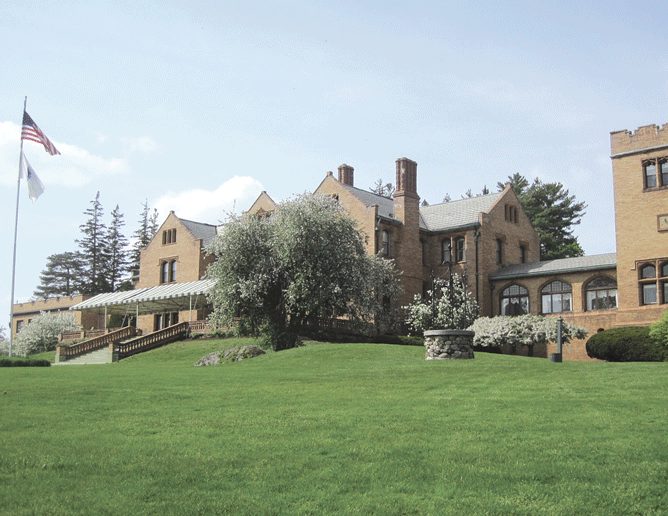
Cranwell Resort, Spa & Golf Club offers stunning views of the Berkshires and an off-site alternative for corporate meetings.

Norma Probst, director of marketing for the Gilded Age Tudor-style mansion and grounds known as Cranwell Resort, Spa & Golf Club in Lenox, has a favorite phrase for summing up this destination.
“We’re high-end, not haughty,” she said, adding that this is a sentiment that covers the leisure market as well as the corporate market for meetings and retreats.
“‘Open to the public and year-round access’ is the overall message we put out there,” noted Probst, adding that the sign over the main entrance pretty much says it all: ‘public welcome.’
And the public heeds the sign.
Indeed, 70% of the spa services at the Spa at Cranwell, the largest such facility in the Northeast, are used by the local residents, meaning those who live in and around Lenox year-round or have second homes there. Meanwhile, Sloane’s Tavern, with its panoramic mountain views overlooking the golf course, seats 80 inside and 80 outside on the deck, and sees plenty of locals for weekly meals, including brunches and holidays.
This is not what some might expect when they visit a destination spa and resort traditionally defined by such adjectives as ‘elite’ and ‘high-end,’ but it is an operating philosophy that has served this institution well over the past 20 years, enabling it to bolster its reputation and ride out the economic downturns that can cripple such facilities.
Couple this accessibility with a down-to-earth operating style (something else one might not expect at such a prestigious address), and it’s easy to understand why Cranwell is ranked among the top 150 U.S. Resorts by Condé Nast Traveler, is a member of the Historic Hotels of America (HHA), and is a recipient of a host of other travel-industry accolades. And they also help explain, along with superb resort amenities and some different life-enriching options — Probst calls it “content of value” — why this destination overlooking the Berkshires is so unique.
Of course, the resort is perhaps best-known as a site for corporate meetings and retreats, and this side of the business has grown steadily over the years, thanks to word-of-mouth referrals, but also that brand of service that has earned high praise from guests, said Tim Paulus, director of sales, who shared some commentary.
After a managers meeting, Liberty Mutual Group responded with the following: “this year, our annual meeting was quite a success; just about every attendee had some comment about the excellent food, the uniqueness of their room, or the hospitality of your staff.”
Associated General Contractors of Massachusetts had similar comments: “facilities were excellent; staff at all levels was outstanding and extremely accommodating.”
For this issue’s focus on meetings and conventions, BusinessWest offers an up-close look at Cranwell, one that will explain how, in 20 short years, it has established itself as one of the premier destinations in the region.

History Lessons

Norma Probst and Tim Paulus

Norma Probst and Tim Paulus, in the newly renovated ballroom, credit Cranwell’s open-door policy for its continued success.

Upon entering the stunning, gateless grounds of Cranwell, one’s attention is immediately drawn to the mansion that dominates the grounds. But it quickly moves to the many other structures on the campus, built during various points of Cranwell’s 116-year history, and representing myriad architectural styles.
To understand the current campus, one needs to know its history, which is replete with multiple ownership changes and several uses, from residence to boarding school to resort, with three attempts at the latter category, the last being successful.
Both the www.cranwell.com and www.historicinns.org websites explain that, in 1853, Rev. Henry Ward Beecher — a man who had presidential aspirations and was active in the women’s suffrage and anti-slavery movements — purchased Blossom Hill, where the current Cranwell mansion now stands, for $4,500.
A scandalous affair ended Beecher’s political hopes, and his sister, Harriet Beecher Stowe, author of the famous anti-slavery novel Uncle Tom’s Cabin, inherited the home.
Gen. John Rathbone purchased the property from Beecher in 1869 and built Wyndhurst, which was enormous by any standard of the day. But in 1894, the next owner, John Sloane, a relative of the Vanderbilts and co-owner of a furniture firm, demolished that mansion and constructed another Wyndhurst, which rivaled the enormity and elegance of the first.
It was during this grand era, the Gilded Age (1880-1920), that Sloan also commissioned Frederick Law Olmsted, famous landscape designer of New York City’s Central Park (and also Forest Park in Springfield), to design Cranwell’s grounds and original gardens. The Wyndhurst, the namesake of one of the three restaurants at Cranwell, is the mansion one sees today.
In 1925, Sloane’s daughter, Evelyn, sold the estate to a group of Florida developers who tried to run the property as the Berkshire Hunt and Country Club, but the Depression ended this first real attempt at a resort destination.
Then, in 1930, Edward Cranwell purchased the property and later deeded the estate to the Society of Jesus of New England, to be turned into a private school for boys.
A young Ted Kennedy attended for a few semesters, said Probst, noting that, after prospering for many years, the school slipped into decline, closing its doors in 1975.
The property’s current owner, Burak Investments, purchased the then-bank-owned Cranwell in 1993 after it had been a condominium development and, according to Probst, was starting to be reborn as a resort, with renovations to the mansion. But this venture languished during the tepid economic times, and the company eventually went bankrupt.
Today, Cranwell Resort, Spa & Golf Club, with much of its original grandeur restored, thrives as a premier four-season resort, offering the world-class, 35,000-square-foot Spa at Cranwell, three restaurants (the award-winning Wyndhurst, the Music Room, and Sloane’s Tavern), an 18-hole championship golf course designed by Stiles and Van Cleek, and 114 deluxe rooms and suites situated in various buildings on the campus.
These structures offer stark contrasts, from the opulence of the Gilded Age evidenced in the mansion to the utilitarian, red-brick dorms built by the boarding school, now home to 38 completely refurbished guest rooms and the administrative offices. There are also 60 privately owned condominiums, two cottages, and the elegant Carriage House.
However, the Carriage House that now stands is the second on that footprint. In December 2010, an electrical fire took the original facility, built in the late 1890s, and a new structure opened roughly a year ago, just a few yards uphill from the original to take advantage of the view from the third floor. The original architectural drawings for the Carriage House were retrieved from the Boston Public Library.
“They recreated much of the same architectural features of the original, including the turrets,” said Probst proudly. That consideration to honor architectural detail is what makes Cranwell an exemplar of the HHA.
A member since 2000, Cranwell is in the elite company of 240 other historic hotels. A member has to be at least 50 years old and listed in, or eligible for, the National Register of Historic Places. Member hotels are promoted nationally and internationally to those who prefer historic settings for their leisure and business travel.
“This, too, is what Cranwell is all about,” said Probst.

Trend Setters
After guests take in the stunning, 360-degree show of green in summer, harvest colors in the fall, or the winter’s snow-covered mountains, Cranwell offers many outdoor activities, including hiking, tennis, mountain biking, cross-country skiing, bonfires, and, of course, golf. And with Cranwell’s open-door policy, the resort caters to several markets.
“We have different sectors within each department,” Probst explained, referring specifically to golf. “For instance, we have golfers with full-season memberships, guests with golf packages, local residents who book a random tee time — so we are catering to quite a diverse group of guests.”
While the spa is also a strong local draw, and Cranwell’s overall market is global, 80% of leisure, banquets, weddings, and corporate meetings are booked from clients from Massachusetts, Connecticut, New York, and New Jersey.
“We do about 50 weddings a year,” said Probst. “which is a lot considering we have exclusivity; we don’t have two Saturday-night weddings going on at one time.”
About four years ago, Probst started promoting winter weddings, which has added to the hundreds of single- and multi-day meetings and conferences that Cranwell hosts.
But since the Great Repression, some trends have emerged, said Probst and Paulus, noting that, while companies are still willing to spend (perhaps not quite as much as before), there is a greater emphasis on value. Meanwhile, there is an accompanying demand for facilities and operations that are ‘green,’ and Cranwell is responding accordingly in both cases.
“From a meeting standpoint, I’ve seen more meeting planners wanting more content in their events that are away from the business part of the agenda, and then they can rationalize why they need to have an off-site meeting,” explained Probst, adding that she’s noticed that meeting planners’ jobs have become more difficult.
“They’re under a lot of pressure to deliver a full and robust meeting,” she said, “and they’re under budget constraints much more now than ever before.”
Some of the content that brings value includes Scotch and wine tastings, chef-assisted culinary demonstrations, Afro-Caribbean drumming (a personal addition by Probst), and other unique, interactive group activities.
“We’re trying to engage our guests more and help them come up with something that is more life-enriching that they can take with them,” she noted.
Meanwhile, in the ‘green’ realm, Paulus told BusinessWest that more attention is being paid to sustainability, on the part of both individual guests and corporate meeting planners.
“It’s a huge decision factor when it comes to choosing certain hotels and resorts,” he noted. “In fact, in my office, the last five or six trade journals [of the meeting and convention industry] have ‘green’ on the cover.
“So we’re undertaking more strides to be green here,” he continued. “We’re putting ourselves through some certification processes, which have to do with how we recycle things, how we buy locally, and how we maintain the golf course, reuse rainwater, and deal with electric usage.”
Paulus pointed to the Cranwell meeting rooms and their conference worktables as one example; there are no more tablecloths or skirting because it’s an excessive use of a product that will have to be washed and dried using electricity.
A very welcome trend both Probst and Paulus are starting to see is corporations opening their purse strings a bit more over the past few years.
Like all hospitality-related businesses, resorts suffered through the Great Recession as businesses cut back on discretionary spending, said Probst, adding that the resort sector was also set back by the negative publicity that accompanied lavish corporate outings staged by companies, such as American International Group (AIG), that eventually had to be bailed out by the federal government.
“We actually changed our promotional focus to ‘resort meetings at inn prices,’” she went on. “We wanted people to know that our meeting prices really weren’t any different than a cookie-cutter hotel down the street.”

Welcome Mat
Guests don’t find anything typical about Cranwell — no slightly stuffy attitude, no restrictive warnings or ordinary accommodations in the 114 rooms and suites spread between the mansion and the other buildings.
The mansion, for example, built in the late 1800s, has “a different configuration than a typical hotel downtown that is all stacked and every room is the same; it doesn’t quite lay out that way.”
And that unusual layout is what makes an historic Gilded Age Mansion so unique; the room shapes and the architectural detail, along with the 17 different fireplaces and elegant furniture, all add up to a memorable experience.
And that goes for all guests at the Cranwell, from corporate CEOs to those for whom the ‘public welcome’ sign was erected.

Elizabeth Taras can be reached at [email protected]

Sections Technology
How to Manage the Minefield of Electronically Stored Information

Amy Royal

Amy Royal

“They say I’m old-fashioned, and live in the past, but sometimes I think progress progresses too fast!” — The Lorax, Dr. Seuss

We live and work in a digital age. More than 89 billion corporate e-mails are sent and received each year, and more than 300,000 pages of text can be stored on one computer alone.
Electronically stored information (ESI) comes in a multitude of different file types and formats, including, but not limited to, e-files or electronic documents that exist on a user’s hard drive, a network drive, or a document management system; word-processing documents, such as Word or RTF; PowerPoint presentations and Excel spreadsheets; graphic files, such as PDFs, TIFs, or JPEGs; web pages or web-based data; video or sound files; server or web based e-mail; and Outlook/Exchange. ESI may be stored duplicatively as well; for example, an e-mail may be stored in Outlook and on that same user’s BlackBerry or iPhone.
The volume of ESI continues to grow and multiply rapidly just in the course of ordinary business operations. Because of the sheer and ever-expanding volume of ESI, storing and managing it can be extremely overwhelming, costly, and burdensome for businesses. Yet, not properly storing and maintaining certain ESI may present legal liabilities.
To ensure that necessary ESI is being maintained and that unnecessary ESI is being purged, companies should implement a comprehensive document retention-and-destruction policy that specifically addresses ESI. Presently, many companies may not even have a formalized written plan that describes how and where their paper documents will be stored and when they will be destroyed, let alone addresses the storage and destruction of ESI. In fact, since having such a policy is not mandatory, for many companies, less-formalized standards, which have not been memorialized in writing, have evolved over time as a matter of practice.
Establishing a written comprehensive document retention-and-destruction policy is a best practice for two primary reasons: legal compliance and legal defense. In our digital age, because many documents are electronically stored, establishing such a policy that also specifically addresses the storage, retention, and destruction of ESI is crucial. Indeed, ESI presents unique challenges because of its volume and the difficulty in accessing and retrieving it.
From a legal-compliance standpoint, there are myriad laws that mandate the types of documents that must be retained, the ways in which they must be stored, and the length of time they must be kept. For example, wage-and-hour laws require businesses to maintain certain payroll records containing information such as the employee’s name, address, Social Security number, and job title and the hours worked and amount paid to that employee for each pay period. In an increasingly digital workplace, this type of payroll information may only be stored electronically.
Accessing and retrieving that information, and otherwise ensuring its preservation, is critical to demonstrate compliance should a company face a federal or state governmental audit. Furthermore, privacy laws require that businesses reasonably and adequately safeguard confidential or private information whether it is stored in paper or electronic form. Thus, a formalized written policy should account for these as well as a variety of other issues and detail the ways in which the company intends to comply.
From a litigation-defense standpoint, companies have a legal obligation to preserve all relevant documents if litigation arises or if litigation is threatened. In other words, once a lawsuit is filed or anticipated, companies cannot lose or inadvertently destroy documents that are germane to litigation. Therefore, not having a document retention and destruction policy that specifically addresses ESI when faced with litigation or the possibility of litigation can have devastating consequences.
For example, if a former employee’s attorney requests relevant ESI that cannot be accessed or retrieved, or was otherwise deleted, a court may determine that there was a failure to preserve such relevant information and impose severe penalties and sanctions against the company.
To minimize the risk of inadvertent deletion of ESI, a company’s document retention-and-destruction policy should contain two essential provisions: a litigation-hold provision and a departing-employee provision. A litigation-hold procedure ensures that the requisite steps are taken to preserve relevant documents.  A carefully crafted litigation-hold section will identify the triggers for a hold on documents, the steps to be taken once a hold has been initiated, the types of records and data that must be preserved, and the forms in which such records and data must be preserved, the consequences for failure to preserve such data, and the name of the person at the company who can be contacted with questions or for technical assistance.
Procedures regarding the length of the retention of a departing employee’s ESI should also be included in a document retention-and-destruction policy, even when litigation is not anticipated. Too often, an unexpected lawsuit ensues, and it is discovered too late that a former employee had created ESI pertinent to the company’s defense. Indeed, oftentimes, within days after the employee’s departure, IT has reset the former employee’s computer so that another employee can use it. Thus, creating a policy that includes a set time period for the deletion of a departing employee’s ESI when litigation is not anticipated is very important.
Having a set time period can otherwise be beneficial, especially for those companies that tend to retain anything and everything. Consider, for example, a snarky e-mail that has been kept too long and now surfaces in litigation that otherwise was not expected or anticipated. If the company had a document retention-and-destruction policy that included a specific time period for deletion, such an e-mail would have been long since gone.
A carefully crafted document retention-and-destruction policy can otherwise be advantageous to companies insofar as it helps to reduce costs, eliminates the retention of redundant or unnecessary documents, maximizes computer-server storage space; and provides organized and streamlined systems for maintaining and managing documents.
Keeping paper documents organized and maintained is relatively easy; however, as noted throughout, the same is not true for ESI. Preserving ESI is very complicated and requires extraordinary coordination between upper management, human resources, legal counsel, and IT.
To minimize your company’s legal risks, you should act now by creating a formalized document retention-and-destruction policy that incorporates standards for safeguarding and disposing of ESI.
At implementation, you should train your staff to ensure they understand the policy and their relation to it. After implementation, you should periodically audit your company’s overall compliance with the policy.

Amy B. Royal, Esq. specializes exclusively in management-side labor and employment law at Royal LLP, a woman-owned, SOMWBA-certified, boutique, management-side labor and employment law firm; (413) 586-2288; [email protected]

DBA Certificates Departments

The following Business Certificates and Trade Names were issued or renewed during the month of and May 2013.

CHICOPEE

1 Person Courier Service
12 Coolidge Road
JoAnne Gilbert

Beyond Builders
117 Sunny Meade Ave.
Gene Borowski Jr.

Quality Inn
463 Memorial Dr.
Jaimin Melaviyn

GREENFIELD

A Custom Touch
29 Mill St.
Anthony Tucker

Community Substance Abuse Center
177 Shelburne Road
Matthew Davis

Hess
245 Federal St.
Richard J. Lawlor

Martin Craft
91 Norwood St.
Joshua A. Martin

Taylor Skin Care
42 Revere Circle
Jenelle Taylor

The Home Depot
264 Mohawk Trail
The Home Depot USA Inc.

HOLYOKE

Borinquen Mini Market
31 Essex St.
Marisol Millayes

Nick’s Nest
1597 Northampton St.
Jennifer E. Chateauneuf

King Mart
494 Westfield Road
Sanjay Patel

Ron’s Auto Care
150 Suffolk St.
Ronald Poirier

Victoria’s Unisex Salon
330 High St.
Gaddiel M. Paneu

Where House
109 Lyman St.
Jame A. Curran

LUDLOW

Bill’s Yogurt
116 East St.
William Dias

Chameleon Painting
58 Chapin Circle
Brian Foster

Holiday Inn Express
321 Center St.
Kishore Parmar

Ludlow Excavating Service
368 Lyon St.
Donald Roberts

M.A. Café
343 Winsor St.
Steve McDaniel

Taco Bell
343 Center St.
George Fellows

PALMER

Burgundy Brook Café
3090 Palmer Road
Keith Gordon

Crane Exterior Design
70 Bourne St.
Dale Crane

House Mouse Cleaning
23 Temple St.
Whitney Valle

HXC Floor Covering
15 Charles St.
Shane Hestad

The Tangled Grapevine
119 Boston Road
Stacy Mimoso

SPRINGFIELD

A.R.M. Carpentry Company
137 Webber St.
Richard P. Ottani

Aileen’s Daycare
87 Wilbraham Ave.
Ana Rivas

AN2KH Trucking & Delivery
31 Clarendon St.
Andre O. Alleyne

Annie Mae and Cecilia
799 Sumner Ave.
Jacqieline Simmons

Bay St. Beauty Supply
19 St. James Ave.
Musa Dakuray

Before & After
686 Belmont Ave.
Rebeca Ruiz

Christina’s Paw Spaw
1211 Parker St.
Christina Janet

Coastline Automotive, LLC
501 St. James Ave.
Beris F. Gouldbourne

Crossfit Journey
576 St. James Ave.
Stefan C. Ralph

Cutting Edge Pizza, LLC
1962 Boston Road
James L. Banister

Dennie’s Daughters
134 Catherine St.
Jimmie R. James

Edwin Ortiz – Hammerhead
65 Gilbert Ave.
Edwin Ortiz

Elite Nails
886 Sumner Ave.
Nguyet T. Nguyen

Family Mini Store
11 Dorset St.
Nathilda Ramirez

Freedom of Life Society
114 Carver St.
Jaunita Maldalena

Friendly Ridge Transportation
44 Upton St.
Rene A. Romero

Gabriel’s Property Maintenance
139 Patricia Circle
Michael Rodriguez

Game Hunters
511 Belmont Ave.
Vien Nguyen

Goodchild Renovations
16 Churchill St.
Matthew Kent

Heavens Best Cleaning Services
155 Breckwood Blvd.
Amanda Marcella

HTMD Inc.
494 Central St.
Luat Pham

Imperio Musical
2460 Main St.
Maria Rijo

Innovative Web Design
27 Highland St.
Sa Nguyen

J & G Enterprises
48 Clarendon St.
Geraldine L. Gardiner

J.N.I. Signs
904 Carew St.
Daniel Lugo Jr.

Jim’s Auto Trim Specials
1576 State St.

JMS Candyman Wholesale
88 Cleveland St.
Julia I. Correa

The Green Team
198 East Allen Ridge Road
James A. Bazinet

The Law Offices of Michael T. Kogut
75 Market Place
Michael T. Kogut

The Northernaires
370 Abbott St.
Charles E. Fryar

Video Game Giants
85 Oakland St.
Luis A. Lopez

Vintage Fresh
27 Lyman St.
Clarence B. Finch III

Wayne Poyser
49 Albermarle St.
Wayne Poyser

WESTFIELD

EJ Ventures
52 Scenic Road
Esther Hermele

Linda Z. Gallo
45 Meadow St.
Linda Zomek-Gallo

Kings Cleaner
282 Southampton Road
Nham S. Yi

SI-MAP
71 Steiger Dr.
Sean M. Fitzgerald

Stanton Contracting
147 Tannery Road
Richard H. Stanton III

WEST SPRINGFIELD

Ben’s & Viktor’s Tile
44 Riverdale St.
Ben Shokov

Choice Consultants, LLC
4 Shady Brook
Karen Sikora-Bernard

Corner Pantry
723 Main St.
Iqbal Murtaza

Fishtik Plumbing
191 North Blvd.
Grigoriy Fishtik

Heinovbeatz.com
51 Van Deene Ave.
Charles Melvin

L.A. Nails
634 Kings Highway
Ninh Lu

Needham Electric Supply Company
91 B & C Union St.
John A. O’Connell

Rise Construction Company
99 Pine St.
Timothy Atamansky

Shows4You Productions, LLC
32 Gregory Lane
Steven Midura

Green Business Sections
Recent Developments Spur New Solar-energy Projects In Massachusetts

Nicholas Lata

Nicholas Lata

Massachusetts has experienced rapid growth in its solar-energy sector in recent years.  The total capacity generated by solar energy in Massachusetts has doubled in the last two years, reaching 105 megawatts (enough to power more than 15,000 homes) in 2012, a figure that is forecasted to quadruple by 2020.
Massachusetts’ renewable-energy sector now employs more than 64,000 people statewide (including nearly 10,000 in Western Mass.) and is projected to grow 15% per year. Massachusetts is now considered to be one of the best states in the country for solar development, a phenomenon driven largely by the state’s numerous initiatives to promote clean, renewable energy.
What follows is a rundown of these incentives and other issues involved with the development of solar-energy projects.

Massachusetts Incentives
The Massachusetts solar market is driven by a statutory requirement for utility companies to generate a percentage (7% in 2012) of their electricity from renewable sources. This figure is scheduled to rise 1% per year until 2030, when it will reach 25%.
Utility companies that fail to generate sufficient electricity from renewable sources are required to pay a fine equal to $600 per Megawatt hour (MWh) the utility company falls below the requirement. In lieu of paying this fine, utility companies may purchase solar renewable energy credits (SRECs) from solar developers. Eligible solar developers receive one SREC for every MWh of electricity generated. Solar developers seeking to earn SRECs must apply through the Mass. Department of Energy Resources, and certain restrictions apply.
In 2011, solar developers produced only one-third of the 78,577 SRECs demanded by utility companies. As a result, there was a ready market for SRECs, which traded at approximately $550 per credit. The proliferation of solar development caused the supply of SRECs to exceed demand in 2012. In response, most solar developers have begun entering into futures contracts with utility companies, assigning all SRECs earned in the future for approximately $200 to $250 per SREC.
Finally, for projects that produce more electricity than is consumed on site, Massachusetts provides two options for solar developers to market excess electricity. The first is simply to sell the excess electricity to the local utility at the ‘dump rate’ (about $0.035 cents per kilowatt hour, or kWh). The second is to apply for net metering with the state Department of Public Utilities (DPU). Net metering entitles the solar developer to sell the electricity at a slight discount below the market rate to electricity consumers, typically at a slight discount below the market rate, which is usually $0.12 to $0.15 per kWh for commercial consumers.
A recent DPU order added a few wrinkles to the process for qualifying for net metering, particularly where the property being developed consists of multiple parcels of land.

Federal Incentives
The federal government allows an investment-tax credit equal to 30% of the investment in qualifying solar-energy property. Combined with accelerated cost-recovery rules under the tax code applicable to solar-energy property, this may allow solar developers to operate tax-free for many years.
The issue for many solar developers is that they do not have sufficient income to monetize the full value of the credits and deductions. Many solar developers have sought to bring in outside investors with greater ‘tax appetites,’ which has led to the formation of joint ventures and other arrangements.

Development Issues
On its face, Massachusetts law exempts solar-energy systems from local property taxes. Recently, however, several bills have proposed carving large-scale commercial systems out of the exemption, particularly ground-mounted systems. Although none of the bills passed, the state Department of Revenue has taken the position that systems are exempt only if all of the electricity is used on site.
In response, many developers have either sought properties occupied by businesses with great energy needs (i.e. manufacturers) or negotiated payment-in-lieu-of-taxes (PILOT) agreements with towns in order to fix payments over the lives of projects. In addition, landowners selling or leasing land which is currently taxed as agricultural or forest property to solar developers may be subject to conveyance taxes, rollback taxes, and a town right of first refusal.
Meanwhile, Massachusetts law prevents towns from passing zoning bylaws that preclude the installation of solar-energy systems. Initially, developers interpreted this law to provide as-of-right siting for solar projects, which would allow projects to progress without the issuance of special permits.
Nevertheless, most towns have interpreted the as-of-right siting to apply only to small, roof-mounted systems, and have passed zoning bylaws that restrict the installation of larger, ground-mounted systems (especially systems exceeding 250 kW). Even where a friendly bylaw is in place, the permitting phase for large-scale projects generally takes at least six months.  Robinson Donovan is currently assisting a national solar developer in the development of a proposed 14-MW solar-energy system on 160 acres of land in Monson.

Project Economics
In general, the cost of installing a solar-energy system is based on its energy-generating capacity, ranging from under $3 per watt for large-scale commercial systems to as much as $6 per watt for smaller residential systems. Although the amount of electricity generated by solar-energy systems is relatively low compared to the investment required, projects can be profitable when incentives are taken into consideration.
When SREC values were at peak levels in 2011, solar projects frequently had rates of return in the range of four to six years. Returns have declined to where rates of return in the range of seven to nine years have become more realistic. Returns may be substantially lower for projects which fail to qualify for SRECs and/or net metering, as described above.
Nevertheless, with the Bay State’s commitment to renewable energy, it is likely that solar incentives are here to stay. Furthermore, advancements in solar-energy technology are simultaneously reducing costs and creating new applications.

Nicholas Lata is an associate with the Springfield-based law firm Robinson Donovan. He has been involved with several projects involving solar power; [email protected]; www.robinson-donovan.com

Health Care Sections
Hemophilia Poses Numerous, Lifelong Challenges

Dr. Richard Steingart

Dr. Richard Steingart says hemophiliacs have a shorter average lifespan than those without the disorder, but more meticulous care these days has allowed many to live normal, often-lengthy lives.

Mark Zatyrka’s passion is in his blood — blood that won’t clot.
He’s one of about 20,000 Americans living with hemophilia, a rare condition that prevents blood from clotting normally. But he’s turned his challenges into a gratifying career as vice president of American Homecare Federation, a company that provides services to patients with blood disorders. He also educates young people about HIV, which he contracted from a blood transfusion in the 1980s — a decade when AIDS killed many of his friends.
“I have severe hemophilia, so I know the challenges I grew up with, and I have a personal relationship with a lot of our patients,” he said. “I can mentor the younger kids and show them that disease does not need to define them; this disease does not have to hold them back, and they can still create great things with their lives.”
Dr. Richard Steingart, medical director of Adult Hematology at Baystate Medical Center, agrees.
“The average lifespan is definitely less than normal, although we’re finding that, with meticulous care, these people are living longer and longer,” he said. “Every ethnicity can get it — black, white, Hispanic, Pacific islanders, Asian, it doesn’t matter — and the incidence is about the same throughout the world.”
People born with hemophilia have little or no ‘clotting factor,’ which is a protein needed for normal blood clotting. Normally, when blood vessels are injured, clotting factor helps platelets — blood-cell fragments that form in the bone marrow — stick together to plug cuts and breaks on the vessels and stop bleeding.
People with hemophilia A — which accounts for about 90% of all hemophilia — are missing, or have low levels of, what’s known as clotting factor 8. The rest, who have hemophilia B, are missing or have low levels of clotting factor 9. Hemophiliacs ‘infuse’ themselves with pharmaceutical clotting factor; while those with a mild version of the disease may infuse only before an operation, dental visit, or potentially risky activity, many with severe hemophilia must infuse as often as every day, to prevent dangerous internal bleeding.
“A lot of different drug companies make a lot of different factors,” Steingart said, but noted that they can cost upwards of $3,000 every other day.” Home-care companies like Zatyrka’s exist partly to help patients navigate and access insurance. Overseas, however, that cost often becomes a dangerous challenge. “The product is so expensive that it’s much harder to treat in third-world countries.”
In this issue, BusinessWest takes a look at an often-misunderstood blood disorder and how those who struggle with it are able to find some measure of normalcy despite the ever-present danger.

Blood Simple
The hazards of hemophilia are clear; patients may bleed for a longer time than others after an injury, and may also bleed internally, especially in the knees, ankles, and elbows — all of which can cause long-term damage to organs, joints, and tissues. With rare exceptions, hemophilia is a male disease — about one in 5,000 boys are born with it — and it’s usually (but not always) inherited genetically.
“About a third of the cases are spontaneous mutations; that’s not an insignificant amount,” Steingart said. “It can show up even in a family with no history of hemophilia at all.”
The lack of clotting factor in severe hemophiliacs, like Zatyrka, is dramatic; people without hemophilia have factor 8 activity of 100%, while it’s often less than 1% in those with severe hemophilia. So, while a mild hemophiliac might need clotting factor infusions only on rare occasions, like before dental surgery, those with severe hemophilia may be constantly at risk of internal bleeding and joint bleeds, which can lead to arthritis, skeletal deformities, and even an inability to walk.
The disease often first presents in a childhood operation, often circumcision; today, children born in families with a history of hemophilia will typically undergo a screening for clotting factor 8, which can then be infused before they are circumcised. Meanwhile, some babies first present for hemophilia in the form of large bruises or welts incurred simply from rolling around a crib.
Although most hemophiliacs can live a relatively normal life, some activities — contact sports, for example — are typically not recommended. “But I have hemophiliacs who go skiing carefully, and swimming is perfectly fine, although diving is probably not a good idea,” Steingart said. “Obviously they don’t play football, and they’re not allowed to be in law enforcement or go into the Army.”
For lower-contact sports and other activities that pose slight risk, hemophiliacs will typically infuse themselves with clotting factor before the activity, “so they can get banged around and not have bleeding problems,” he noted.
“It’s really important to streamline these people into normal activities,” he was quick to add. “They don’t have learning disabilities, and they’re just as smart as everyone else — in fact, they’re probably smarter because they know how to live with this lifelong chronic illness.
“Sometimes their joints can hurt when they do have a bleed, so there’s concern about pain medications and addiction,” Steingart explained, “but most of them take pain medications for a certain amount of time, then get off of them. They’re not drug-seeking addicts.”
Better management of hemophilia — and thus longer life — has led to some ironic problems, he added, like the onset of heart disease and other conditions that strike older people. “How do you do a stent in a person with a blood disorder, who needs a blood thinner when, in fact, their hemophilia is a blood thinner, and it’s not protective? That’s becoming extremely challenging.”

Sad Chapter
Perhaps the biggest challenge for hemophiliacs in recent decades — and easily the most tragic — was the AIDS epidemic that tripled the death rate of the hemophiliac population during the 1980s due to infected blood transfusions, before the medical community fully understood what was happening.
Zatyrka, who lost many childhood friends during those years, feels fortunate to have a career that resonates so personally with him and that allows him to shape other people’s lives for the better, and he has gradually become a public advocate for hemophilia, HIV, and AIDS issues, partnering with a number of local organizations and regularly speaking to young people.
The hemophilia community “was devastated by HIV and AIDS back in the early ’80s; about 90% of severe hemophiliacs contracted HIV,” he said. “I’m HIV-positive, and I do my best to help educate others in the community.”
That includes his co-founding of the AIDS kNOw More Project, an initiative of the AIDS Foundation of Western Mass. that trains young people to educate their peers about HIV and AIDS, around which there’s plenty of misinformation.
“Unfortunately, a stigma still exists around HIV. That drives me nuts,” he said. “And a lot of the stigma comes from uneducated, unknowledgable people.”
Thankfully, the plasma-derived infusions of clotting factor common in the 1980s have been replaced by genetically engineered products that do not require plasma, which has eliminated the risk of AIDS from a transfusion.
In any case — mild, moderate, or severe — patients simply learn to live with the challenges, Steingart said, adding that, typically, “around age 7 or 8, a child learns how to self-infuse with help of mom or dad.”
There’s no cure for hemophilia — although hepatitis patients who receive liver transplants have often been able to generate enough clotting factor 8 in the new liver to eliminate both the hepatitis and hemophilia — but scientists continue to work on ways to improve current treatments.
An increase in the length of time an infusion is effective would be a major breakthrough; currently, it’s only about 12 hours. “What they’re looking for is a long-lasting factor 8,” Steingart said. “Wouldn’t it be cool if people could take a shot once a month rather than taking it every day?”
Until then, patients manage as they always have. Some of them, like Zatyrka, are doing more, working to change perceptions and help others cope.
“Sometimes I have a hard time labeling what I do,” he told BusinessWest. “Is this work, or is it personal? It just means so much to me.”

Joseph Bednar can be reached at [email protected]

DBA Certificates Departments

The following Business Certificates and Trade Names were issued or renewed during the month of and May 2013.

CHICOPEE

E-Nough Logic
19 America St.
Michael Cowley

Grimaldi Landscaping & Services
42 Rose St.
William Grimaldi Jr.

Nom Nom Hut
51 Maple St.
Marcy Megarry

GREENFIELD

Antique Revival
322 Deerfield St.
Eric Webster

Duo Senior Care
82 Birch St.
Rachel E. Lively

Greenfield Auto Specialist
335 High St.
Greenfield Imported Cars Inc.

Lucky Nails
130 Main St.
Tai Huynh

Meadow Green Nail Center
5 Park St.
Patricia Semb

The Carousel Corner
4 Woodland Road
Jonathan Lowe

HOLYOKE

Abercrombie & Fitch
50 Holyoke St.
Robert Brown

Archie’s Mini Market
81 North Bridge St.
Hector Archilla

Fye
50 Holyoke St.
John Anderson

Hair-Hunterz
279 Appleton St.
Frankie Cardona

Max Orient
50 Holyoke St.
Harry C. Chen

Sam’s Food Store
515 High St.
Asad Chaudhry

LUDLOW

AED Moving Enterprises
41 Bruno Ave.
Angelo Rosa

Budget Pest Solutions
264 Moody St.
John Boudreau

C.L. Diesel Repair Inc.
403 West St.
Corey Lajoie

Deluxe Auto Sales
127 East St.
Manuel Coelho

Ludlow Automotive
430 Center St.
Rodney Walker

Moody Street Realty, LLC
54 Moody St.
Beverly Aube

PALMER

Bling in Beads
23 Temple St.
Kyle Camyre

Day & Night Diner
1456 North Main St.
Karl Williams

Interactive School House
2055 Main St.
Nancy B. Roy

LMS Repair
3020 Main St.
Louis Stevens

Spic and Span
6 Green St.
Stephanie Nott

SPRINGFIELD

Little Cargo Couriers
24 East Hooker St.
Anatoly Atamansky

Luxury Landscape
27 Lyman St.
Jerrell Glass

Mack’s Barbershop
255 Bay St.
Michael A. Brawner

Mars Consultant Group
76 Albermarle St.

Martin Tile Company
184 Gardens Dr.
Jamie R. Martin

Mary’s Dollar Plus
2760 Main St.
Maria D. Ayala

Mass Collision
586 Berkshire Ave.
Gabriel E. Sanchez

Michael Ferzoco
33 Amity Court
Michael Ferzoco

Michael Vachula Real Estate
20 Howes St.
Michael Vachula

Mike Auto Repair Shop
136 Nursery St.
Michael S. Candelaria

Mobile Massage Therapy
85 Gold St.
Margaret Cooley

Namco, LLC
1500 Boston Road
Anabela Cruz

Nathan Bills Bar
110 Island Pond Road
John R. Sullivan

Oakley Residential Appraisals
36 Marengo Park
Gary E. Oakley

Omar & Sons Furniture
73 Liberty St.
Khuram Abbasi

Peach Brown Betty
11 Hiawatha St.
Jennifer M. Fleury

Peter S. Poniatrowski
23 Frontenac St.
Peter S. Poniatrowski

Phat Tuesdays
377 Dwight St.
Jazzberries, Inc.

Philip J. Ozzone
48 Champlain Ave.
Philip J. Ozzone

Pittola Investigations
136 Prentice St.
Damien Pittola

Pizza Hut
793 Boston Road
Pizza Hut of America

Price Cutter
2633 Main St.
Syed Shahab Ahsan

Princessazu International
204 Commonwealth Ave.
Boniface Anoje

R & M Remodeling and More
112 Avery St.
Miguel A. Homs

Robbie’s Auto & Truck Repair
1357 East Columbus Ave.
Robert D. Ober

Saravia Family Restaurant
880 Sumner Ave.
Rolando A. Saravia

Second Time Around
680 ½ Sumner Ave.
Pamela Anastasiou

Siec Software Innovation
104 Wayne St.
Marco T. Dermith

Sports Cut Barber Shop
1129 State St.
Susan Barratt

Spring Valley Food Mart
343 Allen St.
Abdul Quadus

Strictly D Best Clothing
604 Page Blvd.
Lorenzo L. Robinson

TM Cleaning
70 Chapin Terrace
Therese Leger

T & T Fernandes
509 Belmont Ave.
Gertrude Fernandes

The Collection
34 Front St.
Ariana Do

WESTFIELD

Alice M. Farrelly
45 East Meadow St.
Alice M. Farrelly

Amanda Calhoun
12 Fremont St.
Amanda Calhoun

Anugraha Grocery Store
160 Elm St.
Pralad Gurung

ESP Pool & Spa Services
261 Papermill Road
Edward Rivera

Guided Touch Therapy
26 Orange St.
Thomas D. Campbell

Sports Multi Media
51 Simmons Brook Dr.
Geof Spear

WEST SPRINGFIELD

Advanced Landscaping
955 Piper Road
Allan C. Beiermeister

D & J Management
42 Maple Terrace
Douglas Smith

George Abdow Enterprises
1680 Riverdale St.
George T. Abdow

Healthy Alternatives
42 Chester St.
Roxanne Susan

Law Office of Caroline Murray
71 Park Ave.
Caroline Murray

Mr. Sealgood
75 Church St.
Scott W. Gage

Nippon Grill & Seafood
935 Riverdale St.
Chang Q. Jiang

Departments People on the Move

Royal LLP recently announced the addition of Tanzania Cannon-Eckerle to the Northampton-based management-side only labor and employment law firm. Cannon-Eckerle will focus her practice in labor law and complex employment litigation, counseling companies on the multitude of state and federal employment laws impacting them, including employment discrimination and harassment, wage and hour, disability and leave, workplace safety, OSHA, affirmative action, and contract negotiations. Cannon-Eckerle is a graduate of Indiana University School of Journalism and Southern Illinois School of Law.
•••••
American International College announced that Heather Cahill has been promoted to Vice President for Institutional Advancement. Cahill has served as the executive director for the same department for the past three years, where she organized fund-raising and alumni operations.
•••••
The Center for Human Development (CHD) has appointed Kirk Woodring, a licensed social worker, as Vice President of Clinical Services. Woodring will oversee several programs, including CHD’s outpatient behavioral-health clinics, the Institutes of Dynamic Living, early intervention, in-home therapy, and other program clinical services.
•••••
FieldEddy Insurance announced the appointment of Lauren Lanza as an Account Executive for employee benefits. Lanza brings more than six years experience as a sale account executive or a Fortune 500 employee benefits provider, and as an associate underwriter for an insurance agency network.
•••••
North Brookfield Savings Bank recently announced the appointment of Bryan Kaye as Vice President and Commercial Loan Officer. Formerly a commercial loan officer at Freedom Credit Union, Kaye holds a bachelor’s degree from Bluffton University and Omega Performance Group’s CU Business Lending School, and is involved in the Western Mass. Chapter of SCORE.
•••••
Jessica Lapinski recently joined Kathy Borawski’s real-estate team at RE/MAX Hill & Valley in Northampton. Lapinski, formerly an agent with Trailside Realty, has been a realtor in the Pioneer Valley for 12 years.

Court Dockets Departments

The following is a compilation of recent lawsuits involving area businesses and organizations. These are strictly allegations that have yet to be proven in a court of law. Readers are advised to contact the parties listed, or the court, for more information concerning the individual claims.

CHICOPEE DISTRICT COURT
Consumer Product Distributors Inc., d/b/a Polep Distribution Services v. C&T Beer and Wine Inc., d/b/a C-Scotts Beer-Wine-Deli, and Tony Saliba
Allegation: Non-payment of goods sold and delivered: $16,599.25
Filed: 4/10/13

FRANKLIN SUPERIOR COURT
Allard’s Farms Inc. v. Feed Commodities International Inc.
Allegation: Sale of contaminated feed product causing illness and death to plaintiff’s dairy cows after ingesting the product: $25,000+
Filed: 3/22/13

HAMPDEN SUPERIOR COURT
Essroc Cement Corp. v. Connecticut Valley Block Co.
Allegation: Non-payment of goods sold and delivered: $40,269.45
Filed: 4/4/13

Gerald Rosemond v. Sisters of Providence Health Systems
Allegation: Employee discrimination based on race and color: $40,192
Filed: 4/8/13

Ralph Smith v. Sun Roofing Inc. and Rich Rousakis
Allegation: Unlawful misclassification as an independent contractor: $35,000
Filed: 4/7/13

SPRINGFIELD DISTRICT COURT
Constellation Newenergy Inc. v. Franklin Realty Partnerships, LLC
Allegation: Non-payment of energy services rendered and unjust enrichment: $17,125.17
Filed: 4/13/13

WESTFIELD DISTRICT COURT
Constellation Newenergy Inc. v. The Carpet Warehouse Inc.
Allegation: Non-payment of energy services provided: $6,942.83
Filed: 4/1/13

Law Sections
Morrison Mahoney Adds Estate-planning Attorney to Its Roster

John Shea, right, consulting here with Brad Martin

John Shea, right, consulting here with Brad Martin, brings another specialty to Morrison Mahoney LLP.

When the Springfield office of Morrison Mahoney LLP added business-law specialist Brad Martin Jr. in 2006, the firm, which focused on litigation, and especially medical-malpractice defense and other work involving the healthcare industry, took a step closer to providing what partner Dennis Anti called “one-stop shopping.”
Elaborating, Anti said that the addition of Martin enabled the firm to assist clients not only with medical-malpractice cases, but also with myriad business issues, ranging from corporate filings to the addition of a shareholder within a physician group; from employment-law matters to regulatory issues.
But there was still one more big step the firm needed to take if it was to effectively serve all the needs of its clients, said Anti, citing the broad realm of estate planning and asset protection, which are critical matters for physicians.
And that gap was closed with the recent addition of John Shea, who concentrates his work in estate planning, wills, durable powers of attorney, healthcare proxies, revocable and irrevocable trusts, and related services.
“This is a logical extension for us — asset protection is very important for people in the medical field, and estate planning is important for everyone,” said Anti. “We’ve always had to outsource this to other firms because we haven’t had the expertise to do it.”
And much of that outsourcing went to Shea, who has spent the bulk of his career in private practice, with offices on Yarmouth on Cape Cod. He told BusinessWest that, while his arrival at Morrison Mahoney brings benefits for the firm, it should help him build his book of business as well.
“The resources and the reach of the firm are obvious advantages for me,” he said, citing its many locations and a wide service area. “The firm has a very large client base that we can pull [estate-planning] work from.”
Retracing the steps that led to the firm’s latest addition, Anti explained that, as the frequency of requests for asset-protection and estate-planning services increased, discussions about expanding the staff and bringing such work in house intensified. And there have been many inquiries about such services, he noted.
“Many of these come from younger physicians who have never been sued before,” he explained, referring to medical-malpractice cases that come to the firm. “After we discuss the case, the first question they ask me is, ‘how can I protect my assets going forward?’ This has been a huge wake-up call for many of these physicians.
“And for years, we would tell them, ‘yes, there is a way to protect your assets and develop an estate plan,’ which is a good idea anyway, irrespective of whether there’s been a medical-malpractice claim,” he went on. “But until now, we’ve had to outsource that work.”
He related the specific story of an individual who was sued for medical malpractice as a resident. “She called me and said, ‘I know this happened to me as a resident, and I’m sure it’s going to happen to me again — that’s what the statistics regarding my specialty tell me — and I have a young family, and I want to be set up now.”
When asked about what the addition of Shea means for the firm, which has more than 160 attorneys in nine offices, Martin said it obviously brings the practice much closer to that one-stop shopping designation — divorce is essentially the only service it doesn’t provide, and it has no intention of entering that realm — that many clients are looking for.
“Many of the physician groups like the fact that it’s all contained in one firm,” he said. “And it’s especially attractive to people just launching a new business; one firm can handle all the aspects of them getting started.”
Meanwhile, this most recent addition gives the firm direct access to a growth area laden with potential.
Indeed, in addition to younger professionals in healthcare realizing the importance of estate planning and asset protection, there are many older physicians now approaching retirement who have not fully addressed matters concerning their estate, said Martin.
“People would be surprised at the number of individuals who don’t have anything,” he noted, “or don’t have anything close to what they really need.”
To capitalize on this potential, the firm intends to be, in a word, proactive about this latest addition to its suite of services, as well as the full package it offers, Anti told BusinessWest.
Elaborating, Anti said that many young professionals in the healthcare field will wait until something happens — like that first medical-malpractice suit against them — to realize the importance of asset protection and estate planning. The firm will be more outspoken about not waiting for such incidents, he went on.
“We have a lot of young professionals as clients — new doctors, for instance — who are just starting out and are really focused on doing a great job and building their practice,” he said. “It is critical that we help them protect their current assets, as well as future earnings, through proper estate planning. It might not be on their radar screen, but we intend to be proactive with them.”

— George O’Brien

Law Sections
Why the Employee Stock Ownership Plan May Be a Sound Alternative

By Steven J. Schwartz, Esq. and David K. Webber, Esq.
When evaluating the various alternatives for an exit strategy, a business owner should consider a sale to an employee stock ownership plan (ESOP). In order to determine whether an ESOP is the best strategy, it is necessary to become familiar with its elements.
An ESOP is a qualified defined-contribution retirement plan established under §§ 401(a), 409 and 4975 of the Internal Revenue Code. Unlike other qualified plans, an ESOP is designed primarily to invest in shares of a closely held corporation, referred to in the code as ‘employer securities.’ The sponsor company may transfer the shares of common stock as a qualified contribution, or the ESOP may purchase shares from shareholders or the sponsor company. In a ‘leveraged’ ESOP, the company takes out a bank loan to fund the purchase, then lends the funds to the ESOP to finance the purchase of shares. A 100% sale of shares to an ESOP may require a series of smaller transfers because 100% bank financing is unlikely.
The selling  shareholder may receive cash as partial or complete consideration for the shares. In the alternative, or in addition to cash, the selling shareholder may self-finance a portion by accepting a note as partial payment. As the note is paid off in installments, the plan trustee transfers shares to each of the employees’ accounts, eventually vesting all the stock in employee accounts in accordance with the terms of the plan.

How It Works
The ESOP sale transaction has several moving parts. The following example illustrates a hypothetical leveraged ESOP transaction.
Assume Frank started a widget company 20 years ago, and now owns all 30,000 shares of Optimistic Manufacturing Inc. The company is doing well. It has 30 employees and a fair market value of $10 million. Frank is also the sole officer and director of the company. Key employees manage the day‑to‑day operations of the company and are qualified to run the company without the current shareholder.
Frank is 60 years old and wants to provide liquidity to benefit his family. He wants to protect his employees and to continue working for the indefinite future. He realizes that a strategic purchaser will likely pay more and pose less risk to him than a sale to an ESOP. He will accept installment payments in order to make a 100% sale of his shares.
The success of the ESOP transaction will depend on the employees’ ability to carry on the company without Frank. It is not uncommon for a business owner to do all the planning for an ESOP with a resulting decision not to proceed, because of the inability of the management team to convince Frank and the company’s bank that they can successfully manage the business.
For the purposes of this hypothetical, assume the company’s bank agrees to partially finance the transaction and lends the company $6 million on a six-year note. Frank accepts a promissory note for the remaining $4 million of the purchase price. The bank loan is secured by the assets of the company. Frank receives a junior lien on the assets.
The company receives the bank funds and lends the proceeds to the ESOP on the same terms. The ESOP uses the entire bank-loan proceeds to buy 18,000 shares (60%) of the company’s shares from Frank. In addition, the ESOP issues a $4 million, six-year promissory note directly to Frank in exchange for the other 12,000 shares (40%). This makes the ESOP the sole owner of the company. The company guarantees the obligation due Frank and secures it with the company’s assets.
Each year for six years, the company makes a tax-deductible contribution from earnings to the ESOP, which the ESOP uses to repay the notes to the company and to Frank. The company then pays the bank loan. During this time, the ESOP holds the shares in a trust ‘suspense account’ and releases them for allocation to participant accounts as the debt is repaid. In this six-year example, approximately one-sixth of the shares (5,000 shares) will be released to the accounts of the employee participants each year.
The ESOP is overseen by trustees. Frank may serve as a trustee.  Frank may retain his position as president of the company. Each employee votes the shares that have been allocated to them, and the trustee votes the remaining unallocated shares.
There will be three sets of documents required to complete the transaction: the sale documents (purchase-and-sale agreement, consents, etc.), the bank loan documents, and the ESOP plan documents. Approval will be needed from the Internal Revenue Service. In addition, the parties will usually need to employ a qualified appraiser and a third-party administrator to ensure that the ESOP plan complies with ERISA requirements. The agenda may be a bit long, but that should not be a reason not to consider an ESOP, because a sale to a third party may require as extensive an agenda.

Tax Ramifications
In structuring the transaction, there will be tax ramifications to consider. At the time of the transaction, the parties will need to decide whether the company will be a C-corporation or an S-corporation. If it will be a C‑corporation, the seller may reinvest the proceeds tax-free in qualified investments, including corporate bonds and common and preferred stock. In order for the seller to receive a tax-free investment, the ESOP must be the owner of 30% of the shares of the company. In addition, for a C‑corporation, the company will be able to contribute up to 25% of qualified employees’ compensation to the ESOP plan, plus the amount of interest the ESOP paid on the loan.
S‑corporations pose special difficulties, because ordinarily a trust such as an ESOP cannot own shares in an S‑corporation. The above-described tax benefits are not available for S‑corporations. However, if the plan is the sole shareholder of an S‑corporation, there will be no federal income tax on the earnings. If sales are less than $6 million, there will be no Massachusetts tax. If annual sales exceed $6 million, the company will be required to pay Massachusetts corporate excise tax.
Valuation of the company is very important. There may be discount issues for the stock transfers with respect to sales of minority interests. Transforming the shares of a C‑corporation into preferred shares with a dividend rate can enhance their value. (S‑corporations can only have one class of stock, so preferred shares are not an option). The company will need a professional appraisal of the stock value each year. Despite the complexity of an ESOP, it has unique advantages that must be considered by a business owner who is considering an exit strategy.  Unlike any other form of exit plan, it offers a realistic, tax-advantaged means for employees to purchase a company.
ESOPs are appropriate only under specific circumstances. The company must be a corporation, not an LLC or partnership; it must have earnings sufficient to support the ESOP debt payments; and the seller may need to be willing to accept a lower payment than one offered by a strategic purchaser, and usually an installment sale to permit the company to pay in cash for the shares over time, rather than simply walking away as might happen with a third-party sale.
Most importantly, it is critical to have smart, experienced employees to form the new management team.

Attorney Steven J. Schwartz, a shareholder with Shatz, Schwartz and Fentin, P.C., concentrates his practice in the areas of family-business planning, mergers and acquisitions, corporate law, and estate planning. Schwartz’s practice involves representation of principals in family-business planning (including exit planning for business owners), representation of individuals and corporations in the purchase and sale of business enterprises, strategic planning for the future of clients’ businesses, and providing advice as to alternatives in financing through loans and venture capital; (413) 737-1131. Attorney David K. Webber is an associate at Shatz, Schwartz and Fentin, P.C., and practices in the areas of business transactions, estate and succession planning, taxation, and nonprofits. Webber was appointed a note editor by Western New England Law Review; (413) 737-1131.

Law Sections
A Well-drafted Operating Agreement Is Critical for Success

Michael Simolo

Michael Simolo

Limited Liability Companies (LLCs) have in many cases become the preferred choice of entity for passive income investments, particularly rental real estate. In addition, LLCs are a valuable tool for facilitating family ownership of valuable property, such as vacation homes.  While LLCs are often not the best choice for operating entities, there are exceptions, and LLCs can and do serve this role.
In short, LLCs are an increasingly popular alternative to the traditional corporate structure, and there are many reasons for this, as this article will explain.
First, it is helpful to first consider why LLCs continue to increase in popularity among business owners and holders of income producing real estate. There are several reasons, but here are the three most prominent:
• First, LLCs offer their owners liability protection. In fact, in many states, LLCs with multiple owners offer greater liability protection than corporations due to additional protections against the creditors of co-owners;
• Second, LLCs permit significantly greater flexibility than corporations in structuring the financial arrangements and rights of owners; and
• Third, LLCs can serve as a ‘pass-through’ entity for tax purposes without the need to qualify for so-called S corporation status. (S corporations incur no tax at the corporate level, with all income being taxed to the shareholders.)
The default rule is that LLCs are taxed as partnerships, meaning that income taxes are applied only at the partner level. In keeping with the general flexibility of LLCs, however, an LLC may elect to be taxed as a corporation, including as an S corporation (the taxation of which differs siginficantly from partnerships, nothwithstanding that both are pass-through entities). Such an election may be preferable if the LLC is an operating entity.
These benefits may be unavailable if the LLC’s governing document — the operating agreement — fails to properly address the numerous issues that can arise with any ongoing business. The operating agreement, while similar in some ways to the bylaws of a corporation, is an agreement among the owners that allows for nearly unlimited flexibility in the governance of the LLC. As a result, operating agreements should always be narrowly tailored to address the unique characteristics of each business.
In particular, the operating agreement should be used to address issues that are not covered by the applicable state’s LLC statute, or to override provisions in the LLC statute that are inconsistent with the owners’ objectives. For example, the Massachusetts LLC statute provides owners with the right to resign from the LLC upon six months notice and have their interest bought out by the LLC at fair value (i.e., not discounted). For obvious reasons, owners may wish to override this provision through an operating agreement.
Crafting such an agreement requires both detailed knowledge of the underlying LLC statute for the state in which the LLC is formed and a thorough understanding of the intentions and concerns of the LLC’s owners. For these reasons, use of a form LLC operating agreement can often do more harm than good.
Here is a partial list of 11 common issues that should be addressed in virtually all operating agreements:
1. Under which state’s law should the LLC be formed?
2. How many classes of ownership interests will the LLC have? Will different classes of owners have different rights (i.e. voting) and preferences (i.e. return of capital)? Does the underlying state LLC statute allow for different classes of ownership?
3. Who will manage the day-to-day affairs of the LLC? Which decisions will be made by the manager, and which will be put to a vote of the owners?
4. What types of fiduciary obligations will the owners and managers have to each other? Under what circumstances will managers and/or owners have a right to sue the LLC (i.e. derivative action) or the other owners or managers?
5. Upon what terms (if any) will owners be required to contribute additional capital to the LLC?
6. Upon what terms (if any) will owners be entitled to be paid back their contributions to the LLC?
7. How will the LLC’s profits, losses, and cash flow be allocated to the owners?
8. How will distributions be allocated among the owners? Under what circumstances will the LLC be required to make distributions to owners (i.e. to pay income taxes on LLC income, liquidation, etc.)?
9. Will owners be permitted to transfer their ownership interests? If so, to whom?  What happens if an owner dies?
10. Will the LLC and/or other owners have the right to redeem or purchase the owner’s interest prior to such transfer?  If so, how will the purchase price of the owner’s interest be determined?
11. How will the entity be taxed (i.e. sole proprietorship, partnership, subchapter S-corporation, etc.)? Note that the validity of certain tax elections may hinge on a properly drafted operating agreement being in place. This is particularly true if the LLC desires S-corporation tax status.
More complicated arrangements may require additional terms, such as non-compete clauses, indemnification provisions, ‘tag-along’ and ‘drag-along’ rights, call-and-put options, and others.
A look at these issues reveals that the flexibility offered by LLCs is the proverbial double-edged sword. On one hand, the entity can be structured in virtually any manner to address its purpose and the goals of its owners. On the other, reliance on the LLC statute — or, perhaps worse, a form operating agreement improperly tailored to the entity it governs — can result in significant consequences, including the premature liquidation of the entity or an ownership interest being seized by a co-owner’s creditors.
A well-drafted operating agreement can eliminate these risks and prevent disputes among owners from leading to litigation.

Michael Simolo is an attorney with the law firm Robinson Donovan, P.C., specializing in estate planning, estate and trust administration, business law, and fiduciary litigation; (413) 732-2301. Nicholas P. Lata, Esq. assisted in drafting this article.

Law Sections
Like the Iceman, Jan. 1, 2014 — a Big Day for Obamacare — Cometh

ROSEMARY J. NEVINS

Rosemary J. Nevins

By now, employers have more likely than not been inundated with reminders that, come Jan. 1, 2014, the shared-responsibility provisions,” a/k/a the ‘play or pay mandate’ under the Patient Protection Affordable Care Act, a/k/a ‘Obamacare,’ go into effect for applicable large employers.
The law defines ‘applicable large employers’ as those employers who have employed 50 or more full-time employees (employees who on average work at least 30 hours per week during a month, or 130 hours per month) during the preceding calendar year, which means this year (2013).
While the number of full-time employees may be readily calculated by many employers, the determination of employer status is somewhat more complicated for those employers who, for example, employ several part-time employees (whose aggregate number of hours worked may render them ‘full-time equivalents’) or are part of a controlled group as defined under the Internal Revenue Code and, as a result, may cross the line between being considered a small employer and being classified as an applicable large employer. That determination is germane to determining whether the above mandate applies to them.
Equally important for applicable large employers is the need to decide whether they want to play or pay, and understanding the implications and results of such decisions. Because the law has been implemented prior to the publication of final-rule notices by the federal agencies responsible for overseeing the implementation of the law (e.g., the IRS), employers are reminded that they may rely on the interim regulations for the year 2014 for guidance. Those regulations are complicated and include transitional as well as ‘safe-harbor’ provisions.
Employers need to be aware of which penalties apply and, more importantly, how to assess the cost of such penalties to determine whether it is less expensive to offer coverage as defined by the law or pay the penalties.
Adherence to the law also necessitates employers to review existing employer-sponsored health plans to determine whether they comply with the law’s affordability and minimum-value requirements, should employers decide to play. In addition, self-funded plans, multi-employer plans, and grandfathered plans are among the types of coverage plans employers need to review to determine if and whether the law requires any changes to those plans.
Finally, an employer who decides to play and use some of the applicable safe harbors relative to determining and treating employee status with regard to ongoing, new non-variable-hour, variable-hour, and seasonal employees, along with issues such as breaks in service, should be preparing now not only with regard to training, but also by consulting with those whose services are relevant to various portions of the act, such as healthcare issuers and/or providers, counsel, accountants, etc.
Royal LLP is conducting two practical workshops on June 6 and June 13 designed to provide employers with an interactive, step-by-step analysis of Obamacare, including what employers must be doing now to obtain coverage under the safe-harbor provisions and to prepare for the mandates. For more information about the workshops, contact Ann-Marie Marcil at [email protected].

Rosemary J. Nevins, Esq. specializes exclusively in management-side labor and employment law at Royal LLP, a woman-owned, SOMWBA-certified, boutique, management-side labor and employment law firm; (413) 586-2288; [email protected]

Law Sections
That’s the Basic Mission When Weighing Business Exit Strategies

Michael Gove

Michael Gove

When starting a business venture, owners of a closely held business entity (i.e., shareholders, partners, members, etc.) do not usually think about what will need to occur when dissolving the business, or when one owner decides (or is forced) to step away from the business.
But if not properly planned for, sudden changes like these may put the business at risk or threaten the value of the owners’ interests in the entity. As you think about planning for inevitable changes in ownership, here are some things to keep in mind.

Control Your Emotions
Many small-business owners find the thought of no longer owning, operating, or being a part of their business hard to comprehend. Requiring an inordinate amount of time, commitment, and personal attention, a small business can envelop the identity of its owners, and thinking about losing that identity can be difficult.
Sometimes, when owners work closely together on their business, grievances or complaints can arise, making it even more difficult to think about fairly splitting up their interest in the business. Nonetheless, it’s important to put these emotions aside so that you and your co-owners can be clear about what each of you expect if you were to leave, involuntarily or not.

Start a Discussion Now
The dissolution of a business can be a potentially emotional time, which is a good reason to have this discussion now. Another good reason is that an owner could become disabled or otherwise unable to continue work at any time. Making these decisions when there is no crisis, and there are no immediate consequences to each choice, allows the parties to look at the business — and its operation, management, assets, and liabilities — dispassionately.
This will make it easier for each owner to evaluate and discuss his or her needs, or to agree on the value of (or method of valuing) business assets, in case their situation changes and dissolution becomes necessary.

Discuss Your Plan with Advisors
After you have an initial discussion with your co-owners, contact your business advisors, including your accountant, insurance agent, and attorney, so they can help you find the most effective way to reach your goals.
You may need to determine the valuation of business assets, put in place insurance or disability policies to help fund the planned actions, or draft buy-back or buy-sell agreements to ensure that the business interest can be transferred with a minimum of disturbance.

Put Your Agreement Into Writing
Once you have settled on a plan for dissolution, have it written up by your attorney and incorporated within your business records. This will ensure that the plan is accessible and clear whenever it may be needed. Intend to review the plan every three to five years to ensure that it continues to reflect the needs of the business and each owner.

Michael S. Gove is an attorney with Cooley, Shrair P.C. focusing his practice on assisting clients in the areas of corporate/business, banking, and bankruptcy law; (413) 735-8037; [email protected]

Departments People on the Move

The Springfield-based law firm Bacon Wilson, P.C. recently announced the addition of associate attorneys:

Thomas Reidy

Thomas Reidy

Spencer Stone

Spencer Stone

Kathryn Crouss

Kathryn Crouss

• Thomas Reidy is a member of the litigation and real estate and zoning teams, and earned his J.D. from Western New England University (WNEU) School of Law and his BA from Assumption College;
• Spencer Stone is a member of the bankruptcy and reorganization, real estate, and business and corporate departments. He earned his J.D. magna cum laude from WNEU School of Law and his BA from UMass Amherst; and
• Kathryn Crouss is a member of the litigation department and earned her JD cum laude from WNEU School of Law and her BA from Allegheny College.
•••••
Ronald Maniscalco, P.E., recently joined Tighe & Bond Inc. as a Senior Electrical Engineer in the Westfield-based firm’s expanding electrical and mechanical engineering team. With more than 20 years of experience in electrical and telecommunication design for both public and private clients, Maniscalco’s expertise includes designing, specifying, and reviewing power, lighting, technology, instrumentation, lightning protection, fire detection, security, video surveillance, as well as telephone and instrumentation systems. He also provides electrical energy-efficiency studies and electrical-services surveys to establish equipment condition and National Electrical Code compliance, and electrical arc flash analyses with overcurrent protective-device coordination studies are a specialty. Maniscalco earned his BS in Electrical Engineering from the Rochester Institute of Technology and is a registered professional electrical engineer in 12 states.  He is a member of the National Council of Examiners for Engineering and Surveying, the Illuminate Engineering Society, and the American Society of Mechanical Engineers.
•••••
Louis Abbate, retiring President and CEO of Willie Ross School for the Deaf, was presented the Member Emeritus Award by the Mass. Assoc. of 766 Approved Private Schools. The award was created in 2004 by the association’s directors to recognize those individuals who have made outstanding contributions of voluntary leadership and professional expertise to the association and its member schools. Abbate began his tenure at Willie Ross as executive director in 1985 and is responsible for numerous capital improvements and the development of the Partnership Campus with East Longmeadow, a model program that has been recognized throughout the nation. Abbate will retire in June.

Court Dockets Departments

The following is a compilation of recent lawsuits involving area businesses and organizations. These are strictly allegations that have yet to be proven in a court of law. Readers are advised to contact the parties listed, or the court, for more information concerning the individual claims.

HAMPDEN SUPERIOR COURT
Alhamrah Corp. v. Irfan Raheel, Infi Wholesale, Imran B. Raheel, and Novelty Plus
Allegation: Non-payment of goods sold and delivered: $96,049.94
Filed: 4/13/13

Crocker Building Co. Inc. v. Gaston Realty, LLC
Allegation: Non-payment for construction services provided: $47,220.72
Filed: 3/25/13

Jozev Products Inc. v. Safcol USA Inc.
Allegation: Sale of defective goods: $250,000
Filed: 3/27/13

Shameka Hackman v. Hampden County Visiting Nurse and Homecare Services Inc.
Allegation: Wrongful termination: $30,000
Filed: 3/7/13

Xerox Corp. v. John Roma d/b/a Vida Latina Magazine a/k/a Roma Marketing Group
Allegation: Breach of lease: $41,572.08
Filed: 3/25/13

HAMPSHIRE SUPERIOR COURT
John F. Edwards v. Valley Industries, Inc. d/b/a Armstrong Nautical Products
Allegation: Product liability: $44,321
Filed: 2/13/13

Kenneth I. Laprade v. Cooley Dickinson Hospital, Kindred Hospital Parkview, and Alvah Hinckley, M.D.
Allegation: Plaintiff was confined to bed for over one month, claiming false imprisonment: $483,600
Filed: 3/13/13

NORTHAMPTON DISTRICT COURT
Credit Cash NJ, LLC v. Priority Payment Systems, LLC
Allegation: Breach of agreement: $13,211.06
Filed: 2/25/13

Easthampton Savings Bank v. B&B Waste Services, Brian and Laura Maziarz
Allegation: Default on revolving line of credit: $17,049.72
Filed: 3/19/13

PALMER DISTRICT COURT
Verizon New England Inc. v. F&J Construction Co. of Ludlow
Allegation: Defendant damaged Verizon equipment while excavating: $18,011.82
Filed: 2/13/13

SPRINGFIELD DISTRICT COURT
International Container Co., LLC v. National Equipment Associates Inc.
Allegation: Non-payment of goods sold and delivered: $37,419
Filed: 3/6/13

Joseph Kling v. Construction Services of Branford, LLC
Allegation: Negligence in equipment safety causing injury: $56,000
Filed: 3/2/13

Restaurants Sections
Steaming Tender Mixes Hearty Food and Railroad Culture

Robin Lamothe says the Steaming Tender is a destination.

Robin Lamothe says the Steaming Tender is a destination.

Robin and Blake Lamothe like to dig through history — literally. And 26 years ago, they came across a historical project they couldn’t pass up.
“My husband was a general contractor; he restored historic homes and buildings, and he was also an antique restorer of Model A cars,” Robin Lamothe said. One day, while driving through Palmer, he discovered a Romanesque-style train station, built in 1884 based on a design by renowned architect Henry Hobson Richardson.
In 1987, the run-down station was “a hodgepodge of businesses — a diner, a pool hall, a judo studio, a mechanic shop,” she told BusinessWest. “It didn’t look too pretty, but, being a restorer, he could see the inner beauty of the building and its potential. Then he saw the for-sale sign.”
So they purchased the building, intending to convert it to an antique co-op. “We had done our research, and because this was a historical property, we thought we could get some grant monies,” Lamothe said. “But in the late ’80s and early ’90s, those programs were getting cut, so we were left to do it ourselves. That’s why it took so long.”
She referred to the 17 years it took to restore and reopen the station — not as an antique store, but as the Steaming Tender restaurant, a railroad-themed eatery tucked alongside an active rail line.
“Neither one of us has a restaurant background,” she said. “As I said, my husband is a general contractor, and my background is in the marketing and advertising business; I was an event planner and coordinated events.”
Those backgrounds, however, meshed well for their current endeavor. The restaurant, which opened in 2004, is a mix of hearty American food and rail culture; train-related artifacts and antiques line the walls throughout, from the large bell overhanging the bar to a stack of century-old luggage near the entryway — not to mention the vintage train cars sitting outside.
“We’re consistently trying to reinvent ourselves, so that our customers come in and always find something new,” said Lamothe, who runs the day-to-day operations at the Steaming Tender. “We’re always being creative. If we find antiquities that we feel would fit with the restaurant, we bring them in.”
It’s all part of what the Lamothes hope will be not just a meal for patrons, but an experience. “People travel in from Boston, New York … they make it a trip. We’re a destination restaurant.”

Training Their Sights

The restored 1909 parlor car

The restored 1909 parlor car on the property is used for special events, from company meetings to bridal showers.

It was a destination of sorts for the couple as well, who lived in the Worcester area when they discovered the property in 1987.
“We lived in Spencer at the time, commuting back and forth, and that was getting hard, so we found a house and moved here,” Robin said.
The property they bought was filled with antiques — much of which she characterized as “junk” — but it had potential. So they started selling items out of the old station to help fund the restoration. “It was flashlight shopping, and we had no water line. And it rained in here more than it rained outside.”
As the restoration progressed, including major roof and structural work, they intended to continue the antique sales as a business model. “But it slowly evolved into a restaurant,” Lamothe said. They first planned to lease the property to a restaurateur, “but nobody could envision the dream we had, so we ended up doing it ourselves.”
But the journey to that point was a long, 17-year slog. “We didn’t want the work to interfere with the integrity of the building,” she said, noting that Blake preserved much of the original floors and original brickwork. That’s the kind of pace that might turn frustrating, but Lamothe said they didn’t get discouraged.
“We always had a goal. It was taking a lot longer than we thought, but we never gave up,” she said. “Today, sitting in the dining room, I still can’t believe we’ve done this. It’s amazing. People come in and say they appreciate all the hard work we’ve done. This was a blank canvas for us. We did as much research as we could.”
That research left some gaps. But when their design choices — a style of window used in the interior, a paint color — later turned out to be historically accurate, the Lamothes considered it a sign that they were destined to take on this project.
The first iteration of the restaurant, in 2004, was an outdoor-seating, counter-service-only model, which allowed restoration work to continue uninterrupted inside. “It was a little kitchen with fried seafood, pub-style food,” she said. In the fall of 2005, the Steaming Tender converted to an indoor, sit-down establishment.
Lamothe described the cuisine at the Steaming Tender as “American flair” with a few ethnic styles mixed in, adding that “I’m open to anything that tastes good.” Baked lobster macaroni and cheese is a house favorite, a dual nod to the extensive pasta and seafood sections of the menu. Diners will also find a broad selection of salads, sandwiches, steaks, pork, and poultry, as well as plenty of appetizer and dessert options.
The highlight of the latter is the whiskey bread pudding, a staple from the early days that customers keep coming back for, Lamothe said. “We like watching their expressions: ‘oh my God, this is the best.’ It’s a phenomenal dessert. We sell pans of it around the holidays, and it’s becoming a tradition for some of the families.”
The key to the food quality, she said, is freshness. “We’re open five days a week, and we have seafood delivered three of those days. I’m always bringing in new product, keeping it fresh. I get trucks in every day, so I can keep the meats and produce fresh.”
Cleanliness is important too, she said. “We close on Monday and Tuesday, and those days are for maintainance, rethinking, cleaning, inventory, everything else … I probably work longer hours on Monday and Tuesday than when we’re open.”
And the bathrooms are not only clean, but works of art in their own right; each is adorned with hundreds of antique photos, mounted like a timeless, room-size scrapbook.

Off the Rails
Every aspect of the establishment, however, is dominated by trains. “Everything is railroad-themed,” Lamothe said, from the setting amid active rail lines to the antiques inside, to the overalls and red bandannas worn by the waitstaff.
With about 40 trains passing by each day, the Steaming Tender prints a schedule each morning, and Lamothe said the long, windowed wall parallel to the track is considered choice seating. “People want to know the schedule, so we have it on our website and give it as a handout. The peak time is between 1:30 and 3, when Amtrak passes, and the conductor gets off and does the track switching and maneuvering … it’s good for the rail fan.”
The Lamothes are always looking to buy old locomotives and cars to add to the ambiance outside the station, she added. “We bought a 1915 Porter steam locomotive as a marketing piece, and we bought a 1909 parlor car to hold private events and meetings. We do a lot of company meetings, bridal showers, and wedding rehearsal dinners in there.”
The restaurant’s location isn’t the most visible, at the terminus of the dead-end Depot Street off Route 20. “Many people still don’t know where we are, and we’re always tapping into new customers. That’s where my marketing background comes in. We’re always trying to get our name out there.”
Those efforts include a plethora of special events every month, from comedy shows to educational programs involving working trains. “Last week, we had a meet-the-engineer event. People got up close and touched the engine — we had about 60 people for that event. Another event, coming up on May 7, is a presentation my husband and I do on the history of the station. We have about 100 people signed up for that.”
The Lamothes have landed the occasional high-profile coup, like the day Good Morning America stopped by to film there. Other media outlets have done stories as well over the past decade. But mainly, marketing the Steaming Tender means constantly building buzz and positive word of mouth.
“We’re still getting the word out — about the architecture, the trains, the food,” she said. “There are a lot of positive things going on for us, and we play up all the components and build on that.”
For example, “we do holidays right here. Christmas is huge,” Lamothe said of the extensive decorations the staff puts up. “People have compared us to Disney World; we have music pumping out of the engine, and people feel like they’re coming somewhere special.”
Last year, that atmosphere included hundreds of nutcrackers on the tables and throughout the building, most purchased at Christmas Tree Shops, where store employees must have wondered who these shoppers were clearing out the entire stock, she recalled with a laugh.
This summer will feature a new draw to the old station: the restoration of the park and grotto originally designed by noted 19th-century landscape architect Frederick Law Olmsted.
“We’re down in an industrial area. This will never be manicured gardens, but we’re almost there,” Lamothe said. “We did some research and found out it was a Frederick Olmsted park buried in gravel. After about 20 years, we finally bought the piece from the railroad, and three years ago, we began excavating and restoring this park. We’ve uncovered the grotto, and we’ve got some granite curbing to shape the park, and we’re in the midst of laying topsoil now so we can get some nice grass.”
It’s a natural progression, she said, from the fact that locals already come out on the weekends to sit along the roadway and watch the trains pass. “Having a park will enhance that whole concept here.”

Rolling Along
Even as she recognizes the Steaming Tender’s somewhat nondescript location, Lamothe said she’s pleased that new customers are continually coming on board.
“Starting from nothing, being on a dead-end road, it’s amazing how much awareness there is out there,” she told BusinessWest. “And once people find us, the next thing you know, three days later, they’re back with a whole group of friends, wanting to show it off to people. People come in and say, ‘I can’t believe I’m in Palmer.’”

Joseph Bednar can be reached at [email protected]

Features
East Longmeadow Is on a Growth Trajectory

ELongmeadow Community ProfilesMAPRobyn Macdonald says East Longmeadow’s popularity is growing, offering untold opportunities for businesses. “It’s a sleepy little town that’s starting to wake up,” said the town’s Planning, Zoning Board, and Conservation director.
George Kingston agrees, and says business plays an integral role in the economy. “When people think of East Longmeadow, they think of big houses with big lawns. We have those, but there are also important parts of the town that most people never see,” said the chair of the Planning Board. “And the voters recognize the importance of business and industry in supporting the tax base.”
The town has proved attractive to residential and industrial developers in recent years and has experienced a fair amount of growth. But its bucolic atmosphere, which dates back to its agrarian days, still remains, and even its Industrial Garden District and Deer Park Industrial Center are places where manicured lawns and flower gardens belie the scope of the commercial and manufacturing ventures there.
However, most businesses are small and located in and around the town center on Shaker Road and North Main Street. “The majority are owned by people who either live in East Longmeadow or live very close to town,” Kingston noted, adding that the wide variety of shops and services allow residents to get most of their needs met without leaving the town’s 13 square miles.
“We have grocery stores, 10 dental practices, Hampden County Physicians, a lot of salons, and many after-school programs, so people who move here can have a house on a half-acre and only travel a half-mile to take their kids to dancing or gymnastics. If they want to go out at night, they have their choice of 25 restaurants.

Robyn Macdonald

Robyn Macdonald calls East Longmeadow a sleepy little town that’s starting to wake up.

“And people can also work here,” he said, naming firms with sizeable workforces, such as Lenox, which is undergoing an expansion.
Maintaining the town’s pastoral atmosphere is something officials have put time and thought into, so a bylaw prohibits big-box stores. “Retail establishments are limited to 65,000 square feet, and drive-thrus with products for human consumption are not allowed,” Macdonald said.
But homes and building lots are in high demand, and a number of residential developments are under construction or have been built over the past two years. So, although the town felt the effects of the downturn in the economy that began in 2008, “businesses and residents dug in their heels and rode out the storm. And now, you can absolutely see that things are improving,” Macdonald said. “East Longmeadow is an up-and-coming community with a lot of new families. And the school system is tops, which is why a lot of people move here.”

Business Opportunities
Center Square was built in recent years on property that had sat vacant for decades. Today, it is filled with a variety of shops and eateries which include upscale clothing stores, Spoleto’s restaurant, Starbucks, Sleepy’s, a dry cleaner, a card shop, and a law office on the second floor of one of the retail strips. There is also a Walgreens and a Webster Bank branch on the property, which boasts Rocky’s Ace Hardware as an anchor.
Macdonald said the first permits for the complex were taken out in 2004, but it took several years before construction began. “But it has really enhanced the center,” she told BusinessWest, adding that Bentley’s Bistro had just opened within walking distance on North Main Street.
Kingston concurs. “There is lots of parking, and businesses in Center Square are doing really well,” he said. In addition, La Fiorentina bakery and Zonin’s deli opened in late December after renovations on a building a short distance down the street were complete. Their main locations are in Springfield, but Kingston said the town’s uniform tax rate makes moving or expanding to East Longmeadow an attractive prospect.
Large commercial ventures are concentrated in the Industrial Garden District, made up of 530 acres that were former cornfields. When it was originally designed, town officials wanted to preserve its natural beauty, so parcels must be at least 75,000 square feet and must have 250 feet of frontage for every 75,000 square feet they occupy.
The area has been marketed in conjunction with Westmass Area Development Corp., and about 30 companies and commercial manufacturers have settled there, including Milton Bradley (Hasbro), Rubbermaid, and Suddekor.
But although a decided effort has been made to separate commercial and residential areas, there are a number of older industries located along what used to be the railroad, including a wood-processing plant and a large metal-fabrication facility. “But newer industry goes into the industrial park,” Kingston said, adding that there are a few vacant buildings ready for tenants, along with vacant land, particularly in the Deer Park area, which was added to the complex in the late ’80s and early ’90s.
The Arbors Kids recently received Planning Board approval to locate in the district, and will offer day and after-school care as well as a summer camp. “They will take over a vacant industrial building and have plans to renovate the interior; it’s a large facility and will have athletic fields and a swimming pool,” Macdonald said.
In addition to the space in the industrial park, Kingston noted, there are a few other parcels that town officials would like see developed. However, they have some challenges, including the former Package Machinery plant on Chestnut Street, made up of 41 acres and a large building, as well as the former Community Feed property, which contains about three acres and is within walking distance of Center Square. “It has great potential and is a great place for retail development. But there could be traffic problems in the morning and evening.”
He told BusinessWest that the town has also seen an “explosion” of home-based businesses over the past five years, which many people are operating via the Internet. “They don’t have any impact on our residential areas, but are everywhere in town,” he said. “And there are a number of businesses who do things like pet grooming at other people’s homes.”

Steady Evolution
After World War II, the Speight Brothers built hundreds of Cape Cod-style homes in an area that ran from Blackman’s Pond on North Main Street to the town center. The development brought young families to the community, which is a trend that continues today.
However, Macdonald would like to see more affordable-housing complexes built for seniors who have lived in town all their lives, but no longer need large homes.
Some developers have moved to fill the niche. Bluebird Estates, an independent-living facility, was built in 2006 on 11 acres of former Bluebird Acres farmland on the west side of Parker Street. And a new assisted-living facility is being built on acreage across the street. “East Longmeadow Senior Living is under construction,” Macdonald said, adding that its 89,287 square feet will contain 71 assisted-living suites and 32 for people with memory loss.
In addition, the Fields at Chestnut, built by Roulier Associates as an over-55 community with plans for 120 high-end, single family dwellings, is in its final building phase.
“But we still need more projects to satisfy the empty-nester needs of people 55 and over,” Macdonald said, adding that three farm properties for sale in residential districts could be developed.
Younger homeowners have more choices, and the demand for expansive homes has spurred recent growth. “We have seen a pickup in housing builds — there are several new subdivisions started and others being talked about,” Kingston said. “There are also plans for new houses on fill-in lots where homeowners divided their land and are putting up a second house.”

George Kingston

George Kingston says the Industrial Garden District boasts about 30 companies, including Suddekor.

In addition, builders are purchasing older homes and renovating them. “A lot of people want to live in East Longmeadow, and land values are very high here,” Kingston said. “So, despite the housing slump, we have seen continued growth.”
The new Bella Vista Estates development contains 30 35,000-square-foot single-family lots with plans to build five-bedroom homes on each of them.
There is also a three-year-old development on Black Dog Lane, where six of the seven lots have been sold. “And Wisteria Lane, with six lots off of Somers Road, was just approved,” Macdonald said.
In addition, six lots on Winterberry Lane in the northeast corner of town have also been  approved. “They are large and range from 25,000 to 40,000 square feet,” she noted. “The town continues to grow, as people love to live in East Longmeadow.”
While the homes being built are expensive, the town has become more upscale, added Kingston, and the new developments reflect an ongoing movement.

Bright Outlook
Macdonald said companies looking to move or expand should consider East Longmeadow. “We still have plenty of room, and the opportunities here are great. The town welcomes large and small businesses, and our Industrial Garden District is a beautiful area which is easy to get to from I-91.”
But despite continuing growth, officials say, East Longmeadow will not lose its beauty. “We work hard in planning to try to maintain a good quality of life, but also make sure we have tax generation so we can fund our schools, infrastructure, and services,” Kingston said. “And East Longmeadow has achieved a pretty good balance.”

Law Sections
Federal Judge Michael Ponsor Reflects on an Eventful Career

Judge Michael Ponsor

Judge Michael Ponsor

When Michael Ponsor was 8 years old, he wrote to Harvard Law School and said he wanted to enroll.
The registrar actually wrote him back, saying he looked forward to entertaining his application someday. As it turned out, that prediction wasn’t too far off; Ponsor actually attended Harvard as an undergraduate and then went to Yale Law School. That’s still a remarkably prescient career plan for a second-grader.
“I’m not sure why,” he told BusinessWest, trying to explain his early attraction to law. “I think, like most kids, I had a strong interest in what was fair and what wasn’t fair, and I had a vague sense that’s what the law was about. And I think I was right — that is what the law is about, trying to do what’s fair.”
Ponsor did more than parlay his childhood dream into a law career; he eventually ascended to the federal bench, and has served as a district judge in the U.S. District Court in Springfield for almost 20 years.
In a broad, candid conversation with BusinessWest at the twilight of his career, Ponsor — who began his career in criminal defense — kept coming back to that notion of giving everyone a fair shake.
“The goal is to give both sides a truly fair trial, and that is not easy,” he said, comparing his philosophy to Ralph’s Pretty Good Grocery in Garrison Keillor’s A Prairie Home Companion, with its motto, “if you can’t get it here, you can probably get along without it.”
“I feel like I could put a sign out on the courthouse: ‘Ponsor’s Pretty Good Justice,’” he said in a bit of self-effacement. “I feel like pretty good justice is pretty darn hard, and human beings have struggled in the 10,000 years of recorded history to develop systems that deliver pretty good justice.
“I don’t have any illusions that I’m perfect; I think it’s important to be proud of our system of justice but also honest about its limitations,” he continued. “If anything, I would like people to remember me as a good, fair judge. I would like prosecutors and defense attorneys to remember me that way, people representing corporations and people suing corporations. That’s the most important thing.”
As a lengthy search for Ponsor’s successor continues — he announced his intention to semi-retire in 2010 (more on that later) — he sat down with BusinessWest to discuss his long journey in law, one bookended by a precocious child’s letter to Harvard and the novel he wrote nearly 60 years later.

Something Different
That work of fiction, published just last week, is called The Hanging Judge and deals with a drive-by shooting in Holyoke that evolves into a federal case.
“Like many first novels, it’s somewhat autobiographical in content; it’s about a judge who sits in Springfield,” he explained. And he hopes it won’t be the only novel in what may become an intriguing second career; he’s already at work on a follow-up.
But his first love has always been the law.

Ponsor’s first novel

Ponsor’s first novel — he hopes it isn’t the last — was published at the end of April.

Ponsor, a native Chicagoan whose family moved to Minnesota during his childhood, didn’t establish Massachusetts roots until attending Harvard. During those years, he fed a sense of adventure and a desire to do something different by spending a year in Kenya, teaching at a training institute in Nairobi.
“It was an exciting place,” he said. “When I arrived in 1967, Kenya was only three years post-independence. There was such an extraordinary sense of hope. It would be like coming to the U.S. in 1800. I had a terrific year there, but I also saw a lot of poverty, and I had a chance to get to know a culture different from mine.”
After Harvard, he spent two years in England on a Rhodes scholarship before returning to New England to study law at Yale — during which time he developed an interest in mental-health law and joined a project to provide legal aid to patients at the state mental hospital in Middletown, Conn. “The legal rights of people who are labeled with mental disabilities has always been an area of interest for me,” he explained.
After law school, Ponsor clerked in Boston for federal judge Joseph Tauro for a year, then took a job with a small firm in the city, focusing exclusively on criminal defense.
“I wanted to be Perry Mason,” he said with a laugh, but then I decided I wanted to be Atticus Finch [the lawyer in To Kill a Mockingbird] and move to a smaller environment.” So, two years later, he began working at a firm in Amherst, blending his criminal-defense activity with other types of civil litigation and domestic work.
Soon after, in 1979, Frank Freedman, who was then the federal district judge in Springfield, tapped him to be a court monitor for a consent decree involving Northampton State Hospital.
“A lawsuit had been brought on behalf of patients, and the heart of the lawsuit was that there were many people institutionalized who could do just as well or better in the community, in smaller settings,” Ponsor explained. “The state of Massachusetts agreed, and the remedy was the creation of a community-based mental-health system.”
The plan was to move people from Northampton State Hospital to community facilities — residential centers, day programs, and other facilities — and Ponsor was charged with overseeing those transitions.
“That was very interesting work, and there was a nice mesh there; I had a real interest in that area of the law,” he said of the mental-health emphasis. “There were difficulties, and some bumps in the road with that process, but on the whole it was a good development, and a much more humane approach to dealing with people with mental disabilities.”

Donning the Robe
In 1984, Ponsor underwent his own transition, when he was appointed to the district court in Springfield as a magistrate judge — essentially the lowest echelon among federal judges.
Magistrate judges, he explained, oversee civil litigation but not criminal cases, although they do handle the preliminary phases of criminal work, such as conditions for prisoner release.
“Those decisions have to be made quickly, and sometimes you don’t have a lot of information,” he said, recalling the very first decision he had to make as a judge. “I was just getting used to wearing a robe and having people stand up when I walked in the courtroom. It was a new criminal case, and the question was, should the defendant be detained or released back to his home?
“There were very good arguments on both sides,” he continued, “and I remember thinking, ‘in about a minute now, the lawyers are going to stop talking, everyone’s going to look at me, and I have to make a decision, and I have no idea what that decision is going to be.’ The family was sitting in the courtroom, and the agents waiting to take him away were in the courtroom; there were strong feelings on both sides. The emotions were like a rollercoaster ready to go over the top, and I had to make the best decision I could under the circumstances.”
Notably, Ponsor doesn’t recall what that decision was; it’s the emotion of the moment that has stuck with him — the gut-churning realization that he had moved from arguing before a judge for a certain decision to having to make that decision himself, and that the calls he made would affect people’s lives in very real ways. That’s a responsibility, he said, that he’s taken seriously ever since.
“Even though you might have an inclination of what you’re going to do, it’s cheating to decide early; you have to come into the courtroom with an open mind and give both sides a chance to persuade you,” he said. “That relatively small bail decision was a kind of window into what I would be doing for the next 30 years.”
One of his most important cases as a magistrate judge involved the closure of the York Street Jail and the construction of the Hampden County Correctional Center in Ludlow, he explained. “The York Street facility was horribly overcrowded, and there had been litigation pending for some time which was coming to a head, and the litigants consented to have the case handled by me.”
Ponsor made the decision to cap the population of the York Street Jail, which posed a serious conundrum because the Ludlow facility hadn’t been completed, and there were more people being sent to jail than could be accommodated. “That created a difficult and, to some, extent, frightening situation. People were getting out of jail early,” he recalled, while other criminals whom judges wanted to send to jail were being set free.
“I remember being quite concerned that some prisoners would be released early and do some terrible thing, and the community would be very offended and upset at what went on. By good luck, that never happened,” he continued. But it stands as an example of issuing a difficult ruling under the limitations of reality — not always a clear-cut call. “We had to work with both sides and make a firm decision and be sure it was complied with.”

Senior Status
After a decade as a magistrate judge, Ponsor was nominated by U.S. Sen. Ted Kennedy — and eventually confirmed — to succeed Freedman as the federal district judge in Springfield.
“At that point, I began doing more criminal work,” Ponsor said. He pointed to two developments in particular — one a specific case, the other an overarching trend — that have especially impacted him.
The case was the first death-penalty action in Massachusetts in more than 50 years, the five-month trial in 2000 and 2001 of Kristen Gilbert, who was accused of murdering several patients at the Veterans Affairs Medical Center in Northampton. She was found guilty, but avoided the death penalty.
“I felt a particularly heavy responsibility in that case to ensure that both the government and the defense got a fair trial,” Ponsor said. “Ms. Gilbert had done terrible things, and the families of the victims were heartbroken and looking to the legal system to provide a process for weighing her guilt or innocence. At the time, the consequences of the trial were pretty stark, and it was important that the defense got a fair trial. In the end, I’m satisfied that both sides got a fair trial. She’s serving life without parole in the federal Bureau of Prisons.”
The trend he cited was the movement toward mandatory minimum sentences for criminal convictions — in cases involving drugs, guns, and other matters — which started to gain steam during the 1990s.
“There were times when I felt the sentences were too harsh,” Ponsor said. “There is very little more painful for a judge than having to impose a sentence he knows is unjust and excessive, but, unfortunately, I was put in the position of having to impose sentences I didn’t agree with fairly regularly.
“That was part of the job, and I respected the role of Congress in determining these sentences and making sure judges imposed them,” he continued, “but during this time, we saw the prison population expand hugely, to where the U.S. is now, by far, the biggest jailer of its people of any country in the world. I think that’s excessive. There have to be better ways to deter crime and protect the public, but also bring people back into the mainstream and turn them into productive citizens, instead of just warehousing people.”
Ponsor said he’s been able to do some creative things in sentencing — and he wishes judges had a freer hand to dispense justice with the right blend of firmness, compassion, and case-specific context — but says his hands were tied far too often. “The criminal-justice system, not just in federal court but in the states as well, has meted out a number of excessive sentences, and that’s very disturbing. And I have a sense that’s something people are rethinking now.”

Winding Down
In 2010, Ponsor wrote to President Obama and told him he planned to take ‘senior status’ in August 2011 when he turned 65, a precursor to stepping back and ceding his seat to a new federal judge. But the wheels of justice turn slowly in the U.S. Senate, where the politics of federal judgeships can delay confirmations for years. That’s the case now; after one nomination was rescinded last year, U.S. Sens. Elizabeth Warren and Mo Cowan are interviewing candidates for a new nomination.
The delay has made Ponsor more anxious to get on with partial retirement; originally ambivalent about stepping back, he’s now ready to begin the next phase of his life — which will include more traveling and other leisure activities with his wife, as well as more writing — with no regrets.
“There are a lot of really good attorneys in Western Mass. who can do this job and do it well,” he said. “Once my successor is appointed, I’ll probably cut back to about a 25% load. I still love the work, but I want to spend more time writing fiction. My whole life, I’ve had a deep interest in writing.”
Meanwhile, by taking senior status, he has been able to cut back to about 80% of his former load. That means he’s shuttling more cases to Boston while being more selective about the work he accepts. For instance, “I have decided to take no more child-pornography cases,” he noted. “The images you’re forced to look at as a judge in these cases are so appalling and so sickening … I’ve been compelled to do it enough.”
But the positives of being a federal judge far outweigh the negatives, Ponsor said, and have included triumphant moments such as the 2009 completion of a new District Court building on State Street.
“That’s one of the things that I’m proudest of in my 29 years here,” he said. “The court facility on Main Street was totally inadequate, so, in the late 1990s, we began the process of building a new courthourse.”
More than 90 architects submitted ideas; Ponsor was on the team of five who chose the design — by Moshe Safdie — from among those entries, and he participated in the project development and site selection. A sketch of the courthouse, drawn by Safdie seven years before it was actually completed, hangs in Ponsor’s office.
“For many years, I came here at least once a week to walk around the courthouse as it went up,” he said. “When it began to take shape and I saw how beautiful the two trees are in front, I was so excited. It’s an efficient, well-designed, beautiful facility. I love this building, and I hope the people of Western Mass. love it too.”

Another Day
No matter how slowly the succession process plays out in Washington, Ponsor has no plans to leave his post before a new appointment is made; doing so would shift his entire caseload to judges in Worcester and Boston, which he believes is unfair to them while shortchanging the citizens of Western Mass.
“I am so deeply fond of Western Mass. and its people,” he told BusinessWest. “I don’t want to abandon them until someone is here to do the job.”
And that, Garrison Keillor might say, is a pretty good attitude.

Joseph Bednar can be reached at [email protected]

40 Under 40
The Seventh Annual 40 Under Forty Competition

This year’s nominations were scored by a panel of five judges, who accepted the daunting challenge of reviewing more than 100 nominations and scoring individuals based on several factors, ranging from achievements in business to work within the community. BusinessWest would like to thank these outstanding members of the Western Mass. business community for volunteering their time to the seventh annual 40 Under Forty competition. They are:

Jeffrey Fialky

Jeffrey Fialky

• Jeffrey Fialky, a member of the 40 Under Forty class of 2008 and a shareholder of the regional law firm Bacon Wilson, P.C., and member of the firm’s corporate, commercial, and municipal departments, where he specializes in all aspects of corporate and business law, banking, commercial real estate, and sophisticated commercial transactions. He joined the firm in 2006 after nearly a decade of living in Eastern Mass., where he held senior commercial attorney positions within some of the country’s most prominent publicly traded telecommunications and cable television companies. He previously served as an assistant district attorney in Hampden County.

Fialky is also active in the community, having served on a number of nonprofit and economic-development-related organizations. They include the Springfield Chamber of Commerce, Springfield Museums, the United Way of Pioneer Valley, the Jewish Federation of Pioneer Valley, the Springfield Technical Community College Scibelli Enterprise Center Advisory Board, the Alden Credit Union board of directors, the Community Foundation, the American Cancer Society, the Young Professional Society of Greater Springfield, Leadership Pioneer Valley, OnBoard, the YMCA of Greater Springfield, the Mason Wright Foundation, the EDC Tourism Development Committee; and the American Red Cross Pioneer Valley Chapter.

Brendon Hutchins

Brendon Hutchins

• Brendon Hutchins, CFP, a member of the 40 Under Forty class of 2012, and senior vice president of Account Management for St. Germain Investment Management. Prior to joing the firm in 2003, he was vice president and financial advisor for the FleetBoston Financial Corp. Private Clients Group in Springfield. His prior experience includes eight years with Fidelity Investments as a vice president in the retirement division, with responsibilities across multiple locations during his tenure there.

In addition to being a certified financial planner, Hutchins holds NASD series 7 and 65 licenses for securities representation and investment-advisor services. He currently serves on the board of directors for the New England office of the March of Dimes, the Greater Springfield YMCA, and the Basketball Hall of Fame, and has also served on the board for the Springfield School Volunteers.

Mark O’Connell

Mark O’Connell

• Mark O’Connell, president and chief executive officer of Wolf & Co., providing audit and financial reporting services to both privately held and publicly traded financial institutions and holding companies across New England, including community banks and mortgage banking institutions. In his current capacity, he is responsible for the strategic direction of the firm, while also providing audit and advisory services to financial institutions. His experience also includes consultation on audit and accounting issues related to mergers and acquisitions and with respect to debt and security offerings filed with the Federal Home Loan Bank Board, the Federal Deposit Insurance Corp., and the Securities and Exchange Commission.

O’Connell has been involved with a number of industry and nonprofit organizations, including the American Institute of Certified Public Accountants (AICPA), the Massachusetts and Connecticut Societies of Certified Public Accountants, and the Children’s Study Home in Springfield. In 2010, he won the Human Services Forum Board Member Award.

Myra Smith

Myra Smith

• Myra Smith, vice president of Human Resources and Multicultural Affairs at Springfield Technical Community College (STCC). Joining the college in 1978, Smith has helped transform the STCC community into one of inclusiveness that celebrates cultural diversity. Among her many accomplishments is the creation of the STCC Diversity Council and its event series, which brings national and international speakers and artists to the campus. Smith also was responsible for the creation of the STCC “Think Tank” series, which brings community leaders together to assist with the retention and graduation rate of young men of color.

Smith is also active in the community, serving on many local boards, including People’sBank, the National Conference for Community Justice of Western Mass., and the STCC Foundation. Smith is a founding trustee of the Martin Luther King Charter School of Excellence and a trustee for the Non-Unit Health and Welfare Trust Fund for the Commonwealth of Massachusetts. Smith was recognized in 2007 by Unity First with a Women of Leadership Award, and received a Women of Vision Award from the Elms College Step Forward Program in 2005.

Jeff Sullivan

Jeff Sullivan

• Jeff Sullivan, executive vice president and chief operating officer of United Bank. In that capacity, which he assumed Jan. 1, Sullivan is responsible for the bank’s retail deposit and operations division, advancements in technology and electronic banking, and franchise expansion efforts. In addition, he also oversees the Information Systems and Facilities Departments and the United Wealth Management Group, and is also responsible for the company’s enterprise risk management program. He previously served the bank as executive vice president and chief lending officer and, prior to arriving at United, served in commercial-lending capacities for the Bank of Western Mass. and BayBank.

Sullivan has been involved with a number of area nonprofit and economic-development-related organizations, including DevelopSpringfield, Better Homes Inc., Martin Luther King Jr. Family Services, Briana Fund for Children with Physical Disabilities, OnBoard, the Pioneer Valley Plan for Progress, the Holyoke Chamber of Commerce, and the Economic Development Council of Western Mass.

40 Under 40 The Class of 2013
Associate Lawyer, Shatz, Schwartz and Fentin, P.C., age 39

Hogan-AlexAs she prepared to enroll in Bay Path College in the fall of 1991, Alex Hogan decided she would be majoring in Travel, “because I really didn’t know what I wanted to do with my life, and travel sounded like fun.” But then, in her last semester at Hampshire Regional High School, she took a law course that would take her down a different path.
“It really clicked with me — a light had finally come on,” she said of that class, which provided a great deal of simulation regarding what goes on in the courtroom. “I thought, ‘this is what I really want to do with my life. In terms of analytic abilities, problem solving, and rules … that’s who I am.”
So she switched her major to Paralegal Studies and started down a road that would eventually see her joining Shatz, Schwartz and Fentin, P.C. (where she was a paralegal for several years) as an associate. Today, she’s putting those analytic abilities and problem-solving skills to work in a practice that focuses on litigation, bankruptcy, and business law, while also putting them to use in the community.
Indeed, while proving pro-bono bankruptcy services to individuals who have been diagnosed with AIDS and HIV and have significant financial debt, she also visits classrooms on behalf of Junior Achievement to discuss both financial literacy and workforce readiness, among other contributions of time and energy.
She finds many rewards in both realms of her career.
“People don’t wake up the morning and say, ‘gee, this would be a great day to file for bankruptcy,’” she said, adding that she finds it very rewarding to help people through the financial, legal, and psychological rollercoaster of such a decision. “It’s my job to take the weight of the world off their shoulders and put it on mine.”
As for her work in the classroom talking about financial literacy, she said, “we talk about how people go wrong with spending and credit, and it opens their eyes a little bit. It’s surprising that many kids don’t know what a credit card is or what interest is; it’s rewarding to help them understand.”
Hogan never did get into travel, but for many people, she’s making a world of difference.

— George O’Brien

40 Under 40 The Class of 2013
Attorney and Owner, Law Office of Isaac J. Mass, age 36

Mass-IsaacIsaac Mass’s accomplishments include owning a law firm, serving four terms as a Greenfield town councilor, playing an active role in the town’s economic-development efforts, and being feted with a long list of awards and special recognitions. But the father of three girls, who are all named after cities in Massachusetts, says none of this would have been possible if people hadn’t gone out of their way to help him and given him opportunities to participate in a wide variety of activities when he was young.
“I came from humble beginnings and grew up in public housing, but a lot of people helped me out,” he said. “I consider myself an old-fashioned country lawyer, enjoy helping others, and have always felt it was my obligation to give back to the community.”
Veterans hold a special place in his heart because Mass served in the Army National Guard for eight years and was deployed to Bosnia during that time. “So, whenever I can, I try to help other veterans,” he said. One case he takes pride in was getting Social Security disability benefits for a veteran who served in Iraq and Afghanistan and was injured in an IED attack. In addition, Mass was the first defense attorney to obtain inpatient treatment at Soldier On in Northampton as an alternative disposition for a case heard in Greenfield District Court.
Last year, Gov. Deval Patrick appointed Mass state ballot commissioner. He has held many civic positions in Greenfield and is active on the Greenfield Community College Alumni Scholarship Committee. He also enjoys aiding young people, and is state chairman of the Massachusetts and Rhode Island Loyal Order of the Moose Assoc. Youth Awareness Program and district chair of the American Legion High School Oratorical Contest.
“Nothing makes me happier than watching people I have helped succeed and become involved in the community, whether they are clients or students,” said Mass, whose own drive to give back has led him to coach soccer, judge transactional law meets, and otherwise do all he can to make a difference in Greenfield and Franklin counties.

— Kathleen Mitchell

Sections Women in Businesss
It’s Time to Make Some Colorful Statements with Your Attire

By Kate Vishnyakov
When it comes to clothing for the professional woman, practicality wins over trendiness every time. With that said, regardless of profession and what you are able to wear for work, this season’s obsession with color can help brighten up your look.
If you’ve been flipping through magazines, watching news networks, or taking in a fashion show, you’ve seen that the big, bold, color is everywhere. Vibrant color palettes range from fuchsia pinks to sea foam greens, lemon yellow, citrus oranges, and deep Laguna blues — remember “the bolder the better” is the season’s mantra.
So one may wonder why local offices, banks, and law firms are full of the proverbial ‘women in black’? The endless uniform of un-color is on the streets, at coffee shops, meetings, and more. The safe, ubiquitous black is everywhere. In a day and age where blending in is not highly desired, the row of black jackets, dresses, and suits hanging in your closet are not helping you stand out.
Adding a splash (or even a smidge more) of color can help you stand out, while still having a professional, polished image.

A Crash Course in Color
Are you wondering what the secret is to successfully pulling off a bright look without looking like a fashion victim? One simple and easy step is to go bolder with a color similar to what you usually wear. For example move from black to navy. If you regularly wear navy or gray try cobalt blue and indigo. If most of your wardrobe is brown, take a look at coral. And last, but not least, trade in the power red for the very ‘in-season’ fuchsia pink.
Other suggestions include keeping the rest of your outfit neutral and accessories minimal. Use a light color shell or a blouse. And for shoes and bags, consider light brown, tan or camel color.

Go Bold, or Go Home
If wearing bold color head-to-toe is too big of a leap, keep bright colors close to your face and wear darker colors on a bottom. Color combinations that work well together include navy and green, coral and tan, golden yellow and gray. The safe proportion is 75% of one color to 25% of another in any outfit. Remember, you don’t need to be an extravert or attention seeker to wear color to stand out a bit.
Seek out jewel tones on your next shopping trip. Some call them “the grown-up way to wear color.” As Kelly Ayotte, U.S. Senator from New Hampshire says, “wear a pastel jacket and you might look too girly, wear a bold primary hue and it can be too brash. But opt for a rich, saturated jewel tone like amethyst/orchid shade, and it’s hard to go wrong.”
Another important key to wearing color is a fit. The slim silhouette is important when you wear bold colors or print. Straight, slim leg pant, preferably an ankle length, or a pencil skirt will go well with a longer jacket-and-pants look, or a shorter one-button jacket with a skirt. This rule will work for both petites and fuller women. Keep the volume on a top or on a bottom, but not both to avoid the kitschy look.

Dresses Mean Business
Meanwhile, have you noticed a plethora of brightly colored, arm-baring sheaths on many powerful women? From the likes of First Lady Michele Obama to ABC’s Dianne Sawyer, to the head of International Monetary Fund Christine Lagarde, it is clear that dresses are ‘in’ at the office.
Stylist and blogger Susan Wagner of WorkingCloset.com says, “black dresses are usually too ‘date night’ for the office, but in other colors, frocks are fabulous. Once you find the silhouette that works for you and your office’s atmosphere, you will love the ease of wearing a dress.”
Just remember keep the fabrics and formality consistent with your work environment and observe conservative to-the-knee hemline and classic fit.

What’s Top 10 Now
1. White Blazer
2. Pencil, full, A-line skirts
3. Day dresses in bold colors
4. Slim leg pant
5. Silk button-down
6. Large black and white mod-style looks
7. Candy-colored leather as a day jacket
8. Pointy-toe shoes
9.  Neutral wedges
10. Bright tote bags
All good things in fashion recycle themselves. More or less, everything is “in.” Sparkling dresses from the Art Deco ’20s, mid-calve lengths from the ’30s, the ’40s’ chunky heels, full skirts of the ’50s, the ’60s’ mod dresses, ’70s’ hippy chic, ’80s’ suits, and ’90s’ grunge.
Each day you can live your decade of choice and wear what pleases you the most. There are endless ways to add color and style to your life this season. Please do it. Let’s make the world a more beautiful place… one woman in a time.  Here’s to a season filled with beauty, growth and fresh possibilities.

Kate Vishnyakov is owner of Kate Gray in East Longmeadow; (413) 525-2895.

Court Dockets Departments

The following is a compilation of recent lawsuits involving area businesses and organizations. These are strictly allegations that have yet to be proven in a court of law. Readers are advised to contact the parties listed, or the court, for more information concerning the individual claims.

CHICOPEE DISTRICT COURT
Daiana Narvaez and Maria Fuentes v. T.G. Lawler Insurance Agency and Joshua Jimenez
Allegation: Breach of insurance contract: $2,379
Filed: 3/25/13

HAMPDEN SUPERIOR COURT
Backyard Farms, LLC v. Hampden Structural Systems d/b/a Private Garden Greenhouse Systems, Joseph Michael Hickson, Jr. and Katherine Joyce Hickson
Allegation: Breach of contract, negligent performance of work, and misrepresentation: $20,758.40+
Filed: 3/11/13

Juliana Gore v. Baystate Medical Center, Stanley Access Technologies, LLC and John Doe Inc.
Allegation: Negligent maintenance of property: $28,500
Filed: 3/21/13

Law Office of Michael D. Facchini v. Joe Smith d/b/a Joe’s Remodeling
Allegation: Breach of contract for construction services: $26,000+
Filed: 3/12/13

Oil Recovery Corporation v. Responsive Trucking Inc.
Allegation: Negligent repairs: $27,000
Filed: 3/15/13

HAMPSHIRE SUPERIOR COURT
Kaleigh Ward v. Bino, Inc., BCC Realty, Inc., 265-271 Dwight Street Inc., and James and Helen Santaniello
Allegation: Negligence in service of alcohol: $540,388.86
Filed: 3/7/13

Matthew Boudreau and Shaylene Greenwood v. Affiliated Construction Services, Craig Urn and Ernie Austin
Allegation: Breach of contract for renovation services: $25,000+
Filed: 3/21/13

NORTHAMPTON DISTRICT COURT
George Robert v. Kimball’s Auction and Estate Services
Allegation: Breach of contract: $25,000
Filed: 4/5/13

PALMER DISTRICT COURT
J. D. Contracting v. Premier Equipment
Allegation: Plaintiff rented equipment from the defendant that did not work as contracted: $12,640.00
Filed: 2/27/13

SPRINGFIELD DISTRICT COURT
Jacques J. Chicoine v. Star Pizzeria and Turkmen Lac Inc.
Allegation: Negligent property maintenance causing injury: $6,508
Filed: 3/14/13

Natasha Clark, as parent and next friend of Tianna Hillman v. Springfield Housing Authority
Allegation: Negligent property maintenance causing injury: $8,793.16
Filed: 3/13/13

WESTFIELD DISTRICT COURT
Constellation Newenergy Inc. v. Mary C. Donahue d/b/a M&M Restaurant
Allegation: Non-payment of energy services: $7,814.94
Filed: 3/13/13

Agenda Departments

Obamacare and Employers
April 24, May 2, May 9: Royal LLP — a law firm specializing exclusively in management-side labor- and employment-law litigation and preventative practices to avoid litigation — will join experts on the Patient Protection Affordable Care Act (known as Obamacare) in presenting an informational series of workshops that will provide an interactive, step-by-step analysis of how the act applies to both small and large employers, including what employers should be doing now to prepare for the 2014 mandates. All sessions will be held at the Hu Ke Lau in Chicopee. Session 1, which will be held on April 24, will provide a general overview of the law, including key components, potential implications, and impact on employers. Session 2, which will be held on May 2, will address the shared responsibility requirements. Session 3, which will be held on May 9, will detail the impact of the law. For more information, contact Ann-Marie Marcil at (413) 586-2288 or [email protected].

Elevator Pitch Competition
April 24: Five local community banks will sponsor a live elevator pitch competition at the awards banquet for the Harold Grinspoon Charitable Foundation’s Entrepreneurship Initiative, starting at 5 p.m. at Log Cabin in Holyoke. Representatives from each bank — Berkshire Bank, Country Bank for Savings, First Niagara Bank, PeoplesBank, and United Bank — will also serve as judges. An elevator pitch is an overview of an idea for a new business. The name reflects the fact that an elevator pitch can be delivered in the timespan of an elevator ride. The term is used when an entrepreneur pitches an idea to a venture capitalist to receive funding. The competition will feature a student representative from each of the participating local colleges: American International College, Amherst College, Bay Path College, Elms College, Greenfield Community College, Hampshire College, Holyoke Community College, Mount Holyoke College, Smith College, Springfield College, Springfield Technical Community College, UMass Amherst, Western New England University, and Westfield State University. The judges will choose the top three students, who will receive cash awards. All participants will receive a stipend for participating. This is the eighth year that an elevator pitch competition will be held at the event. Other program highlights include keynote speaker Stanley Kowalski, founding CEO and chairman of the board of FloDesign in Wilbraham; an Entrepreneurs & Awardees Exhibit featuring 59 student entrepreneurs from area colleges; and the announcement of the Grinspoon, Garvey & Young Alumni Spirit Award. For more information about the banquet, e-mail Cari Carpenter at [email protected].

Strategic Investments in Owner-Operated Companies
April 25: Peter Doyle, chief investment strategist at Kinetics Mutual Funds, will deliver a presentation titled “A New Paradigm: Strategic Investments in Owner-operated Companies” at 4 p.m. at the Colony Club in Springfield. The event, sponsored by Martinelli Discenza Investment Counsel, was postponed from its original date of Feb. 25. Owner-operators are broadly defined as corporate management teams that have considerable personal wealth invested alongside their shareholders. The actions of these management teams over the past several years — actively allocating capital into attractive opportunities and engaging in various actions to enhance shareholder value — stand in stark contrast to those of agent managers, who have focused on cost-cutting measures to maintain margins at the possible expense of future growth. To RSVP for the event, call Lisa Kozak at (413) 567-8411.

EANE Management Conference
April 25: The Employers Association of the NorthEast will hold its ninth annual management conference, “Leadership and Mentorship in Action,” at the Holiday Inn in Enfield, Conn. The conference will address the direct impact of mentoring and leadership development on the growth and success of organizations. Keynote speaker Doug Dvorak, a contributing author to the bestselling book The Masters of Success, will present his popular program “The Magic of Mentoring.” Additional presenters include Ravi Kulkarni and Lynn Turner of ClearVision Alliance. A panel of representatives from area companies will discuss next-generation mentoring. Conference breakout sessions include “Leadership Behavior and Employee Engagement,” “Building Effective Teams,” and “DiSC Work of Leaders.” For more information about the conference, contact Karen Cronenberger at (877) 662-6444 or [email protected]. To register, call (877) 662-6444 or visit www.eane.org.

A Heart Healthy Toast
April 26: Whether you’re a seasoned wine enthusiast or a recreational wine drinker, you will find something pleasing to your palate at “A Heart Healthy Toast,” sponsored by the Holyoke Hospital Auxiliary Assoc. from 6 to 8 p.m. at Hamel’s Summit View Banquet House in Holyoke. The tasting will spotlight a variety of wines from around the world that have been carefully selected by Liquors 44. Everyone attending will be provided with a personal program booklet where notes can be taken for each wine, noting likes and dislikes. Vendor representatives will be available to give their tips for using all the senses to taste wine and how to call out subtle variations. The funds raised will be used toward the “Extreme Makeover” of the Work Connection located at Holyoke Medical Center. The Work Connection is an occupational health clinic located at the medical center that provides health services to local businesses in the area. Tickets for the wine tasting are $40 per person and will include a selection of Hamel’s hot and cold appetizers, fruit, and cheeses. Call Deborah Long Smith at (413) 534-2568 to order tickets.

EASTEC 2013
May 14-16: EASTEC, the premier manufacturing exposition in the Northeast will be held at the Eastern States Exposition in West Springfield on May 14 and 15 from 9 a.m. to 5 p.m. and on May 16 from 9 a.m. to 3 p.m. The event will offer a variety of exhibitors, educational offerings, tours of nearby facilities, and much more. For more information and to register to attend, visit www.easteconline.com.

40 Under Forty
June 20: BusinessWest will present its seventh class of regional rising stars at the annual 40 Under Forty gala at the Log Cabin Banquet & Meeting House in Holyoke. The event will feature music, lavish food stations, and introductions of the winners, who are profiled at length in this issue. Look for event details in upcoming issues of BusinessWest, or call (413) 781-8600, ext. 100 for more information.

Western Mass Business Expo 2013
Nov. 6: Planning is underway for the Western Mass Business Expo 2013, a day-long business-to-business event to take place at the MassMutual Center in downtown Springfield. This fall’s show, the third edition of the Expo, which is again being produced by BusinessWest, will feature more than 100 exhibitors, seminars on timely issues of the day, special Show Floor Theater presentations, breakfast and lunch programs, and the wrap-up Expo social, which has become a not-to-be-missed networking event. Details of the specific programming will be printed in upcoming editions of BusinessWest, and can also be seen online at www.wmbexpo.com or www.businesswest.com. For more information on the event or to reserve booth space, call (413) 781-8600, ext. 100.

Departments People on the Move

Joseph Kulig

Joseph Kulig

United Bank announced that Joseph Kulig has joined the bank as Vice President of Commercial Lending in the Springfield Region. Kulig has more than 20 years of commercial banking experience, most recently as relationship manager with TDBank in Springfield. Previously, he served as a commercial loan review officer with SIS Bank in Springfield following six years as principle bank examiner with the Massachusetts Division of Banks in Boston. He holds an MBA from Western New England University, and a bachelor’s degree in Business Administration from the Isenberg School of Management at UMass Amherst.Kulig has been an active member of the community serving on the board of Rebuilding Together Springfield since 1997 and the West Springfield Youth Soccer Club since 2012. He has coached youth baseball, soccer, and basketball in West Springfield.
•••••
American International College announced the following promotions:
April Kearse

April Kearse

Esta Sobey

Esta Sobey

Nick Young

Nick Young

Dina Ditmar

Dina Ditmar

Dahimeli Mercado

Dahimeli Mercado

Danielle Wisniowski

Danielle Wisniowski


• April Kearse, was named Associate Dean for Undergraduate Academic Advising. Prior to this new role, Kearse served as Director of Student Support Services (ACE Program) and Assistant Director of Multicultural Admissions. She has a master’s degree in Educational Psychology, and will graduate from AIC with her Ed.D. in Educational Leadership in May 2014,
• Esta Sobey, was named Associate Dean of the AIC Education Department. Previously, she served as chair of the department, Director of Field Experiences, and Director of Middle/Secondary Education. She earned bachelor’s degree from SUNY Stony Brook and two graduate degrees from Columbia University,
• Nick Young was named Dean of Low Residency Programs. He previously served as associated dean of the Ed.D. program at AIC. Young received his bachelor’s degree from Austin Peay State University, an MBA from Western New England University, an Ed.D. from AIC, and a Ph.D. from Union Institute and University. Young currently serves as superintendent of schools in South Hadley,
• Dina Ditmar was promoted to Learning Resource Center and Simulation Faculty Coordinator. Ditmar started at AIC in 2005, serving as an adjunct clinical faculty member, and was named Learning Lab Coordinator in the fall of 2010. She received her BSN at Elms College and her MSN at AIC,
• Dahimeli Mercado was named Student Accounts Analyst. A graduate of AIC, Mercado previously served as a Student Accounts Representative. She earned her bachelor’s degree at AIC and is currently enrolled in the MSAT program at AIC; and
• Danielle Wisniowski was promoted to Assistant Director of Undergraduate Admissions. Previously an admissions counselor at AIC, she earned her bachelor’s degree from Newbury College and a juris doctorate from WNEU School of Law.
•••••
Monson Savings Bank announced the following:

Christina Bordeau

Christina Bordeau

Claire Ladue

Claire Ladue

• Christina Bordeau has been named Branch Manager for the bank’s Hampden branch. She brings more than 15 years of retail banking experience to Monson Savings, having held previous management positions at Citizens Bank and Bank of America.
• Clare Ladue has named branch manager of the Ware branch, scheduled to open this spring. Previously, she managed the Hampden location.
•••••
John Shea

John Shea

The Springfield office of Boston-based Morrison Mahoney LLP announced that Attorney John Shea had joined the staff. Shea’s concentration in estate planning, wills, durable powers of attorney, health care proxies, revocable and irrevocable trusts, and related services, will be added to the firm’s trial and litigation and medical malpractice defense services. Shea was previously in private practice concentrating in all areas of estate planning and administration as well as business and real estate transactions, and has advised clients in the formation of small, family-owned and franchise businesses. Shea holds a Master of Laws with a concentration in estate planning and elder law, from the Western New England University School of Law, a Juris Doctor from Suffolk University Law School in Boston, a Master of Science in labor studies from UMass Amherst, and a Bachelor of Arts in government from Connecticut College.
•••••
Dr. Ronald Burkman, Jr

Dr. Ronald Burkman, Jr

Dr. Ronald Burkman, Jr., a board certified physician in obstetrics and gynecology with Baystate Wesson Women’s Group Obstetrics and Gynecology at Baystate Medical Center, was recently named by more than 1,100 Hampden District Medical Society peers as the district’s 2013 Community Clinician of the Year. The award was established in 1998 by the Massachusetts Medical Society to recognize a physician from each of the Society’s 20 district medical societies who has made significant contributions to patients and the community and who stands out as a leading advocate and caregiver. From 1995 to 2007, he was chairman of the department of Obstetrics and Gynecology at Baystate Medical Center. Since 1995, he has been a professor of obstetrics and gynecology at Tufts University School of Medicine in Boston. Long active in the Massachusetts Medical Society, Burkman has served on its committees on professional liability, maternal and perinatal welfare, and managed care. The award will be presented at the district society’s annual meeting April 30 at the Delaney House in Holyoke.

Briefcase Departments

State Approves Projects Aimed at Boosting Jobs

BOSTON — The state Economic Assistance Coordinating Council (EACC) recently approved nine projects for participation in the Economic Development Incentive Program (EDIP), which are expected to create 1,209 new jobs and retain 5,935 existing jobs, in addition to leveraging nearly $267 million in private investment and supporting construction projects across the Commonwealth. Among the eight approved projects are four manufacturing companies and five projects located in Gateway Cities. The EDIP program helps reduce the cost of business for these companies, which is one of the five main focuses of the Patrick-Murray administration’s long-term economic-development plan. These are the first projects approved in 2013 by the Coordinating Council, which meets on a quarterly basis to review applications. “Supporting companies that are choosing to grow in Massachusetts is an important part of our effort to create economic opportunity for everyone,” said Secretary of Housing and Economic Development Greg Bialecki. “These investments will help these businesses expand here and fit with our overall economic-development strategy of making our businesses and communities stronger in the long term.” Two of the projects are based in Western Mass., at MassMutual in Springfield and Crane & Co. in Dalton. Last fall, MassMutual purchased the retirement plan portfolio of the Hartford Insurance Co., and will be moving back-office jobs from Connecticut to Springfield. The expansion at the Springfield facility will create 250 jobs while retaining 3,352 existing jobs. This project represents a private investment by the company of $59.4 million. The EACC has approved $3.75 million in EDIP investment tax credits (ITCs) to support MassMutual’s efforts and investments. Meanwhile, Crane & Co. is a seventh-generation, family-owned paper manufacturer that acquired a Kennebunk, Maine, company, William Arthur Inc., in late 2012. Crane & Co. will incorporate the Maine operations into its existing stationary operations located in North Adams. This project represents an investment of $5 million and will create 74 new jobs in Massachusetts while retaining 206. North Adams has awarded Crane a five-year special tax assessment valued at $291,030.


Sarno Argues Against Law That Limits Casino Tax Revenues

BOSTON — Springfield Mayor Domenic Sarno recently asked state lawmakers to approve legislation that would exempt a proposed casino’s land from the state’s tax-limiting law, allowing Springfield to collect an additional $15 to $20 million in annual property taxes. Sarno and his aides met with the chief of staff for House Speaker Robert DeLeo and Sen. Stephen Brewer, chairman of the Senate Ways and Means Committee. Sarno also testified on the bill before the Legislature’s Joint Committee on Revenue. Under Proposition 2 ½, Springfield cannot collect property taxes from ‘new growth,’ Sarno noted. “The Legislature has provided for a potentially huge economic driver in our city in the form of a casino,” he told members of the committee. “We all know that the benefits of a casino are still a few years away, but if we are lucky enough to have one, our benefits are even further away than you think due to the constraints of Proposition 2 ½ and its rules around how new growth is calculated.” Sarno is currently negotiating with two casino companies that are each proposing estimated $800 million casino resorts for Springfield. MGM Resorts International is planning a casino in the South End, and Penn National Gaming is planning a casino in the North End.


Springfield Wins $21.9M for Disaster Recovery

SPRINGFIELD — The U.S. Department of Housing and Urban Development (HUD) recently announced that it is allocating $21.9 million to the Springfield to aid its recovery from weather disasters in 2011.
The funding is in response to the June 1 tornado that swept through Springfield and surrounding communities, as well as Hurricane Irene, which brought flooding to many communities two months later; both events were declared federal disasters.
The funds are part of $514 million allocated among nine states nationwide through HUD’s Community Development Block Grant program.
“In the last two years, many communities have had to deal with the reality of our changing climate and the increasing severity of natural disasters,” said Shaun Donovan, HUD secretary. “HUD is continuing to work closely with state and local partners to help them realize a locally driven vision for restoring and rebuilding housing, infrastructure, and businesses that have been affected.”


Springfield Unemployment Declines in February

SPRINGFIELD — The city’s unemployment rate fell in February to 10.6% from 11.7% in January. Springfield’s unemployment rate was 11.4% a year ago in February 2012, according to figures from the state Executive Office of Labor and Workforce Development and the federal Bureau of Labor Statistics. As a region, Greater Springfield’s unemployment rate was 8% in February, down from 8.8% the previous month and 8.5% a year ago in February 2012. At the same time, the number of employed Springfield residents rose from 57,039 in January to 57,566 in February. The numbers are not adjusted for seasonal changes in the economy, and unemployment rates typically spike in January as holiday-season jobs end before spring construction jobs begin. The statewide unadjusted unemployment rate was 6.8% in February. Adjusted for inflation, the unemployment rate was 6.5%. The national average, adjusted for seasonality, was 7.7% in February. Meanwhile, Massachusetts has surpassed pre-recession job levels statewide. Revised numbers from the Bureau of Labor Statistics showed 3,318,500 jobs in February, compared to 3,304,300 in April 2008.

Court Dockets Departments

The following is a compilation of recent lawsuits involving area businesses and organizations. These are strictly allegations that have yet to be proven in a court of law. Readers are advised to contact the parties listed, or the court, for more information concerning the individual claims.


FRANKLIN SUPERIOR COURT

6 Woods Restoration Inc., d/b/a Rainbow International of Franklin County v. French King Realty Inc.

Allegation: Plaintiffs bring this action to establish and enforce a mechanics lien: $60,000

Filed: 1/7/13


Crop Produstion Services Inc. v. Scott and Wayne Hutkowski d/b/a Long Plain Farm

Allegation: Non-payment of goods sold and delivered: $225,107.60

Filed: 1/15/13


HAMPDEN SUPERIOR COURT

Agriconserve Rega v. D.F.S. International LTD

Allegation: Non-payment of goods sold and delivered: $101,396.55

Filed: 2/22/13


Katie Graf v. Hospitality Mutual Insurance Co.

Allegation: Breach of insurance contract: $117,300

Filed: 2/21/13


Stephanie Harris Redfield, as personal representative of the estate of Eurius Lamonte Redfield v. AMR Response of MA Inc., Richard A. Aldrich, Rebecca L. Jarvis, and Justin E. Quinlan

Allegation: Negative care and treatment and improper intubation causing wrongful death: $26,534

Filed: 2/22/13


PALMER DISTRICT COURT

Angela C. Evans v. Government Employees Insurance Co. and Jennifer A. Beauregard

Allegation: Failure to effectuate a prompt, fair, and equitable settlement of claim: $3,830.05

Filed: 1/22/13


J.D. Contracting Inc. v. Premier Equipment Inc.

Allegation: Plaintiff rented equipment from the defendant that did not work as contracted: $12,640

Filed: 2/27/13


SPRINGFIELD DISTRICT COURT

Jamie Lynn Labier, PPA Vicky Melbourne v. Walgreen Eastern Co.

Inc.

Allegation: Overdose of phenobarbital causing hospitalization: $16,183.35

Filed: 2/13/13


Liberty Mutual Insurance Co. v. Pinnick Construction and Associates

Allegation: Balance remaining on policy for workers’ compensation: $6,068.38

Filed: 2/14/13


Mark Schniers v. Ram Sai LLC, d/b/a/ Super 8 Motel

Allegation: Trip and fall at main entrance to motel causing injury: $7,792.40

Filed: 2/14/13


WESTFIELD DISTRICT COURT

Thomas Moran v. C.D.A. Roofing and Siding Contractors, LLC

Allegation: Breach of contract for work not completed properly: $2,125

Filed: 2/11/13

Departments Picture This

Send photos with a caption and contact information to:  ‘Picture This’ c/o BusinessWest Magazine, 1441 Main Street, Springfield, MA 01103 or to [email protected]


Bold Undertaking

0237_BayPath-0619_BayPath-0583_BayPath-0840_BayPath-More than 2,000 people crammed into the MassMutual Center on March 22 for the18th annual Bay Path Women’s Leadership Conference, which promotes skill building and personal growth. The theme for this year’s event was”Be Bold,” a tone reflected by the keynote speakers, including musician, author, actress, and entrepreneur Queen Latifah and those presenting educational breakout sessions. From top: morning keynote speaker Susan Cain, author of Quiet: The Power of Introverts in a World That Can’t Stop Talking. Queen Latifah (fourth from left) with the Bay Path team that produces the event, from left, Stephanie Bradshaw, former assistant to the vice president for Planning & Student Development; Caron Hobin, vice president for Planning and Student Development; Briana Sitler, director of Special Programs; Stacey Perlmutter, assistant to Hobin; and Kendrah Bitgood, class of 2014, conference student assistant. Peggielene Bartels, known as ‘King Peggy’ — who in 2008 inherited the position of King of Otuam, Ghana, Africa, a position that for centuries had always been held by men — speaks to the packed house. Carol Leary, Bay Path College president, presents Queen Latifah with a school sweatshirt.


Table Top Talking

IMG_5308IMG_5323IMG_5322IMG_5317IMG_5316The 19th Annual Table Top Exposition & Business Networking Event took place at the Log Cabin Banquet & Meeting House on March 20, hosted by the chambers of commerce of Greater Holyoke, Greater Chicopee, Greater Easthampton, and Greater Northampton.  Almost 200 vendors showcased their products and services to hundreds in attendance. From top: Susan Seaver, assistant vice president at People’s United Bank, left, and Grace Dias, broker/realtor and owner of Grace Group Realty. Patience Waah, right, owner, and Mashaa Westbrook, office support, represent Victory Home Healthcare in Holyoke. Sarah Etelman, left, development coordinator for Girls Inc. of Holyoke, speaks with Patty Delisle, a Bay Path College intern. Joel Morse, associate director of Corporate Support at WGBY, is flanked by Karina Schrengohst, left, and Melanie Skroski, associate attorneys at Royal LLP. Michelle St. Jacques, left, property manger of Open Square in Holyoke, and Peg Boxold, president of Elegant Affairs and the Electric Café at Open Square.


Business Basics

YPS-5289Eric Gouvin, attorney, professor of Law, and the founder of both Western New England University (WNEU) School of Law’s Small Business Clinic and the Center for Innovation & Entrepreneurship, was the March speaker for the Young Professional Society of Greater Springfield’s CEO Luncheon. The luncheon, a perk of YPS membership, allowed an intimate group of YPS members to learn about Gouvin’s experiences with WNEU’s Entrepreneurial Speaker Series, Extreme Business Makeover, and Basic Business Law for Small Businesses information sessions. Speaking with Gouvin after the presentation is Megan Brady, customer advocate at Farm Credit Financial Partners Inc. in Agawam.


Cutting the Ribbon

_NAN0142Accountable Care Associates (ACA) recently relocated its corporate headquarters in Springfield from Birnie Avenue to Monarch Place. Part of a growing trend in accountable-care organizations of doctors, hospitals, and other healthcare providers, the company gives highly coordinated care to patients with the goal of avoiding unnecessary duplication of services and preventing medical errors to improve patient outcomes. ACA brings more than 100 employees to the downtown area and projects 30 more within the next year. Cutting the ribbon in the company’s 10th-floor headquarters are, from left, Paul Picknelly, president of Monarch Enterprises; Springfield Mayor Domenic Sarno; and Dr. Philip Gaziano, chairman and CEO of ACA.


Day of Reading

mem-school-4mem-school-2Fourth-grade students at Memorial Elementary School in West Springfield joined Paul DiGrigoli, owner and CEO of DiGrigoli Salon and DiGrigoli School of Cosmetology, on March 1 to celebrate Read Across America Day. The National Education Association’s Read Across America Day is celebrated annually on or around the birthday of Dr. Seuss, the beloved children’s author. In support of the nation’s largest reading celebration, DiGrigoli read Dr. Seuss’s Happy Birthday to You! to the students. At left, left to right, are Russell Johnston, West Springfield school superintendent; Donna Calabrese, Memorial Elementary School principal; Susan Jaye-Kaplan, Link to Libraries co-founder; DiGrigoli; and Susan Landry, Link to Libraries project director.


Court Dockets Departments

The following is a compilation of recent lawsuits involving area businesses and organizations. These are strictly allegations that have yet to be proven in a court of law. Readers are advised to contact the parties listed, or the court, for more information concerning the individual claims.


CHICOPEE DISTRICT COURT

Slack Chemical Co. Inc. v. Mountainview Products Inc. d/b/a Village Grain and Hardware

Allegation: Breach of contract and non-payment for chemical products sold and delivered: $12,199.91

Filed: 2/14/13


FRANKLIN SUPERIOR COURT

Craig and Cathy Barrows v. Rodney Hunt Co. Inc.

Allegation: Negligent failure to maintain a safe work environment resulting in severe and permanent injuries: $25,000+

Filed: 1/31/13


Orange and Realty Trust, as assignee of Quabbin Inc. v. Certain Underwriters of Lloyd’s of London

Allegation: Breach of commercial property and general liability insurance policy: $25,000+

Filed: 1/17/13


HAMPDEN SUPERIOR COURT

Lutvija Katica v. Webster Bank, N.A.

Allegation: Employee discrimination: $25,000+

Filed: 2/19/13


Paige B. Scyocurka v. CFA Financial Corp. d/b/a CAN Insurance Cos. a/k/a Continental Co.

Allegation: Failure to settle a claim when liability and damages were reasonably clear: $5 million+

Filed: 1/31/13


TBF Financial, LLC v. Alternative Health Inc.

Allegation: Breach of promissory note: $80,632.96

Filed: 2/5/13


PALMER DISTRICT COURT

Carl Diluzio v. Commerce Insurance Co.

Allegation: Failure to pay property claim: $3,607

Filed: 3/1/13


SPRINGFIELD DISTRICT COURT

Celeste Asikainen v. P.F. Chang’s China Bistro Inc.

Allegation: Plaintiff suffered injury to her mouth when she bit into a mushroom containing a rock: $9,806

Filed: 2/25/13


Comcast Spotlight Inc. v. Fred Forgione d/b/a Revere Waterproofing and Restoration

Allegation: Non-payment of advertising services: $19,808.12

Filed: 2/14/13


R&B Services Inc. d/b/a/ Coverall of Southern New England v. Stockbridge Court, L.P.

Allegation: Non-payment of cleaning services: $2,777.82

Filed: 1/31/13


Trina Davis v. The Ratner Cos. d/b/a The Hair Cuttery

Allegation: Negligence causing hair loss: $25,000

Filed: 2/13/13

Commercial Real Estate Sections

BID Strives to Improve, Promote Downtown Attractions


By KATHLEEN MITCHELL


Don Courtemanche lives in downtown Springfield. He walks to work and takes advantage of the cultural events, eateries, and other offerings readily available to him in the area.

“I think of downtown as a neighborhood. It’s a place where I want to live, stay, and raise my family,” said the executive director of the Springfield Business Improvement District, or BID, adding that he can walk to 40 restaurants from his home on Maple Street, which is not technically within the boundaries of the BID, but certainly impacted by the organization’s efforts.

BID board member Evan Plotkin says the ultimate goal of the organization is to make the downtown vibrant and culturally important to the region so it will attract new residents and businesses. “We want to see a return of the middle class and others who have left or abandoned the city,” said the president of NAI Plotkin on Taylor Street in Springfield, in the heart of the BID. “If you create a vibe that improves the perception of what downtown is, you will start to attract new retail businesses, restaurants, and a segment of the population that could move into apartments there.”

The boundaries of the 26-block BID stretch from the Connecticut River to Chestnut Street, and from Bliss Street to the railroad tracks. Union Station, which is undergoing renovation, is the northern bookend of the district. And although some people shy away from downtown because they think it’s unsafe, Cortemanche says that’s a false perception.

“People who are not familiar with the area tend to be skeptical in terms of its public safety,” he told BusinessWest.  “But if you look at the statistics, the BID is the safest neighborhood in the entire city in terms of crime.”

The problem, he went on, is that, “since downtown is the face of the city, whenever anything bad happens, people associate it with Main Street.” For example, when the tornado hit, people watched it cross the southern part of the downtown area on their TV screens because that is where the weather cameras are situated. “As a result, business in the BID plummeted, not because the buildings there were destroyed, but because people assumed the streets were impassable since the media reported the news from the downtown area. The general consumer doesn’t know where the BID begins and ends.”

Plotkin agrees. “A lot happens downtown that is blown out of proportion,” he said.

Still, in spite of economic woes that have hurt urban centers across the country, the BID has held its own in recent years. Its focus now is to continue to collaborate with groups that stage cultural events, bring more people downtown, and, most importantly, take measures to make people feel safe when they visit the district.

This is going to become easier thanks to a recent change in the state’s BID statute, which was passed in July by the Legislature as part of a jobs bill. It no longer allows commercial properties to opt out of membership or paying a fee to an established BID, which they were able to do in the past, even though they benefited from services.

Those services range from keeping the area clean to upgrading streetscapes; from undertaking capital improvements to assigning representatives to act as ambassadors during conventions to help direct tourists and serve as extra security on the street, along with helping to beautify the area and promoting attractions and events.


Ongoing Maintenance

Courtemanche said Springfield’s BID, like others across the state, suffered when property owners opted out of the organization. “It became incumbent on us to do more and more with less and less,” he explained.

But, thanks to the new law, there will be more revenue with which to work. “The statute allowed property owners to reaffirm their faith in the BID,” Courtemanche said, adding that it has a 98% approval rating from its members. “We have had meetings with our members who had opted out to see what they want, and their number-one priority is clean and safe streets.”

To that end, the BID has purchased new cleaning equipment, which includes an additional street sweeper, and has also established two new lighting initiatives. One is the installation of LED lights in existing fixtures owned by Western Mass Electric Co., which will double the amount of illumination and reduce energy use by 25%.

The second is a pilot program that began in January on Worthington Street that allows property owners to install new light fixtures on their buildings, with the BID picking up 75% of the cost. “It contributes to the perception of public safety and will have a huge effect because it will light up the beautiful architecture we have downtown after dark,” Courtemanche said.

Keith Weppler, who co-owns Theodore’s Booze Blues & BBQ on Worthington Street with Keith Makarowski, said they chose to have the energy-efficient lights installed. “They really light up the whole building,” said Weppler, who is another BID board member.

He cited other benefits the organization provides. “I see how dirty the streets are early in the morning after a weekend and what a difference it makes after the BID’s cleaning crew comes by. I really appreciate it, and although belonging to the BID doesn’t directly affect my business, it helps the city. Their communication with the police department as well as their work with other businesses is part of the synergy that creates a positive downtown.”

He has also taken advantage of the BID’s affiliation with city officials. “They know who to call if you have a problem,” he said, citing an instance when he had an issue with outdated parking signage outside his establishment and the BID helped get the matter resolved.

The BID has 30 security cameras linked with the Police Department and Department of Public Works, which can spot someone illegally dumping trash or relay the news that a traffic light is out and creating a backup at an intersection, Courtemanche said. It also stages events, including the Stearns Square Concert Series, which brings 5,000 to 8,000 people downtown every week in the summer.

“It started with 10 concerts and has grown to 12, and the spinoff is huge for the parking facilities, businesses, and restaurants in the district,” Courtemanche added. In addition, the organization supports a multitude of events, ranging from those held at the Springfield Museums on the Quadrangle to the World’s Largest Pancake Breakfast, the annual Spirit of Springfield’s Big Balloon Parade, productions at CityStage, and basketball games at the MassMutual Center.


New Promotions

Recently, the BID launched a number of new promotions designed to bring people downtown.

These include giving away tickets to Falcons and Armor games via a weekly drawing for people who register on the BID Facebook page.

“While that might not seem like a huge move, these people park, go out to eat, may visit a bar after the game, have a great time, and become comfortable downtown,” said Courtemanche.

The BID also employs social media to keep people abreast of ongoing news, such as whether restaurants were open after a gas explosion in November that destroyed a downtown bar and sent glass and bricks flying down Worthington Street.

It also recently finished a promotion that began in December in which people who took photos of themselves in front of restaurants such as Nadim’s and Subway on Main Street, where sidewalk construction is underway, were entered into a drawing for restaurant gift certificates.

“It was hugely popular,” Courtemanche said. “And right now, we are gearing up for spring, which is arguably our busiest or second-busiest season.”

In addition to power-washing the sidewalks, BID employees also fill about 300 planters and 300 hanging baskets scattered throughout the zone with flowers. “We also want to generate a buzz about real -state property here,” he said.

The agency’s plan is to hold open houses in approximately a dozen empty storefronts over the next few months. The first will be in a 3,000-square-foot space beneath the Chestnut Park apartment complex that has sat empty for years. “We will have food and entertainment, and hopefully it will result in a new tenant,” Courtemanche told BusinessWest.

Although real-estate brokers are welcome, the hope is that people who live and/or work downtown will attend the events and convey information about these sites to people they know who may want to open or expand a business. “The downtown consumers have a built-in bias as to what type of retailer they would like to see,” he said.

However, BID officials admit that a lot needs to be done before the area becomes a thriving neighborhood. But they are steadily working toward that goal.

“We still have a lot of vacant space, but we are on the road to the day when we become an urban theme park, which is what successful cities do to attract entrepreneurs,” Plotkin said.

Courtemanche agrees, and says small things add up. “A rising tide floats all ships, and casino or not, the fact that the BID continues to make huge leaps during one of the worst economic climates in decades is telling,” he said. “Businesses are continuing to open, and the area continues to grow.”


Future Outlook

Courtemanche said the BID is doing well. “There is certainly room for improvement, but we are holding our own and seeing growth in terms of more employees and more foot traffic. The biggest elephant in the room is where the casino will go, but once it lands, there is a lot of pent-up development that will take place,” he said. “The BID really is a special place.”

Plotkin agrees. “Every downtown has problems from time to time,” he said, “but if we can populate our area with an eclectic mix of diverse people and promote the restaurants and businesses, we will be able to bring about a renaissance here.”

Banking and Financial Services Sections
Commercial Loans to Female Business Owners on the Rise

Mary Meehan

Mary Meehan says women are becoming more prominent in many fields, from medicine to management to law, and her loan portfolio reflects that.

Robert Polito would like to take credit for Webster Bank’s success in reaching certain elements of the commercial-loan market, including women business owners.

But he can’t. As the bank’s senior vice president and director of government-guaranteed lending, he more accurately characterizes his role as embracing already-existing trends, from the ever-increasing number of female business owners to the evolving priorities of the U.S. Small Business Administration.

The SBA — which guarantees loans by commercial banks and other lenders and provides capital to small businesses that are often unable to qualify for conventional credit — has, in fact, recognized Webster as Connecticut’s top lender to women-owned and minority-owned businesses.

“I would love to say it was my strategy to focus on minority- and women-owned businesses, but, honestly, it has been a policy of the SBA to really focus on four main areas: minorities, women, veterans, and rural businesses. We’ve done tremendously well with the first three,” Polito said, noting that Webster’s geographic footprint, in largely urban areas, doesn’t facilitate very much lending in rural markets.

“We have a lot of women, veterans, and minority businesses. And it’s something I really do want to focus on,” he continued. “One-third of my portfolio at Webster Bank is women owners — and that includes women only, not husband-and-wife teams. When I speak to my branch managers — who are mostly women — I’m really proud of that. I think it’s putting your money where your mouth is — not just saying it, but doing it.”

United Bank is doing it as well, having been named Massachusetts’ top lender to women-owned businesses for the past two years. Barbara-Jean Deloria, the bank’s senior vice president of commercial and retail lending credits two factors for that success.

“First, having commercial lenders who are women has been an influence on our ability to market to other women,” she told BusinessWest. “Obviously, in the past, the commercial-lending world has been dominated by male lenders, and by having more women in the marketplace attracts that business niche. Also, there are definitely more women-owned businesses that have surfaced in the past 10 years.”

Lenders both regional and national have noticed. In 1995, Wells Fargo made a commitment to lend $1 billion to women who owned businesses. Earlier this month, the financial-services giant said it would lend $55 billion to such companies by 2020.

Lisa Stevens, Wells Fargo’s lead executive for small business, issued a statement that “women-owned businesses are among America’s fastest growing segments, and we are honored to support their role in shaping the future of small business.” In fact, some 30% of U.S. businesses are owned by women — a number that continues to grow.

For this issue’s focus on banking and finance, BusinessWest sits down with several of the region’s commercial-lending players to talk about that trend, and what it means for lenders, borrowers, and the economy as a whole.


Growing Clout

Mary Meehan, first vice president of Commercial Loans at PeoplesBank, has experienced similar success lending to women.

“Roughly 40% of my portfolio is women business owners,” Meehan said, a number that includes manufacturing companies, commercial enterprises, and a range of other types of businesses. “We also have women who own investment and real-estate properties, and female doctors in medical offices; that whole area continues to grow as more women go to medical school. In fact, lending to women has also grown as more women get their MBAs or go to law school.”

Clearly, she said, this trend in commercial lending is being driven by larger economic and demographic shifts, from more women entrepreneurs to more daughters stepping into the CEO role in family enterprises, when sons used to dominate succession. “That’s a natural progression in terms of family-run businesses in general.”

The role of women in the region’s business landscape is even more impressive, Meehan said, considering that the 40% figure she cited doesn’t include nonprofits — which form a considerable niche in Western Mass. and at PeoplesBank; many such organizations are run by women.

The increasing profile of women’s business, in fact, is one reason why the SBA and other agencies have chosen to recognize entities that lend to women, said Dena Hall, senior vice president of Marketing and Community Relations at United Bank. “That they’ve designated an award for lending to women is significant.”

Richard Collins, United Bank’s president and CEO, welcomes the opportunity. “We are always eager to help women in business achieve their goals,” he said. “Their success is always significant to the growth of the economy, and their contributions are more vital than ever in today’s economic environment.”

Statistics from the federal government’s National Women’s Business Council (NWBC) back up that perception with hard numbers. Women-owned firms make up 28.7% of all non-farm businesses across the country and generate $1.2 trillion in total receipts. A full 88.3% of these firms are non-employer firms, while the remaining 11.7% have paid employees, employing a total of 7.6 million people.

In addition, women-owned businesses make up 52% of all businesses in health care and social assistance while other top industries for women include educational services (46% are women-owned), waste management and remediation services (37%), retail trade (34%), and arts, entertainment, and recreation (30%).

However, bank and government lending remains a largely untapped resource, according to the NWBC, as 56% of women-owned businesses used personal or family savings to start or acquire their business, compared to fewer than 1% who used a business loan from the federal, state, or local government or a government-guaranteed business loan from a bank.

However, for those who pursue SBA and other types of loans, Deloria said women are more educated than ever about the resources available to them. “I think women-owned businesses are very proactive on doing the research; even before they come in to see me, they recognize that the SBA is a really good resource for them. Most of the time, they’ve already researched that aspect of it.”

Polito agreed, and added that women tend to carefully consider the perspective the prospective lender brings to the table. “I don’t want to generalize, but it has been my experience, when I do meet with women-owned businesses, I find they’re more willing [than men] to listen to recommendations and guidance about what I’ve seen with other businesses of a similar size or a similar business model. They’re more willing to listen and take guidance from the bank.”


Forging Ties

That sort of openness and teamwork lends itself to a successful loan, Meehan said, especially when it comes to solo or small businesses. “We have a focus especially on the small-business side, a focus on our branches and lending to someone who comes into the branch. The manager is focused on developing that small-business relationship.

“We go through the same due diligence process, male or female, of getting to know the customer’s business and everything that entails.”

And there’s no shortage of resources available to educate borrowers on what the process entails. Deloria said she’s been active with the Women’s Chamber and other business-networking groups and found them to be effective ways to meet business owners and share information.

“We’re trying to offer more education, identify women’s organizations in the communities we serve to do more outreach,” Polito added. “Frankly, its intimidating for pretty much everyone, and often very intimidating for women- and minority-owned businesses, to walk into a bank and apply for a loan. But I don’t want people to feel that way.”

He said loan officers at Webster “put their noses to the grindstone” for every application that comes in, rather than turning down a potentially promising loan after a cursory look at a credit score. “Two people have to decline a loan. What we’ve instituted for many years is a second-look process. When a deal is declined, we have a second reviewer look at it to make sure we can’t do it.

“Even an SBA guarantee can never make a good loan out of a bad loan,” he added. “But if we can get the loan over the hump for approval, we’ll do it; we’ll take that chance.”

That’s because a successful loan benefits everyone: the bank, the borrower, and, in theory, the customers and employees of the company — which is increasingly likely to be run by a woman.

“The business works or it doesn’t — male or female, and no matter what the color of their skin is,” Polito concluded. “So, the more outreach we can do, the better. Everyone wins when you get capital into the market.”


Joseph Bednar can be reached at [email protected]

Chamber Corners Departments

ACCGS

www.myonlinechamber.com

(413) 787-1555


• March 28: Lunch ‘n’ Learn, 11:45 a.m to 1 p.m., at the TD Bank Conference Center, 1441 Main St., Springfield. The topic will be “Implementation of the Healthcare Cost Containment Law: What Does It All Mean?” The guest speaker will be David Seltz, executive director of the Health Policy Commission. He will discuss the role of the Health Policy Commission and how the commission will develop policies to reduce overall cost growth while improving access to quality, ensuring accountable healthcare, and reforming the way healthcare is delivered and paid for in the Commonwealth. Tickets are $20, which includes a boxed lunch. For more information and to purchase tickets, contact [email protected].


• April 10: April After 5, 5-7 p.m., at Twin Hills Country Club, 700 Wolf Swamp Road, Longmeadow. The event will feature the ERC5 Feast in the East. Join us for a culinary event sure to please your palate as dozens of local restaurants present their signature dishes. Proceeds benefit the ERC5 Scholarship Fund. Sponsorship opportunities are available. For more information and to purchase tickets, contact [email protected].


• April 3: ACCGS Business@Breakfast, 7:15-9 a.m., at the Springfield Marriott, 2 Boland Way, Springfield. Guest Speakers will be Carol Leary, president of Bay Path College, and Ira Rubenzahl, president of Springfield Technical Community College. They will speak on the subject “The Importance of Public and Private Higher Educational Institutions in Workforce Development.” Chief greeter: Sarah Tsitso, executive director of the Boys and Girls Club Family Center. Salute: the Horace Smith Fund, for its 115th anniversary. For more information and to purchase tickets, contact [email protected].


AMHERST AREA

CHAMBER OF COMMERCE

www.amherstarea.com

(413) 253-0700


• April 10: Amherst Area Chamber Breakfast, 7:15-9 a.m., at Applewood at Amherst, 1 Spencer Dr., Amherst. Tickets: $17 for members, $20 for non-members. RSVP to [email protected] or register online at www.amherstarea.com.

 

CHICOPEE CHAMBER OF COMMERCE

www.chicopeechamber.org

(413) 594-2101


• April 17: April Salute Breakfast, 7:15-9 a.m., at the Kittredge Center, Holyoke Community College. Tickets are $20 for members, $26 for non-members. Sign up online at www.chicopeechamber.org.

• April 8: Meet Your Legislators, 5-8 p.m., at the Castle of Knights, 1599 Memorial Dr. in Chicopee. Meet the legislators who represent you and your business, and start a relationship and a partnership with the Commonwealth’s leadership. Your chamber membership affords you a valuable voice on issues that impact your bottom line. Sponsored by Mohegan Sun. Sign up online at www.chicopeechamber.org.


FRANKLIN COUNTY

CHAMBER OF COMMERCE

www.franklincc.org

(413) 773-5463


• April 1: Medicare & Social Security Workshop, 4:30-6 p.m., at the Franklin County Chamber of Commerce. Learn how to prepare for healthcare expenses. If you are concerned about healthcare expenses in retirement, now is the time to start planning. This begins with an overview of Medicare to help you understand the way healthcare works in retirement and what decisions you need to make now. Next, learn how to maximize your Social Security retirement income. Find out what you need to make the most of your benefits. You will learn important rules and strategies for collecting your retirement benefits, maximizing your spousal benefits, and coordinating Social Security with other sources of retirement income. To register, call the chamber office at (413) 773-5463 or e-mail [email protected].


• April 19: Chamber Breakfast, 7:30-9 a.m., at the Franklin County Fairgrounds. Program to be announced. Sponsorship opportunities are available. For more information, contact the chamber at (413) 773-5463.


GREATER EASTHAMPTON CHAMBER OF COMMERCE

www.easthamptonchamber.org

(413) 527-9414


• April 13: REACH Fest Day, starting at 10 a.m. REACH invites local and national artists to show in a multi-city exhibition of contemporary practitioners working in a variety of non-traditional formats. REACH promotes visibility, aims to bridge the arts and spaces in neighboring cities, encourages collaborative experimentation, and invites community members to participate in experiencing an array of contemporary art practices that are exhibited in a variety of traditional, non-traditional, and underutilized spaces throughout participating cities and towns. With more than 25 artist installations and exhibitions, a series of events are scheduled for REACH Fest Day. There will be performances in Easthampton and Holyoke by contemporary movement and sound artists and the One-Minute Vidfest, a film festival at Popcorn Noir in Easthampton featuring one-minute short films submitted by more than 80 artists from Easthampton to Serbia. All exhibitions will be open for visitation in Holyoke from 10 a.m. to 4 p.m. and in Easthampton from 4 to 9 p.m., in conjunction with the monthly Art Walk Easthampton. For more information visit www.reachfest.com


GREATER NORTHAMPTON CHAMBER OF COMMERCE

www.explorenorthampton.com

(413) 584-1900


• April 3: Arrive@5, from 5 to 7 p.m. at Smith Vocational and Agricultural High School, 80 Locust St., Northampton. Sponsored by King And Cushman Inc. and ACME Auto Body & Collision Center. Arrive when you can, stay as long as you can for a casual mix and mingle with your colleagues and friends. Tickets are $10 for members, $15 for non-members. To register, call the chamber office at (413) 584-1900 or visit www.explorenorthampton.com.


GREATER WESTFIELD

CHAMBER OF COMMERCE

www.westfieldbiz.org

(413) 568-1618


• April 10: WestNet, 5-7 p.m., at Betts Plumbing, 14 Coleman St., Westfield. Come an enjoy a night of networking. Meet chamber members and bring your business cards for a great networking opportunity. Tickets are $10 for members, $15 non-members. Payment can be made in advance or at the door with cash or check. Walk-ins are welcomed. Call the chamber at (413) 568-1618 or e-mail Pam Bussell at [email protected]. Your first WestNet is always free.


YOUNG PROFESSIONAL SOCIETY OF GREATER SPRINGFIELD

www.springfieldyps.com


• April 18: Third Thursday, 5-7 p.m., at Adolfo’s Restaurant, 254 Worthington St., Springfield. Join YPS at Adolfo’s, an Italian restaurant and bar situated across from historic Stearns Square in the heart of Springfield’s Entertainment District. The menu features a selection of traditional Italian dishes along with creative house specialties and a wide choice of wines to match.

Agenda Departments

Understanding Financial Reports

March 29: The Massachusetts Small Business Development Center Network’s Western Regional Office will present “Understanding Financial Reports” from 9 a.m. to 12 noon at PeoplesBank, second-floor conference center, 330 Whitney Ave., Holyoke. The workshop will be presented by Robb Morton of Boisselle, Morton & Associates, LLP. If you are in business, financial statements are an essential tool. Knowing how to read your financial statements can help you understand what happened last year in your business and what is likely to happen this year. The cost is $40. To register, call (413) 737-6712 or visit www.msbdc.org/wmass/training.html.


Not Just Business as Usual

April 4: The Springfield Technical Community College (STCC) Foundation will host its fourth annual Not Just Business as Usual event at the Naismith Memorial Basketball Hall of Fame. A cocktail and networking reception will be held from 5:30 to 7 p.m., followed by the dinner program and keynote speaker from 7 to 9 p.m.
This year, in celebration of 40 years of excellence in nursing at STCC, speakers include ‘The Three Doctors’ — Drs. George Jenkins, Rameck Hunt, and Sampson Davis — who are well-known for their work delivering messages of hope and inspiration. As teenagers growing up on the inner-city streets of Newark, N.J., the three friends made a pact to stick together, go to college, graduate, and achieve their dreams of becoming medical doctors. They have been lauded by Oprah Winfrey as being “bigger than rock stars” and have been featured as medical experts on the Tom Joyner Morning Radio Show and CNN. The Three Doctors received the Essence Award in 2000 for their accomplishments and leadership, and a BET Honors Award in 2009. Over the past two years alone, the Not Just Business as Usual event has provided the STCC Foundation with more than $100,000 to support college and student needs. Funds help to provide STCC students with access to opportunities — through scholarships, technology, and career direction — to be successful future employees and citizens. A variety of sponsorship opportunities are available. Individual tickets cost $175 each. If your business is interested in purchasing a table, contact Robert LePage at (413) 755-4477 or [email protected].


Live Comedy Night

April 6: Smith & Wesson will host a live comedy night to benefit to support two local children’s charities, the Shriners Hospitals for Children and the Ronald McDonald House. The event will begin at 6 p.m. at the Cedars Banquet Hall, 419 Island Pond Road, Springfield, and includes a cash bar, raffles, games, music, and hot and cold hors d’oeuvres prior to the show. The laughs begin at 7:15 p.m. with Teddie Barrett of Teddie B Comedy emceeing the show and introducing comedians Mark Scalia, Chance Langton, and Mike Whitman. Scalia began his stand-up career in Boston in the early 1990s and is now an international headliner. Langton is a nationally known comedian, musician, actor, writer, and basketball player who has been entertaining in comedy clubs for more than 20 years. Whitman was voted Boston’s Best New Comedian in 2008. Tickets cost $30 and may be purchased in advance by contacting Elaine Stellato at Smith & Wesson, (413) 747-3371; Karen Motyka at Shriners Hospital, (413) 787-2032; or Jennifer Putnam at Ronald McDonald House, (413) 794-5683.


HRU Fund-raising Event

April 11: Human Resources Unlimited (HRU) will stage its annual recognition and fund-raiser event at Springfield Country Club in West Springfield from 7:30 to 9 a.m. This breakfast event is by invitation only and is limited to the first 200 registrants. HRU will recognize local employers that have distinguished themselves this past year through their commitment to hire individuals with a disability. In addition, the organization annually honors a special volunteer who has given of their time and talent to help advance HRU in achieving its mission. Two employers will be honored: the Holiday Inn Express & Suites in Westfield is receiving the agency’s Employer of the Year Award, and the Sturbridge Host Hotel is being recognized with the Rookie Employer Award. Jeff Lander of Appilistic will receive the Armand Tourangeau Volunteer of the Year Award for his efforts on behalf of HRU’s Westfield Service Forum House. Gold Sponsors for the event include FieldEddy Insurance and Meredith Management. The media sponsor is BusinessWest. Sponsorships for this event are still available and welcome. Annually, Human Resources Unlimited assists more than 1,200 individuals living with developmental disabilities, mental illness, or other disadvantages to increase their skills, return to work or school, and become productive, contributing members of the community. Sponsorships and donations assist HRU in advancing its mission. For further information or to make a reservation, contact Lynda at (413) 781-5359 or [email protected]. The suggested minimum donation is $100.


DevelopSpringfield Gala

April 12: DevelopSpringfield will be hosting its 2nd annual gala in celebration of Springfield, the many accomplishments the community has achieved over the past year, and the exciting new initiatives underway. The gala will take place at the MassMutual Center in Springfield. Festivities will include a cocktail reception, silent auction, dinner, dancing, and more. All proceeds will support DevelopSpringfield’s redevelopment initiatives, projects, and programs. An anticipated 400 attendees — including federal, state, and city officials; leaders from the business and nonprofit communities; and local residents — will come together in support of ongoing efforts to advance development and redevelopment projects, stimulate and support economic growth, and expedite the revitalization process in the city. Sponsorship packages as well as individual ticket opportunities are available. For more information, visit www.developspringfield.com, or contact Diane Swanson at (413) 209-8808 or [email protected].


Bankruptcy Seminar

April 16: As part of its series of free information sessions on business-law basics, the Center for Innovation & Entrepreneurship at Western New England University will present a session on bankruptcy, featuring attorneys George Roumeliotis of Roumeliotis Law Group, Justin Dion of Bacon Wilson, and Kara Rescia of Eaton & Rescia. The event will take place from 5 to 7 p.m. at the WNEU School of Law, in the Blake Law Center. It is free and open to the public, and light refreshments will be provided. To learn more about upcoming events hosted by the Center for Innovation & Entrepreneurship, visit www.wne.edu/cie.


EANE Management Conference

April 25: The Employers Association of the NorthEast will hold its ninth annual management conference, “Leadership and Mentorship in Action,” at the Holiday Inn in Enfield, Conn. The conference will address the direct impact of mentoring and leadership development on the growth and success of organizations. Keynote speaker Doug Dvorak, a contributing author to the bestselling book The Masters of Success, will present his popular program “The Magic of Mentoring.” Additional presenters include Ravi Kulkarni and Lynn Turner of ClearVision Alliance. A panel of representatives from area companies will discuss next-generation mentoring. Conference breakout sessions include “Leadership Behavior and Employee Engagement,” “Building Effective Teams,” and “DiSC Work of Leaders.” For more information about the conference, contact Karen Cronenberger at (877) 662-6444 or [email protected]. To register, call (877) 662-6444 or visit www.eane.org.


EASTEC 2013

May 14-16: EASTEC, the premier manufacturing exposition in the Northeast will be held at the Eastern States Exposition in West Springfield on May 14 and 15 from 9 a.m. to 5 p.m. and on May 16 from 9 a.m. to 3 p.m. The event will offer a variety of exhibitors, educational offerings, tours of nearby facilities, and much more. For more information and to register to attend, visit www.easteconline.com.


40 Under Forty

June 20: BusinessWest will present its seventh class of regional rising stars at the annual 40 Under Forty gala at the Log Cabin Banquet & Meeting House in Holyoke. The event will feature music, lavish food stations, and introductions of the winners. Look for event details in upcoming issues of BusinessWest — including the must-read April 22 issue in which the class of 2013 will be profiled — or call (413) 781-8600, ext. 100 for more information.

Employment Sections
Understanding the Nuances of Employer Liability Under Title VII

Karina L. Schrengohst

Karina L. Schrengohst

You employ Jack and Jill. Jill files a lawsuit alleging that Jack was harassing her and you did nothing to stop it. Can you be held liable for Jack’s conduct? The answer: it depends.

It depends on whether or not Jack supervised Jill. If Jack was Jill’s supervisor, you may be held liable for Jack’s conduct. Under Title VII of the Civil Rights Act of 1964, which is our federal anti-discrimination law, employers may be found liable for the conduct of supervisors who harass subordinate employees.  If, however, Jack was Jill’s co-worker, you may be held liable only if you were negligent in discovering or remedying the harassment.

Problematically, courts across the country interpret what makes an employee a supervisor differently. Therefore, determining who exactly qualifies as a supervisor can be complicated. Some courts have a narrow, employer-friendly understanding that Jack is a supervisor if he has the power to ‘hire, fire, demote, promote, transfer, or discipline’ Jill. Other courts have a broader and more employee-friendly understanding that Jack is a supervisor if you have given him authority to ‘direct and oversee’ Jill’s daily work. The Equal Employment Opportunity Commission (EEOC) also favors this broader definition of supervisor. The U.S. Supreme Court will soon decide which courts have it right.

Maetta Vance, an African-American woman working at Ball State University in the catering department, sued her employer under Title VII alleging racial harassment by several individuals that she worked with. Her allegations include the repeated use of racial epithets (including references to the Ku Klux Klan), threats, slapping her in the face, and physically accosting her while on an elevator. Vance reported this conduct to her employer on multiple occasions. The university investigated each complaint and in some instances took disciplinary action. The courts involved in this case, Vance v. Ball State University, take a narrow view of supervisor liability. The district court and the appeals court both found that an individual Vance considered to be a supervisor, was, in fact, not a supervisor because she did not have authority to hire, fire, demote, promote, transfer, or discipline Vance.

Because a supervisor was not involved, the university could be held liable only if it was negligent. The court did not find the university to be negligent because it promptly investigated each of Vance’s complaints and took disciplinary action when appropriate. Consequently, Vance’s employer was not liable. Vance appealed this decision, and on Nov. 26, 2012, the Supreme Court heard oral arguments, but has not yet issued its decision.

Why should employers be paying attention? This decision could potentially change the current landscape of Title VII litigation and increase the risk of employer liability. If the Supreme Court adopts a broader, more employee-friendly definition of supervisor that includes anyone with authority to direct and oversee an employee’s daily work, it means that more employees have supervisory roles. This also means that there will be more occasions when employers could find themselves facing liability for allegations of discrimination and harassment than they currently do. Therefore, if the court favors a broader definition of supervisor, some employers may want to think about revising job responsibilities so that the portion of their workforce with supervisory roles is clearly delineated.

Regardless of the outcome, employers should take preventative steps to eliminate workplace harassment and reduce their risk of liability. Toward this end, employers should create and implement a written anti-discrimination and anti-harassment policy. In addition, employers should provide training on a regular basis to ensure that all employees understand the company’s policy. And additional trainings should be conducted for employees with supervisory roles to ensure they understand their obligations, know how to recognize what constitutes discrimination and harassment, and know the appropriate steps to take when discrimination or harassment is identified or an allegation is reported.

Employers have even more incentive to train supervisors because, as discussed above, employers are liable for the discriminatory and harassing conduct of employees in supervisory roles. Furthermore, supervisors are the first line of defense;  what they do can either create or prevent additional problems. Providing the proper training to employees in supervisory roles can help shield the company from costly and time-consuming litigation claims. And, finally, employers should establish a complaint procedure and have an investigative process that they uniformly use for all investigations.

Vance serves as a reminder to employers of the importance of taking such preventative measures. When co-workers are harassing other co-workers, one of the things the court is going to consider is whether you took reasonable measures to prevent and correct discrimination and harassment in your workplace. The employer in this case prevailed because it had a policy in place, promptly investigated each complaint, and took disciplinary action when appropriate.


Karina L. Schrengohst, Esq. is an attorney at Royal LLP, a boutique, management-side-only labor- and employment-law firm, specializing exclusively in management-side labor and employment-law litigation and preventative practices to avoid litigation. Royal LLP is SOMWBA-certified as a woman-owned business with the Mass. Supplier Diversity Office (formerly known as the State Office of Minority and Women’s Business Assistance); (413) 586-2288; [email protected]

Briefcase Departments

Mass. Career Development Institute to Close Sept. 1
SPRINGFIELD — The Mass. Career Development Institute (MCDI) has announced it will close this fall. In a statement, MCDI Executive Director Timothy Sneed said the agency is currently working to “transition its remaining programs to other community providers” and that the center will close on September 1. In addition to the “steadily declining” funding, Sneed said that “job-training programs that were once unique to MCDI are being duplicated in other places in the community.” MCDI has an annual budget of $2.7 million, of which 41% of funding comes from federal sources and 39% from the state. There are about 250 students currently enrolled in MCDI programs. Those students currently enrolled will be able to complete their training by the end of the academic year this spring. The center’s English for Speakers of Other Languages (ESOL) program will be available until Sept. 1. “The good news,” Sneed said, “is that no one in our community will be without the services, as our core programming, such as nurses-aide training, is available in the community-college system or the vocational education system.” Regarding the 29 people who will lose their jobs because of the closure, Sneed said, “our hope is that, by announcing our plans well in advance of the closing of all operations in September, these workers will have ample time to be absorbed into the workforce where their skills in job training can be utilized.” Founded in 1970, MCDI was created to raise educational-attainment levels and develop workforce skills for individuals as part of a comprehensive program. The goal was to graduate participants into the economy through employment, where they could advance their own economic prospects while contributing to the area’s economic development.

Construction Spending Declines in January
WASHINGTON, D.C. — Construction spending snapped a nine-month string of monthly gains with a sharp decline in January but still rose from year-ago levels, according to an analysis of new Census Bureau data by the Associated General Contractors of America.  Association officials cautioned that across-the-board federal spending cuts known as sequestration, which took on March 1, along with a possible shutdown of the federal government later in March, could hit construction harder than most sectors and dampen demand for needed projects. “At first glance, January was a bad month for construction, with a sharp drop in private non-residential spending, along with small dips in residential and public construction,” said Ken Simonson, the association’s chief economist.  “However, the January figure was higher than the year-ago level. Moreover, steep upward revisions … in the preliminary numbers for November and December suggest January may ultimately prove to have been positive as well.” Construction put in place totaled $883 billion in January, down 2.1% from the December total, which was marked up from an initial estimate of $885 billion to $903 billion on the basis of new data on power and energy construction. The January 2013 total was 7.1% higher than in January 2012. Private residential construction spending was flat for the month and up 22 percent year-over-year. Private nonresidential spending slumped 5.1% for the month but climbed 4.0% year over year. Public construction spending dropped 1.0% for the month and 3.0% over 12 months. “Once more complete data is available, power construction should prove to be a strong category in 2013, along with manufacturing, multifamily, and — at least in the first half of the year — single-family construction,” Simonson said. “But public construction, which has declined year over year for 28 straight months, appears to be headed still lower.” As for sequestration and its aftermath, association analysis suggests that an estimated $4 billion worth of federal construction projects will be cancelled this year alone. “These indiscriminate cuts run the risk of undermining the fragile recovery in demand many contractors are just now beginning to experience,” said Stephen Sandherr, the association’s chief executive officer. “It is hard to encourage major new private sector investments in capital projects when Washington can’t even find a way to avoid fiscal crises of its own making.”

MIT Urges Growth of ‘Industrial Ecosystem’
BOSTON — A new report by the Massachusetts Institute of Technology urgently recommends that the nation rebuild its “industrial ecosystem” of manufacturers, suppliers, research, and skilled labor to support multiple industries, not just clusters of companies dedicated to one particular sector. The report claims that manufacturers with the ability and talent to produce the ideas of entrepreneurs are in increasingly short supply, as U.S. corporations have shifted production offshore and outstourced many other functions, such as research and development, over the last 30 years. “Across the entire industrial landscape, there are now gaping holes and missing pieces,” the report says. “It’s not just that factories stand empty and crumbling; it’s that critical strengths and capabilities have disappeared that once served to bring new enterprises to life.” The report, compiled by 20 MIT faculty members notes that, for innovation and the invention and creation of new products to occur, startup companies and manufacturers must operate close by so that they may draw on each other’s expertise. The MIT task force studied more than 250 companies in several states to better understand how to improve the nation’s ability to manufacture and benefit from products invented, designed, and brought to market by American entrepreneurs and engineers. The U.S. has lost about one-third of the manufacturing jobs it had more than a decade ago. About 30 years ago, the report says, American corporations began shedding large-scale research and development and manufacturing operations, realizing that leaner operations drove their stock prices higher. Increasingly, cutting-edge research and innovation is instead taking place in universities, startups, and government labs, which face challenges moving ideas to commercial production. “The anxieties of the public connected with many of our own deep concerns at MIT about where the American economy is heading,” the report says. “Our question was: what kinds of production do we need — and where do they need to be located — to sustain an innovative economy?”

Life Sciences to Benefit from $9M in Grants
HOLYOKE — During a recent visit to Holyoke Community College (HCC), Gov. Deval Patrick announced more than $9 million in grants for capital projects related to life sciences in Western Mass. He said the grants, paid for with money from the sale of state bonds, fit in with his current budget and its emphasis on spending on infrastructure and especially on education. An educated workforce, he noted, “is as important to us as oil is to Texas and corn is to Iowa.” The grants include $3.8 million to Holyoke Community College for the creation of the Center for Life Sciences in the Marieb Building, in space to be vacated by moving nursing and radiology programs to the former Grynn & Barrett photo studio building the college recently purchased. The grant is the largest received in the institution’s history, said HCC President William Messner. In addition, the Massachusetts Green High Performance Computing Center in Holyoke will receive $4.54 million for life-sciences work. Bay Path College in Longmeadow will receive a $50,000 planning grant, and Springfield Technical Community College will reap $150,000 in planning-grant money. Industries included in life sciences include pharmaceuticals, medical devices, research, and bio-informatics, or the study of complex data in the field of biology. Through the Massachusetts Life Sciences Center, the Commonwealth is investing $1 billion over 10 years in the growth of the state’s life-sciences industry. These investments are being made under the Massachusetts Life Sciences Initiative, signed into law by Patrick in 2008. The governor also announced smaller grants for vocational and technical high schools and high schools in Gateway Cities in Western Mass.: Dean Technical High School and Holyoke High School with $195,000, Roger L. Putnam Vocational Technical Academy with $100,000, Smith Vocational and Agricultural High School with $100,000, Taconic High School in Pittsfield with $88,000, and Westfield High School with $44,333. With the money, high schools will be able to invest in renovated labs and the latest equipment.