Daily News

AMHERST — When the Centers for Disease Control and Prevention (CDC) was looking for a preferred flu-prediction model for use in its flu-forecasting challenge this season, an influenza-tracking model developed by a team led by biostatistician Nicholas Reich at UMass Amherst rose to the top and will be one of its principal prediction tools. 

“We competed in the CDC challenge last year, and out of 30 models the CDC received to help predict the flu season, ours was the second-best,” said Reich, whose UMass-led collaborative is made up of six teams. “This year, we’re retooling some of our models, and the CDC has chosen our model to try to optimally predict seasonal influenza outbreaks.

“It’s a nice accomplishment,” he went on. “Apparently, our collaborative approach that fuses multiple different models together impressed them as being better and more reliable than all of the other approaches they have seen over the past few years. We hope we can contribute quite a bit to this year’s efforts.”

In an international group dubbed the FluSight Network, Reich, at UMass Amherst’s School of Public Health and Health Sciences, with colleagues at Carnegie Mellon University, the CDC, Columbia University, Los Alamos National Laboratory, Mount Holyoke College, and a consulting group from South Africa called Protea Analytics, issue a new flu-season forecast starting in late fall every Monday for public-health researchers and practitioners. It compares the flu trajectory this year to past years.

“They work year-round to develop a way for all their models to work together to make a single best forecast for influenza, a method they call a ‘multi-model ensemble approach,’” Reich explained.

Last September, Reich was one of just four influenza forecasters in the nation invited to participate in the CDC’s first flu pandemic simulation workshop, which included mock press conferences by officials, including the CDC director. The exercise allowed the agency to run through several scenarios about how a flu pandemic might be forecast from early data, how it could be tracked, and how integrating advanced analytic processes into decision making might assist with those projections. 

Among other things, Reich noted, the workshop was a recognition by the CDC that a network of forecasters that exists in academia and industry today, but not in the public sector, might help decision makers to use the data as one of their inputs when making choices.

“We work very closely with our collaborators at the CDC,” he said. “Without their vision and careful design of this challenge five years ago, we wouldn’t be where we are today. This collaboration has added a lot of value to the laudable efforts that they have made over these years to integrate data and modeling into real-time public health decision making. The value of the ensemble approach is becoming clear to all observers, and that workshop helped to demonstrate it.”

Now in its second year of participating in the CDC challenge, the FluSight Network gets a little better each year at refining flu projection models, Reich said. These help the experts prepare public flu messages, assess disease severity and regional incidence, and project peak impact, among other factors important to public-health officials.

Not only health professionals, but health writers and reporters watch the CDC’s weekly updates each week, he added. “The first question of the season is when is it going to start. That is, when will the number of cases go above the baseline of flu activity by region, which is the first checkpoint of every season. Hospitals, clinics, and family physicians all keep their eye on this information to help them prepare.”

So far this flu season, he noted, a few regions of the U.S., including the Northeast, have been seeing slightly higher levels of flu-like activity than normal, but the most recent data suggest that the levels are still below what the CDC defines as a ‘baseline’ level of activity.

“That said, our models are saying that we should perhaps expect a bit of an early onset to the season in the Northeast and a few other regions,” Reich went on. “The ensemble model isn’t picking up a clear signal yet about how different from a normal year the peak incidence might be in terms of timing or severity. In coming weeks, we think the models may show a bit more separation from the historical average. Right now, though, it’s a little like looking at a 30-day weather forecast and trying to use that to decide whether it’s going to snow on any particular day. Our models just can’t reliably see that far into the future at the moment.”

For their prediction efforts, each team submits eight seasons of influenza forecasts from the past to the UMass-led model. “This approach allows us to do better than a simple average of all models because we can employ them proportionally based on their success,” Reich said. “Each model has different strengths based on the data or the methodological approach they use. Some models this season are incorporating data from a variety of internet data, including signals from Twitter, Google search activity, and Wikipedia.”

Daily News

HOLYOKE, WESTFIELD — In a first for both institutions, Holyoke Community College (HCC) and Westfield State University have jointly hired a dedicated, full-time director to oversee emergency management and operations planning on each campus.

As director of emergency preparedness and response, Thomas Kettle will split his time 60-40 between Westfield State and HCC while maintaining offices on both campuses.

An emergency-management specialist, Kettle comes to the new position after serving since 2013 as the fire-safety specialist at Brown University, where his job included support and training in emergency planning and operations. He started his new position on Dec. 10. 

With more than 20 years of experience as an emergency-management responder and practitioner, Kettle said he was seeking an emergency-management opportunity at an institution of higher education. 

“What drew me to this position was the opportunity to fill a newly created position and to be the bridge for collaboration between Westfield State and HCC,” said Kettle. “This is a new approach to emergency management, providing both institutions a way to share resources throughout the planning and response phases should an emergency event occur.”

Kettle is a former infantryman and section sergeant in the U.S. Army. He holds a bachelor’s degree in fire science from Providence College and, earlier this year, completed his master’s degree in emergency management from the Massachusetts Maritime Academy. 

Kettle will report to the vice presidents for Administration and Finance at each institution. Among his duties, he will be responsible for updating and expanding existing emergency operation plans at both schools.

Combining resources will prove pivotal for each institution, said officials, noting that Westfield State and HCC have a solid history of partnerships, and their close proximity laid the groundwork for this shared position.

“We’ve been impressed with Mr. Kettle’s knowledge and ideas,” said William Fogarty, HCC’s vice president of Administration and Finance. “The fundamentals of emergency response are the same for both institutions, and we hope that many of his activities will have collective benefits. We’re looking forward to our campuses achieving a higher level of emergency-response capability and safety with Mr. Kettle’s hire.”

Added Stephen Taksar, vice president of Administration and Finance at Westfield State, “both campuses were pursuing support in this area, and it made sense to explore a partnership given our proximity and having similar needs as state college and university colleagues. It also reduces the overall cost of funding for a full-time position.”

At Westfield State, the coordinator of the university’s emergency-response team was an additional responsibility of another staff member. At HCC, the director of Public Safety had led an interdepartmental emergency-planning committee responsible for the development and expansion of the college’s emergency operations plan.

Daily News

NORTHAMPTON — MachineMetrics, which equips factories with the digital tools needed to increase productivity and win more business, announced it has raised $11.3 million in Series A financing.

Tola Capital led the round with participation from existing investors Hyperplane Venture Capital, Long River Ventures, Mass Ventures, Hub Angels, and Firebolt Ventures. With the new funds, the company will expand its data-science and product-development teams while accelerating global sales.

MachineMetrics is a pioneer in industrial IoT (internet of things) technology. Its system is designed so customers can install it themselves without the need for expensive and time-consuming customization.

Once installed, manufacturers can collect, visualize, and analyze data from any industrial machine. It automatically senses when there is a problem, even predicting some problems hours or minutes before they occur, and recommends solutions that reduce costly unplanned outages.

In addition, MachineMetrics benchmarks a company’s machine performance against those of its peers to help guide future investments.

“Now is the internet moment for manufacturing,” said William Bither, CEO and cofounder of MachineMetrics. “Because we’re pulling data from thousands of machines, we’re able to gain a unique understanding of their problems. These insights are delivered back to our customers so they can take action to gain a competitive edge.”

Integrated into factories globally, MachineMetrics serves customers including Fastenal, Snap-On Tools, National Oilwell Varco, Gardner Denver, Continental, Saint Gobain, Shiloh Automotive, and SECO Tools.

“With MachineMetrics, we boosted production by more than 100 hours each month in the first three months alone,” said Tim Borkowski, vice president of manufacturing at Fastenal, a global maker of industrial equipment. “There’s no more educated guessing or finger-pointing; there’s a solid reason behind everything and every decision we make. I can’t imagine what life would be like if you took it away. It’s that ingrained in our day-to-day operations.”

The company’s latest solution allows factory workers to share MachineMetrics’ data with their remote maintenance teams and makers of their equipment, and vice versa. This enables service teams to identify problems through remote diagnosis, reduce on-site service visits by 10% to 20%, and receive predictive maintenance alerts, which could lead to new business.

“MachineMetrics Service is a game changer,” said Mike Mugno, vice president of Rem Sales/Tsugami. “We can now provide faster, better service because we’re collecting data that really didn’t exist before.”

Daily News

HATFIELD — The Food Bank of Western Massachusetts announced it has received a $5,000 community grant from the Massachusetts Bankers Association (MBA) Charitable Foundation. The award is one of 45 grants from the foundation, totaling $163,000, supporting social-services agencies in Massachusetts aiding in the battles of hunger, homelessness, and opioid/drug addiction.

“We are thrilled to be able to give these gifts,” says Donald Gill, chairman of the MBA Charitable Foundation and president and CEO of Coastal Heritage Bank in Weymouth. “This foundation has done so much good work over the years, yet each gift-giving season we see more need. That’s why each year we dedicate ourselves to this effort to help in any way we can.”

The grant will allow the Food Bank to distribute even more healthy food to its 200 member agencies (comprised of food pantries, meal programs, community centers, and shelters) in Berkshire, Franklin, Hampden, and Hampshire counties. It also provides assistance to individuals facing hunger through its direct-to-client feeding programs, including its Mobile Food Bank and Brown Bag: Food for Elders.

“We are very grateful for this award from the Massachusetts Bankers Association,” said Andrew Morehouse, the Food Bank’s executive director. “It is through these strong partnerships that we continue to be a reliable resource for thousands of households in our region who don’t know where their next meal is coming from.”

Currently, more than 223,000 people in Western Mass are impacted by food insecurity. Nearly one-third of those people are children under the age of 18, and approximately 15% are seniors over the age of 65. In the 12-month period from Oct. 1, 2017 to Sept. 30, 2018, the Food Bank distributed 11.6 million pounds of food — the equivalent of approximately 9,676,000 meals.

Daily News

HOLYOKE — HCC Foundation Inc., the nonprofit fundraising arm of Holyoke Community College, recently added five new members to its board of trustees.

At its annual meeting on Dec. 4, the foundation board voted in Kevin Green, a member of the Westfield Financial Management Services team at

Westfield Bank; Tiffany Cutting Madru, vice president of Business and Marketing for C&D Electronics in Holyoke; Meghan Parnell-Gregoire, vice president and Business Lending Center manager at PeoplesBank; Tim Wegiel, assistant vice president and Electronic Banking officer at PeoplesBank and an HCC alumnus; and Alicia Zoeller, an attorney and deputy administrator for the city of Holyoke’s Office of Community Development.

“All five of our new board members possess a passion for education and, in particular, for HCC,” said Amanda Sbriscia, HCC’s vice president of Institutional Advancement and executive director of the HCC Foundation. “They bring talent, expertise, and energy to the table. We are fortunate to have them by our side as we continue to inspire engagement and investment in Holyoke Community College.”

Also at the annual meeting, John “Jay” Driscoll, a partner in the law firm of Resnic, Beauregard, Waite & Driscoll in Holyoke, was elected board chair; and Corey Murphy, president of First American Insurance Agency in Chicopee, was elected vice chair. 

The HCC Foundation marked its 50th anniversary in 2018. This year, the foundation has already provided nearly $1 million to the college in grants as well as funds earmarked for athletics, the HCC Library, music, classroom technology, and other equipment. In addition, the foundation awards more than $200,000 each year to students for academic scholarships.

Daily News

AMHERST — Employees who file sexual harassment complaints often face harsh outcomes, with 65% losing their jobs within a year, and 68% reporting some form of retaliation by their employer, according to new research from the UMass Amherst Center for Employment Equity (CEE).

In their report, “Employer’s Responses to Sexual Harassment,” co-authors Carly McCann, Donald Tomaskovic-Devey, and M.V. Lee Badgett analyzed more than 46,000 harassment claims sent to the Equal Employment Opportunity Commission (EEOC) and state Fair Employment Practices Agencies (FEPAs) from 2012 to 2016. These cases represent only a small amount (0.2%) of the estimated 25.6 million experiences of sexual harassment in the workplace that occurred over this same five-year window.

“Since the legal standards are high, it is not surprising that only a very few file a charge,” said McCann, a UMass Amherst doctoral student and CEE research assistant. “The good news in the report is that the EEOC clearly takes sexual-harassment discrimination charges seriously. These charges are more likely to be found legally plausible, and the charging party is more likely to receive benefits, than other discrimination charges. At the same time, only a minority receive any benefit, and a majority lose their job and experience employer retaliation, so not filing a charge may also make economic and social sense. There are often severe negative consequences to filing a charge, and most people who do file a charge receive no benefits.”

Even among the 27% of cases that did result in a benefit, redress was typically unsubstantial. The most common benefit — and the result of 23% of total charges that proceed through the agencies’ processed cases — was financial compensation; however, the average settlement of $24,700 (with a median amount of $10,000) is unlikely to make up for the economic cost of job loss. The discrepancy between the average and median amounts is due in large part to a handful of high-profile cases. Large monetary settlements are very rare, with only 1% of those who received monetary compensation exceeding $100,000.

Just 12% of the total charges led to managerial agreements to change workplace practices. As the report notes, this lack of accountability often engenders further incidents of harassment. 

“Most employer responses tend to be harsh both via retaliation and firing employees who complain,” said Tomaskovic-Devey, professor of Sociology at UMass Amherst and CEE founding director. “The very low proportion of employees who file sexual-harassment complaints is very likely to be related to employers’ typically punitive responses.”

While these numbers represent averages across all cases filed with the EEOC or FEPAs, gender and race influenced both the number and outcome of cases. 

“Although they comprise 47% of the labor force, women file 81% of sexual-harassment charges,” McCann said. “Black women, in particular, report a disproportionality large percentage of workplace sexual-harassment charges; they account for 7% of the labor force but file 27% of sexual-harassment charges.”

The researchers have also considered what may be done to help those who experience sexual harassment in the workplace, given the often disappointing outcomes of the legal route.

“Sexual harassment, and perhaps discrimination of all types, should be addressed proactively and affirmatively by management, rather than leaving it to the targets of discrimination to pursue legal remedies as individuals,” said Badgett, a professor of Economics and Public Policy at UMass Amherst. Following recommendations given by the EEOC, the authors also advocate having workplaces address sexual harassment internally through better managerial training and programs that train employees to identify and address harassment incidents.

Daily News

SPRINGFIELD — Join Ranger Susan Ashman on Saturday, Dec. 22 for her holiday program, “Christmas at the Armory in WWII.” The program begins at 2 p.m. in the museum theater and continues with a tour of the Commandant’s House on the grounds of the national historic site. Admission is free.

During WWII, the Springfield Armory celebrated Christmas with time off from Christmas Eve through Christmas Day. Office and shop parties were held as well, both at the Armory and in downtown hotels. During wartime, the somber realities of the cost of total war steadily showed itself as critical materials and personnel were increasingly engaged to fight the Axis powers.

Rationing affected everyone, even during the holiday season. Christmas trees were stripped of their aluminum tinsel strips and glass, to be replaced with homemade substitutes. Before long, popular Christmas music also changed, reflecting separation and longing of loved ones, as in “I’ll be Home for Christmas” and “White Christmas.”

After the presentation, join Ashman for a rare tour inside the Commandant’s House. Built in 1845-46 at a cost of $24,900, it has been occupied by 34 superintendents and commandants, starting with Major James Ripley and ending with Lt. Col. C.B. Zumwalt when the Armory was closed in April 1968.

Daily News

SPRINGFIELD — Arrha Credit Union recognized Ludlow High School Honor Students for collecting $7,159.50 in non-perishable food items and donations. The total amount raised by schools was $22,982.91.

“We were proud to be the sponsor of the School Challenge in which many districts were involved,” said Michael Ostrowski, president and CEO of Arrha Credit Union. “Congratulations to Ludlow High School on being the top winner this year. We applaud their efforts for collecting the most items and donations for the Springfield Open Pantry.” To show appreciation, Arrha Credit Union donated $1,000 to Ludlow High School’s community efforts.

Springfield Open Pantry is an emergency food kitchen that serves more than 30,000 people each year. These donations were part of the Rock102 Mayflower Marathon challenge to benefit the Springfield Open Pantry, in which more than $95,280.96 in food and monetary donations were raised.

Daily News

HOLYOKE — Members of the Holyoke Community College (HCC) community will help spread some holiday cheer today, Dec. 13, as they deliver piles of wrapped, donated gifts to representatives from five local charities at the closing reception for the college’s 19th annual giving-tree campaign.

This year, the HCC community fulfilled the holiday wishes of a record 400 clients from Homework House, WestMass ElderCare, the Massachusetts Society for the Prevention of Cruelty to Children, the Holyoke Soldiers’ Home, and — for the first time — Enlace de Familias, the Holyoke agency that has been working closely with Puerto Rican refugees who left the island last year after Hurricane Maria. 

The Giving Tree closing reception will begin at 10 a.m. in the PeoplesBank Conference Center on the third floor of Kittredge Center for Business and Workforce Development on the main HCC campus, 303 Homestead Ave.

“This is an amazing tradition and always brings out the best of HCC,” said President Christina Royal. “Last year was my first to partake in the giving-tree experience, and I was really blown away by the generosity of our community here at the college.”

Each year during the annual campaign, giving trees are set up in designated areas around campus. Participants choose colored-coded tags from one of the nonprofit agencies based on the age of the recipient and their wish for a gift. The wrapped gifts are then piled on tables for the closing celebration, when HCC faculty, staff, and students join with representatives from the agencies to distribute the gifts and share food and stories.

Past giving-tree closing ceremonies were held in the smaller board of trustees conference room in the Frost Building. “We’ve outgrown the room we’ve been using all these years,” said Gail Golas, chair of the HCC giving-tree committee.

Daily News

BOSTON — Berkshire Hills Bancorp Inc. and SI Financial Group Inc. announced that they have signed a definitive merger agreement under which Berkshire will acquire SIFI and its subsidiary, Savings Institute Bank and Trust Co., in an all-stock transaction valued at $180 million based on Berkshire’s stock price as of the close of business on Dec. 10.

Berkshire’s total assets will increase to $13.6 billion, including the $1.6 billion in acquired SIFI assets. SIFI reported $1.3 billion in loans and $1.3 billion in deposits as of Sept. 30. This merger agreement increases Berkshire’s market presence with 18 branches in Eastern Conn. and five branches in Rhode Island, adding to Berkshire’s nine existing Connecticut branches.

“We’re pleased to welcome Savings Institute’s customers and employees to the Berkshire family,” said Richard Marotta, Berkshire CEO. “This transaction is a natural fit and brings with it a stable, longstanding deposit base with leading market position. The Savings Institute franchise strengthens our Northeast presence, as we gain scale in Connecticut and enter into attractive Rhode Island markets. Savings Institute is a well-established and trusted financial institution with deep client and community relationships. We look forward to expanding those relationships with the depth and breadth of our products and services. This partnership will produce attractive returns for both our existing shareholders and the new shareholders from SIFI joining us in this transaction.”

Added Rheo Brouillard, president and CEO of SIFI, “we’re excited to be joining with a successful regional bank that shares our commitment to community and customer service. Like Savings Institute, Berkshire Bank was established in the mid- to late 1800s and has grown over the years as a result of that commitment. The combination of our two banks will provide greater convenience and a broader array of products to our customers, who will continue to have the personalized service they have come to expect.”

Daily News

SPRINGFIELD — NAI Plotkin, a leading commercial real-estate brokerage firm, announced it represented the seller in the sale of 1665 Main St., a 2,010-square-foot commercial building, formerly Hampden Savings Bank, located in downtown Springfield.

The building was constructed in 1918 and has a glass ceiling with an ornate supporting structure, marble walls, and copper entrance. The asset sold for $285,000, although it last assessed for $127,600. Wilfredo Lopez of NAI Plotkin was the listing broker for the property. RLTY Development Springfield LLC secured the property and, as the new owner, plans to complete restoration of the original bank building and open a retail cannabis location. The building is also located directly across the street from the Paramount Theater and one block from the newly renovated Union Station.

The next steps for the new owner will be to gain approval for the retail establishment by the Commonwealth’s Cannabis Control Commission, Springfield Mayor Domenic Sarno, and the City Council.

“We have had several establishments looking to either lease or buy for a recreational marijuana location in the downtown Springfield area,” Lopez said. “There is a mix of local, national, and even international companies looking to start a cannabis dispensary or cultivation site here in Western Massachusetts utilizing the Opportunity Zone Program. This program has piqued the interest of investors interested in buying property in distressed communities listed in the program. This allows them the opportunity to participate in preferential tax treatment and possibly be able to defer or eliminate their tax on capital gains over time. I have worked with several owners and investors in the Opportunity Zone and have been involved in many conversations regarding these opportunities. I look forward to assisting anyone looking to invest in one of these Opportunity Zones.”

Daily News

DEERFIELD — The Franklin County Chamber of Commerce (FCCC) will present its holiday breakfast on Tuesday, Dec. 18 from 7:25 to 9 a.m. at the Deerfield Academy Dining Commons, Old Albany Road, Deerfield. In addition to the breakfast buffet, the program highlight will be the Greenfield Recorder’s 36th annual Citizen of the Year Award.

The Skip Hammond family will sponsor the musical entertainment performed by Gary Maynard and Friends. Parking is available primarily on Albany Road behind the administration building and on the lower level. Call for further directions if necessary.

There is a great need for donated food during the holiday season. The chamber is asking everyone who attends the holiday breakfast to bring some packaged non-perishable food. Suggested foods are cereals, pasta, canned fruits and vegetables, tuna, peanut butter, canned meats, or other healthy items — nothing in glass, only boxes, tins and plastic. These items will be given to DIAL/SELF Youth Program food pantries in Greenfield and Orange. Checks for the Warm the Children Fund will also be accepted.

The cost is $26 for chamber members and their employees, $27 if invoiced, and $28 for general admission. All breakfast reservations should be paid by Friday, Dec. 14 unless other arrangements are made with the chamber office. To register, call (413) 773-5363.

Daily News

GREENFIELD — Richard Venne, CEO of Viability, announced that Patty Morey Walker, former mayoral candidate in Greenfield, has accepted the position of program manager in Viability’s Greenfield office.

Morey Walker was also president and CEO of Walker, West and Associates. As founder of this insurance consulting firm, she oversaw program development, product development, and marketing. She received her bachelor’s degree in rehabilitation from Springfield College and master’s degree in rehabilitation from Boston University, and was a 2014 graduate of Western Massachusetts Women’s Fund’s Leadership Institute for Political and Public Impact.

In addition to her multiple years of experience in the insurance-technology field, Morey Walker has several years of experience in the human-services field, including positions working in residential homes for individuals with intellectual disabilities, a residential treatment center for girls in the Department of Youth and Family System, a recreational program for children with development disabilities, and a work center for adults with intellectual challenges. She looks forward to returning to the human-services industry and aims to utilize her skills from past experiences in both the public and private sector to help Viability achieve its mission of supporting individuals with disabilities and other societal disadvantages in reaching their full potential.

Daily News

BOSTON — Business confidence in Massachusetts recovered slightly during November amid a swirl of contradictory economic indicators ranging from agitated financial markets to international trade tensions to steady-but-slowing growth in the Bay State.

The Associated Industries of Massachusetts (AIM) Business Confidence Index gained 0.6 points to 61.6 in November, ending a three-month slide that brought confidence to its lowest level in more than a year. The November reading was one point lower than in November 2017 and 2.5 points lower than at the beginning of the year.

Increased optimism about the state and national economies balanced employer concerns about their own operations and hiring plans during November. The reading remained well within optimistic territory, but employers also clearly see risk on the horizon.

“The survey reflects the uncertainty facing employers amid a still-strong state and national economy,” said Raymond Torto, chair of AIM’s Board of Economic Advisors (BEA) and lecturer at Harvard Graduate School of Design. “Employers are increasingly confident in the economy but less so in the prospects for their own companies and in their own hiring plans. Economic growth remained at a solid 3.3% in Massachusetts for the third quarter, but that was a slowdown from earlier in the year. Payroll employment was up for the quarter but weakened in August and September.”

The AIM Index, based on a survey of Massachusetts employers, has appeared monthly since July 1991. It is calculated on a 100-point scale, with 50 as neutral; a reading above 50 is positive, while below 50 is negative. The Index reached its historic high of 68.5 on two occasions in 1997-98, and its all-time low of 33.3 in February 2009. It has remained above 50 since October 2013.

The constituent indicators that make up the overall Business Confidence Index were mixed during November. The Massachusetts Index assessing business conditions within the Commonwealth rose 2.4 points to 67.1, leaving it 1.9 points higher than in November 2017. The U.S. Index gained 2.1 points to 63.7, up 1.5 points from a year earlier.

The Company Index measuring employer assessments of their own operations dropped 0.4 points to 59.2, down 3.1 points year-to-year. The Employment Index slid 3.8 points for the month while the Sales Index was up 2.3 points.

The Current Index, which assesses overall business conditions at the time of the survey, fell 0.7 points last month to 62.6 and 0.8 points for the year. The Future Index, measuring expectations for six months out, gained 2.1 points for the month and lost 1.1 points for the year.

Manufacturers (62.4) were slightly more optimistic than non-manufacturing companies (60.8), reversing a trend that has existed for most of 2018. Companies in the eastern part of Massachusetts (64.0) were significantly more bullish than those in Western Mass. (58.5). Large companies (62.3) and medium-sized companies (62.4) registered higher confidence readings than small companies (59.7).

AIM President and CEO Richard Lord, also BEA member, said employers at least have a clearer view of the political landscape now that the 2018 midterm elections are completed. “The prospect of divided government in which Democrats will control the U.S. House of Representatives and Republicans the Senate and the White House provides some assurance to employers who do not relish policy lurches to the left or right,” he noted.

Daily News

FLORENCE — Florence Bank customers have until Monday, Dec. 31 to vote in the Customers’ Choice Community Grants Program for one area nonprofit in Western Mass. they want the bank to support with grant funds.

The program is a year-long initiative. To qualify for a community grant, organizations must receive at least 50 customer votes before the year ends. Customers can vote online at www.florencebank.com/vote, or they can cast a ballot in person in one of the bank’s 10 branches in Amherst, Belchertown, Easthampton, Florence, Granby, Hadley, Northampton, Williamsburg and West Springfield.

When Florence Bank presents the awards for the Customers’ Choice program next spring, it will be the 17th year the grant initiative has been helping local nonprofits make an impact in Western Mass. communities. 

Each year, the bank donates a share of $100,000 to more than 50 local organizations, and in 2019, the bank will surpass the $1.1 million mark in terms of grants made to community nonprofits. The program is unique, as the bank empowers its customers to decide which organizations will receive a portion of the grant funds. 

The grants program provides funds to a wide spectrum of organizations doing transformative work in the Pioneer Valley, including food pantries, therapy-dog organizations, elementary schools, and health support networks.

“Year after year, Florence Bank customers have voted for their favorite nonprofits. These organizations receive crucial resources that allow them to thrive in the communities they serve,” Florence Bank President and CEO John Heaps Jr. said. “We are so pleased to continue this good work throughout Western Mass. We are honored to be able to invest in these organizations that benefit our employees, customers, neighbors, families, and friends.”

Daily News

GREENFIELD — Richard Venne, CEO of Viability, announced the recent promotion of three current staff members: Kristin Rotas, director (Holyoke); Jennifer Pisano, associate vice president (Connecticut, New York, Oklahoma, Rhode Island), and Gregg Thompson, vice president (Connecticut, New York, Oklahoma, Rhode Island).

Viability is a provider of human services, accredited by CARF and certified by Clubhouse International, the Department of Developmental Services, and the Department of Medical Assistance. Viability leverages community and employer partnerships to create opportunities for its members.

With a staff of more than 500 individuals and 37 service locations across the country, Viability aims to enrich the lives of the people it serves and is driven by a belief that every individual, no matter their ability, can be a valuable contributor to our community and the workforce. Its service divisions include clubhouses, employment, community living, day programs, and transitional programs.

Daily News

SPRINGFIELD — Saturday, Jan. 5 will be NAMI Night with the Springfield Thunderbirds hosting the Providence Bruins at the MassMutual Center. The action begins at 7:05 p.m., and tickets cost $15.

Between periods, there will be a chuck-a-puck contest with the winner (if there is one) receiving a cash prize and a portion of the proceeds from the sale of chances to win going to NAMI Western Massachusetts. For game tickets, visit springfieldthunderbirds.formstack.com/forms/nami_night or namiwm.org/events.html.

The National Alliance on Mental Illness (NAMI) of Western Massachusetts is dedicated to helping improve the quality of life for individuals and families affected by mental illness through support, education, and advocacy. According to statistics, one in four Americans will face a mental-health problem every year.

Cover Story

Getting into the Game

“We’ve been hearing this for years, but it had just reached a boiling point.” That’s how Kermit Dunkelberg chose to sum up the conversation in this region regarding how many individuals lack the soft skills and the essential skills needed to be workforce-ready. This ‘boiling point’ status helped inspire a regional response to a request for proposals for state funding — and a $247,000 grant aimed at putting more qualified workers in the pipeline.

Since the end of the Great Recession, nearly a decade ago now, the region’s economy has been in a slow-but-steady expansion mode characterized by growth in most all industry sectors and almost historically low unemployment.

It’s been a good time for employers and job seekers alike, but there are some who have just not been able to take part in this improved economy, said Kermit Dunkelberg, assistant vice president of Adult Basic Education and Workforce Development at Holyoke Community College (HCC).

These individuals are sitting on the sidelines and not getting in the game for a number of reasons, but the two most common denominators — and this is across the board, in all sectors of the economy — is that they lack hands-on experience in a given field, basic job-readiness skills, or both.

“And in many cases, it is both,” said Dunkelberg, who noted that a soon-to-be-launched, HCC-led project will address both of these concerns.

Indeed, through a $247,000 grant from the Mass. Dept. of Higher Education’s Training Resources and Internships Networks Initiative, better known by the acronym TRAIN, HCC will work with a long list of regional partners to develop a three-stage program that includes:

• Pre-training job readiness;

• Industry-specific training in culinary arts or manufacturing; and

• Some kind of work experience with a local employer.

That list of partners includes Greenfield Community College and Springfield Technical Community College; the MassHire Hampden County Workforce Board; the MassHire Franklin Hampshire Workforce Board; the MassHire career centers in Holyoke, Springfield, and Hampden, and Hampshire counties; and several local employers — University of Massachusetts Auxiliary Dining Services in Amherst, the Log Cabin Group in Holyoke, MGM Resorts in Springfield, Peerless Precision in Westfield, and BETE Fog Nozzle in Greenfield, which have agreed to provide internships, apprenticeships, or job-shadowing opportunities to program participants.

That long list of players speaks to the breadth and depth of the problem and the need for a regional solution, said Dunkelberg, adding that the TRAIN initiative is an ongoing state program, and when area agencies and institutions mulled whether to apply for grants individually or collectively, there was a clear consensus for the latter.

“We brought these partners together, and one of the questions on the table was, ‘should we develop one proposal for the region, or should we develop competing proposals — what do people want to do?’” he recalled. “There was a very strong feeling that we should collaborate and develop a proposal jointly, across the entire Pioneer Valley.

“And part of the reason for that is that we all face the same issue of job readiness,” he went on. “We wanted to develop something we can agree on with all of our partners that meets the standards of what job readiness means.”

As noted earlier, there are three components to this project — pre-training, industry-specific training, and work experience with an area employer, and all three are critical to individuals becoming able to shed those classifications ‘unemployed’ or ‘underemployed,’ said Teri Anderson, executive director of the MassHire Hampshire Franklin Hampshire Workforce Board.

“One of the primary pieces of feedback we receive from employers is that people coming to them looking for work need basic job-readiness skills, and we’ve heard that for several years now,” she told BusinessWest. The career center has been interested in creating a foundational skills program that would prepare people for any job across multiple sectors, and that’s exactly what this program is going to do.”

The job-readiness component will focus on a number of skills lacking among many of those on the outside looking in when it comes to the job market, she said, including communication skills, teamwork, customer service, basic math, reading, and computer skills, along with financial literacy, job-search skills, and more.

Kermit Dunkelberg says the TRAIN initiative

Kermit Dunkelberg says the TRAIN initiative will provide participants with not only job-readiness skills, but also hands-on experience in one of several fields.

Such skills will be provided through 60-hour pre-training courses, after which participants will have the opportunity to continue into an industry-specific training program — a four-week, 120-hour program in culinary arts and hospitality at the HCC MGM Culinary Arts Institute, or a 44-hour manufacturing training program at STCC. Also, participants might instead choose to enter another industry-specific training program offered by one of the community colleges.

The objective is make people currently not ready to enter the workforce better able to do so, said David Cruise, executive director of the MassHire Hampden County Workforce Board, adding that employers in every sector of the economy are challenged to find qualified workers, and in some fields, especially manufacturing, their inability to do so is impacting their ability to grow.

For this issue and its focus on employment, BusinessWest takes an in-depth look at the TRAIN-funded program and its prospects for becoming a model for helping regions like this one enable individuals to become part of the ongoing economic expansion, rather than merely spectators.

A Hire Reach

It’s called the ‘benefits cliff,’ or the ‘cliff effect.’

Both terms are used to describe what happens when public benefits programs phase down or out quickly, leading to an abrupt reduction or loss of benefits for families as household earnings increase through employment, but have not increased enough for self-sufficiency to be reached.

“What had really risen to the top as far as everyone’s sense of urgency was just basic job readiness across all sectors. We’ve been hearing this for years, but it has just reached a boiling point.”

Often, just a small increase in household earnings can trigger loss of eligibility for a benefit, making a family substantially worse off from a self-sufficiency standpoint than prior to the earnings gain. And fear of this eventuality is enough to keep many individuals from trying to enter or re-enter the workforce, said Anderson, adding that understanding and managing the benefits cliff will be an important component of the pre-training aspect of the TRAIN program.

“Oftentimes, people lose their benefits faster than their income rises, particularly if they’re moving into entry-level positions,” she explained. “So we’re incorporating into this training efforts to work with people on how to manage that cliff effect.”

And while it’s difficult to do so, this situation can be managed, or better managed, she told BusinessWest, adding that the state Department of Transitional Assistance is in the process of revising some of its procedures in an effort to ease the cliff effect, and the TRAIN program will help communicate these changes.

And that’s one example of how this program is necessarily broad in scope to address the many barriers to employment and reasons for underemployment in this region, said Dunkelberg.

Overall, and as noted earlier, the TRAIN initiative is a proactive response to a persistent and statewide problem, he noted, adding that it was launched in 2016 to engage long-term unemployed adults, offering foundational education programs, wraparound support services, and industry-specific skills that would enable entry or re-entry into the workforce.

The first funding round resulted in a number of specific training and employment pilot programs, he went on, adding that, locally, the program funded an initiative involving HCC and STCC to train and place individuals as home health aides.

“It was very successful; we had 56 people who went through that training, and we saw close to 90% of them get jobs,” he recalled. “Retention was high, and we received great collaboration from our employer partners.”

The program was not funded in 2017, he went on, adding that by the time the next RFP was issued earlier this year, the conversation in this region had changed somewhat.

“What had really risen to the top as far as everyone’s sense of urgency was just basic job readiness across all sectors,” he said. “We’ve been hearing this for years, but it has just reached a boiling point.”

Alyce Styles, dean of Workforce Development and Community Education at Greenfield Community College, agreed, and said surveys of area employers leading up to the grant proposal revealed that job seekers in the manufacturing sector and many others were lacking many of what are often referred to as the ‘soft’ skills needed to succeed in the workplace.

“Employers responded that they want employees and individuals who have the ability to effectively communicate orally, have ethical judgment and sound decision-making, work effectively with others and in teams, have the ability to apply knowledge and skills to real-world settings, and have critical-thinking and analytical reasoning skills,” she said. “So all of those are being embedded into this pre-training program.”

Work in Progress

The latest TRAIN initiative, proposed with the goal of creating a model for other regions, will involve up to 120 individuals from Hampden, Hampshire, and Franklin counties, and is relatively short in duration — until only next June.

Over the next six months, the regional career centers are slated to develop three-week, 60-hour ‘essential skills/job readiness’ pre-training courses that will be offered at least four times at locations in the three Pioneer Valley counties.

Teri Anderson

Teri Anderson

“One of the primary pieces of feedback we receive from employers is that people coming to them looking for work need basic job-readiness skills, and we’ve heard that for several years now.”

Dunkelberg said the area career centers will soon commence recruitment of individuals for the program, adding that they are likely to come from several different pools, if you will, each facing some unique challenges, but some common ones as well.

Older workers finding difficulty re-entering the workforce comprise one constituency, said Anderson, adding that there are more people in this group than the announced unemployment rates might lead people to believe, because the numbers generated by the state do not count those who have become discouraged and have thus stopped looking for work.

“A lot of the people we see here are older workers who have been laid off, and they’re having trouble becoming re-employed,” she said, adding that other likely recruits face barriers to employment that include everything from lower educational attainment to a lack of basic transportation.

“There are many people who want to work and are ready to work, but they can’t get access to the training or to job sites because they can’t afford a private vehicle and public transportation doesn’t get them there,” she said, adding that the grant provides for some bridge transportation and child-care services so individuals can take part in the training components of the program, and agencies will explore options for keeping such services available to individuals if and when they do find work.

Cruise concurred, and told BusinessWest that, in addition to transportation issues and the benefits cliff, many of those on the outside looking in are simply not ready for prime time.

“Two of the industries we’re identified as high priorities over the next five years are advanced manufacturing and culinary and food service,” he explained. “At MassHire, we offer a number of training programs — as does Holyoke Community College and Springfield Technical Community College — in those two areas. And whenever we go out to look for potential applicants for those seats, there are some who, from an academic perspective or a language perspective, just aren’t ready for the rigors of a 14- or 15-week intensive program.

Dave Cruise says the TRAIN initiative is designed to help those who are unemployed or under-employed

Dave Cruise says the TRAIN initiative is designed to help those who are unemployed or under-employed, and are thus on the outside looking in when it comes to the job market.

“These people are very employable; they just need some additional support,” he went. “And that’s what this program will provide.”

Beyond the needed basic job-readiness skills, many of those still unemployed or underemployed need hands-on experience in a chosen field or exposure with different fields so they can better decide on a career path. The TRAIN program will provide these as well, said Dunkelberg.

“Career exploration is an important part of this,” he told BusinessWest. “Beyond not having the skills or the soft skills, many people are not really sure what they want to do, and they’re not really clear on what some of the opportunities are.”

“Employers … want employees and individuals who have the ability to effectively communicate orally, have ethical judgment and sound decision-making, work effectively with others and in teams, have the ability to apply knowledge and skills to real-world settings, and have critical-thinking and analytical reasoning skills.”

In response to these realities, the program will provide some hands-on exploration of culinary and hospitality careers, primarily because of the many opportunities now opening up in that field across the region, and also in manufacturing, another sector where there are jobs coming available and not enough people in the pipeline.

This exposure will take a number of forms, including internships, job-shadowing experiences, and actual employment, said Dunkelberg, adding that the various employer partners, from MGM to Peerless Precision, have agreed to provide some type of hands-on experience with the goal of helping participants both understand where the opportunities are and discover if these fields are good fits.

When asked if there was a model for what the many partners involved in this initiative are working to create, Dunkelberg said the goal is to build a model for others to use.

And that’s just one of many potential quantitative and qualitative measures of success when it comes to this program. Others include everything from the number of job interviews granted to the program participants — a low bar, to be sure — to growth in enrollment in academic programs such as GCC’s CNC course of study, to ultimate progress in closing the nagging skills gap in this region.

Course of Action

That gap won’t be closed easily or soon, but movement in the right direction is the goal — and the priority — at the moment.

As Dunkelberg noted, the problem has reached a boiling point, and the TRAIN initiative, a truly regional response to the problem, will hopefully help matters cool down considerably.

By doing so, more people in this region — and probably others — can then take part in the economic expansion of which they have only been observers.

George O’Brien can be reached at [email protected]

Features

At the Quarter Pole

Alex Dixon stands by the ice skating rink opened late last month at MGM Springfield

Alex Dixon stands by the ice skating rink opened late last month at MGM Springfield, one of many amenities expected to draw visitors to the resort casino over the holiday season.

MGM Springfield recently wrapped up its first business quarter, as well as that 100-day milestone. This was described by GM Alex Dixon as a time of listening, watching, learning, and tweaking, and this pattern will continue — through the holidays and the months and quarters to follow — as the facility strives for continuous improvement and growth through new business and repeat customers.

100 days.

That’s a chosen milestone and time for reflection when it comes to presidents and governors. And for other individuals and institutions as well, including the $960 million MGM Springfield resort casino.

The facility passed the 100-day threshold earlier this month, and at the urging of BusinessWest, General Manager Alex Dixon used the occasion to spotlight not only how well the resort operation is doing against early projections — it’s been averaging roughly 15,000 visitors a day, and the occupancy rate at the hotel has been at or above 90%, according to the casino’s spokesperson — but to talk about how this is still very much a new business, one that is watching, listening, and, most importantly, learning.

There have been some well-documented changes — inspired by the casino’s ‘You Said, We Did’ campaign — made over the first three months of operation, Dixon noted, listing everything from a reduction on the price of a scooter rental to a doubling of the number of video poker games on the casino floor to the addition of a popular carnival table game called ‘Let It Ride,’ a poker derivative, as Dixon described it.

“Along the way, on those first 100 days, you start to get feedback from both customers and employees,” he explained. “I think of it [‘You Said, We Did’] as a brand of continuous improvement, both internally and externally.”

But the learning process comes on many different levels, he noted, using the Friday after Thanksgiving, when there was a tree-lighting ceremony and other festivities, to get his point across.

“Along the way, on those first 100 days, you start to get feedback from both customers and employees. I think of it [‘You Said, We Did’] as a brand of continuous improvement, both internally and externally.”

Casino operators knew it was the day after a holiday and also a day off for most people, but they didn’t quite anticipate what these factors, coupled with the Big Balloon Parade and other events, would mean for visitation to their facility.

“That Friday … absolutely did not look like any other Friday, where it’s a much-later-arriving crowd and an older crowd,” said Dixon, adding that what (and who) they encountered certainly caught the management team off guard. “We needed to manage a much younger crowd, and one that had many people who were here for the first time.

Peter and Michelle Wirth

Peter and Michelle Wirth say their business, Mercedes-Benz of Springfield, which bought naming rights to the skating rink, has a lot on common with the casino in that they are both relatively new ventures working to establish themselves.

“A quarter seems like a while, but we’re really still a new business in our infancy,” he went on. “And while there are some patterns that have emerged, we’ve really only been open 14 weekends; we learn something new every peak weekend.”

And the team at MGM is now in the midst of another comprehensive, multi-faceted learning experience — the facility’s first holiday season.

The casino has been decorated for the occasion, and it has opened an ice-skating rink — Olympic silver medalist Nancy Kerrigan was on hand for the opening ceremonies.

The holiday season is one when many people will be visiting this region to spend time with friends and family here, Dixon noted, and also a time when families are off from work and school and looking for things to do. And, naturally, MGM will be aggressive in its efforts to seize some of their time.

But while extraordinary in some ways, the holiday season will be like others since late August, when the casino opened its doors amid considerable fanfare, and those to come, he said. It’s merely another opportunity that must be seized.

For this issue, BusinessWest looks at the casino’s first 100 days and how they are reflective of a pattern of continuous improvement that management says will define the operation in the months and years to come.

Straight Shooters

They call them VIP Roundtables.

That’s the name attached to what amount to large, well-organized feedback-gathering sessions, said Dixon, adding that the first one was staged in late October.

“We bring in our best guests, provide them with a nice meal, and all of our executives sit at tables with these guests so that we’re able to get that direct feedback,” he explained, adding that time at his table yielded several pages of notes on his legal pad. Among the suggestions upon which the casino took action — from the VIP Roundtables and other vehicles for conveying feedback — were the addition of electronic roulette, Let It Ride,’ more waitresses serving cocktails, extended hours for some of the South End Market dining options, improved traffic flow in the parking garage, and the addition of ‘top-dollar’ (high-limit) slot machines.

Management even made some adjustments in the store of the hotel, specifically with ‘MGM’ branded items and apparel.

“People wanted more logoed gear,” he explained. “We rolled out some swag — different polos, hats, sweatshirts — but as people earn loyalty points with us and as they frequent the property, you can only buy the same T-shirt, hat, or polo so many times, so we quickly added a new and wider variety.

“Our business is a series of small, minor tweaks to the customer experience,” he went on. “And for our customers who come two, three, four times a week, these small changes are big; if you’re favorite thing in the world is playing Let it Ride, us having Let it Ride is a very big deal.”

Elaborating, Dixon noted that those operating in this sphere, as in most other business sectors, tend to break things down, revenue-wise and otherwise, by quarter.

And in this case, obviously, it was MGM Springfield’s first quarter.

It’s been a busy one, marked by everything from the announcement of a Wahlburgers restaurant coming to the site to the launch of a comedy club; from ceremonies in the casino’s Armory Square to mark Theodor Geisel’s birthplace to a vote of the facility’s security personnel not to unionize.

There were some new partnerships as well, such as one with Mercedes-Benz of Springfield, which is sponsoring the ice rink and a car-giveaway program (more on that later).

But mostly, it’s been a time of watching, listening, learning, and tweaking, Dixon said, adding that while some feedback comes directly from customers at VIP Roundtables and formal surveys, most of it comes from employees — who are passing on what they see and hear.
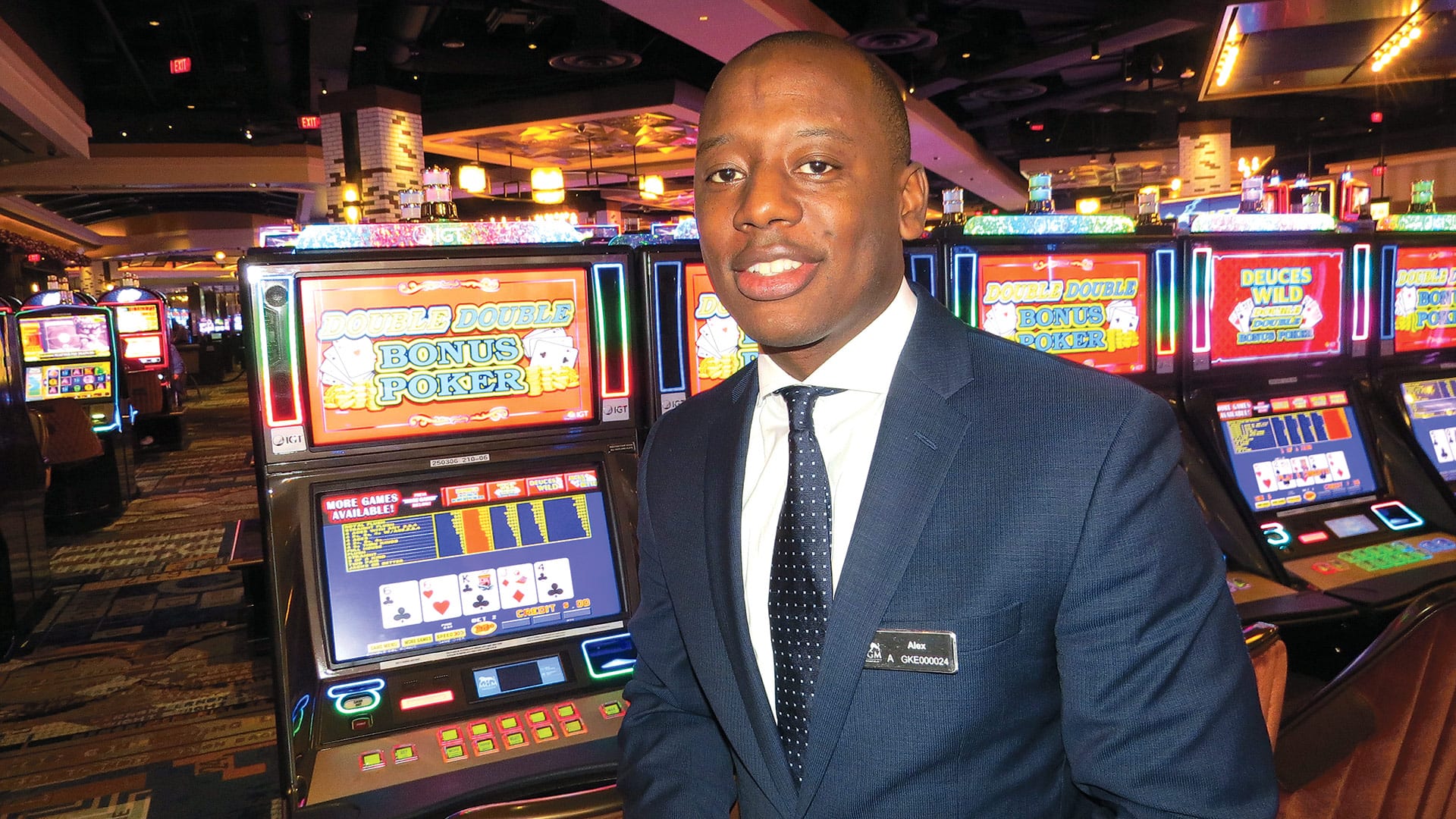
A doubling of the number of video poker games on the casino floor

A doubling of the number of video poker games on the casino floor is one of several tweaks Alex Dixon’s team has made in response to guest feedback.

“The best place that we get direct customer feedback is our front-line employees,” he explained. “It’s important that we talk and develop a deep relationship with those front-line employees because they will tell us what the customers are telling them.”

Over the first quarter, some patterns have emerged in terms of traffic volume and the origination points for visitors, said Dixon. In general, guests have come from a radius of 150 to 250 miles, meaning all of New England and New York. But the lion’s share (pun intended) of the guests (to both the casino and the hotel) are coming from the 413.

He noted that bus service to the casino has been fairly steady and that more routes may be added in the near future.

Meanwhile, bookings for the meeting and event spaces have been solid as well, he noted, adding that a number of large-scale events, including the Bright Nights Ball in November, have been staged on the property, and several area companies, from Florence Bank to Whalley Computer, have already rented spaces for sales meetings, product showcases, and other purposes.

Playing Their Cards Right

Moving forward, the team at MGM will go on listening and tweaking, said Dixon, adding that the goals in this business are the same as they are in any other — to create repeat business, drive new business, and continually look for new opportunities to grow.

Which brings him to a development known as the ‘study hall.’

That’s a play on words involving the casino’s hotel lobby, which boasts a number of shelved books and thus looks like a library, said Dixon.

“A quarter seems like a while, but we’re really still a new business in our infancy. And while there are some patterns that have emerged, we’ve really only been open 14 weekends; we learn something new every peak weekend.”

However, on Friday nights starting at 6, it looks more like an entertainment venue, with a one- or two-piece band playing before an audience of business people and others just looking to unwind and get the weekend started.

“This is catered toward the after-work business crowd,” said Dixon, adding that, rather than being a response to given feedback (like more video roulette), this was a proactive step.

“Marketing is a little bit of reacting or meeting customer demand,” he said. “But in other cases, it’s creating demand for things for people didn’t even know they wanted. We’re mixing a great, literary-themed space and a cocktail and beverage program with entertainment, and hoping that we can create some magic.”

As for repeat business, MGM wants to drive as much as it can, obviously, said Dixon, adding that this will be achieved through a host of factors, including solid customer service, a number of amenities beyond the casino floor, and entertainment options outside the MGM complex.

“We hear from our customers … they stay for a two- or two-and-half-day stay, and they experience all of the amenities within a day or a day and a half — max,” he explained. “And then they say, ‘what else can we go do?’”

There is a good list of other things to do, he went on, adding that MGM is partnering with the Greater Springfield Convention & Visitors Bureau and individual attractions like the Basketball Hall of Fame, Springfield Museums, and the Springfield Armory to promote all there is to do.

“We’ve engaged all these entities to help promote Springfield as a destination,” he went on. “And we want more bars, more restaurants, more vibrancy, because that is going to get a return trip.”

As for the holidays, well, it’s an intriguing, potential-laden time for the casino, but it’s also somewhat uncharted territory, at least for a resort operation in this market.

“I wish I had a crystal ball as to understanding just when people will be coming and visiting,” he said, adding that, while days when schools have been closed this fall and that Friday after Thanksgiving have provided some clues, there are still some unknowns. “What we’ve begun to think about is how to change our meal periods, our hours of operation, to be more nimble when there are different events occurring in the city, because we still don’t quite know how things will impact us.”

Overall, the casino has worked to create a list of reasons why individuals, groups, and families should make the casino part of their holiday plans, said Dixon, adding that the decorations, an expanded Kringle Candle shop (it now occupies space in the old armory as well as the former church in Armory Square), and the skating rink are all parts of this equation.

“There was a Rockefeller Plaza-like feel to the lighting ceremony,” Dixon said of the events just after Thanksgiving and the ongoing atmosphere in the plaza. “It creates an energy and vibe.”

A vibe that Mercedes-Benz of Springfield wanted to become attached to.

Indeed, the company not only brought the naming rights to the rink, but it staged a “Choose Your Ride” promotion whereby a lucky individual won a new Mercedes-Benz in a drawing staged on Dec. 1.

Peter Wirth, co-owner of the dealership with his wife, Michelle, said a solid partnership between the two entities has emerged over the past few years (before the dealership opened and long before the casino opened) in part because they are both new businesses trying to establish themselves and share similar approaches to customer service — as well as geographic service area, if you will.

“MGM is known for providing unparalleled customer service in their world, and that’s exactly what we’re trying to provide in our world,” he explained. “The brands’ missions complement each other nicely.

“At the same time, their geographic reach is very similar to ours,” he went on. “They see the vast majority of their customers come from 50 miles away, and that’s how far our reach is as well.”

Still, such a partnership with a casino and an ice-rink sponsorship would be considered an ambitious marketing step for a single dealership, said Michelle Wirth, adding quickly that Mercedes-Benz of Springfield considers this a calculated roll of the dice, to use casino-industry language, and, more importantly, something positive for the community.

“It makes good business sense to partner with MGM, but it’s also part of our strategy to give back,” she said. “This creates a lot of positive energy.”

Odds Are

As in the political realm, the 100-day milestone is merely a time for businesses to stop and reflect. Or another time, to be more precise.

Indeed, the process of reflecting, and learning, is ongoing for those at MGM Springfield, who will add a holiday season’s worth of observations and feedback to what has been gathered already in efforts to continuously improve.

“Throughout the course of the year, we’re still learning and still growing our database,” said Dixon, adding that tweaks will continue to come.

Like Let it Ride games and more items in the store with the MGM logo on them. As he said, they seem like small changes, but for the customer, they’re big.

George O’Brien can be reached at [email protected]

Event Galleries Women of Impact 2018

Celebrating the Women of Impact

More than 400 people turned out at the Sheraton Springfield on Dec. 6 for BusinessWest’s inaugural Women of Impact luncheon. Eight women were honored for their achievements in business and with giving back to the community. Massachusetts Lt. Gov. Karyn Polito attended and offered remarks on subjects ranging from advancements in STEM education to a host of bipartisan efforts at the State House. Springfield Mayor Domenic Sarno also offered remarks. The keynote speaker was Lei Wang, the first Asian woman to complete the Explorers Grand Slam.

The Women of Impact for 2018 are:

• Jean Canosa Albano, assistant director of Public Services, Springfield City Library;

• Kerry Dietz, principal, Dietz Architects;

• Denise Jordan, executive director, Springfield Housing Authority;

• Gina Kos, executive director, Sunshine Village;

• Carol Leary, president, Bay Path University;

• Colleen Loveless, president and CEO, Revitalize Community Development Corp.;

• Janis Santos, executive director, HCS Head Start; and

• Katie Allan Zobel, president and CEO, Community Foundation of Western Massachusetts.

Photography by Dani Fine Photography


Thank you to our sponsors:


Sponsors:

Bay Path University; Comcast Business; Country Bank; Granite State Development

Exclusive Media Sponsor:

Springfield 22 News The CW

Speaker Sponsor:


Event Keynote Speaker

Lei Wang
The first Asian woman to complete the Explorers Grand Slam. Lei Wang’s journey redefined success in her own terms, and today, she is challenging individuals around the world to do the same.

In 2004, Lei, who grew up as a Beijing city girl who had no athletic training, set out to climb Mount Everest. She was on a promising career trek in finance with an MBA from Wharton. But she was excited about proving that an ordinary person could climb Everest. That excitement empowered her to not only climb Everest, but to become the first Asian woman to complete a journey to the summits of the highest mountains on each of the 7 continents and to the north and south pole, a feat called the Explorer’s Grand Slam. As she endured outstanding hardships and overcame seemingly insurmountable obstacles, she made an astonishing  discovery. She discovered that excitement is the driving force motivates and empowers every one of us and the secret to innovation, peak performance and extraordinary achievement. Today as a speaker, author and adventurer she travels the world to ascend new summits and empower individuals and organizations to dream big, take a leap of faith and to tap into the power of excitement to realize their potential and reach the heights of success. Read more about Lei here.

Meet the Judges

Samalid Hogan
Samalid Hogan is the regional director for the Massachusetts Small Business Development Center Network’s Western Regional Office. In that role, she has built partnerships across public, private, and civic sectors to achieve economic-development goals for the Pioneer Valley region. In 2014, Hogan founded CoWork Springfield, the city’s first co-working space, which focuses on serving women and minority-owned businesses. In addition, she was appointed to the Governor’s Latino Advisory Commission in 2017, and serves on the boards of several organizations, including Common Capital, the New England Public Radio Foundation, the Minority Business Alliance, and National Junior Tennis and Learning of Greater Springfield. A BusinessWest 40 Under Forty honoree in 2013 and winner of the Continued Excellence Award in 2018, she was also awarded the Grinspoon Entrepreneurial Spirit Award in 2017 and was recognized as a Woman Trailblazer and Trendsetter by the Massachusetts Latino Chamber of Commerce in 2016.

Susan Jaye-Kaplan
Susan Jaye-Kaplan is the founder of the Pioneer Valley Women’s Running Club and Go FIT Inc., and co-founder of Link to Libraries Inc., an organization whose mission is to collect and distribute books to public elementary schools and nonprofit organizations in Western Mass. and Connecticut. She is also the co-founder of the Women’s Leadership Network and founder of the Pioneer Valley Women’s Running Club of Western Mass., as well as an advisory board member and fundraiser for Square One. She has received one of the nation’s Daily Point of Light Awards, the President’s Citation Award at Western New England College, Elms College’s Step Forward/Step Ahead Woman of Vision Award, Reminder Publications’ Hometown Hero Award, the Mass. Commission on the Status of Women Unsung Heroines Award, the New England Patriots’ International Charitable Foundation Community MVP Award (the only person to receive this award two times), and the Girl Scouts of Pioneer Valley’s Women of Distinction Award. She was chosen one of BusinessWest’s Difference Makers in 2009. She has also received the National Conference on Community Justice Award, the Springfield Pynchon Award, and the Holyoke Rotary’s Paul Harris Award.

Dora Robinson
Dora Robinson has served as a nonprofit leader and practitioner for more than 35 years. She recently retired from the United Way of Pioneer Valley (UWPV) after serving for more than eight years as president and CEO. Previously, she served as the first full-time president and CEO of Martin Luther King Jr. Family Services for 19 years. The foundation for these leadership roles is based on previous experiences as corporate director and vice president for the Center for Human Development and vice president of Education at the Urban League of Springfield. Her earlier professional experiences included social work with adolescents and families, community outreach, and program planning and management. She is currently an adjunct professor at Springfield College School for Social Work and the School for Professional Studies. Dora has received much recognition for her work as a nonprofit executive leader and her work in social justice. Most recently, she was elected to serve on the board of directors for the Women’s Fund of Western Massachusetts and is serving as a steering committee member to establish a neighborhood-based library in East Forest Park.

Sports & Leisure

Having a Blast

Kendall Knapik says Hot Brass meets a recognized need in the region for a public shooting range.

Kendall Knapik says Hot Brass meets a recognized need in the region for a public shooting range.

New Businesses like to start off with a bang. Hot Brass in West Springfield has done that laterally — thousands of bangs actually. It’s the only indoor shooting range within a few hours’ drive. And it’s one of two businesses — a gun retail shop called Guns Inc. being the other — operating out of a former auto body shop on Main Street. Thus farm the ventures are on target when it comes to established goals and patterns of growth.

It doesn’t have a nickname. Yet.

They just call it the ‘50-cal.’ That’s short — although not much shorter — for .50 caliber, as in the .50 caliber sniper rifle made by Connecticut-based Bushmaster Firearms.

The BA 50, as it’s called, weighs 30 pounds and is nearly five feet long. It fires — quite loudly — a huge projectile that makes a very large hole in the paper target, and is touted by its maker for its extreme accuracy.

It is now one of the star attractions at the Hot Brass indoor firearm and bow range in West Springfield, a public facility, which opened its doors late last summer.

“It’s very popular — people love firing it,” said Kendall Knapik, manager of this family business, noting that visitors can rent it for $35, plus $10 for every round (the ammunition is expensive) — or fire it just once or twice — and people of all ages and persuasions have done just that. “We have a lot of people come in, rent the 50-cal, and get pictures and video with it, because it’s not often you see one of those.”

The BA 50 is just one element of what has become a large, multi-faceted operation. There are actually two businesses located at once was an auto-body shop on Main Street — Hot Brass, a new venture, and a retail firearms component known as Guns Inc., launched by Knapik’s parents, David and Cheryl Knapik, and formerly operated out of a small storefront farther down Main Street.

“We have a lot of people come in, rent the 50-cal, and get pictures and video with it, because it’s not often you see one of those.”

Within those two ventures, there are many smaller divisions, or revenue streams, if you will, from the indoor firearm and bow ranges to ‘license to carry’ gun-safety courses held every other Sunday; from a growing number of events — there have been several bachelor parties, for example — to the gun sales themselves, which have been steady if not spectacular since Donald Trump was elected president and a huge threat to gun accessibility removed (more on that later).

Together, these many components are meeting or exceeding lofty goals set when the ceremonial ribbon was cut, said Knapik, adding that, overall, the ambitious venture was launched out of perceived need for these various services, and the need has been verified.

“There are several private clubs in this region, but no public ranges,” she explained, adding that this is the only facility that fits this description within a roughly 100-mile radius.

Thus, there are often a variety of license plates seen in the large parking lot, not to mention a very diverse client base, said Knapik, adding that while sport shooting has always been fairly popular, it is becoming much more so, involving men, as it has historically, but now also women, couples, even businesses looking for a new and different way to do some team-building work.

The .50 caliber sniper rifle is a popular attraction at Hot Brass, drawing shooters of all ages.

The .50 caliber sniper rifle is a popular attraction at Hot Brass, drawing shooters of all ages.

“We’re seeing all kinds of people coming in to use the ranges — people of all ages,” she said, adding that the facility has hosted everyone from law-enforcement officials and military veterans to grandmothers starting a new hobby.

For this issue and its focus on sports and leisure, BusinessWest talked at length with Knapik about this family operation and why it is on target — both literally and figuratively — when it comes to ambitious projections for visitation and overall growth.

Barrels of Fun

Knapik said the vision for Hot Brass and Guns Inc. started to come into focus more than two years ago, and the picture — and the promise — were enough to lure her back to the family business after several years spent living in Manhattan and working in the healthcare field.

That vision was for two symbiotic businesses operating under the same roof that would meet recognized needs within the region, she said.

The symbiotic part is fairly self-explanatory: Those who purchase guns need a place to shoot; meanwhile, those looking to purchase a gun will often try before they buy, and if they try at this range, they only need to walk a few dozen feet to likely find the model they’re looking for.

Indeed, Guns Inc. stocks both new and pre-owned firearms from such brands as Colt, Smith & Wesson, Sig Sauer, Ruger, Glock, Remington, Winchester, and Springfield Armory — as in the Springfield, Ill.-based company founded in 1974 to resurrect the most historically significant designs produced at the Armory in Springfield, Mass., such as the M1-Garand, the 1911 A1, and the M14, according to the company’s website.

As for the need part, Knapik noted, again, that there were and are several private ranges operated by sportsmen’s clubs in this area. These are outdoor facilities for the most part and require a membership.

Springfield-based Smith & Wesson operated a public shooting range at its facility on Roosevelt Avenue, but it closed several years ago, said Knapik, adding that, in many respects, Hot Brass fills that void and several others within the marketplace.

Getting the doors open was a massive undertaking — a $4 million investment overall — that involved obtaining not only a special permit from the city, but a mix of renovation and new construction at the former West Side Auto Body.

The new facility features five 50-foot pistol lanes; 10 rifle, shotgun, or pistol lanes that are 90 feet long; and two 61-foot-long archery lanes.

Through the first business quarter of operation, each of the various components of the business have seen a solid response from the buying public, said Knapik, who started with the archery lanes.

While not a hugely popular sport, archery is gaining some traction, she told BusinessWest, adding that Hot Brass offers a place to practice indoors; many practitioners are limited to their backyards, which makes it difficult to practice several months out of the year.

As for the shooting ranges, as noted earlier, they’re attracting diverse audiences, including many law-enforcement officials, individuals, couples (it’s become a popular date-night activity), bachelor parties, groups, and more.

the new location for Hot Brass and Guns Inc. is on target

Four months after opening, the new location for Hot Brass and Guns Inc. is on target when it comes to the many goals set for the twin businesses.

Sport shooting is popular because it’s a form of release, Knapik told BusinessWest, especially at a time when many are burdened by large amounts of stress and need a way to attack it.

“You definitely feel much better after you shoot a little bit — that’s the consensus, anyway,” she said. “People always leave smiling, and they tell us how much better they feel, which is good to hear.”

Many are also leaving with guns, accessories, and clothing from Guns Inc., and, very often, photos of video of themselves, sometimes with the BA 50 and often in front of a ‘Hot Brass’ step-and-repeat erected near the front lobby.

Memberships are available for frequent shooters — and that’s a large constituency — or the range can be rented for $26.50 per hour.

Knapik said there are ongoing discussions about staging competitions at the facility, and that might well happen, but for now, the focus is on keeping the ranges open for visitors, and thus keeping them content.

“You definitely feel much better after you shoot a little bit — that’s the consensus, anyway. People always leave smiling, and they tell us how much better they feel, which is good to hear.”

It’s also on bringing more people and new and different audiences to the facility, she noted. While word-of-mouth referrals have been a large part of the marketing strategy, the company has done some radio and other traditional forms of advertising to get the word out.

As for gun sales at Guns Inc., Knapik said the “hysteria” from the months leading up to the 2016 election has certainly died down. Any by hysteria, she meant anxiety over whether — and for how long — people could buy certain weapons.

With Donald Trump in the White House, such anxiety has dissipated, if not evaporated entirely, slowing gun sales to a considerable degree.

Still, people are buying, as evidenced by the large number of gun shows staged in this region, many of them at the Big E, which is just a mile or so down the street, another factor driving traffic to Hot Brass.

Meanwhile, it’s holiday season, and that brings a number of visitors to the showroom, said Knapik.

“For many people, a gun is a great gift,” she said, adding quickly that, unless one is certain which model and caliber to put under the tree, a gift certificate is in order.

Loaded Questions

With a sticker price of nearly $5,000, it’s safe to say not many people will be finding a gift-wrapped BA 50 waiting for them on Christmas morning.

That’s OK … they can still fire one at Hot Brass, and probably leave, as Knapik said, feeling much better, with a smile on their face, and probably a commemorative photo.

The large gun has become one of many factors contributing to a solid start and promising outlook for this multi-faceted operation.

The Knapik family certainly took their best shot when they doubled down on their business a few years ago, and now, a wide range of visitors can do the same thing.

George O’Brien can be reached at [email protected]

Work/Life Balance

Cold Comfort

The holiday season that stretches from Thanksgiving into January is, in many ways, a cheerful time, one of togetherness, connection, and giving. But, in truth, many people dread the season for the stresses it brings — to finances, relationships, workload, you name it. While those stresses can’t be eliminated, they can often be managed through a combination of mindfulness, realistic expectations, and simply seeking help.

The holiday season is usually a magical time for kids — a month of anticipation, togetherness, and warm feelings they’ll remember forever.

The problem is, years later, those memories often collide with adult realities like balancing work and home responsibilities, strained finances, and relationship conflicts. In short, it’s not always the most wonderful time of the year. Rather, the holidays can rank among the most difficult.

“There’s a lot of demand that comes from expectations — from our families, or what happened last year, or what we see on TV — or simply what we want to happen. There are a lot of expectations, but the best thing is to remain mindful of the reality of family, finances, and other situations that change from year to year,” said Dr. Edna Rodriguez, a clinical psychologist with Providence Behavioral Health Hospital.

Especially challenging are the expectations people feel from the outside — whether it’s to maintain a perfect home, make appearances at gatherings when they’d rather stay home, or further tax finances already stressed by family gift purchases.

“It’s important to learn to say ‘no’ to that extra party or secret Santa or Yankee swap, which can put your budget on edge and make you feel stressed out when resources are limited,” Rodriguez noted.

Dr. Stuart Anfang, chief of Adult Psychiatry at Baystate Medical Center, agreed.

“As fun as the holiday season can be, it can also be stressful,” he said. “Lots of drinking and eating, lots of entertaining, lots of spending — it’s important to do these things in moderation. If we get too tired, if we eat and drink too much, if we’re too stressed by preparations or shopping, all of this can take a toll, both mentally and physically, that can really dampen our holiday celebrations.”

Anfang noted that increased family contact may also be stressful.

“Sometimes bringing together family members can lead to too much togetherness — fighting at the dinner table, re-opening old wounds, triggering buried conflicts,” he noted. “It can be helpful to give yourself a little space, try to de-escalate tense situations, and remember that this is supposed to be about fun and celebration.”


Dr. Stuart Anfang

Dr. Stuart Anfang

“If we get too tired, if we eat and drink too much, if we’re too stressed by preparations or shopping, all of this can take a toll, both mentally and physically, that can really dampen our holiday celebrations.”


Sometimes that means just stepping away for a few minutes, Rodriguez said.

“People have to spend time with family members — maybe family members you don’t necessarily feel comfortable with. So if you have to remove yourself from the area, do it — maybe go to the bathroom, breathe, and come back. Checking in with yourself is the most important thing.”

That ‘checking in’ applies to most stressful situations, she added, around the holidays or not.

“Research shows that, by doing that at least two minutes a day, you will have better stress management and remain more present in your day. With apps on smartphones, people can set up alarms to remind them to take a deep breath and focus on their breathing. In fact, it can be breathing or taking a walk or just taking a break from overwhelming situations.”

Business, Not Pleasure

Those holiday stresses, of course, often creep into the workplace, which has its own specific set of challenges to begin with. According to a study by Virgin Pulse, a leader in the field of employee well-being, 70% of employees are significantly more stressed during the holidays, and more than 10% said they’re between 60% and 100% more stressed.

“It’s no secret that, for many, life is getting more complex and stressful each and every year. It’s become increasingly vital that employers help their teams better manage their stress and priorities — especially during the holidays — for each person to be their best and brightest selves, at work and in life,” said Chris Boyce, CEO of Virgin Pulse. “This time of year, it’s important we help employees stay on top of their work priorities and holiday checklists. Supporting their health and happiness using tools, resources, and programs that drive all aspects of their well-being will help them better keep their stress and health under control.”

Katie Sandler, a wellness and professional coach, told Inc. magazine that it’s important to put aside time for oneself.

“Put aside 5, 10, 15 minutes a day to do something for yourself with intention,” she said, which may include taking a walk or listening to a favorite song or two. “No one ever took a few intentional minutes to de-stress and said, ‘dang, I wish I hadn’t done that.”

Rodriguez said parents often get overwhelmed spending time with family and keeping the mystery and magic of Christmas alive for their children. “Having another set of expectations at work increases stress and defeats the purpose.”


Dr. Edna Rodriguez

Dr. Edna Rodriguez

“If you have to remove yourself from the area, do it — maybe go to the bathroom, breathe, and come back. Checking in with yourself is the most important thing.”


Managers have their own set of challenges, she added. “When all your employees are getting time off and you need to handle the work, that’s when your wife, husband, or partner may be a little on edge, because you’re absent at times they wish you were present.”

That’s when drawing lines becomes important — or at least using technology and other means to get out of the office and connect with the people who matter most.

Avoiding a Blue Christmas

The American Psychological Assoc. offers the following tips to handle stress around the holidays.

Take time for yourself. There may be pressure to be everything to everyone. You’re only one person who can only accomplish certain things. Sometimes self-care is the best thing you can do, and others will benefit when you’re stress-free. Go for a long walk, get a massage, or take time out to listen to your favorite music or read a book. All of us need some time to recharge our batteries, and by slowing down, you will actually have more energy to accomplish your goals.

Volunteer. Find a local charity, such as a soup kitchen or a shelter, where you and your family can volunteer. Also, participating in a giving tree or an adopt-a-family program, and helping those who are living in true poverty, may help you put your own economic struggles in perspective.

Have realistic expectations. No Christmas, Hanukkah, Kwanzaa, or other holiday celebration is perfect. View inevitable missteps as opportunities to demonstrate flexibility and resilience. A lopsided tree or a burned brisket won’t ruin your holiday; rather, it will create a family memory. If your children’s wish list is outside your budget, talk to them about the family’s finances this year and remind them that the holidays aren’t about expensive gifts.

• Remember what’s important
. The barrage of holiday advertising can make you forget what the holiday season is really about. When your holiday expense list is running longer than your monthly budget, scale back and remind yourself that what makes a great celebration is loved ones, not store-bought presents, elaborate decorations, or gourmet food.

Seek support. Talk about your anxiety with your friends and family. Getting things out in the open can help you navigate your feelings and work toward a solution for your stress. Don’t isolate.

Holidays are also a time when people put a lot of value on materialistic things,” she told BusinessWest, which can lead to anxiety. Doing random acts of kindness can be a way to counter that — whether it’s lending an ear to neighbor or co-worker going through difficulties or contributing to a local soup kitchen.

“That keeps us grounded and focused on the true meaning of the holidays; it keeps us connected with each other, being human and being together. That’s another way to manage stress,” Rodriguez noted.

It’s true, of course, that the urge to do good deeds can be another way to create stressful expectations, but acts of kindness don’t have to be time-consuming, she said; just looking for moments in the day to show kindness is often enough.

Feeling the Loss

For many individuals — both those estranged from their families or those who have suffered a loss — the holidays can be a particularly lonely and isolating time. While it may seem like everyone else is celebrating, they’re reminded more than usual of loved ones they miss.

There’s nothing wrong with such emotions, Rodriguez said, but she added that some may find it helpful to actually schedule some time daily — even five to 10 minutes — to give themselves over to grief and reflection and even a good cry, before tackling whatever else their day brings.

Many people get ‘blue’ at this time of year, and that can be normal, Anfang added.

“It is also harder for some people when the days get shorter and colder,” he noted. “We get concerned when symptoms start causing significant functional impairment, making it harder for you to function at work and at home. Sleep disturbance, loss of appetite and weight, decreased motivation and energy, daily tearfulness, thoughts to hurt yourself or wishing you were dead — these are potential signs of clinical depression.

“If you see these symptoms in yourself or your loved ones, that’s the time to contact a primary-care provider or seek evaluation by a mental-health professional,” he went on. “Depression is very treatable, and no one should suffer in silence, especially at the holidays.”

That’s because the holidays, for many people, is a time to connect, Rodriguez said.

“It’s really about being with each other, being together. Whatever background you have, we’re all together for a reason.”

Joseph Bednar can be reached at [email protected]
Law

Navigating Change

Amy Royal

Amy Royal

Amy Royal was taking a calculated risk when she left a stable job in employment law to start her own firm at the start of the Great Recession. But those calculations proved correct, and as her firm marks 10 years in business, she reflects on how her team’s services to clients continue to go beyond legal aid into a business relationship that helps companies — and the local economy — grow.

Many employers, truth be told, don’t think the grand bargain is much of a bargain. And they have questions about how it will affect them.

“Massachusetts tends to be ripe with emerging employment issues, like the grand bargain,” said Amy Royal, referring to this past summer’s state legislation that raised the minimum wage and broadened family leave, among other worker-friendly measures.

“But that’s one of the things I enjoy — the education piece we offer to clients: ‘this is what the grand bargain looks like, and we’re going to help you plan for it. This may not seem so grand, but we’re here to help you navigate this and figure out how you’re going to work within these parameters now.’”

Royal and her team have helped plenty of employers over the 10 years since she opened her law firm, Royal, P.C., in Northampton. Since launching the business as a boutique, woman-owned, management-side-only firm in 2008, that framework hasn’t changed, but the way the team serves those clients has certainly evolved.

“Now that we’re 10 years old, we’re thinking about rebranding, thinking about growth, and how we can provide additional opportunities here at the law firm,” she told BusinessWest. “Is it continuing to market in this very discrete area or expanding beyond that?

“We obviously only represent companies,” she went on, “but in our relationships with clients, we’re being asked to handle other things for those companies apart from employment law.”

“Now that we’re 10 years old, we’re thinking about rebranding, thinking about growth, and how we can provide additional opportunities here at the law firm.”

For example, the firm represents a large, publicly traded company that recently launched a new brand and wanted help creating contracts with vendors and negotiating with other companies it was collaborating with. Another client is a large human-service agency that called on Royal to interpret regulations of its funding sources and help negotiate contracts related to those sources.

“So we’ve organically expanded over time,” she said. “We still represent companies, but we do more for them, because we’re seen as a true advisor to them. So now, at 10 years, I’ve looked at the firm and asked my team, ‘is this something we should now be marketing?’ We still are a boutique firm representing companies, but what we’re going to be rolling out in the coming year is a rebranding initiative — one that’s focused on telling the story of what we are doing here that’s more than just employment law.”

Tough Timing

Royal began her law career working for the Commonwealth, in the Office of the Attorney General, handling civil-litigation matters, which included some employment claims. From there, she went into private practice at a regional law firm that solely handled management-side labor and employment law.

Amy Royal (center) with some of her team members

Amy Royal (center) with some of her team members, including (top) attorneys Daniel Carr and Timothy Netkovick, and (bottom) Heather Loges, practice manager and COO; and Merricka Breuer, legal assistant.

With that background, Royal sensed a desire to start her own company — which turned out to be a risky proposition, opening up into the teeth of the Great Recession.

“I obviously took a huge leap; I was at an established law firm and had been there for a long time. I had an established job, with a very young family at the time. And it was 2008, when, obviously, the economy wasn’t in good shape.”

So she understood if people thought striking out on her own might not have been the safest move.

“But given how long I’d been practicing law at the time, it felt to me like it was now or never,” she explained. “I really wanted to see if I could make a go at it, and I felt like I had the tools to develop a business. Oftentimes, law firms aren’t thought of as businesses; they’re thought of as practitioners, but not businesses. But I knew I could create a law firm in a strategic way and develop it and make a company out of it.”

At first, Royal’s wasn’t the only name on the letterhead. At first, the firm was called Royal & Munnings, with Amy Griffin Munnings as a partner, helping Royal get the firm off the ground. Later, after Munnings moved to Washington, D.C., the firm was known as Royal & Klimczuk, for then-partner Kimberly Klimczuk, who subsequently departed and currently practices employment law at Skoler Abbott in Springfield.

Currently, Royal employs four other attorneys full-time, in addition to two full-time paralegals and other support staff.

“I really wanted to take the model of a specialized, boutique practice and build upon it with a strong client base of corporations throughout our Valley and beyond — because we do represent companies in Rhode Island, Connecticut, and Vermont, as well as national corporations,” she explained.

“I believed it didn’t so much matter where we were located because we go out to our clients,” she added. “So I chose Northampton because I have really enjoyed the community — I went to Smith College, and I thought I could have an impact here and throughout the region and beyond in creating employment opportunities for people.”

That is, in fact, how Royal sees her work: by helping clients navigate through often-tricky employment issues, she’s helping those companies grow and create even more jobs in the Valley.

And while many of those thorny issues have remained consistent, they’ve ebbed and flowed in some ways, too.

“Given the employment-law landscape, there becomes hot areas at certain times, and we become sort of subspecialists in those areas,” she explained. For example, early on, she saw a lot of activity around affirmative action and dealing with the Office of Federal Contract Compliance Programs. Wage-and-hour conflicts have become increasingly prominent in recent years as well, and Royal, P.C. has handled client defense on those issues, as well as general guidance on how to avoid claims altogether.

“I do feel like we can advise clients and help them flourish,” she went on. “I’m so committed to this region, and I know there’s been a lot of work done over the last decade since our birth as a law firm, in the business community and the community at large, on how to make the Pioneer Valley an even more attractive place for people to live and earn a living and feel like they have opportunities here — that they don’t have to be in Boston to have those opportunities.”

Risk Managers

As she continues to grow the firm, Royal says it’s always a challenge to find talented attorneys who are skilled in labor and employment law and also understand her vision for the company.

“Practitioners often think, ‘here’s what the law says.’ We need to be telling clients, ‘OK, here’s what the law says you can do, but this is also a business decision, and everything is about weighing and measuring risk and deciding whether you can bear that risk or not, whether that’s a good practice or not.’”

“Given how long I’d been practicing law at the time, it felt to me like it was now or never. I really wanted to see if I could make a go at it, and I felt like I had the tools to develop a business.”

And challenges to employers are constantly evolving, whether it’s legislation like the grand bargain or issues that arise from new technology. She recalls what a hot topic portable devices, like smartphones and tablets, were in the early part of this decade.

“Now it’s like everyone has one,” she said, “but at that time, it was a huge issue for employers, who were asking, ‘where is our data going? If you’re a portable employee, what’s happening when you leave with that phone?’”

The economy can affect the flow of work as well. In the early days of the firm, as the recession set in, litigation crowded out preventive work such as compliance matters, employee handbooks, and supervisory training. In recent years, she’s seen an uptick in requests for those services again.

Sometimes, employers will call with advice before taking disciplinary action with an employee — just another way Royal aims to be a partner to clients. The firm also conducts regular seminars and roundtables, both for clients and the public, on matters — such as legislative changes and policy wrinkles — that affect all employers.

In some ways, that’s an extension of the way Royal wants the firm to be a presence in the broader community. Another is the team’s involvement with local nonprofits.

“I’ve tried to set that tone,” she said, “but it’s never been met with resistance — it’s always been met with ‘oh, yes, maybe we can do this, maybe we can do that.’ It’s been important to me to have a team that really wants to support their community.”

Meanwhile, that team has been focused, perhaps more than ever before, on what exactly Royal, P.C. is — where the firm has been in the past, what it is now, and what it wants to be going forward.

“We have a strong, viable book of labor and employment business, and what I’ve communicated to my team is, ‘we can keep going for the next 10 years, 20 years, on that book, and achieve growth.’ Or we can look at our brand and say, ‘do we want to grow beyond that? Do we tell the story of the other services we’re able to provide, and create other employment opportunities for people in the Valley?’ There’s a consensus here that that’s really the direction we should be going in.”

Joseph Bednar can be reached at [email protected]

Community Spotlight

Community Spotlight

Mayor Thomas Bernard says North Adams is a small, post-industrial New England city

Mayor Thomas Bernard says North Adams is a small, post-industrial New England city with economic challenges, but has generated plenty of momentum in addressing them.

As a long-time resident of North Adams, Mayor Thomas Bernard understands the city’s reputation as a tourist destination. It’s a good reputation to have, as it puts more cars on the streets and feet in local establishments.

But North Adams — the least-populated community in the Commonwealth classified as a city — is much more than that.

“I think the untold story about North Adams — and the Berkshires in general — is that we have a robust manufacturing sector here,” said Bernard, who began serving his first term as mayor at the start of this year. “We talk about the role of culture and tourism, but we have manufacturing, too.”

And the sector is a bustling one, he added, citing Tog Manufacturing Co., which makes precision-machined parts, and is looking to expand both its space and workforce over the next few years. The company is also a good example of the workforce-development partnerships being forged in the industry locally.

“They have a really good connection with McCann Technical School, while MCLA [Massachusetts College of Liberal Arts], our great public university, has an engineering partnership with General Dynamics to meet their workforce needs. And then Crane Paper, which was bought recently by Mohawk, is talking expansion as well in the next couple years, adding a shift and adding workers,” he said. “Take those things together, and it’s a significant engine that often gets overlooked in conversations about the economy and economic development in the Berkshires, and North Adams in particular.”

That’s not to say the cultural sector isn’t important, anchored, of course, by MASS MoCA, which recently underwent a $65 million expansion, adding 130,000 square feet of gallery space and enhancing the outdoor courtyard space. The work took place on the south end of the campus of the former Sprague Electric factory, whose 16 acres of grounds and 26 buildings with an elaborate system of interlocking courtyards and passages was transformed into the museum in 1999. The facility has a regional economic impact of more than $25 million annually.

Then there are newer projects like Greylock WORKS, an ongoing transformation of the former Greylock Mill along Route 2. Salvatore Perry and Karla Rothstein of Latent Productions in New York City saw potential in the site four years ago and purchased the 240,000-square-foot property for $750,000.

“The narrative has been that, when big companies left in that wave of industrial migration in the mid-’80s and beyond, manufacturing stopped. That’s just not the case.”

The first goal was to create a large event space, and further developments have included a commercial kitchen and a specialty food marketplace; a rum distiller is the first tenant. Each business will have a small area for retail operations and also have room to conduct wholesale operations to help sustain a flow of year-round revenue. The Greylock WORKS development will eventually include a residential component as well.

Meanwhile, Thomas Krens, who was one of the driving forces behind the establishment of Mass MoCA two decades ago, proposed another project for North Adams a few years ago: a $20 million model-railroading and architecture museum in Western Gateway Heritage State Park that has a footpath directly across from MASS MoCA’s south gate.

Once completed, that project is expected to bring another 200,000 to 300,000 visitors to North Adams each year.

Those projects — far from the only ones creating energy in North Adams — are an intriguing sample of what the city has to offer. But Bernard thinks there is far more potential, and hopes to see it come to fruition.

Down on Main Street

Bernard is cheered by recent high-profile developments, but knows overall progress in any city is not an overnight proposition.

“There are persistent challenges,” he told BusinessWest. “I’m looking out my window at Main Street, 20 years after MASS MoCA happened, and we still haven’t totally cracked the code on a booming, bustling downtown.”

He compared North Adams to Shelburne Falls, which has a “really lovely, compact, interesting downtown” that people flock to, for the Bridge of Flowers and other attractions. “But you have to know Shelburne is there … you have to be intentional to go there and find it.”

And if an out-of-the-way town like that can have a thriving downtown, he went on, why shouldn’t North Adams — with a museum in MASS MoCA that draws some 250,000 visitors each year, many of them from outside town — be able to create a more vibrant downtown of its own?

“After 20 years of good intentions, and investments by the museum, the city, and the chamber, we’re still trying to figure that one out,” he said, adding that one thing that could provide a spark is more market-rate housing and mixed-use development downtown to put more feet on the streets.

North Adams at a Glance

Year Incorporated: 1878
Population: 13,708
Area: 20.6 square miles
County: Berkshire
Residential Tax Rate: $18.38
Commercial Tax Rate: $39.85
Median Household Income: $35,020
Family Household Income: $57,522
Type of government: Mayor; City Council
Largest Employers: Crane & Co.; North Adams Regional Hospital; BFAIR Inc.
*Latest information available

That would in turn create demand for more eclectic food options, specialized retail, and galleries — “the kinds of things that are equally attractive to locals who have lived here their whole lives, people who transplanted here because they love the idea of this small New England city, and tourists who are here for the day or the weekend.”

Speaking of tourists, that’s actually the name of North Adams’ newest hotel, a 48-room retreat inspired by the classic American roadside motor lodge, set on the banks of the Hoosic River.

Tourists was the brainchild of Ben Svenson, a Boston-based developer, and a team of partners. They stripped a crumbling roadside lodge down to the studs and turned it into something both retro and decked out in modern amenities.

A wooden boardwalk leads to the river, while a saltwater pool was added, and an event space was fashioned from a neighboring farmhouse. Wooded walking paths lead to a yoga pavilion, open fields, a sculpture installation, and an old textile mill. A deconsecrated church in the woods will become Loom, where Cortney Burns, a James Beard Award-winning chef, will begin creating dishes in 2019.

Manufacturing Progress

No matter what happens in the realms of tourism, dining, retail, or any number of other high-profile elements of an attractive city, Bernard understands North Adams has a strong foundation of other businesses that may not receive the same attention.

“The narrative has been that, when big companies left in that wave of industrial migration in the mid-’80s and beyond, manufacturing stopped. That’s just not the case,” he said. “I mentioned Tog — they’ve been at it for 20-30 years in the same location, employing 25-30 people. For them to be talking about facility expansion and workforce expansion that would effectively double their workforce in North Adams and the Berkshires, that’s significant. That’s a big win.”

To meet that workforce need, however, he recognizes the importance of partnerships between industry and education to provide training, retraining, and professional development to help people access career opportunities.

“To be honest and realistic, we’re still a small, post-industrial New England city, and we have our economic challenges,” he said. “While we’re paying attention to all the great development that’s happening — it’s what drives growth and progress in the future — we can’t lose sight of people who have been here all their lives and are struggling because of fixed incomes and low incomes, seniors worried about taxes, or people who don’t have the education and skills to compete for the jobs that are here.”

Bernard believes North Adams is in a good spot to meet those needs and keep growing.

“I take a lot of pride in being the mayor of the smallest city in the Commonwealth — in population, but not by stature,” he said. “We’re a world-class destination for the arts, for culture, for outdoor recreation, for tourism, and we’ve got great educational resources in the city.”

Joseph Bednar can be reached at [email protected]
Sports & Leisure

Changing Lanes

Jeff Bennett says league bowlers and casual players are looking for different amenities

Jeff Bennett says league bowlers and casual players are looking for different amenities, and facilities need to cater to both constituencies.

Jeff Bennett remembers when the Pioneer Valley was home to many more bowling alleys than exist today.

“A lot of mom-and-pop centers started to close. We had a couple around here,” he told BusinessWest. “If you didn’t put in automatic scoring, blacklight bowling, if you didn’t keep the centers updated and clean, with nice bathrooms — well, those are the centers that don’t exist anymore. If you’re going to drop 70 or 100 bucks to go out for the day, are you going to the run-down place, or the place with the upbeat music, lights, and arcade? What’s going to be a more fun atmosphere?”

Bennett, general manager of AMF Chicopee Lanes, said his business, and that of its parent company, Bowlero, which boasts some 300 facilities nationwide, is doing well and still growing year after year, but added that such success doesn’t happen on its own. “We make people want to keep coming back and having fun. That’s what we try to focus on.”

Justin Godfrey agrees. “The important thing is to give them a quality, consistent product and make sure the guest has a memorable experience and wants to come back to your facility,” said the general manager of Shaker Bowl in East Longmeadow, which is now part of the Spare Time chain. “That’s really what it boils down to — treating people right and generating return business. Word of mouth is still king when it comes to getting people in the door.”

Those who haven’t been in a bowling alley in decades may be surprised by today’s centers, where they may encounter strobe lights and black lights, disc jockeys and music videos playing on large screens, and freshly made food.

“You get different crowds,” Godfrey said. “You get families more during the day, then at night, we run the light show and get the music going. It’s a different atmosphere from the leagues, which don’t want music. It just depends on the group.”

While there are fewer bowling lanes in operation than even a decade ago, those that are still in business have increasingly turned to a model that’s not just about bowling, Bennett said, touting amenities in Chicopee like food made from scratch, a full liquor license, servers that take orders on the lanes, and more.

“If you’re going to drop 70 or 100 bucks to go out for the day, are you going to the run-down place, or the place with the upbeat music, lights, and arcade? What’s going to be a more fun atmosphere?”

“That’s what casual bowlers are looking for — they’re looking for more atmosphere. They’re not just coming in for 20 minutes to bowl a game and leave. They’re here two or three hours — it’s one-stop entertainment, where they can have food and drinks, bowl, and play some arcade games. We have games geared for kids, and some old-school games for the adults.”

Godfrey said food and beverages can account for 25% or more of a center’s business, so it’s not an afterthought. Neither is the continual effort to introduce more people to the game — and everything that surrounds it these days.

“Before, you could just open your doors and people would come in, and many still do,” he said. “But we’ve really ventured out. We have event planners; we actually have people going out to create business, and that’s been very helpful for a lot of our centers. We do a lot of corporate parties. We work with a high-school gym class twice a week — we bring carpets into the gym classes and introduce kids to the sport. If the kids like it, they say, ‘hey, mom, let’s go bowling.’”

Different Strikes

Bennett said Bowlero has different brands within the company — AMF being just one of them — and centers can be quite different from each other.

“What we term a traditional center is still heavily league-focused, and a lot of that comes from the demographics and what you have around you. We have two centers in Manhattan, and both combined don’t have a league bowler — it’s all events and retail-play driven, and those are the two biggest grossing centers,” he explained.

“But then you have a lot of our traditional centers in the Northeast that still rely on our league base, especially during the fall and winter season,” he added, noting that leagues account for about one-third of total lane use, with between 1,300 and 1,350 league bowlers showing up each week, up to 34 weeks a year.

“We’re still focused on league bowlers — Monday to Friday, we’re busy every night, all 40 lanes. And we have to do certain things for them — regular white lights, and we work on lane conditions that affect their scoring.”

But the company also put a lot of money into amenities that attract non-league bowlers, he added, including a video wall, a new audio-visual system, black lights, and a new arcade.

“On weekends, we focus on the retail or open-play bowler — casual fun for kids and adults,” he said. “We do a ton of kids’ birthday parties and corporate events on the weekends. Over the next month, quite a few businesses are going to do holiday parties. And on weekend nights, it’s mostly adults; on Saturdays between 5 and 1, we’re extremely busy.”

Justin Godfrey says today’s bowlers want a memorable experience — one that often includes more than just bowling.

Justin Godfrey says today’s bowlers want a memorable experience — one that often includes more than just bowling.


At Shaker Bowl, Godfrey has seen a shift in his 18 years there, from a league-centric model to more open bowling for kids, adults, and families. Leagues don’t attract younger people like they used to, he said, and many people don’t want to make the commitment for 30-plus weeks. To counter that reality, he’s offering a 12-week league on Sunday nights to capture interest during the colder months.

But the Spare Time chain — which also has sites in Northampton, Vernon, Conn., and Windsor Locks, Conn. — understands it’s not just about bowling anymore.

“They’re really gearing it toward other entertainment options for the guests,” he said. “In Windsor Locks, which is newly renovated, there are escape rooms, laser tag, a huge arcade, and a restaurant. It’s more of a family entertainment center than your traditional bowling center.”

There are other factors that go into a successful center, he added, from cleanliness to consistent food quality across all sites in a chain. And let’s not forget the game itself, which has been attracting families for generations due to its easy-to-learn, hard-to-master qualities.

“Anyone can do it, and we meet the needs of all age levels, too,” he said. In fact, the day BusinessWest visited, Shaker Bowl was hosting a special-needs group in wheelchairs, bowling off taller metal ramps adapted for them.

“We’ve got ramps for the kids, all different weight balls — we can accommodate people of all ages, sizes, skill levels, everything. I think that’s definitely part of the appeal.”

Something for Everyone

There used to be about eight 10-pin bowling lanes locally, Bennett noted, but now there are only a handful. The average age of bowlers at AMF Chicopee Lanes is 25 to 45, and they usually bowl at least once a week. Many are there on weekend nights, when the average age is 25 to 35.

Like Godfrey, he noted that the center offers ramps so people with handicaps can bowl, six-pound balls that can be pushed down the lanes by 3- and 4-year-olds, and bumpers in the gutters to increase their chances of knocking down pins.

“Successful centers nowadays, in most markets, have to cater to everybody and do everything,” Bennett said, noting that AMF Chicopee Lanes hosts myriad junior and adult tournaments, not to mention fund-raising events for organizations like the Make-A-Wish Foundation, Big Brothers Big Sisters, and many others.

“We need all those types of events to be successful nowadays,” he added. “Springfield has a lot of options, especially with the casino here. We were worried that would affect us a little bit, but there’s been no effect so far.”

In short, business keeps rolling along for bowling centers that understand this changing market, and craft an experience that’s about more than just strikes and spares.

Joseph Bednar can be reached at [email protected]
Employment

One Year Later

By John S. Gannon, Esq. and Amelia J. Holstrom, Esq.

The #MeToo movement began making national headlines just over a year ago.

Since then, more than 200 prominent individuals have been accused of harassment. From Harvey Weinstein to Matt Lauer to newly appointed Supreme Court Justice Brett Cavanaugh, new allegations of sexual harassment have been appearing in the news almost weekly, and sometimes daily, over the last year.

John S. Gannon, Esq

John S. Gannon, Esq

Amelia J. Holstrom, Esq.

Amelia J. Holstrom, Esq.

It should not come as any surprise that employers are feeling the impact of the #MeToo movement. The number of sexual-harassment lawsuits filed increased drastically from 2017 to 2018. In October 2018, the U.S. Equal Employment Opportunity Commission (EEOC), the federal agency responsible for enforcing federal discrimination and harassment laws, released preliminary data for fiscal year 2018 showing that, for the first time since at least 2010, the number of sexual-harassment charges filed with the EEOC increased.

Additionally, the EEOC reported that it had filed 41 lawsuits alleging sexual harassment, more than a 50% increase over the previous year, and that it had collected close to $70 million on behalf of sexual-harassment victims in fiscal year 2018. The number of lawsuits is not the only thing on the rise; juries seem more willing to issue large damage awards to plaintiffs alleging sexual harassment. Just a few months ago, a jury in Massachusetts awarded a plaintiff more than $3 million in damages in a sexual harassment lawsuit.

Best Practices for Employers

Businesses that want to avoid being another #MeToo statistic need to take a hard look at their culture and ask: What are we doing to provide a workplace free from harassment? With allegations of harassment and lawsuits on the rise, now is an important time for employers to revisit best practices and take proactive steps aimed at protecting employees and reducing legal risk.

First, employers must have an anti-harassment policy, which should clearly outline the internal complaint and investigation procedure. State law requires employers of six or more employees to have a written sexual-harassment policy that is distributed at time of hire and annually to all employees. Among other things, the policy must include a notice that sexual harassment is unlawful and that it is unlawful to retaliate against someone who reports sexual harassment or participates in an investigation. 

The policy should also outline where and how employees can bring internal complaints of harassment and what the investigation procedure is. If either of these processes are unclear at your workplace, now is the time to revisit them and develop a complaint process and investigation procedure.

Second, employers should be doing annual sexual-harassment training. Although Massachusetts law only encourages training, implementing effective harassment training into your workplace culture demonstrates that you care about the issue. It also can protect you against a costly lawsuit.

Under the law, if a supervisor harasses a subordinate or knows about harassment but fails to take prompt steps to report, investigate, and stop the conduct, the supervisor has created significant legal risk for the employer. As a result, it is important that supervisors receive periodic training on what constitutes sexual harassment and what to do if they receive a sexual-harassment complaint or observe potential harassment in the workplace. A few hours of training per year could save an employer from a costly lawsuit. Further, annual training for all employees can be beneficial because it highlights what is not acceptable and outlines the serious repercussions, including termination, for harassing behavior.

Preventing Costly Litigation

As noted at the outset, juries are issuing multi-million-dollar awards in harassment cases. At the same time, employment-discrimination cases are also seeing record-setting jury verdicts. Earlier this year, a jury in Massachusetts awarded a plaintiff $28 million in a discrimination and retaliation case. Read that sentence again.

Having solid policies and engaging in regular training can get employers only so far. In order to avoid the risk of a runaway jury, employers may want to consider requiring employees to enter into agreements calling for private arbitration of employment disputes. Commonly referred to as arbitration agreements, these employment agreements require that employee and employer submit all disputes to a neutral arbitrator, as opposed to filing a lawsuit in court and having the case decided by a jury.

The arbitration process is typically less costly and time-consuming than court actions. Plus, the arbitration decision is usually final, as there are only limited opportunities for either side to appeal.

Bottom Line

The #MeToo movement is undoubtedly bringing positive changes to the workplace. Still, businesses need to be proactive and take steps to create a culture free from harassment. This starts with an effective workplace policy against harassment and regular training for employees.

If a culture change is necessary, it has to start at the top. Leaders lead by example, and these folks must be more committed than anyone to creating an environment free from harassing behavior.

John S. Gannon and Amelia J. Holstrom are attorneys with Skoler, Abbott & Presser, P.C., one of the largest law firms in New England exclusively practicing labor and employment law. Gannon specializes in employment litigation and personnel policies and practices, wage-and-hour compliance, and non-compete and trade-secrets litigation; (413) 737-4753; [email protected]. Holstrom specializes in employment litigation, including defending employers against claims of discrimination, retaliation harassment, and wrongful termination, as well as wage-and-hour lawsuits. She also frequently provides counsel to management on taking proactive steps to reduce the risk of legal liability; (413) 737-4753; [email protected]

Features

It’s That Time of Year

By Kristina Drzal-Houghton, CPA, MST

Year-end planning for 2018 takes place against the backdrop of a new tax law — the Tax Cuts and Jobs Act — that makes major changes in the tax rules for individuals and businesses.

Kristina Drzal Houghton

Kristina Drzal Houghton

For individuals, there are new, lower-income tax rates, a substantially increased standard deduction, severely limited itemized deductions and no personal exemptions, an increased child-tax credit, and a watered-down alternative minimum tax (AMT), among many other changes. For businesses, the corporate tax rate is cut to 21%, the corporate AMT is gone, there are new limits on business interest deductions, and significantly liberalized expensing and depreciation rules. And there’s a new deduction for non-corporate taxpayers with qualified business income from pass-through entities. The following is a brief synopsis of these and other changes.

Businesses and Business Owners

• For tax years beginning after 2017, taxpayers other than corporations may be entitled to a deduction of up to 20% of their qualified business income. For 2018, if taxable income exceeds $315,000 for a married couple filing jointly, or $157,500 for all other taxpayers, the deduction may be limited based on whether the taxpayer is engaged in a service-type trade or business (such as healthcare), the amount of W-2 wages paid by the trade or business, and/or the unadjusted basis of qualified property (such as machinery and equipment) held by the trade or business.

The limitations are phased in for joint filers with taxable income between $315,000 and $415,000 and for all other taxpayers with taxable income between $157,500 and $207,500.

• Deferring income to the next taxable year is a time-honored year-end planning tool. If you expect your taxable income to be higher in 2018 than in 2019, or if you operate as anything except a C corporation and you anticipate being in the same or a higher tax bracket in 2018 than in 2019, you may benefit by deferring income into 2019. With the passage of tax reform largely going into effect in 2018, new considerations may need to be made for the end of 2018. Of course, if an individual is subject to the alternative minimum tax, standard tax planning may not be warranted. The rules are quite complex, so don’t make a move in this area without consulting your tax adviser.

• Businesses should consider making expenditures that qualify for the liberalized business property expensing option. For tax years beginning in 2018, the expensing limit is $1,000,000, and the investment ceiling limit is $2,500,000. Expensing is generally available for most depreciable property (other than buildings), and off-the-shelf computer software.

For property placed in service in tax years beginning after Dec. 31, 2017, expensing also is available for qualified improvement property (generally, any interior improvement to a building’s interior, but not for enlargement of a building, elevators or escalators, or the internal structural framework), for roofs, and for HVAC, fire protection, alarm, and security systems. The generous dollar ceilings that apply this year mean that many small and medium-sized businesses that make timely purchases will be able to currently deduct most if not all their outlays for machinery and equipment.

What’s more, the expensing deduction is not prorated for the time that the asset is in service during the year. The fact that the expensing deduction may be claimed in full (if you are otherwise eligible to take it) regardless of how long the property is held during the year can be a potent tool for year-end tax planning. Thus, property acquired and placed in service in the last days of 2018, rather than at the beginning of 2019, can result in a full expensing deduction for 2018.

• Businesses can also claim a 100% bonus first-year depreciation deduction for machinery and equipment bought used (with some exceptions) or new, if purchased and placed in service this year. The 100% write-off is permitted without any proration based on the length of time that an asset is in service during the tax year. As a result, the 100% bonus first-year write-off is available even if qualifying assets are in service for only a few days in 2018.

• A charitable-donation deduction is available to businesses, but the actual deductibility depends on the business form. A corporation is allowed a deduction of up to 10% of its taxable income, whereas a pass-through entity is subject to an individual’s limitations. Specific types of assets may also have limited deductibility or may need to meet certain requirements. In addition, the substantiation and reporting regulations for charitable donations were recently updated. While most of the changes were relatively minor, qualified appraisals and qualified appraisers must now meet particular requirements. You should contact your tax advisor before making charitable donations, particularly inventory items, to ensure you meet the deduction requirements.

• Beginning in 2018 and until 2025, taxpayers other than C corporations are limited in their ability to deduct business loss. The excess business loss that is disallowed is instead carried forward as part of the taxpayer’s net operating loss in succeeding years.

Individuals

• As a general reminder, there are several ways in which you can file an income-tax return: married filing jointly, head of household, single, and married filing separately. A married couple, which includes same-sex marriages, may elect to file one return reporting their combined income, computing the tax liability using the tax tables or rate schedules for ‘Married Persons Filing Jointly.’

If a married couple files separate returns, in certain situations they can amend and file jointly, but they cannot amend a jointly filed return to file separately once the due date has passed. A joint return may be filed even though one spouse has neither gross income nor deductions. If one spouse dies during the year, the surviving spouse may file a joint return for the year in which his or her spouse died.

Certain married persons who do not elect to file a joint return may be entitled to use the lower head-of-household tax rates. Generally, in order to qualify as a head of household, you must not be a resident alien, you must satisfy certain marital status requirements, and you must maintain a household for a qualifying child or any other person who is your dependent.

• Higher-income earners must be wary of the 3.8% surtax on certain unearned income. The surtax is 3.8% of the lesser of net investment income (NII) or the excess of modified adjusted gross income (MAGI) over a threshold amount. As year-end nears, a taxpayer’s approach to minimizing or eliminating the 3.8% surtax will depend on his estimated MAGI and NII for the year. Some taxpayers should consider ways to minimize (e.g., through deferral) additional NII for the balance of the year, others should try to see if they can reduce MAGI other than NII, and still other individuals will need to consider ways to minimize both NII and other types of MAGI.

• The 0.9% additional Medicare tax also may require higher-income earners to take year-end actions. It applies to individuals for whom the sum of their wages received with respect to employment and whose self-employment income is in excess of an unindexed threshold amount ($250,000 for joint filers, $125,000 for married couples filing separately, and $200,000 in any other case). Employers must withhold the additional Medicare tax from wages in excess of $200,000 regardless of filing status or other income. Self-employed persons must take it into account in figuring estimated tax.

• Long-term capital gain from sales of assets held for over one year is taxed at 0%, 15%, or 20%, depending on the taxpayer’s taxable income. The 0% rate generally applies to the excess of long-term capital gain over any short-term capital loss to the extent that it, when added to regular taxable income, is not more than the ‘maximum zero-rate amount’ (e.g., $77,200 for a married couple). If the 0% rate applies to long-term capital gains you took earlier this year — for example, you are a joint filer who made a profit of $5,000 on the sale of stock bought in 2009, and other taxable income for 2018 is $70,000 — then before year-end, try not to sell assets yielding a capital loss because the first $5,000 of such losses won’t yield a benefit this year. And if you hold long-term appreciated-in-value assets, consider selling enough of them to generate long-term capital gains sheltered by the 0% rate.

• Postpone income until 2019 and accelerate deductions into 2018 if doing so will enable you to claim larger deductions, credits, and other tax breaks for 2018 that are phased out over varying levels of adjusted gross income. These include deductible IRA contributions, child tax credits, higher-education tax credits, and deductions for student-loan interest.

Postponing income is also desirable for those taxpayers who anticipate being in a lower tax bracket next year due to changed financial circumstances. Note, however, that in some cases, it may pay to actually accelerate income into 2018. For example, that may be the case where a person will have a more favorable filing status this year than next (e.g., head of household versus individual filing status), or expects to be in a higher tax bracket next year.

• Beginning in 2018, many taxpayers who claimed itemized deductions year after year will no longer be able to do so. That’s because the basic standard deduction has been increased (to $24,000 for joint filers, $12,000 for singles, $18,000 for heads of household, and $12,000 for marrieds filing separately), and many itemized deductions have been cut back or abolished. No more than $10,000 of state and local taxes may be deducted, miscellaneous itemized deductions (e.g., tax-preparation fees, moving expenses, and investment expenses) and unreimbursed employee expenses are no longer deductible, and personal casualty and theft losses are deductible only if they’re attributable to a federally declared disaster.

You can still itemize medical expenses to the extent they exceed 7.5% of your adjusted gross income, state and local taxes up to $10,000, your charitable contributions, plus interest deductions on a restricted amount of qualifying residence debt, but payments of those items won’t save taxes if they don’t cumulatively exceed the new, higher standard deduction.

• Some taxpayers may be able to work around the new reality by applying a ‘bunching strategy’ to pull or push discretionary medical expenses and charitable contributions into the year where they will do some tax good. For example, if a taxpayer knows he or she will be able to itemize deductions this year but not next year, the taxpayer may be able to make two years’ worth of charitable contributions this year, instead of spreading out donations over 2018 and 2019.

• If you’re age 70½ or older by the end of 2018, have traditional IRAs, and particularly if you can’t itemize your deductions, consider making 2018 charitable donations via qualified charitable distributions from your IRAs. Such distributions are made directly to charities from your IRAs, and the amount of the contribution is neither included in your gross income nor deductible on Schedule A, Form 1040. But the amount of the qualified charitable distribution reduces the amount of your required minimum distribution, resulting in tax savings.

• Make gifts sheltered by the annual gift-tax exclusion before the end of the year and thereby save gift and estate taxes. The exclusion applies to gifts of up to $15,000 made in 2018 to each of an unlimited number of individuals. You can’t carry over unused exclusions from one year to the next. Such transfers may save family income taxes where income-earning property is given to family members in lower income-tax brackets who are not subject to the kiddie tax.

• For tax years beginning after Dec. 31, 2017, the unearned income of a child is subject to ordinary and capital-gains rates applicable to trusts and estates. The earned income of a child is taxed according to an unmarried taxpayer’s brackets and rates. The kiddie tax is not affected by the tax situation of the child’s parents or unearned income of any siblings. The kiddie tax applies to: (1) children under 18 who do not file a joint return; (2) 18-year-old children who have unearned income in excess of the threshold amount, do not file a joint return, and who have earned income, if any, that does not exceed one-half of the amount of the child’s support; and (3) children between the ages of 19 and 23 if, in addition to the above rules, they are full-time students. Investment earnings in excess of $2,100 will be taxed at the rates that apply to trusts and estates.

These are just some of the year-end steps that can be taken to save taxes. Again, by contacting your tax advisor, he or she can tailor a particular plan that will work best for you.

Kristina Drzal-Houghton, CPA, MST is the partner in charge of Taxation at Holyoke-based Meyers Brothers Kalicka, P.C.; (413) 536-8510.

Work/Life Balance

Survey Says

While salary is still the most important aspect of a job for most, a new survey from the Employers Associations of America (EEA) notes that lifestyle factors are a significant consideration as well.

In its 2019 National Business Trends Survey, the EEA aimed to determine the top five most important factors prospective employees are looking for, with the goal of assisting employers with recruitment and retention. The top five factors included, in order, competitive pay (named by 82% of respondents), good work/life balance (69.2 %), flexibility in work hours (56.1%), opportunities for advancement (55.4%), and competitive health benefits (49.9%).

“The shortage of labor will be a key factor for employers in 2019,” said Phil Brandt, who chairs the EAA board of directors. “How employers will fill those new jobs is the real story. Employers will need to be even more creative in their recruitment and retention efforts than ever before.”

And if employees are prioritizing balance in their lives, companies should take notice, if only to assess the well-being of their workforce.

“These days, work-life balance can seem like an impossible feat. Technology makes workers accessible around the clock. Fears of job loss incentivize longer hours,” business writer Deborah Jian Lee noted in Forbes recently, noting that, according to a Harvard Business School survey, 94% of working professionals reported working more than 50 hours per week, and nearly half said they worked more than 65 hours per week. “Experts agree: the compounding stress from the never-ending workday is damaging. It can hurt relationships, health, and overall happiness.”

Still, this year’s EEA survey indicates a fair amount of optimism on the part of business executives for 2019. Nearly 74% describe their projected 2019 business outlook as a slight to significant increase in sales and revenue.

“The shortage of labor will be a key factor for employers in 2019. How employers will fill those new jobs is the real story. Employers will need to be even more creative in their recruitment and retention efforts than ever before.”

Supporting that optimistic outlook is the fact that 54% of executives surveyed plan to hire permanent staff in 2019. When asked the primary reasons for their 2019 hiring plans, 72% said their hiring will be to fill newly created jobs. 

When asked which strategies executives are using to overcome recruitment and retention challenges, respondents identified, as the three top strategies, adjusting pay ranges upward, providing additional training and development for existing staff, and increasing starting salaries.

Executives were also asked to identify their top five serious challenges over the next year. The top five were talent acquisition (54%), talent retention (41%), ability to pay competitive wages (33%), ability to pay for benefit costs (28%), and competition in general (28%).

When that question shifted to their serious concerns over the long term — within the next five years — respondents cited talent acquisition (57%), talent retention (48%), ability to pay for benefit costs (43%), ability to pay competitive wages (40%), and competition in general (34%).

Finally, the survey also indicated the top five measures executives say they have been implementing — or are planning to continue to implement in 2019 — to strengthen business. These are investing in technology (52%), investing in equipment (50%), increasing recruiting emphasis (38%), increasing training budget (30%), and increasing total rewards education (22%).

The EAA is a not-for-profit national association that provides this annual survey to business executives, arming them with insights and trends for business outlooks, business-investment plans, staffing levels, hiring plans, job creation, pay strategies, and business challenges. The 2018 survey included 1,295 participating organizations throughout the U.S.

Law

Prepare for the Unexpected

Jack Ferriter says it’s never too early to talk to an attorney

Jack Ferriter says it’s never too early to talk to an attorney about a healthcare proxy and living will.

Medical decisions aren’t always cut and dry. The way Jack Ferriter sees it, why entrust them to just anyone?

“A healthcare proxy is someone who stands in your shoes to make medical decisions for you, but only if you’re unable to make those decisions,” said Ferriter, who practices business and estate law at Ferriter Law in Holyoke.

The term ‘healthcare proxy’ also refers to the document that specifies who will make those critical decisions for an individual if they can’t make them on their own — for instance, in a medical emergency that has them unconscious or otherwise incapacitated.

For instance, Ferriter explained, “if a surgeon says, ‘do you want this operation?’ and you can shake your head to say ‘yes’ or ‘no,’ the doctor will go with your answer. But if you’re unable to make that decision — or even if you’re unwilling, if you say, ‘I don’t know; please ask my wife, who’s my healthcare proxy’ — then the surgeon would ask your healthcare proxy whether you should have the operation.”

A 2017 study in the journal Health Affairs revealed that one-third of Americans have a healthcare proxy, which is far too low, say estate-planning attorneys and doctors.

“When somebody comes in here and they’re asking for an estate plan, we will always include a will, a power of attorney, and a healthcare proxy and a living will,” Ferriter told BusinessWest. “Everyone should have them. It’s not just for people 65 and older. Anybody could get hit by the proverbial bus and need somebody else to make medical decisions with a healthcare proxy, or financial decisions with power of attorney.”

In a recent blog post, Springfield-based law firm Bulkley Richardson noted that it examined whom its own clients had named as their healthcare proxies, and found that, not surprisingly, a spouse was most common, followed by an adult child.

“Where a child was named, gender, birth order, and whether the child was the parent’s ‘unofficial favorite’ often did not seem to matter,” the firm noted. “Geographic proximity to the parent signing the document, emotional maturity, and perceived alignment with the parent’s preferences seemed to determine who was named.  If a child was in a medicine-related profession, that was often a major factor in the selection.”

“Anybody could get hit by the proverbial bus and need somebody else to make medical decisions with a healthcare proxy, or financial decisions with power of attorney.”

Ferriter recommends that clients name two people — a primary and secondary healthcare proxy — because the designation comes into play at urgent and unexpected times.

“If it’s 2 in the morning and the surgeon is trying to reach your healthcare proxy and doesn’t have the right number, or has a home number that’s going into a machine and needs an answer, or if somebody’s out of the country, it’s always good to have a secondary healthcare proxy so the surgeon can call the secondary one and say, ‘should we do this operation or not?’”

He recommends that cell-phone numbers are used, not landlines, but even then, ringers are sometimes turned off, or phones lose their charge, and no one wants the wrong person to make life-and-death decisions because of a dead battery.

Wishes Granted

In addition to the healthcare proxy, Ferriter recommends clients prepare a living will as well.

“You go down the list and check off or initial each line — you do not wish to be resuscitated, you do not wish to be artificially fed, you do not wish to be artificially kept alive,” he noted.

However, the living will in itself is not a binding legal document in Massachusetts (however, it is in Connecticut and some other states). So why prepare one? Perhaps its greatest value comes in the guidance it gives one’s doctors and healthcare proxy.

“I find it’s a good guide for your conversation with your healthcare proxy and with your family. You go down the list and say, ‘here’s what I want, here’s what I don’t want, and even though this is not legally binding in Massachusetts, I just want you to know so that, if you are making the decisions for me, you’ll have my answers ahead of time.’”

And for those who worry about the finality of the living will, Ferriter pointed out that language on the form states that the living will is to be followed only if there’s no reasonable chance of recovery.

“I know these questions are kind of scary. If you’re 55 years old and it says ‘do not resuscitate,’ you’re afraid that if you walk out my front door and have a heart attack, they’re not going to resuscitate you. But they would, because it says ‘only if there’s no reasonable chance of recovery.’ So if you’re 105 years old in a nursing home and your heart stops, they’re probably not going to paddle you. But if you’re 55 years old and you have a heart attack outside a lawyer’s office, I’m sure they would absolutely paddle you, and wouldn’t even ask anybody.”

A third document related to critical-care decisions that has emerged in recent years is the MOLST document, which stands for medical orders for life-sustaining treatment. And, unlike a living will, MOLST is absolutely a binding document.

“MOLST differs from the most common type of palliative-care planning — advanced directive orders, which usually include a living will or other expression of wishes. Those orders generally designate a surrogate decision maker, or healthcare proxy, to act on behalf of an incapacitated patient,” the Massachusetts Medical Society (MMS) notes.

“Living-will instructions — when presented by a healthcare proxy — are generally recognized as evidence of patient preferences, but are not recognized by Massachusetts law. In contrast, a completed MOLST form travels with the patient at all times, may be faxed or reproduced, and is an official part of a patient’s medical record.”

Ferriter noted that the MOLST isn’t technically a legal document, but a medical one.

“We don’t do them here in the office because the medical orders are done with a physician or a medical professional. Those are your orders, and those are binding in Massachusetts because you’ve had advice from a physician.”

But MOLST is not typically a document prepared absent an impending, planned event, like, say, open-heart surgery.

“Typically, they happen if you are going into the hospital for some kind of serious procedure. My experience is that physicians don’t offer to do medical orders with their patients, but if you ask for them, they’ll do them, and if you’re going in for a serious operation, they may bring it up at that point,” Ferriter said. “You can’t sit at home and fill out medical orders by yourself because you’re not making an informed decision. And it’s usually your primary-care doctor who does it — someone who knows you well — even though the surgeon is doing the surgery.”

MOLST covers resuscitation efforts, breathing tubes and ventilation, artificial nutrition and hydration, and dialysis, the MMS notes.

“MOLST has priority over the healthcare proxy, because it’s your actual wish, as if you had shaken your head ‘yes’ or ‘no’ at the time of the actual procedure,” Ferriter said.

Don’t Put It Off

While many people will never have need of a MOLST, he went on, it’s hard to argue that they won’t need the other documents at some point — and the sooner, the better.

“We tell clients that as soon as you get married or buy a house, have a child, or even graduate from college, it’s not that expensive to do a will, power of attorney, healthcare proxy, and living will,” he noted. “For a single person, it’s less than $300, and for a couple, it’s less than $500.

“A lot of times, older couples will come in upon retirement,” he went on. “Most of the time, they had a previous version of these documents, but things have changed. They had it done in their 30s and 40s, now they’re in their 60s, so we update those.”

Individuals or couples with children will also want to include guardianship documents and perhaps establish a trust in case neither is around to care for them.

“When I have people in their 30s and 40s come in, it’s usually because one of the parents has passed away, or maybe a grandparent has passed away. There’s usually something that pushes them to come in,” Ferriter said, adding that, in truth, it shouldn’t take a big life change to start thinking about who will make important decisions in case crisis strikes.

When folks come in to get their estate plan done, I tell them, ‘you should sit around a dining room table with your family and have a frank coversation about what you want. It can be a difficult conversation, but it’s always better to have it at the dining-room table than around a hospital bed.’”

Joseph Bednar can be reached at [email protected]

Opinion

Editorial

UMass Football has a new coach — now former Florida State Offensive Coordinator Walt Bell.

What the program doesn’t have, at least from our vantage point, is a clear path out of what seems to be some very thick weeds. Indeed, the program, which moved into what’s known as the FSB, the Division 1 Football Bowl Subdivision, in 2012, seems to be mired in quicksand, with poor records, seemingly poor support from fans, and a distinct lack of any light at the end of the tunnel.

A new coach might help, but we believe the problems run deeper than that — deep enough to prompt discussion about whether this move to the FSB can someday achieve the lofty goals set years ago.

And that’s where we need to start, with those goals.

They were broad, and included a winning program that would bring prestige, revenue, and perhaps even some top-shelf students to the campus in Amherst.

Thus far, the move to the FSB has achieved little if any of that. On the revenue side, for example, after losing money in 2016 and 2015, university athletics finished in the black in 2017, to the tune of roughly $500,000. But those numbers pale in comparison to the major football powerhouses, and as expenses continue to rise, we wonder how long university athletics, and especially the football program, can operate in the black.

Meanwhile, far from attracting new fans, the program seems to be alienating alums and supporters, first by playing home games at Gillette stadium (a strategy that was thankfully shelved, for the most part), and then by putting together schedules of games against opponents that no one knows or cares about.

Indeed, as a member of the Mid-America conference for a few seasons, UMass played the likes of Buffalo, Bowling Green, Central Michigan, Toledo, and Akron. And, now, as an independent after leaving the MAC in 2015, the Minutemen play teams like Charlotte, Georgia Southern, Liberty, and Florida Atlantic. None of these teams resonate with alums and residents of the region, and they won’t, even if UMass plays them for the next 20 years.

Yes, Georgia, Boston College, and Brigham Young University were on this year’s schedule (BYU was even a home game), but the respective scores were 66-7, 55-21, and 35-16.

OK, this is not a sports publication, and this bit of commentary is not about how bad the UMass defense was. Well, maybe it’s a little about that, and the defense was really bad, giving up almost 43 points a game.

No, it’s a business publication, and in most all respects, UMass football isn’t a sport, it’s a business — a business that has yet to find its way and probably needs a new strategic plan, in addition to a new CEO (head coach).

But determining which direction to go in is difficult. One can make a logical case that maybe the best course for the university is to go back down a division and put some traditional, or at least geographic, rivalries back on the schedule — teams like New Hampshire, Rhode Island, Maine, and maybe Harvard and Holy Cross, if those schools are so inclined.

But going backward isn’t an appealing option.

Still, going forward at this pace doesn’t appear to make sense, either. To really be successful within the FSB, the school will have to continue to make the huge investments in facilities needed to attract top players.

And we wonder out loud whether it will be worth it. After all, the school continues to rise in the USA Today rankings and overall prestige as a research university, and it would be very fair to say that none of that upward movement has anything whatsoever to do with the football program.

Like we said, UMass football has a new coach. What is doesn’t appear to have is a sense of direction regarding the future.

It’s definitely time to get one.

Opinion

Sometimes — not very often, but sometimes — life really does imitate art.

In this case, a Frank Capra movie — specifically his best-known work, It’s a Wonderful Life. You’ve all seen it; it’s about a man who basically spends his whole life helping others, and when he ultimately needs help, he finds out just how many friends he has.

That’s fiction.

Bob Charland’s life and work aren’t.

He’s better known as ‘Bob the Bike Man,’ or just ‘the Bike Man,’ and you’ve probably read about his story or seen it on television news. Diagnosed with a brain injury and for all intents and purposes terminally ill, Charland, who has always been active in the community, has dedicated the time he has left to serving the community in a number of ways, especially by fixing up donated bicycles and gifting them to children in need across this region.

BusinessWest recognized him for his efforts — and his courage — by naming him one of its Difference Makers for 2018.

Along the way, Charland has had a lot of help with this endeavor, including a donation of a building to store the bicycles from Columbia Gas. And that’s where our story begins to slant toward the life and times of George Bailey (yes, it is that time of year).

To make a long story shorter, Columbia Gas, challenged by issues on the other end of the state, specifically the gas explosions in Lawrence and neighboring communities, was simply no longer in a position to donate the space in Springfield.

He’s better known as ‘Bob the Bike Man,’ or just ‘the Bike Man,’ and you’ve probably read about his story or seen it on television news. Diagnosed with a brain injury and for all intents and purposes terminally ill, Charland, who has always been active in the community, has dedicated the time he has left to serving the community in a number of ways, especially by fixing up donated bicycles and gifting them to children in need across this region.

Charland, with requests for bicycles growing each week, commenced a search for new quarters and wasn’t having much luck because of the large amount of space needed and other logistical concerns, including security.

That’s when the team at Colebrook Realty in Springfield and Tom Dennis, owner of several commercial buildings in Springfield, stepped in to allow Charland to continue writing new chapters to his amazing story.

Indeed, working together, Dennis and those at Colebrook, secured a location in the basement of a warehouse building in downtown Springfield, got the space ready, and even worked out a lease — $10 a month. They were supported in their efforts by local contractors Bierman Plumbing & Heating and BWP Electric, which volunteered services to make the space ready for prime time.

In the larger scheme of things, this is certainly not a big news story. But it’s significant in that it shows the caring nature of those in the business community, and how individuals can and often do step forward to improve quality of life in this region.

When he was introduced at the Difference Makers gala last March, it was said that Charland’s work with the community, not just with bikes, but also with efforts to provide essentials for the homeless and others in need, was among the most — if not the most — inspirational story told in the 10-year history of the Difference Makers program.

It was said that his work and his desire to spend the weeks, months, and (hopefully) years that he has left finding new and different ways to help those in need would inspire others to find their own ways to give back and make a difference.

And this donation of much-needed space shows how prophetic those words were.

Like we said, sometimes life does imitate art. And this time it did. Someone who’s spent a life unselfishly helping others needed some help himself. And he found out just how many friends he has.

Picture This

Email ‘Picture This’ photos with a caption and contact information to [email protected]
A photo essay of recent business events in Western Massachusetts

Business Exchange

The Greater Northampton, Greater Easthampton and Amherst Area chambers of commerce recently came together for their annual Business Exchange at Lord Jeffery Inn. More than 225 business leaders from across the Pioneer Valley enjoyed music, tastings, and networking bingo. The event was sponsored by Duseau Trucking, Five College Realtors, and Kuhn Riddle Architects. Pictured below: from left, John Howland, President, Greenfield Savings Bank (far left) and his wife Phelicia (far right) with Regina Curtis of the Greenfield Community College Foundation. Bottom: Youssef Fadel of New England Promotional Marketing (left) and Jessye Deane of F45 Training of Hampshire Meadows & Community Action.


Pain into Purpose

The Springfield College Office of Multicultural Affairs recently presented Leon Ford, a community leader, social activist, and survivor of police brutality. Ford, author of Untold, shared his personal story about police brutality, racial profiling, discriminatory practices, victimization, and how he has used his experience as a tool to positively impact society. In 2012, Ford, then 19, was shot five times by a Pittsburgh police officer during a routine traffic stop, leaving paralyzed. Since that time, Ford has told his story all over the country, including delivering a TEDx Talk, “Turning Pain into Purpose,” about his experiences. Pictured: Ford (right) with Calvin Hill, Springfield College’s vice president for Inclusion and Community Engagement.


Engaging Efforts

Greater Springfield Senior Services recently awarded $5,000 Let’s Re-engAGE grants to three organizations — Glenmeadow Retirement Community of Longmeadow, Valley Eye Radio Inc. of Springfield, and the Indian Orchard Branch of the Springfield library — for projects designed to reach out to isolated senior citizens and engage the community in the effort. Pictured at below: from left, Valley Eye Radio Executive Director Barbara Loh and board members John Ptaszek and Ellen Berry. At bottom: from left, Stephen Crane, Longmeadow town manager;  the Rev. Pam McGrath, First Church of Christ, Longmeadow; Anne Thomas, president and CEO, Glenmeadow Retirement Community; and Erin Koebler, Community Outreach coordinator, Longmeadow Council on Aging.


Celebrating in Style

Mercedes Benz of Springfield celebrated its first year in business recently by throwing a party for customers, employees, and partners in the dealership’s many initiatives within the community. Donations were suggested to support Square One and the Springfield Symphony Youth Orchestra. Below, Peter and Michelle Wirth, co-owners of the dealership, with their children: Alexander, Christian, Benjamin, and Charlotte. Middle, magician Peter James entertains two young children. Bottom, there were Mercedes models for people of all ages.


Court Dockets

The following is a compilation of recent lawsuits involving area businesses and organizations. These are strictly allegations that have yet to be proven in a court of law. Readers are advised to contact the parties listed, or the court, for more information concerning the individual claims.

HAMPSHIRE DISTRICT COURT

Robert McBain v. East Elm Pediatrics, LLC and John C. Dallenbach
Allegation: Non-payment of wages: $4,475.96
Filed: 11/5/18

Fleury Lumber Co. Inc. v. OGC, LLC and Michael D. Dale
Allegation: Breach of contract; money owed for goods delivered: $28,601.85
Filed: 11/7/18

Advanced Mitigation and Restoration Group, LLC d/b/a Advanced Restoration Group v. Thomas Fotiathis and Lisa Fotiathis, individually and d/b/a T & L Antiques
Allegation: Breach of contract; money owed for emergency goods and services: $11,892.16
Filed: 11/8/18

HAMPSHIRE SUPERIOR COURT

Penelope Silverstein v. Vivint Solar Developer, LLC
Allegation: Breach of contract: $25,000
Filed: 10/31/18

Christine Lee v. the trustees of Mount Holyoke College
Allegation: Breach of employment contract: $170,000+
Filed: 11/1/18

Kiara Bartlett v. Aesculap Inc.
Allegation: Product liability; plaintiff suffered physical damage from a defective brain shunt valve: $100,000+
Filed: 11/2/18

Kyle Kendall v. Action Ambulance Services Inc., et al
Allegation: Unlawful retaliation, wrongful termination, breach of implied covenant of good faith and fair dealing: $65,727
Filed: 11/5/18

John D. Riley and Patricia A. Riley v. Paul S. Thaler, M.D. and Valley Medical Group, P.C.
Allegation: Medical malpractice
Filed: 11/8/18

Agenda

Pastiche: A Makers Market

Dec. 14-15: CLICK Workspace will put on its third annual Pastiche: A Makers Market. Featuring a variety of handcrafted art, goods, and gifts by local artists and companies, Pastiche is slated for Dec. 14 from 5 to 8 p.m. and Dec. 15 from 11 a.m. to 3 p.m. This pop-up market features local artists and craftspeople without a retail or storefront presence, offering a unique shopping experience. Custom-made women’s outerwear, hand-woven textiles, and raw, handmade soap are just a few of the wide variety of offerings at this year’s market. For a complete list of the Pastiche 2018 vendors and more information about the Makers Market, visit www.clickworkspace.org​.

Asnuntuck Wintersession

Dec. 27 to Jan. 13: Registration is now open for Wintersession at Asnuntuck Community College. Students may apply or register online 24 hours a day at www.asnuntuck.edu, or in person at the Registrar’s office Monday through Friday, 8:30 a.m. to 4:30 p.m. Academic advisors are available for walk-ins on Wednesdays from 9 a.m. to 4 p.m. and Mondays, Tuesdays, and Thursdays from 10 a.m. to 2 p.m. All other times are by appointment only. E-mail [email protected] for additional information. Students can earn three credits in three weeks at Wintersession, which is available to current students, new students, and students home on break from their four-year school. Online classes are available in art, biology, business, computer science, early childhood education, human services, psychology, and sociology.

HCC Intersession Classes

Jan. 3-16: Registration is now open for Intersession 2019 at Holyoke Community College (HCC), where new and returning students can earn a semester’s worth of credits for a single class in just 10 days. Intersession students can earn up to four credits by taking a single class. This academic year, during Intersession 2019, HCC is offering 30 different courses in 21 different academic areas, both online and on campus. They include anthropology, business administration, communication, criminal justice, economics, education, engineering, environmental science, general studies, geography, health (fitness and nutrition), law, management, marketing, mathematics, nutrition, philosophy, psychology, social science, sociology, and sustainability. “We have quite a wide variety of options, from a one-credit weight-room workout course all the way up to four-credit lab-science courses in robotics, environmental geology, and sustainability, as well as more general-education-type courses such as math and sociology,” said Monica Perez, vice president of Academic Affairs. “Intersession is a great opportunity for students to pick up extra credits in a very short period of time, and many are also available online, so you don’t even have to get up from your cozy, warm couch.” For more information about Intersession at HCC or to see a full listing of course offerings, visit www.hcc.edu/intersession.

Western Mass. Baseball Hall of Fame Induction Banquet

Jan. 31: Justine Siegal, the first female coach in the history of Major League Baseball, will be the keynote speaker for the sixth annual Western Massachusetts Baseball Hall of Fame induction banquet. The ceremony, hosted by the Valley Blue Sox, will take place at 7 p.m. at La Quinta Inn and Suites, 100 Congress St., Springfield. Siegal is the president and founder of Baseball for All, a nonprofit organization that empowers women to play, coach, and lead in baseball. She earned her doctorate in sport and exercise psychology from Springfield College, where she served as an assistant coach for the baseball team from 2008 to 2010. She also coached youth baseball. In 2009, Siegal became the first female coach of a professional men’s team when she worked as the first-base coach of the Brockton Rox in the independent Canadian American Assoc. of Professional Baseball. In 2011, she became the first woman to throw batting practice to a big league team, the Cleveland Indians. She also has served as a batting-practice pitcher for the Oakland Athletics, Tampa Bay Rays, St. Louis Cardinals, Houston Astros, and New York Mets. In October 2015, Oakland invited her to serve a two-week stint as guest instructor in the instructional league in Arizona, making her the first female to coach in the major leagues. Siegal will be inducted into the Hall of Fame as part of the class of 2019. This year’s class is the sixth since the inaugural banquet in 2014. Since its inception, 35 individuals and four teams who have represented and served the baseball community of Western Mass. have been honored. Tickets for the banquet are $50, or $450 for a table of 10. Dinner is included, and every guest will receive a pair of tickets to a 2019 Blue Sox home game. To purchase tickets, call (413) 533-1100 or visit valley-blue-sox.ticketleap.com/2019-hof.

Chamber Corners

GREATER CHICOPEE CHAMBER OF COMMERCE
www.chicopeechamber.org
(413) 594-2101

• Dec. 13: Holiday Party, 4:30-7 p.m., hosted by Collegian Court, 89 Park St., Chicopee. Sponsored by PeoplesBank. A free event as a special thank you to members.

• Dec. 19: Salute Breakfast, 7:15-9 a.m., hosted by the Log Cabin, 500 Easthampton Road, Holyoke. Sponsored by United Personnel, Westfield Bank, Holyoke Medical Center, Polish National Credit Union, Gaudreau Group, Spherion Staffing Services, PeoplesBank, Valley Communications, Sunshine Village, White Birch Insurance, and River Valley Counseling Center. Holiday with Mimosa Toast courtesy of Westfield Bank. Chief greeter: Peter Rosskothen, Delaney House and Log Cabin. Keynote speakers: Angela Callahan, River Valley Counseling Center; and Nate Costa, Springfield Thunderbirds. Cost: $23 for members, $28 for non-members. Sign up online at chicopeechamber.org/events.

GREATER EASTHAMPTON CHAMBER OF COMMERCE
www.easthamptonchamber.org
(413) 527-9414

• Jan. 31: Celebrate Success, 5-8 p.m., hosted by Northampton Country Club, 135 Main St., Leeds. Sponsored by Polish National Credit Union, Finck & Perras, and Taylor Real Estate. The event honors milestone achievers, salutes annual award recipients, and gives a preview of where the chamber will head in 2019. Cost: $40 per person, which includes dinner. Pre-registration is required. For more information and to register, visit www.easthamptonchamber.org or call the chamber at (413) 527-9414.

GREATER HOLYOKE CHAMBER OF COMMERCE
www.holyokechamber.com
(413) 534-3376

• Dec. 12: Holiday After Hours, 5-7 p.m., hosted by Jay’s Bed and Breakfast, 1109 Dwight St., Holyoke. People do business with people they know. Get connected with an evening of food, drink, and friends. Stop by and soak in the holiday spirit. Sponsored by Resnic, Beaureguard, Waite and Driscoll. Cost: $10 for members, $25 for non-members.

GREATER WESTFIELD CHAMBER OF COMMERCE
www.westfieldbiz.org
(413) 568-1618

• Dec. 12: December After 5 Connection, 5-7 p.m., hosted by Rosewood Home & Gifts, 34 Elm St., Westfield. Refreshments will be served. A 50/50 raffle will benefit the chamber’s scholarship fund. Bring your business cards and make connections. Cost: free for members, $10 for non-members. Sign up online at www.westfieldbiz.org/events. For sponsorships or more information, call the chamber at (413) 568-1618.

WEST OF THE RIVER CHAMBER OF COMMERCE
www.ourwrc.com
(413) 426-3880

• Dec. 13: Networking Lunch, noon to 1:30 p.m., hosted by Trinity Pub/Irish House Restaurant, 429 Morgan Road, West Springfield. You must be a member or guest of a member to attend. Enjoy a sit-down lunch while networking with fellow chamber members. Each attendee will get a chance to offer a brief intro and company overview. The only cost to attend for members is the cost of lunch. Attendees will order off the menu and pay separately that day. We cannot invoice you for these events. Register online at www.westoftheriverchamber.com.

• Jan. 17: Networking Lunch, noon to 1:30 p.m., hosted by Storrowton Tavern, West Springfield. You must be a member or guest of a member to attend. Enjoy a sit-down lunch while networking with fellow chamber members. Each attendee will get a chance to offer a brief intro and company overview. The only cost to attend for members is the cost of lunch. Attendees will order off the menu and pay separately that day. We cannot invoice you for these events. Register online at www.westoftheriverchamber.com.

People on the Move
Donna Yetter

Donna Yetter

Melanson Heath announced the admittance of its new principal, Donna Yetter, CPA, CES. She has been working in public accounting for more than 30 years and is a part of the Commercial Services team out of the Greenfield office. Yetter joined the Melanson Heath team in 2007 and advises businesses and individuals on tax, management, and other accounting matters. She prepares corporate, partnership, individual, trust, and estate-tax returns; consults on business acquisitions and sales; and performs compilation and review services for financial reporting. Yetter received her bachelor’s degree in business administration with a concentration in accounting from Salem State University in 1985 and has been a certified public accountant licensed in Massachusetts since 1991. In 2016, she received her CES, (certified estate and trust specialist) designation, which expands her range of services to include estate planning and asset repositioning on behalf of financial-planning clients. She is a member of the Massachusetts Society of CPAs and the American Institute of Certified Public Accountants.

•••••

Michael Daly stepped down as president, CEO, and director of Berkshire Hills Bancorp, Berkshire Bank’s holding company. Berkshire Bank President Richard Marotta has been named CEO and president of the company and CEO of the bank. Sean Gray, chief operating officer of Berkshire Bank, will replace Marotta as bank president. The move comes a year after the financial institution moved its headquarters from Pittsfield to Boston, and the purchase of Worcester-based Commerce Bank helped grow Berkshire to its current $12 billion in assets, making it the largest independent Massachusetts-based bank. “I am extremely proud of the accomplishments that the employees of the company have achieved during my time as CEO,” Daly said in a statement. “When I began my tenure 16 years ago, Berkshire Bank was one of the smallest banks headquartered in Massachusetts with some 300 employees, and the company is now the largest with nearly 2,000 employees. I’ve built long-lasting relationships with many employees during this time who I will continue to view as my family.”

•••••

Judith Ward

Judith Ward

Judith Ward, an accomplished healthcare marketing professional, has been named vice president of Marketing & Communications for Baystate Health. In her new role, Ward will oversee marketing, digital/web, communications, public affairs, social media, creative services, loyalty programs, and special events at the Springfield-based health system, which includes hospitals in Springfield, Greenfield, Palmer, and Westfield, along with more than 100 medical practices at some 80 locations throughout Western Mass. Among the strategic marketing executive’s past accomplishments include conceiving and executing strategies that define, differentiate, and drive increased brand recognition, preference, customer loyalty, and market share. Ward comes to Baystate Health from Stanford Health Care in Palo Alto, Calif., where she led the organization’s strategic marketing efforts, developed award-winning advertising campaigns, and executed engaging Facebook Live strategies. Prior to her role at Stanford, she served as vice president of Network Marketing for Danbury Hospital and Western Connecticut Health Network, where she led the brand creation and strategy for the newly formed health network. She also served as principal of Judith Ward Associates, providing consulting services centered on the development and execution of strategic digital marketing plans. Ward holds an MBA with a marketing concentration from University of Connecticut and a bachelor’s degree from University of New Hampshire. She has served as an adjunct professor in the Master of Health Administration program at Western Connecticut State University and Marlboro College in Vermont. She is a member of American College of Healthcare Executives, the Society for Healthcare Strategy & Market Development, the Healthcare Executives Forum, and the California Assoc. of Healthcare Leaders.

•••••

Monson Savings Bank announced that Paul Hillsburg has joined the bank as vice president of Financial Advisory Services. He has more than 15 years of experience in the wealth and financial-services industry. He began his career as a financial advisor at Merrill Lynch and is now a financial advisor with Infinex Financial Group, located at Monson Savings Bank. Hillsburg specializes in all aspects of retirement and income planning for clientele consisting of small-business owners, successful professionals, families, individuals, and retirees. His primary objective is to work with clients on retirement income planning, wealth transfer, increasing income, maximizing overall returns, and reducing taxes. He holds FINRA Series 7, 66 securities registrations as well as life- and health-insurance licenses and a degree in business management.

•••••

Nikki Long

Nikki Long

Tom Ellerbrook

Tom Ellerbrook

As part of a continuing effort to position the company for stronger growth and faster product innovation to better meet the changing global needs of its customers, OMG has promoted two employees, Nikki Long and Tom Ellerbrook, into key sales positions in its FastenMaster Division. Long has been promoted to the newly created position of director of Key Accounts, which was established to bring a strategic focus to the role that key-account management plays in FastenMaster’s growth plans. She will design and implement strategies to improve sales growth, customer relationships, customer service, and on-time product delivery at FastenMaster’s key accounts. She reports to John McMahon, vice president. A 15-year veteran of the company, Long has held a variety of sales and marketing positions since starting in 2003. Most recently, she was the manager of Home Centers for FastenMaster, where she excelled at driving the FastenMaster brand and footprint in the home-center channel. She holds a bachelor’s degree from Smith College. Ellerbrook has been promoted to director of Sales, responsible for developing and implementing strategic plans to exceed sales targets and expand market share. In addition, he is responsible for coaching and mentoring the sales team to achieve assigned goals, and for building a bench for the future. He also reports to McMahon. Ellerbrook has been with FastenMaster since 2011, most recently as the Northeast regional sales manager, where he was instrumental in building FastenMaster’s sales throughout the region. He holds a bachelor’s degree in business administration from UMass and an MBA from Western New England University.

•••••

Carmine DiCenso, executive director at Dakin Humane Society, was unanimously appointed to serve on the board of directors for the Assoc. for Animal Welfare Advancement (AAWA). The national organization, formerly known as the Society of Animal Welfare Administrators, is based in Surprise, Ariz. Its purpose is to create an association with professional administrators employed by organizations generally accepted to be a part of the humane movement. The goal of the board of directors is to design its management and annual conferences in an effort to continually enhance the standards of competence and integrity of its membership, as well as provide a significant benefit to the humane movement. DiCenso joins a team of more than a dozen animal-welfare professionals from around the country in serving on the board, which is chaired by Lisa LaFontaine of Humane Rescue Alliance.

•••••

The Springfield Thunderbirds announced a new staff hire to its front office with the addition of John Jones Jr. as an account executive. A native of Jupiter, Fla., Jones joins the Thunderbirds after serving as the general manager for Stretch Zone, an athletic and wellness company based in Jupiter, since March 2017, where he oversaw operations and sales/marketing strategies. Jones earned bachelor’s and master’s degrees from Florida State University, where he was a varsity letter winner as a member of the Seminoles football team, and was named to the FSU Athletic/Academic Wall of Fame.

•••••

The Greater Springfield Convention and Visitors Bureau (GSCVB) announced the addition of three new business leaders to its full Board of Directors. They are Dinesh Patel, DGP Properties, Chicopee and Springfield; Hershal Patel, BK Investments, Chicopee; and Peter Carmichael, director of Operations, Six Flags Theme Parks, Agawam. The three were formally voted onto the board during the organization’s recent annual meeting and will serve two-year terms expiring in September 2020. “We are so fortunate to have these three new directors on our board,” said Anthony Frasco, GSCVB board chairman. “They each are well-respected leaders within their own organizations and represent geographically and categorically diverse industries which are in turn important to travel and tourism. With Dinesh Patel, our board gains an individual committed to the development of downtown Springfield with the recent purchase of Tower Square Hotel. Hershal Patel, who has strong expertise in the strategic dynamics of Massachusetts’ hotel industry, is excited to bring new travelers to the region with the modern and refreshed hotel property Tru by Hilton in Chicopee. Peter Carmichael comes to us from the world of theme parks, which draws many thousands of visitors into our economy annually.”

Company Notebook

Hazen Paper Recognized at Manufacturing Award Ceremony

HOLYOKE — The state’s third annual Manufacturing Award Ceremony, sponsored by the Legislature’s Manufacturing Caucus, was recently held at the State House in Boston. Hazen Paper was one of 58 manufacturers recognized for their success. Hazen is known worldwide for its holographic paper and manufacturing in Holyoke. Well-known examples its work include the Stadium Edition Super Bowl Program and the Basketball Hall of Fame Enshrinement Yearbook. Hazen started an apprentice program in 2007 to train the expert workers required for this high-tech factory. Hazen has hired and trained more than 50 apprentices in the last 10 years. In 2010, Hazen started an internship program with engineering students from Western New England University, several of whom now work full-time on the Hazen management team. Hazen has been proactive in helping to build the future workforce via the World Is Our Classroom program, whereby every fifth-grader in Holyoke public schools visits Hazen for a full day of teaching and tours. Hazen started the program in 2004, and an estimated 4,000 fifth-graders have participated since that time.

Big Y Foods, COCC Receive Employer of Choice Recognition

AGAWAM — Big Y Foods Inc. of Springfield and COCC of Southington, Conn. have been selected by the Employers Assoc. of the NorthEast (EANE) as Employer of Choice Award recipients for 2018. Employer of Choice awards recognize companies and organizations for developing workplaces that value employees, foster engagement, invest in employee development, and reward performance. Doing business for over 80 years, Big Y Foods is a family-owned supermarket chain with more than 11,000 employees throughout Massachusetts and Connecticut. The chain prides itself on a culture of caring, which manifests itself in the form of workplace ‘huddles’ to celebrate employees who have gone above and beyond, and through the organization’s strong commitment to retain employees. Big Y stands out for its overall benefits, employee satisfaction, training and development, and recognition and rewards. One novel program, called Building Firm Foundations, is a collaboration in which employees help other employees with home-repair needs by utilizing their skills, expertise, and time. Projects have included building ramps, fixing decks and windows, landscaping, and more. Another initiative, called the 10 Foot Rule, combines a user-friendly customer-service model with a fun graphic reinforcing how to treat customers. The Big Y University and Big Y LIFE, an internal communication portal, are among the other employee-centric engagement offerings.

Kuhn Riddle Architects Certified as Woman Business Enterprise

AMHERST — Kuhn Riddle Architects announced that the firm was recently certified as a Women Business Enterprise (WBE). The Commonwealth of Massachusetts grants the designation of WBE to businesses that demonstrate majority ownership and control of daily management and operations by women. Aelan Tierney, president of Kuhn Riddle Architects, sought the business designation after she became majority owner of the firm in January. She joined Jonathan Salvon and Charles Roberts, who became principals in 2010 when Chris Riddle retired. John Kuhn passed the torch of leadership and ownership to these three architects and will continue to work on selected projects at Kuhn Riddle Architects. Tierney will work on architectural project design while also focusing on new business growth and opportunities. “I see this designation as the continuing evolution of architecture — and of our society as a whole — as professions become more diverse and inclusive,” said Tierney, who has been an architect at Kuhn Riddle since 2005. “This is also as an opportunity for further growth of our firm. We have an immensely talented and capable staff; we are interested in partnering with other firms to take on much larger projects than we have to date. I am hopeful that this designation will open doors and break ceilings for us.”

Comcast Unveils New Xfinity Store at Holyoke Mall

HOLYOKE — Comcast recently staged a ribbon-cutting ceremony to celebrate the grand opening of its newest Xfinity Store, which is located on the upper level of the Holyoke Mall. The 4,691-square-foot space is the first Xfinity Store in the region to open in a mall setting. Consumers will have the opportunity to explore, learn about, and interact directly with the latest Xfinity products and services, including Xfinity Mobile. In addition, the store offers a dedicated space where Comcast Business customers and prospects can discover cutting-edge business solutions and get connected with a local expert to discuss their business technology needs. Local officials and community leaders, including Holyoke Mayor Alex Morse, state Rep. Aaron Vega, City Council President Todd McGee, Ward 3 City Councilor David Bartley, Ward 2 City Councilor Nelson Roman, and Greater Holyoke Chamber of Commerce President Barry Feingold, came out to celebrate the grand opening and tour the new store.

American Women’s College at Bay Path University Recognized

LONGMEADOW — According to the Bureau of Labor Statistics, healthcare occupations will add more new jobs than any other occupational group in the next decade, projecting overall growth of 18% by 2026. The American Women’s College at Bay Path University prepares graduates to help meet that growing demand with its online bachelor of science in health service administration program, which has just been recognized on a list of the 30 best in the nation by TheBestSchools.org. The site formulates rankings based on six informational categories: academic excellence, strength of faculty scholarship, reputation, financial aid, range of degree programs, and strength of online instruction methodology. The university’s degree program ranked 18th on the list. The American Women’s College’s digitally enhanced learning model, SOUL (Social Online Universal Learning), uses data-driven intervention strategies to help mitigate achievement gaps, and has been recognized with more than $5 million in support from industry thought leaders and organizations, as well as awards from national foundations, the federal government, and awarding agencies.

Burkhart Pizzanelli Delivers New Coats to More Than 250 Square One Children

SPRINGFIELD — The team at Burkhart Pizzanelli, P.C. is doing its part to spread warmth to more than 250 children in need of winter coats this season. The local accounting firm organized a campaign through Operation Warm to purchase the new coats for children served by Square One. They were delivered to Square One on Dec. 4. “Being a strong community partner is an intergral part of our culture at the firm,” said Julie Quink, managing principal at Burkhart Pizzanelli. “As part of our commitment to the community that we work and live in, we believe giving back is important. Many of our clients share the same philosophy and joined our efforts, for which we are very appreciative. Partnering with Operation Warm to provide brand-new winter coats for the families served by Square One is one way for us to make a small difference in our community. We believe that all children should have opportunities to grow without worry.” Added Kristine Allard, chief Development & Communications officer for Square One, “to be able to provide our children with beautiful, brand-new winter coats does wonders for them. Not only does it help to protect them from the elements, but having a new coat of their own builds confidence and self-esteem.” Operation Warm is a national organization that provides new winter coats to children in need, helping to improve self-confidence, peer acceptance, school attendance, and overall wellness. Funding support comes from businesses and individuals within the communities they serve.

Bridgestone Retail Operations Presents Boys & Girls Club of Greater Holyoke with New Van

HOLYOKE — Parents at the Boys & Girls Club of Greater Holyoke agree that having reliable transportation is the biggest challenge to their children’s participation in after-school activities in Holyoke. Lack of reliable transportation is even more of a stressor for low-income families in need. With that in mind, Bridgestone Retail Operations (BSRO) surprised youth at the Boys & Girls Club of Greater Holyoke with a brand-new, eight-passenger Toyota Sienna van, valued at $35,000. The van was recently presented by Joe DeAngelis, New England Region manager, and Scott Zimmerman, area manager for Bridgestone Retail Operations, to Eileen Cavanaugh, president and CEO of the Boys & Girls Club. The club will utilize the van to engage in experiential learning opportunities, take youth on field trips, visit colleges, increase volunteer opportunities for teens, and participate in more career-readiness activities. In addition to these benefits, the four satellite units located within Holyoke Housing Authority communities will now have more access to the main club. The van allows transportation to nearly 1,400 club members to and from the club.

TommyCar Auto Group Supports Unify Against Bullying

SOUTH DEERFIELD — TommyCar Auto Group was the official partner for Unify Against Bullying for October in support of National Bullying Prevention Month. During the entire month of October, each dealership in the group — including Country Nissan, Country Hyundai, Northampton Volkswagen, and the new Volvo Cars Pioneer Valley — donated $20 for every car sold. Thanks to customer involvement, TommyCar Auto Group was able to donate $4,200. “Bullying happens way more than it should, but we have the power to make a difference,” said Carla Cosenzi, president of TommyCar Auto Group. “We need to continue to talk about bullying openly and freely, and not be scared to address the issues that happen to us, our family, our friends, or our co-workers. Unify is changing the culture within our communities and the way people are addressing bullying, and I knew we had to be a part of that.”

Briefcase

Opioid-related Overdose Deaths Decrease in Massachusetts

BOSTON — Opioid-related overdose deaths in Massachusetts decreased in the first nine months of 2018 compared to the first nine months of 2017, according to the latest quarterly opioid-related deaths report released recently by the Mass. Department of Public Health (DPH). In the first nine months of 2018, there were a total of 1,518 confirmed and estimated opioid-related overdose deaths, as compared with 1,538 confirmed and estimated opioid-related overdose deaths in the first nine months of 2017. This estimated decrease follows a 4% decline between 2016 and 2017. “The opioid epidemic, fueled by an all-time high level of fentanyl, remains a tragic public-health crisis responsible for taking too many lives in Massachusetts,” said Gov. Charlie Baker. “While there is much work left for all of us to do, we are encouraged that overdose deaths and opioid prescriptions continue to decline as searches on the Commonwealth’s Prescription Monitoring Program increase.” The latest report also indicates that the powerful synthetic drug fentanyl present in the toxicology of opioid-related overdose deaths continues to rise and reached an all-time high at 90% in the second quarter of 2018. Meanwhile, the rate of heroin or likely heroin present in those deaths continued to plummet. In 2014, heroin or likely heroin was present in 71% of opioid-related deaths; by the second quarter of this year, that number had fallen to 37%. Last month, the Baker administration filed legislation seeking $5 million to support a regional, multi-agency approach to fentanyl interdiction and crime displacement by Massachusetts municipal police departments. The funding will supplement surveillance work and overtime costs for units engaged, and officers in the field will also work to get buyers into treatment. In addition, last April, Baker signed legislation that included a long-overdue ‘fentanyl fix’ to allow law enforcement to pursue fentanyl traffickers.

Five Colleges, PVTA, Towns Agree to Increase Bus Payments

SPRINGFIELD — A proposal by the Five College Consortium to increase its annual payment to the Pioneer Valley Transit Authority by a total of $250,000 over the next four years has been accepted by PVTA and area municipalities. PVTA’s costs are covered with a combination of federal and state subsidies, payments from towns and cities, and passenger fares. Since 1979, Five Colleges has agreed to pay PVTA the town portion of the cost of bus routes that include its campuses. This has been with the understanding that, to encourage bus use, Five College students do not have to pay fares. In recent years, however, the cost of operating buses along Five College routes has expanded beyond what PVTA was charging. When the campuses became aware of the gap last year, the consortium developed a schedule for increasing payments that would provide greater support to PVTA without creating an undue burden for its campuses. Building on the most current charge of $500,000, the agreement has the campuses paying an additional $50,000 each year until total annual payments reach $750,000. The first payment was made in the last fiscal year, and additional payments will be made in each of the coming four years.

Travelers Aid Begins Service at Bradley International Airport

WINDSOR LOCKS, Conn. — The Connecticut Airport Authority (CAA) and Travelers Aid announced that Travelers Aid International has begun serving the passengers of Bradley International Airport as the operator of the guest-service volunteer program at the airport. Travelers Aid now operates the Information Center in Terminal A on the lower level, which is the baggage-claim level. There are currently 45 volunteers, and Travelers Aid will be recruiting additional volunteers in order to better serve the airport’s passengers. The center’s current hours are from 8 a.m. to 8 p.m., seven days a week. Mary Kate Doherty, an experienced volunteer manager, has been retained by Travelers Aid to manage and expand the program. Bradley International Airport will be the 18th airport in the Travelers Aid Transportation Network, which also includes four North American railroad stations and a cruise terminal. In the coming months, Travelers Aid will be reaching out to the residents of the region seeking additional volunteers. Doherty said Travelers Aid will be seeking anyone, both students and adults, interested in assisting a traveler with their questions. Anyone interested in learning more about volunteer opportunities should contact Doherty at (860) 500-8582 or [email protected].

ValleyBike Share Touts Inaugural Season Success

SPRINGFIELD — ValleyBike Share recently extended thanks to all users, sponsors, and supporters during its inaugural season. While the system experienced some expected (and unexpected) issues during this year’s startup, users successfully traveled over 88,000 miles together and made the bike-share system a success. People have been using the system instead of their cars for commuting to work and school, running errands, and even just for exercise and fresh air. “We are excited by the enthusiastic response in this first season of bike share, which has exceeded our original ridership projections,” said Northampton Mayor David Narkewicz. “We look forward to Easthampton joining the program next spring and also filling in the gaps in the system to continue expanding this important transportation alternative in the region.” Tim Brennan, executive director of the Pioneer Valley Planning Commission, noted that, since ValleyBike has been in existence, residents and visitors of the five founding communities and UMass Amherst have traveled the equivalent of three and half times around the Earth — “something truly worth celebrating as its inaugural season comes to a close.” As originally programmed, the system shut down completely on Nov. 30 and will be re-opened on April 1 (weather permitting). During the time ValleyBike Share bikes are over-wintering, ValleyBike will be working to fix the issues noted in the startup season to provide the public with new and improved riding opportunities next season.

Monson Savings Bank Seeks Input on Charitable Giving

MONSON — For the ninth year in a row, Monson Savings Bank is asking the community to help plan the bank’s community giving activities by inviting people to vote for the organizations they would like the bank to support during 2019. “Every year, we donate over $125,000 to organizations doing important work in the communities we serve,” said Steve Lowell, president of Monson Savings Bank. “For several years now, we’ve been asking the community for input on which groups they’d like us to support. We’ve been so pleased by how many people inquire each year as to when the voting will begin again and how many people actually participate.” To cast their vote, people can go to www.monsonsavings.bank/about-us/vote-community-giving. On that page, they can see a list of organizations the bank has already supported in 2018 and provide up to three names of groups they’d like the bank to donate to in 2019. The only requirement is that the organizations be nonprofit and providing services in Hampden, Monson, Wilbraham, or Ware. The voting ends at 3 p.m. on Monday, Dec. 31. The bank pledges to support the top 10 vote getters and will announce who they are by the middle of January.

Incorporations

The following business incorporations were recorded in Hampden, Hampshire, and Franklin counties and are the latest available. They are listed by community.

BARRE

Ishana Inc., 578 Summer St., Barre, MA 01005. Monil Patel, 4 Ralph Ave., Worcester, MA 01604. Liquor store.

J. D. Poulin Electric Inc., 351 Old Petersham Road, Barre, MA 01005. Jason D. Poulin, same. Electrical contractor.

BELCHERTOWN

Imperial Auto Movers Inc., 6 Fox Run Dr., Belchertown, MA 01007. Dmitry Kuzmenok, same. Trucking.

CHESHIRE

J. Richardson Contracting Inc., 135 Stafford Hill, Cheshire, MA 01225. Jason Richardson, same. General contracting.

EASTHAMPTON

Glenn Building Inc., 18 Ashley Circle, Easthampton, MA 01027. Norman F. Glenn, same. Building construction and renovation.

FEEDING HILLS

HD Painting Pros Inc., 960 Springfield St., Unit 12, Feeding Hills, MA 01030. Jesse James Hester, same. Painting.

LUDLOW

JBP Construction Inc., 157 Carmelinas Circle, Ludlow, MA 01056. Jamie R. Pio, 343 Woodland Circle, Ludlow, MA 01056. Construction services.

STOCKBRIDGE

Here for the Dogs Inc., 6 Shamrock St., Stockbridge, MA 01262. Nicole Jean Bessey, same. Raise awareness to the potential danger of dog collar use and the safe use of dog harnesses.

WARREN

Hardwick Memorial Handbell Choir Inc., 13 Jones St., Warren, MA 01083. Shawna R. Andrews, 1930 Gilbertville Road, New Braintree, MA 01531. Performing and encouraging the Handbell arts in the greater Hardwick community with performances both public and ecumenical.

WESTFIELD

Hearts to Pawz Project Inc., 24 Camelot Lane, Westfield, MA 01085. Terri Kutayli, same. Support local animal shelters.

WILBRAHAM

Gray Hawk Corp., 13 Cottage Ave., Wilbraham, MA 01095. Radu Moraru, same. Construction.