Home 2021 (Page 14)
Daily News

WASHINGTON, D.C. — On Thursday, President Biden ordered sweeping new federal vaccine requirements for as many as 100 million Americans — private-sector employees as well as healthcare workers and federal contractors — in an effort to curb the surging COVID-19 Delta variant, the Associated Press reported.

Biden sharply criticized the tens of millions of Americans who are not yet vaccinated. “We’ve been patient. But our patience is wearing thin, and your refusal has cost all of us,” he said, adding that the unvaccinated minority “can cause a lot of damage, and they are.”

The expansive rules mandate that all employers with more than 100 workers require them to be vaccinated or test for the virus weekly, affecting about 80 million Americans. The roughly 17 million workers at health facilities that receive federal Medicare or Medicaid also will have to be fully vaccinated.

Biden is also requiring vaccination for employees of the executive branch and contractors who do business with the federal government, with no option to test out, which affects several million more workers.

Biden announced the new requirements as part of a new “action plan” to address the latest rise in coronavirus cases and the stagnating pace of COVID-19 shots.

Just two months ago, Biden prematurely declared the nation’s “independence” from the virus. Now, despite more than 208 million Americans having at least one dose of the vaccines, the U.S. is seeing about 300% more new COVID-19 infections a day, about two and a half times more hospitalizations, and nearly twice the number of deaths compared to the same time last year. Some 80 million people remain unvaccinated.

“We are in the tough stretch, and it could last for a while,” he added.

Daily News

NORTHAMPTON — Today, Sept. 10, the Mass Cultural Council’s new executive director, Michael Bobbitt, will spend the day touring Western Mass. arts and culture sites and meeting with arts and culture leaders.

“I am so looking forward to visiting cultural assets in the Franklin and Hampshire region and truly appreciate this invitation,”Bobbitt said. “Touring these communities and meeting with grantees, arts leaders, and cultural stakeholders provides a wonderful opportunity to learn and see firsthand how the power of culture is being deployed across Western Mass.”

Bobbitt has dedicated his professional career to arts leadership. He is a theatre director, choreographer, and playwright. On Feb. 1, he joined Mass Cultural Council as executive director, becoming the highest-ranking cultural official in Massachusetts. Upon joining the council, he was invited and agreed to serve on the New England Foundation for the Arts board of directors.

Today, starting at 10 a.m. and continuing throughout the day, Bobbitt will visit the David Ruggles Center, the Academy of Music, A.P.E. Gallery, 33 Hawley, and Historic Northampton, all in Northampton; the Eric Carle Museum of Picture Book Art, the Yiddish Book Center, the UMass Fine Arts Center, and Jones Library, all in Amherst; Shea Theater in Montague; and Double Edge Theater in Ashfield.

Daily News

SPRINGFIELD — During the month of September, Freedom Credit Union is collecting cash donations at all its branches throughout Western Mass. to benefit the Alzheimer’s Assoc. Walk to End Alzheimer’s and its mission to raise funds and awareness for a breakthrough in the fight against Alzheimer’s disease and all other forms of dementia.

“Alzheimer’s is a debilitating disease affecting more than 6 million people in the United States, killing more people than breast cancer and prostate cancer combined,” Freedom Credit Union President Glenn Welch said. “So many of our members and staff have been affected by this devastating disease, and we are happy to help by raising funds and awareness.”

Through Thursday, Sept. 30, Freedom Credit Union employees and members, as well as the community at large, are invited to make monetary donations at any Freedom branch.

Held annually in more than 600 communities nationwide, the Walk to End Alzheimer’s is the world’s largest fundraiser for Alzheimer’s care, support, and research. This inspiring event calls on participants of all ages and abilities to join the fight against the disease.

“Not only will we be raising funds this month, but we are also putting together a team to participate in one of the walks on Sunday, September 26 at Holyoke Community College,” Welch noted. “We are proud to support causes that affect our community and hope others will join us.”

Daily News

HOLYOKE — Colebrook Realty Services Inc. announced the sale of the 326,664-square-foot industrial mill building at 100 Water St. in Holyoke from Hampden Glazed Paper + Card Co. to Green Thumb Industries Inc., a cannabis grower and retailer.

Green Thumb Industries (GTI) is a national marijuana producer headquartered in Chicago with various brands and business units to its name. The company, which has 13 manufacturing locations and 97 retail sites across the U.S., is growing its footprint in Holyoke. The company was established in 2014 and boasts more than 2,300 employees. The acquisition of 100 Water St. reflects its continued plans for expansion and the positive environment the city of Holyoke has created for cannabis growers, manufacturers, and retailers.

“It was difficult to close down a family business that has been in my family since 1880, but I am pleased that GTI has purchased our facility at 100 Water Street in Holyoke,” said Bob Fowler, CEO of Hampden Papers Inc. “GTI has already proven that they are a good neighbor and a significant contributor to the economy of Holyoke, providing good jobs and significant tax revenues for the city.”

100 Water St. was the headquarters of Hampden Papers, a 140-year-old family business that sold in 2020. The company specialized in specialty coated, laminated, printed, and embossed paper products. The mill complex is comprised of five interconnected industrial buildings, some multi-level and others single-story warehouses with high ceilings and several loading docks. The property features convenient access to major interstates, including the Mass Pike and I-91.

Mitch Bolotin, vice president of Colebrook Realty Services, represented the seller, and Kevin Jennings of Jennings Real Estate represented the buyer. “While unfortunate to see Hampden Paper close, it was important to Mr. Fowler that the property be in good hands going forward and continue providing jobs to the greater Holyoke community, and GTI will accomplish those goals,” Bolotin said.

Daily News

CHICOPEE — Elms College announced the retirement of Kathleen Scoble, dean of the college’s School of Nursing, effective Sept. 10. The college has been conducting a national search for Scoble’s successor since she notified the college of her retirement this past January.

In accepting Scoble’s retirement, Harry Dumay, president of Elms College, said, “on behalf of the entire Elms community — students, faculty, alumni, and staff — I am grateful for everything Kathleen has accomplished in her 18 years at the college and for leading the Elms School of Nursing through nearly two decades of tremendous growth.”

When Scoble joined Elms College in 2003, the Division of Nursing consisted of one baccalaureate program with 100 students. In the 2020-21 academic year, there were nearly 500 nursing students enrolled in the 12 programs that now comprise the School of Nursing.

“Another example of Kathleen’s legacy is the fact that the School of Nursing is now consistently ranked among the top 10 nursing schools in the state,” Dumay said. “Having a top-ranked program is something everyone at Elms can be proud of, and we can thank Kathleen for making this happen.”

According to Walter Breau, vice president of Academic Affairs, Scoble had the strategic vision to establish several forward-looking programs, such as the Doctor of Nursing Practice and the Master of Science in Nursing programs, as well as the Accelerated Second Degree program.

“Over the 18 years that I have known Kathleen, she has made every decision with her nursing students top of mind by developing new, innovative nursing programs both here and abroad,” Breau said.

In March 2019, Scoble, Dumay, and Breau began a unique partnership with the Episcopalian University of Haiti to offer a continuing-education certificate program that prepares the future Haitian nursing workforce to deliver competent, patient-centered care within their communities.

In recognition of her stewardship of the School of Nursing, Scoble has been named dean emerita of the School of Nursing, becoming the first Elms College dean to receive this distinguished title.

The college has also created the Kathleen B. Scoble Leadership in Nursing Award, which will be presented each year to the nursing student who best exemplifies the ideals of servant leadership, as demonstrated by Scoble, through academic excellence and the individual’s impact on the School of Nursing, Elms College, and the greater community.

On Sept. 13, Teresa Kuta Reske will become interim dean of the School of Nursing and remain in that role until a new dean is hired. Reske is currently the associate dean of Graduate and Doctoral Studies for the School of Nursing and director of the Doctor of Nursing Practice program.

Scoble has more than 30 years of experience in academic, administrative, and consultant roles. Prior to Elms, she held faculty appointments at Teachers College, Columbia University, and UMass Boston, as well as several administrative positions in acute-care organizations ranging from manager to chief nurse executive.

She has held leadership positions at several Massachusetts nursing associations and, in 2014, became the first nurse to serve on Baystate Health’s board of trustees. Internationally, She has consulted for the INHL and Partners Healthcare International (formerly Partners Harvard Medical International) since 1999. She also has had programmatic experience in multiple countries, including Colombia, Mexico, India, China, Dubai, and Turkey.

Daily News

WORCESTER — Due to concerns over increasing coronavirus cases and in consideration of the health and safety of guests and staff members, Girl Scouts of Central and Western Massachusetts (GSCWM) has postponed the inaugural Green Is the New Black gala to a new date of June 10, 2022.

The Green Is the New Black silent auction will go ahead virtually for one week beginning on Sept. 10 and conclude Sept. 17. “We have too many fabulous prizes from so many generous donors to forgo the silent auction, so we’ve moved it online for a week,” said Pattie Hallberg, CEO of GSCWM.

Utilizing the ReadySetAuction platform, participants can view and bid on a plethora of exciting items and packages, all from their home computer or handheld device.

The silent auction features dozens of items, including VIP tickets to the Jonas Brothers with Kelsea Ballerini at Xfinity Theatre, a one-night stay at the Charles Hotel in Cambridge, tickets to see James Taylor or Ringo Starr at Tanglewood, MASS MoCA visitor passes, tickets to Langston Hughes’ Black Nativity, tickets to A Christmas Celtic Sojourn, Boston Harbor cruises, spa packages, couples massages, and a year’s supply of Girl Scout Cookies, including a case of the new Adventurefuls Girl Scout Cookie.

View these and more auction items and register to bid at events.readysetauction.com/girlscoutscentralwesternmassachu/gitnb. All proceeds benefit Girl Scouts and their continuing efforts to provide innovative programs and vital support to girls in grades K-12 throughout Central and Western Mass.

For more information about the auction, event, or sponsor opportunities, contact Jamie Mahon at [email protected] or (413) 584-2602, ext. 4037.

Daily News

SPRINGFIELD  — Western New England University College of Business will honor 1982 alumnus James “Jimmy” Geyer on Friday, Sept. 10. A brief ceremony of remembrance will be held at noon in front of Churchill Hall, which houses the College of Business.

Geyer, who worked as a bond trader for Cantor Fitzgerald, was killed 20 years ago in the terrorist attack on the World Trade Center in New York City. He was on the 105th floor when American Airlines Flight 11 crashed into the building. Geyer was a general business major and native of Rockville Centre, N.Y.

According to College of Business Dean Sharianne Walker, he was known as an outstanding business student and campus leader who was committed to always helping others and asking for nothing in return.

“It is important for us to take a moment at this 20th anniversary of the World Trade Center attack to remember Jimmy as one of our own,” Walker said. “It is important that all of us carry on his legacy of service and honor the promise that we will never forget the lives of those lost and those families that were devastated on that September morning.”

Geyer excelled in finance, and as an alumnus, he continued to stay connected as a mentor to College of Business students. He played football for the Golden Bears for four years and was a member of the college’s first NCAA Division III program in 1981. His number, 22, was officially retired at the Oct. 13, 2001 football game. He was a member of the Golden Bear lacrosse team and also had a passion for golf.

Geyer was featured in an NCAA News article about former college athletes lost in the terrorist attack on the World Trade Center. Geyer was 41 years old when he died. He left behind his wife, Cathy, and three children, as well as his parents, two brothers, and a sister. The Jimmy Geyer Award for Courage is bestowed annually to a deserving member of the football team.

Daily News

SPRINGFIELD — Ariel Clemmer, director of the Western New England University School of Law Center for Social Justice, was named a 2021 Emerging Women Leader in Law by the Women’s Bar Assoc. (WBA). The award honors women attorneys who have demonstrated professional excellence or had a significant professional achievement in their first 12 years in the legal profession, and promote the status of women in the legal profession or contribute meaningfully to the equal participation of women in a just society.

“I am so honored to receive this WBA award and recognition,” Clemmer said. “Directing the WNE Center for Social Justice has been a dream come true. I’m tremendously grateful to engage in such rewarding work every day alongside my team, the community we serve, and our passionate students, faculty, volunteers, and partners.”

The university’s Center for Social Justice works toward advancing social justice through research, advocacy, education, innovation, and public engagement. It is designed to strengthen collaborative efforts between the School of Law and the region to work toward a more just, equitable, and inclusive society.

“The center has grown tremendously under Ariel’s leadership. Its cutting-edge Consumer Debt Initiative engages in important economic and racial-justice work in Springfield, and its Sealing and Expungement initiatives are part of essential criminal-justice reform activism that is long overdue,” said Western New England University School of Law Dean Sudha Setty.

In addition to providing these crucial services to the community, the center has conducted Know Your Rights trainings, provided financial support for initiatives that seek to measure and mitigate the legal fallout from COVID-19, and hosted nationally recognized speakers like Evan Wolfson, the legal architect of the marriage-equality movement.

Clemmer is among six to receive this prestigious award. “This year’s group of Emerging Women Leaders is exceptional in their talent and their accomplishments thus far in their careers,” said Heather Gamache, president of the Women’s Bar Assoc. of Massachusetts.

The 2021 awardees will be celebrated and honored at the WBA’s annual gala on Monday, Oct. 25.

Daily News

NEW YORK — Small businesses are struggling to recover amid pandemic-related headwinds, according to data released this week from Goldman Sachs 10,000 Small Businesses Voices. The data from a forthcoming survey completed last week is a critical warning sign for policymakers amid the increase in COVID-19 cases that more action is needed to aid small-business owners as they continue on their road to recovery.

Forty-four percent of small-business owners have less than three months’ cash reserves, putting their businesses and employees in danger should a COVID-related shutdown or other emergency occur. In a troubling sign of an uneven recovery, the number is higher — 51% — for black-owned small businesses. If small businesses need to access capital, only 31% report being very confident they would get access to funding, and only 20% of black-owned small businesses report being very confident in their access to capital.

Small businesses are also concerned by the level of debt they have taken on as they work toward full recovery. Forty-one percent of small businesses said they were concerned that debt accumulated prior to or during the pandemic will hurt their ability to get back to normal. Fifty-five percent of black-owned small businesses report concerns over debt accumulated.

In a clear consensus, 88% of small-business owners support the federal government providing additional financial emergency assistance given the rise of new COVID-19 cases. Ninety-one percent support the creation of a long-term, low-interest loan-guarantee program to help small businesses rebuild their balance sheets.

“Eighteen months of COVID-related economic headwinds have battered America’s small businesses. While many storefronts are reopening, small business owners from across the country are sending a clear message that they need more relief in order to continue on their road to recovery,” said Joe Wall, national director of Goldman Sachs 10,000 Small Businesses Voices.

Daily News

EAST HARTFORD, Conn. — American Eagle Financial Credit Union (AEFCU) is asking its members and the general public to help decide which local organizations should win thousands of dollars in donations by voting in the latest round of AEFCU’s Cash Back to the Community.

Now in its second year, Cash Back to the Community has yielded more than $137,000 in total donations for 18 different nonprofit and/or 501(c)(3) organizations spread throughout American Eagle’s service area. Like previous installments of the quarterly program, American Eagle will evenly distribute 1% of its total interchange income, which is generated each time its members use an American Eagle Financial Credit Union credit or debit card, to the contest’s top three vote getters. Since the program’s inception at the start of 2020, Cash Back to the Community winners have received an average donation of $7,611.

“Every time we open the nomination process for Cash Back to the Community, we’re amazed by the incredible number of dedicated and deserving nonprofit organizations performing important work in our communities. The only comparison is witnessing the high level of enthusiasm and advocacy we’ve continually enjoyed during the contest’s two-week voting period,” said Dean Marchessault, president and CEO of AEFCU. “Each of the nominees are already winners in our book — and however this round of voting shakes out, we thank each one of them for their service and commitment to their mission.”

The voting form and the list of nominated organizations for the latest installment of Cash Back to the Community can be found at americaneagle.org/cashbacktothecommunity. The voting period will conclude on Sunday, Sept. 19, and winners will be announced shortly thereafter.

Daily News

SPRINGFIELD — MGM Springfield continues to focus on expanding amenities to accommodate increasing numbers of guests as demand grows and visitation continues to rise. To that end, two of the casino’s popular nightlife hotspots, Commonwealth Bar and Lounge and the Knox Bar, reopened last week.

Commonwealth will be open Thursday through Sunday from 5 p.m. to midnight and Friday and Saturday from 5 p.m. to 2 a.m. The Knox will be open 6 p.m. to 2 a.m. every Friday and Saturday.

MGM Springfield also will expand operating hours of TAP Sports Bar beginning Wednesday, Sept. 15. The venue will be open Wednesday through Friday from 4 to 10 p.m. and Saturday and Sunday from 1 to 10 p.m.

Daily News

WORCESTER — The University of Massachusetts has announced a history-making $175 million donation from the Morningside Foundation to UMass Medical School.

The transformational gift is unrestricted and will more than double the medical school’s endowment. It comes as the medical school celebrates its 50th year of educating future physicians, nursing leaders, and biomedical scientists and as its Nobel Prize-winning research enterprise has grown to $400 million.

In recognition of the gift and of the commitment to education, research, and healthcare by the Chan family of investors, entrepreneurs, and philanthropists, UMass Medical School will be renamed the UMass Chan Medical School. Its three graduate schools will be renamed the T.H. Chan School of Medicine, the Tan Chingfen Graduate School of Nursing, and the Morningside Graduate School of Biomedical Sciences.

The announcement was made by UMass Medical School Chancellor Michael Collins, who was joined by Gov. Charlie Baker, UMass President Martin Meehan, and members of the UMass board oft in thanking the Morningside Foundation and the Chan family for the gift.

T.H. Chan, for whom the School of Medicine will be named, is the late patriarch of the Chan family, who was deeply committed to supporting higher education. The Graduate School of Nursing will be named for the family’s matriarch, Tan Chingfen, a nurse who, the family recalled, administered vaccines to neighborhood children in the 1950s. The choice of Morningside for the Graduate School of Biomedical Sciences reflects the name of the family’s investment group and foundation.

“This gift is a powerful statement about the stature — and the potential — of our medical school, a very special place,” Collins said. “The confidence this historic gift conveys about our medical school is breathtaking, permitting us to recruit renowned and innovative faculty, conduct more breakthrough biomedical research, offer financial support to highly qualified and diverse students, and be ever-more expansive in fulfilling our public service mission.”

The Morningside Foundation said in a statement that “the Morningside Foundation and the Chan family are proud to honor their patriarch and matriarch’s legacy and their deep commitment to the advancement of health and education. There is a powerful alchemy and very special culture at UMass Medical School in which the whole is greater than the sum of its parts.”

Added Baker, “on behalf of the citizens of the Commonwealth and the many future health professionals and educators who stand to benefit from this transformational gift to Massachusetts’ first and only public medical school, we are grateful to the Morningside Foundation and the Chan family for their incredible generosity. I am deeply appreciative and thank Chancellor Collins for his leadership and commitment to the University of Massachusetts Medical School, its students, its faculty, and its future.”

Marty Meehan, president of the five-campus University of Massachusetts system, noted that “the generosity of the Morningside Foundation and the Chan family is an acknowledgment of what the people of the Commonwealth have long known: our medical school is the jewel in the crown of public higher education, and support for its world-changing work will pay dividends for many years to come. Gifts of this significance are not possible without the strong management, stewardship of resources, and continuity of leadership present across the UMass system and on strong display at the medical school under Chancellor Collins and his team.”

Daily News

SPRINGFIELD — On Thursday, Sept. 23, BusinessWest will stage its annual 40 Under Forty Gala at the Log Cabin Banquet & Meeting House in Holyoke.

Given the ongoing COVID-19 pandemic, a series of steps are being taken to help ensure the health and safety of all those who will be attending the 40 Under Forty Gala. The overriding goal is to create an event that will recognize these rising stars in the manner they deserve, but in a way that addresses the health and safety concerns related to COVID for attendees and Log Cabin employees alike.

As we continue to monitor local and state guidance, 40 Under Forty event organizers have worked creatively and collaboratively to create an event that keeps everyone’s safety in mind. Thus, the following steps are being taken:

• Masks must be worn by ALL attendees when not eating or drinking or seated at your assigned table.

• ALL registration and check-in will be conducted outdoors, outside the main entrance.

• The popular VIP reception hour prior to the event will take place outdoors on the terrace located directly outside the Grand Edna Ballroom.

• Both indoor and outdoor seating will be utilized to create the ability for social distancing and spacing between tables: indoors in the Grand Edna Williams Ballroom and the Southampton Room; and outdoors (ALL tented) on the Grand Edna Terrace, the Southampton Room Terrace, and the Upper Vista (the event space above the Log Cabin that comes complete with breathtaking views of Mount Tom and the valley below).

Details of the program and presentation are still being finalized, but the plan is to bring portions of the announcement of the 40 Under Forty class live to those in both the indoor and outdoor spaces. Streaming of the proceedings will remain available to all those gathered at the Log Cabin and those wishing to join remotely.

Watch for updates on the event in the coming days at businesswest.com.

Daily News

SPRINGFIELD — Mercedes Maskalik, formerly the director of Marketing at CUE Inc., a membership and professional-development nonprofit organization, has been appointed assistant vice president for Marketing and Communication at Western New England University. Vice President for Enrollment Management and Marketing Bryan Gross announced the appointment, citing Maskalik’s high degree of professionalism, technical skill, and expertise.

“We conducted a national search and had hundreds of highly qualified applicants,” he said. “Mercedes really stood out, not only because of her knowledge and skill, but her positive attitude and energy over the campus community. As the university continues to grow, we feel Mercedes has the exact experience that will help us continue to thrive.”

In her new role, Maskalik will oversee the university’s Division of Marketing and External Affairs, whose mission and purpose is to broadly and creatively share the story of Western New England University regionally, nationally, and internationally.

“I am honored to join the WNE community as we begin this new and exciting second century,” Maskalik said. “I am excited to be part of an institution that is committed to preparing students with the skills and knowledge needed to excel in any field they choose, while also embracing the importance of preparing them to flourish in the opportunities of today and the possibilities of tomorrow with an agile mindset and entrepreneurial spirit. I look forward to collaborating with such accomplished faculty, staff, and students to share our great story and enhance the visibility of the university.”

In her previous position as director of Marketing at CUE, Maskalik was responsible for the development, coordination, and management of all marketing and communications efforts to promote the CUE brand, the professional learning community, and the professional learning events.

She received her master’s degree in organizational communications from Central Connecticut State University and a bachelor’s degree in English from Southern Connecticut State University. An active member of a number of international associations, Maskalik’s professional affiliations include the American Marketing Assoc., the Public Relations Society of America, and the European Assoc. of Communications Directors. She is the co-author of Social Marketing Environmental Issues, a theoretically grounded text on social-marketing strategies for influencing environmental behaviors.

Daily News

SPRINGFIELD — Downtown Springfield will be the site for Rally in the Alley, a month-long outdoor ping-pong points league held on Market Street in collaboration with the Springfield Thunderbirds, NOSH Café, and Sweet Ideas Café. The first event of its kind hosted in the heart of the city, it will take place every Thursday from 4:30 to 6:30 p.m.

The event is free to participate in, and open to all ages. The matches will be round-robin style, one-on-one. Prizes will be given out each week, including Springfield Thunderbirds game tickets, downtown restaurant gift cards, Springfield merch, and much more.

“Our opening night on Oct. 16 is approaching quickly, and we couldn’t think of a better way to start activating our brand downtown than by partnering with the Business Improvement District on this unique weekly event,” said Springfield Thunderbirds President Nathan Costa. “The BID has been great supporters of ours from the start, including stepping up to support us during this past year when we did not have a season, which we appreciate immensely. Their team has worked diligently on creating a festive atmosphere downtown, and we have no doubt that these events will continue that, along with all of the other great programs planned for the fall, including our block party in Court Square featuring Trailer Trash from 4 to 6 p.m. before our opening night.”

NOSH and Sweet Ideas Café will be open, serving dinner and drinks. Participants can sign up beforehand by visiting springfielddowntown.com or at the event. The Springfield Thunderbirds are the presenting sponsor, and Blue Haus Group is co-hosting the event.

Daily News

SPRINGFIELD — Delcie Bean says business owners have always had good reason to consider automation and what it can do for their employees — and their bottom lines.

But today, they have more reason than ever, he told BusinessWest, adding that technology and urgency combine to make this a time for business owners and managers to stop talking about automation and commence doing it.

“The labor market is so terrible right now that many organizations, in addition to trying to hire and figure that out, are also just having to figure out how to be leaner and how to be more efficient,” said Bean, CEO of Hadley-based Paragus Strategic IT. “So as you look at the state of the economy and the state of the job market, you have to ask: ‘how can I do more with less?’”

These sentiments comprise the main thrust of a virtual seminar to be presented by Bean, in conjunction with BusinessWest and Comcast Business, on Wednesdsay, Sept. 15 at 11 a.m. To sign up for the event, visit businesswest.com/businesswest-virtual-webinar.

The program is titled “Automation: the Time Is Now,” and subtitled “How Automation Can Streamline Your Business and Offset the Labor Shortage,” and those words effectively and succinctly describe the material to be covered.

Indeed, the 60-minute presentation will focus on the benefits of automation and the ways it can be utilized to save businesses time, trouble, and expense, said Bean, adding quickly that many business owners and managers are not fully aware of the many ways automation can benefit them.

“In the small-business space, it’s usually the most boring, unattractive tasks you can think of,” he said. “But it’s the things that have to get done behind the scenes that you never really pay much attention to but take up a fair amount of time and energy.”

As examples, he listed everything from the many steps involved in onboarding a new employee or client to the information that has to be gathered when someone signs up for something on a website and then moved to another system, to the steps involved in the approval process when employees want to request a new computer.

All of this should be automated, Bean said, and with emerging technology, specifically the Microsoft 365 platform, it can be, to the point where these tasks and functions now take a fraction of the time they once did.

But technology is just part of the reason why now is the time to automate, he added, noting that the ongoing labor shortage has given more urgency to such matters.

“Rather than sacrificing quality or increasing stress and risking burnout, which can lead to even more turnover, businesses need to ask how they can leverage technology to help them solve some of this problem,” he said. “Reacting to the current situation, there’s never been a better time, both from the availability of the technology and the demand and the urgency of the situation, to look for ways to automate things.”

Overall, the virtual presentation is designed to educate and empower business owners to first identify those tasks and processes that can be automated and then take the steps to go about doing it, said Bean, adding that the program is targeted for businesses with 15 to 250 employees, which encompasses most of the companies in Western Mass.

“There is not an industry that isn’t applicable,” he concluded.

Business Talk Podcast Special Coverage

We are excited to announce that BusinessWest, in partnership with Living Local, has launched a new podcast series, BusinessTalk. Each episode will feature in-depth interviews and discussions with local industry leaders, providing thoughtful perspectives on the Western Massachuetts economy and the many business ventures that keep it running during these challenging times.

Episode 78: September 6, 2021

George O’Brien has a lively discussion with Eugene Cassidy, president and CEO of the Big E

Eugene Cassidy

BusinessWest Editor George O’Brien has a lively discussion with Eugene Cassidy, president and CEO of the Big E. As the start of the fair approaches, there is both anticipation and apprehension about the 17-day gathering in the wake of COVID and the Delta variant.  The two discuss what the expectations are for the 2021 fair, the steps being taken in the wake of COVID, and the importance of the fair to the region and especially its business community. It’s must listening so join us on BusinessTalk, a podcast presented by BusinessWest in partnership with Living Local.

Sponsored by:

Also Available On

Daily News

SPRINGFIELD — Despite having just 5.5% of the state’s hospital inpatient beds, Baystate Health’s four hospitals housed 18% of all inpatient COVID-19 cases in Massachusetts on Wednesday — and system President and CEO Dr. Mark Keroack is calling on the community to do its part, through vaccination and other measures, to help slow a recent surge in cases in Western Mass., mostly driven by the Delta variant.

“Baystate Health has really been hit unusually hard by the fourth wave of the COVID-19 pandemic. We went from four cases on the first of July to, last weekend, having over 100 cases,” Keroack said at a virtual news conference on Thursday. “The last couple of days, things have gotten down into the 90s, and we hope that’s a good trend, but we’re really not sure.”

Most of those cases are at Baystate Medical Center in Springfield, and 13 are critical-care cases. About 75% of all hospitalized COVID patients in the Baystate system are unvaccinated individuals; vaccinated cases are typically older people or those with chronic conditions. In any case, he said, COVID cases among the vaccinated are typically milder and lead to shorter hospitalizations.

Part of the local surge, Keroack said, can be attributed to Hampden County’s 52% full-vaccination rate, lowest among the Commonwealth’s 14 counties; the statewide figure is 67%.

For that reason, he has been reaching out to boards of health, civic leaders, business owners, and event organizers to encourage employees and clients to get vaccinated, as well as encouraging masking and social distancing, to reduce the number of cases and the burden on hospitals.

“We are appealing to the community to help us,” Keroack said, noting that Baystate’s hospital beds, especially at Baystate Medical Center, are at or near capacity, and COVID patients often have to wait for beds to open up. “Everybody in the community has a role to try to mitigate the effects of this crisis and to help us be there for everybody who needs us, for COVID or non-COVID care.”

Another problem has been a “reduction in discharge efficiency” because many nursing homes have been closed to new admissions or struggling with staffing, he said. In addition, Baystate has its own workforce issues; of the system’s roughly 12,000 jobs, about 1,400 are currently vacant.

“We filled some with contract workers, but those are hard to find with the intense competition,” he added, noting that the system has adjusted salaries and benefits and offered hiring or retention bonuses as well.

Baystate Health is also implementing a vaccine mandate for all employees, from frontline care providers to back-office workers. Currently, vaccination rates in the system top 85%, but just over 1,600 have yet to be vaccinated. Some have been granted medical or religious exemptions, Keroack noted.

He argued that the best way to blunt the effects of the pandemic is to reduce the spread, and sees vaccination as the best way to do that, as well as taking precautions when gathering, especially indoors.

“It really is unfortunate to see some of the preventable pain and suffering, not to mention expense, that happens when people who have decided to put off the vaccine end up getting sick,” he said. “So we are asking the community to help us reduce the burden of this disease in the communuity and try to get Hampden County closer to where the rest of the state is.”

Daily News

WEST SPRINGFIELD — The Advertising Club of Western Massachusetts encourages the community to purchase tickets by Tuesday, Sept. 7 to attend its 2021 Creative Awards Show, slated for Tuesday, Sept. 14.

The Ad Club, the premier organization for marketing and communications professionals in Western Mass. and Northern Conn., will present the show at Union Station, 125A Pleasant St., Northampton, starting at 6 p.m. with a cocktail social, and the awards show to follow.

Attendees will have the opportunity to taste signature cocktails while mingling with judges and meet the faces behind the work submitted this year. Guests will be expected to wear masks upon entrance and exit; however, once seated in the banquet hall at Union Station, guests are welcome to remove their masks if they feel comfortable doing so.

Applicants can purchase tickets at www.adclubwm.org/events/creative-awards-2021 or contact the Ad Club at (413) 342-0533 or [email protected].

“We are super excited to see all of the submissions for this year’s award show and are beyond excited for our celebration to highlight and honor all of the hard work and dedication that went into projects of the past year,” said Susie Howard, Creative Awards co-chair.

Daily News

SPRINGFIELD — The Department of Athletics at Western New England University will host the 22nd annual Golden Bear Athletics Golf Classic at Twin Hills Country Club in Longmeadow on Monday, Sept. 20 at 12:30 p.m. Registration is taking place through Monday, Sept. 13. The cost for individual participation is $175 per person. Foursomes are welcome.

“The athletics program at Western New England University is an integral part of the institution and to the overall development of the student-athlete,” said Associate Athletic Director and Senior Woman Administrator Lori Mayhew-Wood, who is organizing this event. “Division III athletes compete at their own expense without the benefit of scholarships. Proceeds from the Classic will directly benefit student-athletes who compete in 20 varsity sports.”

In addition, the university offers an intramural program that reaches the entire campus community. This tournament will help ensure their athletic experience.

The tournament will be a scramble format, and golf carts will be provided. Competitions during the day will include closest to the pin, straightest drive, and longest drive. There will also be mulligan tickets, a raffle, and a putting contest throughout the day.

Each year, the Classic honors outstanding individuals who have made a positive impact on Western New England University and its athletics family. This year’s honoree will be WNEU President Robert Johnson. A cocktail reception and luncheon honoring him will take place upon tournament completion.

“College athletics programs promote school spirit and unity, which allow students to take pride in and feel connected to their institutions,” Johnson said. “Students who participate as student-athletes glean critical life lessons they will apply as leaders in their professions and communities, such as sportsmanship, time management, and interaction with diverse groups. Their athletics endeavors enrich and augment the education they receive inside the classroom. Now more than ever, it is essential that we protect and preserve the resources to ensure continuity of these opportunities.”

For more information and registration or to learn about sponsorship opportunities, visit wnegoldenbears.com/landing/index.

Daily News

ENFIELD, Conn. — The fall semester at Asnuntuck Community College has begun, but there is still time to register for courses. The college is offering late-start courses that begin in September or October. Online and LRON (live/remote, hybrid, and online components) accelerated courses starting on Thursday, Sept. 9 include Art Appreciation, Art History I, Principles of Environmental Science, Business Ethics, Public Speaking, Exploring Word Processing/Desktop Publishing, Spreadsheet Applications, First Year Experience, and Intermediate Algebra.

Accelerated courses offered during the second half of the semester, with a start date of Thursday, Oct. 21 include Principles of Management, General Psychology II, Principles of Sociology, Legal Issues in Human Services, Music and Movement Children, General Psychology II, Administration and Supervision of Early Childhood Programs, and Self & Others (starting Saturday, Oct. 23).

Late-start courses are accelerated courses that meet for less time but cover the same material as in a traditional 15-week semester. Check with an advisor to make sure courses fulfill your program’s requirements.

Course descriptions can be found at asnuntuck.edu/courses-programs/course-descriptions. Visit www.asnuntuck.edu for information on course availability and how to apply and register.

Daily News

SPRINGFIELD — Bulkley Richardson announced that Mike Sweet has joined the firm as a partner in the Business and Finance department.

Sweet started his career at a Wall Street-based law firm and has been practicing in Springfield for the past 25 years. His practice focuses on representing businesses and the people that own and manage those businesses through all stages of their business cycle, as well as in their personal lives.

“This is an exciting development for the firm and furthers our goals for continued growth and talent acquisition,” said Dan Finnegan, managing partner. “Mike has established longtime relationships with his clients and continues to achieve successful results for them. He has earned the reputation of a great lawyer, and we feel honored to have him on our team.”

Daily News

HOLYOKE — EforAll/EparaTodos Holyoke is actively seeking both English- and Spanish-speaking volunteers to participate as mentors in the winter 2022 business accelerator program.

Accelerator mentors come from a variety of backgrounds and use their business and leadership experience to guide new entrepreneurs through the process of turning their idea into a growing business. Mentors work in teams of three and are matched with an entrepreneur based on schedule availability and the desire to work together. The team meets as a group to help reaffirm topics and themes raised during classes, while also strategizing with the entrepreneur on how to reach their specific goals during the program.

This is a high-touch, year-long commitment. Mentor teams have weekly 90-minute virtual meetings for three months and then meet once a month for the following nine months. Spanish speakers are especially needed. Anyone looking for an interactive and meaningful volunteer opportunity and interested in learning more about EforAll should e-mail [email protected].

Daily News

SPRINGFIELD — The Greater Springfield Convention & Visitors Bureau (GSCVB), the Western Massachusetts Economic Development Council (EDC), and MassHire Hampden County Workforce Board have partnered to produce a regional in-person job fair called the Western Mass Job Trail. On consecutive Wednesdays, Sept. 8 and 15, dozens of participating businesses will host hiring events at their locations in an effort to help fill the hundreds of jobs available in the region.

Job seekers will be directed to participating businesses where they can walk in, fill out an application, get an interview, and maybe even a job on the spot. Available positions are posted at explorewesternmass.com and www.westernmassedc.com. Participating businesses will place balloons and signage at their hiring locations until their jobs are filled.

“So many of our tourism partners have asked us to help spread the word about individual hiring events that we decided to implement a more regional approach to our industry’s critical employee shortage,” GSCVB President Mary Kay Wydra said. “As a popular New England visitor destination, our members need to be fully staffed to accommodate and properly serve locals and visitors alike.”

Rick Sullivan, CEO and president of the EDC, added that “the Western Mass Job Trail is an innovative way to engage our residents who are looking for employment, while simultaneously supporting our corporate businesses in the region. We look forward to the positive outcome this initiative will have on workforce development.”

Businesses can still get involved in the Western Mass Job Trail by contacting the GSCVB ([email protected]) or the EDC ([email protected]).

Daily News

HOLYOKE — Vanessa Smith, senior vice president and chief legal officer for Baystate Health, has been appointed to the Holyoke Community College (HCC) board of trustees by Gov. Charlie Baker. The term will run until March 1, 2025.

“I am passionate about education and its ability to empower, inspire, break down barriers, and create pathways to opportunity,” Smith said. “I am honored to begin my service as trustee during Holyoke Community College’s celebration of its 75th anniversary, and I look forward to helping shape its bright future.”

Smith has worked for Baystate Health since 2016 as associate general counsel, vice president, chief general counsel, and now senior vice president and chief legal officer. Prior to that, she was a partner in the law firm Bulkley, Richardson and Gelinas, LLP in Springfield. She has also worked as an assistant attorney general in the New York Attorney General’s Office in Syracuse and as a court attorney for the New York State Court of Appeals. She holds a law degree from Syracuse University College of Law and a bachelor’s degree in French from Wells College.

“We are excited to welcome Vanessa Smith to the HCC board of trustees,” HCC President Christina Royal said. “Her background and experience at one of the region’s largest employers will benefit HCC as we continue to adapt to serve the needs of our students and community in the years to come.”

Smith attended her first HCC board meeting on Aug. 24 over Zoom, where she was introduced by board chair Robert Gilbert.

“The HCC board of trustees is very pleased to welcome Attorney Smith to the college as its newest trustee,” Gilbert said. “Trustee Smith, a Holyoke resident, compliments the already diverse skill sets of our board. We look forward to her participation as we celebrate the 75th anniversary of the college.”

Daily News

BOSTON — The University of Massachusetts announced it will receive a cash gift of $50 million from Robert and Donna Manning. The gift, the largest of any kind in the university’s history, is aimed at increasing access and opportunity across the five-campus university system.

The first distribution of the $50 million will be $15 million to endow the UMass Boston Nursing program, which will become the Robert and Donna Manning College of Nursing and Health Sciences. The funds will be focused on supporting student diversity and ensuring that the new cohort of nursing professionals are champions of equitable patient care.

Donna Manning’s 35-year career as an oncology nurse at Boston Medical Center inspired the decision to focus the gift on nursing at UMass Boston. Known for her dedication to patients, Manning donated her salary to the hospital each year.

“For the majority of my career in Boston, I was struck by the fact that most of the nurses looked like me while most of the patients didn’t,” she said. “UMass Boston plays a critical role in supporting diversity in Boston, and I have seen firsthand how diversity in the nursing workforce can improve patient care and address health inequities. We look forward to actively working with the college on these important goals.”

The College of Nursing and Health Sciences is the fastest-growing college at UMass Boston and offers the only four-year public programs in Nursing and Exercise and Health Sciences in the Greater Boston area. The undergraduate and graduate population of approximately 2,100 students in the college is 19% black, 12% Latinx, and 11% Asian-American Pacific Islander.

“This transformational gift from Rob and Donna comes at the right time and the right place and for a beautiful cause: to foster a culture of healing and health equity in Boston and beyond. It will enable UMass Boston to take the education of the next generation of nurses nobly serving as caregivers to the next level of excellence and engagement,” UMass Boston Chancellor Marcelo Suárez-Orozco said. “Amidst a pandemic, rampant medical disinformation, nursing shortages, and the heroism of healthcare workers, we at UMass Boston are more committed than ever to cultivating extraordinary nursing talent. The Mannings’ historic gift will be put to use to nurture the next generation of health and wellness scientific expertise, but also the humane heart, the empathy and cultural awareness that define caregiving in its truest sense.”

In the coming months, the Mannings plan to announce distributions from the overall gift to improve access and opportunity on the other UMass campuses in Amherst, Dartmouth, Lowell, and Worcester.

“Donna and I are at a point in our lives where we want to make a real difference, and this was the best way to do that because we know what UMass does for students. It transforms lives,” said Robert Manning, who is chairman of MFS Investment Management and the long-time chair of the UMass board of trustees. “We firmly believe that UMass is the most important asset in the Commonwealth, and that the greatest thing we can do to support the Commonwealth is to support the UMass campuses and UMass students.”

The $50 million gift from the Mannings is a transformational moment for the UMass system, and would represent the largest-ever commitment received by the university even if it were not an upfront cash gift.

“The significance of this gift cannot be overstated,” UMass President Marty Meehan said. “Rob and Donna are two of our own. As first-generation college graduates, they experienced the transformational impact UMass has on students’ lives. Rob and Donna have always led by example in their philanthropy, and this remarkable gift is a call to action to the philanthropic community. It says that UMass is a good investment and an opportunity to have direct and immediate impact on the future of the Commonwealth. On behalf of the five campuses, we thank the Mannings for their incredible generosity and commitment to students.”

The Mannings were already among UMass’ greatest supporters, having committed more than $11 million to UMass Lowell, where the Manning School of Business bears their name. On the Lowell campus, they have endowed several faculty chairs, sponsored a nursing simulation lab, and established the Robert and Donna Manning Endowed Scholarship Fund. The Manning Prize for Excellence in Teaching is awarded to faculty on all five UMass campuses for high-impact teaching.

Daily News

NORTH ADAMS — Massachusetts College of Liberal Arts (MCLA) recently welcomed three new vice presidents to its executive team: Joseph DaSilva, vice president of Administration and Finance; Richard Glejzer, vice president of Academic Affairs; and Jeannette Smith, vice president of Student Affairs.

The three new vice presidents were hired after an intensive search process that included multiple interviews and open meetings for campus community members, including students, faculty, and staff.

“I’m excited to have three highly experienced vice presidents join our campus community at this pivotal moment in higher education,” MCLA President James Birge said. “They’re already offering new perspective and thinking about ways to continue to carry out our mission of providing an affordable, high-quality education to our students.”

DaSilva has worked in public higher education for more than 28 years, the last 21 at Springfield Technical Community College (STCC). During his tenure as vice president of Administration and chief financial officer, he provided executive-level vision, leadership, planning, and direction, and managed all aspects of fiscal operations, facilities management, Campus Police, Information Technology, Student Financial Services, and Human Resources/Employee Benefits and Operations Center.

Glejzer was most recently the interim dean of Graduate Studies at Muhlenberg College, and previously served as provost and dean of Faculty at Marlboro College for 10 years. Prior to joining Marlboro, he served as professor and chair of English at North Central College and as chair of the college’s academic programs and policy committee. Among his other institutional duties, he served on the college’s steering committee and the dean’s academic advisory committee. He was a faculty liaison to the board of trustees. Earlier in his career at North Central, Glejzer revised the composition program as the director of Writing.

Smith is a scholar-practitioner with 16 years of work experience in higher education, having worked most recently as the associate dean of Student Affairs and Engagement at Evergreen State College. She was previously employed at Truckee Meadows Community College, the University of Nevada Reno, and Elmhurst College. Her practice areas of experience include student unions, residence life and dining, academic advising, financial aid, shared governance, and student employment. Her scholarship areas of interests include policy, equity, financial aid, and student development.

Daily News

HADLEY — UMassFive College Federal Credit Union recently introduced Sam Einzig as the newest member of UMassFive’s Retirement Planning and Investments team available through CUSO Financial Services, L.P. He supports the credit union’s team of CFS financial advisors by scheduling appointments, sending appointment reminders, and helping with advisor administrative duties and service work. As an advisor assistant, he is also now the primary contact for current and prospective clients looking to work with the credit union’s trio of financial advisors.

Einzig has worked at UMassFive as a member service specialist since September 2018, prior to taking on his latest role with the Retirement Planning and Investments team. He is licensed as a producer of life insurance and accident and health or sickness insurance in Massachusetts, and is currently pursuing his FINRA Series 7 and 66 securities licenses. He holds a bachelor’s degree from Berklee College of Music in Boston, where course studies in music business and taxation in the music industry kindled his interest in the financial world, as well as helping people.

Cover Story

A Different Kind of Gig
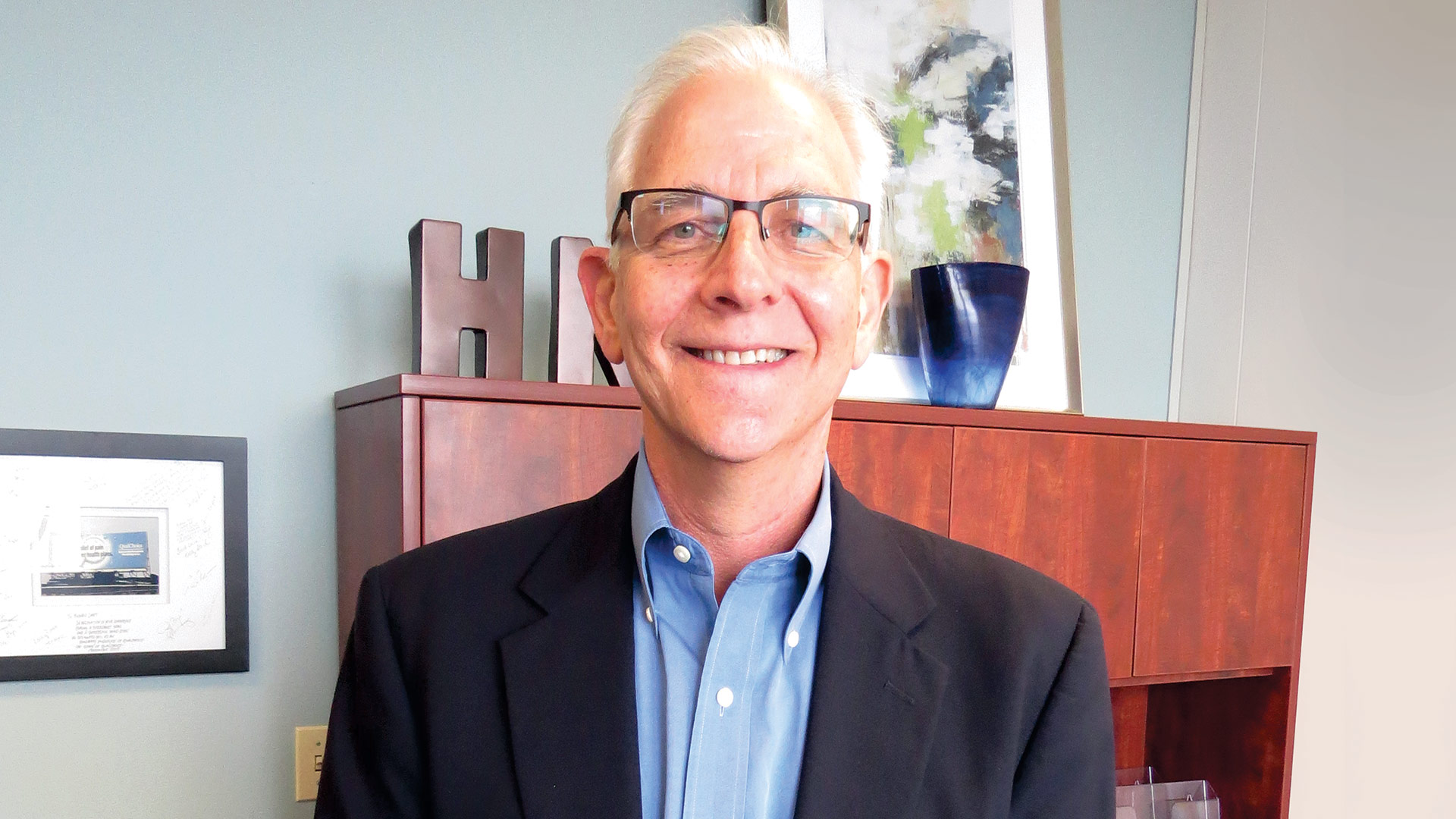
For roughly two decades, Richard Swift hop scotched the country on a series of interim assignments during which he shared his considerable expertise with several different health plans. As fruitful as this niche has been for Swift, he has traded his ‘interim’ tag for something permanent at Health New England — the role of president and CEO — and at a very unique and challenging time, for him and the company.

Richard Swift says he applied for the position of interim chief financial officer at Health New England with the expectation that this assignment would be like all the other longer-term interim gigs that had dominated his résumé for the previous few decades.

To say that things haven’t turned out as he originally thought would be a huge understatement.

For starters, while he interviewed for the position at Health New England’s offices in Monarch Place in downtown Springfield and had the opportunity to meet many of those in the finance team before starting, once he was awarded the job, he wouldn’t set foot in those offices for close to six months, and only then for short, very infrequent stops.

His arrival coincided almost exactly with that of COVID, which would put him in a working environment unlike anything he was used to.

“I’m told I was the first person they remotely onboarded,” he said, adding that several days before his scheduled start date the company had begun “experimenting” with employees working remotely, experiments that went very well. “They said, ‘I guess we’ll just send you a laptop.’ They sent me a computer, the IT folks hooked me up … the first time I came into the office was in August.”

While that was a huge adjustment for him, there was an even bigger one to come later.

Indeed, he would soon lose the word ‘interim’ from his business card — only he never actually had any in the CFO role, to the best of his recollection — not only from that title, but from the one he would be given roughly a year ago — president and CEO, succeeding Marion McGowan, who would become executive vice president and chief operating officer at Baystate Health, which owns Health New England.

After roughly 20 years of taking on year-long assignments as president of Medwise Partners and flying home every weekend from wherever he was stationed to his home in Arizona, he was planting roots; he even bought one of the Classical High Condominiums. When asked why, and why at Health New England, he said, “this was the right opportunity at the right place at the right time.”

It’s certainly been a whirlwind 18 months for Swift, whose tenure has, indeed, been dominated by the pandemic in every way imaginable, from its impact on Health New England and all health plans, to how and where the 380 employees at the company get work done, to the company’s work within the community and how it has changed in some ways but not in any of the ones that matter.

In a wide-ranging interview from his office at Monarch — he’s been there for several months now, usually without much company — Swift talked about all of the above. And in so doing, he provided some keen insight into what it’s been like to manage during a period unlike anything that a business manager has seen before.

“One size is not going to fit all. And for the 360 of our 380 employees who have been remote for the past year and a half, it’s been an almost seamless process. So given the fact that it’s been successful, it makes it hard to say ‘you have to come back, because it hasn’t been successful and that’s the only way to make it work.’”

“We need to be sensitive to our diverse workforce and their diverse and different needs,” he said, while summing up the challenge of leading at this time. “As a leader, I need to be sensitive to these varying needs, and I need to make sure the organization is sensitive to them. One of the things this experience has taught me is the need to be adaptable — both personally, for myself, and the organization and everyone within it — and accessible.”

As for the pandemic and health plans like Health New England, he said COVID and the changes resulting from it have brought challenges in many shapes and sizes, including to the bottom line. Indeed, while 2020 saw insurers facing far fewer claims than would be considered normal, and most eventually issuing rebates to members, 2021 has seen a surge in claims, with many health plans posting losses in the second quarter.

Swift said Health New England posted losses in that quarter as well (specific numbers were not available), but it has been able to avoid layoffs and cutbacks while actually increasing its involvement in the community, financially and otherwise (more on that later).

As for where and how people work, Swift said the pandemic gave him a first-hand look at how effective employees can be when working from their home office or dining-room table.

And he is using that experience as he goes about setting policy for the company. Above all else, he said he’s learned that managers must be practical and flexible in such matters.

“One size is not going to fit all,” he noted. “And for the 360 of our 380 employees who have been remote for the past year and a half, it’s been an almost seamless process. So given the fact that it’s been successful, it makes it hard to say ‘you have to come back, because it hasn’t been successful and that’s the only way to make it work.’”


Assignment Desk

As he talked about his lengthy tenure as a consultant to a number of different health plans and life as an ‘interim,’ Swift said he thoroughly enjoyed what he considered a ‘niche,’ and a successful one at that.

“For me, it was fun to parachute in somewhere and learn new people, new things, and new places; I liked to travel — it was fun to go back and forth,” he told BusinessWest, adding that his various gigs took him to all corners of the country and for assignments — usually as CFO but also CEO and COO — that varied with the health plan in question.

“Sometimes they were eight months long, sometimes they were for a couple of years,” he explained. “In some cases, people left suddenly; in other cases, it wasn’t suddenly, but they realized that they didn’t necessarily have the successor they thought they had, or they knew they didn’t have one and were going into a search process.

“Sometimes they were successful, strong health plans that just needed some expertise, and some of them were turn-arounds,” he went on. “What I brought to the table was that experience of running that business.”

Health New England was looking to tap into that experience early in 2020 when its CFO announced his retirement and a search for a successor had commenced. As noted earlier, Health New England was going to be another one of those interim assignments.

“When I looked at what was going on here, and at the opportunities that Baystate has with Health New England and that Health New England has with Baystate, I realized that there is so much that we can do together in the Western Massachusetts market.”

But things didn’t go according to script, starting with day one — or actually, even before day one.

Indeed, Swift was scheduled to start in April of 2020. COVID, as we all know, made its arrival in the 413 in mid-March, abruptly changing the landscape for the company and its new CFO (he quickly lost the interim tag), who wouldn’t have to get on a plane to take on his latest assignment.

He recalls that leadership at the company was going to use March 13, 2020, a Friday, as an experiment to see how effectively people worked remotely. That experiment went so well, and COVID invaded so suddenly, that workers never came back. In his case, he never arrived.

“I remember that conversation about ‘we’ll just send you a computer and you’ll work remotely,’ and how stunned I was at the time,” he recalled. “Because in 20 years of interim work, I pretty much got on a plane every week and flew out to my client. I was in my office in whatever city it was, on site. So the notion of doing all this remotely … it took me a while to wrap my head around it.”

While making these adjustments, Swift would soon have to make some others as well.

Indeed, in June, as McGowan was assuming some duties at Baystate while still serving as president and CEO at Health New England, Swift picked up some additional responsibilities for the company. And in October of last year, as McGowan moved to Baystate full time, he was asked to become CEO — again, without the ‘interim’ before the title.

When asked what he saw in Health New England that made him accept a permanent position — he had declined a few offers of that type in the past — he said it was a combination of things, including the team that was in place at Health New England and the opportunities he saw to partner with Baystate in meaningful ways.

“When I looked at what was going on here, and at the opportunities that Baystate has with Health New England and that Health New England has with Baystate, I realized that there is so much that we can do together in the Western Massachusetts market,” he said. “And I was really excited by those possibilities.”


By the Numbers

Looking back on his first 18 months with the company — and ahead to what might come next — Swift said this has obviously been a different and very challenging time for Health New England, and all health plans.

And the pandemic is just one reason why, albeit a big reason. At first, it contributed to a steep decline in claims because people were not visiting the doctor or seeking help even if they needed it. And then, it prompted a huge surge as people went back to the doctor and the emergency room, often with conditions made more serious by not seeking care through most of 2020. Meanwhile, treating COVID itself has often required lengthy and very expensive hospital stays.

“We’re certainly seeing more members having more claims and more services, and more-costly services than we did in 2019,” he said, adding that all this certainly contributed to the company’s second-quarter losses.
Richard Swift

Richard Swift

“COVID has brought a tremendous level of uncertainty. So all of us who put plans and benefits and rates in place for 2021 did that in the summer of 2020 in the middle of COVID, trying to understand what that would look like, and we’re doing it now for 2022, and we don’t know what next month is going to look like, let alone six months from now.”

But mostly, the pandemic has created uncertainty and even greater difficulty forecasting into the future, which creates problems for health plans, Swift noted.

“We set rates well in advance based on what we think our costs are going to be, and we don’t really have a chance to revisit those until the next year,” he explained. “And we obviously don’t know what the services are going to be or what new technologies are going to emerge.”

Elaborating, he said that telehealth technology certainly came of age during COVID, and Health New England, like many health plans, had previously created a telehealth benefit for members.

“In all of 2019, we had something like 850 or 900 total claims for telehealth visits; over the past year, it has averaged almost 30,000 per month,” he noted, citing this as just one example of how quickly and profoundly the landscape can change and health plans can be impacted by those changes.

Vaccines are another example, he said, adding that health plans couldn’t anticipate a two-dose vaccine when they set rates for 2021 last year, and they couldn’t have anticipated a booster, or third shot, as they set rates for next year.

“COVID has brought a tremendous level of uncertainty,” Swift went on. “So all of us who put plans and benefits and rates in place for 2021 did that in the summer of 2020 in the middle of COVID, trying to understand what that would look like, and we’re doing it now for 2022, and we don’t know what next month is going to look like, let alone six months from now.”

As noted earlier, the surge in claims and other factors have generated losses for some health plans in recent quarters and prompted layoffs and cutbacks as well.

Health New England has been able to avoid such cuts, he said, adding that, in the meantime, it has been able to maintain and, in many ways, increase its financial support to the community and its business community, something Swift takes great pride in.
“Even with everything going on with COVID, we’ve continued, and increased, the community support in terms of activities, foundations, grants, and actually providing PPE and hand sanitizer to people who didn’t have the wherewithal and the ability to get it themselves,” he said. “A lot of companies have turned inward, and many of them have laid people off; we made a conscious decision not to lay people off if we could at all avoid it, and fortunately, we have been able to avoid that.”

Elaborating, he said the company adjusted some of its sponsorship activity to accommodate what it would call “COVID mini grants,” roughly $300,000 worth of them that were awarded to community organizations that needed support to address their COVID-related needs.

In addition, the company created Where Health Matters grants, multi-year grants totaling $50,000 to $150,000 awarded to organizations to help offset the effects of COVID on their operations.


Giving the Forecast

Moving forward, Swift said the company would continue its pattern of flexibility and responsiveness to changing conditions as a fall shrouded by uncertainty approaches.

As he talked with BusinessWest, he noted that he was one of very few employees in the building that day, and things would probably remain that way for the foreseeable future. Employees were slated to return, in a hybrid format, by this time, he went on, but there is now more of a wait-and-see approach than a definitive schedule.

Meanwhile, Health New England has joined a growing number of businesses, especially in the broad healthcare realm, that have made vaccination a requirement for employment, a step taken in the interest of maintaining the safety of employees and customers alike.

“One of the things we’ve said concerning our coming back to the office is that we don’t know what we don’t know,” he said. “The only thing we know for sure is that things are going to change.”

And with those sentiments, he summed up both the short term and what could be called the post-pandemic world — whenever that arrives. When it does, said Swift, noting that, in some respects, it is already here, it won’t look like the pre-pandemic world.

And that goes for everything from how and where employees work to how people will access healthcare.

With regard to the latter, telehealth will almost certainly continue to increase in popularity, he said, adding that while the numbers have fluctuated as the pandemic has waned and surged, the technology has gained a broad level of acceptance.

“I do think you’ll see a lot more movement to leverage the technology that’s out there and technology that’s being developed for care without having to traditionally go back and see your doctor in the office on their schedule,” he explained.

As for the office setting and what it will look like, Swift said things simply won’t go back to the way they were in 2019. Companies have learned that employees can work effectively in remote settings, and thus it only makes good business sense to allow them to continue doing so, either in a fully remote fashion or in a hybrid format now being tried by many area businesses of all sizes.

“We have some departments that, by and large, were partially remote before and will be partially, or maybe completely remote in the future,” he explained. “The work they’re doing is such that it’s fine remotely, and they’ll stay that way.

“We have not come out with any edicts that people have to be here on ‘x’ amount of days,” he went on. “Because we know that one size does not fit all and there are certain departments and functions that have very different needs than others; we came to the conclusion that an edict was as arbitrary as pre-COVID, Monday through Friday, 8 to 5, in some respects.”

And there’s a competitive aspect to creating flexibility with working conditions, he said, adding that Health New England can now hire talented individuals from outside the 413 and even outside the state because they have the ability to work remotely.

As for business strategy and long-term planning, Swift said COVID has certainly made such exercises more difficult. But companies still have to plan, he noted, adding that there must be layers of flexibility built into such plans.

“I think that COVID requires us to plan even further ahead, but be more nimble with those plans,” he explained. “Our original date for returning to the office was Sept. 1; with what’s happened over the past several weeks, we’ve pushed that back. But in the spring, we threw out that date of Sept. 1 as the one we were targeting, again with the caveat that everything is subject to change.”


Bottom Line

Swift told BusinessWest that, a few weeks back, his sister called him asking for recommendations on restaurants in Detroit, which she would soon be visiting.

He was able to help her, because that was one of the places he parachuted into while doing his consulting work.

That life has ended, at least temporarily, with a permanent assignment, one that is a far cry from what he thought he was originally signing up for back in March of 2020.

He was, by most accounts, the first Health New England employee to be onboarded remotely, but he certainly wasn’t the last. His first 18 months have been a learning experience on myriad levels, and in all ways it is still ongoing.


George O’Brien can be reached at [email protected]

Class of 2021 Special Coverage

In early May, BusinessWest, in keeping with a spring tradition, introduced its 40 Under Forty class of 2021.
Another tradition is to stage the gala to celebrate that class in late June. This year, due to COVID-19 and pending changes to the restrictions regarding large events, the gala was moved to Sept. 23. As that sold-out event nears, we thought it appropriate to reintroduce this stellar class of young leaders in the community.
They were the top scorers from a strong field of more than 200 unique nominations — a near-record number that made for a stern challenge for a panel of five judges.
As for the class of 2021, the honorees — 26 women and 14 men — hail from a host of different industries, from law to engineering; from education to healthcare; from energy to media, just to name a few. But there are, as always, some common denominators, including excellence within one’s profession, a commitment to giving back to the community, dedication to family and work/life balance, and a focus on what else they do in each of those realms.View this year’s 40 Under Forty digital flipbook here!


The class of 2021 will be celebrated on Thursday, Sept. 23 at the annual 40 Under Forty Gala at the Log Cabin Banquet & Meeting House in Holyoke. That gala will also feature the announcement of the winner of the seventh annual Alumni Achievement Award, a recognition program that salutes the 40 Under Forty honoree who has most impressively added to their accomplishments in the workplace and within the community, as chosen by a panel of judges.

Presenting Sponsor

Sponsors

Alumni Achievement Award

When BusinessWest launched its 40 Under Forty program in 2007, it did so to identify rising stars across our region – individuals who were excelling in business and through involvement within the community –and celebrate their accomplishments. In 2015, BusinessWest announced a new award, one that builds on the foundation upon which 40 Under Forty was created. It’s called the Alumni Achievement Award (formerly the Continued Excellence Award). as the name suggests, will be presented to the 40 Under Forty honoree who, in the eyes of an independent panel of judges, has most impressively continued and built upon their track record of accomplishment.

This year’s nominations are CLOSED. Nominate next year’s Alumni Achievement Award recipient HERE.

2021 Alumni Achievement Award Presenting Sponsor

Special Coverage Wealth Management

Dollars and Sense


There are many myths concerning money, with many of them transcending generations of people in the same family. The truth is that many of these myths — including the one about how money will make you happy and solve all your problems — are false. Worse, these myths tend to limit one’s thinking and limit their financial success.

By Charlie Epstein


Most people do not realize they have myths about their money.

And even more people don’t take the time to analyze where these myths come from and why people hold them to be true.

I have worked with thousands of people over the past 41 years as a financial advisor. In the process, I have identified 15 myths people have about their money, which limit their financial and personal success.

A myth is defined as “an unproved or false collective belief that is used to justify something.” The biggest myth we have about money is that “it will make me happy and solve all my problems.”

Do you think money makes you happy?

Are you sure? Want to bet?

Did you know that 90% of all lottery winners go bankrupt within three to five years of winning the lottery? I’m talking millionaires. And the majority have stated they wish they never won the money. They’re miserable, depressed, and suicidal. How can this be?

“I am convinced that your money myths limit your thinking and impact how you approach your life and your finances.”

This happens because the most important thing in their life has been to get money, and now that they have it, they have no idea what to do with it. They often go on a massive shopping spree and buy all sorts of material items that don’t bring any lasting joy or fulfillment. And, more importantly, they stop working or doing anything productive to give their life purpose, meaning, and real value. What they fail to do is stop and ask themselves, “beyond money, what makes me happy?”

I am convinced that your money myths limit your thinking and impact how you approach your life and your finances. The three biggest financial myths most people have are:

1. My home mortgage needs to be paid off when I retire so I don’t have a payment;

2. I’ll be in a lower tax bracket when I retire; and

3. My home is an investment.

My father believed all three of these myths. When he retired, he and my mother moved to Florida to build the house of their dreams, on the golf course of his dreams. He was going to pay cash for that house — $500,000. He was 68 at the time. I said, “Dad, I want you to take out a mortgage instead.”

My dad was shocked. “A mortgage! For how long?”

I said, “for 30 years.”

“Thirty years!” my Dad bellowed. “I’ll be dead before it’s paid off!”

“So what do you care?” I smiled. “You’ll be dead!”

To which my father asked, “what will your mother do?”

I said, “she doesn’t play golf, and she doesn’t play mahjong, so if you die before her, I will sell that house and move her back north!”

I convinced my Dad to put $100,000 down and finance the other $400,000 with a 30-year mortgage at 5%. This was 1992. Bill Clinton had come into the White House and raised the marginal tax rate from 36% to 39.6%. There went money myth #2 — the belief he would be in a lower tax bracket when he retired (a belief I am sure many of you reading this article share).

That didn’t happen. The good news was, he could write off and deduct 40% of his mortgage payments in the first 15 years because it was all mostly interest. My dad was now ‘leveraging’ other people’s money (OPM) by using the bank’s money to take out a mortgage, and Uncle Sam’s money (USM) by deducting 40% of his mortgage payments.

The net cost for my dad to borrow the bank’s money was 3% (5% x 40% = 2%, which he could deduct, so his net cost to borrow that money was 3%). I said to my parents, “If I can’t make you net more than 3% on your $400,000, fire me as your financial advisor.” We averaged 7% to 8% on their money for the next 13 years of his life.

When my dad passed away, I sold my mother’s home in Florida, at a $100,000 loss. This was 2005, and the real-estate market in Florida was overbuilt, and no one wanted to be on a golf course. So much for the third money myth about your home being an investment. I than moved my mother back north and built her a home in an over-55 community. She was 79 at the time, and she said to me, with a twinkle in her eye, “son, do I get to take out a mortgage?” My mother is now 94, and she still has a mortgage — at 2.5%.

What does my mother care about? She only cares that she has enough money to pay for everything she desires to do. What do I care about? That I’m not tying up her money in a ‘dead asset’ — her home. She can’t eat it or drink it, and it doesn’t generate any income for her. And it is not an investment. I know I can make more than 2.5% on her money by using OPM to generate her even more income.

The key to being financially successful with your money is to understand how to maximize OPM and USM to make money on ‘the spread.’ The spread is the difference between what it costs to use other people’s money and what you can make investing your money somewhere else.

Let me add one big caveat to this discussion. If, psychologically, you must have your mortgage paid off so you can sleep at night … then pay it off. I always say psychology trumps economics. Just remember, you may feel good having it paid off, but economically, you won’t make as much of a return on your money and your assets.


Charlie Epstein is an author, entertainer, advisor, entrepreneur, and principal with Epstein Financial. He also presents a podcast, Yield of Dreams; yieldofdreams.live; (413) 478-8580.

Banking and Financial Services Special Coverage

Open for Business

Romika Odedra says the branch’s layout emphasizes the customer experience.

Holyoke-based PeoplesBank recently expanded its presence in Connecticut with a branch in West Hartford. The new location is projected to help the bank grow its already considerable portfolio of consumer and commercial business from south of the border, especially in an ongoing climate of mergers and acquisitions.


When PeoplesBank opened its newest branch in West Hartford on August 30, it wasn’t exactly its first foray into Connecticut’s capital region. Far from it.

“This is a retail opening in West Hartford, but half of our commercial business is in Connecticut already — actually, about 60%,” said Matt Bannister, the bank’s senior vice president of Marketing & Corporate Responsibility.

“Some is up in the Granby-Windsor-Suffield area,” he went on, alluding to PeoplesBank’s first three Connecticut locations, in East Granby, Suffield, and West Suffield. “Some is down here in the Hartford region, and it actually goes all the way down to the shore. We’re kind of catching up with this retail storefront because the commercial customers want a presence here. They’ve been saying to us, ‘come down to Connecticut.’ And West Hartford just makes sense; it’s a great community, and a good place to be.”

Aleda De Maria, executive vice president of Consumer Banking and Operations, said a growing commercial presence in Hartford County cried out for a full-service physical branch.

“The banking centers are there for when they need a little more contact, when they have a little more complexity, or they just want to expand their relationship. We need to make sure we have everything.”

“We absolutely need it. The majority of our new accounts are still opened at brick-and-mortar locations. For more complex conversations, customers want to talk to a person, and they want to have that live interaction. There still is a need for that face-to-face contact.

“I think what the industry is trying to do with the self-service channels — with online, with mobile, with video bankers — is give people the ability to do the quick, day-to-day transactions when they want to, without having to park and go in and talk to somebody, and get it done quickly,” she went on. “The banking centers are there for when they need a little more contact, when they have a little more complexity, or they just want to expand their relationship. We need to make sure we have everything.”

Michael Oleksak, executive vice president and chief lending and credit officer, said all those Connecticut dollars in the bank’s commercial portfolio have not come mainly from the Granby-Suffield area, but predated those physical locations.

Matt Bannister with one of the West Hartford branch’s two interactive video teller machines.

Matt Bannister with one of the West Hartford branch’s two interactive video teller machines.

“We have a significant amount of business in the Greater Hartford area, specifically in the Farmington, Glastonbury, West Hartford communities and downtown Hartford, but we also go as far as New Haven and Greenwich. So our tentacles are fairly long when it comes to our Connecticut presence.

“Most of that is in commercial real estate, which tends to be more transactional,” he went on. “We are able to do a lot of full-service banking for these commercial real-estate customers because of our cash-management expertise and the different products we have, but without a branch presence, it’s really difficult to do business banking.”

The branch presence in West Hartford allows the team to do more commercial and industrial (C&I) lending, and complements a recent expansion of the bank’s C&I team with former TD Bank veterans, Oleksak noted.

“We have a very strong following now, and I think by having a physical presence there, we’ll become a more visible part of the community,” he went on. “We do support our current borrowers, including with a lot of their philanthropic initiatives, but it’s kind of behind the scenes because we don’t have a presence there. But with a physical presence, and with the disruption in the market with the M&T acquisition of People’s United, it will really open the door for us to be a bigger part of the community.”

De Maria agreed. “We’ve already created such a solid foundation with our name and then with the physical presence from the acquisition we did in Suffield in 2018,” she told BusinessWest. “And now, with our West Hartford presence, I think we have a solid opportunity to bring the service we provide for our commercial customers to our retail-customer world, and really marry those two sides together and make an impact.”


Making Contact

Many visitors to the new branch will first notice the interactive video tellers, one in the entry and one in the drive-thru lanes, bringing the bank’s total number of such machines to 22 at 17 locations. Users can call up a live teller in Holyoke who manages four or five machines at once.

“That way, we can be open seven days a week and have extended hours and not have to have people physically in the branch. And the video banker can do almost any transaction,” Bannister said, noting that Peoples is the only bank in the Hartford to offer the service. “Part of our technology story is good, consumer-facing technology.”

Romika Odedra, vice president and regional manager, said customers appreciate face time with a live person rather than interacting with a machine and the more limited options available at an ATM. And Bannister added that, with the pandemic still raging, many customers appreciate being able to conduct complex transactions in a contactless way.

“We are able to do a lot of full-service banking for these commercial real-estate customers because of our cash-management expertise and the different products we have, but without a branch presence, it’s really difficult to do business banking.”

“Video tellers are something we’re proud to bring to the market,” De Maria said. “It brings seven-day-a-week banking to West Hartford and our surrounding areas.”

Once inside the branch, customers will see pods instead of traditional customer lines — a model Peoples and other banks have been implementing for years. Customers can stand beside the teller and even see what he or she is looking at on the computer screen, if necessary. “In the beginning, people were like, ‘where do I go?’” Odedra said. “But it’s so easy — it’s warm, it’s welcoming, it’s not ‘there’s the line.’ It’s nice to have that one-on-one experience.”

The branch also employs a ‘universal banker’ model, Bannister said. “Any bank employee you see out here can do all the transactions. You can go to a teller pod or pop into an office if it’s more convenient or you just want privacy to have a conversation.” In other, more specialized offices down the hallway from the main area, he added, the bank will offer a mortgage expert, a wealth adviser, and other ancillary services.

And in front, at the main entrance, is a high table, couch, and coffee bar. “We’re trying to say to people, ‘come on in and hang out; get to know us a little bit,” Bannister said. “The thought is, we want to have sort of an open storefront.”

That’s partly to reflect the neighborhood the branch is in, with restaurants and small shops lining the streets and the shopping and dining mecca Blue Back Square just down the road.

“This area really is hopping with foot traffic,” he said. “And if you’re a bank with a retail storefront, you want foot traffic.”

Those who drive to PeoplesBank will appreciate the free parking lot the bank shares with the town’s Post Office.

“I used to work at a different bank, and that was the biggest issue we had, the parking,” Odedra said. “I’m so glad we have the parking we have. We don’t have to rush the customer out; we have time to have that one-on-one with them and invite them to have a cup of coffee.”

Bannister said West Hartford has been an enthusiastic town to work with, from its Chamber of Commerce to local economic-development leaders.

“Right from the start, when we were saying we wanted to come down, they were like, ‘how can we help?’ We’re in a lot of communities, and some of them are very welcoming, and some are maybe not so much. This one has been great to work with.”


Opportunity Knocks

The branch is fully staffed as well, with a mix of on-site and hybrid workers, reflecting the current makeup of the entire PeoplesBank organization. Some are West Hartford natives who know the market, Bannisher said, while some were attracted by working near all the nearby restaurants and other neighborhood amenities.

Aleda De Maria

Even in an age of mobile banking, Aleda De Maria says, people still want face-to-face interaction at branches for many services.

There’s room to expand in Hartford County, he added, with plans to open at least two more branches in the next couple of years.

“We’re coming in with a message of ‘we’re here, and we’re here to stay, and we can do everything the big banks do, but with a local feel and local decisions,’” De Maria said. “And I think that’s what’s missing in banking in general nowadays — being able to bank how you want to bank but also at a community bank where you don’t have to worry about who’s going to buy them.”

That presence means civic involvement and philanthropy as well, Bannister said, noting that PeoplesBank plans to give close to $60,000 in the first month alone to local organizations like Habitat for Humanity, Hands on Hartford (which assists with food pantries and the homeless population), the United Way, Foodshare, and even two West Hartford community events the bank will sponsor this fall and next summer.

“Right from the start, when we were saying we wanted to come down, they were like, ‘how can we help?’ We’re in a lot of communities, and some of them are very welcoming, and some are maybe not so much. This one has been great to work with.”

“We feel like we’re leading with the values we want to be known by in the community, which are innovation, technology, customer service, and the community support.”

De Maria agreed with Bannister than broadening the bank’s footprint in Connecticut is a must. “We will continue to actively look for physical locations, primarily in Hartford County,” she said. “We’re not opposed to outside Hartford County should it make sense, but in Hartford County, we feel we have an opportunity for our brand to really make an impact in the community.”

And that means expanded business, including commercial lending, Oleksak said. “I think there’s tremendous opportunity in this market for us, given our size and the experience of our lending staff. We’re very diverse, and between small business, large commercial real-estate loans, and now C&I expertise, I think we bring a lot to the table. It’s a great opportunity for us.”


Joseph Bednar can be reached at [email protected]

Community Spotlight Special Coverage

Community Spotlight

By Mark Morris

Russell Fox (left) and Karl Stinehart say Southwick benefits from its recreational amenities

Russell Fox (left) and Karl Stinehart say Southwick benefits from its recreational amenities, but needs commercial and industrial development as well.

When they talk about managing their town into the future, officials in Southwick emphasize the word “balance.”

In order for the town to remain a desirable place to live, said Karl Stinehart, chief administrative officer, there needs to be a combination of housing and recreation areas as well as commercial and industrial development.

“We like to point out that Southwick is a recreational community,” he noted. “We also want to make sure our zoning allows for commercial and industrial developments because the taxes they contribute will keep our town an affordable place to live.”

Russell Fox, vice chair of the Southwick Select Board, reinforced the recreational community description by pointing to the Congamond Lakes, which make up nearly 500 acres of recreational space in town. “Also, the Southwick Rail Trail has become a gem in our community, running 6.5 miles through town.”

Another big recreation activity happens at the Wick 338, the popular motocross track that hosted a national event in July and drew more than 30,000 people to Southwick.

In recent years, living at the lakes has become more desirable, and, as a result, prices for houses and lots are skyrocketing. As lake property increases in value, it also drives up the tax bill for residents there.

“I’m concerned about the retirees who have lived on the lake for years who may now have trouble staying in their homes because of the tax increases,” Fox said. “If we can attract more business to Southwick, we can help offset that tax burden.”

One company, Carvana, proposed to build a 200,000-square-foot facility off Route 10 and 202 in Southwick. Carvana is a website that allows consumers to buy used cars completely online and have them delivered to their home. The $100 million facility would have stored, repaired, and cleaned cars for delivery across the Northeast. Carvana projected the Southwick site would have employed 400 people and paid $900,000 each year in property taxes to the town.

The project was initially approved by the town’s Planning Board and Select Board, but hit a snag when a local group called Save Southwick strongly opposed the facility. In a series of public meetings, the group cited concerns about safety, traffic, and burdens on the town’s infrastructure. As the project became more controversial, Carvana withdrew its proposal this summer.

To kill the project that late in the process was frustrating for some, but Fox looks at the Carvana situation as a learning experience for everyone involved.

“It became clear from a vocal group that if a project is too big, they won’t support it,” Fox said. “Even those opposed to Carvana learned how government works, so if that encourages more civic engagement, then we’re all for it.”

Stinehart said the town is currently developing a new master plan that includes a process to allow earlier citizen input on zoning decisions to avoid episodes like Carvana in the future.

“The idea is to have these discussions sooner rather than later when we are considering a project,” he explained. “This also gives citizens an opportunity to learn more about the laws and the process of getting things done.”


Responding to a Crisis

When the pandemic struck last year, Southwick was still able to keep the town’s services running.

“All our departments in town continued to provide services and got us through the height of the pandemic by being flexible and adaptive,” Stinehart said.

The Town Hall building where many municipal functions are located remained open for most of the pandemic. Like towns everywhere, Southwick relied on remote online platforms like Zoom for meetings when necessary.

In March 2020, Southwick was one of the first communities to hold a town meeting outside. Because Southwick has an open-meeting form of government, Fox explained, a town meeting was held in the Southwick High School parking lot.

The west side of the Greens of Southwick

The west side of the Greens of Southwick is almost full, while homes on the east side have yet to be constructed.

“It was a special meeting with one agenda item, the decision to treat the lakes with alum,” he noted. Alum — or aluminum sulfate — is commonly used to keep algae blooms down and improve water quality. “The timing was important because we had to treat the lakes by the first week of April, otherwise the alum would not be effective.”

In 2020, Stinehart noted, it was especially important to make the lakes usable. “People couldn’t wait to get outside and do something recreational, so we made sure the lakes were ready for the summer.”

Southwick at a glance

Year Incorporated: 1770
Population: 9,502
Area: 31.7 square miles
County: Hampden
Residential Tax Rate: $17.59
Commercial Tax Rate: $17.59
Median Household Income: $52,296
Family Household Income: $64,456
Type of Government: Open Town Meeting; Select Board
Largest Employers: Big Y; Whalley Computer Associates; Southwick Regional School District
*Latest information available

People also spent more time in their yards, which benefited Southwick farmers. Fox said area farms sold more plants for flower beds than ever before in 2020. “Most plants sold out early because people were stuck at home and wanted to get outside to do things in their yard.”

The pandemic also delayed the full celebration of Southwick’s 250th anniversary from happening in 2020. After a kickoff event on New Year’s Eve in 2019 that brought out hundreds of residents and featured fireworks, an outdoor event in February 2020 followed, featuring ice sculptures. Then the pandemic kicked in and put further events on hold.

On Nov. 7, the actual 250th anniversary of the town’s founding, officials in Southwick arranged a call with officials in Southwick, England. That was followed by a parade that traveled through all the neighborhoods in town.

“It was a rolling parade that was well-received because people could go out their door or to the end of their street to see it,” Stinehart said. “The people in town really appreciated it.”

The 250th celebration still has one event remaining, a full parade for people to attend on Oct. 16 with fireworks later that evening at Whalley Park. Fox called the October events a “belated birthday celebration.”

Both Stinehart and Fox have been impressed with the interest in the anniversary, as more than 50 residents joined the organizing committee for the 250th celebration.

“We had a good mix of people on the committee, some who had just moved to town and others who have lived here their entire lives,” Fox said.

Stinehart quickly added, “no other committee in town has that kind of turnout.”

As the town gradually makes its way out of the pandemic, Stinehart mentioned a regional grant program undertaken with the town of Agawam to provide microlending for small businesses.

The town treated the Congamond Lakes in the spring of 2020

The town treated the Congamond Lakes in the spring of 2020 to improve water quality for people clamoring to enjoy the outdoors during the pandemic.

“We are encouraging small businesses that need help to apply for these grants,” he said, adding that Agawam is the lead community on the grant.

Looking forward, Stinehart hopes to use funds from the American Rescue Plan Act (ARPA) to address water and sewer projects in Southwick. Fox spoke in particular about a water-pressure situation town leaders are hoping to address with the ARPA funds. He said projects like this sound like mundane details but can have real and lasting impacts on the town.

“If we address the water-pressure problem, it improves our fire-protection ability and ultimately affects homeowners’ insurance rates for residents,” Fox added.


Places to Call Home

The town has more new homes in the works, most notably the Greens of Southwick, where new, homes are being custom-built on each side of College Highway on the property of the former Southwick Country Club. The west side of the Greens development is nearly full, while construction on the east side has not yet begun.

Stinehart said he would like to leverage ARPA funding to increase broadband infrastructure in Southwick. In a separate effort, the town has met with Westfield Gas + Electric’s Whip City Fiber division to explore the feasibility of fiber-optic internet service for Southwick.

To address future energy savings for the town, Southwick has applied for a Massachusetts Green Community designation which would make it eligible for grant funding on a number of energy-efficient projects.

The tax rate for Southwick is scheduled to be released in the fall, and Stinehart said the goal is for a single uniform rate that will be competitive with other communities “because that’s good for business.”

Despite the issues around Carvana, Fox added, Southwick has welcomed plenty of new businesses and has seen expansion for some already there.

“By letting everyone know Southwick is open for business, we can keep this beautiful place where people want to live,” he said. “It’s all about that balance.”

Wealth Management

How the Pandemic is Reshaping This Decision for Americans

By Jean M. Deliso, CFP


After a year of Zoom calls, a deadly virus, inflated real-estate values, and a crazy stock-market surge, many Americans, mostly Baby Boomers, who can afford to retire are taking the plunge.

This pandemic caused mayhem for everyone. It drove the healthcare industry almost to collapse, families lost loved ones prematurely, parents became teachers, and many businesses did not survive. But amid all the gloom and doom was a silver lining for many. The government became efficient with quick economic actions, families re-evaluated the benefits of family time, pollution got a brief time out, and businesses became more electronically efficient, to name a few.

Through all the challenges, people took time to re-evaluate their priorities in life. Many are choosing to rethink their future and what is important to them going forward. In fact, about 2.7 million Americans 55 or older are contemplating retirement years earlier than they had imagined because of the pandemic, according to a Bloomberg report. Between increasing retirement-account values, those lucky enough to have pensions, an increase in home values, and government funds that have been put back into the economy, retirement is happening sooner than expected for many.

Jean M. Deliso

Jean M. Deliso

“Whatever your circumstance, achieving your retirement objectives will not happen automatically. The earlier you start planning, the better off your chances are of enjoying a happy, fulfilling, and long retirement.”

As a certified financial advisor, I have met with many individuals contemplating retirement who have decided “enough is enough — life is too short.” Some reasons include a scare with cancer five years ago that made my client reconsider his commitment to climbing the corporate ladder, or “I’m just not happy doing what I’ve been doing for years; it’s no longer fun.” Potential retirees have either saved enough or have decided to spend less in their retirement years.

In contrast, many Americans who were pushed out of their jobs by the economic slide of the pandemic had to take an early retirement against their wishes. This has resulted in them receiving lower Social Security benefits and pension amounts. Twenty-two percent say the pandemic has forced them to spend their emergency savings, 10% have reduced their retirement-plan contributions, and 12% have withdrawn money from their retirement accounts, according to a survey by the National Institute for Retirement Security.

Unfortunately, both scenarios have resulted in increased stress to Americans in the workforce regarding retirement. None of us know our date of death, which makes retirement planning tricky for most.

Too many Americans rely solely on Social Security. This pandemic proved that those benefits do work; checks were consistently received by Americans as the pandemic raged around them. This experience shows that the Social Security system works. Also, checks were sent to those who couldn’t find jobs.

Whatever your circumstance, achieving your retirement objectives will not happen automatically. The earlier you start planning, the better off your chances are of enjoying a happy, fulfilling, and long retirement. Here are a few steps to consider for a successful retirement:

1. Determine your cost of retirement. This includes your monthly living expenses, your age to retire, and your life expectancy.

2. Apply your income sources. Review what you will have available to you, such as Social Security, pensions, immediate annuity payments.

3. Withdraw from your portfolio assets. Take withdrawals against your portfolio assets to make up any difference needed. These assets may include brokerage accounts, money-market accounts, 401(k)s, 403(b)s, IRAs, and annuities. (Withdrawals may be subject to regular income tax and, if made prior to age 59½, may be subject to a 10% IRS penalty. In addition, surrender charges may apply.)

4. If necessary, consider changes. If, after steps 1-3, you are falling short on your plan, consider changes such as saving more, redefining your retirement age, or considering part-time employment during retirement.

5. Consider a professional. This can help you clarify your goals and objectives in retirement.


Jean M Deliso, CFP is a financial adviser offering investment-advisory services through Eagle Strategies LLC, a registered investment adviser.

Wealth Management

And When It Comes to Investing, That’s Not a Good Thing

By Jeff Liguori


Malcolm Gladwell, prolific non-fiction writer, journalist, and podcaster, has written extensively about mastering a subject. In his book Outliers, Gladwell builds upon the idea that it takes a person 10,000 hours to become a master, or expert, at something.

The premise was originally put forth nearly 50 years ago by two academics, Herbert Simon and William Chase, and published in the American Scientist specifically to address how one becomes an expert chess player. Gladwell elaborated on the idea by saying that an innate ability, or even exceptional intelligence, on a particular subject was not enough to excel or master that subject. In an article he wrote for the New Yorker in 2013, he stated “nobody walks into an operating room, straight out of a surgical rotation, and does world-class neurosurgery. And second — and more crucially for the theme of Outliers — the amount of practice necessary for exceptional performance is so extensive that people who end up on top need help.”

Today it seems that expertise is under attack. Whether it is climate science, economics, or healthcare. There are no hurdles to gathering information, factual or not, which has emboldened many to opine on, and in some instances act on, areas for which they are not equipped. Being informed and questioning authority is not a bad thing. But acting as an expert has the potential for serious long-term damage.

Let’s break down the 10,000 hours concept. A young woman decides on majoring in accounting her junior year in college. She has four semesters until graduation, where most of her classes are related to her major. Let’s assume that is a total of 100 hours of study. She graduates, gets a job in a major accounting firm where she likely works 50 hours per week. At night she studies for her CPA exam. After three years, between college study, work, and prepping for the CPA, she has logged approximately 3,200 hours of work in a single subject: accounting.

And it is likely in a specific area, either audit or tax work. At 25 years of age, she is about one third of the way toward the 10,000-hour rule. This is precisely why a business or individual, with complex accounting issues, would not hire a young person with that level of experience. The analogy could be made for doctors, lawyers, or diesel mechanics as well.

In the investment field, the information needed to manage one’s money is widely available. I’m not aware of a network that dedicates 24 hours to the practice of medicine. But turn on CNBC and it is a non-stop barrage of stock quotes and ideas, complete with bright colors, loud voices, and blinking lights. It thrives on our culture of excitement and reality TV.

Almost anyone with a decent Internet connection can invest his or her hard-earned funds. And early success reaffirms the dangerous bias that ‘I’m a talented investor.’ Until one morning, inevitably, that “hot stock” that had appreciated 78% is down 50% before the market even opens because the drug the company produced killed people in the FDA trial, or the company missed earnings by a wide margin, or the CEO was a fraud. Much of which could’ve been fleshed out by skilled analysis and a disciplined approach to investing to avoid such scenarios.

There is nothing inherently wrong with the do-it-yourself trend. However, the intersection of social media, and the assault of information from a variety of sources (some questionable), has empowered many to shun traditional expertise that has been built upon years of study. Logging on to WebMD to diagnose your poison ivy or watching a YouTube video on installing a garbage disposal, or even learning about a public company’s business on Yahoo! Finance is smart. Reputable sources with solid information. But these are part-time tasks, which don’t carry significant consequences if done incorrectly. They are suited for the curious individual with a penchant to learn.

But for more complex matters, requiring a longer success horizon — say preserving your retirement funds to support your lifestyle once your earning years are over — it is best to leave that to a full time, educated, disciplined professional. They’re called experts.


Jeff Liguori is the co-founder and chief Investment officer of Napatree Capital, an investment boutique with offices in Longmeadow as well as Providence and Westerly, R.I.; (401) 437-4730.

Banking and Financial Services

Developments of Interest

By Mark Morris

John Howland calls the recent flood of deposits an “unprecedented” situation.

John Howland calls the recent flood of deposits an “unprecedented” situation.

John Howland admits that the word ‘unprecedented’ is overused these days. But for him and others in the banking business, it seems like the right word to describe all that’s going on.

Howland, president and CEO of Greenfield Savings Bank, was talking specifically about the record amounts of deposits flooding into banks — and what’s happening with those deposits, or not happening, as the case may be.

In the early months of the pandemic, from January to June of 2020, banks in the U.S. saw a surge of nearly $2 trillion in deposits. At that time, most people were staying close to home and had reduced their spending to necessities.

As a local example, PeoplesBank reported deposit increases of 33% since last April, or nearly $700 million in additional deposits.

More deposits arrived as businesses applied for Paycheck Protection Program (PPP) loans and consumers received stimulus checks from the government. During normal times, money gets deposited but does not stay in an account for long. These days, however, deposits are staying and growing to an extent Howland and his counterparts in Western Mass. have never seen before.

And while record deposits would seem like a good thing, all that cash is sitting still, for the most part, and the key to any bank generating revenue and earning profits is loaning its deposits out to borrowers.

“I never thought I would say there are too many deposits and not enough people to lend the money to,” said Tony Worden, president and chief operating officer of Greenfield Cooperative Bank. “The point of our business is to get deposits … so this goes against everything we were taught.”

In normal times, banks take in deposits and lend that money out to businesses and individuals. Balancing the number of loans to deposits helps determine what interest rates will be paid to savers and charged to borrowers. Banks profit on the difference between the two.

“I never thought I would say there are too many deposits and not enough people to lend the money to. The point of our business is to get deposits … so this goes against everything we were taught.”

But these are certainly not normal times. These days, banks have record deposits and diminished loan demand — for several reasons, which we’ll get into later — which translates to lower interest rates for savers and borrowers, as well as lower profits for banks.

Howland pointed out that the lower interest rates are great news for people looking for a business loan or a mortgage.

“The residential and commercial rates are down to levels that were inconceivable 10 years ago,” he said, adding that, moving forward, banks will be competing much harder to entice people to borrow money than deposit it.


By All Accounts

There are many theories as to why deposits have soared at area banks — and why those deposits are going largely untouched.

Dan Moriarty, president and CEO of Monson Savings Bank, suggested that once people tightened their spending during the pandemic, they may have changed their overall spending patterns, which is in many ways good for consumers, but not for the overall economy.

“It’s good for consumers to increase their savings and their capacity to have money, but it also slows down the economy,” Moriarty told BusinessWest. “We believe there is still some pent-up rebound spending by both consumers and businesses that we will be seeing.”

Howland agreed, noting that there are a number of reasons contributing to the surge in deposits, with one of them bring what he called a “flight to quality.”

“With all the uncertainty in the world, people understand that putting their money into a bank where their deposits are insured by the FDIC is one of the safest moves you can make,” he said, adding that, despite the consistently upward movement of the stock markets, many consumers are seeking a safe harbor in which to park their money.

Tony Worden says he never expected there to be too many deposits and not enough people to lend to.

Tony Worden says he never expected there to be too many deposits and not enough people to lend to.

As for the business of converting those deposits into loans — and revenue — many of those same factors are holding some consumers back from borrowing, said those we spoke with, although many have pressed ahead with purchases of new cars, new homes, and vacation homes.

Meanwhile, a number of businesses, still struggling to fully recover from the pandemic, are being cautious about moving ahead with expansions or new ventures. And for those that have the confidence to move forward, the current workforce crisis is keeping them from doing so.

Indeed, Worden said the current labor market is affecting activity in commercial lending. “We have businesses that can’t take on all the jobs they want because they don’t have enough staff to get them done.”

Moriarty agreed, but spoke optimistically about the prospects for improvement when people return to the workforce in large numbers. “Once our businesses can hire the staff they need and expand their products and services, they may look to the banks to borrow and grow.”

The surge in deposits and frustrating inability to put much of them to work has been one of many stories to unfold during what has been a challenging — and very different — year for area banks.

They all played a key role in helping businesses apply for PPP loans when they became available last spring. During two rounds of PPP loan offerings, Moriarty said, Monson Savings processed 565 loans totaling nearly $50 million.

In the early days of the pandemic, qualifications for PPP loans included every small business that was affected by COVID-19. Tom Senecal, president and CEO of PeoplesBank, said many applied because they didn’t know if they were going to be impacted.

“It’s good for consumers to increase their savings and their capacity to have money, but it also slows down the economy. We believe there is still some pent-up rebound spending by both consumers and businesses that we will be seeing.”

“There were many businesses that thought they were going to be hit hard but really weren’t,” he noted, giving an example of construction companies that were closed early in the pandemic but were then designated as essential and allowed to reopen.

Worden added that many companies that received PPP loans in the first round didn’t touch the money until it became clear their loan would be forgiven by the government. Once they figured out how to get loan forgiveness, they didn’t sit on the next round.

“We’ve had around 96% of our first- and second-round PPP loans forgiven with no denials,” he said. “The only ones who haven’t been forgiven have all started the process.”

All the bankers who spoke with BusinessWest said they were grateful to process PPP loans for area businesses. Worden said the urgency to get the first-round applications done required an “all hands on deck” approach that brought in many outside the loan department. His story reflects similar efforts from the other banks.

Dan Moriarty

Dan Moriarty says the pandemic changed people’s spending patterns, which may not be good for the overall economy.

Another dominant story during the pandemic was the real-estate boom, driven in part by record-low interest rates. Moriarty said activity on the buying and selling side has been brisk for some time. “We’ve seen a lot of activity where people are moving into a new house or buying a second home, whether it’s for vacation or an investment.”

The low interest rates have also brought a significant increase in people looking to refinance their mortgage.

“While it’s smart for people to refinance their current debt to get a lower rate, it doesn’t necessarily create new funds for the bank,” Worden said.

In early 2020, Monson Savings opened a new branch in East Longmeadow to increase its access to more companies and consumers. Moriarty admitted he had some anxiety about the timing.

“We made the decision back when no one predicted the pandemic would last so long,” he said, noting that, after a soft opening in August 2020, the branch has performed far above its forecasted numbers. “We’ve seen deposits increase 40% to 50% from when we opened.”


Bottom Line

All the bankers we talked with agreed the next three to six months will give everyone a better idea of where the economy, COVID, and the prospects for area banks are headed.

“I think we need to focus on getting through these next few months, and let’s get through the Delta variant,” Worden said. “We all have short-range goals, but we’re also keeping our eye on the long range.”

And that long-range forecast will hopefully call for taking that surge in deposits and putting it to work in ways that will bolster the local economy.

Banking and Financial Services

Know the Rules

By James T. Krupienski, CPA


At the start of the COVID-19 pandemic in the early parts of 2020, the concern of business survival was the number-one thought of countless businesses, with each industry having its own struggles. The medical industry was not without its own real concerns at that time, particularly given its role in the pandemic fight. People would continue to get sick, require treatment, and see their physicians, but how could it be done safely?

Recognizing the financial crisis that was about to overtake this industry, along with how detrimental it was for the industry to remain open and accessible to patients, the federal government took dramatic steps. In addition to Paycheck Protection Program (PPP) loans, for which medical practices were eligible, the Coronavirus Aid, Relief and Economic Security (CARES) Act also allocated funds directly to the medical industry through the Department of Health and Human Services (HHS) and the newly created Provider Relief Fund (PRF).

James T. Krupienski

James T. Krupienski

“While the COVID-19 relief provisions, as part of the CARES Act, provided a lifeline for many medical, dental, and other healthcare-related practices during the pandemic, that support was not without certain compliance requirements and reporting.”

The first round of funding, which was completely unexpected to many, occurred in early April 2020, when $30 billion was deposited directly into the accounts of eligible practices. Throughout 2020, additional funds were later rolled out in phases 2 and 3, as well as through targeted distributions to specific industries, such as rural providers and skilled-nursing facilities. Of importance is that, for all practices receiving these funds, there are several rules to be followed.

While the COVID-19 relief provisions, as part of the CARES Act, provided a lifeline for many medical, dental, and other healthcare-related practices during the pandemic, that support was not without certain compliance requirements and reporting, which we will dive into within this article.


Attestations

First, within 90 days of receipt of the funds, each provider was required to attest to certain terms of use. For those electing to return the funds, it was required to be done within 14 days of this attestation. Attestations were required for receipt of funds in all phases and were to be completed through use of a portal with the HHS (www.hhs.gov/coronavirus/cares-act-provider-relief-fund/for-providers/index.html#how-to-attest).


Reporting

As part of the attestation process, any provider receiving more than $10,000 in payments through the PRF would be required to report on use of the funds. While the specifics on the exact reporting took months to be finalized and continued to be reworked by the HHS, the general guidelines were known. Barring no future changes, PRF dollars are to be applied in the order of:

1. Certain qualifying expenses that can be directly attributable to coronavirus; and

2. Lost revenues.

Of greatest importance is the understanding that the use of these funds must be kept separate and distinct from the use of other coronavirus-relief aid. For example, if you report on the use of a personnel or payroll related expense, it cannot also be tied to dollars used in applying for PPP loan forgiveness. Essentially, a practice cannot ‘double-dip.’

Initially, reporting was set to begin back in the summer of 2020, which was then pushed to the fall of 2020 and then again to Jan. 15, 2021. However, because of updated legislation and a change in administration, reporting had been delayed even further. In late June 2021, the reporting requirements were finalized, and the reporting portal is now open to many, depending on when funds were received (see chart).

For all recipients of the fund, it is important to continue to monitor this process so that a reporting deadline is not missed. To stay on top of this process, the HHS has been updating its site (www.hhs.gov/coronavirus/cares-act-provider-relief-fund/reporting-auditing/index.html) with current regulations.


Audit Requirement

One stipulation, not known to many, is that a government single audit is required if the combined federal funds (PRF and other federal assistance) received were more than $750,000. Note that PPP funding does not count towards this total.

A single audit would be required of an organization that has $750,000 or more in federal awards. While typically, federal funding is awarded to not-for-profits and governmental organizations, the HHS PRF has opened many organizations, including for-profit medical practices, to these compliance requirements. If a practice has received combined federal awards though the Provider Relief Fund in excess of $750,000, a single audit will be required.

While the majority of relief programs under the CARES Act (such as the Paycheck Protection Program) are subject to reporting requirements, the PRF has its own distinct rules to navigate. If your healthcare practice took advantage of the PRF in any amount, it is highly encouraged that you speak with an advisor as soon as possible to fully understand the compliance requirements. Navigating federal compliance can be intimidating and confusing, especially if this is your first time doing so. Speaking with an advisor can demystify this process and help ensure that you understand the regulations.


James T. Krupienski, CPA, MSA, is a partner in the Healthcare Services niche for Holyoke-based Meyers Brothers Kalicka, certified public accountants and business strategists; (413) 536-8510; www.mbkcpa.com

Opinion

Editorial


Way back in mid-March of 2020, as the state was shutting down due to COVID-19, we wrote about the great resiliency of this region’s business community and how it would be sternly tested because this was the greatest challenge anyone in business had ever faced.

Little did we know then just how stern this test was going to be and how long it would last. But 18 months later, not only do the challenges remain, but they have in many ways multiplied. Thus, a time that many thought would be normal — meaning what we knew in the fall of 2019, or at least something approximating it — is nothing like we imagined.

Indeed, this was expected by many to be a time when most of the hard decisions would be behind us. Decisions about whether to lay off or furlough people. Decisions about whether to forge ahead with programs and events that would bring people together in large numbers. Even decisions about whether to stay in business — or certain kinds of business.

As summer comes to a close and a fall shrouded by question marks looms, we’re facing some of those decisions again (or still) — and some new ones as well.

Some businesses may be forced to look again at mask mandates or at requiring proof of vaccination before one can enter an establishment or even a college campus. Others have already made vaccination a requirement for employment, and many others are contemplating whether to go this same route.

These are hard decisions that often put employers at odds with their customers and employees at a time when they simply don’t need to be alienating either constituency.

All of this makes it clear that the fight against this pandemic is far — as in far — from over.

Indeed, just as those who went home in March 2020 thinking it would be for just a few weeks soon learned how wrong those projections were, we’re all now forced to recalibrate, again, just how long we’ll be battling this pandemic and how heavy the fight will get.

What is clear is that the victory celebrations, if we can call them that, from just before Memorial Day, when the governor removed all remaining restrictions on businesses, were certainly premature.

Meanwhile, there are new challenges, from shortages of needed goods and raw materials to escalating prices and hard choices about if and how to pass them on to customers who are finally coming back in large numbers. Then, there’s a workforce crisis that has impacted almost every business sector and forced several types of businesses to reduce hours of operation, curtail services, or both.

There is hope that, with the end this month of the federal bonus being paid to those receiving unemployment benefits, things will improve on this front. But those hopes are countered by the reality that this problem is deep-rooted, and it may be some time before there is real relief.

And there are still more hard choices about whether, when, and how to bring workers back to the office, decisions now made even more difficult by the Delta variant and the great uncertainty about what this fall will be like.

Going back to what we wrote in March 2020 … this region’s business community is, indeed, resilient. And it needs to be. Because, contrary to what we were all hoping, it isn’t any easier being in business now than it was then. And in many ways, it’s even harder.


Opinion

A Step in the Right Direction

Late last month, Gov. Charlie Baker, heeding a call from a number of business groups that have steadily pushed for unemployment-insurance (UI) relief, proposed using $1 billion in state surplus money to help ease the burden facing the state’s business community from the widespread layoffs that occurred during the pandemic.

The governor filed a supplemental budget proposal with the Legislature that would set aside the $1 billion for unemployment rate relief as part of a broader $1.6 billion plan to spend the bulk of what remains of a massive, $5 billion state budget surplus from the fiscal year that ended on June 30.

If approved, the measure certainly won’t cover what is expected to be a $5 billion shortfall in the state’s UI fund — a shortfall that the Baker administration and the Legislature decided to address with an assessment that businesses will pay over the next 20 years or more — but it will help reduce the burden on the state’s businesses, and it represents a minor breakthrough of sorts when it comes to this administration and the business community.

Baker’s proposal shows that at least some people are paying more than lip service to the plight of the state’s businesses, which have often been overlooked when it comes to the long list of victims of this pandemic. Despite large amounts of local, state, and federal assistance in many different forms, from grants to loans, businesses in many sectors are still struggling in the wake of the pandemic.

This spring and summer have bought some relief to those in many sectors, including hospitality and tourism, but the road back to normal, pre-pandemic levels of revenue and profit is paved with uncertainty, especially as the highly contagious Delta variant continues to gain strength.

Businesses are, by and large, and to one degree or another, regaining their footing. But this improved stability, if it can even be called that, is threatened by many different forces — including the huge bill that has come due from so many of the state’s residents being forced into unemployment by the pandemic.

As we’ve said before, the state’s businesses didn’t cause the pandemic, and they should not have to bear the brunt of paying the enormous unemployment-insurance burden now facing the Commonwealth — not when the state has roughly $5 billion in federal American Rescue Plan Act funds at its disposal and the huge surplus from FY 2021, resulting from a flood of federal aid and better-than-expected tax revenue.

In announcing his proposal regarding unemployment insurance, Baker said “this UI piece would send a big, positive message to employers and employees that we’re looking to try to help them with what is going to be one of the biggest expenses … because of the pandemic.”

He’s right, but it’s more than a message — it’s a solid step, and hopefully a solid first step — toward addressing the unemployment-insurance deficit.

The Legislature will have a lot on its plate when it gets back in session after Labor Day. We hope the governor’s UI proposal gets the proper consideration and eventually becomes part of the plan to spend down the rescue-plan monies and the deficit.

Things are better for the business community, but many challenges remain, and this proposal is a big step in the right direction.


Picture This

Email ‘Picture This’ photos with a caption and contact information to [email protected]


Margarita Madness


Margarita Madness 2021, the Amherst Area Chamber’s signature networking event, returned this year, outdoors, under the pavilion at the Young Men’s Club of Hadley made possible by presenting sponsor Steve Lewis Subaru and supported by more than 40 participants and sponsors for 20 margarita tastings. Funds were raised for CHD’s Not Bread Alone as well as the chamber’s work throughout the year to create, maintain and promote a vital, thriving business climate in the Amherst Area. Back row, from left, John Page, Membership & Marketing manager of the Amherst Area Chamber; Marissa Faldasz from The Hangar & Pub of Amherst, first prize winner of 2021 Margarita Madness with its Habanero Pineapple Ginger Margarita; Steve Lewis, CEO of Steve Lewis Subaru, presenting sponsor of Margarita Madness; Claudia Pazmany, executive director of the Amherst Area Chamber; and Samantha Heraty from the Hangar & Pub of Amherst; Lower row, left to right, Alex DeLiefde from the Hangar & Pub of Amherst; Youssef Fadel, of New England Promotional Marketing and founding chair of the Annual Margarita Madness 2021 Committee; and Chrystal Thompson, from the Hangar & Pub of Amherst.


To Honor America


Karen Nogueira, director of Client Relations for PV Financial Group, recently sang the national anthem at Fenway Park to open up a Red Sox game against the Tampa Bay Rays. Nogueira has been with PV Financial Group since 2006.


Hefty Deposit


Monson Savings Bank (MSB) announced it will donate $100,000 to the Food Bank of Western Massachusetts to support people who struggle with food insecurity. MSB was a major charitable donor to the Food Bank’s capital campaign, which aims to raise $22 million for the new Chicopee facility that will serve as its future headquarters, set to open in 2023. Pictured, from left: Erica Flores, president of the Food Bank’s board of directors; Andrew Morehouse, executive director of the Food Bank; and Dan Moriarty, Monson Savings Bank president and CEO.