
Home Archive by category Sections (Page 53)

Sections

Sections Sports & Leisure

Game On

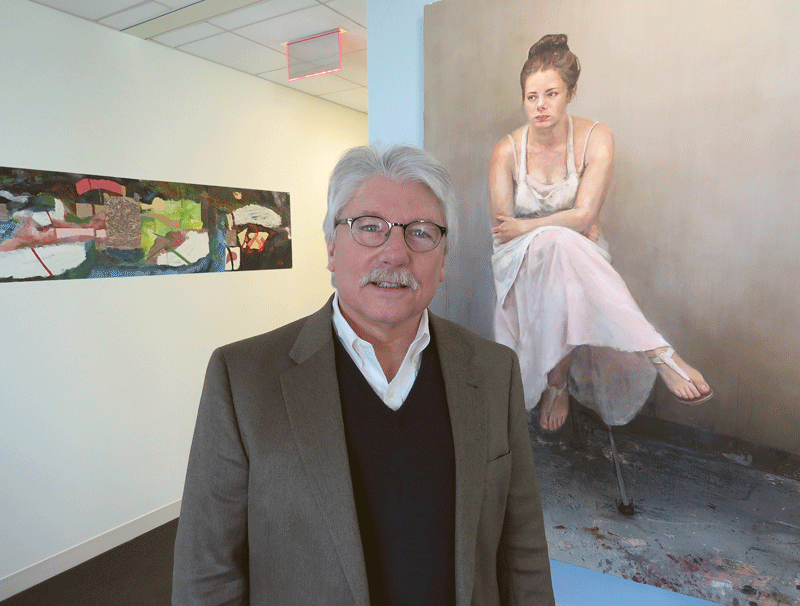
Dr. Scott Cooper, one of PSSP’s managing partners

Dr. Scott Cooper, one of PSSP’s managing partners

No one is totally immune from a sports injury, from kids on the playground to serious college athletes to ‘weekend warriors’ in middle age. Treating those injuries — and helping reduce the risk of sustaining them — is one of the key niches of Pioneer Spine & Sports Physicians, which has been helping patients return to full function for more than a quarter-century.

No one is totally immune from a sports injury, from kids on the playground to serious college athletes to ‘weekend warriors’ in middle age. Treating those injuries — and helping reduce the risk of sustaining them — is one of the key niches of Pioneer Spine & Sports Physicians, which has been helping patients return to full function for more than a quarter-century.

The first weeks of spring — not spring in name only, like the bouts of snow and 20-degree weather that dotted late March and early April this year, but actual spring weather — typically send weekend warriors, after a long winter indoors, scurrying for their golf clubs and tennis rackets.

And sometimes, they’re a little too enthusiastic.

“We see a lot of that this time of year — golfers getting the clubs out, only to develop back pain. But we also see hockey players from the over-40 league come in with all kinds of injuries,” said Dr. Scott Cooper, one of the managing partners of Pioneer Spine and Sports Physicians (PSSP), the largest private physiatry practice in the Northeast.

“I had one guy who was probably in his mid-50s, and he had recurrent tennis elbow, and I could not get him to stay off the court,” Cooper told BusinessWest. “I treated him for probably six months for tennis elbow, and I don’t think he ever missed a match — whereas, if he was on a team, I could tell his coach, and his coach would say, ‘you’re going to sit out two weeks until this thing clears up.’ Sometimes the weekend warriors can be determined.”

Cooper and his team should know, seeing a broad range of patients every day, from high-school and college athletes nursing knee and shoulder injuries to the inpatient clients PSSP manages in acute-care settings like Weldon Rehabilitation Hospital and Bronson Rehabilitation, recovering from spinal-cord injuries, neurologic conditions, and amputations.

Physiatry, also known as physical medicine and rehabilitation, is a specific type of practice, he explained, but one with a wide range of applications.

“One of the nice things about physiatry is it’s a very broad specialty, and one of our primary goals is to provide state-of-the-art care in all facets of physiatry,” Cooper explained.

That includes the acute rehab setting at Weldon and Bronson, where Pioneer treats people who have conditions that cause a loss of function, so they can’t return home, but no longer need to be in a medical/surgical unit of the hospital.

“These are people who have had strokes, for example, or spinal-cord injuries or head injuries or complex medical conditions or amputations or other neurologic conditions like multiple sclerosis or ALS — things that cause them to lose function, but they’re now medically stable so they can tolerate rehabilitation.

“We manage those patients, and we’re also involved in pain management, both acute pain and chronic pain, in all our offices,” he added, adding that the practice’s physiatrists also deal with spinal conditions, back pain, herniated disks, pinched nerves, and much more. “We have procedure suites in most of our offices where we can do X-ray guided procedures on people’s spinal conditions, and we are also involved with the Surgery Center of New England; we do procedures there that are not office-based, things that are a little bit more invasive and require anesthesia.”

In short, it’s a one-stop shop for a host of conditions, with one goal in mind — to return patients to the highest function possible — in both their work and play.

The Sporting Life

That ‘play’ factor — sports medicine — is a niche PSSP is well-known for, and around 90% of sports injuries require no surgery at all, Cooper noted.

“If they do require surgical treatment, we work closely with some of the orthopedists in the area who provide those services. But for the other conditions, we’re able to treat them very effectively, and we do that with a lot of recreational athletes, weekend warriors, and we also work with several of the high schools in the area.”

PSSP’s West Springfield location is one of seven offices spanning the Pioneer Valley from East Longmeadow to Brattleboro.

PSSP’s West Springfield location is one of seven offices spanning the Pioneer Valley from East Longmeadow to Brattleboro.

Pioneer also provides team doctors for area colleges including Springfield College, American International College, and Westfield State University, both during and between games.

“For example, hockey and football are the two main ones where they need to have someone on the sidelines according to the rules of their conference, so we provide game coverage in case of an injury during the game,” he explained. Meanwhile, if an athlete is injured in practice, they’re seen in a PSSP office as soon as possible.

“We recognize that one tenet of physiatry is quick return to function,” he said. “So we focus on getting athletes in quickly, diagnosing their condition, treating them, and returning them to the field as quickly as is safe.”

They take the same approach to occupational medicine, working with client businesses — Pioneer has a therapist at MassMutual full-time, for example — on job-site injury prevention and treatment. “We focus on them just the same way we focus on athletes — get them in quickly, diagnose their condition, determine what they can and can’t do in a rapid manner, and treat them comprehensively so they can return to full function.”

While about 70% of all occupational injuries involve the spine, that’s not the case with athletes, Cooper noted. “They have a whole different set of issues. The majority of what we see with athletes involve the knee or the shoulder. And most of those we treat non-operatively. We establish a diagnosis, and if that diagnosis requires a surgical evaluation, we facilitate that, and the surgeons we work with are very accommodating and allow us to get that done very quickly.”

Beyond treatment, though, the team at Pioneer emphasizes prevention. As an example, its physical therapists attended an educational program, developed at Syracuse University, that works to prevent ACL injuries in female athletes, who have a much higher predilection to those injuries than men.

“It’s almost an epidemic,” Cooper said. “Some of the reasons are unclear, but female soccer players and lacrosse players, will come in with ACL injuries, and once you have that kind of injury, it can be devastating, and it generally does require surgery, and requires a long course of rehabilitation.

“So this program has been shown to prevent those injuries,” he went on, explaining that Pioneer’s PTs were certified through the week-long course to teach a group of specific exercises to area sports teams, who come in during the preseason for a week of intensive training, and then continue on a regular basis. The exercises focus on stabilizing the knee and have been shown to prevent injuries.

“That’s one way we try to head off injuries and reduce their likelihood,” he added. “Unfortunately, there’s no way to eliminate them.”

No Slowing Down

That goes for young athletes and older weekend warriors, who often arrive at PSSP with a combination of a sports injury and something more degenerative, such as an arthritic condition.

“It’s something they can normally get by with, but if somebody with an arthritic shoulder is doing OK, but he goes and plays some tennis, now he’s got a rotator-cuff problem. The springtime is definitely a big time for those types of injury, but we see them year-round. And sometimes they can be the hardest to treat because these people are very determined to get back out there.”

With America’s senior population surging, Cooper’s team sees patients from that age group as well.

“We’re definitely seeing an older population that is increasingly active, but we encourage that; we want our patients to be active. There’s good data in the medical community that one of the ways to increase longevity and reduce morbidity in the population as a whole is to have an active lifestyle,” he told BusinessWest, adding that one of the mottos in his profession is that “physiatry adds years to life, and life to years.”

“That’s the idea — we want people to stay active, and it almost doesn’t matter what activity; we want them to engage in exercise, and when they do that, they may encounter some injuries and have some problems, and we’re here to address that.”

Because injuries are often an inevitable speed bump in an active lifestyle, he went on, it’s encouraging that treatments have evolved to allow people to return to full activity much sooner than before.

“Injuries that once may have been considered incompatible with continued competition, we now see as being treatable — and treatable with less-invasive means,” he said. “That can be anything from tendinitis to things like arthritis. In fact, arthritis of the knees is something that used to be, ‘you can take Advil, or you can have a knee replacement’; there wasn’t a whole lot else you could do for it.”

Now, however, physiatrists may tackle the issue with anything from orthotics to new types of bracing; from new exercise methods to injections that go far beyond what traditional cortisone could achieve. “So there are definitely more options to treat those conditions with different means that don’t necessaily require surgery, and allow people to be more active.”

It helps, he said, that Pioneer provides a comprehensive, multi-disciplinary, holistic model of care, where physiatrists, physical therapists, and other team members work together and consult with each other on troublesome conditions. If a patient with a spine injury isn’t progressing quickly enough or has too much pain, the providers aren’t afraid to work together to find a solution.

“Basically, anything that’s needed to treat the conditions we treat, we have under one roof,” Cooper said. “We have specialized nerve testing, guys who focus on different areas … we have all kinds of talent and skill to bear.

“I think that really serves to benefit the patient,” he went on, “because they’re not just getting one doctor and one opinion; they’re getting a team approach. I think that is unusual in a private-practice setting, and I think that’s one of the main reasons we’ve been so successful.”

Bottom Line

When asked what he enjoys about his job, Cooper paused for a moment and smiled.

“We think we have the best specialty in the world,” he said. “Whether I’m treating an 80-year-old patient with a stroke or an amputation or I’m treating a 16-year-old with a sports injury, I’m working with people who want to be here, who want to be treated, who have definite goals. And it’s very satisfying when they reach those goals.”

Joseph Bednar can be reached at [email protected]

Sections Sports & Leisure

Refreshing the Data

The American College of Sports Medicine (ACSM) has released a new official statement regarding energy drinks, published in the college’s clinical review journal, Current Sports Medicine Reports. “Energy Drinks: A Contemporary Issues Paper” provides guidance and warnings regarding these beverages because of the dangers they present to at-risk populations, primarily children who are the most vulnerable and the target of marketing efforts.

“Energy drinks are extremely popular, and concerns about their consumption are coming from every sector of society, which is why we’ve published these recommendations,” said Dr. John Higgins. “Our review of the available science showed that excessive levels of caffeine found in energy drinks can have adverse effects on cardiovascular, neurological, gastrointestinal, renal, and endocrine systems, as well as psychiatric symptoms. More needs to be done to protect children and adolescents, as well as adults with cardiovascular or other medical conditions.”

Energy drinks are highly caffeinated beverages that often contain myriad vitamins, minerals, amino acids, and herbal mixtures. As a global authority for sports medicine, exercise science, and the promotion of participant safety, the ACSM is focused on facilitating high performance while protecting those who compete in athletics or engage in other forms of physical activity. By publishing the new recommendations, the ACSM is helping consumers to understand the risks associated with rapid and excessive consumption of energy drinks.

“When used safely and with moderation, energy drinks may have some short-term, performance-enhancing effects. However, users are generally unaware of the many potential adverse reactions that could have long-term effects, some of which are quite serious,” said Higgins. We highly encourage consumers, parents, physicians, athletic trainers, personal trainers, and coaches to follow these recommendations.”

Children and adolescents appear to be at particularly high risk of complications from energy drinks due to their small body size, being relatively caffeine-naive, and potentially heavy and frequent consumption patterns, as well as the amounts of caffeine. The message that these beverages are not intended for children needs to be reinforced and widely disseminated, Higgins said.

At the same time, he added, marketing should not appeal to vulnerable populations. Currently, manufacturers of energy drinks advertise on websites, social media, and television channels that are highly appealing to both children and adolescents. Target marketing to sporting and other events involving children and adolescents should not be permitted.

Regardless of health and fitness level, and until such time that proper safety and efficacy data are available, the ACSM recommends that energy drinks should be avoided before, during, or after strenuous activities. Some of the deaths allegedly due to energy drinks have occurred when a person consumed them before and/or after performing strenuous activities.

Clearly, Higgins notes, investment in awareness and educational resources highlighting the potential adverse effects and safe use of energy drinks is required. Significant efforts should be made to educate consumers regarding the clear and present differences between soda, coffee, sports drinks, and energy drinks. Energy-drink education also should be a priority in school-based curricula related to nutrition, health, and wellness.

The ACSM is calling for a research agenda to prioritize key questions about the acute and chronic effects of energy-drink use. At a minimum, standard safety and efficacy studies should be performed and submitted to the FDA by manufacturers. Well-designed and controlled research is required to examine the increasing frequency of adverse events being reported by emergency departments.

In addition, the organization notes, healthcare providers must talk to their patients about energy-drink use and report adverse events to watchdog agencies like poison-control centers, the Consumer Product Safety Commission, and the FDA. A national registry should be set up to specifically track energy-drink side effects with mandated reporting requirements.

Among other specific recommendations, the ACSM argues that energy drinks should not be consumed by children or adolescents; should not be consumed by other vulnerable populations, including pregnant or breastfeeding women, caffeine-naive or sensitive individuals, or individuals with cardiovascular or medical conditions; should not be used for sports hydration; should not be mixed with alcohol; and should bear a label such as “high source of caffeine” or “do not mix with alcohol.”

Banking and Financial Services Sections

Addition by Addition

While there are plenty of banks doing business in this region, Jeff Sullivan says, there is an opportunity for a new one that is based locally.

While there are plenty of banks doing business in this region, Jeff Sullivan says, there is an opportunity for a new one that is based locally.


Jeff Sullivan has spent more than 30 years working in and around the region’s banking community, most recently as chief operating officer for United Bank.

So he understands fully when people use that term ‘overbanked’ to describe this area. In fact, he’s used that word himself over the years as he’s watched branches proliferate in a host of area communities.

But over the past few years as he’s done consulting work for the industry after leaving United following its merger with Connecticut-based Rockville Bank, Sullivan says he’s come to understand that just because there are branches on almost every corner in some cities and towns, that doesn’t mean the region’s population — and especially certain segments of it — are adequately served.

“There’s plenty of good local banks around,” he told BusinessWest. “But there is opportunity, because the largest financial institution based in the city of Springfield now is a credit union. So there is opportunity for a Springfield-based institution with local decision making.

“I was getting asked by a lot of people — individuals I would just bump into on the street or in the supermarket — ‘can you send me to a good lender?’ or ‘can you give me a good bank to go to?’ or ‘are you going back to work? I need to make a switch,’ he went on. “After that happened 10 or 12 times in a relatively short period of time, I began to think there was room for a new bank.”

And these sentiments, grounded in what Sullivan considers more scientific analysis and sound due diligence, has led him to partner with attorney Frank Fitzgerald and Jim Garvey, owner of St. James Check Cashing, to begin the process of adding a new bank to the landscape.

It will be called New Valley Bank & Trust, the partners announced late last week, adding that the team is now seeking approval from the Federal Deposit Insurance Corp. (FDIC) to form the new institution before launching a capital raise aimed at amassing $25 million to $30 million.

This will be the first new bank launched in the area since NUVO Bank (since acquired by Community Bank) opened in 2008. New Valley Bank & Trust almost certainly will open in better economic conditions — NUVO had the misfortune of launching just as the country was heading into the Great Recession — and it will have a different model, said Sullivan.

Indeed, while NUVO was focused on a mostly digital banking model — it has just one branch, in downtown Springfield — New Valley will have slightly more of a brick-and-mortar foundation, he explained.

It will be headquartered in downtown Springfield and will start with a full-service branch somewhere in the city (the location has not been determined) and a second location on the west side of the Connecticut River (again, that community has not been chosen) within a year after opening.

New Valley, like most banks now doing business in this region, will offer a full range of business and retail banking services for residents and small to medium-sized businesses in Massachusetts and Northern Conn.

Like NUVO, though, this proposed new institution will focus considerable energy on commercial lending, said Sullivan, who has spent most of his career in that realm. Despite stern competition in the commercial market and a huge number of established players, he sees room for opportunity.

That opportunity — on both the commercial and residential sides of the ledger — results from the spate of mergers and acquisitions in recent years, he told BusinessWest, an ongoing development that has decreased the population of community banks and, as he noted, left Springfield without a bank headquartered within its boundaries.

“With fewer local banks servicing the region, we have heard from countless residents and small to medium-sized business owners that are looking for a level of customer service and credit that is simply not available in the market today,” Sullivan said in a press release announcing formation of New Valley. “Our focus will be on meeting this demand with personalized attention and cutting-edge technology that will shorten wait times for funding decisions and opening accounts.”

On the commercial side, the bank will focus on smaller loans and quick turn-around times, said Sullivan, adding that the mergers in recent years have created opportunities to meet a specific niche.

“We have a lot of good banks around here, but they’ve grown to a larger size,” he explained. “And they’re focusing on larger deals than they probably did 10 years ago. I think there’s a real opening for personal service being delivered to small businesses.”

But another point of emphasis for New Valley will be what Sullivan described as a still-large population of area households that are “unbanked and underbanked.”

Elaborating, he said research continues to show that the volume of business at check-cashing establishments has remained fairly stable — and comparatively high — in this region, despite considerable improvement in the economy over the past decade.

Sullivan and his partners estimate there are some 20,000 households in Hampden County alone that use a bank sparingly, if at all, and in these numbers, he sees more opportunity in the form of need for a new bank.

“These are working women and men whose barrier to entry into the banking system has been too high for too long,” her went on. “As a local bank, we want to find opportunities to serve this significant segment of our community and create lifelong customers in the process.”

Elaborating, Sullivan noted that, in many cases, individuals or households don’t use banks because of a lack of trust or because of a bad experience — or several.

“The biggest reason, the FDIC says, is lack of trust,” he explained. “They don’t trust the system. People have had bad experiences; they got kicked when they were down, and it’s led to a lack of trust.”

In response, New Valley will offer products and services designed to build trust, he went on, such as bounce-proof checking accounts, incentivized savings accounts, and financial-literacy programs.

Sullivan said the need for a new, locally based, bank can be verified by the makeup of the 60 founding sponsors — what he described as a “large and diverse group of business owners and entrepreneurs from throughout the region — and the enthusiasm shown for the concept, especially among young business owners.

That’s significant, he said, because they will have to be the backbone of the customer base moving forward.

“We decided that, if we were going to do this, it has to be about a younger generation of business cohort,” he explained. “So we needed to know if the Millennials and the Gen-Ys care enough about this kind of stuff.

“We had a series of focus groups — we put about 100 people in a room, 20 people at a time, and we pitched them on what we were trying to do,” he went on. “About 60 people wrote checks to give us the seed money to get started, and of those 60, close to half of them were people under the age of 45. We were pleasantly surprised by that, and based on that response, we decided to take things to the next level, which is where we are today.”

—George O’Brien

Community Spotlight Features

Community Spotlight

Downtown Greenfield may look the same as it did decades ago, in many respects, but it has evolved considerably and morphed into a true neighborhood.

Downtown Greenfield may look the same as it did decades ago, in many respects, but it has evolved considerably and morphed into a true neighborhood.

Greenfield Mayor William Martin acknowledged that it isn’t exactly a scientific measure of either his downtown’s vibrancy or the efficiency of his long-term strategic plan for the central business district. But it certainly works for him.

He’s being told there’s a parking problem downtown. Actually, he’s been told that for some time. Until recently, the commentary involved the east end of that district by Town Hall, and the chorus was so loud and so persistent that the community is now building a 272-lot parking garage in that area, due to open in the fall.

But now, he’s also hearing that complaint about the east side of downtown, and he’s expecting to hear it a lot more with the opening of the Community Health Center of Franklin County on the site of the old Sears store on Main Street, a facility that will bring more than 100 clients and employees to that location every day.

In the realm of municipal government, parking problems generally, but certainly not always, fall into that category of the proverbial good problem to have, said the mayor, adding that a far worse problem is to have no parking woes — not because you have plenty of parking, but because no one is coming to your downtown.

And that was more the state of things in Greenfield for some time, Martin intimated, putting the accent on ‘was.’

Indeed, while Main Street may look pretty much the same as it did a few decades ago, at least at a quick glance, it is vastly different, and in some very positive ways, said the mayor, adding that his administration’s broad strategy has been to bring people downtown for goods and services and let this critical mass trigger economic development on many levels. And it’s working.

“We thought that, if we can bring people downtown and provide what they need, the free market will take care of people want,” he said, adding that the theory has been validated with everything from new restaurants to live entertainment to offices providing acupuncture and cardiology services.

Jim Lunt agreed. Now the director of GCET (Greenfield Community Energy and Technology), a municipal high-speed Internet provider, and formerly director of Economic Development for the community, he said the downtown has evolved considerably over the past decade or so.

Getting more specific, he said it has morphed from a traditional retail district, as most downtowns are, into more of a combination entertainment district and home for small businesses and startups.

“We’ve focused on small businesses that we can bring in, and we’ve worked a lot to build up the creative economy; our downtown, like many downtowns, looks a lot different now than it did 10 years ago,” Lunt told BusinessWest. “There are a lot more restaurants, a lot more opportunities for more social gathering, as opposed to what people would think of as traditional shopping.”

In addition to social gathering, there is also vocational gathering, if you will, in the form of both new businesses and also a few co-working spaces that are bringing a number of entrepreneurs together on Main Street.

To get that point across, Lunt, sitting in what amounts to the conference room in Town hall, simply pointed toward the window, a gesture toward the building next door, the Hawks & Reed Entertainment Center, which, in addition to being a hub of music, art, and culture, is also home to Greenspace CoWork.

That space, on the third floor, is now the working address for writers, a manuscript editor, a few coaches, a social-media consultant, and many others, and has become, said Lunt, maybe the best example of how Greenfield has put the often long-unoccupied upper floors of downtown buildings back into productive use.

MJ Adams, who succeeded Lunt as director of Economic Development, agreed, and she summoned another term to describe what downtown has become: neighborhood.

She said it has always been that to some extent, but it is now even moreso, with more living options and other amenities in that area.

“We’re starting to look on downtown as more of a neighborhood,” she explained. “We’ve always looked at it as the civic and service center for the county, but people are starting to perceive downtown Greenfield as a neighborhood that has a mix of housing styles, is attractive to a wide range of people, especially young people, has a lot to offer, and is very walkable.”

Greenfield didn’t get to this state overnight, said those we spoke with, noting that the process has been ongoing and more strategic in nature since the official end of the Great Recession and the arrival of Martin in the corner office (both of which happened in 2009).

Mayor William Martin says his broad strategy since being elected a decade ago has been to transform downtown into a hub for a wide range of services and make it a true destination.

Mayor William Martin says his broad strategy since being elected a decade ago has been to transform downtown into a hub for a wide range of services and make it a true destination.

That strategy has involved a number of tenets, everything from creation of GCET, which gives downtown Greenfield an important asset in a county where high-speed Internet access is a luxury, not something to be taken for granted, to a focus on making downtown a destination for a wide gamut of services, from education to healthcare.

For this, the latest installment of its Community Spotlight series, BusinessWest examines how these pieces have come together, and also at how they have positioned Greenfield for continued growth, vibrancy, and maybe even some more parking issues — the ‘good-problem-to-have’ variety.

Hub of Activity

To explain his broad strategy for Greenfield’s downtown, Martin essentially turned the clock back more than 200 years. Sort of.

Back in those days, he explained, Greenfield, anointed the county capital, was a supplier of goods and most services to the many smaller communities surrounding it.

Small steamships and rail would bring goods north on the Connecticut River to Greenfield, he explained, and residents of surrounding towns would make their way to the center of Franklin County to get, well, pretty much whatever they needed.

“I consider that a tradition and also a responsibility,” said Martin, now serving his fourth term. “And that’s what we’ve based our downtown on — providing what people need.”

It also has always done that with regard to government functions, he said, citing everything from the county courthouse, post office, and jail to Greenfield’s library, the largest in Franklin County. But Martin’s goal was to broaden that role to include education, healthcare, and more.

And specific economic-development initiatives, technology, societal changes, the community’s many amenities, and some luck have helped make that goal reality.

In short, a large number of pieces have fallen into place nicely, said those we spoke with, enabling downtown Greenfield to become not only a destination, or hub, but also a home — for people and businesses across a diverse mix of sectors.

These pieces include:

• A burgeoning creative economy that features a number of studios, galleries, and clubs featuring live music;

• A growing number of restaurants, in many categories, that collectively provide a critical mass that makes the city a dining destination of sorts. “There are 13 different ethnic restaurants, there’s some really good bars, several places for live music that weren’t here just a few years ago, and art galleries,” said Lunt. “I think that’s the biggest change downtown”;

• Greenfield Community College, which has steadily increased its presence downtown with a campus that brings students, faculty, administrators, and community leaders to the Main Street facilities;

• The community health center, which will bring a host of complementary services, including primary care, dental, and counseling for emotional wellness together under one roof in the downtown, where before they were spread out and generally not in the central business district;

• Other healthcare services. In addition to the clinic, a cardiologist has taken over an old convenience store downtown, said the mayor, noting that there is also an acupuncturist, a holistic center, a massage therapist, and other healthcare businesses in that district; and

• Traditional retail, of which there is still plenty, including the landmark Wilson’s Department Store.

Actually, these pieces haven’t just fallen into place by accident, said Martin, noting, again, that they have come into alignment through a broad strategic plan and specific initiatives designed to make the downtown more appealing and practical for a host of businesses, as well as number of existing qualities and amenities.

“We decided that we should do everything we can to provide the infrastructure necessary to attract people and entities when the economy turned,” he explained. “And we worked on a number of things that were real problems.”

High-speed Internet access was and is a huge component of this strategy, said Lunt, noting that it has been directly responsible for a number of businesses settling in the city.

Meanwhile, other parts of that strategic initiative include renewable-energy projects that have helped bring down the cost of energy; creation of a Massachusetts Cultural District, which has made the community eligible for certain grants; a façade-improvement project that has put a new face on many properties downtown, and many others.

Destination: Greenfield

The community already had a number of strategic advantages when it came to attracting both businesses and families, said Lunt, noting that, overall, while Greenfield’s location in rural Franklin County is limiting in some ways — contrary to popular opinion, there are actually few available parcels for large-scale developments, for example — it brings advantages in many others.

From left, MJ Adams, Mayor William Martin, and Jim Lunt all see many positive signs in Greenfield’s downtown.

From left, MJ Adams, Mayor William Martin, and Jim Lunt all see many positive signs in Greenfield’s downtown.

Elaborating, he said that many younger people prefer a rural setting to an urban one — for both living and working — and can find most of what they’re looking for in Greenfield.

That list includes a lower cost of living than they would find in Boston, Amherst, or Northampton; outdoor activities ranging from hiking to whitewater rafting; culture; a large concentration of nonprofits serving the county; and, yes, high-speed Internet access, something people might not find 20 minutes outside of downtown.

“It’s a beautiful area, and real estate is quite affordable compared to much of the rest of the state,” said Lunt. “And the Springfield-Hartford metropolitan area is now 1.2 million, and that’s not that far down the road; a lot of people would happily commute for 45 minutes to live here and get to jobs there.”

This combination of factors has attracted a number of young professionals, many of whom may have gone to college in Boston or another big city and started their careers there, but later desired something different, said Adams.

It has also attracted entrepreneurs, said Lunt, including several video-game developers, many of whom now share a business address — co-working space known as Another Castle.

Located on Olive Street in space that until recently housed the Franklin County registry of Deeds, it became home to the video-game developer HitPoint, which was located in Greenfield, relocated to Springfield, and has now moved back. And it has created a co-working space that enables other small game designers to take advantage of shared equipment and facilities, effectively lowering the cost of doing business.

Moving forward, the town’s simple goal is to build on the considerable momentum it has created through a number of initiatives. These include work to redevelop the former First National Bank building, vacant for decades and the last of the properties on the stretch as Bank Row to be given a new life.

The town’s redevelopment authority has site control over the parcel, said Lunt, adding that the next steps involve working with the state, private grant writers, and the city to acquire funds to convert the property into a downtown cultural center to be used for everything from a farmers’ market to perhaps a museum of Greenfield history.

If all goes according to plan, all the properties on Bank Row will be back in productive use for the first time in 40 years, he told BusinessWest.

Another initiative is the parking garage, which has been years in the making, noted the mayor, noting that it took several attempts to secure funding help from the state for the project.

The facility will ease a well-recognized problem, exacerbated by the new county courthouse in that area, and provide yet another incentive for people to come to downtown Greenfield.

As for parking at the other end of Main Street … well, that’s a good problem to have. For now, anyway.

George O’Brien can be reached at [email protected]

Features

The Trickle-down Effect

Rebeca Merigian, here with her son, Andrew Takorian

Rebeca Merigian, here with her son, Andrew Takorian, expects Park Cleaners’ contract with MGM to perhaps double the company’s current volume of business.

Rebeca Merigian says the slip was found, and promptly given to her, many years ago by a long-time customer, a description she quickly categorized as an obvious understatement.

Indeed, the date at the top is 1940, and thus this item, now displayed under glass, is a time capsule as much as it is a pick-up slip for a two-piece suit.

Start with the phone number at the top; there are just five digits because that’s all that were needed back then (ask your mother; actually, make that your grandmother). The name of the company was Park Cleaners & Dyers Inc. (the ‘& Dyers’ was dropped a long time ago because those services were discontinued). The address is Kensington Avenue in Springfield (the company moved to Allen Street in 1955). Even the slogan is different; back then it was ‘Dry cleaning as it should be done.’ Now, it’s ‘Family-owned and operated since 1935. We appreciate your business.’

Yes, much has changed since Edward Takorian, an Armenian who somehow escaped the genocide of 1915 and came to this country soon thereafter, went into business for himself.

There have been many ups and downs, said Merigian, Takorian’s great-granddaughter, who started working in the business on Saturdays when she was 9 and bought it from her mother three years ago. She noted that the company was started at the height of the Great Depression and has endured many other downturns over the next eight decades, and also the early death of her father. Not so long ago, there were more than 20 people working here; now there are four, including Merigian’s son and nephew.

But that number will be rising soon, thanks to what would have to be one of the biggest developments since that suit was picked up a year before the U.S. entered World War II — a contract with MGM Springfield, the $960 million resort casino that will open in about four months.

Park Cleaners has been awarded a contract to clean the uniforms for all 3,000 employees at the casino, and for the dry-cleaning of hotel guests and the MGM Springfield management team as well. Merigian couldn’t put a dollar figure on the contract, but she could certainly put it into perspective.

“I’m hoping that this will double our business,” she told BusinessWest, adding that the contract could give her the means to perhaps double the current workforce and pay the kind of benefits that are currently beyond the company’s reach. “My goal from this is to be able to provide health insurance for my employees who have been with through a lot of the challenges; I want to give back to them and provide more benefits and incentives so we can grow.”

Several other area businesses now have contracts with MGM or are in the process of finalizing one. Most will not be as life-changing as the one received by Park Cleaners, but they are all significant in some way.

Nick Noblit

Nick Noblit says the contract with MGM gives Yankee Mattress a new top line for its deep list of clients.

Take Agawam-based Yankee Mattress, for example. The company was originally asked to supply mattresses for all the rooms in MGM’s Springfield hotel, an order that Nick Noblit, the company’s general manager, admitted was too big to handle at this time. But the company will make California kings for the larger, high-roller suites, an assignment that will give the company additional business and some hopefully effective marketing material.

Meanwhile, Holyoke-based Kittredge Equipment Co. has secured one of the bigger contracts — this one to provide kitchen appliances and supplies to the many businesses that will do business at the casino.

There have been other contracts signed, and there will be many more agreements inked in the weeks to come as the countdown to the grand opening continues, said Courtney Wenleder, vice president and chief financial officer for MGM Springfield. She told BusinessWest that, as part of its host-community agreement, the company is required to apportion a percentage of its receivables to local companies.

But the company is striving to do more than just meet that obligation, she said, adding that MGM is looking to take the company’s philosophy regarding diversity and apply it to its vendor list. And this translates into extending opportunities to women (Kittredge is also woman-owned), minorities, and small businesses in general.

“MGM has a commitment to diversity and partnering with local vendors,” she explained. “It’s all about building the community together; there’s a symbiotic relationship — if the community does well, we do well, and vice versa.”

For this issue, BusinessWest looks at how the trickle-down effect from MGM Springfield, which began with local contractors taking part in the construction of the complex, is gathering momentum in the form of contracts to supply everything from knives and forks to marketing services. And while doing that, we’ll also shine a spotlight on some intriguing local businesses that have, by and large, flown under the radar.

The Rest of the Story

Wenleder told BusinessWest that many factors go into MGM’s decisions about which vendors to do business with and what might give a certain enterprise an edge over whatever competition emerges.

They range from quality of service and customer satisfaction, obviously, to whether, as noted, the business is minority- or women-owned. But there are some intangibles, and sometimes a little luck, that comes into play.

To get that point across, she relayed the story about how MGM Springfield now rents several apartments downtown, and they’re used, among other things, to house company executives visiting Springfield for extended stays.

Kittredge Equipment Co. owner Wendy Webber, left, with sales representative Amanda Desautels

Kittredge Equipment Co. owner Wendy Webber, left, with sales representative Amanda Desautels. The company will supply MGM Springfield with everything from appliances to glassware.

MGM CEO William Hornbuckle is one of these executives, and on one of his stays, he slept so soundly and comfortably that he took note of the label on his mattress (Yankee), later commented to those at MGM Springfield’s headquarters about his experience, and essentially initiated steps that would eventually lead to the company getting a contract.

“Bill commented about what a great night’s sleep he had on that mattress, and that pretty much secured their position,” Wenleder recalled with a laugh, adding that it wasn’t all that simple, but that bit of serendipity certainly got the ball rolling.

And the mattress contract serves as a good example of how MGM is trying to do business locally when it can and when it’s appropriate, said MGM Springfield General Manager Alex Dixon.

He noted, as Wenleder did, that there are times when MGM will simply add the Springfield casino to some existing contracts it has in place to provide certain products and services to the company’s existing properties.

Playing cards and dice would be good examples of this, he said, adding that MGM already has manufacturers providing those products. And, for the most part, there is no local company that makes such items.

But even with those products, there may be some opportunities for local businesses, he went on, noting, for example, that most playing cards are destroyed soon after they’re used, and MGM Springfield will use a local company to handle that work.

“We want to recognize what’s available in the local market and then tailor our supply chain to match what is happening in the local community,” he said while describing the company’s broad mindset when it comes to vendors.

Overall, MGM has a process in place when it comes to vendors, said Dixon, adding that the company actively solicits information from companies interested in doing business with it. The owners and managers of such ventures are invited to attend outreach events (they’re posted on the MGM Springfield website, for example), and through such events, companies become part of a database the company refers to when it needs specific products or services.

“Whenever there’s a business need, we want to find out if there are vendors, preferably local, who can help us to fulfill those needs — that’s step one,” he explained. “But informally, being members of the community, you really develop relationships.

“It’s no longer ‘hey there’s this great local brewer,’” he went on, while explaining how these relationships are created. “Now it’s ‘that’s Ray Berry from White Lion; maybe there’s an opportunity there.’”

In other words, familiarity breeds opportunity, and examples abound of how companies ranging from local caterers and computer hardware providers have come onto MGM Springfield’s radar screen — and are now doing business with the company.

The contract with Yankee Mattress is a good example of this phenomenon at work, said Dixon, confirming that the company was first presented with a proposal to furnish every room in its hotel now taking shape on Main Street.

But Noblet said such a large order would have necessitated additional hiring and other steps the company wasn’t ready to take.

But the contract to supply mattresses for the larger suites is a welcome addition and positive development for the Agawam-based company, which has been gaining traction in recent years as word-of-mouth referrals about its products proliferate.

This is another family business, started by Nick’s father, Joe, who is still active in the venture. The elder Noblit worked for a major mattress manufacturer for several years before deciding he could make a better product, and at a lower price, himself. And he did.

Yankee was launched in 1999, and it has grown and evolved other the years, said Noblit, adding that it started with a storefront and adjacent assembly area in Agawam, and now has four stores in the region.

Those outlets carry a host of lines with those huge tags that are supposedly illegal to rip off, including the top-of-line Black Collection, with models including the York, Fairhaven, Merrimac, and Nantucket.

There is a strong residential component to the customer base, obviously, said Noblit, but also many commercial clients as well, including several area B&Bs, hotels, and inns, as well as some healthcare providers, a few private schools, and a host of area fire departments.

“We custom-build those to be stronger than average — because there are some big firefighters out there and it’s important for them to have something durable,” he explained, adding that word of mouth has been the best marketing tool when it comes to adding new lines to the customer list on the company’s website.

If one were to peruse that list, the name now at the very top is MGM Resorts International, an indication of how important this contract is, not size-wise, but from a marketing and branding standpoint.

“Most hotels have a contract with a major manufacturer, and across the board, they do business with this manufacturer, and they make all of their beds,” he explained. “So for MGM to consider someone outside these big manufacturers that are nationwide, that’s significant.”

Buying Power

But if MGM Springfield found Yankee Mattress thanks to Bill Horbuckle’s good night’s sleep, most of the other vendors have had to find the casino giant.

And ‘find’ means going through a process of introducing one’s company to MGM Springfield through one of a number of vendor meet-and-greets, for lack of a better term, that the company has staged, including one at last fall’s Western Mass. Business and Innovation Expo, staged by BusinessWest.

Courtney Wenleder

Courtney Wenleder says there’s a symbiotic relationship between MGM and local vendors; when they do well, the casino operator does well, and vice versa.

Through these outreach sessions, MGM is making it much easier for companies to find it, said Wenleder, adding that MGM Springfield has a three-person purchasing team (a manager and two assistants), and one of their primary responsibilities is to go out into the community and find local vendors.

“Even though we’ve been doing a lot of communication with people when it comes to local purchasing requirements, some people aren’t hearing that message,” she explained. “We have people on the ground physically reaching out to these vendors.”

Merigian said she started attending such outreach sessions not long after MGM was granted the Western Mass. license in 2014, recognizing the casino as a rare business opportunity.

“I had my sights on it from the beginning,” she told BusinessWest. You never know how it’s going to work out with companies renting their own uniforms or owning them, but either way, I knew I would like to be part of it.”

So much so that she took steps to become a certified woman-owned business, understanding from those very first meetings that MGM had a strong interest in doing business with businesses led by women and minorities.

There would be more meetings to come over the next few years, she went on, adding that these sessions were beneficial on many levels.

“It really gets you tuned into your business,” she said, using that phrase to indicate everything from capabilities to long-term goals to what it will take to reach them. “It was an educational experience on many levels.”

The volume of work is large — most all of the 3,000 employees will wear some kind of uniform, and this contract covers all that and more — and thus MGM will likely be the largest customer in Park’s long history, said Merigian, although Park did have a contract with MassMutual for a quarter-century and still has one with the Defense Department (Westover Air Reserve Base).

“We don’t have specific numbers, but know it will be high volume,” she said of the business to start coming her way in a matter of weeks as employees are added to the payroll in waves. “But we’re ready for it, and we can feel the excitement.”

Indeed, after her father’s death, the company had to withdraw from the MassMutual contract, and it downsized considerably, said Merigian, adding quickly, however, that “we’re ready to go; we’re ready to get back to work.”

At Kittredge, meanwhile, the MGM contract is another important step forward for that company, said Amanda Desautels, an outside sales representative now working with MGM to outfit the restaurants that will be doing business at the casino.

“This is a significant contract for us,” she said, noting that Kittredge will be supplying MGM with everything from appliances to bar equipment; glassware to silverware, and adding it to a client list that includes UMass Amherst, the Max restaurant group, and Mount Holyoke College, among many others.

The company, rapidly approaching its centennial (it was launched in 1921), started as a supplier of typewriters and cash registers and has evolved into a $50 million equipment and supply giant that now employs more than 70 people locally.

At its warehouse and retail facility in the Agawam Regional Industrial Park, one can find everything from industrial refrigerators, freezers, and stoves to dishes and glassware to individual carving knives. Desautels joked that the company provides everything that goes on the table, around it (furniture), and even under it. “If you have a wobbly table, we have table levelers.”

It also has certification as a woman-owned business (Wendy Webber succeeds her late husband, Neil, as owner and operator), a designation that has opened many doors for the company and no doubt played a role in securing the contract with MGM.

“Being a woman-owned business has created many opportunities for Kittredge, and MGM is obviously one of those,” said Desautels, noting that the addition of MGM to the client roster is significant in many respects. “It’s exciting to be doing business with a company like MGM that shares the same values we do, such as diversity and the importance of their employees.”

Pressing Engagement

As she posed for a few photos for BusinessWest, Merigian gathered her son, Andrew Takorian, and insisted that he be part of the picture.

Figuratively speaking, he has been for some time now, working at this establishment — like his mother, grandfather, and great-grandfather before him — while still in grade school.

He represents the fifth generation to carry a business card that says ‘Park Cleaners’ — or Park Cleaners & Dyers, as the case may be. The company has gone through a lot of change and evolution after the past eight and half decades, and many important developments.

Perhaps none were as big as the contract inked with MGM Springfield, which comes at a critical time and represents a huge opportunity for growth and security.

It’s just one example of the trickle-down effect that is now underway, and already changing the local business landscape in profound ways.

George O’Brien can be reached at [email protected]

Features

Changing Expectations

Mikki Lessard, left, and Nancy Feth

Mikki Lessard, left, and Nancy Feth say they’ve created a ‘retail-tainment district,’ one that is bringing people from across the region to downtown Springfield.

Like most people who grew up in and around Springfield in the ’60s and ’70s, Mikki Lessard has fond memories of getting on a bus and spending an entire Saturday afternoon downtown.

She said most of those visits would start, and a good number would also end, at Johnson’s Bookstore, but there were plenty of other stops as well.

“We would go to Johnson’s, and Steiger’s, and many other stores. There was always something happening; it was positive, and it was fun,” said Lessard, adding that, while she acknowledges that things won’t ever be exactly like that again given changes in how and where many people shop, it can be, well, something like that again.

And she and business partner Nancy Feth are a huge part of that ‘something.’

They are the founders of an intriguing enterprise called Simply Grace, which now operates a growing portfolio of businesses operating under the name the Shops at Marketplace in downtown Springfield — almost exactly where Johnson’s Bookstore was operating until it closed 20 years ago.

There are shops, but this is also a gathering place for events ranging from Thunderbird Thursdays to a farmer’s market to a Dress for Success graduation ceremony.

The two partners have a name for what they’ve created — a ‘retail-tainment district,’ blending both retail and entertainment. They didn’t invent the phrase — it’s been in use for a while and is often summoned when the discussion turns to what traditional shopping malls must become if they want to survive — but they believe they have the first in downtown Springfield, arriving ahead of MGM Springfield.

It all started with the Simply Grace Serendipity Boutique, and ‘the Shops’ has grown to include a yoga studio, a restaurant, a new store that just opened its doors, and another now being built out.

As they tell the story — and they love to tell the story, often finishing one another’s sentences and providing complementary commentary as they do so — these entrepreneurs note that they came to downtown Springfield as one of what was supposed to be several small retailers that agreed to set up shop as part of the initial Springfield Holiday Market in 2015, a strategic initiative designed to put some underutilized space in the Marketplace complex to work in a way that would bring people downtown and generate some momentum as well as foot traffic.

As things turned out, there were only a few pop-up shops, as they were called, on that location, but they did well collectively, and the public responded to this bid to bring some retail back to Main Street.

When the holidays were over, Glenn Edwards, owner of the property, asked Feth and Lessard if they would like to stay on for a while. They said yes, but without giving any real indication of a what ‘a while’ might or should become.

“We said, ‘we’ll stay for a few more months; we’ll stay ’til Valentine’s Day,’” said Feth, before Lessard picked up for her.

“And then, we asked to stay ’til Mother’s Day,” she explained. “And then we decided we wanted to stay for the year.”

But with some conditions, specifically that they could take space one of the retailers was vacating for yoga classes in an effort to attract more people and different constituencies to the downtown.

And, overall, the two entrepreneurs have been continuing that pattern, or mindset, ever since, adding new components to Simply Grace; bringing more events, vitality, and energy to the Marketplace area; and also, for those efforts, earning an award from the Small Business Administration to coincide with Small Business Week (April 29 to May 5).

Indeed, Feth and Lessard will be at the Sheraton Needham Hotel on May 4 to accept the Microenterprise of the Year Award, one of the few enterprises from Western Mass. to win such an honor in recent years.

But before, and after, all their focus will be on Springfield, the Marketplace, and new developments for Simply Grace.

These include a recent addition called Brick & Mortar, what Lessard calls a “mercantile, apothecary, and more,” which actually has some exposed brick for effect. There’s also Alchemy, a manicure and pedicure salon now being built out; Dharma, the yoga studio; and the boutique that got things rolling.

Those four businesses, along with Nosh, an eatery across the way from the boutique, now comprise a critical mass of small, diverse shops that the two partners believe will bring more foot traffic and momentum to an area that was once the pulse of downtown Springfield a generation ago — and can, they believe, take that role again.

“Do we have mall traffic? Heck no,” said Lessard. “But it’s working. It’s always about creating curiosity and then converting that into customers, and that’s what we’re doing.”

The only downside to all this is that the space once devoted to the holiday pop-up markets is now gone, absorbed by what could be called permanent fixtures, said the partners, adding that, in most all ways, this constitutes a very good problem to have.

For this issue, BusinessWest talked with Feth and Lessard about their venture and how in some ways it constitutes turning back the clock, but in most others, it’s symbolic of the downtown’s future.

What’s in Store

‘Walk. Pause. Browse. Shop. Experience.’

Those are the words the two partners have placed before ‘the Shops at Marketplace’ in their branding of the facility. And both collectively and individuality, those terms speak to what this venture is all about — as well as to some of the elements that have largely been missing from downtown since those days when Lessard and countless others would get on a bus and take it to Main Street.

The partners at Simply Grace say they carry brands with unique stories that resonate with their customers.

The partners at Simply Grace say they carry brands with unique stories that resonate with their customers.

There was far less walking, pausing, browsing, and shopping going on, and therefore there was less to experience.

Feth and Lessard weren’t exactly out to change that equation when they were first invited to bring a taste of the Simply Grace Serendipity Boutique, a shop they opened in Monson, to downtown Springfield for the holidays. But that’s what has happened.

It’s been an intriguing journey, a learning experience on many levels, said the partners, adding that they are still writing new chapters to this story.

That first Holiday Market was so successful that the BID asked the new partners to manage and staff that project moving forward, said Feth, adding that they did so, providing an opportunity for a number of new businesses to become part of the experience and gain some critical visibility. And through that work, the partners came to understand the many layers of significance to their efforts. Indeed, this wasn’t simply retail, it was economic development.

“A lot of what we do is build community and work on economic development,” Feth explained. “These are the value adds we feel we bring to Springfield in addition to our own businesses.”

Lessard agreed, and referred to Simply Grace’s broad efforts as “collaborating and incubating.”

As for their own businesses, the partners say they are doing well and succeeding in their primary mission. That would be to bring people, but especially women, downtown. Or back downtown, as is often the case.

They’re getting that done by providing reasons to do so, said Lessard, adding that these vary and include yoga, the shops — which sell products made by vendors with unique, community-minded stories — and events.

Elaborating, Lessard said the partners will utilize their indoor spaces and walkways during winter and schedule a variety of gatherings for women, and when the weather gets warmer, they will fully “activate” the indoor and outdoor space, using it to host everything from flea markets to White Lion Wednesdays; from farmers markets to live music.

In fact, the space has become a popular venue for fundraising for groups that include Rays of Hope, Unify Against Bullying, Dress for Success, and many more.

“We just want to have this lively, quintessential, unexpected experience in downtown Springfield,” Lessard explained, adding that the key word there, and perhaps unfortunately, is ‘unexpected.’

Indeed, Feth said that many of those who come to the Shops at the Marketplace will offer commentary that makes this point.

“We’ll often hear people say, ‘I don’t feel like I’m in Springfield,’” said Feth. “Or ‘I feel like I’m in New York or San Francisco.’”

Which Lessard followed with, ‘and we gladly say, ‘you’re in this wonderful city called Springfield.’”

The unofficial mission moving forward, for the partners at Simply Grace and the city as a whole, is to generate fewer of these comments and to make a fulfilling trip downtown something that’s expected, not unexpected.

And the partners believe they and the city are moving closer to that goal through their lively mix of retail, events, things to do, and things to experience.

And the retail is a big part of it, said Feth, adding that, contrary to what is becoming popular opinion, traditional retail is not dead, and not everyone wants to buy everything on Amazon and have it shipped to their home.

“What we’re finding is that customers are actually hungry for experiences where they can see the product, talk to people, feel seen and acknowledged, and have a real experience instead of just a virtual experience,” she explained, before Lessard picked up on that ‘feel seen’ comment and ran with it because of its significance.

“We have women who come in here that pause, then browse, then shop, just to be seen,” she told BusinessWest. “They feel like they’re in this hustle and bustle of life and no one’s acknowledging them. So they come in, they share stories, we give them hugs; we actually care about them as people.

“We get a lot of pushback from people from who say, ‘you should be in East Longmeadow’ or ‘you should be in Hampden or somewhere other than downtown Springfield,’” she went on. “But we’re exactly where we’re supposed to be, because the women we’re connecting to that work or live or play downtown are very stressed out, and when they come to our store, it’s a breath of fresh air, an unexpected experience.”

Bottom Line

There’s that word again — unexpected. Soon, perhaps, it can be retired, and downtown Springfield will move closer to the one Lessard remembers from her youth, a time, she recalled, when there was always something positive and fun happening.

The partners at Simply Grace are doing their part to bring those phrases back into use. They’ll soon have an award from the Small Business Administration to show for their efforts, but they’ve already received something perhaps even more significant to them.

That would be all those comments from people who say they don’t believe they’re in downtown Springfield. Such comments tell them they’re doing the right thing and in the right place.

And to think they were only going to stay a month.

Good thing they didn’t.

George O’Brien can be reached at [email protected]

Commercial Real Estate

Making a Move

Two architect’s renderings of the planned new home of Way Finders at the site of the Peter Pan bus station.

Two architect’s renderings of the planned new home of Way Finders at the site of the Peter Pan bus station.

The nonprofit group Way Finders, formerly known as HAPHousing, has released renderings of the new 35,000-square-foot home it intends to build on the site of the soon-to-be abandoned Peter Pan Bus station. The move to the North End will bring benefits for the agency and its many types of clients, but it will also generate momentum — and economic development — at two locations, a trickle-down effect not always seen with relocations of this type.

From the start, Peter Gagliardi said, the goal was to find something on the major bus routes and, preferably, near the bus station.

Turns out, he accomplished all that and then some.

Indeed, the new home for Way Finders, formerly HAPHousing, will be the bus station — or the old bus station, to be more precise, the long-time home to Peter Pan Bus Lines. Which just happens to be across Main Street from the new bus station, the renovated, 90-year-old Union Station.

“I had really hoped that we would have a place near the bus station, but I never expected that we would buy the bus station — you can’t get any closer than that,” said Gagliardi, long-time CEO of the agency, which rebranded to Way Finders last fall in a reflection of its broadened mission.

But this ambitious, $15 million project (that’s the latest estimate) will achieve much more than added convenience for and clients served by Way Finders, many of whom don’t own cars or have reliable transportation, said Gagliardi.

It will also become an important additional component of broad revitalization efforts in downtown Springfield and especially the area just north of the Arch — and a likely catalyst for still more, he noted. It will also bring roughly 200 workers to that area, providing opportunities for service businesses already in that quadrant and those looking to expand into it. And it will give a growing, evolving agency the room and the facilities to better serve clients and continually expand its portfolio of services.

Indeed, a nonprofit that was once focused mostly on securing housing for those who could not afford it has morphed into a truly multi-faceted agency focused on everything from financial education to helping individuals buy a home to assisting them with finding employment so they can rent a home or apartment.

“Because there’s not enough housing to go around, we’re helping people avoid homelessness by becoming employed,” said Gagliardi, obviously proud of the results generated by this relatively new initiative. “We’ve placed about 560 people over the past four and half years, and at the end of 12 months, 80% to 90% of those people are still employed. We don’t have [housing] vouchers for everyone, so we tell people employment might be their best bet.”

But while this relocation will bring many benefits to Way Finders and its many clients, there will be a trickle-down effect as well, and one not always seen when a large employer leaves one home for another.

Peter Gagliardi says the new Way Finders headquarters will be a solid addition to Springfield’s North End.

Peter Gagliardi says the new Way Finders headquarters will be a solid addition to Springfield’s North End.

Indeed, this relocation, announced late last year, is not a case of musical chairs — the commercial real-estate variety, anyway — a phrase that brokers and those involved in economic development like to use when a tenant within a property abandons it for something similar a few miles or even a few blocks away.

Such moves often don’t have a significant net impact on the real-estate market or the economy of the area in question, experts say, because the only thing that’s really changing is the tenant’s street address.

In the case of Way Finders, so much more is changing. It’s soon-to-be-former home in Springfield — the agency also has an office in Holyoke — at 322 Main St. in the South End has been acquired by Balise Motor Sales. And while no plans have been announced, it seems likely that property will be put to new and different use as Balise expands its already considerable footprint in that part of the city.

Meanwhile, Way Finders’ move to the North End, coming as Peter Pan moves its employees into Union Station, provides another shot of adrenaline for a section of the city that had been mostly dormant for years.

To borrow a phrase used often in business and politics, this move would appear to constitute a win-win-win for the South End, the North End — and specifically Union Station — and the nonprofit agency and its clients. Maybe that’s a win-win-win-win.

In any case, for this issue and its focus on commercial real estate, BusinessWest takes a look at this relocation and its many implications.

Space Exploration

As he talked about how Way Finders arrived at that press conference where its purchase of the Peter Pan property for $2.75 million was announced, Gagliardi said the seeds for that acquisition were planted quite some time ago.

To make a long story somewhat short, the nonprofit has grown significantly over the past several years as its mission has been expanded, he explained, adding that the workforce, or at least those members of it working in Springfield, outgrew the property at 322 Main St. a few years ago.

“We were comfortable at 120 people, but not at 160,” said Gagliardi as he got specific with the numbers of employees working at that site a few years ago. “It really compromised the quality of the space the staff was working in, and it also cramped the quarters we were using to work with clients; our foot traffic just kept increasing, especially with the issue of homelessness and people trying to keep a roof over our heads.

“It was getting to be untenable,” he went on, adding that parking was another issue, especially after MGM acquired the former Orr Cadillac property (Way Finders was leasing 40 parking spaces there) and converted it into the new Springfield Rescue Mission and Balise acquired an adjacent property, eliminating another 25 spaces. “The handwriting was on the wall. It was a 15,000-square-foot parcel with a 13,000-square-foot building; there wasn’t even room to put in a dumpster.”

By that time, “Balise had us surrounded,” said Gagliardi, adding that the car company had acquired several parcels around 322 Main St., and the logical step for Way Finders was to offer that building as the next addition to the portfolio, lease back office space and parking spaces, and commence a search for a new headquarters.

Which it did, while also moving about 40 employees to a large suite of offices on Maple Street, just a few blocks away.

As for that search, a request for proposals yielded several options for buying and especially leasing space, said Gagliardi, acknowledging the obvious — that a stable, growing nonprofit with roughly 200 employees would be a very attractive tenant for a number of landlords in the city.

The bus station became one of those options, he went on, adding that, after careful consideration, it became the best option, for reasons ranging from location — that first consideration in commercial real estate — to the footprint’s size and flexibility, especially with regard to parking (there will be room for 180 spaces).

Being near the new bus station, or transportation center (there is rail service at Union Station as well) was a big factor, he told BusinessWest.

“We needed a place well served by public transportation because a lot of our clients don’t have cars or don’t have reliable vehicles,” he explained. “And we have a lot of staff that live in the city and could use buses if they were convenient.”

Initially, the thought was to renovate the existing facilities at the bus station, said Gagliardi, adding that a detailed review determined that new construction would allow better utilization of the footprint and better service to clients.

“We looked at it closely, but the cost of bringing facilities up to code was substantial,” he said. “It would cost even more to do it as new, but a new building will be far more energy-efficient than we can make the old one; it will be a much more efficient use of space. The end result was that it just made more sense to do this.”

Way Finders, which recently took title to the property, is in the process of putting together financing for the project, said Gagliardi, adding that it will include New Markets Tax Credits, a tax-exempt bond through MassDevelopment, and significant fundraising, perhaps a total of $3 million to $4 million. The goal is to move in by September 2019.

As for that trickle-down effect mentioned earlier, often there isn’t much of that phenomenon with moves such as this, only that musical-chairs outcome seen in this city and many others when new properties are constructed.

“Often, with relocations like this, you’re worried about the place left behind,” said Kevin Kennedy, Springfield’s chief Development officer, adding that this thought process went through his mind even on projects like the new federal courthouse on State Street, an initiative he led as an aide to U.S. Rep. Richard Neal. The new facility changed the landscape on State Street and greatly upgraded the facilities for the court — but it also left a huge vacancy at 1550 Main St.

That property rebounded nicely and is now home to a diverse group of new tenants, but such bouncebacks don’t always occur.

With Peter Pan relocating to Union Station, the bus station would be left behind, said Kennedy, adding that Way Finders’ relocation was both a quick and extremely positive reuse of a highly visible piece of property.

“To get a brand new building there with a significant number of employees was a good result,” he said in a voice that certainly conveyed understatement, adding that the second parcel to be left behind, 322 Main St., will likely have an equally positive outcome.

“With a family like Balise that has accumulated a significant amount of property in that area, I expect a that we’re going to see a significant development there that will be good for the city and good for the tax base,” he told BusinessWest.

Room for Improvement

All that certainly constitutes a win-win-win, with maybe a few more wins as well.

It started with a desire to be near the bus station and ended with a purchase of the bus station. That wasn’t the expected route, to borrow a phrase from the transportation business, but this relocation will help several parties get to their desired destinations.

“We could have gone outside the city; we could have done something in an industrial park,” said Gagliardi. “But that wouldn’t have been good for our clients or good for the city. The idea that someone that can hop on a bus in Chicopee, take it to Union Station, and walk across the street is a good thing.

“We’d like to be part of the good stuff that’s happening this city,” he went on, adding that this relocation, not to mention the agency’s many initiatives to improve quality of life for area residents, will certainly make that a reality.

George O’Brien can be reached at [email protected]

Education

Piece by Piece

Elms College Financial Aid Director Kristin Hmieleski

Elms College Financial Aid Director Kristin Hmieleski

It’s hardly news that college costs have consistently risen over the past two decades, outpacing both inflation and incomes. But there are a host of resources families can access to help bring those costs down and reduce the initial sticker shock. Still, putting the pieces together takes a combination of hustle, clear communication, hard work, and often sacrifice, all in search of what students hope will be a life-changing degree.


Bryan Gross calls them “success stories” — incoming students who weren’t sure they could afford college, but somehow manage to make it happen.

“You’ll see a lot of media attention and articles about sticker shock, the cost of tuition, fees, room, and board, and it makes families very nervous,” said Gross, vice president of Enrollment Management and Marketing at Western New England University (WNEU). “But we do work very hard to make college affordable for families, and the sticker price is not what they end up paying.”

But it doesn’t happen overnight.

“It is a lot of piecing things together,” said Kristin Hmieleski, Financial Aid director for Elms College. “We always tell students, ‘you’re not going to get this for free, so let’s look at the resources at hand. What can you get through federal and state aid? What has the institution already offered you by way of merit? What else can we offer based on need? Worst-case scenario, you may have to pay out of pocket or take on additional loans.’ It’s almost like a puzzle we put together.”’

It’s a puzzle that has become increasingly challenging over the past couple decades, as college costs have steadily risen, often outpacing inflation and average income. According to the College Board, which tracks these trends annually, tuition and fees at private, four-year instititions increased by 1.9% from 2016-17 to 2017-18, to an average of $34,740. Meanwhile, public, four-year institutions saw an average increase of 1.3%, to $9,970.

Those increases are substantially lower than the spikes seen during the Great Recession. In 2009-10, for example, private institutions raised tuition and fees by 5.9%, and public schools posted a 9.5% increase.

However, the College Board noted, students still shoulder a heavier burden this year, because even those modest price hikes outpaced grant aid and tax benefits. And that places more pressure on financial-aid officers to help families, well, assemble that puzzle.

The key, both Hmieleski and Gross said, is communication — and lots of it, starting early.

“We do open houses, and as prospective students are looking at Elms College, we talk about different resources they can look at,” Hmieleski said, noting that plenty of opportunities exist beyond the award package — based on academic merit and financial need — that the college puts together for each enrollee.

“They might not know every single website to look at, but we give them some hints about community resources they can look into,” she explained. “Do they belong to a church? Do the businesses their families work for offer scholarships? The students need to do some hunting themselves. Have they reached out to guidance counselors? They might know of some opportunities.”

It’s not an easy process, and it takes legwork and often sacrifice. But if the end result is a degree and a career pathway, families are more than willing to make the effort.

Knowledge Is Power

Gross said communicating with students starts well before they ever sit down in a classroom.

“Being a private institution, being well aware of the current state of the economic landscape, giving families direct and clear information regarding their financial-aid package is really important for us,” he said.

Bryan Gross

Bryan Gross says communication with families — both early and often — is key to helping them forge a strategy to pay for college.

To that end, WNEU started a program three years ago called Culture of Financial Wellness, which includes several components, starting with financial-aid counseling, during which officers help families navigate the process of piecing together available resources. Meanwhile, during spring open houses, financial-aid workshops are offered to inform and educate parents about the financial-aid process to help them make the right decisions for their student.

Following those are SOAR, the university’s Summer Orientation and Registration sessions, featuring presentations by Peter Bielagus, known as “America’s Financial Educator,” who provides information to parents about financing their student’s education.

The final piece of Culture of Financial Wellness continues after the student has joined the campus. The Freshman Focus program offers programming and talks to help students successfully transition to college life, including an overview session each fall on finances and spending designed to teach students about credit-card debt and making sound financial decisions in college and beyond.

“We want to educate students and help them understand the importance of living within your means,” Gross said. “That’s the circle of life — we want to help students for the rest of their lives.”

But that help begins at the financial-aid office, where the allocation of resources has been subtly shifting. This year, the College Board reports, federal loans account for 32% of all student aid, followed by institutional grants (25%), federal Pell grants (15%), tax credits and deductions (9%), state grants (6%), private and employer grants (6%), and veteran and military grants (6%).

“We put together a strategy for each student based on their academic performance,” Gross said. “We offer them scholarships, and of course federal and state grants typically get offered, and after that we have need-based grants we offer depending on their circumstances, and typically at the bottom of all that is federal work studies.”

Hmieleski said some 80 to 100 Elms students benefit from federally funded work-study jobs, 7% of which must be targeted at community-service work, such as the America Reads program administered locally by Valley Opportunity Council, in which college students tutor children after school.

“Unfortunately, federal funding has been so limited — it gets cut every year,” she said, noting that some students work at campus jobs funded by the college, while others secure part-time employment off campus.

Gross said certain enrollees benefit from special circumstances. “Veteran students are a population we work with; we help students directly apply for veterans benefits, and they might be eligible for ROTC as well.”

The bottom line, he told BusinessWest, is that students are given a full picture of what resources are available so they can figure out how to fill in the gaps, even if that means living at home.

“We want them to live on campus, but we want families to make an informed decision. It’s amazing how many families don’t even think about that,” he said. “We just don’t want families to be flat-footed when they receive their first bill.”

Beyond the Gloom and Doom

As Gross noted, he’s gratified by the success stories, but they’re not the whole story, unfortunately.

“To be honest with you, every college also has stories of families that fill out an application for federal aid, then come to us and say, ‘this is not our reality; we can’t afford to pay that.’ We work with families to come up with a plan, and it may work, but it may not work.”

In some cases, he said, students will instead opt to begin their education at a two-year community college. No matter what the outcome, though, he tries to make sure the decisions are made from a place of copious information.

“Families know that it’s not just a matter of crossing their fingers and closing their eyes, and somehow it comes together. You really have to have a plan, and you have to use college and community resources to help you through the process.”

No matter how much thought goes into a strategy, Hmieleski added, it’s impossible to de-stress the process of financial planning for college.

“No matter where you are in life, even if you have wealth, money is always stressful,” she said. “When some people hear about finances or anything involving money, their reaction is almost to shut down and not listen because they don’t feel like they’ll ever understand it.

“But we deal with a lot of first-generation, low-income students here at Elms; we are here to support those students,” she went on, noting that the college is invested not only in their ability to pay for school, but their academic success and keeping them enrolled. “OK, you’re here, you’re able to afford it — now let’s make sure you’re academically successful.”

But it begins with that first look at the unassembled puzzle, and all the decisions that go into putting it together. Hmieleski recalled one student — whose academic record was strong — that she worried about every fall, wondering if she’d be able to continue on, due to tight finances. But each year, the family somehow managed, and she graduated.

“I get goosebumps in so many situations when it looked like doom and gloom, like the student wouldn’t be able to come here, but we work on it,” she said. “And when they’re able to walk through that door, it’s a thrill.”

Joseph Bednar can be reached at [email protected]

Community Spotlight

Community Spotlight

An aerial view of the Village Commons

An aerial view of the Village Commons, which is at full occupancy, and has been for most of this century.

When Andy Yee talks about South Hadley, he speaks from experience.

All kinds of experience.

He grew up there, went to high school there, lives there still, and now watches his children’s high-school games there. He also does business there — quite a bit of it, actually.

He owns a number of restaurants in that community, including Johnny’s Bar & Grill and Johnny’s Tap Room, both named after his late father, as well as IYA Sushi & Noodle Kitchen, all located in the Village Commons, across College Street from Mount Holyoke College, as well as a bar called the Halfway House Lounge on Summit Street. He described that establishment as the ‘Cheers’ of South Hadley, meaning everyone there knows your name.

They also know the story of how the tavern got its name, which Yee was more than willing to share.

“Back in the day, there was a trolley system running from South Hadley Falls up to the college, and that was the halfway point, the halfway station,” he explained. “It’s a fun little place. We all grew up there; at some point, almost every resident has stopped at the Halfway House.”

Yee told that story to convey the strong sense of continuity that exists in this Hampshire County community, and how many things haven’t changed since the Halfway House started serving pints soon after Prohibition ended more than 80 years ago.

But many things have changed, and for evidence, one need only look further down Newton Street, to one of Yee’s latest entrepreneurial ventures.

He’s one of the principals — Peter Pan Chairman and CEO Peter Picknelly and Rocky’s Hardware President and CEO Rocco Falcone are the others — in a closely watched development at the so-called Woodlawn Plaza, former home to Big Y but more recently a mostly vacant eyesore of sorts.

Retail centers of this type couldn’t be classified as easy money or even a particularly wise investment at this point given the way the retail sector is heading, but this group of entrepreneurs moved to acquire the plaza at auction because of confidence in their abilities to bring new life to it, and also confidence in South Hadley itself.

“You can’t buy properties like this unless they come for sale at the right price,” said Yee, adding that there’s a reason this site was available at auction. “We see this as a good investment, and we have some great partners with great business savvy. We’re not going to sit idle on this property; there’s going to be something unique there for all to enjoy.”

This confidence results from historically steady results in South Hadley when it comes to retail and business in general, but also many recent developments that have secured the community’s place as a reputation of sorts when it comes to everything from outdoor activities to fine dining.

Take the Village Commons, for example. It’s at 100% occupancy, essentially, and has been since roughly the start of this century, said Jeff Labrecque, the facility’s chief operating officer.

“We have very, very little turnover, and when something does turn over, we usually fill it very quickly,” he said before getting his point across by noting that O’Connell Care at Home will be moving its headquarters there in several weeks, quickly claiming a 1,900-square-foot space vacated by River Valley Dental after a consolidation of that operation.

O’Connell’s move brings still more diversity to the Commons, which already had a good amount of it, said Labrecque, adding that it’s home to restaurants and bars, high-end apartments that are in demand (he says there are maybe 50 people on a waiting list, and some have been on it for years), many health and beauty businesses, service agencies, a still-surviving independent bookstore, and a still-surviving two-screen movie theater.

All of this makes the Commons a true destination, he said.

The broader goal is to make South Hadley itself more of a destination, said all those we spoke with, adding that many pieces to this puzzle are in place, and more are coming together.

Range of Initiatives

Mike Sullivan is better known for his time spent serving the community on the other side of the Vietnam Veterans Memorial Bridge — he was mayor of Holyoke for a decade after owning and operating Nick O’Neil’s tavern — but he now resides (professionally speaking) at South Hadley Town Hall.

He’s been town administrator for several years, taking that position after serving the town of Maynard (famous as the home to Digital Equipment Corp., Monster.com, and later Curt Schilling’s ill-fated 38 Studios). In fact, Sullivan’s first day in Maynard was Schilling’s last, and he remembers the town being very upset and frustrated with losing the company, emotions that shifted went it quickly dissolved into bankruptcy. But that’s another story.

This one is about South Hadley, and Sullivan said it has achieved progress in many forms in recent years, including the broad realm of economic development, attracting new companies such as Mohawk Paper and E Ink Corp., and retaining others, such as South Hadley Fuel.

The town is also making headway with recreation-related initiatives such as a bike-share project and what he called the ‘river-to-range trail program,’ which, as that name suggests, is a handicap-accessible trail route that starts at Brunell’s Marina on the Connecticut River and connects to the Summit House in Hadley on Mount Holyoke.

South Hadley at a Glance

Year Incorporated: 1775
Population: 17,514
Area: 18.4 square miles
County: Hampshire
Residential AND COMMERCIAL Tax Rate: $19.93 (Fire District 1), $20.42 (Fire District 2)
Median Household Income: $64,610
Median Family Income: $76,679
Type of Government: Town Administrator, Town Meeting
Largest Employers: Mount Holyoke College, the Loomis Communities, Mohawk Paper
* Latest information available

Such initiatives bring more people to the town and thus the benefits that go with that visitation, he explained.

“These eco-tourism amenities in communities like South Hadley are becoming more and more important,” Sullivan said. “They feed restaurants and other businesses, like those at the Village Commons, like Brunell’s, like McCray’s Farm; we’re hoping that all of those benefit from our investment in the river-to-range trail.”

But easily the most-watched project in the community involves the Woodlawn Project on Newton Street, Route 116.

The goal is to create a mixed-use development, said Sullivan, adding that the town is working to create what’s known as a ‘40R,’ or Smart Growth Zoning Overlay District, at the site, which would allow for more flexibility with regard to both zoning and eventual development. That plan will go before town meeting later this spring.

The site, formerly home to a large Big Y and Food Mart before that, still has a few tenants and is anchored by a Rocky’s Hardware store, but is still largely vacant. The new owners have torn down the 65,000-square-foot former Big Y, have plans for a larger Rocky’s with a garden center, and are hoping to attract more retail at a time when that sector is clearly struggling, but also other types of tenants.

“Retail is struggling, with Toys R Us, BonTon, and other national chains going out,” said Yee, adding that, in many properties like the one on Newton Street, restaurants have become the main anchors.

Elaborating, he said that dining and entertainment businesses have played a major role in making a South Hadley a destination not only for those living in neighboring communities such as Granby, Holyoke, and Amherst, but for residents across the region and even beyond.

This is certainly in evidence at the Village Commons, which has always been a gathering spot, but it is now even more of a destination — because of its array of eateries, but also the diversity of ventures there.

Indeed, there are now more than 70 businesses with that address on their letterhead, and while all of them serve people living around the corner (or upstairs, when it comes to those with apartments in the complex), they are also drawing people from many surrounding communities into South Hadley.

The complex’s many restaurants are perhaps the main attraction, said Lebrecque, noting that there are now several of them. In addition to the Yee family’s offerings, there’s also Tailgate Picnot, Food 101 Bar & Bistro, New Main Moon Café, WOW Frozen Yogurt, and the Mexican restaurant Autentica.

This critical mass gives the Commons both diversity and drawing power, said Lebrecque, who drew comparisons, on some level, to the city of Northampton and its thriving downtown.

“We’ve become somewhat of a food and entertainment destination, just like Northampton,” he told BusinessWest. “That’s a thriving part of our business, and it brings people from all over to South Hadley.”

But retail is also thriving in the Commons, in part because of the foot traffic created by the entertainment options, he went on, citing, as one example, Moxy Boutique.

This is a relatively new addition — it arrived about a year ago — led by an entrepreneur who left a stable, successful situation in Suffield, Conn. for the Commons because of its destination status.

And there are others who would like to gain inclusion on the tenant directory, he went on, but there isn’t any space available.

“The retail is definitely making a thriving comeback — that’s something we’ve noticed over the last few years,” said Lebrecque. “For a number of years, it was hard to get retailers interested in space, but now we have people starting to knock on our door. We have a lot of people who would like to come to the Commons, but we just don’t have the space for them.”

Coming of Age

If that sounds like a good problem to have, it is.

Such a development means your facility — and the community — are in demand, a preferred landing spot, and a great place to live, work, and operate a business.

South Hadley is all of those things, and has been since people starting gathering at the Halfway House Lounge — long before it was called that.

The goal here is to become more of a destination — for businesses, families, outdoor enthusiasts, those looking for a boutique, and those looking for a new weed whacker.

And South Hadley is making strides toward being that destination.

George O’Brien can be reached at [email protected]

Education

Smart Strategy

Adam Metsch says he works to help make the many moving targets that emerge in the college-selection process move a lot less.

Adam Metsch says he works to help make the many moving targets that emerge in the college-selection process move a lot less.

Adam Metsch was asked to explain why individuals who retain his services should look upon the fees they pay him as an investment, rather than merely an expense.

And he would spend the next several minutes answering that question in several different ways, using both words and numbers. They were all effective in getting the point home, but perhaps none more so than his simple comparison to buying a home.

“When you buy a house, there’s a mortgage broker, a Realtor, and a lawyer to ensure that the transaction goes through smoothly,” said Metsch, president of East Longmeadow-based the College Advisor of New England. “When people buy a college education, very often, it’s on the emotions of a teenager, because the parents are going through the same learning curve at the time the kid is. So there’s no way to protect their $250,000 investment or their $125,000 investment, whatever it might be.

“If you look at what someone might pay me in fees, that’s about one-fifth what someone would pay to the lawyer, for the Realtor’s commission, and the broker when they buy that house,” he went on. “And the investment is nearly as big; think about it.”

As noted, he had several other methods for answering that question, including a very powerful use of numbers. Indeed, 91% of what he called “College Advisor students” — those who arrived on campus through his assistance — stayed that their enrolled college for four years, compared to the national average rate of 51%, a huge consideration given the soaring sticker price of a college education today.

Metsch, who’s been helping students and parents make what he called “more scientific decisions” about which college to attend for more than two decades now, offers these words and numbers often, because even though his profession has grown considerably in recent years in terms of the numbers of people handling such work, many people are still not aware that such advisors exist and that they can make an extremely daunting process far less so.

Getting that message across is one of the items on Metsch’s do-list, but he’s far busier handling a client list involving parents and students across the region. He provides a wide array of services and coaching on everything from when students should take certain standardized tests to which schools would make the best fits, to how parents can go about paying for the school their child eventually settles on.

Slicing through it all, Metsch said he and his staff help “reduce the movement in a lot of moving targets.”

That’s a colorful phrase he used to describe how his company helps take time, complexity, confusion, and anxiety out of a process that might (maybe ‘would’ is the better word) otherwise involve much larger quantities of each.

When asked how it does this, Metsch would go on in great detail, and we’ll get to those of those thoughts later, but he summed most of it up by saying his company works very hard to get young students to take ownership of the college-selection process, a necessary quality given the high financial stakes involved, but also because many of them don’t take such ownership, and with often dire consequences, poor decision making, and missed opportunities.

For this issue and its focus on paying for college, BusinessWest talked at length with Metsch about his business, his profession, and the mindset students and parents should take as they approach one of the most important decisions they’ll ever make.

Schools of Thought

There’s a map on the wall in the lobby area of the College Advisor’s suite of offices. It identifies essentially every college and university in the country, and at a glance, it’s quite revealing.

Massachusetts has so many of these institutions, there isn’t room for all the names within the confines of the state’s borders, thus they’re placed out over the Atlantic Ocean. In Wyoming, by way of contrast, there are just a few lines for the entire state.

Knowing where the colleges are, however, is just a very small part of the equation when it comes to the process of choosing a school, and the many moving parts, or targets, as Metsch called them, now explain why this profession of college advising has grown considerably after the past quarter-century.

Back in the early ’90s, this was the domain of high-school guidance counselors and a few individuals (mostly women) with backgrounds in social work who often worked part-time out of their homes helping parents and students navigate school-selection matters and options for financing an education.

Over the years, as many of these issues became more complex and parents and students realized they could use some assistance, more of it became available, although there are still not many people doing this kind of work, said Metsch.

And there are tiers within this profession, he noted, adding that some financial advisors will add these services to their portfolios, often as a way to sell more annuities and related products. Parents should look for individuals who can put the letters CEP (certified educational planner) on their business card, said Metsch, adding that he has done so for years now.

As such an advisor, he said he provides counsel on a broad range of subjects, which, as noted earlier, include such things as tests and when they should be taken, colleges and which ones might make the right fit, timelines for decision making, and how to pay for an education.

He said that many parents and students are still of the belief that they can do all this themselves, perhaps with some help from the high-school guidance counselor, and often find out that they’re in over their head or that they’re wasting money and an equally precious commodity — time.

He offered an anecdote to get some of his points across.

“I got a call two months ago from a family that said they thought they could do this on their own,” he recalled. One of the parents said, ‘when we went to Northeastern University, we realized they didn’t have the major my daughter wants. She was interested in looking at the school, but she didn’t realize they didn’t have her major; that was half a day we didn’t need to spend.’”

Busy parents don’t have many half-days to waste, he went on, adding that this family may have been using outdated information or relying on word of mouth. In any case, the proper research wasn’t done before the student and parents gassed up the car and drove across the state.

That’s one very simplistic example of how unscientific many searches are, said Metsch, adding that his business specializes in removing the prefix from that word.

And it does so with every aspect of the process, he added, noting that his team, which has more than 90 years of combined experience, has visited more than 550 colleges and universities across the country and can offer first-hand insight into a broad range of schools.

Staying with that anecdote he offered earlier, Metsch said this was a case where the parent clearly wanted the student to take ownership of the process — and that student did, but wasn’t properly equipped, or properly motivated (or both), to carry out that assignment responsibly.

Which brings him back to that notion of moving targets.

“If you look at financial-aid eligibility, many parents have no idea what they can afford,” he explained. “They’re just looking at a $60,000 price tag, and that’s paralyzing them. Then you have the question about how this school figures out who gets scholarships or need-based aid, so that’s a moving target. The kid doesn’t know what he wants to study, so that’s a moving target. So where do you start the process?

“We’re able to come up with a plan that takes into account how much it’s going to cost at a variety of schools based on the different formulas schools use,” he went on. “We can do an eligibility analysis, and, like an accountant, can reduce your tax burden and increase your eligibility for financial aid.”

There is both an eligibility review and an affordability review, he went on, which really does a deep dive into just what parents can realistically afford, taking into account a host of factors including everything from how loans are paid back to how many children the couple has, to how much money the family will save when the child leaves the house for college.

“Some families may not be able to afford what the formulas say they have to pay,” Metsch went on. “So that means we have to look more at schools where the student can get academic scholarships. We may also say to a student, ‘here’s the threshold you want to get your test scores to, because if you just go up another 20 points, you’ll get another $10,000 from this particular school.’”

Grade Expectations

This is what Metsch means by a more scientific approach to this complex, time-consuming process.

And such science is obviously critical given the high stakes for all those involved and the long-term implications of the decisions being made.

“There are all these moving targets,” he said in conclusion. “And if you can’t freeze-frame them, it’s a complete crapshoot, and no parent wants that.”

And that’s probably the best reason, he went on, why people should look at his services as an investment, not an expense.

George O’Brien can be reached at [email protected]

Construction Sections

Framing the Issue

Local union carpenters gather for a forum on women in construction at Mount Holyoke College.

Construction has long been a male-dominated industry, but the playing field doesn’t have to be so uneven, several carpenters with Local 336 told BusinessWest. They all took different paths to the field, but all say women with an interest in working with their hands shouldn’t shy away from a career society has too often said they’re not suited for. Progress in diversifying the workforce has been incremental, but several regional developments offer reason for optimism.

Lily Thompson laughs when she hears that women can’t handle themselves on a construction site.

“That’s a societal thing as much as anything,” said Thompson, a journey-level carpenter with Local 336 of the New England Regional Council of Carpenters. “If a mother can pick a sleeping child out of bed 2,500 times, there’s no reason she can’t pick up metal studs and shlep stuff around; 90% of this business is moving and fastening.”

Yet, the stereotypical messages persist. “You wouldn’t believe how many times kids are told, ‘that’s a boy thing,’ or ‘that’s a girlie thing,’” she went on, recalling the day her young daughter was helping her install a barn door, and a passerby took note of them and commented, ‘a lady with a saw — how unusual.’

“It doesn’t get any more basic than that,” she said of how gender roles get reinforced in traditionally male professions. “But society has changed a lot lately, and Western Mass. is prime territory for people doing non-traditional things.”

Julie Boucher, another journey-level carpenter, didn’t get those messages at an early age, or, if she did, she ignored them.

“I wanted to be a carpenter since I was a little girl, probably since I was 4 or 5, playing with Lincoln Logs and Legos,” she told BusinessWest. Her route to that career was a circuitous one.

“I went to vocational school and learned the trade, but when I got out, it was difficult to find a job,” she said. “Being a woman, a lot of companies took one look and said I wasn’t needed or wanted, so I got a little discouraged.”

After serving in the Navy for a time before getting a medical discharge and then studying business administration at Holyoke Community College, she again became interested in carpentry, and after a professor handed her a pamphlet for the carpenter’s union, she applied.

“The job can be difficult mentally and physically, and sometimes I think the mental struggle is harder than the physical struggle,” she said. “But if building and working with your hands is something you love to do, you should follow your dreams.”

Katurah Holiness

Katurah Holiness, here pictured at the MGM Springfield site, says she appreciates the different avenues of training available in her union.

Lisa Clauson, director of Strategic Partnerships for the union’s Carpenter’s Labor Management Program, loves testimonials like that one.

“We’ve been working aggressively over the past two years to expand our union’s diversity and ensure we reflect the communities we work in and our members live in,” she said, noting that this effort includes bringing in more men of color, but in particular has focused on recruiting women of all backgrounds.

Tradeswomen, Clauson noted, represent fewer than 3% of the construction industry nationally, and closer to 2% in Springfield. “We, and many other building trades, all have very successful tradeswomen, so it is not an issue of women not being physically capable, but it is an issue of women being recruited and encouraged to do this work — and an issue of contractors being willing to employ them. The construction trades are one of the last industries to diversify opportunities for women.”

Indeed, while female representation in the construction trades rose steadily between the 1980s and 2007, the number then leveled off and has decreased ever since. One factor was certainly the Great Recession, which hit construction hard and chased many professionals out of the field — women at a higher rate.

They should come back, Thompson said, with opportunities on the rise.

“I’ve been doing this almost 16 years,” she said. “The pay and benefits are great, and I work with a great group of people. It’s something I like to do, versus sitting at a desk. I tried making sandwiches and was a receptionist in a hair salon, but that wasn’t where I wanted to be.”

Test of Time

Thompson graduated from Franklin County Technical School in 2001, and decided to focus on carpentry after trying out some trades — auto-body and electrical work, to name two — that she found less appealing.

“I like building things, and seeing things that are long-lasting. You get to look at it and have pride in your work for years to come,” she said, noting that her skills translate well to her personal life, too; she and her husband, a mechanic, bought a run-down property 12 years ago and worked to turn it into a home.

A home is something Katurah Holiness didn’t have when she entered the world of carpentry. An Air Force veteran, she was driving for Uber and sleeping on a series of friends’ couches, and when she got tired of hopping around, she went to stay at Soldier On in Leeds, where she lived for much of 2016 and 2017.

She had never had much interest in carpentry, but one day she gave a union carpenter a ride, and chatting with him piqued her interest. She applied with the union and quickly became an apprentice and got hired on the MGM Springfield job.

“With the carpenter’s union, there are so many avenues you can go as far as interest,” she said. “You can take a welding course, learn about framing and sheetrock … the avenues don’t end. There are a number of things you can get into, specialties and certifications you can train for.”

Her car broke down shortly before she started as a carpenter, and Holiness initially was able to get to work through getting rides with other members and sometimes from other women who lived at Soldier On. Steady work at the union apprentice rate enabled her to save, pay off some of her debts, and eventually move to an apartment.

Besides those pluses, she enjoys the work, and feels at home working alongside almost all men.

“I came from a male-dominated background in the military, so it’s not new to me in the least,” she said. “I can vouch for the men I’ve worked with; they’re for the most part good guys, and they’re willing to train you and educate you if you’re willing to learn.”

That’s not to say some stereotypes of the field aren’t occasionally true, Thompson said, including ribald or condescending teasing.

“I just put in my imaginary earplugs. Its ‘hey, you’ve got your sexy jeans on today,’ or ‘where did you get your boots from, the kids’ section?’ You take it with a grain of salt — smile, wave, give some s–t back when it comes down to it. As for the physical part, well, if you’re active in life and don’t want to go to the gym every day, come give this a whirl.”

The union has been trying to motivate more of that whirl-giving among women in several ways, Clauson said. One is recruiting aggressively from members’ networks, community organizations, career centers and job-training programs, vocational schools, and other sources.

“We’re spreading the word about the opportunities for this work and letting women know that, when this work is done union, they can earn living wages, be fully trained in the craft for free, and get great benefits. Our recruitment work has involved intensive outreach in the vocational schools throughout Western Mass. as well.”

Meanwhile, to retain women in the trade, the union has created a ‘Sisters in the Brotherhood’ chapter for its women to come together regularly to network and support each other.

“We have mentorship programs and are working to educate our members on the value of diversity and the need for harassment-free worksites. We are also working with our contractors on these issues,” she explained.

Finally, the union has been persuading developers to require diversity in their contractors.

“This last step is key to ensuring women get hired and get work,” she said. “Contractors are slow to change their hiring practices, but if owners of construction work require them to bring in a diverse workforce, they will do so. This often gives women — and people of color — a foot in the door to demonstrate their work ethic and skills, and many are then kept for other jobs that don’t have requirements.”

Success stories in this realm have included MGM, with women accounting for at least 6.9% of all work hours, people of color 15.3%, and veterans 8% — minimums that are consistently being exceeded. “MGM is a remarkably different worksite than most,” Clauson said. “Our women constantly talk about how different it is to be seeing other tradeswomen all around them.”

Lily Thompson

Lily Thompson takes a break from work renovating Blanchard Hall at Mount Holyoke College.

Meanwhile, the UMass Amherst Building Authority has also set work-hour goals of 6.9% for women and 15.3% for people of color. Three years ago, she added, these goals existed but were ignored, but a compliance officer started enforcing them in 2015, and now the all jobs are exceeding these numbers.

Mount Holyoke College recently completed its first project (a renovation of Blanchard Hall) with work-hour requirements of 7% for women and 16% for people of color. And Smith College recently announced it will require the same percentages on its $100 million Neilson Library project.

Finally, the city of Springfield is reworking the Springfield Responsible Employer Ordinance, which requires city construction contractors to employ 35% Springfield residents, 20% people of color, 6.9% women, and 5% veterans.

“It has largely been unenforced, and they are now creating a new enforcement plan and have recently hired a compliance officer to oversee it,” Clauson said.

Small Steps

Boucher said every additional woman on a job site makes the environment healthier for all women. That’s partly why she coordinates the training center of the union’s apprenticeship mentoring program and helped launched its Sisters in the Brotherhood chapter.

“I naturally wanted to help other people; that’s in my blood,” she said. “I started a mentorship program at my local because I know how important it is to have that support. I wanted to be there for the apprentices coming in and help guide them in any way I can. Not all apprentices want mentoring, but the ones that do, I try to provide a support system for them. We have a great team of mentors to help out.”

The progress achieved in diversifying the construction workforce regionally is exciting, Clauson said, but much more needs to be done.

“Women historically have done many physically demanding and dirty jobs, but traditionally they are doing work of this type in low-wage and low-skilled industries,” she said, citing jobs in cleaning, food service, and personal care. “Construction careers, in contrast, are higher-paid, skilled, and, when unionized, have good wages, free training, and strong benefits. Women need to be able to access these opportunities.”

And be treated equally on the job site, Boucher said.

“There are companies that allow me to do my job, and then companies that don’t allow me to do my job, in the sense that I’ll get put on menial tasks, easy tasks, because my foreman or journeyman I’m working with don’t think I’m capable of doing it. I wish I was challenged a little more. Let me do the framing; let me handle drywall. But that’s not always the case.”

It helps that the union supports workforce training, she added. For example, Boucher earned a construction management degree at Wentworth Institute of Technology in Boston, and the local paid for one-third of the tuition; most of the classes were held at Springfield Technical Community College through an exchange between the two institutions.

Thompson said women are ultimately responsible for taking such opportunities to better their careers. “Women today want to be 50-50, want to feel like they’re equal partners,” she noted. “Whether just out of college or age 50, as long as you’re physically able, there are lots of positions in construction. I didn’t see myself doing this full-time, but it works. I’m much happier than I’d be in an office.”

Holiness agreed. “A lot of people think it’s only for males because they’re stronger, but that’s not true,” she said. “Where there’s a will, there’s a way. There’s nothing you can’t do.”

Joseph Bednar can be reached at [email protected]
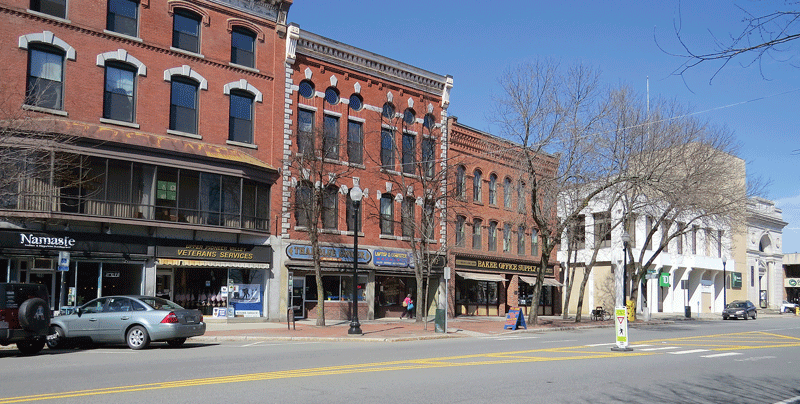
Features

The Trickle-down Effect

Rebeca Merigian, here with her son, Andrew Takorian

Rebeca Merigian, here with her son, Andrew Takorian, expects Park Cleaners’ contract with MGM to perhaps double the company’s current volume of business.

Rebeca Merigian says the slip was found, and promptly given to her, many years ago by a long-time customer, a description she quickly categorized as an obvious understatement.

Indeed, the date at the top is 1940, and thus this item, now displayed under glass, is a time capsule as much as it is a pick-up slip for a two-piece suit.

Start with the phone number at the top; there are just five digits because that’s all that were needed back then (ask your mother; actually, make that your grandmother). The name of the company was Park Cleaners & Dyers Inc. (the ‘& Dyers’ was dropped a long time ago because those services were discontinued). The address is Kensington Avenue in Springfield (the company moved to Allen Street in 1955). Even the slogan is different; back then it was ‘Dry cleaning as it should be done.’ Now, it’s ‘Family-owned and operated since 1935. We appreciate your business.’

Yes, much has changed since Edward Takorian, an Armenian who somehow escaped the genocide of 1915 and came to this country soon thereafter, went into business for himself.

There have been many ups and downs, said Merigian, Takorian’s great-granddaughter, who started working in the business on Saturdays when she was 9 and bought it from her mother three years ago. She noted that the company was started at the height of the Great Depression and has endured many other downturns over the next eight decades, and also the early death of her father. Not so long ago, there were more than 20 people working here; now there are four, including Merigian’s son and nephew.

But that number will be rising soon, thanks to what would have to be one of the biggest developments since that suit was picked up a year before the U.S. entered World War II — a contract with MGM Springfield, the $960 million resort casino that will open in about four months.

Park Cleaners has been awarded a contract to clean the uniforms for all 3,000 employees at the casino, and for the dry-cleaning of hotel guests and the MGM Springfield management team as well. Merigian couldn’t put a dollar figure on the contract, but she could certainly put it into perspective.

“I’m hoping that this will double our business,” she told BusinessWest, adding that the contract could give her the means to perhaps double the current workforce and pay the kind of benefits that are currently beyond the company’s reach. “My goal from this is to be able to provide health insurance for my employees who have been with through a lot of the challenges; I want to give back to them and provide more benefits and incentives so we can grow.”

Several other area businesses now have contracts with MGM or are in the process of finalizing one. Most will not be as life-changing as the one received by Park Cleaners, but they are all significant in some way.

Nick Noblit

Nick Noblit says the contract with MGM gives Yankee Mattress a new top line for its deep list of clients.

Take Agawam-based Yankee Mattress, for example. The company was originally asked to supply mattresses for all the rooms in MGM’s Springfield hotel, an order that Nick Noblit, the company’s general manager, admitted was too big to handle at this time. But the company will make California kings for the larger, high-roller suites, an assignment that will give the company additional business and some hopefully effective marketing material.

Meanwhile, Holyoke-based Kittredge Equipment Co. has secured one of the bigger contracts — this one to provide kitchen appliances and supplies to the many businesses that will do business at the casino.

There have been other contracts signed, and there will be many more agreements inked in the weeks to come as the countdown to the grand opening continues, said Courtney Wenleder, vice president and chief financial officer for MGM Springfield. She told BusinessWest that, as part of its host-community agreement, the company is required to apportion a percentage of its receivables to local companies.

But the company is striving to do more than just meet that obligation, she said, adding that MGM is looking to take the company’s philosophy regarding diversity and apply it to its vendor list. And this translates into extending opportunities to women (Kittredge is also woman-owned), minorities, and small businesses in general.

“MGM has a commitment to diversity and partnering with local vendors,” she explained. “It’s all about building the community together; there’s a symbiotic relationship — if the community does well, we do well, and vice versa.”

For this issue, BusinessWest looks at how the trickle-down effect from MGM Springfield, which began with local contractors taking part in the construction of the complex, is gathering momentum in the form of contracts to supply everything from knives and forks to marketing services. And while doing that, we’ll also shine a spotlight on some intriguing local businesses that have, by and large, flown under the radar.

The Rest of the Story

Wenleder told BusinessWest that many factors go into MGM’s decisions about which vendors to do business with and what might give a certain enterprise an edge over whatever competition emerges.

They range from quality of service and customer satisfaction, obviously, to whether, as noted, the business is minority- or women-owned. But there are some intangibles, and sometimes a little luck, that comes into play.

To get that point across, she relayed the story about how MGM Springfield now rents several apartments downtown, and they’re used, among other things, to house company executives visiting Springfield for extended stays.

Kittredge Equipment Co. owner Wendy Webber, left, with sales representative Amanda Desautels

Kittredge Equipment Co. owner Wendy Webber, left, with sales representative Amanda Desautels. The company will supply MGM Springfield with everything from appliances to glassware.

MGM CEO William Hornbuckle is one of these executives, and on one of his stays, he slept so soundly and comfortably that he took note of the label on his mattress (Yankee), later commented to those at MGM Springfield’s headquarters about his experience, and essentially initiated steps that would eventually lead to the company getting a contract.

“Bill commented about what a great night’s sleep he had on that mattress, and that pretty much secured their position,” Wenleder recalled with a laugh, adding that it wasn’t all that simple, but that bit of serendipity certainly got the ball rolling.

And the mattress contract serves as a good example of how MGM is trying to do business locally when it can and when it’s appropriate, said MGM Springfield General Manager Alex Dixon.

He noted, as Wenleder did, that there are times when MGM will simply add the Springfield casino to some existing contracts it has in place to provide certain products and services to the company’s existing properties.

Playing cards and dice would be good examples of this, he said, adding that MGM already has manufacturers providing those products. And, for the most part, there is no local company that makes such items.

But even with those products, there may be some opportunities for local businesses, he went on, noting, for example, that most playing cards are destroyed soon after they’re used, and MGM Springfield will use a local company to handle that work.

“We want to recognize what’s available in the local market and then tailor our supply chain to match what is happening in the local community,” he said while describing the company’s broad mindset when it comes to vendors.

Overall, MGM has a process in place when it comes to vendors, said Dixon, adding that the company actively solicits information from companies interested in doing business with it. The owners and managers of such ventures are invited to attend outreach events (they’re posted on the MGM Springfield website, for example), and through such events, companies become part of a database the company refers to when it needs specific products or services.

“Whenever there’s a business need, we want to find out if there are vendors, preferably local, who can help us to fulfill those needs — that’s step one,” he explained. “But informally, being members of the community, you really develop relationships.

“It’s no longer ‘hey there’s this great local brewer,’” he went on, while explaining how these relationships are created. “Now it’s ‘that’s Ray Berry from White Lion; maybe there’s an opportunity there.’”

In other words, familiarity breeds opportunity, and examples abound of how companies ranging from local caterers and computer hardware providers have come onto MGM Springfield’s radar screen — and are now doing business with the company.

The contract with Yankee Mattress is a good example of this phenomenon at work, said Dixon, confirming that the company was first presented with a proposal to furnish every room in its hotel now taking shape on Main Street.

But Noblet said such a large order would have necessitated additional hiring and other steps the company wasn’t ready to take.

But the contract to supply mattresses for the larger suites is a welcome addition and positive development for the Agawam-based company, which has been gaining traction in recent years as word-of-mouth referrals about its products proliferate.

This is another family business, started by Nick’s father, Joe, who is still active in the venture. The elder Noblit worked for a major mattress manufacturer for several years before deciding he could make a better product, and at a lower price, himself. And he did.

Yankee was launched in 1999, and it has grown and evolved other the years, said Noblit, adding that it started with a storefront and adjacent assembly area in Agawam, and now has four stores in the region.

Those outlets carry a host of lines with those huge tags that are supposedly illegal to rip off, including the top-of-line Black Collection, with models including the York, Fairhaven, Merrimac, and Nantucket.

There is a strong residential component to the customer base, obviously, said Noblit, but also many commercial clients as well, including several area B&Bs, hotels, and inns, as well as some healthcare providers, a few private schools, and a host of area fire departments.

“We custom-build those to be stronger than average — because there are some big firefighters out there and it’s important for them to have something durable,” he explained, adding that word of mouth has been the best marketing tool when it comes to adding new lines to the customer list on the company’s website.

If one were to peruse that list, the name now at the very top is MGM Resorts International, an indication of how important this contract is, not size-wise, but from a marketing and branding standpoint.

“Most hotels have a contract with a major manufacturer, and across the board, they do business with this manufacturer, and they make all of their beds,” he explained. “So for MGM to consider someone outside these big manufacturers that are nationwide, that’s significant.”

Buying Power

But if MGM Springfield found Yankee Mattress thanks to Bill Horbuckle’s good night’s sleep, most of the other vendors have had to find the casino giant.

And ‘find’ means going through a process of introducing one’s company to MGM Springfield through one of a number of vendor meet-and-greets, for lack of a better term, that the company has staged, including one at last fall’s Western Mass. Business and Innovation Expo, staged by BusinessWest.

Courtney Wenleder

Courtney Wenleder says there’s a symbiotic relationship between MGM and local vendors; when they do well, the casino operator does well, and vice versa.

Through these outreach sessions, MGM is making it much easier for companies to find it, said Wenleder, adding that MGM Springfield has a three-person purchasing team (a manager and two assistants), and one of their primary responsibilities is to go out into the community and find local vendors.

“Even though we’ve been doing a lot of communication with people when it comes to local purchasing requirements, some people aren’t hearing that message,” she explained. “We have people on the ground physically reaching out to these vendors.”

Merigian said she started attending such outreach sessions not long after MGM was granted the Western Mass. license in 2014, recognizing the casino as a rare business opportunity.

“I had my sights on it from the beginning,” she told BusinessWest. You never know how it’s going to work out with companies renting their own uniforms or owning them, but either way, I knew I would like to be part of it.”

So much so that she took steps to become a certified woman-owned business, understanding from those very first meetings that MGM had a strong interest in doing business with businesses led by women and minorities.

There would be more meetings to come over the next few years, she went on, adding that these sessions were beneficial on many levels.

“It really gets you tuned into your business,” she said, using that phrase to indicate everything from capabilities to long-term goals to what it will take to reach them. “It was an educational experience on many levels.”

The volume of work is large — most all of the 3,000 employees will wear some kind of uniform, and this contract covers all that and more — and thus MGM will likely be the largest customer in Park’s long history, said Merigian, although Park did have a contract with MassMutual for a quarter-century and still has one with the Defense Department (Westover Air Reserve Base).

“We don’t have specific numbers, but know it will be high volume,” she said of the business to start coming her way in a matter of weeks as employees are added to the payroll in waves. “But we’re ready for it, and we can feel the excitement.”

Indeed, after her father’s death, the company had to withdraw from the MassMutual contract, and it downsized considerably, said Merigian, adding quickly, however, that “we’re ready to go; we’re ready to get back to work.”

At Kittredge, meanwhile, the MGM contract is another important step forward for that company, said Amanda Desautels, an outside sales representative now working with MGM to outfit the restaurants that will be doing business at the casino.

“This is a significant contract for us,” she said, noting that Kittredge will be supplying MGM with everything from appliances to bar equipment; glassware to silverware, and adding it to a client list that includes UMass Amherst, the Max restaurant group, and Mount Holyoke College, among many others.

The company, rapidly approaching its centennial (it was launched in 1921), started as a supplier of typewriters and cash registers and has evolved into a $50 million equipment and supply giant that now employs more than 70 people locally.

At its warehouse and retail facility in the Agawam Regional Industrial Park, one can find everything from industrial refrigerators, freezers, and stoves to dishes and glassware to individual carving knives. Desautels joked that the company provides everything that goes on the table, around it (furniture), and even under it. “If you have a wobbly table, we have table levelers.”

It also has certification as a woman-owned business (Wendy Webber succeeds her late husband, Neil, as owner and operator), a designation that has opened many doors for the company and no doubt played a role in securing the contract with MGM.

“Being a woman-owned business has created many opportunities for Kittredge, and MGM is obviously one of those,” said Desautels, noting that the addition of MGM to the client roster is significant in many respects. “It’s exciting to be doing business with a company like MGM that shares the same values we do, such as diversity and the importance of their employees.”

Pressing Engagement

As she posed for a few photos for BusinessWest, Merigian gathered her son, Andrew Takorian, and insisted that he be part of the picture.

Figuratively speaking, he has been for some time now, working at this establishment — like his mother, grandfather, and great-grandfather before him — while still in grade school.

He represents the fifth generation to carry a business card that says ‘Park Cleaners’ — or Park Cleaners & Dyers, as the case may be. The company has gone through a lot of change and evolution after the past eight and half decades, and many important developments.

Perhaps none were as big as the contract inked with MGM Springfield, which comes at a critical time and represents a huge opportunity for growth and security.

It’s just one example of the trickle-down effect that is now underway, and already changing the local business landscape in profound ways.

George O’Brien can be reached at [email protected]

Features

Changing Expectations

Mikki Lessard, left, and Nancy Feth

Mikki Lessard, left, and Nancy Feth say they’ve created a ‘retail-tainment district,’ one that is bringing people from across the region to downtown Springfield.

Like most people who grew up in and around Springfield in the ’60s and ’70s, Mikki Lessard has fond memories of getting on a bus and spending an entire Saturday afternoon downtown.

She said most of those visits would start, and a good number would also end, at Johnson’s Bookstore, but there were plenty of other stops as well.

“We would go to Johnson’s, and Steiger’s, and many other stores. There was always something happening; it was positive, and it was fun,” said Lessard, adding that, while she acknowledges that things won’t ever be exactly like that again given changes in how and where many people shop, it can be, well, something like that again.

And she and business partner Nancy Feth are a huge part of that ‘something.’

They are the founders of an intriguing enterprise called Simply Grace, which now operates a growing portfolio of businesses operating under the name the Shops at Marketplace in downtown Springfield — almost exactly where Johnson’s Bookstore was operating until it closed 20 years ago.

There are shops, but this is also a gathering place for events ranging from Thunderbird Thursdays to a farmer’s market to a Dress for Success graduation ceremony.

The two partners have a name for what they’ve created — a ‘retail-tainment district,’ blending both retail and entertainment. They didn’t invent the phrase — it’s been in use for a while and is often summoned when the discussion turns to what traditional shopping malls must become if they want to survive — but they believe they have the first in downtown Springfield, arriving ahead of MGM Springfield.

It all started with the Simply Grace Serendipity Boutique, and ‘the Shops’ has grown to include a yoga studio, a restaurant, a new store that just opened its doors, and another now being built out.

As they tell the story — and they love to tell the story, often finishing one another’s sentences and providing complementary commentary as they do so — these entrepreneurs note that they came to downtown Springfield as one of what was supposed to be several small retailers that agreed to set up shop as part of the initial Springfield Holiday Market in 2015, a strategic initiative designed to put some underutilized space in the Marketplace complex to work in a way that would bring people downtown and generate some momentum as well as foot traffic.

As things turned out, there were only a few pop-up shops, as they were called, on that location, but they did well collectively, and the public responded to this bid to bring some retail back to Main Street.

When the holidays were over, Glenn Edwards, owner of the property, asked Feth and Lessard if they would like to stay on for a while. They said yes, but without giving any real indication of a what ‘a while’ might or should become.

“We said, ‘we’ll stay for a few more months; we’ll stay ’til Valentine’s Day,’” said Feth, before Lessard picked up for her.

“And then, we asked to stay ’til Mother’s Day,” she explained. “And then we decided we wanted to stay for the year.”

But with some conditions, specifically that they could take space one of the retailers was vacating for yoga classes in an effort to attract more people and different constituencies to the downtown.

And, overall, the two entrepreneurs have been continuing that pattern, or mindset, ever since, adding new components to Simply Grace; bringing more events, vitality, and energy to the Marketplace area; and also, for those efforts, earning an award from the Small Business Administration to coincide with Small Business Week (April 29 to May 5).

Indeed, Feth and Lessard will be at the Sheraton Needham Hotel on May 4 to accept the Microenterprise of the Year Award, one of the few enterprises from Western Mass. to win such an honor in recent years.

But before, and after, all their focus will be on Springfield, the Marketplace, and new developments for Simply Grace.

These include a recent addition called Brick & Mortar, what Lessard calls a “mercantile, apothecary, and more,” which actually has some exposed brick for effect. There’s also Alchemy, a manicure and pedicure salon now being built out; Dharma, the yoga studio; and the boutique that got things rolling.

Those four businesses, along with Nosh, an eatery across the way from the boutique, now comprise a critical mass of small, diverse shops that the two partners believe will bring more foot traffic and momentum to an area that was once the pulse of downtown Springfield a generation ago — and can, they believe, take that role again.

“Do we have mall traffic? Heck no,” said Lessard. “But it’s working. It’s always about creating curiosity and then converting that into customers, and that’s what we’re doing.”

The only downside to all this is that the space once devoted to the holiday pop-up markets is now gone, absorbed by what could be called permanent fixtures, said the partners, adding that, in most all ways, this constitutes a very good problem to have.

For this issue, BusinessWest talked with Feth and Lessard about their venture and how in some ways it constitutes turning back the clock, but in most others, it’s symbolic of the downtown’s future.

What’s in Store

‘Walk. Pause. Browse. Shop. Experience.’

Those are the words the two partners have placed before ‘the Shops at Marketplace’ in their branding of the facility. And both collectively and individuality, those terms speak to what this venture is all about — as well as to some of the elements that have largely been missing from downtown since those days when Lessard and countless others would get on a bus and take it to Main Street.

The partners at Simply Grace say they carry brands with unique stories that resonate with their customers.

The partners at Simply Grace say they carry brands with unique stories that resonate with their customers.

There was far less walking, pausing, browsing, and shopping going on, and therefore there was less to experience.

Feth and Lessard weren’t exactly out to change that equation when they were first invited to bring a taste of the Simply Grace Serendipity Boutique, a shop they opened in Monson, to downtown Springfield for the holidays. But that’s what has happened.

It’s been an intriguing journey, a learning experience on many levels, said the partners, adding that they are still writing new chapters to this story.

That first Holiday Market was so successful that the BID asked the new partners to manage and staff that project moving forward, said Feth, adding that they did so, providing an opportunity for a number of new businesses to become part of the experience and gain some critical visibility. And through that work, the partners came to understand the many layers of significance to their efforts. Indeed, this wasn’t simply retail, it was economic development.

“A lot of what we do is build community and work on economic development,” Feth explained. “These are the value adds we feel we bring to Springfield in addition to our own businesses.”

Lessard agreed, and referred to Simply Grace’s broad efforts as “collaborating and incubating.”

As for their own businesses, the partners say they are doing well and succeeding in their primary mission. That would be to bring people, but especially women, downtown. Or back downtown, as is often the case.

They’re getting that done by providing reasons to do so, said Lessard, adding that these vary and include yoga, the shops — which sell products made by vendors with unique, community-minded stories — and events.

Elaborating, Lessard said the partners will utilize their indoor spaces and walkways during winter and schedule a variety of gatherings for women, and when the weather gets warmer, they will fully “activate” the indoor and outdoor space, using it to host everything from flea markets to White Lion Wednesdays; from farmers markets to live music.

In fact, the space has become a popular venue for fundraising for groups that include Rays of Hope, Unify Against Bullying, Dress for Success, and many more.

“We just want to have this lively, quintessential, unexpected experience in downtown Springfield,” Lessard explained, adding that the key word there, and perhaps unfortunately, is ‘unexpected.’

Indeed, Feth said that many of those who come to the Shops at the Marketplace will offer commentary that makes this point.

“We’ll often hear people say, ‘I don’t feel like I’m in Springfield,’” said Feth. “Or ‘I feel like I’m in New York or San Francisco.’”

Which Lessard followed with, ‘and we gladly say, ‘you’re in this wonderful city called Springfield.’”

The unofficial mission moving forward, for the partners at Simply Grace and the city as a whole, is to generate fewer of these comments and to make a fulfilling trip downtown something that’s expected, not unexpected.

And the partners believe they and the city are moving closer to that goal through their lively mix of retail, events, things to do, and things to experience.

And the retail is a big part of it, said Feth, adding that, contrary to what is becoming popular opinion, traditional retail is not dead, and not everyone wants to buy everything on Amazon and have it shipped to their home.

“What we’re finding is that customers are actually hungry for experiences where they can see the product, talk to people, feel seen and acknowledged, and have a real experience instead of just a virtual experience,” she explained, before Lessard picked up on that ‘feel seen’ comment and ran with it because of its significance.

“We have women who come in here that pause, then browse, then shop, just to be seen,” she told BusinessWest. “They feel like they’re in this hustle and bustle of life and no one’s acknowledging them. So they come in, they share stories, we give them hugs; we actually care about them as people.

“We get a lot of pushback from people from who say, ‘you should be in East Longmeadow’ or ‘you should be in Hampden or somewhere other than downtown Springfield,’” she went on. “But we’re exactly where we’re supposed to be, because the women we’re connecting to that work or live or play downtown are very stressed out, and when they come to our store, it’s a breath of fresh air, an unexpected experience.”

Bottom Line

There’s that word again — unexpected. Soon, perhaps, it can be retired, and downtown Springfield will move closer to the one Lessard remembers from her youth, a time, she recalled, when there was always something positive and fun happening.

The partners at Simply Grace are doing their part to bring those phrases back into use. They’ll soon have an award from the Small Business Administration to show for their efforts, but they’ve already received something perhaps even more significant to them.

That would be all those comments from people who say they don’t believe they’re in downtown Springfield. Such comments tell them they’re doing the right thing and in the right place.

And to think they were only going to stay a month.

Good thing they didn’t.

George O’Brien can be reached at [email protected]
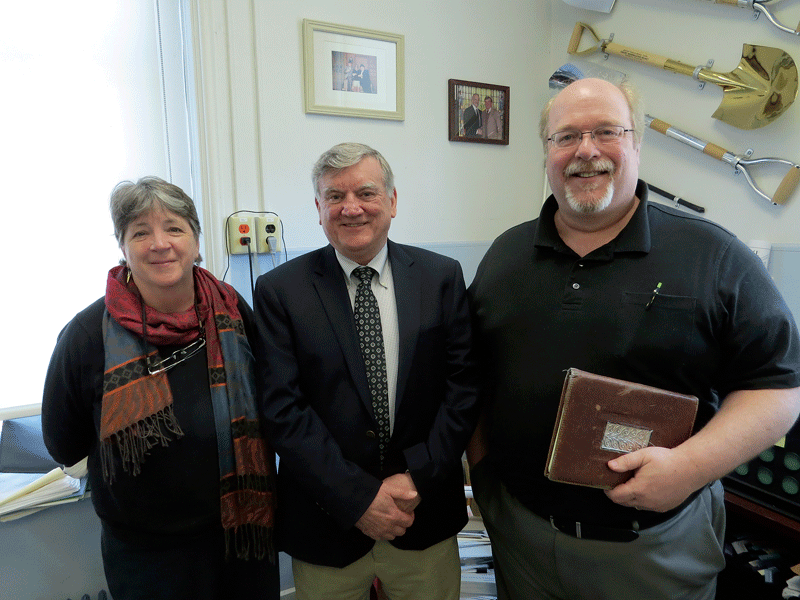
Community Spotlight Features

Community Spotlight

An aerial view of the Village Commons

An aerial view of the Village Commons, which is at full occupancy, and has been for most of this century.

When Andy Yee talks about South Hadley, he speaks from experience.

All kinds of experience.

He grew up there, went to high school there, lives there still, and now watches his children’s high-school games there. He also does business there — quite a bit of it, actually.

He owns a number of restaurants in that community, including Johnny’s Bar & Grill and Johnny’s Tap Room, both named after his late father, as well as IYA Sushi & Noodle Kitchen, all located in the Village Commons, across College Street from Mount Holyoke College, as well as a bar called the Halfway House Lounge on Summit Street. He described that establishment as the ‘Cheers’ of South Hadley, meaning everyone there knows your name.

They also know the story of how the tavern got its name, which Yee was more than willing to share.

“Back in the day, there was a trolley system running from South Hadley Falls up to the college, and that was the halfway point, the halfway station,” he explained. “It’s a fun little place. We all grew up there; at some point, almost every resident has stopped at the Halfway House.”

Yee told that story to convey the strong sense of continuity that exists in this Hampshire County community, and how many things haven’t changed since the Halfway House started serving pints soon after Prohibition ended more than 80 years ago.

But many things have changed, and for evidence, one need only look further down Newton Street, to one of Yee’s latest entrepreneurial ventures.

He’s one of the principals — Peter Pan Chairman and CEO Peter Picknelly and Rocky’s Hardware President and CEO Rocco Falcone are the others — in a closely watched development at the so-called Woodlawn Plaza, former home to Big Y but more recently a mostly vacant eyesore of sorts.

Retail centers of this type couldn’t be classified as easy money or even a particularly wise investment at this point given the way the retail sector is heading, but this group of entrepreneurs moved to acquire the plaza at auction because of confidence in their abilities to bring new life to it, and also confidence in South Hadley itself.

“You can’t buy properties like this unless they come for sale at the right price,” said Yee, adding that there’s a reason this site was available at auction. “We see this as a good investment, and we have some great partners with great business savvy. We’re not going to sit idle on this property; there’s going to be something unique there for all to enjoy.”

This confidence results from historically steady results in South Hadley when it comes to retail and business in general, but also many recent developments that have secured the community’s place as a reputation of sorts when it comes to everything from outdoor activities to fine dining.

Take the Village Commons, for example. It’s at 100% occupancy, essentially, and has been since roughly the start of this century, said Jeff Labrecque, the facility’s chief operating officer.

“We have very, very little turnover, and when something does turn over, we usually fill it very quickly,” he said before getting his point across by noting that O’Connell Care at Home will be moving its headquarters there in several weeks, quickly claiming a 1,900-square-foot space vacated by River Valley Dental after a consolidation of that operation.

O’Connell’s move brings still more diversity to the Commons, which already had a good amount of it, said Labrecque, adding that it’s home to restaurants and bars, high-end apartments that are in demand (he says there are maybe 50 people on a waiting list, and some have been on it for years), many health and beauty businesses, service agencies, a still-surviving independent bookstore, and a still-surviving two-screen movie theater.

All of this makes the Commons a true destination, he said.

The broader goal is to make South Hadley itself more of a destination, said all those we spoke with, adding that many pieces to this puzzle are in place, and more are coming together.

Range of Initiatives

Mike Sullivan is better known for his time spent serving the community on the other side of the Vietnam Veterans Memorial Bridge — he was mayor of Holyoke for a decade after owning and operating Nick O’Neil’s tavern — but he now resides (professionally speaking) at South Hadley Town Hall.

He’s been town administrator for several years, taking that position after serving the town of Maynard (famous as the home to Digital Equipment Corp., Monster.com, and later Curt Schilling’s ill-fated 38 Studios). In fact, Sullivan’s first day in Maynard was Schilling’s last, and he remembers the town being very upset and frustrated with losing the company, emotions that shifted went it quickly dissolved into bankruptcy. But that’s another story.

This one is about South Hadley, and Sullivan said it has achieved progress in many forms in recent years, including the broad realm of economic development, attracting new companies such as Mohawk Paper and E Ink Corp., and retaining others, such as South Hadley Fuel.

The town is also making headway with recreation-related initiatives such as a bike-share project and what he called the ‘river-to-range trail program,’ which, as that name suggests, is a handicap-accessible trail route that starts at Brunell’s Marina on the Connecticut River and connects to the Summit House in Hadley on Mount Holyoke.

South Hadley at a Glance

Year Incorporated: 1775
Population: 17,514
Area: 18.4 square miles
County: Hampshire
Residential AND COMMERCIAL Tax Rate: $19.93 (Fire District 1), $20.42 (Fire District 2)
Median Household Income: $64,610
Median Family Income: $76,679
Type of Government: Town Administrator, Town Meeting
Largest Employers: Mount Holyoke College, the Loomis Communities, Mohawk Paper
* Latest information available

Such initiatives bring more people to the town and thus the benefits that go with that visitation, he explained.

“These eco-tourism amenities in communities like South Hadley are becoming more and more important,” Sullivan said. “They feed restaurants and other businesses, like those at the Village Commons, like Brunell’s, like McCray’s Farm; we’re hoping that all of those benefit from our investment in the river-to-range trail.”

But easily the most-watched project in the community involves the Woodlawn Project on Newton Street, Route 116.

The goal is to create a mixed-use development, said Sullivan, adding that the town is working to create what’s known as a ‘40R,’ or Smart Growth Zoning Overlay District, at the site, which would allow for more flexibility with regard to both zoning and eventual development. That plan will go before town meeting later this spring.

The site, formerly home to a large Big Y and Food Mart before that, still has a few tenants and is anchored by a Rocky’s Hardware store, but is still largely vacant. The new owners have torn down the 65,000-square-foot former Big Y, have plans for a larger Rocky’s with a garden center, and are hoping to attract more retail at a time when that sector is clearly struggling, but also other types of tenants.

“Retail is struggling, with Toys R Us, BonTon, and other national chains going out,” said Yee, adding that, in many properties like the one on Newton Street, restaurants have become the main anchors.

Elaborating, he said that dining and entertainment businesses have played a major role in making a South Hadley a destination not only for those living in neighboring communities such as Granby, Holyoke, and Amherst, but for residents across the region and even beyond.

This is certainly in evidence at the Village Commons, which has always been a gathering spot, but it is now even more of a destination — because of its array of eateries, but also the diversity of ventures there.

Indeed, there are now more than 70 businesses with that address on their letterhead, and while all of them serve people living around the corner (or upstairs, when it comes to those with apartments in the complex), they are also drawing people from many surrounding communities into South Hadley.

The complex’s many restaurants are perhaps the main attraction, said Lebrecque, noting that there are now several of them. In addition to the Yee family’s offerings, there’s also Tailgate Picnot, Food 101 Bar & Bistro, New Main Moon Café, WOW Frozen Yogurt, and the Mexican restaurant Autentica.

This critical mass gives the Commons both diversity and drawing power, said Lebrecque, who drew comparisons, on some level, to the city of Northampton and its thriving downtown.

“We’ve become somewhat of a food and entertainment destination, just like Northampton,” he told BusinessWest. “That’s a thriving part of our business, and it brings people from all over to South Hadley.”

But retail is also thriving in the Commons, in part because of the foot traffic created by the entertainment options, he went on, citing, as one example, Moxy Boutique.

This is a relatively new addition — it arrived about a year ago — led by an entrepreneur who left a stable, successful situation in Suffield, Conn. for the Commons because of its destination status.

And there are others who would like to gain inclusion on the tenant directory, he went on, but there isn’t any space available.

“The retail is definitely making a thriving comeback — that’s something we’ve noticed over the last few years,” said Lebrecque. “For a number of years, it was hard to get retailers interested in space, but now we have people starting to knock on our door. We have a lot of people who would like to come to the Commons, but we just don’t have the space for them.”

Coming of Age

If that sounds like a good problem to have, it is.

Such a development means your facility — and the community — are in demand, a preferred landing spot, and a great place to live, work, and operate a business.

South Hadley is all of those things, and has been since people starting gathering at the Halfway House Lounge — long before it was called that.

The goal here is to become more of a destination — for businesses, families, outdoor enthusiasts, those looking for a boutique, and those looking for a new weed whacker.

And South Hadley is making strides toward being that destination.

George O’Brien can be reached at [email protected]

Education Sections

Piece by Piece

Elms College Financial Aid Director Kristin Hmieleski

Elms College Financial Aid Director Kristin Hmieleski

It’s hardly news that college costs have consistently risen over the past two decades, outpacing both inflation and incomes. But there are a host of resources families can access to help bring those costs down and reduce the initial sticker shock. Still, putting the pieces together takes a combination of hustle, clear communication, hard work, and often sacrifice, all in search of what students hope will be a life-changing degree.


Bryan Gross calls them “success stories” — incoming students who weren’t sure they could afford college, but somehow manage to make it happen.

“You’ll see a lot of media attention and articles about sticker shock, the cost of tuition, fees, room, and board, and it makes families very nervous,” said Gross, vice president of Enrollment Management and Marketing at Western New England University (WNEU). “But we do work very hard to make college affordable for families, and the sticker price is not what they end up paying.”

But it doesn’t happen overnight.

“It is a lot of piecing things together,” said Kristin Hmieleski, Financial Aid director for Elms College. “We always tell students, ‘you’re not going to get this for free, so let’s look at the resources at hand. What can you get through federal and state aid? What has the institution already offered you by way of merit? What else can we offer based on need? Worst-case scenario, you may have to pay out of pocket or take on additional loans.’ It’s almost like a puzzle we put together.”’

It’s a puzzle that has become increasingly challenging over the past couple decades, as college costs have steadily risen, often outpacing inflation and average income. According to the College Board, which tracks these trends annually, tuition and fees at private, four-year instititions increased by 1.9% from 2016-17 to 2017-18, to an average of $34,740. Meanwhile, public, four-year institutions saw an average increase of 1.3%, to $9,970.

Those increases are substantially lower than the spikes seen during the Great Recession. In 2009-10, for example, private institutions raised tuition and fees by 5.9%, and public schools posted a 9.5% increase.

However, the College Board noted, students still shoulder a heavier burden this year, because even those modest price hikes outpaced grant aid and tax benefits. And that places more pressure on financial-aid officers to help families, well, assemble that puzzle.

The key, both Hmieleski and Gross said, is communication — and lots of it, starting early.

“We do open houses, and as prospective students are looking at Elms College, we talk about different resources they can look at,” Hmieleski said, noting that plenty of opportunities exist beyond the award package — based on academic merit and financial need — that the college puts together for each enrollee.

“They might not know every single website to look at, but we give them some hints about community resources they can look into,” she explained. “Do they belong to a church? Do the businesses their families work for offer scholarships? The students need to do some hunting themselves. Have they reached out to guidance counselors? They might know of some opportunities.”

It’s not an easy process, and it takes legwork and often sacrifice. But if the end result is a degree and a career pathway, families are more than willing to make the effort.

Knowledge Is Power

Gross said communicating with students starts well before they ever sit down in a classroom.

“Being a private institution, being well aware of the current state of the economic landscape, giving families direct and clear information regarding their financial-aid package is really important for us,” he said.

Bryan Gross

Bryan Gross says communication with families — both early and often — is key to helping them forge a strategy to pay for college.

To that end, WNEU started a program three years ago called Culture of Financial Wellness, which includes several components, starting with financial-aid counseling, during which officers help families navigate the process of piecing together available resources. Meanwhile, during spring open houses, financial-aid workshops are offered to inform and educate parents about the financial-aid process to help them make the right decisions for their student.

Following those are SOAR, the university’s Summer Orientation and Registration sessions, featuring presentations by Peter Bielagus, known as “America’s Financial Educator,” who provides information to parents about financing their student’s education.

The final piece of Culture of Financial Wellness continues after the student has joined the campus. The Freshman Focus program offers programming and talks to help students successfully transition to college life, including an overview session each fall on finances and spending designed to teach students about credit-card debt and making sound financial decisions in college and beyond.

“We want to educate students and help them understand the importance of living within your means,” Gross said. “That’s the circle of life — we want to help students for the rest of their lives.”

But that help begins at the financial-aid office, where the allocation of resources has been subtly shifting. This year, the College Board reports, federal loans account for 32% of all student aid, followed by institutional grants (25%), federal Pell grants (15%), tax credits and deductions (9%), state grants (6%), private and employer grants (6%), and veteran and military grants (6%).

“We put together a strategy for each student based on their academic performance,” Gross said. “We offer them scholarships, and of course federal and state grants typically get offered, and after that we have need-based grants we offer depending on their circumstances, and typically at the bottom of all that is federal work studies.”

Hmieleski said some 80 to 100 Elms students benefit from federally funded work-study jobs, 7% of which must be targeted at community-service work, such as the America Reads program administered locally by Valley Opportunity Council, in which college students tutor children after school.

“Unfortunately, federal funding has been so limited — it gets cut every year,” she said, noting that some students work at campus jobs funded by the college, while others secure part-time employment off campus.

Gross said certain enrollees benefit from special circumstances. “Veteran students are a population we work with; we help students directly apply for veterans benefits, and they might be eligible for ROTC as well.”

The bottom line, he told BusinessWest, is that students are given a full picture of what resources are available so they can figure out how to fill in the gaps, even if that means living at home.

“We want them to live on campus, but we want families to make an informed decision. It’s amazing how many families don’t even think about that,” he said. “We just don’t want families to be flat-footed when they receive their first bill.”

Beyond the Gloom and Doom

As Gross noted, he’s gratified by the success stories, but they’re not the whole story, unfortunately.

“To be honest with you, every college also has stories of families that fill out an application for federal aid, then come to us and say, ‘this is not our reality; we can’t afford to pay that.’ We work with families to come up with a plan, and it may work, but it may not work.”

In some cases, he said, students will instead opt to begin their education at a two-year community college. No matter what the outcome, though, he tries to make sure the decisions are made from a place of copious information.

“Families know that it’s not just a matter of crossing their fingers and closing their eyes, and somehow it comes together. You really have to have a plan, and you have to use college and community resources to help you through the process.”

No matter how much thought goes into a strategy, Hmieleski added, it’s impossible to de-stress the process of financial planning for college.

“No matter where you are in life, even if you have wealth, money is always stressful,” she said. “When some people hear about finances or anything involving money, their reaction is almost to shut down and not listen because they don’t feel like they’ll ever understand it.

“But we deal with a lot of first-generation, low-income students here at Elms; we are here to support those students,” she went on, noting that the college is invested not only in their ability to pay for school, but their academic success and keeping them enrolled. “OK, you’re here, you’re able to afford it — now let’s make sure you’re academically successful.”

But it begins with that first look at the unassembled puzzle, and all the decisions that go into putting it together. Hmieleski recalled one student — whose academic record was strong — that she worried about every fall, wondering if she’d be able to continue on, due to tight finances. But each year, the family somehow managed, and she graduated.

“I get goosebumps in so many situations when it looked like doom and gloom, like the student wouldn’t be able to come here, but we work on it,” she said. “And when they’re able to walk through that door, it’s a thrill.”

Joseph Bednar can be reached at [email protected]

Education Sections

Smart Strategy

Adam Metsch says he works to help make the many moving targets that emerge in the college-selection process move a lot less.

Adam Metsch says he works to help make the many moving targets that emerge in the college-selection process move a lot less.

Adam Metsch was asked to explain why individuals who retain his services should look upon the fees they pay him as an investment, rather than merely an expense.

And he would spend the next several minutes answering that question in several different ways, using both words and numbers. They were all effective in getting the point home, but perhaps none more so than his simple comparison to buying a home.

“When you buy a house, there’s a mortgage broker, a Realtor, and a lawyer to ensure that the transaction goes through smoothly,” said Metsch, president of East Longmeadow-based the College Advisor of New England. “When people buy a college education, very often, it’s on the emotions of a teenager, because the parents are going through the same learning curve at the time the kid is. So there’s no way to protect their $250,000 investment or their $125,000 investment, whatever it might be.

“If you look at what someone might pay me in fees, that’s about one-fifth what someone would pay to the lawyer, for the Realtor’s commission, and the broker when they buy that house,” he went on. “And the investment is nearly as big; think about it.”

As noted, he had several other methods for answering that question, including a very powerful use of numbers. Indeed, 91% of what he called “College Advisor students” — those who arrived on campus through his assistance — stayed that their enrolled college for four years, compared to the national average rate of 51%, a huge consideration given the soaring sticker price of a college education today.

Metsch, who’s been helping students and parents make what he called “more scientific decisions” about which college to attend for more than two decades now, offers these words and numbers often, because even though his profession has grown considerably in recent years in terms of the numbers of people handling such work, many people are still not aware that such advisors exist and that they can make an extremely daunting process far less so.

Getting that message across is one of the items on Metsch’s do-list, but he’s far busier handling a client list involving parents and students across the region. He provides a wide array of services and coaching on everything from when students should take certain standardized tests to which schools would make the best fits, to how parents can go about paying for the school their child eventually settles on.

Slicing through it all, Metsch said he and his staff help “reduce the movement in a lot of moving targets.”

That’s a colorful phrase he used to describe how his company helps take time, complexity, confusion, and anxiety out of a process that might (maybe ‘would’ is the better word) otherwise involve much larger quantities of each.

When asked how it does this, Metsch would go on in great detail, and we’ll get to those of those thoughts later, but he summed most of it up by saying his company works very hard to get young students to take ownership of the college-selection process, a necessary quality given the high financial stakes involved, but also because many of them don’t take such ownership, and with often dire consequences, poor decision making, and missed opportunities.

For this issue and its focus on paying for college, BusinessWest talked at length with Metsch about his business, his profession, and the mindset students and parents should take as they approach one of the most important decisions they’ll ever make.

Schools of Thought

There’s a map on the wall in the lobby area of the College Advisor’s suite of offices. It identifies essentially every college and university in the country, and at a glance, it’s quite revealing.

Massachusetts has so many of these institutions, there isn’t room for all the names within the confines of the state’s borders, thus they’re placed out over the Atlantic Ocean. In Wyoming, by way of contrast, there are just a few lines for the entire state.

Knowing where the colleges are, however, is just a very small part of the equation when it comes to the process of choosing a school, and the many moving parts, or targets, as Metsch called them, now explain why this profession of college advising has grown considerably after the past quarter-century.

Back in the early ’90s, this was the domain of high-school guidance counselors and a few individuals (mostly women) with backgrounds in social work who often worked part-time out of their homes helping parents and students navigate school-selection matters and options for financing an education.

Over the years, as many of these issues became more complex and parents and students realized they could use some assistance, more of it became available, although there are still not many people doing this kind of work, said Metsch.

And there are tiers within this profession, he noted, adding that some financial advisors will add these services to their portfolios, often as a way to sell more annuities and related products. Parents should look for individuals who can put the letters CEP (certified educational planner) on their business card, said Metsch, adding that he has done so for years now.

As such an advisor, he said he provides counsel on a broad range of subjects, which, as noted earlier, include such things as tests and when they should be taken, colleges and which ones might make the right fit, timelines for decision making, and how to pay for an education.

He said that many parents and students are still of the belief that they can do all this themselves, perhaps with some help from the high-school guidance counselor, and often find out that they’re in over their head or that they’re wasting money and an equally precious commodity — time.

He offered an anecdote to get some of his points across.

“I got a call two months ago from a family that said they thought they could do this on their own,” he recalled. One of the parents said, ‘when we went to Northeastern University, we realized they didn’t have the major my daughter wants. She was interested in looking at the school, but she didn’t realize they didn’t have her major; that was half a day we didn’t need to spend.’”

Busy parents don’t have many half-days to waste, he went on, adding that this family may have been using outdated information or relying on word of mouth. In any case, the proper research wasn’t done before the student and parents gassed up the car and drove across the state.

That’s one very simplistic example of how unscientific many searches are, said Metsch, adding that his business specializes in removing the prefix from that word.

And it does so with every aspect of the process, he added, noting that his team, which has more than 90 years of combined experience, has visited more than 550 colleges and universities across the country and can offer first-hand insight into a broad range of schools.

Staying with that anecdote he offered earlier, Metsch said this was a case where the parent clearly wanted the student to take ownership of the process — and that student did, but wasn’t properly equipped, or properly motivated (or both), to carry out that assignment responsibly.

Which brings him back to that notion of moving targets.

“If you look at financial-aid eligibility, many parents have no idea what they can afford,” he explained. “They’re just looking at a $60,000 price tag, and that’s paralyzing them. Then you have the question about how this school figures out who gets scholarships or need-based aid, so that’s a moving target. The kid doesn’t know what he wants to study, so that’s a moving target. So where do you start the process?

“We’re able to come up with a plan that takes into account how much it’s going to cost at a variety of schools based on the different formulas schools use,” he went on. “We can do an eligibility analysis, and, like an accountant, can reduce your tax burden and increase your eligibility for financial aid.”

There is both an eligibility review and an affordability review, he went on, which really does a deep dive into just what parents can realistically afford, taking into account a host of factors including everything from how loans are paid back to how many children the couple has, to how much money the family will save when the child leaves the house for college.

“Some families may not be able to afford what the formulas say they have to pay,” Metsch went on. “So that means we have to look more at schools where the student can get academic scholarships. We may also say to a student, ‘here’s the threshold you want to get your test scores to, because if you just go up another 20 points, you’ll get another $10,000 from this particular school.’”

Grade Expectations

This is what Metsch means by a more scientific approach to this complex, time-consuming process.

And such science is obviously critical given the high stakes for all those involved and the long-term implications of the decisions being made.

“There are all these moving targets,” he said in conclusion. “And if you can’t freeze-frame them, it’s a complete crapshoot, and no parent wants that.”

And that’s probably the best reason, he went on, why people should look at his services as an investment, not an expense.

George O’Brien can be reached at [email protected]

Commercial Real Estate Sections

Making a Move

Two architect’s renderings of the planned new home of Way Finders at the site of the Peter Pan bus station.

Two architect’s renderings of the planned new home of Way Finders at the site of the Peter Pan bus station.

The nonprofit group Way Finders, formerly known as HAPHousing, has released renderings of the new 35,000-square-foot home it intends to build on the site of the soon-to-be abandoned Peter Pan Bus station. The move to the North End will bring benefits for the agency and its many types of clients, but it will also generate momentum — and economic development — at two locations, a trickle-down effect not always seen with relocations of this type.

From the start, Peter Gagliardi said, the goal was to find something on the major bus routes and, preferably, near the bus station.

Turns out, he accomplished all that and then some.

Indeed, the new home for Way Finders, formerly HAPHousing, will be the bus station — or the old bus station, to be more precise, the long-time home to Peter Pan Bus Lines. Which just happens to be across Main Street from the new bus station, the renovated, 90-year-old Union Station.

“I had really hoped that we would have a place near the bus station, but I never expected that we would buy the bus station — you can’t get any closer than that,” said Gagliardi, long-time CEO of the agency, which rebranded to Way Finders last fall in a reflection of its broadened mission.

But this ambitious, $15 million project (that’s the latest estimate) will achieve much more than added convenience for and clients served by Way Finders, many of whom don’t own cars or have reliable transportation, said Gagliardi.

It will also become an important additional component of broad revitalization efforts in downtown Springfield and especially the area just north of the Arch — and a likely catalyst for still more, he noted. It will also bring roughly 200 workers to that area, providing opportunities for service businesses already in that quadrant and those looking to expand into it. And it will give a growing, evolving agency the room and the facilities to better serve clients and continually expand its portfolio of services.

Indeed, a nonprofit that was once focused mostly on securing housing for those who could not afford it has morphed into a truly multi-faceted agency focused on everything from financial education to helping individuals buy a home to assisting them with finding employment so they can rent a home or apartment.

“Because there’s not enough housing to go around, we’re helping people avoid homelessness by becoming employed,” said Gagliardi, obviously proud of the results generated by this relatively new initiative. “We’ve placed about 560 people over the past four and half years, and at the end of 12 months, 80% to 90% of those people are still employed. We don’t have [housing] vouchers for everyone, so we tell people employment might be their best bet.”

But while this relocation will bring many benefits to Way Finders and its many clients, there will be a trickle-down effect as well, and one not always seen when a large employer leaves one home for another.

Peter Gagliardi says the new Way Finders headquarters will be a solid addition to Springfield’s North End.

Peter Gagliardi says the new Way Finders headquarters will be a solid addition to Springfield’s North End.

Indeed, this relocation, announced late last year, is not a case of musical chairs — the commercial real-estate variety, anyway — a phrase that brokers and those involved in economic development like to use when a tenant within a property abandons it for something similar a few miles or even a few blocks away.

Such moves often don’t have a significant net impact on the real-estate market or the economy of the area in question, experts say, because the only thing that’s really changing is the tenant’s street address.

In the case of Way Finders, so much more is changing. It’s soon-to-be-former home in Springfield — the agency also has an office in Holyoke — at 322 Main St. in the South End has been acquired by Balise Motor Sales. And while no plans have been announced, it seems likely that property will be put to new and different use as Balise expands its already considerable footprint in that part of the city.

Meanwhile, Way Finders’ move to the North End, coming as Peter Pan moves its employees into Union Station, provides another shot of adrenaline for a section of the city that had been mostly dormant for years.

To borrow a phrase used often in business and politics, this move would appear to constitute a win-win-win for the South End, the North End — and specifically Union Station — and the nonprofit agency and its clients. Maybe that’s a win-win-win-win.

In any case, for this issue and its focus on commercial real estate, BusinessWest takes a look at this relocation and its many implications.

Space Exploration

As he talked about how Way Finders arrived at that press conference where its purchase of the Peter Pan property for $2.75 million was announced, Gagliardi said the seeds for that acquisition were planted quite some time ago.

To make a long story somewhat short, the nonprofit has grown significantly over the past several years as its mission has been expanded, he explained, adding that the workforce, or at least those members of it working in Springfield, outgrew the property at 322 Main St. a few years ago.

“We were comfortable at 120 people, but not at 160,” said Gagliardi as he got specific with the numbers of employees working at that site a few years ago. “It really compromised the quality of the space the staff was working in, and it also cramped the quarters we were using to work with clients; our foot traffic just kept increasing, especially with the issue of homelessness and people trying to keep a roof over our heads.

“It was getting to be untenable,” he went on, adding that parking was another issue, especially after MGM acquired the former Orr Cadillac property (Way Finders was leasing 40 parking spaces there) and converted it into the new Springfield Rescue Mission and Balise acquired an adjacent property, eliminating another 25 spaces. “The handwriting was on the wall. It was a 15,000-square-foot parcel with a 13,000-square-foot building; there wasn’t even room to put in a dumpster.”

By that time, “Balise had us surrounded,” said Gagliardi, adding that the car company had acquired several parcels around 322 Main St., and the logical step for Way Finders was to offer that building as the next addition to the portfolio, lease back office space and parking spaces, and commence a search for a new headquarters.

Which it did, while also moving about 40 employees to a large suite of offices on Maple Street, just a few blocks away.

As for that search, a request for proposals yielded several options for buying and especially leasing space, said Gagliardi, acknowledging the obvious — that a stable, growing nonprofit with roughly 200 employees would be a very attractive tenant for a number of landlords in the city.

The bus station became one of those options, he went on, adding that, after careful consideration, it became the best option, for reasons ranging from location — that first consideration in commercial real estate — to the footprint’s size and flexibility, especially with regard to parking (there will be room for 180 spaces).

Being near the new bus station, or transportation center (there is rail service at Union Station as well) was a big factor, he told BusinessWest.

“We needed a place well served by public transportation because a lot of our clients don’t have cars or don’t have reliable vehicles,” he explained. “And we have a lot of staff that live in the city and could use buses if they were convenient.”

Initially, the thought was to renovate the existing facilities at the bus station, said Gagliardi, adding that a detailed review determined that new construction would allow better utilization of the footprint and better service to clients.

“We looked at it closely, but the cost of bringing facilities up to code was substantial,” he said. “It would cost even more to do it as new, but a new building will be far more energy-efficient than we can make the old one; it will be a much more efficient use of space. The end result was that it just made more sense to do this.”

Way Finders, which recently took title to the property, is in the process of putting together financing for the project, said Gagliardi, adding that it will include New Markets Tax Credits, a tax-exempt bond through MassDevelopment, and significant fundraising, perhaps a total of $3 million to $4 million. The goal is to move in by September 2019.

As for that trickle-down effect mentioned earlier, often there isn’t much of that phenomenon with moves such as this, only that musical-chairs outcome seen in this city and many others when new properties are constructed.

“Often, with relocations like this, you’re worried about the place left behind,” said Kevin Kennedy, Springfield’s chief Development officer, adding that this thought process went through his mind even on projects like the new federal courthouse on State Street, an initiative he led as an aide to U.S. Rep. Richard Neal. The new facility changed the landscape on State Street and greatly upgraded the facilities for the court — but it also left a huge vacancy at 1550 Main St.

That property rebounded nicely and is now home to a diverse group of new tenants, but such bouncebacks don’t always occur.

With Peter Pan relocating to Union Station, the bus station would be left behind, said Kennedy, adding that Way Finders’ relocation was both a quick and extremely positive reuse of a highly visible piece of property.

“To get a brand new building there with a significant number of employees was a good result,” he said in a voice that certainly conveyed understatement, adding that the second parcel to be left behind, 322 Main St., will likely have an equally positive outcome.

“With a family like Balise that has accumulated a significant amount of property in that area, I expect a that we’re going to see a significant development there that will be good for the city and good for the tax base,” he told BusinessWest.

Room for Improvement

All that certainly constitutes a win-win-win, with maybe a few more wins as well.

It started with a desire to be near the bus station and ended with a purchase of the bus station. That wasn’t the expected route, to borrow a phrase from the transportation business, but this relocation will help several parties get to their desired destinations.

“We could have gone outside the city; we could have done something in an industrial park,” said Gagliardi. “But that wouldn’t have been good for our clients or good for the city. The idea that someone that can hop on a bus in Chicopee, take it to Union Station, and walk across the street is a good thing.

“We’d like to be part of the good stuff that’s happening this city,” he went on, adding that this relocation, not to mention the agency’s many initiatives to improve quality of life for area residents, will certainly make that a reality.

George O’Brien can be reached at [email protected]

Columns Sections

The CEO and Reputation

By John Garvey

John Garvey

John Garvey

“It takes 20 years to build a reputation and five minutes to ruin it. If you think about that, you’ll do things differently.”

Warren Buffett’s advice on protecting the most valuable commodity an individual or organization possesses is spot on. In business, however, it helps to know what ‘do things differently’ means, in advance of the next crisis.

As a business leader, what not to do is well-known. If you are unsure, just Google ‘Travis Kalanick’ or ‘Oscar Munoz’ and the word ‘crisis.’ Don’t be those guys. Essentially, they and most business leaders get in trouble or impact negatively on their organization’s reputation by not thinking enough about reputation — their company’s and even their own.

Reputation is not only worth worrying about, it should be regarded as a market advantage.

Reputation is your sustainable differentiator. It’s why a lot of customers come to your door, why influencers send you referrals, and perhaps why parents tell their children to do business with you. Most businesses invest quite heavily in enhancing their reputation, an effort that conveys to their audience, “we are here to help you with our products and services.”

Anything that threatens or damages that message is a reputational threat. It’s that simple.

The complicated part of reputation management is that threats have changed and responses have not. Today’s threats are fueled by algorithms. You’d recognize those computer programs as the Internet, primarily search engines like Google, and social media. Algorithms add fire to smoke, and that fire spreads quick across audiences and sometimes into traditional media. Then your phone rings.

The typical response is to answer it, and here is where the CEO is most often thrown under the bus, or better put, steps out in front of it. The CEO answers the call, makes the statement quickly to put out the fire, and days later is apologizing for that quick response. Don’t be that CEO.

Recently, when Facebook faced a crisis because of a data breach, Mark Zuckerberg did not pick up the phone. Instead, the organization met behind closed doors and went to work on the problem. The fire grew hot in the interim, but when he finally did talk, he apologized and suggested that the organization would do better. The crisis is not over of course, but Facebook took proactive steps to manage it — rather than be managed by it.

Knowing what causes threats is a good place to start the process of protecting your organization’s reputation. Threats sometimes come from national issues that have nothing to do with your individual company but are, instead, targeting your industry. Similarly, local issues that you may have a loose tie to, e.g., one of your customers did something wrong, also can be a source of threat.

Social media, where haters go to hate, often is where micro-threats eat away at your reputation like termites. Customers, former employees, or anyone with a grudge can become the troll that chips away on the reputation that you have worked so hard to enhance. Just about anything you do in a community can have negative consequences, e.g., that new office that you opened or a merger that you recently completed.

So, now that you are thinking about threats to your reputation, let’s move on to the doing. First, don’t jump out in front of the bus. Just don’t. Think baseball: the CEO is the closer, maybe the reliever at times — not the starting pitcher. CEOs get in trouble when they push aside professional staff or are encouraged by the same to jump into the fray early. Build crisis resilience every day. That is your job.

Have you set your north star, meaning the values that your organization stands for? Does everyone, including your executive staff, board of directors, and customer-facing associates, know what those values are and how they are turned into action? They all should, because they are your first line of reputational defense.

You should develop a crisis-management plan. It doesn’t have to be a big plan, but it should define potential threats and determine who is responsible for managing them (including the starting pitcher). You also always want to buy time to prepare, know any interview questions in advance, and contemplate the mediums where your message will be carried.

If it is a TV interview, you will want to contemplate the setting for that interview. If it is a print interview, you will want to provide photo images (of yourself, perhaps) and helpful images like infographics. You also want to outline your options: respond, avoid, or divert.

Back to a few more do’s and don’ts: If and when you do get called in front of the microphone, stick to the script. If your thought is from your heart, leave it there. This is about your organizational values — the ones you have worked so hard to instill (your north star). That should be reflected in the message and should be in your head, not your heart.

Here is something to think about: don’t immediately consider posting your message on social media. The trolls will eat you alive. Conversely, traditional media will do a better job of getting your message right.

Finally, harking back to the famous line from Hill Street Blues, “be safe out there” — it’s a dangerous world, and CEOs need to treat it as such. Unfortunately, it is a fact of life — your life — that some crisis or even everyday business could provoke someone to confront you or even do you harm.

John Garvey is founder of GCAI Digital Marketing and PR. He has more than three decades of public-relations experience. He holds a certificate in reputation management from the Public Relations Society of America. He was also a keynote presenter on “Managing the Media and Your Reputation in a Crisis” at the Massachusetts Bankers Assoc. 2017 Executive Officers Conference.

Cover Story Sections Women in Businesss

Sharing the Gold

Kacey Bellamy

Kacey Bellamy

Kacey Bellamy’s pursuit of a gold medal took her and her teammates to Vancouver, Sochi, and finally PyeongChang, where the team triumphed over Canada, the country that had beaten them at the two previous stops. It was a long, hard journey, said the Westfield resident, who has been very much in demand since returning from South Korea, and one packed with lessons for school children and adults alike about never giving up on one’s goals and dreams.

Kacey Bellamy says she never had many doubts about the validity of that old saying about how the color of the Olympic medal really — really — matters.

And now, she doesn’t have any at all.

“It’s a totally different realm when you win gold,” said Bellamy, who had captured silver twice before as a member of the U.S. women’s hockey team before that squad broke through in PyeongChang in February. “It’s like everyone wants you to share it with them, and … it does things for you.”

Like bring an invitation to Wrestlemania 34 your way. Yes, Wrestlemania.

Indeed, as she talked with BusinessWest, Bellamy was fresh off her return flight from New Orleans. The night before, at the Mercedes-Benz Superdome, she took in the 34-match card and watched, among other things, the team of Ronda Rousey and Kurt Angle force Stephanie McMahon and Triple H into submission. Bellamy sat in the second row with her brother, Robbie, and some of her Olympic teammates, and loved every minute of the show.

“It was awesome,” she said, noting that, while the hockey players were mostly spectators, they were interviewed during the show. “We used to watch wrestling as kids all the time — it was a pretty important thing for our family, and my brother got to come with us.”

But a seat just outside the squared circle was just the latest stopping point for Bellamy and her teammates on what has been a real whirlwind of activity since getting back in this time zone.

There have been appearances on the Tonight Show with Jimmy Fallon and Ellen DeGeneres’s program. At opening day at Fenway Park earlier this month, she was one of seven Olympians with New England ties to throw out ceremonial first pitches. As exciting as that toss was, meeting David Ortiz was even more so.

There have been visits and puck drops at several National Hockey League games, including tilts hosted by the Boston Bruins, New York Rangers, and Tampa Bay Lightning. Bellamy received the Bold Woman Award at the Bay Path Women’s Leadership Conference on April 6, and last week gave a quick talk and handed out the honors at Westfield Bank’s Top Performers awards presentation.

And that’s obviously just a partial list of what has kept Bellamy busy the past month and half.

But she was quick to point out that, while the 586-gram gold medal she won has, indeed, opened some doors, she didn’t persevere through a decade of intense training and overcome some deep setbacks to shake hands with Big Papi, see the Undertaker from a few feet away, and hang out in Jimmy Kimmel’s green room.

No, winning the gold medal was always the goal, personally and professionally, she told BusinessWest, and one can’t — or shouldn’t — ever give up on their goals.

That’s the message she’s been leaving with the people she’s spoken before since she’s come back from PyeongChang. Actually, she delivered that same lesson long before she left for South Korea.

You just don’t give up on your dreams and your goals. The biggest thing for me is having a dream and then setting small goals personally to achieve that and working as hard as you can, day in and day out, to achieve those goals.”

That’s because it was this mindset that got her there. It’s what convinced her to put aside thoughts of retirement from the Olympics after a second straight — and even more devastating — loss to Canada in the gold-medal game at Sochi in 2014.

“You just don’t give up on your dreams and your goals,” she said. “The biggest thing for me is having a dream and then setting small goals personally to achieve that and working as hard as you can, day in and day out, to achieve those goals.

“Every school I go to, I try to tell that to the young kids,” she went on. “Because I think it’s important to have a dream at that age, no matter what it is. But it’s also important that you don’t just have a huge dream — you have to set small goals and work on them every day.”

With the gold medal now in her pocket — or around her neck; that’s where it usually resides — Bellamy has other goals to pursue. She wants to stay in hockey as long as she can and in as many ways as she can — as a player, a coach (she’s already done some of that), and perhaps as a broadcaster. Meanwhile, she wants to go on telling her story and stressing the lessons to be taken from it.

And that’s just what we’ll do here. Indeed, for this issue and its focus on women in business, BusinessWest talked with someone in an unusual line of work, but one with a message that applies to everyone who laces them up — in any setting.

Stranglehold on Determination

$577.

That’s what a gold medal from PyeongChang is worth — literally speaking. You can go on the Internet and look it up (we did).

That’s less than most people might think, and it’s because a gold medal doesn’t actually have that much gold in it — just 6 grams, actually; the rest is sterling silver. For the record, a silver medal is worth about $320, and a bronze medal … yikes, only $3.50. (It’s amazing what you can learn on the Internet.)

But that isn’t what most are thinking about when they ask, ‘what is a gold medal worth?’ No, they’re thinking about maybe six- or even seven-figure endorsement deals, a face on a Wheaties box, job opportunities, business opportunities, money, fame, all that.

For the most part, Bellamy is neither thinking about nor expecting much, if any, of that. She has a few endorsements — with Westfield Bank (she’s the institution’s main pitch person, if you will), the hockey equipment maker Bauer, and a nutrition company — and can’t say if there may be more coming her way. She doesn’t even have an agent.

Kacey Bellamy shares a moment — and her gold medal — with William Wagner, chief Business Development officer for Westfield Bank, at the institution’s Top Performer event earlier this month.

Kacey Bellamy shares a moment — and her gold medal — with William Wagner, chief Business Development officer for Westfield Bank, at the institution’s Top Performer event earlier this month.

As for other opportunities that might come her way from winning gold instead of silver? She’s not sure there will be anything that could be put in the category of lucrative.

But as she talked about these matters, she offered her own two cents on the worth of not only the gold medal but the others she competed for: Priceless.

That might sound like the one-word refrain from a credit-card commercial she doesn’t appear in, but Bellamy says that’s how she feels — about the medal itself but also the experience, meaning the years of hard work, the ups and downs, and the satisfaction that comes from never giving up on the ultimate goal and finally achieving it.

“I don’t look at the gold medal as a money maker,” she told BusinessWest. “I look at it from what it means to me — the relationships that I make, the people I’ve met, and, most importantly, the journey and what I’ve learned from it.”

This is what she talks about when she tells her story to young people and even those who aren’t so young. And if you haven’t heard it (OK, you probably have), it’s a really good one.

And she usually starts telling it by referencing what was obviously the low point in her life — getting cut from the first national team she tried out for.

“I used that as my motivation moving forward,” she said, offering her experience as an example of how others should deal with the adversity that life will inevitably throw at everyone.

“I didn’t point any fingers, and I didn’t blame anyone but me. I e-mailed the coach who cut me and asked what I could do to improve my game and about the things I needed to do,” she went on. “And I used that experience to motivate me and try to be better in every aspect of my game. And, knock on wood, that was the last team I was cut from.”

Net Results

Four years later, in 2010, she was part of the team that lost to Canada in the gold-medal game, 2-0. Just 22 at the time, Bellamy was excited merely to be representing her country and taking part in the Olympics. Still, the runner-up finish left a mark — as well as determination not to be standing on the lower podium and listening to another country’s national anthem four years later.

Such a mindset was positive in many respects, she went on, but in some ways, the focus became the goal (the gold medal) and not what it might take to reach it, which is where it should have been. And this is another lesson she imparts on her audiences of school children and businesspeople alike.

“The next four years after that, we were just focused on winning, but really the focus was on not losing,” she explained. “It was more ‘we don’t want to have another silver medal … we don’t want to have another silver medal.’

“I think we looked a little too far ahead,” she went on. “And that was kind of how that gold-medal game in Sochi ended; we were up 2-0 with three minutes left. They scored, and then they tied it up with a minute left, and then they won in overtime. I think it was the small details and the mental aspect of the game that we had to work on.”

Over the next four years, the team did what she called a “360 with our program,” learned from what went wrong at Sochi, and focused inward — just as she did when she was cut from her first national squad — with the goal of getting better.

“We just tried to get 1% better every day — in training, on the ice, and in mental skills,” she went on. “We were very prepared going into PyeongChang, and as a team, we always felt the positive vibe about the gold medal around our necks, and never thought, ‘what if we lose … what if we lose.’”

There is a virtual gold mine of lessons from the U.S. team’s Olympic experiences that can be applied to school, the workplace, and life itself, and Bellamy says she’s more than happy to share them, just as she shares her gold medal with those she meets in her travels.

Especially that notion of focusing on yourself, or your team, with the mindset that, if you strive to continuously improve and meet that goal, the larger goal will likely take care of itself.

“In the past, we always thought about the Canadian team and always tried to think about how we can be better than them,” she told BusinessWest. “But these past four years, we’ve just been focused on our team and us, and what we can do better.”

And then, there are those lessons concerning teamwork and how to flourish as a team.

Bellamy said that, while those who compete as individuals — from wrestlers to tennis players to golfers — sometimes get more attention and more hype, especially when they’re the best at what they do, she has always preferred the team setting.

“The reason I play is because it’s a team sport,” she said of her decisions to keep playing and return to the Olympics a third time. “You’re doing what you love to do with your sisters and your best friends, and you get to share that. And this is what makes it so special.”

Again, more lessons for the workplace.

Dream Job

As for what happens next … well, Bellamy wouldn’t rule out anything, including a fourth Olympics.

She is determined to help women’s hockey grow and thrive, and play as long as she can; she is currently playing professionally for the Boston Pride of the National Women’s Hockey League, but has also patrolled the blue line in the rival Canadian Women’s Hockey League, and suggests that maybe the sport would be best served by a merger of the two organizations.

Meanwhile, she’d like to do more coaching, especially at the high-school level, where she would be developing young talent and helping girls on and off the ice.

“You can’t play hockey forever, but you can grow the game forever,” she explained. “And I would definitely like to stay involved in the sport itself, whether that means playing or coaching.”

For now and for the short term, though, she’ll mostly be sharing her gold medal — something she really enjoys, especially if she’s doing it at Wrestlemania.

But while doing that, she’s also sharing her story — one that’s not about hockey or gold medals, but rather about dreams and goals, and how one should never let go of either.

She and her sisters, her best friends, never did, and the experience has provided her with a lifetime of memories and invaluable lessons to impart upon others. And all that is the very best answer to the question, ‘what’s a gold medal worth?’

George O’Brien can be reached at [email protected]

Features

Addressing a ‘New Norm’

Amy Cuddy

Amy Cuddy addresses the audience of more than 1,400 people at Bay Path University’s Women’s Leadership Conference.

“We’re starting to see civility as a luxury.” That was how social psychologist, author, and educator Amy Cuddy described a changed landscape that has perpetuated a culture of adult bullying, not just on social media but offline as well. As she talked about this subject at Bay Path University’s recent Women’s Leadership Conference, she was speaking from experience — she has been savaged on social media as her research on the broad subject of ‘power posing’ has come into question and doubt. But she said she now has plenty of company, and the trend is disturbing on many levels.

At the point in her talk when the subject turned to the now-famous “Fearless Girl” statue on Wall Street, Amy Cuddy’s voice started to crack slightly.

It wouldn’t be the last time, either, but we’ll get back to that later.

The images of the statue — and there were many in Cuddy’s presentation that kicked off Bay Path University’s annual Women’s Leadership Conference on April 6 — were poignant on many levels. On the surface, they brought a new dimension to Cuddy’s comments — not to mention her substantial volume of research — on the subject of body language (non-verbal communication) and, more specifically, the effects of ‘power posing.’

Indeed, Cuddy became famous in her field, social psychology, for a 2010 study that found that such posing — raising one’s arms above one’s head as a triumphant athlete might, or assuming the ‘Wonder Woman hands on hip look,’ for example — not only elicited feelings of power from those who did so, but they also raised testosterone levels and lowered stress levels as well.

As she placed images of women and especially young girls replicating the “Fearless Girl” stance on the massive screens in the exhibition hall at the MassMutual Center, Cuddy talked about how striking that defiant, ‘staring-down-the-charging-bull’ pose and others designed to convey confidence but not arrogance, can change the course of everything from an upcoming job interview to a career to a life.

But Cuddy has given that talk countless times before. It’s the one where she suggests that going into a bathroom stall prior to an interview or important meeting and power posing might better prepare the individual for what will come next — a talk that has elicited cheers as well as tears.

On this stage and on this morning, however, Cuddy would delve into some new material. And she admitted afterward that it took 18 months, by her estimates, to work up the courage to do so.

“I’ve been avoiding talking about it publicly because when you call out your bullies you’re likely to experience backlash, because they hate that,” said Cuddy as she referenced what has happened to her over the past several years as the results of that 2010 study came under withering public scrutiny and she suffered often very personal attacks on social media. “I’m still terrified.”

Cuddy told her audience that what’s transpired is not a case of a researcher and rising star within the field of social psychology having skin too thin to handle what has become a changed landscape when it comes to challenges to research and published papers. And it’s not an effort to deflect attention away from mounting evidence that there are no hormonal effects from power posing.

Instead, it’s adult bullying in its purest form and an example of what’s going on in many fields and society in general. And those sentiments are backed up by these comments given by one of Cuddy’s peers to the New York Times for a piece published last fall titled “When the Revolution Came for Amy Cuddy.”

“Amy has been the target of mockery and meanness on Facebook, on Twitter, and blog posts,” Jay Van Bavel, a social psychologist from New York University told the Times. “I feel like, wow, I have never seen that in science … I’ve never seen public humiliation like that.”

The low point, Cuddy said, came when a blogger whom she described as her “main bully” goaded her collaborator on the 2010 study into publicly distancing herself from their work.

“That’s one of the most effective bully moves — to get the people closest to you to turn on you — and that’s when I felt hopeless,” she told BusinessWest after her talk, adding that she no longer has such feelings and is in a better place overall because of a solid support network but also a deep belief in her work and her message.

“I talk often about believing in yourself and buying your own story — and I do,” she said. “I fully, 100% believe in my message, and that kept me afloat.”

And this brings us back to “Fearless Girl,” which is power posing personified. Only Cuddy calls it the “Brave Girl, because no one is fearless.”

And bravery is certainly one of the traits she said will be needed to stem a tide of uncivility and bullying on the Internet and in society in general, and change what has become in many ways a new norm — subject matter that constitutes the main thrust of Cuddy’s latest book, Bullies, Bystanders, and Bravehearts due out in 2020.

“Bravery is not glorious,” she said when asked how society might change the norm. “The first step is recognizing that bravery is not just running into a burning building to save lives; bravery often involves standing up to people in these social situations and putting your own relationships at risk.”

For this issue, BusinessWest took in Cuddy’s presentation and then talked with her about adult bullying and how the current landscape might be changed.

Bully Pulpit

It wasn’t long after the 2010 study on power posing was published that Cuddy started achieving something approaching rock-star status in the field of social psychology, which doesn’t have many of those.

The study was published in the prestigious journal Psychological Science and covered by a host of national news outlets, including the New York Times, the Wall Street Journal, the Economist, the Guardian, Wired, Fast Company, and others.

In 2012, she gave a TED talk, “Your Body Language Shapes Who You Are,” that has been viewed more than 40 million times and is the second-most-viewed TED talk of all time. She was awarded a faculty position at Harvard, and there were countless appearances on television and lucrative speaking appearances around the globe. Her first book, Presence: Bringing Your Boldest Self to Your Biggest Challenges, became a New York Times, Washington Post, USA Today, Wall Street Journal, Publisher’s Weekly, and Globe and Mail bestseller.

And then?

Let’s just say that Cuddy became — and probably because of all that fame and everything that came with it — perhaps the most visible target within what’s been called a methodological-reform movement and replication crisis that has shaken up the field as it has raised questions about the reliability of vast amounts of research within the broad realm of social psychology.

Amy Cuddy, center, with Bay Path University President Carol Leary, left, and Bay Path student Kaitlyn Leibowitz

Amy Cuddy, center, with Bay Path University President Carol Leary, left, and Bay Path student Kaitlyn Leibowitz, Cuddy’s assistant for the day.

To make a rather long story somewhat short, the 2010 study on power posing came under intense scrutiny, and its results, specifically those related to hormonal, or ‘downsteam’ effects — evidence that such posing increased testosterone levels and reduced cortisol levels (which are associated with stress) — could not be replicated in many cases.

Cuddy eventually became a punching bag for a number of influential bloggers, including Andrew Gelman, a professor of Statistics and Political Science at Columbia. While Cuddy certainly wasn’t the only researcher to come under scrutiny, she became almost an obsession for him.

Gelman would eventually post a challenge to Dana Carney, Cuddy’s collaborator in the 2010 study, asking her, “when people screw up or cheat in their research, what do their collaborators say?”

Carney would respond, a day or so later, with a post to her website that said, among other things, “I do not believe that power-pose effects are real” and “I discourage others from studying power poses.”

This was that low point Cuddy described earlier, but overall, she endured more than two years of unrelenting scrutiny and criticism that significantly impacted her health — her weight dropped to 100 pounds at one point — and prompted her at times to stop taking phone calls and move almost completely offline.

Things became so bad that Cuddy, who suffered a traumatic brain injury in a car accident the summer after her sophomore year in college and wasn’t able to return to school until four years after that mishap, told the audience of more than 1,400 people that she would rather go through that experience again than be subjected to what she went through between 2015 and 2017, and is still experiencing today on some levels.

As she stood on that stage at the MassMutual Center, Cuddy made it clear that she stands by her work on the subject of power posing and reiterated that she doesn’t have any real problem with people questioning or trying to replicate her research.

But she does have a problem with bullying, which is the only way she can describe what she’s been subjected to. And she has taken her own experiences and extrapolated them out over society in general. This new course of study, if you will, led to the book Bullies, Bystanders, and Bravehearts, three constituencies she described in great detail for her audience as part of a call to arms of sorts on the subject of adult bullying.

Taking a Stand

As she talked about her experiences and adult bullying in general, and became emotional at times as she did so, Cuddy, who never identified anyone by name, put up on screen the one- sentence reply that the blogger Gelman gave the New York Times reporter who wrote the aforementioned piece on Cuddy when she asked if Gelman would consider meeting with Cuddy to hash out their differences: “I don’t like interpersonal conflict.”

And she left it there for a while to let it sink in as she intimated that such sentiments are just one of many factors contributing to an environment that is fast becoming untenable and is ruining lives.

“Sticks and stones … we can survive that,” she told her audience. “Name calling in this domain, among adults — we can’t. It’s killing people; it’s leading to all kinds of problems.

“We’re starting to see civility as a luxury,” she went on. “And that means we’re in trouble. We’re seeing this in social media, but what’s happening is that this same social media behavior is being played out offline as well, because it’s become normalized to talk to each other with disgust and contempt and moral outrage.

“It’s so common that now we think that’s the norm,” she continued. “We think it’s OK to treat people that way. And by directing all of our anxieties about bullying to our kids, we avoid talking about the elephant in the room, which is bullying among adults. We are getting it wrong.”

In an interview after her presentation, Cuddy acknowledgd that adult bullying is certainly nothing new — “we’ve been shunning people for thousands of years” — but social media has changed the landscape and perpetuated the practice.

“Social media has given us the perception that bullying is normative,” she explained, “because everyone can see all these interactions, and because bullies are louder and more prolific than non-bullies. They are highly motivated by their sense of outrage and by their sense of resentment.”

Elaborating, she said that, while researchers have not yet been able to put a number to it, anecdotal evidence on moral-outrage triggers suggests that social media has brought out bullying in more people because of the way it makes such behavior appear normal and, in many respects, accepted.

“Our behavior is largely based on what we perceive other people to be doing — it’s based on social norms,” she told BusinessWest. “When you see the Internet littered with this kind of bullying trash, you begin to believe that this is normal behavior, and you start to behave in a way that’s similar.”

She’s not sure when it all started, but she said things turned sharply south just over a decade ago, and the first real wave came in the form of a tsunami crashing down on women in the IT field.

“And it was absolutely brutal,” she noted. “Women left the field because they were receiving death and rape threats all the time. It started there because tech people knew how to use the Internet, so they weaponized it pretty quickly, and I think they were very effective at doing that.

“If that had not happened, I’m not sure we’d be where we are,” she went on. “People started following that; it became a model of how you can bully someone into submission or exile, and it was nasty, and it was effective.”

How can society stop this trend of bullying people into submission?

Perhaps the most important step is for bystanders to become bravehearts and stand up to the bullies, she said, straining to hold back tears as she talked about how the social-psychology community, her peers, essentially stood and watched as she was pilloried on social media, mostly, if not entirely, out of fear that the same would happen to them.

“What hurt me the most was the inaction of bystanders,” she told her audience, stopping for a minute to gather herself. “This was a community I loved; I got e-mails all the time from people saying, ‘I’m really sorry about what’s happening to you — I wish I could do something, but I don’t want them to attack me.’

“Don’t ever say that to someone who’s being bullied,” she went on. “It’s not supportive, and it was horrifying and chilling to see people on the sidelines watching this happen and shutting up and doing nothing. I became the butt of jokes — there was an April Fools Day joke about me that circulated like crazy — and people were talking about me like I wasn’t human. It was vicious and relentless.”

Perhaps even more chilling is that this is happening to growing numbers of people, said Cuddy, adding that, as she researched the subject, she became increasingly alarmed at just how common it was.

Progress will come only when the bystanders find the courage to get off the sidelines, hold bullies accountable, and eventually change the norm.

Posing a Question

Cuddy has reached a point where she has altered her thinking on the hormonal effects of power posing. Those sentiments came after several studies failed to replicate the results of the 2010 study.

But she is still a firm believer in power posing and its ability to positively influence moods and emotions. That was obvious from her comments to those in attendance at the women’s conference.

Also obvious are her views on adult bullying, society’s new norm, and what it means moving forward.

She suspects that maybe the worst is over for her, although what has happened will leave a lasting mark. Meanwhile, she suspects that the bullies will simply move on to a new target, which is equally distressing.

As she wrapped up her talk at the women’s conference, she put on the screen that famous quote from the poet Maya Angelou: “Stand up straight and realize who you are, that you tower over your circumstances.”

She didn’t put it there as an endorsement for power posing. Instead, it was meant to encourage the bystanders, get them off the sidelines, and stare down the bullies.

And that’s another reason the “Fearless Girl” statue carries such importance and poignancy in this presentation.

George O’Brien can be reached at [email protected]

Health Care Sections

Sound Reasoning

Susan Bankoski Chunyk

Susan Bankoski Chunyk, here displaying a hearing aid, says new research provides some compelling reasons why individuals should not wait to do something about suspected hearing loss.

Susan Bankoski Chunyk has been quoting the same statistic for years now — because the numbers, to her consistent dismay, haven’t changed appreciably.

The average delay from when someone notices a hearing loss to when that same individual decides to actually do something about it is five to seven years, Bankoski Chunyk, a doctor of audiology practicing in East Longmeadow, told BusinessWest.

The basic reason why hasn’t changed, either. There is a serious stigma attached to hearing aids, she explained, adding that these ever-improving devices have always been associated with age and weakness.

“I’ve had people in their 80s and 90s tell me, ‘I don’t want to look old; those are for old people,’” she said when asked if this stigma was alive and well in the 21st century, noting that such sentiments should certainly answer that question.

What has changed in recent years, however, she went on, are some of the arguments for not waiting five to seven years and instead doing something as soon as hearing loss is noted.

Before, the basic arguments involved quality of life as it related to hearing, both for those suffering the hearing loss and the loved ones and friends coping with it. By way of explanation, Bankoski Chunyk, the region’s first doctor of audiology (more on that later), said she would often quote the line on a bumper sticker used by one of the hearing-aid manufacturers in some of its promotional material, especially as those devices became smaller and less obtrusive: “your hearing aid is less obvious than your hearing loss.”

But in recent years, research has provided Bankoski Chunyk and others like her with more powerful arguments, ones that she believes are already changing some attitudes when it comes to hearing health.

Indeed, numerous studies have linked hearing loss to dementia, depression (especially in women), isolation, loneliness, anxiety, insecurity, paranoia, poor self-esteem, and increased safety risk.

“There’s been a connection established between untreated hearing loss and earlier onset of dementia,” she explained. “The research is going on in multiple sites around the world, and I’m not saying there’s a cause and effect between hearing loss and dementia, but people who have hearing loss and don’t do anything about it are at increased risk of dementia.”

Bankoski Chunyk uses the information from such studies for what has always been a very important part of her practice and is now even more so — education, about everything from the health risks from hearing loss to what causes that condition, meaning everything from diabetes to smoking to noise exposure.

There are many misperceptions about hearing health and hearing loss, as well as that troubling stigma about hearing aids, she said. Overall, there is a general lack of urgency when it comes to hearing and its importance to one’s overall health and well-being, she told BusinessWest, adding that this is true not only for individuals with possible hearing loss, but also their primary-care physicians and the insurance companies that don’t cover hearing aids.

In many cases, hearing loss is often seen as part of the normal aging process, a nuisance rather than a health condition — something to be ignored rather than dealt with directly.

She draws a direct comparison to eye care. “Just because hearing declines with age for some people doesn’t mean it should be ignored,” she explained. “Vision changes are not ignored, even though they are common with age.”

Susan Bankoski Chunyk says that, unfortunately, many misperceptions about hearing health and hearing loss remain

Susan Bankoski Chunyk says that, unfortunately, many misperceptions about hearing health and hearing loss remain, as well as a troubling stigma about hearing aids.

Presenting such arguments and, more importantly, treating those who choose to do something about their hearing loss — hopefully not after five to seven years of waiting for it to get worse — has become a rewarding career choice for Bankoski Chunyk on a number of levels.

More than 30 years after first entering the field, she said she gains great satisfaction from changing someone’s life by enabling them to hear more clearly.

“When a person does come in, they usually kick themselves for waiting so long,” she said. “I love to make people’s lives easier, but I can only do it if they’ll let me.”

For this issue, BusinessWest talked at length with Bankoski Chunyk about her practice and her career, but mostly about some of that recent research she quoted, information she hopes will help change the dynamic when it comes to how people think about their hearing and how it relates to their overall health.

In other words, and as they say in this business, people should take a good listen.

A Positive Tone

Bankoski Chunyk said she first became intrigued by the broad field of audiology when she developed an interest in sign language when she was in high school.

“I got one of those cards with the manual alphabet on it and taught myself how to do all the letters of the sign-language alphabet while on a field trip one day in school, and I was hooked into the whole alternative way of communicating,” she explained, adding that audiology became a career focus in a roundabout way.

Indeed, she enrolled at the University of Connecticut (she’s a native of the Nutmeg State), intending to major in communication disorders with the goal of becoming a speech- language pathologist.

“I’d never heard of audiology before,” she recalled. “But once I started taking the coursework in audiology, I decided that’s where my heart belonged. And I got to combine the sign language for communication with profoundly deaf people with audiology, which covers the whole range of hearing loss.”

Back then, one needed a master’s degree to practice, but, like many professions within healthcare, audiology now requires practitioners to have a doctorate, said Bankoski Chunyk, adding that she earned hers online in 2004 (those who entered the field before the change were not grandfathered in) and thus became the first doctor of audiology in the region.

Her original plan was to get some experience in private practice and then go back to her native Middletown, Conn. and start her own practice there. However, while getting that experience with one of the first audiologists to start her own practice in this region, Kay Gillispie, she became attached to the region and a growing patient base.

The two operated a two-office practice for many years, with Gillispie working in the West Springfield location, and Bankoski Chunyk staffing the East Longmeadow facility. After Gillispie retired, the West Springfield office closed, and Bankoski Chunyk continued practicing in East Longmeadow, where she works with an associate, Jennifer Lundgren Garcia, also a doctor of audiology.

The two perform diagnostic evaluations on adults, fit patients with hearing aids when needed (and do the important follow-up work), and refer patients to specialists when other medical issues present themselves.

Over the years, Bankoski Chunyk said she has seen a great deal of change come to the science — and the business — of audiology.

With the former, she said she’s witnessed profound improvements in hearing-aid technology and ways to fit patients with them and then test and adjust to maximize outcomes.

And with that, she gestured to the something she called real-ear measurement equipment.

“This allows us to measure the sound in an individual’s ear canal without hearing aids in and then with hearing aids in,” she explained, “so that we can make sure that, for soft, medium, and loud sounds coming in, the device is doing the appropriate amount — not overemphasizing, but providing as much benefit as possible.

“By using this, we have a more objective measure than what we used to have,” she went on, adding this advancement, which came to the industry in the mid-’90s, is one of many that enable audiologists to bring real improvement in hearing, and thus quality of life, to patients.

As for the business side of the equation, Bankoski Chunyk said she’s seen it evolve and hearing aids become a commodity of sorts, now available at Costco and Walmart and on Amazon, and perhaps soon to be available over the counter in the same way that prescription eyeglasses are.

And this is where she draws an important distinction between the hearing-instrument specialists working in the Costco Hearing Aid Center and those who have ‘doctor of audiology’ written on their business card.

“A hearing aid is not a retail product; it’s a healthcare product — the FDA classifies them that way,” she explained. “And with hearing aids, there is a lot of review and adjustment and more review to make sure that the results they get are optimized.”

Volume Business

What’s of more importance to Bankoski Chunyk, however, is what hasn’t changed in this field of healthcare, especially that aforementioned lack of urgency and that alarming statistic concerning how long people wait before they call to do something about suspected, or even verified, hearing loss.

“Even physicians will think of hearing loss as ‘oh, you’re getting older, you’re going to have hearing loss,’” she told BusinessWest. “They’ll say, ‘you’ve got normal hearing for your age.’ We cringe when we hear that because there’s no such thing as ‘normal hearing for your age’; you either have normal hearing, or you have a hearing loss, no matter how old you are, and it should be treated.”

She has many concerns in this regard, including the commoditization of hearing aids and the fact that someone will soon be able to buy such equipment over the counter — with potentially serious consequences.

“People might go [buy over the counter] thinking that’s equivalent to what we have, which it won’t be; it won’t be nearly as sophisticated as what we have to offer,” she explained. “And then they’ll have a bad experience, throw it in the drawer, and say, ‘hearing aids don’t work,’ and then reset the clock and wait another five to seven years.”

Of more concern, however, is the recent research showing that those who wait those five to seven years, or longer, are not just missing lines from their favorite TV shows or asking family and friends to repeat themselves because they can’t hear them; they’re inviting other, potential serious health problems.

Indeed, Bankoski Chunyk cited one study showing that people with untreated mild hearing loss had twice the risk of dementia, while those with moderate loss had three times the risk, and those with severe loss had five times the risk of dementia.

“But the people in that study who used hearing aids had no greater risk than people who didn’t have hearing loss,” she went on. “We’re not saying that hearing loss causes dementia; we’re saying that use of hearing aids might help to postpone it, hopefully.”

Bankoski Chunyk said there are many conditions now linked to dementia, and the many reports can lead to confusion and frustration. But when it comes to hearing loss, the link to dementia makes sense.

“It’s been proven that lack of socialization is a big factor in cognitive decline,” she explained. “So we know that what happens with people who have hearing loss — because they’re not wearing hearing aids or they’re not fitted properly — is that they start to retract into themselves and they stop being social, they stop going to parties, they stop going to religious services, they don’t go to the movies, they don’t go out anymore. And that turns into depression, loneliness, anxiety, even to the point of paranoia.

“Gratefully, all this is making some people take things a little more seriously now because everyone is worried about winding up with dementia,” she continued, adding that the hope is that ‘some’ will become ‘most.’

Hearing Is Believing

Returning to the subject of that stigma surrounding hearing aids, Bankoski Chunyk said there used to be a stigma concerning eyeglasses.

“Years ago, glasses were a big deal; they used to call people ‘four-eyes,’” she recalled. “Now, people wear glasses as a fashion statement, and they have multiple pairs in different colors. It’s now cool to wear glasses.”

Hearing aids … not so much. And that picture is not likely to change anytime soon, although the technology continues to get smaller and even less noticeable than one’s hearing loss.

While she isn’t holding out hope that hearing aids can become a fashion statement, Bankoski Chunyk does have hope that more people will hear that message about hearing care equating to healthcare.

And not only hear it, but listen, and then act accordingly.

George O’Brien can be reached at [email protected]

Community Spotlight Features

Community Spotlight

Deerfield boasts drawing cards like Mount Sugarloaf

While Deerfield boasts drawing cards like Mount Sugarloaf (seen here), Yankee Candle, and others, officials there say this community is much more than a tourist town.

Wendy Foxmyn acknowleged that, when pressed to describe Deerfield with a word or two, most responders would say ‘tourist town,’ or something to that effect.

And, sounding somewhat like the Seinfeld characters in that infamous episode, she said there’s nothing particularly wrong with that.

But she quickly, and repeatedly, stressed that this community that is home to Yankee Candle’s flagship store — one of the most visited attractions in New England — as well as Mount Sugarloaf, Historic Deerfield, and the Magic Wings Butterfly Conservancy and Garden wants to diversify and broaden its commercial portfolio.

“We consider ourselves be more than a tourist town — much more,” said Foxmyn, who has served several area communities in the town administrator role, including Deerfield for the past two years. She noted that the town’s location, roughly halfway between Northampton and Greenfield, could make it ideal as a home from which a business or nonprofit could effectively serve both Hampshire and Franklin counties, something many are trying to do at a time of consolidation.

“We’re becoming more of a hub — a central Hampshire-Franklin hub,” she explained. “I’ve been getting calls from service agencies and others who serve both counties who would like to find a central place because they’ve lost funding or anticipate losing funding.”

Meanwhile, Deerfield, population 5,400 or so, wants to take far more advantage of that bevy of tourist attractions than it has historically, said Foxmyn, noting that, far too often, cars and buses filled with those buying candles and admiring butterflies get back in their vehicles and simply return home.

“We want them to look left and look right,” said Foxmyn, referring specifically to Routes 5 and 10, just two of the major thoroughfares the town is blessed with, with Routes 91 and 116 being the others. “We want them to stay and take in more of Deerfield.”

For this to become reality, the town must give visitors more reasons to look left and right, she acknowledged, adding that, while there is a new restaurant, Gianni Fig’s Ristorante, and a new Cumberland Farms in South Deerfield, more development is desired and needed to both broaden the tax base and lengthen the average stay of those coming to Deerfield for an afternoon.

“We’d like to develop more businesses that would be attractive to the people who come here,” she explained. “Maybe places for them to eat after they’ve gone to Historic Deerfield or they’ve hiked up Mount Sugarloaf or gone to Yankee Candle.”

But town leaders know that to attract new businesses — in hospitality and other sectors as well — they need to make their downtown area more inviting and pedestrian-friendly, and they are eyeing a host of improvements in the Elm Street corridor, the main commercial area in South Deerfield.

Planned improvements include work on sidewalks, lights, and perhaps storefront improvements, and the town is exploring avenues for funding such work.

Selectman Trevor McDaniel, a traveling salesman (windows) by trade, told BusinessWest that his work takes him to communities across the region, many of which have made significant investments in their downtowns, and with recognizable results when it comes to those public expenditures spurring private investments and new business ventures.

He believes the same can happen in Deerfield.

“I travel all over Western Mass. … you go to Pittsfield, the streets look great, Great Barrington, everything’s redone, Lenox is really nice,” he said. “A lot of communities have done extensive work to their downtowns — they’ve put in new brick, some granite, planters, new lighting and light poles, and new cement sidewalks, and it looks fantastic. And then businesses freshen up the front of their building.”

For this, the latest installment in its Community Spotlight series, BusinessWest looks at how a community known for its butterflies, candles, and arrowheads will look to expand that profile and create new ways for people to describe it.

View to the Future

While Deerfield, as noted, is well-known as the home of Yankee Candle, which has both its manufacturing facilities and flagship store within the town and is therefore a very large employer, it has historically been dominated by small businesses.

And they come across a host of sectors — tourism, obviously, but also agriculture, healthcare, retail, manufacturing, and nonprofits.

The goal moving forward, as Foxmyn mentioned, is to simply broaden the portfolio. And the town has many assets to work with as it goes about that task, everything from that attractive location and presence on major highways to a uniform tax rate (several neighboring communities have a higher tax rate for businesses).

The assignment, simply, is to take full advantage of those assets and create still more of them.

Deerfield at a Glance

Year Incorporated: 1677
Population: 5,400
Area: 33.4 square miles
County: Franklin
Residential and commercial Tax Rate: $16.57 (Deerfield), $18.24 (South Deerfield)
Median Household Income: $74,853
Median Family Income: $83,859
Type of Government: Open Town Meeting
Largest Employers: Yankee Candle Co., Pelican Products Inc.
* Latest information available

The town’s location, as well as easy access to highways and ample farmland with space for greenhouses, could make it a potential landing spot for marijuana cultivation and/or retail ventures, for example, said Foxmyn, adding that the town, which has placed zoning restrictions on such businesses, has already fielded some inquiries and will carefully consider any that come its way.

“They are knocking on our doors — the industry is swarming us,” she told BusinessWest. “And they’re approaching people locally to get them involved, whether they’re farmers or people who have buildings that might become a retail site.”

Meanwhile, there have been some momentum-building endeavors over the past several months, with several projects in various stages of development.

A machining company, Dumont, will be relocating into the former Oxford Pickle complex, acquired by the town several years ago, joining New England Natural Bakers and a granola-making outfit on that parcel.

On the retail side, both Foxmyn and McDaniel mentioned Gianni Figs, located on the site of the former Sienna restaurant, which gives the community an intriguing dining attraction after the closing of Chandler’s restaurant on the Yankee Candle campus.

The Cumberland Farms is another important addition; plans are advancing for a small market to replace Savage’s, a small market that operated for decades; a bakery/café is going in the old Savage’s site; and an international market is being opened, among other retail developments.

Meanwhile, on the residential side, a large condominium project is now underway. Called the Condominiums at Sugarloaf because it will be built at the base of the mountain, it will have 70 units, presenting more options for those mulling Deerfield as an attractive place to live, including those working at the nearby Five Colleges.

On the municipal side, plans are emerging for a new senior center, said Foxmyn and McDaniel, noting a replacement is needed for an aging, largely inadequate facility. A church that closed several years ago has been donated to the town, and it may become the focus of efforts to create a new senior center.

But perhaps the most significant development involves plans for comprehensive improvements to improve South Deerfield Center, an initiative that has been long discussed, again with that goal of attracting both more tourism- and hospitality-related ventures and service businesses that would serve both the town and the larger region — and keeping tourists in town for a longer stay, spreading the wealth, if you will.

“With all that traffic that comes to Yankee Candle, and now they’ll be filling up at Cumberland Farms — they’ll pull out onto Elm Street and look left or right,” said McDaniel, imaging a scenario from down the road, literally as well as figuratively. “We want them to take that look and say, ‘what’s downtown? Let’s go take a look.’”

There are other items on what could be called a ‘wish list,’ said McDaniel, including much-needed improvements to the town’s sewer system, built in the ’70s and currently serving only a small percentage of the population, but finding the funding for such an endeavor will be a real challenge.

“We’re in the midst of trying to figure out what’s needed, how much it’s going to cost, and who’s going to pay for it,” he explained. “That’s a big topic we’ve been studying for the past 16 months or so; it’s hard to figure out what to do. There’s not a big base of users, and there’s huge expense involved.”

Scents and Sensibility

The more immediate goal is to undertake those improvements to Elm Street and, hopefully see those public investments inspire private investments in the form of new businesses and additional residential projects.

As Foxmyn noted, Deerfield has the location — and the potential — to become an important hub serving two neighboring but very different counties.

This community is already much more than a tourist town, she explained, but it wants to make that abundantly clear to everyone who might come for a visit.

George O’Brien can be reached at [email protected]

Health Care Sections

Seeing the Light

Dr. David Momnie tests a young patient’s vision.

Dr. David Momnie tests a young patient’s vision.

Dr. David Momnie was on a plane recently, sitting near a woman who dialed up a movie on her phone and stared at the screen for two hours. He doesn’t recall her looking up until it was over.

“That’s not good,” he said, but it’s far from rare. In fact, close-up viewing of electronic screens, whether to examine data on a computer at work or to watch YouTube videos or play mobile games on a smartphone, has become such common practice that the eye-care community is increasingly citing the trend to explain a troubling rise in myopia.

About 40% of the population is nearsighted, a problem that often develops in adulthood, but for children and teenagers, the number in the U.S. is more than 30% and increasing, while in Singapore, South Korea, and China, the myopia rate across all age groups is approaching 90% in some urban areas.

“It’s a huge problem, and in Asian countries, it’s a growing concern,” said Momnie, president of Chicopee Eye Care. “It’s a global phenomenon. But where is it coming from?”

Part of the issue is, and always has been, genetic, he explained — nearsighted parents pass on a predisposition to the condition to their children. “But that doesn’t explain the rapid increase in the past 30 years. It’s increased so rapidly that it’s got to be about more than genetics.”

Increasingly, doctors are saying the screen culture bears some blame.

“Kids are looking at computers at a very early age — iPhones, iPads, and computers — more and more,” he told BusinessWest. “When I was a kid, when we were in the car, we played the license-plate game. Now, kids are on their phones or watching a movie on long trips. They’re getting three, four, five hours a day, or even more, of intense, concentrated near-point work, staring at a small screen eight inches away.”

Myopia, or nearsightedness, is a vision condition in which people can see close objects clearly, but objects farther away appear blurred. For example, people with myopia can have difficulty clearly seeing a movie or TV screen across a room, or the whiteboard in school.

According to the American Optometric Assoc. (AOA), people who have jobs or frequently engage in activities that require looking at something close up for long periods of time are at more of a risk of developing myopia. One such activity is screen time. Some people have even reported experiencing what is called ‘pseudo-myopia’ from staring at a computer or phone screen for too long. In short, they will develop all the effects of myopia, but for a short amount of time. As for permanent myopia, the only way to correct it is with glasses, contacts, or eye surgery.

A team from the University of Utah recently examined myopia’s rising tide and also pointed a finger at screens. They noted that, in 1984, 15% of children had access to a computer at home. Now, more than 80% of households in the U.S. have one, and most families have smartphones as well. While these technologies have various uses, from entertainment to education, they note, they also raise questions regarding proper usage and boundaries for children.

“There’s a lot more to this — pardon the pun — than meets the eye,” said Dr. Steven Squillace, an optometrist who practices at Somers Vision Clinic. He specializes in children and adults with eye-muscle and focusing problems, and has studied at length the effects of computers on the eyes.

“One of the hardest things in medicine is to make people make lifestyle changes, whether it’s smoking or high blood pressure or weight loss — or the amount of time they spend on devices like cell phones, tablets, or even laptop or desktop computers,” Squillace said. “With the evolution of the work world, more people have jobs that require employees to be on these devices, and the blue light emitted from the devices can be harmful.”

Doctors can do only so much, he added. Bifocals with blue filters and anti-glare properties filter off some of the blue light, “but it can still potentially damage the anatomy in the eye lens and macula over time.”

Close View of the Facts

While the exact cause of myopia is unknown, the genetic component is well-known. In fact, Momnie said, nearsightedness is the result of a complicated interaction between genetic predisposition and environmental exposures.

But those exposures can be significant. He cited a 1983 study on military recruits in Holland — well before computers and other devices were a ubiquitous part of life. But this study suggested the potential damage of long-term, close-up viewing of, well, anything. Specifically, 2% of recruits who came from a farming background were nearsighted, 15% with a merchant background had myopia, and 32% of those with advanced education suffered from the condition.

“So we know that people who do a lot of near-point work have a higher incidence of nearsightedness than people who work outdoors in construction, farming, and other activities,” he added.

In a more recent study, researchers in Italy recruited 320 3- to 10-year-olds and tracked how long the children spent in front of screens each day. They found that kids who spent more than 30 minutes a day playing video games were more likely than the others to suffer from headaches, eyelid tics, double vision, and dizziness, while 90% of the frequent video-game players had refractive vision problems such as myopia or farsightedness, particularly in their dominant eyes, compared with only half of the less-frequent players.

The World Health Organization predicts that, if current trends continue, half the world’s population will be myopic by 2050, and one-fifth of those will be at a significantly increased risk of blindness. And the WHO isn’t alone in its worry. “The AOA has long been concerned about the increased incidence of myopia and the impact of the increased visual stress caused by digital eye strain,” said Andrea Thau, the AOA’s immediate past president.

Dr. Steven Squillace has long been concerned about the effects of close viewing and ‘blue light’ from electronic devices.

Dr. Steven Squillace has long been concerned about the effects of close viewing and ‘blue light’ from electronic devices.

The AOA strongly encourages children to participate in outdoor activities and to follow the 20-20-20 rule: for every 20 minutes of reading, computer, or close work, take a 20-second rest break by looking at things at least 20 feet away. Thau, who has a primary-care practice with special emphasis on children’s vision and vision therapy in Manhattan, advises that doctors of optometry encourage young patients to engage in eye-hand coordination activities and to play sports and other outdoor activities.

Momnie agrees with the 20-20-20 philosophy. “It just refocuses the eyes, and it’s a reminder that prolonged staring at a short distance is a strain on the eyes.”

The AOA issued several other tips on screen use to protect eyesight. First, the user should be in a comfortable position when using a computer or any digital screen, sitting up straight with a flat back and forearms resting comfortably on the desk or table. The screen should be held away from the face and viewed at a slight downward angle. Other light sources should be minimized, to avoid glare on the computer screen, which can cause extra strain on the eyes. And users should consciously blink often, because staring at any light source can cause eyes to dry up faster and actually inhibit the urge to blink. If dry eyes are a particular problem, eye drops may be used periodically.

Another area of concern for the ADA is addictive screen use. The organization advises parents to establish clear rules when it comes to video-game use in particular, including both time limits and conditions such as being able to play only after all homework is completed. And it’s not just eyesight at risk; a recent German study suggests that overuse of electronic media by children is reducing their overall sleep quality.

“So, how do we stop it?” Momnie asked, before suggesting that a lifestyle that gets kids back outside could be a good start. “Studies have shown that being outdoors two hours a day causes a significant reduction in nearsightedness. In Singapore, they’re redesigning classrooms to let more light in, and making more time for outdoor recess.”

However, many American school districts, especially in the middle- and high-school years, are now requiring students to complete and submit their homework digitally, perhaps increasing their susceptibility to early-onset myopia.

Whatever the reason, the condition’s increasing prevalence among children could contribute to learning deficiencies as they struggle in school but don’t know why. “Eighty percent of learning is visual,” he said, “and they may not know they’re nearsighted.”

Digital Breaks

As for adults, Momnie went on, two decades ago, most people staring at a computer screen for eight hours were in financial services — such as banking and accounting — and perhaps customer service. Today, more and more jobs have fallen under the umbrella of heavy screen time.

Squillace said many employers, as an ergonomic measure, are encouraging employees to take ‘digital breaks’ by simply looking away from the screen for a half-hour, perhaps getting up to grab a cup of water and look out the window.

“There’s some value in that, not having the eye engaged for hours on end. You really need to take those visual breaks,” he told BusinessWest. “When we talk about limiting activity, it’s more managing it, taking those breaks, and mixing it up. Get off the screen and do some pencil-and-paper tasks. Do some math homework on traditional paper instead of working on a computer.”

At the very least, adults can set an example for their children in the way they handle their own screen time, Momnie said. And it’s OK to be firm.

“Parents can say, ‘you’re allowed one hour a day, and then you have to spend an hour or two outdoors.’ Kick them outdoors during the weekends, and they probably shouldn’t play on their devices during the evening. And for kids under 2, don’t even let them near one of these things. Even a video game on TV is better than looking at an iPhone or iPad.”

After all, he said, parenthood is a benevolent dictatorship, not a democracy.

“Computers aren’t going away, and trying to keep kids off computers isn’t easy to do,” he said. But preventing myopia — or at least pushing it well into the distance — makes the effort worthwhile.

Joseph Bednar can be reached at [email protected]

Environment and Engineering Sections

Making Waves

Stanley Kowalski III, co-founder, chairman, and CEO of FloDesign Sonics.

Stanley Kowalski III, co-founder, chairman, and CEO of FloDesign Sonics.

The “filterless filter company,” as FloDesign Sonics dubs itself, was launched in 2010 in an effort to separate contaminants — particularly anthrax — from the water supply.

There’s nothing trivial about that goal, but the company’s co-founder and CEO, Stanley Kowalski III, and his team have only been thinking bigger ever since.

“We don’t like mediocre challenges; we take on pretty big issues, and we back it with the best thought leaders in this space,” he told BusinessWest. “We’ve targeted some of the biggest things mankind could be working on, and it gets people motivated on a different level. You don’t have to yell at people … they’re independently driven because every day, they’re working on something exceptionally meaningful. It’s a mission-based company — and we always like to focus the mission on something that’s pretty grand.”

These days, that ‘something grand’ is cell and gene therapy, an existing technology with promise for batting cancer and other diseases, but which is prohibitively expensive — much too costly, in fact, to be available to the masses.

Kowalski believes FloDesign Sonics’ patented, signature process — which captures, separates, and concentrates particles in fluids through the use of acoustic waves — could eventually bring those costs down. And the 32 people working at the company’s Wilbraham headquarters — geneticists, bioengineers, and biochemists among them — are motivated to make that a reality.

“We’re the ‘filterless filter company,’ but we’re also doing cell handling, so just calling it a filter company doesn’t give it credit,” he said. “Right now we’re in the life-sciences industry, where handling of cells is the next frontier of medicine — personalized medicine, cell and gene therapy, where you use your body’s cells to fight things like cancer, grow organs, or restore organs that are damaged.”

We’re living, he continued, in a time of renaissance in medicine, when scientists are learning how to harness the body’s ability to regenerate and repair itself and fight diseases in new ways.

“And there’s nothing more important, I think, that mankind could be working on right now than this,” he went on. “I tell my staff, if Edison or Tesla were alive today, I’m convinced this is what they’d be working on. I really believe that.”

Going with the Flow

To understand what FloDesign Sonics — an offshoot of FloDesign Inc., which was founded in 1990 and has since spawned several spinoff companies — has accomplished, it’s helpful to go back to 2010, when engineer Bart Lipkens received a grant from the U.S. Department of Homeland Security to figure out how to rid reservoirs of anthrax, which was, at that time, a major concern in Washington.

During a process of trial and error, Lipkens’ team at the newly established FloDesign Sonics — including Kowalski, Louis Masi, and Walter Presz — discovered that acoustics could play a vital role in detection.

Kowalski has often explained it by picturing sound waves as an invisible force field that can be used to manipulate and hold things in space. In a chamber filled with fluid, if a consistent flow of sound waves is generated through it, then living cells or debris are introduced into the wave, they will be held there by the invisible force field, and the cells will be gently pushed together and form clumps. When they get big enough, they either fall out of the solution due to gravity or rise to the top due to buoyancy — hence, the ‘filterless filter’ description.

One early assignment came from the National Science Foundation, which issued a challenge — and a series of grant phases — in 2012 to find a way to separate oil and gas contaminants from water. The key, Kowalski told BusinessWest, was to create a process that cost less than the value of the oil being extracted from the water — and let capitalism take over. In 2016, representatives from the company participated in the White House Water Summit to discuss its considerable progress.

The grant, Lipkens said at the event, “resulted in a technology that provides a green, sustainable, and environmentally friendly oil-water separation system for the oil and gas industry.”

Later in 2012, FloDesign Sonics tested a prototype for a life-sciences application that involves harvesting and filtering cells derived from the ovaries of Chinese hamsters that are used to make injectable monoclonal antibody drugs, which are being used to fight cancer, diabetes, and other illnesses. A grant from the National Institute for Health followed in 2014, along with a challenge to devise a better way of filtering blood during bypass surgery.

From left, some the FloDesign Sonics leadership team: Walter Presz, co-founder and senior fellow of fluid dynamics; Richard Grant, chief product officer; and Stanley Kowalski III, co-founder, chairman, and CEO.

From left, some the FloDesign Sonics leadership team: Walter Presz, co-founder and senior fellow of fluid dynamics; Richard Grant, chief product officer; and Stanley Kowalski III, co-founder, chairman, and CEO.

Creating a way to bring cell and gene therapy essentially to the hospital bedside — not unlike dialysis — is an altogether different challenge, however, a holy grail of sorts in the oncology world.

“With all the tools available today, we really need a paradigm shift,” Kowalski said. “Manipulating cells and bringing either a particle or a virus or a genetic payload to these cells is what cell and gene therapy is all about — holding them, washing them, cleaning them, sorting them, separating them, finding that needle in a haystack of cells in your body that have the propensity to repair, restore, rebuild, and make you who you are all over again. That’s what our quest is.

“There’s so much can be done, and it really does rival the Henry Ford challenge, because right now, cell and gene therapy is only available for the few, and it’s exceptionally expensive — off-the-charts expensive, maybe $500,000 per patient, on the low end.”

With more than 250 patents filed in the past decade and more than 50 granted, FloDesign Sonics continues to take steps toward using acoustic filtering to bring down the cost of activating cells and “turning them into the warriors they can be to go compete against cancers,” as Kowalski put it.

Meanwhile, FloDesign Sonics is looking to transform the biopharmaceutical process as well. Many of today’s pharmaceuticals are produced by culturing cells that produce therapeutic proteins or monoclonal antibodies. After the proteins or antibodies are produced, it’s necessary to gently remove the cultured cells as part of the purification process. Current technology requires the use of either a filter, which must be flushed or replaced, or a centrifuge, which requires careful cleaning between each use.

The FloDesign solution permits both cell clarification and perfusion without the need for consumable filters or complex centrifuges. This technology was exclusively licensed to Pall Life Sciences for commercialization and launched in 2016.

Drowning in Opportunity

While medical applications for acoustic filtering may be making the most waves (pun intended) at the moment, they’re far from the only ones.

“One of our board members likes to call it ‘drowning in opportunity’ because every time you turn around, there’s someone else to draw you in,” Kowalski said. “There are industrial applications, food and beverage applications, water purification. People need clean water; it’s still considered one of the major hurdles of mankind.”

Still, he added, “we are maintaining focus around cell and gene therapy until we get these drug costs down.”

That focus on solutions has driven FloDesign since 1990, when Presz created the company while he was an Engineering professor at Western New England College so he could give his students an opportunity to put theory into practice.

FloDesign Sonics is just one of several spinoff companies that have come out of that original entity. Others include FloDesign Wind Turbine, which was founded in 2008, and FloDesign Water Turbine, which was established in 2009. The common thread is that all have something to do with fluid dynamics and acoustic solutions.

Since its founding in 2010, FloDesign has raised $44 million in venture capital and grants from bodies like the National Science Foundation and the National Institutes of Health. Its board includes a number of significant lights in the life-sciences world, including Jim Waters and Doug Berthiaume, the founder and former CEO, respectively, of Milford-based Waters Corp., which Berthiaume grew to $2.2 billion in revenue before retiring in November.

They’re drawn, Kowalski said, by the idea that the acoustic-filtering technology pioneered by FloDesign Sonics can change people’s lives. “We believe that, and it’s already happening,” he added.

“Every time there’s a hurdle that mankind hits, we always find a way around it, and we solve problems. We’re very good at that,” he went on. “I think we’re right at that threshold where we’ve had enough of cancer. It’s time to figure this thing out. And the engine behind this is acoustics.”

Joseph Bednar can be reached at [email protected]

Environment and Engineering Sections

Turning the Page

Bruce Coombs’ office is filled with conversation pieces from the past.

Bruce Coombs’ office is filled with conversation pieces from the past.

The word ‘ephemeral’ means lasting for a short time, which is odd, considering one definition of ‘ephemera’ — and how long some of it has been kicking around.

“Ephemera is old paper — it could be postcards, newspapers, old magazines, sheet music, World War I and World War II posters, movie posters, Civil War correspondence, trading cards,” said Bruce Coombs, owner of both Heritage Surveys and Heritage Books.

The Southampton-based surveying firm, which has been working with developers, architects, and engineers, has been around since 1977 — so it’s anything but ephemeral — while the book business, spawned from a need by Coombs to house his massive collection of used books and memorabilia, is a more recent entity.

“Most of the people who work in this business do it part time,” he said of the bookstore, which has both a physical location, a stone’s throw north on Route 10 at the former Southampton Library, and a robust online presence at heritagebks.com. “I’ve gotten to the age where I’m buying less and selling more.”

Coombs didn’t start his career in either land surveying or old books. He enrolled in the forestry program at Paul Smith’s College in New York, but went to work for the U.S. Postal Service in Long Island shortly after.

Occasionally, he’d visit his sister in the Pioneer Valley, and he liked the area, so eventually he procured a transfer to the Amherst Post Office and enrolled at UMass. Soon after, in the early 1970s, he started working at Huntley Associates, a Northampton-based surveying company. After advancing in that firm and managing one of its offices, he decided to open his own company, and Heritage was born in 1976.

He worked out of a small office on Route 10 in Southampton until 1985, when he outgrew the space and purchased a 13-acre property about a mile south on College Highway. The idea was to grow slowly and steadily, and to focus on surveying rather than engineering. By doing so, he continued, he found that other engineering firms were willing to hire Heritage to conduct surveying for their projects.

“There are engineering firms we’ve worked with for many years; we’ve worked with some engineers for as much as 30 years,” he said. “A lot of engineering firms don’t have a survey contingent, and they like the work we do, so they’re ongoing clients; there are several in Western Mass., and Eastern and Central Mass. as well.”

While he intended to concentrate on surveying rather than engineering, he went on, “in order to do surveying successfully, to be the best at it, you need to do some engineering, and you need to be knowledgable about a lot of other professions, including the legal profession, planning and zoning, and landscape architecture.”

The firm’s growing reputation won jobs at Westover Air Reserve Base, Westfield-Barnes Municipal Airport, Baystate Medical Center’s Hospital of the Future expansion, the Basketball Hall of Fame, and work for the Springfield Redevelopment Authority at myriad sites.

Coombs has been in the business long enough to see surveyors transition from steel tape to electronic total stations, which allow the operator to control the instrument from a distance via remote control, to GPS units that connect to satellites — progress that has reduced crews on a project from three or four to one or two.

Booking Jobs

At the same time, Coombs was collecting old books — lots of them, to the point where he opened a shop, Heritage Books, in the same building that houses Heritage Surveys.

Actually, he collects both books and ephemera — again, a catch-all term for all sorts of printed, often collectible materials. Eventually, his collection and bookstore were outgrowing their space.

The answer to this problem came in the form of the former Southampton Library, which was built in 1904. When the property went up for sale, he put in a bid, purchased the building, and gradually began moving most of the books to the new site. At the same time, he undertook a major renovation and expansion of the Heritage Surveys property.

Today, Coombs’ office is still strewn with shelves and drawers filled with books, ephemera, and other items, including his own great-grandfather’s handwritten Civil War record, as well as numerous plaques, busts, and other images of Presidents Lincoln and Washington, who were, he likes to point out, both surveyors.

“I like things that are nostalgic, graphical, colorful,” he said, holding up, as one example, well-preserved sheet music (“New York and Coney Island Cycle March Two-step,” by E.T. Paull) adorned with colorful illustrations of the historic fairgrounds in the 1890s.

Perhaps the most striking collectible sits on a table in the library: a large ferris wheel — with a working motor and lights — made in the 1930s from about 200,000 medical applicator sticks; he discovered the damaged relic, and some accompanying model circus wagons, and had them all restored for display in the bookstore.

This emphasis on the past is accessible in a thoroughly modern way, a website that links to several e-commerce outlets for Coombs’ collection, including eBay, Biblio, Alibris, and Amazon. Some 30,000 books and other items are searchable online. For the rest, buyers have to visit the old library.

That they can find so much online, though, is a major change in the way used-book dealers operate, connecting hundreds of thousands of people in the U.S. and overseas, he noted. “Sales of books and ephemera have gone over to the Internet, and it certainly has changed things.”

Coombs is making some changes as well, mainly to downsize his collection. For 18 years, he’d maintained a 520-square-foot storage unit in the Eastworks basement up the road in Easthampton, with shelves reaching eight feet tall, loaded with books. The rental probably cost him close to $40,000 over that time, yet the materials in it weren’t nearly that valuable, so he eventually moved everything out.

“We took 350 boxes to the Salvation Army in Westfield, and kept some things and blended them into our collection,” he said, noting that he still has plenty of overflow inventory in a six-car garage, but may gradually empty that as well.

“People ask when I’ll retire,” he said with a laugh, “but when you run two businesses — the survey business and a book business — it’s difficult to retire.”

Thus, the next chapter in an intriguing dual career begins.

Joseph Bednar can be reached at [email protected]

Environment and Engineering Sections

Fueling Interest

Jim Cayon

Jim Cayon

Jim Cayon says he’s looking for an opportunity. A chance. A break. An open door.

He probably used all those words and phrases as he talked with BusinessWest about relatively new and occasionally misperceived products and his ongoing quest to prove that they work, can save users money and substantially reduce pollution. To do that, he needs an opportunity to demonstrate all his technology could do for them.

The company is called Environmental Engines, and it offers motor oils with a 30,000-mile lifespan, Cayon claims, as well as advanced protection technology (APT), a synthetic metal treatment that’s been proven to substantially decrease friction. The result is a reduction in damaging harmonics and wear on the engine as well as transmissions, which improves performance and fuel efficiency while significantly lowering carbon emissions.

It can do this, he said, for cars, trucks, motorcycles, buses, boats, you name it.

Cayon, who handles the Northeast sales region for the Nevada-based company and was an exhibitor at last fall’s Western Mass. Business and Innovation Expo, told BusinessWest that he’s been approaching various businesses and municipalities to consider his oils and treatments as a solution in further reducing maintenance costs and emissions. (The lubricants alone reduce related expenses and dirty-oil waste by two-thirds or more, he claims).

And for the most part, he’s still looking for an entity to take that chance.

And he understands, generally, why that is.

Many businesses with fleets, not to mention and municipalities are loyal to the products they’re already using — and are contractually obligated in some cases — and these factors make it difficult to avail themselves of such opportunities, said Cayon, based in Easthampton.

“It’s human nature to resist change, yet on the other hand, there is some preconception about what the Environmental Engines products are or aren’t,” he explained.

“They’ve already made up their minds,” he went on, adding that the motor oil industry isn’t easy to break into because of brand loyalty and long-standing relationships. “In many cases, they think they know what is — they think it’s that thing they’ve heard or read about that doesn’t work — and so they don’t even want to consider trying it.”

Cayon doesn’t give up easily, and he’s working hard to make it as simple as possible for those he’s talking with to put the company’s products to work. And he brings with him what he considers some very compelling arguments, not just about the APT ceramic protection and motor oils, but also about how they would fit in nicely with many companies’ ongoing efforts — and missions — to become more ‘green’ and Earth-friendly, but also more bottom-line conscious.

At present, Cayon has been focusing much of his time and energy on getting the ear of area municipalities, many of which are actively engaged in efforts to become ‘green’ and energy efficient, and not just because it’s the right thing to do. There are frequently considerable cost benefits to doing so as well.

Cayon noted that the Pioneer Valley Planning Commission has, among its many goals, a desire to reduce carbon emissions in this by 80% by 2050. And then he threw out another number that should get someone’s attention.

“If everyone in this half of the state were to use our on-time engine treatment, in terms of cars, light trucks, and motorcycles, we’re talking about the elimination of up to 1.5 billion pounds of regional vehicle emissions every year,” he told BusinessWest. “The impact is profound if I get to that level, but …”

He didn’t finish, but made it clear that he would like to start with at least one city, town, or large business fleet and expand from there.

He has extended invitations to every community in Berkshire, Franklin, and Hampshire counties, with Hampden and most of Worcester County to follow.

What he’s sending them is a fairly comprehensive explanation of how APT ceramic protection works, and how it could change the equation for the municipality in question.

Here is how it works. APT is a nanotechnology that permanently embeds into the metal parts within an engine to form what Cayon called a “microceramic seal” on all metal parts within an engine. Indeed, these treatments can be applied not only to engines and transmissions, but hydraulic systems, fuel pumps and injectors, drive trains, air conditioning systems, power steering systems, and more.

Elaborating, Cayon said APT molecules are able to penetrate sludge and residual buildup on surfaces without the use of solvents. It forms a ceramic shield that protects the engine from heat, allowing for exceptionally high temperatures without any damage and metal wear. Once bonded, the surface is smooth with fewer pores for particulates to latch onto, said Cayon, therefore repelling potential carbon buildup back into the lubricant stream, where it is cleaned by vehicles’ inline or bypass filtration system.

“The two major benefits are emissions reduction and better engine responsiveness — which is going to be correlated somewhat with fuel efficiency,” he explained. “And the responsiveness factor is important; if you have vehicles you’re relying on like ambulances, fire trucks and police cruisers, for example … those are vehicles that need to be performing at a very high level.”

That’s the message Cayon is trying to convey to potential clients of all kinds in both the private and public sectors. There are many challenges to getting that message across, but he’s going to keep trying, because if they do listen, they will likely be compelled to respond to what they hear.

Like he said, he’s looking for a chance, an opportunity to become the solution for companies looking to reduce their carbon footprint as well as motor oil costs. But the real opportunity could come to those who open their doors to it.


Employment Sections

Leg Up on Life

Michaela Lopez and Danielle Stewart

Michaela Lopez and Danielle Stewart examine a specimen during their internship at Mercy Medical Center’s Pathology Lab.

It’s hardly news that far fewer teenagers work during the summer than they did decades ago, for many reasons. Those who do want to work are often happy to nail down a steady paycheck, while others gain something more — a career-oriented summer job that comes with training, mentorship, and connections. That’s the goal of a state-funded program that will send 900 area teens into the workforce this summer, but its administrators say that number isn’t nearly enough.

Joe Shibley recalls when he was a teenager, washing dishes and weeding for a little extra money, and thinks the young people who come to work for him each summer have it a lot better.

“When I was a kid, I would have loved a job like this,” said Shibley, president of Pilgrim Candle in Westfield, who will participate for the fifth time this year in the regional summer-jobs program administered by the Regional Employment Board of Hampden County (REB).

Previous participants have worked on a historic-renovation project in one of the company’s buildings, a landscaping project that took up most of one summer, and various warehousing tasks, not to mention mixing, pouring, and labeling candles.

“They learn how the process goes, from raw materials to finished goods out on shelves,” he continued. “We’ve trained these young adults to weigh the wax, mix in the colors, pour the products, and wick the candles, start to finish. We’re not building computers, but it’s still a process, and you still have to put out a good product.”

The REB initiative, funded with $1.2 million from the state’s YouthWorks program, will give about 900 young people — ages 14 to 21, but mostly 16 to 18 — the opportunity to work at private-sector businesses and community organizations for six weeks this summer, earning minimum wage. Now in its 12th year, the program also provides 15 hours of workplace-readiness skills and safety training.

“We’re trying to have the youth working in the kind of jobs that could be the start of a career pathway,” said Kathryn Kirby, REB’s manager of Youth Employment and Workforce Programs. “We focus on making sure summer employment will be a quality work experience where they develop skills to lead them to self-sufficiency.”

That includes a wide range of job sites, from day-care centers and summer camps to corporate offices and nonprofits; from landscaping companies and media outlets to, well, a candle manufacturer.

“We’re looking for all kinds of employers to step up and help out a young person. It can’t be any job — it has to be position where the young person is supervised, in a safe working environment, Cruise went on, adding that the 15 hours of training delves into the soft skills employers are looking for, like communication and team-building, and that will help the participants be successful in future workplace environments.

Most of the businesses taking part — at no cost to their own bottom line, thanks to the YouthWorks funds — are in the private sector, REB Executive Director David Cruise said. “We’re not opposed to working with municipalities and nonprofits, but we’re more involved in the private-sector companies, because we think the career pathways are a little clearer.”

Kathryn Kirby says the summer jobs offered through REB and YouthWorks

Kathryn Kirby says the summer jobs offered through REB and YouthWorks are the kinds of opportunities that could be the start of a career pathway.

And make no mistake — these teens are, indeed, getting an up-close look at potential careers, not just summer jobs.

Where Are the Jobs?

For example, Mercy Medical Center took on eight teenage interns last summer who had trained as peer advocates during the school year at Martin Luther King Jr. Family Services, part of Trinity Health’s Transforming Communities Initiative (TCI).

Ten more from the MLK program will follow this summer, in addition to several coming over as part of the REB program, said Maggie Whitten, TCI program director in the hospital’s Community Health Department.

“They worked in a variety of departments based on their interests and which departments had the greatest availability for interns,” she said of last year’s crop, with the assignments ranging from the Hearing Center to Nursing Education; from the Sister Caritas Cancer Center to Marketing.

The jobs weren’t trivial; in the Pathology Lab, Danielle Stewart and Michaela Lopez attended medical lectures, processed samples, and were given homework each night. The experience was so impactful that one of them decided not to pursue a culinary degree in college and instead is looking into nursing school.

“They all had these interests to begin with, so they were good matches, but their mentors helped them identify what they needed to know to pursue it further,” Whitten said, adding that the summer-jobs program also gave these teens the kind of foot-in-the-door internship often reserved for relatives of employees.

“It also exposes them to careers they may not even know about,” she went on. “When most young people think about a hospital, they think of nurses and doctors, and they don’t realize there are hundreds of jobs here.”

Giving kids exposure to career pathways is one of the REB program’s strong suits, but, in reality, far fewer teenagers are working paid jobs during the summer. According to Census data, the percentage of 16- to 19- year-olds who were employed each July remained relatively stable, around 55% throughout the ’70s, ’80s, and ’90s. By the mid-2010s, fewer than 35% were.

Part of the change is a shift in demographics in some jobs. Again, according to Census data, in 1992 the median age of a food-service worker was 26, and only 21.5% were older than 40. Currently, the median age is 28, and about 27% are over 40.

According to a report in the Atlantic, the rise of low-skill immigration in the last few decades has created more competition for the sort of jobs that teenagers used to do, like grocery-store cashiers, restaurant servers, and retail salespeople. At the same time, older Americans are staying in the workforce longer than ever, and many of them wind down their careers in the kind of jobs teenagers used to grab during the summer.

Another factor, however, speaks to teenagers getting serious about their future career, just in a different way. The percentage of 16- to-19-year-olds enrolled in summer school — not remedial work, but extra, often college-preparatory work — has tripled in the last 20 years, according to the Bureau of Labor Statistics.

Whatever the reasons for the decline in youth employment, teenagers who do want to work over the summer often struggle to find jobs; even rarer are the kind of jobs that make them think about their future, rather than just doing busywork between paychecks.

“It has always been our feeling that college kids need this experience as well,” Cruise said, “but for a high-school student, this exposure may be the thing that inspires them to continue their education. Maybe they wouldn’t sense that as clearly if they didn’t have this opportunity.”

In some cases, Kirby said, the teenagers make such a strong impression over the six weeks that the employer wants to bring them back the following summer, or even part-time during the school year.

“That’s why we say to these young people, ‘when you get this opportunity, you really have to seize it. If you do a good job, the employer may hire you, and you’ll have permanent employment and a job to go to after school.”

Just as valuable is the mentoring that the employers in the REB program are asked to provide, Cruise added.

“They might talk about a potential career path with that company, or encourage them to go on to school if that’s what’s required in order to be hired on a full-time basis,” he explained. “This summer job might potentially be that job that triggers where their educational pathway goes. It can have an impact on far beyond the six weeks they’ll be working with them.”

Two-way Street

Conversely, the participating employers say they gain, something, too, in the energy, perspective, and skills (often technological) that young people bring to the table.

Plus, Cruise said, “it really does add value because they can do things that may have fallen to another employee — like filing and basic computer work — so that other employee can make better use of his or her time.”

He admitted, as Whitten noted, that summer openings for young people at various companies are often filled by employees’ sons, daughters, nieces and nephews. But there’s value in that, too, because if the experience opens employers’ eyes to the value of hiring young people, maybe they’ll be willing to look outside for more such help.

In Shibley’s case, he’s interested in what his yearly cohort thinks about potential new products, knowing their age group will eventually be his customers. “Their tastes help us in developing some of the fragrances — what trendy things they would like instead of the traditional country fragrances. Tastes are constantly changing.”

Managing teenagers — both through YouthWorks and another program through which young people with Down syndrome and other special needs work at Pilgrim Candle — has also spurred changes in operations.

Jerry Moore III, another of Mercy Medical Center’s summer interns, leads U.S. Sen. Ed Markey on a tour of the hospital.

Jerry Moore III, another of Mercy Medical Center’s summer interns, leads U.S. Sen. Ed Markey on a tour of the hospital.

“It’s kind of opened up our eyes about how we could streamline some of our processes and make it simpler for some of the workers,” he said. “And it’s been really gratifying to see these kids develop and learn some skills, especially kids with special needs. It’s been a good experience, and I would definitely recommend it to other companies.”

Kirby hopes testimonies like that persuade more employers to get involved in the summer-jobs program, or, better yet, consider hiring young people on their own.

“We definitely need more support,” he said. “We have thousands of applicants, and 900 kids will be the lucky ones to secure work through this program. The rest are left to fend for themselves and find a job on their own.”

Cruise said teenagers who work during the summer reap benefits beyond pay, job skills, and career readiness. “I think the program plays a significant role in increasing young people’s self-confidence and self-esteem. That’s a critical part of the outcome they get from this experience. Over time, it’s good for kids, good for families, and hopefully good for the communities they live in.”

Kirby agreed. “Some are so shy when they come in, but they just blossom under the program. That happens a lot,” she said. “It’s an opportunity to learn about themselves, to be mentored and build skills, and to network in the community and build relationships.”

Relationships that, in many cases, will become the first step toward a career that lasts well beyond the summer.

Joseph Bednar can be reached at [email protected]

Employment Sections

Character-building Exercises

By Henry DeVries

A tough challenge for many executives is convincing top talent to join their company. A second challenge is training newcomers to understand the company’s core values.

To become better at hiring and training, it pays to know how humans are hardwired for stories. If you want prospective employees to think it over, give them lots of facts and figures. If you want them to decide to join your company for the right reasons, then tell them the right story.

Now, any executive can easily use proven techniques of telling a great story employed by Hollywood, Madison Avenue, and Wall Street by employing six simple steps to storytelling to attract the right candidates and properly train them in your company culture.

These stories must be true case studies, but told in a certain way. The process starts with understanding your core values.

Core Values Are Key

Top candidates don’t want to work just anywhere. They want an organization where they align with the core values.

Every business has core values, although some have not formally stated what they are. Basically, core values are the guiding principles that drive and organization’s conduct both internally with employees and externally with customers. Here are a few examples of core values of small to medium-sized businesses:

• We go the extra mile for customers;

• We do whatever it takes to get the job done;

• We value integrity, which means doing what we say we are going to do;

• We are honest and transparent with employees and customers; and

• We value quality as job number one.

The list of possibilities is mighty long. Core values are a decision that company leaders make. But just naming a core value is not enough.

The Core-value Storytelling Formula

For every core value, the company should capture a true story of that core value in action. Here is a quick overview of the core-value storytelling formula:

One: Start with a main character. Every story starts with the name of a character who wants something. This is your client. Make your main characters likable so the listeners will root for them. To make them likable, describe some of their good qualities or attributes. Generally, three attributes work best: “Marie was smart, tough, and fair” or “John was hardworking, caring, and passionate.” For privacy reasons, you do not need to use their real names (“this is a true story, but the names have been changed to protect confidentiality.”)

Two: Have a nemesis character. Stories need conflict to be interesting. What person, institution, or condition stands in the character’s way? The villain in the story might be a challenge in the business environment, such as the recession of 2008 or the Affordable Care Act (the government is always a classic nemesis character).

Three: Bring in a mentor character. Heroes need help on their journey. They need to work with a wise person. This is where you come in. Be the voice of wisdom and experience. The hero does not succeed alone; they succeed because of the help you provided.

Four: Know what story you are telling. Human brains are programmed to relate to one of eight great meta-stories. These are: monster, underdog, comedy, tragedy, mystery, quest, rebirth, and escape. If the story is about overcoming a huge problem, that is a monster-problem story. If the company was like a David that overcame an industry Goliath, that is an underdog story.

Five: Have the hero succeed. Typically, the main character needs to succeed, with one exception: tragedy. The tragic story is told as a cautionary tale — great for teaching lessons, but not great for attracting clients. Have the hero go from mess to success (it was a struggle, and they couldn’t have done it without you).

Six: Give the listeners the moral of the story, which is the core value. Take a cue from Aesop, the man who gave us fables like “The Tortoise and the Hare” (the moral: slow and steady wins the race). Don’t count on the listeners to get the message. The storyteller’s final job is to tell them what the story means.

Six Ways to Put Stories into Action

After you build an inventory of stories that demonstrate your core values in action, you are then ready to deploy the stories. In storytelling, context is everything. You should never randomly tell stories, but instead use stories at the right strategic times.

Here are six perfect opportunities to persuade with a story:

• During a job interview. No, don’t start the interview telling stories. However, once the candidate has shared about themselves, then the interviewer can share stories about the core values of the organization.

• During a training class. Core values should be taught during training. First, state the core value and then explain what that means. For them to really get the point, tell a story about that core value in action.

• At weekly staff meetings. One executive boasted that his organization had 22 core values, and they were on posters throughout the office. Asked if he had any stories to illustrate, a little red-faced, he said “no.” Now, every week at staff meeting, they tell a story to illustrate one of the 22 core values.

• At company-wide meetings. Is it time to assemble all the troops? Maybe for a change in direction or for recognition? This is a perfect time for core-value selling.

• On the company website. Promote core-value stories on your website to detail for clients and potential clients the power of story.

• In company brochures and collateral material. Since stories connect on an emotional level, doesn’t it make sense to put them down in writing?

Storytelling helps persuade on an emotional level. Maybe that is why so many Fortune 500 companies are honing in on storytelling techniques and imparting that wisdom on their sales and business-development professionals to tell relatable stories that will convince prospects.

Henry DeVries, CEO of Indie Books International, works with consultants to attract high-paying clients by marketing with a book and speech. As a professional speaker, he teaches sales and business-development professionals how to build an inventory of persuasive stories. He is the author of “Marketing with a Book” and “Persuade with a Story!”; www.indiebooksintl.com

Sections Women in Businesss

Teachable Moments

Nicole Griffin

Nicole Griffin says her company’s new name, ManeHire, is meant to evoke the lion-like qualities of strength, courage, and resilience.

A job seeker came to see Nicole Griffin recently after making a careless mistake — one he didn’t even recognize at the time.

The mistake was leaving a temporary position at a large, well-known firm two weeks before his contract was up because he didn’t like the environment and the job wasn’t quite what he thought it would be.

“I said, ‘you kind of ruined all the work you did there for several months by leaving before your assignment ended,’” said Griffin, president of the employment firm she launched in 2013 as Griffin Staffing Network. “That was a teachable moment. I said, ‘you have to make the most of your opportunities. Now you’ve closed your door for a reference. Plus, while you’re there, you’re supposed to network.’”

He quickly realized he’d burned a bridge he was two weeks away from crossing, and he regretted the decision. But he learned from it, and was planning on interviewing for a similar position the day after Griffin sat down with BusinessWest to talk about her company’s client-focused model, its growth over the past five years, and a recent rebranding with a new name, ManeHire.

“It’s nice to have a company in your name — it’s easy for people to recognize who you are when they walk through the door — but I want to let my employees who work internally shine,” she said. “I don’t want the whole focus of the company to be about me, so I’m taking me out of the name and highlighting all the talent we have.”

With physical offices in East Longmeadow, Springfield, and Windsor, Conn. — and a reach well beyond the region — Griffin wanted a new name that evoked lion imagery, for a reason. “I like the lion — it represents strength and courage and resilience, and those are some of the key components you need when you’re looking for employment.”

Griffin put all three attributes to work when building her career. While working at MassMutual as a financial underwriter — providing analysis, sales, and marketing for the company’s products — she became a certified interviewer and started a small nonprofit on the side, called the ABCs of Interviewing. There, she consulted with other nonprofits, companies, and individuals, helping them with interviewing skills.

While volunteering at a MassMutual Community Responsibility event at Western New England University, helping high-school students through a Junior Achievement employment-awareness program, she was struck by some teenagers’ total lack of understanding of how to act and even dress in a job-interview situation, and that soon became a passion for helping people position themselves for employment — a passion she exercised when she left MassMutual to open Griffin Staffing Network.

As the CEO of an agency for temporary, permanent, direct-hire, temp-to-hire, and executive-level positions — placing people in administrative, medical, financial, professional-services, hospitality, insurance, and information-technology jobs — she strives to understand the big picture in the regional employment landscape, while recognizing it’s made up of many small pieces.

“It’s still the same soft skills — showing up to work, the little stuff. Some people don’t realize the value in those things,” she said, again evoking the individual who walked away from his contract, and other, equally cavalier decisions people make.

“Some people don’t realize the weight that has — decisions made in the moment that have a lasting impact,” she said, such as taking time off with no warning on multiple occasions. “There’s a process. You don’t just call out an hour before you’re due to work. You have to be very mindful of the decisions you make.”

Through her work helping client employers find talent, she’s also helping job seekers not only access those jobs, but learn the skills necessary to keep them. In so doing, she knows she’s helping to change lives.

“We impact the family unit,” she said. “Of course, when you offer someone a position, it has an immediate impact on them, but it also impacts the whole family. It’s generational.”

Course Correction

An MP in the Army National Guard in her early 20s, Griffin originally thought her future was in correctional or police work, and she was offered a third-shift job at Hampden County Jail in Ludlow, where her father worked as a correctional officer.

But she wasn’t crazy about the work, as it turned out, or the hours. A friend at MassMutual offered to put in a good word for her there, but warned that’s all she could do — the rest was up to Griffin.

She admitted she wasn’t qualified, but made enough of an impression to get a job offer.

“I learned the value of having someone else speak for you, and how impactful that is,” she told BusinessWest. “And that’s what I want to do for other people. I want to help them find opportunities that may not be reachable by themselves.”

And that’s what she does — but securing an interview is a far cry from nailing down a good job. “You have to do the work. And if you do get a position, you have to maintain it.”

To help people do that, Griffin originally conducted free weekly workshops for applicants to hone their skills on the interview process, proper dress for an interview, business etiquette, and other soft skills. Today, instead of classes and workshops, that training is built into the application process for each job seeker who walks in the door.

“In the interview, we talk about your skill set, but also how we can mentor you. I tell my staff, ‘stop for a moment and really dig into why they left their last place of employment. What is the teachable moment in there for them?’”

Some applicants have walked out of those meetings in tears, shocked at what they didn’t know. “Some are just thankful — ‘no one’s ever told me that; no one’s ever corrected my résumé to tell me about the mistakes are making and why I’m going to all these places and not being selected.’”

Sometimes those tears are necessary, she went on. “I think honesty is key. You have to be honest with people and speak their language.”

Still, while the soft-skills gaps Griffin encounters aren’t surprising, they can be troublesome. Moreso are applicants she encounters who lack even the basics of financial literacy — who don’t know how a checking account works, or wonder why that account shows just a tiny balance after a direct deposit on payday, only to be told by the bank that the account had been $500 in the red. She recalled one woman who brought in her mother so these concepts could be explained to both of them.

“Financial literacy is passed down from generation to generation. It’s real for people. Things we take for granted, they honestly do not know,” she said. “We can make an impact by finding gainful employment for you, but if you’re not understanding how that money works…”

She trailed off, knowing there’s no good conclusion for that sentence — except to keep doing the work she’s doing, helping people gain the skills, knowledge, and wisdom they need to secure and keep good jobs.

“At the end of the day, we want you to be gainfully employed, whether through Griffin Staffing or another employer. We mean that, because it impacts the community.”

Better Days

That community is living through a historically solid economy right now, Griffin said, with Springfield the beneficiary of a string of good news, from MGM Springfield’s opening later this year to CRRC ramping up production of rail cars; from MassMutual and Big Y bringing new jobs to the City of Homes to a wave of entrepreneurial energy in the form of scores of successful startups — hers included.

“It’s a really exciting time for both employers and employees,” she said. “It’s one of those times when the opportunities are there; you have to seize the moment. I’m excited to say I’m from the city of Springfield.”

For those still in the job market, however, it can still be a challenge to find well-paying, satisfying work. A relationship-focused business model, one that digs deep to make the best matches, is appreciated by employer clients who have stuck with Griffin from when she first opened.

“We’re very client- and applicant-focused. Relationships are huge for me,” she said. “Someone may have the hard skills and soft skills, but do they fit into the culture of the company? We look at an applicant as a whole instead of just as a skill set.”

That’s a lesson she learned from MassMutual, when she was hired not necessarily for her raw skills — what they saw on her résumé — but what she brought to the table as a whole person. And it worked out; she was promoted four times.

In seeking to understand the whole person in today’s applicants, she’s come to recognize that young people value flexibility in a work situation as much as — or more than — the salary, which is useful for employers (at nonprofits, for instance) who can’t pay as much as they’d like. In short, today’s young job seekers will often sacrifice in the pay department to gain work-life balance. They also want a clear picture of where they’ll be in a few years, and how they will fit into a company culture, add value, and grow.

When the unemployment rate is low, she added, employers obviously find it more difficult to secure workers with the skill sets they need. “So what we’re doing is going after passive candidates — someone who’s currently employed but may be open to new opportunities.”

Over the years, Griffin has leveraged the skills of her staff to provide recruiting opportunities and career guidance to current and graduating students at area colleges and universities, was recognized with the Community Builder Award from the Urban League for helping meet employment needs in Springfield, and was named to the BusinessWest 40 Under Forty class of 2014 — and then won the magazine’s Continuing Excellence Award last year.

She also serves on the boards of YWCA of Western Massachusetts and the Regional Employment Board of Hampden County, and partners each year with the New England Farm Workers Council to hire a summer job applicant. “It’s very important that we give back to the community because we live here too, and our children are growing up here.”

That’s why she sees her work as making the community a better place to live, one job at a time. She’s especially gratified at the success stories that advance far beyond entry level, like a marketing intern who advanced to an executive role in an insurance company, and someone who went from working in a local warehouse to managing it.

“That’s so cool. That’s what empowers me, to see people grow in their positions. That’s so exciting,” Griffin said. “I love what I do. I don’t feel like I work. I get to get up and do what I love every single day. And I want people to wake up feeling the same way I do.”

Joseph Bednar can be reached at [email protected]

Law Sections

‘A Zealous Advocate’

Western New England University School of Law Dean Sudha Setty

Western New England University School of Law Dean Sudha Setty

Sudha Setty wasn’t sure where her initial interest in law would take her — she simply wanted to make a difference in people’s lives. Her current role as a professor certainly fits that bill, though it’s not a path she expected to take early on. Now, as she prepares to take over the dean’s chair at Western New England University School of Law, she’s ready to navigate a still-challenging climate for law schools and help other young people achieve their world-changing goals.

Sudha Setty entered the field of law wanting to make a difference, and she has — only, in much different ways than she first imagined.

So she understands the passion of students enrolling in law school today with the same passion and desire to change society for the better, but admitted that all lawyers make a difference, even if it’s for that one individual client struggling with a difficult time in their life.

“Most of the applications we’ve seen are focused on the idea of working on issues people really care about, and how being a lawyer will provide them with the tools to make a difference on a national or global scale, or even helping one person,” she told BusinessWest. “This is something you have to believe in if you want to be an effective lawyer — you have to be a zealous advocate, regardless of whom the client is.”

Starting in July, Setty will bring that spirit of advocacy to her new role as dean of the Western New England University School of Law after 12 years as a professor there. She will succeed Eric Gouvin, who is returning to the WNEU faculty after a five-year stint as dean.

“Professor Setty is a fine teacher and scholar who understands fully the challenges we currently face in higher education and those which we will continue to confront in these times of unprecedented change in legal education,” said WNEU President Anthony Caprio. “Her wisdom, intellect, training, experience, and energy will serve the law school — its faculty, staff, students, and alumni — the university, and the legal community very well for many years to come.”

Setty called the appointment an honor, noting that law schools are in a unique position to impact the future of a just society, and she has always seen WNEU as a place that launches the careers of thoughtful lawyers who work for the betterment of both their clients and society as a whole.

“I’m really looking forward to leading a group of faculty so dedicated,” she told BusinessWest. “They impress me on a regular basis, this community of teachers and scholars who really believe in what a law school does. I have mixed feelings cutting back on teaching, which I absolutely love. I’ll miss that aspect of being able to interact with students as a classroom teacher. But I’ll be seeking ways to connect with them and work with them and be an active part of the community that drew me to this law school in the first place.”

Courting Change

Setty planned to be a lawyer from her high-school days, through a combination of extracurricular experiences like mock trials and a deep interest in social justice. But her undergraduate work focused not on pre-law, but on the humanities, with the goal of honing her critical thinking and writing, skills that would serve her well no matter what field she worked in.

After graduating from Stanford University with a history degree, she taught overseas and contemplated different options. When she did return to the States and enrolled in Columbia Law School, it was with the belief that she’d build a career as a civil-rights advocate.

“I recognized the ability of lawyers to speak for people who are powerless, or to work as prosecutors seeking justice for victims. I had some ideas about what I wanted to do, but nothing concrete,” she said, adding that many people enter law school with a different career in mind than the one they eventually pursue.

Graduating with six figures of debt, however, changed Setty’s initial priorities a bit, and she went to work at a corporate firm in New York City, spending seven years at Davis Polk & Wardwell as a litigator in anti-trust disputes, securities fraud, and internal investigations of companies. Meanwhile, she took up extensive pro bono work litigating federal civil-rights cases and mentoring city high-school students.

“I had never envisioned myself doing these various aspects of corporate litigation, but I really appreciated my time at the firm,” she said. “I not only gained tremendous skills, but I was working with people who were really top-notch in terms of demanding critical thinking in representing clients.”

law schools are still challenged by depressed enrollment

Sudha Setty’s promotion comes at a time when law schools are still challenged by depressed enrollment, but there are signs the trend might be turning a corner.

Moreover, she was able to repay her law-school debts, which got her thinking about what the next phase of her career might be, and what options made sense.

“Many friends and mentors at Columbia encouraged me to think about teaching and the idea of an academic career,” she recalled. The interview process for jobs was eye-opening, and during a visit to WNEU, she was impressed with what Gouvin has called “student-centered professional education.”

“During the interview process, you see different approaches to legal education. As a student, you only see where you go to school as evidence of what a law school can be like,” she said, noting that she was struck by how friendly the WNEU professors were and how openly they interacted with students outside of class. “That was not my experience at law school, and I found it very appealing, and a selling point for coming here.”

Setty joined the faculty in 2006, eventually serving as professor of Law and associate dean for Faculty Development and Intellectual Life. In the latter role, one goal has been to improve the law school’s scholarly profile, both by helping colleagues to publicize the research they publish, and through workshop exchanges with other regional law schools to present scholarship to each other and get feedback to improve it. “All these help improve the profile of the law school and add vibrancy to the intellectual life at Western New England.”

As an active scholar herself in the areas of comparative law, rule of law, and national security, she recently published a study called “National Security Secrecy: Comparative Effects on Democracy and the Rule of Law.”

“Through the Bush and Obama administrations, I’ve focused on the notion that we don’t have enough institutional accountability,” she explained. “When it comes to national-security matters, both administrations kept telling us, ‘we know what we’re doing.’ My argument is that we need more accountability measures. Obviously, we don’t want to have classified information thrown out there, but we need the power to push back against the executive branch. We’ve set up a system where the president gets to make all these decisions without oversight, and we’ve been willing to accept that with the last two presidents.”

Some of those same people who accepted that paradigm are worried now that the power rests in the hands of a president who can often seem, well, erratic.

“The thing about setting up systems is they apply to whoever is in office. That’s the situation we’ve created,” she said. “I view many things happening under this administration as unsurprising. But if I can win more people to my views for the long term, and we get better institutional controls in place, that would be great. We’ll see what happens.”

Setty has received numerous awards for her work, including the Tapping Reeve Legal Educator Award from the Connecticut Bar Assoc. and two Western New England University School of Law Professor of the Year honors. She co-founded the School of Law’s Color of Law Roundtable speaker series, bringing attorneys and judges of color to campus to speak about their experiences and career paths. She also serves on the editorial board of the Journal of National Security Law and Policy, the executive committee of the American Society of Comparative Law, and was a Fulbright senior specialist at the Chinese University of Hong Kong Faculty of Law.

Making a Case

Even as she amassed those accomplishments and began taking on more administrative responsibility over the past few years, Setty never thought about a deanship at WNEU, simply because Gouvin was entrenched there and doing a solid job. But when he decided to return to the classroom full-time, Setty was approached by several colleagues about the position.

“They said, ‘we’d really like you to apply for this position; you’d be great.’ I gave it a lot of thought, because taking on the responsibilities of a deanship would be a big shift, but at the same time, taking on this responsibility at a school I know well, a place I love, is an exciting opportunity.”

The school conducted its internal search before looking outward, and Setty found strong support through the entire process. But she knows the job won’t be easy. Nationally, law-school enrollment plummeted by nearly half between 2003 and 2014, due in part to a declining job market for lawyers, one exacerbated by the 2008 financial crisis. By 2012, graduates were finding it very difficult to secure positions right out of school, and that impacted interest in the field.

“The last few years have been very challenging for law schools everywhere,” Setty noted. “They’ve had to examine their budgets and think hard about the choices they’ve been making. In some senses, I think Western New England has been fortunate. We’ve been careful with financial stewardship such that we weren’t trying to expand too very quickly, even when we had very large enrollments.”

Part of WNEU’s strategy focused on giving students more return on investment, including a tuition freeze, instituted during the 2013-14 school year and extending through 2017-18. With the lowered revenues, the school had to keep a close eye on expenses, and it was able to shrink staff through retirements, while avoiding debt from costly capital improvements.

“When times were hard, we had the ability to contract our student body and not have the financial hit be as bad as it could have been, because of our fiscal stewardship and a very careful hand on the budget,” Setty explained. “That’s not to say it has been easy — we’ve seen a lot of colleagues, wonderful teachers, retire and not be replaced, but with the student body shrinking, we could give them the same type of education, offer the same courses, with a smaller cohort of faculty.”

However, she said, an uptick in applications nationally — between 8% and 10%, similar to what WNEU is seeing — is spurring some cautious optimism in law-school leaders, she said, that the field may be turning a corner. “The landscape looks much brighter than it has for a number of years.”

Western New England also benefits from its position as the only accredited law school in the Commonwealth west of Greater Boston, which ensures a broad range of opportunities in the form of internships and clerkships.

The law school also continues to expand its use of clinics — in areas such as criminal defense, criminal prosecution, elder law, and family-law mediation — in which students blend classroom instruction with work on real cases, under the guidance of local attorneys. The vast majority of students get involved in clinics and externships, understanding the value of developing not only real-world legal knowledge, but the soft skills that will make them more employable.

They also provide a social benefit, Setty said, as in the case of the immigration clinic, which helps real-world clients navigate what can be a difficult path in today’s climate.

“It’s a win-win,” she told BusinessWest. “These individuals are in dire need of representation, and they get that representation, and the students receive invaluable experience they can take with them from these clinics.”

Closing Statement

Setty recalled her own clinic experiences from Columbia Law School — in landlord-tenant disputes and small-claims court — with gratitude. “The skills you develop from that aren’t necessarily transferable to the corporate-law environment or working as an academic, but it helps build who you are as a lawyer.”

The career Setty has built is, in many ways, different from the one she envisioned as a high-school student with a passion for social justice. But she’s happy to be impacting the lives of hundreds of students preparing to change the world — or, at least, make life a little better for a client in need.

Joseph Bednar can be reached at [email protected]

Law Sections

Taking the Pulse

By Kimberly A. Klimczuk, Esq.

Kimberly A. Klimczuk, Esq.

Kimberly A. Klimczuk, Esq.

It’s been almost three years since Massachusetts’ Earned Sick Time Law went into effect (how time flies), but employment-law attorneys still frequently receive questions about the law and the administration of earned sick leave.

Like any leave law, the sick-leave law presents unique challenges to employers. Here are some of the questions encountered most often:

Does the sick leave law apply to my organization?

This is an easy one. Unless your organization is a federal or municipal employer, it must provide earned sick leave to all employees (including part-time, temporary, per diem, and seasonal employees), regardless of the size of your organization. If the employer has 11 or more employees, the sick leave must be paid at the employee’s regular hourly rate (with the exception of tipped employees, who must receive at least minimum wage).

As a reminder, the law entitles employees to earn one hour of sick leave for every 30 hours worked, up to 40 hours per year, and employees may use the earned sick leave to attend routine medical appointments (for themselves or for a child, spouse, parent, or parent-in-law); to care for their own illness, injury, or medical condition or that of a child, spouse, parent, or parent-in law; or to address the effects of domestic violence.

Can I discipline employees for excessive absences?

It depends on what you mean by ‘excessive.’ The sick-leave law prohibits employers from retaliating against employees who use earned sick leave, so if an employee has earned sick leave available that applies to an absence, an employer cannot discipline the employee for taking the time off, nor can it consider the use of sick time as a factor in the discipline for non-sick-leave-related absences. Therefore, employers must be very careful when issuing attendance-related discipline.

Employers may discipline for absences exceeding the amount of sick leave to which the employee is entitled or for absences that occur before the employee has accrued sufficient sick leave to cover the absence. However, employers must make sure the employee’s use of sick leave is not a factor in the discipline. Although it seems obvious, this can be tricky.

Consider two employees. The first employee has one unplanned absence in a two-week period. The second employee has one unplanned absence in a two-week period and five sick-leave-related absences in that same two-week period. Which employee is a supervisor more likely to want to discipline?

While employers generally can discipline employees for unplanned absences unrelated to earned sick leave, they cannot take the use of sick leave into consideration when determining appropriate discipline. Thus, in the above example, it would be unlawful to discipline the employee who took sick leave if the employer did not also discipline the employee who had just the one unplanned absence.

Relatedly, employers should be sure to document any attendance-related discipline and make clear in that documentation that the discipline is not related to sick-leave-related absences. The best way of doing this is to note the specific dates for which the discipline is being issued. If an employer simply writes that the discipline is for “poor attendance,” and the employee had sick-leave-related absences, it will be difficult for an employer to demonstrate that the discipline for poor attendance did not take into account the absences due to sick leave. If the employer specifies the absences at issue, it can show that it considered only the non-sick-leave absences.

What if an employee is out sick but wants to save paid sick leave for later use?

We often hear of employees with accrued paid sick leave who call out sick but then ask the employer to count the absence as an unpaid day off so that the employee can save the paid sick for use later in the year. Employers should not grant these kinds of requests. First, because the sick-leave law requires employers to pay employees who are absent due to illness (assuming the employee has earned sick leave available), an employer who fails to pay an employee for a sick-leave-related absence violates the law, even if the failure to pay was at the request of the employee.

Second, if the employee saves the paid sick leave for use at a later time, the employer may lose the ability to discipline for excessive absences. The employer can discipline for excessive absences only after an employee has exhausted any available paid sick leave. If the employer allows the employee to save paid sick leave, it will take longer for the employee to exhaust the leave, and the employer will, in effect, be required to accept more absences than it otherwise would have.

The best practice for employers is to require the use of paid sick leave for all sick-leave related absences and then later decide whether it wants to allow unpaid leave once the paid leave is exhausted.

Kimberly A. Klimczuk, Esq. is an employment law attorney with Springfield-based Skoler, Abbott & Presser, P.C.; (413) 737-4753.

Features

Coming Together

Dan Quinn

Dan Quinn says Innovative Care Partners will put a hard focus on care coordination, an identified key to bringing down the cost of healthcare and improving population health.

The healthcare landscape is changing in dramatic fashion, with a movement toward population health and providers being paid to keep people healthy rather than strictly for treating them when they’re sick. There are many intriguing manifestations of this shift, and one that bears watching is a new venture involving three area providers — the Center for Human Development, ServiceNet, and the Gandara Mental Health Center — with a name that speaks volumes about just how it will operate: Integrated Care Partners.

The title on Dan Quinn’s business card speaks volumes not only about his new role, but also about changing attitudes and new and powerful forces within the broad realm of healthcare.

By and large, ‘vice president of Health Care Integration’ is a title you probably wouldn’t have seen 20 years ago, or even 10 years ago, in most settings. But you do today, and that’s because, while it has always been a goal to coordinate and integrate care offered by various providers, the motivation to do so has never been greater.

Indeed, as the costs of healthcare rise and awareness increases about the so-called social determinants of health and their impact on the overall health and well-being of not only individuals and families but entire communities, the importance of integration has become increasingly apparent. And individual states are becoming proactive in efforts to better coordinate care provided to individuals, improve communication between those providing that care, and reduce, among other things, expensive visits to the emergency room.

Which … brings us back to Quinn’s business card and the rest of the words printed on it. He takes on the role of vice president of Health Care Integration for a new entity called Innovative Care Partners, LLC (ICP). This is a partnership between three area providers: the Center for Human Development (CHD), the Gandara Mental Health Center, and ServiceNet Inc., and it will link primary care, behavioral-health services, and social determinants of health such as poverty, inadequate housing, and poor diet.

ICP will provide care-coordination services in Western Mass. through something known as the Community Partnership program, which is designed to provide accessible and effective coordination of care for people in the under-age-65 MassHealth population who have a history of costly claims, poorly integrated care, or (and usually) both.

These community partners — there will be roughly a dozen operating across the state — will deliver these services to accountable-care organizations (ACOs), which are groups of doctors, hospitals, and other healthcare providers that come together voluntarily to give coordinated care to patients with commercial, Medicare, and Medicaid health plans.

“Care coordination is a mechanism though which teams of professionals work together to ensure that a patient’s overall health needs are being met, and that the right care is being delivered in the right place at the right time and by the right person,” said Quinn. “Through care coordination, patient outcomes improve, and costs decrease.”

Quinn estimates there are roughly 13,000 individuals for whom ICP will provide care-integration services. That’s a large number, and the goal, obviously, is to bring it down over time. And that’s not just the goal. Indeed, ICP’s success in bringing down the cost of healthcare and improving outcomes for those it serves will serve as the basis for how ACOs and the partners in ICP are reimbursed by the state.

“These programs will be measured from a lot of different perspectives,” said Jim Goodwin, president and CEO of CHD. “They have to bring costs down, they have to maintain high-quality services, and they have to maintain high satisfaction rates among recipients.”

Jim Goodwin

Jim Goodwin says Innovative Care Partners will go a long way toward tearing down the silos that have, historically, limited the efficiency of healthcare providers.

In short, the partners in ICP and the ACO it serves will be sharing an escalating amount of risk as they enter a new and intriguing age in healthcare — one in which providers will be paid not on the old fee-for-service model, but on how well they care for the population they serve.

As they talked about ICP and the motivations for creating it, Quinn made early and frequent use of the word ‘silos.’

For too long, individual providers have remained in their silos, not effectively communicating with, or coordinating care with, those in the silos around them also serving individuals in that MassHealth population described earlier.

The Community Partnership program and joint ventures like ICP were designed, in essence, to tear down those silos, they told BusinessWest.

Here’s how the program works. Each of the individuals to be served by ICP will be assigned a care coordinator, said Quinn, adding that hiring is ongoing, and roughly 30 coordinators will be hired and in place by this spring.

These coordinators will do just what that title suggests — they will coordinate the care for their clients and address some of those social determinants of health, such as transportation and access to providers, as we’ll see later.

For this issue, BusinessWest takes an in-depth look at ICP, how it came to be, its goals moving forward, how it intends to meet them, and the importance of all this to ongoing efforts to reduce the cost of healthcare and make it more efficient.

Care Package

Quinn brings a diverse résumé to his role with ICP, one he believes will prove invaluable as he goes about trying to meet the aggressive goals set for this ambitious undertaking.

Most recently, he served as Western Regional director for Beacon Health Options in Springfield, where he focused on network management and healthcare integration. Prior to that, at Beacon Health Options in Connecticut, he was the director of Behavioral Health Home, where he collaborated with the state of Connecticut Department of Mental Health and Addiction Services, implementing a cutting-edge population-health program advanced through the Affordable Health Act.

A licensed independent clinical social worker, Quinn earned his bachelor’s degree at Boston University, his master’s in social work from Simmons College School of Social Work, and his MBA from Western New England University.

Through those various roles, Quinn said he has come to understand the importance of integration, the need to tear down those silos he described earlier, and the motivation for initiatives like ICP.

The initiative is part of a broader, nationwide effort to reform Medicaid, said Goodwin, and the thrust of a state proposal that won $52 billion in federal funding over the next five years in the form of a Section 1115 Medicaid waiver.

And it can be summed in those two words ‘care’ and ‘coordination.’

“The federal government didn’t buy more counseling or more therapy or more psychiatry, it bought care coordination,” Goodwin explained. “One of the reasons why costs are so high is that the service system is siloed out — you have people showing up in emergency rooms, often many, many times, and their needs are more related to mental-health issues than they are medical issues, and vice versa, or social-welfare issues — they have no housing, no money, no food.

“They show up in emergency rooms with chest pain, this gets evaluated, and it runs up costs,” he went on. “The idea is that care coordination will sort of intervene on all that; these high users of medical services will be identified, and community partners will do assessments and develop a coordinated plan for providing services in a more integrated way.”

CHD could have applied to be a partner itself, said Goodwin, noting that its broad range of services certainly qualifies it to do so. But the theory concerning strength in numbers, as well as a desire to serve a broader region, meaning all of Western Mass., inspired a partnership, in the form of an LLC, between CHD, Gandara, and ServiceNet.

CHD, founded in 1972, provides behavioral health and human services to more than 25,000 children, adolescents, adults, and families.

Gandara, meanwhile, was established in 1977 to provide outpatient mental-health and substance-abuse services to what has historically been an underserved Hispanic community in Western Mass. Overall, it provides care to more than 13,000 people in more than 40 sites throughout the state, including outpatient clients, recovery support centers, housing services, adolescent group homes, residential recovery programs, and other outreach services. Gandara is also the state’s Hispanic Specialized Service Agency (S-CSA), a program that serves approximately 2,500 children each year.

Founded in 1965, ServiceNet Inc. is a behavioral-health and human-services agency that provides evidence-based treatments and supports more than 12,000 individuals each year who are living with mental illness, developmental disabilities, autism, brain injury, homelessness, and/or addiction issues. Programs include five outpatient clinics, a variety of outreach services, and more than 60 residential programs.

Henry East-Trou, exective director of the Gandara Center, said the Hispanic population is well-represented within MassHealth, and therefore the agency saw participation in ICP as a way to better serve this constituency.

He told BusinessWest that the program will change the equation by providing a higher level of connectivity between the client, his or her primary-care provider, and the providers of other healthcare services.

“The big piece in all this is the care coordination,” he said. “It will enable us to identify an individual that is in MassHealth, reach out, and create a partnership with the primary-care provider. The system forces us to connect with primary care and to be informing the primary-care provider of what’s is happening in that person’s life.”

Systemic Change

Overall, ICP will deliver a wide range of services to its ACO clients, including:

• Person-centered care planning focused on achieving improved health outcomes;

• Provision of wrap-around social services that address the social determinants of health, such as poverty, poor housing, poor nutrition, unemployment, social isolation, family stress, and trauma;

• Individualized care management to assure follow-up and follow-through in care planning and delivery, including home visits and transportation, when necessary;

• Cultural and linguistic competence that result in enhanced patient engagement and satisfaction; and

• A 24-hour availability of wrap-around services aimed at reducing avoidable emergency-department utilization and hospitalization, and quickly defusing crisis situations.

To better explain how the concept will work, Quinn offered a hypothetical — only there are many individuals in this region who fit this profile.

In this scenario, the client has diabetes as well as some behavioral-health issues, said Quinn, and is also being impacted negatively by several of those social determinants of health.

“Right now, that person goes to various providers and receives care for their conditions,” he explained. “What frequently happens with people who become quite expensive with these things is that they may forget appointments, they may forget to refill prescriptions; because of their socio-economic status, they may be homeless, they may very unstable housing, they may have poor access to transportation to get to their appointments or to get their pharmacy.

“They have all kinds of problems, so they don’t access care appropriately,” he went on. “In an emergency, they’ll go to the hospital and get admitted for something that could have been prevented; they’ll go to the ED for something that could have been prevented. So they’re overly expensive.”

Starting June 1, this same individual will be the client of a care coordinator, he continued, adding that this individual will be in communication with both the client and those providing him or her care.

And through these conversations, the care coordinator will learn if an appointment has been missed, why, and take steps to reduce such occurrences, and thus also reduce both the number of visits to the ED and the cost of providing care to this individual.

“We’ll monitor them and get them the care they need in a timely way,” Quinn told BusinessWest, “so they don’t get into the medical crises that create admissions; we’ll prevent the emergency-department visits that are more expensive. And we’ll improve their health overall.”

This brings him back to that new model of how providers and ACOs will be paid and the risks being taken on by all the partners in this initiative.

“You’ll be given an amount of money per month and an amount of money per year,” he explained. “And if you exceed it, you absorb the loss; if you don’t exceed it, you can keep the savings. Now, instead of the incentive being to do more, the incentive is to do less. But you also have to meet a whole host of quality measures.”

Bottom Line

It all sounds good in theory, said those we spoke with, but in a handful of states where ACOs and community care partners have been put in place, it works in reality, too.

And the expectation is that it will work in Massachusetts and its four western counties as well, because the theory is sound.

Again, it comes back to those two words — care coordination. The more of it there is, the better this region’s ability to bring down the cost of care while also improving overall population health.

As noted at the top, this is a profound change for both the industry and the region. It’s a noble experiment, and it will get underway on June 1.

George O’Brien can be reached at [email protected]

Community Spotlight Features

Community Spotlight

Stephen Crane says keeping Longmeadow’s residential property values up is key — moreso than in most towns — to generating the revenue to fund municipal projects.

Stephen Crane says keeping Longmeadow’s residential property values up is key — moreso than in most towns — to generating the revenue to fund municipal projects.

In a town where more than 95% of all property is residential, economic development isn’t about attracting a flood of new businesses to town — if only because there’s nowhere to put them. So Longmeadow takes a different tack.

“Our single biggest economic-development activity is the sale of single-family homes,” Town Manager Stephen Crane told BusinessWest. “So what actions can we take in the town government to sustain those sales and make Longmeadow a desirable community to live in? Foremost among those activities is maintaining our world-class school district, but there are other quality-of-life areas that demand and receive our attention.”

In simple terms, he explained, in a community so heavily weighted toward housing, the ability to provide a high level of services depends on property values.

“If property values go up, it relieves a lot of pressure. So, how do we keep property values going up?” he said, noting that, for starters, Longmeadow officials are looking to coordinate a “real-estate summit” with local agents to talk about quality-of-life matters, school issues, and anything else they see driving — or holding back — home sales.

“There are different things we can do,” he continued. “We can’t roll out large-scale economic projects, so our efforts are really micro-efforts, and there are many of them. Combined, they make a difference, though, individually, they look like pretty small things. If we do as many of them as we can, they can have a meaningful impact on the community.”

One example of that deals with foreclosed and vacant property registrations, Crane explained. “We had noticed an uptick in foreclosed and vacant homes that were causing blighting conditions on some of our residential streets, so a few years ago, we instituted a requirement that foreclosed properties be registered with the Building Department — and then we subsequently added vacant properties to the bylaw because certain homes were vacant but not yet foreclosed.”

This gave the Building Department a point of contact to ensure that such properties are being maintained, rather than having to chase down banks and management companies, he noted. “That has greatly accelerated our ability to get in touch with someone to get the blighting condition cured.”

In addition, the modest registration fee has generated revenue for the town. “It’s not a huge deal,” he said, “but if you have one of those properties next to you, it’s a big deal to you. That’s one example of how we try to sustain quality of life and the aesthetics of the community with the limited resources we have.”

Healthy Activity

That’s not to say the commercial market hasn’t been active. Fresh on the heels of a 21,000-square-foot expansion of the Longmeadow Shops last year, a memory-care facility is planned on the site of a former synagogue on Williams Street, and the former Brewer-Young Mansion is being converted to professional offices.

The Baystate Health & Wellness Center will open on Dwight Street, at the East Longmeadow line, this summer.

The Baystate Health & Wellness Center will open on Dwight Street, at the East Longmeadow line, this summer.

“They’re in the planning and design phase that will turn a single-family home into a non-residential asset,” Crane said, noting that such projects are taxable, easing the tax burden on homeowners.

Perhaps most significantly, the $11 million, 54,000-square-foot Baystate Health & Wellness Center — which will share a campus on the East Longmeadow line with a rebuilt nursing home on the site of the East Longmeadow Skilled Nursing Center — is starting to go up.

The Baystate project’s impact is twofold, Crane said, the first being convenience for town residents. “My guess is, if they’re able to go to that office for an appointment instead of going to Baystate Medical Center in Springfield, that’s a significant savings of time.”

For the municipal government, however, it will result in significant infrastructure upgrades along the Dwight Street corridor, including street and sewer upgrades, new sidewalks and bike lanes, and improved traffic-light coordination across the town line.

“Dwight Road is a regionally significant traffic corridor,” he noted, “and when this project came up, the towns of Longmeadow and East Longmeadow worked together, with both the developer of the medical office building and the current owner of the nursing home, so the two separate projects were approached as a campus, like no town line existed.”

The project encompasses three intersections on Dwight Road — two in Longmeadow and one in East Longmeadow. Through an intermunicipal agreement, Longmeadow is managing the entire project, and East Longmeadow is receiving contributions from the nursing-home developer, which will pass through to Longmeadow to offset the cost of the street improvements.

“We get efficiencies of scale in both towns, and the traffic signal upgrades can be integrated so the corridor can have much better synchronization of signals and traffic flow,” Crane explained. “The quality-of-life amenity will be the installation of both sidewalks and bike lanes that currently do not exist.

“It’s going to be a busy summer of construction,” he added, “which is good.”

On the municipal side, the Longmeadow Department of Public Works is breaking ground this summer on a new, $20 million facility on the site of a former tennis club on Dwight Road. The town has also been investigating the possibility of building a new, combined middle school.

Longmeadow at a glance

Year Incorporated: 1783
Population: 15,784
Area: 9.7 square miles
County: Hampden
Residential Tax Rate: $24.34
Commercial Tax Rate: $24.34
Median Household Income: $109,586
Median Family Income: $115,578
Type of Government: Open Town Meeting; Town Manager; Board of Selectmen
Largest Employers: Bay Path University; JGS Lifecare; Glenmeadow
* Latest information available

Meanwhile, the town has been working for several years on a solution to the outdated senior center currently housed in a former elementary school at Greenwood Park. At the May 8 town meeting, residents will vote on whether to authorize a debt-exclusion vote for a new senior center in the amount of $14 million. If approved, the project would be voted on at the annual town election on June 12.

Better Together

Another way Longmeadow seeks to fund services is through regionalization, Crane told BusinessWest. One example is the two-town regional emergency communications center, or RCC, that Longmeadow is establishing with Chicopee, housed in that city’s Police Department and operated by an independent district called WESTCOMM.

“That regional RCC will enable communities that participate in the district to offer residents a higher level of service for the same or less cost,” he explained.

Town leaders are also working on establishing or joining a regional health district, of which there are currently 16 across Massachusetts. The Board of Health now provides all services required by statute, but Crane believes those services could be regionalized to create an economy of scale for the communities. “We are going to analyze existing districts to see if forming our own or joining an existing one will allow us to provide the same high level of service, but at a reduced cost.”

Atop all these ideas, however, lingers the all-important reality that home values are critical to keeping Longmeadow running, so every decision is made at least partly with an eye toward making sure, when a family moves out of town, there is demand from families who want to move in.

At least the town won’t be dealing with unexpected rising costs from the school system, Crane noted, as the children-per-household rate has been on the decline.

“When looking at projected enrollment — which the school department looks at regularly — it’s either flat or a downward trend,” he said. “Maintaining class sizes the way they are is sustainable, so I personally don’t fear skyrocketing education costs as a result of an influx of new schoolchildren. The data in that regard is pretty solid and has been for a number of years.”

There are two sides to that coin, however. The town’s buildout rate is above 90%, and close to 95% for housing, he noted, “so when we want to do a project like a new DPW or a new middle school or a new senior center, that burden is going to be shared by a finite number of properties.

“We have about 5,800 households, and it’s unlikely we’ll ever be in a place where we have 7,800 households,” he went on. “So that 5,800 properties, plus the commercial properties, have to support the town, which is why we work every day to make sure our tax dollars go as far as they possibly can. For us, it’s a simple question of balancing the efficiency and quality of services.”

Joseph Bednar can be reached at [email protected]

Franklin County

Hive of Activity

Mary Winzer Canning, owner of Follow the Honey.

Mary Winzer Canning, owner of Follow the Honey.

The movement toward innovation centers and collaborative maker spaces might be hot right now across Western Mass., but the Orange Innovation Center was on the cutting edge when it opened 20 years ago in this small Franklin County town. Under its current ownership, the complex has doubled its tenant roster over the past five years, in turn boosting perhaps its greatest calling card — the built-in support of a business community invested in seeing each other succeed.

Mary Winzer Canning characterizes her business, Follow the Honey, as a “human-rights honey company” that creates products with honey sourced from beekeepers and small-batch producers around the world. So she knows a little something about bees — and their habitats.

“No bee in isolation is effective because it operates as a superorganism,” she explained. “It’s about what’s best for the whole.”

The same can be said for the Orange Innovation Center (OIC) and the 48 businesses that call the complex — nestled in the woods in this Franklin County town of 4,500 residents — home.

“It’s a hive,” Winzer Canning said. “There’s a sense of egalitarianism here, where everyone is really rolling together. We want this to be a place where people are not in their silos. It’s the whole idea of having an open hive where everyone can learn from each other and help each other. It’s about giving; it’s about problem solving.”

And it’s about community, tenants repeatedly pointed out when BusinessWest spent the better part of a morning at the complex recently.

“I love that fact that I get to pamper the people with businesses here in the community, just building those bonds and really cross-advertising each other,” said Danalynn Stockwood, who owns the Fun Fancy Nails salon, just a quick walk down the hall from other personal-care businesses.

“I tell my customers, ‘hey, if you need your hair done or colored, we have a little salon right around the corner, and if you need a facial or waxing, go down the hall,’ and it’s just nice to have that support amongst each other,” she said. “We’re always saying, ‘hey, have you tried the Valley Farm Café?’ or ‘have you tried the gym?’ and ‘have you seen the honey?’ It’s just such a great family.”

Then-building owner Noel Vincent launched the Orange Innovation Center as a mixed-use destination 20 years ago, but occupancy really began to soar under its current owner, Jack Dunphy, who bought the complex in 2013 and has increased its tenant roster from 26 to 48.

“The mill owners had just left these abandoned buildings in the post-industrial era, so Noel started converting it into offices and multi-purpose suites,” said Brianna Drohen, the center’s development director. “He was actually a visionary; this is one of the first innovation centers in the state, if not the country.”

When Dunphy, who also owns Dunphy Real Estate, purchased the property, about 75,000 of its 128,000 square feet were rented, and he saw plenty of potential in the rest — but, more than that, an investment he could truly enjoy.

Brianna Drohen and Jack Dunphy

Brianna Drohen and Jack Dunphy have seen tenancy surge to nearly 50 businesses at the Orange Innovation Center.

“I met some of the tenants and saw a real sparkle in their eye and realized this could be fun,” he recalled. “And if you can do something fun and maybe make a little money along the way, that’s an exciting business venture — and it has been.”

The tenants, several of whom were enthusiastic about speaking with BusinessWest, range from a clinical psychologist to a photographer; from a career-services center to the Literacy Project, and even the Center for Human Development, which houses a branch on the ground floor.

“The kinds of businesses we concentrate on tend to be in the service industries, so they’re bringing in foot traffic — a brewery, a nail salon, a hair salon, a gym, a massage therapist, and there are also lot of professional offices. There’s a really healthy mix of businesses. And we’re strategic about who we let in here,” Drohen said, noting that she and Dunphy don’t allow competing businesses unless an existing tenant doesn’t mind.

“It’s about revenue,” she went on, “but at the end of the day, it’s more about growing this business community and having all the businesses be able to work with each other and sustain each other and support each other in any way they can.”

They certainly do, and in many ways, as we were quick to discover.

Food for Thought

Matt Buzzell has been in the food-service industry for almost a quarter-century, working in establishments in New York, New Jersey, and New Hampshire. He said he wouldn’t have recognized the potential of the OIC, where he opened Valley Farm Café in July, just by looking at the understated old mill.

“Driving by, you have no idea what’s going on. But this place has a heartbeat — there’s a pulse when you walk in the doors and look around and see these businesses … it’s very energizing.”

He was introduced to the center by Jay Sullivan and Sean Nolan, the proprietors of Honest Weight Artisan Beer, who gave him their spent grain to feed the hogs on his nearby farm. “I found out through them that this opportunity was going to come up — the previous café owner didn’t want to do it anymore — so, long story short, I got together with Bri, had a meeting, and proposed a business plan.”

It turned out to be a successful one; the enterprise — which serves up salads, sandwiches, Tex-Mex fare, smoothies, and more, with ingredients sourced from local farms — draws a long line during the lunch rush, and virtually everyone who spoke with BusinessWest mentioned the café, not just for the food, but for its role as a nexus for making connections and hanging out with other business owners.

“I believe in the economic-development renaissance going on in the area, and that’s what was attractive about coming here,” Buzzell said. “I’m very thankful for the reception I’ve received from the tenants, the sense of community — the support from them is very humbling.”

Carly Mongeau has worked in the hair-salon business all her professional life, mostly in the Worcester and Marlborough areas, but once she settled in Petersham, she fell in love with the Franklin County culture. She stumbled upon the Orange Innovation Center two years ago, and the timing wasn’t right, but when she took a second look last year, she couldn’t stop thinking about the potential. One of the newer tenants, she opened Salon Nouve in January.

“It’s a great opportunity for someone who’s starting a new business to have space versus having to find a whole building — it’s a little more affordable, and a great way to get started,” she explained.

That’s partly because the tenants, especially those in similar fields, not only patronize each other, but also create a one-stop shop of sorts, which they all benefit from.

“Around the corner is a nail salon and a skin-care business, so we’re a good trio,” Mongeau explained, noting that her last client that day, a business owner in Athol, had told her she couldn’t regularly get her nails and hair done if she didn’t have a place to schedule everything at once.

Meanwhile, she added, a handful of women business owners at the OIC meet regularly for lunch. “We all brainstorm and bounce ideas off each other. We’re all different businesses, but we all have common ground in one way or another.”

She also appreciates the way different business owners talk each other up to customers.

“I recommend people to Matt all the time, and Matt recommends people to me. They smell the food as they’re walking up and say, ‘that smells amazing,’ and I say, ‘you have to go check out Matt.’ Or, ‘now that you’re all beautiful, you’ll have to go stop and get a drink at Honest Weight.’ It’s a great one-stop shop, and that’s what most of my clients love — that they can come here and get everything taken care of in a very accessible way.”

Matt Buzzell has seen Valley Farm Café become a hub of sorts

Matt Buzzell has seen Valley Farm Café become a hub of sorts at the OIC, where small-business owners make connections over breakfast or lunch.

Phil Simon is one of the veteran tenants at the OIC, having headquartered his music booking and publicity company, Simon Says Booking, there for a dozen years. Meanwhile, his wife, Angel Simon, and her mother, Lynn England, operate Old 78 Clothing — which makes upcycled and refashioned music-festival wear — elsewhere in the building.

Simon, who previously lived in Oregon, ran his company — which represents about 20 bands doing up to 1,500 shows a year, in addition to representing venues and festivals — from Boston and then Greenfield before moving to Warwick and finding ideal office space in Orange.

“I was an early adopter; it was a matter of convenience for me,” he said, adding that he appreciates the balance between a quiet workspace and the ability to chat with other tenants when he wants to.

“Even though we have our privacy in our office, I could walk down and get something in the café, there’s a gym here, and we can interact with a variety of other local businesses and talk about the things we’re doing. We don’t have to be locked in our box all day long.”

Those neighbors aren’t just friends and sounding boards, however; they’re also resources. For example, he was able to locate a tow-behind generator, to be used at an event this summer, through another OIC tenant. “It’s not surprising; there’s quite a network going on here. We get people knocking on the door all the time.”

Launching an Idea

Like Simon, Alec MacLeod has been at the OIC for a long time; in fact, he was one of Vincent’s earliest tenants, running a wetlands and watershed consultancy. Today, he’s teaming up with Drohen on a project to turn 10,000 square feet in a currently unusable building in the complex into LaunchSpace, a ‘community workshop’ that will provide resources, equipment, training, and support to a broad spectrum of people.

To explain it, MacLeod broke down the endeavor into three tiers. First is a community-based set of shops with three rooms: an arts room for paper arts, fabric arts, pottery, etching, glass blowing, and photography; a large room entirely devoted to robotics and information technology; and a third room divided between metalworking and woodworking.

The second tier is an emphasis on workforce development and education, aimed at improving the employability and salary of members who may, for instance, learn how to operate CNC (computer numeric control) machinery, an important skill in manufacturing. MacLeod has reached out to both local manufacturers about what their workforce needs are, and the region’s colleges and universities about developing courses for the space.

The third tier is entrepreneurial support, he added. “If you would like to be a cabinetmaker or some other type of woodworker, for instance, but you don’t have $30,000 or the room at your own place to set up your own shop, you can buy an entrepreneurial membership here, month to month, and come use our equipment.”

He noted that members will also access storage, marketing services, help with writing a business plan, and the services of board members including two local credit-union representatives and the head of the North Quabbin Chamber of Commerce. As small businesses develop, they may incubate into spaces at the OIC or, better yet, need more space out in the community.

Carly Mongeau, who loves the Franklin County lifestyle

Carly Mongeau, who loves the Franklin County lifestyle, found in the OIC an ideal spot to grow Salon Nouve.

“This is economic development at the most basic,” MacLeod said. “This is grass-roots, town-scale economic development without needing to invite Apple to build a big factory.”

Drohen noted that Jay Ash, the state’s secretary of Housing and Economic Development, supported a recent $250,000 MassDevelopment Collaborative Workspace Initiative grant to improve the LaunchSpace site, because Ash is a believer in what’s happening in this corner of Franklin County.

“He sees how one business owner, Jack, can host all these businesses, and the state sees this whole collaborative workspace as the new way of doing business. This is where people can grow and can incubate and collaborate.”

Dunphy envisions LaunchSpace as the sort of environment where a middle-schooler might work alongside an 80-year old on woodworking equipment. “There will be interaction that normally doesn’t happen in a community, where different people who wouldn’t otherwise associate with each other are suddenly working together on a project.”

That also, in a way, describes the entire ecosystem at the Innovation Center.

“We’re all here earning our own livings,” MacLeod said, “but when we meet in the café, we have conversations, and we talk about what’s going on — ‘how is your business going? How are you doing? What are the hard parts?’ — and we help each other out. It’s a business community, and it really does foster innovation.”

Bee Ambitious

In a sense, innovation has been happening at the OIC since it housed Minute Tapioca in the early days of the 20th century. It was a multi-use complex in the middle of the century, hosting a sewing company, a shoemaker, and a retail store, among other businesses, before the Bedroom Company, a furniture manufacturer, set up shop in the 1960s.

Today, it’s back to multi-use, but the original tapioca vat is still in the basement, too expensive to remove. On the roof is a 93-kilowatt solar array, with plans to install another on the building that will house LaunchSpace.

That combination of old and new, historic and cutting-edge, isn’t unlike what Adam Suzor brings to the OIC, running two separate businesses: his own information-technology outfit, Suzor Enterprises, LLC — he also maintains the Innovation Center’s Internet service — and a fitness center, where he has incorporated digital technology into the equipment and is gratified when senior citizens join Snapchat to check out the gym’s activities there.

Some business relationships, however, are strictly old-fashioned, such as the bartering that goes on; for example, the resident photographer recently paid for massage services with a photo session.

Meanwhile, Dunphy is emphasizing the complex’s natural surroundings, planning a shuttle service for people who want to kayak or canoe on Millers River, right outside the OIC’s back door. A system of hiking and bike trails, stretching to New Hampshire, is equally accessible.

“We’re trying to offer more amenities to encourage people to come here,” he said. “We put a shower in just for that reason — if you take a bike ride or go to the gym, and then have to go to a meeting.”

In short, it’s a place to enjoy being at work, grow a business, and, in many cases, outgrow the space and have to find other digs, as North Quabbin Food Co-op, which incubated at the Innovation Center, did when it changed its name to Quabbin Harvest and moved into a building in downtown Orange, a short walk up the road.

Stockwood, on the other hand, who lives in Athol and used to rent a booth at a nail salon in Fitchburg before finding the OIC, believes she’ll thrive there for the foreseeable future.

“I absolutely love being here. It’s a cozy atmosphere for my clients,” she said, adding that she maintains a ‘party room’ one door down, where girls and women can get together for baby showers, birthday parties, or other events.

“Everyone gets to paint their nails and do some artwork and have some fun,” she said, adding that “this is my haven. My 11-year-old says, ‘are you going up to your castle?’ I call it my getaway, my quiet space, and it’s just nice to have.”

Winzer Canning feels that way, too, knowing she can throw open her doors any time to make her quiet space a little more social. She operated a yoga studio at the OIC a decade ago and was happy to return to build her bee-based business.

“There’s definitely beauty in numbers; it builds morale. Just go into the hallway — it’s like Mr. Rogers’ neighborhood. There’s Matt, smoking his pork out back. There’s Shawn and Jay doing things with their hops, and there’s Brianna talking with the film crew down the hall. She’s the queen bee,” she said with a laugh.

“People are doing their own daily grind, but at the same time, you’re not working in isolation,” she went on. “It really is a hive where you can feel connected to something greater.”

Joseph Bednar can be reached at [email protected]

Franklin County

Living the Dream

Bob Pura

Seen here with two of many works of art created by GCC students and faculty, Bob Pura says he knew early on that he wanted to make the community-college mission his career.

Bob Pura couldn’t help but laugh and shake his head as he talked about it. And that’s because the whole idea of it was so, well, foreign to him — in every way.

He and his wife will be flying into Edinburgh, Scotland in July to visit their daughter, who’s studying there. “And we bought one-way tickets,” he said, uttering those last three words slowly for emphasis and in a voice that conveyed as much as three exclamation points.

“We might stay a week, we might stay two … we don’t know,” said Pura, president of Greenfield Community College (GCC) since 2000, adding that this is one of the many perks of a retirement that will start in two months — and a radical departure from a 40-year career marked by crammed calendars, countless appointments, and rigid schedules.

And something else as well — extreme devotion to the community-college mission.

In fact, you might say Pura bought the equivalent of a one-way ticket to a career in the community-college realm back in 1980 when he came to the Bay State and took a job on the Massachusetts Board of Regional Community Colleges.

By the time he was working toward his doctorate in educational administration at the University of Texas in Austin a dozen years later (a setting chosen specifically because of its commitment to work in the community-college domain) he was, as they say at that school, hooked.

“I knew by then that this is what I wanted to do for the rest of my career — the community-college mission,” he told BusinessWest. “That mission about opening your doors to everyone and holding our high standards is a noble mission, and people who are part of the community-college movement feel a special passion for social and economic mobility.

“It’s a bit of a cliché, but it still brings great meaning to many of us —that American dream where someone can start without much of a background and still have an opportunity to create a better life for themselves and their families,” he went on. “It’s part of what motivates us every day.”

Pura said his passion for the community-college mission stems in large part from the fact that he is a product of that system. In fact, he calls himself the “classic community-college poster child of the Baby Boom age.”

“My father was an immigrant; he never graduated from high school — worked in a deli his whole life,” Pura told BusinessWest, adding that he was the first in his family to attend college — Miami Dade Community College in Miami, to be more specific.

It was, in large part, the only door open to him at the time, he went on, and once through it, he created a host of career options and paths to follow.

It started by going through that door, he said, adding that, for millions of people across the country, it’s the same today. But aside from opening doors for students, community colleges play a huge role in their respective communities, he said, listing everything from workforce-development initiatives to simply being one of the area’s largest employers. And in Franklin County, it goes well beyond that, to a realm that couldn’t be appreciated anywhere else in the state.

Indeed, as he talked with BusinessWest during spring break, Pura, asked about a parking lot half-full of cars, replied that students and other members of the community were on campus simply because they can’t get Internet access at home.

“So much of our West County still doesn’t have service,” he said matter-of-factly, referring to communities such as Heath, Rowe, and Conway. “You can’t get connectivity up there, so people come here more. It’s a serious challenge to the economic and social development of the area; it’s hard to get young families to move here if they can’t have high-speed Internet access.”

“Community colleges have a most significant impact on the communities they serve,” he explained while putting that aforementioned mission, and his career, into some proper perspective. “A long time ago, a college friend of mine said that if Amherst or Williams College were to close, those students would find somewhere else to go. If a community college were to close…”

He didn’t give a full answer to that question because he didn’t have to. And in retrospect, he’s spent his whole career reminding people of the answer.

For this edition and its focus on Franklin County, BusinessWest talked at length with Pura as he winds down that career. There were many talking points, including GCC and its ever-widening role, the community-college mission, and, yes, that one-way ticket he bought. Actually, both of them.

Class Act

The unknown student might have been born almost 30 years after they broke up, but he or she obviously knows the Beatles and their song lyrics.

“Help! I need somebody,” it said on one side of the card positioned on a stand sitting on a table in GCC’s Math Studio, with “Help! Not just anybody” on the other side.

That message was eventually seen by one of the math professors at GCC — not just anybody — and help was administered, said Pura, adding that this was just the scenario that was envisioned when this studio (actually the second such facility at the college) was created several years ago.

“This is a unique learning environment,” said Pura as he stopped at the studio during an extensive tour of GCC’s facilities, noting that the studio model, envisioned by the math faculty, creates a learning area surrounded by faculty offices.

the learning studios at GCC

Bob Pura says the learning studios at GCC are symbolic of broader efforts at the institution to build community and come together to solve problems.

“Those faculty members said, ‘we want to have our math students with us, with our offices right around that room, so we can check in on them,’” he explained. “They embraced their commitment to having students close to them; the students didn’t have to make appointments or wait two weeks — the faculty were right there. And then the Business Department said, ‘hey, we want one of those,’ and then the sciences, and on it went.”

The college now has studios all throughout the campus, said Pura, adding that these facilities have become symbols of the community-building work that has more or less defined his administration at GCC (more on that later).

First, Pura likes to tell the story about how a group of students were enjoying their time at the Math Studio so much, they didn’t want to leave — and didn’t — prompting security to call the president’s office and request instructions on what to do.

“I got the call at 5 o’clock on a Friday night — and no president wants to get a call from security at 5 o’clock on Friday night,” he recalled. “They said students in the studio don’t want to leave; they have a math test on Monday, and they just ordered a pizza. I said, ‘that’s exactly the kind of problem we want.’”

Pura has a large collection of stories amassed from more than four decades of work in higher education, all of it in Massachusetts.

But our story, as noted earlier, begins in Florida. After graduating from Miami Dade Community College, he transferred to the University of South Florida in Tampa, where he earned a bachelor’s degree in psychology in 1973. Four years later, he would add a master’s in human resources administration at St. Thomas University in Miami.

As he contemplated where to pursue a career in higher education, he applied some logic to the process.

“If you’re in theater, you go to Broadway; if you’re in movies, you go to Hollywood,” he explained. “If you want to be in higher ed, you go to Massachusetts.”

He did, starting in 1978 at the Massachusetts Board of Regional Community Colleges as program coordinator of something called Title XX. Based in Boston, he worked with all 15 community colleges. Later, he joined one of them, Massasoit Community College in Brockton, as chair of the Division of Career Studies, and over the next 14 years, he worked his way up to chair of the Health and Human Services Division and then assistant dean of Academic Affairs.

In the summer of 1995, he became dean of Academic Affairs at Berkshire Community College in Pittsfield and served in that capacity for five years, until he was urged to apply for the position of interim president at GCC. He did, and he prevailed in that search and later earned the job on a permanent basis.

Over the past 18 years, he’s presided over a number of impressive changes to the campus infrastructure, while broadening its already considerable role within the community.

A major expansion of the core building roughly a decade ago, which includes a new dining commons, a new library, considerably more glass (and, therefore, natural light), and works of art created by students and faculty on every wall (the school is renowned for its art programs), is a very visible transformation, he said.

But he put things in perspective, while also bringing the discussion back to where he likes it — the community-college mission — by saying, “we finally have a building that matches the excellence of our faculty and staff.

“The values of the institution are found in the design of the building,” he went on. “We had great architects to work with, and they listened, but it was all about the values of the institution.”

School of Thought

And this brings Pura back to those studios he mentioned and the community mindset they symbolize.

“There’s a clarity of focus on relationships and community here,” he explained, referring to the studios but also the college as a whole. “And when relationships are powerful and community is powerful and people know they belong somewhere, then learning is powerful.

“The transformative nature of higher education is at its best in that environment,” he went on. “And we’ve been able to crystalize that here; it’s always been part of the core, but we were able to really make it an explicit part of our commitment.”

Continuing with that theme of the studio as a microcosm of what goes on at GCC, he said students in them work together in teams, helping each other work through problems.

“They realize they’re not alone in their learning,” he explained. “And so, when you think about that, it reinforces what will happen when they leave the higher-ed environment; they’re going to go into a work environment where they’re going to work with others in teams and solve problems.”

The progress GCC has made in this regard — in building community and forging relationships within the campus and across the region it serves — bodes well for the school and the president who will succeed him, said Pura. But there are some considerable challenges ahead — for that school, all the community colleges, and public higher education itself, he went on.

Most of these challenges involve resources, he continued, adding that all public schools suffer as the state’s commitment to public higher education wanes, but especially the smaller ones like GCC.

“The struggle is to maintain the kinds of services that are needed for each student,” he explained. “Right now, the strength of the college is that we still have the capacity — and the passion — to form-fit education around each individual; we don’t believe that one size fits all.

“Somewhere along the line I heard that getting an education at GCC is like getting a suit from a tailor and not one off the rack, and I think that’s a special privilege that comes from a small school,” he went on, adding that maintaining this type of custom-tailored education will become ever more challenging in the future, especially as the state continues to shift the cost of public education to students and their families.

As for community colleges as a whole and that mission he embraced 40 years ago, Pura said these institutions have certainly found their place in higher education today. The assignment moving forward is to build on the momentum that has built and make community colleges an attractive option not only to first-generation college students, but second- and third-generation students as well, especially as the cost of higher education continues to soar.

To get his point across, he went back 45 years to when he was a community-college student, a situation that gave him an opportunity to “explore,” as he put it, while trying to chart a path.

“When you’re paying $70,000 a year for a bachelor’s degree, it’s hard to explore,” he said. “At $5,000 or $6,000 a year, you have a lot more breathing space.”

Overall, he’s more than content with how community colleges have registered gains when it comes to overall acceptance and their role within society and the economy. And he’s proud to be a part of it.

“We’ve been accepted in the higher-ed landscape,” he told BusinessWest. “We have a seat at table; great gains have been made over the years, and the future of work is going to be honed and shaped by good conversations at community colleges in consult with the employers in their communities.

“We’ve come a long way,” he said in conclusion. “But there’s more work to be done, because, in many ways, the associate’s degree has become the new entry level into society and work; 12 years and a high school is not enough to develop the kinds of skills needed to succeed given the way society has changed and technology has changed.”

Plane Speaking

As he was wrapping up his tour, Pura noted that, while he has only a few months left at the helm at GCC, his talk with BusinessWest amounted to his first real exercise in reflection upon his career.

“I haven’t given myself the opportunity to look back much — there’s still too much to look forward to,” he said. “But it’s been a privilege to be part of that mission — a real privilege.”

With that, he noted that, despite their differences in education and career paths, he shares something very important with his father — love for their respective chosen fields.

“I have a picture of my dad — one picture of him on our wall,” he said. “It’s a picture of him at work with five salamis in his arms behind the counter, and the most natural, wonderful smile on his face. The man was happy. So I tell students at orientation that I’m going to look for that smile — that authentic, real, ‘I’m happy, I’ve found what I want to do’ smile.”

Pura’s been wearing one of those for about 40 years now, ever since he bought his first one-way ticket — the one to a career fulfilling the community-college mission.

George O’Brien can be reached at [email protected]

Cover Story Golf Preview Sections

Grinding It Out

Two decades ago, people were clamoring to get into the golf business. It was seen as an almost can’t-miss proposition, and individuals and municipalities alike were looking to cash in. Things changed in a hurry, of course, and today, operations are struggling to stay in the black. To do so, they must be imaginative, flexible, and diverse.

For several years now, area golf-course operators have been saying there’s at least one too many courses in this region for the collective good, especially given the downward trajectory of the business as overall play has declined.

With the accent on ‘at least.’

Well, now there is actually one less track in the Greater Springfield area with the sale last fall of Southwick Country Club to an area developer. Where once there were fairways, greens, and tee boxes, there will soon be homes priced at roughly $300,000 and above.

Just what kind of impact this development will have on the region’s golf industry remains to be seen — Southwick was a relatively small operation, but the course had several leagues, was popular with women and seniors, and had a loyal core of regulars.

“Those people and those leagues will have to play somewhere,” said Ted Perez Jr., long-time pro and co-owner of East Mountain Country Club in Westfield, a truly family-run operation launched 55 years ago by Ted Sr. “They’re not going to stop playing, they’re not going to quit the game, so they’ll have to go somewhere else; that much is clear.”

What is also abundantly and even painfully clear is that the problems facing all golf-course owners and operators, public and private, are not going to be solved or even remotely dented by one course closing its doors. Those problems are far too systemic for that.

That’s why Perez and others we spoke with believe it’s not a case of whether other courses will join Southwick as casualties of a changing landscape, but when. While there is no consensus on when it will actually happen, the overriding sentiment is ‘soon,’ which is obviously a relative term.

Meanwhile … in professional golf, when a player has to work exceedingly hard to make pars and keep from falling down the leaderboard, those analyzing the action on TV like to say that he or she is ‘grinding it out.’

And that’s exactly what area courses are doing — working exceedingly hard so as not to lose ground, as in revenue or profits.

These exercises in grinding it out take many forms, and the efficiency of some of them can certainly be debated. And one large realm that falls in that category is pricing.

The back wall of Dave Fleury’s office

The back wall of Dave Fleury’s office — the one crammed with posters promoting events at Crestview Country Club — speaks to how golf operations have to focus on much more than golf.

Many courses are actually lowering theirs, even as the cost of everything from fertilizer to health insurance for employees continues to rise. Meanwhile, others are adopting what is now a common practice among airlines and hotels — dynamic pricing.

In these scenarios, open stretches on the tee sheets can be filled by discounting those slots in the same way that hotels will let unsold rooms go at below-rate prices on the theory that an occupied room is better than a vacant one.

Jamie Ballard, head pro at Crumpin-Fox Golf Club in Bernardston, said the club is now using dynamic pricing, and it is helping to fill in more lines on tee sheets and get people on the course.

“The margins in golf are so thin now, you have to value every tee time,” he noted while explaining why the club utilizes a company called Golf Now to handle its tee sheet use dynamic pricing to fill slots that may otherwise go unsold. “We don’t ever want to cheapen our brand by giving things away, but if I have a block of tee times on a weekend from 10 to 12 that we’re telling to sell our $100 rack rate that’s not booked, we have to find a way to fill that tee sheet more.”

But others, like Perez, who called such tactics part of what he termed the ‘race to the bottom,’ and Dave Fleury, owner of Crestview Country Club in Agawam and Elmcrest Country Club in East Longmeadow, see inherent dangers in discounting the product, especially the fear that people will be reluctant to pay full price.

“Sometimes it gets like a market in Morocco,” said Fleury, referring to the growing amount of price negotiating going on in golf now. “Golfers are much more emboldened to basically try to demand the price they want to pay, and that’s not really good for the game.”

Meanwhile, there are other elements to grinding it out. These include changes and improvements to make clubs more customer-friendly and especially family-friendly. And this involves both public and private courses; among the latter, Springfield Country Club initiated a massive makeover last year coinciding with new ownership, and stoic Longmeadow Country Club is making nearly $5 million in improvements this year (see related story, page 28).

And then, there’s diversification.

Diversification? Yes, there’s always been some of that at golf operations — from weddings in the clubhouse to snowshoeing on the course. But now, there’s much, much more of it, out of necessity. And it comes in all forms — from Easter brunches to bands to comedy nights, as we’ll see — in an effort to create critically needed revenue streams.

At Waubeeka Golf Club in Williamstown, in the far northwest corner of the state, diversification and grinding it out are being taken to new and intriguing levels. Indeed, Mike Deep, a real-estate business owner who bought the club five years ago to keep it from closing, is advancing plans for an elaborate resort at the course.

Plans are still in the developmental stage, but he can envision dozens of small cabins, a large conference facility, a banquet hall, and more. It’s an ambitious plan, he said, but the current landscape demands such boldness.

“You can’t stand still in this business — you’ll get run over,” he said, speaking for everyone involved in golf. “You have to change, and you have to think differently.”

Setting a New Course

The wall behind the desk in Dave Fleury’s office at Crestview goes a long way toward explaining all of what’s happening in golf today.

Indeed, space that years ago would probably have gone toward pictures of Fleury with many of the golf pros he’s met during a long career in course design (and he has a few of those around) now boasts posters announcing different events Crestview has staged over the past several years.

And the depth and diversity of these events gives new meaning to ‘diversification’ in the golf business.

There are appearances by bands, a Harley night, brunches, comedy nights, a Kentucky Derby party, cruise nights … you name it.

Fleury displays these posters … well, because he’s proud of them; he helped design them. But as a group, these events show in a powerful fashion just how much this operation has changed.

Years ago, Crestview was a private course, and the focus was on golf and the membership. Period. There were no Harley nights and no U2 tribute bands playing there.

Scenic Waubeeka Golf Club in Wlliamstown

Scenic Waubeeka Golf Club in Wlliamstown may soon add a destination resort and conference facilities in an effort to create a more diverse, profitable business operation.

But today, more than 70,000 people make their way down the winding road to the Crestview clubhouse annually, by Fleury’s estimates, and only a small percentage of them will take golf clubs out of the trunk.

The rest will be going to the restaurant, using the pool, checking out vintage cars, or taking part in what Fleury called “block parties,” events that become important revenue streams. Ton sum up how it works and what it means for the operation, he borrowed terms from baseball, not golf.

“There are very few home runs in this business,” he explained. “So if you can hit a lot of singles and doubles, then you can stay in business. If you look at every event like that, as long as we make a reasonable profit and we’re doing a good job of what we do, then they’re well worth doing.”

This is how it is now and will be moving forward, said those we spoke with.

Why? Well, let’s start by going back to where we started — the now-closed Southwick Country Club. A visit there provides some some intriguing perspective, geographically and otherwise, on a changed but still-crowded golf landscape.

Indeed, one can actually see another course from what used to be Southwick’s first fairway — the Ranch is right down the road, although it is a world away when it comes to price, quality, and amenities. And there are two more public courses within just a few miles of Southwick’s driveway — Shaker Farms Country Club in Westfield and Edgewood Country Club in Southwick. Tekoa Country Club, also in Westfield, is maybe three and a half miles away, and there are three more public courses just over the line in Agawam — Oak Ridge, St. Anne’s, and Agawam Country Club. East Mountain Country Club is only six miles away.

Things aren’t quite as crowded on the east side of the Connecticut River, but there are plenty of choices there as well.

There is simply an oversupply, said Fleury, adding that it would have been hard to imagine such a scenario 20 years ago. That’s when Tiger Woods was creating huge amounts of energy and interest in the game — and the business — of golf.

A stroll through the BusinessWest archives puts things in perspective. The headline on the cover of the May 1997 issue (this was a monthly back then) said it all: “Going for the Green: Round Numbers Are Adding Up for Golf Entrepreneurs.” One of the principals behind the Ranch project, talking about a surge in play at area courses, said at the time: “all you have to do is open the cash register and point to the first tee; everyone wants to play these days. You’ve got to get that $20 bill out of your pocket fast … because there’s a guy in line behind you who has his out already.”

But things changed relatively quickly, from a business-cycle perspective, and there’s no better evidence of this than the Ledges Golf Club in South Hadley, arguably the poster child for a struggling industry.

A municipal course — meaning it’s owned by the town — the Ledges was conceived just as Tiger and the game of golf were booming and it seemed like things would stay that way forever. Golf wasn’t a get-rich-quick scheme, per se, but for many private developers and even towns like South Hadley, it was something close to that.

Until it wasn’t.

Which, in the case of the Ledges, was essentially right away; from the start, it has been a losing proposition. The town’s manager said last fall that it has lost almost $9 million since the first foursome went off in 2001. And, remember, this was sold as a can’t-miss revenue generator!

The Ledges is still operating, but it is on the golf-business equivalent of life support. Town officials have said that, if things don’t turn around this year, they will pull the plug, and the course will close and revert to parkland.

If that happens, there will less competition for area courses, but the region will still be saturated, if not oversaturated.

And those in the business will still be grinding it out — or not. As noted earlier, more casualities are expected.

In the meantime, course operators will continue looking for ways to bring more people to their doorsteps — for golf or anything else that will generate revenue and help keep people employed.

Rough Estimates

This is the broad topic that is dominating regional and national meetings of golf-course operators, said Deep, adding that he has now attended many such gatherings.

“We have to change how people think about golf,” he said while summing up the broad assignment, which is even more daunting in Berkshire County, which has, as Deep noted, among the highest rates of golf courses per capita. There are 14 of them, by his count, and they are all fishing in a pool that seems to get smaller each year.

There might be only 13 if Deep had not stepped in five years ago. Waubeeka was losing about $400,000 a year at the time, he said, adding that he was confident (and now he has no idea why) that he could turn things around quickly and profoundly.

Instead, he could do neither, although he did make progress, reducing those losses consistently to where the club is now maybe $100,000 in the red. “We’re going in the right direction, but there’s no way anyone can continue to lose that kind of money,” he went on, adding that this reality prompted the plans for a destination hotel and convention facility, something the area lacks and needs.

Preliminary plans call for what Deep called a “village,” with a new clubhouse, a dining facility for 300 or more, and cabins scattered around the property. The project would be built in phases, and 2020 is the goal for the first stage.

To borrow another phrase from those television analysts, this ambitious move is, like a reachable par 5, a risk-reward scenario. There is considerable risk, but also potential rewards. And this is what is going on across the industry, albeit on a generally much smaller scale: Taking risks to realize rewards.

Put another way, and to paraphrase those we spoke with, the biggest risk comes in doing nothing and simply hoping the golf gods (ask anyone who plays) will smile on your operation.

One of the risks being taken is lowering prices, a difficult step at a time when other costs are escalating, but a necessary one for many clubs.

Crumpin-Fox is in that category, said Ballard, noting this step wasn’t taken lightly and is considered a calculated response to the changing landscape.

“Whether you like it or not, this is a business,” he told BusinessWest. “We might love our golf course and say, in our opinion, that we don’t have any competition, but the reality of it is we do. And if you have options, price is one thing that people consider.”

Other risks are more minor in nature and reflect Fleury’s comments about hitting singles and doubles — a discussion that prompts Perez to talk about ‘upstairs.’

That would be East Mountain’s expansive yet flexible ballroom.

“My brother, Mark (also a partner in the EMCC operation), talked about this six or seven years ago — he said we had to start using upstairs more,” said Perez, adding that, while the facility had always played host to weddings, chamber breakfasts, Rotary meetings, and more, it was clear that it was still being underutilized as a revenue generator.

Not anymore.

To get his point across, Perez referenced Trivia Night, or the latest in a series of them, staged on the Thursday night before he spoke with BusinessWest.

“We do it from the first Thursday in October until the last Thursday in March — that’s six months,” he said, adding that an average turnout would be 40 players, or about eight teams.

That’s not a large number of people, but most of them order food and drinks, and thus it becomes well worth turning the lights on. The goal, obviously, is to do this as many nights of the year as possible. And East Mountain does this with bands, comedy, and more.

“Pretty much every Friday, we’ve got something going on upstairs,” he said. “You don’t make a lot of money with it, but you keep people coming here, and you keep a few dollars going through the system.

“You realize why nightclubs open and close all the time,” he went on, referring specifically to the decidedly hit-or-miss nature of booking bands. “It’s nice to have, but thank God we don’t have to make a living with that.”

In many ways, though, golf-course operators do have to make a living with such events — or at least a part of their living.

“That’s part of the new reality,” said Fleury, noting that, if clubs do not adjust to it, then they increase their risk of being the next casuality.

Course Correction

As he talked with BusinessWest, Deep offered an observation that many in golf have made over the past few months: Tiger is back.

Indeed, he is playing on the tour again after almost three years of being sidelined by back ailments and surgeries to correct them. And he’s not only playing, he’s competing at a high level, with a few top-10 finishes.

His presence has been noticed in a number of ways: TV ratings have soared, attendance at the tournaments he’s played in has skyrocketed, competitors paired with him are complaining about how hard is to play in front of such huge galleries, and anticipation about the upcoming Masters is off the charts because he’s listed among the favorites.

“Tiger coming back is good for the game,” said Deep, expressing, without actually saying as much, the hope that maybe Woods’ comeback can fuel some sort of resurgence for the industry.

Maybe, but what’s more likely is that Tiger’s return will be like the closing of Southwick Country Club — it will help, but it won’t change the big picture.

No, course operators are going to have to keep grinding it out.

George O’Brien can be reached at [email protected]

Golf Preview Sections

Course of Action

This rendering shows the new pool and addition to LCC’s stately clubhouse.

This rendering shows the new pool and addition to LCC’s stately clubhouse.

Longmeadow Country Club will turn 100 in a few years (the easy-to-remember 2022, to be more specific).

It is a venerable institution with considerable history, much of it focused on two of the most famous names in the history of golf: Donald Ross and Bobby Jones.

The former designed the course, and it is considered one of his best — in this region if not the country (he designed more than 400 courses worldwide). The latter is considered the greatest amateur in the history of the game. The winner of seven major championships, he played Spalding clubs, and the Chicopee-based company put his name on some of its equipment. When he visited the plant, he would often play Longmeadow Country Club and became a member there.

The club has hosted a number of tournaments over the years, including several Massachusetts Amateurs and the 2005 U.S. Junior Amateur, won by current PGA Tour pro Kevin Tway. Popular current players Rickie Fowler and Sam Saunders (Arnold Palmer’s grandson) also competed that year.

Meanwhile, the club has long been the only one in the region to have caddies, and its program has involved young people who would become captains of industry — and even captains in the military (an admiral, actually) — who would proudly recall their time at LCC.

There’s so much tradition and lore here that you often see adjectives placed before the club, like historic, fabled, and storied. And while those still apply, all that doesn’t make LLC immune from the powerful forces impacting the game — and business — of golf and private clubs everywhere, said current President Patrick O’Shea, a lawyer by trade and avid golfer.

“We no longer have a situation where the younger generation aspires, as a sign of success, to join a country club,” he said, summing up a complex matter rather simply. “The family money is going to a lot of places other than a country club.”

The need to respond to this sea change was the catalyst for a nearly $5 million renovation at the club. There is some work taking place on the course itself, O’Shea noted, adding that several hundred trees have been taken down, mostly in an effort to bring sunlight into areas of the course that sorely need it. But the most sweeping changes will be in and around the stately clubhouse.

Indeed, the facility is being made more casual and more family-friendly, he said, citing everything from a completely new look and feel inside the clubhouse to a new pool and patio area outside.

The plans call for demolishing the old tap room and nearby patio area and replacing that with a new 19th-hole/bar area with seating for about 50 people, with an adjacent casual dining space for nearly 100 people, with an open, family-friendly design.

Those we spoke with would wear out those words ‘open’ and ‘casual,’ in large part because these are things the old clubhouse wasn’t, but needs to be moving forward, because this is the environment members want.

“The focus is on the casual, fun social-gathering spaces,” said Rod Clement, LCC’s general manager, adding that the club is moving away away from the ‘white linen’ look and feel — although there will still be some of that if it’s appropriate. “People want spaces where they can see each and other and interact; they don’t have to be segregated in different venues of the club. People want to be part of a community and see people coming in and out.”

The Donald Ross-designed course at LCC

The Donald Ross-designed course at LCC is among the region’s finest. This view is from the back of the par-3 16th hole.

The extensive renovations bring with them a discernable level of risk for the club — it has lost some members as a result of the assessment levied to help pay for it, and replacing them is challenging in this environment, even for LCC.

But all those we spoke with said it was something the club needed to do as it strives to thrive not only in its second century, but in a new environment for private country clubs.

For this issue and its focus on sports and leisure, BusinessWest toured the new clubhouse and talked with several of those involved with this ambitious project to gain some insight into the latest chapter in the club’s long history.

Reshaping History

That tour took place on St. Patrick’s Day, when the club scheduled an open house at which members could see the work in progress.

More than 100 people would come through the new front door at the course that day, said Jim Kennedy, the club’s vice president, adding that this number reflects the size and scope of this project, as well as the level of investment on the part of the membership.

renovated clubhouse at LCC

This rendering shows the renovated clubhouse at LCC. The two words used most to describe it are ‘open’ and ‘casual,’ qualities it did not possess before the makeover.

Longmeadow is one of only two member-owned clubs left in this region (Ludlow is the other), and every aspect of this project had to be approved by committee — actually, two of them. First, the long-range planning committee, which took ownership of the project, and then the membership as a whole.

“I think it went quite smoothly,” said O’Shea, tongue firmly planted in cheek as he talked about what became several years of planning, revising plans, and revising them some more.

He said talks concerning a serious makeover at the club actually began about five or six years ago, and escalated over time. The talks commenced because the scene was changing at private clubs regionally and across the country.

“We had different national consultants come in and talk with the members and let them know that there are changes on the horizon in the country-club scene,” he told BusinessWest. “They said that it’s more family-centric, with women making more of the decisions about joining clubs, where before it was men.

“We have a spectacular golf course here — everyone knows that, we know that, we love it, we appreciate it, we’re stewards of it,” he went on. “But we realized that we need more than that; we recognized that we need to enhance the family and social gathering places. Some of the spaces we had were more set up for the 1950s dining and dancing culture than the culture of today.”

By late 2015, a plan emerged — and was actually approved by the members — for a $7.4 million renovation focused entirely on the clubhouse, with nothing slated for the course or pool and related facilities.

After much consideration, and despite approval from the membership, the panel created for this initiative decided to “tap the brakes,” as O’Shea put it, and consider something on a smaller yet broader scale. What eventually emerged is what members toured on St. Patrick’s Day.

As they drove in, they could probably see some of the changes on the course itself, undertaken in accordance with a 54-page golf-course master plan prepared by golf architect Ron Prichard, a well-known Donald Ross restoration specialist (changes to Ross-designed courses are not undertaken lightly).

While there will be repair work to the cart paths and installation of improved drainage on holes 9,12, and 17, the biggest change involves the removal of trees.

This is a movement taking place across the golf landscape, literally and figuratively, said Tim Quirk, head pro at LCC, noting that, while trees can define a golf hole, some trees don’t contribute to a course’s design or degree of difficulty but do keep areas in almost constant shade, thus impacting turf condition.

It is trees of this latter variety (more than 300 of them by the latest count) that the club has taken down since late last fall. A good number of trees have come down on the right side of the 10th fairway, but the biggest change is the removal of a large stand of trees between the 3rd and 6th holes.

Indeed, as they walked BusinessWest out for a look, Kennedy and Quirk stopped at the tee of the par-3 7th and gestured out to something that could never be seen from that spot before — the 3rd green.

But as dramatic as the on-course changes are, those inside and around the clubhouse are even more so. Overall, though, they were blueprinted in a way that would change the look and feel of the interior of the clubhouse, but yield what O’Shea called “minimal exterior transformation to make sure it looks like it’s been here for 100 years.”

Bill Laplante and his father, Ray, principals with East Longmeadow-based Laplante Construction, were assigned the task of designing and undertaking the renovations. But as long-time members, they were already heavily invested in it — in every way.

As he walked BusinessWest through the new clubhouse-in-progress, Bill Laplante also used the words ‘open,’ ‘casual,’ and ‘family-friendly,’ but he added some others that hadn’t been used to reference to the LCC facilities historically — like ‘modern,’ ‘flexible,’ and ‘energy-efficient.’

“We tried to marry the new with the old to make sure that it’s consistent with regard to the original design of the building,” he explained. “But at the same time, we’re trying to modernize the space.”

By modernize, he meant amenities like an elevator for handicap accessibility between the main level, pool-deck level, and the pool locker-room level below it. But he was also referring to foam insulation, new windows, and new roofing in some sections for increased efficiency.

And also to how everything has been designed — with the goal of creating an environment that is open, bright (there’s much more natural light), and easy to navigate.

The Next Chapter

Overall, this is an extensive makeover that includes everything from that new front door to a new private dining room; from a new and expanded kitchen with energy-efficient equipment to a new audio-visual system. As LaPlante said, it’s a marriage of the old and the new, which is important here.

Indeed, from the road, the clubhouse still says ‘1922,’ which is what the members want and demand.

But inside, it says ‘2018,’ and in all the important ways, that is also what is wanted and needed.

Thus, a course and a club steeped in tradition and lore is writing an important new chapter in its history.


George O’Brien can be reached at [email protected]

Education Sections

Screen Test

Amanda Gould

Amanda Gould says online education is a natural outgrowth of Bay Path’s efforts to serve non-traditional students.

This year marks the 15th consecutive year of growth in what’s known as online, or distance, learning at U.S. colleges and universities. But a newer trend is seeing students fresh out of high school — not just the working adults that have dominated the online-learning world — logging on as well. At a time of changing demographics in higher education, area schools that have embraced the distance model simply say they’re meeting students where they want to be.

Before online college courses were a thing — heck, before ‘online’ was a thing — attending college was tougher for some than others, and for many, finding a path to a degree while working and raising a family was too high a scheduling hurdle.

Amanda Gould, chief administrative officer for the American Women’s College (TAWC) at Bay Path University, said Bay Path has long been responsive to that need — specifically, the Saturday programs it started offering in 1999 for students who had work or family responsibilities during the week.

“It was intended to be an additional entry point to higher education, for students who didn’t enroll right after high school, or tried to go to another college but never actually completed,” she told BusinessWest. “The options at the time — evening programs and traditional semester-based models — were not conducive to working adults supporting a family.”

Around 2007, she went on, the concept of online learning (also known as distance learning) started to gain traction, and when Bay Path made forays in that direction, feedback was positive. The American Women’s College — which offers a host of online degree programs, from accounting to criminal justice; from child psychology to food science and safety — was founded in 2013 with a mission to expand access to higher education to working women who do not have a college degree.

“You can manage your own time and work on your own schedule, as opposed to trying to keep to a certain schedule every week. It gives you that flexibility,” Gould noted.

Online classes allow students to engage in classroom activity — much of which takes place on forums and discussion boards — on their own schedule. And that ‘additional entry point’ isn’t just anecdotal: 70% percent of TAWC students are first-generation college attendees, one-third are single mothers, and more than half are Pell-eligible, which speaks to economic need.

At American International College (AIC), a host of degree programs in the health sciences — a master’s degree in nursing, an RN-to-BSN program, and an occupational therapy doctorate, to name a few — meet similar scheduling needs, particularly for professionals already working in those fields who seek advanced degrees without having take time away from work.

“Obviously, the clinical piece has to be on the ground, but all the didactic coursework occurs online,” said Cesarina Thompson, dean of AIC’s School of Health Sciences.

Karin Moyano Camihort, dean of Online Programs at Holyoke Community College (HCC), said her department understands the importance of work, family, and other commitments, and the college’s online degree and certificate programs make it easier for busy people to earn a degree without sacrificing priorities.

“Our students choose online for a variety of reasons,” she told BusinessWest. “Some are working adults that are looking for flexibility; some are college students from other institutions that join our summer or accelerated courses, and some are high-school students starting their college experience ahead of schedule.”

HCC’s three most popular degrees — business administration, liberal arts, and criminal justice — can all be completed fully online, on campus, or both, by taking some courses online and some on campus. “Plus, our partnerships with four-year colleges and universities make transfer easier,” she noted.

In short, online learning at the college level is expanding at a rapid rate, both locally and nationally — and, increasingly, it’s more than just working adults logging on.

Clicking with the Public

In the 2017 study “Tracking Distance Education in the United States,” the Babson Survey Research Group revealed that online student enrollments increased for the 14th straight year in 2016-17, with more than 31% of all college students taking at least one distance-education course — and all evidence suggests the uptick has continued this year.

“The growth of distance enrollments has been relentless,” wrote study co-author Julia Seaman, research director of the Babson Survey Research Group. “They have gone up when the economy was expanding, when the economy was shrinking, when overall enrollments were growing, and now when overall enrollments are shrinking.”

Public institutions command the largest portion of distance-education students, with 67.8% of all students studying online. And a handful of colleges and universities have broadly embraced the model, with 5% of institutions accounting for almost half of all distance-education students.

The study also showed that distance learning doesn’t necessarily mean actual distance: 52.8% of all students who took at least one online course also took a course on-campus, and 56.1% of those who took only online courses reside in the same state as the institution at which they are enrolled. Fewer than 1% of all distance students are located outside the U.S.

“Online has really grown quite a bit over the years and become very sophisticated in how the whole learning experience is managed,” Thompson said, explaining that AIC uses a platform called Blackboard, one of several management systems in use today, that offers multiple ways for professors and students to interact online, from message boards to videoconferencing. “It can be asynchronous, with students logging in whenever they want to, and can also be arranged as a synchronous experience, with all students online at a certain time.”

Cesarina Thompson

Cesarina Thompson says AIC’s online programs offer opportunities for face-to-face interaction, but enough tools that those meetings aren’t always necessary.

For those who might wonder how engaged students are, that’s something instructors can easily track.

“The technology is advanced nowadays, and you really can engage students much more frequently; in an online learning environment, I might say to a student, ‘I want to see you’re logging in at least twice a week and entering responses to these questions,’” she explained. “In a classroom setting, a student can stand in the shadows and never say a word, but with analytics, we who know who’s logging in, when, and how many times.”

Gould said classes at TAWC are run in a cohort model, meaning the students navigate through the courses together, although they don’t necessarily have to be online at the same time. Often, the lecture-hall experience is replaced by reading offline, while online ‘classroom’ time is spent on projects, group work, active learning, and lab-based activities.

However, this model not always the easiest option, she said.

“What people don’t realize is the time-management piece is actually very tricky,” she noted. “It takes a lot of self-motivation and a certain skill set to be able to block out times. Some folks end up doing a lot of work when they’re exhausted, late in the evening. So, I don’t think it’s easy by any means, but it appeals to people who want to feel in control of when they work.”
Meanwhile, recognizing that person-to-person interaction is a big part of college life, Bay Path has created a series of social-engagement opportunities for its online students, from Facebook communities to support from peer mentors who can answer questions and provide feedback, to national learning communities online, where students learn about organizations in their field, job postings, and area events. “We want to keep them engaged as much as possible both inside and outside the classroom.”

Moyano Camihort said HCC offers fellowship programs for faculty where they enhance their online-instruction skills and share best practices.

“Our online faculty also teach on campus, so there is a real connection to our college,” she went on. “We have a brick-and-mortar building. We also have a dynamic and innovative online learning environment where students connect with instructors and peers, access lectures and materials, submit assignments, work in groups, and learn online.”

The results, she went on, are evident in enrollment figures — one-third of all credits currently available at HCC are online. “Our students prefer online courses, and even though they will tell you that our courses are challenging, they continue to choose online.”

Virtual Revolution

The flip side, of course, is the effect on colleges when it comes to on-campus enrollment, and the long-term impacts remain unclear. According to the Babson study, the number of students studying on a campus dropped by almost 1.2 million, or 6.4%, between 2012 and 2016.

Jeff Seaman, co-director of Babson and a co-author of the study, expects this trend to persist in 2018 and beyond. He also believes the number of students who only take on-campus courses will probably keep dropping, in part because more students are combining online and in-person learning.

Susan Aldridge, president of Drexel University Online, says online degree programs in 2018 will increase their use of modern technologies to enhance their curriculums, including a move toward virtual and augmented reality, which can allow students to learn in simulated environments, and remote technologies, such as videoconferencing and robotic telepresence, to allow for more face-to-face interaction among students and instructors.

At the American Women’s College, the demographics still largely favor a mix of working mothers and professionals who want to advance in their careers, but there has also been an increase in students under age 25, who now account for 10% of online enrollment.

“I do think we’re going to see a shift in higher-education enrollment for these types of alternative models, for a number of reasons,” Gould said. “Financially, the residential experience is becoming outpriced for a number of students. I think we’ll see younger working students who are juggling school and life, and as we see future generations becoming college-ready, expectations around technology and virtual engagement will only be on the rise.

“I think,” she went on, “we are only going to see continuous, growing demand for online options.”

Thompson agreed that online courses aren’t limited to working adults, and some younger students prefer a blended model, mixing online with traditional or hybrid courses, the latter being programs that require some physical classroom time amid the online coursework.

“We’re online, but we still draw from a local market, so there’s still the possibility of face-to-face contact between faculty and students,” she said. “If they want to stop by and have a meeting, we can do that, but there are enough tools online that it’s not always necessary.”

One positive for colleges, she noted, is that, at a time when the region’s demographics are shifting older, the ability to capture working adults will be a boon for colleges that embrace online and distance models.

“With an aging population, a decline in birth rates, and an outmigration to other states, it’s going to be a challenge for institutions of higher education going forward,” she said. “With a declining high-school-graduate population, we have to adapt to other populations who may not be able to make it to class as a full-time student — and utilizing online and other flexible modes of delivery is certainly one way to do that.”

It’s all about adapting to a 21st-century student body, Gould said, that is far more comfortable with high-tech solutions than previous generations.

“Students are becoming so dependent on technology to do so much in their lives, but trying to figure out how to fit all those things together is not an easy task,” she said. “It takes time to figure out, and it takes finances. It’s expensive to integrate technology; it’s not a cheap pursuit if you want to do it well. But, from a mission perspective, that’s the only way to do it.”

Joseph Bednar can be reached at [email protected]