Sections

Community Spotlight

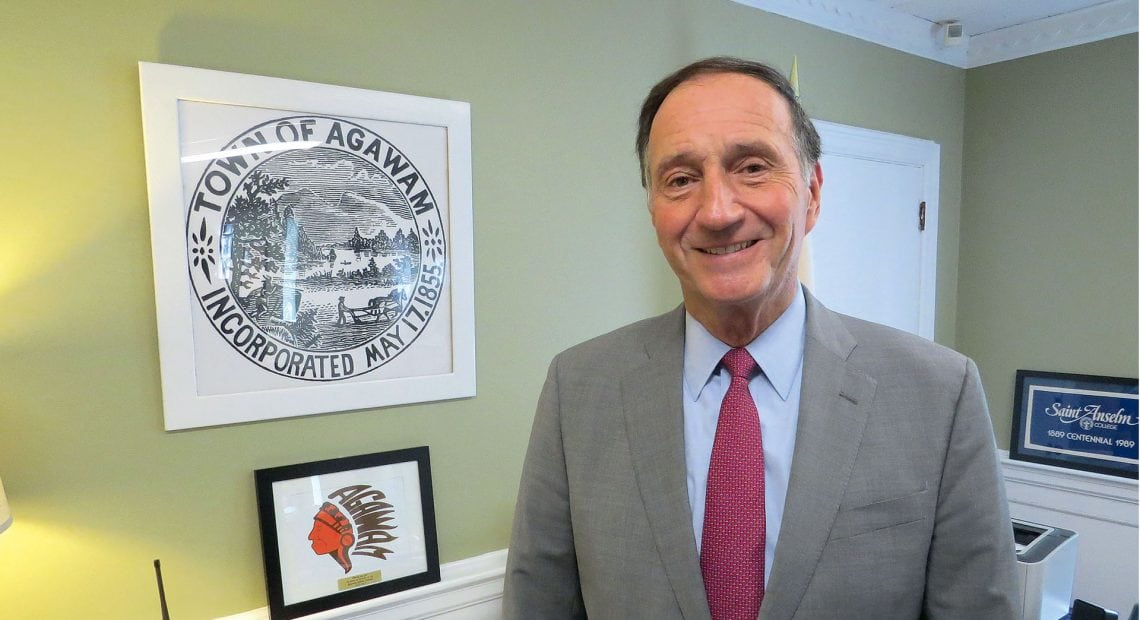
William Sapelli inherited a long to-do list when he took on his new role as mayor, from infrastructure projects to economic-development concerns, and has only added more items to that list.
Very soon after William Sapelli announced he would be retiring as Agawam’s superintendent of schools — ending four decades of work in education — people started suggesting that he run for mayor that fall.
“They said, ‘you have the skill set — you have a $45 million school budget, which is half the town budget, you deal with 700 employees, you’ve negotiated five contracts, and you know all the city departments,’” recalled Sapelli, who took the suggestions under advisement and eventually took the idea to his family.
At first, he recalled with a laugh, he interpreted their unbridled support as perhaps a loud hint that they weren’t ready to have him home full-time. But soon they convinced him, as did others, that their backing was grounded in the belief that Agawam needed a change — and a fresh perspective — in City Hall. And that he could provide it.
Although he eventually embraced the calls for him to seek the corner office, Sapelli rejected recommendations that he formally announce his intentions before he actually retired almost a year ago (early July, to be exact) because he wanted to avoid any and all suggestions that he might be using the resources of his office as superintendent to help gain the mayor’s chair and focusing on his next job before he finished up in the one he was in.
“I got in late — I was really behind the 8-ball, and people said you can’t get in that late,” said Sapelli, who nonetheless triumphed in the September primary and then the November election. And he attributes that victory, in large part, to his message of needed change and the promise that he can provide it.
“This sounds corny, but I grew up here in town, and I care about this town,” he told BusinessWest. “I personally didn’t like the way things were going; it seemed that elected officials weren’t really getting along. It seemed like things were going off the rails — people not communicating, people sniping at each other — and I thought we could do better, and do better for Agawam.”
Five months in, he said the office is, well, busier than he thought it would be, in part because there are a great many meetings and official functions at which his attendance is required, or at least requested. But another big part of it is that Sapelli inherited a lengthy to-do list, and he’s only added more to it.
Among those line items are a host of important infrastructure projects, especially the rebuilding of the Morgan/Sullivan Bridge, which connects Agawam to West Springfield. There are also specific business concerns, such as the nagging question about how to inject new life into the tired commercial district known as Walnut Street Extension, home to the now-infamous Games & Lanes, which no longer exists; however, the problem of finding a new use for the property does.
And then, there are broader, more complex business and economic-development concerns, such as Agawam’s notorious — and in many ways debilitating — spot-zoning practices.
“There’s so much spot zoning in Agawam … our system is so archaic,” said Sapelli with some exasperation in his voice. “In most communities, it’s an issue; in our community … well, I’ve had the experts from the Pioneer Valley Planning Commission get involved through a grant we received, and they used the word ‘unique’ to describe the problem.”
To address it, Sapelli has created a zoning-review committee, which is expected to make some recommendations in the months to come.
An even bigger issue — although the zoning problem is quite extensive — is the recognized need (on Sapelli’s part, anyway) to make the city more business-friendly.
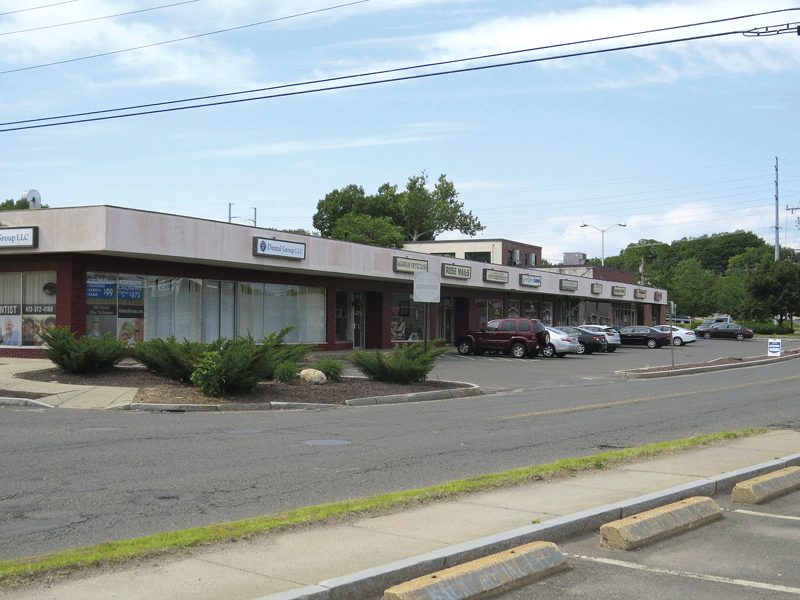
Improving the Walnut Street Extension area remains a problem without an immediate solution in Agawam.
“People ask how we can become more business-friendly, and one of the ways is to expedite the permitting process,” he explained. “From what I was hearing from individuals who came in and tried to start businesses and get permits for different things was that it took longer than they expected. I thought it was important to go out and try to make this community attractive to businesses.”
For this, the latest installment of its Community Spotlight series, BusinessWest talked at length with Agawam’s mayor (he’s no longer the ‘new mayor’) about the challenge he accepted and how he’s working to fulfill that campaign pledge of bringing positive change to the community.
Learning the Ropes
As he provided a chronology of a career in the Agawam school system that began when Jimmy Carter was in the White House, Sapelli said there were a number of stops.
They started with a stint coaching junior-varsity hockey and substitute-teaching assignments at the high school. A year later, he was coaching the varsity team and teaching social studies at the junior high. Later, he taught science for six years, then became assistant principal at the middle school, then an elementary-school principal, assistant superintendent, and, starting in 2011, superintendent.
During the campaign last fall, he encountered — and earned a good deal of support from — people who were students during each one of those stops. When it came to people making such claims about the earliest stages of his career, he admits to having to take their word for it.
“People will say, ‘remember when I had you in school?’” he said. “And I’ll say, ‘I don’t think you looked like this when you were 10 or 12, so I don’t recognize you, but I believe that you were one of my students.”
Support from all those former students and colleagues was certainly a factor in Sapelli’s rather large margin of victory over former City Council President Jimmy Cichetti last November.
As was, he believes, the desire for change in a community that had seen little progress on many of the key issues facing it — and his ability to bring about that change.
“I really thought we could do a better job of having local, city, and state government be a kinder, gentler group, if you will,” he said, “and be able to have open, honest discussions and not take things personally.”
While working to stimulate change and progress, Sapelli is also leading efforts on a number of issues, or fronts, that, as noted, have challenged several of his predecessors.
At or near the top of that list is the Morgan/Sullivan Bridge, the rebuilding and widening of which has been talked about for years. State funding has been secured for the project, and a bid should be awarded shortly, said Sapelli, adding that work was to have started this spring.
But it’s already late June, and construction still hasn’t started, said the mayor, adding that, since work is due to be halted during the 17-day run of the Big E — which is just a few hundred yards to the east of the bridge — in September, there is now a good chance the project may not see much progress this calendar year.
“They may be doing some preliminary set-up work this fall,” said Sapelli, adding quickly that there will be more definitive timelines for this project emerging shortly. “But I don’t think anything major will happen until next spring.”
The bridge, projected to be a two-and-a-half-year project, is an important initiative, he went on, referring to the traffic bottlenecks that are regular — and problematic — for residents and businesses trying to attract people to that area. And during the Big E, the traffic problems reach nightmare proportions.
To ease those problems, the city plans to improve not only the bridge intersection, but also the one a few hundred yards to the north at Springfield and Walnut streets.
Meawhile, improvement of another key intersection, in Feeding Halls on Route 187, is on the drawing board — it has been for some time, actually, said the mayor, adding that is part of approximately $8 million in road, sidewalk, and intersection improvements that will be undertaken city-wide.
While addressing those infrastructure matters, there are a number of specific business and economic-development-related issues that demand attention as well, said Sapelli.
Chief among them is the ongoing issue of Walnut Street Extension. The Games & Lanes property has been razed, said the mayor, and the property’s owner reports there has been some interest, but nothing likely to translate into redevelopment in the near future.
Meanwhile, that property is just part of the story. The Walnut Street Extension area remains a problem without an immediate solution. Last spring, the City Council first rejected a $5.3 million streetscape-improvement project for that area and then a subsequent, scaled-down, $3.6 million initiative.
The strategy moving forward, said Sapelli, is to create what’s known as a DIF (district improvement financing) program for that area. With a DIF, a community can pledge all or a portion of tax increments — additional tax revenue stemming from development or increases in property value — to fund district improvements over time.
“That money gets set aside and earmarked strictly for development in that area that’s mapped out, and that area alone,” said the mayor. “It’s a way of creating a fund to improve that depressed area without using taxpayer dollars or increasing taxes on the people in that area.”
A DIF is a close cousin of the better-known TIF, whereby municipalities may grant property-tax exemptions to landowners of up to 100% of the tax increments for a fixed period. Agawam intends to use both DIFs and TIFs to generate economic development, said Sapelli.
Other specific initiatives include redevelopment of the former Buxton property, later Southworth Paper and Turners Falls Paper, on Main Street, said the mayor, adding that the emerging plan is to subdivide the sprawling plant and attract multiple tenants.
There are also the many smaller retail centers and strip malls within the community, he went on, adding that the town has seen some new businesses come in and fill vacancies, and the goal is to attract more.
As for work on the town’s archaic zoning, Sapelli said his administration is “attacking” the problem.
“It’s going to be a big job, so we’re taking it little bites at a time,” he noted, adding that the Planning Commission has been a big help in this regard. “But we’re going to get it done.”
By the Book
Sapelli said he’s not sure if he’s the only the school superintendent to move the corner office in this region in recent times. But he does know that his route is certainly one that’s not well-traveled.
As his supporters note, he brings considerable experience to the job and knowledge of city departments and how they operate. Those skills have certainly helped him make the transition and advance many different kinds of initiatives.
But his comments — and his body language — convey the message that behind every challenge … there are many more challenges.
He says he’s up for them, because of that dedication to the town where he grew up, and also because he brings a new school of thought to managing this community — literally and figuratively.
George O’Brien can be reached at [email protected]
Under Pressure
By Marylou Fabbo
 In the year that’s passed since President Donald Trump signed the Buy American and Hire American Executive Order, there’s been increased federal scrutiny on the employment-based visa petition process that has made it more difficult for businesses to hire foreign employees.
President Trump and other critics of employment visa programs believe they displace American workers and drive down wages, while employers maintain they need foreign labor to fill jobs that Americans are not willing or qualified to fill. So far, however, the administration’s actions have taken place through heightened agency action, such as government I-9 audits and immigration ‘raids,’ rather than legislation.
Enforcement Action Substantially Increased
When it comes to employing non-immigrant workers, the message is clear: companies’ hiring practices must be able to withstand heightened scrutiny. In September 2017, Asplundh Tree Expert Co. was ordered to pay a record fine of $95 million for employing thousands of unauthorized alien workers.
The U.S. Customs and Immigration Services (often referred to as ICE) has implemented a worksite-enforcement strategy that focuses on criminal prosecution of employers, human-resources personnel, and talent officers who knowingly hire illegal workers or are ‘willfully blind’ to the same. ICE has already doubled the number of worksite-enforcement cases that it pursued all of its last fiscal year. In New England alone, ICE made more than 680 arrests during the first quarter of its fiscal year. Even companies that don’t employ any immigrants or foreign workers are subject to an ICE audit and can face significant fines and penalties for things such as failing to fully and accurately complete I-9 forms for U.S. citizens.
Number of H-1B Visa Petitions Down
President Trump’s Buy American and Hire American Executive Order is purportedly designed to increase wages, protect the jobs of U.S. citizens, and increase employment rates. Among other things, the order requires federal agencies to review and propose new rules and guidance to protect the interests of U.S. workers and to prevent fraud and abuse in the H-1B visa program. This program allows companies in the U.S. to temporarily employ foreign workers in occupations that require the theoretical and practical application of a body of highly specialized knowledge and a bachelor’s degree or higher in the specific specialty, or its equivalent. H-1B specialty occupations typically include fields such as science, engineering, and information technology.
About 65,000 regular visas and 20,000 masters-level visas are awarded each year through a lottery system, although the ultimate goal is to switch to a point-based merit system. While ICE received more than double the amount of petitions needed to fill the quotas, the total number of petitions submitted decreased by about 10,000 from last year and has decreased more than 50% since its high in 2016. Trump’s executive order — designed to reform the H-1B visa program by making it more difficult to get such a visa — may be driving some away from using the program at all.
Spouse Employment Authorizations Likely to Be Rescinded
Certain spouses of H-1B workers may be eligible to work pursuant to an H-4 visa. However, the Department of Justice and the Department of Homeland Security have stated that they intend to rescind employment authorization for H-4 visa holders, and it now appears that at least some form of the rescission is likely to take place in the near future.
Yet, some questions remain unanswered. Will current H-4 visa holders be able to renew them? Will there be a drop-dead date after which H-4 authorization is no longer valid at all? What’s clear is that employers who hire H-4 workers need to start thinking about alternate means of legally employing them.
Tougher Standards for H-1B Workers at Third-party Locations
ICE also has increased the scrutiny on employers who petition for H-1B employees and intend to place them at third-party sites. Earlier this year, ICE issued a policy memorandum stating that, for an H-1B visa petition involving a third-party worksite to be approved, the petitioner must show “by a preponderance of evidence” that, among other things, the worker will be employed in a specialty occupation and the petitioning employer will maintain an employer-employee relationship with the beneficiary for the duration of the requested validity period. The third-party recipient of the H-1B worker will also have to come up with some evidence corroborating what the employer provides.
Organizations that provide H-1B workers to third parties should be prepared to respond to requests for evidence beyond what they have experienced in the past, denials of petitions, and, possibly, the granting of H-1B visas for less than the usual three-year period.
Moving Forward
Employers should expect the Trump administration to continue to aggressively pursue immigration reform. Like the visas mentioned in this article, the state of those with C-33 visas — non-immigrants who have been granted Deferred Action for Childhood Arrivals (DACA), remains up in the air, and employers that have DACA recipients with employment authorization may face the loss of the ability to continue their employment.
Companies that have not already done so should carefully review their hiring practices and evaluate alternate means of employing non-immigrant workers regardless of their current visa status. Those employers that have H-1B workers at third-party sites should scrutinize their vendors and their contracts with those third parties. And, perhaps most importantly, companies should make sure their I-9s and other immigration-based records are complete and accurate. u
Marylou Fabbo is a partner and head of the litigation team at Skoler, Abbott & Presser, P.C. She provides counsel to management on taking proactive steps to reduce the risk of legal liability that may be imposed as the result of illegal employment practice, and defends employers faced with lawsuits and administrative charges filed by current and former employees; (413) 737-4753; [email protected]
Changing the Landscape
By George O’Brien
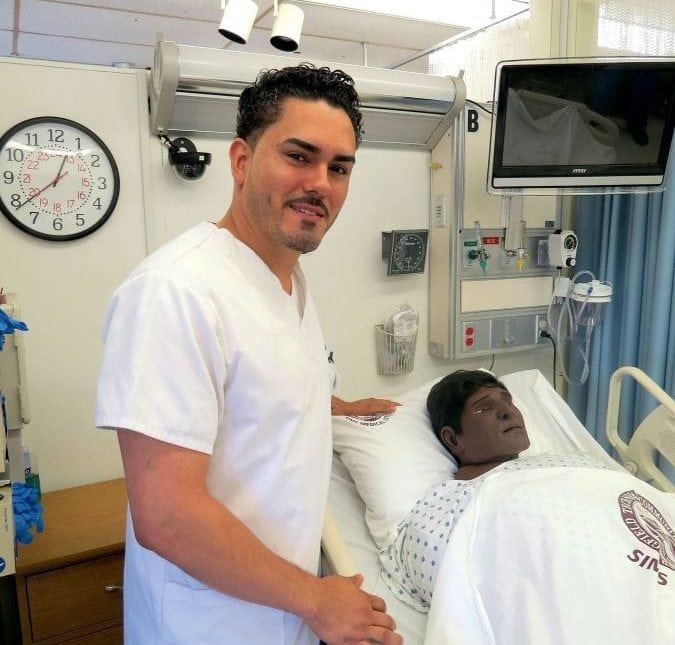
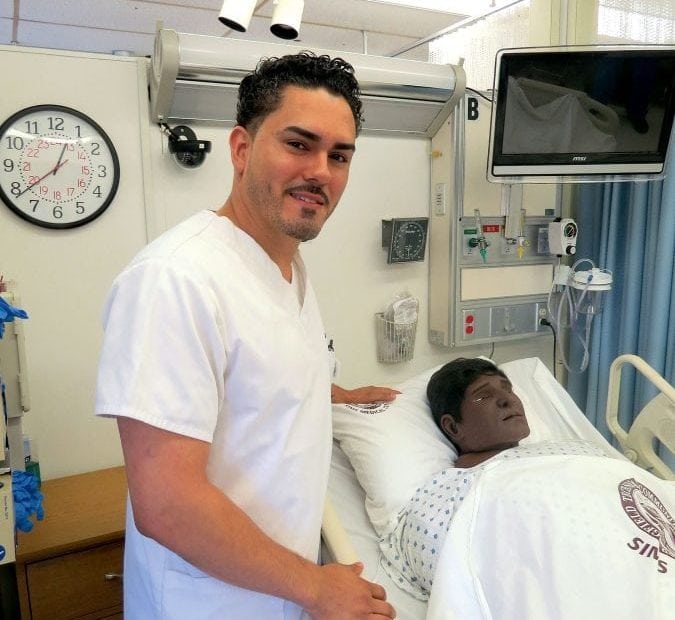
Erasmo Ruiz says he has found a profession that offers stability, flexibility, and a wide range of options.
To say that Erasmo Ruiz took a circuitous route to the nurse-pinning ceremony at Springfield Technical Community College late last month would be an understatement. A huge understatement.
Now 34, the father of two teenagers — and the first one in his family to attend college — studied engineering at UMass. But things “didn’t go as expected,” he told BusinessWest, noting that he was into partying and girls far more than he was into his studies and eventually had to drop out.
From there, he went into the Navy, specializing in electronics. But he didn’t finish his enlistment because his father got into trouble with the law and was incarcerated; Ruiz needed to get home and help support his family.
He would join the workforce, trying his hand at everything from manufacturing to time as a clerk in the Post Office. Then, by chance, he got a job as a medical assistant working with a group of neurosurgeons at Baystate Medical Center.
“It just made sense at the time to take things to the next level,” he said of his decision to pursue a nursing degree. “With the guidance of nurses and other medical professionals, I chose this career.”
A circuitous route to be sure, but Ruiz found himself at that pinning ceremony, persevering through a two-course of study that challenged him on many levels. And many men are doing the same thing.
Well, let’s say many more men, and even a phrase like that needs to be put into perspective.
Yes, there are more men getting into nursing these days, at least compared to 40 or even 20 years ago, but the numbers still don’t approach that of women, said Karen Aiken, a Nursing professor at Holyoke Community College for the past 17 years, eight as chairman of the department.
“The labor bureau will tell you, and make it sound really great, that since 1970, the number has tripled,” she said of men in the profession. “But the numbers are so small, that doesn’t mean much; overall, I think the percentage [of all nurses who are male) has risen from 2.9% to just over 9%, so those are still small numbers.”
We’ll get into the numbers and the reasons they’re higher than they were, but not as high they as perhaps they should be, later. First, let’s look at some of the men who are getting into nursing.
Most are not taking what would be called the traditional route, right out of high school, but then again, many women don’t take that path either.
Andy Bean, 38, who graduated from Westfield State University this spring, worked in sales for a trucking company, sitting in front of a computer all day ordering parts for clients. He was laid off once when the economy took a turn for the worse and decided that he wasn’t going to let that happen to him again.
So he segued into healthcare and eventually a nursing program. Actually, several of them. He’s been working toward a degree in healthcare for seven years, by his estimate, and he’s looking to make a home in the emergency room at Baystate Noble Hospital in Westfield, where he’s already spent considerable time as a technician and student nurse.
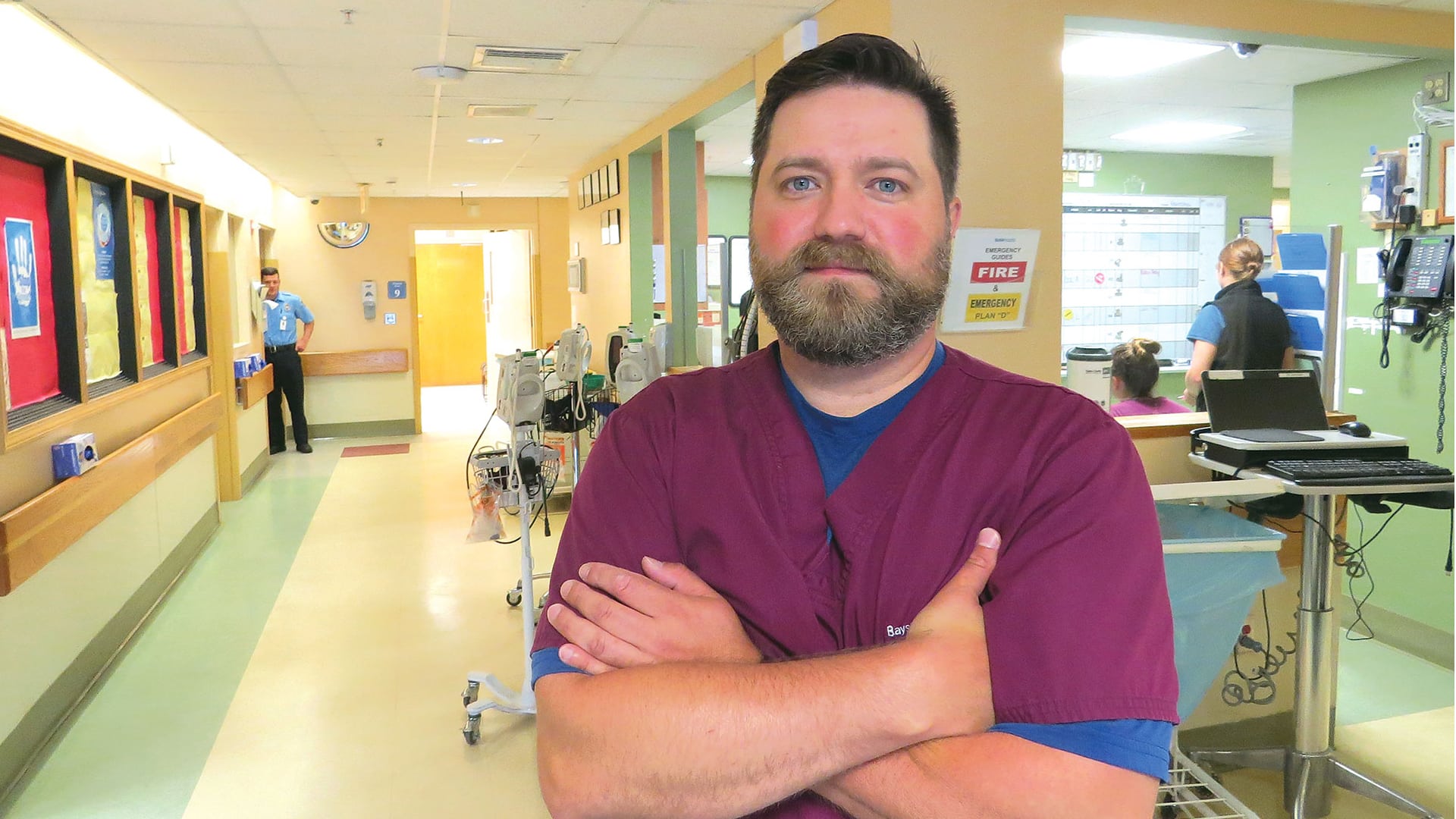
Andy Bean, seen here in the ER at Baystate Noble Hospital in Westfield, likes the fast pace of that setting and wants to start his career in nursing there.
Meanwhile, Nick Labelle, another member of STCC’s class of 2018, now 36, worked in everything from food preparation to sheet-metal fabrication to real estate before getting a job as a counselor in a substance-abuse clinic. It was that last stop that convinced him that he liked helping people and working in a healthcare setting.
But some have taken more of a direct route. People like Brendan McKee from North Attleboro, another recent graduate of WSU. He said that, unfortunately, he spent a lot of time in hospitals in his youth visiting sick family members, and quickly realized he wanted to be part of that environment. Nursing, he said, was his first choice.
Overall, there are many reasons why nursing has become the first choice, or the second, or the fifth, for men, said Lisa Fugiel, director of the Nursing program at STCC, listing everything from solid pay to the availability of jobs as Baby Boomers retire, to the flexibility within the profession and the wide variety of options available to those who choose it.
But for many, it comes down to those same ingredients that bring women into nursing, she said — compassion, caring, and a desire to help others.
For this issue and its focus on nursing education, BusinessWest interviewed several men on their way to joining the profession (the licensing exam is their next challenge). Collectively, their stories help explain why the landscape within nursing — gender-wise, anyway — is changing.
Course Change
Bean told BusinessWest that he likes the pace of work in the ER and the fact that he’s always moving in that setting.
“That’s a big change from when I was just sitting in front of that computer all day,” he said. “That’s one of the things I hated the most about my old job. It just didn’t feel like a good fit for me anymore.”
But pace of work — and fit — are just two of many reasons why there are more men hearing their names called at those nurse-pinning ceremonies, said both Aiken and Fugiel as they discussed the changing demographics in their classrooms.
They both spoke of greater acceptance of male nurses in general and among women receiving care, and, on the flip side of the equation, more acceptance of the profession as a career option among men. And both halves of the equation are important.
“Women are more comfortable with women, and in some areas especially,” Fugiel noted. “But overall, there is more acceptance of men now.
“And we’re seeing a steady increase when it comes to men getting into the profession,” she went on, noting that this is reflected in the numbers of men in the STCC program; there were nine in this year’s class of 74, roughly double the total from when she started 15 years ago.
There are many reasons for this, said Fugiel and Aiken, listing solid pay and benefits, stability (an important consideration given anxiety about many professions in an age of ever-advancing technology), a host of opportunities, and a wide array of specific areas to get into, from critical care to medical-surgical nursing to behavioral health.
“All the students talk about how there are so many options in nursing, which is one of the things that’s so enticing about the profession, whether it’s male or female,” said Fugiel. “Just look at all the options in an acute-care setting — pediatrics, maternity, ER, ICU, med-surg, and mental health — but there’s also community nursing, nursing infomatics, and managed care.
“And there’s stability,” she went on. “A lot of our nurses are getting older, and that translates into opportunities and stability.”
While it’s good for men to be getting into the profession, given its many rewards, it is also good for the profession, the healthcare community, and society in general, to have men as nurses, said Aiken.
“As an instructor and as a seasoned nurse, I believe that that the more men we can get into nursing, the better,” she explained. “It makes it a rounded profession, and it makes the care more rounded.”
Elaborating, she said men can and often do bring a different perspective to the work of caring for people in need.
“Nurses that are female think one way, and our society doesn’t give men a lot of credit for compassion and caring,” she told BusinessWest. “When these men come into nursing, they come in for a reason — they have that compassion and want to care for people.
“A large number of men who enter our program have been out in the workforce and are either changing professions or are looking to be caring professionals,” she went on. “And they bring so much with them when they come in.”
Getting into the profession is difficult for many, she said, and perhaps more difficult than for many women because men are still traditionally the breadwinners in many families, and, therefore, it is difficult to quit work completely or go to school part-time to earn a nursing degree.
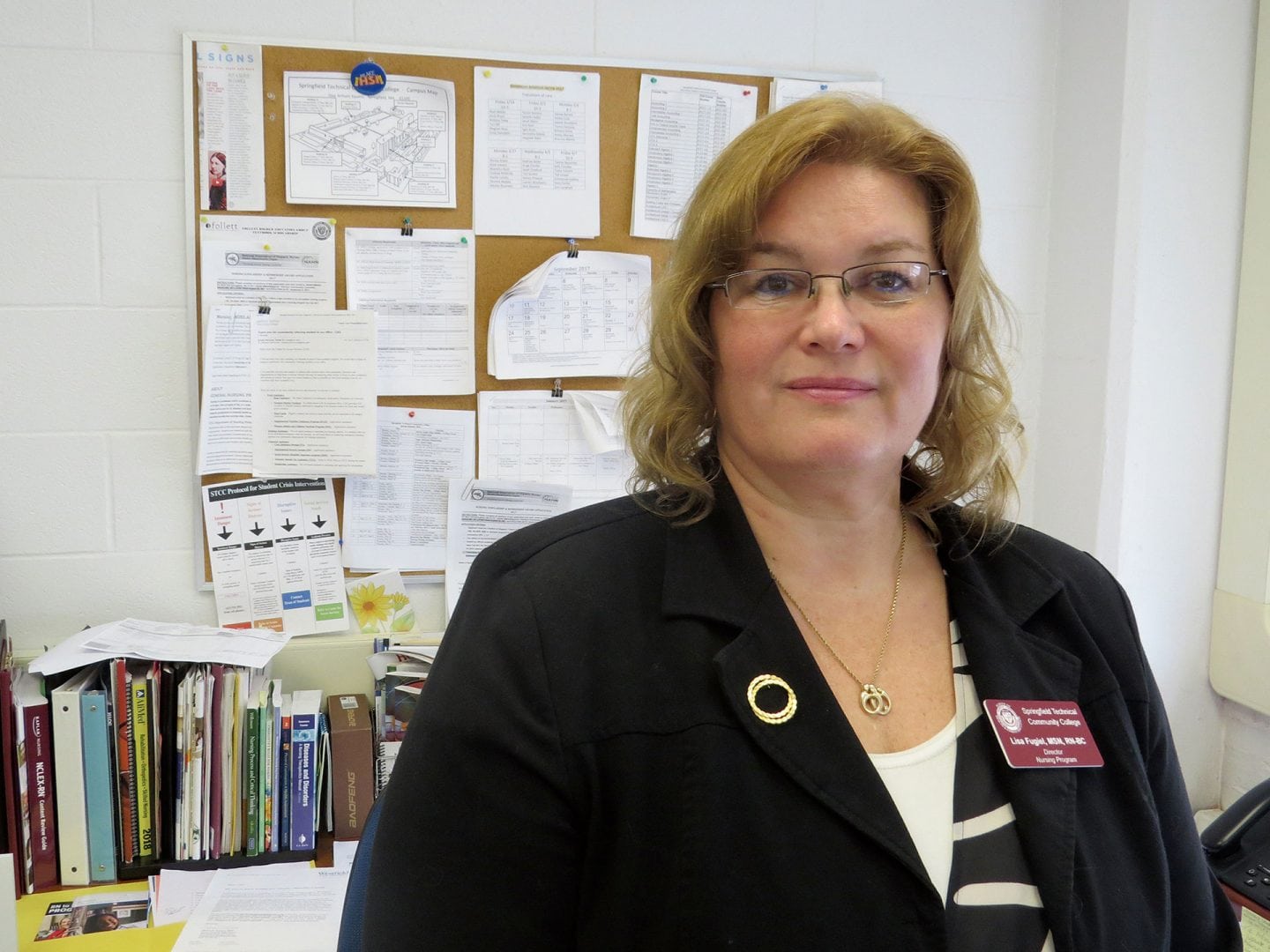
Lisa Fugiel says society is becoming more accepting of male nurses, and, likewise, men are becoming more accepting of careers in the nursing field.
“The commitment, the education, is more than a full-time job,” said Aiken, adding that men often enter a program not fully understanding what they’re getting into and how they’re going to manage that commitment given their other responsibilities, and that’s why many struggle to get to the finish line or never get there.
Labor of Love
As for those that do, well, interviews with several men graduating this year provide solid evidence that men are more open to a career in nursing — and for all those reasons listed above, from the stability to the flexibility; from the nature and pace of the work to the ability to work with people.
“A big factor for me was all the options we have — you can do anything with this,” Ruiz said of that diploma he’s earned. “Also, in terms of looking out for my family, that was also part of it. The demand is there; there’s a nursing shortage.”
Stability was also a big consideration for Bean, who, as noted, had been laid off once and was looking for firmer ground career-wise. He was also looking for something more rewarding and with opportunities to do some ladder-climbing.
He had taken a few EMT courses, and, after returning to his job with the trucking company after being laid off, found it lacking in many ways,
“So I quit my job, and with the support of my wife, I went back to school to get my nursing degree,” he explained. “I found that, with nursing, there were so many avenues to go down; if one didn’t fit, you could find another one that did fit.”
As noted, he’s been going to school, part-time or full-time, for seven years now. It’s been a struggle at times, but he kept his eyes on the prize awaiting him.
“I was taking classes while working, then quitting and going back to full-time, then working again quite a bit in the emergency room while going to school full-time,” he said. “It’s been a long road, and I’m happy to be done with it.”
Job satisfaction was also a mostly missing ingredient for Labelle, who tried to find it, without much success, in fields ranging from hospitality to selling houses. He found much more of it working in that substance-abuse clinic, but desired an even higher level.
“I wanted a career that would directly impact patient or client care,” he explained. “I did a variety of career assessments, and found that nursing was something that seemed to suit me with regard to compassionate care of client needs, and also something that would be challenging.
“I needed a job that would really challenge me, and I was looking for stability as well,” he went on. “And nursing really fit that criteria. It was a very careful decision.”
As it was for Brendan McKee, who, as noted, didn’t segue into nursing; it was his first choice.
“I did spend a lot of time in hospitals with sick family members,” he recalled. “And I got to see how the nurses worked and took care of my family. It left a really good impression on me.”
He entered Westfield State out of high school, and, like all nursing students, was exposed to a number of different and intriguing paths within the profession. One of them was work in the ICU, and that’s where he is slated to work, at Baystate Medical Center, this fall.
“I like the acuity of it — I enjoy being in that demanding of an environment,” he explained. “I’m the kind of person who runs well when there’s a lot to do and there’s a faster-paced environment.”
A second reason for choosing the ICU, said McKee, is that he eventually wants to work in anesthesia, and the ICU is the “gateway,” as he called it, to that specialty, just as the nursing degree itself is the gateway to a seemingly endless range of career paths within healthcare.
Making a Difference
Ruiz, like all those we spoke with, said he’s taking things one step at a time right now. That means his focus is on passing the licensing exam, which he’ll tackle in the next few months.
After that? He has a comfort level on the “neuro side,” as he called it, but he’s also willing to explore.
“I grew up in Springfield, and I would love to work with the community,” he told BusinessWest, adding that one of his rotations while at STCC was at the High Street Clinic, located in one of the city’s poorer neighborhoods. “I think I could make a difference in a center like that, but I’m not really sure that’s what I want — there are lots of options.”
With that, he summed up why more men are getting into a profession long dominated by women. They want to make a difference, and they’re becoming more accepting of a profession that allows them to do just that.
The numbers of men are not rising quickly or dramatically, but the arrow is definitely pointing up. And as Aiken and others noted, that’s good not just for the men taking this career path, but for those they will serve when they reach their destination.
George O’Brien can be reached at [email protected]
Behind the Curtain
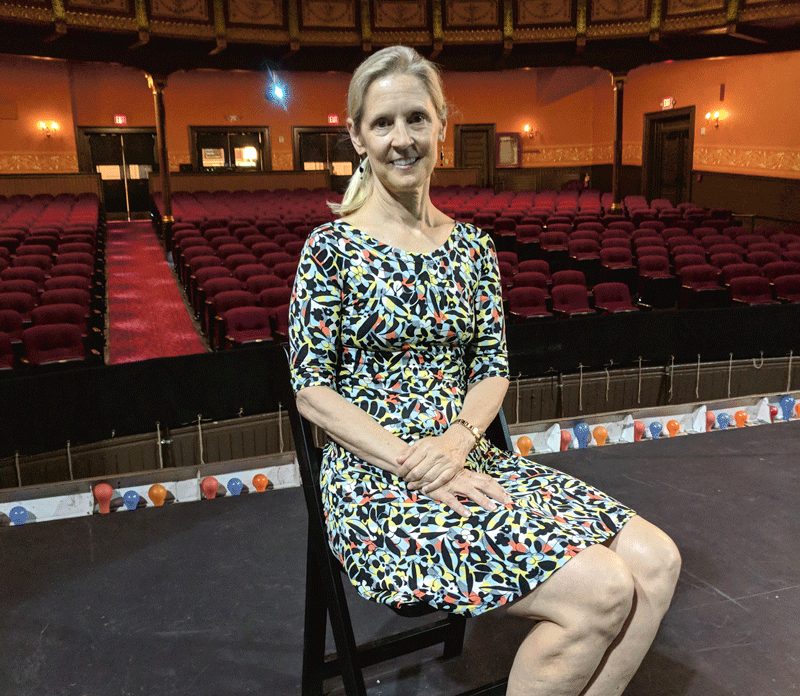
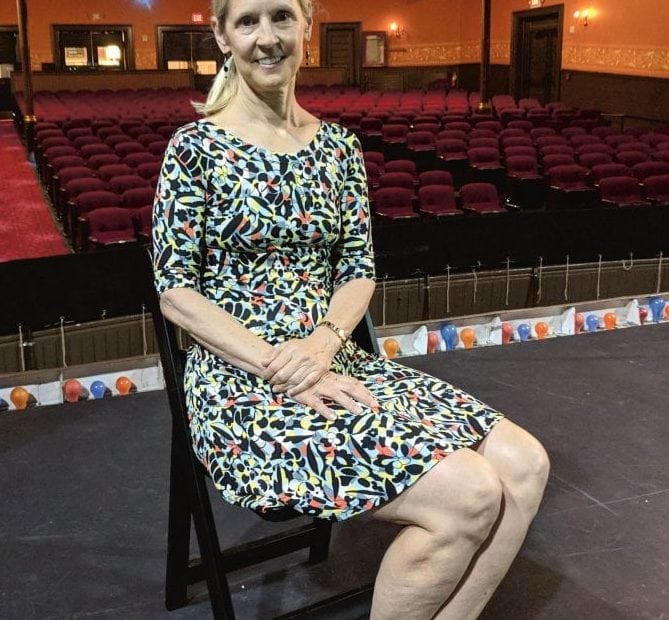
Debra J’Anthony says the Academy of Music’s history speaks to the commit-ment of its community to the arts over the decades.
During a decade of renovations at Northampton’s Academy of Music, few proved more surprising than the sailcloth canvas that lined the theater’s century-old curtain.
“We’ve put a lot of attention on maintaining the historic integrity of this building,” said Debra J’Anthony, the facility’s executive director since 2008. “There’s a lot of mindfulness and thought in this space. We’ve tried to get state-of-the-art technical equipment and at the same time preserve the historical integrity of the space.”
The sailcloth, as it turned out, was actually a massive landscape painting of nearby Paradise Pond. It was restored by a Vermont company called Curtains Without Borders, which specializes in preserving historic stage scenery, and now hangs high in the Academy’s rafters upstage.
As historical fragments go, it’s actually a relatively minor one in the 127-year-old facility’s rich story. Edward H.R. Lyman opened the theater in 1891 as a building “suitable for lectures, concerts, opera, and drama for the public good.” Remarkably, the Academy’s priorities have changed very little since then.
“There has been a mix of activity, but depending on the year, there has been a weight toward one medium or another,” J’Anthony said. “In the beginning, it was just performing arts and lectures; then, starting in the 1930s, it was weighted more heavily toward film. We actually had a film distributor out of Boston that leased the building for about 10 years, so the Academy actually did quite well during the Depression because they had a renter in here.”
During the first few years of J’Anthony’s tenure, she led another transition, from what was largely a first-run film house, with occasional live performances, to what it is today, a performing-arts venue that hosts scores of shows — national touring acts, presentations by local companies, and sometimes the Academy’s own productions — throughout the year.
Efforts to fill that calendar have been boosted by a series of renovations to the theater, from shoring up the envelope of the building — including new roofing and replacement of leaky windows and doors — to launching the organization’s first-ever capital campaign to pay for a major renovation of the theater space itself.
“There were seats upstairs dating from 1947, and there were seats downstairs that were bought used during the 1960s,” J’Anthony said, noting that the Academy worked with Thomas Douglas Architects to re-establish a period look, and received a Preservation Award from the Massachusetts Historical Commission for its efforts. “We’re hoping to continue to renovate, finish the renovations in the hall, then go out into the lobby areas. We’re hoping to receive some Community Preservation Act funds soon to complete the opera boxes and add architectural lighting.”
In addition, because the Academy had mainly been a film house during the tenure of Duane Robinson, who ran it for more than 35 years before J’Anthony’s arrival, there wasn’t much modern theatrical equipment on hand. So the theater recently installed a new sound system, replaced some outdated theatrical lighting with LED lighting, and installed new flooring for theatrical productions.
Those efforts have helped make the Academy of Music a more attractive venue for national touring acts. The theater’s relationship with Signature Sounds led to a relationship with Dan Smalls Presents, which represents many of the the national touring bands that come through Northampton.
“We’ve got the attention of AEG and Live Nation as well,” she added. “The model is definitely working. There’s usually somebody in here most days. We have a wide range of offerings, from hip hop to ballet, from opera to Americana music, film, comedy, dramas, musicals — so there’s something for everybody.”
Rich History
Looking back to the beginning, Lyman had the foresight to purchase a lot of land on Main Street that would eventually be one of Northampton’s main crossroads. Working with well-known architect William Brocklesby of Hartford, Lyman had the two-story Academy built for $100,000, plus $25,000 for interior decoration and equipment.
It opened in 1891 with a sold-out concert featuring four solo artists backed by the Boston Orchestra. But Lyman’s fondest interest, opera, never really caught on at the center.
He eventually gifted the theater to the city, and it remains the only municipally owned theater in the U.S. — and a largely self-sufficient one. Aside from occasional help from the city to make needed repairs, the facility has never had a line item on the Northampton budget, surviving on box office and donations.
Throughout its first 15 years, the Academy became a popular stop for drama troupes and traveling road shows, attracting some of the top talent of the day, including Sarah Bernhardt and Ethel Barrymore.
With the economy shifting and top acts harder to come by, the Academy’s trustees went in a different direction in 1912, establishing a resident dramatic company, the Northampton Players. Although their shows were popular, especially with the Smith College crowd, they didn’t make enough money, and the group was disbanded a few years later. Various efforts to revive resident theater were reattempted throughout the 1920s, but none of the companies survived for long.
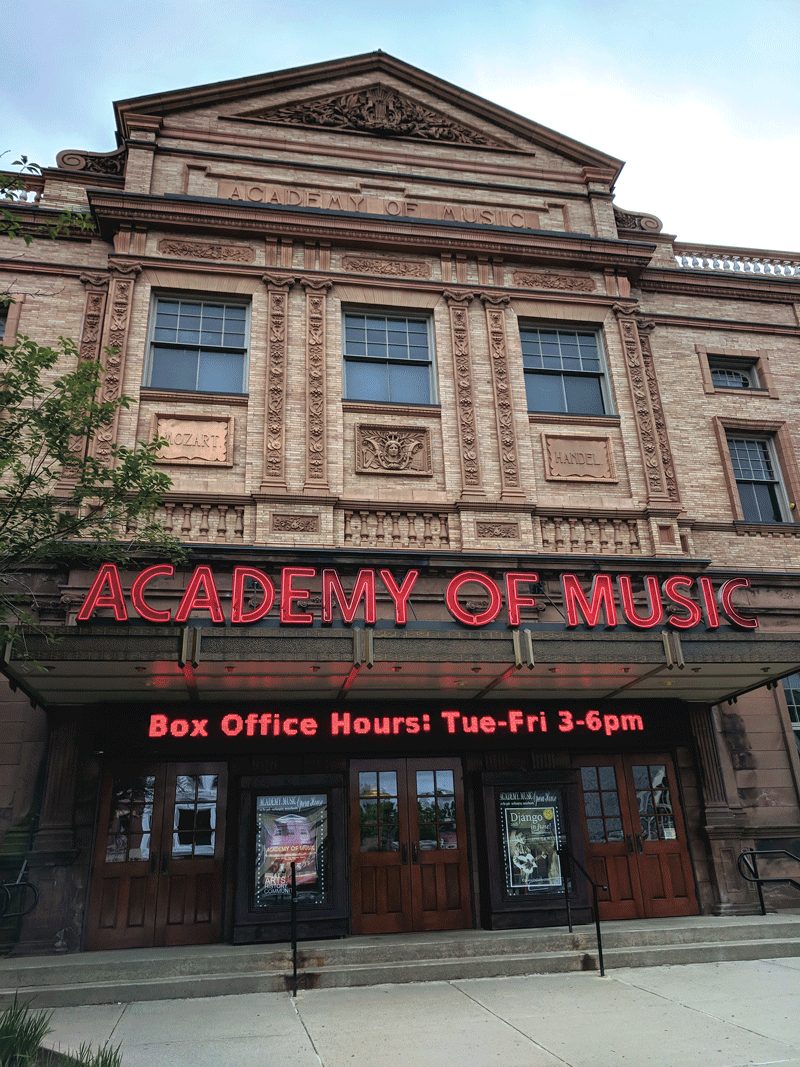
Opened in 1891, the Academy of Music’s iconic building has been a prominent fixture at one of Northampton’s busiest intersections.
That era saw visits to the theater by the likes of Frank Morgan and William Powell, among other names who later made the transition into motion pictures — which would be the Academy’s direction as well.
In fact, it had presented its first moving picture in 1898, shortly after the ‘projectiscope’ technology was introduced to the world. By 1921, the Academy was showing films three times a week, and by 1930, the facility was run primarily as a moviehouse. The trustees made the sea change permanent in 1943 by spending $40,000 to modernize the theater.
During that period, the Academy had a falling-out with the film distributor who leased the building through the 1930s, J’Anthony noted. When theater manager Frank Shaughnessy was called to military service, he recommended that his clerk, Mildred Walker, who had been working alongside him for 16 years, mind the shop while he was serving in the military.
“And the board agreed,” she went on. “She was a local resident and known entity to the organization. However, the film distributors were upset that the board would allow a woman to run the theater. So they took the Academy to court — and the Academy lost. That’s why their relationship discontinued; they didn’t re-up the lease.”
Walker, in the meantime, proposed a new governance model whereby the board would run the building, but would hire a manager. “And she recommended herself,” J’Anthony said. “They agreed to her governance model; however, they hired Clifford Boyd to run the theater.” Decades later, in 2014, following the spate of renovations, the Academy commissioned and presented a new work, Nobody’s Girl, that told Walker’s story.
Boyd, a veteran of the theater industry, oversaw a shift at the Academy of Music to live performing arts. Later, under Robinson’s tenure, from 1970 through the early part of the new millennium, the facility reverted to mostly film, as well as undergoing a series of needed renovations in the ’70s and ’80s. But that business model, too, was set to change.
“Film distribution changed in the 1980s with the rise of the megaplex,” J’Anthony said, “so one-screen venues across the nation had to make changes. Either they turned into megaplexes or became performing-arts centers.” The latter, of course, continues to be the Academy’s path today.
Into the Future
When J’Anthony came on board in 2008, the Academy was primarily renting the hall to community-based organizations, but soon established a series of resident companies and partners that supply regular programming.
“However, we needed to look at producing our own shows during the recession, when many of the opera companies folded, and so we started producing our own shows here, which led us into youth programs.”
Those include three sessions of summer musical theater workshops for ages 7 to 14, and in January, the Academy conducts rehearsals for a youth production in March.
“In addition, we have been producing plays,” she continued. “We started focusing on women’s works — being in Northampton, and being connected to Smith College, that just made sense. And we’ve been adding more presentations and productions each year.”
The theater, with a capacity of just over 800, welcomes some 60,000 visitors each year for performances, so it’s still a cultural force in the city after so many decades of change.
“Certainly, there’s a sense of place within this community for the Academy of Music. It is a place of gathering, of sharing ideas,” J’Anthony said, adding that its blend of big-name attractions and community-based productions make for an intriguing mix. “Somebody can be out in the audience and see a national touring show one night and be on stage the next night.”
That said, the Academy also strives to be sensitive to its market, she noted. “We do things that are a little more edgy than other venues. We keep our ear to the ground in regard to the values of our community, what is relevant to them, and making sure we bring art forms that can engage them in further discussions and offer new perspectives.
“A building like this is a valued asset, and it takes a large community to maintain this building and the programming we have here,” she went on. “So we’ll keep working with the city, the state, and Community Preservation Act funds, as well as individual contributions, to keep this space going. It’s all hands on deck.”
Joseph Bednar can be reached at [email protected]

Not an Arbitrary Decision

John Greaney, who was forced to retire from the state Supreme Judicial Court as he turned 70, is definitely not the retiring type.
John Greaney spent more than four decades behind various benches — everything from this region’s first Housing Court to the state Supreme Judicial Court. Desiring to take advantage of all that judicial experience, the Springfield-based firm Bulkley Richardson, which Greaney joined in 2016, has created an alternative dispute resolution (ADR) group, which he will lead. As arbitration and mediation become ever-more popular methods for resolving disputes, the firm sees this group as a solid business venture.
Peter Barry says it’s a rare opportunity when a small (at least in comparison to outfits in Boston, New York, and Philadelphia) Western Mass. law firm can add a former Massachusetts Supreme Court justice to its team.
Rarer still is an opportunity to add a jurist with the breadth and experience brought to the table by John Greaney, who retired from the SJC in 2008, capping nearly 35 years on various benches, starting with the Hampden County Housing Court (which he started) and time on the Superior Court and then the Appeals Court (more on that remarkable career later).
So it’s incumbent on a firm granted that opportunity to take full advantage of it, said Barry, managing partner with Springfield-based Bulkley Richardson, adding that the firm is doing just that by launching an alternative dispute resolution (ADR) group.
This is a move that not only capitalizes on Greaney’s deep reservoir of experience, but serves as a logical — and, yes, opportunistic — response to an ongoing trend within the law to settle matters not in the courtroom, but outside it, through mediation and arbitration.
These are routes that are generally quicker and less expensive than litigation, said Greaney, adding that ADR, as it’s known, has become increasingly popular in realms ranging from healthcare to construction; education to sports. Yes, some of Major League Baseball’s biggest rising stars have their salaries determined by arbitrators (after negotiation fails).
Greaney and Barry believe the firm could well become an attractive alternative (there’s that word again) amid a growing number of options for businesses, institutions, and sports leagues desiring to resolve matters through ADR, and for several reasons.
Chief among them is the expertise it offers — from not only Greaney, but also Barry, who has been involved in the mediation and arbitration of several complex matters, and the other lawyers at the firm.
But that expertise also comes at a sticker price well below what Boston and Harford firms would charge, an important consideration, said Barry.
“We’re looking to be selective and get appropriate cases from Northern Connecticut, Central Massachusetts, and the Boston area,” he said, noting that the firm already serves several clients in those markets, in part because of lower hourly rates.
Greaney, who will be teaming with Barry to handle many of the ADR matters that come to the firm, agreed, and said the timing and a host of factors were right for the launch of this venture.
“It’s a natural progression for this law firm to begin an ADR group,” he noted, adding that, apart from the Hampden County Bar Assoc., which has a panel of mediators and arbitrators, the only other mediators and arbitrators in this region are single-practice lawyers; Boston and Hartford have ADR groups, but this woud be the first in this region.
“There appears to be a need here for the right type of mediator and arbitrator,” he said, adding that the firm intends to fill that void.
Barry agreed.
“There are a lot of mediators and arbitrators out there,” he acknowledged. “But what we bring to the field is an expertise — primarily Judge Greaney — that is not available generally and is suitable for certain types of cases in particular.”
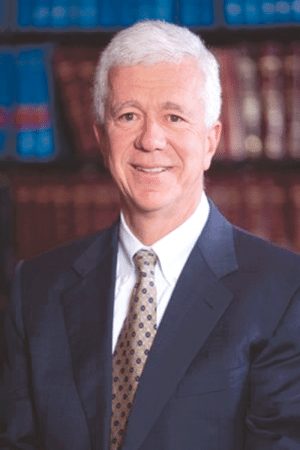
Peter Barry says ADR is an area of the law that is growing and will continue to grow as businesses and individuals seek alternatives to litigation.
For this issue and its focus on law, BusinessWest talked with Greaney and Barry about Bulkey Richardson’s new ADR group, and also about how arbitration and mediation are becoming increasingly popular — and effective — methods for solving complex legal disputes.
Making Their Case
For those not familiar with Greaney’s background (and many are), it takes more than a few column inches, as they say in the print media, to capture all he’s done during his career.
So we’ll hit the highlights. But even that will take a while.
The Westfield native began his law career with the Springfield-based firm Ely and King in 1964, and was appointed to the Hampden County Housing Court in 1974. That housing court was the second in the state, with the first being in Boston, and was unique in that it served an entire county.
“We decided to innovate considerably,” he recalled. “We designed our own court forms, we changed them to get rid of all the legal language — which cluttered all the forms in the other courts — so people could understand them, and we made them bilingual because we had a large Spanish-speaking population. And, to the dismay of a lot of other courts and judges, we set up a citizen’s advisory council — all to make the court more user-friendly.”
In 1976, Gov. Michael Dukakis appointed Greaney to the Superior Court. This was followed by an appointment to the Appeals Court as an associate justice in 1978. In 1984, he became chief justice of the Appeals Court.
Greaney was appointed to the Supreme Judicial Court in 1989 and participated in several landmark cases while serving on the SJC. That list includes Goodridge v. Department of Public Health, in which he wrote the concurrence to the opinion establishing Massachusetts as the first state in the nation to legalize same-sex marriage.
“We share a common humanity and participate together in a social contract that is the foundation of our Commonwealth,” he wrote, creating language that has been used often by gay couples at their wedding ceremonies. “Simple principles of decency dictate that we extend … full acceptance, tolerance, and respect. We should do so because it is the right thing to do.”
Other significant cases include a 1993 decision upholding the adoption of a child by same-sex cohabitants; a 1997 decision in the Benefit v. City of Cambridge case, affirming the unconstitutionality of a statute prohibiting panhandling; a 2003 decision in the First Justice case addressing, on separation of powers principles, the constitutionality of statutes governing court clerks and probation officers; and a 2007 decision in the Murphy v. Boston Herald case, affirming a judgment based on defamation.
Greaney, famous for taking a Peter Pan bus to and from Boston most days and using that time to get more work done, reached mandatory retirement age (70) in 2008, but he wasn’t, and still isn’t, the retiring type. He joined the faculty of Suffolk University Law School, served as director of the Macaronis Institute for Trial and Appellate Advocacy, and taught constitutional law, criminal law, and appellate practice.
But he became a victim of the financial pressures facing many law schools today, and as Suffolk Law downsized and Greaney’s position was essentially eliminated, the judge looked for something else to do in ‘retirement.’ And as he looked, he remembered that Francis ‘Sandy’ Dibble, a partner at Bulkley Richardson, had long ago told him that, when he was done teaching, he should consider joining the firm.
He did so, in 2016, and thus went back to where he started (well, sort of) — practicing law in downtown Springfield.
But the legal landscape has certainly changed since Greaney first started out as a lawyer more than a half-century ago. Indeed, ADR has become an increasingly popular alternative to the courtroom, one that resolves matters in months, or even weeks, rather than years.
A Strong Case for ADR
There are two basic forms of ADR, mediation and arbitration, and while they are similar in that they are alternatives to traditional litigation, there are important differences.
Mediation is generally conducted with a single mediator who does not judge the case but instead simply helps the parties facilitate discussion and, hopefully, a resolution to a problem. Arbitration, on the other hand, is more judicial in nature (that’s why Greaney said it appeals to him) and involves one or more arbitrators who take on the role of a judge, making decisions about evidence and giving written opinions, which can be binding or non-binding, with the results being final.
“The shift from actual courtroom litigation and the resolution of disputes prior to courtroom litigation has become a fairly active enterprise over the past 12 years or so,” Greaney explained. “When I was a trial judge, no such thing existed.
“But the phenomenon was created by business people and others,” he went on. “And the courts wanted to see a simpler, more efficiently way to deal with the problems they had.”Also, many contracts — for everything from construction projects to employment agreements to the one signed by Stormy Daniels when she received $130,000 from Presisdent Trump’s personal lawyer, Michael Choen — have provisions noting that there if problems arise, they will be resolved by private arbitration and not litigation, Greaney told BusinessWest, adding that the Supreme Court, with a few exceptions, has consistently upheld the validity of these arbitration clauses.”
And as a result, and many law firms and individuals, including many retired judges, now specialize in mediation and/or arbitration (mostly the former), creating a somewhat competitive market for those services.
Bulkley Richardson looks to stand out within that playing field and capitalize on the experience of both Greaney and Barry as well as a host of other attorneys within the firm, including Dibble, Daniel Finnegan, Kevin Maynard, David Parke, Melinda Phelps, Jeffrey Poindexter, and John Pucci.
Barry said the firm is not interested in taking on cases that could easily be handled by one of the other mediators in the region, and is instead interested in more complex matters. And, again, they could come from within the 413, or well outside it given the expertise the firm can now bring to bear.
And because of how the pendulum has swung toward ADR, there should be ample opportunity to grow the practice.
“ADR is an area that’s growing and will continue to grow, and there will be a need for the types of services we’ll provide,” he explained. “A lof of big companies have decided, almost across the board as a policy, that they’re not going to litigate — they’re going to do everything possible to settle a case because of the expense and time and misdirection of resources involved in litigation.”
Final Arguments
Getting back to Major League Baseball and those high-profile salary disagreements going to arbitration … and Greaney, an ardent Red Sox fan, noted with a laugh that he would love to get such a matter sent to Bulkley Richardson.
“I love sports; that would be a delight to get something that,” he told BusinessWest. “I understand the statistics and all that goes into those decisions.”
While landing such a case might be a long shot (that’s might), it seems a much safer bet that Bulkley Richardson’s launch of an ADR group will be a winning proposition — for the firm and the region as well.
That’s because of the uniquely high level experience that can brought to the table, especially from a judge that that has made his mark in settings ranging from Hampden County Housing Court to the SJC.
The jury is in — ADR is now the preferred method of resolving a dispute — and Bulkley Richardson appears well-positioned to capitalize on that movement.
George O’Brien can be reached at [email protected]
Streamlining the Process
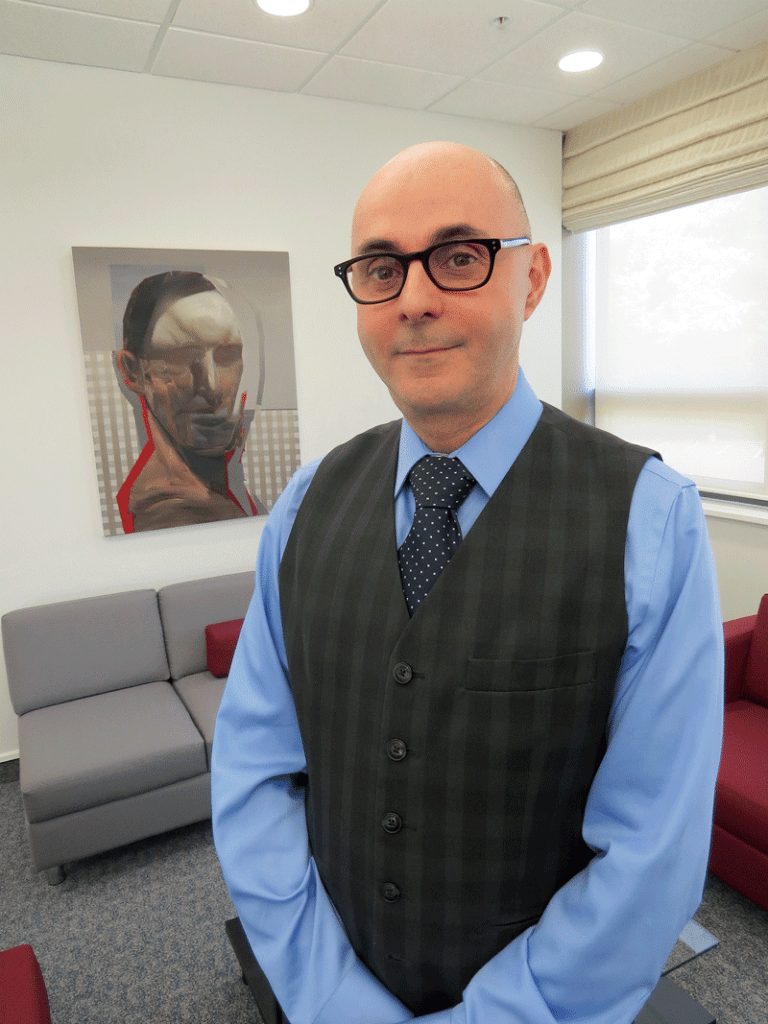
Westfield State University President Ramon Torrecilha says the 3+3 initiative with UMass Law is just one example of partnerships aimed at streamlining the process of getting a college degree — or two of them, as the case may be.
Since he took the helm as president of Westfield State University in 2015, Ramon Torrecilha has talked often, and consistently, about a changing dynamic in higher education and especially at public institutions.
In this environment, he has said to BusinessWest and a wide range of other media outlets and audiences of various types, public schools must be vigilant in their efforts to make a college education more affordable, more value-laden, and better able to help students succeed in the field they’ve chosen.
And, he has argued, one of the best ways to accomplish these ends is through partnerships with other colleges and universities, especially other public schools.
All these sentiments — not to mention the school’s new operating philosophy — are reflected in WSU’s latest partnership initiative, one with the University of Massachusetts School of Law, or UMass Law, as it’s called, the only public law school in the Commonwealth.
It’s called the ‘3+3 law program,’ and UMass Law has created several such initiatives with other public institutions in the state, including UMass Dartmouth, UMass Boston, UMass Lowell, Fitchburg State, Worcester State, and the Mass. College of Liberal Arts in North Adams.
Those two numbers in the name of the program get right to the heart of the matter. They refer to the number of years a participant is in school. Add them up, and one gets six, which is exactly one less than it traditionally takes someone to earn a bachelor’s degree and then a law degree, otherwise known as a juris doctor or JD.
“And that one year is very significant,” said Torrecilha, adding that, by shaving two semesters off the process, individuals and their families can save perhaps tens of thousands of dollars — and degree recipients can get on with their careers sooner.
At a time when higher education in general, and public higher education especially, happens to be under scrutiny, I think partnerships, not only with UMass Law School but also our community college partners underscores and reaffirms our commitment to the citizens of the Commonwealth.”
And that career may not necessarily be in the law, said Torrecilha, adding that students in majors not traditionally associated with law — everything from English to gender studies — may well find the program worthwhile because of what a law-school education brings — everything from a focus on critical thinking to experience with forging and then presenting arguments to practice in writing.
“This program will target not only students in political science or philosophy or criminal justice,” he said, listing majors that traditionally feed students to law schools. “It will be available to students in disciplines that you don’t usually think of when you think of a law degree.”
Dr. Emily Todd, chair of the WSU English Department, agreed.
“People generally don’t think about English majors going on to get a law degree, but it’s actually a great preparation for law school,” she explained. “We see the strength of our program as setting people up to be successful; English majors develop skills as writers, good researchers, and excellent close readers, and that helps them to be persuasive writers and to develop their skills in synthesis and analysis.
“I was recently speaking with a first-year student before this program was announced,” she went on. “I always ask students what they want to do, and she said, ‘I’m thinking about law — I really love to think about words and analyze them closely.’”
Here’s how the program works. Following the completion of 90 credits at Westfield State, enrolled students begin their first year at UMass Law. Once the first 30 credits are completed there, students will obtain their bachelor’s degree from WSU. Those 30 credits will dually serve as the first-year requisite toward their law degree from UMass Law.
Elaborating, Torrecilha said those 30 credits earned during that first year at UMass Law will effectively serve as the elective courses that students in any degree program are required to take. They will come in what would be the fourth year of one’s progression toward a bachelor’s degree, rather than in the first two or three, which is traditionally the case.
Torrecilha said the 3+3 program was conceived with a number of goals in mind, including a desire to stimulate more interest in a law degree at a time when overall enrollment has been declining at all the most elite schools — although the needle has started pointing back up at some institutions. And also to perhaps provide a boost for UMass Law, which was launched in 2010 after the private law school Southern New England School of Law offered to donate real estate, facilities, technology, and library assets to UMass Dartmouth for the purpose of creating a public law program in the Commonwealth.
The UMass board of trustees approved the plan in late 2009, and the Commonwealth’s Board of Higher Education did the same a few months later. The school’s first class matriculated in 2010.
But the overriding goals are to streamline the process of getting both degrees and making it more cost-effective. Those are the terms one hears most often in association with the initiative.
If all goes well, Torrecilha said, students may be entered in the program by the fall of 2019. He said there are no goals for enrollment at this time, and he’s not exactly sure what to expect. But he has seen a good deal of interest in the program since it was announced several weeks ago.
“We’re educating the community as we go, and we’ve been talking to advisors,” he noted. “There are a lot of students here on the campus who are asking about it already; I’m hoping that that the first cohort will have between 20 and 30 students.”
Meanwhile, the school will continue to look for more ways to partner with other institutions, including those in the UMass system and the region’s community colleges, to create more ways to streamline the process of earning degrees and making them more cost-effective, said Torrecilha.
“At a time when higher education in general, and public higher education especially, happens to be under scrutiny, I think partnerships — not only with UMass Law School, but also our community-college partners — underscore and reaffirm our commitment to the citizens of the Commonwealth,” he told BusinessWest. “I think it also sets an example of how public institutions can come together for the public good.”
— George O’Brien
Community Spotlight
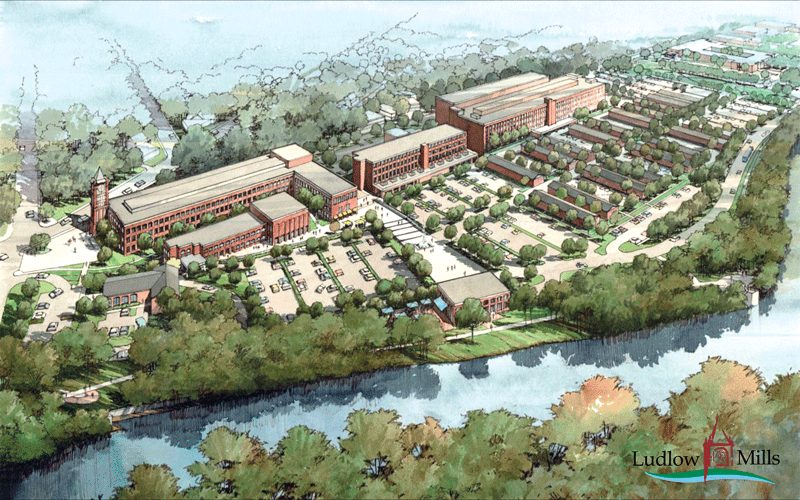
An architect’s rendering of the Ludlow Mills complex, redevelopment of which is an ongoing process.
Eric Nelson said he recently had cause to look over the occupancy permit issued to Westmass Area Development Corp. for the property now known as Ludlow Mills.
The date on the document — April 2012 — gave him both pause and more evidence that time does, indeed, fly.
Yes, it’s been more than six years since this ambitious project — a blend of both brownfield and greenfield development — was launched, and, for the most part, it is on schedule, said Nelson, president of Westmass for roughly half the duration of this effort.
And by on schedule, he was referring to the pace of development, or redevelopment, at this complex of 60 buildings and adjoining undeveloped land. When it started the clock back in 2011 when the property was actually acquired, Westmass said this would be a 20-year project that would generate $300 million in public and private investments, more than 2,000 jobs, and a more than $2 million increase in municipal property taxes.
To date, there have been several high-profile initiatives on the site, most notably the building of a new HealthSouth Rehabilitation Hospital ($28 million), WinnDevelopment’s overhaul of the structure known as Mill 10 into over-55 housing ($24 million), and several smaller developments.
And there is more on the drawing board, most notably WinnDevelopment’s planned conversion of Mill 8, the so-called Clock Tower Building — because it’s home to the clock tower that is perhaps the most recognizable landmark in this community — into a mixed-used project featuring commercial space on the ground floor and more housing in the floors above. That’s a $50 million project, according to current but very preliminary estimates, that was announced nearly two years ago.
“So far, we’ve either constructed or leveraged $127 million in private and public investments,” said Nelson, tallying up the two completed projects, the announced Clock Tower initiative, and a host of smaller line items, if you will, such as brownfield cleanup, infrastructure work, and other publicly funded initiatives.
The next key milestone for the project is the construction of Riverside Drive, which will open up approximately 60 acres of pre-permitted light-industrial property in the easternmost area of the mill site. A $3.5 million MassWorks grant from the state was earmarked for the project, and Westmass and town officials are working with congressional leaders to secure a matching $3.5 million grant from the U.S. Economic Development Administration to cover the $7 million cost of the roadwork.
The Ludlow Mills project is on schedule, if not ahead of it, in another respect, said Town Planner Doug Stefancik. This would be what could be called the trickle-down effect to the town and the region in terms of jobs and other benefits.
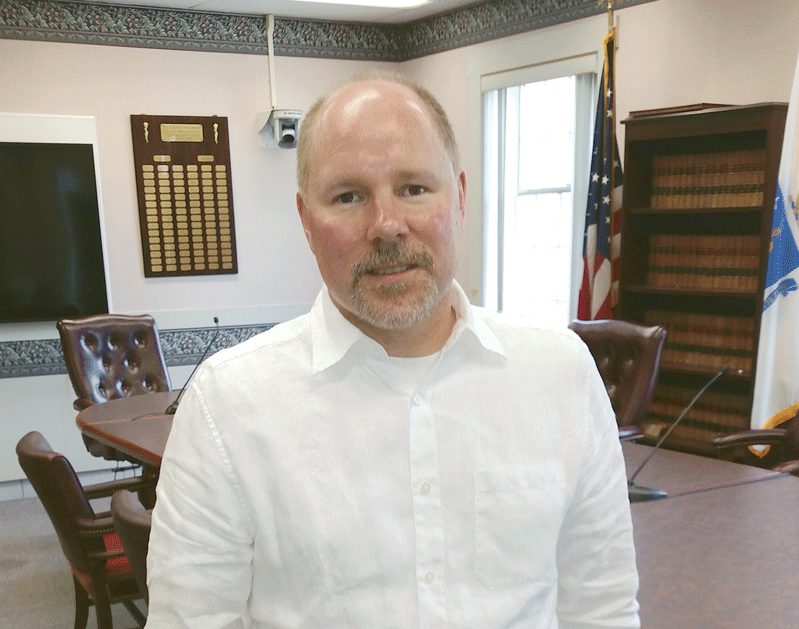
Doug Stefancik says the ‘trickle-down effect’ from redevelopment of the Ludlow Mills complex is already in evidence.
That list would have to include the riverwalk that was inspired by the project and has become a popular recreational facility within the town, as well as the jobs created and kept in Ludlow by the mill project (HealthSouth would certainly fall into that category), the new housing option of the form of Building 10 (many of those with that address were already town residents) and the promise of more at the Clock Tower Building, and early signs of additional vibrancy and new businesses to support those residents and business tenants at the mill.
“As the mills develop, they will generate additional interest outside that area,” he explained. “That’s because now, you’re putting people down at the mills; you have people who are 55 and over in that housing project, and that’s going to carry over into the community.”
Within walking distance, he added, are a post office, a library, restaurants and shops on East Street, and convenience stores. “There is a trickle down; people are getting into their routines [at Mill 10], and it’s going to be a positive for the whole area.”
The mill project is the story in Ludlow, but it’s not the only story, said Stefancik, adding that the community continues to add new residential projects — it has large amounts of developable land, and as the housing market continues to build momentum, more building permits are being issued — and there are infrastructure projects planned that should spur more private investment.
Chief among them is a $6 million project to improve the aptly named Center Street, the town’s main commercial throughfare and the one that handles traffic getting onto and coming off turnpike exit 7 (more about that later).
For this, the latest installment in its Community Spotlight series, BusinessWest turns its focus onto Ludlow and especially a project that recalls the town’s past and will play a huge role in its future.
Milling About
As he talked about the mill project, Nelson said there are obviously a lot of moving parts, and the broad goal is to keep the initiative moving so that those ambitious goals for everything from jobs to tax revenue can be met.
And the construction of Riverside Drive is a linchpin to those efforts, he said, adding that there is an existing road, but it is not adequate to support development of the 60 acres of greenfield in the Ludlow Mills master plan.
The MassWorks grant, secured with the help of State Sen. Eric Lesser and state Rep. Thomas Petrolati, was a big step forward in the effort to secure the needed federal funds, said Nelson.
“It’s a pretty effective argument when you can say to grant-funding agencies, ‘you’re going to pay 50% because there’s another entity that will kick in 50%,’” he told BusinessWest. “It’s a very competitive environment for grants, and it helps to have that kind of support from the state.”
Ludlow at a glance
Year Incorporated: 1774
Population: 21,103
Area: 28.2 square miles
County: Hampden
Residential Tax Rate: $19.01
Commercial Tax Rate: $19.01
Median Household Income: $53,244
Median Family Income: $67,797
Type of government: Town Council, Representative Town Meeting
Largest Employers: Hampden County House of Correction; HealthSouth Rehabilitation Hospital; Mass. Air National Guard; Kleeberg Sheet Metal Inc.
*Latest information available
As noted earlier, there has been considerable momentum created at the site since it was acquired by Westmass. The first triumph was the HealthSouth project, which amounted to new construction, but with use of many materials from the mill complex itself.
And last fall, the Mill 10 over-55 project opened to considerable fanfare. The complex is fully occupied, and there is, according to some reports, a lengthy waiting list for units that do become available.
Not all has gone according to plan, most notably the very public pending loss of high-profile tenant Iron Duke Brewery. A disagreement developed between tenant and landlord concerning the former’s taproom, which, Westmass argued, had become more of a tavern, attracting large numbers of patrons taking up a considerable amount of the mill’s available parking spaces.
The discord has been marked by acrimony, considerable press coverage, and even a little humor — Iron Duke created a brew called ‘Eviction Notice Black IPA’ at one point — and the company is apparently set to take its act to Wilbraham when its lease expires.
But there is still plenty of forward movement at the historic site, developed by Ludlow Manufacturing and Sales Co., which made a variety of products out of Indian-grown jute and employed more than 4,000 people at its high-water mark.
The goal moving forward is to have people working, living, shopping, dining, recreating, and receiving a wide range of services at the site, said Nelson.
And housing will be a big part of that mix, he noted, adding that the success story that is the Mill 10 project provides ample evidence that there is a need for more housing, including units in the affordable, or subsidized, category, and there are 68 of those among the 75 units at Mill 10.
Actually, what’s planned for the Clock Tower Building is what’s called ‘workforce housing,’ meaning that it will not be for those over 55 exclusively, and will be priced for teachers, firefighters, and others at the lower ends of the pay scale.
Nelson noted that $300,000 in Massachusetts historical tax credits have been secured for the project, said Nelson, an important foundation on which to build in the challenging task of financing the initiative.
Meanwhile, there are other forms of progress on the site, he said, including early movement toward locating a restaurant on the property, one that will have views of the river, and reuse of more of the so-called stock houses once used to store jute and other raw materials.
There are roughly 30 of them, and maybe two dozen are occupied by companies doing everything from precision machining to car-seat repair, said Nelson, adding that the goal is to bring more of them into use and thus continue that process of creating a critical mass of people and businesses that generates more traffic at the mill and, ultimately, more momentum.
“The residential component of Mill 10 presents opportunities for other uses that might come in there and pivot off that residential component,” he told BusinessWest. “If we get a critical mass, and HealthSouth certainly helps with this, we get more traffic, more interest, and more people are exposed to the mill; we’re trying to get more interest from that 8-to-5 window.”
And as momentum swells inside the mill, there is a trickle-down effect, said Stefancik, noting, as just one example, that the river walk has indeed become a popular new attraction in town.
“A lot of people now have that as part of their walking routine,” he told BusinessWest, adding that the amenity is drawing people of all ages and making the river something it really hasn’t been for some time — a community resource.
The town is looking to create more momentum with the planned reconstruction of Center Street (Route 21), a project that will include work on the roadway, shoulders, sidewalks, curbs, drainage, and more.
This will be a $6 million project that bring some inconvenience to people traveling on this main commercial throughfare, but ultimately, it will improve traffic flow through the city. Work is scheduled to start this summer.
Overall, there have been a number of new developments in recent years, he explained, listing everything from solar-energy installations — three of them in all — to new condominium and subdivision projects to another brewery, Vanished Valley, all providing ample evidence that Ludlow is a place where people want to live, work, and even generate electricity.
Bottom Line
Time really does fly, and the Ludlow Mills project offers plenty of evidence to that effect.
A project that was launched six years ago amid considerable fanfare and expectation is, as Nelson noted, on schedule when it comes to those measurables such as a jobs, tax dollars, and public and private investment.
It is also on schedule, as Stefancik said, when it comes to the trickle-down effect and creating more momentum within the community.
And, by all indications, the project — and the community — will only build on what has already been accomplished.
George O’Brien can be reached at [email protected]

Art of the Matter

Gabriela Micchia with the multiplication charts created by Holyoke fourth-graders.
Forty-two years ago, Enchanted Circle Theater was born as, true to its name, a touring theater company, but its interactions in school classrooms led to a dramatic evolution of its mission. Today, the nonprofit — which works not only in theater arts, but with a whole host of creative endeavors — partners with schools and other organizations on a concept known as arts integration, which uses creativity to make education more impactful — and more fun.
As Gabriela Micchia unfolded a series of multiplication tables in the form of brightly hand-colored diagrams, she explained how they’re much more than mere teaching tools.
“They use these almost like multiplication flash cards,” she said of the Morgan School fourth-graders who created them, pointing out how the numbers connect in straight lines to create a times table for the central digit. “I just made the dots, and they connected the dots, and we talked about how to put the triangles together.”
It’s undoubtedly a more entertaining way to learn math facts than simple recitation. But the real magic happened later, when the students visited another fourth-grade class and excitedly explained how to create the charts and use them to play a math game, said Micchia, a teaching artist with Enchanted Circle Theater in Holyoke. In short, the kids became the teachers.
“It goes back to the idea of the pride they have in the knowledge they gain,” Micchia said. “As much information as they retain from an adult showing them what to do, I think sometimes it’s easier for them to understand it from another student. They see each other doing it.”
That’s a typical story for Enchanted Circle Theater, a 42-year-old, Holyoke-based nonprofit that partners with schools and other organizations to educate through the creative arts.
“It’s an immersion into creative and critical thinking around math concepts,” said Priscilla Kane Hellweg, the long-time executive artistic director. “We hear students telling their friends what they’re working on, and they care about what they’ve created because it’s their creative process. It’s a sense of ownership, so seeing their work, being able to walk by it in the hallway and share it with others, there’s a pride in accomplishment, and a sense of joy.”
It’s a model applicable not just to math, but to all school subjects — with a focus at all times on English-language communication skills.
There’s something about that moment of magic that happens between the audience and the performer during a live performance — there’s this alchemy that happens. And I wanted to follow up on that; I wanted more contact.”
For example, Hellweg said, “we do a lot of work in social studies, where our students will research and write and then perform an original play on the Trail of Tears or immigration or the Civil War or … well, I can give you 42 years worth of content.”
Science is a big focus as well, she added, citing a program for Holyoke fifth-graders called “Where Does Your Water Go?”
“They studied the water cycle, from falling down from the sky into a sewage system into our river right down the street,” she explained. “And then we turned it into an environmental advocacy program, where the students decided what they wanted people to stop and think about, and the impact that humans have on the environment and water.”
The kids then drew pictures — such as a fish swimming amid garbage, or a mallard whose feet are entangled in a plastic six-pack ring — and accompanying slogans, which were then turned into storm-drain art at eight downtown locations. “They created awareness of the water cycle and our role in keeping our world clean.”
Enchanted Circle has, from its beginning, been a working theater, but it has long embraced artistic endeavors of every kind — dance, music, visual arts, literature, even culinary arts — as teaching tools.
“We specialize in what’s called arts integration,” Hellweg said. “And there are three basic components to it. First, it’s about academic understanding — unpacking knowledge and learning concepts and deep critical thinking. The second channel is social-emotional learning and communication and collaboration and all those 21st-century learning skills that prepare us to be engaged in the world.”
The third element, quite simply, is artistry and creativity and examining the world through the filter of creative expression. “We work with people of all ages and all abilities, and it’s about inspiring and engaging and enhancing learning. It’s about connecting people to each other, people to information, people to the world around them, and people to themselves.”
Moment of Magic
Enchanted Circle was launched in 1976 as a touring theater company, but one that had a foothold in education from early on.
“We were traveling to schools, to museums, to fairs, to libraries, bringing folk tales from around the world to life,” Hellweg said. “I’ve been here for 38 of our 42 years, and I love the performing. There’s something about that moment of magic that happens between the audience and the performer during a live performance — there’s this alchemy that happens. And I wanted to follow up on that; I wanted more contact.”
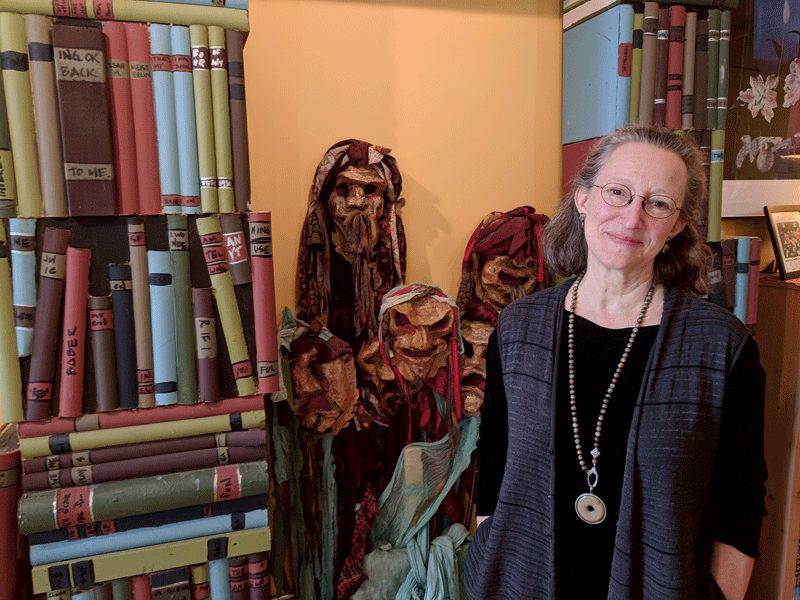
Patricia Kane Hellweg says students who learn through hands-on arts integration retain concepts more effectively because they have more ownership in the process.
So the theater started developing workshops related to the performances, which evolved from one-off events to a regular partnership with schools — and an expansion of the organization’s work from drama to arts integration of all kinds.
“I felt that working in the classroom with teachers and students would really bring learning to life,” she told BusinessWest. “So we are still a theater company, and we create original plays on subjects with both cultural and historical relevance. But we really became a teaching institution.”
The theater has a presence in public schools throughout Holyoke, Amherst, Northampton, and parts of Springfield, but also in affordable-housing developments, preschools, universities, and other, perhaps surprising venues.
“We work throughout the community — in the foster-care world, in the mental-health field, with adjudicated youth in detention, in homeless shelters, in housing developments — bringing arts-integrated learning to some of the most marginalized and vulnerable populations in the area,” Hellweg said.
Holyoke’s public schools represent Enchanted Circle’s longest-term and closest partner, as seen in offerings like the visual math programs at Morgan School and a dual-language arts-integration program with grades K-3 at Metcalf School every Friday, which touches on numerous academic subjects. “Whatever they’re working on, we are working on,” she said. “It’s hands-on, project-based, arts-integrated learning.”
And that hands-on element is critical, she noted. Typically, the ideas kids learn at school are stored in their visual memory. “But if we’re doing embodied math — where students become an isosceles triangle, or two people create a parallelogram with their arms — then it’s in your muscle memory. And it brings the joy back to learning because it’s fun, and the laughter in class is huge.”
Micchia agreed. “It becomes this whole-body experience, this holistic experience when we use the arts to create this visual math.”
And students who are having fun are more likely to want to learn, Hellweg added. “What we find is that attendance goes up because students want to be in school, and behavior issues go down because students are engaged.”
That applies even to young people who never considered themselves learners, she said, recalling a bittersweet conversation she had recently with a 15-year-old girl in juvenile detention.
“She said to us, ‘I never thought I would find joy in learning, and I’m loving learning with Enchanted Circle. I never would have dropped out of school had Enchanted Circle been in my classroom.’”
Now working on a poetry-into-performance program through the theater, funded through the National Endowment for the Arts, the girl has a new outlook on why learning can — and should — be so much more than rote memorization. “That engagement, both the physical engagement and the experience of working collaboratively and creatively, changes the learning environment.”
Micchia went further than that, saying Enchanted Circle cultivates an emotionally safe learning space.
“I feel like it creates an acceptance — you’re accepted here. You don’t have to be the best at something,” she said, adding that there’s no one set way to teach a student. “One of the beautiful things is, it’s kind of organic and flexible, and you meet the needs of the child as opposed to the other way around. It’s not a formula.”
Teaching the Teachers
Students aren’t the only ones in need of that confidence, Hellweg noted. Teachers are, too — at least when it comes to the often-unfamiliar territory of arts integration in their classrooms.
“We do a tremendous amount of training of teachers, who don’t necessarily think of themselves as artists, and often feel that they’re not creative. But, within moments of one of our professional-development programs, they realize they’re very creative, and they have a tremendous aptitude for bringing the creative process into the classroom,” she told BusinessWest. “So we’ve been working with teachers on large and small ways to integrate the arts into the classroom, and any time we’re in residence in a classroom, we’re working in partnership with the teacher and students to create something together.”
One innovative initiative, the Honors Arts Academy in Holyoke, is an afterschool program at Donahue School that focuses on rigorous arts training for students. The goal is to secure the funding to place it at Holyoke High School and bring in seventh- and eighth-graders from three city middle schools to work with freshmen at the high school.
“The ninth-grade dropout rate is a big challenge,” Hellweg said, “so it’s good to get seventh- and eighth-graders feeling not just at home in the high school, but that it’s their school, and able to use the resources at the high school, like the television studio and the theater. Most middle schools don’t have those resources.”
In all Enchanted Circle’s programs, she added, students are moving beyond passive learning and generating their own ideas, helping to craft curriculum that means something to them.
While the theater has evolved slowly over the years, Hellweg is excited about a new initiative called the Institute for Arts Integration, which will be a regional hub for training teachers, social-service case workers, administrators, and teaching artists.
“There are a couple programs around the country that are doing this, and because we’ve been pioneers in the field of arts integration, we want to create our own institute,” she said. “Our goal is to make arts integration the norm in every classroom.”
It’s a goal that gets her out of bed each morning, doing a job she has loved for almost four decades.
“You don’t stay in a job that long unless it moves you,” she said. “Every single day, I see that ‘a-ha’ moment where students are able to do something they didn’t think they could. It’s palpable — teachers are seeing their students differently, students are seeing their teachers differently. Learning comes alive, and the creative process means it’s never-ending. That’s where my inspiration comes from.”
Joseph Bednar can be reached at [email protected]
The Fab Five
Scores submitted by a panel of three judges have determined the five finalists for this year’s Continued Excellence Award, an honor created in 2015 to recognize past 40 Under Forty honorees who have built on the business success and civic commitment that initially earned them that honor.
They are:
• Michael Fenton, associate at Shatz, Schwartz & Fentin, P.C.;
• William Gagnon, vice president of Marketing & Key Accounts for Excel Dryer Inc.;
• Samalid Hogan, regional director of the Massachusetts Small Business Development Center;
• James Leahy, assistant director, Business Development and Promotion Sales for the regional office of the Massachusetts State Lottery Commission; and
• Holyoke Mayor Alex Morse.
The winner of the fourth annual award will be announced at this year’s 40 Under Forty gala, slated for June 21 at the Log Cabin Banquet & Meeting House in Holyoke.
The winners in 2015 and 2016, respectively, were Delcie Bean, president of Paragus Strategic IT, and Dr. Jonathan Bayuk, president of Allergy and Immunology Associates of Western Mass. and chief of Allergy and Immunology at Baystate Medical Center. Both were originally named to the 40 Under Forty class of 2008. Last year, the judges chose two winners: Scott Foster, an attorney with Bulkley, Richardson and Gelinas (class of 2011), and Nicole Griffin, owner of Griffin Staffing Network, now ManeHire (class of 2014).
This year’s five finalists were determined by scores submitted by three judges — Matthew Bannister, first vice president, Marketing and Innovation at PeoplesBank; Ira Bryck, president of the Family Business Center of Pioneer Valley; and former winner Griffin.
Read on for more details about the nominees.
Michael Fenton

Michael Fenton
When Fenton was named to the 40 Under Forty in 2012, he was serving his second term on Springfield’s City Council and preparing to graduate from law school. He was also a trustee at his alma mater, Cathedral High School, where he dedicated countless hours to help rebuild the school following the 2011 tornado.
Now an associate at Shatz, Schwartz & Fentin, P.C., practicing in the areas of business planning, commercial real estate, estate planning, and elder law, he received an Excellence in the Law honor from Massachusetts Lawyers Weekly and was named a Super Lawyers Rising Star in 2014. In 2014, he became Springfield’s youngest-ever City Council president, overseeing the creation of the young professionals committee and the Community Preservation Act committee, which is bringing money into the community to benefit historic preservation, recreation, and open space. He also continues to serve on numerous civic organizations.
William Gagnon

William Gagnon
A 40 Under Forty honoree in 2013, Gagnon was recognized for his work as vice president of marketing at Excel Dryer, the business launched by his father. In that role, he not only saw the company’s staff double, but was an original seed sponsor of a U.S. Green Building Council’s Green Apple program, which helps build healthy learning environments for kids around the globe.
Today, Gagnon continues to give back to the community through his position on the board of the Children’s Study Home. He has also continued to lead the green movement, spearheading energy efficiency within his industry by recently developing a new product that not only dries hands fast, but uses less energy, making it the most environmentally friendly hand dryer on the planet. He has also been working on a new, ADA-compliant hand dryer designed for easy access for individuals who are disabled or mobility-impaired.
Samalid Hogan

Samalid Hogan
A 40 Under Forty honoree in 2013, Hogan is the regional director for the Massachusetts Small Business Development Center Network’s Western Regional Office. She has built partnerships across public, private, and civic sectors to achieve economic-development goals for the Pioneer Valley region.
In 2014, Hogan founded CoWork Springfield, the city’s first co-working space, which focuses on serving women and minority-owned businesses. In addition, she was appointed to the Governor’s Latino Advisory Commission in 2017, and serves on the boards of several organizations, including Common Capital, the New England Public Radio Foundation, the Minority Business Alliance, and National Junior Tennis and Learning of Greater Springfield. She was awarded the Grinspoon Entrepreneurial Spirit Award in 2017 and was recognized as a Woman Trailblazer and Trendsetter by the Massachusetts Latino Chamber of Commerce in 2016.
James Leahy

James Leahy
When Leahy was selected to the 40 Under Forty class of 2010, he was a five-time Holyoke city councilor, as well as the CEO and president of the city’s St. Patrick’s Day Parade and Road Race. He was also working for Alco Labs, a leader in eye-care medicine, and had won several awards for his business acumen, as well as serving on the boards of directors of the YMCA, the Holyoke Children’s Museum, the Holyoke Merry-Go-Round, the Boys and Girls Club of America.
Since then, Leahy has expanded his roles with the parade and road race, as well as serving as president of the Volleyball Hall of Fame and president of the Westfield State University Foundation board of directors. He is also assistant director of Business Development and Promotion Sales for the State Lottery Commission. Meanwhile, he has grown his civic volunteerism with service on numerous community organizations.
Alex Morse

Alex Morse
Morse’s story is well-known, being elected Holyoke’s youngest mayor at age 22 in 2012 — reason enough to be named to the 40 Under Forty class of 2014. He’s since then won re-election twice, time enough to put his leadership in perspective.
Morse and his team have spurred a pipeline of some $125 million in private projects over the past few years, and overseen significant streetscape improvements, new and renovated parks, ongoing rehabilitation of the mill buildings, a partnership with the Greater Holyoke Chamber of Commerce to launch the SPARK entrepreneurship program, and many new development projects. During his terms, community policing strategies have led to drops in crime, property values have gone up, and the unemployment rate has dropped. All this has helped create a new energy around a city that has in many ways been an afterthought in the region’s economic-development picture over the past few decades, but one that is clearly on the rise.
Meet the Judges
Three independent judges were tasked with reviewing dozens of nominations for the 2018 Continued Excellence Award and determining the five finalists. They are:

Matthew Bannister
Matthew Bannister is first vice president of Marketing and Corporate Responsibility for PeoplesBank, a leader in green values, sustainable-energy financing, and charitable giving. He manages the corporate philanthropy program through grants and sponsorships, focusing on key areas including academics, innovation, economic growth, and community vibrancy. He also plans and directs the marketing and public-relations programs, and represents the bank in public, social, and business events.

Ira Bryck
Ira Bryck is president of the Family Business Center of Pioneer Valley. Since 1994, the center has provided a practical learning community for family-owned and closely held companies throughout Western Mass. Bryck also writes an online advice column for family businesses, and has written and produced three plays about life in family business that have been performed more than 50 times internationally. His third play, A Tough Nut to Crack, is based on his 17 years in his family’s fourth-generation childrenswear business on Long Island, which he ran with his parents. He also hosts The Western Mass Business Show on WHMP, featuring interviews with business owners and expert advisors.

Nicole Griffin
Nicole Griffin is a 40 Under Forty winner in 2014 and recipient of the Continued Excellence Award in 2017. She is the founder and chief talent officer of ManeHire (formerly known as Griffin Staffing Network). ManeHire is a full-service staffing agency that offers payroll services, corporate training, and temporary, temp-to-hire, and permanent placement. Griffin currently serves as a member of the board of directors for the YWCA of Western Massachusetts and the Regional Employment Board of Hampden County. She is also the 2015 recipient of the Goldman Sachs 10,000 Small Businesses Scholarship at Babson College, the 2015 National Urban League Community Builder Award recipient, and an alumna of the Leadership Institute for Political and Public Impacts.

Course Correction

Even her military experience repairing jet engines — work she finds intriguing — hasn’t kept Stephanie Dalton from reaching her goal of becoming a nurse.
Stephanie Dalton has wanted to be a nurse since she was 7, though it took a few intriguing detours to get there.
“I’ve always wanted to do it, and I paid for school myself,” she said of her initial enrollment in American International College six years ago. That entailed working at a series of jobs, from waitressing and babysitting to working at a sandwich shop and a horse farm.
“I was living on my own, just trying to make it, and when I got into the nursing program here, I was so excited,” she recalled. “But I struggled. I was working four jobs, I was trying to keep a roof over my head, food on the table, and trying to pay for my education, and I realized I needed to do something different because I was not going to be successful trying to work and manage school and everything else.”
That’s when Dalton decided to join the Air Force, thinking she could train for something in the medical field, but that didn’t work out. Instead, she became a jet-engine mechanic.
“I work on F-15s over at Barnes, and it’s really fun. I like it a lot,” she said, adding that she’s long had an aptitude for mechanical work. “I knew how to turn a wrench, my dad taught me how to change my own oil, I could change a tire. So I knew the basics. And I’m willing to learn — whatever they could teach me, I was willing to just learn.”
But Dalton — through many twists and turns, as we’ll see later — did find her way back to nursing, graduating last month from AIC with her bachelor’s degree.
Lauren Bennett had no such early sights on nursing; instead, she worked in banking and insurance — including a role in sales at MassMutual — for a decade before becoming a stay-at-home mom. Several years later, when her kids were starting kindergarten and second grade, respectively, she decided to pursue a career again — this time in nursing.
“I knew I didn’t want to sit in an office,” said Bennett, who earned her associate degree in nursing at Greenfield Community College in May. “That was something that I didn’t feel was making enough of an impact. There were definitely things I enjoyed about it, but I wanted a career making a positive difference in people’s lives. And I’ve always been interested in anatomy and physiology and nutrition — different aspects of healthcare.”
With nurses once again in demand across the U.S., the field has become an attractive one not only for recent high-school graduates pursing a college path, but for established professionals in other fields looking for a change. For this issue’s focus on nursing education, BusinessWest sat down with a few such women to find out why they made the switch — and where they intend to take their careers from here.
Horse Sense
When Dalton was ready to return to school, she found she was better able to balance her military and academic roles, she explained.
“I was in the National Guard, so I would have drill weekends, go in and do all types of training. Sometimes it was stressful, and I really had to learn how to manage my time, but life was going well for me.”
But the following year, she broke her neck and back horseback riding, and was put into a brace, waist to chin. “I really wanted to come back, but the doctor wouldn’t allow me.”
Still, she was eventually able to return to Barnes, as well as her junior year at AIC. “It was kind of difficult, coming back after being out of the swing of things for a year. I had a lot of struggles, but I had some great supports — a wonderful boyfriend, awesome friends, and my mom, who is my cheerleader. So I struggled, but I made it through.”
Shamicka Jones wants to make a difference the way medical professionals made a difference for her family during times of medical crisis and tragedy.
That year, a family member with mental illness became very ill, which impacted Dalton’s life greatly, and once again she was feeling stretched thin by her military duties, school, and family challenges. But her senior year was much smoother — not less stressful, necessarily, but she was figuring out how to manage the pressures of achieving the career she wanted.
“I feel like I’ve done a lot in the time I’ve been in school,” she told BusinessWest, in what can only be called an understatement.
Shamicka Jones has been through a lot as well, much of it tragic. A congenital heart condition runs in her family, claiming her two brothers at age 11 and her own young son in 2010. Needless to say, she has been exposed to the medical world and some exceptionally caring professionals within it — and found she had a desire to be one, too.
“I did auto insurance for seven years, but I’ve always had an interest in healthcare because of my family history — we had a lot of medical issues,” she said. “Every time I went to the hospital, I always used to see the nurses, and I thought, I want to do that; I want to help people.”
She tried medical assisting school but found the opportunities in that field lacking. After that, she worked at a group home, serving mentally challenged individuals, work she found fulfilling.
But Jones had her sights set on nursing, and was busy with her nursing-school prerequisite coursework when her son passed away, which threw her for a loop. “I started questioning, what am I going to do? Can I ever move forward from this?”
But she continued to attend school, and two years after that, her mother suffered a serious cardiac event “She dropped down in front of me and my daughter while we were out. I had to give her CPR for 10 minutes before the EMS even arrived. We went to the hospital, and they were able to get her back.”
She had to take a semester off to care for her mother, and began doubting her plans to be a nurse — doubts that returned when her daughter was diagnosed with the same genetic heart condition she and so many other family members have.
“I thought, ‘this is not the path,’ she recalled. “But everyone was like, ‘you need to keep going. You need to do this.’” Her daughter, in fact, was her biggest supporter in her quest to get a nursing degree, which she did last month at AIC.
Many Pathways
Jones’ experiences have shaped her career goals, as she is eyeing both cardiac intensive care and psychiatric nursing, helping people with mental-health challenges.
“As a new graduate, I do need to get some experience in so many different areas,” she said. “When I was younger, when I thought of nurses, I thought of hospitals and visiting nurse associations, but nurses are everywhere, in every aspect of society. It’s amazing to me to see all the different options we have.”
Dalton is in the same boat — well, jet, actually — as she considers her options, aiming to find work in a community hospital after taking her boards. She’s looked into being a flight nurse as well, but that plan — which would require copious amounts of specialized training — is on the back burner for now.
When you think of a nurse, the first thing you might think of is somebody in a hospital, at the bedside, but there are so many other possibilities.”
“I always thought I wanted to do some type of pediatric nursing,” she added. “But going through the program, I’ve really broadened my horizons, and now I feel like I want to do everything. Mental illness lies very near and dear to my heart because of my family member, and I see the lack of resources; I see the support that’s not there, the stigma that goes along with it, and I feel like that’s definitely an avenue of interest as well. I’m still interested in pediatrics, and I actually do enjoy working with the older adult population.”
One of her short-term goals is to get involved in community nursing. “In our community course, we actually did blood-pressure and blood-glucose screenings, and that’s something I’m interested in starting up in my town — going to the senior center and starting a little clinic so I can connect with the community and help people.”
Among her long-term goals is meshing her love for horses with her training to launch a therapeutic riding program for special-needs children.
If that sounds like a lot of interests and goals, it is — but it reflects the wide spectrum of roles available to nurses today.
“When you think of a nurse, the first thing you might think of is somebody in a hospital, at the bedside, but there are so many other possibilities,” she said. “That’s the great thing about nursing — you’re not just limited to just one spot, and if you don’t like your job, it doesn’t mean you have to leave nursing. You can maybe do administrative work, or you can do home care. The options are seemingly endless.”
Bennett told BusinessWest she originally wanted to go into labor and delivery. “Now I’ve seen so much more, and I really loved the emergency department, the ICU. I’m pretty open at this point.”
She recognizes that many nurses don’t immediately find the niche they love, and it’s good to keep an open mind, considering all the possible landing spots.
“I know nurses that are stressed by their jobs,” she said, “but I don’t know any nurses who would change careers or say they’d rather do something else. Maybe they’d like a different schedule, but they don’t regret going into nursing.”
Troubled Times
Dalton was experiencing some regrets during the toughest times during her long path to a degree.
“The first year back after I had my injury, I was struggling academically, and I had failed two exams, and I just wasn’t doing well,” she recalled. “An instructor sat down with me and asked me if I had a plan B and what else I would do, and I told her I didn’t.
“I’m extremely persistent,” she said with a laugh born of hard-earned wisdom. “No matter what got in my way, this is what I was meant to do. It was important to be a nurse. The things I’ve been through, that accident … I walked away from a broken neck and back, and the doctors told me I shouldn’t be able to walk right now. So I really believe that this is what I’m meant to do.”
Jones has a similar perspective on being in the right career, no matter where it leads.
“I hope I find my place,” she said. “It may not be where I think I’m going to be right now, but I just want to help people the way my family has been helped. We’ve gone through a lot, but always got amazing care. I want to make that kind of impact.”
Joseph Bednar can be reached at [email protected]
Upping the Ante
By Kristina Drzal Houghton, CPA, MST
It’s June. This is generally not the time to be thinking about taxes. In reality, though, businesses and individuals should always be contemplated taxes and how to reduce their burden. And the Tax Cuts and Jobs Act signed into law late last year gives people even more to think about.
Kristina Drzal Houghton
The Tax Cuts and Jobs Act, (TCJA), signed into law on Dec. 22, 2017, brought the biggest changes to both individual and corporate taxes that we’ve seen in the past 30 years. These changes were primarily effective for tax years 2018 and after. For many reasons I’ll highlight in this article, these changes make starting your planning early extremely important.
I will briefly acknowledge that the TCJA reduced the C-corporation tax rate to a flat 21%, from the previous maximum rate of 34%. Additionally, there were changes made to U.S. taxation of income earned abroad by U.S. C-corporations and their affiliates.
The focus of this article will revolve around planning for individuals and small businesses.
Where to Start
I would suggest having an accountant run mock 2018 returns as a starting point. Running those future numbers can flag potential issues. That said, state revenue departments and the Internal Revenue Service have had little time to process the changes, so much remains in flux. The IRS and states haven’t decided how some provisions of the new tax law will be calculated yet. I expect that the IRS and states will start to share their 2018 guidance later this summer. In the meantime, here are some suggestions:
Rework Your Withholding
The new law means that the W-4 you filled out, however many years ago, may need to be adjusted. The IRS encourages everyone to use the Withholding Calculator, available on irs.gov, to perform a quick ‘paycheck checkup.’ Remember, the new tables don’t reflect all the changes that may affect a taxpayer next year, so they are a somewhat blunt tool.
The calculator helps you identify your tax withholding to make sure you have the right amount of tax withheld from your paycheck at work.
If workers leave their W-4s as is, they could wind up withholding too little, which can bring penalties, or they may get a smaller-than-expected refund next year. Workers in higher tax brackets who receive large bonuses could see a higher tax bill next season if they don’t tweak W-4s, since one of the ways employers can set the withholding rate on ‘supplemental income’ such as bonuses in the new law is to use a flat rate of 22%.
Think About Deduction Planning
A big change that could affect many taxpayers is the tax overhaul’s controversial cap on state and local income tax (SALT) deductions, a provision Democrats have labeled a war on blue-state Americans. The deduction, which used to be unlimited, will be capped at $10,000 next year. The new law’s near-doubling of the standard deduction to $12,000 for single filers and $24,000 for married couples filing jointly does mean fewer will itemize.
States were busy devising workarounds to keep those residents from seeing a big spike in federal taxes next year, but the IRS recently informed taxpayers that proposed regulations will be issued addressing the deduction of contributions to state and local governments and other state-specified funds, for federal tax purposes. The proposed regulations will make clear that the Internal Revenue Code, not the label used by states, governs the federal income-tax treatment of such transfers.
As a result of the decreased SALT deduction and the increased standard deduction, the tax benefit from charitable contributions may be lost if the standard deduction exceeds itemized deductions. One strategy for people who regularly donate to charity is to bunch up into one year what they would have given over multiple years. For those who itemize, charitable donations remain deductible on federal returns and can help lift married taxpayers who file jointly above the $24,000 standard deduction hurdle.
By putting a few years’ worth of donations into a donor-advised fund — many financial-services firms have units that offer them — you can take the deduction the year you put the money in, but distribute the money to charity over multiple years. For taxpayers older than 70½ who are taking required distributions from an IRA, they should consider making distributions to charities directly from their IRA.
Mortgage and Home-equity Loan Deductions
The new tax law lowered the amount of deductible interest expense on ‘acquisition indebtedness.’ For new loans made after Dec. 14, 2017, the maximum interest is limited to a mortgage ceiling of $750,000; previously, this was $1 million. It also eliminated the interest deduction on loans, such as home-equity loans, that are not used to ‘buy, build, or substantially improve’ a home.
New College Savings Plan Uses
The new tax law expands the allowable use of tax-exempt 529 college savings plans for education costs that accrue while your child is between kindergarten and high-school graduation. This added allowable use is limited to $10,000 per year per beneficiary. But be careful — while some states automatically follow the federal code, others choose to decouple from certain parts of it. So, while the U.S. government may say you can use 529 money for K-12 expenses, a state may consider such a withdrawal a non-qualified distribution and could tax the earnings and charge you penalties.
Section 199A Pass-through Optimization
Section 199A, which is a new section of the tax code arising from the Tax Cuts & Jobs Act of 2017, introduces a 20% deduction on qualified business income (QBI) for the owners of various pass-through business entities which include S-corporations, limited liability companies, partnerships, and sole proprietorships — or, really, any business that is not a C-corporation.
The QBI deduction will provide big tax breaks for many business-owning clients, but unfortunately, the new deduction is highly complicated, and it may take some time before the IRS can even provide more meaningful guidance on how it will be applied. However, the reality is that the planning opportunities created by IRC Section 199A are tremendous, and practitioners are already eagerly exploring how they can help clients reduce their tax burden through creative strategies around the QBI deduction.
Business owners will generally fall within one of three categories when it comes to the QBI deduction:
• Business owners below their applicable threshold amount — which is $157,500 of taxable income for all filers except joint filers, and $315,000 for those filing jointly — can enjoy a QBI deduction for the lesser of 20% of their qualified business income or 20% of their taxable income. It does not matter what type of business is generating the income, nor is there a need to analyze W-2 wages paid by the business or depreciable assets owned by the business. The QBI deduction is what it is.
• Business owners over their applicable threshold who derive their income from a ‘specified service’ business (i.e., some specialized trade or service business) — which includes doctors, lawyers, CPAs, financial advisors, athletes, musicians, and any business in which the principal asset of the business is the skill or reputation of one or more of its employees — will have their QBI deduction phased out. The phase-out range is $50,000 for all filers except joint filers, and $100,000 for those filing jointly. Once a business owner’s taxable income exceeds the upper range of their phase-out threshold ($207,500 for individuals and $415,000 for married filing jointly), they cannot claim a QBI deduction for income generated from a specialized trade or service business. Period. End of story. ‘Do not pass go, do not collect $200.’
• Business owners over their applicable threshold who derive their income from a business that is not a specialized trade or service business may also have their QBI deduction at least partially phased out, but the full deduction may be ‘saved’ based on how much they pay in W-2 wages and/or how much depreciable property they have in the business. Business owners with qualified business income from non-specified service businesses whose taxable income exceeds the upper range of their phase-out threshold can still take a QBI deduction equal to or less than the greater of:
1. 50% of the W-2 wages paid by the business generating the qualified business income; or
2. 25% of the W-2 wages paid by the business generating the qualified business income, plus 2.5% of the unadjusted basis of depreciable property owned by the business.
A careful analysis of the rules above will lead one to realize that, when it comes to maximizing a business owner’s opportunity for a QBI deduction, strategies will fall into one of three main buckets:
• Income-reduction strategies, such as trying to lower taxable income by increasing deductions or spreading out the income over multiple taxpayers, to stay below the income threshold where the specified service business or wage-and-property tests kick in;
• ‘Income alchemy’ strategies, where we try to transform income derived from a specified service business into income derived from a company that is not a specified service business, to avoid the phase-out (for those over the income threshold); and
• Business strategies, such as changing an entity, revisiting compensation models, and revisiting business assets, to more favorably characterize business income in the first place.
Relook at Filing Separate Returns for Married Couples
The tax code has long limited married couples filing separate returns from taking advantage of a number of tax breaks, either by barring those tax breaks entirely under the ‘married filing separately’ status, or phasing them out at very modest income thresholds. As a result, in the past, it’s rarely been a tax-efficient move for married couples to file separate returns, except in highly unusual circumstances. That will likely still be the case for most married couples, but the creation of the QBI deduction does tilt the balance somewhat for some couples.
Should You Revoke S-corp Status?
The hot question since the passage of the Tax Cuts & Jobs Act of 2017 and Section 199A is, “should I revoke S-corp status and go to C-corp?” The answer is no.
While the TCJA reduced C-corporation tax rates to 21%, the QBI reduces the maximum rate on pass-through income to 29.6% (80% of 37%). Previously, the maximum tax rate on pass-through income was 39.6% plus the effect this income had on itemized deduction and personal exemption phase-outs, producing an even greater effective rate.
This rate exceeded the prior maximum C-corporation rate of 34%. Owners elected to operate their businesses in pass-through entities for many reasons beyond the current year’s tax. None of these considerations have changed.
For most small businesses and their owners, the key point is to acknowledge that TCJA creates a tremendous number of planning opportunities. New strategies with QBI will certainly continue to be developed with time and further guidance from the IRS, but even in the present, there exists enough reasons to reach out to your advisors and have them help them reduce your tax liabilities.
Kristina Drzal Houghton, CPA, MST is a partner and director of the Taxation Division at Holyoke-based Meyers Brothers Kalicka; (413) 536-8510.
The Fraud Triangle
By Julie Quink, CPA

Julie Quink
As a culture, we generally believe that people are honest and are trustworthy. Failures like Enron and WorldCom, whose combined fraud losses totaled $46 billion, have raised an awareness of the costs of fraud and have highlighted the need for management to understand and monitor the business risks within their organizations.
What Is Fraud?
Fraud is an intentional act that results in misrepresenting financial information (lying) or misappropriation of assets (stealing). The misrepresentation of financial information typically encompasses misstating earnings to meet market or company expectations and to meet compensation-plan benchmarks. Misappropriation of assets is the taking of company assets, whether cash and equivalents, inventory or supplies, for personal benefit and use.
Statistics indicate that:
• 10% of employees would never, ever commit fraud;
• 10% of employees are actively exploring ways to commit small-scale fraud against their employer, which could include padded mileage and expense reports, small-scale theft of supplies and other materials; and
• 80% of employees would never commit fraud unless certain factors are present.
The factors that would provide the motivation for 80% of employees to consider committing fraud are termed the Fraud Triangle. These factors include:
• Pressure — a financial need created by gambling addictions, substance and alcohol abuse, family illness, or extramarital affairs;
• Opportunity — the ability to access cash or items easily convertible to cash (inventory); and
• Rationalization — the feeling of entitlement or the feeling that there is no other way to financially meet the pressure unless taken from their employer.
Otherwise honest employees may commit fraud under these circumstances.
Indicators that an employee may be committing fraud include the appearance that the employee is living beyond their lifestyle, suspected or known substance or alcohol abuse, and resistance to relinquishing control of duties to others.
Common Ways Fraud Occurs
Generally, misrepresented financial results are accomplished through fictitious transactions or adjustments recorded in accounting records.
Fraud is an intentional act that results in misrepresenting financial information (lying) or misappropriation of assets (stealing).”
The most common ways that an individual can misappropriate funds are:
• Creating fictitious employees on the payroll system and generating payroll checks that the fraudulent employee cashes — the ghost- employee scheme;
• Creating fictitious vendors and generating checks to the fraudster for goods and services never received by the company — the ghost-vendor scheme; and
• Taking customer checks or cash before being deposited into the bank and modifying the accounting records to conceal the theft.
Preventing Fraud
According to the 2018 Report to the Nations published by the Assoc. of Certified Fraud Examiners, 50% of fraud and corruption cases are detected by a tip. Meanwhile, weaknesses in internal control are responsible for nearly 50% of all frauds, and losses are up to 50% higher when collusion of fraudsters exists.
When considering effective prevention and detection techniques, it is critical to:
• Implement a whistleblower policy that provides a mechanism for confidential communication of suspected impropriety;
• Assess areas of risk and evaluate internal controls over the most susceptible business cycles, including cash receipts, cash disbursements, and payroll; and
• Review financial and operational trends to determine routine and unusual patterns.
Simple techniques to strengthen internal controls over significant business cycles include the receipt of unopened bank statements by owner for independent review of monthly activity, and varying of procedures relative to the review the payroll journals or signing of vendor checks, if another individual is typically responsible for those areas. Inquiry and observation, such as camera systems, in areas that pose a concern may act as a deterrent for the occurrence of fraud due to the mere fact that someone is reviewing activity or inquiring.
When techniques fail to prevent and detect fraud, it is important to gather and review evidence. It is recommended that legal counsel be involved in suspected fraud and investigations at the onset. Legal counsel will likely engage an accountant to assist in the review of evidence and documents.
Business owners and management cannot afford not to be aware of fraud indicators and assess the associated risks within their own organizations. Awareness of who puts your organization at risk, review of trends, and simple monitoring tasks can assist in preventing fraud losses, which can create significant, unplanned costs for an organization.
Julie Quink, CPA is the managing principal of Burkhart, Pizzanelli, P.C., specializing in the accounting and consulting aspects of the practice. She is also a certified fraud examiner.
Hot Tips
 Vacations are highlights of anyone’s calendar, and summertime is, admittedly, a perfect time to get away. But it’s also a great time to stay at home and enjoy the embarrassment of riches Western Mass. has to offer when it comes to arts and entertainment, cultural experiences, community gatherings, and encounters with nature. From music festivals and agricultural fairs to zoos and water activities — and much more — here is BusinessWest’s annual rundown of some of the region’s outdoor highlights. Have fun!
MUSIC, THEATER, AND DANCE
FreshGrass Festival
1040 MASS MoCA Way, North Adams, MA
www.freshgrass.com
Admission: $46-$119 for three-day pass; $350 for VIP ‘FreshPass’
Sept. 14-16: The Massachusetts Museum of Contemporary Art is known for its musical events, and the Fresh Grass festival is among the highlights, showcasing close to 50 bluegrass artists and bands over three days. This year, the lineup includes Indigo Girls, Trampled by Turtles, Flogging Molly, Béla Fleck, Ricky Skaggs and Kentucky Thunder, and many more.
Green River Festival
One College Dr., Greenfield, MA
www.greenriverfestival.com
Admission: Weekend, $129.99; Friday, $34.99; Saturday, $69.99; Sunday, $64.99
July 13-15: For one weekend every July, Greenfield Community College hosts a high-energy celebration of music; local food, beer, and wine; handmade crafts; and games and activities for families and children — all topped off with hot-air-balloon launches and Friday- and Saturday-evening ‘balloon glows.’ The music is continuous on three stages, with more than 35 bands slated to perform.
 Jacob’s Pillow Dance Festival
358 George Carter Road, Becket, MA
www.jacobspillow.org
Admission: $25 and up
Through Aug. 26: Now in its 86th season, Jacob’s Pillow has become one of the country’s premier showcases for dance, featuring more than 50 dance companies from the U.S. and around the world. Participants can take in scores of free performances, talks, and events; train at one of the nation’s most prestigious dance-training centers; and take part in community programs designed to educate and engage audiences of all ages. This year’s highlights include a season-opening performance by the Royal Danish Ballet, a visit from the ever-popular Pilobolus, and an artist-curated program by New York City Ballet’s Daniel Ulbricht.
Mahaiwe Performing Arts Center
14 Castle St., Great Barrington, MA
www.mahaiwe.org
Admission: Varies by event
Year-round: The beloved Mahaiwe Theatre dates back to 1905 — continuously running programs since its opening — and underwent an extensive, $9 million renovation starting in 2003. Today, the theater seats just under 700 and hosts year-round arts programming, including music, dance, theatre, opera, talks, and movie classics. It’s leaders say Mahaiwe is a staple and a resource: its live performances inspire tens of thousands of audience members each year, its embrace of modern technology supplements programming with live, high-definition satellite broadcasts from around the world, and its year-round schedule enhances the quality of life for those who reside in and visit the Berkshires.
Old Sturbridge Village Craft Beer & Roots Music Festival
1 Old Sturbridge Village Road, Sturbridge, MA
www.osv.org
Admission: $14-$28; free for children under 4
July 21: OSV’s craft beer festival is back, with more brews, bands, and bites than ever before. Eighteen craft breweries from across New England will offer an opportunity to sample and purchase some of the region’s top beers, ciders, and ales, while barbecue pork, brats, burgers, and more will be available. At five indoor and outdoor stages, more than a dozen musical artists will present the sounds of Americana, bluegrass, country, folk, and roots music.
Springfield Jazz and Roots Festival
Court Square, Springfield, MA
www.springfieldjazzfest.com
Admission: Free
Aug. 11: The fifth annual Springfield Jazz & Roots Festival will offer a festive atmosphere featuring locally and internationally acclaimed musical artists. More than 10,000 people are expected to hear sounds from a mix of well-known artists and up-and-comers. Headliners announced so far include Maceo Parker, Pedrito Martinez Group, and Jon Cleary, with more announcements expected soon.
Tanglewood
297 West St., Lenox, MA
www.bso.org
Admission: Varies
Through Sept. 14: Tanglewood has been the summer home of the Boston Symphony Orchestra since 1937, and like previous years, it has a broad, diverse slate of concerts in store for the 2018 season, including the Festival of Contemporary Music on July 26-30 and performances by the Boston Symphony and Boston Pops orchestras, ensembles of the Tanglewood Music Center, and internationally renowned guest artists from the worlds of classical, jazz, American songbook, Broadway, rock, pop, and dance.
Williamstown Theatre Festival
1000 Main St., Williamstown, MA
www.wtfestival.org
Admission: $60-$75
Through Aug. 19: Six decades ago, the leaders of Williams College’s drama department and news office conceived of an idea: using the campus’ theater for a summer performance program with a resident company. Since then, the festival has attracted a raft of notable guest performers, with this year’s names including Matthew Broderick (The Closet, June 26 to July 4) and Mary-Louise Parker (The Sound Inside, June 27 to July 8). The 2018 season’s seven productions will spotlight a range of both original productions and works by well-known playwrights.
HISTORY AND CULTURE
 Naismith Memorial Basketball Hall of Fame
1000 Hall of Fame Ave., Springfield, MA
www.hoophall.com
Admission: $16-$24; free for children under 5
Year-round: The Naismith Memorial Basketball Hall of Fame is home to more than 300 inductees and more than 40,000 square feet of basketball history. Hundreds of interactive exhibits share the spotlight with skills challenges, live clinics, and shooting contests. A $44 million capital campaign is funding a two-phase renovation project, with the first phase, including new dome lighting, a main lobby overhaul, and significant renovation of the Hall’s theater, now complete.
Glasgow Lands Scottish Festival
300 North Main St., Florence, MA
www.glasgowlands.org
Admission: $5-$16, free for children under 6
July 21: Celebrating its 25th anniversary this year, the largest Scottish festival in Massachusetts, held at Look Park, features Highland dancers, pipe bands, a pipe and drum competition, animals, spinners, weavers, harpists, Celtic music, athletic contests, activities for children, and the authentically dressed Historic Highlanders recreating everyday life in that society from the 14th through 18th centuries.
Glendi
22 St. George Road, Springfield, MA
www.stgeorgecath.org/glendi
Admission: Free
Sept. 7-9: Every year, St. George Cathedral offers thousands of visitors the best in traditional Greek foods, pastries, music, dancing, and old-fashioned Greek hospitality. In addition, the festival offers activities for children, tours of the historic St. George Cathedral and Byzantine Chapel, vendors from across the East Coast, icon workshops, movies in the Glendi Theatre, cooking demonstrations, and more.
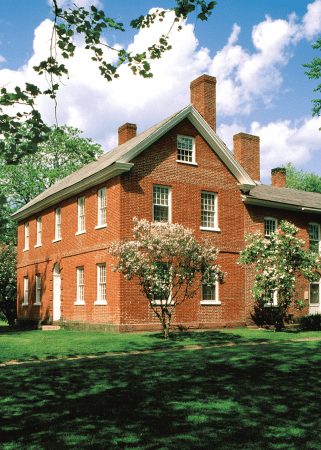 Historic Deerfield
84B Old Main St., Deerfield, MA
www.historic-deerfield.org
Admission: $5-$18; free for children under 6
Year-round: Historic Deerfield, founded in 1952, is an outdoor museum that interprets the history and culture of early New England and the Connecticut River Valley. Visitors can tour 12 carefully preserved antique houses dating from 1730 to 1850, and explore world-class collections of regional furniture, silver, textiles, and other decorative arts on display in the authentic period houses and in the Flynt Center of Early New England Life, a state-of-the-art museum facility. Check out the website for a packed roster of summer activities, including educational lectures, cooking demonstrations, and exhibitions of period decoration, textiles, furniture, and art.
Pocumtuck Homelands Festival
Unity Park, 1st Street, Turners Falls, MA
www.nolumbekaproject.org
Admission: Free
Aug. 4: This fifth annual celebration of the parks, people, history, and culture of Turners Falls is a coordinated effort of the Nolumbeka Project and RiverCulture. The event features outstanding Native American crafts, food, and live music, as well as demonstrations of primitive skills. The Nolumbeka Project aims to preserve regional Native American history through educational programs, art, history, music, heritage seed preservation, and cultural events.
Shakerfest
1843 West Housatonic St., Pittsfield, MA
www.hancockshakervillage.org
Admission: $65-$70 for all access; individual activities priced separately
Aug. 18: Hancock Shaker Village will present a day of music, ballads, storytelling, and dance — a place where musicians blend with the audience, and there’s no backstage. From food to free tours of ancient medicinal herb gardens, this festival offers numerous experiences to enjoy with the music, including afternoon harmony and dance workshop; an evening performance in the barn that combines traditional song and dance with new compositions, movement, and projections inspired by the Shakers who built the barn; and a rollicking barn dance.
Stone Soul Festival
1780 Roosevelt Ave., Springfield, MA
www.stonesoulfestival.com
Admission: Free
Aug. 31 to Sept. 2: New England’s largest African-American festival offers family-oriented activities, entertainment, and cultural enrichment, and is a vehicle for minority-owned businesses to display their wares and crafts. Entertainment at Blunt Park includes gospel, jazz, R&B, and dance. Sunday’s free picnic includes ribs and chicken cooked by talented pitmasters, backed by live gospel music performed by local and regional choirs.
Yidstock
1021 West St., Amherst, MA
www.yiddishbookcenter.org/yidstock
Admission: Festival pass, $236; tickets may be purchased for individual events
July 12-15: Boasting an array of concerts, lectures, and workshops, Yidstock 2018: The Festival of New Yiddish Music brings the best in klezmer and new Yiddish music to the stage at the Yiddish Book Center on the campus of Hampshire College. The seventh annual event offers an intriguing glimpse into Jewish roots, music, and culture.
FAIRS AND FESTS
Berkshires Arts Festival
380 State Road, Great Barrington, MA
www.berkshiresartsfestival.com
Admission: $7-$14; free for children under 10
n July 6-8: Ski Butternut may be best-known for … well, skiing, of course. But the property also plays host to the Berkshires Arts Festival, a regional tradition now in its 17th year. Thousands of art lovers and collectors are expected to stop by to check out and purchase the creations of more than 200 artists and designers.
 The Big E
1305 Memorial Ave., West Springfield, MA
www.easternstatesexposition.com
Admission: $10-$15; free for children under 5; 17-day pass $20-$40
Sept. 14-30: As regional fairs go, it’s still the big one, and there’s something for everyone, whether it’s the copious fair food or the livestock shows, the Avenue of States houses or the parades, the local vendors and crafters or the live music. But it’s not the only agricultural fair on the block. The Westfield Fair kicks things off Aug. 18-20, followed by the Blandford Fair and the Three County Fair in Northampton Aug. 31 to Sept. 3, the Franklin County Fair in Greenfield on Sept. 6-9, and the Belchertown Fair on Sept. 21-23, to name some of the larger gatherings.
Celebrate Holyoke
Downtown Holyoke, MA
www.celebrateholyokemass.com
Admission: Free
Aug. 24-26: Celebrate Holyoke is a three-day festival that made its return in 2015 after a 10-year hiatus, and typically draws more than 10,000 people downtown over the course of the weekend. This year’s festival will include live musical performances, food and beverages from local restaurants, activities for children, and goods from local artists and makers.
Downtown Get Down
Exchange Street, Chicopee, MA
www.chicopeegetdown.com
Admission: Free
Aug. 24-25: Now in its fourth year, Chicopee’s downtown block party, which typically draws about 15,000 people to the streets around City Hall, will feature tons of live music, as well as attractions for children, local food vendors, live art demonstrations, and the Get Down 5K Race.
Franklin County Beer Fest
66 Thunder Mountain Road, Charlemont, MA
www.berkshireeast.com
Admission: $25 in advance, $30 at the door
July 21: Join fellow brew enthusiasts for an afternoon of food, music, and drink. The third annual Franklin County Beer Fest will be held at Berkshire East Mountain Resort and will feature beer from several local breweries, local ciders, and local mead and libations. Online ticket buyers will receive a souvenir glass.
Mattoon Street Arts Festival
Mattoon Street, Springfield, MA
www.mattoonfestival.org
Admission: Free
Sept. 8-9: Now in its 46th year, the Mattoon Street Arts Festival is the longest-running arts festival in the Pioneer Valley, featuring about 100 exhibitors, including artists that work in ceramics, fibers, glass, jewelry, painting and printmaking, photography, wood, metal, and mixed media. Food vendors and strolling musicians help to make the event a true late-summer destination.
Monson Summerfest
Main Street, Monson, MA
www.monsonsummerfestinc.com
Admission: Free
July 4: In 1979, a group of parishioners from the town’s Methodist church wanted to start an Independence Day celebration focused on family and community, The first Summerfest featured food, games, and fun activities. With the addition of a parade, along with booths, bands, rides, and activities, the event has evolved into an attraction drawing more than 10,000 people every year.
River Celebration
350 Linden St., Brattleboro, VT
www.ctriver.org/celebration
Admission: $15; free for children 12 and under
June 16: The Connecticut River Conservancy will host this family-friendly event at the Retreat Farm in Brattleboro. Morning excursions including a pontoon cruise on the Connecticut River, a paddling adventure in the Meadows, a freshwater mussel ecology workshop, a fly-casting workshop, and more. Enjoy live music by River Rhapsody and lunch by Tito’s Taqueria and Vermont Country Deli. Additional activities include an ice-cream-making workshop and several demonstrations open all day: a stream table, a soil-infiltration table, a water-quality testing station, and more. Vermont Lt. Gov. David Zuckerman will moderate the “Farm/River Roundtable: Doing Right by Our Rivers.”
Worthy Craft Brew Fest
201 Worthington St., Springfield, MA
www.theworthybrewfest.com
Admission: $45 in advance, $50 at the door
June 16: Smith’s Billiards and Theodores’ Booze, Blues & BBQ, both in the city’s entertainment district, will host more than 25 breweries, with music by Feel Good Drift and the Radiators Soul and Rhythm and Blues Revue, and food served up by Theodores’, Mercado Food Truck, and Nora Cupcake Co. The event will also feature a home-brew contest; Amherst Brewing will make the winner’s beer and serve it at next year’s Brew Fest.
MORE FUN UNDER THE SUN
Berkshire Botanical Garden
5 West Stockbridge Road, Stockbridge, MA
www.berkshirebotanical.org
Admission: $12-$15; free for children under 12
Through Oct. 8: If the flora indigenous to, or thriving in, the Berkshires of Western Mass. is your cup of tea, try 15 acres of stunning public gardens at the Berkshire Botanical Garden in Stockbridge. Originally established as the Berkshire Garden Center in 1934, today’s not-for-profit, educational organization is both functional and ornamental, with a mission to fulfill the community’s need for information, education, and inspiration concerning the art and science of gardening and the preservation of the environment. In addition to the garden’s collections, among the oldest in the U.S., visitors can enjoy workshops, special events, and guided tours.
Crab Apple Whitewater Rafting
2056 Mohawk Trail, Charlemont, MA
www.crabapplewhitewater.com
Admission: Varies by activity
Through Oct. 8: Wanna get wet? Crab Apple is a third-generation, multi-state family business that operates locally on the Deerfield River in the northern Berkshire Mountains of Western Mass. Its five separate rafting excursions range from mild to wild, full- or half-day runs, in rafts and inflatable kayaks. In short, Crab Apple offers something for everyone, from beginners to more experienced rafters.
Great New England Air & Space Show
57 Patriot Ave., Chicopee, MA
www.greatnewenglandairshow.org
Admission: Free; upgraded paid seating available
July 14-15: The 2018 Great New England Air & Space Show at Westover Air Reserve Base will feature popular attractions like the U.S. Air Force Thunderbirds, who last performed in Chicopee in 2008. But note the subtle change to the event title — ‘Space Show.’ That’s because the Air Force operates the largest space program in the world, and the Great New England Air & Space Show is entering a new phase by incorporating elements of space and cyberspace capabilities of military and civilian contractors.
Lupa Zoo
62 Nash Hill Road, Ludlow, MA
www.lupazoo.org
Admission $10-$15; free for children under 2
Through Nov. 4: Lupa Zoo brings the African savannah to Western Mass. residents. The late Henry Lupa fulfilled his lifelong dream of creating a zoo right next to his Ludlow house, filling it with hundreds of animals and instilling a warm, familial atmosphere. Visitors to the 20-acre can be entertained by monkeys, feed giraffes on a custom-built tower, and marvel at the bright colors of tropical birds. In addition to offering animal shows and animal-feeding programs, the staff at Lupa Zoo promotes conservation and sustainability.
Post #351 Catfish Derby
50 Kolbe Dr., Holyoke, MA
www.post351catfishderby.com
Admission: $10 entry fee
July 20-22: The American Legion Post #351 touts its 38th annual Catfish Derby as the biggest catfish tournament in the Northeast. Fishing is open to the Connecticut River and all its tributaries. The derby headquarters and weigh-in station are located at Post #351. A total of $1,425 in prize money is being offered, with a first prize of $300. Three trophies are available in the junior division (age 14 and younger).
Six Flags New England
1623 Main St., Agawam, MA
www.sixflags.com/newengland
Admission: $57.99-$67.99; season passes $109.99
Through Oct. 28: Continuing an annual tradition of adding a new major attraction each spring, Six Flags New England recently unveiled Harley Quinn Spinsanity, an extreme pendulum ride that sends guests soaring 15 stories in the air at speeds up to 70 mph. Other recent additions include the Joker 4D Free Fly Coaster, the looping Fireball, and the 420-foot-tall New England Sky Screamer swings — in addition to a raft of other thrill rides. But fear not: the park has attractions for everyone along the stomach-queasiness spectrum, from the classic carousel and bumper cars to the giant wave pools and lazy river in the Hurricane Harbor water park, free with admission.
Springfield Dragon Boat Festival
121 West St., Springfield, MA
www.pvriverfront.org
Admission: Free
June 23: The sixth annual Springfield Dragon Boat Festival returns to North Riverfront Park. Hosted by the Pioneer Valley Riverfront Club, this family-friendly festival features the exciting sport of dragon-boat racing and will include music, performances, food, vendors, kids’ activities, and more. The festival is an ideal event for businesses and organizations looking for a new team-building opportunity, and provides financial support for the Riverfront Club as it grows and strengthens its presence in Springfield and the Pioneer Valley.
Valley Blue Sox
500 Beech St., Holyoke, MA
www.valleybluesox.com
Admission: $5-$7; season tickets $99
Through Aug. 1: Western Mass. residents don’t have to trek to Boston to catch quality baseball. The Valley Blue Sox, defending champions of the New England Collegiate Baseball League, play close to home at MacKenzie Stadium in Holyoke. These Sox feature a roster of elite collegiate baseball players from around the country, including some who have already been drafted into the major leagues. Frequent promotional events like postgame fireworks and numerous giveaways help make every game at MacKenzie Stadium a fun, affordable event for the whole family.
Photos from the June 2 Event
Gala sponsor Sarat Ford Lincoln with special guest judge Lindsay Arnold (fourth from left) and Bay Path President Carol Leary (fourth from right).
Andrew Associates, Mirror Ball sponsors of the Gala.
From left to right, Prestley and Helen Blake; President Carol Leary and Noel Leary

Emcee Ashley Kohl and special guest judge Lindsay Arnold from ABC’s “Dancing with the Stars.”
Gala Honorary Chairs: (from left to right) Steven and Alissa Korn; Drew and Lauren Davis; and Carrie ’86 and Tim Burr.
From left to right, Gala judges Jonathan Besse, vice chair of the Board of Trustees; Lamont Clemons, Springfield business leader; and Lindsay Arnold from “Dancing With the Stars” provided comments on the dancers.

A shot of the dance floor!

Founder and CEO Delcie Bean IV from Paragus Strategic IT with partner Daryll Sverrisson’98.

Patricia Faginski, vice president and financial advisor at St. Germain Investment Management danced with Gunnar Sverrisson of Ballroom Fever in Enfield, CT.
From left to right, President Leary joins the dancers at the end of the competition, Daryll Sverrisson ’98, Delcie Bean IV, Maria Rodriguez-Furlow ‘’10 G’12 of Bay Path, Gunnar Sverrisson, and the winner of the Mirror Ball Trophy: Patricia Faginski.
Matters of Policy
Regina Jasak says local agents can help consumers avoid some “really scary policies.”
When Massachusetts opened up its auto-insurance landscape in 2008, switching from a one-price-fits-all approach to the current model known as managed competition, it created more challenges for independent agents, but much more opportunity for customers willing to take the time to examine the many options and credits available to them. The key, these agents say, is putting their expertise to use — a resource not available to those purchasing insurance from direct writers online.
Eileen Bresnahan is always amazed at what people will do for a low insurance rate — like one individual who was covered for $5,000 in property damage for his 2017 Camry.
“If I hit you and do $17,000 worth of damage, my company is going to pay you the five grand, and you’re going to have to try to get the rest out of me,” she said, putting herself in that individual’s shoes for a moment. But such is the world of direct insurance writers — like Progressive and Geico — that market themselves based mainly on price, and wind up skimping on, you know, actual coverage.
“We always say ‘buyer beware,’” Bresnahan, president of Bresnahan Insurance Agency in Holyoke, said of local independent insurance agencies like her own. “We’re all licensed and trained; we can look at a policy and can tell you the things you might not know.”
Regina Jasak, president of Regina Jasak Insurance in Ludlow, has seen the same cases cross her desk.
“Anything you might hit — a guardrail, a car, a house — after that $5,000, you’ll be paying for it as well. You can get a really cheap policy, but you get what you pay for. I’ve seen some really scary policies out there from the direct writers.”
The truth, she added, is that customers can get policies for not much more than the bare-bones pricing of the online marketers, but with much better coverage, explained in detail, simply because of the flexibility Massachusetts insurers have enjoyed over the past decade — flexibility that, for the most part, didn’t exist before.
Indeed, for much of the past century, auto-insurance rates in Massachusetts were set by the state Division of Insurance. Anyone who requested a premium quote for a certain level of coverage would receive the same price from any number of companies, unless they were eligible for a group discount.
Managed competition, which began in 2008, allows insurance companies to offer their own rates. Although these rates may vary, they must still be approved by the Division of Insurance — hence the term ‘managed.’ The result is that Massachusetts drivers are able to compare the different rates, benefits, and services offered by the insurance companies competing for their business.
“There’s a lot of flexibility in auto rates and coverages, and it really needs to be tailored to each client,” Jasak said. “Each company has its own appetites, so we really need to delve into the client to figure out what’s best for them in order to find the best company at the best rates.”
That changed landscape made life more complicated for local agents, but in a good way, Jasak added.
“I find it more entertaining. It used to be that auto insurance was auto insurance, and it didn’t really matter where you were insured, whereas now the consumer can consider things like the company’s billing process, how claims are settled, are their rates good for my circumstances, do they offer me a great bundle option tying the house and car together? Is that the best thing to do, or can I get a better rate if I split things apart?”
Shifting Gears
Trish Vassallo, personal and commercial lines director at Encharter Insurance in Amherst, agreed that managed competition has radically changed the automotive side of the insurance business in Massachusetts.
Trish Vassallo (left, with Tracey Benison) says customers should review their policy every year to make sure they’re taking advantage of all the credits available to them.
“Carriers have been able to offer add-ons and packages and rider endorsements and enhancements that are specialized per carrier,” she said, “so while the Geicos and Progressives talk about accident forgiveness and gap coverages and reward dollars, those are available with everyone operating in Massachusetts today. Independent agents offer these coverages, but they are an added expense, as they would be with any carrier. As a client, you need to look at your coverage every year to make sure you’re getting the right pricing for the right products.”
That’s where independent agents serve a role the direct writers online cannot, she went on. “Sometimes people aren’t aware of options available or never had them explained to them, or they just don’t care — they want the bottom-line price and don’t understand what they’re missing out on.”
Under the prior, regulated system, insurance providers were required to apply specific surcharges for certain accidents and traffic violations. Now, insurance companies are permitted to develop their own rules, subject to state approval, for imposing surcharges for at-fault accidents and traffic violations.
They can also include a raft of discounts, such as for students who attend school away from home, making it easier for their parents to carry them on their policies year-round, or for bundling auto and home insurance when both policies are bought from the same carrier.
“Different carriers all have their own model customers,” said Tracey Benison, president of Encharter Insurance. “Our job is to really know the carriers and try to find the right fit for the customer.”
For example, Jasak said, some carriers will look back at driving records over three years, some six, and they also vary in how they incorporate accidents — both at-fault and not at-fault — into their pricing.
Then there are the credits, and they are myriad, Bresnahan said. “There are good-student discounts, so if a student gets a 3.0 GPA or higher, that’s one of the credits on there. Let me tell you, it is a big savings — and it’s an incentive to get good grades, and it also pertains to college.”
She also mentioned the discount for students away at college, as well as low-mileage discounts, which can knock anywhere from 2% to 17% off the cost of a policy. “Just think — the lower the mileage you drive, the less chances there are of getting in an accident or having a moving violation.”
From left, Shelly Chantre, Judy Orlen, Nicole Shibley, Janet Fernandez-Santiago, and Eileen Bresnahan of Bresnahan Insurance.
Carriers may also offer multi-car discounts, a AAA membership credit — with the discount increasing the longer a customer has been a member — and a discount for individuals who enroll in an advanced driver training course. “There’s also a disappearing deductible that wasn’t in effect before either, so if you don’t have an accident for a certain number of years, each year your deductible builds up.”
With each carrier using such incentives to attract their own version of a model customer, agents need to understand all the nuances and how best to match a driver with a policy, Bresnahan added.
“It’s just training your staff to know which credits to offer,” she said. “We have letters go out with renewals, and we highlight discounts and enhancements they currently have and other ones they don’t, and they can call if they’re interested in knowing more about those.”
More Than 15 Minutes
The direct writers have certainly made an impact on Massachusetts auto-insurance scene, but they’ve also brought some controversy, being fined multiple times by the state’s Division of Insurance for various deceptive or confusing practices.
“Some of the direct writers are very coy with prices or hidden deductibles, which the customer is not aware of until a loss comes into play,” Vassallo said. “It can be difficult to understand your coverage when you’re buying off the rack.”
The benefit of an independent agent representing multiple carriers, she said, is that she can work to generate the best product for each individual — and educate customers on various pitfalls, such as the importance of listing all household members as operators, as failure to do so can lead to a claim not being paid.
“It’s very, very important that parents list their children on their auto-insurance policy as soon they get their license,” Jasak added. “If they have no prior insurance, it’ll be very expensive when they need it. Parents say, ‘oh, they never drive my car,’ but if they kids are never insured, if they’re never listed on their parents’ policy, they’ll be paying an exorbitant amount of money when they get their own insurance.”
It’s all about relationships, Bresnahan said, not just a bottom-line dollar figure on a computer screen.
“When you’re a local, independent agent, you have to look people in the eye. With these direct writers, you’re not looking that gecko in the eye,” she said, noting that she has lost clients to the online companies dangling a cheaper rate. “Buyer beware. If it’s too good to be true, there’s usually something up.”
And also beware, she said, when a direct writer promises to produce a quote in 15 minutes.
“We educate our personnel, and we keep up with the changes in this business — because it’s forever changing. There’s so much information that it’s not possible to get a quote in 15 minutes. You’re not getting proper explanation of the coverage. There’s so much involved in getting a quote. It takes a long time.”
Joseph Bednar can be reached at [email protected]
Seeing Eye to Eye
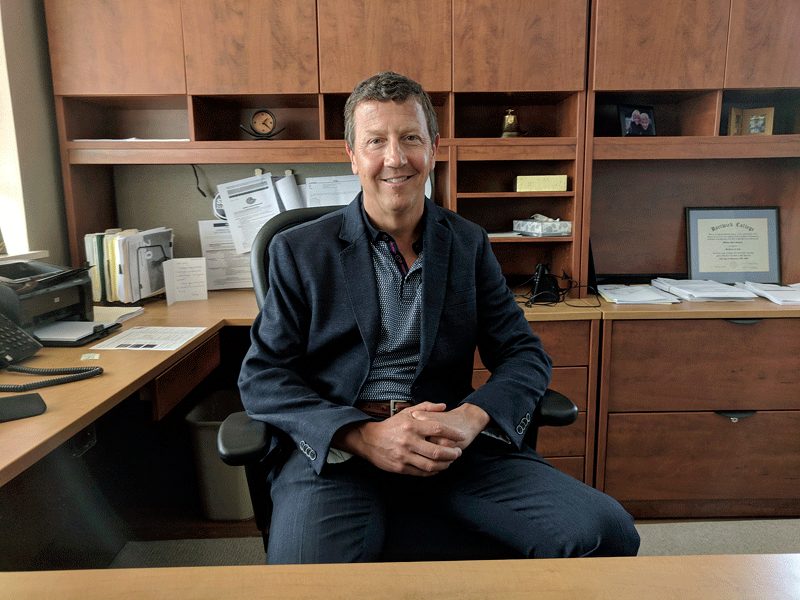
Bill Grinnell says the Ross Insurance purchase is essentially a match of similar cultures.
Bill Grinnell says he’s known Kevin Ross for years, both through the region’s insurance industry and socially as well.
“I got to know him better at the Springfield Country Club,” said Grinnell, president of Northampton-based Webber & Grinnell Insurance, recalling the start of conversations leading to his firm’s recent acquisition of Ross Insurance Agency in Holyoke.
“At one point several years ago, I sent him a letter that said, when he’s getting close to retirement, I’d love to talk to him because we’d love to have an office down in Hampden County,” Grinnell went on. “We write a lot of business down there, a lot of commercial business, and several of our salespeople are from that area — and we were interested in expanding and growing the business.”
But the purchase of Ross Insurance — a third-generation family business run for many years by the brother-sister team of Ross and Maureen Ross O’Connell — was also based on what Grinnell called a mutual respect between the firms and similarities in philosophy. As Ross did, in fact, contemplate retirement, he and Ross O’Connell — who is joining the Webber & Grinnell ownership team and will continue to oversee the Holyoke office, which will operate under the name Ross, Webber & Grinnell Insurance — narrowed their list of potential partners to a handful before deciding on whom they wanted to do business with.
“They approached those firms and interviewed them,” Grinnell noted, “and at the end of the day, we submitted an offer to them, went back and forth and ironed out some details, and we all agreed to do it.”
While Ross intends to transition out of the company in the next 18 months, Ross O’Connell will work with the Webber & Grinnell team to merge procedures and operations, Grinnell said, adding that the Northampton office will handle most of the commercial operations in Holyoke.
He added that having two locations will be a benefit to customers based in Hampden County. “If we station salespeople down there, it’s just easier to call on folks in the Springfield area.”
Meanwhile, he added, Webber & Grinnell has a benefits division for group life and group health insurance, “so we’ll be able to offer those services to those [Ross] accounts for those interested. That might provide some opportunities for growth for us.”
Community Ties
Both insurance agencies boast deep local roots, Grinnell noted. Ross Insurance was founded by George Ross in 1925 and has continuously served residents and businesses in Holyoke and surrounding communities for three generations. Meanwhile, Webber & Grinnell’s origin can be traced back to 1849, when E.W. Thayer opened an insurance and real-estate storefront on Pleasant Street in Northampton.
Once the acquisition is complete, the company will employ 41 people and serve more than 6,000 clients.
“They have a great name,” Grinnell said of the Ross family. “They’re as much involved in their community and supporting their community as we are up here. We’ve had a reputation for giving back to the community and helping a number of not-for-profits, and Maureen and Kevin are totally committed to the city of Holyoke, so they have the same kind of value system there. They’ve got some long-time customers, and they have a sort of family culture down there, which meshes well with what we’ve tried to create here as well.”
Both companies have also done extensive outreach to the community through social media, discussing topics of interest to both personal and commercial insurance clients. Ross in particular has developed a robust blog thanks to Jennie Adamczyk, the firm’s receptionist and social-media architect — a niche Grinnell has noticed.
“They’ve got a person down there who really focuses on that, and I think she’s going to be a big asset for us as well,” he said of Adamczyk. “Sometimes we have focused on that, but you get caught up in the day-to-day, and it gets pushed back a little bit, so we’re excited to have someone on our team to keep that going.”
For now, the companies will work to combine their communications, marketing, and other systems, and reconfigure roles, Grinnell said, “so there are some initial hurdles to get over. But it’s going pretty well so far. We’ve had positive comments from competitors who know both of us.”
Added Ross O’Connell, “we feel that we found the perfect partner to continue the Ross family legacy. Webber & Grinnell has a long history of generous community support and exceptional customer service.”
Perhaps just as important, Grinnell noted, many of his agency’s employees are in their 30s, making it a relatively young agency in an industry where many companies often struggle to replace retiring talent.
“A lot of guys are getting older in this business,” he said. “So I think Kevin and Maureen felt good about having local guys with a local presence be able to perpetuate their agency, because there are a million different options out there now. There are a lot of national players buying up agencies left and right, but they really wanted a local company that had that reputable, similar culture. So it worked out.” u
—Joseph Bednar
Mindful Connections
Allison Baker (right, with Cheryl Moran) says everything from the Atrium’s programs to its physical layout caters to individuals with cognitive impairment.
Over the past few decades, assisted-living facilities have increasingly opened dedicated memory-care units, and for good reason — a booming senior population is set to spawn sharp increases in Alzheimer’s disease and other dementias. These facilities stress safety, but more than that, they aim to keep residents active and engaged with life, while giving their loved ones much-needed peace of mind.
The guilt often associated with ‘putting mom in a home’ has never really gone away, even when the move makes sense, and those ‘homes’ — especially those which focus on memory care — aren’t what they used to be.
“It seems like a last resort sometimes,” said Allison Baker, director of Community Relations at the Atrium at Cardinal Drive in Agawam. “But what we’re able to provide in this community is care that is centered around their cognitive needs.”
Atrium — one of 56 communities in the Benchmark chain, which focuses solely on memory care — is celebrating its 20th anniversary this year, which allows its leaders to take a long view of how residential memory care has evolved.
“We care for individuals who have some form of cognitive impairment,” Baker explained. “Some of our residents are milder in terms of cognitive impairment, while some have end-stage, advanced dementia. We care for residents through the entire spectrum.”
It’s no secret that, as the senior population in America swells, so have instances of dementia. Alzheimer’s disease alone affects more than 5 million Americans — and, barring a cure, that figure might soar to 16 million by 2050, according to the Alzheimer’s Assoc.
That puts residences that specialize in memory care in a sort of sweet spot when it comes to meeting a growing need. In fact, that goes for assisted living of all kinds.
“The reality is, we’re all going to need help in the future,” Baker said. “It’s not something everyone wants to think about, but it’s reality. We try to educate families and provide them with guidance, whether or not someone moves into our community. Healthcare is not easy to navigate, but when families do come in, they see we’re not an institutional setting, but a homelike environment — yet, we can still meet their care needs.”
While giving BusinessWest a tour of Armbrook Village in Westfield, Executive Director Beth Cardillo noted the small size of the rooms in its Compass memory-care neighborhood, but there’s a reason for that — smaller spaces are easier to psychologically navigate, and residents spend most of their time outside the room anyway.
“Memory care is a smaller life in terms of space, but what we do there is no different than what we do in the rest of the building,” she said.
There are a few main reasons why families choose memory care, she noted. The first is that their loved one may be a flight risk, and families are worried their they might wander out of a building at 3 a.m. if the unit isn’t secured. “So, safety is obviously the number-one concern,” Cardillo said.
“The other piece, what people often don’t realize, is that, as someone’s world gets smaller, what we provide is a safe but very caring, normalizing environment. It’s a smaller world that’s a safer world. Often, people move to traditional assisted living and realize the world at large in this building is too big for them; they can’t negotiate the space. Sometimes less is more.”
Loved ones come to realize this too, she added. “When people move into memory care, for a lot of reasons, their families breathe a big sigh of relief, and it feels like a burden has been released off their shoulders. I always hear, ‘why didn’t I listen to you? It took me a while to get on the same page with this, but you were so right.’”
Kelly Sostre, executive director of Keystone Commons in Ludlow, which also boasts a dedicated memory-care neighborhood known as the Cottage, agreed that it can be difficult for families to come to terms with a growing need for help.
“It’s a hard hurdle for a child to get over, knowing her mom needs to be in memory care,” she told BusinessWest. “I definitely have to hold their hand through that process and explain the benefits of being in memory care.”
However, she went on, “just a week or two after they’re here, they’re like, ‘this is the best thing ever.’ They don’t have to worry anymore — they can come in and have a quality visit with mom, not worrying about medications or bathing her. They’re engaged, not tired, because they’re sleeping at night.”
Active Lives
Baker said the layout of Atrium is purposeful, catering to individuals with cognitive impairment.
“We don’t have long hallways with a lot of rooms coming off them, which can be confusing for residents,” she explained. “Instead, there are two wings with different neighborhoods in each wing, where apartments open into a common area.”
Beth Cardillo says families often find it difficult to choose memory care for their loved ones, but are typically relieved once they do.
Meanwhile, each apartment is decorated with a shadowbox out front, which families can decorate however they wish, telling a story about their lives and interests and reaffirming the idea that the residents are individuals. But, as Cardillo said, the idea is to get residents out of those rooms.
“In our model of memory care, we don’t want residents sitting in their room alone,” Baker explained. “Part of the reason someone moves into a community like this is that engagement. Someone with cognitive impairment may not feel comfortable around those without cognitive impairment, but here, in a comforting space, they feel free to express themselves — we’ve seen that time and time again.”
Executive Director Cheryl Moran noted that, whenever a resident is admitted, the family is interviewed to learn about their interests, past hobbies, favorite foods, and more.
“That way, we can program our care and activities to what they enjoy,” Baker noted. “Some residents may enjoy playing bingo, while others may prefer trivia or want to join a garden club or a baking club. There are always multiple programs going on, so residents have the ability to decide whether to actively participate or just socialize and observe.”
The emphasis on personalizing the experience stems from an acknowledgement that these are people with long histories who led rich lives, and want to continue living. “Some were homemakers, some were doctors, some were journalists. It runs the gamut, so it’s about finding what each resident enjoys doing so they can have the highest quality of life they deserve.”
With residents ranging in age from 60 to 97, Baker noted — with birth years spanning almost four decades — even what music residents enjoy varies wildly, with tastes ranging from the 1920s to the 1970s.
“It’s about finding what each resident enjoys and appreciates,” Baker said. “And we count on families and caregivers to provide a lot of that information — and, to some degree, our residents. We want them to feel as they have control, making their own decisions on things and letting us know what programs they like and don’t like.”
With a packed daily calendar of activities like word games, reminiscing, Zumba, tai chi, yoga, art, and music, Sostre said, Keystone also tries to offer something for everyone. Shuttle trips into the community are especially popular, and they’re also a chance to educate establishments like restaurants — which are contacted in advance — on how to accommodate people with memory loss.
Back on campus, many Keystone activities are enjoyed by an integrated group, with residents from independent, assisted, and memory-care neighborhoods gathering together for exercise programs or a chef’s club in which they prepare and enjoy a meal together.
“The road to Alzheimer’s is different for each individual here, and we try to program for that individual. Sometimes their needs might be different than the general group,” said Grace Barone, director of Community Relations, adding, however, that Keystone tries to strike a balance between meeting individual needs and encouraging group interaction.
Good Nights
Many times, dementia affects sleep patterns, which means some residents keep odd hours, but that’s no problem in a unit that’s staffed 24/7.
“If I walked in here at 1 in the morning, I wouldn’t be surprised to see a resident or two in the common area having coffee with the care manager or doing a puzzle together because their sleeping patterns do get mixed up,” Sostre said. “But we have staff here, so if that happens, it’s OK.”
Kelly Sostre, left, and Grace Barone say many of Keystone’s activities integrate its independent-living, assisted-living, and memory-care residents.
Cardillo agreed. “If you want to be up at 3 in the morning and have a cup of tea and toast, that’s fine. Want to dance in the living room at 4 in the morning? That’s fine, too. I don’t want to say anything goes, but the reason they’re here is not only to keep them safe, but to give them a robust life, not just keep them alive.”
Reminiscing is a big part of the activity program, she said, especially with a program called Reconnections, which is simultaneously a chance to learn new things and to generate conversation about the past.
“They remember going to USO dances or getting married the week before shipping out to war, or the Andrews Sisters singing ‘Boogie Woogie Bugle Boy.’ They’ll talk about art or where they went on their honeymoon. It brings up so much conversation.”
Such reminiscing has a clinical benefit, she added. “It keeps the synapses going — it’s a spark that increases dopamine in the brain. To see them sit and have discussions, it’s beautiful to watch.”
Music is a critical element as well — “it’s a window to the soul; it can bring you to your high-school prom or anyplace, really” — not to mention sensory activities from dancing and yoga to gardening. “It’s the regular world in a smaller place.”
And it’s often a place that remains meaningful to the family long after their loved one is no longer there, Moran said.
“The wife of a gentleman who passed came back to visit me maybe a month ago. She said she has a connection here and she likes to come visit, and she’s thinking about volunteering in our programs, which is very touching,” she told BusinessWest.
“It’s about love — when you walk in, I hope you feel a real sense of connection and family.”
Joseph Bednar can be reached at [email protected]
Out of the Darkness
Daniel Zotos characterizes H.4116 as a workforce-training bill more than anything else.
When Carolyn Mutcherson’s mother was diagnosed with Alzheimer’s disease, her family decided to care for her at home, even though they all worked full-time. It was a team effort, with family members alternating taking time off from work to give others a break.
“No one can care for someone, no matter what the illness is, alone,” Mutcherson told the audience gathered at a recent legislative breakfast of the Massachusetts/New Hampshire Chapter of the Alzheimer’s Assoc. “My sisters and I, along with our children, grandchildren, and spouses, helped care for my mother around the clock because she was home and my father wanted her to be home. She was our mother, but his wife. So whatever he asked us to do, we did.”
Mutcherson’s mom died at age 81, in her family’s care, but that care was often difficult, she recalled. She reached out to the Alzheimer’s Assoc. and to Baystate Health, where she worked, for help, but said too many family caregivers don’t know where to turn.
“We were fortunate to have a close-knit family, and as time went on, we found more resources in the community,” she said. “It’s very difficult caring for someone 24 hours a day when you don’t have resources or don’t know where the resources are.”
It’s a story playing out increasingly often in Massachusetts and across the U.S., as the senior population swells — around 10,000 Baby Boomers hit age 65 every day — and, with it, the number of Americans with Alzheimer’s and other dementias. In Massachusetts alone, about 130,000 residents age 65 and up have Alzheimer’s today, and that figure is expected to soar to 150,000 by 2025, a 15.4% increase.
It’s why advocates for a piece of legislation known as the Massachusetts Alzheimer’s and Dementia Act — unanimously approved by the state House of Representatives in January and now in the Senate Ways and Means Committee — are acting with a sense of urgency, said Daniel Zotos, director of Public Policy & Advocacy for the local Alzheimer’s Assoc. chapter.
“It’s always important to pay attention to these facts and figures and see where these numbers are going,” he told the local legislators, caregivers, and others at the April 27 breakfast. “We’ve been very active on the federal level and working with our members of Congress on Alzheimer’s disease research funding.”
On the federal level, Alzheimer’s research received a $414 million boost this year, bringing the total outlay to $1.8 billion — roughly quadruple what spending was in 2011, just seven years ago.
“Knowing we’re doing this advocacy work on the federal level is so important, but we’re also focused on people living with this disease now and families impacted by dementia, and that’s where I really see the state-level work — on the front lines of what is really a health crisis,” Zotos said.
Carolyn Mutcherson says caregivers often get frustrated and overwhelmed, and need to know where they can access resources and help.
The seeds of the bill known as H.4116 were sown at an event on Beacon Hill in October, featuring expert panels talking about Alzheimer’s disease from different perspectives — such as industry, research, and the care community — and that conversation went on for about five hours between two joint committees, he explained.
“The result of that conversation was a comprehensive bill that packaged together a lot of existing bills within the Alzheimer’s Association legislative platform, as well as other initiatives,” Zotos said — and the legislation has only picked up momentum since.
What’s in the Bill?
The Massachusetts Alzheimer’s and Dementia Act features four main components. First, it creates an integrated state plan within the Executive Office of Elder Affairs, and establishes a permanent advisory council to coordinate government efforts and ensure that appropriate resources are maximized and leveraged.
The second part deals with education and training, specifically requiring medical providers, including primary-care doctors, nurses, and physician assistants, to earn continuing-education credits in Alzheimer’s and dementia as a condition of license renewal.
The rationale, Zotos noted, is that an estimated 45% of individuals with Alzheimer’s are actually diagnosed, and far fewer are offered information and options. Patients with cognitive impairments going into variety of healthcare settings, he argued, need to be diagnosed and treated correctly.
State Rep. John Scibak, who serves the 2nd Hampshire District and has been heavily involved in Alzheimer’s issues, told breakfast attendees that this is a particularly critical part of the bill, even though doctors have told him they don’t support the additional mandatory training.
“They say, ‘we’re doctors. We went to medical school. We don’t need to be educated.’ Well, surprise. You now have to. I think it’s absolutely essential.”
The bill’s third element deals with dementia in the acute-care setting, ensuring that hospitals are better prepared to treat patients with cognitive impairments when they arrive for some other health issue. Statewide, individuals with dementia have a 22.5% readmission rate within a month of visiting the hospital — the sixth-highest rate in the nation.
“You can come at this disease from the heart, the impact there, but also the head when you think about the cost to the state,” Zotos said. “We can work to improve the experience in that setting. We’ve been having some really good conversations with hospitals about this.”
Finally, the bill establishes new protections from abuse and exploitation, including provider training with social workers from Elder Protective Services, and proper family notification, consistent with federal and state privacy guidelines, about incidents of abuse in care facilities.
Mutcherson says that element of the bill is not an attack on caregivers, but an acknowledgement that frustration is part of the daily experience. She said there were times she raised her voice inappropriately to her mother, only to be calmed down by family members.
“You do get frustrated, you do get angry; this is why you can’t do it alone,” she said, noting that even doctors sometimes don’t know how to communicate with patients with dementia and become flustered. “So education everywhere needs to take place — not just in hospitals, but in doctor’s offices and dental offices as well.”
Zotos said he characterizes H.4116 as a workforce-training bill more than anything else.
“If we focus on training our doctors and clinicians in recognizing Alzheimer’s and dementia, knowing the signs, it can really lend to improving that rate of diagnosis and getting folks into care-planning services much sooner,” he noted. “It’s a care-planning issue, it’s a financial-planning issue, and it’s also just a dignity issue to know you have a disease when you have it.”
One Step at a Time
Zotos said the bill, if passed, would be one development — albeit a significant one — in a long string of actions to improve quality of life for those with Alzheimer’s and other dementias in Massachusetts.
Those include legislation in 2012 mandating mininum dementia care standards in skilled-nursing and assisted-living facilities, and the establishment in 2010 of a Silver Alert system to help locate individuals who wander. Most recently, the Alzheimer’s Assoc. secured an additional $100,000 in state funding for Alzheimer’s public awareness.
“We’ve really focused on being in the community and talking about this issue,” he added. “And this budget item has really helped us focus on underserved populations across the Commonwealth, especially African-Americans and Latinos, who more than two times more likely to develop Alzheimer’s.”
Zotos noted that his grandmother had Alzheimer’s disease, and when he saw the impact of the advocacy movement, it encouraged him to get involved as well, leading to his current role. “We’ve had a lot of success in Massachusetts with Alzheimer’s and dementia, improving quality of care within in the care setting.”
Grace Barone, who chairs the association’s advocacy committee and works as director of community relations at Keystone Commons in Ludlow (see story on page 11), said she’s sometimes overwhelmed by the stories she encounters.
“I can’t walk away from this disease. It’s not me today, but it could be tomorrow. It could be any of us in this room. We need to share these stories; we need to be a voice for those who cannot speak any longer and share their experiences.”
Part of that message is educating those who deal directly with individuals with dementia, Zotos, and that’s the promise the legislation holds. He admitted it doesn’t include dramatic benefits like tax credits or respite grants for caregivers, but he’s determined to put families at the table with decision makers to improve quality of life.
“There’s a lot of good happening, but we have never seen a bill on a state level approach Alzheimer’s disease and dementia like this,” he said. “Massachusetts has really been known for healthcare, and this bill would put Massachusetts on the map in terms of helping families and reducing cost — but also helping our neighboring states get moving with legislation like this.
“This bill isn’t perfect; no bill is,” he concluded. “But the conversation continues; the fight continues. It’s a big step.”
Joseph Bednar can be reached at [email protected]
Along for the Ride
Anita Bird, now an HR coordinator for MGM Springfield, knocked on the door of the company’s office back in 2012 not knowing what to expect.
As the final, final countdown begins for MGM Springfield, the opening of the nearly $1 billion project offers a different level of poignancy for a small group of individuals. They are known as first-generation, or first-gen employees. In many cases, they were the boots on the ground, stuffing envelopes and staging letter-writing parties when this was only a concept, not even an architect’s rendering. Today, they’re no longer volunteers; in fact, they’re already casino-industry veterans who have found not only a job but a career.
Anita Bird remembers knocking on the door not knowing who or what might lie on the other side.
She had left Temple University in Philadelphia that fall of 2012, and come home to Springfield looking for … well, she wasn’t exactly sure what. A “restart” was how she phrased it for BusinessWest. She had heard that MGM was looking at Springfield as the possible site for one of the Commonwealth’s first resort casinos and also that the company had opened a small office at 1441 Main St.
“I was trying to figure out what I was going to do,” she recalled, “and I’d heard that MGM was here, and I wanted some more information, mainly because I was surprised and confused and was just looking to see what all this was about.”
So she knocked on the door.
Fast-forwarding considerably, she was met by Brian Bass, manager of the company’s casino-referendum efforts, who would offer her an opportunity to volunteer for the entertainment giant as it sought to clear what would be merely the first of many hurdles it would face to gain a casino license.
That stint as a volunteer would eventually lead to a job and what has all the makings of a career in the casino business. Her business card now declares that she is HR coordinator for MGM Springfield, handling a wide array of responsibilities, from events to make people aware of career opportunities at the casino to birthday parties for those already on the payroll.
What it will read several years, or even several months, from now, she doesn’t know.
“You get a glimpse of every piece, a little of everyone’s world,” she said of her time at MGM to date and her exposure to a wide array of career paths. “I’m open to the many opportunities that MGM has; we have so many great properties and great opportunities.”
Bird is what’s known within the company as a ‘first-generation’ employee of MGM Springfield, which means, in most cases, that she’s been here from the very start, long before the very first architect’s renderings of the $950 million casino now nearing completion in the South End were drawn. Back before Springfield voters had even approved a referendum that would allow a company to build a casino within the city’s borders. Back before anyone around here had ever heard of Mike Mathis or Bill Hornbuckle.

Amanda Gagnon may have lost the battle for Ward 6 in the casino referendum fight, but she’s won not only a job but what has the makings of a career in the gaming industry.
There are several of these first-gen employees, many of whom, like Bird, started as volunteers. Sometimes they knocked on that office door, other times they joined a line at the MGM table at a job fair.
After volunteering, they then earned jobs with a wide array of titles, and now are in what appears to be the early stage of a career in the gaming industry. Many of them tell stories of ‘letter-writing parties’ from the days leading up to the city’s referendum vote and then, a year later, a statewide ballot initiative to undo the Legislature’s approval of casino gambling. And of long days and nights working toward something that was then only a concept. And of doing ‘anything and everything that needed to be done,’ a phrase many of them used.
“We were the feet on the ground — this little army of recent college graduates just knocking on doors, making phone calls, having house parties and letter-writing parties; if there was a way to get the word out, we were going to do it,” said Amanda Gagnon, who, after her time volunteering, wound up serving on the community relations staff, then as exective assistant to both Mathis, president and chief operating officer of MGM Springfield, and Alex Dixon, the general manager, and now, as project coordinator on the operations side.
Some have seen their journey take them to Las Vegas for management training or to MGM’s National Harbor casino in Maryland, which opened roughly 18 months ago. But they are all in Springfield, or back in Springfield, as the case may be.
And now that it’s reality and just a few months from opening its doors, the casino has become for them not only a place of employment, but a source of pride, something they’ve helped bring to fruition, something that, for those who grew up in and around Springfield, has changed their outlook on the city and its future.
“Back when I was going to college at Western New England, I would never have patronized any of the outlets down here,” said Thuy Nguyen, a first-gen employee now working in HR. “I wouldn’t even think to set foot downtown because you always thought it was too dangerous to be down there. Fast-forward five years, and I’m downtown almost every week — outside of work. It’s a nice, very refreshing change.”
For this issue, and as the opening date for the casino draws ever closer, BusinessWest turns the spotlight on an intriguing group of MGM team members — those first-generation employees who knocked on the door of opportunity, sometimes quite literally, and found a fulfilling career on the other side.
Rolling the Dice
Gagnon can laugh about it now, but, for the most part, she still doesn’t. That’s because, on many levels, it remains a sore subject.
In the run-up to Springfield’s referendum vote on casino gambling in the fall of 2013, Gagnon, an East Longmeadow native, was essentially assigned Ward 6, the Forest Park area. As things turned out, that was the only ward to vote against the casino measure.
“I had a tough community, and I wore that scarlet letter for a while, but they didn’t hold it against me, obviously,” said Gagnon with a laugh. She took those numbers hard, but quickly focused on the much bigger picture — all the work that still lay ahead, including another campaign — the ballot initiative (which was defeated by a wide margin) — and she’s embraced all of it.
Gagnon’s story, like that of all of the first-generation employees, has its unique elements and fate-filled moments; there’s even what is now a husband-and-wife team that went to Las Vegas together for management training and now work on different floors of MGM’s headquarters at 95 State St. (we’ll meet them in a bit).
But there are many common threads as well. Most weren’t looking for a job with MGM per se when they started, just a job, or a restart, like the one Bird described.
Thuy Nguyen says she never skipped school before attending that job fair where she connected with MGM Resorts. She certainly has no regrets now.
Gagnon was certainly looking for one of those after returning from New York — and a short stint on Broadway in company management and casting — as so many do who venture to the Big Apple, with big dreams mostly unfulfilled.
“I was working in entertainment because that’s my strongest passion,” she said. “But New York is expensive, and I came back with my tail between my legs, ready to reassess what my future should be. I felt defeated — but I heard that MGM was interested in coming to the area.”
But at first, the East Longmeadow native disregarded those reports as illogical, based largely on the city’s troubles at the time and her own perceptions of the community. “I said, ‘I know this area, and MGM and Springfield weren’t two words that went together at the time.’”
But she was pushed and prodded by family members to investigate the rumors and, more specifically, show up at a career showcase at the MassMutual Center and report back in detail on what transpired.
She did show up, and she did report back — that MGM had no job openings, per se, but it was looking for interns to help with the campaign.
She interned for about a month and then was brought on full-time to work on the referendum campaign — work that is far removed from the lights of Broadway and also from what most people think about when they sign on to work for MGM Resorts.

Derek and Jennifer Russell arrived at MGM Springfield by way of Las Vegas (management training) and an assignment to help open MGM’s National Harbor casino in Maryland.
As noted, these first-gen employees weren’t working for a casino, but for a company with aspirations for building a casino in the City of Homes. In the late spring of 2018, it might be hard for some to remember how all this started — with a grassroots effort to garner support for casino gambling in the city.
Those who were there certainly can’t forget; the images, and memories, are embedded in their minds.
“By October, when I arrived, MGM was just sort of putting the feelers out,” said Bird, who would eventually be appointed manager of that office bearing the door she knocked on, the first of many steps up the ladder. “That’s when we sent out all those mailers asking people what their feelings were on casino gambling and what they thought about a casino here; that’s where we started, with those mailers, and eventually there were house parties, letter-writing efforts, and other things to feel out where the support was and what people thought about the project.
“We would do fireside chats, we would go to hockey games and sign people up, we’d do giveaways — anything we could to get to talk to people,” she went on, adding that the goals back then were to build support but also a large army of people to carry on the fight.
Joining the Army
And the recruitment process for that army was quite involved, and many would join by what could only be called the indirect route. Nguyen enlisted by way of a career fair in 2013 staged not by her school, Western New England University, but UMass Amherst.
“I didn’t know what I was doing with my life, and UMass has, historically, one of the largest career fairs in the area,” she recalled. “I was searching on their database to see what companies were going to be represented, and almost fell off my chair when I saw ‘MGM Resorts’ on the list.
“I swear that, prior to that, I had never skipped school,” she went on. “But I skipped on that day, took a chance, stood in line for what felt like hours, and once I got to the table and spoke to a representative, I found they were recruiting for their Las Vegas properties.”
That news left her feeling quite deflated — she remembers almost being in tears as she left the career fair — but the picture changed quickly and dramatically when Bass, who was forwarded her résumé by MGM colleagues at the career fair, gave her a call, inquiring about whether she’d like to join the campaign as an intern.
“He hired me on the spot, and it’s history from there,” she told BusinessWest before offering, when prodded, a much slower version of the story.
That account featured a dramatic shift in scenery as Thuy ventured off to Las Vegas and the MGM Grand, where she took part in the management-associate program, a stint that lasted three years.
For someone who grew up in Springfield and then moved to rural Maine, it was quite a culture shock — “life-changing,” as she called it.
But her goal was always to come back to Springfield and open the MGM property here, and late last year, she did. Her business card declares that she is an HR business partner, handling a wide array of responsibilities, from internal investigations to counseling to workers’ comp claims — “all the fun stuff” — for a workforce now numbering more than 200 and on its way to 3,000.

From left: Derek and Jennifer Russell, Amanda Gagnon, Thuy Nguyen, and Anita Bird.
Among those 200 are Jennifer and Derek Russell. They have different jobs — she’s the manager of Talent and Acquisition, and he’s manager of Financial Planning & Analysis — and they work on different floors, but they took the same basic route here.
The same one Nguyen did.
Indeed, Jennifer, a graduate of the Isenberg School of Management at UMass, was at that very same career fair, also looking for a summer internship. She was thinking about Boston or Hartford as a landing spot, but was mostly focused on just getting some experience and making a little money.
“I talked to 18 companies, and saw this really long line at this last booth that turned out to be MGM,” she recalled. “I remember thinking, ‘this is a hospitality company; I don’t know much about it, but it seems really popular right now.
“I ended up waiting in line for a good 15 minutes just to talk with one person,” she went on. “I was asking if they had any HR positions or project-management roles.”
The person she spoke with was recruiting for Las Vegas, and she handed her over to the vice president of MGM Grand, who took one of Russell’s homemade business cards and dialed the number on it several days later, asking specifically if Russell would be interested in coming out to Las Vegas.
She was, went out for an initial 10 weeks, and “fell in love with all of it,” in her recollection.
She came back home to East Longmeadow and to Derek, whom she had started dating a few months earlier, and essentially talked him into going back out to Vegas with her.
As he recalls, it wasn’t exactly a hard sell.
“I spent the better part of a year in Boston doing something I probably wasn’t enjoying, and was looking for something different,” he said. “Jen decided she wanted to move to Vegas to take part in this management-associate program and wanted me to go with her.
“I said, ‘why not?’ — I wasn’t doing anything all that great for work,” he went on, adding that he applied for the MGM program, also known as MAP, and was accepted. “I told my boss at the time that I was moving to Vegas; he said, ‘you’re young … that’s probably not the craziest thing you’ll ever do.’ And I remember telling him, ‘I’m pretty sure moving to Vegas is one of the greatest things I’ll ever do.’”
Moving the story along, they spent a year in the MAP program, getting a holistic view of how a casino company like MGM operates, choosing a career path — again, his in finance and hers in talent acquisition — and then getting on with those careers.
While doing so, they were ever mindful of a pledge they made to each other that they would eventually return to Massachusetts and the families they left behind. They would do that, but first made a stop at National Harbor to be part of the team that opened that casino.
Today, like many of the other first-gen employees, their travels have taken them well beyond Greater Springfield, but they are happy to be here now at this pivotal moment in the city’s history.
It’s a moment they are part of on many levels. Indeed, the Russells not only work downtown, they live there, literally a few hundred yards from the front door of the casino’s hotel, in Stockbridge Court.
“It’s exciting to see the city come to life and be restored after so long,” said Derek. “The city is changing, and it’s great to be part of all that’s happening here.”
Others shared that sentiment and said they’re proud that the project they’ve been involved with for so much of their young lives is helping to transform the region they knew and make the memories — and sentiments — they had seem very distant.
“The Springfield we see now isn’t the same Springfield I left when I went to New York,” said Gagnon. “There’s new restaurants on Worthington Street, new events in Court Square. Springfield isn’t just a city people drive through anymore; we’ve become a place to stop, not just somewhere on the way.
Nguyen agreed.
“MGM is Springfield’s lifeline,” she told BusinessWest. “And I’m a true believer that, without MGM, we wouldn’t be anywhere near where we are today.”
In the Beginning…
Flashbacks.
All those we spoke with say they have them. Lots of them.
They flash back to selected moments in time that, for obvious reasons, have become indelible — because of the work being done, the time of day, the fatigue they were feeling, the emotions they were expressing, or, very often, the people they were working beside.
Many of those people are now on a different floor or, in some cases, just a few cubicles away. But they’re still ‘beside’ them, wearing MGM nametags and bearing business cards with the company’s logo. And that makes the flashbacks come more easily.
“I can think back on those nights when it was 1 o’clock in the morning and we were counting how many phone calls we had made,” recalled Gagnon with a heavy sigh. “That’s just one of many memories I have — and will always have. And every second of that is worth it to be able to be here today.”
With that, she certainly spoke for all of the first-gen employees.
George O’Brien can be reached at [email protected]
Nominate a Healthcare Hero

Only a few minutes into the first meeting of an advisory board created by BusinessWest and its sister publication, BusinessWest, to provide needed insight as they launched a new recognition program called Healthcare Heroes, the expected question was put forward.
“How do you define that word ‘hero?’ asked one of the panel’s members, addressing the magazines’ decision makers.
The reply, and we’re paraphrasing here, was something to the effect of ‘how we define ‘hero’ is not important — it’s how you define it.’
And by ‘you,’ Kate Campiti, associate publisher of the two publications, essentially meant anyone who would nominate an individual or group to be named a Healthcare Hero in one of seven categories that first year.
Those who did so came up with their own definitions, used to highlight the nominations of a unique class of individuals and groups that would include Sr. Mary Caritas, SP, former president of Mercy Medical Center, in the Lifetime Achievement category; Dr. Michael Willers, owner of the Children’s Heart Center, in the Patient/Resident/Client Care Provider category; Dr. Andrew Dobin, an ICU surgeon, in the Innovation in Health/Wellness category; and the Healthy Hill Initiative in the Collaboration in Health/Wellness category.
“Generally, ‘hero’ means someone or some group that stands out and stands above others in their profession, in their service to others, and in the way their passion for helping those in need is readily apparent,” Campiti said. “And we saw this in our first class of honorees. If there was one word that defined all of them, beyond ‘hero,’ it was ‘passion.’”
A panel of judges will be looking for that same passion as they weigh nominees for the class of 2018.
Nominations are currently being accepted, and will be until the end of the day on June 15. Nomination forms can be found on both publications’ websites — www.businesswest.com and www.healthcarenews.com.
Nominations are being accepted in the following categories:
- Patient/Resident/Client Care Provider
- Innovation in Health/Wellness
- Community Health
- Emerging Leader
- Collaboration in Health/Wellness
- Health/Wellness Administration/Administrator
- Lifetime Achievement
Those nominating individuals and groups are urged to make their submissions detailed and specific, giving the judges who will review them all the information they need.
The honorees will be chosen this summer and profiled in the Sept. 4 edition of BusinessWest and the September edition of BusinessWest.
The Heroes will then be honored at a gala set for Oct. 25 at the Starting Gate at GreatHorse in Hampden.
Rounding out the class of 2017 are:
• Lifetime Achievement: Sister Mary Caritas, SP;
• Patient/Resident/Client Care Provider: Dr. Michael Willers, owner of the Children’s Heart Center of Western Massachusetts;
• Emerging Leader: Erin Daley, RN, BSN, director of the Emergency Department at Mercy Medical Center;
• Health/Wellness Administrator/Administration: Holly Chaffee, RN, BSN, MSN, president and CEO of Porchlight VNA/Home Care;
• Community Health: Molly Senn-McNally, Continuity Clinic director for the Baystate Pediatric Residency Program;
• Innovation in Health/Wellness: Dr. Andrew Doben, director of the Surgical Intensive Care Unit at Baystate Medical Center;
• Innovation in Health/Wellness: Genevieve Chandler, associate professor of Nursing at UMass Amherst; and
• Collaboration in Healthcare: The Healthy Hill Initiative.
For more information on Healthcare Heroes, visit www.businesswest.com or www.healthcarenews.com.
Community Spotlight
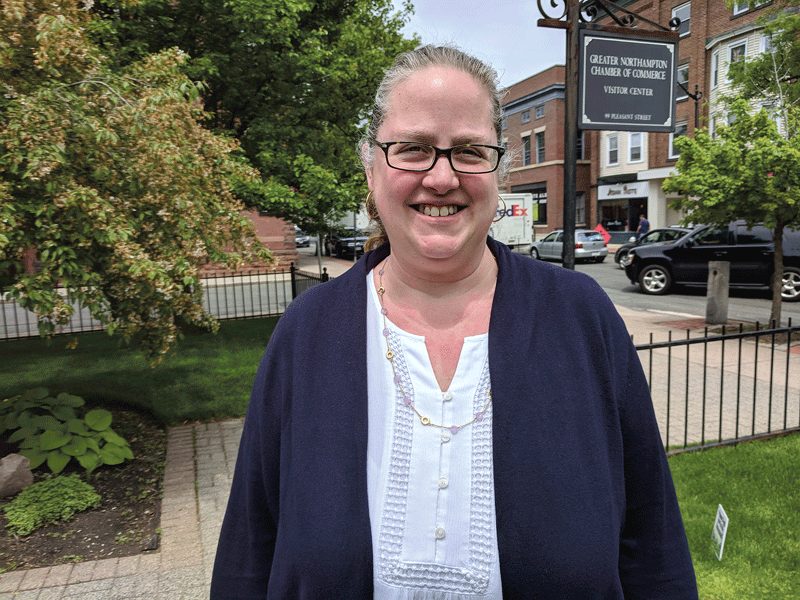
Amy Cahillane says the DNA strives to promote and build on Northampton’s energy, understanding that it has competition from other area downtowns.
Northampton’s downtown, Amy Cahillane says, is nothing if not eclectic.
“We have a great mix of businesses,” said the director of the Downtown Northampton Assoc., a two-year-old organization dedicated to boosting vibrancy in the city’s center. “We have a lot of different clothing stores, coffee shops, restaurants and bars — there’s a lot of room to find your niche here.”
She said business owners downtown are very much a network of mom-and-pop outfits that take pride in the district’s economic vibrancy and work hard to welcome new shop owners into the fold as they’re launching their enterprises.
“We’re a community that really works hard to make things attractive and make sure there’s stuff to do downtown, and welcome people in our downtown. We’re not just a Walmart and a Target and a parking lot.”
It’s a place, Cahillane said, where small-business owners, many of them first-time entrepreneurs, have no qualms about asking each other about the smallest details, from the best point-of-sale systems to how to keep customers coming in despite a raft of construction projects making it more difficult than usual to get around and find parking.
“All of our small businesses know it’s tough to take that risk and open your own business,” she said. “Business owners who have been around 30 years have had these conversations a million times — they’re very happy to share information, share stories, and lend support. Nobody wants to see a vacant storefront; people want to support other fellow business owners that are taking that gamble. And a lot of times, these business owners are our neighbors or friends, or kids of our friends.”
Aimee Francaes, who opened Belly of the Beast a year ago with her partner, Jesse Hassinger, can vouch for the support of downtown businesses, adding that such an atmosphere suits a restaurant that has forged some other important relationships — with local farms.
“The concept is ‘comfort food mindfully made,’ she said, noting that all meats are sourced from farms throughout the Northeast — and are smoked and cured on site — and 90% of produce in season comes from the Valley, or just over the border in surrounding states.
“We’re very much focused on being part of the community,” she went on. “And we feel like the community has really welcomed us and brought us into the fold. People tend to be very warm and welcoming, and happy to have us here, and happy to have us so active with local farms. Being on Main Street, right across from Thornes, gives us wonderful visibility.”
Speaking of Thornes Marketplace, which houses its own eclectic range of small businesses, it recently undertook a major renovation of its iconic front entrance, making changes both aesthetic and aimed at preserving the building’s historic elements.
It’s the sort of project that pleases the DNA, a voluntary organization open to property owners, businesses, and city residents, whose members work to improve the business and cultural strength of the downtown area through investments in programming, beautification, and advocacy.
The DNA handles such things as city plantings and holiday lights, and sponsors events that bring visitors to downtown, like the first Summer Stroll and Holiday Stroll, Arts Night Out, and sidewalk sales. The city has also given the DNA a full-time worker who cleans and maintains public property in the downtown business district.
Beyond that, Cahillane said, “we do advocacy, and we make sure the downtown community has a voice at City Hall, that people feel their voice is heard, and that there are public meetings and community forums on issues that will impact downtown, so everybody has a chance to voice their opinions and thoughts.”
The organization rose up after the dissolution of the Northampton Business Improvement District, and has since taken under its umbrella events and projects once handled by the BID and other entities.
“We’re always looking to do new events and create new partnerships,” she told BusinessWest. “We’re open to it all. The focus this year is to tighten up events we already do, but we’re always game to bring new stuff into the fold.”
Positive Trends
Several years into a strong regional economy, indicators such as property taxes, meals-tax revenue, and the number of visitors to the city show plenty of life, and Northampton’s downtown district, home to unique retailers, eclectic dining choices, and active arts organizations, reflects that health.
It can be slightly more difficult to navigate the area, however, thanks to a good reason — the city’s investment in infrastructure on Main and Pleasant streets, which includes ongoing roadwork and utility upgrades, supporting, among other developments, two housing complexes going up on Pleasant Street. Work along that thoroughfare also includes a small park, more parking spaces, and improved sidewalks and bike lanes.
Northampton
at a glance
Year Incorporated: 1883
Population: 28,483
Area: 35.8 square miles
County: Hampshire
Residential Tax Rate: $17.04
Commercial Tax Rate: $17.04
Median Household Income: $56,999
Median Family Income: $80,179
Type of government: Mayor; City Council
Largest Employers: Cooley Dickinson Hospital; ServiceNet Inc.; Smith College; L-3 KEO
*Latest information available
Cahillane said new businesses like Belly of the Beast have entered this landscape with aplomb, while occasional special events shine a spotlight on other businesses, like Sutter Meats on King Street, which ran a successful, two-day pop-up event in conjunction with the Little Truc food truck, serving up pho to sellout crowds.
Typically, she added, retail establishments participate enthusiastically in special events downtown — such as a fundraiser for Hampshire County Friends of the Homeless, in which music groups were stationed downtown, performing and passing the hat — but it’s harder for restaurants to do the same.
“The retailers are always game for everything. The restaurants, when we have events, are so busy with the people who come downtown for these events that it’s hard for them to also simultaneously staff a second, separate thing on that same day. So we try to bring the people downtown and then encourage them to eat at the restaurants. But they’re very supportive of our organization.”
Homestead, which set up shop in the former Ibiza Tapas location on Strong Avenue, is another fairly recent addition to the restaurant scene.
“They are doing very well and have made a lot of local relationships to bring products into their restaurant that are locally sourced,” Cahillane said, before adding that such a designation is par for the course in this city.
“I would say just about every restaurant in our downtown does some version of locally sourced,” she noted. “We have thought about ‘let’s do some sort of downtown festival where each restaurant could feature maybe a locally sourced dish,’ but that’s their whole menu at every restaurant. That’s not a Northampton festival; that’s an everyday reality. But some of them have had some really interesting or unique things that they have done with those local partnerships.”
Cahillane added that there should be more news of new businesses on the horizon. “They’re not ready to make it public yet, but I’d say, over the next six months, there will be some exciting storefronts popping up.”
That’s always a welcome development, she said, because even Northampton, known regionally and beyond for its downtown life, does grapple with occasional vacant storefronts. But in context, and relative to the struggles of many other communities, Paradise City is in a good place.
“I think it’s a great downtown,” she said, “and I think people are looking to come downtown.”
Making Contact
To cultivate that spirit, the DNA conducts monthly meetings with downtown businesses on a variety of topics.
“That’s a great opportunity for them do some networking with new businesses — and older businesses, too — and talk about things that might be mundane to the outside person, but are still important,” Cahillane said. “Recently, there was going to be construction, and some of them wanted to know how people dealt with the scaffolding outside and putting a banner on it. Other businesses were able to say, ‘make sure it’s really big, and make sure there’s not a lot of words on it, because no one’s going to stop and read it.’ So, things like that, which would not necessarily occur to me, are real issues, and we’re able to facilitate some of those conversations.”
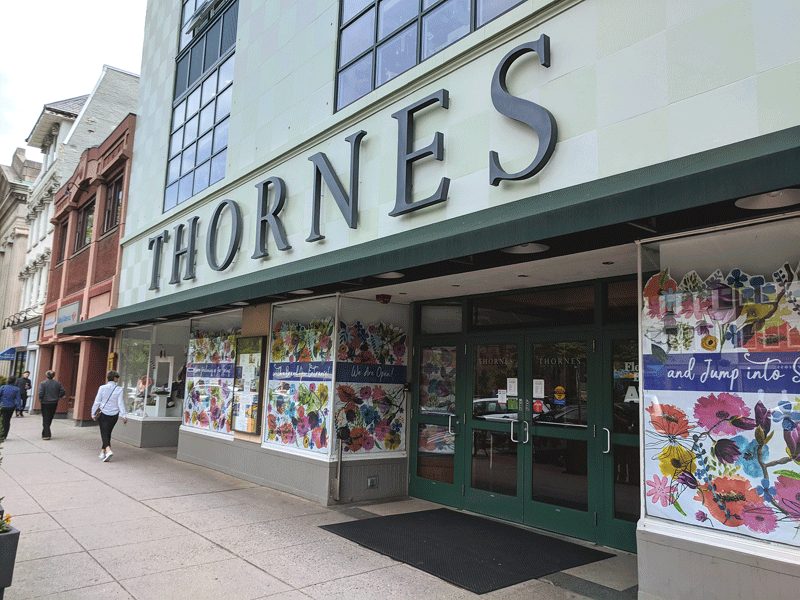
These connections are important in the big picture — one in which individual success stories become shared successes, she added.
“There is a feeling that all boats rise with the tide, that having a beautiful downtown can only help encourage people to come downtown, and there’s a recognition that is only going to happen if everybody pitches in.”
After all, Cahillane noted, Northampton isn’t the only downtown destination in the region, and shouldn’t rest on its laurels or take its visitors for granted.
“We’re fortunate to live in the Valley where there are a lot of great communities, and there are some, like Turners Falls and Easthampton, that are becoming up-and-coming, hip, trendy places to go and hang out,” she said. “Then there’s the casino that’s opening in downtown Springfield.
“We love our downtown,” she went on, “but we don’t want to just assume that everybody else knows and loves it, and I think you risk getting stagnant and a little boring if you don’t work to improve or at least maintain what you already have. So that’s what we’re trying to do.”
Francaes appreciates the effort, as she does the business owners downtown, from the owners of Thornes Marketplace to established restaurateurs, who acted as informal business consultants when she and Hassinger were getting ready to open their doors.
“We haven’t talked to anyone who hasn’t been supportive,” she told BusinessWest. “That’s part of the reason we chose Northampton — that vibe and warm, welcoming spirit.”
Joseph Bednar can be reached at [email protected]
A Mindset That Pays Off
Amy Jamrog says individuals, couples, and families make many mistakes when it comes to retirement planning. The biggest, perhaps, is not starting that planning soon enough.
‘Not practicing for retirement.’
OK, that’s not one of Amy Jamrog’s official 10 ‘mistakes business owners make before and after retirement,’ but it is certainly a related topic and one worth thinking about as that day approaches.
Practice for retirement? “Yes, definitely,” said Jamrog, a financial advisor with Northwestern Mutual as she delivered the second installment in a series BusinessWest calls Future Tense on May 17 at Tech Foundry in Springfield, using that word ‘practice’ loosely to describe how individuals and especially married couples should get ready for something they’ve never experienced before and are, in most cases, not really ready for.
“Practicing retirement is a big deal,” she said, relating a story about a couple intent on retiring and moving to Cambridge. She suggested they try before they buy when it came to that concept, and they did, spending quite a bit of time in that college town.
“They loved it in the summer and hated it in the winter,” Jamrog went on. “So they’re going to split their time — keep their house here and buy a condo there; they’re not going to move there.”
The moral to the story? Prepare — for everything you can possibly prepare for.
And this brings us to those ‘official’ mistakes. They’re listed in the box on page 19, and include everything from not understanding the impact of taxes on one’s retirement to not matching beneficiaries with the right assets, to what might well be the biggest of them — not planning early enough.
And that’s just a partial list, said Jamrog, who noted that, to the casual observer, most of the points on this list seem obvious, things that most people, and certainly successful business owners, would know about and be thinking about as they progress through their career toward retirement.

But the truth of the matter is that many don’t know about such matters. And what’s worse, she told her audience, is that they think they know.
Indeed, using quite a few hypotheticals — financial advisors rely on those — but even more true but sometimes scary stories (such as the one about the owner of a $10 million business who is still using TurboTax instead of a CPA) that come in the form of conversations she’s had with her clients over the years, Jamrog drove home the point that retirement isn’t something to be entered into lightly.
And with that overriding concept, she hit many of the same chords struck by Delcie Bean, founder of Paragus Strategic IT, in the first talk in the Future Tense series, titled “An Unprecedented Technology Disruption.” Slicing through that talk, which touched on the potential impact of everything from driverless cars to artificial intelligence, Bean told his audience that, while the future is difficult if not impossible to predict, business owners must nonetheless be proactive and energetic in their efforts to prepare for what is to come — whatever that may be.
Paraphrasing considerably, Jamrog said essentially the same in her ‘10 mistakes’ talk. And that idea will be conveyed once again in September with the final talk in this series, to be presented by Meyers Brothers Kalicka.
It will be titled “Change Considerations: An Examination of Lean Process, Market Disruption, and the Future of Your Business,” and will feature Mark Borsari, president of Sanderson McLeod, who will discuss change and innovation through lean concepts, and focus on resulting cultural considerations. The program will also feature commentary from Jim Barrett, managing partner at MBK, who will address already-active market disrupters that affect business processes in various industries.
But that’s in September. First, those mistakes that business owners make before and after retirement.
Taxing Situation
To show just how common these mistakes are, Jamrog started not with a hypothetical or a conversation with a typical client, but with a reference to her own parents, who began teaching her about money and how to manage it at a very early age.
“My parents taught us to balance a checkbook, we had small stock portfolios as kids … they did a really good job teaching us about money; it’s no surprise that I ended up being a financial advisor,” she said. “But we never talked about their money; we grew up in a private, ‘it-wasn’t-polite-to-ask’ kind of household.”
Fast-forwarding a little, Jamrog said that when, at the advice of her mentor, she brought her parents in for a financial review, she was shocked at how ill-prepared the people who taught her so much about money were for the retirement that was coming up on them fast.
“My father was co-owner of PolyPlating in Chicopee; he and his business partner started the business when they were 20, they had a handshake agreement, no buy-sell agreement, nothing in writing. They hadn’t done anything with their 401(k) in 20 years, they had no life insurance for other. They basically said, ‘we’ll take care of each other if anything happens.’
“The first thing I learned about business owners from working with my parents is to not assume, just because someone looks like they’re in good shape, that they’ve got it all figured out,” she said. “They had no ducks in order at all. My dad said, ‘all I do is work; the plan is to work and then retire, so I haven’t taken any time out to see if we’re doing it right.’”
That last comment — that one about not taking the time to out to see if he was doing it right — is the keeper in this discussion, the one Jamrog wanted her audience to remember as they walked out the door.
Amy Jamrog’s 10 Retirement Mistakes
• Not having the right people on your team;
• Not applying an accumulation strategy to your distribution plan;
• Not preparing your children for the future;
• Not understanding the impact of taxes on your retirement;
• Not prepping for important age milestones: 59½, 62, 65, 70½, and 85;
• Not understand the issues inherent in your IRA;
• Not having a philanthropic plan;
• Not matching your beneficiaries with the right assets;
• Not understanding the correlations between happiness and aging (this pertains to you and your parents); and
• Not planning early enough.
Those 10 mistakes are all common, they’re all important, and they offer specific thoughts to digest. But the common denominator and the overriding assignment is to take the time to make sure you’re doing it right.
That applies to specific issues such as taxes, distribution plans, issues with individual retirement accounts, matching beneficiaries with assets, having a philanthropic plan, and much more, said Jamrog, who encouraged those in the audience to embrace issues and discussions that are often difficult for married couples to engage in and then do some hard planning.
That’s because the worst-case scenario can and often does happen, and Jamrog, sadly, can go back to her family for solid evidence. Her father died at 50 after suffering a major heart attack. Jamrog was 26 at the time, and that incident created a passion within her to work with people in their 50s, and before that, to make sure they have their ducks in a row.
“I freaked out … I started calling all my parents’ friends and asked them to come in and meet with me,” she said, adding that, when they do come in, she often sees people making some of those common mistakes because, again, they think they know what they should be doing.
That is often the case when it comes to taxes and retirement, said Jamrog, who said mistakes in this realm can have serious consequences.
Elaborating, she said retirement plans, and specifically 401(k)s, constitute the most expensive money people have in retirement, meaning they are 100% taxable.
“And yet, I see it all the time — all people want to do is pre-tax, pre-tax, pre-tax everything they’ve got,” she explained, referring to the options for those looking to put money aside. “They don’t understand that, when they get to retirement, they have a growing tax problem, a deferred tax problem. And then that’s further compounded when people think they’re going to leave that to their kids.”
That wasn’t a direct segue into some of those other common mistakes — ‘not understanding the issues inherent in your IRA’ and ‘not matching beneficiaries with the right assets’ both came several items down on the PowerPoint — but it served that role.
“The worst thing you can leave your kids, besides nothing, is a 401(k) or an IRA,” she said. “It’s the most expensive money to leave behind.”
To get that point across, she related the story of a bank president who was, that’s was, very proud that he was going to leave a $2 million IRA to his four children.
“Good news/bad news, those four children are very successful and all in high tax brackets,” Jamrog told her audience. “So if he leaves $500,000 to each of these four kids, they’ll each lose about 45% of it to taxes; they can stretch it out over their lifetime, but they’re still going to lose almost half of it in taxes.
“When he found this out, he was angry,” she went on, putting heavy emphasis on that last word. “And did not understand how he did not know that. So we came up with a plan — a $2 million life-insurance policy, which gives each of those kids $500,000 in tax-free money, plus whatever’s left in the IRA.”
This is an example of people thinking they know what to do, but in reality not knowing, said Jamrog, adding that she could fill a talk that would last several hours with such examples.
Still another common mistake, and this is related to all of those listed above, Jamrog said, is parents not doing what her parents did — compelling their children to be both informed and responsible when it comes to money.
“I have clients whose kids are in their 40s and 50s, and the parents are still prepping their taxes for them,” she said in an effort to get her point across. “They just sign their tax return and have no idea what they’re signing.
“Teach your kids how to read a tax return, introduce your kids to your accountant,” she said. “If your kid is graduating from college and getting their first job, sit down and teach them what their benefits are, show them what a 401(k) is, and encourage them to enroll in a 401(k). And if your kids don’t listen to you, introduce them to your financial advisor.”
Bottom Line
Among the many anecdotes she shared, Jamrog said one in particular probably sums up the essence of her presentation better than any other.
“I had a man in my office last week, 62 years old, say to me, ‘I’ve been meaning to meet with you for six years, but I was afraid to meet with you because I was afraid you were going to tell me I was doing it wrong, and that it would be too late,’” she said. “And I said, ‘so you waited six more years?’”
Pride, insecurity, and ego all contributed to that six-year delay, she went on, adding that, while it’s difficult to remove those factors from the equation, individuals and couples should try and put their energy into planning.
And while they’re at it, they should try practicing retirement as well.
By doing so, they may just make the future less tense.
George O’Brien can be reached at [email protected]

 The region’s bevy of restaurants comprises one of the area’s most intriguing business sectors, one in which there is constant movement, new additions, and exciting stories unfolding. This year is no exception, and BusinessWest captures that movement, that excitement, in its annual Restaurant Guide.
There’s More Growth on the Menu
Bean Group has a number of intriguing plans coming to a boil
Taste of Italy
West Springfield’s bNapoli melds big-city style with local flavor
Who’s Cooking
There’s More Growth on the Menu

Andy Yee says his family’s goal is to create the region’s largest and best restaurant group. Some would argue that the Bean Group is already there.
Andy Yee says he’s heard what he readily concedes is a truism pretty much his whole life.
‘The restaurant business is really hard.’
But while he acknowledges this commonly held belief, or the related opinion that this business is certainly harder than it looks, he quickly adds that such work is essentially all he’s ever known, at least since his father first brought him to work at the Hu Ke Lau in Chicopee as a teenager.
“People do say it, and I hear it in the finance world all the time, that the restaurant business is not for the faint of heart — that it’s a very difficult industry,” Yee told BusinessWest. “I don’t know what that means, because I was born into this business — I don’t know anything but restaurants, so ‘difficult’ is not a word I exercise all the time.
“Yeah, it’s difficult, but everything’s difficult — life’s difficult sometimes,” he went on. “You make it what it is; to me, it’s fun, challenging in a good way, and rewarding.”
Which is why Yee is not only still doing this roughly 40 years after he got his start in the family business, he’s somewhat consumed with a mission to create the largest and best restaurant group in the region.
“It’s a personal goal of mine that my family shares — we’re all united in this goal,” he said. “And that is to be the quintessential restaurant group in this area.”
Some would say he’s already accomplished that goal with a portfolio of eateries, operating under the corporate name the Bean Restaurant Group, that includes several entities bearing his father’s first name — Johnny’s Tavern, Johnny’s Bar & Grill, Johnny’s Tap Room, and Johnny’s Roadside — but also the venerable Student Prince (Fort), IYA Sushi and Noodle Kitchen, and the Hu Ke Lau, although that landmark is currently closed and with a future described with those three letters TBD (more on that later).
But like Johnny Yee, the principals in the Bean Group — Andy, his siblings Edison, Anita, and Nick, and aunt Bonnie — are seemingly always in a building, adding mode, and that’s why there will soon be a second IYA location, this one in downtown Amherst, and another addition on the banks of the Connecticut River.
Indeed, the Bean Group is joining the Rondeau family, long-time owners and operators of Masse’s Seafood in Chicopee, in a venture to write an exciting new chapter in the life of the Dockside Restaurant at Brunelle’s Marina. The landmark will be renamed the Boathouse Tavern, with the tagline ‘waterside dining.’
A new upstairs deck is planned, as well as some changes and additions to the menu, with the goal of making the popular eatery even more of a destination and a complementary piece to the other eateries within the Bean Group.
But there are certainly more additions to come, said Yee, who was vague as he talked about what specific opportunities might emerge for acquisition or new development, but quite specific, and determined, as he talked about that broad goal he described.
For this issue and its annual Restaurant Guide, BusinessWest talked with Yee about his future plans — to the extent that he was comfortable doing so — but more about his career in this business that’s harder than it looks (to other people), and what drives him to continually build upon his portfolio.
Stirring Things Up
Yee said the chosen closing date for the Hu Ke Lau was anything but random.
April 6 was also the date his father opened the restaurant 53 years earlier, he said, adding that his family chose to close the loop in a sentimental and powerful way.
“It was a fantastic run — I’m still in mourning, I’m still crying; I have my moments,” he told BusinessWest as he talked about the iconic landmark that brought generations of people to Memorial Drive in Chicopee, or ‘the drag,’ as he called it, which he saw transform itself several times over a half-century.
As sad and sentimental as that day was, there was also a considerable amount of order and logic to it as well, said Yee, adding that the family decided roughly two years ago that the aging property had seen its day and that pouring more money into made little, if any, sense.
“The family was united in shutting it down not because it wasn’t profitable, but because the building had run its useful life,” he explained. “We were putting Band-Aids on top of Band-Aids on top of Band-Aids; when it rains outside, it pours inside.”
As to what comes next, not only for the Hu Ke Lau restaurant but for a large property on that radically changed, now extremely vibrant ‘drag’ … Yee was non-committal on both matters. He would say only that the family has taken steps to protect the Hu Ke Lau brand until it decides what to do with and it, and that it will look at a wide range of options before deciding anything.
“The Hu Ke Lau brand has been in our community for a great amount of time, and my family doesn’t see it going away,” he said with conviction. “Will it be 27,000 square feet? I think big restaurants today are difficult to operate; dark rooms don’t produce income.
“There’s another chapter to begin with the Hu Ke Lau,” he went on. “We’re looking, but we’re not looking too hard because we have some other things we’re doing right now.”
The only other thing he said with finality in his voice is that the building will be coming down soon. “We’re packing up,” he said.
That was a reference to the fact that Hu Ke Lau property was not only home to the restaurant, but to the Bean Group’s corporate headquarters, if you will, which were on the second floor.
These offices will soon be relocated to Union Station in downtown Springfield, in space to be subleased from his business partner in the Fort venture, Peter Picknelly, who recently moved his family’s bus company, Peter Pan, into the recently reopened transportation hub.
Thus, that subleased space will now be home to what he called MMMs, short for Monday morning meetings, strategy sessions staged by Yee family members since as long as Andy can remember.
And there’s been lots to discuss and do as these meetings in recent months, including the finalization of plans for the second IYA Sushi and Noodle Kitchen location, a 2,000-square-foot location on East Pleasant St.
Yee said the setting is ideal given the proximity of UMass Amherst and the other institutions comprising what are known as the Five Colleges, and he sees plenty of opportunity despite the growing number of eateries with sushi on the menu.
“There’s plenty of sushi there, but we’re going bring a new and very unique eatery to the marketplace,” he explained. “We’re going to bring big-city flair and a higher caliber of execution to this area.”
Construction of the IYA facility is underway, and Yee anticipates a ribbon-cutting ceremony in September, coinciding with the return of students for the fall semester.
As for the new Boathouse Tavern, Yee will be partnering in that venture with his brother-in-law, Donald Rondeau, and other members of the Rondeau family. The Dockside has been a South Hadley institution for years, and the facility was famously rebuilt and expanded after a devastating fire in 2013.
The Brunelle family made the property available, he went on, and the new partnership is determined to take full advantage of what Yee sees as a tremendous opportunity.
“We’re going to change the brand and introduce waterside dining,” he said, adding that his team has closed on the property and already commenced work on everything from marketing to construction of the new deck to changes on the menu.
Food for Thought
While those MMMs at Union Station in the weeks and months to come will no doubt have packed agendas with just the two latest additions to the Bean Group’s portfolio, Yee said they are just a few of the items to be discussed.
Indeed, in addition to matters that fall into the category of old business, there will plenty of new business as well, as the group drives ahead with that broad goal of becoming, if it isn’t already, the quintessential restaurant group in the area.
Andy Yee isn’t ready to say what this new business — or new businesses, as the case may be — is just yet, but he knows that opportunities will continue to present themselves, and the group will take advantage of some of those opportunities.
And that’s because, as hard as this business is, it’s all they’ve ever known, and ‘difficult’ isn’t the first word they would choose to describe it.
George O’Brien can be reached at [email protected]
Taste of Italy
Jerry Moccia says his goal is to provide diners with an authentic Italian experience.
If today’s dining public has become more demanding, Jerry Moccia says, television may bear some of the blame. But he’s not complaining.
“People are very into food — they know flavors, they know a lot about food, and things like the Food Network have brought a lot of exposure,” he noted. “People are more into food than they were 15 years ago, and expectations are much higher — which makes it more comfortable for us.”
He referred generally to the world of upscale dining, and specifically the Italian restaurant, bNapoli, he opened almost two years ago on Elm Street in the heart of West Springfield’s downtown.
Moccia is no stranger to the location, having opened Bella Napoli Pizzeria next door in 2005, four years after arriving in the area from his homeland of Italy. He ran that establishment for almost a dozen years before moving into the larger, neighboring space vacated by Curry Printing several years ago and creating a higher-end eatery.
“This is more my background,” he told BusinessWest. “We did Italian-American next door, with delivery, and I just wanted to bring something more authentic to the area, less Italian-American and more authentic Italian. I want people to experience how people really eat in Italy, while many restaurants in surrounding areas offer more Italian-American food.”
Thomas Fawcett, who oversees bar operations at bNapoli, said the restaurant is the culination of Moccia’s long-term vision.
“He plugged away there day and night with the vision of doing this,” Fawcett said of the pizzeria. “He always knew he wanted to open this; it was always sort of in the back of his mind. It was hard work, and that’s what he wanted. He was growing something.”
The goal, he added, was to serve fare that was ahead of the curve for the region, but not jarringly different. It was a risk, considering the success of Bella Napoli, but one that has paid off.
“Originally, it was tough, because people knew Jerry for next door, for the pizza shop — red sauce, Italian-American food,” he said. “A few people walked in here out of the gate with that expectation. But people gave it a shot, and maybe it wasn’t somewhere they could eat every night, but they knew on a special occasion they could. Then they told a couple people, who told a couple people, who tried it and told a couple more people.”
They’re still coming — and still telling their friends.
Heart of the City
Stepping inside bNapoli, diners are greeted by elegant, modern décor — all clean lines and earth and grey tones — meant to reflect what they might experience in a trendy restaurant in a big city, Moccia said. Meanwhile, the extensive menu currently runs the gamut from a grilled octopus appetizer and a house beet salad to creative entrees featuring veal, short ribs, haddock, ribeye, and a broad range of pastas.
“It feels very urban, metro New York or Boston,” he said of the atmosphere. “As for the food, we have some traditional, authentic Italian dishes with a contemporary spin. Everything is farm to table. We change the dinner menu three times a year based on the seasons. Tom came in over a year ago and brought the same expectation from a bar point of view.”
Indeed, when Fawcett showed up, there was no bar program to speak of, and he went to work crafting a unique experience for diners based on his training in Boston, where he was mentored by cocktail notables like Patrick Sullivan, who put B-Side Lounge in Cambridge on the map starting in the late ’90s, and Jackson Cannon, Fawcett’s fellow B-Side alum, who went on to establish Island Creek Oyster Bar.
Fawcett, who grew up in restaurants — his first job was at age 13 at Wild Apples Café in East Longmeadow — eventually enrolled in Jackson’s bar protégé program and became bar director at the second Island Creek location. He said what Moccia is doing at bNapoli — and what he has developed with the drink service — is very much in the spirit of those establishments, but innovative for Western Mass.
“It’s just different for this area. What we’re doing with cocktails out here is unheard of,” he said. “We make everything we can possibly make. We infuse our own spirits; we blend spirits for house blends. Strawberries just came into season, so we purchased strawberries from a farm and made a puree with them, which we won’t do in December, because we’d have to buy strawberries from California.”
As a result, the bar is even more seasonal than the restaurant, with a cocktail menu that changes roughly every six weeks. “Guests can come in today for their anniversary, and then if their birthday is in three months and they want to come back, the drink menu is totally different,” Fawcett said. “It’s something to look forward to for the next season. Right now we have a blueberry-infused Campari in one of our cocktails.”
Thomas Fawcett (right, with bar manager David Lazaro) says he has applied the restaurant’s from-scratch ethos to its drink menu.
Meanwhile, he expanded the wine menu from 40 to 100 labels but also focused it almost exclusively on offerings from Italy and the American West Coast. “This was fun for me; I’d never written an Italian wine menu, and I have fallen in love with Italian wine. What a great area of the world to grow grapes.”
As for beer selections, don’t look for big names like Anheuser-Busch and Miller; the roster is dominated by craft breweries — local names like Iron Duke and Fort Hill, but also small-batch producers from Maine to Virginia. “We are just a small, local restaurant, and we want to honor other small, local businesses.”
And Moccia definitely wanted to start small, Fawcett added.
“We’ve taken a slow approach. We didn’t want to open and have 1,000 people here right out of the gate. We’re sort of feeling our way, and we put a ton of time into what we do. We don’t have to work this hard, but we do because we’re passionate about it. David, the bar manager, doesn’t have to be here at 9 a.m. on a Monday pureeing strawberries for the week when we could just purchase it for a nominal fee and be done with it. But we take pride in what we do, and we love this and want to share this with everyone else.”
The feedback Moccia and Fawcett get from customers tells them that going the extra mile is appreciated.
“When I talk to people, they feel our passion for it,” Fawcett told BusinessWest. “When we’re at the table talking to them about what we do and how we do it, it’s a little more than just reading a list of ingredients. We’re sharing more of an experience. We’re bringing guests into the restaurant life, if you will.”
A Risk Pays Off
That life is one Fawcett knows well, and that Moccia has known for even longer. “He grew up in restaurants, and he understands the kitchen; he plugged away in one for 15 years,” Fawcett said. “So he had the back of house nailed down.”
His vision captured Fawcett’s imagination during their first meeting.
“I did not move back here expecting to see this,” he said. “I thought, there’s not going to be a restaurant that’s looking to do what I was doing in the city. But I met Jerry, and he said, ‘this is what we’re about; this is what we’re trying to achieve.’ And it has not been for naught.”
In some ways, Mocchia has been a risk taker, Fawcett said, but he’s adapatable, too, willing to alter offerings based on customer feedback.
“We just want to offer something fun and different which is fresh, and something that we believe in as well,” Fawcett went on, adding that bNapoli has amassed a strong cadre of regulars the staff knows on a first-name basis.
“We’re building relationships,” he told BusinessWest. “We’re a small restaurant. We don’t have the freedom of some large restaurants to be distant to their guests. You can walk into any big-brand restaurant and then walk out, and get a hello and a goodbye, and that’s it — and you could be fine with that. But here, I want to know how they’re doing. I want to know how their week was. I want to know if there’s a small touch we can make.”
In short, the goal is a big-city-type restaurant with a connection to the neighborhood, he went on — and his definition of ‘neighborhood’ is expansive, with regulars coming from places like Northampton, Wilbraham, and West Hartford.
“People make that ride, and they’re happy to be here,” he said. “People out here, when they believe in something, they stick with it. When they feel like you’re advocating for them, building something on their behalf, they will stick with you tooth and nail as long as you’re producing a good product, not taking shortcuts. If you’re working in their best interest, they know that.
“We’re in the business of hospitality,” Fawcett concluded. “It’s so much fun coming in here. We have a really strong group of people who bring that passion to the table, and we just want people to enjoy themselves.”
Joseph Bednar can be reached at [email protected]
Community Spotlight
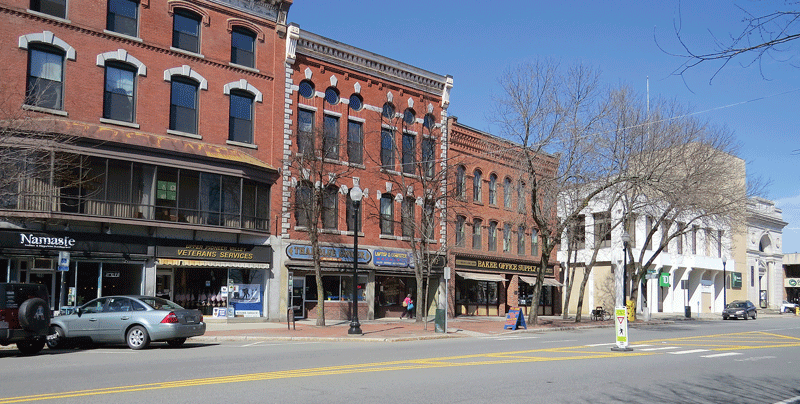
Downtown Greenfield may look the same as it did decades ago, in many respects, but it has evolved considerably and morphed into a true neighborhood.
Greenfield Mayor William Martin acknowledged that it isn’t exactly a scientific measure of either his downtown’s vibrancy or the efficiency of his long-term strategic plan for the central business district. But it certainly works for him.
He’s being told there’s a parking problem downtown. Actually, he’s been told that for some time. Until recently, the commentary involved the east end of that district by Town Hall, and the chorus was so loud and so persistent that the community is now building a 272-lot parking garage in that area, due to open in the fall.
But now, he’s also hearing that complaint about the east side of downtown, and he’s expecting to hear it a lot more with the opening of the Community Health Center of Franklin County on the site of the old Sears store on Main Street, a facility that will bring more than 100 clients and employees to that location every day.
In the realm of municipal government, parking problems generally, but certainly not always, fall into that category of the proverbial good problem to have, said the mayor, adding that a far worse problem is to have no parking woes — not because you have plenty of parking, but because no one is coming to your downtown.
And that was more the state of things in Greenfield for some time, Martin intimated, putting the accent on ‘was.’
Indeed, while Main Street may look pretty much the same as it did a few decades ago, at least at a quick glance, it is vastly different, and in some very positive ways, said the mayor, adding that his administration’s broad strategy has been to bring people downtown for goods and services and let this critical mass trigger economic development on many levels. And it’s working.
“We thought that, if we can bring people downtown and provide what they need, the free market will take care of people want,” he said, adding that the theory has been validated with everything from new restaurants to live entertainment to offices providing acupuncture and cardiology services.
Jim Lunt agreed. Now the director of GCET (Greenfield Community Energy and Technology), a municipal high-speed Internet provider, and formerly director of Economic Development for the community, he said the downtown has evolved considerably over the past decade or so.
Getting more specific, he said it has morphed from a traditional retail district, as most downtowns are, into more of a combination entertainment district and home for small businesses and startups.
“We’ve focused on small businesses that we can bring in, and we’ve worked a lot to build up the creative economy; our downtown, like many downtowns, looks a lot different now than it did 10 years ago,” Lunt told BusinessWest. “There are a lot more restaurants, a lot more opportunities for more social gathering, as opposed to what people would think of as traditional shopping.”
In addition to social gathering, there is also vocational gathering, if you will, in the form of both new businesses and also a few co-working spaces that are bringing a number of entrepreneurs together on Main Street.
To get that point across, Lunt, sitting in what amounts to the conference room in Town hall, simply pointed toward the window, a gesture toward the building next door, the Hawks & Reed Entertainment Center, which, in addition to being a hub of music, art, and culture, is also home to Greenspace CoWork.
That space, on the third floor, is now the working address for writers, a manuscript editor, a few coaches, a social-media consultant, and many others, and has become, said Lunt, maybe the best example of how Greenfield has put the often long-unoccupied upper floors of downtown buildings back into productive use.
MJ Adams, who succeeded Lunt as director of Economic Development, agreed, and she summoned another term to describe what downtown has become: neighborhood.
She said it has always been that to some extent, but it is now even moreso, with more living options and other amenities in that area.
“We’re starting to look on downtown as more of a neighborhood,” she explained. “We’ve always looked at it as the civic and service center for the county, but people are starting to perceive downtown Greenfield as a neighborhood that has a mix of housing styles, is attractive to a wide range of people, especially young people, has a lot to offer, and is very walkable.”
Greenfield didn’t get to this state overnight, said those we spoke with, noting that the process has been ongoing and more strategic in nature since the official end of the Great Recession and the arrival of Martin in the corner office (both of which happened in 2009).

Mayor William Martin says his broad strategy since being elected a decade ago has been to transform downtown into a hub for a wide range of services and make it a true destination.
That strategy has involved a number of tenets, everything from creation of GCET, which gives downtown Greenfield an important asset in a county where high-speed Internet access is a luxury, not something to be taken for granted, to a focus on making downtown a destination for a wide gamut of services, from education to healthcare.
For this, the latest installment of its Community Spotlight series, BusinessWest examines how these pieces have come together, and also at how they have positioned Greenfield for continued growth, vibrancy, and maybe even some more parking issues — the ‘good-problem-to-have’ variety.
Hub of Activity
To explain his broad strategy for Greenfield’s downtown, Martin essentially turned the clock back more than 200 years. Sort of.
Back in those days, he explained, Greenfield, anointed the county capital, was a supplier of goods and most services to the many smaller communities surrounding it.
Small steamships and rail would bring goods north on the Connecticut River to Greenfield, he explained, and residents of surrounding towns would make their way to the center of Franklin County to get, well, pretty much whatever they needed.
“I consider that a tradition and also a responsibility,” said Martin, now serving his fourth term. “And that’s what we’ve based our downtown on — providing what people need.”
It also has always done that with regard to government functions, he said, citing everything from the county courthouse, post office, and jail to Greenfield’s library, the largest in Franklin County. But Martin’s goal was to broaden that role to include education, healthcare, and more.
And specific economic-development initiatives, technology, societal changes, the community’s many amenities, and some luck have helped make that goal reality.
In short, a large number of pieces have fallen into place nicely, said those we spoke with, enabling downtown Greenfield to become not only a destination, or hub, but also a home — for people and businesses across a diverse mix of sectors.
These pieces include:
• A burgeoning creative economy that features a number of studios, galleries, and clubs featuring live music;
• A growing number of restaurants, in many categories, that collectively provide a critical mass that makes the city a dining destination of sorts. “There are 13 different ethnic restaurants, there’s some really good bars, several places for live music that weren’t here just a few years ago, and art galleries,” said Lunt. “I think that’s the biggest change downtown”;
• Greenfield Community College, which has steadily increased its presence downtown with a campus that brings students, faculty, administrators, and community leaders to the Main Street facilities;
• The community health center, which will bring a host of complementary services, including primary care, dental, and counseling for emotional wellness together under one roof in the downtown, where before they were spread out and generally not in the central business district;
• Other healthcare services. In addition to the clinic, a cardiologist has taken over an old convenience store downtown, said the mayor, noting that there is also an acupuncturist, a holistic center, a massage therapist, and other healthcare businesses in that district; and
• Traditional retail, of which there is still plenty, including the landmark Wilson’s Department Store.
Actually, these pieces haven’t just fallen into place by accident, said Martin, noting, again, that they have come into alignment through a broad strategic plan and specific initiatives designed to make the downtown more appealing and practical for a host of businesses, as well as number of existing qualities and amenities.
“We decided that we should do everything we can to provide the infrastructure necessary to attract people and entities when the economy turned,” he explained. “And we worked on a number of things that were real problems.”
High-speed Internet access was and is a huge component of this strategy, said Lunt, noting that it has been directly responsible for a number of businesses settling in the city.
Meanwhile, other parts of that strategic initiative include renewable-energy projects that have helped bring down the cost of energy; creation of a Massachusetts Cultural District, which has made the community eligible for certain grants; a façade-improvement project that has put a new face on many properties downtown, and many others.
Destination: Greenfield
The community already had a number of strategic advantages when it came to attracting both businesses and families, said Lunt, noting that, overall, while Greenfield’s location in rural Franklin County is limiting in some ways — contrary to popular opinion, there are actually few available parcels for large-scale developments, for example — it brings advantages in many others.
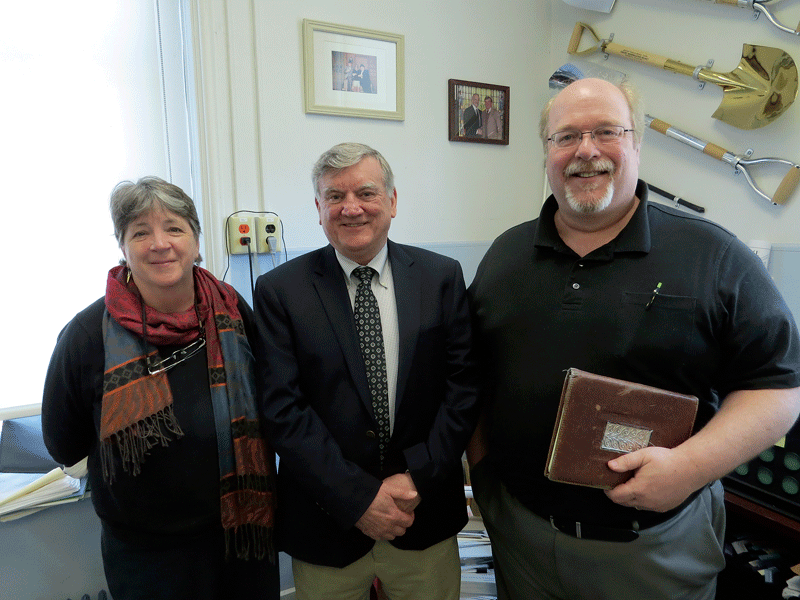
From left, MJ Adams, Mayor William Martin, and Jim Lunt all see many positive signs in Greenfield’s downtown.
Elaborating, he said that many younger people prefer a rural setting to an urban one — for both living and working — and can find most of what they’re looking for in Greenfield.
That list includes a lower cost of living than they would find in Boston, Amherst, or Northampton; outdoor activities ranging from hiking to whitewater rafting; culture; a large concentration of nonprofits serving the county; and, yes, high-speed Internet access, something people might not find 20 minutes outside of downtown.
“It’s a beautiful area, and real estate is quite affordable compared to much of the rest of the state,” said Lunt. “And the Springfield-Hartford metropolitan area is now 1.2 million, and that’s not that far down the road; a lot of people would happily commute for 45 minutes to live here and get to jobs there.”
This combination of factors has attracted a number of young professionals, many of whom may have gone to college in Boston or another big city and started their careers there, but later desired something different, said Adams.
It has also attracted entrepreneurs, said Lunt, including several video-game developers, many of whom now share a business address — co-working space known as Another Castle.
Located on Olive Street in space that until recently housed the Franklin County registry of Deeds, it became home to the video-game developer HitPoint, which was located in Greenfield, relocated to Springfield, and has now moved back. And it has created a co-working space that enables other small game designers to take advantage of shared equipment and facilities, effectively lowering the cost of doing business.
Moving forward, the town’s simple goal is to build on the considerable momentum it has created through a number of initiatives. These include work to redevelop the former First National Bank building, vacant for decades and the last of the properties on the stretch as Bank Row to be given a new life.
The town’s redevelopment authority has site control over the parcel, said Lunt, adding that the next steps involve working with the state, private grant writers, and the city to acquire funds to convert the property into a downtown cultural center to be used for everything from a farmers’ market to perhaps a museum of Greenfield history.
If all goes according to plan, all the properties on Bank Row will be back in productive use for the first time in 40 years, he told BusinessWest.
Another initiative is the parking garage, which has been years in the making, noted the mayor, noting that it took several attempts to secure funding help from the state for the project.
The facility will ease a well-recognized problem, exacerbated by the new county courthouse in that area, and provide yet another incentive for people to come to downtown Greenfield.
As for parking at the other end of Main Street … well, that’s a good problem to have. For now, anyway.
George O’Brien can be reached at [email protected]
Members Only
Katherine Hutchinson says members expect a credit union to be attuned to their needs.
Although myths persist about what credit unions are, their leaders are cheered by statistics showing that 43% of Massachusetts residents belong to one. But they know members aren’t satisfied with mere messaging; they want the high-tech tools available at larger banks, melded with a culture of personal service. It’s a challenge they say they work hard to meet.
Michael Ostrowski has made a career in credit-union leadership, and the numbers startled even him.
Specifically, it’s the statistic that 43% of the population of Massachusetts is a credit-union member, compared to about 33% nationally.
“That’s huge. I was surprised by that,” said Ostrowski, president and CEO of Arrha Credit Union. But after considering it, he wondered why that 43% figure should be a shock at all. “I’m surprised more people don’t take advantage of credit unions, from the fees and everything right down the line. We are typically a better deal, and you don’t see any of these credit unions in the newspaper like a Wells Fargo.”
By that, he meant the financial turmoil that many national banks brought upon themselves at the start of the Great Recession — a crisis that actually led to marketing opportunities for credit unions, said Katherine Hutchinson, president and CEO of UMassFive College Federal Credit Union.
“We did see growth throughout the recession,” she told BusinessWest. “We wanted to make sure we were not letting our members down by not lending through that period, but we were also very conscientious about how we were spending our money — all the things good financial institutions do to protect the interests of their shareholders and, in our case, our members. That’s really important to us, and I think it was a time where people were taking a second look and saw credit unions as alternatives.”
The lobby walls at UMassFive’s Hadley headquarters are adorned with messaging touting the member-centric (don’t call them customers) philosophy of credit unions, and, “believe me, we try very hard to follow the philosophy,” Hutchinson went on. “I’ve been at the credit union for 42 years — I’ve kind of grown up in the industry. When I started, we were very focused on the member, and I’ve tried to convey that and live that philosophy as we grew bigger.”
Credit unions are financial institutions that look and feel like a bank in the products and service they offer, she explained, but the difference is their structure as cooperatives.
“Because of a credit union’s non-for-profit status, consumers do expect better rates and lower fees, and I think that’s what they experience,” she said. “But they also want us to be focused on what they need, on how we can help them personally — to listen to their story, hear about why they’re in a certain situation, and what would really help them.”
Glenn Welch says local leadership means credit unions can respond to members’ concerns quickly.
Glenn Welch, president and CEO of Freedom Credit Union, said member ownership of the institution is important to those who do business there. “Whether you have $5 in your account of $500,000, it’s one member, one vote,” he said, adding that members of his board of directors must hail from the four western counties. “The board is local, so members know we can make decisions and resolve situations quickly.”
Resolving situations, and writing more success stories, is a point of pride for UMassFive, Hutchinson noted. “I think it’s important that we hear those stories and share those stories to encourage our employees to listen to the members and find ways to help. The stories are important.”
Numbers Don’t Lie
The story for credit unions has been positive in recent years, Ostrowski said, pointing to statistics like a capital-to-assets ratio of 10.4%, on average, for credit unions in Massachusetts. “Over 7 is well-capitalized — we’re over 10. That shows strength in the credit-union industry.”
Meanwhile, the 167 credit unions in Massachusetts employ 6,158 people full-time and another 908 part-time, and boast more than 2.9 million members — again, about 43% of all residents.
Still, myths persist about credit unions, Welch said, sharing four common ones identified by the Credit Union National Assoc.
The first myth: “I can’t join.” CUNA points out that many Americans believe they are ineligible to join a credit union, but membership eligibility today is typically based on geography, he noted. Membership at Freedom Credit Union, for example, is available to anyone who lives, works, or attends college in Hampden, Hampshire, Franklin, or Berkshire counties.
The second myth: “accessing my money may be hard.” Not true, Welch said, noting that, along with boasting a mobile application for online banking, many credit unions, including Freedom, have joined the Allpoint Network, allowing members surcharge-free ATM access at more than 55,000 retail locations worldwide.
The third myth: “they’re too small.” Rather, he noted, credit unions provide the same security and protection of a larger financial institution, but is accountable to members, rather than shareholders. “This means every customer is treated as an individual, not a number, enjoying personalized service and customized products.”
The final myth: “they’re primarily for those in need.” Based on generational notions, Welch explained, some may believe credit unions mainly serve low-income consumers. In truth, he added, they serve every population, as well as every size and type of business.
Essentially, he told BusinessWest, the CUNA survey demonstrated that many people don’t understand what membership means and how to go about applying to be a member.
“Several things came up; one was that they didn’t feel that credit unions can offer them the level of technology and products of banking institutions. But we had a good year in 2017 and approached the board with quite a few investment upgrades,” he noted, expanding the tasks that can be done online, like electronically signing for loans.
“People don’t want to set foot in a bank or credit union lobby unless they have to,” he continued. “We have the same products available at bigger banks, but at a local level.”
Ostrowski agreed that credit-union members appreciate the institution’s purpose and philosophy, but also demand current technology. In fact, Arrha is in the process of upgrading all its systems to improve electronic communication and its mobile banking platforms.
“I think the credit unions are still filling that void of the banks that had their roots in the small towns, and that really hasn’t changed,” he said. “But I think it’s important that people realize that we have the same systems all the big banks have, and we have the same cybersecurity functionality they do. Clearly, from a systems standpoint, we can compete very well with them.”

Michael Ostrowski says credit-union members expect the same high-tech products they can find at large banks.
Likewise, Hutchinson noted that the area colleges the credit union was built upon still form its core membership group, but it wouldn’t have grown beyond that without a recognition in the region of the credit-union philosophy — and without a commitment on the institution’s side to stay atop trends in products and services and continually invest in technology. “That is important to growth and our sustainability, so we’re proud of that.”
Loan Stars
Ostrowski said messages like this — and a vibrant economy — have helped Arrha grow steadily in recent years, with deposits up, loan delinquency down, and investments in technology helping to attract new members.
Meanwhile, Welch noted that the competitive interest rates Freedom pays on savings accounts and charges for loans have both attracted new business. All that led to growth in 2017 in return on assets and total loans, as well as hiring a second commercial lender and a credit manager, focusing on individuals and small businesses.
“Typically, we don’t lend more than $3.5 million or $4.5 million, although we could, based on capital,” he noted.
But the credit-union presidents BusinessWest spoke with all noted that the model’s philosophy doesn’t stop at dollars and cents, but extends to a robust community outreach, often in the form of educational seminars.
“That goes to the concept of people helping people,” Welch said. “We find, when we’re not able to help someone, it’s usually a credit issue, and often, they haven’t been educated on the value of credit. So we participate with other banking institutions in Credit for Life fairs, reaching out to students when they’re still in high school to talk about good and bad credit, and what that means when they try to buy a car, rent an apartment, or get a credit card.”
Hutchinson said her board believes community education is important to UMassFive’s mission. “So many people need that kind of assistance. It ties back into what is best for our members — educating them on how to make decisions.
“Financial literacy is key,” she went on. “We try to have a variety of topics, from understanding your credit score to budgeting to preparing for retirement and first-time homebuying. We also work with UMass, doing some seminars for students on student debt.”
Ostrowski noted that even recent college graduates don’t understand their credit score and the impact it can have, while others take advantage of a credit-card offer in the mail and quickly wind up thousands of dollars in debt without thinking about the consequences. “All our programs in financial literacy are drivers that we make no money on — they are absolutely out of love of our members and to protect them.”
The credit-union culture runs deep in Massachusetts, the state where such institutions were first chartered way back in 1909, Ostrowski explained. State partnerships are still critical, he added, noting that Gov. Charlie Baker has backed an effort by the state’s credit unions, called CU Senior Safeguard, to fight elder financial abuse and fraud. All frontline credit-union staffers are participating in the program, while a statewide effort is targeting consumers with information about how elders are defrauded — a problem that costs some $10 billion every year nationally.
“I’ve heard wild stories about members getting ripped off by contractors,” he said, or individuals who were ready to send money to an unknown e-mailer on the promise of more in return. “I’ve literally had to argue with individuals not to send their money away.”
Better, he said, to deposit it with a credit union — and join that 43% number that, in an age of constant mergers and acquisitions among area banks, only continues to grow.
Joseph Bednar can be reached at [email protected]
Spotlighting Innovation

Matt Bannister says the Innovation Series, by relating stories of entrepreneurship, will hopefully inspire more of them in the years to come.
Photo courtesy of PeoplesBank
Throughout its 133-year history, PeoplesBank has touted innovation as one of its core values. But until very recently, this emphasis on innovation has been focused inward, on products, services, and ways of doing business. With a new program, called, appropriately enough, the Innovation Series, the bank is turning that focus outward, telling stories of entrepreneurship with the broad goal of inspiring more of it.
Matt Bannister sounded more like the producer of a new television sitcom than a bank’s first vice president of Marketing and Innovation.
“If it goes well, it will get renewed for a second season,” he told BusinessWest, laughing as he did so. “Right now, we have a pilot and a handful of episodes — let’s see where it goes from there.”
He was referring not to the latest candidate for binge-watching on HBO or Netflix, but to something PeoplesBank is calling its Innovation Series. And yes, you can binge-watch this, too. Well, eventually.
There are now three ‘episodes’ available for viewing on the bank’s website and on YouTube, including that so-called pilot and an interview with the braintrusts at Valley Venture Mentors, and there will soon be more installments in the can, as they say, as Bannister sits down with more entrepreneurs.
As the name of the series denotes, this is a program about innovation and entrepreneurship.
Or what Bannister, who plays host/interviewer for the series, also simply called ‘it,’ a not-so-casual reference to that collection of qualities, talents, and intangibles it takes to not only have an idea (we all have those) but advance it, hopefully all the way to the marketplace. We’ll talk a lot more about that later, but first, more about this series, how it came about, and why.
Bannister started by saying that innovation has always been one of the bank’s core operating principles. But for just about all of the institution’s 133-year history, this emphasis on innovation has been focused inward — on the development of new products, services, and ways of doing business.
Some Tips for Entrepreneurs
to Stay Sane
Entrepreneurial life has been described as a rollercoaster — incredible highs that can follow take-your-breath-away descents.
Several mentors and startup founders offered the following tips to help smooth out the ride:
• You’re not crazy! Most people would never take the leap into starting their own business, but that’s what makes you different — not crazy. When you have that idea, the one that has been burning inside you for years, and act on it, you’re following the same path as Gates, Jobs, and Edison — and they weren’t crazy.
• Make sure to have clear expectations about ownership and compensation amongst the founding team. Write down your agreement, even if on the back of a Post-it Note, but ideally with the help of an experienced lawyer.
– Scott Foster, attorney and co-founder, Valley Venture Mentors
• Be able to pivot. Having a plan is great, and you certainly need a direction, but as you learn more about your customers and your product, you may find that you need to change the business plan, go-to-market strategy, or even change the product completely. You cannot be myopic in your immediate future, and hard pivots are what separate failed startups from those that succeed.
• Find team members that you can work well with. You will be spending more time with them than your family, so it is important to be able to have a good working relationship with them.
– Barrett Mully, co-founder, Aclarity
• Know what you don’t know, and don’t be afraid to ask for help and advice from others. There are so many resources out there to help; all you have to do is ask.
• Find mentors who have experience and that you can trust. They are the ones who will introduce you to your next investor, help you understand your industry ecosystem, and be there when you just need to talk. Our mentors have been key to our success.
– Julie Mullen, co-founder, Aclarity
• You’d be surprised what you can do on a budget or for free. You don’t need to spend money on everything. In fact, the more you can avoid spending money without needing to, the better. You can get surprisingly good results without breaking the bank, and there is a plethora of free resources for almost anything you can imagine a few Google searches away.
• Resilience and the ability to adapt to change are the name of the game in the world of startups, and being able to effectively recover from problems is the difference between life or death. Never be afraid to ask for help or consult your advisors and mentors for advice on what to do, and always lay everything out on the table for your team to discuss the best course of action.
– Evan Choquette, co-founder, AnyCafé
• Don’t be afraid to share and talk about your idea. This is how you will get feedback and find mentors, customers, and co-founders. Remember the adage “the idea is 1% and the execution is 99% of success.” You have so much more to gain by sharing and collaborating than keeping your great idea locked up.
• Entrepreneurship can be isolating and lonely. Find and build a great support community of peers, mentors, and advisors.
– Liz Roberts, CEO, Valley Venture Mentors
With this new series, the bank is turning that focus outward, Bannister went on, by turning the spotlight on entrepreneurs working to take innovative ideas to the marketplace.
Like the team at AnyCafé. Now graduates of Western New England University (they started this venture while still in school), the team members want to “mobilize your kitchen,” as Logan Carlson, president and CEO of the company, told Bannister in the second installment of the series, with a product that enables someone to brew a cup of coffee just about anywhere.
And the team at New England Breath Technologies, comprised of professors at Western New England, which is developing the first pain-free glucose detector. And also the team at Aclarity, formerly Electropure, a startup launched at UMass Amherst that designs, tests, and develops innovative water-purification devices for various applications. It is the next company to be profiled, with more to follow.
Bannister said the bank has a number of informal goals in mind with this series. The ultimate goal, of course, is to strengthen the region’s economy by increasing the population of startups and next-stage companies — a development that would certainly bring benefits for all the players within the banking community.
More short-term, if you will, the goal is to hopefully inspire others to innovate and motivate them by showing some success stories in the making (these companies certainly aren’t there yet) and what lies on the path to success.
For this issue and its focus on innovation, BusinessWest turned the tables on Bannister and asked him some questions. He and the others we spoke with expressed confidence about the innovation series’ ability to not only spotlight innovation but inspire it — and get picked up for a second season while doing so.
Getting the Idea
As he and Bannister talked with BusinessWest about the innovation series at VVM’s headquarters in Tower Square, Scott Foster, one of the founders of that nonprofit and one of those interviewees in the pilot episode, said one of the program’s goals is to convey the message that anyone — and he meant anyone — really can be an entrepreneur.
It will do that, he went on, by showing the vast diversity of people who have taken advantage of VVM’s array of programs over the years — a demographic that includes college students and college professors, retirees, housewives, and more.
But can anyone really be an entrepreneur? Foster clarified his comments by saying that people from all of those demographic groups can become entrepreneurs, if they have the necessary qualities in the right quantities, a formula (if it’s even a formula) that is hard to put into words.
Foster gave it a try.
“The best description I heard, and I heard it years ago, is this: if you’re in a conference room and there’s a meeting, and the temperature isn’t right, the entrepreneur is the one who gets up, finds out where the thermostat is, and changes it,” he explained. “Because they can see that things aren’t right, they can see that other people aren’t comfortable about it, like them, and they’re going to solve that problem.
“That spirit is the entrepreneurial spirit,” he went on. “It’s seeing a problem, not being content with the status quo, and getting up and doing something about it.”
In a nutshell, the Innovation Series was created to share the stories of some people clearly not content with the status quo and also quite determined to change the equation.
Such a mindset was articulated by Carlson as he related the genesis of AnyCafé for Bannister.
“It was a freezing cold Northeastern day, and I had walked into my Marketing class,” he noted. “I looked around, and everyone had Dunkin’ Donuts or Starbucks, and I said, ‘why can’t I brew a cup of coffee here? We have mobile phones, we’ve got all these crazy travel technologies where we can do everything on the go…”
At that moment, the camera panned to Evan Choquette, the company’s co-founder and chief information officer, who fast-forwarded nicely and took the conversation in a different direction.

Scott Foster says there are no overnight success stories, and the Innovation Series helps articulate the wild rollercoaster ride most entrepreneurs experience.
“When Logan came up with the idea for the Travel Brewer, it was like ‘that would be really cool to be an inventor and start your own company and try to make a product,’” he noted, adding that “we basically created our own careers and our own destiny by creating this product and building it up from nothing.”
New England Breath Technologies (NEBT) was born from a similar desire to solve a problem. The company is developing what it calls a ‘breathalyzer’ for diabetics.
“We’re a technology company, and our main goal right now is to try to change the way that diabetes is managed,” said Michael Rust, co-founder and chief technology officer of NEBT. “We’re trying to develop a breathalyzer that would allow the patient to simply breathe into and give the same kind of reading as a blood glucometer, and really take out a lot of the pain and a lot of the cost of managing diabetes.”
His partner, Ronny Priefer, the company’s chief scientific officer, said their journey took a serious turn when he “stumbled” — a word you hear often in entrepreneurship — onto the fact that people with diabetes have elevated acetone in their breath. Through his work in nanotechnology, the company is advancing a product that will essentially measure those acetone levels.
Some clinical trials have been conducted, with considerable success, and more will take place in the near future, he said, adding that, if all goes smoothly — a phrase most entrepreneurs are reluctant to say out loud — the product might be on the market in 2019 or 2020.
The Company Line
‘Pivot.’
Bannister told BusinessWest that he’s never heard that word as much as he has the past several weeks, or since he took up the role of interviewer for the Innovation Series.
It’s a verb put to use extensively by entrepreneurs as they talk about how their original idea is often reshaped on the journey involved with taking an idea to the marketplace. Entrepreneurs do a lot of pivoting, because the path to success is neither smooth nor level. There are a lot of ups and downs, and they are part of the process.
How entrepreneurs cope with the twists and turns, good days and bad days, is what ultimately determines whether they have it, and the Innovation Series succeeds in getting that message across as well.
“It’s very much a rollercoaster,” said Carlson when Bannister asked him what life was like as an entrepreneur. “There are some days when you have this huge win and you’ll feel amazing, and the next day everything will come crashing down. If you don’t have a very good support network of people to back you up as an entrepreneur, things can just get so difficult.”
The team at NEBT offered similar thoughts, but also many others about how the business world, and the life of an entrepreneur, is much different than what they’ve experienced in academia.
“Being in the academic world, we’re trained to be independent researchers and to really dive deep into a particular subject, and mine is engineering,” said Rust. “As an entrepreneur, I’m really trying to make connections with the broader community, networking for the business side to try raise funding for our company, but also to create partnerships that are going to move our technology from our lab into the marketplace.
“It’s really exciting, and it actually kind of changes the way we view our day-to-day life and how we view society in general,” he went on. “Now at the dinner table, I think about new ideas that can really affect people in our community and people around the world.”
Both teams of entrepreneurs talked about the importance of support systems and mentorship, especially for those new to the world of business.
Carlson’s partner, Choquette, may have summed up things best when he related to Bannister — and his audience — what Carlson’s father told the team at AnyCafé a while back.
“He said, ‘life is 10% what happens to you and 90% how you react to it,’” Choquette recalled. “Being in business is all about being able to adapt to change and new problems and circumstances; it’s being able to take in new information and then change based on that.”
Foster would agree, and noted that this series was designed to help take the viewer on that rollercoaster ride Carlson described, and show the many emotions, and many aspects, of taking a product or idea to market.
“There are no overnight success stories — that just doesn’t happen,” he told BusinessWest, speaking from considerable experience mentoring entrepreneurs developing everything from beer to apps to wedding dresses. “It’s a long slog, believe me.”
Warming to the Idea
As noted earlier, PeoplesBank leaders had a number of motivations for creating the Innovation Series.
It’s doubtful that anyone in the room when the discussions were going on talked about inspiring those types of people who would be so inclined to get up, find the thermostat, and turn the temperature down if the room was too hot — or words to that effect.
But that’s certainly one of the goals.
And based on early returns, it is meeting that goal and seems well on its way to getting picked up for another season.
Go HERE to view the Innovation Series ( bit.ly/pb-innovation)
George O’Brien can be reached at [email protected]
Bridging the Gap
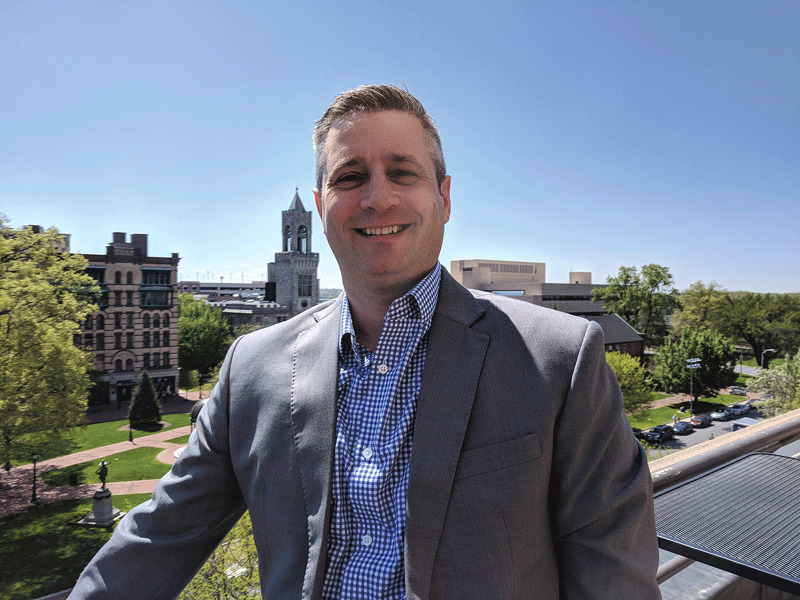
Brett Gearing says some of the region’s best business ideas come from people who don’t consider their idea a business, but the Alchemy Fund is trying to change that.
Alchemy is a term that dates back to medieval science — specifically, the effort to convert raw materials into gold.
It was a fruitless attempt, of course. But the four partners at the Alchemy Fund have a similar idea, one with far more potential.
Their idea is to spin ideas into — well, not gold, exactly, but profitable businesses.
Last summer, Brett Gearing, Randy Krotowski, Kevin Sanborn, and Chris Sims had an idea for a different kind of model for cultivating startup businesses. “We spent a lot of time fleshing out the objective and plan, to see if the model would actually work, and most of that entailed going to universities, meeting the academics, faculty, and staff, and saying, ‘hey, what do you have in here that’s interesting?’” Gearing told BusinessWest.
“They were more than willing to show us their research, what they spend their whole lives working on, and some of them recognized there might be commercial opportunities — but a lot of them didn’t realize it; they were busy focusing on the research.”
Those conversations convinced the four partners that the Pioneer Valley has no shortage of promising ideas sitting in labs and classrooms which, with some support — funding, advisory services, business acumen, and staffing — could become viable companies. “That was our first checkbox — there are plenty of good ideas in the area,” said Gearing.
In short, he explained, the Alchemy Fund aims to create new ventures from ideas cooked up at universities and health systems, among other sources. The team will search out these technologies and concepts, identify product and market applications, recruit founding teams, provide seed funding, handle back-office services, and coach the new company along.
“We named this product Alchemy because of how it transforms its raw materials,” Gearing explained. “Our typical starting point is an underappreciated lab technique, an industry problem whose time has come, or an existing startup team targeting the wrong market.”
The first burst of fund-raising has amassed about $1 million, and Alchemy made its first project investment, in a screening mechanism for diabetes originated at Western New England University. “We think the opportunity to bring that company to a viable business is really great, given the market size and all the attention to diabetes,” said Gearing.
Certainly, the startup and venture-capital culture are nothing new to Western Mass., and neither is medical or technological innovation, thanks to a knot of notable colleges, universities, health systems, IT firms, and precision manufacturers. However, while traditional venture-capital enterprises have startups knocking on their door, Alchemy believes some of the best ideas are being developed by people who may not be thinking about marketability — but should.
“And there are plenty of both opportunities and money here, and many ideas haven’t really spun out as ventures yet,” Gearing told BusinessWest. “We started by focusing on academia, but we’ve evolved, and we’re looking at both academia and healthcare systems. That’s where we are now, and so far, so good.”
Common Ground
The four Alchemy partners have backgrounds ranging from institutional investment to venture capital to health and wellness, and met through the region’s robust startup ecosystem, Gearing said.
“We realized there was a lot of talent in this area, and we wanted to do something in the Valley for the Valley, and thought our skill sets would work well together — and so far they have,” he went on. “If we find we need a specific skill set we don’t have, our model is flexible enough that we can bring an expert in.”
The team has explored about 25 potential opportunities in fields like polymer science, engineering, computer science, wearables, and healthcare, and is looking closely at a handful of those.
“My partners and I will kick the tires on each idea and try to get a sense of what the market looks like, how much money it takes to bring it to market, and whether we have the right skills to get it to that point,” he explained. Often, it’s a challenge simply to convince the purveyor of a good idea to take the idea to market.
“Sometimes the person doing this research is a chief data scientist or polymer scientist or engineer who might not even want to run a business because they don’t have the time. Or they might be a tenured professor and have a great gig, and absolutely love what they’re doing. So we come in and say, ‘we love your idea; we think we can make a business out of this.’”
Gearing expects the idea originator to come on board, in most cases, as a chief scientist or engineer to help move the research forward, and Alchemy will surround him with a team with the business acumen to help bring that idea to fruition.
“Once there’s a commitment there, our goal is to bring it to a stable state and then hire a CEO, COO, and help with back-office services like accounting, bookkeeping, and fundraising. That’s important because, when I look at startups, they spend a lot of time pitching their idea, raising funds, and educating people on what they’re trying to do, and less time working on the actual business. So we’ll handle a lot of that.”
To be successful, he added, Alchemy’s partners are essentially drawing on their experience and cobbling together elements of already-successful models. “We can say, ‘I know this works,’ or ‘I know this is troublesome because of XYZ.’ We’re still honing the model, but I think we’re really onto something.”
The money raised from investors will pay for a number of expenses, he noted, depending on the project. In the case of the diabetes project, because it’s in the medical space, some money might be spent on clinical trials.
“We’ll also certainly try to source a CEO in the first six months, and help build a team around them. Every scenario is different. It might be product development, it might be testing, it might be branding or marketing, and it might be a whole combination of these things.”
The goal, he emphasized again, is to spin off successful, independent companies that can grow in the region. “Ideally, we’ll bring them through several levels of funding until the real money comes in. That’s our goal — to get them to revenue as soon as we can and get them to stand up on their own.”
Working in Concert
Gearing, who has also taught at Elms College and serves on its entrepreneurial leadership board, understands the potential bubbling under the surface at the area’s many institutions of higher learning, and he’s familiar with the expansive network of entrepreneurial support across the region, from Valley Venture Mentors to TechSpring to the venture-capital community.
“I think it all needs to work together in concert, and that’s where we fit in,” he told BusinessWest. “There’s an opportunity for all of us to fit together and work together collaboratively. Through this network, we’re able to find people to help ideas along. If I need someone in the insurance space or whatever the case may be, people are more willing to open up their doors and support what we’re trying to do. And once we have proven this model works, I think it only gets easier.”
While the Alchemy Fund has been operating under the radar in many ways, even while looking for investors, he added, it’s time to take the profile to a higher place. “We wanted to make sure all the pieces fit together well, and now we have a story to tell.”
A story that’s only beginning.
Joseph Bednar can be reached at [email protected]
Doors to Opportunity

Amy Royal
When she started her law career with a firm in Springfield, Amy Royal didn’t consider herself an entrepreneur. But that quality emerged quickly, and she would go on to start her own firm. She soon realized, though, that she was a actually a serial entrepreneur with an appetite for developing and growing companies, the latest of which is a door manufacturer in Ludlow.
Amy Royal says she was given the small ‘Lenox’ sign, complete with that recognizable wolf logo, by officials at that East Longmeadow-based manufacturer soon after it became the first official client of the law firm that bore her last name.
And for years, it was prominently displayed on a wall in her office in Northampton, much like that ceremonial ‘first dollar’ you see under glass or in a frame at small businesses across the region.
Today, it has a new home, and that’s because Royal has one as well, professionally speaking, anyway. That would be 190 Moody St. in Ludlow, the address for West Side Metal Door Corp., a 60-year-old enterprise Royal acquired several months ago, because…
Well, there are many elements that go into that answer, and one of them is that Lenox sign. Sort of. That iconic Western Mass. company is just one of many manufacturers that have become clients of Royal, P.C., an employment-law firm. And over time, while representing many of them, Royal developed more than insight into that sector and much more than a passing interest in someday working within it.
Indeed, when she began a search for a small company to buy a few years ago, manufacturing morphed from one of several sectors being considered to the preferred sector.
“Because of the relationships I’ve had with manufacturers through my law firm, I felt that I had at least a basic understanding of workflow, operations … what it takes to run a manufacturing company,” she explained. “While I certainly explored a number of options, I really wanted to be in manufacturing.”
As she carried out her search, Royal told BusinessWest, the focus was on acquiring an established company, but one with considerable upside potential. And WSMD, as it’s called, certainly fits that description.
Launched in Holyoke in 1958, it has a diverse portfolio of products for commercial customers — diverse enough for Royal to make rebranding a top priority because the ‘MD’ in WSMD doesn’t really work anymore and hasn’t for a while now — and a lengthy list of clients as well.
Indeed, recent deliveries have been made to the Hampden County Sheriff’s Office — the county correctional facility is only a few blocks away — as well as Holyoke Medical Center, the Ludlow Police Department, a casino in Las Vegas, and Wrigley Field in Chicago, among many others.
“We make a lot more than metal doors,” said Royal, also listing custom wooden doors, door frames, distribution of door hardware, and other products, especially tin-clad doors, typically seen in warehouses but now gaining traction in a variety of locations as a retro look.
As evidence, Royal gathered up her phone and scrolled to pictures of tin-clad doors the company recently supplied to an art studio in Hollywood and a condominium tower in Boston. “They look really cool and have a lot of ‘wow’ to them,” she pointed out.
Getting back to that upside potential she saw, Royal said that, unlike her predecessor, an owner who did a little bit of everything for this company, she will focus her efforts on business development, relationship building, and, overall, positioning WSMD (for however long that acronym’s still in use) for continued growth and that proverbial next level.

Amy Royal, seen here with many of the team members at WSMD, says she was drawn by the company’s rich history and strong growth potential.
Borrowing that increasingly popular phrase, she said she’s focused on working on the company, not in it.
“I saw a lot of areas we could build upon, including business development, marketing, and sales,” she explained. “There is brand awareness with this company, but I think we can take that to a higher level.”
As she goes about that assignment, she will borrow at least few pages from the script she wrote with Royal, P.C., which she is still a big part of, even if she and her Lenox sign now consider Ludlow home.
One page in particular involves becoming a certified woman-owned company, a designation that has opened a number of doors (no pun intended) for the law firm, and one she believes can do the same for WSMD.
Elaborating, she said Royal, P.C. is a member of the National Society of Minority and Women Owned Law Firms, an organization that forges relationships with large corporations that want to do business with such firms. Corporations like the Macy’s department-store chain, which became a client of the Royal firm just last month.
Institutional clients of that ilk also need metal doors — and wooden doors and tin-clad doors — and Royal’s goal moving forward is to forge such relationships and take the WSMD brand to new heights.
For this issue and its focus on manufacturing, BusinessWest talked with Royal about her new venture and how and why she walked through that particular door.
Open to Suggestions
Getting back to that question of why Royal acquired WSMD, as noted there are many components to that answer.
Perhaps the main one is Royal’s realization that she is not merely an entrepreneur — something she really didn’t believe she was when she started practicing law with the Springfield-based firm Skoler, Abbott & Presser in the 1990s — but a serial entrepreneur.
“I sort of caught the bug of developing and building businesses after starting the law firm,” she told BusinessWest. “I knew that, even though I’ve had a lot of different business ideas over the years, I was looking for a company that had an existing structure and wouldn’t have to be built entirely from the ground up, like I did with the law firm.
“I wanted to branch out, diversify, and own another business,” she went on, “and really focus my energies and efforts on strategic planning and growing a company.”
Royal said she started her search for a company to buy probably two years ago, and approached that exercise with patience, an open mind, and a determination to find the proper fit.
She looked at everything from a spice-making outfit in Western Mass. (she didn’t identify which one) to a small cruise-ship line operating out of Boston (again, no specifics). But mostly, she looked at manufacturers, again because she liked that environment and understood a good deal about how such ventures operate.
WSMD came onto her radar screen because it was listed for sale. She was working with an area broker on her search, but essentially found WSMD on her own.
And what she found was a solid enterprise and brand with its owner looking to retire — a scenario being played out all across the region within companies in every sector as business-owning Baby Boomers become sexagenarians and septuagenarians.
She started looking at WSMD in late 2015, and kept on looking, undertaking that proverbial deep dive to determine if the company had the growth potential she desired.
And she goes about taking WSMD to a higher level, Royal said she will borrow lessons from her first experience with developing a growing a company, something she did without any formal training (like most all entrepreneurs) and in a fashion that could be described as ‘learning while doing.’
“When I decided I wanted to grow the law firm, I really didn’t know what I was doing,” she conceded. “I went out on my own and built the firm, and figured out how to network, market, develop, and grow the brand. And that’s when I realized that that’s really my passion — growing a business, creating jobs, creating opportunities.”
There will be many aspects to doing all that at WSMD, including that aforementioned rebranding effort.
“We have a really established presence within our customer base, and they know that we do more than metal doors,” she explained. “But the name doesn’t really capture what we do, so we need to change it.”
Also on her to-do list is obtaining status as a woman-owned manufacturing business, a process already underway.
“That will be a huge lift for us,” she said, adding that the company’s application is currently being reviewed, and certification may come in the next few months. “There is a lot of competition in this field, so I do think the certification will help.
“One of the things that made me interested in this company is that it’s been very successful,” she went on. “But I think, I hope, I can take it to the next level.”
And by ‘next level,’ she meant more partnerships and opportunities with institutional clients, again similar to what’s she done at the law firm — opportunities that will hopefully enable her to grow sales and the workforce, currently at nine.
Closing the Deal
Royal told BusinessWest that she’s still involved with her law firm, obviously, and on a number of levels.
But when she leaves her home in Deerfield now, she keeps going past that exit off I-91 that spills onto downtown Northampton and goes another 20 miles down the interstate.
Like her Lenox sign, she’s taken up residence in a new office, this one just off a manufacturing floor, not a conference room filled lined with law books.
But as disparate as those settings may be, they have many things in common, said Royal, adding that, instead of building a strong case for her clients, she’ll now be building one for her doors.
And to borrow a phrase sometimes used in law, this will be — wait for it — an open-and-shut case.
George O’Brien can be reached at [email protected]
Showing Their Metal

Bob LeDuc, seen here with sons Kurt, left, and Eric, started in a chicken coop and has recorded steady growth ever since.
Bob Leduc says that, in many respects, there’s been a world of change since he affixed his last name to a sheet-metal fabrication company a half-century or so ago.
After all, he got his start in a 20-by-40-foot chicken coop in his backyard, taking some odd jobs and essentially moonlighting to help feed his growing family. Today, the venture he launched, RR LeDuc Corp., is in a state-of-the-art facility on Bobala Road in Holyoke near the West Springfield, and he has established clients ranging from Lockheed Martin to IBM to Whalley Computer Associates. He also has about 50 people working for him, including two of his sons, Eric and Kurt, both serving in vice presidents’ roles.
But looking at things another way, things really haven’t changed a whole lot since the photo on display in the company’s conference room was taken, the one with Bob sporting decidedly early ’70s clothing and a hairstyle to match, an image he finds almost cringeworthy today.
For starters, the 81-year-old not only comes to work every day, he is remarkably hands-on and involved in seemingly everything taking place at the plant — just as he did when he was by himself in the chicken coop, when that assignment was much easier.
More importantly, he noted, business is still being done just like it was back then, with a laser focus on the customer, on being flexible and responsive, and on not only meeting but exceeding expectations, an operating mindset that has created a steady growth curve over five decades.
“One of the keys to staying in business this long is really knowing your customer and partnering with them to meet their needs,” he said while summing up what amounts to his success formula.
Overall, the past 50 years have been marked by evolution and expansion. Indeed, the company that started by fabricating and installing HVAC ductwork and catwalks in Holyoke’s paper and textile mills — usually on weekends when the machines were quiet — now produces a wide range of metal enclosures and other products from a host of business sectors, including defense, communications, medical, electronics, and many others.
“All the cool stuff is on the inside, but we make the skin,” said Eric LeDuc, adding that the company fabricates this skin (enclosures) for everything from computers to ATM machines to portable generators.
For this issue and its focus on manufacturing, BusinessWest talked with the LeDucs on the occasion of their silver anniversary about where this company’s been, and where these two generations of leaders want it to go.
Manufacturing Milestone
The LeDuc company celebrated 50 years in style late last fall.
There was a party on the front lawn featuring a jazz band and catering by the Log Cabin. The invitation list included customers, vendors, a few elected officials, and employees past and present.
Those gathered were marking a half-century in business, a considerable feat in its own right, but they were really celebrating all it took to reach that milestone — entrepreneurship, evolution, persistence, innovation, and teamwork.
Those qualities came through clearly as the LeDucs collectively — one would often pick up where the other left off and fill in needed information — related the story of their first half-century in business.
The chicken coop gets brought up often, because it provides a colorful, down-to-earth start to the story. But it is only the first chapter.
Actually, we probably need to go back a little further, to the Holyoke Trade School, where LeDuc, concentrating on sheet metal, graduated in 1954. He served a four-year apprenticeship with the E.H. Friedrich Co., worked there for a few years, and then worked for a few other firms, including one in New Haven, which he served as supervisor, that specialized in HVAC ductwork.
He built a house in Chicopee, and on the lot was a World War II chicken coop, he told BusinessWest, adding that soon thereafter he began that aforementioned moonlighting.
“I bought some sheet-metal-bending equipment and shearing and welding equipment as well,” he recalled. “After eight hours of work, I’d come home, eat supper, and work until Jack Parr came on.” (That would be 11:30 p.m., for those too young to know that Parr preceded Johnny Carson as host of the Tonight Show).
In that chicken coop, the elder LeDuc mostly handled the HVAC ductwork he had become versed in, and as his workload became more steady, he eventually quit his day job — and soon flew the chicken coop — and moved into a sub-basement in a building on Sargeant Street.
His client list was dominated by the paper and textile mills surrounding him, and for those companies, LeDuc fabricated ductwork and also handled so-called trim work on the paper machines. He soon gained a reputation for quality work and flexibility that enabled him to stay busy.
“I would work for a couple of hours, change clothes, and go out and make sales calls,” he told BusinessWest. “I remember one customer saying, ‘what can you do for us that the people working for us now can’t do?’ I said ‘I can work for straight time on Saturdays and Sundays.’ That raised some eyebrows, but most of their machines were down on the weekend, so that’s when they needed someone.”
The work would evolve over time, involving a shift to working with stainless steel, which required investments in new equipment, and new assignments such as catwalks, guards for machinery, and exhaust hoods.
As the mills closed down or moved south in the ’70s and ’80s, the LeDuc company had to reinvent itself, said Eric, who, like Kurt, essentially grew up in the company, starting on the shop floor and working his way up. And it did, becoming a precision sheet-metal fabricator, essentially a contract manufacturer serving a wide range of clients.
There would be a move from Sargeant Street to Samosett Street in the Flats area, several expansions of the location there, and then a major investment in a new, 60,000-square-foot building on Bobala Road.
In the early ’90s, the company was approached by Atlas Copco about adding powder coating of the casings (skin) LeDuc was manufacturing for its portable generators to its roster of services.
“There was no one in this country that was doing it at that time,” Bob LeDuc recalled, adding that powder coating has become a strong component of the company’s overall roster of services.
Today, the company has a diverse portfolio of clients and an equally diverse portfolio of products it produces for them. And one of the keys to both is a tradition of continually investing in state-of-the-art technology, said Eric, noting that the company has made great strides in automated, or lights-out, manufacturing, as it’s called, because it can be done 24/7, or when the lights are out, at least for employees.
Recent additions to the shop floor, complete with many letters and numbers in their names, include:
• An EMK3610NT CNC punch press with ASR multi-shelf sheet loader, which enables multiple programs to run unassisted 24/7;
• The Astro 100NT automated bending robot, which, as name suggests, is the answer for forming parts unassisted (automated tool changing allows the sequencing of multiple programs);
• The FO 3015NT 4,000-watt laser, capable of cutting steel and aluminum in a wide range of thicknesses; and
• The EM3610NT CNC punch press, which, along with lights-out manufacturing, allows mass production of high-quality parts.
There are many other pieces of equipment on the floor, said Eric, adding that all those numbers and letters add up to flexibility and responsiveness, qualities that have enabled the company to continue to grow its client list over the years.
Shining Examples
There are a few other artifacts in the company’s conference room, including the time-worn ‘RR LeDuc’ sign that hung on the property on Sargeant Street.
It stands as another indicator of just how much things have changed for this company since Bob LeDuc would come back in from the chicken coop in time to watch Jack Parr.
But equally important is what hasn’t changed in all that time — the focus on the customer and forming a partnership with it to meet goals and needs.
That focus has enabled the company to shape opportunities in the same way that it has shaped metal.
George O’Brien can be reached at [email protected]
Game On
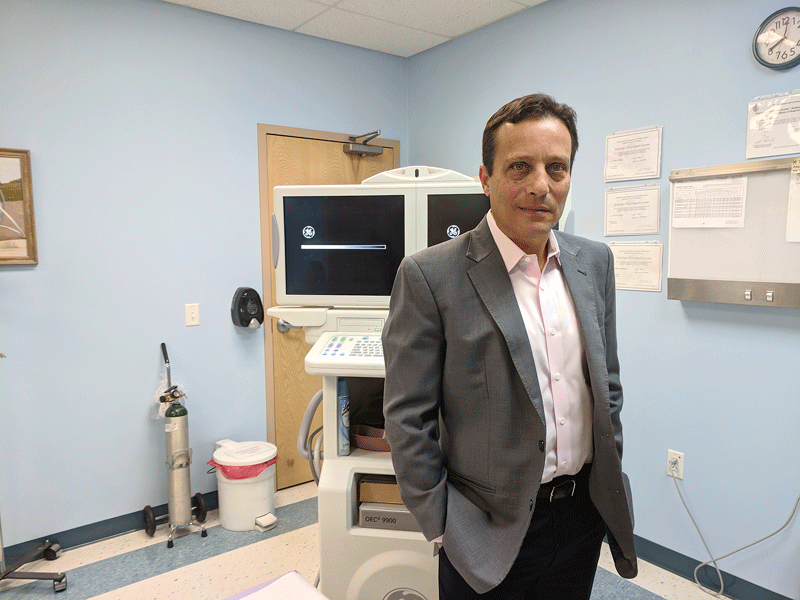
Dr. Scott Cooper, one of PSSP’s managing partners
No one is totally immune from a sports injury, from kids on the playground to serious college athletes to ‘weekend warriors’ in middle age. Treating those injuries — and helping reduce the risk of sustaining them — is one of the key niches of Pioneer Spine & Sports Physicians, which has been helping patients return to full function for more than a quarter-century.
No one is totally immune from a sports injury, from kids on the playground to serious college athletes to ‘weekend warriors’ in middle age. Treating those injuries — and helping reduce the risk of sustaining them — is one of the key niches of Pioneer Spine & Sports Physicians, which has been helping patients return to full function for more than a quarter-century.
The first weeks of spring — not spring in name only, like the bouts of snow and 20-degree weather that dotted late March and early April this year, but actual spring weather — typically send weekend warriors, after a long winter indoors, scurrying for their golf clubs and tennis rackets.
And sometimes, they’re a little too enthusiastic.
“We see a lot of that this time of year — golfers getting the clubs out, only to develop back pain. But we also see hockey players from the over-40 league come in with all kinds of injuries,” said Dr. Scott Cooper, one of the managing partners of Pioneer Spine and Sports Physicians (PSSP), the largest private physiatry practice in the Northeast.
“I had one guy who was probably in his mid-50s, and he had recurrent tennis elbow, and I could not get him to stay off the court,” Cooper told BusinessWest. “I treated him for probably six months for tennis elbow, and I don’t think he ever missed a match — whereas, if he was on a team, I could tell his coach, and his coach would say, ‘you’re going to sit out two weeks until this thing clears up.’ Sometimes the weekend warriors can be determined.”
Cooper and his team should know, seeing a broad range of patients every day, from high-school and college athletes nursing knee and shoulder injuries to the inpatient clients PSSP manages in acute-care settings like Weldon Rehabilitation Hospital and Bronson Rehabilitation, recovering from spinal-cord injuries, neurologic conditions, and amputations.
Physiatry, also known as physical medicine and rehabilitation, is a specific type of practice, he explained, but one with a wide range of applications.
“One of the nice things about physiatry is it’s a very broad specialty, and one of our primary goals is to provide state-of-the-art care in all facets of physiatry,” Cooper explained.
That includes the acute rehab setting at Weldon and Bronson, where Pioneer treats people who have conditions that cause a loss of function, so they can’t return home, but no longer need to be in a medical/surgical unit of the hospital.
“These are people who have had strokes, for example, or spinal-cord injuries or head injuries or complex medical conditions or amputations or other neurologic conditions like multiple sclerosis or ALS — things that cause them to lose function, but they’re now medically stable so they can tolerate rehabilitation.
“We manage those patients, and we’re also involved in pain management, both acute pain and chronic pain, in all our offices,” he added, adding that the practice’s physiatrists also deal with spinal conditions, back pain, herniated disks, pinched nerves, and much more. “We have procedure suites in most of our offices where we can do X-ray guided procedures on people’s spinal conditions, and we are also involved with the Surgery Center of New England; we do procedures there that are not office-based, things that are a little bit more invasive and require anesthesia.”
In short, it’s a one-stop shop for a host of conditions, with one goal in mind — to return patients to the highest function possible — in both their work and play.
The Sporting Life
That ‘play’ factor — sports medicine — is a niche PSSP is well-known for, and around 90% of sports injuries require no surgery at all, Cooper noted.
“If they do require surgical treatment, we work closely with some of the orthopedists in the area who provide those services. But for the other conditions, we’re able to treat them very effectively, and we do that with a lot of recreational athletes, weekend warriors, and we also work with several of the high schools in the area.”
PSSP’s West Springfield location is one of seven offices spanning the Pioneer Valley from East Longmeadow to Brattleboro.
Pioneer also provides team doctors for area colleges including Springfield College, American International College, and Westfield State University, both during and between games.
“For example, hockey and football are the two main ones where they need to have someone on the sidelines according to the rules of their conference, so we provide game coverage in case of an injury during the game,” he explained. Meanwhile, if an athlete is injured in practice, they’re seen in a PSSP office as soon as possible.
“We recognize that one tenet of physiatry is quick return to function,” he said. “So we focus on getting athletes in quickly, diagnosing their condition, treating them, and returning them to the field as quickly as is safe.”
They take the same approach to occupational medicine, working with client businesses — Pioneer has a therapist at MassMutual full-time, for example — on job-site injury prevention and treatment. “We focus on them just the same way we focus on athletes — get them in quickly, diagnose their condition, determine what they can and can’t do in a rapid manner, and treat them comprehensively so they can return to full function.”
While about 70% of all occupational injuries involve the spine, that’s not the case with athletes, Cooper noted. “They have a whole different set of issues. The majority of what we see with athletes involve the knee or the shoulder. And most of those we treat non-operatively. We establish a diagnosis, and if that diagnosis requires a surgical evaluation, we facilitate that, and the surgeons we work with are very accommodating and allow us to get that done very quickly.”
Beyond treatment, though, the team at Pioneer emphasizes prevention. As an example, its physical therapists attended an educational program, developed at Syracuse University, that works to prevent ACL injuries in female athletes, who have a much higher predilection to those injuries than men.
“It’s almost an epidemic,” Cooper said. “Some of the reasons are unclear, but female soccer players and lacrosse players, will come in with ACL injuries, and once you have that kind of injury, it can be devastating, and it generally does require surgery, and requires a long course of rehabilitation.
“So this program has been shown to prevent those injuries,” he went on, explaining that Pioneer’s PTs were certified through the week-long course to teach a group of specific exercises to area sports teams, who come in during the preseason for a week of intensive training, and then continue on a regular basis. The exercises focus on stabilizing the knee and have been shown to prevent injuries.
“That’s one way we try to head off injuries and reduce their likelihood,” he added. “Unfortunately, there’s no way to eliminate them.”
No Slowing Down
That goes for young athletes and older weekend warriors, who often arrive at PSSP with a combination of a sports injury and something more degenerative, such as an arthritic condition.
“It’s something they can normally get by with, but if somebody with an arthritic shoulder is doing OK, but he goes and plays some tennis, now he’s got a rotator-cuff problem. The springtime is definitely a big time for those types of injury, but we see them year-round. And sometimes they can be the hardest to treat because these people are very determined to get back out there.”
With America’s senior population surging, Cooper’s team sees patients from that age group as well.
“We’re definitely seeing an older population that is increasingly active, but we encourage that; we want our patients to be active. There’s good data in the medical community that one of the ways to increase longevity and reduce morbidity in the population as a whole is to have an active lifestyle,” he told BusinessWest, adding that one of the mottos in his profession is that “physiatry adds years to life, and life to years.”
“That’s the idea — we want people to stay active, and it almost doesn’t matter what activity; we want them to engage in exercise, and when they do that, they may encounter some injuries and have some problems, and we’re here to address that.”
Because injuries are often an inevitable speed bump in an active lifestyle, he went on, it’s encouraging that treatments have evolved to allow people to return to full activity much sooner than before.
“Injuries that once may have been considered incompatible with continued competition, we now see as being treatable — and treatable with less-invasive means,” he said. “That can be anything from tendinitis to things like arthritis. In fact, arthritis of the knees is something that used to be, ‘you can take Advil, or you can have a knee replacement’; there wasn’t a whole lot else you could do for it.”
Now, however, physiatrists may tackle the issue with anything from orthotics to new types of bracing; from new exercise methods to injections that go far beyond what traditional cortisone could achieve. “So there are definitely more options to treat those conditions with different means that don’t necessaily require surgery, and allow people to be more active.”
It helps, he said, that Pioneer provides a comprehensive, multi-disciplinary, holistic model of care, where physiatrists, physical therapists, and other team members work together and consult with each other on troublesome conditions. If a patient with a spine injury isn’t progressing quickly enough or has too much pain, the providers aren’t afraid to work together to find a solution.
“Basically, anything that’s needed to treat the conditions we treat, we have under one roof,” Cooper said. “We have specialized nerve testing, guys who focus on different areas … we have all kinds of talent and skill to bear.
“I think that really serves to benefit the patient,” he went on, “because they’re not just getting one doctor and one opinion; they’re getting a team approach. I think that is unusual in a private-practice setting, and I think that’s one of the main reasons we’ve been so successful.”
Bottom Line
When asked what he enjoys about his job, Cooper paused for a moment and smiled.
“We think we have the best specialty in the world,” he said. “Whether I’m treating an 80-year-old patient with a stroke or an amputation or I’m treating a 16-year-old with a sports injury, I’m working with people who want to be here, who want to be treated, who have definite goals. And it’s very satisfying when they reach those goals.”
Joseph Bednar can be reached at [email protected]
Refreshing the Data
The American College of Sports Medicine (ACSM) has released a new official statement regarding energy drinks, published in the college’s clinical review journal, Current Sports Medicine Reports. “Energy Drinks: A Contemporary Issues Paper” provides guidance and warnings regarding these beverages because of the dangers they present to at-risk populations, primarily children who are the most vulnerable and the target of marketing efforts.
“Energy drinks are extremely popular, and concerns about their consumption are coming from every sector of society, which is why we’ve published these recommendations,” said Dr. John Higgins. “Our review of the available science showed that excessive levels of caffeine found in energy drinks can have adverse effects on cardiovascular, neurological, gastrointestinal, renal, and endocrine systems, as well as psychiatric symptoms. More needs to be done to protect children and adolescents, as well as adults with cardiovascular or other medical conditions.”
Energy drinks are highly caffeinated beverages that often contain myriad vitamins, minerals, amino acids, and herbal mixtures. As a global authority for sports medicine, exercise science, and the promotion of participant safety, the ACSM is focused on facilitating high performance while protecting those who compete in athletics or engage in other forms of physical activity. By publishing the new recommendations, the ACSM is helping consumers to understand the risks associated with rapid and excessive consumption of energy drinks.
“When used safely and with moderation, energy drinks may have some short-term, performance-enhancing effects. However, users are generally unaware of the many potential adverse reactions that could have long-term effects, some of which are quite serious,” said Higgins. We highly encourage consumers, parents, physicians, athletic trainers, personal trainers, and coaches to follow these recommendations.”
Children and adolescents appear to be at particularly high risk of complications from energy drinks due to their small body size, being relatively caffeine-naive, and potentially heavy and frequent consumption patterns, as well as the amounts of caffeine. The message that these beverages are not intended for children needs to be reinforced and widely disseminated, Higgins said.
At the same time, he added, marketing should not appeal to vulnerable populations. Currently, manufacturers of energy drinks advertise on websites, social media, and television channels that are highly appealing to both children and adolescents. Target marketing to sporting and other events involving children and adolescents should not be permitted.
Regardless of health and fitness level, and until such time that proper safety and efficacy data are available, the ACSM recommends that energy drinks should be avoided before, during, or after strenuous activities. Some of the deaths allegedly due to energy drinks have occurred when a person consumed them before and/or after performing strenuous activities.
Clearly, Higgins notes, investment in awareness and educational resources highlighting the potential adverse effects and safe use of energy drinks is required. Significant efforts should be made to educate consumers regarding the clear and present differences between soda, coffee, sports drinks, and energy drinks. Energy-drink education also should be a priority in school-based curricula related to nutrition, health, and wellness.
The ACSM is calling for a research agenda to prioritize key questions about the acute and chronic effects of energy-drink use. At a minimum, standard safety and efficacy studies should be performed and submitted to the FDA by manufacturers. Well-designed and controlled research is required to examine the increasing frequency of adverse events being reported by emergency departments.
In addition, the organization notes, healthcare providers must talk to their patients about energy-drink use and report adverse events to watchdog agencies like poison-control centers, the Consumer Product Safety Commission, and the FDA. A national registry should be set up to specifically track energy-drink side effects with mandated reporting requirements.
Among other specific recommendations, the ACSM argues that energy drinks should not be consumed by children or adolescents; should not be consumed by other vulnerable populations, including pregnant or breastfeeding women, caffeine-naive or sensitive individuals, or individuals with cardiovascular or medical conditions; should not be used for sports hydration; should not be mixed with alcohol; and should bear a label such as “high source of caffeine” or “do not mix with alcohol.”

Addition by Addition

While there are plenty of banks doing business in this region, Jeff Sullivan says, there is an opportunity for a new one that is based locally.
Jeff Sullivan has spent more than 30 years working in and around the region’s banking community, most recently as chief operating officer for United Bank.
So he understands fully when people use that term ‘overbanked’ to describe this area. In fact, he’s used that word himself over the years as he’s watched branches proliferate in a host of area communities.
But over the past few years as he’s done consulting work for the industry after leaving United following its merger with Connecticut-based Rockville Bank, Sullivan says he’s come to understand that just because there are branches on almost every corner in some cities and towns, that doesn’t mean the region’s population — and especially certain segments of it — are adequately served.
“There’s plenty of good local banks around,” he told BusinessWest. “But there is opportunity, because the largest financial institution based in the city of Springfield now is a credit union. So there is opportunity for a Springfield-based institution with local decision making.
“I was getting asked by a lot of people — individuals I would just bump into on the street or in the supermarket — ‘can you send me to a good lender?’ or ‘can you give me a good bank to go to?’ or ‘are you going back to work? I need to make a switch,’ he went on. “After that happened 10 or 12 times in a relatively short period of time, I began to think there was room for a new bank.”
And these sentiments, grounded in what Sullivan considers more scientific analysis and sound due diligence, has led him to partner with attorney Frank Fitzgerald and Jim Garvey, owner of St. James Check Cashing, to begin the process of adding a new bank to the landscape.
It will be called New Valley Bank & Trust, the partners announced late last week, adding that the team is now seeking approval from the Federal Deposit Insurance Corp. (FDIC) to form the new institution before launching a capital raise aimed at amassing $25 million to $30 million.
This will be the first new bank launched in the area since NUVO Bank (since acquired by Community Bank) opened in 2008. New Valley Bank & Trust almost certainly will open in better economic conditions — NUVO had the misfortune of launching just as the country was heading into the Great Recession — and it will have a different model, said Sullivan.
Indeed, while NUVO was focused on a mostly digital banking model — it has just one branch, in downtown Springfield — New Valley will have slightly more of a brick-and-mortar foundation, he explained.
It will be headquartered in downtown Springfield and will start with a full-service branch somewhere in the city (the location has not been determined) and a second location on the west side of the Connecticut River (again, that community has not been chosen) within a year after opening.
New Valley, like most banks now doing business in this region, will offer a full range of business and retail banking services for residents and small to medium-sized businesses in Massachusetts and Northern Conn.
Like NUVO, though, this proposed new institution will focus considerable energy on commercial lending, said Sullivan, who has spent most of his career in that realm. Despite stern competition in the commercial market and a huge number of established players, he sees room for opportunity.
That opportunity — on both the commercial and residential sides of the ledger — results from the spate of mergers and acquisitions in recent years, he told BusinessWest, an ongoing development that has decreased the population of community banks and, as he noted, left Springfield without a bank headquartered within its boundaries.
“With fewer local banks servicing the region, we have heard from countless residents and small to medium-sized business owners that are looking for a level of customer service and credit that is simply not available in the market today,” Sullivan said in a press release announcing formation of New Valley. “Our focus will be on meeting this demand with personalized attention and cutting-edge technology that will shorten wait times for funding decisions and opening accounts.”
On the commercial side, the bank will focus on smaller loans and quick turn-around times, said Sullivan, adding that the mergers in recent years have created opportunities to meet a specific niche.
“We have a lot of good banks around here, but they’ve grown to a larger size,” he explained. “And they’re focusing on larger deals than they probably did 10 years ago. I think there’s a real opening for personal service being delivered to small businesses.”
But another point of emphasis for New Valley will be what Sullivan described as a still-large population of area households that are “unbanked and underbanked.”
Elaborating, he said research continues to show that the volume of business at check-cashing establishments has remained fairly stable — and comparatively high — in this region, despite considerable improvement in the economy over the past decade.
Sullivan and his partners estimate there are some 20,000 households in Hampden County alone that use a bank sparingly, if at all, and in these numbers, he sees more opportunity in the form of need for a new bank.
“These are working women and men whose barrier to entry into the banking system has been too high for too long,” her went on. “As a local bank, we want to find opportunities to serve this significant segment of our community and create lifelong customers in the process.”
Elaborating, Sullivan noted that, in many cases, individuals or households don’t use banks because of a lack of trust or because of a bad experience — or several.
“The biggest reason, the FDIC says, is lack of trust,” he explained. “They don’t trust the system. People have had bad experiences; they got kicked when they were down, and it’s led to a lack of trust.”
In response, New Valley will offer products and services designed to build trust, he went on, such as bounce-proof checking accounts, incentivized savings accounts, and financial-literacy programs.
Sullivan said the need for a new, locally based, bank can be verified by the makeup of the 60 founding sponsors — what he described as a “large and diverse group of business owners and entrepreneurs from throughout the region — and the enthusiasm shown for the concept, especially among young business owners.
That’s significant, he said, because they will have to be the backbone of the customer base moving forward.
“We decided that, if we were going to do this, it has to be about a younger generation of business cohort,” he explained. “So we needed to know if the Millennials and the Gen-Ys care enough about this kind of stuff.
“We had a series of focus groups — we put about 100 people in a room, 20 people at a time, and we pitched them on what we were trying to do,” he went on. “About 60 people wrote checks to give us the seed money to get started, and of those 60, close to half of them were people under the age of 45. We were pleasantly surprised by that, and based on that response, we decided to take things to the next level, which is where we are today.”
—George O’Brien
The Trickle-down Effect

Rebeca Merigian, here with her son, Andrew Takorian, expects Park Cleaners’ contract with MGM to perhaps double the company’s current volume of business.
Rebeca Merigian says the slip was found, and promptly given to her, many years ago by a long-time customer, a description she quickly categorized as an obvious understatement.
Indeed, the date at the top is 1940, and thus this item, now displayed under glass, is a time capsule as much as it is a pick-up slip for a two-piece suit.
Start with the phone number at the top; there are just five digits because that’s all that were needed back then (ask your mother; actually, make that your grandmother). The name of the company was Park Cleaners & Dyers Inc. (the ‘& Dyers’ was dropped a long time ago because those services were discontinued). The address is Kensington Avenue in Springfield (the company moved to Allen Street in 1955). Even the slogan is different; back then it was ‘Dry cleaning as it should be done.’ Now, it’s ‘Family-owned and operated since 1935. We appreciate your business.’
Yes, much has changed since Edward Takorian, an Armenian who somehow escaped the genocide of 1915 and came to this country soon thereafter, went into business for himself.
There have been many ups and downs, said Merigian, Takorian’s great-granddaughter, who started working in the business on Saturdays when she was 9 and bought it from her mother three years ago. She noted that the company was started at the height of the Great Depression and has endured many other downturns over the next eight decades, and also the early death of her father. Not so long ago, there were more than 20 people working here; now there are four, including Merigian’s son and nephew.
But that number will be rising soon, thanks to what would have to be one of the biggest developments since that suit was picked up a year before the U.S. entered World War II — a contract with MGM Springfield, the $960 million resort casino that will open in about four months.
Park Cleaners has been awarded a contract to clean the uniforms for all 3,000 employees at the casino, and for the dry-cleaning of hotel guests and the MGM Springfield management team as well. Merigian couldn’t put a dollar figure on the contract, but she could certainly put it into perspective.
“I’m hoping that this will double our business,” she told BusinessWest, adding that the contract could give her the means to perhaps double the current workforce and pay the kind of benefits that are currently beyond the company’s reach. “My goal from this is to be able to provide health insurance for my employees who have been with through a lot of the challenges; I want to give back to them and provide more benefits and incentives so we can grow.”
Several other area businesses now have contracts with MGM or are in the process of finalizing one. Most will not be as life-changing as the one received by Park Cleaners, but they are all significant in some way.

Nick Noblit says the contract with MGM gives Yankee Mattress a new top line for its deep list of clients.
Take Agawam-based Yankee Mattress, for example. The company was originally asked to supply mattresses for all the rooms in MGM’s Springfield hotel, an order that Nick Noblit, the company’s general manager, admitted was too big to handle at this time. But the company will make California kings for the larger, high-roller suites, an assignment that will give the company additional business and some hopefully effective marketing material.
Meanwhile, Holyoke-based Kittredge Equipment Co. has secured one of the bigger contracts — this one to provide kitchen appliances and supplies to the many businesses that will do business at the casino.
There have been other contracts signed, and there will be many more agreements inked in the weeks to come as the countdown to the grand opening continues, said Courtney Wenleder, vice president and chief financial officer for MGM Springfield. She told BusinessWest that, as part of its host-community agreement, the company is required to apportion a percentage of its receivables to local companies.
But the company is striving to do more than just meet that obligation, she said, adding that MGM is looking to take the company’s philosophy regarding diversity and apply it to its vendor list. And this translates into extending opportunities to women (Kittredge is also woman-owned), minorities, and small businesses in general.
“MGM has a commitment to diversity and partnering with local vendors,” she explained. “It’s all about building the community together; there’s a symbiotic relationship — if the community does well, we do well, and vice versa.”
For this issue, BusinessWest looks at how the trickle-down effect from MGM Springfield, which began with local contractors taking part in the construction of the complex, is gathering momentum in the form of contracts to supply everything from knives and forks to marketing services. And while doing that, we’ll also shine a spotlight on some intriguing local businesses that have, by and large, flown under the radar.
The Rest of the Story
Wenleder told BusinessWest that many factors go into MGM’s decisions about which vendors to do business with and what might give a certain enterprise an edge over whatever competition emerges.
They range from quality of service and customer satisfaction, obviously, to whether, as noted, the business is minority- or women-owned. But there are some intangibles, and sometimes a little luck, that comes into play.
To get that point across, she relayed the story about how MGM Springfield now rents several apartments downtown, and they’re used, among other things, to house company executives visiting Springfield for extended stays.

Kittredge Equipment Co. owner Wendy Webber, left, with sales representative Amanda Desautels. The company will supply MGM Springfield with everything from appliances to glassware.
MGM CEO William Hornbuckle is one of these executives, and on one of his stays, he slept so soundly and comfortably that he took note of the label on his mattress (Yankee), later commented to those at MGM Springfield’s headquarters about his experience, and essentially initiated steps that would eventually lead to the company getting a contract.
“Bill commented about what a great night’s sleep he had on that mattress, and that pretty much secured their position,” Wenleder recalled with a laugh, adding that it wasn’t all that simple, but that bit of serendipity certainly got the ball rolling.
And the mattress contract serves as a good example of how MGM is trying to do business locally when it can and when it’s appropriate, said MGM Springfield General Manager Alex Dixon.
He noted, as Wenleder did, that there are times when MGM will simply add the Springfield casino to some existing contracts it has in place to provide certain products and services to the company’s existing properties.
Playing cards and dice would be good examples of this, he said, adding that MGM already has manufacturers providing those products. And, for the most part, there is no local company that makes such items.
But even with those products, there may be some opportunities for local businesses, he went on, noting, for example, that most playing cards are destroyed soon after they’re used, and MGM Springfield will use a local company to handle that work.
“We want to recognize what’s available in the local market and then tailor our supply chain to match what is happening in the local community,” he said while describing the company’s broad mindset when it comes to vendors.
Overall, MGM has a process in place when it comes to vendors, said Dixon, adding that the company actively solicits information from companies interested in doing business with it. The owners and managers of such ventures are invited to attend outreach events (they’re posted on the MGM Springfield website, for example), and through such events, companies become part of a database the company refers to when it needs specific products or services.
“Whenever there’s a business need, we want to find out if there are vendors, preferably local, who can help us to fulfill those needs — that’s step one,” he explained. “But informally, being members of the community, you really develop relationships.
“It’s no longer ‘hey there’s this great local brewer,’” he went on, while explaining how these relationships are created. “Now it’s ‘that’s Ray Berry from White Lion; maybe there’s an opportunity there.’”
In other words, familiarity breeds opportunity, and examples abound of how companies ranging from local caterers and computer hardware providers have come onto MGM Springfield’s radar screen — and are now doing business with the company.
The contract with Yankee Mattress is a good example of this phenomenon at work, said Dixon, confirming that the company was first presented with a proposal to furnish every room in its hotel now taking shape on Main Street.
But Noblet said such a large order would have necessitated additional hiring and other steps the company wasn’t ready to take.
But the contract to supply mattresses for the larger suites is a welcome addition and positive development for the Agawam-based company, which has been gaining traction in recent years as word-of-mouth referrals about its products proliferate.
This is another family business, started by Nick’s father, Joe, who is still active in the venture. The elder Noblit worked for a major mattress manufacturer for several years before deciding he could make a better product, and at a lower price, himself. And he did.
Yankee was launched in 1999, and it has grown and evolved other the years, said Noblit, adding that it started with a storefront and adjacent assembly area in Agawam, and now has four stores in the region.
Those outlets carry a host of lines with those huge tags that are supposedly illegal to rip off, including the top-of-line Black Collection, with models including the York, Fairhaven, Merrimac, and Nantucket.
There is a strong residential component to the customer base, obviously, said Noblit, but also many commercial clients as well, including several area B&Bs, hotels, and inns, as well as some healthcare providers, a few private schools, and a host of area fire departments.
“We custom-build those to be stronger than average — because there are some big firefighters out there and it’s important for them to have something durable,” he explained, adding that word of mouth has been the best marketing tool when it comes to adding new lines to the customer list on the company’s website.
If one were to peruse that list, the name now at the very top is MGM Resorts International, an indication of how important this contract is, not size-wise, but from a marketing and branding standpoint.
“Most hotels have a contract with a major manufacturer, and across the board, they do business with this manufacturer, and they make all of their beds,” he explained. “So for MGM to consider someone outside these big manufacturers that are nationwide, that’s significant.”
Buying Power
But if MGM Springfield found Yankee Mattress thanks to Bill Horbuckle’s good night’s sleep, most of the other vendors have had to find the casino giant.
And ‘find’ means going through a process of introducing one’s company to MGM Springfield through one of a number of vendor meet-and-greets, for lack of a better term, that the company has staged, including one at last fall’s Western Mass. Business and Innovation Expo, staged by BusinessWest.

Courtney Wenleder says there’s a symbiotic relationship between MGM and local vendors; when they do well, the casino operator does well, and vice versa.
Through these outreach sessions, MGM is making it much easier for companies to find it, said Wenleder, adding that MGM Springfield has a three-person purchasing team (a manager and two assistants), and one of their primary responsibilities is to go out into the community and find local vendors.
“Even though we’ve been doing a lot of communication with people when it comes to local purchasing requirements, some people aren’t hearing that message,” she explained. “We have people on the ground physically reaching out to these vendors.”
Merigian said she started attending such outreach sessions not long after MGM was granted the Western Mass. license in 2014, recognizing the casino as a rare business opportunity.
“I had my sights on it from the beginning,” she told BusinessWest. You never know how it’s going to work out with companies renting their own uniforms or owning them, but either way, I knew I would like to be part of it.”
So much so that she took steps to become a certified woman-owned business, understanding from those very first meetings that MGM had a strong interest in doing business with businesses led by women and minorities.
There would be more meetings to come over the next few years, she went on, adding that these sessions were beneficial on many levels.
“It really gets you tuned into your business,” she said, using that phrase to indicate everything from capabilities to long-term goals to what it will take to reach them. “It was an educational experience on many levels.”
The volume of work is large — most all of the 3,000 employees will wear some kind of uniform, and this contract covers all that and more — and thus MGM will likely be the largest customer in Park’s long history, said Merigian, although Park did have a contract with MassMutual for a quarter-century and still has one with the Defense Department (Westover Air Reserve Base).
“We don’t have specific numbers, but know it will be high volume,” she said of the business to start coming her way in a matter of weeks as employees are added to the payroll in waves. “But we’re ready for it, and we can feel the excitement.”
Indeed, after her father’s death, the company had to withdraw from the MassMutual contract, and it downsized considerably, said Merigian, adding quickly, however, that “we’re ready to go; we’re ready to get back to work.”
At Kittredge, meanwhile, the MGM contract is another important step forward for that company, said Amanda Desautels, an outside sales representative now working with MGM to outfit the restaurants that will be doing business at the casino.
“This is a significant contract for us,” she said, noting that Kittredge will be supplying MGM with everything from appliances to bar equipment; glassware to silverware, and adding it to a client list that includes UMass Amherst, the Max restaurant group, and Mount Holyoke College, among many others.
The company, rapidly approaching its centennial (it was launched in 1921), started as a supplier of typewriters and cash registers and has evolved into a $50 million equipment and supply giant that now employs more than 70 people locally.
At its warehouse and retail facility in the Agawam Regional Industrial Park, one can find everything from industrial refrigerators, freezers, and stoves to dishes and glassware to individual carving knives. Desautels joked that the company provides everything that goes on the table, around it (furniture), and even under it. “If you have a wobbly table, we have table levelers.”
It also has certification as a woman-owned business (Wendy Webber succeeds her late husband, Neil, as owner and operator), a designation that has opened many doors for the company and no doubt played a role in securing the contract with MGM.
“Being a woman-owned business has created many opportunities for Kittredge, and MGM is obviously one of those,” said Desautels, noting that the addition of MGM to the client roster is significant in many respects. “It’s exciting to be doing business with a company like MGM that shares the same values we do, such as diversity and the importance of their employees.”
Pressing Engagement
As she posed for a few photos for BusinessWest, Merigian gathered her son, Andrew Takorian, and insisted that he be part of the picture.
Figuratively speaking, he has been for some time now, working at this establishment — like his mother, grandfather, and great-grandfather before him — while still in grade school.
He represents the fifth generation to carry a business card that says ‘Park Cleaners’ — or Park Cleaners & Dyers, as the case may be. The company has gone through a lot of change and evolution after the past eight and half decades, and many important developments.
Perhaps none were as big as the contract inked with MGM Springfield, which comes at a critical time and represents a huge opportunity for growth and security.
It’s just one example of the trickle-down effect that is now underway, and already changing the local business landscape in profound ways.
George O’Brien can be reached at [email protected]
Changing Expectations

Mikki Lessard, left, and Nancy Feth say they’ve created a ‘retail-tainment district,’ one that is bringing people from across the region to downtown Springfield.
Like most people who grew up in and around Springfield in the ’60s and ’70s, Mikki Lessard has fond memories of getting on a bus and spending an entire Saturday afternoon downtown.
She said most of those visits would start, and a good number would also end, at Johnson’s Bookstore, but there were plenty of other stops as well.
“We would go to Johnson’s, and Steiger’s, and many other stores. There was always something happening; it was positive, and it was fun,” said Lessard, adding that, while she acknowledges that things won’t ever be exactly like that again given changes in how and where many people shop, it can be, well, something like that again.
And she and business partner Nancy Feth are a huge part of that ‘something.’
They are the founders of an intriguing enterprise called Simply Grace, which now operates a growing portfolio of businesses operating under the name the Shops at Marketplace in downtown Springfield — almost exactly where Johnson’s Bookstore was operating until it closed 20 years ago.
There are shops, but this is also a gathering place for events ranging from Thunderbird Thursdays to a farmer’s market to a Dress for Success graduation ceremony.
The two partners have a name for what they’ve created — a ‘retail-tainment district,’ blending both retail and entertainment. They didn’t invent the phrase — it’s been in use for a while and is often summoned when the discussion turns to what traditional shopping malls must become if they want to survive — but they believe they have the first in downtown Springfield, arriving ahead of MGM Springfield.
It all started with the Simply Grace Serendipity Boutique, and ‘the Shops’ has grown to include a yoga studio, a restaurant, a new store that just opened its doors, and another now being built out.
As they tell the story — and they love to tell the story, often finishing one another’s sentences and providing complementary commentary as they do so — these entrepreneurs note that they came to downtown Springfield as one of what was supposed to be several small retailers that agreed to set up shop as part of the initial Springfield Holiday Market in 2015, a strategic initiative designed to put some underutilized space in the Marketplace complex to work in a way that would bring people downtown and generate some momentum as well as foot traffic.
As things turned out, there were only a few pop-up shops, as they were called, on that location, but they did well collectively, and the public responded to this bid to bring some retail back to Main Street.
When the holidays were over, Glenn Edwards, owner of the property, asked Feth and Lessard if they would like to stay on for a while. They said yes, but without giving any real indication of a what ‘a while’ might or should become.
“We said, ‘we’ll stay for a few more months; we’ll stay ’til Valentine’s Day,’” said Feth, before Lessard picked up for her.
“And then, we asked to stay ’til Mother’s Day,” she explained. “And then we decided we wanted to stay for the year.”
But with some conditions, specifically that they could take space one of the retailers was vacating for yoga classes in an effort to attract more people and different constituencies to the downtown.
And, overall, the two entrepreneurs have been continuing that pattern, or mindset, ever since, adding new components to Simply Grace; bringing more events, vitality, and energy to the Marketplace area; and also, for those efforts, earning an award from the Small Business Administration to coincide with Small Business Week (April 29 to May 5).
Indeed, Feth and Lessard will be at the Sheraton Needham Hotel on May 4 to accept the Microenterprise of the Year Award, one of the few enterprises from Western Mass. to win such an honor in recent years.
But before, and after, all their focus will be on Springfield, the Marketplace, and new developments for Simply Grace.
These include a recent addition called Brick & Mortar, what Lessard calls a “mercantile, apothecary, and more,” which actually has some exposed brick for effect. There’s also Alchemy, a manicure and pedicure salon now being built out; Dharma, the yoga studio; and the boutique that got things rolling.
Those four businesses, along with Nosh, an eatery across the way from the boutique, now comprise a critical mass of small, diverse shops that the two partners believe will bring more foot traffic and momentum to an area that was once the pulse of downtown Springfield a generation ago — and can, they believe, take that role again.
“Do we have mall traffic? Heck no,” said Lessard. “But it’s working. It’s always about creating curiosity and then converting that into customers, and that’s what we’re doing.”
The only downside to all this is that the space once devoted to the holiday pop-up markets is now gone, absorbed by what could be called permanent fixtures, said the partners, adding that, in most all ways, this constitutes a very good problem to have.
For this issue, BusinessWest talked with Feth and Lessard about their venture and how in some ways it constitutes turning back the clock, but in most others, it’s symbolic of the downtown’s future.
What’s in Store
‘Walk. Pause. Browse. Shop. Experience.’
Those are the words the two partners have placed before ‘the Shops at Marketplace’ in their branding of the facility. And both collectively and individuality, those terms speak to what this venture is all about — as well as to some of the elements that have largely been missing from downtown since those days when Lessard and countless others would get on a bus and take it to Main Street.

The partners at Simply Grace say they carry brands with unique stories that resonate with their customers.
There was far less walking, pausing, browsing, and shopping going on, and therefore there was less to experience.
Feth and Lessard weren’t exactly out to change that equation when they were first invited to bring a taste of the Simply Grace Serendipity Boutique, a shop they opened in Monson, to downtown Springfield for the holidays. But that’s what has happened.
It’s been an intriguing journey, a learning experience on many levels, said the partners, adding that they are still writing new chapters to this story.
That first Holiday Market was so successful that the BID asked the new partners to manage and staff that project moving forward, said Feth, adding that they did so, providing an opportunity for a number of new businesses to become part of the experience and gain some critical visibility. And through that work, the partners came to understand the many layers of significance to their efforts. Indeed, this wasn’t simply retail, it was economic development.
“A lot of what we do is build community and work on economic development,” Feth explained. “These are the value adds we feel we bring to Springfield in addition to our own businesses.”
Lessard agreed, and referred to Simply Grace’s broad efforts as “collaborating and incubating.”
As for their own businesses, the partners say they are doing well and succeeding in their primary mission. That would be to bring people, but especially women, downtown. Or back downtown, as is often the case.
They’re getting that done by providing reasons to do so, said Lessard, adding that these vary and include yoga, the shops — which sell products made by vendors with unique, community-minded stories — and events.
Elaborating, Lessard said the partners will utilize their indoor spaces and walkways during winter and schedule a variety of gatherings for women, and when the weather gets warmer, they will fully “activate” the indoor and outdoor space, using it to host everything from flea markets to White Lion Wednesdays; from farmers markets to live music.
In fact, the space has become a popular venue for fundraising for groups that include Rays of Hope, Unify Against Bullying, Dress for Success, and many more.
“We just want to have this lively, quintessential, unexpected experience in downtown Springfield,” Lessard explained, adding that the key word there, and perhaps unfortunately, is ‘unexpected.’
Indeed, Feth said that many of those who come to the Shops at the Marketplace will offer commentary that makes this point.
“We’ll often hear people say, ‘I don’t feel like I’m in Springfield,’” said Feth. “Or ‘I feel like I’m in New York or San Francisco.’”
Which Lessard followed with, ‘and we gladly say, ‘you’re in this wonderful city called Springfield.’”
The unofficial mission moving forward, for the partners at Simply Grace and the city as a whole, is to generate fewer of these comments and to make a fulfilling trip downtown something that’s expected, not unexpected.
And the partners believe they and the city are moving closer to that goal through their lively mix of retail, events, things to do, and things to experience.
And the retail is a big part of it, said Feth, adding that, contrary to what is becoming popular opinion, traditional retail is not dead, and not everyone wants to buy everything on Amazon and have it shipped to their home.
“What we’re finding is that customers are actually hungry for experiences where they can see the product, talk to people, feel seen and acknowledged, and have a real experience instead of just a virtual experience,” she explained, before Lessard picked up on that ‘feel seen’ comment and ran with it because of its significance.
“We have women who come in here that pause, then browse, then shop, just to be seen,” she told BusinessWest. “They feel like they’re in this hustle and bustle of life and no one’s acknowledging them. So they come in, they share stories, we give them hugs; we actually care about them as people.
“We get a lot of pushback from people from who say, ‘you should be in East Longmeadow’ or ‘you should be in Hampden or somewhere other than downtown Springfield,’” she went on. “But we’re exactly where we’re supposed to be, because the women we’re connecting to that work or live or play downtown are very stressed out, and when they come to our store, it’s a breath of fresh air, an unexpected experience.”
Bottom Line
There’s that word again — unexpected. Soon, perhaps, it can be retired, and downtown Springfield will move closer to the one Lessard remembers from her youth, a time, she recalled, when there was always something positive and fun happening.
The partners at Simply Grace are doing their part to bring those phrases back into use. They’ll soon have an award from the Small Business Administration to show for their efforts, but they’ve already received something perhaps even more significant to them.
That would be all those comments from people who say they don’t believe they’re in downtown Springfield. Such comments tell them they’re doing the right thing and in the right place.
And to think they were only going to stay a month.
Good thing they didn’t.
George O’Brien can be reached at [email protected]
Making a Move

Two architect’s renderings of the planned new home of Way Finders at the site of the Peter Pan bus station.
 The nonprofit group Way Finders, formerly known as HAPHousing, has released renderings of the new 35,000-square-foot home it intends to build on the site of the soon-to-be abandoned Peter Pan Bus station. The move to the North End will bring benefits for the agency and its many types of clients, but it will also generate momentum — and economic development — at two locations, a trickle-down effect not always seen with relocations of this type.
From the start, Peter Gagliardi said, the goal was to find something on the major bus routes and, preferably, near the bus station.
Turns out, he accomplished all that and then some.
Indeed, the new home for Way Finders, formerly HAPHousing, will be the bus station — or the old bus station, to be more precise, the long-time home to Peter Pan Bus Lines. Which just happens to be across Main Street from the new bus station, the renovated, 90-year-old Union Station.
“I had really hoped that we would have a place near the bus station, but I never expected that we would buy the bus station — you can’t get any closer than that,” said Gagliardi, long-time CEO of the agency, which rebranded to Way Finders last fall in a reflection of its broadened mission.
But this ambitious, $15 million project (that’s the latest estimate) will achieve much more than added convenience for and clients served by Way Finders, many of whom don’t own cars or have reliable transportation, said Gagliardi.
It will also become an important additional component of broad revitalization efforts in downtown Springfield and especially the area just north of the Arch — and a likely catalyst for still more, he noted. It will also bring roughly 200 workers to that area, providing opportunities for service businesses already in that quadrant and those looking to expand into it. And it will give a growing, evolving agency the room and the facilities to better serve clients and continually expand its portfolio of services.
Indeed, a nonprofit that was once focused mostly on securing housing for those who could not afford it has morphed into a truly multi-faceted agency focused on everything from financial education to helping individuals buy a home to assisting them with finding employment so they can rent a home or apartment.
“Because there’s not enough housing to go around, we’re helping people avoid homelessness by becoming employed,” said Gagliardi, obviously proud of the results generated by this relatively new initiative. “We’ve placed about 560 people over the past four and half years, and at the end of 12 months, 80% to 90% of those people are still employed. We don’t have [housing] vouchers for everyone, so we tell people employment might be their best bet.”
But while this relocation will bring many benefits to Way Finders and its many clients, there will be a trickle-down effect as well, and one not always seen when a large employer leaves one home for another.

Peter Gagliardi says the new Way Finders headquarters will be a solid addition to Springfield’s North End.
Indeed, this relocation, announced late last year, is not a case of musical chairs — the commercial real-estate variety, anyway — a phrase that brokers and those involved in economic development like to use when a tenant within a property abandons it for something similar a few miles or even a few blocks away.
Such moves often don’t have a significant net impact on the real-estate market or the economy of the area in question, experts say, because the only thing that’s really changing is the tenant’s street address.
In the case of Way Finders, so much more is changing. It’s soon-to-be-former home in Springfield — the agency also has an office in Holyoke — at 322 Main St. in the South End has been acquired by Balise Motor Sales. And while no plans have been announced, it seems likely that property will be put to new and different use as Balise expands its already considerable footprint in that part of the city.
Meanwhile, Way Finders’ move to the North End, coming as Peter Pan moves its employees into Union Station, provides another shot of adrenaline for a section of the city that had been mostly dormant for years.
To borrow a phrase used often in business and politics, this move would appear to constitute a win-win-win for the South End, the North End — and specifically Union Station — and the nonprofit agency and its clients. Maybe that’s a win-win-win-win.
In any case, for this issue and its focus on commercial real estate, BusinessWest takes a look at this relocation and its many implications.
Space Exploration
As he talked about how Way Finders arrived at that press conference where its purchase of the Peter Pan property for $2.75 million was announced, Gagliardi said the seeds for that acquisition were planted quite some time ago.
To make a long story somewhat short, the nonprofit has grown significantly over the past several years as its mission has been expanded, he explained, adding that the workforce, or at least those members of it working in Springfield, outgrew the property at 322 Main St. a few years ago.
“We were comfortable at 120 people, but not at 160,” said Gagliardi as he got specific with the numbers of employees working at that site a few years ago. “It really compromised the quality of the space the staff was working in, and it also cramped the quarters we were using to work with clients; our foot traffic just kept increasing, especially with the issue of homelessness and people trying to keep a roof over our heads.
“It was getting to be untenable,” he went on, adding that parking was another issue, especially after MGM acquired the former Orr Cadillac property (Way Finders was leasing 40 parking spaces there) and converted it into the new Springfield Rescue Mission and Balise acquired an adjacent property, eliminating another 25 spaces. “The handwriting was on the wall. It was a 15,000-square-foot parcel with a 13,000-square-foot building; there wasn’t even room to put in a dumpster.”
By that time, “Balise had us surrounded,” said Gagliardi, adding that the car company had acquired several parcels around 322 Main St., and the logical step for Way Finders was to offer that building as the next addition to the portfolio, lease back office space and parking spaces, and commence a search for a new headquarters.
Which it did, while also moving about 40 employees to a large suite of offices on Maple Street, just a few blocks away.
As for that search, a request for proposals yielded several options for buying and especially leasing space, said Gagliardi, acknowledging the obvious — that a stable, growing nonprofit with roughly 200 employees would be a very attractive tenant for a number of landlords in the city.
The bus station became one of those options, he went on, adding that, after careful consideration, it became the best option, for reasons ranging from location — that first consideration in commercial real estate — to the footprint’s size and flexibility, especially with regard to parking (there will be room for 180 spaces).
Being near the new bus station, or transportation center (there is rail service at Union Station as well) was a big factor, he told BusinessWest.
“We needed a place well served by public transportation because a lot of our clients don’t have cars or don’t have reliable vehicles,” he explained. “And we have a lot of staff that live in the city and could use buses if they were convenient.”
Initially, the thought was to renovate the existing facilities at the bus station, said Gagliardi, adding that a detailed review determined that new construction would allow better utilization of the footprint and better service to clients.
“We looked at it closely, but the cost of bringing facilities up to code was substantial,” he said. “It would cost even more to do it as new, but a new building will be far more energy-efficient than we can make the old one; it will be a much more efficient use of space. The end result was that it just made more sense to do this.”
Way Finders, which recently took title to the property, is in the process of putting together financing for the project, said Gagliardi, adding that it will include New Markets Tax Credits, a tax-exempt bond through MassDevelopment, and significant fundraising, perhaps a total of $3 million to $4 million. The goal is to move in by September 2019.
As for that trickle-down effect mentioned earlier, often there isn’t much of that phenomenon with moves such as this, only that musical-chairs outcome seen in this city and many others when new properties are constructed.
“Often, with relocations like this, you’re worried about the place left behind,” said Kevin Kennedy, Springfield’s chief Development officer, adding that this thought process went through his mind even on projects like the new federal courthouse on State Street, an initiative he led as an aide to U.S. Rep. Richard Neal. The new facility changed the landscape on State Street and greatly upgraded the facilities for the court — but it also left a huge vacancy at 1550 Main St.
That property rebounded nicely and is now home to a diverse group of new tenants, but such bouncebacks don’t always occur.
With Peter Pan relocating to Union Station, the bus station would be left behind, said Kennedy, adding that Way Finders’ relocation was both a quick and extremely positive reuse of a highly visible piece of property.
“To get a brand new building there with a significant number of employees was a good result,” he said in a voice that certainly conveyed understatement, adding that the second parcel to be left behind, 322 Main St., will likely have an equally positive outcome.
“With a family like Balise that has accumulated a significant amount of property in that area, I expect a that we’re going to see a significant development there that will be good for the city and good for the tax base,” he told BusinessWest.
Room for Improvement
All that certainly constitutes a win-win-win, with maybe a few more wins as well.
It started with a desire to be near the bus station and ended with a purchase of the bus station. That wasn’t the expected route, to borrow a phrase from the transportation business, but this relocation will help several parties get to their desired destinations.
“We could have gone outside the city; we could have done something in an industrial park,” said Gagliardi. “But that wouldn’t have been good for our clients or good for the city. The idea that someone that can hop on a bus in Chicopee, take it to Union Station, and walk across the street is a good thing.
“We’d like to be part of the good stuff that’s happening this city,” he went on, adding that this relocation, not to mention the agency’s many initiatives to improve quality of life for area residents, will certainly make that a reality.
George O’Brien can be reached at [email protected]
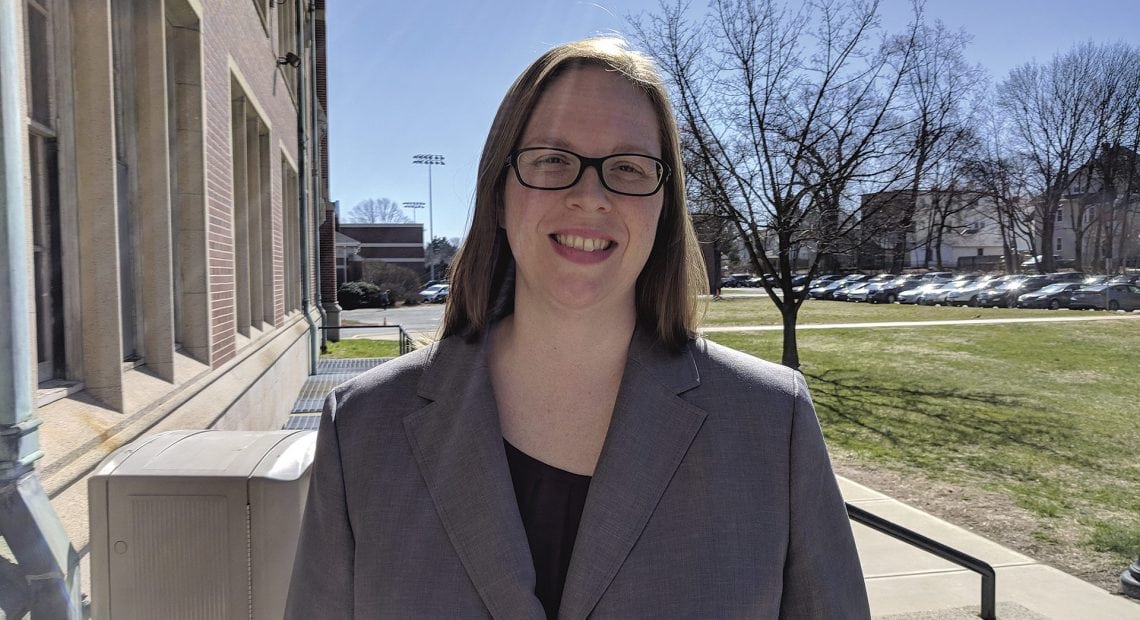
Piece by Piece

Elms College Financial Aid Director Kristin Hmieleski
It’s hardly news that college costs have consistently risen over the past two decades, outpacing both inflation and incomes. But there are a host of resources families can access to help bring those costs down and reduce the initial sticker shock. Still, putting the pieces together takes a combination of hustle, clear communication, hard work, and often sacrifice, all in search of what students hope will be a life-changing degree.
Bryan Gross calls them “success stories” — incoming students who weren’t sure they could afford college, but somehow manage to make it happen.
“You’ll see a lot of media attention and articles about sticker shock, the cost of tuition, fees, room, and board, and it makes families very nervous,” said Gross, vice president of Enrollment Management and Marketing at Western New England University (WNEU). “But we do work very hard to make college affordable for families, and the sticker price is not what they end up paying.”
But it doesn’t happen overnight.
“It is a lot of piecing things together,” said Kristin Hmieleski, Financial Aid director for Elms College. “We always tell students, ‘you’re not going to get this for free, so let’s look at the resources at hand. What can you get through federal and state aid? What has the institution already offered you by way of merit? What else can we offer based on need? Worst-case scenario, you may have to pay out of pocket or take on additional loans.’ It’s almost like a puzzle we put together.”’
It’s a puzzle that has become increasingly challenging over the past couple decades, as college costs have steadily risen, often outpacing inflation and average income. According to the College Board, which tracks these trends annually, tuition and fees at private, four-year instititions increased by 1.9% from 2016-17 to 2017-18, to an average of $34,740. Meanwhile, public, four-year institutions saw an average increase of 1.3%, to $9,970.
Those increases are substantially lower than the spikes seen during the Great Recession. In 2009-10, for example, private institutions raised tuition and fees by 5.9%, and public schools posted a 9.5% increase.
However, the College Board noted, students still shoulder a heavier burden this year, because even those modest price hikes outpaced grant aid and tax benefits. And that places more pressure on financial-aid officers to help families, well, assemble that puzzle.
The key, both Hmieleski and Gross said, is communication — and lots of it, starting early.
“We do open houses, and as prospective students are looking at Elms College, we talk about different resources they can look at,” Hmieleski said, noting that plenty of opportunities exist beyond the award package — based on academic merit and financial need — that the college puts together for each enrollee.
“They might not know every single website to look at, but we give them some hints about community resources they can look into,” she explained. “Do they belong to a church? Do the businesses their families work for offer scholarships? The students need to do some hunting themselves. Have they reached out to guidance counselors? They might know of some opportunities.”
It’s not an easy process, and it takes legwork and often sacrifice. But if the end result is a degree and a career pathway, families are more than willing to make the effort.
Knowledge Is Power
Gross said communicating with students starts well before they ever sit down in a classroom.
“Being a private institution, being well aware of the current state of the economic landscape, giving families direct and clear information regarding their financial-aid package is really important for us,” he said.

Bryan Gross says communication with families — both early and often — is key to helping them forge a strategy to pay for college.
To that end, WNEU started a program three years ago called Culture of Financial Wellness, which includes several components, starting with financial-aid counseling, during which officers help families navigate the process of piecing together available resources. Meanwhile, during spring open houses, financial-aid workshops are offered to inform and educate parents about the financial-aid process to help them make the right decisions for their student.
Following those are SOAR, the university’s Summer Orientation and Registration sessions, featuring presentations by Peter Bielagus, known as “America’s Financial Educator,” who provides information to parents about financing their student’s education.
The final piece of Culture of Financial Wellness continues after the student has joined the campus. The Freshman Focus program offers programming and talks to help students successfully transition to college life, including an overview session each fall on finances and spending designed to teach students about credit-card debt and making sound financial decisions in college and beyond.
“We want to educate students and help them understand the importance of living within your means,” Gross said. “That’s the circle of life — we want to help students for the rest of their lives.”
But that help begins at the financial-aid office, where the allocation of resources has been subtly shifting. This year, the College Board reports, federal loans account for 32% of all student aid, followed by institutional grants (25%), federal Pell grants (15%), tax credits and deductions (9%), state grants (6%), private and employer grants (6%), and veteran and military grants (6%).
“We put together a strategy for each student based on their academic performance,” Gross said. “We offer them scholarships, and of course federal and state grants typically get offered, and after that we have need-based grants we offer depending on their circumstances, and typically at the bottom of all that is federal work studies.”
Hmieleski said some 80 to 100 Elms students benefit from federally funded work-study jobs, 7% of which must be targeted at community-service work, such as the America Reads program administered locally by Valley Opportunity Council, in which college students tutor children after school.
“Unfortunately, federal funding has been so limited — it gets cut every year,” she said, noting that some students work at campus jobs funded by the college, while others secure part-time employment off campus.
Gross said certain enrollees benefit from special circumstances. “Veteran students are a population we work with; we help students directly apply for veterans benefits, and they might be eligible for ROTC as well.”
The bottom line, he told BusinessWest, is that students are given a full picture of what resources are available so they can figure out how to fill in the gaps, even if that means living at home.
“We want them to live on campus, but we want families to make an informed decision. It’s amazing how many families don’t even think about that,” he said. “We just don’t want families to be flat-footed when they receive their first bill.”
Beyond the Gloom and Doom
As Gross noted, he’s gratified by the success stories, but they’re not the whole story, unfortunately.
“To be honest with you, every college also has stories of families that fill out an application for federal aid, then come to us and say, ‘this is not our reality; we can’t afford to pay that.’ We work with families to come up with a plan, and it may work, but it may not work.”
In some cases, he said, students will instead opt to begin their education at a two-year community college. No matter what the outcome, though, he tries to make sure the decisions are made from a place of copious information.
“Families know that it’s not just a matter of crossing their fingers and closing their eyes, and somehow it comes together. You really have to have a plan, and you have to use college and community resources to help you through the process.”
No matter how much thought goes into a strategy, Hmieleski added, it’s impossible to de-stress the process of financial planning for college.
“No matter where you are in life, even if you have wealth, money is always stressful,” she said. “When some people hear about finances or anything involving money, their reaction is almost to shut down and not listen because they don’t feel like they’ll ever understand it.
“But we deal with a lot of first-generation, low-income students here at Elms; we are here to support those students,” she went on, noting that the college is invested not only in their ability to pay for school, but their academic success and keeping them enrolled. “OK, you’re here, you’re able to afford it — now let’s make sure you’re academically successful.”
But it begins with that first look at the unassembled puzzle, and all the decisions that go into putting it together. Hmieleski recalled one student — whose academic record was strong — that she worried about every fall, wondering if she’d be able to continue on, due to tight finances. But each year, the family somehow managed, and she graduated.
“I get goosebumps in so many situations when it looked like doom and gloom, like the student wouldn’t be able to come here, but we work on it,” she said. “And when they’re able to walk through that door, it’s a thrill.”
Joseph Bednar can be reached at [email protected]