Home Archive by category Sections (Page 63)

Sections

Entrepreneurship Sections

Feats of Innovation

From left, Tatum Fahs and Jonathan Major of Bay Path University and Emmett DuPont

From left, Tatum Fahs and Jonathan Major of Bay Path University and Emmett DuPont of Hampshire College took the top three spots at the conference’s ‘idea jam,’ which featured more than 400 participants.

As the founder of FEAT Socks, Parker Burr sells hundreds of thousands of socks worldwide, and expects to top $2 million in sales next year. But one of his fondest memories is selling his cozy footwear, one pair at a time, from behind a table at an Amherst bus stop.

“The key is to go out and sell something,” he told an audience of young entrepreneurs this month at the 12th annual Grinspoon, Garvey & Young Entrepreneurship Conference. “Everyone wants to know how to get from zero to a hundred million dollars. But don’t be afraid of humble beginnings, because those are the best. Selling at a bus stop, to me, that was the most exciting time. So slow down, just sell one, then worry about selling two, then keep going.”

More than 400 students from 14 area colleges attended the event at the MassMutual Center, which included hands-on workshops and exhibits, networking, and what was billed as the world’s largest ‘idea jam,’ where participants pitched their entrepreneurial ideas to their peers in a bracket format, with votes determining who advanced to the next round, and the next, and so on.

Once the field was whittled down to the final 10, those students gave one-minute elevator pitches to the full assembly from the main stage, before Burr’s keynote address. Afterward, the top three vote-getters delivered final pitches. In the last round of voting, Jonathan Major of Bay Path University earned top honors — and a $100 check — for his product, which uses a car adapter to keep food warm on the go; he is working on adding keep-cold capabilities as well.

The other two finalists, nabbing $25 each, were Tatum Fahs of Bay Path, who conceptualized an infant stroller that allows for ‘tummy time’; and Emmett DuPont of Hampshire College, whose idea provides housing supports for transgender youth, a population with a lower life expectancy than most demographics due to drug addiction, suicide, and hate crimes, all of which are exacerbated by alienation from families.

Everyone wants to know how to get from zero to a hundred million dollars. But don’t be afraid of humble beginnings, because those are the best.”

“We’re always so impressed with the diversity and sheer number of students who come to downtown Springfield to attend this conference,” said Cari Carpenter, director of entrepreneurship initiatives at the Harold Grinspoon Charitable Initiative, which organizes the event along with the 14 colleges. “It really gives them validation that there’s a community of people supporting them, and it gives them some tools.”

For example, the day included breakout sessions on topics like “Pitch Like an Entrepreneurial Pro” and “Social Entrepreneurship Opportunity and Impact.”

“They were able to learn strategies for doing good pitches and other kinds of things about entrepreneurship,” Carpenter told BusinessWest. “It’s a goal of the conference to get people to network and meet each other, and really educate these students.”

No Magic Wand

The Entrepreneurship Conference is held annually with the goal of inspiring, motivating, and supporting college students who seek to turn ideas into businesses. Birton Cowden, who helped organize the idea jam, sees myriad benefits in such events.

“We do a lot of these kinds of things on campus,” said Cowden, associate director of the Berthiaume Center for Entrepreneurship at UMass Amherst. “We’ve done idea jams with 70 to 100 people. Here, we had to recraft it for 400 people; that’s why we did the bracketed system.

“There are a lot of stakeholders who feel this is important,” he went on, “starting with the students, who come together and find a community of other people like them. They say, ‘I thought I was crazy, but these are my people.’ Everyone always says they’re energized and encouraged to actually do something with that idea. It gives them confidence.”

At the same time, however, they understand that a new enterprise takes work and commitment, Cowden told BusinessWest. “They learn, ‘people like me are nothing special. There’s no pixie dust here — just things I can do.’”

Burr attested to that fact in his address, which tracked the evolution of FEAT Socks from a small enterprise, selling a few dozen pairs of socks on the UMass Amherst campus as recently as 2014, into a lifestyle brand with a worldwide reach, producing and selling wool socks, dress socks, athletic socks, and more. Most recently, the company signed Massachusetts native and Olympic gold medalist Aly Raisman, and launched her line. Ever-nimble, FEAT just released a limited-edition pair for Cubs fans, with one foot sporting ‘1908’ and other ‘2016.’

“The company has just skyrocketed,” said Burr, whose enterprise is now based in California. “We’re just now becoming true sock people and sock experts, after we sold so many. All this has taught me that you don’t have to know everything; you don’t have to be an expert at anything in order to start building something great. If I had waited until I felt I was a sock expert, I would never have been able to get where I am. I just started. That was the important thing.”

Students at the conference — which included American International College, Amherst College, Bay Path University, Elms College, Greenfield Community College, Hampshire College, Holyoke Community College, Mount Holyoke College, Smith College, Springfield College, Springfield Technical Community College, University of Massachusetts Amherst, Western New England University, and Westfield State University — no doubt took that message to heart as they returned to campus to decide how to proceed with their own big ideas.

“Work hard. Do something,” Burr concluded. “Throw yourself into every situation possible, and let serendipity take over.”

Joseph Bednar can be reached at [email protected]

Events Features WMBExpo

MassMutual Center, Springfield, Thursday, November 3

WMBExpo2016LOGO
More than 2,000 people ventured to the MassMutual Center in Springfield on Nov. 3 for the 6th Annual Western Mass. Business Expo. The day-long show featured a wide variety of informative and entertaining programming, on subjects ranging from drones to virtual reality; motivating Millennials to robotics; entrepreneurship to search-engine optimization. The Expo kicked off with a breakfast staged by the Springfield Regional Chamber of Commerce, and ended with the popular Expo Social. In between were seminars, more than 100 exhibitors, a pitch contest, lunch hosted by the Professional Women’s Chamber, an ice cream social, and much, much more. In the gallery below, BusinessWest offers a pictorial review of the show, capturing many of the sights of an unforgettable event.

Photography by Dani Fine Photography

wmbexposponsors2016

Sections Technology

Something for Everyone

Smartphones rule the world — or, at least, their users’ lives — but they wouldn’t be of much use without apps. And those apps are legion, appealing to individuals’ desire to manage everything from finances to fitness, to continually learn new things and find new ways to have fun. Here’s a roundup of some of the most popular and well-reviewed apps available today.

Say you want to more effectively manage your finances. Or get in shape. Or brush up on your math skills. Or just relax and have a good time.

As the old iPhone commercials used to say, there’s an app for that. Many, many more than one, actually. And they’re usually free, and available on both the iOS and Android platforms.

For this year’s roundup of what’s hot in technology, BusinessWest checks in on what the tech press is saying about some of the most popular smartphone apps.

Financial App-raisals

personal-capitalFor starters, smartphones have put a world of personal finance in people’s hands. For example, Personal Capital offers simple charts and graphs of the user’s income, spending, and investment performance so they can easily monitor their finances.

“Track your investments by account, asset class, or individual security, see how your portfolio compares to major indices, and find the exact percentage of each asset class that’s in your portfolio,” Investopedia explains. “A 401(k) fee analyzer and mutual-fund fee calculator show if you’re paying too much in fees. The Investment Checkup feature analyzes your portfolio and shows how much you stand to gain with a few changes.”

mintBusiness Insider reports that Intuit’s Mint gives users a real-time look into all their finances, from bank accounts and credit cards to student loans and 401(k) accounts. “It automatically tracks your spending, categorizes it, and alerts you when/if you approach your budget limit. You can even ask for custom savings tips within the app,” the publication notes. “Everything is shown in simple, intuitive graphs and charts, making it one of the most popular personal-finance apps in the world.”

goodbudgetMeanwhile, Business Insider also recommends GoodBudget, an app that brings the envelope-budgeting method into the smartphone. Users create ‘envelopes’ for each of their budget categories, such as groceries, transportation, and shopping, and pre-determine how much they want to allocate in each envelope. They can then record and track how much they’re spending from each envelope. “It may not be as sophisticated as some of the other apps, but Goodbudget offers a simple way to stick to your budget and keep your spending really disciplined.”

prosper-dailyWhat about financial security? Investopedia recommends Prosper Daily, a personal-finance security service that tracks spending and protects credit cards from fraud and errors. Users can quickly view balances and recurring charges across all their credit and debit cards.

“Prosper Daily creates an alert if a suspicious charge is posted to your account, allows you to report the charge and/or contact the merchant, and will help you get your money back from fraudulent, erroneous, or unfair charges,” the publication notes. “Data-breach alerts let you know when a data breach has occurred at a place where you’ve shopped.”

Healthy App-roach

What if physical wellness tops one’s priority list. No fear — there are countless apps for that, too, teaching users how to shop, all the facts on what they’re eating, how to exercise, and how to stay committed to better habits.

myfitnesspalOne of the most popular nutrition apps is MyFitnessPal, which offers a wealth of tools for tracking what and how much the user eats, and how many calories they burn through activity, explains PC Magazine. “Of all the calorie counters I’ve used, MyFitnessPal is by far the easiest one to manage, and it comes with the largest database of foods and drinks. With the MyFitnessPal app, you can fastidiously watch what you eat 24/7, no matter where you are.”

The app’s database of more than 6 million foods makes it easy to track a diet, or the lack of one, added the online magazine Greatist. “Whether you’re trying to lose weight or put on muscle, the app helps determine the best things to eat and meet your goals.”

nike-training-clubBut nutrition is only part of the story when it comes to fitness — exercise is the other key discipline. But where to start? One possibility is the Nike+ Training Club, which takes the concept to the next level, offering more than 100 workouts to choose from. Users can also opt for a customized, full-body, four-week plan. “A trainer leads you through the routines, plus you get instructional video clips of the moves,” notes Fitness magazine. “Don’t like burpees? The updated app lets you swap drills you hate for ones you love.”

strava-running-and-cycling-gpsFor those who prefer being outdoors to get in shape, Strava Running and Cycling GPS monitors running or cycling routes via GPS, notes Digital Trends. “It also gamifies your cardio workout and pairs with leaderboards, achievements, and challenges, bringing a competitive spirit to your routine.”

jefitFor a more comprehensive training assistant, Men’s Fitness recommends Jefit, which creates personalized workout routines by tracking and analyzing the user’s workout progress and diligently recording weight, reps, and time.

“Its data-heavy approach will appeal to stat nerds and workout obsessives alike. Jefit also packs the most robust library of exercises and maneuvers,” the magazine notes, including how-to videos with more than 1,300 exercises making up scores of workouts. The free version is limited, with some bare-bones workout routines and basic activity logs, while paid options are ad-free and unlock more features.

App-lied Learning

khan-academyCountless popular apps focus on education and learning for all ages. For kids, the Children’s MD blog recommends Khan Academy, which collaborates with the U.S. Department of Education and myriad public and private educational institutions to provide a free, world-class education for anyone.

“It’s incredibly easy to use, there are no ads, and it’s appropriate for any school-aged child that knows how to read,” the blog reports, noting that Khan Academy started as a math-learning site but has expanded to many other subjects, from art history to economics. “My kids will spend hours looking at computer-science projects that other kids have shared and incorporating ideas into their own programs. The Khan platform combines educational videos with practice problems and project assignments.”

photomathMeanwhile, Photomath focuses on, well, math, and does it well, Digital Trends reports. “For high-school students who just need a bit more guidance on how to isolate ‘x’ in their algebra homework, Photomath is essentially your math buddy that can instantly solve and explain every answer. Simply snap a photo of the question (you can also write or type), and the app will break down the solution into separate steps with helpful play-by-play, so that you can apply the same principles to the rest of your homework.”

duolingoFor language learning, Children’s MD recommends Duolingo, which provides interactive foreign-language education in 15 languages so far. It’s appropriate for both kids and adults, and one independent study found that a person with no knowledge of Spanish would need about 34 hours with Duolingo to cover the material in the first college semester of Spanish classes.

“It’s simple, user-friendly, and never boring,” the blog notes. “Install the app on your phone and get your language lessons done while you are on the elevator or waiting in line.”

nasa-appLearning means expanding one’s horizons, of course, and where better to do that than the NASA App, which aggregates a wide range of NASA content. “Space enthusiasts and curious minds will love how it packs a wealth of news stories, features, images, video, and information about the space agency’s activities into this one mobile app,” PC Magazine reports.

App-ealing Entertainment

spotifyLet’s face it, though — smartphone users want apps that are just plain fun as well. For music enthusiasts, it’s hard to go wrong with Spotify. Wired notes that users can access a huge catalog of music for a small monthly fee, creating their own playlists or enjoying the app’s curated stations.

Seven years after its debut, Mashable adds, “Spotify has tons of competition in the online streaming space, but the app continues to be one of the best ways to listen to music and podcasts on demand and on the go.”

espn-score-centerSports fans might dig ESPN Score Center, which allows users to check game progress from more sports than most other apps, PC Magazine reports, including baseball, basketball, football, soccer, ice hockey, cricket, rugby, and more.

big-ovenFor those whose idea of fun is improving their cooking skills, plenty of apps do the job. Digital Trends recommends two. Big Oven features more than 250,000 recipes, and provides grocery lists based on them, lets users add your own, and import recipes from friends. “If you like (or want to like) to cook, start with Big Oven.”

yummlyBut the publication also raves about Yummly, which offers access to thousands of unique recipes. “On top of recipe and grocery-list functionality, Yummly takes user preferences into account to provide recipe recommendations, for when you just can’t decide what to eat.”

action-movie-fxFinally, if the kitchen doesn’t provide enough action and adventure, Mashable recommends downloading Action Movie, the brainchild of Star Wars and Star Trek director J.J. Abrams. The app allows anyone with an iPhone introduce movie-level special effects to their short videos.

“Not only is it incredibly easy to use and completely addictive, it’s a huge crowd pleaser,” the site notes. “Filming a Thanksgiving dinner where a virtual car can unexpectedly crash across the dinner table is guaranteed to inspire roaring laughter. Action Movie is free, but smartly uses in-app purchases to sell you additional effects, all as good as the originals. It’s the rare app that has few competitors and has maintained a high level of quality.”

Joseph Bednar can be reached at [email protected]

Features

A Builder and a ‘Connector’

Samalid Hogan

Samalid Hogan

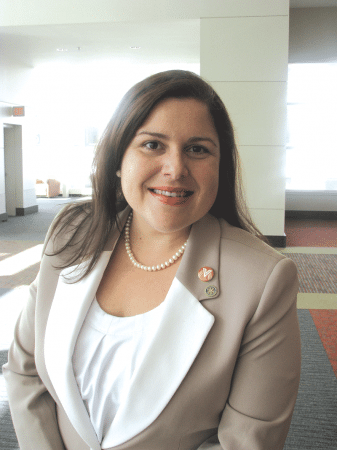
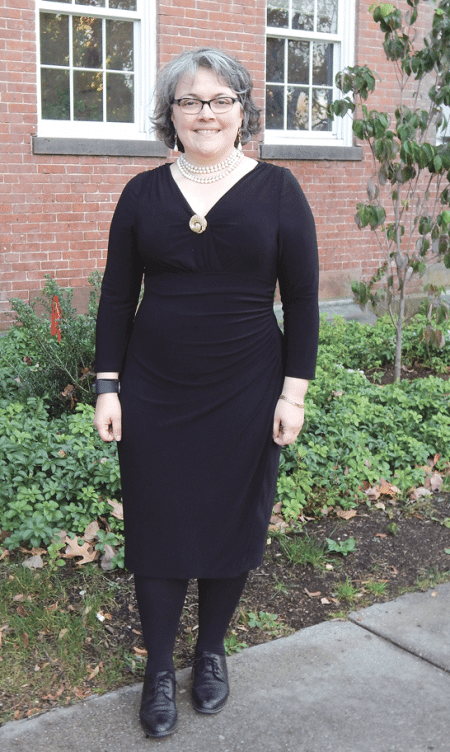
Samalid Hogan takes the reins at the Mass. Small Business Development Center at a time when entrepreneurial energy is high in the region, fueled by the growth of programs aiming to help fledgling ventures succeed. It’s an energy that excites and inspires her in this latest challenge in an intriguing, wide-ranging career.

Whenever someone suggests that Samalid Hogan has big shoes to fill — and that’s a common occurrence, to say the least — she’s ready with a witty response.

“I remind them I have size-11 feet … they’re my father’s feet,” said Hogan, noting that she’s made reference to this statistic countless times since she was named successor to Dianne Fuller Doherty at the Mass. Small Business Development Center Network’s (MSBDC) Western Mass. office a few months ago.

And she acknowledges that she needs those large feet.

Indeed, Doherty, who was once the subject of a chapter in a New York Times series of articles on individuals who worked well past traditional retirement age, was at the helm of the MSBDC for more than 30 years (so long, in fact, that BusinessWest founder John Gormally sought out her help when launched the publication in early 1984 — and more than a few times thereafter). She was, in some respects, synonymous with the agency.

But Hogan feels she’s more than ready to take on the challenge of succeeding Doherty and carrying out the agency’s multi-faceted mission, based on her diverse résumé, one that includes her own entrepreneurial undertakings. It comes complete with a number of public-sector stops working with small businesses to help them launch, grow, and succeed.

“In many ways, I’m just doing what I’ve always done throughout my career,” said Hogan of her new role at the MSBDC, an agency that, in a nutshell, provides free, confidential (two important qualities, to be sure), one-on-one business-advisory services to prospective and existing small-business owners.

That word ‘small’ has a textbook definition of sorts at MSBDC and other area agencies — 100 employees and under. And while the center has, indeed, assisted companies at the far end of that spectrum, most, over the years, have been truly small, and often sole proprietorships.


I love action plans and work to set goals and determine the outcomes that are desired, and then working backward from there. And I like helping people get organized and have a very clear direction of where they’re going.”


Hogan said she became more than a little interested in the directorship of the MSBDC when it was advertised, and then endured a lengthy hiring process, not simply because of the work being done at the center, although that was certainly a big part of it.

Another large part involves timing. Indeed, there is a considerable amount of entrepreneurial activity, or energy, in the region, fueled by the creation and growth of agencies and academic programs with various missions but the collective goals of inspiring entrepreneurship and helping fledgling ventures succeed.

This movement, or this collection of agencies and degree programs, now has a name that is fast becoming part of the local lexicon: entrepreneurial ecosystem.

Hogan said the MSBDC is a proud member of that ecosystem, and is fully invested in efforts to broaden and strengthen this collaborative through partnerships, referrals, and a deep spirit of cooperation.

“At the end of the day, we can all do a better job of referring clients to each other, for the benefit of the client,” she said of the many entrepreneurship-focused agencies in the area. “It comes down to what the client needs and identifying which agencies can best provide those services, and working together.”

For this issue, BusinessWest talked at length with Hogan about this latest career stop, her outlook for the MSBDC and the entrepreneurial ecosystem, and the art and science of advising and mentoring small-business owners.

Sole Searching

Hogan met with BusinessWest to discuss all of the above in the conference room at the Chicopee Chamber of Commerce, located in the heart of that city’s downtown.

She was there, as she is every month for a full day, for what she called “outreach,” to meet with clients (small-business owners) one-on-one to discuss, essentially, where they’re at, where they want to get, what it will likely take to get there, and which individuals and agencies might be able to provide some assistance with mapping out the journey.

“We want to be able to go where the clients are and give them that flexiblility so we can serve them better,” she noted, adding that there are similar ‘outreach offices’ in Greenfield, Northampton, and Amherst.

She was wrapping up with one business owner when BusinessWest arrived, and had another that would be waiting in the lobby in less than an hour. So she didn’t waste any time getting to the meat of the discussion, which is the ecosystem, where the MSBDC fits into it all, and how the collective agencies can work together to ultimately provide more and better services.

And she began by drawing a distinction between her approach to this work and the one taken by Doherty.

“She was an investor in small business, and she owned a very successful marketing business,” Hogan said of her predecessor. “My qualifications are slightly different, and I’m more of a entrepreneurship student — I study everything that has to do with small business.

“I do have experience as an entrepreneur,” she went on, noting the co-working space she created. “And I do the advising of small businesses. But what I really like to do is build bridges between all the recent and non-recent entrepreneurial programs and support services.”

And, as noted earlier, Hogan believes she brings a solid background in work with small businesses — as well as with a host of area economic-development-related agencies — to the center and its mission.

She summed up the job descriptions that went with the titles on her various business cards by saying she has been both a “builder” and a “connector,” and usually both at the same time.

The photograph that accompanied her writeup as one of BusinessWest’s 40 Under Forty winners in 2013, when she was employed as senior project manager for the city of Springfield, shows her with a hard hat, shovel, and a few bricks.

These are the physical, or literal, symbols of construction, she explained, adding that much of the building she’s part of has been figurative in nature, as in building relationships, partnerships, coalitions, and momentum for a city, neighborhood, agency, or office holder’s platform.

Indeed, Hogan, an economics major at Bay Path University, was recruited by a major financial-services firm. But her skill set, strong personality, and considerable confidence caught the attention of state Rep. Cheryl Coakley-Rivera, who successfully recruited Hogan to become her chief of staff.

Samalid Hogan describes herself as a ‘builder, ‘connector,’ and ‘project manager,’ and will be doing a lot of that kind of work for the MSBDC.

Samalid Hogan describes herself as a ‘builder, ‘connector,’ and ‘project manager,’ and will be doing a lot of that kind of work for the MSBDC.

In that role, she became the ‘connector’ she mentioned earlier, connecting constituents to agencies and resources and, in the process, helping them manage their problem or issue (work in very ways similar to that carried out by the MSBDC.)

From Coakley’s office, Hogan would move to the Pioneer Valley Planning Commission, where she would handle similar duties, but on a region-wide basis. In the course of doing so, she would become familiar with — and partner with — many more agencies and institutions involved in the many aspects of economic development.

From there, she segued to a project manager’s position in Springfield, a role that involved more of that connecting she was becoming proficient at, but also a good deal of literal, bricks-and-mortar building.

Hogan became involved in a host of initiatives, including the South End revitalization project, Court Square redevelopment efforts, brownfield-restoration efforts, redevelopment of the former Gemini site, and many others. She also worked directly with small-business owners, through a façade program and a small-business loan program.

In 2015, she took her collective experience to a different city and different challenge, specifically Holyoke’s Innovation District, where she worked with a list of officials, agencies, business owners, and prospective entrepreneurs to generate energy and commerce in the heart of the Paper City.

When she saw that the MSBDC was advertising for a new director (it had gone several months without one after Doherty officially stepped down in 2015), she quickly embraced the position as the most logical next step in a career in many ways defined by work with and on behalf of small enterprises.

Getting a Foot in the Door

“I’ve been working with small businesses for a long time in economic development,” said Hogan as she explained her interest in the MSBDC. “I like being able to help people and guide them — I’m a project manager.

“I love action plans and work to set goals and determine the outcomes that are desired, and then working backward from there,” she went on. “And I like helping people get organized and have a very clear direction of where they’re going.”

Acting as project manager is how she characterizes her role at the MSBDC, using that term in reference to the cases of individual clients.

And the cases, or projects, vary with each person or business that finds the agency.

As noted earlier, the center, funded by the U.S. Small Business Administration and the state Office of Business Development, and hosted by UMass Amherst and its Isenberg School of Management, assists what are, technically speaking, small businesses, but some operations that most would consider large, with 100 or more employees.

It also assists companies with a few dozen or more workers that are looking to get to the proverbial next stage, usually through some type of financing — one of many realms where the center can make some effective connections.

But much of the work, including the outreach Hogan was conducting when she met with BusinessWest, would be with what are considered very small ventures and prospective businesses that exist maybe on a napkin or in someone’s imagination.

To explain what she does, and what the center does, she summoned a hypothetical situation, only the situation — and the commentary — is, all too often, very real.

“I’ll ask someone to tell me about their business,” she started. “They’ll say, ‘I just got started, I have a few sales, but I don’t really know where to go with this. I need to hire some people, and to expand, I need to do this and that.’

“I’ll then say, ‘OK, who’s your accountant? Who’s your lawyer? Who do you work with on insurance?’” she went on. “They’ll say, ‘I don’t have an accountant, I don’t have a lawyer … and do I really need insurance?’ And then I’ll go through the basics with them.”

Advice often begins with the basics, she continued, but it rarely ends there, and often involves the next steps after hiring those professionals listed above — work to identify markets, develop strategies for reaching those markets, secure financing, promote the product or service, and much more.

“People who come here might be frustrated or confused and not really sure about what they want to do,” she told BusinessWest. “By asking them questions, I can help them self-discover the path they want to take.”

Then there are those bridge-building efforts, she said, adding that, while the MSBDC provides an array of important services, it is just one player in the region’s ever-broadening efforts to inspire, educate, and mentor entrepreneurs.

Others within the ecosystem include SCORE, which focuses on industry-specific business guidance; the Small Business Administration and Common Capital, which connect business owners with capital; Valley Venture Mentors, which mentors entrepreneurs and helps them hone their pitches and identify markets; and many others.

Linking clients with these partner agencies is an important part of the MSBDC’s mission, said Hogan, adding that one agency simply can’t do it all alone, and partnerships are vital — for specific business owners, but also the region as a whole.

“Oftentimes, I will walk people over to SCORE,” she said, noting that both agencies have offices in the Scibelli Enterprise Center in Springfield, as does New England Business Associates. “We need to help clients access all the agencies that can help them grow their businesses.”

A Shoe-in

Hogan said she hasn’t had to summon that size-11-feet remark lately, as commentary about the big shoes she has to fill has subsided somewhat.

Indeed, she has settled into a role that is different than others she has had over the years in some respects, but at its foundation is fundamentally the same. It’s all about building bridges, being a connector, and managing projects.

She’s always been good at that, and now that she’s putting those talents to use in ways that will help businesses get … well, if you’ll pardon the expression, a leg up.

George O’Brien can be reached at [email protected]

Sections Technology

Won’t Get Fooled Again?

The trouble with a phishing scam, Brendan Monahan says, is that only one person in an organization has to fall for it to put information at risk.

Or, in Baystate Health’s case, five.

“There is constantly a threat to businesses — including ours; we’re no different — from outside phishing attacks,” said Monahan, manager of Public Affairs, in the wake of a phishing attack in August that exposed the personal data of thousands of patients. “They’re often internationally based and geared toward handing over the keys to the kingdom to a hacker who, from what we understand from most experts, is looking for some financial gain out of it.”

That doesn’t seem to have occurred in this case, Baystate officials say, but the incident, which was made public late last month, is serious enough to trigger a re-examination of the system’s security protocols — and to serve as a warning to other employers in the region, both large and small.

Specifially, on Aug. 22, Baystate learned that a phishing e-mail had been sent to numerous Baystate employees that, if opened, allowed hackers to access those employees’ e-mail accounts.

Phishing is an electronic attempt to obtain sensitive information, such as passwords and credit-card information, by masquerading as a trustworthy source. Phishing e-mails may contain links to a site infected with malware, or directly load a program onto a computer that makes it contents accessible to the scammer. The Baystate scam e-mail was designed to look exactly like an internal memo to employees.

eric brown

eric brown

The best defense is to have a written information-security policy in place. Part of that is training in security awareness for employees. That way, employees can’t say, ‘I didn’t know,’ or ‘I don’t understand.’ That’s where the data risk is. It’s not from the outside; it’s from the inside, with mistakes, careless errors made by employees.”

Baystate’s investigation determined that five employees responded to the phishing e-mail, allowing the hackers to gain access to those employees’ e-mail accounts. Some of the e-mails in those accounts included patient information, including names and dates of birth, diagnoses and treatments received, medical record numbers, and, in some instances, health-insurance identification numbers. However, the e-mails did not contain Social Security numbers, credit-card numbers, or other financial information commonly used by scammers and identity thieves to enrich themselves.

“The [phishing] e-mail contained information that would be described as mimicking or mocking an internal Baystate Health HR memo. Five employees clicked on that e-mail, that immediately compromised their Outlook e-mail accounts into the hands of the perpetrator,” Monahan told BusinessWest. “Our computer research firm found exactly what was in the e-mails and what could have been looked at.”

The fact that no financial data was compromised may be small comfort for affected patients, that fact may mean the scammers have no real use for the information, and left it alone when they discovered they couldn’t profit. But that remains to be seen.

“In this case, there was no financial gain to be had from the patient information,” Monahan said. “That’s why we don’t know whether they went through the documents, but they could have.”

Still, he added, “while we have no evidence that any patient information has been taken or misused, we want to assure our patients that we take this incident very seriously.”

Next Steps

Upon discovering the breach, Baystate immediately took steps to secure the e-mail accounts and began an investigation, and also reported the incident to law enforcement.

But finding out what happened and trying to identify the perpetrators is only one step in the process of responding to the incident, Monahan said. Topping that list is ensuring — or at least trying to ensure — that such an incident won’t be repeated, and that begins with employee education and training regarding phishing e-mails and other scams.

“That was already going on beforehand, and I would say it’s being ramped up,” he explained, noting that employees can click a button at the top of any e-mail if they suspect it comes from a suspicious source, and someone from Baystate’s IT staff will come and determine if it’s dangerous or not. “We try and help them, to train them not to click on a suspicious e-mail, what a phishing attack looks like, and how to recognize it when it comes about.”

Frank Vincentelli

frank vincentelli

Unfortunately, they’re always a step ahead, and for those of us in the security industry, to prevent their success, we have to figure out what they’re doing. But if you present a soft, open belly, they’re going to dive right in.”


Frank Vincentelli, chief technology officer at Integrated IT Solutions in Westfield, and Eric Brown, the company’s vice president of Security Services, recently spoke about data security in the business world at the Western Mass. Business Expo, and discussed at length the critical role each employee plays in keeping a company safe.

“The best defense is to have a written information-security policy in place,” Brown said. “Part of that is training in security awareness for employees. That way, employees can’t say, ‘I didn’t know,’ or ‘I don’t understand.’ That’s where the data risk is. It’s not from the outside; it’s from the inside, with mistakes, careless errors made by employees.”

Vincentelli noted that a computer without access to the Internet or e-mail is generally safe, but not particularly useful, so businesses must strike a balance between safety and usability. “The very fact that you have access to these resources is giving the attackers a way into your system and your information.”

The entire security chain, in other words, is only as strong as its weakest link.

“Each individual user is an active part in the overall security strategy of the company,” he went on. “I’m sure all of us can think of a person in we work with who’s not necessarily technologically sophisticated, a person who usually gets a virus or is hit with CryptoLocker three or four times a year. That person is the best level of protection your organization has.”

Training every employee then, is critical, but companies must still maintain a robust firewall infrastructure, complete with early-detection capabilities to identify breaches when they occur. Still, Vincentelli said, “the most important component is the individual user.”

On Guard

Phishing scams are, unfortunately, more common in the healthcare realm than some might suspect. In recent years alone, according to data-risk consulting firm IDT911, a server operating under contract for DeKalb Health Medical Group in Indiana experienced a cyberattack that compromised more than 1,300 patient-information records; Baylor Regional Medical Center in Texas was hacked after doctors responded to phishing e-mails, exposing the patient information contained in their inboxes, including names, addresses, dates of birth, and even Social Security numbers; and Franciscan Health System in Washington was hacked in a phishing scheme that affected potentially 12,000 patients.

Norton, the developer of Internet security software, recommends several steps to avoid becoming the victim of phishing at work, including being wary of e-mails asking for confidential information; watching out for generic-looking requests for information, as fraudulent phishing e-mails are usually not personalized; and avoiding using links in an e-mail to connect to a website, instead opening a new browser window and typing the URL directly into the address bar.

“This is constantly a threat that we have to be wary of as employees, in part because we have a confidentiality policy and handle health information and other protected information,” Monahan told BusinessWest. “We have to be good stewards of that. There needs to be a sense of vigilance, and we have to enforce it. With almost 13,000 people who work here, there’s no one piece of software that will block this particular type of attack. It comes down to workforce training.”

The attacks can be subtle, and often play on human psychology — including people’s natural curiosity. Brown asked his audience at the Expo what they would do if they found a USB stick on the ground before answering his own question.

“Obviously, if you find a USB stick and don’t know who the owner is, you don’t want to touch it,” he said. “That is one way people get malware infections. If I wanted to infect a company, I’d take 30 USB sticks, put a virus on them, and toss them in a parking lot. I guarantee a half-dozen people would pick them up and stick them in their computers.”

Vincentelli called cybersecurity a cat-and-mouse affair, adding that “I’m not sure who’s who.” But it’s clear that hackers are constantly honing techniques to exploit security weaknesses, and when the target develops a defense, the hackers create a better weapon.

“Unfortunately, they’re always a step ahead, and for those of us in the security industry, to prevent their success, we have to figure out what they’re doing,” he said. “But if you present a soft, open belly, they’re going to dive right in.”

Baystate mailed letters to people who may have been affected on Oct. 21, who were directed to call a phone number staffed by an outside contractor hired by Baystate to walk patients through the process of learning if they had been victimized, Monahan said. In the meantime, the health system vowed to raise their level of awareness of threats that continue to evolve in sophistication.

“There are a million cyberthreats out there in the world, and this is one of them,” he said. “We are constantly working to train our workforce to recognize these threats and stay ahead of them — because the threat is always changing.”

Joseph Bednar can be reached at [email protected]

Community Spotlight Features

Community Spotlight

Denise Menard and Robyn Macdonald

Denise Menard and Robyn Macdonald say the gas station and convenience store under construction at 227 Shaker Road will give people in the southern portion of town access to needed services.

East Longmeadow has grown and flourished in recent years thanks to its excellent schools, pastoral landscape, and thriving Industrial Garden District, where manicured lawns and flower gardens belie the scope of commercial and manufacturing companies that do business there.

However, last year, the town’s bucolic character was upset by repeated controversy that was ignited and fueled by reports of corruption. “The town went through a year of turmoil, and some businesses were hesitant to move here due to the negative publicity,” said Robyn Macdonald, the town’s Planning, Zoning Board, and Conservation director.

She added that these issues were essentially put to rest in April when residents voted overwhelmingly in favor of a new charter that replaced the town meeting and three-member Board of Selectmen with a town manager and Town Council that features seven elected members.

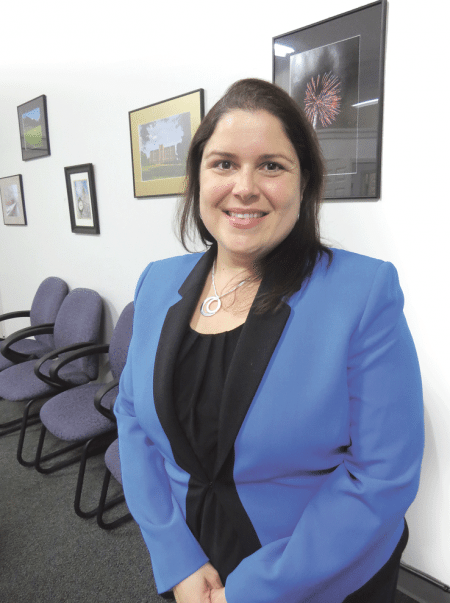
Its first official meeting was staged July 1, and a few weeks later, former East Windsor, Conn. First Selectman Denise Menard was hired as interim town manager.

“The charter expanded the town’s leadership, and work has already been done to preserve the good things that exist here, while promoting healthy living and balanced growth,” Macdonald said.

To that end, plans are in place to establish East Longmeadow’s first human resources department. In addition, several new positions have been added that include a director of finance; a director of Planning and Community Development; and a full-time health director. Aimee Petrosky was recently hired to fill that role and is working with the newly appointed three-member Board of Health.

She told BusinessWest that the town held its first flu clinic last month, which was highly successful and will be repeated next year. In the meantime, the board plans to seek funding to vaccinate uninsured residents, and the next event will include the shingles vaccine.

Other changes include a new sharps-disposal program that offers disposal units to residents at an affordable price because they can be cost-prohibitive; new regulations that make it illegal to smoke any type of tobacco, including e-cigarettes and vapor cigarettes, within 50 feet of a public building; a fine policy for restaurateurs who fail to comply with health regulations; and new rules that require companies that serve or produce food to install traps to prevent grease from entering sewers and affecting business operations or private residences.

“The Health Department also recently purchased an electronic inspection system that will post the outcomes of health inspections online,” Petrosky said, noting that food-safety training sessions were held for the School Department, the Council on Aging, and at churches that requested it to insure that the most vulnerable populations are protected.

Menard applauds these changes because they add to the town’s offerings, and notes that, when a permanent town manager is named, it will be important for the person to promote intelligent economic development and take a proactive stance in attracting new businesses.

“There is room for growth in the underutilized areas of our industrial and commercial sections of town,” she said.

Macdonald agrees, and says there are a few dormant parcels they hope to fill in the future, including the long-vacant Package Machinery site. “East Longmeadow has always welcomed new businesses, but we try to maintain a good balance between residential and business growth,” she noted.

For this, the latest installment of its Community Spotlight series, BusinessWest looks at projects on the drawing board as well as developments underway that will help East Longmeadow retain its small-town character while offering new venues that will boost the tax base and provide services for people who live and work in the town.

Major Projects

Officials are happy that several sites in town that have been vacant for more than a decade are being redeveloped.

For example, L.E. Belcher broke ground three months ago on a 6,500-square-foot convenience store with five gas pumps, 10 pumping stations, three outdoor tables, and 28 parking spaces on a lot at 227 Shaker Road that was empty for many years.

The company has secured a license to sell wine and beer, and worked closely with the Planning Board to ensure the new business is a good fit for the town. Ownership has installed flashing pedestrian safety lights to facilitate safety on the Chestnut Street side of the Redstone Rail Trail that runs behind the property, and contributed to a mitigation fund that will assist the Department of Public Works with roadway and traffic improvements in the Shaker Road and Chestnut Street corridor.

“It’s a busy intersection, and their gift of $25,000 to the DPW was a great gesture from a new business,” Menard said.

Macdonald concurred. “L.E. Belcher is a community-minded company, and the facility they are building will provide the industrial area with a service that doesn’t exist in that part of town. There is nothing like it from there until Route I-90 in Enfield, and it is expected to bring in people from Connecticut, while reducing congestion at the rotary,” she said, adding that the new convenience store and gas station are expected to open in mid- or late January.

A new restaurant called Green/Wich is also under construction at 16 Maple St. on the rotary. The eatery’s plans were recently approved, and the owner has also secured a beer and wine license.

“It’s a great addition to our center, and we’re happy to have a building that sat empty for many years put to use by a business that will help people attain a healthy lifestyle. It will offer high-end wraps and salads with indoor seating,” Menard said.

Macdonald told BusinessWest that Green/Wich had to do a major renovation of the building that included asbestos abatement, and has worked closely with the town to ensure the restaurant meets all safety requirements when it opens in about a month.

Several businesses in the town are experiencing rapid growth, including Go Graphix, which relocated from a shopping plaza on North Main Street to a 5,000-square-foot space on Benton Drive in the industrial park several years ago.

“The organization takes a concept through design, production, and installation. Their focus is on individual brands and messaging, and they incorporate big-picture objectives while paying close attention to the smallest details,” Macdonald said. “They have done so well, they are planning a 2,584-square-foot addition to their existing building. “

That project is still in the planning stages, but in September the Planning Board approved construction of an 18,000-square-foot medical office building on 250 North Main St.

The new, two-story structure will be constructed by Associated Builders for Baystate Dental Group and will have 90 parking spaces. The dental office will occupy the first floor, and the second floor will be rented as medical or office space.

Two other significant projects were also recently proposed. The first is an expansion: Excel Dryer wants to put an addition onto its existing building at 357 Chestnut St. that will include 1,300 square feet of warehouse space and 3,700 square feet of office space.

“This is a family-owned and -operated company that revolutionized the industry and set a new standard for performance, reliability, and customer satisfaction,” Macdonald said. “They have continued to grow, and the addition will enhance their ability to move forward in the future.”

The second project is much more complex, as it involves the towns of East Longmeadow and Longmeadow.

Macdonald said the planning boards in both towns have been working with Michael Crowley of Michael Crowley Associates and Middle Franklin Development, Robert Levesque of R. Levesque Associates Inc., David Dunlop of David Dunlop Associates, and Fuss & O’Neill to create a medical complex that will add to East Longmeadow Skilled Nursing Center at 305 Maple St., cross town lines, and provide benefits to both communities.

Crowley presented plans for the project in June. It includes four structures on a 20-acre site: a 50,000-square-foot medical office building in Longmeadow that would be occupied by Baystate Health; a two-story, 25,000-square-foot conventional office building in East Longmeadow; and an assisted-living facility and an expansion of the existing skilled-nursing facility that would be run by Berkshire Health in the town.

“The complex will feature state-of-the-art technology and have every safety system installed possible, including fire alarms, an emergency generator, and rooftop units with individual room controls,” Macdonald said, explaining that the two towns have commissioned a traffic study to mitigate any problems that could result from the project because it will affect some of their busiest intersections, namely Benton Drive and Chestnut Street in East Longmeadow, the Converse Street area in Longmeadow, and that town’s intersection at Dwight Road, Williams Street, and Maple Street.

Work in Progress

The Department of Public Works has an ongoing project that involves installing new sidewalks in East Longmeadow’s center and around the schools to make pedestrian travel safe and help make the town more desirable.

Historically, that hasn’t been a problem.

“Businesses are thriving in East Longmeadow and want to stay here,” Macdonald said, explaining that, although the town doesn’t have its own utility companies, manufacturers in the Industrial Garden District including Sullivan Paper Co., Tiger Press, and the recently sold Lenox Newell Rubbermaid have installed solar panels on their roofs, and panels have also been approved for the Reminder building in the commercial district.

“We still have plenty of room for new companies, and the opportunities here are great. The town welcomes large and small businesses, and our Industrial Garden District is a beautiful area which is easy to get to from I-91,” she noted.

Indeed, the negative publicity has come to an end, the town is moving forward, and the future looks bright for residents and businesses alike.

East Longmeadow at a glance

Year Incorporated: 1894
Population: 15,720 (2010)
Area: 13.0 square miles
County: Hampden
Residential Tax Rate: $21.12
Commercial Tax Rate: $21.12
Median Household Income: $78,835
Median Family Income: $99,707
Type of Government: Town Council; Town Manager
Largest Employers: Cartamundi; Redstone Rehab and Nursing Center; Lenox Newell Rubbermaid
* Latest information available

Cover Story Education Sections

Amassing ‘Reputational Capital’

Isenberg School Dean Mark Fuller

Isenberg School Dean Mark Fuller

When Mark Fuller became a candidate for dean of the Isenberg School of Business at UMass Amherst, he saw an institution that was, by his estimation, “solid, but underperforming.” That latter adjective no longer applies. Indeed, Isenberg has made a solid move in the rankings of public schools, reaching No. 1 in BusinessWeek’s compilation of the top public schools in the Northeast. The challenge ahead — and it’s a considerable one, to say the least — is to achieve the additional ‘reputational capital’ to move still higher.

Mark Fuller says he gets asked the question all the time.

It comes in various forms, and is put to him by a host of constituencies, including school administrators, alums, other business-school deans (lots of those), and even the occasional business writer.

They all want to know how Fuller, who arrived as dean of the Isenberg School of Management at UMass Amherst in 2009, has been able to orchestrate a steady and quite impressive climb in the rankings of the region’s — and the nation’s — top business schools, especially the public institutions.

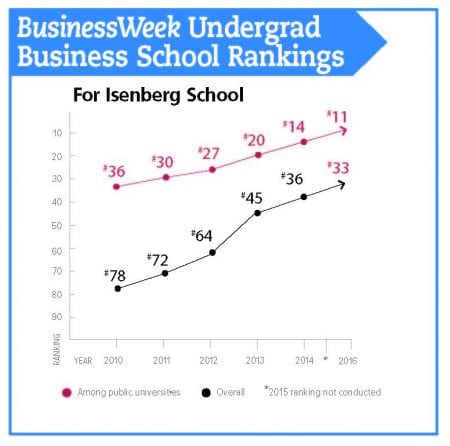
To wit, in Bloomberg BusinessWeek’s current undergraduate business-school rankings, Isenberg ranks first among public schools in the Northeast (New England and New York) and 11th in the nation; among all business schools in the nation, it is 33rd. Just six years ago, those last two rankings were 36 and 78, respectively.

The answer to the question comes mostly in a long form — and you need to set aside more than a few minutes if you want that one — but also a short form, or at least a brief overview that identifies the main elements in the equation.

They are, said Fuller, creating a plan and, more importantly, executing it effectively, while also creating a culture laser-focused on student success (much more on that later).

“I’m a shameless borrower of phrases, like the one from a CEO who came to our school. He used to say that it’s 10% strategy and 90% execution, and I believe that,” said Fuller. “We’re very good at execution, and we have to be, because there’s no magical degree program that suddenly elevates you 30 spots in the rankings; it doesn’t work that way.

“Everyone knows what you should be doing — it’s not rocket science,” he went on. “Where the rubber meets the road is how well you execute on all these things.”

To make a long story somewhat shorter, this is essentially what the Isenberg School has done — and this is, in a nutshell, what Fuller tells all those who ask him the question noted above.


List of Colleges with MBA Programs


Getting more specific, Fuller said there are, quite obviously, many components to the school’s plan. They include everything from the creation of new curricular programs to raising the money needed for the endowed chairs and faculty positions needed to recruit some of the best business professors in the world; from greatly escalating efforts to promote and market Isenberg to the scene going on outside Fuller’s office — construction of a $62 million expansion of the school.

He summed up everything that’s been accomplished to date by saying that Isenberg now has a much better story to tell — in terms of everything from faculty to facilities to the success of its graduates — and is doing an exponentially better job of telling that story.

He lumps all of this together in the phrase ‘reputational capital.’ The school has much more of it than it did a decade ago, and the mission is, well, to simply accumulate much more of this precious commodity in the years to come.

That’s the only way to continue moving up in the rankings, said Fuller, who has the specific goal of propelling Isenberg into the top 10 nationally among public schools.

In many respects, moving up several more rungs will be more difficult than attaining the height currently reached, he said, drawing an analogy to golf — sort of. It is not easy, but easier to move from an 18 handicap into the single digits, he acknowledged, than it is to move from a 6 or an 8 to something approaching scratch.

So it is with business schools and climbing in the rankings, he went on, because doing so will take more work, more money, more of everything else listed above, and, overall, more success in transforming Isenberg into what Fuller called a “national brand” when it comes to business schools.

isenbergrankingbw116a

It is not quite there yet, he told BusinessWest, noting that the single word Isenberg, while it certainly resonates regionally, is not yet able to stand alone like other brand names such as Haas (University of California at Berkely); Ross (University of Michigan at Ann Arbor); and McIntire (University of Virginia).

“We want to become an iconic brand,” he said. “So when someone says, ‘I went to Isenberg,’ people know where that is. Iconic brands are one-word brands.”

For this issue and its focus on education, BusinessWest asked the question seemingly everyone else is asking, but then went further, asking how Isenberg can soar still higher and what it will take for the school to achieve that ‘national brand’ status.

Numbers Game

Fuller said there are myriad ways to both quantitatively and qualitatively measure a business school’s success and level of improvement.

These include everything from the number of undergraduate applications received (up a whopping 49% at Isenberg since 2010) to the average SAT scores of accepted students (up from just over 1,200 in 2011 to nearly 1,280 in 2015; from something called ‘recruiter satisfaction,’ which, as that term suggests, is a measure of recruiter happiness with those they recruit, to comments (and a growing number of them) from alums noting that their children were accepted into many of the top private business schools nationally, but not Isenberg; from the rising number of endowed chairs to that aforementioned construction of a 72,000-square-foot addition.

But rankings continue to drive the train, if you will, in academia these days, he noted, and attaining lower numbers in all kinds of compilations was Fuller’s primary mission when he arrived on the Amherst campus in 2009 after serving for six years as chair of the department of Information Systems in the College of Business at Washington State University.

Actually, he said the more specific goal has been to increase the stores of reputational capital, and that rankings are merely a metric of reputation, or one of many, with others being placement rates at Big-4 accounting firms and penetration into leading financial-services giants such as Goldman Sachs and J.P. Morgan, among others.

“I would like to see us become one of the top 10 public schools in the nation and within the top 20 overall,” he explained, adding that the school is certainly on the right trajectory for those results, but needs to maintain that course and gain more thrust to break those barriers.

And while climbing in the ranks equates to opportunities for the school and the university, he said, the far more important matter is that better rankings and reputation translate into greater opportunities for the students enrolled in the programs.

“Those sorts of universities provide great opportunities for their students,” he said of the schools at or near the top of the rankings. “When you come out of a place with that level of reputational capital, there are simply more job opportunities and higher salaries. And that reputational capital not only allows us to place students better, it allows us to recruit very high-quality students, which builds this sort of perpetual-motion machine that also allows us to recruit very high-quality faculty.”

Backing up a bit, Fuller said he was attracted to the opportunity to lead Isenberg because he saw a solid program that was, in his view, but also that of many others, underperforming.

And he saw an opportunity to change that equation.

“It had a great foundation — I couldn’t have done the things we were collectively able to do without the outstanding faculty we had here,” he explained. “I saw an opportunity to go from high quality to great.”

And while designing and building that perpetual-motion machine he mentioned isn’t the specific wording on his job description, that, in a nutshell, is what he and his team have been doing.

Degrees of Progress

Not to oversimplify things, said Fuller, because there is nothing really simple about all this, attaining more reputational capital, and thus climbing in the ranks, boils down to those two elements mentioned earlier: improving the story a business school has to tell (and there are many elements in this equation) and then telling this story in a louder, more effective voice.

And this brings us back to those main assignments for his team — creating a plan and then executing it.

The plan, Fuller told BusinessWest, has many elements, or building blocks, if you will, all incorporated into the design for a reason — or several of them.

Indeed, at its core, the plan is simple — create programs, hire faculty, and generate quality and results (outcomes) that will:

• Attract top students and enable graduates to succeed in the workplace;

• Generate enthusiasm and financial support among a host of constituencies, but especially alums;

• Enable the school to generate more reputational capital;

• Propel the institution higher in the rankings; and

• Create sufficient momentum to allow each of the above to perpetuate itself and grow in size and strength.

Elaborating, Fuller said everything his team does is student-focused and undertaken with the goal of improving outcomes, meaning everything from job opportunities to salaries.

One of the keys, he said, has been an outside-in look at curriculum, whereby industry leaders provide input on what’s being done and what can be done better.

“We’re trying to find those curricular, programmatic elements that will drive great opportunities for students,” he explained. “And we’re very deliberate in that; we don’t chase just any new majors.”

Instead, the school focuses on where the jobs are and, more importantly, where they will be, in realms such as analytics, business intelligence, and operations and information management.

Meanwhile, the school has also made major strides in the area of professional development, with initiatives aimed at creating internships, generating opportunities to study abroad (a nod toward an increasingly global economy), and helping students improve interviewing skills, network more effectively, and refine their LinkedIn presence, among other things.

“Many of our students will actually say that their peers at other schools and colleges across campus go to them to learn how to refine their résumé or their LinkedIn profile,” he explained. “And we hit the ground running on that; our students will have a résumé and LinkedIn profile by the end of their freshman year.”

Another focus, as mentioned earlier, is that statistic known as recruiter satisfaction, he went on, adding that Isenberg hired a director of organizational metrics, who, among things, garners hard data on just how happy recruiters are with the school’s graduates.

“It’s like flying on an airline,” Fuller explained. “You fly, you get a survey; the airline asks, ‘how did we do?’ We do the same thing.”

isenbergtopschoolsbw116a

And it turns the results, especially those that are not particularly favorable, into action, he went on, noting that one identified problem was with résumés, criticism that eventually led to efforts to improve and standardize those documents, so much so that recruiters can now easily recognize something Fuller called the “Isenberg résumé.”

As for growing support among alums and other groups, Fuller drew an analogy to big-time college sports.

“Attendance for basketball games where a team is losing is less than it is for a school that’s winning,” he explained. “For alumni, there was a real sense that we had to build pride in the brand, because the public business schools across the country are a very competitive set of schools, and we all want to be competitive.”

Story Lines

When it comes to telling the story better, Fuller started by gesturing across the conference room table to Chris Foley Pilsner. Her business card reads ‘Assistant Dean & Chief Marketing Officer,’ and she is the first at Isenberg to have such a title.

More importantly, she leads a growing team of professionals, said Fuller, adding that the school has become much more aggressive in recent years when it comes to promoting its brand.

“We also have a digital strategist and social-media director, among other positions,” he explained. “We’re building up that infrastructure that allows us to tell our story about how good we’ve become.

“Many people know we’ve gotten better, but they’re not cognizant of how much better we’ve gotten,” he went on. “I hear that from alumni, even; they don’t know how good we’ve really become.”

The goal moving forward is to simply have better news to report, said Fuller, meaning continuous improvement. And, as he noted, moving ever-higher becomes more difficult because the competition is more keen, and those ahead of Isenberg in the rankings have every intention of staying where they are or moving higher themselves.

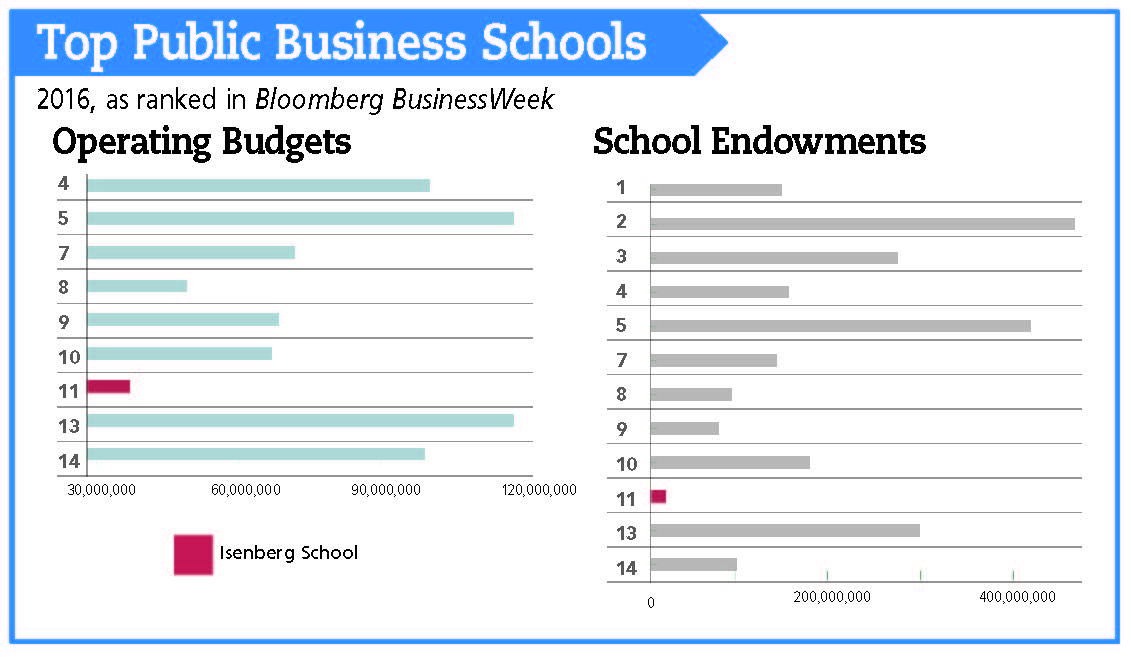
Continued upward movement is made still more challenging by two rankings where Isenberg lies at the very bottom of the chart, at least among the top public schools. These would be ‘operating budgets’ and ‘school endowments.’

Indeed, Isenberg has an operating budget of $38.2 million (less than one-quarter the total registered by the top-ranked public school, Indiana University’s Kelley School), and an endowment of just over $31 million, far less than one-tenth the figure at the University of Virginia’s Darden School, ranked second overall by BusinessWeek.

In many ways, how far UMass has come despite those statistics are serious points of pride, said Fuller, but those factors, and also the lowest total (70) of tenure-stream faculty among the top schools, will represent serious hurdles to moving higher.

“We like to say, affectionately, that we fight above our weight class,” he said while referring specifically to the operating budget and endowment rankings. “But we also know that you can’t continue to do that, so we’re trying to get our alumni to help us figure out how to grow this operating budget.”

Elaborating, he said that financial gifts from alums are not the only way to enlarge the budget. Others include corporate gifts, grants, and foundation support, and alumni can assist with all of the above.

Overall, to move still higher in the rankings, Fuller and his team will have to build what amounts to a bigger, even more effective perpetual-motion machine, and continue their focus on execution.

To elaborate, he moved to the whiteboard in the conference room and drew a rudimentary schematic, in the form of a circle with the word ‘reputation’ in the middle, and references to the three elements that drive it — programs, infrastructure, and image — and the need to focus on all three.

Image, as noted earlier, is a measure of how others perceive your school, and includes everything from the many regional and regional rankings to efforts to tell the story. Programs, meanwhile, as mentioned, include everything from curricular initiatives to professional-development tools. And infrastructure is a broad term used to describe everything from facilities to the faculty, and it is perhaps the biggest area of need going forward.

The construction project going on outside Fuller’s window is a prime example of infrastructure work, he noted, adding that, with rising enrollment, Isenberg had no choice but to expand its footprint in order to provide the highest-quality education.

“We need the facilities that will allow us to hire the faculty to drive the quality of the program,” he explained, “because I can’t grow anymore, either in quality or the number of students we teach, without expanding our infrastructure.”

Another element of infrastructure is the faculty, he said, noting that the school needs to grow its endowment so it can add more endowed chairs and teaching positions and thus enhance recruitment efforts in that realm.

“The big hurdle for us to move into the top rung of the rankings is to continue to build this infrastructure of resources that will enable us to compete,” he said, drawing another analogy to college sports, this time to the elaborate training facilities needed to recruit top players and coaches to athletic programs.

Off-the-charts Improvement

When asked if there was an accepted road map for public business schools to follow to attain growth and reputational capital, Fuller said ‘no,’ but also that this is another question that those other deans put to him.

Specifically, they want to know the route Isenberg followed to become number 1 in the Northeast and reach a status just outside the top 10 nationally.

He tells them it’s a well-marked route, but the key isn’t knowing the directions; it’s in executing them properly.

That’s how a business school gets where it wants to go.

George O’Brien can be reached at [email protected]

Education Sections

Joining the Fight

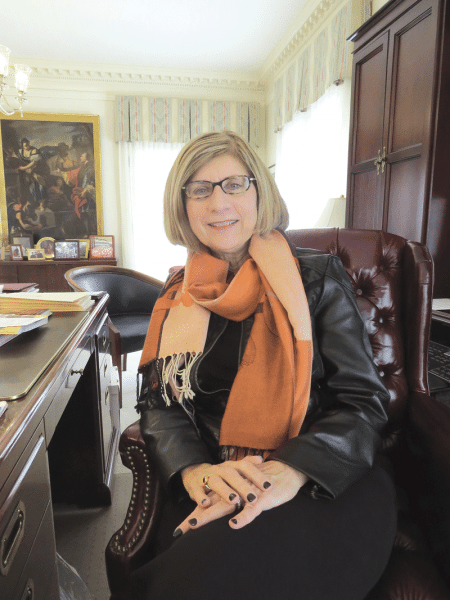
Carol Leary

Carol Leary says women can, and must, play a lead role in efforts to stem violent extremism.

At first, Carol Leary thought the e-mail she received in September was spam, and was wondering why it didn’t go into that particular folder.

It was from the Department of Homeland Security (DHS), she said, and was essentially an inquiry, with the sender alerting Leary, the long-time president of Bay Path University in Longmeadow, that she had been nominated for a position on the Homeland Security Academic Advisory Council, or HSAAC, and asking if she was interested in learning more and possibly serving.

This was an acronym that Leary admits she had never heard of — “I didn’t know this panel existed” — but now rattles off with great frequency and ease.

Indeed, after determining that the e-mail was, in fact, legitimate, and not junk or, worse, a virus spreader, Le ary did apply for that panel — because she immediately grasped the importance of its broad mission and the fact that sitting on it would be a great honor not only for her, but the school she’s led since 1994.

She was chosen to join seven others as the latest members of a panel that is essentially parked at the intersection of academia and DHS, which is becoming an ever-more-important spot on the map.

Through its six subcommittees, the HSAAC focuses on such matters as campus resilience, cybersecurity, international students, homeland-security academic programs, academic research and faculty exchange, and student and recent-graduate recruitment, and that list of assignments certainly helps explain why Leary received that e-mail mentioned earlier.

Indeed, Bay Path has put itself at the forefront of such issues and concerns, said Leary, through both graduate and undergraduate degree programs in cybersecurity and specific courses such as “An Introduction to Terrorism and Counterterrorism” and “The Path to Violent Extremism,” both offered by the American Women’s College and the One Day Program at Bay Path.

“I think these programs are what really attracted Homeland Security,” she told BusinessWest, “because the newest area they will focus on is countering violent extremism, and when they saw we had classes taught by someone with a great reputation in Great Britain on this subject, they knew we had an expert.”

That would be Bob Milton. He’s the retired commander of the London Metropolitan Police Service, New Scotland Yard; director of his own consulting company that specializes in counterterrorism consulting; and, as noted, professor of Criminal Justice and lead faculty for Counterterrorism at Bay Path.

He blueprinted many of the courses at the college, including the two mentioned above, and recently delivered a talk at the school, as part of its Kaleidoscope series, called “Countering Terrorism: The New Role of Women.”

This is a subject of particular interest to Leary — and the rest of the HSAAC, for that matter — because it represents an important, but far from fully tapped resource in the battle to identify and possibly defuse developing violent extremism.

“As we know, in our own country we have young people being radicalized,” she told BusinessWest. “Mothers are probably going to be the first to recognize this. The question then becomes, how do we reach women, not only in all communities, but particularly Muslim communities across our world, probably woman to woman? I think this is going to be a very important role for women to play in the field of countering extreme violence.

As we know, in our own country we have young people being radicalized. Mothers are probably going to be the first to recognize this.”

“We need to give them the tools, the techniques, and the impetus to do this,” she went on. “We need to show them they will be helping our country and helping the families in which students are being radicalized.”

Milton agrees. “You could say that the biggest threat to the U.S. is coming from within; the last few attacks have both come from within,” he said, citing incidents in Florida and California. “We need to put much more effort into identifying those people who are becoming radicalized and then putting in place measures to try and carry out intervention. And women can play a big role in this.”

For this issue, BusinessWest looks at Leary’s appointment to the Homeland Security panel, but also the developments that led to it — specifically the school’s rise to prominence in this field — and the many issues involved with combating violent extremism.

Front of Mind

As he talked about the many issues involved with countering radicalism and the importance of doing so on many levels, Milton recited a statement issued by members of the Provisional Irish Republican Army after it executed a nearly successful attempt on the life of then-British Prime Minister Margaret Thatcher in 1984 at the Grand Hotel in Brighton.

“It said, ‘you need to be lucky all the time — we only need to be lucky once,’” he recalled, adding that the note was received after Thatcher narrowly escaped the blast of a long-delay time bomb that left a gaping hole in the façade of the hotel. (Five others were killed in the attack, and 31 were injured).

Milton told BusinessWest that he recites that IRA message often in the talks and lectures that he gives in cities around the world, and probably not in the context that most people might think. Instead of agreeing with the gist of the missive, he says its thinking is inherently flawed.

To get his point across, he summons a quote often attributed to golfing legend Gary Player, among others, which goes something like, “the more I practice, the luckier I become.”

Whatever the exact quote is, and regardless of who actually said it, the message is clear, said Milton: the harder individuals, groups, and countries work to counter terrorism and violent radicalism, the more successful they will be.

This, in essence, goes a long way toward explaining the existence (and the mission) of not only the DHS, but the HSAAC as well — which is, in part, to practice hard at the work of recognizing and stemming radicalization.

“We need to work harder so we’re lucky,” said Milton, adding that this work constitutes a large, complex fight, started long ago and now waged on many fronts and in many ways. And it focuses on everything from working with, rather than isolating, underprivileged communities, to teaching others how to spot the many warning signs of someone being radicalized.

Milton said these include changes in behavior, being secretive, excessive amounts of time spent on the Internet, acquiring new friends, disappearing for long periods of time, and becoming angry, frustrated, even passionate about things they see on the news.

But spotting the signs is only part of the equation, he went on, adding that people, and especially mothers, need to know what to do when they see those signs.

Bob Milton

Bob Milton says individuals, agencies, and nations need to work hard to counter radicalization and essentially make their own luck.

“It’s my experience that it’s the families, and the women in the families, who are more likely to see the signs of radicalization earlier than anyone else,” he explained. “There have been so many cases in the U.K., particularly, where young women or men have become radicalized, and in some cases have gone off to fight and die in Syria, and yet their families — and particularly the women in those families — knew there was something going on and had nowhere to go.”

In short, he went on, women — especially those who are, for some reason, be it language issues or something else, isolated within their community — need to become less isolated and, therefore, more empowered to effectively deal with these situations.

And women, as noted, can play a huge role in this effort, said Leary, who, as she talked about this, drew an effective, even poetic analogy to the work carried out by women at Bletchley Park, the headquarters for Britain’s fabled code breakers during World War II, immortalized in countless books, TV series, and movies such as the recent The Imitation Game.
“The word we would use for it today is cybersecurity,” she said of those efforts to break the codes enciphered on Germany’s Enigma machines. “All the men were off fighting the war; it was the women trying to decode messages sent all across Europe. Fast-forward 70 years, and it’s clear that we again need more women in this field.”

Bay Path is certainly doing its part in this effort, she went on, adding that roughly 80 students are enrolled in its cybersecurity programs, and the number is growing every year.

The master’s-degree program in cybersecurity management graduated its first class in 2014, and there are now 30 (17 of which are women) currently enrolled in that program. Meanwhile, there are 50 students (almost all of them women) enrolled in the undergraduate program, which features concentrations in digital forensics and information assurance.

As noted earlier, though, the role to be played by women moving forward is multi-faceted and goes much deeper than taking jobs in this growing field. It entails work within and for the community to intervene and hopefully prevent individuals from resorting to violence in support of a cause or faith.

Getting the Message

Leary, named by BusinessWest as one of its Difference Makers for 2016 for her work at the college and in the community, acknowledged that she had more than enough to keep her busy before that e-mail arrived in September.

And while she has, indeed, learned to say ‘no’ over the years due to the sheer volume of requests she receives to donate her time, energy, and talent to a group or cause, that word never entered her mind when the DHS enlisted her help.

That’s because the group’s mission is so important, and also because Bay Path has made major investments — and major strides — toward become a recognized leader in cybersecurity and related programs.

And those investments can and will yield dividends at this critical juncture for the country — and the world.

George O’Brien can be reached at [email protected]

Education Sections

Closing the Gap

Arlene Rodriguez

Arlene Rodriguez says the $3.4 million federal grant that STCC received will help Hispanic and low-income students obtain degrees in science, technology, engineering, and math.

Arlene Rodriguez says people who apply for a grant of any type need to have a compelling story about why the money is important.

The vice president of Academic Affairs at Springfield Technical Community College (STCC) knows developing the story is something that takes time, energy, dedication, and great attention to detail, which are all elements that were incorporated into a recent grant application the college submitted to the U.S. Department of Education.

The year of work that went into its preparation was well worth it, however, as the story met with unparallelled success: STCC was recently awarded one of the largest awards in its history: a five-year, $3.4 million grant for the program called the Hispanic and Low-income Transformed Education in STEM (HiLITES) Project.

It’s aimed at helping students attain degrees in STEM (science, technology, engineering, and math) classes and programs, and although STCC is the only community college in Massachusetts to win this award, Rodriguez says it’s appropriate due to the school’s demographics. To be eligible to receive the grant, a college must be designated as a Hispanic-Serving Institution, which is attained when at least 25% of the total student population is Hispanic.

STCC’s Hispanic population is 27.6%; it has been designated a Hispanic-Serving Institution since 2013; and 56% of its students receive federal Pell grants, which are limited to students with financial need.

“This grant was very competitive, and it took all I had not to jump up and down when I heard that we were given exactly what we asked for,” Rodriguez said. “It will give us an opportunity to make significant changes proposed by faculty and students who identified obstacles to success in STEM courses during interviews that took place before we applied for the grant. People were very honest about what stopped them from continuing in these programs, and faculty talked about where they see students struggle and what we need to change,” she continued. “It was a collaborative effort that was student-oriented; we are determined to make changes to improve students’ lives, and one of our goals is to increase the number of students in STEM disciplines.”

Indeed, it’s critical for local students as well as the economy; a report commissioned by Raytheon says a workforce prepared to tackle science is needed to drive future growth and innovation, and 67% of manufacturers are experiencing a shortage of qualified employees.

In addition, the U.S. Bureau of Labor estimates that 8,654,000 STEM-related jobs will exist in 2018, not including self-employed STEM individuals, and although the national average wage is $42,979, those with a STEM degree earn about $78,000.

STCC has more than a dozen STEM programs that range from architectural and building technology to computer-aided drafting, CNC operations, electrical engineering technology, and HVAC (heating, ventilation, and air conditioning), and many are not found in other community colleges across the state. But right now, only 14% of its Hispanic students and 11% of its low-income students enroll in STEM courses, and those who do need support to be successful.

This grant was very competitive, and it took all I had not to jump up and down when I heard that we were given exactly what we asked for.”

“There is a disconnect between Hispanic students and students with Pell grants when it comes to jobs that are available, and we want to bridge that gap,” said Rodriguez. “Our end goal is to prepare students for positions that are going unfilled, and this grant will allow us to provide them with the support they need to make a better life for themselves and provide for their families.”

She noted that the majority of Hispanic and low-income students enter college needing help in math and have lower rates of retention and graduation. “Students who are Hispanic and low-income perform worse on all three measures than students who are only Hispanic or low-income,” she told BusinessWest.

STCC President John Cook agreed. “We’re open-eyed about student needs, and this grant will help us address complex challenges. We look forward to building diversity across our unique array of STEM programs, and this is a chance to both expand initiatives while also trying new and creative approaches,” he said.

Multi-faceted Program

The grant money will be used to provide a wide spectrum of programs and services over a five-year period that will kick off in the spring. One of the new initiatives will introduce students in middle and high schools to STEM careers they may not know about in fields that include precision manufacturing, information technology, and HVAC, as there are job vacancies in these areas that pay well.

STCC’s plan is to bring the students to campus, introduce them to the faculty, show them the machines they will work on if they enter these programs, and educate them about careers associated with STEM degrees and the type of work they would perform on a daily basis.

“A student may not know these courses are available, or think they couldn’t succeed in them because they require a lot of math. But we have fantastic teachers who are able to teach these subjects in creative ways that make it easy to learn, and our faculty wants to make sure that our students succeed,” Rodriguez said, noting that, in some cases, students with an associate’s degree can earn $50,000 to $60,000 after graduation, and many have job offers before they matriculate.

There is also a plan to work with local high schools and expand the dual-enrollment system that allows students to go to the STCC campus and take courses before they receive their high-school diploma, as well as to expand programs with four-year colleges and improve the transfer rate by creating a seamless transition.

Assessments are conducted of a student’s math and English skills when they enter STCC, which is important because Rodriguez says many students are not ready for college-level math and need to take a series of courses to get them up to speed, which is a national problem at the majority of community colleges.

“The average age of our students is 26, and taking extra courses can be frustrating; they may have families or part-time jobs, so there is a sense of urgency to graduate,” she said, adding that many have GEDs, and even those who did well in high school may need to regain math skills after spending years away from the classroom.

“The grant will allow STCC to provide these students with enough support to take math and science courses without prolonging the time it takes them to graduate,” she continued, explaining that this may mean redesigning some STEM courses, offering additional tutoring, and providing more professional-development opportunities for instructors.

Students who are part-time and have not yet selected a major will also be exposed to STEM courses and careers through demonstrations, guest lectures, and other avenues.

In addition, two STEM advisers will be hired to conduct outreach and help students interested in STEM careers transition into the progams, and a STEM Center will be created as a centralized location for presentations, group study, tutoring, and faculty work. Rodriguez noted that the STEM Center will likely be located in space that will be vacated when the new Learning Commons is completed in 2018.

Change Agent

A 2013 report by the Commonwealth that addressed the skills gap says pipelines are powerful tools because they address both sides of the issue by giving people in the workforce the skills they need while responding to the changing nature of what employers are seeking from their workers.

The grant will help to strengthen the local pipeline, and since STCC graduates live locally, are committed to the community, and usually stay in the area, the grant is a win-win situation, Rodriguez said.

“Community colleges are the front lines of workforce education, and we can respond to employers’ needs in a way that four-year schools may not be able to,” she noted. “The essence of this institution has remained unchanged for the past 50 years, and it has helped to produce leaders in business, government, and education in various professions that benefit the community. Our college continues to be an engine of economic opportunity and development for the region.”

Indeed, it’s an ongoing story, and this chapter should have a happy ending as students are given the support they need to enter careers that pay well and local employers see an increase in qualified candidates to fill jobs, which will allow their companies to grow and thrive in a changing economy.

Holiday Gift Guide Sections

Green Expectations

Nicole Sweeney

Nicole Sweeney says new offerings like Gifted Tones Paint and Music Lounge will keep shoppers engaged during holiday-season visits to Eastfield Mall.

Carolyn Edwards is surrounded by dozens of stores on a daily basis, so she tends to do her holiday shopping late in December.

But this year, she purchased two Christmas gifts in mid-October and joined the growing ranks of consumers on an early quest to find the perfect gift for everyone on their list.

“It’s not something I normally do, but sales inspired me to start shopping early,” said the general manager of Lee Premium Outlets.

Tempting gift items also spurred Nicole Sweeney to start shopping well in advance of Christmas, and by Halloween she had a pile of holiday gifts sitting on her desk.

“I don’t wait until Black Friday to shop, but I have never done it this early before,” said the marketing manager at Eastfield Mall in Springfield, noting that purchasing things over a period of several months helps to mitigate the sticker shock that many people face at Christmas.

National surveys show that two in 10 shoppers began their annual quest for the perfect present in early October, and big-box stores put Halloween and Christmas decorations and merchandise on display at about the same time.

“Black Friday preview sales were started early to get people’s appetites going for the holiday spending that leads up to the day after Thanksgiving [Black Friday]. But that day is not like it used to be,” Sweeney said.

Indeed, retailers have already begun to cash in on the final quarter of the year, and the forecast for the season is green. The International Council of Shopping Centers has predicted a 3.5% increase in holiday shopping at brick-and-mortar stores, compared to the 2.2% gain last year; the National Retail Foundation (NRF) expects retail sales in November and December (excluding autos, gas, and restaurants) to increase a solid 3.6% to $655.8 billion; and Deloitte predicts holiday spending to increase between 3.6% and 4% from November through January, topping $1 trillion.

Although online shopping is on the rise and cuts into the pockets of mom-and-pop operations that don’t have websites with free shipping, PwC’s 2016 Retail and Consumer Holiday Outlook survey notes that almost 75% of consumers plan to shop locally, 56% will seek independent retailers, and consumers with annual household incomes less than $50,000 will increase their spending more than consumers overall.


List of Companies Offering Corporate Gifts


In addition, more people will have cash to spend because retailers have hired, or are planning to hire, between 640,000 and 690,000 seasonal workers, in line with last year’s 675,300 holiday positions.

Gifts are expected to run the gamut from toys to clothing, and high-tech items such as tablets, phones, and gaming devices are expected to be popular, but many people will choose their own presents after the holidays, because gift cards are expected to make up 32% of purchases.

“The stores had their holiday décor in place by the end of October, and the day after Halloween, we went into the holiday season full force,” Edwards said, echoing other retail spokespeople who said Christmas music began playing Nov. 1 and the sound of cash registers humming added to the spirit of the shopping season.

New Attractions

Lisa Wray says the unofficial kickoff for the holiday season at Holyoke Mall was Veterans Day weekend.

“Santa arrived Nov. 12 in a fire truck escorted by the Holyoke Fire Department, and we were ready for the people here to do their holiday shopping,” said the marketing director for Holyoke and Hampshire malls.

Lisa Wray

Lisa Wray says Holyoke Mall’s holiday sales should be in line with national projections, but foot traffic should get a boost from several new stores.

She expects sales to be in line with the NRF’s predictions, but expects foot traffic to get a boost, because Holyoke Mall has added eight new stores in the last seven months.

They include Zales Jewelers, a cell-phone accessory and repair shop called Shatter and Case, a women’s plus-size clothing store called Torrid, a newly remodeled Bath & Body Works and White Barn Candle, a Touch of Beauty Nails & Spa, Sprint, CilantroMex restaurant, and Billy Beez, an indoor play park with a jungle theme featuring fun that ranges from bouncing to jumping, sliding, climbing, and more.

Although people will not be camping out on Black Friday like they did years ago, Wray said, it’s still a significant day at Holyoke Mall; many large retailers will open their doors at 12:01 a.m. and people will be lined up to take advantage of promotions.

“Stores like Target, Sears, and Best Buy will all have doorbuster sales that are still a big draw,” said Wray, adding that Holyoke and Hampshire malls will open at 7 a.m.

All of this year’s holiday carts and kiosks at Eastfield Mall were in place Nov. 1, but Black Friday is not as big as it used to be, Sweeney told BusinessWest, adding that Eastfield also has new stores and venues, including a Bounce! Indoor Inflatable Park that opened earlier this fall and is already attracting families.

“My instinct is that places that offer experiences will have an edge this year, because that allows people to wrap in something festive with their shopping,” she said, explaining that parents can combine a trip to Bounce! and shopping in one visit; people can shop, then listen to live music at Donovan’s Pub or take in a movie before and after making purchases.

“Foot traffic is important because we have a lot of mom-and-pop stores. It’s getting easier and faster to shop online, so it’s become very competitive, but one-day preview sales generate a lot of excitement because they offer really good deals in advance of Black Friday,” Sweeney noted, explaining that special promotions will continue throughout the season to accommodate those who shop early, late, and anytime in between.

Other new ventures at Eastfield Mall include V-Stream Dreams, a store that sells an alternative to a TV cable box that allows people to get a multitude of channels with minimal or no lag time; and Gifted Tones Paint and Music Lounge, an art store where people can learn to paint alone or with friends.

Lee Premium Outlets also has new stores, including Kay Jewelers, Guess, a Toys R Us Express, and 10,000 Villages, which will be open only during the holiday season.

“Outlet centers are driven by promotions, and the stores here are offering really good sales. They are difficult to pass up, and folks are already taking advantage of them; they aren’t waiting for the snow to fly or for the week of Thanksgiving to get started on their shopping,” Edwards said, noting that handbags and accessories are always popular, and Michael Kors and Coach are good places to find these gifts.

She added that sales will be heavily promoted, and the right price point will inspire people to make purchases, which often include gifts for themselves.

Positive Signs

The fourth quarter of the year is a critical time for retailers, an obvious point that still needs to be stressed.

“The holiday season is so important to them that they can’t let a day go to waste,” Sweeney said.

Holyoke Mall expects to meet expectations forecast by the NRF and other retail groups, and the forecast is equally bright at Lee Premium Outlets.

“All of the early indicators this year are that we will meet or exceed last year’s sales. The numbers should come in for us,” Thomas said.

Which will indeed bring joy to local retailers who hope the sound of cash registers processing sales will continue to ring in a very merry Christmas.

Holiday Gift Guide Sections

Perfect Presents

giftgivingartThe holiday season will soon be upon us, and choosing a gift for a business professional or customer that will make their life easier or provide a bright spot in their day can be a daunting, but ultimately satisfying, task.

Some want to keep pace with the latest technology, others appreciate anything that can provide them with comfort or add pleasure to their work day, while still others appreciate whimsy or a gift they can enjoy themselves or with others when their day is done.

BusinessWest has done its best to make your shopping easier by presenting ideas in a variety of price ranges sure to please a co-worker, frequent flyer, or anyone who spends a good deal of their life in the office. Some items can be found locally and support small businesses, while others are carried at a range of stores.

If none of these seems quite right, a gift certificate to an area store, restaurant, or theater venue is sure to be appreciated. And, last but not least, consider a gift to a charitable organization you know the person cares about and supports.

Prosperity Candle

Candles can make a scent-sational gift, and a small group of socially responsible female entrepreneurs at Prosperity Candle in Easthampton has a wide range of offerings designed to brighten things for everyone on your list.

Their candles are handmade to order with soy-blend wax, essential oils, and natural cotton and wood wicks, and can be purchased individually or in a gift box that contains local products.

Try Pioneer Valley Gift Box #1 with maple syrup from Florence and a candle scented with a blend of tobacco leaves, aged cedar, and a touch of spice ($34 at www.prosperitycandle.com).

Fitbit 2 Heart Rate and Fitness Band

fitbit-charge-2Many people make an annual New Year’s resolution to exercise more, and a Fitbit 2 Heart Rate and Fitness Band may be the ideal gift to help goal-oriented professionals meet with success.

The device contains a multitude of features that range from call, text, and calendar notifications to “Reminders to Move” that encourage wearers to take 250 steps every hour, and tracks steps taken, distance, calories burned, floors climbed, active minutes of exercise, and hourly activity, as well as how long and how well you sleep. The battery lasts up to five days without being recharged. Starts at $149.

Tre Olive Gift Box

tre1Anyone who likes to cook or enjoys a good salad will appreciate a gift of extra-virgin olive oil grown by members of the Falvo family in the Calabria region of Southern Italy. Tre Olive in East Longmeadow has individual bottles starting at $9.99, balsamic vinegars and spreads, beautiful gift boxed tins starting at $19.99, and olive-oil soaps flavored with lemongrass, fig, and other intriguing combinations.

There is also the ultimate gift: adopt an olive tree for a year, receive a photo of it, and look forward to the spring when its olives are pressed and you or your gift recipient will be sent some of the freshest oil imaginable. At www.treolive.com.

Nokia Treasure Tag

People who travel frequently often fear losing their laptop, luggage, and other necessary items. But this little tag with a standard watch battery life of six months can prevent that: it connects to smartphones that use Bluetooth 4, and if the traveler forgets an item, the tag beams. In addition, it allows you to search for missing items. Cost: $30.

Tea Guys

Many business professionals drink coffee throughout the day, but if you introduce them to award-winning tea brewed in small batches, they may thank you for years to come.

Tea Guys in Whately offers every type of tea imaginable with highly unusual blends and flavors such as chocolate raspberry and candied lemon. A box, gift package, or gift certificate is sure to soothe. At www.teaguys.com.

Natico Decision Maker and Paperweight

natico-decsion-makerBusiness involves daily decisions, but sometimes it’s not clear what to do. In these cases, it’s simple to alleviate stress — or just have a moment of fun — by pressing the button in the middle of the Natico decision maker and paperweight.

A solution will appear when it is done spinning, and your reaction may help determine what course to take. The paperweight can also serve as a conversation piece when someone enters your office. Cost: $17.50.

Herman Miller Aeron Desk Chair

aeron-chair_1Comfort is priceless, and spending hours behind a desk can lead to chronic back pain, but Herman Miller offers an almost foolproof solution with its classic Aeron desk chair.

The most well-known ergonomic office chair on the market incorporates the latest research around the science of sitting; fabric and foam are replaced with a breathable, woven suspension membrane, and ergonomic engineering allows the person’s weight to be distributed evenly to eliminate pressure points and heat buildup.

The chair reclines, and its PostureFit feature provides support at the base of the spine, where it is needed. Models start at $679 at Lexington Group Inc. in West Springfield.

Share Coffee Roasters

share-coffeeThere’s nothing to brighten up a day like getting a gift at work, and coffee lovers will be thrilled to find a delivery of freshly roasted gourmet coffee sent to them weekly by Share Coffee Roasters in Hadley. The first bag is free, and after that, weekly packages are sent for the length of time you choose and come in 6-, 12-, or 18-ounce packages.

The coffee is roasted and shipped the same day and is similar to fine wine, as it contains a medley of tastes. For example, Guatemalean Los Dos Socios has hints of dark chocolate, juicy citrus fruits, and praline. Prices start at $13 at www.sharecoffeeroasters.com.

Dragon Professional Individual, v15

dragon-professionalIf you know a small-business owner or executive who doesn’t have a secretary or complains frequently about carpal-tunnel pain, Dragon Professional Individual v15 voice-recognition software may usher in tidings of great joy. It can transcribe dictation or an audio interview three times faster than typing, and the person never needs to use their hands. In addition, simple voice commands can be used to edit documents or change formatting with up to 98% accuracy. Cost: $300.

Frigo Gourmet Foods Gift Basket

frigosbasket2016Food is always a welcome gift, and a gift basket from Frigo Gourmet Foods in Springfield can be shared at the office, taken to a party, or enjoyed at home. They come in a wide array of prices and styles, but their Old World Italian gift basket is sure to be a hit, with its irresistible mix of seasonal products such as panettone, amarettini cookies, biscotti, torreones, asiago, fontina, parmesan, provolone, salami, pepperoni, and casaling or sopressata meats. Cost: $125 at www.frigofoods.com.

Bose QuietComfort 35 Headphones

bose-headphonesHave a frequent flyer on your list? Someone who has trouble concentrating in a noisy workplace, or whose performance soars when listening to music their co-workers might not appreciate? Bose QuietComfort 35 headphones might suit their needs as they combine Bluetooth connectivity with the latest in noise-canceling technology, take a mere 15 minutes to charge, and have an unmatched battery life of 20 hours with a free app that makes switching between devices easy. Cost: $349.

Black Birch Vineyard

This family-owned Southampton vineyard offers award-winning wines created by hand in small, individually numbered batches. Choose from reisling, chardonnay, epic white, pinot noir, cabernet blanc, and more at $16 and up, or a beautiful gift basket that contains a bottle of wine, two glasses, and a wine-tasting gift certificate for two. Basket: $45 at www.blackbirchvineyards.com.

Clear Bubble Paperweight

paperweightThis clear bubble paperweight by the Museum Store at Wheaton Arts is handmade, so the color and size may vary if you purchase more than one, but it’s an unusual gift that is practical, decorative, and comes with a story card. Cost: $34 at www.wheatonarts.org.

Laurel Mountain Basket Co. Inc.

laurel-mountain-gift-basketThis Easthampton company creates unique gourmet gift baskets and believes that giving a gift basket “shouldn’t make you a basket case.”

Each basket is made when the order is placed, so give them a call at (413) 527-1243 to talk about their kosher, gluten-free, and specialty New England gift baskets overflowing with products that can be designed to suit every budget and palate. Visit www.laurelmtbasket.com.

Wireless Weather Station

People who love to know what it’s doing outside will delight in a desktop wireless weather station. Many models are available and range in price from about $50 to more than $500.

The AcuRite 01036 Pro Weather Station with PC Connect, 5-in-1 Weather Sensor, and My AcuRite Remote Monitoring App has great ratings; accurately measures the temperature, humidity, wind speed, wind direction, and rain; and allows you to set up programmable weather alarms as well as e-mail and text alerts to notify you when conditions change or your presets are reached. Cost: $125.

Accounting and Tax Planning Sections

Dollars-and-sense Fundamentals

By Kristina Drzal-Houghton, CPA MST

dolarssensetaxdpartTax planning can be a guessing game, especially in a year when new leadership in Washington could make significant changes to the tax code. But there are a number of basic strategies that businesses and individuals may put in play as year end approaches.

Tax planning for 2016 is significantly different than in recent years.

In late 2015, many tax provisions were made permanent, thus appearing to remove the many uncertainties that made tax planning much more of a guessing game in the past. This tax-planning article generally is oriented toward the time-honored approach of deferring income and accelerating deductions to minimize 2016 taxes.

Kristina Drzal-Houghton

Kristina Drzal-Houghton

Given that this is an election year, consideration should be given to the possibility of the new administration making changes to the tax code. Contrary to traditional thinking, in specific situations, you may decide it is most beneficial to pay more taxes now.

For individuals, deferring income also may help minimize or avoid AGI-based phaseouts of various tax breaks. Businesses, like individuals, should decide when and how to shift income and deductions between 2016 and 2017. Although C corporations will generally benefit from the deferral of income and the acceleration of deductions in the same way as individuals and pass-though entities, there are a number of special rules that should be taken into account.

Year-end tax planning for 2016 must take account of the many temporary ‘extender’ tax provisions still in the code. Extender provisions are business tax deductions, tax credits, and other tax-saving laws which have been on the books for years but which technically are temporary because they have a specific end date.

The majority of these extenders are in effect through 2016, presenting an opportunity to take advantage of them before year’s end when their continued renewal may be uncertain. However, some of these extender provisions are in effect through 2019. And, in a radical change from prior years, many of what were traditionally the most important extender provisions have been made permanent, allowing the opportunity for long-term planning in many cases. Most importantly, there are a number of these extender and other provisions that have been modified in various ways by late 2015 legislation that the taxpayer should be alert to.

Business Planning

Corporate rate planning. A C corporation is subject to the 39% ‘bubble.’ Corporate taxable income between $100,000 and $335,000 is taxed at the rate of 39% to phase out the benefits of the 15% and 25% brackets that apply to a corporation’s first $75,000 of taxable income.

Taxable income between $75,000 and $100,000, and between $335,000 and $10 million, is taxed at 34%. Taxable income over $10 million is taxed at 35%, except that there is also a 38% bubble that applies to corporate taxable income between $15 million and $18,333,333 to eliminate the benefit of the 34% rate.


List of Accounting Firms in Western Mass.


Many small C-corporation businesses utilize year-end bonus planning to maximize the benefit of the lower tax brackets. This can be a real balancing act with many items to consider, including the additional cost of Social Security and Medicare taxes, timing of the bonus payment to owners, and IRS rules on excessive compensation. When doing this planning, you must be careful to not run afoul of any bank-loan covenants.

Qualifying for the small-corporation AMT exception. The tentative minimum tax of a corporation is zero for any tax year that it qualifies as a small corporation meeting a ‘gross receipts test.’ A corporation will qualify if:

• The corporation’s average annual gross receipts for all three-tax-year periods beginning after Dec. 31, 1993 and ending before the tax year do not exceed $7.5 million; and

• The corporation’s average gross receipts do not exceed $5 million for the corporation’s first three-tax-year period taken into account above.

Thus, a corporation should consider deferring income to 2017 if necessary to keep average annual gross receipts for the three-tax-year period 2014 through 2016 at $7.5 million or less. This will preserve the AMT exemption for 2017.

Expensing deductions. Businesses that want to accelerate year-end deductions by buying machinery and equipment have a formidable array of tax tools to work with this year: generous expensing under Code Sec. 179, an expensing safe harbor under the capitalization regulations that has been liberalized for smaller businesses, and 50% bonus first-year depreciation for those eligible new assets that can’t be expensed under Code Sec. 179 or the regs’ safe harbor.

For qualified property placed in service in tax years beginning in 2016, the maximum amount that may be expensed under the Code Sec. 179 dollar limitation is $500,000, and the beginning-of-phaseout amount is $2,010,000. Besides taking advantage of the Code Sec. 179 rules, some businesses may be able to buy much-needed machinery and equipment at year-end and currently deduct the cost under a ‘de minimis’ safe-harbor election in the capitalization regs.

First-year depreciation deduction. Most new machinery and equipment bought and placed in service in 2016 qualifies for the 50% bonus first-year depreciation deduction. Bonus first-year depreciation has been extended through 2019 with a number of modifications, including a gradual reduction over that time (50% for qualified property placed in service in 2015 through 2017, 40% for 2018, and 30% for 2019).

Deduction for qualified production activities income. Taxpayers can claim a deduction, subject to limits, for 9% of the lesser of (1) the taxpayer’s ‘qualified production activities income’ for the tax year (i.e., net income from U.S. manufacturing, production or extraction activities, U.S. film production, U.S. construction activities, and U.S. engineering and architectural services), or (2) the taxpayer’s taxable income for that tax year (before taking this deduction into account). This deduction generally has the effect of a reduction in the taxpayer’s marginal rate and, thus, should be taken into account when making decisions regarding income-shifting strategies.

Net operating losses and debt-cancellation income. A business with a loss this year may be able to use that loss to generate cash in the form of a quick net-operating-loss-carryback refund. This type of refund may be of particular value to a financially troubled business that needs a fast cash transfusion to keep going. Also, a debtor who anticipates having the debt cancelled or reduced should consider steps to defer the resulting taxable income until 2017.

Accelerating or deferring income can save estimated tax requirements. Corporations (other than certain ‘large’ corporations, see below) can avoid being penalized for underpaying estimated taxes if they pay installments based on 100% of the tax shown on the return for the preceding year. Otherwise, they must pay estimated taxes based on 100% of the current year’s tax.

However, this 100%-of-last-year’s-tax safe harbor isn’t available unless the corporation filed a return for the preceding year that showed a liability for tax. A return showing a zero tax liability doesn’t satisfy this requirement; only a return that shows a positive tax liability for the preceding year makes the safe harbor available.

A corporation (other than a large corporation) that anticipates a small net operating loss (NOL) for 2016 and substantial net income in 2017 may find it worthwhile to accelerate just enough of its 2017 income (or to defer just enough of its 2016 deductions) to create a small amount of net income, and thus a small positive tax liability, for 2016. This will permit the corporation to base its 2017 estimated tax installments on the relatively small amount of tax shown on its 2016 return, rather than having to pay estimated taxes based on 100% of its much larger 2017 taxable income.

Also, by accelerating a small amount of income from 2017 to 2016, the corporation might be able to pay tax on that income at a lower rate — e.g., 15% instead of 25% or 34% — if doing so converts its 2016 NOL to a small amount of taxable income. However, where a 2016 NOL would result in a carryback that would eliminate tax in an earlier year, this income-acceleration strategy should be employed only if the value of the carryback is less than the value of having to pay only a small amount of estimated tax for 2017.

Individual Planning

Individuals who own pass-though entities such as S corporations, partnerships, or trusts should consider many of the above planning ideas in conjunction with provisions specifically applicable to the individual taxpayer.

Effective year-end tax planning also must take into account each taxpayer’s particular situation and planning goals, with the aim of minimizing taxes. For example, higher-income individuals must consider the effect of the 39.6% top tax bracket, the 20% tax rate on long-term capital gains and qualified dividends for taxpayers taxed at a rate of 39.6% on ordinary income, the phaseout of itemized deductions and personal exemptions when income is over specified thresholds, and the 3.8% surtax (Medicare contribution tax) on net investment income for taxpayers whose income exceeds specified thresholds.

While many taxpayers will come out ahead by following the traditional approach (deferring income and accelerating deductions), others, including those with special circumstances, should consider accelerating income and deferring deductions. Most traditional techniques for deferring income and accelerating expenses can be reversed to achieve the opposite effect.

For instance, a cash-method professional who wants to accelerate income can do so by speeding up his business’ billing and collection process instead of deferring income by slowing that process down. Or, a cash-method taxpayer who sells property in 2016 on the installment basis may realize a large long-term capital gain can accelerate income by electing out of the installment method.

Inflation adjustments to rate brackets, exemption amounts, etc. For both 2016 and 2017, some individuals will benefit from inflation adjustments in the thresholds for applying the income-tax rates, higher standard deduction amounts, and higher personal-exemption amounts.

Capital gains. Long-term capital gains are taxed at a rate of (a) 20% if they would be taxed at a rate of 39.6% if they were treated as ordinary income; (b) 15% if they would be taxed at above 15% but below 39.6% if they were treated as ordinary income; or (c) 0% if they would be taxed at a rate of 10% or 15% if they were treated as ordinary income. And the 3.8% surtax on net investment income may apply.

Strategies for matching capital gains and capital losses to make the most of these rules should be considered.

Low-taxed dividend income. Qualified dividend income is taxed at the same favorable tax rates that apply to long-term capital gains. Converting investment income taxable at regular rates into qualified dividend income can achieve tax savings and result in higher after-tax income. However, the 3.8% surtax on net investment income may apply.

Traditional IRA and Roth IRA year-end moves. One can convert traditional IRAs to Roth IRAs. And one can then ‘recharacterize’ (i.e., elect to treat a contribution made to one type of IRA as made to a different type of IRA) that conversion and can even, possibly, reconvert the recharacterized transaction.

Changes in an individual’s tax status may call for acceleration of income. Expected 2017 changes in an individual’s tax status, due, say, to divorce, marriage, or loss of head of household status, must be considered.

Alternative minimum tax (AMT). Watch out for the AMT, which applies to both individuals and many corporations. A decision to accelerate an expense or to defer an item of income to reduce taxable income for regular tax purposes may not save taxes if the taxpayer is subject to the AMT.

Time value of money. Any decision to save taxes by accelerating income must take into account the fact that this means paying taxes early and losing the use of money that could have been otherwise invested.

Obstacles to deferring taxable income. The code contains a number of rules that hinder the shifting of income and expenses. These include the passive activity loss rules, requirements that certain taxpayers use the accrual method, and limitations on the deduction of investment interest.

Charitable contributions. The timing of charitable contributions can have an important impact on year-end tax planning. Individual taxpayers who are at least 70½ years old can contribute to charities directly from their IRAs without having the amount of their contribution included in their gross income. By making this move, some taxpayers reduce their tax liability even more than they would have if they had received the distribution from their IRA and then contributed the amount distributed to charity. Some taxpayers, who could take advantage of this tax break for this year, should consider deferring until the end of the year their required minimum distributions (RMDs) for 2016.

Energy tax incentives. There are two different credits available for taxpayers who make qualifying energy-saving improvements to their homes. Tax credits are available for non-business energy property placed in service in 2016 (but not in 2017) and for residential, energy-efficient solar property placed in service before 2022 (but a gradual phaseout applies).

Bottom Line

Since tax planning can be vastly different from entity to entity or individual to individual, there is no standard checklist or formula that can be followed. Sometimes the benefits enjoyed today may not outweigh their effect on the future.  This is why careful consideration — in conjunction with your tax adviser — should be given to customizing your strategy.

Kristina Drzal-Houghton, CPA MST is the partner in charge of Taxation at Holyoke-based Meyers Brothers Kalicka, P.C.; (413) 536-8510.

Features

Course of Action

Tim Van Epps

Tim Van Epps, seen here with the famous wooden fox positioned near the clubhouse, says the Sandri companies are “all in on golf.”

Tim Van Epps calls it the “race to the bottom.”

That was he was colorful way of describing the sum of what’s happening in the golfing industry, at least the public-access side of the equation. And maybe the private side, too.

Elaborating, he said that, in the face of a host of factors that have negatively impacted the golf business — everything from lingering effects from the recession to declining interest among younger generations to oversaturation of this region with courses — owners and operators have responded with gimmicks, special rates, and an inclination to cut corners, defer maintenance, and, in the process, jeopardize quality until fiscal conditions improve.

“It’s a tough industry now,” said Van Epps, president and CEO for the Sandri Companies, which has a number of business divisions, including golf. “During the boom days, the late ’90s and early 2000s, if you opened a course, people would come. It’s not like that now. You saw thousands of courses open across the country, flooding the market with opportunities for people to play. And then, the market crashed, and now you’re seeing more courses close in a year than new ones open. And most courses are just trying to get by.”

But Sandri is taking a much different approach to these challenging times. Indeed, rather than hunker down and join others in that race to the bottom, Sandri is going to make significant investments in its Crumpin-Fox layout in Bernardston, and instead commence a race to the top.

That would be the top of the list of golf courses in this region, he said, noting that there are, in fact, several such compilations, and the one he’s most interested in is Golf Digest’s list of the best courses in Massachusetts that anyone can play. (Private clubs are, by their very nature, courses that only members can play.)

To that end, the semi-private club is commencing what will likely be north of $5 million in improvements, everything from dramatic, yet strategic, thinning and clearing of the trees that line most fairways, to paving of the cart paths; from a new pavilion at the 19th hole (a.k.a.) Zeke’s Bar & Grill, to renovation of the bunkers; from a huge facelift for the practice area, to some aggressive pricing programs.

The immediate goal of all this work is to make the course more accessible, playable, and enjoyable, said John (Boo) Jackson, director of Golf for Sandri, who said all these initiatives come together in something the company is calling a ‘grow-the-game campaign.’

“We’re trying to get some younger faces out here,” he said, zeroing in one of the biggest challenges facing course owners today, “and infuse this place with energy, enthusiasm, and a just a welcoming attitude and approach.”

As just one example, he cited a Franklin County resident’s rate, which, as that name suggests, provides discounted greens fees ($45) to area residents, many of whom are mistakenly of the belief that this is either not a public-access course, or it is public, but way too expensive.

John (Boo) Jackson

John (Boo) Jackson says a ‘grow-the-game’ campaign at Crumpin-Fox is aimed at generating enthusiasm and maximizing the “experience.”

Meanwhile, children of those residents who are 12 and under can play for free, he went on, adding that growing the game is difficult given the current conditions, but doable if an operation can blend imagination with solid customer service and that welcoming attitude he described.

Overall, the aim is to grow all aspects of the business, meaning golf, outings, weddings, and more, including indoor golf (simulators) and even snowshoeing and cross-country skiing, said Van Epps, adding that steps taken recently under the grow-the-game umbrella triggered a solid second half to the 2016 season and solid optimism for next season and well beyond.

“We’re all in on golf,” he explained. “We’ve seen an incredible lift in the second half in rounds — and in the excitement that our golfers are experiencing. We’re getting a lot of first-timers, and overall, there’s been an energy surge here.”

For this issue, BusinessWest takes an indepth look at what’s happening at Crumpin-Fox, and, more importantly, why these investments are being made, and how this course of action can wind up changing the landscape in many ways.

Round Numbers

If you were paying attention — make that really paying attention — to golf equipment maker TaylorMade’s commercials aired during July’s PGA Championship and featuring Jason Day, you would have noticed that Crumpin-Fox was sharing the stage with the world’s number-one player.

Actually, several courses did, in an almost-subliminal way. The commercial is about planning and executing the many shots golf requires players to hit, and as he’s thinking about some of them — a high fade or a low cut, for example — Day, the defending PGA champion at the time, is picturing golf holes that require such execution. In addition to holes at Whistling Straits (where Day won the PGA in 2015), Chambers Bay (site of the 2015 U.S. Open), and others, the sixth, seventh, and eighth holes at Crumpin-Fox, the most famous and photogenic stretch on the course, makes an ever-so-brief, one-second cameo.

“The folks at TaylorMade were up here recently getting some drone footage of the course,” Van Epps explained. “They were round-tabling it, looking over footage of all these courses for the commercial, and the brass at TaylorMade came across Crumpin-Fox and said, ‘holy moly, this one of the most beautiful courses we’ve ever seen.’ And that’s how we wound up in the commercial.

“And people noticed,” he went on. “Even though it’s just a second or so, people who’ve played here could recognize those holes.”

The goal moving forward is to make Crumpin-Fox, well, front of mind, not for PGA professionals, necessarily, but for players who might already have played it, and those who have perhaps thought about it, but have yet to program ‘Parmenter Road, Bernardston, Mass.’ into their car’s GPS.

Scott Gilmore

Scott Gilmore says an aggressive tree-clearing and trimming project will make Crumpin-Fox more playable — and enjoyable.

‘The Crump,’ as it’s sometimes called, or ‘the Fox’ (another alias), has always been a popular destination since the original nine-hole track, designed by Roger Rulewich, was expanded to 18 holes in 1977, and business has been steady even in the difficult times of recent years, said Jackson.

But the goal of any business, even those in the golf industry at this challenging time, is to grow, said Sandri, adding that, unlike those competing (if that’s the word for it) in the race to the bottom, he wants to travel in the other direction. And storming to the top of the ‘best courses you can play’ list is merely one of the goals, albeit one with great significance when it comes to reaching the broader goal — to get more people to make that scenic drive down Parmenter Road, an assignment that has a number of components. They include:

• Making the course more playable, as noted earlier, by undertaking some much-needed maintenance and tree work;

• Upgrading facilities to improve play and the overall customer experience. Replacing dirt cart paths with paved routes definitely falls into this category, as do improvements to bunkers and tee boxes;

• Those special rates for young people. Special as in free to those under 12, an ambitious initiative designed to inspire younger generations to take up the game and become acquainted with, and probably enamored with, the Fox; and

• Greatly enlarging and improving the 19th hole and banquet areas, as well as the practice area — two of many steps being taken to generate more and longer stays at Crumpin-Fox.

Drive to the Top

Work on all this is already underway, and will greatly accelerate in the weeks to come, said Van Epps, adding that the course will close at the end of the month — just a few weeks ahead of the normal schedule — so crews can get to work.

A big focus early will be on tree trimming and clearing, said Course Superintendent Scott Gilmore, who is not a forester, or a golf-course designer, but can talk expertly on why taking trees down is not a bad thing — for the course, those who play it (that should be obvious), wildlife, or society in general.

“After 40 years, the trees are getting big, and they’re causing some problems,” he explained, noting that more than 5,000 or so will be taken down, and others will be cut back. “We need to push them back and give people the holes back.”

Indeed, much of the tree work has been long overdue, said Van Epps, noting that encroachment has impacted everything from shot selection to convenience.

“There are two fountains on the sixth hole that are now 12 feet into the woods,” he explained. “When we first opened, you could walk right up to those and get a drink of water; now, the deer are enjoying them.”

To get these points across, Gilmore pointed to the last 200 or so yards of the rugged par-4 18th hole, or that portion that can be seen off the back deck of Zeke’s.

There, trees are encroaching on the fairways, blocking great views of players coming down the final fairway (the Crump has hosted a number of tournaments over the years and has more, including a sectional qualifier for the U.S. Open, on the books for the coming years), and unnecessarily and even unfairly getting in the way of golf shots.

And the 18th is typical, he went on, adding that there are many holes where trees are too dense, too tight to the fairways, and overgrown to the point where they make shots more difficult than they should be given the original designs.

But the dense vegetation brings other problems as well, said Jackson, noting that, in the heavy underbrush and tightness of the fairways, one could easily lose a sleeve of balls (or two, or three, or four) playing 18 holes, which is expensive. Thus, players search hard for a ball before digging into the bag for another one, slowing the pace of play.

Eliminating and thinning trees brings many benefits, said Jackson, and they add up making the course more playable and enjoyable, which in turn leads to repeat business and positive testimonials.

But while golf is the main focus of the Sandri investments, the broader assignment is to make this more of a year-round destination, said Van Epps, and a growth business, like the many energy-related divisions of the corporation.

To that end, Crumpin-Fox is adding indoor golf simulators, and also laying track for a snowshoeing operation, one that will capitalize on an activity rapidly growing in popularity, especially among Baby Boomers searching for enjoyable, calorie-burning, outdoor activities.

“We have trails going in all throughout the course, and that presents options for a visit to Crumpin-Fox,” he explained. “If a couple comes up, and the husband likes to snowshoe and the wife likes to golf, he can rent some shoes, and she can play on the simulator.”

Longer-term plans call for building a lodge on the edge of the property, he went on, adding that the goal is to make Crumpin-Fox a true destination, and not just for those who wear hats that say ‘Titleist.’

Pinning Their Hopes

Looking over the golf landscape, Jackson theorized that many in the industry have used the economy as an excuse for falling play and declining revenues.

With more introspection, he surmised, they would see that fair to poor customer service, coupled with what he calls an unwelcoming attitude, has contributed to, and perhaps been the main culprit in, the current challenging times.

The Crump takes a different attitude in all respects, he said, adding that this is one of the many ways in which the club is setting itself apart.

While most of the rest of the industry is in a race to the bottom, the Sandri operation is driving for the top. It’s an aggressive, expensive course of action, but one that all those involved believe will pay dividends down the road — or down the fairway, as the case may be.

George O’Brien can be reached at [email protected]

Community Spotlight Features

Community Spotlight

Jennifer Tabakin

Jennifer Tabakin says Great Barrington wants to partner with a developer interested in a historic reuse of a former school in Housatonic Village.

Two years ago Christopher Rembold described investment in Great Barrington as a “rising wave.”

That surge has continued to gain force, and today Rembold says the wave has arrived, as major projects downtown come to fruition that were spurred in part by a $5.2 million renovation of Main Street that was finished this summer and includes new drainage, sidewalks, traffic signals, and landscaping.

“Recently permitted and planned private investment has totaled close to $70 million over the past year, and we’re seeing the type of growth we wanted to encourage,” said the town planner. “Many places talk about forming public-private investment partnerships, but it has actually happened here; there is a lot of activity going on and a lot of opportunity.”

He noted that the town’s goal has been to build a foundation for economic growth centered in its downtown area.

Now that the Main Street project is complete, Bridge Street will become the next focus, and a $2 million renovation will begin next spring, funded by a MassWorks grant that will replace crumbling sidewalks, improve poor drainage, and address deterioration not conducive to business.

In addition, the town and the Mass. Department of Transportation have partnered and will spend $2 million on the Bridge Street Bridge; plans are also progressing on a $9 million to $10 million upgrade of the sewer-treatment plant to accommodate investment and meet new environmental standards.

The work hasn’t been completed yet, but developers have already sprung into action, and a number of major projects on Bridge Street have been permitted (more about those later) that will preserve historic structures, retain the town’s charm, and add not only market rate and affordable housing, but new retail and office space.

Town officials attribute the willingness to invest in Great Barrington to a number of factors: its excellent schools, award-winning Fairview Hospital, two colleges, unique shops and eateries, abundant recreational opportunities, beautiful open space, and generations of families and business owners who have made it their home and care deeply about the community.

Town Manager Jennifer Tabakin told BusinessWest that all the private investments being made are by developers who live in Berkshire County and recognize the value of Great Barrington as the hub of South County.

“We’re a small town with a lot of amenities that you would only expect to find in a metropolitan area; we have an excellent school district and a significant number of theaters, yoga studios, and restaurants downtown,” Tabakin noted. “We also have historic architecture, unique local businesses, and a very active Chamber of Commerce that encompasses 13 communities. Many people come here to work, shop, eat, and enjoy our cultural activities. The number of people who work here every day is greater than the number of residents in town.”

Although growth has surged and is expected to be ongoing, officials note it has been carefully crafted and is in complete alignment with the town’s master plan, created several years ago to preserve Great Barrington’s small-town feel and charm while supporting investments centered around its downtown.

“One of the priorities of the master plan was to cluster new residential and commercial space in the center of town, which allows us to preserve open space in the surrounding rural and scenic areas,” said Tabakin. “We’re seeing that implemented, which is very exciting.”

Reuse of Historic Sites

Bridge Street will see new life in the coming years due to a number of new projects.

For example, Chrystal and Vijay Mahida plan a $25 million historic renovation of the former Searles School at 79 Bridge St. that will transform the four-story property into an 88-room, four-star hotel called the Berkshire, and create 30 new full-time jobs when it opens in 2018.

“We have a limited amount of hotel and conference space, and the new hotel will fill the gap while preserving the historic façade of the school, which is downtown and two minutes from our Town Hall and theaters,” Rembold said, adding that the couple lives in Great Barrington and own the Fairfield Marriott Hotel in town.

“It’s an excellent project because it will bring additional businesses into town, support existing and future businesses, and have a real fiscal impact due to the hotel and meal taxes it will generate,” he continued.


Many places talk about forming public-private investment partnerships, but it has actually happened here; there is a lot of activity going on and a lot of opportunity.”


Another major project at 100 Bridge St. will be built on a brownfields site that the Community Development Corp. has been working to clean up for two decades.

Nearly 50 units of affordable housing have been permitted on the eight-acre site, and there are plans to build a public park on two acres in a future phase of the project.

“Not only is there a real need for affordable housing here, there is support for it,” Rembold noted. “Some towns take a negative view, but Great Barrington has made affordable housing fit. We hope families will move into the new downtown units and be able to walk to work and the grocery store.”

Benchmark Development, based in Lenox, also has plans for a new project that will include the Great Barrington Co-Op Market at 42 Bridge St.

“The Co-Op has been busting at the seams for several years,” Rembold said, noting that the owners want to stay in town and will be the anchor tenant in the new, three-story building that Benchmark plans to erect. Their permit application is expected to be submitted this month.

“The project will allow us to retain jobs and create new ones,” he continued, adding that the co-op will be on the ground floor, retail shops will occupy the street floor (the land slopes), and 22 one- and two-bedroom apartment units will be built on the upper floor. A second phase of the project, which is not expected to kick off for about two years, could add 36 additional apartments, which would increase residential living spaces within walking distance of downtown.

“It’s a story of public investment in infrastructure that created a positive environment, which encouraged private investment,” Tabakin said.

Another major historic renovation recently permitted at 47 Railroad St. involves a $4 million renovation of the existing downtown building.

47 Railroad LLC plans to convert the former restaurant and bar on the first floor into three units of retail space, and build an addition in the back that will house two stores.

The second floor will become home to seven market-rate apartments, and the third floor will have five apartment units and a rooftop garden that will be accessible from the hallway.

Ancillary Growth

Housatonic is a small village within Great Barrington that is home to about 1,000 residents as well as the Monument Mills Complex that offers breathtaking views of the Housatonic River, Monument Mountain, and Flag Rock.

“The village is a historic gem, and all of the mills are partially occupied by businesses that are leaders in their field, such as Country Curtains,” Tabakin said.

But there is still space available, and the town is seeking a developer to partner with on an historic adaptive reuse of a three-story, 20,000-square-foot former elementary school with an adjacent parking lot in a way that will benefit the local economy.

“We hope it will become an anchor building that will spur further development in the mills,” Tabakin said, noting that businesses ranging from a dance studio to artists’ studios recently moved into the complex.

The town will continue to facilitate investment and has upgraded roads and passed new zoning that preserves the historic area while accommodating new, mixed-use development. In addition, Great Barrington recently received close to $2 million in grants to preserve the stock of affordable housing in the village and make more infrastructure improvements, and the state will begin rehabilitating the Park Street Bridge in coming weeks.

“We’re trying to set the stage for growth in Housatonic like we did in our downtown so it can blossom, and we are already seeing it happen on a smaller scale,” Rembold told BusinessWest.

To that end, a mill owner on the north side of the village is working to secure historic tax credits for a mixed-use development in the structure’s 250,000 square feet, and a historic church and old train station have become world-class recording studios.

“Housatonic is a very small, quiet area with historic charm and interesting architecture,” Tabakin said. “People have lived there for generations and care about the community.”

Historic Charm

Great Barrington officials are pleased that the growth that is occurring in their town aligns with what the community wants.

“People come to the Berkshires because of its beautiful scenery, so preserving it is important. But we also want to preserve history, which includes our buildings and downtown; they are reasons why people want to visit and live here,” Rembold said.

Tabakin concurred. “All of the ongoing projects are preserving and enhancing what is unique about Great Barrington. There was a lot of pent-up desire while people were waiting for Main Street to be finished, and building owners have been making improvements since it was finished.”

The Bridge Street public and private projects promise to generate another wave of enthusiasm, and as residents move into new housing, dine in new eateries, and shop in new retail stores, the tide can only continue to rise.

Great Barrington at a glance

Year Incorporated: 1761
Population: 7,014
Area: 45.2 square miles
County: Berkshire
Residential Tax Rate: $14.60
Commercial Tax Rate: $14.60
Median Household Income: $45,149
Family Household Income: $75,238
Type of government: Open town meeting
Largest Employers: Fairview Dialysis Center; Fairview Hospital; Kutsher’s Sports Academy; Prairie Whale
Latest information available

Banking and Financial Services Sections

Lending Support

Country Bank President Paul Scully

Country Bank President Paul Scully

Country Bank’s sheer scope in Eastern and Central Mass. — it now boasts 15 branches, almost $1.4 billion in assets, and a loan portfolio approaching $1 billion — positions it among the larger banks in its footprint. But even during a time of financial growth, President Paul Scully is equally committed to growing the bank’s community ties, through an ever-evolving series of initiatives that engage employees, customers, and area residents alike. After all, a bank’s success, he believes, shouldn’t be reflected simply on the bottom line.

Paul Scully is gratified that Country Bank is wrapping up a particularly strong year for both commercial loans and retail business. But the bottom line isn’t all the bank is building.

For instance, employees at the bank’s newest branch, in Worcester, recently teamed with Habitat for Humanity to build a playhouse for children of veterans. “Staff members spent the day building the playhouse in the parking lot,” said Scully, the bank’s president. “They loved it.”

More significantly, Scully recently returned from Haiti, where a team of 14 built two houses over five days before being chased out by the quick-moving Hurricane Matthew. Last year, he accompanied a team of management-level employees on a similar home-building mission in the beleaguered Caribbean nation, and this year, he opened it up to all staff members.

“Thirty-three people said they’d like to go, so we had a lottery,” he explained. “It’s a tremendous feeling giving back in the most impoverished country in the western hemisphere. They realized, if they didn’t before, how amazingly fortunate everyone here is.”

The home-building project was also an exercise in team building, he added. “We got to know people for who they are — not just the role they play Monday through Friday.”

That sense of community — both within the Country Bank family and in service to the cities and towns where its 15 branches operate — has increasingly become a hallmark of the Ware-based institution’s identity, Scully said.

Country Bank employees

Country Bank employees in Worcester celebrate the construction of a playhouse for children of veterans, a project conducted alongside Habitat for Humanity.

“When it comes to giving and community involvement, we believe that’s the role of a community bank, and most community banks feel similarly,” he told BusinessWest, noting that the bank’s support of area food banks, senior centers, and Baystate Mary Lane Hospital, among other entities — in all, totaling some $600,000 annually.

“Donations are geared toward all aspects of the community to improve quality of life for residents,” he said. “We’re a staunch supporter of our local hospital because we believe healthy communities must have access to good healthcare, and people want to stay and live and perhaps move into our communities to access quality healthcare.”

To further focus its community involvement, in 2015, the bank launched its Country Bank Cares community volunteer program, offering volunteer opportunities at various events throughout the year to Country Bank staff. Each volunteer hour is logged, and at the end of the year, staff members who volunteered 10 hours or more are awarded a grant to a charity of their choice for $100; 25 hours earns $250.


Thirty-three people said they’d like to go, so we had a lottery. It’s a tremendous feeling giving back in the most impoverished country in the western hemisphere. They realized, if they didn’t before, how amazingly fortunate everyone here is.”


“They have a stake in where the money goes,” said Shelly Regin, the bank’s marketing director, noting that employees donate about 700 hours of service per year. “They’re really engaged in it and honored to take part in it.”

The spirit of giving even incorporates a dress-down day on Fridays, when employees pay to wear jeans, and the bank matches all donations. At the end of each month, a committee of staff members decides which local nonprofits get the money — to the tune of about $2,500 a month. “That’s a lot of jeans,” Scully said. Meanwhile, a recent event called Be Bald, Be Bold had employees donning bald caps to draw attention to cancer research and raise money for the Baystate Mary Lane Walk of Champions.

“This is something that existed here long before Shelly or me,” he went on, explaining the motivation behind Country Bank Cares and other initiatives. “It’s the idea that Country Bank is engaged in the community and people’s quality of life, and we want our 220 staff members to experience another dimension of giving back.”

Country and City

With assets of $1.39 billion at the end of 2015 and a loan portfolio of more than $978 million, Country Bank is, of course, deeply ingrained in its communities in the traditional banking sense as well. And 2016 has seen further financial growth.

“We’ve had a very robust year in commercial loan originations, really centered in our existing footprint but also throughout New England,” Scully said. “We’ve had a tremendous year in both loan growth and deposit growth. I think that’s attributable, in part, to improvements we’re seeing in the economy and more robust product offerings.”

He noted that the evolution of e-banking solutions increasingly allows banks to develop relationships with customers outside their branch footprint. “That’s opening up the market dramatically. Folks can open up accounts with us online, can do anything they want online.”

Still, physical branches remain important, and the move to Worcester last year made sense on multiple levels, he explained.


Go HERE for a list of Banks in Western Mass.


“We’ve been lending in Worcester for more than 50 years,” he noted, adding that the city boasts a larger population and more diverse demographic than most Country branches, both of which equate into more business opportunity. And without a branch, it was difficult to move commercial customers into other products, such as retail accounts.

“From a cultural perspective, we have not changed the culture to adapt to the city — we’ve just brought the same level of service and quality to Worcester as our other marketplaces.”

Shelly Regin

Shelly Regin says employees are gratified to have opportunities for volunteerism and a say in where the bank’s charitable dollars go.

However, Country remains focused on growing its e-banking platforms as well, reaching a generation that prefers the convenience of doing business on their devices rather than visit a branch. But the community-bank world has long moved past the days of thinking branches will eventually be obsolete.

“They said years ago that ATMs are going to replace branches,” Scully said. “What happens is, every time there’s an advancement, people believe it’s going to replace something, but it doesn’t replace it — it just complements it. In this case, it allows customers to enjoy many different ways to do their banking. Has the foot traffic slowed down? Yes, a little bit, but people still want to know it’s there if they need it for any reason.”

Mortgage applications are one area where the change in customer behavior has been stark. When Country launched an online application option 10 years ago, customers were slow to embrace it, preferring to meet with a loan officer in person. Online applications were filed mostly by customers with poor credit who were targeting multiple banks at once, hoping someone would accept them. Today, 80% of the bank’s mortgage applications originate online, simply because borrowers realize it’s easier.

Brick-and-mortar branches are important for branding as well, but marketing campaigns — through both traditional and social media — remain critical, Regin said, noting that the challenge is to effectively tell a story that’s reflective of the institution and sets it apart.

To that end, with the help of its marketing agency, the bank conducted scores of interviews, not only with customers and employees, but people with no connection at all to Country Bank, asking why they choose to bank or work there, or why they don’t. The overwhelming takeaway, Regin said, is that relationships, and how the bank treats people, are its most important investment. So its current campaign incorporates slogans driving home the importance of priorities like service and even good manners. (One slogan reads, “we think politeness is a higher form of intelligence.”)

“That’s just who we are,” she said, before Scully added that the bank has always conducted business that way, but the campaign simply crystallizes it. Equally important is providing the kind of customer or borrower experience that leads to referrals. “Someone says, ‘I had a great experience with them.’ Another says, ‘OK, maybe I’ll give them a try too.’”

Community Legacy

The Country Bank name is only 35 years old, but the institution has been around since 1850, when it was known as Ware Savings Bank. It took on its current name after a 1981 merger with Palmer Savings Bank; another merger with Leicester Savings Bank 17 years ago further increased the bank’s holdings.

With that long history behind it, the bank understands the importance of helping future generations establish their own financial health, which is why Country conducts financial-literacy programs in 29 elementary schools, conducts a Credit for Life program in area high schools — teaching seniors the importance of prioritizing spending — and expanding that program with seniors at Worcester Polytechnic Institute.

“That next step is really geared toward those graduating from college,” Scully said. “They’re the ones who will be experiencing the real workforce soon, so the engagement is greater.”

Also thinking generationally — this time focusing on Millennials — Country has been overhauling its corporate headquarters to reflect modern workforce trends, such as low walls, collaborative spaces, enhanced technology, and even a café.

“We want to be an employer of choice for Millennials and folks who say, ‘this would be a cool place to work,’” he explained. “There’s great stuff happening; we’re creating a different vibe in this building. I say we’re giving it a Google vibe. We want to have the building become a place where people not only want to work, but feel really engaged.”

It’s just one more way Country Bank continues to identify needs and meet them — just as it has for the past 166 years.

Joseph Bednar can be reached at [email protected]

Banking and Financial Services Sections

Has Little GAAP Emerged?

By Kristi Reale, CPA, CVA

Kristi Reale, CPA, CVA

Kristi Reale

Should privately held businesses be held to the same financial-reporting standards and requirements as publicly traded companies?

For many decades, small, privately held companies have been faced with accounting challenges when attempting to meet the standards set by the Generally Accepted Accounting Requirements (GAAP). The standards set by GAAP are largely influenced by the requirements of those who use the financial reports of publicly traded companies, such as the SEC. However, these standards are often financially burdensome on smaller organizations and often have no significant impact on their financial position or reporting. This has sparked lobbying for the standards of GAAP to be adjusted so that standards for privately held companies (‘Little GAAP’) are less rigorous and more reasonable than those necessary to satisfy the needs of publicly traded companies (‘Big GAAP’).

The call for change was answered, at least in part, when the Financial Accounting Standards Board (FASB), a group responsible for setting financial reporting standards in the U.S., established its Private Company Council (PCC) in 2012 to improve the process of setting accounting standards specifically for private companies. The PCC reviews and proposes alternatives within GAAP to address the needs of users of private-company financial statements.

In 2014, the FASB launched a simplification initiative aimed at reducing the complexity and costs associated with financial reporting while improving the usefulness of the information reported to investors and other third parties. Some of those changes are listed below and may have an impact on the way your organization meets its reporting standards.These changes are technical, and it is suggested that you speak with your accounting professional to determine if these changes apply to your organization:

The following Accounting Standards Updates (ASUs) are a result of the establishment of the PCC and their simplification initiative. I have detailed many of the technical implications of these updates below, but also included the salient implications to your business. Whether or not you have a formal accounting background, it is important to educate yourself on the applicable changes, as they may have an impact on your business reporting.

ASU 2014-02 — Intangibles — Goodwill and Other (Topic 350): Accounting for Goodwill (a Consensus of the PCC)

ASU 2014-02 is available to private, for-profit companies and allows an accounting alternative to amortize goodwill on a straight-line basis over 10 years or less if a lesser time is deemed appropriate. Goodwill is the value of intangible assets such as brand-name recognition or patents, and has historically been tested for impairment.

Impairment testing, which measures whether a balance-sheet item is worth the amount stated on the balance sheet, is performed if a triggering event occurs that indicates the carrying value of goodwill may exceed its fair value. This new update is an important change (and simplification) to this process, as it allows a company to write off the value of its goodwill. This ASU applies to new and existing goodwill on the books.

It is important to note that electing the ASU to amortize goodwill does not eliminate impairment testing.

ASU 2014-07 — Consolidations (Topic 810): Applying Variable Interest Entities Guidance to Common Control Leasing Arrangements (a Consensus of the PCC)

This ASU is available to private, for-profit companies effective for annual periods beginning after Dec. 31, 2014 and effects the variable-interest entity (VIE) consolidation guidance, which historically required companies to create a consolidated financial statement when certain requirements were met. One common example exists when a business owner owns both an operating entity and real-estate entity. When the operating entity rents from the real-estate company, they would be required to consolidate their financial statements.

The ASU permits the private-company lessee (reporting entity) to not apply the variable-interest entity consolidation guidance to a lessor if all of the following conditions are met:

• The lessee and the lessor are under common control;

• There must be a substantial leasing arrangement between the entities;

• Substantially all of the activity between reporting entity and VIE is related to leasing; and

• Any obligations of the lessor are guaranteed or collateralized by the lessee.

Disclosure requirements consist of all required GAAP disclosures for leases, related parties, and guarantees.

It is important to note that this ASU is an accounting-policy election and must be applied by the private-company lessee to all current and future lessor entities that meet the requirements for applying this approach in the future.

ASU 2014-18 — Business Combinations (Topic 805): Accounting for Identifiable Intangible Assets in a Business Combination (a Consensus of the PCC)

This ASU provides an alternative to reduce the cost and complexity of identifying intangible assets in a business combination. If this ASU is elected, customer-related intangibles such as customer lists and commodity supply contracts or non-compete agreements would not be recognized separately, but rather become part of goodwill. Applying this ASU and combining other intangibles with goodwill can eliminate a bargain purchase situation (negative goodwill.)

If this ASU is elected, the reporting entity must elect ASU 2014-02 (the first ASU mentioned in this article) to amortize goodwill over 10 years. Disclosure requirements for intangible assets acquired in a business combination have not changed. If elected, it is applied prospectively. No previous intangibles on the books may be reclassified to goodwill.

ASU 2015-01 — Income Statement — Extraordinary and Unusual Items (Subtopic 225-20): Simplifying Income Statement Presentation by Eliminating the Concept of Extraordinary Items (Simplification Initiative)

This ASU is effective for periods beginning on or after Dec. 31, 2015 and eliminates the concept of extraordinary items (example: earthquakes in Western Mass.)  The term ‘extraordinary item’ has been changed to ‘unusual or infrequently occurring’ items.

Reporting requirements for items that are unusual, infrequent, or both are as a separate component of income from continuing operations (‘above the line’).  This supports a trend of reporting most items of income and expense as part of an entity’s results from operations. Also, the nature and financial effects of each event or transaction are shown on the income statement or disclosed in the notes to the financial statements.

ASU 2015-11 — Inventory (Topic 330): Simplifying the Measurement of Inventory (Simplification Initiative)

This ASU is effective for periods beginning on or after Dec. 31, 2016 and does not apply to entities using the LIFO (last in, first out) or retail method to measure inventory. ASU applies to FIFO (first-in, first-out) or average cost inventory measurement.

This ASU states that an entity should measure its inventory at the lower of cost or net realizable value (formerly of market). Net realizable value is the estimated selling price in the ordinary course of business, less reasonably predictable costs of completion, disposal, and transportation.

When evidence exists that the net realizable value of inventory is lower than its costs, the difference should be recognized as a loss in the earnings period in which it occurs.

ASU 2015-03 & 2015-15 — Interest; Imputation of Interest (Subtopic 835-30): Simplifying the Presentation of Debt Issuance Costs (Simplification Initiative)

The objective of this ASU was to simplify the presentation of costs incurred upon the issuance of debt. For example, when a business takes out a loan (debt), there are often loan-acquisition costs and other expenses (debt issuance costs), which are pre-paid at the beginning of the loan and are historically identified as assets on the books and amortized over the life of the loan as an expense. Confusion often arose among readers of financial statements when the debt-issuance costs were reported as an asset. Therefore, this ASU states that debt-issuance costs should be presented as a direct deduction from the carrying amount of the related debt liability. This requires debt-issuance costs to be changed from an asset to a contra-liability. The recognition and measurement of these costs has not changed.

This ASU is available to private companies for periods beginning on or after Dec. 15, 2016. Early application is permitted, and retrospective application is required.

ASU 2015-17 — Income Taxes (Topic 740): Balance Sheet Classification of Deferred Taxes (Simplification Initiative)

Previous GAAP presentation required entities to separate deferred-income tax asset and liabilities in current (short-term, within a year) and non-current (more than a year) amounts on the balance sheet. This ASU changes the GAAP presentation to require deferred-income tax assets and liabilities to be classified as non-current (long-term) on the balance sheet. The ASU does not change the requirement that deferred assets and liabilities be presented as a single amount, and income tax disclosures are not changed.

This ASU is effective for periods beginning on or after Dec. 31, 2017; early application is permitted as well as retrospective application to all prior periods presented. In the first year of change, financial statements should disclose the nature and reason for changes and effects on prior periods.

It appears that the FASB is finally trying to simplify the reporting requirements for private businesses. The above was just a sample of some of the ASUs that were released as part of this initiative. By staying informed, you can plan ahead and take advantage of these options for your business.

Prior to making any financial-statement decisions or accounting elections, you should consult your financial expert or a certified public accountant.

Kristi Reale, CPA, CVA is a senior manager with the Holyoke-based public accounting firm Meyers Brothers Kalicka, P.C. and specializes in business valuations; (413) 322-3533; [email protected]

Health Care Sections

Articulating Progress

A new partnership between Westfield State University and Springfield Technical Community College will allow nursing graduates from STCC to earn a four-year degree from WSU on the Springfield campus. At a time when it’s increasingly important for nurses to have four-year degrees, the goal, as one STCC dean said, is to “remove any barriers to success.”

From left to right, Jessica Tinkham, Marcia Scanlon, and Shelley Holden

From left to right, Jessica Tinkham, Marcia Scanlon, and Shelley Holden show off the new simulation lab in the Science and Innovation Center at Westfield State University that opened this fall.

Emily Swindelles will graduate from Springfield Technical Community College next May with an associate’s degree in Nursing.

The path to matriculation hasn’t been easy for the mother of three children — ages 5, 3, and 2 — who has worked part-time and commuted from her home in Ellington, Conn., but she has had a lot of support from her family and fellow students, who have become like an extended family.

Swindelles’s dream is to work in a hospital maternity ward and eventually become a nurse midwife, so the 30-year-old was happy to hear that officials from STCC and Westfield State University signed an articulation agreement on Oct. 4 that will allow STCC nursing school graduates to earn a four-year degree from Westfield on the Springfield campus.

The new partnership is the first hybrid RN-to-BSN (bachelor of science in nursing) completion program between two public institutions of higher education in Western Mass. ‘Hybrid’ refers to the fact that it includes online classes as well as courses on the STCC campus that will be taught by instructors from Westfield State.

“I was really excited when I heard about the new program. It’s convenient, flexible, and cost-effective,” Swindelles said, adding that she is used to the commute, familiar with STCC, and likes the fact that, although the majority of coursework will be done online, classes on campus will provide students with the support and interaction that she feels enhances learning.

“I would have taken a year off just to make sure that I was financially capable of going back to school, but with the flexibility of this program, I think I’ll be able to manage school, work, and family,” she added.

Jennifer Hoppie is another STCC nursing student who is enthusiastic about the new program. The 39-year-old mother of two children, ages 11 and 9, moved to the U.S. from St. Lucia in 1999, and her goal is to work in the pediatric department of a hospital and earn a bachelor’s degree because it will increase her job options.

Prior to the matriculation agreement, Hoppie planned to work for a year after passing the board exam required to become a registered nurse, then enter a bachelor’s-degree program. But she says if she can continue her education at STCC after she graduates, she will choose that option because it will allow her to stay close to home in case she is needed at her children’s school.

“The price of the new program is also good; there are people like me who can’t afford expensive tuition,” Hoppie said, adding that she took out a loan to earn the degree she will receive in May.

Lisa Fugiel and Christopher Scott

Lisa Fugiel and Christopher Scott say Westfield State University’s hybrid RN-to-BSN completion program will help remove barriers to education faced by many non-traditional students at STCC.

Indeed, the new RN-to-BSN completion program is touted as the most affordable pathway of its kind; Westfield will accept 90 credits from students toward the 120 needed for a four-year degree, and the cost for the additional 30 course credits will be $10,500.

Christopher Scott noted that STCC has collaborations with other schools of nursing that allow graduates to pursue a bachelor’s degree, and it’s important for students to be aware of all of their options.

“Our goal is to remove any barriers to success,” said the interim dean of the School of Health and Patient Simulation, adding that the majority of STCC students are non-traditional, and many face financial or personal challenges that make getting an education difficult.

“We want them to be able to continue their education and flourish after they succeed here,” he told BusinessWest.

Officials from both schools say the new program is also significant because it is in line with state and national goals to increase the number of nurses with bachelor’s degrees in the workforce.

“There’s been a national call to action from the Institute of Medicine to bring our BSN workforce up to 80% by the year 2020,” said Jessica Holden, a nursing instructor at Westfield State and program director of the RN-to-BSN program.

Holden said the goal in Massachusetts is to increase the number of BSN nurses from 55% in 2010 to 66% in 2020, and to reach the national goal of 80% by 2025. The goals were set by the Massachusetts Nursing and Allied Health Workforce Development Plan and implemented by the Massachusetts Action Coalition.


A list of Acute Care Hospitals in Western Mass. HERE


“There is a growing shortage of nurses, and we see our associate degree in nursing as an entryway into a bachelor’s program,” said Lisa Fugiel, director of Nursing for STCC’s School of Health and Patient Simulation. Although graduates can work as an RN after they earn an associate’s degree and pass their boards, she explained, nurses with a BSN are typically given more responsibility and supervisory roles. They also earn higher salaries, and many healthcare institutions are seeking nurses with advanced degrees to meet certain requirements.

Increasing Opportunities

Most colleges limit the number of credits a student can transfer, and the fact that Westfield’s hybrid nursing program will accept 90 is expected to make a real difference to STCC students.

“They might have to take 50 credits at another college to achieve a baccalaureate degree,” Scott noted, explaining that STCC and Westfield State have made the pathway easier by creating a ‘curriculum map’ that outlines prerequisite courses they need to enter the BSN program.

“It allows for seamless education,” said Marcia Scanlon, chair of the Department of Nursing at Westfield State.

Shelley Tinkham agreed, and said it’s important, because if students take the wrong electives, they will have to take additional classes to meet Westfield State’s entrance requirements. “The map was carefully developed as a partnership model,” said WSU’s dean of Graduate and Continuing Education.

Westfield State officials told BusinessWest they began developing their own RN-to-BSN program, which launched this fall, about four years ago. The STCC-Westfield nursing-degree partnership was developed simultaneously, and everyone involved believes it will increase the number of students who pursue a bachelor’s degree.

“Massachusetts issued a call to action to be creative and innovative in creating a seamless pathway so nurses can progress, and the new hybrid program meets that call,” said Holden. “It’s a new model for Westfield State that is very affordable.”

She noted that the push at the state and national levels to increase the number of nurses with bachelor’s degrees was initiated because nursing has become more complex due to the changing face of medicine, which includes advances in technology and a growing number of patients with multiple health issues.

Critical Relationships

Sims Medical Center at STCC is the largest simulation facility of its kind in the Northeast and has received national recognition.

“We recreate the environment of every type of care in a hospital, from the trauma room to acute care, child delivery, and pediatrics,” Scott said. “We have our own operating room and critical-care unit, as well as a home-care environment.”

Students in the college’s 20 healthcare programs work with human patient simulators that breathe, sweat, have pulses, and react to care and procedures that range from arthoscopic surgery to removing a gall bladder.

“Students can take their blood pressure and do every medical technique on them possible,” Scott said, explaining that the goal is to expose students to situations that can occur before they enter the workplace.

And, since nurses don’t work alone, STCC students work alongside their peers, who are studying a multitude of healthcare disciplines, including respiratory therapy, radiology, and surgical technology.

In fact, STCC’s center is so high-tech that the college has worked with hospitals, medical centers, and higher-education institutions to help them build and operate their own simulation centers and avoid perils and pitfalls in the process.

Emily Swindelles

Emily Swindelles says Westfield State University’s hybrid RN-to-BSN completion program will make it easier for her to continue her education.

Westfield State is among them, and Scott said officials sought the school’s help in developing a simulation center for the university’s $48 million Science and Innovation Center that opened this fall.

Westfield officials went to STCC, toured the campus, and met with faculty, administrators, and architects before designing their own space. They say the relationships that were formed played a role in the establishment of the matriculation agreement.

“Creating a transfer program is difficult, and historically, Massachusetts institutions have not done well with it. But the new program shows we can cooperate; it’s an excellent example of what can be accomplished, as it’s designed to be very flexible,” Tinkham said, noting that Westfield needed to pass a policy and ask its governing board to accept 90 transfer credits for the hybrid program because they normally accept only 67 from a community college.

“Dean Scott was very patient with us,” she continued, adding that Westfield State officials recognized that STCC has many non-traditional students and first-generation graduates who need a supportive environment and may not be familiar with WSU.

The nursing programs at STCC and Westfield State are both accredited. The baccalaureate degree in nursing at Westfield State is accredited by the Commission on Collegiate Nursing Education. STCC’s associate in science degree in nursing is accredited by Accrediting Commission for Education in Nursing Inc.

Ongoing Partnership

Westfield State University wants students entering STCC’s associate degree in nursing program to know they can earn a bachelor’s degree on the Springfield campus and plan to make them aware of the curriculum map at the beginning of each new school year.

“They will feel our presence on their campus from day one,” Holden said, adding that Westfield representatives will pass out brochures and be available to nursing students from the time they begin the nursing program at STCC.

She was hired at Westfield State a year ago, Tinkham has worked at the university for two years, and Scanlon has been there for five, but was named department chair a year ago; they all feel partnerships such as the new one with STCC are critical to the future of nursing.

“We’re already looking at other collaborations,” Tinkham said. “This is just the beginning.”

It’s a good beginning, one that not only addresses the workforce-development shortage, but will benefit the community as many STCC students become involved in charitable causes.

“Helping them to continue their education will allow them to give back even more,” Fugiel said, “and we are really excited to be able to offer them an affordable opportunity to do so.”

Health Care Sections

Smart Shopping

Paula Serafino-Cross

Paula Serafino-Cross says canned fruit packed in its own juice or pre-cut fruit are healthy snacks that many children enjoy.

What people eat can have a profound impact on their health, energy level, the way they feel, and their overall well-being.

But it all begins at the grocery store, where a myriad of temptations can lead shoppers to put foods in their cart that have little or no nutritional value.

“We live in a fast-paced society and eat in response to the visual, or what looks good to us. But if you want to be healthy, you have to prioritize, take time to plan meals, stick to a grocery list, avoid shopping when you’re hungry, and cook using a lot of vegetables,” said Paula Serafino-Cross, a clinical dietitian from Baystate Health Food and Nutrition Services. She added that cooking in today’s world does not have to be time-consuming, thanks to precut fruits and vegetables and products like frozen brown rice.

However, she suggests keeping granola bars or fruit in the car that can be eaten quickly to prevent going into a store hungry or stopping for fast food.

“There is a lot of great food in stores. You just have to figure out where it’s located,” she noted.

Susan Mazrolle agrees. “I’ve given tours to groups of medical students who were well-educated but didn’t know much about buying food and cooking it,” said the in-store consultant dietitian for Big Y in the Springfield region.

She noted that many people are frugal at the grocery store but extravagant in other areas that are not important. “It’s better to spend your money on healthy food than at the doctor’s office. There are good and bad choices throughout the store; healthy shopping doesn’t have to cost a lot, but you have to know what to buy.”

Theresa McAndrew, a Unidine dietitian at Holyoke Medical Center, agrees. She has spoken to many people who have told her they don’t know how to shop well. She tells them not only to read labels, but to pay attention to portion size, as it can be deceiving.

Indeed, Americans have super-sized their expectations about what a serving should look like, and the amount most consider to be normal is not accurately reflected on the Nutrition Facts labeling on packaged foods and beverages.

To correct that problem, the Food and Drug Administration has issued new standards that must be implemented by July 2018. The goal is to bring serving sizes closer to what people actually eat, so when they look at calories and nutrients on a label, it is be more in line with what they are accustomed to putting on their plate. A single serving is not a recommended amount of any food product, but only meant to reflect what the average person consumes.

For example, few people limit themselves to a half-cup of ice cream, which is the amount listed on half-gallons today, so when the new law becomes effective, the serving size will go up to two-thirds of a cup.

“People sometimes buy products based on calorie count, but then consume far more than one serving,” McAndrew noted.

Susan Mazrolle

Susan Mazrolle says many people don’t stop to think about how the food they eat can impact their health.

Other factors that can be confusing include sugar content. There is a difference between natural sugars, which are found not only in fruits, but in products such as milk and plain yogurt, and artificial sugars that are often added to products. The new labeling standards will differentiate between the two types of sugar, which is important in terms of health.

People also make choices based on price, which can work well if you know what to buy, but work against you if you don’t. For example, dietitians say Ramen Noodles are a poor choice because the product is filled with salt and saturated fat, while Annie’s Macaroni & Cheese is a better choice as it doesn’t contain artificial colors or flavors, and adding a few vegetables can bump up its nutritional value.

They know it can be difficult to avoid a buy-one, get-two-free sale, which is an excellent choice if the product is frozen vegetables, but a poor one if it’s ice cream.

“Do you really need three half-gallons calling your name?” Serafino-Cross asked, noting that people who have a difficult time with portion control can still enjoy treats in pre-measured sizes, such Diana Banana Babies, which are frozen bananas dipped in chocolate, or individual Hoodsie cups, which are better than a heaping dish of ice cream.

“Moderation is the key. A few individual bags of potato chips a week won’t hurt you, but people get in the habit of eating an entire large bag,” she told BusinessWest, explaining that eating mindfully without doing other things at the same time and savoring the taste of food allows people to be aware of how much they are eating and how it tastes.

She recommends that people who are interested visit thecenterformindfuleating.org,‎ which contains useful information on health conditions and how to address problems such as overeating.

Helpful Initiatives

Big Y kicked off its Living Well Eating Smart program in 2005, which includes a free, 12-page publication that is published every other month. Each edition has a theme and contains easy-to-prepare recipes featuring products that are on sale.

Big Y also hosts cooking demonstrations, grocery-shopping tours, and health-related events in conjunction with its pharmacies on topics such as cancer prevention.

“The premise is to help shoppers cut through confusing information and products and make their health goals more obtainable,” said Carrie Taylor, lead registered dietitian for the program. “What you bring into the house will impact what you serve, and if it is more convenient, you will be more inclined to eat it.”

She added that Big Y wants consumers to know there are healthy foods they can buy that are easy to prepare. They range from sushi to frozen fruit that can be put into smoothies; pre-washed, bagged lettuce and other greens; pre-cut fresh fruit; frozen vegetables in bags; single-cup servings of brown rice; and frozen fish fillets.

Taylor receives up to 50 e-mails each month that contain feedback from customers and questions that range from information about specific food products to how to follow a meal plan after being diagnosed with a disease.

Big Y’s free shopping tours, with themes that range from weight loss to heart health, are popular, and some people attend multiple sessions.

“We can show you ways to eat healthy with foods that are right at your fingertips that you may not have seen before,” Taylor said, adding that people can also learn how to make changes gradually. For example, it’s easy to make a healthy snack by mixing whole-grain cereal with walnuts and raisins, and if children are used to eating sugary cereals, mixing them half-and-half with healthier brands and slowly increasing the amount of the low-sugar cereal can make change easier.

Mazrolle has conducted many tours in Big Y stores, and says people often fail to consider how the food they eat impacts their health.

Tours start in the produce section, where textures, colors, and tastes are abundant. She talks a lot about easy cooking and provides shoppers with simple suggestions, such as sautéing catfish in a pan with olive oil and adding crushed pecans; adding minced and sautéed mushrooms to ground beef in tacos; and putting pre-cut peppers and onions in a pan with chicken or shrimp and adding bottled dressing, herbs, or teriyaki sauce.

Meanwhile, ChooseMyPlate.gov says half of each plateful of food should be filled with fruits and vegetables, and at least half of any grains should be whole; a sweet tooth can be satisfied with a fresh-fruit cocktail or fruit parfait made with yogurt; and a baked apple topped with cinnamon can be a hot, healthy treat.

Learning Curve

McAndrew said people with diabetes should stay away from foods with added sugars because they have no nutritional value and can cause blood sugar to rise.

Also, individuals with heart disease need to watch their intake of saturated fat because it contributes to blockage of the arteries, and should instead choose cuts of meat that are lean.

It can be difficult to alter your shopping habits if you are diagnosed with one of these conditions, but small changes, such as noting the sodium content listed on food labels, can make a big difference over a lifetime.

“Everyone is tempted by different foods, but there are a lot of components to healthy shopping. Most people like textures, flavors, and taste, which is the reason they eat too much of foods like ice cream. But it’s possible to be satiated with less if there is fiber in the food,” McAndrew said, adding that sprinkling nuts on ice cream makes it a lot more filling.

However, reducing sodium intake is one of the most difficult changes to make, so McAndrew suggests doing it gradually. “You’re more apt to be successful if you take small steps, which is especially important if you have been eating a high-fat, high-sodium diet. Salt is a flavor enhancer, so it’s in almost everything, and going without it is one of the hardest things for our taste buds to adapt to,” she explained.

Curbing cravings for foods loaded with sugar can also be difficult, but, again, it’s a matter of making small changes.

Another obstacle to healthy eating is the time it takes to prepare nutritious food. But grocery stores have begun catering to people with busy schedules, and shelves contain pre-cut fruits and vegetables, bagged salad greens which often come with dressing, and pre-roasted chickens that are easy to serve and a much better choice than fried chicken or frozen chicken nuggets.

“I always look for the best alternative when I shop,” McAndrew said. “There is a lot more information out there than there used to be, and it’s worth taking the time to go on a supermarket tour.”

She suggests making a menu at the beginning of each week and sticking to it; the menu doesn’t have to be detailed, but it can help guide decisions during the week, and giving children choices and having them cook alongside you can inspire them to change their eating habits.

McAndrew says parents often bake cookies with their children, but making homemade chicken nuggets or soup, which can be frozen into individual portions, can capture their interest and lead them to make healthy choices.

What children drink is also important: the American Academy of Pediatrics recommends giving them water or milk rather than juice.

“Studies have shown that children who exhibit poor growth are often filling up on juice that takes away their appetite,” Serafino-Cross said. “Parents think they are buying something that is healthy, but juice is not needed in a diet.”

Ongoing Change

Taylor says the best intentions often go awry, but every day is an opportunity for a fresh start.

“Big Y’s philosophy is to help people reach their goals by making one small change at a time. We don’t have diet sheets or tell people, ‘eat this, but don’t eat that,’”she said. “We meet shoppers where they are, and if you are willing to shift the way you spend your money, it can make a real difference in your health.”

With obesity on the rise, it can also make a difference in your waistline, how you feel, and the number of visits you pay to the doctor in the future.

Columns Sections

Entrepreneurship

By Melyssa Brown

Melyssa Brown

Melyssa Brown

More than 627,000 new businesses open each year, according to the Small Business Administration, and entrepreneurship is a hot topic, especially here in the Pioneer Valley.

Local colleges have created centers and degrees around entrepreneurship, and organizations have been created to help startup companies prosper through coaching and education.

Whether you call yourself an entrepreneur or not, starting a business can be a significant challenge. Having an idea that inspires you is a good place to start. Once you have that, your passion for the business or its purpose is the most important factor to keep you pushing through the inevitable challenges and decisions that are ahead and are inherent to starting a business. The following helpful tips and guidance will provide resources to get you started down the right path.

The Business Plan

A business plan is a sales tool that should be considered as a first step in any business creation. It will help you raise money, get partners, and, most importantly, get people interested in your business.

Start by creating a document that describes your business inside and out. Describe your product or service. Your product description should take 30 seconds or less to explain. It should be simple and straightforward so that other people (even children) can understand and repeat it back to you. Lengthy or overly detailed pitches, while seemingly chock-full of great information, can actually be counterproductive and aren’t usually as effective at getting the attention of your audience.

Describe the product’s unique value proposition. What advantage does your product offer that no one else does? How is it different from other businesses? Also, describe the market opportunity by answering the following questions: how large is the market? How many total dollars are spent on similar products? How fast is the market growing? Who is your competition? Always remember to state who your customers are. Next, describe how you plan to generate revenue and sell your product or service.

Your customer may want the product or service, but who is actually paying for it? Is the customer paying subscriptions, or are you generating revenue via advertising from other businesses? Next, describe the business strategy or long-term vision. Where do you see the business in three, six, nine, and 12 months, and then in five to 10 years? Think of key metrics and set smart goals to help get you there and monitor your progress.

Describe who the management team will consist of to help you achieve the business strategy. You want qualified employees with relevant experiences to fill the needs of the business. Beware of simply bringing on friends and family — always ensure your team members understand your mission and objective, and not just their relationship with you personally.

A business plan should include projected financial information for the next three years. Explain the basic assumptions and key drivers behind your financial model. Revenue assumptions consist of the number of customers and how much will be charged for the product or service. Startup expenses may include lease/rent expense, building improvements (if needed), equipment, labor, supplies, and utilities.

There are certain costs when you start a business, and there is no negotiating some of it, such as safety precautions, filing fees, and fees for permits and licenses. However, you may be surprised by how many expenses you can cut or at least postpone — for example, using pre-owned equipment until you are making some sales.

Financial projections help determine how much outside financing you need to obtain. There are several financing options, including starting your business on the side while continuing to work full-time, working a part-time job until your business becomes established, waiting to start your business until you have saved up a financial reserve, and borrowing or raising funds, if necessary.

You may already be using the friends-and-family funding technique. Make it clear to them that the money is intended as risk capital, and they might lose it completely, or it may not be returned in the short term.

Technology has made asking the general public for donations and monetary support for a business commonplace. Crowdfunding is a form of finance that does not require repayment, and it will help you not only gauge interest in what you have to offer, but also help you build a customer base. Many times, the startup business will provide perks, such as free products or discounts, as a thank-you for the donations. Also, small-business grants are available from a number of resources, including state governments and private groups.

Although the grant-application process can be time-consuming, it is well worth it if you win the award. Also, even locally in the Pioneer Valley, there are investors and venture capitalists who are willing to fund a promising, high-risk startup business in exchange for a share of the business. They often bring experience, management expertise, and contacts to the table.

Prepare a business-plan deck to pitch to investors and venture capitalists. Create a PowerPoint presentation that addresses each of the major items in your business plan. Each item should have its own slide, and the presentation should be no longer than 15 slides. Begin with a high-level concept and brief, ‘grabby’ statement that sticks in the mind and most importantly tells a story.

Consider including a video of what the product or service does and how it interacts with customers. Investors and venture capitalists will want a preliminary valuation of the company. The valuation helps determine what share of the business you are giving up for what value. It can be a calculation of the future revenue (net earnings) of the business which then uses a discount factor to value it in today’s dollars. No matter which source you raise funds from, be sure to provide key operating, strategic, and accounting information to your financiers periodically.

Business Structure

The business structure can be impacted by your sources of financing. You can change the structure as the financing and business needs change. There are a few options to choose from, including sole proprietorships, general partnerships, limited-liability companies, C-corporations, and S-corporations, as detailed below.

• A sole proprietorship has no legal distinction between the owner and the business. It is a business of one person such as a lawyer, plumber, etc. There are minimal requirements, such as a business license.

• A general partnership is a joint business where the profit and debt are shared by general partners. A partnership agreement is created to dictate how the profit and debt are shared. For both sole proprietors and general partnerships, the business owner has primary personal liability.

• In a limited-liability company (LLC), owners are not personally liable for the debts of the business. LLCs are easy to use, have low setup fees, provide protection of the corporate veil, and are a pass-through tax entity.

• C-corporations are taxed separately from owners, the shareholders own stock in the business, and they require a board of directors who are hired by shareholders and are responsible for the business. C-corporations are perceived as providing the most protection between personal and corporate assets.  However, they may have double taxation upon the sale. Your salary is taxed at your personal rate, and business earnings are taxed at the corporate rate.

• In S-corporations, the business pays no federal taxes, and profit and losses are divided among the shareholders to be taxed at their personal rate. The number of shareholders is limited. Work with your accountant and lawyer to determine the best structure for your business.

Business Name

Determining the business name can be the most important and potentially challenging step. The right business name will help distinguish you from a sea of competitors, provide your customers with a reason to hire you, and aid in the branding of your company. Your name projects your image, brand, and position in the marketplace, so consider your mission statement, your business plan, and your unique selling proposition, and don’t forget to think about your target audience.

The more ideas you generate, the more possibilities you will have to choose from. You may want to conduct a series of brainstorming sessions or use a free business-name generator, such as Biznamewiz, Name Thingy, or Naming.net. Avoid wordplay dangers, and if you want a local name, add it to your marketing materials, such as “exclusively serving the (town) area.” Lastly, put your business name through the spelling test and ask others to spell it.

Once you have chosen a name for your business, you will need to check if it’s trademarked or currently in use. Search the federal database of the U.S. Patent and Trademark Office. You should also run a series of searches with Google and other search engines for your desired business name to make sure there isn’t another company already using your name. Then, you will need to register it with your county or state office. Also, don’t forget to register your domain name once you have selected your business name. Your website address should be the same as your business name.

Licenses and Permits

For a list of licenses and permits, go to the Small Business Administration (SBA) website. The SBA has compiled state-by-state information on small-business registration and license and permit information. Also, obtain a tax/employer identification number from the IRS.

Accounting System

An accounting system is necessary in order to create and manage your budget, track your actual results, set your rates, conduct business with others, and file your taxes. You can set up your accounting system yourself or hire an accountant to take away some of the guesswork. This should include opening a business checking account. Also, understand employer regulations such as new-hire reporting, employer corporate and payroll tax responsibilities, minimum-wage laws, workers’ comp, unemployment insurance, and health-insurance laws.

Lastly, get training and have a support network, which may include family, friends, colleagues, a mentor, a coach, and anyone else who can help you navigate roadblocks and be a successful entrepreneur. When you have an effective support system in place, you will find that you have a cheerleader, consultant, moral support, and even a devil’s advocate when necessary. Continually review and update your business plan and question its key assumptions by using a SWOT (strengths, weaknesses, opportunities, and threats) analysis of the business.

Melyssa Brown, CPA is a senior manager with the Holyoke-based public accounting firm Meyers Brothers Kalicka, P.C.; (413) 322-3484; [email protected]

Features

Supporting Cast

Neville Orsmond

Neville Orsmond

Neville Orsmond wasn’t thinking about buying the company when he walked into the Thomas & Thomas plant more than three years ago. But by the time he walked back out the door, he was, well, hooked — on the notion of preserving one of the fly-fishing industry’s most famous names, and also preserving what all those who partake in this pastime call a ‘lifestyle.’

When Prince Charles and Lady Diana tied the knot at that quaint ceremony in London back in 1981, President Ronald Reagan and his wife, Nancy, chose as a present for the couple a set of matching bamboo fly rods made by a tiny company in Greenfield called Thomas & Thomas.

As proof — not that anyone doubts him when he tells the story — Neville Orsmond points to a framed thank-you letter of sorts hanging on a wall just inside the main entrance to the company’s plant. Printed on official Buckingham Palace stationery, it reads, in part, “it would be difficult to find finer rods, and they are precisely what are needed for the conditions on Scottish Rivers.”

By that time, of course, the royals were just a few of the global celebrities casting their lot, figuratively but also quite literally, with that famous brand, considered the Rolls-Royce of what is now estimated to be a $10 billion industry. And they would be joined by many others over the ensuing decades.

The list includes Jack Lemmon, Eric Clapton, Ted Williams (a famous baseball player but perhaps an even more famous angler), Dale Earnhardt, Joe Montana (casting became the quarterback’s method of rehabbing an injured shoulder), Joan Lunden, James Seals (of Seals and Crofts fame), business mogul Nelson Peltz, and countless others.

But despite such an illustrious client list, Thomas & Thomas, launched in 1969 by brothers-in-law Thomas Dorsey and Thomas Maxwell, was, by 2013, nearly (if you’ll pardon the expression) dead in the water.

It was still producing fly rods, including the bamboo models that are perhaps its signature, and other products, but fewer of them. And the high standards of quality that had defined the company had fallen in most areas, including perhaps the most important — customer service.

Thomas & Thomas has been considered the Rolls-Royce of the industry

Since it was launched nearly 50 years ago, Thomas & Thomas has been considered the Rolls-Royce of the industry, with a premium on hand-craftsmanship.

Indeed, a cast of successor, mostly absentee owners — Maxwell left the company in the ’80s, and Dorsey sold it in the late ’90s — had failed to make needed investments in everything from branding to manufacturing equipment. And the results were crippling.

This was not exactly what Orsmond, a native of South Africa and serious fly-fishing enthusiast who had relocated to the U.S., was expecting to find when he ventured to the Greenfield plant in late 2013 to personally place an order for several rods. But he quickly became aware of what was happening with this company — or not, as the case may be.

“I heard the company was for sale, and it was in very bad shape,” he said with discernable understatement in his voice. “It was definitely going to go under, and it wasn’t going to be resurrected.”

But seven months and two lawyers later, he found himself the proud but certainly challenged new owner of the venture.


I’m just here to steer the company in the right way. At the end of the day, it’s all the great people we have working for us that make us successful. They get to make these rods every day, and it’s my job to go show them off to everyone and get people excited to buy them.”


He assumed the title of CEO and its responsibilities, he told BusinessWest, because he wanted to quench some entrepreneurial thirst, but, more importantly, he didn’t want to see the iconic brand vanish from the landscape.

“I didn’t want to let that happen,” he said, adding that, while there is still considerable work to do, the ship has been righted, and the brand has been re-energized, as evidenced by the current seven-month waiting time for a bamboo rod.

When asked how the turnaround came about, he stated simply, “by listening to the right people about what they need in a rod and how we can meet those needs.”

Elaborating, Orsmond said that, soon after taking the helm, he came to understand that his assignment had two main thrusts — “internal and external,” as he put it.

The former involved infusing capital, generating enthusiasm, setting ambitious goals, and creating an environment in which they could be reached. The latter centered around aggressive branding, and, in the simplist of terms, letting the world know that the Thomas & Thomas brand is alive, well, and bound for some serious growth.

And when Orsmond says ‘the world,’ he means it. He’s been traveling to virtually every corner of it over the past few years, promoting his products and the sport of fly fishing, while also making time for what he called a lifelong passion.

And as he talked about those travels and the fishing he’s done during them, he dove for his phone and quickly flipped to pictures of a giant trevally (this one four feet long) he caught earlier this month in Dubai.

The enthusiasm with which he did so spoke volumes about the sport itself, but also why Orsmond is now signing the paychecks at Thomas & Thomas, why there is that wait time for an order, and why optimism abounds at the company.

For this issue, BusinessWest explains how this optimism came to be, and why the future of this brand looks exceedingly bright.

Stream of Consciousness

When talking about where they fish — or, especially, where they landed that huge brook trout — anglers are famous for using purposefully, if not hopelessly, vague language.

The reason is obvious; they don’t want to let the world, or even a few people, know the location of their favorite — and most fruitful — spots.

Orsmond adopts a somewhat similar tack when talking about his company’s products and how they are made.

Indeed, when asked about what goes into manufacturing the rods and what separates them from competitors’ offerings, he talked of “materials” — bamboo, fiberglass, and carbon fiber are the main ingredients — and “techniques,” and was rather stingy with details.

“We have a bunch of secret methods for making these rods, and techniques,” he explained — sort of. “It’s all in the design … and how the rod bends.”

He was far more willing to discuss the philosophy behind the company’s production methods, and the difficulty competitors have with replicating the results, even if they have a Thomas & Thomas rod in their hands as a guide.

“Good luck to anyone trying to reverse-engineer this,” he told BusinessWest, adding that, while there is, indeed, some engineering involved here, rod making and creating the requisite blend of beauty, strength, and balance is as much art and instinct as it is science.

Troy Jacques plies his craft in the bamboo room

Troy Jacques plies his craft in the bamboo room. He’s been making rods there for more than 20 years.

To best explain what he meant by that, he rose from his chair, walked to the back of his office, picked up a metal tube, and very carefully extracted what might best be described as his pride and joy — or at least one of them, anyway.

What slowly emerged was a seven-foot-long, ‘four-weight,’ one-piece bamboo rod made by Thomas Dorsey more than 30 years ago. Now considered an antique that would easily fetch well north of $10,000 if he were to sell it (don’t get any ideas; that is not going to happen), it represents perhaps the essence, and the epitome, of fine rod making, he explained.

“This is a really unbelievable fly rod,” he said while admiring it — again. “It’s very, very difficult to make a one-piece — there just aren’t many people in the world who can do it; everything is hand-made.”

While that rod is indeed rare, the same focus on quality, and the same attention to detail that spawned it, goes into everything that is shipped out the door and to addresses on every continent, Orsmond explained.

While dozens, if not hundreds, of companies make fly rods, he noted, Thomas & Thomas stands out for its handcrafted quality and one-at-a-time approach to production, something he compared to the legendary London-based gun maker Holland & Holland.

And it’s been this way since Thomas Dorsey and Thomas Maxwell, frustrated that they couldn’t find what they wanted in a fly rod on the market, decided to make their own.

They started in Maryland, but soon moved the operation to Franklin County — somewhat out of necessity. The story goes that a rod-making outfit in the Greenfield area went out of business, and the two Thomases bought the equipment. They found the prospect of bringing the machinery home too expensive and logistically difficult, so, instead, they moved their families and their enterprise north.

In little more than a decade, the company had made such a name for itself that the Reagans, or at least the person they charged with finding a wedding gift for the royals, made a call to Greenfield. (Reagan was so enamored of the Thomas & Thomas rods that he also gave one to Australian Prime Minister Malcom Fraser when was he was visiting the White House; legend has it, says Orsmond, that he was having so much fun casting with it on the South Lawn that he was late for an important meeting.)

But by 2008, a combination of factors, especially the Great Recession and its impact on discretionary spending (and a $1,000 fly rod would certainly fit that description) and largely absentee ownership put the company in dangerous whitewater.

Fast-forwarding through what he called the dark times for the company — he wasn’t there for them, and he didn’t care to dwell on them — Orsmond said Thomas & Thomas didn’t exactly lose its way. Rather, it simply lacked the resources and leadership needed to continue doing business as it had historically.

Orsmond, who was living in New York at the time, working for a company that provided automated parking-garage systems, and “fly fishing every weekend,” wasn’t thinking about orchestrating a return to the glory days when he walked into the company’s plant that day more than three years ago. But he waded in with purpose (another industry term), and has never looked back.

Current Events

Returning to those internal and external components of his broad assignment to rejuvenate the company, Orsmond said his job has been to simply pilot the boat, if you will, keep it on course, and let the talented rod makers, some of whom have been plying their trade there for nearly 30 years, do what they do.

“I’m just here to steer the company in the right way,” he explained. “At the end of the day, it’s all the great people we have working for us that make us successful. They get to make these rods every day, and it’s my job to go show them off to everyone and get people excited to buy them.”

Elaborating, though, he said there really has been nothing simple about the resuscitation process, and it is very much still ongoing.

“The external side of this took a lot longer because people needed to believe in this brand again,” he explained. “They needed to understand what we were doing and see what was happening.”

The internal part of the assignment was somewhat easier but still challenging, he went on, because employees needed more than words — they’d heard plenty of those over the years — to regain a sense of confidence and optimism in the brand moving forward.

“They had been let down by all the previous owners going back 10 years,” he noted. “It took a lot of capital investment and a lot of time; there hadn’t been an owner here in a decade to make decisions, speak to our customers, and fully understand who were are.”

Neville Orsmond, seen here with the giant trevally

Neville Orsmond, seen here with the giant trevally he hooked in Dubai, says confidence in the Thomas & Thomas name has been restored.

Much of this hard work has been accomplished, he went on, adding that the task ahead lies mainly in aggressive branding efforts aimed at introducing both the sport and the Thomas & Thomas name to people of all ages, but especially younger audiences, and continuing that process he described earlier of listening to the right people.

This would be customers, many of whom are serious about their fly fishing, and also a core of advisers who rank among the most famous fly-fishing enthusiasts in the world. People like Jako Lucas, from South Africa, an international fly-fishing guide who takes clients to locations ranging from Norway to Mongolia. And Canadian Rebekka Redd, an international fly fisher, TV host, photographer, and author.

“My theory about all this centers on listening to the fly fisherman in the stream,” said Orsmond. “The guy who’s using our rods, the one who’s so proud to hold one and fish with it. We have to listen to him and give him the best product we can every day.”

Looking down the road, or downstream, as the case may be, Orsmond said the company will never be among the giant players in this industry like Orvis, Sage, Winston, and others. But it can grow its share of the market, and he’s intent on doing so.

The company currently manufactures about 3,500 rods per year, and he predicts it can get to perhaps 15,000 in four or five years — and without sacrificing anything of its trademark quality.

“I think we can get a lot bigger; the thing is, though, you don’t want to grow things that quickly. You want to do it slowly but surely,” he said, borrowing the basic philosophy behind the company’s manufacturing techniques he mentioned earlier. “If we grow things out of proportion, we’ll find ourselves with a different set of problems.

“We want to take small steps, and the right steps, to get there,” he went on. “And the steps we’ve taken already show we’re going in the right direction. It’s all from the feedback we’re getting — one e-mail at a time, one fly rod at a time. It’s about making the right decisions and believing in our core values.”

Getting Hooked

Orsmond’s spacious office on the second floor of the non-descript building on Barton Road tells a good deal of the Thomas & Thomas story all by itself. Well, the wall art does, actually.

There are no mounted trophies here, and serious practitioners of fly fishing know why. “We don’t kill fish — we catch and release,” said Orsmond, using ‘we’ to mean himself and most all other enthusiasts.

There are, however, pictures of fish that have been caught and then released, including one of another giant trevally, this one landed by Orsmond in the Seychelles, an archipelago in the Indian Ocean. There are also some prized flies mounted within a frame, as well as a picture of Thomas Dorsey.

And then, there are two powerful pictures, on facing walls, which are simply portraits, if you will, of hands doing close work, presumably involved with making fly rods.

Collectively, this art speaks to what the company does, how it does it, and the lifestyle it is trying to preserve for future generations.

That’s a word Orsmond chose carefully and would use more than a few times in the course of this interview.

“This is not a sport, it’s a lifestyle,” he said of fly fishing before using one of many versions of a phrase used to drive home the point that one doesn’t actually have to catch any fish to enjoy this activity. “The beauty of it is why it’s such a perfect lifestyle; you’re always in a beautiful place fishing — there’s never an ugly place.

“Those who fly fish are responsible — they take care of the Earth,” he went on. “They like to spend their time outside; that’s who they are.”

He could have said more, but he decided to let Thomas Dorsey do some talking — at least through a promotional video the company uses (Thomas is mostly retired and was not available for this article).

And talk he did, about fly fishing — “I’ve always looked at it as an excuse to be in a beautiful place” — and about the art of making rods from bamboo. “It’s nothing really special until it’s made into something,” he said of that wood imported from China. “Any bamboo-rod maker does what he does out of passion.”

A strong desire to continue use of the present tense for such comments is the overriding reason why Orsmond said he bought the company. And he believes he and his team are no longer (to borrow yet another industry term) swimming upstream.

As evidence of this, he concluded his tour of the plant in what’s called the ‘bamboo room,’ and for obvious reasons.

There, Troy Jacques, who has been fashioning rods for more than 20 years, had work to keep him busy until well into next year.

He stopped just long enough to explain the long, slow, difficult process of gluing six slender slices of bamboo together to form the pieces for a bamboo rod.

Each rod takes roughly 60 hours to make, he noted, adding that he’s working on several at a time. There are some of what would be called standard production models, but most rods that go out the door are personalized in some way.

“A lot of customers like to add a little flair to the rod they’re buying,” he explained, such as the 10 he’s working on for one company that will bear the firm’s seal and customized components.

It is this craftsmanship and attention to detail that has set the company apart over the decades, said Orsmond, and these are still the defining qualities.

“We like to say that ours is the ‘rod you’ll eventually own’ — that’s our slogan,” he told BusinessWest. “By the time you’ve bought everyone else’s rod, you’ll say, ‘I really want a Thomas & Thomas.’”

This was true 47 years ago, and thanks to his efforts and those of a large supporting cast, in every sense of that phrase, it is true again.

The goal is to make ‘eventually’ come soon.

exocetrod

The Finish Line

Orsmond says, as one might expect, that one-piece bamboo rod he proudly displayed doesn’t exactly travel well. In fact, that’s how he came to possess it; the previous owner was frustrated with its lack of portability.

Therefore, he limits its use to local ponds and steams — anything he can drive to. Which means there’s not much of a limitation.

“We have all these great trout steams around us — the Deerfield River, the Swift River, and many more,” he explained. “So I can put it in the back of the car and go fish; I don’t have to go far at all.”

Such comments explain why Orsmond classifies his efforts as not merely those to preserve and grow a brand. Rather, they’re about preserving and maybe even enhancing that lifestyle he and others believe is endangered.

“We support the people who have the same beliefs that we do,” he explained, referring to organizations like Trout Unlimited and Jackson Hole One Fly, groups working for the benefit of fish and their habitats. “We don’t have much left … our grandchildren may not be able to fly fish for trout if we keep going the way we’re going.”

Such efforts constitute difficult work, especially given current trends and environmental concerns, but it’s certainly easier when there is passion involved.

That’s the word that has best defined Thomas & Thomas from the beginning, and Orsmond isn’t about to let that disappear from the landscape either.

George O’Brien can be reached at [email protected]

Features

Coming into Focus

BioFlight VR panel

BioFlight VR panel

Ed Zemba has quite a few memories from the huge trade show called VRLA, the world’s largest virtual and augmented reality expo, staged last spring, as the names suggests, in the City of Angels.

Most involve the technology itself and the large volumes of excitement generated about its seemingly limitless potential within the world of business. But he also can’t forget some of the comments directed his way when people found out his company, Robert Charles Photography, was based 3,000 miles to the east.

“One guy said, ‘hey, you’re two years early,’ or something to that effect,” said Zemba, who explained that this commentator was noting that the East Coast usually lags well behind the West Coast when it comes to technological breakthroughs of this kind, and was adding some pointed sarcasm and exaggeration (maybe) to the equation.

Zemba was somewhat taken aback by this, and said that such comments were repeated enough that he actually developed and refined a comeback of sorts.

“I said, ‘we do OK back east — wasn’t most of this technology developed at MIT?’” he recalled, adding that those who heard the line were mostly unimpressed and had a comeback of their own.

“One guy said, ‘yeah, OK, but what do the guys at MIT do when they develop the technology? They come out here to Silicon Valley, that’s what they do.’ They were tough,” he recalled, adding that this back and forth, coupled with the tremendously powerful displays of what VR and AR can do — and in some cases, are already doing — inspired him.

Ed Zemba says he created Link to VR to help business owners

Ed Zemba says he created Link to VR to help business owners understand this emerging technology and take full advantage of it.

To be more specific, the experiences inspired him to do what he could to make sure that, when it came to virtual reality and augmented reality, businesses in the 413 area code and beyond were not late (or much later) to the party when it comes to these technologies, as they are with so many other forms of innovation.

To that end, he partnered with several other business owners in the region to create a venture called Linked to VR, a name that pretty much says it all. Indeed, the company was created to help companies understand the vast potential of this technology — for everything from helping patients understand a medical procedure by transporting themselves (virtually, of course) into an organ or joint so they can see what’s wrong and what the doctor will do to fix it, to dramatically reducing the costs of training programs by curtailing or eliminating the need to travel — and then create a plan to put it to use.

“The earlier we can collectively get our heads around this, the better off we’re going to be,” he explained, using ‘we’ to mean business owners, but also educators, parents, and other constituencies. “We want to help people transition to the next platform and incorporate this technology into their business model.”

And this brings us to the Western Mass. Business Expo coming up Thursday (see the full guide to the show in the special section inside this issue). Indeed, Zemba, a huge supporter of the show going back to the ’90s, wanted this year’s edition of the event to become a vehicle for introducing VR and AR and putting its full potential on display.

And he has energetically worked with BusinessWest, producer of the Expo, to create a wide range of programming that will not simply allow attendees to be wowed by what they see when they put the goggles on (although that is a big part of it), but to enable them to fully understand how it can be applied to their business, and also how to get the ball rolling.

“I can remember that the business show was always a time to learn about new technology and new ways of doing business,” he explained. “That’s why this is the perfect forum for putting this technology on display and helping business owners get both hands around it.”

Learning — and doing — opportunities will come in several flavors, from so-called experience rooms, where Expo attendees can try out the Oculus Touch and see where this technology can take them (figuratively, but also from a business perspective), to an educational seminar called “Enterprise Virtual Reality: From Concept to Reality.”

Zemba, like others who have come to know and appreciate VR and AR, refers to this as “disruptive technology.”

That’s a technical term, and a business term, one that has come to define technology that displaces an existing technology and shakes up an industry — or several of them. Recent examples include the PC, cell phones, and e-mail. Others, from past decades, include the telephone, television, and jet travel.

Zemba knows a little about disruptive technology, because he’s seen it, from a business perspective, up close.

Indeed, digital photography certainly fits that description, he explained, adding that, when the technology exploded onto the scene in the ’90s, some could see what it was going to do, reacted, and took full advantage of it. Others, including established corporations, like Polaroid, were late to react or didn’t react at all, and paid a very steep price for their hesitation and arrogance.

“I saw some companies increase their sales exponentially, and I saw other companies go out of business,” he explained. “And what determined which direction you took was how you embraced the technology and how you prepared for it.”

The same will likely be true in many respects when it comes to virtual reality, he said, adding that it has vast potential to impact virtually every form of business, and especially healthcare and education.

“When I first saw this technology in use, I thought it was science fiction; I said, ‘we cannot be on that level yet,’” he recalled. “But it’s not science fiction. It’s real, and in many respects, it’s here.”

But not all people in business know that, or understand what it means, he went on, adding that three area businesses — Robert Charles, Del Padre Digital, and Tiger Web Designs, all in East Longmeadow — have come together to, as the name connotes, link businesses to VR.

“Most businesses have no real idea that this technology exists, or how to use it,” he noted, adding that this new venture was created specifically to do something about that.

And by link, Zemba means educating them about the technology and its practical applications, but also linking them (there’s that word again) with resources and potential partners. Like California-based BioflightVR, one of the leading-edge companies bringing VR to light — and to the boardroom.

Zemba told BusinessWest that the Western Mass. Business Expo, presented again by Comcast, represents an opportunity for Link to VR to bring its efforts to a new level and a new stage.

And they will make the most of that opportunity.

Indeed, in addition to the two ‘experience rooms’ at the MassMutual Center, Zemba and his partners have arranged for Rik Shorten, chief creative officer for BioflightVR, to deliver an educational seminar on the topic.

While Shorten, an Emmy winner for his work on CSI and a special-effects veteran who has been involved with a number of shows, will talk about the technology, he will put heavy emphasis on how businesses can harness it.

Going further, and as the title of his talk suggests, he will delve into how companies can conceptualize ways in which VR and AR can solve problems for them, and then how they can develop a pilot program for eventually putting the technology to use.

As they say in the entertainment business, these programs to take place at the Expo are certainly ‘must-see.’

For more information, peruse the guide in this issue and visit www.wmbexpo.com.

George O’Brien can be reached at [email protected]

Employment Sections

On the Clock

overtimedpart-1016b

The income threshold under which workers are entitled to overtime pay, many argue, has been far too low for far too long. But raising it from $23,660 to $47,476, as the U.S. Department of Labor will do on Dec. 1, is a more significant jump than most businesses expected. With that deadline looming, employers are considering a number of strategies aimed at adhering to the new rule, keeping employees happy, and protecting the bottom line.


If employers are just starting now to grapple with the implications of the U.S. Department of Labor’s new rules regarding overtime pay, Mark Adams said, they’ve wasted a lot of time.

“That’s a lot to plan for in two months,” said Adams, who leads the HR Solutions team at the Employers Assoc. of the NorthEast, which has been helping EANE members navigate the change, which will dramatically increase the number of workers who qualify for overtime pay.

“Some of these proposed rules were being articulated back in 2015,” he noted, “so as we turned the page into 2016, we were saying, ‘don’t wait for some legislative bailout to happen. When Dec. 1 arrives, you want to have a plan in place that could work and minimize the impact as much as possible for your business.’ Frankly, much of this should have been done early in the game.”

Mark Adams

Mark Adams

We’ve heard from our members, small businesses, nonprofits, and other employers that the salary threshold is going to result in significant new labor costs and cause many disruptions in how work gets done.”


In fact, a bill recently passed the U.S. House of Representatives aiming to delay implementation for six months, but even if it passes the Senate, it’s unlikely to overcome a promised veto by President Obama.

Currently, DOL rules grant overtime pay to people who gross a salary of less than $23,660 per year. On Dec. 1, that salary threshold will jump to $47,476, meaning employees who gross less than $913 per week would be eligible to claim time-and-a-half pay beyond 40 hours worked in a given week.

Between 4 million and 5 million workers are expected to be impacted within the first year of implementation, and employers in sectors including fast food, retail, colleges and nonprofits worry that the rule will drive up their costs and force them to cut employees’ hours and depress hiring. A lawsuit filed last month by a coalition of labor groups and state attorneys general claims as much.


See: Employment Agencies in Western Mass.


“We’ve heard from our members, small businesses, nonprofits, and other employers that the salary threshold is going to result in significant new labor costs and cause many disruptions in how work gets done,” Randy Johnson, the U.S. Chamber of Commerce’s senior vice president of labor, immigration, and employee benefits, said in a statement.

But lawsuits and legislation are question marks, and the Dec. 1 deadline is, for the time being, a sobering reality for employers, Adams said.

“We’re sitting here, it’s October, and people need to plan. It certainly isn’t a one-size-fits-all proposition for companies,” he said, noting that the EANE has conducted a number of briefings with members. The first step in developing a strategy to deal with the new rule, he explained, is identifying the population that will be affected.

“There are going to be some people not affected at all because they’re making more than the revised amount,” he said. “For those who are going to fall below the threshold that were previously above the threshold, how large is that employee population? What types of jobs are they? What is the gap between what they are making and what the threshold is?”

John Gannon, an associate attorney with Skoler, Abbott & Presser in Springfield, has also been communicating with employer clients on how to handle the new rule, which begins with whether to reclassify employees — from exempt, meaning salaried and not entitled to overtime pay, to non-exempt.

“The rule itself, unlike a lot of things in law, is pretty straightforward. If you’re not earning $913 a week in salary, you need to be reclassified,” he said. “And if we are going to reclassify people, how are we going to pay them? Are we going to convert them to an hourly rate, or keep them on salary and set them up so we still pay them overtime when they work more than 40 hours in a week?”

These questions are being asked in companies across the country. Hopefully, as Adams noted, the conversations started long ago.

Raising the Stakes

As he spoke with BusinessWest, Adams laid out a number of potential strategies for handling the new overtime rule.

“One strategy might be to bump salaries up to the minimum and nothing more,” he said. “But for some, the gap between where they currently lie and what the minimum is might be too much of a financial pill to swallow.

John Gannon

John Gannon says the new overtime rule is a good opportunity for companies to take a fresh, top-to-bottom look at how they classify, pay, and provide benefits to employees.

“A secondary strategy might be to keep the pay where it is, ‘but we’re going to acknowledge you’ll be non-exempt, and we’re going to make the effort to manage your workload so you don’t go above 40 hours a week and trigger overtime,’” he went on. “For some businesses, that might not be feasible, based on the workload and schedule and how they deliver services to clients. For example, there might be production schedules in the manufacturing world that make that impossible.”

A third strategy is to raise an employee’s salary to the new threshold, but add more to their plate to justify the pay raise.

“Again, how readily achievable is that? Are you talking about eliminating positions and rolling two roles into one?” Adams asked. “There are a lot of different strategies that can be employed, but to decide what strategy makes the most sense, you really need to take stock of the business and the culture, what you can afford to do financially, and what kinds of jobs will be affected, to know which strategy is going to work — or maybe a combination of those strategies.”

Gannon noted that the new DOL rule allows employers to include non-discretionary income to comprise up to 10% of the $47,476 threshold, meaning an employee making 90% of that figure in base pay and the rest in bonuses and commissions could still be considered exempt. The old threshold considered base pay only.

There are other ways to navigate the new rule creatively, he added.

“Some employers were surprised to learn they can still keep on paying employees a salary, even though they’re non-exempt,” he said. It’s a classification known as ‘salary non-exempt,’ he explained, and it’s currently uncommon, but the new overtime rule could lead more employers to consider that option.

Whatever the case, he went on, employers must deal with more than the financial challenges of expanded overtime; newly exempt employees moved from salary to hourly status will need to be trained in timekeeping practices they’ve never worried about before. There’s also the matter of status that many employees attach to being salaried.

“From an administrative standpoint, it’s easier to convert everyone to hourly; it makes everything cleaner,” Gannon said. “But from an employee-morale perspective, you might consider keeping them salaried.”

He concedes that just raising everyone’s pay to the new threshold is unlikely to be the best answer for anyone, so reclassifications will be necessary for countless businesses. Questions like whether to convert to hourly pay, keep salaries in place with the potential for overtime, or eliminating overtime altogether must be made on a company-by-company basis. In other words, “how do you implement this in such a way that doesn’t hurt employee morale?”

Role Players

However, pay isn’t the only test of whether a worker is exempt. There’s also the matter of job duties. An employee is considered exempt even under the $47,476 threshold if their job involves the responsibilities of an executive, administrative, professional, computer, or outside-sales employee. That part of the DOL rules is not changing.

That means raising someone’s pay by consolidating roles and giving them additional responsibilities might itself trigger an overtime exemption, Adams said.

“The duties test is the one that leads to the most litigation — those tests that say the employee has to do X, Y, and Z on a daily basis, or as part of their primary duties, in order to meet the exemption,” Gannon added. “Those aren’t impacted by the new rule. The only thing changing is the salary threshold.”

With that in mind, he’s encouraging employers to take a holistic look at whether some employees may be misclassified in regard to their job duties. “It’s a good opportunity to look at the company and its practices as a whole.”

Gannon noted that the overtime threshold has gone up several times before, albeit not to this degree, and the new law includes an automatic escalator provision that will increase it again every three years — so a strategy of simply raising someone’s pay to the threshold won’t work unless that pay will continue to rise along with the automatic updates.

The National Retail Federation, which is part of the lawsuit being spearheaded by the U.S. Chamber of Commerce, has a different concern, arguing that the new rule will force businesses to limit hours or cut base pay for workers to offset added payroll costs.

“Retailers are already struggling to implement this new government mandate before the swiftly approaching deadline, and the automatic update included in the rule would make them do this same dance every three years,” David French, the trade group’s senior vice president for government relations, said in a statement.

Adams understands the myriad concerns surrounding the change, citing financial considerations, logistical considerations, even policy aspects that arise regarding the benefits offered to different classifications of employees.

“The dollars-and-cents part of it is not the end-all, be-all. You can’t think of it in a vacuum,” he told BusinessWest, noting that companies are also grappling with the rising costs of healthcare reform, new pay-equity and transparency laws, and ever-changing compliance rules in a host of areas, and the overtime change is one more significant hurdle.

“That’s not to say change wasn’t needed,” he went on. “The salary base was antiquated; if you were making minimum wage, you were almost at the federal threshold. People knew it had to change. But it’s quite a leap to make this quickly, and that’s why a lot of people are pushing back and expressing frustration.”

Joseph Bednar can be reached at [email protected]

Insurance Sections

Mitigating Risk

Robert Wilcox

Robert Wilcox says the Team Concept program within Wilcox Insurance Agency has proved beneficial to clients.

While acknowledging that all insurance agencies strive for solid customer service, Robert Wilcox, the fourth-generation owner of the family business that bears his name, says he takes such efforts seriously, whether it’s monitoring how claims are handled, closely assessing risk to determine what clients need (or don’t need), or even running out to house fires at night. The goal, he said, is to use his experience to help others — and, in doing so, to help his agency stand out in a crowded field.

The call came at midnight.

Robert Wilcox was in bed, but when he heard the Westfield Fire Department was battling a blaze in a client’s multi-family house, he got up, went directly to the scene, and worked with the Red Cross to find a hotel to house the displaced tenants and answer all of their questions.

“I wanted to be right there; when a tragedy occurs, it’s part of my job to help people find some sort of peace of mind and comfort, reassure them that everything will be OK,” said the fourth-generation owner of Wilcox Insurance in Westfield and Agawam, adding that a second major fire had occurred a few days earlier, and he also went directly to that home.

In another instance, Wilcox went to battle for a client when an insurance claim was denied in a highly unusual situation. He told BusinessWest a tenant had died on the second floor of a two-story building, and there was more than $30,000 of damage as blood and body fluids had ruined the floors and carpeting and the stench permeated the unit.

“The insurance carrier tried to deny the claim on a pollution exclusion in the policy,” Wilcox said. “But I argued that it wasn’t pollution and got them to pay the claim.”

He cited a number of other situations when he went to bat for clients and won, including times when auto insurers didn’t want to pay for expensive parts needed to repair a vehicle.

“My goal is to do the right thing. Fighting for a client can involve a lot of frustration, but it’s worth it when I can hand them a check that relieves their anxiety,” Wilcox continued.

The father of six children aged 5 to 17 is very active in both the community and the insurance industry, and when the interview began, he immediately acknowledged that all insurance companies work hard to provide excellent customer service.


See: Insurance Agencies in the region


But rather than focusing on competitors or what the market is doing, Wilcox takes a different approach to business by focusing on how things are handled within his own agency, which ranges from monitoring phone calls and how claims are handled to alerting customers when changes need to be made to their policies or things such as accident forgiveness come into play, to closely assessing risk for new commercial clients by taking the time to understand exactly what they do and their ensuing exposure to risk.

“The ultimate purpose in life is to use your experience to help others. It’s all about being helpful, which is my goal,” Wilcox said.

For this issue and its focus on insurance, BusinessWest looks at the history of this family-owned company and the creative measures that have been instituted to ensure the agency continues to thrive in a time when polices sold via the Internet, or through TV ads generated by direct writers such as Allstate and Nationwide, have made competition especially fierce.

Storied History

Wilcox’s great grandfather, the late Raymond Wilcox, was a tobacco farmer before he founded Westfield Mutual Insurance Agency Inc.

The reason for his career change was devastation: his farm was hit by two hailstorms, and although he recovered from the first one, the second one marked the end of his business.

“At that point, he began knocking on doors and selling insurance,” Robert said, adding that Raymond opened his own insurance firm on Sept. 1, 1923.

In 1937, he was joined by his son, Malcolm Wilcox, and during the ’40s and ’50s, the agency underwent remarkable growth.

“My father, Scott Wilcox, came on board in 1962, and when I started in 1990, my grandfather was still working,” Robert recalled, adding that, when his dad retired in 2012, he bought the business from him.

His own entry into the firm came when he was a college student. He was living independently, and when he found he was $40 short of meeting his expenses each month, he called his father to ask for help and was told to show up at the agency on Monday morning.

Wilcox said he began working part-time, and has been at the agency ever since. He literally started at the bottom, sweeping the basement, and continued his college career while he worked, eventually earning an associate’s degree in business studies from Holyoke Community College and a bachelor’s degree in finance from Westfield State College.

Wilcox earned his license to sell insurance in 1993, and as his love for the business grew, he became active in the industry. Today, his history of service includes stints as president of the Independent Insurance Agents of Hampden County and the Massachusetts/Rhode Island User Group of Applied Systems.

In 1997, Wilcox and his father purchased Pomeroy Insurance Agency and Clem Insurance Agency, followed by Palczynski Insurance Agency in 2000. All three of these businesses were in Westfield, and in 2002, the name of the agency was changed to reflect how most of clients referred to the them, as well as the fact that they wrote so much business outside of Westfield.

“We didn’t want our image to limit our reach to Westfield only,” Robert said. “It also fit our goal to acquire other agencies outside of Westfield.”

Members of the Team Concept

Members of the Team Concept program get together each month and go over practices that need to be continued and others that can be improved in order to provide the best service possible to customers.

In 2005 he built a new office for the company at its present location on Broad Street. The following year he acquired Foley Insurance Agency in Feeding Hills, and four years later he built a new office in Agawam to provide service for his agency’s new customers.

“My focus is on growth through acquisition, and I hope to be able to acquire additional agencies,” he told BusinessWest, adding that he has great respect for the companies he’s purchased.

The cornerstone of his own success is based on applying knowledge gleaned from personal experience and certifications to make sure each client has the coverage they need to fit their individual situations.

To that end, Wilcox and his employees inform current clients about any changes they may need to make to their policies, and spend an unusual amount of time working to determine exactly what each new client needs, which is especially important for commercial accounts due to their differing operations.

“You need to understand everything a business does, in addition to conducting a survey of their equipment and property,” Wilcox said, adding that he is a certified insurance counselor and licensed insurance advisor, and although few people in Western Mass. hold that designation, he chose to pursue it to increase his knowledge of risk assessment.

To that end, he learns all he can about a business and how it operates to make sure policies don’t contain exclusions that could prove costly. For example, a business that cleans carpets on site and offers storage needs accident coverage that doesn’t exclude the property of others.

The goal is to serve the client in the best way possible, and in some cases a close investigation can result in lower premiums. For example, Wilcox gained a client after talking to him about the 20-plus buildings he owned that contained 127 residential units.

“He had been told that he had to carry insurance on all of the buildings and wanted to know if he could self-insure the structures he owned outright,” Wilcox said, explaining that, although he needed liability insurance for every rental property, he did not need to insure buildings without a mortgage.

Since the prospect wasn’t concerned about losing buildings he owned to fire or other catastrophic events, he was able to save thousands in premiums.

“We are not a hard-sell agency; our approach is to build relationships and protect assets by understanding the client’s exposures and tailoring coverage to meet those needs,” he explained.

Innovative Change

Eighteen months ago, Wilcox devised a pilot program based on leadership that he designed to increase responsibility, determine practices that work well and should be continued, and examine instances where change could result in better customer service.

The program is called the Wilcox Service Team Concept, and four key account managers take turns acting as the team leader through a monthly rotation process. There are guidelines that promote objectivity and prevent judgment from occurring as they review situations that occurred during the month.

“It’s easy for employees in a small office to focus on what others are doing instead of looking at their own work,” he explained. “But our team works together for the betterment of clients.

“We focus on excellence; everything that is discussed is considered a teaching moment and is brought up from the position of being helpful,” he went on, adding that he wants his team to continuously think of innovative ways to serve clients and stay relevant in today’s business world.

Wilcox doesn’t attend most meetings; he considers himself a leader but trusts his employees and wants them to become leaders themselves.

Account Manager Lisa Fox finds Team Concept beneficial, and enjoys the fact that account managers do all they can to help one another, which she finds significant, as she never received any help when she worked in the claims department of two large, multiline carriers before coming to Wilcox.

“We’re comfortable bouncing ideas off one another and asking each other for help; we all have our own strengths, and Team Concept has really given us a chance to see what has worked well and where we can do better,” she told BusinessWest, adding that sharing information is educational for everyone.

For example, a client recently wanted to get a homemade trailer registered. It was never a problem in the past; the Registry of Motor Vehicles had complied with similar requests after they saw store receipts listing parts purchased to create the trailer. But in this instance, the client used parts that he already owned, which included a chassis with a serial number that the Wilcox agent found had to be traced.

Fox said sharing information about how to handle similar requests in the future prove educational to everyone concerned. “The team approach really brings things to light and has benefittd the agency.”

Marylinda Kruzel agrees. “I have never worked for a place that had anything like the Team Concept,” said the commercial lines account manager. “It took time to structure our thinking and keep to the facts without judgment during meetings, but it has resulted in open communication throughout the month as we aim to provide unified service to clients. We strive to handle every scenario in a way that is best for the client.”

Mary Russell added that Team Concept has led the agents to trust each other’s knowledge and abilities. “We always focus on the positive and how we can help the client,” she noted, citing an instance where it was pointed out that the time a client spent at the agency might have been shorter if the application process had been completed during a phone interview.

Such changes can be accomplished in a matter of minutes, but Wilcox is happy with the outcome. “The team members are thinking on an entirely different level than they were when they were just doing the job in front of them,” he noted.

Legacy of Service

Wilcox describes his 26 years in the insurance industry as a “very rich experience” and is grateful for what he has learned from his customers, knowledge gained from acquiring other companies and during the building process, and the relationships he has formed on the job and in the community, as service has been a long-standing family tradition.

He was a member of the Rotary Club of Westfield from 1995 to 2009 and served several terms on its board of directors, and is treasurer for Sarah Gillette Services for the Elderly and a trustee to Noble Visiting Nurse and Hospice Services.

“All of this experience has led the company to where we are today; we are not here to sell people policies, but to share our experiences with others and be helpful,” he explained. “No one knows where a business will end up, but I believe independent insurance agencies will continue operating in the future, and I want to make sure I am one of them.”

Which seems likely as the team works with Wilcox to perpetuate a legacy that began almost 100 years ago when his great-grandfather set out to help others after suffering his own devastating loss.

“No one plans on having anything bad happen,”Wilcox said, “but if it does, we want to make sure they have the right coverage.”

Insurance Sections

Recovering from a Disaster

By John E. Dowd Jr.

John E. Dowd Jr.

John E. Dowd Jr.

Change in the business environment is expected. From regional landscape shifts and government regulations to emerging technologies, international competition, and more, it’s important to consider all the reasons why and how to insure your business.

And while some changes are predictable, others are not, but there are ways to plan for both.

What if you went to the office one morning to find nothing there? A flood, hurricane, tornado, or terrorist attack made it impossible to conduct business as usual. It’s not a purely academic question: thousands of business owners have confronted this very problem across the eastern seaboard in the wake of recent hurricanes, including Sandy, which devastated the New Jersey and New York shorelines with storm surges up to 20 feet high, and Matthew making headlines more recently. And it wasn’t hypothetical for New Orleans businesses in areas destroyed by the Katrina flooding, nor for dozens of businesses that had significant operations in the World Trade Center on Sept. 11, 2001. In the latter case, tragically, many businesses not only lost their offices, but people as well.

How would you get back on your feet? The odds, unfortunately, are against you.

According to research from the University of Texas, 43% of businesses affected by catastrophic disasters like 9/11, Sandy, and Katrina never open their doors again. Another 51% shut down within two years. Only 6% survive and go on to prosper.

The key, as with so many things, lies with preparation. Your chances of pulling your business out of a severe catastrophe are largely determined long before the catastrophe strikes.

Here are some of the types of insurance coverage business owners should consider to safeguard the future:

Liability Insurance: From medical or legal fees to damages a business may be held accountable for in the event of a disaster, liability insurance covers the day-to-day uncertainties of managing a business.

Workers’ Compensation Insurance: Employees who have sustained a work-related injury may be entitled to workers’ compensation. Not only is their contribution missed by your team, but the costs can be a burden if your business does not properly plan for their untimely absence.

Property Insurance: Did you skimp on flood or fire insurance? Do you store records in fireproof cabinets, or do you house them in a basement or low-lying, ground-floor storage that is prone to flooding? From weather-related disasters to fires and theft, property insurance is essential.

Life Insurance: Have you considered key-person insurance policies to have in place that could provide a cash cushion as your business deals with the death or disability of a partner or key employee? It’s important to consider the value that each staff member brings to your business and to have a plan in place if they were temporarily or permanently unavailable to continue work.

Cyber-liability Insurance: In the digital era, mother nature is not the only source of disasters. Most businesses handle some degree of sensitive customer information, and a data breach could be catastrophic. Cyber-liability insurance is essential to protect against a data breach and may help with legal defense, court-related costs, judgments, settlements, and costs involving crisis management, such as credit monitoring and public-relations services. Another type of cyber-liability insurance regards third-party defense and liability. This may produce liability coverage for electronic media, which could include copyright infringement, network security, and privacy liability issues.

An important note for small businesses is that they are frequently targeted for data breaches because they rarely have the resources such as a robust IT department to prepare and defend against cyber attacks. It is important to remember that general liability policies often exclude cyber liability and related costs. Any company that handles sensitive customer information must be aware of their vulnerability. If your company processes payments with credit cards, has access to customer bank-account numbers, Social Security numbers, or any medical data, you may be particularly at risk.

Have you gone through a formal process to determine your insurable risk in the event of a catastrophe? Generally, from the point of view of a business interruption insurance underwriter, your insurable risk is the amount of lost revenue due to the disaster, plus your monthly business overhead, times the number of months your business will be disrupted by a potential disaster. Whether your business is large or small, coverage choices can be complicated and intimidating. It makes sense to look to the experts in the field to make the process of examining your personal needs easier, and ultimately develop a plan that is customized and responsive to whatever may be in your future.

Finally, does your company have a formal overall disaster plan that would kick into gear after experiencing a serious catastrophic event? If not, your insurance agent/broker should be able to help you develop a plan that will make sure you are prepared for any situation that comes your way.

Taking the time to review this plan now before an event occurs makes very good business sense.

John E. Dowd Jr. is president and CEO of the Dowd Insurance Agencies, LLC. He represents the Dowd family’s fourth generation in the agencies, founded by his great-grandfather in 1898. Additionally, he holds several professional credentials and is an Accredited Advisor in Insurance (AAI) and a Licensed Insurance Advisor (LIA); (800) 542-0131; dowd.com

Features

From VR to IT to UAV

wmassbusinesslogo2016

Rik Shorten has an Emmy for Best Visual Effects sitting on his mantel.

It’s certainly a great conversation starter, he told BusinessWest, and, obviously, a serious point of pride. Mostly, though, he considers it a symbol, or mark, of excellence and accomplishment.

“Am I good at what I do? Yeah … I’m good at what I do — that’s what it means to me,” he said of the award he earned in 2010, before joking, “it’s better to have one than to not have one, let me put it that way.”

Shorten and the team he worked beside earned this hardware through their work on the hugely popular TV series CSI: Crime Scene Investigation. To be more specific, they created visually intense, computer-generated content for the program that enabled the viewer to get a unique, up-close look at some of the myriad ways someone can die.

“What happens when a bullet enters the body and macerates a liver? What does that look like to someone? How do you create a compelling visual to tell a medical narrative?” he asked while summarizing how his team answered those questions and, in so doing, created what he called “content with context.”

This is the same general theme that lies at the core of a new business venture he and several partners launched roughly 18 months ago. It’s called BioflightVR, and as that name suggests, it’s a venture created to help businesses and institutions make full and effective use of the emerging, and in many ways transformative, technologies known as virtual reality and augmented reality.

At present, much of the work and products being readied for the market are focused on the healthcare industry. They include everything from platforms that enable doctors-in-training to perform complex surgical procedures in a safe environment that replicates the operating room in every way, to another platform that allows a patient to get an inside look at his or her damaged shoulder, heart, knee, or kidney, and also at what the physician plans to do to repair it.

But the applications for VR and AR certainly extend to other industries, said Shorten during a phone call to his offices in California, adding that his talk at the Western Mass. Business Expo on Nov. 3 at the MassMutual Center is designed (like this article) to inform but also whet the appetite.

“I want to talk about the pain points in your business that this technology could potentially alleviate,” he said of the seminar, titled “Enterprise Virtual Reality: From Concept to Deployment.” “I want to get them warmed up to the idea of the technology, getting them thinking about it, and, if they have the desire, what are the first steps in putting a pilot project together.”

This seminar is only one part of an intense focus on VR at this year’s Expo. Indeed, visitors will get a unique and unforgettable opportunity to experience this technology hands-on (or goggles-on, to be more precise) at two demonstration rooms at the MassMutual Center.

These demonstrations will be led by Link to VR, a local company created with the purpose of helping companies learn about and benefit from the latest VR and related technologies (www.linktovr.com).

Those curious about Shorten’s talk need to be at the Show Floor Theater at the Expo at 12:45 p.m. Actually, they should probably arrive sooner to make sure they get a good seat.

And, in reality, they may want to get there soon after 9 and plan to spend the whole day there, because in addition to VR and AR, programming on the Show Floor Theater will introduce them to an array of different acronyms, words, and phrases that are shaping a new lexicon in business today.

These include ‘the cloud,’ ‘big data,’ PCI (personal credit-card information, specifically as it pertains to your computer system’s ability to keep it secure), and much, much more.

And the theater is only one of many quadrants on the show floor that will warrant the attention of those visiting the Expo. Indeed, the floor is massive, and there will be exhibiting businesses and programming in every corner and every row.

BusinessWest will break it all down in a comprehensive guide to the show that will appear in the Oct. 31 issue of the magazine. For now, here are some of the many highlights:

• Insight on Innovation: Let’s begin, well, at the beginning. That would be the Springfield Regional Chamber’s November breakfast, which has served as the traditional kick-off for the Expo. The keynote speaker will be Laura Masulis, currently serving as MassDevelopment’s transformative development fellow for the City of Homes. She’ll explain everything that goes into that role, what has been referred to by some as ‘Assignment: Springfield,’ and talk in-depth about the concept of innovation districts and ongoing efforts to develop one in the city.

• Exhibiting Businesses: After breakfast, around 9 a.m. or so, the ceremonial ribbon will be cut on the show floor. Attendees can then begin to visit exhibiting companies representing every sector of the local economy, including healthcare, education, financial services, technology, professional services, tourism, and more.

• A Survivor’s Story: The Boston Marathon bombing left Adrianne Haslet Davis scarred in many ways — she lost her left leg below the knee, for example. But it didn’t rob of her of her will, determination, and perseverance. And she would need all three. Indeed, she quickly rose to meet her daily challenges head-on with a unique perspective. Being a full-time professional ballroom dancer at the peak of her career, she had to learn an entirely new meaning of the word ‘patience.’ Haslet Davis will tell this story as the keynote speaker at the Expo lunch, to be staged by the Professional Women’s Chamber.

• Educational Seminars: From the outset, one of the missions driving Expo planners has been to ensure that visitors leave the MassMutual Center better informed, and therefore better able to grow their companies, than they were before they entered. And this year is no exception. Seminars will focus on three realms — Sales & Marketing, Business & Tech Trends, and the Multi-generational Workplace — and will cover a wide array of topics.

These include UAVs (yes, another acronym, this one short for unmanned aerial vehicles, or drones) and how to use them safely and legally, SEO (search-engine optimization), using video to market your company, developing and retaining talent, motivating Millennials, handling multiple generations in the workplace, big data, the cloud, and much more.

• The Workforce of Tomorrow: That’s the name given to a large space, or hub, on the show floor dedicated to the all-important issues of workforce development, closing the skills gap, and introducing young people to career opportunities, especially in the manufacturing and STEM fields. This hub will feature a number of the agencies dedicated to workforce development, seminars focused on workforce issues and challenges, presentations from area vocational and technical schools, and …

• Robots: Back by popular demand, robotics teams will be at the Expo to demonstrate their creations and help explain how robotics programs are inspiring interest in STEM careers. In a ‘battlefield’ within the Workforce of Tomorrow hub, teams will recreate the FIRST (For Inspiration and Recognition of Science and Technology) competition called FIRST STRONGHOLD. In this Game of Thrones-like contest, teams of robots are on a quest to breach their opponents’ fortifications, weaken their tower with boulders, and capture the opposing tower.

• A Focus on Entrepreneurship: In addition to all of the above, the Expo will put a special emphasis on the many efforts locally to inspire entrepreneurship and mentor startup companies.

To this end, the Expo will feature a program called “Where Are They Now?” It should be called “Where Are They Now, and How Did They Get Here?” but that would be too long a title. It would be an accurate title, though, because the program, led by BusinessWest Editor George O’Brien and Valley Venture Mentors co-founder and Chief Innovation Officer Paul Silva will feature a panel of VVM accelerator program participants. They will be asked about their efforts to grow their companies and take them to the next level, and the myriad challenges they’ve faced along the way.

Also, the Expo will feature more of the region’s startups in a pitch contest to be produced by SPARK Holyoke. Always a crowd favorite, the pitch competition gives teams a chance to hone their message and compete for prizes.

• Time to Socialize: The Expo will not be all acronyms, VR, fun, and games. There will be also be time to socialize. For starters, there will be an ice-cream social sponsored by MGM Springfield. And the day of activities will climax with the popular Expo Social, one of the best networking events of the year.

The Western Mass. Business Expo will again be presented by Comcast Business. Other sponsors include Express Employment Professionals, Health New England, the Isenberg School of Management at UMass Amherst, Johnson & Hill Staffing Services, MGM Springfield, Wild Apple Design, the Western Mass. Economic Development Council, Savage Arms, the Better Business Bureau, the Regional Employment Board of Hampden County, and Smith & Wesson. The event’s media partners are WMAS, WHMP, and Rock 102/Laser 99.3. Additional sponsorship opportunities are available.

Exhibitor spaces are also available; booth prices start at $725. For more information on sponsorships or booth purchase, call (413) 781-8600, ext. 100. For more Expo details as they emerge, visit www.wmbexpo.com.

Sections Super 60

Growth Engine

super60logoNow in its 27th year, the Springfield Regional Chamber’s Super 60 program celebrates the success of the fastest-growing privately-owned businesses in the region. This year’s class, which will be feted on Oct. 28 at Chez Josef, hail from 17 communities across the region and represent all sectors of the economy, including nonprofits, transportation, energy, healthcare, technology, manufacturing, retail, and service, with the winners in the Total Revenue category combining for more than $1.3 billion in revenues last year, and the Revenue Growth winners all posting gains in excess of 25% — and one-third recording more than 60% growth. It goes to show, says chamber President Nancy Creed, that “small business is the backbone of our region and our continued growth engine, and the success of this year’s winners is a clear indication that our regional economy is strong.”

Total Revenue

1. Stavros Center for Independent Living Inc.

210 Old Farm Road, Amherst

(413) 256-0473

www.stavros.org

Jim Kruidenier, Executive Director

Stavros helps people with disabilities develop the tools and skills they need to take charge of their own lives, through programs and services designed to meet the needs of individuals of any age or disability as they work to achieve the life goals that are important to them. Stavros also advocates to bring an end to discrimination in employment, healthcare, or anywhere else.


2. Springfield College

263 Alden St., Springfield

(413) 748-3000

www.springfieldcollege.edu

Mary-Beth Cooper, President

Founded in 1885, Springfield College is a private, independent, co-educational, four-year college offering undergraduate and graduate degree programs guided by its Humanics philosophy — educating students in spirit, mind, and body for leadership in service to others.


3. Whalley Computer Associates Inc.

One Whalley Way, Southwick

(413) 569-4200

www.wca.com

John Whalley, President

WCA is a locally owned family business that has evolved from a hardware resale and service group in the ’70s and ’80s into a company that now focuses on lowering the total cost of ownership of technology and productivity enhancement for its customers. Whalley carries name-brand computers as well as low-cost performance compatibles.


Baltazar Contractors Inc.

83 Carmelinas Circle, Ludlow

(413) 583-6160

www.baltazarcontractors.com

Frank Baltazar, President

Baltazar Contractors has been a family-owned and operated construction firm for more than 20 years, specializing in roadway construction and reconstruction; all aspects of site-development work; sewer, water, storm, and utilities; and streetscape improvements.


Behavioral Health Network Inc.

417 Liberty St., Springfield

(413) 747-0705

www.bhninc.org

Katherine Wilson, President and CEO

BHN is a nonprofit community behavioral-health service agency that has been providing services to children, adult, families, and communities in Western Mass. since 1938. It offers comprehensive, outcome-driven, affordable, and culturally appropriate behavioral healthcare to people of all ages and income levels in multiple settings within its communities.


Braman Chemical Enterprises Inc.

147 Almgren Dr., Agawam

(413) 732-9009

www.braman.biz

Gerald Lazarus, President

Braman has been serving New England since 1890, using state-of-the-art pest-elimination procedures for commercial and residential customers. The company has offices in Agawam, Worcester, and Lee, as well as Hartford and New Haven, Conn.


City Tire Company Inc.

25 Avocado St., Springfield

(413) 737-1419

www.city-tire.com

Peter Greenberg, President

Brothers Peter and Dan Greenberg, the third generation of a family-owned business founded in 1927, have grown the business to 11 locations in Massachusetts, Connecticut, New Hampshire, and Vermont. The company offers one-stop shopping for tires of all shapes and sizes and a full compliment of maintenance and repair services.


Collaborative for Educational Services

97 Hawley St., Northampton

(413) 586-4900

www.collaborative.org

William Diehl, executive director

This nonprofit educational service agency is committed to reaching and educating learners of all ages, and is experienced in working with educators to help students learn and succeed. It partners with school districts and schools to help them assess their programs and improve services, instruction, student learning, and achievement, and trains teachers, administrators, and educational leaders seeking licensure or skill development.


Commercial Distributing Co. Inc.

46 South Broad St., Westfield

(413) 562-9691

www.commercialdist.com

Richard Placek, Chairman

Founded in 1935 by Joseph Placek, Commercial Distributing Co. is a family-owned, family-operated business servicing more than 1,000 bars, restaurants, and clubs, as well as more than 400 package and liquor stores. Now in its third generation, the company continues to grow through the values established by its founder by building brands and offering new products as the market changes.


Community Enterprises Inc.

441 Pleasant St., Northampton

(413) 584-1460

www.communityenterprises.com

Dick Venne, President and CEO

In 1972, some progressive staff members at Northampton State Hospital applied for and received a small grant to develop a program to train residents to live and work outside the hospital. In the 40 years since the creation of that original program, Community Enterprises has grown into a multi-faceted program that supports the employment, educational, and independent-living goals of people with disabilities in three states.


The Dennis Group

1537 Main St., Springfield

(413) 746-0054

www.dennisgrp.com

Tom Dennis, CEO

The Dennis Group offers complete planning, design, architectural, engineering, and construction-management services. The firm is comprised of experienced engineering and design professionals specializing in the implementation of food-manufacturing processes and facilities.


Filli, LLC d/b/a Con-Test Analytical Laboratory

39 Spruce St., East Longmeadow

(413) 525-2332

www.contestlabs.com

Thomas Veratti, General Manager

Established in 1984, Con-Test provides environmental consulting and testing services to a variety of clients throughout Western Mass. The laboratory-testing division originally focused on industrial hygiene analysis, but rapidly expanded to include numerous techniques in air analysis, classical (wet) chemistry, metals, and organics, and has the capability for analyzing nearly all water, air, soil, and solid materials.


Grand Prix International Inc.

34 Front St., Indian Orchard

(413) 543-8887

www.grandprixintl.com

Michael Fisher, President

Since 1978, Grand Prix International has grown to become a leading independent game manufacturer, offering a wide range of services, from graphic design to project management, manufacturing, and freight forwarding. GPI has extensive experience with custom product packaging, specializing in plastic molding, tins, clamshells, blister cards, set-up boxes, neck boxes, wood boxes, and displays.


HAPHousing (HAP Inc.)

322 Main St., Suite 1, Springfield

(413) 233-1500

www.haphousing.org

Peter Gagliardi, President and CEO

Over 40 years, HAPHousing has earned a reputation for providing innovative forms of housing assistance to tenants, homebuyers, homeowners, and rental-property owners. HAPHousing is the largest nonprofit developer of affordable housing in Western Mass., and a collaborative partner in urban neighborhood revitalization.


Holyoke Chicopee
Springfield Head Start Inc.

30 Madison Ave., Springfield

(413) 788-6522

www.hcsheadstart.org

Janis Santos, Director

Since 1965, HCS Head Start Inc. has been providing high-quality early-childhood-education services for children and families in in Western Mass., including Holyoke, Chicopee, Springfield, Ludlow, Palmer, and Granby. Head Start provides a solid foundation for children to gain necessary skills to enter kindergarten and to be successful in life.


Human Resources Unlimited Inc.

60 Brookdale Dr., Springfield

(413) 781-5359

www.hru.org

Don Kozera, President and CEO

HRU’s programs annually help more than 1,500 people with physical and mental disabilities or who are disadvantaged by poverty or homelessness, by providing a unique and holistic approach to skill building, job-readiness training, placement, and support. HRU works with area employers, providing them with a skilled, reliable workforce while simultaneously creating employment opportunities for its members.


Kittredge Equipment Co. Inc.

100 Bowles Road, Agawam

(413) 304-4100

www.kittredgeequipment.com

Wendy Webber, President

Founded in 1921, Kittredge Equipment Co.is one of the nation’s leading food-service equipment and supply businesses. It boasts 70,000 square feet of showroom in three locations, with in-stock inventory of equipment and smallware consisting of more than 7,000 different items. The company also handles design services, and has designed everything from small restaurants to country clubs to in-plant cafeterias.


Lancer Transportation & Logistics and Sulco Warehousing & Logistics

311 Industry Ave., Springfield

(413) 739-4880

www.sulco-lancer.com

Todd Goodrich, President

In business since 1979, Sulco Warehousing & Logistics specializes in public, contract, and dedicated warehousing. Lancer Transportation & Logistics is a licensed third-party freight-brokerage company that provides full-service transportation-brokerage services throughout North America.


Marcotte Ford Sales Inc.

1025 Main St., Holyoke

(800) 923-9810

www.marcotteford.com

Bryan Marcotte, President

The dealership sells new Ford vehicles as well as pre-owned cars, trucks, and SUVs, and features a full service department. Marcotte has achieved the President’s Award, one of the most prestigious honors given to dealerships by Ford Motor Co., on multiple occasions over the past decade. It also operates the Marcotte Commercial Truck Center.


Multicultural Community Services
of the Pioneer Valley Inc.

1000 Wilbraham Road, Springfield

(413) 782-2500

www.mcsnet.org

Paul Conlon, Executive Director

Multicultural Community Services of the Pioneer Valley is committed to providing culturally and ethnically responsive supports that enhance the capacities of individuals with developmental disabilities, and their families, to maximize their quality of life as individuals and as members of the larger community.


Northeast Treaters Inc.

201 Springfield Road, Belchertown

(413) 323-7811

www.netreaters.com

David Reed, President

Northeast Treaters was founded in 1985 as a manufacturer of pressure-treated lumber. In 1996, an additional facility was added in Athens, N.Y. to produce fire-retardant treated lumber and kiln-dried before- and after-treatment products.


PC Enterprises Inc. d/b/a Entre Computer

138 Memorial Ave., West Springfield

(413) 736-2112

www.pc-enterprises.com

Norman Fiedler, CEO

PC Enterprises, d/b/a Entre Computer, assists organizations with procuring, installing, troubleshooting, servicing, and maximizing the value of technology. In business since 1983, it continues to evolve and grow as a lead provider for many businesses, healthcare providers, retailers, and state, local, and education entities.


Pathlight Inc.

220 Brookdale Dr., Springfield

(413) 732-0531

www.pathlightgroup.org

Ruth Banta, Executive Director

For 60 years, Pathlight, formerly the Assoc. for Community Living, has been creating opportunities, building relationships, and improving lives of children and adults with developmental disabilities and their families. The agency’s caring and experienced workforce empowers individuals with developmental disabilities to live with dignity, bringing fulfillment, community, and valuable relationships into their lives.


Sarat Ford-Lincoln

245 Springfield St., Agawam

(413) 789-5400

www.saratford.com

Jeff Sarat, President

Founded in 1929 by John Sarat Sr., Sarat Ford has become the largest Ford dealership in Western Mass., and today, grandson Jeff Sarat leads the company. The full-service dealership includes a state-of-the-art body shop, and a recent expansion offers a 24-bay service center that houses a $1 million parts inventory featuring Ford, Motorcraft, Motorsport, and a variety of other specialty manufacturers.


Specialty Bolt & Screw Inc.

235 Bowles Road, Agawam

(413) 789-6700

www.specialtybolt.com

Kevin Queenin, President

Founded in 1977, Specialty Bolt & Screw (SBS) is a full-service solutions provider of fasteners, vendor-managed inventory (VMI) programs, and C-class commodities. Based in Agawam, it has locations in Valcourt, Quebec; Juarez, Mexico; Queretaro, Mexico; Rovaniemi, Finland; and Kaohsiung, Taiwan.


Tighe & Bond Inc.

53 Southampton Road, Westfield

(413) 562-1600

www.tighebond.com

David Pinsky, President

Founded in 1911, Tighe & Bond specializes in environmental engineering, focusing on water, wastewater, solid-waste, and hazardous-waste issues, and provides innovative engineering services to public and private clients around the country and overseas. It has expanded its footprint over the past several years to grow to more than 275 employees in several locations throughout the Northeast.


Troy Industries Inc.

151 Capital Dr., West Springfield

(413) 788-4288

www.troyind.com

Steve Troy, CEO

Troy Industries was founded on the principle of making reliable, innovative, over-engineered products that function without question when lives are on the line. The choice of special ops, law enforcement, and war fighters worldwide, Troy Industries is a leading U.S. government contractor that designs and manufactures innovative, top-quality small-arms components and accessories and complete weapon upgrades.


United Personnel
Services Inc.

1331 Main St., Springfield

(413) 736-0800

www.unitedpersonnel.com

Patricia Canavan, President

United provides a full range of staffing services, including temporary staffing and full-time placement, on-site project management, and strategic recruitment in the Springfield, Hartford, and Northampton areas, specializing in administrative, professional, medical, and light-industrial staff.


Valley Opportunity
Council Inc.

35 Mount Carmel Ave., Chicopee

(413) 552-1554

www.valleyopp.com

Stephen Huntley, Executive Director

The Valley Opportunity Council (VOC) is the largest and most diverse community-action agency in the region. It has a network of support and collaborative services that include energy assistance, nutrition, early education and childcare, adult education, senior services, housing, money management, and transporation.


WestMass ElderCare Inc.

4 Valley Mill Road, Holyoke

(413) 538-9020

www.wmeldercare.org

Priscilla Chalmers, Executive Director

WestMass ElderCare is a private, nonprofit agency with a mission to preserve the dignity, independence, and quality of life of elders and disabled persons desiring to remain within their own community. The agency offers services for elders, their families and caregivers, and people with disabilities. Programs and services include supportive housing, home care, options counseling, adult family care, nutrition programs, adult foster care, and group adult foster care.

Revenue Growth

1. Lavishlyhip, LLC

Feeding Hills

www.lavishlyhip.com

Rika Woyan, Owner

This online retailer of jewelry and accessories offers accessory collections from the latest top designers. By meeting with the designers in their showrooms and at industry events, it stays on top of what is trending. Shoppers will find hip and classic jewelry for women and men, cashmere, silk and blend scarves, and hair accessories.

2. City Enterprises Inc.

38 Berkshire Ave., Springfield

(413) 726-9549

www.cityenterpriseinc.com

Wonderlyn Murphy, president

City Enterprises Inc. offers skilled general-contracting services to the New England region. The company prides itself on custom design and construction of affordable, quality homes and the infrastructure surrounding each project.

3. 3BL Media, LLC

136 West St. #104, Northampton

(866) 508-0993

www.3blmedia.com

Greg Schneider, CEO

Founded in 2009, 3BL Media is a leading news-distribution and content-marketing company focused on niche topics including sustainability, health, energy, education, philanthropy, community, and other social and environmental topics. The company works with organizations including multinational corporations, SMEs, and nonprofits to distribute multi-format media assets through social, traditional, and new-media channels.

Aegenco Inc.

55 Jackson St., Springfield

(413) 746-3242

www.aegisenergyservices.com

Spiro Vardakas, President

Aegenco, an energy-conservation consulting firm and the manufacturing arm of Aegis Energy Services, has grown steadily since its inception in 2005.

Aegis Energy Services Inc.

55 Jackson St., Holyoke

(800) 373-3411

www.aegisenergyservices.com

Lee Vardakas, Owner

Founded in 1985, Aegis Energy Services is a turn-key, full-service provider of combined heat and power systems (CHPs) that generate heat and electricity using clean, efficient, natural-gas-powered engines. These modular CHP systems reduce a facility’s dependence on expensive utility power, reduce energy costs, and reduce one’s carbon footprint.

Bart Truck Equipment, LLC

358 River St, West Springfield, MA 01089

(413) 737-2766

www.barttruckllc.com

James DiClemente, Owner and Service Manager

Bart Truck Equipment, LLC offers a wide range of products including dump bodies, hoists, platform bodies, utility/service bodies, refuse equipment, hook lifts and roll-offs, snow plows, sanders, lift gates, truck-mounted cranes, central hydraulic systems and tractor wet lines, van equipment, pusher and tag axles, truck-mounted generators and compressors, strobe lights, toolboxes, snow- and ice-control equipment, enclosed trailers, leaf loaders, and much more.

Baystate Crushing
& Recycling

83 Carmelinas Circle, Ludlow

(413) 583-7856

Paul Baltazar, Owner

Established in 2002, Baystate Crushing & Recycling is in the business of heavy construction equipment rental and leasing.

Charter Oak Insurance & Financial Services Co.

330 Whitney Ave., Holyoke

(413) 374-5430

www.charteroakfinancial.com

Peter Novak, General Agent

A member of the MassMutual Financial Group, Charter Oak been servicing clients for 127 years. The team of professionals serves individuals, families, and businesses with risk-management products, business planning and protection, retirement planning and investment services, and fee-based financial planning.

Courier Express Inc.

20 Oakdale St., Springfield

(413) 730-6620

www.courierexp.com

MICHAEL DEVINE, CEO

Courier Express is committed to providing custom, same-day delivery solutions for any shipment. Its focal point is New England, but its reach is nationwide. The company strives to utilize the latest technologies, on-time delivery, customer service, and attention to detail to separate itself from its competitors.

Detector Technology Inc.

9 Third St., Palmer

(413) 284-9975

www.detechinc.com

Jay Ray, President and CEO

Detector Technology is a leading manufacturer of products and systems for OEM and equipment manufacturers, specializing in channel electron multipliers, glass extrusion and fabrication, and motion-control products. With a state-of-the-art fabrication and production facility, An ISO 9001-certified commapny, DeTech has been delivering for its customers for more than 20 years.

Environmental Compliance Services Inc.

588 Silver St., Agawam

(413) 789-3530

www.ecsconsult.com

Mark Hellstein, President and CEO

For more than 25 years, ECS has specialized in environmental site assessments; testing for asbestos, lead, indoor air quality, and mold; drilling and subsurface investigations; and emergency-response management.

Fletcher Sewer & Drain Inc.

824A Perimeter Road, Ludlow

(413) 547-8180

www.fletcherseweranddrain.com

Teri Marinello, President

Since 1985, Fletcher Sewer & Drain has provided service to homeowners as well as municipalities and construction companies for large pipeline jobs from Western Mass. to Southern Conn. From unblocking kitchen sinks to replacing sewer lines, this woman-owned company keeps up to date with all the latest technology, from high-pressure sewer jetters to the newest camera-inspection equipment.

Fun Dining Inc. d/b/a Center Square Grill

84 Center Square

East Longmeadow MA 01028

(413) 525-0055

www.centersquaregrill.com

Bill Collins and Michael Sakey, Owners

Collins and Sakey launched this ‘creative American grill’ in 2014, incorporating influences from South America, classic French cooking, New Orleans, Jamaica, Asia, and other cuisines. The restaurant features a few different dining areas, from a formal dining room to a small room for private events to a lively bar area, and boasts a well-regarded wine program.

Gandara Mental Health Center Inc.

147 Norman St., West Springfield

(413) 736-8329

www.gandaracenter.org

Dr. Henry East-Trou, CEO

Focusing on the Latino/Hispanic community, Gandara Center provides substance-abuse recovery, mental-health, and housing services for men, women, children, adolescents, and families throughout the Pioneer Valley.

GMH Fence Co. Inc.

15 Benton Dr., East Longmeadow

(413) 525-3361

www.gmhfence.com

GLENN HASTIE, OWNER

Serving the Western Mass. area for more than over 20 years, GMH Fence Co. is one of largest fence companies in the region. The fencing contractor offers quality service and fence installations from a selection of wood, aluminum, steel, and vinyl fencing that are durable and virtually trouble-free for residential, commercial, and industrial fencing requests.

Knight Machine & Tool Company Inc.

11 Industrial Dr., South Hadley

(413) 532-2507

Gary O’Brien, Owner

Knight Machine & Tool Co. is a metalworking and welding company that offers blacksmithing, metal roofing, and other services.

  1. Jags Inc.

120 Interstate Dr., West Springfield

(413) 781-4352

Martin Jagodowski, President

Established in 2006, M. Jags Inc., doing business as Taplin Yard, Pump & Power Equipment, has sold and serviced outdoor power equipment to residential, commercial, and landscape companies; municipalities; and nonprofit organizations.

Maybury Associates Inc.

90 Denslow Road, East Longmeadow

(413) 525-4216

www.maybury.com

John Maybury, President

Since 1976, Maybury Associates Inc. has been designing, supplying, and servicing all types of material-handling equipment throughout New England. Maybury provides customers in a wide range of industries with solutions to move, lift, and store their parts and products.

Michael’s Party Rentals Inc.

1221 South Main St., Palmer

(413) 583-3123

www.michaelspartyrentals.com

Michael Linton, President

Michael’s Party Rentals was started as Party Tent Rentals in 2000 by Linton and his brother, Ryan, as a small, one-tent operation. In 2003, Michael bought Ryan’s half of the business, renamed it Michael’s Party Rentals, and expanded the inventory. Today, the company operates year-round, every day, and the 9,000-square-foot warehouse holds more than 100 tents of all sizes, tables, chairs, dance floors, staging, lighting, and other equipment.

MicroTek Inc.

2070 Westover Road, Chicopee

(413) 593-1025

www.mclabs.com

Don Slivensky, CEO

Since 1991, MicroTek has been an industry-leading, single-source provider of business training and meeting rooms, virtual training platforms, and instructor sourcing services. It boasts the resources and expertise to execute a total training delivery solution to any client of any size, anywhere in the world.

O’Connell Care At Home

One Federal St., Bldg. 103-1, Springfield

(413) 533-1030

www.opns.com

Francis O’Connell, president

For more than two decades, O’Connell Care at Home, formerly O’Connell Professional Nurse Service, has grown to deliver a range of home-health and staffing services across the Pioneer Valley. Services range from nursing care and geriatric healthcare management to advocacy and transportation.

Orthotics &
Prosthetics Labs Inc.

300 Birnie Ave., Suite 3, Springfield

(888) 432-5488

www.oplabs.com

Jim Haas and Blaine Drysdale, Owners

Orthotics & Prosthetics Labs provides physician-directed orthotic and prosthetic services to meet the personal needs and improve the health status of the area people. It offers a complete range of quality orthotic and prosthetic devices and services, specializing in custom-made braces and prosthetic limbs, but also stocking the most popular off-the-shelf braces.

Paragus Strategic IT

112 Russell St., Hadley

(413) 587-2666

www.paragusit.com

Delcie Bean IV, President

While still in high school, Delcie Bean founded Paragus IT in 1999, first under the name Vertical Horizons and then Valley ComputerWorks. Under the Paragus name, it has grown dramatically as an outsourced IT solution for area clients. Paragus provides business computer service, computer consulting, information-technology support, and other proactive services to businesses of all sizes.

Powervestors II, LLC

55 Jackson St., Holyoke

(413) 536-1156

www.aegisenergyservices.com

Spiro Vardakas, Owner

Powervestors, a division of Aegis Energy Services, provides services in power-generating equipment installation throughout the region.

Rediker Software Inc.

2 Wilbraham Road, Hampden

(800) 213-9860

www.rediker.com

Andrew Anderlonis, President

Rediker software is used by school administrators across the U.S. and in more than 100 countries, and is designed to meet the student-information-management needs of all types of schools and districts.

Rodrigues Inc.

78 Center St., Ludlow

(413) 547-6443

Antonio Rodrigues, President

Rodrigues Inc. operates Europa Restaurant in Ludlow, specializing in Mediterranean cuisine with an interactive dining experience, presenting meals cooked on volcanic rocks at tableside. Europa also offers full-service catering and banquet space.

Tech Roofing Service Inc.

267 Page Blvd., Springfield

(413) 737-5546

www.techroofing.com

Joe Narkawicz, President

Since its founding in 1975, Tech Roofing has installed, repaired, serviced, and maintained commercial, industrial, and residential roofs throughout New England and New York. A minority-owned business, Tech Roofing Service is nationally certified by the Greater New England Minority Supplier Development Council.

Universal Plastics Corp.

75 Whiting Farms Road, Holyoke

(800) 553-0120

www.universalplastics.com

Joseph Peters, CEO

Since 1965, Universal Plastics has been a leading force in the custom thermoforming industry. It specializes in precision custom thermoforming, a plastic-manufacturing process that converts a sheet of plastic into a highly detailed finished product with less tooling investment than other plastic molding processes.

Webber & Grinnell
Insurance Agency Inc.

8 North King St., #1, Northampton

(413) 586-0111

www.webberandgrinnell.com

Bill Grinnell, President

Webber and Grinnell’s roots can be traced back to 1849, when A.W. Thayer opened an insurance agency on Pleasant Street in Northampton. The agency, which offers automotive, business, homeowners, employee benefit, and other types of products, serves more than 5,000 households and 900 businesses throughout Western Mass.

Yankee Home Improvement

36 Justin Dr., Chicopee

(413) 341-5259

www.yankeehomeimprovement.com

Ger Ronan, Owner

Ger Ronan’s decision to start a contracting business came after a bad experience with a local contractor in 2002. So he launched a home-improvement company with the goal of getting it right, in the realms of windows, bathrooms, roofing, siding, and more. Today, in addition to his main location, Ronan also operates eight satellite locations in BJ’s stores.

Community Spotlight Features

Community Spotlight

Michael Sundell and Mayor Karen Cadieux

Michael Sundell and Mayor Karen Cadieux say the new Mill 180 Park is a unique venue that provides people with a place to relax, have fun, and enjoy nature free of charge.

It’s a park like no other.

To begin with, it’s inside an old mill building and filled with a seemingly endless array of large, leafy edible plants that are used to prepare foods in the open restaurant that sits in the park’s center. The plants are grown hydroponically, or without soil, and are nourished with lights and a special mineral solution.

There are spaces inside the park’s 14,000 square feet to suit every mood: private and communal seating areas, a mushroom house designed to be an enclosed area for meetings and other gatherings, an amphitheater built for lounging and conversation, and the multi-level Hamptonaeum, which park owner Michael Sundel says is a modern version of space set aside centuries ago by towns and cities to promote learning.

The park, which opened Sept. 7, has already put down roots in the community, and on a recent day families were enjoying the golf putting area, ring toss, bocce, and two cornhole games in a space where Sundel hopes to start cornhole leagues this winter.

To make things even better, the park is open seven days a week, there is no admission charge, and everything — except the food in the restaurant — is free.

Indeed, Mill 180 Park in Easthampton is a new concept and pilot that Sundel created to give children and adults a place to do things they would normally enjoy in an urban yard on a year-round basis.

“I wanted to give people the sense that they are in nature in a place that is educational, fun, and relaxing,” he told BusinessWest, adding that his background is in software and he hopes he can sell the idea and expand the park in the future.

It’s a quiet place filled with relaxing sounds, created through a process known as weatherbending; the sounds change constantly according to elements such as the local weather, the time of day and time of year, and the cycles of seeding, growing, maturing, and harvesting in the hydroponic gardens.

Visitors have been treated to live music on Friday nights, birthday parties have been held there, and so has a Democratic Committee meeting, among other meetings. And the park has applied for one of the eight new all-alcohol liquor licenses Easthampton has granted to stimulate business downtown and in the Mill District.

Mayor Karen Cadieux loves the park, has attended events in it, and sees it as an exciting addition to a multitude of projects that have been taking place in Easthampton.

“We are just buzzing with economic growth and have had eight ribbon-cuttings in the last month alone,” she said, noting that the grand-opening events took place at diverse businesses ranging from Mill 180 Park to a new club where people can play table tennis, an interior-design studio, an art studio, a laser and cosmetic-surgery center, and a manufacturing facility.

Some of the businesses are new ventures, others chose to move to the city, and still others changed their location within Easthampton because they needed room to expand.

But they all speak to the vitality of a city that has transformed its mills, created a thriving arts district, and become a destination, thanks to public and private investments and partnerships thoughtfully forged between the city and its business community.

For this edition, BusinessWest continues its Community Spotlight series with a look at what is happening in Easthampton and the factors that have led to what Cadieux calls “a whirlwind of economic activity.”

Reinventing Space

Developer Mike Michon, who is responsible for the revitalization of Mill 180, purchased it after deciding in 2008 to move his family to Western Mass.

They were living on the South Shore, and he looked at sites in Springfield and Holyoke before finding Mill 180, which he purchased largely due to its location.

“I did a demographic study before I moved here, met people in City Hall, and thought it was a nice place to do business. Everyone in town has been very supportive,” he said.

The mill was in really bad shape when he bought it, but the fact that it faces Mt. Tom and has a pond, bike path, and park behind it appealed to him.

“I thought it would be a great place for mixed-use development,” Michon said, adding that it took a year to put the deal together, but he found the city “very developer-friendly” as he obtained the permits needed to move forward.

Today, in addition to the new indoor park, Mill 180 is home to the Conway School of Landscape Architecture, a number of software and advertising companies, a machine shop, and an insurance company, all of which occupy the first two floors.

The mill’s third floor contains 24 high-end, market-rate apartments with beautiful views. The final units were completed in June, and although rents are as high as $2,400 per month, they were all pre-rented before they were finished.

Phase 3 of the six-mile section of the Manhan Rail Trail that runs through Easthampton behind the mills was recently completed and is expected to bring foot and vehicular traffic to tenants, include new breweries with outdoor patios facing the bike path, and all types of businesses.

Phase 3 included a new, 1.4 million-square-foot, lighted parking lot that runs behind all of the mill buildings; walkways that provide access from the bike path to the parking lot; and a retaining wall that separates the parking area from the rail trail.

Michon said the changes and new parking lot are a wonderful example of a very successful public-private venture that was funded by three major MassWorks grants.

Cadieux noted that the Pleasant Street Mills Project started with work by the city so the fire department could access the back of the building.

But it quickly morphed into a larger project: the mills were rezoned for mixed use, and the city worked closely with the Pleasant Street owners.

Michon played an important role, as he recognized in 2010 that more parking was needed, and after talking with legislators, he and another mill owner spent a significant amount of money upgrading their spaces.

The magnitude of the project also led Eversource (formerly WMECO) to upgrade the electric lines going into the buildings.

“It’s something they had not planned to do for 10 years, but they were inspired by the project and the fact that the mill owners invested money to do renovations at the same time,” Cadieux said.

Today, thanks to three substantial MassWorks grants, three of the revitalized, 19th-century brick mill buildings have been connected, there is a main public entryway behind them, and the expanded parking lot that ties the back of the mills to the Manhan Rail Trail, Lower Mill Pond, and CCC Park, on the other side of the rail trail behind the mills, was finally finished several weeks ago.

“It’s incredible to get grants for three years from the state, but it’s because of our success story,” Cadieux said. “It’s an example of state dollars put to use at their best.”

Diverse Growth

The majority of change taking place in Easthampton is occurring in the Mill District and the Cottage Street Cultural District, which was one of the first cultural districts approved by the state.

Cadieux said three grand openings were staged over the past month in the Keystone Mill Building at 122 Pleasant St., where ongoing renovations have been made to suit tenants.

Design House 413 Kitchen Showroom recently held a grand opening in the building, and so did New England Felting Supply and KW Home, which both moved from the former Majestic Theater building on Cottage Street because they needed room to expand.

Cadieux said the space they had occupied was filled immediately by Off the Map Tattoo, another Easthampton business which had outgrown its space, but wanted to stay in the city and was able to consolidate its operations under one roof in its new location at 82½ Cottage St.

“We were really excited that Off the Map found the space they needed because we didn’t want to lose the business,” Cadieux said, noting that, in addition to offering tattoos and tattoo removal, the business hosts guest artists, offers a wide array of special events and educational seminars, and has other locations in Colorado and Italy.

Another unusual new business — Zing! Table Tennis Club — also opened in the past few weeks in a 3,800-square-foot space at 122 Pleasant St.

Cadieux told BusinessWest that the ribbon cuttings are expected to continue, because an entirely new business is waiting to open in the Keystone Mill Building.

Easthampton officials approved a 27,000-square-foot medical-marijuana cultivation and dispensary/retail store in March that will be operated by Hampden County Care Facility Inc. and is expected to create 50 new jobs. At this point, the company is waiting for state approval to open.

However, the mills are not the only area where growth is occurring. A ribbon cutting was held several weeks ago at the Button Building on 123 Union St. when Dr. William Truswell, a board-certified facial plastic surgeon, moved his Aesthetic Laser & Cosmetic Surgery Center from Northampton to Easthampton.

“The Button Building was purchased several years ago by Five Star Building Corp., has been completely renovated, and is almost filled to capacity,” Cadieux said.

In addition, on Sept. 23, two artists opened Spot 22 in the Cottage Street Cultural District. Amy Johnquest, who makes custom-painted banners under the BannerQueen moniker, is sharing the space with photo dealer Stacy Waldman, who collects and sells vintage snapshots, photographs, and ephemera under the name House of Mirth, and the business is expected to bring a new element to the thriving area.

“We’re very lucky to be able to maintain our economic diversity,” Cadieux said.

She attributes the accelerated growth that has taken place in the city over the past few years to the single tax rate, the vibrancy of the community, and the unusually strong partnerships that exist between the city and its businesses.

But they have been carefully forged, and the mayor is doing all she can to facilitate growth.

For example, whenever a business is interested in moving to Easthampton she sets up a meeting with city officials, that include the fire and police chiefs, the city planner, a health agent, and representatives from the Building Commission and Department of Public Works, who sit down with the business owner and let them know what they need to do before they go in front of the regulatory board.

“It has worked out very well; businesses are attracted to a thriving community, and that’s what we are,” Cadieux said.

The city also updated its website several months ago, making it more user friendly as well as comprehensive, and published a Small Business Permitting Guide in June.

And in June, the mayor staged a so-called ‘Listening Session’ for the entire business community, and their concerns were taken into consideration in a review undertaken by the Pioneer Valley Planning Commission to determine if ordinances need to be changed to keep the city competitive with surrounding communities.

“I wanted to find out if we are over-regulated, under-regulated, and if we are really competitive,” Cadieux said, adding the report was just completed.

Moving Forward

Dramatic changes that have occurred in Easthampton in recent years include the revitalization of the mill area and the fact that the city has become a place known for the arts, thanks to Cottage Street’s designation by the Mass Cultural Council as a Cultural District.

“That area is thriving and filled with artists, restaurants, and businesses. We’ve been working on the downtown area for many years and it’s an amazing build out,” Cadieux said, noting the addition of three breweries and the $945,000 Nashawannuk Pond Promenade Park which was finished last year and boasts a boardwalk, three handicapped boat ramps, and an area for fishing, have made Easthampton a destination location.

“It’s all a continuum of how we have been rebuilding the community; there is so much going on here that it is difficult to focus on any one thing,” Cadieux said.

Which makes Mill 180 Park even more important, because it provides residents with an unusual place to relax, have fun and enjoy the beauty of nature — albeit, inside.

Easthampton at a glance

Year Incorporated: 1809
Population: 16,036
Area: 13.6 square miles
County: Hampshire
Residential Tax Rate: $15.59
Commercial Tax Rate: $15.59
Median Household Income: $57,134
Family Household Income: $78,281
Type of government: Mayor, City Council
Largest employers: Berry Plastics; Williston Northampton School; National Non Wovens; October Co.

* Latest information available

Sections Travel and Tourism

The Fright Stuff

Brennan McKenna says Warner Farm aims to provide scares for all ages each October.

Brennan McKenna says Warner Farm aims to provide scares for all ages each October.

Haunted houses and other Halloween attractions are nothing new, but they’re enjoying somewhat of a renaissance in America today, generating, by one estimate, more than $1 billion in revenues annually. Some are kid-friendly, while others are extreme enough to issue guests a safe word in case they need an early exit. But they all feed off people’s natural attraction to an often-intense adrenaline rush that’s totally safe — even though it might not feel that way at the time.


Brennan McKenna started working at Warner Farm at age 14, manning the strawberry stand. He returned every summer during high school and college, and started helping out with the farm’s renowned, artistic corn mazes in 2004; that year’s design was George W. Bush and John Kerry.

He’s had other jobs since, but he takes pride in his current role — pressed for a title, he came up with ‘haunted events manager’ — at the Sunderland farm.

“I tell people, ‘my job this week is to figure out how to scare people in the most efficient way, using some piece of farm equipment.’”

He’s not kidding — one scene in the haunted cornfield depicts an executioner’s chamber, where one poor character (not real, fortunately) is being chopped apart by — well, McKenna isn’t sure what it is, except that it’s an old farm implement stamped with the year 1875.

Adjoining this walk-through attraction is Mike’s Maze, an annual corn-maze attraction first created by farm owner Mike Wissemann and an artist neighbor 16 years ago; the theme for this year’s maze is “See America,” a tribute to the National Park Service. That remains a draw throughout each fall for visitors who enjoy navigating it by day and, with flashlights in hand, by night.

The neighboring haunted maze is a more recent addition, first developed three years ago. The farm has since added Zombie Night Patrol, where guests ride a wagon through a creepy village and shoot mounted paintball guns at the zombies who charge the vehicle.

“That’s a thrill,” McKenna said as he gave BusinessWest a tour of the village — like the haunted maze, silent during the day but ready to spring to life (or at least some undead state) thanks to a gaggle of paid actors in costumes and makeup. “Kids can do this and not get overly scared. The haunted corn maze is much scarier because walking through corn thinking someone’s going to pop out is inherently scary.”


See: Area Tourist Attractions


The Halloween attractions at Warner’s, collectively called Mike’s at Night, have been a boon for the farm, which aims for a complete family experience, complete with concessions, live music, and a children’s play area with slides, a jump pad, and pedal cars.

It’s also an example of how Americans have increasingly embraced the fun and pageantry of Halloween in recent years, evidenced by a proliferation of haunted houses and other spooky attractions.

Jeremie LaPointe and David Spear recognized that trend when they launched DementedFX in Easthampton two years ago. The haunted house they created drew 19,000 visitors over two seasons, and now they’re aiming higher with a new, much larger space on Main Street in Holyoke, with more room for the walk-through and an indoor bar area, serving beer and wine, that wasn’t possible before. But it wasn’t simply the need for more space that brought them to the Paper City.

“We went into this business venture thinking we wanted to get as close to the Five College area as possible,” LaPointe said. “We thought this was our demographic, but we came to find out, it really wasn’t.”

David Spear, left, and Jeremie LaPointe

David Spear, left, and Jeremie LaPointe say they don’t forbid kids from entering DemetedFX, but the intense scares are geared for adults.

The reasons aren’t totally clear, but he suggests a lack of money — today’s high-school and college students are struggling with a very difficult market for the kinds of jobs people their age used to have — may be a factor. Whatever the reason, the post-college crowd dominated the queue in Easthampton, with more sales to 36- to 50-year-olds than to the 14-to-18 crowd.

As a result, the revamped DementedFX is geared more toward adults, with some strong language, violent scenes, and ‘anatomically correct’ props, though nothing that could be considered sexual content. Children aren’t turned away, but their parents are warned, and refunds aren’t given if they decide to cut short their trip (which runs about 18 minutes, on average) by using a safe word.

“We don’t want to pander to the kids because we realized they’re not our demo,” LaPointe said. “My son’s 9, and I wouldn’t let him come here. But I’m not going to parent for people. We had a group of 5-year-olds go through with their parents the other day — and we’ve also had grown men cry.

“A lot of it has to do with your own level of anxiety, what your own fears are,” he went on. “We try to hit a lot of those fears. We use smells, which a lot of people find unpleasant. We use temperature changes, claustrophobia, light sensitivity — and it’s really loud. By the time you’re done, your anxiety level is high, so when you finally finish, it’s a moment of celebration, which is fun to watch.”

In other words, he said, getting scared is fun. Increasingly, people seem to agree.

Catching Fire

The Haunted House Assoc., an industry group, draws a distinction between Halloween attractions (hayrides, corn mazes, pumpkin patches) and haunted houses, but reports that, together, these destinations bring in more than $1 billion in revenue per year — and help keep many family farms afloat.

McCray’s Farm in South Hadley offers both types of attractions, thanks to Dan Augusto, a man who, a quarter-century ago, turned a love of Halloween and a collection of holiday-themed props into one of the region’s true seasonal success stories.

Seeking a place to display his collection, Augusto approached farm owner Don McCray, who was intrigued with the concept — originally, a simple hay-wagon ride out to the fields, into a heavily wooded area, where about 15 scary scenes were laid out, populated with both props and actors. “We probably had 30 volunteers — friends and friends of friends,” Augusto said.

There was only one problem — what was then a very limited parking area. “I told Don, ‘we need more parking; we’ll have vehicles up and down Alvord Street.’ He laughed and said, ‘settle down, city slicker.’ By the third weekend, I hopped off the wagon, and he came over and hugged me, smiling, saying, ‘Dan, I don’t know where we’re going to put these cars. You were right.’ But, at the time, it was a good problem to have.”

The second year, Augusto was paying the actors, and the event became more of a real business, with a payroll and workers’ compensation and liability insurance. Animatronic displays were added as well, and the path expanded as well to include more displays. “Every year, we said, ‘let’s try to put more and more into this space.’”

In the late 1990s, Augusto converted a large carport into the property’s first haunted walkthrough, which in recent years has become known as Massacre Manor, a full-blown haunted house, filled with animatronics and actors. This year, he added a second walk-through attraction, cheekily called DON — in reference to Don McCray, and also an acronym for Diagnostics Operation Nexus. “It’s a genetic research facility that’s had…” — here he paused for effect — “…some issues.”

DON is important in the evolution of what collectively has become known as Fear on the Farm, he explained, because now there’s truly something for everyone. The hayride aims to scare, but there’s security to be found in a big group aboard the wagon (and for those too young even for that, the farm offers milder daytime attractions for children). Massacre Manor increases the fright with a more close-up experience, and DON, aimed squarely at an adult audience, ramps up the intensity even higher.

Even the hayride is customizable depending on the crowd, and the actors will occasionally, and discreetly, break character to comfort a child or, better yet, give him a glowstick and tell him lighting it is the only way to keep the monsters at bay and save his parents — essentially, giving a sense of control back to a kid who might otherwise feel overwhelmed. Older riders don’t get the same treatment; the actors delight in targeting obviously frightened adults.

“I’ve seen some attractions where, if they see a kid crying and screaming, the actors will attack that poor kid,” Augusto said. “There’s nothing creative there; you’re terrorizing a little kid. We try to entertain that kid by going after his parents and the other people on the wagon.”

Rising Terror

As Halloween attractions have gained a greater following across the country in recent years, a strain of extreme terror experiences have popped up as well, like the popular Blackout haunted houses in New York and California, where guests are handled — often roughly, sometimes with a sexual connotation — and subjected to actual abuse. (One year, Blackout actually waterboarded people.)

Others have taken the concept further. Blackout requires a liability waiver, but also issues a safe word for those who want out immediately (and many do). San Diego’s McKamey Manor offers no safe word — and is known to last several hours, inflicting, by some accounts, real trauma on people who begged to be set free.

Dan Augusto

Dan Augusto, creator of the Fear on the Farm attractions at McCray’s, says he has long loved Halloween, a time when anyone can be anything they want.

The traditional haunted-house industry frowns on this trend, Augusto said. “It’s not creative. We might have a prop brush your leg, and your imagination runs with it. But physical touch is something I’m not interested in doing.”

LaPointe agrees, noting that DementedFX also has a no-touching policy.

“I want to classically scare you without physically touching you. It’s a lot harder. If I wanted to scare the s— out of you, I’d bind you up, take you to the basement, and throw you in a hole. That’s not what we’re trying to do here. We’re trying to get a clean scare out of you without going down that road.”

Augusto is also appalled that clowns have become associated with terror of the not-so-fun kind, thanks to myriad sightings in recent weeks that have law enforcement on edge. “One of the guys in the industry said it best: ‘if you want to dress up and scare people, come see us, and we’ll give you a job, rather than risk getting shot or arrested.’”

To maintain safety inside DementedFX, cameras are positioned in every area, constantly monitoring and recording. But there’s a second rationale behind those cameras.

“It deters people from doing malicious things, but we also watch the scares. We see if they’re successful or not. And if they’re not successful, we’ll demo out the whole thing and change it all. Using this scare knowledge, it keeps getting better and better,” said LaPointe, adding that he and Spear plan on adding another 2,000 square feet of currently unused space to the walk-through next year. “I never want to get stagnant. I’m not going to change everything out, but I want to continuously grow, bigger and better.”

Spear recalled the ‘spider house’ from DementedFX’s first year in Easthampton, a room that featured a mechanized spider that came shooting across a table. “The concept was incredible — it looked real — but it didn’t scare a lot of people,” he said. “So we got rid of it and changed the whole room over. That’s why we have the cameras, to see if people are getting bang for their buck. If we don’t like what we see, we change it. That kind of sets us apart. We’re not going to throw something together and just be happy with it. We always want to improve and be better.”

LaPointe, who noted that he and Spear conceptualize and build many of the props and animatronics (others are purchased), said they’re not making money off the undertaking — all revenues, after paying the actors, security, and other staff, are reinvested into the attraction — but they expect to be profitable within a few years. Meanwhile, they hope this year, with the big move complete, will allow them a little more family time away from what is, essentially, a year-round enterprise on top of their day jobs. “I can’t tell you how many soccer games, dance classes, dinners, Saturday and Sunday nights we missed because we were here.”

McKenna said improving Mike’s at Night each year is his goal as well, and he attends the TransWorld Halloween & Attractions Show, an annual trade event, to learn about trends and gather ideas. He also encourages changes mid-season if something isn’t providing the necessary scare. “We trust our actors to improvise and adapt to different groups. If something doesn’t work, change it and try to make it scarier.”

October Surprises

LaPointe and Spear make no bones about their goal to scare every guest, and they don’t tone it down for kids — they simply discourage them from coming. “I’ve seen kids leaving, and they’re just traumatized, and I feel bad for them,” Spear said. “But we ask them up front, ‘do you really want to do this?’”

For most guests, though, scary equals fun. Traditionally, about 1.5% of DementedFX ticket buyers opt for the safe word and an early exit — the percentage is running a touch higher this year — but most crave the adrenaline rush of facing their fears, making it all the way through, and exiting into the chill October air with smiles and shouts of relief.

“People don’t come to haunted houses looking for problems,” LaPointe said. “They’re here to have a good time.”

Augusto has also spent a lifetime embracing the fun of the season. He grew up poor in Holyoke, he said, but it never mattered on Halloween, the one day anyone could be anything they wanted for a few hours. That love of the holiday stayed with him into adulthood, when he wanted to give people a richer experience than the haunted houses that proliferated in the 1970s, “just black walls and no fire safety and cheap rubber masks. But it was still fun to do.”

Many of the actors have worked at McCray’s each October for the past 15 to 20 years, and have become a sort of family — and appreciate being able to provide an experience and memories that will stick with the families who dare to be scared.

“Every year, we lose more and more Americana,” Augusto said, adding that he hopes haunted houses and hayrides don’t go the way of the drive-in theater. He is encouraged, though. “Halloween, every year, is gaining on Christmas. Christmas is still the biggest money-generating holiday, but Halloween is right there. You see more houses decorated than ever before. America’s embracing it.”

McKenna agreed, adding that families regularly drop $30 or more on movies and popcorn, and welcome something a little different.

“Here, it’s real; it’s in person,” he said. “I think it’s the nature of the human psyche — they want the thrill, and knowing it’s a thrill that’s safe.”

Well, except for that poor guy caught in the antique farm implement. He didn’t look particularly thrilled. Or safe. Sweet dreams.

Joseph Bednar can be reached at [email protected]

Sections Travel and Tourism

Scent-sational Attraction

Wade Bassett

Wade Bassett says more than a half-million people visit Yankee Candle Village every year, and many return to make new memories.

There aren’t many flagship stores on people’s bucket lists of places that they want to visit before they die.

But the Yankee Candle’s flagship location, which is also known as Yankee Candle Village, is one of them, and visitors from a wide variety of countries have planned trips and flown overseas just to see and experience the ‘scent-sational’ offerings in the 90,000-square-foot South Deerfield building that was designed to create memories, bring back the past, and inspire family traditions that have lasted for generations.

Indeed, the flagship is far more than a place where candles are sold; it’s filled with a number of unique areas where magic seems to come to life.

Animated figures sing and perform on stages year-round, and families stroll through diverse settings that include a Bavarian Christmas Village where it snows every four minutes on everything, including a 25′ tall indoor rotating Christmas tree; a Black Forest area that offers Christmas collectibles and a large selection of ornaments year-round; a Nutcracker Castle that contains Yankee Candle Toy; Santa’s Workshop, where he can be found almost every Wednesday through Saturday; a moat area with a 20-foot cascading indoor waterfall; a ‘Dept. 56’ section with fascinating displays of collectibles; and a fully outfitted Home Store where items for sale include candles, foods, cookbooks, kitchen accessories, clothing, designer bags, and jewelry.

Many of the activities, offerings, and merchandise are changed seasonally, so new experiences await guests of all ages who flock to South Deerfield on repeat visits.

“We see more than a half-million visitors a year at this location,” said Wade Bassett, director of Sales and Operations. “We opened in 1983, and since that time, our flagship has become a true destination. We understand that people’s experiences here have to be unlike anywhere else. Santa Claus is here year-round, we create new events all the time, and we make sure there are plenty of hands-on, interactive things to see and do.”

Although return visits are not tracked, many guests tell employees they visit frequently, especially during the holiday season, which has become an annual outing for families whose children have photos taken with Santa and Mrs. Claus, while parents shop for gifts to suit everyone on their list.

Santa Claus is in Yankee Candle Village

Santa Claus is in Yankee Candle Village year-round, but his arrival on a helicopter at the end of November draws about 5,000 guests each year.

Activities for children include a candle-making area called Waxworks where the small set can dip their hands in wax, make wax figurines and colored candles, and get a Glitter Too, which is the company’s version of a temporary, glittery tattoo.

There’s also a café and area to enjoy goodies such as homemade fudge, gourmet popcorn, or Ben & Jerry’s Ice Cream, a treat which was recently added; and for those who prefer a full meal, Chandler’s Restaurant fits the bill, only a short distance away on the property.

“This location is our birthplace. It’s the platform to our brand, and what we do here translates to all of our other stores,” Bassett said, adding that families often spend two to three hours in the village.

Candles are the primary attraction, however, and the store contains more 400,000 in 200 original fragrances that change with the seasons. They come in a wide variety of shapes and sizes — jars and glass holders with multiple wicks, votives, wax melts, and scented accessories such as car jars, car vent sticks, room sprays, and more.

Eight to 10 new fragrances are added every season, and older ones are often retired, although scents such as Balsam Cedar, McIntosh Apple, Clean Cotton, and Home Sweet Home are traditional standbys.

“Our factory in Whately produces more than 200 million candles each year, and we have made more than a billion in the past five years,” Bassett said. “It’s a staggering number; we use 64 million pounds of wax each year, which equates to more than 175,000 pounds per day.”

The average guest spends $70 to $100 during each visit, but some purchases total in the thousands, and sales have come a long way from the company’s early years.

In the past, a small handbasket could accommodate the needs of most shoppers, but today, full-size, grocery-style shopping carriages are needed to hold a multitude of purchases.

For this issue and its focus on travel and hospitality, BusinessWest takes a look at one of the leading attractions in Western Mass., and examines not only what draws people to the flagship store, but what is done to ensure that visitors have new experiences that make them want to return time and time again.

Waxing Nostalgic

Yankee Candle’s history began in 1969 when 16-year-old Michael Kittredge decided to make a Christmas candle for his mother because he didn’t have money to purchase a gift for her.

A neighbor saw it and asked to buy the luminary before he gave it to his mother, and a new business was born that has grown to encompass more than 575 retail stores and 35,000 authorized dealers across the world.

Kittredge opened his first store in South Deerfield and eventually sold his company in 1998 to New York-based Forstmann Little, a private equity firm.

The company has had several owners since then; the newest is Newell Rubbermaid, which purchased the company from Jarden Corp. in July.

But despite changing hands, the way business is approached in terms of the customer experience hasn’t varied.

Yankee Candle’s busiest season begins when the leaves start changing color in the fall and runs to the end of December; the fourth quarter accounts for 65% to 70% of annual sales.

“We employ about 180 people in the store at this time of year, as well as another 70 in Chandler’s Restaurant,” Bassett noted.

Employees are carefully chosen, and personality plays a definite role in who gets hired, as the goal is to make guests feel so welcome they share their experiences with employees and feel free to make suggestions, which are written down and perused each week by executives in the firm.

“We encourage our employees to get to know our guests and feel a connection with them,” Bassett said, explaining that they hear many tales of joy as well as difficulties that lead visitors to South Deerfield for the warmth they find in the store.

To that end, employees have the option of choosing a visitor or group who seems especially deserving each day to receive what they call a ‘Golden Key.’

This newly created living room

This newly created living room on a 10-by-10-foot platform was designed to add interest to the store and show visitors how to use Yankee Candles to enhance their holiday decorating.

For example, last year a family told an employee they had saved for several years for a trip to Disney World, and in the excitement of leaving for the airport, the father left his wallet on top of the car. When they arrived at the airport, it was gone, so they didn’t go on the vacation, but ended up at Yankee Candle Village, where they had a fun-filled day.

All experiences inside the village are free to Golden Key recipients, which range from eating ice cream to making candles, and Santa does his part by making special origami Christmas ornaments for them to take home.

“It’s an incredible experience, and people have talked about it and thanked us via social media,” Bassett said, as he continued relating stories about Golden Key recipients.

But the Golden Key is only one of many things Yankee Candle does to entice guests to return to the flagship store. In addition to a seemingly endless array of scented candles, special fragrances are created that are collectibles and sold only in the South Deerfield location.

In addition, members of the company’s Visual Team create displays that change with the seasons; three weeks ago they launched a new living-room display on a 10-by-10-foot platform that was designed to inspire guests to use their candles to enhance their holiday decorating in an elegant setting.

“We try to create the feeling of home and bring it to life in the store with candles and accessories that people can purchase here,” Bassett told BusinessWest.

A professional photographer is brought in during every holiday season to take children’s pictures with Santa and Mrs. Claus, and an hour-long show leads up to the Santa’s arrival in a helicopter after Thanksgiving.

Other recent events created to draw traffic include fall photo shoots, pumpkin decorating, a Halloween Bash, and a concert by children’s musical artist Mister G planned for Nov. 5.

Two years ago, the village began hosting an after-hours event called Girls Night Out that includes local vendors, raffle prizes, and other incentives, including the opportunity to shop at a time when the store is not busy. It proved so popular, it is now held four times a year.

“We change continuously with the seasons; in summer there are displays with palm trees, sand, and beach-scented candles, and in the fall we bring trees into the store and build a scene around them,” Bassett noted.

Roughly 60% of the flagship’s merchandise consists of candles and fragrance-related items, and three buyers are employed to purchase the remaining inventory of gift items that make shopping in the store so interesting.

There is something to suit almost everyone, including sports memorabilia and Harley-Davidson signs inside a man cave that features a large, flat-screen TV, so men who don’t want to shop can enjoy their visit while their families take part in activities.

“A lot of people come here to find unusual gifts, and some get all of their Christmas shopping done in one weekend,” Bassett said.

Burning Brightly

When the flagship store opened, it consisted of 5,000 square feet that included space for the corporate offices, the store, the factory, and the loading docks.

Today, they are all separate — the manufacturing is done in Whately, while the corporate office, distribution facility, and store are in South Deerfield.

But a trip to the village is truly a sensory experience. On a recent day, adults picked up jarred candles, smelled them, then closed their eyes and inhaled deeply again; children’s eyes grew large with wonder as they peeked around a corner and saw Santa in his workshop; and cooks marveled at items they found in the Home Store.

As the holidays draw closer, business will continue to pick up, and new and old visitors alike will visit Santa and enjoy a day of merriment and wonder.

“We want to continue to evolve, so whether someone comes back once a month or every year, they will see and feel something entirely different,” Bassett said.

Such experiences have continued to generate a history of memories and traditions that people want to repeat in different seasons and different ways.

Employment Sections

Crosses to Bear

By Karina L. Schrengohst, Esq.

Karina L. Schrengohst

Karina L. Schrengohst

You have an employee, Jack, who says he belongs to the Church of the Flying Spaghetti Monster. He practices the religion of ‘FSMism’ and, pursuant to this practice, he requests, as religious accommodations, an exception to the dress code and a schedule change.

Specifically, he wants to dress like a pirate and wear a ‘colander of goodness’ on his head.  In addition, he wants every Friday off because every Friday is a religious holiday for ‘Pastafarians.’  Jack has been preaching to his co-workers that they should join his church because Pastafarian heaven has a stripper factory and a beer volcano.

What would you do?

The Nebraska State Penitentiary was faced with precisely this request from an inmate. When prison officials refused to accommodate the inmate’s purported religious beliefs, he filed a lawsuit. Because the plaintiff in this case was an inmate and not an employee, this case does not involve reasonable accommodations under Title VII of the Civil Rights Act of 1964. But the case is an interesting illustration of how requests for religious accommodations can arise.

Title VII and Massachusetts state law prohibit discrimination based on religion in the workplace. In addition, state and federal law require employers to provide reasonable accommodations for sincerely held religious beliefs, unless doing so would create an undue hardship. Unlike disability discrimination law’s high burden, in the context of religious discrimination law, an accommodation constitutes an undue hardship if it would impose more than a de minimis cost on the employer. A reasonable accommodation is simply an adjustment to the work environment, such as an exception to dress code or schedule requirements, that will allow the employee to practice his or her religion.

But what exactly is religion for purposes of employment discrimination law? Defining ‘religion’ is difficult, as we have a growing, religiously diverse population. Title VII defines religion as including all aspects of religious belief, observance, and practice. The Equal Employment Opportunity Commission defines religion to include moral and ethical beliefs that are sincerely held with the strength of traditional religious views.

Religious beliefs typically involve deep and imponderable ideas, including existential matters, such as humankind’s sense of being; teleological matters, such as humankind’s purpose in life; and cosmological matters, such as humankind’s place in the universe. Religious beliefs are typically comprehensive and broad in scope.

Religion typically has some formal or external signs, including, for example, services, ceremonies, and rituals; writings, structure, or organization; holidays; clothing; and propagation. However, beliefs grounded solely in political, economic, or social ideology are not religious.

For example, courts have found that the Ku Klux Klan is not a religion protected by Title VII, but instead is a political and social organization. In addition, personal preferences are not religious. For instance, a district court in Florida found an individual’s purported ‘personal religious creed’ that eating Kozy Kitten cat food was contributing significantly to his state of well-being and therefore his overall work performance by increasing his energy to be a mere personal preference and not a religion protected by Title VII.

With this in mind, is FSMism a religion? The Nebraska federal court came to the conclusion that FSMism is not a religion. The court found that FSMism is a satire, intended to advance an argument about science, the evolution of life, and the place of religion in public education.  FSMism, which originated as a response to intelligent-design theory, argues that it is just as likely that God set the universe in motion as did a great Flying Spaghetti Monster.

The court, however, was not questioning the validity of the plaintiff’s beliefs. Religious beliefs do not have to be acceptable, logical, consistent, or comprehensible to others. In fact, religious beliefs can be preposterous to others.

Now consider you have an employee, Sally, who refuses a mandatory flu shot. She requests an exemption from the requirement. Sally says that, because she is vegan, it is against her religious beliefs to take the flu shot because it contains animal byproducts. What would do you?

An Ohio hospital was faced with this very request from an employee.  After the hospital denied the request and terminated her employment for refusing the flu shot, this employee filed a lawsuit in an Ohio federal court arguing that she was denied a religious accommodation.

The employer argued that veganism is not a religion, but rather a dietary preference or social philosophy. The employee argued that her practice constitutes a moral and ethical belief, which is sincerely held with the strength of traditional religious views. The employer in this case ended up settling after the court denied its motion to dismiss.

Finally, consider you have an employee, Jill, who comes to work one day with facial piercings. Your dress code prohibits facial piercings. Jill’s supervisor sends her home for violating the company’s dress code. Jill tells her supervisor that she belongs to the Church of Body Modification. She requests a blanket exception to the policy. What would you do?

In our own backyard, Costco was faced with precisely this request. When Costco would not give the employee the requested accommodation, she filed a lawsuit in federal court in Springfield. In this case, the district court left the question of whether the Church of Body Modification is a religion unanswered. Costco argued, and, on appeal, the First Circuit found, that permitting the employee to display her facial piercings was an undue hardship because it would adversely affect Costco’s public image and efforts to present a professional workforce.

What if Jill had come to work with a visible tattoo on her arm? She does not express that her tattoo has any religious significance. She simply considers her tattoo to be an individual expression. What would you do?

Under these circumstances, you can require Jill to cover her tattoo while working, assuming that is consistent with your policies. Generally, private employers can set whatever dress, grooming, and appearance standards that they think are appropriate for their businesses as long as the standards are not discriminatory or based on religion or any other protected categories (sex, race, disability, etc.). The question remains, however — do you want Jill to cover her tattoo?

Some employers are adopting more flexible appearance standards. This is driven, in part, with an eye toward employee retention. There is a generation of workers currently in the workforce who value individual self-expression and who are changing workplace culture related to acceptable appearance. In fact, there is a growing trend across the country at large, with national companies allowing employees to visibly display tattoos.

Whatever the appearance standards you decide are appropriate for your business, whether you have a conservative dress code or you allow employees to dress like pirates with visible tattoos and facial piercings, it is important to remember that policies should be consistently and uniformly applied to all employees, and exceptions to these policies should be considered for religious accommodations on a case-by-case basis.

Karina L. Schrengohst, Esq. specializes exclusively in management-side labor and employment law at Royal, P.C., a woman-owned, boutique, management-side labor and employment law firm, which is certified as a women’s business enterprise with the Massachusetts Supplier Diversity Office and the National Assoc. of Minority and Women Owned Law Firms; (413) 586-2288; [email protected]

Employment Sections

Tricks and Treats

By Stefanie Renaud, Esq.

Stefanie Renaud

Stefanie Renaud

October in Massachusetts is a beautiful time, filled with colorful leaves, bright orange pumpkins, and pleasant fall weather. For most of us, Halloween marks a time of fun and revelry, complete with costumes, good-natured pranks, and lots of candy.

Even workplaces get in on the fun, holding costume parties and providing candy to sugar-deprived employees. But for employees with food allergies — about 15 million people across the U.S. — Halloween can be full of increased exposure risk from holiday ‘treats’ and potentially life-threatening reactions to innocent ‘tricks.’

This Halloween, avoid having a holiday horror story of your own.

Dirty Tricks

Everyone loves a good prank, but what if that trick was life-threatening to an employee? The employer might be liable for discrimination. That’s what happened to Panera LLC last fall, when a former employee sued, alleging that Panera violated Title VII of the Civil Rights Act of 1964 by allowing harassment against him based on his food allergies.

Plaintiff Dustin Maldonado alleged that his manager and co-workers taunted him about his allergy, intentionally exposed him to peanuts, tricked him into eating nut-laced food items, and teased him that his EpiPen would spread AIDS. One time the manager ‘pranked’ Maldonado by leaving peanut butter outside his office. Another time, the manager ‘tricked’ Maldonado, telling him that his co-workers had made dinner for him, then placed peanut-butter-filled treats into Maldonado’s uncovered hands, causing an allergic reaction. After the incident, Maldonado filed a formal complaint with the human resources department, which allegedly told Maldonado to have a better sense a humor about the situation.

Although liability in this case remains to be seen, employers should be aware that even innocent-seeming pranks can result in potential legal liability.

You might be thinking, who on earth would think it was OK to intentionally expose someone to an allergen, even as a prank? More people than you think, apparently. In the Sept. 29, 2016 edition of the Washington Post’s advice column, another employee with food allergies wrote in, seeking advice. According to the employee, she had repeatedly asked a co-worker to not bring or consume peanut products in the office, due to the employee’s severe allergy. A few months later, the employee sat at her desk and began to notice reaction symptoms.  Finding a smear of peanut butter on her hand, the employee looked under her desk and found a large glob of peanut butter smeared on her desk. When the employee called her boss, he shrugged it off and told her he “didn’t think [the employee] should be able to dictate what others can eat.”

That’s the wrong answer. Be sure to keep an eye out for the forthcoming lawsuit!

Killer Treats

What about those candy bowls spread around the office? Obviously, it is easy enough to know that peanut-butter cups might be a trigger for a person with food allergies, but what about those deluxe Halloween cookies your co-worker makes each year? They can also pose an exposure risk, and possibly lead to litigation.

In March 2015, a family sued the grocery chain Publix after their son died after eating a mislabeled cookie. The family purchased the cookie from the bakery section of the store only after being told it was nut-free, as no ingredients were listed, and there was no allergen warning. Despite this assurance, the little boy had a severe reaction to the cookie, which contained walnuts, and he eventually died.

While there are no similar cases where an employer was found liable for exposure to treats brought in by another employee, it is plausible that such a suit could occur, particularly if the treats were shared as a part of company-sanctioned festivities. Thus, employers may need to be cautious when encouraging employees to share homemade treats during the Halloween season.

My Employee Has a Food Allergy, So What?

Depending on their severity, food allergies may be covered by the Americans with Disabilities Act (ADA) or similar state laws. The burden is on the employee to alert the employer to their food allergy.  Once an employee has done so, management must treat the claim seriously.

If the employee is seeking accommodations because of their allergy, the employer should follow the ADA protocol the same as it would with any other potentially disabled employee. The employer may request documentation of the allergy before granting an accommodation. If the medical documentation shows that the employee in fact suffers from a disabling condition, the employer needs to engage in the interactive process and brainstorm accommodations that would allow the employee to perform the essential functions of the job.

If there are no such accommodations, then the employee is simply not qualified for the position. However, you should not simply dismiss a request as unreasonable until you have fully explored whether it would, in fact, be possible. Remember, showing that an accommodation is unreasonable because it would present an undue hardship is a very high burden. Finally, the ADA’s anti-retaliation provisions mean that you cannot fire someone just because they have a food allergy or because they asked for an accommodation for that food allergy.

Around the workplace, employers can take a few easy steps to reduce their employees’ risk of exposure to food allergens. Employers may wish to conduct training on the risks associated with food allergies and helping employees recognize the signs of an allergic attack in others. Employers should consider posting signage in kitchen areas and providing disposable plates, cups, and utensils for use by employees with allergies.

Finally, employers must treat employees with food allergies, and their related needs, seriously. Don’t be the boss who shrugs off a food allergy.

Stefanie Renaud, Esq., is an associate with the law firm Skoler, Abbott & Presser, P.C., which exclusively represents management in labor and employment matters; (413) 737-4753; [email protected]

Holiday Party Planner Sections

The ‘Wow’ Factor

hallroof

Just over a year ago, the Starting Gate, the banquet component of the GreatHorse golf and lifestyle club, was merely studs on a foundation. But weddings were already being booked for the facility, said GreatHorse General Manager Bryan Smithwick, because those who saw what was done with the course and clubhouse understood that the same attention to detail would prevail in the banquet hall. And the view from the top of the mountain didn’t hurt, either.

As he talked about the Starting Gate, the banquet-facility component of GreatHorse, the exclusive golf and lifestyle club in Hampden opened in 2015, Bryan Smithwick drew a straight line to Disney.

Well … maybe it wasn’t a straight line, but he nonetheless got his point across.

“Disney World is out in the middle of a swamp, the middle of nowhere; yes, there are 10,000 interstates that lead there, but it’s still the middle of nowhere,” he explained, referring to the Orlando area that the entertainment giant chose for its massive developments a half-century ago. “But it’s a destination, a place people want to come to, and then come back to.”

And it is, or will be, like that with the Starting Gate, he predicts, acknowledging that this analogy is far from perfect, but for the purposes of this discussion, it works.

GreatHorse and its banquet facility are, indeed, off the beaten path. The road in front of the picturesque club has two lanes with a solid yellow line in the middle, and if you’re starting from virtually anywhere but Hampden, Wilbraham, East Longmeadow, or Somers, Conn., it takes a while to get to that road.

But when you get there…

This is where that Disney analogy comes in, said Smithwick, Greathorse’s general manager, adding that this facility is well worth the trouble of getting to. It starts with the view from the top of the hill and then out the windows of the Starting Gate, he told BusinessWest, and it continues with the hall itself, its large decks with retractable roofs and side panels, the on-site wedding garden, the extremely spacious bridal suite, the food, a ‘Cadillac golf cart’ to help get the bridal couple around, and … on he went.

As did Cathy Stephens, director of catering sales for GreatHorse, who, like Smithwick, said a number of constituencies are discovering this unique facility. They include engaged couples, meeting and event planners, business owners looking for a site for a retreat, holiday party schedulers, and more.


See: Banquet Facilities in Western Mass.


Opened just before the holidays last year, the facility started attracting clients when it was little more than studs on a foundation, said Smithwick. And the course and clubhouse then surrounding the building under construction — not to mention those stunning views (it was early fall by then) — were big reasons why.

“After having the opportunity to see the clubhouse, people felt confident that the same quality would be distilled into the Starting Gate,” he explained, adding that couples were putting non-refundable deposits down for weddings months before the structure was ready for occupancy.

The Starting Gate would go on to book nearly 30 weddings for 2016, a solid start, according to its managers, with 22 already on the books for next year, a few for 2018, and even one for 2019. But while weddings will be a major focus for this business, the Starting Gate is looking to host a wide range of events.

They include holiday parties — many are already booked for this December — as well as corporate outings, business meetings (the East of the River Chamber has already staged a lunch there, for example), and more.

Cathy Stephens and Bryan Smithwick

Cathy Stephens and Bryan Smithwick say the Starting Gate is off to a fast start in the region’s highly competitive market for banquets and weddings.

And while the facility boasts one-stop shopping as one of its assets, especially for weddings, as we’ll see later, management plans to complement this by marketing the Starting Gate in conjunction with nearby Sonny’s Place (in Somers), another venture owned by the Antonacci family, said Smithwick.

Sonny’s Place, a family entertainment center featuring everything from go-carts to ziplines to miniature golf (an elaborate laser-tag park is next), could serve as the site of team-building exercises, for example, with the Starting Gate as home for corporate meetings and dinner. Likewise, Sonny’s Place could host a wedding rehearsal dinner while the Starting Gate could be the site for both the ceremony and reception.

Such possibilities have already played themselves out, said Stephens, and more are expected in the future as couples, families, companies, and nonprofit agencies discover this remote gem.

For this issue and its focus on holiday party planning, BusinessWest takes an in-depth look at the Starting Gate, inside and out, because that’s what’s necessary to grasp the proverbial big picture.

Optimistic View

As they offered BusinessWest a tour of the Starting Gate facilities, Smithwick and Stephens, who have done this countless times already, started in the bridal suite.

But most don’t recognize it as such, Stephens noted, because of its large size and amenities.

“A bride could literally spend her whole wedding day here, right up until it’s time to march down the aisle,” she said while gesturing with her hands, adding that some already have done just that. “It offers the bride her own space for the day.”

The bridal suite is the first opportunity for those taking the tour to say ‘wow,’ said Smithwick, adding that there are many others as the visit continues.

The wedding garden at the Starting Gate

The wedding garden at the Starting Gate, complete with stunning views, has already hosted a number of ceremonies.

They include the views from the aforementioned decks, which can be covered during the day and then opened at night to allow views of the stars; the wedding garden, which looks out on the scenery below; the grounds themselves; and the banquet hall (described by Smithwick as a “Colorado-resort-style venue”), which can seat close to 300 for a wedding and can be configured in a number of ways.

Eliciting ‘wows,’ not just during tours, but especially during the events themselves, is what the Antonacci family had in mind when it invested more than $45 million in what is now a Hampden landmark, said Smithwick.

Indeed, while much of the initial focus in the spring of 2015 was on the golf course — a stunning transformation of the former Hampden County Club track into one of the elite layouts in the Northeast — and the massive stone clubhouse, banquets and events were always intended to be a big part of this business, he explained.

Elaborating, he said while the club itself is very private — there’s a huge gate at the entrance at the foot of the hill — the banquet facilities are open to the public. Which means those attending events are treated to the same views — and most of the same amenities — as members.

This is how the Starting Gate is marketing itself, said Stephens, noting that these efforts have become quite aggressive through exposure in everything from regional and national wedding publications (and there are many of those) to media outlets in this region and well outside it, with a heavy focus on Boston, Hartford, and New Haven.

“We sell it for its view, the fact that it’s a gated, exclusive facility, it’s uniqueness, our innovative event planning, and our food,” said Stephens, noting that such efforts are already generating results, with couples from the Boston area, for example, booking weddings there.

But perhaps the best marketing tools available to the Starting Gate are word-of-mouth referrals and first-hand experience, she noted, adding that a good number of inquiries about the facilities have come from those who ventured past that aforementioned gate for an event a month, a week, or even the day before they picked up the phone or ventured onto the facility’s website.

While the views and specific amenities elicit the lion’s share of ‘wows,’ Smithwick and Stephens said the ultimate goal is to evoke them through the service and the experience, and the Starting Gate is earning those as well.

That one-stop nature of the facilities mentioned earlier is part of this equation, said Smithwick, noting the wedding garden has become a very popular site for ceremonies themselves — he estimates that 70% of the couples have chosento be married in the garden — leaving wedding-party members to walk only a few yards to get to the reception.

“You don’t have to get married off site and then get all your guests over to the venue, losing time in the process,” he explained. “You can literally do a 20-minute ceremony or a one-hour ceremony and then step 30 feet to the facility where you’ll be enjoying the rest of your evening.”

drive up the mountain to the Starting GateBut beyond convenience and those often-mentioned views, there is a focus on creativity and attention to details that has certainly helped the Starting Gate become a player in a strong field of competitors locally, said Smithwick.

“The ability to help a client envision what we can create for them is something we’re very talented at,” he explained, citing, as one example, a client who wanted to do a s’more station for a bar mitzvah.

“Obviously, we can’t build a fire out on the deck here,” he explained. “So we got creative and built a custom s’more station, a long table with a fairly skinny wooden box. At the bottom of that box we laid down bricks, and put sternos on top of the bricks. So the kids were able to enjoy this s’more experience without potentially burning the building down.”

There have been other examples of such creativity, he told BusinessWest, adding that the overall goal is to create events that are unique and memorable.

And when it comes to today’s young people and their weddings, this is a must.

“What people wanted 10 to 15 years ago from a wedding was something very much traditional,” Smithwick said, acknowledging that he was generalizing and didn’t want to do so too much. “When you look at the modern couple, the Millennial couple, which we’re dealing with a lot, they want something completely different.

“They don’t want to be just another number, and they don’t want to just have a filet being served on the table to their guests,” he went on. “They want us to create a robust experience for their guests to enjoy, and we’re able to do that. This isn’t a venue that you’re going to come to and have your traditional event.”

Stealing the Scene

Summing up what GreatHorse and the Starting Gate will offer those who choose it for an event, Smithwick summoned a word put to heavy use by those in this particular field — an experience.

To describe it, he relayed both his perceptions of a visitor’s thoughts and some of his own observations.

“It’s a magical arrival — you get to the gate, and you begin climbing, gaining altitude, and you end up on top of the side of this mountain,” he said. “You can see it all in the expressions of the wedding guests; as they make their way down from the parking lot, they stop at the first set of stairs, pause for a moment, and look out over the venue.

“This is not your typical wedding venue,” he went on, adding that this magic, as he called it, should help the Starting Gate make tracks in a highly competitive banquet field locally — and perhaps even draw some comparisons, from a business perspective anyway, to another company that uses that word in its marketing.

George O’Brien can be reached at [email protected]

Holiday Party Planner Sections

The Party Line

Josh Belliveau venues

Josh Belliveau says businesses planning holiday parties are drawn to the unique atmosphere of the Basketball Hall of Fame.

Anthony Barbarisi recalls the years when large companies would splurge on huge holiday parties for 1,000 employees or more.

The Great Recession put a damper on the holiday-party business in general, denting sales for banquet facilities and restaurants across the region. Those very large parties haven’t really come back, said Barbarisi, sales manager at Chez Josef. But, over the past several years, most other types of parties certainly have.

“The smaller groups are coming out in force,” he said, adding quickly that companies are not only booking parties again, but have become more creative and demanding. “Menus have become really interactive. It used to be that you sat down, got your steak, and the DJ played. Now, there are a lot more exciting options out there.”

As part of the International Caterers Assoc., Chez Josef strives to keep up with the cutting edge of industry trends, he added. “We follow very closely what’s trending in the Chicagos and LAs of the world, and we try to bring it here to Agawam. And there are some very exciting trends in cooking and parties.”

The main party trend, he said, may simply be a greater focus on quality and variety of food.


See: Banquet Facilities in Western Mass.


“We do plenty of holiday parties for companies that want to book our space for the evening, and we’re finding they’re replacing the party-favor aspect of it and using that portion of the budget to enhance the menus,” Barbarisi said. “We’re doing unique stations, like a Korean noodle bar, and a lot of phenomenal dessert stations, like sundae bars. One of the newest, hottest stations is a chocolate station — it’s over the top, with all sorts of homemade chocolate concoctions; the chefs like to get really creative and push that to the limit.”

In fact, he told BusinessWest, food stations are the hot trend in the past couple of years, taking the place of sit-down dinners and traditional buffets. “With stations, it takes the best aspect about buffets — you get to pick what you like — and breaks it up into small plates. The long lines are eliminated. Guests just love it; it becomes very informal. You’re up and about picking and choosing. A lot of times they’re chef-attended, and they’ll put your plate together for you.”

Josh Belliveau, corporate sales/event manager at the Basketball Hall of Fame, said businesses planning holiday parties are asking for the full gamut of options, from formal sit-downs to buffets to cocktail parties with heavy hors d’oeuvres. The Hall handles corporate events for businesses in Western Mass. and Northern Conn., ranging anywhere from 25 guests to 300.

Most bring in their own entertainment — DJs or live bands — but many access the facility’s in-house audio system. Meanwhile, Max’s Catering, the Hall’s catering partner, handles the food service. But what really draws many clients, he said, is the atmosphere, with parties hosted on center court, surrounded by basketball history.

“Coming here is convenient and safe, and I think it’s different from other places because of the location; it’s a unique place for guests,” Belliveau said. “We have a great product that we showcase, Max Catering has a great service that they showcase, and the location is ideal. Those things not only bring companies back, but then they spread the word about what we have to offer.”

Something Different

Speaking of unique facilities, when Vitek Kruta and Lori Divine bought the Holyoke building four years ago that would become Gateway City Arts, they saw something in the dirty, empty warehouse along the city’s canals. Now, the facility functions as an artists’ workspace during the day and an event space on nights and weekends, one with a decidedly artsy, funky vibe.

“We have three different large spaces, and we’re just about to finish a fully functional commercial kitchen; right now, our food is operating out of a tiny kitchen space. That will give us the ability to prepare lots of good food,” Kruta said. Meanwhile, he and Divine are opening a restaurant on the site called Gateway City Bistro.

Still, Gateway has been hosting events for some time — weddings, fund-raisers, concerts, bar mitzvahs, birthday parties, memorial services, and more, including, yes, holiday parties for businesses.

“We’re constantly booking,” he told BusinessWest. “The demand is greater than we can actually handle at this point, but because we’re nearing completion [of the kitchen], we’ll be able to cover much more demand. We are looking at three or four events every week, at least, and all sorts of activities during the week.”

He said the calendar is well-booked into next year, and that the facility hosts corporate parties of all kinds — socials, cocktail parties, and sit-down dinners.

One of the event spaces at Gateway City Arts boasts a fully equipped stage with state-of-the-art lighting for concerts and other performances. Meanwhile, a patio Beer Garden and grill area provides an opportunity to host events outdoors as well, and the facility hosts a popular Sunday brunch as well.

During the week, the building is full of artists who rent studio space and shared resources, like woodworking and ceramics shops. “We have people here making jewelry, developing toys, puppeteers, painters, writers,” Kruta said.

Gateway City Arts’ outdoor Beer Garden venue

Gateway City Arts’ outdoor Beer Garden is one of several unique, funky spaces the facility offers.

That contributes to a specific vibe that appeals to companies looking for somewhere a little different for parties, he went on. “It’s very artistic — a big loft space in the old mills, and it’s very tastefully finished with art. People say it reminds them of Brooklyn or Paris or some other place. That’s what we had in mind when we developed this facility.”

He called Gateway a huge addition to downtown, drawing close to 20,000 people a year — some in unexpected ways.

“On St. Patrick’s Day, we had 500 state troopers here getting ready to run in the marathon. We fed them all and provided space for them to change,” he said. “We’re just a multi-function place; it can be used for so many different occasions. We’re definitely open to all sorts of events.”

For small companies looking for a big-party experience but lacking the budget (not to mention the head count), large, themed holiday parties for multiple businesses at once have become a popular trend at many venues in recent years, including Chez Josef, said Barbarisi.

“And it’s not just businesses, but clubs and even groups of friends — anybody who wants to put a couple of tables together, or just one table, and come out and celebrate the holidays. We’ve had some interesting themed parties the last couple of years that have been well-received.”

For instance, this year’s roster of parties includes a country Christmas event, with a western-themed menu and entertainment by local country band Trailer Trash; a Hawaiian luau event with a tropical menu, island décor, and music from Jimmy Buffett tribute band Changes in Latitudes; as well as a comedy dinner featuring a dueling pianist performance and interactive singalongs. For its New Year Around the World event, Chez Josef will treat participating businesses and groups to food stations featuring a wide range of global cuisine.

In contrast, Belliveau said the Hall of Fame focuses more on events for individual companies than multi-group parties. “We like to take that individual client and make them and their employees feel special.”

Bottom Line

Whatever the case — and the facilities who spoke with BusinessWest for this issue all offer something unique from the others — corporate holiday parties are certainly on the rise, and have been for several years now.

“It’s started picking up a little more,” Belliveau said. “It all varies — every company works differently based on how their year goes and what they’re able to offer. The economy is improving, but you just never know. But we have a good number of parties coming.”

It doesn’t even need to be an evening-long dinner, he said, as some companies are opting for cocktail parties that last a couple of hours and give their employees a chance to relax in a different setting.

“It just feels nice,” he said, “to recognize employees during the holiday season.”

Joseph Bednar can be reached at [email protected]
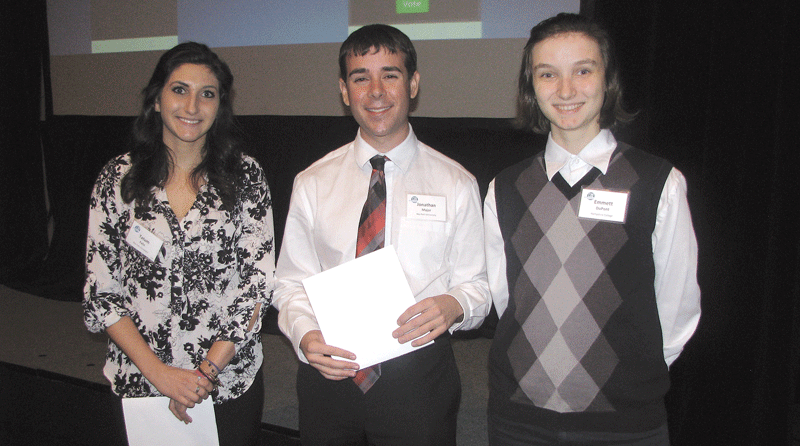
Columns Sections

Be Ready to Launch

By Carolyn Bourgoin, CPA


Carolyn Bourgoin

Carolyn Bourgoin

Crowdfunding has become a popular vehicle to raise money for personal, charitable, or business endeavors due to its ease of use and accessibility. However, many businesses and individuals who enter into a crowdfunding campaign have not considered potential tax implications prior to launching a campaign.

Here’s how it works. Websites such as Kickstarter, Indiegogo, and GoFundMe provide a forum for persons seeking funds (i.e. project initiators) to present their project or products in order to attract potential contributors, referred to as ‘backers.’ Project initiators may offer contributors rewards of nominal value, such as T-shirts, in exchange for a contribution, while others may offer sample products or rewards based on the level of contribution.

Campaigns can be set up with a fixed funding goal where the project initiator receives contributions only if funding goals are met, or with flexible funding goals that allow the initiators to keep funds even if the funding goal is not met. The websites charge initiators a fee per transaction; fixed funding goal campaigns are charged a lower fee.

Contributions are made via credit cards, so the crowdfunding websites often use financial intermediaries like PayPal or Amazon Payment to track the credit-card transactions. If more than 200 separate transactions worth more than $20,000 are generated by a campaign, the intermediary has to file a Form 1099-K to report the proceeds. Though a 1099-K is not required in many cases, this does not mean that the funds received are excludable from the recipient’s taxable income.

Tax Treatment of Crowdfunding Revenues

Under general income-tax principles, gross income is broadly defined to include income from all sources. Only items specifically exempt can be excluded from income. Based on these principles, most crowdfunding revenues will be includible in the recipient’s gross income unless he or she can show that the funds are excludible as: (1) contributions to capital in exchange for an equity interest in the entity, (2) loans that must be repaid, or (3) gifts made with donative intent where the donor does not receive a tangible economic benefit in return for his contribution.

Proceeds from donation-based campaigns may qualify as non-taxable gifts if the funds are for the benefit of an individual or a public charity, depending on the purpose and intent of the payment. For instance, if a campaign is to help an individual with unanticipated medical bills due to a tragedy, then the contributions might qualify as a gift. Where a gift exceeds the annual gift-tax exclusion of $14,000 (2016 exclusion amount), the donor may have a gift-tax filing responsibility.

Whether the proceeds from a reward-based campaign should be included in the recipient’s gross income is more difficult to determine because the value of the ‘reward’ must be determined. Crowdfunding often involves the project initiator providing a new product to the contributor in exchange for their ‘contribution.’ If the reward given to the contributor equals or exceeds the amount of the pledge, then the full payment is considered gross income to the recipient.

In essence, the contributor has paid for the reward, and there is no donative intent. Where the value of the reward is less than the ‘contribution,’ then the difference between the contribution and the value of the reward must be evaluated to determine whether it qualifies as a gift or some other type of contribution. In this situation, only a portion of the payment received by the recipient may be characterized as gross income.

Newer to the crowdfunding scene are equity-based campaigns, where crowdfund contributors are provided with an ownership stake in a startup venture in exchange for their contribution. These payments are a contribution to capital and are not gross income to the startup entity. However, there may be tax implications to the investor depending on the valuation of the interest, which is beyond the scope of this article.

Tax Treatment of Crowdfunding Expenditures

Once it has been determined that crowdfunding revenues should be included in federal gross income, the project initiator must determine what expenses, if any, are deductible. A detemination must be made whether the activity is a trade or business or a hobby. Distinguishing between the two is based on a fact-and-circumstances determination that looks to a series of nine factors.

In addition, the timing of when crowdfunding expenditures may be deducted can be an issue. The crowdfunding activity must be considered an active trade or business for the expenses to be eligible for deduction.

Tax Treatment of Contributions to Crowdfunding Campaigns

The tax treatment of a contribution made by a backer to a crowdfunding campaign depends on the motive of the backer as well as whether he or she receives anything in exchange for the payment. If the backer is making a campaign contribution out of disinterested generosity and does not receive anything in return, he has most likely made a gift. Only if the gift is to an approved public charity will it be deductible as a charitable contribution. A gift to a private individual seeking funds is not going to qualify as a charitable contribution even though it may be to help defray medical costs.

Contributions made to a campaign where the contributor receives goods or services of equivalent value in return are not tax-deductible. If a backer wants to make a significant contribution to a cause or project, it may be worth consulting with an advisor as to whether there are more beneficial or efficient ways to provide support.

Other Tax Issues

State and local taxes as well as sales and use taxes are other areas of concern for crowdfunding campaigns. Advance consideration should also be given to the most beneficial accounting method and best form of doing business for project initiators in a startup trade or business. Proper planning before entering into a crowdfunding campaign can help avoid undesirable tax consequences and surprises to project initiators.

Carolyn Bourgoin, CPA is a senior manager with Holyoke-based public accounting firm Meyers Brothers Kalicka, P.C.; (413) 322-3483; [email protected]

Autos Sections

Waiting to Leave

Carla Cosenzi

Carla Cosenzi says her newest dealership was designed to give the customer a positive experience and not waste their time.

There’s no one way to design an auto dealership, but increasingly — driven by both manufacturer requirements and an ever-more-demanding clientele — newer stores boast a number of specific features, from spacious, drive-in service departments to comfortable, well-stocked lounges; from energy-efficient touches to an emphasis on openness and transparency in the showroom. At a time of fierce competition for business, dealers say these elements are necessary to attract buyers — and keep them coming back.

Gary Rome summed up the experience of most of his customers succinctly and bluntly.

“When people are waiting for a car, they’re waiting to leave,” said the president of Gary Rome Hyundai. And that goes for both people in the market for a vehicle purchase and those bringing their rides in for service — in either case, no one wants to spend any more time at a car dealership than they have to.

On the other hand, sometimes it takes a while to, well, leave. Which is why so many aspects of his new facility on Whiting Farms Road in Holyoke, which opened last month, are designed to keep customers occupied and … let’s just say in less of a hurry to go home.

“One of the most important things to customers is time,” Rome told BusinessWest. “If you value their time and make it easy to purchase a car or have their car serviced, you’ll get loyal, repeat customers. So I want to make the process as enjoyable as possible by offering all the amenities I think are reasonable for our customers.”

Gary Rome car dealer

Gary Rome says energy-efficient touches throughout his new dealership are aimed squarely at reducing his carbon footprint.

To that end, the customer lounges — there’s one for watching TV, another for quietly doing business, and a play area for kids — border a coffee bar with free coffee, fruit, and muffins, as well as vending machines loaded with healthy snacks. Beside the TV is a screen detailing the status of every repair job currently underway, and the lounges overlook the service department so people can watch their cars being worked on.

Northampton Volkswagen and Country Hyundai, two neighboring stores in TommyCar Auto Group, opened their doors in 2014 with a similar focus on the customer experience. People bringing their cars in for service are met with high-speed doors followed by a porter who shows the way to a waiting room decked out with a TV, wi-fi, business workstations, smartphone jacks, free drinks and snacks, and even complimentary bicycles outside in case customers would rather take to the nearby bike trails instead of waiting indoors.

“We designed everything for the comfort and convenience of the customer,” said Carla Cosenzi, president of TommyCar. “We’re doing everything with the customer in mind.”

To that end, the facility has improved the employee experience as well, incorporating air conditioning, high ceilings, large windows, and LED lights in the service department — a far cry from the hot, cramped workspaces of old. Productivity has soared under those conditions, she said, which means, yes, less waiting for customers.

“They’re set up for efficiency, so they can be more productive and make the best use of customers’ time while they’re here. That’s where the majority of our focus was while building this.”


See: Area Auto Dealers in Western Mass.


Damon Cartelli agreed that efficiency, as it impacts the customer experience, is paramount — and a major design trend in the auto industry. His company, Fathers & Sons, opens its new, connected Audi and Volkswagen dealerships this week on Memorial Avenue in West Springfield, which boast the same type of high-speed doors — which trap air inside, keeping the space cool during warm days and warm during cold ones — that Cozensi spoke of. The driver then parks, gets out of the car, and walks directly into the shop, where a lounge with a TV area and workstations awaits.

“That’s now standard across the industry,” said Cartelli, the company’s president. “New dealerships have an area that’s comfortable and quiet so you’re able to work or sit in a lounge and have coffee and watch TV.”

While comfortable lounges and drive-in service bays may be among the more obvious hallmarks of the modern auto dealership, other trends — from a focus on transparency in the sales area to environmentally friendly features — are surging as well. For this issue’s focus on auto sales, BusinessWest explores three dealerships, two of them brand new, to talk about what dealers are doing to move customers out quickly — and get them to return, time and again.

No Secrets

Cartelli noted that many features of a new dealership — particularly Volkswagen, which demands uniformity in new dealerships with their nameplate — are blueprinted by the manufacturer, and many of the touches, including the high-speed doors, the finished service driveway (as opposed to a concrete look), the high-tech customer lounges, and display areas where customers can buy clothing, branded items, and vehicle accessories are required elements.

Damon Cartelli car dealer

Damon Cartelli says the prominent use of glass inside and outside his Volkswagen and Audi dealerships promote transparency, in both design and customer dealings.

So is the transparency. To look around the showroom is to see office walls of glass, so sales associates and managers are never hiding from customers. Cartelli said the look reflects his own philosophy of doing business in a transparent way.

“We have a transparent pricing model. We’re transparent with everything we do, with how you buy a car. We don’t want customers asking, ‘what is he doing back there?’ You can see what he’s doing. We have nothing to hide. That’s part and parcel with how we do business, which is nice.”

Cosenzi had to deal with the same demands from VW, although Hyundai was more flexible in its requirements. But she agreed with Cartelli that openness is a positive for customers.

“Sales managers are no longer in big podium stations; they’re approachable, in the middle of the showroom, and all the salespeople work in an open environment at their desks,” she said. “As you walk through the dealership, you see the open sales stations, the glass. When you’re in the finance office, you constantly see and follow what’s happening with paperwork and flow.

“We worked really hard to make the customer experience great,” she went on. “You see a lot of light when you walk in, and you’re immediately greeted by a warm, friendly body at the greeter station. We made sure all the customer parking was up front, made it really easy for them. We want customers to feel like they’re getting the VIP treatment all the way around.”

Cartelli said the best way to make customers feel important, quite simply, is to not waste their time. “If you can increase efficiency in how you do business, that’s important — the speed with which business gets done is second only to price. People want a fantastic customer experience, and they want to know how quickly you’ll get it done.”

Rome incorporated elements of transparency in his new dealership as well. “It’s important for me that customers come inside the building and are able to watch their cars being worked on,” he said, pointing out the line of sight between customer lounge areas and the spacious service department. “Some dealerships take the car around back to some black hole, and you don’t know what thery’re doing or when it will be ready. This is a much better experience.”

In this day and age, customers expect this treatment. If you don’t have it, there are other dealerships out there that do, and you’ll be missing out.”

But Rome also wanted a dealership that’s cutting-edge in environmental ways as well, incorporating a number of green elements aimed squarely at reducing the store’s carbon footprint, from energy-efficient LED lights to insulated windows to a car wash that reclaims and recycles water. All the oil collected during oil changes isn’t discarded, but rather stored in drums and pumped back into the heating system and used to heat the service department, while oversized fans circulate air in that area and control temperature. He even installed electric car-charging stations on the premises that anyone — not just customers — can stop by and use.

“Simple things like automatic faucets and toilets, motion-sensing lighting in the offices, reduces our carbon footprint,” he said. “In addition to that, we’re putting a 650-megawatt solar array on the back of the property. We’ll be generating energy.”

Lots of Options

There’s one other feature the new dealerships share: more space.

“The main feature is being able to display every model Hyundai makes,” Rome said, noting that the new showroom holds 15 cars, an outdoor canopy houses eight more, and the vast property contains hundreds more vehicles than could have been displayed at the former location on Main Street.

Cartelli’s new property is designed to handle 200% growth. “We’re in growth mode, and we have the ability to grow into it,” he said. “We’ve overbuilt for today’s business, so we can overserve the customer.”

That service begins right away when a driver enters the wide indoor bay and a device instantly tests the vehicle for alignment — a feature at the other new dealerships as well. Once out of the car, customers notice the tiled floors, which are slip-resistant and easier on the feet than cement.

In short, everything is geared to giving customers an enjoyable experience while they wait to leave. At Gary Rome, people leaving with a new car are able to fill out their paperwork in a glass-walled business office looking out over a covered area where their new car sits beside a red carpet. From the moment they walk in, he said — his rule is that associates greet any customer within 10 feet of them on the showroom floor — to that roll outside on the red carpet, everything is designed with the customer in mind.

Cosenzi said such touches are more important now than ever.

“In this day and age, customers expect this treatment,” she told BusinessWest. “If you don’t have it, there are other dealerships out there that do, and you’ll be missing out.”

Joseph Bednar can be reached at [email protected]

Autos Sections

Groundbreaking Event

As they took to the podium placed near the front door of the hotel known long ago as the Schine Inn (it’s had many names since), several politicians reflected on the important place the site has had in Chicopee’s history, especially its political and business history. And they noted that this legacy will certainly continue as the site is prepared for its new life — as home to a Mercedes dealership to be operated by Springfield Automotive Partners. Ground was broken for the ambitious, $12 million project on Sept. 21. The dealership, highly visible from the exit 6 tollbooth of the Mass Pike just a few hundred yards away, is due to open in just under a year, said Peter Wirth, managing partner of Springfield Automotive partners, who is undertaking the project with his wife, Michelle, and partners Rich and Amy Hess.

An architect’s rendering of the 37,000-square-foot Mercedes dealership

An architect’s rendering of the 37,000-square-foot Mercedes dealership

A large group of officials take up shovels for the groundbreaking

A large group of officials take up shovels for the groundbreaking

Managing Partner Peter Wirth

Managing Partner Peter Wirth addresses the large gathering for the ceremonies

Features

Plane Speaking

Jorge Morgado

Jorge Morgado says the saga of Flight 1549 has lived on well past the proverbial moment, through books, reunions, and, most recently, the movie Sully.


Jorge Morgado acknowledged that the words ‘based on a true story’ give film writers, directors, and producers a large degree of latitude when they’re telling a story.

Still, he went to one of the area’s first showings of Sully with the almost singular goal of seeing if Hollywood, and specifically Clint Eastwood, would get it right, meaning an accurate portrayal of the events of Jan. 15, 2009 and thereafter.

And he was pleased to report that — even though, for starters, his golf group of six that was such a significant part of the so-called ‘Miracle on the Hudson’ was reduced in size by half for this movie (and he wasn’t part of it) — they did.

At least when it comes to the part about the ditching of the plane and the subsequent rescue of all aboard.

“I thought they did a great job of telling the story without exaggerating,” said Morgado, vice president of Baystate Rug & Flooring in East Longmeadow and Chicopee. “I went to see if they would add ‘Hollywood’ to it, and for the most part, they didn’t.”

Jim Stefanik, who is one of the three written into the script, agreed, while noting, as one might expect, that it is quite the experience to see an actor, in this case, Max Adler (Glee, Love and Honor), play you in a movie and see his name next to yours as the credits roll.

“It’s definitely weird, and that’s been one of the more interesting things about this whole experience,” he said, adding quickly that Adler looks nothing like him and is almost a foot taller, but he doesn’t mind Hollywood taking those liberties.

“I’m five foot, five, and he’s about 6’4,” Stefanik, the former golf pro turned Chicopee firefighter, explained with a laugh, adding that it’s certainly difficult to describe the sensation of watching a movie depicting a scene from your life, and he has struggled with that assignment.

The simple exercise of trying to articulate these experiences explains how Sully has in some ways put the six golfers, all from Western Mass., back in the spotlight, even though some have kept a very low profile for years now and have every intention of keeping it that way.

And it also helps explain how a story like this lives on long after the proverbial ‘moment’ — in this case, it was literally only 10 or 12 minutes — is over. Indeed, there have been books, reunions, consistent contact on social media among the passengers, a gathering when the now-famous Airbus A320 was moved into a museum in North Carolina a few years ago, and other happenings to keep the story in plain view.

But in most respects, keeping this saga front and center hasn’t been a burden, emotionally or otherwise, because it is in many ways different from other newscast-leading events in recent years, many of them also turned into movies (Deepwater Horizon is now in theaters, for example, and there are two films on the Boston Marathon bombing now in production).

Indeed, this is a feel-good saga in about every way imaginable, one where no one can be described with the word ‘victim’ — except maybe in reference to an unyielding media blitzkrieg, as we’ll see later. There were no fatalities, only one serious injury (to a flight attendant), no real blame to be laid, and hardly a hint of controversy, although, according to many accounts, Eastwood felt the necessity to create some.

And when we all survived … from then to now, I think I realize just how good I have it. I think I appreciate it more than I would if I wasn’t on that plane that day.”

Specifically, in the film, National Transportation Safety Board officials make the case that the pilots could have flown the plane back to LaGuardia Airport instead of ditching in the Hudson River, but Morgado says he’s heard rumors that the NTSB is not at all happy with this depiction of events.

No, the story of Flight 1549 has a happy ending in seemingly all ways, and that’s why Morgado, Stefanik, and Dave Carlos didn’t mind going over all this ground one more time nearly eight years after they were unwittingly thrust into the spotlight.

“When people ask me, I say this whole experience was a blessing in disguise,” said Carlos, chair of the Math Department at Springfield’s Central High, soon to open his own business on the side, a pizza shop. “I have an 8-year-old and a 6-year-old, and the 6-year-old wasn’t born when this happened. When Sully said ‘brace for impact,’ what I thought about was not being able to see my daughter and what she looked like, and not being able to see my son again or my family again.

“And when we all survived … from then to now, I think I realize just how good I have it,” he went on. “I think I appreciate it more than I would if I wasn’t on that plane that day.”

For this issue, the three talked about that fateful day in January — again — but mostly about what’s happened since, and how events of this nature can change someone’s life in ways that couldn’t be imagined.

Last-ditch Efforts

“It was like sneakers in a clothes dryer.”

That’s how Morgado chose to describe the sound of a flock of geese getting in the way of the engines on both sides of the Airbus he and his golfing buddies were scattered throughout. Only no one actually knew that this is what it was.

All that would soon become apparent is that something was clearly wrong, he recalled, adding that the cabin, which he was near the front of (window seat, row 5 in coach) was soon filling with smoke.

“The cabin started shaking and it smelled like burnt bird —   you could tell something was wrong,” he said, adding that, like all those around him, he spent the next few minutes trying to simply absorb what was happening around him.

Backing up a little — kind of like a movie flashing back several hours — Morgado said he and the rest of his golf party were not supposed to be on this flight. Instead, they had chosen to fly on Spirit Airlines for their regular winter-season trip to Myrtle Beach in South Carolina. But that Thursday morning came up white, and the light show was enough to ground smaller planes, but not larger airliners.

So Morgado and his companions — Stefanik,  Carlos, Rick Delisle, Rob Kolodjay, and Jeff Kolodjay— would secure the last six tickets for US Airways Flight 1549, a number that, like most everything else about this story, no one will ever forget.

Returning to that moment when Morgado heard the sneakers in the dryer, he said that noise, which occurred only a few minutes after the plane lifted off LaGuardia’s runway, was followed by general silence. There was nothing, he said, until the man the world would soon come to call by his nickname said those words have become so famous — “This is the captain; brace for impact.”

By the time those words came, though, passengers could see that the plane was out over the Hudson and ever closer to the water, said Carlos, adding that stewardesses began saying the phrase that would come to dominate the movie trailer: “heads down … brace yourselves.” And as much as the words themselves, it was what he thought they meant that has stayed with him all these years.

“They kept chanting it over and over again,” he recalled, that it was an agonizing, terror-filled three minutes before the plane actually hit the water. “I kept thinking, ‘is this the last thing I’m going to hear? This is awful.’”

Eventually, although very quickly, it seems — “you were just in survival mode,” said Morgado — passengers made their way out of the aircraft, with most of them winding up on the wings, as captured in those iconic photographs, one of which now graces the wall of his office at the Chicopee location. What those pictures don’t effectively convey is how quickly the plane began to settle into the icy Hudson.

“When I stepped onto the wing, the water was only ankle-deep, but by the time the boats came, I was waist-deep in water — the plane was sinking pretty quickly,” said Morgado, adding that, while he was having a hard time comprehending and coping with all that was going on around him, he still had the presence of mind to keep his cell phone dry.

Because he did, he got his first real taste of how immediate, intense, and sometimes infuriating the media assault on Flight 1549 and everyone involved with it that day would be.

“I called my wife to tell her I was in a plane crash; she didn’t even know I was on that plane,” he explained. “I said, ‘I’m OK; I’ll call you when I get on dry land.’ I then hung up, and she turned on the TV to see what was going on.

“She later called and said that, just after I hung up, the home phone started ringing off the hook — it was all these New York and Boston media people calling,” he went on. “She remembers talking to Diane Sawyer’s producer, who said, ‘let me know where your husband is; we know he’s asthmatic, and we’ll get him treatment.’ They knew my medical history, and I was still standing on the wing of that plane. That was how quick they were able to get my information and get to my house. They were all out to get a story.”

Overall, Carlos, who joked that he wasn’t written out of the script, he just wasn’t written into it, said the movie made the rescue appear easier and less traumatic than it actually was.

“In the movie, the rescue seemed very nonchalant; they made it look easy to just climb on those boats and get out of there, that everything was just standing still,” he noted. “In real life, we were floating down the Hudson; the plane was moving, the boats were moving, the hulls of the boats were 15 to 20 feet above the water, not the five feet like they depict in the movie.”

Wing and a Prayer

Fast-forwarding a little, Morgado and the others said what happened on the Hudson was certainly just the first chapter in this story. Others involve what happened after they returned to dry land and, later, their families, their businesses, and other facets of their lives.

Highlights, and there are many, include:

• Morgado being told that media members had snuck into his office in pursuit of … whatever, and wound up taking photos of pictures of his children and printing them (that’s a lowlight, actually);

• Getting to go on that Myrtle Beach trip eventually, with the Golf Channel in tow to record the occasion, and with new equipment and bags courtesy of Titleist, which wanted its name omnipresent during this outing, and succeeding with that goal (Morgado remembers the dozens of courses at Myrtle vying hard for the privilege of hosting them);

• Taking part in the book Miracle on the Hudson, featuring passengers telling their stories (Morgado leads off a chapter titled “Night in New York” talking about his phone call to his wife while out on the wing); and

• Relaying the story untold times to family members, friends, business customers, fellow Rotarians, and, yes, the media, a broad constituency (we’ll include TV talk-show hosts) that induced a wide range of emotions from those we spoke with — everything from fascination to incredulity.

Indeed, beyond his aforementioned experience on the wing, Morgado related another episode involving the fifth estate in the book Miracle on the Hudson.

As he relates the story, the six golfers were due to appear on the Today show the morning after the crash and rescue. They were to meet the show’s producer in the lobby of the Crowne Plaza hotel, and were told specifically by him not to leave the lobby, because competing networks, positioned outside with their own vans, would essentially hijack the story.

“It was insane,” said Stefanik of the media coverage, in terms of its depth and voracity. “They kept trying to find out everything they could about you; they were calling my mother-in-law, my mother, all in pursuit of a story. They can find out anything about you that they want.”

The movie Sully has brought the media back, but not with anything approaching the ferocity witnessed in the weeks and months after the crash. Overall, the film has simply brought some new questions to be answered — everything from ‘how accurate was it?’ (perhaps the most common query) to ‘how did Tom Hanks do in the title role?’

“He was incredible as Sully,” said Morgado while answering the latter. “He captured him perfectly.”

And while that same adjective probably can’t be used for the sum of the film and its attention to accuracy, said those we spoke with, it does an adequate job of capturing the heart of the story — the courage and skill of the pilots.

Roll the Credits

Spoiler alert: Morgado said Sully starts off in an intriguing way — by showing what might have happened if Sullenberger and co-pilot Jeffrey Skiles hadn’t pulled off the miracle on the Hudson (let’s leave it at that).

The powerful footage has to leave audience members, not to mention survivors like Morgado, Stefanik, and Carlos, more cognizant of how lucky everyone was that day.

Carlos enjoyed and appreciated the movie, but didn’t really need it to appreciate his good fortune and remember never to take anything for granted.

“The incident helped open my eyes to things, and it’s enabled me to enjoy what I have more than I used to,” he told BusinessWest.

This is a sentiment that — like the story of Flight 1549 itself — lives on well past the moments that made history.

George O’Brien can be reached at [email protected]

Law Sections

Firm in Its Resolve

five of Robinson Donovan’s partners

From left, five of Robinson Donovan’s partners: Jeffrey Trapani, Michael Simolo, Nancy Frankel Pelletier, Carla Newton, and Managing Partner Jeffrey Roberts.

Robinson Donovan has experienced plenty of changes in its 150-year history, from shifting economic cycles to constantly evolving laws, to the evolution of its home city of Springfield. But one thing has remained a priority since its founder, George Robinson — who was also a high-school principal, state legislator, and governor — hung out a shingle in 1866. That is a focus on community — not just in a business sense, but through charity and volunteerism. And that’s how the firm is choosing to mark this significant anniversary.

Attorneys who have been with Robinson Donovan for any amount of time are fluent in its history, which stretches back 150 years — an anniversary the firm chose to celebrate by giving back.

Specifically, the firm traces its roots back to former Gov. George Robinson, who began practicing law in the Springfield area prior to serving as a member of the state House of Representatives and then Senate.

His contributions to the Springfield region extended beyond his appointments to public office. He was also the principal of Chicopee High School and a founding member of Chicopee Savings Bank, in addition to his law practice, now known as Robinson Donovan.

As the anniversary approached, said Carla Newton, a partner with the firm, one topic of discussion was the importance of place — how Greater Springfield itself, and its network of residents, businesses, and nonprofits are critical to the Robinson Donovan story.

“George Robinson was a public servant himself, and certainly served the public in a very direct way, so we began thinking about how to give back, rather than just celebrate internally,” she told BusinessWest. “And we began looking around at all the different nonprofits, many of which have board members and volunteers within our office. We thought it was appropriate to go beyond our own personal commitments to the community, and be a little more demonstrative and provide actual contributions.”

We all live here. We all benefit from the nonprofits that operate here, whether it be Providence Ministries or an educational institution like Bay Path University. We’ve raised families in this community and benefit from the fact that these organizations exist and make our community a better place to live.”

In lieu of some grand party or other event, that’s precisely how the firm chose to celebrate its anniversary year — with a sizable donation each month to a local nonprofit.

“We solicited input from everyone at the firm,” said Partner Michael Simolo. “As Carla said, a lot of us are involved in these organizations, and we know very well the people involved in them. It was kind of a collective effort from everyone to choose the organizations we donated to.”

“We all live here,” Newton added. “We all benefit from the nonprofits that operate here, whether it be Providence Ministries or an educational institution like Bay Path University. We’ve raised families in this community and benefit from the fact that these organizations exist and make our community a better place to live.”

Besides those two organizations, the firm has also donated to Friends of the Homeless, the Food Bank of Western Massachusetts, Cutchins Center for Children, Big Brothers Big Sisters, Community Legal Aid, Dakin Humane Society, and the Gray House — with three more to be chosen before the calendar turns.

Looking Back

That calendar has turned 150 times since Robinson first set up shop, and Newton acknowledged that it’s difficult to determine all the reasons it has survived so long. But she had a few theories.

One is simply pride among the attorneys in how the firm does business. She recalled arriving at the firm — at the time much smaller than its roster of 17 lawyers — and getting the sense they cared about leaving the firm in good hands when they were gone — which involved not only treating clients with professionalism, but mentoring the younger lawyers. “There was a culture of continuation, and people like me ended up getting adopted into that culture.”

Nowadays, she added, growth comes from meeting specific needs. “We bring in someone to support a particular area, and we inculcate them into the culture, and it continues on. There’s no reason to believe this isn’t going to keep going, as the younger lawyers coming in here realize, ‘hey, someday this will be our firm.’”

Managing Partner Jeffrey Roberts added that longevity requires a strong reputation in the community as well. “Ultimately, there has to be some recognition of quality. People want service, they want value, and they want to feel they’re getting the best product available.”

That reputation translates into referrals, he added. “They say your clients come from your clients. Other lawyers say, ‘I don’t do that kind of work, but you should go to that lawyer.’ In the end, it’s a small community, and if you don’t carry your practice properly and honestly, word gets around. If people understand who we are, we’ll have no shortage of business.”

That culture, again, extends to its community outreach, Newton said. “We’re not a firm that says to people who come in, ‘you must find a place to volunteer.’ Everyone here, whether it’s administrative assistants, lawyers, paralegals, they all do volunteer work because it’s important to them. That just seems to be the type of individual who comes to work at Robinson Donovan. Our people are really committed to doing volunteer work.”

Service Network, receives a check from Carla Newton

Karen Blanchard, left, executive director at Providence Ministries Service Network, receives a check from Carla Newton, partner at Robinson Donovan, earlier this year as part of the law firm’s year-long series of donations to mark its 150th anniversary.

Partner Nancy Frankel Pelletier agreed. “It’s definitely part of the culture of the firm,” she said. “We encourage people to be active in things they have an interest in or a passion for. It’s never imposed on anyone or done out of obligation, but it’s what everyone does.”

Roberts noted that community involvement isn’t a one-way street, and firm members reap benefits beyond feeling good about themselves. “If you contribute to an organization, they benefit; on the other hand, you benefit because you learn about what the organization does, and you meet a lot of different people, and you get invested more in the community, rather than just getting in your car, going to work, taking care of your client matters, and going home. There’s a networking component that can lead you to other organizations.”

New hires, especially those coming from outside the area, are encouraged to find organizations that speak to them, as a way to get a real sense of what’s happening outside the walls and glass windows high above Main Street in Tower Square.

“Then it tends to build,” Roberts said, “because you’re recognized, and then someone else might ask you to help out at a function or support a cause or go to a dinner, and it builds on itself. It’s part of your education in the community.”

Looking Ahead

A general-practice firm, Robinson Donovan specializes in a number of legal niches, including corporate and business law, commercial real estate, estate planning and administration, divorce and family law, employment law, and litigation. After a period of rapid contraction — more than 30 lawyers worked there as recently as 15 years ago, when it was known as Robinson Donovan Madden & Barry — business has been steadily growing in virtually all those specialties, and the practice is on the rise again, hiring eight attorneys over the past several years, bringing the current roster to 16, with plans to possibly expand further.

“The firm is very dynamic and forward-thinking,” Simolo said. “We are celebrating our 150th, but at the same time, the firm is making some big investments in the future.”

Partner Jeffrey Trapani said the fact that economic development has been on the rise in Springfield, and the surrounding region is a quality-of-life draw, are added enticements when hiring.

“People get down on Springfield, but this region, I think, attracts people,” he told BusinessWest. “People enjoy coming to this area. We have city centers, things to do, you can see art, hear music, get outside, and still be close to Boston and New York.”

Trapani and Simolo count themselves among the former newcomers mentored by Roberts and his peers, but are now part of a middle generation rising to leadership and taking on much of that mentoring responsibility for new attorneys. That perpetuates the firm’s constant evolution, with some of the more recent hires chosen to match growth fields, including trusts and estates, corporate transaction law, labor and employment, domestic relations, and subspecialties like green energy.

“There’s such a broad scope of experience in this office,” Newton said. “So I can go to one of the associates and talk to them about something. They’ll learn from me, but I’ll also learn from them. When I sit in Jeff’s office or Nancy’s office, cross-learning takes place. Every single day, there are opportunities to sit down and talk about an issue with someone else. Not a day goes by that I don’t learn some new nuance that’s helpful to something I’m working on.”

It’s an environment some find unusual at first, Frankel Pelletier said, “but it’s the only environment I’ve ever known my entire career. We are just an open-door, collaborative community of lawyers.”

In short, Robinson Donovan has come a long way since its early days, when it was best known for George Robinson’s successful defense of Lizzie Borden on double murder charges in 1892. These days, the firm is recognized in a host of ways, such as the citations many of its attorneys have received from organizations like Best Lawyers, Super Lawyers, and Martindale-Hubbell.

“Unlike some other firms from the area, we really maintain a statewide presence,” said Frankel Pelletier, who was the firm’s first-ever female attorney. “We have always maintained that statewide presence and attained regional and, in some senses, national recognition. Our attorneys are constantly being recognized by organizations they belong to. That is who we are.”

Well, that and a law firm with a strong commitment to the community that has helped it thrive for 150 years.

Joseph Bednar can be reached at [email protected]

Features

Building on a Legacy

BizDiffMakrsLOGO2011

It was a moment — actually, several moments — that no one in attendance would soon, if ever, forget.

David and Marisa Balise had moved to the microphone at the Log Cabin Banquet & Meeting House to offer reflections on how their father, Mike, who had succumbed to stomach cancer just a few months earlier, had lived a life dedicated to family, the New England Patriots, and philanthropy.

“It was a special moment for everyone,” said BusinessWest Associate Publisher Kate Campiti. “Several people had already talked about Mike’s contributions to the community and the myriad ways he gave back, but no one did it in a more powerful, more thought-provoking way than his own children.”

There were a number of powerful moments at the Difference Makers celebration staged last March, such as the introduction of retiring Hampden County Sheriff Michael Ashe, which was punctuated by a rousing standing ovation from those in attendance, including many members of the area’s law-enforcement community. And then, there was the tribute to Bay Path University President Carol Leary, marked by the passage “no one has been a more effective, more impactful, and more important leader for their organization.”

There have been countless other memories like these since BusinessWest inaugurated its Difference Makers recognition program eight years ago. And now, it’s time to begin the process of making some more.

Indeed, nominations (HERE) are now being sought for the class of 2017, members of which will be feted at the Log Cabin late next March.

Nominations, which must be submitted to BusinessWest by Nov. 16, should, in very simple terms, explain why the individual or group in question is a Difference Maker within the community called Western Mass.

And as the list that follows reveals, there are many ways to fit that description. Last year’s class of honorees, which also includes Big Brothers Big Sisters and John Robison, president of Robison Service and advocate for individuals on the autism spectrum, provides ample evidence of this. But over the years, those honored include other college presidents, leaders of a host of nonprofits, and business leaders known as much for what they do within the community as for their respective companies.

“We chose that name ‘Difference Makers’ for a reason,” said Campiti.  “It speaks to what these groups and individuals do, of course, but it doesn’t put any limitations on how those words can be interpreted.

“As we’ve seen over the years, there are countless ways to make a difference,” she went on. “The common denominator is that these individuals and and groups make this region a better place to live, work, and conduct business.”

Submissions will be reviewed by the team at BusinessWest, with the class of 2017 to be introduced in late January.

Details on the March Difference Makers celebration will be presented in upcoming issues of the magazine.

For the record, go HERE for a list of previous honorees.


Law Sections

2016 or 1984?

By Stefanie M. Renaud


Stefanie Renaud

Stefanie Renaud

Imagine a piece of technology, so small it could be mistaken for a credit card, that tracks every movement an employee makes, analyzes every conversation that employee has, and could tell an employer when that employee was in need of a day off. What if that technology could identify patterns and traits that you could use to increase productivity by 23%? Would employers want to use this technology? Of course!

But what about the employees? Isn’t using technology like this an invasion of their privacy? We were shocked to learn, and we bet you are too, that, because of the way this technology is currently being used, employers actually can monitor every word and movement an employee makes without running afoul of the law.

Boston-based company Humanyze recently made headlines when it announced the success it has had analyzing data collected by employee ID badges, developed at the Massachusetts Institute of Technology, that track employees’ movements and analyze their voices during conversations. Contained within each badge are Bluetooth, radio frequency identification (RFID), and infrared technologies, as well as two microphones.

Each of these particular technologies has a different function and gives Humanyze different information that it can use to identify trends or patterns. Bluetooth and RFID technology are used to monitor the employee’s physical movements and location within the office. The microphones allow Humanyze to conduct real-time analysis of the speaker’s voice, including the frequency of speaking and interrupting, and how the tone and pitch of the voice change, which can be indicator of stress, although the badge does not record the content of the employee’s conversations. Finally, infrared technology monitors the wearer’s physiology for signs of stress.

Humanyze analyzes all of the collected data and identifies patterns or trends common to a specified group, such as top performers. Humanyze then works with companies to explore these trends and use them to the business’ advantage. For example, Humanyze helped Bank of America save millions of dollars by suggesting that they restructure employee breaks, which increased social interaction between employees and led to a 23% increase in employee productivity.

So, given how invasive this level of employee monitoring is, how could it not be an invasion of privacy? First of all, this isn’t an invasion of privacy because Humanyze only gathers data from employees who voluntarily offer to be tracked. Second, the individual’s data is their own; employers cannot see individual data and only receive information about aggregate data trends. According to Massachusetts General Laws, employees are protected by statute from “unreasonable, substantial, or serious interference” with their privacy.

However, in order to prove an invasion-of-privacy claim, the employee must show that the employer gathered and then disclosed information “of a highly personal or intimate nature.” While it is arguable that the data collected by these badges could be deemed highly personal in nature, in this case it’s Humanyze, and not the employee’s employer, who collects and analyzes the information.

For this same reason, Massachusetts employers do not need to worry about personnel-records law violations, because the employer is neither creating the records, nor is it the owner of the data. And, because the badges do not record audio, there is no concern about violating the Massachusetts wiretapping statute.

So are there any legal hurdles stopping an employer from implementing this type of employee monitoring? Only one: a workforce governed by a collective bargaining agreement. Employers with unionized workplaces will almost certainly need to bargain with the union before implementing a new employee tracking system.

Indeed, in another, related circumstance, the Boston Police Department engaged in negotiations with the union representing its police officers over whether or not the officers would be required to wear body cameras, ultimately agreeing with the union that, at least initially, the department would ask for volunteers. When no one volunteered, the BPD was allowed to assign the cameras to police officers, but that was after months of negotiations and subsequent litigation. So, if you have a unionized workforce, you can expect both union negotiations and substantial pushback on any requirement that members of the collective-bargaining unit wear these badges.

Employers in or with locations outside of Massachusetts that are inclined to experiment with this new employee-tracking system should check with labor and employment counsel in those jurisdictions, because state privacy laws can vary widely. Meanwhile, we’ll keep an eye on this new technology and let you know if there are any new developments.

Stefanie M. Renaud is an associate with Skoler, Abbott & Presser; (413) 737-4753; [email protected]