Home Posts tagged Difference Makers (Page 6)
Daily News

WESTERN MASS. — The clock is ticking, but there is still time to nominate an individual or group for BusinessWest’s Difference Makers program. Nominations must be received by the end of the business day (5 p.m.) on Dec. 15. Nominations can be completed online by visiting www.businesswest.com and moving to ‘Our Events.’

Difference Makers was launched in 2009 as a way to recognize the contributions of agencies and individuals who are contributing to quality of life in this region. Recipients have ranged from college presidents to state police officers; from the leaders of several nonprofit groups to economic-development leaders. Previous honorees are:

2009:
• Doug Bowen, president and CEO of PeoplesBank;
• Kate Kane, managing director of the Springfield office of Northwestern Mutual Financial/The Zuzolo Group;
• Susan Jaye-Kaplan, founder of GoFIT and co-founder of Link to Libraries;
• William Ward, executive director of the Regional Employment Board of Hampden County; and
• The Young Professional Society of Greater Springfield

2010:
• The Irene E. and George A. Davis Foundation;
• Ellen Freyman, attorney and shareholder at Shatz Schwartz and Fentin, P.C.;
• James Goodwin, president and CEO of the Center for Human Development;
• Carol Katz, CEO of the Loomis Communities; and
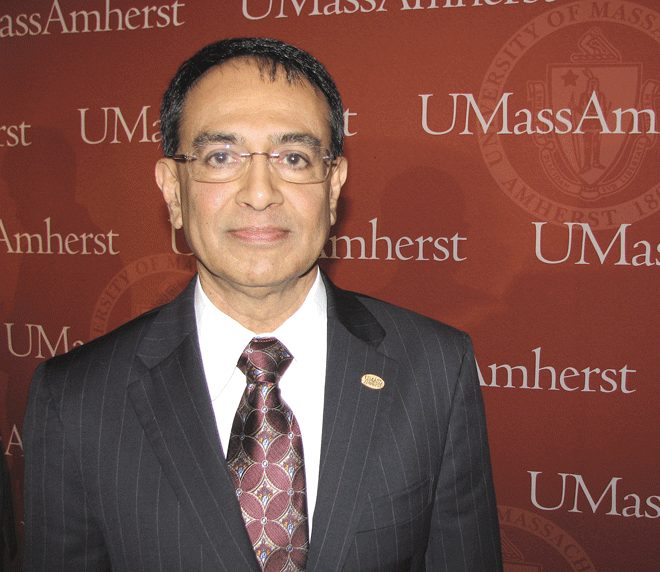
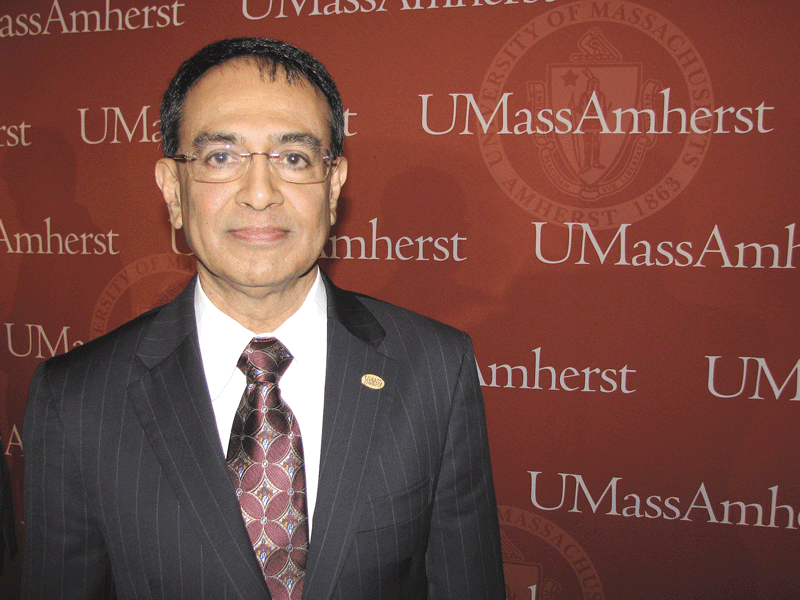
• UMass Amherst and its chancellor, Robert Holub

2011
• Tim Brennan, executive director of the Pioneer Valley Planning Commission;
• Lucia Giuggio Carvalho, founder of Rays of Hope;
• Don Kozera, president of Human Resources Unlimited;
• Robert Perry, retired partner/consultant at Meyers Brothers Kalicka; and
• Anthony Scott, police chief of Holyoke

2012
• Charlie and Donald D’Amour, president/COO and chairman/CEO of Big Y Foods;
• William Messner, president of Holyoke Community College;
• Majors Tom and Linda-Jo Perks, officers of the Springfield Corps of the Salvation Army;
• Bob Schwarz, executive vice president of Peter Pan Bus Lines; and
• The Women’s Fund of Western Massachusetts

2013
• Michael Cutone, John Barbieri, and Thomas Sarrouf, organizers of Springfield’s C3 Policing program;
• John Downing, president of Soldier On;
• Bruce Landon, president and general manager of the Springfield Falcons;
• The Sisters of Providence; and
• Jim Vinick, senior vice president of investments at Moors & Cabot Inc.

2014
• The Gray House
• Colleen Loveless, executive director of the Springfield chapter of Rebuilding Together;
• The Melha Shriners
• Paula Moore, founder of YSET Academy and a teacher at Roger L. Putnam Vocational Training Academy; and
• Michael Moriarty, attorney, director of Olde Holyoke Development Corp., and supporter of childhood literacy programs

Daily News

WESTERN MASS. — The clock is ticking, but there is still time to nominate an individual or group for BusinessWest’s Difference Makers program. Nominations must be received by the end of the business day (5 p.m.) on Dec. 15. Nominations can be completed online by visiting www.businesswest.com and moving to ‘Our Events.’

Difference Makers was launched in 2009 as a way to recognize the contributions of agencies and individuals who are contributing to quality of life in this region. Recipients have ranged from college presidents to state police officers; from the leaders of several nonprofit groups to economic-development leaders. Previous honorees are:

2009:
• Doug Bowen, president and CEO of PeoplesBank;
• Kate Kane, managing director of the Springfield office of Northwestern Mutual Financial/The Zuzolo Group;
• Susan Jaye-Kaplan, founder of GoFIT and co-founder of Link to Libraries;
• William Ward, executive director of the Regional Employment Board of Hampden County; and
• The Young Professional Society of Greater Springfield

2010:
• The Irene E. and George A. Davis Foundation;
• Ellen Freyman, attorney and shareholder at Shatz Schwartz and Fentin, P.C.;
• James Goodwin, president and CEO of the Center for Human Development;
• Carol Katz, CEO of the Loomis Communities; and
• UMass Amherst and its chancellor, Robert Holub

2011
• Tim Brennan, executive director of the Pioneer Valley Planning Commission;
• Lucia Giuggio Carvalho, founder of Rays of Hope;
• Don Kozera, president of Human Resources Unlimited;
• Robert Perry, retired partner/consultant at Meyers Brothers Kalicka; and
• Anthony Scott, police chief of Holyoke

2012
• Charlie and Donald D’Amour, president/COO and chairman/CEO of Big Y Foods;
• William Messner, president of Holyoke Community College;
• Majors Tom and Linda-Jo Perks, officers of the Springfield Corps of the Salvation Army;
• Bob Schwarz, executive vice president of Peter Pan Bus Lines; and
• The Women’s Fund of Western Massachusetts

2013
• Michael Cutone, John Barbieri, and Thomas Sarrouf, organizers of Springfield’s C3 Policing program;
• John Downing, president of Soldier On;
• Bruce Landon, president and general manager of the Springfield Falcons;
• The Sisters of Providence; and
• Jim Vinick, senior vice president of investments at Moors & Cabot Inc.

2014
• The Gray House
• Colleen Loveless, executive director of the Springfield chapter of Rebuilding Together;
• The Melha Shriners
• Paula Moore, founder of YSET Academy and a teacher at Roger L. Putnam Vocational Training Academy; and
• Michael Moriarty, attorney, director of Olde Holyoke Development Corp., and supporter of childhood literacy programs

Features
Nominations Sought for BusinessWest’s Recognition Program

BizDiffMakrsLOGO2011When BusinessWest launched its Difference Makers program in 2009, it did so with the sentiment that there are many different ways in which an individual or a group can make a difference in the region.

Since then, the various groups of winners have proven that such thoughts are merely an understatement, and the class of 2014 did that perhaps better than any other.

The honorees were Paula Moore, a school teacher who started the Youth Social Educational Training (YSET) Academy to help keep young people off the streets and out of trouble; the Gray House, a nonprofit that provides a host of programs and services ranging from a food pantry to adult education to its Kids Club; Michael Moriarty, an attorney and director of Olde Holyoke Development Corp., who has been passionate about childhood literacy; Colleen Loveless, who has expanded the reach and the impact of Rebuilding Together Springfield in dramatic ways; and the Melha Shriners, a fraternal organization that changes lives in many ways, but especially through its efforts to help fund the many Shriners Hospitals for Children.

“The class of 2014 showed that difference makers come in many forms and take on a wide range of missions,” said Kate Campiti, associate publisher of BusinessWest. “In each case, though, the overriding goal is to improve life for the people who live in this region.”

And there are many more stories still to be told, she went on, adding that BusinessWest is now accepting nominations for the Difference Makers class of 2015.

The nomination form on page 13 explains essentially how this process works, said BusinessWest Editor George O’Brien, who noted that the phrase ‘Difference Maker,’ as the class of 2014 proved, is a truly subjective phrase with a number of meanings.

“Since Difference Makers was launched, we’ve recognized business executives, nonprofit managers, college presidents, a crusading police chief, and a woman who founded a program to fill the shelves of school libraries,” he explained. “All these stories are different, but the common thread is people — and organizations — stepping up to improve quality of life here in Western Mass.”

“Since the beginning, the readers of BusinessWest have helped its staff with the difficult task of selecting honorees by relating these remarkable stories of how individuals and groups are making a difference,” he went on. “And we’re seeking your assistance again.”

As with another BusinessWest recognition, 40 Under Forty, Difference Makers is a nomination-driven process, Campiti said, urging those who propose an individual or group for consideration to be thorough with their nomination and, in simple terms, effectively answer the question ‘why is this nominee a Difference Maker?’

Nominations, which can also be completed online here, are due at the end of the business day (5 p.m.) on Dec. 15. The winners, as chosen by a review panel comprised of BusinessWest writers and editors, will be profiled in the magazine’s Feb. 9 edition and saluted at the annual Difference Makers gala, to take place in late March.

Questions about the program and the nomination process can be forwarded to [email protected], or call (413) 781-8600, ext. 102.

Previous Difference Makers

2009
• Doug Bowen, president and CEO of PeoplesBank
• Kate Kane, managing director of the Springfield office of Northwestern Mutual Financial/the Zuzolo Group
• Susan Jaye-Kaplan, founder of GoFIT and co-founder of Link to Libraries
• William Ward, executive director of the Regional Employment Board of Hampden County
• The Young Professional Society of Greater Springfield

2010
• The Irene E. and George A. Davis Foundation
• Ellen Freyman, attorney and shareholder at Shatz Schwartz and Fentin, P.C.
• James Goodwin, president and CEO of the Center for Human Development
• Carol Katz, CEO of the Loomis Communities
• UMass Amherst and its chancellor, Robert Holub

2011
• Tim Brennan, executive director of the Pioneer Valley Planning Commission
• Lucia Giuggio Carlvalho, founder of Rays of Hope
• Don Kozera, president of Human Resources Unlimited
• Robert Perry, retired partner/consultant at Meyers Brothers Kalicka
• Anthony Scott, Holyoke police chief

2012
• Charlie and Donald D’Amour, president/COO and chairman/CEO of Big Y Foods
• William Messner, president of Holyoke Community College
• Majors Tom and Linda-Jo Perks, officers of the Springfield Corps of the Salvation Army
• Bob Schwarz, executive vice president of Peter Pan Bus Lines
• The Women’s Fund of Western Massachusetts

2013
• Michael Cutone, John Barbieri, and Thomas Sarrouf, organizers of Springfield’s C3 Policing program
• John Downing, president of Soldier On
• Bruce Landon, president and general manager of the Springfield Falcons
• The Sisters of Providence
• Jim Vinick, senior vice president of Investments at Moors & Cabot Inc.

2014
• The Gray House
• Colleen Loveless, executive director of the Springfield chapter of Rebuilding Together
• The Melha Shriners
• Paula Moore, founder of YSET Academy and a teacher at Roger L. Putnam Vocational Training Academy
• Michael Moriarty, attorney, director of Olde Holyoke Development Corp., and supporter of childhood-literacy programs

Features
Springfield’s New Police Commissioner Charts a Course

Page6CommishARTJohn Barbieri acknowledged that his analogy wasn’t perfect, but believed it worked on a number of levels, so he went with it.

He was talking about law-enforcement personnel and why many people don’t understand why they can’t prevent crime, or criticize them for not doing so. And he drew a comparison to getting a bad diagnosis from one’s doctor.

“For a community to expect the police to resolve crime in a city is like going to your doctor and being mad at him because you have cancer,” said Barbieri, a deputy chief who will become Springfield’s police commissioner next month. “If the doctor could go back 20 years and take the cigarette out of your hand or stop you from working at the asbestos factory, that would be one thing. Don’t be upset with him because you have cancer; be upset with him if he doesn’t treat it properly.

“I can’t go back 20 years and give the person who broke into your car an educational opportunity or parental discipline,” he went on. “The best I can possibly do is look at the trends and patterns from when such break-ins occur, be responsive and try to have police in that area, make an arrest whenever possible, and work with area residents and educate them about what’s going on in their neighborhood.”

If a community wants to make a serious dent in crime, there must be what he called a “holistic response” to the matter, and a police department will certainly play a key role in that, he said, adding that police must work in collaboration with neighborhood residents, other social agencies, the school department, and other players.

Indeed, collaboration has been the word heard most often in the many media interviews, neighborhood meetings, and other gatherings at which Barbieri has spoken or taken questions since he was named commissioner on March 19.

And it will continue to be heard in the weeks, months, and years to come, because it is the one-word thrust of Barbieri’s philosophy regarding public-safety initiatives and how to make them more effective.

Collaboration between police, the public, and neighborhood groups lies at the heart of the C3 (Counter Criminal Continuum) Policing program in the city’s North End, a multi-faceted initiative aimed at stemming gang-related crime, which Barbieri has co-led, and for which he and other organizers were named Difference Makers by BusinessWest in 2013.

Barbieri wants to expand that specific program to Mason Square, the South End, and Forest Park, but he wants the key ingredients in its success formula — cooperation and information from neighborhood residents — to become a city-wide phenomenon.

“The goal is to go into those neighborhoods and work with the residents to teach them that the department does care, legitimize our services to them, and show them we can be responsive,” he continued. “And then educate them with regard to their responsibilities with preventing crime in their neighborhoods and being our eyes and ears.”

And while working to inspire residents to take a more active role in public-safety efforts, Barbieri has a number of other goals and objectives — everything from making more effective use of available resources to improvements in crime analysis, to making sure the department is ready if and when a casino opens in the South End.

In a broad-ranging interview with BusinessWest, he addressed those issues and many others, and in the course of doing so, put that term ‘collaboration’ to early and repeated use.

Chief Concerns

The office at police headquarters that Barbieri will soon be vacating in favor of the commissioner’s space has an eclectic array of photos on the walls, everything from assorted views of his prized 1966 Chevy Impala — “driving it keeps me sane” — to an image of the World Trade Center the moment the second plane struck the south tower. He said he hung it there so he could point to it whenever someone says a major act of terrorism can’t happen in a city like Springfield.

There’s also a shot of him in a cruiser taken a few months after he joined the force in 1988, one of several times the city was beset with fiscal problems and the police budget was stretched thin — as the photo made clear.

“We didn’t have enough money to paint the cruisers black and white,” he said in noting why the car he was sitting in was all white (it came that way), and also why it looked beat up. “The car was in such disrepair that you had to leave it running at all times. It had a bad battery, so you ran it all night; if you shut it off, it wouldn’t restart, and you’d have to call a tow truck and get a jump.”

Several years later, during the Clinton presidency and a period of heightened federal assistance for law-enforcement efforts, things were much different. Springfield’s force numbered roughly 700 officers, nearly double the current number, community policing was in vogue, and the police could effectively “smother” crime in many ways and many places, said Barbieri, by effectively deploying all that manpower.

John Barbieri

John Barbieri has a number of goals and objectives for his department, including an expansion of the C3 Policing program into three additional neighborhoods.

Those days are gone, and they are, in all likelihood, not coming back, he went on, adding that this reality is why he places such a heavy emphasis on collaboration and involving city residents and a host of other partners in the process of combating crime and making the streets safer.

Talk of inspiring more collaborative efforts has dominated what Barbieri called the “whirlwind tour” he’s been on since he prevailed over two other deputy chiefs in the search for the successor to the retiring William Fitchet.

That tour has included interviews with many local media outlets, community meetings, and the release of his five “priority objectives” for the department and his administration:

• Initiate a movement toward a proactive, patrol-centered department ideology;
• Deliver improved response times;
• Create increased levels of service through clearer lines of delegation of authority and responsibility for line supervisors;
• Build relationships with stakeholders for collaborative problem-solving, enhanced communications, and unified effort; and
• Develop and implement measurement and feedback processes to modify and enhance operations as required regarding calls for service.

Barbieri borrowed the term ‘listening tour’ to describe the six weeks or so since he’s been named the new commissioner, and said it will continue for the next several months, and involve meetings and briefings with the Chamber of Commerce, the City Council and its various subcommittees, the press, concerned-citizens groups, and many other constituencies.

“Hopefully during the listening tour there will be educational opportunities for both of us,” he said. “I want and need to know what some of the concerns of the community are, although I’d like to think I’m fairly well plugged in. And the other part is educating people about this department; there are people out there who still think we have 700 officers and community policing and that we’re going to be able to focus on every small aspect of their concerns. We’ll work with them with regard to prioritization, and I have to work on attaining maximum efficiency here.”

It’s been a relatively quick ride to the top for Barbieri, who joined the force in 1988 after serving as a special police officer for Baystate Medical Center and later as a supervisor there.

Seemingly from the start, his work on the force has involved gangs and gang-related violence. Indeed, one of his first assignments was with the City Uniform Anti-gang Patrol, and after working on a patrol that focused on the city’s schools, whereby he became familiar with many at-risk youths, he was one of the city’s first two gang-intelligence officers.

He was named sergeant in 1995, lieutenant in 2001, captain in 2005, and deputy chief in 2009. In that latest assignment, he had a number of responsibilities, including supervision of the uniform division, the Police Academy, the Street Crimes unit, and anti-gang deployments, including the C3 initiative.

That work in the North End, which he remains involved with, has garnered local and national press, including a segment on 60 Minutes, with Barbieri sharing the spotlight with State Police Officers Michael Cutone and Tom Sarrouf, who drew inspiration for their counter-insurgency tactics from their experiences serving with the Special Forces in Iraq and Afghanistan.

That press has inspired a number of cities to explore creating similar initiatives, said Barbieri, adding that he was recently in Michigan, consulting with state police there on plans to create programs in Detroit, Lansing, Flint, and other cities.

“They’re running into a lot of the same problems in those cities that we ran into here — gang activity and economically impacted cities,” he explained. “And they have several cities that don’t have the financial wherewithal to increase their police departments. So they reached out to us because we have a plan and it’s working.”

Arresting Developments

Overall, the C3 program has been hailed as a major success — crime is down in a number of categories — and the initiative has shown what can happen when the residents of a neighborhood take an active role in making it safer by reporting crimes and providing police with information that could prevent more of them.

As an example, he pointed to a recent shooting on Osgood Street that remains under investigation. Thanks to shot-spotter technology, police were on the scene within a minute, and have received a number of leads from witnesses.

“The level of cooperation we get now down there is just unprecedented,” he said. “We got a number of tips and calls, and we continue to get tips and calls since the shooting occurred. That just didn’t happen before C3 Policing.”

It’s happening now, he said, because those involved in the program have been able to convince residents of the North End that there is a direct connection between this higher level of cooperation and improved quality of life. And this is something that has to happen in other neighborhoods, he said, adding that an obvious key is the simple act of reporting crimes.

“Statistics just tell you about reported crime,” he noted. “And if you look at the worst neighborhoods, where we have the shootings, the drug dealing, and other crimes that makes the newspapers and television, it’s all the little things, the lawlessness in that neighborhood — it’s permissive for all this to occur. And in those neighborhoods, they don’t report crime because they’re afraid, they’re inured, and they’re apathetic.”

The risk to doing all this is that there will be reported crime, something that might create apprehension among those who watch crime statistics or drive Springfield higher on those infamous lists of the most dangerous places to live, he went on, but when crimes are reported, police departments have a better chance of preventing more of them down the road.

Looking forward and acting on the assumption that there won’t be significant, if any, additions to the force in terms of personnel, Barbieri said one of his priorities is to review departmental procedures and initiatives with the goal of ensuring that people and resources are being used in the most efficient manner possible.

“The goal is to take a baseline snapshot of what we do, look at where we want to be, and analytically look at a transition method to get us there,” he said. “We need a projected plan and timeline — and I have the basis of that on paper and in my head — and get a management team in here, because as smart as I’d like to think I am, it’s much smarter to take the experience and intelligence of eight or nine people and put them together to come up with a well-balanced plan.

“The objective is to make us the most efficient department possible with the number of officers we have,” he went on. “There may be a time when I’ll go to the mayor for more police officers, but I’m not there yet.”

And those aforementioned partners that Barbieri listed, especially city residents, can play a role in making the department more efficient through the information they provide.

“In this modern era, what we need is for people to report crime; we need neighborhood residents to get involved and be the eyes and ears of the police,” he told BusinessWest. “And we need to look at that reported crime and put officers where it’s occurring. It’s less about free travel time for police officers for discretionary response, and more about directed patrol time, because there are so many things going on above and beyond what the sector officers may know from their own experience. Neighborhood residents and our computer experts here can predict trends and patterns, and we need to put officers where the dots are.”

Elaborating, Barbieri said another of his goals is to improve crime-analysis efforts, something Boston has been doing, in an effort to both stem crime and more efficiently utilize available resources.

“Instead of catching on to a series of breaks into homes after there have been 30 breaks, and have eight detectives follow up in hopes of catching somebody,” he said, “my hope is to catch on to a series of breaks after three or four them, have uniformed patrol officers patrol more heavily in those neighborhoods in an effort to apprehend that person, but, more importantly, to deter them.”

Looking further ahead, and toward the elephant in the room, the $800 million MGM Springfield gaming and entertainment complex planned for the South End, Barbieri said it will present new and different kinds of challenge for his department.

There are still some hurdles to clear before it becomes reality — especially a referendum question that will soon be in the hands of the Supreme Judicial Court — and it will be at least three years before a casino opens its doors, but Barbieri said the city, and his force, must aggressively move forward with the assignment of being ready.

“We have to plan, plan, plan, plan — that’s the biggest thing,” he said, adding that there will be visits to a number of cities that have casinos to observe, ask questions, and learn. “And once the details start to emerge as to just what we’re looking at, we have to start planning immediately. And then you have to plan to adjust your plan once it starts.”

Off-the-cuff Remarks

Thinking back on those days when Springfield had 700 police offers and could easily afford to paint its cruisers black and white, Barbieri said everyone knew that those conditions wouldn’t last forever — and they didn’t.

“We made the most of it while we had it, though,” he said, adding that the force has adjusted to the new reality, and it will continue to do so in the years to come. Part of that adjustment is stressing that holistic approach to improving public safety and then making it happen.

And this comes back to that notion of collaboration — a word you’ll keep hearing from the new police commissioner long after his listening tour is over.

George O’Brien can be reached at [email protected]

Difference Makers

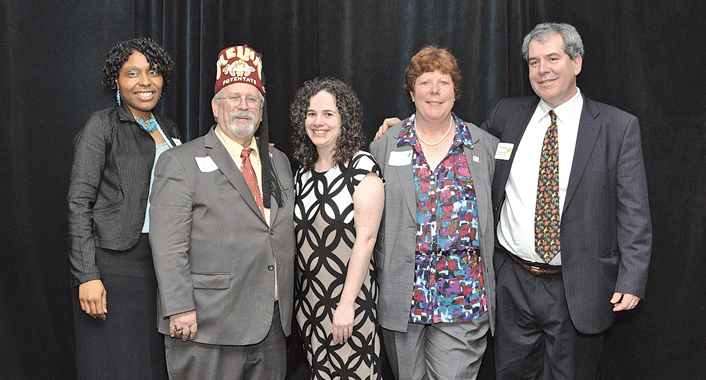
Event-78-EditMore than 300 people turned out at the Log Cabin Banquet & Meeting House in Holyoke on March 20 for a celebration of the Difference Makers for 2014. The photos on the next several pages capture the essence of the event, which featured entertainment from the Children’s Chorus of Springfield and the Taylor Street Jazz Band, as well as fine food and some poignant comments from the honorees. This year’s class, chosen by the editors and publishers of BusinessWest from dozens of nominations, and seen in a group photo above, are, from left: Paula Moore, founder of the Youth Social Educational Training (YSET) Academy; the Melha Shriners, represented by Potentate William Faust; the Gray House, represented by Executive Director Dena Calvanese; Colleen Loveless, executive director of the Springfield office of Rebuilding Together; and Michael Moriarty, attorney and president of Olde Holyoke Development Corp., chosen for his work with youth literacy.

For more photos go to here

Sponsored By:
DifferenceMakers2014sponsors

Baystate Medical PracticesFirst American Insurance • Health New England • Meyers Brothers Kalicka, P.C.Northwestern Mutual • Royal LLP • Sarat Ford Lincoln • 6 Pt. Creative Works

For reprints contact: Denise Smith Photography / www.denisesmithphotography.com / [email protected]

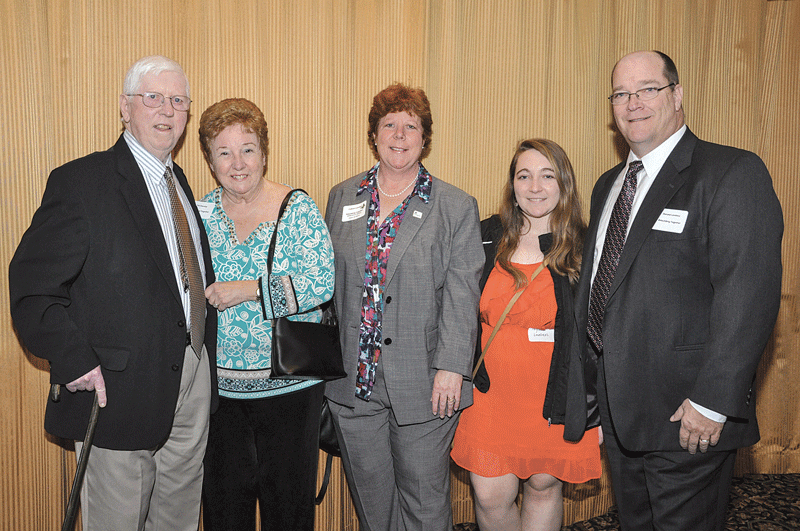
Difference Maker Colleen Loveless, center, stands with her parents, Jim and Pat Shanley, left, her husband, Donald Loveless, and her daughter, Taylor Loveless, prior to the ceremonies.

Difference Maker Colleen Loveless, center, stands with her parents, Jim and Pat Shanley, left, her husband, Donald Loveless, and her daughter, Taylor Loveless, prior to the ceremonies.

From left, Srs. Jane Morrissey and Cathy Homrok, members of the Sisters of St. Joseph and two of the founders of the Gray House, one of this year’s honorees, with Dena Calvanese, executive director of the Gray House, Leyla Kayi, director of Donor Relations, and Glenn Yarnell, director of Adult Education.

From left, Srs. Jane Morrissey and Cathy Homrok, members of the Sisters of St. Joseph and two of the founders of the Gray House, one of this year’s honorees, with Dena Calvanese, executive director of the Gray House, Leyla Kayi, director of Donor Relations, and Glenn Yarnell, director of Adult Education.

Lynn Ostrowski, director of Brand and Corporate Relations for Health New England, one of the event’s sponsors, with Brian Kivel, right, sales executive for Health New England, and Patrick Ireland, president and founder of Neutral Corner Inc.

Lynn Ostrowski, director of Brand and Corporate Relations for Health New England, one of the event’s sponsors, with Brian Kivel, right, sales executive for Health New England, and Patrick Ireland, president and founder of Neutral Corner Inc.

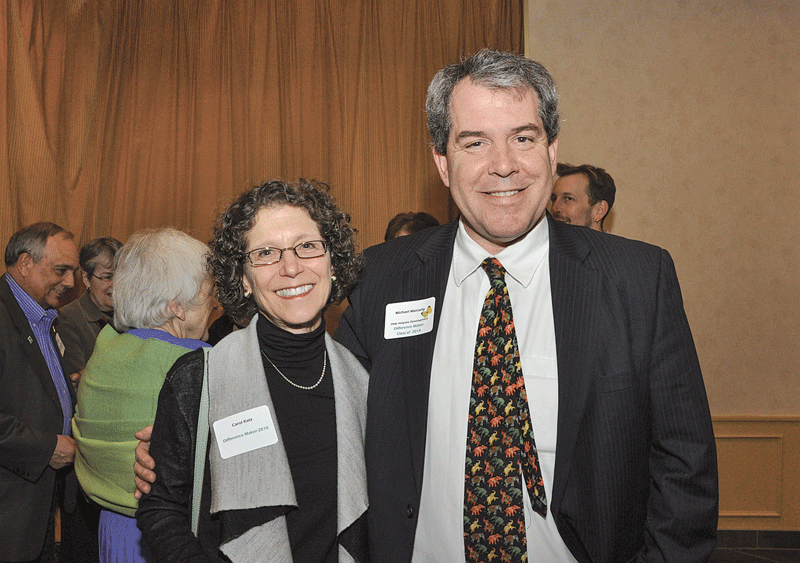
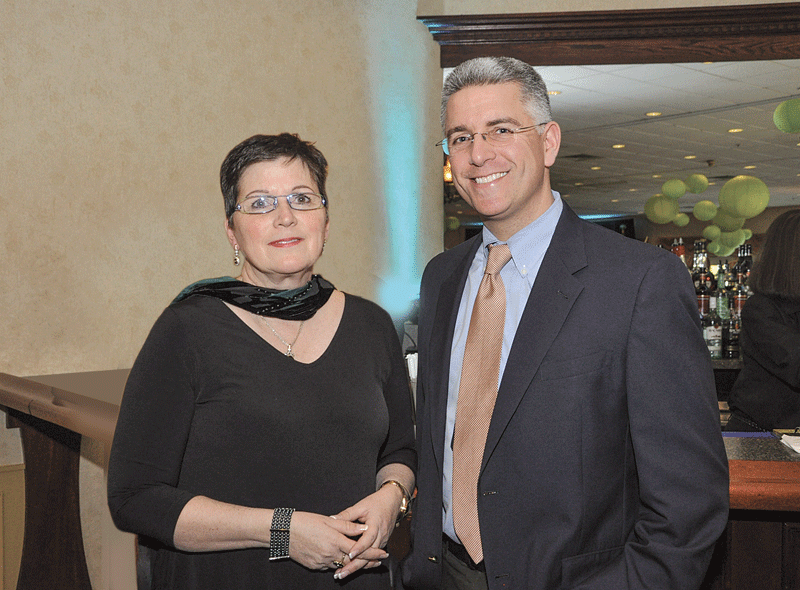
Carol Katz, member of the Difference Makers Class of 2010, talks with  2014 Diffference Maker Michael Moriarty, director of Olde Holyoke Development Corp., during the event’s VIP hour.

Carol Katz, member of the Difference Makers Class of 2010, talks with 2014 Diffference Maker Michael Moriarty, director of Olde Holyoke Development Corp., during the event’s VIP hour.

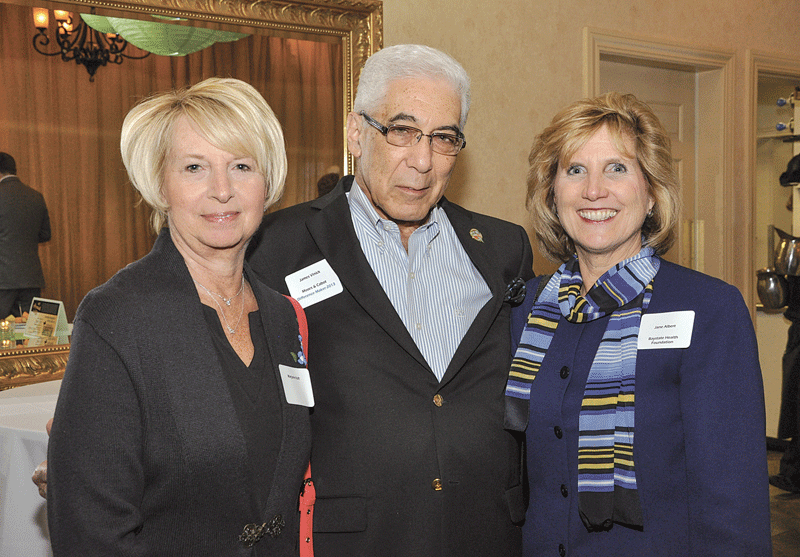
Jim Vinick, senior vice president of investments at Moors & Cabot Inc. and member of the Difference Makers Class of 2013, poses with speech pathologist Marjorie Koft, left, and Jane Albert, vice president of development at Baystate Health, another of the event’s sponsors.

Jim Vinick, senior vice president of investments at Moors & Cabot Inc. and member of the Difference Makers Class of 2013, poses with speech pathologist Marjorie Koft, left, and Jane Albert, vice president of development at Baystate Health, another of the event’s sponsors.


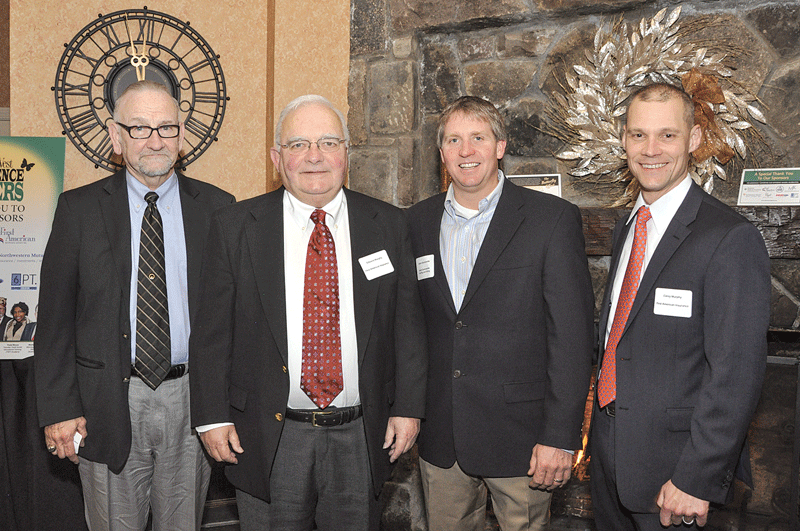
Corey Murphy, far right, president of First American Insurance, one of the event sponsors, with, from left, team members Dennis Murphy, document processor, and Edward Murphy, chairman, network with Adam Quenneville, president of Adam Quenneville Roofing and Siding (second from right).

Corey Murphy, far right, president of First American Insurance, one of the event sponsors, with, from left, team members Dennis Murphy, document processor, and Edward Murphy, chairman, network with Adam Quenneville, president of Adam Quenneville Roofing and Siding (second from right).

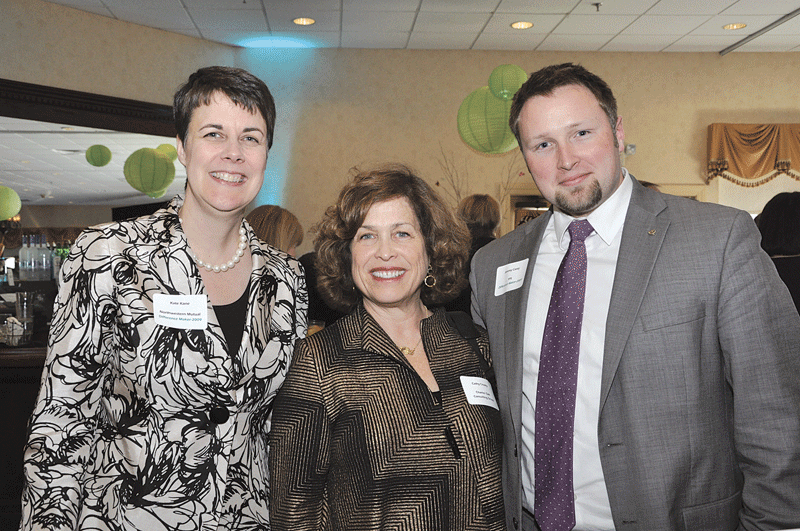
Kate Kane, left, managing director of the Springfield office of Northwestern Mutual (an event sponsor) and member of the Difference Makers Class of 2009, talks with Cathy Crosky, senior leadership consultant for Charter Oak Consulting Group, and Jeremy Casey, assistant vice president of Commercial Services at Westfield Bank, and president of the Young Professional Society of Greater Springfield, Difference Makers Class of 2009.

Kate Kane, left, managing director of the Springfield office of Northwestern Mutual (an event sponsor) and member of the Difference Makers Class of 2009, talks with Cathy Crosky, senior leadership consultant for Charter Oak Consulting Group, and Jeremy Casey, assistant vice president of Commercial Services at Westfield Bank, and president of the Young Professional Society of Greater Springfield, Difference Makers Class of 2009.

Karina Schrengohst, left, an attorney with Northampton-based Royal LLP, an event sponsor, talks with Crystal Boetang, an intern with the firm.

Karina Schrengohst, left, an attorney with Northampton-based Royal LLP, an event sponsor, talks with Crystal Boetang, an intern with the firm.

Paula Moore, founder of the Youth Social Educational Training (YSET) Academy and 2014 Difference Maker, networks with Robert Perry, a retired partner of Meyers Brothers Kalicka, P.C. (an event sponsor) and member of the Difference Makers Class of 2011.

Paula Moore, founder of the Youth Social Educational Training (YSET) Academy and 2014 Difference Maker, networks with Robert Perry, a retired partner of Meyers Brothers Kalicka, P.C. (an event sponsor) and member of the Difference Makers Class of 2011.

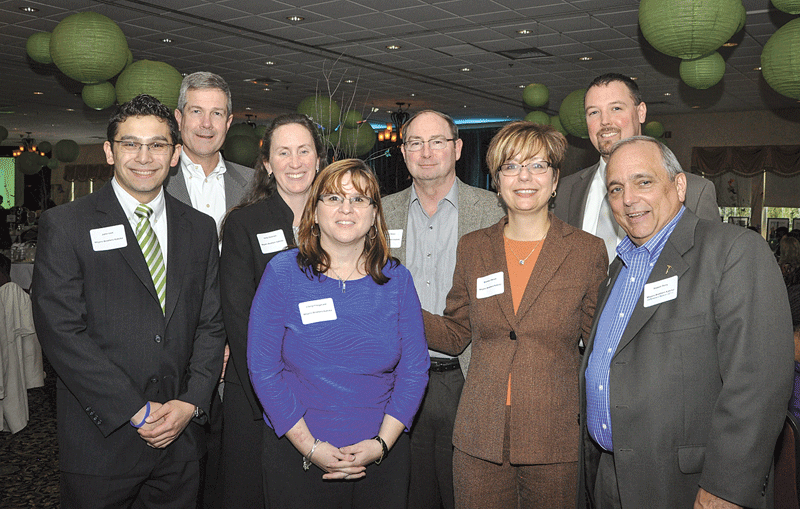
Team members of Meyers Brothers Kalicka, P.C., an event sponsor, gather prior to the ceremonies to show their support at the event. Front row, from left: John Veit, marketing and recruiting coordinator; Cheryl Fitzgerald, senior manager of Taxation; Brenda Olesuk, director of Operations and Development; and Robert Perry, past honoree and retired partner. Back row, from left: James Barrett, managing partner; Kelly Dawson, manager of Audit and Accounting; Kevin Hines, partner; and James Krupienski, senior manager of Audit and Accounting.

Team members of Meyers Brothers Kalicka, P.C., an event sponsor, gather prior to the ceremonies to show their support at the event. Front row, from left: John Veit, marketing and recruiting coordinator; Cheryl Fitzgerald, senior manager of Taxation; Brenda Olesuk, director of Operations and Development; and Robert Perry, past honoree and retired partner. Back row, from left: James Barrett, managing partner; Kelly Dawson, manager of Audit and Accounting; Kevin Hines, partner; and James Krupienski, senior manager of Audit and Accounting.

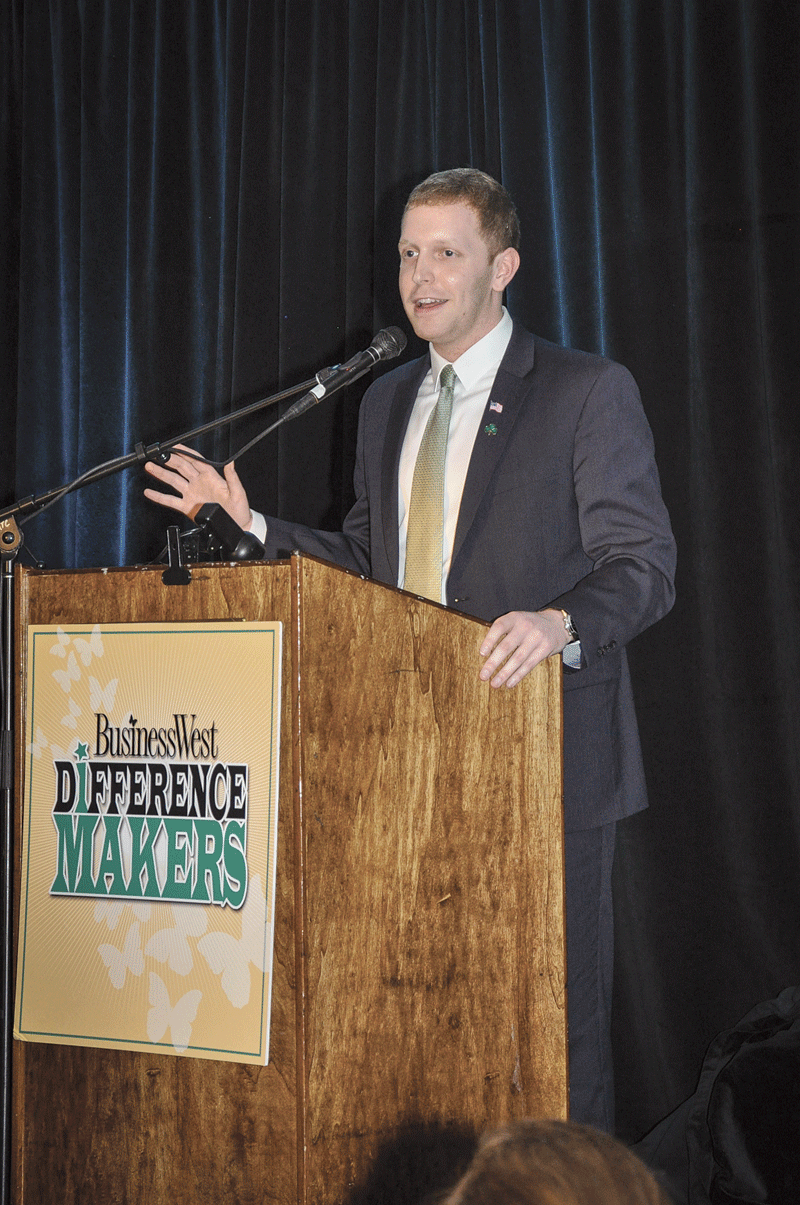
Holyoke Mayor Alex Morse takes a few minutes at the podium to welcome the audience to his city and commend Difference Maker Michael Moriarty for his work in the realm of youth literacy in the Paper City.

Holyoke Mayor Alex Morse takes a few minutes at the podium to welcome the audience to his city and commend Difference Maker Michael Moriarty for his work in the realm of youth literacy in the Paper City.

Difference Maker Paula Moore, recognized this year for her outstanding work with Springfield’s youth, offers words of inspiration after receiving her award.

Difference Maker Paula Moore, recognized this year for her outstanding work with Springfield’s youth, offers words of inspiration after receiving her award.

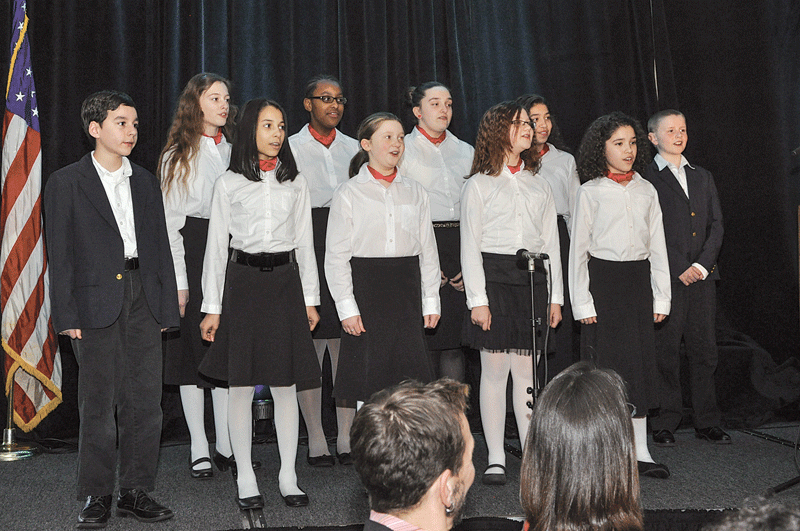
Continuing a Difference Makers tradition, the Children’s Chorus of Springfield kicked off the festivities. Led by Wayne Abercrombie, artistic director, the chorus performed three inspiring songs.

Continuing a Difference Makers tradition, the Children’s Chorus of Springfield kicked off the festivities. Led by Wayne Abercrombie, artistic director, the chorus performed three inspiring songs.

Gwen Burke, senior advertising consultant at BusinessWest, talks with Jeff Sarat, general sales manager at Sarat Ford, one of the event’s sponsors.

Gwen Burke, senior advertising consultant at BusinessWest, talks with Jeff Sarat, general sales manager at Sarat Ford, one of the event’s sponsors.

Difference Maker Colleen Loveless, executive director of the Springfield chapter of Rebuilding Together, was recognized this year for her work to help low-income families stay in their homes. Here, she introduces Oscar and Carol Granado, a couple whose home was renovated thanks to the organization.

Difference Maker Colleen Loveless, executive director of the Springfield chapter of Rebuilding Together, was recognized this year for her work to help low-income families stay in their homes. Here, she introduces Oscar and Carol Granado, a couple whose home was renovated thanks to the organization.

The Melha Shriners were recognized as Difference Makers for their commitment to bettering children’s lives, especially through their support of Shriners Hospitals for Children. Here, Potentate William Faust shares some thoughts with the audience after receiving the award on behalf of the organization.

The Melha Shriners were recognized as Difference Makers for their commitment to bettering children’s lives, especially through their support of Shriners Hospitals for Children. Here, Potentate William Faust shares some thoughts with the audience after receiving the award on behalf of the organization.

Michael Moriarty, honored as a Difference Maker for his work in youth literacy, shares his thoughts on that subject after receiving his award.

Michael Moriarty, honored as a Difference Maker for his work in youth literacy, shares his thoughts on that subject after receiving his award.

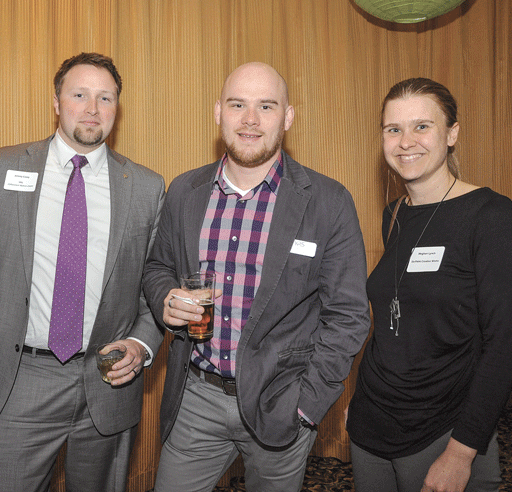
Meghan Lynch, right, president of Six-Point Creative Works, an event sponsor, networks with, from left, Gwen Burke, senior advertising consultant at BusinessWest; Jeremy Casey, assistant vice president of Commercial Services at Westfield Bank; and Peter Ellis, creative director at DIF Design.

Meghan Lynch, right, president of Six-Point Creative Works, an event sponsor, networks with, from left, Gwen Burke, senior advertising consultant at BusinessWest; Jeremy Casey, assistant vice president of Commercial Services at Westfield Bank; and Peter Ellis, creative director at DIF Design.

Agenda Departments

Celebrate Springfield Dinner Event
March 12: DevelopSpringfield will host its third annual dinner event in celebration of Springfield and the many accomplishments the community has achieved over the past year, along with the exciting new initiatives underway. The event will take place from 6 to 9 p.m. at the MassMutual Center in Springfield. Festivities will include a reception with live music by the Eric Bascom Trio and a silent auction, followed by dinner, a brief program, and presentations. Specifically, DevelopSpringfield will present its Partner in Progress Award to recognize the outstanding contributions of three individuals toward revitalization in Springfield: Colleen Loveless, executive director of Rebuilding Together; Terry Powe, principal of Elias Brookings Elementary School; and Mark Tolosky, president and CEO of Baystate Health. Platinum sponsors of the event are MassMutual Financial Group, Baystate Health, and Health New England. All proceeds will support DevelopSpringfield’s redevelopment initiatives, projects, and programs. Registration information is available at www.developspringfield.com or by contacting Paige Thayer at (413) 209-8808 or [email protected].

Wine & Food Tasting
March 14: The 29th annual WGBY Wine & Food Tasting, the largest event of its kind in Western New England, returns to the Springfield Marriott with extended hours this year, from 5 to 9 p.m. In addition to the opportunity to sample from more than 300 wines, participants will also be treated to a huge variety of bite-sized specialty foods from local chefs and food artisans, including smoked fish from Rachael’s, Pioneer Valley’s white hulless popcorn popped in olive oil and sprinkled with sea salt, selections from Chandler’s Restaurant, sweet and savory bite-sized treats from Barstow’s Dairy Store and Bakery, pasture-raised pork liverwurst from Simple Gifts Farm, and much more. Back again this year, by popular demand, are selections of the region’s best artisanal brews, craft beers, and ciders. Wine aficionados may also choose the upgrade ticket for entry into the Wine Connoisseur’s Room, where they can savor a special selection of top-caliber wines and champagnes, as well as artisanal cheeses and charcuterie supplied by Provisions. Tickets to the Wine & Food Tasting are $49 per person ($75 per person for the tasting and Connoisseur’s Room). The presenting sponsor for the event is Provisions in Northampton. For more information, visit www.wgby.org/wine.

Planning Strategies for Estates Under $10M
March 17: “Protect, Position, Prepare: Planning Strategies for Estates Under $10M” is an advanced-level presentation being offered for the benefit of practicing accountants, attorneys, trust officers and financial-planning professionals. This program will provide an overview of technical topics related to the importance of planning for clients with estates under $10 million, including how to protect assets, how to position assets, and how to integrate planning for the next generation. The event takes place at the Business Growth Center at Scibelli Hall, One Federal St., Springfield, from noon to 4 p.m.
Personalized invitations, along with an informational brochure, have been mailed.
The program, part of the 2014 Feldman Forum, will be presented by the Nautilus Group,  a service of New York Life Insurance Co. This presentation is for educational purposes and qualifies with NASBA for four hours of CPE credits in the taxes category. For more information, visit nyla.wpengine.com/marchff or call (413) 785-1100.

Difference Makers 2014
March 20: The sixth annual Difference Makers award program, staged by BusinessWest, will be held at the Log Cabin Banquet & Meeting House, honoring these five individuals and organizations: the Gray House; Colleen Loveless, executive director of the Springfield chapter of Rebuilding Together; the Melha Shriners, Paula Moore, teacher at Roger L. Putnam Vocational Academy and founder of YSET Academy; and Michael Moriarty, attorney and director of Olde Holyoke Development Corp. Their stories are told in the Feb. 10 issue of BusinessWest and online at www.businesswest.com. Tickets cost $60, and tables of 10 are available. Difference Makers is a program, launched in 2009, that recognizes groups and individuals that are, as the name suggests, making a difference in this region. Event sponsors include Baystate Medical Center, Health New England, First American Insurance, Meyers Brothers Kalicka, Northwestern Mutual, Royal LLP, Sarat Ford, and Six-Point Creative. For more information, call (413) 781-8600.

Management Conference
April 2: Accountability is a hot issue in today’s business world. At the Holiday Inn in Enfield, Conn., the Employers Association of the NorthEast (EANE) will hold its 10th annual management conference, called “It’s All About Accountability.” The conference will address personal accountability and responsibility in achieving organizational results, based on Linda Galindo’s bestselling book, The 85% Solution. EANE is bringing to the area Kathleen Kelly, a master certified facilitator in ‘the Accountability Experience.’ She will teach supervisors and managers how to develop accountability and learn to accept no less than 85% responsibility for the outcomes of their actions. Conference breakout sessions will include: “The Five Dysfunctions of a Team,” “Taking the ‘Difficult’ out of Difficult Conversations,” “Tom’s Fired: Where Did Things Go Wrong?” “Taking Ownership for Your Own Professional Development,” “Digging Deep: Performance Improvement Through Real Coaching,” and “Ethical and Legal Obligations of Managers in Solving Workplace Issues.” For more information about the conference, contact Karen Cronenberger at (877) 662-6444 or [email protected]. To register, call (877) 662-6444 or visit www.eane.org.

40 Under Forty
June 19:
The eighth annual 40 Under Forty award program, staged by BusinessWest, will be held at the Log Cabin Banquet & Meeting House, honoring 40 of the region’s rising stars under 40 years old. Judges recently chose this year’s class from more than 150 nominations, a record. They will be announced, and their stories told, in the April 21 issue. More details on the gala will be revealed in upcoming issues, but tickets cost $65, and they typically sell out quickly. For more information or to order tickets, call (413) 781-8600.

Agenda Departments

Soul Food & Jazz Luncheon
Feb. 27: Springfield Technical Community College will present its annual Soul Food & Jazz Luncheon from 11:30 a.m. to 2 p.m. on the seventh floor of Scibelli Hall. The event will feature the smooth sounds of Rohn Lawrence. Tickets are $5 per plate at the door. All proceeds will benefit the STCC Warms Hearts Fund. The event is sponsored by the Diversity Council at STCC.

Dark Dining Room House Concert Series
March 1, April 5, May 3: This winter and spring, Dark Dining Room brings the warmth and coziness of your living room to the grandeur of Wistariahurst. Concert curators Matthew Larsen and Greg Saulmon will serve up several courses of local and national musicians over the first Saturdays of March through May. While no dinner will be served, there will be light refreshments provided by Tony Jones Catering, as well as a cash bar. Doors open at 7 p.m. for all shows. Reservations are suggested. Tickets cost $18 ($15 for members) and can be purchased online at wistariahurst.org or by calling the museum at (413) 322-5660. The March 1 concert features Heather Maloney, who boasts influences and roots in adventurous folk. Rosary Beard, whose intricately intertwined acoustic guitars skate a thin line between melancholy reflection and uplifting release, will open the show. On April 5, Dark Dining Room introduces Colorway, a power trio fronted by Western Mass. native F. Alex Johnson. Introspective songsmith and acoustic guitarist Mark Schwaber opens the show. The final concert on May 3 features acoustic guitarist David Berkeley, a Santa Fe-based troubadour who brings his version of Americana to the stage. Matthew Larsen and the Documents open the show with introspective piano pop layered with careful instrumentation and thoughtful harmonies. For more information about the Dark Dining Room House Concert Series, go to darkdiningroom.com. This program is supported in part by a grant from the Holyoke Cultural Council, a local agency which is supported by the Massachusetts Cultural Council.

Celebrate Springfield Dinner Event
March 12: DevelopSpringfield will host its third annual dinner event in celebration of Springfield and the many accomplishments the community has achieved over the past year, along with the exciting new initiatives underway. The event will take place from 6 to 9 p.m. at the MassMutual Center in Springfield. Festivities will include a reception with live music by the Eric Bascom Trio and a silent auction, followed by dinner, a brief program, and presentations. Specifically, DevelopSpringfield will present its Partner in Progress Award to recognize the outstanding contributions of three individuals toward revitalization in Springfield: Colleen Loveless, executive director of Rebuilding Together; Terry Powe, principal of Elias Brookings Elementary School; and Mark Tolosky, president and CEO of Baystate Health. Platinum sponsors of the event are MassMutual Financial Group, Baystate Health, and Health New England. All proceeds will support DevelopSpringfield’s redevelopment initiatives, projects, and programs. About 400 attendees — including federal, state, and city officials; leaders from the business and nonprofit communities; and local residents — are expected to come together in support of ongoing efforts to advance development and redevelopment projects, stimulate and support economic growth, and expedite the revitalization process in Springfield. Registration information is available at www.developspringfield.com or by contacting Paige Thayer at (413) 209-8808 or [email protected].

Difference Makers 2014
March 20: The sixth annual Difference Makers award program, staged by BusinessWest, will be held at the Log Cabin Banquet & Meeting House, honoring these five individuals and organizations: the Gray House; Colleen Loveless, executive director of the Springfield chapter of Rebuilding Together; the Melha Shriners, Paula Moore, teacher at Roger L. Putnam Vocational Academy and founder of YSET Academy; and Michael Moriarty, attorney and director of Olde Holyoke Development Corp. Their stories are told in the Feb. 10 issue of BusinessWest and online at www.businesswest.com. More details on the gala event will be published in upcoming issues of the magazine, but tickets cost $60, and tables of 10 are available. Difference Makers is a program, launched in 2009, that recognizes groups and individuals that are, as the name suggests, making a difference in this region. Event sponsors include Baystate Medical Center, Health New England, First American Insurance, Meyers Brothers Kalicka, Northwestern Mutual, Royal LLP, Sarat Ford, and Six-Point Creative. For more information, call (413) 781-8600.

Employers Assoc. Management Conference
April 2: Accountability is a hot issue in today’s business world. At the Holiday Inn in Enfield, Conn., the Employers Assoc. of the NorthEast (EANE) will hold its 10th annual management conference, called “It’s All About Accountability.” The conference will address personal accountability and responsibility in achieving organizational results, based on Linda Galindo’s bestselling book, The 85% Solution. EANE is bringing to the area Kathleen Kelly, a master certified facilitator in ‘the Accountability Experience.’ She will teach supervisors and managers how to develop accountability and learn to accept no less than 85% responsibility for the outcomes of their actions. Conference breakout sessions will include: “The Five Dysfunctions of a Team,” “Taking the ‘Difficult’ out of Difficult Conversations,” “Tom’s Fired: Where Did Things Go Wrong?” “Taking Ownership for Your Own Professional Development,” “Digging Deep: Performance Improvement Through Real Coaching,” and “Ethical and Legal Obligations of Managers in Solving Workplace Issues.” For more information about the conference, contact Karen Cronenberger at (877) 662-6444 or [email protected]. To register, call (877) 662-6444 or visit www.eane.org.

Features
Difference Makers to Be Feted on March 20 at the Log Cabin

BizDiffMakrsLOGO2011You might call this the ‘Home Depot class.’

Indeed, there are some notable building, or home-restoration, stories involving this year’s roster of Difference Makers, as chosen recently by the staff at BusinessWest.

For example, there was the massive effort 30 years ago to restore and repurpose an old Victorian on Sheldon Street in Springfield, a structure — and a nonprofit — that have both become known as the Gray House. There was also the extensive work needed to convert the former School Street School in Springfield into the Youth Social Educational Training (YSET) Academy, created by Paula Moore to help keep young people off the city’s streets and out of trouble.

And then, there’s the ongoing work being carried out by Colleen Loveless, the first executive director of the Springfield chapter of Rebuilding Together, a national organization committed to helping low-income homeowners stay in their homes.

But beyond these literal building projects, the Difference Makers Class of 2014 has been figuratively building momentum in a number of realms — everything from early literacy to vital support for low-income residents, to high-quality healthcare for young people — and thus giving this region a stronger foundation on which to build for the future.

These stories will be told — and the Class of 2014 will be celebrated — at the annual Difference Makers Gala on March 20 at the Log Cabin Banquet & Meeting House in Holyoke.

Tickets for the event are $60 each, with tables of 10 available. For more information, or to order tickets, call BusinessWest at (413) 781-8600, ext. 100, or visit here.

The Difference Makers program was launched by BusinessWest in 2009 as a different kind of recognition program. It was created to show the many different ways that groups and individuals can make a difference and improve quality of the life for the residents of Western Mass., and it has, by all accounts, succeeded in that mission.

Past recipients have been honored for work across many spectrums, from fighting crime in Holyoke to creating a hugely successful fund-raiser to combat breast cancer; from tireless work on behalf of the homeless to a 40-year effort to keep professional hockey alive and well in Springfield; from a creative initiative to give residents of Springfield’s North End their streets back, to inspiring work to fill the shelves of area school libraries.

This year’s class, as profiled in the Feb. 10 edition of the magazine (viewable here), certainly adds to that legacy of stepping up and giving back.

The honorees are:

The Gray House, which, for three decades now, has provided a range of services — from food and clothing to adult education programs — to not only residents of Springfield’s North End, but those who live in other sections of the city and other communities as well;

• Colleen Loveless, who, as the first executive director of the Springfield Chapter of Rebuilding Together, has put that organization on the path to continued growth, and positioned it to have a deep impact on both individual homeowners and entire neighborhoods within the city;

• The Melha Shrine Temple, the first fraternal organization recognized as a Difference Maker. It is changing lives in many ways, but especially through its efforts to fund the many Shriners Children’s Hospitals operating in the U.S., Mexico, and Canada (including the one on Carew Street in Springfield), and also by raising awareness of these facilities and thus bringing more children and families in need to their doors;

• Paula Moore, who started Youth Social Educational Training (YSET) Academy as a way to keep at-risk youths off the streets. And when the church that hosted the program decided it couldn’t do that any longer, she personally secured a loan and purchased the former School Street School to keep the initiative alive. Today, it provides a host of services, from preschool to after-school workshops on a wide variety of subjects; and

• Michael Moriarty
, an attorney, current director of the Olde Holyoke Development Corp., and now-former school committee member, who has been at the forefront of efforts to improve early-literacy rates in one of the Commonwealth’s poorest and most challenged communities.

The March 20 gala will feature entertainment, butlered hors d’oeuvres, lavish food stations, introductions of the honorees, and remarks from the honorees. Over the years, the gala has become one of the region’s best networking opportunities, and an event not to be missed.

This year will be no exception.

Class of 2014 Cover Story Difference Makers
The Difference Makers Will Be Celebrated on March 20 at the Log Cabin

DiffMakers750x250


Sponsored By:
Baystate Medical PracticesFirst American Insurance • Health New England • Meyers Brothers Kalicka, P.C.Northwestern Mutual • Royal LLP • Sarat Ford Lincoln • 6 Pt. Creative WorksDiffernceMakers0213sponsors


When BusinessWest launched its Difference Makers program in 2009, it did so with the knowledge that there are, indeed, many different ways in which a group or individual can make a difference and impact quality of life in this region.

Each class has emphatically driven that point home, with honorees ranging from a Holyoke police chief to the founder of the Rays of Hope fund-raiser to battle breast cancer; from the president of Holyoke Community College to the director of the Regional Employment Board; from the man who kept hockey alive in Springfield for the past 30 years to some law-enforcement officials implementing counterintelligence tactics to confront gangs in Springfield’s North End.

This year’s class of Difference Makers is no exception, and it adds several new wrinkles to the contention that there is no shortage of ways that people can change others’ lives — and for the better.

Let’s start with Paula Moore. A schoolteacher — in fact, a substitute teacher at the time — she started a program to help keep young people off the streets and out of trouble. She would eventually call it the Youth Social Educational Training (YSET) program, and when the church that originally hosted these after-school sessions told Moore she would have to move it elsewhere, she used her own money and credit to acquire a dilapidated former school and renovate it into what is now known as YSET Academy.

She wasn’t going to take that drastic step, but felt compelled to by overwhelming need in the community and an unrelenting desire to do something about it.

And these were the same sentiments that drove five members of the Sisters of St. Joseph and a partnering layperson to scrape together $500 and prevail at the public auction of a long-vacant, seriously rundown gray Victorian on Sheldon Street in Springfield’s North End in 1982.

Two years later, the Gray House opened its doors, and ever since it has been providing food, clothing, adult-education programs, and its Kids Club to a ever-widening group of constituents.

Improving quality of life for low-income individuals has also been the mission of a nonprofit called Rebuilding Together, which provides assistance to help people stay in their homes when, because of illness, old age, or simply a lack of resources, they cannot undertake needed repairs and upkeep.

In its early years, the Springfield chapter of this agency provided support one day in April, and only to a few homeowners. Under the guidance of its first executive director, Colleen Loveless, the Springfield office has expanded its reach in every way imaginable, and has put in place an ambitious 10-year strategic plan that will change the face, and the fortunes, of a large section of the city’s Old Hill Neighborhood.

Meanwhile, Michael Moriarty has committed much of his time and energy to taking on another societal challenge — early literacy.
An attorney and now director of Olde Holyoke Development Corp., he has taken the lead in Holyoke’s Third Grade Literacy Initiative, helping to put in place an infrastructure and a battle plan to dramatically increase the number of young people able to read by the fourth grade — the time when people stop learning to read and begin reading to learn.
And then, there’s the Melha Shriners. The first fraternal organization named as a Difference Maker, it’s changing lives in many ways, but especially through its efforts to help fund the many Shriners Children’s Hospitals across the country — and now Mexico and Canada — and, perhaps more importantly, raise awareness of the incredible work being done at those facilities.

The Class of 2014 will be honored at the annual Difference Makers Gala on March 20 at the Log Cabin Banquet & Meeting House in Holyoke. The event will feature butlered hors d’oeuvres, lavish food stations, introductions of the Difference Makers, and remarks from the honorees. Tickets are $60 per person, with tables of 10 available.
For more information, or to order tickets, call (413) 781-8600, ext. 100.

Class of 2014 Difference Makers
Their Investments in the Lives of Children Are Paying Huge Dividends

Al Zippin, left, past potentate, and current Potentate William Faust.

Al Zippin, left, past potentate, and current Potentate William Faust.
Photo by Denise Smith

Howard Newman was relating the story of how he and his wife, Cindy, ultimately decided to adopt a 2-year-old Russian boy suffering from what’s known as ‘limb deficiency’ — the child was born missing part of his thigh bone and fibula, and had a foot where his short leg ended.

He started by recalling what he could of a conversation the couple had with an orthopedic specialist practicing not far from where they lived in the Albany, N.Y. area. Essentially, the Newmans were looking for insight into what this boy was up against, what care he would need, and what kind of life he could expect.

And the doctor answering their questions wasn’t exactly filling them with hope and optimism.

“He tried to discourage us from doing this,” Howard recalled. “He said that a boy like this may never walk. He was giving us all the negatives, saying things like ‘think about having to carry a 20-year-old up and down steps.’”

But the Newmans were not to be easily deterred. They had the same discussion with more specialists, and eventually gained enough confidence to buy two plane tickets to Russia — and three for the ride home.

When they picked up the child, they had a talk with the Russian doctor administering the physical that was required to complete paperwork for the American embassy. He had what amounted to a question wrapped in the form of a plea.

“He said, ‘you are taking him to Shriners, aren’t you?’” said Howard.

To make a long story somewhat shorter, they did. Specifically, they took him to the Shriners Hospital for Children on Carew Street in Springfield, and they’ve been bringing him back periodically for more than 16 years.

His care there started with the amputation of his foot, leaving young Isaac in a body cast for six weeks. He was then fitted for a prosthetic leg, the first of several he’s needed over the years.

“As I grow, I need new legs,” said Isaac, adding that there were years when he went through two.

As he talked with BusinessWest on a cold Friday morning in late January, he was at the hospital to be fitted for the latest of these prosthetic limbs, all provided free of charge.

“I’ve pretty much stopped growing now — they’re replacing this one because it’s faded,” said Isaac, who walks with a slight limp and can run with his fellow classmates during gym class.

He leads what Dr. David Drvaric, who performed the amputation surgery and has cared for Isaac since he first arrived at the hospital, called a normal life. “He just has to put his leg on every day.”

Howard Newman said Isaac’s experiences with Shriners went a long way toward convincing he and Cindy to adopt another Russian child with similar problems, a girl named Chloe. She is also a regular visitor at the hospital, and, like her brother, has gone through a number of prosthetic limbs.

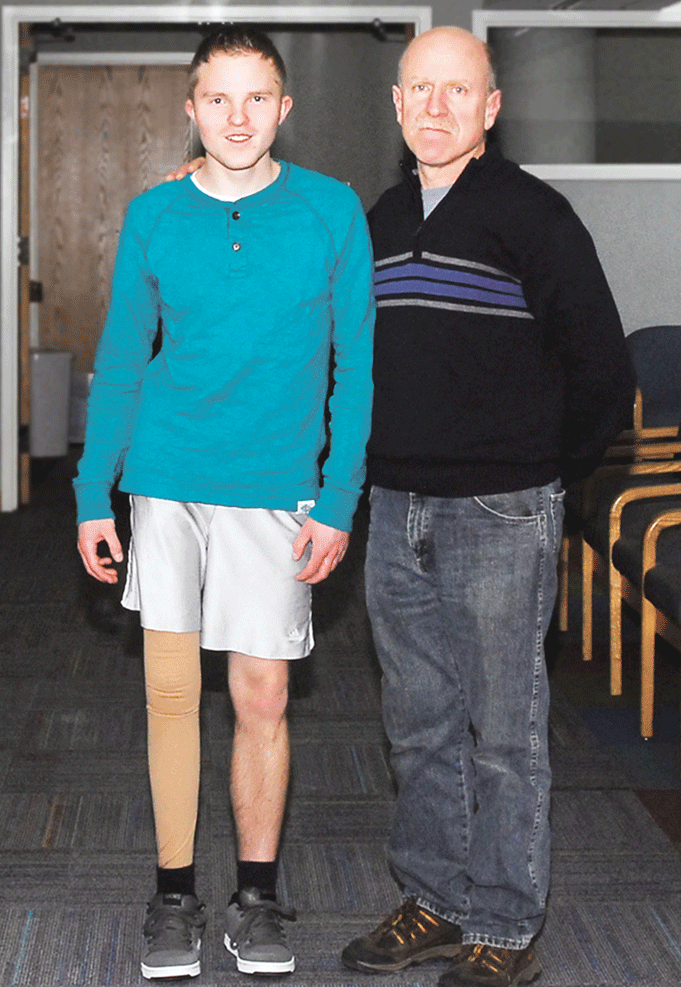
Isaac Newman, seen here with his father, Howard

Isaac Newman, seen here with his father, Howard, has been coming to the Shriners Hospital for Children in Springfield for more than 16 years.

It isn’t written down anywhere, but it is the unofficial mission of the Melha Shrine Temple, based on Longhill Street in Springfield, to help script more success stories like those involving Isaac and Chloe.

The Melha Shriners, like other temples across the U.S. and around the world, raise money to fund the 22 Shriners Childrens Hospitals in this country and now also Canada and Mexico. But equally important, they work tirelessly to raise awareness of these facilities and the critical, compassionate work that goes on at each one, while also dispelling the misperceptions that exist concerning them.

And there are many, said Chuck Walczak, administrator for both the Springfield hospital and another facility in Erie, Pa., starting with the commonly held belief that the hospitals care only for the children of Shriners, or that there are other limitations on who receives services. There’s also the notion that, because the care provided is free — although the hospitals will now ask patients’ families to use their insurance, if they have it — it is not of the highest quality. Even physicians practicing behind the former Iron Curtain know that’s not the case.

“Unfortunately, we’re a best-kept secret, and that’s not what we want to be,” said Walzcak, who credited the Melha temple with excellent, and ongoing, work to help rid the facility of that distinction.

And as the Shriners carry out that important work, they do it with a distinctive style and attitude, if you will — one focused on fun. The most visible manifestations of this are the annual Shrine Circus at the Big E and the ever-present clown unit, but those qualities permeate each of the 14 units, from bands to the many motorized vehicles, and each parade they appear at.

Al Zippin, long-time member of the Melha Temple, past potentate, and unofficial historian, summed it all up nicely.

“As Shriners, we’re investing in the future, and the reason I say that is our investment is in children — if we improve the quality of their lives, the future gets brighter for everyone,” he said, striking at the heart of the reason why the Melha group has been chosen as a Difference Maker for 2014.

Fun — with a Purpose
As he talked with BusinessWest at the Shriners facility, one of the many mansions on Longhill Street that have been retrofitted for other purposes, Zippin said the Melha Temple is now 115 years old.

It boasts members from across Western Mass., from the New York border to Worcester, and also from Northern Conn. There are roughly 1,400 members now, down from about 3,500 three decades ago, and perhaps 5,000 in the ’60s, he noted, adding that, like many fraternal organizations and service clubs, the Shriners are challenged with the task of convincing members of the younger generations to make the requisite commitments of time and energy to the organization.

But while smaller in size, the Melha Temple remains very active and quite impactful, said Zippin, who used that term to describe everything from the many forms of support given to all Shriners hospitals, and especially the Springfield facility, to participation in events and the staging of the circus, to the way in which this organization inspires its members to continually find ways to give back to the community.

“Once you get a taste of this,” he said, deploying that word to describe all of the above, “you don’t restrict yourself to the Shriners.

“That’s what happened to me,” he went on, adding that he became involved with groups and causes ranging from the Children’s Study Home to the Greater Springfield Convention & Visitors Bureau. “Masonry’s lessons lead you down that path — being aware of the needs of other people, being tolerant of others, and maintaining values and standards.”
There are 14 units within the Melha Temple, including the clowns (some of whom will make more than 100 appearances a year); a number of bands, including the popular Highlanders (bagpipers), a military band, a drum corps, an oriental band, and others; a host of motorized teams; and other units assigned specific projects. One orchestrates the circus, for example, while another, the so-called Directors Staff, offers tours of the Springfield hospital each weekend.

The performing units take part in a number of parades, including the Holyoke St. Patrick’s Day Parade, the July 4 event in East Longmeadow, and many others, said current Potentate William Faust, adding that the latest addition to the calendar is one in Winchendon.

There are also a number of events, such as the Chowder Bowl Football Classic involving local high-school stars, the annual Springfield Carnival, the temple’s annual game dinner, and others, all of which are designed for family involvement.

And that’s especially true of the annual Shrine Circus at the Big E.

The four-day spectacle, which debuted in the ’30s and has now continued for 60 consecutive years, draws thousands of attendees annually, said Zippin, and boasts a number of ongoing traditions.

Chief among them is the so-called Community Services Show, the Friday-afternoon performance, for which the Shriners donate all 4,700 tickets to area human-services agencies that work with children.

The Shriner clowns

The Shriner clowns have historically been one of the most visible manifestations of the Melha Temple’s huge presence in the community.

Zippin noted that he’s now seen three generations of the same family grow up with the event — and often come back together each May.

“People ask me what I do at the circus,” he said. “I tell them by the time it starts, my work is essentially over, so what I do is walk around and just look at the generations, the families, just having a great time; it’s incredibly rewarding.”

But while the circus and the parades bring revenue to the Melha Temple and, in turn, its units entertain and inspire people of all ages, such community outreach is undertaken for one reason — to bring important exposure to the Shriners’ philanthropy, its children’s hospitals.

“I’m a nut about exposure and PR, and I look at the circus and the parades as ways to simply remind people we’re here and that we have a great purpose,” said Zippin. “People will say, ‘boy, you have a lot of fun,’ and we can have fun because we look at the hospital up on Carew Street, and we know why we’re here.”

This mindset applies to the circus as well, even though the proceeds from those shows go toward operating the temple and the Longhill Street facility, not the hospital.

“The more visible we can be, the more we can bring the hospital story out to everybody,” he told BusinessWest. “And we need to keep doing that, and the circus really puts us in the public eye.”

Faust agreed. “Each year, the potentate has to come up with a slogan for the year,” he said. “My slogan is ‘Melha Shriners: having fun and helping kids,’ and that really says it all. We go out there and have fun at all our events, but it’s fun with a purpose.”

Care Package
When asked to put the Shriners — meaning the organization and its mission — into perspective, Zippin relayed a sentiment he’s probably expressed hundreds of times and in front of all kinds of audiences.

“When we have people who are thinking of becoming Shriners or who just recently joined, I always say to them, ‘how many organizations do you know where you can go in, and simply by being a member and paying your dues, you can have an impact on a child’s life — indirectly, but an impact?’” he said, while shifting the conversation about the organization back to where he thought it belonged: the hospitals.

There are 22 of them, 19 in the U.S. The operation in Springfield, one of two in Massachusetts, was originally opened in 1925. That hospital was replaced by the current facility on Carew Street in 1990. There are three major components to the Springfield facility:

• The Orthotics and Prosthetics Department, which custom-designs prosthetic adoption devices;
• The Motion Analysis Laboratory, which is involved in the study and application of biomechanics and gait analysis, including the use of a 3-D body scanner to measure body shape; and
• The Cleft Lip and Palate Clinic, which follows 360 patients through treatment options for cleft lip and palate repair.

Overall, the Springfield hospital, one of several that focus on muscular-skeletal disorders, has 12,000 active patients, who can receive care there until they are 21. They are treated for everything from chest-wall deformities to hip disorders; knock knees to limb deficiency; scoliosis and other spine deformities to spina bifida. As with both Isaac and Chloe Newman, patients are offered care over a number of years, said Walczak.

One ongoing challenge for the hospital, as he mentioned, is creating awareness of its presence, specialties, track record, and policies for admitting anyone whose condition meets its scope of services, free of charge.

“We’re narrowly scoped, but steeped in our expertise — we’re a specialty hospital,” he explained. “We don’t have the same resources and market identity as larger facilities.”
There is a new national marketing slogan — “Love to the Rescue” — that has been created to help brand and promote the hospitals as a group, he went on, “but within each of our markets, it’s very difficult to get the word out in a way that reaches everyone the way we would like.

“We don’t put a lot of money in our marketing budgets — we try to put every dollar toward patient care,” he continued, adding that this is why the multi-faceted support of the many Shrine temples, and especially Melha, is so critical to the hospital’s success moving forward.

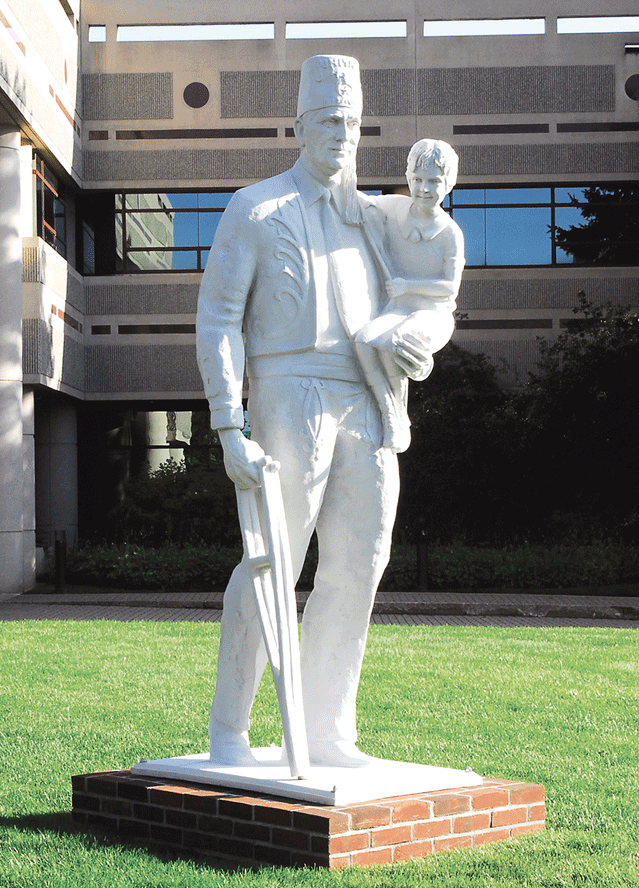
The statue outside the Shriners Hospital

The statue outside the Shriners Hospital in Springfield pays homage to the Shriners and their work with children.

Shriners serve the facility in a number of ways, Walczak said — everything from those aforementioned tours to serving as volunteer drivers to pick up and drop off patients, to serving on the hospital’s board of governors.

“It’s a very collaborative relationship,” he said of the temple and the hospital, adding that tours are just one example of this phenomenon, but an important one because they usually bring out the passion the organization has for the hospital.

“We have a contingent of gentlemen who know this place inside and out, and they love to come here on weekends, nights, whenever, and show off this facility,” he said. “The gentlemen of Melha and the other shrines are so proud of these places; I’ve seen them come into this place crying because they’re just so proud of it. The passion, the loyalty, and the intensity is like something I’ve never seen in any place I’ve been in.”

Life and Limb

Isaac Newman will be graduating from high school next year.

That orthopedic specialist in Albany with whom his parents-to-be consulted all those years ago could not have been more wrong about his fate and the quality of life he would enjoy. And the same is true for his sister.

As Dr. Drvaric noted, Issac’s is a normal existence, apart from having to put his leg on every day. He and his family owe that to the Shriners around the world, and especially those at the Melha Temple, who have made the children’s hospitals their philanthropy — and their reason for being.

And for that, all those who have served the organization are worthy to be called Difference Makers.

George O’Brien can be reached at [email protected]

Agenda Departments

YMCA Annual Dinner
Feb. 12: Community members will gather at Mill 1 at Open Square for the Greater Holyoke YMCA’s 2014 Annual Dinner. The dinner celebrates and honors those who give unselfish gifts of time and energy to the community. This year’s Louis F. Oldershaw Community Service Award recipient is Attorney Mark Beauregard. The Oldershaw Award is given to an individual who has made significant volunteer contributions to the community and emulates a high standard of excellence in his or her life, professional achievements, and community service. The Y will also recognize the generous volunteer contributions of Joanne and Scott Harper of South Hadley, recipients of the Y’s 2014 Distinguished Service Award. The Harpers have volunteered with the Y’s Viking Swim Team for many years and have been instrumental in the team’s success. The Annual Dinner is $40 per person. Those interested in attending may either call the Y to register at (413) 534-5631, ext. 126, or visit the Y’s website at www.holyokeymca.org to register and pay in advance.

ACCGS Outlook Luncheon
Feb. 24: Join the Affiliated Chambers of Commerce of Greater Springfield for the region’s largest legislative event, discussing the most pressing local, regional, and federal issues of the day. The luncheon is slated for 11:30 a.m. to 1:30 p.m. at the MassMutual Center. The keynote speaker is Ed Henry, White House correspondent for Fox News. Presented by Health New England and sponsored by Eastern States Exposition, MassMutual Financial Group, PeoplesBank, United Personnel, Western Massachusetts Electric Co., Chicopee Savings Bank, and Verizon, as well as reception sponsors Comcast, the Sisters of Providence Health System, and the Republican, Outlook typically attracts more than 700 guests. Area elected officials will also be in attendance to participate in this discussion of front-burner issues. Tickets are $50 for ACCGS members and $70 for general admission. Reserved tables of 10 are available. Reservations must be made in writing and in advance by Feb. 14. Reservations may be made online at www.myonlinechamber.com, by e-mailing Cecile Larose at [email protected], or by faxing a reservation request to (413) 755-1322.

Dark Dining Room House Concert Series
March 1, April 5, May 3: This winter and spring, Dark Dining Room brings the warmth and coziness of your living room to the grandeur of Wistariahurst. Concert curators Matthew Larsen and Greg Saulmon will serve up several courses of local and national musicians over the first Saturdays of March through May. While no dinner will be served, there will be light refreshments provided by Tony Jones Catering, as well as a cash bar. Doors open at 7 p.m. for all shows. Reservations are suggested. Tickets cost $18 ($15 for members) and can be purchased online at wistariahurst.org or by calling the museum at (413) 322-5660. The March 1 concert features Heather Maloney, who boasts influences and roots in adventurous folk. Rosary Beard, whose intricately intertwined acoustic guitars skate a thin line between melancholy reflection and uplifting release, will open the show. On April 5, Dark Dining Room introduces Colorway, a power trio fronted by Western Mass. native F. Alex Johnson. Introspective songsmith and acoustic guitarist Mark Schwaber opens the show. The final concert on May 3 features acoustic guitarist David Berkeley, a Santa Fe-based troubadour who brings his version of Americana to the stage. Matthew Larsen and the Documents open the show with introspective piano pop layered with careful instrumentation and thoughtful harmonies. For more information about the Dark Dining Room House Concert Series, go to darkdiningroom.com. This program is supported in part by a grant from the Holyoke Cultural Council, a local agency which is supported by the Massachusetts Cultural Council.

Difference Makers 2014
March 20: The sixth annual Difference Makers award program, staged by BusinessWest, will be held at the Log Cabin Banquet & Meeting House, honoring the five individuals and organizations featured in the special section of this issue. More details on the event will be published in upcoming issues of the magazine, but tickets cost $60, and tables of 10 are available. Difference Makers is a program, launched in 2009, that recognizes groups and individuals that are, as the name suggests, making a difference in this region. Event sponsors include Baystate Medical Center, Health New England, First American Insurance, Meyers Brothers Kalicka, Northwestern Mutual, Royal LLP, Sarat Ford, and Six-Point Creative. For more information, call (413) 781-8600.

Class of 2014 Difference Makers

Executive Director of the Springfield Chapter of Rebuilding Together

This Administrator Is Certainly a Momentum Builder
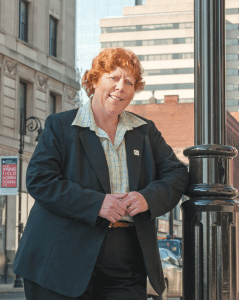
Collen Lovelace

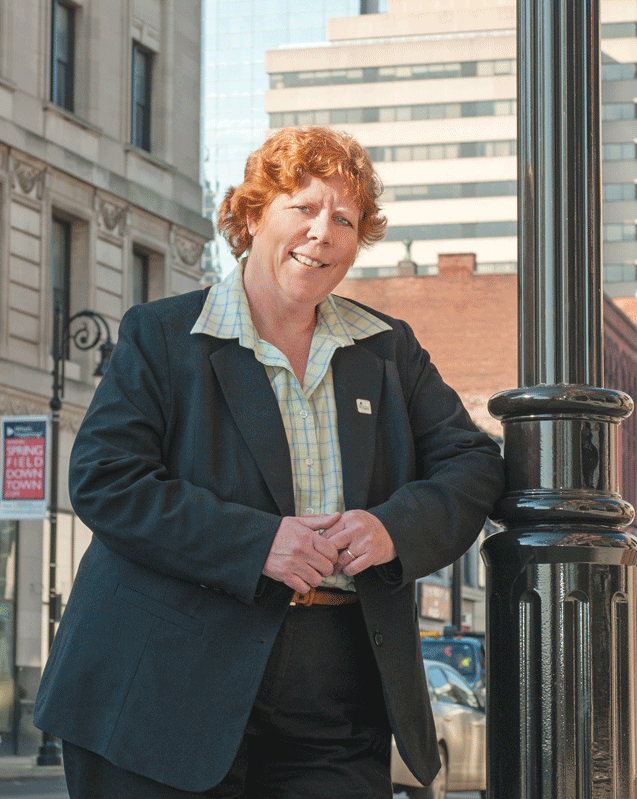
Colleen Loveless

The large whiteboards in the conference room/kitchen of the Springfield office of Rebuilding Together are mostly clear at the moment.

The period from the holidays through the first few weeks of the new year are comparatively quiet at this agency — which touts itself as the “nation’s leading nonprofit working to preserve affordable homeownership and revitalize communities” — so there are only a handful of jobs, or projects, listed on the boards.

But that will change soon, said Colleen Loveless, executive director of the Springfield office, which is ramping up for what she expects will be another huge year. And as the calendar inches closer to the last Saturday in April, or National Rebuilding Day, as it’s called, those boards will be filled from top to bottom with projects, sponsoring groups, volunteer units, and other pertinent information.

It was that way last year, when the agency marked the occasion with a tightly coordinated campaign, aided by an army of 1,000 volunteers and 70 sponsors and donors, that changed the face of Tyler Street in Springfield’s Old Hill neighborhood. This ‘cluster rebuild’ — also called a Green-N-Fit project because of its focus on ‘green’-related initiatives such as converting heating systems from oil to natural gas — featured efforts to renovate, repair, and refurbish 25 homes on that street, most all of which were close to a century old, tired, and energy-inefficient.

The rebuild brought a new look to Tyler Street, but also new enthusiasm, new hope, and some unexpected consequences.

“One positive outcome from last year that we hadn’t anticipated was that neighbors who didn’t really know each other — everyone kind of sticks to themselves — did get to know each other,” she said. “And they’re now looking out for each other; there’s much more of a sense of community.”

The crowded whiteboards in the conference room have become one indicator of what Loveless has accomplished since she became the first executive director of this office more than four years ago and promptly began taking it to another, much higher level. But there are many others.

The Rebuilding Together brand

The Rebuilding Together brand, not to mention its reach, have been taken to a new level under the leadership of Colleen Loveless.

Most are to be found in the office’s front lobby. There hang collections of photographs chronicling last April’s cluster rebuild, as well as a recent project to rehab a transitional facility for 12 homeless veterans on Maple Court, and another to repair and refurbish 25 homes damaged by the June 2011 tornado that tore a path of destruction through the city. There’s also a shot of Loveless being presented with the Booze Allen Hamilton Management Excellence Award in 2012 as the top affiliate among the more than 200 chapters nationwide.

Beyond the photos, though, there are numbers, and many of them, to quantify what Loveless has accomplished in her tenure. She has grown the affiliate from being the 149th largest of the agency’s chapters to the 18th largest, and from nine home projects and a $130,000 budget to a high of 71 rebuilds (in 2012) and a $612,000 budget. Using a formula of leveraging an additional $4 in monetary and in-kind donations for every dollar spent, that adds up to an annual investment of more than $3 million in Springfield’s housing stock, which has made the City of Homes more deserving of that historic moniker.

But if current events and those of the recent past have prompted generous amounts of optimism, enthusiasm, and energy, one could make a strong case that the future looks even brighter.

Indeed, Loveless and her staff are putting the finishing touches on an ambitious strategic plan for the organization. It has a long name — ‘Rebuilding Together: Green-N-Fit 10 in 10; Maximizing Cluster Builds to Benefit the Old Hill Neighborhood, the State Street Corridor, and the City of Springfield’ — but a broad, yet simple, objective.

This endeavor will continue the work started last April for the next nine years, revitalizing contiguous blocks from Tyler Street to Hickory Street (see map, page A12) thus changing the look — and, in many ways, the fate — of what is statistically one of the poorest neighborhoods in the country.
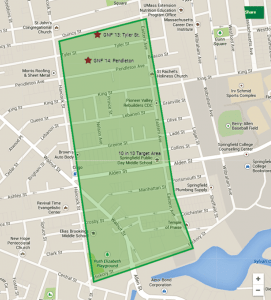
Green-N-Fit 10 in 10

This map shows the battle plan for Green-N-Fit 10 in 10, which will change the face of several blocks within the Old Hill neighborhood.

While building on the impressive set of numbers compiled in her first four years at the helm of the agency, Loveless has some other work to do in the months and weeks to come, especially in the realm of awareness and telling the nonprofit’s story.

Indeed, there are many who are not aware of what Rebuilding Together does, how, or why, she noted, and there is also considerable confusion with regard to other agencies with like-sounding names — DevelopSpringfield and Rebuilding Springfield are just a few — and other nonprofits with housing-related missions, such as HAPHousing and Habitat for Humanity.

“Our brand is resonating, but we have to work harder to get the word out. We don’t build new houses, and we don’t do extreme makeovers,” she said, referencing the missions of other nonprofits (or TV networks). “Our goal is to preserve existing home ownership and help people stay in their homes.”

And because of the effective manner in which she has articulated, communicated, broadened, and carried out that mission, Loveless is clearly worthy of the designation Difference Maker.

Board Meetings
Photographs of the massive National Rebuilding Day effort last April certainly help tell the story of how this agency has evolved and grown over the past several years, and changed the landscape in Springfield — figuratively and quite literally — in the process.

One aerial shot (see below) conveys the scope of the effort, the high level of coordination, and the large amounts of energy, camaraderie, and good will that were generated by convening so many volunteers and supporting businesses to bring new life to one small but significant corner of the city.

“It was truly a community effort — many different groups and individuals were involved with making it all happen,” said Loveless, who spent much of the day choreographing the production, which was compared by many to a movie set because of the sheer volume of people, not to mention the drama that was unfolding, on site.

It was a world — or several worlds, to be more accurate — apart from what the local affiliate of Rebuilding Together was doing back in the early ’90s, when the national agency was called Christmas in April.

That’s because it only did projects on that one day each April, said Loveless, adding that the organization was launched locally by three banks — SIS (now TD Bank), Hampden Bank, and BayBank Valley — and had no paid staff, just a volunteer board that would work on perhaps a half-dozen houses a year, focusing on painting, landscaping, and other small projects.

As the nonprofit expanded into a year-round initiative, a name change was obviously necessary, she went on, and Rebuilding Together, which accurately and succinctly sums things up, was chosen.

It was in 2009, she said, that the board decided that the Springfield affiliate needed to respond to consistently growing need within the community and expand its mission and scope. Demographics played a big part in that decision, she told BusinessWest, adding that the population of Springfield, as in all cities, was aging, and individuals were finding it more difficult to remain in their homes and keep them properly maintained.

“Many of these people had lived in their homes for dozens of years, decades and decades,” she said. “Now, they’re on Social Security, and they want to stay in their home. So we would build them a handicap ramp or fix their leaking roof.

“The board saw this growing demand and decided it was time to open an office, hire staff, and make it a year-round program to serve more people in need,” she went on, adding that the opportunity to manage that office appealed to her, professionally and otherwise.

At the time, Loveless was operating her own category-management company, called Popmax (short for point-of-purchase maximization) International, which she launched 15 years earlier, while also venturing into commercial real estate with a small portfolio of rental properties. She also built her own home.

“I really enjoyed what I was doing, and it was a successful business, but I was looking for something different,” she said. “And this was a good match for me, because I could use my marketing, sales, and business skills; after all, a nonprofit is a business as well. I love doing this more than running my own business, and not many people can say that.”

Loveless first set up shop in the Scibelli Enterprise Center (now the Business Growth Center) in the Technology Park at Springfield Technical Community College, but quickly outgrew that space and moved into the Colonial Block on Main Street in Springfield, just a block or so from where the tornado tore through the South End on that fateful June day.

Bringing It Home
Over the past few years, Loveless has expanded the agency in a number of ways, from the number of projects to the types of endeavors to the work done on the houses chosen as projects.

“When it was an all-volunteer organization, it was just painting and landscaping,” she explained. “Now, we’ll do anything to a house — mold issues, pest control, lead abatement, roofs, energy-efficiency … anything that focuses on safety, health, and the well-being of the owner.”

She related the story of one individual who pressed the agency for a fence, something that would ordinarily fall outside its purview because it doesn’t meet those criteria listed above.

“He said, ‘those crackheads are cutting through my backyard, and I really don’t feel safe; I really want a fence so I can lock up the gate and they can’t cut through,’” she recalled. “It was a safety issue, and our mission statement says ‘a safe and healthy home for everyone,’ so we did it.”

Funding from the agency comes from a number of sources, said Loveless, listing national retailers such as Sears and Home Depot, which target funds for specific constituencies, as well as regional and national foundations, corporations such as MassMutual and Columbia Gas, and a number of area banks.

Meanwhile, volunteers come from all corners of the community, she said, adding that individuals and groups have found the work rewarding because they can not only see where their money, time, and energy is going, but they meet the people they’re assisting and see how they’re making a difference.

“You’re transforming someone’s life,” she said. “And that’s the best feeling at the end of the day.”

The budget for the local affiliate has swelled in recent years simply because the need has grown, and for reasons ranging from weather calamities to a still-lingering recession that has kept many out of work, to the simple graying of America, she said, adding quickly that, while the agency has broadened its reach, it can serve only a fraction of those who qualify and request assistance.

“That’s the hardest part of this job,” she said of the decisions about which projects to undertake, a process that involves matching requests with funding, available volunteers, and other tangibles. “There has been such a huge need, and the economy has made it worse for families with children and people who have been out of work.”

Therefore, the agency works diligently to allocate its resources in ways that will maximize their impact and improve quality of life for those who are served.
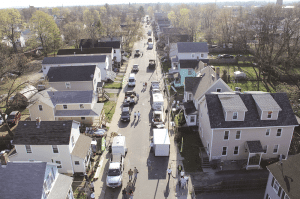
Tyler Street

Many have compared the scene at last April’s cluster rebuild on Tyler Street to a movie set.

Tornado victims comprise a constituency that clearly falls into that category, she said, adding that the agency responded to obvious need with a project that repaired and rehabbed 25 homes across the damaged sections of the city in five days.

But there are other, usually smaller examples of how Rebuilding Together is putting resources to work in different and far-reaching ways, everything from work to renovate a playground at a Square One facility to that aforementioned project at the facility for homeless veterans.

“We did extensive work inside and out — we invested $150,000 in that one house,” she explained, adding that the project was funded in part by a grant from Sears and its Heroes at Home program, which assists veterans. “We had volunteers from Westover and Barnes … there wasn’t a part of that house that we didn’t touch. We put in new floors, paint, a new roof, a new kitchen and baths, carpeting, curtains. At the end of the day, Bob’s Discount Furniture brought in all new furniture.

“It was incredibly rewarding to see the veterans come in at the end of the day and see that transformation,” she went on. “Moments like that make this the best job in the world.”

And it is with the goal of maximizing resources that the agency focused all of its National Rebuilding Day efforts on one street last April, and also why the plan for the next decade is to continue focusing on the Old Hill neighborhood, even while there are many areas of the city that need assistance.

“To really, truly revitalize a city, you have to take it block by block,” she told BusinessWest. “Yes, it’s house by house, but to have a large, profound, sustainable impact, it has to be block by block.”

“We’re going to go block by block for the next 10 years,” she continued. “And we believe it will have a profound impact on the Old Hill neighborhood.”

The next block will be Pendleton Street, she said, adding that she expects that the agency will be able to duplicate the intensity — and the results — recorded last year, in large part because of the momentum generated that day and the positive energy created by a collaborative effort that involved church groups, several businesses, the roughly 100 people involved with the Western New England College football team, and especially the people who live on Tyler Street.

Finishing Touches
After Pendleton Street, moving southwest, Green-N-Fit 10 in 10 will focus its resources and energy on Pickett Place, King Street, Lebanon Place, Nelson Avenue, Prince Street, Merrick Avenue, Lebanon Street, Monson Avenue, Green Place, Greene Street, Alden Street, Manhattan Street, Searle Place, Marshall Street, Crosby Street, Walnut Street, Melrose Street, Hickory Street, and Eastern Avenue, said Loveless, conceding that, to those not from Springfield, those are merely words on a map.

But to the families who live on those streets, it’s home, and it’s been their home for more than 20 years, on average. And they want it to be home for many years to come.
Helping them accomplish that goal has been Rebuilding Together’s ongoing mission. It’s a broader, more impactful mission now, and because of that, this agency, and especially its first executive director, are truly Difference Makers.

George O’Brien can be reached at [email protected]

Agenda Departments

Ad Club Luncheon
Jan. 29: In the toughest of times, smart marketing is a must. Join John Chandler, chief marketing officer of MassMutual Financial Group, for the Advertising Club of Western Mass. Luncheon, starting at 11:45 a.m. at the Springfield Sheraton, 1 Monarch Place. Learn how this Fortune 100 financial-services company has used a straightforward, results-driven marketing strategy to help create six straight years of record sales results and expand into new markets, all during the worst economic downturn in more than a half-century. Chandler will share the company’s marketing principles and examples of its work that are driving marketplace success.
Registration begins at 11:45 a.m., and the program runs from noon to 1:30 p.m. Cost: $25 for members, $35 for non-members, and $15 for students. Parking is free in the Springfield Sheraton garage (bring your ticket or coin for validation). To reserve a seat, call (413) 736-2582 or e-mail [email protected] by Jan. 24.

DreamBuilder Workshop
Jan. 29: Would you like to discover your true dream or purpose in life; minimize fear, doubt, and worry; and move toward your goals with confidence and joy? Do you have a desire to increase your prosperity while staying in harmony with the core values, beliefs, and higher purpose to which you aspire? Are you working harder and spending longer hours, but would like to achieve greater results with more ease? Are you ready to let your creative self lead the way? Then join the Amherst Area Chamber of Commerce’s upcoming Brown Bag Lunch with teacher, speaker, and certified DreamBuilder Transformational Coach Michele Cunningham. The event takes place from noon to 1:30 p.m. in the Woodbury Room of the Jones Library in Amherst. Cunningham has been studying and applying the principles and strategies discussed in this workshop for more than 15 years. She helps individuals conquer their fears, build their dreams, create more fulfilling lives, and follow a proven path as they navigate the gap between the life they are living and the life they would love to live. During this interactive workshop, participants will have an opportunity to think about and envision their personal and business life through a fresh, creative lens, and entertain new levels of thinking and being. RSVP to [email protected].

Dark Dining Room House Concert Series
Feb. 1, March 1, April 5, May 3: This winter and spring, Dark Dining Room brings the warmth and coziness of your living room to the grandeur of Wistariahurst. Concert curators Matthew Larsen and Greg Saulmon will serve up several courses of local and national musicians over the first Saturdays of February through May. While no dinner will be served, there will be light refreshments provided by Tony Jones Catering, as well as a cash bar. Doors open at 7 p.m. for all shows. Reservations are suggested. Tickets cost $18 ($15 for members) and can be purchased online at wistariahurst.org or by calling the museum at (413) 322-5660. The first concert on Feb. 1 features Northampton-based Winterpills, who bring their melancholic male-female harmonies to the museum for a night of folk and chamber pop. Opening the show is Washington, D.C.-based Luray, creating banjo-inspired indie folk with warm vocals and lush instrumentation. The second concert on March 1 features Heather Maloney, who boasts influences and roots in adventurous folk. Rosary Beard, whose intricately intertwined acoustic guitars skate a thin line between melancholy reflection and uplifting release, will open the show. On April 5, Dark Dining Room introduces Colorway, a power trio fronted by Western Mass. native F. Alex Johnson. Introspective songsmith and acoustic guitarist Mark Schwaber opens the show. The final concert on May 3 features acoustic guitarist David Berkeley, a Santa Fe-based troubadour who brings his version of Americana to the stage. Matthew Larsen and the Documents open the show with introspective piano pop layered with careful instrumentation and thoughtful harmonies. For more information about the Dark Dining Room House Concert Series, go to darkdiningroom.com. This program is supported in part by a grant from the Holyoke Cultural Council, a local agency which is supported by the Massachusetts Cultural Council.

Difference Makers 2014
March 20: The sixth annual Difference Makers award program, staged by BusinessWest, will be held at the Log Cabin Banquet & Meeting House. $60 per ticket, tables of 10 are available. Details on the event will be published in upcoming issues of the magazine. Difference Makers is a program, launched in 2009, that recognizes groups and individuals that are, as the name suggests, making a difference in this region. The class of 2014 has been chosen, and the winners will be announced in the Feb. 10 issue of BusinessWest. For more information, call (413) 781-8600.

Agenda Departments

Training for Real-estate Sales
Jan. 21: Springfield Technical Community College’s Workforce Development office will offer “Preparation for the Real Estate Exam,” a state-approved course for those interested in becoming licensed real-estate salespeople. This course is designed to acquaint the prospective real-estate salesperson, as well as the potential buyer or seller of a home or investment property, with the fundamentals of real-estate law and procedures in Massachusetts. The program begins on Jan. 21 and will convene on Tuesday, Wednesday, and Thursday evenings from 6 to 9 p.m. Space is limited. To register, visit www.stcc.edu/wd or call (413) 755-4502.

Nonprofit Marketing Roundtable
Jan. 28: Struggling to gain visibility with your target audience? Are your marketing materials producing tangible results? Are your best messaging ideas living only in your head? The Nonprofit Marketing Roundtable 2014 Workshop will be held from 8 to 9:30 a.m. at the Greater Northampton Chamber of Commerce, 99 Pleasant St., Northampton. Three women business owners — Janice Beetle, Ruth Griggs, and Maureen Scanlon of the Creative, a marketing and communications collaboration in Northampton — will lead a nonprofit Flash marketing workshop. They will meet with business owners, listen to your marketing and communications concerns, and help you brainstorm practical, professional solutions on the spot. Learn more about how to strategize, advertise, brand, and promote your business; reach the media; and maximize your message in person, in print, and online. The workshop, presented by the Creative Marketing Group, is free, but pre-registration is required, and space is limited. To register, contact Jasmin Tomic at (413) 584-1900 or [email protected].

Ad Club Luncheon
Jan. 29: In the toughest of times, smart marketing is a must. Join John Chandler, chief marketing officer of MassMutual Financial Group, for the Advertising Club of Western Mass. Luncheon, starting at 11:45 a.m. at the Springfield Sheraton, 1 Monarch Place. Learn how this Fortune 100 financial-services company has used a straightforward, results-driven marketing strategy to help create six straight years of record sales results and expand into new markets, all during the worst economic downturn in more than a half-century. Chandler will share the company’s marketing principles and examples of its work that are driving marketplace success.
Registration begins at 11:45 a.m., and the program runs from noon to 1:30 p.m. Cost: $25 for members, $35 for non-members, and $15 for students. Parking is free in the Springfield Sheraton garage (bring your ticket or coin for validation). To reserve a seat, call (413) 736-2582 or e-mail [email protected] by Jan. 24.

Difference Makers 2014
March 20: The sixth annual Difference Makers award program, staged by BusinessWest, will be held at the Log Cabin Banquet & Meeting House. Details on the event will be published in upcoming issues of the magazine. Difference Makers is a program, launched in 2009, that recognizes groups and individuals that are, as the name suggests, making a difference in this region. The editors and publishers of BusinessWest have examined this year’s stack of nominations and have chosen the class of 2014, and the winners will be announced in the magazine’s Feb. 10 issue. For more information, call (413) 781-8600.

Agenda Departments

Nonprofit Marketing Roundtable
Jan. 28: Struggling to gain visibility with your target audience? Are your marketing materials producing tangible results? Are your best messaging ideas living only in your head? The Nonprofit Marketing Roundtable 2014 Workshop will be held from 8 to 9:30 a.m. at the Greater Northampton Chamber of Commerce, 99 Pleasant St., Northampton. Three women business owners — Janice Beetle, Ruth Griggs, and Maureen Scanlon of the Creative, a marketing and communications collaboration in Northampton — will lead a nonprofit Flash marketing workshop. They will meet with business owners, listen to your marketing and communications concerns, and help you brainstorm practical, professional solutions on the spot. Learn more about how to strategize, advertise, brand, and promote your business; reach the media; and maximize your message in person, in print, and online. The workshop, presented by the Creative Marketing Group, is free, but pre-registration is required, and space is limited. To register, contact Jasmin Tomic at (413) 584-1900 or [email protected].

Difference Makers 2014
March 20: The sixth annual Difference Makers award program, staged by BusinessWest, will be held at the Log Cabin Banquet & Meeting House. Details on the event will be published in upcoming issues of the magazine. Difference Makers is a program, launched in 2009, that recognizes groups and individuals that are, as the name suggests, making a difference in this region. The editors and publishers of BusinessWest are currently reviewing nominations for the class of 2014. The winners will be announced in the magazine’s Feb. 10 issue. For more information, call (413) 781-8600.

Features
Deadline Approaches for Finalizing the Class of 2014

BizDiffMakrsLOGO2011
The clock is ticking, but there is still time to nominate an individual or group for BusinessWest’s Difference Makers class of 2014.
Nominations, which can be completed online here will be accepted until the close of the business day (5 p.m.) on Dec. 20.
Difference Makers is the program BusinessWest launched in 2007 to recognize those who are, as the name suggests, making a difference in the region called Western Mass. Over the years, winners have come from a number of fields and been involved in a host of endeavors — from filling shelves in school libraries to creating a hugely successful fund-raiser to battle breast cancer; from fighting crime in Holyoke to making a community college more of a force in efforts to build a quality workforce in the region.
And in recent weeks, a number of nominations have been received that reinforce the notion that there are, indeed, many ways in which a group or individual can make a difference, said Kate Campiti, associate publisher of BusinessWest.
She noted that individuals and organizations representing several sectors, from healthcare to education to the nonprofit realm, have been nominated.
“Each year, we’re reminded that there are many ways to make a difference, and people and groups that are making a positive impact on overall quality of life in this region,” she said. “In recent years, we’ve had some hard decisions to make about who will be honored at our annual event in March, and this year is no exception.”
The class of 2014 will be selected by the editors and publishers of BusinessWest, and their stories will be told in a special section that will appear in the Feb. 10 edition of the magazine.
The annual Difference Makers awards event will be staged March 20 at the Log Cabin Banquet & Meeting House in Holyoke. For more information on the Difference Makers program, call the magazine’s editor, George O’Brien, at (413) 781-8600, ext. 102.


Previous Difference Makers:


2009

• Doug Bowen, president and CEO of PeoplesBank;
• Kate Kane, managing director of the Springfield office of Northwestern Mutual Financial/the Zuzolo Group;
• Susan Jaye-Kaplan, founder of GoFIT and co-founder of Link to Libraries;
• William Ward, executive director of the Regional Employment Board of Hampden County; and
• The Young Professional Society of Greater Springfield

2010

• The Irene E. and George A. Davis Foundation;
• Ellen Freyman, attorney and shareholder at Shatz, Schwartz and Fentin, P.C.;
• James Goodwin, president and CEO of the Center for Human Development;
• Carol Katz, CEO of the Loomis Communities; and
• UMass Amherst and its chancellor, Robert Holub.

2011
• Tim Brennan, executive director of the Pioneer Valley Planning Commission;
• Lucia Giuggio Carlvalho, founder of Rays of Hope;
• Don Kozera, president of Human Resources Unlimited;
• Robert Perry, retired partner/consultant with Meyers Brothers Kalicka; and
• Anthony Scott, Holyoke police chief.

2012
• Charlie and Donald D’Amour, president/COO and chairman/CEO, respectively, of Big Y Foods;
• William Messner, president of Holyoke Community College;
• Majors Tom and Linda-Jo Perks, officers of the Springfield Corps of the Salvation Army;
• Bob Schwarz, executive vice president of Peter Pan Bus Lines; and
• The Women’s Fund of Western Massachusetts.

2013
• Michael Cutone, John Barbieri, and Thomas Sarrouf, organizers of Springfield’s C3 Policing program;
• John Downing, president of Soldier On;
• Bruce Landon, president and general manager of the Springfield Falcons;
• The Sisters of Providence; and
• Jim Vinick, senior vice president of Investments at Moors & Cabot Inc.

Departments Picture This

Send photos with a caption and contact information to:  ‘Picture This’ c/o BusinessWest Magazine, 1441 Main Street, Springfield, MA 01103 or to [email protected]

Night at the Museum

IMG_1153Herbie,-Tim-Allen-and-three-othersHolly,-Stuart,-Carol-&-Noel-LearyAt a sold-out Holiday Gala 2013 on Dec. 5, attendees enjoyed cocktails at the Michele and Donald D’Amour Museum of Fine Arts before strolling across the Quadrangle for an elegant dinner in the Lyman and Merrie Wood Museum of Springfield History.  The annual event, which benefits the Springfield Museums, featured live jazz by Berkshire Jazz Underground and vocalists from Springfield College. Top right: from left, Brian Lees, former Hampden County Clerk of Courts; Heriberto Flores, executive director, New England Farmworkers Council; Mary-Beth Cooper, president of Springfield College; Tim Allen, United Way of Pioneer Valley and Springfield city councilor; and Vanessa Otero, director of the North End Campus Coalition. Bottom left: from left, Stuart Prall; Holly Smith-Bové, Springfield Museums president; Carol Leary, president of Bay Path College; and her husband, Noel Leary.
Photos by Ed Cohen

Going Out in Style

IMG_1161IMG_1159More than 175 friends, colleagues, and area business owners and managers turned out at the Castle of Knights in Chicopee on Dec. 9 to honor Gail Sherman, who recently announced that she will be retiring after 17 years as director of the Greater Chicopee Chamber of Commerce. At left: Sherman with Ron Proulx, business director of Dave’s Truck Repair in Springfield and chairman of the chamber’s board of directors. Right, Sherman shares a moment with Joe Peters, former chairman of the chamber’s board and CEO of Universal Plastics, and Doris Ransford, longtime director of the Greater Holyoke Chamber of Commerce, who partnered with Sherman on a number of initiatives and retired herself in 2012.

Into the Next Phase

BWard-Retire-Party-72BWard-Retire-Party-96BWard-Retire-Party-131BWard-Retire-Party-117The Regional Employment Board (REB) of Hampden County staged a retirement party for long-time executive director Bill Ward on Dec. 10 at the Log Cabin Banquet and Meeting House in Holyoke. More than 300 friends and associates, including local, state, and national political leaders, honored Ward — who was one of the first winners of BusinessWest’s Difference Makers award — for his more than 30 years of tireless work to address and improve workforce issues. Left to right from top left: Ward poses with Michael Ashe, Hampden County Sheriff; Team Hoyt, son Rick and father Dick, with Ward, a one-time chairman of the board at Kamp for Kids, a camp for physically disabled and able-bodied children founded by the Hoyt family; Ward is flanked by son Christopher, customer service representative for Fedex, and daughter Michelle Ward, a writer and reporter for People magazine; REB staff members gather around Ward after the festivities.Photos by Michael Epaul

Bottom right photo by Ed Cohen

Agenda Departments

Nonprofit Marketing Roundtable
Jan. 28: Struggling to gain visibility with your target audience? Are your marketing materials producing tangible results? Are your best messaging ideas living only in your head? The Nonprofit Marketing Roundtable 2014 Workshop will be held from 8 to 9:30 a.m. at the Greater Northampton Chamber of Commerce, 99 Pleasant St., Northampton. Three women business owners — Janice Beetle, Ruth Griggs, and Maureen Scanlon of the Creative, a marketing and communications collaboration in Northampton — will lead a nonprofit Flash marketing workshop. They will meet with business owners, listen to your marketing and communications concerns, and help you brainstorm practical, professional solutions on the spot. Learn more about how to strategize, advertise, brand, and promote your business; reach the media; and maximize your message in person, in print, and online. The workshop, presented by the Creative Marketing Group, is free, but pre-registration is required, and space is limited. To register, contact Jasmin Tomic at (413) 584-1900 or [email protected].

Difference Makers 2014b
March 20: The sixth annual Difference Makers award program, staged by BusinessWest, will be held at the Log Cabin Banquet & Meeting House. Details on the event will be published in upcoming issues of the magazine. Difference Makers is a program, launched in 2009, that recognizes groups and individuals that are, as the name suggests, making a difference in this region. See the story here for more information about the program and a list of past winners. The editors and publishers of BusinessWest are currently reviewing nominations for the class of 2014, and will accept nominations through Dec. 20. The winners will be announced in the magazine’s Feb. 10 issue. For more information, call (413) 781-8600.

Features
Nominations Sought for BusinessWest’s Recognition Program

BizDiffMakrsLOGO2011Looking back at the five Difference Makers recognized by BusinessWest earlier this year, Kate Campiti, the magazine’s associate publisher, said the class of 2013 epitomizes what the five-year-old program is all about.
“We had five individuals or groups who showed that there really are many ways in which people can make a difference,” she noted, referencing a class that included the Sisters of Providence; Bruce Landon, general manager of the Springfield Falcons and the individual credited with keeping hockey in Springfield; John Downing, the driving force behind Soldier On; Jim Vinick, a supporter of a number of area nonprofits, especially the Basketball Hall of Fame; and state and local police involved in a unique effort to curb crime in Springfield’s North End. “This was a group that clearly demonstrated that are countless factors that go into the phrase ‘quality of life,’ and so many ways that it can be improved.”
But there are many more stories of difference making still to be told, she went on, and as 2013 moves toward an end, it is time for BusinessWest to again seek nominations for what has become a coveted honor.
The nomination form here explains how this process works, said BusinessWest Editor George O’Brien, who noted that the phrase ‘Difference Maker,’ as the class of 2013 proved, is a truly subjective phrase with a number of meanings.
“Since Difference Makers was launched in 2009, we’ve recognized college presidents, nonprofit managers, a crusading police chief, a woman who founded a program to fill the shelves of school libraries, and another who started a walk to raise money to fight breast cancer,” he explained. “All these stories are different, but there is a common denominator — people stepping forward, and stepping up, to change lives in a very positive way.
“There are many more individuals and groups who are changing lives in similar ways,” he went on. “This program was created to provide a forum for telling these stories, and we want our readers to help us with this assignment.”
As with another BusinessWest recognition, 40 Under Forty, Difference Makers is a nomination-driven process, Campiti said, urging those who propose an individual or group for consideration to be thorough with their nomination and, in simple terms, effectively answer the question, ‘why is this nominee a Difference Maker?’
Nominations, which can also be completed online, are due at the end of the business day (5 p.m.) on Dec. 20. The winners, as chosen by a review panel comprised of BusinessWest writers and editors, will be profiled in the magazine’s Feb. 10 edition and saluted at the annual Difference Makers gala, to take place in late March.
Questions about the program and the nomination process can be forwarded to [email protected], or call (413) 781-8600, ext. 102.

Previous Difference Makers:

2009
• Doug Bowen, president and CEO of PeoplesBank;
• Kate Kane, managing director of the Springfield office of Northwestern Mutual Financial/the Zuzolo Group;
• Susan Jaye-Kaplan, founder of GoFIT and co-founder of Link to Libraries;
• William Ward, executive director of the Regional Employment Board of Hampden County; and
• The Young Professional Society of Greater Springfield

2010
• The Irene E. and George A. Davis Foundation;
• Ellen Freyman, attorney and shareholder at Shatz Schwartz and Fentin, P.C.;
• James Goodwin, president and CEO of the Center for Human Development;
• Carol Katz, CEO of the Loomis Communities; and
• UMass Amherst and its chancellor, Robert Holub

2011
• Tim Brennan, executive director of the Pioneer Valley Planning Commission;
• Lucia Giuggio Carlvalho, founder of Rays of Hope;
• Don Kozera, president of Human Resources Unlimited;
• Robert Perry, retired partner/consultant with Meyers Brothers Kalicka; and
• Anthony Scott, Holyoke police chief

2012
• Charlie and Donald D’Amour, president/COO and chairman/CEO, Big Y Foods;
• William Messner, president of Holyoke Community College;
• Majors Tom and Linda-Jo Perks, officers of the Springfield Corps of the Salvation Army;
• Bob Schwarz, executive vice president of Peter Pan Bus Lines; and
• The Women’s Fund of Western Massachusetts

2013
• Michael Cutone, John Barbieri, and Thomas Sarrouf, organizers of Springfield’s C3 Policing program;
• John Downing, president of Soldier On;
• Bruce Landon, president and general manager of the Springfield Falcons;
• The Sisters of Providence; and
• Jim Vinick, senior vice president of Investments at Moors & Cabot Inc.

Cover Story
Bill Ward Has Spent His Career Focused on the Big Picture: Jobs

COVERart0913b
Bill Ward has a wide assortment of photographs adorning the walls and shelves of his office in downtown Springfield.
There’s one of him conferring with Sen. Edward Kennedy, for example, and also one that puts him in a group with, among others, Dick and Rick Hoyt, the father-son team famous for their exploits in marathons and triathlons. There are others featuring a host of local, state, and national political leaders, and even a framed copy of the story announcing him as one of the first winners of BusinessWest’s Difference Makers award.
But maybe the one he’s most partial to shows him sharing the podium with Herb Almgren and Ben Jones. They were the first two chairmen of an organization called the Private Industry Council (PIC) — which would later become the Regional Employment Board of Hampden County — and individuals who would set a tone for the important work that Ward and those agencies would undertake.
It was Almgren, the long-time president of Shawmut Bank, who aggressively recruited Ward to be the first director of the PIC in 1981, later convinced Jones (who wasn’t even on the board at the time) to follow him as chair, and worked tirelessly to convince other business leaders of the need for workforce-development initiatives.
“He was very persuasive,” Ward recalled. “Thanks to him, people got the message that this was important work.”
And it was Jones, then-president of Monarch Life Insurance Co., who gave Ward a line he’s repeated dozens of times over the course of his career. “He was the first one to say to me that ‘a job is the best social program you can put in place,’” Ward recalled. “And he was certainly right about that.”
While Ward, who is “transitioning his career to its next phase” — that phrase has become his substitute for ‘retiring,’ because he said the latter is not at all accurate — is looking mostly ahead these days, and to what will come next, both for him and the region, he was compelled by BusinessWest to look back.
Indeed, as he prepares to leave the REB, probably by the end of the year if a successor has been chosen by then, he was asked to reflect on his career, the progress he’s seen in the broad realm of workforce development, the changes that have come to this region and its business community, and the many challenges looming for Greater Springfield — and his successor.
He started by going back to his days working at the Hampden County Skills Center, later known as the Mass. Career Development Institute (MCDI), where, for more than two years, he conducted extensive assessments of people who came to that organization seeking assistance and a path to a better life through gainful employment through training programs.
“I personally interviewed 2,000 low-income individuals, mostly women and adults, to gain perspective on their aspirations and goals,” he said, adding that some had been laid off from jobs, but many had never been in the workforce. “What I got from that was an incredible sense of the human potential in the city that was going to waste in part because people were not given the educational foundation or the training opportunities to make a better life for themselves and contribute to the workforce.”
And while reducing this wasted potential was never his official job description, it nonetheless became his career’s work. And he believes he can measure — in one way or another — what amounts to tangible progress.

Bill Ward, at right

Bill Ward, at right, is seen at an early annual meeting of the Private Industry Council with Herb Almgren, center, and Ben Jones.

“From a strategic point of view, there’s been a true buy-in at all levels on the absolute importance of workforce development to economic and community development,” he noted. “It happened here [in Greater Springfield] first, almost more than any other place, as a wholly embraced principle of economic growth.
“There’s been a really focused effort by the business community, and a level of collaboration has developed on how to address these workforce issues,” he went on. “What I see today is a better, stronger alignment in efforts to build a workforce; that’s been a major accomplishment.”

Hire Purpose
Before addressing a single question from BusinessWest, Ward spent probably half an hour reflecting on the words, deeds, and advice of Almgren, Jones, and many other individuals captured in the photos on his walls.
He did so to illustrate that what has been accomplished over the past three decades hasn’t resulted from the work of one man, but rather from the contributions of a wide array of individuals — from staff members to elected officials to volunteer board members.
Among the many anecdotes he offered was one concerning Jones a few months after he became chair of what was still the PIC.
“He was a very busy guy, and I remember going to his office one time to talk about a problem … like literacy within the community,” Ward recalled, noting that he didn’t remember the specific challenge in this case. “We talked for a long time, and finally he said to me, ‘Bill, from now on, if we’re going to meet for a half-hour, I want you to spend a maximum of eight to 10 minutes on the problem, and then I want you to spend the next 22 minutes on proposed or possible solutions, and what business can do about it.’
“That’s an interesting formula,” he went on. “And it impacted me. It forced me, in life going forward as I worked here, to look at a problem and say, ‘let’s get it defined quickly, and then let’s spend more time identifying solutions.’ That way, you don’t get into that ‘ain’t it awful’ game all the time.”
Ward said that story and many others help him explain how his career has been a series of personal and professional learning experiences that have made him a better administrator and helped him, his staff, his board, and supporters achieve positive results in many aspects of workforce development.
These range from a successful summer jobs program for young people to efforts to bolster adult basic education programs; from broad efforts to train workers for the region’s growing healthcare sector to programs aimed at having a pool of workers ready for the casino that will soon become part of the Western Mass. landscape.
And it all began very humbly, he recalled, adding that Almgren and others recognized the work he was doing at the Hampden County Skills Center and saw him as the potential leader of a new, federally funded initiative called the Private Industry Council, which involved the business community in efforts to help individuals become part of the workforce.
“He [Almgren] sensed that I was a willing learner,” said Ward. “I wanted to understand the dynamics between business people and the community at large. When you’re a willing learner, sometimes the teacher sees that potential and draws it out, and that’s what he did.”
The PIC started with a budget of $60,000, one full-time employee in Ward, and a part-time secretary. Today, the REB has 25 employees and a $15 million budget.
Ward credits both Almgren and especially Jones with giving the PIC, and then the REB, credibility in the community and something ultimately more important, access to business leaders who could drive change and progress.
“It was never said this way, but people felt that if Ben was involved with something, it was important work and things would get done,” he told BusinessWest. “And if he asked someone to come on the board, the response was almost always ‘yes.’”

Work — Force
Over the past 32 years, Ward said, the PIC and then the REB have achieved real progress in the broad realm of workforce development, with much of it coming in the form of answers to a nagging and somewhat perplexing problem that has dogged the region for most of his tenure — the so-called ‘skills gap.’
As the name suggests, this connotes the gap between the skills employers are demanding and those possessed by those seeking employment. In some ways, the gap is exaggerated by employers, but, by and large, it’s real, said Ward, adding that it is particularly acute in certain industry sectors, such as healthcare, precision manufacturing, and financial services.
And some of the REB’s most intriguing success stories have come in those sectors, where collaborative efforts involving industry players, academic institutions (especially the area’s community colleges and UMass Amherst), and REB officials have produced tangible results.
“We coined a phrase — we called it ‘sector strategy,’” Ward told BusinessWest. “What we’ve learned is that bringing these collaboratives together and getting agreement on a common mission and ways to identify progress is critical.”
Through such programs, said Ward, the REB and its various partners have succeeded in taking that word ‘collaboration’ out of the category of buzzword and making it something people can comprehend — and aspire to.
And one of the real challenges moving forward, he went on, is to make these collaborations between industry, higher education, and workforce-development groups more impactful.
“We need to touch more people and forge collaborations that create more and better jobs,” he explained, “so that, at least in several key industries, jobs will not go begging.”
Taking a big-picture perspective, Ward reiterated that perhaps the most significant and positive development during his tenure at the REB has simply been broad recognition of the fact that workforce development is, in fact, economic development.
While this may sound simple and logical, he went on, convincing legislative, business, and academic leaders of this hasn’t historically been easy.
And some of the most significant progress has come in efforts to engage the county’s two community colleges – Holyoke and Springfield Technical — in workforce-development efforts, he said, adding that, in many respects, this region is ahead of the rest of the state in this regard.
“Years ago, schools like this saw the workforce-development system as the stepchild,” he said, adding that, until recently, most community colleges were more focused on transferring students to four-year schools than preparing them for the workforce. “That’s all changed, and they see the other piece now, and there’s a huge alignment there.
“The first college that I know of to ever hire someone as the director of workforce development was Holyoke Community College,” he went on. “Years ago, these colleges thought of workforce development as something that limited their role, which they thought was to educate people and give them degrees. Now, they fully embrace their role in workforce development.”

Work in Progress
One of the challenges moving forward, he went on, is determining how to capitalize on this phenomenon to get the most responsive training programs for a host of industry sectors.
“Those leading the community colleges would be the first to say that their work is far from done, but there have been pockets of success,” he noted, adding that programs involving the wide spectrum of jobs in healthcare have, collectively, been the most visible and impactful initiative.
There will be plenty of other challenges for his successor and others involved in economic development when it comes to putting people to work, said Ward.
He put the economy at the top of that list, noting that, despite the best efforts of the REB and other agencies like it, unemployment will persist if employers lack the confidence and wherewithal to hire individuals — or if they persist in their desire to search for what has come to be known as a ‘purple squirrel.’ That’s a metaphor used by HR recruiters to identify the unrealistic expectations of a client company for the type of employee they desire.
“I think the phrase was born in the IT industry,” said Ward, adding that it now crosses all sectors and is certainly a factor in why unemployment remains high. “There is no such thing as a purple squirrel, but you keep searching for one anyway. Sometimes employers want a perfect person, and if they think there’s one coming in the door tomorrow, they’ll wait, and wait, and wait.”
Technology is another challenge, he said. As it advances, jobs are sometimes threatened because companies can do more with less, meaning fewer workers. Still, businesses can’t be afraid of technology, he said, and must instead embrace it to allow themselves — and the region as a whole — to become more competitive.
And the casino that eventually comes to Western Mass. will obviously be a challenge as well, he said, noting that workers will have to be trained for that work — the community colleges have already put programs in place — and, in the meantime, existing employers must prepare themselves for what 2,000 to 3,000 new jobs will mean for the employment landscape.
As for his own employment status, Ward said he’s seen a number of business leaders he’s worked with over the years struggle with the concept of retirement, and these tribulations have become yet another learning experience.
And that’s why he uses the term ‘transition phase.’
Meanwhile, he doesn’t like ‘consulting’ or ‘consultant’ much, either, but those words approximate what he will do and become — most likely in the fields of education and workforce development.
He expects he’ll do some advising (the term he much prefers) perhaps 10 hours a week, while also doing some volunteer work and getting back to golf and especially tennis, two sports he once enjoyed but put aside, especially after knee-replacement surgery five years ago.
“I’m transitioning to a different style of work,” he said, adding that his preference would be project work and, more specifically, initiatives with a beginning and an end. “I’m certainly not ready to fully retire.”

Developing Story
Look closely at the photo of Ward, Almgren, and Jones, and you’ll see three people seemingly looking out together in the same direction.
That’s obviously a photographer they’re looking toward, but it might as well be the region’s future.
The three men, and countless others, many of them captured in other pictures in Ward’s office, came together over the past three decades and embraced his overriding philosophy that workforce development is economic development.
Or, as Jones so eloquently put it, ‘a job is the best social program you can put in place.’
Bill Ward spent a career proving him right.

George O’Brien can be reached at [email protected]

Class of 2013 Difference Makers
Highlights from this year’s event

BizDiffMakrsLOGO2011More than 350 people turned out at the Log Cabin Banquet & Meeting House in Holyoke for a celebration of BusinessWest’s Difference Makers for 2013. The photos on the next several pages capture the essence of a special night, which featured entertainment from the Children’s Chorus of Springfield and the Taylor Street Jazz Band, fine food, and memorable comments from this year’s winners, who all conveyed the passion that has made them true Difference Makers. This year’s class, chosen by the editor and publishers of the magazine from dozens of nominations, reflects the many ways in which individuals and groups can make a difference in the community. State Troopers Michael Cutone and Thomas Sarrouf, along with John Barbieri, deputy chief of the Springfield Police Department, were chosen for their work to orchestrate the C3 Policing program in Springfield’s North End. John Downing, president of Soldier On, was selected for the many ways that organization improves quality of life for veterans. Bruce Landon, president and general manager of Springfield Falcons, was chosen for his efforts to keep professional hockey in Springfield over the past 35 years. The Sisters of Providence were chosen for their 140 years of service to the community, especially in the broad realms of healthcare, education, and social service. And Jim Vinick, senior vice president of Investments for Moors & Cabot Inc., was chosen for his work with many area nonprofits, especially the Naismith Memorial Basketball Hall of Fame and the Jimmy Fund.

Sponsored By:
Baystate Medical PracticesFirst American Insurance • Health New England • Meyers Brothers Kalicka, P.C.Northwestern Mutual • Royal LLP • Sarat Ford Lincoln • 6 Pt. Creative WorksDiffernceMakers0213sponsors

For reprints contact: Denise Smith Photography / www.denisesmithphotography.com / [email protected]

Photos From the 2013 Difference Makers Gala
Features
BusinessWest’s Difference Makers to Be Honored March 21


Difference Makers 2013 logoDetails are falling into place for the March 21 Difference Makers Gala at the Log Cabin Banquet and Meeting House in Holyoke, one of BusinessWest’s premiere events and now an early-spring tradition in Greater Springfield.

The menu for the lavish buffet is set, the traditional musical performance featuring area young people will spotlight the Children’s Chorus of Springfield, and the Taylor Street Jazz Band will again be on hand to provide entertainment throughout the evening.

The biggest news, of course, has been known for about a month now — the composition of the Difference Makers Class of 2013, one of the most intriguing and diverse groups since the start of the program in 2009. This year’s honorees are:

Michael Cutone, John Barbieri, and Thomas Sarrouf, organizers of Springfield’s C3, or Counter Criminal Continuum, Policing Program. The initiative, which makes use of counter-insurgency tactics used by U.S. Special Forces troops in Iraq and Afghanistan to combat gang violence and crime, has been successful in making residents of the Brightwood section of the city far more actively involved in the safety of their neighborhood. It has also succeeded in bringing about reductions in many categories of crime, including larceny, weapons violations, burglary, and motor-vehicle thefts.

John Downing, president of Soldier On. Over the past several years, Downing has created a number of programs to improve quality of life for veterans returning from service, all designed with the Soldier On slogan — “changing the end of the story” — firmly in mind. Perhaps his most celebrated accomplishment is an initiative that provides veterans with the opportunity to transition from homelessness to home ownership through a program that enables them to purchase an equity stake in their homes.

Bruce Landon, president and general manager of the Springfield Falcons. Over the past 45 years, Landon has gone from being a goaltender with the local American Hockey League franchise to holding nearly every title in the club’s front office, including his current role as general manager and co-owner. More significantly, though, he has put together ownership groups on three separate occasions, enabling Greater Springfield to retain its hockey team and thus reap the many benefits, including the economic boost to area businesses.

The Sisters of Providence, represented by Sr. Mary Caritas, SP, and Sr. Kathleen Popko, SP. Now celebrating the 140th anniversary of their arrival in Holyoke at the start of the Industrial Revolution, the Sisters of Providence are being honored for their long tradition of service to the community, especially in the broad realms of healthcare, education, and social service. The sisters’ mission — to serve segments of the population most in need and generally overlooked by traditional programs — is manifested today in programs such as Healthcare for the Homeless, methadone clinics, and cutting-edge elderly-housing initiatives.

Jim Vinick, senior vice president of investments at Moors & Cabot Inc. Vinick has a long and distinguished track record of service to the community, which is punctuated by his work with the Naismith Memorial Basketball Hall of Fame, which he has served in a number of capacities, and the Jimmy Fund, the fund-raising arm of the Dana Farber Cancer Institute, a cause that became a passion for Vinick after his son, Jeffrey, lost his battle against a rare form of testicular cancer in 1982.

“This year’s honorees provide more direct evidence that there are many ways for an individual or group to make a difference in this region,” said BusinessWest Editor George O’Brien, “and all of them are important to overall quality of life.”

O’Brien will emcee the Difference Makers Gala, which will begin at 5 p.m. with networking and opportunities to meet this year’s honorees, followed by the performance by the Children’s Chorus of Springfield and introductions of this year’s honorees.

Tickets to the gala cost $55 each, with tables of 10 available. For more information or to order tickets, call Melissa Hallock at (413) 781-8600, ext. 100, or e-mail [email protected].

Agenda Departments

St. Patrick’s Breakfast

March 13: The St. Patrick’s Business Breakfast of the Greater Holyoke Chamber of Commerce will be held at 7:30 a.m. at the Log Cabin Banquet & Meeting House. The event, sponsored by PeoplesBank and Holyoke Mall at Ingleside, will begin with the serving of a full Irish breakfast. Attorney Jay Driscoll of Resnic, Beauregard, Waite & Driscoll will serve as greeter.  He will be introduced by Jeffrey Sullivan of United Bank, who will preside, and Holyoke Mayor Alex Morse will kick off the program with a special St. Patrick’s Day welcome. The Holyoke St. Patrick’s Parade, to be held on Sunday, March 17, will be in the spotlight, along with the Parade Committee and all winners of committee awards. Also recognized will be the chamber’s new members: Dean Nimmer Arts, Easthampton Savings Bank, Eco-Tints Expert Window Tinting, EmbroidMe of Holyoke, Hobby Lobby, South Street Laundromagic, S. Pierce Photography Studios, VertitechIT Inc., and Victory Home Healthcare Inc.  Guests will have an opportunity to purchase The Irish Legacy, the first book in the Republican’s new Heritage series, as well as the chamber’s “Luck of the Irish” raffle tickets. Breakfast tickets are $25 and may be obtained in advance by contacting calling (413) 534-3376 or by ordering online at holyokechamber.com.


Business Plan Basics

March 14: The Massachusetts Small Business Development Center Network’s Western Regional Office will present “Business Plan Basics” from 9:30 a.m. to 12:30 p.m. at the Mass Venture Center, Room 113, 100 Venture Way, Hadley. The workshop — to be presented by Lyne Kendall, the office’s senior business analyst — will focus on management fundamentals from startup considerations through business-plan development. Topics will include financing, marketing, and business planning. The cost is $25. To register, call (413) 737-6712 or register online at www.msbdc.org/wmass/training.html.


Women’s Fund Celebration

March 14: The Women’s Fund of Western Massachusetts will celebrate its 15th anniversary by honoring 16 local women with the first-ever Standing on Her Shoulders Awards. The celebration, at the MassMutual Center in Springfield, begins at 5 p.m. with a cocktail hour and photographic exhibit of the award recipients and a showcase of the Women’s Fund grantees. The dinner begins at 6:30 p.m. with a musical performance, presentation of the Standing on Her Shoulders Awards, and a speech by Luma Mufleh, founder and coach of a soccer team called the Fugees, short for refugees.  An immigrant from Jordan and a Smith College graduate, Mufleh has created several businesses to employ refugees and immigrants in her community. That will be followed by an after-party and dancing from 8:45 to 10:30 p.m. Tickets cost $100. RSVP by March 7 to Julie Holt at (413) 529-0087, ext. 10, or register online at www.womensfund.net. The Women’s Fund is a public foundation that has reached over 80,000 people through $2 million in grant awards. More than 100 women have participated in the Women’s Fund Leadership Institute for Political and Pubic Impact. The 16 Standing on Her Shoulders Award recipients include Elaine Barkin, Ethel Case, Claire Cox, Verda Dale, Ruth Hooke, Vera Kalm, Gail Kielson, Susan Lowenstein Kitchell, Gloria Lomax, Ruth Stewart Loving, Ruth Moore, Venessa O’Brien, Lorna Peterson, Linda Slakey, Marlene Werenski, and Angela Wright.


Mother/Daughter Night

March 15: Cooper’s Commons, located at 159 Main St. in Agawam, will host a Mother & Daughter Night Out from 6 to 8:30 p.m. to benefit the Children’s Miracle Network at Baystate Children’s Hospital while also highlighting local businesses. For a $10 donation, each mother-daughter duo will enjoy 10%-off shopping in Chasam Boutique, Sweet September Baby & Children’s Boutique, and Cooper’s Gifts, Curtains & Furnishings. In addition, guests will be treated to complimentary carnations from Floral Concepts by Tom, hot beverages from Squire’s Bistro, hair updos from Shear Techniques, nail-polish changes at the Skin Salon, and chair massages at Knots Kneaded. Mother-daughter duos are also invited to visit LHQ Danceforce to sign up for one free dance class for each, and mother-daughter portraits will be available from photographer Paula Tingley. “We are looking forward to a wonderful night of pampering, shopping, and fun, all for a terrific cause,” said Kate Gourde, owner of Cooper’s Commons, which was recently renovated and subdivided into many specialty shops and services. “The Children’s Miracle Network at Baystate Children’s Hospital has special meaning to all of us.” Tickets are available in advance at any business within Cooper’s Commons, or at the door the night of the event. If the weather is inclement, the event will be postponed to March 22.


Difference Makers 2013

March 21: The annual Difference Makers award program, staged by BusinessWest, will be held at the Log Cabin Banquet & Meeting House starting at 5 p.m. Difference Makers is a program, launched in 2009, that recognizes groups and individuals that are, as the name suggests, making a difference in this region. This year’s honorees include Springfield’s C3 Policing program; John Downing, president of Soldier On; Bruce Landon, president and general manager of the Springfield Falcons; the Sisters of Providence; and Jim Vinick, senior vice president of investments at Moors & Cabot Inc. Their stories were told in the Feb. 11 issue of BusinessWest and may also be read online at www.businesswest.com. The March 21 gala will feature butlered hors d’oeuvres, lavish food stations, introductions of the Difference Makers, and remarks from the honorees. Tickets cost $55 per person, and tables of 10 are available. For more information or to order tickets, call (413) 781-8600, ext. 100, or visit www.businesswest.com. Event sponsors include Baystate Medical Practices, First American Insurance Agency, Health New England, Meyers Brothers Kalicka, Northwestern Mutual, Royal LLP, Sarat Ford Lincoln, and Six-Point Creative Works.


Understanding

Financial Reports

March 29: The Massachusetts Small Business Development Center Network’s Western Regional Office will present “Understanding Financial Reports” from 9 a.m. to 12 noon at PeoplesBank, second-floor conference center, 330 Whitney Ave., Holyoke. The workshop will be presented by Robb Morton of Boisselle, Morton & Associates, LLP. If you are in business, financial statements are an essential tool. Knowing how to read your financial statements can help you understand what happened last year in your business and what is likely to happen this year. The cost is $40. To register, call (413) 737-6712 or register online at www.msbdc.org/wmass/training.html.


Not Just Business as Usual

April 4: The Springfield Technical Community College (STCC) Foundation will host its fourth annual Not Just Business as Usual event at the Naismith Memorial Basketball Hall of Fame. A cocktail and networking reception will be held from 5:30 to 7 p.m., followed by the dinner program and keynote speaker from 7 to 9 p.m.
This year, in celebration of 40 years of excellence in nursing at STCC, speakers include ‘The Three Doctors’ — Drs. George Jenkins, Rameck Hunt, and Sampson Davis — who are well-known for their work delivering messages of hope and inspiration. As teenagers growing up on the inner-city streets of Newark, N.J., the three friends made a pact to stick together, go to college, graduate, and achieve their dreams of becoming medical doctors. They have been lauded by Oprah Winfrey as being “bigger than rock stars” and have been featured as medical experts on the Tom Joyner Morning Radio Show and CNN. The Three Doctors received the Essence Award in 2000 for their accomplishments and leadership, and a BET Honors Award in 2009. Over the past two years alone, the Not Just Business as Usual event has provided the STCC Foundation with more than $100,000 to support college and student needs. Funds help to provide STCC students with access to opportunities — through scholarships, technology, and career direction — to be successful future employees and citizens. A variety of sponsorship opportunities are available. Individual tickets cost $175 each. If your business is interested in purchasing a table, contact Robert LePage at (413) 755-4477 or [email protected].


HRU Fund Raiser

April 11: Human Resources Unlimited (HRU) will stage its annual Recognition and Fund Raiser event at Springfield Country Club in West Springfield, from 7:30 to 9 a.m. This breakfast event is by invitation only and is limited to the first 200 registrants. HRU will recognize local employers that have distinguished themselves this past year through their commitment to hire individuals with a disability. In addition, the organization annually honors a special volunteer who has given of their time and talent to help advance HRU in achieving its mission. Two employers will be honored: the Holiday Inn Express & Suites in Westfield is receiving the agency’s Employer of the Year Award, and the Sturbridge Host Hotel is being recognized with the Rookie Employer Award. Jeff Lander of Appilistic will receive the Armand Tourangeau Volunteer of the Year Award for his efforts on behalf of HRU’s Westfield Service Forum House. Gold Sponsors for the event include FieldEddy Insurance and Meredith Management. The media sponsor is BusinessWest. Sponsorships for this event are still available and welcome. Annually, Human Resources Unlimited assists more than 1,200 individuals living with developmental disabilities, mental illness, or other disadvantages to increase their skills, return to work or school, and become productive, contributing members of the community. Sponsorships and donations assist the organization in advancing its mission. For further information or to make a reservation, contact Lynda at (413) 781-5359 or [email protected]. The suggested minimum donation is $100.


DevelopSpringfield Gala

April 12: DevelopSpringfield will be hosting its 2nd annual gala in celebration of Springfield, the many accomplishments the community has achieved over the past year, and the exciting new initiatives underway. The gala will take place at the MassMutual Center in Springfield. Festivities will include a cocktail reception, silent auction, dinner, dancing, and more. All proceeds will support DevelopSpringfield’s redevelopment initiatives, projects, and programs. An anticipated 400 attendees — including federal, state, and city officials; leaders from the business and nonprofit communities; and local residents — will come together in support of ongoing efforts to advance development and redevelopment projects, stimulate and support economic growth, and expedite the revitalization process in the city. Sponsorship packages as well as individual ticket opportunities are available. For more information, visit www.developspringfield.com, or contact Diane Swanson at (413) 209-8808 or [email protected].


Bankruptcy Seminar

April 16: As part of its series of free information sessions on business-law basics, the Center for Innovation & Entrepreneurship at Western New England University will present a session on bankruptcy, featuring attorneys George Roumeliotis of Roumeliotis  Law Group, Justin Dion of Bacon Wilson, and Kara Rescia of Eaton & Rescia. The event will take place from 5 to 7 p.m. at the WNEU School of Law, in the Blake Law Center. It is free and open to the public, and light refreshments will be provided. To learn more about upcoming events hosted by the Center for Innovation & Entrepreneurship, visit www.wne.edu/cie.


EASTEC 2013

May 14-16: EASTEC, the premier manufacturing exposition in the Northeast will be held at the Eastern States Exposition in West Springfield on May 14 and 15 from 9 a.m. to 5 p.m. and on May 16 from 9 a.m. to 3 p.m. The event will offer a variety of exhibitors, educational offerings, tours of nearby facilities, and much more. For more information and to register to attend, visit www.easteconline.com.


40 Under Forty

June 20: BusinessWest will present its seventh class of regional rising stars at the annual 40 Under Forty gala at the Log Cabin Banquet & Meeting House in Holyoke. The event will feature music, lavish food stations, and introductions of the winners. Look for event details in upcoming issues of BusinessWest — including the must-read April 22 issue in which the class of 2013 will be profiled — or call (413) 781-8600, ext. 100 for more information.

Agenda Departments

Business-law Basics

March 12, April 16: Get the business-law basics that every small-business owner and entrepreneur needs to know from the legal experts at the Center for Innovation & Entrepreneurship at Western New England University. This series of free information sessions is focused on key topics to help plan and grow a small business. Sessions will be held from 5 to 7 p.m. at Western New England University School of Law, in the Blake Law Center. The events are free and open to the public. Light refreshments will be provided. The dates, topics, and presenters are: March 12, “Intellectual Property Law Basics,” with attorneys Peter Irvine of Peter Irvine Law Offices, Leah Kunkel of the Law Offices of Leah Kunkel, and Michelle Bugbee of Solutia Inc.; and April 16, “Bankruptcy,” with attorneys George Roumeliotis of Roumeliotis  Law Group, Justin Dion of Bacon Wilson, and Kara Rescia of Eaton & Rescia. To learn more about upcoming events, visit www.wne.edu/cie.


Women’s Fund Celebration

March 14: The Women’s Fund of Western Massachusetts will celebrate its 15th anniversary by honoring 16 local women with the first-ever Standing on Her Shoulders Awards. The celebration, at the MassMutual Center in Springfield, begins at 5 p.m. with a cocktail hour and photographic exhibit of the award recipients and a showcase of the Women’s Fund grantees. The dinner begins at 6:30 p.m. with a musical performance, presentation of the Standing on Her Shoulders Awards, and a speech by Luma Mufleh, founder and coach of a soccer team called the Fugees, short for refugees.  An immigrant from Jordan and a Smith College graduate, Mufleh has created several businesses to employ refugees and immigrants in her community. That will be followed by an after-party and dancing from 8:45 to 10:30 p.m. Tickets cost $100. RSVP by March 7 to Julie Holt at (413) 529-0087, ext. 10, or register online at www.womensfund.net. The Women’s Fund is a public foundation that has reached over 80,000 people through $2 million in grant awards. More than 100 women have participated in the Women’s Fund Leadership Institute for Political and Pubic Impact. The 16 Standing on Her Shoulders Award recipients include Elaine Barkin, Ethel Case, Claire Cox, Verda Dale, Ruth Hooke, Vera Kalm, Gail Kielson, Susan Lowenstein Kitchell, Gloria Lomax, Ruth Stewart Loving, Ruth Moore, Venessa O’Brien, Lorna Peterson, Linda Slakey, Marlene Werenski, and Angela Wright.


Mother/Daughter Night

March 15: Cooper’s Commons, located at 159 Main St. in Agawam, will host a Mother & Daughter Night Out from 6 to 8:30 p.m. to benefit the Children’s Miracle Network at Baystate Children’s Hospital while also highlighting local businesses. For a $10 donation, each mother-daughter duo will enjoy 10%-off shopping in Chasam Boutique, Sweet September Baby & Children’s Boutique, and Cooper’s Gifts, Curtains & Furnishings. In addition, guests will be treated to complimentary carnations from Floral Concepts by Tom, hot beverages from Squire’s Bistro, hair updos from Shear Techniques, nail-polish changes at the Skin Salon, and chair massages at Knots Kneaded. Mother-daughter duos are also invited to visit LHQ Danceforce to sign up for one free dance class for each, and mother-daughter portraits will be available from photographer Paula Tingley. “We are looking forward to a wonderful night of pampering, shopping, and fun, all for a terrific cause,” said Kate Gourde, owner of Cooper’s Commons, which was recently renovated and subdivided into many specialty shops and services. “The Children’s Miracle Network at Baystate Children’s Hospital has special meaning to all of us.” Tickets are available in advance at any business within Cooper’s Commons, or at the door the night of the event. If the weather is inclement, the event will be postponed to March 22.


Difference Makers 2013

March 21: The annual Difference Makers award program, staged by BusinessWest, will be held at the Log Cabin Banquet & Meeting House starting at 5 p.m. Difference Makers is a program, launched in 2009, that recognizes groups and individuals that are, as the name suggests, making a difference in this region. This year’s honorees include Springfield’s C3 Policing program; John Downing, president of Soldier On; Bruce Landon, president and general manager of the Springfield Falcons; the Sisters of Providence; and Jim Vinick, senior vice president of investments at Moors & Cabot Inc. Their stories were told in the Feb. 11 issue of BusinessWest and may also be read online at www.businesswest.com. The March 21 gala will feature butlered hors d’oeuvres, lavish food stations, introductions of the Difference Makers, and remarks from the honorees. Tickets cost $55 per person, and tables of 10 are available. For more information or to order tickets, call (413) 781-8600, ext. 100, or visit www.businesswest.com. Event sponsors include Baystate Medical Practices, First American Insurance Agency, Health New England, Meyers Brothers Kalicka, Northwestern Mutual, Royal LLP, Sarat Ford Lincoln, and Six-Point Creative Works.


Not Just Business as Usual

April 4: The Springfield Technical Community College (STCC) Foundation will host its fourth annual Not Just Business as Usual event at the Naismith Memorial Basketball Hall of Fame. A cocktail and networking reception will be held from 5:30 to 7 p.m., followed by the dinner program and keynote speaker from 7 to 9 p.m.
This year, in celebration of 40 years of excellence in nursing at STCC, speakers include ‘The Three Doctors’ — Drs. George Jenkins, Rameck Hunt, and Sampson Davis — who are well-known for their work delivering messages of hope and inspiration. As teenagers growing up on the inner-city streets of Newark, N.J., the three friends made a pact to stick together, go to college, graduate, and achieve their dreams of becoming medical doctors. They have been lauded by Oprah Winfrey and been featured as medical experts on the Tom Joyner Morning Radio Show and CNN. The Three Doctors received the Essence Award in 2000 for their accomplishments and leadership, and a BET Honors Award in 2009. Over the past two years alone, the Not Just Business as Usual event has provided the STCC Foundation with more than $100,000 to support college and student needs. Funds help to provide STCC students with access to opportunities — through scholarships, technology, and career direction — to be successful future employees and citizens. A variety of sponsorship opportunities are available. Individual tickets cost $175 each. Businesses interested in purchasing a table may contact Robert LePage at (413) 755-4477 or [email protected].


Live Comedy Night to

Help Children’s Charities

April 6: Smith & Wesson will host a live comedy night to benefit to support two local children’s charities, the Shriners Hospitals for Children and the Ronald McDonald House. The event will begin at 6 p.m. at the Cedars Banquet Hall, 419 Island Pond Road, Springfield, and includes a cash bar, raffles, games, music, and hot and cold hors d’oeuvres prior to the show. The laughs begin at 7:15 p.m. with Teddie Barrett of Teddie B Comedy emceeing the show and introducing comedians Mark Scalia, Chance Langton, and Mike Whitman. Scalia began his stand-up career in Boston in the early 1990s and is now an international headliner. Langton is a nationally known comedian, musician, actor, writer, and basketball player who has been entertaining in comedy clubs for more than 20 years. Whitman was voted Boston’s Best New Comedian in 2008. Tickets cost $30 and may be purchased in advance by contacting Elaine Stellato at Smith & Wesson, (413) 747-3371; Karen Motyka at Shriners Hospital, (413) 787-2032; or Jennifer Putnam at Ronald McDonald House, (413) 794-5683.


DevelopSpringfield Gala

April 12: DevelopSpringfield will host its 2nd annual gala in celebration of Springfield, the community’s recent accomplishments, and the exciting new initiatives underway. The gala will take place at the MassMutual Center in Springfield. Festivities will include a cocktail reception, silent auction, dinner, dancing, and more. All proceeds will support DevelopSpringfield’s redevelopment initiatives, projects, and programs. An anticipated 400 attendees — including federal, state, and city officials; leaders from the business and nonprofit communities; and local residents — will come together in support of ongoing efforts to advance development and redevelopment projects, stimulate and support economic growth, and expedite the revitalization process in the city. Sponsorship packages as well as individual ticket opportunities are available. For more information on the event, visit www.developspringfield.com, or contact Diane Swanson at (413) 209-8808 or [email protected].

EASTEC 2013

May 14-16: EASTEC, the premier manufacturing exposition in the Northeast will be held at the Eastern States Exposition in West Springfield on May 14 and 15 from 9 a.m. to 5 p.m. and on May 16 from 9 a.m. to 3 p.m. The event will offer a variety of exhibitors, educational offerings, tours of nearby facilities, and much more. For more information and to register to attend, visit www.easteconline.com.


40 Under Forty

June 20: BusinessWest will present its seventh class of regional rising stars at the annual 40 Under Forty gala at the Log Cabin Banquet & Meeting House in Holyoke. The event will feature music, lavish food stations, and introductions of the winners. Look for event details in upcoming issues of BusinessWest — including the must-read April 22 issue in which the class of 2013 will be profiled — or call (413) 781-8600, ext. 100 for more information.

Agenda Departments

Dress Down for Animals

Feb. 15: Employers, are you looking for a fun way to engage your staff while helping local shelter animals? By participating in Dress Down for Animals Day, your business can help provide life-saving care to dogs, cats, and other small animals at the Thomas J. O’Connor Animal Control and Adoption Center in Springfield. Through this program, employees will make a minimum donation of $5, $10, or whatever level the employer sets for the privilege of wearing whatever they wish to work on Feb. 15, with proceeds donated to the shelter. Prizes will be awarded based on donation total and number of employees participating. Businesses can compete for a a chair yoga session for up to 50 employees, a catered dessert party, a chance to introduce a business to 7,000 people on the Thomas J. O’Connor Facebook page, and more. To request a form to fill out and return with donations, call (413) 533-4817 or e-mail [email protected]. For more information about the adoption center, visit www.tjofoundation.org.


Business-law Basics

March 12, April 16: Get the business-law basics that every small-business owner and entrepreneur needs to know from the legal experts at the Center for Innovation & Entrepreneurship at Western New England University. This series of free information sessions is focused on key topics to help plan and grow a small business. Sessions will be held from 5 to 7 p.m. at Western New England University School of Law, in the Blake Law Center. The events are free and open to the public. Light refreshments will be provided. The dates, topics, and presenters are: March 12, “Intellectual Property Law Basics,” with attorneys Peter Irvine of Peter Irvine Law Offices, Leah Kunkel of the Law Offices of Leah Kunkel, and Michelle Bugbee of Solutia Inc.; and April 16, “Bankruptcy,” with attorneys George Roumeliotis of Roumeliotis  Law Group, Justin Dion of Bacon Wilson, and Kara Rescia of Eaton & Rescia. To learn more about upcoming events hosted by the Center for Innovation & Entrepreneurship, visit www.wne.edu/cie.


Women’s Fund Celebration

March 14: The Women’s Fund of Western Massachusetts will celebrate its 15th anniversary by honoring 16 local women with the first-ever Standing on Her Shoulders Awards. The celebration, at the MassMutual Center in Springfield, begins at 5 p.m. with a cocktail hour and photographic exhibit of the award recipients and a showcase of the Women’s Fund grantees. The dinner begins at 6:30 p.m. with a musical performance, presentation of the Standing on Her Shoulders Awards, and a speech by Luma Mufleh, founder and coach of a soccer team called the Fugees, short for refugees.  An immigrant from Jordan and a Smith College graduate, Mufleh has created several businesses to employ refugees and immigrants in her community. That will be followed by an after-party and dancing from 8:45 to 10:30 p.m. Tickets cost $100. RSVP by March 7 to Julie Holt at (413) 529-0087, ext. 10, or register online at www.womensfund.net. The Women’s Fund is a public foundation that has reached over 80,000 people through $2 million in grant awards. More than 100 women have participated in the Women’s Fund Leadership Institute for Political and Pubic Impact. The 16 Standing on Her Shoulders Award recipients include Elaine Barkin, Ethel Case, Claire Cox, Verda Dale, Ruth Hooke, Vera Kalm, Gail Kielson, Susan Lowenstein Kitchell, Gloria Lomax, Ruth Stewart Loving, Ruth Moore, Venessa O’Brien, Lorna Peterson, Linda Slakey, Marlene Werenski, and Angela Wright.


Difference Makers 2013

March 21: The annual Difference Makers award program, staged by BusinessWest, will be held at the Log Cabin Banquet & Meeting House starting at 5 p.m. Details on the event will be published in upcoming issues of the magazine. Difference Makers is a program, launched in 2009, that recognizes groups and individuals that are, as the name suggests, making a difference in this region. Several dozen nominations for the award were received this year, and the winners have been chosen. They will be announced in the magazine’s Feb. 11 issue. For more information, call (413) 781-8600.


Not Just Business as Usual

April 4: The Springfield Technical Community College (STCC) Foundation will host its fourth annual Not Just Business as Usual event at the Naismith Memorial Basketball Hall of Fame. A cocktail and networking reception will be held from 5:30 to 7 p.m., followed by the dinner program and keynote speaker from 7 to 9 p.m.
This year, in celebration of 40 years of excellence in nursing at STCC, speakers include ‘The Three Doctors’ — Drs. George Jenkins, Rameck Hunt, and Sampson Davis — who are well-known for their work delivering messages of hope and inspiration. As teenagers growing up on the inner-city streets of Newark, N.J., the three friends made a pact to stick together, go to college, graduate, and achieve their dreams of becoming medical doctors. They have been lauded by Oprah Winfrey as being “bigger than rock stars” and have been featured as medical experts on the Tom Joyner Morning Radio Show and CNN. The Three Doctors received the Essence Award in 2000 for their accomplishments and leadership, and a BET Honors Award in 2009. Over the past two years alone, the Not Just Business as Usual event has provided the STCC Foundation with more than $100,000 to support college and student needs. Funds help to provide STCC students with access to opportunities — through scholarships, technology, and career direction — to be successful future employees and citizens. A variety of sponsorship opportunities are available. Individual tickets cost $175 each. If your business is interested in purchasing a table, contact Robert LePage at (413) 755-4477 or [email protected].


40 Under Forty

June 20: BusinessWest will present its seventh class of regional rising stars at the annual 40 Under Forty gala at the Log Cabin Banquet & Meeting House in Holyoke. The gala will feature music, lavish food stations, and introductions of the winners. Look for event details in upcoming issues of BusinessWest — including the must-read April 22 issue in which the class of 2013 will be profiled — or call (413) 781-8600 for more information.

Class of 2013 Difference Makers

Organizers of Springfield’s C3 Policing Program

C3Policing

Michael Cutone, left, and John Barbieri. (Note: Tom Sarrouf was on assignment with his SF units and not available to be photographed.)

Michael Cutone was asked how he could tell if the C3P, or Counter Criminal Continuum Policing program, in Springfield’s North End was succeeding with its various goals in the manner that organizers anticipated when they commenced the initiative roughly three years ago.

The Massachusetts State trooper and master sergeant in the U.S. Army Special Forces (the Green Berets) paused for a second and nodded his head a few times, as if to indicate that he gets that question often, and that he had an answer.

Actually, he had several.

For starters, he told BusinessWest, there is statistical evidence showing often-dramatic reductions in what would be considered gang-related crime in the Brightwood neighborhood since this program, based on tactics used by the Special Forces in Iraq and Afghanistan, went into effect. Comparing 2010 statistics with those from 2009, before the initiative started, there was a 76% decrease in larceny, a 66% drop in weapons violations, a 55% reduction in burglary, and a 47% decline in motor-vehicle thefts.

But there is also anecdotal evidence concerning what is being called a counterinsurgency, or COIN, program, he said, listing everything from reports of gang members throwing their cell phones into the nearby Connecticut River because they believe the police must have them bugged — so accurate is their information about gang activities past and planned — to other reports of gang operatives offering to pay neighborhood residents for information on what those leading the C3P operation are up to.

Meanwhile, there’s the rising number of communities and police departments looking to emulate this model — officials have come from as far away as the Netherlands to observe the concept and talk with its organizers — and the growing volume of press it’s generating; the New York Times and Boston Globe have done stories, and 60 Minutes will present a report on the program later this winter.

Still, with all that, Cutone prefers to sum things up with what he calls the “non-traditional answer,” a summation of what residents and neighborhood activists are saying about C3P at what amounts to the heart of the program, regular Thursday community meetings designed to share information and ideas and continuously strengthen the relationship between the police and area residents. Or what they aren’t saying, as the case may be.

“No one’s saying, ‘you guys suck, and we don’t want you here anymore — this is a all a bunch a crap,’” he explained with a laugh, noting that such sentiments work as effectively (for him, anyway) as the crime stats, media attention, and cell phones in the river.

Collectively, they tell him that the COIN operation is meeting its overriding goal — to make things very uncomfortable for the gangs that once ruled these streets through intimidation, so much so that they’ll want to get out of the various businesses they’re in, especially selling drugs. And this happened because the program has succeeded in getting residents involved in making their streets safer, where once they were “inured, apathetic, and afraid.”

Those are three words that John Barbieri, deputy chief of police in Springfield, used early and often as he talked with BusinessWest about C3P. He is the official within the department with whom Cutone and Tom Sarrouf, a fellow state trooper and team commander of Cutone’s Special Forces (SF) unit, worked most closely to get this program implemented.

“The problem with the communities we’re talking about is that there’s very little involvement with the police,” he said, adding that the gangs in the North End had thrived in part due to what amounted to passive support from the community. “And there are myriad reasons for this, but a lot of this boils down to them not being stakeholders — these people are, for the most part, very poor, and they’d become inured to gang violence, violence in general, and drug dealing.”

In very simple terms, the C3P program has succeeded in making people claim a stake, he went on, and by doing so, they are considerably weakening that base of passive support.

Sarrouf agreed. “The residents there are now engaged in their community, where before they were not, plain and simple,” he said, referring to the most tangible and far-reaching benefit derived from what has become known in SF circles as the “Avghani Model,” named after the small town in Northern Iraq where these tactics were employed successfully to gain the trust and support of the local population and make them a resource in the fight against the enemy.

For their success to date and the promise of much more, Cutone, Barbieri, Sarrouf, and all those people in the community who work with them are truly Difference Makers.

Joining the Force

As he talked about how the COIN program works, Cutone offered a few analogies to help get his points across.

The first is what he calls the “seagulls and the Labrador retriever on the beach” scenario. Elaborating, he said that, while the dog will scare the birds away, they will merely hover or fly off, eventually to return; their lifestyle is interrupted, but not changed. The same is true, he said, with a typical police crackdown, or increased police presence, in an area like Springfield’s North End.

Another analogy involves a water balloon. When one pushes a finger into a full water balloon, it compresses that area, he said, noting that, when the finger is removed, the balloon returns to its original shape. What C3P is designed to do is apply several pressure points and not relieve that pressure, thus permanently altering the shape of balloon, or, in this case, a neighborhood. And a third analogy references a farmer battling weeds; unless one gets to the root of the problem and removes the weeds, they will keep coming back.

Using such effective visuals, Cutone, Sarrouf, and Barbieri explained how a COIN operation, and this one in particular, goes well beyond most traditional police tactics and the community-policing concept as a whole to involve a neighborhood in efforts to reduce crime.

And such extreme tactics are necessary, said Cutone, because gangs, like insurgents in foreign countries, are clever opponents not usually thwarted by what would be considered conventional approaches.

“Gang members and drug dealers are very savvy; they exploit the fact that people don’t want to engage with the police,” he explained. “They exploit that passive support. Just like insurgents, they move into areas where people are not going to report on them. Terrorist training camps don’t set up shop in Longmeadow or Belmont, Mass. They set up in Yemen, Afghanistan … failed states. Well, gang members and drug dealers will move into a failed neighborhood for the same reasons.”

‘Failed’ would be one effective way to describe Brightwood in the early fall of 2009, said Barbieri, adding that it was, at that time, the scene of heightened gang violence and activity, punctuated by several murders, including one “finished off” near the entrance to the trauma unit at nearby Baystate Medical Center.

In response to the surge, Springfield police countered with heightened patrols and a spate of arrests. “We were carrying assault rifles because they were carrying assault rifles,” he recalled, adding that, while police were diligent in their work, the results were basically similar to that of the retriever on the beach.

It was about this time that Cutone — who had attempted to initiate a counter-insurgency program in Brightwood based on tactics used by the SF, but seen it back-burnered — made another push. And the reason was obvious to those fighting crime in that neighborhood at that time, he said.

“It was clear that, just as we couldn’t kill our way out of insurgency in Iraq, we weren’t going to arrest our way out of this gang and drug problem,” he said.

Instead, the answer lay with intelligence, said Barbieri, returning to his thoughts about making residents stakeholders.

“It’s the community involvement that separates these neighborhoods from the suburbs and even the more affluent areas of Springfield, such as 16 Acres and Forest Park,” he explained when talking about the attitude that existed in Brightwood three years ago. “If there’s a crime in those neighborhoods, people become involved. If there’s drug dealing, they don’t tolerate it. When they call the police, they demand results — they go out and take pictures of the people involved; they take down license plates.

“In Brightwood, we were working like animals, but it all boils down to intelligence, and no one was telling us what was going on,” Barbieri continued. “No matter how long I work your neighborhood, no matter how much patrolling I do down there, I don’t know your neighborhood like you do — you know who’s dealing drugs and who’s hanging out in front of your house all day. It’s a community that keeps a community safe.

“Trooper Cutone comes up to me at a meeting and says, ‘I just got back from Iraq; there’s a counterinsurgency model to target gangs where we get the community involved and committed, and we try to change the conditions and build capacity in the neighborhoods,’” he went on. “I was the right target audience, and this was the right target location.”

For Your Information

Cutone recalls that the COIN initiative got its unofficial start with what he described as “dismounted patrols,” where he would get out of his cruiser and walk into shops and engage the owners and employees.

“That’s something we would do in Army SF when we were deployed in remote areas — we would live amongst the villagers and get to know them,” he explained. “Using that principle that I was taught, I would walk into a lot of these Hispanic shops, using my limited supply of Spanish to simply say ‘hello.’ These folks would look at me like a hog staring at a wristwatch, saying, ‘why is this trooper in my shop having coffee and asking me how I’m doing?’ So I got the cold shoulder in a lot of places.”

Changing attitudes and generating the steady flow of information, or intelligence, that the program needs to succeed took the better part of year, said those we spoke with, adding that the process of building trust and a working relationship with the neighborhood’s residents was difficult, and it is in many ways ongoing.

There are many moving parts within the program, but its heart and soul is the regular Thursday community meetings, staged at a few different locations, such as the apartment complex at 101 Lowell St.

At these sessions, updates are given, information is shared, and ideas are launched, such as the so-called ‘walking school bus’ concept — teachers chaperoning groups of students as they walk to school in the morning — which was offered by an employee of the Baystate Brightwood Health Center.

Overall, trust is built and momentum is generated through these meetings and other initiatives, such as regular Saturday neighborhood walk-throughs during which police officers will knock on doors and engage residents, other types of outreach efforts, classes on how to report crimes and spot gang activity, and ‘text-a-tip,’ which enables residents to forward information anonymously, said Cutone and Barbieri, adding that the results have been dramatic when it comes to the residents of the neighborhood taking that stake they once resisted and becoming an invaluable resource.

“We gave them our work numbers, our work cell numbers, our e-mail addresses, we gave them classes in how gangs recruit youths and how to identify if your child is in a gang — those types of things,” said Cutone. “And what happened, little by little, is that, between the Thursday meetings, the walk-throughs on Saturdays, and these classes, the amount of criminal information started increasing exponentially.”

And this volume represents a radical departure from what the police are accustomed to, and normally forced to subsist on.

“Typically, narcotics units and gang units get their information from criminal elements — I arrest a bad guy, he’s looking at X number of charges and X number of years, so all of a sudden, he wants to cooperate with the police, so he gives me another bad guy,” Cutone explained. “That’s a good technique, and we still use that technique; the problem with it, though, is that you’re minimizing your information flow, because 95% or more of the people in a community are law-abiding citizens. If you’re only dealing with the criminal element, you’ve eliminated 95% of your information flow.

“So now I have all this intelligence coming into my work computer — I’ve had guns and drugs located because informants would send material to my work cell phone and we’d be able to make arrests and recover stolen weapons,” he continued. “None of that would have happened if we hadn’t built this rapport with the local population.”

This steady flow of information has changed life for gang members to the extent that there are reports that some are buying new cell phones every month because they believe the police are somehow tapping the lines, said Barbieri, adding that there have been other reports of residents trying to chase away undercover police officers working the neighborhood, believing they’re there to buy drugs.

As for the neighborhood as a whole, there has been palpable change, said Sarrouf.

“When you ask people what’s different about living there now as opposed to before the program started, they’ll tell you very candidly that it’s safer, they feel more engaged in their own community, and they feel more empowered to be able to participate in the direction their community takes with respect to the issues that they had prior to this.

“Before, the North End was just truly chaotic; that’s the only way to describe it,” he went on. “Is there still crime there today? Of course, but it is at a much more manageable level, where there’s trust built between the community, city government, and law enforcement where they can respond more accurately, in a more timely fashion, and with a better approach.”

State Rep. Cheryl Coakley-Rivera, who represents that neighborhood, used different words to say essentially the same thing.
“There’s a renewed sense of hope — that’s the word I keep coming back to,” she explained. “But there’s also a sense of action and responsibility. If I’m a resident and I go to one opf these meetings, I come away thinking, ‘what can I do? — I have a team behind me now. What is my responsibility when it comes to working with that team?’ Is it just to fix my fence or clean up my yard, or is it call text-a-tip because I saw a guy put a gun in his trunk?’ There is a new sense of responsibility.”

To a Different Beat

Despite the gains in Brightwood, Sarrouf said, there is still much work to be done in this neighborhood.

“We’re not trying to fool anyone and present this as any kind of quick fix,” he explained. “Right up front, we said that this is a very long-term project, one that will take years to accomplish all its goals. Are we there yet? No, but we’re seeing incremental dividends with respect to the fact that the community is getting better over time.

“And what we’re not seeing is a fallback to what it was — which is a very good thing,” he continued.

In other words, there is more than sufficient evidence — both hard and anectodal — to suggest that this program is working, and that those who have put it in a position to succeed are worthy of being called Difference Makers.

George O’Brien can be reached at [email protected]

Class of 2013 Difference Makers

President of Soldier On

John Dowling

John Dowling
Photo by Denise Smith Photography

John Downing has file folders full of statistics at his disposal as he talks about the many programs being carried out by Soldier On and the philosophy that powers the organization — from the percentage of veterans it serves who have mental-health issues (78%) to the average hourly wage being earned by the many formerly homeless veterans now working for the agency ($10.89).

But perhaps the most powerful — and poignant — numbers are these:

There are more than 265 ‘residents’ of the homeless veterans shelter and transitional facility in Leeds, where the organization is based, and only about 25 of them went ‘home’ — whatever and wherever that is — for the holidays last December.

“The rest of them were already home,” said Downing, the long-time president of the organization, founded in 1994, who understands fully what those numbers mean and what they tell him his responsibility, and that of his staff, must be to those the agency serves. Basically, to redefine ‘home.’

“These people have lost everything, and so they identify now with the community they’re growing and serving in,” said Downing, who told BusinessWest that, when he took over at the struggling organization, housed at the Veterans Administration Hospital in Leeds, in 2001 at the behest of its board, he did so with the single goal of creating the “Holiday Inn of shelters.”

He did that in what seemed like a few months — although it actually took the better part of a year to complete a full turnaround, thanks to some dramatic changes in the basic approach taken. And looking back over what’s happened since, success with that goal might be considered perhaps his most modest accomplishment.

Indeed, Downing has been able to blueprint and implement a number of innovative programs and services, all designed with the Soldier On slogan — ‘changing the end of the story’ — firmly in mind.

The most intriguing, and celebrated, of these to date is an initiative that provides veterans with the opportunity to transition from homelessness to home ownership through a unique program that enables them to purchase an equity stake in their homes. The Gordon H. Mansfield Community in Pittsfield, where more than 40 veterans now own their own condos, has become a model being emulated around the country, and Soldier On is planning several similar projects in this area, in communities ranging from Northampton to Agawam.

But there is much more to the Soldier On story, including a unique and comprehensive veterans-outreach program that includes case-management and referral services and temporary financial assistance involving everything from daily living activities to transportation to child care.

There’s also a full roster of employment services — a key component in any individual’s struggle for financial independence — that include interview skills, money management, résumé building, training and education, and transportation. And there’s also something called the Veterans Justice Partnership, created with the purpose of developing service and treatment options and, where appropriate, alternatives to incarceration.

Meanwhile, Soldier On recently received a $100,000 grant from the Newman’s Own Foundation to develop a wellness center to support its growing women’s program, said Downing, adding that the money will be used to help fund a multi-faceted treatment plan aimed at “getting them back in the center of their lives.”

And while compassion is the primary driver of these programs, there is a practical side as well: some of those aforementioned statistics show that, while the VA is projected to spend $400,000 to $500,000 on a 54-year-old veteran over the rest of his or her life, in the Soldier On model, that cost drops to $150,000.

Overall, it’s not just what Solider On does that’s so impressive and makes this organization and its leader a Difference Maker, but also how. Its model is founded on the quality of social interaction amongst veterans, and it brings services to them instead of the other way around, while giving them the means to succeed rather than criticizing them when they don’t.

“Our job is to serve veterans where they are, and our job is to take responsibility for their failure,” Downing explained. “You don’t serve people by blaming them, shaming them, and making them afraid.”

For this special section profiling our Difference Makers, we talked at length with Downing about how this approach came about and why it has become so successful in positively impacting quality of life for veterans.

Vetting Process

During the course of his lengthy interview with BusinessWest for this story, Downing interrupted the proceedings on several occasions to bring various members of his staff into the discussion.

There was Maggie Porter, director of Communications; Michael Hagmaier, senior vice president; Dominick Sondrini, director of Outreach and Employment Training and coordinator of the Veterans Justice Partnership; John Crane, director of Case Management; and Katie Doherty, Women’s Partnership consultant, among others.

He wanted to introduce them and have them explain what they do and how, but he also wanted to display the great deal of pride he has in the team he’s assembled, the work it’s doing, and the intriguing approach it’s taking, which he explained in direct, colorful language.

“Everyone who comes to us is broken,” he explained. “And because of their brokenness, we all get to make a wonderful living serving them and figuring out strategies to bring their lives back to meaningful ways for them — not defining what we think is meaningful, but letting them define it for themselves.”

And as he elaborated, he ventured back to the weeks and months after he came to the then-7-year-old Soldier On, the latest in a series of assignments within the broad realm of social service and, especially, reintegration and after-care services.

He found an organization, started by some homeless veterans and employees of the VA hospital, that was functioning at about 40% capacity, had been poorly managed, and was essentially ready to be shut down by the VA.

His work to create that Holiday Inn he spoke of started with cleaning the buildings, replacing dilapidated furniture, and making sure the residents had decent meals and clothing.

And then, the real work started. By that, he meant changing and improving the way veterans were administered services and altering the basic approach taken by the staff. It was no small change.

“Most of us, as Communist-trained social workers, spend most of our adult lives learning how to tell people what to do,” he noted. “We tell people how to get into recovery, what steps they have to take, and what kind of financial planning they need to do. And we know how to tell them how to change their decision making.

“And I just thought that was a very offensive process to me as an adult,” he continued. “If you want to see my oppositional behavior rise up, just tell me what to do — and I’ll show you just what I’m not going to do. And I realized we spent a lot of time doing things that way, so I tried to figure out how to bring about change, because everyone in the recovery business, everyone working with homeless people, have all these rules and regulations that they like to enforce.

“So I decided to run the place with no rules — if you drank, you could stay, and if you missed your appointments, you could stay here, and that was quite different from what everyone else does in this world,” he went on, adding that another radical idea came to him — having the staff essentially take responsibility for the failures of those they’re serving.

This approach essentially changed the conversation, he said, from asking why they did certain things to asking what the staff could do to help them make better choices. That’s a fundamental change in philosophy that has had tremendous results.

“What we saw when we did that was that our number of intakes went from 1,025 for the 265 beds down to to 401,” he noted, adding that another major change was to either bring services to where those needing them lived — or bring them to the services.

Downing said that there are some things that he and his staff have come to understand over the years, and these have become the cornerstones to their model for delivering services:

• Veterans who have been homeless succeed in overcoming addiction, as well as physical and psychological challenges, when they are part of a community of veterans who serve and support each other;

• They typically fare better when they live in a community in which they are surrounded by the various services they need; and

• They require not only counseling and treatment, but education, employment training, and individual case-management services, all on an ongoing basis.

And when an agency can succeed in doing all that, many things are possible in that broad realm of helping veterans define — and achieve — things that are meaningful to them.

Room for Improvement

Nowhere is this more evident than with the program to transition homeless veterans into what amounts to home ownership.

And for the inspiration to take Solider On into this realm — what certainly amounted to uncharted territory and a tangled web of bureaucracy and funding programs — he returned to 2005 and a speech delivered by Army Maj. Ed Kennedy from the Joints Chiefs staff as the project in Pittsfield was being announced.

“As Kennedy finished his talk, he looked out on everyone and said, ‘I’m Major Ed Kennedy, I’m 31 years old, I’m in the Army, and I’m a dad to two children,’” Downing recalled. “And then he said to everyone, ‘I’m going back to Iraq, and I will die for you.’

“When he said that, in my head I was thinking, ‘every veteran in my care said, ‘I will die for you,’ and all 25 million Americans who were veterans said, ‘I will die for you,’ and I never heard it. And I thought to myself, ‘the people who said they would die for me … it’s OK for them to live in transitional housing with used clothing, be treated like second-class citizens, and be grateful for this, because I’ve never been grateful for their commitment.’

“And in that moment,” he went on, “I said, ‘the game is over for building shelters; I’m going to build beautiful housing for these people to own.’ That became the mission.”

The rest, as they might say, is history in the making.

And it’s been an intriguing, often difficult ride — Downing knew next to nothing about housing at that time, and had to endure a challenging learning curve involving something called limited-equity co-op apartments.

He saw a few models, mostly faith-based, in Minnesota and New York City, and took these concepts to a property he acquired in Pittsfield. The working model calls for individuals to buy an equity share in a complex (there are 39 units in Pittsfield, and thus 39 shares), and that share entitles the individual to rent an apartment. Soldier On provides Internet, cable, and 20 meals a month in a dining facility on the campus to help enable veterans to live in the complex on their limited incomes.

“It’s a model that really works — it ends homelessness for veterans, and it ends long-term care for veterans in the Veterans Administration system,” he said, adding that the win-win-win nature of the concept (there are also real-estate taxes to be gained by the community in question) is generating considerable interest in new projects.

There are 44 units planned for the VA complex in Leeds ($6.2 million has been secured from the VA to build it), another project is planned for the former police-training facility in Agawam, and more plans are coming to the drawing board across the country.

And while housing is certainly a huge part of the equation, there are many other ways in which Soldier On is helping to change the end of the story.

Another is through direct employment — there are now just over 100 people on the Soldier On payroll, and 74 of them are formerly homeless veterans — and helping enable clients to enter and succeed in the job market. Through the Homeless Veterans Reintegration (HVRP) program, funded by the U.S. Department of Labor, the agency provides veterans with the tools and support necessary for employment, said Downing, adding that this includes maintaining relationships between veterans and area employers.

There is also a greater emphasis on outreach, he continued, as well as on the recently instituted Veterans Justice Partnership, an alternative-sentencing program, involving the four western counties, for veterans who wind up in the court system.

In a nutshell, the program was created to provide veterans with access to information, resources, and programs to help them make positive transitions and lead productive lives.

“We’re in all four western-county jails every week with our staff, meeting with the veterans in jail, running groups, and helping them do their exit planning,” said Downing. “It’s another example of how go where the veterans are, we serve them, and, in this case, we try to prevent them from winding up there.

“The earlier you can intervene, the more effective you can be, and the costs go down,” he continued, adding that this sentiment applies not only to the justice partnership, but also to every Soldier On endeavor, and it goes a long way toward explaining the organization’s track record for success.

Fighting the Good Fight

When it was explained to those veterans who would soon be living in the Gordon H. Mansfield Community in Pittsfield that they would become taxpayers, Downing recalled, some responded with tears.

“They would say to me, ‘Jack, I never thought I could do this again — and I’m so grateful that I can do it,’” he told BusinessWest.

For making it possible for such individuals to give back to the community in such a different and rewarding way, and for truly changing the end of the story in so many positive ways, Downing and the entire staff at Solider On are more than worthy of the title Difference Maker.

George O’Brien can be reached at [email protected]
Class of 2013 Difference Makers

President and General Manager of the Springfield Falcons

Bruce Landon

Bruce Landon
Photo by Denise Smith Photography

It was a few days before the National Hockey League was to begin its abbreviated and condensed season — salvaged by a new collective bargaining agreement reached in early January — and Bruce Landon was talking about the many ways the division-leading Springfield Falcons, the organization he’s been involved with for more than 40 years, would be impacted by those developments.

“We’ve lost six players,” said the team’s president, general manager, and minority owner, referring to the roster members who have been called up to the American Hockey League affiliate’s parent club, the Columbus Blue Jackets, since the labor impasse was resolved. “Every team has lost three to nine; whether we get one, two, or three back remains to be seen.

“They’re going to play 48 games in 99 days, so there are going to be a lot of injuries,” he continued. “So depth is going to be the key to success for teams in this league [the AHL]. It will be important for us to stay healthy here.”

Actually, the team already has a lot of depth, he went on, noting that it was built with the NHL’s labor situation in mind. In fact, the Falcons are carrying between 28 and 30 players, when they normally have 22 or 23 on the roster.

“And when you carry extra guys, it’s always expensive,” said Landon, who would quickly move on to other headaches, including everything from attendance still described by the word ‘flat’ to weather forecasts — not actual weather itself — that are often enough to keep people from driving to the MassMutual Center for a game.

But dealing with such challenges is obviously a labor of love for Landon, and this passion for hockey in Springfield is the sole reason why he’s still dealing with such issues as buying more tape and booking more hotel rooms because he has to keep more players on his roster.

Indeed, on three separate occasions, Landon has put together ownership groups that have allowed the city to keep an AHL affiliate, something it’s been able to do since 1936. And the most recent rescue was also the most harrowing.

It was the 11th hour, and the clock was getting ready to strike midnight. After negotiating with 28 potential ownership groups from Chicago, Washington, and even Russia, an exhausted Landon, whose wife, Marcia, was starting to worry about his health, was running out of options and nearly running out of hope that he could keep the team in Springfield.

That’s because the ownership group in place at that time was almost out of patience and applying some pressure to sell — even it meant to a group that would take the team to another city, like Des Moines, Iowa, which was coming ever more prominently into view as the likely landing spot.

But then, Landon had one more conversation with Charlie Pompea, a Florida-based businessman who had kicked the tires on the Falcons but was hesitant about pulling the trigger. It was after hearing Landon deliver an impassioned speech after the golf tournament they had just played in together — one in which he talked about the importance of preserving the team’s mailing address at Falcons Way in Springfield — that they initiated the talks that got a deal done.

Landon acknowledged that, while his business card says president and general manager, his unofficial job description for much of his tenure has been to keep a team in Springfield. And the main reason, he went on, is because, while Springfield has historically been good for hockey, the community should know and understand that hockey is very good for the city.

“Springfield should be proud to have a team in the American Hockey League,” he said, prefacing his remark by saying that he makes it quite often. “There are only 30 teams, and 30 cities across North America and Canada, and we’re one of them.”

For his untiring work to enable the city to say it is still one of those 30, Landon has been named a member of the Difference Makers Class of 2013.

Several Big Saves

As he talked with BusinessWest, Landon referenced an e-mail he had just received from Chris Olsen, one of the hundreds of interns he’s worked with over the years.

Olsen is currently vice president of Football Administration for the Houston Texans, who were still battling for an NFL championship until the New England Patriots beat them on Jan. 13.

“He wrote to basically say that he was following us and he was happy with our success, and he wanted to thank me for giving a young man an opportunity to get into the business,” said Landon. “Those things are so rewarding, and we’ve seen so many of them over the years.

“I love it when we see people come here and either work for us, or go on to bigger and better things, because that’s what we’re all about,” he went on. “We’re not just a development team for players … we’re also a development business for a lot of aspiring sports professionals as well.”

Helping individuals contemplating careers in everything from broadcasting to marketing to merchandising by giving them real-world experience is just one of the many ways in the which the Falcons have made an impact on this region, said Landon, listing others ranging from direct economic impact to providing wholesome family entertainment.

“We’re more than just a professional hockey team providing great sports entertainment for families,” he explained. “We are, and should be looked at as, a catalyst for downtown; on a good year, we can draw 180,000 people into the city, and the economic spinoff from that is in the millions of dollars.

“We create jobs for people at the MassMutual Center — we have 38 guaranteed dates there,” he continued. “Our players live here and spend money here, we employ people ourselves, we help the parking garage … our franchise is very important to the city in many different ways.”

Landon has been making such comments since Jimmy Carter was in the White House, making him perhaps the most enduring and significant sports figure in the city’s history.

And by now, most people in Greater Springfield know at least the basics of the Bruce Landon story — how the Kingston, Ontario native was drafted by the NHL’s Los Angeles Kings and came to the Springfield franchise (then also named the Kings) in 1969, and how he injured his shoulder in the later stages of the Calder Cup championship season of 1970-71, paving the way for future Hall of Famer Billy Smith.

They probably also know that he later went on to play for the New England Whalers in the World Hockey Assoc. (which eventually merged with the NHL in 1979) before returning to Springfield and the AHL in the late ’70s. And they likely know that, while playing for the team, he was also doing some front-office work, something that became a full-time endeavor when he blew out his knee at age 28 in 1977, forcing him to retire.

They might also know that he’s held just about every title one can have with a pro sports franchise, from player to broadcaster; from director of marketing and public relations to general manager and part owner, and that he has plaques in his den, including the James C. Hendry Award, presented annually to the AHL’s outstanding executive, which he earned in 1989.

Less well-known, perhaps, are Landon’s successful efforts behind the scenes to assemble ownership groups. He first did it in 1994 after the then-Springfield Indians (the name the team had for decades in a nod to the famous motorcycles made in the city) were sold to out-of-town interests and moved to Worcester. Partnering with Wayne LaChance, Landon started a new franchise and named it the Falcons after the birds that had famously begun to nest in downtown Springfield office towers.

And he did it in 2002, when he expanded the ownership base to provide more stability for the franchise. He managed to pull together a group of local business people to commit to the team and then stay with it through a succession of parent clubs and seasons that ended with the club at or near the bottom of the standings.

Eventually, the ownership group tired of the team’s lackluster financial performance and initiated the process of exiting the AHL. And it was this latest effort to secure ownership that would keep the team in Springfield that is considered the biggest save of Landon’s career — and the most difficult.

Goal-oriented Individual

“Selling the team at that time was a real challenge,” he recalled, “because no one wanted to keep the team in Springfield — they all wanted to move it. They were looking at other cities and other venues that were available … it’s a great league, and people want to be part of it.

“Had Charlie not stepped up and brought the franchise, there was a significant offer from a group that wanted to move it to Des Moines,” he continued, adding that he’s never made that information public before. “That [Falcons] ownership group had said, ‘there’s not much more we can do — we don’t want to lose money anymore.’ They were getting to the point where they wanted to sell, and if we couldn’t find a local buyer, then they’d take the best offer they could, even if that meant the team would be moved. A message was being sent, and Charlie saved the day.”

But, to borrow a term from his sport, Landon obviously earned a huge assist.

Returning to that golf tournament at which the two played together, Landon said his remarks at dinner obviously struck a chord with Pompea.

“He said, ‘you’re really serious about this, aren’t you?’” Landon recalled, adding that his lengthy answer to that query obviously convinced him he was. “We talked some more, and a few weeks later, we had a deal.”

Looking ahead, something Landon is far more comfortable doing than looking back, especially at his own exploits, he said that, despite the team’s recent success and position at the top of the Northeast Division, well ahead of the Bridgeport Sound Tigers and Hartford Whale, there are still many question marks about the future.

“There are no more rabbits left in the hat,” Landon said candidly when referring to the team’s status, using those words to convey his belief that there will be no more 11th-hour rescues for this franchise if the current ownership situation deteriorates.

“We have our lease through next year, and we have our affiliation agreement through next year,” he noted. “But, as Charlie and I talk about, this is a business, not a hobby, and we have to assess how we’re doing from a business standpoint; are we seeing some light at the end of the tunnel, and are we making progress?

“He wants to see this work,” Landon went on, referring to Pompea. “But he is a businessman, as I am. Overall, we’re cautiously optimistic that we’re going to get this thing headed in the right direction.”

He said the team is well-positioned in many respects. It has a solid partnership with the Columbus franchise, a favorable lease arrangement with the MassMutual Center, travel expenses far lower than most other AHL franchises because of its central location, and a lean operation. The keys moving forward are improving attendance, obviously, but also growing revenues across the board.

And this can only be accomplished, he went on, by gaining a full buy-in from the residents of not only Springfield but the entire region.

“I hope that fans understand that they have to engage and embrace this team so it stays here for many more years to come,” he said in summation. “I’ll eventually be leaving this position, and I just hope that the fans — and not just the fans, but the community — realize how lucky they are to have a team of this caliber, and never take it for granted.”

A Game Changer

On several occasions during his recent talk with BusinessWest, Landon heaped praise on Pompea, crediting him with the fact that Springfield currently has a team stirring dreams of another Calder Cup banner hanging from the rafters at the MassMutual Center.

“If it wasn’t for Charlie, this team would have been gone,” he said. “He’s the one who saved hockey here.”

That’s one man’s opinion. Most, however, would say that Landon himself is the individual worthy of that sentiment, earned through more than four decades of dedication to the Kings, Indians, Falcons — and the Greater Springfield area.

For that, he’s truly a Difference Maker.

George O’Brien can be reached at [email protected]
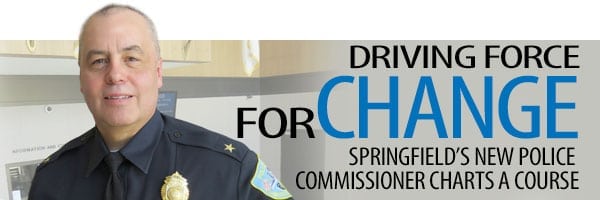
Opinion
The Power of Passion Makes a Difference

When State Trooper Michael Cutone talks about the so-called C3P, or Counter Criminal Continuum Policing Program, now being implemented in Springfield’s Brightwood neighborhood, there is an unmistakable passion in his voice.

And it’s understandable.

Cutone, fellow State Trooper Tom Sarrouf, and John Barbieri, deputy chief of police in Springfield, are the three main architects of this program, which has enjoyed considerable success with the daunting task of taking neighborhood residents, once relegated to the role of spectators by fear and apathy, and making them a major force in a counter-insurgency effort that has gang members reportedly throwing their cell phones in the Connecticut River because they believe they’re bugged by police.

“Gang members and drug dealers are very savvy — they exploit the fact that people don’t want to engage with the police; they exploit that passive support,” Cutone told BusinessWest, adding that, while the program has a long way to go, it is succeeding with its broad goal of turning that base of support on its ear. And it is because of his passion for the program and its tactics — borrowed from work Cutone and Sarrouf employed with the Green Berets in Iraq — that it is enjoying solid results and bringing news media from across the country to see how it works.

This passion might be considered the prevailing common denominator among this year’s class of Difference Makers.

Indeed, there is passion in Bruce Landon’s voice when he talks about not only how, but why he has fought so hard to keep professional hockey in Springfield, assembling three different ownership groups. That same emotion is there as Sisters Kathleen Popko and Mary Caritas talk about the Sisters of Providence and their incredibly inspiring 140-year track record of finding new and much-needed ways to assist underserved segments of the population.

The passion is palpable as the remarkable John Downing talks about Soldier On and how it never stops working to find ways to improve the lives of those who have served their country. And it bubbles over when Jim Vinick talks about the Jimmy Fund, the Naismith Memorial Basketball Hall of Fame, and the myriad other causes and institutions he has attached his name to.

Thus, we may well attach the subtitle ‘the power of passion’ to this year’s stories, because it certainly sums things up. There are, indeed, many ways to effectively make a difference in a community, but the process of doing so begins with the requisite passion for a cause or a problem. And there is a lesson there for all of us — find something, or some things, we’re passionate about, and then use that emotion to change people’s lives.

Landon is often called ‘Mr. Hockey’ in Springfield, a fitting title for someone who played the game here and has held about every title in the front office. But there’s a big difference between liking a sport and devoting your life to keeping a team playing in downtown Springfield. The difference is the level of passion.

The same can be said of Vinick. Many people sit on multiple boards and donate time and money to causes. Vinick goes beyond, giving himself to those causes. That means he gives his love of his hometown and the game with which it is identified, and he gives his desire, born from great personal tragedy, to help all those who have seen their lives turned upside down by cancer.

Downing has a simple passion for helping any individual who would go fight and die for his or her country, and this is seen clearly in a career-long quest to help those who discovered that their fight wasn’t over when they returned home from service. And the Sisters of Providence have made a passion for caring service the trait that defines the congregation.

The stories of this year’s Difference Makers vary in some ways, but they all convey the same message: there really is no limit to what you can accomplish when you’re passionate about something, and when you find ways to channel that passion into solutions for others.

Class of 2013 Difference Makers
SistersOfProvidence

Sr. Mary Caritas, SP, left, and Sr. Kathleen Popko, SP.

Sr. Kathleen Popko, SP likes to say that the 700-odd Sisters of Providence, present and past, “share some DNA” with Sr. Mary Providence Horan, the first mother general of the congregation.
And by that, she meant that those who worked beside her or followed in her footsteps have possessed both her many character traits and her broad operating philosophy.
As for the former, these include vision, compassion, determination, a large dose of innovation, and a very strong sense of mission.
“Mother Mary of Providence has always been an inspiration to me,” said Popko, president of the Sisters of Providence. “She had a lot of foresight and was very innovative; she established 20 works of charity within the first 15 years of her becoming head of the congregation. She crossed boundaries — she worked with the Jewish community and the Protestant community to help establish the board at Mercy Hospital, And she was willing to collaborate and ask for help from others to support the work she was doing, whether it was in Worcester or Pittsfield. And she had a great love of learning; those are qualities we like to think we possess today.”
As for the latter, well, that’s perhaps best summed up in a quote often attributed to her: “never rest on what has been accomplished, but continue reaching on to what needs to be done.”
Suffice it to say, the sisters have never done any such resting. Instead, they have, over the decades, responded to changing societal needs with the same zeal and desire that were firmly in evidence when two members of the Sisters of Charity of the House of Providence from Kingston, Ontario, Canada, came to Holyoke on a so-called begging tour in 1873 and were invited to establish a mission there to help the waves of immigrants struggling to carve out a living.
They eventually did, creating a legacy of providence that is captured in the statue of Mother Mary near the entrance to Providence Place in Holyoke, with a commanding view of the valley below. She is depicted holding hands with two young children — a boy carrying a schoolbook and a girl with a broken arm — artistic touches designed to spotlight the two basic tenets of the sisters’ work over the past 14 decades: education and healthcare.
Those two foundations remain, especially healthcare, through work carried out within the broad Sisters of Providence Health System. But the modern work of the Sisters of Providence is quite diverse, said Sr. Mary Caritas, vice president of the congregation, who listed everything from programs to provide healthcare to the region’s homeless population to groundbreaking initiatives in the broad realm of senior living, such as the ‘small house’ concept created at Mary’s Meadow.
“The one constant is need,” she said. “When the sisters came in 1873, it was in response to a need — they saw a need, and they responded. We’re doing things differently in this day and age, but we continue to have that same spirit.
“But they also recognize the need to change as society does — we’ve never been afraid to let go and move on from something because society has changed,” she went on, citing, as just a few examples, the transition of Providence Hospital from acute care to behavioral health; the repositioning of the former Farren Hospital in Montague into the Farren Care Center, a provider of services to people with severe behavioral disorders; and new uses for the facilities at Brightside for Families and Children.
The past several months have been a time of celebration for the Sisters of Providence — specifically, the marking of two important anniversaries.
Last year marked the 120th anniversary of the Sisters of Providence’s 1892 foundation as an independent congregation in the Springfield diocese. And this year marks the 140th anniversary of the arrival of the Sisters of Providence’s foremothers — today’s Sisters of Providence of St. Vincent De Paul in Kingston, Ontario — in Holyoke.
There have been a host of events to mark both occasions, from the planting and blessing of ‘anniversary trees’ to an anniversary procession and prayer; from an “open weekend of gratitude” to a dinner at Mercy Medical Center.
And because of that long history of caring being celebrated, there will be at least one more event to attend — BusinessWest’s Difference Makers Gala on March 21, when the sisters will be introduced as members of the Class of 2013.
For this special section profiling this year’s winners, we spoke at length with Popko and Caritas about how society may have changed over the past 140 years, but the devotion of the Sisters of Providence to their mission of meeting the needs of the most challenged segments of the population certainly hasn’t.

Past Is Prologue
Before talking about Western Mass. in 2013, Popko and Caritas wanted to talk first about Holyoke in 1873. Doing so, they said, would at least start to put the work of the Sisters of Providence in perspective, and also help explain that shared DNA.
Holyoke was the first planned industrial city in the country, they explained, and in the early 1870s, it was the place where some mill owners found fortune and many immigrants found opportunity for employment. But most found only hardship in the form of difficult, often dangerous work; crowded, inadequate housing (tenements built near the mills); and systems of education and healthcare that were nonexistent or extremely lacking.
It was into this environment that Srs. Mary de Chantal McCauley and Mary Elizabeth Stafford ventured on their begging tour in early 1873. They found the climate difficult for philanthropy — the country was in recession, and many of Holyoke’s mills had closed, while others were struggling — but ripe for charity, and for mostly the same reasons.
Fr. Patrick Harkins, pastor of St. Jerome’s Church in Holyoke, proposed that the congregation establish a mission in his parish for sick people and orphaned children, and one was created later that year, with four pioneer sisters from Kingston moving into a house belonging to St. Jerome’s but located across the Connecticut River in South Hadley Falls. The first orphan was admitted one week after their arrival, and the first patient was admitted for hospital care on Dec. 2, the recorded date of the beginning of the House of Providence, the first Catholic hospital in Western Mass.
Two years later, land was acquired for a new House of Providence on Dwight Street, while that same year, six sisters from Kingston, including Mother Mary of Providence, were assigned to teach at St. Jerome’s Institute, a school for boys in Holyoke.
In 1880, 53 acres of property in Holyoke, known as Ingleside, were purchased, and ground was broken for Mount St. Vincent, a home for orphaned girls. Sixteen years later, property on Carew Street in Springfield was acquired and deeded to the congregation for the House of Mercy, which later became Mercy Hospital and is now known as Mercy Medical Center.
In 1890, Bethlehem House, a home for infants and toddlers, opened at Brightside in Holyoke, Farren Memorial Hospital was dedicated, and schools of nursing were opened at Providence Hospital, Mercy Hospital, and St. Vincent Hospital in Worcester, establishing a pattern of caring and growth that continued unfettered for decades.
“When the sisters came here, they were not here a week, and they had an ophan at the door, and then the alms person in the city decided to send some more,” Popko explained. “It wasn’t long before the need was manifested, and they responded, whether it was with orphaned children or with healing the sick, oftentimes in their homes, or it was with making burial plots because there was no one to do that.
“And I think that’s why the Sisters of Providence ministries have been so diverse, from the beginning,” she continued. “It wasn’t simply that we started a healing ministry and were in hospitals, although that evolved most significantly. We were also involved in caring for the elderly or the orphaned or abandoned children, or in burying the dead, or doing home care. We were trying to be the providence of God in the lives of others, and in doing that, we reached out into healing ministries.”
Today, the area facilities operated by the Sisters of Providence include Providence Hospital, Mount Saint Vincent Care Center, Beaven Kelly Home, Providence Place retirement community, and Mary’s Meadow long-term nursing care and rehabilitation center, all in Holyoke; Mercy Medical Center and St. Luke’s Home in Springfield; Saint Luke’s Hospital in Pittsfield; Saint Vincent Hospital in Worcester; Farren Care Center; Genesis Spiritual Life Center in Westfield; and the many agencies of Brightside for Families & Children. There are also operations far outside this region, ranging from a home-health agency, hospital, and retirement village in North Carolina to a health clinic and multiple social-service agencies in an impoverished section of Santiago, Chile.
The specific missions and constituencies served vary with each ministry, said Popko, but there is a common denominator — bringing care to those who need it, and to those who may have no other alternative.

Innovative Spirit
The stories of many of these various ministries, as well as the people who inspired and created them, are told in a recently released book titled 140 Years of Providential Caring — The Sisters of Providence of Holyoke, Massachusetts.
Authored by Suzanne Strempek Shea, Tom Shea, and Michele Barker, it chronicles how many programs and facilities were developed, and is told largely through the eyes and thoughts of the individuals who paved those roads. There’s a chapter, for example, on Sr. Julie Crane and her work to create Health for the Care of the Homeless, another on Sr. Caroline Smith and her efforts to create the Sisters of Providence Methadone Maintenance Program, and still another on Sr. Elizabeth Oleksak and her work at Genesis Spiritual Life Center.
These chapters serve as both historical record and source of inspiration, said Popko.
“The individual stories demonstrate how that original spirit has been the driving force for us for 140 years, and how it’s certainly taken different shapes and forms and responded to the different calls of providence in each of our lifetimes,” she explained. “It’s certainly been an amazing journey, and for us to look back on it all in 2012 and 2013 and to read some of our archival material and relive some of the extreme dedication and willingness to reach out in multiple ways, is certainly inspiring.”
And moving forward, the unofficial assignment for the Sisters of Providence is to write more chapters for the next book, said Popko and Caritas. This means finding new ways to carry out the original mission, while also strengthening the infrastructure and operating philosophy that will ensure that this work is carried out in the decades to come, long after the last of the current sisters, already dwindling in number, are gone.
This is part of the legacy of never resting on one’s laurels that continues today, said Caritas, adding that there are several examples of how it manifests itself.
One involves a portion of the former Brightside property, used for residential treatment programs that were discontinued in 2010.
“I’m sure Mother Mary would have been thinking, as we have been for the past three years, about what to do with that property,” Caritas told BusinessWest, adding that plans are emerging to relocate the Sisters of Providence home-care and hospice programs in the main administration building at Brightside, while the ground floor will be used for something called PACE, or the Program for All-inclusive Care for the Elderly.
Elaborating, Popko said the initiative is a capitated-insurance program that provides essentially whatever care is needed to enable an older individual to remain in his or her own home. “They come to the site three or four times a week,” she explained, “and they might get all kinds of care, be it socialization, they might get a bath, there will be a clinic there so we can look at their healthcare needs and medication. They will be assessed, and care will be coordinated. It’s all designed to prevent those higher-cost institutionalizations by treating them effectively in the short run.”
In other words, it’s another imaginative approach to meeting recognized needs in the community, said Caritas, adding that there are other possible reuses of the Brightside facilities coming into focus, including low-income elderly housing, a geriatric-assessment center, and other coordinated facilities.
“It will be a full-service site,” she noted, “one that will provide all-inclusive care for those who participate.”
Securing funding for the project is ongoing, and it will be a challenge, said Popko, adding that there is no firm timetable in place for this strategic initiative. But the manner in which it is coming together speaks to the legacy of the Sisters of Providence and that notion of never resting on laurels.
“It references a vision of the future, a responsiveness to the needs of the times, and a creative reuse of existing resources — a replanting of the seeds, if you will, that were put down 140 years ago,” she said. “That’s what we’ve been doing throughout our history.”

Mission: In Progress
Returning to her thoughts on Mother Mary of Providence one more time, Popko said that she’d been doing some reading about her lately, and learned that her skills extended into architecture and building practices.
“I just read a quote recently … she said, ‘the next hospital we build is not going to be the conversion of some big house so we can fit in beds,’” Popko recalled. “She said, ‘we’re going to build a modern facility designed for the care of people.’
“Meanwhile, she designed Mount St. Vincent herself,” she went on. “She saw the first plans and went to the bishop and said, ‘these plans are totally inadequate.’ So they made her a committee of one; they tore up the plans, let her design her own building, and pretty much built off what she drew up.”
The current sisters are not architects in the same literal sense, but they are designers and builders in a figurative manner — blueprinting new ways to expand the mission launched 140 years ago.
And in that respect, the DNA is the certainly the same. The 700 Sisters of Providence through history have always been Difference Makers.

Agenda Departments

HP Vendor Showcase

Feb. 5: Entre Computer and vendor partner Hewlett Packard (HP) will exhibit the latest technologies and products for 2013 from 4 to 9 p.m. at the Naismith Memorial Basketball Hall of Fame in Springfield. The event, hosted by Hewlett Packard and strategic partners, will introduce new information from Entre, Intel, and Microsoft, who will all be present to discuss the latest innovations from their companies, including the new HP Business Tablet featuring Windows 8 and Intel technology, HP point-of-sale products, and digital signage. The event will highlight HP’s innovation in personal computers and printing. Some of the educational topics covered will include mobile computing, Microsoft Windows 8, and a host of leading-edge solutions, followed by dinner and a partner technology exposition. Entre Computer invites all qualifying customers, businesses, healthcare providers, manufacturers, banks, and retailers to the exhibit, and all are welcome to a complimentary, self-guided tour of the Hall of Fame at the conclusion of the program. Attendance and seating are limited, and pre-registration is required by visiting hpbroadband.com. For additional information, contact Entre Computer at (413) 736-2112 or e-mail [email protected].


Essence Editor to Speak

Feb. 5: Susan Taylor of Essence magazine will speak at Springfield Technical Community College at 11 a.m. in the Scibelli Hall gym as part of the STCC Diversity Council Event Series. The presentation, which coincides with Black History Month, is free and open to the public. Taylor’s name is synonymous with Essence magazine, the brand she built as the magazine’s fashion and beauty editor, editor in chief, and editorial director. For nearly three decades, Taylor has been the driving force behind one of the most celebrated black-owned businesses of our time and a legend in the magazine-publishing world. For 27 years, Taylor authored one of the magazine’s most popular columns, “In the Spirit.” She is the only African-American woman to be recognized by the Magazine Publishers of America with the Henry Johnson Fisher Award, the industry’s highest honor, and the first to be inducted into the American Society of Magazine Editors Hall of Fame. Taylor also is the recipient of the NAACP President’s Award for visionary leadership and has honorary degrees from more than a dozen colleges and universities.
A fourth-generation entrepreneur and the author of four books, she supports a host of organizations dedicated to moving the black community forward, but her passion and focus today is with the National Cares Mentoring Movement, a call to action which she founded in 2006 as Essence Cares. The National Cares Mentoring Movement (www.caresmentoring.org) is a massive campaign to recruit 1 million able adults to help secure children who are in peril and losing ground. Taylor’s presentation is sponsored by PeoplesBank, Hampden Bank, the STCC Diversity Council, the Springfield Department of Health and Human Services, Baystate Health, Health New England, MassMutual, and the United Way of Pioneer Valley.


Business-law Basics

Feb. 5, March 12, April 16: Get the business-law basics that every small-business owner and entrepreneur needs to know from the legal experts at the Center for Innovation & Entrepreneurship at Western New England University. This series of free information sessions is focused on key topics to help plan and grow a small business. All sessions will be held from 5 to 7 p.m. at Western New England University School of Law, in the Blake Law Center. All events are free and open to the public. Light refreshments will be provided. The topics and presenters are: Feb. 5, “Legal Issues in Finance,” with attorneys Scott Foster of Bulkley Richardson and Michael Sweet of Doherty, Wallace, Pillsbury and Murphy; March 12, “Intellectual Property Law Basics,” with attorneys Peter Irvine of Peter Irvine Law Offices, Leah Kunkel of the Law Offices of Leah Kunkel, and Michelle Bugbee of Solutia Inc.; April 16: “Bankruptcy,” with attorneys George Roumeliotis of Roumeliotis  Law Group, Justin Dion of Bacon Wilson, and Kara Rescia of Eaton & Rescia. To learn more about upcoming events hosted by the Center for Innovation & Entrepreneurship, visit www.wne.edu/cie.


40 Under Forty Reunion

Feb. 7: BusinessWest will stage a reunion featuring the first six classes of its 40 Under Forty program at the Log Cabin Banquet & Meeting House in Holyoke. The event, open only to 40 Under Forty winners, event judges, and sponsors, will begin at 5:30 p.m. and feature a talk from Peter Straley, president of Health New England, about leadership and community involvement. For more information on the event, call (413) 781-8600 or e-mail [email protected].


Dress Down for Animals

Feb. 15: Employers, are you looking for a fun way to engage your staff while helping local shelter animals? By participating in Dress Down for Animals Day, your business can help provide life-saving care to dogs, cats, and other small animals at the Thomas J. O’Connor Animal Control and Adoption Center in Springfield. Through this program, employees will make a minimum donation of $5, $10, or whatever level the employer sets for the privilege of wearing whatever they wish to work on Feb. 15, with proceeds donated to the shelter. Prizes will be awarded based on donation total and number of employees participating. Businesses can compete for a $590 advertising package from Reminder Publications, a chair yoga session for up to 50 employees, a catered dessert party, a chance to introduce a business to 7,000 people on the Thomas J. O’Connor Facebook page, and more. To request a form to fill out and return with donations, call (413) 533-4817 or e-mail [email protected]. For more information about the adoption center, visit www.tjofoundation.org.


Difference Makers 2013

March 21: The annual Difference Makers award program, staged by BusinessWest, will be held at the Log Cabin Banquet & Meeting House starting at 5 p.m. Details on the event will be published in upcoming issues of the magazine. Difference Makers is a program, launched in 2009, that recognizes groups and individuals that are, as the name suggests, making a difference in this region. Several dozen nominations for the award were received this year, and the winners have been chosen. They will be announced in the magazine’s Feb. 11 issue. For more information, call (413) 781-8600.

Features
Difference Makers to Be Revealed in February, Saluted in March

BizDiffMakrsLOGO2011The Difference Makers Class of 2013 has been chosen, and BusinessWest Associate Publisher Kate Campiti believes it provides five good reasons why this recognition program was created in 2009.

“There are many different ways that a group or individual can make a difference and positively impact quality of life in this region,” said Campiti, who was among those who selected this year’s honorees. “This year’s stories really capture this sentiment and relate some of the wonderful things that are happening in this region.”

These stories will be told in the Feb. 11 edition of BusinessWest, which will truly be must reading. And on March 21, the Class of 2013 will be feted at the annual Difference Makers gala, to be staged at the Log Cabin Banquet & Meeting House in Holyoke.

Campiti and BusinessWest Editor George O’Brien both said the selection process this year was equal parts inspiring and challenging, primarily because of the quality and quantity of the nominations received.

Indeed, there were more than three dozen individuals and organizations nominated, which is a record, said O’Brien, noting that, in some way, each nominee is making a difference in this region.

“This was a very difficult selection process; there were so many outstanding candidates this year,” said O’Brien. “We could easily have chosen any of them. In the end, we selected a mix of individuals and groups that clearly show how, with some perseverance, imagination, and determination, it is possible to change lives for the better.

“These are very compelling stories,” he continued, “and, more importantly, they are very inspiring as well, and that’s one of the reasons we created this award — to help inspire individuals and groups to find their own ways to make a difference.”

Tickets for the March 21 gala are now on sale. Seats cost $55 each, with tables of 10 available. To reserve tickets or for more information, call (413) 781-8600, ext. 100, or e-mail [email protected].

This year’s Difference Makers gala is being sponsored by Baystate Medical Practices, Health New England, Meyers Brothers Kalicka, Royal LLP, Sarat Ford Lincoln, and Six Point Creative Works.

Agenda Departments

‘Perfect Pitch’ Program

Jan. 22: The Scibelli Enterprise Center in Springfield will host a day-long program called “Perfect Pitch,” delivered by Linda Plano, a seasoned entrepreneur’s coach and professional who is familiar with academic programs. As its name implies, the program helps entrepreneurs perfect their company’s pitch to a variety of audiences. Plano, via her firm, Plano and Simple, is subsidizing the cost of this workshop through her sponsorship of ACTION, the Assoc. of Cleantech Incubators of New England, of which the SEC is a member, so the fee is only $50 per participant, and food is included. Non-cleantech companies are also encouraged to attend. Registration is available online at www.planoandsimple.com/ppworkshop-2013-01-22-springfield-mass. Attendance will be limited. There are some valuable pre-workshop webinars and advising sessions described on the website as well.


Essence Editor to Speak

Feb. 5: Susan Taylor of Essence magazine will speak at Springfield Technical Community College at 11 a.m. in the Scibelli Hall gym as part of the STCC Diversity Council Event Series. The presentation, which coincides with Black History Month, is free and open to the public. Taylor’s name is synonymous with Essence magazine, the brand she built as the magazine’s fashion and beauty editor, editor in chief, and editorial director. For nearly three decades, Taylor has been the driving force behind one of the most celebrated black-owned businesses of our time and a legend in the magazine-publishing world. She is the only African-American woman to be recognized by the Magazine Publishers of America with the Henry Johnson Fisher Award, the industry’s highest honor, and the first to be inducted into the American Society of Magazine Editors Hall of Fame. Taylor also is the recipient of the NAACP President’s Award for visionary leadership and has honorary degrees from more than a dozen colleges and universities. A fourth-generation entrepreneur and the author of four books, she supports a host of organizations dedicated to moving the black community forward, but her passion and focus today is with the National Cares Mentoring Movement, a call to action which she founded in 2006 as Essence Cares. The National Cares Mentoring Movement (www.caresmentoring.org) is a massive campaign to recruit 1 million able adults to help secure children who are in peril and losing ground. Taylor’s presentation is sponsored by PeoplesBank, Hampden Bank, the STCC Diversity Council, the Springfield Department of Health and Human Services, Baystate Health, Health New England, MassMutual, and the United Way of Pioneer Valley.


HP Vendor Showcase

Feb. 5: Entre Computer and vendor partner Hewlett Packard (HP) will exhibit the latest technologies and products for 2013 from 4 to 9 p.m. at the Naismith Memorial Basketball Hall of Fame in Springfield. The event, hosted by Hewlett Packard and strategic partners, will introduce new information from Entre, Intel, and Microsoft, who will all be present to discuss the latest innovations from their companies, including the new HP Business Tablet featuring Windows 8 and Intel technology, HP point-of-sale products, and digital signage. The event will highlight HP’s innovation in personal computers and printing. Some of the educational topics covered will include mobile computing, Microsoft Windows 8, and a host of leading-edge solutions, followed by dinner and a partner technology exposition. Entre Computer invites all qualifying customers, businesses, healthcare providers, manufacturers, banks, and retailers to the exhibit, and all are welcome to a complimentary, self-guided tour of the Hall of Fame at the conclusion of the program. Attendance and seating are limited, and pre-registration is required by visiting hpbroadband.com. For additional information, contact Entre Computer at (413) 736-2112 or e-mail [email protected].


40 Under Forty Reunion

Feb. 7: BusinessWest will stage a reunion featuring the first six classes of its 40 Under Forty program at the Log Cabin Banquet & Meeting House in Holyoke. The event, open only to 40 Under Forty winners, event judges, and sponsors, will begin at 5:30 p.m. and feature a talk from Peter Straley, president of Health New England, about leadership and community involvement. For more information on the event, call (413) 781-8600 or e-mail [email protected].


Difference Makers 2013

March 21: The annual Difference Makers award program, staged by BusinessWest, will be held at the Log Cabin Banquet & Meeting House starting at 5 p.m. Details on the event will be published in upcoming issues of the magazine. Difference Makers is a program, launched in 2009, that recognizes groups and individuals that are, as the name suggests, making a difference in this region. Several dozen nominations for the award have been received, and are now being reviewed. The winners will be announced in the magazine’s Feb. 11 issue. For more information, call (413) 781-8600.

Agenda Departments

Building Your Future

Jan. 8: MassMutual and Western New England University are teaming up to present the MassMutual Building Your Future Conference from 8 a.m. to 3:45 p.m. at WNEU. More than 400 Springfield public- and private-school students in grades 10 through 12 are scheduled to attend.

The free conference is designed to give students the tools and knowledge to construct a blueprint for their education and careers. Workshops will touch on college and career planning, problem solving, and time- and money-management skills. MassMutual Academic Achievers earn an invitation to the conference by maintaining a B average or better for four consecutive marking periods during grades 10 through 12.

“Choosing the right career path is imperative to a successful future, but many of our young people aren’t aware of local career opportunities,” said Nick Fyntrilakis, vice president for Community Responsibility at MassMutual, adding that the conference “exposes students to career opportunities that are available in financial services at MassMutual and beyond. Our programs encourage students to excel academically and gain valuable exposure to rewarding careers.”

This year’s conference will offer students a variety of hands-on activities in various fields, including financial services, business, information technology, broadcast communications, criminal justice, medicine, and the sciences. Workshops will also address the college admissions process, paying for college, making a good first impression, and preparing for life’s curveballs. The keynote speaker will be Terrell Hill, principal at High School Inc., a four-year, college-preparatory school for students in grades 9 through 12 who are interested in pursuing careers in the insurance and financial-services industries. Other highlights of the conference include a video contest and a raffle featuring a laptop computer, flatscreen televisions, iPods, and other prizes. The snow date for the conference is Jan. 11. To register, visit www1.wne.edu/massmutual/byf.


Essence Editor to Speak

Feb. 5: Susan Taylor of Essence magazine will speak at Springfield Technical Community College at 11 a.m. in the Scibelli Hall gym as part of the STCC Diversity Council Event Series. The presentation, which coincides with Black History Month, is free and open to the public. Taylor’s name is synonymous with Essence magazine, the brand she built as the magazine’s fashion and beauty editor, editor in chief, and editorial director. For nearly three decades, Taylor has been the driving force behind one of the most celebrated black-owned businesses of our time and a legend in the magazine-publishing world. For 27 years, Taylor authored one of the magazine’s most popular columns, “In the Spirit.” She is the only African-American woman to be recognized by the Magazine Publishers of America with the Henry Johnson Fisher Award, the industry’s highest honor, and the first to be inducted into the American Society of Magazine Editors Hall of Fame. Taylor also is the recipient of the NAACP President’s Award for visionary leadership and has honorary degrees from more than a dozen colleges and universities.
A fourth-generation entrepreneur and the author of four books, she supports a host of organizations dedicated to moving the black community forward, but her passion and focus today is with the National Cares Mentoring Movement, a call to action which she founded in 2006 as Essence Cares. The National Cares Mentoring Movement (www.caresmentoring.org) is a massive campaign to recruit 1 million able adults to help secure children who are in peril and losing ground. Taylor’s presentation is sponsored by PeoplesBank, Hampden Bank, the STCC Diversity Council, the Springfield Department of Health and Human Services, Baystate Health, Health New England, MassMutual, and the United Way of Pioneer Valley.


40 Under Forty Reunion

Feb. 7: BusinessWest will stage a reunion featuring the first six classes of its 40 Under Forty program at the Log Cabin Banquet & Meeting House in Holyoke. The event, open only to 40 Under Forty winners, event judges, and sponsors, will begin at 5:30 p.m. and feature a talk from Peter Straley, president of Health New England, about leadership and community involvement. For more information on the event, call (413) 781-8600 or e-mail [email protected].


Charlotte’s Web Exhibit

Through April 22: The Eric Carle Museum of Picture Book Art in Amherst is offering a rare opportunity for guests to see selections from the 20th-century classic Charlotte’s Web, written by E.B. White and illustrated by Garth Williams. “Some Book! Some Art! Selected Drawings by Garth Williams for Charlotte’s Web” will be on exhibit through April 22, and celebrates Williams’s 100th birthday and the 60th anniversary of the book. For more information, visit, www.carle museum.org.


Difference Makers 2013

March 21: The annual Difference Makers award program, staged by BusinessWest, will be held at the Log Cabin Banquet & Meeting House, starting at 5 p.m. Details on the event will be published in upcoming issues of the magazine. Difference Makers is a program, launched in 2009, that recognizes groups and individuals that are, as the name suggests, making a difference in this region. Several dozen nominations for the award have been received, and are now being reviewed. The winners will be announced in the magazine’s Feb. 11 issue. For more information, call (413) 781-8600.

Features
Group Wants to Emphasize That It Goes Well Beyond Networking

Chris Thomson and Pam Thornton

Chris Thomson and Pam Thornton say the primary challenge for YPS is to effectively communicate that it is much more than a networking organization.

Chris Thompson isn’t a young accountant — his business card declares that he is vice president of Business Development for the Springfield Falcons hockey club — but he put himself in the shoes of such an individual to help explain what the Young Professional Society of Greater Springfield (YPS) has accomplished in its first five years, and where the group intends to go in the future.

“Can you imagine being a 22-year-old accounting graduate from UMass who has a chance to meet with Mark O’Connell?” asked Thompson rhetorically, referring to the recently named president and CEO of Wolf & Co., P.C., who was the featured business executive at a recent YPS CEO Luncheon. “You can’t put a price tag on having a face-to-face with a decision maker like that. ”

Indeed, in addition to valuable insight about the accounting industry and business in general, O’Connell provided his luncheon guests with indisputable evidence that one doesn’t haven’t to leave Western Mass. to script a success story. O’Connell, a long-time partner with the firm, has long worked out of the Springfield office rather than the firm’s headquarters facility in Boston, and he made a conscious decision to keep that business mailing address when he was chosen this past summer to lead the company.

Those career decisions enable YPS’s marketing slogan — ‘Live, Work, Play, and Stay’ — to resonate, said Thompson, a long-time YPS member, adding that exposing the group’s membership to more of these stories is one of many formal and informal goals moving forward for the organization, which recently turned five, and marked that milestone by completing a new, three-year strategic plan.

That document, which calls for hiring a full-time executive director, among other steps, addresses goals and aspirations, but also perceptions about the group and apparent misperceptions as well, said Pam Thornton, business-development director for United Personnel and current president of the organization.

Elaborating, she said YPS is perceived by many as simply a networking group, a view facilitated by the group’s popular and highly visible Third Thursday gatherings.

Those get-togethers will continue, she went on, adding that networking remains a high priority for the organization. But there are other missions, ranging from educating members about issues and the region in general to helping members get involved in the community, to, overall, providing motivation for young people to stay in this area.

“YPS is all about graduating youth into the business world, and I see it as a foundation, a funnel, a vehicle for all of the things this area is concerned about in retaining talent,” said Thornton, adding that the new strategic plan emphasizes this mindset.

Summing up the plan and what its architects hope it will accomplish, Thompson said it was crafted with the broad goal of greatly reducing the volume of questions relative to why the organization exists, what it does, and how it carries out its mission.

“There was no blueprint back then,” he explained, referring to the group’s early days, while noting that, with a firm plan in place, YPS can better articulate its charge — and carry it out.

For this issue, BusinessWest talked with several YPS members about the state of their organization at this important stage of its development, and where it can, and should, go from here.


Young Ideas

If success can be measured in numbers, such as those related to membership, then YPS can certainly claim a number of victories since its formation in the summer of 2007.

It now boasts more than 500 individual members and 50 corporate members. Meanwhile, its e-mail list has grown to more than 2,000. And there have been other forms of validation: BusinessWest chose the group as one of the first recipients of its Difference Makers award in 2009, and state Sen. James Welch (D-West Springfield) is sponsoring legislation to develop a ‘Young Professional Commission,’ which would give the 11 YP organizations across the Commonwealth a voice on Beacon Hill.

“What makes YPS important is that many of the decision makers, not only in our region, but everywhere, tend to be further along in their careers,” said Welch. “YPS represents those that are a little earlier in their careers and gives them a bit more of a voice when it comes to decision making and influencing policy and the direction the region wants to go in.”

The commission would also be a key element in ongoing efforts across the Commonwealth to keep young professionals — what Welch and others call “intellectual capital” — in the Bay State, thus making it a more attractive state in which to do business.

Yet, despite these triumphs, there is still an apparent lack of awareness, even among some YPS members, about the group’s official mission and the work it does within the community and for its members.

These were revealed at a series of focus groups staged last summer and facilitated by Ronn Johnson, president of R.D. Johnson Consulting.

Among the findings was that nagging perception of the group as simply a networking organization, a view that is somewhat troubling, but perhaps understandable. That’s because, from the start, YPS has stressed the importance of networking and building relationships, both from a business perspective and a community-involvement standpoint.

“That’s where the disconnect has been; we were a young, social business group that built strong foundations through networking,” said Thornton. “When you look at the chamber, that’s what they do, too … it’s called building relationships; you aren’t going to do business with someone you don’t like.”

The group’s networking activities, especially its Third Thursdays, will continue, said those we spoke with, because they remain one of the few — and most effective — vehicles for young people to build those relationships. But YPS will emphasize other aspects of its charge, and more forcefully articulate them.

The need to do so was made clear at the focus groups, said Kishore Parmar, vice president of the Pioneer Valley Hotel Group, who was asked to be an observer and administrator at two of the sessions, which solicited feedback from area business and nonprofit leaders.

He noted that many of these participants were aware of YPS, but opined that its mission was not clearly stated.

“That’s the biggest issue with them,” he told BusinessWest. “They wanted to know what our end goal was, to see it written down, and to see it formally introduced.”


Youth Is Served

To do all this, and create that more solid blueprint that Thompson described, the group’s strategic plan sets a number of goals and methods for realizing them.

One of the key provisions is hiring an executive director, a step necessitated by the group’s profound growth, and a measure that will give YPS a face and a voice in the community and an important layer of management.

“There are many nonprofits out there that function quite well without an executive director, but they really only get legs when they have someone who can manage the organization on a full-time basis,” Thornton told BusinessWest. “So we will be approaching key stakeholders in the community to invest in YPS.”

The strategic plan also calls for a sustainable organizational structure that will explore more funding opportunities through grant and fee-based programs; a task force to oversee a fund-development plan; the possibility of a conversion from a 501(c)(6) to a 501(c)(3), allowing a charitable arm of YPS; and strengthening community, key-stakeholder, and political partnerships.

Other facets of the plan include additional focus on fostering “an inclusive, culturally competent, and community-relevant organization in the eyes of its members and the broader community.” Thornton said YPS is already taking a number of steps in the realm of diversity, “but we can always do better.”

She noted that the 16 members of the board of directors will be attending a diversity-education seminar in January, bringing what they learn back to members.

Another component of the strategic initiative focuses on what the group calls work/life development opportunities.

“When we look to the future, we want people to view us as what they asked us to be,” Thornton explained. “The feedback that we got was about professional-development programming, education reform, real-estate concerns, casinos and a forum about that issue — and they really want to be connected in the community through volunteerism, but they want someone to show them how to do that.”

Part of this assignment will involve simply making young people aware of the many kinds of professional-development opportunities that exist in this region, said Thompson, noting that several colleges and workforce-development agencies provide workshops and other programs, many of them free of charge, but young professionals often don’t know about them.

Welch agrees. “Young professionals know from experience that, when they were first starting out in their careers, they didn’t necessarily know what resources were out there and available to them.”

And while many in the business community are focused on what YPS can do for them and their employees, Thornton believes these same people have to ask what they can do to help YPS.

“Maybe employers need to take a step back and see how they can become involved; young people need the elder community to be mentors, and those employers have a role in YPS,” she explained. “And the only way to do that is to engage young people, mentor them, give credence and value to the things that they’re interested in … and that’s how to keep young professionals in the area.”

Still another stated goal within the strategic plan is to create vehicles through which the board can more effectively communicate with current and potential members, partners, and the general public through the YPS website and other marketing strategies. Such efforts are expected to help increase membership, facilitate recruitment of sponsors, and solidify efforts to retain young talent across the region.

“When the question is asked, ‘what does YPS do?’ we’ll be able to answer that though our website, e-mails, and a consistent brand,” said Thornton. “These are big goals, and we’ll need time to realize them.”


Goal Keepers

Summing up what he saw and heard at the last summer’s focus groups, Parmar said there is a perception among many that YPS is “finding its way” and evolving into a viable organization that is promoting intelligent discussions and generating tangible results.

“There are more doers, and they’re rising up,” he said, adding that, moving forward, the group’s basic challenge is to encourage more area business leaders to voice such opinions, and eventually prompt use of the word ‘found’ rather than ‘finding.’

Generating such dialogue — and changes in perception — will take some time, but with a new strategic plan in place, those within the organization believe YPS has a blueprint in place for building on what has already become a success story.


Elizabeth Taras can be reached at [email protected]
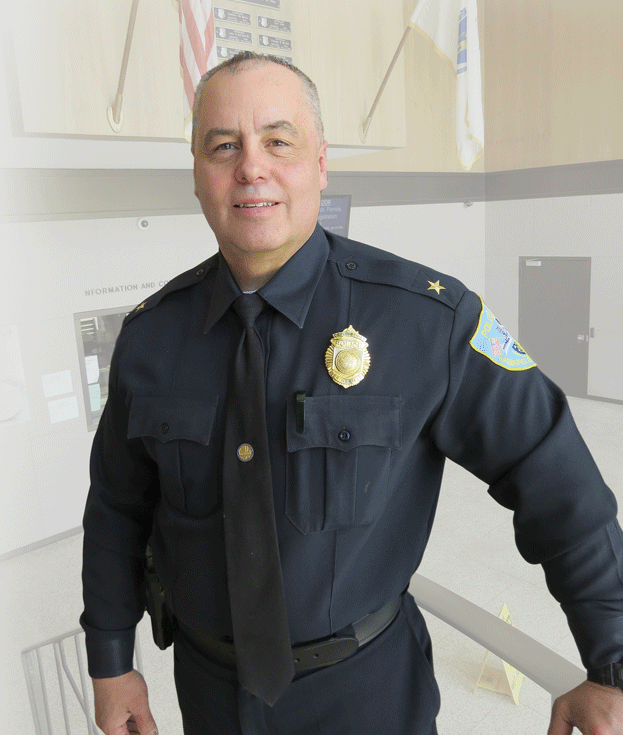
Briefcase Departments

Union Station Work Officially Underway

SPRINGFIELD — The long-awaited transformation of Springfield’s historic Union Station into the region’s main transportation hub officially got underway Nov. 20 at a ceremonial demolition held at the Frank B. Murray Street site. Mayor Domenic Sarno, along with U.S. Rep. Richard Neal, Gov. Deval Patrick, and other officials wielding sledgehammers, participated in the event. It signaled the start of demolition of the former baggage-handling building and will pave the way for construction of a 24-bay bus terminal with structured parking above it — the first steps toward reactivating the long-vacant downtown station. “Today represents the start of an important project that will benefit virtually everyone in Western Mass. It’s an exciting day for the Pioneer Valley,” said Sarno. Added Neal, “the successful renovation of Union Station has been a priority of mine for more than 30 years. I have always believed the restoration of this iconic Springfield landmark had the ability to transform the north blocks of downtown. And it will bring a world-class transportation center to the region in the process.” Other specific work to be completed as part of a $48.7 million Phase 1 project, designed by HDR Architecture Inc., includes the restoration of the main terminal building as a passenger center. The first floor will include operations, ticketing, and waiting space for the transit-service providers, as well as transit-related retail. Also, the passenger tunnel will be reopened and restored, linking the terminal building to rail-boarding platforms and pedestrian access to the downtown. When completed, this initial phase will provide connections for the continuation and expansion of services, including local, regional, and intercity buses; Amtrak, commuter, and high-speed passenger rail; and other ground-transportation services. The second phase of the project will emphasize the remaining development of additional transit-related restaurant and retail uses on the first floor and transit-related commercial space primarily on the terminal building’s upper floors, and will expand the new transit center’s parking capabilities. Sarno thanked Neal for his steadfast support of this regionally significant transportation project and for helping the city bring it to this point. “Recognizing that the station’s redevelopment is crucial to the continued revitalization of the city of Springfield, our goal is to transform this property into a sustainable transportation facility, positioning us to better meet the travel needs of the Pioneer Valley in the short and long term,” added Sarno. He also thanked Patrick “for making Union Station a top priority of his administration,” and the Massachusetts Department of Transportation for working in partnership with the city. “Through this cooperation and with funding support from the state, we have achieved tremendous progress as we’ve worked with the Federal Transit Administration to advance this vital project,” Sarno said. Funding for the Union Station project has been assembled from a number of federal, state, and local sources. In July, U.S. Transportation Secretary Ray LaHood was in Springfield to announce the award of a $17.6 million federal Bus Livability grant for the project. The project is scheduled to be completed and operational by 2015.


Officials Laud Completion of High Performance Computing Center

HOLYOKE — Gov. Deval Patrick headed a list of academic, political, and business leaders who gathered in Holyoke on Nov. 16 to officially mark the completion of the Massachusetts Green High Performance Computing Center built in the center of this historic industrial city. More than 200 people gathered for the event, which capped more than three years of planning and construction of the facility, which was hailed by several of the day’s speakers as a unique and highly effective collaboration involving higher education, private business, and government. The facility, which carried a price tag approaching $90 million, is a data center dedicated to supporting the growing research computing needs of five of the most research-intensive universities in Massachusetts: Boston University, Harvard University, MIT, Northeastern University, and UMass. The project was funded by those five schools, as well as additional partners Cisco and EMC, the Commonwealth of Massachusetts, and the federal New Markets Tax Credit program. In addition to Patrick, other officials to speak at the program and ribbon-cutting included Holyoke Mayor Alex Morse; Susan Hockfield, president emerita at MIT; Jeff Nick, senior vice president and chief technology officer at EMC Corp.; Larry Payne, vice president, Public Sector, Cisco Systems; Lt. Gov. Tim Murray; and Robert Caret, president of UMass.


Nominations Sought for Difference Makers

SPRINGFIELD — BusinessWest magazine will accept nominations for its Difference Makers Class of 2013 until Dec. 30. Difference Makers is a recognition program, started in 2008, that honors individuals and groups that are making an impact in the community and improving overall quality of life in the region. The Difference Makers Class of 2012 consisted of: Charlie and Donald D’Amour, president/COO and chairman/CEO, respectively, of Big Y Foods; William Messner, president of Holyoke Community College; Majors Tom and Linda Jo Perks, officers with the Springfield Corps of the Salvation Army; Bob Schwarz, executive vice president of Peter Pan Bus Lines; and the Women’s Fund of Western Massachusetts. A nomination form is available online at www.businesswest.com/difference-makers-nomination-form.


Baystate Working to Reduce Pre-term Births

SPRINGFIELD — The report card is in on premature births, and the grades are far from glowing. The March of Dimes released its 2012 Premature Birth Report Card in November, and while the U.S. pre-term birth rate dropped for the fifth consecutive year in 2011 to 11.7% — the lowest in a decade — the country still earned a disappointing ‘C’ grade. The March of Dimes grades states by comparing their rate of premature births to their 2020 goal of 9.6%. Three states and Puerto Rico earned an ‘F,’ and only four states — Maine, New Hampshire, Oregon, and Vermont — were graded an ‘A.’ Twenty-two states, including Massachusetts, received a ‘B’ grade and are one step away from achieving the goal. Still, “we still have a long way to go,” said Dr. Glenn Markenson, chief of Maternal Fetal Medicine at Baystate Medical Center. More than 500,000 infants are born prematurely in the U.S. each year, and about 10% of all deliveries are scheduled before 39 weeks, according to the U.S. Department of Health and Human Services. Furthermore, a recent study by the Leapfrog Group, a hospital-quality watchdog, shows that U.S. hospitals vary widely in their rates of elective pre-term deliveries, ranging from less than 5% to more than 40%. “Early deliveries should only be an option for medical reasons, when the life or health of mother or baby is in jeopardy,” said Markenson. Under his leadership, Baystate Medical Center has been working to establish strong guidelines to prevent unnecessary pre-term deliveries by induction or cesarean section, and last year the hospital instituted a ‘hard stop’ for any non-medically required elective delivery prior to 39 weeks, and all elective inductions in first-time mothers. Markenson said the practice of elective pre-term birth finally caught many healthcare-quality officials’ attention when more and more studies began to be published showing its potential harm, including a recent March of Dimes report showing that babies born in the 37th or 38th week have a higher risk of dying in their first year than a baby born after 39 weeks. In addition to working with other Massachusetts hospitals to help the state achieve an ‘A’ grade in the March of Dimes rankings, Baystate is helping lead a statewide initiative called the Massachusetts Perinatal Quality Collaborative.

Features
UMass Amherst Chancellor-elect Meets the Press

Kumble Subbaswamy

Kumble Subbaswamy says he has a comfort level with the flagship campus of a large state university system.

Kumble Subbaswamy says he has a “comfort level” with that institution known as the state university flagship campus, and his résumé shows why: he’s spent most of his career in that environment.
Indeed, his last few stops have included the University of Indiana’s main site in Bloomington, where he served as dean of the School of Arts and Sciences and also as a physics professor, and at the University of Kentucky’s Lexington campus, where he currently serves as provost, and held a number of positions earlier in his career.
“The role of the flagship campus is something I passionately believe in,” said Subbaswamy, or “Swamy,” as he’s known to friends and colleagues, at a press conference concerning what will soon be his biggest career challenge to date, the role of chancellor at another flagship campus — the Amherst facility of the University of Massachusetts.
He would go on to tell a large assemblage of local media that he considers it his primary assignment in that post to help make sure the school honors all the many responsibilities that go with that designation ‘flagship.’ And these include strong relationships — and partnerships — with a host of constituencies, including other campuses within the UMass system, the state’s many private colleges and universities, the neighboring Amherst area, and the larger Greater Springfield region, especially in the broad realm of economic development.
“I want to make sure this becomes a highly influential institution,” he said, “as well as being one that contributes to the welfare of the citizens of Massachusetts.”
Subbaswamy, who was named chancellor in late March, will succeed Robert Holub, who, during his four-year stint, earned praise for his work to help revitalize downtown Springfield (he earned BusinessWest’s Difference Makers award largely for those efforts), and took the Amherst campus to new heights in terms of research awards ($170 million) and in fund-raising ($57 million). However, his tenure was rocked by turmoil — especially in the form of an aborted attempt to locate a medical school in Springfield — and he was essentially forced out.
At the elaborate press conference staged on the 11th floor of the Campus Center Hotel on April 2, Subbaswamy said he intends to build on the momentum generated by Holub — especially with an initiative the outgoing chancellor called the “Framework for Excellence.” That document, drafted in 2009, contains a number of stated goals — from increasing the size of the faculty to doubling the number of federal research awards; from boosting the number of graduate degrees awarded to increasing diversity on the campus.
“All of higher education is facing challenges today in terms of providing access and also maintaining excellence,” he told the press. “The challenges are something that we’ll have to collectively face; I know that the campus has made a great deal of progress in recent years, and I look forward to continuing that momentum.”
Appearing at his press conference with UMass President Robert Caret, Subbaswamy touched on subjects ranging from the many challenges facing public higher education, especially in the Bay State, to the recent decision to take the UMass football program to the bowl subdivision; from those partnerships he mentioned to strategies for making the school more affordable, and therefore accessible.
For this issue, BusinessWest recaps Subbaswamy’s thoughts as he reflected on the challenges and opportunities that lie ahead.

Degree of Difficulty
When asked by BusinessWest to describe the management style he will bring to the Amherst campus and the bureaucracy-laden world of public higher education, Subbaswamy summed it up with two words — transparency and communication.
“The more people know the facts, the more people who know how you arrived at decisions, the better,” he explained. “They may not like the answer, they may not like the final decision, but the process itself is very important, and transparency is very important.
“Those are they keys to working in a very complex organization, a people-dominated organization,” he continued. “Beyond that, I don’t believe in micromanagement; I certainly would want executives and managers to have a clear understanding of what the goals are and what needs to be achieved — and hold them accountable.”
Subbaswamy has honed this approach during a 30-year career in higher education, most of it spent at public universities.
He started in Lexington as an associate professor of Physics, and eventually held titles that included associate dean of the College of Arts & Sciences and chair of the Department of Physics & Astronomy. He moved on to the position of dean of the School of Arts & Sciences at the University of Miami in Coral Gables, Fla., a post he held for three years before taking the same position at the University’s of Indiana’s Bloomington campus in 2000. He became provost at the University of Kentucky six years later, and also served as director of the University of Kentucky Research Foundation starting in 2007.
He said he was drawn to the UMass Amherst position because of the school’s strong record for academic excellence, as well as an opportunity to put that aforementioned comfort level with flagship campuses to the test in a new career challenge. “It was a good match for my skills, my passion, and what the institution was looking for,” he said of the chancellor’s post.
At the same time, the position will thrust Subbaswamy into a leadership role in another ongoing mission — developing a new business model for public research universities. “This is something that no one has found the answer to,” he said. “It’s going to take a full decade to get to a stable situation, and I want to see that through.”
Due to take over at UMass on July 1, Subbaswamy said he will do so with a vow to “take the land-grant mission of the campus very seriously.”
Elaborating, he said that mission, although it has certainly evolved from the time, a century and a half ago, when agriculture played a much bigger role in society and the economy, is relevant and multi-faceted. It involves both the many educational components of a state university, he went on, and the inherent responsibilities in the area of economic development.
“The role of the land-grant universities as contributing to the economic and social well-being of the Commonwealth is an important element of what I take to be the mission of a land-grant university,” he explained. “So we must continue to serve the surrounding communities as well as the whole Commonwealth.”
Subbaswamy said he has been directly involved in economic-development efforts in the Lexington, Ky. area, and expects to continue that track record in Western Mass. “I’m aware that the university has worked recently with the Springfield area in particular,” he said. “I want to learn more about that and see how we can both benefit from that relationship.”

A Stern Test
The chancellor-elect acknowledged that he will soon be working in a state known worldwide for its many private colleges and universities, and where public higher education has historically been funded at lower levels than in most other states. He said these facts present both challenges and opportunities, and that one of his main goals is to help elected leaders, alumni, and other constituencies understand the importance and value (a word he used often) of the state university, while at the same time collaborating with those private schools.
“I will constantly be remembering and reminding the University of Massachusetts Amherst campus that it’s really the flagship of the entire Commonwealth,” he continued, “and therefore, we need to really have our influence felt across the Commonwealth.
“We need to make sure they understand the value of the campus to the state,” he said, referring to the Legislature and other elected leaders. “And therefore, there’s a partnership. It’s not simply a question of ‘give us money,’ but it’s for the benefit of the entire Commonwealth.”
Meanwhile, Subbaswamy noted that access remains an issue at UMass and many other public colleges, with rising costs being the primary issue of concern. With that in mind, he said one of his priorities will be to closely examine the expense side of the ledger at the Amherst campus, with the ultimate goal of improving efficiency and making the most of available resources.
“We all need to re-examine how we do business,” he explained, emphasizing that word all. “It will start at the top in terms of looking at the administrative structure and administrative expenses, in order to have the credibility to challenge the entire institution to look at all aspects, both academic and business; it has to start at the very top.
“And then it moves down to all levels,” he continued. “We have to look at what’s essential and non-essential, and contain the cost, because there’s no question that cost containment is a very important aspect of this.”
But it’s not the only answer to the problem, he went on, noting that the state’s investment in higher education must continue and improve, if possible. If not, fewer people will have access to higher education and the opportunities it provides to thrive in today’s innovation-driven economy.
As for the university’s decision to move its football program to a higher level, Subbaswamy, still provost at the school that just won the NCAA men’s basketball title, said he fully supports that move, and contends that big-time athletic programs can help raise a school’s profile and help boost enrollment and fund-raising efforts.
That is, if it’s all done right.
“When an athletic program is run with integrity and with the welfare of the student athletes as an important consideration, and they’re treated as student athletes … then the overall impact of the program on the university is positive,” he noted. “Therefore, I look forward to making this work for the university’s benefit. On balance, I find that, in the American university system, athletics are in fact a positive, not a negative, when done right and with integrity.”

Cramming for the Final
Subbaswamy said he knew a good deal about UMass before becoming a candidate for the chancellor’s position, and he’s learned a good deal more since.
Like some of his predecessors who have come from other parts of the country, he said the school appears to enjoy a better reputation — and earn more respect — outside the Commonwealth than within it.
He told the assembled press that one of the many items on his to-do list is continuation of the work to change that equation. He knows there are challenges, but, overall, he’s optimistic.
And with good reason — he has a comfort level with the stage he’ll be working from.

George O’Brien can be reached at [email protected]
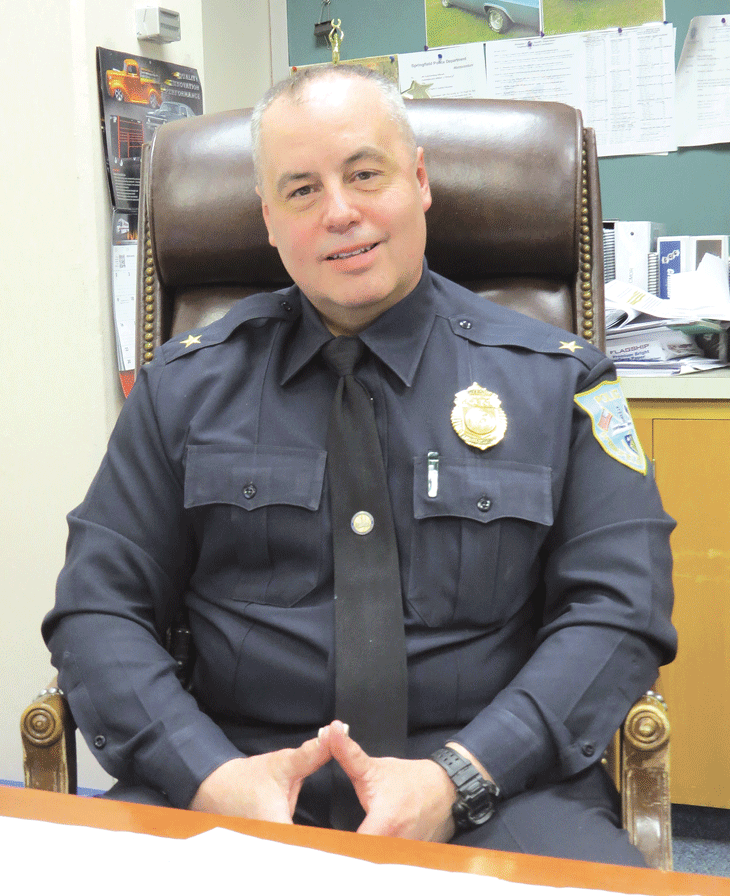
Agenda Departments

‘Music for the Eyes’ Exhibition, Reception
Through April 7: The artwork of Preston Trombly, host of Sirius/XM Satellite Radio’s nationally broadcast Symphony Hall channel, titled “Music for the Eyes,” will be exhibited through April 7 at the Arno Maris Gallery in Ely Hall on the Westfield State University campus. An artist reception at the gallery is planned for Feb. 29 from 5:30 to 8 p.m. On March 7 at 9:30 a.m., Trombly will present a lecture on his work at the gallery titled “Confluence of Creativity: Similarities Between Composing Music and Making Visual Art.” Regular gallery hours are Tuesday through Friday from 2 to 5 p.m., Thursday from 2 to 7 p.m., and Saturday from 1 to 5 p.m. For more information, call (413) 572-4400 or visit www.westfield.ma.edu/galleries.

Women in Philanthropy Conference
March 13: Women in Philanthropy of Western Mass. will host a conference titled “Growing Philanthropy, New Visions, New Voices,” from 8 a.m. to 4 p.m. at the MassMutual Center, 1277 Main St., Springfield. The event features nationally known leaders in the field of fund development, and is appropriate for women and men who are seasoned professionals or newcomers to the field. Workshops will be led by Penelope Burk, author of Donor-Centered Fundraising; Phil Cubeta, chair in Philanthropy of the American College; and Karen Osborne, president of the Osborne Group. The keynote address, titled “New Leadership for a New Nonprofit Sector,” will be presented by Rosetta Thurman. In addition, sessions will be led by Diana McLain Smith, chief transformation officer of New Profit Inc.; Kristin Leutz and Katie Allan Zobel of the Community Foundation of Western Mass.; Phyllis Williams-Thompson of the Prematurity Campaign of the March of Dimes; Deborah Koch, director of grants at Springfield Technical Community College; Dennis Bidwell of Bidwell Advisors; and Joe Waters and Joanna MacDonald, co-authors of Cause Marketing for Dummies. For more conference details, visit www.wipwm.com. The cost of the conference, with an early discount, is $140. For more information, contact Carol Constant at (413) 222-1761 or [email protected].

Economics Conference
March 13: The Department of Economics at Western New England University in Springfield will host its ninth annual Jolicoeur Economics Conference from 9:30 a.m. to 12:20 p.m. in Sleith Hall Auditorium. “Economics of the 2012 Election” will be the topic of the event, which is free and open to the public. The conference will feature two sessions: “The Economy and the Great Recession,” from 9:30 to 10:20 a.m., and “The 99% and the 1%,” from 11 a.m. to 12:20 p.m. For more information, visit www.wne.edu.

Financing Your Business
March 16: The Mass. Small Business Development Center Network will host a lecture titled “Financing Your Business” from 9 to 11 a.m. at the Scibelli Enterprise Center, 1 Federal St., Springfield. Speakers will include Ray Milano of the U.S. Small Business Administration, Gary Besser of First Niagara Bank, and Christopher Sikes, director of Common Capital Inc. Topics include what lenders are looking for, SBA loan programs, new SBA programs, and venture capital and grants. For more information, call (413) 737-6712 or visit www.msbdc.org/wmass. The cost is $40.

Pioneer Valley USO Gala
March 16: The Log Cabin on Easthampton Road in Holyoke will be the setting for the second annual dinner-dance gala of the Pioneer Valley USO. The featured speaker will be American Captain Richard Phillips, who offered himself as a hostage to save his crew from Somali pirates and was freed in a high-seas rescue by U.S. Navy SEALS. The gala theme will be “Proud to be an American.” A cocktail hour at 6 p.m. will be followed by the dinner program at 7. Heroes from each branch of the U.S. Armed Forces and top Pioneer Valley USO supporters will be honored. The Western Massachusetts All Stars Band, led by Joe Pereira, will provide the evening’s entertainment. Tickets are $45 per person and are available online at www.pioneervalleyuso.org or by calling (413) 557-3290. Tickets are limited. The mission of the Pioneer Valley USO is to “lift the spirits of America’s troops and their families.”

Difference Makers
March 22: BusinessWest will stage its Fourth Annual Difference Makers Celebration at the Log Cabin Banquet & Meeting House in Holyoke. The program recognizes area individuals and organizations that are truly making a difference in this region. This year’s honorees are:
• Donald and Charlie D’Amour, chairman/CEO and president/COO, respectively, of Big Y Foods;
• William Messner, president of Holyoke Community College;
• Majors Tom and Linda-Jo Perks, officers with the Springfield Corps of the Salvation Army;
• Bob Schwarz, executive vice president of Peter Pan Bus Lines; and
• The Women’s Fund of Western Massachusetts.
The awards ceremony will feature entertainment, butlered hors d’ oeuvres, and introductions of the winners. Tickets are $55 per person, with tables of 10 available. For more information or to order tickets, call (413) 781-8600, e-mail [email protected], or visit www.businesswest.com.

Women’s Leadership Conference
March 23: Keynote speakers Sister Helen Prejean, Marjora Carter, and Ashley Judd will share personal stories, as well as insightful advice and perspectives, during Bay Path College’s annual event at the MassMutual Center in downtown Springfield. The theme for the 7:30 a.m. to 4:30 p.m. event is “Lead with Compassion.” Prejean is a member of the Sisters of St. Joseph of Medaille and an anti-death penalty activist, while Carter, an eco-entrepreneur, is president of the Majora Carter Group, and Judd is a film and stage actor and human-rights activist. For more information on the conference or to register, visit www.baypathconference.com or call Briana Sitler, director of special programs, at (413) 565-1066.

Author Lecture
March 28: Internationally acclaimed author Tom Perrotta will read from his upcoming novel, The Leftovers, at 10:10 a.m. and 11:15 a.m. in Scibelli Hall Theater, as part of the Ovations series at Springfield Technical Community College. The talks are free and open to the public. Two of Perrotta’s books, Election and Little Children, have been made into movies, and five novels have been national bestsellers. For more information, call (413) 755-4233.

ADA, FMLA Workshop
March 29: Royal LLP, in conjunction with the Human Service Forum, will present a workshop at the Delaney House in Holyoke on the compliance issues involving the ADA and FMLA. The interactive workshop addresses some of the most common questions that upper management faces each day. Attendees will learn skills and strategies that can help reduce the risk of employment litigation. For more information on the 8:30 a.m. to noon event, contact Ann-Marie Marcil at (413) 586-2288 or visit www.humanserviceforum.org.

Not Just Business as Usual
April 5: Former NBA player and businessman Ulysses “Junior” Bridgeman will be the guest speaker at the Springfield Technical Community College Foundation’s third annual Not Just Business as Usual event at the Naismith Memorial Basketball Hall of Fame in Springfield. A cocktail and networking reception is planned from 5:30 to 7 p.m., followed by the dinner program from 7 to 9 p.m. Bridgeman spent most of his 12-year NBA career with the Milwaukee Bucks, but also played for the Los Angeles Lakers. He is the current franchise owner of more than 160 Wendy’s and 120 Chili’s restaurants. The event encourages local businesses to come together for an evening to network, learn from one another, and support student success. Funds from the event will provide students access to opportunities through scholarships, technology, and career direction to be successful future employees and citizens. “It’s a time to celebrate innovations, change, and our region’s success,” said STCC Foundation Interim Director Robert LePage. A variety of sponsorship opportunities are available, and individual tickets are $175 each. For more information, contact LePage at (413) 755-4477 or [email protected].

Constitution Café
April 10: Author and philosopher Christopher Phillips’ latest book, Constitution Café, draws on the nation’s rebellious past to incite meaningful change today. He proposes that Americans revise the Constitution every so often, not just to reflect the changing times, but to revive and perpetuate the original revolutionary spirit. He will present a free lecture at 8 p.m. in the dining hall at Blake Student Commons, on the Bay Path College campus, 588 Longmeadow St., Longmeadow. The lecture is part of the annual Kaleidoscope series. For more information, call (413) 565-1000 or visit www.baypath.edu.

Marketing Basics Seminar
April 11: The Mass. Small Business Development Center Network will host a lecture titled “Marketing Basics” from 3 to 5 p.m. at the Greater Northampton Chamber of Commerce, 99 Pleasant St., Northampton. Dianne Doherty of the MSBDC Network will present the workshop that will focus on the basic disciplines of marketing, beginning with research (primary, secondary, qualitative, and quantitative). For more information, call (413) 737-6712 or visit www.msbdc.org/wmass. The cost is $40.

Slam Poet Lecture
April 13: Taylor Mali, a former high-school teacher who has emerged from the slam-poetry movement as one of its leaders, will discuss his performances at 10:10 a.m. and 11:15 a.m. in Scibelli Hall Theater, as part of the Ovations series at Springfield Technical Community College. The talks are free and open to the public. For more information, call (413) 755-4233.

Comedy Night to
Benefit Charities
April 21: Smith & Wesson Corp. will host a benefit comedy show to support two local children’s charities, the Shriners Hospitals for Children and the Ronald McDonald House, beginning at 6 p.m. at the Cedars Banquet Hall, 419 Island Pond Road, Springfield. Tickets are $30 per person, and include the show, hot and cold hors d’oeuvres prior to the show, a cash bar, raffles, fund-raising, games, and music. Teddie Barrett of Teddie B. Comedy will emcee the event, featuring professional comedians Bill Campbell, Dan Crohn, and Stacy Yannetty Pema. For tickets or more information, contact Phyllis Settembro, Smith & Wesson, (413) 747-3597; Karen Motyka, Shriners Hospital, (413) 787-2032; or Jennifer Putnam, Ronald McDonald House, (413) 794-5683.

Walk of Champions
May 6: The Goodnough Dike area of the Quabbin Reservoir will be the setting for the seventh annual Walk of Champions in Ware. Participants walk in honor or in memory of loved ones affected by cancer, with the determination to make a difference in those affected by the disease. The event offers a five-mile or two-mile walk, with entertainment and refreshments along the route. For more information, visit www.baystatehealth.org/woc or e-mail Michelle Graci, manager of fund-raising events at Baystate Health at [email protected].

Small-business Seminar
May 16: Local business owners will talk about what they have done to keep ahead of the many demands on their time, and at the same time adjust for the economic environment, during a workshop titled “Adapt, Diversify, Reinvent & Grow” at the Scibelli Enterprise Center, 1 Federal St., Springfield. Presenters include Paul DiGrigoli of Digrigoli Salon & School of Cosmetology; Tara Tetreault of Jackson & Connor; Kate Vishnyakov of Kate Gray Inc.; and Rick Ricard of Larien Products. The 9 to 11 a.m. session is sponsored by the Mass. Small Business Development Center Network. The cost is $40. For more information, call (413) 737-6712 or visit www.msbdc.org/wmass.

Management Fundamentals Workshop
May 24: Lyne Kendall of the Mass. Small Business Development Center Network will present “Business Plan Basics” from 9:30 a.m. to 12:30 p.m. at Amherst Town Hall, first floor meeting room, 4 Boltwood Walk. The workshop will focus on management fundamentals from startup considerations through business-plan development. Topics will include financing, marketing, and business planning. The cost is $40. For more information, call (413) 737-6712 or visit www.msbdc.org/wmass.

40 Under Forty
June 21: BusinessWest will present its sixth class of regional rising stars at its annual 40 Under Forty gala at the Log Cabin Banquet & Meeting House in Holyoke. Nominations are currently being scored by a panel of five judges. The 40 highest scorers will be feted at the June 21 gala, which will feature music, lavish food stations, and introductions of the winners. Tickets are $60 per person, with tables of 10 available. Early registration is advised, as seating is limited. For more information, call (413) 781-8600, ext. 100, or visit www.businesswest.com.

Western Mass.
Business Expo
Oct. 11: BusinessWest will again present the Western Mass. Business Expo. The event, which made its debut last fall at the MassMutual Center in downtown Springfield, will feature more than 180 exhibitors, seminars, special presentations, breakfast and lunch programs, and the year’s most extensive networking opportunity. Comcast Business Class will again be the presenting sponsor of the event. Details, including breakfast and lunch agendas, seminar topics, and featured speakers, will be printed in the pages of BusinessWest over the coming months. For more information or to purchase a booth, call (413) 781-8600, or e-mail [email protected], or visit www.wmbexpo.com.