Home Posts tagged Difference Makers (Page 5)
Class of 2016 Difference Makers

Changing Lives, One ‘Little,’ One ‘Big’ at a Time
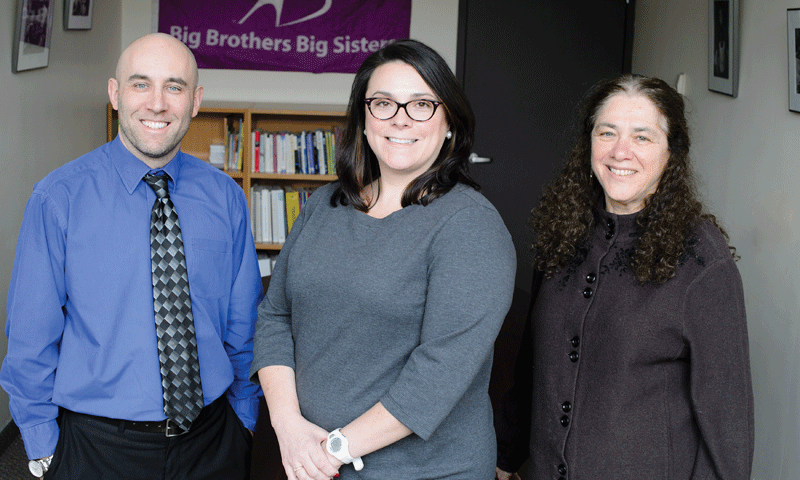
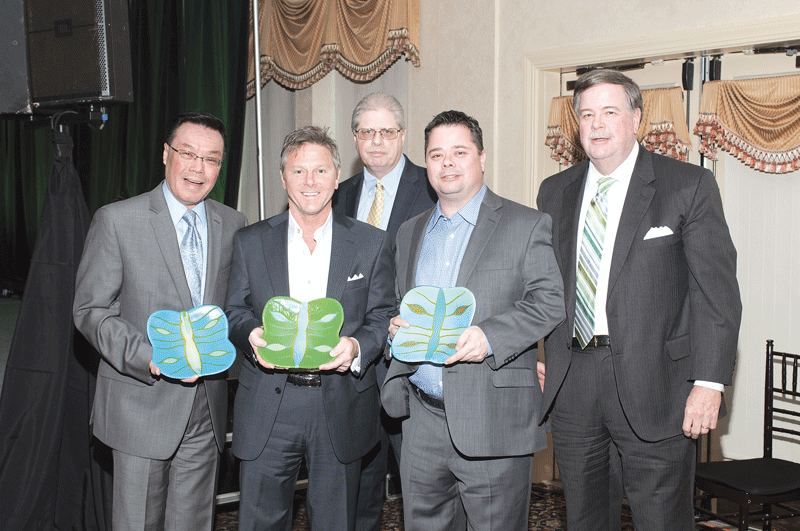
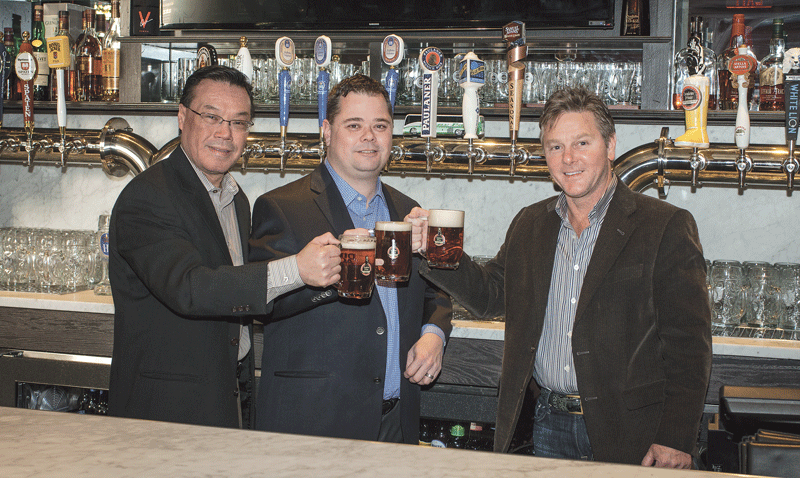
From left, David Beturne, Danielle Letourneau-Therrien, and Renée Moss.

From left, David Beturne, Danielle Letourneau-Therrien, and Renée Moss.
Leah Martin Photography

Angela Smith-LeClaire was relatively young (age 8) when she became involved with Big Brothers Big Sisters (BBBS) as what that organization calls a ‘little.’

So the memories of her time spent with Lisa, who spent five years as her ‘big,’ are scattered, somewhat selective, and certainly not as complete as she would like. She admits, with some embarrassment in her voice, that she knows she and Lisa went to one of the organized events staged by Big Brothers Big Sisters of Franklin County years ago, but couldn’t say exactly when, where, or even what it was.

What she clearly remembers, though, and always will, are the dinners she shared at the home of Lisa and her husband, and the air of stability that warmed the room, something decidedly missing from her own home, where alcoholism was taking a heavy toll on day-to-day life.

What she remembers also is at some point making a kind of pledge — that one day she would seek to bring that same sense of stability to a young girl who lacked it in her life. That day came a few months ago, not long after Smith-LeClaire and her husband, Anthony, purchased a home in Millers Falls.
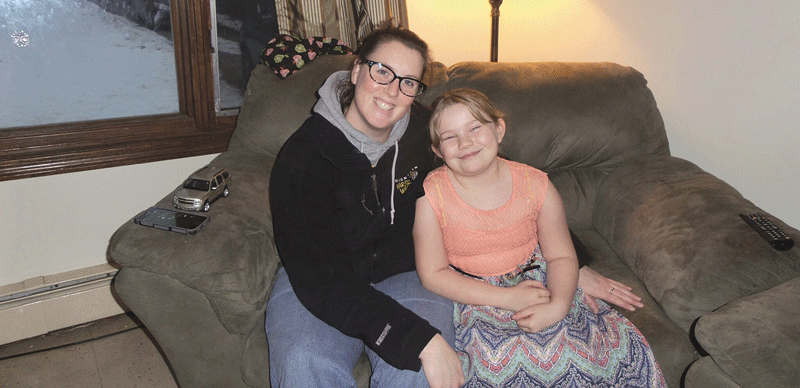
Angela Smith-LeClaire

Angela Smith-LeClaire fulfilled a promise she made to herself years ago by becoming a big sister to Abby.

Today, following a lengthy matching process, she is the ‘big’ for Abby, whose family life has been scarred by drug addiction. And one of the things they share is dinner in Angela’s home. They’ve also gone bowling, made Christmas cookies and tree ornaments, cooked a Thanksgiving turkey, and gone on lengthy walks with Angela’s dog, Cooper.

And only three months into this relationship, she feels comfortable saying that it is more — in every sense of that word — than she imagined it could be all those years ago.

“Abby has brought so much joy into my life, and I get so excited being able to hang out with her, knowing that there’s so many things she hasn’t done so far in her life,” she said. “I want to bring some joy into her life, because she’s already bringing a lot of happiness to me.”

Scott Howard can relate.

His story is somewhat different, but there are several common threads between his, Angela’s, and that of almost everyone who becomes a ‘big.’
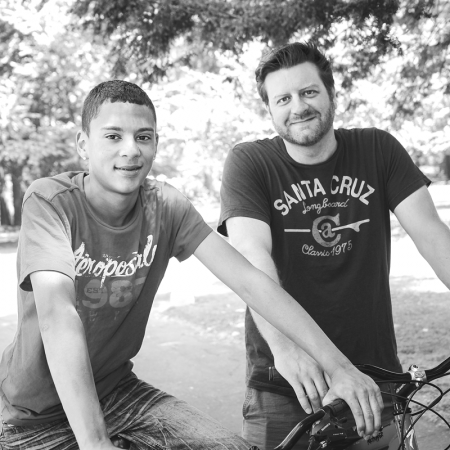
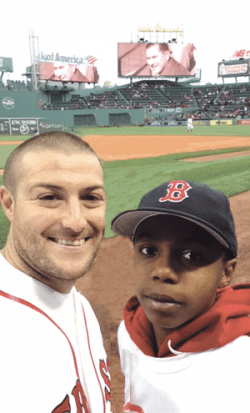
Scott Howard, seen here with Noel

Scott Howard, seen here with Noel, or ‘Macho,’ as his friends call him, wonders why he waited so long to become a big brother.

Now serving as associate dean of students at Amherst College, Howard was in another job and another life situation years ago, when he first started thinking about becoming a ‘big.’ He decided that he should wait until a time when he could better handle what he thought would be a huge time commitment.

Now, five years into his relationship with Noel, or ‘Macho,’ as his good friends (including Howard) call him, he’s wondering why he waited so long. He could have had perhaps a few more years enjoying a friendship he described thusly: “Let me put it this way: I’m not close to getting married, but if I was, Macho would be one of the groomsmen.”

Like Howard, Brian Ortiz said he’s long thought of becoming a big brother, and the time became right this past fall, soon after he became residence director at Magna Hall at American International College.

He said his own brother is 13 years older than he is, and thus was not around when he was growing up. Ortiz said he had plenty of mentors, though, and has long desired to become one himself as a way of giving back. Today, he’s the ‘big’ to Desmond, and believes he’s getting at least as much out of this relationship as his ‘little.’

“It’s been a great experience for me, and I think it’s been the same for him,” he explained. “I honestly didn’t think I’d be as involved in it as I am; I enjoy serving as a role model.”

The tireless work of generating these kinds of matches is what BBBS has been all about since 1904. It is an assignment replete with a host of challenges, from the increasingly daunting task of finding young men willing to be ‘bigs’ to raising the money needed to make and administer the matches.
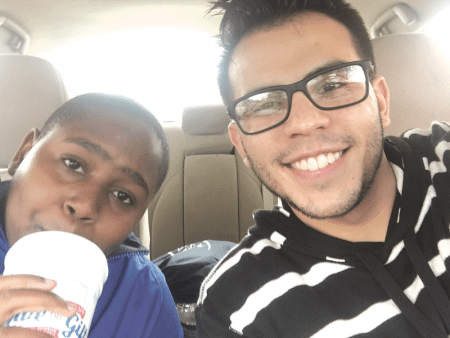
Brian Ortiz

Brian Ortiz says there are many rewards that come with being a role model for Desmond.

The three area chapters have responded to those challenges with creativity and determination, and the fruits of their efforts can be seen in the photos that accompany this story. They depict bigs and littles sharing time and enriching one another’s lives.

And as you read how the three chapters make it all happen, it will become clear why they were chosen as Difference Makers for 2016. But in a way, all those involved with this nonprofit are making a difference — from the corporations and schools that support the organization to the local offices that create the matches; from the mentors who provide stability to those being mentored, who provide their ‘big’ with friendship and so much more.

It’s All Relative

In many ways, Howard’s story represents about the best kind of PR that BBBS could ever hope for.

Indeed, he is a young male professional, the type of individual that this organization has struggled to recruit in adequate numbers since day one; recruiting women is also a challenge, but less so than men. Also, he throws a large bucket of cold water on the argument that young people don’t have time to be a mentor — for whatever reason — or often need to wait until a better, more stable time in their lives to take part.

Not only that, when he talks about his experiences with Macho, he says things like this: “I don’t feel like I’m doing service; I just feel like I have a friend who is a really good friend, with whom I do a lot of things that my other friends don’t do. I get to be with someone who brings a lot to my life, helps me feel young, and gives me a perspective on the world that I would never see otherwise.”

And the story just keeps getting better from a PR perspective. Indeed, it drives home the point that poverty and struggling families are harsh realities in every community, even one named Paradise City, which both Howard and Macho call home.

“He and I live half a mile from each other, but it’s like our worlds couldn’t be more different,” Howard explained, adding that this experience opened his eyes to that other world as much as it has opened Macho’s — and both individuals are wiser and better for it.

But convincing more people like Howard to become ‘bigs,’ and persuading all young professionals that they’re not too busy to change a child’s life, are only a few of the myriad challenges that BBBS chapters around the world — and in the 413 area code, for that matter — face as they attempt to secure proper matches.
Big Brothers Big Sisters

Big Brothers Big Sisters has been making fulfilling matches since 1904.
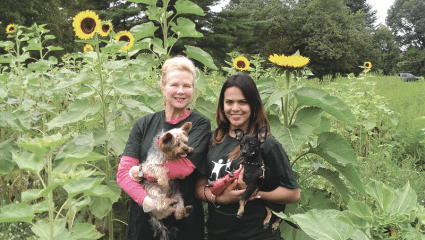
Susan-(Big)-and-Juleima-(Little)In rural Franklin County, statistically the most impoverished county in the Commonwealth, for example, basic transportation is an issue, said Danielle Letourneau-Therrien, executive director of that office, noting that, once outside Greenfield, mass transit is hit or miss at best. Meanwhile, reliable Internet service, something most now take for granted in Greater Springfield, is a foreign concept in places like Rowe, Heath, Charlemont, and Ashfield, a fact of life that often makes it difficult to communicate with ‘bigs’ and ‘littles’ alike.

These two factors, among others, makes the process of enrolling families and creating matches more time-consuming and more complicated, because BBBS has to go to those families, instead of the families going to BBBS.

Still another obstacle is the loss of a number of manufacturers in the region, which moved south or offshore. These large employers were financial supporters of BBBS, and their workforces were solid sources of ‘bigs.’

“Over the past 15 or 20 years, we’ve lost access to people at many workplaces — companies that were run by someone who lived locally. You could say, ‘I need to see the boss,’ and they’d let you in,” she said. “It’s different now, and I think the people who work in those places don’t have the time, like they did years ago, because the world is crazy and life is busy.”

Meanwhile in Hampshire County, as mentioned earlier, it’s often a challenge simply to convince young professionals that there is a need for big brothers and big sisters on that side of the ‘Tofu Curtain,’ a region known for its colleges, arts, restaurants, and trendy downtowns, but where poverty and troubled young people can certainly be found, and without looking very hard.

“One of my challenges is making sure people understand what life feels like for those in our community who are living with a lot of invisibility,” Renee Moss, director of CHD/Big Brothers Big Sisters of Hampshire County, explained. “A lot of families and kids are marginalized in their own communities — they’re isolated and very invisible. The reality is that places like Amherst and Northampton have these apartment complexes on the periphery of Main Street and what appear to visitors to be these hip, trendy downtowns.

“For our kids who live in Florence Heights in Northampton, most of them have never been to the city’s downtown,” she went on. “They have no sense of entitlement in their own community; in Amherst, 50% of the kids entering school have free or reduced lunches. The poverty is there, but the towns manage to keep it pretty invisible. Things are not what they seem.”

And in Hampden County, well, the overwhelming issue has been, and always will be, need and meeting it, said David Beturne, executive director of that office, adding that it handles two of the state’s most impoverished cities — Springfield and Holyoke — as well as two of its wealthier communities, Longmeadow and Wilbraham, and the need for ‘bigs’ exists at both ends of the spectrum.

That’s because the issues that create need for big brothers and big sisters, including everything from incarceration to opioid abuse; from bullying to alcoholism, don’t discriminate along family-income levels, he told BusinessWest.

And his county, like the others, is dealing with the loss of some major employers over the past few decades, as well as an ongoing spate of mergers and acquisitions that have left fewer businesses in the hands of local ownership that lives in the communities being served by BBBS.

Thus, need has always exceeded not only the supply of ‘bigs’ in the pipeline, but the ability to simply make more matches because of budget and, therefore, staffing constraints.

“I can’t match any more kids than I’m currently matching at the pace I am, because my staff would kill me right now,” Beturne said, noting that, even if he could find an adequate number of willing ‘bigs,’ he simply doesn’t have the infrastructure to coordinate matches.

“You can’t just say to someone like me, ‘go match 20 more kids than you’re already serving,” he went on. “Our product, the end product, is our match, but we’re not selling a product. Instead, we’re changing lives; that takes money, time, patience, and creating effective matches, not just more of them.”

On to Something Big

Meeting need and overcoming this large assortment of challenges requires persistence, imagination, and relationship-building skills — in equal quantities. And because they’ve been able to display those qualities on a consistent basis, and literally change lives in the process, the three chapters can definitely be considered Difference Makers.

The persistence is required because the need never stops. It is, as all three directors indicated, a constant, because there will always be young people who lack stability and a role model in their lives. And imagination is necessary for that same reason, but also because need doesn’t come in one flavor — and, as Bertune said, BBBS isn’t focused on simply making matches; it’s dedicated to making matches that work.

As for relationship building, it goes hand-in-hand with the first two components in the equation and goes a long way toward explaining how that mission is accomplished.

Examples of imaginative response and relationship building can be found with each area office.

In Hampshire County, for example, there is an initiative that matches young people who have been adopted with students at UMass Amherst who were adopted, the only such program of its kind in the country, said Moss, adding that it was conceptualized out of both need and a valuable resource at UMass — the Rudd Adoption Research Program, which is affiliated with the Center for Research on Families.

“The Amherst schools had identified this as a need because a lot of their kids were adopted,” she explained. “They were seeing these students start to have a lot of issues once they reach middle school, and they reached out to see if there was something we could do to address that specific need.”

The initiative is simply one example of how the Hampshire County BBBS works to tap what is easily that region’s best asset, its colleges — specifically, in this case, UMass, Amherst College, and Smith College.

“We don’t really have a corporate base, so probably 50% of our mentors are college students,” Moss explained, adding that some take part in the traditional community-based model of service, while others are involved in site-based programs on the campuses.

“In Hampshire County, a lot of our ‘littles’ come from families where no one has ever graduated from high school, let alone gone on to college, and they’re growing up in the shadows of higher ed,” she explained. “So, once a week, the school bus drops them off on the campus, where they meet their big brother or big sister, use the facilities on campus — the basketball court or the pool, for example — and then they’ll get together as a group and have dinner in the dining halls.

“We’ve had kids say, ‘I’m going to college here because the food is great,’” she went on. “That’s a very specialized program for us because we’re using a tremendous resource that we have.”

Similarly, the Franklin County chapter has tapped into its respected private schools, Deerfield Academy and Northfield Mount Herman School in Gill, for mentors, said Letourneau-Therrien.

A modified but still strenuous screening procedure is used in the matchmaking process, she said, noting that these students, roughly halfway through their junior years when the matches start, are still teenagers for the most part.

The ‘bigs’ and ‘littles’ meet on Friday nights, use the facilities at the school, and eat in the dining commons, she explained, adding that the institutions have been involved for many years, and the ratio of men to women who take part is far better than that in the so-called real world.

And in Hampden County, that office has met that aforementioned enormous need through a host of partnerships, with large corporations like MassMutual and colleges such as Bay Path University. But even with those more traditional relationships, there are unique twists.

Big Brothers Big Sisters Grad

Big Brothers Big Sisters has been changing lives for all those involved in their programs.

Indeed, MassMutual’s program, called Pathways, which involves employees across a host of departments mentoring students from Putnam and Sci Tech high schools, has its own spinoff.

“Those high-school students receiving mentorship from a MassMutual employee are turning around and being mentors at STEM Academy,” he explained. “It’s a sort of third-generation thing going on, where high-school students are mentoring fifth-graders, because that transition from middle school to high school is extremely difficult; it’s been identified as a case where it’s not a matter of ‘when you get to high school, are you dropping out,’ it’s ‘are you getting to high school.’

“So who better to share that experience and tell people what it’s like than someone who’s being mentored, and someone who’s also in high school?” he went on. “So that’s working out very well for us.”

The fruits of all this persistence, imagination, and relationship building are the matches themselves, which are the real story at BBBS and the most visible manner in which it is making a difference. And our three stories are perfect examples.

The ‘Little’ Things

Macho is one of those young people from Florence Heights who hadn’t seen downtown Northampton — until he became matched with Scott Howard.

And making that introduction, if you will, is only one of the ways Howard says he’s been able to broaden the horizons of his mentee and take him well beyond his historic but impoverished neighborhood — literally and figuratively.

As he listed them, he started with hiking and mountain climbing, two of his passions, as was explained to Macho by those who made the match between the two.

“So the first time I met him, he was trying to be cool, trying to impress me, trying to get me to think he was cool — and he is cool, so it worked,” Howard recalled. “So I said, what are you into?’ He said, ‘climbing mountains.’ When I asked him where he likes to go, I thought he was going to say, ‘something in the [Holyoke] range’ or ‘Mount Sugarloaf.’ Instead, he pointed to the snowbank at the end of his street and said, ‘I climb that mountain every day.’”

Their first official time out together was spent on the Mount Sugarloaf access road in South Deerfield, which was an eye-opening experience for Macho, to say the least.

“He didn’t know that kind of thing existed, let alone was right in our own backyards,” said Howard. “That was not a life experience that he had.”

Generating new life experiences, for both the ‘big’ and ‘little,’ is just part of what the program is all about. There’s also that stability factor that Smith-LeClaire mentioned, as well as that role-modeling work that Ortiz described.

Indeed, while Ortiz has taken Desmond to Interskate 91 and to see Goosebumps, and plans to take him to see The Force Awakens — he needs to see the first six Star Wars movies himself first so he can understand what’s going on — he’s also taken him to the art museum and the library, and lent a hand with homework.

“I think one of the biggest things is trying to be a good role model,” he said. “I enjoy helping him with homework, and teaching him little things here and there about reading, writing, and math, and also class behavior, how to take notes, and things like that.”

And while that constitutes a learning experience for Desmond, it’s the same for Ortiz, who said he’s learned a lot about himself and the fine art of giving back through this process. In the meantime, he’s doing a lot of the things he didn’t get to do as a kid.

As for Smith-LeClaire, when asked if she thought she was providing Abby with that same calm, stable environment that Lisa gave her, she said simply, “I hope so.”

Elaborating, she said that Abby’s mother’s wish is that this experience with BBBS helps her child “act like a kid,” said Smith-LeClaire, adding that she sees a lot of herself in her mentee and can associate with every experience and emotion she’s witnessed.

“In a lot of ways, I can relate to Abby because I grew up with an alcoholic parent and a really unstable environment,” she noted. “I know what her personality is like, and I want her to be able to have fun with me, but also feel close enough to me to talk about things I can relate to and have a different perspective on than other people.

“For kids who are going through a lot in their lives, having that stable environment is really important,” she went on. “If I can help provide her with that, then I’m doing something very worthwhile.”

A World of Difference

Continuing his unofficial role as BBBS pitchperson, Howard said that, if the program were to “somehow evaporate tomorrow,” he and Macho would still be good friends and still hiking on Mount Sugarloaf together.

Perhaps there’s no better testimony to the power of these matches and what they bring to both parties involved. As Howard said, it’s not about service, it’s about making a friend — one who would be standing next to him the day he got married.

It’s also about bringing stability into lives where that precious commodity is in short supply — as Lisa brought to Ashley, and Ashley now brings to Abby 20 years later — and about opening eyes and experiencing different worlds.

That’s why all those involved with making matches like those described here are true Difference Makers.

George O’Brien can be reached at [email protected]
Class of 2016 Difference Makers

His Efforts on Behalf of the Autistic Are a Global Phenomenon

John Robison

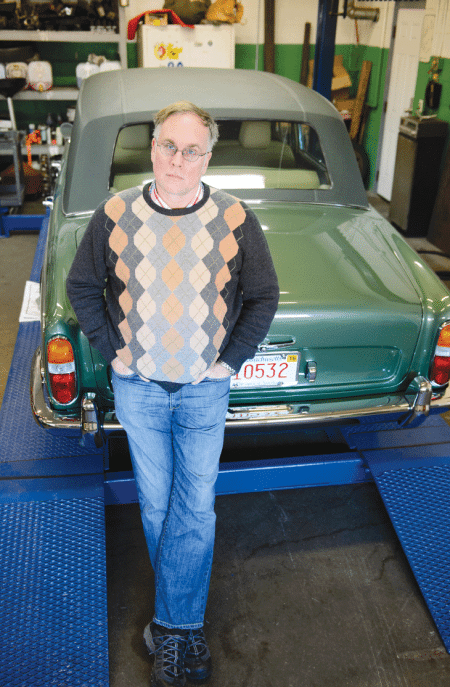
John Robison, President of J.E. Robison Service
Leah Martin Photography

On the sill of the window in the front office at JE Robison Service, the one that offers a view into a long row of service bays that hosted Jaguars and Land Rovers, sits a display of the three books written by the company’s founder, John Robison, about Asperger’s syndrome and his life with that condition.

In chronological order, these would be Look Me in the Eye, which archives his life growing up; Be Different, which offers practical advice for Aspergians; and Raising Cubby, a memoir of his unconventional relationship with his son, who was also born with Asperger’s.

Near the middle of the display is a book with the title Wychowujemy Misiaka, which, says Robison, is the Hungarian version of Raising Cubby, only he doesn’t know if that’s a direct translation of those two words; a book will often take another title when published in a foreign country. For example, the Dutch version of Look Me in the Eye is titled I Always Liked Trains Better.

Meanwhile, there’s another book written in Russian; Robison thinks it’s Look Me in the Eye, but he admits he’s not sure and knows only that it’s one of his.

While the display creates some questions and confusion, it makes it abundantly clear that Robison’s efforts to raise awareness of disorders in what’s known as the autism spectrum, and advocate for the estimated 5 million people living with such conditions, are now a truly global phenomenon.

It’s an initiative with many moving parts — from the books to his numerous speaking engagements around the country; from a program at his foreign-car sales and service shop to train people with autism to be auto mechanics, to his participation on a number of panels created to help define the autism spectrum and improve quality of life for those who populate it.

John Robison

John Robison says awareness that his differences stemmed from Asperger’s was empowering and liberating.
Leah Martin Photography

But, over the past few years, Robison’s efforts have moved well beyond the realms of awareness and advocacy, and this dynamic goes a long way toward explaining why BusinessWest chose him as one of its Difference Makers for 2016.

Indeed, Robison now represents the tip of the spear in a movement, for lack of a better term, that he and others are calling ‘neurodiversity,’ or neurological diversity, and all that this phrase connotes.

“This is the idea that neurological diversity is an essential part of humanity, just as racial, cultural, religious, or sexual diversity are,” Robison explained as he sat on a couch in that front office. “Those are all accepted things, and now we recognize that conditions like autism have always been with us, and we recognize that some autistic people are profoundly disabled — and indeed I’m disabled in many ways. But I’m also gifted in many ways, and that’s what people need to understand; autistic people have unique contributions to make to the world because of their difference, and the world needs that.”

While speaking on this subject, Robison also drives home the point that individuals within the spectrum — like those protected classes he mentioned — have a right, like those other groups, to be free from profiling and discrimination. And, at present, they are not.

As just one example, he cited one of the many mass-shooting episodes that have become commonplace in this country.

“The big thing about autism is how we’re treated related to other groups,” he explained. “I recall reading in the newspaper about how a bunch of people were murdered, and it said that the killer was on the autism spectrum.

“That’s a familiar headline for people, stuff like that,” he went on. “Can you imagine what would happen if someone went on the nightly news and said ‘seven people were murdered at a shopping center in Hartford today, and the killer was a Jew’? That guy would lose his job tomorrow. And yet someone can go on the news and say ‘seven people were killed in a theater, and the killer had autism.’

“Autism is no more predictive of mass murder than being Jewish,” he continued, adding that there is much work to do simply to make this fact known and fully understood, let alone prompt society to embrace neurodiversity, or the concept that society should accept people whose brains function in many different ways.

For doing that hard work, in many different ways, Robison can add the title Difference Maker to the several he already has.

Mind over Matter

There will soon be a fourth book competing for space on that shelf in Robison’s office.

It’s called Switched On, and its subject matter represents a radical departure from his previous works. This tome, finished several months ago, chronicles Robison’s participation in experiments at Harvard Medical School and Boston’s Beth Israel Hospital involving transcranial magnetic stimulation (TMS). The treatment is aimed at changing emotional intelligence in humans by firing pulses of high-powered magnetic energy into the brain to “help it re-wire itself,” said the author.

Those experiments, conducted from 2008 to 2010, yielded a mixed bag of results, said Robison, who explained, in some detail, what he meant by that.

“I think it succeeded beyond their wildest hopes in some ways,” he said of the regimen. “But as much as it turned on abilities in me, that came at a cost. It cost me relationships, and it made me more up and down, where before, I’d been on kind of an even keel all along.

“Suddenly, I felt suffocated by my wife’s long-time depression, I felt like I was drowning, and then ultimately I wasn’t able to stay married anymore,” he went on. “And before, I’d been oblivious to what people thought and said when they came in here for service; suddenly I began to see that some people were contemptuous of me and the business, and I didn’t like that. So I dismissed a good number of people I didn’t want to do work for anymore.”

All things considered, he describes what’s happened as a good tradeoff; he says he’s more knowledgeable and has greater ability to engage people. He was going to say more, but essentially decided that, if people want to know more, they could, and should, read the book, which will be out in March.

While Robison has devoted much of the past few years to this latest tome, he’s devoted much of his adult life to many types of work involving the autism spectrum.

That work started roughly the day he found out he was part of that population, he went on, adding that he didn’t know he belonged until a self-diagnosis, if one could call it that, several years ago that was spurred by one of his foreign-car customers.

Before detailing that episode, though, we need to back up a little and explain how Robison arrived there, because doing so helps explain his passion for what you might call his ‘other work.’

John Robison

John Robison says much of his current work involves the emerging concept of neurodiversity.

By now, many people know at least the basics of Robison’s story. When he dropped out of high school, he essentially taught himself electrical engineering, and soon found success in the rock ‘n’ roll industry designing sound equipment and items like smoke-bomb-equipped guitars, with Pink Floyd and KISS among those on what could be called his client list.

His career track then took a sharp turn, and he ventured into the corporate world, first as a staff engineer at Milton Bradley in the late ’70s, and later as chief of the power-systems division for a military laser company. But while he had the technical know-how to succeed in those environments, he was missing the requisite social, interactive skills, including the simple yet important ability to look people in the eye.

“I didn’t fit in at large corporations,” he explained. “I didn’t say the right things, I got into trouble, I would say inappropriate things, I was rude. But, at the same time, I was a good engineer; I look at the stuff that I designed in rock ‘n’ roll and the toy industry with Milton, and I think my engineering work speaks for itself, even today.

“But I had significant social problems, and therefore I felt that I was a failure in electronics because of those things and because I couldn’t read other people,” he went on. “So I decided that, if I was failing at electronics, I would start a business where I wouldn’t be subject to being just dismissed; that’s what made me turn to fixing cars.”

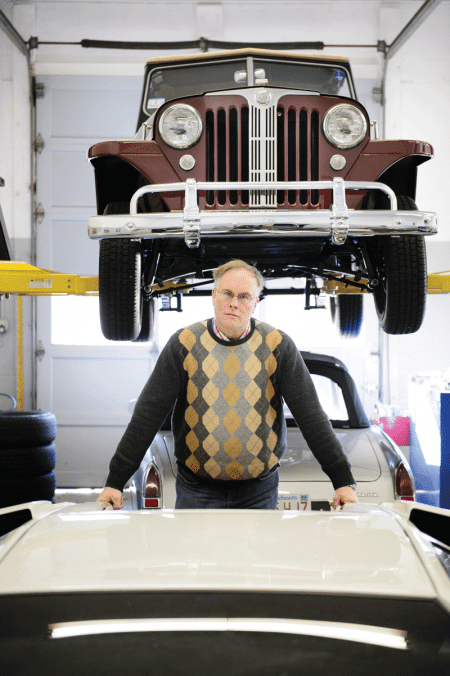
And, eventually, selling them, restoring them, and connecting people with them. Indeed, his venture deals in high-end foreign makes and hard-to-find vehicles. He started working out of his home in South Hadley, later moved into space on Berkshire Avenue in Springfield, and now has what amounts to a complex on Page Boulevard.

The business grew to the point where he hired mechanics to handle the cars, and his work shifted toward operations, ordering parts, and dealing with customers. One of them, a regular, was a therapist, and during one discussion with him, the subject turned to Asperger’s. The therapist eventually gave Robison a book on the subject, one of many he would soon devour.

It was that reading that opened his eyes and eventually brought him to what can only be considered a global stage when it comes to advocacy for those on the autism spectrum.

A New Chapter

“It was a remarkable thing,” he recalled of the events that led him to understand why he was the way he was, even though a formal medical diagnosis would come later. “I learned things like autistic people have difficulty looking other people in the eye; it makes us uncomfortable. So, all my life, people had said things like, ‘look at me when I talk to you.’ I would look up and then quickly down, and I had no idea that other people were different in that regard.

“I felt all my life I was complying with what other people said, and yet they continued to be after me about it,” he went on. “It was only after reading that book that I understood how certain things that I did, like that, were different from what other people expected, and it’s because I was neurologically different. No matter how smart you are, you can’t possibly just figure that someone else sees the world differently than you do. So that book was life-changing.”

RobisonBookCoverBeDifferentRobisonRaisingCubbyBookAnd as he talked about the process of discovering the cause of his “own differences,” as he called them, Robison used the words ‘empowering’ and ‘liberating’ to describe the phenomenon.

“If you’ve been told that you’re lazy, stupid, retarded, defective, or no good, for you to learn that you are touched by a form of autism, that’s … an explanation, and that’s really good,” he said, adding that, with this explanation, he would learn the ways autistic people (including those with Asperger’s) were different, and “teach myself to behave more like people expected.”

This was a transformative change, he went on, adding that he became more accepted in the community and forged real friendships, and this helped inspire his gradual development as an advocate, work that could be summed up as efforts to provide others with those same feelings of empowerment and liberation.

He said ‘gradual’ for a reason, because this work has certainly evolved over the years.

It began with speaking engagements to groups of young people at venues like Brightside for Families & Children and youth-detention facilities. The talks focused on autism, but also on Robison’s childhood, one marked by various forms of abuse.

“I realized that I could be speaking to young people about having a good life despite having that in your background, too,” he explained, adding that eventually he sought to reach a broader audience.

That led to Look Me in the Eye, an eventual bestseller published in 2006, and later his other works, all of which are now sold around the world. He believes that, worldwide, sales of the three books have topped 1 million copies.

But the books and the speaking engagements are only a few manifestations of Robison’s advocacy for people on the spectrum.

There is also the training school he’s created at his business for young people with autism. Conducted in partnership with the Northeast Center for Youth and Families, the initiative has transformed three bays at the Page Boulevard facility into what amounts to an instructional classroom for young people with learning challenges.

It was created with the goal of steering participants toward good-paying jobs in the auto-repair sector, and reflects Robison’s broader mission of transforming how people with differences should be valued and treated by society, and seen as productive contributors to society.

Other forms of service — and they often represent opportunities and appointments created through the exposure generated by his books — include participation on several boards and commissions involved with autism treatment and policy.

Four years ago, Robison was asked by then-Secretary of Health and Human Services Kathleen Sebelius to serve on the committee that produces the strategic plan for autism for the U.S. government; that appointment has since been renewed by current HHS Secretary Sylvia Mathews Burwell. He also serves on a panel that evaluates autism research for the U.S. Department of Defense as well as the steering committee for the World Health Organization developing ICF (International Classification of Functioning, Disability, and Health) core sets for autism-spectrum disorder.

He also served a stint on a review board with the National Institutes of Health, tasked with determining how economic-stimulus money appropriated in 2008 should be spent on autism research.

While doing all that, he also teaches a class in neurodiversity at the College of William & Mary, one of the first programs of its kind in the country.

Add all that up, and Robison has a lot of frequent-flyer miles. More importantly, he has an ever-more powerful voice — one he’s certainly not afraid to use — when it comes to the rights of all those within the autism spectrum, how those rights are not being recognized or honored, and how all that has to stop somehow.

It all starts with recognition of those rights, he said, adding quickly that discrimination against those in the autism spectrum is more difficult to recognize because most people don’t see it as discrimination.

As one example, he cited educational testing, a realm where discrimination against some classes has been identified — because of which questions are asked and how — and, in many cases, addressed. Not so when it comes to those with autism.

“You could administer a math or reading test to someone like me, and because I can’t do math problems in the conventional way, I would fail that test,” he explained. “Yet, I could solve complex problems in math in real life, like doing wave-form mathematics in the creation of sound effects when I worked in electronics.

“If you were to test a person like me in a culturally appropriate way, I’d be a bright guy,” he went on. “But if you tested me the way Amherst High School tested me, I was a failure, and there are a lot of autistic people who are like me today. That testing sets us up for future failure, and it’s a form of discrimination.”

When asked if, how, and when various forms of discrimination, such as those headlines involving mass shootings, might become a thing of the past, Robison said this constitutes a difficult task, because so many don’t even recognize it as discrimination.

Progress will only come if adults within the spectrum take full ownership of their condition. And, by doing so, they would also stand up for their rights, as he does.

“We need adults with autism to own it and to say, “I’m autistic, and I’m going to fight for my equality,” he explained, adding that is what the memnbers of various ethinic, racial, and religious groups have done throughout history.

“Autistic people need to do the same thing,” he went on. “They need to say, ‘I’m an autistic adult, and I’m here to say that we’re no killers, we’re not this, and we’re not that; we’re parts of your community everywhere.’”

Summing up what he’s been doing since his customer gave him that book all those years ago, he would say it comes down to getting other people on the spectrum to assume that ownership.

The Last Word

As he talked with BusinessWest, Robison had to stop at one point to take a call concerning flight options for an upcoming speaking engagement in Florida.

It’s fair to say he’s mastered the art and science of booking flights, finding deals, and filling a schedule in a manner that allows him to do all he needs to do.

And that’s only one example — the books on that shelf, as mentioned earlier, are another — of how his work is now truly global in scope.

He said that book he read long ago opened his eyes, empowered him, and liberated him. Helping others achieve all that and more has become a different kind of life’s work.

And another way to make a difference.


George O’Brien can be reached at [email protected]
Agenda Departments

‘Better Angels’ Exhibit

Through July 10: In the months prior to 9/11, firefighter Peter Freund had been considering a career change after 23 years with the FDNY. One week after he perished at the World Trade Center, Freund’s family received a letter confirming his acceptance to teach high-school mathematics. Described by some as “a living saint,” chaplain Mychal Judge was the first FDNY casualty listed on 9/11, entry number 0001. His helmet was later presented as a gift to the Pope. A proud first-time uncle, firefighter William Johnston, had been looking forward to the baby shower on Sept. 30. His remains were found at Ground Zero that afternoon. These are just a few of the stories that await visitors who come to view “Better Angels: the Firefighters of 9/11,” a new traveling exhibit at the Lyman & Merrie Wood Museum of Springfield History opening Tuesday, Jan. 12 and running through July 10. The exhibit features 343 portraits by artist Dawn Howkinson Siebel, one for every New York City firefighter lost in the World Trade Center attacks. Together, the images create a wall measuring 21 feet long, allowing visitors to come face to face with men who made their living running toward danger and saving lives, even at the risk of their own. Siebel, a current resident of Easthampton, was living in Colorado at the time of the attacks, but had been a longtime resident of Manhattan in the years prior. Inspired when the New York Times printed photos of all 343 fallen FDNY members, Siebel set out to paint a portrait of every firefighter lost on that fateful day. Over the next few years, she painstakingly hand-painted each portrait onto a block of charred wood. In total, the exhibit took 3,000 hours and over six years to create. In her artist statement for the exhibit, Siebel said, “these 343 firemen represent New York, the FDNY, their selfless profession, and also — in the way of heroes — the possibility that each of us may rise to the ‘better angels’ of our own nature.”

‘How to Talk to Kids About Therapy’

Feb. 9: The Garden: A Center for Grieving Children and Teens, a program of Cooley Dickinson VNA & Hospice that provides support to grieving young people and their families, announced a free workshop with Sarah Abel, LICSW. This workshop, titled “How to Talk to Kids About Therapy,” will take place from 6 to 7:30 pm at the Cooley Dickinson VNA & Hospice offices at 168 Industrial Dr. Geared toward adult caregivers, the purpose of the workshop is to provide an understanding of child therapy and to prepare parents, caregivers, and teachers to talk about therapy with kids. Participants will be able to discuss children’s behaviors and what they reveal about underlying feelings. Participants will also consider when to consult with a therapist around concerns about a child. Abel has been a psychotherapist since 1994 and aims to help families prepare their children to enter into therapy and face this vulnerable moment for both parents and children. She is a graduate of New York University School of Social Work and the Institute of Child, Adolescent and Family Studies, and completed a post-graduate fellowship in psychoanalysis at the Massachusetts Institute for Psychoanalysis. She has taught child development at Smith College School of Social Work and currently treats children, adolescents, and adults in her private practice in Northampton. This event is free, and the snow date is Thursday, Feb. 11 from 6 to 7:30 p.m. To RSVP, contact Shelly Bathe Lenn, coordinator at the Garden, at (413) 582-5312.


Heart Walk Kickoff Breakfast

Feb. 12: The American Heart Assoc./American Stroke Assoc. invites the public to the 2016 Pioneer Valley Heart Walk Kickoff Breakfast from 8 to 9 a.m. at the Delaney House, 3 Country Club Road, Holyoke. The free event includes a hot breakfast. Team captains or those interested in leading a team are encouraged to attend to receive their team-captain kits, hear a panel of guest speakers, and learn more about the Heart Walk and new 5k Run, set for Sunday, May 1 at Look Park in Florence. To attend the breakfast, RSVP by Tuesday, Jan. 26 with Traci Heath at (413) 262-3223 or [email protected]. For more information, visit www.pioneervalleyheartwalk.org.


Academy of Music Historic Tour

Feb. 24: The Academy of Music will offer a free tour of the historic theater at 5:15 p.m. Led by Academy of Music Development Coordinator Kathryn Slater, the tour will provide insight into the history behind this Northampton mainstay, including details about the organization’s founder and interesting notes about the many revitalizations. Built in 1891, the Academy of Music was the first municipally owned theater in the U.S., and home to the first stock theater company in the nation, the Northampton Players, formed in 1912. For nearly 125 years, the Academy has hosted an impressive array of performers, and the building holds the tales. See for yourself the century-old hole cut in the stage floor for Houdini’s disappearing act; Cole Porter’s grandfather clock; dressing rooms used by Sarah Bernhardt, Boris Karloff, Ethel Barrymore; and more. Step on the stage and see the Academy of Music from a whole new perspective, and take in the results of the 2014 restoration that refurbished the 800-seat auditorium, which earned a Mass. Historical Commission Preservation Award. This walking-and-talking tour begins promptly at 5:15 p.m. in the main lobby and is expected to run approximately 45 minutes. Admission is free, but reservations are required, as attendance is limited to 20. Reservations may be made through the Academy of Music Box Office by calling (413) 584-9032, ext. 105, Tuesday through Friday from 3 to 6 p.m., or by e-mailing [email protected].


Difference Makers

March 31: The eighth annual Difference Makers award program, staged by BusinessWest, will be held at the Log Cabin Banquet & Meeting House. Tickets cost $60, and tables of 10 are available. For more information, go HERE. Difference Makers is a program, launched in 2009, that recognizes groups and individuals that are, as the name suggests, making a difference in this region. This year’s class is profiled in this issue HERE. Difference Makers is sponsored by EMA Dental, First American Insurance Agency, Health New England, Meyers Brothers Kalicka, P.C., Northwestern Mutual, PeoplesBank, Royal LLP, and Sunshine Village.


40 Under Forty

June 16: The 10th annual 40 Under Forty award program, staged by BusinessWest, will be held at the Log Cabin Banquet & Meeting House in Holyoke, honoring 40 of the region’s rising stars under 40 years old. The magazine will continue to accept nominations for the class of 2016 until 5 p.m. on Friday, Feb. 12. The nomination form, which can be found HERE, requests basic information and can be supported with other material, such as a résumé, testimonials, and even press clippings highlighting an individual’s achievements in their profession or service to their community. An independent panel of judges will choose the winners, and their stories will be told in the April 18 issue. More details on the gala will be revealed in upcoming issues.

Agenda Departments

Springfield Museums January Lectures, Tours

Jan. 14, 21, 28: The Springfield Museums’ monthly lecture and tour schedule continues in January with the popular Museums à la Carte lectures, which take place each Thursday at 12:15 p.m. in the D’Amour Museum of Fine Arts. Admission is $4 ($2 for members of the Springfield Museums), and visitors are invited to bring a bag lunch (cookies and coffee are provided). For more information about Museums à la Carte, call (413) 263-6800, ext. 488. This month’s lectures include: Jan. 14: “Why, How, and the 343:  Better Angels, The Firefighters of 9/11” in which Dawn Howkinson Siebel, artist and creator of the “Better Angels” exhibit, shares her personal journey in creating this fascinating and powerful exhibit; Jan. 21: “Leaving Our Mark: In Celebration of the Pencil — Artist’s Words and Views,” in which Steve Wilda, artist and organizer of “Leaving Our Mark,” will be joined by other artists featured in the exhibit, including Doug Gillette, Bill Simpson, Lesley Cohen, and Luciana Heineman; and Jan. 28: “The Klondike Gold Rush: A Chicopee Man Goes to the Yukon in 1898 (and Back),” in which Robert Romer, professor emeritus at Amherst College, brings to life the story of Chicopee’s John Gibson, an Irish immigrant who set out for the Klondike to seek his fortune. As part of the Museums’ members-only “Continuing Conversations” series, museum docent Jim Boone will lead a guided gallery discussion immediately following the Jan. 14 talk at the Wood Museum of Springfield History, and docent Pat McCarthy will lead a post-lecture gallery discussion on Jan. 28 at the D’Amour Museum of Fine Art.

Choking Prevention

Jan. 18: Cooley Dickinson Hospital is offering an educational program for anyone who would like to learn how to respond to a basic choking emergency. The course is appropriate for those who work in the food-service industry or anyone who wants to learn basic choking-relief skills. For those who work in food service,  completion of this course satisfies 105 CMR 590.001 State Food Code requirements. The one-hour class costs $20 per person, and certification is good for two years. The class runs from 10:30 to 11:30 a.m. in the Dakin Conference Room at Cooley Dickinson Hospital. To register or for more information, call the Cooley Dickinson Professional Development Office at (413) 582-2400 or e-mail [email protected].

Difference Makers

March 31: The eighth annual Difference Makers award program, staged by BusinessWest, will be held at the Log Cabin Banquet & Meeting House. Details on the event will be published in upcoming issues of the magazine. Difference Makers is a program, launched in 2009, that recognizes groups and individuals that are, as the name suggests, making a difference in this region. The magazine’s editor and publishers have chosen this year’s class, which will be profiled in the Jan. 25 issue.

Agenda Departments

‘Firearms of Famous People’

Through April 24: “Firearms of Famous People: From Target Shooters to Presidents,” a temporary exhibit of extraordinary firearms and memorabilia owned by well-known politicians, presidents, and celebrities, is now on view at the Lyman and Merrie Wood Museum of Springfield History. The exhibit, which was organized in cooperation with the Smith & Wesson Collectors Assoc., is on display through April 24, 2016 in a space adjacent to the Smith & Wesson Gallery of Historic Firearms. Admission prices are $18 for adults, $12 for seniors and college students, $9.50 for children 3-17, and free for children under 3 and museum members. The fee provides access to all four museums. General admission is free for Springfield residents with proof of address.

Gentle Yoga for Cancer Survivors

Starting Jan. 6: Baystate Franklin Medical Center’s (BFMC) Oncology Department will present three consecutive eight-week yoga classes called “Gentle Yoga for Cancer Survivors,” at the YMCA of Greenfield. The free classes will take place on Wednesdays from noon to 1:30 p.m., on Jan. 6 to Feb. 24, March 2 to April 20, and April 27 to June 15. The course facilitator is Pam Roberts, a certified Kripalu yoga teacher and a breast-cancer survivor for more than 20 years. Roberts is also a certified Yoga of the Heart for Cardiac and Cancer Patients instructor. The weekly gentle yoga classes, for individuals who have been living with a cancer diagnosis, consist of stretching, strengthening, and breathing and deep-relaxation exercises. One participant called the class “the best thing that has helped me after breast cancer.” Another said the class was “beneficial to my body, mind, and spirit.” Participants have found that the class helps with strengthening muscles and promoting relaxation. The yoga program is funded by BFMC’s annual Wheeling for Healing Bike Event, which supports oncology patients, programs, and services at Baystate Franklin. For more information or to register, contact Pam Roberts at (413) 625-2402 or [email protected].

Ruth’s House Blood Drive

Dec. 30: JGS Lifecare will host an American Red Cross blood drive from 11 a.m. to 4 p.m. at Ruth’s House Assisted Living Residence, 780 Converse St., Longmeadow. The American Red Cross and JGS Lifecare invite eligible donors to help ensure that blood is available for patients in need. To make an appointment, call (800) 733-2767 or visit redcrossblood.org. Walk-ins are also welcome with positive ID. All donors will receive a Red Cross long-sleeve T-shirt.

Difference Makers

March 31: The eighth annual Difference Makers award program, staged by BusinessWest, will be held at the Log Cabin Banquet & Meeting House. Details on the event will be published in upcoming issues of the magazine. Difference Makers is a program, launched in 2009, that recognizes groups and individuals that are, as the name suggests, making a difference in this region. The magazine’s editor and publishers have chosen this year’s class, which will be profiled in the Jan. 25 issue.

Features

Circle the Date

BizDiffMakrsLOGO2011Kate Campiti says there are many enjoyable assignments that are part of BusinessWest’s Difference Makers program, which was launched in 2009.

However, she would not put the process of selecting a given year’s honorees in that category.

“That’s always the most difficult part of this,” she said. “There are always dozens of interesting, very compelling nominations,” said Campiti, the magazine’s associate publisher. “The groups and individuals are all making a difference in the community. We could practically choose any of those who were nominated.

“Our assignment, if you will, is to select nominees who can help us show the many, many ways in which a group or individual can make a difference within this community,” she went on, “while also allowing us to tell some very interesting, very inspiring stories.”

The members of the class of 2016, as chosen recently by the editors and publishers of the magazine, do just that, she added.

Without offering any specifics — the honorees will be profiled in the Jan. 25 edition of the magazine — Campiti said the stories, mostly well-known, but some less than others — are compelling and certainly add to the impressive list of groups of individuals honored since the first gala was staged at the Log Cabin in the spring of 2009.

“Previous honorees range from college presidents and chancellors to the directors of nonprofit agencies; from the founder of Rays of Hope to the brain trusts behind Link to Libraries; from those who help provide housing for those less fortunate to those who ride bicycles to raise funds for cancer research,” she said. “The stories are different, but there is a common thread — people devoting time, energy, and imagination to the challenge of bettering quality of life for people in this region.

“And this year’s class of honorees certainly honors that tradition,” she went on, adding that March 31 at the Log Cabin will be a night to remember.

Tickets for the event are $65 per person, with tables of 10 available, and can be purchased by calling (413) 781-8600, ext. 100. Sponsorship opportunities are also available.

Fast Facts

What: BusinessWest’s annual Difference Makers program
When: Profiles of the honorees will be published in the Jan. 25 edition; the annual gala is set for March 31
Where: The gala will be at the Log Cabin Banquet & Meeting House in Holyoke
For More Information: Call (413) 781-8600


Agenda Departments

Santa’s Trains at Look Park

Through Dec. 24: This holiday season, Look Memorial Park is celebrating with a selection of running model trains whirling by displays of a whimsical wonderland of Christmas favorites and village landscapes. The Garden House, transformed into a Victorian-style train station, offers sights and sounds of the holiday season. Chat with authentic engineers, view themed holiday trees, and visit with Santa and Mrs. Claus before relaxing with a holiday cookie and hot chocolate. Each evening features a special guest conductor and station master from the community. Santa’s helpers will be happy to deliver your letter to Santa personally and let him know you are ready to visit him. Santa’s Trains at Look Park is open to the public daily from Dec. 10 to Dec. 23 from 4 to 8 p.m. and on Dec. 24 from 10 a.m. to 2 p.m. This holiday event is free for all ages. Visit www.lookpark.org for information. Also, during Santa’s Trains at Look Park, step aboard the park’s train and take a one-mile ride on the Look Park Holiday Express to view more than 50 holiday light displays made by the park’s grounds and maintenance staff. The cost is $5. The train departs nightly every 20 minutes beginning at 4:20 p.m. The last departure is at 7:40 p.m. More than 20,000 visitors annually visit the park during the holiday season to visit Santa’s Trains, view the light displays, and share holiday dreams with Santa.

‘Firearms of Famous People’ at Museum

Through April 24: “Firearms of Famous People: From Target Shooters to Presidents,” a temporary exhibit of extraordinary firearms and memorabilia owned by well-known politicians, presidents, and celebrities, is now on view at the Lyman and Merrie Wood Museum of Springfield History. The exhibit, which was organized in cooperation with the Smith & Wesson Collectors Assoc., is on display through April 24, 2016 in a space adjacent to the Smith & Wesson Gallery of Historic Firearms. The exhibit includes three presidential pistols, including a .44 double-action Smith & Wesson revolver owned by Teddy Roosevelt, along with a belt knife used by Teddy’s Rough Riders during the Spanish-American War. Also featured is a .32 safety hammerless Smith & Wesson acquired by Franklin Delano Roosevelt when he was employed as an attorney in New York in the 1920s. The third presidential weapon is a .357 Magnum made especially for John F. Kennedy, featuring the handiwork of master engraver Alvin White. The revolver is fully engraved and inlaid with gold and silver, and bears the Great Seal of the U.S. on the side plate. This exhibit also includes three guns owned or used by movie stars, including a .32 caliber Smith & Wesson belonging to George Montgomery, well-known for his career as a film actor in many westerns. Clint Walker, best-known as the star of the Cheyenne TV series, owned a Smith & Wesson Model 3 that is on view. Also on display is a prop gun designed to look like a .45 caliber U.S. Army automatic pistol, used by Lee Marvin in the film Delta Force in 1986. Probably the two most famous gunmakers in the history of this country are Horace Smith and Daniel Wesson, and this exhibit features firearms connected to both of these innovators. Other firearms featured in this exhibit were owned by FBI Director J. Edgar Hoover, Theodor Robert Geisel (the father of Dr. Seuss), and Christina Nilsson, one of the opera stars of the 19th century. Admission prices are $18 for adults, $12 for seniors and college students, $9.50 for children 3-17, and free for children under 3 and museum members. The fee provides access to all four museums. General admission is free for Springfield residents with proof of address.

‘Look Good…Feel Better’

Jan. 28: The Baystate Regional Cancer Program at Baystate Mary Lane Hospital and the American Cancer Society will present “Look Good…Feel Better,” a free program for area women from 10 a.m. to noon. The program teaches beauty techniques to women who are undergoing cancer treatment. The session offers support, information, and an enjoyable first step toward renewed self-esteem, self-confidence, and emotional recovery for cancer patients undergoing radiation or chemotherapy. Deb Rozzen, volunteer cosmetologist with the “Look Good…Feel Better” program, will be on hand to work with each woman and help them learn how to enhance their appearance using makeup techniques. Wig care, scarf and hat use, skin care, and nail care will all be discussed, and all participants will receive a free makeup kit. Sessions are limited to 12 people, are open to any woman undergoing cancer treatment in the area, and will be held at the hospital in Ware. Pre-registration by Tuesday, Dec. 22 is required by calling Camille St. Onge, oncology social worker at Baystate Mary Lane Hospital, at (413) 967-2245.

Difference Makers

March 31: The eighth annual Difference Makers award program, staged by BusinessWest, will be held at the Log Cabin Banquet & Meeting House. Details on the event will be published in upcoming issues of the magazine. Difference Makers is a program, launched in 2009, that recognizes groups and individuals that are, as the name suggests, making a difference in this region. The magazine’s editor and publishers have chosen this year’s class, which will be profiled in the Jan. 25 issue.

Briefcase Departments

Difference Makers Nominations Due Nov. 20

WESTERN MASS. — Do you know someone who is truly making a difference in the Western Mass. region?
BusinessWest invites you to nominate an individual or group for its eighth annual Difference Makers program. Nominations for the class of 2016 must be received by the end of the business day (5 p.m.) on Friday, Nov. 20. Nominations can be completed online HERE and clicking ‘Our Events.’ Difference Makers was launched in 2009 as a way to recognize the contributions of agencies and individuals who are contributing to quality of life in this region.

Four Nonprofits to Share Space at GCC’s Downtown Center

GREENFIELD — Four nonprofit organizations that serve Western Mass. will share office space at Greenfield Community College’s Downtown Center as a base for building stronger relationships with the people and organizations of Franklin County. The Community Foundation of Western Massachusetts, the Economic Development Council of Western Massachusetts, Leadership Pioneer Valley, and the Women’s Fund of Western Massachusetts will each staff the office one day a week. “In general, the idea behind this partnership is that we are stronger together,” said Katie Allan Zobel, president and CEO of the Community Foundation of Western Mass. (CFWM). “We’re all better, more effective, and more well-informed when we can share our resources, information, and energy.” She noted that the Community Foundation has had an office at the GCC Downtown Center since January 2014. “GCC President Bob Pura generously provided us with a space where we could hold regular office hours, offer training opportunities, and have donor conversations that would be more convenient for those we served in the Upper Valley. This has resulted in many, many more conversations and, thus, more learning about the specific issues and needs in Franklin County.” Allan Zobel continued, “we realized that other organizations serving the Pioneer Valley without offices in Franklin County might also benefit from using this space. Since the CFWM was only using the office one or two days a week, it seemed obvious that others could benefit from sharing the space with us. Bob agreed. After several conversations, the groups selected days of the week each would hold office hours and one day a month when all the groups would gather to update each other on work and to explore possible collaborations.” Pura, applauding the new collaboration, added, “this is a win for each organization, a win for the community, and especially a win for those who will benefit directly from this collaboration. As I have said on many occasions, this community is a best practice for collaborations, and this adds to that body of evidence.” Lora Wondolowski, executive director of Leadership Pioneer Valley, noted that “Leadership Pioneer Valley is committed to the whole region, but having a primary address in Springfield can be offputting for those in Franklin County. We look forward to expanding our presence in the community and to getting beyond the traditional boundaries that separate Western Mass. counties and organizations. I believe there is power in this collaboration that will be greater than the sum of what each organization is doing individually.” Added Rick Sullivan, president and CEO of the Economic Development Council, “it is important to have a physical presence in Franklin County and to build working relationships with the leaders, businesses, and citizens of the County. Bob Pura has been very helpful in providing this opportunity for our four organizations to have a base in Franklin County.” Finally, Elizabeth Barajas-Román, CEO of the Women’s Fund, said that “Franklin County residents can teach us a lot about how to work together for greater impact. This partnership with like-minded organizations is a terrific example of how we are deepening our understanding of the region and each other.”

EANE Announces Findings of Salary & Budget Survey

AGAWAM — The Employers Assoc. of the NorthEast announced its findings from the 2015-16 Salary & Budget Survey, with close to 100 companies participating from Massachusetts, Connecticut, and Rhode Island. The survey results include numerous breakout reports to meet employers’ diverse data requirements for compensation planning, including salary and pay increases based on industry segment, job category, and more. The survey addresses salary increases for the period of July 2014 to June 2015, and also forecasts salary changes for July 2015 to June 2016. Overall, manufacturing employers participating in the survey indicated employees received, on average, a 2.7% increase for 2014-15, while non-manufacturing participants averaged a 3.0% increase. Both categories are holding steady with the forecast for pay raises. Manufacturing participants projected an overall 2.8% increase for 2016, while the non-manufacturing group forecasted a 2.6% increase, on average. Factored into the data are companies that reported there would be no increase or decrease. “Given the multitude of other factors competing for funds — from healthcare and other benefit costs to capital investments — it is not surprising to see limited increases,” said Mark Adams, director of HR Solutions for the Employers Assoc. “That said, we know that employers want to give raises to keep top talent.” For a full summary of results, visit eane.org/salary-budget-survey-results.

Redevelopment Authority Approves Two Proposals

HOLYOKE — The Holyoke Redevelopment Authority (HRA) board reviewed and accepted two private investment proposals at its Oct. 21 meeting, directing Planning & Economic Development staff to negotiate and finalize agreement terms over the next few weeks in accordance with the city’s Urban Renewal Plan (URP) titled “Connect. Construct. Create. — A Plan for the Revitalization of Center City Holyoke.” The first proposal, by WinnDevelopment, would create approximately 100 units of mixed-income housing for rent at 216 Appleton St., with on-site parking on the first level of the building, community space, and on-site leasing offices for tenants. The development concept for the property will seek funding through historic preservation and housing tax credits over the next two years, which Winn has abundant experience securing for similar mill-redevelopment projects throughout Massachusetts. The project is estimated to represent a $38 million investment. The second proposal, submitted by Bueno y Sano/Good & Healthy Inc., intends to temporarily lease land between Main and Race streets along the second-level Canal Walk to establish a mobile-food-truck operation that would produce a new line of smoked-meat menu items, for sale both on site and at its stores in Northampton, Springfield, West Springfield, Amherst, and Acton, as well as Burlington, Vt. Bueno y Sano is a Western Mass.-based, family-owned restaurant business serving burritos, tacos, quesadillas, and salads. The operations are expected to be set up during the spring of 2016. “We’re happy to be part of the excitement in Holyoke,” said Bob Lowry, owner of Bueno y Sano/Good & Healthy Inc. “There is a strong sense of possibility and purpose. That is a great combination.” Mayor Alex Morse praised the Redevelopment Authority for its actions, noting that “the success in attracting projects like these isn’t a coincidence. It takes many years of aggressive marketing and hard work to make sites ready for private interest and successfully execute the city’s Urban Renewal Plan. I thank WinnDevelopment and Bueno y Sano for their interest to invest here and look forward to welcoming them to Holyoke.”

Daily News

WESTERN MASS. — Do you know someone who is truly making a difference in the Western Mass. region?

BusinessWest invites you to nominate an individual or group for its eighth annual Difference Makers program. Nominations for the class of 2016 must be received by the end of the business day (5 p.m.) on Friday, Nov. 20. Nominations can be completed online by visiting www.businesswest.com and clicking ‘Our Events.’

Difference Makers was launched in 2009 as a way to recognize the contributions of agencies and individuals who are contributing to quality of life in this region.

Daily News

WESTERN MASS. — Do you know someone who is truly making a difference in the Western Mass. region?

BusinessWest invites you to nominate an individual or group for its eighth annual Difference Makers program. Nominations for the class of 2016 must be received by the end of the business day (5 p.m.) on Friday, Nov. 20. Nominations can be completed online by visiting www.businesswest.com and clicking ‘Our Events.’

Difference Makers was launched in 2009 as a way to recognize the contributions of agencies and individuals who are contributing to quality of life in this region. Previous honorees include:

2015:

  • Katelynn’s Ride;
  • Judy Matt, president of Spirit of Springfield;
  • MassMutual Financial Group;
  • The ownership group of the Student Prince and the Fort; and
  • Valley Venture Mentors

2014:

  • The Gray House;
  • Colleen Loveless, executive director of the Springfield chapter of Rebuilding Together;
  • The Melha Shriners;
  • Paula Moore, founder of YSET Academy and a teacher at Roger L. Putnam Vocational Training Academy; and
  • Michael Moriarty, attorney, director of Olde Holyoke Development Corp., and supporter of childhood literacy programs

2013:

  • Michael Cutone, John Barbieri, and Thomas Sarrouf, organizers of Springfield’s C3 Policing program;
  • John Downing, president of Soldier On;
  • Bruce Landon, president and general manager of the Springfield Falcons;
  • The Sisters of Providence; and
  • Jim Vinick, senior vice president of investments at Moors & Cabot Inc.

2012:

  • Charlie and Donald D’Amour, president/COO and chairman/CEO of Big Y Foods;
  • William Messner, president of Holyoke Community College;
  • Majors Tom and Linda-Jo Perks, officers of the Springfield Corps of the Salvation Army;
  • Bob Schwarz, executive vice president of Peter Pan Bus Lines; and
  • The Women’s Fund of Western Massachusetts

2011:

  • Tim Brennan, executive director of the Pioneer Valley Planning Commission;
  • Lucia Giuggio Carvalho, founder of Rays of Hope;
  • Don Kozera, president of Human Resources Unlimited;
  • Robert Perry, retired partner/consultant at Meyers Brothers Kalicka; and
  • Anthony Scott, Holyoke police chief

2010:

  • The Irene E. and George A. Davis Foundation;
  • Ellen Freyman, attorney and shareholder at Shatz, Schwartz and Fentin, P.C.;
  • James Goodwin, president and CEO of the Center for Human Development;
  • Carol Katz, CEO of the Loomis Communities; and
  • UMass Amherst and its chancellor, Robert Holub

2009:

  • Doug Bowen, president and CEO of PeoplesBank;
  • Kate Kane, managing director of the Springfield office of Northwestern Mutual Financial/the Zuzolo Group;
  • Susan Jaye-Kaplan, founder of GoFIT and co-founder of Link to Libraries;
  • William Ward, executive director of the Regional Employment Board of Hampden County; and
  • The Young Professional Society of Greater Springfield
Events Features WMBExpo

Wednesday, November 4, 2015
MassMutual Center, Springfield

WMBExpo 2015 LOGOWMBExpoSponsors2015

Since it was launched in 1984, BusinessWest, known back then as the Western Mass. Business Journal, has been on a mission — not only to hold up a mirror to the region’s business community, but to serve it through editorial content and programming that’s informative, thought-provoking, and often entertaining.

The process of fulfilling that mission has changed with the times, and involved new avenues for communicating with, and engaging, the business community of Western Massachusetts. Examples of this evolution include everything from doubling the magazine’s frequency from monthly to bimonthly to launching a separate publication, the Healthcare News, devoted entirely to that sector; from putting content online to launching recognition programs, including 40 Under Forty and Difference Makers.

The latest step in this evolutionary process came in 2011, when BusinessWest determined that, despite ample evidence to the contrary, the era of the large-scale, business-to-business trade show wasn’t over.

Rather, we decided it was time to enter a new era — one where the show would become bigger, broader, and even more focused on providing value for exhibitors and attendees alike. Thus, BusinessWest created the Western Mass. Business Expo, and has spent the past four years refining and enhancing a quality product.

The fifth edition of the show reflects these efforts. The day-long event is crammed with programming designed to promote awareness of the depth and breadth of the region’s economy and help business owners and managers better navigate the myriad challenges they face.

The day will get off to an entertaining start with the Springfield Regional Chamber’s October breakfast and keynote speaker Dan Kenary, CEO and co-founder of Harpoon Brewery, who will engage in a “casual conversation” with BusinessWest Editor George O’Brien.

Later, at the luncheon hosted by the Professional Women’s Chamber, Alison Lands, senior manager in Deloitte’s Strategy & Operations practice, will present a program based on a report she co-authored and edited titled “Advanced to Advantageous: The Case for New England’s Manufacturing Revolution.” She will discuss the challenges facing this resilient, innovative sector, particularly a persistent skills gap and a lack of brand awareness, and how they present real opportunities for workforce development in New England. If you’re invested in manufacturing, you’ll want a seat at this event.

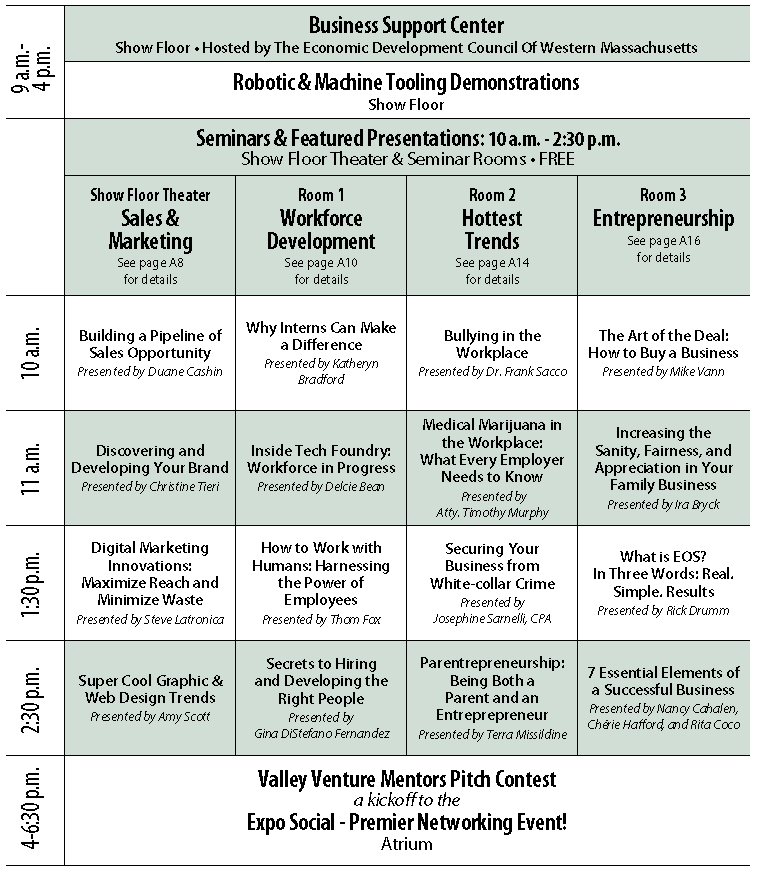
Throughout the day, there will be informative seminars across four tracks: Sales & Marketing, Workforce Development, Hottest Trends, and Entrepreneurship. Also slated are robotics and machine-tooling demonstrations, a Technology Corridor, a Business Support Center, the ever-popular Pitch Contest staged by Valley Venture Mentors, the day-capping Expo Social (always a great networking opportunity), and much more.

This show was created for you, the hardworking people who shape the region’s business community. We hope you will join us for what will be a memorable day.

George O’Brien, Editor
John Gormally, Publisher
Kate Campiti, Associate Publisher

WMBExpo Schedule

WMBExpoSchedule2015

Briefcase Departments

Difference Makers Nominations Due Nov. 20

WESTERN MASS. — Do you know someone who is truly making a difference in the Western Mass. region? BusinessWest invites you to nominate an individual or group for its eighth annual Difference Makers program. Nominations for the class of 2016 must be received by the end of the business day (5 p.m.) on Friday, Nov. 20. Nominations can be completed online by visiting HERE and clicking ‘Our Events.’ Difference Makers was launched in 2009 as a way to recognize the contributions of agencies and individuals who are contributing to quality of life in this region.

East of the River 5 Town Chamber Goes Independent

LONGMEADOW — The East of the River 5 Town Chamber of Commerce (ERC5) officially become an independent organization last month, following the merger of the Affiliated Chambers of Commerce of Greater Springfield and the Springfield Chamber of Commerce, now known as the Springfield Regional Chamber (SRC). The leadership of the ERC5 decided that dissolving its board and sharing its financial resources with a Springfield-based organization was not in the best interest of its membership. Instead, the 24-person board voted unanimously to maintain its independence and continue as a business association serving the towns of Longmeadow, East Longmeadow, Wilbraham, Hampden, and Ludlow. “When the ERC5 board met, all options were considered. In the end, it was clear that the businesses of our member towns needed and deserved direct representation,” said Dennis Lopata, ERC5 president. The ERC5 will continue its long-standing partnerships with the Western Mass. Economic Development Council and the newly formed SRC. For instance, the ERC5 will maintain a position on the SRC board and continue its partnership with the SRC on its three large regional events: Operation Outlook, the Beacon Hill Summit, and Super 60. Additionally, the ERC5 will hold three seats on the SRC legislative committee and offer a regional discount to its membership for those who would like to enjoy memberships with both organizations. “Our board has worked hard to strike a balance between independence and maintaining a partnership with the Springfield Regional Chamber,” said Lopata. “Although it’s important that our membership get direct representation in their respective towns, it’s also important that we continue to support efforts at the regional level. We believe our arrangement … does just that.” Added First Vice Chair Edward Zemba, “there has never been a more exciting time to be a part of the ERC5. This will be the first time in over 20 years that the ERC5 membership will have its own executive director. The membership will now have someone working exclusively on their behalf to ensure that they share in all of the benefits coming from the economic development taking place within our region.”

UMass President Praises Legislators for Funding Contracts

BOSTON — UMass President Marty Meehan praised the Massachusetts House for approving funding for UMass labor contracts when it passed a supplemental budget this week. “We appreciate the strong support that the University of Massachusetts continues to receive from the House of Representatives and commend Speaker Robert DeLeo, Ways and Means Committee Chairman Brian Dempsey, and all members of the House for making a critical difference for the university that makes a difference in the lives of so many of our citizens,” Meehan said. The $360 million supplemental budget approved by the House includes $10.9 million in funding of labor contracts with faculty and staff working in the UMass system. “This kind of support allows us to recruit and retain faculty members who are among the very best in their fields and who make us the world-class academic and research institution that the Commonwealth deserves and needs,” Meehan added. The House action comes at a time when enrollment throughout the UMass system continues to rise, reaching a record 73,700, according to fall 2015 projections. Meanwhile, recent Thomson Reuters rankings place UMass as the 57th-most innovative university in the world, and the new World University Rankings rate UMass as the number-one public university in New England, the 24th-best public university in the U.S, and among the best universities in the world. The $10.9 million approved by the House would fully fund the first year of three-year contracts, covering 6,500 faculty and staff across the UMass system, the terms of which were prescribed by the Patrick administration. The salary increases were to have gone into effect during the 2014-15 fiscal year, but were delayed until Meehan authorized their payment last month, saying he intended to seek offsetting funding in the budget bill pending before the Legislature. The supplemental budget containing the funding for UMass now moves to the Senate for consideration.

Daily News

WESTERN MASS. — Do you know someone who is truly making a difference in the Western Mass. region?

BusinessWest invites you to nominate an individual or group for its eighth annual Difference Makers program. Nominations for the class of 2016 must be received by the end of the business day (5 p.m.) on Friday, Nov. 20. Nominations can be completed online by visiting www.businesswest.com and clicking ‘Our Events.’

Difference Makers was launched in 2009 as a way to recognize the contributions of agencies and individuals who are contributing to quality of life in this region. Previous honorees include:

2015:

  • Katelynn’s Ride;
  • Judy Matt, president of Spirit of Springfield;
  • MassMutual Financial Group;
  • The ownership group of the Student Prince and the Fort; and
  • Valley Venture Mentors

2014:

  • The Gray House;
  • Colleen Loveless, executive director of the Springfield chapter of Rebuilding Together;
  • The Melha Shriners;
  • Paula Moore, founder of YSET Academy and a teacher at Roger L. Putnam Vocational Training Academy; and
  • Michael Moriarty, attorney, director of Olde Holyoke Development Corp., and supporter of childhood literacy programs

2013:

  • Michael Cutone, John Barbieri, and Thomas Sarrouf, organizers of Springfield’s C3 Policing program;
  • John Downing, president of Soldier On;
  • Bruce Landon, president and general manager of the Springfield Falcons;
  • The Sisters of Providence; and
  • Jim Vinick, senior vice president of investments at Moors & Cabot Inc.

2012:

  • Charlie and Donald D’Amour, president/COO and chairman/CEO of Big Y Foods;
  • William Messner, president of Holyoke Community College;
  • Majors Tom and Linda-Jo Perks, officers of the Springfield Corps of the Salvation Army;
  • Bob Schwarz, executive vice president of Peter Pan Bus Lines; and
  • The Women’s Fund of Western Massachusetts

2011:

  • Tim Brennan, executive director of the Pioneer Valley Planning Commission;
  • Lucia Giuggio Carvalho, founder of Rays of Hope;
  • Don Kozera, president of Human Resources Unlimited;
  • Robert Perry, retired partner/consultant at Meyers Brothers Kalicka; and
  • Anthony Scott, Holyoke police chief

2010:

  • The Irene E. and George A. Davis Foundation;
  • Ellen Freyman, attorney and shareholder at Shatz, Schwartz and Fentin, P.C.;
  • James Goodwin, president and CEO of the Center for Human Development;
  • Carol Katz, CEO of the Loomis Communities; and
  • UMass Amherst and its chancellor, Robert Holub

2009:

  • Doug Bowen, president and CEO of PeoplesBank;
  • Kate Kane, managing director of the Springfield office of Northwestern Mutual Financial/the Zuzolo Group;
  • Susan Jaye-Kaplan, founder of GoFIT and co-founder of Link to Libraries;
  • William Ward, executive director of the Regional Employment Board of Hampden County; and
  • The Young Professional Society of Greater Springfield
Opinion

Editorial

Since BusinessWest began publishing in 1984 as the Western Mass. Business Journal, it has shined a bright spotlight on both entrepreneurs and entrepreneurship.

The former, of course, refers to people — adventurous, forward-thinking, ambitious people who have taken ideas and converted them into successful businesses. Over the years, the magazine has devoted thousands of words and front-page photos to entrepreneurs who have shaped the local business landscape, from Peter Picknelly to Delcie Bean — with hundreds in between.

The latter, meanwhile, refers to the ongoing work to encourage people to become entrepreneurs and then assist and mentor them as they bring ideas to the marketplace, a centerpiece of regional efforts in the broad realm of entrepreneurship.

In short, we’ve celebrated entrepreneurs — BusinessWest even created an annual award to recognize the region’s ‘top entrepreneur,’ and Bean was the latest to receive that honor — and we’ve encouraged and recognized efforts to create more stories like his. Indeed, the magazine recognized Valley Venture Mentors as one of its Difference Makers for 2015 for its efforts to foster entrepreneurship and help business owners reach that critical ‘next stage’ — whatever it might be.

With this issue, BusinessWest takes its focus on entrepreneurs and entrepreneurship to a different, even higher level, with a new series of profiles that will collectively capture a new wave of entrepreneurial energy sweeping across the region.

Over the next year, we’ll relate some very intriguing stories about people young and old, with concepts ranging from software to hard cider; wedding dresses to pet-security devices, and how they are working to caress these products and services into thriving businesses.

As we’ve mentioned before and in many different ways, this enprepreneurial energy and the forces behind it constitute a far bigger story than the casino soon to take shape in Springfield’s South End, and a far bigger story than the subway-car-manufacturing facility soon to build on the other end of the city.

For while the casino will create a few thousand jobs and provide a spark for the convention and tourism business, and while the new manufacturing plant will come with hundreds of those proverbial good jobs and good wages, the stories of entrepreneurship unfolding across the entire region hold the key to a stronger, more sustainable economy for Western Mass.

We begin our series with a story on Northampton-based Machine Metrics (see story, page 6). This is an emerging company started by serial entreprepreneurs Bill Bither and Eric Fogg that has created a potentially game-changing software product that enables precision manufacturers to track the performance of each machine and each production shift.

This is a very specific, but also potentially lucrative, niche — but so are most of the others we’ll be profiling in the months to come.

The principals at Machine Metrics are in the process of scaling up their venture and will be aided in those efforts with a recent round of venture-capital funding. They exude optimism as they talk about the size of the market they’re penetrating and their ability to grab a huge share of that market.

It’s impossible to say where this venture will be in five years or even five months, but in many respects, it seems like the sky is the limit.

Getting to this point has taken imagination, hard work, and determination, and much more of each will be required to navigate the many challenges that lie ahead.

It is the same for the dozens of other risk takers trying to build on this region’s lengthy and distinguished history of entrepreneurship. That’s what makes these stories so compelling.

And that’s why we’re proud to be telling them.

Departments People on the Move

Douglas Bowen

Douglas Bowen

Thomas Senecal

Thomas Senecal

The PeoplesBank board of directors announced that bank President and CEO Douglas Bowen will retire in July 2016, to be succeeded by Thomas Senecal, currently Executive Vice President and Chief Operating Officer. The board’s leadership-succession plan calls for Senecal to become president at the bank’s annual meeting in February 2016. Bowen will become chairman and CEO at that time. Senecal will be named president and CEO in July 2016 upon Bowen’s retirement. During this transition period, Bowen will remain active in his position and the bank’s management and strategy implementation. Bowen joined PeoplesBank in August 1975 as a teller in the management-development program. He has since worked in almost every department at the bank. In 1986, he started the Commercial Lending department and, in 2002, was named executive vice president and chief lending officer. He was named president and CEO in 2007 and, since that time, has led the bank to its current position in the market, with more than $2 billion in assets and a substantial track record of innovation, community support, environmental sustainability, and employee engagement. Under Bowen’s tenure, PeoplesBank opened six branches, three of which are LEED-certified; has financed more than $80 million in sustainable-energy projects; and has been named a “Top Place to Work” by the Boston Globe three years in a row. The bank was also named a “Top Charitable Contributor” by the Boston Business Journal seven years in a row. The American Bankers Assoc. gave PeoplesBank a Community Commitment Award for its environmental-sustainability efforts in 2013. The Boston Globe also named Bowen a “Globe 100 Innovator” in 2011. In 2009, BusinessWest named Bowen one of its first Difference Makers. Meanwhile, Senecal possesses more than 25 years of progressive financial experience. In his current position, he has managed all accounting, financial reporting, and treasury and facility operations. He has overseen asset growth of the bank from $460 million to $2 billion in 2015. In addition to Senecal’s responsibility for the Finance department, as the COO, he will oversee the Retail, Operations, Internal Control, and Risk Oversight functions. Early next year, he will also be responsible for the Commercial and Consumer Lending, Cash Management, and Human Resources functions. Senecal holds a bachelor’s degree in business administration from UMass Amherst. He also attended the Tuck Executive Program at Dartmouth College. He is a certified public accountant and a U.S. Coast Guard veteran. He currently serves on the boards of directors of Holyoke Community College, where he is chair of the investment committee; Loomis Communities Inc.; and the Hampshire Regional Chamber of Commerce. He also serves on the advisory council of the Isenberg School of Management at UMass Amherst, and is a member of the Federal Home Loan Bank – Boston advisory panel. “Under his leadership, I am confident that our customers, our staff, and our future are in very capable hands,” said Bowen, making a statement on behalf of the bank’s board of directors. “Tom and I believe in our bank’s mutual charter. We will remain a mutual bank going forward — committed to helping our customers achieve financial success and to serving the community. It is our mutual charter that powers our values. It is also the structure that allows us to invest in innovation, to contribute to nonprofit and civic causes, to support environmental sustainability, and, perhaps most important of all, to help our associates grow and succeed. Our mutual charter has served us well for 130 years, and it is the key to our future as well.”
•••••

Carla DiLoreto

Carla DiLoreto

Greg Musante

Greg Musante

Christopher Fager

Christopher Fager

Sean Millane

Sean Millane

Jeffrey Lomma

Jeffrey Lomma

James Hagan, president and CEO of Westfield Bank, announced several recent changes to the bank’s retail and commercial banking staffs:
• Carla DiLoreto has joined the bank as Manager of the Enfield, Conn. office. DiLoreto has nearly 10 years of retail banking experience. Prior to joining Westfield Bank, she was Banking Center manager of the Somers, Conn. office of Webster Bank. While serving there, she was inducted in the Somers Women’s Club, where she helped raise money for its scholarship and charitable-giving programs;
• Greg Musante has been hired as Assistant Branch Manager and Business Specialist in the Holyoke office. Musante has 15 years of banking experience in commercial and mortgage lending. Most recently, he was mortgage bank officer at Webster Bank and also held the positions of cash management analyst and business specialist at Bank of America. A graduate of Greenfield Community College and Plymouth State College, he is an active member of several area chambers of commerce;
• Christopher Fager has joined the bank as Assistant Vice President, Commercial Loan Officer. Fager joins Westfield Bank following a successful six-year career at Citizens Bank, where he served as both branch manager and business banking officer. In his new role, he will be responsible for developing and managing commercial banking relationships. A graduate of UMass Dartmouth, he is active in local chambers of commerce;
• Sean Millane, previously Manager of the bank’s Enfield office, has been promoted to Commercial Loan Officer. Millane has 15 years of banking experience and joined Westfield Bank in 2014 as manager of the Enfield branch. Previously, he was branch manager and business development officer of the Ellington and East Windsor, Conn. offices of Rockville/United Bank. In addition to his professional accomplishments, he is president of the East Windsor (Conn.) Chamber of Commerce and treasurer of the North Central Connecticut PTSD Foundation; and
• Jeffrey Lomma, previously Assistant Manager and Business Specialist in the Enfield office, has been promoted to Branch Manager of the Tower Square office in Springfield. Lomma joined Westfield Bank in 2007. Prior to being named branch manager of the Tower Square office, he served as assistant manager and business specialist at the bank’s Enfield branch. A graduate of Western New England University, he is active in the community, serving as treasurer of the North Central Connecticut Chamber of Commerce and board member for both the Springfield Performing Arts Development Corp. (Symphony Hall and CityStage) and the Springfield Hockey Heritage Society.
“I am pleased to announce these exciting changes to our retail and commercial banking staffs,” Hagan said. “At Westfield Bank, we are committed to delivering the best possible banking experience for our retail and commercial customers in Western Massachusetts and Northern Connecticut. In addition to their proven accomplishments, Carla, Greg, Chris, Sean, and Jeff truly epitomize what better banking’s all about.”
•••••
Square One recently announced the addition of two senior-level individuals to its leadership team:
Kristine Allard

Kristine Allard

• Joining the organization as Vice President of Development is Kristine Allard. She will oversee the nearly $10 million organization’s fund raising, communications, and program development. She comes to Square One from the YMCA of Greater Springfield, where she led the fund-development and communications team, as well as family-center operations. In addition to fund raising, grant writing, and special-event planning, she has an extensive background in marketing and media relations. Allard is active on a number of community boards and committees, including Leadership Pioneer Valley and the Baystate Academy Charter School. “We are very pleased to welcome Kris to Square One,” said Joan Kagan, president and CEO. “She brings a wealth of knowledge, experience, and talent to our organization. Her enthusiasm, positive energy, and team spirit are contagious, making her a great addition to our team. Kris is a true asset to Square One, and we are fortunate that she has joined us.”
Frank Tate III

Frank Tate III

• Also joining the Square One team is Frank Tate III. As Food Service Director, Tate will develop menus and oversee daily food preparation for the organization’s 400 preschool and after-school program participants, assuring compliance with government regulations and Square One’s commitment to encouraging a healthy lifestyle. Tate comes to Square One following senior-level positions at YSET Academy in Springfield and the Early Childhood Centers of Greater Springfield. “We know that proper nutrition is a critical part of every child’s ability to succeed academically, physically, emotionally, and socially,” said Kagan. “Frank’s extensive experience and expertise make him a perfect fit to help fulfill our mission. Not only does he bring knowledge, creativity, and a diversity of nutritious food to our kitchen, but also a cheerful disposition that our staff and families have come to embrace.”
•••••
Moriarty & Primack, P.C. announced several promotions and additions to the firm. The new hires include Dahimeli Mercado, Associate; Jonathan Normand, Associate; and Laurie Bonano, Associate. Meanwhile, Timothy Provost has been promoted to Manager, and Daniel Duncan has been promoted to Senior Associate.
•••••
Springfield Falcons President Sarah Pompea recently announced five front-office staff promotions:
• Chris Thompson has been promoted to Senior Vice President. Thompson will continue to oversee the team’s corporate sales with an expanded focus on driving ticket sales. In his new role, he will be working closely with Pompea in the day-to-day operations of the organization;
• Cortney Hersom has been promoted to Vice President. Hersom is currently responsible for all Falcons financials and human resources. In addition, she will take a stronger lead in the daily operations of the office;
• Andy Zilch has been promoted to Manager of Communications/Broadcasting. Zilch, the Falcons’ play-by-play broadcaster, also has responsibilities in ticket and corporate sales. He will oversee the team’s communications and community-relations efforts and act as the primary media contact for the Falcons;
• Marija Ward has been promoted to Manager of Ticket Operations. Ward oversees all aspects of the organization’s ticket operations and serves as the box-office liaison. She has been tasked with streamlining the ticket department, increasing efficiency, and enhancing the fan experience; and
• Luke Pawlak has been promoted to Manager of Game Operations/Creative Services. Pawlak spearheads all creative aspects for the organization and will also be able to utilize new technology this season to enhance the fan experience. He has cultivated a positive leadership role with the team’s game-night staff.
•••••
Erika Kaftan

Erika Kaftan

Erika Kaftan has been appointed assistant Director of Educational Services at the Willie Ross School for the Deaf. She succeeds Linda Carfora, who is retiring after more than 20 years at Willie Ross. Kaftan will oversee the Mass. Comprehensive Assessment System Alternate Assessment (MCAS-Alt) portfolios and the School-to- Work program. She also will assist in supervising and evaluating staff, hiring new staff, and reviewing and approving quarterly progress reports. Prior to joining Willie Ross last month, Kaftan was the individualized education plan (IEP) coordinator at the EDCO Program for the Deaf and Hard of Hearing in Newton. She also worked as a teacher for the deaf at the high-school level at EDCO. Kaftan began her career as a paraprofessional and substitute teacher for elementary-school students at a charter school in California. She received her bachelor’s degree in liberal arts from California State University, Northridge, with a focus in American Sign Language, and went on to earn two master of education degrees, from Boston University in deaf education and from Endicott College in organizational management. The Willie Ross School for the Deaf provides a comprehensive educational program stressing academic excellence that focuses on the development of students’ intellectual, social, and emotional growth from the early childhood level through high school. Willie Ross serves students at its main campus in Longmeadow and at its partnership campus located in the East Longmeadow public schools. Mainstreaming opportunities are provided at the partnership campus.
•••••

Burkhart Pizzanelli announced the promotion of Julie Quink to Managing Principal. Quink has more than 20 years serving clients in the public accounting industry along with several years in private industry. She received a bachelor’s degree in accounting from Elms College and recently returned to her alma mater as an adjunct professor in the MBA program. She is a member of the American Institute of Certified Public Accountants, the Mass. Society of Certified Public Accountants, and the Assoc. of Certified Fraud Examiners. She also serves on the Pathfinder Regional Vocational Technical High School Committee, the finance committee for the East Quabbin Land Trust, and the board of directors for the Quaboag Hills Chamber of Commerce. In addition to her firm management responsibilities, Quink will continue to actively serve clients, primarily in the accounting and auditing area and as a specialist in forensic accounting. She succeeds Richard Burkhart, who is a co-founder of the firm and has served as managing principal from its inception in 1986. Burkhart will continue to provide his clients with service and expertise as a principal of the firm, sharing his 40 years of experience in public accounting.
•••••
HUB International New England, a division of HUB International Limited, a leading global insurance-brokerage, risk-advisory, and employee-benefits firm, announced that Cynthia Squires has joined HUB International New England as manager of Select Business for small to medium-sized business accounts in the Commercial Lines department. Squires will be responsible for the day-to-day management and servicing of small-business accounts, providing oversight and direction to commercial-lines staff, leading quality-control and product-analysis processes, managing departmental retention and acquiring new-business goals, keeping abreast of the latest industry changes and trends, while providing the highest level of service standards and value to clients. She will be based in the East Longmeadow office. Most recently, Cynthia served as a Commercial Lines account executive for Goss & McLain Insurance Agency, where she had worked for almost 30 years. She started her career in the Personal Lines department as a customer-service representative, then worked her way up the ranks to Personal Lines manager and Marketing manager. She then switched over to the Commercial Lines department, where she worked for five years on small and medium-sized accounts. “HUB International New England is dedicated to building a team of experts with local market specialization and industry experience,” said Timm Marini, president of HUB International New England, formerly FieldEddy. “Cynthia brings a wealth of insurance knowledge with her, which will synergize well with our Commercial Lines team. Her extensive knowledge of the insurance industry and leadership skills will provide our clients with value-added solutions and innovative products that are specific to this market.”

Banking and Financial Services Sections
130 Years Later, PeoplesBank Still Reflects the Character of Its First President

Doug Bowen

Doug Bowen says PeoplesBank shares many of its values with its first president, William Skinner.

William Skinner, Holyoke’s most noted industrialist and philanthropist, was known as an innovator, someone who cared about his employees, and a business owner who was deeply involved in his community. Roughly 130 years after he became the first president of what was then Peoples Savings Bank, the institution still reflects Skinner’s values.

Sarah Skinner Kilborne says that, as a child, she heard little about her great-great-grandfather, William Skinner, founder of the Skinner & Sons Silk Manufacturing Co. and Holyoke’s most noted industrialist and philanthropist.

Actually, she heard far more about the company, which had been sold before she was born, than she did about the man, which created first her curiosity and later a fascination concerning his life and times.

Indeed, she never knew about Skinner’s youth in London, where he grew up in abject poverty and vowed to escape from that life. (Actually, no one knew about those years, because Skinner rarely, if ever, talked about them to anyone). And she also heard very little about perhaps the most important chapter in his life — how he rebounded remarkably from a catastrophic flood in 1874 that destroyed his mill in Skinnerville (near Williamsburg) and built anew in Holyoke.

Intrigued by what she came to know about that latter episode, Kilborne became determined to find out more. Years of intense research resulted in her book American Phoenix, published in 2012, which chronicles how Skinner turned that disaster into destiny.

Sarah Skinner Kilborne

Sarah Skinner Kilborne says she was at first curious about her great-great-grandfather, and then fascinated by his life and times.

“I never heard much about William Skinner the man,” she told BusinessWest. “I knew who he was, I knew he was the founder of the family company, I knew he was my great-great-grandfather. But I knew little about him.”

In the course of researching and writing her book, Kilborne said she learned a great deal, about not just what he did, but how and why. Among other things, she said, he was:

• An innovator. “He took advantage of the most modern machinery, kept an eye on the market, looked for opportunities, saw the big picture, and always looked ahead,” she said;
• A philanthropist who was involved with, among other things, the creation of Holyoke Hospital, the Holyoke Public Library, and the city’s YMCA;
• A business owner who cared deeply about his employees. “If he saw a hard-working employee really struggling and just not able to get ahead, he might step in and pay off all of that man’s debts to help him get a fresh start”; and
• As implied earlier, someone who didn’t glance back. “He was an immigrant who had suffered a terrible childhood, and he’d done everything he could to escape it,” Kilborne said. “He didn’t look back to the past; he cared about the future.”

And those are the very same qualities that still define PeoplesBank, which Skinner served as its first president when it was known as Peoples Savings Bank, said Doug Bowen, who now has that same title and has been with the institution for 40 of its 130 years.

As the bank celebrates its milestone anniversary this year, it is not marking that number or another figure ($2 billion in assets, which the institution just passed), as much as it is highlighting those traits it still has in common with Skinner, he explained.

“If William Skinner were to look at the bank today, he would see that, in some ways, nothing has changed, and in another way, everything has changed,” said Bowen, now in his 10th year at the helm of the Holyoke-based institution.

Certainly, the figures on the ledger sheet have changed. The bank, which opened on St. Patrick’s Day in 1885 and tallied two accounts totaling $65 that day, had $74,000 in deposits its first year of operation, and now has more than $1.5 billion. The number of branches has grown as well; there are now 17.

But the bank is still known for those qualities Skinner instilled in it, including philanthropy — it’s owned a spot on the Boston Business Journal’s list of the state’s largest corporate charitable donors for several years now; innovation, which comes in many forms, from the considerably ‘green’ quality of its recently opened branches to the so-called ‘customer innovation lab’ now taking shape on the fifth floor of the bank’s headquarters building; and as a thoughtful employer — the bank has earned status on the Boston Globe’s list of the best places to work in the Commonwealth the past two years.

“We’re still a mutual bank — our charter is basically the same as it was in 1885,” said Bowen. “And our pillars, our values of innovation, community support, the environment, and employee engagement … there are a lot of parallels and lot of crossovers between where we are today and where we were 130 years ago.”

For this issue and its focus on banking and financial services, BusinessWest details how PeoplesBank can draw some straight lines between the values of its industrious first president and the way the institution conducts business today.


Fabric of the Community

Kilborne said the flood of 1874, caused by the breach of a poorly designed and hastily constructed reservoir dam, was one of the worst industrial disasters of the 19th century and in the history of this region — 139 people were killed by the wall of water crashing down the Pioneer Valley, and the disaster ultimately led to the passage of landmark dam-safety laws.

Still, few in this region know much, if anything, about the catastrophe.

“That was a story that seemed to be lost,” she said, adding that some of her research for American Phoenix benefited greatly from In the Shadow of the Dam, a book about the disaster written by Elizabeth Sharpe and published in 2007.

Lost also were many of the details of how Skinner, whose mill was completed destroyed by the flood — “there was nothing of it left to photograph,” said Kilborne — would go on to build one of the largest silk-manufacturing companies in the world in a then-evolving Holyoke, a unique city specifically designed for industry.

“William Skinner’s story takes the flood’s story to another level,” she said. “This is a personal story in the midst of the flood, and it really addresses this issue of how you rebuild your life after you lose everything.

“I was so taken with his story, and I personally wanted to know how he did it,” she went on. “I was gripped by this sense of loss that he sustained and that everyone else in the Valley sustained at the time of the flood, and how it was that William Skinner’s saga turned into a legendary success story; what set him apart?”

To make a compelling story short, what set him apart were those aforementioned attributes, she said, listing perseverance, innovation, philanthropy, and a burning desire to forge a far better life for his family than the one he endured in the Spitalfields section of East London.

Kilborne mentions the creation of Peoples Savings Bank and Skinner’s appointment as its first president in her book, but doesn’t go into any great detail about the institution or his tour of duty with it.

But she speculated that the values that dominated other aspects of his life and career were undoubtedly evident there as well.

“As the president of the bank, he would have been very community-oriented and conscious of the burden of debt; when he helped found Holyoke Hospital, he was proud of the fact that the hospital was delivered free of debt to the community,” she explained. “When he moved to Holyoke, his reputation was that of being a great financier and manager; within two years, the city wanted him to run for mayor.

“As a banker and as a businessman, he was known to be a man of wise conservatism,” she went on. “But he was also willing to take risks, because he knew the value of investing, he knew the value of innovation, he knew the value of looking to the future. He knew you couldn’t stay stuck in the past and do the same thing over and over again, because if you do, you’re going to be left behind.”

Roughly 114 years after Skinner relinquished the helm at the bank, those same attitudes, if you will, permeate the bank’s operating philosophy, said Bowen, referring specifically to Skinner’s focus on innovation and looking toward to the future and the opportunities and challenges it will bring.

This is reflected in some of the accolades the bank — and Bowen himself — have received in recent years. That list includes everything from placement on the ‘largest corporate charitable donors’ and ‘top places to work’ compilations to recognition for Bowen as one of the Boston Globe’s Top 100 Innovators in 2011, and as one of BusinessWest’s first Difference Makers for essentially creating the environment in which all of the above could happen.

Material Evidence

Before elaborating on how PeoplesBank operates now as it did 130 years ago, Bowen noted that it does so in a banking environment that has changed dramatically since 1885 and is, in many ways, more challenging.

Now, as then, the playing field is crowded with competitors, although the composition of the field is different, with many national and regional players. Meanwhile, due to plummeting interest rates, margins are now razor-thin, making it difficult for banks of all sizes to be profitable.

The customer innovation center now under construction at PeoplesBank

The customer innovation center now under construction at PeoplesBank is one of the many ways in which the bank reflects William Skinner’s innovative character.

In this environment, institutions are looking for any edge they can get and are united in their quest to increase volume and attain greater market share to compensate for those slimmer margins. Locally, most have banks have done this through acquisition and territorial expansion, and PeoplesBank is no exception (at least with the latter), having executed an aggressive pattern of expansion, including the opening of three branches in Springfield and others in Westfield, West Springfield, and Northampton.

This widening of the footprint (along with inflation, of course) helps explain why it took the bank 120 years to reach $1 billion in assets and only a decade to double that total.

But there’s more to the growth equation than physical expansion, said Bowen, adding that today’s institutions, especially community banks like PeoplesBank, can gain an edge with more personalized service than that delivered by the regional and super-regional players. They can also do so by using technology to improve that service.

And this brings Bowen back, once again, to William Skinner, who embraced those ideals.

“When he built in Holyoke, he bought the latest and most innovative machinery that there was for silk making,” Bowen explained. “Skinner silk became the standard for the American silk and satin industry, and a lot of it was because of his investment in those innovative machines.”

In many ways, PeoplesBank is following that example, he went on, citing everything from design of the bank’s LEED-certified branches to the development of apps for smart phones.

“One of the things that was interesting about the buildings Skinner built was that they had monitor roofs, which had a row of ventilating windows above it that could be opened, which pulled all the hot air up and through the building, something that was unique at that time,” Bowen explained. “Also, the skylights let good light into the manufacturing area, and according to the book, his factories were considered the healthiest in the Northeast, and this mirrors some of the things we’re doing.”

As an example, he mentioned branches like the one recently constructed in Northampton, which focuses on providing natural light and fresh air to make the work environment more conducive to productivity and employee satisfaction.

As another example, Bowen cited the customer innovation lab taking shape at the bank’s headquarters building, a step taken to address the incredible pace of technological advances and the ways in which they can be harnessed to better serve customers.

The bank recorded more than 2 million online banking sessions in 2014, more than double the number only three years ago, said Bowen, adding that this pace of growth will only accelerate in the years to come as customers demand even greater convenience. The lab was formed, by and large, to create such convenience.

“The lab is all about tomorrow and addressing those customer demands for convenience in the future,” he said. “We’re using technology to accelerate innovation and enhance the customer experience.

“The lab won’t have any beakers or Bunsen burners, but it will have space where people can brainstorm about that customer experience and places where we can have focus groups and more broadly speak to the different delivery channels,” he went on. “We want to focus on all the different ways you can deliver products, services, and information to our customers.”

The bank already has what are known as ‘tech titans,’ he said, individuals who will analyze new technology, such as the Apple watch, for example, and evaluate what that technology could potentially mean for customers. The new innovation lab will take such efforts to a higher level, with the focus squarely on the customer.

“We’re constantly, constantly, constantly trying to look at things through the customers’ eyes,” he explained. “We’re trying to create as good an experience, and as seamless an experience, as we can.”

Meanwhile, the bank is also working to apply that phrase ‘good experience’ to employees as well. And placement on the ‘best places to work’ list three years in a row — the only firm in this region to make that compilation — is evidence that it is succeeding in that mission.

“This is based an anonymous survey of employees and gauges what they think of you — we’re not sending in all the nice things we do; it’s strictly the employees,” he said of the process of determining who makes the list. “And when you consider all the businesses in Boston that we’re up against, it’s quite an honor.

“We’re a bank — we don’t have beer on tap or a ping-pong table,” he continued, referring to some of the amenities offered by IT companies. “We can make it fun to work here, but there are constraints we are under.”

Back to the Future

Bowen told BusinessWest that the bank has little, if anything, planned to mark its 130th anniversary.

“We’re more focused on the future and on the things that will make a difference for the community and our employees right now,” he said, adding that, in this respect, the bank is once again emulating its first president and his values.

Skinner’s outlook and his manner of doing business are perhaps best captured by these comments from his great-great-granddaughter.

“He was very broad-minded; he was capable of seeing the large relations of things,” she said. “He had a very expansive way of looking at the world, probably because he grew up in England and moved to America. He saw things globally, and he saw things in a very large frame. He looked at the whole picture, while doing everything he could to build on the present.”

Bowen didn’t say as much, but he strongly implied that continuing to conduct business as Skinner would is certainly the best way the bank can celebrate its milestone.


George O’Brien can be reached at [email protected]
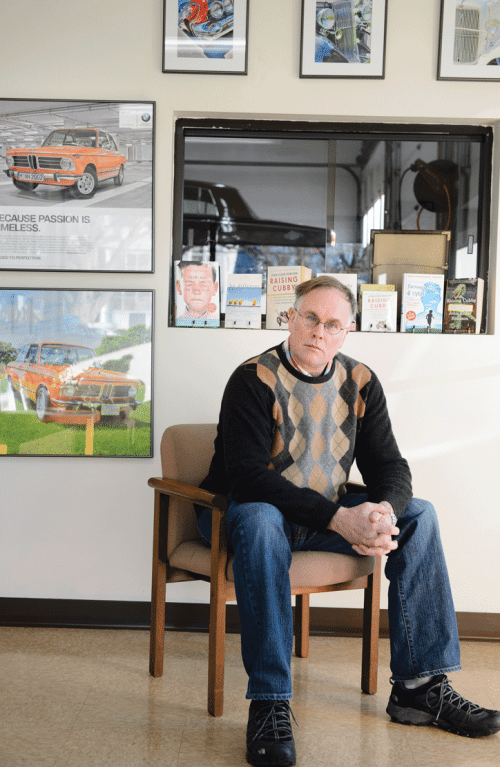
Difference Makers

DiffMakers2015Web

Photos From the 2015 Difference Makers Gala

Thursday, March 19, 2015 held at the Log Cabin, Holyoke

Sponsored By:
SixPointLogo200x130pxFathersSonsLogo200x130pxFirstAmerLogo200x130pxHNElogo200x130pxMBKlogo200x130pxRoyalLogo200x130px
Photos by Denise Smith Photography
To see all the photos go HERE

Difference Makers 2015More than 350 people turned out at the Log Cabin Banquet & Meeting House in Holyoke on March 19 for a celebration of the Difference Makers for 2015. The photos on the next several pages capture the essence of the event, which featured entertainment from the Springfield Boys & Girls Club, as well as fine food and thoughtful comments from the honorees. This year’s class, chosen by the editors and publishers of BusinessWest from dozens of nominations, include Katelynn’s Ride, represented by Domenic Battista, Michelle Battista, Kim Zachery, Dan Williams, Steve Stark, and Corinne Briggs; MassMutual Financial Services, represented by Nick Fyntrilakis; Spirit of Springfield Executive Director Judy Matt; Valley Venture Mentors, represented by Paul Silva, Scott Foster, and Jay Leonard; and the new ownership group of the Student Prince/Fort: Andy Yee, Peter Picknelly, Michael Vann, and Kevin Vann.

Difference Makers 2015 Gala 1From left: John Veit, marketing and recruiting senior associate, Meyers Brothers Kalicka, P.C.; 2015 Difference Maker Paul Silva, executive director, Valley Venture Mentors; and 2013 Difference Makers Sr. Kathleen Popko and Sr. Mary Caritas of the Sisters of Providence.

Difference Makers 2015 Gala 2Ethel Griffin (left), program manager, Revitalize Community Development Corp., with 2014 Difference Maker Colleen Loveless, the organization’s executive director.

Difference Makers 2015 Gala 3From left: BusinessWest Publisher John Gormally; 2013 Difference Maker Jim Vinick, senior vice president of investments, Moors & Cabot Inc.; and Marjorie Koft.

Difference Makers 2015 Gala 4
Scott Foster (right), partner at Bulkley Richardson and board member with 2015 Difference Maker Valley Venture Mentors, with his wife, Stephanie Foster, and son, James Foster.


Difference Makers 2015 Gala 5From left: Brenda Olesuk, director of operations and development, Meyers Brothers Kalicka, P.C.; Kathleen Plante, advertising consultant, BusinessWest; Meghan Lynch, CEO and president, Six-Point Creative Works; and 2009 Difference Maker Susan Jaye-Kaplan, founder of GoFIT and co-founder of Link to Libraries.

Difference Makers 2015 Gala 62015 Difference Maker Andy Yee (right), one of the new owners of the Student Prince/Fort, with his wife, Sarah Yee, and son, Matthew Yee.

Difference Makers 2015 Gala 7Peter Galiardi (left), president and CEO, HAPHousing, with 2011 Difference Maker Bob Perry, retired partner/consultant at Meyers Brothers Kalicka, P.C.


Difference Makers 2015 Gala 8From left: 2015 Difference Maker Peter Picknelly, chairman and CEO of Peter Pan Bus Lines and one of the new owners of the Student Prince/Fort; Paul McDonald; Susan Walsh; and Dennis Walsh, general manager, Sheraton Springfield.

Difference Makers 2015 Gala 9Once again, the honorees received glass plates hand-crafted by Lynn Latimer, representing butterflies, the symbol of BusinessWest’s Difference Makers since the program was launched in 2009.

DSC_7880From left: Maureen Scanlon, owner, Murre Creative; Susan Bergeron-West, owner, Sirius Design; Jean Jinks; Florence DeRose; and 2015 Difference Maker Judy Matt, president, Spirit of Springfield.

Difference Makers 2015 Gala 10
Front row, from left: from Health New England, Nicole Santaniello, content management specialist; Brian Kivel, sales executive; Elin Gaynor, assistant general counsel; and Cinnamon Azeez. Back row, from left: also from HNE, Laura Dellapenna, administrative assistant; Heidi Fountain, senior special accounts manager; and Robert Azeez, Medicaid behavioral health manager.

Difference Makers 2015 Gala 11Front row, from left: Robert Zywno, attorney, Royal LLP; Tanzania Cannon-Eckerle, attorney, Royal LLP; and her husband, Joe Eckerle. Back row, from left: Joanne Salus, director of Human Resources, Community Enterprises Inc.; and Karina Schrengohst, attorney, Royal LLP.

Difference Makers 2015 Gala 12Front row, from left: from MassMutual Financial Group, Michelle Sussmann, assistant vice president and chief of staff, Marketing Strategy, Planning, and Operations; Nick Fyntrilakis, vice president, Community Responsibility; Cindy Adams, program manager; and Nicole Fyntrilakis. Back row, from left: also from MassMutual, Tracy Shaw, assistant vice president; John Chandler, chief marketing officer; Mike McNamara, Media Relations and Communications; and Sonja Shaw, relationship manager.

Difference Makers 2015 Gala 13
Front row, from left: from Meyers Brothers Kalicka, P.C., Kaylin Helitzer, associate; Jim Krupienski, senior manager; Kristi Reale, senior manager; and Jim Barrett, managing partner. Back row, from left: also from MBK, John Veit, marketing and recruiting senior associate; Brenda Olesuk, director of operations and development; Melyssa Brown, senior manager; Chris Marini, associate; and Kris Houghton, partner.

Difference Makers 2015 Gala 14Front row, from left: Dennis Murphy, administrative specialist, First American Insurance Agency; Noni Moran, Human Resources director and claims adjustor, First American Insurance Agency; and Molly Murphy. Back row, from left: Moe Brodeur, controller, Peter Pan Bus Co.; Tom Picknally, senior vice president of Maintenance, Peter Pan Bus Co.; David Matosky, operations director, First American Insurance Agency; and Edward Murphy, chairman, First American Insurance Agency.

Difference Makers 2015 Gala 15Front row, from left: from Fathers and Sons, Lori Monroe, business development; Trae Morrison, product specialist; and Bill Visneau, product specialist. Back row, from left: also from Fathers and Sons, Angela Lebel, service advisor; and Steve Langieri, sales manager.

Difference Makers 2015 Gala 16Musical performances by area children are a Difference Makers tradition, and this year was no exception, with a choir from the Springfield Boys & Girls Club kicking off the evening’s ceremonies by singing Mariah Carey’s “Hero” and Katy Perry’s “Roar.”

Difference Makers 2015 Gala 17BusinessWest Editor George O’Brien (center) presents the 2015 Difference Makers award to the new ownership group of the Student Prince/Fort, from left, Andy Yee, Peter Picknelly, Michael Vann, and Kevin Vann.

Difference Makers 2015 Gala 18BusinessWest Editor George O’Brien (third from left) presents the 2015 Difference Makers award to representatives from Katelynn’s Ride, from left, Corinne Briggs, Domenic Battista, Michelle Battista, Kim Zachery, Dan Williams, and Steve Stark.

Difference Makers 2015 Gala 19Front row, from left: Marsha Montori, chief client strategist, Six-Point Creative Works; Marion Griswold, membership coordinator, Connecticut River Watershed Council; and Angela Mrozinski, outreach and events director, Connecticut River Watershed Council. Back row, from left: Melody Foti, senior vice president, Investments, Wells Fargo; and Meghan Lynch, CEO, Six-Point Creative Works.

Difference Makers 2015 Gala 20Representing 2015 Difference Maker Valley Venture Mentors, from left, Jay Leonard, Paul Silva, and Scott Foster.

Daily News

HOLYOKE — Time is running out to purchase tickets to the seventh annual Difference Makers award program, staged by BusinessWest, to be held Thursday evening, March 19, at the Log Cabin Banquet & Meeting House in Holyoke.

Difference Makers is a program, launched in 2009, that recognizes groups and individuals that are, as the name suggests, making a difference in this region. The class of 2015 — Katelynn’s Ride, MassMutual Financial Services, Judy Matt, Valley Venture Mentors, and the new ownership group of the Student Prince and the Fort — was profiled in the Feb. 9 issue and on businesswest.com.

Tickets cost $60 per person. To reserve a spot, call (413) 781-8600, ext. 100, or e-mail [email protected].

Features

BizDiffMakrsLOGO2011

Seventh Annual Gala Set for March 19 at the Log Cabin

The big night is almost upon us.

That would be March 19, of course, and the annual Difference Makers gala, an event that has become a not-to-be-missed networking opportunity and, much more importantly, an opportunity to celebrate groups and individuals who are making a difference in Western Mass.

The tradition began in 2009 with the first class of Difference Makers, which featured a diverse group that showed the many ways one can make a positive impact. It included Bill Ward, director of the regional Employment Board of Hampden County; Susan Jaye Kaplan, founder of GoFIT and co-founder of Link to Libraries; the Young Professional Society of Greater Springfield; and PeoplesBank President Doug Bowen and Kate Kane, managing director of the Springfield office of Northwestern Mutual, both of whom have donated countless hours to area nonprofits and economic-development-related agencies.

Each successive class has had both its own unique character and a common bond with all the others — individuals, groups, or companies who have stepped up and used their talents, energy, and imagination to improve quality of life in this region.

The class of 2015 HERE carries on that legacy. This year’s honorees are:


• Katelynn’s Ride:
The K-Ride, as organizers call it, was created in 2011 to honor the memory of Katelynn Battista, who lost her courageous battle to leukemia at age 11. The event raises money for both Baystate Children’s Hospital and the Dana Farber Cancer Institute through the Jimmy Fund. Locally, some of the funds awarded to Baystate have gone to support a new position, a nurse practitioner who acts as a liaison between the families of cancer patients and the teams of specialists that provide needed care.

• MassMutual: The financial-services giant is being honored not simply for the depth of its philanthropy or community involvement, but the strategic nature of such endeavors. Focused in three areas — education, economic development, and ‘community vitality,’ the company’s many contributions are long-term in focus with the goal of strengthening the community and building a quality workforce.

• Judy Matt, president of the Spirit of Springfield: For more than three decades, Matt has been at the forefront of coordinating family-focused events for the residents of Springfield and surrounding communities. That list includes Fourth of July fireworks, the annual pancake breakfast (once touted as the world’s largest), the Big Balloon Parade, and Bright Nights, the holiday lighting display that is on many national lists of must-see attractions.

• The new ownership team of the Student Prince and the Fort: Last summer, Rudy Scherff, second-generation co-owner of the Springfield-based institution known as the Student Prince and the Fort, announced that, if new ownership could not found, the iconic restaurant and tavern would likely close amid falling profits and rising costs. Into the breach stepped a somewhat unlikely group — Peter Picknelly, owner of Peter Pan Bus Lines; the Yee family, owners of the Hu Ke Lau in Chicopee and other restaurants; and Kevin and Michael Vann, father-and-son consultants who have worked with a number of restaurateurs over the years.

• Valley Venture Mentors: Through a host of initiatives ranging from monthly mentoring sessions to shared-workspace initiatives, to a new accelerator program which just welcomed its first cohort of 30 companies, VVM is, according to many observers, making real progress in creating an entrepreneurial renaissance in Springfield and the region as a whole.

The March 19 event will feature butlered hors d’oeuvres, lavish food stations, a networking hour, introductions of the Difference Makers, and remarks from the honorees. Tickets are $60 per person, with reserved tables of 10 available.

For more information or to order tickets, call (413) 781-8600, ext. 100, or go HERE.

Agenda Departments

Speed-networking Event
March 11: Back by popular demand, the Affiliated Chambers of Commerce of Greater Springfield (ACCGS) will hold an afternoon of speed networking on March 11 at Frank Webb’s Bath Center, 145 Performance Blvd., Springfield, followed by an evening of informal networking at its After 5. The combination of events will provide attendees the opportunity to meet new contacts in a formal manner, then continue conversations in an informal and casual setting. The core concept to speed networking is the ‘elevator speech,’ a short summary of an individual, business, organization, product, or service that a person could deliver in the time span of a short elevator ride. Attendees will be divided into groups A and B. Members of each group will be seated across from each other. Each member of Group A will have 60 seconds to give his or her elevator speech to a member of Group B. A bell will ring, signaling the 60-second time is up, and each member of Group B will then get a chance to speak. The facilitator will signal when the 60 seconds are up again, and members of Group A will then move one seat to the right and begin the process again with a new partner. The round-robin format of networking will continue until the event is over. The event begins at 3:30 p.m. with registration and instructions. To accommodate the event, no admittance will be allowed after 3:55 p.m. The event ends at 5 p.m., and the After 5 runs from 5 to 7 p.m. Reservations are $20 in advance, $25 at the door, and only members of the ACCGS, Springfield Chamber of Commerce, or East of the River Five Town Chamber of Commerce are eligible to participate. Reservations include a complimentary ticket to the After 5. Reservations for the After 5 only are $5 for members, $10 for general admission. The After 5 is open to the general public. Reservations may be made online and in advance at www.myonlinechamber.com or by contacting Sarah Mazzaferro at [email protected].

New Lecture Series
March 12: BusinessWest and the Healthcare News are pleased to announce a new lecture series presented by Comcast Business. This series of lectures, panel discussions, and presentations will address timely and important business information, and is an ideal opportunity to meet industry leaders and network with area business professionals. The first event in the series, called “Technology Has the Power to Change Healthcare,” will be hosted by La Quinta Inn & Suites, 100 Congress St., Springfield. Panelists include Neil Kudler, vice president and chief medical information officer for Baystate Health; Michael Feld, CEO of VertitechIT and acting chief technology officer of Baystate Health and Lancaster General Hospital; and Delcie Bean IV, CEO, of Paragus Strategic IT. Registration begins at 7:15 a.m., followed by breakfast and networking at 7:30 a.m. and the panel discussion from 8 to 9 a.m. Admission is free, provided by Comcast Business, but RSVP is required by Thursday, March 5. Sign up online at businesswest.com/lecture-series, or call (413) 781-8600, ext. 10, for more information.

Celebrate Springfield Dinner
March 12: DevelopSpringfield will host its fourth annual dinner event in celebration of Springfield and the many accomplishments the community has achieved over the past year, along with exciting new initiatives underway. The event will take place from 6 to 9 p.m. at the MassMutual Center in Springfield. Festivities will include a reception with live music by the Eric Bascom Trio, auction activities, a cash bar, and hors d’oeuvres, followed by dinner, a brief program, and presentations. Platinum sponsors this year are MassMutual Financial Group, Baystate Health, and Health New England. Many other local businesses and organizations are also supporting the organization’s work as sponsors and participants at the event. DevelopSpringfield will once again present its Partner in Progress Award to recognize the outstanding contributions of three individuals toward revitalization in Springfield. Honorees are selected for their leadership and ability to motivate and inspire others. This year’s honorees are Jerald Griffin, co-founder of Harambee and the Stone Soul Festival; Kevin Kennedy, chief development officer for the city of Springfield; and Evan Plotkin, president and owner of NAI Plotkin. In addition to the program and award presentations, greetings will be provided by Springfield Mayor Domenic Sarno and Jay Ash, newly appointed secretary of the Commonwealth’s Executive Office of Housing and Economic Development. All event proceeds will support DevelopSpringfield’s redevelopment initiatives, projects, and programs. More than 450 attendees — including federal, state, and city officials; leaders from the business and nonprofit communities; and local residents — are expected to come together in support of ongoing efforts to advance development and redevelopment projects, stimulate and support economic growth, and expedite the revitalization process within the city. Registration and sponsorship information is available at www.developspringfield.com or by contacting Paige Thayer at (413) 209-8808 or [email protected]. Tickets cost $75 per person, and RSVP is required by Monday, Feb. 23.

PWC Luncheon
March 18: Tracy Noonan, co-owner of Wicked Good Cupcakes, will keynote the Headline Luncheon of the Affiliated Chambers of Commerce of Greater Springfield’s affiliate, the Professional Women’s Chamber (PWC), from 11:30 a.m. to 1 p.m. at the Carriage House at Storrowton Tavern, 1305 Memorial Ave., West Springfield. Noonan and her daughter, Danielle Vilagie, took their Cohasset-based cupcake baking company national after appearing on the ABC hit show Shark Tank. Wicked Good Cupcakes began when the mother-daughter team took cake-decorating classes as a way to spend quality time together. After posting their work online for friends and family, they found themselves being asked to create cupcakes for various events. The demand for their product became so high that they opened their first retail location in Cohasset in October 2011. As the reputation of their product grew, they found themselves getting hundreds of requests to ship their product across the country. However, they could not find a way to effectively ship cupcakes and have them arrive intact and fresh. That’s when they came up for the idea of a cupcake in a jar. Filling jars with freshly baked layers of cake, frosting, and filling, they were able to create a product that would stay fresh up to 10 days without refrigeration and could be easily shipped. The company’s popularity quickly grew, and, in 2013, Noonan and Vilagie appeared on Shark Tank, striking a deal with Boston-based shark Kevin O’Leary of O’Leary Ventures, and expanding their business by more than 600%, including a new retail location in Faneuil Hall in Boston and expanded facilities to handle online orders. In addition to cupcakes, the company’s product line now also includes gluten-free options, as well as pies, cheesecakes, and brownies in a jar, as well as French macaroons. Advance reservations for the luncheon are suggested and cost $25 for PWC members and $35 for general admission. Register online at www.myonlinechamber.com or by e-mailing [email protected]. PWC members who are season-pass holders must pre-register for the event by emailing [email protected].

‘Acting Skills for Real Life’
March 19 to April 16: The Division of Graduate and Continuing Education at Westfield State University will offer a class called “Acting Skills for Real Life: How to Connect and Communicate” on Thursday nights, March 19 through April 16, from 6 to 8 p.m. Students will learn about basic acting skills and theories, and how they can be applied to everyday situations such as job interviews and social settings, in addition to performances and public speaking. Course content includes vocal, movement, and imagination warmups and theatre games; improvisations around a specific set of circumstances, including real-life situations and role reversal; developing stage presence; and, if the class chooses, rehearsal and class performance of a brief scene or monologue as a rehearsed reading or ‘off book.’ The course will be taught by Nadia Creamer, who has a long career as a performer and a teacher of performing arts. Creamer was co-artistic director of Impulse Theatre and Dance for 28 years in New York, where she received more than 60 grants for her work. She was also a faculty member at New York University, Russell Sage, College of St. Rose, and Columbia-Greene Community College. The cost of this course is $80. Registration will be accepted until the first night of class. For more information and to register, contact Brandon Fredette at (413) 572-8033 or [email protected].

Mini-Medical School
March 19 to May 7: Baystate Medical Center’s Mini-Medical School, which begins its spring session on March 19, will give area residents a reason to come out of hibernation from the long, cold, snowy winter and join others interested in the expanding field of medicine. Mini-Medical School program is an eight-week health education series featuring a different aspect of medicine each week. Classes this spring will include sessions on various medical topics, such as surgery, emergency medicine, anesthesiology, pathology, and several others. Many of the ‘students,’ who often range in age from 20 to 70, participate due to a general interest in medicine and later find that many of the things they learned over the semester are relevant to their own lives. The goal of the program, offered in the hospital’s Chestnut Conference Center, is to help members of the public make more informed decisions about their healthcare while receiving insight on what it is like to be a medical student — minus the tests, interviews, and admission formalities. Each course is taught by medical-center faculty who explain the science of medicine without resorting to complex terms. Baystate Medical Center is the Western Campus of Tufts University School of Medicine and is the region’s only teaching hospital. All classes are held Thursday nights starting at 6 p.m. and run until 8 or 9 p.m., depending on the night’s topic. No basic science knowledge is needed to participate. Each participant is required to attend a minimum of six out of eight classes in order to receive a certificate of completion. Tuition is $95 per person and $80 for Senior Class and Spirit of Women members. Register for the spring semester of Mini-Medical School by calling (800) 377-4325. For more information, visit www.baystatehealth.org/minimed.

Difference Makers
March 19: The sixth annual Difference Makers award program, staged by BusinessWest, will be held at the Log Cabin Banquet & Meeting House. Difference Makers is a program, launched in 2009, that recognizes groups and individuals that are, as the name suggests, making a difference in this region. The class of 2015 — Katelynn’s Ride, MassMutual Financial Services, Judy Matt, Valley Venture Mentors, and the new ownership group of the Student Prince and the Fort — was profiled in the Feb. 9 issue. Tickets cost $60 per person, and reserved tables of 10 are available. To order tickets, call (413) 781-8600, ext. 100, or e-mail [email protected].

Stronger Businesses Program
March 20: The Stronger Businesses Program will take place at the Business Growth Center at Springfield Technology Park. Designed for business owners who are focused on growth and want to take a fresh look at their markets, revenues, and operations, this workshop meets for five mornings over a seven-week period and includes two private technical-assistance sessions, one price for up to three people per company, and peer-mentoring sessions over breakfast. “It is specifically designed not to be Business 101,” said Karen Utgoff, co-founder and facilitator of the program. “The series emphasizes active learning and immediate application of specific tools and techniques to gain fresh perspective and identify opportunities and challenges, with the goal of turning those insights into actionable steps.” Added Laurie Breitner, the program’s other co-founder and facilitator, “we were gratified to learn from participants in earlier sessions that they found the program very useful, and all reported that they had improved their businesses and made well-defined plans for future growth.” The Business Growth Center has again received a grant from the Massachusetts Growth Capital Corp. to support the Stronger Businesses Program. Business owners from underserved communities are particularly encouraged to attend. Additional information about this and other programs is available at www.businessgrowthcenter.org/seminars-workshops or by contacting Mary Marquez, assistant program manager, at [email protected] or (413) 355-5680.

High-speed Rail Discussion

March 24: The Affiliated Chambers of Commerce of Greater Springfield (ACCGS) will present a Pastries, Politics, and Policy program called “Riding the Rails: High-speed Rail Service from Springfield to Boston,” from 8 to 9 a.m. at the TD Bank Conference Center, 1441 Main St., Springfield. State Sen. Eric Lesser and Tim Brennan, executive director of the Pioneer Valley Planning Commission (PVPC), will discuss Lesser’s recently filed feasibility bill requiring the Mass. Department of Transportation to conduct a study on the viability of high-speed rail access between Springfield and Boston. They will also address the need for this service and how it can positively impact Western Mass. economies. While running for Senate, high-speed rail was the top priority in Lesser’s campaign platform, and, since being elected, has worked extensively on this issue. Brennan is an advocate for the high-speed east-west rail and, with the PVPC, is involved heavily in preparation for its possible implementation. The program cost is $15 for chamber members, $25 for general admission. For more information, contact Sarah Mazzaferro at [email protected] or (413) 755-1313.

Not Just Business as Usual
April 30: The Springfield Technical Community College (STCC) Foundation’s Not Just Business as Usual (NJBAU) event is one of the premiere networking events for business leaders in Western Mass. This annual celebration, in its sixth year, is a celebration of innovative thinking which gives participants the opportunity to learn from business experts while raising significant funding for the STCC WORKS scholarship program. The event will be held at the Naismith Memorial Basketball Hall of Fame. A cocktail and networking reception will be held from 5:30 to 7 p.m., with dinner and the keynote speaker, Google Engineering Director Steve Vinter, to follow from 7 to 8:30 p.m. Vinter has overseen the growth of Google’s Cambridge site from 15 software engineers in 2007 to more than 900 today. He is responsible for developing digital-publishing products such as Google eBooks, Google Play Newsstand, and Play for Education, and has over 20 years of industry experience working in the Boston area, focusing on building products and services for hundreds of millions of users of mobile and cloud computing. He also is the co-founder of MassCAN, a partnership of organizations which collaborate to inspire and educate students in Massachusetts to learn computing and prepare them to lead and innovate the future economy, which will be driven by computer technology. This year, NJBAU will feature interactive workstations featuring the STCC Mobile SIM and Engineering program. Tickets and sponsorship opportunities are now available. Tickets are $100 each, and sponsorships begin at $1,500. For additional information or to become a sponsor, contact Christina Tuohey, STCC director of Annual Giving and Alumni Relations, at (413) 755-4475 or [email protected]. To purchase tickets online, visit www.stcc.edu/njbau.

40 Under Forty
June 18: The ninth annual 40 Under Forty award program, staged by BusinessWest, will be held at the Log Cabin Banquet & Meeting House. Details on the event, which honors the region’s most accomplished and civic-minded professionals under age 40, will be published in upcoming issues. The class of 2015 will be revealed and profiled in the April 20 issue.

Class of 2015 Cover Story Difference Makers
Difference Makers Will Be Celebrated on March 19 at the Log Cabin

DiffMakers2015Web

Sponsored By:
SixPointLogo200x130pxFathersSonsLogo200x130pxFirstAmerLogo200x130pxHNElogo200x130pxMBKlogo200x130pxRoyalLogo200x130px
Photos by Denise Smith Photography

While each of the first six classes of Difference Makers was diverse, and effectively showed just how many groups and individuals are worthy of that phrase, the group being honored this year probably sets a new standard.
It includes the region’s only Fortune 100 company, three nonprofit agencies — one committed to fostering and nurturing entrepreneurship, another focused on improving quality of life in Greater Springfield through a host of family-centered events, and the third created to raise funds for childhood cancer facilities in the name of a spirited 11-year-old who succumbed to the disease — and an assembled team of entrepreneurs that kept Springfield’s most iconic restaurant open for future generations to enjoy.
“The stories that start on page A4 are all different, and they show what those of us at BusinessWest knew when we started this program back in 2009,” said Kate Campiti, the magazine’s associate publisher. “And that is that there certainly are a number of ways that people can make a difference in the community.”
The honorees, to be feted on March 19 at the Log Cabin Banquet & Meeting House are:

Katelynn’s Ride: Created in 2011 to honor the memory of Katelynn Battista, who lost her courageous battle to leukemia at age 11, the K-Ride, as organizers call it, raises money for both Baystate Children’s Hospital and the Dana Farber Cancer Institute through the Jimmy Fund. Locally, some of the funds awarded to Baystate have gone to support a new position, a nurse practitioner who acts as a liaison between the families of cancer patients and the teams of specialists that provide care.
Meanwhile, those who participate in the ride say the event itself has become a Difference Maker by providing camaraderie and a forum in which they can fight cancer together and honor both those who have survived their battles and those who have lost, and the ways in which those individuals inspire others.

Judy Matt, president of the Spirit of Springfield: For more than three decades, Matt has been at the forefront of coordinating family-focused events for the residents of Springfield and surrounding communities. That list includes Fourth of July fireworks, the annual pancake breakfast (once touted as the world’s largest), the Big Balloon Parade, and Bright Nights, the holiday lighting display that is on many national lists of must-see attractions.
Those who have worked with Matt praise not only the depth of her work, but the energy and imagination she brings to it, and the way in which she has brightened some very dark days for the city. Said Bill Pepin, president of WWLP and the first board chair of the Spirit of Springfield, “Judy has been a true champion of Springfield, a real believer, especially during the tough times, when a lot of people were saying, ‘if you’re the last one to leave, turn out the lights.’

MassMutual: The financial-services giant is being honored not simply for the depth of its philanthropy or community involvement, but the strategic nature of such endeavors. Focused in three areas — education, economic development, and ‘community vitality,’ the company’s many contributions are long-term in focus, with the goal of strengthening the community and building a quality workforce.
Said Springfield Mayor Domenic Sarno, “from the beginning, this city has always been able to count on MassMutual. It’s been a source of jobs, a force on economic development, and a philanthropic monster. And it should never, ever be taken for granted, because not every city has a MassMutual — and every city would love to have one.”

The new ownership team of the Student Prince and the Fort: Last summer, Rudy Scherff, second-generation co-owner of the Springfield-based institution known as the Student Prince and the Fort, announced that, if new ownership could not be found, the iconic restaurant and tavern would likely close amid falling profits and rising expenses. Into the breach stepped a somewhat unlikely group — Peter Picknelly, owner of Peter Pan Bus Lines; the Yee family, owners of the Hu Ke Lau in Chicopee and other restaurants; and Kevin and Michael Vann, father-and-son consultants who have worked with a number of restaurateurs over the years.
When they announced their intentions to give the landmark a facelift and a slightly altered menu and reopen the day before Thanksgiving, they not only saved a part of Springfield’s fabric, said Sarno, they gave the entire city a shot in the arm.

Valley Venture Mentors: While only a few years old now, Valley Venture Mentors, an agency tasked with mentoring entrepreneurs and fostering entrepreneurship, is already making a difference in the broad realm of economic development.
Through a host of initiatives ranging from monthly mentoring sessions to shared-workspace initiatives, to a new accelerator program which just welcomed its first cohort of 30 companies, VVM is, according to many observers, making real progress in creating an entrepreneurial renaissance in Springfield and the region as a whole.

The March 19 event will feature butlered hors d’ oeuvres, lavish food stations, a networking hour, introductions of the Difference Makers, and remarks from the honorees. Tickets are $60 per person, with tables of 10 available.
For more information, or to order tickets, call (413) 781-8600, ext. 100, or go HERE.

Previous difference makers

2009
• Doug Bowen, president and CEO of PeoplesBank
• Kate Kane, managing director of the Springfield office of Northwestern Mutual Financial/The Zuzolo Group
• Susan Jaye-Kaplan, founder of GoFIT and co-founder of Link to Libraries
• William Ward, executive director of the Regional Employment Board of Hampden County
• The Young Professional Society of Greater Springfield

2010
• The Irene E. and George A. Davis Foundation
• Ellen Freyman, attorney and shareholder at Shatz Schwartz and Fentin, P.C.
• James Goodwin, president and CEO of the Center for Human Development
• Carol Katz, CEO of the Loomis Communities
• UMass Amherst and its chancellor, Robert Holub

2011
• Tim Brennan, executive director of the Pioneer Valley Planning Commission
• Lucia Giuggio Carvalho, founder of Rays of Hope
• Don Kozera, president of Human Resources Unlimited
• Robert Perry, retired partner/consultant at Meyers Brothers Kalicka
• Anthony Scott, police chief of Holyoke

2012
• Charlie and Donald D’Amour, president/COO and chairman/CEO of Big Y Foods
• William Messner, president of Holyoke Community College
• Majors Tom and Linda-Jo Perks, officers of the Springfield Corps of the Salvation Army
• Bob Schwarz, executive vice president of Peter Pan Bus Lines
• The Women’s Fund of Western Massachusetts

2013
• Michael Cutone, John Barbieri, and Thomas Sarrouf, organizers of Springfield’s C3 Policing program
• John Downing, president of Soldier On
• Bruce Landon, president and general manager of the Springfield Falcons
• The Sisters of Providence
• Jim Vinick, senior vice president of investments at Moors & Cabot Inc.

2014
• The Gray House
• Colleen Loveless, executive director of the Springfield chapter of Rebuilding Together
• The Melha Shriners
• Paula Moore, founder of YSET Academy and a teacher at Roger L. Putnam Vocational Training Academy
• Michael Moriarty, attorney, director of Olde Holyoke Development Corp., and supporter of childhood-literacy programs

Daily News

HOLYOKE — The seventh annual Difference Makers award program, staged by BusinessWest, will be held on Thursday, March 19 at the Log Cabin Banquet & Meeting House.

Difference Makers is a program, launched in 2009, that recognizes groups and individuals that are, as the name suggests, making a difference in this region. The class of 2015 — Katelynn’s Ride, MassMutual Financial Services, Judy Matt, Valley Venture Mentors, and the new ownership group of the Student Prince and the Fort — was profiled in the Feb. 9 issue and on businesswest.com.

Tickets cost $60 per person, and reserved tables of 10 are available. To order tickets, call (413) 781-8600, ext. 100, or e-mail [email protected].

Daily News

HOLYOKE — The seventh annual Difference Makers award program, staged by BusinessWest, will be held at the Log Cabin Banquet & Meeting House. Difference Makers is a program, launched in 2009, that recognizes groups and individuals that are, as the name suggests, making a difference in this region.

The class of 2015 — Katelynn’s Ride, MassMutual Financial Services, Judy Matt, Valley Venture Mentors, and the new ownership group of the Student Prince and the Fort — was profiled in the Feb. 9 issue and on businesswest.com.

Tickets cost $60 per person, and reserved tables of 10 are available. To order tickets, call (413) 781-8600, ext. 100, or e-mail [email protected].

Agenda Departments

ACCGS Outlook 2015
Feb. 27: Massachusetts Gov. Charlie Baker will give his first major address to the Greater Springfield business community at the Affiliated Chambers of Commerce of Greater Springfield’s (ACCGS) Outlook 2015 from 11:30 a.m. to 1:30 p.m. at the MassMutual Center, 1277 Main St., Springfield. Outlook is the area’s largest legislative event, attracting more than 700 guests and presenting expert speakers on local, state, and federal issues. Area elected officials will also be in attendance to participate in this discussion of front-burner issues. The event is presented by Health New England and sponsored by the Eastern States Exposition, MassMutual Financial Group, and United Personnel. Program/reception sponsors include the Sisters of Providence Health System, Comcast, Western Massachusetts Electric Co., and the Republican, with support from Chicopee Savings Bank and BusinessWest. Baker was inaugurated on Jan. 8 as the 72nd governor of the state. Over the course of his career, he has been a highly successful leader of complex organizations in business and in government. As a cabinet secretary under Gov. William Weld and Gov. Paul Cellucci, Baker helped lead efforts to reform and modernize state government. During his time as CEO of Harvard Pilgrim Health Care, Baker turned a company on the brink of bankruptcy into the nation’s highest-ranked healthcare provider for six straight years. As a member of the Weld and Cellucci administrations in the 1990s, Baker helped turn a billion-dollar deficit into a surplus, create a half-million jobs, and enact an ambitious education-reform agenda. First asked to serve as Secretary of Health and Human Services in 1992, Baker led efforts to make Massachusetts’ social-service system more humane, cost-effective, and responsive to the needs of the Commonwealth’s residents. In 1994, Baker was appointed Secretary of Administration and Finance, overseeing a number of cost-saving reforms, modernizing state government, and making it more efficient. Baker will be joined at the Outlook program by U.S. Rep. Richard Neal, who will remark on events at the federal level, including his thoughts on the 114th Congress and the topics that the new Congress may review. “As a senior member of the powerful House Committee on Ways and Means and ranking member of its Select Revenue Measures subcommittee, Congressman Neal serves in a critically important capacity in Washington for our area, our state, and the entire country,” said ACCGS President Jeffrey Ciuffreda. Tickets are $50 for ACCGS members and $70 for general admission. Reserved tables of 10 are available. Reservations must be made by Feb. 20, and may be made online at www.myonlinechamber.com or by contacting Member Services Director Sarah Mazzaferro at [email protected]. No walk-ins will be accepted, and no cancellations will be accepted once the reservation deadline has passed.

PAWSCARS Fund-raiser
Feb. 28: Dakin Humane Society will present a fund-raising event at the MassMutual Center in Springfield that will affectionately spoof Hollywood, the Oscars, and red-carpet fashion. Dubbed “The PAWSCARS & Red Carpet Fashion Parade,” the show will be emceed by Ashley Kohl and Seth Stutman, hosts of Mass Appeal on WWLP-22News. Beginning with a VIP Reception at 6 p.m. and a plated dinner at 7 p.m., the evening will also include a red-carpet fashion parade featuring local people of prominence, accompanied by rescue dogs (among them former Dakin dogs, now adopted). Short videos of animals recreating iconic moments in cinematic history, created by members of the public, will also be screened during the evening. “We’re looking forward to presenting a one-of-a-kind event with the PAWSCARS,” said Dakin Executive Director Leslie Harris. “We’re blending fashion, fun, and film with a healthy dose of humor for an unforgettable night. Plus, as our major fund-raising event of the year, it will be a terrific opportunity for our supporters to come together and enjoy themselves while providing much-needed aid for the many animals in our care.” With a targeted audience of 500, The PAWSCARS is Dakin’s most ambitious fund-raising event in its 45-year history. Tickets for the event are available at www.dakinhumane.org for $125 per person (dinner and show) or $50 (show only). Visit www.dakinhumane.org for more information about the event.

Lecture Series
March 12: BusinessWest and the Healthcare News are pleased to announce a new lecture series presented by Comcast Business. This series of lectures, panel discussions, and presentations will address timely and important business information, and is an ideal opportunity to meet industry leaders and network with area business professionals. The first event in the series, called “Technology Has the Power to Change Healthcare,” will be hosted by La Quinta Inn & Suites, 100 Congress St., Springfield. Panelists include Neil Kudler, vice president and chief medical information officer for Baystate Health; Michael Feld, CEO of VertitechIT and acting chief technology officer of Baystate Health and Lancaster General Hospital; and Delcie Bean IV, CEO, of Paragus Strategic IT. Registration begins at 7:15 a.m., followed by breakfast and networking at 7:30 a.m. and the panel discussion from 8 to 9 a.m. Admission is free, provided by Comcast Business, but RSVP is required by Thursday, March 5. Sign up online at BusinessWest.com/lecture-series, or call (413) 781-8600, ext. 10, for more information.

‘Acting Skills for Real Life’
March 19 to April 16: The Division of Graduate and Continuing Education at Westfield State University will offer a class called “Acting Skills for Real Life: How to Connect and Communicate” on Thursday nights, March 19 through April 16, from 6 to 8 p.m. Students will learn about basic acting skills and theories, and how they can be applied to everyday situations such as job interviews and social settings, in addition to performances and public speaking. Course content includes vocal, movement, and imagination warmups and theatre games; improvisations around a specific set of circumstances, including real-life situations and role reversal; developing stage presence; and, if the class chooses, rehearsal and class performance of a brief scene or monologue as a rehearsed reading or ‘off book.’ The course will be taught by Nadia Creamer, who has a long career as a performer and a teacher of performing arts. Creamer was co-artistic director of Impulse Theatre and Dance for 28 years in New York, where she received more than 60 grants for her work. She was also a faculty member at New York University, Russell Sage, College of St. Rose, and Columbia-Greene Community College. The cost of this course is $80. Registration will be accepted until the first night of class. For more information and to register, contact Brandon Fredette at (413) 572-8033 or [email protected].

Mini-Medical School
March 19 to May 7: Baystate Medical Center’s Mini-Medical School, which begins its spring session on March 19, will give area residents a reason to come out of hibernation from the long, cold, snowy winter and join others interested in the expanding field of medicine. Mini-Medical School program is an eight-week health education series featuring a different aspect of medicine each week. Classes this spring will include sessions on various medical topics, such as surgery, emergency medicine, anesthesiology, pathology, and several others. Many of the ‘students,’ who often range in age from 20 to 70, participate due to a general interest in medicine and later find that many of the things they learned over the semester are relevant to their own lives. The goal of the program, offered in the hospital’s Chestnut Conference Center, is to help members of the public make more informed decisions about their healthcare while receiving insight on what it is like to be a medical student — minus the tests, interviews, and admission formalities. Each course is taught by medical-center faculty who explain the science of medicine without resorting to complex terms. Baystate Medical Center is the Western Campus of Tufts University School of Medicine and is the region’s only teaching hospital. All classes are held Thursday nights starting at 6 p.m. and run until 8 or 9 p.m., depending on the night’s topic. No basic science knowledge is needed to participate. Each participant is required to attend a minimum of six out of eight classes in order to receive a certificate of completion. Among the topics and speakers slated for the spring semester are:
• March 19: “Hey, I Finally Got into Medical School!” with Dr. Michael Rosenblum, director, Internal Medicine Residency Program (includes a general tour of the medical center).
• March 26: “Surgery,” with Dr. Richard Wait, chair, Department of Surgery (includes a tour of the Baystate Simulation Center and the Goldberg Surgical Skills Lab).
• April 2: “Cardiac Surgery,” with Dr. John Rousou, chief, Cardiac Surgery.
• April 9: “Pathology,” with Dr. Richard Friedberg, chair, Department of Pathology (includes a tour of the lab).
• April 16: “Anesthesiology,” with Dr. Michael Bailin, chair, Department of Anesthesiology.
• April 23: “Psychiatry,” with Dr. Benjamin Liptzin, chair, Department of Psychiatry.
• April 30: “Stroke/Rehabilitation,” with Dr. Edward Feldmann, vice president and medical director, Neurosciences & Rehabilitation.
• May 7: “Emergency Medicine,” with Dr. Joseph Schmidt, vice chair and chief, Emergency Medicine (includes a graduation ceremony).
Tuition is $95 per person and $80 for Senior Class and Spirit of Women members. Register for the spring semester of Mini-Medical School by calling (800) 377-4325. For more information, visit www.baystatehealth.org/minimed.

Difference Makers
March 19: The sixth annual Difference Makers award program, staged by BusinessWest, will be held at the Log Cabin Banquet & Meeting House. Difference Makers is a program, launched in 2009, that recognizes groups and individuals that are, as the name suggests, making a difference in this region. The class of 2015Katelynn’s Ride, MassMutual Financial Services, Judy Matt, Valley Venture Mentors, and the new ownership group of the Student Prince and the Fort — was profiled in the Feb. 9 issue. Tickets cost $60 per person, and reserved tables of 10 are available. To order tickets, call (413) 781-8600, ext. 100, or e-mail [email protected].

40 Under Forty
June 18: The ninth annual 40 Under Forty award program, staged by BusinessWest, will be held at the Log Cabin Banquet & Meeting House. Details on the event, which honors the region’s most accomplished and civic-minded professionals under age 40, will be published in upcoming issues. The class of 2015 will be revealed and profiled in the April 20 issue.

Daily News

HOLYOKE — The seventh annual Difference Makers award program, staged by BusinessWest, will be held at the Log Cabin Banquet & Meeting House on March 19.

Difference Makers is a program, launched in 2009, that recognizes groups and individuals that are, as the name suggests, making a difference in this region. The class of 2015 — Katelynn’s Ride, MassMutual Financial Services, Judy Matt, Valley Venture Mentors, and the new ownership group of the Student Prince and the Fort — was profiled in the Feb. 9 issue and on businesswest.com.

Tickets cost $60 per person, and reserved tables of 10 are available. To order tickets, call (413) 781-8600, ext. 100, or e-mail [email protected].

Class of 2015 Difference Makers
This Agency’s Mission Is to Launch an ‘Entrepreneurial Renaissance’

VVM

From left, VVM Executive Director Paul Silva with board members Scott Foster and Jay Leonard.
Photo by Denise Smith Photography

Scott Foster says the genesis of Valley Venture Mentors sounds like one of those old jokes.

“A lawyer and a physicist go into a bar,” he deadpanned, adding that, in this particular case, he was, and still is, the lawyer. The physicist was Paul Silva, although he isn’t in that line of work and never really was.

The bar in question was in Amherst, and what the two protagonists, meeting for the first time after taking in an entrepreneurship event at UMass, started talking about over a cold beer was the need to create a mentoring program for entrepreneurs that went beyond the existing initiatives, such as those created by the Grinspoon Foundation, focused on college students.

Foster called it a “finishing school” for those with entrepreneurial spirit and an idea in some stage of development.

It would take four years to open this finishing school, but the partners prevailed. They called it Valley Venture Mentors and gave it a bold mission statement — “to launch an entrepreneurial renaissance in the region.” It staged its first monthly meeting in early 2011, bringing together mostly young entrepreneurs, many of them still in or just out of college, and mentors ready to help with advice on how to take an idea to the next level, whatever that might be.

To say those were humble beginnings, and that VVM has come a long way in four short years, would be an understatement. The first sessions were staged in the spacious, donated conference room of the Springfield-based law firm Bulkley Richardson, for which Foster is a partner. Most meetings drew 25 to 30 people. The organization had roughly $25,000 to work with, said Silva, now its executive director, and had no paid staff.

mentoring is a big part of the equation at VVM

As the agency’s name would suggest, mentoring is a big part of the equation at VVM as it goes about helping entrepreneurs get started and get to the next level.

Today, the meetings are held in the Food Court at Tower Square because attendance has grown to 150 or more, and that’s the only spot big enough to seat that many. Thanks to donations from MassMutual (see related story, page A10), the state, and other sources, VVM now has $5 million with which to administer a number of programs, including those monthly meetings, pitch camps, a pitch contest that has become a pivotal component of BusinessWest’s annual Western Mass. Business Expo, co-working space initiatives, and a new accelerator program, based on the MassChallenge model, that will bring 30 emerging companies together for four months of intensive learning, sharing, and competing for no less than $225,000 in prizes. There are now several paid staff members and a host of interns from area colleges working for VVM.

That profound growth shows how far VVM has come, but it doesn’t explain why this organization, still very much in the start-up phase like the companies it works with, has been designated a Difference Maker.

What does explain it is commentary from those who are in various ways part of the VVM phenomenon, or impacted by it. Using different words and phrases, these individuals make it clear that VVM is making a difference by creating what many call “collisions” involving people with ideas, valuable insight in business, and capital to make these ideas reality, and, in the process, create that aforementioned entrepreneurial renaissance and spark a revival in Springfield’s long-struggling central business district.

“The economic development of Springfield is a six-legged stool, and VVM is definitely one of those legs,” said Delcie Bean, founder and president of Paragus Strategic IT, BusinessWest’s Top Entrepreneur for 2014, a frequent mentor at VVM meetings, and a key player in efforts to revitalize downtown. “We need a place for very early-stage companies to go, be supported and mentored, and pushed and accelerated to get off the ground. If we’re going to have a successful city that’s going to rebound, that’s one of the critical elements.”

Evan Plotkin, a commercial real-estate broker, co-owner of 1350 Main St. in downtown Springfield, and a force behind many efforts to revitalize the central business district and grow the cultural economy in the city, agreed, and said VVM is generating momentum by bringing like-minded entrepreneurs and innovators together, creating what he called “entrepreneurial energy.”

“Creating these collision spaces and creating opportunities for interaction allows for ideas to take root, develop, and expand,” he noted. “VVM not only provides a forum for that kind of brainstorming and thinking, but it also contributes by finding ways to help those ideas become successful businesses.”

Getting the Idea

Both Silva and Foster used the phrase ‘turning point’ to describe what 2014 became for VVM and those who administer it.

This was a year when the agency grew exponentially — in terms of funding, programming, facilities, publicity, and, perhaps most importantly, respect from the many constituencies monitoring its progress or impacted by its widening reach, including then-Gov. Deval Patrick’s administration and the region’s only Fortune 100 company.

That upshift in momentum started roughly a year ago, when the Mass. Technology Collaborative announced that it was awarding VVM a $150,000 grant to fund its various endeavors, a development that gave the organization some exposure — and some validation that it was becoming an important economic-development initiative.

VVM helps entrepreneurs

Among other things, VVM helps entrepreneurs master the art and science of the pitch.

“That was essentially the collaborative’s stamp of approval for what we were doing,” said Foster, adding that VVM was the only entity west of Route 495 that prevailed in competition for funding. “We were invited to multiple meetings across the state, we were introduced to others as an innovative program that was really doing cutting-edge mentoring — and that’s when we realized that we were doing something special.”

More validation would soon come from the governor himself, who met with VVM administrators in the spring, during one of his many visits to Springfield.

“He essentially said, ‘I think we need to do more for you guys — you’re doing some pretty interesting things, and we can help with some capital,’” said Foster, adding that he backed up those words with a $2 million commitment to the agency.

More money would come VVM’s way in the form of a $1.6 million donation from MassMutual (the company also created the $5 million Springfield Venture Fund, designed to encourage companies to locate or relocate within Springfield), and awards from the Irene E. and George A. Davis Foundation and the Community Foundation.

With some of that money, VVM created physical space within Tower Square, first with a co-working space and then with a facility for its accelerator program, and made plans to become a major tenant in the Springfield Innovation Center on Bridge Street, an undertaking led by DevelopSpringfield, with construction set to begin soon.

What all that additional funding, operating space, and programming does is give VVM exponentially more resources to do what it was created to do. As they elaborated on that, Silva and Foster went back to the beginning, that first monthly session, because, while the setting has changed, the rooms are bigger, and the budget involves two more zeroes, the mission, as well as the basic strategy for meeting it, remains the same.

“We had 24 people at that first meeting, and Paul and I were two of them,” Foster recalled. “We had four entrepreneurs, so that means there were 18 others — 18 mentors. We didn’t really know quite what we were doing, but we knew we wanted the entrepreneurs to pitch, and we wanted the mentors to give them feedback, and we didn’t want it to be chaos.

“Early on, we decided we wanted this kind of a breakout idea,” he went on. “We wanted people to go and talk to whomever they wanted to talk to, and we wanted to have enough structure so it was meaningful, but not so much structure that it stifled creativity and the natural chaos of meeting other people and having those chance interactions.”

That word ‘interactions’ probably best describes what VVM is all about, said Foster, adding that they come in many shapes and sizes, and all of them could be very impactful.

Entrepreneurs can interact with seasoned business owners, he explained, or with individuals who have expertise in their chosen industry, or with other entrepreneurs dealing with many of the same issues and challenges they are, and, in what would likely be the best of scenarios, they could interact with an individual or venture fund willing to invest in their concept.

Parker Holcomb, who created what was known then as Five College Storage (it is now All College Storage, an indication of how it has grown geographically) while attending Amherst College, credits VVM with helping him “move the needle” with his venture, which places students’ belongings in storage between semesters and delivers them when school is back in session.

“VVM was my first professional network — it was my first opportunity to interact with people, ask questions, and figure out ways to leverage those peoples’ experiences,” he explained, adding that he credits VVM with helping him expand his company to 23 schools in five states.

He said it has also enabled him to sharpen his presentation skills, an important consideration for any small business that has to continually pitch its product or services, and develop accountability, something that’s often difficult in a one-man show.

“The practice I gained in presenting over the past several years could not have been more valuable,” he explained, adding that he has put those skills to work in everything from business-plan competitions to product demo days. “When you’re making a pitch to them, they say, ‘present the problem, present the potential market, present your solution, explain why your solution is defensible, talk about your team and what your advantages are.’ Practicing all that in front of a critical yet supporting group is extremely valuable.”

Moving Experiences

But while VVM’s basic mission hasn’t changed since that first meeting back in 2011, it has been broadened somewhat and certainly facilitated by many of those aforementioned developments in 2014.

Indeed, as part of that goal of creating an entrepreneurial ecosystem, VVM is focused on not only fostering entrepreneurship and mentoring business owners, but making it easier — and more desirable — for ventures to take root in Western Mass. and remain here.

And both the accelerator program and the Springfield Venture Fund should assist in these efforts, said Foster.

The new accelerator facility at Tower Square

The new accelerator facility at Tower Square opened its doors in January.

The accelerator, for example, will give 30 companies the opportunity to vie for at least $225,000 in prizes that will come without strings, he explained, adding that the money is essentially a carrot. The real prize in this exercise, the reason why VVM and its funders want companies to engage in it, is to take part in those interactions, take advantage of the support being offered, and realize the many potential advantages to basing a business in the 413 area code.

And Silva, a serial entrepreneur of sorts who has launched several small businesses, used his own experiences to get his point across.

“I’m not from Western Mass. — I came here for school, and I was very likely to leave, like all of my friends who took off and constantly tell me how much warmer it is where they are,” he told BusinessWest. “The reason I stayed was because the embryonic version of this entrepreneurial ecosystem was here in the Valley, and it loved me and gave me help to start my first company, so that’s why I stayed.

“So, if we can provide that kind of incredible, intense support and relationships, then we can impact these baby companies that don’t have roots yet,” he went on. “They can set down roots wherever someone will give them fertile ground. So we’re going to bring them in, we dangle the carrot to get them here, but the real value is that they see all this amazing stuff, they’re given opportunities to engage, and the ones that are a great fit are going to put down roots here.”

Those supporting the accelerator program through funding were asked to make a three-year commitment, and they did, said Foster, adding that it will likely take some time for VVM’s leaders, like startup business owners themselves, to “figure out what’s wrong, fix it, and do it better the next time.”

The first 30 companies in the program, based on the hugely successful MassChallenge model, which awards roughly $2 million in prize money, got down to business in mid-January. Among them is a venture called MachineMetrics, the latest endeavor launched by serial entrepreneur Bill Bither.

Using patented software, the company automatically collects and analyzes data from CNC machines, sending out notifications when production falls behind. It also provides a real-time dashboard that allows operators and managers to keep tabs on production at all times.

The product differentiates itself from others on the market by enabling managers to identify problems quickly and fix them, said Bither, who met a manufacturer who agreed to let his shop become a beta-testing site for the software at a VVM meeting. He told BusinessWest that he was drawn to become one of the 120 applicants for the first accelerator session because of the prize money — and the training and mentoring that can help him, well, accelerate his pace of growth.

“I think our company can benefit from the structure, and from the experience of the mentors,” he said. “But the cash grants are nice, and we hope to be one of the teams that wins one.”

As for the Springfield Venture Fund, it made its impact felt for the first time late last year, when it provided a large portion of the $1.25 million commitment from area investors that prompted video-game maker HitPoint Studios to relocate from Amherst to downtown Springfield. More such developments are expected in the months and years to come.

Looking at the larger picture, at the ecosystem created by the various entrepreneurship programs, Jay Leonard — an economic researcher for MassMutual subsidiary Babson Capital, a board member for VVM, and one of its mentors — said it has the potential to change the landscape in Springfield’s downtown. In some ways, he notes, it already is.

“We’ve had more than 150 people at our last five monthly meetings, which is pretty amazing for a Wednesday night in Springfield,” he said. “At any given time, we have 10 teams involved in our mentorship program, 30 teams associated with the accelerator … add this all up, and it brings an amount of positive energy to downtown Springfield.

“The accelerator becomes part of building out this entrepreneurial ecosystem, and it’s one of the notions that MassMutual and our other sponsors have bought into — the notion that entrepreneurship really can change Springfield,” Leonard went on. “Supporting this ecosystem means there will be more young people here; it means there will be more young people doing value-added activities and positive economic input. It provides us the ability, as a community, to grow without seeking outside support.”

Bottom Line

No one involved with VVM or any other element of the region’s entrepreneurial ecosystem expects Springfield or the Pioneer Valley to become another Cambridge or Silicon Valley, probably the nation’s two most popular addresses for startup companies.

But they do expect this area to increase the number of young entrepreneurs ready and willing to call it home, and perhaps dramatically.

For that to happen, entrepreneurship must be fostered, entrepreneurs need to be mentored, and incentives must be created for companies to take root here, as Silva did years ago. VVM is already doing all that, and it has laid track that will enable it to do so on a much larger scale in the years to come.

That’s why a fledgling agency, started only a few years ago when a lawyer and a physicist walked into a bar, is already a Difference Maker.


George O’Brien can be reached at [email protected]

Class of 2015 Difference Makers
Rescue of a Springfield Landmark Gave the City a Needed Shot in the Arm

From left, Andy Yee, Mike Vann, and Peter Picknelly

From left, Andy Yee, Mike Vann, and Peter Picknelly, members of the new ownership team at the Student Prince and the Fort.
Photo by Denise Smith Photography


Steve Roberts was recounting some of the hundreds of memories he’s stashed away from nearly a half-century of frequenting Springfield’s iconic Student Prince restaurant, a.k.a. the Fort.

He talked about his favorite items on the menu, some of the traditions, like Game Fest, some of the many special occasions that have taken place there, the countless times he took clients there for lunch and dinner, and … swiping beer glasses.

“As a kid, stealing shells (smaller glasses), mugs, and steins from the Fort was a sport,” he said of the pilferage, adding quickly that he was more than a little embarrassed to admit his actions, which occurred more than four decades ago. But feelings of guilt or remorse have mostly been replaced by a sense of pride from having made good with the Fort’s owner at that time, Rupprecht (Rupert) Scherff.

“I can remember one day when I came in … I was married, I was back in town, I’d been living in my house for a few years, and I said to Rupert, ‘can I buy 24 shells and six steins?’” said Roberts, now the CEO of the third-generation business F.L. Roberts. “And he looked at me and said, ‘you haven’t stolen enough of them?’

“I said to him, ‘Rupert, I’m embarrassed; you tell me how many of those you think I’ve stolen of each,’” he went on. “He gave a number, and I told him to pack up a case of each, subtract from the cases what he thought I’d stolen, add a few more to that total, and bill me for whole cases. And Rupert and I were friends from that moment on.”

These days, Roberts is adding more memories to his huge portfolio, and because he can, Peter Picknelly and Andy Yee, who partnered with Kevin and Michael Vann to create and execute a survival plan for the Student Prince and the Fort, have been chosen by BusinessWest as Difference Makers for 2015.

Some might ask why such an honor would be bestowed on a few businesspeople who stepped in and purchased the landmark when the next generation of the Scherff family declared they could no longer make a go of it. But those who have frequented the establishment and understand its place in the city’s history — and its psyche — see no need to ask.

They know why. Because they, like Roberts, don’t have to stop collecting memories on Fort Street.

By now, most know the gist of this story — how Rudi Scherff, Rupert’s son and co-owner, announced early last summer that the landmark was struggling and would likely close if new ownership could not be secured. And how Roberts convinced the Vanns, who have consulted for a number of restaurant owners, to survey the landscape at the Fort. And how the Vanns saw a business with challenges, but ones that could be overcome. And how they helped facilitate talks and eventually a partnership between Peter Pan Bus Lines CEO Peter Picknelly, who not long after Scherff’s announcement made clear his intent to save the icon, and Yee, whose family owns the Hu Ke Lau in Chicopee and other eateries.

Andy Yee, right, with then Gov.-elect Charlie Baker

Andy Yee, right, with then Gov.-elect Charlie Baker at the well-attended grand reopening of the Student Prince and Fort on Dec. 3.
Photo by Robert Charles Photography

While that story played out, another one emerged. In this one, the city of Springfield, which had been visited by so much bad news in recent years and had lost some of its identity — including some other iconic, family-owned restaurants — over the past few decades, was spared more of the same.

It’s not hyperbole to say that the city itself was lifted by the turn of events.

“For them to step forward was really a huge shot in the arm for the entire city,” said its mayor, Domenic Sarno. “It sent a ripple effect of anticipation and helped spread a can-do attitude here in Springfield. You can’t put a price tag on the morale boost this has given the city.”

The significance of the reopening hit home for Picknelly, and in a poignant way, on Dec. 18 as the Student Prince — and the Picknelly family — continued a long-standing tradition of caroling at the restaurant.

“That would have been my mother-in-law’s 82nd birthday — she passed away more than 10 years ago,” he recalled as he set the stage. “We go every year as a family with my in-laws, and we honor her; that’s the only thing she ever wanted to do for her birthday — have the whole family go out and hear the carolers.

“I was looking around that night … the place is humming, it’s packed, people are smiling, they’re having a great time, families are together,” he went on. “And I’m saying to myself — and I later said to Andy — ‘imagine this not happening in our city.’”

Because of the new ownership team’s decisive action, no one has to engage in that exercise.

It’s Their Bread and Butter

As he talked about his decision to help resuscitate the Student Prince, and all that has happened since, Picknelly stressed repeatedly that he entered this journey knowing little, if anything, about the restaurant business.

Peter Picknelly says he’s proud to be able to continue such long-standing Student Prince traditions such as caroling during the holidays. Photo by Denise Smith Photography

Peter Picknelly says he’s proud to be able to continue such long-standing Student Prince traditions such as caroling during the holidays.
Photo by Denise Smith Photography

Suffice it to say that he’s learning fast — about everything from the wholesale price of veal shank to how many 12-ounce glasses of beer there are in a keg (330 by his count), to Christmas Eve and how a decision to close at 2 p.m. that day was a “critical mistake” that won’t be repeated.

And he’s also learning about just how loyal customers are to the landmark’s many traditions — large and small.

Like the slices of bread that were, for decades, served before lunch or dinner, almost always with pats of butter that were rock hard and therefore impossible to spread. As part of a strategy to implement change where they thought it was needed, Picknelly and Yee eventually replaced the bread with fresh rye rolls brought in daily from a bakery in Boston.

But not for long, as things turned out.

“This just blows my mind,” said Picknelly. “I thought these rolls were awesome — every morning delivered from Boston. But the number-one complaint we received from people … they wanted that old sliced bread back. So we stopped the rolls, and we’ve got the sliced bread. I don’t get it, it blows my mind, but that’s what they want.”

Actually, the partners were able to improve on that tradition, said Yee, by serving it with “whipped, room-temperature butter that’s easily spreadable.”

In a way, that’s what they are doing with many facets of the restaurant — from the décor to the layout of the bar to the menu items. The new owners are making improvements without changing the character of this 80-year-old institution or the tangibles and intangibles that “make the Fort the Fort,” as Yee said.

And many improvements were needed, said Mike Vann, who recalled for BusinessWest the prognosis that he and his father, Kevin, arrived at for the Student Prince after a thorough look at the operation last summer.

“We concluded that the patient needed to be fixed,” he said, adding that its condition was far from critical, but it was worsening. “The revenue, generally speaking, was still very strong, so it was a matter of cost containment and cost management. They were still doing pretty good numbers, but the food costs were high, and the labor costs were high, and when you walked through the building, you could see that it needed some love and attention — it hadn’t had that in a while. From a financial standpoint, these were fixable things.”

The importance of finding someone to provide that love and attention hit home to the Vann family and many others, said Mike, because the city had already seen two of its iconic restaurants — Lido’s (or the Lido, as it was known to many) and Sylvano’s, Italian restaurants located only a few blocks from each other on Worthington Street in the city’s downtown — close their doors.

Both were, like the Student Prince, family-owned Springfield institutions that provided memories for several generations of many families.

“When Lido’s closed, that was huge news,” said Vann. “Our family was there for four generations. For us, having the Lido close was devastating, because that’s where we would go for our family meals. And one of the biggest lessons I’ve learned about the Fort so far is how many families have traditions that revolve around it.

“The Fort was the last iconic restaurant in Springfield,” he went on, adding that, for him, his father, and really all those who were and still are involved in the endeavor to keep it from becoming another statistic, it has been a rewarding experience on many levels.

Salad Days

The story of how Picknelly, the Yee family, and the Vanns came together as the new ownership team has already been told through a number of media outlets and is fast becoming part of Springfield lore.

To recap, Roberts, concerned about the fate of the restaurant he’d been coming to since the ’60s, learned of the seriousness of the situation from Rudi Scherff. He then asked the Vanns, as veteran consultants to restaurateurs, to look at the books, draw up a road map for the future, and explore options for a new ownership team. Meanwhile, Picknelly, who had been coming to the Fort for as long as he could remember with parents, grandparents, and his own children, had let it be known that he would step forward and be part of the effort to revitalize the institution.

But he knew he needed a partner, because, as noted earlier, he knew very little about this business.

Andy Yee, on the other hand, grew up in the industry, learning the ropes from his father, Johnny, who started the Hu Ke Lau in 1965 and eventually opened a number of restaurants around the country. The two came together as a result of what has already become a famous phone call.

“He called up and said, ‘Andy, this is Peter Picknelly … I got your cell phone number from a mutual friend of ours, [state Rep.] Joe Wagner,’” said Yee, noting that he prepared himself for a long conversation. “Within 15 minutes, we knew we had a deal. We didn’t actually have one, but knew there would be one.”

It would take several weeks to hammer out all the details — Picknelly would take a 50% stake in the operation, the Yee family 40%, and the Vanns 10% — but long before the ink on any paperwork was dry, there was anticipation, enthusiasm, and, as Sarno mentioned, a can-do attitude.

It would be needed, because the new owners set an aggressive target date for reopening — the day before Thanksgiving — and were already scaling up plans to give the landmark a new, more modern look, a slightly revamped menu, and a new lease on life.

The festive scene at the restaurant’s grand reopening ceremonies on Dec. 3. Photo by Robert Charles Photography

The festive scene at the restaurant’s grand reopening ceremonies on Dec. 3.
Photo by Robert Charles Photography

Darby O’Brien, whose South Hadley-based advertising agency was hired to handle the marketing for the ‘new’ Student Prince, coordinate its grand-opening ceremonies (which included a visit from the governor-elect), and other duties, believes the enthusiastic response from the public regarding the new ownership team and its plans helped inspire what became a comprehensive makeover.

“I don’t think they were going to spend the kind of dollars they did to bring it back, but the response from people all over the place once they announced this team-up really excited them, and they just pushed it,” he told BusinessWest. “They said, ‘let’s do it now,’ rather than just clean it up, brush it up, and get back in the ring. They said, ‘let’s do this thing right.’

“My biggest concern was about whether they understood the charm, the character, the personality, and the traditions that have been a part of this restaurant for years,” O’Brien went on as he recalled his thoughts as the new owners went about their work. “I knew Peter did, but I wasn’t sure about Andy. I was wondering, ‘where would he take it?’ What really impressed me quickly was the fact that he had this really talented Boston designer who really understood German restaurants and really understood all of the Fort’s personality and character — and enhanced it.”

O’Brien went so far as to draw an intriguing analogy between the Fort and the iconic, 103-year-old home of the Red Sox, which has been renovated and in some ways modernized in recent years, but in ways that haven’t compromised its character.

“I said to those guys in the beginning, ‘you’re like the caretakers of Fenway Park,’” said O’Brien. “[Red Sox owner] John Henry and company understood the character of the place, and they really brought it up to date, but they didn’t jeopardize the place. I think that’s what they’ve done with the Fort — they did a really interesting job with the place.”

Icing on the Cake

The renovated and revitalized Fort has been open only a few months, but all those we spoke with said the new ownership team is off to a fast and solid start.

O’Brien praised its ability to listen to commentary and criticism — and there’s been a lot of both — and respond accordingly and appropriately, as evidenced by the return of not only the sliced bread, but the Fort’s signature ‘boot’ glasses, in a street-legal size.

Roberts, who has frequented the restaurant eight or 10 times since it reopened, by his count, gave it good reviews while noting that there are still some bumps to smoothen out and changes to make — like bringing back lunch specials. Overall, he’s confident that the new owners will make their business venture successful.

Vann, for his part, believes considerable progress has already been made.

“The response thus far has been great — people are in there, they’re coming back, and they’re talking about it,” he said. “It’s definitely relevant; it’s a place that people want to be seen at and want to eat at. From that standpoint, it’s mission accomplished.”

Perhaps, but Picknelly and Yee would probably prefer ‘mission in progress.’

Indeed, they say they’re mulling more changes and additions that fall into that category of improvements that don’t alter the landmark’s overall character.

Plans are being drafted for more and different kinds of entertainment, pig roasts on Fort Street during the warmer months, additional choices during Game Fest, and much more.

And then, there’s the menu, which remains a work in progress, said Yee, adding that the Fort reopened with what he called menu release 1.0, and he’s already working on version 1.2.

“We have a lot of eyes on us on this one, and we continue to work through the steps and measures to get the menu where we want it to be and get everything just right; we’re still fine-tuning,” he said. “The menu is not an exact science; it’s really what the people want, and the Fort is such an institution that people are programmed to enjoy their favorites for a long, long time.

“Like the veal shank,” he went on, referring to a long-time favorite of many. “I’m pulling my hair out trying to source out a veal shank to make it affordable because it’s such a high-price item.”

Picknelly said one overarching goal is to make the Fort, which has traditionally been what he called a ‘holiday restaurant,’ into more of a 12-month venue.

“What we’re trying to do is make the Fort a destination — and not just for Christmas,” he explained. “We’re looking to make this an event place; we want to make the restaurant a Springfield institution year-round.”

While the Fort is off to a good start, all those involved know that a host of challenges await and success is certainly not guaranteed. But already, the new owners are feeling a sense of accomplishment from keeping the landmark open and allowing new memories to be created.

To emphasize that point, Picknelly returned to Dec. 18 and the carolers.

“There are thousands of families that would have lost this tradition if the Fort had closed,” he said. “And no matter what we do going forward, that night made it all worthwhile — for me, anyhow.

“They were singing ‘Silent Night,’ first in German and then in English, and they turned the lights down,” he went on, recalling the most poignant moment from that evening. “They turned the lights back on, and there were people crying in the restaurant. I already knew that this was a good thing to do for the city, but at that moment, I realized just how important it was.”

And so did everyone else.


George O’Brien can be reached at [email protected]

Class of 2015 Difference Makers
City’s Biggest Cheerleader Has Generated Light During Some Dark Times

Photo by Denise Smith Photography

Photo by Denise Smith Photography

It was with a strong dose of pride in her voice that Judy Matt explained that she keeps everything, and never tosses anything.

To prove it, she had a staff member at the Spirit of Springfield (SOS) retrieve an old briefcase from storage in the agency’s office at 1350 Main St.

In it was an eclectic array of items from her years at the helm of something called the Mayor’s Office of Community Affairs, or MOCA, in the mid-’80s, and also from her prior work for the Greater Springfield Convention & Visitors Bureau (GSCVB). They included several program booklets from inaugural ceremonies involving a few mayors, but especially Richard Neal, who served from 1984 to 1989 and recruited Matt to lead MOCA; some marketing materials she created while at the GSCVB that featured the phrase ‘Metro Springfield,’ which she concocted; and a program book from the grand opening of the ‘old’ Basketball Hall of Fame in 1985.

And then, there was a promotional piece called “The Great Trees of Our City,” a pamphlet that highlighted a number of Springfield’s more noted examples of arboreal splendor, from a river birch on the grounds of MassMutual’s headquarters to the famous black walnut on State Street that now stands guard in front of the new federal courthouse.

“Richie Neal liked to build pride in the city — he did a lot of things like that,” Matt said of “The Great Trees.” “He was always looking for ways to showcase the city and make everyone proud.”

Suffice it to say that Matt’s efforts to promote Springfield, engender pride, and create positive vibes in a city that has sorely needed them, have come a long way from that brochure.

A very long way.

Indeed, over the past 30 years or so, first with MOCA and especially with the nonprofit Spirit of Springfield, formed after MOCA’s demise, Matt has spearheaded everything from the Big Balloon Parade down Main Street to what was, for some time, called the ‘World’s Largest Pancake Breakfast’; from First Night festivities to fireworks on the Fourth of July long after the city lacked the ability to pay for them.

And then, there’s the holiday lighting display Bright Nights, which recently celebrated its 20th year. The largest endeavor of its kind in the country, it has put Springfield on the map and found itself within a few lines of the majestic fountains of the Bellagio resort in Las Vegas on many national lists of must-see attractions.

Meanwhile, there have been other special occasions and events for which the city has turned to Matt to play the lead role in both making them happen and making them special. That list includes everything from city birthday celebrations to Larry Bird’s induction into the Basketball Hall of Fame, to the massive — and carefully orchestrated — funeral arrangements for slain Springfield police officer Kevin Ambrose in 2012.

Bright Nights

Bright Nights, which recently celebrated its 20th year, is now a permanent fixture on many national lists of must-see attractions.
Photo Courtesy Spirit of Springfield

But when you talk with those who have worked with Matt on these initiatives and others over the years, they inevitably talk as much about how she carries out her work as they do the volume of work. They use words like ‘energy,’ ‘enthusiasm,’ ‘determination,’ ‘imagination,’ and ‘passion’ (that’s the one you hear most often) to describe her approach to meeting her job description. They also speak to a unique talent for marshaling the forces needed to make all these events happen — from corporate sponsors for Bright Nights to the volunteers holding the ropes on the Cat in the Hat balloon — and an ability to somehow bring needed light during some of the city’s darkest times.

“Judy has been a true champion of Springfield, a real believer, especially during the tough times, when a lot of people were saying, ‘if you’re the last one to leave, turn out the lights,’” said Bill Pepin, president of WWLP Channel 22 and the first president of the Spirit of Springfield board. “She never gave up on Springfield, and has always been of the opinion that, when times are tough, that’s when you need the Spirit of Springfield most. And we’ve had a lot of tough times.”

Jane Albert, current chair, agreed, and noted that putting on a fireworks display or staging a parade may not be saving lives, combatting poverty, or eradicating homelessness, but Matt is improving quality of life, which certainly qualifies her as a Difference Maker.

“Judy makes a difference in the lives of so many people,” Albert told BusinesWest. “She’s passionate about what she does, and she cares deeply about the community. Most cities don’t have a Judy Matt, and Springfield’s very fortunate that it has her.”

Let There Be Light

During a lengthy interview with BusinessWest in the late summer of 1998, Matt told this writer that her job, “pure and simple, is to make the boss look good.”

She summoned those words while talking about a lifelong desire to toil in the background (although that’s impossible to do as director of the SOS) and direct praise to those for whom she worked for a particular event or initiative. And over the years, the word ‘boss’ came to mean many things. Early on, in the days of MOCA, and to a large extent today as well, it means the city’s mayor — even though the Spirit of Springfield is not a city department, a common misperception.

But it also means the members of her board, the corporations and individuals who have donated millions of dollars over the years to make events happen, and even the residents of Springfield and surrounding communities.

And this desire to please so many bosses is what drives Matt to not only produce events, but do them in a big (and, yes, expensive) manner where cutting corners is simply not an option, even if some of those bosses might have suggested (quietly and even loudly) that she might want to consider doing so.

And there’s no better example of all this than Bright Nights.

That story begins in the spring of 1995, when Pat Sullivan, director of Springfield’s Parks and Recreation Department, came into possession of a brochure from the Carpenter Decorating Co., a North Carolina-based business that designed and manufactured holiday lighting displays.

Intrigued by what he saw, Sullivan envisioned Forest Park, one of the largest municipal parks in the country at 735 acres, as a site for such a display. He brought the concept to Matt, who soon took Sullivan’s vision to a much higher level.

Indeed, while early discussions focused on using only the park’s baseball fields for off-the-shelf lighting displays such as Santa Claus throwing snowballs, Matt envisioned using the entire park and creating displays that paid tribute to the city’s history and noted residents such as Theodor Geisel (Dr. Seuss) and Everett Barney, who donated land for Forest Park and invented the first clamp-on ice skate.

Working with John Catenaci, design director for Carpenter Decorating, Matt and Sullivan started advancing a plan for a two-and-a-half-mile-long series of displays that would thread its way through the park. Making this vision reality required clearing a host of hurdles, from logistical matters including wiring the park and digging trenches for that wiring, to the matter of convincing a very skeptical board of directors to go along with the idea, to finding corporate sponsors for the ambitious lighting displays.

The Big Balloon Parade

The Big Balloon Parade has become a Springfield tradition, one of many launched, or continued, by the Spirit of Springfield and its president, Judy Matt.
Photo Courtesy Spirit of Springfield

“When we look back, we often laugh and say, ‘how did we ever get all of that done?’ But if you believe in something, you can accomplish it, and Judy believed in it,” said Sullivan, adding that, by Thanksgiving, a host of displays, from Seuss Land to North Pole Village to Toy Land, were ready for prime time. And Matt had added ‘Wonder Woman’ — a phrase summoned by a city official upon his first look at the completed Bright Nights — to a host of unofficial titles bestowed upon her over the years, including ‘Springfield’s biggest cheerleader,’ ‘Mrs. Springfield,’ and the ‘First Lady of Springfield.’

How she would come to eventually earn such names is an intriguing story. It begins when Matt, living then in Connecticut, followed her husband, somewhat reluctantly, to Western Mass. in 1970 as he took a job here.

As for her own employment situation … well, she actually put an ad in the local paper stating a desire to find a suitable opportunity, as well as her credentials. The former Chicopee Bank and Trust responded and eventually offered her a job heading up its first MasterCard program.

She moved from there to a job leasing space in the recently opened Baystate West (now Tower Square) and was soon promoted to the position of marketing director. Soon after Neal was elected mayor in November 1983, he asked Matt to coordinate his inauguration ceremonies. She remembers being taken aback by that request — “I didn’t really know him that well, and I said, ‘Richie, I don’t know anything about inaugurals’” — but took on the assignment. She impressed him enough that, when Rick Norcross left his position as head of MOCA, Neal recruited her to take the helm. Over the next several years, she handled everything from the city’s 350th birthday festivities in 1986 to the “Great Trees” brochure.

When funding for MOCA was attached to a proposition 2½ override bid that would fail, the office’s doors closed. It wasn’t long, however, before people like Pepin, Mercy Hospital President Sr. Mary Caritas, and Republican Editor Arnie Friedman, among others, concluded that its work must continue, and that the logical choice for an individual to lead such an organization was Matt, who eventually accepted the job.

But to say that the entity that would come to be known as the Spirit of Springfield had humble beginnings would be a huge understatement.

“Attorney Mike Wallace, who was one of the board members, gave me some space in his office at 95 State St.,” Matt recalled. “We had a desk and a phone, and I would spend almost a year just trying to re-establish us.”

In December of 1989, the agency became a nonprofit, 501(c)3 organization and received its first major gift, $20,000, from Tom Burke, president of Burke Beverage, to stage its first event, the Taste of Springfield.

“In was hard to raise money and for people to gain confidence in us in the early years,” Matt noted, adding that the agency managed to gain a firm foothold thanks to early corporate supporters such as Burke, Friendly Ice Cream, Milton Bradley (now Hasbro), and “some of the local banks that aren’t around anymore.”

The rest, as they say, is history in the making.

Some Bright Ideas

While, to many casual observers, the Spirit of Springfield’s work goes on easily and seemingly effortlessly, the reality is much different.

Indeed, funding the various events and initiatives is an ongoing battle, said Matt, adding that even Bright Nights, which many perceive to be a huge money maker, struggles in its mission to both pay for itself and fund other events such as the balloon parade. And a rough winter — like the one experienced in 2013-14, when five nights were lost due to snowstorms — can wreak havoc with the agency’s budget.

“Doing all that she does hasn’t been easy — it hasn’t been easy at all,” said Pepin. “Once in while I’ll run across someone who will say ‘Bright Nights … they’re making a lot of money off that.’ The reality is that they’re not — they’re surviving.

“It’s not like they’re rolling in dough — they’re not holding their board meetings in Tahiti,” he went on. “Funding all these events is a constant struggle.”

And fighting the budget battle is only one challenge that Matt must confront. There is the lingering perception that the agency, its many initiatives, and Matt’s salary are funded by the city, a factual error that can make it difficult to secure funding or support in the court of public opinion.

Meanwhile, Matt has often had to battle red tape and both bureaucratic and fiscal obstacles put in front of her by the communities she’s serving.

“She was doing things for the city when everyone else had essentially given up — she was trying to make things positive for the city,” said Pepin.

“And the city itself hasn’t really gone out of its way to make things easy for her or for organization,” he added. “Here’s an organization that’s trying to do positive things for the residents of Springfield and the surrounding areas, and over the years, they’ve thrown obstacles in her way. Instead of rolling out the red carpet and saying, ‘how can we help you?’ they’ve created issues and obstacles.”

The funeral for slain Springfield police officer Kevin Ambrose

The funeral for slain Springfield police officer Kevin Ambrose was one of many special events that Judy Matt has helped coordinate for Springfield leaders.

In the course of navigating all that, Matt has been driven, said those we spoke with, to create special and lasting memories for area residents, and make things brighter during dark and difficult times. And there have ben many such periods, ranging from city fiscal crises to the events of 9/11 to the tornado that roared through the region on June 1, 2001.

And, again, Bright Nights is a good example.

“Springfield was in a dark and low point at that time,” said Sullivan in reference to the mid-’90s, when the project was conceived and taken from the drawing board to reality. “There was a recession and things happening that you don’t want to happen.

“There wasn’t a good feeling in the city overall — the economy was distressed,” he went on. “And Bright Nights was a catalyst … it helped project that feeling you needed in the city, that Springfield was a place to come and visit, and we should be proud to live in the city. That’s what it meant to me.”

Albert remembers the days after the tornado struck, when there were discussions about whether the city should go forth with the fireworks at a time when so many had seen their lives uprooted. And she remembers Matt not only insisting they that go on, but that they be made special.

“She was so committed to making it incredible for the residents because it was such a low time for the city,” said Albert. “There have been many times when the city was challenged, but the tornado was a very difficult time for the community, and she just said, ‘we have to do this … we have to make this happen for the city, and we have to do a great job.’ And she did.”

Matt’s ability to get things done has prompted several mayors and other administrators to call on her to help with events that are not directly under the purview of the Spirit of Springfield, but nonetheless reflect on the city in many ways.

Albert cited the funeral arrangements for Ambrose as just one example of how Matt can move quickly and decisively and maximize the many strong relationships she’s built over the decades to the betterment of the city.

“There were 1,000 to 1,200 police officers in Court Square for that event,” Albert recalled of the Ambrose proceedings. “She had just a few days to pull that together; she just picked up the phone, called the presidents of large companies in this area, and said, ‘we need some funding to do this,’ ‘this is what we need to do,’ and ‘will you help?’

“I’m not sure if the city went to Judy or if this was Judy’s idea, because she’s always had that sensitivity,” she went on, “and has always wanted to help the city put its best foot forward.”

The Spirit Moved Her

For that interview with BusinessWest back in 1998, Matt summed up her office and her work this way:

“A city isn’t just buildings and streets and bridges. Those things don’t make a city, people do, and part of what makes a community livable is celebrations — they’re a part of us.”

Anyone who has driven through Bright Nights, taken in the fireworks on the Fourth of July, or watched the giant balloons make their way down Main Street would agree.

And for making all these happenings happen and putting smiles of the faces of millions of people, Matt is truly the First Lady of Springfield — and certainly a Difference Maker.

George O’Brien can be reached at [email protected]

Class of 2015 Difference Makers
Company’s Contributions to the Region Extend Well Beyond Check Writing

Nick Fyntrilakis

Nick Fyntrilakis, the company’s vice president of Community Responsibility.
Photo by Denise Smith Photography

Nick Fyntrilakis certainly wasn’t around for what’s known in local lore as the Great Flood of ’36, when the Connecticut River, swollen by large amounts of melting snow and persistent rains, spilled over its banks in mid-March, breaching dams, knocking bridges off their foundations, and destroying homes and businesses.

But he’s heard the stories — and seen some of the photos — related to how MassMutual Financial Group, the company he now serves as vice president of Community Responsibility, opened its purse strings, not to mention its doors (quite literally), to help Springfield residents weather that disaster.

“We sheltered people in our home office on State Street because they didn’t have any place to go — we had people sleeping on cots in a gymnasium that we had at that time,” he told BusinessWest, adding that he references that story often because it helps explain the company’s long history of community involvement and the many different forms it has taken.

Actually, that history goes back well before 1936, he said, adding that it is his unofficial job description to help write more chapters and also create new ways to support area cities and towns (especially Springfield, its home base) and improve overall quality of life.

And in recent years, he and others at the company have added to the portfolio of community involvement in some intriguing — and what many would consider non-traditional — ways, from the many layers of support provided after the devastating tornado in 2011, to several forms of assistance to the nonprofit agency DevelopSpringfield, which grew out of a State Street revitalization initiative and is now involved in a wide range of economic-development-related activities, to multi-tiered support for Valley Venture Mentors and other groups and initiatives created to foster and nurture entrepreneurial activity and, ultimately, create jobs.

These come on top of more traditional forms of support, such as scholarships for high-school students, mentoring and internship programs, funding of cultural institutions such as the Springfield Symphony Orchestra (SSO) and CityStage, and continued support for the many events staged by the Spirit of Springfield, including its annual Fourth of July fireworks display.

Add it all up, and it becomes apparent that MassMutual, a Fortune 100 company (number 96 in the last compilation, with more than $33 billion in annual revenue) is making a huge impact in the community, one that certainly epitomizes the phrase Difference Maker.

The numbers certainly support such a designation:

• In 2014, MassMutual supported 109 Springfield-area entities, spreading $4.8 million among them;
• The company’s aggregate support of DevelopSpringfield from 2008 to 2014 totals more than $4.3 million, including a $1.6 million contribution toward planning and rebuilding following the tornado;
• This past year, MassMutual awarded $1.6 million to Valley Venture Mentors over the next three years to support an accelerator program and created the $5 million Springfield Venture Fund;
• Over the past five years, the company has granted internships to nearly 500 high-school and college students. Job offers were extended to 23 of the participants, and 17 are still with the company; and
• Company employees mentor roughly 35 Springfield high-school students each year, and has had 175 mentor matches since the 2010-11 school year.

But such statistics tell only part of the story. Indeed, Fyntrilakis, as well as representatives for some of the agencies supported by MassMutual, say the company’s involvement goes well beyond check writing, and is part of broad strategy to strengthen the Greater Springfield area and position it for a better economic future.

Jay Minkarah, president and CEO of DevelopSpringfield, called it a “holistic approach,” one that he believes separates MassMutual from most other corporate donors.

“One of things that distinguishes MassMutual’s support for initiatives like ours is that these are not just a nod toward giving back to the community or a feeling that the company should support charitable endeavors,” he explained. “These are different. These are strategic investments in the community.”

Summing up the company’s philosophy involving community involvement, Fyntrilakis said it mirrors its corporate outlook as well, meaning a focus on the longer term.

“We make decisions that are 50-year decisions — we don’t worry about the next quarter or what the stock price is going to look like in two days; we’re worried about how our company is going to be faring 50 years from now so we can deliver on the promises we make to our policy holders,” he explained. “And as a result, that translates into the way we engage our community and our corporate responsibility. We want to ensure that our region is strong into the future so that we can have a workforce that can deliver on the things that we need for our policy owners, and we want to continue to thrive as an organization. As goes our community, so goes our ability to do things.”
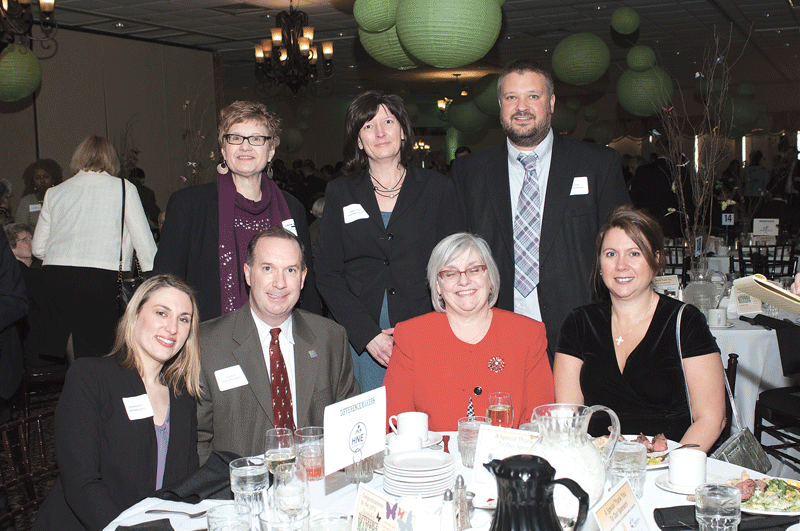
In Good Company

Springfield Mayor Domenic Sarno told BusinessWest that any community fortunate enough to have a Fortune 100 company headquartered within its boundaries should certainly expect that employer to be a solid corporate citizen.
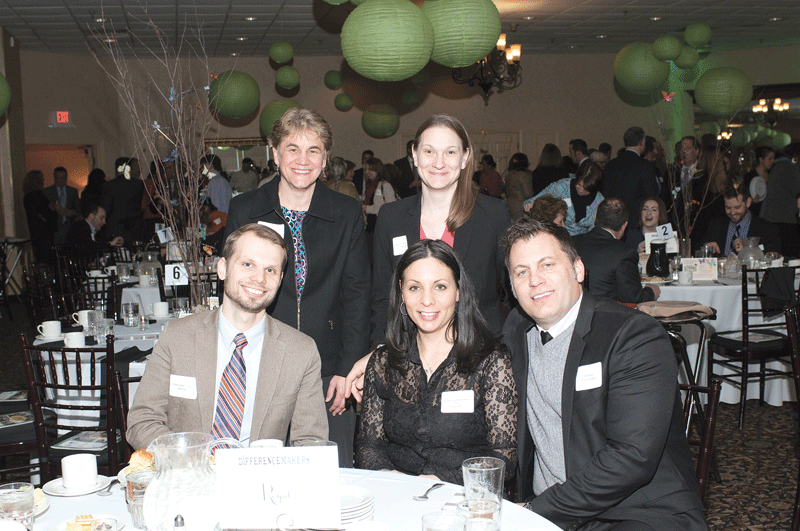
Springfield’s fireworks

Springfield’s fireworks display now bears MassMutual’s name as lead sponsor — one of the company’s many examples of philanthropy in the category of community vitality.
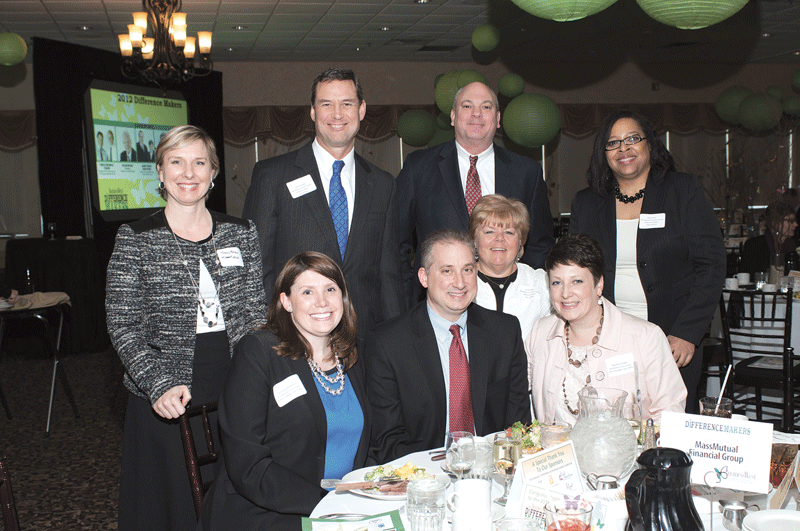
But he and others are of the opinion that what MassMutual has done over the past 164 years goes above and beyond what could — and should — be expected.

“From the beginning, this city has always been able to count on MassMutual,” said Sarno, who has been in the corner office through a number of natural disasters and economic initiatives that the company has responded to. “It’s been a source of jobs, a force on economic development, and a philanthropic monster. And it should never, ever be taken for granted, because not every city has a MassMutual — and every city would love to have one.”

Fyntrilakis said the contributions made within the community are part of a corporate culture. “We are responsive and engaged and committed to serving our community,” he said, adding that, as the company has grown over the decades and expanded physically within other communities, that philosophy has followed.

“We support other communities where we have a presence,” he explained, “including Enfield, Phoenix, Memphis, and now Boston, where we have an office. We are engaged there as well.”

But the level of engagement is much higher in Springfield, he said, and for obvious reasons. The company traces its roots here, to 1851, when Caleb Rice, then an insurance agent working for Hartford-based Connecticut Mutual Life, decided to open a similar company — one owned by its policy holders — in Massachusetts. The company’s growth mirrored the nation’s — in other words, it expanded west, opening offices in several Midwestern states, and eventually reached the West Coast in 1868.

But it has always had Springfield has its base, with several headquarters facilities, including the current home on State Street, opened in 1927. Along with Smith & Wesson (because of that company’s strong brand recognition), it is the corporate entity most associated with the City of Homes.

“We have a much deeper involvement in Springfield, both from a financial perspective as well as a human-engagement perspective,” said Fyntrilakis, “in the sense of me serving on boards of directors, having our employees volunteer in the community on various things, and employees being generous with their own dollars to causes that we support or drives that we have for food or toys or things of that nature.

“It’s pretty special — it’s a meaningful degree of support,” he went on. “It goes along with being a Fortune 100 company, but it’s not just about how big we are or what people think we should do. It’s about what we think we should do and our own commitment.”

Fyntrilakis told BusinessWest that the phrase ‘corporate responsibility’ cuts across most all aspects of the company and includes employees in many departments and on many levels. Examples include everything from environmental responsibility — an important consideration for a company with such a large footprint, and one embodied in such initiatives as solar panels on the roof of the company’s headquarters and electric-car-charging stations in the parking lot — to employee benefits and training initiatives.

But perhaps the most visible component of corporate responsibility is the many actions that fall into the broad category of philanthropy or community involvement.

Historically, there are three main categories for this involvement, he said: education, economic development, and what the company calls ‘community vitality,’ and there are many examples of each.

School of Thought

Before elaborating on each area, Fyntrilakis first went into more depth about the philosophy that governs decisions on community involvement, because doing so helps explain directions taken by the company.

“We’re not ashamed to say that it’s important for our charitable activity to align with our business strategy,” he explained. “Because, in order for us to support charitable activity, our business needs to be strong.”

And one of the keys to achieving that strength (again, for the long term) is through a quality workforce and effective means of attracting and recruiting talent. Thus, many of the philanthropic initiatives within the realm of education involve initiatives that would help better train a workforce locally and also introduce young people to the company and its myriad employment opportunities. Meanwhile, initiatives within the area of community vitality are aimed at improving quality of life, but also to make the region more attractive to potential job candidates.

On the national level, he went on, many initiatives, such the LifeBridge and FutureSmart programs, are designed at enhancing the corporation’s brand and reputation, as well as empowering more Americans to become educated financially, which ties into MassMutual’s core business.

LifeBridge is a unique, free life-insurance program that helps children of income-eligible families pay for their education expenses if their insured parent or guardian passes away during the term of the policy, while the FutureSmart Challenge, conducted in conjunction with select NBA teams, stages interactive seminars at which students learn the importance of savings, career choices, staying in school and going to college, and how each has a profound impact on their future financial success.

Locally, within the category of education, said Fyntrilakis, the emphasis is on grades 6-12, with a focus on academic achievement and career pathways. Individual initiatives involve grants to specific programs to improve academic achievement, scholarships, mentoring students at the Springfield High School of Science and Technology and Putnam Vocational Technical High School (both located nearly across State Street from the company’s headquarters building), internships, job-shadowing programs, and others.

“Our hope is that we can create a pipeline for some of those young people to come and work at MassMutual,” he explained. “Many of our initatives are aimed at prompting the diverse, talented young people that we have to think about a career at MassMutual, and have a progression and a way that they can do that.”

MassMutual’s support to Springfield

MassMutual’s support to Springfield after the 2011 tornado came in many forms, from a $1.6 grant toward the rebuilding effort to a loaned executive to help draft a recovery plan.

In the realm of community vitality, support is directed toward those events and institutions that will attract people to the city of Springfield and the region as a whole, said Fyntrilakis. That list includes everything from the recent Spalding Hoophall Classic, which brought top high-school basketball players from around the country to the City of Homes for a three-day tournament, to Bright Nights, the Fourth of July fireworks, and other events staged by the Sprit of Springfield; from the SSO to CityStage and the Springfield Museums.

As with programs in the realm of education, MassMutual’s initiatives in community involvement usually go well beyond simply writing checks.

Indeed, Audrey Szychulski, outgoing executive director of the SSO, said the company’s contributions to that institution go well beyond its sizeable season sponsorship (a six-figure gift). Indeed, several officers of the company sit on the orchestra’s board, including Chief Marketing Officer John Chandler, the current chair.

“Besides funding, MassMutual has a core group of people who interact with us on a regular basis,” she explained, adding that the company has also assisted with strategic planning, marketing initiatives, introducing the SSOP to young professionals new to the region, and even a complete IT analysis. “And when it comes to a donation of that size, it’s really an investment in our general operating needs to ensure that we really can serve our community. To them, it’s not just about the concert, but the whole experience and helping to ensure that we can touch as many people as possible through outreach initiatives.”

Response to the tornado of 2011, as well as the flood of 1936 and other natural disasters, does not fall neatly into any of the three main categories of community involvement, but it does reflect the company’s sense of responsibility to the city and its residents.

“It was an extraordinary event, and we certainly wanted to step in,” Fyntrilakis said, adding that support took forms ranging from an immediate $100,000 donation to the American Red Cross to a $1.6 million contribution to DevelopSpringfield for its Rebuild Springfield Fund, to a donation of his time and energy to co-chair the rebuilding effort.

Fueling Entrepreneurship

But if the tornado does fit into a category, it would likely be economic development, said Fyntrilakis, adding this is a relatively new classification of community involvement for the company — but one that has garnered most of the headlines in recent months.

The sharpened focus on this realm dates back roughly to 2008 and the Great Recession, he told BusinessWest, noting that the company recognized a need to reach out and help the city, which was, like many former manufacturing centers, struggling to reinvent itself and stimulate new job growth.

“We stepped back and we decided that we really needed to help the community leverage the assets it had and really take advantage of opportunities to grow and strengthen its economy,” he explained. “It’s great for us to be able to do lots of things charitably, but the reality is, the better the economy is, and the better the opportunities for people to get jobs and for the tax base to grow — that’s really what’s going to help strengthen the community a lot more than charitable contributions that aren’t going to facilitate that.”

This emphasis on economic-development-related support has taken more forms, starting with a State Street Corridor initiative that remains a work in progress. As part of that endeavor, the company helped facilitate creation of DevelopSpringfield, which Fyntrilakis called a “bricks-and-mortar organization” charged mostly with developing and repurposing underutilized properties, thereby revitalizing many of the city’s neighborhoods.

Current projects include several on State Street, including development of a supermarket, reuse of the former River Inn, razed in 2013, and redevelopment of the so-called Gunn Block. Other initiatives include renovation of the Ansel Phelps House on Maple Street and DevelopSpringfield’s commitment to build an innovation center in two long-vacant buildings on Bridge Street.

That facility will become the new home to Valley Venture Mentors (VVM), another of the Difference Makers for 2015 (see related story, page A28) and one of the focal points for MassMutual’s multi-pronged efforts to promote entrepreneurship and encourage businesses to locate within Springfield.

Overall, the company is investing $6.5 million in that realm, with $1.5 million going to VVM over the next three years for a startup accelerator — the first cohort of 30 companies started its six months of programs in January — and $5 million for creation of the Springfield Venture Fund, which will invest in startups located in Springfield or willing to relocate there.

In December, video-game developer HitPoint Studios became the first company to receive an investment ($500,000) from the fund, relocating from Amherst to a suite in 1350 Main St. in Springfield.

“We kept hearing how entrepreneurs were chasing capital, and capital was dictating where folks were locating — Boston, Cambridge, and San Francisco were putting money on the table and driving people to those communities,” said Fyntrilakis as he discussed how and why the fund came about. “Those are great cities with wonderful entrepreneurial ecosystems, but we felt that we had, through VVM and others, a good entrepreneurial ecosystem in Springfield, but the early-stage capital just wasn’t available, and folks were leaving to pursue capital elsewhere.”

By providing that early-stage capital, as well as other forms of support for entrepreneurship, MassMutual is taking a somewhat bold step in the arena of community involvement, one that should pay huge dividends down the road, said Jay Leonard, a board member at VVM and one of those who helped guide it though its formative years.

“MassMutual’s support of both the accelerator and the fund has been critical,” said Leonard, who serves as an economic researcher for one of the company’s subsidiaries, Babson Capital Management, and has served as a go-between of sorts for VVM and the corporation. “The best way to provide economic development is to invest in companies that are going to be successful, and MassMutual’s doing that.”

Minkarah agreed, and returned to that word ‘holistic’ to describe the company’s community involvement, especially with entrepreneurship initiatives.

“The company has provided support for the Springfield Innovation Center and Valley Venture Mentors, and it created the Springfield Venture Fund, and you can’t just look at any of these in isolation,” he explained. “When you look at that total package, here are very well-thought-out strategic investments designed to create a physical place that will support and foster innovation and entrepreneurship, support an organization that can actually run the program, and provide funding to support startups and high-growth companies that are innovative and entrepreneurial themselves.

“These are investments that MassMutual is making in the long-term economic health of the community,” he went on, “because they believe these are strategically positioned initiatives that can have a catalytic effect.”

Flood of Memories

It’s unlikely that anyone was using the word ‘catalytic’ with any degree of frequency back in 1936.

And that term probably wouldn’t be used to describe people sleeping on cots in MassMutual’s gymnasium because the flood leveled their homes.

But times change, in some ways, and that word is certainly appropriate now.

That’s because, while the company is basically continuing a 160-year-old tradition of community involvement, it is finding new, dynamic, and in some ways groundbreaking ways for it to evolve.

And that’s one of many reasons why it is a Difference Maker.

George O’Brien can be reached at [email protected]

Class of 2015 Difference Makers
Event Provides Memories, Camaraderie, and a Chance to Help ‘Kick Cancer’s Ass’

Domenic and Michelle Battista (front row, left), with K-Ride founders (from left) Kim Zachery, Dan Williams, and Steve Stark. Photo by Denise Smith Photography

Domenic and Michelle Battista (front row, left), with K-Ride founders (from left) Kim Zachery, Dan Williams, and Steve Stark.
Photo by Denise Smith Photography

Dr. Satkiran Grewal says that, when parents first hear the word ‘cancer’ used in the same sentence as their child’s name, they often don’t really hear much, if anything, said immediately after that.

They’re listening, said Grewal, chief of Pediatric Oncology at Baystate Children’s Hospital, but often what is said doesn’t fully register because there is a surreal quality to the news they’ve been given, and they’re still attempting to digest it while trying to anticipate what happens next. Later, parents and other family members will inevitably need help understanding, coordinating, and simply coping with the many aspects of a prolonged cancer battle.

And these are some of the many reasons why, in 2012, Baystate created a new position, an individual (a nurse practitioner, or NP) who acts essentially as a liaison between the families of children and adolescents diagnosed with cancer and the specialists providing them care. It’s a position funded in part by money raised by participants in Katelynn’s Ride, or K-Ride, as it’s called, an annual event created to honor the spirit and courage of Katelynn Battista, who lost a decade-long battle with leukemia in 1997 at age 11.

“Katelynn’s riders have supported one of Baystate’s most patient-focused initiatives — the work of a designated care coordinator who helps patients and families navigate the complexities of the healthcare system amid serious illness,” said Grewal. “It’s a very important role, and we’re grateful for their assistance.”

But support for this position is just one of many reasons why K-Ride is being honored as a Difference Maker for 2015.

Indeed, while the money it raises for both Baystate Children’s Hospital and the Dana Farber Cancer Institute through the Jimmy Fund, and also for individual families in the form of $1,000 grants to help them cope with the many expenses associated with a cancer diagnosis, is substantial ($1.7 million to date), it is only part of the story.

The event itself, through the camaraderie it creates and the critical help it provides to those coping with this deadly disease, makes a difference in the lives of those who participate and, while doing so, brings different, often-inspiring storylines to the ride’s starting line on the grounds of Hampshire College.

People like Deb Rossmeil, who started riding to honor the successful fight against leukemia waged by her son, Adam, and to help others facing similar battles. In the beginning, she would ride with a few family members, but today, the team now known as Adam’s Animals brings as many as 30 people to the ride and is annually one of the top fund-raisers.

There’s also 10-year-old Luke Bradley, a fifth-grader from South Hadley who, last May, had the honor of serving as one of the event’s ambassadors, those who cut the ribbon to start the various rides — 5, 10, 25, 50, and 100 miles. That role had traditionally gone to individuals (usually parents) whose loved one had lost their fight with the disease. But for 2014, organizers wanted to extend the honor to a young person at a key turning point in their battle.

So it was for Luke, who only a few weeks before the ride had undergone what would be his last treatment for acute lymphoblastic leukemia, essentially ending a three-year fight. He was still rather weak as he undertook the 5-mile ride himself, but he finished it.

“It was fun, and I had a great time,” he said, adding that this was an experience he’ll never forget, and he intends to be back next year with his parents and younger siblings.

And then there are Michelle and Domenic Battista, Katelynn’s parents. They both recall having mixed feelings when they were approached about creating a ride in honor of their daughter only a year after she died, but they eventually said ‘yes,’ and they’ve served as gracious hosts ever since, and say the event provides a powerful, meaningful, and at times emotionally exhausting way to honor Katelynn’s indomitable spirit.

“It’s difficult in some ways because Katelynn’s not with us,” said Michelle. “It’s overwhelming to see all the people who come out, not only for our family, but their own families, where they have a situation where someone’s battling cancer. It’s great to see a lot of the survivors, especially the children, but it’s bittersweet because our daughter’s not there.

“But I know Katelynn’s looking down on all this and smiling,” she went on. “It’s nice for her to be remembered in such a way and to have her go on inspiring people.”

Profile in Courage

Domenic Battista said Katelynn was a child who could light up any room just by walking into it.

Katelynn

Michelle Battista says cancer couldn’t stop her daughter, Katelynn, from doing anything she wanted to do.

“She had that kind of personality,” he recalled. “She was never down on herself; she just had that glow to her. She was caring for others — she knew she had a serious illness, and she fought it with … I don’t want to say ‘style,’ but I guess maybe that works.”

Michelle remembers that Katelynn was committed to not letting her cancer get in the way of whatever she wanted to do, and, for the most part, she succeeded with that mission.

“She tried to maintain her normal self and activities, just like any other child,” she told BusinessWest, “because she just wanted to be a kid and do the things that her friends did. Cancer did not hold her back; she was still involved in all her sports — she danced, she played soccer, she played basketball, she played piano, all while she was sick. She didn’t miss out on anything that she wanted to do.”

And while doing all that, Katelynn decided she would also make time to appear on a radiothon staged by radio station WHYN to raise money for Dana Farber, where she received some of her care.

It is here where the story of K-Ride begins, because it was roughly at that point where Katelynn began inspiring people to do things in her name in the ongoing fight against cancer.

Two of the hosts for that radiothon were Dan Williams and his wife and long-time radio and TV partner Kim Zachery. Williams’ best friend, Steve Stark, worked for the Postal Service, as did Domenic Battista. “It turns out we all knew other, and so we all got very involved in Katelynn’s story,” said Zachery, adding that Katelynn became a regular on radiothons.

For Williams and Stark, that involvement eventually included a cross-country bike ride they undertook in 1996 — soon after Katelynn, who had been in remission, was again diagnosed with cancer — to raise money for Dana Farber and get the infusion room there named in her honor.

“Katelynn became our inspiration,” said Williams, adding that, two years after that cross-country trek, he and Stark took part in something called the Race Across America, a 2,740-mile, non-stop relay that they and other team members completed in just under seven days. “In 1996, when we did the cross-country bike ride, we did it in honor of Katelynn, raising something like $50,000, and then in 1998, we did it in her memory — she died the year before.”

And it wasn’t long after she passed away before Williams, Stark, and Zachery started conceiving an event that would enable Katelynn to go on being an inspiration — for hundreds of people, many of whom had never met her.

“When she passed away, we knew we had to keep her name and her legacy going,” said Zachery, “because she was such a wonderful little girl and had such a fierce spirit of determination.”

The first K-Ride was staged in 2001 with roughly 60 riders. That number rose steadily to about 300, said Stark, and it has stayed around that level, dipping during the Great Recession, when most all fund-raising initiatives suffered, but rising again when it ended.

Over the years, the event has expanded to include several different rides, and also a walk, with participants coming mostly from this region but some from well outside it.

These are not races, but chances for individuals and teams to raise money through donations from friends and relatives in recognition of their participation. Riders 18 and over must raise $300 each, while riders under 18 and walkers 12 and over must raise $100. The format is similar in many ways to the popular PanMass Challenge, a bike ride that raises millions each year for the Jimmy Fund, but it is less demanding from a fund-raising perspective (PanMass Challenge participants must raise $4,000), and more of the dollars raised stay in this region.

And while the K-Ride has grown in terms of participation, it has also gained a number of corporate and media sponsors who underwrite nearly all of the operating expenses, meaning that all the money raised by the riders goes to Baystate and Dana Farber.

Fun with a Purpose

All those we spoke with said the K-Ride is much more than a sporting activity created to raise money for cancer programs. It’s an event, they note, and a family event at that, complete with a barbecue, a live band, and a host of activities.

Williams joked that riders are “pampered,” with numerous water stops, fruit, sports bars, peanut-butter-and-jelly sandwiches, shower facilities, and even a massage station.

But it is an event with a purpose, one that is reflected in everything from the names of the teams that participate (many, like Adam’s Animals, were inspired by people who have battled cancer) to the ambassadors who cut the ribbon, to the position at Baystate supported by the ride.

And that purpose isn’t lost on anyone.

Luke Bradley

Luke Bradley served as ambassador at the 2014 edition of Katelynn’s Ride only a few weeks after his last treatment for acute lymphoblastic leukemia.
Photo courtesy of Driscoll Photography

For Jeff Neumann, an artist from New York State, K-Ride offers him an enjoyable opportunity to fund more of the research and new treatment options that helped him beat back the non-Hodgkin’s lymphoma he was diagnosed with nearly 20 years ago.

“If it wasn’t for medical science and technology, I wouldn’t be here, and I wouldn’t be able to participate in such an event,” said Neumann, who has long been a friend of Williams, started riding at his urging, and joined him in recent years on a team, a fund-raising juggernaut, called K.C.A., short for ‘Kicking Cancer’s Ass.’ “I’m extremely grateful that I’m able to contribute and help some kid who may be in jeopardy of being able to ride his bike in the future.”

For Rossmeil, there are many connections between her son, Adam, and Katelynn and her family. Both families are from West Springfield, and Adam was diagnosed with the same form of leukemia (acute myeloid, or AML) as Katelynn.

Adam is now in the sixth grade and recently marked the 10th anniversary of his bone-marrow transplant. He’s been a participant in the K-Ride since he was 3, riding first with his father, before graduating to his own bike and successfully completing first the 10-mile and then the 25-mile ride.

The Rossmeil family rides and volunteers for the event to both celebrate what Adam has accomplished and create more stories like his.

“The thing we like the most is that they’re raising money for the Jimmy Fund and for the Baystate Cancer Center — Adam was treated in both facilities,” she said. “But it’s also a big family event. We get to see the Battistas every ear, and also one of Adam’s nurses from the hospital — she rides on our team — and we get to see the doctor who took care of him when he was first diagnosed; he also rides. It’s just a great event.”

Williams told BusinessWest that the ride has generated many traditions over the years, none more poignant for him than the ambassadors.

“There have been some inspirational stories over the years, and there have also been some very sad stories,” he said in reference to those who cut the ribbons. “Even though this is a day of celebration, we’re still dealing with cancer, so we’ve had families representing a child that may have passed away from cancer cutting the ribbon. That has a sobering effect, but it reminds everyone of why we’re doing this, why we’re all together on this particular day, and why we’re riding when it’s 95 degrees out or the rain is coming down sideways.”

For the Battistas, meanwhile, the ride is a day that generates a wide range of emotions, from sadness to elation to pride in what has been accomplished.

“We have some riders who have been with us since day one, and it’s great to see them come back each year,” said Domenic. “We’re here 15 years later, and I never thought it would get this big or go this long, but it has, and that’s a tribute to a dedicated crew we call the Friends of Katelynn. It’s a long day, but a nice day, a family day of remembrance for Katelynn while we’re helping to fund this position at Baystate.”

Katelynn’s ride participants describe it as a family event packed with fun, purpose, and poignancy. Photo courtesy of  Driscoll Photography

Katelynn’s ride participants describe it as a family event packed with fun, purpose, and poignancy.
Photo courtesy of Driscoll Photography

Such an individual was not available to families when Kateylnn was battling cancer, he said, adding that, when Grewal and others at Baystate indicated a desire to direct some of the K-Ride’s donations in that direction, organizers were in full support.

Hired in 2012, the nurse practitioner has been an effective addition to the staff at Baystate, working with patients and their families in both inpatient (at Baystate Children’s Hospital) and outpatient (at the Sadowsky Center for Children) clinical settings.

The NP assists families with everything from managing medications properly to scheduling tests to answering the myriad questions that are inevitably raised during a cancer battle, said Grewal, adding that, while the survival rates for childhood cancer are quite good, that doesn’t mean the process of treatment is in any way easy or without stress.

And starting just after the news is broken to parents, the nurse practitioner serves as an intermediary of sorts and a needed source of information and support during an often-years-long ordeal that can and usually will test a family’s patience — and mettle.

“There is a shock that comes to the family, and after the initial news on the first meeting, most of the things just fly over their heads,” Grewal explained. “We as physicians meet with the family on multiple occasions, but a nurse practitioner fills that role in between. And I wouldn’t say it’s hand-holding, although there is some of that. There are also many questions to be answered.

“I’ve been guilty, like everyone else, of using technical terminology,” he went on. “Parents won’t interrupt me while I’m doing that, but they’ll sit down with the nurse practitioner later, go over everything again, and they’ll say, ‘I didn’t understand what he said when he was saying this.’”

The Ride Stuff

While the K-ride is fun and rewarding, Zachery told BusinessWest, it is also a great deal of work. And that’s why organizers have at times — usually just after the event is staged — stopped to consider if this is something they want to continue doing.

“But then, the e-mails start coming in from people telling us this was the best ride ever, or that they plan to keep coming back, or that they’re really inspired by what we do,” she told BusinessWest. “And that keeps us going.”

If they wanted another reason to push on, they need only recall something Katelynn said not long before she died: “nothing is ever too hard to do if your faith is strong and your purpose is true.”

Those words apply to a cancer fight, obviously, but also to life in general — and perhaps a 100-mile bike ride as well.

And they represent only one way in which Katelynn — and all of her many friends — continue to inspire and make a difference.

George O’Brien can be reached at [email protected]

Opinion
A Worthy Class of Difference Makers

BusinessWest’s Difference Makers Class of 2015 may be the most compelling to date, and for many reasons.

For starters, many of the honorees might be considered non-traditional by some. There’s a local employer (granted, a Fortune 100 company); a nonprofit that is, by most standards, still just getting started; the director of another nonprofit, tasked with community events such as fireworks displays and parades; the organizers of a bike race that raises funds to battle cancer; and the new ownership team at a landmark Springfield restaurant, one that only reopened its doors 10 weeks ago (see story HERE).

Because these honorees are non-traditional, that might lead to speculation, if not open debate, about whether some — or all — are worthy of that designation Difference Maker. While we acknowledge that some of these selections are certainly different, a very strong case can be made for each. And we’ll make those cases. In no particular order:

MassMutual. There are some, perhaps many, who would say that giving back to the community is what is a Fortune 100 is supposed to do. Perhaps, but not all of them do, and not many do it to the extent that this Springfield-based institution does.

Meanwhile, it’s not merely the level of philanthropy, or community involvement, that sets this company apart, but the nature of that involvement. Its giving is part of a considered strategy to build a stronger community and a capable workforce for the long term — a holistic approach, as one observer called it.

Judy Matt, executive director of the Spirit of Springfield. While some might debate whether someone who organizes a fireworks display should be placed in the same category as an individual devoted to improving childhood literacy, we do not.

They are both making a difference in their own way. Matt, who has been at the forefront of creating, enhancing, and continuing community-focused, family-focused events for more than three decades, deserves a huge amount of credit for improving quality of life here and providing some light in some otherwise very dark times in Springfield’s history. Bright Nights is her best piece of work, but it is a deep — and powerful — portfolio.

Katelynn’s Ride. When BusinessWest launched this recognition program in 2009, one of the goals was to show that you don’t have to change the world — or be a Fortune 100 company, for that matter — to make a difference. You can do that by changing a small part of the world.

And Katelynn’s Ride does just that. The K-Ride, as it’s often called, named in honor of Katelynn Battista, who lost a courageous battle to leukemia at age 11, makes a difference in the lives of cancer patients and their families through donations to Baystate Children’s Hospital and the Jimmy Fund. And, more specifically, it makes a huge difference locally through its support for a new position at Baystate — a liaison of sorts between families of cancer patients and the specialists who provide care. And it’s making a difference simply by bringing together hundreds of people to battle a common — and hated — enemy.

• Valley Venture Mentors. While this nonprofit, economic-development agency is really just getting started, it is already making a difference as it works toward creating what its founders describe, alternately, as an entrepreneurial renaissance and an entrepreneurial ecosystem.

Springfield is light years away from being Silicon Valley or Cambridge, and it will likely never approximate what those communities have done. But at least people can talk in those terms. Years ago, there was no such talk, and VVM has brought about that change.

• The new ownership team at the Student Prince and the Fort. ‘The restaurant has only been open for two and a half months!’ ‘No one’s really sure how it’s going to fare!’ ‘It’s just a restaurant!’ ‘How can these individuals be Difference Makers?’ We acknowledge all these opinions and questions and understand their origins.

But this new ownership team — The Yee family, Peter Picknelly, and Kevin and Michael Vann — are already making a difference by keeping another of Springfield’s institutions from being relegated to the past tense. And they’re making a difference because of the energy they’re creating in Springfield, and for ensuring a better future.

Agenda Departments

Chicopee Chamber CEO Luncheon
Feb. 11: The Greater Chicopee Chamber of Commerce will present its first CEO luncheon of 2015 from 11:45 a.m. to 1 p.m. at the Collegian Court Restaurant, 16 Park St., Chicopee. The speaker will be Elizabeth Barajas-Román, CEO of the Women’s Fund of Western Mass. Barajas-Román has been a leader in progressive movements, including advocating at the national level for the health and rights of immigrant women and their families. Most recently, she was a manager at the Pew Charitable Trusts, where she directed a portfolio of partners that campaigned for state and federal policy change to improve government performance on issues that impact children’s health. Barajas-Román brings a background in impactful philanthropy, data-driven strategy design, fund-raising through philanthropic partnerships, creating coalitions, and mobilizing partners. Previously, she served as the director of Policy at the National Latina Institute for Reproductive Health and directed the organization’s Washington, D.C. office. Barajas-Román was frequently invited to be a voice in national-policy discussions at the White House and on Capitol Hill. She is a graduate of Oberlin College and received her master’s degree in international policy from Harvard University. To register for the luncheon, visit ‘Upcoming Events’ on the chamber’s website, www.chicopeechamber.org. The cost is $25 for chamber members and $30 for non-members.

‘Pink in the Rink’
Feb. 21: Noble Hospital is the major sponsor the Springfield Falcons’ “Pink in the Rink” event against the Portland Pirates. This annual event helps to raise funds for and awareness of breast cancer. Falcons players wear special pink jerseys that will be autographed and auctioned off after the event. Visit www.ebay.com/usr/springfieldfalcons to bid on the pink jerseys after the game. In addition to the hockey game, breast-cancer survivors will be honored, there will be giveaways and raffles, and Noble Hospital will provide an information booth. Members of a support group, the Pink WAY, will also attend. Noble Hospital’s Center for Comprehensive Breast Health, under the direction of Dr. Steven Schonholz, provides a wide range of options and services in a single location. Pink bracelets will be available for donations at the Noble table; funds raised will go towards Noble’s breast-cancer awareness programs and to help local patients going through treatments. Area residents can support Noble Hospital by purchasing tickets to the game at give.noblehospital.org/pinkintherink. For more information, contact the hospital’s Community Development Office at [email protected] or (413) 568-2811, ext. 5520.

West of the River Chamber Legislative Breakfast
Feb. 25: The West of the River Chamber of Commerce announced that it will stage its Legislative Breakfast, an event that brings members and non-members together for a morning of breakfast and legislative updates, from 7 to 9 a.m. at the Storrowton Tavern Carriage House in West Springfield. Attendees will have the opportunity to connect with local business people over breakfast, and later will enjoy an informational session presented by a panel of legislators including state Sens. Donald Humason and James Welch, state Rep. Michael Finn, Agawam Mayor Mayor Richard Cohen, and West Springfield Mayor Edward Sullivan. Political consultant Anthony Cignoli will emcee the event and offer economic updates. Sponsors for the event are Health New England, OMG, the Insurance Center of New England, Ormsby Insurance, and Spherion. The cost is $25 for members, $30 for non-members. For more information, call the chamber office at (413) 426-3880.

Greater Westfield Chamber Legislative Luncheon
Feb. 27: The Greater Westfield Chamber of Commerce, which serves Blandford, Chester, Granville, Huntington, Montgomery, Russell, Southwick, Tolland, Westfield, and Woronoco, will present its second annual Legislative Luncheon at Tekoa Country Club. Invited state legislators include Sens. Benjamin Downing and Donald Humason and Reps. Nicholas Boldyga, Peter Kocot, Stephen Kulig, William Pignatelli, and John Velis. A host of sponsorship opportunities are still available. Tickets for the event are $25 for chamber members and $35 (paid in advance) for non-members. For more information on tickets and sponsorships, call the chamber at (413) 568-1618.

PAWSCARS Fund-raiser
Feb. 28: Dakin Humane Society will present a fund-raising event at the MassMutual Center in Springfield that will affectionately spoof Hollywood, the Oscars, and red-carpet fashion. Dubbed “The PAWSCARS & Red Carpet Fashion Parade,” the show will be emceed by Ashley Kohl and Seth Stutman, hosts of Mass Appeal on WWLP-22News. Beginning with a VIP Reception at 6 p.m. and a plated dinner at 7 p.m., the evening will also include a red-carpet fashion parade featuring local people of prominence, accompanied by rescue dogs (among them former Dakin dogs, now adopted). Short videos of animals recreating iconic moments in cinematic history, created by members of the public, will also be screened during the evening. “We’re looking forward to presenting a one-of-a-kind event with the PAWSCARS,” said Dakin Executive Director Leslie Harris. “We’re blending fashion, fun, and film with a healthy dose of humor for an unforgettable night. Plus, as our major fund-raising event of the year, it will be a terrific opportunity for our supporters to come together and enjoy themselves while providing much-needed aid for the many animals in our care.” With a targeted audience of 500, The PAWSCARS is Dakin’s most ambitious fund-raising event in its 45-year history. Tickets for the event are available at www.dakinhumane.org for $125 per person (dinner and show) or $50 (show only). Corporate sponsors for the PAWSCARS include Baystate Health, Piepul’s Camera Center, Clinical & Support Options, United Personnel, C.A.R. Data Management and Program Evaluation Services, Hampden Bank, and Robinson Donovan. The Republican, Reminder Publications, WMAS, the Daily Hampshire Gazette, and the Recorder are among the media sponsors. Visit www.dakinhumane.org for more information about the event.

Difference Makers
March 19: The sixth annual Difference Makers award program, staged by BusinessWest, will be held at the Log Cabin Banquet & Meeting House. Difference Makers is a program, launched in 2009, that recognizes groups and individuals that are making a difference in this region. The class of 2015 is profiled in this issue. Tickets cost $60 per person, and tables of 10 are available. Go HERE to order, or call (413) 781-8600, ext. 10, or e-mail [email protected].

40 Under Forty
June 18: The ninth annual 40 Under Forty award program, staged by BusinessWest, will be held at the Log Cabin Banquet & Meeting House. Details on the event, which honors the region’s most accomplished and civic-minded professionals under age 40, will be published in upcoming issues. The class of 2015 will be revealed and profiled in the April 20 issue.

Daily News

SPRINGFIELDBusinessWest will unveil its seventh annual class of Difference Makers on Monday, in the Feb. 9 issue, which features lengthy, in-depth profiles of this year’s honorees — a can’t-miss issue. Difference Makers is a program, launched in 2009, that recognizes groups and individuals that are, as the name suggests, making a difference in this region.

The annual Difference Makers award program will be held at the Log Cabin Banquet & Meeting House on March 19. Tickets cost $60 per person, and reserved tables of 10 are available. To order tickets, call (413) 781-8600, ext. 100, or e-mail [email protected].

Agenda Departments

ACCGS Lunch ‘n’ Learn
Jan. 28: The November election has passed, and the voters have spoken, approving ballot question #4 approving of mandated sick leave, making Massachusetts only the third state in the nation to guarantee paid sick days for workers. Timothy Murphy, Esq., partner with Skoler, Abbott & Presser, P.C. and leading expert on the subject for the Affiliated Chambers of Commerce of Greater Springfield (ACCGS) Legislative Steering Committee, will explore the impact of the law at the ACCGS Lunch ‘n’ Learn from 11:30 a.m. to 1 p.m. in the Dodge Room of the Flynn Campus Union at Springfield College, 263 Alden St., Springfield. Murphy will discuss what the law entails for both large and small businesses, how the law will impact companies already providing sick leave or those that provide personal time off incorporating sick leave, which workers are eligible and which are not, what it means for a company and its workforce, and the subtle nuances of the law. Murphy joined Skoler, Abbott & Presser in 2001 after serving as general counsel to an area labor union. He represents and advises both union and non-union employers in a wide range of labor and employment matters. He regularly represents employers in matters before state and administrative agencies and courts. His work includes assisting employers to remain union-free, defending unfair labor practices, negotiating collective-bargaining agreements, and handling grievance arbitrations. Murphy is on the executive committee of the Springfield Chamber of Commerce and, is the former chair of the ACCGS Legislative Steering Committee, and is the go-to resource for the ACCGS on the issue of mandated sick leave. Reservations for the January Lunch ‘n’ Learn are $25 for members, $35 for general admission.  Registration includes lunch and one-on-one discussions with Murphy. Reservations may be made online at www.myonlinechamber.com or by e-mailing Sarah Mazzaferro at [email protected].
 
ACCGS Breakfast
Feb. 4:
Shriners Hospitals for Children will be among the honorees at the Affiliated Chambers of Commerce of Greater Springfield’s (ACCGS) Business@Breakfast on Wednesday, Feb. 4 from 7:15 to 9 a.m. at Crestview Country Club, 281 Shoemaker Lane, Agawam. Shriners Hospital for Children will be honored for its 90th anniversary. The hospital provides medical care to children with orthopaedic, neuromusculoskeletal, cleft-lip, and palate disorders and diseases. As well, GZA GeoEnvironmental Inc., a professional-services consulting firm focused on geotechnical, environmental, water, ecological, and construction-management services, will be saluted for its 50th anniversary, and FIT Solutions, a leader in IT staffing, will be honored for its 10th anniversary. The breakfast will feature Dr. Steve Sobel, humorist and motivational speaker. Sobel will present “You’re a Piece of Work! Celebrate Joy, Passion, and Influence.” Sobels’s presentation will use humor to illuminate life’s possibilities and provide attendees with the tools needed to help them bring their ‘A’ game to their companies and customers. Sobel, a speaker, educator, success coach, and trainer throughout the U.S. and Canada, blends humor with targeted and inspirational messages to companies, businesses, athletic teams, and professional groups. He is a former award-winning school principal and continues to teach part-time at the college level, including many courses on entrepreneurship and visionary leadership. Reservations are $20 in advance for ACCGS members in advance ($25 at the door) and $30 for general admission. Reservations can be made online at www.myonlinechamber.com.

Chicopee Chamber CEO Luncheon
Feb. 11: The Greater Chicopee Chamber of Commerce will present its first CEO luncheon of 2015 from 11:45 a.m. to 1 p.m. at the Collegian Court Restaurant, 16 Park St., Chicopee. The speaker will be Elizabeth Barajas-Román, CEO of the Women’s Fund of Western Mass. Barajas-Román has been a leader in progressive movements, including advocating at the national level for the health and rights of immigrant women and their families. Most recently, she was a manager at the Pew Charitable Trusts, where she directed a portfolio of partners that campaigned for state and federal policy change to improve government performance on issues that impact children’s health. Barajas-Román brings a background in impactful philanthropy, data-driven strategy design, fund-raising through philanthropic partnerships, creating coalitions, and mobilizing partners. Previously, she served as the director of Policy at the National Latina Institute for Reproductive Health and directed the organization’s Washington, D.C. office. Barajas-Román was frequently invited to be a voice in national-policy discussions at the White House and on Capitol Hill. She is a graduate of Oberlin College and received her master’s degree in international policy from Harvard University. To register for the luncheon, visit ‘Upcoming Events’ on the chamber’s website, www.chicopeechamber.org. The cost is $25 for chamber members and $30 for non-members.

‘Pink in the Rink’
Feb. 21: Noble Hospital is the major sponsor the Springfield Falcons’ “Pink in the Rink” event against the Portland Pirates. This annual event helps to raise funds for and awareness of breast cancer. Falcons players wear special pink jerseys that will be autographed and auctioned off after the event. Visit www.ebay.com/usr/springfieldfalcons to bid on the pink jerseys after the game. In addition to the hockey game, breast-cancer survivors will be honored, there will be giveaways and raffles, and Noble Hospital will provide an information booth. Members of a support group, the Pink WAY, will also attend. Noble Hospital’s Center for Comprehensive Breast Health, under the direction of Dr. Steven Schonholz, provides a wide range of options and services in a single location. Pink bracelets will be available for donations at the Noble table; funds raised will go towards Noble’s breast-cancer awareness programs and to help local patients going through treatments. Area residents can support Noble Hospital by purchasing tickets to the game at give.noblehospital.org/pinkintherink. For more information, contact the hospital’s Community Development Office at [email protected] or (413) 568-2811, ext. 5520.

West of the River Chamber Legislative Breakfast
Feb. 25: The West of the River Chamber of Commerce announced that it will stage its Legislative Breakfast, an event that brings members and non-members together for a morning of breakfast and legislative updates, from 7 to 9 a.m. at the Storrowton Tavern Carriage House in West Springfield. Attendees will have the opportunity to connect with local business people over breakfast, and later will enjoy an informational session presented by a panel of legislators including state Sens. Donald Humason and James Welch, state Rep. Michael Finn, Agawam Mayor Mayor Richard Cohen, and West Springfield Mayor Edward Sullivan. Political consultant Anthony Cignoli will emcee the event and offer economic updates. Sponsors for the event are Health New England, OMG, the Insurance Center of New England, Ormsby Insurance, and Spherion. The cost is $25 for members, $30 for non-members. For more information, call the chamber office at (413) 426-3880.

PAWSCARS Fund-raiser
Feb. 28: Dakin Humane Society will present a fund-raising event at the MassMutual Center in Springfield that will affectionately spoof Hollywood, the Oscars, and red-carpet fashion. Dubbed “The PAWSCARS & Red Carpet Fashion Parade,” the show will be emceed by Ashley Kohl and Seth Stutman, hosts of Mass Appeal on WWLP-22News. Beginning with a VIP Reception at 6 p.m. and a plated dinner at 7 p.m., the evening will also include a red-carpet fashion parade featuring local people of prominence, accompanied by rescue dogs (among them former Dakin dogs, now adopted). Short videos of animals recreating iconic moments in cinematic history, created by members of the public, will also be screened during the evening. “We’re looking forward to presenting a one-of-a-kind event with the PAWSCARS,” said Dakin Executive Director Leslie Harris. “We’re blending fashion, fun, and film with a healthy dose of humor for an unforgettable night. Plus, as our major fund-raising event of the year, it will be a terrific opportunity for our supporters to come together and enjoy themselves while providing much-needed aid for the many animals in our care.” With a targeted audience of 500, The PAWSCARS is Dakin’s most ambitious fund-raising event in its 45-year history. Tickets for the event are available at www.dakinhumane.org for $125 per person (dinner and show) or $50 (show only). Corporate sponsors for the PAWSCARS include Baystate Health, Piepul’s Camera Center, Clinical & Support Options, United Personnel, C.A.R. Data Management and Program Evaluation Services, Hampden Bank, and Robinson Donovan. Visit www.dakinhumane.org for more information about the event.

Difference Makers
March 19: The sixth annual Difference Makers award program, staged by BusinessWest, will be held at the Log Cabin Banquet & Meeting House. Details on the event will be published in upcoming issues of the magazine. Difference Makers is a program, launched in 2009, that recognizes groups and individuals that are, as the name suggests, making a difference in this region. The class of 2015 will be unveiled and profiled in the upcoming Feb. 9 issue. Tickets on sale for $60 each. Table of 10 available. Call (413) 781-8600.

40 Under Forty
June 18: The ninth annual 40 Under Forty award program, staged by BusinessWest, will be held at the Log Cabin Banquet & Meeting House. Details on the event, which honors the region’s most accomplished and civic-minded professionals under age 40, will be published in upcoming issues. Nominations are now open for the class of 2015, and are due by the end of the day (5 p.m.) on Feb. 6. The nomination form can be found at HERE.

Agenda Departments

Speed Networking Event
Jan. 14: Back by popular demand, the Affiliated Chambers of Commerce of Greater Springfield (ACCGS) will hold an afternoon of speed networking on at the Sheraton Springfield, followed by an evening of informal networking at its After 5. The combination of events will provide attendees the opportunity to meet new contacts in a formal manner, then continue conversations in an informal and casual setting. The core concept to speed networking is the ‘elevator speech,’ a short summary of an individual, business, organization, product, or service that a person could deliver in the time span of a short elevator ride. Attendees will be divided into groups A and B. Members of each group will be seated across from each other. Each member of Group A will have 60 seconds to give his or her elevator speech to a member of Group B. A bell will ring, signaling the 60-second time is up, and each member of Group B will then get a chance to speak. The facilitator will signal when the 60 seconds are up again, and members of Group A will then move one seat to the right and begin the process again with a new partner. The round-robin format of networking will continue until the event is over, at which time attendees can then move to the casual atmosphere of the MVP Pub for the ACCGS “Score a Touchdown” After 5, sponsored by Wolf & Co. and DevelopSpringfield with support from the Springfield Falcons, United Way of Pioneer Valley, and BusinessWest. The event begins at 3:30 p.m. with registration and instructions. To accommodate the event, no admittance will be allowed after 3:55 p.m. The event ends at 5 p.m., and the After 5 runs from 5 to 7 p.m. Reservations are $20 in advance, $25 at the door, and only members of the ACCGS, Springfield Chamber of Commerce, or East of the River Five Town Chamber of Commerce are eligible to participate. Reservations include a complimentary ticket to the After 5. Reservations for the After 5 only are $5 for members, $10 for general admission. The After 5 is open to the general public. Reservations may be made online in advance at www.myonlinechamber.com or by contacting Sarah Mazzaferro at [email protected]
 
Employment-law Seminar
Jan. 27: Now that the new year here, it’s an ideal time to review the past year’s changes in labor and employment law. Royal LLP will host a seminar from 8 to 9 a.m. to review some of the most interesting and significant labor- and employment-law changes from 2014 and provide timely and practical advice on how these changes will affect businesses in years to come. Attorney Sarah Torres will conduct the roundtable-style seminar, where she will provide practical pointers to assist organizations in ensuring they are up-to-date and in compliance with these new laws. She will cover topics such as sick leave, domestic-violence leave, minimum-wage increases, and more. The cost for the seminar is $30 per person, and it will take place at Royal LLP, 270 Pleasant St., Northampton. Advance registration is required, and seating will be limited. Contact Ann-Marie Marcil at [email protected] to register or if you have any questions about the seminar. Checks should be made payable to Royal LLP and mailed to 270 Pleasant St., Northampton, MA 01060.

WNEU Mini-Law School
Feb. 10 to March 10: Western New England University School of Law will open its doors to the community with a five-week program focused on demystifying the law. Starting on Feb. 10, the Mini-Law School will be held on Tuesday evenings from 6 to 8 p.m. at the Blake Law Center, Room D, 1215 Wilbraham Road, Springfield. “Individuals interested in becoming better-informed and engaging in stimulating dialogue will find this program rewarding,” said Pat Newcombe, associate dean for Library and Information Resources. “No legal knowledge is necessary, just a curious mind.” Mini-Law School offers non-lawyers an understanding of legal topics that impact their everyday lives. Each class is taught by School of Law faculty and moderated by the Hon. Kenneth Neiman, magistrate judge, U.S. District Court, District of Massachusetts. Blending theory and practice, the classes will focus on family law, health law, constitutional law, and environmental law. The sessions include:
• Feb. 10: “Welcome to Mini-Law School: An Inside View of Law School and the Courts,” presented by Neiman and School of Law Dean Eric Gouvin;
• Feb. 17: “Family Law: What Defines a Family?” presented by 
Professor of Law Jennifer Levi and Neiman;
• Feb. 24: “Health Law: End-of-Life Choices,” presented by 
Professor of Law Barbara Noah and Neiman;
• March 3: “Constitutional Law: Real Law or Just Another Kind of Politics?” presented by Professor of Law Bruce Miller and Neiman; and
• March 10: “Environmental Law: Legal Solutions to Pollution Challenges,” presented by 
Professor of Law Julie Steiner and Neiman.
“After five weeks, you won’t be a lawyer,” said Western New England University Associate Dean for Academic Affairs Beth Cohen, “but you will be able to better understand laws that have an effect on your life, and, unlike traditional law school, there are no tests or homework.” Tuition is $35 for all five sessions, or $10 for each individual session. The program is free of charge for any high-school, college, or graduate student with a valid student ID. To register by phone or for more information, call Newcombe at (413) 782-1616. Registration will continue through Jan. 19. Learn more at www.law.wne.edu/minilaw.

PAWSCARS Fund-raiser
Feb. 28: Dakin Humane Society will present a fund-raising event on at the MassMutual Center in Springfield that will affectionately spoof Hollywood, the Oscars, and red-carpet fashion. Dubbed “The PAWSCARS & Red Carpet Fashion Parade,” the show will be emceed by Ashley Kohl and Seth Stutman, hosts of Mass Appeal on WWLP-22News. Beginning with a VIP Reception at 6 p.m. and a plated dinner at 7 p.m., the evening will also include a red-carpet fashion parade featuring local people of prominence, accompanied by rescue dogs (among them former Dakin dogs, now adopted). Short videos of animals recreating iconic moments in cinematic history, created by members of the public, will also be screened during the evening. “We’re looking forward to presenting a one-of-a-kind event with the PAWSCARS,” said Dakin Executive Director Leslie Harris. “We’re blending fashion, fun, and film with a healthy dose of humor for an unforgettable night. Plus, as our major fund-raising event of the year, it will be a terrific opportunity for our supporters to come together and enjoy themselves while providing much-needed aid for the many animals in our care.” With a targeted audience of 500, The PAWSCARS is Dakin’s most ambitious fund-raising event in its 45-year history. Tickets for the event are available at www.dakinhumane.org for $125 per person (dinner and show) or $50 (show only). Dakin is currently seeking video submissions from the public for viewing at the event, and the deadline is Saturday, Jan. 31. All videos will be reviewed, and a committee will select nine finalist videos to be screened at the PAWSCARS. Each of the nine people submitting a video will be awarded a free ticket to the PAWSCARS event (including dinner and entertainment). Corporate sponsors for the PAWSCARS include Baystate Health, Piepul’s Camera Center, Clinical & Support Options, United Personnel, C.A.R. Data Management and Program Evaluation Services, Hampden Bank, and Robinson Donovan. The Republican, Reminder Publications, WMAS, the Daily Hampshire Gazette, and the Recorder are among the media sponsors for the event. Visit www.dakinhumane.org for complete contest and video-submission information, as well as additional information about the event. Dakin Humane Society provides shelter, education, advocacy, and assistance for animals and people in need from its two locations in Springfield and Leverett. The organization shelters nearly 6,000 animals every year and provides low-cost spay/neuter surgery and vaccinations to 12,000 more. Dakin is a local, private, nonprofit organization that relies solely on contributions from individuals and businesses that care about animals to bring its services to the community.

Difference Makers
March 19: The sixth annual Difference Makers award program, staged by BusinessWest, will be held at the Log Cabin Banquet & Meeting House. Details on the event will be published in upcoming issues of the magazine. Difference Makers is a program, launched in 2009, that recognizes groups and individuals that are, as the name suggests, making a difference in this region. This year’s class will be profiled in the Feb. 9 issue.

40 Under Forty
June 18: The ninth annual 40 Under Forty award program, staged by BusinessWest, will be held at the Log Cabin Banquet & Meeting House. Details on the event, which honors the region’s most accomplished and civic-minded professionals under age 40, will be published in upcoming issues. Nominations are now open for the class of 2015, and are due by the end of the day (5 p.m.) on Feb. 6. The nomination form can be found HERE.

Daily News

HOLYOKE — The seventh annual Difference Makers award program, staged by BusinessWest, will be held at the Log Cabin Banquet & Meeting House in Holyoke on Thursday, March 19. Details on the gala will be published in upcoming issues of the magazine. Event sponsors include Six Point Creative Works, Northwestern Mutual, Royal LLP, and Sarat Ford Lincoln.

Difference Makers is a program, launched in 2009, that recognizes groups and individuals that are, as the name suggests, making a difference in this region. The magazine’s editor and publishers have selected this year’s honorees from submitted nominations, and the class of 2015 will be unveiled and profiled in the Feb. 9 edition — always a must-read issue.

Agenda Departments

Business@Breakfast
Jan. 7: The entrepreneurial spirit of the region will take center stage at the Affiliated Chambers of Commerce of Greater Springfield’s Business@Breakfast on Jan. 7, from 7:15 a.m. to 9 a.m. at Ludlow Country Club, One Tony Lema Dr., Ludlow. Paul Silva, executive director of Valley Venture Mentors (VVM), will discuss “Putting the PIONEER Back in Pioneer Valley.” He will be joined by Natasha Clark, founder of LionessMagazine.com, a Western Mass.-based, all-digital magazine for the female entrepreneur. VVM is a nonprofit based in Springfield that provides key support to the entrepreneurial ecosystem through its mentorship and accelerator programs. Silva is the manager of the River Valley Investors angel-investor network and co-founder of the Valley Venture Mentors entrepreneurship-mentoring program and All in Play, a company creating software that helps the blind socialize with their fully sighted friends and families as equals. He is the former president of the co-working space and incubator Click Workspace. The breakfast will also honor Dr. Mark Keroack on his new role as CEO of Baystate Health, and recognize Andrew Associates on its 30th anniversary in business. Reservations are $20 for ACCGS members in advance ($25 for members at the door) and $30 for general admission. Reservations are suggested and can be made online at www.myonlinechamber.com.

WNEU Mini-Law School
Feb. 10 to March 10: Western New England University School of Law will open its doors to the community with a five-week program focused on demystifying the law. Starting on Feb. 10, the Mini-Law School will be held on Tuesday evenings from 6 to 8 p.m. at the Blake Law Center, Room D, 1215 Wilbraham Road, Springfield. “Individuals interested in becoming better-informed and engaging in stimulating dialogue will find this program rewarding,” said Pat Newcombe, associate dean for Library and Information Resources. “No legal knowledge is necessary, just a curious mind.” Mini-Law School offers non-lawyers an understanding of legal topics that impact their everyday lives. Each class is taught by School of Law faculty and moderated by the Hon. Kenneth Neiman, magistrate judge, U.S. District Court, District of Massachusetts. Blending theory and practice, the classes will focus on family law, health law, constitutional law, and environmental law. The sessions include:
• Feb. 10: “Welcome to Mini-Law School: An Inside View of Law School and the Courts,” presented by Neiman and School of Law Dean Eric Gouvin;
• Feb. 17: “Family Law: What Defines a Family?” presented by 
Professor of Law Jennifer Levi and Neiman;
• Feb. 24: “Health Law: End-of-Life Choices,” presented by 
Professor of Law Barbara Noah and Neiman;
• March 3: “Constitutional Law: Real Law or Just Another Kind of Politics?” presented by Professor of Law Bruce Miller and Neiman; and
• March 10: “Environmental Law: Legal Solutions to Pollution Challenges,” presented by 
Professor of Law Julie Steiner and Neiman.
“After five weeks, you won’t be a lawyer,” said Western New England University Associate Dean for Academic Affairs Beth Cohen, “but you will be able to better understand laws that have an effect on your life, and, unlike traditional law school, there are no tests or homework.” Tuition is $35 for all five sessions, or $10 for each individual session. The program is free of charge for any high-school, college, or graduate student with a valid student ID. To register by phone or for more information, call Newcombe at (413) 782-1616. Registration will continue through Jan. 19. Learn more at www.law.wne.edu/minilaw.

Difference Makers

March 19: The sixth annual Difference Makers award program, staged by BusinessWest, will be held at the Log Cabin Banquet & Meeting House. Details on the event will be published in upcoming issues of the magazine. Difference Makers is a program, launched in 2009, that recognizes groups and individuals that are, as the name suggests, making a difference in this region. The magazine’s editor and publishers are currently reviewing nominations, and this year’s class will be profiled in the Feb. 9 issue.

Origami-inspired Art Exhibit
Through April 26: “Origami Interpretations,” an exhibit of 25 vibrant paintings, sculptures, and prints by New York artist Gloria Garfinkel, will be on view at the George Walter Vincent Smith Art Museum through April 26. The works, produced in the late 20th century, feature bold color, energetic patterns, and abstract compositions inspired by Japanese designs and origami forms. The artist, whose work combines complex geometry and painterly invention, is particularly fascinated by the kimono, the traditional dress of Japan, and the obi, the wide sash that is worn as a belt with it. She appreciates the “beauty and tenacity” expressed through the garments and notes that Japanese women continually recycle and layer fabrics to create unique looks and patterns. Garfinkel is also inspired by the color-field artists of the mid-20th century who explored different optical effects by manipulating their canvases. Garfinkel carefully arranges her forms in very specific ways to create a uniquely approachable and participatory aesthetic experience. The exhibition features pieces from Garfinkel’s series “Gingko Kimono,” collaged etchings from the late 1980s; paintings inspired by the obi; etchings from the “Kiku” (chrysanthemum) series; Kado woodcut prints; Hanabi maquettes; and aluminum flip paintings.

40 Under Forty
June 18: The ninth annual 40 Under Forty award program, staged by BusinessWest, will be held at the Log Cabin Banquet & Meeting House. Details on the event, which honors the region’s most accomplished and civic-minded professionals under age 40, will be published in upcoming issues. Nominations are now open for the class of 2015, and are due by the end of the day (5 p.m.) on Feb. 6. The nomination form can be found at HERE, in this issue, and in upcoming issues.

Agenda Departments

Affiliated Chambers’ Business@Breakfast
Jan. 7: The entrepreneurial spirit of the region will take center stage at the Affiliated Chambers of Commerce of Greater Springfield’s Business@Breakfast on Jan. 7, from 7:15 a.m. to 9 a.m. at Ludlow Country Club, One Tony Lema Dr., Ludlow. Paul Silva, executive director of Valley Venture Mentors (VVM), will discuss “Putting the PIONEER Back in Pioneer Valley.” He will be joined by Natasha Clark, founder of LionessMagazine.com, a Western Mass.-based, all-digital magazine for the female entrepreneur. VVM is a nonprofit based in Springfield that provides key support to the entrepreneurial ecosystem through its mentorship and accelerator programs. Silva is the manager of the River Valley Investors angel-investor network and co-founder of the Valley Venture Mentors entrepreneurship-mentoring program and All in Play, a company creating software that helps the blind socialize with their fully sighted friends and families as equals. He is the former president of the co-working space and incubator Click Workspace. The breakfast will also honor Dr. Mark Keroack on his new role as CEO of Baystate Health, and recognize Andrew Associates on its 30th anniversary in business. Reservations are $20 for ACCGS members in advance ($25 for members at the door) and $30 for general admission. Reservations are suggested and can be made online at www.myonlinechamber.com.

WNEU Mini-Law School
Feb. 10 to March 10: Western New England University School of Law will open its doors to the community with a five-week program focused on demystifying the law. Starting on Feb. 10, the Mini-Law School will be held on Tuesday evenings from 6 to 8 p.m. at the Blake Law Center, Room D, 1215 Wilbraham Road, Springfield. “Individuals interested in becoming better-informed and engaging in stimulating dialogue will find this program rewarding,” said Pat Newcombe, associate dean for Library and Information Resources. “No legal knowledge is necessary, just a curious mind.” Mini-Law School offers non-lawyers an understanding of legal topics that impact their lives. Each class is taught by School of Law faculty and moderated by the Hon. Kenneth Neiman, magistrate judge, U.S. District Court, District of Massachusetts. Blending theory and practice, classes will focus on family law, health law, constitutional law, and environmental law. They include:
• Feb. 10: “Welcome to Mini-Law School: An Inside View of Law School and the Courts,” presented by Neiman and School of Law Dean Eric Gouvin;
• Feb. 17: “Family Law: What Defines a Family?” presented by 
Professor of Law Jennifer Levi and Neiman;
• Feb. 24: “Health Law: End-of-Life Choices,” presented by 
Professor of Law Barbara Noah and Neiman;
• March 3: “Constitutional Law: Real Law or Just Another Kind of Politics?” presented by Professor of Law Bruce Miller and Neiman; and
• March 10: “Environmental Law: Legal Solutions to Pollution Challenges,” presented by 
Professor of Law Julie Steiner and Neiman.
“After five weeks, you won’t be a lawyer,” said Western New England University Associate Dean for Academic Affairs Beth Cohen, “but you will be able to better understand laws that have an effect on your life, and, unlike traditional law school, there are no tests or homework.” Tuition is $35 for all five sessions, or $10 for each individual session. The program is free of charge for any high-school, college, or graduate student with a valid student ID. To register by phone or for more information, call Newcombe at (413) 782-1616. Registration will continue through Jan. 19. Learn more at www.law.wne.edu/minilaw.

Difference Makers
March 19:
The sixth annual Difference Makers award program, staged by BusinessWest, will be held at the Log Cabin Banquet & Meeting House. Details on the event will be published in upcoming issues of the magazine. Difference Makers is a program, launched in 2009, that recognizes groups and individuals that are, as the name suggests, making a difference in this region. The magazine’s editor and publishers are currently reviewing nominations, and this year’s class will be profiled in the Feb. 9 issue.

Origami-inspired Art Exhibit
Through April 26: “Origami Interpretations,” an exhibit of 25 vibrant paintings, sculptures, and prints by New York artist Gloria Garfinkel, will be on view at the George Walter Vincent Smith Art Museum through April 26. The works, produced in the late 20th century, feature bold color, energetic patterns, and abstract compositions inspired by Japanese designs and origami forms. The exhibit will also serve to complement the extensive collection of Japanese decorative art from the 18th and 19th centuries on view on the second floor of the museum, and masterpieces of Japanese arms and armor in the gallery at the south end of the building.

Daily News

WESTERN MASS. — Today is the final day to nominate an individual or group for BusinessWest’s Difference Makers program. Nominations must be received by the end of the business day (5 p.m.). Nominations can be completed online by visiting www.businesswest.com and moving to ‘Our Events.’

Difference Makers was launched in 2009 as a way to recognize the contributions of agencies and individuals who are contributing to quality of life in this region. Recipients have ranged from college presidents to state police officers; from the leaders of several nonprofit groups to economic-development leaders. Previous honorees are:

2009:
• Doug Bowen, president and CEO of PeoplesBank;
• Kate Kane, managing director of the Springfield office of Northwestern Mutual Financial/The Zuzolo Group;
• Susan Jaye-Kaplan, founder of GoFIT and co-founder of Link to Libraries;
• William Ward, executive director of the Regional Employment Board of Hampden County; and
• The Young Professional Society of Greater Springfield

2010:
• The Irene E. and George A. Davis Foundation;
• Ellen Freyman, attorney and shareholder at Shatz Schwartz and Fentin, P.C.;
• James Goodwin, president and CEO of the Center for Human Development;
• Carol Katz, CEO of the Loomis Communities; and
• UMass Amherst and its chancellor, Robert Holub

2011
• Tim Brennan, executive director of the Pioneer Valley Planning Commission;
• Lucia Giuggio Carvalho, founder of Rays of Hope;
• Don Kozera, president of Human Resources Unlimited;
• Robert Perry, retired partner/consultant at Meyers Brothers Kalicka; and
• Anthony Scott, police chief of Holyoke

2012
• Charlie and Donald D’Amour, president/COO and chairman/CEO of Big Y Foods;
• William Messner, president of Holyoke Community College;
• Majors Tom and Linda-Jo Perks, officers of the Springfield Corps of the Salvation Army;
• Bob Schwarz, executive vice president of Peter Pan Bus Lines; and
• The Women’s Fund of Western Massachusetts

2013
• Michael Cutone, John Barbieri, and Thomas Sarrouf, organizers of Springfield’s C3 Policing program;
• John Downing, president of Soldier On;
• Bruce Landon, president and general manager of the Springfield Falcons;
• The Sisters of Providence; and
• Jim Vinick, senior vice president of investments at Moors & Cabot Inc.

2014
• The Gray House
• Colleen Loveless, executive director of the Springfield chapter of Rebuilding Together;
• The Melha Shriners
• Paula Moore, founder of YSET Academy and a teacher at Roger L. Putnam Vocational Training Academy; and
• Michael Moriarty, attorney, director of Olde Holyoke Development Corp., and supporter of childhood literacy programs

Agenda Departments

Women’s Fund Leadership Workshop
Dec. 6: The Women’s Fund of Western Massachusetts (WFWM) will offer a community workshop addressing strategic negotiation, leadership, and conflict. The workshop is based on the WFWM’s popular Leadership Institute for Political and Public Impact (LIPPI), a 10-month training program that equips women to become more involved as civic leaders in their communities; impact policy on the local, state, and national levels, serve on boards; and seek and hold on to elected positions. Running from 9:15 a.m. to 2:30 p.m. at Holyoke Community College, the workshop will address conflict from the starting point of understanding human behavior to the end goal of developing successful courses of action that will enhance leadership. This program will be led by Brenda and Debbie Oppermann. Brenda Oppermann is an advisor and senior program manager for several organizations, including the U.S. Agency for International Development, the United Nations, the Organization for Security and Cooperation in Europe, the U.S Army, the Multi-national Corps – Iraq, International Security and Assistance Force – Afghanistan, the U.S. Institute of Peace, and assorted NGOs. Debbie Oppermann is an administrator and consultant specializing in program development, implementation, and management in the nonprofit and government sectors. The workshop is open to the public. Tickets start at $40 for small nonprofit professionals and students, while standard tickets are $60. Donations are also accepted above the $60 ticket price to help ensure the Women’s Fund is able to provide community workshops at discounted rates for small nonprofits and young professionals. Register online at www.womensfund.net or by contacting Julie Holt, office manager, at (413) 529-0087, ext. 10.

SSO ‘Home for the Follidays’ Concert
Dec. 6: More than 100 choral voices, an audience sing-along, and a chorus line of tap-dancing Santas — all that and more is on the slate for the Springfield Symphony Orchestra’s annual “Home for the Follidays” concert at Symphony Hall. Guest conductor Harvey Felder will lead members of the Springfield Symphony Orchestra and renowned Jeans ‘n’ Classics vocalists Gavin Hope and Andrea Koziol in delivering a festive musical celebration with a hint of rock. The evening’s holiday performance will continue this year’s partnership with Jeans ‘n’ Classics, star performers in the arts and entertainment scene, who combine popular sounds with the power of a world-class symphony. The show will also feature the return of the SSO’s Tap Dancing Santas, under the direction of choreographer and dance instructor David Michael Bovat, plus special guest cantor Martin Levson from Sinai Temple in Springfield, as well as a visit from St. Nick himself. The evening will also feature the SSO’s 12th annual silent auction, a fund-raising event that benefits its educational and outreach programs. Auction items include spa packages, ski lift tickets, a getaway weekend, restaurant gift cards, and much more. Items will be available for browsing and bidding before the performance and during intermission, and winning bidders may claim their items immediately following the concert. The SSO will also continue its tradition of supporting Springfield’s Children’s Study Home with a toy drive. On concert night, audience members are encouraged to make the holidays a little happier for local families in need by bringing a donation of a new, unwrapped toy. Collection bins will be available on the lobby level at Symphony Hall. “Home for the Follidays” will begin at 7:30 p.m., with doors opening at 6 p.m. For group and individual tickets, call the Springfield Symphony Box Office at (413) 733-2291 or visit in person at 1350 Main St., Springfield. Tickets are also available online at tickets.springfieldsymphony.org.

Financial-education Event
Dec. 6:
Monson Savings Bank will conduct a financial-education event for veterans, service members, and their families, in collaboration with Monson High School and the Veterans Task Force of the MassSaves Coalition. The event will be held from 5:30 to 7:30 p.m. at Monson High School at 55 Margaret St. in Monson. There will be workshops on budgeting, setting financial goals, dealing with debt, and repairing credit. Attendees may also speak one-on-one with financial coaches and get help pulling and reviewing credit reports. All of the speakers and coaches are approved by the Department of Defense. There will be a kids’ activities table, supervised by National Honor Society students, so that parents can bring their children and also take full advantage of the program. Refreshments will be served, and the event is free. Questions about the event can be directed to Carolyn Weeks, manager of MSB’s Monson branch, at (413) 9267-1215.

Difference Makers
March 19: The sixth annual Difference Makers award program, staged by BusinessWest, will be held at the Log Cabin Banquet & Meeting House. Details on the event will be published in upcoming issues of the magazine. Difference Makers is a program, launched in 2009, that recognizes groups and individuals that are, as the name suggests, making a difference in this region. The editors and publishers of BusinessWest will accept nominations for the class of 2015 through Dec. 15. The nomination form is available online at www.businesswest.com/difference-makers-nomination-form.