
Home Posts tagged Education (Page 7)
Entrepreneurship Sections

Planting Seeds

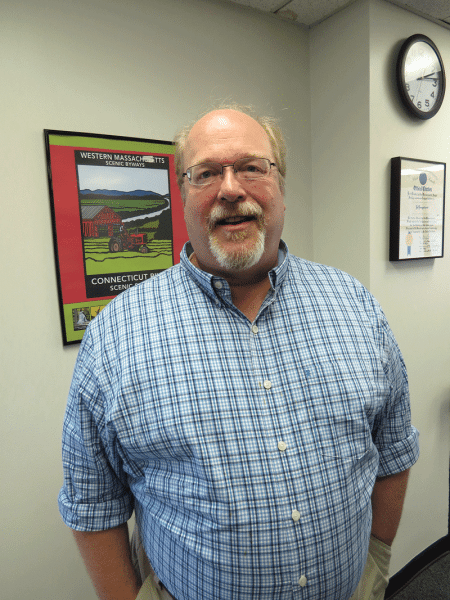
Steve Rosenkrantz

Steve Rosenkrantz

Western Mass. has seen an impressive surge in entrepreneurship over the past decade, but when people think about the successes, they tend to call to mind startups and independent companies. But there is another way to succeed in business ownership, and that’s through franchising. Through a national company called Entrepreneur’s Source, Steve Rosenkrantz has been matching clients with franchises for 17 years — by focusing on what they want not just in a career, but out of life.

Steve Rosenkrantz has a simple way of explaining his job.

“I think of what I do as planting seeds,” he said — and in 17 years as the owner of an Entrepreneur’s Source franchise, he’s planted many of them.

He also fancies himself a matchmaker of sorts, but not the kind who brings two people together. No, he’s making matches between his clients and what will, hopefully, become their ideal lifestyle, in the form of their own franchise business.

“I learned a few things a long time ago, and one is that nobody really wants to buy a business; they just like the benefits of owning one,” he said with a laugh. “I guess I create a safe space for the client to be educated and discover for themselves what types of franchise options match their career goals and expectations.”

In short, he’s helping individuals — usually people with well-established careers who are looking for a change and a measure of autonomy — transition to the realm of entrepreneurship. Rather than launching a startup, however, his clients are investing in a franchise of an established business.

The evidence of how it works began with his own search for a business opportunity in 2001, when his family business — a chain of Serv-U hardware and home-improvement stores — went through a dramatic downsizing. He then commenced a search for what to do next, and turned to the Entrepreneur’s Source for some guidance.

After a lengthy coaching and assessment process, one of the franchise opportunities put in front of him, oddly enough, was the Entrepreneur’s Source itself. Almost two decades later, he remains passionate about his work and the impact it has both regionally and nationally.

I learned a few things a long time ago, and one is that nobody really wants to buy a business; they just like the benefits of owning one.”

Take Antonia Santiago, for instance. She had an idea for a business startup in the senior-care space. When she talked to a local representative at SCORE, the business-mentoring agency, they referred her to Rosenkrantz. Through a series of discussions about what she was looking for in a career and lifestyle, another possibility arose.

“I said, ‘what do you think about working with children?’” he said. “She said, ‘I love children.’ I said, ‘I have a hunch.’”

So he connected her with a company, well-established in New York and New Jersey, called HobbyQuest, an after-school enrichment program that dovetails with local school curriculum to enhance what children are already learning and building on it.

“The match was perfect, and last month, she launched in West Springfield,” Rosenkrantz told BusinessWest. “It shows how, when people have awareness of what I do, like the SCORE counselor did, wonderful things can happen that benefit the community.”

Like his own experience, the process begins with an open mind to think past specific ideas the client may have in mind, and get to the root of their ILWE goals — income, lifestyle, wealth, and equity — to find an opportunity that fulfills them all in the short and long terms.

“I’m always respectful of opportunities people may have in mind when they come to me, but I like to back up the train a bit to get to understand what they really want their ILWE to be,” he explained. “The right franchise should be able to match all those things. My job is to match my clients with the right franchise models that correspond best to their geography, investment level, family dynamics, and the scalability they’re looking for.”

The options are endless, he added. “It could be with employees or without; with a physical storefront or a virtual storefront. I profile clients and, through lots of Q and A, help them determine what path to go on. It’s not a perfect system; there’s no such thing as that. But the program encourages clients to approach the process with an open mind, to determine whether we’re on the right track, or we need to redirect.”

Put Me In, Coach

There is a third term Rosenkrantz uses to describe his role, and that is a coach — in both business and life, with the recognition that the latter has a huge impact on the former.

The discovery process he undertakes with clients covers everything from personal and financial background to the type of business they believe they would be suited for.

He then offers a series of franchise ideas from his database, based on that all-important ILWE, which the client researches to see what might spark an interest.

Some matches have become well-known success stories in Western Mass., such as Jim Brennan and Rick Crews, who wound up starting a Doctor’s Express franchise in West Springfield and now operate more than 20 of them throughout the region. For their success, they were named BusinessWest’s Top Entrepreneurs for 2012, and have significantly expanded their footprint since.

Their field of urgent care is, in fact, a good example of finding a niche with serious growth potential, and Brennan and Crews jumped in at the right time. On the flip side, Rosenkrantz said, anyone looking to open a Dunkin’ Donuts these days is about a decade past peak saturation.

On the other hand, “when the frozen-yogurt craze started not long ago, a lot of major players wanted to connect with us, but we chose to stick with a company called Menchie’s, which had a vision that was a little different. They were focusing on frozen desserts, not just froze yogurt, and they had a vision what they want to look like in five to 10 years.”

New England tends to be conservative about new businesses, he added. “We tend to bring in franchises that are already tested and have a strong track record elsewhere in the world. And that’s good for me.”

Indeed, Massachusetts is fertile ground for some nationally successful franchises that have not exploded here yet, such as Sport Clips, three of which were recently launched by Ian Coogan, a commander at Westover Air Reserve Base who was looking for a business opportunity he could transition into while still spending most of his time at the base. “He doesn’t cut hair, and he doesn’t have to go in on a daily basis,” Rosenkrantz said — again, demonstrating that there’s a franchise to match everyone’s schedule.

Speaking of entrepreneurs with a military background, Rosenkrantz pointed out Patrick Walker, a retired senior chief of the U.S. Coast Guard, who had been responsible for the maintenance and quality assurance of its Aviation Department.

He attended a military-recruiting expo in 2014 with an open mind and a taste for entrepreneurship, but also a recollection of other franchise representatives he had talked with before who were heavy on hard-selling their opportunities, but not as interested in what his own goals and needs were.

But the Entrepreneur’s Source coach he met was different, Walker explained in an interview — one of many with military clients — collected in a booklet to tout Entrepreneur Source’s Veteran2Entrepreneur program. Because he was interested in travel and wanted to relocate to his hometown of Frisco, Texas, he opened an Expedia CruiseShipCenter there in 2016, taking advantage of a career option that let him choose where to live after a lifetime of moving around from post to post.

“Most of my friends are getting comfortable jobs; I decided I wanted something I could call my own,” he said. “I have a sense of pride wearing my uniform and driving to my business. It’s the American dream.”

Rosenkrantz said veterans, as a group, especially understand the potential of franchising. “Why? Because they can follow a system, and they know how to add value to a system. They like organization, they like regimen, and a franchise system is their bread and butter. Franchising and the military is a wonderful combination.”

Walker agreed. “As a retiring veteran, I felt I was too old to start a business from scratch. But in a franchise, all I needed was to read and implement the operations and procedures manual.”

Living Proof

Rosenkrantz works with clients across the U.S. and finds them matches from coast to coast, but he said he’s especially gratified performing that task in Western Mass. and Northern Conn. because of the bonus of boosting the region’s economy and bringing intriguing new businesses to the area.

“I never lose sight of the fact that I am a franchise that helps people find the right franchise. I live franchising every day. I’m a testimonial to our process because I was a client myself.”

The Entrepreneur’s Source is paid by franchises for successful matches, and Rosenkrantz said they consider it money well spent.

“The introduction we make between clients and franchises is a much warmer connection because my clients have already been vetted, and I check the territory availability of the franchise model for the client. So, the franchise gets someone with potential synergies right out of the gate, and that is something that’s valuable to them, so they love compensating my company for those warm introductions. We are advocates to make sure everything is in alignment.”

Because of the wide range of opportunities, clients may have to invest as little as $20,000 for a franchise opportunity or as much as millions, and many, like Coogan, keep their current jobs while ramping up their new business. Rosenkrantz also helps clients navigate funding resources like a unique 401(k) rollover program that doesn’t pile on the penalties, as well as Small Business Administration loans and similar programs.

In addition, “I have helped many people who say, ‘I don’t have the liquidity,’ but you do have family and friends. Sometimes people allow pride to get in the way, but they have people who care about them, and good things can happen if you utilize your circle of influence.”

There is a second facet to Rosenkrantz’s role, however — to help small-business owners with a single location find the resources and support to expand into a franchise of their own. One of those, Extra Innings, was a business based in Middleton that specializes in baseball and softball instruction. After connecting with Entrepreneur’s Source, the business has expanded to 27 franchises across the country.

“I love hearing the ideas of independent businesses looking for the next stage of expansion,” he told BusinessWest.

When he’s not helping clients, Rosenkrantz is always looking for opportunities to speak to all kinds of groups — such as laid-off workers and college students — about the opportunities available through the franchise model.

“My mission is to educate anyone who has entrepreneurial curiosity about franchising,” he said. “Not everyone will or should own that path, but it’s my firm belief that, for anyone who has entrepreneurial curiosity, one of the steps in their educational process should be to learn about franchising.”

Simply put, he added, “franchising is an opportunity to be in business for yourself, but not by yourself.”

And it’s crucial, he went on, for both he and the client to feel strongly they’ve made the right match, because failed matches are bound to be discussed on social media. “I’ve never had a bad comment on social media. I stay in touch with a lot of clients years later, and I’m pretty proud of their successes in their respective franchises and industries.”

In the meantime, he said his mission is to create even more awareness. “I want to get onto more college campuses to spread the word about business ownership. It’s not for everyone, but those who want to learn about and explore entrepreneurship, franchising is an important part of that discovery process.”

Never Alone

It’s all about the support, he concluded — not just from the Entrepreneur’s Source, but from the chosen franchise’s parent company, which has a keen interest in each location’s success.

“Statistics say an independent business, within a two-year period, has a high probability of failure,” Rosenkrantz noted. “People don’t have that extra working capital; they don’t plan things beyond the starting phase. Franchises, though, have an exponentially higher level of success, both short- and long-term.

“People should be educated about this when they’re considering business ownership as a career opportunity,” he concluded. “I want to be a piece of that education. I’m making inroads, but it’s a long battle.”

Joseph Bednar can be reached at [email protected]

Community Spotlight Features

Community Spotlight

Jennifer Tabakin

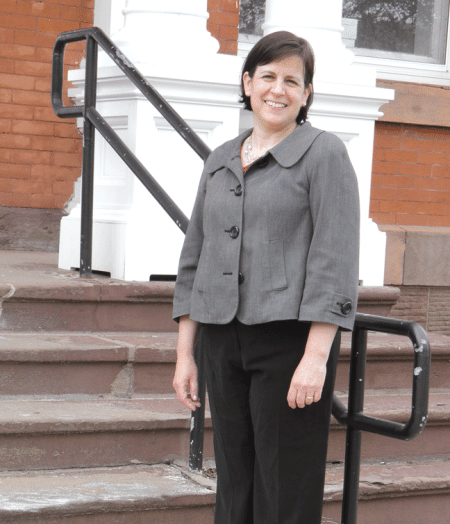
Jennifer Tabakin says Great Barrington is making important progress in efforts to attract young people and young families to the community.


Jennifer Tabakin acknowledged that, figuratively speaking, at least, City Hall in New York and Town Hall in Great Barrington are much more than 125 or so miles apart.

In most all ways, they’re worlds apart, and she should know, because she’s worked in both settings, and is firmly entrenched in the latter as town manager.

In New York, she worked for former Mayor Michael Bloomberg for several years. To be more specific, she worked under the deputy mayor for Economic Development after a stint in state government with the Metropolitan Transportation Authority working on capital projects.

“I did construction and operation coordination in lower Manhattan, and worked on parks, waterfront parks, and other projects in the Bronx, as well as being a general policy advisor,” she told BusinessWest, adding that, while she greatly enjoyed that work, she decided to leave Manhattan for a different kind of challenge, that of managing a small community — and a much different kind of lifestyle — in the summer of 2013.

“From my perspective, being able to have a career first in city government and then transitioning to local government in a town has been a great opportunity to add another chapter to a very interesting career,” she explained, adding that she chose Great Barrington for this transition, as she called it, for several reasons.

For starters, she was familiar with it — her parents have long lived in nearby Lenox — and she admired its mix of rural beauty and a bustling downtown and vibrant arts scene. But there was more, in the category of professional challenges.

“It had a diversity of really interesting projects and issues, and an engaged and active community,” she noted. “It had enough challenges so that I thought it was a great place to be a town manager.”

And while she acknowledged the many differences between Gotham and the region within the Berkshires known as South County, she said that, overall, the basic principles of economic development are pretty much the same in both settings — primarily, it comes down to making the community in question a better one in which to live, work, play, and start a business, and using public investments to do all that and spur private investment.

Tabakin said she saw that formula work in New York, and she’s seeing it bring progress in Great Barrington, as well. Indeed, a number of public investments, including a huge reconstruction project in the city’s already-thriving downtown as well as road upgrades, two bridge-reconstruction initiatives, and upgrades to the wastewater-treatment plant, have coincided with, and in many ways inspired, a host of private investments.

These have come in many forms, including new restaurants — the town now boasts more than 77 of them — additional housing developments, mixed-use projects, and a host of arts-focused initiatives.

At or certainly near the top of that list is an ambitious undertaking known as St. James Place. Opened in 2017 as a home to small and mid-sized Berkshire County arts groups in need of performance, rehearsal, and office space, it was, as the name suggests, created out of the historic St. James Episcopal Church on Main Street by Sally and Fred Harris, parishioners who wanted to do something to preserve the deteriorating landmark.

Today, billing itself as “a place for art,” this facility is living up to both that tagline and its significant promise as a setting for many forms of artistic expression.

It recently hosted an intriguing seminar called “Close Encounters with Music: The Politics of Opera,” and on Dec. 9 it will host a performance of the Berkshire Children’s Chorus. Later next month, it will be home to the Great Barrington Holiday Arts Market and a performance by the group Crescendo called “Three Wise Kings Follow a Star.”

SEE: Great Barrington at a glance

Year Incorporated: 1761
Population: 7,104 (0000)
Area: 45.8 square miles
County: Berkshire
Residential Tax Rate: $14.60
Commercial Tax Rate: $14.60
Median Household Income: $95,490
Median Family Income: $103,135
Type of Government: Open Town Meeting
Largest Employers: Fairview Dialysis Center; Fairview Hospital; Kutscher’s Sports Academy; Prairie Whale
* Latest information available

Meanwhile, several of the office spaces for lease have been filled by arts-related groups such the Berkshire Playwrights Lab, Flying Cloud, and the Berkshire Opera, and the facility is home to the People’s Pantry.

“The idea is to have a place that supports the community, and we do that in a number of ways,” said Fred Harris, adding that the nonprofit, like most, operates as a business would and is making strides it its efforts to be successful economically.

There are many other inspiring stories like the one that has unfolded at St. James Place, said Tabakin, adding that, while there are many issues to contend with, including an aging population, there is a great deal of momentum and positive energy in this jewel of southern Berkshire County.

Progress Report

Getting back to the circumstances that brought her and her family to Great Barrington, Tabakin said familiarity and quality of life were certainly big factors. But there was also that chance to put the considerable experience she accumulated in New York to work addressing an intriguing set of issues and challenges that sold her on the job she’s now in.

“It’s extremely busy and its very active,” she said of the community. “But there’s an enormous amount of interesting projects and land-use issues and policy issues, and budget issues … there was and is a lot going on.”

Indeed, while there are many priorities, one of the biggest is attracting more young families to the community. Like other towns in rural Berkshire and Franklin counties, Great Barrington has seen the average age of its residents rise in recent years, said Tabakin, noting that the community has always been a popular spot for retirees, and there are a number of New Yorkers with second (usually summer) homes in town.

But unlike many other communities, Great Barrington seems to be making great strides in attracting young people and especially young families, she went on, adding that it has many of the necessary ingredients, including attractive housing, quality schools, a vibrant downtown, a burgeoning cultural community, outdoor activities, and more.

Including perhaps that most important ingredient: jobs. They come in a number of sectors, including education (Simons Rock of Bard College is located within the town); healthcare (Fairview Hospital); technology (perhaps a dozen IT companies call the town home); the arts and tourism, the nonprofit community, and even special effects — there are a few such studios located in Great Barrington.

“Over the past several years, we’ve seen more young people move to certain areas of town,” she explained. “It’s observable, and there are reasons for it; we did a renovation of a new playground, we have cultural events that appeal to different generations, and we have a lot of people moving here who are committed to the school system.”

The opportunity to work with a broad team of officials to build this portfolio of attractive qualities is big part of what brought Tabakin to South County, and she noted that there are some new chapters to the story being written.

They include a project to build a new home for the Berkshire Co-op on Bridge Street, new construction that will also include space for smaller retail outlets, said Tabakin, adding that the co-op’s current location will be razed to make room for a condominium project. Overall, this project will achieve a number of ends.

“What this will do is open up the entirety of Bridge Street to additional development,” she explained. “And it’s adjacent to Berkshire Community College’s South County campus, an area that has already seen a lot of activity, so that’s exciting. And this will help us maintain a mixed downtown, where you have residential, working places, shops, and restaurants.”

Also in the works is an ambitious project in the village of Housatonic, an old mill town within Great Barrington populated by art galleries and people who have stayed there long after the mills closed.

The town had issued an RFP for redevelopment of the century-old elementary school in Housatonic, said Tabakin, and a local group of partners has come forward and is now working on the planning phase for the project. Preliminary plans call for business-incubator space and some commercial space on the first floor and apartments on the second floor.

As for St. James Place, Harris said the facility is, as he noted, making great strides toward meeting its broad mission and breaking even financially.

While doing so, it has become an important component — one of many, actually — in an emerging story of a community now hitting a lot of high notes, both figuratively, but also (especially in the historic church building) quite literally.

“The town has a great deal of depth,” said Harris. “And it has a great audience base, and it has more than enough vitality to attract people. There are a lot of good things happening here.”

Optimistic View

Looking back on what has transpired since she arrived as town manager, Tabakin said that, beyond the new developments, restaurants, and capital projects, maybe her biggest accomplishment has been to inspire others to get involved with the community and be part of the many forms of progress taking place.

Indeed, there has been plenty to get involved with, including everything from ‘green’ initiatives such as a ban on plastic bags and sustainable-energy initiatives to work in the schools, neighborhoods, and amply green spaces the town works diligently to preserve.

“One of the things I’ve done is to share my passion for local government, and I’ve gotten a group of people enthusiastic about being involved,” she told BusinessWest. “And I’m proud of it, because it’s so critically important at this period of time that we all do what we can to make sure we’re actively participating in making our place, our home, our community a wonderful place to live.

“It’s a wonderful learning opportunity and brings people together,” she said of this heightened involvement. “And from that, we’ve been able to accomplish a lot and serve as a model for other places.”

And while a great deal has been accomplished, there is a general sense that, that when it comes to forward progress, this community is just getting started.

George O’Brien can be reached at [email protected]

Entrepreneurship Sections

Venturing Forth

Paul Silva

Paul Silva says Launch413 one of two new startups he has launched himself, will fill a recognized gap in the region’s entrepreneurial ecosystem.

Paul Silva uses the word ‘retired’ when he references his departure (at least as a full-time employee) from Valley Venture Mentors (VVM), the groundbreaking nonprofit he co-founded to assist startups and next-stage companies.

And he acknowledged that he gets some strange looks when he does, not simply because he’s only 40 — and people that age usually aren’t retired from anything other than professional sports — but also because they can’t fathom why he would leave the organization he has helped lead to great success.

As for that word ‘retire,’ he said it sounds better than most all of the alternatives he could use, like ‘moved on,’ or ‘left,’ or even ‘transitioned from,’ all of which, or at least the first two, have largely negative connotations, at least in his opinion.

“Unfortunately, we really don’t have a good word for when you hand your startup off to the next group of people,” he explained. “Maybe someone will come with one; I’m open to suggestions.”

Meanwhile, as to why he retired, that will take a lot longer to explain. There is a short answer — that he considers doing so beneficial for him (ultimately), VVM, and the region as a whole — but one couldn’t possibly leave it at that. One would need to explain why that’s the case, and we’ll do most of that in a bit.

First, though, we’ll get to that ‘better for the region’ part.

In short, Silva said he can now focus his efforts — or a good portion of them, anyway, because his time will now be split in a number of ways — on filling what he called the next “gap” in the region’s entrepreneurial ecosystem.

That would be the one between organizations like VVM and the services they provide, and investing groups like the one Silva leads, River Valley Investors (RVI).

“For the past three years, VVM has been kicking ass at graduating startups, and good ones,” he explained. “And they come to my angel group and…”

His voice tailed off a bit as he noted that some come to angel investors ready, willing, and able to get to the next stage, and thus have relatively little trouble gaining all-important financial backing. Many others are willing, but not exactly ready or able. And this is where Launch413 comes in.

“Most early-stage investors don’t want to pay for the entrepreneur’s education in the many aspects of running a business, like selling and financials,” he explained. “So they don’t know how to operationalize and execute their business model. They graduate from VVM with a great business model, with evidence that it’s the right business, but they’re often missing great chunks of skills on how to get there; Launch413 parachutes in and fills the gap.”

But such skydiving will only fill part of Silva’s calendar. Indeed, as noted earlier, he is splitting his time between a number of different endeavors, including not one, but two new startups.

You have to know what your strengths and weaknesses are professionally. I know what I love to do; I love to teach and work with the entrepreneurs, and I’m really good at that. To be the CEO of an organization that’s scaling up is a very different set of skills.”

“I’m a glutton for punishment,” he said, adding that the second is called the Lean Innovation Institute (LII).

In simple terms, this initiative is an adaptation, and expansion, of VVM’s manufacturing accelerator, initiated last year, but orphaned by that agency (Silva’s word) because it didn’t exactly meld with its mission.

Sensing an opportunity, he essentially took ownership of that initiative with the intention of selling it to a host of sectors. And he’s already making headway with one he didn’t exactly expect — nonprofits, as we’ll see later.

The new adventures of Paul Silva — yes, he’s the one who wears the ties patterned with the likenesses of cartoon characters — are all spelled out on the back of his new business card — if you should happen to get one and have the time to read everything on it.

On the front, it declares he’s a startup advisor, angel-group leader, and innovation accelerator. For this issue and its focus on entrepreneurship, BusinessWest talked with Silva about those various talents and how he’s developed them into his own intriguing startups.

In Good Company

Getting back to why he was phased out of VVM at his request — that’s another way he phrased what’s happened — Silva said it’s beneficial for VVM because the agency is growing, expanding, and moving in new directions, and he is not exactly suited to lead an agency at that stage. By retiring, others more suited to that work can step in, he said, mentioning Liz Roberts, VVM’s CEO, by name.

As to why it’s better for him … well, if he stayed in a role he wasn’t really suited for, he said he wouldn’t enjoy it much, if at all.

“You have to know what your strengths and weaknesses are professionally,” he told BusinessWest. “I know what I love to do; I love to teach and work with the entrepreneurs, and I’m really good at that. To be the CEO of an organization that’s scaling up is a very different set of skills.

“I knew I had reached my limit,” he went on. “And if I wanted VVM to keep growing, either it was going to grow slower while I learned, or it could grow faster with Liz, who had already been there, done that, and been successful. And even if I could learn, I don’t think I would like it.”

So, after some due diligence and explaining to people that he was soon to be a ‘free agent,’ as he put it, Silva moved on to some things he does like.

Such as the broad mission of Launch413.

That name pretty much says it all — it’s focused on helping companies in Western Mass. get well off the ground — but its method of operation needs some explaining.

Working with several venture partners, Silva will parachute in, as he put it, and act as a venture fund in many ways, but the investment is in time and expertise, not dollars. In exchange for those investments, Launch413 gets a piece of the company’s future revenue.

This concept is called royalty financing, and while not exactly new, it has been gaining traction in recent years. That’s because entrepreneurs don’t want to give up a piece of their business, as in equity financing, but are more willing to part with a percentage of future revenues.

But royalty financing has benefits for both sides in this equation, especially in a smaller market like Western Mass., Silva explained.

“If I take equity in a company, the only way I get paid is if the company sells,” he said, adding quickly that there are other ways investors can reap dividends in such cases, but the company in question would have to be doing very well. “With a royalty deal, my incentive is in line with helping the company succeed; if they make money, I’ll get paid faster.”

Launch413 is currently working with one company, and Silva expects to soon be working on a batch of up to four. He will limit the number and start small, he said, to learn about what works and what doesn’t.

“We’ll figure out how much larger we can make the batches over time,” he said, adding that, given the great amount of entrepreneurial energy in the region, he expects Launch413 to flourish.

As for LII, as noted earlier, it is solidly based on VVM’s manufacturing accelerator, which was different from a traditional accelerator in that it focused on established companies rather than those just getting off the ground, which is why it became a business opportunity for Silva.

“VVM wants to focus on startups, which makes sense, because one of the great dangers with nonprofits is mission creep and losing focus,” he explained.

But the manufacturing accelerator was very similar to the traditional model in the way it prompted participants to identify who their customers were, what they wanted and needed, and how this should drive change moving forward.

And the LII (so named because it will hopefully involve companies in all sectors) will do all of the above with established entities, including a constituency Silva wasn’t exactly expecting when he launched: nonprofits.

He’s working with one at present — Pathlight, formerly the Assoc. for Community Living — and running pretty much the same curriculum put to use with the manufacturers at VVM.

Elaborating, Silva said Pathlight, which helps intellectually disabled individuals lead full and productive lives, developed a curriculum to help it meet that mission, one that could be adopted by other nonprofits doing similar work.

“They see this as an opportunity to create revenue from something they built that would help further their mission,” he explained, adding that the accelerator he’s running is focused on developing and maximizing this opportunity — one that amounts to a startup business.

“It looks like we have something that might make a difference here,” he went on, adding that he believes there is potential to add many more nonprofits to the portfolio moving forward because of changing dynamics within that sector, which has a huge presence in this region.

“The competitive pressure to raise grant dollars is intense,” he explained, “especially because Western Mass. has more nonprofits than just about anywhere else. So they need to find new ways of generating revenue; they need to think differently and in more innovative ways. It’s shocking how many of them don’t actually think about their customers and what they really need because they believe they know already.”

Meanwhile, he’s had discussions with Ira Bryck, director of the Family Business Center of Western Mass., about possibly running similar accelerators for groups of that agency’s members.

Overall, he said his business plan, like LII’s website, is very much a work in progress because, at the moment, he’s busy practicing what he preaches — meaning he’s figuring out who his potential customers are and what they want.

“If you asked me a year ago if nonprofits would be excited by this curriculum, I would have said ‘no,’” he explained. “But it turns out, among the sectors I’ve talked to, nonprofits are the most excited about this.”

Transition Game

Summing up the many changes in his life, career-wise at least, over the past several months, Silva acknowledged that he has taken a fairly sizable risk when it comes to leaving the steady employment provided by VVM.

But with the blessing of his wife — “she said, ‘this is the right thing for VVM; I’m proud of you’” — he gladly accepted that risk and moved on to something different and, in his opinion, at least equally rewarding, only in different ways.

This is what entrepreneurs do, and anyone who knows Silva is quick to grasp that he not only mentors and motivates such individuals; he is one himself.


George O’Brien can be reached at [email protected]

Modern Office Sections

More Than a Desk

Mark Proshan at a sit-stand desk

Mark Proshan at a sit-stand desk, one of hundreds of display pieces in Lexington Group’s 165,000-square-foot warehouse.

In the 28 years Mark Proshan has been in the furniture-sales and office-design business, he has seen plenty of change, from a greater emphasis on open, collaborative spaces to more challenging timetable demands from clients. Through it all, though, he continues to cultivate a business philosophy built on relationships and trust — even at a time when many clients are more interested in speed and cost.

Mark Proshan says he can count on one hand the number of contracts he’s drawn up over the years. He’d rather do business with a handshake.

“Relationships in this business are important,” he said. “The more you talk about it, the more cliché it sounds, but the notion that somebody can count on you when you promise to deliver something still means something, and our customers value the notion that we don’t promise things we can’t deliver.”

Proshan, owner of Lexington Group, which specializes in sales of new and refurbished office furniture as well as interior-design solutions, said he’s always been willing to lose money if it meant keeping a commitment he made to a customer.

“It’s fundamentally more important for that person to know I did everything conceivably possible to do what it was I said I would do. The lion’s share of new business comes from referrals from other people, and if that’s the way you market yourself, you’re only as good as the last job you did. If you don’t do what you said you’d do, your ability to gain a referral based on past work will dry up very quickly.”

These philosophies are important in many businesses, but they’re especially relevant to someone who launched his company 28 years ago and has seen so many other facets of the business — from the products customers are looking for to the timetables they expect — change so much.

“You need to adjust to what’s happening, to stay current,” Proshan said, and part of that is understanding clients’ shifting demands.

“We used to have people come in here with blueprints for a project six to nine months in advance, and they’d want to talk about their plans for a new space and everything that goes along with that, from carpeting to lighting to furniture and walls,” he told BusinessWest. “Now, we’re seeing younger people who show you a couple of pictures on their phone — ‘this is what I’m looking for’ — and if you can’t give it to them right away, they’re gone in the blink of an eye. It requires a whole different way of trying to figure out how to keep them engaged.”

Part of that is maintaining a deep inventory of new and pre-owned items on site in Lexington’s 165,000-square-foot showroom on Union Street in West Springfield. “That way, they can walk around and very quickly take a look and say, ‘yeah, that works; that doesn’t work.’ All the decisions are made very differently than in the past.”
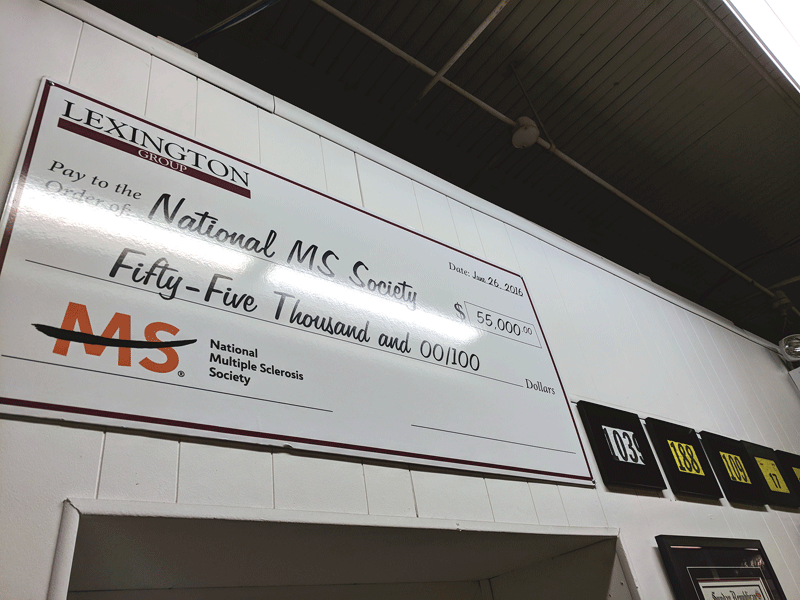
Mark Proshan’s team raised $55,000 this year in the Great Mass Getaway fund-raising bike ride.

A long-time supporter of the National Multiple Sclerosis Society, Mark Proshan’s team raised $55,000 this year in the Bike MS: Cape Cod Getaway fund-raising bike ride.

Proshan also has access to networks across the country, so a quick check of the Internet brings plenty more options for customers looking to change over an office, classroom, or retail space.

Lexington Group provides services from sales, installation, and delivery to space planning, office design, and reconfiguring work, and many of its 25-strong workforce have built up plenty of experience in the field. “We tend to mentor people into the business slowly, and once they’re here, they tend to stick around for the long haul. I’ve got a handful of people who have been here since the late ’80s and early ’90s.”

For this issue’s focus on the modern office, Proshan explains how that idea — and the means by which companies hope to achieve it — have evolved.

Wide Reach

Lexington Group, which counts Herman Miller as its major line of new furniture but deals in many secondary lines as well, has the ability to work across the country, if transportation costs aren’t prohibitive. “But transportation costs have risen significantly,” Proshan said, “and it’s becoming more difficult, so we focus on Chicago to Massachusetts.”

When he started the company, the mix of sales was about 60% pre-owned to 40% new, but it has reversed and is now 80% new and 20% pre-owned.

“There is so much inexpensive furniture available. Everything has become really commoditized and disposable, and people would rather not spend the time and energy doing the research to piece together all the pre-owned pieces when it comes to large projects,” he explained. “They would rather just sit down, point and click, and move on to whatever comes next.”

The secondary-education market has long been an especially fertile niche for Lexington Group. “We typically have at least one or two trucks at one of the major colleges every day, whether it be UMass Amherst, Smith, Mount Holyoke, or somewhere else,” he said, noting that he also works with institutions in Worcester, Fitchburg, and the Boston area. Other clients run the gamut from moderately sized insurance companies in Western Mass. to Fortune 500 firms across the Northeast.

Across all these industries, certain trends have become ubiquitous.

“The big words now are still collaborative space and shared space,” Proshan said. “Walls have come down, and other walls that used to have paint and wall coverings are now erasable, so people can share ideas on them.”

But there are challenges to opening up offices in this way, such as the occasional need for privacy for certain types of work, or when meeting clients.

“People enjoy the togetherness and collaboration possible with all the open space, but they also often wish they had their old cubicles back. So the secret, I think, is to try to find the balance between that open, collaborative space and giving people a place they can go to get some privacy.”

Ergonomics remains a hot topic as well, he added, from chairs designed for better support to desks that raise up with the touch of a button. “Sit-stand desks encourage people to stand for a good part of their day because, well, you should. Healthcare professionals will tell you we sit too much.”

Most changes in office design are being driven by the younger generations and how they prefer to work, he said, but he also understands that the basic elements of his business — quality products and relationship-based service — remain constants.

Lexington Group’s West Springfield warehouse

Lexington Group’s West Springfield warehouse gives a good indication of the range of new and refurbished items it sells.

“A desk is still a desk; a chair is still a chair, even though they’ve been tweaked a little bit over the years,” he said. “And there are only so many things you can do to a cube.”

Other challenges include more remote employees working from home, the rise of online retail and how it has impacted local businesses, and, quite simply, business owners who prioritize the bottom line over all else when shopping for furniture.

“They don’t care as much about design; they don’t care as much about structural integrity; they don’t care as much about relationships,” Proshan said. “When the focus is simply on price, they’re really not looking for what other value we can bring to the table; they’re simply looking for how inexpensively they can get the job done.”

Face to Face

For Proshan, that’s not a satisfying way to do business.

“We have companies that we’ve had long-standing relationships with, that still realize the value of picking up the phone, knowing we understand their needs, and can come in and, without a whole lot of fluff, conceptualize what needs to get done in a timely, cost-effective fashion.”

He said it was more common years ago for companies to have employees specifically focused on furniture and supply purchases and short- and long-term office planning, but that’s no longer the case.

“Nobody plans anymore. We’ve become so used to customers saying, ‘I want this now, and if you can’t get it for me, this guy can.’ That’s the mentality of the marketplace — as soon as you need something, somebody will be there to provide it for you, and if not, you can go to the Internet and shop.”

Still, he went on, “even though attention spans have changed, and people want instant gratification, I find it’s really valuable to be able to look somebody in the eye and shake hands and agree upon what needs to be done, and for them to feel confident that I’m going to do what I promised I would do, and they’re not going to be unpleasantly surprised when the deadline comes.”

That emphasis on relationships informs the company’s civic involvement, particularly Proshan’s 21 years of involvement in the Bike MS: Cape Cod Getaway, an annual, 175-mile bike ride from Boston to Provincetown that raises money for the National Multiple Sclerosis Society. Last year, the team he has captained for 15 years raised $55,000.

Back at work, though, his focus is where it has been for 28 years: helping companies improve their environment through better furniture and interior design.

“At the end of the day, it’s about more than selling furniture,” he said. “Those relationships make the whole experience much more enjoyable in ways that don’t have anything to do with money. When it’s about more than selling something, it’s much more fulfilling.”

Joseph Bednar can be reached at [email protected]
Daily News

SPRINGFIELD — Chicopee Savings Bank Charitable Foundation recently pledged to establish an endowed scholarship available to undergraduate students at Western New England University. With a commitment of $50,000, a scholarship of $2,000 will be available annually beginning in the 2018-19 academic year.

The Chicopee Savings Bank Charitable Foundation created the scholarship to support students in local communities. The scholarship will provide financial assistance to inbound students in pursuit of higher education who demonstrate exemplary scholastic achievement, drive, and integrity, and who meet the following criteria: a U.S. citizen and resident of Agawam, Chicopee, Holyoke, Ludlow, South Hadley, Springfield, Ware, West Springfield, or Westfield who demonstrates financial need and is an incoming freshman with a high-school GPA of 3.5 or higher, or a transfer or returning student with a cumulative GPA of 3.5 or higher. The scholarship is renewable each year the recipient continues to meet the criteria.

“Scholarship aid is among the highest funding priorities at Western New England University, and we are thrilled to have this new award established by our neighbors and friends at the Chicopee Savings Bank Charitable Foundation,” said Anthony Caprio, president of Western New England University. “Providing financial assistance helps ensure that students are able to concentrate on their studies and focus on their futures more clearly.”

In April 2016, it was announced that Chicopee Savings Bank would merge with Westfield Bank to form the largest bank headquartered in Hampden County. Both banks now do business under the Westfield Bank name, but the Chicopee Savings Bank Charitable Foundation remains in place with its original philanthropic mission.

Daily News

WEST SPRINGFIELD — Modern Salon Media has named the 2017 class of “Excellence in Education” honorees in its seventh annual program recognizing leadership and best practices among cosmetology schools. DiGrigoli School of Cosmetology was chosen to represent excellence in the following categories: Community Involvement, Marketing, and School Culture.

Modern Salon Publisher Steve Reiss announced the honorees during the recent American Assoc. of Cosmetology Schools 2017 convention in Las Vegas. Honorees were determined based on key criteria in each category, and grouped according to number of locations. Honorees were chosen in each category — one individual school location and a multi-location school organization.

“We received applications from cosmetology schools across the country and look forward to celebrating all the 2017 Excellence in Education honorees and sharing their stories. It is truly a great time to pursue a beauty education and career, and the program at DiGrigoli School of Cosmetology exemplifies that fact,” Modern Salon Editorial Director Michele Musgrove said.

Added Paul DiGrigoli, owner of DiGrigoli School of Cosmetology, “I want to express my sincere gratitude to all of our students and staff for following the ‘three C’s,’ which we practice every day — culture, community, and customer service. These are our strongest values and beliefs at DiGrigoli.”

Sharing stories of innovation, inspiration, and collaboration from a diverse group of leading schools is an important part of Modern Salon’s “Excellence in Education” mission, Musgrove explained. “We want to help spread the word about the exceptional work cosmetology schools are doing to help launch beautiful careers. We hope the professional salon industry and their communities will join us in celebrating them.”

Daily News

LONGMEADOW — The Commission on Collegiate Nursing Education (CCNE) voted in its October 2017 meeting to grant full accreditation through December 31, 2022 to the American Women’s College at Bay Path University’s RN to BSN Completer Program.

This program allows for licensed, registered nurses with an associate or diploma degree to return to college to complete a bachelor’s degree in nursing. Bay Path’s program is fully online, allowing students to enroll and participate from across the country, and the accelerated format means that, for most students, the degree can be achieved in 18 months.

“The national challenge for 80% of nurses to be BSN-prepared by 2020 indicated to us a great need for a flexible, affordable solution for registered nurses whose lives are already so full, between caring for others at work and, on top of that, having families, hobbies, and other personal responsibilities,” said Amanda Gould, chief administrative officer for the American Women’s College at Bay Path University. “Our accelerated, 100%-online program gives them an opportunity to take their education to the next level on their terms, around their own rigorous schedules, so they come out after just 18 months ready to elevate their careers.”

The first cohort of 22 BSN students graduated in May. They were honored with a pinning ceremony, a tradition that has been considered a rite of passage in the nursing field since 1916 when it became common practice for all nursing graduates to be presented with a pin symbolizing their educational accomplishments.

“We are proud to be recognized by CCNE with full accreditation for the RN to BSN Completer Program,” said Marjorie Bessette, RN, MSN, director of the Nursing program. “The collective commitment to quality education demonstrated each day by our faculty, staff, and community partners to provide our students with the knowledge and skills they need to be outstanding nurses is at the heart of our work, and our program status reflects that.”

The American Women’s College at Bay Path University maintains partnerships with Baystate Health and Mercy Medical Center to work together to increase the number of nurse practitioners with BSN degrees.

“As a nurse, I want to give the best possible care that I can to patients. It’s my job to save lives. Completing my BSN has ensured that I can do just that,” said Laura Mazur, a nurse at Baystate Medical Center who graduated from Bay Path’s program this spring. “I used to think of myself as an in-class learner, but as a floor nurse working the midnight shift, I simply didn’t have the time to spend in a classroom. The online program through the American Women’s College fit well into my life.”

Daily News

SPRINGFIELD — Springfield Technical Community College’s (STCC) dental hygiene program and the Valley District Dental Society will co-host the first Community Dental Day on Saturday, Dec. 9. The event provides an opportunity for area residents who might not be receiving any dental care to obtain free treatment and schedule follow-up visits.

The dental hygiene clinic in Building 20 at STCC will be open from 9 a.m. to 4 p.m. Valley District Dental Society licensed dentists, together with STCC dental hygiene and assisting students, will offer patient education, health screenings, diagnosis, X-rays, and other types of urgent care.

“It will not be unlimited care, but there will be such treatment as fillings, extractions, sealants, and taking care of urgent issues,” said Dr. Martin Wohl, one of the dentists who supervises students treating patients at STCC. “We will not be providing cleanings, but in diagnosing that someone needs a cleaning, we will be able to schedule a follow-up visit. We will be able to put them into the system to get routine cleanings.”

While Community Dental Day will be free, patients can return to STCC for low-cost follow-up care. STCC’s dental hygiene clinic, which features 17 dental chairs on the second floor of Building 20, offers routine cleanings and various procedures at a reduced cost to residents of the Greater Springfield area.

“We’re excited about Community Dental Day, and the dentists are excited about it, too,” Wohl said. “The doctors feel they can provide a valuable service, and they can help people that generally can’t find the care they seek. Community Dental Day will hopefully have people start to think of either here or elsewhere as a dental home.”

STCC will welcome anyone who needs care that day, but Wohl recommends calling the dental hygiene clinic in advance at (413) 755-4900 to make an appointment for Community Dental Day.

Daily News

SPRINGFIELD — Community Bank N.A. announced that Keith Nesbitt has been promoted to vice president, commercial banker.

In his new role, Nesbitt will manage new business with present and prospective customers, as well as maintain current customer relationships. He will also be responsible for providing direct service to commercial customers pertaining to deposit, loan, and other products and services.

“We are very pleased to recognize Keith for all of his incredible efforts and contributions to Community Bank N.A.,” said Geoffrey Hesslink, regional president. “He has always gone the extra mile to meet the needs of our customers and possesses a wide knowledge of loan management. I am excited to see what he will do for our customers at this next level.”

Nesbitt joined the Community Bank N.A. team through its acquisition of Merchants Bank earlier this year. He joined Merchants in 2016 as the regional commercial credit officer for NUVO, a division of Merchants Bank. Nesbitt has 12 years of experience in commercial lending, portfolio management, and credit administration in regional and community banking institutions.

Nesbitt earned his bachelor’s degree in advertising from University of Georgia, his master’s degree in education from Georgia State University, and his MBA from Keller Graduate School of Management. Outside of the office, he is a member of the Western Massachusetts Football Officials Assoc.

Daily News

HOLYOKE — Registration is now open for Intersession 2018 at Holyoke Community College (HCC), where new and returning students can earn a semester’s worth of credits for one class in just 10 days.

Intersession classes begin Wednesday, Jan. 3, and end Tuesday, Jan. 16. Intersession students can earn up to four credits by taking a single class.

“Intersession presents a great opportunity for students to pick up some extra credits in a very short period of time,” said Monica Perez, vice president of Academic Affairs. “And it’s open to everyone, including students from other colleges who may have returned home to Western Massachusetts for the holidays.”

HCC is offering 37 courses during Intersession 2018 in 22 academic areas, both online and on campus: Anthropology, Business Administration, Communication, Criminal Justice, Economics, Education, Engineering, Environmental Science, General Studies, Geography, Gerontology, Health, Human Services, Law, Management, Marketing, Mathematics, Nutrition, Philosophy, Psychology, Social Science, and Sociology.

For more information about Intersession at HCC or to see a full listing of course offerings, visit www.hcc.edu/intersession.

Daily News

SPRINGFIELD — Springfield Partners for Community Action Inc. has been awarded a Community Service Block Grant (CSBG) Special Projects grant from the Department of Housing and Community Development to support its Financial Literacy Ambassadors project.

The Financial Literacy Ambassadors project is designed to facilitate the training and certification of multi-cultural and multi-lingual community residents to become peer-to-peer trainers and deliver financial education to their own communities.

“We thank the department and Undersecretary Chrystal Kornegay for their support,” said Paul Bailey, executive director at Springfield Partners. “With this round of funding, we plan to identify interested applicants to train and become certified financial-literacy educators capable of delivering peer training to others in the community in multiple languages.”

Applications are being accepted now. Anyone interested in applying should contact T.J. Steele at (413) 263-6500, ext. 6568, or [email protected], or Stephen Plummer at (413) 263-6500, ext. 6567, or [email protected].

Springfield Partners is the official anti-poverty agency serving Springfield’s poor and low-income community since 1964. It offers programs and services in financial literacy, credit counseling, weatherization, emergency fuel assistance, multi-cultural Alzheimer’s, Volunteer Income Tax Assistance, early education and care, community scholarship, Low Income Taxpayer Clinic, veteran services, eviction clinic, and housing counseling.

Daily News

BOSTON — The state’s total unemployment rate dropped to 3.7% in October, the Executive Office of Labor and Workforce Development announced.

The Bureau of Labor Statistics’ (BLS) preliminary job estimates indicate Massachusetts added 4,800 jobs in October. Over the month, the private sector added 4,100 jobs as gains occurred in leisure and hospitality; professional, scientific, and business services; other services; financial activities; manufacturing; construction; and information. The September estimate was revised to a gain of 10,300 jobs.

From October 2016 to October 2017, BLS estimates Massachusetts has added 69,000 jobs. The October unemployment rate was four-tenths of a percentage point lower than the national rate of 4.1% reported by the Bureau of Labor Statistics.

“The low unemployment rate and job gains are indicators of the ongoing strength of the economy in Massachusetts. But not all communities and regions are feeling the benefits of this economy equally. Our workforce-development programs continue to prioritize closing skills gaps and connecting all citizens of the Commonwealth to prosperous career pathways,” Labor and Workforce Development Secretary Rosalin Acosta said.

The labor force decreased by 13,400 from 3,669,500 in September, as 5,600 fewer residents were employed and 7,700 fewer residents were unemployed over the month.

Over the year, the state’s seasonally adjusted unemployment rate increased five-tenths of a percentage point from 3.2% in October 2016. There were 19,600 more unemployed residents over the year compared to October 2016.

The state’s labor-force participation rate — the total number of residents 16 or older who worked or were unemployed and actively sought work in the last four weeks — decreased three-tenths of a percentage point to 65.5% over the month. The labor-force participation rate over the year has increased by 0.8% compared to October 2016.

The largest private-sector percentage job gains over the year were in other services; construction; professional, scientific, and business services; financial activities; and education and health services.

Daily News

LONGMEADOW — At the fifth annual Cybersecurity Summit held recently at the Longmeadow campus of Bay Path University, keynote speaker and Massachusetts Technology Collaborative (MassTech) CEO Timothy Connelly told summit attendees that cybersecurity is a top issue for Gov. Charlie Baker and MassTech.

According to Connelly, MassTech is making cybersecurity a priority “because we recognize this is the fastest-growing sector. This is why we established the MassTech Cyber Growth and Development Center. Governor Charlie Baker thinks this is a terrific market that can produce sustainable jobs as long as we develop the needed talent.”

MassTech CEO Timothy Connelly and Bay Path President Carol Leary

MassTech CEO Timothy Connelly and Bay Path President Carol Leary

Connelly noted that there is currently a talent deficit in the field, with more than 8,000 available jobs in cybersecurity in Massachusetts. The Commonwealth is the number-one generator of STEM graduates nationally, and is home to 37 of the 500 most innovative security companies in the world, second only to California, he added.

MassTech is a public agency created to support the innovation economy in the Commonwealth and help support formation and growth of the state’s technology sector. Connelly is head of the newly established Cybersecurity Center at MassTech.

Other speakers at the summit included Tim Russell, supervisory special agent in Cybersecurity, FBI Boston; and Carol Leary, Bay Path president. This year’s summit was titled “Building a Cybersecurity Ecosystem: the Roles of Higher Education, Law Enforcement, and Technology.”

“It is critical for higher education to be a central part of this emerging cyber ecosystem,” said Leary, who serves as a member of the Department of Homeland Security’s Academic Advisory Council. “We are developing the right talent, the diverse talent needed to be a part of the cybersecurity workforce. To the students pursuing a cybersecurity career — you are the future, you are qualified, and we need you more than ever.”

Added Russell, “cybersecurity is a human-capital issue and is an entire company endeavor. All should be part of developing a cyber ecosystem. Engagement and collaboration with government and law enforcement is important in detection.”

The summit was co-sponsored by the Economic Development Council of Western Massachusetts. According to Rick Sullivan, president and CEO, “The EDC is focused on growing our economy, and one of our greatest assets is higher education. We want to develop economic-development sectors that are new and cutting-edge. We can become a center of excellence in cybersecurity, and our colleges and universities can help us grow that sector. I want to thank Bay Path University for being the leader in the cybersecurity sector, and we are here to follow your lead.”

According to Thomas Loper, associate provost and dean of the School of Science and Management at Bay Path, the summit drew over 200 people, including professionals in the cybersecurity field; small-business owners; executives from financial-services, manufacturing, insurance, and healthcare organizations; and students, faculty, and staff from the region’s colleges.

Banking and Financial Services Sections

Unlocking Financial Health

KeyBank’s Courtney Jinjika and Jeff Hubbard

KeyBank’s Courtney Jinjika and Jeff Hubbard

KeyBank is fairly new to the Western Mass. financial marketplace, taking over eight Hampden County branches following its acquisition of First Niagara Bank last year. But its leaders are already fluent in speaking the language of the region’s customers, who want their institutions to be customer-friendly and civic-minded. With a host of high-tech products melded with a focus on helping customers effectively use them to manage their financial health, Key seems ready to unlock more business.

It’s called HelloWallet.

“It’s an online platform that KeyBank uses to help customers make smarter, more confident financial decisions. The user first inputs information about their account balances, income, spending, demographics, and more to produce a score of sorts — a picture of where they are financially, where they want to be, and how to get there, by setting budgets, planning for retirement, and more.

“We focus on bringing financial confidence and wellness to all of our customers — individuals and business — across a broad spectrum of needs,” said Courtney Jinjika, the bank’s regional retail executive for Connecticut and Western Mass. “A key differentiator for us is HelloWallet, an online, real-time financial-assessment and planning tool, which, coupled with personalized guidance from their trusted banker, helps our clients achieve financial wellness and accomplish their goals.”

When it acquired HelloWallet last year, KeyBank saw it as one of several strategies for better connecting their clients, both retail and commercial, to helpful financial resources.

“Our focus is on our clients’ overall financial wellness and helping them make solid financial decisions,” Jinjika explained. “With HelloWallet, we integrated a tool into our system that allows clients to assess where they stand within a few components of overall financial wellness; it actually gives recommendations and feeds information back to bankers, who are able to reach out to clients and help them make difficult financial decisions and guide them to better financial wellness.”

As a digitally based tool, it also appeals to the growing set of customers who prefer resources they can access at any time, not just in a branch, said Jeff Hubbard, Key’s market president for Connecticut and Western Mass. “It’s an exciting tool to offer to customers, and a way to better focus on financial literacy.”

The theme of connection is one KeyBank touts in its marketing efforts and its services, Hubbard noted. When the institution, currently the 29th-largest bank in the U.S. by asset size, acquired First Niagara Bank in 2016, it inherited a large footprint in Western Mass. and Connecticut to complement its existing New England presence in Maine, Vermont, and the Boston area.

And if there’s one thing Hubbard understands about Western Mass., where KeyBank now operates eight branches boasting 70 employees, it’s that customers appreciate a community-focused model.

Those eight branches — in East Longmeadow, Feeding Hills, Holyoke, Ludlow, Southwick, Westfield, and two in West Springfield — have been busy introducing resources including commercial lending, residential mortgage lending, investments, wealth management, and insurance.

In doing so, Hubbard said, it’s also touting the value of “meeting customers on whatever playing field they might want to be on.”

High-tech, Personal Touch

Jinjika said bank employees are skilled at helping customers navigate the various high-tech banking options available to them, from online bill pay and remote deposit capture to the HelloWallet tool, and show them how they can use them to monitor their financial wellness. There’s also an online scheduling tool customers can use to make appointments at the branch and outline what issues they want to discuss.

After all, Hubbard said, online banking hasn’t killed branch banking, not by a longshot. It has certainly forced the branch model to evolve in the ways Jinjika described, but a street-level presence remains crucial.

“Lots of people want to visit a branch for lots of reasons,” Hubbard said. “Here, they’ll visit highly trained, experienced people who want to help them. To be successful in the Springfield market, you need to meet people anywhere they want to meet.”

A decade ago, he went on, products like remote deposit capture for businesses seemed strikingly innovative, and now clients have come to expect them as a baseline. Meanwhile, Millennials might have led the way in adopting technology that allows them to control their finances from their computers and smartphones, there’s less of a demographic breakdown today.

“Millennials get on board faster; they’re quicker adopters, but they’re targeted at everyone,” Jinjika said. “Keeping people out of the branch line is a good thing, so adoption rates are pretty strong.”

In addition, Jinjika said, the vast majority of customers seeking to make major life changes, like a home mortgage, want to sit down with a professional.

“When our clients have a concern or are making major financial decisions, they want to do that in person at the branch,” she explained. “What we find is that they’ll do their research online, but when it actually comes down to fully making that decision, they want to sit down with someone and get answers face to face.”

The same goes for commercial customers, Hubbard said, noting that Key likes to tout itself as a “Main Street bank with Wall Street capabilities,” which can leverage its investment-banking team and industry-specific bankers to bring added resources to commercial clients. We believe that these capabilities, along with our state-of-the-art cash-management services and insurance and benefit consulting services, give us a competitive advantage with our business clients.

He understands the fierce competition in a market that many analysts have called overbanked in recent years, but said loan demand is steady.

“We’re certainly getting our fair share,” he told BusinessWest. “Springfield is a wonderful market with lots of opportunities. We’re grateful to have into some very large clients, very good-sized companies in Greater Springfield, in addition to small, mom-and-pop businesses.”

Another business-minded program is Key@Work, which partners with companies and provides free and discounted banking services employees at no cost to the employer. A dedicated Key@Work ‘relationship manager’ delivers a customized program on site to meet the specific needs of workers through financial-education presentations and one-on-one financial assessments.

It’s another way KeyBank aims to broaden its customer base in its existing branches, rather than having to open new branches to grow.

“We’re very happy with the branch locations we have today,” Hubbard said. “The objective is to get our employees out of the branch into the community and grow our business organically.”

Community Ties

The bank also understands that the region’s community-banking culture means community involvement on a charitable level, Hubbard said, noting that Key expects to make $100,000 in community sponsorships and charitable grants to nonprofits serving the Greater Springfield market in 2017. “We think it’s very important to support the market where we live and work. That’s something we take seriously.”

On a national level, KeyBank also released its National Community Benefits plan last year, which includes $16.5 billion in investments across the communities it serves. The commitments are part of a comprehensive blueprint for steps Key will take over the next five years.

As part of a partnership with the National Community Reinvestment Coalition, KeyBank committed to $16.5 billion in mortgage lending, small-business lending, community-development lending, and philanthropy, with the goal of stimulating job and economic growth in those communities. KeyBank has also committed to reducing neighborhood blight as well as maintenance and disposition of foreclosed properties.

Additionally, the KeyBank Foundation is committing $175 million in philanthropic investments for its traditional priorities of education and workforce development. The investments will also focus on the stabilization of urban neighborhoods and rural communities through local capacity building, affordable housing, and building technical assistance to execute locally.

Nationwide, KeyBank employees will support the plan through local service projects and board leadership. Employees will continue to be heavily engaged in their communities, with the expectation of 500,000 of additional volunteer hours over the next five years.

“Key has jumped into this in a big way,” Hubbard said, noting that the effort crosses 15 states, but each market will feel an impact. “This is a broad but very meaningful delivery of strong foundational support.”

The bank has also earned national recognition as one of Points of Light’s top 50 most community-minded companies for the last three consecutive years; a Top 50 Company for Diversity by Diversity Inc. for the last seven years, and eight annual ‘outstanding’ ratings from the Community Reinvestment Act for its levels of lending, investment, and service to low- and moderate-income communities — one of less than 10% of all U.S. banks to achieve that goal.

Those accolades further demonstrate, Jinjika noted, that KeyBank aims to be an effective partner both for customers who walk in the branch and in the communities surrounding those branches.

“We keep clients at the center of all we do,” she told BusinessWest. “We compete where some of the bigger banks won’t, and where the smaller banks can’t. We really think about the individual in front of us when we put together a package that will work for their financial wellness.”

Joseph Bednar can be reached at [email protected]

Accounting and Tax Planning Sections

A Time to Plan

taxplanningbw1117a

It’s never a bad time for companies to assess their tax situation and plan ahead, but with the end of 2017 approaching — and plenty of uncertainty over potential tax reform clouding the picture — it’s an especially good moment to start formulating a strategy to save tax dollars down the line. Here’s a checklist of actions based on current tax rules that may help businesses do just that.

By Kris Houghton, CPA

Taxes and the possibility of tax reform have been in the news so frequently, many are just tuned out on the subject. However, with year-end approaching, it is a good time to think of planning moves that will help lower your tax bill for this year and possibly the next.

Kristina Drzal-Houghton

Kristina Drzal-Houghton

For many years, experts have suggested the approach of deferring income until next year and accelerating deductions into this year to minimize taxes. This time-honored approach could turn out to be even more valuable this year if Congress succeeds in enacting tax reform that reduces business tax rates beginning next year in exchange for slimmed-down deductions.

Regardless of whether tax reform is enacted, deferring income also may help you minimize or avoid AGI-based phaseouts of various tax breaks that are applicable for 2017. Except in general terms, I will refrain from comparing the current tax laws to proposed legislation since its enactment in its current form is very speculative.

Regardless of whether tax reform is enacted, deferring income also may help you minimize or avoid AGI-based phaseouts of various tax breaks that are applicable for 2017.”

The following is a checklist of actions based on current tax rules that may help you save tax dollars if you act before year-end.

Year-end Tax-planning Moves for Businesses and Business Owners

• Businesses should consider making expenditures that qualify for the business-property-expensing option.

For tax years beginning in 2017, the expensing limit is $510,000, and the investment-ceiling limit is $2,030,000. Expensing is generally available for most depreciable property (other than buildings), off-the-shelf computer software, air-conditioning and heating units, and qualified real property-qualified leasehold improvement property, qualified restaurant property, and qualified retail improvement property. The generous dollar ceilings that apply this year mean that many small and medium-sized businesses that make timely purchases will be able to currently deduct most if not all their outlays for machinery and equipment.

What’s more, the expensing deduction is not prorated for the time that the asset is in service during the year. The fact that the expensing deduction may be claimed in full (if you are otherwise eligible to take it), regardless of how long the property is held during the year, can be a potent tool for year-end tax planning. Thus, property acquired and placed in service in the last days of 2017, rather than at the beginning of 2018, can result in a full expensing deduction for 2017.

• Businesses should also consider making expenditures that qualify for 50% bonus first-year depreciation if bought and placed in service this year (the bonus percentage declines to 40% next year). The bonus-depreciation deduction is permitted without any proration based on the length of time that an asset is in service during the tax year. As a result, the 50% first-year bonus write-off is available even if qualifying assets are in service for only a few days in 2017.

• Businesses may be able to take advantage of the ‘de minimis safe-harbor election’ (also known as the book-tax conformity election) to expense the costs of lower-cost assets and materials and supplies. To qualify for the election, the cost of an item of property can’t exceed $5,000 if the taxpayer has a certified audited financial statement along with an independent CPA’s report. Otherwise, the cost of an item of property can’t exceed $2,500.

• Businesses contemplating large equipment purchases also should keep a close eye on the tax-reform plan being considered by Congress. The current version contemplates immediate expensing — with no set dollar limit — of all depreciable asset (other than building) investments made after Sept. 27, 2017, for a period of at least five years. This would be a major incentive for some businesses to make large purchases of equipment in late 2017.

• A corporation should consider deferring income until 2018 if it will be in a higher bracket this year than next. This could certainly be the case if Congress succeeds in dramatically reducing the corporate tax rate, beginning next year.

• A corporation should consider deferring income until next year if doing so will preserve the corporation’s qualification for the small-corporation AMT exemption for 2017. Note that there is never a reason to accelerate income for purposes of the small-corporation AMT exemption because, if a corporation doesn’t qualify for the exemption for any given tax year, it will not qualify for the exemption for any later tax year.

• A corporation (other than a ‘large’ corporation) that anticipates a small net operating loss for 2017 (and substantial net income in 2018) may find it worthwhile to accelerate just enough of its 2018 income (or to defer just enough of its 2017 deductions) to create a small amount of net income for 2017. This will permit the corporation to base its 2018 estimated tax installments on the relatively small amount of income shown on its 2017 return, rather than having to pay estimated taxes based on 100% of its much larger 2018 taxable income.

• If your business qualifies for the domestic production activities deduction (DPAD) for its 2017 tax year, consider whether the 50%-of-W-2 wages limitation on that deduction applies. If it does, consider ways to increase 2017 W-2 income, e.g., by bonuses to owner-shareholders whose compensation is allocable to domestic-production gross receipts. Note that the limitation applies to amounts paid with respect to employment in calendar year 2017, even if the business has a fiscal year. Keep in mind that the DPAD would be abolished under the tax-reform plan currently before Congress.

Year-End Tax-planning Moves for Individuals

• Higher-income earners must be wary of the 3.8% surtax on certain unearned income. The surtax is 3.8% of the lesser of: (1) net investment income (NII), or (2) the excess of modified adjusted gross income (MAGI) over a threshold amount ($250,000 for joint filers or surviving spouses, $125,000 for a married individual filing a separate return, and $200,000 in any other case).

As year-end nears, a taxpayer’s approach to minimizing or eliminating the 3.8% surtax will depend on his estimated MAGI and NII for the year. Some taxpayers should consider ways to minimize (e.g., through deferral) additional NII for the balance of the year, others should try to see if they can reduce MAGI other than NII, and other individuals will need to consider ways to minimize both NII and other types of MAGI.

• The 0.9% additional Medicare tax also may require higher-income earners to take year-end actions. It applies to individuals for whom the sum of their wages received with respect to employment and their self-employment income is in excess of an unindexed threshold amount ($250,000 for joint filers, $125,000 for married couples filing separately, and $200,000 in any other case).

Employers must withhold the additional Medicare tax from wages in excess of $200,000 regardless of filing status or other income. Self-employed individuals must take it into account in figuring estimated tax. There could be situations where an employee may need to have more withheld toward the end of the year to cover the tax. For example, if an individual earns $200,000 from one employer during the first half of the year and a like amount from another employer during the balance of the year, he would owe the additional Medicare tax, but there would be no withholding by either employer for the additional Medicare tax since wages from each employer don’t exceed $200,000.

• Realize losses on stock while substantially preserving your investment position. There are several ways this can be done. For example, you can sell the original holding, then buy back the same securities at least 31 days later. It may be advisable to discuss year-end trades with a qualified advisor.

• Postpone income until 2018 and accelerate deductions into 2017 to lower your 2017 tax bill. This strategy could enable you to claim larger deductions, credits, and other tax breaks for 2017 that are phased out over varying levels of adjusted gross income (AGI). These include child tax credits, higher-education tax credits, and deductions for student-loan interest. Postponing income is also desirable for those taxpayers who anticipate being in a lower tax bracket next year due to changed financial circumstances. Note, however, that, in some cases, it may pay to actually accelerate income into 2017.

• If you believe a Roth IRA is better than a traditional IRA, consider converting traditional-IRA money invested in beaten-down stocks (or mutual funds) into a Roth IRA if eligible to do so. Keep in mind, however, that such a conversion will increase your AGI for 2017.

• It may be advantageous to try to arrange with your employer to defer, until early 2018, a bonus that may be coming your way. This could cut as well as defer your tax if Congress reduces tax rates beginning in 2018.

• Consider using a credit card to pay deductible expenses before the end of the year. Doing so will increase your 2017 deductions even if you don’t pay your credit-card bill until after the end of the year.

• If you expect to owe state and local income taxes when you file your return next year, consider asking your employer to increase withholding of state and local taxes (or pay estimated tax payments of state and local taxes) before year-end to pull the deduction of those taxes into 2017 if you won’t be subject to alternative minimum tax (AMT) in 2017. Pulling state and local tax deductions into 2017 would be especially beneficial if Congress eliminates such deductions beginning next year.

• Estimate the effect of any year-end planning moves on the AMT for 2017, keeping in mind that many tax breaks allowed for purposes of calculating regular taxes are disallowed for AMT purposes. These include the deduction for state property taxes on your residence, state income taxes, miscellaneous itemized deductions, and personal-exemption deductions. If you are subject to the AMT for 2017, or suspect you might be, these types of deductions should not be accelerated.

• You may be able to save taxes by applying a bunching strategy to pull ‘miscellaneous’ itemized deductions, medical expenses, and other itemized deductions into this year. This strategy would be especially beneficial if Congress eliminates such deductions beginning in 2018.

• Take required minimum distributions (RMDs) from your IRA or 401(k) plan (or other employer-sponsored retirement plan). RMDs from IRAs must begin by April 1 of the year following the year you reach age 70½. That start date also applies to company plans, but non-5% company owners who continue working may defer RMDs until April 1 following the year they retire. Failure to take a required withdrawal can result in a penalty of 50% of the amount of the RMD not withdrawn.

Although RMDs must begin no later than April 1 following the year in which the IRA owner attains age 70½, the first distribution calendar year is the year in which the IRA owner attains age 70½. Thus, if you turn age 70½ in 2017, you can delay the first required distribution to 2018, but if you do, you will have to take a double distribution in 2018 — the amount required for 2017 plus the amount required for 2018.

Think twice before delaying 2017 distributions to 2018, as bunching income into 2018 might push you into a higher tax bracket or have a detrimental impact on various income-tax deductions that are reduced at higher income levels. However, it could be beneficial to take both distributions in 2018 if you will be in a substantially lower bracket that year.

• Make gifts sheltered by the annual gift-tax exclusion before the end of the year and thereby save gift and estate taxes. The exclusion applies to gifts of up to $14,000 made in 2017 to each of an unlimited number of individuals. You can’t carry over unused exclusions from one year to the next. Such transfers may save family income taxes where income-earning property is given to family members in lower income-tax brackets who are not subject to the kiddie tax.

• If you were affected by Hurricane Harvey, Irma, or Maria, keep in mind that you may be entitled to special tax relief under recently passed legislation, such as relaxed casualty-loss rules and eased access to your retirement funds. In addition, qualifying charitable contributions related to relief efforts in the Hurricane Harvey, Irma, or Maria disaster areas aren’t subject to the usual charitable deduction limitations.

These are just some of the year-end steps that can be taken to save taxes. Consider meeting your tax advisor to discuss your unique tax situation so they can tailor a plan that will work best for you.


Kristina Drzal-Houghton, CPA, MST is the partner in charge of Taxation at Holyoke-based Meyers Brothers Kalicka, P.C.: (413) 536-8510.

Community Profile Features

‘Something’s Bubbling’

Downtown Greenfield

Downtown Greenfield is becoming a destination, as are other communities in Franklin County.

Franklin County, the state’s most rural county, and also its poorest, faces a host of challenges today — from a declining and aging population to poor broadband service in most of its communities, to statistically lower wages for comparable jobs. But those working to spur economic development and improve quality of life here see progress in many forms and vast opportunities to attract the young people who covet many of things this region can offer them.

John Lunt was looking to make a point about Franklin County in general, and the amount of developable land in and around Greenfield in particular, and to do so effectively, he recalled a recent conversation he had with Jay Ashe, the state’s secretary of Housing and Economic Development.

“We were talking about land that small precision manufacturers could potentially develop on, and he said something like, ‘you’re in Western Mass., Franklin County — you must have a ton of land,’” said Lunt, director of Special Projects and Economic Development in Greenfield, adding quickly that this is not the case at all.

“The land that we have available for those kinds of manufacturing jobs is pretty much gone,” he explained, referring especially to Greenfield. “We have some land that’s zoned ‘planned industrial,’ but there isn’t a business in the world that would build on it because of slope and ledge and things that make it to difficult to prepare.”

John Lunt

John Lunt says collaboration is a necessary quality in rural Franklin County, as is independence and an entrepreneurial approach to progress.

Lunt recalled his conversation with Ashe to make another point — that many of the perceptions about rural Franklin County, like the one about land to develop, are not exactly on the mark.

Others include the widely held belief that families and businesses do not want to locate there, the notion that the region doesn’t have much of what the Millennial generation is looking for, and the perception that manufacturing is all but dead in a region that had been economically dominated by it for centuries.

“Manufacturing is still doing very well here, but it’s changed somewhat; many large companies involved in traditional manufacturing have left,” said Patricia Crosby, executive director of the Franklin Hampshire Regional Employment Board. “Many smaller ones have stayed, and new companies have come here; they’re mostly involved in precision manufacturing or fabricated metals, and they’re doing extremely well, and they’re adding a few employees each year.”

Meanwhile, others we spoke with said Franklin County is, in fact, becoming a landing spot for Millennials — generally older Millennials who are ready to settle down, and especially those who are active and into outdoor sports (much more on that later).

Unfortunately, though, many other perceptions about this region are far more accurate, to the point where they become statistics. These include the fact that this is the poorest county in the state; that wages here are well below the state average for comparable jobs — a real factor in the region’s struggles to attract young people; that broadband service doesn’t exist in many of the communities in the county; that public transportation is sorely lacking; that the age of the population in those communities is rising at almost alarming levels; and that, while unemployment is fairly low at 3%, this is a misleading statistic because many individuals have stopped looking for work, and others are unemployable.

But while rural Franklin County has more than its fair share of challenges, there are a number of signs of progress and abundant hope that there will be many more in the months and years to come.

Start with the Five Eyed Fox, a restaurant and bar in Turners Falls that is making that community just east of Greenfield a destination and what some even called a ‘hot spot,’ a term not used in that community for some time.

“It’s super hip and cool to be in Turners Falls,” said Natalie Blais, executive director of the Franklin County Chamber of Commerce, and also the local tourism board. “It’s the place to be; Turners is sort of leading this whole retro, hip scene.”

It’s super hip and cool to be in Turners Falls. It’s the place to be; Turners is sort of leading this whole retro, hip scene.”

Then there’s the Orange Innovation Center, a co-working space in a community in what’s known as the North Quabbin area, the eastern edge of the county. Created in a factory where General Foods once produced Minute Tapioca pudding for roughly seven decades, the space now hosts an eclectic group of tenants ranging from a music studio and to a fitness club to the Center for Human Development.

And at Greenfield Community College (GCC), the only college in the county, a number of new programs have been created to help provide job seekers with the skills they’ll need to succeed in a changing, information-based economy.

Linda Dunleavy

Linda Dunleavy says Franklin County is becoming an attractive landing spot for what she called ‘older Millennials,’ who are looking for a place to settle down.

Perhaps most importantly, though, an ecosystem is emerging. It’s comprised of a number of nonprofits, the college, government entities, and employers across several sectors, and while it’s still taking shape and finding its bearings, it is addressing the issues and problems facing the region through collaboration and efforts to maximize available resources. And it is also taking a more organized approach to the work of bringing families, businesses, young people, retirees — and opportunity — to the region.

For this issue, BusinessWest talked with several individuals who are part of this ecosystem about the various forms of progress being recorded — and the considerable work that remains.

Buy the Numbers

Collaboration is needed because the challenges facing Franklin County are numerous, and many of them are complex and defy easy answers — or any answers, for that matter.

Indeed, after talking about how wages in Franklin County are statistically lower than those in other areas and roughly 65% of what is paid statewide, Crosby, who noted that it’s been this way since she came to the REB 16 years ago, was asked the obvious question: why?

She paused for a moment and said simply, “because employers can get away with it.” And they can, because the factors that drive wages higher in other areas — a scarcity of workers and heightened competition for qualified talent — are not in evidence here, with some exceptions, as we’ll see.

That statistic regarding wages is only one of many eye-opening numbers that come to the forefront when talking about Franklin County. Many of the others drive home just how rural this area is: there are 72,000 people living in 26 communities across 725 square miles. In several communities, such as Rowe, Hawley, Heath, and others, stating the total population requires only three digits. In Monroe, one barely needs three; the latest census had 121 people living there.

The people living in those 26 towns are the poorest in the state in terms of per-capita income and, as noted, average wage per job, said Linda Dunleavy, executive director of the Franklin Region Council of Governments.

And, by and large, the population of the county is falling, said Alyce Stiles, dean of Workforce Development & Community Education at GCC. She said the enrollment at the county’s public schools is down significantly in recent years — which doesn’t bode well for the college or the region and its business community.

“That has layers of ramifications for us,” she said. “There are fewer people going into the community-college system, and then fewer people going into the workforce.”

And the population is getting older, said Roseann Martoccia, who should know. She’s the executive director of LifePath Inc., a nonprofit that works to help seniors age in place. She noted that 17% of the county’s residents are over age 65 (the state average is 15%), and in some of the smaller, western communities, the number exceeds 20%.

“And those percentages, in some communities, are expected to double by 2030,” she told BusinessWest. “And that’s not that far away.”

Behind all the numbers is a kind of operating mindset, if you will, one defined by a form of independence that is understandable when one considers how far away this county is from Boston or even Springfield — and not just in terms of geography.

“Collaboration comes from necessity,” said Lunt. “We have to be more independent, and we have to be more entrepreneurial, because whether we want it or not, most people realize that help isn’t really coming from farther east.”

The statistics, as well as this mindset, are just some of the things that Cindy Russo has learned she since became president of Baystate Franklin Medical Center in Greenfield, the county’s largest employer, roughly 18 months ago.

“I knew absolutely nothing about Franklin County before I came here, and about the only name I recognized was Yankee Candle,” she said, referring to the iconic Deerfield-based manufacturer and retailer. “Everything else, I had to learn.”

Cindy Russo

Cindy Russo, who became president of Baystate Franklin Medical Center in 2016, says she can sense gathering momentum in the region.

She’s learned, among other things, that the region has a strong sense of community spirit, as well as a great deal of natural beauty and a bounty of outdoor recreation to offer, from fishing to hiking; from skiing to whitewater rafting. She’s also learned that a large number of nonprofits operate in the region — often in collaboration with each other to meet a wide variety of missions.

She’s also come to recognize that it’s somewhat difficult to recruit doctors and other medical professionals to this rural area, despite its various amenities and lower lost of housing and living in general.

“That is certainly a challenge,” she said. “One of the biggest ways we’re able to attract people is if there’s a connection — they have family here or their roots are here — but also the beauty of this region and the hiking and other outdoor activity; those are strong selling points.”

Another challenge, meanwhile, is keeping young professionals, she said, adding that more than 50% of Baystate Franklin’s employees have less than five years of experience.

“Many times, we’ll get a new nurse from GCC, and they’ll start their practice at Baystate Franklin,” she explained. “But then they might be looking out for the sexier markets, like Boston. So we have to think of ways to keep them here.”

But since arriving, she’s observed something else — gathering momentum when it comes to the region being a destination for everything from a fun night out to a place to raise a family, to a spot where one can enjoy retirement. “There’s something bubbling here; even in the short time I’ve been here, I’m feeling it,” she said, adding that the region is becoming something it probably doesn’t want to become — a best-kept secret.

Land of Opportunity

There was some general agreement about that notion of something bubbling among those we spoke with. People talked about momentum and the region making strides toward becoming something it’s never really been, or hasn’t been for some time — a destination, on several levels.

Start with a night out — at the Five-Eyed Fox, or a growing number of alternatives.

“There’s great food and drink; there’s much more of a local arts scene than people than people think,” said Lunt. “We actually toured the Mass. Cultural Council around, and they were kind of blown away by what they saw out here.

“There are a lot of artists studios,” he went on. “There’s a lot of local theater, and Greenfield’s gone from having not that many restaurants to having 13 different kinds of cuisine. It’s not uncommon at all to do something you really couldn’t do here 10 or 15 years ago — families go out, have something to eat, and then go to a local show or theater or listen to some music.”

And then, there’s tourism in general. Blais said the region has built a solid infrastructure of attractions that includes ski resorts, ziplining and whitewater-rafting outfits, fishing, boating, and more, and needs to more aggressively promote what it has and build that important sector of the economy.

But those within this ecosystem also talked about destination in a bigger sense — as in a place for a family to settle or a business to put down roots.

And some younger families are moving into Greenfield and other communities, like Turners Falls, because of what they offer, said Blais.

“There’s lots of culture and live music,” she explained. “And with all the breweries and cideries in the region, we’re really seeing young people being interested in coming here.”

Dunleavy agreed, but narrowed the definition of ‘young’ somewhat. She said the region is more attractive to older young people, those with familes, those who might have roots in the region, or those who might have left in search of something else and now value what they left behind.

“It’s Millennials at a different stage of their life,” she said, adding that, despite recognized progress in this realm, there needs to be a large, concerted, and collaborative (there’s that word again) effort to sell the county as an attractive place to live.

“As a group of organizational leaders, we were talking about how we need to have the same mission — attracting young people and young families to Franklin County,” Dunleavy explained. “We should all identify how our organization will do that and work together to implement a region-wide strategy, because we need to bring more people to Franklin County and younger people to Franklin County.”

As for attracting businesses and jobs, the region faces a number of challenges, ranging from those broadband issues to the lack of developable land that Lunt mentioned.

“We never turn anyone away,” he said. “But we struggle when someone says, ‘we want a 40,000-square-foot building and 22 acres’ — we just don’t have that available.”

What is available are smaller lots, some old mill spaces, and office buildings downtown, he noted, adding that all of the above can be used toward something that Millennials, in general, seem to like: co-working space.

Several projects in this realm are already underway or in the planning stages, said Lunt, adding that they will helped by the town’s creation of a municipal broadband network that includes Internet, phone, and data services.

“The goal is to move people into these spaces by offering them more 21st-century infrastructure,” he explained, “because, as manufacturing-driven as we’ve been, we just can’t be in the future, because we just don’t have the space for it; we have to try to develop higher-tech businesses, and those are also businesses that pay well.”

Another challenge for the region involves the workforce. As noted earlier, unemployment is relatively low, but there are many who lack needed skills, have stopped searching for work, or are unemployable.

Stiles said the broad goal is to help individuals gain needed skills and fill positions in growing fields, such as healthcare and precision manufacturing.

She mentioned specific programs created at GGC for the precision-manufacturing and medical-assisting fields, just two of many where jobs exist and will exist in the years to come, and where companies consistently struggle to find good help.

Moving forward, she and others said the primary goal is to make the workforce larger and stronger, an initiative that is, in all ways, a work in progress.

Moving the Needle

Surveying the situation from many different angles, including that of a long-time resident and also someone working to stimulate economic development in the region, Lunt said the path Franklin County is on is the right one.

Elaborating, he said the many groups working to spur economic development and improve quality of life are moving the needle when it comes to generating progress and addressing the overriding challenge facing the county — creating enough good jobs to support the lifestyle that is the primary draw for this region.

“We could all live somewhere else, but we don’t — we choose not to,” Lunt told BusinessWest. Speaking for all those now part of the county’s emerging ecosystem, he said the broad goal is simply to inspire more people to take that same attitude.

George O’Brien can be reached at [email protected]

Sections Women in Businesss

Market Shift

jane-albert-7-of-8From her early days in marketing, Jane Albert had a goal — to work in the field of healthcare, and specifically for Baystate Health, the region’s largest health system. To achieve that goal, and eventually be part of the organization’s senior leadership, she was willing to take risks, welcome new opportunities as they arose, and continually make connections — all the while never losing sight of who her customers are and how to most effectively meet their needs.

When she was 8 years old, Jane Albert was the only one of her friends allowed to ride her bike from her Springfield neighborhood all the way to City Line Pharmacy in East Longmeadow. She immediately saw the money-making possibilities.

“I would buy candy there and set up a table on my front lawn to sell candy to all the kids in my neighborhood, and I’d mark the candy up,” she said. “I evaluated the demand for certain types of candy; at first, I bought what I liked, but then I saw what they were buying.”

When someone would complain about the prices, she’d note they could easily ride to the pharmacy and buy their own. Except that they couldn’t.

What she didn’t realize at the time, she said, was that she was exercising the four ‘Ps’ of marketing that students of the subject learn in college: product, price, place, and promotion. “The candy was the price, and the price was the markup based on the demand. The place was local — my front yard — and promotion was word of mouth; kids rode their bikes around and said, ‘Jane’s selling candy.’”

While Albert didn’t know at the time that marketing and business development would become her career and driving passion, it’s easy now to look back and recognize an early aptitude for it — and the connecting threads between candy and healthcare as she settles into her latest role at Baystate Health, as senior vice president of Marketing, Communications & External Relations.

“It all goes back to that entrepreneurial spirit — even in healthcare, what do people want, and how do we deliver that and make them happy? And how do you determine what people want, or give them something they can’t get somewhere else?”

Her marketing career started in the 1990s with a moment of ‘bartering’ with Braman Chemical owner Jerry Lazarus, who was in her home on a pest-control call. “I shared ideas with him on how he could improve his marketing outreach. He was so taken with the ideas, he didn’t charge me. I thought, ‘oh, this is really valuable. I have good things to offer that I could package.’”

With a baby at the time, and a part-time teaching gig at what was then known as Western New England College, she launched a solo venture as a marketing consultant — something she could do with her skills and still be home with her family at night.

During that time, Albert developed a footprint across the Northeast and partnered with marketing and research firms and ad agencies to increase the value of what they brought clients. Some were more receptive that others — one client didn’t think she brought as much value working from home than someone with a “fancy office.”

“I said he was getting me 24/7 and wasn’t paying for overhead — just paying for brainpower,” she recalled. He challenged her by calling her at 6:45 one evening, when he figured she’d be cooking dinner. She took the call with one hand while stirring food on the stovetop with the other.

I’m always looking to the future and what’s next — I’m a visionary planner. And I knew my next step was not going to be a college president. So I asked, what’s next for me?”

Meanwhile, she was proving her value in other ways as well. While teaching at WNEC, she developed a plan to create a marketing department. Later, “the president called and said, ‘we like what you did. Will you be our first director of marketing?” She took that job, and when current President Anthony Caprio came on board, he promoted Albert to vice president of Advancement and Marketing.

She liked that job, though she missed the classroom culture, that moment of seeing the lights go on for a student who made a connection between the textbook and real life. “But I was able to promote a good school, and that was gratifying as well.”

But it would not be her final career stop. Far from it.

“I’m always looking to the future and what’s next — I’m a visionary planner,” she told BusinessWest. “And I knew my next step was not going to be a college president. So I asked, what’s next for me?”

The answer, she decided, was in healthcare.

“I was born at Baystate and raised in Springfield, and I wasn’t going to relocate anywhere,” Albert said. “I had heard a lot about Baystate’s leadership under [then-President] Mike Daly, and that’s where I had my sights set. You can have so much impact on people in healthcare, and I saw the impact Baystate had on so many people, so I wanted to work there and get involved in healthcare.”

But no opportunities in her field of marketing were available right away, so, as a stepping stone, she went to work for Veritech, a 25-person multi-media company that specialized in healthcare, heading up its business-development arm — a move that baffled friends and family who wondered why she would shed the prestige of being a college’s vice president for something seemingly much less glamorous.

But she had a plan.

“The core of their business was healthcare education,” she explained. “The founder was really a man ahead of his time. He created digital patient-education programs online, but it was too soon; there was no payment model for it. But I loved his company. My thought was that I’d take over his company when he retired, or use that as a launchpad to get to Baystate.”

Two years later, she got a call from the head of Baystate’s Marketing department — a job opportunity had opened up, with the health system looking to install a manager of Medical Practices Marketing. Again, friends wondered whether it had been worth leaving her vice presidency at WNEC to wind up in a managerial role in a massive health system.

“I did it because, looking at the long term, I wanted to be here at Baystate,” she said. “It was a significantly different job, obviously, compared to Western New England, but I said, ‘I’m in it for the long haul, and I’m going to go for it and do the best I can.’”

Fifteen years later, she’s sure that was the right decision.

Up the Ladder

When preparing to take a photo for this article, Albert joked that BusinessWest should take one of all her Baystate business cards. Indeed, it’s an impressive collection.

For instance, Baystate’s physician practices, the focus of her first stop, is an important part of the network, today boasting more than 80 primary- and specialty-care doctors. “My job was to promote the physicians and the practices to the general community, so they would know what we had to offer.”

During her time in that role, Albert presented the first marketing plan to integrate two legacy medical groups to become one organization, known today as Baystate Medical Practices.

But much of the day-to-day work was about building bridges between the doctors and their patients, and between the practices and their communities, she added. “That’s the most important piece, the relationships. That’s what it’s all about. When doctors have good relationships with patients, the patients share that with others. When the doctors have good relationships with other doctors, they refer to one another.”

She was later appointed manager of Corporate Marketing, overseeing Baystate Health’s marketing efforts, loyalty programs, and events, followed by a stint as director of Public Affairs & Internal Communications. She then returned to Baystate Medical Practices, successfully launching the organization’s first physician-referral office, working under the leadership of Mark Keroack, who later became president of Baystate Health.

“That office was really about developing relationships between Baystate doctors and community physicians, and paving a pathway for better access to each other, and for patients to get appointments,” she explained. “I knew so much about Baystate that moving into this operations role was really exciting. It was a place I could grow and have an impact.”

But not long after, a search committee embarked on a nine-month search for a key dual role in the system: vice president of Philanthropy for Baystate Health and executive director of the Baystate Health Foundation. They failed to identify the ideal candidate, however, and turned inward, to someone with a deep understanding of the system’s needs and some experience in fund-raising. That’s right — it was time for Albert to order a new set of business cards.

Among her accomplishments in that role, she led a transformation of the foundation to align philanthropic support with a new strategic plan, and oversaw the completion of a $5 million capital campaign for the new surgical center at Baystate Franklin Medical Center in Greenfield.

Four years later, though, it was time for another move, this time into the health system’s senior leadership team. As a member of Keroack’s cabinet, she now oversees the functions of marketing and digital strategy, government and public relations, community relations and public health, communications, and philanthropy.

That’s … quite a long list.

And it’s not a job performed in the quiet of her office; with a wry smile, she held up that day’s schedule, an uninterrupted block of meetings with different departments — squeezing in BusinessWest among them — and made it clear most days are like that. But she relishes her raft of new responsibilities.

“There’s been a lot of change over the last few years,” Albert said, referring to both her role and the evolving shape of healthcare as well. “But change brings opportunity. Healthcare is changing every single day, and so is our environment, so we have to be able to change, to meet the needs of our patients, families, donors, and legislators.”

The biggest challenge in healthcare is government changes and reimbursements. You’re dealing with an industry where more than half the revenues are provided by the government. There’s continual change, and that makes it difficult.”

Indeed, that latter group is often the most demanding.

“The biggest challenge in healthcare is government changes and reimbursements. You’re dealing with an industry where more than half the revenues are provided by the government. There’s continual change, and that makes it difficult.”

In addition, Baystate serves a population with high levels of poverty, and Medicaid reimburses only 75% of costs, on average. “We’re losing 25 cents on the dollar for every Medicaid patient. And when you have a charitable mission to take care of everybody — no one gets turned away — it becomes challenging to afford all that we need to do.”

Improving the Prognosis

‘All that’ extends well beyond everyday care, of course, including attracting top talent, investing in innovative technology, providing the teaching resources of an academic medical center, and, now, partnering with UMass Medical School on a Springfield branch.

“That’s why philanthropy is so important,” she added, particularly at a time when hospitals are expected to keep communities healthy, improve the patient experience, and reduce costs — the so-called ‘triple aim.’

“Healthcare used to be based on, the more you did, the more you got paid,” she said. “You’d send a patient for six tests, an X-ray, and three specialists. Now, healthcare is reimbursed based on how healthy you keep patients.”

And preferably not in hospitals. Take asthma, for instance, a particularly pervasive issue in the Pioneer Valley. If a child’s asthma is not controlled and he or she winds up in the hospital, it results in poor school performance, missed work for the parents, and higher costs for the health system — a vicious cycle. The better option? Preventive efforts to keep the child healthy at home.

“Where do you find a business that tries to keep you away from that business, and that’s a success?” Albert asked. “But that’s where we are. Our goal is population health and doing all we can do to keep people healthy. We look at social determinants of health — access to food, incidence of diabetes and obesity, which can lead to heart disease … all those things drive the cost of health way up. It’s a much better picture when people are healthy, and that’s what we want.”

Achieving that goal requires everyone in the health system to align behind a single mission, and that requires a culture change, she explained, from the doctors performing cutting-edge surgery to maintenance staff raking leaves and improving the aesthetic appeal of a building that few customers are really happy about entering.

“There aren’t a lot of businesses where people don’t want to come to your business, so we want to make it as pleasant an experience as possible,” she said. “That is our focus. The world is changing, so we need to understand what the patient wants and how we can best deliver it.”

The bottom line, Albert said, is trying to make a difference and make the world a better place, as cliché as that might sound.

“I’m excited about where I am in this role,” she said, reflecting simultaneously on all the stops along the way. “People can see you can go from a manager up the line. An organization of this size provides those opportunities.”

It’s certainly a long way — figuratively, anyway — from just over the border in East Longmeadow, where an 8-year-old with a knack for marketing first began figuring out what her customers wanted and how to deliver the goods.

Joseph Bednar can be reached at [email protected]

Briefcase Departments

Employer Confidence Hits Another High for 2017

BOSTON — Employer confidence in Massachusetts hit another high for 2017 during October as economic growth accelerated and companies remained optimistic about the national outlook. The Associated Industries of Massachusetts (AIM) Business Confidence Index edged up 0.3 points to 62.7, leaving it 6.5 points better than in October 2016. The uptick was driven by a brightening view of employment growth and firming confidence among manufacturers. The reading came as MassBenchmarks reported that the Massachusetts economy grew at 5.9% during the third quarter, almost double the rate of the national economy. Payroll employment grew at a 2.1% annual rate in Massachusetts in the third quarter as compared to 1.2% nationally. “The acceleration of the Massachusetts economy in the third quarter provided additional fuel to an already solid sense of confidence among employers as we head for 2018,” said Raymond Torto, chair of AIM’s Board of Economic Advisors (BEA) and lecturer at Harvard Graduate School of Design. “At the same time, optimism about the national economy suggests that employers believe growth rates throughout the U.S. will increase even more if Congress follows through on its proposal to lower the corporate tax rate from 35% to 20%.” The AIM Index, based on a survey of Massachusetts employers, has appeared monthly since July 1991. It is calculated on a 100-point scale, with 50 as neutral; a reading above 50 is positive, while below 50 is negative. The Index reached its historic high of 68.5 on two occasions in 1997-98, and its all-time low of 33.3 in February 2009. The Index has remained above 50 since October 2013. The constituent indicators that make up the overall Business Confidence Index were largely higher during October. The Massachusetts Index, assessing business conditions within the Commonwealth, slipped 0.3 points to 65.1, still 4.1 points more than a year earlier. October marked the 91st consecutive month in which employers have been more optimistic about the Massachusetts economy than the national economy. The U.S. Index of national business conditions rose 2.7 points to 62.5, continuing a 13.3-point surge for the 12-month period. The Current Index, which assesses overall business conditions at the time of the survey, increased 0.7 points to 63.6, while the Future Index, measuring expectations for six months out, remained even at 61.9 points. The Current Index has risen 7.6 points and the Future Index 5.6 points during the past year. The Company Index, reflecting overall business conditions, lost 0.3 points to 62.0. There was better news in the Employment Index, a key predictor of economic health, which rose 2.0 points to 57.8.

Arrha President Testifies on Bill to Modernize Credit-union Laws

SPRINGFIELD — Michael Ostrowski, president and CEO of Arrha Credit Union, testified on an act to modernize credit-union laws before the state Joint Committee on Financial Services. Ostrowski testified on allowing technological advances, increasing transactional authority for chartering and merging credit unions, and increasing state authority for low-income designation. “A top priority of Arrha Credit Union is to be able to fully utilize today’s advances in technology. We are not allowed to offer electronic loan applications, along with other credit unions. Our members want technological convenience in today’s advanced electronic world,” Ostrowski said. “Also, mail was meaningful during the time this law was enacted; however, today’s electronic voting has largely taken the place of mail ballot voting, and is more easily accessible for members to actively participate in our governance. Such technological advances will provide convenience, time-saving opportunities, and cost-saving opportunities. It is important for Arrha Credit Union to stay as technically advanced as possible to best serve our membership and communities.” Arrha Credit Union supports the provisions of this bill, which allows the Massachusetts commissioner of Banks to recognize the credit-union low-income designation for state-chartered credit unions. A credit union that receives the low-income designation is a credit union in which has more than half of its members have a family income 80% or less than the median family income for the metropolitan area where they live or national metropolitan area, whichever is greater. This authority will open an opportunity for credit unions to gain access to grant money to provide additional training opportunities for its staff, better and more tailored products for its low-income base, and other such improvements. It will also allow for expedited and easier recognition of credit for Community Reinvestment Act purposes. “Arrha Credit Union is considered a low-income-designated credit union and has used its low-income designation in the area of auto lending with 100% loan-to-value ratios, which allows us to better and more timely serve our members,” Ostrowski said. “It is clear that values and general banking business dynamics change very quickly in this day and age; as a result, it is necessary that our laws are also kept up-to-date, modernized, with today’s needs.

Unemployment Rates Decrease Across State in September

BOSTON — Local unemployment rates decreased in 19 labor-market areas, increased in two areas, and remained the same in three areas in the state during the month of September, the Executive Office of Labor and Workforce Development reported. Compared to September 2016, the rates were up in 18 labor-market areas and remained the same in six labor-market areas. Six of the 15 areas for which job estimates are published recorded seasonal job gains in September. The gains occurred in the Springfield, Worcester, Brockton-Bridgewater-Easton, New Bedford, Peabody-Salem-Beverly, and Leominster-Gardner areas. From September 2016 to September 2017, 14 of the 15 areas added jobs, with the largest percentage gains in the New Bedford, Haverhill-Newburyport-Amesbury, Barnstable, Boston-Cambridge-Newton, Lynn-Saugus-Marblehead, and Springfield areas. In order to compare the statewide rate to local unemployment rates, the Bureau of Labor Statistics estimates the statewide unadjusted unemployment rate for September was 3.5%. Last week, the Executive Office of Labor and Workforce Development reported the statewide seasonally adjusted unemployment rate dropped to 3.9% in the month of September. The statewide seasonally adjusted jobs estimate showed a 9,300-job gain in September and an over-the-year gain of 62,300 jobs. The unadjusted unemployment rates and job estimates for the labor market areas reflect seasonal fluctuations and therefore may show different levels and trends than the statewide seasonally adjusted estimates. The estimates for labor force, unemployment rates, and jobs for Massachusetts are based on different statistical methodology specified by the U.S. Department of Labor’s Bureau of Labor Statistics.

Board of Higher Education Votes to Join Agreement on Online Learning

BOSTON — The state Board of Higher Education recently authorized the state’s commissioner of Higher Education to submit an application to join the State Authorization Reciprocity Agreement (SARA), a multi-state approach to regulating the growing number of online learning programs offered by colleges and universities across the U.S. The board’s unanimous vote follows an extensive review of what joining SARA would mean for the Commonwealth. Last year, Massachusetts Education Secretary James Peyser chaired a legislative Special Commission on Interstate Reciprocity Agreements, which issued a report that was reviewed by the Board of Higher Education as part of its decision-making process to join SARA. In December 2016, the U.S. Department of Education incorporated recommendations from the state Board and Department of Higher Education, the Office of the Attorney General, and the Executive Office of Education in final authorization regulations for postsecondary online education. “As we strive to make higher education more affordable and accessible for residents of the Commonwealth, adding online learning options is a critical step in the right direction,” Gov. Charlie Baker said. “We are pleased to join SARA with the assurance that we would be able to continue vital consumer protections for our students, and look forward to preparing our application.” Added Peyser, “if Massachusetts’ application for SARA membership is approved, students in the Commonwealth will see a multitude of options in online education open up for them, and our state’s colleges and universities will find it less cumbersome and costly to offer online courses to students in other states.” Massachusetts will be the 49th state to join SARA, if its application is accepted by the National Council for State Authorization Reciprocity Agreements. Currently, the Board of Higher Education regulates the degree-granting authority of most post-secondary institutions with a physical presence in the Commonwealth, granting them the ability to offer specific credit-bearing programs of study and to use the terms ‘college’ or ‘university’ in their names. At present, it does not exercise oversight over out-of-state institutions that offer only online programs to Massachusetts students. With the proliferation of distance-learning providers and modalities, the need for a new, more nimble regulatory approach that will allow for greater access and options for students — while maintaining robust student protections and safeguards — has emerged. “Massachusetts has a strong history when it comes to regulations and standards that benefit consumers — in this case, students — and we were willing to take our time in deliberating whether to join SARA rather than rush into an agreement that might shortchange them,” said Carlos Santiago, state commissioner of Higher Education. If Massachusetts’ application to join SARA is accepted, institutions in the Commonwealth may be able to submit applications to begin operating under SARA by the summer of 2018.

Connecticut Airport Authority Seeks Development Proposals

WINDSOR LOCKS, Conn. — The Connecticut Airport Authority is seeking developers to enter into a long-term land lease to develop, operate, and maintain commercial property owned by Bradley International Airport located on a vacant, 4.8-acre parcel on Ella Grasso Turnpike. A pre-proposal meeting will be held on Wednesday, Nov. 8 at 10 a.m. in the Human Resources Conference Room located at 334 Ella Grasso Turnpike, Suite 100, Windsor Locks. Full copies of the request for proposal may be downloaded at www.ctairports.org/economic-development/procurement, or by e-mailing [email protected].

Company Notebook Departments

STCC Partners with Northeastern University

SPRINGFIELD — A new educational and workforce-development partnership between Springfield Technical Community College (STCC) and Northeastern University creates an opportunity for current STCC students, graduates, and the general public to earn bachelor’s degrees in mechanical engineering technology and advanced manufacturing systems on site at STCC. In a recent ceremony at STCC, leaders from both institutions officially signed a memorandum of understanding to mark this partnership. In the planning stages for more than a year, the agreement with STCC marks the first time Northeastern has partnered with a community college to offer bachelor’s degrees on site. “Our engineering and manufacturing programs continue to be a signature of STCC, and we are very pleased to collaborate with Northeastern to deepen and enhance workforce efforts for Western Massachusetts,” said John Cook, STCC president. Added Mary Loeffelholz, dean of Northeastern University College of Professional Studies, “we’re pleased to partner with Springfield Technical Community College as it expands opportunities for students. Both of our institutions value experiential learning and industry-aligned degrees to prepare students for career and life success.” Students may choose either a pathway to a bachelor of science degree in mechanical engineering technology or in advanced manufacturing systems from Northeastern to be completed online and at STCC. Both degrees are part of the Lowell Institute School at Northeastern, which offers 15 bachelor’s-degree programs, 10 of which are available completely online. “This partnership with STCC is in keeping with the mission and tradition of the Lowell Institute School, which began when A. Lawrence Lowell created the Lowell Institute School for Industrial Foremen in 1903,” said Kemi Jona, founding director of the Lowell Institute School and associate dean of Undergraduate Programs. “The goal then was to bring essential knowledge and opportunity to the people doing the work driving the economy of the new century. Today, the Lowell Institute School is still committed to this goal, reaching students in new ways and places.” The agreement maximizes convenience and cost-effectiveness for STCC graduates who wish to obtain bachelor’s degrees in the two programs, said Adrienne Smith, dean of the School of Engineering Technologies & Mathematics at STCC. Smith said most STCC students have families in the area and would prefer to get their bachelor’s degrees in the Springfield area. In addition to some online courses, classes will take place in the evening and possibly Saturdays.

United Bank Foundation Supports Baystate Project

SPRINGFIELD — The United Bank Foundation Massachusetts recently approved a $50,000 grant designated to help Baystate Medical Center and Baystate Health Foundation establish a permanent Acute Care for Elders (ACE) unit at the hospital. Baystate launched its ACE unit as a pilot program in September 2014, providing nationally recognized and award-winning geriatric care that has resulted in many positive clinical outcomes for elder patients at the medical center, including reducing the length of hospital stays for elderly patients, enhancing patient safety, boosting training for medical staff, and increasing the number of patients who return directly home after their hospital stay. Due to the success of the pilot program, Baystate is seeking partners like United Bank to help establish a permanent, state-of-the-art ACE unit. This 32-bed unit would enable Baystate to provide acute care to more elderly patients in Western Mass. To date, Baystate’s ACE unit has treated approximately 500 elderly patients. According to the Baystate Health Foundation, the elderly population in Western Mass. — which is currently among the highest in the state — is expected to rise by nearly 15% in 2018. By 2030, the older adult population will increase to more than 70 million and account for one in every five Americans. “For anyone who has an elderly family member who required a prolonged hospital stay, you want peace of mind knowing your loved ones are comfortable in a compassionate setting, receiving top medical care, and are on course to return home to lead independent lives when they are discharged,” said Dena Hall, the bank’s Western Mass. regional president and president of the United Bank Foundation Massachusetts. “Baystate has a proven record for meeting these patient-care goals and successfully addressing the unique physical and psychological needs of elderly patients. We know our $50,000 financial commitment will help Baystate continue to be a leader in transforming elder care in Western Mass.”

AIC Named to Top 10 Small Colleges in State

SPRINGFIELD — Zippia.com, a website dedicated to helping people find and pursue the right career, has named American International College (AIC) one of the top 10 small colleges in Massachusetts. Zippia sorted schools in the Bay State by enrollment, limiting their report to institutions with fewer than 2,000 students. They assessed data from the National Center for Education Statistics (NCES) and college scorecard data from www.ed.gov to determine what small schools offer the best career opportunities and school performance. Career considerations included mean earnings after six and 10 years, and the ratio of people working to not working after 10 years. School performance was measured in terms of admissions rate (the more selective, the better), graduation rate, average cost of attendance (the lower, the better), and debt upon graduation. Once career opportunities and school performance were calculated, Zippia examined the 32 institutions of higher learning in Massachusetts enrolling fewer than 2,000 students. American International College is one of the private schools to be recognized. AIC admits 67% of its students and is the 10th-least-expensive small college to attend in the Commonwealth.

Westfield Bank, Customers Raise Hurricane-relief Funds

WESTFIELD — Westfield Bank presented a donation for $8,000 to the Westfield Spanish American Assoc. and the Western Massachusetts United for Puerto Rico coalition to aid relief efforts in Puerto Rico following Hurricane Maria. The funds were raised during the Bank’s “Casual for a Cause” event held earlier this month, in which employees could earn the privilege of dressing casually by contributing to the fund-raiser. Bank customers were also invited to drop contributions in collection boxes located at the Bank’s 21 branch offices. Together, employees and customers donated $4,000, and Westfield Bank matched their efforts with an additional $4,000. According to Ed Diaz, co-founder of the Westfield Spanish American Assoc. (WSAA) and chairman of the association’s hurricane relief fund, the bank’s donation will be sent directly to the United for Puerto Rico relief fund. Together, the WSAA and Western Massachusetts United for Puerto Rico form a coalition of community groups; civic and business leaders; volunteers from Springfield, Holyoke, Westfield, and Chicopee; and others in Western Mass. working to bring relief to the people of Puerto Rico. “Over $100,000 has been raised thus far,” said Diaz, “and we have collected other items such as batteries, water, sanitary products, canned foods, and radios at drop-off points at the Westfield Boys & Girls Club, the Westfield YMCA, and the Westfield school superintendent’s office. We have shipped over 250 boxes of goods to Puerto Rico, and we thank Westfield Bank and everyone who donated to this cause and volunteered their time and talent for this effort.” Both Westfield Bank and the WSAA plan to continue their efforts on behalf of Hurricane Maria relief. With significant support from the WSAA and the Portuguese American Club in Chicopee, a group of Westfield Bank employee volunteers is organizing a benefit dance on Saturday, Dec. 2. The dance will be held from 6 p.m. until midnight at the Portuguese American Club, 149 Exchange St., Chicopee. For more details, visit any Westfield Bank office.

State Awards HCC $229,500 for Culinary Arts Institute

HOLYOKE — The HCC MGM Culinary Arts Institute got a big boost yesterday from the governor’s office with the awarding of a $229,500 grant for the purchase of computer and kitchen equipment for the new downtown training facility, which is expected to open next month. During an appearance at Nashoba Valley Technical High School in Westford, Gov. Charlie Baker announced a total of $9.5 million in Workforce Skills Capital Grants to 32 community colleges, high schools, and educational institutions to enhance and expand career training programs like the ones Holyoke Community College (HCC) will be operating at the Cubit Building on the corner of Race and Appleton streets in the city’s Innovation District. “These Skills Capital Grants will help boost our economy and equip students with new skills, knowledge, and experience with state-of-the-art equipment across the Commonwealth,” Baker said. “We look forward to continuing our work with these 32 institutions and previous awardees to enhance their programs and develop a skilled workforce ready to meet the needs of the Commonwealth.” The HCC grant will be used to buy 32 computer workstations, networking infrastructure, and software programs unique to hospitality- and culinary-industry workplaces, as well as kitchen equipment such as refrigerators, grill and fry tables, ice machines, skillets, griddles, steamers, and dishwashers. “All the items purchased with the grant will directly support workforce training for occupations within the growing hospitality and culinary-arts industry of Western Massachusetts, including preparing workers for MGM Springfield, one of our major employer partners,” said Amy Dopp, HCC’s interim vice president of Institutional Advancement. She said the new equipment will allow the college to increase the number of seats available in its credit and non-credit programs and be able to customize instruction to meet the needs of local employers. Construction of the HCC MGM Culinary Arts Institute, which will occupy nearly 20,000 square feet on the first and second floors of the Cubit Building, is expected to be completed in late November, with non-credit workforce-training programs beginning in December. HCC’s credit programs in hospitality and culinary arts will relocate from the main campus to the new facility for the beginning of the spring 2018 semester.

Departments People on the Move
Elizabeth Quick

Elizabeth Quick

Bulkley Richardson has named Elizabeth Quick its new executive director. In this position, she is responsible for overseeing all business operations including finance, human resources, information technology, business development/marketing, and facilities. “We are pleased that Elizabeth will be joining us,” said Peter Barry, chairman of the firm’s executive committee. “She has directed many programs and business systems for law firms throughout Massachusetts, Connecticut, and Washington, D.C. Based on her experience and her abilities, we are confident that she will be a major contributor to continuing the firm’s success.” Quick said she is excited about her new opportunity. “I look forward to working with this talented group of professionals as we continue to serve Bulkley Richardson clients and the community. Continuous improvement of systems and management to foster the firm’s delivery of superior legal services is an important focus for me.” An experienced operations professional, Quick’s career spans more than 25 years as a legal-industry administrator. She has developed and implemented new processes, along with coordinating all administrative functions required to ensure smooth day-to-day operations. She has a strong network of colleagues and vendors which has allowed her to streamline tasks to bolster productivity and performance. Prior to joining Bulkley Richardson, she worked as a multi-location administrator for a law firm with offices in New York, Washington, D.C., and Connecticut. She was responsible for strategic planning, expansions and moves, human resources, budgeting, day-to-day operations, business lines of insurance, and cohesive interaction with the management group in benefits, finance, technology, recruiting, and marketing to forward the firm’s overall success and business operations. Quick earned her bachelor’s degree, summa cum laude, from Eastern Connecticut State University, and received her associate degree from Manchester Community College, and was honored with the David A. Greenberg Award for Academic Excellence and the Fred A. Ramey Jr. Award for Outstanding Business Student. She is a member of the Assoc. of Legal Administrators (ALA), and also a member of the Nutmeg and Capitol chapters of ALA. Quick is based in Bulkley Richardson’s Springfield office. She succeeds Patrick Hourihan, who retired in September after 36 years of service to the firm.

•••••

Jodie Gerulaitis

Jodie Gerulaitis

Country Bank President and CEO Paul Scully announced that Jodie Gerulaitis has been promoted to vice president of Community Relations. “Jodie’s commitment to the local communities we serve and her deep understanding of the bank’s mission made her the obvious choice for this new position,” Scully said. “Jodie will further enhance the bank’s long-standing commitment to helping those in need and work with local nonprofits on various events while managing the bank’s charitable-giving programs.” Gerulaitis has been with Country Bank for 24 years in various positions and holds several certifications from the Center for Financial Training. She is currently attending the New England School for Financial Studies, serves as a local treasurer of the Salvation Army, and is on the West Brookfield Elementary and Stanley M. Koziol school councils.  Annually, Country Bank partners with more than 500 local nonprofits to support their needs and was recently recognized as one of the Top 100 Charitable Giving Companies by the Boston Business Journal.

•••••

Pierre Joseph

Pierre Joseph

The Solidago Foundation, a national social-justice foundation, appointed Springfield native, Amherst College graduate, and Truman scholar Pierre Joseph to the newly created role of program associate. Within this role, Joseph will have a critical role in developing four new signature projects as well as researching, recruiting, and managing new national and state partners. “Pierre is joining our growing team at a pivotal time for the foundation,” said CEO Elizabeth Barajas-Román. “We are excited about the expertise and fresh perspective he’ll bring to our ongoing work.” Prior to working at the Solidago Foundation, Pierre worked as a policy analyst at the U.S. Department of Health and Human Services in the Federal Office of Rural Health Policy. There, he staffed the National Advisory Committee on Rural Health and Human Services and worked on many issues including two-generation approaches to child poverty, family implications of substance-use disorder, and linking health-systems transformation to the social determinants of health. “In this new role, I am very interested in how emerging financing strategies, blended funding streams, and democratized access to capital can build wealth, expand opportunity, and increase economic mobility in underserved communities throughout the United States,” he said. Joseph is also responsible for working with senior staff on supporting the team’s budgeting, financial analysis, and planning efforts. “I am thrilled to be working alongside Pierre,” said Jeff Rosen, CFO of the Solidago Foundation. “We are lucky to have a person who has gained so much experience in both local and national arenas to bring to the next phase of our work. Pierre offers the rare blend of practical focus and long-range vision. He will be an invaluable field and thought partner, and we look forward to working together on a host of new initiatives.”

•••••

Michelle Cayo

Michelle Cayo

Florence Bank, a mutually owned savings bank serving the Pioneer Valley through 10 branch locations, has hired Michelle Cayo of Granby in the position of vice president, Credit Administration manager. She brings nearly 20 years of commercial credit experience to her new role. Cayo studied at Bay Path University, where she received her bachelor’s degree in business with a concentration in finance, and her master’s degree in communications and information management. She completed the New England School for Financial Studies program and is in the process of completing the Graduate Banking Program from the American Bankers Assoc. Cayo serves her community as a member of the Jimmy Fund Council of Western Mass. In the past, she has also served as president of the Professional Women’s Chamber of Western Mass. In 2013, she was recognized by Western Mass Women magazine as Volunteer of the Year to recognize her work for children with pediatric cancer. She was also recognized by BusinessWest as a member of the 40 Under Forty Class of 2011, which celebrates young business and civic leaders in the Pioneer Valley. “We are thrilled to announce the addition of Michelle Cayo to our Florence Bank family,” said President and CEO John Heaps Jr. “She has an impressive background in commercial credit, and we feel she’s the ideal candidate to take on the role of VP/Credit Administration manager. I know we will be seeing excellent results from her in the years to come, and I look forward to watching her success.”

•••••

John Garvey

John Garvey

John Garvey, president of Springfield-based digital-marketing and public-relations firm Garvey Communication Associates Inc. (GCAi) recently completed a certificate program in corporate reputation management offered by the Public Relations Society of America. The eight-week program was taught by communications experts from global brands including Weber Shandwick, the Hershey Co., MasterCard, Revlon Inc., and Burson-Marsteller. The program included modules on “Reputation and the CEO,” “Key Performance Indicators,” “Digital Reputation,” and “Reputational Risks.” The program is designed to help communications professionals navigate the space between marketing, public relations, and digital, as well as to recognize the importance of reputation and the CEO’s impact on brand value. Garvey was also a keynote presenter at the 2017 Massachusetts Bankers Assoc. Executive Officers Conference, where he presented on “Managing the Media and Your Reputation in a Crisis.” He has close to four decades of public-relations and reputation-management experience, having worked as a consultant to a variety of corporations and nonprofits, as well as a political campaign consultant. Garvey earned a bachelor’s degree from Marquette University and has served as a guest lecturer at the university’s Diederich College of Communications. He earned a master’s degree in organizational development at American International College. He is also a judge and mentor for the Boston-based global startup accelerator MassChallenge, where he has worked with cohorts from Spain, Columbia, Morocco, France, and Mexico.

•••••

Ivonne Vidal

Ivonne Vidal

Ivonne Vidal, a staff attorney for the Committee for Public Counsel Services in Springfield, has been appointed to the Holyoke Community College board of trustees by Gov. Charlie Baker. Vidal holds a law degree from Boston University School of Law and a bachelor’s degree in International Relations and Economics from Brown University. As an undergraduate, she spent a year studying international relations and economics at the London School of Economics and Political Science. A native Spanish speaker, Vidal grew up in Cuba and has been living in the U.S. since she was 15 and in Western Mass. for the past six years. “As a public defender and an immigrant, I am keenly aware of the transformative role education plays in a person’s life,” Vidal said. “Holyoke Community College is at the forefront of this movement, finding innovative ways to engage and improve the lives of residents in Holyoke and Western Massachusetts. I am very excited to become a part of this institution, and I’m looking forward to helping advance its mission.” Before coming to New England for college, Vidal worked as an aide at the English Center in Miami, helping to teach classes in English as a second language and citizenship. She also spent summers during college in Miami working as an executive intern in the public defender’s office. As a law student at Boston University, she worked for Greater Boston Legal Services and as a legal intern with Masferrer & Associates, P.C. “Ivonne’s background in law and fluency in Spanish will strengthen our already-talented board,” said Robert Gilbert, board of trustees chair. “Our goal is to foster an environment where students can succeed not only academically in college, but in their lives as well. New trustees bring fresh ideas that will help guide HCC into the future and strengthen our connections with community partners.”

•••••

Shaun Jennings

Shaun Jennings

OMG Roofing Products has hired Shaun Jennings as digital marketing specialist. In his new role, Jennings is responsible for all digital marketing activities for OMG Roofing Products, including company websites, social media, and mobile marketing activities. He is based in Agawam and reports to Sam Everett, director of Marketing Communications. Jennings joins OMG Roofing from SABIC, a manufacturer of high-performance plastics, where he led digital platform development for the Specialties business unit in the Americas region, based in Houston. He holds a bachelor’s degree in interactive media advertising from Marist College in Poughkeepsie, N.Y. Headquartered in Agawam, OMG Roofing Products is a manufacturer of commercial roofing products including specialty fasteners, adhesives, edge metal systems, drains, pipe supports, and advanced productivity tools.

•••••

Michael Koziol

Michael Koziol

Spiros Hatiras, president and CEO of Holyoke Medical Center and Valley Health Systems, announced the appointment of Michael Koziol as chief financial officer at Holyoke Medical Center (HMC). “Mike has over 30 years of experience in nonprofit organizations, including several hospitals throughout New England,” said Hatiras. “His knowledge and successful contributions to organizational financial stability and improved operating efficiencies have already proved to be an asset to the leadership team of Holyoke Medical Center and Valley Health Systems.” Koziol has served as interim CFO at HMC since April 2017. His prior experience includes executive-level finance positions with Southcoast Physicians Group in Fairhaven, Mass.; MaineGeneral Health in Augusta, Maine; South County Hospital Healthcare Systems in Wakefield, R.I.; Massachusetts Eye & Ear Associates in Boston; Rhode Island Hospital in Providence; and Memorial Hospital of South Bend in South Bend, Ind. He received his bachelor’s degree in business administration from Illinois State University and completed his MBA at the University of Illinois. “I have spent the past six months as interim CFO with Holyoke Medical Center, and I am very happy to be a part of this organization,” said Koziol. “The people who work here are wonderful, and enable a bright future in continuing to provide high-quality, cost-effective care to the community.”

•••••

Rachel Turgeon, a United Personnel employee who has worked in a variety of customer-service roles for the past five years, has been awarded the 2017 United Personnel Academic Merit Award. Turgeon received the $1,000 scholarship to defray student-loan payments related to her bachelor’s degree she received from Elms College last June. As an aspiring oncologist, Turgeon hopes to begin medical school next year. In addition to her work as a United Personnel contract employee, Turgeon is currently a women’s leader at Celebrate Recovery. In 2010, she suffered from an autoimmune disorder, and, in order to grow and heal from that occurrence, she began to counsel women in similar situations. She wanted women to see their beauty and worth beyond their physical impairments, such as hair loss. It was through this experience that she realized her calling and began taking steps to one day specialize in oncology, with the dream of traveling the world through Doctors Without Borders. “Working at United Personnel has taught me that hard work pays off,” Turgeon said. “United Personnel has been a blessing to work for. They have helped me during an extremely tough time in my life, and through them I found a job that has supported me and my long-term goals. I am extremely grateful to receive the United Personnel scholarship. Because of this scholarship, I can pay off a portion of my student loans and process quite a few medical-school applications. United Personnel has brought me one step closer to my goals, and I am so thankful for their support.” Each year, United Personnel identifies one contract employee, or the child of a United Personnel contract employee, who has worked at least 160 hours and is currently enrolled or is a recent graduate of an accredited college as the winner of its annual Academic Merit Award. This $1,000 award recognizes hard work both inside and outside of the classroom, and can be utilized to defray current costs or for loan forgiveness.

Agenda Departments

Farmington Bank Food Drive for Gray House

Through Nov. 14: Farmington Bank is collecting non-perishable food items through Tuesday, Nov. 14 at its West Springfield and East Longmeadow branch offices. All collections will be donated in time for Thanksgiving to the Gray House Food Pantry, which is located in the north end of Springfield and serves 80 to 120 households per week. “Thanksgiving is an important time to show appreciation and give back to the communities in which we live and work,” said John Patrick Jr., chairman, president, and CEO of Farmington Bank. “We invite the public to join our food-collection efforts to help our neighbors in need in West Springfield and East Longmeadow.” The public is invited to donate non-perishable food items at 85 Elm St. in West Springfield and 61 North Main St. in East Longmeadow. During the same time, all Farmington Bank locations in Connecticut are collecting food items for Hartford-based social-service agency Hands On Hartford.

Diabetes Wellness Fair

Nov. 15: Holyoke Medical Center will host a free Diabetes Wellness Fair from 3 to 7 p.m. in the HMC Auxiliary Conference Center. This event is free and open to the public. The fair will offer free blood-pressure checks, a type-2 diabetes risk test questionnaire, raffles, and more. Medical experts will be on hand to offer information on preventing diabetes-related complications, including skin, foot, dental, eye, and ear health. Demonstrations on exercise and food portion control will be presented and allow for hands-on participation. Pharmacists will be on hand to discuss medications available to treat diabetes. Private consultations for those with more in-depth questions about medications and how to manage their diabetes can be scheduled. These one-on-one, half-hour meetings will be by appointment only; call (413) 534-2789 to register. In conjunction with the Diabetes Wellness Fair, a free flu clinic will also be held from 4 to 6 p.m. Registration for flu shots is required by calling (413) 534-2533. Complimentary valet parking will be available. HMC also offers regular transportation services throughout Holyoke, Chicopee, and South Hadley, which will be available for a portion of the fair. To inquire about and arrange transportation, call HMC Transportation Services at (413) 534-2607.

Undergraduate Open House at WNEU

Nov. 12: Western New England University will host high-school and college students and their parents at an open house from 8 a.m. to 2 p.m. in the St. Germain Campus Center. Guests will have the chance to tour the campus and residence halls, meet current students, get a general overview of the admissions and financial-aid process, and have academic questions answered by members of the faculty. The day concludes with an exhibit where students can gather more information on student clubs and activities, honors programs, and athletic opportunities at both the NCAA and intramural levels, as well as hear from the Career Development Center regarding the varied internship and career opportunities Western New England University students are receiving. The event is free, but advance reservation is requested. To register, call (413) 782-1312 or (800) 325-1122, ext. 1312, or visit wne.edu/openhouse. Prospective students interested in learning more about careers in sport management or social work are invited to specialized information sessions during the open house. The Career in Sport Management Panel is open to prospective students at all levels who want to learn more about the program’s outcomes. The panel will include Sharianne Walker, chair of the Sport Management program, and several professional leaders in sport management, including Ethan Lang, director of Operations for the XL Center and Pratt and Whitney Field; Chelsea Johnson, director of Educational Programs, Basketball Hall of Fame; and WNEU alum Laura Madaio, marketing manager at Athletes of Valor. Also on the panel is senior Tim Smith, president of the Sport Management Assoc., who works for the Springfield Thunderbirds as a gameday operations coordinator and recently completed an internship with the Travelers Golf Tournament, and recent graduates who will share how Western New England University’s Sport Management program helped them to break into the field. Western New England University is one of only three programs in the country with both the Commission on Sport Management accreditation and the Association to Advance Collegiate Schools of Business accreditation. The Social Work Luncheon is open to prospective students at all levels who want to have a chance to meet with a small group of faculty members, current students, and alumni of the Social Work program, and to discover more about the program’s accreditation, including the opportunity to complete four internships in four years. This luncheon is open to all students and families who want to learn more about the field of social work and the benefits of the WNEU program. The Council on Social Work Education has awarded its highest marks to the Western New England University Social Work program. This accreditation qualifies students to apply for advanced standing in master of social work programs to earn their master’s degree in one year, rather than two. “We are in a time in our nation where there is a lot of focus on the state of higher education, and for good reason. We know that families are not only looking for a quality academic experience, but expect a clear return on investment,” said Bryan Gross, vice president for Enrollment Management and Marketing. “With so much national attention on the rising cost of college, the fact that Western New England University opened the fall 2017 semester with its largest undergraduate class in university history demonstrates our clear commitment to providing value to our students. Our student outcomes are impressive, and both students and employers are taking notice that we are a university with a unique focus on student success. The undergraduate open house is the perfect opportunity to tour our beautiful campus, meet with members of our faculty, [and] ask questions to current students.”

Girls on the Run 5K

Nov. 19: Girls on the Run of Western Massachusetts will host a 5K celebration at 10:30 a.m. at Smith College. Girls on the Run is a positive youth-development program that uses physical activities, fun running games, and dynamic discussions to teach life skills to girls in third to eighth grade. During the 10-week program, girls participate in lessons that foster confidence, build peer connections, and encourage community service while they prepare for an end-of-season celebratory 5k event. Participation in the 5K event on Nov. 19 is open to the public. The program boasts about 400 girls and 120 volunteer coaches this season, and more than 1,200 participants are expected. The registration cost is $20 for adults and $12 for children and includes a GOTR 5K event shirt. After a group warm-up and remarks from Smith College President Kathleen McCartney, the event will begin on the Smith College athletic fields. Registration is open at www.girlsontherunwesternma.org. Registration on the day of the event will begin at 8:30 a.m. The run will begin at 10:30 am, but the opening festivities will begin at 10 a.m. Early arrival is suggested. Visit the website for more information about the event, how to register, and volunteer opportunities.

Lawyer on the Line

Nov. 20: The Hampden County Bar Assoc., in conjunction with WGGB, will hold a Lawyer on the Line event from 5 to 6:30 p.m. The volunteers will provide legal advice on a variety of topics from callers during the evening news broadcast. Individuals needing advice should call (413) 846-0240 to speak to a volunteer. Founded in 1864, the Hampden County Bar Assoc. is a nonprofit organization representing the interests of lawyers, the justice system, and the public in Hampden County. It provides professional support, education, and networking opportunities to its members, and advocacy on behalf of lawyers, the judiciary, and the public.

Baystate Bloodmobile

Nov. 22: Celebrate the season of Thanksgiving by donating blood as part of your plan before the holiday weekend. The community is invited to join a blood drive from 11 a.m. to 4 p.m. at Baystate Mary Lane on the Baystate Health bloodmobile. The bloodmobile will be parked in the north (visitors) parking lot, located at 85 South St. in Ware. “Please help us to ensure a safe and adequate blood supply is available by donating blood with the Baystate Health Blood Donor Program,” said Deb Oberg, co-coordinator of the blood drive, which is sponsored by Country Bank and Baystate Mary Lane. “One donation helps to save two lives, and 100% of all blood collected on the bloodmobile stays in our community for use in Baystate Health hospitals and facilities.” Blood donations take approximately one hour to complete, including the interview, donation, and refreshments. Donors must be at least 17 years old, weigh at least 110 pounds, have a photo ID, be in good health (no colds or sore throat), and not have donated blood within the past eight weeks. All eligible donors will receive their choice of a gift card. For more information or to book an appointment, call (413) 967-2180. Walk-ins are welcome.

Babysitters Academy

Dec. 2: Baystate Medical Center will hold a Babysitters Academy to prepare area youth for their babysitting responsibilities. The one-day program will be held from 9 a.m. to 3 p.m. in the BRL Conference Room at the Baystate Health Education Center, 361 Whitney Ave., Holyoke. Participants should bring their lunch. Babysitters Academy is a certified babysitter program for young adults ages 11½ to 15. The session offers potential babysitters instruction in baby care, first aid, CPR, fire safety, home security, child behavior, and accident prevention. Participants will also receive a course booklet containing helpful tips and other information, as well as a graduation certificate upon completion of the course. The program, offered by the Parent Education Department at Baystate Medical Center, costs $75. Space is limited, and pre-registration is required. To register, visit baystatehealth.org/parented.

Daily News

SPRINGFIELD — American International College (AIC) will host sections of the internationally celebrated AIDS Memorial Quilt, the 54½-ton, handmade tapestry that stands as a memorial to more than 96,000 individuals lost to AIDS. In conjunction with its 30th anniversary, the quilt will be on view at the Griswold Theatre Lobby and West Wing Gallery in the Karen Sprague Cultural Arts Center on the AIC campus from Thursday, Nov. 30 through Sunday, Dec. 3.

Officially beginning in 1987, the quilt is a memorial to and celebration of the lives of people lost to AIDS. In the 1980s, many who died of AIDS-related causes did not receive funerals due to the social stigma attached to the disease and the refusal of many funeral homes and cemeteries to handle the remains of the deceased. Without the ability to hold memorial services or have access to burial sites, the quilt was often the only opportunity family members, friends, and survivors had to remember and celebrate the lives of those they lost.

Today, the quilt is maintained and displayed by the NAMES Project Foundation. Individual quilt panels are typically very personalized and are created by the loved ones of an individual who died of AIDS-related causes. By design, each panel is 3 feet by 6 feet, the size of a human grave. Panels are donated to the NAMES Project Foundation where they are grouped with other similar panels and assembled into 12-by-12-foot sections called blocks, which are on view at local displays of the quilt. There will be 20 blocks on display at AIC. The response to the announcement that the college will host the quilt has been positive, with requests from the Boston area, Cape Cod, and Connecticut to have specific panels included.

One goal of the quilt is to bring awareness to the enormity of the AIDS pandemic and to provide support to those affected by it. Another objective is to raise funds for community-based AIDS service organizations and to increase funding for AIDS prevention and education.

The AIDS Quilt display will be open to the public on Thursday, Nov. 30 from 9 a.m. to 7 p.m.; Friday, Dec. 1 from 9 a.m. to 7 p.m.; Saturday, Dec. 2 from noon to 7 p.m.; and Sunday, Dec. 3 from noon to 5 p.m.

The event is free and open to the public. Parking is available in Lot I across from the Karen Sprague Cultural Arts Center on the corner of State and Maynard streets. Visit aic.edu/quilt for more information.

Daily News

SPRINGFIELD — Partners for a Healthier Community (PHC), the public-health institute of Western Mass., has received one of only nine national Robert Wood Johnson Foundation Policies for Action Grants for $250,000 to study Springfield’s Complete Streets policy.

Complete Streets refers to policies that support roadways that are designed and operated to enable safe access for all users by prioritizing pedestrian, bike, and public transportation. Springfield’s City Council passed a resolution adopting the Complete Streets Plan and Implementation Guide in October 2015.

PHC and Tufts University, led by principal investigators Kathleen Szegda and Erin Hennessy, will investigate whether Complete Streets policies lead to changes in the built environment, the economic environment, the social environment, and healthy behaviors.

“This is one of the first studies to holistically examine the overall impact of Complete Streets on the health and well-being of a community through an equity lens,” noted Szegda, the director of Research and Evaluation for Partners for a Healthier Community.

This project will be advised by public-health planning and transportation consultant Mark Fenton and will be implemented in collaboration with Springfield’s Department of Public Works and Department of Planning and Economic Development.

According to Scott Hanson, principal planner at the Springfield Office of Planning and Development, “this award will allow us to further study the effects of how Complete Streets initiatives improve the built environment and health of our city’s residents.”

This research project builds on the efforts of the LiveWell Springfield Coalition, which has been working on built-environment policies, systems, and programs since 2007. LiveWell Springfield, convened by Partners for a Healthier Community and the Pioneer Valley Planning Commission, developed and presented the Complete Street Plan and Implementation Guide for the city of Springfield. Since the adoption of the plan, the coalition has worked on education, advocacy, and supporting implementation of the Complete Streets policy.

This research is a quasi-experimental, mixed-methods, participatory research project using an equity lens. It will holistically examine effects of adoption and implementation of a Complete Streets policy on Springfield, a mid-sized city experiencing numerous health inequities.

The research team will partner with LiveWell Springfield’s Transforming Community Initiative, funded by Mercy Medical Center and Trinity Health, and will engage community residents in data collection (such as bike/pedestrian counts) and interpretation efforts.

Daily News

SPRINGFIELD — In support of the Square One mission to ensure that all children have the foundation they need to be successful in life, Bay Path University and Eversource have formed a partnership to enhance the clinical services provided to Square One children.

Eversource recently awarded a $2,500 grant to the university for its Play Matters Therapy program. The funding will be utilized to expand current services and broaden the scope of assessments that will be conducted with children in this program, incorporate nutrition curriculum, and to purchase materials and equipment needed to facilitate movement groups or treatment components.

Students and faculty from Bay Path have provided occupational therapy (OT) services to children at the Square One Family Center on King Street in Springfield for nearly three years through Play Matters Therapy. The Eversource grant further cements the longstanding partnership that dates back years prior to the conception of Play Matters.

“From the ground up, we started building the Play Matters Therapy program that provided free, community-based, occupational-therapy services to the children and families of Square One,” said Amanda Lizotte, coordinator of Emerging Practice Fieldwork at Bay Path University. “The purpose of this program is three-fold: to provide services to children in need to support their overall development, prepare them for entrance to kindergarten, and ensure successful participation in life activities; to provide support to the child’s network, which includes parents, caregivers, and educators, by disseminating resources and education; and to provide Bay Path occupational therapy students, the majority of whom will remain in the region to live and work, with critical experiential learning opportunities that enable them to professionally grow and develop into future occupational-therapy practitioners.”

Under close supervision by clinical OT instructors, students hone their skills as OTs as they work with children across a variety of focus areas — gross and fine motor development, visual motor skills, sensory integration, social skills, nutrition, self-esteem, stress relief, and coping mechanisms, to name a few — in an attempt to help bridge a crucial gap during a critical time in the child’s development. A full-time therapist from the university is also on site at Square One so that services may be provided even when Bay Path students are not present.

“We are so grateful to Bay Path and Eversource for this unique collaboration,” said Kristine Allard, chief Development & Communications officer for Square One. “Many of our children experience trauma in their lives as a result of the challenges they are faced with at home. Poverty, homelessness, food insecurity, abuse, and neglect all place a tremendous strain on their health and development. Our partnership with Bay Path is meeting a critical need. We are very grateful to them, as well as Eversource for recognizing the importance of this work.”

Daily News

SPRINGFIELD — Western New England University will host high-school and college students and their parents at an open house on Sunday, Nov. 12, from 8 a.m. to 2 p.m. in the St. Germain Campus Center.

Guests will have the chance to tour the campus and residence halls, meet current students, get a general overview of the admissions and financial-aid process, and have academic questions answered by members of the faculty. The day concludes with an exhibit where students can gather more information on student clubs and activities, honors programs, and athletic opportunities at both the NCAA and intramural levels, as well as hear from the Career Development Center regarding the varied internship and career opportunities Western New England University students are receiving.

The event is free, but advance reservation is requested. To register, call (413) 782-1312 or (800) 325-1122, ext. 1312, or visit wne.edu/openhouse.

Prospective students interested in learning more about careers in sport management or social work are invited to specialized information sessions during the open house.

The Career in Sport Management Panel is open to prospective students at all levels who want to learn more about the program’s outcomes. The panel will include Sharianne Walker, chair of the Sport Management program, and several professional leaders in sport management, including Ethan Lang, director of Operations for the XL Center and Pratt and Whitney Field; Chelsea Johnson, director of Educational Programs, Basketball Hall of Fame; and WNEU alum Laura Madaio, marketing manager at Athletes of Valor.

Also on the panel is senior Tim Smith, president of the Sport Management Assoc., who works for the Springfield Thunderbirds as a gameday operations coordinator and recently completed an internship with the Travelers Golf Tournament, and recent graduates who will share how Western New England University’s Sport Management program helped them to break into the field.

Western New England University is one of only three programs in the country with both the Commission on Sport Management accreditation and the Association to Advance Collegiate Schools of Business accreditation.

The Social Work Luncheon is open to prospective students at all levels who want to have a chance to meet with a small group of faculty members, current students, and alumni of the Social Work program, and to discover more about the program’s accreditation, including the opportunity to complete four internships in four years. This luncheon is open to all students and families who want to learn more about the field of social work and the benefits of the WNEU program.

The Council on Social Work Education has awarded its highest marks to the Western New England University Social Work program. This accreditation qualifies students to apply for advanced standing in master of social work programs to earn their master’s degree in one year, rather than two.

“We are in a time in our nation where there is a lot of focus on the state of higher education, and for good reason. We know that families are not only looking for a quality academic experience, but expect a clear return on investment,” said Bryan Gross, vice president for Enrollment Management and Marketing. “With so much national attention on the rising cost of college, the fact that Western New England University opened the fall 2017 semester with its largest undergraduate class in university history demonstrates our clear commitment to providing value to our students. Our student outcomes are impressive, and both students and employers are taking notice that we are a university with a unique focus on student success. The undergraduate open house is the perfect opportunity to tour our beautiful campus, meet with members of our faculty, ask questions to current students, and get a sense of the community spirit that makes Western New England University a truly special place.”

Daily News

SPRINGFIELD — The Hampden County Bar Assoc., in conjunction with WGGB, will hold a Lawyer on the Line event on Monday, Nov. 20 from 5 to 6:30 p.m. The volunteers will provide legal advice on a variety of topics from callers during the evening news broadcast. Individuals needing advice should call (413) 846-0240 to speak to a volunteer.

Founded in 1864, the Hampden County Bar Assoc. is a nonprofit organization representing the interests of lawyers, the justice system, and the public in Hampden County. It provides professional support, education, and networking opportunities to its members, and advocacy on behalf of lawyers, the judiciary, and the public.

Daily News

HOLYOKE — Holyoke Community College will mark a new chapter in its history with the inauguration of Christina Royal as its fourth president on Friday, Nov. 3, at 10 a.m. in HCC’s Leslie Phillips Theater in the Fine & Performing Arts building.

Royal started working at HCC in January. She is just the fourth president in the 71-year history of HCC and the first woman to hold the position.

The inauguration ceremony will include a processional of HCC faculty, staff, and distinguished guests, including the presidents of the other Massachusetts community colleges, as well as the presidents from some of HCC’s top local transfer partners: Smith College, Mount Holyoke College, Elms College, and Westfield State University.

Also attending and offering brief remarks during the ceremony will be Carlos Santiago, state commissioner of Higher Education; Holyoke mayor Alex Morse; state Rep. Aaron Vega; Gillian McKnight-Tutein, vice president of Academic and Student Affairs from Front Range Community College; Monica Torregrosa, HCC professor of Spanish; and HCC student Boshan Zheng. Robert Gilbert, chair of the HCC board of trustees, will present the presidential medallion to Royal, who will give an address.

For those who cannot attend and would still like to watch, the inauguration ceremony will be livestreamed on the HCC website, www.hcc.edu.

The ceremony will be immediately followed at about 11:20 a.m. by an inauguration celebration showcasing HCC’s “Proud Past and Bright Future” in the lobby outside the theater and in the adjoining Kittredge Center for Business and Workforce Development.

Before coming to HCC, Royal served as the provost and vice president of Academic Affairs at Inver Hills Community College in Inver Grove Heights, Minn. She holds a PhD in education from Capella University and a master’s degree in educational psychology and a bachelor’s degree in math from Marist College. At HCC, she succeeds President William Messner, who retired in August 2016 after serving for 12 years.

Daily News

The Mass. Board of Higher Education today authorized the state’s Commissioner of Higher Education to submit an application to join the State Authorization Reciprocity Agreement (SARA), a multi-state approach to regulating the growing number of online learning programs offered by colleges and universities across the United States.

The board’s unanimous vote follows an extensive review of what joining SARA would mean for the Commonwealth. Last year, Massachusetts Education Secretary James Peyser chaired a legislative Special Commission on Interstate Reciprocity Agreements which issued a report that was reviewed by the Board of Higher Education as part of its decision-making process to join SARA.

In December 2016, the U.S. Department of Education incorporated recommendations from the Mass. Board and Department of Higher Education, the Office of the Attorney General and the Executive Office of Education in final authorization regulations for postsecondary online education.

“As we strive to make higher education more affordable and accessible for residents of the Commonwealth, adding online learning options is a critical step in the right direction,” Gov. Charlie Baker said. “We are pleased to join SARA with the assurance that we would be able to continue vital consumer protections for our students and look forward to preparing our application.”

“If Massachusetts’ application for SARA membership is approved, students in the Commonwealth will see a multitude of options in online education open up for them, and our state’s colleges and universities will find it less cumbersome and costly to offer online courses to students in other states,” Education Secretary James Peyser said.

Massachusetts will be the 49th state to join SARA, if its application is accepted by the National Council for State Authorization Reciprocity Agreements.

Currently, the Board of Higher Education regulates the degree-granting authority of most post-secondary institutions with a physical presence in the Commonwealth, granting them the ability to offer specific credit-bearing programs of study and to use the terms “college” or “university” in their names. At present, it does not exercise oversight over out-of-state institutions that offer only online programs to Massachusetts students. With the proliferation of distance learning providers and modalities, the need for a new, more nimble regulatory approach that will allow for greater access and options for students – while maintaining robust student protections and safeguards – has emerged.

“Massachusetts has a strong history when it comes to regulations and standards that benefit consumers, in this case, students, and we were willing to take our time in deliberating whether to join SARA rather than rush into an agreement that might shortchange them,” said Carlos E. Santiago, Massachusetts Commissioner of Higher Education. “Today’s vote paves the way for a series of important next steps, including the drafting of regulations and solicitation of public comment as we prepare to submit our application to join SARA in 2018.”

As the only national reciprocity agreement to address state authorization, SARA requires each member state to allow online educational programs from other states to operate within its borders, based on the prior approvals that institution received in its home state. For Massachusetts-based colleges and universities, membership in SARA would eliminate the need to comply with individual states’ varying rules and approvals processes, which can be costly and time-consuming.

If Massachusetts’ application to join SARA is accepted, institutions in the Commonwealth may be able to submit applications to begin operating under SARA as early as summer, 2018.

Daily News

SPRINGFIELD — Zippia.com, a website dedicated to helping people find and pursue the right career, has named American International College (AIC) one of the top 10 small colleges in Massachusetts.

Zippia sorted schools in the Bay State by enrollment, limiting their report to institutions with fewer than 2,000 students. They assessed data from the National Center for Education Statistics (NCES) and college scorecard data from ED.gov to determine what small schools offer the best career opportunities and school performance. Career considerations included mean earnings after six years and ten years, and the ratio of people working to not working after ten years. School performance was measured in terms of admissions rate (more selective the better), graduation rate, average cost of attendance (lower is better), and debt upon graduation.

Once career opportunities and school performance was calculated, Zippia examined the 32 institutions of higher learning in Massachusetts which had populations with fewer than 2,000 students. American International College is one of the private schools to be recognized. AIC admits 67% of its students and is the 10th least expensive small college to attend in the Commonwealth.

Daily News

LONGMEADOW — The 5th Annual Cybersecurity Summit will be conducted on the Longmeadow campus of Bay Path University on Nov. 9. This free event will start with a networking continental breakfast at 7:30 a.m., followed by an open lecture and panel to begin at 8 a.m. Speakers include:

  • Timothy Connelly, executive director and CEO of the Mass. Technology Collaborative including the new Cybersecurity Growth and Development Center;
  • Tim Russell, Supervisory Special Agent in Cybersecurity, FBI / Boston; and
  • Dr. Carol Leary, president of Bay Path University, member of the U.S. Department of Homeland Security Academic Advisory Council.

This year’s summit will be Building a Cybersecurity Ecosystem: the Roles of Higher Education, Law Enforcement, and Technology. Today, cyber attacks are becoming increasingly commonplace. From the most recent, Equifax, to Dyn and Yahoo, these incidents not only impact a company’s bottom line and integrity, but also reach down to the consumer level compromising personal information and security.

The Commonwealth of Massachusetts is taking the lead in fighting cyber attacks and crime through the Cybersecurity Growth and Development Center. The center works with the private sector to provide business development support, helps existing cybersecurity firms grow in Massachusetts, oversees programs to increase the cybersecurity talent pipeline in the state, and collaborates with businesses to help inform the state’s cybersecurity strategy. The open lecture / panel will elaborate and discuss these goals, current issues in cybersecurity, and focus on the tremendous need for cyber professionals.

“When Gov. Charlie Baker announced the new Massachusetts cybersecurity center at MassTech, he pointed to the Commonwealth’s global leadership in this sector, but also noted that we can do more when it comes to developing our cyber workforce and realizing the full potential of our cybersecurity ecosystem,” said Connelly. “Bay Path’s forum will be an important opportunity for us to engage with and gain feedback from cybersecurity thought leaders from across the region on how best to develop these new efforts.”

For more information or to register, visit: www.baypath.edu/cybersummit.

Cover Story Features

Star Power


Lenny Recor attends to the second floor at the TD Bank building, a position he secured with the help of Sunshine Village.

Lenny Recor attends to the second floor at the TD Bank building, a position he secured with the help of Sunshine Village.

Back in the mid-’60s, a group of parents, advised by friends, family members, and attorneys alike to put their developmentally disabled children into an institution, collectively rejected that idea and, far more importantly, came up with a much better one. The result of their innovative, forward-thinking outlook was Sunshine Village, which, 50 years later, remains an immensely powerful source of light, warmth, hope, and lives fulfilled.


Lenny Recor was in a good mood — or as good a mood as you might expect someone to be in on a Monday morning.

Actually, the day of the week doesn’t seem to matter much to Recor, who appears to wear a smile on an almost permanent basis. And such was the case as he went about his work vacuuming, mopping, dusting, and cleaning bathrooms at 1441 Main St. in Springfield, a.k.a. the TD Bank Building.

“I like to work … it’s meaningful, and I get to meet people and say hello,” said the 39-year-old. “Besides, it’s good to have money in your pocket — really good.”

The ability to work and put money in one’s pocket is something that many people might take for granted, but not Recor.

He has managed to secure several such opportunities thanks to Sunshine Village, the Chicopee-based nonprofit that this year is celebrating a half-century of doing what it does best — creating ‘great days’ for hundreds of individuals with developmental disabilities and help them lead rich, meaningful (there’s that word again) lives.

And these great days come in many forms, said Gina Kos, long-time executive director at Sunshine Village, noting that, for some, it means a day of working and earning. For others, it might mean volunteering at one of a number of area nonprofits. For still others, it might mean using a computer or practicing yoga. And for some, a great day may involve learning to shake hands or hold a spoon.

“A great day is a collection of small, proud moments,” she told BusinessWest, noting that this simple definition covers a significant amount of ground, to be sure. “What goes into ‘great’ depends on the individual.”

Elaborating, she said the agency’s mission, and its mindset, are neatly summed up with a collection of words — a summary, if you will, of what the agency provides for its participants — now filling one wall inside the agency’s administration building:

“Warm welcomes, new skills, shared laughs, many choices, caring staff, friendships, creativity, new experiences, safe travels, big smiles, helping hands, happy people, kind words, unique opportunities, lifelong learning, fun times, teamwork, dedication, shining moments, celebrations, personal accomplishments, sunshine, great days,” it reads … with those last two words in bold red letters.

Over a half-century, Gina Kos says, Sunshine Village has evolved, but has always remained true to its core mission.

Over a half-century, Gina Kos says, Sunshine Village has evolved, but has always remained true to its core mission.

But it’s not what’s on the wall that defines Sunshine Village, but what goes on inside the walls — and, in Recor’s case and many others, well outside them.

At the hangars and administration buildings at nearby Westover Air Reserve Base, for example, where participants at Sunshine Village have been employed for more than 40 years, handling various cleaning duties. Or at a host of nonprofit agencies such as the Cancer House of Hope, Habitat for Humanity, the Holyoke Soldiers’ Home, and many others. Or at area businesses and office buildings ranging from the Trading Post, a large convenience store just down the street from the agency’s headquarters on Litwin Drive in Chicopee, to the TD Bank building.

And while on the subject of great days, Kos said Sunshine Village strives to provide them for both its participants and the team of employees who serve them.

“We work very hard to be a provider of choice and an employer of choice,” she noted, adding that these are the broad organizational goals outlined in a three-year strategic plan for the agency, one due to be updated in the near future. “And in the third year of our plan, we’ve realized outcomes with both of those goals that have really exceeded our initial expectations.”

For this issue, BusinessWest takes an in-depth look at the Village as it marks a key milestone, and at how, as it looks forward to its next half-century of creating great days, it will continue its evolutionary process.

Bright Ideas

When asked about the circumstances that brought her to the corner office at Sunshine Village, Kos quickly flashed back more than 25 years to the agency’s first annual fund-raising golf tournament at Tekoa Country Club in Westfield.

“I was a volunteer — I drove the beer cart,” she recalled, adding that she had such a good time, and was so impressed with the agency’s mission and how it was met, that she volunteered again the next year.

And through those experiences, Kos, who was, at the time, working in the banking sector, decided she wanted to get involved at a much higher level.

Indeed, she joined Sunshine Village in a marketing position, and a few years later rose to director. She told BusinessWest that, early on, her focus was on putting the agency on a stronger financial footing and enabling it to operate more like a business, or a nonprofit business, to be precise.

Kori Cox, a participant in Sunshine Village’s community-based day services, describes herself as an ambassador committed to generating positive thinking.

Kori Cox, a participant in Sunshine Village’s community-based day services, describes herself as an ambassador committed to generating positive thinking.

“When I came here, people in the human-services world didn’t talk about money,” she noted. “But I said, ‘you need to talk about money.’ And today, I think a lot of organizations follow Sunshine Village’s path of talking about money and acting like a business; in order to achieve your mission, you need to have a solid financial base.”

And while that work continues, she said the primary assignment for the team at Sunshine Village has been to continue a 50-year process of evolution and refinement in order to better meet the needs of those the agency serves and create more of those great days.

This is a broad constituency, individuals 22 and over, for the most part, who have one of many types of development disabilities, including, and increasingly, those on the autism spectrum.

To fully understand this evolutionary process, it’s best to start at the beginning, when a small group of parents of children with developmental disabilities set on a course that would change lives for decades to come.

“These parents were told by their physicians, their lawyers, their families, and friends that they needed to put their children into an institution — either Belchertown State School or the Monson Developmental Center,” she said, adding that they had a different, considerably better idea.

“These families were pretty radical at that time — this was the mid-’60s — and they said, ‘no, institutions are not for us; we’re going to keep our children at home with us,’” she went on. “But they also realized that the resources to help them raise their children weren’t there; they couldn’t go through the school system, and just bringing their kids to nursery schools and the local playground didn’t feel right 50 years ago.”

So this group of parents, under the leadership of Joseph Casey, owner of Casey Chevrolet, who had a young daughter with a developmental disability, started a group called Friends of the Retarded Children and set about creating an organization that would become what Sunshine Village is today.

On land donated by the city and local sportsmen’s club, and with money raised through an involved grassroots effort, a playground and the first building (eventually named after Casey) were built and opened in the spring of 1967.

In its early years, the agency served children, said Kos, noting that it had a nursery school and recreational facilities that reflected playgrounds of that era. As those original participants grew older, the roster of programs evolved accordingly, including the addition of employment services as well as a skills center for those who wanted to work, but needed the skills to do so.

It Takes a Village

Today, Sunshine Village, which has a $13 million annual operating budget, serves roughly 450 adults with developmental disabilities across Western Mass. Many stay with the agency for years or decades, and one participant in its programs recently turned 86.

In addition to its facility in Chicopee, there are other locations in Springfield, Three Rivers, and Westfield, added over the years to bring participants closer to the services being offered.

Day programs provided by the agency cover a broad spectrum. They include:

• Community Engagement Services, also known as community-based day services, or CBDS, which offer individuals activities promoting wellness, recreation, community engagement, technology, self-advocacy, and personal development;

• Contemporary Life Engagement Services, a highly structured program specifically designed to support individuals on the autism spectrum. This is a medically based day ‘habilitation’ program with services augmented with clinical supports as necessary, including speech and language, physical, and occupational therapies, and access to a board-certified behavior analyst;

• Traditional Life Engagement Services, a medically based day habilitation program focused on building functional life skills, including social, communication, personal wellness, and independent living; and

• Employment Services, which support participants in obtaining a job or working as a member of a supervised team. It does this through placement services, and also through Village Works, an agency-owned business located just off exit 6 of the Turnpike, as well as Westover Maintenance Systems, a commercial cleaning company operated by Sunshine Village, which, as noted, provides maintenance services for all the buildings and hangars at Westover Air Reserve Base.

Over the years, and on an ongoing basis, the programming at the Village evolves to meet changing needs within society and area school departments and their special-education divisions, said Kos.

“Over the years, we’ve offered different kinds of services — residential services, shared-living services, different kinds of day and employment services — but we’ve always remained true to our mission,” she told BusinessWest. “And that is to serve people with disabilities and to serve them regardless of the level of disability; we’ve served people that other organizations can’t and won’t serve.”

As one example of this evolutionary process, she noted additions and changes undertaken to meet the dramatic rise in the number of individuals on the autism spectrum.

“There are a lot more people graduating from area high schools who are on the autism spectrum,” she explained, adding that the reasons for this are not fully known. “And on the autism spectrum, 40% of the individuals also have an intellectual disability, meaning their IQ is less than 71.

“And one of the things we’re doing at Sunshine Village is redefining and redesigning our services so that we’re able to meet the needs and support people on the autism spectrum who do not have intellectual disabilities,” she went on, “because that is a growing need in the community.”

Denise Simpkins and Bill Denard have been working at Westover Air Reserve Base for several years now through Sunshine Village’s employment-services arm.

Denise Simpkins and Bill Denard have been working at Westover Air Reserve Base for several years now through Sunshine Village’s employment-services arm.

It’s also an example of how the agency is constantly listening to the constituencies it serves when they’re asked about needs and concerns — and responding to what it hears.

These traits have certainly benefited the agency as it works toward that goal of being a provider of choice, said Kos, adding that the same is true when it comes to being an employer of choice.

Elaborating, she said the competition for talent in the nonprofit sector is considerable, and Sunshine Village looks to stand out in this regard by working hard to enable employees to shine as well as those they serve.

“We see our employees as our best asset, and we invest a lot of money in training, recognizing, and thanking them,” she said of her team of more than 250.

Shining Examples

Kos said the official 50th anniversary date for the agency was in April of this year, and in many respects it has been a year-long celebration.

There was a dinner for employees last spring, several outreach events, and a community celebration in September, called, appropriately enough, the ‘Great Days Gala,’ that was attended by more than 250 people.

But in most all ways, Sunshine Village has been celebrating 50 years by doing more of what it’s been doing for 50 years — enabling people with developmental disabilities to shine.

And as BusinessWest talked with some of the clients served by the agency, it became clear that there are many ways for that verb to manifest itself.

For Jonathon Scytkowski, a participant in the CBDS programs who came to Sunshine Village in 2015, there are several components to his great days. He works at the Trading Post, cleaning floors, taking out the recyclables, and other duties. Meanwhile, he also volunteers at the Food Bank of Western Massachusetts and other nonprofits, and takes visits to the libraries in Chicopee and South Hadley and area malls.

Add it all up, and he’s busy, active, and, most importantly, involved.

“I like volunteering — at the Food Bank I do a lot of volunteering putting food in boxes for those who need it,” he told BusinessWest, noting, like Recor did, that working is important on many levels, from making money to having a sense of purpose.

Those sentiments were echoed by Denise Simpkins and Bill Debord, who have both worked at Westover, through Sunshine Village, for several years.

In fact, for Debord, it’s been almost 30 years, long enough to see a number of personnel come and go, but also long enough to feel like he’s part of that important operation.

“I really like working there — you feel like you’re part of the family,” he said, adding that he knows people by name, and vice versa.

As for Simpkins, who has been doing it for 12 years, she likes the work, the pay, and especially the perks — like the special occasions where she gets to see the planes close up and take some pictures.

“It’s good to have a job because you get to pay you bills and manage your money,” she told BusinessWest.

Meanwhile, for Kori Cox, another participant in the CBDS program, shining, if you will, takes a different form.

Indeed, as part of initiative called Positive Behavior Supports (PBS), she said she has an important role she described this way. “I do a lot of stuff to try to prevent the Village from being negative.”

Elaborating, she said she made a sign that reads “Positive Attitude, Positive Life,” and she works to encourage others, inside and outside Sunshine Village, to not only read the sign, but live by those words. Specifically, she works diligently to prompt people to stop using the ‘R’ word.

“We remind people that’s not nice to use that word — ever,” she said, adding that her efforts in this regard dovetail nicely with her broader mission.

“I love positivity — it really helps life; there’s no negativity,” said Cox, 24, who described herself as an ambassador, advocate, and peer leader.

As for Recor, well, let’s just say he seems to embody the words on Cox’s sign.

A World of Difference

Sunshine Village still stages a golf tournament every year. In fact, it’s the agency’s most successful fund-raising effort.

Its new, permanent home is Chicopee Country Club — only a drive and a wedge away from the Litwin Drive campus — and Kos no longer drives the beer cart, obviously.

Her role has evolved and grown — as has the agency’s.

But the basic goals are still the same — to create great days and enable those with developmental disabilities to shine, however those words are defined.

Half a century later, Sunshine Village is delivering on those promises.

Just ask Lenny Recor. He’s the guy with a smile on his face — on a Monday morning no less.

George O’Brien can be reached at [email protected]

Employment Sections

Outside the Silos

Anne Kandilis

Anne Kandilis says collaboration between employers, educators, and economic-development leaders will be the key to the new job portal’s success.

Anne Kandilis spends a lot of time talking with area employers, so she knows there are jobs to be had. How to connect those jobs to people who can perform them — well, that’s an issue that has plagued Western Mass. for a generation.

“One local employer told me, ‘I’m about half the size I could be, but I can’t find enough skilled workers,” said Kandilis, Working Cities Challenge director at the Economic Development Council (EDC) of Western Massachusetts.

Furthermore, she noted, many of these jobs are blue-collar positions that don’t require a college degree, but the disconnect remains due to a perception among job seekers that it’s too difficult to retrain for a new career.

“For Springfield and the whole region, how do we break down those barriers that make it difficult for job seekers to find jobs, and for employers to find quality workers?” she asked. “That’s really the premise of Springfield WORKS.”

Springfield WORKS, a collaboration by city, community, education, and employer leaders to develop strategies to transform the region’s workforce ecosystem, was funded with a three-year grant from the Boston Federal Reserve Bank’s Working Cities Challenge grant. One concrete application of those strategies, an innovative job portal, was launched with fanfare last week during an event at Tower Square.

The event, titled “Innovations in Developing and Delivering a Workforce,” offered the first public presentation of the portal, which aims to connect job seekers and current workers with a roadmap to available positions. Importantly — because this has too often been the missing piece, Kandilis said — the portal will also serve as a resource on where to acquire needed skills with available training.

Statistics bear out why the effort is important. Specifically, the region’s low unemployment rate does not reflect the total number of people not participating in the labor force. Approximately 42 out of 100 Springfield residents aged 16 to 64 are not working, Kandilis said, and the initiative is a response to employers needing more qualified candidates to support operations and growth.

The 14 original partners in Springfield WORKS — the organization boasts more than three times that today — “all came together and said, ‘we have a workforce … not a crisis, but a mismatch between jobs and skilled workforce,” she told BusinessWest.

The problem isn’t isolated to the Pioneer Valley. At a recent meeting of Knowledge Corridor representatives, she noted, a speaker addressed this very skills gap, and CNBC recently called it one of the greatest threats to economic growth.

“The partners are really the key to making this happen,” she said, noting that an employer advisory group meets every month to discuss what’s working, what’s not, and where opportunities might exist to connect employers with job seekers. That’s where the new portal comes in.

Come Together

Springfield WORKS sprang out of a spirit of collaboration, as it explains on its website.

“By bringing together diverse stakeholder groups — including employers, secondary and post-secondary education providers, economic- and workforce-development professionals, workforce-training providers, community-based organizations, municipal government, and residents — the Springfield WORKS initiative holds all of us accountable for making sure the city of Springfield develops a bold and innovative strategy for our residents that have significant barriers towards full participation in the labor force,” the description reads. “This bold goal will be achieved by utilizing technology, collaboration, impact-driven coaching techniques, and data in order to empower residents to understand the opportunities that exist, the skills required to pursue those opportunities, and the training opportunities and support services that will enable them to be successful.”

Jobs are the goal, but check out some of the other words repeated in that mission statement of sorts. Skills. Education. Training. Of all the connections the job portal aims to make, those may be the most important.

When a user logs in, he or she can search for jobs among participating employers (about 20 to date — from major players like MassMutual, Baystate Health, and MGM Springfield to smaller companies — with more expected to join the effort) or by category (there are 17 listed, from sales to food service; from technology to healthcare).

Each job opportunity lists a series of ‘top skills,’ many of them soft skills like effective communication and customer service, and ‘prerequisites,’ including degrees or certifications necessary. Those listings then link to programs at Holyoke Community College, Springfield Technical Community College, and FutureWorks (again, more training partners are expected to sign on in the coming months) where specific programs can help a job seeker achieve those goals. In many cases, Kandilis said, employers are looking for someone with the right soft skills, and can train them for the rest.

“I think this is a game changer. It creates a conversation,” she told BusinessWest. “We don’t always have opportunities like this because of the way we operate in silos. This creates a huge opportunity for connections and strategies that are community-driven, and employers are a huge part of the conversation — because we start with the skills they need.”

Not often, she stressed, have employers, workforce-development agencies, colleges, and job-training entities come together to connect with job seekers at the same time.

“When the partners came together, they had to figure out what the problem was and what to do about it. The goal was to figure out how to collaborate and align our systems so job seekers can find them, and so employers who want quality employees can hire them,” she explained. “We have a skills and education gap, and we have supports, but they have not been aligned.”

The portal, however, is just one prong of a multi-faceted strategy to not only identify needs, but to put a big dent in the region’s unemployment figure, with Springfield WORKS as the backbone organization.

“By driving this through skills that are in demand, we’re able to align training and education in a way that has not been done before,” Kandilis said. “Every job is connected to a skill, and every skill is linked to a training if it’s available. So we’ll see which skills are aligning and matching up with training.”

From there, training programs can be broadened with a specific focus on where the greatest needs are. “We want to expand access to quality training, coaching, and mentoring, and make sure it aligns with the jobs that are in demand,” she went on. “And I’ve asked [employers] about not only the jobs open today, but the ones they hire for all the time.”

In short, she added, “our portal shows what jobs are available, but we also want to be the first step in a career ladder.”

Bridging the Gap

Kandilis did some quick math to show how the availability of quality jobs affects families, noting that a sustainable wage for Western Mass. is around $43,000 for a family of four. An $11-per-hour job comes out to $22,000 a year.

“That’s a big gap,” she said. “But we have a lot of jobs, and we have a lot of jobs that are not just entry-level jobs, but really pay well. Some start at $14 an hour, but you can make $18 within a year. Achieving economic stability, for someone who has been living in poverty, is a life-changing experience for the whole family.”

Springfield WORKS is tackling a number of related issues, from legislation that aims to make it easier to move from public assistance to the workforce to grappling with the need many individuals have for child care and public transportation at odd hours. Again, the partners will seek collaboration, hoping to connect job seekers with not only career opportunities, but the training and education necessary to land them.

“We want to change that number from 42% who aren’t working to 25%, and lower if we can get there,” Kandilis said. “We are excited. Everything is ready. We’ve worked really hard. Employers have been phenomenal in their participation. At the end of the day, we want to be the region that companies want to move to because of our workforce.”

Joseph Bednar can be reached at [email protected]

Daily News

SPRINGFIELD — Anne Kandilis spends a lot of time talking with area employers, so she knows there are jobs to be had. How to connect those jobs to people who can perform them — well, that’s an issue that has plagued Western Mass. for a generation.

“One local employer told me, ‘I’m about half the size I could be, but I can’t find enough skilled workers,” said Kandilis, Working Cities Challenge director at the Economic Development Council (EDC) of Western Massachusetts.

Furthermore, she noted, many of these jobs are blue-collar positions that don’t require a college degree, but the disconnect remains due to a perception among job seekers that it’s too difficult to retrain for a new career.

“For Springfield and the whole region, how do we break down those barriers that make it difficult for job seekers to find jobs, and for employers to find quality workers?” she asked. “That’s really the premise of Springfield WORKS.”

Springfield WORKS, a collaboration by city, community, education, and employer leaders to develop strategies to transform the region’s workforce ecosystem, was funded with a three-year Working Cities Challenge grant from the Boston Federal Reserve Bank. One concrete application of those strategies, an innovative job portal, will be launched today, Oct. 25 at 3:30 p.m. at the UMASS Center at Springfield in Tower Square, 1500 Main Street.

The event, titled “Innovations in Developing and Delivering a Workforce,” will offer the first public presentation of the portal, which aims to connect job seekers and current workers with a roadmap to available positions. Importantly — because this has too often been the missing piece, Kandilis said — the portal will also serve as a resource on where to acquire needed skills with available training.

Prabal Chakrabarti, senior vice president and Community Affairs officer for the Federal Reserve Bank of Boston and one of the founders of the Fed’s Working Cities Challenge, will moderate the session. Springfield Mayor Domenic Sarno will make opening remarks and will be joined by Delcie Bean, founder of Tech Foundry and CEO of Paragus IT; Mark Keroack, president and CEO of Baystate Health; and Lydia Martinez, assistant superintendent of Springfield Public Schools. Each of these organizations will be providing information about connecting people to jobs, resources, and career paths at their respective organizations through the new Springfield WORKS portal.

The region’s low unemployment rate does not reflect the total number of people not participating in the labor force. Approximately 42 out of 100 Springfield residents age 16 to 64 are not working, and the initiative is a response to employers needing more qualified candidates to support operations and growth.

“We want to change that number from 42% who aren’t working to 25%, and lower if we can get there,” Kandilis said. “We are excited. Everything is ready. We’ve worked really hard. Employers have been phenomenal in their participation. At the end of the day, we want to be the region that companies want to move to because of our workforce.”

Daily News

SPRINGFIELD — The Business & Innovation Expo of Western Mass., the seventh annual business-to-business show produced by BusinessWest and the Healthcare News, slated for Thursday, Nov. 2 at the MassMutual Center, will present a lunch event featuring keynote speaker Ron Insana, senior analyst and commentator with CNBC.

Titled “Trumponomics,” Insana’s talk will address how Washington will affect the economy in the years ahead. As the U.S. and global economies move toward recovery, Insana will apply his journalistic perspective to how Wall Street, Main Street, and Washington shape what the new normal means for everyone.

The event runs from 11:30 a.m. to 1 p.m., with check-in starting at 11:30 a.m. The cost is $25. To register, visit www.wmbexpo.com.

A financial journalist with the experience of working for and running his own hedge fund, Insana offers clear insights on the ever-changing status of the economy. Currently host of a nationally syndicated daily radio show in addition to his roles at CNBC, he has access to the top financial players in Washington and on Wall Street and translates the market signals and political maneuvers into information everyone understands. His hands-on experience in the financial industry — through some of the markets’ most turbulent times — give an added depth of perspective. He offers practical advice on what individuals and businesses can and should do now to protect what they have and to find opportunities in any type of market condition. Insana is the author of Traders’ Tales, The Message of the Markets, TrendWatching, and most recently How to Make a Fortune from the Biggest Bailout in U.S. History: A Guide to the 7 Greatest Bargains from Main Street to Wall Street.

The Expo will feature more than 150 exhibitor booths, educational seminars, breakfast and lunch programs, and a day-capping Expo Social. Current sponsors include Comcast Business (presenting sponsor), Johnson & Hill Staffing Services, Wild Apple Design Group, and Meyers Brothers Kalicka, P.C. (executive sponsors), Inspired Marketing and Go Graphix (show partners), MGM Springfield (corporate sponsor), Isenberg School of Management at UMass Amherst (education sponsor), Xfinity (social sponsor), Elms College (information booth sponsor), Smith & Wesson (Workforce Support Center sponsor), Savage Arms (JoinedForces parking sponsor), WMAS, WHMP, Rock 102 & Lazer 99.3, and MassLive (media partners), and the Better Business Bureau and Cartamundi (contributing sponsors). Exhibitor spaces are still available; booth prices start at $800. For more information on booth purchase, call (413) 781-8600, ext. 100.

Daily News

HOLYOKE — Ivonne Vidal, a staff attorney for the Committee for Public Counsel Services in Springfield, has been appointed to the Holyoke Community College board of trustees by Gov. Charlie Baker.

Vidal holds a law degree from Boston University School of Law and a bachelor’s degree in International Relations and Economics from Brown University. As an undergraduate, she spent a year studying international relations and economics at the London School of Economics and Political Science.

A native Spanish speaker, Vidal grew up in Cuba and has been living in the U.S. since she was 15 and in Western Mass. for the past six years.

“As a public defender and an immigrant, I am keenly aware of the transformative role education plays in a person’s life,” Vidal said. “Holyoke Community College is at the forefront of this movement, finding innovative ways to engage and improve the lives of residents in Holyoke and Western Massachusetts. I am very excited to become a part of this institution, and I’m looking forward to helping advance its mission.”

Before coming to New England for college, Vidal worked as an aide at the English Center in Miami, helping to teach classes in English as a second language and citizenship. She also spent summers during college in Miami working as an executive intern in the public defender’s office. As a law student at Boston University, she worked for Greater Boston Legal Services and as a legal intern with Masferrer & Associates, P.C.

“Ivonne’s background in law and fluency in Spanish will strengthen our already-talented board,” said Robert Gilbert, board of trustees chair. “Our goal is to foster an environment where students can succeed not only academically in college, but in their lives as well. New trustees bring fresh ideas that will help guide HCC into the future and strengthen our connections with community partners.”

Daily News

SPRINGFIELD — About 150 golfers hit the links for the 37th annual Brightside Golf Classic on Oct. 16. The tournament, held at Springfield Country Club in West Springfield, raised $110,000 to help continue the work of Brightside for Families and Children as a nonprofit child-welfare and family-support organization for at-risk children, adolescents, and their families.

“Since its founding as an orphanage in 1881, Brightside has strived to meet the needs of the region’s most vulnerable children and adolescents. And while those needs have changed considerably over the years, Brightside has adapted by restructuring its programs and services in order to continue to provide assistance to children in need of behavioral healthcare,” said Mark Fulco, president of Mercy Medical Center and its affiliates.

The funds raised through this year’s Golf Classic will help support Brightside’s efforts to assist children, adolescents, and families in need through family outreach and stabilization, psychiatric and medication evaluation and management, special education, and therapeutic mentoring.

John Kendzierski, president of Professional Drywall Construction Inc., was presented with the 2017 James P. Corridan Memorial Award for his exemplary commitment to Brightside’s mission to serve and support children and families in need. The Corridan Award is presented each year in memory of James Corridan, who worked with community leaders to build awareness about the work done at Brightside and was instrumental in establishing and organizing the annual golf tournament.

Daily News

SPRINGFIELD — The Business & Innovation Expo of Western Mass., the seventh annual business-to-business show produced by BusinessWest and the Healthcare News, slated for Thursday, Nov. 2 at the MassMutual Center, will feature a wide range of educational seminars and panel discussions.

For instance, what is continuous improvement? Three area experts on the subject will answer that question from their own unique perspectives starting at 2:15 p.m.

Chris Hutchins, continuous improvement expert at Cartamundi East Longmeadow, will discuss his company’s approach to continuous improvement over the past 15 years, and will outline the approach he would take if he were to start again today. He will touch on a few examples of the Lean/Six Sigma tools Cartamundi has employed, and what he wished he knew 15 years ago.

Peter Russo, director of Growth & Innovation at MassMEP, will talk about the new opportunities that exist for startup companies and established manufacturers to work together efficiently and effectively, and the processes that connect both groups on a personal, organizational, financial, and intellectual basis, ultimately contributing to growth in both.

In addition, Peter Reinhart, founding director of the Institute for Applied Life Sciences at UMass Amherst, will discuss new models for academic institutions to become more relevant to industry partners in several ways: as hubs for exploring new-product candidates, by providing access to cutting-edge equipment facilities and providing employee training; by interacting on new research and development project; and through early identification of potential employees.

The Expo will feature more than 150 exhibitor booths, educational seminars, breakfast and lunch programs, and a day-capping Expo Social. Current sponsors include Comcast Business (presenting sponsor), Johnson & Hill Staffing Services, Wild Apple Design Group, and Meyers Brothers Kalicka, P.C. (executive sponsors), Inspired Marketing and Go Graphix (show partners), MGM Springfield (corporate sponsor), Isenberg School of Management at UMass Amherst (education sponsor), Xfinity (social sponsor), Elms College (information booth sponsor), Smith & Wesson (Workforce Support Center sponsor), Savage Arms (JoinedForces parking sponsor), WMAS, WHMP, Rock 102 & Lazer 99.3, and MassLive (media partners), and the Better Business Bureau and Cartamundi (contributing sponsors). Exhibitor spaces are still available; booth prices start at $800. For more information on booth purchase, call (413) 781-8600, ext. 100.

Daily News

SPRINGFIELD — The Business & Innovation Expo of Western Mass., the seventh annual business-to-business show produced by BusinessWest and the Healthcare News, slated for Thursday, Nov. 2 at the MassMutual Center, will present a lunch event featuring keynote speaker Ron Insana, senior analyst and commentator with CNBC.

Titled “Trumponomics,” Insana’s talk will address how Washington will affect the economy in the years ahead. As the U.S. and global economies move toward recovery, Insana will apply his journalistic perspective to how Wall Street, Main Street, and Washington shape what the new normal means for everyone.

The event runs from 11:30 a.m. to 1 p.m., with check-in starting at 11:30 a.m. The cost is $25. To register, visit www.wmbexpo.com.

A financial journalist with the experience of working for and running his own hedge fund, Insana offers clear insights on the ever-changing status of the economy. Currently host of a nationally syndicated daily radio show in addition to his roles at CNBC, he has access to the top financial players in Washington and on Wall Street and translates the market signals and political maneuvers into information everyone understands. His hands-on experience in the financial industry — through some of the markets’ most turbulent times — give an added depth of perspective. He offers practical advice on what individuals and businesses can and should do now to protect what they have and to find opportunities in any type of market condition. Insana is the author of Traders’ Tales, The Message of the Markets, TrendWatching, and most recently How to Make a Fortune from the Biggest Bailout in U.S. History: A Guide to the 7 Greatest Bargains from Main Street to Wall Street.

The Expo will feature more than 150 exhibitor booths, educational seminars, breakfast and lunch programs, and a day-capping Expo Social. Current sponsors include Comcast Business (presenting sponsor), Johnson & Hill Staffing Services, Wild Apple Design Group, and Meyers Brothers Kalicka, P.C. (executive sponsors), Inspired Marketing and Go Graphix (show partners), MGM Springfield (corporate sponsor), Isenberg School of Management at UMass Amherst (education sponsor), Xfinity (social sponsor), Elms College (information booth sponsor), Smith & Wesson (Workforce Support Center sponsor), Savage Arms (JoinedForces parking sponsor), WMAS, WHMP, Rock 102 & Lazer 99.3, and MassLive (media partners), and the Better Business Bureau and Cartamundi (contributing sponsors). Exhibitor spaces are still available; booth prices start at $800. For more information on booth purchase, call (413) 781-8600, ext. 100.

Daily News

EASTHAMPTON — Insurance broker Smith Brothers has added Nicole Miner as employee benefits account executive, based in the company’s Easthampton office. Her responsibilities include managing and selling employee-benefits products; administering and servicing group medical, Medicare, dental, life, disability, and voluntary benefits; providing annual market analysis and strategy for groups upon renewal; facilitating employee-education meetings; and client services including COBRA administration, enrollment changes, HR consulting, ACA, ERISA, and other compliance communications.

Previously, Miner was a benefits director and licensed agent with Dowd Financial Services. She earned her degree from UMass Amherst, and is also a certified paralegal. With a strong passion for animals and helping others, she is active with her local Animal Control Advisory Board, where she currently serves as chair and secretary.

Daily News

NORTHAMPTON — Mathew Geffin, vice president of Webber & Grinnell Insurance, earned his Certified Insurance Counselors (CIC) designation from the National Alliance for Insurance Education & Research.

The Society of Certified Insurance Counselors has been providing high-quality continuing education to insurance professionals since 1969. Because of its high standards, CIC has become the nation’s premier designation program for insurance professionals throughout the U.S.

“We are proud of Mat’s accomplishments,” said Bill Grinnell, president of Webber & Grinnell Insurance, “and his CIC designation is another example of our continued commitment of excellence to the clients and communities that we serve.”