Home Posts tagged Manufacturing (Page 4)
Daily News

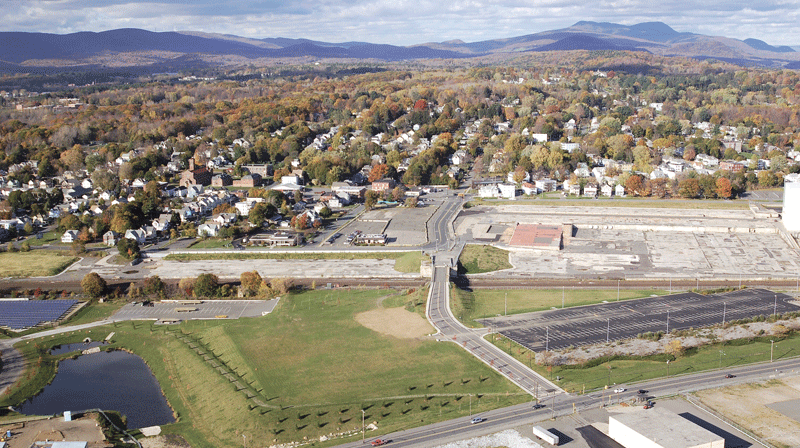
PHILADELPHIA — CRRC, the Chinese rail-car manufacturing giant currently building a plant in Springfield, was awarded a $137.5 million deal this week to build 45 new train cars for SEPTA, Philadelphia’s transit system. Its bid was $34 million less than the nearest competitor, according to philly.com. The deal includes an option to buy 10 additional cars for another $23.5 million.

The announcement comes on the heels of another deal, announced in December, to manufacture new subway cars for Los Angeles. The Los Angeles contract is worth $178.4 million for the manufacture of 64 new subway cars, with an option to buy 218 more cars.

CRRC is building its Springfield facility on Page Boulevard to manufacture 284 subway cars for the MBTA’s Boston-area Red Line and Orange Line, a deal worth $566 million. Production is expected to last five years. Late last year, the MBTA awarded CRRC another $277 million contract to build 120 additional cars after the initial run is complete.

Daily News

HOLYOKE — Conklin Office Furniture recently installed an array of solar panels atop its Appleton Street manufacturing facility, reducing its carbon footprint. Owner Franco Arnold, has taken many steps to reduce his company’s emissions of carbon usage and bettering its environmental impact; his Appleton Street location now produces enough renewable energy to offset all the company’s energy needs.

“Conklin is continuing with our business plan by doing all that we can to help the environment. We started in 1981 recycling office furniture and, over the years, refined our manufacturing processes to limit waste and use environmentally-friendly materials. This solar project is a big step in meeting our long-term environmental goals,” Franco said.

Conklin’s newly installed solar panels offset the amount of CO2 sequestered by 81 acres of forest, or represent the ability to charge 67 million smartphones, continuously power 7,000 lightbulbs; annually power 76 homes, or displace the CO2 emissions of 120 cars.

Community Spotlight Features

Community Spotlight

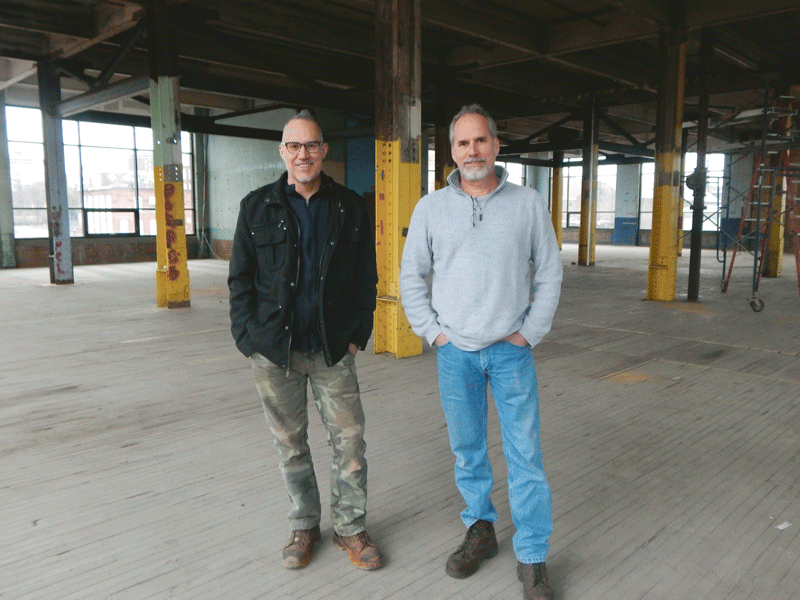
Denis and Marco Luzuriaga

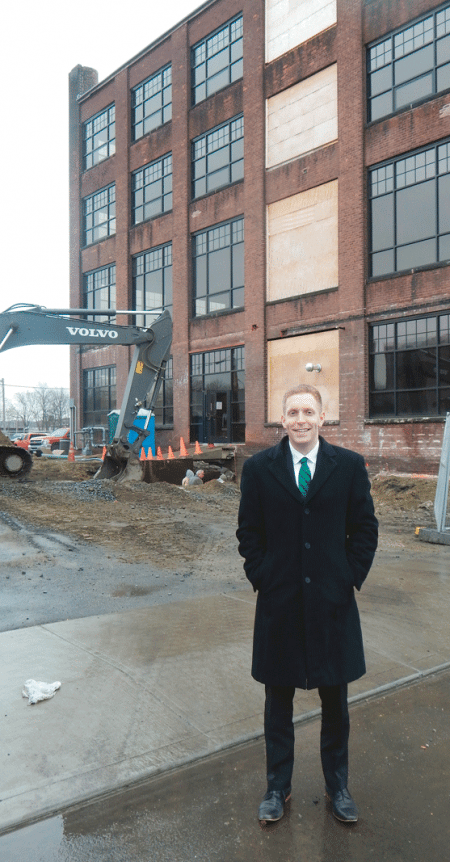
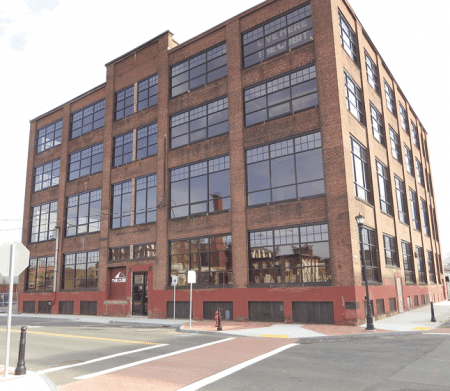
Denis and Marco Luzuriaga say more than 200 people have already expressed interest in the 18 market-rate apartments they are building on the upper stories of the Cubit building downtown.

Marco Luzuriaga and his brother Denis are betting on the future.

To be precise, that’s the future of Holyoke, a city where years of disinvestment led to vacant buildings with major environmental challenges that squashed any interest developers had in investing in them.

But a slow evolution has occurred over the past few years, and the landscape is undergoing marked change. The combination of Mayor Alex Morse’s proactive stance, support from the City Council, and work by other officials led to the creation of an urban-renewal plan four years ago that is finally coming to fruition.

Notable progress includes a focus on the Innovation District; the establishment of the Massachusetts Green High Performance Computing Center, a $165 million academic research facility between Cabot and Appleton streets that overlooks the first-level canal; major infrastructure investments; a growing number of artists and art venues; and other measures such as tax credits designed to spur revitalization and attract people of all ages.

When they realized the potential the downtown held and saw energy in the area increasing, the Luzuriaga brothers told BusinessWest, they made a decision to get in on the ground floor of the rebirth in both a literal and figurative manner.

Marco is an IT professional who lives in Maryland and was thinking about a career change, and his brother is a Holyoke artist. They decided to join forces, and after undertaking a feasibility study of the former Cubit Wire & Cable Co. Inc. building at 181 Appleton St., they purchased it for $325,000 and took on a challenge unlike anything they had ever imagined.

“But the amount of open space here in Holyoke is unparalleled, and we have seen a similar pattern of success in places like Soho and Jersey City, where artists moved into an area and they became vibrant, artistic communities,” Marco said, pointing to Gateway City Arts, the Canal Gallery, independent art studios, the Canal Walk, the computing center, Holyoke’s new $4.3 million rail platform, and other major projects within walking distance of the Cubit building, where their $5 million renovation will soon be complete.

The bottom floor will become home to the MGM Resorts HCC Center for Culinary Arts at Holyoke, while the two upper floors will be loft-style, one- and two-bedroom apartments with enormous windows and sweeping views of the area. In addition, the Luzuriaga brothers purchased three vacant lots that abut the Cubit building and will be used for parking.

“The Center for Culinary Arts will double the college’s prior teaching capacity and provide no-cost culinary training to 50 Holyoke residents every year, serving as a career pipeline into jobs from entry level to senior management in a top-employing industry of our region,” said Morse, adding that students are expected to start classes there next spring.

He added that the city has worked with developers and businesses to create solutions for some of its most challenging sites, and these efforts are yielding concrete results, with more than $100 million of investments in the pipeline.

Mayor Alex Morse

Mayor Alex Morse says the renovation of the Cubit building will provide more downtown housing and become home to the MGM Resorts HCC Center for Culinary Arts at Holyoke.

“We’re creating an environment that people want to be part of and are trying to reach the tipping point by putting together solutions for the most challenging sites,” Morse told BusinessWest.

Marcos Marrero, the city’s director of Planning and Economic Development, noted that, although vacant storefronts and shuttered buildings had become part of the downtown landscape and space ready for businesses to move right in is scarce, the situation has undergone a significant change.

“Our downtown is a different place than it was four or five years ago due to the availability of commercial space and opportunities to live and work here,” Marrero said.

Indeed, four major projects are underway, and interest and enthusiasm are exploding. “We have 200 people on a waiting list for the 18 apartments we are creating in the Cubit building,” Marco Luzuriaga said, noting that the list was created thanks to a Facebook posting about the new units, which will rent for $1,000 to $1,400.

For this, the latest installment of its Community Spotlight series, BusinessWest takes an in-depth look at Holyoke and the investments developers and businesses are making in the Paper City that will help shape and create a long-awaited and exciting new chapter in its history.

Repurposing Blighted Buildings

The Parsons Paper Co. facility, which was built in 1853 at 84 Sargeant St., was one of the most challenging properties in the city. The contaminated complex was abandoned in 2004, and in 2008 a fire caused extensive damage. Four years later, the city officially foreclosed on the property and took ownership for failure to pay taxes.

Aegis Energy Services Inc. is located next door to the old mill, and when the company expressed interest in the 4.7-acre site due to its desire to expand, the city did everything it could to make the cleanup and purchase possible.

“The Parsons site was one of 10 key areas that were designated as priorities for redevelopment in our 2013 Urban Renewal Plan,” said Morse. “Significant legal, environmental, and financial constraints had impeded progress for years, so we jumped when Aegis told us they were willing to entertain the idea that we would leverage resources to do the $3.6 million environmental cleanup that was needed.”

The work began last March thanks to funding from multiple levels of government, two private companies, and the involvement of every public corporation in the city. Although the majority of the 350,000 square feet of manufacturing space was demolished, Aegis was able to preserve about 40,000 square feet in one section of the structure.

In addition, the city provided Aegis with the most aggressive tax-incentive schedule in its history: a 100% property tax exemption for 10 years as a way to finance a $400,000 portion of the site cleanup costs.

“The financing framework for this project is probably the most complex that Holyoke has seen in decades,” said Marrero. “But the implications a year from now will be significant — blight reduction, building reuse, job creation, expansion of manufacturing, more renewable energy, and improved property values in the neighborhood.”

Aegis plans to do a major renovation to suit its manufacturing needs, which will allow the company to expand its footprint by 200% and almost double its workforce with the addition of 30 new jobs.

However, the project is being undertaken in stages. After the cleanup was complete, Aegis created a 2.5-megawatt solar farm on a portion of the acreage to help pay for its expansion. Holyoke Gas & Electric entered into a power-purchase agreement with the company, and the electricity is being used by property tenants of the Holyoke Housing Authority.

Progress will also soon be visible at 37 Appleton St., which was the second-largest vacant, blighted building in Holyoke. In the past, the site was home to businesses that included Worthington Compressor and the American Dream Modular Home manufacturing company.

Recently, American Environmental agreed to buy it from the city for $1 from the city’s Redevelopment Authority with the agreement that the company would undertake the $600,000 cleanup of the brownfields site.

“We’re about to close on the sale of the property,” Morse said, explaining that it will allow American Environmental to expand and add 50 new jobs.

There are also plans underway to reuse the third-largest blighted and vacant building, the former Farr Alpaca building at 216 Appleton St., for housing.


Our downtown is a different place than it was four or five years ago due to the availability of commercial space and opportunities to live and work here.”


Winn Development has partnered with the city’s Redevelopment Authority and forged an agreement to renovate the building and turn it into approximately 100 apartments. The company is hoping to get approved for historic tax credits, and if all goes well, Morse said, the estimated $38 million renovation will help fulfill the goal of creating dense housing downtown that will make it a safe, livable place for people of all income levels.

A $34 million rehabilitation of the 18-building Lyman Terrace public-housing complex also began last year. The buildings contain 167 units, and the first phase of work included excavating and building new roads and sidewalks, and installing new water and sewer lines and street lighting.

Morse said improvements to the housing units began this year, and he noted that the project is an example of how the city works closely with residents to respect and meet their needs.

When he took office five years ago, there was talk of demolishing the complex. But people had strong feelings about keeping the historic structure in the heart of downtown. As a result, the Housing Authority decided to renovate it, and after they held a number of public meetings, they were able to integrate recommendations made by residents into the final design.

“The residents had input on every part of the process,” said Morse. “The project is a real partnership that led to a great outcome, and has become a model to think about the way we do projects in the future.”

Another development that sparked controversy was the use of an 18-acre parcel on Whiting Farms Road. It sits across the street from a residential neighborhood, and although Lowe’s and Walmart had looked at the site, neighbors had objected to having a big-box store built there.

“We shepherded the use of the property, reset the conversation in a similar manner to Lyman Terrace, and talked to the residents to get input about what they wanted as well as the city’s goals and how we wanted to accomplish them,” Morse said, adding that the public meetings played an important role in determining a new use for the land. “If you want growth to take place, it needs to be possible, but you also need to build a sense of public support and common ground.”

The model worked well, and the City Council voted for a zoning change to allow Gary Rome to build a new, $10 million Hyundai dealership on 10 of the 18 acres. It opened last October, is the largest of its kind in the country, and led to the creation of 50 new jobs.

Collaborative Efforts

Economic development is also taking place in other areas of the city, including a $21 million project underway at Ingleside Square near the Holyoke Mall.

The former Holiday Inn is being replaced with a Fairfield Inn by Marriott, which will be completed this year. Half of the old hotel was demolished, the remainder is undergoing a major rehabilitation, and the remaining section of the footprint has been turned into pad sites for restaurants or retail stores.

“It’s the first time the city pre-approved a permit to help secure tenants,” Marrero said. “We worked with the developer and visually approved their site plan.”

So far, an Applebee’s and Chipotle have been built there, along with a Vitamin Shoppe and a stand-alone McDonald’s.

One pad site remains, and the mayor said it is a great example of what can be done with an underutilized property.

“For many years, the property was regarded as a homeless hotel because the state used it to house homeless families,” Morse noted. “But it is a prime piece of property located off of I-91, and in addition to creating at least 200 jobs, this reuse will result in hundreds of thousands of dollars in new tax revenue.”

Other projects in the pipeline include a new Easthampton Savings Bank branch, and redevelopment at the corner of Hampden and Pleasant streets with a planned Dunkin’ Donuts and an additional 2,000 square feet of move-in-ready retail-commercial space.

Morse said job growth continues to take place, and the city’s unemployment rate is 4%, which is the lowest it has been in 17 years.

“We certainly have more to do, but the wheels are constantly in motion,” the mayor told BusinessWest. “There is still plenty of vacant space in Holyoke’s historic mills. We also have the cheapest and cleanest energy source in New England, plenty of water, and the assets to continue filling our core with economic opportunity. Holyoke is increasing opportunity for its residents and strengthening its presence as an economic hub in Western Massachusetts.”


Holyoke at a glance

Year Incorporated: 1850
Population: 40,684 (2016)
Area: 22.8 square miles
County: Hampden
Residential Tax Rate: $19.17
Commercial Tax Rate: $39.72
Median Household Income: $37,372 (2015)
median Family Income: $40,559 (2015)
Type of government: Mayor, City Council
Largest Employers: Holyoke Medical Center; Holyoke Public Schools; Holyoke Community College
Latest information available

Departments Incorporations

The following business incorporations were recorded in Hampden, Hampshire, and Franklin counties and are the latest available. They are listed by community.

AMHERST

Hands for Life Amherst Corp., 462 Main St., Amherst, MA 01002. Breanna Werme, 1703 Northampton St., Holyoke, MA 01040. Nonprofit organization whose purpose is to provide natural health care through chiropractic along with educational programs designed around wellness and prevention for less-fortunate people.

CHICOPEE

First Regiment Massachusetts Volunteer Cavalry Inc., 10 Harvey St., Chicopee, MA 01020. Nicolette R. Meola, 64 Myrtle St., Weymouth, MA 02189. Nonprofit organization designed to promote a general interest in the history of the Civil War.

EAST LONGMEADOW

Healthy Choice Vending Inc., 62 Pembroke Terrace, East Longmeadow, MA 01028. Tracy L. Martin, same. Own and operate healthy choice vending machines.

INDIAN ORCHARD

DNA Corp., 1295 Worcester St., Indian Orchard, MA 01151. Orlando Ovalles, 67 Brown Ave., Holyoke, MA 01040. Real estate.

LONGMEADOW

Hampshire County Light Sport Flying Club Inc., 95 Glenbrook Lane, Longmeadow, MA 01106. William I. Morey Jr., same. Nonprofit organization whose purpose is to own, lease and maintain one or more aircrafts for educational, transportation and general use of its members or their families to carry on all businesses and activities.

LUDLOW

Fastlane Transport Inc., 99 Southwood Dr., Ludlow, MA 01056. Lyubov Titar, same. Transportation company.

PITTSFIELD

Fahey Home Improvement Inc., 82 Wendall Ave., Suite 100, Pittsfield, MA 01201. Theresa Fahey, 36 Pinecone St., Middle Island, NY 11953. Chimney cleaning and repairs.

SPRINGFIELD

Enuff Inc., 97 Hadley St., Springfield, MA 01118. Veronica McNair, same. Nonprofit organization whose purpose is to advance the public interest by providing social services and access to resources for underprivileged, at-risk members of the community, including those involved in the criminal justice system and recovering addicts.

WARE

Charles River Farmers’ Market Association Inc., 3684 Greenwich Road, Ware, MA 01082. Marie Louise Hills, 15 Worcester Road, Hollis, NH 03049. Nonprofit organization whose purpose is to operate and promote a farmer’s market in the city of Cambridge.

WEST SPRINGFIELD

Cretecrew Concrete Service Inc., 20 Warren St., West Springfield, MA 01089. Yevgeniy Y. Rudenko, same. Concrete contractor.

Del Composites Inc., 410 Elm St., West Springfield, MA 01089. Victor Archakov, same. Manufacturing of composite aircraft parts.

Cover Story

Game On

Bob Adams

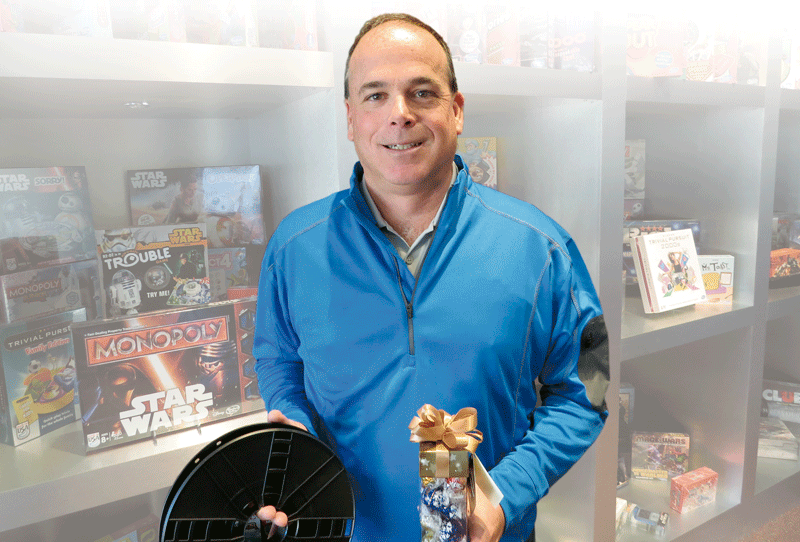
Bob Adams says one of the unofficial goals at Cartamundi East Longmeadow is to diversify the list of products made there, and thus the showroom in the front lobby as well.

Since Cartamundi acquired the Hasbro plant in East Longmeadow in 2015, the two companies have been closely linked — in news accounts and everywhere else. And that’s understandable, because the toy and game developer is easily the biggest customer for the East Longmeadow plant. But those managing that facility are working hard to make it clear that this facility can do much more than make games for Hasbro.

Bob Adams acknowledged there are many benefits to the recent announcement that Play-Doh — that curious, multi-colored molding compound that has been part of American culture for more than 60 years — will again be made at the massive manufacturing facility in East Longmeadow now owned and operated by Cartamundi.

They begin with what will likely be, by most estimates, an additional 20 jobs at the plant, which previously had the household names Milton Bradley and Hasbro (producers of Play-Doh) on the sign out front. But there is more to this than employment opportunities, said Adams, manager of sales and new business development for Cartamundi East Longmeadow LLC, who has worked at that plant, off and mostly on, for nearly 40 years.

Indeed, there is the publicity that came with the announcement, obviously — the Wall Street Journal and a host of other media outlets covered the story — and also the fact that the plant, the largest games-manufacturing facility in North America, now has what amounts to another huge identifying product, with the board game Monopoly long being the other.

“That brings visibility to this plant,” he said of the Play-Doh contract, which extends over several years. “When I talk to people about having Cartamundi East Longmeadow do some business with them, they have a much better chance of knowing who Cartamundi East Longmeadow is.”

About the only thing this announcement doesn’t do — and this is not exactly an insignificant development, either — is let the world know that Cartamundi, and this plant, are about much more than Hasbro and, well, fun and games.

Indeed, while Hasbro is easily the most dominant client, and games of all kinds serve as the primary stock and trade for Belgium-based Cartamundi, the company can do much more — and it wants to get this message out.

“We’re not only still making many of Hasbro’s products, but we’re out soliciting business from other customers,” he said, explaining that Cartamundi is, for the most part, a contract manufacturer and generally doesn’t put its own name on what rolls off the assembly line. “And while the customer base is centered on games, because that’s our specialty, we’re also looking to use our core competencies to support other businesses.”

With that, Adams got up from his chair, reached to a high shelf on the credenza behind him, and grabbed a box, which, if it wasn’t occupying space in his office, would otherwise be holding an assortment of Lindt chocolates.

We want to be less reliant on Hasbro and leverage our competencies to build our contract business. And to do that, we’re developing our own sales organization and building our own identity in this region.”

“This is just one of the things we can do here — we started last June, and last year we made more than 1.7 million boxes for Lindt,” he said, holding the gold-toned item aloft, adding that the company has, for example, injection-molding machines with additional capacity, and can also take on thermoforming work, box making, die cutting, assembly, and much more.

“We want to get the word out that we’re open for business,” he went on, adding that, in his new capacity, he is essentially leading the efforts to bring new business to the plant — the immediate goal is to increase non-Hasbro contract manufacturing by 30% — and diversify the list of products manufactured there.

Jeffrey Lombard, CEO of both the East Longmeadow facility and a sister facility in Waterford, Ireland, also purchased by Cartamundi, told BusinessWest that Hasbro projects (not including Play-Doh, which will start rolling off the lines during the first half of 2018) amount to roughly 90% of the production in East Longmeadow.

He would like to see that volume of work rise still higher, but the percentage rate go down as the plant takes on other work, such as games for other developers, as well as Lindt boxes and similar projects.

“We want to be less reliant on Hasbro and leverage our competencies to build our contract business,” said Lombard, who held a succession of operations positions for Hasbro and was serving as senior vice president of Domestic Manufacturing when it sold the East Longmeadow plant. “And to do that, we’re developing our own sales organization and building our own identity in this region.”

While the company is mostly ready to do that, it will be challenged to greatly increase capacity by the same issue facing virtually every other manufacturer in this region — finding skilled help.

“Short-term, like every other manufacturer in the Northeast, and probably in the U.S., we’re not limited by equipment capacity, per se,” he explained. “The problem in this region is the hiring of skilled employees; that’s the biggest inhibitor to short-term growth.”

Jeffrey Lombard

Jeffrey Lombard says Cartamundi East Longmeadow has the potential to increase capacity by 30%, but is challenged in that assignment by the task of finding qualified help.

For this issue, BusinessWest talked at length with Adams and Lombard about what’s happening at Cartamundi’s East Longmeadow plant today — and what could happen there in the years to come if all goes according to plan. You might sum it up neatly and effectively by simply saying ‘game on’ — although, as noted, that’s certainly not the whole story.

Pieces to the Puzzle

Adams and Lombard can easily trace the history of the East Longmeadow facility, because they’ve both witnessed most of it first-hand.

Adams was just out of high school in 1978 when he applied for a job at the plant, which Milton Bradley opened roughly a decade earlier, and landed a position in the warehouse.

He probably couldn’t have known then he would still be coming to work there — except for a stint in Rhode Island and a subsequent brief retirement and work as a consultant to game manufacturers, including Hasbro — nearly 40 years later. But, then again, maybe he did.

“It was a great place to work,” he explained. “It was a very well-run company, and family-oriented. My mother worked here, as did my aunt and my uncle. People came here, and they stayed here.”

Over those ensuing decades, he put a number of titles on his business card and wore a number of hats. Starting in 1985, for example, he moved into an office job as a production planner. He then moved on to work in industrial engineering, delving into everything from efforts to improve efficiency to early — and in many ways groundbreaking — initiatives in ergonomics.

Later, he became new-business coordinator, working in tandem with development teams that had been based in East Longmeadow, were later moved to Hasbro’s facilities in Beverly, and then moved back. Subsequently, he went into project management and then became leader of Hasbro’s boys’ toys project-management organization in Pawtucket, R.I., essentially to bring the best practices of the East Longmeadow operation to that unit.

After doing that for three years, and amid changes to those operations, he decided to take a retirement package at age 52 and do consulting work, primarily for Hasbro, and did that until Cartamundi bought the East Longmeadow plant.

Summing things up, Adams said he saw long ago what Cartamundi saw when it researched and ultimately decided to acquire the East Longmeadow plant in 2015 — highly skilled workers and an operation that could do so much more than manufacture some of the games that bore the Hasbro name.

“When Cartamundi bought the facility, I was very happy for the people who worked here,” he told BusinessWest, “because I knew there were tons of opportunities to grow the business and bring back manufacturing expertise to this area; there were a lot of positives.

“This was a really good fit for both sides — with Hasbro wanting to be out of the manufacturing business, and Cartamundi wanting to be in the manufacturing business,” Adams went on. “This was an opportunity for both companies to grow their business the way they wanted to grow their business, and so they made it happen.”

His current title, director of sales and new business development, is one that no one has ever had at the plant before (again, it was always an in-house manufacturer for Hasbro, and thus sales were not part of the equation). And, as noted earlier, these new assignments come down to attracting both more work in games — and there is plenty of it out there — and work that falls well outside that realm.

Marketing to potential clients through the website 360manufacturingservices.com, Adams said he’s receiving three or four inquiries a day, on average, many of them from small game-development companies looking to outsource manufacturing operations.

With the acquisition of Hasbro’s plants, Cartamundi is now the largest games manufacturer in the world, he went on, and it is well known for its production of playing cards, most of them made at the company’s plant in Texas (cards for specific games, like Monopoly, are also made at the East Longmeadow plant), so it is often a go-to source for companies seeking such services.

But, overall, Cartamundi is looking for new clients with high volumes of work, and has provided quotes on everything from boxes to plastic snow shovels.

“It has to make sense for both of us,” he said of the contract work. “It usually doesn’t make sense for low-volume manufacturing.”

Board Meetings

Without actually saying as much, Adams said Cartamundi’s primary mission at the moment — and his as well — is to broaden and diversify the shelves in the front lobby of the East Longmeadow plant.

There, on display, is a random sampling of what is produced on the factory floor. And at the moment, the shelves are crammed with all kinds of games, from stalwarts like Clue, Scrabble, and Yahtzee to speciality items, such as Star Wars versions of everything from Monopoly to Sorry, and even Operation.

There is expertise and capacity to add new items and greatly diversify what’s on those shelves, said Adams, adding that the two immediate goals are to generate new business from existing clients and add new customers to the portfolio.

“We want to work with existing customers to provide them with exceptional customer service and support so that we can grow our business with those existing customers,” he explained. “We’re also looking to grow our customer base in the main game aisle, meaning new lines of products from other game distributors, and we’re looking for local companies that can take advantage of our core competencies.

“There are a lot of opportunities out there, and that’s why I’m back,” he said, adding that there are many pieces to the puzzle, to use an industry term, when it comes to achieving the plans for growth the company has laid out.

These include everything from marketing — something else that was never really undertaken at the East Longmeadow plant — to raising the company’s profile, in part by making the 360 Manufacturing website much more integrated into the Cartamundi site, to building an infrastructure for new-business development, said Adams, whose hiring was one of the first major steps in this direction.

Other steps have been taken as well, said Lombard, referring to that sales organization he mentioned earlier. They include the hiring of a customer account representative and the planned hiring of a customer project manager to create an even sharper focus on price, customer service, and quality.

“That’s all new; everything we’re doing along these lines is new,” he said, again noting that, as an in-house manufacturer for Hasbro, such matters were not priorities, so there will definitely be a learning curve.

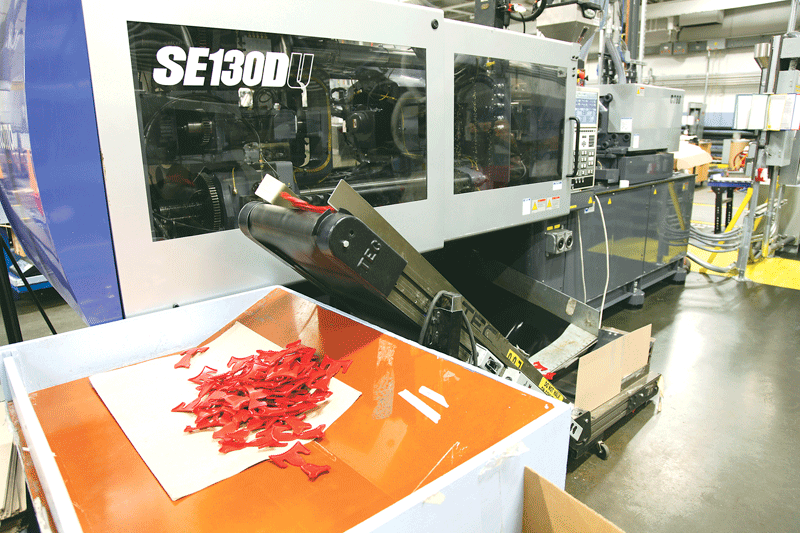
Injection molding

Injection molding, undertaken by machines like this one, is one of many core competencies that Cartamundi East Longmeadow is looking to sell to new customers.

Speaking of learning curves, though, perhaps the biggest challenge facing the company as it pursues those goals is finding enough qualified help.

“We don’t need more equipment to increase our capacity; we need more skilled labor,” said Lombard, adding that, like other manufacturers in the region, Cartamundi will work to make itself and its various career opportunities highly visible.

Long-term, he believes the company has the ability to grow capacity by that 30% goal stated earlier.

“We’re in the process of growing what I call our efficiently flexible capacity, and that’s really a function of getting some skilled employees in the door and trained, and we’re aggressively pursuing that,” he explained, adding that one of the keys to success in such efforts is to build the brand and establish an identity.

“One of things that inhibits us is that people in this region don’t know who Cartamundi is,” he said, adding that, through a variety of steps, including a stronger web presence, he’ll look to stem this identity problem.

The Shape of Things to Come

As every Baby Boomer — and every member of all the subsequent generations, for that matter — can tell you, Play-Doh can be molded into just about anything the user can think of. The only real limit is the imagination.

In many respects, the same is true when it comes to contract manufacturing at Cartamundi’s East Longmeadow facility. It will always be known as the place where memory-inducing game pieces — like Sorry! pawns and Monopoly houses and hotels — are manufactured. And soon, it will again be known for Play-Doh.

But as Adams and Lombard made clear, it can become a resource to make a host of products that are perhaps less famous but no less important to the companies relying on them.

So it’s a whole new game at the landmark plant, one that officials there certainly believe it can win.

George O’Brien can be reached at [email protected]

Daily News

AGAWAM — The Employers Assoc. of the NorthEast (EANE) announced that Samantha Clarke and Lisa Patnode have joined the EANE team as member engagement specialists.

Clarke will serve as EANE’s member engagement specialist for Connecticut, working with the membership team to assist prospective members and engage current members in programs, services, and trainings that enhance their organizations.

Most recently, she was the director of Marketing and Member Engagement for the Newport County YMCA in Newport, R.I. With a background in membership development and marketing, she has handled project-management tasks around marketing campaigns, IT support services, customer-service trainings, scheduling, and staff onboarding.

Clarke is a graduate of Salve Regina University in Newport, where she received her undergraduate degree in 2013 and her master’s degree in business management in 2014, plus a certificate of graduate studies in organizational development in 2014. She is also a musician, having volunteered at many local events in Newport County.

Patnode joins the membership engagement team with a focus on Western and Central Mass. She has strong human-resources and business-development experience in manufacturing and financial services, providing guidance to members in both strategic business development and for all their HR needs. She is known for her commitment to employee retention and organizational growth.

Patnode has a bachelor’s degree in business administration from Western New England College. She is a volunteer for Open Pantry Community Services Inc. in Springfield, and a member of the Pioneer Valley Women’s Running Club.

Community Spotlight Features

Community Spotlight

Frank DeToma and Mike Sullivan

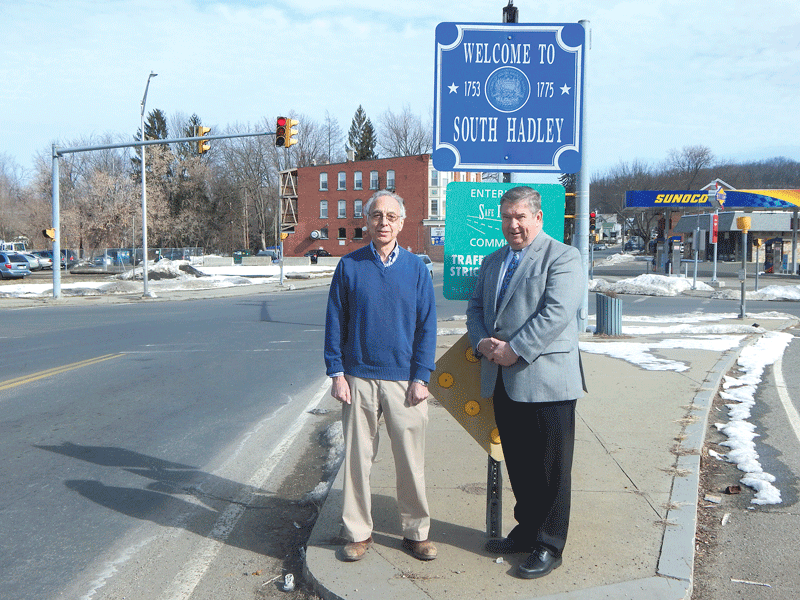
Frank DeToma and Mike Sullivan say the Vietnam Veterans Memorial Bridge is the gateway into South Hadley Falls, where revitalization efforts are underway.

In two months, the Vietnam Veterans Memorial Bridge that leads from Holyoke into South Hadley Falls will be closed for a day for a “River Roll and Stroll” event.

The family festival is designed to promote healthy living and is being co-sponsored by the Holyoke Bike-Pedestrian Committee and the South Hadley Bike-Walk Committee, a grass-roots effort to help promote recreational opportunities for bicyclists and pedestrians.

“The River Roll and Stroll will give people a look at the Falls and allow them to see the potential that exists while providing an economic boost to businesses there,” said Mariann Millard, co-chair of the event steering committee and chair of the South Hadley Bike-Walk Committee.

One of their goals is to make people aware of the natural resources and hiking trails that wind through conservation land in the town, which will help to expand efforts by town officials who believe increasing recreational opportunities will foster the growth of economic investments.

“We don’t have a rail trail, but want to show the public what we have to offer,” Millard said, adding that the South Hadley Falls Neighborhood Assoc. has put together a walking map of the area that highlights historic buildings and the Bicentennial Canal Park that overlooks the Connecticut River.

The newly created map; River Roll and Stroll on May 7, which was initiated by Sean Condon of Holyoke; and upcoming annual FallsFest Music & Arts Festival on July 29 that attracts thousands of people are part of a growing force aimed at introducing newcomers to the Falls and promoting economic development there.

“We believe the strategic use of public funding and local enthusiasm will encourage more people to live, visit, and work in the Falls and become a catalyst for private investment,” said Frank DeToma, a selectman and chair of the Redevelopment Authority. “Our ultimate vision is to develop a ‘canal village’ that will consist of commercial and residential establishments that capitalize on our historic canal and adjacent riverfront as well as the architectural character of some of the original buildings.”

Town Administrator Mike Sullivan said that, although the Redevelopment Authority is concerned with the entire town, bringing new life to the Falls will provide a significant boost to South Hadley’s economy as a whole.

We believe the strategic use of public funding and local enthusiasm will encourage more people to live, visit, and work in the Falls and become a catalyst for private investment.

Ira Brezinsky agrees and says collaborative efforts that include work by government officials and businesses have coalesced to shine a light on the Falls and attract people who might not otherwise visit the area.

“It’s an ideal time for business people who want to get a taste of the community and neighborhood to come here, and we will put our best foot forward to welcome people from throughout the region,” said the selectman, co-chair for the River Roll and Stroll, and president of Music and Arts South Hadley, a grass-roots effort that became a nonprofit last year and hosts the FallsFest.

The town has also partnered with the Pioneer Valley Planning Commission to map out walking trails that need improvement and places where bike lanes and chevrons are needed to increase recreational opportunities.

In addition, a five-year, $5 million infrastructure project that involves improving parks, adding benches, new landscaping, crosswalks, traffic-calming devices, and new sidewalks in the Falls is well underway. So far, $2.7 million has been spent, and this year another $1.2 million will be poured into the redevelopment effort.

For this, the latest installment of its Community Spotlight series, BusinessWest looks at what the Falls has to offer, plans for its future, and why officials and residents are bullish on the idea of redeveloping the area.

Planned Progress

Sullivan says the Falls is overdue for attention, and holds unlimited potential. It is less than a mile from the $4.3 million Holyoke passenger rail platform, and has centralized sewers and great access to the Connecticut River. In addition, South Hadley has its own municipal light plant, and work is being done to be able to offer secure, high-speed Internet in the future.

The Falls is also rich in history: the first navigable canal in the U.S. was built there in 1795, which made Falls Village (then South Hadley Canal) a busy shipping center and tourist attraction.

Unfortunately, its former vibrancy has been greatly diminished, mirroring what has occurred in many towns and cities across Western Mass., where businesses along riverfronts shut their doors or moved, and disinvestment slowly occurred.

But revitalization efforts began in earnest after a study of the area that was completed about five years ago became a springboard for change. As a result of recommendations in the final draft, the Falls Neighborhood Assoc. was formed, and in 2014 two important advances were made. The first was the long-awaited construction of a new $12 million public library on 2 Canal St. It was dedicated a year ago and contains meeting and reading rooms, and large banks of computers that businesses can use to conduct training classes.

The second advance occurred when a town meeting approved the creation of an advisory board to develop a comprehensive plan for the area.

The final draft is almost complete and will be presented to the public by the Redevelopment Authority, which is the name the advisory board was given, at a special town meeting held expressly for that purpose on June 7.

“A tremendous amount of work has gone into this,” Sullivan said, noting that the committee members are all unpaid volunteers.

There are many components to the plan, which include a focus on the east-west core of the area that is part of a larger, recently established ‘Smart Growth’ overlay district in the Falls.

“Developers who wish to construct relatively high-density housing in Smart Growth districts can do so by right, thus eliminating their need to apply for special permitting from a local planning authority,” DeToma told BusinessWest.

The proposed plan contains many other elements, including repurposing some town-owned properties and redeveloping a number of industrial properties.

But progress is already occurring, and the first residential construction project in decades is underway. Orange LLC is building 12 condominiums in three units directly across from the new library on 1 Canal St. that will each have their own garage and extra parking.

“This is a beautiful spot, and the Victorian look of the buildings is expected to enhance the neighborhood,” DeToma said, adding that Orange LLC also has plans to develop six other condominiums in the old library building on 27 Bardwell St. “The design is very imaginative and interesting, and there will be a great room in every unit.”

Sullivan told BusinessWest that condominiums in South Hadley have appreciated significantly over the past six months. “New ones are selling more quickly than they can be built,” he said, noting that construction on the Rivercrest Condominiums on Ferry Street began last year, and 16 of the proposed 28 units have already been sold.

Business growth has also taken place in the Falls. Over the past 18 months, Mohawk Paper and E Ink Corp. moved there, and South Hadley Fuel scrapped its plans to move out and expanded in town instead.

Sullivan explained that the decision came about in large part because Town Planner Richard Harris alerted South Hadley Fuel owner Steve Chase to an existing but unused underground tank farm near E Ink Inc., which he described as an “opportunity found.”

“As a result, they have opened one of the largest propane storage and distribution facilities in Western Mass,” the town administrator said. “We do all we can to introduce businesses to opportunities that exist here.”

Brezinsky agreed. “South Hadley and particularly the Falls has been very welcoming and engaging to businesses that want to move or expand there. We were able to steer Mohawk Paper through town meeting very quickly to get them what they needed to move here, and there are other examples like this,” he said, explaining that Mohawk Paper moved to the Falls two years ago into a group of buildings formerly known as the U.S. Gaylord properties, and opportunities exist for professional space, retail businesses, manufacturing, and incubator space.

“I believe one of the benefits of the Falls is its scale,” he continued. “It has a small footprint and is very walkable, unlike some former industrial areas where there are blocks of old buildings. The Falls never rose to those heights, so I don’t believe it will take much to get it to the tipping point where it can become a vibrant place again where people live, work, and play.”

DeToma said the northwest corner of the gateway Bridge/Main intersection is a prime location for redevelopment. It consists of three parcels owned by three different entities, but each lot is too small to be of interest to a developer.

“Our proposed redevelopment plan calls for the consolidation of those properties in order to increase their potential for private development,” he said.

Forward Movement

South Hadley recently lobbied to have Pioneer Valley Transit Authority’s Tiger Trolley change its route. Today, it runs over the Vietnam Veterans Memorial Bridge on Route 116 rather than the bridge on Route 202. Sullivan said that was important because the Falls is densely populated and town officials wanted to provide access to jobs in Holyoke and South Hadley, especially since Mohawk Paper and Mount Holyoke College are two of the largest employers. He added that the X90A Route that runs from Chicopee to Main Street in South Hadley is one of the fastest-growing routes in the area and also goes over the Route 116 bridge.

Parks in the town are also receiving attention. The town administrator told BusinessWest that Bicentennial Park, which is situated a quarter-mile away from the new library, will be renamed Belsky Park after Ted Belsky, a longtime member of the Select Board, and $97,000 will be spent to install lighting and a deck that will overlook the Connecticut River.

In addition, the town is creating a one-mile loop called the River to Range Trail that will begin in a field near Brunelle’s Marina and offer access to people of different abilities.

“We worked with the Pioneer Valley Planning Council on this,” Sullivan noted, adding that, eventually, the trail will connect to the Summit House on top of Mount Holyoke. “We see it becoming part of a recreational economy. That market is exploding, and we are getting requests for groups for camping areas. Although we are not proposing to open any right now, we have to be cognizant of opportunities as they present themselves.”

The Buttery Brook area is another area of focus. It runs east-west and roughly parallel to Gaylord and Bridge streets, crosses under Main Street via a culvert, and empties into the Connecticut River. DeToma said it is overgrown, but the Redevelopment Authority hopes to restore it to its original, attractive condition and install a multi-use recreational path along its bank.

“There will be two benefits to this,” he explained. “First, it will be a major recreational attraction in our Canal Village central area. Secondly, because this area is part of our Smart Growth district, it should stimulate the interest of developers in constructing affordable, higher-density housing nearby.”

Plans are also in place to build a new bridge over Bachelor Brook as well as a parking lot for 12 cars. The estimated cost is $2.1 million, and South Hadley has already received almost $1 million toward that amount from state and federal grants.

Concerted Efforts

Sullivan said major efforts are taking place to help people rediscover, reconsider, and reinvest in the Falls, and the Redevelopment Plan is the underpinning of the future.

“South Hadley has many opportunities; a lot of cool things are happening here,” he told BusinessWest, noting that South Hadley Electric is planning to create a hub for data storage and hired a new manager to help develop its high-speed Internet plan. “Their rates were key in bringing Mohawk Paper here, and enthusiasm about the area is growing. It has become an organic movement with its own energy, all for the benefit of the Falls.”

DeToma concurred. “The grass-roots efforts are taking on a life of their own. As we point out the value and potential of moving here, many groups are getting involved, and events like the River Roll and Stroll will help South Hadley and Holyoke to grow.”

Which bodes well for the future as residents and officials work together to bring new life to South Hadley in a way that will benefit generations to come.


South Hadley at a glance

Year Incorporated: 1775
Population: 17,663 (2017)
Area: 18.4 square miles
County: Hampshire
Residential and Commercial Tax Rate: $20.12 (Fire District 1); $20.66 (Fire District 2)
Median Household Income: $64,610
Median family Income: $76,679
Type of government: Town Administrator, Select Board, Town Meeting
Largest employers: Mount Holyoke College, Loomis Communities, Mohawk Paper
* Latest information available

Manufacturing Sections

Making a Name for Itself

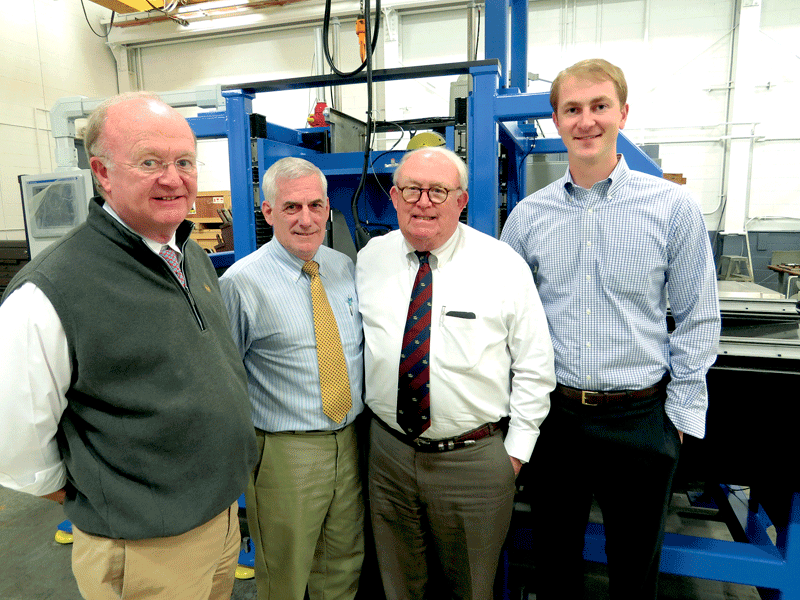
From left, Frank Mitchell, Chris Brucker, Jack Mitchell, and Mark Mitchell

From left, Frank Mitchell, Chris Brucker, Jack Mitchell, and Mark Mitchell show off one of the company’s custom machines — one that will slice sapphire.

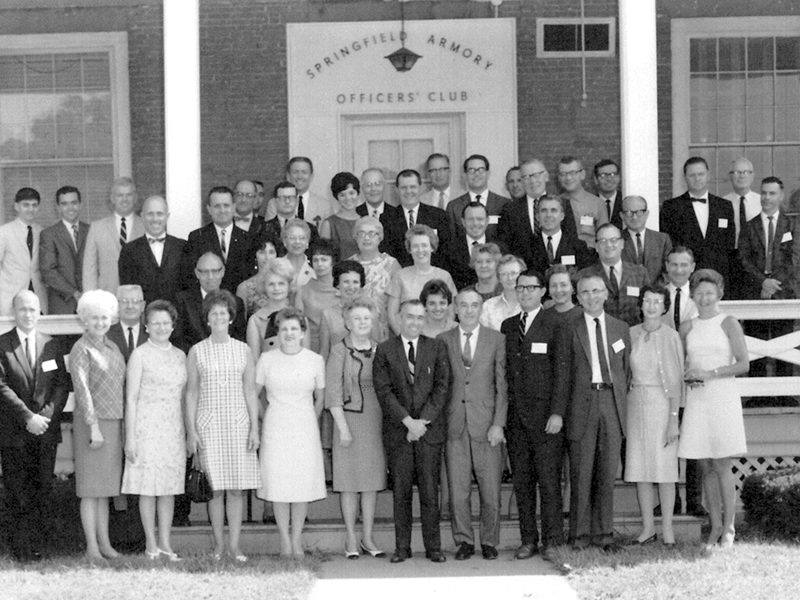
Since it was launched by John Mitchell in 1920, Mitchell Machine has grown and diversified — shifting from producing parts and tools for the Springfield Armory and Indian Motocycle to designing and manufacturing complex machines for the semiconductor industry. But since day one, the company has essentially been doing the same thing — producing solutions for its clients.


It’s called a ‘sapphire wafer slicer.’

And that’s exactly what the blue-painted piece of machinery is — a device that slices sapphire substrate into razor-thin wafers for use in the production of light-emitting diodes (LEDs) and other products.

As they gathered for a photo in front of this piece of equipment, which was due to be shipped out to an unnamed customer within a matter of days, those at Mitchell Machine were careful to position themselves so that they were shielding anything that might be the slightest bit proprietary in nature.

It has been this way — sort of, and in most respects — at this landmark Springfield company since it was started by Jack Mitchell’s grandfather, John Mitchell, in 1920.

Back then, said Jack, one of the third-generation owners (his brother, Frank, is the other), this was mostly a parts manufacturer, supplying several companies but especially two huge customers steeped in history and lore and located just blocks away from the Hancock Street plant — the Springfield Armory and Indian Motocycle.

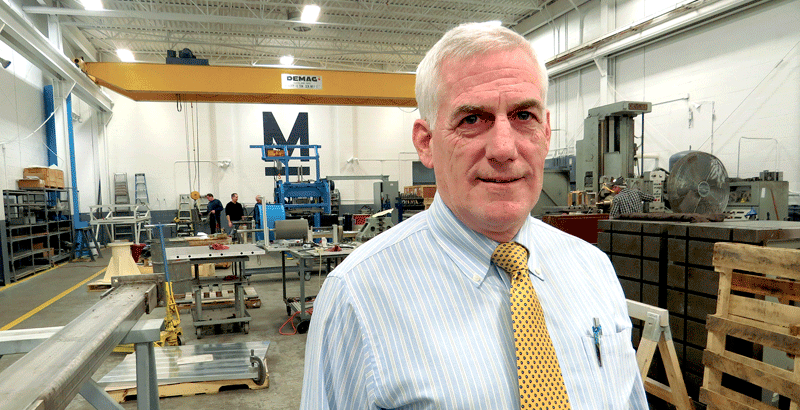
Chris Brucker

Chris Brucker says Mitchell Machine has a long track record of providing solutions to its clients.

The second generation of ownership — John’s sons, Frank, John, and Richard — led the company through its first evolutionary process, into the tool and die business in the ’50s. Today, the company handles everything from production of special machinery — like the sapphire wafer slicer — to subcontract machining; from design and manufacturing of robotics equipment that can provide companies with cost-effective automation, to machine design and engineering services for companies that would prefer to outsource such important work.

The common denominator when it comes to everything that goes on in (or out of) the plant today, and what transpired decades ago, is the fact that Mitchell has always been in the business of providing solutions to many different kinds of customers.

“When people have problems in manufacturing — when they need to do something faster, they need automation, they need robotics — they require solutions, and we provide them,” he explained, adding that, as Baby Boomers retire and the task of replacing highly skilled workers becomes ever more daunting, manufacturers are increasingly looking at using technology to do (or help do) what people have traditionally done.


Chart of Largest Manufacturers in the region


Mitchell works with clients in a host of business sectors, including automotive, communications, machinery, electronics, plastics, printing, rubber, optics, and semiconductors.

Many of these solutions are one truly one-of-a-kind in nature, meaning the company won’t even make two of them, he went on, adding that such undertakings make the business unique and the work quite intriguing. But it also brings challenges, especially the need to keep a steady flow of projects in the queue.

“We rarely do the same thing twice — there’s not a lot of volume production — and this requires a lot of skill,” he said, adding that individual projects generally take anywhere from five to 18 months or more to complete. “So you need a lot of projects in the pipeline, and you need financial security, because it’s a long time between drinks.”

This need to continually bring in new work led Mitchell to become one of a handful of area companies to take part in Valley Venture Mentors’ first accelerator program for established manufacturers.

Mark Mitchell, Frank’s son, and thus a fourth-generation leader of the company, led Mitchell’s involvement in the intense, three-month accelerator program. He said it was helpful on many levels, but especially with marketing and raising the company’s profile, thus generating new clients.

“There was a lot of insightful reflection on the company, how we produce, and how can market ourselves,” he noted, adding that, while the company made some direct contacts that might lead to additional business, many of the takeaways involved operations and becoming more visible. And one of the first orders of business will be a new and improved website.

For this issue and its focus on manufacturing, BusinessWest takes an in-depth look at Mitchell Machine’s long history of providing solutions for customers, and how, as it approaches its centennial, it continues to find new ways to expand an already-impressive portfolio of projects.

Parts of the Whole

Jack Mitchell told BusinessWest that, when his grandfather arrived at his home in Springfield’s Hungry Hill section one afternoon in 1920, he had what amounted to good news and bad news for his wife.

“The good news was that he bought a building and was going to start a business,” he explained. “And the bad news was that he didn’t have his existing job anymore, and he had to rely strictly on himself. And he had six children; needless to say, my grandmother was quite alarmed.”

That job was as a toolmaker with Colt Industries in Hartford, he went on, adding that his grandfather’s story was typical of many machinists working for the Armory and other companies at the zenith of this region’s industrial age; individuals with an entrepreneurial bent who decided to take their assembled skills and go off on their own with a career turn (that’s an industry term) that would bring with it a whole host of risks, sacrifices, and unknowns.

To make ends meet, Mitchell noted, his grandfather would work at shops like Van Norman Machine Tool and Bosch Machine during the day, and work at the company with his own name on it at night, logging 16- to 20-hour days, usually six days a week.

What’s happened since that start, though, is far from typical.

Indeed, the company has, as noted, reached fourth-generation involvement (a rarity in any sector, but especially manufacturing) and continues to find new and different ways to grow, evolve, and, yes, manufacture solutions for clients across a wide range of business sectors.

Relaying some of the company’s rich history in Springfield, Mitchell noted that, during World War II, it made parts, gauges, and other equipment for essentially two clients — the Armory, which, by the war’s height, was employing more than 15,000 people in arms production, and Indian, which by then was producing motorcycles exclusively for the military.

“At that time, we had more than 100 people working in a very small section of our current shop,” he explained. “It was a 24-hour-a-day, seven-days-a-week operation during the war.”

After the war, the company acquired new, larger equipment, and subsequently diversified into the manufacturing of complete, custom machines, and for companies across the country, not simply across town.

Then, as now, it served a host of different sectors, many with a presence in this region, including the paper industry (many communities in the area had plants), tire making (those products were produced in both Chicopee and Springfield), and molded fiber, among others.

“To this day, Michelin is still a customer — we’ve been serving the tire industry since the ’50s,” said Mitchell, adding that many customers in the portfolio have been with the company for decades.

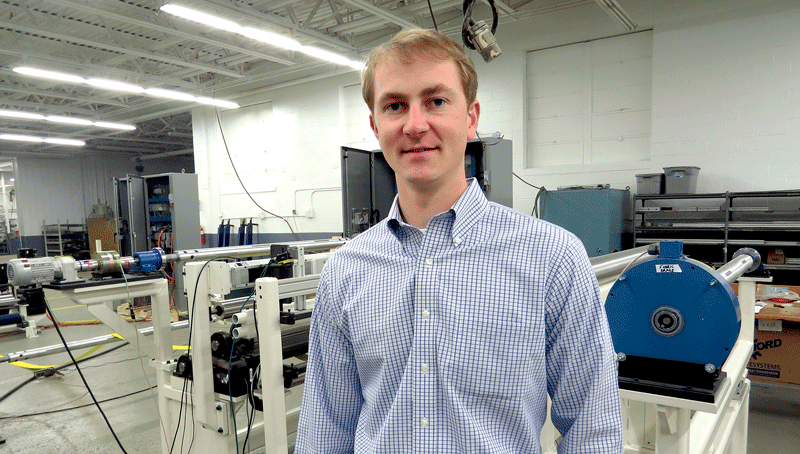
Mark Mitchell

Mark Mitchell says the company’s participation in the manufacturing accelerator has provided new business leads and insight into how to raise Mitchell’s profile in the marketplace.

The company’s next important step in diversification came in 1992 with the establishment of Mitchell Engineering, which took the company into the design-and-build realm when it came to custom machinery and robotics and to a new dimension in providing clients with solutions.

Today, such work represents roughly 60% of the annual revenues, with the rest coming in the form of subcontract machining.

As noted, Mitchell Engineering is in the business of providing solutions to problems, many of them workforce-related, he said, citing, as one example of the work it undertakes, an assignment involving Sanderson MacLeod, the Palmer-based manufacturer of twisted wire brushes.

“There’s an unusual brush that only one person could make,” Mitchell told BusinessWest. “And that individual was retiring. They came to us, and we designed and built a machine that could actually perform the task that this person did.”

Designs on Growth

There are dozens, if not hundreds, of similar stories in the portfolio, he went on, adding that the machine to slice sapphire — which is ideal for use in both LED and non-LED applications due to its high temperature resistance, high strength, and good electrical insulation — certainly falls into this category.

“Sapphire is harder than silicon, so it’s a more difficult thing to do,” Mitchell noted. “This is a prototype machine — nothing like it has ever been built before.”

Many of the products and solutions that roll out the door command similar language, said Chris Brucker, an applications engineer for the company, adding that the solutions are generated through intense collaboration, or interface, with the client concerning the problem and the best means of solving it.

“Our clients will have an application that they’re looking to automate, or generate better quality, less scrap, fewer direct labor hours … all those kinds of things to stay competitive, increase profits, all those good things companies want to do,” he explained. “I go in and talk to them, understand their process from their perspective, find out what they need to do,” he went on, “and then develop concepts for a special piece of machinery or automation.”

As noted earlier, projects of this nature generally take at least six months from start to finish, and many require much more time.

Thus, there is that heavy premium on constantly generating new work for the pipeline, said those we spoke with, adding that, as might be expected, it comes in two forms — additional work for existing clients, and attracting new clients.

And recent efforts have been focused on both, said Jack Mitchell, adding that this is a relationship business, and once one has been established, the goal is to grow it.

He said there are many examples where subcontracted machining has also led to work designing and manufacturing custom equipment or the promise of such work, including one case involving a medical-equipment manufacturer.

“It started with a small, complex part, and moved to a much more complicated assembly of parts, to creating a tool they could use,” he explained, adding that the next step could be work to design a production line for the company.

As for attracting new clients, word of mouth has always been and will always be the best form of marketing, said Mark Mitchell, and the company does take part in several large trade shows each year. Still, there are many who don’t know the Mitchell name and all that it stands for, and this nagging reality was perhaps the primary motivation behind participation in the manufacturing accelerator program, although connecting with new customers directly was also a goal.

“We’ve quoted on a number of projects as a result of the program,” said Mark, adding that the program reaffirmed the notion that original equipment manufacturers, including many in this area, are not fully aware of the resources (such as Mitchell’s expertise) that are available to them.

Slices of History

The small conference room at Mitchell Machine speaks to the company’s long history, and brings the past, present, and future together efficiently.
Indeed, along with a few golf pictures (which reflect a passion for the game shared by several generations of the Mitchell family), the walls feature a few framed replicas of World War II-era posters proudly touting the contributions of defense contractors toward victory in Europe and the Pacific.

“Your Work Means Victory — Build Another One” reads one poster depicting a shipbuilder.

There’s also a 10-pound block of silicon sitting on a base in the middle of the table. It’s there as a nod to the fact that Mitchell has designed and built machinery that will shape that silicon in the production of microchips.

As the company prepares to turn 100, it is still doing what it was doing when John Mitchell came home with that mix of good news and bad news — produce solutions. And along with those, it is making (and has always made) a proud name for itself.

George O’Brien can be reached at [email protected]

Manufacturing Sections

On the Cutting Edge

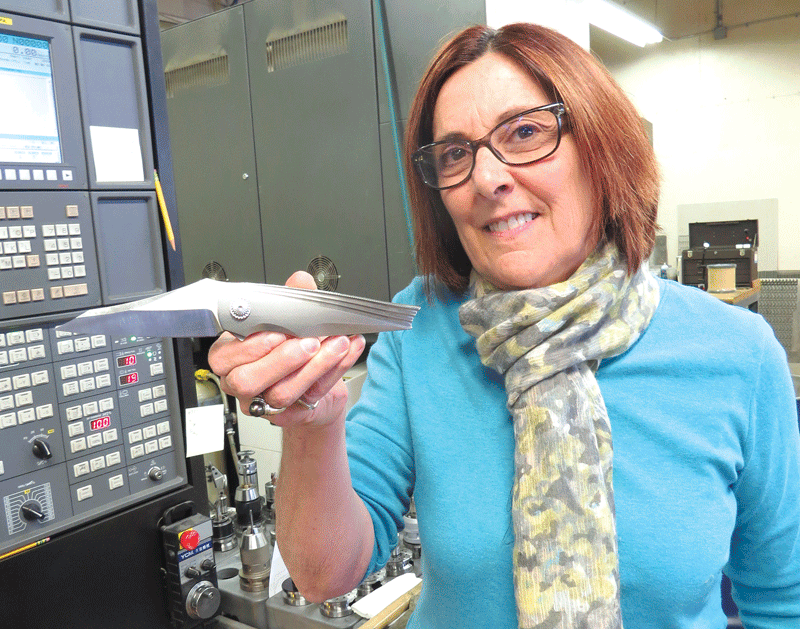
Marianne Halpern

Marianne Halpern displays the Thunderbird, one of the knives now being produced by Three Rivers Mfg., a subsidiary of Halpern Titanium.

Marianne Halpern says the company used to be called Custom Knife Supply because … well, that’s what it did — that’s all it did.

It supplied custom parts — blades, handles, hinges, and other components — to knife makers across the country, she said of the venture that she and her husband, Les, started out of their home in Monson, more as a money-making hobby than anything else.

When it became much more than that — the two eventually left their day jobs to pursue this full-time — and did much more than supply knife parts, a name change was certainly in order, Halpern told BusinessWest.

The search for something new and more accurate wasn’t exactly involved or scientific in nature, Halpern went on, adding that credit for what’s now in block letters on the business cards goes to the woman who handled that printing job.

“She asked what we did and what materials we worked with,” Halpern noted, adding that, when given a quick primer, the printer, desiring to make the principals’ name part of the equation, said, ‘how about Halpern Titanium?’

This question soon became the answer, said Halpern, because ‘Titanum,’ all by itself, says a quite a bit. “It has a definite ring to it.”

Indeed, this silver-colored, low-density, high-strength metal is practically synonymous with ‘cutting edge’ when it comes to its use in everything from artificial joints and dental implants to golf clubs; from eyeglass frames to Corvette engine parts.

Meanwhile, the metal itself is not exactly easy to fabricate into any of the above, Halpern went on, adding that, in many ways, this name connotes precision and expertise to those who read it.

Exactly how much the new name has helped the company is a matter of debate, but what isn’t is the fact that Halpern Titanium, now located in the Palmer Technology Center (the old Tambrands complex in Three Rivers) continues to grow and diversify itself into a major player within this industry.

The company, which also specializes in other materials, including carbon fiber, fiberglass, and stainless steel, now makes parts for a number of knife makers, many based in Oregon due to very liberal knife laws there (quite of the opposite of what are on the books in the Bay State), but manufacturers of other projects as well. And within the past 18 months or so, it has taken its expertise to a new and different label by introducing its own brand of knives, produced by a subsidiary named Three Rivers Manufacturing (TRM).

That venture has already produced several models, including the Nomad, the Class Action, the BT 1000, and the Thunderbird, which earned an enthusiast review from a trade publication called Knife News.

The Nomad Slipjoint

The Nomad Slipjoint, complete with titanium frames and royal blue G-10 handle, is one of several knives now bearing the Three Rivers Mfg. (TRM) name.

“Designed by company founder Les Halpern, the Thunderbird’s distinctive geometry injects some new life into familiar tactical knife attributes like a wharncliffe blade, titanium framelock, and sculpted pocket clip,” the magazine wrote. “The narrowing frame is embellished with deep milled-out grooves to create a look that harkens back to the tail fins found on the classic 1950s American-made automobiles.”

TRM, currently selling direct to consumers from its website, hopes to roll out several new models in the years to come, said Halpern, adding quickly that the parent company’s main purpose in life is to help a host of major knife makers earn similar platitudes for their products.

For this issue and its focus on manufacturing, BusinessWest takes an in-depth look at a company with a sharp — as in sharp — focus on controlled growth and further expansion of each of the many components within the business plan.

Cutting to the Chase

The printer who handled the Halperns’ business cards had more to do than help come up with a new name. Her eventual assignment was to pack a ton of information on that small space, while putting it all in something approximating titanium’s color on a black background.

In short, there’s a lot to read there.

Beyond the typical name, address, phone, and e-mail, the card provides a quick education into the services provided and materials used — at least to those versed in this field and the language associated with it.

Indeed, there are phrases like ‘dynamic waterjet cutting’ and ‘swiss turning,’ and listed materials including ‘titanium sheet bar and plate’ and the related ‘6AL/4V, CP Grades 1-4’ (an alloy of that metal), as well G-10 (fiberglass) and carbon fiber sheet. One could also note that free quotes are available and that this is a certified women-owned business.

Like we said, there’s a lot to read. And it all translates into the fact that this company has come a long way from the Halperns’ basement in Monson.

That’s where things started almost 20 years ago, said Marianne, noting that she was a teacher at Tantasqua Regional Senior High School and Les was a designer in the adaptive equipment department at the Monson Developmental Center when they started to fashion parts for knife makers on the side — and got really good at it.

So good, as noted, that they started thinking about this as a career move.

“I took a leave of absence from my job in 2000, and never went back — and I never looked back, either,” she told BusinessWest. “Les retired, and he never looked back.”

Instead, they’ve been looking both outward and inward with an eye on finding new ways to do what the company has essentially done from the very beginning — serve as a solution finder for many of the nation’s most prominent knife makers.

“Companies come to us with a specific need they need to address,” she said, adding that solutions include everything from parts to whole-knife manufacturing and assembly (although not much of that) to assistance with designing new products for the market.

When asked to list some of these customers for which solutions are provided, Halpern said those names are among the many things are kept confidential within this large, tight, and highly competitive business.

To effectively convey what the company does, Halpern had to repeatedly stop in mid-sentence, get up from her chair, and find a knife with which she could show the company’s contribution rather than explain it.

She picked up an elaborate multi-tool product assembled by one of those companies she couldn’t name to explain how it makes one small carbon-fiber piece that holds the tool bit in place. She picked up another knife to show off one of the many types of handles (a good number of them produced from G-10), and on it went.

Les Halpern

Les Halpern, seen here at the prototype CNC machining center, wears many hats for the company, including knife designer.

“For many customers, we’ll make one part, like the handle, and they’ll make the rest,” she explained. “We’re a team with that company, and we have many, many relationships like that. They don’t have to worry about that part of the knife.”

Getting to the Point

There are many visible signs of growth at Halpern Titanium, starting with its facility in Palmer.

The company started with roughly 3,000 square feet, a few machines, and the Halperns handling almost all the assigned duties. The footprint has expanded to 20,000 square feet, there are now 12 employees and 25 machines, and the Halperns, while they still work long hours, don’t have to do it all.

A growing client list is another measure of success, she said, adding that the company has staked out a position as one of the clear leaders in this field.

“There’s not a lot of competition out there — it’s not easy to do what we do,” she said, noting, again, the difficulty of working with titanium, G-10, and other materials.

The new subsidiary, TRM, is still another sign of growth and progress, she said, adding that she and Les decided roughly 18 months ago to take their acquired expertise and put the company’s name on its work instead of someone else’s.

“We had been making private-label knives for other companies for 18 years, and we often thought that it would be a good idea to do some of our own,” she explained. “And we recognized that making something for someone else that they sell is very different from making something yourself that you have to market, but we wanted to give it a try.”

Working in tandem with some noted custom knife designers, TRM brought a few products to the marketplace last year, she went on, including the Nomad, complete with an array of handle colors, such as ‘blaze orange,’ ‘cranberry,’ ‘forest green,’ and ‘battleship gray.’ The Thunderbird will be available online shortly.

Results thus far have been generally positive, said Halpern, and the company is learning the new elements of business associated with this venture, especially the marketing side of the equation and its various social-media platforms.

“It’s a whole different experience trying to market a product,” she explained. “I’m very active on social media — Twitter, Facebook, Instagram … and I’m gradually building a following for our company.”

She and others will attempt to expand this following in June at the Blade Show in Atlanta, billed as the largest knife show in the country, sponsored by Blade magazine. Attendees will include custom knife makers, manufacturing operations, collectors, and many more constituencies.

This means those representing both TRM and Halpern Titanium can multi-task, which is essentially what those at this corporation are now doing on a daily basis.

Indeed, Halpern noted, with the many different kinds of operations, including production of its own brands, now taking place, the company must conduct what she called a “balancing act” to ensure that each has the ability to thrive and grow.

“On the private label, we want to continue with those companies that want to add new products and grow with them,” she explained. “Meanwhile, we’re adding new customers selectively, making sure it’s a good fit, and we want to continue with our own models, introducing maybe a few new ones each year. Let’s see where that all takes us.

“It’s definitely a balancing act; we keep evolving as we need to,” she went on. “You can’t just stand still — in any kind of business, but especially this one. You have to be ready to add things to your repertoire.”

Getting a Handle

Things like the Thunderbird, with its narrowing frame and deep milled-out grooves, and the Nomad, with its blaze-orange, cranberry, and battleship-gray handles.

This company that was started in a basement continues to build upon its repertoire and its track record of excellence within the knife industry.

As the name suggested by that printer a while back suggests, this company is on the cutting edge — in just about every aspect of that phrase.

George O’Brien can be reached at [email protected]

Departments People on the Move
 David Griffin Jr.

David Griffin Jr.

The Dowd Insurance Agencies announced that David Griffin Jr. has been promoted to Vice President. Griffin is based out of the Holyoke office and works with the other branches based in Hadley, Southampton, Ludlow, and Indian Orchard. “The Dowd Insurance Agencies is the oldest family-owned agency in Massachusetts,” said David Griffin Sr., “and I am very proud that my son has chosen to continue that legacy of family leadership. We look forward to the future with a strong management team in place. Now a part of that team, Dave earned his place by honing in on his sales and customer-service skills and adding responsibilities that benefit our internal team and our customers.” Griffin began his role as vice president this past December and looks forward to continuing to grow the organization through new-business development, strategic initiatives, operational efficiency, and managing the firm’s use of technology. “Dave has grown considerably in his evolving role here at Dowd,” said John Dowd Jr., president and CEO of the Dowd Insurance Agencies. “While sales is his primary function, his aptitude and enthusiasm for technology has been a welcome skill set for our agency, and he is now in charge of IT here at Dowd. Dave has demonstrated a command of these responsibilities in a relatively short period of time. We decided it was time to make him an officer of the corporation where he can interact regularly with senior management and help manage the overall direction of the agency going forward.” David Griffin Jr. has been a member of the Dowd team since June 2009. He began his career in the insurance industry as a property and casualty underwriter for Liberty Mutual with stops in Schaumburg, Ill. and Charlotte, N.C., before coming back to Western Mass. He is a 2007 graduate of Bentley University in Waltham, where he earned his degree in finance, and he received his designation as a certified insurance counselor in 2014. Currently, Griffin is an active member of the community, serving on the boards of directors for the Holyoke Rotary Club, the Sisters of Providence Health System (foundation board), and Wistariahurst. Additionally, he also supports the United Way of Pioneer Valley as a member of the resource development committee.

••••••


Sarah Knowlton

Sarah Knowlton

Molly Desroches

Molly Desroches

United Personnel announced the recent promotion of two staff members: Sarah Knowlton and Molly Desroches. Knowlton, formerly a junior recruiter and administrative coordinator for the Professional Staffing Division in Springfield, has been promoted to the Light Industrial Staffing Division’s Recruiter position. She has been with United Personnel for two and a half years. In her new role, she will work on the candidate pipeline for some of United Personnel’s largest clients. Knowlton is currently enrolled in the business administration program at Holyoke Community College in pursuit of her associate degree. Desroches, formerly a Light Industrial Staffing senior recruiter, has been promoted to staffing consultant for United Personnel’s Professional Staffing Division. Desroches, hired the same day as Knowlton, will serve as a resource for United Personnel’s clients and candidates, overseeing contract and direct-hire placements. She holds a bachelor’s degree in marketing from Bryant University. She is captain of a Holyoke recreational soccer team and an ambassador for the Holyoke Chamber of Commerce. Both Knowlton and Desroches serve on United Personnel’s social-media team, leveraging their human-resources knowledge to create content for various social-media platforms. “The United team is proud to see two colleagues earn promotions as part of our ‘promote from within’ policy,” President Tricia Canavan said. “We look forward to the innovation and creativity they will bring to their new roles.”

•••••


Meghan Avery

Meghan Avery

Unemployment Tax Control Associates Inc. (UTCA), a national unemployment-insurance service provider based in Springfield with an office in Boston, announced the promotion of Meghan Avery to Director of Operations. Avery draws expertise from her undergraduate studies at Hofstra University and brings nearly a decade of professional experience to UTCA, six of which were gleaned in-house. She joined the team as senior analyst in 2011, quickly advancing to lead analyst and then Client Services manager, before her most current promotion. As director of Operations, she will oversee client services and all aspects of the claims department, management education, and sales functions. She will manage key areas of the operational budget and employee development. Additionally, liaising with the CEO and director of Finance, she will be tasked with deliverables related to the company’s financial objectives, profitability, and alignment of corporate strategic goals. “Meghan’s promotion is certainly well-deserved. In addition to commendable qualifications and experience, she has demonstrated success in-house relative to operational performance,” said Tim Phelan, chief legal counsel and vice president of Client Services. “Drawing on her expertise in the cost-management area of our business, Meghan’s talents have supported the growth of UTCA, furthering the company’s ability to effectively speak to our value proposition. She is a rising star at UTCA and embodies our mission of providing the best service in the industry focusing on the client, first and foremost.”

•••••

Ruby Pontbriand has joined the Realtor Assoc. of Pioneer Valley as its Marketing and Communications Director. She brings more than five years of experience, having previously served as a corporate marketing communications specialist at MAPFRE Insurance in Webster. Previous positions include front office manager and sales director at the Hampton Inn in Sturbridge. For two years, she served as a peer advisor at the Worcester State University Academic Success Center. Pontbriand is a 2011 magna cum laude graduate of Worcester State University with a major in communications and a concentration in public communications, with a minor in theatre. Additional staff changes announced by the 1,600-member trade association include the following title changes for current staff: Laura Herring from education coordinator to director of operations, and Kim Harrison from membership and outreach coordinator to membership and meetings coordinator.

•••••


David Horgan

David Horgan

David Horgan was recently named Director of Advertising for Pride Markets. His focus has been launching the Pride 100 anniversary celebration, with outreach through television, radio, MassLive, and a newly launched website. His experience includes creating the early Gary Rome and Marcotte Ford TV campaigns, as well as election commercials for more than 30 winners, including U.S. Rep. Richard Neal, Springfield Mayor Domenic Sarno, and state Sen. James Welch. Previously, Horgan was director of Marketing for 1st Alliance Lending in Hartford. As part of the ongoing Pride Gives Back program, he teaches media and filmmaking to inner-city children at the Springfield Conservatory of the Arts on Wednesdays.

•••••

NetLogix recently welcomed Jenny Aldrich as Business Development Representative. Aldrich brings a background in a variety of technology organizations, ranging from IT network planning, security, and management, as well as SaaS business applications. Leveraging her experience with medical and insurance business systems will be a benefit to NetLogix’s new clients. Over the years, she has seen firsthand where IT networking solutions have provided stability, security, and growth to companies in the legal, medical, insurance, nonprofit, manufacturing, distribution, banking, and engineering fields. “I really enjoy helping companies focus on their ‘top line’ by delivering effective technology solutions,” Aldrich said. “I have worked for large, small, and tech startup companies, and one thing stays consistent: you have to really love your clients’ business as much as they do.” Added Marco Liquori, NetLogix CEO, “I am extremely excited about the opportunities that Jenny can create for NetLogix. The addition of a dedicated resource for new clients is a key to our success.”

Daily News

HOLYOKE — Meyers Brothers Kalicka, P.C. (MBK) announced the promotion of Kara Graves, CPA from audit and accounting senior associate to manager, and the promotion of Joe Vreedenburgh from audit and accounting associate to senior associate. Additionally, MBK welcomed Nathan Nicholson to the firm as a Tax senior associate.

Graves, who has been with MBK since 2011, has spent the last six years developing a diversified technical skill set with a focus in the company’s commercial audit niche. She has also had the opportunity to develop a leadership skill set, serving as the in-charge accountant on a variety of large-scale projects. During that time, she has demonstrated her ability to lead teams through challenging projects, all while delivering a quality client service experience. Before coming to MBK, Graves worked as an associate at a regional public accounting firm in Westwood. She earned a bachelor’s degree from Roger Williams University and a master’s degree from Western New England University.

Vreedenburgh, who was promoted to senior associate in the audit and accounting niche, has been with MBK since 2014. His promotion is the result of his continued commitment to technical development, excellent client service, and team-oriented approach. As a senior associate, he will be leveraging his 10 years of accounting experience to help lead teams in conducting the audit process. He specializes in commercial audits and accounting, employee-benefit plans, not-for-profit entities, and individual and business taxation. He earned his bachelor’s degree at the University of Washington and holds an master’s degree from UMass Amherst. He is a member of the AICPA and MSCPA and treasurer of the Hitchcock Center for the Environment.

Nicholson comes to MBK from the Ayco Company, L.P., a subsidiary of Goldman Sachs in Latham, N.Y., where he worked as a tax associate, handling individual, trust, and gift-tax returns for high-net-worth individuals. He has a range of experience working with governmental, nonprofit, and for-profit entities, including banking, manufacturing, healthcare, real estate, and small family-owned businesses. He holds a bachelor’s degree in accounting from Siena College. He has mentored high-school business classes on the basics of tax preparation and financial planning.

“Kara and Joe have worked hard to develop themselves technically and as leaders within our organization,” said partner Howard Cheney, CPA. “Our succession plan demands that our next generation be not only technically competent, but ready to deliver premier service and value our clients have come to expect. We are confident in Kara and Joe’s ability to provide that exceptional experience, and Nathan’s addition to our team only serves to strengthen our next generation.”

Employment Sections

Shifting IT’s Focus

By Joanna Smiley

Keyla Centeno

Keyla Centeno, team lead and graphic designer at Tech Foundry, teaches a class on soft skills.

When it was founded in 2013, Tech Foundry, a program conceived to create a steady pipeline of workers for the IT sector, focused primarily on area high-school students. But research — and experience — revealed that these young people were choosing other destinations (especially area colleges) rather than area technology firms. So today, the classrooms feature a much more diverse group of students.

Bruce Stoller is a 58-year-old displaced worker with aspirations to forge a new career in information technology. He holds a law degree, and has a background in facilities management.

Maura Kavanh, 29, used to study political science and women’s gender studies at UMass Amherst, but took a leave from college when she noticed an interesting trend: organizations she aspired to work at, like Planned Parenthood, had a far greater need for those with tech skills than policy work.

What do Stoller and Kavanh have in common?

Both are students in Tech Foundry’s class of 2017, a group far more diverse than those that came before it. And that’s by design and out of necessity.

Indeed, the Springfield-based workforce development program was launched in 2013 and designed to prepare job seekers — and not necessarily individuals like Stoller and Kavanh — for entry-level tech careers. But a year ago, the organization decided to shift its focus from a program designed for high-school students to one that has no age restriction. Tech Foundry’s current class is an eclectic mix of students ranging in age from 20 to 60.

Jonathan Edwards, director of Strategic Partnerships at Tech Foundry, notes that the organization’s shift was about responding to employers’ needs for a bigger pipeline of IT workers.

“We know that people in mid-career transition are the perfect candidates to expand that pipeline,” he explained. “They’re looking for something different; people who wake up and say ‘I want to do IT’ isn’t enough. Introducing people who already possess strong work backgrounds to a sustainable IT career is really a great match between the needs of employers and needs of our student population.”

Brandon McGee hopes to land a job in software sales

Brandon McGee hopes to land a job in software sales once he completes the Tech Foundry program in May.

Ann Burke, vice president of the Economic Development Council of Western Mass., agreed.

“The good-news, bad-news experience from the first class was that these young people became excited about fields in technology, but instead of going directly into the workforce, many decided to continue their education in community college or college,” she explained. “This was great for the students, but not for tackling the issue of developing a pipeline for entry-level technology employees.

“Tech Foundry has been piloting different approaches to finding those individuals interested in tech job opportunities,” she went on. “The student body has evolved to include a much more diverse group, including veterans, people with some community-college experience, women, and others with some work experience but not necessarily in the tech field.”

Tech Foundry still welcomes 18-year-olds who would like to go into a job in the tech field, she went on, adding that the program’s leaders found that many employers are looking for candidates with at least some work experience and soft skills, even if they do not have past technology experience.

“Tech Foundry is an innovative program that will continue to evolve to meet the needs of this growing sector,” said Burke. “It actually is interesting and exciting to see the diversity of age, gender, experience, and ethnicity in the most recent graduating class. I’m excited about how the organization is continuing to scale and prepare more candidates to be a part of the technology workforce. We know that there is a need for qualified, entry-level technology workers across industry sectors in the region.”

For this issue and its focus on employment, BusinessWest takes an in-depth look at this change in focus for Tech Foundry and its implications for the workforce, job seekers, and area companies.

Technically Speaking

Tech Foundry prides itself on partnering with a broad range of companies in the region, and Edwards said he has noticed a cross-section of employer size and industry. Partners range from Bay State Health to Smith & Wesson to startups that seek the type of talent Tech Foundry is producing.

Its success in meeting its important mission is made clear by several testimonials from area business owners and one elected official.

Andrew Anderlonis, president of Rediker Software, has been partnering with Tech Foundry for more than a year, and says the organization has helped him solve a major problem — finding passionate, talented, and committed professionals who can meet the continuously evolving workforce needs of the region’s tech community.

“Rediker Software has now hired four graduates from Tech Foundry, and all of them are performing exceptionally well, a testament to the strength of the program,” he noted. “Working with Tech Foundry has been a wonderful experience as they have put together a terrific program for the students.”

Michael Arian, co-founder and CEO of Prophit Insight, says Tech Foundry not only provides him with talented IT employees, but the opportunity to give back to the Springfield community.

“We’ve been working with Tech Foundry since their beginning. It has been a very important program for us,” he told BusinessWest. “Tech Foundry has allowed us to acquire talented IT employees in a more cost-effective manner, and it has been very successful so far.

“It also provides us the opportunity to give back to the Springfield community and help out some fantastic people who just need an opportunity, this is very important to us,” he went on. “We’ve hired three employees from Tech Foundry and currently have another who is interning, and we hope to bring him on full-time shortly.”

State Sen. Eric Lesser agreed, and said Tech Foundry’s model is one he is working to replicate statewide.

“In just three short years, Tech Foundry has shown itself to be very nimble and responsive to our region’s employment needs. Western Mass right now faces a substantial ‘skills gap’ between the available jobs in growing fields like technology and advanced manufacturing, and workers looking for employment. There is a particular challenge facing older workers who are already out of school, who either need to update their training or learn new skills to stay competitive as our region’s economy continues to shift toward fields dependent on technology and innovation. I’m glad Tech Foundry is taking this on. Their model has already proven very successful at getting workers the specific training they need quickly and efficiently for younger students, so expanding to older members of the workforce is welcome and desperately needed.”

Edwards said Tech Foundry’s goal is to eventually have twice the number of employers seeking candidates as there are students in the program. Currently, the agency partners with 60 companies in the area. Starting salaries for graduates of the program can range from $30,000 to $50,000 per year.

tech-foundry-logo

On a recent afternoon at Tech Foundry’s space in downtown Springfield, Keyla Centeno was teaching a roomful of students gathered around ping-pong tables how to hone their professional communication and interpersonal skills. They were taking part in a team-building exercise that required careful listening and negotiation.

“This is one of our most diverse cohorts,” she noted. “It’s a pleasure to see them help each other and come out of their shells. This older demographic we have tells me a lot of people want to change their careers and break off from what they’re doing right now; some employers even require tech training now.”

Stoller, 58, is the oldest student in this cohort. The Springfield native lived in Boston for 20 years and recently moved back to Western Mass. He practiced criminal law before retiring from his legal career to work in facilities management.

Stoller was let go during his company’s “reorg,” and because his position was eliminated, he qualified to be what’s called a displaced worker, meaning any training or schooling he attends is paid for in full for up to one year. His end goal? To land a new job at a help desk, not necessarily doing programming, but using his sales skills.

Brandon McGee, 29, was born and raised in Springfield. He found his calling in technology at the age of 13, when he would sit in his bedroom at 3 a.m. tinkering on his Dell computer. Currently enrolled at Springfield Technical Community College, he said he “took advantage of anything his professors gave me a heads-up on,” and that included a recent suggestion to look into Tech Foundry.

After working in the telecommunications industry for a number of years, McGee knew he needed an additional skill set to advance to his dream career — software sales.

“I knew I wasn’t coming from a top school, I didn’t have the greatest GPA, and I wanted to immerse myself in a way where I could be competitive and acquire transferrable skills; I want to work for a company where staying relevant is a priority,” he explained. “I started out thinking printers and passwords were IT — now I know there’s so many more avenues in the field.”

Bottom Line

McGee says he’s a “little nervous to leave the coop” in May when he graduates from Tech Foundry.

“The people at Tech Foundry have been immensely supportive — it’s a free program with huge opportunity,” he noted. “We’re all in different aspects of our life, and every opportunity here is one to get your name out there and go for it.”

Today, there is a more diverse group of people ‘going for it’ thanks to Tech Foundry, a development that bodes very well for the region, its workforce, and companies struggling to find needed IT workers.

Community Spotlight Features

Community Spotlight

Linda Leduc, Meena Patel, and Charlie Blanchard

Linda Leduc, Meena Patel, and Charlie Blanchard say the new Junction Variety store will include 1,800 square feet of space suitable for retail or office use.

A dozen years ago, Meena and Bharat Patel purchased Junction Variety store in Palmer. They established a loyal client base, but several years ago, the cost of operating the antiquated building, combined with the need for extensive repairs and inadequate parking, forced them to make a decision about whether to remain in town and build a new structure or move their business elsewhere.

“We decided to stay here; I love Palmer,” said Meena. “The people are very supportive, and we have good relationships with our customers.”

Last June, ground was broken on a new, 40,000-square-foot facility. It is expected to be completed within a few weeks, and once the store is moved, the old building will be demolished, and a parking lot with 20 parking spaces will take its place.

Junction Variety will occupy 2,200 square feet of the new structure, which will almost double its current size, and the remaining 1,800 square feet will be available for lease as office or retail space.

The project is part of a flurry of commercial activity that began last year and is rapidly accelerating, creating momentum in this community.

“It’s definitely a sign of the recovering economy. Things are happening a lot faster now than they did in the past, and we are very busy,” said Town Planner and Economic Development Director Linda Leduc, who explained that, a few years ago, projects were permitted that never moved forward, but today construction often begins months after the permitting process is complete.

The list of developments, moves, and expansions nearing completion or underway is lengthy, as Leduc and Town Planner Charlie Blanchard explained during a lengthy interview with BusinessWest. It includes four new solar farms (last year the town had five, which brings the total to nine), construction of a $17.2 million Emergency Department at Baystate Wing Hospital that will begin this year, a $2 million expansion of an advanced-manufacturing company that was recently finished, grassroots efforts in Three Rivers that are leading to change, and churches in residential neighborhoods being reused in creative ways.

Construction is also underway at Town Hall. A $400,000 heating and air-conditioning system was installed over the past two years and paid for with funds from the Green Community Act. And this year, renovations are being made to the entire building to make better use of space vacated by the Police Department when it moved into a new, $7.4 million facility several years ago.

Specifically, the public meeting room will be expanded and gain a new entrance; a new conference room and additional storage space will be created; the Board of Health, Conservation Department, Building Department, and Veteran’s Agent will move into larger offices; and new lighting, windows, and carpeting will be installed throughout the building.

“We have a lot of activity taking place for a town this size,” said Blanchard, attributing it not only to renewed confidence in the economy, but to the willingness of officials and the Town Council to work with businesses and make changes to accommodate their needs.

For this, the latest installment of its Community Spotlight series, BusinessWest takes a look at projects that were recently completed, underway, or on the drawing board throughout the four villages that make up the town of Palmer.

Diverse Undertakings

Change continues to take place in Depot Village, the first commercial district travelers pass through after they exit the Mass Turnpike.

Last year, Mark Baldyga of Baldyga Inc. stopped selling travel trailers and made the decision to focus on autobody work and used-car sales, which necessitated a move, because his 1221 South Main St. location didn’t provide the frontage and exposure he needed.

Finding a suitable property proved difficult, but he hoped to remain in Palmer because he grew up in the town, has spent more than 30 years on the Fire Department, and has an employee who is also a firefighter.

“I have a good reputation, and people here know me, which is one of the main driving forces for my business,” Baldyga said, adding that he has close ties with the community.

His search led to a two-acre parcel on Route 20 with the frontage he needed. However, before he purchased it, he petitioned the town to change the area from general zoning to highway business so he could move forward with his plan.

The petition was accepted, and Baldyga split up the acreage, which was needed because the rear portion of the plot contained a multi-family home.

Ground was broken last spring for a new, 5,500-square-foot building that is nearing completion; he expects to reopen in a few weeks.

He told BusinessWest that the neighbors were not only accommodating, but supported the zoning change, and it has worked out well for everyone involved.

“The town will get more taxes, businesses of a similar nature can move here now, and my tenants are happy because I made improvements to their apartments and cleaned up the property,” he noted, adding that, if the zoning change hadn’t been approved, he would have had to leave Palmer.

Michael’s Party Rentals purchased Baldyga’s former location, and President Michael Linton said the company moved from its Ludlow locations and did a substantial renovation of the 20,000-square-foot building, included the addition of a showroom, design center, and state-of-the-art tent-washing machine.

Other moves have occurred in Depot Village. Last year, the Fire Service Group purchased the former American Legion building on 1010 Thorndike St., which allowed the company to expand from a smaller location, and construction plans have been approved for a Dollar General store on the corner of Breckenridge and Park streets that will be built after the single-family home on the site is demolished.

Progress has also taken place at Detector Technology, a precision-manufacturing firm located in Palmer Industrial Park.  Blanchard said the company needed room to expand and purchased a building from Wayne Buxton, who was using it to house his ShedWorks Inc. business.

“Wayne needed to downsize but wanted to stay in Palmer, so he kept half of the lot and is building a new, smaller structure on it,” Blanchard noted, explaining that Detector Technology recently finished a $2 million renovation of the former Shedworks.

Baystate Wing Hospital is also building a $17.2 million, 37,000-square-foot Emergency Department on its Palmer campus. Ground was broken in November, and the institution is meeting all its timetables.

“They are a major employer and are making a big investment that will be beneficial to our residents as well as the region,” Leduc said.

The town’s capped landfill on Emery Street is another property that has been given new life. Leduc said a request for proposals was issued for the site several years ago, but nothing came to fruition until Syncarpha Solar, which owns and operates a solar farm on the adjacent former Palmer Metropolitan Airport, made the decision to build a second facility on the landfill.

“We were happy they were interested in generating additional solar power on the site,” Leduc said, adding that the town had five solar farms, and, in addition to the new one on the landfill, Nexamp, Nextsun Energy, and Beaumont Solar also built solar facilities last year.

“Two are operating, and the other two are waiting to be interconnected, but once that happens, Palmer will be generating almost 25 megawatts of electricity on its nine solar farms,” she noted.

The facilities will bring in new revenue and result in energy savings. Palmer will receive $121,000 annually for the next 25 years in lease payments from the solar farm on the capped landfill, and will begin getting net metering credits this year from Blue Wave Solar on Baptist Hill in Three Rivers, which Blanchard estimates will save the town 30% to 40% of the generated cost of electricity.

New Life

Two other projects Leduc describes as “exciting” involve the conversion and reuse of former churches.

Artist Bruce Rosenbaum and his wife, Melanie, recently purchased St. Mary’s Episcopal Church on Main Street in Thorndike. It had been vacant for several years, and will become their residence and the new home for Mod Vic Steampunk Design when the couple moves from Sharon.

“It was a perfect situation,” Leduc said, explaining that churches often are located in the middle of residential districts, and although the town is willing to rezone whenever it makes sense, it’s not always possible.

The Rosenbaums created the first functional steampunk house in the world, and their business repurposes and infuses modern technology and gadgets into period, relevant antiques and salvage objects.

“We work with clients in the U.S. and internationally to design one-of-a-kind pieces, creatively combining eras and ideas to transform the ordinary into incredible steampunk functional art,” Bruce said, adding that the couple has clients all over the world and looked throughout the Commonwealth and in Connecticut before deciding that St. Mary’s Church was a great place to expand their business.

The 1876 gothic structure, with 30-foot ceilings and tall stained-glass windows, three wooded acres, and 30 parking spaces in the middle of a residential neighborhood appealed to them, especially since they have clients in Amherst, Holyoke, Northampton, and Springfield, including MGM.

They worked with the town to get a home-occupation permit before purchasing the home earlier this month, and are looking forward to relocating and creating a showroom and gallery in the historic space, as well as holding steampunk workshops for families.

In addition, Amherst Railway Society purchased the Crossroads Christian Church on South Main Street in Depot Village and plans to move there on June 16.

“It’s a nostalgic reuse of a historic church and very fitting since Palmer is known as the Town of Seven Railroads,” Leduc said.

Collaborative efforts to revitalize Main Street in Three Rivers are also bearing fruit, thanks to work by the consortium On the Right TRACK (the acronym stands for Three Rivers Arts Community Knowledge), which has been working to build a cultural and creative economy in the village.

The Quaboag Valley Community Development Corp. was awarded a $13,500 Adams Art Grant for fiscal years 2016 and 2017, and the town completed a market-assessment and business-recruitment tool as well as a feasibility study showing that a building on 2032 Main St. obtained through the tax-title process has potential for redevelopment.

“The town will put out a request for proposals as soon as we have grants in place for the building,” Leduc said.

A number of property and business owners also began meeting 11 months ago in a grass-roots effort to help the revitalization effort, which includes changing the perception of the area and filling vacant storefronts.

Community Development Director Alice Davey said Nancy Roy, of Interactive Schoolhouse, was instrumental in starting the group. The agency received $35,000 from MassDevelopment and used the money to hire Union Studio in Providence, R.I. to design a conceptual plan for the center. The consulting firm held a public presentation several weeks ago to get input from residents, and the final report is expected in the near future.

Davey said suggestions put forth during the meeting included making the downtown more pedestrian-friendly, building a walking path with river access around the perimeter of Laviolette Park and upgrading the parking there, and expanding Hryniewicz Park, which is used for movie nights, concerts, and other events staged by the town’s recreation department and the Quaboag Hills Chamber of Commerce.

“It’s an exciting time for Three Rivers,” she noted. “The public meeting was well-attended, and residents and property owners eagerly anticipate the final plan and development of a course of action to implement some of the recommendations.”

Forward Movement

Bruce Rosenbaum says steampunk is more than just art: it’s a way to creatively problem-solve, learn how to adapt to a situation, and be resilient.

“You look at an object, know the purpose it was designed for is obsolete, then find a way to give it new life and make it beautiful and functional,” he said, adding that the idea translates to people and cities, and he is excited to work with Palmer “as the town re-imagines itself.”

That certainly applies to Three Rivers, and progress is indeed underway that will put the Town of Seven Railroads on the map as it moves forward on a fast track that is attracting new businesses and helping existing ones to expand and grow.


Palmer at
a Glance
Year Incorporated: 1775
Population: 13,050 (2015)
Area: 32 square miles
County: Hampden
Tax Rate, residential and commercial: Palmer, $21.57; Three Rivers, $22.25; Bondsville, $22.06; Thorndike, $23.01
Median Household Income: $51,846
median family Income: $68,200
Type of government: Town Manager; Town Council
Largest Employers: Baystate Wing Hospital; Camp Ramah of New England; Big Y World Class Market
* Latest information available

Departments Incorporations

The following business incorporations were recorded in Hampden, Hampshire and Franklin counties and are the latest available. They are listed by community.

ADAMS

Noah William Brown Scholarship Inc., 12 Beecher St., Adams, MA 01220. Kathleen Davis, same.  Non-profit organized for civic, charitable, and educational purposes, including but not limited to expanding the educational opportunities for students residing in Berkshire County, with an emphasis on students in the Adams-Cheshire regional school district or its successors.

BRIMFIELD

Our Bright Future Inc., 254 Little Alum Road, Brimfield, MA 01010. Kwasi Acheampong, same. Non-profit organization, which teaches students how to be leaders, to better themselves and the communities where they live.

EASTHAMPTON

Northeast Artist Repository Digital Ltd., 62 Parsons St., Easthampton, MA 01027. James Roger Gehrt, same. Non-profit organized to provide digital access, organization, description and preservation of digital support material, documentation and creative works to a range of artists and artist groups based in the New England states as well as the New York area.

FLORENCE

New Pine Spa Inc., 176 Pine St., Florence, MA 01062. Enzhe Jin, same. Massage and bodywork services.

Paws Pizzeria Inc., 691 Westhampton Road, Florence, MA 01062. Peter Vogel, same. Manufacturing and selling of pet treats.

NORTH ADAMS

North Adams Bella Roma Corp., 117 Main St., North Adams, MA 01247. Ilyas Ozdemir, 202 Appleton Ave., Pittsfield, MA 01201. Restaurant, catering and delivery.

ORANGE

No Limit Real Estate Inc., 73 Stone Valley Road, Orange, MA 01364. Eric B. Gariepy, same. Asset management.

PALMER

Nicebox Inc., 25 Blanchard St., Palmer, MA 01069. Janet M. Callahan, 5 Highland Trail, West Brookfield, MA 01585. Non-profit organized to establish a charitable community betterment organization that develops and establishes partnerships with public and private social service agencies

PITTSFIELD

North End Auto Services Inc., 1249 North St., Pittsfield, MA 01201. Valery Porupski, same. Automobile repair and sales.

SOUTH HADLEY

New Main Moon Care Inc., 11 College St., South Hadley, MA 01075. Mei Young Lam, same. Restaurant/café services.

SPRINGFIELD

Precision Components Group Inc., 136Woodmont St., Springfield, MA 01104. Peter A. Elias, same. Machining of aerospace parts.

WESTFIELD

Pro and Local Detailing Inc., 16 South Maple St., Westfield, MA 01085, Paul Frasco, same. Automobile detailing, cleaning, and restoration.

Briefcase Departments

VVM Graduates Manufacturing Cohort

SPRINGFIELD — This week, Valley Venture Mentors (VVM) celebrated the graduation of participants in its Massachusetts Manufacturing Accelerator. The graduation ceremony took place at VVM World Headquarters at Tower Square in front of a crowd of nearly 100 friends, supporters, and members of the political and business communities. The Manufacturing Accelerator delivered intensive and immersive training sessions to seven small precision manufacturers over four months to help them identify new revenue streams and connect them with new industries and customers. “This program is unique because it takes startup methodology and applies it to established manufacturers,” said Paul Silva, VVM co-founder. “We encouraged these businesses to boldly question the way they’ve been doing business for decades and discover new markets and opportunities. We’re very excited about the results.” Funding for this program was provided by the Advanced Manufacturing Futures Program administered by MassDevelopment. “The manufacturers who participated in the Massachusetts Manufacturing Accelerator benefited from the creative and thoughtful approach Valley Venture Mentors and its partners took with this program, and MassDevelopment is pleased to support the accelerator with a grant from the Manufacturing Futures Fund,” MassDevelopment President and CEO Marty Jones said. “Congratulations to everyone on this accomplishment, which will help Western Massachusetts’ innovative manufacturing industry continue to grow.” Graduates of the program include BSS Additive, Boulevard Machine & Gear, Decker Machine Works Inc., Mitchell Machine Inc. and Precise Turning and Manufacturing.

Nominees Sought for Ubora, Ahadi Awards

SPRINGFIELD — The African Hall subcommittee of the Springfield Museums is seeking nominations for the 26th annual Ubora Award and the ninth annual Ahadi Youth Award. The African Hall subcommittee is a volunteer group comprised of educators, business people, and community leaders from the African-American community. The nomination deadline for both awards is March 31. The Ubora Award is presented to an African-American adult who has demonstrated a commitment to the Greater Springfield area and exhibited excellence in the fields of community service, education, science, humanities, or the arts. The Swahili word ‘ubora’ means ‘excellence.’ Named for the Swahili word for ‘promise,’ the Ahadi Youth Award is presented to a young African-American who has excelled in academics and performed admirable service to the Greater Springfield community. Eligible candidates must be age 19 or younger, live in or have strong ties to the Greater Springfield area, and be currently enrolled in grades 10, 11, or 12. The Ubora and Ahadi Awards will be presented at a ceremony at the Springfield Museums in September. Nomination forms can be downloaded by visiting springfieldmuseums.org/ubora. For additional information, call (413) 263-6800, ext. 325, or e-mail Valerie Cavagni at [email protected]. Nominations may be e-mailed to Cavagni or mailed to African Hall Subcommittee, c/o Valerie Cavagni, Springfield Museums, 21 Edwards St., Springfield, MA 01103.

Nominations Sought for Pynchon Award

SPRINGFIELD — The Advertising Club of Western Massachusetts is seeking nominations from throughout Hampden, Hampshire, Franklin, and Berkshire counties for the Pynchon Award, which recognizes citizens of this region who have rendered distinguished service to the community. The Order of William Pynchon was established by the Advertising Club in 1915 to recognize and encourage individuals whose lives and achievements typified the ideals of promoting citizenship and building a better community in Western Mass. Past recipients include war heroes, social activists, teachers, volunteers, philanthropists, historians, clergy, physicians, journalists, public servants, and business leaders. A complete list of recipients since 1915 can be found at www.adclubwm.org/events/pynchonaward. To nominate an individual, submit a one-page letter explaining why the nominee should be considered. Include biographical information, outstanding accomplishments, examples of service to the community, organizations he or she is or has been active in, and the names, phone numbers, and e-mail addresses of at least three people who can further attest to the nominee’s eligibility for induction into the Order of William Pynchon. All nominees will be considered and researched by the Pynchon trustees, comprised of the current and five past presidents of the Advertising Club. Nominations must be submitted by Tuesday, Feb. 28 to William Pynchon Trustees, Advertising Club of Western Massachusetts, P.O. Box 1022, West Springfield, MA 01090-1022, or by e-mail to [email protected]. Pynchon medalists are chosen by unanimous decision of the Pynchon trustees. The 2017 recipients will be announced in June, with an awards ceremony scheduled for Oct. 19 at the Log Cabin in Holyoke. Recipients are presented with a bronze medal cast with the name and likeness of Springfield’s founder, William Pynchon, and bearing the inscription, “They honor us whom we honor.”

Company Notebook Departments

MassMutual Continues Support of Legal Clinic

SPRINGFIELD — MassMutual and the Hampden County Bar Assoc. (HCBA) announced MassMutual’s ongoing support for HCBA’s Hampden County Legal Clinic, including a $160,000 grant intended to support its expansion and continuation of legal services. The Hampden County Legal Clinic is a legal-aid program that provides pro bono services to individuals at no charge, most of whom have limited financial resources and who meet specific eligibility guidelines. The Legal Clinic provides services in the Housing, District, and Probate & Family courts in Hampden County. It also works with unrepresented individuals on issues regarding foreclosure, tenant, and consumer matters, and with regional attorneys to match their legal skills and expertise with pro bono opportunities. These opportunities provided by the Legal Clinic include general legal advice and services, limited-assistance representation, mentoring with students at local law schools, legal education programming, and other community outreach programs. MassMutual is continuing its support of the Legal Clinic at a critical time when a significant number of litigants in local courts are unable to afford legal representation. Currently, more than 85% of the cases in the Western Division Housing Court involve people who are without legal representation. The current grant brings MassMutual’s total financial support of the Legal Clinic to approximately $250,000. “MassMutual is proud to continue its support of the Hampden County Legal Clinic, which provides legal guidance and counsel for those in our community with low or no income,” said Michael O’Connor, MassMutual’s general counsel. “MassMutual has a long tradition of supporting the communities in which it does business, and this grant reflects our ongoing commitment to invest our time, talent, and resources to ensure access to legal services for all members of our community.” MassMutual began its association with the HCBA six years ago with grant funding, enabling the Legal Clinic to expand its lawyer-for-a-day programs and increasing the services it provided. The funding from MassMutual has enabled the Legal Clinic to become the centerpiece for pro bono services in Western Mass. Importantly, in addition to the financial support MassMutual has provided, its attorneys have participated in Legal Clinic programming for nearly 10 years. “We’re elated with MassMutual’s increased funding and their involvement in making the Legal Clinic an invaluable community resource,” said attorney Kevin Maltby, president of the Hampden County Bar Assoc.

Country Bank Supports QVCDC with $50,000 Donation

WARE — Country Bank announced it has donated $50,000 to the Quaboag Valley Community Development Corp., to assist the QVCDC in its commitment to economic development and helping small businesses grow and prosper in the Quaboag Hills region. The QVCDC offers many programs to help small businesses, including training programs such as computer courses, how to write a business plan, or individual consulting, in addition to offering small-business loans.

Berkshire Bank Foundation Awards Nearly $1.9 Million

PITTSFIELD — Berkshire Bank Foundation announced that it awarded a total of $1,862,265 in grants to nonprofit organizations operating in the bank’s footprint in 2016. The giving represents a 3% increase in contributions compared to 2015. The grants supported a variety of education and community-development initiatives, as well as health and human service and cultural programs. “Our philanthropic investments impacted millions of individuals in 2016, helping to enhance economic opportunities and improve the quality of life for members of our community,” said Lori Gazzillo, vice president and director of the Berkshire Bank Foundation. “We are so pleased to continue our support of so many community initiatives throughout our footprint.” In total, the foundation’s funding affected more than 5 million individuals who received programming support from nonprofit organizations in the areas of education, especially reading, as well as community and economic development, including affordable housing, downtown revitalization, and employment. In addition, the foundation also helped meet the basic needs of individuals through funding to various health and human services initiatives. Berkshire Bank Foundation recently announced changes to its philanthropic strategy, allowing it to continue meeting the growing needs of the communities it serves, while maximizing the impact of its contributions. As part of the transition, the foundation will continue to focus its funding in the areas of education and community/economic development, but will now seek specific outcomes associated with the programs it supports. In addition, the foundation plans to allocate a limited pool of funds to basic-need funding that will rotate each year to provide organizations doing good work, but that don’t necessarily fall within the foundation’s major focuses, the opportunity to receive funding.

Cambridge College Named a Best School for Latinos

SPRINGFIELD — Aside from purchasing a home, deciding where to attend college is one of the costliest, most long-term investments most individuals will make in their lifetime. Latino Leaders magazine identified the top 50 best colleges in the U.S. for Latinos, and two schools in Massachusetts made the grade, including Cambridge College. Increasingly competitive job markets demand the right academic credentials to more aptly begin a career track. Yet, for minorities like Latinos, only 15% have a bachelor’s degree or higher, according to recent data by the Pew Research Center. Yet, there are numerous reasons why some academic institutions better serve Hispanic students. They include the percentage of total Latino enrollment and the percentage of Latino faculty, the percentage of students who apply and receive financial aid, academic resources for minority students to acclimate to academic rigors of college life, and outreach efforts by schools to add to their overall diversity. Institutional information provided by universities, along with independent sources like the Hispanic Assoc. of Colleges and Universities, joined data by U.S. News and World Report and other reporting agencies to serve as the basis for the research methodology in compiling the top 50 universities for Latinos, institutions that have excelled in their performance, outreach, and academic level in their relation to the nation’s Latino student population.

STCC Offers Fast-track Customer-service Training

SPRINGFIELD — Springfield Technical Community College will offer a 16-week ‘fast-track’ customer-service certificate training program this spring that is designed to help students develop a range of skills, from interview techniques to job-hunting strategies. The fast-track option allows students to earn 24 college credits over two eight-week sessions that begin March 20. They can apply these credits directly to an associate degree in business administration. Four courses are offered per session, and classes are held Monday through Friday, 8 a.m. to 2:30 p.m. An STCC fast-track customer-service certificate allows people to become eligible for jobs in a number of different industries, including call-center operations, financial services, sales, hospitality, customer service for manufacturing operations, and retail and other organizations. “Customer-service employees typically are considered the face of the companies they represent. They need to have good problem-solving skills,” said Lidya Rivera-Early, GPSTEM (Guided Pathways to Success in Science, Technology, Engineering and Mathematics) project director at STCC. “Customer service is a great starting point for a career in any company.”

Rivera-Early said someone working in customer service will need a good foundation of skills in marketing, computer literacy, communication, and business etiquette to support the needs of both the customer and employer. Requested by area industry partners, the fast-track customer service essentials certificate program will help students develop essential workforce-readiness skills.  The program will include speed-interview networking sessions and job-placement assistance. Students will hear from guest speakers and go on company tours. To enroll in the program, call the STCC Admissions Office at (413) 755-3333 or visit www.stcc.edu/admissions. Space is limited. The program is not free, but financial aid is available for those who qualify.

BHN Awarded $100K Mutual Impact Grant

SPRINGFIELD — Behavioral Health Network Inc. (BHN) has been awarded a $100,000 Mutual Impact Grant by MassMutual through the company’s Mutual Impact community-investment program. BHN will use this grant to bring the Elizabeth Freeman Center’s Money School program model to Springfield. These Mutual Impact funds will offer Money School to survivors of domestic or sexual violence who are also in recovery from addiction. BHN will provide participants with the skills and supports necessary to move out of poverty. Participants will be given individually tailored financial and career mentoring as well as intensive advocacy and support for their addiction recovery and healing in the aftermath of domestic or sexual violence. One in four women report experiencing domestic violence. In addition to physical abuse, domestic-violence survivors also experience financial duress, and almost half of domestic violence victims struggle with substance-use disorder. Mutual Impact is funded by the MassMutual Foundation, a dedicated corporate foundation established by MassMutual. The Mutual Impact program is completely driven by MassMutual employees. Employees choose cause areas and nonprofit organizations to receive funding, make donations which are matched dollar-for-dollar by the MassMutual Foundation to fund grants, and volunteer in support of the organization they select. “Corporate responsibility and community involvement are part of our DNA, and we take great pride in helping people in the communities where we live and work secure a better future,” said Dennis Duquette, head of Community Responsibility with MassMutual and president of the MassMutual Foundation board of directors. “BHN tirelessly devotes time and energy in support of families in our local community, and we are pleased to support them through the Mutual Impact program.” Mutual Impact grants were awarded to 21 nonprofit organizations for programs that fit within specific cause areas, including early-grade reading proficiency, food security, violence prevention, family economic self-sufficiency, returning veterans, successful advancement in school, child hunger, and education.

College of Pharmacy Hosts Visitor from Chinese Hospital

SPRINGFIELD — Dr. Yongfang Hu, director of Clinical Pharmacy at Beijing Tsinghua Chang Gung Hospital, recently visited the Western New England University College of Pharmacy to learn about clinical pharmacy education and the program-assessment process from university faculty and students. During the visit, Hu had a variety of discussions with College of Pharmacy administration and faculty, toured the college facility, and observed didactic lectures. Beijing Tsinghua Chang Gung Hospital, a comprehensive public institution, is the affiliated teaching hospital of Tsinghua University. As one of China’s most renowned universities, Tsinghua has become an important institution for fostering talent and scientific research. In 2015, Tsinghua University established the School of Pharmaceutical Sciences, which stemmed from Tsinghua’s strong foundation in biomedical-related disciplines, including life science, basic medical science, chemistry, biomedical engineering, chemical engineering, and material science.

Daily News

WESTFIELD — NetLogix recently welcomed Jenny Aldrich as business development representative. Aldrich brings a background in a variety of technology organizations, ranging from IT network planning, security, and management, as well as SaaS business applications.

Leveraging her experience with medical and insurance business systems will be a benefit to NetLogix’s new clients. Over the years, she has seen firsthand where IT networking solutions have provided stability, security, and growth to companies in the legal, medical, insurance, nonprofit, manufacturing, distribution, banking, and engineering fields.

“I really enjoy helping companies focus on their ‘top line’ by delivering effective technology solutions,” Aldrich said. “I have worked for large, small, and tech startup companies, and one thing stays consistent: you have to really love your clients’ business as much as they do.”

Added Marco Liquori, NetLogix CEO, “I am extremely excited about the opportunities that Jenny can create for NetLogix. The addition of a dedicated resource for new clients is a key to our success.”

Daily News

SPRINGFIELD — Smith & Wesson Corp. announced that it donated $10,000 to the Springfield Museums in November to provide funding for field-trip busing for every third-grade public and private school student in Springfield. The funding helped ensure maximum participation in the museum program for the city’s 2,054 third-graders.

Funding from Smith & Wesson for bus transportation allowed students in approximately 82 classrooms to experience “Then & Now: Life at the Turn of the Century,” an on-site history and social-sciences program that seeks to underscore Springfield’s role as a center of industry and innovation in the late 19th and early 20th century. While attending the program, which concludes this month, students become historians as they interpret early-20th century history by examining Indian Motocycles, Rolls-Royce automobiles, Milton Bradley games, and Barney ice skates. In addition to a ‘then and now’ scavenger hunt, students handle real historic artifacts and work on a mock assembly line to better understand Springfield’s industrial past.

Mark Smith, President of Manufacturing Services at Smith & Wesson, was on hand at the Lyman and Merrie Wood Museum of Springfield history on Jan. 12 to assist third-graders visiting from St. Michael’s Academy. Smith helped guide students through an assembly-line exercise and engaged students in a conversation on various methods of production.

“It was exciting to explore the assembly-line process with the students from St. Michael’s Academy,” Smith said. “Smith & Wesson and manufacturers all over the world have been relying on assembly lines to bring their products to market for over a century, and they are still a vital part of our manufacturing process today. We are proud to be able to sponsor this wonderful program helping young students in Springfield learn about our home city’s rich history and the significant role that many local businesses played in the industrial revolution.”

Smith & Wesson has been a part of the Springfield community since 1852 and remains one of the area’s leading manufacturers, employing more than 1,600 people and supporting numerous philanthropic causes. Smith & Wesson has been a major supporter of the Springfield Museums for decades. Over the past five years, the company has contributed nearly $500,000 to community history and preservation projects, namely the restoration and rededication of the Veteran’s Memorial Flag Pole and through the sponsorship of the Smith & Wesson Gallery of Firearms History at the Wood Museum of Springfield History.

Daily News

SPRINGFIELDSpringfield Technical Community College will offer a 16-week “fast track” customer-service certificate training program this spring that is designed to help students develop a range of skills, from interview techniques to job-hunting strategies.

The fast track option allows students to earn 24 college credits over two eight-week sessions that begin March 20. They can apply these credits directly to an associate degree in business administration. Four courses are offered per session, and classes are held Monday-Friday, 8 a.m.-2:30 p.m.

An STCC fast-track customer-service certificate allows people to become eligible for jobs in a number of different industries, including call center operations, financial services, sales, hospitality, customer service for manufacturing operations and retail and other organizations.

“Customer-service employees typically are considered the ‘face’ of the companies they represent. They need to have good problem-solving skills,” said Lidya Rivera-Early, GPSTEM (Guided Pathways to Success in Science, Technology, Engineering and Mathematics) project director at STCC. “Customer service is a great starting point for a career in any company.”

Rivera-Early said someone working in customer service will need a good foundation of skills in marketing, computer literacy, communication and business etiquette to support the needs of both the customer and employer.

Requested by area industry partners, the Fast Track Customer Service Essentials Certificate program will help students develop essential workforce readiness skills.

“Our fast track program will include career readiness courses to support students as they transition to employment,” Rivera-Early said.

The program will include speed interview networking sessions and job-placement assistance. Students will hear from guest speakers and go on company tours.

To enroll in the program, contact the STCC Admissions Office at (413) 755-3333 or visit www.stcc.edu/admissions. Space is limited. The program is not free, but financial aid is available for those that qualify.

Departments Picture This

Email ‘Picture This’ photos with a caption and contact information to [email protected]
A photo essay of recent business events in Western Massachusetts February 6, 2017


Manufacturing Growth

vvm2vvm1


Last week, Valley Venture Mentors (VVM) celebrated the graduation of participants in its Massachusetts Manufacturing Accelerator. The program delivered intensive and immersive training sessions to seven small precision manufacturers over four months to help them identify new revenue streams and connect them with new industries and customers. “This program is unique because it takes startup methodology and applies it to established manufacturers,” said Paul Silva, VVM co-founder. “We encouraged these businesses to boldly question the way they’ve been doing business for decades and discover new markets and opportunities. We’re very excited about the results.” Funding for this program was provided by the Advanced Manufacturing Futures Program administered by MassDevelopment. “The manufacturers who participated in the Massachusetts Manufacturing Accelerator benefited from the creative and thoughtful approach Valley Venture Mentors and its partners took with this program, and MassDevelopment is pleased to support the accelerator with a grant from the Manufacturing Futures Fund,” MassDevelopment President and CEO Marty Jones said. “Congratulations to everyone on this accomplishment, which will help Western Massachusetts’ innovative manufacturing industry continue to grow.” Graduates of the program include BSS Additive, Boulevard Machine & Gear, Decker Machine Works Inc., Mitchell Machine Inc. and Precise Turning and Manufacturing. Pictured: Silva (left) and Jones with Decker Machine Works President Scott Decker (top left) and Precise Turning and Manufacturing President Gary Siedlik (top right).


Clothing Time

picthisclothing
Farmington Bank retail administration and assistant branch managers joined forces recently to initiate a holiday children’s clothing drive to benefit My Sisters’ Place, a Hartford-based organization that empowers women, families, and others to achieve independence and stability in their community by providing housing and supportive services. Those efforts were reinforced by customer support center and branch staffs in Farmington Bank operations in Connecticut and Massachusetts. Collectively, bank employees donated more than 300 pieces of clothing.

Banking and Financial Services Cover Story Sections
Jim Hickson

Jim Hickson, Berkshire Bank’s Springfield Regional President

Through organic growth and a series of acquisitions, Berkshire Bank has achieved the kind of size ($9 billion in assets at present) that is necessary to succeed in the challenging climate within this industry. But Springfield Regional President Jim Hickson says it blends this size with a small-bank feel and “attitude,” and this is why it has been able to improve its share of the local market.

Jim Hickson says the conference room at Berkshire Bank’s main Springfield offices have become a popular spot lately, seeing far more visitation than would be considered normal — in large part because the bank is certainly encouraging it.

The reason is the room’s windows, which feature northerly and easterly exposures and, more specifically, stunning views of the construction work going on at MGM Springfield, just a few dozen feet away in some cases. Indeed, the massive, 2,000-car parking garage now looms over that conference room — Hickson commented several times on how quickly the structure went up — and the windows at the north end provide views of much of the rest of the construction site.

What visitors obviously see is a casino taking shape, said Hickson, senior vice president and commercial regional president for the Pioneer Valley and Connecticut. What he sees — and what others probably see as well — is what the casino represents: regional momentum and additional growth opportunities, which could come in a number of forms, from large corporations coming to Springfield, like CRRC, to smaller businesses that may take advantage of what will be a growing need for services.

“Those cranes that you see … they translate into momentum for the region; it’s a very exciting time,” said Hickson, adding that he believes Berkshire Bank, a.k.a. America’s Most Exciting Bank (or AMEB, as is written on his zip-front fleece jacket), is very well-positioned to take advantage of the momentum that can now be seen out those conference-room windows, and also in some of the other offices in the bank’s large suite at 1259 Columbus Ave.

That’s because the Pittsfield-based institution has the requisite size — achieved through several acquisitions, including that of Springfield-based Hampden Bank early last year — to be a major player, but it doesn’t act like the proverbial ‘big bank’ you read and hear so much about.


List of Banks in Western Mass.


“We have big-bank resources, but with small-bank attention and approach,” he said, adding that, while this might sound like a line from the marketing department, it accurately conveys what goes on across what is now a huge Berkshire footprint, covering much of the Northeast, as we’ll see later.

And also in those offices on East Columbus Avenue, which comprise a regional headquarters, said Hickson, meaning that customers can avail themselves of a full slate of services, including commercial lending, residential lending, cash management, investment services, private banking, and more.

This combination of large-bank resources and small-bank attitude has enabled the bank to significantly grow its market share in the Greater Springfield area across the board, and especially in the highly competitive commercial-lending realm, said Hickson, adding that a variety of factors are spurring activity among area business owners.

“For the first few years after the recession, even up to three or four years ago, no one was really borrowing money; instead, people were paying down their lines of credit and getting rid of debt,” he explained. “But in recent years, many of our customers are finally saying, ‘I do need to invest in that piece of equipment’ or ‘I do need to put an addition on my building.’ People have been saying, ‘maybe we are finally out of this.’”

To effectively capitalize on these sentiments and this movement, banks need to be large, but also versatile, flexible, and ‘local,’ meaning local decision making, not simply lenders with phone numbers starting with ‘413,’ said Hickson, adding that he believes Berkshire is all those things, and thus well-positioned for what might come.

For this issue and its focus on banking and financial services, BusinessWest talked at length with Hickson about what can be seen out those conference-room windows, and how AMEB is poised to be at the forefront of it all — in every sense of that word.

By All Accounts

As he talked with BusinessWest about the bank, its recent pattern of growth, its growing presence in Greater Springfield, and its large-bank-with-a-small-bank feel, Hickson referred early and often to one ongoing project that underscores seemingly all of the above.

Springfield Innovation Center

Jim Hickson says Berkshire Bank’s involvement with the Springfield Innovation Center is an example of its commitment to the region.

That would be the construction of Springfield’s new Innovation Center on Bridge Street in two buildings acquired by DevelopSpringfield. The $2.7 million project represents a collaborative effort involving a number of partners, including the city, the state, DevelopSpringfield, Valley Venture Mentors, MassDevelopment, the Innovation Hub, and MassMutual. Funding is being provided by the state, through a MassWorks Infrastructure Program grant to MassDevelopment, MassMutual, the Beveridge Foundation, and the Berkshire Bank Foundation.

The bank itself is in the process of underwriting a construction loan to DevelopSpringfield for the renovation work and completion of the innovation center project, said Hickson, adding that final approval is expected within the next several days.

“It’s projects like this that exemplify that we’re here to serve everyone and have a vested interest in Springfield and this region,” he explained. “This a big project in the revitalization of Springfield, and we’re excited to be a part of it.”

Thus, as mentioned, that project checks many boxes when it comes to the bank’s operating philosophy and its goals for being a big part of the progress represented by the view out the back of the company’s offices on East Columbus Avenue.

Hickson arrived there — or back there, to be more precise — last October when he was named to his current post. Indeed, included in his nearly three decades of experience within the banking industry is a stint with Berkshire as senior vice president and asset-based lending relationship manager.

He’s also had tours of duty with People’s United, TD Bank, KPMG Consulting, and Fleet Capital. He is also chairman of the board for Common Capital.

With those accumulated business cards, he’s certainly had a front-row seat from which to witness an era of profound change in the local banking scene, with many new brands ariving, some old ones disappearing from the landscape, and a host of mergers and acquisitions.

Berkshire has been a part of that, he acknowledged, adding that the Pittsfield institution has greatly expanded its footprint in recent years. It now extends all the way from Syracuse, N.Y. in the western corner of the Empire State to Boston — a territory that includes three state capitals (Albany and Hartford are the others). And with the acquisition of New Jersey-based First Choice Bank, it now extends all the way to Philadelphia.

In the current banking climate, size brings a number of advantages — from larger lending limits to all-important economies of scale when it comes to operations in the face of rising technology costs and regulatory burdens — and Berkshire now possesses $9 billion in assets, 96 branches, more than $6.5 billion in loans, $6.6 billion in deposits, and $1.4 billion in wealth assets under management. Such growth has come organically, but also through those acquisitions, the latest of which involved First Choice, a $1.1 billion institution.

The Hampden Bank acquisition, completed in 2015, effectively doubled Berkshire’s presence in the Greater Springfield area, giving it 18 branches, while also doubling its commercial-lending portfolio within the region, said Hickson, adding that this strategic initiative is a good example of how the bank doesn’t simply grow for growth’s sake.

“That acquisition was a key development for the bank; Berkshire has always viewed the Pioneer Valley as a key strategic market,” he explained. “The bank’s not looking to grow to be the biggest in town; it’s looking for key strategic opportunities that fit our core values, and this acquisition was one of them.”

Points of Interest

Hickson said he doesn’t have to look out the conference-room window to know there is more activity in the commercial lending realm these days. He can see it in his office and with everything he sees as a member of the bank’s executive loan committee.

“The economy is better, and with a better economy comes more loan opportunities,” he said while summing up the landscape before getting into more specifics. “It may not be new entrants into the market, but maybe existing companies looking to grow either by diversifying into another product line or acquiring another company in the business sector they’re in.”

As one example, he cited the region’s large core of precision-manufacturing companies (one of Berkshire’s stronger specific niches), many of which are investing in new equipment, expanding facilities or building new ones, and diversifying product lines, largely as a result of greater confidence in the economy.

The next wave, he predicts, with both precision manufacturers and the local business community in general, will come in the form of mergers and acquisitions as smaller firms owned by retiring Baby Boomers face inevitable succession-planning issues.

“There are ways to finance those kinds of transactions,” he explained. “And we obviously want to keep as many of those firms local as we can.”

In the meantime, there is that increased optimism and subsequent lending activity that he mentioned earlier, adding that, to take advantage of it, banks need versatility and the ability to both develop specific niches and be generalists, said Hickson, adding, again, that Berkshire possesses such traits and skills, while some of the larger institutions don’t.

“As banks get bigger, they tend to lose sight of the local community they serve,” he explained, adding that Berkshire hasn’t done that, as evidenced by the Innovation Center and countless others in the portfolio.

This would include the large number of Small Business Assoc.-assisted loans the bank has participated in over the years.

“We’ve been very successful with SBA loans,” he explained, adding that this statement applies to this region, certainly, but also to the wide Berkshire footprint. Indeed, the institution has been top-rated in this realm by the SBA in several of the regions it serves, including the Pioneer Valley, Connecticut, and the Syracuse area.

“We’re very proud of that distinction — the SBA’s a great way to finance things, and we’re a big supporter of the agency,” he went on, adding that the SBA currently ranks the bank among the 100 most active in the country with such loans, with more than 110 transactions totaling more than $21.9 million.

However, those SBA loans are just a tiny fraction of the total portfolio, he went on, adding that, with the size generated by the acquisitions in recent years, Berkshire can make loans of all sizes and serve virtually every customer within the region’s business community, but with a small-bank approach.

Bottom Line

Rising from his chair, Hickson gestured out the conference-room windows and admired the view he and his staff regularly invite visitors to share.

“It’s such a beehive of activity; it’s exciting to take it all in every day and watch things progress,” he said. “It’s mesmerizing.”

He was talking about the MGM project, obviously, but he may as well have been referring to the region’s economy as a whole, although it is probably not worthy of such superlatives — yet.

But those cranes do translate into momentum and, hopefully, more progress and growth for area businesses. And Hickson believes AMEB is ready to be right in the middle of it all, just as it is in the South End.

George O’Brien can be reached at [email protected]

Briefcase Departments

State Unemployment Rate Drops to 2.8% in December

BOSTON — The state’s total unemployment rate dropped to 2.8% in December, marking the sixth consecutive month the rate has declined, the Executive Office of Labor and Workforce Development reported Thursday. The last time the state’s unemployment rate was at 2.8% was in December 2000. In December, preliminary estimates from the Bureau of Labor Statistics indicate Massachusetts added 6,600 jobs over the month. The November job gain had an upward revision, with the state adding 7,000 jobs compared to the previously published 5,800-job-gain estimate. Over the year, Massachusetts has added 75,000 jobs. At 2.8%, the seasonally adjusted unemployment rate is down 2.1% over the year from 4.9% in December 2015. There were 73,300 fewer unemployed residents and 112,900 more employed residents over the year compared to December 2015. “For the past six months, the unemployment has continued to drop, and the labor-force participation rate has held steady over the year, which is very good news for the state,” Labor and Workforce Development Secretary Ronald Walker II said. “We are also pleased to see the state continues to add jobs in key sectors, such as education and health services; professional, scientific, and business services; information; and construction.” In December, over-the-month job gains occurred in the education and health services; construction; professional, scientific, and business services; information; leisure and hospitality; financial activities; manufacturing; and other services sectors. The state’s labor-force participation rate — the total number of residents 16 or older who worked or were unemployed and actively sought work in the last four weeks — is 64.7%. Over the year, the labor-force participation rate has increased 0.2% compared to December 2015. Over the year, the largest private-sector percentage job gains were in construction; professional, scientific, and business services; education and health services; and leisure and hospitality. Massachusetts’ unemployment rate has remained lower than the national rate since April 2008. The Bureau of Labor Statistics reported the December national rate at 4.7%. Since the statewide rate peaked at 8.8% in September 2009, there are now 335,600 more Massachusetts residents employed and 202,700 fewer residents unemployed, as the labor force increased by 133,000.

VVM Announces 36 Startups in 2017 Accelerator

SPRINGFIELD — Valley Venture Mentors (VVM) announced the 2017 Startup Accelerator cohort this week. The 36 startups, chosen from more than 200 applicants received from around the world, represent high-quality, early-stage startups across more than eight industries, including technology, beauty, healthcare, transportation, and publishing. “We are excited by the diversity of industries represented in this cohort,” VVM CEO Liz Roberts said. “We are honored that they are choosing to invest their time in our accelerator. They will get intensive training, mentorship, and resources to take their startups to the next level.” Sixty-five percent of this year’s startups are led by women, and 36% are led by people of color. International teams from Canada, India, and Ghana will participate. “Educating startup founders is all about helping them minimize their startup risks. Over the next four months, these entrepreneurs and their teams are going to spend time analyzing their products, services, business models, and the markets they intend to disrupt,” said Paul Silva, VVM chief innovation officer and co-founder. “They will learn from successful entrepreneurs — people who have been exactly where these founders are.” VVM Startup Accelerator participants also develop relationships with funders and are eligible to win up to $50,000 in equity-free cash at the end of the program. The winners will be announced on Thursday, May 25 at an awards ceremony with an expected 600 people in attendance at the MassMutual Center. VVM’s visionary partners include MassMutual, MassDevelopment, the Irene E. and George A. Davis Foundation, MassTech Collaborative, and the Community Foundation of Western Massachusetts. Another aspect of this year’s program is VVM’s partnership with Pathlight, a local organization which serves people with intellectual disabilities. The two organizations put out a national call for entrepreneurs with technology ideas that could increase independence for those with intellectual disabilities. After a rigorous selection process, two such startups were selected to participate in the accelerator: Galactic Smarties and Habit Stackr. Several of the companies accepted to the 2017 VVM Startup Accelerator are graduates of VVM’s mentorship program, including AlignMeeting, Bhlue Publishing, FootCare by Nurses, Hot Oven Cookies, Listen2aBook, Lumme, RecordME, Streamliners, TripleTote, and Yummy Yammy. The 2017 VVM Startup Accelerator cohort includes:
• AlignMeeting, business-productivity software facilitating best meeting practices to improve team efficiency before, during, and long after meetings;
• AuCoDe, the Google Alerts of controversies and crisis situations, providing early detection as a signal for hedge funds;
• Barakat Bundle, a curated package of life-saving solutions for mothers and newborns in South Asia;
• Bhlue Publishing, a cloud-based career-development platform for teens and young adults who are struggling to figure out a career direction;
• Bharat Babies, which produces developmentally appropriate children’s books that are inspired by the stories of India and South Asia;
• Connecticut Horse, a bimonthly print and online magazine for horse enthusiasts in Connecticut;
• Emotive Agility Training Center, a consulting company offering training tools and curricula for people with autism to crack the non-verbal code of social interactions;
• Enrichment Express, which provides instructors with the curriculum, materials, and logistical support needed to teach engaging enrichment classes to children 5 to 12 years old;
• Ernest Pharmaceuticals, programmed bacteria to eliminate metastatic cancer;
• Fields Center, which provides help for individuals with autism and families;
• FirmOffer, a software solution for legal recruiting enabling law students to make binding offers to law firms;
• FootCare by Nurses, foot-wellness experts;
• Galactic Smarties, which makes technology that supports independence for people of all ages and abilities;
• GeneRisk, which identifies genetic variants of autism allowing for better understanding of risk and ID targets for more personalized intervention;
• Genoverde Biosciences Inc., an agricultural biotech startup focused on improving crop yield for commercial farming through bioengineering;
• Habit Stackr, which helps people keep daily routines through brain science and a mobile app;
• Hot Oven Cookies, a handcrafted cookie bakery specializing in the delivery and curbside sales of warm, gourmet cookies;
• Kwema, which developed a smart bracelet that can call for help to friends and family, authorities, and Kwema’s safety communities;
• Listen2aBook, which makes audiobook production accessible to everyone;
• Lumme Inc., a startup funded by the National Cancer Institute that develops smart technology to help people quit smoking;
• M1 Tapes, which makes premium, contractor-grade tape measures;
• MEANS Database, a nonprofit technology company devoted to business-friendly food recovery;
• MyBarber, which provides on-site haircuts at offices, apartment complexes, and co-working spaces;
• NERv Technology, which is developing an implantable biochip platform to detect post-operative complications;
• New England Breath Technologies, which developing a pain-free diabetic monitoring device to improve outcomes of patients;
• Nonspec, which has created a low-ost, durable, and adjustable prosthetic system;
• Paysa, which is developing a fingerprint-authorized cashless payment system for stores in rural India with the goal of increasing bank-account owners;
• ProjectMQ, a social-media app for independent game studios and fans worldwide;
• RateFrame, which helps users highlight and share the best parts of any video;
• RecordME, a studio-recording company that provides hardware, engineers, and distribution so content creators and venues can make more money;
• Streamliners, which sells aerodynamic devices to the trucking industry, saving $4,000 per truck per year in fuel costs, paying for itself in three months;
• Trabapido, an online marketplace that helps individuals and businesses find and hire service providers, such as plumbers, painters, and tutors;
• TripBuddy, a ride-sharing startup;
• Tripletote, which manufactures consumer products that help people carry items as they travel, commute, shop, and work;
• VaxAtlas, which provide real-time access to one’s vaccine history, helping to avoid unnecessary repeat vaccines, identify missed vaccines, and alert for outbreaks; and
• Yummy Yammy, which helps busy people eat better, one deliciously addictive sweet potato at a time.

Simon Youth Foundation Seeks Scholarship Applicants

LEE — Simon Malls and Simon Premium Outlets in New England announced that, once again, its malls and centers — including Lee Premium Outlets — will help deserving graduating seniors pay for college. Simon Youth Foundation, a national nonprofit that provides educational opportunities for at-risk high school students, is looking for qualified applicants. Each year, Simon Youth Community Scholarships are awarded in every community across the country that is home to a Simon Malls or Premium Outlets center. The application period ends on March 1. Students can apply online by visiting syf.org/scholarships. Any student who will be graduating in the class of 2017 and lives in the community surrounding a Simon property is eligible. Applicants can check their eligibility by entering their ZIP code at syf.org/scholarships. Recipients will receive up to $1,500 to enroll in an accredited college, university, or vocational or technical school. In addition, 11 regional Awards of Excellence will be given to top candidates. The regions eligible are Atlanta, Austin, Boston, Chicago, Dallas, Indianapolis, Miami, New York, Orange County (Calif.), Orlando, and Seattle/Tacoma. Students from these areas will have the opportunity to receive a $10,000 award ($2,500 for up to four years). In 2016, the Simon Youth Foundation awarded $1.2 million to 300 students nationwide. Scholarship recipients will be selected by International Scholarship and Tuition Services Inc., a third-party administrator. Students are selected based on a variety of criteria, including financial need, academic performance, leadership skills, and participation in school and community activities. Students who are the first in their family to pursue a post-secondary education will also be given close consideration. Recipients will be notified in May.

Horace Smith Fund Calls for Scholarship, Fellowship Applications

SPRINGFIELD — The Horace Smith Fund, a private foundation that offers scholarships and fellowships, has extended the application deadline date for the Walter S. Barr Scholarships and Fellowships until March 1, 2017, due to the low number of applications so far. Last year, The fund awarded $258,000 to 25 area students. “To date, we have received only 46 scholarship applications and 16 fellowship applications. It is surprising that more students haven’t applied yet,” said Teresa Regina, trustee and chair of the scholarship committee. “Applications can be downloaded or completed online. They are also available at every area high school and college or by contacting our office.” The Walter S. Barr Scholarship is available for graduates of Hampden County public and private high schools. Applicants may either be graduating high-school seniors or in college. Scholarship awards of $10,000 are distributed in annual installments of $2,500 and renewable each year until graduation. Recipients are selected on a variety of criteria, including their test scores, class rank, extracurricular activities, and a personal written account of why the student feels deserving of financial assistance. The Walter S. Barr Fellowship awards are made annually to those wishing to enroll in full-time graduate studies. In general, applicants must be residents of Hampden County. Awards are made to students pursuing a specific post-graduate degree. The award of $12,000 is distributed in annual installments of $4,000 for a maximum of three years. Awards will be made on the basis of all available information, including school records, recommendations, and examination scores. Consideration will be given to both the merit and financial need of the applicant. “We hope students take advantage of this local resource,” Regina said.

Daily News

SPRINGFIELD — This week, Valley Venture Mentors (VVM) celebrated the graduation of participants in its Massachusetts Manufacturing Accelerator. The graduation ceremony took place at VVM World Headquarters at Tower Square in front of a crowd of nearly 100 friends, supporters, and members of the political and business communities.

The Manufacturing Accelerator delivered intensive and immersive training sessions to seven small precision manufacturers over four months to help them identify new revenue streams and connect them with new industries and customers.

“This program is unique because it takes startup methodology and applies it to established manufacturers,” said Paul Silva, VVM co-founder. “We encouraged these businesses to boldly question the way they’ve been doing business for decades and discover new markets and opportunities. We’re very excited about the results.”

Funding for this program was provided by the Advanced Manufacturing Futures Program administered by MassDevelopment.

“The manufacturers who participated in the Massachusetts Manufacturing Accelerator benefited from the creative and thoughtful approach Valley Venture Mentors and its partners took with this program, and MassDevelopment is pleased to support the accelerator with a grant from the Manufacturing Futures Fund,” MassDevelopment President and CEO Marty Jones said. “Congratulations to everyone on this accomplishment, which will help Western Massachusetts’ innovative manufacturing industry continue to grow.”

Graduates of the program include BSS Additive, Boulevard Machine & Gear, Decker Machine Works Inc., Mitchell Machine Inc. and Precise Turning and Manufacturing.

Daily News

SPRINGFIELD — Business leaders, public officials, and community members will attend the graduation of the Massachusetts Manufacturing Accelerator, the nation’s first manufacturing accelerator, hosted by Valley Venture Mentors, 1500 Main St., Suite 125, Springfield, on Monday, January 30 at 5 p.m.

Meet the seven Massachusetts manufacturers whose businesses have benefited from the program and learn how they are bringing the manufacturing industry into the 21st Century. Guests includes representatives from Gov. Charlie Baker’s office, the Massachusetts Technology Collaborative, and more.

Class of 2017 Difference Makers

Steady Course

The Community Colleges of Western Massachusetts

Berkshire Community College, Greenfield Community College,
Holyoke Community College, and Springfield Technical Community College

The region’s community-college presidents

The region’s community-college presidents, from left, Bob Pura, Ellen Kennedy, John Cook, and Christina Royal.

Jeff Hayden had spent more than an hour talking about the critical roles played by community colleges in this region — while also listening to colleagues do the same — and desired to put an exclamation point of sorts on matters with a story about a woman whose case he had come to know first-hand.

She was about to earn a certificate of completion in a specific field from Holyoke Community College (HCC), and had a job interview set for the following week. She still had considerable ground to cover in terms of starting and then forging a new career, but she had a new-found confidence and sense of purpose, and wanted to let HCC officials know that — and know why.

“She said, ‘I’ve been out of work for almost five years; I thought I wasn’t worth anything, I didn’t think I could do anything, and my kids thought I could never do anything,’” Hayden, vice president of Business and Community Services at the school, told BusinessWest. “She went on, ‘the opportunity you’ve given us through this program is something that has not only changed my life, but changed my children’s lives as well.’

“Frankly, those of us at the region’s community colleges hear those stories often, which is great, and it’s a feel-good kind of thing,” Hayden went on. “But it’s one story at a time, and with the power of the four institutions here, it’s thousands of stories a year that happen in our region, where people are changed, and hopefully changed in a way that helps them with their family and with their career.”

Jeff Hayden, seen here with new HCC President Christina Royal

Jeff Hayden, seen here with new HCC President Christina Royal, says community colleges provide a vital pathway to an education, especially for first-generation college students.

With that, Hayden effectively and somewhat concisely explained why the four community colleges serving residents of Western Mass. — HCC, Berkshire Community College (BCC), Greenfield Community College (GCC), and Springfield Technical Community College (STCC) — have been chosen collectively as Difference Makers for 2017.

Through use of those phrases ‘the power of the four institutions’ and ‘thousands of stories,’ he hit upon the real and profound impact of the four schools, which have been making a difference now for almost 60 years in some cases.

Echoing Hayden, Bob Pura, president of GCC, said the community colleges act as both a door of opportunity, especially for those who don’t have many open to them, and a pathway to both careers and four-year degrees at other schools.

And GCC is a perfect example. It is the only institution of higher learning in Franklin County, the poorest and most rural in the state, said Pura, while stressing that point about access to an education, and it has one of the highest rates of transfer to four-year schools among the state’s 15 community colleges.

“I don’t think there is a region in this state better served by community colleges,” said Pura, who stressed the plural and saw the six other people gathered around the table in a classroom at HCC’s Kittredge Center nod their heads in agreement. “We’re the pathway for the infrastructure in our community; the socioeconomic futures of our communities pass through the doors of our collective colleges.”

By ‘better served,’ Pura meant work beyond the schools’ historic mission of providing potentially life-altering opportunities to their students. Indeed, they are also playing important roles in a host of ongoing economic-development initiatives across Western Mass.

HCC’s involvement in the Cubit building project

HCC’s involvement in the Cubit building project in downtown Holyoke is just one example of how community colleges have become forces in economic-development efforts.

In fact, if one were to name a key issue or specific program, one will likely find one of the community colleges involved with it at one level or another.

Start with the region’s workforce. The schools are the proverbial tip of the spear in initiatives ranging from the retraining of manufacturing workers displaced by the decline of that sector to preparing individuals for the myriad jobs in the broad healthcare field that will have to be filled in the years to come; from training area residents for many of the 3,000 or so jobs to be created by the MGM Springfield casino to providing specific help with closing the so-called skills gap now plaguing all sectors of the economy and virtually every business, a problem addressed mostly through a program called TWO, as we’ll see later.

But there are other examples, as well, from STCC’s work to help precision manufacturers build a steady pipeline of talent to BCC’s involvement with efforts to create new opportunities for jobs and vibrancy at the sprawling former General Electric complex in Pittsfield, to HCC’s decision to move its culinary arts program into a mostly vacant former mill building in downtown Holyoke, thus providing the needed anchor for its revitalization.

All of these examples and many more help explain why the region’s community colleges — individually, but especially as a group — are true Difference Makers.

Schools of Thought

Community colleges, formerly known in some states as junior colleges, can trace their history back to 1901 (Joliet Junior College in Illinois is generally considered to be the first).

There are now nearly 1,200 of them enrolling close to 8 million people. They come in all shapes and sizes, some with just a few hundred students and others with enrollment in the tens of thousands.

In the Bay State, community colleges can trace their roots to 1958, when an audit of state needs recommended the establishment of a community-college system to address the need for more diversity and access to higher education in the Commonwealth, which, then as now, has been dominated by a wealth of prestigious (and expensive) private colleges and universities.

The reality is that the mission of a community college — to provide access to excellent education for the local community — is what we do, and we do it in sometimes unique ways. But what we also do is recognize the fact that there are times when shaking the hand and working together is far more effective than trying to go out on our own.”


The recommendation was adopted by the Legislature in August of that year, and the accompanying legislation included formation of the Board of Regional Community Colleges, which established nine of the current 15 schools within a five-year period, starting with BCC in 1960.

“We were the first one,” said Ellen Kennedy, president of that Pittsfield-based institution, with a discernable note of pride in her voice, while acknowledging that what is now HCC has a longer history, because that school began as Holyoke Junior College, which opened in 1946.

GCC opened its doors in 1962, and STCC, housed in the historic Springfield Armory complex, which was decommissioned in the mid-’60s, opened amid some controversy — HCC is only eight miles away as the crow flies, and many thought there wasn’t a need for two community colleges that close together — in the fall of 1967.

Today, community colleges in Massachusetts and across the country face a number of common challenges, including smaller high-school graduating classes, which are impacting enrollment; funding levels that are imperiled by dips in the economy and devastated by serious recessions, such as the one that began nearly a decade ago; and graduation rates that are impacted by the many burdens faced by the community-college constituency — everything from finances to life issues (jobs and family) to even transportation.

But overall, community colleges are seeing a surge of sorts. Indeed, amid the soaring costs of a college education and the ever-rising amounts of debt students are being saddled with, the two-year schools are being seen by many as a practical option to at least begin one’s education.

Meanwhile, host cities and regions are becoming more cognizant of their ability to help provide solutions to workforce and other economic-development-related issues and problems.

This is especially true in Western Mass., where many gateway cities, including Springfield, Holyoke, and Pittsfield, are facing stern challenges as they attempt to reinvent themselves and move on from their collective past as industrial centers, and regions (especially Franklin County) face spiraling unemployment, aging populations, and outmigration of young people.

ge-pittsfield-aerial-1946

BCC’s efforts to develop new opportunities for the former GE complex

BCC’s efforts to develop new opportunities for the former GE complex in Pittsfield (in its heyday, above, and today) is another example of community colleges becoming involved in economic-development initiatives.

But at their very core, community colleges are still all about access — that open door that Pura mentioned. They all have what’s known as open admission, meaning anyone who has a high-school diploma or GED must be admitted. But while getting in isn’t a problem, staying in, and hanging in until a diploma or certificate is earned, can be, and often is.

Thus, increasingly, schools have been focusing on that broad, multi-faceted assignment of helping students succeed — with whatever it is they are trying to succeed at.

There are many elements that go into this equation, said those we spoke with, from programs focused on basics, including language skills, to new degree and certificate programs to meet specific industry needs, to a host of partnerships with area four-year schools that include not only articulation agreements but efforts to bring those schools’ programs onto the community-college campuses to help those facing time and transportation issues.

Meeting this role, this mission, makes the community colleges unique in the pantheon of higher education, and even public higher education. It is a niche, if you will, or, for many, including those we spoke with, a career path they’ve chosen for any of several reasons, but often because they can relate to the students in their charge.

Such is the case with Christina Royal, the recently named president of HCC, who is so new to the role she chose to let others, like Hayden, speak about the school’s history and specific current projects while she got fully up to speed.

But in a candid interview with BusinessWest upon her arrival, she said that, when she went to Marist College, a private liberal-arts school in Poughkeepsie, N.Y., she was the first in her family to attend college, and it was a struggle for the family to send her there.

So she understands what community-college students are up against, and chose that constituency, if you will, as the one she wanted to serve.

“The experience of community colleges — dealing with a lot of first-generation college students who don’t always understand the value of what they’re doing and also how to navigate it to be successful — these are things I can relate to from my own background,” she said. “And I think that has created a connection with the community colleges for me and helps me understand the students we serve. I’ve found a home in the community-college system.”

The original faculty and staff at STCC

The original faculty and staff at STCC pose in front of the old officers’ quarters at the Springfield Armory. The school was created in 1967 to focus on preparing students for careers in technology-related fields.

John Cook, who succeeded Ira Rubenzahl as president of STCC last summer, is similarly attracted to the community-college mission and unique role.

Formerly the vice president of Academic Affairs at Manchester (N.H.) Community College, he cast a wide net when seeking opportunities to lead a school, but was specifically focused on community colleges, which, he said, have a direct role in serving their communities (hence that middle name for all these institutions) and their residents, not employers across the country or halfway around the world, as the major private institutions do.

Pura agreed. “The students who come to our colleges are those who stay here,” he explained. “They’re the ones who will run the ice cream shop and the small nonprofit, and they’re going to be part of the leadership for our hospitals.”

The Jobs at Hand

Beyond providing access and pathways to opportunities, however, the region’s community colleges have become increasingly larger role players in area workforce and other economic-development-related initiatives.

Such roles are natural, said Cook, noting that the schools pride themselves on being nimble, responsive, and, overall, good listeners when it comes to the community — including the business community — expressing specific concerns and needs.

And while such programs solve problems for businesses, the communities they’re based in, and the region as a whole, said Bill Fogarty, HCC’s vice president for Administration and Finance, who served as interim president until Royal arrived, they also benefit individuals who may or may not have a job, but instead need a career.

“All of our capital investments, whether it’s the new Center for Health Education or the Cubit Building and the culinary center, or any of the others, have been geared toward getting people in the door,” he explained, “and getting them a basic type of credential they can use, and then providing pathways so they can further their education.”

Examples of economic-development-related initiatives that are also creating opportunities for individuals abound, and we’ll start with BCC, which has been active in efforts to help that region move past the huge shadow left by GE and other elements of a manufacturing-based economy, said Bill Mulholland.

He recently retired after a lengthy career at BCC, most recently as vice president of Community Education and Workforce Development, a title that speaks volumes about the work he was involved with in recent years. And as he started talking about that work, he referenced a Berkshire Eagle headline — “High-paying Jobs Going Unfilled” — from January 1998.

Upon reading it, he called Pura and invited him to lunch, at which there was broad discussion that eventually led to creation of something called the Berkshire Applied Technology Council.

“This is an industry-driven organization focused on workforce development,” Mulholland explained. “As we got all the companies together, we said, ‘what are your biggest needs?’ And when we boiled it all down, the commonality was basic math, writing, all of the basic skills.”

That’s where organizers started with a program that would be called (here comes that word again) Pathways, he went on, adding that the initiative effectively checks many of the boxes community colleges are trying to check, including direct involvement with businesses, providing individuals with the basic skills needed to contend for jobs and careers, working in collaboration with other community colleges and other partners, and creating progress with efforts to keep young people from migrating out of the region.

Another very specific example is the college’s involvement in the work to create an advanced manufacturing facility (the Berkshire Innovation Center) that will become the centerpiece of the William Stanley Business Park, created on the former GE site. Specifically, the school is developing training programs for individuals that will be employed by companies based there.

“What’s significant about this, for us and for the Commonwealth, is that we’re reinventing our manufacturing,” he said. “It’s about high-technology capabilities; so many of the original equipment manufacturers are outsourcing up to 70% to small and mid-sized enterprises because we’re quick, we’re nimble, and we innovate. That’s the focus of the innovation center, and it’s more about the human capital now than it is about the equipment, although that’s important as well.”

Human capital, and creating more of it, is at the heart of many BCC initiatives, he went on, adding that the school is also involved with efforts to bolster the creative economy that is becoming a force across Berkshire County and especially a revitalized Pittsfield, as well as the tourism industry that has always been a pillar.

As examples, he cited a filmmaking course designed to help provide trained individuals for the many film companies and special-effects houses that now call that region home, and also a special customer-service course for those seeking to enter the hospitality industry.

Manufacturing Momentum

Meanwhile, at GCC, manufacturing is also a prime focus, said Pura, adding that the region has lost a number of large employers in this sector over the past several decades and is intent on both retaining the companies that remain and attracting new ones.

To this end, a manufacturing collaborative was formed involving the college, employers such as Yankee Candle and Valley Steel Stamp, the Regional Employment Board, career centers, and area high school.

“What became clear was that we needed to invest in our infrastructure; facilities were very antiquated,” said Alyce Stile, dean of Workforce Development and Community Education (same title as Mulholland) at GCC, adding that, with $250,000 in seed money from many of the employers and grant money attained as a result of that investment, Franklin County Technical School has been transformed into a state-of-the-art facility.

With that foundation, GCC was able to start its first adult-education evening program — one firmly focused on the basics — with the help of considerable feedback from STCC, BCC, and other partners.

No, the region’s community college presidents have not been reassigned

No, the region’s community college presidents have not been reassigned. They’re merely using some artistic license to display a pattern of cooperation and collaboration that is only growing.

To date, more than 100 students have gone through the program, said Stiles, with the even better news being an employment rate of more than 80%.

Other recent initiatives have included a nursing ladder program designed to put more individuals in that important pipeline, and also a comprehensive study of just what area employees want and need from the workers of today and tomorrow. The results were not exactly surprising, but they were enlightening.

“Employers made it clear that what’s needed are the communication skills, the ability to critically think through and problem-solve in an innovative way, and the ability to work well with other people,” he explained, adding that a panel comprised of area employers ranging from Herrell’s Ice Cream to Baystate Franklin Medical Center recently emphasized these needs and discussed the next critical step — programming to help ensure workers possess these skills.

In Hampden County, meanwhile, initiatives involving the two community colleges there have generated considerably more press, and, like those in the other regions, have involved high levels of collaboration between the schools and a wide variety of other partners.

At the top of the list, perhaps, is TWO (Training and Workforce Options), a joint effort between STCC and HCC that provides custom contract training for area businesses and industry-sector collaborations.

To date, TWO has created training programs for call centers and customer-service workers, manufacturing production technicians, hospitality and culinary positions, home-health-aide workers, and healthcare-sector employees who need to become versed in the recently introduced medical coding system known as ICD-10, among others.

Another collaborative effort, this one involving all the community colleges, is the Mass. Casino Careers Training Institute, which, as that name suggests, is designed to help area residents become qualified for many of the positions that MGM Springfield — or any of the other casinos to open in the Commonwealth — will need to fill.

Other specific examples range from STCC’s involvement with CRRC, the Chinese company that will soon be building subway cars in Springfield’s East End, to secure a trained workforce, to HCC’s investment in Holyoke’s Innovation District through the Cubit project.

Degrees of Progress

As the presidents of the region’s four community colleges posed for some photographs for this piece, they each gathered up their respective school’s pennant, in a colorful, pride-nurturing exercise in effective identification.

Then, as a bit of fun, Pura had them shuffle the deck, if you will. This drill yielded some laughs and intriguing facial expressions, but also some symbolism if one chooses to look for it and accept it.

Indeed, while the schools remain immensely proud of their histories and track records for excellence, and do compete on a number of levels — for students, in some cases, and on all sorts of playing fields, especially — they also collaborate, and in ways that are often changing the local landscape.

It wasn’t always this way, especially when it came to HCC and STCC, mostly because of their proximity to one another and often-overlapping programs. But this spirit is certainly in evidence now, and the obvious reason is that the schools have realized that they can do more for the region by working together than by trying to do it alone, often with parallel initiatives.

“The reality is that the mission of a community college — to provide access to excellent education for the local community — is what we do, and we do it in sometimes unique ways,” said Hayden. “But what we also do is recognize the fact that there are times when shaking the hand and working together is far more effective than trying to go out on our own.”

Maybe the best example of both sides of this equation is the TWO program. Prior to its formation, the schools went about trying to forge skills-gap solutions themselves, and would often “bump into each other,” as he put it.

“It was not uncommon for a business owner to say, ‘Jeff, you’re here … but the guy from STCC was here last week,’ or vice versa,” he explained. “What we’ve recognized through some of these partnerships is that we need to work together; it’s better for the customer, it’s better for the student, and it’s better for the business.”

The effectiveness of that particular collaboration caught the attention of the Boston Foundation, which awarded the two schools the inaugural Deval Patrick Award for Community Colleges in 2015 (it came with a $50,000 unrestricted grant that they split), and in many ways it serves as an example of what other schools can do together — if they are so inclined.

The Mass. Casino Careers Training Institute, which will train workers for MGM Springfield

The Mass. Casino Careers Training Institute, which will train workers for MGM Springfield (see here in this rendering) and other casinos, is another workforce initiative involving the region’s community colleges.

“In the Boston market, they’re still really trying to figure out how to put such partnerships in place,” Hayden went on. “We talk about how we’re eight miles away from STCC or 21 miles away from Greenfield or 58 miles or whatever it is from Berkshire, but in Boston, you have four community colleges that could almost throw rocks at one another, and they can learn from this.

“The establishment of that kind of collaboration was more common sense than anything else,” he went on. “Why duplicate efforts? Why waste resources? Why not work together?”

There are countless other examples of this mindset, said Mulholland, who cited BCC’s addition of a medical-coding program.

“Our local health system said, ‘we’re going to ICD-10 — we need help here,’” he recalled. “We picked up the phone and called STCC, and we had the curriculum in no time. We were able to put it in and met the system’s needs in ways we never could have without partnering like that.”

Such partnering continues on many levels, and the schools are constantly looking for new ways to forge collaborations, said Cook, adding that he was calling and texting Royal within days of her arrival on Jan. 9 to initiate such discussions and continue a legacy of cooperation that has been handed down to the two of them.
“We have an obligation to do well by that tradition of cooperation,” he said. “It’s good for our schools, and it’s good for this region.”

Course of Action

Hayden said he doesn’t make a habit of it, but once in a while he will allow himself to think about what it would be like if HCC did not exist in that city.

It’s a whimsical exercise, but a nonetheless important one, he said, adding that, while some schools provide jobs, vibrancy, and a boost to service-related businesses in the city or town they call home, community colleges have an impact that runs much deeper. And it goes back to those words he and others would use early and quite often — ‘door’ and ‘pathway.’

Pura agreed, and to further the point, he summoned a comment he attributes to Allen Davis, former director of GCC’s foundation, and one he relates often.

“He said, ‘if Amherst College were to close, those students would find somewhere else to go; if GCC were to close, it would devastate this community,’” noted Pura. “And I think you can say that about all four of our institutions; if you were to close any of them, students would come to dead ends.”

The community colleges have instead made it their mission to provide inroads to better lives. And their success with that mission makes them more than worthy of the title of Difference Maker.

George O’Brien can be reached at [email protected]

Class of 2017 Difference Makers

Paying Dividends

JA Provides Critical Lessons in Business, Life
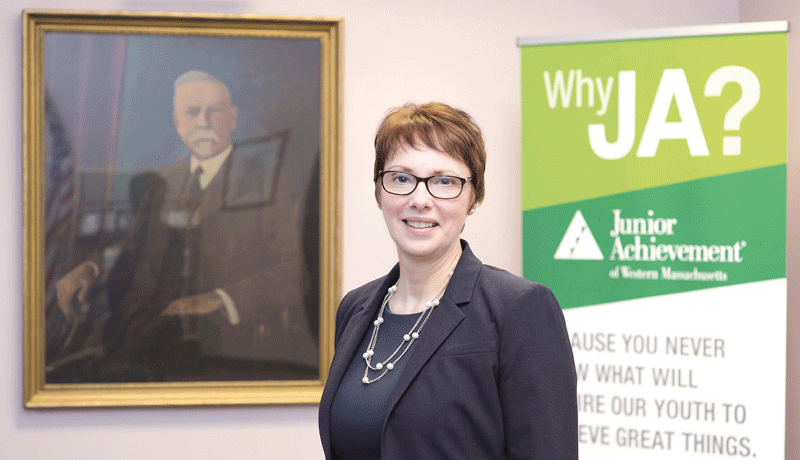
Jennifer Connolly

Jennifer Connolly stands beside the portrait of JA co-founder Horace Moses at the agency’s offices in Tower Square.

Jennifer Connolly likes to say Junior Achievement works hard to present young people — and, in this case, that means kindergartners to high-school seniors — with eye-opening and quite necessary doses of reality.

And one of the more intriguing — and anecdote-inspiring — examples is an exercise involving second-graders — specifically, an individual wearing a nametag that reads simply, ‘Tax Collector.’

The best story I ever heard from one of our volunteers was about how he announced to the class that it was time to take the taxes, and this one boy dove under his desk and said, ‘no, no, my daddy says taxes are bad … I don’t want to pay taxes!”

You guessed it. This is a direct lesson in how the amount of money one earns certainly isn’t the amount taken home on payday. In this case, the tax collector, often one of the students, literally takes away two of the five dollars a student has ‘earned’ for work they’ve undertaken.

The exercise has yielded some keepsake photos for the archives, and colorful stories that Connolly, president of Junior Achievement of Western Massachusetts, has related countless times.

The ‘tax collector’ makes his rounds at a local school

The ‘tax collector’ makes his rounds at a local school. The exercise provides important lessons and has yielded some colorful anecdotes.

“The best story I ever heard from one of our volunteers was about how he announced to the class that it was time to take the taxes,” she recalled, “and this one boy dove under his desk and said, ‘no, no, my daddy says taxes are bad … I don’t want to pay taxes!’

“And the students … they don’t want to be the tax collector,” she went on. “We sometimes have to get one of our volunteers to do it. The kids cry — they don’t want to take money away from people; they say, ‘I can’t do this.’ It’s adorable.”

That’s not a word that applies to all the lessons, obviously, including one that Connolly imparted on a local high-school student herself.

“One girl couldn’t decide between being an early-childhood educator or a doctor,” she explained. “She looked at the income for an early-childhood worker and said, ‘that’s terrible,’ and I said, ‘unfortunately, yes.’

“So she said, ‘I’ll go into allied health, become a doctor, and make a lot of money,’” Connolly went on. “That’s when I told her about one of my daughter’s friends who became a dentist; she owes $250,000 in student loans, is back home living with her parents, and drives the same minivan she had when she was in college. I told this student there are no easy choices, and you have to weigh the impact, and she replied, ‘you’ve given me so much information, my head is going to explode.’”

Whether adorable or biting in their nature, the lessons provided by JA are, in a word, necessary, said Connolly and others we spoke with. That’s because they help prepare young individuals for the world beyond the classroom, where wrong decisions about finances can have disastrous consequences, and also where hands-on experience with the world of business can pay huge dividends and perhaps even inspire future entrepreneurs and business managers.

“It’s rewarding to watch the students and see the lightbulbs go on,” said Al Kasper, president and chief operating officer of Savage Arms in Westfield, who has been a long-time JA volunteer and board member.

At present, he mentors two entrepreneurship classes, or “company programs,” at East Longmeadow High School taught by Dawn Quercia, who has been doing this for nearly 20 years now, and is such a believer in the program that she fronts the startup money needed for her classes to place orders for the products they are to sell.
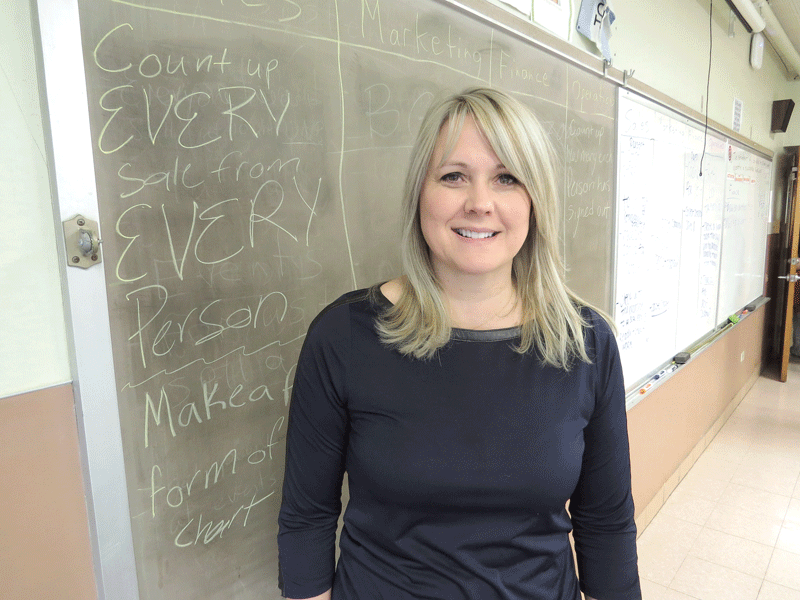
 

Dawn Quercia

Dawn Quercia, who fronts the money for her business students’ ventures, says the JA program provides hands-on lessons one can’t get from a textbook.

“It’s a little risky … I’m not a wealthy person, but I believe in the kids,” she said, adding that the most she’s ever lost is $200, and all she ever gets back is her investment — there’s no interest.

The dividend, she went on, is watching students learn by doing and gain maturity and life lessons while doing so.

“I could teach this out of a book, and that’s what I did when I first started here,” she went on. “And I didn’t feel the kids were learning as much as they could, and I said, ‘why don’t we just start a business?’”

Young people have been doing just that since 1919, when Horace Moses, president of Strathmore Paper Co., collaborated with other industry titans to bring the business world into the classroom by having students run their own venture.

And it continues today with a wide range of programs involving the full spectrum of young students — from those learning their colors to those trying to decide which college to attend.

JA is coming up on its centennial celebration, and since it was essentially born in Western Mass. (although now headquartered in Colorado Springs, Colo.), Connolly is hoping that Springfield, and perhaps the Big E — where the so-called Junior Achievement Building, built in 1925 and funded by Moses, still stands — can be the gathering spot for birthday celebrations.

But while she’s starting to think about a party, she’s more focused on providing more of those hard, yet vital lessons described earlier. And that’s why this organization was named a Difference Maker for 2017, and is clearly worthy of that honor.

Thinking Outside the Box

They’re called ‘memory boxes.’

That’s the name a small group of students from Roger L. Putnam Vocational Technical Academy in Springfield assigned to a product they conceived, assembled themselves, and took to the marketplace just over a year ago.

As the name suggests, these are decorated wooden boxes, complete with several compartments designed to store jewelry or … whatever. They were hand-painted, with stenciling and paper flowers glued on the top, and priced to sell for $15, with were being the operative word. That’s because, well, they just didn’t sell, and are now more collectors’ items than anything else.

But it wasn’t for lack of trying.

“They did everything to sell them — they kept getting knocked down, and they kept getting back up,” said Connolly, referring to the students involved in this exercise, which she supervised as part of the JAYE (Junior Achievement Young Entrepreneurs) program. “They tried craft fairs, flea markets, they tried online, they sold from a table at Tower Square … the boxes just didn’t sell.

“The girls just wouldn’t take ‘no’ for an answer,” she went on, adding quickly, though, that they heard ‘no’ more than enough times to convince them it was time to develop a new product. “They learned to take rejection very well.”

From left, Sabrina Roberts, Dajah Gordon, and Johnalie Gomez

From left, Sabrina Roberts, Dajah Gordon, and Johnalie Gomez have learned some critical lessons selling ankle anklets — and not selling memory boxes.

And that, as it turned out, was only one of many lessons imparted upon them during that exercise, as was made clear by these comments from Dajah Gordon, a team member and JAYE veteran who has been part of far more successful ventures, including the team that went to the program’s national finals, staged in Washington, D.C., two years ago with a company that sold charm bracelets.

“Whenever we fail, like we did with the boxes, we have to step back, look at the company, and say, ‘where are we lacking?’” she said of the six-month odyssey with that ill-fated product, which all the participants can look back on now and laugh. “For us, with the boxes, something we didn’t focus on much was our target market; we were trying to sell to everybody, but we needed a specific target group or audience.

“Later, we got that part down,” she went on, adding that the identified audience — young people like themselves — has become far more receptive to the team’s new product, the so-called ‘wish anklet.’ (The wearer is to make a wish upon tying it around her ankle; if she keeps it on until it naturally falls off, the secret wish will come true.)

While there is no documented or even anecdotal evidence that the product performs as advertised, the anklets, introduced just a few months ago, have been selling well, and the three young women involved are certainly optimistic about fast-approaching Valentine’s Day, and are hard at work replenishing depleted inventory.

These collective exploits are typical of the JAYE initiative, an after-school version of the JA Company Program, which is the very bedrock on which the Junior Achievement concept was built in the months after World War I ended and when the nation was returning to what amounted to a peacetime economy.

Horace Moses; Theodore Vail, president of American Telephone & Telegraph; and Massachusetts Sen. Murray Crane got together behind the notion that, as the nation shifted from a largely agrarian economy to an industrial-based system, young people would need an education in how to run a business, said Connolly. A decidedly hands-on education.

Four and perhaps five generations of young people have formed enterprises and brought products to market through what is still known as the JA Company Program, as evidenced by the front lobby of the JA office on the mezzanine level in Tower Square, which has a number of artifacts, if you will, on display.

There are no memory boxes, but on one table, for example, is what would now be considered a very rudimentary, wooden paper-towel-roll holder, as well as a small rack for key chains, both products conceived by high-school classes in the ’70s, said Connolly.

On another table by the front window, near a large, imposing painting of Horace Moses (a prized possession for this JA chapter), is a wooden lamp, a product produced in the late ’70s through a JA Company Program called Bright Ideas, sponsored by what was then called Western Mass. Electric Co. (now Eversource). Connolly noted that lamps of various kinds were a staple of early JA ‘company’ classes, which started as after-school exercises and eventually moved into the classroom in the late ’50s.

Today, there are in-class and after-school programs that are providing students with tremendous opportunities to not only learn how a business is run, but operate one themselves, experiencing just about everything the so-called real world can throw at them.

Learning Opportunites

That would definitely be the case with another after-school JAYE program, said Connolly, this one called the Thunderpucks.

A collaborative effort involving students at Putnam, Chicopee High School, and Pope Francis High School, this bold initiative essentially makes a team of students part of the staff of the Springfield Thunderbirds, the new AHL franchise that started play last fall amid considerable fanfare and promise.

Al Kasper

Al Kasper says he enjoys seeing the “lightbulbs go on” as he mentors students involved in JA programs at East Longmeadow High.

This team has been assigned the March 3 tilt against the Lehigh Valley Phantoms and will coordinate many aspects of it, from the band that plays the National Anthem to the T-shirt toss, to some ticket sales, said Connolly.

“They’re going to be reaching out to businesses and groups and trying to sell them ticket packages,” she explained. “They’re going to be handling almost all aspects of the game; it’s an incredible learning experience.”

Those last two words, and even the one before them, would apply to most all JA initiatives, she went on, adding, again, that they start with children at a very young age.

With that, she took BusinessWest through the portfolio of programs, if you will — one that involved some 11,500 students across the region during the 2015-16 school year — starting in kindergarten.

At that age, the focus is on very basic financial literacy, such as understanding currency and the concept of a savings account. By first grade, students are acquainted with jobs, businesses, the assembly line (they create one to make paper donuts), and the term ‘income,’ and how families must live within one. This is when they are told about the difference between a ‘want’ and a ‘need.’

Moving along, in second grade, the tax collector makes his arrival — money is taken from those working to make donuts and given to those working for the government, so students can see where their tax dollars go, among other lessons. In third grade, students learn how a city operates and are introduced to concepts such as zoning, planning, and the basics of running a business.

And on it goes, said Connolly, adding that, by sixth grade, students are learning about cultural differences and why, for example, they can’t sell hamburgers in India. By middle school, there are more in-depth lessons in personal finances, budgeting, branding, and careers — and how to start one — as part of the broad Economics for Success program.

By high school, the learning-by-doing concept continues with everything from actual companies to stock-market challenges; from job shadowing to lean-manufacturing concepts. And while students learn, they also teach, with high-school students mentoring those in elementary school, and college students returning to coach those in high school.

The work of providing all these lessons falls to a virtual army of volunteers, said Connolly, adding that the Western Mass. chapter deployed more than 400 of them last year. They visited 522 classrooms and donated more than 73,000 hours to the area’s communities.

“JA is taking what students are learning in school, the math, the communications, the writing, all of that, and giving it a real-life reason,” she explained, summing up all that programming and its relative importance to the students and the region as a whole. “You need math because … you have to figure out your finances, or you might run a business. You need to understand social studies and geography because we’re an integrated world — where do the products come from?

“And the activities we have in JA are really hands-on, so we really promote critical thinking, analyzing, and problem solving,” she went on. “These are the 21st-century skills that students will really need.”

Returning to that episode involving the high-school girl trying to decide between early-childhood education and the medical field, and the choices involved with each path, Connolly said it reflects many of the lessons and experiences that JA provides.

“We don’t want to show them that everything’s easy — it’s not easy, no matter what you pick,” she explained. “We’re trying to make them think and make intelligent decisions.”

And this is certainly true when it comes to the JA Company Program, as we’ll see.

Course of Action

“Good cop … bad cop.”

That’s how Katie Roeder, a junior at East Longmeadow High School, chose to describe how she and Seth Bracci, co-presidents of a company now selling sweatshirts, work together at their JA venture.

And she’s the bad cop, a role she thinks she’s suited for, and that she enjoys.
Katie Roeder

Katie Roeder says she enjoys her ‘bad cop’ role as co-president of a company at East Longmeadow High School selling sweatshirts.

“I’m the one who lays out the schedule, and I go around to different groups and check on them, and if they’re not where they need to do be, I ask them to do those things as soon as possible,” she explained. “And Seth … he comes in after that and says, ‘c’mon, guys, let’s do it,’ evening out the seriousness with a bit of fun.”

It all seems to be working, she went on, adding that this business doesn’t have a name, really; it’s merely identified by the class title and time slot: Entrepreneurship H Block (12:20-1:01 p.m.). It is one of two JA classes at the school, with the other selling water bottles, as we’ll see shortly.

The H Block class spent a good amount of time deciding on a product, Roeder told BusinessWest, adding that, while young people can buy sweatshirts in countless places, online and in the store, they can’t find one with the distinctive Spartan logo, or mascot, that has identified ELHS since it opened in 1960 — unless they’re on a sports team.

The class then spent even more time — too much, by some accounts — coming up with a design (gray sweatshirt with a red logo, covering both of the school’s colors), she went on, adding that Quercia insisted on making this a democratic exercise, with input from all those involved, to achieve as much buy-in as possible. Then it spent still more time conducting what would be considered market research on who might purchase the product before placing a large order with the manufacturer.

This was a fruitful exercise, Roeder noted, because it informed company officers that those most likely to buy were underclassmen and students at nearby Birchland Park Middle School who would soon become ninth-graders. Thus, the order was for large numbers of smalls and mediums, and only a handful of XLs and XXLs, presumably to be sold to alums at the Thanksgiving Day football game (and there were a few such transactions).

Such hands-on lessons in how businesses run, or should run, are what JA’s entrepreneurship program is all about, said those we spoke with, adding that the year-long exercise is an intriguing departure from learning via a textbook, such as in AP Calculus, which is where Roeder was supposed to be at that moment, only she got a pass so she could talk with BusinessWest.

“It’s great because it’s different from the day-to-day classroom things we do,” she noted. “We handle real money; this is a real business with real stakes. It doesn’t feel like a class at all. We’re learning, but it doesn’t feel like we are. All that knowledge still goes into our mind, and we keep it there.”

Bracci agreed. “It’s interesting to see the inner workings and just how hard it is to create your own business,” he explained, “and how there are many different obstacles you can run into as someone trying to get a product out there.”

Meanwhile, at the water-bottle-selling company gathered next door, in room 111, the discussion focused on sales to date — and how to sell the 30 or so units still in inventory.

Co-president Bridget Arnesen, while occasionally drinking from one of the Spartan-logo-adorned bottles, exhorted her classmates to not rest on their laurels — bottle sales did well in the run-up to the holidays — and keep selling when and where they could, such as at the big basketball game slated for that night against league powerhouse Central.

This was where Kasper stepped in to evoke the ‘80-20 rule,’ which, he said, predicts how roughly 80% of a company’s products will be sold by 20% of its representatives.

A quick look at a tote board of sorts that detailed how many units each class member had sold, revealed that the 80-20 rule certainly held up in this case, with some class members clearly motivated by the $5.67 in commission they make for each bottle sold (one enterprising young woman logged 40 transactions), and others … not so much.

But the walking-around money is just one of the things students can take home from these classes, said Quercia, adding that the doses of reality can help in a number of ways, especially for those who have intentions of getting into business.

And Roeder already has such plans in the formative stage. She’s not sure where she’ll attend college — she says she’ll start kicking some tires next year — but does know that she intends on majoring in pediatric dentistry and probably owning her own practice.

“Business will help with my future career because I want to run a pediatric dentistry,” she explained. “I hope all the things I’ve learned stay in my head, because I’m going to need them.”

Life Lessons

Such comments help explain why those at BusinessWest chose Junior Achievement of Western Massachusetts as a Difference maker for 2017 and, more importantly, why the organization continues to broaden its mission and find new ways to impart hard lessons.

Indeed, it is comments of various types and from a host of constituencies that drive home the point that JA’s programs are more important now than perhaps ever before.

We could start almost anywhere, but maybe the best place is with Robbin Lussier, a business teacher at Chicopee High School and another educator who has a long history with JA.

It has included a number of initiatives, including a career-preparation program that has grown to include 120 students, who receive tips on résumés and how to search for a job, and actually take part in mock interviews with area business owners and managers.
Bridget Arnesen and Nathan Santos

Bridget Arnesen and Nathan Santos, co-presidents of the company at East Longmeadow High School selling water bottles, say their class provides real-life lessons in running an enterprise.

The lessons eventually turned into life experiences, she said, adding that many students actually earned jobs with area companies, prompting employers to come back year after year as they searched for qualified help.

Other involvement with JA has included programs in budgeting, personal finance, and the stock-market challenge, she went on, adding that they provided what she called a “heightened sense of reality” that a classroom teacher could not provide.

“It’s a whole new dimension — students are walking away with memorable lessons learned,” Lussier said, adding that some of the more intriguing things she hears are from those who are not taking part in these programs, but wish they could, or wish they had.

“I teach a personal-finance class this year,” she said, “and if I had a nickel for every time a teacher, administrator, or parent at open-house night said, ‘I wish I could take this class’ or ‘I wish they had this when I was in school,’ I could retire.”

Connolly agreed, and cited a 50-question quiz on debit and credit cards given recently to middle-school students at Springfield’s Duggan Academy as an example.

“At the end, after the volunteer had gone through all the questions, one girl turned to another and said, ‘this has been the best day … I learned so much today,’” she recalled. “And another said, ‘can I take this home so I can show my parent? Can I take this home so I can show my grandmother? I want to save this so when I go to college I can make the right decisions.’

“That’s what you live for, students who have that reaction,” she said, adding that she sees it quite often, which is encouraging.

Also encouraging is seeing students learn by doing, even if it’s difficult to watch at times, said Quercia, who was happy to report that both classes, first those selling water bottles and then those peddling sweatshirts, paid back the seed money she invested.

“They handle everything, I act as their consultant, and Al [Kasper] explains how everything they’re learning is like the real world,” she told BusinessWest. “Together, the students face challenges and confront problems and get creative in finding solutions together.”

Kasper, who has been involved with JA in various capacities since the early ’80s and at ELHS for 15 years now, concurred.

“This isn’t MCAS, ‘memorize-this-stuff’ learning,” he said of the company program. “It’s real-life stuff that students get excited about, and because of that, we’ve really grown this program.

“They’re excited to come to class,” he went on. “It’s something new, it’s reinforcing what they’re learning, and it’s fun. They’re still learning, but they’re having fun doing it, so the retention is great, and their confidence goes up.”

It’s All About the Bottom Line

When asked what she had learned about business through her involvement with JAYE, Johnalie Gomez, another member of the team from Putnam now selling wish anklets, thought for a moment before responding.

“It’s not … easy,” she said softly, deploying three little words, in reference to both business and life itself, that say so much that those around her immediately started shaking their heads — not in disagreement, but rather in solid affirmation, as if to say, ‘no, it’s not.’

Everyone who has ever been in business would no doubt do the same. And that’s because they probably have at least one ‘memory box’ or something approximating it somewhere on their résumé — a seemingly good idea that just didn’t work. With each one, there are hard lessons that bring pain, maturity, and, hopefully (someday), laughs.

Delivering such vital lessons when someone is in the classroom — or the conference room in the suite at Tower Square — so that they may resonate later and throughout life is why Junior Achievement was formed, why it continues to thrive, why it is even more relevant now than it was 98 years ago, and why the organization is a Difference Maker.

Just ask the ‘tax collector,’ or, more specifically, those young students who don’t want to be him.

George O’Brien can be reached at [email protected]

Community Spotlight Features

Community Spotlight

Chicopee Mayor Richard Kos, left, and Michael Vedovelli

Chicopee Mayor Richard Kos, left, and Michael Vedovelli say the new, three-megawatt solar farm on James Street will benefit the city and reduce the cost of electricity at Westover Air Reserve Base.

Richard Kos says officials in Chicopee are doing all they can to foster good relationships with developers, government leaders, and local businesses, and their efforts have led to a strong surge in growth.

“In 2016 the building department issued $31 million in building permits, but we anticipate that, by the end of the first half of 2017, we will more than double that amount,” the mayor said.

Indeed, the list of projects in the planning stages or underway is not only lengthy but diverse in nature, ranging from new hotels to new and improved housing, a solar farm, business expansions, infrastructure improvements, and progress at the Uniroyal and Facemate properties. There’s also a new Mercedes-Benz dealership under construction on Burnett Road.


Chicopee has a can-do attitude, is business-friendly, and has officials who come up with optimal solutions to problems. All of the department heads have given us input to make the building process go smoothly.”


Peter Wirth is co-owner of that $12 million, 37,000-square-foot, state-of-the-art facility, expected to open in late summer or early fall. He and his partner took their time searching for a location in the metro Springfield area before choosing a site next to the entrance of Interstate 291 and exit 6 on the Mass Pike, and said city officials have done everything possible to help them meet their timetables.

“Chicopee has a can-do attitude, is business-friendly, and has officials who come up with optimal solutions to problems,” Wirth said. “All of the department heads have given us input to make the building process go smoothly.”

Other developments off exit 6 include construction of a $20 million Tru by Hilton Hotel by the owners of a Days Inn who demolished the outdated hotel on 450 Memorial Dr. to make way for the new structure.

“The project will include a Starbucks, a Wendy’s restaurant, an Irving gas station, and a sit-down restaurant that will be named later,” Kos said as he talked about reasons that make Chicopee a desirable place to live and operate a business.

“We’re the third-largest city west of 495 and are known as the ‘crossroads of New England’ because Interstate 91 and two exits of the Mass Pike intersect here,” the mayor noted, adding that the city’s financial stability and the traffic that runs through it add to its appeal.

But he attributes the rapid acceleration in growth to concerted efforts that began in 2014 after he was elected mayor for the second time.

“In a time when people are losing faith in government, Chicopee has seen unprecedented cooperation between its leaders, locally and on the state level,” Kos said. “We are working together to get things done and are excited about the industries that have chosen to invest here.”

For this issue, BusinessWest outlines some of the major projects that took place in Chicopee last year as well as those scheduled to begin in 2017.

Cooperative Efforts

A three-megawatt solar farm under construction on a 26-acre site off of Outer Drive and Goodwin Street is an example of how combined efforts have led to growth.

Last summer, the city was finally able to raze 100 units of military housing units on the site, which had sat unused for two decades and become problematic. Although Chicopee acquired the property from the Navy in 2011 after five years of negotiations, restrictions and their condition had prevented the city from renovating the structures or reusing the land for other purposes

“The housing was an eyesore, in a state of disrepair that had become a hazard to the neighborhood due to vandalism, vagrants, and other problems,” Kos said.

In 2015, he proposed putting a solar farm on the site, and after the City Council and neighbors endorsed the idea, Chicopee was awarded a $1 million MassDevelopment grant to remediate the property that was matched with funds from city coffers.

The money came from the state’s $5.9 million bond bill grant program to support the Clean Energy Assessment & Strategic Plan for Massachusetts Military Installations, and the housing was finally torn down.

In December, a lease agreement was signed with Chicopee Solar LLC, a subsidiary of ConEdison Development, to build a solar farm on 21 of the 26 acres.

“We gave the company permission to begin working at the site while the final details were being worked out,” Kos said, explaining that ConEdison had to have all mechanical components installed and ready for operation by Jan. 8 to meet a deadline set by the Mass. Department of Energy that would allow it to receive solar renewable-energy credits.

“They worked under a very tight timeline and brought in electricians from all over New England, but there was complete cooperation between the company, the city, and the state, and the installation was finished on time,” said Michael Vedovelli, the city’s director of Community and Economic Development.


Increasing a city’s market rate residential population is one of the real secrets of urban success.”


Kos added that the city’s investment will be recouped in 10 years through tax revenue and income from the lease agreement and the government will also benefit because Westover Air Reserve Base will receive a 5% discount each year on electricity that will amount to $100,000 in annual savings.

He noted that the remaining five acres on the property are available for industrial use and located adjacent to Air Park North and the former Avery Dennison building that is being used by Yankee Candle.

The project has been praised by residents of the Crossing at Ridgewood Village, a condominium association that sits across from the solar farm.

“It’s a wonderful reuse of the property that is great for the region,” said Dottie Sikes, a resident and member of the board of trustees, who recalled living in the former military housing with her husband in 1970 when Westover was an active military base. “The Crossing has always been a great place to live, but it will be much nicer now thanks to the new solar farm.”

The city has also reached an agreement with Mass. Alternative Care Inc. to open a medical-marijuana cultivation facility and dispensary near the Springfield line.

The company plans to convert the former Chicopee Engineering Associates building into a storefront, and the City Council approved a zoning change for a 3,270-square-foot piece of land on East Main Street so the business can begin its operation.

It will be the first of its kind in Hampden County, and Kos said the owners will be ready to plant by April. “The facility will provide patients with necessary treatment options and bring jobs and numerous tax benefits to the city.”

Ongoing work has also taken place at the Uniroyal site, and last year two of the remaining buildings on the 27-acre property were razed.

“We’ll try to repurpose four of the remaining 10 structures,” Vedovelli said, adding that the city has been aggressive in pursuing funds to remediate the brownfields and received three $200,000 grants from the Environmental Protection Agency last year.

“It is a tribute to our grant writer and our team,” he said, noting that only 53 projects in the country received the grants.

Previously, the City Council had appropriated $185,000 to make roof repairs, cover a broken skylight, and board up broken windows in the administration building on the Facemate property at Oak and Grove streets. A full abatement of that 62,000-square-foot structure will be completed this spring, and a request for proposals will be issued later in the year.

Interest in the Facemate property continues to grow, and David Spada from Lawrence has plans to build a $22.9 million, 92-room assisted-living facility on Lot 4 of a 3.85-acre parcel that has frontage on West Main Street across from the Chicopee Falls Post Office, and will be situated off a new road which leads to the RiverMills Senior Center.

Residential Growth

Two years ago, Mount Holyoke Development purchased the Lyman Mills in Chicopee Center, and plans are now underway to convert the former textile-manufacturing plant into 110 market-rate apartments. The buildings were unoccupied for four years, and the new units will be loft-style work/live spaces designed to appeal to young entrepreneurs.

Kos said the project was made possible in part by a $2.6 million MassWorks grant the city received last year that will be used to upgrade water, sewer, and storm-water lines in the area. Tighe and Bond is designing the project, and the work will begin this summer.

“Increasing a city’s market-rate residential population is one of the real secrets of urban success,” the mayor said, noting that such development becomes a catalyst for further growth as residents put feet on the street and increase business at local establishments and restaurants.

Change is also occurring at the former Kendall House in Chicopee Center as a result of collaborative efforts.  Valley Opportunity Council acquired the building from HAPHousing Inc. last year, and has plans for a $7 million renovation that will convert the rooming house, which housed Quicky’s restaurant on its first floor, into 39 affordable studio apartments.

“We’re working to improve the affordable-housing stock within the city, and by collaborating with the state, VOC received a $3.1 million grant to help restore the Kendall House,” the mayor said, adding that the nonprofit will cover the remainder of the renovation costs.

He told BusinessWest the city is also working to increase home ownership through two incentive programs. The first is the First Time Home Buyers Assistance Program, which helped 22 eligible families last year by giving each up to $5,000 toward the purchase of a new home.

The second initiative is aimed at people willing to purchase three-family homes and live in them, which ensures the likelihood that they will be kept in good condition. New homeowners in the program are given $1,000 each year for up to 16 years as long as they reside in the properties.

“The majority of these homes are in Chicopee Falls, Chicopee Center, and Willimansett, and the program continues to grow and pay dividends,” the mayor said.

Improvements are also being made to the city’s parks; a $225,000 spray park with other amenities was completed at Wisniowski Memorial Park last year, and $225,000 will be invested to make enhancements to Sarah Jane Park this year.

In addition, legislators are working to grant approval to use the former Chicopee Falls Library building as a home for a third Head Start program.

Work on a new parking lot downtown has also been completed. It features 15 designated public spaces as well as parking for patrons of Munich Haus restaurant. The city has also applied to become designated as a Green Community, which would make it eligible for grants for improvements to city buildings.

Continuing Progress

Last summer, Pilgrim Interiors Inc. expanded, and several weeks ago U.S. Tsubaki Automotive LLC held its formal groundbreaking ceremony for a $11.5 million, 100,000-square-foot expansion.

“It will preserve 348 jobs and result in 35 new ones,” Vedovelli said, adding that the company decided to remain in Chicopee after considering a move to either Tennessee or Mexico.

New businesses continue to be attracted to the city, and last year PV Sullivan Supply Co. Inc. and Holden Humphrey Co. were welcomed.

Growth is expected to continue as seeds that were planted take root, and the outlook for this year is exceptionally bright.

“Chicopee is still the biggest small town in Massachusetts,” said Kos. “We’re like the old Cheers bar where everyone knows your name, and are making great progress because we work together in a way that benefits our community as well as its residents.”


Chicopee at a glance

Year Incorporated: 1848
Population: 55,603
Area: 23.9 square miles
County: Hampden
Residential Tax Rate: $17.31
Commercial Tax Rate: $32.49
Median Household Income: $47,276
median family Income: $65,443
Type of government: Mayor; City Council
Largest Employers: Westover Air Reserve Base; City of Chicopee; J. Polep Distribution Services; Turbo Care Inc.
* Latest information available

Departments Incorporations

The following business incorporations were recorded in Hampden, Hampshire, and Franklin counties and are the latest available. They are listed by community.

AGAWAM

Translink Community Transport Inc., 270 Main St., Agawam, MA 01001. James Ngugi, 103 Fern St., Springfield, MA 01108. Non-emergency, non-medical transportation agency.

Unique Transport Inc., 242 River Road, Agawam, MA 01001. Serge Nakhabenko, same. Trucking.

AMHERST

The Valley Winds Inc., 9 Hedgerow Lane, Amherst, MA 01002. Brian Eugene Messier, same. Non-profit organization designed to enhance the performance of quality wind band music and to deliver accessible and enjoyable performances to the Pioneer Valley community.

Western Massachusetts Emdria Regional Network Inc., 26 South Propspect St., Amherst, MA 01002. Jim A. Helling LICSW, same. Group of local EMDR therapists dedicated to disseminating knowledge about EMDR, advancing the practice of EMDR, facilitating access to EMDR therapy among underprivileged and traumatized populations, and strengthening regional community.

CHICOPEE

Zafer Reis Inc., 466 Chicopee St., Chicopee, MA 01013. Hasan Huseyin Gizli, 76 Park St., Chicopee, MA 01014. Pizza restaurant.

EAST LONGMEADOW

The Coating House Inc., 9 Lombard Ave., #2, East Longmeadow, MA 01028. Kimberly A. Casineau, same. Manufacturing company.

Twin Lacrosse Inc., 609 Somers Road, East Longmeadow, MA 01028. Brian Calandruccio, same. Development, marketing, sale of lacrosse equipment.

FLORENCE

The Right to Immigration Institute Inc., 589 Burtspit Road, Florence, MA 01062. Munis Safajous, 415 South St., Waltham, MA 02453. Non-profit organization designed to provide representation to aliens in immigration proceedings.

LEE

Yuvaram Inc., 435 Laurel St., Lee, MA 01238. Kara Steeger, same. Investment opportunities.

LONGMEADOW

Unchain America Inc., 47 Lynnwood Dr., Longmeadow, MA 01106. Robin Budon, same. Non-profit organization dedicated and operated as a dog rescue.

PITTSFIELD

ZAM808 Inc., 27 East Housatonic St., Pittsfield, MA 01201. Dan Talmi, same. Ballet touring company.

SPRINGFIELD

Urban Potential Corporation, 361 Sumner Ave., Springfield, MA 01108. Phyllis Williams-Thompson, 80 Bellevue Ave., Springfield, MA 01108. Non-profit organization which celebrates, enriches and supports urban life in the Greater Springfield area and promotes the joys of living in our city through education, the arts and community partnerships.

Daily News

BOSTON — The state’s total unemployment rate dropped to 2.8% in December, marking the sixth consecutive month the rate has declined, the Executive Office of Labor and Workforce Development reported Thursday. The last time the state’s unemployment rate was at 2.8% was in December 2000.

In December, preliminary estimates from the Bureau of Labor Statistics indicate Massachusetts added 6,600 jobs over the month. The November job gain had an upward revision, with the state adding 7,000 jobs compared to the previously published 5,800-job-gain estimate. Over the year, Massachusetts has added 75,000 jobs.

At 2.8%, the seasonally adjusted unemployment rate is down 2.1% over the year from 4.9% in December 2015. There were 73,300 fewer unemployed residents and 112,900 more employed residents over the year compared to December 2015.

“For the past six months, the unemployment has continued to drop, and the labor-force participation rate has held steady over the year, which is very good news for the state,” Labor and Workforce Development Secretary Ronald Walker II said. “We are also pleased to see the state continues to add jobs in key sectors, such as education and health services; professional, scientific, and business services; information; and construction.”

In December, over-the-month job gains occurred in the education and health services; construction; professional, scientific, and business services; information; leisure and hospitality; financial activities; manufacturing; and other services sectors.

The state’s labor-force participation rate — the total number of residents 16 or older who worked or were unemployed and actively sought work in the last four weeks — is 64.7%. Over the year, the labor-force participation rate has increased 0.2% compared to December 2015.

Over the year, the largest private-sector percentage job gains were in construction; professional, scientific, and business services; education and health services; and leisure and hospitality.

Massachusetts’ unemployment rate has remained lower than the national rate since April 2008. The Bureau of Labor Statistics reported the December national rate at 4.7%. Since the statewide rate peaked at 8.8% in September 2009, there are now 335,600 more Massachusetts residents employed and 202,700 fewer residents unemployed, as the labor force increased by 133,000.

Daily News

SPRINGFIELD — Greentown Labs, a Somerville-based company that provides resources for clean-technology startups, recently announced plans to open an office at Springfield Technology Park.

The alliance between Springfield Technology Park and Greentown Labs will allow those developing prototypes in Eastern Mass. to link with the existing precision-manufacturing industry in Western Mass. to help in the manufacturing of new products. Greentown’s entrepreneurs are particularly focused on early-stage energy and clean-technology startup companies.

Greentown provides space and resources to early-stage companies, including a prototype lab, co-location space, and a shared machine shop and electronics shop, and hosts a range of clean-technology entrepreneurs and startups. Currently, Greentown Labs is home to more than 50 clean-tech startups developing prototypes in its shared lab and office space.

The new Greentown Labs location was made possible with funding from the Irene E. & George A. Davis Foundation along with assistance from the Massachusetts Clean Energy Center and MassDevelopment. Other partners include the Western Mass. Economic Development Council, the Regional Employment Board of Hampden County, and the Massachusetts Manufacturing Extension.

Future plans include the potential development of a Center for Advanced Manufacturing Excellence to be housed at the Technology Park, with the goal to support and grow the region’s precision-manufacturing sector.

Daily News

SPRINGFIELD — Are you an experienced IT professional seeking your next career move? FIT Staffing will host a job fair from 2 to 4 p.m. on Thursday, Jan. 26 at the UMass Center at Tower Square, 1500 Main St., in downtown Springfield.

Job Fair 2.0 will provide attendees with the opportunity to connect with employers in the Western Mass. and Hartford County areas who are seeking talented IT professionals for their organizations. Participating companies in the healthcare, finance, manufacturing, and insurance industries will be looking for qualified candidates for their mid- to senior-level IT roles.

FIT Staffing will provide light refreshments, and no registration is required for job seekers. For more information, contact [email protected].

FIT Staffing is a Springfield-based, women-owned staffing company that connects qualified information-technology professionals with local businesses looking to hire top technical talent.

Daily News

BOSTON — Confidence among Massachusetts employers hit its highest level in 12 years during December amid the prospect of growth initiatives from the new administration in Washington and a continued strong state economy.

The Associated Industries of Massachusetts (AIM) Business Confidence Index (BCI) rose 2.3 points to 60.4 last month, a full 5.1 points higher than its level in December 2015 and the highest reading since December 2004. It marked the fourth consecutive monthly increase in sentiment among employers in the Commonwealth, where the unemployment rate recently fell to 2.9%.

The November and December BCI readings mirror the post-election rally in U.S. financial markets, which have risen 5% as President-elect Donald Trump prepares to work with a Republican Congress on business-friendly issues such as tax reductions, regulatory reform, and infrastructure spending. The AIM survey showed a 5.5-point jump in confidence in the national economy last month, leaving that indicator at its highest level since 2007.

“Massachusetts employers are taking the president-elect at his word that he will prioritize economic growth at the national level, especially if he is able to work with Congressional Democrats on a $1 trillion infrastructure initiative,” said Raymond Torto, chair of AIM’s Board of Economic Advisors (BEA) and lecturer at Harvard Graduate School of Design. “But employer enthusiasm is also based upon a solid economic expansion during 2016 that most analysts believe will continue in a methodical manner though the first half of 2017.”

The AIM Index, based on a survey of Massachusetts employers, has appeared monthly since July 1991. It is calculated on a 100-point scale, with 50 as neutral; a reading above 50 is positive, while below 50 is negative. The Index reached its historic high of 68.5 on two occasions in 1997-98, and its all-time low of 33.3 in February 2009. The index has remained above 50 since October 2013.

Almost all of the sub-indices based on selected questions or categories of employer were up in December. The Massachusetts Index, assessing business conditions within the Commonwealth, gained 2 points to 61.8, leaving it 5.5 points ahead of the same time last year.

The increase in the U.S. Index of national business conditions put that figure 7.5 points higher than its level of a year ago, but still short of the Massachusetts index. It marked the 80th consecutive month in which employers have been more optimistic about the Massachusetts economy than the national economy.

The Current Index, which assesses overall business conditions at the time of the survey, increased 2.2 points to 59.1, while the Future Index, measuring expectations for six months out, rose 2.5 points to 61.7. The future outlook was 5.5 points better than a year ago and higher than at any point since March 2015.

The sub-indices bearing on survey respondents’ own operations also strengthened considerably.

The Company Index, reflecting overall business conditions, rose 1.4 points to 60.9, while the Sales Index increased 3.2 points to 61.4. The Employment Index was the only indicator to lose ground, falling 0.2 points to 57.2.

The AIM survey found that nearly 38% of respondents reported adding staff during the past six months, while 19% reduced employment. Expectations for the next six months were stable, with 37% planning to hire and only 10% downsizing.

“One of the most positive results of the December survey is that business confidence is strengthening uniformly across almost every sector of the economy,” said Elliot Winer, chief economist at Winer Economic Consulting and a BEA member. “Employers both large and small, manufacturers and non-manufacturers, from the Pioneer Valley to Greater Boston, are more optimistic about their prospects than at any time since prior to the Great Recession.”

The BCI Manufacturing Index jumped 0.6 points during the month and 2.6 points for the year. The overall Business Confidence Index among non-manufacturers was 63.3 compared to 56.7 for manufacturing companies.

Companies in the eastern part of the Massachusetts were slightly more optimistic at 61.4 than those in the western part of the state at 57.6.

AIM President and CEO Richard Lord, also a BEA member, said employers appear to be encouraged by the prospect that Trump and a Republican Congress will be able to pass their tax and regulatory agenda.

At the same time, Lord said, there remains uncertainty about a possible repeal of federal healthcare reform and the future of international trade agreements that are critical to Massachusetts companies.

“The only certainty appears to be uncertainty for the next six months,” Lord said. “The key will be to ensure that any tax reductions and regulatory reforms made on the national level are not obviated by state measures intended to make Massachusetts a progressive model for the rest of the country.”

Banking and Financial Services Sections

A Matter of Addition

Kristi Reale and Jim Krupienski

Kristi Reale and Jim Krupienski are the newest partners at Meyers Brothers Kalicka.

As part of a strategic plan to generate new opportunities and more profound growth for the company, and also to ensure a steady flow of new leadership, the Holyoke-based accounting firm Meyers Brothers Kalicka has named two new partners — senior managers Jim Krupienski and Kristi Reale. They’ve been acting essentially as partners without that title for more than year now, and say the firm has provided them all the tools they need to succeed.

Jim Barrett says it was maybe the worst-kept secret he’d seen in quite some time.

He was referring to the granting of partner status to two senior managers at the Holyoke-based accounting firm Meyers Brothers Kalicka — Jim Krupienski and Kristi Reale. The two, who have been with the firm for 12 and 15 years respectively, and had risen through the ranks to senior manager, were told more than a year ago, in something approaching confidentiality, that they were on the track to becoming partners and would likely achieve such status so by the end of this year.

Their promotion wasn’t exactly classified information, but it certainly wasn’t broadcast loudly, said Barrett, the firm’s managing partner since 2009, adding that he made it all official in an announcement to the staff on Dec. 19.

To say that it was somewhat anti-climactic was an understatement, as evidenced by this anecdote from Reale, several days before the news was scheduled to break internally.

“Someone walked up to me and said ‘has your promotion been made official yet?’ she recalled. “It wasn’t exactly a secret, but I didn’t think everyone knew. I guess they did.”

But while the promotions may not have been as discreet as intended, they are certainly significant, said Barrett, and represent an important and in many ways unique step in the company’s efforts to grow and put in place an effective succession plan that will ensure solid leadership for decades to come.

“This was a well-thought-out component of our strategic plan,” he explained. “We have a partner who is retiring, so we have a practice need; Jim and Kristi have demonstrated all prerequisite skills to get there, and we’ve been talking to them for almost two years about how they’re on the track.

“It’s been a process that’s taken a number of years to unfold,” he went on. “We want to onboard them so they know what to expect and the know what’s expected of them; we want this to be a success for everyone.”

While Reale and Krupienski took essentially the same path to a partnership, and their resumes have many common denominators, including extensive work in the community, BusinessWest 40 Under Forty plaques (Reale in 2009 and Krupinski a year later), and a number of bylined submissions to this magazine, they arrived at MBK with different career aspirations, as we’ll see in a few moments.

But they arrived at this career moment together, and for now, they’re excited about moving into different, slightly bigger offices and having their names and bios found by clicking the ‘partners’ button on the MBK homepage. But they’re far more focused on meeting the responsibilities that some with that title and helping the firm grow at a time when doing so is certainly challenging for any financial services firm in a region that has seen little, if any, overall expansion.

For this issue and its focus on Banking & Financial Services, BusinessWest talked with the two new partners, as well as the managing partner, about the promotions and the firm’s strategic plans moving forward.

Watching Their Figures

When she first came to Meyers Brothers, P.C. in February of 2001, Reale was thinking more about staying maybe 16 weeks than the nearly 16 years it took her to reach partner.

Indeed, a veteran with seven years of public accounting work under her belt, she was hired to help during tax season on a per-diem basis, and walked in the door already thinking about what she might do next. But a funny thing happened on the way to carrying out those plans.

“I never left,” she said, stating the obvious before moving on to the more important topic — why.

“I was thinking about going into private industry, but after a couple of months at Meyers Brothers, I just loved it and decided to stay,” she explained, adding that she was hired after just five weeks of per-diem work. “It was very professional, everyone was treated well … it was just a great place to work. I looked forward to going there every day.”

Kristi Reale

When she arrived at Meyers Brothers, Kristi Reale was focused on staying 16 weeks, not 16 years, but the environment she found changed those plans quickly.


Meanwhile, Krupienski got off the elevator on the eighth floor of the PeoplesBank Building just off I-91 (the merged companies came together there in 2005) with a much different mindset.

After serving as a senior accountant at a Big-4 firm (PricewaterhouseCoopers) and then shifting gears and working as a senior auditor at the Hartford, he had made up his mind to return to public accounting. The question was where, he said, adding that through a friend he heard about an opening at MBK.

“I interviewed, liked what I heard, liked the firm, the culture, the people I met with … and felt I should throw my hat into the ring,” said Krupienski, adding that while it would be a leap to start thinking about making partner back in 2003, he allowed himself to harbor such thoughts, and before long, that became a hard goal.

“It was kind of a thought in the back of my mind — I had made the jump back into public accounting, and you generally don’t do that if you don’t have some aspirations for being partner someday,” he told BusinessWest, adding quickly that reaching this rung at a firm of that size is never a given and it would likely take much more than a decade.

“I came from a big-firm mentality,” he explained. “It’s very structured there in terms of the progression, and while this firm isn’t PricewaterhouseCoopers … things are similar in many ways.”

Those sentiments help explain how accounting firms are in many ways different from small and medium-sized law firms, said Barrett, adding that with the latter, an associate is in many cases on a partner track soon after arrival, and if they’re good at what they do, can probably expect to make partner within a certain number of years, although the number and circumstances vary widely with the firm.

In accounting, it’s different, he said, adding that law is more of a transactional business, where individual lawyers have what amounts to their own book of business and client list, while in accounting, one to 10 people could be working with the same client.

Jim Krupienski

Jim Krupienski says MBK has provided him and fellow new partner Kristi Reale with all the tools they need to succeed.

When asked why both Reale and Krupienski were named partners at this time, Barrett said it this amounted to a sound business decision. Both are qualified, experienced managers, and both have the capacity to help the firm grow market share.

Elaborating, he said there are certain required skill sets for reaching the partner rung, and both certainly possess them.

“Can you serve clients?” he began. “Are you able to grow the practice — attract new clients and develop relationships with existing clients? Can you train and develop staff? These are the prerequisites, and they have them.”

By the Numbers

Beyond those required skills, Reale and Krupienski also complement each other in many ways, said Barrett, adding that while they’re both involved in auditing and accounting, or A&A as they say in this business, they have different focus areas and specialize in different sectors of the economy.

Krupienski, for example, specializes — and has written about — medical practice operation, tax planning, and retirement plan strategy, while Reale specializes in closely held businesses, business valuations, management advisory services, and business and tax planning, and has extensive experience in retail, manufacturing, construction, distribution, real estate, insurance, and other service organizations.

“We have people with somewhat similar skill sets,” said Barrett. “But they’re different enough so they can go out and not compete with each other, and complement each other in some cases.”

Meanwhile, bringing them both on as partners now is a proactive step within the company’s broad efforts within the realm of succession planning, he went on, adding that many firms, especially smaller operations, are not putting enough emphasis on creating a solid pipeline of leadership of the years to come.

Elaborating, he said that when the two firms merged, there were 13 partners, a large number that the shareholders knew would eventually be whittled down, out of necessity, through retirement. That point has been reached, he went on, and the firm needs to replace that leadership.

“Our number one strategy starting when I became managing partner was to have a succession plan,” he told BusinessWest. “And everything we’ve done subsequent to that has been to develop that plan, including an investment in technology, investment in people through training, investment in human resources; this is just the culmination of that.

“We chopped this down to a five-year program,” he went on. “And the culmination of that is to have our replacements in place. This is the first example of all those efforts coming to fruition.”

When asked if, when, and under what circumstances additional partners would be named, Barrett gave a very quick answer: “Growth of the firm.”

And there are several ways to achieve growth, he went on, listing acquisition, geographic expansion, attaining a larger piece of the existing pie, or moving aggressively and effectively if the pie should happen to become larger.

And the two partners could, and likely will, play a large role in those growth efforts.

“We’re hoping that with their respective areas of expertise — Jim in medical and pension work and Kristi with business valuation — that they’re going to bring another level of services to clients or perspective clients that will allow us to grow,” he explained.

Both partners sounded like they were up for that mix of opportunity and challenge.

“It’s taken us time to get here, we’ve gone through the needed steps,” said Krupienski. “And in terms of where we are — they’ve afforded us with every tool we need to meet those challenges — training, development, helping us get out there, supporting us with joining boards and getting involved in the community … all of that will help in terms of meeting new people, meeting new prospective clients, and meeting other associates and professionals that will develop our base moving forward.”

Said Reale, “we’ve both had a lot of training, whether it’s in our own special niche, sales training, soft-skills training, leadership training … and it’s all going to help us develop professionally. And we’ve already been essentially working as partners, just without the title, for more than a year now.”

Focus on the Bottom Line

That last point certainly helps explain why the promotion of Reale and Krupienski to partner has been the proverbial worst-kept secret.

But while the announcement on the 19th might have been anti-climactic in some ways, it was a milestone moment nonetheless.

That’s because, as Barrett noted, it represented one significant step in ongoing efforts to achieve growth and a solid leadership for the future.

George O’Brien can be reached at [email protected]

Briefcase Departments

November Unemployment Rate Drops to 2.9%

BOSTON — The state’s total unemployment rate dropped to 2.9% in November, marking the fifth consecutive month the rate declined, the Executive Office of Labor and Workforce Development reported Thursday.
The last time the state’s unemployment rate was at 2.9% was in January 2001. The unemployment rate in October was 3.3%.
In November, preliminary estimates from the Bureau of Labor Statistics indicate Massachusetts added 5,800 jobs over the month.  BLS slightly revised the October job estimates, reporting the state loss 5,400 jobs as opposed to the previously reported 5,500 job loss estimate. Year-to-date, December 2015 to November 2016, Massachusetts has added 67,200 jobs.
Massachusetts’ unemployment rate has remained lower than the national rate since April 2008. The Bureau of Labor Statistics reported the national rate at 4.6% in November.
At 2.9%, the seasonally adjusted unemployment rate is down 2.0% over the year from 4.9% in November 2015. There were 68,100 fewer unemployed residents and 108,400 more employed residents over the year compared to November 2015.
“We are very pleased to see the unemployment rate consistently go down month after month,” said Labor and Workforce Development Secretary Ronald L. Walker, II. “Not only is the unemployment rate declining, but we have continued job growth in key sectors that drive the Massachusetts economy.”
In November, over-the-month job gains occurred in the financial activities; professional, scientific and business services; construction; information; ‘other services’; education and health services; and local government sectors.
The state’s labor force participation rate — the total number of residents 16 or older who worked or were unemployed and actively sought work in the last four weeks — is 64.7%, down 0.2 of a percentage point over the month.  Over the year, the labor force participation rate has increased 0.1 of a percentage point compared to November 2015.

MBTA to Place Second Order of Rail Cars with CRRC

BOSTON — The MBTA announced it will place a second order for new Red Line cars with CRRC, the company already contracted to build new train cars at a facility it is building in Springfield, the Republican reported. MBTA officials say it’s cheaper to pay $300,000 for each new car than to rehab aging trains. CRRC, the Chinese-owned world leader in rail-car manufacturing, won a contract in 2014 to build 152 Orange Line cars and 132 Red Line cars to replace aging trains. Under the new proposal, CRRC will start building an additional 120 Red Line cars in 2022 after completing the initial order of Red Line and Orange Line cars. The proposal includes an option to purchase 14 more.

State Adds More Than 6,300 Clean-energy Jobs

BOSTON – The Massachusetts Clean Energy Center (MassCEC) today announced that the Commonwealth added 6,317 clean- energy jobs and has surpassed 100,000 clean energy jobs statewide for the first time, currently 105,212. The figures, released as part of MassCEC’s 2016 Massachusetts Clean Energy Industry Report, show the Bay State clean energy sector maintained a strong growth rate of six percent between 2015 and 2016. The report also found that the number of clean energy jobs in Massachusetts has increased by 75% since 2010.
“The Commonwealth’s highly educated and well-trained workforce makes it an attractive place for innovative industries, including clean energy companies,” said Gov. Charlie Baker. “Massachusetts’ recently passed comprehensive energy diversification legislation will continue to build on the recent success of the clean energy industry by increasing opportunities for growth and advancement.”
“The Clean Energy Industry Report clearly shows that the booming clean energy sector is a pivotal jobs creator within the Commonwealth and a driving force for diversifying our energy sources,” said Lt. Gov. Karyn Polito. “The Baker-Polito Administration is committed to continuing our support of Massachusetts’ robust clean energy sector and making these benefits accessible to residents throughout the Commonwealth.”
The report found that clean energy is an $11.8 billion industry in Massachusetts, and represents 2.5% of the Commonwealth’s Gross State Product. Clean energy jobs represent 2.9% of the overall workforce in the state, the report found. The clean energy industry employs residents of every region in Massachusetts. Jobs grew over the past year in each of the state’s regions, with the largest growth coming in Northeastern Massachusetts (8.8%) and Southeastern Massachusetts (8.2%).
“The continued strength of Massachusetts’ clean energy industry continues to bring innovation, energy savings and environmental benefits to communities across the state,” said Energy and Environmental Affairs (EEA) Secretary Matthew Beaton. “The Baker-Polito Administration will continue to work with our partners in the clean energy industry to reduce costs to ratepayers, usage and emissions as we work to achieve our Global Warming Solutions Act goals.”
“The clean energy industry in Massachusetts continues to see strong job growth while helping to drive the state’s vibrant innovation economy,” said MassCEC CEO Stephen Pike. “The clean energy sector is fueled by the economic activity of small businesses, universities, nonprofits, technologists and entrepreneurs hard at work on addressing our most pressing energy challenges.”
The report found that Massachusetts installed 25,390 renewable energy projects in 2016, adding an additional 374 megawatts (MW) of electric capacity in the process, enough to power 56,040 homes. The Commonwealth also remains first in the United States for per-capita early-stage clean energy venture investment, beating out California. Early stage investment in Massachusetts clean energy companies grew 166% over the previous year.
The report, prepared for MassCEC by BW Research Partnership, also found Massachusetts to be the national leader in early-stage clean energy investment. Overall, public and private investment in the industry exceeded $658 million.

State Treasurer Issues Report on Financial Literacy in Massachusetts

BOSTON — State Treasurer Deborah Goldberg recently unveiled a one-year progress report on her Office of Economic Empowerment’s financial-education initiatives. The review highlighted the advancements resulting from the 2015 Financial Literacy Task Force Report. The task force consisted of a diverse group of policymakers, educators, bankers and advocates, and convened last year to develop an action plan for Massachusetts residents to have access to the financial skills they need to attain economic stability. The report culminated with the release of 22 recommendations aimed at empowering residents with an understanding of how to budget their money, save for retirement, and understand the impact of economic decisions. “I am thankful for the many partners that share our vision and commitment to expanding economic security in Massachusetts,” Goldberg said. “We will continue to innovate and expand our programs through a digital delivery of financial education and partnerships throughout the state.” In one year, Goldberg’s Office of Economic Empowerment initiated 14 of the 22 policy recommendations provided by the task force, including: establishing $eedMA, a pilot program designed to help kindergarten families save for post-secondary education and training; creating the Women’s Economic Empowerment Series, a free financial-empowerment workshop series for women; and the relaunch of Operation Money Wise as a grant program for organizations to provide financial education and programming to the military, veteran, family, and survivor community.

Springfield Cultural District Releases Video Map

SPRINGFIELD — The Springfield Central Cultural District (SCCD) launched a new video map to accompany the Downtown Springfield Cultural Walking Tour. The tour, first introduced in the summer of 2015, is a tool designed to be used by visitors or residents to learn more about the city’s architectural, historic, and cultural highlights. Printed maps are available at all downtown hotels, visitor’s centers, and cultural institutions, and is also available digitally on the SCCD website, springfieldculture.org. “Sometimes even residents are unaware of the beautiful assets we have throughout the Cultural District, and these videos are a living, breathing way for everyone to connect with the people at our historic and cultural landmarks, not just the buildings,” said Morgan Drewniany, SCCD director. The video map brings a new dimension to the walking tour. Viewers gain insight into the history of each location on the map and have the chance to learn an unexpected fact about the venue or building. Each video is presented by a member of the Springfield Central Cultural District on location, and is under two minutes, to allow viewing while out and about. There are 12 videos linked to the Walking Tour. Kay Simpson, president of the Springfield Museums; John Doleva, president and CEO of the Basketball Hall of Fame; Stacey Church, general manager of the MassMutual Center; and Peter Salerno, executive director of the Springfield Symphony Orchestra, are just a few of the highlighted speakers, among many others. The project was funded, in part, by a Springfield Cultural Council grant, and was produced by Focus Springfield.

Company Notebook Departments

Berkshire Bank Announces New Teen Checking Product

PITTSFIELD — Berkshire Bank announced a new product, Teen Checking, its newest deposit product designed to promote financial responsibility and teach teens important money basics. As teenagers grow, they need to learn money basics, and that includes managing a checking account. Those skills might be more valuable today than ever before: 36% of college students at four-year institutions noted that overdrafting and managing a bank account are the leading causes of financial stress, according to the 2015 Money Matters on Campus survey by education technology firm EverFi and Higher One, a college financial-services company. Furthermore, 12% indicated they never check their balances because they are too nervous. The Teen Checking product is available to individuals aged 15 to 17 with an adult co-owner and is intended to provide teens the freedom to use their own debit card to make purchases and manage a checking account using online and mobile banking. The account has been tailored to meet the needs of teens, with a specific focus on immediate access. The convenience of account information is made possible through free online banking, e-statements, and mobile banking. In addition, the free debit card has a reduced limit for minors. Berkshire Bank’s website also provides financial-education resource options for teens and parents to explore and discuss. Starting a checking account early for teens is a key way to avoid pitfalls later. “It helps them learn concepts related to money and gives them valuable experience,” said Tami Gunsch, executive vice president, Retail Banking. “Remember that, while your child has watched you swipe a debit card for years, he or she may not fully understand how the transaction works.”

Couple Opens Baseball, Softball Training Facility

WESTFIELD — Dave and Karen Sweeney of Agawam recently purchased the assets of the former Extra Innings Westfield franchise from Nabil and Julie Hannoush of Westfield. On Nov. 1, they opened their own family-run baseball and softball training facility, Players Edge New England, in the same space at 99 Springfield Road, which they will lease from the Hannoushes. Like its predecessor, Players Edge New England will offer batting practice and player development to teams and individual baseball and softball players in the region, and the organization will also offer one-on-one coaching, practice space for the Players Edge Expos—a travelling youth baseball team—and group clinics for teams throughout the year. “We’re as committed to softball as we are to baseball,” said Dave Sweeney, co-owner. The facility is also open to the public daily from noon to 9 p.m., and is available to businesses and corporations as staff meeting, event, and retreat space. Additional hours are available upon request. Sweeney, a longtime entrepreneur and the owner of viz-bang! in Agawam, is excited to partner with his wife, Karen, in a venture that will also include their children, Jake Sweeney, 16, a pitcher and infielder on the Agawam High School varsity baseball team, and Julia, 13, who is active in swimming and music. Players Edge New England will offer tunnel rentals, or batting-cage rentals, for individual practice and player development; one-on-one coaching through the Coaches in Residence Program; practice space for the Players Edge Expos, a youth travelling baseball team that will compete in the NEAAU league this summer; ongoing group clinics for baseball and softball teams in the region; event space for area businesses and corporations; softball and baseball pitching machines for use by the public daily from noon to 9 p.m.; and video- and virtual-based baseball play via a Hit Trax machine.

Webber & Grinnell Employees Assist Area Homeless

NORTHAMPTON — For three weeks in November, employees of Webber & Grinnell Insurance Agency served meals to Friends of the Homeless clients and others in the community who would otherwise go hungry. Friends of the Homeless served more than 156,000 meals last year, he noted, and people suffering from mental illness or substance-abuse problems are highly visible on area streets and in parks, and of this homeless population, about 20% of are referred to as being chronically homeless. A profound economic transformation that has eliminated manufacturing jobs, coupled with a decline in the availability of low-cost housing, has contributed to the problem.

CJC Development Advisors Opens Office in Westfield

WESTFIELD — CJC Development Advisors, LLC has opened an office at 38 Elm St. in Westfield to support its growing client base in Western Mass. Local businesses that are growing and real-estate developers that are investing in projects have called on CJC Development Advisors to assist with tax incentives, development and permitting issues, and development management. CJC Development’s expertise is in land/real-estate development, construction project management, government relations, community relations, permitting, data, and financial analysis. Founder and Principal Jeffrey Daley has more than 15 years of experience in economic development, real-estate development, construction project management, government relations, and public-private partnership development. He has managed more than $500 million in private and public developments and program administration, and has managed projects ranging from $50,000 to $180 million.

Daily News

BOSTON — The MBTA announced it will place a second order for new Red Line cars with CRRC, the company already contracted to build new train cars at a facility it is building in Springfield, the Republican reported. MBTA officials say it’s cheaper to pay $300,000 for each new car than to rehab aging trains.

CRRC, the Chinese-owned world leader in rail-car manufacturing, won a contract in 2014 to build 152 Orange Line cars and 132 Red Line cars to replace aging trains. Under the new proposal, CRRC will start building an additional 120 Red Line cars in 2022 after completing the initial order of Red Line and Orange Line cars. The proposal includes an option to purchase 14 more.

Opinion

Editorial

Over the years, BusinessWest has worn out the ‘question-mark’ key when writing stories and headlines for its Economic Outlook sections each December.

Any why not? No one really knows what lies ahead, especially when it comes to the economy. And over the past 15-20 years, there have been some times — such as the months after 9/11 and the very darkest days of the Great Recession in the fall of 2008 — when trying to speculate what might come next was all but impossible.

This isn’t exactly one of those times, but it’s close, and all because of history. Actually, two kinds of it.

First, that election about a month or so ago, because it ushered in a presidency seemingly defined by unpredictability and speculation — about what will happen domestically and abroad. And second, the nation’s economic track record.

Indeed, not once in the full history of this country has it gone more than 10 years without a recession. Don’t look now, but that means, sad to say, that we’re just about due for one. And if it comes soon — we’ve had almost nine years of mostly unspectacular growth — we’ll likely be entering it without the two most common methods of fighting one: lowering interest rates (because they’re already at historic lows and just can’t get any lower) and tax cuts (especially if President Trump makes good on his pledge to almost immediately lower them after getting sworn in).

But we’re getting ahead of ourselves. Sort of.

While it might be time to talk about that recession seemingly certain to come some time in Trump’s first term, the immediate future seems worthy of something else that gets typed often when writing about the year ahead — that phrase ‘cautious optimism.’

That’s especially true of the Western Mass. region, which, while it continues to lag maddeningly well behind most of the rest of the state in terms of growth and prosperity, is, for the most part, riding on an arrow pointed upward. Here are some reasons for the optimism:

• Springfield’s continuing climb. Last issue, we wrote about cranes and their uplifting abilities, no pun intended. It’s not hyperbole. Cranes do generate optimism and, well, more cranes. But it’s not just those machines at the casino site generating positive energy. It’s everything from new vibrancy downtown to the Thunderbirds; from Union Station to subway-car manufacturing. Springfield still has considerable work to do, but it is in what we believe are the early stages of a renaissance, which means there is more progress to come, and it will likely have a strong ripple effect throughout the region.

• Progress in other communities. As we’re written before, the process of reinventing a city — moving from a manufacturing hub to the proverbial ‘something else’ — is slow and often difficult. But many cities in this region, including Holyoke, Easthampton, Pittsfield, and Westfield, are making substantial progress in that regard, becoming centers for entrepreneurship, the arts, small business, tourism, and combinations of all of the above. This progress bodes well for the region, and it should continue in the year ahead.

• Promoting entrepreneurship. One of the most encouraging developments in this region in recent years, as we’ve noted, has been the efforts to not only promote and encourage entrepreneurship, but to create a population of smarter, more resilient entrepreneurs. Springfield has become the hub of this activity, but it’s happening region-wide. And while the landscape won’t change overnight, certainly, a stronger, more diverse economy will result.

• Eds and meds. Or is it meds and eds? While the region continues to diversify its economy, these two stalwarts continue to grow and become ever-more pivotal forces in overall economic development. Healthcare continues to be an ultra-steady source of jobs, and the region’s higher-ed institutions, led by UMass Amherst, are developing new degree programs and initiatives aimed at providing area businesses with their most important asset — qualified talent. These sectors are not only strong, but getting stronger, and the region will benefit accordingly.

While there are still many question marks regarding the economy and which way it will go in the year ahead, there are seemingly fewer of them. And this is a byproduct of the optimism (OK, guarded optimism) that is growing in intensity and bound to generate more progress in the year to come.

Manufacturing Sections

Manufacturing Progress

Andrew Walmsley

Andrew Walmsley says VVM’s Manufacturing Accelerator has given him insights about how he can grow Volo Aero MRO in East Longmeadow.

Valley Venture Mentors has made a name for itself providing invaluable mentoring and technical assistance to mostly young, startup ventures. But this fall, it has taken its ‘tough-love’ approach to helping business owners become more competitive and efficient to some businesses that are anything but young. Indeed, several of the participants in VVM’s Manufacturing Accelerator are decades old. But they are learning new ways to communicate with and better serve customers — and gain new ones.

Scott Decker recently had a five-hour meeting with a long-time customer, during which they discussed business in a way they never had done before.

“Communication is key, and it helped us bridge some gaps,” said the CEO of Decker Machine Works Inc. in Ashfield. “The customer had some expectations that hadn’t been verbalized, and the meeting helped us align our thinking and fill in blanks in our relationship.”

The dialogue was initiated as a result of Decker’s participation in Valley Venture Mentors’ Manufacturing Accelerator program, which is a pilot that launched in October. It’s a new type of venture for VVM, which historically has focused on matching entrepreneurs with mentors who help them avoid pitfalls and grow their fledging businesses.

The pilot is being run by Paul Silva, president of VVM, and Scott Longley, who owns Eidolon Consulting and has served as a VVM mentor for manufacturers.

“It’s an experiment because we’re not working with startups; some of these companies have been in business for three generations and have dozens of employees,” Silva said, noting that the average age of participants is 50.

One assignment each of the so-called ‘students’ received was to ask open-ended questions of existing and potential customers and continue these queries until they get to their bottom line in terms of need, expectations, and values, which is exactly what occurred in the recent meeting Decker had with a client.

The program has also helped students hone in on what they do best, because most ‘job shops,’ which is the term these small manufacturers go by, are generalists and don’t specialize in a specific type of product or offering.

Andrew Walmsley purchased Volo Aero MRO in East Longmeadow a year ago, and although his background includes business development, he says the course has been quite beneficial.

Paul Silva, left, and Scott Longley

Paul Silva, left, and Scott Longley say VVM’s Manufacturing Accelerator is a pilot project to help local job shops define what they do best so they can focus on a specialty.

“It forced me to do outreach to a broad range of companies to understand what’s important to them,” he said, noting that he made more than 40 calls to supply-chain professionals, and if he hadn’t been accountable to the program, he would never have spent so much time defining exactly what they want, need, and value.

“The program makes you revisit beliefs. What was true 20 years ago isn’t necessarily true today, and one of the most important lessons I’ve learned is how important it is to focus and understand your core market,” he said, adding that there is a high cost to doing business in this region and participants have discovered they face the same challenges.

He likens running a business to tactical firefighting, and says it’s easy to get caught up in day-to day-problems. “But the program directs you back to the market and shows you where you can add value so you can be profitable,” Walmsley explained.

Longley told BusinessWest that it’s critical to ensure that manufacturing re-establishes the strong foothold it had generations ago when the Springfield Armory, Indian Motocycle, and other major companies were flourishing.

“Local job shops grew up around the Armory to support their needs as well as the needs of other large companies,” he noted, adding that hundreds of these small, local shops still exist, manufacturing components used in medical, aerospace, and other industries, and have tremendous capabilities due to expertise honed by decades of experience.

“Our goal is to help them find new customers and ways of doing business,” Longley said.

Silva noted that many small job shops were forced to close during the recession, and the focus for shops that remain open has often been simply to survive. “The world is getting more competitive, and they need to figure out how they can be the best in the world at something so they can thrive and add zeros to their bottom line.”

For this issue and its focus on manufacturing, BusinessWest talked with Silva and Longley to find out what the accelerator program involves and how its students — job-shop owners and executives — are integrating lessons honed from the syllabus into their operations.

Matters of Perception

VVM has a storied history of success in helping entrepreneurs, and its accolades have included participation in a White House initiative last fall as well as other prestigious honors.

Silva said the agency’s success prompted Vita Clark, executive vice president at MassDevelopment, to approach him last summer with the idea of starting a pilot to help local manufacturers develop an innovative mindset and synergistic approach to doing business. Silva thought it was a viable idea, and MassDevelopment gave VVM a $200,000 grant to fund the program.

Eight companies were selected to become students, and they have devoted a tremendous amount of time to the program, which consists of 10 six-hour sessions along with a great deal of homework they are held accountable for.

Sam Decker

Sam Decker of Decker Machine Works Inc. in Ashfield says the VVM Manufacturing Accelerator has helped him gain new information about the needs of his customers.

Because it’s an experimental program, Silva noted, changes have been made along the way, and although initial sessions were scheduled on a weekly basis, they switched to every other week because the working professionals couldn’t afford to be away from their job shop for an entire day every week.

He told BusinessWest the program has been painful for students in some ways because it has exposed company weaknesses. But participants have discovered they share similar challenges that include problems such as not being able to afford a sales representative or being too small to get a good deal on health insurance.

Decker Machine has been in business for more than 30 years, and Decker admitted he was skeptical about the accelerator before he attended an audition night. But today, he feels honored that his company was selected to be part of the inaugural class.

“VVM is giving us the tools we need not only to survive, but to thrive,” he said. “It is really difficult today to be profitable and relevant in an ever-changing marketplace. We have lots of competition, especially overseas, and there are onerous regulations. But this program is offering us a different perspective by helping us to see different ways of looking at things. We have been doing business in the same way for so long that we are kind of myopic.”

Silva and Longley noted that many of the students were relying on 20th-century marketing tactics to generate business, included attendance at trade shows, cold calls, and word-of-mouth referrals. Most had not used social media before the accelerator began, and some didn’t have websites or only maintained very basic ones.


List of Largest Manufacturers in Western Mass.


But that is changing, and new skills are being learned. The program requires students to make presentations to the class, which has not been easy because many were not used to speaking in front of an audience. They have taken on the challenge, however, and been able to tell their peers what they learned from calls and meetings with clients as well as from other assignments.

The purpose has been to grow and develop their comfort level on stage, and the participants have learned to include slides and other visuals to enhance what they have to say.

A few weeks ago, Decker said, program administrators staged a Shark Tank-like experience during which people were brought in to critique participants’ sales pitches. He joked that he was happy to be one of the first presenters to go before the “sharks got organized,” because the feedback was not always easy to hear.

“But they have learned, if they want to get a customer 10 times larger than any they currently have, they need to develop a good sales pitch,” Silva said.

Longley noted that constructive criticism is completely honest and direct. “We tell them what’s wrong in a non-hurtful way.”

But the larger goal is to work toward identifying what sets them apart from other local job shops.

“VVM wants us to specialize; it’s a way to survive and thrive in a market full of mediocre offerings,” Decker said.

Still, it has been difficult for them to define what makes them different from their local competitors, which is critical knowledge as it can help them focus on developing a specialized niche.

“There are different ways of specializing. For example, being able to turn something around in 24 hours is a very different skill than offering the cheapest price,” Silva noted.

However, detailed phone calls and meetings have led students to the realization that buyers have different priorities; some want things produced quickly, while others don’t need a part right away but are very appreciative when a manufacturer can store it for them or delay a shipment, because it helps them manage their own inventory storage cost.

“About 80% of what we teach them is talk, listen, and ask open-ended questions about what is important to their customers,” Silva noted. “In addition to probing questions, they’ve had to ask for referrals, and they have been able to branch out and build foundations as they move out of their comfort zones.”

The students have also been inspired by speakers from companies with histories of enviable growth, including the chief strategist at Yankee Candle and the CEO of FloDesign Sonics.

As a result of their shared experiences, new alliances have been forged between these competitors who often didn’t know each other well before the class; for example, Deckers’ son recently helped Walmsley with search-engine optimization.

“The group members have come to know each other and want to help each other,” Decker said. “We all have similar issues, and if we can bond together, we’ll be stronger as a group as well as individually.”

Fruitful Lessons

The pilot program will end Jan. 30, and putting lessons to work will not be easy.

“It’s almost human nature to fall back into old habits, but we believe our students can be successful, and we truly want that to happen,” Silva said.

The course, he added, has been aimed at helping them discover how they can add jobs and increase revenue by working differently, and it will take time to digest and implement the lessons. “It’s been painful for every single one of the participants to be in the class.”

But the ultimate goal is for them to use the skills and expertise gained from decades of manufacturing in a new way that keeps pace with today’s ever-changing marketplace.

Manufacturing Sections

Turn of the Screw

Sam Everett and Almeiro Serena say managers walk through the OMG plant

Sam Everett and Almeiro Serena say managers walk through the OMG plant several times a day to talk to employees and ensure there are no problems.

Hubert McGovern says people might wonder why a company would choose to manufacture screws in Agawam when they could be made far more inexpensively overseas.

“Twenty years ago, someone asked our board of directors why we hadn’t moved to China,” McGovern, president of OMG Roofing Products, told BusinessWest. “Many manufacturers have moved jobs overseas, and it’s no different in the screw business. But that’s not our story.”

Indeed, this story is a unique and a distinctive saga of success. OMG Inc. has created a line of specialty systems and products that have set it apart from its competitors, established a global presence, and recorded sales that totaled $275 million in the past year. Its products include screws for commercial roofing, hidden-fastening systems for residential decking and trim, hot-melt adhesive systems, log home fasteners, and insulation adhesives and related products used in the commercial and residential construction business.

“We’ve had a more than 10% annual compound growth rate since 1995,” McGovern said, adding that the company is a subsidiary of Handy & Harman Ltd., which is publicly traded on the NASDAQ Capital Market under the symbol HNH. “We make more than one billion screws per year, process approximately 150 pounds of steel every day, and consume 36 million pounds of carbon steel wire every year.”

The company’s growth and culture has been painstakingly crafted. Although safety is its top priority, the company is well-aware that its employees have played an enormous role in its success, and a great deal of time and energy are focused on ensuring they have opportunities to grow personally, financially, and professionally.

“People are the most important part of our company; we want our employees to be successful,” said McGovern. “We believe if they succeed and get ahead financially, they will feel good about working here, which will help the company do well and move forward. We know that our employees are behind all of our efforts.”

He added that, since stress can hinder performance at work, OMG has put programs in place to alleviate it that address wellness, physical health, and financial matters.

These include free exercise classes conducted in a large conference room or at a local gym during lunchtime and at the end of the day, periodic fitness and wellness challenges with awards, and a plethora of program offerings that range from swimming to yoga to TRX classes to accommodate people of different fitness levels.

Each year, the company also stages an ongoing series of events ranging from holiday lunches to raffles for highly sought-after sports-related tickets. including Patriots games and even the World Series.

“We go above and beyond to give people experiences they wouldn’t normally get,” McGovern said, before borrowing the well-known phrase “people don’t care how much you know until they know how much you care.”

Employees at OMG Roofing Products

Employees at OMG Roofing Products show off medals they won at a recent company fitness challenge.

OMG also offers Dave Ramsey’s Smart Dollar financial-wellness program free to its employees. It consists of 17 videos focused on personal finance that can be viewed online. Each one is about a half-hour in length, and topics range from budgeting to investing.

“Several people have been able to reduce their debt because of this program,” McGovern noted.

Professional development is ongoing, takes place on site and off, and is another important element of the company’s success. “We encourage people to push themselves, learn new skills, and take their own personal development to the next level by building on their strengths,” said Director of Communications Sam Everett, adding that the company also offers tuition reimbursement.

An employee of the month is also recognized; people can nominate themselves or their peers, and the winner (sometimes there are several a month) receives a jacket and monetary award.

Open dialogue and communication at all levels of the organization are an important part of the company’s culture; there are daily gemba walks through the factory to keep managers abreast of what is taking place at the manufacturing level.

“We’re always looking for ways to help people achieve their personal goals,” said Sarah Corrigan, director of Human Resources.

For this edition and its focus on manufacturing, BusinessWest looks at other measures that have helped OMG become a leader in the roofing and fastener industry, as well as what it has done to sustain that success.

Through the Roof

OMG was started in 1981 by Art and Esther Jacobsen, who named their business Olympic Fasteners Inc. They bought and sold screws for the commercial roofing industry, and in 1984, after experiencing great success, they moved the firm to Agawam and began manufacturing their own line of fasteners.

In 2000, the company name was changed to OMG Inc., and since that time, it has continued to grow by expanding the product line as well as its geographic footprint.

Today, the company employs more than 500 people, operates four manufacturing plants — in Agawam; Addison, Ill.; Arden, N.C.; and Rockford, Minn. — and has warehousing and distribution centers in Massachusetts, North Carolina, Illinois, Nevada, Canada, China, and Europe. It also has a team of nearly 60 field-sales representative across the country and in China and Western Europe.

However, the majority of employees work at the company’s headquarters in five buildings that contain 445,000 square feet, including 20,000 square feet of office and warehouse space in different areas of Agawam Industrial Park.

Since its beginnings, the business has been split into two divisions. The first is roofing products; that division specializes in insulation and membrane-fastening systems, roof-insulation adhesives, retrofit roof drains, pipe supports, as well as engineered edge-metal systems, and innovative productivity tools for low-slope commercial roofing applications.

Its second division is called FastenMaster, which makes a wide range of fastening systems and tools for residential applications.

Much of the firm’s ability to continue to compete in a global market is due to its product-development teams, which have created unique offerings.

They include RhinoBond, an advanced insulation and membrane attachment system based on induction technology that uses the same fastener and plate to secure both the insulation and waterproofing cover to a roof without penetrating the roofing material.

“We took induction technology and turned it into a tool to install commercial roofs,” Everett said, explaining that screws and washer plates are used to hold down insulation on roofs. The roofing material is placed on top of the insulation, then an induction tool is used to heat up the plates, bonding them to the membrane cover layer and holding the roof in place.

“Historically, insulation had to be screwed in place through the roof membrane or the waterproofing layer. But this product eliminates the need to poke holes in the roof, and because the attachment points are spread evenly across it, each fastener has to do less work to keep it in place when the wind blows,” Everett said, noting that the system is gaining popularity, and demand for it is growing.

Another product created by the FastenMaster division is its Cortex Hidden Deck Fastening System, which is used for PVC trim and on decks made of composite materials, such as Trex, to hide fastener heads so they are virtually invisible.

“We developed a screw called Trap-Ease with an integrated bit system that sets the screw depth and allows each screw to be covered with a plug stamped out of the exact material as the decking or trim,” McGovern said. “The product is gaining a very high market share and can also be used to secure trim on a house and the corners of moulding.”

He told BusinessWest that OMG practices lean manufacturing, which is a method of continuous improvement to eliminate waste and improve processes.
“It relies on participation by the entire organization,” he explained. To that end, small groups of employees are pulled from different departments on an ongoing basis to address problems and figure out how a process can be improved, which sets OMG apart from its competitors.

“The philosophy behind lean manufacturing has to be driven over several years to see results; it’s a journey that never ends,” McGovern added, noting that company officials also meet with employees in groups of 40 or 50 several times a year to communicate goals and performance initiatives.

The company is actively recruiting for 30 positions and plans to add an additional 20 jobs over the next several months; new positions will open in part due to a $15 million expansion underway in Agawam that will allow OMG to heat-treat its products in house instead of outsourcing the work.

A building that was used for warehousing is being converted into an area where the heat-treating can take place. Everett said the warehouse has been moved into space the company rented in the industrial park.

On Top of Things

OMG owes its success to its culture and efforts to set the company apart from competitors. And it has done well; it is the largest roofing-fastener supplier for commercial roofs in the country, and more than 65% of all commercial, industrial, and institutional buildings in the U.S. have one or more of its products on their roof.

“We’re a U.S. manufacturer, which is a pretty rare entity, so we have had to do something substantially different than just making screws and selling them,” McGovern noted. “We’ve focused on innovation, operational excellence, marketing, and creating a strong sales culture.”

And, of course, developing the people behind the scenes who are, after all, the driving force that has helped OMG secure its business in a rapidly changing world, and stay on top of things, as they say in the roofing business.

DBA Certificates Departments

The following business certificates and trade names were issued or renewed during the month of November 2016.

BELCHERTOWN

Arcadia Construction
27 Eskett Road
Robert Mileski

Grumpy Gramps
41 Stebbins St.
David Benedetti

Liberty Blues Designs
75 South Liberty St.
Cynthia Ablicki

New England’s Hidden Treasures
204 Munsell St.
Briana Gosselin

Quabbin Painting and Construction
340 State St.
William Landford

CHICOPEE

Freedom Body Products
1628 Westover Road
Michele Thais Oparowski

Jiffy Lube #119
2017 Memorial Dr.
Daniel Ramras

K Lawrence Construction
260 Grove St.
Karl Lawrence

New England Radon Testing and Mitigation
686 Britton St.
Ashley Bissell, Joshua McPherson

Riverbend Medical Group Inc.
1109 Granby Road
Richard Shuman, M.D.

Riverbend Medical Group Inc.
444 Montgomery St.
Richard Shuman, M.D.

WOW
19 Blanan Dr.
Juliette Noonan

GREENFIELD

BGH Dental
207 Silver St.
Bagley, Goodwin & Hrinda, P.C.

Bill’s Auto Sales
330 Federal St.
William Redmond

Hair It Is
258 Main St.
Wendi Rose

Hangar of Greenfield Inc.
30-44 Federal St.
Harold Tramazzo

Indian by Nature
286 Main St.
Madan Rathore

HOLYOKE

East and West
50 Holyoke St.
Zehao Gan

La Pescaderia Restaurant
389 Main St.
Victoria Williams

Onix Landscaping
589 Pleasant St., 2R
Onix Gonzalez

Rehab Resolutions Inc.
98 Lower Westfield Road
Sofio Zanzarella

NORTHAMPTON

Alport Hearing Rep Services
139 Greenleaf Dr.
Stephen Alport

Dust Dancer Domestic Engineer
42 Fruit St.
Patricia Trant

Emerald Ki
11 Arnold Ave., Apt. 1B
Megha Amira Arraj

Gayla Berry Enterprises
8 Hockanum Road, #8
Gayla Berry

His & Hers Energy Effiency
12 Perkins Ave.
Adin Maynard

Jiffy Lube #1164
188 North King St.
Daniel Ramras

Mullberry St. Exchange
7 Mullberry St.
Wayne Andrews Jr.

Reboot Enterprise
21 Brisson Dr.
Matthew Hamel, Brian Elim

Trailer Tech USA
50 Hatfield St., Unit 2
Billy Davis Jr.

PALMER

Affordable Fences and Decks
34 Beech St.
Leonard Boyer

Do It Rite
Route 51
Steven Kusek

Leisure Motors Inc.
1317 Main St.
Peter Scagliarini

Russo’s Lakeside Seafood & Steakhouse LLC
2092 Palmer Road
Steven Giard

Supply Stop & More
1009 Central St.
Ivan Vlasyuk

Yield Management Corp.
148 Hovey Road
Robert Brown

SOUTHWICK

Agnes and Dora by Nickie D
299 College Highway
Douglas Seymour

Delreo Home Improvement
131A North Lake Ave.
Gary Delcamp

Fresh Food
195 College Highway
Kulh Thacung

Happy Nails & Spa
610 College Highway, #19
Tam Tran

SPRINGFIELD

Alice’s Photobooth
78 Chauncey Dr.
Alice Baiyee

Baked Beauty Bar
94 Island Pond Road
Irene Mendez

Dainty Doll Dresses
1455 Bay St.
Paula Wilson

Danny’s Home Maintenance
420 Roosevelt Ave.
Daniel Blais

Empower Wearables
27 Wesson St.
Ryan Nault

Global Cell Corp.
1655 Boston Road
Kyarisha Magar

Hunter Financial
57 Florence St.
Darnel Hunter

Johanna’s Cleaning Service
303 Maple St., #353
Johanna Gaston

Luis A. Romero Painting
77 Chester St.
Luis Romero

Nena’s Products
90 Audubon St.
Marilyn White, Peter White

NEO Technology Solutions
225 Carando Dr.
Oncore Manufacturing

Rivas Auto Care
812 Cottage St.
Victor Rivas

Seania Care
180 Warrenton St.
Shenee Jheanell

Sport Clips
302 Cooley St.
Ian Coogan

Springfield Pedicab
1350 Main St., 5th Floor
Frankie Mozell

Star 86
101 Mulberry St.
Kimothy Jones

Torres Transport
181 Daviston St.
Miguel Torres

Transport USA
30 Clayton St.
Simeon Mayers

Unique Landscaping
31 San Miguel St.
Carlos Santiago

V & G Auto Repair
294 Darwell St.
Vicente Rosario

V Nails & Spa, LLC
368 Cooley St.
Vy Lefebvre

Who Dat Jerk Chicken
755 Liberty St.
Ricardo Wilson

Wilbraham Road F.L. Roverts
1200 Wilbraham Road
Tony El-Nemr

WARE

Ateks Tree
51 West St.
Andrew Hogan

Chantel Bleau Accounting Services
228 West St.
Chantel Bleau

Fancy Nails
54 Main St.
Ut Nguyen

Jett Property Services
40 Coffey Hill Road
Tracey Giard, John Giard

WESTFIELD

Monty’s Motorsports LLC
518 Southampton Road
Monty’s Motorsports

Rain
252 Elm St.
Bocage Inc.

Rob Alberti’s Event Services
1310 Russell Road
Robert Alberti

Skyline Trading Co.
Skyline Beer Co.
124 Elm St.

U30 Cat & Small Dog Wellness Center
69 Southwick Road
William Faircloth

Westfield Community Education
4 School St.
Domus Inc.

Westfield Financial Management Services
141 Elm St.
Westfield Bank

Westfield Music
347 Elm St.
Joshua Friend