Home Posts tagged Manufacturing (Page 5)
Daily News

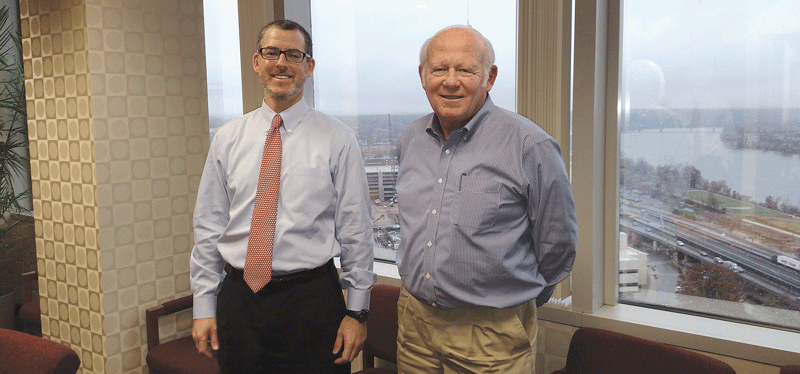
NORTHAMPTON — For three weeks in November, employees of Webber & Grinnell Insurance Agency served meals to Friends of the Homeless clients and others in the community who would otherwise go hungry.

“During this time of thanks, we felt it important as a local business to give back to those less fortunate,” said Mat Geffin, vice president.

Friends of the Homeless served more than 156,000 meals last year, he noted, and people suffering from mental illness or substance-abuse problems are highly visible on area streets and in parks, and of this homeless population, about 20% of are referred to as being chronically homeless. A profound economic transformation that has eliminated manufacturing jobs, coupled with a decline in the availability of low-cost housing, has contributed to the problem.

Environment and Engineering Sections

Beneath the Surface

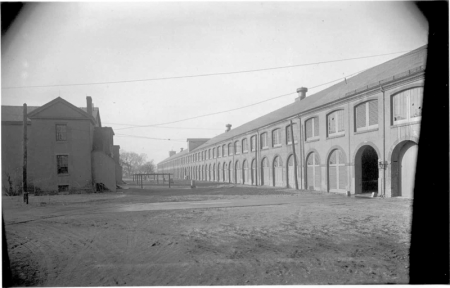
The ground beneath the former Westinghouse manufacturing plant

The ground beneath the former Westinghouse manufacturing plant is cleaned up by OTO so Chinese rail car maker CRRC MA USA can build a factory there.

The firm known colloquially as OTO has been involved in most of the major building projects that have taken place across the region in the past few decades — everything from the major addition at Baystate Medical Center to construction of a subway-car manufacturing plant in Springfield’s east end. But much of the company’s work goes unnoticed, because it takes place before the heavy machinery arrives. To say their work is important, though, would be to only, well, scratch the surface.

Jim Okun and his partners often joke that no one ever sees their best work.

Indeed, it generally takes place where almost no one goes; although O’Reilly, Talbot & Okun Associates (OTO) has been involved in almost every major building project in Western Mass. for the last 20 years, the bulk of work that the specialty geo-environmental engineering consulting firm does is literally beneath the ground.

“Our work often takes place before the heavy equipment shows up,” Okun said about the Springfield firm. “We deal with the environmental safety of soil and water as well as the engineering properties of soil in or around a new development.”

In other words, they determine not only whether the ground is contaminated by pollutants, but also address whether it can and will remain stable beneath the weight of a new structure.

From left, Jim Okun, Mike Talbot, Kevin O’Reilly and Bob Kirchherr

From left, Jim Okun, Mike Talbot, Kevin O’Reilly and Bob Kirchherr specialize in different areas, which gives their firm the ability to handle complex environmental and engineering problems.

Founding Partner Mike Talbot used the Leaning Tower of Pisa as a prime example of what can go wrong without a preliminary assessment.
“The tower is a classic case of building on bad soil,” he said, explaining that it was erected on a former river estuary and sank into the ground due to the soft, sand-like texture of the dirt under the south side of the monument.

Today, thanks to geo-engineering research and best practices, things like this can be prevented, but it takes expertise combined with creative thinking to solve problems in a way that saves time and money, qualities that are generally unexpected since issues are fairly common.

For example, OTO was recently called to assess a building site in Holyoke, and although the surface appeared clean, research showed it had been home to a former mill, and hazardous materials were found in the old cellar hole area.

Although some companies would have removed all of the contaminated soil and taken it to a landfill, OTO found a way to improve and compact the dirt so it didn’t present any safety risk to humans and could withstand the weight of a new building, steps that ultimately saved the developers a substantial amount of money.


List of Engineering Firms in the Region


The firm also addresses issues that come to the surface when contaminants are found in buildings set to be demolished, or environmental issues are uncovered when a business or school starts to make improvements to, or put an addition on, an existing structure.

“We’re not really consultants, we’re problem solvers,” said Partner Bob Kirchherr. “We stay current with changing regulations and by combining our skills and using scientific techniques we are able to find cost-effective solutions that allow new structures to be built.”

OTO’s work involves an equal mix of projects for commercial, institutional, and government clients across New England and includes asbestos consulting, environmental assessments, geotechnical engineering, human health risk assessment, and related practices. They also work with homeowners on issues such as cleanup after an oil tank has leaked.

About 70% of its jobs are in Massachusetts, but over the past few years its reputation has led to work in other states, and the firm has projects underway in Connecticut; it just started two in New Orleans, and is about to begin one in Dallas.

“Clients like our approach to solving problems,” O’Reilly said, noting that the company uses scientific methods and regulatory knowledge to resolve challenging situations in a way that is practical, pragmatic and cost-effective.

For this edition and its focus on Environment & Engneering, BusinessWest looks at some of the “invisible” problems that O’Reilly, Talbot & Okun Associates has uncovered and what they have done to solve them.

Diverse Talents

The company was founded in 1994 by Kevin O’Reilly, Mike Talbot, and Jim Okun who had worked together at another environmental consulting/engineering firm and wanted to go off on their own.

They set up shop in East Longmeadow, but two years later merged with Enviro Comp in Springfield and moved the business to Springfield.

Kirchherr joined the trio as their fourth partner at the time of the merger.

“It was a good fit because there was a lot of synergy. We had worked on projects together,” O’Reilly said, noting that the merger allowed them to expand the services they offered because Enviro Comp specialized in asbestos remediation, industrial monitoring, and compliance with regulations.

Today the firm has 30 employees, and each partner has a specialty that complements the others and allows the firm to deal with complex projects from start to finish.

O’Reilly focuses on environmental consulting and compliance in Massachusetts, and investigates and plans for the cleanup of waste disposal sites, including brownfields.

Cleaning the soil after an oil leak at a home

Cleaning the soil after an oil leak at a home is one of the most stressful jobs the firm encounters due to the anxiety it causes homeowners.

Talbot concentrates on geotechnical engineering and Massachusetts Contingency Plan compliance; Okun also focuses on MCP compliance; but his expertise includes PCB (polychlorinated biphenyl) assessment and management; risk assessment and brownfields development.

Kirchherr specializes in asbestos management; indoor air quality and industrial hygiene; safety and environmental compliance; and lead inspection and management.

“Most companies don’t have the skills needed to deal with environmental, soil, and building issues so people come to us because we do it all,” Okun said.

Talbot noted that people often drive by sites and wonder why they have remained vacant, but in those instances there is usually a problem because banks require an environmental site assessment before investing in a project because they want to understand the risks and costs associated with building.

The principals at OTO say there are few sites today without problems, because almost every desirable business location has had at least one building on it and when they are demolished, it’s uncommon to find clean soil beneath.

“Today every site has challenges and every project requires all of our skills,” Talbot told Business West.

For example, a few weeks ago a seemingly straightforward job suddenly turned complex. The firm had been hired to investigate the foundation of an existing building that a client wanted to repurpose, but it discovered that it had once served as a gas station and had to be torn down.

Problems also arise due to chemicals called PCBs that were used in building materials in the U.S. between 1950 and 1979.

Kirchherr says the caulk around windows in schools often contains PCB’s, so when a city or town decides to replace single panes with energy efficient glass, the putty has to be tested and toxic ingredients in the caulk can complicate the project.

Unearthing Solutions

Projects the firm has undertaken range from work at individual homes and in large buildings and developments, and include the new addition to Baystate Medical Center and the recently built Roger Putnam Vocational Technical High School. OTO also recently completed work for Chinese rail car maker CRRC MA USA which is building a factory in Springfield on the site of the former Westinghouse manufacturing plant. It was a brownfields site, and OTO assisted the former owner with cleanup, including asbestos removal in the old building, but then had to make sure the soil met standards that would allow CRRC to build there.

Talbot said the land contained a lot of loose soil and the firm designed a solution to compact it using a special technique that will allow it to support the weight of the rail cars manufactured inside the building. It then provided engineering services to design a new foundation.

The revitalization of Ludlow Mills was another project that required considerable environmental remediation, and the firm worked closely with Kenneth Delude, recently retired president of WestMass Area Development Corp. on that project; and also helped get Lee Premium Outlets off the ground, assistance needed because a portion of the land near the entrance was once home to a mill that dated back to the Civil War.

Clients include the Diocese of Springfield; Smith College; Amherst College; Springfield College; American International College; and private schools such as Williston Northampton School in Easthampton, and projects include work at Six Flags New England that was necessary before rides such as the Superman Coaster could be built.

And in some instances, the firm has been at a site almost immediately after a problem is discovered. For example, 15 minutes after the 2011 tornado finished wreaking havoc throughout Western Mass, Kirchherr walked down to a family member’s home across the street from the former Cathedral High School and helped efforts to stabilize the building with the Diocese of Springfield’s emergency response team.

“We identified long-term safety related issues with regards to a potential renovation because it was not known at the time if the building would be reused,” Kirchherr said, explaining that their work included litigation with the insurance company because the initial settlement offer was inadequate.

“It was a very complex project that required a lot of interaction with the Federal Emergency Management Agency, but we provided services throughout the process,” he continued, adding that he serves on the Diocese of Springfield Building Commission and is a member of the board of trustees for St. Michael’s Academy.

O’Reilly Talbot & Okun has also undertaken a lot of preconstruction work for the City of Springfield. A site assessment before the Basketball of Fame was built turned out to be another involved project, because 19 buildings had to be demolished to make room for the new museum.

“We also provided litigation and oversight assistance when the former Union Station in Springfield was taken by eminent domain,” Kirchherr said, adding they worked on that project from start to finish.

The firm’s residential jobs often involve leaking oil tanks, which is difficult work.

“You can only dig so far under a house without undermining the foundation, and you have to meet stringent soil and groundwater standards. Vapors can rise from the ground, get into the house and cause risk to occupants, and the oil can also impact a person’s neighbors as it can migrate into groundwater,” O’Reilly said, explaining that in some cases a ventilation system must be installed to pipe air from below the floor of a home into the atmosphere for years after the leak.

“These are the most stressful projects we do because they affect people personally,” he said.

Changing Landscape

Ensuring that soil is clean and the ground is stable for new projects, along with assessing old buildings for environmental hazards before they are reused or torn down are services that fall under the umbrella of O’Reilly Talbot & Okun Associates.

“It’s a very dynamic field so we keep on top of all of the regulatory issues,” Talbot said. “New solutions to old problems come up all the time, and we offer the latest and best practices available.”

So even though the work they do is something most people never see or even think about, it has been critical to economic growth in Western Mass. and always begins far below the ground.

Opinion

Editorial

Behold … the Power of Cranes.

Maybe that should have been the title placed on the latest update on economic development initiatives throughout Springfield, hosted last week by the city and the Springfield Regional Chamber.

Instead, they chose ‘Springfield, Rising to New Heights, subtitled ‘The Renaissance is Real,’ which is a serious play on the crane-themed invitation to the event. It features an extremely detailed rendering of the giant crane at the MGM Springfield site, which has become a very famous addition to the city’s skyline.

The crane art and the accompanying subtitle are appropriate when juxtaposed together. Indeed, countless people have said (out loud or to themselves) that they didn’t really believe the MGM project was real until they saw those cranes. (MGM President Mike Mathis would have a ready response in such cases: ‘We always thought it was real.’

In some ways, the same conversational tones can be used for the city itself, although when it comes to a true renaissance, the city will have to do better than the ‘crane test.’

While progress (totaling a whopping $3.307 billion in public and private investments) really does seem genuine on many fronts — from Union Station to the subway-manufacturing plant; from MGM to vast amounts of entrepreneurial energy; from new places for people to live, to new places for them to work and play — one might still have a hard time convincing those in the city, and those looking from the outside, that this is the real thing.

That’s because it’s easy to make people believe it isn’t. As evidence, look no further than the piece that ran in the Boston Globe this month concerning MGM’s casino, the city’s image problem concerning crime, and how the latter might impact the former.

Complete with a close-up shot of razor wire on a building downtown and beginning with what amounts to a recreation of a drive-by shooting just blocks from the MGM site, the story also includes this quote from City Council President Michael Fentin: “We have a perception problem. People don’t want to come into the city; they say “I’m not going into that war zone.”

We’re not sure what he was attempting to do with that quote — maybe draw a line between perception and realty — but all he really did was blur the line and make ‘war zone,’ the one phrase everyone will remember from that piece.

But in a way, he helped make our point. You can’t just say the renaissance is real, you have to prove it. And right now, the city still has some work to do in that regard.

The cranes in the sky will generate some believers, but to generate more of them, the city must continue to move in the right direction on crime and the perception of it. Even if  ‘war zone’ is extreme and represents the view of the minority, public safety remains a real concern.

And while doing that, the city must do more to tell its story — and tell it to people living outside the city limits. The story is good and getting better all the time, and others need to hear it.

Maybe with some additional PR and work to reduce crime, more people will come to the conclusion that this renaissance is, in fact, real.

Law Sections

Courting Change

Shareholders A Craig Brown, right, and Michael Sweet

Shareholders A Craig Brown, right, and Michael Sweet, like most of the attorneys at Doherty Wallace Pillsbury & Murphy have a number of practice areas.

When four respected attorneys came together 49 years ago to form Doherty, Wallace, Pillsbury & Murphy, they had solid ideas about where they would focus their practice. But in the decades since, this Springfield-based institution, while still true to its corporate and litigation roots, has become far more nimble, specialized, and adaptable to changes in the legal field driven by regulatory shifts, technological advances, and evolving client needs. In doing so, it has forged one of the region’s true local success stories.

Laws, as any attorney knows, are far from static. And a law firm that wants to not only survive, but thrive and grow over five decades must recognize how to pivot and adapt.

Take, for example, education law, an area where Doherty, Wallace, Pillsbury & Murphy has bolstered its roster of attorneys in recent years.

“The business of running a school or college is subject to more regulation than you would ever believe,” said shareholder Craig Brown, noting that the firm’s clients include American International College, Williston Northampton School, and Wilbraham & Monson Academy. “They have to sort through a lot of regulatory challenges, and they have a lot of employment-law issues right now. At AIC, they’re wrestling with the idea of shared governance; the faculty feels they have a voice in decision making that affects the academic side of the house. Where is the line drawn?”

Another recent challenge for educational institutions is making their websites accessible to people with disabilities, which is now required by law.

“Schools are a lot like businesses, but they have this regulatory climate,” Brown added. “It’s an emerging area of the law.”

Another example of an evolving area of the law is intellectual property. Shareholder Deborah Basile spearheads Doherty Wallace’s practice in this field, and enjoys the challenge.

“I love working with inventors and working with businesses that have new product lines,” she told BusinessWest. “They want to protect some intellectual property surrounding those, or have developed a new feature in a product line they’ve sold for a long time.”

The Internet has added new wrinkles as well.

“Everyone has a website now; that’s the way we do business, and using the Internet properly and carefully is another aspect of my practice,” she explained. “For example, a manufacturing company needs to be careful in terms of what to expose or disclose in terms of a unique business method or unique product.”

That said, recent modifications in patent law have made it easier for inventors to protect themselves, she added — the rare societal trend that may make her work easier, not thornier. In any case, “identifying what your intellectual property is and protecting it going forward is a critical growth area for us.”

Doherty Wallace, now boasting about two dozen attorneys, has been based in Springfield since its inception, when four attorneys with diverse strengths came together in 1967.

“Fred Pillsbury was generally recognized as the best litigator in the area,” Brown said. “He was named a judge just two years earlier, but it was too boring, so he came off the Superior Court bench. Lou Doherty was a well-regarded business and general corporate lawyer. Bob Murphy was a labor lawyer, and Dudley Wallace was a tax lawyer.”

The firm slowly built on that core — including Lou Doherty’s son, Paul, who led the firm for decades until his passing in January — and their commitment was evident to their younger associates.

“Fred Pillsbury was a magnet for business, and an engine that helped grow the firm,” Brown said, explaining that he had a nerve disorder that eventually took his life, but even when he could barely function, he still came in to practice as much as he could. “It was a remarkable thing.”

Today, the firm maintains — as it always has — strong roots in business law and litigation, but has become more specialized over time.

“The days of one lawyer with one assistant who types are fading,” said shareholder Michael Sweet. “Everyone here is focused on how to best staff projects in the most effective way for clients.”

Information Age

The key, as always, is smart change, Sweet said, even as the firm extends its lease at Monarch Place — where it has done business since the tower opened — for another 10 years.

“One of the key aspects of the decision to stay here long-term is recognizing we’re not done adapting,” he said. “We realize things are going to change, and when we planted our roots here, we knew we could be successful here, and have the capacity to grow and change.”

Computer technology has added layers of challenge to the practice of law, Sweet noted.

“The tech world in general has impacted this profession like it has everything else. The focus is on efficiency and specialization,” Sweet said, adding that the firm has continually recruited attorneys with expertise in growing specialty areas, from Basile, who launched the intellectual-property group, to a pending hire to bolster the firm’s depth in employment law, a field that is seeing plenty of change due to a constantly shifting regulatory landscape. “We continue to look at our clients and ask, ‘what kinds of services do our clients need?’ and then we go out and recruit in those areas.”

Shareholders Jeffrey Meehan, left, and Barry Ryan

Shareholders Jeffrey Meehan, left, and Barry Ryan, are among the players on the large and talented team at Doherty Wallace Pillsbury & Murphy.

Technology has also changed the way people behave, which also affects the practice of law, said shareholder Jeffrey Meehan. Take, for example, all the smartphone video being instantly recorded of … well, everything, from crimes in progress to protests gone awry. That has a major impact on the world of litigation, which is Meehan’s specialty.

The digital culture will even shape the firm’s upcoming renovation of its office, with a library used for decades to store bound books of information to be replaced by a finance and accounting department that needs more space.

But while so much data is at lawyers’ fingertips via computer these days, the information age has also made clients less patient, Brown noted. The past model of putting correspondence in the mail and waiting days or weeks for a response just doesn’t cut it anymore. “Instead, you’re e-mailing a document and expecting a review within a very short amount of time. Over the course of hours, literally, you can negotiate, make changes, and finalize the transaction documents. That puts an incredible amount of stress on a lawyer.”

Still, one key to being successful is to use the technology to benefit client relationships, not hinder them, Sweet said, stressing that relationships are still cultivated with care at the firm, not in haste. “We’re definitely not built on one quick hit with e-mails. We have not lost focus on the relationships, which, at the end of the day, are more important than those e-mails.”

Basile agreed. “We’re entrenched in the old-fashioned virtues of what it was like to be a lawyer back in the ’60s and ’70s, how you provided personal services on a slow and steady basis. But we also have to keep up with what we need to compete in this very responsive world we live in.”

Other changes at Doherty Wallace are being driven by retirements and new opportunities for veteran attorneys. The firm lost two long-time members recently to judgeships, as Michele Ouimet-Rooke was appointed a District Court judge earlier this year, and last week, Michael Callan was sworn in as a Superior Court judge.

“So we’ve been looking at the future and making investments in the future,” Brown said, “which we need to do to continue to be viable.”

Deep Roots

Brown has seen plenty of change in the city that has dominated his life. He was born in Springfield and has fond memories of a thriving downtown, and then, once the bustle of the peak years faded, of efforts to revitalize it, with redevelopment projects like Market Place, which Doherty Wallace was involved in.

“There was an ongoing attempt to pull Springfield up, and it never worked, and the effort stopped for a while,” he said. But now, he added, major economic-development pieces like MGM Springfield and Union Station, and a general sense of renewal downtown, has people excited again. “It’s an abundance of changes that create opportunities and bring Springfield to where we’d all like it to be — a thriving city.”

Doherty Wallace will enjoy the benefits of that renewed energy, Sweet said, at least for the next 10 years and, in all likelihood, much longer.

“The fact that we’re sitting here in downtown Springfield when other firms have left is telling,” he added. “At the end of the day, what you do as an organization is more important than what you say, and our firm has made a decision to stay here long-term. That’s more evidence of how we feel about the region. We’re hiring new lawyers, and we’re fortunate to have a lot of business, and interest from lawyers who want to come work here.”

Basile agreed. “There are a lot of great things about Springfield, and the people here at Doherty Wallace are really hopeful about the future,” she said. “We see the big picture, and we’re committed to the city.”

Brown told BusinessWest the region has never seen a project with as much transformative potential as the casino, due partly to the way it will be integrated with the entire downtown and have the ability to attract more business, which in turn may attract more residents, in a cycle of growth.

Meehan hopes so. He says the Pioneer Valley has always been a “poor cousin” to Boston as far as business growth, wealth, and opportunities, and noted that developments like the casino have run concurrent to backward steps as well, like Bank of America leaving the downtown area. “I’m scratching my head about that because they seemed to have some business here.”

One constant at Doherty Wallace, no matter the economic climate, has been a focus on volunteerism and community involvement, something Paul Doherty, famous for helping out with local organizations and initiatives, often without having to be asked.

“He set the example of how to be involved in the community,” Brown said. “It’s deeply part of the culture here, and everyone feels it, and everyone is encouraged to commit to the community.”

Sweet went even further, noting that this culture is one of the things that attracts people to work at Doherty Wallace. “It’s one of the reasons I chose to work here. We’re a significant part of the community in all ways.”

A Significant Loss

Brown recalls being hired to work alongside Doherty in 1977; in the interview, he was asked how he felt about working Saturdays. He immediately realized that this was a workplace that demanded much, but he learned the work was immensely rewarding as well.

“Paul was the leader of this law firm,” he said. “He set the tone in terms of the culture, the community involvement, the quality of lawyering. He was very focused on us providing the highest-quality service at all times.”

Basile agreed. “Paul was my mentor. He taught me how to be a lawyer,” she said. “The sad thing is, he wasn’t done. He had more to do. He was still committed to this city, to this law firm, and to inspiring those of us he left behind.”

Brown said Doherty knew everyone, and everyone knew him — and he valued those relationships far beyond his practice.

“Those relationships are what has endured over the decades, and those lessons on how to be a lawyer, how to give back to the community,” he told BusinessWest. “That’s all Paul Doherty. We were blessed to have him as long as we had him, and we still have him with us.”

That sentiment provides more than enough motivation for this half-century-old law firm that has experienced plenty of change, and welcomes whatever may come next.

Joseph Bednar can be reached at [email protected]

Daily News

BOSTON — The state’s total unemployment rate dropped to 3.3% in October, marking the fourth consecutive month the rate went down, the Executive Office of Labor and Workforce Development reported Thursday.

The last time the state’s unemployment rate hit 3.3% was in April 2001. The unemployment rate in September was 3.6%.

In October, preliminary estimates from the Bureau of Labor Statistics indicate Massachusetts lost 5,500 jobs over the month. However, the September job gains were higher than originally reported, with the state gaining 8,100 jobs compared to the previously published 5,100 job gain estimate. Year to date, December 2015 to October 2016, Massachusetts has added 61,300 jobs.

At 3.3%, the seasonally adjusted unemployment rate is down 1.5% over the year from 4.8% in October 2015. There are 55,400 fewer unemployed residents and 100,700 more employed residents over the year compared to October 2015.

“We are pleased to see the state’s unemployment rate continues to drop month after month,” Labor and Workforce Development Secretary Ronald Walker II said. “But we are mindful of the residents who have not been able to find a job in the past year. We are doing all we can to re-engage those individuals in this thriving job market.”

In October, over-the-month job gains occurred in the professional, scientific, and business services; manufacturing; and other services sectors. Over the year, the largest private-sector percentage job gains were in construction; professional, scientific, and business services; education and health services; and leisure and hospitality.

Community Spotlight Features

Community Spotlight

Denise Menard and Robyn Macdonald

Denise Menard and Robyn Macdonald say the gas station and convenience store under construction at 227 Shaker Road will give people in the southern portion of town access to needed services.

East Longmeadow has grown and flourished in recent years thanks to its excellent schools, pastoral landscape, and thriving Industrial Garden District, where manicured lawns and flower gardens belie the scope of commercial and manufacturing companies that do business there.

However, last year, the town’s bucolic character was upset by repeated controversy that was ignited and fueled by reports of corruption. “The town went through a year of turmoil, and some businesses were hesitant to move here due to the negative publicity,” said Robyn Macdonald, the town’s Planning, Zoning Board, and Conservation director.

She added that these issues were essentially put to rest in April when residents voted overwhelmingly in favor of a new charter that replaced the town meeting and three-member Board of Selectmen with a town manager and Town Council that features seven elected members.

Its first official meeting was staged July 1, and a few weeks later, former East Windsor, Conn. First Selectman Denise Menard was hired as interim town manager.

“The charter expanded the town’s leadership, and work has already been done to preserve the good things that exist here, while promoting healthy living and balanced growth,” Macdonald said.

To that end, plans are in place to establish East Longmeadow’s first human resources department. In addition, several new positions have been added that include a director of finance; a director of Planning and Community Development; and a full-time health director. Aimee Petrosky was recently hired to fill that role and is working with the newly appointed three-member Board of Health.

She told BusinessWest that the town held its first flu clinic last month, which was highly successful and will be repeated next year. In the meantime, the board plans to seek funding to vaccinate uninsured residents, and the next event will include the shingles vaccine.

Other changes include a new sharps-disposal program that offers disposal units to residents at an affordable price because they can be cost-prohibitive; new regulations that make it illegal to smoke any type of tobacco, including e-cigarettes and vapor cigarettes, within 50 feet of a public building; a fine policy for restaurateurs who fail to comply with health regulations; and new rules that require companies that serve or produce food to install traps to prevent grease from entering sewers and affecting business operations or private residences.

“The Health Department also recently purchased an electronic inspection system that will post the outcomes of health inspections online,” Petrosky said, noting that food-safety training sessions were held for the School Department, the Council on Aging, and at churches that requested it to insure that the most vulnerable populations are protected.

Menard applauds these changes because they add to the town’s offerings, and notes that, when a permanent town manager is named, it will be important for the person to promote intelligent economic development and take a proactive stance in attracting new businesses.

“There is room for growth in the underutilized areas of our industrial and commercial sections of town,” she said.

Macdonald agrees, and says there are a few dormant parcels they hope to fill in the future, including the long-vacant Package Machinery site. “East Longmeadow has always welcomed new businesses, but we try to maintain a good balance between residential and business growth,” she noted.

For this, the latest installment of its Community Spotlight series, BusinessWest looks at projects on the drawing board as well as developments underway that will help East Longmeadow retain its small-town character while offering new venues that will boost the tax base and provide services for people who live and work in the town.

Major Projects

Officials are happy that several sites in town that have been vacant for more than a decade are being redeveloped.

For example, L.E. Belcher broke ground three months ago on a 6,500-square-foot convenience store with five gas pumps, 10 pumping stations, three outdoor tables, and 28 parking spaces on a lot at 227 Shaker Road that was empty for many years.

The company has secured a license to sell wine and beer, and worked closely with the Planning Board to ensure the new business is a good fit for the town. Ownership has installed flashing pedestrian safety lights to facilitate safety on the Chestnut Street side of the Redstone Rail Trail that runs behind the property, and contributed to a mitigation fund that will assist the Department of Public Works with roadway and traffic improvements in the Shaker Road and Chestnut Street corridor.

“It’s a busy intersection, and their gift of $25,000 to the DPW was a great gesture from a new business,” Menard said.

Macdonald concurred. “L.E. Belcher is a community-minded company, and the facility they are building will provide the industrial area with a service that doesn’t exist in that part of town. There is nothing like it from there until Route I-90 in Enfield, and it is expected to bring in people from Connecticut, while reducing congestion at the rotary,” she said, adding that the new convenience store and gas station are expected to open in mid- or late January.

A new restaurant called Green/Wich is also under construction at 16 Maple St. on the rotary. The eatery’s plans were recently approved, and the owner has also secured a beer and wine license.

“It’s a great addition to our center, and we’re happy to have a building that sat empty for many years put to use by a business that will help people attain a healthy lifestyle. It will offer high-end wraps and salads with indoor seating,” Menard said.

Macdonald told BusinessWest that Green/Wich had to do a major renovation of the building that included asbestos abatement, and has worked closely with the town to ensure the restaurant meets all safety requirements when it opens in about a month.

Several businesses in the town are experiencing rapid growth, including Go Graphix, which relocated from a shopping plaza on North Main Street to a 5,000-square-foot space on Benton Drive in the industrial park several years ago.

“The organization takes a concept through design, production, and installation. Their focus is on individual brands and messaging, and they incorporate big-picture objectives while paying close attention to the smallest details,” Macdonald said. “They have done so well, they are planning a 2,584-square-foot addition to their existing building. “

That project is still in the planning stages, but in September the Planning Board approved construction of an 18,000-square-foot medical office building on 250 North Main St.

The new, two-story structure will be constructed by Associated Builders for Baystate Dental Group and will have 90 parking spaces. The dental office will occupy the first floor, and the second floor will be rented as medical or office space.

Two other significant projects were also recently proposed. The first is an expansion: Excel Dryer wants to put an addition onto its existing building at 357 Chestnut St. that will include 1,300 square feet of warehouse space and 3,700 square feet of office space.

“This is a family-owned and -operated company that revolutionized the industry and set a new standard for performance, reliability, and customer satisfaction,” Macdonald said. “They have continued to grow, and the addition will enhance their ability to move forward in the future.”

The second project is much more complex, as it involves the towns of East Longmeadow and Longmeadow.

Macdonald said the planning boards in both towns have been working with Michael Crowley of Michael Crowley Associates and Middle Franklin Development, Robert Levesque of R. Levesque Associates Inc., David Dunlop of David Dunlop Associates, and Fuss & O’Neill to create a medical complex that will add to East Longmeadow Skilled Nursing Center at 305 Maple St., cross town lines, and provide benefits to both communities.

Crowley presented plans for the project in June. It includes four structures on a 20-acre site: a 50,000-square-foot medical office building in Longmeadow that would be occupied by Baystate Health; a two-story, 25,000-square-foot conventional office building in East Longmeadow; and an assisted-living facility and an expansion of the existing skilled-nursing facility that would be run by Berkshire Health in the town.

“The complex will feature state-of-the-art technology and have every safety system installed possible, including fire alarms, an emergency generator, and rooftop units with individual room controls,” Macdonald said, explaining that the two towns have commissioned a traffic study to mitigate any problems that could result from the project because it will affect some of their busiest intersections, namely Benton Drive and Chestnut Street in East Longmeadow, the Converse Street area in Longmeadow, and that town’s intersection at Dwight Road, Williams Street, and Maple Street.

Work in Progress

The Department of Public Works has an ongoing project that involves installing new sidewalks in East Longmeadow’s center and around the schools to make pedestrian travel safe and help make the town more desirable.

Historically, that hasn’t been a problem.

“Businesses are thriving in East Longmeadow and want to stay here,” Macdonald said, explaining that, although the town doesn’t have its own utility companies, manufacturers in the Industrial Garden District including Sullivan Paper Co., Tiger Press, and the recently sold Lenox Newell Rubbermaid have installed solar panels on their roofs, and panels have also been approved for the Reminder building in the commercial district.

“We still have plenty of room for new companies, and the opportunities here are great. The town welcomes large and small businesses, and our Industrial Garden District is a beautiful area which is easy to get to from I-91,” she noted.

Indeed, the negative publicity has come to an end, the town is moving forward, and the future looks bright for residents and businesses alike.

East Longmeadow at a glance

Year Incorporated: 1894
Population: 15,720 (2010)
Area: 13.0 square miles
County: Hampden
Residential Tax Rate: $21.12
Commercial Tax Rate: $21.12
Median Household Income: $78,835
Median Family Income: $99,707
Type of Government: Town Council; Town Manager
Largest Employers: Cartamundi; Redstone Rehab and Nursing Center; Lenox Newell Rubbermaid
* Latest information available

Education Sections

Closing the Gap

Arlene Rodriguez

Arlene Rodriguez says the $3.4 million federal grant that STCC received will help Hispanic and low-income students obtain degrees in science, technology, engineering, and math.

Arlene Rodriguez says people who apply for a grant of any type need to have a compelling story about why the money is important.

The vice president of Academic Affairs at Springfield Technical Community College (STCC) knows developing the story is something that takes time, energy, dedication, and great attention to detail, which are all elements that were incorporated into a recent grant application the college submitted to the U.S. Department of Education.

The year of work that went into its preparation was well worth it, however, as the story met with unparallelled success: STCC was recently awarded one of the largest awards in its history: a five-year, $3.4 million grant for the program called the Hispanic and Low-income Transformed Education in STEM (HiLITES) Project.

It’s aimed at helping students attain degrees in STEM (science, technology, engineering, and math) classes and programs, and although STCC is the only community college in Massachusetts to win this award, Rodriguez says it’s appropriate due to the school’s demographics. To be eligible to receive the grant, a college must be designated as a Hispanic-Serving Institution, which is attained when at least 25% of the total student population is Hispanic.

STCC’s Hispanic population is 27.6%; it has been designated a Hispanic-Serving Institution since 2013; and 56% of its students receive federal Pell grants, which are limited to students with financial need.

“This grant was very competitive, and it took all I had not to jump up and down when I heard that we were given exactly what we asked for,” Rodriguez said. “It will give us an opportunity to make significant changes proposed by faculty and students who identified obstacles to success in STEM courses during interviews that took place before we applied for the grant. People were very honest about what stopped them from continuing in these programs, and faculty talked about where they see students struggle and what we need to change,” she continued. “It was a collaborative effort that was student-oriented; we are determined to make changes to improve students’ lives, and one of our goals is to increase the number of students in STEM disciplines.”

Indeed, it’s critical for local students as well as the economy; a report commissioned by Raytheon says a workforce prepared to tackle science is needed to drive future growth and innovation, and 67% of manufacturers are experiencing a shortage of qualified employees.

In addition, the U.S. Bureau of Labor estimates that 8,654,000 STEM-related jobs will exist in 2018, not including self-employed STEM individuals, and although the national average wage is $42,979, those with a STEM degree earn about $78,000.

STCC has more than a dozen STEM programs that range from architectural and building technology to computer-aided drafting, CNC operations, electrical engineering technology, and HVAC (heating, ventilation, and air conditioning), and many are not found in other community colleges across the state. But right now, only 14% of its Hispanic students and 11% of its low-income students enroll in STEM courses, and those who do need support to be successful.

This grant was very competitive, and it took all I had not to jump up and down when I heard that we were given exactly what we asked for.”

“There is a disconnect between Hispanic students and students with Pell grants when it comes to jobs that are available, and we want to bridge that gap,” said Rodriguez. “Our end goal is to prepare students for positions that are going unfilled, and this grant will allow us to provide them with the support they need to make a better life for themselves and provide for their families.”

She noted that the majority of Hispanic and low-income students enter college needing help in math and have lower rates of retention and graduation. “Students who are Hispanic and low-income perform worse on all three measures than students who are only Hispanic or low-income,” she told BusinessWest.

STCC President John Cook agreed. “We’re open-eyed about student needs, and this grant will help us address complex challenges. We look forward to building diversity across our unique array of STEM programs, and this is a chance to both expand initiatives while also trying new and creative approaches,” he said.

Multi-faceted Program

The grant money will be used to provide a wide spectrum of programs and services over a five-year period that will kick off in the spring. One of the new initiatives will introduce students in middle and high schools to STEM careers they may not know about in fields that include precision manufacturing, information technology, and HVAC, as there are job vacancies in these areas that pay well.

STCC’s plan is to bring the students to campus, introduce them to the faculty, show them the machines they will work on if they enter these programs, and educate them about careers associated with STEM degrees and the type of work they would perform on a daily basis.

“A student may not know these courses are available, or think they couldn’t succeed in them because they require a lot of math. But we have fantastic teachers who are able to teach these subjects in creative ways that make it easy to learn, and our faculty wants to make sure that our students succeed,” Rodriguez said, noting that, in some cases, students with an associate’s degree can earn $50,000 to $60,000 after graduation, and many have job offers before they matriculate.

There is also a plan to work with local high schools and expand the dual-enrollment system that allows students to go to the STCC campus and take courses before they receive their high-school diploma, as well as to expand programs with four-year colleges and improve the transfer rate by creating a seamless transition.

Assessments are conducted of a student’s math and English skills when they enter STCC, which is important because Rodriguez says many students are not ready for college-level math and need to take a series of courses to get them up to speed, which is a national problem at the majority of community colleges.

“The average age of our students is 26, and taking extra courses can be frustrating; they may have families or part-time jobs, so there is a sense of urgency to graduate,” she said, adding that many have GEDs, and even those who did well in high school may need to regain math skills after spending years away from the classroom.

“The grant will allow STCC to provide these students with enough support to take math and science courses without prolonging the time it takes them to graduate,” she continued, explaining that this may mean redesigning some STEM courses, offering additional tutoring, and providing more professional-development opportunities for instructors.

Students who are part-time and have not yet selected a major will also be exposed to STEM courses and careers through demonstrations, guest lectures, and other avenues.

In addition, two STEM advisers will be hired to conduct outreach and help students interested in STEM careers transition into the progams, and a STEM Center will be created as a centralized location for presentations, group study, tutoring, and faculty work. Rodriguez noted that the STEM Center will likely be located in space that will be vacated when the new Learning Commons is completed in 2018.

Change Agent

A 2013 report by the Commonwealth that addressed the skills gap says pipelines are powerful tools because they address both sides of the issue by giving people in the workforce the skills they need while responding to the changing nature of what employers are seeking from their workers.

The grant will help to strengthen the local pipeline, and since STCC graduates live locally, are committed to the community, and usually stay in the area, the grant is a win-win situation, Rodriguez said.

“Community colleges are the front lines of workforce education, and we can respond to employers’ needs in a way that four-year schools may not be able to,” she noted. “The essence of this institution has remained unchanged for the past 50 years, and it has helped to produce leaders in business, government, and education in various professions that benefit the community. Our college continues to be an engine of economic opportunity and development for the region.”

Indeed, it’s an ongoing story, and this chapter should have a happy ending as students are given the support they need to enter careers that pay well and local employers see an increase in qualified candidates to fill jobs, which will allow their companies to grow and thrive in a changing economy.

Accounting and Tax Planning Sections

Dollars-and-sense Fundamentals

By Kristina Drzal-Houghton, CPA MST

dolarssensetaxdpartTax planning can be a guessing game, especially in a year when new leadership in Washington could make significant changes to the tax code. But there are a number of basic strategies that businesses and individuals may put in play as year end approaches.

Tax planning for 2016 is significantly different than in recent years.

In late 2015, many tax provisions were made permanent, thus appearing to remove the many uncertainties that made tax planning much more of a guessing game in the past. This tax-planning article generally is oriented toward the time-honored approach of deferring income and accelerating deductions to minimize 2016 taxes.

Kristina Drzal-Houghton

Kristina Drzal-Houghton

Given that this is an election year, consideration should be given to the possibility of the new administration making changes to the tax code. Contrary to traditional thinking, in specific situations, you may decide it is most beneficial to pay more taxes now.

For individuals, deferring income also may help minimize or avoid AGI-based phaseouts of various tax breaks. Businesses, like individuals, should decide when and how to shift income and deductions between 2016 and 2017. Although C corporations will generally benefit from the deferral of income and the acceleration of deductions in the same way as individuals and pass-though entities, there are a number of special rules that should be taken into account.

Year-end tax planning for 2016 must take account of the many temporary ‘extender’ tax provisions still in the code. Extender provisions are business tax deductions, tax credits, and other tax-saving laws which have been on the books for years but which technically are temporary because they have a specific end date.

The majority of these extenders are in effect through 2016, presenting an opportunity to take advantage of them before year’s end when their continued renewal may be uncertain. However, some of these extender provisions are in effect through 2019. And, in a radical change from prior years, many of what were traditionally the most important extender provisions have been made permanent, allowing the opportunity for long-term planning in many cases. Most importantly, there are a number of these extender and other provisions that have been modified in various ways by late 2015 legislation that the taxpayer should be alert to.

Business Planning

Corporate rate planning. A C corporation is subject to the 39% ‘bubble.’ Corporate taxable income between $100,000 and $335,000 is taxed at the rate of 39% to phase out the benefits of the 15% and 25% brackets that apply to a corporation’s first $75,000 of taxable income.

Taxable income between $75,000 and $100,000, and between $335,000 and $10 million, is taxed at 34%. Taxable income over $10 million is taxed at 35%, except that there is also a 38% bubble that applies to corporate taxable income between $15 million and $18,333,333 to eliminate the benefit of the 34% rate.


List of Accounting Firms in Western Mass.


Many small C-corporation businesses utilize year-end bonus planning to maximize the benefit of the lower tax brackets. This can be a real balancing act with many items to consider, including the additional cost of Social Security and Medicare taxes, timing of the bonus payment to owners, and IRS rules on excessive compensation. When doing this planning, you must be careful to not run afoul of any bank-loan covenants.

Qualifying for the small-corporation AMT exception. The tentative minimum tax of a corporation is zero for any tax year that it qualifies as a small corporation meeting a ‘gross receipts test.’ A corporation will qualify if:

• The corporation’s average annual gross receipts for all three-tax-year periods beginning after Dec. 31, 1993 and ending before the tax year do not exceed $7.5 million; and

• The corporation’s average gross receipts do not exceed $5 million for the corporation’s first three-tax-year period taken into account above.

Thus, a corporation should consider deferring income to 2017 if necessary to keep average annual gross receipts for the three-tax-year period 2014 through 2016 at $7.5 million or less. This will preserve the AMT exemption for 2017.

Expensing deductions. Businesses that want to accelerate year-end deductions by buying machinery and equipment have a formidable array of tax tools to work with this year: generous expensing under Code Sec. 179, an expensing safe harbor under the capitalization regulations that has been liberalized for smaller businesses, and 50% bonus first-year depreciation for those eligible new assets that can’t be expensed under Code Sec. 179 or the regs’ safe harbor.

For qualified property placed in service in tax years beginning in 2016, the maximum amount that may be expensed under the Code Sec. 179 dollar limitation is $500,000, and the beginning-of-phaseout amount is $2,010,000. Besides taking advantage of the Code Sec. 179 rules, some businesses may be able to buy much-needed machinery and equipment at year-end and currently deduct the cost under a ‘de minimis’ safe-harbor election in the capitalization regs.

First-year depreciation deduction. Most new machinery and equipment bought and placed in service in 2016 qualifies for the 50% bonus first-year depreciation deduction. Bonus first-year depreciation has been extended through 2019 with a number of modifications, including a gradual reduction over that time (50% for qualified property placed in service in 2015 through 2017, 40% for 2018, and 30% for 2019).

Deduction for qualified production activities income. Taxpayers can claim a deduction, subject to limits, for 9% of the lesser of (1) the taxpayer’s ‘qualified production activities income’ for the tax year (i.e., net income from U.S. manufacturing, production or extraction activities, U.S. film production, U.S. construction activities, and U.S. engineering and architectural services), or (2) the taxpayer’s taxable income for that tax year (before taking this deduction into account). This deduction generally has the effect of a reduction in the taxpayer’s marginal rate and, thus, should be taken into account when making decisions regarding income-shifting strategies.

Net operating losses and debt-cancellation income. A business with a loss this year may be able to use that loss to generate cash in the form of a quick net-operating-loss-carryback refund. This type of refund may be of particular value to a financially troubled business that needs a fast cash transfusion to keep going. Also, a debtor who anticipates having the debt cancelled or reduced should consider steps to defer the resulting taxable income until 2017.

Accelerating or deferring income can save estimated tax requirements. Corporations (other than certain ‘large’ corporations, see below) can avoid being penalized for underpaying estimated taxes if they pay installments based on 100% of the tax shown on the return for the preceding year. Otherwise, they must pay estimated taxes based on 100% of the current year’s tax.

However, this 100%-of-last-year’s-tax safe harbor isn’t available unless the corporation filed a return for the preceding year that showed a liability for tax. A return showing a zero tax liability doesn’t satisfy this requirement; only a return that shows a positive tax liability for the preceding year makes the safe harbor available.

A corporation (other than a large corporation) that anticipates a small net operating loss (NOL) for 2016 and substantial net income in 2017 may find it worthwhile to accelerate just enough of its 2017 income (or to defer just enough of its 2016 deductions) to create a small amount of net income, and thus a small positive tax liability, for 2016. This will permit the corporation to base its 2017 estimated tax installments on the relatively small amount of tax shown on its 2016 return, rather than having to pay estimated taxes based on 100% of its much larger 2017 taxable income.

Also, by accelerating a small amount of income from 2017 to 2016, the corporation might be able to pay tax on that income at a lower rate — e.g., 15% instead of 25% or 34% — if doing so converts its 2016 NOL to a small amount of taxable income. However, where a 2016 NOL would result in a carryback that would eliminate tax in an earlier year, this income-acceleration strategy should be employed only if the value of the carryback is less than the value of having to pay only a small amount of estimated tax for 2017.

Individual Planning

Individuals who own pass-though entities such as S corporations, partnerships, or trusts should consider many of the above planning ideas in conjunction with provisions specifically applicable to the individual taxpayer.

Effective year-end tax planning also must take into account each taxpayer’s particular situation and planning goals, with the aim of minimizing taxes. For example, higher-income individuals must consider the effect of the 39.6% top tax bracket, the 20% tax rate on long-term capital gains and qualified dividends for taxpayers taxed at a rate of 39.6% on ordinary income, the phaseout of itemized deductions and personal exemptions when income is over specified thresholds, and the 3.8% surtax (Medicare contribution tax) on net investment income for taxpayers whose income exceeds specified thresholds.

While many taxpayers will come out ahead by following the traditional approach (deferring income and accelerating deductions), others, including those with special circumstances, should consider accelerating income and deferring deductions. Most traditional techniques for deferring income and accelerating expenses can be reversed to achieve the opposite effect.

For instance, a cash-method professional who wants to accelerate income can do so by speeding up his business’ billing and collection process instead of deferring income by slowing that process down. Or, a cash-method taxpayer who sells property in 2016 on the installment basis may realize a large long-term capital gain can accelerate income by electing out of the installment method.

Inflation adjustments to rate brackets, exemption amounts, etc. For both 2016 and 2017, some individuals will benefit from inflation adjustments in the thresholds for applying the income-tax rates, higher standard deduction amounts, and higher personal-exemption amounts.

Capital gains. Long-term capital gains are taxed at a rate of (a) 20% if they would be taxed at a rate of 39.6% if they were treated as ordinary income; (b) 15% if they would be taxed at above 15% but below 39.6% if they were treated as ordinary income; or (c) 0% if they would be taxed at a rate of 10% or 15% if they were treated as ordinary income. And the 3.8% surtax on net investment income may apply.

Strategies for matching capital gains and capital losses to make the most of these rules should be considered.

Low-taxed dividend income. Qualified dividend income is taxed at the same favorable tax rates that apply to long-term capital gains. Converting investment income taxable at regular rates into qualified dividend income can achieve tax savings and result in higher after-tax income. However, the 3.8% surtax on net investment income may apply.

Traditional IRA and Roth IRA year-end moves. One can convert traditional IRAs to Roth IRAs. And one can then ‘recharacterize’ (i.e., elect to treat a contribution made to one type of IRA as made to a different type of IRA) that conversion and can even, possibly, reconvert the recharacterized transaction.

Changes in an individual’s tax status may call for acceleration of income. Expected 2017 changes in an individual’s tax status, due, say, to divorce, marriage, or loss of head of household status, must be considered.

Alternative minimum tax (AMT). Watch out for the AMT, which applies to both individuals and many corporations. A decision to accelerate an expense or to defer an item of income to reduce taxable income for regular tax purposes may not save taxes if the taxpayer is subject to the AMT.

Time value of money. Any decision to save taxes by accelerating income must take into account the fact that this means paying taxes early and losing the use of money that could have been otherwise invested.

Obstacles to deferring taxable income. The code contains a number of rules that hinder the shifting of income and expenses. These include the passive activity loss rules, requirements that certain taxpayers use the accrual method, and limitations on the deduction of investment interest.

Charitable contributions. The timing of charitable contributions can have an important impact on year-end tax planning. Individual taxpayers who are at least 70½ years old can contribute to charities directly from their IRAs without having the amount of their contribution included in their gross income. By making this move, some taxpayers reduce their tax liability even more than they would have if they had received the distribution from their IRA and then contributed the amount distributed to charity. Some taxpayers, who could take advantage of this tax break for this year, should consider deferring until the end of the year their required minimum distributions (RMDs) for 2016.

Energy tax incentives. There are two different credits available for taxpayers who make qualifying energy-saving improvements to their homes. Tax credits are available for non-business energy property placed in service in 2016 (but not in 2017) and for residential, energy-efficient solar property placed in service before 2022 (but a gradual phaseout applies).

Bottom Line

Since tax planning can be vastly different from entity to entity or individual to individual, there is no standard checklist or formula that can be followed. Sometimes the benefits enjoyed today may not outweigh their effect on the future.  This is why careful consideration — in conjunction with your tax adviser — should be given to customizing your strategy.

Kristina Drzal-Houghton, CPA MST is the partner in charge of Taxation at Holyoke-based Meyers Brothers Kalicka, P.C.; (413) 536-8510.

Briefcase Departments

Employer Confidence Strengthens in October

BOSTON — Confidence among Massachusetts employers rose for a second consecutive month during October, bolstered by a surprising improvement in the outlook among manufacturers and the continued strong performance of the state economy. The Associated Industries of Massachusetts (AIM) Business Confidence Index rose 0.3 points to 56.2 last month, 0.6 points higher than in October 2015. The increase was driven by a 2.6-point jump in the manufacturing index, which has lagged overall confidence readings for the past 18 months as companies struggled with economic weakness in Europe, China, and other key export markets. The increase came as the Massachusetts unemployment rate fell to 3.6%, its lowest rate since the dot-com boom of 2001. The AIM Index, based on a survey of Massachusetts employers, has appeared monthly since July 1991. It is calculated on a 100-point scale, with 50 as neutral; a reading above 50 is positive, while below 50 is negative. The Index reached its historic high of 68.5 on two occasions in 1997-98, and its all-time low of 33.3 in February 2009. It has remained above 50 since October 2013. Almost all of the sub-indices based on selected questions or categories of employer were up in October. The Massachusetts Index, assessing business conditions within the Commonwealth, gained 0.9 points to 57.9, leaving it a healthy 3.8 points ahead of the same time last year. The U.S. Index of national business conditions remained unchanged at 49.2, 1.7 points lower than its level of October 2015. Employers have been more optimistic about the Massachusetts economy than about the national economy for 78 consecutive months. The Current Index, which assesses overall business conditions at the time of the survey, increased slightly to 56, while the Future Index, measuring expectations for six months out, rose 0.3 points to 56.3. The future view is virtually the same as it was a year ago. The three sub-indices bearing on survey respondents’ own operations also strengthened. The Company Index, reflecting overall business conditions, rose 0.2 points to 57.9, while the Employment Index surged 0.9 points to 55.4. The Sales Index lost ground, however, falling 1.2 points during October and 3.9 points during the previous 12 months.

Daily News

SPRINGFIELD — The Springfield Museums announced it has received a $10,000 donation from Smith & Wesson in support of the Then & Now history program, one of a number of on-site interdisciplinary learning experiences offered to local schoolchildren by the Museums.

Then & Now: Life at the Turn of the Century is an on-site history and social-sciences program that seeks to underscore Springfield’s role as a center of industry and innovation in the late 19th and early 20th centuries. Students in grades 2-4 become historians as they interpret early 20th-century history by examining Indian motorcycles, Rolls-Royce automobiles, Milton Bradley games, and Barney ice skates. In addition to a then-and-now scavenger hunt, students handle real historical artifacts and work on a mock assembly line to better understand Springfield’s industrial past.

Funding from Smith & Wesson will provide free busing for every third-grade public-school student in Springfield, thereby eliminating one of the primary obstacles to participation for the city’s 2,054 third-graders in approximately 82 classrooms.

Smith & Wesson has been part of the Springfield community since 1852 and remains one of the area’s leading manufacturers, employing more than 1,600 people and supporting multiple philanthropic causes. In addition, the company has contributed to numerous local programs, including economic-development initiatives in the city as well as educational programs aiding in the development of skills such as engineering, CNC operating, and tool making.

“This is a wonderful opportunity for each third-grader in Springfield to begin to recognize our city’s rich history and the significant role that many area businesses played in the Industrial Revolution,” said Mark Smith, president of Manufacturing Services at Smith & Wesson. “We are excited for each of these students who will have a chance to experience history outside of the traditional classroom and learn that many of the industries that helped shape history, including Smith & Wesson, are still producing today.”

Larissa Murray, director of Museum Education at the Springfield Museums, added that “we are thrilled to have the opportunity to bring the entire Springfield third grade to the Museums. Smith & Wesson’s generosity will ensure that every public-school third-grader can participate in this engaging education experience.”

Daily News

BOSTON — Confidence among Massachusetts employers rose for a second consecutive month during October, bolstered by a surprising improvement in the outlook among manufacturers and the continued strong performance of the state economy.

The Associated Industries of Massachusetts (AIM) Business Confidence Index rose 0.3 points to 56.2 last month, 0.6 points higher than in October 2015. The increase was driven by a 2.6-point jump in the manufacturing index, which has lagged overall confidence readings for the past 18 months as companies struggled with economic weakness in Europe, China, and other key export markets.

The increase came as the Massachusetts unemployment rate fell to 3.6%, its lowest rate since the dot-com boom of 2001.

“Local unemployment rates dropped in 22 of 24 labor market areas throughout Massachusetts during September, which is consistent with gains in the AIM Employment Index over both the month and year,” said Sara Johnson, senior research director, Global Economics, IHS Global Insight, and a member of the AIM Board of Economic Advisors (BEA). “Both sets of numbers indicate that Massachusetts economy continues to perform well. State employment is growing faster than at the national level.”

The AIM Index, based on a survey of Massachusetts employers, has appeared monthly since July 1991. It is calculated on a 100-point scale, with 50 as neutral; a reading above 50 is positive, while below 50 is negative. The Index reached its historic high of 68.5 on two occasions in 1997-98, and its all-time low of 33.3 in February 2009. It has remained above 50 since October 2013.

Almost all of the sub-indices based on selected questions or categories of employer were up in October. The Massachusetts Index, assessing business conditions within the Commonwealth, gained 0.9 points to 57.9, leaving it a healthy 3.8 points ahead of the same time last year. The U.S. Index of national business conditions remained unchanged at 49.2, 1.7 points lower than its level of October 2015. Employers have been more optimistic about the Massachusetts economy than about the national economy for 78 consecutive months.

The Current Index, which assesses overall business conditions at the time of the survey, increased slightly to 56, while the Future Index, measuring expectations for six months out, rose 0.3 points to 56.3. The future view is virtually the same as it was a year ago.

The three sub-indices bearing on survey respondents’ own operations also strengthened. The Company Index, reflecting overall business conditions, rose 0.2 points to 57.9, while the Employment Index surged 0.9 points to 55.4. The Sales Index lost ground, however, falling 1.2 points during October and 3.9 points during the previous 12 months.

The AIM survey found that nearly 39% of respondents reported adding staff during the past six months, while 19% reduced employment. Expectations for the next six months were stable, with 38% expecting to hire and only 10% downsizing.

Despite the rise in the Manufacturing Index, non-manufacturing companies still maintain a significantly brighter outlook than manufacturers. The overall Business Confidence Index among non-manufacturers was 59.3, compared to 53.5 for manufacturing companies.

“The year-long weakening of the Sales Index presents some concerns in an otherwise upbeat report since sales ultimately drive employment growth,” said Barry Bluestone of Northeastern University, a BEA member. “In the longer term, concerns remain about the changing demographic structure of the state population, as relatively few young people enter, and a large group of older workers leave — or are poised to leave — the workforce.”

AIM President and CEO Richard Lord, also a BEA member, noted that the economic recovery appears to be benefiting the entire Commonwealth, not just the metropolitan Boston area.

“It’s great to see unemployment falling in areas outside the Boston-Cambridge technology belt, which has been enjoying explosive economic growth since the onset of the recovery,” he said. “One of the key tenets of AIM’s Blueprint for the Next Century economic plan for Massachusetts is that lawmakers must make public policy that allows economic opportunity to flourish in all areas of the Commonwealth, from Boston to the Berkshires. We look forward to bringing that perspective to the Legislature when it begins its new session in January.”

Features

Supporting Cast

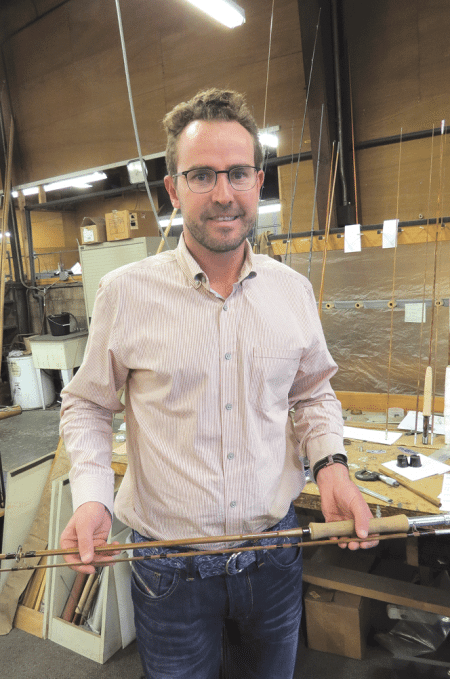
Neville Orsmond

Neville Orsmond

Neville Orsmond wasn’t thinking about buying the company when he walked into the Thomas & Thomas plant more than three years ago. But by the time he walked back out the door, he was, well, hooked — on the notion of preserving one of the fly-fishing industry’s most famous names, and also preserving what all those who partake in this pastime call a ‘lifestyle.’

When Prince Charles and Lady Diana tied the knot at that quaint ceremony in London back in 1981, President Ronald Reagan and his wife, Nancy, chose as a present for the couple a set of matching bamboo fly rods made by a tiny company in Greenfield called Thomas & Thomas.

As proof — not that anyone doubts him when he tells the story — Neville Orsmond points to a framed thank-you letter of sorts hanging on a wall just inside the main entrance to the company’s plant. Printed on official Buckingham Palace stationery, it reads, in part, “it would be difficult to find finer rods, and they are precisely what are needed for the conditions on Scottish Rivers.”

By that time, of course, the royals were just a few of the global celebrities casting their lot, figuratively but also quite literally, with that famous brand, considered the Rolls-Royce of what is now estimated to be a $10 billion industry. And they would be joined by many others over the ensuing decades.

The list includes Jack Lemmon, Eric Clapton, Ted Williams (a famous baseball player but perhaps an even more famous angler), Dale Earnhardt, Joe Montana (casting became the quarterback’s method of rehabbing an injured shoulder), Joan Lunden, James Seals (of Seals and Crofts fame), business mogul Nelson Peltz, and countless others.

But despite such an illustrious client list, Thomas & Thomas, launched in 1969 by brothers-in-law Thomas Dorsey and Thomas Maxwell, was, by 2013, nearly (if you’ll pardon the expression) dead in the water.

It was still producing fly rods, including the bamboo models that are perhaps its signature, and other products, but fewer of them. And the high standards of quality that had defined the company had fallen in most areas, including perhaps the most important — customer service.

Thomas & Thomas has been considered the Rolls-Royce of the industry

Since it was launched nearly 50 years ago, Thomas & Thomas has been considered the Rolls-Royce of the industry, with a premium on hand-craftsmanship.

Indeed, a cast of successor, mostly absentee owners — Maxwell left the company in the ’80s, and Dorsey sold it in the late ’90s — had failed to make needed investments in everything from branding to manufacturing equipment. And the results were crippling.

This was not exactly what Orsmond, a native of South Africa and serious fly-fishing enthusiast who had relocated to the U.S., was expecting to find when he ventured to the Greenfield plant in late 2013 to personally place an order for several rods. But he quickly became aware of what was happening with this company — or not, as the case may be.

“I heard the company was for sale, and it was in very bad shape,” he said with discernable understatement in his voice. “It was definitely going to go under, and it wasn’t going to be resurrected.”

But seven months and two lawyers later, he found himself the proud but certainly challenged new owner of the venture.


I’m just here to steer the company in the right way. At the end of the day, it’s all the great people we have working for us that make us successful. They get to make these rods every day, and it’s my job to go show them off to everyone and get people excited to buy them.”


He assumed the title of CEO and its responsibilities, he told BusinessWest, because he wanted to quench some entrepreneurial thirst, but, more importantly, he didn’t want to see the iconic brand vanish from the landscape.

“I didn’t want to let that happen,” he said, adding that, while there is still considerable work to do, the ship has been righted, and the brand has been re-energized, as evidenced by the current seven-month waiting time for a bamboo rod.

When asked how the turnaround came about, he stated simply, “by listening to the right people about what they need in a rod and how we can meet those needs.”

Elaborating, Orsmond said that, soon after taking the helm, he came to understand that his assignment had two main thrusts — “internal and external,” as he put it.

The former involved infusing capital, generating enthusiasm, setting ambitious goals, and creating an environment in which they could be reached. The latter centered around aggressive branding, and, in the simplist of terms, letting the world know that the Thomas & Thomas brand is alive, well, and bound for some serious growth.

And when Orsmond says ‘the world,’ he means it. He’s been traveling to virtually every corner of it over the past few years, promoting his products and the sport of fly fishing, while also making time for what he called a lifelong passion.

And as he talked about those travels and the fishing he’s done during them, he dove for his phone and quickly flipped to pictures of a giant trevally (this one four feet long) he caught earlier this month in Dubai.

The enthusiasm with which he did so spoke volumes about the sport itself, but also why Orsmond is now signing the paychecks at Thomas & Thomas, why there is that wait time for an order, and why optimism abounds at the company.

For this issue, BusinessWest explains how this optimism came to be, and why the future of this brand looks exceedingly bright.

Stream of Consciousness

When talking about where they fish — or, especially, where they landed that huge brook trout — anglers are famous for using purposefully, if not hopelessly, vague language.

The reason is obvious; they don’t want to let the world, or even a few people, know the location of their favorite — and most fruitful — spots.

Orsmond adopts a somewhat similar tack when talking about his company’s products and how they are made.

Indeed, when asked about what goes into manufacturing the rods and what separates them from competitors’ offerings, he talked of “materials” — bamboo, fiberglass, and carbon fiber are the main ingredients — and “techniques,” and was rather stingy with details.

“We have a bunch of secret methods for making these rods, and techniques,” he explained — sort of. “It’s all in the design … and how the rod bends.”

He was far more willing to discuss the philosophy behind the company’s production methods, and the difficulty competitors have with replicating the results, even if they have a Thomas & Thomas rod in their hands as a guide.

“Good luck to anyone trying to reverse-engineer this,” he told BusinessWest, adding that, while there is, indeed, some engineering involved here, rod making and creating the requisite blend of beauty, strength, and balance is as much art and instinct as it is science.

Troy Jacques plies his craft in the bamboo room

Troy Jacques plies his craft in the bamboo room. He’s been making rods there for more than 20 years.

To best explain what he meant by that, he rose from his chair, walked to the back of his office, picked up a metal tube, and very carefully extracted what might best be described as his pride and joy — or at least one of them, anyway.

What slowly emerged was a seven-foot-long, ‘four-weight,’ one-piece bamboo rod made by Thomas Dorsey more than 30 years ago. Now considered an antique that would easily fetch well north of $10,000 if he were to sell it (don’t get any ideas; that is not going to happen), it represents perhaps the essence, and the epitome, of fine rod making, he explained.

“This is a really unbelievable fly rod,” he said while admiring it — again. “It’s very, very difficult to make a one-piece — there just aren’t many people in the world who can do it; everything is hand-made.”

While that rod is indeed rare, the same focus on quality, and the same attention to detail that spawned it, goes into everything that is shipped out the door and to addresses on every continent, Orsmond explained.

While dozens, if not hundreds, of companies make fly rods, he noted, Thomas & Thomas stands out for its handcrafted quality and one-at-a-time approach to production, something he compared to the legendary London-based gun maker Holland & Holland.

And it’s been this way since Thomas Dorsey and Thomas Maxwell, frustrated that they couldn’t find what they wanted in a fly rod on the market, decided to make their own.

They started in Maryland, but soon moved the operation to Franklin County — somewhat out of necessity. The story goes that a rod-making outfit in the Greenfield area went out of business, and the two Thomases bought the equipment. They found the prospect of bringing the machinery home too expensive and logistically difficult, so, instead, they moved their families and their enterprise north.

In little more than a decade, the company had made such a name for itself that the Reagans, or at least the person they charged with finding a wedding gift for the royals, made a call to Greenfield. (Reagan was so enamored of the Thomas & Thomas rods that he also gave one to Australian Prime Minister Malcom Fraser when was he was visiting the White House; legend has it, says Orsmond, that he was having so much fun casting with it on the South Lawn that he was late for an important meeting.)

But by 2008, a combination of factors, especially the Great Recession and its impact on discretionary spending (and a $1,000 fly rod would certainly fit that description) and largely absentee ownership put the company in dangerous whitewater.

Fast-forwarding through what he called the dark times for the company — he wasn’t there for them, and he didn’t care to dwell on them — Orsmond said Thomas & Thomas didn’t exactly lose its way. Rather, it simply lacked the resources and leadership needed to continue doing business as it had historically.

Orsmond, who was living in New York at the time, working for a company that provided automated parking-garage systems, and “fly fishing every weekend,” wasn’t thinking about orchestrating a return to the glory days when he walked into the company’s plant that day more than three years ago. But he waded in with purpose (another industry term), and has never looked back.

Current Events

Returning to those internal and external components of his broad assignment to rejuvenate the company, Orsmond said his job has been to simply pilot the boat, if you will, keep it on course, and let the talented rod makers, some of whom have been plying their trade there for nearly 30 years, do what they do.

“I’m just here to steer the company in the right way,” he explained. “At the end of the day, it’s all the great people we have working for us that make us successful. They get to make these rods every day, and it’s my job to go show them off to everyone and get people excited to buy them.”

Elaborating, though, he said there really has been nothing simple about the resuscitation process, and it is very much still ongoing.

“The external side of this took a lot longer because people needed to believe in this brand again,” he explained. “They needed to understand what we were doing and see what was happening.”

The internal part of the assignment was somewhat easier but still challenging, he went on, because employees needed more than words — they’d heard plenty of those over the years — to regain a sense of confidence and optimism in the brand moving forward.

“They had been let down by all the previous owners going back 10 years,” he noted. “It took a lot of capital investment and a lot of time; there hadn’t been an owner here in a decade to make decisions, speak to our customers, and fully understand who were are.”

Neville Orsmond, seen here with the giant trevally

Neville Orsmond, seen here with the giant trevally he hooked in Dubai, says confidence in the Thomas & Thomas name has been restored.

Much of this hard work has been accomplished, he went on, adding that the task ahead lies mainly in aggressive branding efforts aimed at introducing both the sport and the Thomas & Thomas name to people of all ages, but especially younger audiences, and continuing that process he described earlier of listening to the right people.

This would be customers, many of whom are serious about their fly fishing, and also a core of advisers who rank among the most famous fly-fishing enthusiasts in the world. People like Jako Lucas, from South Africa, an international fly-fishing guide who takes clients to locations ranging from Norway to Mongolia. And Canadian Rebekka Redd, an international fly fisher, TV host, photographer, and author.

“My theory about all this centers on listening to the fly fisherman in the stream,” said Orsmond. “The guy who’s using our rods, the one who’s so proud to hold one and fish with it. We have to listen to him and give him the best product we can every day.”

Looking down the road, or downstream, as the case may be, Orsmond said the company will never be among the giant players in this industry like Orvis, Sage, Winston, and others. But it can grow its share of the market, and he’s intent on doing so.

The company currently manufactures about 3,500 rods per year, and he predicts it can get to perhaps 15,000 in four or five years — and without sacrificing anything of its trademark quality.

“I think we can get a lot bigger; the thing is, though, you don’t want to grow things that quickly. You want to do it slowly but surely,” he said, borrowing the basic philosophy behind the company’s manufacturing techniques he mentioned earlier. “If we grow things out of proportion, we’ll find ourselves with a different set of problems.

“We want to take small steps, and the right steps, to get there,” he went on. “And the steps we’ve taken already show we’re going in the right direction. It’s all from the feedback we’re getting — one e-mail at a time, one fly rod at a time. It’s about making the right decisions and believing in our core values.”

Getting Hooked

Orsmond’s spacious office on the second floor of the non-descript building on Barton Road tells a good deal of the Thomas & Thomas story all by itself. Well, the wall art does, actually.

There are no mounted trophies here, and serious practitioners of fly fishing know why. “We don’t kill fish — we catch and release,” said Orsmond, using ‘we’ to mean himself and most all other enthusiasts.

There are, however, pictures of fish that have been caught and then released, including one of another giant trevally, this one landed by Orsmond in the Seychelles, an archipelago in the Indian Ocean. There are also some prized flies mounted within a frame, as well as a picture of Thomas Dorsey.

And then, there are two powerful pictures, on facing walls, which are simply portraits, if you will, of hands doing close work, presumably involved with making fly rods.

Collectively, this art speaks to what the company does, how it does it, and the lifestyle it is trying to preserve for future generations.

That’s a word Orsmond chose carefully and would use more than a few times in the course of this interview.

“This is not a sport, it’s a lifestyle,” he said of fly fishing before using one of many versions of a phrase used to drive home the point that one doesn’t actually have to catch any fish to enjoy this activity. “The beauty of it is why it’s such a perfect lifestyle; you’re always in a beautiful place fishing — there’s never an ugly place.

“Those who fly fish are responsible — they take care of the Earth,” he went on. “They like to spend their time outside; that’s who they are.”

He could have said more, but he decided to let Thomas Dorsey do some talking — at least through a promotional video the company uses (Thomas is mostly retired and was not available for this article).

And talk he did, about fly fishing — “I’ve always looked at it as an excuse to be in a beautiful place” — and about the art of making rods from bamboo. “It’s nothing really special until it’s made into something,” he said of that wood imported from China. “Any bamboo-rod maker does what he does out of passion.”

A strong desire to continue use of the present tense for such comments is the overriding reason why Orsmond said he bought the company. And he believes he and his team are no longer (to borrow yet another industry term) swimming upstream.

As evidence of this, he concluded his tour of the plant in what’s called the ‘bamboo room,’ and for obvious reasons.

There, Troy Jacques, who has been fashioning rods for more than 20 years, had work to keep him busy until well into next year.

He stopped just long enough to explain the long, slow, difficult process of gluing six slender slices of bamboo together to form the pieces for a bamboo rod.

Each rod takes roughly 60 hours to make, he noted, adding that he’s working on several at a time. There are some of what would be called standard production models, but most rods that go out the door are personalized in some way.

“A lot of customers like to add a little flair to the rod they’re buying,” he explained, such as the 10 he’s working on for one company that will bear the firm’s seal and customized components.

It is this craftsmanship and attention to detail that has set the company apart over the decades, said Orsmond, and these are still the defining qualities.

“We like to say that ours is the ‘rod you’ll eventually own’ — that’s our slogan,” he told BusinessWest. “By the time you’ve bought everyone else’s rod, you’ll say, ‘I really want a Thomas & Thomas.’”

This was true 47 years ago, and thanks to his efforts and those of a large supporting cast, in every sense of that phrase, it is true again.

The goal is to make ‘eventually’ come soon.

exocetrod

The Finish Line

Orsmond says, as one might expect, that one-piece bamboo rod he proudly displayed doesn’t exactly travel well. In fact, that’s how he came to possess it; the previous owner was frustrated with its lack of portability.

Therefore, he limits its use to local ponds and steams — anything he can drive to. Which means there’s not much of a limitation.

“We have all these great trout steams around us — the Deerfield River, the Swift River, and many more,” he explained. “So I can put it in the back of the car and go fish; I don’t have to go far at all.”

Such comments explain why Orsmond classifies his efforts as not merely those to preserve and grow a brand. Rather, they’re about preserving and maybe even enhancing that lifestyle he and others believe is endangered.

“We support the people who have the same beliefs that we do,” he explained, referring to organizations like Trout Unlimited and Jackson Hole One Fly, groups working for the benefit of fish and their habitats. “We don’t have much left … our grandchildren may not be able to fly fish for trout if we keep going the way we’re going.”

Such efforts constitute difficult work, especially given current trends and environmental concerns, but it’s certainly easier when there is passion involved.

That’s the word that has best defined Thomas & Thomas from the beginning, and Orsmond isn’t about to let that disappear from the landscape either.

George O’Brien can be reached at [email protected]

Daily News

SPRINGFIELD — On Friday, Oct. 28, from 9:30 a.m. to 12:30 p.m., Western New England University (WNEU), in partnership with Global Corporate College and Massachusetts Community Colleges, will host a delegation of 20 senior business representatives from the equivalent of Fortune 500 companies owned by the Chinese government.

The delegation is in the U.S. for a short-term professional-development program aiming to highlight best practices, showcase new innovation, and share insights on industry trends. The participants are primarily from technical industries, with delegates from companies representing coal, petroleum, heavy equipment, and auto manufacturing.

Chinese-owned CRRC USA Rail Corp., a subsidiary of the world’s largest manufacturer of railroad cars and locomotives, arranged the visit to WNEU’s College of Engineering.

“We plan to discuss our current partnership with CRRC in terms of workforce development, internships, and professional development of future CRRC employees, among other topics,” explained S. Hossein Cheraghi, dean of Western New England University College of Engineering. The Chinese executives, along with representatives from Massachusetts Community Colleges, will tour the engineering labs, meet with faculty, and discuss the university’s partnership with CRRC USA Rail Corp.

The business delegates’ visit to WNEU is the last of their trip before returning to China.

Daily News

LONGMEADOW — Three new board members have been elected to the Bay Path University board of trustees. Mary Bushnell, Martin Caine, and Andrew Davis will each serve a three-year term which began in June.

Bushnell is a 1974 graduate of Bay Path. She and her husband, David, have been generous donors to the university for 30 years, with their philanthropy having a particular focus on student scholarship. In 2005, she served as co-chair to kick off the Carol A. Leary Endowed Scholarship Fund for First Generation Students. Their support of Bay Path’s “Charting New Paths” campaign was instrumental in launching the American Women’s College, Bay Path’s online degree-completion program. Currently, their support involves providing funds to underwrite a data-based campus study being done to determine which in-school factors contribute to Bay Path graduates’ personal, professional, and/or family success upon graduation. She has served on many boards for the past 30 years, recently completing her tenure of eight years on the board of the Overlook Foundation, which raises funds for the Overlook Medical Center in Summit, N.J.

Caine is a principal at Wolf & Company, P.C. in Springfield. He has more than 25 years of experience as a certified public accountant, providing audit and advisory services to business owners, executives, and boards of directors. His advisory services include consulting on internal control compliance, acquisitions and divestitures, due diligence, and compensation matters. His industry experience encompasses financial institutions, manufacturing and distribution, and not-for-profit entities. Caine is a frequent speaker on financial topics, particularly in his areas of expertise, accounting and auditing. He is a 1986 graduate of Western New England College and is a CPA in both Massachusetts and Connecticut. He is a member of the American Institute of Certified Public Accountants and the Massachusetts Society of Certified Public Accountants, and serves on the board of advisors at Valley Venture Mentors Inc.

Davis is president and managing partner of Chestnut Realty Management, LLC in Springfield. He is responsible for the underwriting and financing of new transactions for the firm’s investment strategies. Prior to forming Chestnut Realty Partners, Davis spent three years with Wallace Capital, managing underwriting in its Florida office and originating bridge real-estate loans; six years at PVI Capital, LLC, a private commercial lender specializing in short-term bridge financing; and five years managing residential acquisitions for GFI Partners, a production builder and real-estate development company. A 2001 graduate of St. Michael’s College, he is a former board member of HAPHousing and serves as chapter forum officer for the Young Presidents’ Organization.

Daily News

BOSTON — The state’s total unemployment rate dropped to 3.6% in September from 3.9% in August, marking the lowest rate since June 2001. Preliminary estimates show the state gained 5,100 jobs over the month, the Executive Office of Labor and Workforce Development reported.

At 3.6%, the seasonally adjusted unemployment rate is down 1.2% over the year from 4.8% in September 2015, according to data collected by the Bureau of Labor Statistics. There were 88,600 more employed residents over the year compared to September 2015, and 43,000 fewer unemployed residents. Massachusetts’ unemployment rate remains lower than the national rate of 5.0% reported by the Bureau of Labor Statistics.

“The rate has fallen dramatically in the last two months, three-tenths of a point this month, and two-tenths of a point the month before. While these are preliminary estimates, this is very good news for the Commonwealth,” Secretary of Labor and Workforce Development Ronald Walker II said. “Over the year, jobs are up 63,800.”

The state added fewer jobs over the month in August than the Bureau of Labor Statistics originally estimated, gaining 3,600 jobs compared to the previously published 5,900-job-gain estimate. Year to date, December 2015 to September 2016, Massachusetts has added 63,800 jobs.

The sectors with the largest over-the-month job gains were in education and health services, leisure and hospitality, and manufacturing. Over the year, the largest private-sector percentage job gains were in construction; leisure and hospitality; education and health services; and professional, scientific, and business services.

The state’s labor-force participation rate — the total number of residents 16 or older who worked or were unemployed and actively sought work in the last four weeks — remained 65.0%. Over the year, the labor-force participation rate has increased 0.3% compared to September 2015.

Employment Sections

On the Clock

overtimedpart-1016b

The income threshold under which workers are entitled to overtime pay, many argue, has been far too low for far too long. But raising it from $23,660 to $47,476, as the U.S. Department of Labor will do on Dec. 1, is a more significant jump than most businesses expected. With that deadline looming, employers are considering a number of strategies aimed at adhering to the new rule, keeping employees happy, and protecting the bottom line.


If employers are just starting now to grapple with the implications of the U.S. Department of Labor’s new rules regarding overtime pay, Mark Adams said, they’ve wasted a lot of time.

“That’s a lot to plan for in two months,” said Adams, who leads the HR Solutions team at the Employers Assoc. of the NorthEast, which has been helping EANE members navigate the change, which will dramatically increase the number of workers who qualify for overtime pay.

“Some of these proposed rules were being articulated back in 2015,” he noted, “so as we turned the page into 2016, we were saying, ‘don’t wait for some legislative bailout to happen. When Dec. 1 arrives, you want to have a plan in place that could work and minimize the impact as much as possible for your business.’ Frankly, much of this should have been done early in the game.”

Mark Adams

Mark Adams

We’ve heard from our members, small businesses, nonprofits, and other employers that the salary threshold is going to result in significant new labor costs and cause many disruptions in how work gets done.”


In fact, a bill recently passed the U.S. House of Representatives aiming to delay implementation for six months, but even if it passes the Senate, it’s unlikely to overcome a promised veto by President Obama.

Currently, DOL rules grant overtime pay to people who gross a salary of less than $23,660 per year. On Dec. 1, that salary threshold will jump to $47,476, meaning employees who gross less than $913 per week would be eligible to claim time-and-a-half pay beyond 40 hours worked in a given week.

Between 4 million and 5 million workers are expected to be impacted within the first year of implementation, and employers in sectors including fast food, retail, colleges and nonprofits worry that the rule will drive up their costs and force them to cut employees’ hours and depress hiring. A lawsuit filed last month by a coalition of labor groups and state attorneys general claims as much.


See: Employment Agencies in Western Mass.


“We’ve heard from our members, small businesses, nonprofits, and other employers that the salary threshold is going to result in significant new labor costs and cause many disruptions in how work gets done,” Randy Johnson, the U.S. Chamber of Commerce’s senior vice president of labor, immigration, and employee benefits, said in a statement.

But lawsuits and legislation are question marks, and the Dec. 1 deadline is, for the time being, a sobering reality for employers, Adams said.

“We’re sitting here, it’s October, and people need to plan. It certainly isn’t a one-size-fits-all proposition for companies,” he said, noting that the EANE has conducted a number of briefings with members. The first step in developing a strategy to deal with the new rule, he explained, is identifying the population that will be affected.

“There are going to be some people not affected at all because they’re making more than the revised amount,” he said. “For those who are going to fall below the threshold that were previously above the threshold, how large is that employee population? What types of jobs are they? What is the gap between what they are making and what the threshold is?”

John Gannon, an associate attorney with Skoler, Abbott & Presser in Springfield, has also been communicating with employer clients on how to handle the new rule, which begins with whether to reclassify employees — from exempt, meaning salaried and not entitled to overtime pay, to non-exempt.

“The rule itself, unlike a lot of things in law, is pretty straightforward. If you’re not earning $913 a week in salary, you need to be reclassified,” he said. “And if we are going to reclassify people, how are we going to pay them? Are we going to convert them to an hourly rate, or keep them on salary and set them up so we still pay them overtime when they work more than 40 hours in a week?”

These questions are being asked in companies across the country. Hopefully, as Adams noted, the conversations started long ago.

Raising the Stakes

As he spoke with BusinessWest, Adams laid out a number of potential strategies for handling the new overtime rule.

“One strategy might be to bump salaries up to the minimum and nothing more,” he said. “But for some, the gap between where they currently lie and what the minimum is might be too much of a financial pill to swallow.

John Gannon

John Gannon says the new overtime rule is a good opportunity for companies to take a fresh, top-to-bottom look at how they classify, pay, and provide benefits to employees.

“A secondary strategy might be to keep the pay where it is, ‘but we’re going to acknowledge you’ll be non-exempt, and we’re going to make the effort to manage your workload so you don’t go above 40 hours a week and trigger overtime,’” he went on. “For some businesses, that might not be feasible, based on the workload and schedule and how they deliver services to clients. For example, there might be production schedules in the manufacturing world that make that impossible.”

A third strategy is to raise an employee’s salary to the new threshold, but add more to their plate to justify the pay raise.

“Again, how readily achievable is that? Are you talking about eliminating positions and rolling two roles into one?” Adams asked. “There are a lot of different strategies that can be employed, but to decide what strategy makes the most sense, you really need to take stock of the business and the culture, what you can afford to do financially, and what kinds of jobs will be affected, to know which strategy is going to work — or maybe a combination of those strategies.”

Gannon noted that the new DOL rule allows employers to include non-discretionary income to comprise up to 10% of the $47,476 threshold, meaning an employee making 90% of that figure in base pay and the rest in bonuses and commissions could still be considered exempt. The old threshold considered base pay only.

There are other ways to navigate the new rule creatively, he added.

“Some employers were surprised to learn they can still keep on paying employees a salary, even though they’re non-exempt,” he said. It’s a classification known as ‘salary non-exempt,’ he explained, and it’s currently uncommon, but the new overtime rule could lead more employers to consider that option.

Whatever the case, he went on, employers must deal with more than the financial challenges of expanded overtime; newly exempt employees moved from salary to hourly status will need to be trained in timekeeping practices they’ve never worried about before. There’s also the matter of status that many employees attach to being salaried.

“From an administrative standpoint, it’s easier to convert everyone to hourly; it makes everything cleaner,” Gannon said. “But from an employee-morale perspective, you might consider keeping them salaried.”

He concedes that just raising everyone’s pay to the new threshold is unlikely to be the best answer for anyone, so reclassifications will be necessary for countless businesses. Questions like whether to convert to hourly pay, keep salaries in place with the potential for overtime, or eliminating overtime altogether must be made on a company-by-company basis. In other words, “how do you implement this in such a way that doesn’t hurt employee morale?”

Role Players

However, pay isn’t the only test of whether a worker is exempt. There’s also the matter of job duties. An employee is considered exempt even under the $47,476 threshold if their job involves the responsibilities of an executive, administrative, professional, computer, or outside-sales employee. That part of the DOL rules is not changing.

That means raising someone’s pay by consolidating roles and giving them additional responsibilities might itself trigger an overtime exemption, Adams said.

“The duties test is the one that leads to the most litigation — those tests that say the employee has to do X, Y, and Z on a daily basis, or as part of their primary duties, in order to meet the exemption,” Gannon added. “Those aren’t impacted by the new rule. The only thing changing is the salary threshold.”

With that in mind, he’s encouraging employers to take a holistic look at whether some employees may be misclassified in regard to their job duties. “It’s a good opportunity to look at the company and its practices as a whole.”

Gannon noted that the overtime threshold has gone up several times before, albeit not to this degree, and the new law includes an automatic escalator provision that will increase it again every three years — so a strategy of simply raising someone’s pay to the threshold won’t work unless that pay will continue to rise along with the automatic updates.

The National Retail Federation, which is part of the lawsuit being spearheaded by the U.S. Chamber of Commerce, has a different concern, arguing that the new rule will force businesses to limit hours or cut base pay for workers to offset added payroll costs.

“Retailers are already struggling to implement this new government mandate before the swiftly approaching deadline, and the automatic update included in the rule would make them do this same dance every three years,” David French, the trade group’s senior vice president for government relations, said in a statement.

Adams understands the myriad concerns surrounding the change, citing financial considerations, logistical considerations, even policy aspects that arise regarding the benefits offered to different classifications of employees.

“The dollars-and-cents part of it is not the end-all, be-all. You can’t think of it in a vacuum,” he told BusinessWest, noting that companies are also grappling with the rising costs of healthcare reform, new pay-equity and transparency laws, and ever-changing compliance rules in a host of areas, and the overtime change is one more significant hurdle.

“That’s not to say change wasn’t needed,” he went on. “The salary base was antiquated; if you were making minimum wage, you were almost at the federal threshold. People knew it had to change. But it’s quite a leap to make this quickly, and that’s why a lot of people are pushing back and expressing frustration.”

Joseph Bednar can be reached at [email protected]

Cover Story

Getting Real

MGM Skyline and crane

Twenty-three months. That’s 100 weeks, and more than 700 days. Seems like a long time, and in most respects, it is. But not when you’re constructing a $950 million casino, recruiting, hiring, and training the 3,000 people who will operate and manage it, and building anticipation for all that the casino will bring. Mike Mathis, president of MGM Springfield, says his company will need to make all of the days between now and then count.

Mike Mathis says he and his family, transplants from Las Vegas — a city 2,700 miles, but really several worlds, away — have in most ways settled in here in Western Mass.

He said his children have made themselves and their bicycles at home on Longmeadow’s sidewalks, and are eagerly awaiting their first snow day — something they expected but never got to experience during the non-winter of 2015-16. And he is familiar enough with some of the area’s golf courses to talk about specific holes and their challenges. Meanwhile, he’s getting to know many players within the region’s business community, and has become involved with a few nonprofits.

He told BusinessWest that he’ll try to do as much of the above as possible over the next 12 to 14 months, because he knows (anecdotally and otherwise) that, once the calendar turns to 2018, there simply won’t be time for any of it.

By then, he will be neck-deep in the stretch run toward the opening of MGM Springfield, which he serves as president. He’s never opened a casino before (in this capacity, anyway), but he knows that the final nine months are an intense time devoted to details on a scale that most could not imagine.

“I’ll try to take advantage of all the great weather in Springfield over the next 12 months, because I suspect I won’t be able to play hooky or get out on the golf course very often starting in 2018,” he explained. “Nine months out, it starts to get pretty intense — make that very intense.”

The 14 or so months between now and then won’t feature large amounts of downtime, either, he noted quickly, adding that there is considerable work to do when it comes to building the casino itself, building the workforce that will operate it, building the MGM brand of entertainment, and building anticipation for this $950 million enterprise, which is expected to change the landscape in all sorts of ways.

I’ll try to take advantage of all the great weather in Springfield over the next 12 months, because I suspect I won’t be able to play hooky or get out on the golf course very often starting in 2018. Nine months out, it starts to get pretty intense — make that very intense.”

These various building projects comprised the subject matter for an in-depth interview with Mathis, the latest of several he has provided to BusinessWest since this project became reality more than two years ago.

Late last year, the conversation focused on a somewhat turbulent six months of admitted missteps (specifically when it came to communicating — or not — with Springfield officials and the public at large) about plans for the casino and changes to them, and moving on from those public-relations problems.

This year, with two huge cranes now piercing the sky in Springfield’s South End and a parking garage now becoming part of the skyline, the project is coming into focus both literally and figuratively.

But to hit the ground running in September 2018, the scheduled date for opening, hundreds of puzzle pieces need to come together effectively, said Mathis, who used the phrase ‘best practices’ early and often as he talked about the multi-faceted process of getting MGM ready for opening day and well beyond.

mathiswelcomeemploy16-launch-4-mmm

‘career launches’ to be staged by MGM

Above, Mike Mathis addresses those gathered at the first of several ‘career launches’ to be staged by MGM. Below, interested job seekers register at the event.

He deployed it with reference to everything from recruiting and hiring a workforce of 3,000 to investing in the Western Mass. community, to making the casino part of the community it’s located within.

It’s all part of what he called a template, one already being followed by another of the company’s properties, the $1.2 billion MGM National Harbor in Maryland.

That facility is set to open Dec. 8, and its website asks the question, “we’re almost ready. Are you?” It helps get people ready by hyping everything from career opportunities to upcoming shows (Bruno Mars will open the facility’s theater on Dec. 27); from rewards programs to the eclectic lineup of restaurants.

Such buttons will not be on the MGM Springfield website for maybe another 18 to 20 months, but the process of adding them will be an intriguing spectator sport unto itself.

For this issue, BusinessWest talked with Mathis about this template for opening a casino and what the region should expect as the calendar turns first to 2017 and then 2018.

Craning Their Necks

As he talked about those aforementioned best practices — or, more specifically, developments that might not be worthy of that descriptive phrase — Mathis referenced a long-established trend within the gaming industry and the hospitality industry in general.

That would be nametags that reveal not only an employee’s name, but where they’re from. Common in casinos and on cruise ships, these nametags and the information they provide often spark conversations and creates connections, he noted, adding that he believes that one mistake most facilities in Atlantic City have made is not having enough nametags with what would be considered ‘local’ cities and towns listed underneath the names.

“A lot of the employees come from outside of the city,” he said. “When you go to Atlantic City, you just don’t see ‘Atlantic City’ on the nametags very much. They’re working on it, but started behind the eight-ball, because there wasn’t that focus early on, and when you do that, the economic benefits don’t stay in the host community.”

That’s one mistake he’s intent on not replicating. “When we open MGM Springfield, we hope a third of workers have a nametag that says ‘Springfield, Mass.’ on it.”

But making that goal reality is an involved process, he explained, one that is already officially underway, a full two years before the casino is set to open its doors.

Indeed, one manifestation of that effort was the recent ‘career-launch’ session staged in one of the ballrooms at the MassMutual Center. As that name suggests, this program, the first of many to be conducted over the next several months, was crafted to inform attendees not so much about the various job opportunities to be created by the casino (although there was some of that), but instead about how to prepare oneself to be qualified for them.

Elaborating somewhat, the session introduced attendees — and there were more than 150 of them — to something called the ‘Skillsmart profile,’ something interested job seekers must build through an online portal. The profile tells them, in essence, what positions they’re already qualified for, if any, what skills they’ll need to be qualified for others, and, perhaps most importantly, how and where to attain those skills they’ll need.

As noted, the room was full of enthusiastic job and information seekers, and Mathis said MGM worked hard, and had some help from area workforce-related agencies and institutions, to make sure the seats and standing areas were fully occupied.

Construction crews are rapidly changing Springfield’s skyline

Construction crews are rapidly changing Springfield’s skyline in the South End, and will continue to do over the next 23 months.

Such efforts were necessary, he told BusinessWest, because too many people are still of the opinion that two years out is too early to start thinking about possible job and career opportunities. The reality is just the opposite, especially if specific training is needed, he went on, adding that, overall, the next 24 months will fly by very quickly.

And to be fully ready for opening day, MGM, the construction crews working in the South End, city officials, and job hopefuls themselves have to start with the September 2018 opening date, work backward, set hard deadlines for getting things done, and even anticipate that all will not go smoothly and build in some cushion — if and where that is even possible.

Indeed, while construction crews certainly benefited from the non-winter that deprived Mathis’s children of a cherished snow day or two, you won’t hear anyone even think of using the phrase ‘ahead of schedule,’ he noted, even if they might be tempted to do so, because much can change quickly. Moreso than in Las Vegas, for example, where high winds can pose a problem, but other than that, weather is not a factor and work continues all year.

“In New England, for us, it’s about the winters and managing to those construction milestones,” he said, referring to a set of deadlines that must be met to keep the project on track, schedule-wise. “And we’re in great shape going into this winter, because the groundwork is done, and now the garage is going up; it’s pre-cast concrete that comes from off-site, and it gets stood up and erected.

“And we’re now putting steel beams down for what we call the podium — the casino area leading to the hotel,” he went on. “Once the garage goes up, we’re all over the site, creating that first- and second-floor podium, and then, in the spring, you’ll start to see the hotel come up on Main Street.”

By the winter of 2017-18, the last one MGM will face, work will have moved indoors, he said. “So, knock on wood, we feel really good about the September 2018 opening, because of how we hit these winter milestones.”

Workforce in Progress

While the construction work is highly visible, especially to those occupying the high-rise office towers with southerly views, the work to build a workforce will be carried out mostly behind the scenes.

But like the construction efforts, the task of recruiting, hiring, and training a workforce faces stern deadlines, and the clock is certainly ticking, said Mathis, adding that, in many ways, staffing this casino will be much different than doing so in Las Vegas or other areas where there is a large hospitality workforce already in place, much of it with casino experience.

“There is no existing casino industry for us to pull from,” he said, adding quickly, however, that there are casinos outside the Hartford-Springfield area, and some individuals working at these venues may be drawn to Springfield by the MGM name and its reputation.

“We have such a great brand, and we don’t have a flag in the region,” he explained. “So I think there is a lot of pent-up excitement with some of the employees with our competitors, waiting for us to open and join the MGM family.

“How many Atlantic City dealers, Connecticut dealers, pit bosses, marketing analysts, and others will be interested in relocating? We don’t know the answer to that yet,” he went on. “But there’s going to be considerable interest, and we’re starting to get a lot of inquiries. Our job is to take some of those people, because you need experienced individuals, but also to remember our commitment, which is to provide opportunities locally, which is why we’re focused on early workforce development.”

Overall, this will be a competitive, detailed, and time-consuming process on many levels, he told BusinessWest, noting that roughly 3,000 jobs will be created, and, on average, at least seven people will be interviewed for each one.

Roughly one-tenth of the workforce, 300 or so jobs at the administration level, will obviously be filled by individuals with considerable casino-industry experience, Mathis noted, adding that most, if not all, of these employees will be moving into the area.

That will create a dynamic of its own, he went on, adding that these individuals and their families will need homes, schools, banks, doctors, country-club memberships, and much more.

“I’m excited by the prospect of a new crop of energetic, highly motivated, civic-minded professionals coming to the area — there will be a huge infusion of energy into the downtown,” he said, noting that many of these professionals will be Millennials, and therefore likely open to the idea of not only working in downtown Springfield, but living there as well.

As for the other 2,700 jobs, ones Mathis said individuals can be “trained into,” one-third of them will be targeted for Springfield residents, with another 55% destined for those living within a larger circle covering Western Mass. and Northern Conn., adding that, across the board, the company is seeking what it calls “best-in-class workers.”

A 200-foot crane

A 200-foot crane now pierces the sky in Springfield’s South End, foreshadowing a new era in the region’s history.

To fit that description, most candidates will require training, some form of certification, or both, he noted, while explaining, again, that those with designs on working for MGM should set those wheels in motion soon, as in now.

Which brings him back to the SkillSmart profile and career launches like the one earlier this month. They are the key, he said, to fulfilling MGM’s commitment to the region and maintaining the company’s high standards for its workforce.

“Our team’s obligation, and our commitment to the shareholders and to the city, is to open a successful facility with best-in-class workers,” Mathis explained. “That we’ll do — there’s no question in my mind we’ll do that.

“The question is, where will those workers come from?” he went on. “If we’re not able to be successful — I believe we will be, but if we’re not — when it comes to sourcing them locally, then more and more we’ll have to tap into those outside markets.”

The workforce will be built gradually, he went on, adding there will likely be at least 50 people drawing paychecks from MGM Springfield in 2017 (many of whom will be those aforementioned managers recruited from outside the area), with that number growing steadily over the first few months of 2018 and then accelerating markedly, especially with dealers in training, security personnel, culinary staff, and others, three to six months out.

Anticipation…

While MGM goes about building the casino complex and its workforce, it will also be building the brand and anticipation for it, said Mathis, adding, once again, that two years out certainly isn’t too early for those efforts, either.

Elaborating, he said the company will do what it can to keep its efforts in the public eye and generate excitement for what is to come. Examples include everything from press gatherings, such as the one staged when the huge, 205-foot construction crane was maneuvered onto the site and then assembled, to the video shown at the career launch, footage depicting a fast-paced, highly energetic environment that had many in the audience ‘oohing’ and ‘aahing.’

Mathis refers to these as opportunities to “wow people,” and there will be plenty of them in the weeks and months to come, such as when retail establishments are inked or restaurants (there will be 10 of them, according to the latest count) are announced.

Like building the complex and creating a workforce, this work to build a brand is also a process, one with its own timeline and milestones, he said. For now, the news is mostly about SkillSmart and career opportunities, as well as developments in construction, but over time, the focus will shift toward the MGM brand itself and what it will bring to the region.

With that, Mathis returned to the Grand Harbor project, its template, and the ‘teaser campaign’ now in what would be considered overdrive.

“This is imagery about what this project is going to mean in terms of entertainment,” he explained, referencing everything from the website to billboards to TV commercials. “Their themes are, ‘this is going to be monumental.’

“This is a teaser campaign with a few representative images of brands within the resort, some of the chefs, some of the people who are going to be working at the resort,” he went on. “Then, 30 days out, we’ll get a lot more specific about restaurant names and shows that are coming and different promotions that will surround the opening. We want to convey the message: ‘this is getting real, here’s a date, start getting excited about it.’”

The same template will be followed in Springfield, Mathis went on, adding that the specific strategy is much different when a property is roughly 700 days out as opposed to 30, 60, or even 90.

Construction of the casino complex

Construction of the casino complex is only part of the challenge facing MGM. The company is also building a workforce — and anticipation for the company’s brand of entertainment.

For now, MGM is content to provide updates, offer limited renderings of what’s being built (not everything the company is doing is ready for public — and the competition’s —consumption), and build anticipation.

And the excitement shouldn’t be limited to simply the casino, he went on, adding that it is simply one of many developments (CRRC’s rail-car manufacturing facility being another) that will bring hundreds of young professionals, additional vibrancy, and greater attention to Springfield and the surrounding region.

‘Catalytic’ was the word Mathis used to describe the impact and its overall influence, which he believes stretches to the decision to open a Mercedes dealership in Chicopee and the city’s recent ranking among the nation’s “most overlooked cities for business opportunities.”

“We’re getting national recognition for the kind of investment we’re making,” said Mathis, referring specifically to that ranking, but also more positive press for Greater Springfield in general. “All that talk about this project as economic development and having ancillary benefits to the surrounding areas … it’s happening; it’s working.”

Date with Destiny

Mathis noted that, once Springfield’s casino opens, it will be like a 7-Eleven, meaning it will always be open.

“There are no locks on the doors because there’s no locking the door,” he said, revealing something else that most in this region probably didn’t know about gaming establishments.

To get this $950 million 7-Eleven ready for prime time will be a huge undertaking, he went on, adding that, while 23 months seems like a long time — 100 weeks, two more baseball seasons (plus the end of this one), and nearly half of someone’s first term as president — it really isn’t.

Not when the assignment is to build a casino complex, build a workforce, and build excitement for the brand. To do all that, time is of the essence.

George O’Brien can be reached at [email protected]

Community Spotlight Features

Community Spotlight

Michael Sundell and Mayor Karen Cadieux

Michael Sundell and Mayor Karen Cadieux say the new Mill 180 Park is a unique venue that provides people with a place to relax, have fun, and enjoy nature free of charge.

It’s a park like no other.

To begin with, it’s inside an old mill building and filled with a seemingly endless array of large, leafy edible plants that are used to prepare foods in the open restaurant that sits in the park’s center. The plants are grown hydroponically, or without soil, and are nourished with lights and a special mineral solution.

There are spaces inside the park’s 14,000 square feet to suit every mood: private and communal seating areas, a mushroom house designed to be an enclosed area for meetings and other gatherings, an amphitheater built for lounging and conversation, and the multi-level Hamptonaeum, which park owner Michael Sundel says is a modern version of space set aside centuries ago by towns and cities to promote learning.

The park, which opened Sept. 7, has already put down roots in the community, and on a recent day families were enjoying the golf putting area, ring toss, bocce, and two cornhole games in a space where Sundel hopes to start cornhole leagues this winter.

To make things even better, the park is open seven days a week, there is no admission charge, and everything — except the food in the restaurant — is free.

Indeed, Mill 180 Park in Easthampton is a new concept and pilot that Sundel created to give children and adults a place to do things they would normally enjoy in an urban yard on a year-round basis.

“I wanted to give people the sense that they are in nature in a place that is educational, fun, and relaxing,” he told BusinessWest, adding that his background is in software and he hopes he can sell the idea and expand the park in the future.

It’s a quiet place filled with relaxing sounds, created through a process known as weatherbending; the sounds change constantly according to elements such as the local weather, the time of day and time of year, and the cycles of seeding, growing, maturing, and harvesting in the hydroponic gardens.

Visitors have been treated to live music on Friday nights, birthday parties have been held there, and so has a Democratic Committee meeting, among other meetings. And the park has applied for one of the eight new all-alcohol liquor licenses Easthampton has granted to stimulate business downtown and in the Mill District.

Mayor Karen Cadieux loves the park, has attended events in it, and sees it as an exciting addition to a multitude of projects that have been taking place in Easthampton.

“We are just buzzing with economic growth and have had eight ribbon-cuttings in the last month alone,” she said, noting that the grand-opening events took place at diverse businesses ranging from Mill 180 Park to a new club where people can play table tennis, an interior-design studio, an art studio, a laser and cosmetic-surgery center, and a manufacturing facility.

Some of the businesses are new ventures, others chose to move to the city, and still others changed their location within Easthampton because they needed room to expand.

But they all speak to the vitality of a city that has transformed its mills, created a thriving arts district, and become a destination, thanks to public and private investments and partnerships thoughtfully forged between the city and its business community.

For this edition, BusinessWest continues its Community Spotlight series with a look at what is happening in Easthampton and the factors that have led to what Cadieux calls “a whirlwind of economic activity.”

Reinventing Space

Developer Mike Michon, who is responsible for the revitalization of Mill 180, purchased it after deciding in 2008 to move his family to Western Mass.

They were living on the South Shore, and he looked at sites in Springfield and Holyoke before finding Mill 180, which he purchased largely due to its location.

“I did a demographic study before I moved here, met people in City Hall, and thought it was a nice place to do business. Everyone in town has been very supportive,” he said.

The mill was in really bad shape when he bought it, but the fact that it faces Mt. Tom and has a pond, bike path, and park behind it appealed to him.

“I thought it would be a great place for mixed-use development,” Michon said, adding that it took a year to put the deal together, but he found the city “very developer-friendly” as he obtained the permits needed to move forward.

Today, in addition to the new indoor park, Mill 180 is home to the Conway School of Landscape Architecture, a number of software and advertising companies, a machine shop, and an insurance company, all of which occupy the first two floors.

The mill’s third floor contains 24 high-end, market-rate apartments with beautiful views. The final units were completed in June, and although rents are as high as $2,400 per month, they were all pre-rented before they were finished.

Phase 3 of the six-mile section of the Manhan Rail Trail that runs through Easthampton behind the mills was recently completed and is expected to bring foot and vehicular traffic to tenants, include new breweries with outdoor patios facing the bike path, and all types of businesses.

Phase 3 included a new, 1.4 million-square-foot, lighted parking lot that runs behind all of the mill buildings; walkways that provide access from the bike path to the parking lot; and a retaining wall that separates the parking area from the rail trail.

Michon said the changes and new parking lot are a wonderful example of a very successful public-private venture that was funded by three major MassWorks grants.

Cadieux noted that the Pleasant Street Mills Project started with work by the city so the fire department could access the back of the building.

But it quickly morphed into a larger project: the mills were rezoned for mixed use, and the city worked closely with the Pleasant Street owners.

Michon played an important role, as he recognized in 2010 that more parking was needed, and after talking with legislators, he and another mill owner spent a significant amount of money upgrading their spaces.

The magnitude of the project also led Eversource (formerly WMECO) to upgrade the electric lines going into the buildings.

“It’s something they had not planned to do for 10 years, but they were inspired by the project and the fact that the mill owners invested money to do renovations at the same time,” Cadieux said.

Today, thanks to three substantial MassWorks grants, three of the revitalized, 19th-century brick mill buildings have been connected, there is a main public entryway behind them, and the expanded parking lot that ties the back of the mills to the Manhan Rail Trail, Lower Mill Pond, and CCC Park, on the other side of the rail trail behind the mills, was finally finished several weeks ago.

“It’s incredible to get grants for three years from the state, but it’s because of our success story,” Cadieux said. “It’s an example of state dollars put to use at their best.”

Diverse Growth

The majority of change taking place in Easthampton is occurring in the Mill District and the Cottage Street Cultural District, which was one of the first cultural districts approved by the state.

Cadieux said three grand openings were staged over the past month in the Keystone Mill Building at 122 Pleasant St., where ongoing renovations have been made to suit tenants.

Design House 413 Kitchen Showroom recently held a grand opening in the building, and so did New England Felting Supply and KW Home, which both moved from the former Majestic Theater building on Cottage Street because they needed room to expand.

Cadieux said the space they had occupied was filled immediately by Off the Map Tattoo, another Easthampton business which had outgrown its space, but wanted to stay in the city and was able to consolidate its operations under one roof in its new location at 82½ Cottage St.

“We were really excited that Off the Map found the space they needed because we didn’t want to lose the business,” Cadieux said, noting that, in addition to offering tattoos and tattoo removal, the business hosts guest artists, offers a wide array of special events and educational seminars, and has other locations in Colorado and Italy.

Another unusual new business — Zing! Table Tennis Club — also opened in the past few weeks in a 3,800-square-foot space at 122 Pleasant St.

Cadieux told BusinessWest that the ribbon cuttings are expected to continue, because an entirely new business is waiting to open in the Keystone Mill Building.

Easthampton officials approved a 27,000-square-foot medical-marijuana cultivation and dispensary/retail store in March that will be operated by Hampden County Care Facility Inc. and is expected to create 50 new jobs. At this point, the company is waiting for state approval to open.

However, the mills are not the only area where growth is occurring. A ribbon cutting was held several weeks ago at the Button Building on 123 Union St. when Dr. William Truswell, a board-certified facial plastic surgeon, moved his Aesthetic Laser & Cosmetic Surgery Center from Northampton to Easthampton.

“The Button Building was purchased several years ago by Five Star Building Corp., has been completely renovated, and is almost filled to capacity,” Cadieux said.

In addition, on Sept. 23, two artists opened Spot 22 in the Cottage Street Cultural District. Amy Johnquest, who makes custom-painted banners under the BannerQueen moniker, is sharing the space with photo dealer Stacy Waldman, who collects and sells vintage snapshots, photographs, and ephemera under the name House of Mirth, and the business is expected to bring a new element to the thriving area.

“We’re very lucky to be able to maintain our economic diversity,” Cadieux said.

She attributes the accelerated growth that has taken place in the city over the past few years to the single tax rate, the vibrancy of the community, and the unusually strong partnerships that exist between the city and its businesses.

But they have been carefully forged, and the mayor is doing all she can to facilitate growth.

For example, whenever a business is interested in moving to Easthampton she sets up a meeting with city officials, that include the fire and police chiefs, the city planner, a health agent, and representatives from the Building Commission and Department of Public Works, who sit down with the business owner and let them know what they need to do before they go in front of the regulatory board.

“It has worked out very well; businesses are attracted to a thriving community, and that’s what we are,” Cadieux said.

The city also updated its website several months ago, making it more user friendly as well as comprehensive, and published a Small Business Permitting Guide in June.

And in June, the mayor staged a so-called ‘Listening Session’ for the entire business community, and their concerns were taken into consideration in a review undertaken by the Pioneer Valley Planning Commission to determine if ordinances need to be changed to keep the city competitive with surrounding communities.

“I wanted to find out if we are over-regulated, under-regulated, and if we are really competitive,” Cadieux said, adding the report was just completed.

Moving Forward

Dramatic changes that have occurred in Easthampton in recent years include the revitalization of the mill area and the fact that the city has become a place known for the arts, thanks to Cottage Street’s designation by the Mass Cultural Council as a Cultural District.

“That area is thriving and filled with artists, restaurants, and businesses. We’ve been working on the downtown area for many years and it’s an amazing build out,” Cadieux said, noting the addition of three breweries and the $945,000 Nashawannuk Pond Promenade Park which was finished last year and boasts a boardwalk, three handicapped boat ramps, and an area for fishing, have made Easthampton a destination location.

“It’s all a continuum of how we have been rebuilding the community; there is so much going on here that it is difficult to focus on any one thing,” Cadieux said.

Which makes Mill 180 Park even more important, because it provides residents with an unusual place to relax, have fun and enjoy the beauty of nature — albeit, inside.

Easthampton at a glance

Year Incorporated: 1809
Population: 16,036
Area: 13.6 square miles
County: Hampshire
Residential Tax Rate: $15.59
Commercial Tax Rate: $15.59
Median Household Income: $57,134
Family Household Income: $78,281
Type of government: Mayor, City Council
Largest employers: Berry Plastics; Williston Northampton School; National Non Wovens; October Co.

* Latest information available

Sections Travel and Tourism

Scent-sational Attraction

Wade Bassett

Wade Bassett says more than a half-million people visit Yankee Candle Village every year, and many return to make new memories.

There aren’t many flagship stores on people’s bucket lists of places that they want to visit before they die.

But the Yankee Candle’s flagship location, which is also known as Yankee Candle Village, is one of them, and visitors from a wide variety of countries have planned trips and flown overseas just to see and experience the ‘scent-sational’ offerings in the 90,000-square-foot South Deerfield building that was designed to create memories, bring back the past, and inspire family traditions that have lasted for generations.

Indeed, the flagship is far more than a place where candles are sold; it’s filled with a number of unique areas where magic seems to come to life.

Animated figures sing and perform on stages year-round, and families stroll through diverse settings that include a Bavarian Christmas Village where it snows every four minutes on everything, including a 25′ tall indoor rotating Christmas tree; a Black Forest area that offers Christmas collectibles and a large selection of ornaments year-round; a Nutcracker Castle that contains Yankee Candle Toy; Santa’s Workshop, where he can be found almost every Wednesday through Saturday; a moat area with a 20-foot cascading indoor waterfall; a ‘Dept. 56’ section with fascinating displays of collectibles; and a fully outfitted Home Store where items for sale include candles, foods, cookbooks, kitchen accessories, clothing, designer bags, and jewelry.

Many of the activities, offerings, and merchandise are changed seasonally, so new experiences await guests of all ages who flock to South Deerfield on repeat visits.

“We see more than a half-million visitors a year at this location,” said Wade Bassett, director of Sales and Operations. “We opened in 1983, and since that time, our flagship has become a true destination. We understand that people’s experiences here have to be unlike anywhere else. Santa Claus is here year-round, we create new events all the time, and we make sure there are plenty of hands-on, interactive things to see and do.”

Although return visits are not tracked, many guests tell employees they visit frequently, especially during the holiday season, which has become an annual outing for families whose children have photos taken with Santa and Mrs. Claus, while parents shop for gifts to suit everyone on their list.

Santa Claus is in Yankee Candle Village

Santa Claus is in Yankee Candle Village year-round, but his arrival on a helicopter at the end of November draws about 5,000 guests each year.

Activities for children include a candle-making area called Waxworks where the small set can dip their hands in wax, make wax figurines and colored candles, and get a Glitter Too, which is the company’s version of a temporary, glittery tattoo.

There’s also a café and area to enjoy goodies such as homemade fudge, gourmet popcorn, or Ben & Jerry’s Ice Cream, a treat which was recently added; and for those who prefer a full meal, Chandler’s Restaurant fits the bill, only a short distance away on the property.

“This location is our birthplace. It’s the platform to our brand, and what we do here translates to all of our other stores,” Bassett said, adding that families often spend two to three hours in the village.

Candles are the primary attraction, however, and the store contains more 400,000 in 200 original fragrances that change with the seasons. They come in a wide variety of shapes and sizes — jars and glass holders with multiple wicks, votives, wax melts, and scented accessories such as car jars, car vent sticks, room sprays, and more.

Eight to 10 new fragrances are added every season, and older ones are often retired, although scents such as Balsam Cedar, McIntosh Apple, Clean Cotton, and Home Sweet Home are traditional standbys.

“Our factory in Whately produces more than 200 million candles each year, and we have made more than a billion in the past five years,” Bassett said. “It’s a staggering number; we use 64 million pounds of wax each year, which equates to more than 175,000 pounds per day.”

The average guest spends $70 to $100 during each visit, but some purchases total in the thousands, and sales have come a long way from the company’s early years.

In the past, a small handbasket could accommodate the needs of most shoppers, but today, full-size, grocery-style shopping carriages are needed to hold a multitude of purchases.

For this issue and its focus on travel and hospitality, BusinessWest takes a look at one of the leading attractions in Western Mass., and examines not only what draws people to the flagship store, but what is done to ensure that visitors have new experiences that make them want to return time and time again.

Waxing Nostalgic

Yankee Candle’s history began in 1969 when 16-year-old Michael Kittredge decided to make a Christmas candle for his mother because he didn’t have money to purchase a gift for her.

A neighbor saw it and asked to buy the luminary before he gave it to his mother, and a new business was born that has grown to encompass more than 575 retail stores and 35,000 authorized dealers across the world.

Kittredge opened his first store in South Deerfield and eventually sold his company in 1998 to New York-based Forstmann Little, a private equity firm.

The company has had several owners since then; the newest is Newell Rubbermaid, which purchased the company from Jarden Corp. in July.

But despite changing hands, the way business is approached in terms of the customer experience hasn’t varied.

Yankee Candle’s busiest season begins when the leaves start changing color in the fall and runs to the end of December; the fourth quarter accounts for 65% to 70% of annual sales.

“We employ about 180 people in the store at this time of year, as well as another 70 in Chandler’s Restaurant,” Bassett noted.

Employees are carefully chosen, and personality plays a definite role in who gets hired, as the goal is to make guests feel so welcome they share their experiences with employees and feel free to make suggestions, which are written down and perused each week by executives in the firm.

“We encourage our employees to get to know our guests and feel a connection with them,” Bassett said, explaining that they hear many tales of joy as well as difficulties that lead visitors to South Deerfield for the warmth they find in the store.

To that end, employees have the option of choosing a visitor or group who seems especially deserving each day to receive what they call a ‘Golden Key.’

This newly created living room

This newly created living room on a 10-by-10-foot platform was designed to add interest to the store and show visitors how to use Yankee Candles to enhance their holiday decorating.

For example, last year a family told an employee they had saved for several years for a trip to Disney World, and in the excitement of leaving for the airport, the father left his wallet on top of the car. When they arrived at the airport, it was gone, so they didn’t go on the vacation, but ended up at Yankee Candle Village, where they had a fun-filled day.

All experiences inside the village are free to Golden Key recipients, which range from eating ice cream to making candles, and Santa does his part by making special origami Christmas ornaments for them to take home.

“It’s an incredible experience, and people have talked about it and thanked us via social media,” Bassett said, as he continued relating stories about Golden Key recipients.

But the Golden Key is only one of many things Yankee Candle does to entice guests to return to the flagship store. In addition to a seemingly endless array of scented candles, special fragrances are created that are collectibles and sold only in the South Deerfield location.

In addition, members of the company’s Visual Team create displays that change with the seasons; three weeks ago they launched a new living-room display on a 10-by-10-foot platform that was designed to inspire guests to use their candles to enhance their holiday decorating in an elegant setting.

“We try to create the feeling of home and bring it to life in the store with candles and accessories that people can purchase here,” Bassett told BusinessWest.

A professional photographer is brought in during every holiday season to take children’s pictures with Santa and Mrs. Claus, and an hour-long show leads up to the Santa’s arrival in a helicopter after Thanksgiving.

Other recent events created to draw traffic include fall photo shoots, pumpkin decorating, a Halloween Bash, and a concert by children’s musical artist Mister G planned for Nov. 5.

Two years ago, the village began hosting an after-hours event called Girls Night Out that includes local vendors, raffle prizes, and other incentives, including the opportunity to shop at a time when the store is not busy. It proved so popular, it is now held four times a year.

“We change continuously with the seasons; in summer there are displays with palm trees, sand, and beach-scented candles, and in the fall we bring trees into the store and build a scene around them,” Bassett noted.

Roughly 60% of the flagship’s merchandise consists of candles and fragrance-related items, and three buyers are employed to purchase the remaining inventory of gift items that make shopping in the store so interesting.

There is something to suit almost everyone, including sports memorabilia and Harley-Davidson signs inside a man cave that features a large, flat-screen TV, so men who don’t want to shop can enjoy their visit while their families take part in activities.

“A lot of people come here to find unusual gifts, and some get all of their Christmas shopping done in one weekend,” Bassett said.

Burning Brightly

When the flagship store opened, it consisted of 5,000 square feet that included space for the corporate offices, the store, the factory, and the loading docks.

Today, they are all separate — the manufacturing is done in Whately, while the corporate office, distribution facility, and store are in South Deerfield.

But a trip to the village is truly a sensory experience. On a recent day, adults picked up jarred candles, smelled them, then closed their eyes and inhaled deeply again; children’s eyes grew large with wonder as they peeked around a corner and saw Santa in his workshop; and cooks marveled at items they found in the Home Store.

As the holidays draw closer, business will continue to pick up, and new and old visitors alike will visit Santa and enjoy a day of merriment and wonder.

“We want to continue to evolve, so whether someone comes back once a month or every year, they will see and feel something entirely different,” Bassett said.

Such experiences have continued to generate a history of memories and traditions that people want to repeat in different seasons and different ways.

Daily News

EAST LONGMEADOW — Stanley Black & Decker announced it has purchased the tools division of Newell Brands, which includes Lenox American Saw, for $1.95 billion in cash. Lenox American Saw employs 640 people in East Longmeadow.

Stanley Black & Decker, based in New Britain, Conn., operates a global manufacturing footprint, with more than 2,500 employees around the world.

“Newell Tools is an important step in our quest to further strengthen our presence in the global tools industry,” said Stanley Black & Decker President and CEO James Loree in a statement. “The addition of the iconic Lenox brand and very strong Irwin brand, as well as their associated power-tool-accessory and hand-tool products, opens up exciting new sources of global growth in similar ways, albeit on a smaller scale, to what Black & Decker did in recent years. Thus, the acquisition of Newell Tools, our first major acquisition since 2013, will provide both a source of inorganic growth in year one and an organic boost thereafter.”

The transaction, which is subject to customary closing conditions, including regulatory approvals, is expected to close in the first half of 2017.

Daily News

SPRINGFIELD — Freedom Credit Union recently welcomed Gina Noblit and Charlene Smolkowicz to its management team.

Noblit joined Freedom as director of Human Resources, managing the HR activities for the credit union, which employs a staff of about 130. Noblit has more than 31 years of HR experience in both healthcare and manufacturing. She comes to Freedom from Baystate Health, where she was a senior Human Resources consultant. She earned her master’s degree in human resource technology from American International College and her bachelor’s degree from Westfield State University.

Smolkowicz joined Freedom as commercial credit manager, member business lending. Her primary responsibility is to assure the consistent application of and adherence to commercial credit policy and current regulations, strengthen commercial underwriting standards, monitor portfolio risk, as well as develop and maintain sound commercial credit quality. Smolkowicz has 18 years of experience in the finance industry, including expertise in credit/financial analysis, business development, and relationship management. Most recently, she was associate vice president, portfolio/relationship manager with People’s United Bank for nine years, where she specialized in nonprofit, healthcare, and higher education, in addition to commercial and industrial lending. She holds a bachelor’s degree from Northeastern University and a graduate certificate in nonprofit management from Bay Path University.

Daily News

SPRINGFIELD — The Springfield Regional Chamber announced the honorees for its annual Super 60 award, presented by Health New England and sponsored by Farmington Bank. Now in its 27th year, the program celebrates the success of the fastest-growing privately-owned businesses in the region which continue to make significant contributions to the strength of the regional economy.

The Super 60 celebration event honoring this year’s class will be held Friday, Oct. 28 from 11:30 a.m. to 1:30 p.m. at Chez Josef, presented by Health New England; sponsored by Farmington Bank, Zasco Productions and WWLP-TV 22; with reception sponsors the Republican and the Regional Employment Board of Hampden County, gold sponsor Berkshire Bank, and in partnership with the East of the River Five Town Chamber of Commerce (ERC5). Tree House Brewing Co. co-Founder Dean Rohan will keynote the event and discuss the success of the artisan brewery.

Reservations are required for the event; the cost is $50 for Springfield Regional Chamber and ERC5 members, $70 for general admission. Reservations for tables of eight or 10 are available. The deadline for reservations is Wednesday, Oct. 19. No cancellations are accepted after that date, and no walk-ins will be accepted. Reservations must be made in writing, online at www.springfieldregionalchamber.com or by e-mail to [email protected].

To be considered, a company must be based in Hampden or Hampshire counties or be a member of the Springfield Regional Chamber, have revenues of at least $1 million in the last fiscal year, be an independent and privately owned company, and be in business at least three full years. Companies are selected based on their percentage of revenue growth over a full three-year period or total revenues for the latest fiscal year.

This year’s winners hail from 17 communities across the region and represent all sectors of the economy, including nonprofit, transportation, energy, healthcare, technology, manufacturing, retail, and service.

“Small business is the backbone of our region and our continued growth engine, and the success of this year’s winners is a clear indication that our regional economy is strong,” said Springfield Regional Chamber President Nancy Creed. “What is interesting to see this year is the emergence of the digital world. Two of our honorees, 3BL Media and LavishlyHip — which also took the top spot in Revenue Growth — have a strong presence in the online community and do business primarily on the web versus brick and mortar. I think this might be first year we’ve had such honorees.”

This year’s top honoree in Total Revenue is Amherst-based Stavros Center for Independent Living, one of the oldest independent-living centers in the country. The organization came in at number two in Total Revenue in 2014.

Creed noted that one-third of the Total Revenue winners exceeded $45 million in revenues, with all the winners combining for more than $1.3 billion in revenues. In the Revenue Growth category, she said all winners had growth in excess of 25%, while one-third had growth in excess of 60%.

Three companies in the Total Revenue category also qualified for the Revenue Growth category, while nine companies in the Revenue Growth category also qualified for the Total Revenue category. These companies are indicated by asterisks below. The top three in each category are ranked as such, with the rest following alphabetically.

The 2016 winners in Total Revenue are: 1. Stavros Center for Independent Living Inc.; 2. Springfield College; 3. Whalley Computer Associates Inc.; Baltazar Contractors Inc.; Behavioral Health Network; Braman Chemical Enterprises Inc.; City Tire Company Inc.; Collaborative for Educational Services; Commercial Distributing Co. Inc.; Community Enterprises Inc.*; the Dennis Group; Filli, LLC d/b/a ConTest Analytical Laboratory; Grand Prix International; HAPHousing (HAP, Inc.)*; Holyoke Chicopee Springfield Head Start Inc.; Human Resources Unlimited Inc.; Kittredge Equipment Co. Inc.*; Lancer Transportation & Logistics and Sulco Warehousing & Logistics; Marcotte Ford Sales Inc.; Multicultural Community Services of the Pioneer Valley Inc.; Northeast Treaters Inc.; P.C. Enterprises Inc. d/b/a Entre Computer; Pathlight Inc.; Sarat Ford-Lincoln; Specialty Bolt & Screw Inc.; Tighe & Bond Inc.; Troy Industries Inc.; United Personnel Services Inc.; Valley Opportunity Council Inc.; WestMass ElderCare Inc.

The 2016 winners in Revenue Growth are: 1. Lavishlyhip, LLC; 2. City Enterprises Inc.*; 3. 3BL Media, LLC; Aegenco Inc.; Aegis Energy Services Inc.*; Bart Truck Equipment, LLC; Baystate Crushing; Charter Oak Insurance & Financial Services*; Courier Express Inc.; Detector Technology Inc.*; Environmental Compliance Services Inc.; Fletcher Sewer & Drain Inc.; Fun Dining Inc. d/b/a Center Square Grill; Gandara Mental Health Center Inc.*; GMH Fence Co. Inc.; Knight Machine Tool Co. Inc.; M. Jags Inc.; Maybury Associates Inc.*; Michael’s Party Rentals Inc.; MicroTek Inc.*; O’Connell Care at Home; Orthotics & Prosthetics Laboratories Inc.; Paragus Strategic IT Inc.; Powervestors II, LLC; Rediker Software Inc.*; Rodrigues Inc.; Tech Roofing Service Inc.; Universal Plastics Corp.*; Webber & Grinnell Insurance Agency Inc.; Yankee Home Improvement.

Daily News

WESTFIELD — Kate Phelon, executive director of the Greater Westfield Chamber of Commerce, was appointed by Gov. Charlie Baker to the Mass. Advanced Manufacturing Collaborative (AMC) in September. This appointment is one of three by the governor; the other two are representatives of advanced-manufacturing companies. Phelon will be part of a commission looking at the future of manufacturing in Massachusetts.

“I am very honored and excited about this appointment and appreciate the state’s leadership in recognizing the role a chamber of commerce representative can have in not only formulating agenda’s for particular industries, but the outreach we have with our membership,” Phelon said.

The purpose of the AMC will be to develop and implement the Commonwealth’s manufacturing agenda with the goal to foster and strengthen the necessary conditions to promote growth and innovation of manufacturing within Massachusetts. The AMC will focus on four areas: workforce development and education; technical assistance, innovation, and access to capital; enhancement of competitiveness, easing cost of doing business, and regulatory review of SMEs; and promoting manufacturing, which will include attracting a talented workforce, and expansion of in-state marketing of the supply chain.

In addition, the AMC works in conjunction with President Obama’s Advanced Manufacturing Partnership, as well as with seven additional states through the National Governors Assoc. Center of Best Practices Policy Academy on Advanced Manufacturing and Innovation.

Phelon attended her first full meeting of the collaborative in mid-September and learned first-hand what the subcommittees have been working on.

“Right now, the subcommittees are working on a five-year strategic-planning process to develop a strategy to keep manufacturing growing, exciting, inclusive, and innovative,” she said. “I was amazed at the work that has been done by these subcommittees and am very excited to work with stakeholders in the public and private sectors.”

As she gets more involved and acclimated to the work this collaborative is conducting, Phelon will share information as it becomes available and will be in contact with local manufacturers as necessary.

Daily News

BOSTON — Business confidence broke a three-month slide during September as Massachusetts employers, particularly in the service sector, discovered newfound optimism in their own business operations.

The Associated Industries of Massachusetts (AIM) Business Confidence Index rose 1.8 points to 55.9 last month, the same level recorded 12 months earlier. The increase was driven by a 3.1-point surge in the Company Index, which reflects overall business conditions at employer companies, and similar jumps in readings based on employment and sales.

The uptick came as the Federal Reserve continued to suggest that the economy is strong enough to raise interest rates before the end of the year.

“Employers remain ambivalent about both the U.S. and national economies ahead of the presidential election, but companies clearly have regained a sense of buoyancy about their own futures,” said Michael Tyler, chief investment officer, Eastern Bank Wealth Management and a member of AIM’s Board of Economic Advisors (BEA). “Large increases in the sales and employment indexes bode well for a Massachusetts economy that already enjoys a 3.9% unemployment rate.”

The AIM Index, based on a survey of Massachusetts employers, has appeared monthly since July 1991. It is calculated on a 100-point scale, with 50 as neutral; a reading above 50 is positive, while below 50 is negative. The Index reached its historic high of 68.5 on two occasions in 1997-98, and its all-time low of 33.3 in February 2009. It has remained above 50 since October 2013.

The sub-indices based on selected questions or categories of employer were mixed during September. The Massachusetts Index, assessing business conditions within the Commonwealth, shed 0.3 points during the month, but gained 2.3 points over the year to 57.0. The U.S. Index of national business conditions remained slightly pessimistic, dropping 0.4 points to 49.2, 1.4 points lower than its level of a year ago. Employers have been more optimistic about the Massachusetts economy than about the national economy for 77 consecutive months.

The Current Index, which assesses overall business conditions at the time of the survey, increased 2.3 points to 55.7 while the Future Index, measuring expectations for six months out, rose 1.1 points to 56.0. The future view is a point higher than it was in September 2015.

The 3.1-point increase in the Company Index reflected a surge of 3.8 points in the Sales Index to 58.1 and a 1.9-point jump in the Employment Index to 54.5. The AIM survey found that nearly 39% of respondents reported adding staff during the past six months, while 19% reduced employment. Expectations for the next six months were stable, with 38% expecting to hire and only 10% downsizing.

Non-manufacturing companies maintain a significantly brighter outlook than manufacturers. The overall Business Confidence Index among non-manufacturers was 61.1 compared to 50.9 for manufacturing companies.

“The uptick in employer assessments of their own prospects comes as welcome news following three consecutive months of declines. At the same time, manufacturers continue to struggle with economic weakness in key export markets,” said Paul Bolger, president, Massachusetts Capital Resource Co. and a BEA member.

AIM President and CEO Richard Lord, also a BEA member, said the 2016 presidential election has become a referendum on the degree to which the economic recovery is benefiting middle-income Americans. He noted that Peter Canellos, executive editor of Politico, told the AIM Executive Forum on Sept. 16 that the legacy of the 2016 campaign will be an ongoing debate about the economic future of blue-collar, middle-class workers who have not felt the benefits of the recovery.

“It is incumbent upon all of us to create an economy that encourages the development of jobs across all sectors to train people effectively for those jobs,” Lord said.

Features

Moving Forward

wmassbusinesslogo2016

Workforce development and entrepreneurship.

Many issues, developments, trends, and concerns have come to the forefront — and dominated the headlines in BusinessWest — in recent years, but none more than these two.

Virtually every business sector and individual company in the region is faced with the considerable challenges of closing the skills gap, replacing the retiring Baby Boomers, and coping with multiple generations in the same office or manufacturing floor.

Meanwhile, the region is seeing a surge in entrepreneurial energy that is helping startups get off the runway, climb to a cruising altitude, or pick up needed speed on their way to a desired destination.

Thus, the floor of the Western Mass. Business Expo on Nov. 3 will, among other things, put these intriguing developments into sharp focus.

Of course, there will be plenty of other things to occupy the time and imagination of Expo-goers, from breakfast and lunch programs to educational programming on sales and marketing, tech trends, Big Data, and other topics; more than 100 exhibitors; and the day-capping Expo social, one of the best networking events of the year.

“This will be a day packed with activity from start to finish,” said Kate Campiti, associate publisher at BusinessWest, which is now in its sixth year of producing the Expo. “Business owners and managers need to circle Nov. 3 on their calendars and clear whatever was on for the date so they can spend the day at the MassMutual Center.”

But now, back to the future — as in the future of the region’s workforce and the future of the area’s business community and some of the companies that may shape it. These will be two of the main focal points of the Expo.

It’s called the Workforce of Tomorrow Hub, and that name speaks volumes about what will take shape on this large segment of the Expo show floor.

The Hub will be, well, a hub, with activity all morning and afternoon. It will include everything from robotics demonstrations and training initiatives involving area vocational and technical high schools to booths featuring businesses and agencies focused on workforce development, to a seminar series focused on today’s multi-generational workforce.

Individual seminars will focus on the art and science of recruiting, training, and retaining top talent; motivating the Millennial generation; methods for getting the four generations at work today to function cohesively, and much more.

“Every business is struggling to attract and retain top talent; the skills gap is a formidable challenge,” said Campiti. “The Expo will bring together experts on the subject of workforce development to offer timely and invaluable insight into how to build, maintain, and maximize a company’s best asset — its workforce.”

Meanwhile, in other corners of the show floor, the focus will be on entrepreneurship and various initiatives taking place across the region.

Programming includes a panel discussion on ongoing efforts to build and refine an entrepreneurial ecosystem, a ‘where are they now’ panel featuring several high-profile participants in Valley Venture Mentors’ accelerator program, and a pitch contest, conducted by SPARK Holyoke, featuring several area startups.

“The efforts to stimulate entrepreneurship and mentor startups is one of the most important components of the region’s economic-development strategy,” said Campiti. “The Expo will shine a light on these efforts, while also providing attendees an opportunity to meet and hear about some of the entrepreneurs they’ve read and heard so much about.”

The Western Mass. Business Expo will again be presented by Comcast Business. Other sponsors include Express Employment Professionals, Health New England, the Isenberg School of Management at UMass Amherst, Johnson & Hill Staffing Services, MGM Springfield, Wild Apple Design, the Western Mass. Economic Development Council, Savage Arms, the Better Business Bureau, and the Regional Employment Board of Hampden County. The event’s media partners are WMAS, WHMP, and Rock 102/Laser 99.3. Additional sponsorship opportunities are available.

Exhibitor spaces are also available; booth prices start at $725. For more information on sponsorships or booth purchase, call (413) 781-8600, ext. 100. For more details, go HERE

Opinion

Editorial

For many of the young people now becoming a force within this region’s business community, the area’s manufacturing sector is generally something to be talked about, and heard about, using the past tense.

This is what is required when referencing some of the companies that were the backbone of the region’s economy for decades and a source of countless stories from fathers, but now, mostly grandfathers and great uncles: the Springfield Armory, American Bosch, Uniroyal, Diamond Match, Chapman Valve, Westinghouse, General Electric, and countless others.

Yes, were. Most all of those companies are gone now, and their names come up far more in reference to what’s happening with the land and facilities where they once operated. That’s especially true of the last two companies on that list.

But while the manufacturing sector is certainly much smaller than it once was, it is still an important part of the region’s economy, and one that has considerable growth potential moving forward.

This is one of the points that organizers of the Western Mass. Business Expo will attempt to drive home during its day-long slate of programming (see story on page 13).

Indeed, while attention will be focused on the region’s ongoing efforts to promote entrepreneurship and mentor startups, as well as specific trends and issues facing today’s businesses — from Big Data to social media to using drones in one’s marketing efforts — manufacturing will also be in a bright spotlight.

Specifically, the Expo will focus on the companies currently generating stories within the manufacturing field, but especially on the issues facing this sector, including the huge issues of replacing retiring Baby Boomers and closing an almost-frightening skills gap staring at this industry.

And this is an important focus because, as we said above, this sector has enormous potential (CRRC’s selection of Springfield as the site for its subway-car-assembly plant is direct evidence of this), but only if the region can show it is capable of providing a large, talented, and reliable workforce for decades to come.

For this to happen, young people must not only be made aware that manufacturing is still a viable, attractive career option (many of those aforementioned grandfathers and great uncles have probably advised them otherwise because of what they’ve seen happen in their lifetime), but they must also be properly educated and trained for jobs in this profession.

Expo organizers, who have long made education a primary focus of the day-long event, will accomplish this through a number of initiatives. They include displays and demonstrations involving area technical schools and robotics programs aimed at people of all ages; exhibits featuring agencies and institutions committed to promoting economic development, and, specifically, the region’s manufacturing sector; and seminars on issues ranging from recruiting and retaining top talent to coping with multiple generations in the workplace.

The goal behind all these initiatives is to generate momentum to move many of these initiatives forward, and to drive home the point that the region’s manufacturing sector cannot and should not be relegated to the past tense.

Instead, the discussion should be about the present and especially the future, and how we can make that future as robust as possible given the intense, truly global competition for manufacturing jobs.

If the Expo can accomplish just some of this, then the time and energy spent to deliver the message will be well worth those investments.

Community Spotlight Features

Community Spotlight


Kate Phelon and Joe Mitchell

Kate Phelon and Joe Mitchell say the new Pioneer Valley Transportation Authority Intermodal Center will add to the revitalization of downtown and the Gaslight District when it opens next March.

Joe Mitchell says critical components of the Elm Street Urban Renewal Plan that was approved in 2013 by the state and Westfield City Council are finally coming to fruition.

“The plan is something that had been considered in one form or another for the past 20 years, but we’re finally making tangible and visible progress,” said the city’s advancement officer.

The plan is focused on revitalizing 4.88 acres in a two-block area in the heart of downtown Westfield that runs along both sides of Elm Street, which is the main commercial thoroughfare. There has also been a major effort made to revitalize the Gaslight District adjacent to it.

The efforts are critical because neglect and disinvestment has plagued the downtown area since 1986 when a fire destroyed the J.J. Newberry Department Store on the west side of Elm Street. Over the years, there were several attempts to redevelop the parcel and adjacent sites, but they failed, and additional buildings were vacated or torn down.

But the scene is changing rapidly. The city has spent $6 million over three construction seasons on infrastructure improvements to make the area attractive to shoppers and people dealing with area businesses.

In addition, the City Council recently allocated $509,000 to Westfield Redevelopment Authority to purchase four parcels that adjoin the new Pioneer Valley Transportation Authority’s Intermodal Center in the Gaslight District. The funds will also pay to demolish an old bowling alley on one of the sites, as well as legal fees associated with the purchases.

When that is done, a request for proposals will be issued for the construction of a four- to six-story, multi-use building on Elm Street. The first floor of the building will have space for retail establishments and a restaurant, while the upper floors will contain office space and market-rate housing. The final phase of the project will involve construction of a smart parking lot near the building, which is part of the Urban Renewal Plan.

The Gaslight District has also undergone dramatic change, and Kate Phelon, executive director of the Greater Westfield Chamber of Commerce, took BusinessWest on a tour of the district, where she pointed out new pillars with the words ‘Gaslight District’ engraved on them, new sidewalks, lighting, signage, reconfigured parking lots that contain islands with trees and brightly colored plantings, and pocket parks with fountains, large concrete planters, and other streetscape enhancements that are expected to be finished before winter hits.

Mitchell said business owners are taking more interest in their properties as a result of the enhanced infrastructure. “In the past, they didn’t have any incentive to make improvements because the area was blighted, but the Urban Renewal Plan is expected to increase property values and encourage investment.”

Construction on the new, $6.6 million PVTA Intermodal Center is also underway, and when it opens next March, it is expected to increase the use of public transportation and spawn related economic development. The state-of-the-art center will include parking space for four buses with bicycle racks, as well as a bicycle-repair station, which are important because the Columbia Greenway Rail Trail is only a block away.

Phase I of the rail trail has been completed, and Phase II will be finished next June, but at this point, bicyclists can access the trail from Main Street and ride all the way to New Haven, Conn.

However, it’s a complex project because the elevated, 3.5-mile trail will cross seven bridges when it is finished.

“But the economic impact will be significant; we expect tens of thousands of travelers to use it, including cyclists on multi-day trips and organizations that plan bicycling vacations,” Phelon said. “Retail stores and eateries will benefit, and the area will become a perfect spot for bed-and-breakfast operations.”

She added that the city has joined forces with Don Podalski of Horizon Sports to get funding for bicycle racks in the shape of black squirrels installed throughout the area. (Westfield is known for its large population of the rodents.)

Mitchell said the PVTA design team incorporated infrastructure elements and materials that are identical to the Gaslight District accents, such as matching pavers and lampposts that will make the revitalization of both areas appear seamless.

Indeed, the city and chamber are both on an upward trajectory in terms of growth and have a number of other projects on the drawing board to help existing businesses, attract new ones to Whip City, and advance workforce-development efforts.

Broad Base of Expansion

A ribbon cutting was staged Sept. 20 for a new, $6 million solar farm at 219 Russell Road that was developed by ConEdison and sold to Westfield Gas & Electric.

The new facility, which features 8,864 solar panels and is capable of producing 3 megawatts of power that will be consumed by the community, is set on 10 reclaimed acres of a 30-acre site that was a former sand pit and dumping ground for construction debris.

Mitchell said the city worked to help make the project possible by providing a 20-year tax incentive; ConEdison will pay Westfield $10,000 a year for the first 10 years of operation, then pay $26,000 a year for the following 10 years in lieu of taxes.

The property was once home to Kohls Construction Co., but had been vacant for 10 years and contained environmental hazards due to construction debris.

“The solar farm is a win-win for an underutilized piece of real estate,” Mitchell said, adding that it allowed a former liability to be turned into an asset.

Another ribbon cutting was held the week before at Prolamina Corp., a division of ProAmpad that manufactures packaging for the food and medical industries, including individual sugar packets.

“The 31,000-square-foot expansion allowed them to keep 256 jobs in Westfield,” Mitchell said, adding that another special tax agreement was formed to make the expansion possible, which included signing a new, 20-year lease with the landlord, and adding $2.9 million of state-of-the-art equipment, which will lead to 12 new jobs.

“Every city wants to grow, but we’re looking at smart growth that fits in well with the community,” he noted, explaining that Westfield is the third-largest municipality in the state in terms of geography, and is a gateway city composed of urban, industrial, residential, and agricultural sections.

“We’re at the intersection of the Mass Pike and Interstate 91, have rail service, and are home to Westfield-Barnes Regional Airport, which we see as an economic engine for the city,” he continued.

Westfield has a 66-acre industrial park and is in the process of creating a second industrial park on city-owned land adjacent to Barnes Regional Airport.

“We’re doing permitting activities to advance it to a shovel-ready site,” Mitchell said, explaining that he receives two to three phone calls every week from people looking for buildings or land to build on, and since the city doesn’t have a large inventory of buildable industrial land, the new, 40-acre industrial park will provide property developers and large companies with the space they are seeking in the Whip City.

Mitchell says it would be an ideal site for industrial or aviation tenants, but at present, city officials are working with the state’s Natural Heritage and Endangered Species program to determine if there is sensitive habitat on the property.

In addition, many businesses are expanding. Gulfstream Aerospace Corp., which is a unit of Virginia-based General Dynamics, has completed a $23 million expansion in Westfield Industrial Park, which will lead to the creation of more than 100 new jobs.

Meanwhile, Jarvis Surgical is planning to almost double the size of its facility, and Advance Manufacturing and Tell Tool number among the city’s precision manufacturers that have expanded or have plans to do so.

Coordinated Efforts

Phelon has worked hard to retain and grow the number of businesses who are members of the chamber of commerce. Although she says this is a problem that every chamber faces, the executive director has taken a proactive stance to help members and work with the city to support them.

For example, Phelon and Westfield Public School Superintendent Stefan Czaporowski have met numerous times to discuss workforce-development initiatives and a gap in technical skills noted by chamber members.

The former Westfield Technical Academy principal, who was named superintendent in July, wants to develop a task force composed of representatives from each school as well as business leaders, who would work together to identify areas where collaboration can take place.

Czaporowski said many businesses already participate in a cooperative education program at Westfield Technical Academy, which allows 60 seniors to alternate a week of academics with a week of internship at local firms, but he would like to expand programs for middle- and high-school students that would allow them to get an inside look at how businesses operate and gain real-world experiences.

He noted that 38% of students from the academy go directly into the workforce after graduation, while 7% of students from the high school choose that path.

“The task force will allow us to find out what schools need to do to prepare students to work in local businesses,” he said.

Phelon said the idea has generated enthusiasm and endless possibilities. “If we can keep the dialogue going, our businesses and our school department can help each other,” she told BusinessWest, adding that the academy was recently named one of three high schools in the country that have a program certified by the Federal Aviation Assoc. Gulfstream donated $200,000 to advance the school’s airframe and power-plant program several years ago, and recently donated an additional $100,000.

Gov. Charlie Baker recently appointed Phelon a member of the Mass Advanced Manufacturing Collaborative, which is a statewide initiative aimed at increasing advanced manufacturing in the Commonwealth.

“Westfield has more than 40 manufacturing companies, and I’m excited to do my part to keep the initiative moving forward so we can remain competitive globally,” she said.

Phelon also just completed the first four-year Institute of Management program for executives who run nonprofit organizations, which will increase her skill base and help her to develop programs to benefit membership in the chamber by increasing its value.

To that end, the Greater Westfield Chamber has already begun implementing practices identified in a Horizon Initiative: Chambers 2025 report.

The chamber’s 2017 calendar has two new dinners, but two fewer breakfasts, and the board of directors now meets quarterly instead of nine times a year.

“We realize that people’s time is valuable, and although the board sets policies, much of the work has shifted to committees,” Phelon explained.

In addition, there is no longer a charge for members to attend After 5 networking events, and the number of them has increased: one will be added in December, and two will be held for the first time next summer.

The chamber also plans to work with the city on the Shop Small American Express Small Business Saturday event, which is held on the last Saturday of November.

Phelon has been named a Neighborhood Champion each year, and as a result, small participating businesses will receive free doormats, shopping bags, balloons, banners, bandannas for animals, and pins to give out.

“Our tagline used to be ‘To Inform, Educate, and Advocate,’ but we have changed it to ‘We Focus on the Most Important Economy. Yours,’” Phelon noted. “We want to be viable, valuable, and vibrant in the year 2025.”

Promising Future

Real progress is taking place in the Whip City, and efforts to promote the growth of new businesses as well as the success of existing ones will continue.

“We’re on the cusp of great change, and the potential for the future is unlimited,” Phelon said, adding that Westfield is great place to live, work, and play.

Mitchell agreed. “Westfield has a bright future. We have many resources and attributes that are attractive to businesses as well as residents, and expanding our industrial base will help to keep the local economy vibrant,” he said.

All this has involved a tremendous amount of time and effort that is finally resulting in concrete change.

Community Spotlight Features

Community Spotlight

Peter Bryanton

Peter Bryanton says aggressive marketing efforts led to the speedy purchase of a large distribution center and development of plans for its reuse.

Last spring, Enfield officials were notified that the Hallmark Cards distribution center was consolidating its operations and planned to move to Kansas City, Mo. within a year.

Not only did that mean a loss of 500 jobs locally, but it left a huge footprint to fill. Indeed, the property on 25 Bacon Road contained a 1.1 million-square-foot building and three parcels totaling 324 acres in the northeast quadrant of town, which would be expensive to maintain and keep secure if the property was left vacant.

Hallmark asked for the town’s help in marketing the property, which was immediately granted, and after a tour, Community Development Director Peter Bryanton worked in collaboration with the broker on an aggressive marketing plan that proved so successful, it resulted in a bidding war.

WE 25 Bacon Road LLC, which was set up through Winstanley Enterprises LLC in Concord, purchased the site in June for $12 million, and its ambitious plans for the property are already underway.

Hallmark moved its operations at the end of June, and Winstanley has begun the first of a three-phase renovation plan that includes creating space for two Fortune 500 companies from outside Connecticut who are consolidating their operations and are expected to move in by the end of December.

“We couldn’t have asked for anything better,” Bryanton said, adding that phase I is expected to cost more than $7.5 million and will bring at least 90 full-time jobs to the town, while phase II will cost $12 to $14 million.

Director of Planning Roger O’Brien noted that a property at 80 Shaker Road known as the Parker Building, which was used primarily for industrial storage, also received multiple bids in the last month.

“The commercial-industrial market here has become very active over the last year,” he said, adding that he initially was working with a company in the industrial park who wanted to put on an addition and was interested in the site. But it was purchased by Camerota Truck Parts, which will gain enough space to double in size when it moves from its current location on Shaker Road.

A number of other sites that sat empty for years were also recently filled, and the town is definitely on an upswing in terms of economic growth and development.

Bryanton attributes this surge to several factors. The first is the town’s location; it sits along the I-91 corridor that connects Springfield to Hartford and New Haven. The second is the comparatively attractive price of land that has good access to rail and highway transportation, and the third is the fact that the economy is rebounding.

“Winstanley told us the Springfield-New Haven corridor has become a distribution center for the Northeast,” Bryanton said, noting that Amazon built and opened its first new England distribution center in Windsor last June, containing 1.3 million square feet, and Dollar Tree built a new, $104 million distribution facility in that town several years ago.

Meanwhile, the former Hallmark distribution site in Enfield has seemingly unlimited potential.

“When Winstanley heard the property was being vacated, they launched into action very quickly and did a thorough examination of the site and how it relates to their business model,” said Valarie Ferro, principal of Good Earth Advisors and development advisor to Winstanley Enterprises.

“It’s truly a signature property that grabs people’s attention, and they liked the fact that Enfield is positioned on the I-91 corridor with proximity to regional markets in Massachusetts and Connecticut, as well as its position between Boston and New York,” she continued, adding that the property was industrially zoned and already set up for warehousing and distribution, which is one of the areas Winstanley concentrates on developing.

For this edition, BusinessWest looks at the work that is planned for the site as well as other developments that have brought new life to Enfield in the past year and filled the majority of its empty commercial and industrial spaces.

Surge in Growth

Ferro said Winstanley has the right posture, sources of equity, and technical capacity to execute the plans for the former Hallmark site.

The first phase of renovations, which was approved early last month, is focused on a 697,533-square-foot building that contains 48 loading docks and is referred to as the low-bay section.

Work will include installing a new HVAC system; a state-of-the-art fire-suppression system; new LED lighting; a new, five-foot-wide, bituminous-concrete sidewalk along the east side that will provide a pedestrian connection from the parking lot; repairs to the loading docks on the building’s west and north sides; and improvements to the parking lot itself.

Phase II will include significant renovations to the high-bay section of the building, and the company’s plans will be presented to the Wetlands Commission Sept. 20 and the Planning and Zoning Commission Sept. 22. The two areas of the building are attached and sit on 133 acres.

“The high-bay section is 80 feet tall and was constructed for Hallmark operations,” Ferro said, explaining that it contains racking systems that are holding the roof up, making the building functionally obsolete. So renovations to the 350,000-square-foot area will include installing a lower roof that will bring it up to code and make it usable for a new client.

Phase III will include construction of a new, 700,000- to 800,000-square-foot warehouse/distribution building on the northern part of the site.

“The company is making a significant investment in the property, and they feel strongly about Enfield and the marketplace. It will be a great project,” Ferro said.

The town has held two special meetings that included all the department heads agreeing to move it along quickly. “We are trying to show we are nimble and responsive and have pooled our limited resources to get projects like this done,” O’Brien said. Although approvals are sequential, if everything is laid out ahead of time, it can speed up the permitting process without shortchanging any regulations.

Meanwhile, there are other developments taking shape within the community. Enfield Memorial Industrial Park is a popular site for businesses, and Phoenix Manufacturing at 80 Shaker Road is adding several thousand square feet to its South Street location.

“We’re seeing new people move in and existing businesses expand, which speaks well for the community,” O’Brien said.

In addition, another former Hallmark facility at 35 Manning Road that sat vacant for a number of years has been filled. The 286,800-square-foot building was purchased by Enfield Distribution Center in 2014, and in the last year, Ashley Furniture and Namco Pool Supply took up the remaining available space.

“The building went from being completely unoccupied two years ago to being completely filled,” Bryanton said, noting that the town’s website does not contain a listing of available commercial and industrial properties, but people who call town officials are not only guided in the right direction and put in touch with owners, they are helped through the permitting process.

The former 19,600-square-foot Namco Pool supply store at 1551 King St. was also recently sold and purchased by Secure Energy Additions, which just received the approvals to convert it into office space and warehousing for solar panels and supplies.

“It’s another example of a site that was underutilized, but had four different proposals,” O’Brien told BusinessWest.

New jobs were also gained when World Color Printing’s site at 96 Phoenix Ave. was purchased by Conval Inc. The mid-sized valve manufacturer relocated 90 jobs from its former Somers location, and plans to expand operations in the near future.

And another site at 1559 King St. has finally regained its former vibrancy. Although United Laboratories took over 40,000 square feet in 2012, the remaining 144,200 square feet remained vacant for the past eight years.

But it has become home to three new companies in the last year. All-Phase Electric Supply took 25,000 square feet, CED Greentech solar equipment took 35,000 square feet, and most recently, A.H. Harris & Sons Construction Supply took 67,500 square feet, Bryanton said.

In addition to industrial warehousing and manufacturing companies, the town is home to a number of medical facilities located on a mile-long stretch of Hazard Avenue, a short distance from Enfield Mall.

“It’s become an impressive corridor and hub for medical facilities within the past 10 years,” Bryanton said, noting that Hartford Hospital, Johnson Memorial Hospital, Community Health Resources, and other groups have facilities there.

The newest venture is being undertaken by developer Huntington Chase, who broke ground several weeks ago on a new 49,500-square-foot medical facility at 160 Hazard Ave. that is expected to open in the spring of 2018.

The town has been highly successful in filling much of its empty space, but one area that continues to struggle is Enfield Mall. Bryanton said the previous owner purchased it around 2000 when the market hit a peak and could not afford to drop lease prices or make any renovations when it crashed a few years later.

“The owner wasn’t investing in the property, and the rents are high, which precipitated the departure of a number of tenants and led to a foreclosure in February; the bank is working with the management company to do some renovations and bring the leases in line with the current retail market and is looking for a new buyer,” he said, noting that anchors Target and Sears own the spaces they occupy, and the mall property consists of the adjoining hallways.

However, there are seven malls and plazas in the area that contain many retail shops, so despite Enfield Mall’s vacancies, the area remains a thriving hub for retail operations and draws shoppers from a wide range of towns in Connecticut and across the border in Massachusetts.

Changing Landscape

Many people bemoan the fact that a multitude of white-collar jobs have been lost in Connecticut, but Bryanton simply views it as a paradigm shift.

“Connecticut used to have a lot of office jobs, and you hear a lot about out-migration in Connecticut because many companies are leaving the state,” he said, citing, as one example, General Electric, which moved its 1970s-style corporate campus in suburban Fairfield to downtown Boston’s Seaport District earlier this year.

“That move created a lot of angst, and some people are worried, but space in Enfield is filling up. There are a lot of goods being moved around, and we are poised to take advantage of that situation. We may be losing jobs in insurance and financing, but it is simply a shift because we are gaining logistical, warehouse, and transportation jobs in places such as the former Hallmark site,” Bryanton continued. “It all goes back to our location.”

That should translate to success for the firms that have chosen to locate there, and with millions of dollars worth of work planned at the former Hallmark site, the future is bright.

“Winstanley is preparing buildings in Enfield for the next generation of business,” Ferro said. “There is a lot involved in the project, but it’s work that must be done to stay competitive.”


Enfield, Ct. at a glance

Year Incorporated: 1683 in Massachusetts; annexed to Connecticut in 1749
Population: 44,654 (2010)
Area: 34.2 square miles
County: Hartford
Residential Tax Rate: $36.86 (plus fire district tax)
Commercial Tax Rate: $36.86 (plus fire district tax)
Median Household Income: $68,356
Type of government: Town Council, Town Manager
Largest Employers: MassMutual, Retail Brand Alliance, Lego Systems
* Latest information available

Education Sections

A New Test

John Cook

John Cook

John Cook, who only recently became ineligible for BusinessWest’s Forty Under 40 program, took the reins at Springfield Technical Community College last month. Beyond youth — he’s not that much older than many students on this historic campus — he brings energy and a leadership style grounded in being a good listener.

As one passes through the ornate main entrance to Springfield Technical Community College, to the right is a small parking lot with a few reserved spaces. John Cook’s name is on one of them.

Well, not literally, but there is certainly a spot set aside for the president of the institution, a title Cook assumed just a few weeks ago. But he has made up his mind that he won’t be using it.

Instead, he might, like some of the college’s students themselves, try to find a spot reasonably far up the steep Pearl Street hill, several hundred yards away from that choice space, and walk through the campus to the main administration building.

He fully understands that this is a symbolic gesture, and one that certainly won’t impact the school’s persistent parking issue/challenge/problem — whatever one chooses to call it — in any significant way.

But he nonetheless considers it an important gesture because it indicates how he intends to manage — by listening closely and responding to what he hears. Far more meaningful answers to the parking situation will eventually become reality, he told BusinessWest, and in the meantime, he intends to be part of the solution is some small way — and also do some more listening while getting from Pearl Street, or wherever he finds a spot, to Garvey Hall.

“During the interview process, people asked about my style, my approach, and for me that’s a very difficult question,” he said while answering essentially the same question when put to him by BusinessWest. “Because for me, a lot of that approach is demonstrating appreciation for others and being a good listener. And it’s hard when you’re asked the question and are asked to respond, because what I really want to do is go around and ask questions of other people and give them a chance to be heard.”

The young Cook — he only recently became ineligible for BusinessWest’s Forty Under 40 program — has been doing plenty of listening for the past six months or so, through that interview process and then during his first few weeks on the job, and he’s intent on continuing that habit.

In fact, he has already put in motion some plans to open the lines of communication between himself and a host of constituencies — and keep them open. One involves blocking off time each week for open office hours — they started last week — while the other entails scheduling what he calls ‘town-meeting’ sessions.

The former, as the name implies, is time when his office door is open, literally and figuratively, to anyone who wants to go through it. That includes faculty, staff, students, and “the community,” he said, adding that he’ll make himself available from noon to 1, but also in the early evening (5:15-6:15) for those who would be on campus those hours.

From left, John Cook, state Sen. Eric Lesser, and STCC trustee Eric Hagopian

From left, John Cook, state Sen. Eric Lesser, and STCC trustee Eric Hagopian, president of the Mass. Center for Advanced Design & Manufacturing, tour ‘Building 19,’ the future home of STCC’s Learning Commons.

As for the town meetings, these will involve the entire college community, he explained, and will feature an open, interactive format, one where he will share the microphone and welcome input.

“Rather than having me stand and deliver for a period of time,” he explained, “we’ll have our vice presidents up there giving updates on critical projects, and we’re going to take questions.”

Cook, most recently the vice president of Academic Affairs at Manchester (N.H.) Community College (MCC), takes the helm in Springfield during a milestone moment in the school’s history — a year-long 50th anniversary celebration. And while acknowledging that this might be a good time to look inward and set new goals, he said this occasion is better suited for reaffirming established goals and recommitting the institution to its simple, but at the same time complex, mission statement: ‘STCC supports students as they transform their lives.’

I didn’t look at many schools, and in my search, this was the only one where there seemed to be an early match, an early fit. I’m lucky that STCC and I found one another.”

Support comes in many forms, obviously, but mostly in the realm of helping students arriving at the historic campus — carved out of the Springfield Armory — see their way through to graduation or whatever goal they set when they enrolled.

For this issue and its focus on education, BusinessWest talked at length with STCC’s new president about new his career challenge and the start of the school’s proverbial next 50 years.

Setting the Scene

To say that Cook’s office on the second floor of Garvey Hall takes on a Granite State look and feel would a large understatement.

Parked against one wall is his first pair of skis (they’re wooden and considerably older than he is, although he doesn’t know exactly how old). Meanwhile, photos of snow-capped peaks adorn other walls, and a map of New Hampshire, where he had spent the sum of his professional career, hangs behind his desk.

“It provides a sense of place,” he said of this collection. “Where we went to college matters, and where we grew up matters. These are little reminders of where I’m from.”

But while his office speaks of where he’s been personally and professionally and provides that sense of place, he says he feels right at home with what he can see outside his windows, as well.

And by that, he was referring to everything from the community college atmosphere, to the similarities between MCC and STCC (more on those later), and even to the century-and-half-old buildings that give the school its unique flavor.

“I have a real healthy appreciation for historic structures,” he explained with a laugh, using those words in reference to both architecture and the high cost of upkeep. “Because I’ve helped to renovate two antique houses, both dating to the late 1700s. These buildings (at STCC), they’re oldies, but goodies; you just can’t build that kind of character any more.”

These were just some of the many motivating factors that prompted Cook to zero in on STCC as an attractive landing spot as he initiated his quest for a college president’s job — a search that began only a year ago, or just after the ink was dry on his doctorate diploma, earned at the University of New Hampshire. (A Ph.D. is considered almost a pre-requisite for presidents’ jobs today).

Elaborating, Cook said that while he wasn’t sure if his next career challenge would (or should) be a chief academic officer’s position at a larger institution or a presidency, he certainly felt qualified — and ready — for the latter.

Especially at a community college, because of work in everything from new-degree-program development to efforts to forge pathways — from high school to college, and then from MCC to four-year institutions.

Those are just some of the accomplishments listed on his resume, which notes that upon graduating from St. Lawrence University in Canton, N.Y., and then earning a master’s degree in community/social psychology at UMass Lowell, Cook started his career at Granite State College, part of New Hampshire’s public university system, as a research and evaluation coordinator in 2000. He would later become faculty coordinator at the school, and eventually serve as assistant dean of Faculty.

In 2012, he became vice president of Academic Affairs at MCC, a small community college (at least when compared to STCC) with just under 3,000 students and 55 full-time faculty.

At MMC, he took a lead role in the development of a number of new dregree and certificate programs across several academic realms, including Health Science, Life Science, Robotics, and Cyber Security. He also collaborated with a number of parties to create early-college pathway programs for high schools, encouraged faculty to embrace STEM pathways, and worked to build a culture that, as he put it, “embraces data and an analytical approach to decision-making.”

With this background, buffeted by that aforementioned doctorate, as well as some strong encouragement from MCC President Susan Huard, Cook began looking at college president positions. And as things turned out, he didn’t have to look very long or hard before coming across an opportunity that seemed worthy of that adjective ‘perfect,’ both professionally and personally (this job allows him to remain very close to his two young children from a previous marriage, who are still living in New Hampshire).

“I feel very fortunate — people who have been there, people who have been presidents of multiple institutions tell me that often, you’re looking for months, sometimes years, for the right institution,” he told BusinessWest. “I didn’t look at many schools, and in my search, this was the only one where there seemed to be an early match, an early fit. I’m lucky that STCC and I found one another.”

By that, he meant that he identified the school as the focal point of his quest for a president’s job, and the search committee, following an intense, six-month exploratory and interview process, deemed him the best candidate to take it into the next half-century, following the 12-year tenure of Ira Rubenzahl, who succeeded Andy Scibelli, who spent 21 years in the president’s office.

Those two leaders have taken the school to new and lofty heights, said Cook, adding that he considers it his responsibility to continue and build upon this legacy.

Course of Action

Looking back on the lengthy search process for STCC’s next president, Cook said he was asked a number of intriguing questions during several interviews — and, as might be expected based on what he said earlier, he had several for those on the other side of the table.

STCC during its 50th anniversary

John Cook takes the helm at STCC during its 50th anniversary, a time, he said, to recommit to its message of helping students succeed.

One of them was a rather direct query about what members of the search panel were looking for in the next leader of the school. Words and phrases that came back repeatedly were ‘accessible,’ ‘approachable, ‘forward-thinking,’ and someone willing to be a “champion” for the school and community colleges in general.

He intends to be all of the above with actions that go well beyond giving up his parking space.

For starters, he noted his open office hours and planned town meetings, as well as that leadership style of listening and demonstrating appreciation.

Through such initiatives, and with such skill sets, Cook feels he’s ready and able to lead efforts to address the many challenges facing the school moving forward and outlined in a recently drafted strategic plan. They include:

• That aforementioned parking problem. It’s not exactly a recent phenomenon, in fact the challenge is in many respects as old as the school. But it remains a constant and is always a consideration with the next item on the list;

• Enrollment. It soared during the Great Recession, as it did at all area public schools, but has retreated since, for reasons ranging from a vast improvement in the economy to smaller high school graduating classes;

• The ongoing restoration and renovation of the structure known as Building 19, a huge, 700-foot-long former storage house for the Armory that is being converted into a campus center that will host a wide array of offices and programs. Conceived and nurtured by Rubenzahl, the project will reorient the campus and shift most activity from the main administration building to ’19,’ as it’s called, on the north side of the campus;

• Continuing the collaborative efforts between STCC and Holyoke Community College, forged by Rubenzah and his counterpart at HCC (now also retired) Bill Messner. Formerly, and in many ways still, rivals (at least when it comes to enrollment and athletics), the schools have come together on many projects in recent years, especially the TWO (Training and Workforce Options) program that has helped area companies develop talented workers and close a recognized skills gap. Cook said it will be one of his priorities to continue the collaborative efforts and initiate new ones.

But the broader, overriding assignment will be to certainly carry out the school’s mission and help students succeed, he said, adding there are many elements to this equation.

Indeed, the college needs to not only help students with academics and put them on a track to success, but keep them on it.

“Some of it, in fact a big part of it, is life — how do we help students with those issues, not just education,” Cook explained, noting that many STCC students cannot be described with that industry term ‘traditional.’ “They’re working a lot, they’re raising families, there’s transportation issues; all those things influence our students, regardless of their age.”

Cook said that the recently announced Commonwealth Commitment program would certainly help with this assignment.

The initiative incentivizes individuals (through rebates on tuition and fees and a $30,000 cap on the cost of a four-year degree) to enter a community college, graduate in two and half years or less, move on to one of the state universities or UMass campuses, and wrap up a baccalaureate degree in no more than four and a half years.

“This really helps incentivize students to not just go part time,” he explained. “If you can find the wherewithal to go full time, you’re going to earn that associate’s in two years, tuition has been frozen for you, and that really helps see them through to that bachelor’s.”

Thus, the program also further escalates the role community colleges are playing in preparing individuals for today’s technology-based economy, he noted, adding that these institutions are ready for, and well-suited for, this heighted responsibility.

“One of the things community colleges, and especially STCC, have is the ability to respond quickly and nimbly to changing needs within the community,” he explained. “If a community college partner says ‘we have a need,’ we can help with that assessment, and sometimes, in a short time, have a training program ready for them.”

Hot Spot

Returning to the matter of where his car will reside, Cook acknowledged, again, that his gesture was not intended to solve the problem.

“We’ve got creative an innovative ways to put that spot to better use,” he explained. “It’s one spot for our hundreds of staff and faculty and thousands, but it’s not much for me to park on Pearl Street and walk on over.”

By doing so, he gets to demonstrate his sensitivity to the issue, and, more importantly, do something he likes much more than answering questions: Asking them.

George O’Brien can be reached at [email protected]

Modern Office Sections

Exercise in Problem Solving

The managing partners at ECG, from left, Joe Kessler, Susan Lachowski, and Patrick Carley.

The managing partners at ECG, from left, Joe Kessler, Susan Lachowski, and Patrick Carley.

A quarter-century ago, Joe Kessler and Patrick Carley were working together to create cutting-edge solutions to problems with workplace injuries at East Longmeadow-based Hasbro (now Cartamundi). Later, after Carley left a position in academia, the two continued to collaborate on projects to identify and resolve issues in a wide array of workplaces. Today, with third managing partner Susan Lachowski, they are taking these efforts to a higher plane with a venture called Ergonomic Collaboration Group, a name that speaks volumes about what this company does — and how it does it.

When Shaun McConkey arrived at South Deerfield-based Pelican Products as director of operations a year ago, he found a company on the move.

As we reported back in May, this enterprise, long known for making hard-plastic cases for commercial, government, and military applications, was successfully diversifying into everything from coolers to suitcases to backpacks.

But amid all these green lights, McConkey saw a red flag. It took the form of a mounting number of soft-tissue injuries resulting from the processes (especially the literal heavy lifting) required to manufacture such products.

Desiring to ward off such injuries, he knew he would need some help, and also knew just who to call — meaning this wasn’t exactly a phone number he had to search to find.

That’s because he’d called it more than a few times before. Indeed, McConkey, Joe Kessler, and Patrick Carley go back a ways. The three were at Hasbro’s (now Cartamundi’s) sprawling manufacturing facility in East Longmeadow in the early ’90s. McConkey was director of manufacturing, Kessler was the in-house ergonomist, and Carley, a practicing physical therapist, joined him when the company decided to establish a physical-therapy clinic inside the plant to respond to the growing number of musculoskeletal-related injuries, now referred to as musculoskeletal disorders, or MSDs.

Shaun McConkey

Shaun McConkey, currently director of operations at Pelican Products, has called on the team at ECG on many occasions during his career in manufacturing.

Fast-forwarding a little, Carley left the clinic at Hasbro in 1996 to take a full-time faculty position at American International College. But the two continued to work together — often with Carley’s students — on projects to improve work processes and reduce the potential risks for MSDs.

One of their collaborative efforts was at the U.S. Tsubaki Automotive, LLC timing-chain-manufacturing facility in Chicopee, where McConkey, who was by then with that company as operations manager, sought their help with reducing and perhaps eliminating the threat of injuries related to the cleaning of a machine known as a ‘nut former.’

Their involvement led to the creation of a chest-resting bench — one we’ll hear much more about later — that speaks volumes about how a venture now known as Ergonomic Collaboration Group (ECG), LLC goes about its work.

It takes a scientific approach, said Dan Oliveira, environmental health and safety specialist at U.S. Tsubaki, one that engages employees in every step of the process and therefore achieves a critical volume of buy-in.

“They involved employees and helped them facilitate this change,” he explained. “That’s better than simply making a change and saying, ‘this is the way we’re doing things now.’ You’re having employees understand why that change is being made.”

The team at ECG, which now includes a third managing partner — Susan Lachowski, one of Carley’s students, who possesses a PhD in exercise physiology — intends to use this approach to extend its business portfolio well beyond Hasbro and Shaun McConkey’s career ladder.

And it is already moving strongly in that direction, adding clients ranging from the postal service to Merrill Lynch; from Hamilton Sundstrand to Riverside Industries.

Such growth is partly explained by the fact that ECG offers the right services at the right time — when employers, faced with ever-advancing technology and the ever-rising cost of doing business, want to fully exploit the former while perhaps reducing the latter, especially workers’ compensation costs.

For this issue and its focus on the modern office, BusinessWest talked with the team at ECG, as well as with some of those they’ve worked with and for, to identify potential problems and orchestrate solutions. You might call their endeavors in the field — as well as current efforts to grow their business — works in progress.

Stretching — the Truth

Kessler calls it simply the ‘blinking program,’ and no, it’s not what you might think.

Just as one’s eyes blink to keep them lubricated, the body’s muscles should blink to keep them from becoming stressed, or injured, he noted. But while eye blinking is mostly a reflex, or semi-automatic action, muscle blinking is not; it must be orchestrated, if you will.

Hence that word ‘program,’ which in this case refers to a regimen of movements designed just over a decade ago for employees at Hasbro while Kessler was still there and collaborating with Carley and some of his students on various projects.

The ‘chest rest’

The ‘chest rest’ at U.S. Tsubaki’s timing chain plant in Chicopee is an example of ECG working with a client to solve a potential problem.

“If you stretch five minutes before your shift starts and then don’t stretch for the rest of the day, how effective can that be?” Kessler asked. “So we instituted a ‘blink’ program; we designed a whole series of stretches that the employees could do discreetly, like when the line came down for a minute or if they were going to their break area.

“These were simple things, like shrugging the shoulders,” he went on, “just to stretch your muscles out and give them a break and let them breathe. The point was to do this several times a day, and we did it for the entire factory.”

Together, Kessler and Carley initiated a number of programs and initiatives for the game maker, many of them worthy of the descriptive phrase ‘state-of-the-art.’ That includes the physical-therapy clinic itself.

“We put it right inside the plant — if people got hurt, they went to medical, they were cleared and sent to physical therapy, which was right on the factory floor,” Carley said of the facility, established in 1991. “It was pretty forward-thinking stuff.”

And there was more of that to come, he went on, adding that he and Kessler were eventually assigned to the same committee at Hasbro that was charged not only with treating people after they were injured, but with developing strategies to keep them from getting injured in the first place.

“The committee tasked us with going out to the different work areas and try to determine what it was about the work process, the machine, or whatever it might be, to reduce exposure to injury,” he explained, adding that most problems were, contrary to popular belief, not with the back, but with upper extremities and arms.

“People were putting those packages of little green houses in boxes something like 4,000 times a day,” he told BusinessWest, before being corrected by Kessler, who said the number was probably closer to 15,000.

To reduce those injuries, the company, working on the advice of Kessler, Carley, and those they were working with, changed work processes (to reduce how far one would have to reach, for example), adjusted machines, instituted work rotations when needed, and, in some cases, changed or instituted policies, such as the limits placed on how many pounds employees would lift at a given time.

The initiatives at Hasbro would eventually yield accolades from OSHA , specifically, its Voluntary Protection Program (the company’s ergonomic program became the best practice in 2005). And in many ways, they laid the groundwork for the business that would become ECG.

“One thing led to another — we took some of the things we learned at Hasbro and applied them at Hamilton Sundstrand or at the post office, for example,” said Carley. “Other companies were calling us, and we started getting into office ergonomics.”

ECG-LogoOne of the companies that called was the Springfield office of Merrill Lynch, which was having some issues with new information technology.

“They changed over to flat screens, and when they put those screens up, they left the keyboards over here,” he said, using his hands to show there was some distance between the two. “And they were wondering why people’s necks were hurting them. They said, ‘you need to help us figure this out.’”

Documented success with helping a host of clients figure things out has been a key ingredient in the company’s efforts to grow its portfolio, he went on, citing U.S. Tsubaki’s chest-resting bench as a perfect example.

Body of Evidence

Bringing this seemingly simple piece of equipment to reality — meaning everything from its design to its implementation — came about through a scientific, or academic (but also collaborative) approach that enabled the employees who would be using it to play a huge role in its development.

Kessler calls it “engineering a problem out.”

It all begins with observation, interviews with employees, and other steps to pinpoint problems and also problems in the making — in every sense of that phrase. Then comes the work to devise a solution. As Oliveira mentioned, employees were front and center during that step as well.

Backing up a bit, he said employees were previously required to bend over these machines, unsupported, for long stretches as they cleaned them, presenting a risk for back injuries. Also, as they bent over, they were supporting themselves by putting one hand on an oily surface, presenting the possibility of acute injury.

“ECG enabled us to be proactive about this, rather than reactive,” he said, “and say, ‘there’s the potential for injury here, and we want to resolve it before anything happens.’”

The chest-resting bench not only reduces the threat to back injury, but it also improves productivity, said Carley, adding that Tsubaki now plans to put it into use worldwide.

But while responding to problems related to workplace injuries with engineering solutions is a big piece of ECG’s workload, keeping employees healthy, limber, and thus more out of harm’s way is also part of the equation, and it will only grow in significance in the future, said Carley.

And the addition of Lachowski, who focuses on using exercise science to improve work efficiency and safety, effectively “closes the circle,” as he put it, and enables ECG to provide a comprehensive roster of services, including prevention.

“My focus is on proper biomechanics and keeping the employee healthy through physical activity,” she explained. “If we can do that, we can reduce the threat of injury.”

As an example, she noted how ECG helped Riverside Industries — which provides services including life-skill development, rehabilitation, and employment options to adults living with developmental disabilities — to attain a grant from the Mass. Department of Industrial Accidents. It is being used for safety training for all employees involved in client handling, transfers, and transportation.

The program includes progressive stretching and exercising, in addition to a ‘train-the-trainer’ program to continue the safety efforts, she went on, adding that such efforts are critical to creating a culture focused on safety.

At Pelican, a train-the-trainer initiative will be part of a comprehensive response that is still in the formative stage, said Kessler, adding that stretching and exercise programs will likely be accompanied by changes in production processes to reduce exposure to injury.

In many ways, work at the Pelican plant illustrates the full range of ECG’s services and its efforts to customize solutions for clients.

“We have an educational approach to every project that we do, and we tailor each project to the company itself, because one size doesn’t fit all,” said Lachowski. “We really want to educate the workers, as well as the companies, and give them the tools to continue on after we’ve left.

“Our approach isn’t to go in and say, ‘this is the way to do it; you should it our way,’” she went on. “Many people don’t respond to that. That’s why we observe and ask questions, and do a comprehensive educational piece, so they’re in the driver’s seat.”

Looking ahead and toward where this company might go — in terms of what he anticipates will be controlled growth, but also specific assignments — Carley said the modern office and modern manufacturing facility are laden with potential ergonomic issues and potential problems.

Indeed, at a time when many professionals work with not one computer screen in front of them, but two or even three, attention must be paid to everything from where they’re positioned to their height off the desk.

And that’s just one small example of the importance of ergonomics today, said Kessler, noting that, as more individuals spend eight, 10, or 12 hours a day at a desk, attention must be paid to how they’re doing all that work and how it might impact everything from their vision to their back — to their productivity.

Which brings him back to that notion of ‘muscle blinking’ he described, a concept that encompasses everything from stretching before and during work to getting up and walking around, to perhaps not sitting at all and instead investing in a standing desk.

“When people are healthier, productivity is better, quality is better — if you’re sitting on a line and not feeling well, how good is the product? — it’s all interwined,” said Kessler in summing things up.

Limber Yard

As he talked about ECG, its reason for being, and its enormous potential as an entrepreneurial venture, Kessler summoned some numbers that put matters in perspective in a manner all business owners and managers could appreciate.

“There’s a rule of thumb out there that we used to use … if you have a $140,000 shoulder operation, and you’re a self-insured company, you have to sell 10 times that amount in product to make that up, because all that comes off your bottom line,” he said. “The most important thing is keeping people healthy, obviously, but by doing so, companies can save themselves a lot of money.”

Those numbers, and that reality, speak to why there is ever-increasing attention being paid to workplace wellness, if you will, and the broad realm of ergonomics.

And they also explain why the future appears extremely bright for a venture that has problem solving in the modern office down to a science — literally.

George O’Brien can be reached at [email protected]

Departments Incorporations

The following business incorporations were recorded in Hampden, Hampshire, and Franklin counties and are the latest available. They are listed by community.
AGAWAM

Executhech Inc., 168 Elm St., Suite A8, Agawam, MA 01001. Andrew R. Serenho, same. Sales and service of copiers, printers and supplies.

EAST LONGMEADOW

Hegel America Inc., 38 Baldwin St., Suite 4, East Longmeadow, MA 01028. Bent Holter, Ankerveien 26C, Oslo 0785. Sale of electronic equipment and components.

NORTHAMPTON

Green Geek Inc., 122 Grove St., Apt. A, Northampton, MA 01060. Robert Staples, same. Nonprofit organization that refurbishes computers to provide them to low-income individuals, low-income families and senior citizens in need.

PITTSFIELD

Bianchi-Barbarotta Foundation Inc., 20 Bryant St., Pittsfield, MA 01201. John L. Barbarotta, 17 Washington St., Trumbull, CT 06611. The mission of the corporation is to actively serve the youth of Berkshire County by building charitable capital, making philanthropic grants, and providing services that contribute to the health and education of youth in the community.

SPRINGFIELD

Anycafé Inc., 1215 Wilbraham Road, P.O. Box 1572, Springfield, MA 01119. Logan Carlson, same. Marketing and distribution of Anycafé products and intellectual holding company.

Friends of Libertas Academy Charter School Inc., Once Federal Street Building 101, Springfield, MA 01105. Modesto Montero, 27 Lyman St., Springfield, MA 01103. Assist in all lawful ways in the establishment, development, improvement and expansions of educational opportunities, facilities and programs of Libertas Academy Charter School and to assist attending students and teachers in realizing their educational goals and objectives.

WEST SPRINGFIELD

Delco Industries Corp., 59 Kelso Ave., West Springfield, MA 01089. John Delica, 622 Union St., West Springfield, MA 01089. Manufacturing of machine parts and any other act or activity permitted under the Massachusetts act.

WESTFIELD

Dagis PC, 53 Bailey Dr., Westfield, MA 01085. Mitesh Brahmbhatt, same. Dentist.

WHATELY

American Myalgic Encephalomyelltis and Chronic Fatigue Syndrome Society Inc., 124 Haydenville Road, Whatley, MA 01093. Erica Verrillo, same. Serving the needs of Myalgic Encephalomyelltis and Chronic Fatigue Syndrome patients and caregivers through support, advocacy and education.

WILLIAMSTOWN

Allfaze Mechanical Inc., 2908 Hancock Road, Williamstown, MA 01267. Kevin L. Brazee, same. Plumbing, HVAC, refrigeration services.

Daily News

AGAWAM — OMG Inc., a global supplier of specialty fasteners and products for commercial roofing and residential construction applications, will host an open house at its Agawam headquarters on Saturday, Oct. 1 from 9 a.m. to 3 p.m. The event is free and open to the public and will include a variety of family-oriented activities as well as a job fair and tours of its state-of-the-art factory.

“OMG is a great business and an excellent employer,” said Hubert McGovern, president. “We like to involve the community in our activities whenever possible. We get very positive feedback from our employees when we hold these types of events, and we thought it would be fun to show our friends and neighbors what we do, how serious we are about safety, and the career opportunities that exist at OMG. We hope everyone will bring their kids, take a tour, and enjoy some fun.”

In addition to the job fair, on-site screening, and factory tours, the open house will include a giant, multi-employee tag sale, as well as children’s activities including virtual-reality pods, face painting, and pumpkin decorating. There also will be a Red Cross blood and volunteer drive. For additional information and updates about the open house, visit www.seehowscrewsaremade.com.

OMG is headquartered in Agawam and operates two business units: OMG Roofing Products and FastenMaster. The company, a subsidiary of Handy & Harman Group, Ltd., a wholly owned subsidiary of Handy & Harman Ltd., operates manufacturing facilities in Massachusetts, Illinois, Minnesota, and North Carolina.

Daily News

BOSTON — The Baker-Polito administration awarded more than $2.4 million in workforce-training fund grants to 25 companies to train current or newly hired workers. This round of grant funding will help train 2,162 workers, and is expected to create 263 new jobs.

“We have made workforce development a priority for Massachusetts residents to get the skills they need to prosper and for companies to have a talented pool of workers to expand,” said Gov. Charlie Baker. “The training and career-building skills provided by these investments will help bolster economic prosperity and success throughout the Commonwealth.”

The Workforce Training Fund assists Massachusetts businesses in becoming more competitive by investing in the skills of their workers. The Workforce Training Fund is also a key resource to thousands of Massachusetts workers who wish to advance their skills to achieve promotional opportunities and higher wages. It also acts as a catalyst for job creation.

“The Workforce Training Fund is a vital tool for many companies to upgrade employees’ skills and increase productivity,” Lt. Gov. Karyn Polito said. “The training helps both the workers and the companies compete in a global environment.”

The Workforce Training Fund provides grants of up to $250,000 to companies in Massachusetts, to pay for workforce training over a two-year period. Grants are awarded to projects that will upgrade workers’ skills, increase productivity, and enhance the competitiveness of Massachusetts businesses. Grants are matched dollar-for-dollar by the award recipients.

The Workforce Training Fund is a program of the Executive Office of Labor and Workforce Development and administered by Commonwealth Corp., a quasi-public state agency that fosters partnerships between industry, education, and workforce organizations to strengthen skills for youth and adults in order to help them thrive in the state’s economy.

Locally, Freedom Credit Union in Springfield was awarded $126,175 to train 133 workers. Meanwhile, the Massachusetts Manufacturing Extension Partnership was awarded $151,016 to train 93 workers, with nine additional jobs expected by 2018. This grant was awarded to a consortium of businesses, including Universal Plastics Corp. of Holyoke, Advanced Welding of Springfield, Duval Precision Grinding of Chicopee, Metronic of Chicopee, and Millitech Inc. of Northampton.

Features

Moving Beyond the Heavy Lifting

CEO John Maguire

CEO John Maguire says Friendly’s has achieved its first real mission — to once again be competitive in the marketplace.

As he talked with BusinessWest  roughly four years ago, soon after assuming the title of president and CEO, John Maguire said his assignment, while complex in nature, came down to two simple words: fixing Friendly’s.

There were, of course, many things that needed to be fixed, and Maguire, then, as now, summed them all up by reciting comments attributed to a woman from New Jersey who was part of a focus group assigned the task of gaining valuable input concerning the restaurant chain, its food, and service. Yes, he knows the passage by heart, because he’s lost track of how many times he’s quoted it.

“She said very eloquently, ‘the problem with Friendly’s is … your people aren’t friendly, your food is mediocre, your restaurants are dirty, and you don’t fix things when they break,’” he noted. “And that was all you needed to know to sum up what had happened to the brand.”

To make a long, four-year story much shorter, the menu has been simplified, the food has been upgraded from mediocre, the restaurants have been cleaned and renovated, and perhaps, most importantly, the people are, indeed, friendly. (If they’re not, they don’t work there for long, if at all.)

Despite all this, Maguire isn’t remotely ready to retire the present tense as he talks about what is still his assignment. Indeed, he is most definitely still fixing Friendly’s. But sufficient progress has been made now for him to summon the phrase “we’re competitive now,” and he did so quite often. The implication was clear; for years, this chain that was started in Springfield in 1935 and has been a part of the landscape ever since, wasn’t competitive.

“You never say that work is done — that’s not how it is with brands; fixing and improving is a continuum,” he explained. “But we are competitive in the marketplace once again, and we’re taking market share from other restaurants.”

The work to achieve competitiveness was described as the “heavy lifting” by Maguire, who was quick to add, however, that there is still plenty of that to do.

And the company will use the capital gained from the sale several months ago of its large and quite successful manufacturing division to Dean Foods to continue to move the needle in the right direction.

Initiatives include everything from new restaurants to continued renovations of existing venues, to the installation of drive-thru facilities at some locations where infrastructure permits it.

For this issue, BusinessWest talked at length with Maguire about the progress that’s been recorded at Friendly’s and the considerable work still to do to return the chain to the prominence it once enjoyed.

Recipe for Success

Retracing the steps that led to the sale of the manufacturing division, what he called a “powerful transaction,” Maguire said that in some ways it was a difficult decision to make. After all, the unit had been enjoying steady growth, and was, in some respects, the top-performing business within the company.

But this strong track record is also what made it quite attractive to the many large companies that dominate that realm and have been searching for additional, and potential-laden, growth opportunities.

So, with a need for additional capital, Friendly’s leaders eventually saw the sale of that division as a means to an end.

“As I looked at the total business, we had this gem called the retail and manufacturing business,” he told BusinessWest. “The first year I was there, we grew the business maybe 45% and launched our novelty business as well. What became evident to us fairly quickly was that we could use the growth from that business to give us the capital, but also the time and the space, to do the things we needed to do on the restaurant side.

Friendly’s

Giving restaurants a new look and feel and has been one of the primary missions at Friendly’s.

“So we put a full focus on that division, and as a result of those efforts, four years later, we ended up with a business that had grown more than 105% over that time,” he went on. “We were in more than 9,000 grocery stores, we were in 49 states, and had really a national footprint.”

The question then became what to do with this tremendous asset, he went on, adding that one option was to expand it, perhaps by opening one or more new plants in different parts of the country. The other was, as they say in business, to ‘sell high.’

It was decided to canvas the market to see if there was any interest in it. The response was overwhelming, to say the least.

“We were blown away by the response we got, both from private-equity companies and the ‘strategics,’ the people who were in the ice-cream business,” he explained. “We got back such a response that we believed that what made the best sense was exiting that retail and manufacturing business.”

John Maguire said one of the needed steps is his efforts to ‘fix Friendly’s’ was to revise and simplify the menu.

John Maguire said one of the needed steps is his efforts to ‘fix Friendly’s’ was to revise and simplify the menu.

The company will buy all its products from Dean, which acquired the division for $165 million, while continuing to own the recipes and setting the standards for quality, said Maguire, adding that Dean has made it clear it has no intention of moving the operation from Wilbraham or downsizing that workforce. In fact, it has plans to grow the division and expand those facilities.

Meanwhile, the transaction allowed the company to retire debt on the restaurant side and continue to gain momentum in the drive to make the restaurant side not only competitive, but a sector leader, and, in the process of doing all that, change the narrative from people like that woman from New Jersey.

“We went to work on solving those issues she cited,” he said. “We made improvements with our people, for example; if you weren’t friendly, you couldn’t stay; if you didn’t want to take care of kids and families, you couldn’t stay; if you didn’t really want to be in the service business, you couldn’t stay; if you were a manager and you couldn’t be accountable for the results and deliver on the things we needed to deliver on, you couldn’t stay.”

But weeding out those who couldn’t provide the desired experience was just part of the equation, he went on, adding that a bigger piece was making the necessary investments in training so they could provide it.

If people were part 1 of the broad assignment to fix Friendly’s, then food, or improving it, to be more precise, was part 2.

“The food was mediocre,” said Maguire. “Over the years, Friendly’s had cut costs and stopped investing in food. We reduced portion sizes and cut back on the quality of the ingredients.”

So the company went back to fresh beef in its burgers, real ice cream in its shakes, haddock in the fish sandwiches, and extra large eggs and better bacon at breakfast. Just as importantly, it removed from the menu items that didn’t sell or that Friendly’s had no “credibility in serving,” as he put it — the ‘chicken-and-shrimp stir frys’ of this world.

Just Desserts

Such improvements were both needed and quite timely, said Maguire, a food-industry veteran who has a turn-around effort at Panera Bread at the top of his résumé’s list of accomplishments, adding that the burger and ice-cream business is flourishing, despite what amounts to rumors to the contrary.

“I know everyone talks about eating healthy, but there’s not much real evidence of that,” he said, adding that this assessment is buffeted by the strong performance recently of chains such as Five Guys, Steak ’n Shake, Dairy Queen and its ‘Grill & Chill’ concept, and relative newcomers such as Shake Shack. “The truth of the matter is, if you have a compelling product in the burger and ice-cream segment, you can be pretty darn successful.”

In most ways, Friendly’s is qualified to use that word ‘compelling,’ he went on, adding, again, that food is just part of the equation, and this brings him to what would be considered the third leg of the stool regarding the company’s return to competitiveness — the restaurants themselves.

Looking back only a few years, he said that woman from New Jersey was right on the money with her assessment.

“Our restaurants were, quite frankly, in deplorable shape; they hadn’t been remodeled in 12 to 15 years on average, and when things broke, we didn’t fix them,” he explained, adding that the company has made needed improvements and has remodeled 95% of the 130 company-owned locations, with the rest slated for work over the next 12 months. There are 130 more restaurants that are franchised; 60% of those have been remodeled, and the company has received commitments for the rest to be done by the end of 2017.

Add all that up, and the result is that measure of competiveness Maguire mentioned. And now that Friendly’s is competitive, it can do the things it needs to do to grow the brand, he told BusinessWest.

“Now that we’re competitive, the real work begins,” he explained. “Now, it’s about showing not only that Friendly’s can be viable — which I would say it can be — but that it can be a growth vehicle. And there’s a big difference between the two.”

Growth will come from improving the average unit volume of each location, or simply bringing more people to those sites, he said, adding that, while all the initiatives taken above are part of that equation, additional steps are being taken.

These include the addition of drive-thru windows, he said, adding that this additional convenience has proven its worth for countless other brands. And while Friendly’s doesn’t exactly fit the description of fast food, Maguire noted that it gets food to the drive-thru customer within four or five minutes on average.

“We’ve begun to retrofit some of our locations for drive-thrus,” he said, noting that the location in Westfield was the first to be done over, and six have been completed to date. “And those drive-thrus are seeing a 25% lift in sales volume.”

The company plans to be aggressive in this realm and add another 25 to 50 such retrofits in the coming years, with the goal of having one-third of the locations equipped with them.

Meanwhile, the company continues to expand with new locations, including one at Logan Airport, another in Merrimack, N.H., and two more in Southern New Jersey, with more planned for next year.

Shaking Things Up

If you visit a Friendly’s location, you won’t see a picture of that focus-group participant from New Jersey on the wall.

Still, Maguire gives her ample credit for the company’s turnaround efforts and return to competitiveness. In fact, he even called her “wise” as he relayed her sentiments, or previous sentiments, to be more accurate.

Making those observations dated constituted the ‘heavy lifting,’ as Maguire called it, in his efforts to change the company’s fortunes, and now the real work has commenced to become into an instrument of growth.

As happened in individual locations, Friendly’s has fixed what became broken — its brand. Actually, it’s still fixing it, because, as Maguire noted, such work is a continuum, and it’s never really done.

George O’Brien can be reached at [email protected]

Community Spotlight Features

Community Spotlight

Lenny Weake

Lenny Weake says the Quaboag Hills Chamber of Commerce has partnered with QVCDC to promote resources available to startups and existing businesses in the region. 

In 2006, Nelson Rivera opened the Sharpest Edge Barber Shop on Main Street in Ware.

A few years later, he wanted to purchase a building on Pulaski Street to house his expanding operation, but didn’t think he could qualify for a commercial bank loan due to his poor credit score.

However, he found help at the Quaboag Valley Community Development Corp. (QVCDC), where he was referred to a bank that granted the loan he needed to buy the property.

“The QVCDC opened the door for me,” Rivera said, adding that he also took a QuickBooks class from the organization and recently got a loan from them that allowed him to make needed building improvements.

“The help they offer is amazing and if you have a good idea for a business, this is definitely a great place to launch it,” Rivera continued, as he told BusinessWest that business owners and residents in the area are very supportive of new and existing enterprises.

Lenny Weake agrees, and says the Quaboag Hills Chamber of Commerce has partnered with QVCDC to promote resources available to startups and existing businesses in the region. The chamber represents 15 towns: Belchertown, Brimfield, Brookfield, East Brookfield, Hardwick, Holland, Monson, New Braintree, North Brookfield, Palmer, Spencer, Wales, Ware, Warren, and West Brookfield.

“We want businesses to come to our area and stay here; we have a lot to offer and have established a cohesive network of resources to help them,” said the president of the chamber. “Anyone can open a new company, but it doesn’t mean they know the best way to market their product or service or have the financial knowledge they need to be successful.”

To that end, the chamber and QVCDC have coordinated their efforts and are working collectively to help new businesses as well as landlords with property to rent in the 400-square-mile rural region. “If a business in Ware does well, Palmer and Brimfield also benefit, and if we all work together, we can bring more businesses to the area, which will lead to more jobs,” Weake said, adding that, although some might question the desirability of setting up shop in this region roughly halfway between Springfield and Worcester, it is not as far away as people think. “Palmer is only 15 minutes from Springfield and has an exit on the Mass Pike,” he noted. “Spencer is 20 minutes from Worcester; Route 9 runs from Ware through West Brookfield, East Brookfield and Spencer; Route 20 runs from Palmer to Brimfield into Sturbridge; and the Quabbin Reservoir attracts hundreds of thousands of visitors each year.”

The area contains many former mill buildings that have been converted into office or light-manufacturing space, including the Palmer Technology Center and the Wrights Mill complex in West Warren, which is in close proximity to highways and freight-rail transportation systems.

“We’re a very vibrant region with beautiful open spaces, a rich history and culture, and wonderful people,” said Sheila Cuddy, executive director of the QVCDC and the Quaboag Valley Business Assistance Corp.

Indeed, Weake says some business owners have found that the Quaboag region is an ideal location. “Mike’s Party Rentals moved into space on Route 32 in Palmer several months ago because of its access to the Mass Pike and main roads,” he noted.

For this edition, BusinessWest takes a look at how organizations are working cooperatively to provide invaluable assistance  to businesses in the Quaboag region, which include a number of new programs, a workforce-training initiative, and education for landlords.

New Programs and Services

The QVCDC was formed in 1995, and it works in partnership with the Quaboag Valley Business Assistance Corp. and numerous community partners to provide a wide range of offerings. They include loans of $500 to $100,000 to businesses that are not bankable, job creation, and services designed to help businesses start, stabilize, and grow.

There is also help for outcome-driven projects, thanks to mini-grants of $300 to $750 and a network of professionals who offer their services at reduced rates to help business owners with legal issues, marketing, and more. For example, someone can get help with a logo or have an attorney review a contract or lease or provide assistance writing a contract for customers.

The QVCDC also offers classes on business topics not duplicated by other organizations, and Cuddy said a survey conducted in the region uncovered problems that the agencies are working collectively to address.

For example, many business owners reported they had trouble finding qualified employees, so a new program was designed to resolve that issue. QVCDC formed a partnership with Holyoke Community College, which led to the creation of the E2E (Education to Employment) program and the Quaboag Region Workforce Training and Community College Center in Ware.

The center contains two classrooms, private study areas, and office space, and has 10 computer workstations for people who want to enroll in HCC’s online credit classes.

Holyoke Community College President William Messner (far right), who recently retired, shakes hands with Tracy Opalinski during the opening ceremony for the new E2E (Education to Employment) program in Ware.

Holyoke Community College President William Messner (far right), who recently retired, shakes hands with Tracy Opalinski during the opening ceremony for the new E2E (Education to Employment) program in Ware.

In addition, there are non-credit classes in hospitality and culinary arts, and plans to expand course offerings in the future. Classroom education will be supplemented by hands-on training at Pathfinder Regional Vocational Technical High School in Palmer, and HCC will offer academic advising and career-counseling services on site beginning this month.

“This is the first installation of any education past high school in the Quaboag region,” Cuddy said, noting that it’s a public-private partnership that will provide critical help to low- to moderate-income residents and local employers.

Tracy Opalinski agrees. “Businesses in this area are starved for qualified employees, so we’re trying to create our own feeder program and build a base so people can live and work locally instead of having to move far away or commute to find employment,” said the trustee of the Edward and Barbara Urban Charitable Foundation, which provided support to the E2E program.

Other E2E community partners and supporters include Country Bank, Monson Savings Bank, the Donovan Foundation, Baystate Mary Lane Hospital, Quabbin Wire, Meredith Management, Otto Florists, and Carol Works for You.

In addition, QVCDC offers free computer-software training to incumbent employees and businesses in Worcester, Franklin, Hampshire, and Hampden counties. The training, which is funded by a state grant, takes place in Ware or at satellite training sites in Palmer or Brimfield. But if it is not feasible for employees to travel to those locations because of time, distance, or expense, the training sessions can be held at the businesses themselves.

“The program began last year and has been very popular; there are still slots available, but they are limited,” Cuddy noted.

She added that QVCDC’s most recent project is the Quaboag Connector, a regional initiative designed to transport people to and from work and the E2E program.

“One of the barriers to employment is the lack of affordable public transportation, and the creation of the E2E accelerated the need for it,” Cuddy told BusinessWest, adding that vans are being donated by the Pioneer Valley Transit Authority, and funding was provided by the Mass Dept. of Transportation and Baystate Wing Hospital in the form a $30,000 grant.

Another local initiative is the TRACK (Three Rivers Art Community Knowledge) program, which is using art as a catalyst to revitalize the downtown area and has been quite successful. Artwork is being displayed in empty and filled storefronts, there have been waiting lists for events for children and adults, and Workshop 13 in Ware held a business-planning session for artists that was attended by 15 aspiring entrepreneurs.

“We’ve recognized that we’re stronger when we form partnerships and work together,” Cuddy said, adding that the Quaboag Hills and Three Rivers chambers of commerce, the Ware Civic and Business Assoc., the Ware and Palmer Community Development Authorities, and the Palmer Historical and Cultural Center are among the groups that have joined forces to promote economic growth.

Their combined efforts have been enhanced by generous support from donors, which increased substantially over the past year after the QVCDC was selected to participate in the state’s Community Investment Tax Credit Program, which provides a 50% tax credit for donations to selected community-development corporations.

“We went from $126,000 in donations in FY 2013 to more than $208,600 in FY 2016,” Cuddy said. “Substantial support from our community partners has funded innovative new programs, sustained vital existing programs, and helped us leverage significant funding from state and federal sources.”

Ongoing Efforts

Weake said the Quaboag Hills Chamber of Commerce is also playing a vital role in economic-development efforts. For the past two years, its economic development committee has worked to match businesses that want to move to the region with available vacant space. It developed a form for them to fill out that provides information about their needs, and identifies suitable sites during monthly meetings.

“We have space available for $4.50 per square foot,” Weake noted, adding that this is very affordable compared to larger cities and towns.

The chamber’s efforts have extended to landlords; there are few commercial realtors in the area, and many property owners lack marketing experience and don’t know what to charge for available properties.

“We have landlords with space for rent who don’t put up signs, and we want to make people aware of what we have to offer,” Weake continued, noting that the chamber is working to become the central point for startups or businesses looking to relocate within the region.

Education is also being provided to landlords on a variety of topics, including the importance of forming and maintaining good relationships with tenants, because there has been a fair amount of turnover in the past.

Weake suggested that some landlords may want to consider measures such as graduated rents based on business profits or a number of other parameters. They are also being advised to provide new tenants with information about things such as rules and regulations regarding signage, and outline exactly what they are responsible for in a lease agreement.

Such education is critical, Weake said, citing the example of a business in Palmer that had to close when a leak in the roof caused damage it wasn’t prepared to fix because the owners hadn’t read the terms in their lease carefully enough.

“We’re doing all we can to work cohesively because we want small businesses to come here,” said Weake, referring to the sum of the many recent initiatives. “They’re the backbone of the community and give so much back to it, while adding life and energy to our towns.”

Construction Sections

Centuries in the Making

Rendering of the library in the renovated Building 19.

Rendering of the library in the renovated Building 19. (Ann Beha Architects)

As Springfield Technical Community College commences a year-long 50th-anniversary celebration, a landmark historic restoration project is taking shape — with the accent on ‘landmark.’ So-called Building 19, a 700-foot-long warehouse that predates the Civil War, is being converted into a campus center, a project that will enable the past and present to co-exist in a powerful fashion.

Tom Duszlak says he’s heard all the rumors.

Actually, they’re more like legends. And some of them are fact.

Like the story related to him about the construction crews that, while working to set oil tanks at what is known as Building 32 on the campus of the Springfield Armory more than a half-century ago, unearthed bones belonging to soldiers from the War of 1812.

“They were digging out the floors to put in these storage tanks when they came across some skeletons,” said Alex Mac-Kenzie, curator at the Armory, noting that, in the early 19th century, Building 32 was a barracks. An influenza outbreak swept the region, killing several soldiers, and they were buried right on site.

There are many other stories concerning people finding bones, uniform fragments, tools, and other items on the grounds during various building projects, and the validity of some tales is a matter of conjecture. But Duszlak says there is absolutely no debating the underlying (pun intended) sentiment regarding this historic site, chosen more than two centuries ago by George Washington: that one never really knows what might be found in the ground there.

Tom Duszlak

Tom Duszlak says the Building 19 projects comes with a healthy list of challenges, including uncertainty about what crews may unearth at this historic site.

And that’s just one of the many challenges confronting Hartford, Conn.-based Consigli Construction, which Duszlak serves as project superintendent, as it takes the lead role in an ambitious, $50 million project to convert the cavernous structure known as Building 19 (right next door to Building 32) into a new campus center for Springfield Technical Community College.

Actually, crews have already unearthed some “artifacts” (Duszlak’s word) while undertaking some extensive infrastructure work at the site.

“We found some cow bones and a few pieces of metal that might be part of an old piece of manufacturing equipment,” he said, adding that the ‘we,’ in this case, is mostly a reference to the full-time archeologist — hired by the National Park Service, which manages the Armory site — who is on hand whenever crews dig deeper than four inches.

And there’s been a lot of digging to date, with most of it still to come — this building is 700 feet long, said Duszlak, adding quickly that, while a small part of him wants to unearth something intriguing — “I’d love to find an old cannonball or something like that” — the project superintendent in him is more pragmatic and fully understands that finding ordnance, let alone old soldiers’ bones, would mean potentially lengthy delays in an already-demanding project.

As mentioned, the fact that the Armory grounds could be described collectively as an archeological site is just one of the challenges facing Consigli, Ann Beha Architects, the state Division of Capital Asset Management and Maintenance (DCAMM), and STCC administrators as they proceed with this project. Others include the reality that this mammoth initiative must play itself out on a crowded college campus populated by 8,000 students and another 1,000 faculty and staff; that the site’s infrastructure, complete with some brick water lines, is quite old and mostly in need of replacement; that the work is taking place, in part, on a road system designed for horses and buggies; and that, with every bit of digging or restoration work, unforeseen problems may arise.

But the challenges ever-present in this project to convert what amounts to a 19th-century warehouse for walnut gun stocks into a thoroughly wired, 21st-century community-college nerve center, are also what make it so intriguing, and so rewarding.

“There’s history all around you here,” Duszlak noted. “Working in an environment like this — a functioning college campus — is logistically difficult, and this is demanding work. But it’s fun to blend the past with the present.”

Architect George Faber

Architect George Faber stands in the center of historic Building 19 as a multi-faceted restoration effort takes place around him

George Faber, project designer with Boston-based Ann Beha working on the Building 19 project, agreed.

“One of the main design goals here is respecting the building as it is, and as it was, while making it modern for contemporary use,” he said. “We’re obviously not trying to replicate the old; we’re trying to complement it in a way that might even teach someone about the history of this campus.”

For this issue and its focus on construction, BusinessWest talked with Duszlak, Faber, and others involved with this project — which is historic in every sense of that word — to get a sense for all that’s involved with an endeavor that has been centuries in the making — quite literally.

History Lessons

As he and others gave BusinessWest a quick tour of the Building 19 construction site, Faber stopped to point out a few of the original wooden shutters, or louvers, that graced the dozens of arches and curved windows that give the structure its unique identity.

Crews will replicate those features, and be meticulous in their efforts to match the material, look, and original color — something that was difficult to determine, Faber explained, adding that some of the originals that are in good shape will be restored and put back in place.

Thus, there will be an effective blend, or co-existence, if you will, of old and new, which, in a nutshell, is what this project is all about.

In construction circles, this kind work is considered a specialty, both for the architects and the contractors. And both Consigli and Ann Beha Architects have deep portfolios of similar projects.

Consigli, for example, has handled a number of projects in the category it calls ‘landmark restoration,’ including one unfolding just a mile or so, as the crow flies, from the STCC campus. This would be work on the headquarters building of the former Westinghouse complex on Springfield’s east side, now the home of the massive assembly plant being built by Chinese rail car maker CRRC MA.

Other projects in the portfolio include an elaborate restoration of New York’s historic Capitol Building, which dates back to 1867; restoration of the Smithsonian American Art Museum’s 19th-century Renwick Gallery; renovation of three historic buildings on the Trinity College campus in Hartford; and work to restore the exterior envelope of Maine Medical Center in Portland, opened in 1874.

Ann Beha Architects, meanwhile, has undertaken many historic preservation and restoration initiatives on college campuses, including MIT, the University of Chicago, Yale, Bates, and others.

“Ann Beha started her career doing historic-preservation work, so it’s always been a big focus for us,” said Faber, referring to the company’s founder. “We’ve done work in museums, colleges, and other institutions.”

This is the first project for both firms on the STCC campus, which means crews have undoubtedly absorbed a number of history lessons — and heard a number of stories, like the one about soldiers’ skeletons being unearthed — while taking on this ambitious undertaking.

They know, for example, that the buildings they’re using to stage and manage this project (as opposed to the traditional trailers that dot most construction sites) were once officers’ quarters dating back to the Civil War.

By then, of course, the Armory had accumulated almost a century of history, having opened its doors in 1777. Chosen by Washington in part because the site would be safe from naval bombardment — Springfield is located just north of a waterfall in Enfield that cannot be navigated by ocean-going vessels — the Armory did, nonetheless, come under attack. Sort of.

This was Shays’ Rebellion in 1787, a quickly crushed insurrection — one that nonetheless helped inspire the Federal Constitutional Convention — led by Pelham farmer Daniel Shays, a Revolutionary War solider who had gathered a number of rebels who, like him, were upset with their financial plight and thus the state’s government, and decided that seizing the arsenal in Springfield would certainly get someone’s attention.

Since arriving on site several months ago, crews might also have been learned about John Garand, the legendary Canadian-born firearms designer employed by the Armory who created the famous M1 Garand semi-automatic rifle, which Gen. George Patton would call “the greatest battle implement ever devised.”

building-19

Building 19,

Above, Building 19, as seen in the early 1930s; below, a rendering of what will be called the Learning Commons. (Ann Beha Architects)

At its height, during World War II, the Armory would employ more than 14,000 people making M1s and a host of other weapons, but two decades after that conflict ended, Defense Secretary Robert McNamara — earning himself an ignominious place in Springfield history — determined that private defense contractors could manufacture the nation’s weapons. He ordered the decommissioning of the Armory, putting more than 2,000 people out of work, a decision that would damage the local economy but also pave the way for the site’s next life.

Indeed, a group of area leaders, including then- (and also future) Springfield Mayor Charlie Ryan; Edmund Garvey, then-director of the Springfield Technical Institute; state Rep. Anthony Scibelli; and Springfield industrialist Joseph Deliso Sr. pushed for legislation that would create a “two-year college of technology.” (Their efforts, and their legacy, will be celebrated at STCC’s Founders Day festivities on Sept. 9, the first in a year-long series of events to mark the college’s 50th anniversary.)

Blueprint for the Future

The Founders Day speeches will be delivered in the gym in Building 2 on the STCC campus (a.k.a. Scibelli Hall). Those taking them in will need to look only a few dozen yards to the north to see the beehive of activity at ‘19,’ as it’s known colloquially.

Unlike other Armory structures, especially its main administration building, now named after Garvey, 19 has not had any significant role with the college since it was formed, other than as a warehouse for equipment that was no longer needed but couldn’t be discarded.

All that is about to change, though, and in a big way.

Indeed, the renovated structure, due to open in the fall of 2018, will be home to a wide array of offices and facilities now scattered across the campus, including the library, admissions, registration, financial aid, the bookstore, the welcome center, student government, the parking office, health services, student activities, a café, the IT help desk, meeting and conference space, and much more.

This collection of facilities will be called the Learning Commons, and if that sounds like a lot to put under one roof, remember that the roof of 19 covers a building longer than two football fields, complete with the end zones, and there are two full floors and a loft third floor.

As noted, converting a structure that large, built a century and a half before the Internet was conceived, 40 years before the lightbulb, 35 years before the telephone, and 80 years before air conditioning (and thus not designed for any of the above) — all while maintaining its original architectural elements and being on the cutting edge of energy efficiency (LEED Silver designation) — will be a stern challenge.

This will require, as Faber noted earlier, coexistence of the old and the new, because they’re both vital, but for different reasons.

“From a design standpoint, it’s really about respecting the tradition of the building,” he explained, adding that this can and will be done, while also making the facility ‘green’ and state-of-the-art with regard to information technology.

Duszlak said there are a number of stages to the project, many of which will be carried out concurrently.

Late this spring, work began in earnest on infrastructure, what he called the “enabling phase,” including water, sewer, and electrical lines. He added that crews made the very most of the three months when the student population is greatly diminished, with the goal of minimizing disruption when they return this week.

Maureen Socha, director of Facilities for STCC, said the project represented an opportunity for the college and DCAMM to greatly improve an aging, and often failing, infrastructure system, one that has been seized.

“A lot of our infrastructure is original to the Armory — we still have brick pipes and clay pipes everywhere,” she explained. “This was a huge opportunity to upgrade that system.”

renovated ‘19

An architect’s rendering of the forum section of the renovated ‘19.’ (Ann Beha Architects)

While infrastructure work continues on a smaller scale, restoration work on both the exterior and interior of the building have commenced, with the goal of preparing the structure for the extensive build-out work that will follow to create offices, a library, a café, and gathering spaces out of what was a cavernous warehouse.

“The roof gets brought up to current code, the second floor gets brought up to code, a lot of the existing joists get reinforced with structural steel,” Duszlak said. “There’s new elevators to be put in, new mechanical shafts to get cut through the building … a lot of it is just upgrading the skeleton of the building to get it ready for the tradespeople to create the spaces.”

There are many elements to this blend of restoration and renovation work, ranging from cleaning and repointing the hundreds of thousands of bricks to matching (after first determining) the original color of those louvers.

And in a way, the louvers are a microcosm of the project’s many challenges and the huge amount of research and even lab work that goes into such preservation and restoration efforts.

“We had a consultant who took paint chips off the building, took them to a lab, and, through use of a high-powered microscope, was able to pick out the different layers that had been painted over time,” he said. “We found four or five different colors layered on top of one another.” (A darker brown has been declared ‘original.’)

Research has involved poring over hundreds of old photos from not only the Armory but the Library of Congress, he went on, adding, again, the goal is a modern, energy-efficient facility that nonetheless pays respect to the building’s historic look and role.

Soon, work will commence on a 3D coordination of the space, said Duszlak, adding that this will enable crews to make sure all the mechanicals — plumbing, electrical, and HVAC services — are properly coordinated and there are no conflicts.

“There are a number of architectural elements that Ann Beha is concerned about,” he explained. “They want to keep a lot of the timbers exposed to give it some of the old-feel look, but keeping that much square footage exposed, and the ceiling, it limits where you can put duct work and electrical, which adds to the challenges and emphasizes the importance of the 3D coordination.”

Past is Prologue

Looking ahead, Duszlak noted that there is considerable digging (maybe 75% of the total for the project) still to be undertaken at 19 and its larger footprint.

“We have new structural upgrades that we have to dig foundations for,” he explained, “and we have electrical utilities that run the complete 715-foot length of the foundation. There’s new under-slab plumbing and drainage that services new bathrooms … we’ll be doing a lot of digging four to seven feet down.

“So there’s the potential for finding a lot of really cool artifacts,” he went on, adding that, while he doesn’t want to encounter anything that might hinder progress, he wouldn’t mind creating some new stories — or legends.

That’s what can happen when the past, present, and future come together in such dramatic, and historic, fashion.

George O’Brien can be reached at  [email protected]
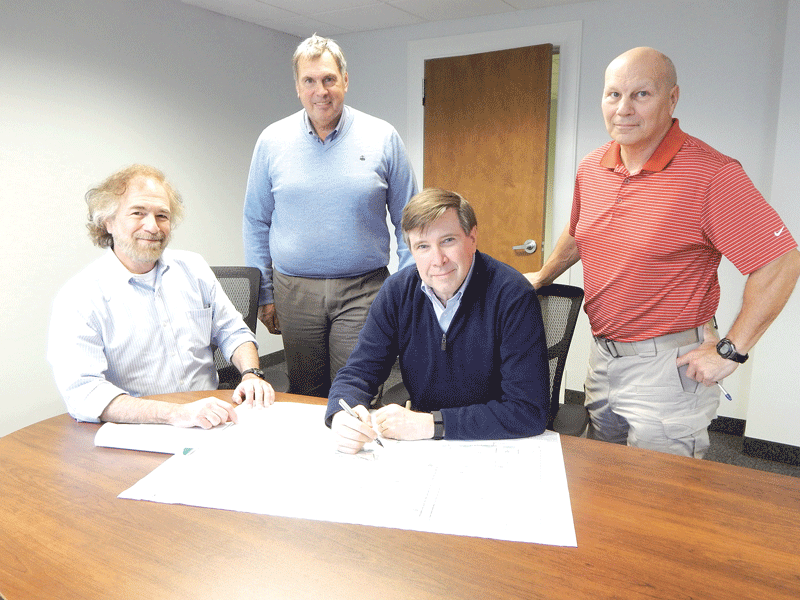
Daily News

SPRINGFIELD — Johnson & Hill Staffing Services Inc. recently enhanced its service offerings to include a specialized Accounting & Finance Division. While Johnson & Hill has always placed accounting and finance professionals, this move signals an increased commitment to this area of expertise. The agency sees a growing demand for this skill set and an opportunity to assist clients more proactively.

Tiffany Appleton has been appointed director, Accounting & Finance Division. Boasting more than a decade of recruiting experience in accounting and finance, she will provide direct-hire, contract-to-hire, and contract staffing, assisting clients in filling critical accounting and finance needs within their organizations. Roles range from clerk level up to CFO with a concentration on middle-management positions, including senior accountant, accounting manager, controller, financial analyst, manager of FP&A, internal audit, and public audit and tax. Her staffing experience crosses many industry sectors, spanning manufacturing, technology, nonprofit, professional service, and life science, with companies ranging from startup to publicly traded.

Appleton will focus on developing and nurturing long-term relationships with both clients and job seekers, which are built on mutual trust, sincerity, and confidentiality. She is sought after by clients for her progressive ideas on acquiring talent and consistent ability to deliver quality candidates. Job seekers appreciate her willingness to provide career coaching, interview preparation, and résumé assistance.

Prior to Johnson & Hill, her professional career included serving as client relations director for a large, regional CPA firm and principal and talent advisor for a boutique staffing firm specializing in accounting and finance placement.

Johnson & Hill is an independent, regional, woman-owned staffing service offering temporary, temp-to-hire, and direct-hire employment opportunities, serving Western Mass. and Northern Conn. Johnson & Hill specializes in administrative, accounting, legal, and professional staffing services.

Features

Providing a SPARK

Since its launch nearly two years ago, SPARK Holyoke has become an important addition to the region’s growing entrepreneurial ecosystem, providing a learning-and-nurturing environment for a variety of business owners. To sum up its impact, one participant said the agency gave him the discipline to be “both a creator and a finisher.”

Farid Kheloco

Farid Kheloco says SPARK was created to help start-ups get off the ground — and maybe help fill some of Holyoke’s vast supply of vacant mill space.

When asked to talk about the agency known as SPARK (yes, that’s an acronym, but not really; hardly anyone knows what those letters stand for) and how it’s helped her create, shape, and realize a vision for her company, Hot Oven Cookies, Sheila Coon found it necessary to do a little comparing and contrasting.

And the other subject in the discussion was a close cousin among organizations that are part of what is now being described as an ‘entrepreneurial ecosystem’ — Valley Venture Mentors, known for many things, but especially its high-octane, extremely intense accelerator program, with which Rivera also participated.

“VVM … I love it because I’m kind of a high-action person,” she told BusinessWest. “With VVM, you go the edge of the cliff, they hand you a prarachute, and tell you to jump. And as you go down, they tell you ‘jump this way’ or ‘jump that way.’ It’s very high-paced.

“SPARK, on the other hand … kind of has you sit back, and think, and analyze things slowly and more methodically,” she went on. “It gave me the opportunity to slow down and think things through. And it was very intimate — there were 10 people in the class; we had more time to think and talk things through. It was amazing.”

Though perhaps not intentionally, Coon used this exercise to not only point up the differences between the two organizations, but also spell out, in an effective manner, why SPARK Holyoke, which has the Hispanic community as one of its main focal points, has become an important addition to the entrepreneurial landscape in Western Mass.

In short, since being launched in late 2014 as part of a Working Cities Challenge grant, SPARK Holyoke has enabled a number of aspiring entrepreneurs to sit back, think things through, and, hopefully, go into business for themselves.

It does so through a 15-week course that, according to Executive Director Farid Kheloco, has a number of moving parts and objectives and is designed to help a wide range of individuals, from start-up owners to those who have been operating for several years and, for one reason or another, are trying to change how they do things. In other words, people like Coon.

“We want to hold your hand so you can take your idea and turn it into a bullet-proof business plan,” he said while smashing the mission down to a simple phrase.

The current series of classes started earlier this month, said Kheloco, noting that the one that ended during the summer featured 42 participants and 31 businesses.

Since it was launched, SPARK Holyoke has provided assistance to individuals involved with a wide variety of businesses, from cookie making to motorsports sales; from home remodeling to sock-manufacturing; from event planning to window-tinting.

Sheila Coon, seen here with her husband, David

Sheila Coon, seen here with her husband, David, says SPARK helped her create a vision, and a game plan, for her venture, Hot Oven Cookies.

Overall, SPARK is part of a series of initiatives undertaken by Holyoke Mayor Alex Morse and his administration to spur entrepreneurship, create jobs, and generate more interest in Holyoke, especially with the younger populations.

Those efforts have been successful enough to earn the city placement on Popular Mechanics’ list of the “most entrepreneurial” cities in the country.

And while the goal is to encourage entrepreneurship and help businesses get off the ground, there is another, very practical element to the agency’s existence. That would be the roughly 2 million square feet of vacant mill space in this former industrial powerhouse, and a desire to fill it, said Kheloco.

He doesn’t expect SPARK to make a huge dent in that inventory any time soon, but the agency’s work can certainly be a factor in bringing more life to the old paper and textile mills that gave this city its identity and providing another spark (there’s that word again) to broad efforts to revitalize the city.

“SPARK is helping to put us (Holyoke) in the game when it comes to promoting entrepreneurship,” said Kheloco, as he spoke with BusinessWest in the Holyoke Chamber of Commerce offices (where the agency is housed) on High Street. “SPARK has a definite role in that perception of Holyoke, and that’s important for our city, because we have a lot of open space.”

For this issue, BusinessWest takes an in-depth look at SPARK Holyoke and how, despite the fact that it doesn’t issue parachutes to participants, it does help them get off their ventures off the ground.

Igniting Passion

For the record, SPARK is short for Stimulating Potential, Accessing Resource Knowledge. Kheloco and others involved with the program can probably recite all that (again, that’s probably) but most participants wouldn’t care to try.

But they do care about trying to take ideas they have a product or service and advancing them in the form of a new business. Or not, if they determine that said idea is not really viable, and SPARK Holyoke can help with that, as well.

It’s all part of that ‘thinking through’ concept that Coon mentioned, and while there is quite a bit that goes into it, the agency’s broad goals are to simplify the many matters involved with a business as much as possible, said Kheloco, who can speak with experience as he goes about working with aspiring entrepreneurs.

“I’ve been entrepreneurially minded my whole life, and growing up here I was told that you should leave the area if you want to be an entrepreneur,” he said, adding that while he works today to dispel such notions, at the time, he took that advice.

He went to New York and then Dubai, before relocating to the western part of this country and eventually for working for several different IT companies.

He returned to this area a few years ago, soon became program  manager of TechFoundry, and found himself immersed in the work of VVM and other agencies involved with entrepreneurship.

He was looking to launch his own venture — one that would produce wooden sunglasses — in Holyoke, but wound up launching SPARK instead.

“The market is pretty much saturated with wooden sunglasses,” he joked, adding that the opportunity to run SPARK — a career path recommended to him by Katie Stebbins, who was then overseeing Holyoke’s Innovation District and is now working in the Executive Office of House & Economic Development — sounded like much more of a winning proposition.

Felix Santana, owner of Northeast Motorsports

Felix Santana, owner of Northeast Motorsports, says SPARK has given him the discipline to be “both a creator and a finisher.”

Initially, his work centered around getting the agency started, honing its mission, and developing its curriculum, he said, adding that now, he spends more of his time getting the word out — in essence, filling seats for the classes — while also achieving sustainability; the grant that funds the program is three years in duration, and this is year 2 of the initiative, so new funding sources must be attained.

“We’re kind of in our teen-aged years,” he said of the organization. “We’ve identified a little of what we are, but we need to mold that and solidify what’s needed to survive for the long term.”

Kheloco’s various outreach efforts drive home the basic point that SPARK is a community organization to help what he called “every-day entrepreneurs.”

That’s certainly not a technical term, but one he summoned to describe “neighborhood projects” — small ventures, mom-and-pop operations that may or may not scale.

“We want to work with them to give them the guidance they need to get started,” he went on. “So we take a lot of the competition aspects out of the equation, and we take a lot of the business jargon out of it; we try to make it team-oriented and say ‘now you’re part of this group, the SPARK starters, and how are we going to help each and work together?’”

SPARK carries out this work with a host of partners, which include VVM, the chamber, SCORE, Holyoke Community College, Easthampton Savings Bank, and Nuestras Raices, a nonprofit group that seeks to promote economic, human, and community development in Holyoke through projects related to food, agriculture, and the environment.

“Predominantly, we deal with concepts, and we work on taking the idea and turning it into a business model,” he went on. “We like to say that we work with anyone’s who’s stuck.”

Getting Down to Business

‘Stuck’ might not be the best term to describe what Coon was when she encountered SPARK and its curriculum, but it’s in the ballpark.

To be more precise, she was at a crossroads of sorts, or transition phase, and in need of some guidance and perhaps technical help with regard to where she could and should take her venture — as well as ‘how’ and ‘when.’

Backing up a bit, she said Hot Oven Cookies was enjoying decent success and had developed a solid following (one fan called this the ‘Ben & Jerry’s of the cookie world’) with its 100 flavors — some staples, or “classics” and other varieties rotated in weekly — and a business focused on gifts and catering, all delivered.

“That keeps it fun,” she said of the large inventory of flavors. “It’s good for the customers, but it’s good for us, too — we get to keep creating.”

This first phase of the venture, as Coon described it, helped pinpoint demand and identify need, and with regard to latter, what emerged was a desire to enable customers to buy a cookie or two or three, and not a full dozen, the minimum she set for deliveries.

And this led to talk of putting a food truck on the road and bringing the product directly to consumers. It’s a big step and a sizable investment, and she credited both SPARK and VVM with helping her bring it all the fruition; the truck makes its debut next month.

She was in the second accelerator cohort, which wrapped up its work in the spring, and through that experience was introduced to Kheloco and SPARK Holyoke, and took part in both programs simultaneously.

She credits VVM with helping her take an idea off a napkin, as she put it, and take it forward, but she said SPARK provided that more-intimate, slower-paced environment that enabled her to stop and work things through.

“We talked through all of my phases,” she said of the SPARK experience, adding that the experience not only helped her conceptualize her ideas, but pitch them in a more-effective manner.

Felix Santana wasn’t exactly stuck, either. But he did need some help with his venture, Northeast Powersports, which seeks to become the largest provider of Chinese-made motorsports — primarily scooters, dirt bikes, and go carts — in the region.

The company has become an authorized dealer of Cao Cao products, offering both sales and service, he said, adding that he graduated from SPARK’s first class.

He said it provided him with both support, in the form of mentorship, and technical guidance.

“I went in there with a really solid business plan — it was a matter of getting the numbers and the data to back it up,” he explained. “They helped me get my business plan focused and connect with the right people, like SCORE, and get organized.”

He noted that he’s a serial entrepreneur of sorts, but one that doesn’t “finish,” as he put it.

“I was one of those entrepreneurs who was a really good starter, but when I got to the middle point, I never knew how to finish and would usually sell whatever idea I had at that point,” he explained. “SPARK helped give me the discipline to be both a creator and a finisher.”

Seeing the Light

Searching for more words and phrases to describe what SPARK Holyoke is and what it does, especially with regard to the proverbial ‘big picture,’ Kheloco said it acts as the glue that binds the many organizations and agencies promoting and facilitating entrepreneurship in Holyoke and the communities surrounding it.

And in that capacity, it is not only helping to create new opportunities in Holyoke and fill some of that vacant mill space, but also taking on an important role within a growing entrepreneurial ecosystem.

SPARK is technically an acronym, but mostly it’s both a noun and a verb, and as such, the word effectively describes what the agency is, and what it provides.

George O’Brien can be reached at [email protected]

Departments People on the Move
Timothy Netkovick

Timothy Netkovick

Attorney Timothy Netkovick has joined Royal, P.C. He has more than 14 years of litigation experience and has tried nearly two dozen cases to verdict. Netkovick’s practice is focused in labor law and complex employment litigation. He also counsels companies on the multitude of state and federal employment laws impacting them, including wage-and-hour issues, disability and leave laws, workplace safety and OSHA compliance, affirmative action, and contract negotiations. His other preventive work includes drafting employee manuals; preparing non-disclosure, non-solicitation, and non-compete agreements; and conducting management training. He is a graduate of American International College and Western New England University School of Law.

•••••

Kimberly Klimczuk

Kimberly Klimczuk

Skoler, Abbott & Presser, P.C. announced that Attorney Kimberly Klimczuk is among only 50 women throughout the Commonwealth named among the 2016 Top Women of Law by Massachusetts Lawyers Weekly. The Top Women of Law program showcases women who are shining stars across numerous legal fields. This list of elite legal female professionals will be honored at a dinner program sponsored by Massachusetts Lawyers Weekly, planned for Oct. 27 at the Marriott Copley Hotel in Boston. “I know that Massachusetts Lawyers Weekly has a long-standing tradition of recognizing pioneers in the legal field,” Klimczuk said. “I am honored to be included in this group of talented women lawyers throughout Massachusetts.” Klimczuk joined Skoler, Abbott & Presser, P.C. in 2004 and concentrates her practice in labor law and employment litigation. She became a partner with the firm in 2011. She graduated from the University of Pennsylvania and received her juris doctor from Duke University School of Law. Her experience includes negotiating collective bargaining agreements and advising on contract interpretation and successfully defending clients in state and federal court and before administrative agencies in a variety of areas of employment law, including wage-and-hour law, discrimination, harassment, wrongful discharge, and breach of contract. In addition, she has assisted employers in compliance matters involving the Office of Federal Contract Compliance Programs, and drafted numerous affirmative-action plans for them. She is a frequent speaker for a wide variety of associations and organizations and, as a resident of Springfield, is an active member of the Western Mass. community.

•••••

Greenfield Community College announced that Catherine Seaver has been named Chief Academic and Student Affairs Officer. “Catherine Seaver is a great fit for GCC,” said college President Bob Pura. “Catherine understands the joy, privilege, and the challenges of teaching and learning at a community college because she attended a community college, she has taught in the classrooms of one, and has worked in leadership positions in a community college. She understands the challenges of working in and running a tech-based business because she has worked in that environment. Catherine fits here because she gets how important relationships and community are to student success, how important the ongoing commitment to betterment and improvement is, and why it is essential that our student outcomes are comprehensive and sustainable. Catherine totally gets the importance of access, excellence, and our mission.” Seaver holds a bachelor’s degree in applied science: manufacturing engineering technology from Miami University, a master’s degree in computer information systems from the University of Phoenix, and a master’s degree in educational technology from Eastern Connecticut State University. She will complete a PhD in leadership from the University of the Cumberlands in December. Seaver worked at Manchester Community College from 2002 until this past spring. Her positions included division director for Business, Engineering & Technology; interim associate dean of Student Affairs; and department chair/professor in Engineering & Technology. While in administrative roles, Seaver taught one online or on-campus course each semester as an adjunct professor, including “Introduction to C++ Programming,” “Introduction to 3D AutoCAD,” “Object-Oriented C++ Programming,” and “Introduction to Engineering Analysis.” Prior to working at Manchester Community College, Seaver held systems-engineering, project-management, and technical-instructor positions with Hallmark IT, General Cigar Co., IKON (formerly HBM Technology Group), KTC Software Services, and Carrier Corp. “GCC’s President Bob Pura and GCC as a whole have a superb reputation throughout Massachusetts, Connecticut, and beyond,” Seaver said. “I’m honored to be able to work here. When I was teaching at Manchester Community College, students would take a few classes at MCC with the intention of transferring to GCC to finish. I am very committed to community colleges. Their smaller classes and teachers focused on teaching instead of research make all the difference in student success. I was a finalist for a position at a selective four-year college that admits only 50% of their applicants. Thinking about what happens to the other 50%, I realized how much open access means to me and that I want to focus my career on community colleges. GCC is a great school doing powerful work in the community, and I look forward to being part of what GCC does so well.”

•••••

Nancy Frankel Pelletier

Nancy Frankel Pelletier

Robinson Donovan, P.C. announced that partner Nancy Frankel Pelletier will be honored among the 2016 Top Women of Law by Massachusetts Lawyers Weekly. This honor is awarded to only 50 women attorneys annually throughout the Commonwealth. It recognizes and celebrates outstanding achievements made by exceptional female lawyers. The 2016 honorees will be recognized at a dinner program on Oct. 27 at the Marriott Copley Place Hotel in Boston. “When I look at the list of honorees this year, I see a group of women who are without-a-doubt trailblazers in the legal field,” Pelletier said. “I am thankful to be included among so many influential legal experts, and I want to extend my congratulations to each of them.” Pelletier exclusively practices litigation. She has no fear of taking a case to trial; however, she recognizes when it is not in the best interest of her clients, and she is equally talented at resolving conflicts outside of the courtroom expeditiously and economically. Her reputation as a litigator reaches well beyond Springfield, with a practice area extending from the Berkshires to Boston in both state and federal courts. She has also been admitted to the Hampden County Bar Assoc., the Women’s Bar Assoc. of Massachusetts, and the Federal Bar Assoc. Pelletier is a fellow at the International Association of Defense Council and a life fellow of the Massachusetts Bar Foundation. Other professional affiliations include membership to the Massachusetts Defense Lawyers Assoc., the Defense Research Institute, and civic involvement at George Washington University and East Longmeadow High School, where she provides mentoring and career job-shadowing opportunities for students. A complete list of 2016 Top Women of Law nominees can be found online at masslawyersweekly.com.

•••••

J. Polep Distribution Services announced the promotion of Brian Neeld to Vice President, in addition to his role as chief financial officer. Neeld has been with J. Polep since 1998. Over the past 18 years, he has played a key role in the Accounting department. When he first started with the company, he held the title of accounting assistant, and worked his way up to corporate controller, a title he held for nine years, supporting the CFO. He was responsible for the production of financial reports, maintenance of accounting records, and a comprehensive set of controls and budgets. In 2014, Neeld was appointed CFO, then was promoted to vice president. Company leaders say his commitment and focus on customers, vendors, and the J. Polep team — as well as his dedication and ability to tackle complex accounting — have positively impacted J. Polep’s growth.

•••••

Jeffrey Trapani

Jeffrey Trapani

Robinson Donovan, P.C. announced that attorney Jeffrey Trapani has been appointed chair of the legislative steering committee for the Springfield Regional Chamber of Commerce. The legislative steering committee identifies issues of major concern to the business community, researches the issues, and recommends positions on them. The committee is also charged with educating members on these issues, soliciting member support, and encouraging elected officials to adopt the chamber’s position. This committee also serves as the legislative arm of the East of the River Five Town Chamber of Commerce. “Jeff is not only an outstanding litigator, but a genuine leader in the community,” said Nancy Frankel Pelletier, head of Robinson Donovan’s litigation department. “We are very proud that he has taken on a leadership role at the Springfield Regional Chamber. He has an unwavering commitment to our business community, and he will be carrying on a decades-old tradition at Robinson Donovan of community service.” Trapani, a partner at Robinson Donovan, concentrates his practice in civil litigation, including insurance defense, employment law, municipal liability, business litigation, and professional malpractice. Additionally, he represents landlords in summary-process actions and housing-discrimination claims and insurance companies in unfair-settlement claims and coverage issues. He graduated, cum laude, from New England Law in Boston, where he was editor in chief of the New England Law Review. He has been recognized by Super Lawyers since 2008.

•••••

Marylou Fabbo

Marylou Fabbo

Skoler, Abbott & Presser, P.C. announced that Attorney Marylou Fabbo has been named one of the 2016 Top Women of Law by Massachusetts Lawyers Weekly. This distinction is presented to only 50 female legal professionals in the Commonwealth each year. The Top Women of Law program highlights women who are trailblazers in their respective fields and role models for future generations of attorneys. This prestigious list of elite female legal professionals will be honored at a dinner program sponsored by Massachusetts Lawyers Weekly, planned for Oct. 27 at the Marriott Copley Hotel in Boston. “I am truly humbled to be recognized among so many talented women,” Fabbo said. “It speaks volumes about our firm to have two attorneys recognized this year. I look forward to celebrating the achievements of all the honorees in October.” Fabbo represents employers in employment litigation before state and federal courts as well as state and federal agencies in Massachusetts and Connecticut. She is a partner at Skoler Abbott and heads the firm’s litigation team. She has extensive experience working with employers to reduce the risk of legal liability they may face as the result of illegal employment practices. She is a frequent speaker on employment-related topics and also conducts extensive management-training and employment-practices audits. She is a published author and volunteers in the local community. Massachusetts Lawyers Weekly was founded in 1972 and reports decisions issued by all state and federal courts in Massachusetts as well as changes to court rules, verdict and settlement reports, bar-discipline notices, and other news vital to attorneys in the Commonwealth. A complete list of the publication’s 2016 Top Women of Law can be found at masslawyersweekly.com.