Home Posts tagged Opinion (Page 5)
Construction Sections

Driving Force

As federal and state lawmakers continue to search for solutions to fund and finance critically needed transportation infrastructure, the latest America THINKS national public opinion survey by infrastructure-solutions firm HNTB Corp. finds Americans with definitive views on how that funding should be generated and who should be responsible for maintaining and building the nation’s transportation network.

According to the survey, “Paying for Infrastructure – 2017,” 70% of respondents expressed their willingness to pay higher taxes and tolls to maintain existing as well as build new infrastructure. That number jumps to 84% if those revenues are guaranteed by law to exclusively fund transportation infrastructure needs.

“Americans value mobility and are willing to pay more to maintain and grow transportation infrastructure, especially if they know how their money will be used,” said Kevin Hoeflich, HNTB Toll Services chairman and senior vice president.

The HNTB survey also found nearly three in four Americans (73%) support public-private partnerships as a way to maintain existing and build new transportation infrastructure. Fifty-two percent believe the responsibility for funding maintenance and building new transportation infrastructure should be shared by the government and private sector.

“P3s are in the news as an increasingly popular option for funding new projects,” said Hoeflich. “However, the deals must be structured properly so the public gets the best return on its investment in infrastructure. We can expect to see more of them as the sources of traditional funding are under pressure.”

The desire to avoid congestion and save time is behind the willingness of almost six in 10 Americans (59%) to pay a toll, even when a free alternative is available, according to the HNTB survey. Of these respondents, 57% are willing to pay an average of $1.70 to use a priced managed lane, also called express lanes, if that would save 15 to 30 minutes of time, avoid congestion, and provide a predictable travel time.

The conversion of general-purpose interstate lanes to priced managed lanes is supported by 77% of survey respondents. Among this group, 50% believe reducing congestion is the most important reason for this conversion, an increase from 43% from the same question asked in a 2016 HNTB survey.

“People are frustrated spending time stuck in traffic, and they want solutions. They are concerned about how congestion contributes to traffic fatalities,” Hoeflich said. “Priced managed lanes offer a promising solution to both congestion and funding by providing a choice to get out of traffic. The public has demonstrated a willingness to pay to use them in many urban areas.”

HNTB’s survey found 80% of respondents support adding tolls to existing highways and interstates. When asked how those toll revenues should be used, reducing congestion was cited by 41% of respondents; improving safety, 40%; adding vehicle capacity, 34%; and adding transit capacity, 21%. Twenty percent of respondents would never support tolls on existing highways or interstates.

The survey also found two-thirds of respondents (66%) support tolls to fund critical infrastructure projects if there are insufficient funds from other sources. Meanwhile, the concept of reduced toll rates for low-income users is supported by more than three in four Americans (76%).

“Most importantly, there is growing recognition of tolls as a source of revenue that can help fund decades of neglect of maintenance and operations, system improvements, and other critical transportation needs,” said Hoeflich.

HNTB’s America THINKS “Paying for Infrastructure – 2017” survey polled a random nationwide sample of 1,027 Americans, ages 18 and older, between July 14 and July 16, 2017.

HNTB Corp. is an employee-owned infrastructure-solutions firm serving public and private owners and contractors. HNTB professionals nationwide deliver a full range of infrastructure-related services, including award-winning planning, design, program management, and construction management; www.hntb.com

Opinion

Opinion

By Kimberley Lee

It’s hardly news that growing up can be stressful. What may be news is that your son or daughter is likely more interested in talking things over with you than you realize. It’s always a good time to talk about how they’re feeling inside, how things are going at school and with friends, and about life in general. Last week was Suicide Prevention Week, but that shouldn’t be the only opportunity to begin a meaningful conversation with someone you know and love by simply asking, “how are you?”

Nearly 40,000 people in the U.S. die from suicide each year — one death every 12.8 minutes. According to the Centers for Disease Control and Prevention, more people die by suicide than from automobile accidents or homicide. Suicide is the tenth-leading cause of death among all Americans and the third-leading cause of death among young people (ages 15 to 24).

Health professionals tell us it’s important to correctly educate children and teenagers about mental illness. It helps dispel misconceptions and stigma, and it provides them with the understanding and resources they need if they or someone they know struggles with mental illness.

If you haven’t had a ‘mental health check-in’ talk with your middle-school or high-school student recently, this week lends a great opportunity to do just that. Help your son or daughter to feel safe in sharing their feelings and opinions with you. Be aware of changes in their behavior, and trust your instinct.

I asked my colleague Nina Slovik, a licensed clinical social worker at the Center for Human Development (CHD), to share some professional insights regarding suicide prevention. “When someone thinks or talks about suicide, they actually have mixed feelings about dying,” she said. “Most often, suicidal feelings come from having a mental illness, and these illnesses can be treated with professional help, including medication and talk therapy. The best way anyone can help an individual experiencing depression is to get that person the help they need. People with a mental illness are not expecting you to fix them; they just want to be understood.”

As a major social-service organization for our region, CHD offers extensive behavioral-health programs, including services designed to identify and treat mental illness. We help people who have mental-health needs, and also educate members of our community to develop greater acceptance toward mental-health issues and people who have them.

You’d seek help from a healthcare professional for a broken arm or a cough that doesn’t go away. It should be the same when it comes to managing your mental health — or that of someone you care about. If someone seems withdrawn socially, starts associating with the wrong crowd, or acts out in ways that just aren’t right, help is available.

Kimberley Lee is vice president of Development at the Center for Human Development.

Healthcare Heroes

This Physician Always Has His Patient’s Interest at Heart

Dr. Michael Willers

Dr. Michael Willers
Dani Fine Photography

Dr. Michael Willers calls it simply “the look.”

When asked to describe it, he said it was somewhat difficult to put into words. What certainly wasn’t is his opinion that generating this look may well be his favorite thing about his work as owner of the Children’s Heart Center of Western Massachusetts.

It comes when a young patient finally comes to the realization that he or she is there at the home on Northampton Street in Holyoke to receive medical care — and not just play on the rug with LEGOs or a stuffed animal.

“I’ll be talking to the parents and I’ll be talking to the kid … and then I get my stethoscope out, and I sit down on the floor with the kid with my stethoscope,” Willers explained. “And it dawns on the kid at that moment that this is not just hanging out on the floor at some friend’s house. There’s a stethoscope involved, and they’re in a doctor’s office … and the kid’s thinking, ‘wait a second … I may have been duped.’

“They have this really surprised look on their face,” he went on. “Then I say, ‘it’s all good … we’re just going to have a listen, and maybe you want to listen, too.’ So we’ll listen to their heart together.”

Willers’ ability to prompt ‘the look’ doesn’t completely explain why he was chosen as the winner in the category of Patient/Resident/Client Care Provider, but it goes a long way toward getting that job done. He and his partners, Drs. Cyrus Yau and Meaghan Doherty, have created an environment that looks and feels far more like a home than a place where pediatric cardiologists would typically do their work.

And they run a practice where parents, often very anxious about bringing their child to a cardiologist to begin with, leave with all their questions answered and their fears, in most cases, anyway, put to rest.

Willers told BusinessWest that, unlike most healthcare operations today, this is not a volume business — or, to be more precise, not a business consumed with volume. Indeed, the three physicians generally book only seven appointments a day and spend an hour, on average, with each patient and their parents.

Taking care of kids and being with them … I could do that all day long and not get tired of it. It picks me up every time.”

And while his work is cardiology, Willers says he and his partners regard themselves as experts in stress reduction, especially when it comes to the parents of the children they see.

“I’ll often tell people that we specialize here in anxiety and worry,” he explained. “Our specialty is helping parents who are anxious or worried or scared. We take pride in tuning into that and understanding where parents are coming from and helping to unravel that anxiety and figure out exactly where their anxiety lies.”

But it’s not simply how much time is spent with patients and their families, or all this work in stress reduction that sets Willers apart. It’s also how that time is spent, which, in his case, means getting down to the patient’s level — quite literally.

“When I went to medical school, I knew I was going to get into pediatrics,” he said while explaining how he chose this line of work, or it chose him, as many working in healthcare opt to phrase things. “I love the social aspect of it, to be honest with you. There’s nothing like walking into an exam room and having a chance to get on the floor and play LEGOs with kids, talk to them about their lives and about what they enjoy.

“Pediatrics is intellectually interesting,” he went on. “But socially, it’s invigorating. The real reason I went into pediatrics as opposed to internal medicine or something else was purely social and emotional reasons. Taking care of kids and being with them … I could do that all day long and not get tired of it. It picks me up every time.”

The Pulse of His Practice

Willers isn’t sure of the exact date, but he believes that the home at 1754 Northampton St. in Holyoke is, like most of the others in that vicinity, not quite a century old.

It is large and comes complete with many nooks and crannies. For example, each of the examination rooms on the second floor has a short, narrow closet in one corner, the dimensions of which are determined by the structure’s sloping roof.

The waiting room at the Children’s Heart Center looks more like a living room, which is exactly what it was for roughly 90 years.

The waiting room at the Children’s Heart Center looks more like a living room, which is exactly what it was for roughly 90 years.

Each closet is filled with a trove of stuffed animals and toys, and on occasion, Willers won’t just go into the closet for something, he’ll actually emerge from it to greet a patient. To get his point across, he gave a demonstration.

“They’ll be looking for me to come in the front door, but once in a while I’ll get down in here,” said the 6-foot, 3-inch Willers as he squeezed in and closed the door behind him. “And then I’ll pop out like this and say, ‘hi, guys.’”

This demonstration, and the enthusiastic commentary that accompanied it, speak volumes about not what Willers does, but something at least equally important — how he does it.

Before we get into that in more depth, though, we need to first explain just how Willers arrived in that closet. It’s an intriguing story, and it really begins back at Wesleyan University, where he was finishing his work toward earning a degree in biology.

He wasn’t considering medicine at that time — he was leaning toward getting a Ph.D. in ecology or evolution — but a week spent with a group of internal-medicine residents at St. Vincent’s Hospital in New York changed all that.

“Six months before senior year, I decided I wanted to go to medical school,” he noted, adding that he enrolled at Dartmouth and, while working toward his degree, developed two passions — working with and for the underserved, and taking care of young people, for all those reasons mentioned above.

After completing his residency in pediatrics at Cornell Medical Center – New York-Presbyterian Hospital, Willers went to work at the Fair Haven Community Health Center in New Haven, Conn., an experience he described as the best of both worlds — taking care of an underserved, largely Spanish-speaking population, and also having teaching and hospital privileges at Yale-New Haven Hospital.

Desiring to narrow his focus to pediatric cardiology, he undertook a fellowship in that specialty at Yale School of Medicine, and upon completing it, he went to work at Baystate Children’s Hospital as a pediatric cardiologist, one of three on staff, while also serving as director of the Pediatric Exercise Physiology Laboratory.

Seeking to provide care in a different setting and in a different manner, he founded the Children’s Heart Center of Western Massachusetts in 2012.

“I wanted to be able to take care of people in a way that focused on patients as individuals, and their families,” he explained. “And spending time with them, answering questions, addressing their concerns, understanding their lives and how their heart problems impacted their lives, and how their lives impacted their heart issues.

“I wanted to do it in a way that wasn’t like a lot of hospital-based outpatient practices,” he went on. “There’s a lot of overhead with those facilities; you have to pay for the fancy waiting rooms, and you have to pay the CEOs and the vice presidents and the middle managers, and a lot of the money goes toward things not directly related to good patient care. And what that means is that the volume of patients you need to see in a hospital-based practice just to keep the boat floating is enormous, and that means spending less time with patients.”

He started in that home in Holyoke with an operating philosophy that minimized those overhead expenses and called for seeing seven patients a day for an hour each, as opposed to 30 patients a day for 15 minutes each.

When asked how this was doable in this modern age of healthcare, where volume is such a critical factor in a practice’s success, he paused for a moment before responding.

“It’s our priority,” he explained. “In any endeavor in life, if you prioritize the right things, then you can make it work. And we prioritize the relationships with patients and families. We don’t prioritize mahogany desks, and we don’t prioritize over-management.”

As the practice grew, thanks in no small part to a very receptive response from the region’s community of pediatricians, it expanded, both with additional cardiologists (Yau and Doherty) and with satellite offices in Amherst and Great Barrington.

Hardly a Murmur

As he offered a quick tour of the Holyoke office, Willers pointed out a number of design elements and choices regarding décor that were chosen specifically with the goal of making young patients and their parents feel comfortable and, well, at home.

These include the couches chosen over traditional plastic chairs seen in most physicians’ offices, oriental rugs, soft, padded examination tables, toys and games seemingly in every room, and patients’ exploits in coloring between the lines decorating one full wall at the front entrance.

Even the terminology reflects this operational philosophy, if you will.

Indeed, upon arrival, visitors are asked to sit in the ‘living room,’ not the ‘waiting room,’ because while the latter phrase effectively describes its official function, it certainly looks more like the former — because, for roughly 90 years, that’s exactly what it was.

But the friendly, patient- and family-focused tone of this practice goes well behind furniture and phraseology. It also involves everything from the considerable amount of time spent with a child and his or her parents, to the attention paid to the communication process.

To explain, Willers chose as his subject matter the heart murmur, a term that most parents don’t fully understand and one that usually generates far more fear and anxiety than are actually warranted.

So Willers said he starts off by focusing on the child, not the word ‘murmur,’ and moves on to making it clear to parents that, in the vast majority of cases, murmurs are normal and not life-altering.

Dr. Michael Willers

Dr. Michael Willers says his favorite toy is whichever one his patient happens to be playing with at the time.

“I’ll tell a parent that there are seven different kinds of normal murmurs, and say, ‘let me tell you about the one your child has,’” he explained, adding that, for this exercise, he referenced the Still’s murmur, a common type of benign murmur named after the man who first described it, Dr. George Frederic Still. “And I’ll draw them a picture of a heart, explain what causes this murmur, and then tell them, ‘this is a totally normal murmur in completely normally healthy kids, something that develops around the age of 2 or 3 and lasts until the kid is 12 or 13 or 14. But it eventually goes away on its own and never turns into anything bad, and you never have to worry about it again.’”

Overall, Willers said he and his partners work hard to effectively communicate with patients and their parents to ensure they have a solid understanding of what’s happening with the heart in question.

“Some cardiologists will say, ‘your daughter has a heart-valve problem; she’s going to need a procedure on down the line — we’ll talk about it more later,’” he explained. “When we sit down with patients, our discussions are usually 20 or 30 minutes long; we draw pictures, we take notes, they go home — we intend for them to go home — with a really solid understanding of what’s going on with their kid, or with them if they’re an older person.

“In my experience, there’s nothing like uncertainty to breed anxiety, and there’s nothing like anxiety to disrupt the joy of parenting,” he went on. “And so we really try to get rid of the uncertainty and give people definitive answers in terms that are in plain English so that they can home with an understanding and a reassurance, and they don’t have to feel anxious.”

The Internet and all the information available on it has acted to fuel this anxiety, Willers said.

“They’ll hear something or read something on the Internet, and they’re really worried that their kid is going to die for X, Y, or Z reason, but they don’t really want to say it,” he went on. “So unless you can tune into their emotions and be on the same wavelength, you can’t really put their fears to rest.”

But getting on the same wavelength with parents is just part of this story. Getting there with children is what Willers probably enjoys most.

And while the methods for doing so vary with the age of the patient, the common threads are communicating and connecting.

“The first five minutes of every visit isn’t ‘so what brings you here today?’” he explained. “It’s ‘how’s your summer going?’ or ‘what was camp like?’ or ‘dude, how’s it going with your little sister?’ You spend five minutes connecting like that, and it brings a certain energy to that visit.”

A Different Beat

When asked if he had a personal favorite when it comes to kids’ toys and games — remember, he gets right down on the rug to play alongside his patients — Willers gave an answer that neatly sums up how this practice operates, and why.

“Whatever the kid is playing with at that given moment — that’s my favorite,” he told BusinessWest.

Such an attitude explains not only why Willers was chosen to be a hero in the Patient/Resident/Client Care Provider category, but also why he loves to create ‘the look’ and can’t wait to see it again.

Like he said, he can do this all day, and it picks him up every time.

George O’Brien can be reached at [email protected]

Features

Growth Opportunities

Aerial Mehler with ‘Snowy,’ her pet goat.

Aerial Mehler with ‘Snowy,’ her pet goat.

When Prospect Meadow Farm was conceived six years ago, the thinking was that working outdoors and with animals could have a significant therapeutic effect on those with autism or developmental disorders. “That’s something I believed in before this started, but I didn’t quite know how powerful it was,” Shawn Robinson noted, adding that he certainly knows now.

Aerial Mehler grew up on the western end of Long Island, just a short train ride from Manhattan. So, in most all respects, she considers herself a city girl.

Thus, when her family relocated to Western Mass. several years ago, her first reaction was that this region was, in all likelihood, too rural for her liking.

And when she was approached about working at Prospect Meadow Farm in Hatfield, a vocational-services program operated by Northampton-based ServiceNet, after becoming frustrated at a few other employment settings, she was more than a little dubious about the notion that she would soon warm to the place, vocationally and otherwise.

“I thought, ‘I’m from the city — I don’t do this stuff,’” she told BusinessWest, adding that today … well, she does do that stuff, or at least some of the many things that fall into the broad realm of agriculture and farm management.

In fact, she is the program assistant to the facility’s director, Shawn Robinson, and carries out a host of administrative duties ranging from sending out bills to the farm’s many customers, especially those who purchase its eggs and log-grown shiitake mushrooms, to drafting reports to the state, to maintaining the farm’s Facebook page.

“I call myself the on-call employee, because if something needs to be done, I do it, and it’s something different every day,” said Mehler, 29, who actually owns one of the goats now living at the farm, a spirited white female appropriately named ‘Snowy.’

“I’d say I’m a regular here, but that’s a setting on a washing machine,” she joked, expressing an opinion held (if not openly expressed) by most all those who work at the farm — men and women of all ages who are on the autism spectrum or have a developmental disability.

Indeed, there are no ‘regulars’ at Prospect Meadow, only individuals with various talents who, it was thought, could certainly benefit from working outdoors, around animals, and as part of a diverse workforce handling various assignments that, like Mehler’s, are different every day — and also make $11 an hour while doing so.

And six years later, that theory has been validated — and then some.

parsley

At top, farmhand Brittany Rawson tends to some of the parsley plants at Prospect Meadow Farm. Below, Shawn Robinson, director of the farm, with one of the resident llamas.

At top, farmhand Brittany Rawson tends to some of the parsley plants at Prospect Meadow Farm. Below, Shawn Robinson, director of the farm, with one of the resident llamas.

“When the facility was created in 2011, it was with the thinking that there would be a significant therapeutic effect to working outdoors and working with animals,” said Robinson. “That’s something I believed in before this started, but I didn’t quite know how powerful it was.

“One thing that we’ve seen is that people who were not successful in other work programs and had explosive behaviors, for example, would come here, and we just wouldn’t see those behaviors,” he went on. “And I have to credit a lot of it to the outdoors and the animals.”

Prospect Meadow is a multi-faceted operation with many moving parts. There are anywhere from 800 to 1,000 chickens on the property at any given time, and egg sales are a huge part of this business. Likewise, a shiitake-mushroom venture that started small and continues to grow provides those products to a host of area restaurants and stores.

There is also a landscaping component — crews will be sent out to handle a wide range of small residential and commercial jobs — as well as a catering operation managed out of the farmhouse. There are also plans in the works for both a feed store and a small café, separate operations that will provide employees with additional opportunities to interact with the public.

And, yes, the farm sells goats as well — to those, like Aerial, who want them as pets; to groups who need them for culinary offerings to be served at dinners and festivals; and to entrepreneurs who ‘employ’ them as “lawnmowers,” as Robinson called them.

But while Prospect Meadow might be gaining an identity from all of the above and especially the mushrooms, it is, at its core, a place of opportunity — employment-wise and personal-development-wise — for those who come here and don shirts with the farm’s logo, a rooster.

“We’re helping to increase these individuals’ skills and improve any sort of vocational deficiencies that may be identified, while also providing them with a real, paying job experience in a supportive environment,” Robinson explained, “with the hope that combining that support with that training could eventually lead to them being very successful in any career they pursue elsewhere.”

For this issue, BusinessWest visited Prospect Meadow to gain a full appreciation for the many aspects of this operation and the many ways it is cultivating growth, in every sense of that term.

An Idea Takes Root

When BusinessWest asked Robinson if he could pick up one of the chickens he was pointing out as he offered a tour of the farm and make it part of a picture, he replied with a confident “sure, no problem.”

The chickens, however, were not going along with the program.

Indeed, try as he might — and he tried several times — Robinson could not get both hands around any of these fast-moving fowl, and both hands are needed. So he suggested that the resident llamas might prove to be more willing subjects for a photo shoot.

Farm director Shawn Robinson (second from left) with, from left, farmhands Ana Tyson, Vicki Taft, and Justin Cabral.

Farm director Shawn Robinson (second from left) with, from left, farmhands Ana Tyson, Vicki Taft, and Justin Cabral.

Only, they weren’t. They were rather shy and kept retreating to their wooden home or the shaded area behind it; only bribery, in the form of a late-morning snack, seemed to help. Their recalcitrance gave Robinson an opportunity to shed some light on their presence at the farm (in some respects, they are where this story begins) and one of their primary assignments — protecting the chickens who live in the same general area on the 11-acre property.

“They use their legs to really fight, and other animals know that, and even their scent keeps some predators away … but they’ll go after other animals, too,” said Robinson, noting that, while llamas are certainly not indigenous to Hatfield, many chicken-loving animals that are, including coyotes, bobcats, and even the occasional bear, seem to know instinctively that messing with a llama is not a good career move.

But these long-legged animals have, as noted, another, far more important role at Prospect Meadow, that of being therapy of sorts for those who come to work there, and this takes Robinson back before the start of this decade and the genesis of Prospect Meadow.

A ServiceNet-operated residential program in Williamsburg for individuals with psychiatric issues was gifted some llamas, he explained, adding that the animals were having a recognizably positive impact on the residents, information that made its way back to ServiceNet director Sue Stubbs.

She was already aware of highly successful farm operations at the former Northampton State Hospital and other similar facilities, he said, and this knowledge, coupled with entreaties from the state for the development of more innovative vocational-services programs, spurred discussions about perhaps establishing such an operation.

However, the original vision was for a residential program for individuals with chronic mental illness, he continued, adding that Prospect Meadow eventually evolved into what it is today, a vocational program with 40 to 45 people working on the property on a any given day.

As for Robinson, he had no experience in the sector known as agribusiness, but that didn’t stop him from seeking out this career opportunity — or from thinking he had what it would really take to succeed in the role of director.

“I live in Hatfield and know lots of farmers, but certainly wasn’t an expert in that area,” he told BusinessWest. “But I was an expert in developing things and building things, so I was pretty confident that I could come up with a vision and develop this into something with the support of the ServiceNet leadership.”

And he was right; he’s built Prospect Meadow into that unique vocational-services program the state desired.

Individuals are referred to the program through the Mass. Department of Developmental Services (DDS) or through a school’s special-education department, and they often arrive after working in other settings.

Most of the farmhands are between the ages of 18 and 35, but there are some who are much older, and one individual recently retired after turning 65. They come from across Western Mass., but most live in Franklin and Hampshire counties.

Revenue to maintain the farm and its various facilities and pay some of the employees is generated in a number of ways, including the sale of eggs, mushrooms, and other products; the catering and landscaping services; and through community-supported agriculture (CSA) shares sold to area residents who, through those contributions, not only support the farm and its work, but fill their table with fresh produce.

Robinson said the farm operation takes on added significance today not only because it provides a different and in many ways better employment opportunity for those with various developmental disabilities, but because such opportunities are becoming increasingly harder to find.

Indeed, he said piecework job opportunities in area factories are fewer in number, and for a variety of reasons. And while some employers actively hire individuals with developmental disabilities, there is a recognized need for more landing spots.

Not a Garden-variety Business

Still, as noted, Prospect Meadow isn’t merely another a place of employment for those who come here. Because it is agribusiness, it provides opportunities daily that fall more in the category of ‘therapy’ than ‘work,’ although they are obviously both.

And this brought Robinson back to the subject of the animals, which are not exactly a profit center (with the exception of the chickens and their eggs), but provide payback of a far different kind.

“We keep the animals, even at a little bit of a loss, because they are able to make the farmhands more impactful in their other work,” he explained. “Having that 20 minutes to feed a goat in the morning or care for a rabbit makes them more focused when they’re dealing with the shiitake mushrooms or working in the garden.”

Indeed, the farmhands, when asked about what they enjoyed most about coming to work every day, typically started with the animals.

But they also spoke of the importance of the bigger picture, meaning being able to earn a better paycheck, learn a number of different skills, do something different every day, and work alongside others.

It was Justin Cabral, an energetic, extremely candid 26-year-old from Deerfield, who probably best summed up the many types of opportunities that the farm provides to individuals like him.

“I really love this job; it’s a real blessing,” he told BusinessWest, before going into some detail about all that he meant by that. And he started with some very practical matters.

“Before I came here, I was doing piecework at a different place,” he noted. “The pay wasn’t very good at all; I decided to leave and come here.”

We’re helping to increase these individuals’ skills … while also providing them with a real, paying job experience in a supportive environment.”

But then, he moved on to the many other elements in this equation — everything from gaining confidence from taking on various job assignments (including work to drill holes in logs with power tools) to learning how to work in teams, to overcoming fears, such as those involving animals.

“I drill holes in the shiitake logs, and I’ve become really good at it,” said Cabral, now in his second year at the farm. “And I used to be afraid of the chickens and the rabbits, and a lot of the animals here, but not anymore.

“I like everything … I like the egg collections, I like working out in the fields, I like feeding the animals, I like hanging out with my friends, and a lot more,” he said in conclusion. “It’s a great job, and there’s something here for everybody.”

Those sentiments were echoed by the many others we spoke with, and through their comments it became clear that Prospect Meadow provides much more than jobs.

Indeed, Robinson said the experience gained at the farm can open the doors for people in a variety of other settings, including other area farms, where individuals would work independent of state support.

Meanwhile, there are career paths at Prospect Meadow itself, he noted, adding that one can move — and some have — from farmhand to senior farmhand to ‘job coach,’ a level where the state is providing no funding for the individual, who has moved into what amounts to, as the name implies, a coaching position.

Scott Kingsley, 36, is a candidate for that job title, which would bring with it a host of new responsibilities, a pay increase, and benefits such as health insurance. He is currently working to help open the feed store and will work closely with those assigned to that operation.

“I like working with the animals, but I also like doing all kinds of different things,” said Kingsley, clutching the walkie-talkie that also comes with senior-farmhand status. “I guess what I like most is working with other people and helping them make money.”

Experts in Their Field

As he wrapped up his interview with BusinessWest, Cabral turned to Robinson, who asked him if he wanted to go back to his duties at the shiitake logs or hang in and listen to others as they offered comments.

“I’m not getting paid to sit here and talk,” he said with a voice that blended sarcasm and seriousness in equal doses. “I’ve got to go back to work.”

And he did just that, as the others would when it was their turn.

Most of them come here for four or five days a week, in all kinds of weather and at all times of year (this is a farm, after all). But none of them would prefer to be called a regular.

That term, as Mehler so eloquently noted, should be reserved for one of the buttons on a washing machine.

Here, there are only individual farmhands who together comprise a hard-working team that makes this farm a well-run business where there are growth opportunities — of every breed and variety.

And a place that can almost prompt Mehler to say she was a city girl.

George O’Brien can be reached at [email protected]

Opinion

Opinion

By Michael O. Moore

Imagine being unable to recognize your child’s face, or to witness a brother or sister forgetting their sibling’s name.

It’s upsetting to think about. Yet, with more than 5 million Americans suffering from Alzheimer’s disease, this is a frightening reality for many. Alzheimer’s permeates nearly every community in our country, forcing millions of families to suffer through the pain of having loved ones gradually forget the people and memories they previously cherished.

The burden placed on these families can be overwhelming as they struggle to best take care of their ailing family member while dealing with their own grief and heartache brought on by their loved one’s memory loss.

Despite declining mortality rates for many other diseases, Alzheimer’s continues to be on the rise. It has emerged as the sixth-leading cause of death in the U.S., with no signs of slowing its upward trajectory.

In Massachusetts, the Centers for Disease Control and Prevention predicts that by 2025, there will be more than 150,000 people suffering from Alzheimer’s. That’s more than 427 people in each community in the Bay State.

Cognizant of the challenges we face in this ongoing battle, I have filed legislation that would establish the Massachusetts Alzheimer’s Project within the state’s Executive Office of Health and Human Services. Its purpose is to create and integrate a statewide plan to accelerate the development of treatments that could prevent, halt, or reverse Alzheimer’s disease.

This bill would establish an advisory council on Alzheimer’s research and treatment in order to guide the state on matters related to the disease. This council, served by experts in healthcare, would coordinate with the federal government and other states to recommend policies that promote Alzheimer’s care and disease research.

Furthermore, this legislation recognizes that certain ethnic and racial populations are at an elevated risk for Alzheimer’s disease. In an effort to decrease health disparities across the Commonwealth, this bill would ensure that a greater focus is placed on these high-risk populations.

Ultimately, this legislative initiative will help our state prepare for the predicted increase in Alzheimer’s diagnoses, as well as educate and raise awareness on the disease. The bill, S.1239, is now before the Joint Committee on Public Health, where I hope it will receive a favorable recommendation. This critical piece of legislation will go a long way to supporting our senior citizens, aging veterans, local families, and the community as a whole.

As our population continues to grow and age, we must be proactive in ensuring we have a coordinated effort to treat and address the impact this disease has on individuals and the families who care for them. v

Michael O. Moore is a Massachusetts state senator, D-Millbury.

Features

Off-the-Cuff Remarks

Owner Will Brideau

Owner Will Brideau

‘Safely quirky.’ Those are two words that generally don’t come together in a sentence. But Will Brideau uses the phrase often as he describes the products — and the mindset — at the men’s clothing store Jackson & Connor. This quality, if you will, is one of the reasons why the establishment continues to flourish despite sea changes, and rough water, within this sector.

‘Circumspect.’

That was the term Will Brideau chose — after giving the matter some considerable thought — when asked to describe consumers in this region and especially those in the market for men’s clothing.

Webster lists a number of synonyms for that word — including ‘prudent,’ ‘careful,’ ‘guarded,’ and ‘wary’ — and Brideau used all or most of them as he offered his answer to that question and, while doing so, explained the basic mindset at Jackson & Connor, the men’s clothing store in Northampton he’s owned since 2013.

Actually, what he said is that people in this market are “more circumspect,” with the implication being that all or most men’s clothing buyers are somewhat careful. But there was an important caveat as well.

We are a little more cautious here, but the thing that has delighted and surprised me is that, while being cautious, people are generally veering toward the more exciting and the more lively.”

“We are a little more cautious here,” he noted. “But the thing that has delighted and surprised me is that, while being cautious, people are generally veering toward the more exciting and the more lively.”

With that, Brideau, who became owner after working at the store for several years and studying (his term) under founders Tara Tetreault and Candace Connors, hit upon his primary mission. That would be effectively serving those who are cautious about their clothing investments — and he would stress repeatedly that this is what people are making — but also looking for the exciting and more lively. And this is an inexact science, to be sure.

“We go for ‘safely quirky,’” he explained, summoning a phrase he’s no doubt used frequently to describe what he sells. “It’s outside the normal. It’s not super basic, but something outside the ordinary, but not costumey; something that’s going to get you noticed and is going to be interesting, but doesn’t prompt someone to say, ‘Halloween isn’t until October, buddy.’”

Achieving all of this, and thus mastering how to serve the circumspect customer, has been a key focal point of a learning experience that Brideau says is very much ongoing, and won’t ever end, really. That’s because change, as it is in so many other business sectors, is a constant in this realm.

“I’m still learning — I learn new stuff every single day I’m in the store, which is part of the joy of it for me,” he explained. “It always keeps me on my toes and keeps me active in trying to discover new things.”

Actually, there are a number of forces keeping Brideau on his toes these days. Indeed, this is an intriguing, and quite challenging, time to be in men’s clothing — and retail in general.

A trend toward more casual clothing in the workplace continues, and many would say it is accelerating, with even bankers and lawyers eschewing suits and especially ties for designer jeans and flannel jackets.

Meanwhile, online shopping continues to grow in popularity, especially as Amazon and other outlets make it increasingly simple to return shoes and clothes that don’t fit perfectly and swap them out for items that do.

But Brideau says he believes the pendulum is swinging back on formal attire, and the all-important Millennial generation is a big factor in that equation. Meanwhile, locally, a thinning of the herd when it comes to men’s clothing stores — Williamson’s in Chicopee was the latest of several establishments to close their doors — has created ample opportunities.

Jackson & Connor

Jackson & Connor owner Will Brideau says he believes the pendulum is starting to swing back when it comes to workplace attire, which bodes well for his venture.

For this issue, BusinessWest talked at length with Brideau about how he intends to maximize those opportunities, while continuing to provide clothes in the category of ‘safely quirky.’

Ownership Material

As he offered BusinessWest both a quick tour of the store and some insight into how its shelves and racks are stocked, Brideau stopped at the pool table in the center of the room, a fixture since the establishment opened nearly a decade ago and an effective display area.

There, a sales associate was tying a colorfully patterned tie onto an equally colorful shirt chosen for special showcasing. There is a method to such work, noted Brideau, who’s done it for years, noting that it involves everything from effectively bringing out colors in both the shirt and the tie to spotlighting some of the 70-odd lines of clothing the store features.

“It’s a learned skill,” said Brideau. “Once you get a feel for it, it gets easier.”

The same can be said for just about every aspect of this business, he went on, adding that he can speak from experience on this topic — quite literally.

Indeed, Brideau said he knew almost nothing about the business of men’s clothing when he first walked into Jackson & Connor, the latest in a line of men’s clothing stores in that location on the second floor at Thornes Marketplace, back in 2010. And it wasn’t a long walk, to be sure.

At the time, Brideau was working just a few doors down, at Impish, where he sold strollers, children’s car seats, and related items. He said his first several visits to Jackson & Connor were purely as a customer, or window shopper, only there are no windows at this store.

“I would spend all of my time on break over at Jackson & Connor looking at all the stuff; I would drool over the pocket watches,” he recalled, adding that eventually the nature of the visits changed — or at least they took on an added dimension, one of potential employment.

“I would ask if they needed any part-time help,” he went on, adding that he lost a second job he had when the company in question closed, and he was aggressive and imaginative in his quest to replace it. “I knew absolutely nothing about men’s clothing, not the first thing. But I walked in there and said, “I love this store, I love everything in it, I don’t have any knowledge about this stuff, but if you ever wanted to hire anyone part-time, I’d love to work for you.”

“They said they’d think about it,” he continued, adding that this scenario would repeat itself several times before Tetreault and Connors finally took on Brideau as their first and only employee, thus beginning that ongoing learning experience he described earlier.

It nearly ended a few years later, when the partners pulled Brideau aside and told him they had plans to close the store — not because it wasn’t doing well, but because both of the owners essentially wanted to do something else.

The subject of the conversation eventually shifted to the prospect of Brideau buying the store from them, a proposition he initially shrugged off as unrealistic — although he was soon set straight.

“I told them I had neither the money nor the skill set to do that,” he recalled. “And they said, ‘you have the enthusiasm for menswear, and you can’t teach that; the running of the business is procedural — you learn how to do that job. The rest of it will come — if you’re passionate about it, if you care about it, if you love what you’re doing, that’s what’s most important.’”

Brideau conducted some introspection and concluded that he could check all those boxes, and so began his transformation from employee to owner.

“It was the best of all possible worlds — they wanted to get out, and I wanted to get in,” he explained. “I was just in the right place at the right time with the right opportunity and the right people to help me out and give me a chance.”

And, just as Tetreault and Connors said, the proverbial ‘rest’ as it pertains to managing the business has come. And the learning process continues as he guides the company to continued growth — sales have improved each year since he acquired the company — and new ventures such as a Jackson & Connor private label out on everything from ties to pants.

“The buying is the area where I think the learning curve keeps extending,” Brideau explained. “It’s so interesting to me. The more I buy for the store, the more I feel it becomes more complex and more interesting. That’s where I see a lot of exciting potential for the store — bringing in new lines, phasing out old ones that people are tired of, keeping things fresh, and keeping people interested.”

In other words, effectively serving customers who are, among other things, circumspect, while also dealing with the many seismic forces shaping this industry at the moment.

All this remains a labor of love for Brideau, who wears his passion on his sleeve — and on the vest and gray suit he was wearing the day he spoke with BusinessWest.

Patterns in the Market

As he talked about the art and science of buying for a shop like his these days, Brideau said the task is complicated even further by his clientele mix.

People are looking at these as investments — it’s that kind of thought process. You don’t need a suit until you need a suit, and when you need one, you don’t always have a week to 10 days to special-order one and then another week to 10 days to get it tailored.”

To say it’s broad would be an understatement, with customers ranging in age from roughly 35 to 65 (meaning mostly professionals) with a wide range of tastes and, well, persuasions, if you will. Indeed, some of his customers — in fact, a growing number of them — are not men.

“Increasingly, I’m drawing customers from the LGBTQ community who are looking to dress nicely, don’t feel comfortable wearing women’s stuff, and appreciate the construction and the quality we’re really fortunate to have in menswear,” he explained. “It’s a hallmark of the industry that this stuff is meant to be more of an investment; it’s not fast fashion. And men’s clothing was meant to be tailored — it’s not ‘here’s your medium … good luck.’ Men’s clothing gives people more control over how you present yourself to the world, which is invaluable.”

So one size doesn’t fit all, and one style doesn’t fit all, either, he went on, which makes his buying trips to New York, Las Vegas, and Boston every six months even more challenging — and fun.

As for the trend toward more casual clothes in the workplace, Brideau said that movement is definitely real and ongoing, and anecdotes abound about professionals leaving ties in the closet because they don’t need them with the golf shirts and other types of casual attire they’re wearing to the office.

Brideau had one of his own. “One of my former employees went to work in IT,” he noted. “And one of his first comments when he got that job was, ‘Will, one of these guys doesn’t even wear a belt — forget about a collared shirt or a tie or a jacket.’

“Things have changed a lot when it comes to how people dress for work, and it is what it is,” he went on, channeling his inner Bill Belichick, before offering the opinion, as well as the hope, that the pendulum is in fact swinging back in the other direction, and Millennials are a big part of the reason for that.

“People are starting to invest a little more in suits, particularly having one, two, or maybe three suits that fit you really nicely and that you can break apart and wear as a jacket,” he explained. “You can wear it to a funeral, a wedding, a graduation, a party. Also, people who are getting married now are wearing suits instead of tuxes, because they want to buy something they’re actually going to be able to wear after the fact.

“People are looking at these as investments — it’s that kind of thought process,” he went on. “You don’t need a suit until you need a suit, and when you need one, you don’t always have a week to 10 days to special-order one and then another week to 10 days to get it tailored.”

Beyond these practical sides to the equation, there is some — or more, to be more precise — thinking along the lines of the phrase ‘fashion statement,’ Brideau told BusinessWest, which he has seen anecdotally, and which bodes well for this business.

“That approach to clothing, the ‘what I wear actually does matter, and the way I dress myself really changes the way that other people interact with me in the world’ … we’re seeing a lot more of that lightbulb going off in people’s heads,” he explained. “And that’s fun for us to watch. People will come out of the dressing room, they’re wearing a nicely tailored suit and crisp white shirt that fits them properly, and a tie with a more modern width, and they say, ‘cool, I look great.’

“Witnessing those moments, seeing those faces, is where we get our enjoyment in this job,” he went on. “Seeing that transformation is rewarding, and we’re seeing it a lot more.

Vested Interests

As he wrapped up his tour of the store, Brideau referenced some new lines of ties and how well they were doing from a sales-performance perspective.

This success makes Jackson & Connor somewhat of an outlier within the industry, he explained, because the tie has really taken a hit in the workplace and almost everywhere else these days.

“I think our success stems from the fact that we carry really unusual ties, items you can’t find anywhere else,” he explained. “It’s either fabrics that literally do not exist anymore — they were made 50 or 60 years ago — or patterns you don’t come across at most other shops that have mostly solids and basics. We tend to really focus on things that are weird and outside the normal.”

But still within that category of ‘safely quirky,’ two words that go a long way toward explaining why this establishment is well-suited, in every sense of that phrase, to succeed in an ever-more-challenging marketplace.

George O’Brien can be reached at [email protected]

Opinion

Opinion

 By Katie Holahan

“Blueprint for the Next Century,” a long-term economic plan for Massachusetts prepared by Associated Industries of Massachusetts (AIM), identifies the shortage of qualified workers as the central impediment to the future of the Bay State economy. Worker shortage cross almost every industry, from manufacturers in the Pioneer Valley to software companies in Boston’s Innovation District to research and engineering firms on the North Shore.

The 4,000 member employers of AIM believe there are three key steps to addressing the problem:

• Identify opportunities to restructure state workforce-training programs to anticipate both near- and long-term workforce growth;

• Diversify the types of relevant training and education available to students statewide; and

• Allow the public education system the flexibility and adaptability to respond to the needs of the local and regional workforce, so graduates enjoy greater economic opportunity.

Two bills recently released from the state Legislature’s Joint Committee on Labor and Workforce Development will help Massachusetts achieve the first goal.

The bills, Senate 2109 and House 3804, filed by the late Sen. Ken Donnelly and Rep. Kenneth Gordon, respectively, would allow a transfer of up to $1.1 million, or 5%, of funds from the Workforce Training Fund to the Workforce Competitiveness Trust Fund to be used for sector-based job training for non-incumbent workers. The Workforce Training Fund generates revenues via employer assessments, and is normally used to improve the skills of workers who are already on the job.

AIM advocated successfully for a pay-for-performance funding structure in the proposed grant program. Half of the grant funds in the program will be tied to job placement and retention outcomes. The money won’t be released until workers are trained and in their new, full-time jobs for two months. Such discipline and measurement will allow the state to connect the available workforce with employers so that all regions and industries have similar opportunities for success.

Training both incumbent workers and new workers will create the type of flexibility needed to respond to a changing economy while meeting clear job-growth objectives.  As the Commonwealth works to modernize and streamline its workforce-development system, AIM will continue to advocate for such requirements in any similar pieces of workforce legislation.

The creation of a job and a person’s ability to do that job weave together every important aspect of social and economic stability: the desire for a better life, the ability to support a family, the confidence to start a business, and the need to support efficient government management of services like education, healthcare, and public safety.

Katie Holahan is vice president of Associated Industries of Massachusetts. This article first appeared on the AIM blog.

Opinion

Opinion

By Lee Shuer

Recently, a mother and daughter were killed in a house fire in Westfield. News reports pointed to a lack of functioning smoke detectors in the home as a contributing factor in this tragedy. Another contributing factor mentioned was clutter, likely due to hoarding. It appears firefighters had difficulty bringing hoses into the home due to the accumulation of clutter inside.

To help our community draw something constructive from this tragedy, I want to share some information about hoarding disorder (HD), which is a struggle that I myself have experienced. The American Psychiatric Assoc. defines HD as a persistent difficulty discarding items regardless of value. The overwhelming distress caused by letting things go leads to areas of the home being filled and rendered unusable. Despite the prospect of potentially devastating consequences, such as the fire in Westfield, the fear of letting go is still too great to overcome.

Those of us with HD may feel safer surrounded by the things we cherish, but we may actually be putting ourselves in greater danger. Clutter may create fire and tripping hazards, violate health codes, and strain relationships. HD can cause problems in professional settings, too, leading to less productive work environments and ultimately, unemployment. Overwhelming clutter can also lead to isolation and loneliness.

However, contrary to negative portrayals on television shows like Hoarders, people with HD tend to be creative, intelligent, and resourceful. We tend to avoid throwing things away because we want to keep stuff out of the landfill. We want to hold on to things that remind us of good times and make us feel better. We want to save things to give to others, not just to keep.

I call myself a ‘finder/keeper’ because the ‘H word’ has become such a derogatory label. People like us who acquire and keep too much stuff are stuck, hung up on something emotional, something unseen beneath the surface of life. What can be seen is merely the tip of the iceberg. It’s complicated. But hoarding disorder is real, and so is recovery.

For individuals to heal, there needs to be a sense that their community supports them, and has hope for their success. The Western MA Hoarding Task Force, of which I am a member, is a great example, and just one of many across the state. We have brought together peers, mental-health counselors, public-health officials, police and firefighters, elder-services counselors, housing and animal-safety experts, and code enforcers to promote understanding and solutions that aid healing.

Our latest initiative is a conference that we’re calling “Hoarding Disorder: Recover Is Real.” It will take place on Wednesday, Oct. 18 from 8 a.m. to 4:30 p.m. at Hadley Farms Meeting House, 41 Russell St., Hadley. Jesse Edsell-Vetter, stabilization case manager with the Metropolitan Boston Housing Partnership (MBHP) hoarding team, will be the keynote speaker.

Anyone wanting to learn more or get help for hoarding and excessive finding/keeping can contact me at [email protected].

Lee Shuer is the founder of Mutual Support Consulting in Easthampton.

Education Sections

Determined Course

Harry Dumay

Harry Dumay says Elms College generated considerable momentum under Sr. Mary Reap, and he hopes to build on that progress.

Soon after Harry Dumay reached that point professionally where he determined he was ready and willing to pursue a college presidency, he did what many people in that situation do.

He put together a wish list, or a preferred list, if you will, of the type of institution he eventually wanted to lead. And he did so because, in such situations, as so many eventual college presidents have told BusinessWest over the years, ‘fit’ is all-important — to both the candidate and the school in question.

When asked about what he preferred, Dumay ran off a quick list:

• A Catholic institution would be ideal — he had already worked in high-level positions for two of them, Boston College and St. Anselm College in New Hampshire;

• A sound financial footing was also high on the list — and there are many institutions not on such solid ground;

• A commitment to strong academics was a must; and

• Above all else, he desired to lead a school with a strong track record for diversity — not merely ethnic diversity (although that was certainly important), but the broad range of student and educational diversity (he would get into that more later).

Because Elms College in Chicopee could check all those boxes and others as well, Dumay not only desired to fill the vacancy to be created by the announced retirement of Sr. Mary Reap last year, but he essentially made the nearly 90-year-old school the primary focus of his presidential aspirations.

The more I started looking into Elms College, the more I started to become fascinated by it, and I just fell in love with the place.”

“The more I started looking into Elms College, the more I started to become fascinated by it, and I just fell in love with the place,” he told BusinessWest.

Dumay, who was serving as vice president for Finance and chief financial officer at St. Anselm when Elms commenced its search, said he was quite familiar with the school through another role he has carried out for several years — as a member of the New England Assoc. of Schools and Colleges’ Commission on Institutions of Higher Education.

He knew, for example, that not long ago, the school wasn’t on that sound financial ground he desired, and that it was only through a significant turnaround effort orchestrated by Reap that the school was no longer on a list of institutions being watched closely by NEASC for financial soundness.

“Sister Mary has essentially completed a turnaround of the financial situation at the institution over the past eight years,” he noted. “She took it from numbers that were not satisfactory to having successive years of positive margins and putting the college very well in the black.”

But as she put Elms on more solid financial footing, Reap also maintained and amplified what Dumay called “an entrepreneurial spirit” that manifested itself in new academic programs and construction of the Center for Natural and Health Sciences, which, when it opened in 2014, was the first new academic building on campus in more than 30 years.

And she led efforts that enabled the school to make great strides in what has become a nationwide focus on student success and, overall, greater return on the significant cost of higher education.

As he talked about his goals and plans moving forward, Dumay, who arrived on campus July 1, said his immediate assignment is to meet as many people within the broad ‘Elms community’ as possible. This means faculty, staff, trustees, and area business and civic leaders, he said, adding that his primary role in such meetings is to listen to what such individuals are saying about Elms — its past, its present, and especially its future.

This listening and learning process will continue at a retreat next month involving the school’s leadership team, he went on, adding that his broad goal is to attain a common vision concerning where the school wants to be in the years to come and how to get there and execute that plan.

But in most all respects, Dumay said his primary focus is on keeping the school on the upward trajectory charted by Reap. For this issue and its focus on education, BusinessWest talked at length with Dumay about that assignment and his approach to it.

A Stern Test

As he prepared to sit down with BusinessWest on a quiet Friday afternoon earlier this month, Dumay was wrapping up one of those meet-and-greets he mentioned earlier — this one a quick lunch with trustee Kevin Vann, president of the Vann Group.

As noted, there have been several of these sessions since he arrived, and there are many more to come as Dumay continues what could be described as a fact-finding, opinion-gathering exercise concerning not only Elms College but the region, and students, it serves.

As he mentioned, Dumay already knew quite a bit about Elms — and most of this region’s colleges and universities, for that matter — before arriving on the Chicopee campus. He is determined, though, to add to that base of knowledge.

He’s learned, for example, that nearly a third of the school’s students are first-generation, meaning that they’re the first in their family to attend college. Dumay said that statistic certainly resonates with him — he, too, is a first-generation college graduate — and that his career in some way serves as a model to the students he will soon lead.

A native of Quanaminthe, Haiti, Dumay came to the U.S. to attend college, specifically Lincoln University in Jefferson City, Mo., a historically black, public, land-grant university founded by African-American veterans of the Civil War.

He graduated magna cum laude, and would continue his education with a master’s degree in public administration from Framingham State University, an MBA from Boston University, and a doctorate in higher education administration from Boston College.

He would put those degrees to use in a number of different positions at some of the nation’s most prestigious schools.

He worked as director of Finance for Boston University’s School of Engineering from 1998 to 2002 (he was hired and later mentored by Charles DeLisi, who played a seminal role in initiating the Human Genome Project), before becoming associate dean at Boston College’s Graduate School of Social Work from 2002 to 2006, a rather significant career course change — in some respects, anyway.

“From engineering to social work … those are vastly different worlds,” he explained, “but my job was essentially the same: working on aligning resources —— technology, processes, and people — to support the work of the faculty.”

Dumay then took a job as chief financial officer and associate dean at Harvard University’s Paulson School of Engineering and Applied Sciences in 2006, and served in that capacity until 2012.

That timeline is significant because he was at Harvard at the height of the Great Recession, which took a 30% bite out of Harvard’s huge endowment and not only prompted the delay of an ambitious initiative to expand the campus into Allston — a plan that included the School of Engineering — but also brought about campus-wide efforts to create greater operating efficiencies. And Dumay played a significant role in those efforts.

“That was some of the most rewarding work I’ve been part of,” he said. “And there were some great opportunities for learning how organizations can structure themselves to be more efficient.”

He then took another significant career course change, moving on to St. Anselm, where, instead of working for a specific school or division, he become CFO of the institution and later became senior vice president and, in many respects, the right hand of the president. In that role, he played a key role in developing a new strategic plan for the school.

After nearly two decades of work in higher education in these leadership roles, Dumay said he considered himself ready, professionally and otherwise, to pursue a presidency.

And others were encouraging him to take that next step.

“For a while, being a number two on a campus seemed to be very satisfying and very appealing,” he explained. “But, progressively, my former president started to encourage me to seek a presidency, even though I had been thinking about it as well.”

Elms College

Harry Dumay says Elms College, like most colleges and universities today, is putting a strong focus on student success.

At the advice of his former president, he attended a year-long program sponsored by the Council of Independent Colleges designed to help individuals discern whether they have a ‘vocation for a college presidency.’

“Those are their words,” said Dumay. “They want people to think about this not as a job, not as a step in one’s career, but as a vocation, as a calling, because there’s a certain work to be done as a college president.

“It eventually became clear to me that the influence that I wanted to have and the way I wanted to contribute to higher education, a presidency was the best position, the best vantage point to make that happen,” he went on.

While many who reach that point where they can truly say this is a calling cast a somewhat wide net as they explore and then pursue opportunities, Dumay took a more specific focus. And when Reap announced her intention to retire last year, Elms became the focus of his ambition.

“This was the one search I was seriously involved in,” he said.

School of Thought

What intrigued him was the institution Elms has become over the past 89 years, and especially the past few decades — one that could easily check all those boxes mentioned earlier, and especially the one concerning diversity and the many forms it takes here.

The student body is just one example, he said, adding that it has historically been ethnically diverse and added a significant new dimension when men were admitted for the first time in 1997.

But it is diverse in many other respects as well, including the depth of its programs and the nature of “how teaching happens,” as Dumay put it.

“Elms College has a diversity of formats in which it provides a strong Catholic liberal-arts education,” he explained. “It happens on campus, it happens through online education, it happens with the residential population, it happens with people who commute, and it happens off campus through a number of sites. That’s a broad definition of diversity that appealed to me.”

Beyond the diversity, the school also has that solid financial footing that Reap had created, momentum in the form of new programs in areas from health sciences to entrepreneurship, and something else that Dumay identified — “courage.”

He used that term in reference to the school’s decision to admit men 20 years ago, but said it has been a consistent character trait.

“Institutions that have made big shifts like that … to me, that shows resiliency, forward thinking, and courage,” he explained, “because it takes courage to change an institution’s trajectory like that and make decisions that will not be popular with all constituents. To me, that was impressive.”

Equally impressive has been progress at the school in that all-important area of student success.

I’m not sure how that effort is going to continue with the current administration, but higher-education institutions have, in general, taken that message to heart. Instead of getting that mandate from the federal government, this sector has been telling itself, ‘we’d better to be able to prove ourselves … we need to show how our students are receiving value for the dollars they’re investing in their education.”

This isn’t a recent phenomenon, he noted, but there has been considerably more emphasis on ROI as the cost of education has continued to climb.

The Obama administration made that focus a priority, he went on, adding it worked to put in place measures for how well a specific school’s degree programs were translating into success (salary-wise) in the workplace.

“I’m not sure how that effort is going to continue with the current administration,” he went on, “but higher-education institutions have, in general, taken that message to heart. Instead of getting that mandate from the federal government, this sector has been telling itself, ‘we’d better to be able to prove ourselves … we need to show how our students are receiving value for the dollars they’re investing in their education.”

Measures created or emphasized in this regard include everything from graduation and retention rates to the starting salaries of graduates in various programs, he continued, adding that Elms has achieved progress in this regard as well.

“Sister Mary had started an initiative to really focus on student success as part of our strategic plan,” he explained. “And as part of that, there is a plan to create a center for student success, and she started a campaign to raise funds for it.”

That facility will likely be ready by the end of summer, he said, adding that the school’s commitment to not only enrolling students but giving them all the tools they will need to graduate and achieve success in the workplace was another factor in his decision to come to Elms.

Moving forward, Dumay said that, after several more meetings like the one he had that day, and after the leadership retreat in August, and after gaining a better sense of where the college is and where it wants to go, he will commence what he said is the real work of a college president.

“That is to ensure the coherence and the articulation of a common vision, so we can all be pulling in the same direction,” he explained, adding that this is the essential ingredient in achieving continued progress at any institution. “Anything that anyone has been able to do has begun with getting everyone in the same frame of mind and saying, ‘this is what we’re going to do.’”

Grade Expectations

As he talked about that process of getting everyone at an institution of higher learning on the proverbial same page, Dumay acknowledged that this can often be a stern challenge in this sector.

“The theory is, higher education is like steering a car on ice,” he said with a smile on his face, adding that such work can be made easier through clear articulation of a vision and the means through which it will be met.

And this is the essence of a college president’s job description, he said, adding that, back at that year-long program for aspiring college presidents, he definitely came away with the sense that he did, indeed, view this as a calling, or vocation, and not a job or stepping stone.

And Elms, as he noted, was the natural landing spot.

George O’Brien can be reached at [email protected]

Opinion

Opinion

By Eric Lesser

It’s no secret that Boston is booming. On my drive to the State House every week, I see new buildings, new apartments, new restaurants. I can’t throw a baseball there without hitting a construction crane. The city’s reputation for leading advances in biomedicine and investing in tech startups has made it the envy of the world.

But outside Boston’s 617 area code, the story of our state is much different.

Long before I reach my exit for downtown, I pass the long-abandoned factories of Westinghouse, American Bosch, and Chapman Valve. While Boston’s unemployment rate is about 2%, Springfield’s is nearly 7%. Our Commonwealth’s lopsided growth is leaving Western Mass. behind — and it’s hurting the entire state.

As new companies draw more and more young professionals to Boston, the high cost of housing squeezes their finances, and they struggle to pay back student loans. Meanwhile, those young people leave behind gaping holes in the communities they move away from: fewer families, an aging population, a growing housing glut, and a declining tax base.

Reliable, high-speed commuter rail service between Springfield and Boston would help solve this two-sided problem by creating an exchange between regions.

East-west rail would give employees in Western Mass. access to higher-paying jobs in Eastern Mass. And it would give those who are struggling to afford housing in Eastern Mass. more affordable options in Central and Western Mass.

The current economy of Massachusetts is not properly using our different regions’ comparative advantages to their full potential. Western Mass. is a beautiful place to live and raise a family, with plenty of open land to accommodate even more residents. Eastern Mass. has the opposite problem, but offers more job opportunities and more paths to career advancement.

East-west rail is not just a Springfield project or a Western Mass. project. This is a project that would benefit the entire Commonwealth — and business leaders are starting to take note.

The Greater Boston Chamber of Commerce has endorsed east-west rail as a way to open up expansion opportunities and consumer markets to businesses in Boston. Realtors and housing advocates have told me that east-west rail would not only ease Boston’s critical housing shortage, but would also be a boon to housing markets outside the city.

But the most important voices in this discussion are those of the workers and families themselves. On June 19, I took a whistlestop tour across the state to raise awareness of my proposal to study the feasibility of a high-speed rail line between Springfield and Boston. When I stopped in Palmer, I met an older woman who told me about the many times she had been laid off because a company had closed or downsized or moved to a different region.

Each time, she said, she would have to go back to school or retrain for a new skill. And each time, when she looked for a new job, the openings were farther and farther away from Palmer — from her hometown, her friends, and her family.

When Western Mass. gets left behind, this is what it looks like: a laid-off worker with very few options.

This is the story being told outside of Boston’s 617 area code. And it would have a happier ending with an east-west rail link that would bring this woman — and other workers like her — to job opportunities closer to home.

State Sen. Eric Lesser represents the First Hampden & Hampshire District.

Daily News

Opinion

If it seems like this region is back where it started when it comes to the Economic Development Council’s latest attempt at branding (or rebranding) the region …. well, it is.

Indeed, months after this dubious exercise began, the EDC and the Greater Springfield Convention & Visitors Bureau announced this week, sort of, that the new (new?) marketing slogan for Western Mass. will be ‘Western Mass’ — without the period and in colors approaching orange and green.

The cynics are right to ask why this region’s business community spent $80,000 (not an insignificant sum by any stretch) to hire a nationally recognized public relations firm that specializes in this kind of work to come up with a new brand (‘West Mass,’ which no one liked), and then essentially let the public decide that the brand would be something that everyone was already calling this part of the Commonwealth.

Now, it seems, the region will try to take that name that we’ve all used for decades and make it known nationally, thus giving this area some sort of identity.

Maybe things will work out, but from our view, this exercise has been an expensive comedy of errors and mis-steps — a well-intentioned comedy of errors to be sure.

From the beginning, and again now, we’ll say that economic development leaders in this region should be far less focused on coming up with a brand (and retiring ‘Pioneer Valley’) and more focused on simply telling the region’s story.

And it’s a good story that’s getting even better, with MGM Springfield opening in 15 months, the city’s downtown in the midst of a renaissance, and people recognizing that this is a great place to live, work, and start a business.

This region could have done a lot of good story telling with $80,000, but instead we spent the better part of a year learning that we already had a good brand and didn’t need another one.

Opinion

Opinion

 By Eric Lesser

It’s no secret that Boston is booming. On my drive to the Statehouse every week, I see new buildings, new apartments, new restaurants. I can’t throw a baseball there without hitting a construction crane.

The city’s reputation for leading advances in biomedicine and investing in tech startups has made it the envy of the world.

But outside Boston’s 617 area code, the story of our state is much different.

Long before I reach my exit for downtown, I pass the long-abandoned factories of Westinghouse, American Bosch and Chapman Valve. While Boston’s unemployment rate is about 2%, Springfield’s is nearly 7%.

Our Commonwealth’s lopsided growth is leaving Western Mass. behind — and it’s hurting the entire state.

As new companies draw more and more young professionals to Boston, the high cost of housing squeezes their finances and they struggle to pay back student loans.

East-west rail would give employees in Western Mass access to higher-paying jobs in Eastern Mass. And it would give those who are struggling to afford housing in Eastern Mass. more affordable options in Central and Western Mass.”

Meanwhile, those young people leave behind gaping holes in the communities they move away from: Fewer families, an aging population, a growing housing glut, and a declining tax base.

Reliable, high-speed commuter rail service between Springfield and Boston would help solve this two-sided problem by creating an exchange between regions.

East-west rail would give employees in Western Mass access to higher-paying jobs in Eastern Mass. And it would give those who are struggling to afford housing in Eastern Mass. more affordable options in Central and Western Mass.

The current economy of Massachusetts is not properly using our different regions’ comparative advantages to their full potential.

Western Mass. is a beautiful place to live and raise a family, with plenty of open land to accommodate even more residents.

Eastern Mass. has the opposite problem, but offers more job opportunities and more paths to career advancement.

East-west rail is not just a Springfield project or a Western Mass project. This is a project that would benefit the entire Commonwealth — and business leaders are starting to take note.

The Greater Boston Chamber of Commerce has endorsed east-west rail as a way to open up expansion opportunities and consumer markets to businesses in Boston.

Realtors and housing advocates have told me that east-west rail would not only ease Boston’s critical housing shortage, but would also be a boon to housing markets outside the city.

But the most important voices in this discussion are those of the workers and families themselves.

On June 19, I took a whistle-stop tour across the state to raise awareness of my proposal to study the feasibility of a high-speed rail line between Springfield and Boston. When I stopped in Palmer, I met an older woman who told me about the many times she had been laid off because a company had closed or downsized or moved to a different region.

Each time, she said, she would have to go back to school or retrain for a new skill. And each time, when she looked for a new job, the openings were farther and farther away from Palmer — from her hometown, her friends and her family.

When Western Mass gets left behind, this is what it looks like: A laid-off worker with very few options.

It is unacceptable that a woman in Western Mass. who has worked her whole life should have to worry about finding another job not because she is untrained for it, but because there are no jobs available within an hour’s drive.

This is the story being told outside of Boston’s 617 area code. And it would have a happier ending with an east-west rail link that would bring this woman — and other workers like her — to job opportunities closer to home.


Senator Eric P. Lesser is chair of the Joint Committee on Economic Development & Emerging Technologies, vice chair of the Joint Committee on Financial Services, and leads ‘Millennial Outreach’ for the State Senate. He represents the First Hampden & Hampshire District in Western Mass.


Daily News

When a property like Springfield’s Tower Square comes onto the market — as the property’s owner, MassMutual, announced Monday — the common reaction is to think that something is wrong, and that such a development is bad news.

Maybe that is the case here, but MassMutual is certainly spinning things a different way, and maybe the rest of us should be thinking in those terms as well.

In acknowledging that Tower Square, opened as Baystate West in 1971, was on the block, a MassMutual spokesperson said this action is being taken because of all the positive developments taking place in Springfield and the realization that commercial real estate downtown is ‘hot,’ or at least much hotter than it has been in some time. Selling now, he said, is a wise move from an investment perspective.

And it is hard to argue with that thinking. Indeed, it only makes sense that this iconic property is worth more now than it has been at perhaps any point in the past 30 years or so. And what’s that old adage about real estate, stocks, and just about everything else — ‘buy low, sell high.’

Thus, this news should be greeted enthusiastically on a number of levels. First, it should be taken as a sign that Springfield’s recovery, or renaissance, as some have called it, is real, and that, as MGM Springfield moves ever closer to opening its $950 million casino, even better times are coming for the City of Homes and its long-struggling downtown.

The news could also be taken as perhaps the start of a new era in the history of Tower Square, which has perhaps been the best mirror on the city’s health and well-being that we’ve had.

Indeed, when Springfield and its downtown were much healthier, Tower Square, or Baystate West, as it was called before 1996, was the unofficial symbol of success and vibrancy.

When it opened to considerable fanfare (it was Springfield’s first building of more than a dozen floors), it was the place to be. Its storefronts were full, and its ground floor and mezzanine were packed with people. Oldtimers (meaning people over the age of 50) can and often do tell stories about spending an entire Saturday in a two- or three-block area downtown, starting at Johnson’s Bookstore, moving on to Baystate West, then going to Steiger’s and Forbes & Wallace.

Almost all of those destinations are now gone — victims, some say, of the Holyoke Mall’s ascendance, but certainly victims of changing shopping habits and changing fortunes downtown.

By the mid-’90s, Tower Square had become, in essence, a symbol of Springfield’s decline. Most storefronts were empty, others were occupied by discount retailers, and the mall itself was eerily quiet and mostly devoid of people except for those lined up at Dunkin’ Donuts. When proponents of a downtown casino wanted to press their case for how the city needed a spark, they started by pointing to Tower Square and what wasn’t happening there.

So maybe Tower Square is once again becoming a symbol for Springfield, a symbol of its rebirth, of its soaring fortunes in the wake of the casino, Union Station, and a host of other developments.

Time will tell, obviously. No one really knows what kind of market will develop for this still-challenged property — many of its storefronts remain vacant, although occupancy remains solid.

Across this region and across the country, there are worries that traditional shopping malls will soon be obsolete, if they have not reached that state already. Whoever acquires the Tower Square property will have to be imaginative and diligent as they go about trying to build additional vibrancy and foot traffic.

For now, though, the sale of Tower Square should be taken as a positive development, and perhaps a sign that an exciting new era is set to begin for this landmark.

Opinion

Opinion

By Associated Industries of Massachusetts

With summer approaching, employers should again turn their attention to managing work in the summer heat.

Although Massachusetts has guidelines on what it means to be too cold in the workplace, it does not define what is too hot. Employers are left to their own common sense and experience to determine what to do during the dog days.

According to the National Weather Service, heat is the number-one weather-related killer of people in the U.S. More people die per year from heat-related illness than from tornadoes, hurricanes, floods, and lightning combined. Heat waves occur across the U.S., but are often predicted in advance. Staying abreast of this information from the National Weather Service will allow you the opportunity to plan for the impact within your organization.

If you have a workplace that is open to the weather, such as a loading dock, a warehouse, a construction site, an outdoor deck or patio for food service, or even an outdoor exercise area or some other non-air-conditioned site, you need to watch for heat disorders.

Heat disorders generally come from the inability of the body to remove heat by sweating, or from too much sweating. When heat gain exceeds what the body can deal with, or when the body cannot compensate for fluids and salt lost through perspiration, the body’s inner core temperature begins to rise, and heat-related illness may develop.

Heat stroke is the most serious form of heat-related illness. It happens when the body becomes unable to regulate its core temperature. Sweating stops, and the body can no longer rid itself of excess heat. Signs include confusion; loss of consciousness; hot, dry skin; and seizures. Heat stroke is a medical emergency that may result in death. Call 911 immediately.

If heat stroke happens, the following steps may save a life: place the worker in a shady, cool area; loosen clothing; remove outer clothing; fan air on the worker; place cold packs in the armpits; wet the worker with cool water; apply ice packs, cool compresses, or ice if available; provide fluids (preferably water) as soon as possible; and stay with the worker until help arrives.

Other heat-related conditions that can affect workers include heat exhaustion, heat cramps, and heat rash.

No matter the situation, encourage your employees to adopt some of the following health tips to manage the heat. Education, planning, and reacting to the conditions will assure safety during the hot events of summer.

Allow your employees to slow down. If possible, limit strenuous activities to the coolest time of the day, perhaps first thing in the morning or when the sun is not directly on your work site. Consider extending break periods or adding a break period to ease the heat risk during certain days.

• Dress appropriately for summer. Lightweight, light-colored clothing reflects heat and sunlight, and helps your body maintain normal temperatures.

Encourage employees to drink plenty of water or other non-alcohol fluids even if they may not feel thirsty — their body needs water to keep cool. Consider purchasing bottles of water and sports drinks for the team to ensure hydration.

Allow employees to spend as much time as possible in air-conditioned places. If the workplace doesn’t allow for AC, consider fans to keep the air circulating, and encourage employees to work in the shade if possible.

Remind your employees that diet matters. The heavier the meal, the more a body works to digest it and the greater the water loss, causing a greater risk of heat problems.

Finally, make sure your employees watch out for one another. If they recognize a co-worker suffering with the heat, depending on the symptoms, urge them call 911, their supervisor, or human resources to get help.

Opinion

Opinion

By Associated Industries of Massachusetts

Employers often call the Associated Industries of Massachusetts (AIM) Employer Hotline to ask what happens when an inspector from the Occupational Safety and Health Administration (OSHA) comes to their job site. While every workplace is unique, OSHA’s list of top 10 workplace safety violations provides an insight about what the inspectors are looking for.

Read the list and ask yourself: “would OSHA find any of these to be a problem if they inspected my workplace?”

The OSHA workplace violations list for FY2016 drew on information obtained from about 32,000 inspections of workplaces by federal OSHA staff. The categories on the list rarely change. OSHA inspectors see thousands of the same on-the-job hazards year after year. OSHA also notes that more than 4,500 workers are killed on the job every year, and about 3 million workers are injured.

The top 10 are:

1. Fall protection. Fatalities continue to plague the construction industry. OSHA’s data shows that 39.9% of deaths in the industry are fall-related, yet this category continues to be the most common violation found every year. Roofing, framing, and home contractors were the most cited employers. Employers can minimize fall risks with training, stand-downs (taking a break to discuss safety risks with employees), and using OSHA’s fall-prevention campaign.

2. Hazard communication. OSHA saw numerous instances of inadequate training, lack of updated data sheets, and not having a program to address hazard chemical exposure.

3. Scaffolds. Fall protection and scaffolding go hand-in-hand. Framing, roofing, siding, and masonry contractors were among the most commonly cited employers for this violation. Improper assembly and access to scaffolding were often noted.

4. Respiratory protection. Companies were cited after employees wore respirators but were not medically evaluated, were put in situations with overexposure to contaminants, or were not properly fit-tested for respiratory protection. Protection is essential for preventing long-term and sometimes fatal health problems associated with breathing in asbestos, silica, or other toxic substances.

5. Lockout/tagout. The top three instances for which companies were given citations for improper lockout/tagout were employees not trained in proper lockout/tagout procedures, lockout/tagout procedures were nonexistent, and employers failing to perform periodic inspections of lockout/tagout procedures. OSHA reported that proper lockout/tagout procedures make certain that machines are powered off and cannot be turned on, reducing the risk of workplace death.

6. Powered industrial trucks. The agency saw operators who lacked certification, were not trained on the hazards associated with the facility, and did not maintain safe use when operating the vehicle.

7. Ladders. The most common hazards associated with ladder use involved improper use of portable ladders. The ladders were not being used according to their design specifications. Injuries occurred when workers used the top rung as a step and when the ladder had a structural defect. Also, employees were not trained on proper ladder use.

8. Machine guarding. OSHA’s National Emphasis Program on Amputations is an effort to reduce the hazards associated with machine and equipment hazards. In addition to machine guarding, investigators saw machinery that was not anchored/fixed as it should be and the use of tools that cause cause hazards.

9. Electrical wiring. Investigators noted unsafe substitutes for permanent wiring and incorrect use of extension cords. They also cited employers for using inappropriate extension cords in places such as wet locations.

10. Electrical, general requirements. The most common offenses include electric equipment not installed properly or not used in accordance with recommended uses. In addition, working space around electric equipment should be unobstructed.

Opinion

Opinion

By Jane Roulier

In schools, on the streets, in relationships, and online, girls in communities across the country are experiencing bullying and harassment. In addition to sexual harassment, many girls experience discrimination based on their race, sexual orientation, gender identity, ability, religion, and more.

Over the past year, one in four high school girls has been bullied on school property, which negatively affects everyone involved — the victim, the harasser, and the bystanders — as well as the learning environment. While Massachusetts has laws requiring schools to develop and implement plans to address bullying, Girls Inc. of Holyoke recognizes that bullying is not limited to the school grounds.

Indeed, the prevalence of social media means that bullying follows girls into their homes and lives outside of school. Children who are bullied often have little reprieve. To address this pervasive problem, Girls Inc. dedicated Girls Inc. Week 2017, May 8-12, to helping girls advocate for change and make our communities better places to live.

But this is an initiative that goes on year-round — because it must.

Girls Inc. recently surveyed nearly 800 members of our national network, including girls and alumnae, parents, staff, board members, and donors, to determine the top challenges facing girls today. Nearly 70% of respondents identified “bullying, harassment, and sexual violence” as an issue of concern to them. We can’t ignore this. This is a problem that affects us all.

It is important we understand the facts and myths about bullying and harassment in order to effectively address this issue.

Myth: Bullying is just ‘kids being kids,’ and we should stop making it such a big deal.

Fact: Bullying can cause lasting harm. Repeated or severe conduct based on sex or other protected categories is unlawful harassment.

Myth: If it happens off school grounds, it’s not the school’s responsibility.

Fact: Under Title IX, schools have to address conduct they know about, or should know about, that leads to a hostile environment or impedes a student’s ability to benefit from the educational program.

Myth: Bullies are ‘problem kids’ who have aggression issues and should be punished.

Fact: Actually, it is quite common for kids who bully to be victims themselves.

Myth: Bullying will stop only if the victim stands up to the bully.

Fact: Just as society does not expect victims of other types of abuse to “deal with it on their own,” we should not expect this from victims of bullying or harassment.

Girls Inc. encourages girls to be change agents within their communities, boldly advocating for themselves and others. Along with more than 450 other attendees at our Spirit of Girls breakfast fund-raiser last month, I witnessed girls doing this. Girls as young as 7 through 17 spoke confidently in front of this large crowd about how our programs have impacted their lives by building their self-esteem and encouraging them to make their voices heard. Because of what they are learning, these girls will not be afraid to advocate for themselves or others. Girls Inc. of Holyoke is also working to change policies, attitudes, and beliefs to improve the conditions in which girls are growing up.

Together, we can put an end to bullying and harassment to create more inclusive, kind, safe, and supportive schools and communities.

Jane Roulier is chair of the board of directors for Girls Inc. of Holyoke.

Opinion

Opinion

By Kimberley Lee

Just about every day, I pass the training room. It’s hard to miss because it’s right on the way to my office and typically buzzing with activity. Recently, staff members at the Center for Human Development (CHD) were there taking a CPR course. Groups of staff members have also been learning to be more effective supervisors, prevent the transmission of blood-borne pathogens, apply dielectical behavior therapy, conduct motivational interviews, and more.

Since our founding in the 1970s, CHD has always placed an emphasis on training. Why? Because every day, our diverse, multi-site team of professionals, paraprofessionals, and support staff works with clients who are typically vulnerable and facing complex challenges in their lives. Our mission is to help these people, so we help our staff to successfully identify and address whatever issues their clients are facing.

The nature of our work in fields such as health and wellness, behavioral health, and developmental services means a large proportion of our staff is comprised of highly educated, credentialed professionals. That’s a benefit because we can leverage the advanced knowledge of our own people to develop and present training programs in-house.

For example, social worker Nina Slovik developed and has been presenting a training program called “Suicide Risk: From Despair to Hope.” Her program, which focuses on ways to recognize and respond to suicide risk factors, gives our employees knowledge to use in their daily work. She helps staff understand how to work with folks who have experienced trauma or some other life component that could heighten risk factors related to suicide. She also incorporates conversations about suicide with people who have lived experience with the issue. The tools she teaches staff to apply when working with their clients truly can save lives.

I spoke with my colleague, Carol Fitzgerald, CHD’s vice president of Human Resources, about the role of training at CHD. “Professional development and staff training are embedded in the culture of CHD,” she told me. “It can take the form of on-the-job training, formal training programs developed and presented in-house, and in certain cases off-site training with specialists. Some trainings are mandatory, like those covering compliance and diversity, and those for licensed professionals who need to earn continuing-education credits. Others are programs that staff members can take to respond to a particular client’s needs.

“Say a house manager has a new client who is presenting with a specific behavioral issue,” she elaborated. “Related trainings may be available, often online, that can be used to build capacity with individual staff. Our experience demonstrates that well-trained staff members can more fully understand their clients’ scope of needs and the context that their support is presented in. This helps them serve clients better. We also support employees with tuition reimbursement for formal education where that’s relevant. Actually, we’ve been doing that for decades, long before it was common. In our industry, not every agency is willing or able to do that, and it sets CHD apart.”

Fitzgerald said there’s an additional benefit of employee training that should not be discounted. “It’s an ongoing challenge for all agencies to find licensed, credentialed clinical staff. We want to attract top people who stay engaged and stay here, so one of our strategic objectives is to be the employer of choice in each field and in our industry. We know from experience that effective training programs and the opportunity to apply what is learned on the job can be great recruitment and retention tools.”

A commitment to effective, relevant training helps employees stay current and focused, leverages their ability to deliver quality services, and supports their organization’s human-resources strategy. Give your people something new to learn every day. The results, as they are at CHD, can be positively life-changing.

Kimberley Lee is vice president of Development at the Center for Human Development, a nonprofit, CARF-accredited organization providing a broad range of community-oriented human services to 17,000 children, adolescents, adults, and families each year.

Opinion

Opinion

By Brendan Abel

The Mass. Medical Society (MMS) has been closely monitoring developments at the state legislative and regulatory levels related to healthcare costs.

The first issue being debated is provider price variation. This refers to differing levels of reimbursement between providers that are not justified by warranted factors, such as quality, patient acuity, or teaching services. This provider price-variation issue came to the forefront a year ago when a ballot initiative was proposed that would limit hospital contracts above a certain percentage of the median contracting price, with the intended goal of driving high and low variants toward the average price. Those proposing the ballot initiative envisioned this would aid some providers, such as community hospitals, while constraining the growth for those providers who yield the highest relative price.

The proposal never made it to the ballot. Instead, part of the negotiated agreement that removed it from the ballot created a Special Commission on Provider Price Variation. Comprising legislators, health plans, hospitals, and business representatives (though not the MMS), it has taken up the price-variation issue — primarily among hospitals — in part by establishing factors they deem warranted in driving variation. Additionally, it has also discussed how certain health-plan insurance designs can promote care at lower-cost providers. It has also taken up the issue of out-of-network billing.

The MMS has testified to the commission supporting solutions that remove patients from receiving these bills. The MMS has urged them to leave the details of such a proposal for the Legislature, a venue inclusive of all parties affected — including physicians.

The second issue is a series of polices contained in Gov. Charlie Baker’s proposed budget aimed at healthcare cost-containment strategies. The budget included a proposal for a growth cap on physician reimbursement based upon cost tiering, and an overall reimbursement cap tied to 160% of Medicare rates for Group Insurance Commission plans. The MMS wrote a letter in strong opposition to both of these proposals, and will work with both the House and Senate Ways and Means Committees to promote better solutions.

In February, the Health Policy Commission’s (HPC) annual Cost Trends Report publication provided a comprehensive analysis of the state healthcare system’s cost and quality performance.

The HPC noted that overall growth in 2015 exceeded the 3.6% benchmark by 0.5%, at a level of 4.1%. The HPC noted the main contributors to exceeding the benchmark in Massachusetts were prescription-drug costs, hospital spending, health-insurance enrollment changes, and spending on long-term services and supports.

With all of the attention to increased total medical expenditures and increased variation in pricing, the MMS has been engaged in strong advocacy to promote the most evidence-based approaches to cost containment that limit interference in clinical care. Indeed, medical costs must be contained to ensure access and affordability for all patients in Massachusetts.

Brendan Abel is legislative counsel for the Mass. Medical Society. This article first appeared in the MMS publication Vital Signs.

Opinion

Opinion

By Rick Lord

You’ll excuse Massachusetts employers for being cynical as they watch the healthcare debate in Washington unfold while they struggle to manage the crushing financial burden of providing good medical insurance to their employees.

The truth is that federal health-care reform, whatever its final structure, will do little to moderate the accelerating premium increases that employers and workers alike now face. Trumpcare, like Obamacare and Romneycare before it, primarily aimed to extend coverage rather than addressing the underlying drivers making health insurance more expensive for companies.

That’s why employers — a results-driven group if ever there was one — want to know how the nation is going to solve the cost problem so that business owners don’t get knots in their stomachs every time they receive their insurance-premium renewals.

The good news is that Massachusetts is beginning to identify some answers. And there appears to be enough common ground and political will on the issue to pursue some solutions.

New research conducted by the Massachusetts Health Policy Commission suggests that Massachusetts employers, insurers, and policymakers could reduce total healthcare expenditures anywhere from $279 million per year to $794 million per year, or 0.5% to 1.3%, by making seven improvements to the health-care system:

• Reduce by 5% to 10% the number of cases treated at teaching hospitals that would be more appropriately treated at community hospitals. Savings: $43 million to $86 million.

• Reduce the 2015 hospital readmission rate from 15.8% (78,000 readmissions) to a range of 13% to 15%. Savings: $61 million to $245 million.

• More than 900,000 emergency-room visits during 2015 were considered avoidable. Shift 5% to 10% of those avoidable visits to lower-cost settings. Savings: $12 million to $24 million.

• Redirect 5% to 21% of the patients who currently leave hospitals to go to institutional rehabilitation facilities into home care. Savings: $46.6 million to $186 million.

• Provide incentives for consumers to choose high-value primary-care providers.

• Increase the use of alternative payment methods. The Commonwealth wants to increase the percentage of HMO participants covered by alternative payment methods from 58.5% in 2015 to 80% this year. Savings: $23 million to $68 million.

• Cut the growth rate of spending on prescription drugs from 5.0% in 2016 to 3.6% to 4.3%. Savings: $57 million to $113 million.

The Health Policy Commission is considering one major proposal that would encourage these improvements. The proposal would tighten the state’s benchmark for healthcare spending growth from 3.6% to 3.1% annually. Associated Industries of Massachusetts (AIM) supports the measure.

The spending-growth benchmark, established as part of the health-cost-control law of 2012, is a critical component for understanding year-over-year increases in healthcare spending. AIM has always favored an aggressive goal; the organization joined with the Greater Boston Interfaith Organization in 2012 to support setting the healthcare-cost-growth benchmark at two percentage points below the growth in the state’s economy.

The association ultimately supported the establishment of a 3.6% benchmark because we recognized the vital importance of creating a standard to measure cost-containment efforts. But we have not yet seen sufficient progress. Massachusetts has exceeded the 3.6% benchmark in two of the past three measurement periods. Total healthcare expenditures grew by 4.2% from 2013 to 2014, and by 4.1% from 2014 to 2015.

These unsustainable cost increases are occurring in an industry where experts agree that at least one-third of all care is unnecessary — delivered in the wrong setting, marked by a lack of coordination, provided with an inadequate emphasis on prevention, harmed by medical errors, burdened with rules and fraud, or just plain excessive.

AIM remains committed to pursuing the seven solutions outlined by the Health Policy Commission as a method of addressing the health-insurance premium crisis facing employers. It’s an approach that is sure to pay more immediate dividends than anything that will come out of Washington.

Rick Lord is president and CEO of Associated Industries of Massachusetts.

Cover Story Sections Sports & Leisure

Polishing a Gem

Camile Hannoush

Camile Hannoush on the soon-to-be-renovated front porch at Springfield Country Club, which has a commanding view of downtown Springfield.

Camile Hannoush, managing partner for a group of new owners at Springfield Country Club, doesn’t buy into that argument that the younger generations don’t necessarily want to join a private club. He believes they will join if they’re given enough good reasons to do so. His group’s broad assignment, then — and they’re already hard at work on it — is to create more of those reasons at this venerable landmark.

Camile Hannoush says he’s been a member, and, therefore, a co-owner, of Springfield Country Club (SCC) for more than 25 years now.

“So nothing’s really changed,” he told BusinessWest as he talked about what he and a group of partners who acquired the 120-year-old club last month for $2.8 million intend to do with it, and for it.

He was saying that tongue in cheek, of course, because with this new ownership model — from member-owned to private control — and Hannoush’s new business card identifying him as managing partner, a great deal has changed.

And this is exactly the message that Hannoush and his fellow partners — his brothers Tony, Norman, Peter, and George, as well as Raipher and Joe Pellegrino — want to get across to members and prospective members: change — for the better.

It is coming, and will continue to come, in the areas where it is most needed, especially in the broad realm of financial stability, said Camile, who noted that SCC, like many private clubs, has struggled in recent years with membership and everything that comes with that challenge, especially cash flow, or lack thereof.

As we improve the situation here, once the remodeling is complete and members start coming and bringing friends and guests … once we bring that customer-service level up to five-star, I believe word of mouth will bring us the additional members we need.”

“Our first goal, obviously, is to increase membership,” he explained. “And one key to that is achieving confidence among the community that the club is a solid business and a solid place to be a member.

“One of the reasons we’ve struggled to bring in new members in recent years has been assessments,” he said, referring to the charges imposed upon members to cover everything from cash shortfalls to capital projects to course improvements. “And people don’t want to join a club where they’re not sure what their bottom line is going to be at the end of the year and how much it’s going to cost them.”

Change is also coming to the facilities — everything from improvements to the pool area to a broad renovation of the front-porch area, with its dramatic view of the Connecticut River and the Springfield skyline, to a new fine-dining restaurant now under construction (more on all this later).

What will also change is Hannoush’s typical workday. Also a partner with his brothers in Hannoush Jewelers and Giftology, a gift boutique with several locations including Longmeadow and Springfield, Camile says the country club will be his main focus for the foreseeable future. To prove it, he has taken over what used to be the “ladies card room” on the second floor of the massive clubhouse and created an office there (a new card room for women will be created elsewhere).

“I’ll be running the club this year — this is where I’ll be,” he said, adding that all the partners will be involved, but he’ll be leading the various efforts to return the club to the prominence it has enjoyed through most of its history.


SEE: Chart of Golf Courses in the the area


Hannoush said there is already a good deal of momentum at the club — roughly 25 new members (some of which are former members returning to SCC) have signed on since the change in ownership was announced, and he expects more in the coming weeks as the golf season, delayed by that massive March 14 blizzard, gets underway.

And once these new members bring their friends to the facility, and as word gets out about the many improvements and new amenities, he expects momentum to continue building.

“I believe in word of mouth,” he explained. “And I think that, as we improve the situation here, once the remodeling is complete and members start coming and bringing friends and guests … once we bring that customer-service level up to five-star, I believe word of mouth will bring us the additional members we need.”

For this issue and its focus on sports and leisure, BusinessWest talked with the Springfield Country Club’s new managing partner about how the facility intends to refine its game, build membership, and become the region’s club of choice.

Course of Action

Hannoush said he’s heard all that talk and conjecture about how the younger generations simply are not into the country-club scene as much as their predecessors, and this is one of the big reasons why many area clubs are struggling to find members.

He doesn’t exactly buy into that argument, and adds that a quick demographic breakdown of those new members he mentioned earlier helps him state his case.

the younger generations will join a country club

Camile Hannoush says the younger generations will join a country club if they’re given enough good reasons to do so, and that’s his mission at SCC.

“Many of them— in fact, most of them — are under 40,” he said of those new recruits, adding that he’s firmly of the opinion that the younger generations, or any constituency, for that matter, will join a private club if they have the wherewithal, and if you give them enough good reasons to do so.

In a nutshell, this new ownership group has taken on the singular mission of creating more of those good reasons.

There were already many to begin with, said Hannoush, listing the club’s location — just off Riverdale Street in West Springfield and, therefore, easily accessible to downtown Springfield and a host of area communities — as one of its best assets. Others include the stately, well-appointed clubhouse, diverse membership, and a course known for its impeccable condition.

Lately, though, this mix hasn’t been quite enough, he went on, noting that membership had dipped to around 240, down considerably from pre-recession days, and just over half the high-water mark of more than 400 around the start of this century.

To get those numbers back up, the new ownership team has commenced creating more reasons to join, starting with perhaps the biggest — financial stability and far less uncertainty about what members’ financial obligations will be to the club, as he noted earlier.

Of course, this stability can only come through greatly increasing membership, he went on, but not only getting members, but convincing them to spend time and money at the club.

“There’s a lot of overhead — this is a big, big business,” he said while essentially outlining the basic strategy in the business plan moving forward. “That’s why you need a certain number of members to be here, and why you need the members to dine here and spend time here.”

This simple fact explains the current emphasis on amenities with a strong focus on families, and meeting their specific needs, said Hannoush, who said the improvements to the pool area, including a new pool house and cabana, are a good example.

“What we’re going to try to do is bring back more family-focused events,” he explained. “We want to give them more reasons to come to the club. Improving the pool area and giving them more services there will bring them back.”

The extensive renovations to the porch area are another example, he said, as he took out his phone to show pictures of a planned 50-foot ‘fire wall’ that will replace a row of hedges, a new patio, new ceiling, tiling, and other improvements that will make that space more liveable and much more popular with members.

Another big step forward, he said, is creation of a fine-dining restaurant. The club has a grille room and a banquet room that can sit more than 200 people, said Hannoush, but it has long lacked the fine-dining facility that many clubs have and that most current and potential members relish.

One is being created in the former ‘19th hole’ just off the banquet room, he said, adding that the new facility, now walled off from the main room, will seat roughly 40 and have its own bar. Meanwhile, another room, the Brooks Room, with stunning views of the first and 10th holes and the setting sun, will also be renovated and used for small parties and receptions.

“So we’ll be more aggressive with social and dining memberships,” he explained, adding that another focus of change at the club will be its menu of memberships. It will be lengthened and diversified, with corporate offerings, a weekday membership, and other options, to accommodate different constituencies, create value, and, therefore, help bring in new members.

And, as he mentioned earlier, as those new members begin to talk about the club, and as their friends and guests get to experience what they’re talking about, he expects momentum to build.

Diamond in the Rough

As he completed his quick tour of the facilities and posed for a few photos before returning to his new office, Hannoush paused on the porch, gestured toward the Springfield skyline in the distance, and then back toward the clubhouse.

“This club is a gem — it’s always been a gem,” he said. “It just needed to be polished a little.”

Spoken like someone who’s been in the jewelry business his whole life.

Actually, it was spoken like someone who has been a member, and therefore an owner, of the club for 25 years. As he said, in one respect, nothing’s changing.

But in most all others, everything is changing — and for the better.

 George O’Brien can be reached at [email protected]

Opinion

Opinion

By Robin Saunders

Some years ago, I earned a college degree in cybersecurity and healthcare information technology, becoming the first woman in the U.S. with such a degree. This wasn’t an accomplishment I set out to achieve — I just always had a driving interest in technology, so it was the natural thing for me to do.

I’ve always been fascinated by technology and the sciences. It never occurred to me at the time that these fields were considered the domain of males, or that females were hard to find in industries related to technology.

I describe myself as a geek, though stereotypically the word ‘geek’ tends to conjure a male. But I learned early that the description fit me to a T.

My fascination with technology started in my childhood. My father loved electronic gadgets and would arrive home after a long day in his New York office with “something wonderful” that he found to increase his productivity. When he retired his cool gadget, I loved taking it apart and studying it.

It was my dad who took me on my first trip to Radio Shack, which was famous for its electronic kits. I would purchase these kits with money earned from babysitting. By the time I was in college, I was able to build a quadraphonic stereo — making the woofers and tweeters, back when the word ‘tweet’ meant something different.

Technology and technology-centered careers were never mentioned as career choices in the all-girls school I attended. The closest to a technology career was ‘medical technology.’ MD pathologists had been assisted for many years by medical technicians, mostly men, but the field of medical technology was just beginning, and women started to enter the field.

When I enrolled in a master’s program in 1980 and took my first computer programming course, I was one of five women in a 30-student class.

It is no secret that males have filled most of the jobs and careers having to do with technology and its offspring — the new careers emerging in the cyber arena.

The statistics are quite stark when it comes to women in technology and cybersecurity. Today, only 9% of cybersecurity jobs worldwide are filled by women. And jobs overall in the realm of cybersecurity abound, with 2 million such jobs worldwide going unfilled, some 200,000 in the U.S. alone.

If job fillers in the cyber economy were reflective of the gender ratio in the larger population, that would mean 1 million jobs waiting to be filled by women around the globe and 100,000 jobs available right now for women in the U.S.

Today, I’m director of Graduate Programs in Communications and Information Management at Bay Path University, an all-women’s university in its undergraduate programs that serves both men and women in its online graduate programs. And while there are many male students in our graduate programs, there is no question more women are entering this field; from my perspective, it is about time.

In the Knowledge Corridor that runs north-south along the Connecticut River in Connecticut and Massachusetts, the need in the realms of technology and cybersecurity is growing. With global financial-services companies, research universities, and biotech startups, there is ample opportunity for work in this arena.

My experience in technology and in teaching has taught me one important lesson — that women have the ‘right stuff.’ Call it women’s intuition or a sixth sense. In my view, women possess exactly what the field of information security needs. Not only can women match their gender counterparts in mastering technical skills, but some studies have shown that they may be better at the interpersonal and communication abilities that account for the rest of the job.

In a nutshell, women want a stable job, want to do work that they are passionate about, want to be successful in their careers, want to give back to the community, and want to make a lot of money. The emerging field of cybersecurity offers the perfect fit.

Women have been taught from a young age to be aware of their surroundings and to be very security-conscious. I think women intuitively grasp the need for security.

High employer demand, fabulous salaries, great promotion prospects — what’s not to love about cybersecurity?

If information security is a man’s world — as it is so commonly declared — then how do you explain the wonderful women who continue to perform and succeed just as impressively as the next man? And how to explain the increasing number of women earning an undergraduate or graduate degree in cybersecurity and related data and technology programs?

Many of the pioneers in computer science were women. Ada Lovelace was the first computer programmer, Grace Hopper built the first compiler, and a team of six female mathematicians created programs for ENIAC, one of the first fully electronic general-purpose computers. In fact, programming and operating computers was once seen as women’s work.

We have all discovered the great opportunity and connectivity that the Internet has brought into our lives, but it also adds to the complexity of the cyber threat. That threat of security also offers an opportunity to little girls who may have a fascination with all things technological, like me.

Calling all women: the cybersecurity field needs you, and there are a million jobs waiting.

Robin Saunders is director of the MS in Communications and Information Management program at Bay Path University.

Opinion

Opinion

By Janine Fondon


Where do we go from here? As we explore the future of diversity in this time of transition and change across our country and world, let us acknowledge that priorities might change, but inclusion will always matter to both individuals and organizations.

Inclusion is the asset that is hidden in plain sight. Today, the goal is to learn how to access it as a tool for success.

Over the years, priorities for diversity and inclusion have been different for each company, organization, educational institution, community, and individual — especially considering the geographic location or decade it existed. Yet, through it all, many companies and select groups of people continue to wrestle with equity, advancement, and retention issues. Milestones, over the years, signal the strides and struggles of advancement in diversity and inclusion. For example:

• In the Executive Order 9981 (1948), President Truman officially desegregated the armed forces;

• The Civil Rights Act of 1964 made it illegal for any business, private or public, to practice discriminatory hiring (and firing) practices; and

• Other milestones over the years have included work/life balance, equal pay, reasonable accommodations for people with disabilities, veterans’ preferences, and the rights of lesbian, gay, bisexual, and transgender (LGBT) individuals.

Today, considering many of the strides and transitions over the years, research now shows that companies with more diverse workforces perform better financially. A recent McKinsey study shows that companies in the top quartile for gender or racial and ethnic diversity are more likely to have financial returns above their national industry medians. The bottom line is that, when companies commit themselves to diverse leadership, they are more successful.

Diversity can offer many benefits in today’s workplace, but not without working toward inclusion. As Korn Ferry reports, “diversity by itself is not enough: leadership in the 21st century demands that executives and their organizations move beyond diversity alone to capture the potential that comes from inclusion. If diversity is ‘the mix,’ then inclusion is making the mix work by leveraging the wealth of knowledge, insights, and perspectives in an open, trusting, and diverse workplace.” The key to success is how inclusive we are in balancing the mix in an effort to get the best possible advantage.

Here are some thoughts about making the mix work:

• Get beyond the single lens of identity and enter the world of ‘ultradiversity.’

According to Andres Tapia of Korn Ferry, the Los Angeles-based organizational-advisory and executive-search firm, diversity is no longer viewed via a single lens, so inclusion must incorporate some acknowledgement of the complexities of identity. He says, “what the scientists are witnessing at the genetic level is also taking place in society. Demographic changes have been so massive in the past generation — in nearly every country in the world — that, while diversity is more relevant than ever, the way we think about it is obsolete. The stalwart paradigms of group identity based only on race, gender, age, sexual orientation, or disability no longer cover the scope of our multidimensional identities. No one is just black. Or Latino. Or female. Or gay. Or blind. We are much more complex than that. We have entered the age of ultradiversity. This ultradiversity leads to intersected identities such as GayVeteranXer. Or an ElderlyPersonwithaDisability. Or a MillennialIntrovertedFemaleManager. Or BoomerAfricanAmericanGeneralManagerMalewithAdultKids. Or a LesbianSingleMother.”

This new time of ultradiversity calls upon us to accept the total self in a world that wants people to check a box. While we can still check boxes in the age of inclusion, self-expression includes one’s complete identity with more fluidity, while also incorporating a person’s changes over time.

• Explore the diversity of  being ‘human’ in the world of artificial intelligence.

To value inclusion, business leaders focus on the traditional view of diversity (race, sex, gender, education, etc.), yet many people may not understand that what makes us truly diverse is also what makes us human. Our human ability to develop our authentic view of the world will offer many advantages to boost survival in a digital age where computers can triumph on Jeopardy!, do surgery, and assess our faults. While computers can quantify what has been already experienced, the data crunching will never uncover the uncertainties of human thought, potential, and innovation, where ideas and perceptions are based on the human response of emotion, not data.

According to a report by Deloitte, “With intelligence augmentation, the ultimate goal is not building machines that think like humans, but designing machines that help humans think better.” The key to diversity and inclusion is using all of an organization’s human assets to benefit that organization — in ways that extend the boundaries of the boxes we sit in. The true asset is not silencing sectors of our world, but designing a world for all to think about what actions should be taken for greater and more inclusive success.

• Diversity training – evolving our dialogue and actions.

Since 1950, many organizations — from private enterprise to education and government — have incorporated some form of diversity education to avoid lawsuits and prompt success and change in industry and government. In the late 1980s, the Hudson Institute prepared the Workforce 2000 report for the U.S. Department of Labor to project trends. In 2017, we see now that the trends were not only on target, but they remain issues to solve as we move toward the next marker, 2020:

• Trend 1: a skills mismatch or ‘gap’ was predicted to emerge between the abilities of new workers and the increasing skill requirements of new jobs.

• Trend 2: women, minorities, and immigrants were expected to dominate the small net growth of workers, altering traditional workforce demographic patterns.

• Trend 3: if the U.S. continues to prosper as it has since 1900, policy makers must find ways to (1) maintain the dynamism of an aging workforce; (2) reconcile the conflicting needs of women, work, and families; (3) integrate black and Hispanic workers fulIy into the economy; and (4) improve the educational preparation of all workers.

Again, all these proved true, and all remain important issues.

To meet the changing demands of our world, training is still needed, but the expectations are evolving. Dr. Amer Ahmed, director of Intercultural Teaching and Faculty Development at UMass Amherst, reminds organizations that a process of learning (with no end point) must be established, so diversity and inclusion training extends beyond the training session in formal and informal ways. He also suggests that “we must acknowledge the core competencies and skills that allow us to learn.”

These core competencies include self-awareness (understanding your worldview), communication style, empathy (how to validate someone else’s experiences), patience, flexibility, ambiguity, and curiosity.

Ahmed emphasized that we should all strive to be part of a learning organization as well as build our own individual learning plan. “Training alone will not get us to where we (our companies, organizations, or us as individuals) need to be, but it is one of the most important elements of our learning process that helps us progress.”

Toward 2020

As we move toward the magical year 2020, Oxford Economics cites that “people management” is not adequately represented in the C-suite and boardroom. It notes that many companies lack the culture and tools they need to engage employees, track their performance, and measure the effectiveness of HR initiatives. Oxford Economics’ key report on 2020 proposes the following key areas where businesses must take action in order to thrive in the future:

• The Millennial misunderstanding. There is widespread agreement that the generation entering the workforce is different in key ways — but research shows that executives do not really understand what those differences are.

• What matters most at work. Engagement and loyalty are vital to a successful workforce, yet there is a meaningful gap between the incentives and amenities companies offer and those that employees really want.

• The leadership cliff. Research shows that companies are ill-prepared for the leadership challenges of workforce 2020, and are not doing enough to meet future demands.

• Bridging the skills gap. Successful companies will create a learning culture that captures and perpetuates knowledge while empowering employees.

Companies should re-evaluate the success of their diversity and inclusion efforts and move to not only make a difference in the lives of their employees, communities, and business, but also consider some tough decisions and changes to their own corporate culture. Andres Tapia sums it all up when he says, “to have inclusion, we need to call out and manage our differences in a constructive fashion.” Also, he suggests that we do the following:

• Get to know the people you work with. “We cannot make interpersonal and group collaborations work effectively with people that we don’t know or understand. Relationships are built on trust and honest dialogue”;

• Bond with women of color, who may experience slower time to promotion and be less trusting;

• Understand how people with disabilities redefine what it means to be disabled;

• Embrace inclusive leadership and effectiveness; and

• Create new relationships with Millennials (understanding that experience and knowledge no longer correlate with age).

As you explore diversity and inclusion strategies, take the time to think about the limitations of your mindset and focus on how you will find opportunities to learn by engaging others. As Ahmed says, “every person has a story that people need to hear and learn from. The skill to master is being open, transparent, and willing to listen.”

Janine Fondon is president and CEO of UnityFirst.com.

Daily News

SPRINGFIELD — Skoler, Abbott & Presser, P.C. invites business owners, managers, and human-resource professionals to an informative webinar outlining ways to fight back against leave-of-absence fraud and abuse. This opportunity is timely on the heels of a report conducted by TSheets, a time-management software provider, that shows wage-and-hour lawsuits have increased 450% over the past 20 years. That same report found 75% of suits initiated by the U.S. Department of Labor against employers resulted in financial payouts to employees.

The webinar will be hosted Wednesday, Feb. 15 from 1:30 to 3 p.m. and hosted by attorney John Gannon of Springfield-based Skoler, Abbott & Presser, a boutique firm that exclusively practices labor and employment law.

“Recently, there has been an excess of FMLA-related lawsuits,” Gannon said. “The jump coincides with an increased number of FMLA leave requests, which is likely due to increased awareness about the law. Employers must comply with the law but also be vigilant to signs of fraud and FMLA abuse.”

Gannon will discuss keys to identifying FMLA abuse, including patterns of time off requested; how to lawfully use surveillance and social media to investigate suspicious FMLA use; new laws and regulations from federal or state agencies that may affect FMLA monitoring; how much time is enough to establish a pattern of abuse; the importance of training frontline supervisors on FMLA policies; when to get a second opinion to determine whether the employee or family member has a serious health condition; once an employee is certified for FMLA, when is it legally acceptable to require certification; call-in policies and procedures as a means to control intermittent leave; the importance of requiring notice before time off; keeping communication open with employees using FMLA; and more.

Those interested in the course may register online at store.blr.com/fmla-abuse-021517.

Departments People on the Move

Local news hires, promotions, awards, and appointments February 6, 2017


Barb Chalfonte

Barb Chalfonte

Springfield Technical Community College (STCC) announced the promotion of Barb Chalfonte to serve in the newly created role of Vice President of Institutional Effectiveness. The creation of the new position elevates Institutional Effectiveness (IE) and underscores the importance of seeking to enhance the college’s processes and promote student success, said STCC President John Cook. With Chalfonte at the helm, IE will become its own division and have a broader reach. Previously, Institutional Effectiveness had been nested under Academic Affairs. Chalfonte, who came to STCC in 2010, had served as dean of Institutional Effectiveness and senior research analyst. In her new role, Chalfonte will report directly to Cook and serve as part of his cabinet. Created in 2012, Institutional Effectiveness helps sustain and improve the teaching and learning environment through ongoing data and research-based planning, assessment, and improvement processes. The work of this division going forward will be to facilitate and promote planning and analysis throughout the college. “We collaborate with diverse groups to review the college’s mission, goals, and outcomes and demonstrate the achievements of our faculty, staff, and students,” Chalfonte said. Often colleges have several offices charged with enhancing pedagogy, institutional research, enrollment analysis, and assessment. STCC, however, is one of only a few community colleges in the Northeast that integrates this work into a single entity. Bringing these offices under one umbrella fosters collaboration toward the mission of supporting students as they transform their lives. The Institutional Effectiveness department includes the offices of Assessment, Institutional Research, and Professional Development. The department also supports strategic planning, process improvement, enrollment reporting, and New England Assoc. of Schools and Colleges (NEASC) accreditation activities and reporting, and convenes the Student Success Council. Since 2012, the IE department has helped to obtain more than $2.7 million in funding, including a $650,000 state grant for assessment-related work and a state-funded convening grant to explore initiatives and research related to Hispanic-serving institutions. IE was part of a group that crafted a $2.1 million Title III grant that supports pedagogy- and cultural-competency-related professional development. Members of the IE team contributed to the $3.4 million HSI-STEM grant that the college received last year to help Hispanic and low-income students obtain degrees in science, technology, engineering, and math. Chalfonte brings a background in science and learning research to the position. She earned a doctorate from Princeton University in cognitive psychology and a bachelor’s degree from Williams College in psychology. She is an adjunct faculty member in the Psychology Department at Westfield State University. After receiving her Ph.D., she taught in the Psychology Department at Mount Holyoke College and worked as a researcher at the National Priorities Project in Northampton before joining STCC. She served as data coach for Achieving the Dream, an initiative that champions institutional improvement and student success. Part of her work was to help community colleges close race/ethnicity- and income-based achievement gaps.

•••••

Matthew Sosik, president and CEO of bankESB, announced the promotion of three individuals:

Maryann Geiger was promoted to Senior Vice President and Director of Operations. She joined the bank in 2002 as Deposit Operations supervisor and in 2003 was promoted to Deposit Operations officer. She was promoted to assistant vice president, Deposit Operations in 2006 and was promoted to vice president, Deposit Operations in 2013. Geiger is responsible for implementing strategic initiatives and management of customer service and operations of the bank’s call center, electronic banking channels, ATM network, and processing of deposit products and services. She is also responsible for Bank Secrecy Act and fraud management. She has more than 36 years of banking experience and graduated from the New England School of Financial Studies. She is a volunteer for Highland Valley Elderly Money Management Services;

Michael Fitzgerald was promoted to Assistant Vice President, senior IT officer; He started with the bank in 2004 as a systems administrator and was promoted to IT manager in 2011. In 2014, he was promoted to IT officer and then to senior IT officer in 2015. He graduated from the Graduate School of Banking’s Bank Technology Management School in 2013. He is a volunteer for Junior Achievement of Western Mass. and participates with his family running Toys for Tots fund-raisers and collecting jars of peanut butter and jelly to donate to local food pantries; and

Emily Drapeau was promoted to Assistant Vice President, Electronic Banking. She joined the bank as a teller in 1995 and was promoted to customer service representative in 1997. She became a senior teller in 2000 and Deposit Operations specialist in 2001. She was promoted to Deposit Operations supervisor in 2004 before being promoted to Deposit Operations manager in 2011. She was promoted to Deposit Operations officer in 2014. She graduated from the New England School for Financial Studies in 2012.

•••••

Jessica McGarry

Jessica McGarry

Country Bank announced that Jessica McGarry has joined its Commercial Lending Division. McGarry brings with her 17 years of experience in the industry. Beginning as a part-time teller, she worked her way through the branch system for several years, then to the commercial credit department, where she learned commercial lending from the ground up. She has been a commercial lender in the Worcester market for the past four years, coming to Country Bank from Webster Five. McGarry earned her bachelor’s degree in business from Nichols College, was a recipient of the Forty Under 40 designation in 2014 from the Worcester Business Journal, and was a member of the Leadership Worcester class of 2015-16. “As a person, I am serious and diligent when it comes to my work. I take great pride in making sure my customers are well taken care of, with the right products, a high level of service, and a lender that is both qualified and caring,” McGarry said. “I live and work in Worcester County, so the success of the people and businesses here is something that I hold close to my heart.”

•••••

Margaret Tantiallo

Margaret Tantiallo

For the first time since the organization was founded in 2005, Dress for Success of Western Massachusetts will have a full-time executive director to lead the organization and expand its impact in the region. Margaret Tantiallo brings more than 20 years of experience and proven success in nonprofit management. Her past employment includes a senior leadership position for a nonprofit organization with more than 65,000 members and an $11 million budget. She is experienced in strategic planning, philanthropy, governance, board relations, and program management. “We are beyond thrilled to welcome Margaret to the Dress for Success team,” said Dawn Creighton, president of the Dress for Success board of directors. “It’s amazing what has been accomplished by our team of volunteers over the years. In order for us to grow and positively impact the lives of more women in our community, we needed someone dedicated to work of the organization on a full-time basis. Margaret’s experience and caring, compassionate personality make her the perfect fit.” Margaret earned her undergraduate degree from SUNY Buffalo and her master’s degree from Springfield College. She currently serves as vice president of Belchertown Day School and as treasurer of the Hampton Ponds Assoc. Dress for Success of Western Massachusetts is on a mission to promote the economic independence of all women by providing professional attire, a network of support, and the career-development tools to help women thrive in work and in life.

•••••

Matthew Scott

Matthew Scott

American International College (AIC) has announced the promotion of Matthew Scott to Dean of students. In his new role, Scott will oversee the Department of Student Life, which includes the Office of Residence Life, the Saremi Center for Career Development, and the Center for Student Engagement. Among the services and programs that fall under Scott’s purview are residence education, housing operations, student success and retention, student conduct, student activities, diversity and community engagement, international student advising, and campus recreation programs such as intramural sports, fitness and wellness programs, and the fitness center. Scott served in residence-life and student-involvement roles at area colleges before joining AIC in 2013 as the associate dean of students and director of Residence Life. He graduated with a bachelor’s degree in business administration from Springfield College and received his master’s degree in higher education administration from UMass.

•••••

Lynne Colesano, formerly of Health New England and an insurance professional since 1998, has joined Webber & Grinnell Employee Benefits LLC. She will be responsible for consulting with companies and supporting them with their employee-benefits programs. In addition, her SHRM-CP certification as a professional in human resource management will further help Webber & Grinnell be a trusted advocate for its clients. “I am privileged to introduce Lynne to the community,” said Michael Welnicki, the division’s head. “She brings unparalleled insight into the benefits, insurance, and financial challenges of organizations of all scopes and sizes, and the expansion allows Webber & Grinnell to add group medical, dental, life, and disability insurance to its portfolio of business insurance.”

•••••

Community Enterprises announced the appointment of Paula Tessier as Director of Employment and Training Programs at the Greenfield office. She will manage all aspects of those programs and implement the organization’s mission and values by overseeing community-based employment and training services for individuals with disabilities. Previously in Boston, Tessier managed statewide community programs in youth violence and suicide prevention and also managed federal grants that refined protocols for the state Department of Public Health. She has a history of assisting Greenfield residents, as she was previously responsible for overseeing the coordination of five local, grass-roots, anti-poverty programs. She also managed the Woman in Action Center and the local Food Pantry sites while serving as the Community Programs director for Community Action of Franklin County. Tessier earned her master’s degree in social work from the University of Connecticut and completed master studies in international and intercultural service, leadership, and management at the School of International Training in Brattleboro, Vt.

•••••

Proteus Fund appointed activist, advocate, nonprofit executive, and philanthropic leader Paul Di Donato as its new President and CEO. He brings a wealth of experience from his 30 years of fighting for justice and equality in the areas of LGBTQ rights, HIV/AIDS and public health, gender and racial justice, and other rights and social-change issues. He has served as interim president of Proteus Fund for the past year and worked at the organization for more than nine years. Di Donato served for eight years as director of the Proteus Fund’s Civil Marriage Collaborative (CMC), a funder collaborative that granted more than $21 million in its 11-year existence to advocacy organizations engaged in comprehensive public-education and organizing efforts. The strategic philanthropic leadership provided by the CMC contributed to the massive turnaround in public opinion and support on this issue, culminating in the June 2015 Supreme Court ruling extending marriage equality nationally. “We couldn’t have asked for someone with greater philanthropic, leadership, and networking skills, combined with a deep understanding of Proteus’ social-justice work,” said Jason Franklin, chair of Proteus Fund’s board of directors. “Paul played a central role on a critical issue where our side had a clear win — civil marriage. Philanthropy must play an even greater and more aggressive leadership role to achieve these types of victories which will be needed now more than ever.” This past year as interim president, Di Donato has successfully overseen a record-breaking grant-making year, a deepening of the scope and impact of the program portfolio, and development of important new work opportunities. He feels the organization’s greatest strength is that it engages philanthropists as strategic partners, utilizing a collaborative approach to create outcome-oriented social-justice grant-making initiatives. “Of central importance to our success is the ability to master the delicate balance between crafting and executing effective long-term philanthropic strategies while remaining flexible enough to shift tactics and priorities in response to evolving circumstances on the ground,” Di Donato said. “Every program, every issue area we work on is more relevant and urgent than ever given this current social, economic, and political climate.”

•••••

Maria Acuña

Maria Acuña

Kathy Hardy

Kathy Hardy

Stephen Holstrom

Stephen Holstrom

Stefanie Renaud

Stefanie Renaud

The Gray House recently inducted four new board members to a three-year term: Maria Acuña, Kathy Hardy, Stephen Holstrom, and Stefanie Renaud. The newly elected board president is Kathleen Lingenberg. Other board officers are Susan Mastroianni, Vice President; Rick Marcil, Clerk; and Candace Pereira, Treasurer. Acuña is broker/owner of Maria Acuña Real Estate, a family-owned business located on Sumner Avenue in Springfield. Hardy has been the human resource manager for the Springfield Housing Authority since 2009. Holstrom is an attorney at Alekman DiTusa, LLC in Springfield. Renaud is an associate in the Springfield office of Skoler Abbott & Presser. Lingenberg is the owner of Community Outcomes in Longmeadow, which provides consulting services on housing and community-development activities. Mastroianni is a media consultant and was previously partner and director of Media Services at FitzGerald & Mastroianni Advertising in Springfield. Marcil is the owner of Golden Ear Studios, a voiceover and music studio in Southwick. Pereira is a commercial portfolio loan officer for Farmington Bank in West Springfield. The Gray House is a small, neighborhood service agency located in the North End of Springfield at 22 Sheldon St. Its mission is to help neighbors facing hardships to meet their immediate and transitional needs by providing food, clothing, and educational services in a safe, positive environment.

Opinion

Opinion

By Scott Foster

Last August, Gov. Charlie Baker signed the 2016 version of the annual economic-development bill for Massachusetts. Significant to the startup community thriving in the Boston/Cambridge area and growing steadily throughout the Commonwealth was the inclusion of a new angel investment tax credit.

This tax credit looked to be a boon to startups seeking capital in 2017 and beyond, allowing investors to take an immediate tax credit (not a deduction, but an actual credit) of up to 30% of an investment made in a Massachusetts startup.

Lawyers, accountants, and angel investor groups in the startup community happily touted the new tax credit and praised all involved in its creation. In everyone’s excitement, no one seemed to realize that a mistake had been made. In the definition of the term “taxpayer investor,” which governs who is eligible for the tax credit, one three-letter word was moved at some point in the legislative process, completely altering the meaning of the term.

As most of us in the startup community know, angel investors are independently wealthy individuals, most of whom have full-time engagements elsewhere. A typical angel investor could be a doctor, college professor, or entrepreneur who had a successful exit. These angel investors are not expecting to be employed by the startup receiving their investment. In fact, I can only think of a handful of instances where an angel investor was brought on as an employee of a startup, and none of them were working for the startup full-time. Angel investors are contrasted with founders in this way: while both may make an initial investment in the startup, founders will be working full-time (sometime double time) for the startup.

Back to the definition — in an earlier draft of the legislation, a taxpayer investor is defined as one who is an accredited investor “and who is not the principal owner of the qualifying business who is involved as a full-time professional activity.” Thus, in startup terms, a taxpayer investor is not a founder, but is a typical angel investor. This makes sense for a bunch of sound policy reasons, and is entirely consistent with the goal of the legislation — to encourage more angel investment in already launched startups.

However, in the final legislation, the word ‘and’ was mysteriously moved. Now a taxpayer investor is defined as one who is an accredited investor “who is not the principal owner of the qualifying business and who is involved in the qualifying business as a full-time professional activity.” This definition creates an interesting, and I hope unintentional, paradox — only those individuals with enough money to make an angel investment AND with enough time to work full-time for the startup BUT without enough ownership to be considered a ‘principal owner’ qualify for the tax credit.

Out of the countless angel investors that I have worked with, precisely none would meet this definition. I suspect the same is true of any professional in the startup community.

Let’s hope our legislators quickly realize the impact of this error and make the necessary correction to an otherwise excellent addition to the Commonwealth’s sustained support of the startup community. Until then, don’t get too excited about the angel investment tax credit.

Scott Foster is a business and entrepreneurial attorney with Bulkley Richardson in Springfield.

Opinion

Opinion

By Christopher Geehern

Three-quarters of Massachusetts employers would face increases in their compensation costs if state lawmakers pass a $15 per hour minimum wage, according to two recent surveys by Associated Industries of Massachusetts (AIM). And those compensation increases would be enough to force some companies to postpone hiring or consider leaving the Commonwealth altogether.

Both the monthly survey question attached to the AIM Business Confidence Index in December and the annual AIM HR Practices Survey, also taken in December, found that 13% of companies employed people at the former $10 per hour state minimum wage, while another 24% employed people at between $10 and $15 per hour and would have to raise those wages if the minimum moved to $15.

Thirty-four percent employed people at slightly more than $15 and would have to increase pay for some of those employees to deal with wage compression. Thirty-seven percent of companies said they pay much more than $15 per hour and will not be affected by a minimum-wage increase. The Massachusetts minimum wage rose by $1 to $11 per hour on Jan. 1, the final step in a three-year increase.

“While we are empathetic with the challenges facing lower-wage staff, it is also the case that we will employ fewer hourly employees at higher minimum wages. Each dollar increase costs our company $1.5 million per year,” wrote one employer on the Business Confidence Survey.

Another noted, “this would be too much for the small-business community to absorb. You’ll lose many small businesses.”

AIM believes that raising the minimum wage to $15 per hour, while emotionally appealing and politically expedient, is an ineffective way to address income inequality. Raising the minimum wage, in fact, represents a fundamental distraction from addressing the real economic impediments that prevent all Massachusetts citizens from sharing in the state’s prosperity. These are the same impediments, ironically, that contribute to the persistent skills shortage that threatens innovation and economic growth in Massachusetts.

Workers are ultimately compensated according to the skills, education, work ethic, and value they bring to the enterprise.

Minimum-wage increases impose an arbitrary standard of value on entry-level jobs, disproportionately burdening small businesses while creating no long-term improvement in living standards for people at the lower end of the wage scale. The issue in an economy with a staggering 3.3% unemployment rate is not how to raise the wage but instead how to raise the economic value of each employee.

Consider a sandwich shop in Cambridge serving food to employees of companies such as Google, Biogen, or Novartis that have made Massachusetts a global center for information technology, biosciences, research, and development.

Given the degree to which those highly paid professionals are bidding up housing and other prices in Massachusetts, increasing the minimum wage for the restaurant workers represents a dead-end and pyrrhic victory that keeps them outside the economic mainstream.

The task instead should be to pave the way for those restaurant employees to cross the street and join the high-value economy, which will once and for all allow them to support their families and achieve financial stability.

How does that happen? Start by improving the ability of our educational system to teach all students, reducing the long waiting lists for vocational schools, making community colleges accountable for graduating students with the skills needed in the marketplace, creating more high-tech software-coding academies, and promoting other efficient structures to provide people with the skills to succeed in the areas of fastest economic growth.

Those tasks are far more complex than raising the minimum wage but ultimately more effective. The alternative is not attractive.

Christopher Geehern is executive vice president of Marketing & Communication at Associated Industries of Massachusetts.

Daily News

AMHERST — Proteus Fund appointed activist, advocate, nonprofit executive, and philanthropic leader Paul Di Donato as its new president and CEO. He brings a wealth of experience from his 30 years of fighting for justice and equality in the areas of LGBTQ rights, HIV/AIDS and public health, gender and racial justice, and other rights and social-change issues. He has served as interim president of Proteus Fund for the past year and worked at the organization for more than nine years.

Di Donato served for eight years as director of the Proteus Fund’s Civil Marriage Collaborative (CMC), a funder collaborative that granted more than $21 million in its 11-year existence to advocacy organizations engaged in comprehensive public-education and organizing efforts. The strategic philanthropic leadership provided by the CMC contributed to the massive turnaround in public opinion and support on this issue, culminating in the June 2015 Supreme Court ruling extending marriage equality nationally.

“We couldn’t have asked for someone with greater philanthropic, leadership, and networking skills, combined with a deep understanding of Proteus’ social-justice work,” said Jason Franklin, chair of Proteus Fund’s board of directors. “Paul played a central role on a critical issue where our side had a clear win — civil marriage. Philanthropy must play an even greater and more aggressive leadership role to achieve these types of victories which will be needed now more than ever.”

This past year as interim president, Di Donato has successfully overseen a record-breaking grant-making year, a deepening of the scope and impact of the program portfolio, and development of important new work opportunities. He feels the organization’s greatest strength is that it engages philanthropists as strategic partners, utilizing a collaborative approach to create outcome-oriented social-justice grant-making initiatives.

“Of central importance to our success is the ability to master the delicate balance between crafting and executing effective long-term philanthropic strategies while remaining flexible enough to shift tactics and priorities in response to evolving circumstances on the ground,” Di Donato said. “Every program, every issue area we work on is more relevant and urgent than ever given this current social, economic, and political climate.”

Opinion

Opinion

By Jane Banks

With the temperatures dropping into single digits, you can’t help but talk about how cold it is. It was again the topic of conversation at a recent meeting with a colleague who recalled, when she was a little girl, her dad coming into the house on very cold days, rubbing his hands together, and saying, “thank goodness for a warm house.”

Sadly, not everyone has a warm house to live in. On nights so cold you don’t even want to step onto the street — let alone live there — it’s comforting to know that the Center for Human Development (CDH) is working 24/7 to help the most vulnerable families in our community access a warm place to live while working to transition them to permanent housing and self-sufficiency.

Today, there are about 525 families, about 2,200 people altogether, who are sheltered and/or housed within our housing system. Families referred to CHD by the state Department of Housing and Community Development typically spend from 30 to 90 days in shelter. During that time, they receive financial-literacy training, employment and skills training, clinical and mental-health services, and help identifying and qualifying for appropriate permanent housing. Our primary goal is to get families into housing where they have privacy and safety — a place that feels like home.

CHD’s Housing Stabilization Program receives state funding to address specific goals as defined by state law. We help ensure that our veterans, mothers with small children, people with disabilities, and others who are struggling don’t find themselves huddled on a street corner. It may surprise you that people in shelter include families displaced by fire, fathers whose jobs vanished in a tough economy, and persons whose disabilities make finding work and accessible housing extremely challenging.

With help from CHD, families are in from the cold, learning to budget and save money, getting job training or going back to school, and getting help navigating the range of supports to get them back on their feet. Once families leave shelter, they can access a state grant that helps them move into their own place, continue job training, get help with tenant rights and responsibilities, apply for fuel assistance, and secure child-care vouchers so they can work — just the things a struggling family might need to be successful.

Ongoing support for a 12-month, home-based period is dictated by state regulation, and during that period CHD helps families stay on the path to self-sufficiency. It’s especially rewarding when families we’ve helped come back to us to say they’re doing well — and how thankful they are that CHD was there when they were struggling.

If you someone you know is homeless, contact the Department of Housing and Community Development, 310 State St., Springfield, or call (413) 858-1300. A conversation with a homeless coordinator can determine eligibility for shelter, financial assistance, and services (including from CHD) to help transition to permanent housing.

We are thankful for our many collaborations, partnerships, and contributions from a caring community which make our work possible. During these frigid days, we are grateful for the opportunity to provide a warm home, for which we and our families can all be thankful.

Jane Banks is program director, Homeless Services, at the Center for Human Development.

Banking and Financial Services Sections

Family Matters


Some of the team at BRP/Grenier

Some of the team at BRP/Grenier, from left: Kelly Landron, Pat Grenier, Kim Galinski, and Lindsey Arventos.

As one of eight children, Patricia Grenier says she really doesn’t need any more family. Yet, as principal at BRP/Grenier, her growing financial-services practice, she treats clients like family members — which often means helping them make tough decisions.

One client was transitioning into assisted living and needed $200,000 immediately, and wanted to take it from her investment account. But the market was down, so Grenier was loath to do that.

“Her response was, ‘I don’t care what you do, just find me the money,’” she told BusinessWest. “So I called an associate at a bank and asked him if we could coordinate an equity line for this woman.” They did, and six months later, she sold her home, paid off the equity line, and moved into the facility.

“Those are the kinds of things we think about,” she said. “If all we focus on is investments, we would not go beyond and start asking the appropriate questions that need to be asked.”

Another client called about wanting to buy a car, and asking about loan options. “I asked, ‘why are you taking out a loan? You have enough money invested. You can use your own money.’ She was elderly; there was no need for her to have debt.”

In short, BRP/Grenier is an investment-strategy firm that goes well beyond its advertised services, which run the gamut from financial planning and education savings to retirement strategies and estate planning. Grenier considers it all life planning, which encompasses far more than crunching numbers.

Clients want to protect what they have but also grow it, and helping them do so takes a comprehensive understanding of their lives and goals — what’s important to them, what their resources are, and what their challenges will be to get there. With close to $200 million under management, it’s a responsibility she takes seriously.

“There are all kinds of issues to resolve: do they need more cash flow? Maybe there’s too much liquid, too much invested. Do they have a will? We’ll prod them to do a will or trust, those kinds of things.”

Those are questions she and her firm are asking many more clients these days, following the acquisition of a practice in Wethersfield, Conn. (more on that later). Getting to know the ins and outs of those lives is a challenge Grenier embraces, because it’s key to helping them succeed.

“I try not to focus on what the market is doing currently,” she said. “It’s a long-term strategy, so I focus on your life — what will make your life better. Temporary moves in the market won’t make a big difference in the scheme of things.”

Getting to Know You

Grenier says her skills as a listener, problem-solver, planner, and fact-checker were developed at a very young age, as the family interpreter and liaison for her large, family of Ecuadorean immigrants. So she enjoys learning the details of clients’ situations to help them formulate a big-picture perspective.

“Some things that people might find daunting, we think are really easy to handle,” she said. “For example, they might not be able to make ends meet, and they’re charging monthly expenses on a credit card. We’ll work on cash flow, figure out how to reprioritize spending. Maybe it’s time to downsize their home, or buy things for less money.”

Pat Grenier

Pat Grenier says crafting a strategy for long-term financial security begins with fully understanding the goals, circumstances, and challenges of each client.

While many clients are concentrated around the pre-retirement years, Grenier said, she helps people in all stages of life — for example, young professional couples making enough to save but worried about mortgages and school debt and saving for their kids’ college education, and knowing they’re in an income bracket that isn’t making them rich, but won’t be a magnet for financial aid. So they need a strategy.

And young people don’t start out with the advantages past generations did, notably the idea that they’ll work for one employer and retire with a healthy pension that will see them through their retirement years. These days, young professionals expect to progress through several jobs, none of them offering pensions. So it’s up to them to navigate investment options like 401(k)s and other vehicles.

“It’s a dynamic process. Life isn’t black and white, and we have to adjust,” Grenier said. “If there’s a job change or an illness or a birth or a divorce, we have to make sure we can adjust their plan so that it’s a viable plan that works for them. Everyone’s different, so the plan is going to be different for everybody.

“We want to help them achieve their goals, and sometimes we have to be the reality check,” she went on. “We have to say, ‘no, you can’t do this; you don’t have enough money.’ And sometimes, we need to say, ‘yes, you can buy that home on the Cape; you can afford it.’ So it works both ways.”

After a while, she explained, as she gets to know clients better, they come to trust her and her team, and they’ll be more comfortable divulging personal matters.

“I feel like sometimes I know them better than their own family members. And sometimes I have to protect them,” she said. For example, one client was diagnosed with Alzheimer’s and her nephew wanted power of attorney, but she didn’t feel he’d do a good job and recommended she pick someone else.

That said, Grenier can’t force anyone to make a financial decision.

“People have to be willing to cooperate. They have to want to be willing to make changes. If not, it’s not going to work. And sometimes it’s not going to work. Maybe they’re not willing to make the change. But it’s our job to explain, in our professional opinion, what they need to do to realize their goals.”

Not every decision is bottom-line based. One client was selling her business to family members and wanted to know how much she should get for it — not necessarily top dollar according to its value, but what she needed to strike a fair deal for her family, yet be able to live comfortably in retirement. “So we needed to make a projection about life expectancy and her needs, and once we figured that out, it was easy to come up with a number.”

Branching Out

Grenier was looking to expand her practice’s footprint when she learned that Joseph Connelly, owner of the Wethersfield Investment Center, was looking to retire. A few months after he and Grenier met, they agreed their cultures were a good match, and Wethersfield became a division of BRP/Grenier in September.

The Wethersfield office, which had previously operated under a different name, became the Wethersfield Investment Center in 2003 when Connelly assumed full ownership and became a Cadaret Grant-registered financial professional. The fact that Wethersfield and BRP/Grenier share the Cadaret Grant connection has made for a smooth transition, Grenier said.

“It’s in Connecticut, so it’s a different market, different laws, things like that, but a lot of the same principles apply,” she told BusinessWest. “I’m getting to know the clients, starting to delve into their lives, telling them, ‘you can count on us to help you with whatever you need help with.’ I know I have big shoes to fill. It’s a big challenge, but I love a challenge.”

All this makes for what she calls an exciting time in her business, but through the growth, she doesn’t want to lose track of the personal involvement that characterizes her relationships with clients. She began her career working for large houses where she had no time to get to know clients, and that frustrated her and drove her to become an independent advisor in 1990. And people welcome the sometimes necessary hand-holding it takes to help them navigate downturns in the market and, sometimes, in their own families.

“Maybe it’s my personality, but I tend to get way involved in people’s lives, maybe because I’m one of eight kids,” she said. “Every person who comes to me is treated as if they were my own family. And every person on my staff, that’s how they look at our clients, too.”

And it’s satisfying, Grenier said, to see financial strategies pay off in the form of peace of mind.

“In this business, we are so overregulated, and we have to love our business to be in it,” she said. “We want to retire people well, and it’s so gratifying to get a note from a client thanking me for what they currently have. I want to help people lead the good, comfortable life they’re accustomed to.”

Joseph Bednar can be reached at [email protected]

Opinion

Editorial

The American flag is once again flying over the campus at Hampshire College. The flap over the removal of the flag, which captured space on the front page of newspapers around the region and across the country, is seemingly yesterday’s news.

Perhaps, but we hope that the furor that erupted over this incident isn’t soon forgotten at this school, which was famous for its protests and alternative policies before the flag controversy, and has, in the minds of many, now become infamous for this philosophy, if it can be called that.

But what happened at Hampshire — where the flag was removed from the flagpole at the center of the campus for several days, during which the Hampshire community discussed and confronted deeply held beliefs about what the flag represents — was not as much another case of outspoken students seeking attention for a cause as it was an incident of historically poor leadership on the part of the school’s president, Jonathan Lash.

Hampshire prides itself on being different — it eschews letter grades in favor of written evaluations, for example, and does not accept SAT scores as part of its admissions process — and for its track record of activism.

Right on the college’s home page, in huge, block letters, just above a directional arrow pointing out how to apply to the school, are the words ‘Disrupt the Status Quo.’ The school has lived by those four words since it first admitted students in 1970, and usually, doing so is OK. But not, in our opinion, with the American flag.

Yes, the flag means different things to different people. It is not, nor will it ever be, a universal symbol of one thing. What the flag means and represents is an extremely individual thing, and it is worth discussing and studying.

But you don’t have to take down the flag — for several days or even a few hours — to do all that.

And that’s why this flag controversy can be categorized as poor leadership, not a case of rebellious students or employees burning the flag or questioning what it represents at a time of great turmoil and introspection concerning this country and its symbols.

Students at campuses across the country have questions about the flag and just what values and principles it represents, and there have probably even been a few other cases of a flag being burned. But none of those actions resulted in the flag being lowered.

At Hampshire, as noted, they do things differently. They disrupt the status quo. It’s quite all right to do that in most instances, but at certain times, common sense must prevail.

And this was one of them. v

Cover Story

Seeing Through the Smoke

page6marijuanadpOn Nov. 8, voters said ‘yes’ to Question 4, the so-called Massachusetts Marijuana Legalization Initiative. But that’s all they said ‘yes’ to. What happens now, concerning everything from whether marijuana shops can be licensed, to where and how many of them, remain somewhat unsettling question marks that municipalities will need to resolve.

Peter Vickery says ballot questions are, for the most part, “blunt instruments.”

And by that he meant that, generally speaking, these questions are broad in meaning, as opposed to sharp, or specific, and are usually to be considered a starting point, with the details to be colored in later.

And so it is with the Massachusetts Marijuana Legalization Initiative, a.k.a. Question 4 on this month’s election ballot. In simple terms, the question asks the voter whether he or she supports a proposal to legalize marijuana but also regulate it in ways similar to alcoholic beverages. And they can only vote ‘yes’ or ‘no,’ said Vickery, an employment law attorney based in Amherst, a community where the vast majority of voters — something approaching 70% — did in fact vote ‘yes.’

But that’s all they voted for, he went on, adding that all those ‘yes’ votes do not mean the town will want or support several marijuana shops in its vibrant downtown — or even one of them.

“People change — opinions change,” he explained. “What people were voting on was a ballot question. And what ballot questions do is let you vote ‘yes’ or ‘no.’ You know by the end of the election that the people have spoken, but it’s not always easy to tell what they’ve said.

“What they’ve said in Amherst is ‘yes’ to Question 4,” he went on. “But whether they thought ‘yes’ to Question 4 in terms of wanting several marijuana shops in our downtown — I don’t really know if that’s what they were voting in favor of.”

Peter Vickery

Peter Vickery describes ballot questions as ‘blunt instruments,’ short on needed specifics.

And this sentiment essentially dominates every corner of the state, where the phrase ‘I don’t really know’ is being uttered by all kinds of people concerning all manner of topics related to recreational marijuana and its legalization — from how to license and tax those seeking to set up shops, to how many jobs this industry (and it can certainly be called that now) will create in the Bay State.

Springfield Mayor Domenic Sarno, in a published press release and also follow-up remarks to BusinessWest, probably spoke for every elected official in the state when he said, “we’re in uncharted waters, and in such should take a step back, maybe a proper time-limited moratorium, so that we can proceed with extreme caution.”

The mayor, who wasn’t shy in his opposition to the question before the election, went on to say that before municipalities like Springfield do anything with regard to this measure, the state has to come forward and perhaps eliminate or mitigate many of the question marks that now define this matter.

“I do believe that the state must look at a more progressive tax to deal with all the — pardon the pun — headaches of eventual expenses vs. revenues,” said Sarno, citing issues ranging from public safety enforcement to employment and addiction issues, and more, adding that until such specifics are known, the city is in many ways operating in the dark.

And that hardly makes it unique among the state’s 351 municipalties, most of which are trying to shed some light — or at least some conjecture — on the matter.

That was the goal of one presentation in Amherst a few weeks ago, a conversation moderated by Vickery and hosted by the Business Leadership for Amherst Area Strategies (BLAAST).


Dominic Sarno

Dominic Sarno

I do believe that the state must look at a more progressive tax to deal with all the — pardon the pun — headaches of eventual expenses vs. revenues.”


The program included the city’s police chief, a former marijuana retailer from Colorado, a member of the state’s opioid taskforce, and one of the authors of the ballot question, said Tim O’Brien, president of the Amherst area Chamber of Commerce, adding that it’s a good example of the kind of fact-checking and opinion-taking that all cities and towns should embark upon as they consider how to best live with Question 4.

“Something that was illegal is now legal, and we have to ready to observe some change,” he said. “There may be some unintended consequences, but we’ll have to deal with those. There are a great many unknowns at this point.”

For this issue, BusinessWest tries to answer some of the questions concerning the marijuana law and its implications for municipalities and businesses alike. But, and this will become clear in the course of this discussion, specific answers are difficult to come by.

Joint Concerns

So perhaps it’s best to start with what we do know, which, all things considered, isn’t much apparently.

Here’s how the ballot question’s official summary reads:

The proposed law would permit the possession, use, distribution, and cultivation of marijuana in limited amounts by persons age 21 and older and would remove criminal penalties for such activities. It would provide for the regulation of commerce in marijuana, marijuana accessories, and marijuana products and for the taxation of proceeds from sales of these items.

The proposed law would authorize persons at least 21 years old to possess up to one ounce of marijuana outside of their residences; possess up to 10 ounces of marijuana inside their residences; grow up to six marijuana plants in their residences; give one ounce or less of marijuana to a person at least 21 years old without payment; possess, produce or transfer hemp; or make or transfer items related to marijuana use, storage, cultivation, or processing.

The measure would create a Cannabis Control Commission of three members appointed by the state Treasurer which would generally administer the law governing marijuana use and distribution, promulgate regulations, and be responsible for the licensing of marijuana commercial establishments. The proposed law would also create a Cannabis Advisory Board of 15 members appointed by the governor. The Cannabis Control Commission would adopt regulations governing licensing qualifications; security; record keeping; health and safety standards; packaging and labeling; testing; advertising and displays; required inspections; and such other matters as the Commission considers appropriate. The records of the Commission would be public records.

The proposed law would authorize cities and towns to adopt reasonable restrictions on the time, place, and manner of operating marijuana businesses and to limit the number of marijuana establishments in their communities. A city or town could hold a local vote to determine whether to permit the selling of marijuana and marijuana products for consumption on the premises at commercial establishments.

The proceeds of retail sales of marijuana and marijuana products would be subject to the state sales tax and an additional excise tax of 3.75%. A city or town could impose a separate tax of up to 2%. Revenue received from the additional state excise tax or from license application fees and civil penalties for violations of this law would be deposited in a Marijuana Regulation Fund and would be used subject to appropriation for administration of the proposed law. Marijuana-related activities authorized under this proposed law could not be a basis for adverse orders in child welfare cases absent clear and convincing evidence that such activities had created an unreasonable danger to the safety of a minor child. The proposed law would not affect existing law regarding medical marijuana treatment centers or the operation of motor vehicles while under the influence.

It would permit property owners to prohibit the use, sale, or production of marijuana on their premises (with an exception that landlords cannot prohibit consumption by tenants of marijuana by means other than by smoking); and would permit employers to prohibit the consumption of marijuana by employees in the workplace. State and local governments could continue to restrict uses in public buildings or at or near schools. Supplying marijuana to persons under age 21 would be unlawful.

The proposed law would take effect on Dec. 15, 2016.

So given all that, what do we know? Well, for starters, we know that marijuana use is still forbidden by federal law, a not-so-minor detail that impacts a great many of those question marks moving forward.

And we know that, contrary to what some might believe, the new law does not enable individuals to show up at the workplace stoned — just as they can’t show up drunk. Those basic laws of the business world still exist.

After that, there is mostly just speculation and concern, perhaps in equal quantities. For example:

• Elected officials in border communities are already concerned that people will drive across state lines to buy marijuana products in their municipality — and then drive back to where they came from, perhaps after they’ve consumed some of those products, creating public safety issues;

• Health officials are concerned about the potential impact of the measure on everything from hospital emergency rooms (Colorado, which legalized marijuana four years ago, has experienced a significant jump in patients seeking emergency medical treatment for complications related to suspected marijuana use) to the health of young children, especially with regard to one segment of marijuana products known as ‘chewables;’

• Employers and employer groups are concerned that the new law (while it doesn’t green-light being under the influence on the job) may blur some of the previously sharp lines when it comes to drug testing and other matters.

As Sarno said — and he’s far from the only public official to use the term — these are uncharted and somewhat dangerous waters.

“The people have spoken, so we’ll move forward accordingly,” said the mayor. “What I’m concerned about is that the state has yet to get it in gear and issue any specifics on this.”

Actually, he listed a number of concerns, from employment law matters, to worries about increased drug addiction, to the many hidden costs that may result from this measure.

“I keep hearing that the costs of this program really outweigh the revenues,” he went on. “And who does that fall upon? The municipalities.”

Look West, Young Man

To navigate these uncharted waters, cities, towns, individual elected officials, and some business leaders, are looking for some answers, or at least some help in formulating them.

And for most, this means googling ‘Colorado, legalization of marijuana,’ or words to that effect. And there’s plenty to read, which is good, said O’Brien with a laugh, noting that even if there was money in the budget for a trip to the Centennial State — and there isn’t — he would likely be doing his research with his laptop anyway.

“There’s this thing called the Internet, and along with telephones, it does a pretty good job of providing information,” he said, adding that Massachusetts can, and must learn from Colorado about what has worked, why, what hasn’t worked, and what can be done differently.

Bob Nakosteen

Bob Nakosteen

They say they have a $1 billion recreational marijuana industry that creates 18,000 jobs; that’s 1, 8, zero, zero, zero. That’s what they say … and this is from the proponents of legalized marijuana, so maybe that has to be taken with a grain of salt.”


Bob Nakosteen, a professor of Management at UMass Amherst, who was approached to discuss some of the business ramifications of Question 4, has also turned his attention to Colorado.

Some of the numbers are intriguing, he said, while wondering out loud just how reliable they are.

“They say they have a $1 billion recreational marijuana industry that creates 18,000 jobs; that’s 1, 8, zero, zero, zero,” he said, using some additional emphasis to get his point across. “That’s what they say … and this is from the proponents of legalized marijuana, so maybe that has to be taken with a grain of salt.

“I’m not expecting that many jobs here,” he went on, adding that there is already an infrastructure in place for medical marijuana (made legal in this state a few years ago) and this may impact the number of ‘new’ jobs to result from Question 4’s passage.

What is generally conceded is that the marijuana business will not sprout up like a weed (pun intended), quickly or easily, and the industry locally is almost certain to be dominated by smaller firms, most of them home-grown (another pun) startups or locally owned partnerships, in large part because of the federal ban on marijuana, which makes it difficult to operate in many states.

As Kris Kane, the Boston-based president of the marijuana investment and consulting firm 4Front Ventures, told the Boston Globe recently, “The notion that there are these gigantic, big-money players running in to take this whole thing over is just fiction.

“There’s no Phillip Morris, no Anheuser Busch, no cannibus division at Bank of America,” he went on. “Even the most successful company is still barely in the growth stage.”

Still to be determined in Springfield, Amherst, and everywhere else in the Bay State for that matter, is just how many of these home-grown enterprises will earn the privilege of growing or selling marijuana products, where (meaning which areas will be zoned for such activity), and under what conditions (meaning the specific terms printed on the licenses), said Nakosteen.

He noted that even Amherst, an extremely liberal community dominated by tens of thousands of college students and known to some as the ‘People’s Republic of Amherst,’ is as big a question mark in this regard as the proverbial ‘next town.’

“While Amherst is, in most all ways, a very liberal community, when it comes to business, it can be quite conservative, and I think there would be some resistance to large numbers of marijuana shops,” said Nakosteen, noting that new ventures must generally endure a comprehensive review of their plans and a long list of conditions, architectural and otherwise, before being able to do business. “It will be very interesting to see how it all plays out.”

This is especially true in the downtown, which is quaint and diverse, and therefore a draw for students, their families, professionals, tourists, retirees, and other constituents, said Nakosteen, adding that it competes in many ways with Northampton’s downtown.

And at this time, no one really knows whether a marijuana shop — or two or three — would become a competitive advantage or disadvantage.

“Amherst has enough trouble competing with Northampton anyway, in terms of the attractiveness of downtown for spending money, other than the students at UMass,” he told BusinessWest. “Downtown Amherst has been challenged for as long I’ve been here, and Northampton, as it’s developed, has become the more attractive destination. What would marijuana shops mean for that equation?”

He asked the question, but didn’t feel qualified to answer it, which means he is not unique.

And while Amherst, because it is a liberal college town, is perceived by many to be a litmus test of sorts on the marijuana matter, or a community to be watched, Vickery hopes ample amounts of attention will also be focused on far-less-affluent cities and towns.

“I expect people to watch Amherst, but I would hope that they would not watch it exclusively, and would also look for the impact on less-affluent communities like Holyoke and Springfield, and also Orange and Athol,” he said. “There is already a huge addiction and substance abuse problem in those communities. I think Amherst will be able to cope, but other communities that are less well-off will bear the brunt of policies designed for the comfort of the middle class.”

Where There’s Smoke …

Returning to his comments about ballot questions being blunt instruments, Vickery said Amherst, and other communities across the state, will find out just how blunt.

“As the implications become more manifest, as the town starts to consider over the next few years what the ramifications might be for the downtown Amherst economy and the impact on the wider community, from the standpoint of public health, public safety, etc., that 70% may be chimerical,” he explained. “It may be 70% in favor of the state-wide law, but in our backyards … that’s a much different question.”

And certainly only one of many hanging over the ballot measure and what will happen because of it.

As Sarno noted, Springfield, like most all communities to be sure, will be taking some steps back before it takes any forward in this uncharted territory.

George O’Brien can be reached at [email protected]

Opinion

Opinion

By Elizabeth Barajas-Román, Valerie Bassett, and Ann Bookman

As directors of organizations working to elevate women’s civic leadership, we salute Sec. Hillary Rodham Clinton on the historic and courageous campaign she led as the first woman to run for president of the United States as the nominee of a major political party.

But to come, are the highest stakes our nation has faced since its founding. How do we ensure the door of opportunity not only remains open — but opens wider — for women of color, LGBTQ people, and immigrants, as well as including low-income white and rural residents who feel left behind?

As the results of the recent election show, the majority of our elected officials do not look like the population they represent. In Massachusetts only 25.5% of the total seats on Beacon Hill are occupied by women. Throughout the history of the United States, 1,917 men have been elected to the Senate, whereas only 46 women have held this post; until now, only two of whom were women of color. In the 115th Congress, the overall number of women will remain the same, but nine new women of color, will enter Congress in 2017, three in the Senate and six in the House.

That’s why the work of our organizations is more critical than ever before. The Women’s Fund of Western Mass. fuels progress toward gender equity by funding the most promising solutions, collaborating with results-oriented partners, and by elevating the collective power of local women to take charge, and to lead with purpose. The Women’s Fund of Southeastern Mass. creates pathways for women to economic independence through funding and leading a regional agenda for change, advocacy, and education. The Center for Women in Politics and Public Policy at UMass Boston’s McCormack Graduate School has a dual mission:

• To advance the political leadership of women in both the public and nonprofit sectors, with particular focus on women of color; and

• To design and implement public policies that will advance economic security for all women and their families by raising the minimum wage, closing the wage gap, providing caregiving supports, and other critical issues.

Together, we are creating hope, higher expectations, and alliances among diverse women that are essential to helping create the America we believe in.

So where do we go from here?

Prioritize the work of organizations serving women. Organizations like ours have paved the way for significant milestones reached over the past year, including a new equal pay law. We’re also working at a direct service level to increase women’s access to financial literacy or negotiation training, building cross-sector partnerships at the community level that encourage solutions-orientated dialogue often with local businesses, and investing in research that can be used by advocates and policymakers to drive systems-level change. Organizations like ours amplify the power of women to transform their lives, and the lives of the people in their community.

Support policy advocacy efforts and train women to lead the way. Research shows that high-visibility political campaigns by women make girls think differently about their own futures: they begin to imagine they too, could one day lead. The goals for political leadership are broad: More women in elected office, appointed positions, and more women leading nonprofit organizations and grassroots campaigns. While progress on policies that impact women’s lives may be stalled on the federal level in the foreseeable future, we are optimistic about action and change on the state and local level.  In fact, state and local action — coordinated across New England — is now likely to be across the most fruitful avenue for policy change; and

• Invest in cross-racial, cross-class, and cross-gender alliances. Millions of women sit at the center of several overlapping and intersecting social identities – and they suffer the related systems of oppression, domination, or discrimination that come with the territory. Investing in the visibility and inclusion of all women is the only way to ensure success. We will go forward truly together or not at all.

We celebrate the wins and learn from the losses. We rest from the recent flurry of campaigning and retool for the campaigns and social change work ahead. Most importantly, we must continue to grow a broad and diverse coalition to fight for equity and economic justice for all. Count us in.

Elizabeth Barajas-Román is CEO of the Women’s Fund of Western Mass.; Valerie Bassett is executive director of the Women’s Fund of Southeastern Mass.; and Ann Bookman is director of the Center for Women in Politics and Public Policy, and Clinical Professor, Department of Public Policy and Public Affairs, McCormack Graduate School.

Opinion

Opinion

By Tom Jones


Massachusetts has a new law permitting the possession and recreational use of marijuana. Voters approved Question 4 on legalization last week by a margin of 53.6% to 46.4%.

And unlike the earned-sick-time law a couple of years ago, this one comes with a short lead-in period — the law takes effect on Dec. 15.

What does the 12-page statute mean for employers?

The law focuses almost exclusively on the regulation and taxation of the sale of recreational marijuana. The measure will actually have little to no direct impact on most employers. There is only a short reference to employment in section 2, which discusses limitations of the law:

“This chapter shall not require an employer to permit or accommodate conduct otherwise allowed by this chapter (i.e. the use of recreational marijuana) in the workplace and shall not affect the authority of employers to enact and enforce workplace policies restricting the consumption of marijuana by employees.”

Employers should keep an eye out for potential court cases related to the new law. Such cases could materially affect the manner in which employers implement the law in the future.”

Companies that addressed their drug-testing and drug-use policies in response to the 2012 medical-marijuana law can prepare for the 2016 law with little more than a quick review. For companies that did not establish policies four years ago, now is the time to do so.

Review your drug/alcohol-free workplace policies to ensure that they cover all forms of drug use, including marijuana. You should also review your drug- and alcohol-testing polices to ensure they cover the topics you want.

You may want to revise your policy to ensure that it covers all aspects of your workplace, including vehicles used for business purposes, off-site duties at customer sites, work-related events and seminars, and company-owned parking lots and garages.

Employers should keep an eye out for potential court cases related to the new law. Such cases could materially affect the manner in which employers implement the law in the future.

There has been only one legal case so far in Massachusetts involving an employee and medical marijuana. In that case, the employee was terminated, then sued, claiming discrimination, and the court ruled in the employer’s favor on all six counts, except privacy.

Associated Industries of Massachusetts is available to answer any questions about the new marijuana law or about reviewing and updating your drug-use related polices. Contact Beth Yohai at [email protected] or (617) 262-1180, ext. 335.

Tom Jones is vice president of Associated Industries of Massachusetts.

Opinion

Opinion

By Holly Chaffee

Across Massachusetts, more than 110,000 senior citizens and individuals with disabilities receive healthcare services in their homes from skilled home-healthcare providers. These services help individuals recover from surgery, recuperate following a hospitalization, or manage a chronic health condition that needs frequent monitoring. Thanks to the Medicare home-health benefit, these patients receive timely, safe, and effective healthcare when they need it most and in the location they prefer — their own homes.

Home healthcare is an incredibly convenient delivery model for healthcare, but it is also far more. Skilled home healthcare has become an essential service that doctors depend upon to ensure their patients experience the best possible outcomes. These days, many doctors even require it before they will discharge a patient home from the hospital. It is also a valuable Medicare benefit that has been shown to save millions of dollars annually in reduced hospital readmissions and nursing-home stays.

Unfortunately, the ongoing availability of this trusted care here in Western Mass. and across the state could soon face incredible challenges. A new pilot program from the Centers for Medicare and Medicaid (CMS) threatens home-healthcare reimbursement as it requires a ‘pre-claim review’ before a patient’s care is approved for coverage by Medicare. Under new guidelines aimed at reducing fraudulent claims, care could be delayed while third-party government contractors — who are not healthcare providers and have never met the patient — review paperwork and decide whether or not care is actually ‘medically necessary.’

The program’s initial implementation in Illinois demonstrated that the pre-claim review demonstration is deeply flawed and should be halted before implemented in the other targeted states, including Massachusetts.

Over the years, Porchlight VNA has been fortunate to provide services to thousands of patients in our community. And our providers unequivocally know that care delays and denials like those seen in Illinois spell disaster for many vulnerable homebound patients who depend on us.

The days following an injury or hospitalization are often the most precarious and are when complications are most likely to occur. Without the readily available, medically necessary home care prescribed by a doctor, a patient is far more likely to experience readmission to the hospital. Oftentimes, this is due to unintended side effects from a new medication, an easily treatable infection which progresses to something far more serious, or even a dangerous fall because of decreased mobility. These are the types of poor healthcare outcomes that Porchlight VNA is vigilant about preventing, but that are certainly destined to increase if pre-claim review for care delays our ability to intervene. Helping local patients stay out of the hospital in their best state of health has always been, and will continue to be, our number-one goal at Porchlight VNA.

Therefore, I strongly urge our local and state lawmakers to stand up for those constituents in need of home health and support legislation to delay CMS’ pre-claim-review demonstration. The Pre-Claim Review Undermines Seniors’ Health (PUSH) Act of 2016, sponsored by Massachusetts state Rep. Jim McGovern, would pause the Medicare demonstration for one year to allow Congress, Medicare, and home-health stakeholders to work together to correct the program’s flaws. This would ensure patient care is not delayed and that individual beneficiaries are not unjustly denied coverage when they need it most.

I hope that residents of the Western Mass. — whether they have ever personally benefited from home-healthcare services or not — will urge our lawmakers to sponsor the PUSH Act. The well-being of our community’s home-health patients depends on it.

Holly Chaffee is CEO of Porchlight VNA/Home Care and chairman of the board of directors of the Home Care Alliance of Massachusetts.

Cover Story

Getting Real

MGM Skyline and crane

Twenty-three months. That’s 100 weeks, and more than 700 days. Seems like a long time, and in most respects, it is. But not when you’re constructing a $950 million casino, recruiting, hiring, and training the 3,000 people who will operate and manage it, and building anticipation for all that the casino will bring. Mike Mathis, president of MGM Springfield, says his company will need to make all of the days between now and then count.

Mike Mathis says he and his family, transplants from Las Vegas — a city 2,700 miles, but really several worlds, away — have in most ways settled in here in Western Mass.

He said his children have made themselves and their bicycles at home on Longmeadow’s sidewalks, and are eagerly awaiting their first snow day — something they expected but never got to experience during the non-winter of 2015-16. And he is familiar enough with some of the area’s golf courses to talk about specific holes and their challenges. Meanwhile, he’s getting to know many players within the region’s business community, and has become involved with a few nonprofits.

He told BusinessWest that he’ll try to do as much of the above as possible over the next 12 to 14 months, because he knows (anecdotally and otherwise) that, once the calendar turns to 2018, there simply won’t be time for any of it.

By then, he will be neck-deep in the stretch run toward the opening of MGM Springfield, which he serves as president. He’s never opened a casino before (in this capacity, anyway), but he knows that the final nine months are an intense time devoted to details on a scale that most could not imagine.

“I’ll try to take advantage of all the great weather in Springfield over the next 12 months, because I suspect I won’t be able to play hooky or get out on the golf course very often starting in 2018,” he explained. “Nine months out, it starts to get pretty intense — make that very intense.”

The 14 or so months between now and then won’t feature large amounts of downtime, either, he noted quickly, adding that there is considerable work to do when it comes to building the casino itself, building the workforce that will operate it, building the MGM brand of entertainment, and building anticipation for this $950 million enterprise, which is expected to change the landscape in all sorts of ways.

I’ll try to take advantage of all the great weather in Springfield over the next 12 months, because I suspect I won’t be able to play hooky or get out on the golf course very often starting in 2018. Nine months out, it starts to get pretty intense — make that very intense.”

These various building projects comprised the subject matter for an in-depth interview with Mathis, the latest of several he has provided to BusinessWest since this project became reality more than two years ago.

Late last year, the conversation focused on a somewhat turbulent six months of admitted missteps (specifically when it came to communicating — or not — with Springfield officials and the public at large) about plans for the casino and changes to them, and moving on from those public-relations problems.

This year, with two huge cranes now piercing the sky in Springfield’s South End and a parking garage now becoming part of the skyline, the project is coming into focus both literally and figuratively.

But to hit the ground running in September 2018, the scheduled date for opening, hundreds of puzzle pieces need to come together effectively, said Mathis, who used the phrase ‘best practices’ early and often as he talked about the multi-faceted process of getting MGM ready for opening day and well beyond.
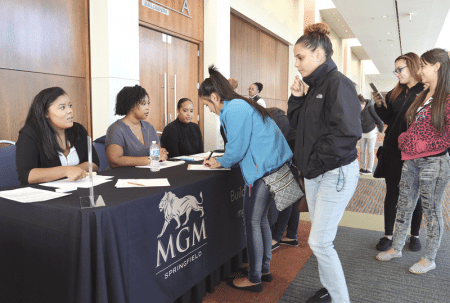
mathiswelcomeemploy16-launch-4-mmm

‘career launches’ to be staged by MGM

Above, Mike Mathis addresses those gathered at the first of several ‘career launches’ to be staged by MGM. Below, interested job seekers register at the event.

He deployed it with reference to everything from recruiting and hiring a workforce of 3,000 to investing in the Western Mass. community, to making the casino part of the community it’s located within.

It’s all part of what he called a template, one already being followed by another of the company’s properties, the $1.2 billion MGM National Harbor in Maryland.

That facility is set to open Dec. 8, and its website asks the question, “we’re almost ready. Are you?” It helps get people ready by hyping everything from career opportunities to upcoming shows (Bruno Mars will open the facility’s theater on Dec. 27); from rewards programs to the eclectic lineup of restaurants.

Such buttons will not be on the MGM Springfield website for maybe another 18 to 20 months, but the process of adding them will be an intriguing spectator sport unto itself.

For this issue, BusinessWest talked with Mathis about this template for opening a casino and what the region should expect as the calendar turns first to 2017 and then 2018.

Craning Their Necks

As he talked about those aforementioned best practices — or, more specifically, developments that might not be worthy of that descriptive phrase — Mathis referenced a long-established trend within the gaming industry and the hospitality industry in general.

That would be nametags that reveal not only an employee’s name, but where they’re from. Common in casinos and on cruise ships, these nametags and the information they provide often spark conversations and creates connections, he noted, adding that he believes that one mistake most facilities in Atlantic City have made is not having enough nametags with what would be considered ‘local’ cities and towns listed underneath the names.

“A lot of the employees come from outside of the city,” he said. “When you go to Atlantic City, you just don’t see ‘Atlantic City’ on the nametags very much. They’re working on it, but started behind the eight-ball, because there wasn’t that focus early on, and when you do that, the economic benefits don’t stay in the host community.”

That’s one mistake he’s intent on not replicating. “When we open MGM Springfield, we hope a third of workers have a nametag that says ‘Springfield, Mass.’ on it.”

But making that goal reality is an involved process, he explained, one that is already officially underway, a full two years before the casino is set to open its doors.

Indeed, one manifestation of that effort was the recent ‘career-launch’ session staged in one of the ballrooms at the MassMutual Center. As that name suggests, this program, the first of many to be conducted over the next several months, was crafted to inform attendees not so much about the various job opportunities to be created by the casino (although there was some of that), but instead about how to prepare oneself to be qualified for them.

Elaborating somewhat, the session introduced attendees — and there were more than 150 of them — to something called the ‘Skillsmart profile,’ something interested job seekers must build through an online portal. The profile tells them, in essence, what positions they’re already qualified for, if any, what skills they’ll need to be qualified for others, and, perhaps most importantly, how and where to attain those skills they’ll need.

As noted, the room was full of enthusiastic job and information seekers, and Mathis said MGM worked hard, and had some help from area workforce-related agencies and institutions, to make sure the seats and standing areas were fully occupied.

Construction crews are rapidly changing Springfield’s skyline

Construction crews are rapidly changing Springfield’s skyline in the South End, and will continue to do over the next 23 months.

Such efforts were necessary, he told BusinessWest, because too many people are still of the opinion that two years out is too early to start thinking about possible job and career opportunities. The reality is just the opposite, especially if specific training is needed, he went on, adding that, overall, the next 24 months will fly by very quickly.

And to be fully ready for opening day, MGM, the construction crews working in the South End, city officials, and job hopefuls themselves have to start with the September 2018 opening date, work backward, set hard deadlines for getting things done, and even anticipate that all will not go smoothly and build in some cushion — if and where that is even possible.

Indeed, while construction crews certainly benefited from the non-winter that deprived Mathis’s children of a cherished snow day or two, you won’t hear anyone even think of using the phrase ‘ahead of schedule,’ he noted, even if they might be tempted to do so, because much can change quickly. Moreso than in Las Vegas, for example, where high winds can pose a problem, but other than that, weather is not a factor and work continues all year.

“In New England, for us, it’s about the winters and managing to those construction milestones,” he said, referring to a set of deadlines that must be met to keep the project on track, schedule-wise. “And we’re in great shape going into this winter, because the groundwork is done, and now the garage is going up; it’s pre-cast concrete that comes from off-site, and it gets stood up and erected.

“And we’re now putting steel beams down for what we call the podium — the casino area leading to the hotel,” he went on. “Once the garage goes up, we’re all over the site, creating that first- and second-floor podium, and then, in the spring, you’ll start to see the hotel come up on Main Street.”

By the winter of 2017-18, the last one MGM will face, work will have moved indoors, he said. “So, knock on wood, we feel really good about the September 2018 opening, because of how we hit these winter milestones.”

Workforce in Progress

While the construction work is highly visible, especially to those occupying the high-rise office towers with southerly views, the work to build a workforce will be carried out mostly behind the scenes.

But like the construction efforts, the task of recruiting, hiring, and training a workforce faces stern deadlines, and the clock is certainly ticking, said Mathis, adding that, in many ways, staffing this casino will be much different than doing so in Las Vegas or other areas where there is a large hospitality workforce already in place, much of it with casino experience.

“There is no existing casino industry for us to pull from,” he said, adding quickly, however, that there are casinos outside the Hartford-Springfield area, and some individuals working at these venues may be drawn to Springfield by the MGM name and its reputation.

“We have such a great brand, and we don’t have a flag in the region,” he explained. “So I think there is a lot of pent-up excitement with some of the employees with our competitors, waiting for us to open and join the MGM family.

“How many Atlantic City dealers, Connecticut dealers, pit bosses, marketing analysts, and others will be interested in relocating? We don’t know the answer to that yet,” he went on. “But there’s going to be considerable interest, and we’re starting to get a lot of inquiries. Our job is to take some of those people, because you need experienced individuals, but also to remember our commitment, which is to provide opportunities locally, which is why we’re focused on early workforce development.”

Overall, this will be a competitive, detailed, and time-consuming process on many levels, he told BusinessWest, noting that roughly 3,000 jobs will be created, and, on average, at least seven people will be interviewed for each one.

Roughly one-tenth of the workforce, 300 or so jobs at the administration level, will obviously be filled by individuals with considerable casino-industry experience, Mathis noted, adding that most, if not all, of these employees will be moving into the area.

That will create a dynamic of its own, he went on, adding that these individuals and their families will need homes, schools, banks, doctors, country-club memberships, and much more.

“I’m excited by the prospect of a new crop of energetic, highly motivated, civic-minded professionals coming to the area — there will be a huge infusion of energy into the downtown,” he said, noting that many of these professionals will be Millennials, and therefore likely open to the idea of not only working in downtown Springfield, but living there as well.

As for the other 2,700 jobs, ones Mathis said individuals can be “trained into,” one-third of them will be targeted for Springfield residents, with another 55% destined for those living within a larger circle covering Western Mass. and Northern Conn., adding that, across the board, the company is seeking what it calls “best-in-class workers.”

A 200-foot crane

A 200-foot crane now pierces the sky in Springfield’s South End, foreshadowing a new era in the region’s history.

To fit that description, most candidates will require training, some form of certification, or both, he noted, while explaining, again, that those with designs on working for MGM should set those wheels in motion soon, as in now.

Which brings him back to the SkillSmart profile and career launches like the one earlier this month. They are the key, he said, to fulfilling MGM’s commitment to the region and maintaining the company’s high standards for its workforce.

“Our team’s obligation, and our commitment to the shareholders and to the city, is to open a successful facility with best-in-class workers,” Mathis explained. “That we’ll do — there’s no question in my mind we’ll do that.

“The question is, where will those workers come from?” he went on. “If we’re not able to be successful — I believe we will be, but if we’re not — when it comes to sourcing them locally, then more and more we’ll have to tap into those outside markets.”

The workforce will be built gradually, he went on, adding there will likely be at least 50 people drawing paychecks from MGM Springfield in 2017 (many of whom will be those aforementioned managers recruited from outside the area), with that number growing steadily over the first few months of 2018 and then accelerating markedly, especially with dealers in training, security personnel, culinary staff, and others, three to six months out.

Anticipation…

While MGM goes about building the casino complex and its workforce, it will also be building the brand and anticipation for it, said Mathis, adding, once again, that two years out certainly isn’t too early for those efforts, either.

Elaborating, he said the company will do what it can to keep its efforts in the public eye and generate excitement for what is to come. Examples include everything from press gatherings, such as the one staged when the huge, 205-foot construction crane was maneuvered onto the site and then assembled, to the video shown at the career launch, footage depicting a fast-paced, highly energetic environment that had many in the audience ‘oohing’ and ‘aahing.’

Mathis refers to these as opportunities to “wow people,” and there will be plenty of them in the weeks and months to come, such as when retail establishments are inked or restaurants (there will be 10 of them, according to the latest count) are announced.

Like building the complex and creating a workforce, this work to build a brand is also a process, one with its own timeline and milestones, he said. For now, the news is mostly about SkillSmart and career opportunities, as well as developments in construction, but over time, the focus will shift toward the MGM brand itself and what it will bring to the region.

With that, Mathis returned to the Grand Harbor project, its template, and the ‘teaser campaign’ now in what would be considered overdrive.

“This is imagery about what this project is going to mean in terms of entertainment,” he explained, referencing everything from the website to billboards to TV commercials. “Their themes are, ‘this is going to be monumental.’

“This is a teaser campaign with a few representative images of brands within the resort, some of the chefs, some of the people who are going to be working at the resort,” he went on. “Then, 30 days out, we’ll get a lot more specific about restaurant names and shows that are coming and different promotions that will surround the opening. We want to convey the message: ‘this is getting real, here’s a date, start getting excited about it.’”

The same template will be followed in Springfield, Mathis went on, adding that the specific strategy is much different when a property is roughly 700 days out as opposed to 30, 60, or even 90.

Construction of the casino complex

Construction of the casino complex is only part of the challenge facing MGM. The company is also building a workforce — and anticipation for the company’s brand of entertainment.

For now, MGM is content to provide updates, offer limited renderings of what’s being built (not everything the company is doing is ready for public — and the competition’s —consumption), and build anticipation.

And the excitement shouldn’t be limited to simply the casino, he went on, adding that it is simply one of many developments (CRRC’s rail-car manufacturing facility being another) that will bring hundreds of young professionals, additional vibrancy, and greater attention to Springfield and the surrounding region.

‘Catalytic’ was the word Mathis used to describe the impact and its overall influence, which he believes stretches to the decision to open a Mercedes dealership in Chicopee and the city’s recent ranking among the nation’s “most overlooked cities for business opportunities.”

“We’re getting national recognition for the kind of investment we’re making,” said Mathis, referring specifically to that ranking, but also more positive press for Greater Springfield in general. “All that talk about this project as economic development and having ancillary benefits to the surrounding areas … it’s happening; it’s working.”

Date with Destiny

Mathis noted that, once Springfield’s casino opens, it will be like a 7-Eleven, meaning it will always be open.

“There are no locks on the doors because there’s no locking the door,” he said, revealing something else that most in this region probably didn’t know about gaming establishments.

To get this $950 million 7-Eleven ready for prime time will be a huge undertaking, he went on, adding that, while 23 months seems like a long time — 100 weeks, two more baseball seasons (plus the end of this one), and nearly half of someone’s first term as president — it really isn’t.

Not when the assignment is to build a casino complex, build a workforce, and build excitement for the brand. To do all that, time is of the essence.

George O’Brien can be reached at [email protected]

Opinion

Opinion

By John B. Cook and Ramon S. Torrecilha

At a time when the Institute of Medicine is pushing to increase the number of nurses with bachelor’s degrees by 80% nationwide by 2020, Springfield Technical Community College and Westfield State University are taking the lead with a recently announced partnership.

In Western Mass., nursing professionals with the Mass. Action Coalition (MAAC) are implementing the Massachusetts Nursing Workforce Development Plan. Their goal is to increase the percentage of nurses with bachelor degrees in Massachusetts to match the national goal of 80% by 2025.

In early October, after months of planning, our two sister public institutions made official the STCC-Westfield State University RN-to-BSN completion program. This accessible and affordable program will help fill the Massachusetts workforce with highly skilled nursing professionals.

Registered nurses who have obtained an associate’s degree from STCC’s accredited nursing program will then transition to the accredited Westfield State BSN (bachelor of science in nursing) program. Students will be guided by a streamlined, transfer-friendly ‘curriculum map.’ This ensures a student will maximize his or her time in transferable courses.

Aside from the benefit of helping to create a more highly educated workforce, the STCC and Westfield State partnership illustrates a shared commitment to nurturing this segment of the workforce. Not only will the program help to create more highly educated nurses in Massachusetts, it means countless benefits to the thousands of patients and families the future nurses will serve throughout their careers.

According to MAAC, the more than 143,000 nurses licensed in Massachusetts represent the largest segment of healthcare workers.

Graduates of the new STCC-Westfield State completion program will help MAAC as it works to increase the percentage of nurses with bachelor’s degrees. Enrollment in the STCC-Westfield State program begins in spring 2017.

The new program represents the type of program that both institutions seek to establish to fulfill their comparable high-access, low-cost missions. The partnership allows STCC and Westfield State to further put into action their mutual commitment to convenient pathways to accessible, affordable degrees. With a price tag of only $10,500, the RN-to-BSN program is the most cost effective in the area.

Massachusetts state colleges and universities are not necessarily lauded for their transfer-friendly articulation agreements, according to state Department of Higher Education Commissioner Carlos Santiago, who spoke at the Oct. 4 signing event to announce this new public-to-public partnership.

During the ceremony, Santiago also said nursing programs, in particular, are difficult to mesh, given the amount and caliber of requirements for nursing degrees. STCC and Westfield State’s partnership, however, breaks the mold and can serve as a model for other institutions to follow to ensure seamless transitions for nursing students seeking a bachelor of science in nursing degree.

The new partnership stands as the first hybrid RN-to-BSN, public-to-public completion program in Western Mass. Westfield State faculty will teach mostly online courses, but will be on site for select courses. Although taught by Westfield State faculty, the courses will be held on STCC’s campus, offering convenience and a familiar setting to the registered nurses with associate’s degrees from STCC who are eligible.

The program will allow students to transfer up to 90 course credits from STCC to Westfield State. Students will need to complete the last 30 credits for their bachelor’s degree, for a total of 120 credits.

Having both entered our presidencies within the past year, we see this program as the first of many innovative partnerships, as we collaborate to bring accessible and affordable education opportunities to the Western Mass. region.


John B. Cook is president of Springfield Technical Community College; he began his new role in August. Ramon S. Torrecilha is president of Westfield State University; he was appointed president in December 2015 and was officially invested earlier this month.

Daily News

By Holly Chaffee

Across Massachusetts, more than 110,000 senior citizens and individuals with disabilities receive healthcare services in their homes from skilled home-healthcare providers. These services help individuals recover from surgery, recuperate following a hospitalization, or manage a chronic health condition that needs frequent monitoring. Thanks to the Medicare home-health benefit, these patients receive timely, safe, and effective healthcare when they need it most and in the location they prefer — their own homes.

Home healthcare is an incredibly convenient delivery model for healthcare, but it is also far more. Skilled home healthcare has become an essential service that doctors depend upon to ensure their patients experience the best possible outcomes. These days, many doctors even require it before they will discharge a patient home from the hospital. It is also a valuable Medicare benefit that has been shown to save millions of dollars annually in reduced hospital readmissions and nursing-home stays.

Unfortunately, the ongoing availability of this trusted care here in Western Mass. and across the state could soon face incredible challenges. A new pilot program from the Centers for Medicare and Medicaid (CMS) threatens home-healthcare reimbursement as it requires a ‘pre-claim review’ before a patient’s care is approved for coverage by Medicare. Under new guidelines aimed at reducing fraudulent claims, care could be delayed while third-party government contractors — who are not healthcare providers and have never met the patient — review paperwork and decide whether or not care is actually ‘medically necessary.’

The program’s initial implementation in Illinois demonstrated that the pre-claim review demonstration is deeply flawed and should be halted before implemented in the other targeted states, including Massachusetts.

Over the years, Porchlight VNA has been fortunate to provide services to thousands of patients in our community. And our providers unequivocally know that care delays and denials like those seen in Illinois spell disaster for many vulnerable homebound patients who depend on us.

The days following an injury or hospitalization are often the most precarious and are when complications are most likely to occur. Without the readily available, medically necessary home care prescribed by a doctor, a patient is far more likely to experience readmission to the hospital. Oftentimes, this is due to unintended side effects from a new medication, an easily treatable infection which progresses to something far more serious, or even a dangerous fall because of decreased mobility. These are the types of poor healthcare outcomes that Porchlight VNA is vigilant about preventing, but that are certainly destined to increase if pre-claim review for care delays our ability to intervene. Helping local patients stay out of the hospital in their best state of health has always been, and will continue to be, our number-one goal at Porchlight VNA.

Therefore, I strongly urge our local and state lawmakers to stand up for those constituents in need of home health and support legislation to delay CMS’ pre-claim-review demonstration. The Pre-Claim Review Undermines Seniors’ Health (PUSH) Act of 2016, sponsored by Massachusetts state Rep. Jim McGovern, would pause the Medicare demonstration for one year to allow Congress, Medicare, and home-health stakeholders to work together to correct the program’s flaws. This would ensure patient care is not delayed and that individual beneficiaries are not unjustly denied coverage when they need it most.

I hope that residents of the Western Mass. — whether they have ever personally benefited from home-healthcare services or not — will urge our lawmakers to sponsor the PUSH Act. The well-being of our community’s home-health patients depends on it.

Holly Chaffee is CEO of Porchlight VNA/Home Care and chairman of the board of directors of the Home Care Alliance of Massachusetts.

Opinion

Opinion

By W. Scott Butsch, MD, MSc, and Fatima Cody Stanford, MD, MPH, MPA

For more than a decade, obesity has been recognized as an epidemic condition in the U.S., and the numbers certainly justify the characterization.

Statistics from the U.S. Centers for Disease Control and Prevention show that more than 36% of adults have obesity, and a report from the Trust for America’s Health and the Robert Wood Johnson Foundation declares that not a single state in the union has an adult obesity rate of less than 20%. While the obesity rate for children is lower, it, too, is alarming: 17% of Americans aged 2-19 years — nearly 13 million children and adolescents — struggle with obesity.

Despite enormous attention and numerous programs to reduce obesity — by federal, state, and local governments, community agencies, businesses, schools, and others — the high numbers persist, putting millions of Americans at risk of some of the leading causes of preventable death, such as heart disease, stroke, type 2 diabetes, and certain types of cancer.

The standard means of measuring obesity is the body-mass index (BMI), a formula that estimates a person’s total body fat based on height and weight. Someone with a BMI of 25-30 is considered overweight; a BMI of 30 or more is classified as having obesity. While BMI is a useful tool to estimate health risk, examining obesity and its health risks on an individual basis is more complicated than just determining a single number.

When we’re born, our bodies contain a certain number of fat cells, which is important, because they store fat for energy. Fat cells accumulate in childhood, but when we become adults, our bodies don’t gain additional fat cells; these cells just increase or decrease in size.

That increase or decrease in the size of the fat cells is what leads to weight gain or loss. This is important to understand, because it is the amount of fat in a person’s body that relates to health risks and raises concern among physicians. That’s why prevention in childhood is so critical: if a person is overweight or has obesity as a child, it is likely that overweight and obesity — and the accompanying conditions of poor health — will follow as an adult.

Conventional wisdom has thought of obesity as primarily a lifestyle issue, even a character flaw, with people simply eating too much and not getting enough physical exercise. However, research over the last two decades describes a highly complex system that controls our body weight, with many other factors besides diet and exercise, in addition to our own biology, contributing to obesity.

Also within the past few decades, our environment has changed dramatically, and some of those changes have led to weight gain in individuals predisposed to obesity. A proliferation of fast-food restaurants, exposure to high-calorie foods, and the easy availability of processed foods, reduction in sleep, increased stress in a fast-paced world, and a tendency toward more sedentary lifestyles encouraged by technological advances all have played a role in weight gain.

Diet and exercise are important, but they’re only parts of the puzzle. Consideration of diet, for example, should reflect not just how much we eat, or how we limit portion size, but what we eat. Eating more healthful foods, with an eye on nutritional content, is a much better approach. That’s why it’s important to read and understand the nutrition labels on food. The new nutrition facts label, announced by the U.S. Food and Drug Administration in May, should be a step forward in helping consumers make better choices about the foods they purchase.

Other factors can also lead to being overweight or having obesity, such as the quality and quantity of our sleep, and even certain medications, like anti-depressants and medications for high blood pressure, may contribute to weight gain.

For patients with overweight and obesity, it is important to recognize the associated adverse effects on health over a lifetime. It is equally important for those patients to engage in a critical self-assessment, preferably with a physician, on all of the factors that can be linked to weight gain, to see where improvements can be made to help reduce weight.

Dr. W. Scott Butsch and Dr. Fatima Cody Stanford are physicians at the Massachusetts General Hospital Weight Center and members of the Mass. Medical Society’s Committee on Nutrition and Physical Activity. This article is a public service of the Mass. Medical Society.

Education Sections

Unequal Rights?

Bill Spirer

Bill Spirer says ballot Question 2 is about expanding charter schools in underperforming districts where students historically have had few options.

Todd Gazda stopped along the Riverwalk in Ludlow to admire the view a week ago and began talking with a senior citizen who was relaxing at the site.

“As soon as he found out who I was, he asked me what I thought of Question 2,” said the Superintendent of Ludlow Public Schools, adding that the gentleman was extremely interested in the issue.

Indeed, the question that will appear on the November ballot is significant because it is the first time in state history the public will have the opportunity to voice their opinion about school choice.

If passed, Question 2 would give the state Board of Elementary and Secondary Education the authority to approve 12 new charter schools or expand existing charter schools as a result of increased enrollment every year beginning Jan. 1, 2017. Priority would be given to applicants in public-school districts that score in the bottom 25% on standardized tests two years before their application. In addition, the Board of Elementary and Secondary Education would establish standards by which annual performance reviews would be judged.

The question has generated strong feelings, heated arguments, and major fund-raising campaigns: when BusinessWest went to press, proponents had raised $18 million and opponents $12 million, most of which will be spent on TV ads.

The debate began in earnest last year after Gov. Charlie Baker, who is a strong a proponent of charter schools, introduced a bill to increase their number in the Commonwealth. The Senate revamped the proposal before passing it, but it was rejected by the House, which didn’t support the changes that had been made.

Lawmakers continue to be heavily divided on the issue, but after the House rejected the bill, the Mass. Charter School Assoc., Great Schools of MA, and Democrats for Education Reform led an effort to get the question on the ballot to increase options for the 32,000 students on charter-school waiting lists.

Both sides have powerful arguments. Opponents say charter schools don’t serve the same number of English-language learners (ELL) and students with profound special needs who require costly services; the admissions process is unfair to students whose parents are not interested in their education or don’t have the skills needed to seek information or enrollment in alternate schools; the state has failed to provide the level of reimbursement promised to public schools when a student leaves their district for a charter school; building and staffing costs don’t decrease when students leave; and charter schools are not subject to the same standards as district public schools, which makes it easy for them to eliminate students with behavior problems.

Todd Gazda

Todd Gazda says the amount of money Ludlow loses every year to charter schools is more than the amount allotted to run an elementary school.

Proponents argue that they admit students by lottery and serve a diverse population; their behavioral standards are strict but fair; their academic results are higher than urban and suburban schools; they offer students in low-performing districts a chance to get a high-quality education; the funding formula does not discriminate because money allocated to each student in a district simply follows them; and they are actually public schools that are open to all students and don’t charge tuition.

But both charter- and public-school directors and superintendents agree that money is an important issue because schools across the state are grossly underfunded.

“My fear is that the debate over charter schools will divert attention from the bedrock issue of school funding in general,” said Northampton School Superintendent John Provost, referring to a study conducted last year by the Foundation Budget Review Commission, which looked at the formula used to fund public schools and found a $1 billion deficit.

The Mass. Assoc. of School Superintendents thinks the amount is closer to $2 billion, and Provost argues that the ballot question is secondary to financial problems facing all public schools, which include charters.

“I feel it’s the wrong policy to be voting on at this time,” said Provost. “Charter schools were created when the education budget was growing, but in many communities funding has been stagnant since 2008, and it’s a matter of diverting money from a pie that is not growing.”

Karen Reuter

Karen Reuter says charter schools were founded to model innovation and specialization, and were not meant to replace public schools.

Sabis International Charter School Director Karen Reuter agrees that state funding for education is inadequate. “If we could raise the bar for every student, maybe we wouldn’t have to have such an oppositional agenda,” she noted.

But she says the issue comes down to access to quality education, which makes the ballot question important.

For this edition and its focus on education, BusinessWest looks at arguments on both sides of the question and what will be at stake when voters go to the polls.

Shortchanging Students

Barbara Mandeloni, president of the 110,000-member Mass. Teachers Assoc., says $450 million diverted from district public schools to charter schools has had considerable consequences, and some schools have had to cut support services to children with special needs, while others have cut teachers or language classes and other extra curricular programs.

“Public schools represent the best of who we are and contribute to the common good; they are not about individualism, but about a shared sense of purpose and something bigger than ourselves,” she said, adding that the New England NAACP is a leader in its coalition and Black Lives Matter has called for a three-year moratorium on charter schools because, critics say, they are creating a two-tiered system that is resegregating schools.

“We need to defeat this bill, then have a conversation about funding so we can give every child the opportunity to have a broad and rich curriculum and access to resources,” she said, adding that many charter schools have discipline standards that force students with behavioral issues out.

Daniel Warwick

Daniel Warwick says charter schools have a large, negative impact on Springfield’s public schools.

Springfield School Superintendent Daniel Warwick says adequate funding for urban schools has always been a problem, and they barely make the minimum net school spending needed to educate each child. And the impact of charter schools on the Springfield district has been tremendous; they lose $41 million each year to charters and are reimbursed only $6 million, but still have to educate an extremely diverse population that includes many refugees who have undergone tremendous trauma in refugee camps, as well as a large number of students with profound special needs, including some who enter the ninth grade after never spending a day in a school.

“We have the most difficult students to educate. There are a lot of English-language learners and students with special educational needs who are the most difficult and costly to educate in terms of achievement results,” he said, noting that, although charter schools say they do outreach, the percentage of high-need special-education students they serve doesn’t rival that of the sending district, which is a nuance in achievement levels that hasn’t been addressed.

He thinks equal access to education would mean that charter schools hold lotteries that include all students in their district, not just those whose parents are motivated to fill out application forms, which is often prohibitive due to language and socioeconomic barriers.

“If we are going to continue the charter-school movement, there are issues that need to be addressed, and making sure their populations match their sending communities in every way is one of them,” he said, adding that, if charter schools are not educating the most needy students, their achievement results need to be called into question.

“It’s a lightning-rod issue on either side, but from the perspective of public-school funding and student-assignment structure, it is particularly troubling because once you go to a lottery system you are dealing with a different population,” Warwick continued, noting that the demographics in the city’s magnet schools also differ, especially in terms of parent involvement.

Springfield schools had to cut $13 million from a budget this year that was already underfunded by $10 million, and the loss was increased by a $3 million shortfall from the state’s failure to reimburse them appropriately for students lost to charter schools. Another $5 million was lost to school choice, which doesn’t account for the fact that Springfield has to provide transportation for these students.

“We have had to cut direct services to kids and 56 positions from our central office,” he said, “and class sizes will continue to grow if the funding stream isn’t changed.

“If we were funded according to the findings of the Foundation Review Commission’s recommendations, we would have $25 million more this year to adequately address the students we serve,” he went on, adding that this is a social-justice issue.

Gazda agrees, and says proponents argue that Question 2 comes down to school choice.

“But when you dig deeper, the facts below the surface reveal a different picture; we are one of relatively few districts who lose very few students to charter schools, but geography does make a difference,” he explained. “Charter schools are being held up as a better alternative, and that narrative is just not true; their students don’t perform remarkably better than most public-school students.”

The state is supposed to reimburse district schools 100% of the money they lose the first year a student switches to a charter school, and 25% for each of the following four years. But not only has it cut school funding in general, it has not come close to meeting those numbers.

Ludlow lost 19 students to charter schools in FY ’16, which cost $434,878, but was reimbursed only $122,467.

“It had a marked impact on us and the things we could do. In a school system the size of Ludlow, $300,000 can go a long way,” Gazda said, adding that there is no way for local school boards to judge whether charter schools are using funds efficiently.

In addition, charter schools were originally created to have the flexibility to be innovative in creative ways and share their best practices with local school districts, which Gazda says has not happened.

“The way the system is set up is competitive and almost adversarial, because of the flow of resources away from district public schools. It has the effect of creating a tiered education system, particularly in urban areas,” he continued, noting that parents in urban areas often cannot afford to move to towns with better school systems; Ludlow has a wait list of 350 students for school choice, and the vast majority are from Springfield.

He said a single mother who wants the best for her child often views charter schools as a place where the child can be saved. “But my answer is to fully support public schools so we can change the environment in all schools.”

Northampton recently commissioned a survey of charter-school parents to learn why they were opting out of their neighborhood schools.

“It showed the charter-school population is very unique in terms of demographics; 100% of the parents said they had a college degree, the majority had graduate degrees, and their household incomes were far above the incomes of local families,” Provost said.

Last year, Northampton Public Schools received about $644,000 less from the state than in 2010. The city has 200 students in charter schools, which equates to $2 million in lost revenue each year, and although none of their elementary schools is that small, $2 million is far more than the amount appropriated to each school.

“The main impact is the loss of programs we can provide,” Provost said, adding that more than 20% of their students have disabilities.

Different Agendas

Dominic Slowey says the governor modeled his original bill on a draft ballot question put together by charter advocates.

“The majority of charter schools are in urban districts that are underperforming, and the ballot question is their last resort,” said the spokesperson for the MA Charter School Assoc. “Springfield only has room for one more charter school with 400 to 500 seats, and many cities, including Holyoke, Lawrence, Lowell, and Fall River, have reached their cap. In many cities, parents don’t have enough high-quality public-school options, but charter schools have worked to fill that gap and put them on an even keel with communities like Longmeadow, Wellesley, and Amherst.”

He added that charter schools have reached out to low-income African-American and Latino families, and by every independent measure, the schools have outperformed not only urban schools, but suburban schools.

There are 72 charter schools operating in the state, and the approval process is difficult, so only three to four schools a year make the grade.

Proponents also explain that charter schools are heavily regulated by the state; their finances and academic progress are monitored annually and they must continue to set new goals. In addition, they are subject to a five-year review, and if they fail to live up to their charter, they can be placed on probation or closed, which has happened to two Springfield charter schools.

Sabis International Charter School in Springfield serves children in kindergarten through 12th grade who reside in the city. It has won national awards since it was founded in 1995 and has a waiting list of 2,900 that is rigorously combed every year to ensure it is accurate, which has been done in response to arguments that the waiting lists for charter schools are outdated and inaccurate.

As at other charter schools, admission at Sabis is by lottery for the 100 kindergarten seats each year, and since its retention rate is 90%, there are few backfills.

Sabis is housed in a beautiful facility backed by Sabis Educational Systems, but Reuter says some charter schools are financially challenged and have to engage in considerable fund-raising.

“But money doesn’t guarantee positive outcomes,” she said, noting that she has served in a variety of educational settings, including a stint as a union teacher in New York City. “Education is a changing landscape with new standards and assessments, and this bill is really about whether students can access quality education. But it’s a shame that we have gotten to a place where people have to vote, because we all want the same thing: to provide the best education possible for every student.”

Historically, the school’s population has been equally divided between Caucasian, Hispanic, and African-American students, but recently the number of Hispanic students has increased, and the Asian population is growing. Its ELL population is very small, and only 14% to 16% of those students have special-education needs, but Reuter said they are seeing an increase of students with profound special needs and had to create a separate classroom setting for them last year.

“We don’t serve the same range of special-education students as public schools, but charter schools were not meant to replace public schools,” she told BusinessWest. “They were meant to model innovation and specialization.”

Its sister school in Holyoke serves children in kindergarten through grade 8, and although parents would like to see it expand to the high-school level, the city has reached its cap.

However, Reuter says graduates outperform their peers in Holyoke High School, and it’s unfair that parents and students can’t continue their education at the school of their choice.

Springfield Prep Charter School opened in Springfield last year with a kindergarten and first grade. A second grade was added this year, and founder Bill Spirer’s hope is to expand to grade 8 by the 2022-23 school year.

There are two full-time teachers in every classroom, and the school has an extended day that runs from 7:50 a.m. to 4 p.m. and a slightly extended school year. All students come from Springfield, and outreach efforts are done in English and Spanish at Head Start programs by volunteers, who also knocked on doors in the city’s South End last January distributing flyers about the school, which has a one-page application.

“Massachusetts has one of the strongest records of charter-school performance in the county, and the data in this state is really clear; charter schools are very effective, especially in urban areas where there haven’t been many good options for parents,” Spirer said, adding that his facility’s demographics mirror those in Springfield Public Schools and nine out of 10 students are from economically disadvantaged families

Richard Alcorn, executive director of Pioneer Valley Chinese Immersion School in Hadley, says it provides a unique curriculum and wants to expand to a fully articulated K-12 program.

“The charter schools in Hampshire and Franklin counties really serve as alternative schools,” he noted, adding that his school serves students from 30 districts and 17.5% are from low-income families, which is lower than urban centers, but higher than the school’s host community, where 13.2% of students fall into that category.

But he agrees that funding is inadequate for all schools. “People need to step back and look at what is going on in public education. The impact of charter schools is very small and has nothing to do with the real problem of funding and what is going in terms of demographics,” he told BusinessWest.

Far-reaching Implications

Charter schools all have different missions and leadership, and serve different communities, so Spirer says they can’t be classified with the same adjectives.

“It’s a very complicated issue that has different implications for districts of different sizes. But the ballot question is still about the most underperforming districts,” he explained.

Gazda says perception is reality, and right now the narrative coming from Boston and Washington is that public schools are failing, which is not true.

“However, we need new solutions rather than garnering old ones that don’t work,” he said.

These wide-ranging observations and opinions only scratch the surface when it comes to the high levels of debate and controversy that define ballot question 2. About the only certainty is that the matter is now in the hands of voters.

Health Care Sections

Joint Concerns

PotEdible

By all accounts, the medical-marijuana industry in Massachusetts is booming, and now voters must decide whether to take the next step, and legalize the drug for recreational use. While the measure — appearing as a ballot question on Election Day — applies to users age 21 and up, doctors worry that easy access for adults will trickle down to teenagers, while candy-like marijuana ‘edibles’ could find their way into the hands of kids. Meanwhile, they wonder whether the state, already in the grips of an opioid-addiction crisis, is walking into an entirely new set of public-health problems.

Vermont Gov. Peter Shumlin makes no secret of his stance on marijuana. He’s long promoted legalization of the drug for recreational purposes, as Colorado, Washington, Oregon, and Alaska have done and other states, including Massachusetts, are considering, and he’s spoken and written at length about why pot possession shouldn’t be a crime, but an open, regulated activity.

In short, he’s as pro-marijuana as a governor can be.

Yet, he thinks Massachusetts has a terrible ballot question on its hands.

The marijuana-legalization bill up for referendum on Question 4 of Massachusetts’ Election Day ballot, Shumlin argues on his blog, “would allow edibles that have caused huge problems in other states, smoking lounges, home-delivery service, and possession of up to 10 ounces of marijuana. Vermont’s bill allows none of that. If Massachusetts moves forward with their legalization bill while Vermont delays, the entire southern part of our state could end up with all the negatives of a bad pot bill and none of the positives of doing the right thing.”

If a pro-pot governor has such harsh words for the Massachusetts bill, it’s not hard to imagine what medical professionals think.

“We’re concerned for a number of reasons — about recreational marijuana in general and this particular ballot question,” Dr. James Gessner, president of the Mass. Medical Society (MMS), told BusinessWest. He noted that the human brain is still developing throughout one’s 20s, and among the late-developing areas of the brain are those governing judgment issues.

Dr. JameS Gessner

Dr. JameS Gessner

“Marijuana is the single most commonly used drug among adolescents and has significant effects on the developing brain, impairs memory and judgment, and, with early, prolonged use, can have a distinct, negative effect on intellectual development,” he went on. “My concern is really with the unexpected consequences on youth and adolescents. At a time of risk taking in their lives, this drug really blunts judgment.”

If that’s true, then what the Massachusetts bill does, opponents argue, is make it far easier for adults — and children — to get their hands on a harmful substance they might have avoided before simply due to fear of legal consequences. The bill would also lend a veneer of respectability to marijuana, said Dr. Robert Roose, chief medical officer, Addiction Services, for the Sisters of Providence Health System.

“The main concern is providing access to psychoactive substances that have negative consequences for some individuals, and sending a message that marijuana products are safe and beneficial, when there’s really not strong evidence to suggest either of those things may be true,” Roose told BusinessWest.

Some of the state’s top leaders echo this view. In an opinion piece in the Boston Globe earlier this year, Gov. Charlie Baker, Attorney General Maura Healey, and Boston Mayor Martin Walsh argued that marijuana is not safe — citing risks like impaired brain development, disinterest in school, and motor-vehicle accidents — and increasing access to it makes little sense at a time when the state is already grappling with a well-documented opioid-addiction epidemic.

“There are serious and immediate implications for public safety,” they wrote. “In the year after the drug was legalized in Colorado, marijuana-related emergency-room visits increased nearly 30%, as did traffic deaths involving marijuana. Edible marijuana products — often in the form of brownies, candy, or soda — pose a particular threat for children, who may mistake them for regular treats.”

They cited a report from the Rocky Mountain High Intensity Drug Trafficking Area, which found that marijuana use has decreased among minors nationwide in recent years, but Colorado youths are 20% more likely to have used the drug regularly since it became legal for adults two years ago. “Many believe that, since the drug is legal for adults, it must be safe to use.”

That trickle-down impact on young people is one key driver — though far from the only one — in a growing movement in the medical community to convince voters to defeat the marijuana-legalization measure in November. Time will tell whether those efforts will bear fruit.

Opposition Mounts

Earlier this year, the MMS joined the Campaign for a Safe & Healthy Massachusetts, a coalition of health and community leaders established to oppose the ballot question allowing commercial sale of marijuana for recreational use. Other members include the Mass. Hospital Assoc., the Assoc. for Behavioral Healthcare, the Massachusetts Assoc. of Superintendents, the Massachusetts Chiefs of Police, all Massachusetts district attorneys, and an array of state leaders including Baker, Walsh, and House Speaker Robert DeLeo.

While a vote four years ago to legalize medical marijuana hasn’t been without controversy — doctors still worry about prescribing a product that’s still illegal under federal law — recreational pot presents a completely different set of issues.

“There’s a lot of data about kids that use marijuana heavily and face school failure, failure to graduate, difficulty keeping a job,” Gessner said. “Plus, it’s smoked. We’ve spent 50 years talking about the dangers of smoking. This is simply another form of lung attack.”

Gessner also raises the potency issue, arguing that the active ingredient in marijuana — known as tetrahydrocannabinol, or THC — typically comprised about 5% of marijuana in the 1970s, while the current potency can approach 30%, though it varies from batch to batch. In Colorado, the average THC percentage has been around 17%.

Dr. Robert Roose

Dr. Robert Roose says it makes little sense to legalize marijuana while the state combats an ongoing opioid crisis.

But even recreational-marijuana supporters, like Vermont’s governor, find the bill currently up for referendum in the Bay State to be a deeply flawed one, favoring potential pot producers and sellers but including no provision for education, counseling, or treatment for users. It also allows a wide range of marijuana products — not just the smoked variety, but waxes, resins, and ‘edibles,’ often indistinguishable from common candy. The latter concerns 120 state legislators who recently voiced their opposition to the ballot question.

They note that edibles account for 50% of marijuana sales in Colorado, and the number of children under age 10 who suffered from marijuana exposure has increased by 150% in Colorado since the state legalized commercial marijuana, including edibles.

“This a bill for producers that allows for one of the most dangerous exposures in edibles,” Gessner said. “These are manufactured products branded to look exactly like legitimate food products. If edibles are available, they will wind up in the hands of the least suspecting groups: babies, infants, children. I can see a fourth-grader eating a brownie laced with marijuana, then riding a bicycle, or an eighth-grade girl eating a candy bar, and who knows what happens?”

The Campaign for a Safe & Healthy Massachusetts recently won a victory in the state Supreme Judicial Court, which ordered the ballot question amended to make clear that edibles, not just smoked marijuana, would be legalized.

“We are pleased the SJC has recognized that this ballot question would usher in an entirely new marijuana-edibles market and that voters must be informed of that fact,” coalition spokesman Corey Welford said in a press statement. “Under this proposal, the marijuana industry would be allowed to promote and sell these highly potent products, in the form of gummy bears and other candies, that are a particular risk for accidental use by kids.”

Since becoming the first state to legalize marijuana for adults, the coalition notes, Colorado has also become the number-one state in the nation for teen marijuana use. Use by teens aged 12-17 jumped by more than 12% in the two years since legalization, even as that rate declined nationally. In Washington, the group notes, the number of fatal car crashes involving marijuana doubled in the one year since legalization.

“When we think about addiction — whether to alcohol, cannabis, or opiates like heroin — it’s appropriately described as a chronic disease of the brain,” Roose noted, “and we know very well, with many years of evidence, that the more accessible a substance with a psychoactive component is, the more likely it is to be used.”

Shumlin — again, an enthusiastic supporter of recreational marijuana — laments the fact that the Massachusetts bill will allow edibles that have caused problems in other states, smoking lounges, home delivery service, and possession of up to 10 ounces of pot, while a bill he is promoting in Vermont allows none of that.

“If Massachusetts moves forward with their legalization bill while Vermont delays,” he wrote, “the entire southern part of our state could end up with all the negatives of a bad pot bill and none of the positives of doing the right thing.”

Reversal of Fortune

For doctors like Roose who have been on the front lines of the state’s battle against rampant opioid addiction, opening the doors wide to recreational marijuana would be a blow against the progress being made against drug abuse and its often-tragic effects.

“The earlier you have someone hooked or identified as a user of your product, the greater market share you can expect down the line,” he told BusinessWest. “That’s the converse of what we’re trying to do in public health; we want to delay the start of something that can affect their brain.”

In their opinion piece, Baker, Healey, and Walsh noted that emergency departments and drug-treatment centers are beyond capacity, and first responders are stretched to their limits.

“We should not be expanding access to a drug that will further drain our health and safety resources,” they wrote, arguing that any tax revenues from marijuana sales would be vastly insufficient to cover the added public-health costs legalized pot would bring, and that almost all the financial benefits would go directly to pot producers and their investors.

Roose isn’t as concerned with the financial costs as the human ones, so he comes back repeatedly to the question, what does substance abuse of any kind do to a society in terms of illness and premature death?

“When we look at alcohol, nicotine, all drugs, we should take an approach that effectively mitigates those risks. That’s what treatment providers in the medical community should be looking at,” he said. “The brain can develop into the 30s, and when we delay the onset of someone experimenting with these substances, we’re looking at benefits to society from less recurrence of mental illness, improved educational attainment, and lowered rates of addiction — very approachable goals for the medical community.”

Conversely, he went on, the more accessible a state makes those substances, and the less the risks to young people are recognized, the more problems arise. It’s similar, he said, to the past cultural belief, long disproved, that prescription medications are somehow safer than street drugs, leading to lax oversight and the addiction problems ravaging the Commonwealth today.

Of course, the effects of legalized marijuana won’t be an issue if voters defeat Question 4. A Boston Globe survey in July found 51% of respondents opposed to the measure, 41% in favor, and the remainder unsure.

Gessner worries that a burgeoning market for marijuana in all its forms would find the most purchase in socioeconomically disadvantaged neighborhoods, and wonders why provisions for addiction counseling and treatment weren’t included in the bill’s language, as they were when casino gambling was legalized in Massachusetts. “Those things are completely missing. The bill doesn’t recognize the unintended consequences, especially for youth.”

Roose stressed that he doesn’t support further criminalizing pot possession and creating new punishments for users. “That’s not shown to have a positive outcome. We would rather intervene with education and provide comprehensive treatment for those substance-use disorders.”

That job will certainly become more difficult if marijuana sales are allowed to emerge from the shadows, easily accessible to adults — and, most likely, young people, too.

Joseph Bednar can be reached at [email protected]