Home Archive by category Sections (Page 27)

Sections

Health Care

Shining Example

By Elizabeth Sears

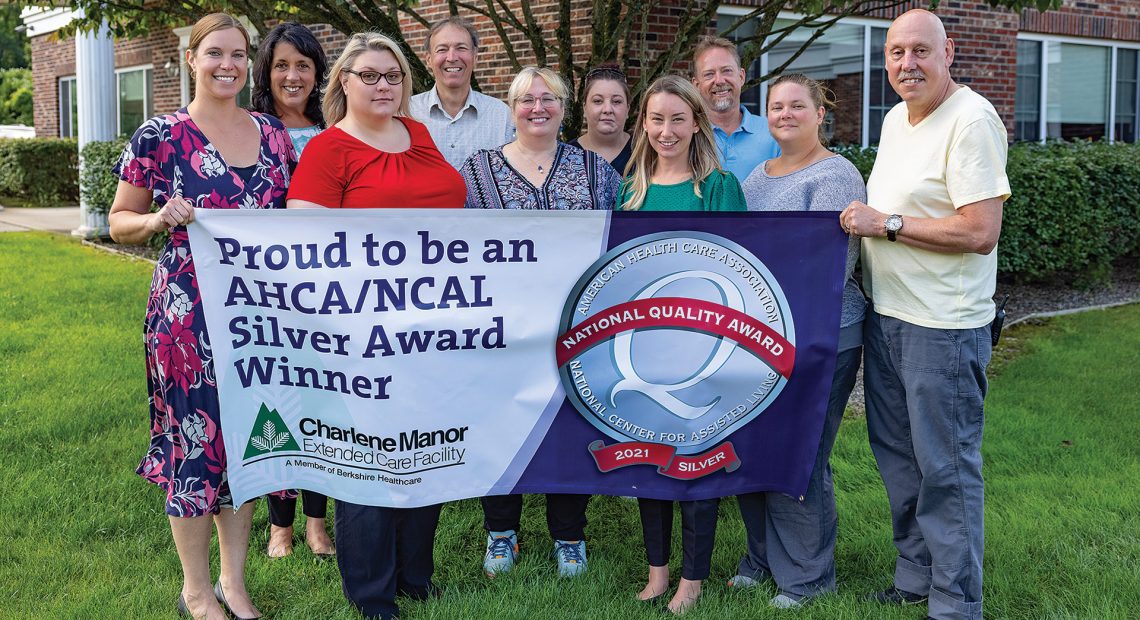
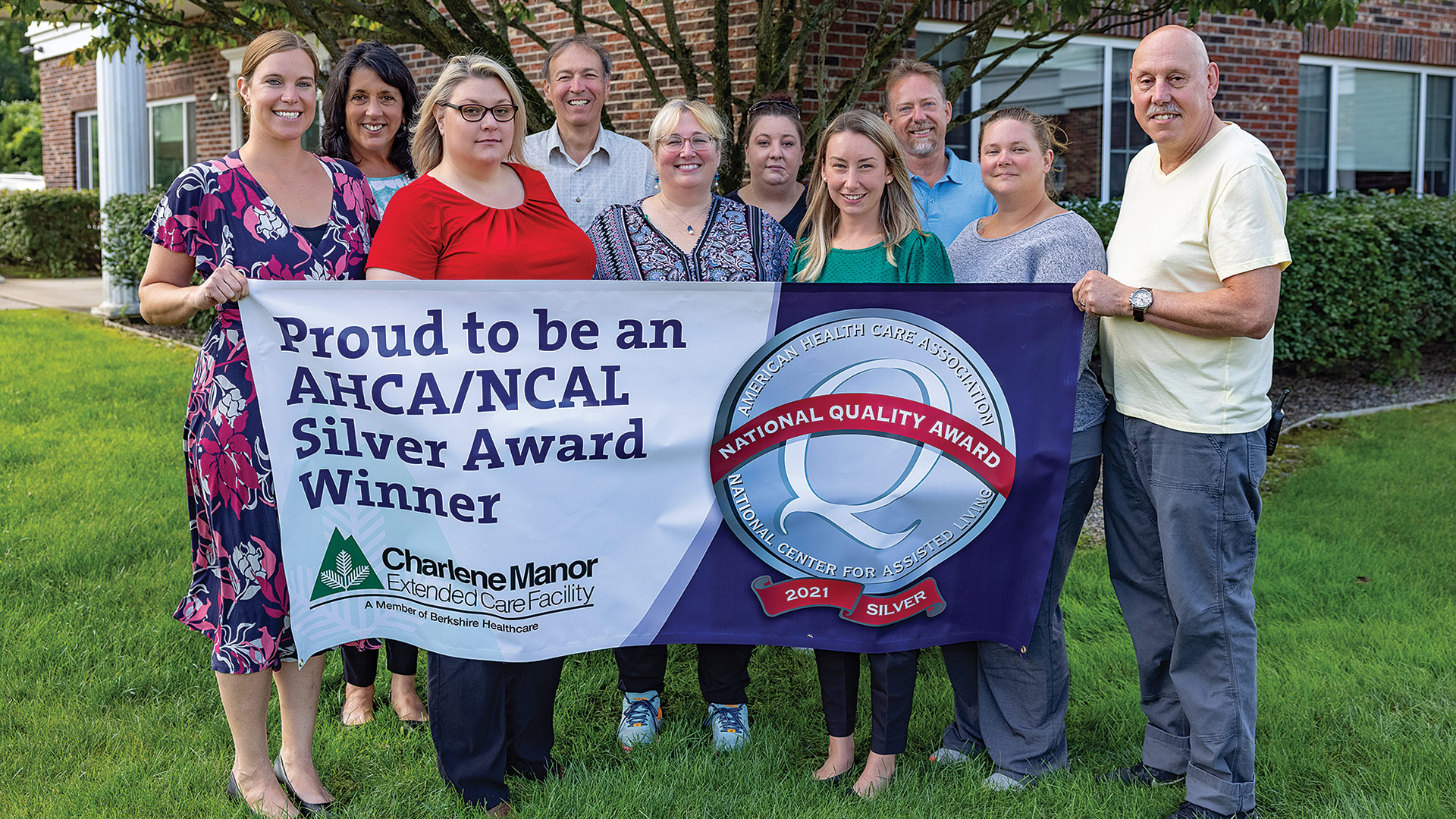
The team at Charlene Manor

The team at Charlene Manor displays the banner announcing that the facility has been honored with the Silver Achievement in Quality Award.

Sometimes accolades and honorifics cannot compare to the rewarding aspects of certain fields of work.

Just ask the staff members at Charlene Manor, a skilled nursing facility in Greenfield that is part of the Berkshire Healthcare system. When speaking with BusinessWest, employees at the facility were unanimous in their opinion that while winning awards — and Charlene Manor recently earned a notable honor — is important, it’s the reasons behind those awards that are far more significant.

“In a hospital, you have people that come and go; in a skilled nursing facility, many of these residents are with us for a long period of time,” Margie Laurin, Charlene Manor’s marketing communications coordinator, explained. “We experience their milestone birthdays with them, we experience their joys and their pains. It’s much more than just providing clinical care — it’s providing that care with a level of compassion that I have not seen in any other work that I’ve done prior to being in this industry.”

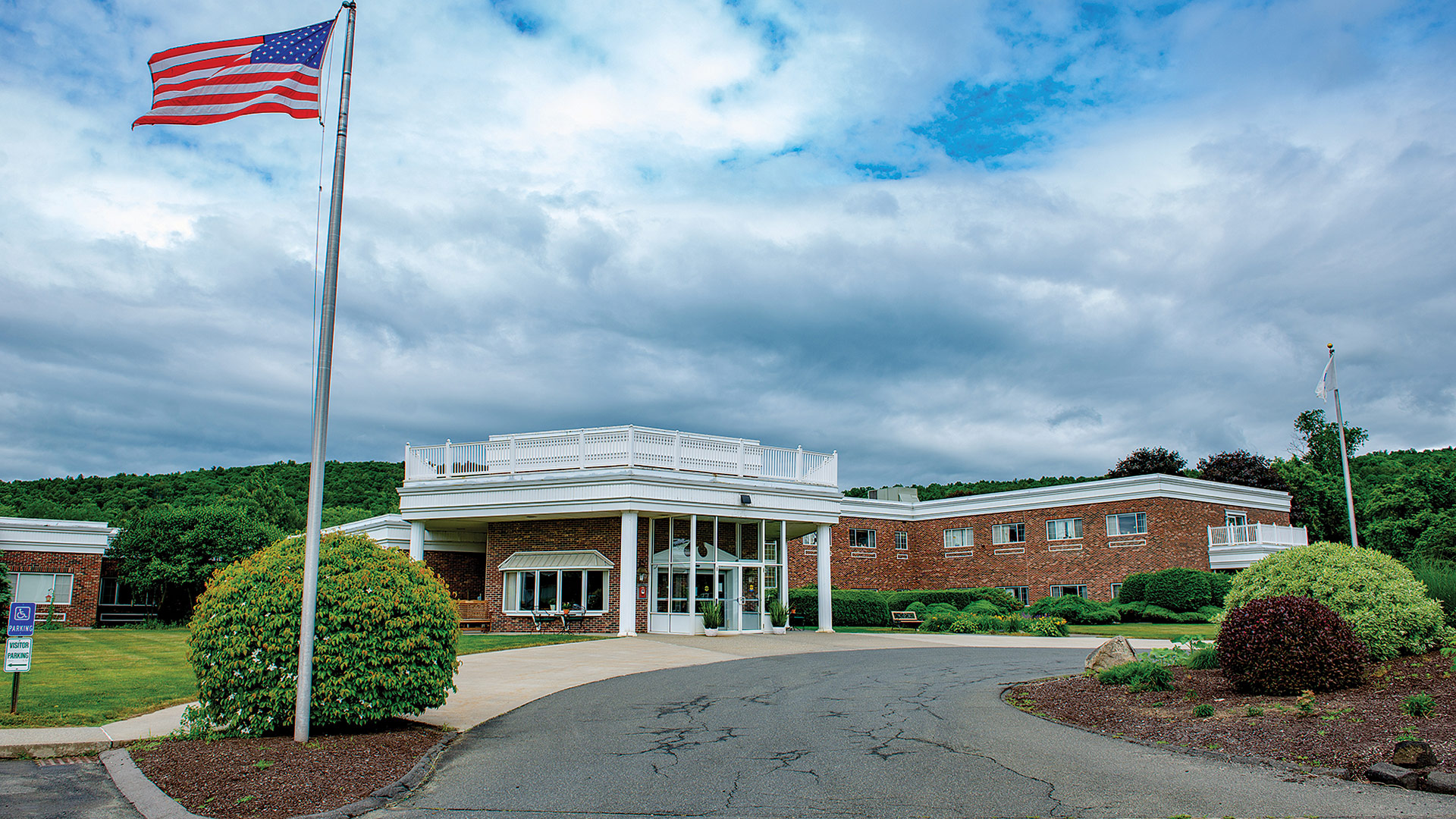
Charlene Manor is celebrating its 35th year in operation, having opened in 1987. It has been growing and evolving ever since while remaining true to its mission — to give back to the community and provide a quality level of specialized programs and services that range from cardiac recovery to hospice and palliative care; from diabetes management and education to stroke recovery.

Which brings us to that award. The facility achieved an important distinction in 2021 — the American Health Care Assoc./National Center for Assisted Living (AHCA/NCAL) Silver Achievement in Quality Award.

“We experience their milestone birthdays with them, we experience their joys and their pains. It’s much more than just providing clinical care — it’s providing that care with a level of compassion that I have not seen in any other work that I’ve done prior to being in this industry.”

“Silver recipients have to outline their systematic approaches, and they have to demonstrate their quality and clinical outcomes and the sustainability of their organizational and process results that are linked to these outcomes to ensure success — how they meet certain challenges, and make sure that they meet key customer requirements,” said Laurin, noting that

Charlene Manor was one of two facilities in the Commonwealth that received this achievement.

To put that into perspective, there are more than 400 facilities providing such services in the state. Charlene Manor is the only skilled nursing facility that received this award — the other winner was an assisted living facility from eastern Mass.

“With our silver award, we were able to clearly demonstrate that we made improvements,” said Ashley LeBeau, administrator of Charlene Manor. “We responded to the feedback, which is really the key when you’re asking someone for feedback. You must then respond to it, put plans in place to improve it; we were very much able to do that.”

The team members at Charlene Manor can speak to this improvement with concrete evidence from over the years. The facility has a five-star rating from the Department of Public Health, and that rating has been maintained for more than two years. Customer satisfaction surveys from both short-term and long-term residents have shown improvement as well, and that demonstration contributed to Charlene Manor earning the silver award, said LeBeau.

For this issue, BusinessWest talked with Laurin and LeBeau about the Silver Award, but more about what went into earning it and what the honor says about the facility and its team.


Shining Examples

The term ‘skilled nursing’ oftentimes is used interchangeably with assisted living and nursing homes, when in actuality they are quite different. Skilled nursing care refers to a patient’s need for care or treatment that can only be performed by licensed nurses. It can take place in a variety of settings — hospitals, assisted living communities, and in the case of Charlene Manor, skilled nursing facilities.

Skilled nursing is regulated by the Department of Health Centers for Medicare & Medicaid Services (CMS). To be certified by CMS, skilled nursing communities must meet strict criteria. They are subject to periodic inspections to ensure the quality standards are being met.

“That’s why this silver award is so critically important and such an honor — because these are such stringent criteria to have to be met so above and beyond,” said Laurin.

Skilled nursing can encompass a wide range of care. It can mean short-term care after someone has had surgery, physical or occupational therapy, IV therapy, as well as many other forms of care.

“With our silver award, we were able to clearly demonstrate that we made improvements. We responded to the feedback, which is really the key when you’re asking someone for feedback. You must then respond to it, put plans in place to improve it; we were very much able to do that.”

The majority of Charlene Manor’s referrals come from hospitals, but its reach has recently expanded. Due to its high-quality service and the surge seen in hospitals from the pandemic, the Department of Public Health chose to partner with Charlene Manor. Another important collaborative relationship Charlene Manor has is with Pioneer Valley Hospice & Palliative Care.

Skilled nursing staff include a variety of positions including RNs, LPNs, CNAs, medical directors, speech/language pathologists, and resident care assistants. And these professionals work together as a team.

Resident care assistants (RCAs) play an integral role within the facility. It’s an introductory role where individuals who are just starting off in the healthcare career can explore if it’s the right fit for them. They spend an intimate amount of time with residents, providing the most amount of care per day to patients while simultaneously building strong relationships with them.

Charlene Manor focuses on recruiting and aiding those entering the field, now more than ever — since the pandemic began, the skilled nursing industry has lost 241,000 caregivers according to AHCA.

“For this reason, it is critically important for us as an organization — we put in place strategies and do everything we can to encourage and nurture and promote these skilled caregivers within our facilities,” said Laurin. “And Charlene Manor specifically has been a community that has had a really strong history of providing employment opportunities and having good care around these positions.”

LeBeau started as a dining services aid at Charlene Manor’s sister facility in Leeds when she was in high school. She’s been with the organization ever since, going from working in dining services to becoming the director of Admissions. She then earned her AIT, went on to get her administrator’s license, and has been administrator at Charlene Manor now for 11 years.

“One of the things that I am most proud of as a Berkshire Healthcare employee is that our opportunities for growth in this organization are unmatched,” she went on. “There are so many opportunities for growth in this organization.”

LeBeau’s story provides just one example of such growth and opportunities for advancement. Indeed, Berkshire Healthcare offers a nursing program called Stepping Stones which, if accepted, provides aspiring healthcare professionals a tuition-free path to earning certifications and attending nursing school.

“We’ve had a number of entry-level staff go through nursing programs through our Stepping Stones program to become LPNs, RNs … some have gone through to get their BSN, and it’s just incredible the amount that we reinvest because we are not-for-profit,” said LeBeau. “We have a mission, and part of our mission is to reinvest in our people, and we do that every single day here.”

Indeed, while the AHCA/NCAL Silver Achievement in Quality Award is a noteworthy honor, recognition is not the motivation behind Charlene Manor’s skilled nursing services. The most rewarding aspect for those working at the facility is the ability to serve those in Franklin County and beyond.

“The rewards are immense. But speaking about providing care to this population — our residents and patients that we serve become much, much more than that,” said Laurin. “They’re like family. That’s why it’s critically important to recruit and invest in long-standing employees, because these are relationships. This is an industry that is about relationships. Not just the relationships with the residents, but with their families as well.”

A Focus on Care

Simply put, Charlene Manor has put in extraordinary efforts to help take care of their community members, and its Silver Achievement in Quality Award Silver is just one of many examples of how their work is paying off.

“As an organization, we are very proud of the work that Charlene Manor, and Ashley and her team, have done — especially during such a challenging time,” said Laurin.

Restaurants Special Coverage

They Have a Lot on Their Plate

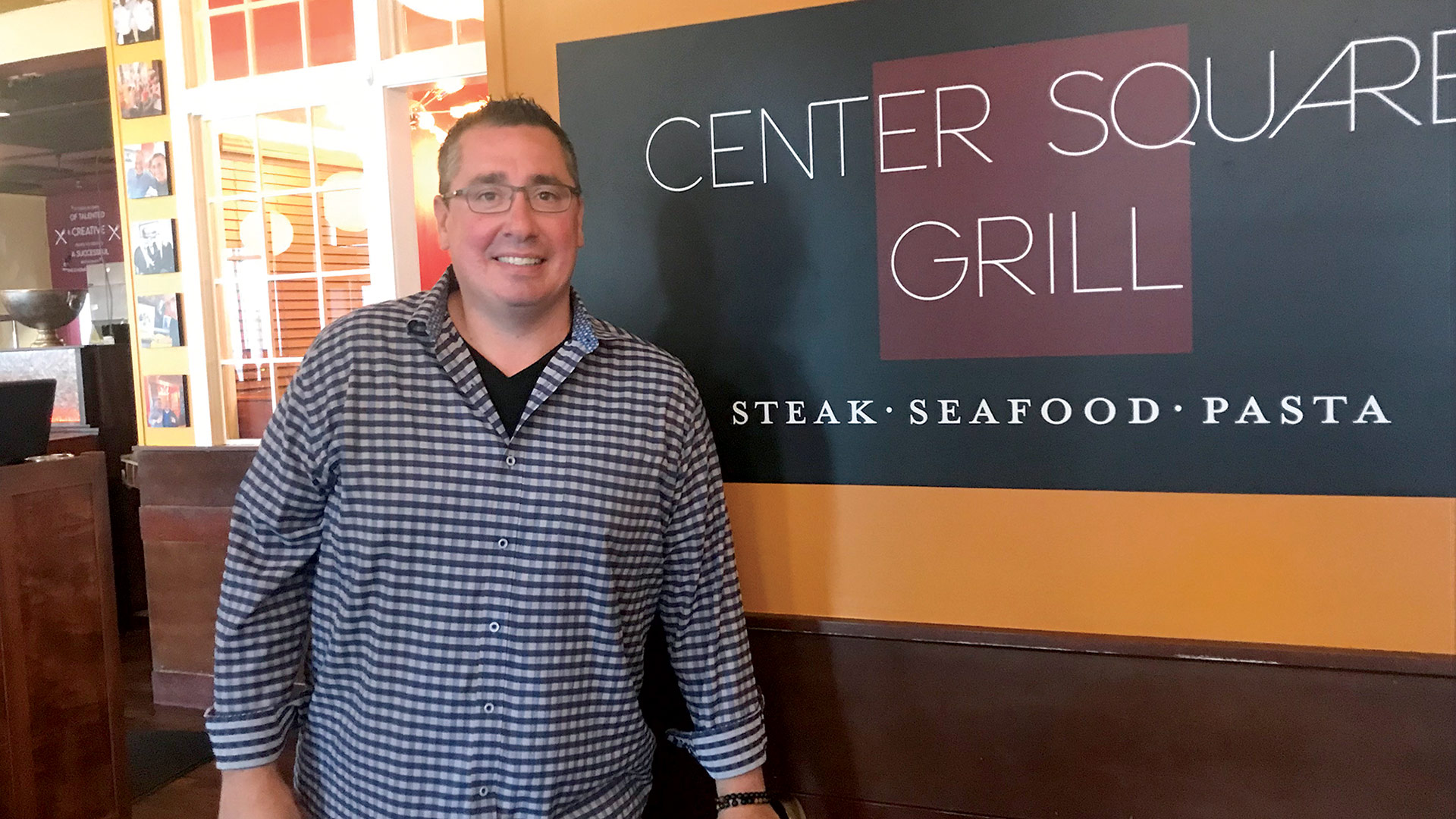
Bill Collins

Bill Collins

One restaurateur called it a ‘triple whammy.’ He was referring to a combination of forces — specifically soaring prices, supply-chain issues, and an ongoing workforce crisis — that are standing in the way of a full bounce back from two years of COVID. Despite these issues, restaurant owners are optimistic that 2022 will bring something approaching normal. Eventually.

By Mark Morris

When 2022 began, Bill Collins was anticipating a full year of uninterrupted business for his restaurant, the Center Square Grill. He did not foresee what he called a “major punch in the face” that shut down the restaurant for six weeks.

In January, one of the thermostats in the restaurant’s dining room failed, causing one sprinkler head to freeze. When the heat came back on, the ice in the line moved and activated the sprinklers. By the time Collins could shut off the sprinklers, the restaurant had taken on nearly 15,000 gallons of water.

“The basement was a nearly complete gut job,” Collins said. “In the dining room, we replaced floors, seating, and several walls.” It took exactly six weeks to go from the flood to opening the doors once again.

Locating a contractor can take six weeks, so how did Collins make the repairs to Center Square and re-open so quickly?

“I looked to my customer base and called the contractors who are regulars at the restaurant,” he said. “They had a vested interest in getting us back open.”

In some ways, the sprinkler incident is a metaphor for the struggle for area restaurants as they look to make a full comeback after the pandemic. Just when people are dining out again and restaurant owners are looking to make up for two years of lost business, they are getting hit with spikes in food costs, increased labor costs — when and if they can find staff, that is — and various supply challenges that affect food and kitchen operations.

“I looked to my customer base and called the contractors who are regulars at the restaurant. They had a vested interest in getting us back open.”

“It’s a triple whammy,” said Ralph Santaniello, co-owner of the Federal Restaurant Group. “In some ways, this has been more challenging than the pandemic.” He quickly admitted that while the pandemic was a crushing event that came out of the blue, governments, communities and vendors all came together to help everyone get through it.

In addition to the Federal in Agawam, Santaniello and partner Michael Presnal own Posto Italian in Longmeadow and Vinted Wine Bar in West Hartford. Following his parents, who were in the restaurant business, Santaniello said he has been in the industry his whole life and has never seen prices as crazy as they are today.

“We used to plan out the business to see where we would be in five years, then it went to five months, and now it feels like it’s five minutes,” Santaniello told BusinessWest.

Everyone we spoke with discussed the challenge of rising costs. Aurelien Telle, co-owner of Alta Restaurant in Lenox, said that even after forecasting for increased costs, they were 6% higher than anticipated in the first quarter alone.

Aurelien Telle, co-owner of Alta Restaurant

Aurelien Telle, co-owner of Alta Restaurant, says price increases on food the past six months have been “insane.”

“That’s huge and we don’t know where it’s going from there,” said Telle. “In the last six months price increases on food have been insane.”  

Adding to the craziness in food costs is unpredictability of what will be affected next.

Andrew Brow, chef and owner of Highbrow Wood Fired Kitchen in Northampton said all restaurants plan their menus with a balance of higher-cost items such as filet mignon and less expensive ones such as pasta. In the past, Brow bought braised short ribs at $5 per pound rather than New York strip steak which costs $10 to 12 a pound. Supplies are so mixed up now, that the short ribs cost as much as the New York strip which hasn’t increased in price.

“There’s no rhyme or reason to the price hikes,” Brow said. “One week mushrooms will triple in price, the next week it’s chicken and spinach.”


Food for Thought

Creating different dishes is one way restaurateurs are adjusting to the chaotic, soaring prices. When scallops escalated from $108 for an eight-pound case to $223, Collins created a new dish that included shrimp, which has held a more stable price. Instead of an entrée with six scallops, he offered in its place a shrimp and scallop entrée using three scallops and three shrimp.

“We used to plan out the business to see where we would be in five years, then it went to five months, and now it feels like it’s five minutes.”

“This way we can keep the dining price where it is and still offer delicious fun food that people expect when they come here,” Collins said.

Gas and electric bills are another area where prices are going up with no end in sight. Santaniello explained that restaurants, by design, are energy intensive with usage increasing in the summer.

“We have air conditioning running all day and night in the summer because when it’s 98 degrees and humid outside people expect to be comfortable when they go into a restaurant.”

It’s not surprising that take out containers spiked in price and were difficult to find at the height of the pandemic. Supply-chain issues also affected restaurants in less obvious ways. Santaniello said he needed a part for an oven door, something that would normally take a week to get, if the repair person didn’t already have one in their truck.

“We waited two months for the part,” Santaniello said. “So, we were down an oven for two months, and that’s difficult in a busy kitchen.”

Santaniello and Telle are experiencing busier than normal kitchens because as customers are returning to their respective restaurants, labor shortages have forced both men to cut back on the hours when they are open.

Andrew Brow

Andrew Brow says there has been “no rhyme or reason” to price hikes on food in recent months.

“Business has been great because of the pent-up demand of people wanting to go out to eat,” Santaniello said. “Our biggest issue is keeping up with that demand because we’re still looking for employees.”

Before the pandemic, the Federal operated six days a week. Now, in order to give his staff some time off, they are open only 4 days a week.

“The pandemic exacerbated a problem that our industry already had with finding enough workers,” Santaniello said. Advertising on job search sites such as Indeed and a restaurant specific site called Poach has brought limited results.

“We found our biggest success came from advertising on Facebook.”

For 13 years, Alta was open 7 days a week for lunch and dinner. These days, hours have been reduced to 6 nights a week and lunch hours were cut.

“We reduced our hours because we couldn’t hire more people,” said Telle. “I didn’t want my staff to have to work six double shifts, so I closed lunches to protect our staff.”

Telle is currently interviewing people with the hope of offering lunch hours again by late spring.

“We always get busier as the sun comes out,” he said adding that business also gets a big boost from all the tourists who visit Lenox in the summer.

Collins called it the best investment he’s ever made when he paid his staff their full salary during the six weeks Center Square was closed for repairs.

“It’s so tough to find qualified people that it made sense to us,” Collins said. “Most of my team has been with me for quite a while and it would have been tough to replace them if they had to leave and find other jobs.”

There are signs that open restaurant positions may be starting to get filled. Brow reported that Highbrow is fully staffed and he was able to hire a full staff for his new restaurant Jackalope in downtown Springfield.

“Even though wages are up much higher than pre-pandemic, the workforce is back,” Brow said.

As the weather gets warmer, all the restaurant owners look forward to expanding their outdoor dining. They all expressed gratitude to state and local officials for keeping this lifeline open even after diners were allowed back inside.

“I’m sure there are some people who are not comfortable coming back into a restaurant,” Collins said. “I think we’ll start seeing them once outdoor dining picks up.”

On May 1, Telle began accepting reservations for summer dining at Alta.

“People are making reservations into July and August,” he said. “And 85% of those are requests to sit outdoors.”

Collins added, “fresh air is not going out of style anytime soon.”

Summer also brings with it the opportunity to support local farms. Telle said working with local farms allows him to control some of the price increases, though he understands local prices will be higher this year than in the past.

Collins buys as much local produce as he can. In fact, his menu credits Szawlowski Farms in Hadley with supplying potatoes for their French fries.

“When tomato season kicks in we will buy them from Meadowbrook Farm in East Longmeadow,” Collins said. “Nothing tastes better than fresh local produce.”


The Bottom Line

Between outdoor dining and customers who are excited about eating out again, the restaurant owners all remain positive about this year and beyond.

Santaniello, describing himself as an optimist by nature, said, “I’m hoping by the fourth quarter of this year we will see some stability in pricing and as more people return to the workforce it will benefit our industry.”

Telle said he’s hopeful about hiring new staff and looks forward to a busy summer. “Right now, we’re following the same business patterns as a regular year.”

With Jackalope scheduled to open on May 11, Brow expressed gratitude despite all the uncertainty. “For those of us who made it through, it was worth the wait.”

For Collins the year started with closing for six weeks to fix major water damage. Despite that setback, Center Square is still on track to have its busiest year ever. He philosophized that a restaurant experience is more than just food.

“People need to go out and socialize. They need to feel that connection,” Collins said. “When they don’t, they get depressed and grumpy.”

He concluded, “that’s why we’re all back and we’re pumped to be here.”

Home Improvement Landscape Design Special Coverage

Lay of the Land

Dave Graziano

Dave Graziano, project manager of the Landscape Division at Graziano Gardens.

For area landscapers, the pandemic created a boom in business as consumers working at home and unable to go on vacations decided to improve their surroundings and invested accordingly. There is still some of that going on, but noticeably less, with consumers enjoying more spending options, while also experiencing considerable anxiety over sky-high inflation. While there is still plenty of work, landscapers confront a host of challenges, from workforce issues to shortages of materials to soaring gas prices.

By Mark Morris


The phones are ringing at landscaping companies this spring — but not at the same frenzied pace of the last two years. And that’s just one of many trends to watch as the calendar moves to mid-spring

Overall, consumers People are more cautious about spending their money this year, said Greg Omasta, president of Omasta Landscaping in Hadley, and, at the same time, they certainly have more spending options than they did in 2020 and even 2021.

“Those who have the money and want to improve their yard are still going to,” Omasta said. “For everyone who was on the fence about it … not so much.”

Steve Corrigan, president of Mountain View Landscapes and Lawncare in Chicopee, concurred with that assessment. He said that while his company has backlog of business through June, he’s not as confident about the rest of the year.

“We’ve had internal discussions that we don’t have as many leads compared to this time last year,” he told BusinessWest. “People are still requesting work but we’re wondering if we will be as busy as last year.”

Two years ago, the pandemic forced people to spend more time at home. Many looked at their outside surroundings and decided they needed to invest in their yards, in many cases using money that would normally go toward a vacation away from home. This created a huge boom for landscapers who could barely keep up with all the demand for their services.

“Now that people are able to travel again, it seems like the COVID spending is slowing down,” Omasta explained, adding that on top of leisure travel increasing and people returning to the workplace, landscapers are experiencing an unseasonably cold spring that brings with it other challenges.

“Every year is different,” said Dave Graziano, project manager of the landscape division of Graziano Gardens in East Longmeadow. “If you talk with any independent businessperson there is some worry this year about what’s coming.”

That worry usually involves how to handle increased business costs, finding workers, and managing supply chain issues with various products. And landscapers are certainly having to cope with all those issues and more.

“Those who have the money and want to improve their yard are still going to. For everyone who was on the fence about it … not so much.”

Indeed, all the landscapers we spoke with have commercial clients as well as residential customers. Rachel Loeffler, landscape architect and principal with Berkshire Design Group in Northampton, said there is often competition, if one can call it that, between commercial and residential when supplies are short.

“Sourcing for plants can be challenging in normal times,” Loeffler said. “Now contractors check with five or six nurseries when they would normally go to one.” This scramble for plants often means finding substitutes.

As a landscape architect, Loeffler often recommends using products like cedar wood that will remain durable for years to come. When cedar became, in her words “extremely expensive” it changed the conversation with clients.

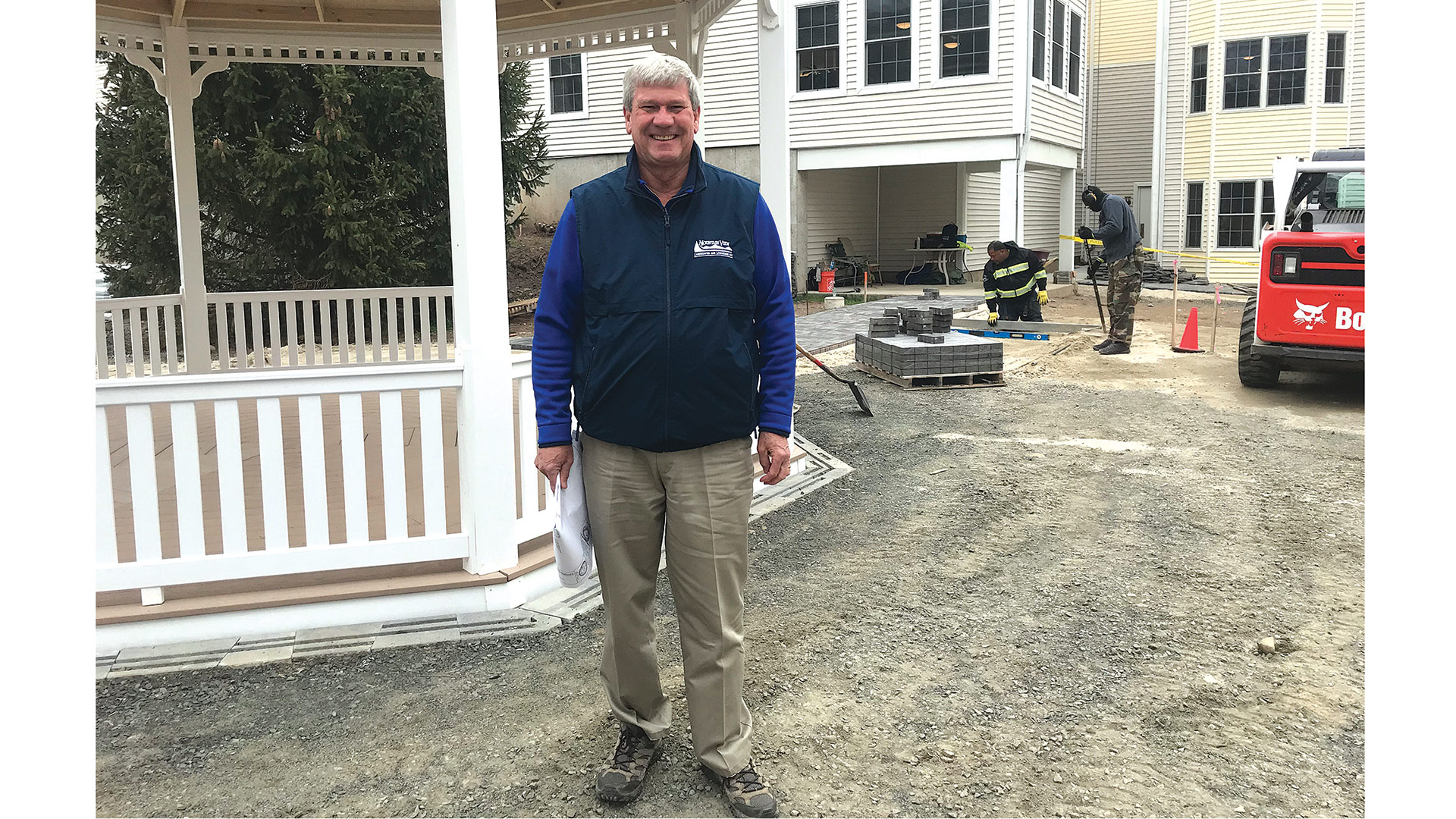
Steve Corrigan leads his crew as they install pavers at Loomis Village in South Hadley

Steve Corrigan leads his crew as they install pavers at Loomis Village in South Hadley, one of many current projects for his company, Mountain View Landscapes and Lawncare.

“They had to go back and figure out how to build something that was durable and sustainable, but would also fit their budget,” Loeffler said.

Even world events affect landscaping materials. Omasta pointed out that many of the minerals found in fertilizers come from Russia. “So, some of our supply chain issues are based on what’s going on in the Ukraine.”

For this issue and its focus on landscaping and home improvement, BusinessWest talked with several business owners and managers in this sector. These discussions revealed the full breadth of challenges facing these companies — as well as the ample opportunities for continued growth.


Root Causes

Omasta told BusinessWest that, while it’s getting a little easier to find products — with the accent on little — items are coming in at premium prices that are generally 30% to 50% higher than last year.

But finding some products and materials remains a challenge, and the shortages result from a variety of reasons.

As just one example, Both Graziano and Omasta noted the difficulty in finding large evergreens and other large-caliber trees. And Loeffler said the recession of 2008 is the reason why it’s difficult to find such trees now.

“The trees that are available now were cultivated some 10 to 15 years prior,” Loeffler said. “In 2008, many nurseries cut back on their normal planting because of a big drop in demand.”

Overall, tree shortages and rising prices of everything from lawn-care products to bricks are just some of the challenges facing landscapers.

Indeed, on the commercial side of the ledger at Mountain View, Corrigan said his crews are working on several projects in Eastern Mass for parks, playgrounds, and athletic fields. While travelling up to an hour and a half from his home base in Chicopee is a common practice, fuel prices are forcing Corrigan to refigure what vehicles he sends to specific jobs.

“Our crew trucks use a lot of fuel so we leave them at the jobsite and go back and forth with different vehicles,” said Corrigan, adding that he’s looking to conserve whenever and wherever he can, because the numbers are so staggering.

“Last year we spent about $280,000 on fuel,” he said.“With prices increasing, if we use the same amount of fuel as 2021, it will add more than $100,000 to our costs unless we do something different.”

With more than 40 vehicles in the company’s fleet, costs can add up quickly. A newer vehicle might offer better gas mileage — if you can get one, that is.

“We placed an order for three new vehicles back in December,” said Corrigan. “And we won’t see them until July or August.”

Meanwhile, finding enough labor to get the job done remains a challenge.

Corrigan said his company has 95 people on the payroll and he could easily add another 10 — if he could find them. “Just before COVID, we hired a full-time recruiter, because even then we were having trouble finding help,” he noted, adding that the landscaping sector tends to attract young, entry-level people.

Many candidates get disqualified for failing their drug screen or for bad driving records, he went on, adding that he remains optimistic about the labor front. “We’ll get through it, one person at a time.”

Staffing has remained steady for Omasta Landscaping, thanks to a core group that has been with the company for several years. While landscape construction jobs remain hard to fill, Omasta said he had the opposite experience when hiring for clerical and office jobs.

“We took out ads for office people and the response has been tremendous,” Omasta said. “It seems there are people in the job search right now, whether it’s a career change or looking for a different job.”

While coping with these day-to-day issues and challengers, landscapers are also responding to longer-term trends, many of them involving the environment, cost-effectiveness, or both at the same time.

Rachel Loeffler says there is often competition between commercial and residential customers when supplies of certain products are short.

Loeffler told BuisnessWest she is doing more “lifecycle-costing” for projects. With this method, she will evaluate the installation of two similar materials — for example granite curbing vs. concrete curbing.

“We look at initial upfront cost, how long before each needs to be replaced, and then the cost over 100 years … and it’s crazy,” said Loeffler. “While granite is more expensive at the onset, over a 100-year period it’s significantly cheaper.”

She explained that concrete curbing has a useful life of about 15-20 years, so any time the asphalt paving is replaced, a new concrete curb will need to be built. With granite, a bucket loader can pick up the curbing and reset it each time the area is paved.

Loeffler admits most people don’t get excited about curbing, and she understands that project managers may opt to save money in their budget by using concrete, though granite proves to be a less expensive choice over the long term.

In a similar vein, Corrigan said changes are happening with the safety surfaces on new playground construction. For many years, landscapers have covered the areas around playground equipment with a thick installation of wood chips. The specs now call for poured in place rubber surfacing.

“It can cost four to five times more than wood chips, but project owners want it because the rubber works better from a safety perspective and they don’t have to go back every year to dress off the wood chips,”Corrigan said. The two-part process involves a base mat with a colored surface on top. In order to meet safety requirements, the rubber surface goes through a series of tests that mimic children falling on it.


Getting the Real Dirt

Looking at the proverbial big picture, Omasta said he understands that people don’t think about landscaping on cold, raw spring days, and there have been quite a few of them lately. “Once we start seeing sunny 70-degree days, the phone will ring off the hook,” he said, expressing optimism that his company, and this sector, will continue to flourish in these challenging times.

Graziano concurred, noting that the cold and windy weather has kept early customers from browsing at the garden center and from booking landscaping services.

“We’ve had a little slower April, but most likely May and June will be crazy — it’s the nature of the business,” he said, adding that nature, meaning Mother Nature, is just one of many issues to be confronted during what will likely be a different kind of year.

Health Care Special Coverage

Mind Over Matters

By Mark Morris

Alyssa Bustamante

Alyssa Bustamante, an occupational therapist with ServiceNet.

According to the Center for Neurological Studies, someone in the U.S. sustains a brain injury every nine seconds. You can do the math.

All brain injuries that are not hereditary are considered acquired brain injuries. One well-known type is a traumatic brain injury (TBI), which results from a car accident, sports injury, a fall, or other incident. The other type of acquired brain injury (ABI) results from events such as a stroke, encephalitis, a brain tumor, or other medical issue.

The effects of a brain injury are unique to each individual. The professionals who work with afflicted patients design individualized treatment plans for each patient. Everyone involved shares a common goal — to help the patient get back to their maximum level of function and independence.

BusinessWest talked with three professional groups that work with brain injury patients at different stages of the recovery process. Those associated with these groups shared common thoughts on what they do and the underlying goals behind their work.

A brain injury is very often a life-changing event, they said. And those who work with those who have suffered such injuries dedicate themselves to helping patients get the most out of what could be considered their new life.


Thought-provoking Examples

When a person suffers a brain injury, they receive their initial care at an acute care hospital such as Baystate Medical Center or Mercy Medical Center. The next step is a stay in a rehabilitation facility such as Encompass Health Rehabilitation Hospital of Western Massachusetts in Ludlow, where the typical patient may spend from seven up to 21 days, depending on the severity of the brain injury.

“In the beginning we spend lots of time educating patients and their families about what to expect with brain injuries and how the brain heals.”

Because our brains affect all our physical and mental functions, evidence-based research has shown that a multi-disciplinary approach to treatment results in the best outcomes. According to Julie Bugeau, an occupational therapist with Encompass, their approach to care involves making sure the medical staff, along with the occupational therapist, physical therapist, and speech therapist work closely together as a team.

“Brain injuries are complex, so we need all these disciplines to make sure the patient’s needs are addressed,” she told BusinessWest.

When brain injury patients arrive at Encompass, each one has a different level of severity, so the first few days are usually spent on developing a plan for recovery and preparing the patient for what they will encounter in therapy.

“In the beginning we spend lots of time educating patients and their families about what to expect with brain injuries and how the brain heals,” said Stefanie Cust, a physical therapist with Encompass. “We would like to get them up and walking right away but not everyone is ready for that so we may take a couple days to understand where they are and what they can do.”

Managing expectations for the patient and their family is an important part of the therapy process because everyone progresses differently and at their own pace. Bugeau said patients will often have a personality change and become easily agitated or inappropriate in the way they speak or interact with others.

physical therapist

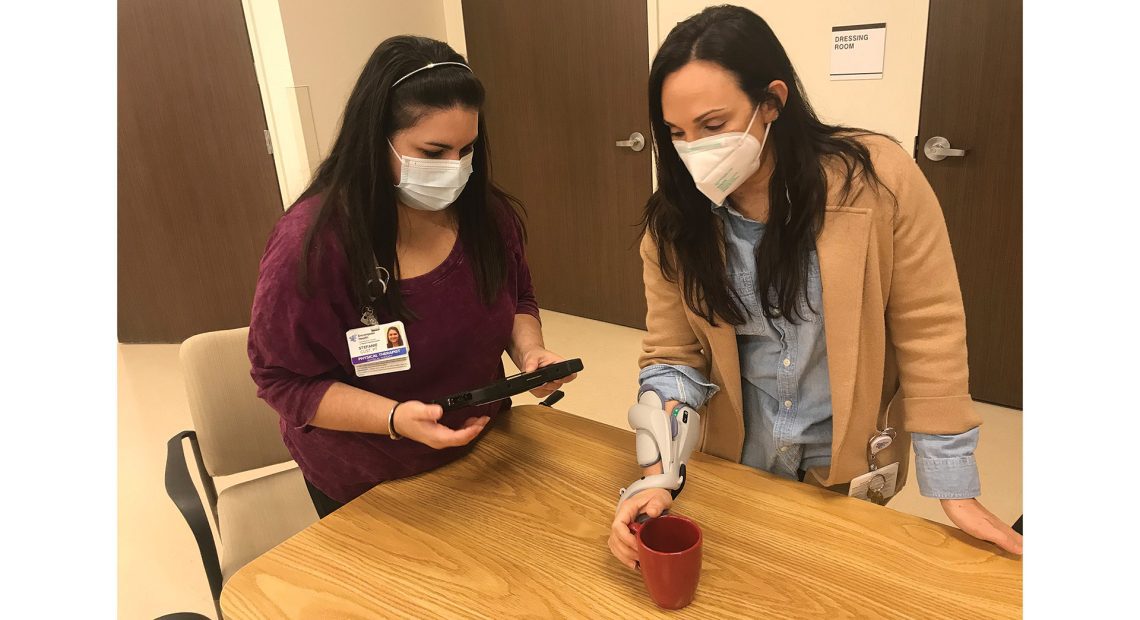
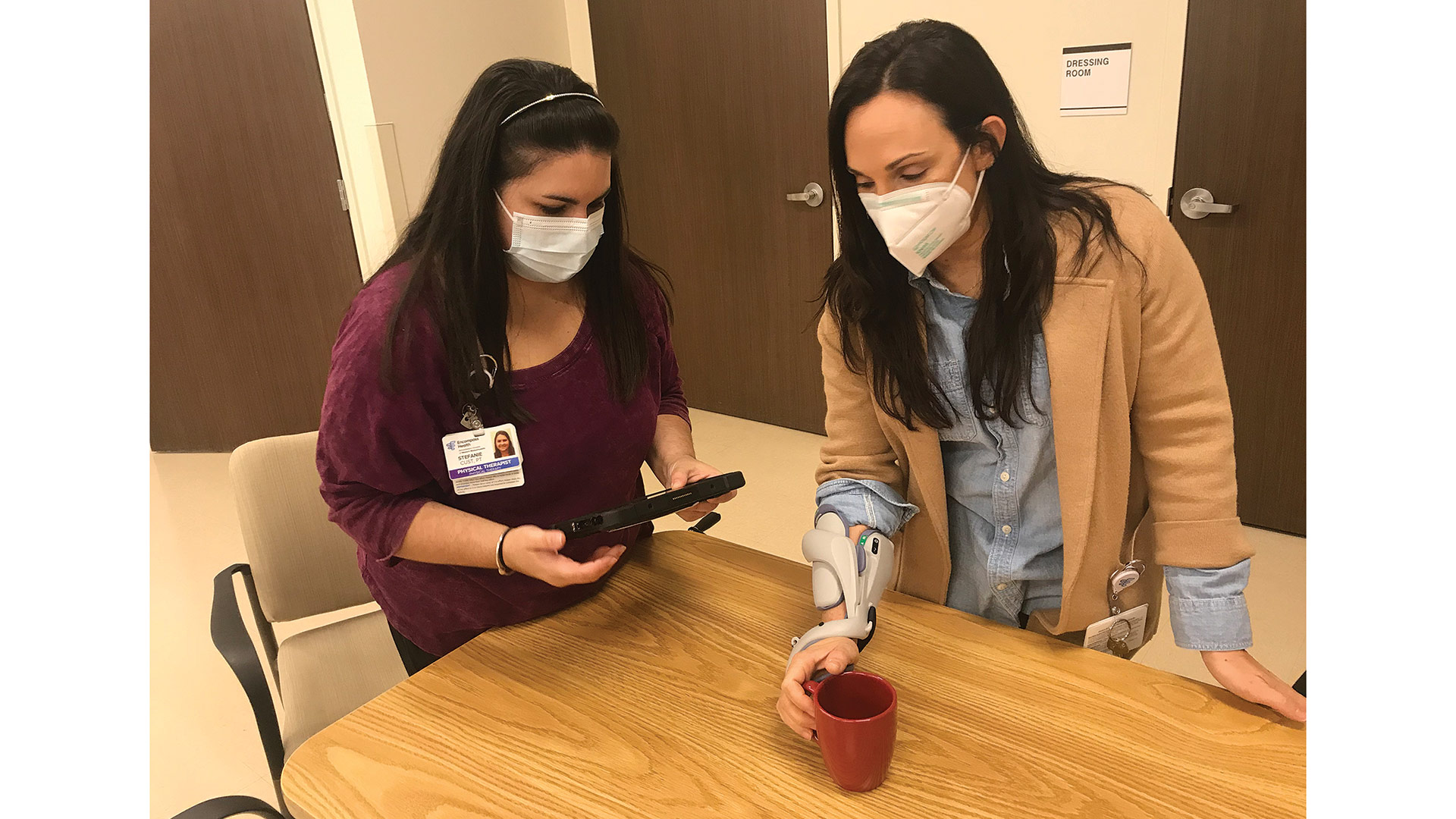
Stefanie Cust, left, a physical therapist at Encompass Encompass Health Rehabilitation Hospital, and Julie Bugeau, an occupational therapist at Encompass, demonstrate a device to improve use of the hand and wrist.

“We don’t want families to get angry with their loved ones because they are acting in a certain way,” Bugeau said. “That’s why constant communication with the family and everyone on the team is critical to managing their expectations.”

A walk through the facility at Encompass reveals what looks like a large gymnasium with people working out on various machines. While standard fitness machines are part of the mix, there is also an array of specialized equipment designed to help people regain movement in areas of their bodies that were affected by brain injury.

Sometimes the equipment is as simple as parallel bars to aid in walking or a set of stairs. Other times high-tech equipment is used such as interactive touch screens to help the patient regain coordination, reaction time and cognitive abilities.

Cust and Bugeau demonstrated a Bioness H200 a device that fits on the forearm and is used to simulate normal wrist and finger movement for neuromuscular rehabilitation. By using a tablet, a therapist controls the H200 to aid the patient in opening and closing their hand. It’s also used to help build back wrist and hand muscles through repeated movements.

“People with brain injuries need someone to encourage them to get up and move, otherwise they will just sit and do nothing.”

The goal of the therapists at Encompass is for patients to return home. Before patients are discharged, they leave with a recovery plan to help the patient going forward. A case manager gets involved to prepare the family and prepare the home before discharge. In many cases the patient will need outpatient treatment, whether at a facility or at home. Encompass puts patients and families in touch with community resources to keep moving toward recovery goals.


Finding a New Way

As late as the 2010s, patients with brain injuries in Massachusetts who required care beyond what they could get at home were mandated to live in nursing homes. A class-action suit resulted in creating two waivers, one for ABI and one known as a Moving Forward Plan (MFP) waiver. Both waivers make it possible for other organizations in the community to provide long-term treatment for people suffering from brain injuries.

Mental Health Association (MHA) created the New Way Services Division to specifically offer treatment for people with ABI. The agency owns nine houses located in communities in and around Springfield. Each residence looks like a typical family home and accommodates up to four adults.

“These residences are the person’s home for as long as they need it to be,” said Sara Kyser, vice president of the New Way Services Division at MHA. “While some folks are likely to spend the rest of their days there, we also have many people who gradually need fewer services and they are able to return to their families.”

Each person has an individualized treatment plan, most of which include regular visits from occupational, physical, and speech therapists. Nurses also visit each home to assist with such things as re-learning taking medication and other tasks. One of the homes is designed to be a transition step where instead of receiving highly intensive support the person is more on their own but still has a safety net.

Lexi Stockwell

Lexi Stockwell says the Strive Clinic at ServiceNet helps those with brain injuries continue to make progress in their recovery.

“The goal is to bring people back to where they were or to a less-restricted setting,” Kyser said. “When possible, they can return to their family and still access outreach supports.”

One of those supports is The Resource Center (TRC) run by MHA. Serving as a day service, Kyser explained that this is where people can work on an array of interesting activities to help with physical and mental rehab in ways that don’t feel like therapy.

“Instead of squeezing a tennis ball, they are doing art projects, engaged in writing, and one of our most popular activities working on wood projects,” Kyser said.

While these activities provide physical therapy, they also help people work on their social skills. Kyser said impulse control is often affected by a brain injury, so learning how to interact with the world again takes some practice.

When BusinessWest visited, staff at TRC were preparing gardening kits in time for planting season.

“The idea is for these folks to learn about and actually plant their own gardens at their own homes,” Kyser said. “They will then harvest and incorporate the fresh fruits and veggies into their nutrition program to bring the whole thing full circle.”


Striving for Improvement

ServiceNet is also a provider of long-term rehabilitative care. Through its Enrichment Center in Chicopee, ServiceNet runs the Strive Clinic to help those afflicted with brain injuries to continue to make progress in their recovery.

According to Ellen Werner, director of operations for ServiceNet’s Enrichment Center and Strive Clinic, the motivation for Strive became apparent after learning about people who were sitting at home with brain injuries who needed therapy.

“People with brain injuries need someone to encourage them to get up and move, otherwise they will just sit and do nothing,” said Werner.

Part of the recovery process also involves persuading people to try things when they don’t think they need to participate. Alyssa Bustamante, an occupational therapist with Strive, said that she and her colleagues try to make patients understand that recovery happens when all the therapies work together. Left to their own devices, patients will tend to only take part in their favorite activities.

“Everyone loves physical therapy, so they all want that,” said Bustamante, adding that one patient felt she didn’t need speech therapy because she just wanted to be able to get dressed. “This person had trouble sequencing the steps to get dressed, which is cognitively based, and speech therapy helps with that,”

Keeping active is essential to prevent brain injury patients from reaching a plateau and backsliding in their recovery. At the beginning of the pandemic many brain-injury patients lost therapy sessions. By the time they were able to return, Werner said that many came in deconditioned and could not do as much as before.

“They still had the foundation of the therapy, but they had lost endurance,” Werner said.

The Strive Clinic has adopted the motto of “Never say Never” to encourage patients to always set new goals in rehabilitation. As an example of that spirit, Werner and Bustamante discussed the case of a gentleman named Bill (not his real name.)

Bill had suffered a stroke more than 10 years ago, and had a below-the-knee amputation. Though he had a prosthetic device for his leg he wasn’t interested in leaving his wheelchair. Enrolled in the day program at the Enrichment Center, Bill would sit in the hallway outside of Werner’s office. When she would attempt to engage and ask, ‘What would you like to do today?’ Bill’s response was, ‘Shut up and leave me alone.’

Bustamante and Lexi Stockwell, a physical therapist with Strive also began speaking with Bill and gradually convinced him he was capable of more than just sitting in his wheelchair.

“At first, with help from others Bill could take about five or six steps on the parallel bars,” Stockwell said. “Now he can pull himself out of his wheelchair, grab the walker on his own and walk 50 feet. That’s big progress in a year.”

Bustamante said Bill has also developed better coping strategies and he speaks in more positive terms. “He’s finding the joy in himself and spreading it.”

Werner added, “Bill now refers to himself as the mayor of the Enrichment Center and he’s become an advocate for our program.”

Bill’s story is an example of how it’s never too late to make progress with a brain injury.

“Everyone needs to keep busy, especially people with brain injuries,” Werner said. “Just because someone says they don’t want help, we keep asking to see how we can get them moving and get them involved.”

Kyser spoke to a misperception that contends the first 90 days after diagnosing a brain injury is the real opportunity to make progress on a patient, but after six months that opportunity is gone.

“That’s baloney,” Kyser said noting that in the past, services didn’t exist after six months, so without engagement it was no surprise that the person was hitting a plateau.


The Bottom Line

Thanks to the efforts from agencies like Encompass, MHA and ServiceNet, brain injury patients are making progress every day re-gaining the use of their muscles, many can walk again, and, most importantly, live with independence after their injuries.

“There’s so much that can be done as long as the person is engaged in their therapies,” Kyser said. “My hope is as we’re getting better at this, we will see even more progress.”

Restaurants Special Coverage

Chain of Events

Craig Erlich

Craig Erlich says the mission at Friendly’s is to create positive experiences — and lasting memories.

Craig Erlich can trace his relationship with Friendly’s back to his fifth birthday party at one of the chain’s restaurants.

“I have pictures of me with my life-size balloon,” he told BusinessWest, adding that, over the decades, this relationship has certainly taken many different forms — from customer, to franchisee, to his current role as president and CEO, in which he has the responsibility of, well … creating memories like that of his fifth birthday for future generations of customers.

In other words, Erlich is the latest executive to take on the job of resuscitating a brand that has fallen on some hard times in recent years, as evidenced by the sale price of the Friendly’s chain, then in bankruptcy, to Amici Partners and its affiliate company, Brix Holdings LLC: $1.9 million.

Erlich, president and CEO of Friendly’s, understood that the Friendly’s chain had shrunk dramatically over the years and was struggling to compete with the large number of competitors in the fast-casual family restaurant category, a situation only made worse by the pandemic. But he ultimately saw promise, and a challenge he was willing to take on.

“When the opportunity came around — and the pandemic presented a lot of opportunities for reshuffling of leadership of brands — we were really passionate about Friendly’s and what could happen with this brand,” he said. “When you finally have your chance to put your hands on the steering wheel and go from backseat driver to being the driver … we were really excited about the opportunity.”

Elaborating, he said that he and his partners already had some plans for Friendly’s in mind when they acquired it in December, 2020, and now, some of those plans are coming to fruition.

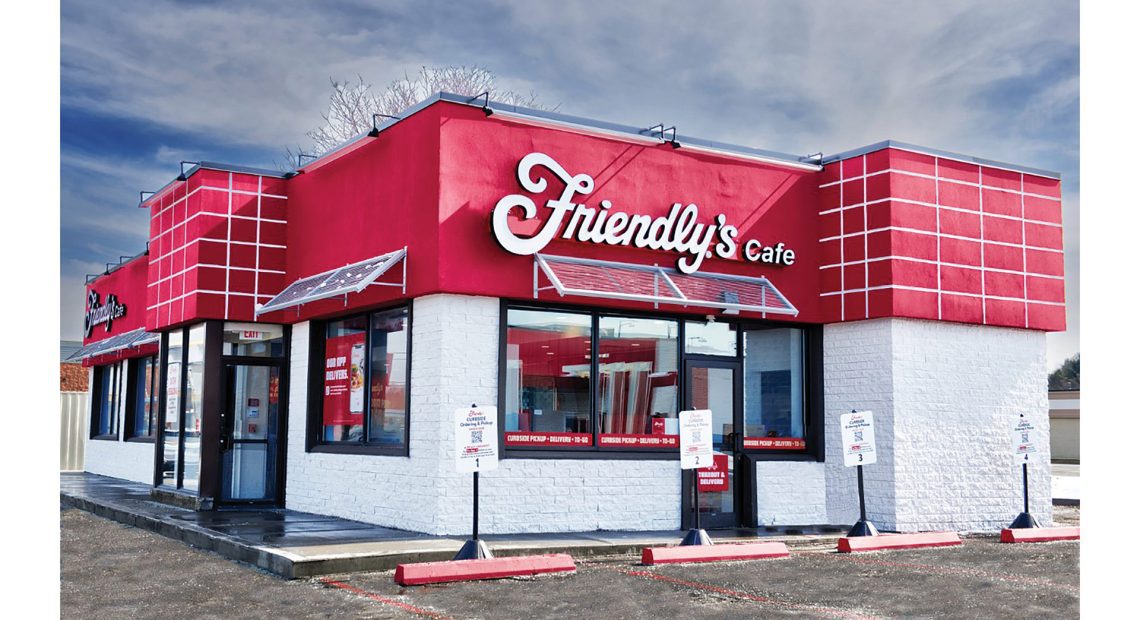
That includes the new-look of the Friendly’s that recently opened on East Main Street in Westfield. It’s called the Friendly’s Café, and the model is a reflection of the changes in dining habits that have taken place over the past two years, especially when it comes to take out and delivery.

The new model will feature both, as well as on-site dining, with customers ordering food at a counter or at a table using QR technology. There’s also a traditional ice cream fountain area, providing an ice cream parlor feel.

While the concept is quite different from what Friendly’s customers are used to, the goal is to maintain the chain’s overall look and feel — and its capacity for creating lasting moments … like Erlich’s fifth birthday party.

“With Friendly’s, everyone talks about the experience — they talk about memories,” said Erlich. “We wanted to maintain that quality. When you’re restoring an old home, you want to make sure to keep the bones and the structure there, and just enhance the features. That’s the approach we took with this brand, especially the Friendly’s Café.

“We knew it was going to be a bit of a different kind of experience for the customers,” he went on. “But when you think about how people dine today, whether it’s QR technology, off-premise dining, curb-side delivery … we knew there was an opportunity for that.”

“When you finally have your chance to put your hands on the steering wheel and go from backseat driver to being the driver … we were really excited about the opportunity.”

Meanwhile, other changes have been introduced, especially on the menu, which now includes a number of new items, including a variety of appetizers and salads, and offerings like the Doritos Cool Ranch chopped cheeseburger. The goal is to create an appealing mix of new options and old favorites, he told BusinessWest, adding “the menu feels much more balanced than it did before.”

Flashing back to late 2020, as he and his partners were doing their due diligence on Friendly’s as they explored acquisition, Erlich said this research revealed a chain facing many challenges and restaurants in need of repair and revitalization, a situation exacerbated by the pandemic in many respects. But ultimately, what they saw was opportunity.

“The pandemic forced a lot of companies to focus on just keeping the lights on,” he told BusinessWest. “We knew there was going to be a significant amount of repairs and maintenance needed for these buildings; just the equipment in the kitchens alone was in the millions of dollars.

The Friendly’s Café in Westfield

The Friendly’s Café in Westfield opened earlier this year to positive reviews from customers.

“But we saw a big opportunity,” he went on. “And 2021 was really focused on building the infrastructure and putting some technologies and new ideas in place that would build a foundation for what we’re about to do this year.”

Which brings us back to the Friendly’s Café, which opened at the end of February to solid feedback from customers, said Erlich, who acknowledged that while it’s early in the game, the new location is thus far exceeding expectations.

“Customers have been very complimentary, and it has performed very well; we’ve seen a lot of repeat customers, and that’s the true test,” he said, adding that the company is scouting locations for similar facilities.

The location in Westfield is a free-standing building in a shopping plaza, and that is the preferred model, said Erlich, adding that the company is also looking at expanding its drive-through presence at existing restaurants.

“We think there’s a big opportunity there,” he said. “We have about a half-dozen drive-throughs connected to our traditional restaurants; it’s all about the convenience, and we feel that this model is really convenient for the customer.”

Overall, the company is not looking to replace its traditional restaurants with the new model but rather use the café model as a vehicle for growth, bringing Friendly’s to different communities, including some where a Friendly’s location has closed.

“When you’re restoring an old home, you want to make sure to keep the bones and the structure there, and just enhance the features. That’s the approach we took with this brand, especially the Friendly’s Café.”

“I’m looking at some locations on Long Island and across the Northeast — Connecticut, Massachusetts, and other states,” said Erlich. “We’re looking for the right locations; we don’t want to expand too quickly and dilute the quality of the location. I think that happens often — some of the brands will get excited about one success story and then they’ll launch others and they think it will be the same in any location. We’re being very careful to be sure that the locations that we pick have similar demographics and traffic counts, and that we feel good about the potential.”

He said there are many communities in the Northeast that had a Friendly’s location and would like to see that brand back, with many long-time customers lobbying through social media and other platforms for a return

“We’re using that as some of our intelligence to start focusing on some areas,” he said, adding that finding suitable sites is an art and a science, with many factors coming into play, from demographics to the prevalence of other restaurants.

Indeed, competition, in the form of a critical mass of dining options is often desirable, he said, noting the Friendly’s Café in Westfield sits between a new KFC and a McDonald’s in the same shopping plaza. Those are fast-food chains in a different category than Friendly’s, he explained, but they still constitute choices, which in turn generate traffic to a given area.

Looking at what’s happening within the industry, Erlich noted that off-premise dining now accounts for roughly half of all sales volume within the industry, a pattern that has held up even as the pandemic has eased in recent months, an indication that this is more than a passing fancy.

The new café model enables the chain to take advantage of this phenomenon while also catering to those who prefer the traditional sit-down restaurant — albeit with some new technology for ordering and delivery.

“You can focus on two different experiences for the guest,” Erlich explained. “Whether it’s making sure that the person bringing the food home is getting a good, quality meal and also that they’re getting a good experience when they’re in the restaurant. It just adds a new dimension that a lot of brands are focusing on, and I know that we are.”

Looking ahead, and projecting where he wants Friendly’s to be in five years, Erlich said the broad goal since the acquisition has been to stabilize the brand and then commence building that foundation for the future that he spoke of. And this has been accomplished, through the introduction of the café concept, the new menu items, and some more aggressive marketing that was launched this month.

“I would like to see the brand grow, and I think the café model will give us the ability to do that,” he said in conclusion. “There’s a lot of excitement, and it’s my job to keep that excitement going and channel it in the right direction. Everyone is rooting for us, from customers to the team members to the franchisees. Everyone has great memories of Friendly’s, and we want to provide great new memories.”

Features Special Coverage

And All That Jazz

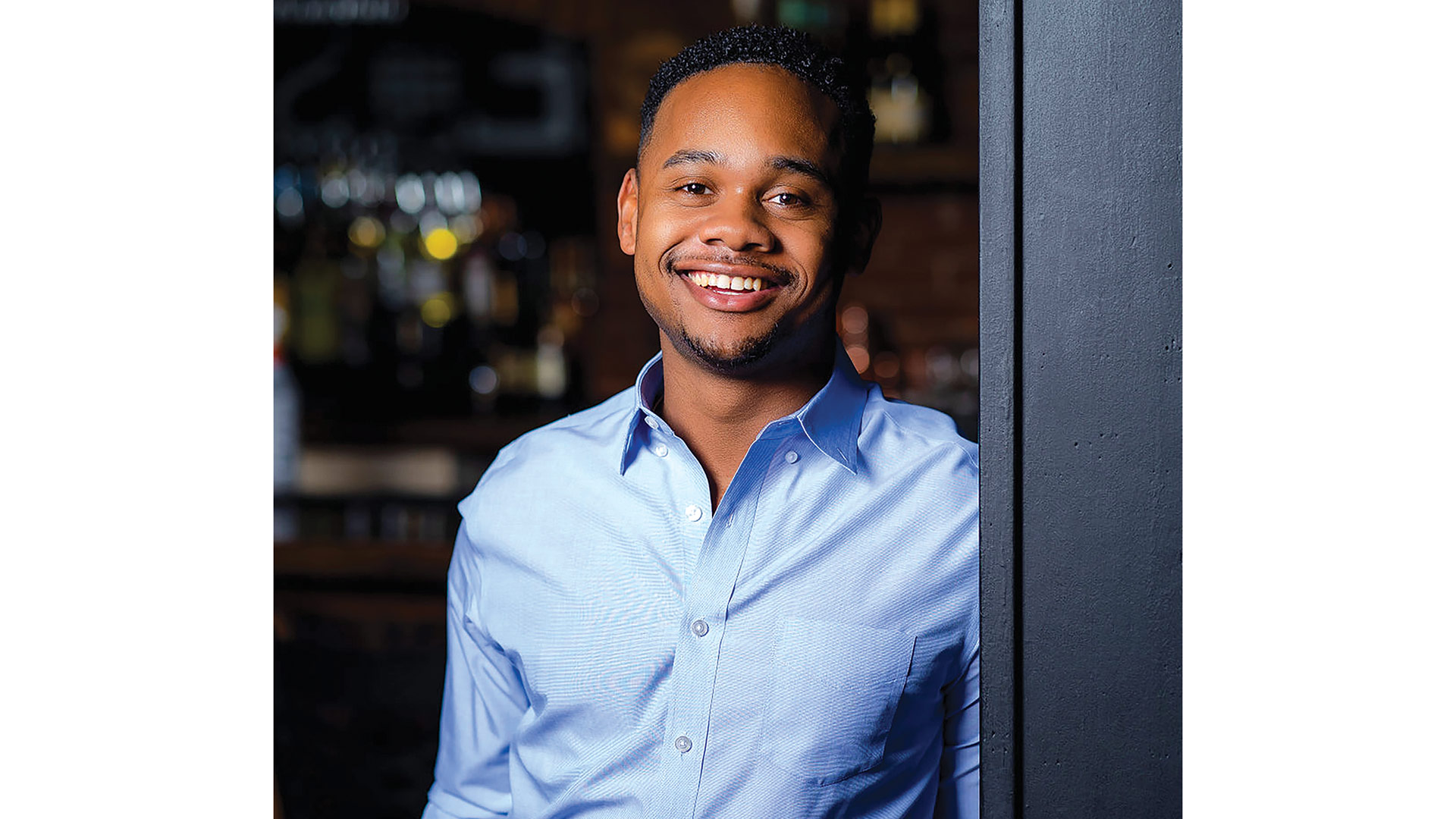
Kenny Lumpkin

Kenny Lumpkin doesn’t like to use that word ‘club’ when it comes to his establishment on Worthington Street, Dewey’s Jazz Lounge. He prefers ‘restaurant, bar, and music venue,’ which really says it all. Those are his passions — in life and now in business. A year after opening, he’s off to a solid start and now looking to make an even greater impact on Springfield’s dining and entertainment scene.

Kenny Lumpkin is the true definition of serial entrepreneur.

Since as long as he can remember, he’s wanted to be in business for himself — and he’s put his name and talents behind many different types of ventures.

One was called Room by Room, an app he developed with a friend that he described as “applying Uber to the cleaning industry — an on-demand way to get your house cleaned.” He eventually sold that venture, took the capital, and segued into real estate, flipping houses, and wholesaling. And while doing that, he also got into consulting, specifically with businesses in the hospitality sector looking for help with marketing, and later, biotech and pharmaceutical consulting, working for a few different firms.

But his real passions — yes, we need the plural here — are music, food, and beverage.

And he and business partner Mark Markarian have brought them all together in an intriguing new venture in the heart of Springfield’s entertainment district, or what many are now calling the Dining District.

“I said to her ‘give me the landlord’s number,’ because this fit the vision; I saw the mezzanine, I saw the elevated stage … I saw some incredible potential.”

It’s called Dewey’s Lounge, with that name chosen to honor Lumpkin’s cousin Dwight ‘Dewey’ Jarrett, who passed away in 2014. It’s been called a club by many, but Lumpkin doesn’t necessarily like that term attached to his establishment. He prefers ‘restaurant, bar, and music venue,’ with ‘restaurant coming first for a reason.

Opened almost a year ago, Dewey’s was obviously conceived and launched before and then during the pandemic, although Lumpkin admits that he’s been working on bringing this concept from the drawing board to reality for many years now. And since it is a product of the pandemic, the business plan for Dewey’s has been revised … well, Lumpkin doesn’t know how many times.

“Maybe 15 or 20 times — I’ve lost track,” he said, adding that many things have changed since the original plans were put down, including (and especially) the location.

Indeed, the original site was on Main Street, the former JT’s tavern. Lumpkin and Markarian had signed a letter of intent and were primed to get started when COVID arrived in March of 2020. The partners quickly put those plans on the shelf for what would be more than a year, but in many respects, the pandemic was somewhat of a blessing.

“I look back on it now, and while it was frustrating in the moment, it was extremely beneficial,” he recalled. “It allowed us to really dig deeper, develop the plan in more detail, and look at other locations.”

But what really hasn’t changed is the broad concept and the desire — make that the mission — to make this all happen in Springfield, where Lumpkin was born and spent his early years.

And over its first 11 or so months in operation, Dewey’s is off to what Lumpkin called a solid start that has been better than expected, especially while dealing with COVID, two different surges, mask mandates, and the corresponding changes in attitude about going out and being in a crowded place.

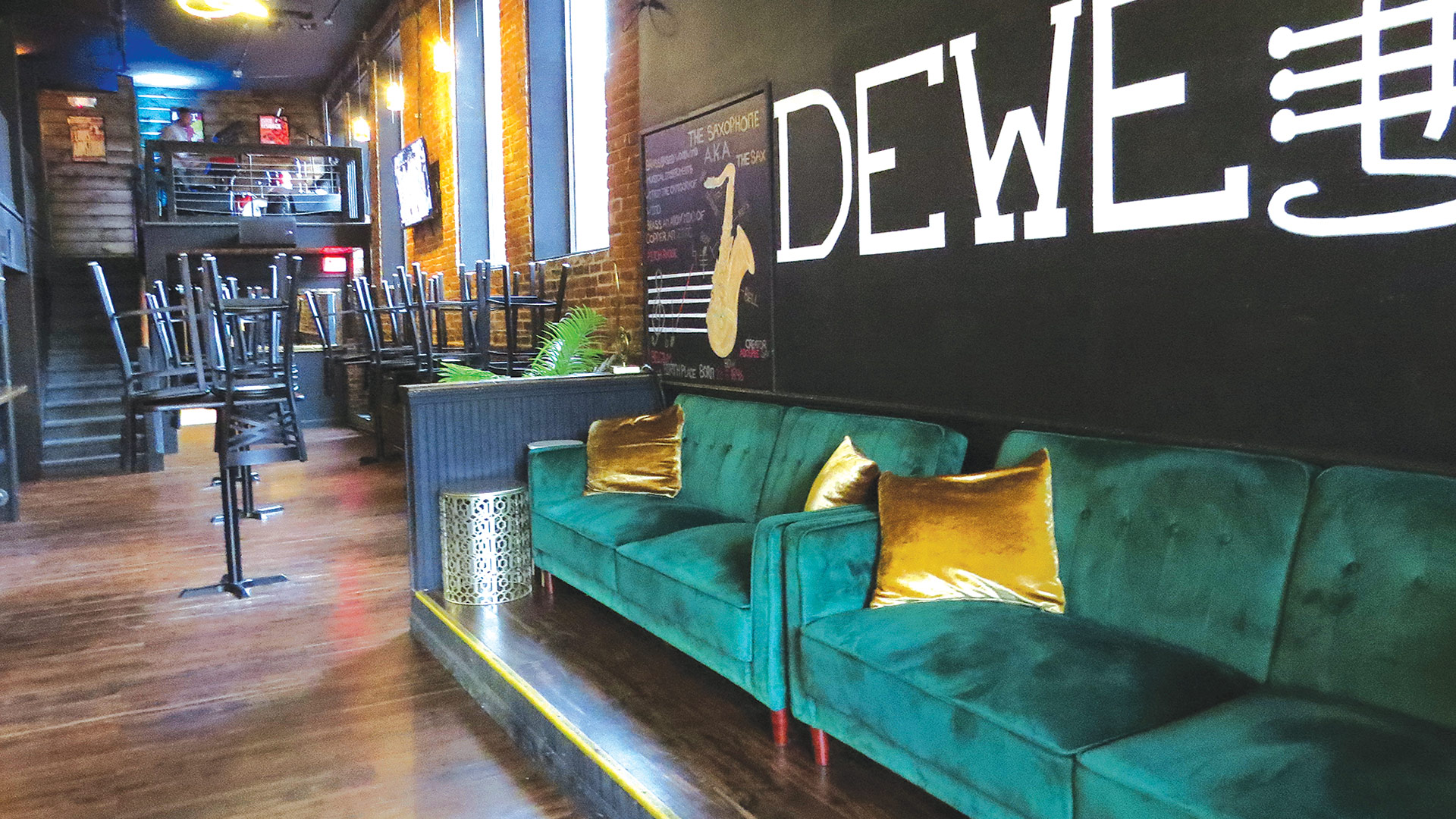
Deweys Bar

Dewey’s was conceived as a place where food, beverage, and music would come together in a powerful way.

“We’ve seen two dips and two spikes,” he explained, adding that he and Markarian understood the risks of moving ahead with their venture when they eventually did — December of 2020 — but decided these were risks worth taking. “There was really no good time to do it. We took that risk, and, in looking at the cycle of it, understood that we were going to come out of this eventually.”

The goal moving forward is to continue to build on the solid foundation that has been created, he told BusinessWest, while also advancing plans for another new business in the downtown — a sports bar on Dwight Street (more on that later).

For this issue, BusinessWest talked at length with Lumpkin about a host of topics — Dewey’s, the joys (and perils) of entrepreneurship, downtown Springfield and its comeback from COVID, and much more.


Sound Investment

Lumpkin told BusinessWest that the chosen location for Dewey’s came about more or less by accident.

As he tells the story, he was helping his sister prepare for the grand opening of her venture, called Ethnic Study, a co-working space and café in a property on Worthington Street, in late summer of 2020, when she asked him to move some paint and other materials to the other side of the divided first floor.

What he found on the other side was what was left (not much, as he recalled) of the former Fat Cat lounge, which had closed years earlier.

As he looked around, Lumpkin concluded that he had found what he was looking for. Sort of.

“I have always said that music, food, and drinks are the one thing that can really unite anybody and everybody. That was my hypothesis before we opened, and seeing it come to fruition has been quite amazing.”

It wasn’t what he could see that intrigued him — although that, too. But rather, it was what he could imagine. And that was the restaurant, bar, and music venue that he had always dreamed of.

“I said to her ‘give me the landlord’s number,’ because this fit the vision; I saw the mezzanine, I saw the elevated stage … I saw some incredible potential,” he said, adding that he signed a lease late that fall and commenced transforming the location in December.

Dewey’s has attracted entertainers

Since it opened, Dewey’s has attracted entertainers from across the region — and across the country.

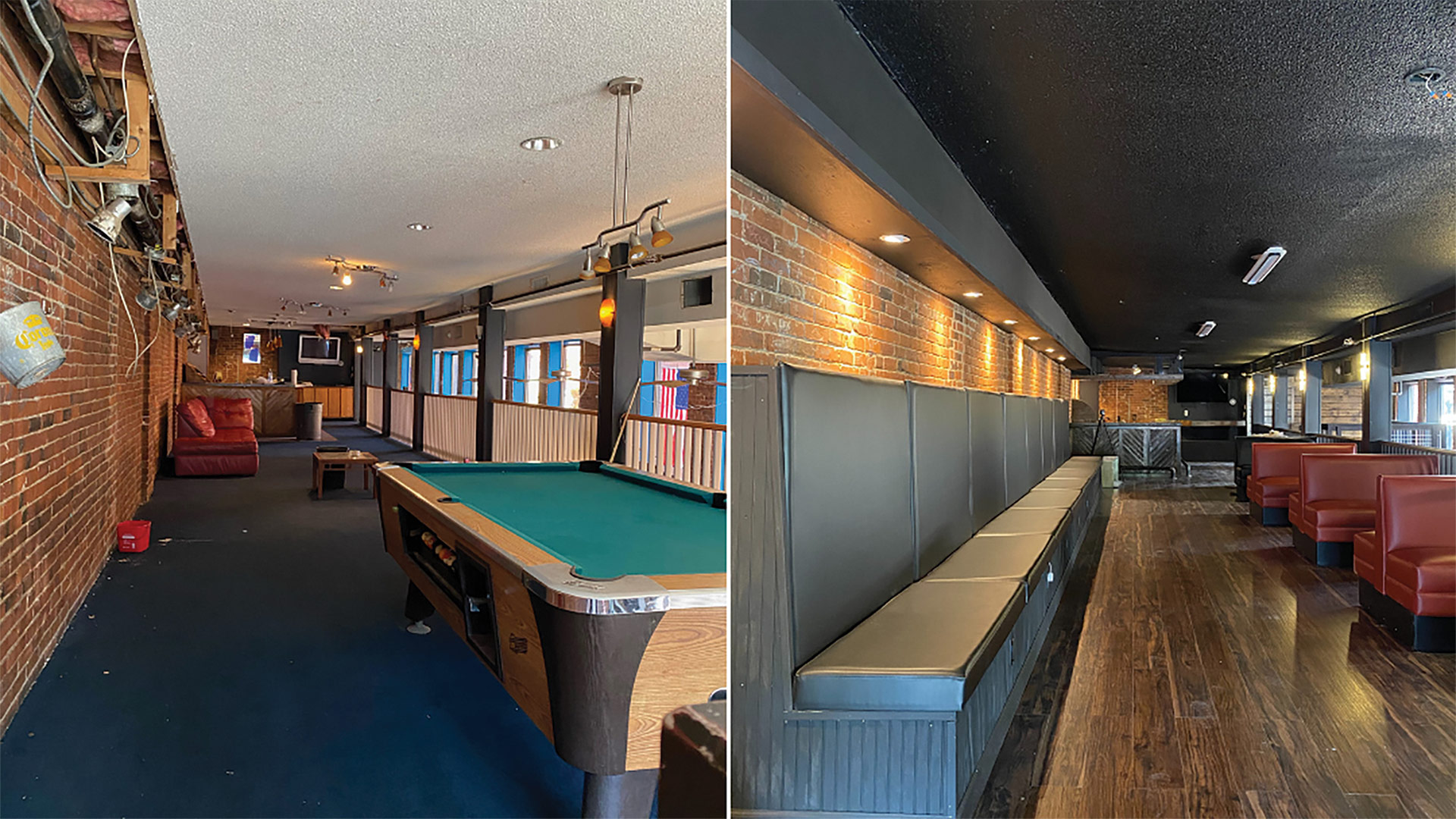
There was a good deal of work to be done, including the replacement of the bar and moving it from the center of the first floor to one side, new shelving, a new bar and seating on that mezzanine level, and more, and it was completed over the next six months or so, with Dewey’s opening in June 2021.

Before getting more into this intriguing addition to the downtown Springfield landscape and how it came about, we first need to explain how Lumpkin made his way back to the City of Homes and made his dream reality.

We pick up the story at Emmanuel College in Boston, where Lumpkin was studying business management, with a focus on marketing, and working as a barback at a local restaurant. Later, he worked as a server at Joe’s American Bar & Grill on Newbury Street, and then as a server and bartender at the Envoy Hotel in Boston’s Seaport.

While working these jobs, he developed that Room by Room app mentioned earlier, then segued into real estate, and then into various forms of consulting. The money was good and the work was rewarding in many ways.

“But … I wasn’t passionate about it,” Lumpkin recalled. “And what I realized I was passionate about was people, and music — I’m really passionate about music. I love to eat, and I love a good cocktail.

“And that’s where this business idea began to develop, because I really do enjoy connecting with people,” he went on. “And I’ve been the friend who said, ‘everyone come to my house — I’ll cook, let’s drink, let’s hang out all night.’”

So he set out to create a business where he would be the host and people could eat and drink, and also listen to live music.

As noted earlier, the plans for what would become Dewey’s started jelling months before anyone had ever heard the word COVID, and would certainly be impacted by the pandemic in many respects. But while there have been some ups and downs that have coincided with surges and subsequent drops in cases, the venture has come together as things were originally envisioned.

Before and after photographs

Before and after photographs show the dramatic transformation of the former Fat Cat lounge into Dewey’s.

He acknowledged that being a business owner, especially in the hospitality industry, is difficult, and that’s without a global pandemic being thrown in for good measure. But he enjoys the challenges, and even used the word “fun” when talking about how to plan and execute during COVID.

“We would all prefer boring,” he explained. “But challenges like the ones we’ve seen keep you intrigued, keep you interested, and keep you creative. And if you get to the core of what an entrepreneur is, it’s someone who is creative, who can find new ways to problem-solve, and find ways to increase volume or throw out new dishes or cocktails; it keeps it fresh and it keeps it new.”


Achievements of Note

It helps to have something new, different, and intriguing, and Dewey’s has those ingredients.

Specifically, this is an appealing mix of food, signature drinks, and music, a combination that has had many guests thinking they’re somewhere other than downtown Springfield when they walk in the door, said Lumpkin, adding that this was the idea when he conceptualized Dewey’s.

And, as noted, he emphasizes that it is a restaurant first, with offerings ranging from Cajun shrimp pasta to baked mac & cheese to fried catfish and grits.

But craft cocktails are an important part of the mix — figuratively but also quite literally — as well, he said, adding that Dewey’s is considered the only craft cocktail bar in downtown Springfield.

“All of our syrups, all of our juices — all of the ingredients that go into our drinks — we make in-house,” he explained. “Everything but the spirit is house; we probably squeeze a couple thousand limes a week.”

The signature cocktails vary with the month and the season, he said, adding that current, spring offerings include ‘Georgia on My Mind,’ a mix of whiskey, iced tea, lemonade, and peach syrup; ‘Louis’ Lemonade,’ which features gin, lemon juice, and lavender simple syrup; and ‘Billie’s Holliday,’ featuring vodka, limoncello, and house-made grenadine, topped with prosecco.

As for the music, when asked how and where he finds performers, Lumpkin said that, in many cases, they find him — because they’re looking for intriguing new places to play.

“You’d be surprised by all the talent that’s here in Western Mass. and Connecticut, and Boston as well,” he told BusinessWest. “The most consistent bookings we receive are within a 100-mile radius; however, we’ve had bands come in from New Orleans, Georgia, D.C., Sacramento … we’ve had bands come in from across the country, but the majority are local.”

Dewey’s is currently booked through July, and it boasts live music five nights a week, he said, adding that each night has a different theme, with vocalists or “a vocal-like instrument” on Wednesdays, with a “throw-back R&B” on Thursday. Friday night is more of a “funky, groovy night,” as he put it, with Saturday devoted to straight-up jazz and Sunday and its brunch reserved for classical or a “more groovy type of band.”

It is the combination of all of the above that has enabled Dewey’s to get off to a good start and attract visitors from across this region and well beyond it, said Lumpkin, noting that he carefully tracks such information and notes that through aggressive, targeted marketing and people simply Googling ‘live music,’ or ‘craft cocktails,’ Dewey’s has drawn patrons from Vermont, New York, and many from Connecticut, New Hampshire and the Boston area, in addition to communities across this area.

Dewey’s a destination.

The combination of food, drink, and music has made Dewey’s a destination.

“I have always said that music, food, and drinks are the one thing that can really unite anybody and everybody,” he noted. “That was my hypothesis before we opened, and seeing it come to fruition has been quite amazing.”

Elaborating, he said Dewey’s has been able to attract a clientele that is diverse in every sense of that word, which is unusual in hospitality — and especially in this region.

“We’re in a community where you don’t really see all demographics in one establishment simultaneously,” he explained. “What surprised me … actually, it didn’t surprise me, because I expected it, and what has made me really happy is to see the eclectic group of people that Dewey’s has attracted.

“You see a range of age, gender, nationality, and ethnicity here every single night,” he went on. “People come in and say ‘I don’t think I’m in Springfield; this has a bigger-city vibe, because you’re seeing so much diversity in one room.’”

Moving forward, Lumpkin wants to build on this momentum, obviously, while also embarking on another venture, that sports bar on Dwight Street.

He is targeting a late-summer opening for that facility, and believes there is ample room in the marketplace for such a facility and also ample motivation for him to fill what he sees as an unmet need.

“There’s no sports bar in the area, and any restaurateur understands that sports bars also produce the best margins when it comes to this industry,” he explained, adding that, overall, he is a firm believer in amassing an abundance of hospitality options and, while doing so, creating a true destination in a city or, in this case, a dining district.

“It sounds crazy to say, but there’s almost no such thing as competition in this industry,” he told BusinessWest. “Patrons don’t go to one establishment; they typically at least go to two. They’ll say ‘let’s grab a drink here, a bite here, and dessert here’ or ‘a bite here, a drink there, and let’s get catch a show.’ People get to two or three places a night, and so the pie grows.”


Just Desserts

As he talked with BusinessWest, Lumpkin noted that plans are coming into place for what promises to be an exciting one-year anniversary for Dewey’s.

Indeed, he has a star-studded entertainment lineup coming together, with musicians from New Orleans, Boston, New York, California, and this area as well, signed up to perform.

“It’s going to be quite the party,” he said, adding that there is much to celebrate — with this new venue and what is transpiring along Worthington and elsewhere downtown.

It’s taken a few years, but Lumpkin’s dream has become reality in Springfield. It’s a place where his passions come together under one roof, and where a diverse mix of clients has come together as well.

It hasn’t all gone as planned, but in most all respects, it has gone better than planned.


George O’Brien can be reached at [email protected]

Accounting and Tax Planning Special Coverage

Questions and Answers


Increasingly, third-party sites like Airbnb and VRBO have made it easier for individuals to rent out their homes and condos and generate revenue. Given these trends, it’s important to understand both the tax benefits and tax implications before listing your property for lease.

By Elliot Altman, CPA, MST


Are you a current host or considering renting your property on third-party vacation sites?Understand the tax benefits and implications before listing your property.

Elliot Altman“If you are a property owner, it is important to understand the tax benefits that come with owning rental properties.”

Whether you are a first-time host or an experienced pro, it’s important to consider the responsibilities as much as the benefits. What follows is a comprehensive tax guide for vacation rental owners that covers everything from how to report your income to the IRS, to what deductions you can claim.


Benefits to renting out a room or vacation property

With the rise of the sharing economy, more and more people are renting out their homes on platforms like Airbnb and VRBO. Third-party sites like these can offer a variety of advantages.

First, you can reach a large audience of potential renters. Both sites have millions of users, so you’ll be able to find people from all over the world who are interested in staying in your rental. Second, you can set your own price and terms. You’re in control of how much you charge and what kind of rental agreement you want to have with your guests. Finally, renting through a third-party site can be a great way to earn extra income. With careful planning, you can make sure that your rental property is profitable.


What is taxable and what is not?

When you’re renting out your property, it’s important to know what income is taxable and what is not. Generally, any money that you receive from renting your property is considered taxable income. This includes rent, cleaning fees, and any other fees that you charge your guests.

However, there are some exceptions. For example, if you rent out your property for less than 14 days per year, the income is not considered taxable. Additionally, if you use your rental property for personal use part of the time, you may only have to pay taxes on the portion of the income that comes from renting it out.

Here are some of the most frequently asked questions related to taxes and your Airbnb and Vrbo rentals.

Do I have to pay taxes on rental income?
If you rent out your vacation home, spare room, or apartment for more than 14 days a year, you are required to pay taxes on the rental income. This includes all income you collect from rent, cleaning fees and any other additional fees.

How much tax will I have to pay?
The exact amount of tax you owe will depend on a number of factors, including the location of your rental property and the amount of income you earn. In most cases, you will be required to pay federal, state, and local taxes on your rental income.

State and local taxes on rental income vary depending on the location of your rental property.

What expenses can I write off?

People who rent out their homes on Airbnb and VRBO can write off a number of expenses on their taxes. These expenses can include the cost of repairs, cleaning, and furnishings. You will need to allocate rental and personal use in order to write off the expenses. In addition, rental property owners can deduct the costs of advertising and paying fees to the rental platforms. However, it is important to keep detailed records of all expenses in order to maximize the tax benefits. For example, receipts for repairs should be kept in order to prove that the expense was incurred. By carefully tracking their expenses, Airbnb and VRBO hosts can ensure that they take advantage of all the available tax benefits.

Do I need to collect occupancy tax?

The answer depends on the laws in your area, but in general, if you’re renting out a room or portion of your home for less than 30 days at a time, you are likely required to collect and remit occupancy taxes.

These taxes, which are also sometimes called lodging taxes or tourism taxes, are typically imposed by state or local governments in order to generate revenue from visitors. They can range from a few percent to over 10% of the rental rate, so it’s important to be aware of the laws in your area before listing your property. (Massachusetts state room occupancy excise tax rate is 5.7%).

One of the benefits to renting your property through a third-party site, is that they may have an automated feature that determines which taxes are applicable for your listing, collects and pays occupancy taxes on your behalf. Always check to see if this setting is available and if you need to opt in for it to be activated.

Am I considered self-employed if I have rental income?

Unlike wages from a job or a business, rental income isn’t considered to be earned income. Instead, it’s considered to be passive income by the IRS, and therefore is not subject to self-employment tax.

Will third-party rental sites provide me with a tax form?

There are a few factors that will determine if you will receive a tax form from your third-party site. The 1099-K form is used to report income from transactions that are processed through a third party. This includes credit card payments, PayPal payments, and other forms of electronic payments. The form will report the total amount of income that you received from Airbnb or VRBO during the year, as well as the total number of transactions.

Third-party sites, such as Airbnb and Vrbo, typically will provide you with form 1099-K if you meet certain thresholds such as:

• Processed more than $20,000 in gross rental income through the platform, and

• Have 200 or more transactions during the year.


Note that these are only general guidelines, and you may still receive a 1099-K form even if you don’t meet both of these criteria.

Maximize Your Tax Benefits on Your Rental Property

If you are a property owner, it is important to understand the tax benefits that come with owning rental properties. It’s important to speak with a tax professional so that you can get the most benefit from your rental properties and ensure that you are taking advantage of all available tax breaks.u


Elliot Altman, CPA, MST is a Senior Manager at the Holyoke based accounting firm, Meyers Brothers Kalicka, P.C.

Employment Special Coverage

Work in Progress


Since its inception, the SummerWorks program administered by the Commonwealth Corp. has opened doors for young people and introduced them to the world of work. This year, as the program expands to include individuals ages 22-25, it is primed to open more doors — and potentially create more opportunities, for employees and employers alike.

By Kaily Houle


David Cruise is more than familiar with the vast potential of Hampden County’s young people and their importance to the region’s business community.

As the president and CEO of MassHire Hampden County Workforce Board, he administers a program called YouthWorks, a state-funded summer-employment program that helps teens and young adults gain the skills and experience needed to not only find and keep jobs, but to begin to design a path toward success.

He’s watched over the years as the program has helped introduce young people to the world of work while also assisting area cities, towns, non-profits, and for-profit businesses with finding needed help and, sometimes, long-term employees.

And this year, he’s anticipating that he’ll see more of all of the above.

Indeed, program administrators are expanding the age parameters of YouthWorks in order to reach a broader range of young adults in the region. Initially, the program was offered to people ages 14 to 21, but now young adults from 22 to 25 are able to participate as well. The mindset behind this expansion of the program is to help more people enter or return into the workforce by providing them with jobs, leadership development and career-exploration opportunities, and various skills training.

“The intent is to take young people, primarily those that live in high-risk, urban areas like Springfield, Holyoke, and Chicopee, Westfield, and provide them with the opportunity of a structured work experience that usually lasts five to six weeks.”

“The intent is to take young people, primarily those that live in high-risk, urban areas like Springfield, Holyoke, and Chicopee, Westfield, and provide them with the opportunity of a structured work experience that usually lasts five to six weeks,” Cruise told BusinessWest, adding that the young people participating are not the only ones who stand to benefit.

Those hiring these individuals benefit as well, he said, adding that this is true at any time, but especially when businesses in every sector of the economy are struggling to find enough help to function at full capacity.

The YouthWorks program will see a boost in funding this year, from $2.5 to $3.17 million — enough to fund more than 700 summer jobs and another 130 evening and weekend jobs during the school year. These initiatives are aimed at getting young adults back into the workforce. Because some of these youth, especially those between the ages of 18 and 25, were displaced from the workforce — either by being disconnected from school or working — YouthWorks gives them the opportunity to find not only a job, but a career they can grow into.

“They may be working part time or under the table, but they’re not in a job that is going to lead them to success,” Cruise explained. “They’re not in a job where they’re in a career that will eventually allow them to make a family-sustaining wage and live at a level they feel comfortable; we have a lot of people beyond the age of 21 that are in the marginal labor market.”

YouthWorks was able to receive its funding a year earlier to aid in planning and serve young people more efficiently. In the past, the agency has received separate funds for the summer program and the year-round program. This year, they’ve combined the funds into one lump sum.

“This is the first time we’ve done that; it’s significant because now we can tie together the summer programming and the work we do during the school year,” said Cruise. “Several of the youths involved in our summer program can continue on into our year-long program.

“So it has a nice continuity to it,” he went on. “We’re not offering full-time positions, but we do think our older youth have an opportunity to not only have a successful summer program, but to also get into a company that can offer a full-time position if that is what they want to do.”


The Job at Hand

Cruise has long been an advocate of summer jobs — not only as a way to introduce young people to the workforce, specific lines of work, and the soft skills needed to succeed long-term, but also as a way to help at-risk young people find alternatives to the streets and the trouble often found there.

But the YouthWorks initiative has always been a win-win-win, he went on, adding that the initiative has benefitted several sectors of the economy — manufacturing and the broad hospitality sector, to name a few — as well as individual businesses and nonprofits, and area cities and towns as well.

Dave Cruise says summer jobs bring benefits to both employees and employers.

Dave Cruise says summer jobs bring benefits to both employees and employers.

And at a time when many sectors are still contending with an ongoing workforce crisis, there are more opportunities for young people and businesses to benefit, with young adults participating in Youthworks now having a better opportunity to find a job that will last longer than the five-to six-week program.

“I believe there are some opportunities in the private sector, because many companies are having a difficult time finding the sufficient staff to do their work,” said Cruise. “It’s hard in the summer to bring someone on for five to six weeks, but if we do a good job matching the young people to the particular site, that five-to six-week summer program can potentially turn into something full time. We’re pretty confident that some of that is going to happen with our older groups.”

Meanwhile, a main focus for YouthWorks is to teach young adults the importance of work and the employability skills they will need to not only find a job, but to keep that job moving forward. Young adults will learn the importance of communicating with your work colleagues, showing up on time, being open to constructive criticism, working in a team concept, developing critical thinking and judgment skills.

“The technical skills they learn on the job are really important also, and we don’t consider them to be secondary,” Cruise went on. “We want to be sure the young folks are getting a real sense of the value and the importance of work — that work is good, work is healthy. It’s very exploratory with our 14-and 15-year-olds but those soft skills are just as important as they are for the 21-to 25-year-olds.”

Focusing on urban areas allows young adults to provide for not only themselves, but also for their families, said Cruise. Participants between the ages of 16 and 25 will be working 100 to 220 hours over the five-to six-week program, making $14.25, Massachusetts minimum wage.

“It’s a job where … they won’t get rich, but they’ll earn money to help continue to support their families and themselves,” he noted. “They’re not taking their check and running to the Apple store — they have other priorities.”

Young adults will be placed in one of the three organizations working with YouthWorks. They have placement opportunities at New England Farm Workers Council, MassHire Holyoke One Stop Career Center, and Valley Opportunity Center. The goal this summer, as noted, is to provide 740 jobs for the summer program and about 130 jobs during the fall.

Due to the COVID-19 pandemic, many of the jobs secured by young people through the YouthWorks program were remote in nature, said Cruise, adding that as workplaces return to something approaching normal this year, participates should see a mix of working conditions, which will only add to the learning experiences.

“We want young people to not only experience hybrid and remote work and how that happens, but see it as something they have to adapt to and deal with as they deal with their career path,” he noted.

Meanwhile, Cruise emphasized that, despite the name of the program, those within the extended age range will not be treated like children. The purpose of the program is to help people — whether they be adolescents or adults — realize their potential and become successful members of the workforce.

“It’s hard to take a 25-year-old or an 18-year-old and call them a youth,” he said. “I don’t make that mistake calling them youth; they’re young adults … they’re adults, period. We treat them like adults. We respect them as adults.”

The summer program is going to begin the weekend after the Fourth of July. Applications are still available at the three organizations partnered with YouthWorks, online, and in most high schools in Hampden County.


Beyond a Paycheck

Since it was launched decades ago, the summer-employment program has been all about opening doors for young people, said Cruise.

These open doors lead to learning experiences on many different levels — from acquiring a specific skill, to understanding the importance of showing up for work on time, to discovering well … how to make a living.

Sometimes, these open doors lead to much more — not just a summer job, but a career. And with the expansion of the SummerWorks program to a broader age group this year, the hope, and the expectation, that more doors will be opened and many more young people will march through them.

Construction Special Coverage

A Framework for Continued Growth

D.A. Sullivan & Sons.

Mark Sullivan, center, with several members of the team at D.A. Sullivan & Sons.

It started with a few people building a home in Williamsburg in 1897. And over the past 125 years, the firm that came to be known as D.A. Sullivan & Sons Inc. has expanded in every way a construction firm can. Its vast portfolio of projects includes construction and renovation of schools, libraries, hospital facilities, dormitories, churches, and much more. While there are many keys to the success of the firm, it’s fourth-generation president says it all comes down to relationship-building.

By Elizabeth Sears


Mark Sullivan knows the elements of a successful building — strength, stability, durability, to name a few. And he should know — he’s the president and executive project manager of D.A. Sullivan & Sons, a construction company in Northampton.

Sullivan also knows firsthand that these same elements are essential for a successful company.

While constructing schools, churches, municipal buildings, and more, the Sullivan family has built an enduring business with a strong foundation. Indeed, D.A. Sullivan & Sons is celebrating its 125th anniversary this year — a milestone that speaks to the impressive legacy the Sullivans have built.

“Now I’m the fourth generation — my brother Dennis and myself are the fourth generation,” said Mark. “Our nephew, Andrew, joined us a few years ago, he’s the fifth generation. Hopefully we’ve got more to come.”

The company was started by his great-grandfather, Dennis A. Sullivan (D.A.) along with his brother, in 1897. They worked mostly on houses in Northampton — the city they’ve been based in for the past 125 years. Initially the pair traveled wherever the work was, even as the company grew, but for the past 75 years D.A. Sullivan & Sons has concentrated its services from Pittsfield to Worcester.

D.A. Sullivan & Sons acts as a construction manager or a general contractor. Sometimes it even acts as an owner’s project manager or “OPM” for towns that are undergoing building projects. It acts as a consultant to shepherd municipalities through the whole process of a public building project — undertakings that are often large and complex in nature.

“As a construction manager or a general contractor, we’re responsible for everything,” Mark Sullivan explained. “We self-perform with our own forces — more work than most firms our size. We’re responsible for the coordination of the entire process,” Sullivan said.

Mark Sullivan

Mark Sullivan says that relationship-building has been the key to success for this family business.

Of course, the industry has evolved dramatically since the company started all those years ago — the nature of commercial work has changed considerably since D.A. Sullivan & Sons was established in 1897. Even in the 35 years that Mark Sullivan has been with the company, he notes that technology and efficiency have been ever-improving.

“It used to be that my brother and I would each run three or four projects, we had a secretary with us, and that was it,” he explained. “Now you’ll have teams of personnel for each project. You can have four or five people dedicated to a single project … it’s worlds apart from where we were 55, even 35 years ago,” Sullivan said.

And it’s not just the industry that’s been evolving and growing.

D.A. Sullivan & Sons has also grown considerably, now having more than 50 employees. However, it’s important to note that there are certain elements to the company that have not changed, even after all this time. The firm continues to be a community-oriented family business, and it is still equally as committed to maintaining close relationships with its clients as it was over a century ago.

“Because we’ve been around a long time and we’ve worked with almost every municipality in Western Mass, we have long-standing relationships with a lot of the private colleges and schools in the area,” Sullivan told BusiniessWest. The Eaglebrook school in Deerfield, in particular … that relationship is three decades old. It culminated a few years ago in their new science, art, and music building, which was a signature project on campus. That was a lot of fun.”

For this issue and its focus on the region’s construction sector, BusinessWest looks at the 125-year history of D.A. Sullivan. Along the way there has a been a good deal of that fun that Mark Sullivan described, but mostly hard work, attention to detail, lots of that relationship-building, and adding on that solid foundation that was put down when William McKinley was roaming the White House.


From the Ground Up

Just a quick look at the portfolio of completed projects on the firm’s website provides some deep insight into the diversity of work the company has taken on in recent years and some perspective into how it has changed the landscape in the region — figuratively, but in some cases, also quite literally.

Indeed, the firm handled the recent project to renovate Springfield’s Pynchon Park, which links the downtown to the Quadrangle area. It also took on a massive renovation of Chicopee’s historic City Hall, a project that included rehabilitation of the auditorium, exterior work on the main building, and renovation to the existing clock tower and numerous stained windows.

D.A. Sullivan & Sons has been changing the landscape

D.A. Sullivan & Sons has been changing the landscape at UMass Amherst for decades, including this dormitory built in the 50s.

Meanwhile, the firm also took on projects to renovate the Worcester Public Library, Gamble Auditorium at Mount Holyoke College, the Fitness Center at Mass. College of Liberal Arts, and the 646-foot-long Fine Arts Center Bridge on the UMass Amherst campus, a complex undertaking that ultimately created more space for the Art, Theater, and Music departments.

Going back further, the portfolio includes projects (some could be called landmarks) such as the Blake Arena on the campus of Springfield College, the Springfield Materials Recovery Facility, Northampton’s new post office, Westfield High School, and countless others.

“Because we’ve been around a long time and we’ve worked with almost every municipality in Western Mass, we have long-standing relationships with a lot of the private colleges and schools in the area.”

Taken collectively, these projects show how the firm has evolved over the years and taken its teams across New England and well beyond. They also show how the firm has consistently added to a diverse list of clients over the years, while also maintaining relationships for years, and, in some cases, several decades.

Perhaps the best example of this is UMass Amherst. Indeed, one of the firm’s longest-standing relationships is with the university, said Sullivan, noting that the firm built 12 of the original 13 dorm buildings there, several other buildings, including Curry Hicks Cage, former home to the basketball team, and is still working with UMass today.

“I just came back from the previously mentioned Newman Center at UMass, which is a new facility for the Springfield Diocese,” he noted. “We haven’t built a church in a couple decades, so that’s been an interesting project.”

This relationship with UMass, one of many that go back 40, 50, or more years, explains why D.A. Sullivan is able to celebrate 125 years in business, and why five generations from the family have worked there.

“We’re a fifth-generation firm, which is incredibly unique. I believe we’re Northampton’s oldest firm,” said Sullivan. “We’ve just been here a long time and it’s crazy to think that my brother and I have been working for more than 35 years,”

Of course, maintaining such an accomplished family legacy comes with a daunting amount of responsibility. Not only do the projects themselves present challenges, but there is the added stress of each new generation keeping the company alive.

“We’re starting to think about that next leadership group coming behind us, and hopefully they’ll shepherd the company to the next century,” Sullivan said, “There’s a certain pressure to keep it going and not screw up on my watch, but we’ve been thankful throughout the years for the relationships we’ve had and the project’s we’ve built. We’ve got great people. More than anything, the people that work for us and with us, have enabled us to stick around for as long as we have.”

The team at the firm is consistently adding to that already large and diverse portfolio of projects with a number of current initiatives.

They include renovation of the public library in Grafton, the Newman Catholic Center at UMass Amherst, renovation of Goessmann Labs at UMass, renovation of the home for the Carpenter’s Local 336 headquarters, and a closely watched initiative in Easthampton called the One Ferry project.

This is an effort to stimulate economic development in the city by renovating a collection of abandoned mill buildings, said Sullivan, adding that the One Ferry Project has been and will continue to be a very important project for Easthampton and the surrounding area.

“It’s a build-out of a campus of old mill buildings, and we’re on phase two right now, which is Building 5,” he explained. “We’re looking toward phase three, which is either a renovation of Building 7 or new construction of a new facility next to the mill building.”

He told BusinessWest that the mill area has been a blight on Hampshire County for many years, and D.A. Sullivan & Sons is working with One Ferry Project developer Mike Michon to write an intriguing new chapter in the history of the property.

D.A. Sullivan & Sons is also currently providing general contractor services for the construction of a new library building in Greenfield, a project that started last fall. Sullivan said this is the type and size — $5 million to $35 million — project the firm specializes in.

As it turns 125, D.A. Sullivan obviously has quite a bit to celebrate — a glorious past, a solid present, and a promising future with new milestones to mark.


History in the Making

As noted earlier, the images on the company’s website and the photos in its vast archives tell a story.

Its main theme is one of longevity — 125 years is a milestone in any business — but it’s really about the forces that made such longevity possible — excellence, perseverance through the tough times (and there were many of them over the years and the decades), an ability to change with the times, and enduring relationships with scores of clients.

And the best part about this story is that there are many chapters still to be written.

Community Spotlight

Community Spotlight

By Mark Morris

Gabrielle Gould, left, and Claudia Pazmany

Gabrielle Gould, left, and Claudia Pazmany have presided over many grand openings in downtown Amherst in recent months, testimony to the community’s comeback from the pandemic.


If business openings are any indication, Amherst is poised for a strong rebound from a pandemic that has been very rough on its mostly tourism-and-hospitality-based economy.

Gabrielle Gould, executive director of the Amherst Business Improvement District (BID) said that, by the end of August by her estimation, at least 13 new businesses will have opened in downtown Amherst.

“We’re watching a lift that we haven’t seen in a long time,” said Gould, who shares office space with the Amherst Area Chamber of Commerce and its executive director, Claudia Pazmany.

The two women and their organizations are working together along with town officials to drive economic empowerment and development for Amherst, and, as recent events demonstrate, it’s working.

Pazmany has presided over 10 ribbon cuttings over the past few months and her calendar has plenty more of these celebrations scheduled in the coming weeks and months.

“Many of these businesses opened during the pandemic and now want to celebrate because they have lasted and even grown their businesses,” Pazmany told BusinessWest.

All this activity in Amherst represents a strong comeback of sorts from the many side-effects of the pandemic. As the community where UMass Amherst and Amherst College are located, it has been described as the quintessential college town. When the pandemic hit and colleges were shut down, the economic impact was abrupt and severe.

“Overnight, nearly 50,000 people left the area,” Gould recalled. “It was like turning off a light switch.”

One way to get an idea of the economic impact colleges have on the town is to look at the number of undergraduate students there. But Gould pointed out that the real impact of students on a town must include all the people who support them, like faculty, staff, and even all the friends and parents who visit the students. When the pandemic hit and campuses were abandoned, Amherst experienced what life would look like without its colleges.

Paul Bockelman

Paul Bockelman says housing is just one of many priorities that have emerged in discussions about how to best spend ARPA funds.

“Once everyone left, our businesses ran at 20% to 30% capacity— and that’s not sustainable,” Gould said. To put it another way, business was off 70% to 80%. “Having the colleges open and the students back fills my heart with joy.”

As noted, these students — and all those who support them or might come to visit them — will see a number of new businesses, especially in the downtown area. That list includes the much-anticipated Drake performance venue, which opened its doors late last month. The Drake meets a long-recognized need for a live-performance venue and it is expected to bring people to Amherst from across this region and well beyond, said Gould, adding that it will likely be a catalyst for more new businesses.

“As we look at different entities, we are trying to curate our mix of businesses. In that way we can bring in what we’re missing and make Amherst a vibrant and vital destination.”

But the Drake is far from the only addition to the landscape, she noted, adding that there are new restaurants, retail shops, and more, bringing an ever-more-eclectic mix of businesses to downtown that will make that area more of a destination.

For this, the latest installment of its Community Spotlight series, BusinessWest puts the focus on Amherst, which was hit very hard by the pandemic, but is moving on from that two-year nightmare is every way imaginable.


On the Town

As part of the effort to bring Amherst out of the COVID era, the Chamber and BID began a campaign to promote Amherst as a destination titled “What’s Next? Amherst Area.”

Pazmany explained that this campaign promotes the quality of life in Amherst and surrounding areas.

“We focus on three things: the outdoor adventures available here, our iconic cultural institutions — think colleges and the Emily Dickenson Museum — and the ability to have a global dining experience among our restaurants,” she said.

Global dining is more than hyperbole, as downtown Amherst lists 43 restaurants featuring cuisines from all over the world. Each one has an intriguing story.

Indeed, Antonio Marquez moved from Guadalajara, Mexico to Amherst because his wife’s family lives there. As he researched where to open his restaurant, Mexcalito Taco Bar, Marquez considered several towns in the Pioneer Valley and credits destiny for making Amherst his choice.

“This is the best spot for us because we have a family connection here and we like the fact that Amherst is a university community,” Marquez said.

While Mexcalito was ready for business prior to the pandemic, Marquez held off when the world shut down and decided instead to open in July 2021. Now 10 months in business, Marquez said his goal with Mexcalito is for customers to learn something new about Mexican culture through the eatery’s food and drinks.

“When people come in, they feel a different ambience, hear different music,” Marquez said. “We’re looking to do more with sophisticated Mexican cuisine and we will be adding 20 new drinks to our cocktail menu.”

He added that Amherst is the right place for Mexcalito and appreciates his relationship with the town. “We’re feeling like we fit here, it’s pretty cool.”

The broad goal moving forward is create more of these ‘fits,’ said Gould and Pazmany, noting that the Drake is another intriguing example.

That facility fills the need for a music venue for downtown, said Gould, adding that her mindset as she tries to help bring other new businesses to the town is to meet other identified needs.

“As we look at different entities, we are trying to curate our mix of businesses,” Gould said. “In that way we can bring in what we’re missing and make Amherst a vibrant and vital destination.”

That strategy is reflected in the 13 businesses that are opening in the next few months. Among the businesses Gould hopes to see are a fish market, a brewery, and a breakfast/lunch café.

“I have a list of businesses Amherst needs,” Gould said. “We don’t have them yet, but we’re working on it.”


House Money

While the business community is rebounding from COVID, the real estate boom that began during the pandemic shows no signs of slowing down in Amherst.

An outdated perception of Amherst is that only college students and retirees lived there, said Pazmany, adding that these days, when a house goes up for sale real estate agents are bombarded with at least a dozen cash offers, all above the asking price.

“Because the pandemic has allowed a number of people to work from anywhere, many are choosing Amherst for the quality of life it offers,” Pazmany said. “One realtor told me most of her clients are people who grew up here and are returning.”

In a good news/bad news twist, UMass and Amherst College are contributing to the housing shortage as both keep moving up academic ranking lists.

“We’re seeing people from literally all over the world who want to do their post-graduate work at UMass,” Gould said. “That means they need somewhere to live.”

And the town intends to use some the $9.8 million it has received from the American Rescue Plan Act (ARPA), to help such people find a place. Indeed, $2 million has been earmarked to begin to address some of the affordable housing concerns in the community.

Housing was just one of many priorities identified by the town as it went about gathering information and soliciting opinions on how to spend ARPA monies, said Paul Bockelman, town administrator, adding that the public and key stakeholders identified 17 different areas to address.

Amherst at a glance

Year Incorporated: 1759
Population: 39,482
Area: 27.7 square miles
County: Hampshire
Residential Tax Rate: $21.82
Commercial Tax Rate: $21.82
Median Household Income: $48,059
Median Family Income: $96,005
Type of Government: Town Council, Town Manager
Largest Employers: UMass Amherst; Amherst College; Hampshire College
* Latest information available

With the projects finalized this past November, Bockelman reported progress in using the ARPA funds in areas such as filling firefighter and paramedic positions, as well as adding a position in public health. The ARPA funds also included a $750,000 allocation for economic development, specifically to support the creation of the Drake.

As for other developments in town, a $36 million project is underway to renovate and expand the historic Jones Library. Plans call for maintaining the stone exterior while adding space and making it one of the most environmentally efficient buildings in town.

Not far from Jones Library, the Emily Dickenson Museum has a $6 million renovation underway. When the museum re-opens later this year, it will display a collection of period furniture and costumes used in the Apple TV series Dickenson. The show’s producers bought actual period pieces for the show and offered them to the museum at the end of the series shooting.

“The TV show has brought Emily Dickenson to a whole new generation who are now obsessed with her,” Gould said.

For all the good things happening, both Gould and Pazmany admit that Amherst’s business community faces the same challenges every municipality faces, from supply chain issues to inflation to the ongoing workforce crisis.

“As restaurants are still staffing up, they are doing what they can, even if it means reduced hours instead of being open all the time,” Pazmany said. “As they are working through it, we’re asking everyone be patient during these times.”

While outdoor dining saved many restaurants from going under, Gould pointed out that most outdoor set-ups were thrown together with a few jersey barriers and no budget. The BID has received a grant to run a pilot program with several restaurants to show what outdoor dining looks like when it’s done right.

“If we can show the community how this looks when it’s done properly, we can encourage more permanent outdoor dining destinations,” said Gould.

One more challenge, she noted, involves encouraging people to set aside the “add to cart” option of having everything delivered. Instead, she suggested that consumers go out and meet a shopkeeper.

“You can walk into a store and make a human connection,” Gould said. “Amazon was a safety net when we needed it but we can now go down the street to browse.”


The Bottom Line

Pazmany added that a new breed of entrepreneurs is opening shops in Amherst.

“There’s a revival of people who want to be business owners,” she said. “They are proud to be here and eager to help.”

Both women look forward to the positive changes that are taking shape in the next couple of years.

“When I think of Amherst in 2023 and 2024, I see a new way of life that is refreshed and yet remains historic,” Gould said. “We do everything we can to keep the town beautiful, but it needs a face lift, and we’re excited because it’s about to happen.”

Accounting and Tax Planning

Cryptocurrency Taxation

By Jonathan Cohen-Gorczyca, CPA, MSA and Tyler Pickunka


Jonathan Cohen-Gorczyca

Jonathan Cohen-Gorczyca

Tyler Pickunka

Tyler Pickunka

Cryptocurrency has become ever more popular over the past few years, so much so that there are athletes being paid in it, sports arenas are changing names to cryptocurrency exchanges and platforms, and even commercials are being aired during the big football game; it has transcended into everyday culture.

Now, cryptocurrency is more accessible than ever, and with so many new phone and computer applications, anyone can buy and sell the digital currency at any time. As it has become more popular, government and regulatory agencies have taken notice and are dedicating more time and funds to changing laws, issuing notices for non-reporting and tax avoidance, and closing the gap in treating it like any other tradable security.

What follows are some basic, but frequently asked, questions to assist you with your cryptocurrency, tax filings, and common treatment for taxation.


How do I obtain cryptocurrency?

Cryptocurrency can be purchased on numerous online platforms whether on your computer or phone. Some of these platforms are strictly cryptocurrency only, while others also allow the trading of publicly traded securities. Certain traditional investment companies have created funds to allow you to purchase, hold, and sell shares of cryptocurrency with your regular investments. This can remove some of the perceived risk of buying and selling on the online platforms.


How is cryptocurrency taxed?

Cryptocurrency is taxable when a taxpayer sells virtual currency for U.S. dollars, exchanges one type of virtual currency for another, receives virtual currency for services, and mines virtual currency. While trading, exchanging, receiving, or giving virtual currency for services are considered capital gains or losses for tax purposes, mining virtual currency is considered ordinary income.

Mining virtual currency is the actual process where new cryptocurrency is created and enters into markets.


Can I gift cryptocurrency?

Yes, but cryptocurrency is not exempt from gift-tax filing requirements if you want to transfer holdings to someone else. The fair market value at the time of the gift, and not the basis, is the value used for gift tax purposes. Your existing basis of the Cryptocurrency transfers to the giftee; this treatment is like stocks. The holding period is transferred as well when determining short- or long-term capital gains if the giftee is to sell or transfer the gift.


When do you check the box on the tax return?

In recent years, the Internal Revenue Service (IRS) has added a question to page 1 of the Form 1040 regarding cryptocurrency to better regulate the taxation of cryptocurrency and hold taxpayers accountable for reporting their taxable transactions. The box on the tax return should be checked for all taxpayers who received, sold, exchanged, or disposed of any financial interest in any virtual currency. If you buy and are holding onto virtual currency and have not done any of the above, you do not need to check this box. If you select “No” and are involved in the active buying and selling of cryptocurrency, this could be considered perjury on an official government form.


Do you have recommendations that make tax reporting easier?

Dissimilar to publicly traded securities, most cryptocurrency platforms do not issue a Consolidated 1099 statement tracking gains or losses. A taxpayer will most likely receive a 1099 MISC or 1099-K. These two tax forms do not provide enough information to make determinations such as if the cryptocurrency was held short-term or long-term, but rather just an aggregate of all activity. One option is to find an online platform that provides this report at year-end.

Another option is to use a third-party software where you can consolidate your trading activities and can generate a report at year-end to hand to your accountant. If you are just provided with multiple ledgers, it is very difficult (almost impossible) to decipher your activity throughout the year.

Understanding the tax implications for cryptocurrency is a must if you have or plan to have it. Contact your accountant for additional information about cryptocurrency and what that may mean for your specific tax situation.


Jonathan Cohen-Gorczyca, CPA, tax manager, has been with Melanson for 10 years andspecializes in individual and business tax returns, compilations, and review engagements; Tyler Pickunka is a recent graduate from Westfield State University who has been a part of the Melanson tax team since 2020.

Employment

The DOL Is Set to Ramp Up Audits

By Alexander J. Cerbo, Esq.


The Department of Labor (DOL) hasannounced it intends to increaseFamily and Medical Leave Act (FMLA) audits on employers. Businesses across many industries continue to face scrutiny by the DOL on their FMLA procedures due to an increase in FMLA violations.

Prepare yourself now and give your FMLA procedures a spring cleaning. The following steps are a great way to stay prepared:

Review your FMLA policy. It needs to include eligibility requirements (i.e., the reasona for FMLA leave), call-in procedures, an explanation of benefit rights during leave, and much more.

In addition to providing your FMLA policy in your handbook, post it prominently where it can be viewed by your employees and applicants. Keep in mind that if a substantial portion of your workplace speaks a language other than English, you must provide the poster in that language as well.

“Examine all existing forms to ensure they comply with FMLA regulations. The DOL loves to examine FMLA forms during an audit.”

Review your FMLA forms. Examine all existing forms to ensure they comply with FMLA regulations. The DOL loves to examine FMLA forms during an audit. You will also want to review legally compliant correspondence that may apply to FMLA leave.

Review your FMLA practices and procedures. When doing so, ask yourself: What procedures are used by my managers when an employee reports an absencethat may be covered by the FMLA? Do our procedures ensure that all requests for leave,regardless of whether “FMLA leave” is expressly requested, reach the appropriate manager or HR? Do we have procedures in place for contacting employeeswhile they are on FMLA leave? All these questions and others are important to keep in mind.

Also, be sure to maintain all employee data the DOL will want to see. Keep in mind the DOL tends to conduct broad record requests, so you will want to make sure your recordkeeping is consistent with all regulations and requirements. And remember: all FMLA-related documentation, such as above, must be kept for a minimum of three years and be kept separate from an employee’s personnel file.

Train, train, and train! Train your employees on all things FMLA! For most companies, managers are the first line of contact. If they are not comfortable with proper FMLA leave procedures now, this may create issues later on. You will greatly reduce the risk of a potential FMLA violation in the future by training now.

FMLA audits are not cut and dry and need to be taken seriously to avoid any potential violations. Lastly, do your managers understand how FMLA, PFMLA, and ADA intersect? They should.

Taking the proper steps now can help make a DOL audit go more smoothly.


Alexander Cerbo is an attorney who specializes in labor and employment-law matters at theRoyal Law Firm LLP, a woman-owned, women-managed corporate law firm that is certified as a women’s business enterprise with the Massachusetts Supplier Diversity Office, the National Assoc. of Minority and Women Owned Law Firms, and the Women’s Business Enterprise National Council.


Employment

Case in Point

By Trevor R. Brice


All discrimination lawsuits strike fear into the hearts of employers, but perhaps none more so than complaints alleging sexual harassment.

In addition to damaging company image, these lawsuits also involve investigations into uncomfortable and hidden aspects of employees’ lives. These lawsuits can also lead to big damages. It is not uncommon for juries to award harassment victims with six or even seven figures in damages.

Businesses often ask: ‘How can we guard against this risk?’ First and foremost, it involves creating an inclusive workplace culture that stresses respect and dignity, for which effective training and appropriate employee discipline are the keys. However, when things go wrong, prompt and thorough investigations can put an employer back on track. They can also save a business from liability if the investigation is conducted in an adequate manner.

“Sexual harassment and assault claims in Massachusetts are particularly thorny for employers, as Massachusetts courts have shown a tendency to allow a lowered standard for Plaintiffs to win on sexual harassment or sexual assault complaints.”

In a recent ruling that highlights the importance of workplace investigations, the United States District Court for the District of Massachusetts considered the case of Sara Caruso v. Delta Airlines Inc. The Plaintiff Sara Caruso (“Caruso”) was a flight attendant for Delta based out of Boston. In August 2018, Caruso served as a flight attendant on a flight from Boston to Dallas on which James Lucas (“Lucas”) was working as first officer. The flight crew, including Caruso and Lucas, stayed overnight at a hotel in Dallas after going out for dinner and drinks. At some point after dinner, Caruso became intoxicated, and subsequently she and Lucas engaged in various sexual acts. Caruso had no recollection of the incident.

The next morning, when Caruso arrived for work late, she apparently was suspected of still being drunk. She was given a breathalyzer test at the airport, which she failed, and was subsequently suspended. The next day, during her suspension, Caruso notified her supervisor about what happened with Lucas. When Caruso reported this, Delta’s Human Resources department immediately started an investigation, which included obtaining statements from all of Caruso’s colleagues, including Lucas, that had socialized with her on the night in question.

Delta also attempted to obtain the key card swipe record and video footage from that night, which the hotel would not release. Delta also interviewed Lucas twice. Lucas stated he and Caruso engaged in consensual touching but did not have intercourse. Lucas was found to be credible and was not disciplined. Caruso later filed a lawsuit claiming sexual harassment.

The court eventually dismissed Caruso’s lawsuit. This was largely due to the fact that Delta went above and beyond to investigate Caruso’s claims, including interviewing Lucas twice, interviewing all Delta employees that socialized with Caruso on the night in question, and attempting to secure the key card swipe record and video footage from the hotel within days of Caruso’s allegations.

Delta followed all investigatory steps that they could, even exhausting its investigation at the hotel when it could not get the video footage and card swipe record. It was these remedial actions that saved Delta from liability, as no negligence could be found in Delta’s investigation. This led the court to grant summary judgment for Delta on Caruso’s sex discrimination claims.


Takeaways

The Caruso case shows that Massachusetts employers can shield themselves even against the most serious of co-worker sexual assault allegations by conducting thorough investigations once a complaint is made. Sexual harassment and assault claims in Massachusetts are particularly thorny for employers, as Massachusetts courts have shown a tendency to allow a lowered standard for Plaintiffs to win on sexual harassment or sexual assault complaints. Indeed, liability for supervisory sexual harassment is almost automatic. The ruling stresses the importance of interviewing all possible witnesses to an assault, as well as gathering all evidence to the complained of sexual conduct if possible. This type of prompt response to an employee’s complaint of co-worker sexual harassment or assault can reduce an employer’s amount of exposure to these types of claims.


Trevor Brice, Esq. is an associate with Springfield-based Skoler, Abbott, P.C. He has regularly advised and represented clients in state and federal courts, as well as at the Equal Employment Opportunity Commission (EEOC), the Massachusetts Commission Against Discrimination (MCAD), the Connecticut Commission on Human Rights and Opportunities (CHRO), and other state agencies; [email protected]

Construction

A Powerful Argument

By Mark Morris


Ted Mendoza and Darci O’Connor note that the carbon-zero project at UMass Amherst will touch all of the more than 280 buildings on the campus.

Ted Mendoza and Darci O’Connor note that the carbon-zero project at UMass Amherst will touch all of the more than 280 buildings on the campus.

UMass Amherst chose Earth Day to announce an ambitious effort to convert the power systems for the entire campus to renewable energy by 2032.

UMass Carbon Zero puts the university at the “vanguard of a big idea,” according to UMass Chancellor Kumble Subbaswamy who added that the project will have ramifications far beyond the campus.

“For every advancement the university has made, there has always been support at the highest levels to create room for students to take part and learn.”

“UMass Amherst will be a leader of carbon-mitigation efforts in the Commonwealth while educating the next generation of leaders in sustainability,” Subbaswamy said. “Carbon Zero will also serve as a model for other large research universities as they pursue their own energy transitions.”

Massachusetts has set a target to reach carbon neutrality in all state systems by 2050. The UMass Carbon Zero effort has been in the works for two years to figure out the best way to achieve sustainability and a carbon-free future. The effort began with a task force that received input from hundreds of staff, faculty, and students to assess what it would take to move the entire campus to using renewable energy for all its heating, cooling, and electrical usage.

UMass officials estimate the project will cost at least $500 million over the 10 years, with funding expected from federal, state, corporate and philanthropic sources.

The main elements in designing a carbon-free system for the university will incorporate low-temperature hot water heating paired with geothermal heating and cooling. The plan also involves using a combination of battery-stored solar energy collected at UMass and purchasing energy from the green electrical grid.

Ted Mendoza, a capital projects manager for facilities at UMass Amherst noted that certain areas of campus make more sense for geothermal while other areas will incorporate low-temperature hot water heating.

“We have four buildings right now where we can run a pilot for geothermal and will expand that to 40 buildings,” Mendoza told BusinessWest. “What we learn from the pilot we will roll out to the entire campus.”

This large-scale transformation is not just a capital project. The university offers more than 500 classes on climate science, energy, technology, and other topics related to sustainability, so the Carbon Zero project will also be an opportunity to educate and train students.

“This is a chance to reboot our campus buildings and brand us as a destination for academic and operational interests. I see UMass attracting scholars, planners, engineers, and technicians looking to gain experience in the operation and maintenance of these new forward-thinking systems.”

In addition to the learning piece, students often provide new ideas, said Darci Connor Maresca, assistant director of the School of Earth Sustainability at UMass Amherst.

“There’s a value add in working with students because they push the envelope,” said Connor Maresca, adding that including students in major efforts is the way UMass does business.

“For every advancement the university has made, there has always been support at the highest levels to create room for students to take part and learn,” she said.

There’s data to back up the rationale for including students. Mendoza cited a United Nations Education, Scientific and Cultural Organization (UNESCO) survey that showed 91% of students agree that their place of study should actively incorporate and promote sustainable development.

“This is a chance to reboot our campus buildings and brand us as a destination for academic and operational interests,” Mendoza said. “I see UMass attracting scholars, planners, engineers, and technicians looking to gain experience in the operation and maintenance of these new forward-thinking systems.”

Both Maresca and Mendoza credit the UMass Chancellor as an early champion of the project. In many ways Subbaswamy sees UMass as a local community.

“Given our size, we are responsible for nearly 20% of overall greenhouse gas emissions among Massachusetts public facilities,” Subbaswamy said. “This makes us the single largest contributor among state entities. Our success in energy transition means success for the commonwealth.”

With a target date of 2032, it’s time for everyone to roll up their sleeves and get to work.

“Unlike any other capital project we’ve ever taken on, this effort will have to touch all 280-plus buildings,” said Mendoza. “That means new and old; big and small; they are all part of the project to transition our entire campus to 100% renewable energy.”

Construction

Filling Today’s Needs

By Mark Morris

When Craig Sweitzer built his first dental office 37 years ago, he thought it was the coolest thing he had ever done.

As owners of Sweitzer Construction, Craig and his wife, Pat, enjoyed learning the unique design requirements and the technical knowledge required to build dental suites, known as operatories.

“We like to work on projects that are new, fresh, and exciting,” Sweitzer said. “Dental offices fit that bill because dental technology is evolving, and it’s fun to stay current with it.”

In a recent string of projects, the Sweitzers’ firm built or renovated three dental practices in the Berkshires, all owned by women dentists. Berkshire Dental Arts and Krol and Nazarov Family Dentistry, both in Pittsfield, and Shire City Endo in Lenox all presented different challenges to the team, among them building dental practices during a pandemic.

Dr. Sarah Martinelli said the building where her practice, Shire City Endo, does business began as a “rectangular brick box.” Built in 1978, three different banks occupied the site before Martinelli purchased the building in February 2020. Having worked in the area, she knew that dentists referred patients for endodontic work from all over the region, so the central location of this building on Route 7 in Lenox made it an ideal spot.

Craig Sweitzer explained that, when dentists plan a renovation or construction project, they will meet with him early in the process. From the choice of equipment to how each room lays out, together they form a plan.

“By purchasing this unit, it saved us from ripping out the ceiling and replacing the entire ventilation system. That would have been absolutely disruptive.”

“There are lots of decisions to be made,” he said, “from where the plumbing and electrical lines go to whether the doctor is right-handed or left, and do they want cuspidors or just suction?”

A dental-equipment supplier also enters the picture early on to work in partnership with the construction crew and the dentist.

“We do all the underground, behind-the-wall, and under-floor infrastructure work to make sure it will accommodate the specialized equipment the doctor ordered,” Sweitzer said.

Craig and Pat Sweitzer

Craig and Pat Sweitzer say the dental practice owner is closely involved in the design process from the start.

Dental offices fit that bill because dental technology is evolving, and it’s fun to stay current with it.”

For Shire City Endo, part of the early work involved removing a drive-up window left over from the banking days. When the crew was drilling into the foundation to run plumbing and electrical lines, they ran into another legacy of the building’s former use.

Foundation floors in banks are usually much thicker than those in regular commercial buildings to deter would-be thieves from tunneling in from underneath. After much more effort, the crew was able to install the necessary lines in the right places.

“I wasn’t worried before about someone tunneling into my practice,” Martinelli said jokingly. “And I sleep well at night knowing I’m protected from that now.”

The thick floors didn’t slow down the project too much, but as Pat Sweitzer noted, coordinating schedules with the medical supplier is an important part of the process. “The whole project is orchestrated for our crews to finish their work just as the medical equipment and the installers are available.”

As a general contractor, Sweitzer Construction is well-acquainted with the difficulties of sticking to schedules during the pandemic, not to mention recent price increases for raw materials. Lumber is the most notable building material to see wild price increases of up to 250%. Craig said he does not use much lumber, but instead uses steel studs to frame walls in his commercial projects. Still, he noted that steel has begun catching up to lumber in price and difficulty to get when it’s needed.

“We order materials long before we need them and then hope they arrive somewhere around the time we are ready to use them,” he explained. “It takes our office staff much more effort to make sure materials get here on time.”


Go with the Flow

When the pandemic first hit, air flow inside buildings suddenly became an essential consideration, especially in healthcare facilities. Sweitzer and the HVAC subcontractors who work with his company began to study how to design new systems and retrofit old ones to keep everyone safe.

Whether COVID-19 had existed or not, Martinelli knew she would have to replace the entire HVAC system in her building. Sweitzer and Mark Edwards from M&E Mechanical Contractors, the HVAC subcontractor for the project, installed a state-of-the-art negative-air system for all the operatories at Shire City Endo. Sweitzer explained it as a system that captures pathogens in the air which are immediately pulled out of the room by an exhaust fan before they can spread. In the past, operatories often had exhaust vents in the ceiling. The standard now is to locate these lower on the wall.

“Dentists and hygienists work in people’s mouths, the main path of respiration,” he said. “With lower vents, any pathogens are directed down to the floor instead of into the provider’s face.”

Dr. Anne Barnes

Dr. Anne Barnes says the 1960s-era space she took over in 2018 “just didn’t work” for today’s cutting-edge dentistry.

Martinelli appreciated that she had the opportunity to install a new HVAC system to deal with COVID and any other airborne maladies. At the same time, she saw her colleagues struggle to find answers on how to retrofit their offices to mitigate risks and improve air quality.

By purchasing this unit, it saved us from ripping out the ceiling and replacing the entire ventilation system. That would have been absolutely disruptive.”

Because Sweitzer and Edwards had been so helpful to her, Martinelli coordinated a Zoom call with the contractors and the Berkshire Dental Society, so dentists could get answers on how to manage air ventilation in their practices.

“Craig and Mark were great resources to the entire dental community, who had plenty of questions on how to keep their patients and staff safe,” she said.

Pat Sweitzer was on the Zoom call and credited Martinelli for organizing it. “The dentists had done lots of research, and we had done lots of research,” Pat said. “It was a time when everyone was learning how to contain COVID through different HVAC systems.”

Dr. Anne Barnes, who runs Berkshire Dental Arts, is one of the dentists who chose to retrofit her office with an air purifier that turns over the air in the entire room in three minutes. She said it does an excellent job, and while it’s a large piece of equipment in the corner of the room, it beats the alternative.

“In addition to knowing all the building codes that pertain to dental-treatment rooms, he also knows how to navigate the whole permitting process.”

“By purchasing this unit, it saved us from ripping out the ceiling and replacing the entire ventilation system,” she said. “That would have been absolutely disruptive.”

In 2018, Barnes established Berkshire Dental Arts after assuming Dr. Neil Pyser’s practice located on South Street in Pittsfield. The building was constructed in the 1960s by four dentists, and while it has changed hands several times over the years, the interior space was not much different from when it was first designed.

“What was here just didn’t work for me and wasn’t planned out for today’s dentistry,” Barnes said. As a captain in the U.S. Army Dental Corps, she had access to all the latest equipment, so while she knew what she wanted, the challenge was how to fit it in a predefined space.

At Martinelli’s recommendation, Barnes asked Sweitzer for help on how to make better use of the defined footprint of the building.

“Craig helped me troubleshoot and think about ways to convert the space we have into something more efficient,” she said. Her practice consists of four operatories, two used by Barnes, with hygienists working in the other two rooms.

She and her husband, Charles, who is also the practice manager, had a mental picture of how the operatories should look, but admitted they didn’t have the expertise on how to bring in new equipment without sacrificing elbow room.

“I wanted to make each room functional and comfortable to work in,” Barnes said. “Craig knows how much space you need around the chair and where to place all the plumbing and electrical hookups we use.”

She enjoys her redesigned office because she now has the equipment to do 90% of her lab work in house instead of sending it to an outside firm. For example, if a patient wanted to change the color of a crown, they would normally have to make an appointment two weeks after their visit while the crown goes to a lab. Because Barnes now has a ceramic oven in her office, the patient needs to wait just 15 minutes for the adjustment.

“A ceramic oven is a small piece of equipment,” she said, “but if you don’t have the counter space for it, you’re out of luck.”

Martinelli was also pleased with her office renovation, noting that she appreciated Sweitzer’s strong knowledge of dental-building infrastructure.

“In addition to knowing all the building codes that pertain to dental-treatment rooms, he also knows how to navigate the whole permitting process,” she said. “And he knew what needed to be done to check all the boxes at the end of the job.”


Tooth of the Matter

The knowledge the Sweitzers acquired to build dental offices has allowed his company to expand into other highly technical projects. From photovoltaic solar work to building clean rooms for high-tech companies, their business keeps expanding. Even with the new areas of focus, though, Craig still enjoys dental-office construction.

“Dentistry keeps changing, and there are always technical parts to it,” he said. “Besides, dental construction was my first love, and the complexity is still fun.”

Banking and Financial Services

Branching Out — Again

Matt Sosik

Matt Sosik says Hometown Financial Group’s latest acquisition, like those that came before it, is all about creating scale at a time when that quality is critical to growth and even survival.

A “survival tactic.”

That’s one of the phrases Matt Sosik, CEO of Hometown Financial Group Inc., the parent of bankESB, used to describe Hometown’s announced plans to acquire Randolph Bancorp Inc., the latest in a series of moves by Hometown to expand through acquisition.

Elaborating, Sosik said this acquisition will certainly give Hometown, the multi-bank holding company for Abington Bank as well as bankESB, a larger, stronger footprint on the state’s South Shore. Indeed, Randolph Bancorp is the holding company for Envision Bank, which will merge with and into Abington Bank to create a $1.4 billion institution with 11 full-service retail locations across the South Shore, including the towns of Abington, Avon, Braintree, Cohassett, Holbrook, Marion, Randolph, and Stoughton.

But the primary reason for this acquisition, as well as the other five undertaken in just the past seven years, he told BusinessWest, is to achieve something that is becoming ever-more critical in today’s banking climate: scale.

“Banking has become such a low-margin business that scale is absolutely critical,” Sosik explained. “We aren’t running our company to survive three years or five years; we’re running to survive 20 and 30 years. We want to be a relevant player in all our markets, and we want to ensure our long-term survival, and to do that, scale is the name of the game.

“We’re not seeking this growth because it makes us feel better or because it allows us to pump our chest out,” he went on. “This is a survival tactic in this business.”

With this latest acquisition, which is expected to be finalized by the fourth quarter of this year, Hometown will have consolidated assets of approximately $4.4 billion and a branch network of 38 full-service offices across Massachusetts and the northeastern part of Connecticut. The move will make Hometown the 10th-largest mutual banking company in the country.

“We aren’t running our company to survive three years or five years; we’re running to survive 20 and 30 years. We want to be a relevant player in all our markets, and we want to ensure our long-term survival, and to do that, scale is the name of the game.”

“That’s scale — that’s about us being one of the survivors when the dust eventually settles,” said Sosik, reiterating, again, the need for size in a changing, still consolidating banking and financial-services sector, where competition is growing — and evolving.

“I talk about low margins and scale, but there’s a dynamic that’s ever-increasing; we now have competitors that aren’t just credit unions or banks,” he went on, listing players such as SoFi, Chime, and others. “The non-bank competition is out to steal our lunch, and to an extent, they will be successful. But we need to be able to play in their space, and that takes scale, too.”

Hometown’s acquisition of publicly traded Randolph Bancorp will provide more of that scale, said Sosik, noting that talks between the institutions started last fall and quickly intensified.

Under the terms of the merger agreement, which has been unanimously approved by both boards of directors, Randolph shareholders will receive $27 in cash for each share of Randolph common stock. The total transaction value is approximately $146.5 million.

This transaction will be the sixth strategic merger for Hometown in the last seven years. In 2015, Hometown acquired Citizens National Bancorp Inc., based in Putnam, Conn., and then merged with Hometown Community Bancorp. MHC, the holding company for Hometown Bank, in 2016. It then acquired Pilgrim Bancshares Inc. and Abington Bank in 2019, and later that same year merged Millbury Savings Bank with and into bankHometown.

Like those other acquisitions, this one will enable Hometown to achieve needed additional growth quickly and effectively, Sosik said.

“From the Hometown Financial Group perspective, this is a move that allows us to grow with very little additional cost,” he told BusinessWest. “This particular acquisition is going to be extremely efficient for Hometown.”

And, as noted, it will give Hometown a much larger and stronger position in a very competitive banking climate on the South Shore.

“With the addition of Envision Bank, we more than double our full-service locations and assets in Eastern Massachusetts,” he explained. “This dramatically increases the branding power we have on the South Shore, as well as market share.”

One matter still to be determined — and there is time to make this decision — is what name will go on the new entity, said Sosik, adding that both brands (Envision and Abington) have value and cache in that market.

“We’ll try to figure out what’s the best brand in that market for that combined bank,” he said. “We want to be thoughtful about that, and we’ll give it some thought.”

Meanwhile, the search for additional strategic acquisitions and partnerships with like-minded acquisitions will continue, he added, because scale will only become more important in the years and decades to come.

As he said, it’s a survival tactic.


— George O’Brien

Banking and Financial Services

Smart Tax Planning for 2022

By Barbara Trombley


Most of you have probably just filed your taxes or an extension. Maybe you are shell-shocked by the taxes owed on unexpected capital gains, unemployment, or additional income picked up in the last year. Maybe you received a large refund, which means you are estimating a larger tax bill than is due.

It is not the time to close the drawer and forget. Smart taxpayers start planning right away for next year so that they are prepared for their 2022 taxes and have done all they can to minimize them.

The first task is to have a detailed discussion with your accountant to comprehend why you owed extra taxes this year or why you received a big refund.

If it’s the latter, you are having too much money withheld. If you expect your income to be the same in 2022, you can adjust your withholdings. If you are still working, call your payroll department and make a change. If you are retired, you are probably having taxes withheld from a few different sources — possibly Social Security, a pension, or investment distributions. Getting a big refund is not a good thing. Make a change to one or all so you aren’t giving the government an interest-free loan with your money. Also, do the same for state taxes.

Barbara Trombley

Barbara Trombley

“It is not the time to close the drawer and forget. Smart taxpayers start planning right away for next year so that they are prepared for their 2022 taxes and have done all they can to minimize them.”

If you owed money, have a clear understanding why. Many dual-income families enter a higher tax bracket when combing two salaries. Unless you fill out a new version of the W4, your payroll department may not be withholding enough. Also, in our new economy, many people have picked up side jobs. Unless you make quarterly estimated tax payments, you will have to pay the taxes owed on the additional income when you file. Talk to your accountant about making quarterly estimated tax payments. It is easier to fund a large tax bill over the course of the year instead of scrambling to find the funds. Also, you will avoid potential interest and penalties by having the correct amount of taxes paid throughout the year instead of in a lump sum in April.

Another common reason to have owed money for 2021 taxes was due to capital-gains distributions in non-retirement investment accounts. The stock market had a great year in 2021, and many mutual-fund companies realized gains on holdings. These are tough for the investor to plan for. If you have investment accounts that are not retirement-specific, you will see a 1099-Div form from the investment company each year. Dividends and interest may be predictable, but gains and losses, not so much. Taxable gains mean you were successful and made money in your investment account, and taxes are due.

Do you want to try to reduce your tax bill? Consider maximizing your retirement-plan contribution. In 2022, investors can contribute $20,500 to their 401(k), 403(b), or 457 with an additional $6,500 of catch-up contribution if over age 50. This is a great way to get a tax break (your contributions are deducted from your income before taxes are figured) and grow your assets. You will need to log in to your plan and adjust your withholdings to account for the increase, as the maximum contribution allowed was $19,500 in 2021. Contribution limits are also increasing for Simple IRAs, from $13,500 in 2021 to $14,000 in 2022, with a $3,000 catch-up contribution.

There are some notable changes in the 2022 tax year that may impact how much you will owe when figuring next year’s taxes. On the plus side, the standard deduction will slightly increase for all filing categories. Income thresholds for deduction phaseouts will also increase for traditional IRAs and Roth IRAs. In addition, the federal lifetime estate-tax and gift-tax exemption for 2022 jumped from $11.7 million to $12.06 million — $24.12 million for couples if portability is elected when filing after the death of the first spouse. This is more than enough for most Americans.

Unfortunately, the Massachusetts estate tax is not nearly as generous. If you die as a Massachusetts resident, your heirs may have to pay an estate tax, which is calculated on the first dollar of estates that are over $1 million. Gov. Charlie Baker has current legislation that would exclude the first $2 million in assets when figuring the estate tax. This change is long overdue.

There are many other changes coming this year for taxpayers, and this article highlights just a few. If it impacts you, look up changes to child tax credits, earned-income tax credits, deductions for teachers’ expenses, and changes to the kiddie tax. Knowledge and planning are the keys to having a successful, uneventful 2022 tax season.


Barbara Trombley is a financial advisor and CPA with Wilbraham-based Trombley, CPA; (413) 596-6992. Securities offered through LPL Financial. Member FINRA/SIPC. Advisory services offered through Trombley Associates, a registered investment advisor and separate entity from LPL Financial. This material was created for educational and informational purposes only and is not intended as ERISA tax, legal, or investment advice.

Banking and Financial Services

The Art of Being Ready

By Chelsea Russell


Each year goes by faster than the last, and before you know it, your nonprofit’s year-end audit is right around the corner.

Collectively, we can all agree that the audit process should be quick and easy, but we often face audits that never seem to end. Have you ever wondered what you can do to make an audit go smoothly and be as efficient as possible so that deadlines can be met? This is a great opportunity for you to learn about how your organization can have a more efficient audit process and how your organization can continue to improve procedures surrounding audit preparation.

As an auditor who is involved in many not-for-profits, I’d like to share some best practices to help you prepare for your year-end audit.


Have a Planning Meeting

It’s never too early to start reaching out to your auditor. Having a planning meeting with your auditor a month before your organization’s year end is encouraged. This meeting will serve many purposes, such as reminding everyone of specific due dates, discussing significant activity over the last year, and deciding on a start date for the audit based on your readiness.


Establish a Timeline

Once you and your auditor have discussed due dates and a start date for the audit, you should start preparing for the audit early by asking for your auditor’s data-request list. Review the list with your auditors, ask for what items are priority for testing purposes, and establish an internal due date for your team. As you and your team start preparing information for the audit, have regular check-ins with your auditor as you approach each due date and the start of the audit.

Chelsea Russell

“Collectively, we can all agree that the audit process should be quick and easy, but we often face audits that never seem to end.”

Reconcile All Significant Trial Balance Accounts

Prior to starting the audit, all significant trial balance accounts should be reconciled, and you should double-check that the supporting documentation agrees with the trial balance accounts. This is a great opportunity to make sure you have the necessary internal control procedures in place, and may present an opportunity for improvement. To prevent a delay in the audit, the earlier you can start your year-end closing process and reconciliation of accounts, the sooner you can review the audit support for potential errors before handing documents over to the auditors.


Compliance Requirements

The level of compliance requirements you have to adhere to depends on the funding your organization receives (state, federal, grants, or donations). A best practice would be to review your funding sources and determine the compliance requirements needed well ahead of the annual audit. Depending on where your funding is coming from can dictate the level of compliance requirements you have to adhere to. For example, if you receive federal funding or federal funding passed through the state, this could require additional audit testing to be performed and additional time incurred by the auditor. It’s best to review all funding sources on a regular basis and communicate any changes with your auditors.


Bottom Line

Once you invest your time and try these best practices, you’ll be able to develop your own processes throughout the year, keep the information organized, and be ready for your next audit.


Chelsea Russell, CPA is a manager at the Holyoke-based accounting firm Meyers Brothers Kalicka, P.C.

Education

Grade Expectations

By Elizabeth Sears


Rachel Romano certainly understands the importance of providing meaningful education opportunities to a community’s youth. She’s the founder and executive director of Veritas Prep Charter School, a charter-school system that uses innovative turnaround strategies to help students reach their full academic potential.

“Most of our students come into middle school performing below grade level, and the vast majority leave us headed to high school at or above the level of their peers across the state,” she said.

That transformative impact will no longer conclude at the end of eighth grade. Indeed, Veritas Prep High School is set to welcome its inaugural ninth-grade class in the fall of 2022. Now scholars have the opportunity to continue with Veritas, complete essential high-school graduation requirements, and even earn credits toward a college degree.

Veritas Prep Charter School started off in 2012 as a middle school in Springfield holding the belief that all students have the ability to achieve at high levels if given the right opportunities. It has been a decade now since the middle school opened, and since its founding, Veritas has grown more than those who created it could have imagined.

Rachel Romano

Rachel Romano

“Most of our students come into middle school performing below grade level, and the vast majority leave us headed to high school at or above the level of their peers across the state.”

The school now serves more than 370 Springfield students and is one of the Bay State’s top-performing middle schools. Veritas also has a Holyoke middle school in addition to its flagship Springfield location. Dramatic gains have been shown in student achievement, with double the ‘proficient’ and ‘advanced’ MCAS scores than those received in Springfield Public Schools. With such growth and success, the enthusiasm surrounding the opening of the new high school is immeasurable.

“We never had intentions of opening a high school when we started, but year after year, our students who matriculated on to ninth grade and were in high school would come back and say, ‘why don’t we have a high school?’” Romano explained. “So given the parent and student demand for Veritas to open a high school, a few years ago we decided maybe it is time that we expand our charter to serve our students through high-school graduation.”


Course of Action

Veritas Prep Charter School was given the approval to open a high school back in 2020. Veritas assembled a diverse design team to create a high school that can effectively serve the needs of its students. The design team was comprised of more than 200 Springfield community members, including current students, alumni, families of students, and stakeholders.

“We really wanted to center the voices of our students, our alumni, our teachers, our families, to design a high school that would meet the needs of our students,” Romano told BusinessWest.

That is where the ‘Portrait of a Graduate’ was developed — something Romano is particularly proud of.

‘Portrait of a Graduate’ was developed through the design team and embodies the vision of Veritas — that all of its scholars will “emerge as woke citizens, innovators, leaders of tomorrow, and learners for life.”

An important element of this mission includes the opportunity to earn up to 30 college credits — two years of college worth — completely free of charge. These college credits can be transferred to any state college or university. Students can even potentially earn an associate degree by the time they graduate high school.

“Too few Springfield students complete college degrees, and since we will have our students through high school, we want to go ahead and give them access to college courses while we can support them to earn some credits, tuition-free,” Romano noted.

Currently, only 26.4% of Springfield residents obtain a higher-education degree, compared to almost 50% statewide. Veritas is seeking to address key barriers to higher education such as access, lack of preparation, and cost.

“Our middle school is always focused on getting our students set up with a vision of themselves in college and pointing them toward high school ready to be on a college prep track. What we learned is that even that is sometimes not enough,” she went on. “We really are centering the need in Springfield for degree completion. We know degree completion is going to significantly increase the earning potential, health, and quality of life for our students and their families; earning a degree has been an asset that’s been pretty elusive for many Springfield Public School students.”

The Springfield community was prioritized throughout the entire planning process. Veritas scholars have played a key role in the planning and development of the new high school, providing input on everything from the school’s design to its curriculum. Students will have multiple areas of study to choose from that cover a wide range of high-impact careers, including health sciences, engineering, education, and more.

“With the right voices at the table, we have been able to reimagine what high school can look like and create a compelling, career-focused, early-college model,” Romano said.

Veritas Prep High School is following a career-focused early-college program. Students will not be able to select any course they want from the catalog, but rather will have pathways to choose from that are aligned with career trajectories. Veritas seeks to place its students on pathways where they can be certain about getting jobs and earning a good living.

“With the right voices at the table, we have been able to reimagine what high school can look like and create a compelling, career-focused, early-college model.”

Not only will students have the option to take college classes during their time at Veritas Prep High School, but they will also be able to get relevant and beneficial certificates — for example, a certificate in Google Suites or a nurse-aide certification for students who are in the health-sciences trajectory.

“We’re really trying to equip them with meaningful experiences in the high-school years that will send them off to hopefully four-year degree programs,” Romano said, while helping those who plan to work immediately after high school access gainful employment experiences while they work their way through school.

Even though charter schools operate a bit differently from their traditional public-school counterparts, they serve the community in a similar way. Charter schools were created from federal legislation with the intention of creating innovative schools within the public-school space while providing parents with choices.

Although students do have to apply to Veritas, there is no selection criteria — as long as a student has a mailing address in Springfield, the opportunity to attend is open to them.

“We’re really excited to open a new campus this August … we will have some vacant seats available for other Springfield students to join our inaugural class as well,” Romano said.

Current eighth-graders at Veritas are guaranteed a place in the new high school, and a lottery will be held to fill the remaining spots. The high school will expand by one grade per year up through grade 12.


Class Act

When discussing the immense impact Veritas Prep High School will have on the Springfield community, Romano spoke of the unlimited academic and social potential that Springfield students possess.

Given the opportunity, any student can achieve the goals they set their mind to, she insisted. “Veritas scholars will become changemakers who are equipped to choose their path, challenge inequity, and transform the world.”

Education Event Galleries

Women’s Leadership Conference

‘Reimagine’ was the theme for the 25th Bay Path University Women’s Leadership Conference on April 1, a day-long event that drew more than 1,300 women and men to the MassMutual Center in downtown Springfield. The conference featured three keynote speakers and a number of educational breakout sessions, as well as networking and a message from Bay Path President Sandra Doran about the university, its 125th anniversary, and its future.

Photos by Leah Martin Photography


Mechanic and Girls Auto Clinic founder Patrice Banks takes the stage as the luncheon keynote speaker

Mechanic and Girls Auto Clinic founder Patrice Banks takes the stage as the luncheon keynote speaker


Tyra Banks, the closing keynote speaker, answers questions from conference attendees

Tyra Banks, the closing keynote speaker, answers questions from conference attendees


author and speaker Christine Cashen kicks off the 2022 conference with laughter and advice as the morning keynote speaker

Doran addresses the audience

Doran addresses the audience


Springfield Mayor Dominic Sarno welcomes attendees to the city of Springfield

Springfield Mayor Dominic Sarno welcomes attendees to the city of Springfield


Nonprofit Management

18 Under 18

Jennifer Connelly

Jennifer Connelly says JA’s 18 Under 18 program will recognize young people in three areas — innovative spirit, leadership, and community involvement.

Jennifer Connelly says that, in many ways, the new recognition program created by Junior Achievement (JA) of Western Massachusetts was inspired by the pandemic and a recognized need to bring attention to the manner in which young people, who were impacted by COVID-19 in many different ways, stepped up and displayed true leadership and community involvement at a turbulent time.

“The past few years have been tough on everybody, but they’ve been even tougher on young people,” said Connelly, the agency’s president and CEO. “I think that being isolated, doing remote learning, having to wear masks, not being able to interact with people like they used to, like our volunteers … has challenged many of them, and they’ve felt isolated and removed from being part of the community. We wanted to do something to recognize them to help their self-esteem, but also for the community to realize what a bright future we have with these young people who are doing so much already and celebrate them.”

But these are qualities worthy of recognition at any time, she went on, noting that JA’s new initiative, called 18 Under 18 — in a nod to many regional and national recognition programs, including BusinessWest’s 40 Under Forty — and presented by Teddy Bear Pools, will hopefully become a permanent fixture in the region. That is certainly the plan.

“We wanted to do something to recognize them to help their self-esteem, but also for the community to realize what a bright future we have with these young people who are doing so much already and celebrate them.”

The program, as its name connotes, will recognize 18 young people from across the region in both middle and high school. Nominees must attend school in Hampden, Hampshire, Franklin, or Berkshire County, and while involvement in JA programs is not required, it is considered favorably during the evaluation process, which is now underway. The class of 2022 will be introduced later this month, and they will be honored at ceremonies in the Tower Square food court on May 19.

Candidates will be judged in three areas, said Connelly — innovative spirit, leadership, and community involvement — and the nominations that have been received, mostly from teachers, principals, guidance counselors, parents, and other students, show all of those qualities.

Connelly said the program is modeled after initiatives launched in recent years by JA chapters in Arizona and Pennsylvania, and is designed to bring attention to the accomplishments of young people, their leadership skills, and the manner in which they are inspiring others.

She said finalists for the program will be required to attend a 30-minute virtual interview with judges who will ultimately select the 18 to be honored this year.

Those who are nominated are asked to submit something “creative,” she added, be it a photo, a video, a poem or story they wrote, or, in the case of students from the Springfield Conservatory of Music who were nominated, YouTube videos.

“We’re asking these students to display leadership and entrepreneurship, but in the sense that entrepreneurship is creative thinking, the skills it takes to be an entrepreneur, the ability to think outside the box, and problem solving.”

“We’re asking these students to display leadership and entrepreneurship, but in the sense that entrepreneurship is creative thinking, the skills it takes to be an entrepreneur, the ability to think outside the box, and problem solving,” she explained, adding that the exercise in creativity should certainly give the judges some things to think about.

Elaborating on that concept of leadership, Connelly said it can come in many forms and many forums, and the 18 Under 18 program should bring this out.

“You don’t have to the student president of a particular grade,” she explained. “You can be demonstrating leadership in a class, for example, stepping up when you see someone having problems in class and helping them.”

Community service is the third leg of the triangle, she said, adding that, even during the pandemic — or especially during the pandemic, as the case may be — young people across the region have found ways to help others and serve their community.

The chosen 18 will be recognized in many different ways, which is one of the hallmarks of the initiative, said Connelly, adding that she is expecting several local media outlets to introduce the honorees to the region. At the May 19 event, there will be a reception for the honorees, with 250 to 300 attendees expected, and awards given out (Country Bank is the award sponsor). There will be even be ‘18 Under 18’ lawn signs to identify the homes of the 18 honorees.

Eventually, the goal is to award college scholarships to the honorees, said Connelly, adding that this goal can be realized if the program catches on as expected and additional sponsors can be secured.

Ted Hebert, owner and founder of Chicopee-based Teddy Bear Pools and, coincidentally, one of BusinessWest’s Difference Makers for 2022, said he was approached by JA several months ago to be a sponsor of 18 Under 18. A strong supporter of youth programs and organizations committed to serving young people, from youth sports leagues to Boys and Girls Clubs to YMCAs, Hebert said he attached the Teddy Bear name to the initiative because it dovetails with other work he and his wife, Barbara, are involved with, and meshes with his values when it comes to how such agencies should serve young people.

“I like to help organizations that don’t enable people,” he explained. “I like organizations that help people, give them a helping hand, to guide them and help them through whatever they’re going to go through to make it better for them and our society. I’m looking to assist people, and this program seemed to be something that would be assisting young people in their personal lives and, potentially, their business lives. And I liked that idea.”

As with other recognition programs of this kind, Connelly said 18 Under 18 will take some time to become part of the fabric of the region. As it gains visibility and the students are recognized for their accomplishments and talents, she expects the number of nominations to steadily grow.

Over the coming years, she believes, this recognition, a word she chose over ‘award,’ is something that students and those that they inspire will come to value and strive for.

“We’re really excited about this,” she said in conclusion, adding that such a recognition program for young people has been a missing ingredient locally. “We know how special these students are. We need to let everyone know.”


— George O’Brien

Features

The Future of Work

By Mark Morris

State Sen. Eric Lesser

State Sen. Eric Lesser says the pandemic accelerated a number of work trends that were already in motion.

Topics like ‘the future of work’ can often sound like a lofty concept, something that’s years or even decades away from the present.

But to state Sen. Eric Lesser, the future of work has already arrived.

Lesser and state Rep. Josh Cutler co-chaired a commission on the future of work and recently released its final report.

The commission came to be after Lesser authored and filed legislation back in 2019 to address the rapid changes that are happening in workplaces across the state. From increased automation and robotics to international trade policies, all these factors affect the economy and the lives of workers in Massachusetts. The arrival of COVID-19 only accelerated and intensified these economic changes.

“The idea was to take a peek over the horizon, to look beyond COVID to see what a worker’s experience will be over the next five to 10 years, and how we can prepare for that,” Lesser said.

The legislation was signed into law in January 2021 by Gov. Charlie Baker as part of an economic-development bill. Lesser called the commission “diverse in every sense,” with members representing the private sector, the public sector, labor, and academia. Members of the commission also hailed from every region of Massachusetts.

“We gathered a group of people with a diverse set of experiences, backgrounds, and perspectives,” Lesser said. “It was important to reach consensus by considering all our viewpoints.”

A major finding of the commission’s report discusses how every type of worker is facing some new level of technology integration into their jobs. Lesser gave an example of a restaurant server who once needed only a pad and pen to take dinner orders.

“The idea was to take a peek over the horizon, to look beyond COVID to see what a worker’s experience will be over the next five to 10 years, and how we can prepare for that.”

“Now many restaurants have software programs to keep track of orders, payments, and reservations,” he said. “We’re seeing this type of technology integration in jobs across industries.”

In order to qualify for jobs that use ever-changing technology, training workers for current and future jobs becomes essential.

“One finding in the report said the state of Massachusetts has to train or retrain 30,000 to 40,000 workers a year just to keep up with all the workplace changes,” Lesser said. “That’s more than double our current capacity at the MassHire Workforce Training Center.”

On top of all the challenges on the job, another key finding addressed work-adjacent issues that affect workers off the job and impact family stability. Escalating costs for childcare and housing are among the top work-adjacent concerns.

“Private childcare in Massachusetts is $8,000 higher than the national average,” Lesser said. As a byproduct of COVID, the price of houses and rents are soaring, which forces people to live further away from their workplaces and exacerbates another concern — transportation.


So, What’s the Answer?

While it’s easy to list all the issues confronting workers in Massachusetts, Lesser said the report also provides recommendations to guide legislation going forward to address these concerns and make life better for workers in the state.

“The idea is to integrate the findings and perspectives of the report into everything the state does,” he noted, giving examples of upcoming legislation on healthcare and economic development where the Future of Work report aided in drafting the bills.

The most pressing area where the report can influence workplace policies involves putting a focus on equity and inclusion to make sure no one is left behind. The report reveals serious roadblocks to finding meaningful work, which Lesser wants to see addressed.

“More than one-third of families in Springfield do not own a laptop or desktop computer,” he noted. “Today, nearly every employer requires the first application be done electronically, so right off the bat it locks out a whole population of people.”

The report also suggests an increase in language training for non-English speakers, which would make it easier for immigrants to join the workforce instead of being held back by language skills.

“Predictions are that today’s worker will have 12 different jobs over the course of their work career. That number will only increase five to 10 years from now, so the notion of training for a job once is really obsolete.”

While the report is future-focused, Lesser quickly pointed out that traditional models for successful careers are already out of touch with the demands of today’s workforce. The old model where workers learned a craft or students went to college and then joined the workforce for the next 45 years without much change rarely happens these days.

“Predictions are that today’s worker will have 12 different jobs over the course of their work career,” he said. “That number will only increase five to 10 years from now, so the notion of training for a job once is really obsolete.”

To adjust to a world that keeps changing at a faster pace, the report recommends an emphasis on “stackable credentials” for workers, with constant, specific training keeping them current and promotable.

“By acquiring skills that stack on top of each other, workers can move up the skill ladder, move up the income ladder, and build out a fulfilling career as a result,” Lesser explained.

As technology demands in the workplace keep advancing, the workforce itself is aging, especially in Massachusetts. Baby Boomers are staying on the job longer than previous generations, partly for financial reasons and because technology has lessened the physical demands of work. Lesser said it’s important to consider the needs of an aging workforce from several perspectives, including work-adjacent issues.

“It’s not surprising to see workers dealing with childcare and elder care for their parents,” Lesser said. “The work culture hasn’t really accounted for that type of situation because it’s a more recent consideration.”

All these issues are called out in the report to enable the state to have information on what’s needed to help workers in the years ahead, he added. “The state needs to do its part to make sure all these work-adjacent issues are considered when planning the future of work.”


Strong Foundation

While all these issues and concerns can sound dramatic and overwhelming, Lesser said it’s important to remember all the contributions made by the Massachusetts economy and its workers. Early development of COVID vaccines, as well as many breakthroughs in life sciences and new technologies, are just some of the innovations the state can claim.

“We are well-positioned to benefit from all these changes because we have a highly skilled workforce, great educational institutions, and leadership in many fields,” he noted.

Looking ahead, Massachusetts has a positive story to tell. Lesser said the next challenge is to make sure “this booming engine of a state” includes all communities.

“As a result of all the changes in the workplace, we are making contributions to the world. Now we want to make sure we continue to do this without leaving people behind in the process.”

Banking and Financial Services

Big Is Getting Even Bigger

By Jeff Liguori


Financial advice generally addresses the question ‘where should I put my money?’ It is a simple way of asking ‘what is the optimal investment for my hard-earned dollars?’ The more important meaning may be more literal: with today’s shifting landscape, where do I actually put my money?

The financial-services industry, which employs approximately 6.5 million people and is responsible for more than $123 trillion in assets in the U.S., has been rapidly changing over the past two decades. And the rate of that change is quickening. As with all industries, change may be the only certainty, but when it directly impacts our pocketbooks, it can create anxiety.

At the end of 2020, there were 4,377 FDIC-insured commercial banks in the U.S. That number is down from 6,519 in 2010 and more than 8,000 in 2000. During the same 20-year period, the dollar volume of loans generated by those banks has increased 127%, growing from $1.05 trillion to $2.38 trillion. Consumers seem to have fewer choices in terms of traditional banking.

Despite the number of banks being cut in half since 2000, there are more financial outlets than ever for depositors, borrowers, and investors. Finance has become a complex structure and confusing network of companies, from purely digital firms with a limited product offering, like PayPal, to massive financial supermarkets like Bank of America. Incidentally, in the past five years, the number of total active user accounts with PayPal has risen sharply from 165 million to 380 million, up 130%, with total annual transaction volume approaching $1 trillion.

Jeff Liguori

Jeff Liguori

“Finance has become a complex structure and confusing network of companies, from purely digital firms with a limited product offering, like PayPal, to massive financial supermarkets like Bank of America.”

The adoption of technology in banking is largely a function of age. At the end of 2020, nearly 50% of consumers ages 24 to 39 were making payments with digital or mobile wallets. That percentage decreases slightly up to age 54. But only one-fifth of consumers ages 55 to 73 transact digitally, and only one in 12 consumers age 74 or older are comfortable making digital payments. Focusing on younger demographics, ‘killer app’ technology has become a critical component of growth for companies in financial services. The number of financial-technology startups, or fintech, in North America has grown 90% since 2018.

Beyond technology, financial firms continue to expand their suite of products. For example, the five largest life-insurance companies measured by annual premium revenue are Northwestern Mutual, MetLife, New York Life, Prudential, and MassMutual, in that order. Those firms also have a significant presence in investment management, by way of mutual funds or wealth advisory or both. The same is true for the largest commercial banks, investment banks, and broker-dealers. Financial solutions are ubiquitous across the industry regardless of the type of firm.

Big is getting even bigger. It is an evolution in financial services, and not without precedent. Historically, consumers deposited their paycheck and took out their mortgage from the local bank. They obtained insurance through a local broker and invested with a local advisor. As these independent businesses got bought by larger firms, the relationship to the community slowly eroded. Meanwhile, our bank is connected to our PayPal account, directly pays our mortgage and car payments, and debits our monthly Netflix subscription. The idea of switching banks is enough to cause sleeplessness, even though our relationship manager works at a call center in Tulsa.

As with all trends, opportunities arise. The combination of an intricate financial landscape with rapidly changing technology and a greater access to products and solutions than ever before is exciting. Lost in the consolidation of banking is the local connection. In years past, a bigger institution had greater access, but that is no longer the case.

In It’s a Wonderful Life, George Bailey was the frustrated local banker who single-handedly saved the town from financial ruin. He couldn’t compete with the wealthy industrialist, Henry Potter, who owned half of Bedford Falls. But George had one thing Mr. Potter didn’t, the trust of his neighbors. As financial products and services continue to multiply and digitize at a dizzying pace, it will ultimately be the local trusted banker or advisor who helps confused consumers make the right choices.


Jeff Liguori is the co-founder and chief Investment officer of Napatree Capital, an investment boutique with offices in Longmeadow as well as Providence and Westerly, R.I.; (401) 437-4730.

Banking and Financial Services Special Coverage

The Fed Makes Its Move


Last month’s federal funds rate hike by the Federal Reserve — the first of what may be several such increases — was long-awaited and welcome in the banking community, while the Fed hopes it begins to produce its intended effect of cooling the economy and slowing inflation. The impact on loans and credit of all kinds will be meaningful, finance leaders say, but the long-term, historical perspective suggests this is still a very good time to borrow.

It’s a move many in the finance world are calling overdue, and in some ways welcome.

After keeping interest rates low through the first two years of the COVID-19 pandemic, the Federal Reserve hiked the federal funds rate by one-quarter of a percentage point on March 16, while also suggesting it might issue up to six more small increases before year’s end.

“We’ve lived with this low-rate environment for the last few years, which has been extremely difficult for banks on the margins,” said Brian Canina, executive vice president and chief of Finance and Shared Services at PeoplesBank. “So this was definitely something we have been waiting for.

“Last year was very interesting because, despite the inflation we were seeing, there was no movement on interest rates,” he added. “These have been interesting times, and hopefully, as the Fed continues to monitor this and increase the rates in the future, it would be nice to see us get back to a more normalized interest-rate environment that we’re more familiar with.”

Jeffrey Sullivan, president and CEO of New Valley Bank, said the Fed’s move was not only expected, but had been announced and much discussed in the marketplace.

“People are saying it’s overdue, and many are saying the Fed should have done it earlier to cool off the economy and keep inflation down a little bit,” he told BusinessWest. “Some people are worried there could be a lot of increases coming down the pike. But if it’s slow and steady, it’s probably not going to be a huge shock to people borrowing money, whether businesses or consumers.”

According to Forbes, the Federal Reserve’s mission is to keep the U.S. economy humming, but not too hot or too cold. So when the economy booms and distortions like inflation and asset bubbles get out of hand, threatening economic stability, the Fed can step in and raise interest rates, cooling down the economy and keeping growth on track.

“We’ve lived with this low-rate environment for the last few years, which has been extremely difficult for banks on the margins. So this was definitely something we have been waiting for.”

“When the Fed raises the federal funds target rate, the goal is to increase the cost of credit throughout the economy. Higher interest rates make loans more expensive for both businesses and consumers, and everyone ends up spending more on interest payments,” the publication notes.

“Those who can’t or don’t want to afford the higher payments postpone projects that involve financing,” Forbes adds. “It simultaneously encourages people to save money to earn higher interest payments. This reduces the supply of money in circulation, which tends to lower inflation and moderate economic activity — a/k/a cool off the economy.”

Because so many other rates in the economy are tied to the funds rate, any increase by the Fed has a direct effect on the interest consumers pay when they carry a credit card balance or take out a loan, and on yields for savings accounts and certificates of deposit, Nerdwallet notes.

“In general, the Fed reduces rates to try to stimulate the economy and raises rates to try to head off inflation,” the site explains, using a mechanism that causes rates on savings accounts, mortgages, and credit cards to rise. “Interest rates have been low for so long that many consumers — Millennials and Gen Z, particularly — haven’t really known a time when borrowing wasn’t cheap and savings vehicles didn’t pay next to nothing.”

Sullivan agreed. “Obviously, they’re paying a little more than they were paying a year or two ago. But by historical standards, when you look at mortgage rates — which have been 6%, 8%, even 20% — it’s not as unbearable.

“Everyone wanted to lock it in when a 30-year mortgage was 2.75%, which was the low point — kind of like saying they wish they’d bought Apple stock early on; everyone wants to time it perfectly,” he went on. “But in the broader context, these are still really low rates compared to what consumers have seen. It shouldn’t slow down the economy tremendously.”


Gimme Shelter

Mortgages will certainly become more expensive following the Fed’s move — at least, the interest costs. Forbes noted that a $300,000, 30-year, fixed-rate mortgage would add about $185,000 in interest charges with a 3.5% rate, but would add $247,000 — almost double the amount of the original loan — with a 4.5% rate.

“In response to this increase, the family in this example might delay purchasing a home, or opt for one that requires a smaller mortgage, to minimize the size of their monthly payment,” the publication notes.

But NPR notes that rising rates could stop the “runaway train” of higher home prices, which rose nearly 20% in the U.S. last year, on average. With a historic shortage of homes for sale and very low interest rates, bidding wars regularly broke out and drove prices ever higher. Meanwhile, soaring selling prices pulled in more buyers who didn’t want to miss out, which further overheated the market.

Jeff Sullivan

Jeff Sullivan says many in the banking world feel the Fed’s rate increase is long overdue.

“Higher mortgage rates may be helpful in cooling the housing market,” Selma Hepp, an economist with CoreLogic, told NPR. “That may help bring us back more to some level of normality, and in that case we won’t see so much bidding over the asking price.”

Prices aren’t likely to fall right away, Hepp said, but they might rise much less this year, say 3%, and a few years like that could give contractors time to catch up with demand and build more homes.

Canina notes, however, that low inventory is still the main factor driving home prices in Western Mass. So with interest rates increasing, “that’s kind of a double whammy, for lack of a better term.”

Sullivan agreed. “Lack of inventory keeps prices high, no matter what the rates are.”

Ninety percent of homeowners have fixed-rate mortgages, protecting them against rising rates. But most home-equity lines of credit — funds borrowed against the home — have variable rates, which will now go up. Forbes noted that some banks will let borrowers take the money they owe on their line of credit and lock that into a fixed interest rate.

On the other side of the coin, retail banking customers may expect interest rates on savings to rise now as well, but that may happen more slowly.

“These historically low rates on savings products won’t jump higher overnight, but a higher federal funds rate can stimulate competition among banks and credit unions, and consumers may benefit from that,” Nerdwallet notes. “It may be worth looking for a savings account with better rates if your financial institution is slow to respond to a Fed rate increase.”

“If they continue to increase interest rates six or seven times before the end of this year, it’s going to be interesting to see what kind of impact that has on the markets and consumers particularly.”

Canina explained that, from a consumer standpoint, banks have been living with historically low rates, and their margins have been squeezed at the same time the federal government has been putting out trillions in stimulus into the economy. As a result, bank balance sheets have significantly expanded with deposits.

“Banks have so much liquidity on their balance sheets, and if loans slow down, even with rates rising, banks will probably be reluctant to raise [savings] rates,” he noted. “We’ve managed to maintain deposit rates at a higher level than our competitors, and we’ll continue to monitor it to make sure we stay in terms of where we are relative to our competition, but banks are likely not raising rates any time in the near-term future.”

Brian Canina

Even if the Fed decides on multiple hikes this year, Brian Canina says, consumers should realize that interest rates are still low from a historical perspective.

The expectation from consumers is that, once the Fed raises rates, savings interest rates will follow shortly after, Canina added. “In the current environment, that’s very likely not to be the case this time around.”


Uncertain Times

Canina noted that the Fed employed a similar rate policy in the wake of the Great Recession, but “this is a little different situation, so coming out of it, I think it will be a little different in terms of how it plays out.”

Specifically, the key factors in the financial crisis of the late oughts were credit and housing issues. “In this one, you have the supply chain. You also have the Great Resignation, and the labor market was heavily impacted. The supply chain has not corrected itself, and we do have some labor-market matters to deal with. If they continue to increase interest rates six or seven times before the end of this year, it’s going to be interesting to see what kind of impact that has on the markets and consumers particularly.”

Canina added that commercial lending at PeoplesBank slowed slightly in 2020 and 2021, and 2022 is expected to be stronger.

“But the rising interest-rate environment has not impacted the commercial side just yet,” he explained. “Commercial rates are based more on competition than the markets. Mortgage pricing is really designated by the government agencies, Freddie Mac and Fannie Mae. So that’s kind of a set market, and mortgage companies price off that.

“When pricing commercial mortgages,” he continued, “you’re pricing to competition, and they’re usually a little slower to react, so right now, we’re seeing lower rates for commercial than residential mortgages, which is a total anomaly, something we don’t see in a normalized interest-rate environment. In the next six to nine months or so, that should straighten itself out. We’re seeing some unusual trends right now.”

Sullivan said gas prices are a larger factor for people right now than interest rates. “They’re staring at gas prices that average $4 a gallon and could be going to $5 a gallon. That’s more of a psychological factor for the average person.”

It’s certainly not the first economic shock of recent years.

“The pandemic definitely shocked the system, creating disruption in the supply chain,” Sullivan said. “That certainly includes building materials, which is one reason why real-estate prices aren’t coming down. And those material costs, the people I talk to say it’ll be another year or two before that starts to correct itself. So that will keep the inflation rate high.

“The Federal Reserve has some tools, but they’re limited tools,” he added. “We’re in such a unique situation with the supply chain being so screwed up. It’ll take awhile.”

As for the other factor weighing on the economy — a persistent worker shortage — “wages are going up, and pressure on wages is going up. Is that bad or good? That depends on what lens you’re looking through. It’s tougher for employers who have to pay that.”

Taking the big picture on what’s happening in the economy, Nerdwallet said the Fed’s recent move — and those to come — aren’t necessarily a bad thing.

“Reducing debt, especially when you’re paying a variable interest rate, will help you in a rising-rate environment. So will increasing your savings and staying focused on your long-term investing strategy, in spite of day-to-day fluctuations in the stock market,” the site notes. “If you manage your money carefully and the economy stays strong, rising rates could be a good thing for your wallet.”


Joseph Bednar can be reached at [email protected]

Education Special Coverage

Back to School

Jonathan Scully

Jonathan Scully says Elms College stays engaged with incoming students from acceptance until they arrive on campus.


After two years of massive shakeups on college and university campuses — from sending students home in 2020 to building remote and hybrid programs and instituting sweeping safety protocols — admissions officers are seeing an uptick in enthusiasm, and applications, from prospective students, sparking hope that the coming fall will mark a return not only to normalcy, but to healthy enrollment numbers.

By Mark Morris


For college enrollment professionals, March and April are the busiest months of the year.

That’s when, after considering thousands of applications, colleges begin reaching out to students who were accepted for the fall semester. April, particularly for four-year institutions, is crunch time, as May 1 is known as National College Decision Day, the deadline for students to submit their acceptance forms and make a deposit.

According to Jonathan Scully, vice president of Enrollment Management and Marketing at Elms College, the job is not done on May 1. He and his staff work with students until they arrive in September.

“When a student has been accepted and they pay their deposit, they’re stoked,” Scully said. “Then they have to wait four months before they come here, so we stay in contact and have events over the summer to make sure that level of engagement stays up.”

There’s plenty of engagement to maintain, as many colleges report that application numbers are hitting new records. In past years, students would typically apply to three or four colleges they hoped to attend. These days, it’s not unusual to see a student apply to 10 or even 15 schools. It’s part of a trend Scully has observed in the last five years.

“With the ability to do everything online, the process has gotten easier,” he said. “As a result, application numbers are hitting astronomical heights.”

He isn’t alone. BusinessWest spoke with several area college-admissions professionals who report that applications are up and admissions are meeting or exceeding expectations. Part of that is a return to some semblance of pre-COVID normalcy. As infection rates have declined, campuses have adopted mask-optional policies, among other shifts, while staying ready to wear them again, if necessary.

Mike Drish

Mike Drish

“They want to live in residence halls, join clubs and organizations in person, eat in dining halls, and cheer on our teams.”

Like every organization, colleges quickly shifted to an online presence early in the pandemic and can now offer courses in person, online, or through a hybrid model, with some coursework offered in person and some online. While remote and virtual options performed well when they were needed, surveys of current and prospective students at UMass Amherst show they still want a residential college experience.

“They want to live in residence halls, join clubs and organizations in person, eat in dining halls, and cheer on our teams,” said Mike Drish, director of First Year Admissions at UMass Amherst.

While students crave the campus experience, they also want more flexibility with the academic part of the experience.

“Students and faculty are looking for more opportunities to blend in-person, online, and hybrid learning,” said Bryan Gross, vice president, Enrollment Management and Marketing at Western New England University (WNE). “They want to know to know more about the technology that exists and how it can enhance learning and outcomes.”

The benefits of this new remote world has brought benefits outside the classroom, said Gina Puc, vice president of Strategic Initiatives at Massachusetts College of Liberal Arts. Now that so many people are comfortable with Zoom, she noted, MCLA’s events can have an impact beyond the campus.

“We’ve been able to host a number of guest speakers and lectures on Zoom and open them to the public,” Puc said. “That has really expanded our audience.”


Community Spirit

A common theme admissions professionals discussed with BusinessWest involved “meeting students where they are.” At UMass, Drish said, that can mean expanding access to students from a variety of backgrounds and involving other departments on campus to ensure success for the student.

Meeting students where they are is central to the mission at community colleges. With up to half of their enrollments occurring after July 1, community colleges have a different timetable and different priorities for the application and acceptance process than four-year schools.

Darcey Kemp

Darcey Kemp says STCC has broadened the way it meets student needs over the past two years.

As the pandemic begins to wane, Mark Hudgik, director of Admissions for Holyoke Community College (HCC), said many high-school students graduating in June are fatigued and feeling uncertain about college because of all the disruption in their high-school careers.

“We have conversations with students who question if they are ready for college, if they are prepared enough,” Hudgik said. “Even if they’re not ready to start, we will stay connected with them to help however we can, and when they are ready, we’re here for them.”

Darcey Kemp, vice president of Student Affairs at Springfield Technical Community College (STCC), said maintaining “high-touch” connections with students helps keep them on track whether it’s through flexible course offerings or by supporting non-academic needs.

“We provide non-perishable food items for students who have food insecurity,” Kemp said, noting that, before the pandemic, students could stop by Student Affairs and get what they needed, but since the pandemic, STCC has adjusted the program so students can now call or text and receive a package of food or an envelope with a gift card to a grocery store.

“It’s all part of being responsive and providing support based on what students tell us they need,” she added.

Like many organizations, the STCC website has a ‘chat now’ pop-up screen for student questions. Kemp said what was once a rarely used function has turned into a meaningful way to provide additional services to students.

“Before the pandemic, we might see 200 engagements a month,” she noted. “Now, on busy months, we have upwards of 4,000 unique monthly engagements.”

Since the pandemic, more students are seeking courses to gain entry-level jobs in professions that allow them to work while pursuing higher academic credentials, Hudgik explained. For example, a student may sign up for a non-credit certified nurse aide (CNA) course to get their foot in the door in healthcare and, from there, take courses for practical nursing and eventually registered nursing programs.

Community colleges remain a popular way for students to complete the first two years of an undergraduate degree and transfer those credits to a four-year college or university. In addition to providing great value, pursuing an associate degree can change a person’s life.

“We try to reach students who don’t see themselves as learners,” Hudgik said. “When they come to HCC, we will meet them where they are and help them build the skills they need so they can go on to the schools of their choice.”

Since the pandemic, it’s probably not surprising that several colleges are reporting an increase in student enrollment in healthcare majors.

“Our health science major has seen a 35% increase over the last three years,” Puc said. “It’s become an in-demand major as students become more aware of public health, immunology, epidemiology, and similar subjects.”

Gina Puc

Gina Puc says the move to remote learning during the pandemic has brought long-term benefits, with MCLA continuing to expand its geographic reach, and its audience, with its events.

While pharmacy programs at WNE have long been popular, students can now pursue a master’s degree in pharmacogenomics.

“This area of study looks at how a person’s genetic makeup can affect their response to therapeutic drugs,” Gross explained. “Graduates in this degree can go into genetic counseling, traditional pharmacy, as well as areas of research or teaching.”

Another new major influenced by current events involves bachelor’s- and master’s-level courses devoted to construction management. Gross said these offerings are the result of the federal infrastructure bill passed last year.

“We’ve had lots of interest in this subject from freshman on campus, as well as our community-college partners,” he noted. “We’re finding more people want to acquire the necessary skills to be part of the infrastructure movement.”

Gross described WNE as a “new traditional” university that prepares learners and earners for the future of work. “That message has resonated with families, to know we put a lot of value on the traditional campus environment while also focusing on work, jobs, and outcomes.”

“Even if they’re not ready to start, we will stay connected with them to help however we can, and when they are ready, we’re here for them.”

He added that the recent U.S. News and World Report ranking of top colleges showed that WNE graduates had a higher starting salary than 52 of the top 100 universities on the list.


Welcome Mat

Colleges have already begun holding events to welcome new students accepted for the fall semester.

“We’re excited that we can now have these events in person,” Puc said. “We usually hold them on Saturdays with faculty there as well. It’s a great way for students to meet other students and become more acquainted with the MCLA community.”

This past fall, when Omicron numbers were trending up, Scully had to cancel the open-house events for prospective students he would normally host. For small colleges like Elms, in-person events are essential.

Mark Hudgik

Mark Hudgik says HCC tries to reach students who don’t see themselves as learners, one of the important qualities community colleges bring to the table.

“On paper, there are so many small liberal-arts colleges, students need a way to find out what makes us different,” he said.

There are occasions when a student will complete the application and acceptance process, send in their deposit, and have their plans change before September. Scully referred to this as the “summer melt.” Drish noted that, even when someone’s plans change, he doesn’t worry. “We have students on the waitlist we can contact who will be excited to say ‘yes.’”

After the pandemic, making a few changes is the easy part. Hudgik discussed what a new normal might look like.

“I’m optimistic that we will emerge to a place where folks understand what it means to plan for the uncertain,” he said, adding that he hopes issues like childcare, remote schooling, and job uncertainty will begin to lessen so students can put a renewed focus on their academic careers.

Gross agrees that COVID has provided a real education. “We’ve learned a lot about collaborating, how to be agile, how to respond to environmental circumstances, as well as responding to the needs of our students,” he said.

For the next several months, admissions professionals will stay plenty busy making sure the next class of students settle into their colleges and universities.

“The day when students return to campus is my favorite day of the year,” Scully said. “I look forward to the fall when students are here because there’s life on campus again.”

While he enjoys stopping to appreciate the fall campus scene, Scully knows there are plenty of new prospective students out there who need to be contacted.

“Once the fall class is settled, then we rinse and repeat. Our staff hits the road, and we start recruiting again.”

Nonprofit Management Special Coverage

Growth Is on the Menu


A rendering of the future Chicopee home of the Food Bank of Western Massachusetts, set to open in 2023.

A rendering of the future Chicopee home of the Food Bank of Western Massachusetts, set to open in 2023.

While it manages an impressive flow of food from numerous sources to the people who need it most, in recent years, the Food Bank of Western Massachusetts has been doing that job in a space that’s not sufficient for the work. That will change with the opening, in 2023, of a new headquarters in Chicopee that will more than double the organization’s space and allow it to serve more people with more food and more nutrition and educations — in effect, expanding the menu of what’s possible at a time when the need is great.


The Food Bank of Western Massachusetts was launched in a Hadley barn 40 years ago. Four years later, it relocated to its current facility in Hatfield.

Today, as one of four regional food banks in Massachusetts, the organization provides food to 172 food pantries, meal sites, and shelters in Berkshire, Franklin, Hampden, and Hampshire counties. Its food sources include the state and federal government, local farms — including two of its own  — retail and wholesale food businesses, community organizations, and individual donations.

The organization also provides other forms of food assistance, such as nutrition workshops, Supplemental Nutrition Assistance Program (SNAP) enrollment assistance, and education, public-policy advocacy, and engagement around issues of food insecurity.

That’s a lot of food and a lot of people being served, and not enough space to do it all. In fact, the Food Bank has had to turn away about a million pounds of food donations over the past three years, said Andrew Morehouse, its executive director.

The need for a new facility is nothing new, but the reality of one is finally on the near horizon, with a $19 million, 63,000-square-foot facility breaking ground in Chicopee next month and set to open next year, more than doubling the organization’s current 30,000 square feet of space.

Those are gratifying numbers, Morehouse said.

“This is a project we’ve been planning for probably six years, when we realized we were beginning to run out of space here at the facility in Hatfield. So we began the process of figuring out what we needed to do,” he told BusinessWest. “Do we want to expand the facility in Hatfield or purchase or build a second facility in Hampden County? Can we operate two facilities? If we can’t, are we prepared to move to the Springfield area?”

About three years ago, the Food Bank decided to move to Hampden County, for multiple reasons. “One is because it’s right at the crossroads of two major interstates, which facilitates loads of food to and from the Food Bank. We distribute large amounts of food, tens of thousands of pounds of food every day — over a million pounds every month.”

“It’s right at the crossroads of two major interstates, which facilitates loads of food to and from the Food Bank. We distribute large amounts of food, tens of thousands of pounds of food every day — over a million pounds every month.”

In addition, Hampden County boasts the region’s largest concentration of people facing food insecurity. “For that reason as well, we said, ‘we really need to be in Hampden County,’” Morehouse explained. “We’ve been an upper Pioneer Valley organization, even though we serve all four counties, and this affords us the opportunity to raise our visibility in Hampden County.”

More than two years ago, the Food Bank honed in on a building for sale on Carando Drive in Springfield and made an offer to purchase, but backed out after the inspection stage. “So we went back to the drawing board,” he said, and that process eventually brought the nonprofit to a parcel of land at the Chicopee River Business Park owned by Westmass Area Development Corp.

Andrew Morehouse (center) with Big Y CEO Charlie D’Amour (left) and Dennis Duquette, MassMutual Foundation president

Andrew Morehouse (center) with Big Y CEO Charlie D’Amour (left) and Dennis Duquette, MassMutual Foundation president, when they announced pledges of $1.5 million each to the Food Bank’s capital campaign last year.

The space is plentiful — 16.5 acres, 9.5 of which are buildable, the rest protected as wetlands and greenspace. The Dennis Group had begun designing a building well before the land purchase (Thomas Douglas Architects also had a hand in the design), and C.E. Floyd, based in Bedford, will do the construction, with groundbreaking, as noted, likely to happen next month and the new facility expected to open in March or April 2023, with move-in complete by that summer.

“It’s twice the size of our current facility, which gives us the capacity to receive, store, and distribute more healthy food to more people for decades to come,” Morehouse said.


Special Deliveries

The Food Bank’s reach is impressive, serving as a clearinghouse of emergency food for all four counties of Western Mass., most distributed to local food pantries, meal sites, and shelters.

“It’s important to note that more than 50% of the food we distribute is perishable foods, like vegetables and frozen meats,” Morehouse noted. “And a lot of the non-perishable food is very healthy grains, pastas, beans, and nutritious canned food items, low in salt and sugar, for people who don’t have time to cook.”

Much of the food the organization collects is purchased, using state and federal funds, from wholesalers, local supermarkets, and three dozen local farms, from which the Food Bank purchased more than a half-million pounds of vegetables last year using state funds; farmers also donate another half-million pounds each year.

“It’s important to note that more than 50% of the food we distribute is perishable foods, like vegetables and frozen meats. And a lot of the non-perishable food is very healthy grains, pastas, beans, and nutritious canned food items, low in salt and sugar, for people who don’t have time to cook.”

“We’ve also increased our own capacity to distribute food directly,” Morehouse said. “Since the late ’80s, we’ve been providing food to seniors in 51 senior centers across all four counties, and we continue to do that. Every month, we send a truck and provide bags of groceries to 6,500 elders — about 16 food items to supplement elders who lived on fixed incomes. And in the last six or seven years, we initiated a mobile food bank where we send a truck once or twice a month to 26 sites in the four counties — 10 in Hampden County — and provide fresh vegetables and other food items to individuals who live in food deserts, neighborhoods that don’t have grocery stores where they can buy healthy food.”

Andrew Morehouse

Andrew Morehouse says moving food — tens of thousands of pounds of it a day — in and out of the Food Bank’s headquarters will be much more efficient in the new facility.

The federal government responded well to suddenly increased food-insecurity needs in the first year of the pandemic, Morehouse noted, but by late 2021, many of those expanded safety-net programs were sunsetting, at the same time inflation was sending food prices soaring. “We believe that will lead to another spike in demand for emergency food.”

He intends for the Food Bank of Western Massachusetts to meet that demand locally.

“This brand-new building is designed to maximize the efficiency of the flow of inventory. Over the last 30 years at our current facility, we’ve been expanding in a very small footprint in any way we can; this new property allows us to maximize efficiency and store more food and move food in and out more quickly and have more bays to receive food and distribute it quickly.”

And because combating hunger requires multiple lines of attack, Morehouse plans to use the additional space for expanded nutrition education programs as well, including a large demonstration kitchen. He also plans to hire more staff.

“We have partnerships with local hospitals and community health centers to address people with food insecurity. We’ll have more staff to help people apply for SNAP benefits and have more community space to accommodate workshops and community events.”

One of the project funding sources, a MassWorks grant to the city of Chicopee for site development, requires the building to have a physical public benefit, Morehouse noted. “So we’ve entered into an easement agreement with the city where our parking lot and community room are available as emergency shelter in the event of a natural disaster.”

Speaking of funding, while the project budget is $19 million, the capital campaign aimed to raise $26.3 million, which includes financing, furniture, fixtures, equipment, legal costs, accounting, and fundraising. Of that, more than $25 million has already been pledged. Large earmarks included $5 million in federal American Rescue Plan Act funds and $1.6 million from Chicopee’s coffers.

“Mayor [John] Vieau has repeatedly said how proud he is that the city of Chicopee will become the hub for food insecurity for the four counties of Western Massachusetts,” Morehouse said.

Other sources of funding include a New Market Tax Credit investment program, which will raise $4.2 million from investors, as well as support from individuals foundations, and businesses, he explained. “Lastly, the Food Bank will invest the proceeds from the same of our current building to the campaign.”

When MassDevelopment issued a $9.5 million tax-exempt bond for the project earlier this month, MassDevelopment President and CEO Dan Rivera noted that “more residents of Western Massachusetts will soon be able to access nutritious food and supportive services with the construction of this bigger, modern Food Bank. MassDevelopment is proud to deliver tax-exempt financing to help the Food Bank of Western Massachusetts fulfill its mission of addressing food insecurity and empowering people to live healthy lives.”

“This is a great project to be a part of,” added Matthew Krokov, first vice president of Commercial Banking at PeoplesBank, which purchased the bond. “The Food Bank plays a vital role in alleviating food insecurities in our region, and this investment in the Food Bank’s future home will help provide better access for individuals in our community.”


Food for Thought

The project, like any large construction project these days, has run into supply-chain obstacles that have caused delay and boosted costs, but Morehouse and other stakeholders finally see it coming into focus — and not a moment too soon for an organization that provided 11.6 million meals in 2021, reaching an average of 103,000 individuals per month.

“We are excited the Food Bank of Western Mass. has chosen the Chicopee River Business Park to relocate their operations and headquarters,” Vieau said. “I can think of no better place in terms of access, efficiency, and accessibility than right here in Chicopee, at the crossroads of New England.” u


Joseph Bednar can be reached at [email protected]

Community Spotlight Special Coverage

Community Spotlight

By Mark Morris

Andrew Surprise

Andrew Surprise says Palmer has looked into several family-friendly attractions to draw more people to town.

Three years ago, when Ryan McNutt took the job as Palmer’s town manager, he observed that, when people entered town from Mass Pike exit 8 (now exit 63), they encountered a Big Y World Class Market, a McDonald’s, a couple of other businesses, and lots of empty parcels all around them on Thorndike Street.

“You don’t typically see this near a turnpike exit; it’s usually built out with commercial real estate,” he said, adding that town residents — and those passing through — may soon see the landscape change in a meaningful way.

Indeed, McNutt has been working with other town officials and with landowners to take advantage of the considerable opportunities these empty lots present.

“The landowners have met with several national chains, and I can now share that one of the projects will be a Starbucks coffee shop,” he said.

Linda Leduc, the town planner and Economic Development director, is working on finding a retail tenant and a sit-down restaurant to join the planned Starbucks. She said turning these chronically vacant sites on Thorndike Street into vital businesses gives a big boost to Palmer residents.

“Just seeing the cleanup happen on two of the lots we’re developing is getting people excited,” she added.

Far from a scattershot approach, these commercial developments are part of a master plan the town compiled and published at the end of 2020. McNutt said this is the first master plan for Palmer since 1975.

“We had an amazing amount of public input on the plan,” he noted. “When you put the meetings on Zoom, more people show up.”

The plan addresses commercial, residential, and protected open space in Palmer. McNutt said it helps prioritize the “low-hanging fruit” where the town should put its energy now, as well as projects that can be done later. The master plan lists 20 underdeveloped sites in Palmer, 12 of which are in the process of being developed or close to that point.

“Instead of getting off the pike and just driving through, there are going to be lots of opportunities for people to stop and spend money in Palmer,” Leduc said.


Right Place, Right Time?

One significant potential development area is known as ‘the hill.’

As drivers exit from the turnpike, they are immediately confronted by a large hill at the end of the exit ramp. On top of the hill are nearly 100 acres of land available for development. The hill was once the proposed site for a casino until voters in Palmer rejected those plans. Recently, the Town Council approved a zone change that made an adjacent 78-acre parcel available for business use and further incentivize a large-scale project for the land.

“We’ve always seen interest in development of the hill,” said McNutt, adding that there is optimism that interest may soon turn into progress and some recognized needs met.

“With the tourism guide, we’re hoping to entice some of the folks who go to Brimfield to check out antique shops, vintage shops, and other boutique retailers in Palmer. The idea is to create a trail, similar to brewery trails.”

One priority residents have shared with him involves bringing another supermarket to Palmer. Big Y has been a stalwart in town for many years and has contributed to various community efforts.

“Big Y is a great company, and they are a great partner, but residents would like to have some other options,” McNutt said. “It’s what I’m hearing the most from people in Palmer.”

Closer to downtown, a recent zone change to the former Converse Middle School has drawn both interest and concern. Andrew Surprise, CEO of the Quaboag Hills Chamber of Commerce, said the more business-friendly zone change has drawn interest from a company that would convert the school to an Esports Arena, where video-game players of all levels could compete against others.

“In the New England area, there’s really nothing like this,” said Surprise. “There are some at colleges like UMass Amherst, but those are geared to students on campus rather than the general public.”

The Esports Arena is one of several ideas to bring family-friendly attractions to Palmer. According to Surprise, the town has looked into a water park, a trampoline park, and other attractions.

Linda Leduc

Linda Leduc says turning chronically vacant sites on Thorndike Street into vital businesses is a development priority.

“I believe the town will do a feasibility study at some point for the Esports idea as there’s still much to do to make sure the residents approve of it or any other proposed use,” he said.

Through a MassDevelopment program know as the Transformative Development Initiative, Surprise is working on other ways to attract businesses to Palmer. The Vacant Downtown Storefront Program is one that may have some promise for the downtown area. “It provides grant funding for a business to renovate a storefront if they plan to open there,” he explained.

Meanwhile, as interest in more retail grows, another aspect of the town’s economy, tourism and hospitality, is poised for a resurgence after two long years of the pandemic.

Indeed, for the past two years, Surprise has held off publishing the chamber’s tourism guide and visitors directory. The pandemic led to frequent changes and cancellations to event schedules, making publishing the guide seem futile.

Businesses are now contacting Surprise because they want to get their names and events out to the public once again. The new guide is scheduled to be complete by early May and available to the crowds attending the Brimfield Antique Flea Market in mid-May.

“With the tourism guide, we’re hoping to entice some of the folks who go to Brimfield to check out antique shops, vintage shops, and other boutique retailers in Palmer,” he said. “The idea is to create a trail, similar to brewery trails.”

Speaking of breweries, Surprise said Palmer and other towns in the chamber are looking to host a brewery in their community.

“Even though there are lots of breweries in the general area, we have our eyes open for anyone who wants to open a brewery to see if we can help them with any incentives,” he noted.


Bridges to the Future

To make Palmer more economically viable, the master plan suggests ensuring proper infrastructure is in place. Two main bridges in town, located on Church Street and Main Street, are both in need of replacing. MassDOT closed the Church Street Bridge in 2019 while the Main Street bridge had minor repairs which will keep it safe for vehicular traffic. The town will soon erect a truss bridge to use while a new Church Street bridge is built.

“The state said it will use some of their infrastructure funding to fully replace the Church Street bridge, but that could take up to five years,” McNutt said. “The truss bridge allows us to keep the bridge open to traffic.”

In MassDOT terms, the Main Street bridge is not in imminent danger, but the town does need to replace it in the future. McNutt said the plan right now is to use the truss bridge on Church Street, then move it to Main Street once the permanent Church Street bridge is complete.

With passage of the federal infrastructure bill, McNutt remains optimistic about the proposed east-west rail proposal across Massachusetts. Currently, the state has three alternative configurations for the rail project, with a stop in Palmer included in all three. McNutt said he’s hopeful that remains the case and looks forward to talking with the state once it is ready to proceed.

“Obviously, this would be transformative for Palmer,” he said, adding that a rail stop will serve to make the town an even more attractive option for new retail and hospitality-related businesses.

Nearly two-thirds of housing in Palmer consists of single-family homes, higher than the state and county averages of just below 60%. McNutt said town leaders are working to attract more permanent housing development for the community.

To that end, work will soon begin on a 200-cottage development at Forest Lake. The plan calls for seasonal cottages that will have water and sewer services. McNutt estimates that, when complete, the cottages will add nearly $800,000 to the tax base in Palmer.

On the other side of Forest Lake, the Massachusetts Department of Fish and Game plans to build a new boat launch, parking lot, and ADA-accessible fishing pier so people of all abilities can enjoy the water. McNutt estimates the state project and the cottages are about two years away from completion.

“I feel like we’re finally getting to the point where Palmer is going to see lots of great things happening that residents and visitors will be able to enjoy,” Leduc said.


Bottom Line

Everywhere he goes in town, McNutt carries a copy of the economic-development chapter of the master plan.

“This way, when someone has a question about what we’re doing, I can show them in the plan how we want to create destination locations for them and for folks who have never been here,” he said.

With the proposed east-west rail and a lower cost of living compared to Eastern Mass., McNutt believes Palmer has the right location at the right time, and can take a meaningful step forward in terms of growth and prosperity.

“We’re going to position Palmer as an attractive place to live,” he said, adding that it can, and hopefully will, also become an attractive place for businesses of all kinds to plant roots.

Sports & Leisure

Not Quite the Real Thing

Jay Nomakeo

Jay Nomakeo, seen here at a simulator he rents out at the Hadley Golf Center, says simulation is booming, and he is confident that current growth patterns will continue.


It might be early April, but Jay Nomakeo is already looking forward to November.

That’s because he’s making serious investments — and some inroads — in an emerging subsector of the broad golf business — simulation.

Nomakeo, a serial golf entrepreneur, if you will, is renting space at the Hadley Golf Center, a recreational facility that boasts everything from a driving range to batting cages to a maze, where he operates four simulators that are rented out to individuals, small groups, and even high school and college golf teams for everything from practicing to playing Pebble Beach — sort of.

The simulators provide a way for golfers to keep at their game during the winter months, and for facilities like the Hadley Golf Center, as well as area courses and golf shops, to earn needed revenue during the slow season.

Many area private and semi-private clubs now boast simulators, which provide additional revenue in some cases, but, more importantly, another way to provide value to members who have a number of choices when it comes to which club to join. Meanwhile, a golf-simulation facility called Top Golf has become part of the retail lineup at MGM Springfield, although the facility closed down during COVID and has yet to reopen.

It’s still an emerging business, but it’s catching on, said Nomakeo, noting that bookings were very solid this past winter, and time was often hard to secure, with the simulators in Hadley rented out to individuals, leagues, students, and faculty from nearby colleges, groups from area country clubs, and more.

“All winter long … we don’t lay anyone off because we generate enough revenue with the simulators to cover our payroll.”

“During the winter, it’s crazy,” he told BusinessWest, adding that most enthusiasts are playing courses, with Pebble Beach and St. Andrews the two favorites. “We sold out every weekend. There was one weekend where we were sold out, but I still got 21 calls during one day looking for times. Simulated golf has just exploded; I’ve seen reports showing that it’s growing 45% a year.”

Dave DiRico, owner of Dave DiRico’s Golf Shop in West Springfield, agreed.

“We have a mixed bag — we have guys who just want to practice, so we sell a practice session for the year, where they’ll come in for half-hours at a time; they’ll hit their whole bag of clubs and get their yardages,” he said. “And we have guys who come in who like to play 18 holes with their buddies. We have college teams that rent them all the time; some of their bigger schools have their own, but the smaller ones do not, so they come in and rent ours.

“They’re booked pretty solid — Fridays, Saturdays, and Sundays, you need a week to 10 days out to book them,” he went on. “But we noticed this winter that our simulators have been sold every day, every hour, almost every minute. All winter long … we don’t lay anyone off because we generate enough revenue with the simulators to cover our payroll.”

DiRico’s store has several simulators, used for practice, playing any of 18 different courses, and also for the fitting of clubs, an additional use that puts the simulators to work for more of the year, which makes his operation different from most others.

Dave DiRico

Dave DiRico says his simulators are used for everything from playing courses like Pebble Beach to getting fitted for new clubs.

This advantage is important, he said, because simulators, while an important addition to the game and the business, have their limitations, especially when it comes to the calendar.

Indeed, whenever they have the choice, golfers will prefer to practice and play outdoors, which means Nomakeo and others are heading into what is definitely their slow season.

“Some people will still use them during the warmer months, but, for the most part, once April 1 hits and you can see green grass on the golf course, people are going outdoors; they’re not staying indoors,” DiRico said. “The business dries up very quickly.”

“With the way we’re seeing these trends with new golfers coming in and others coming back to the game, we want to make sure we’re not boxing them out or potentially losing them again. Ten to 15 years ago, we saw some similar trends, when golf was at its peak and we were getting new golfers. Prices were going up, and we lost some of those fringe golfers.”

Still, despite these obvious limitations, Nomakeo and others are seeing solid opportunities and enough months of business to warrant additional investments.

Indeed, Nomakeo is partnering with others to bring four new simulators to the MCU Center, a multi-sport facility in Agawam located in a old department store. There are two there now, which will be sold, with new models to arrive by the start of the next simulation season.

“We’re hoping to open November 1,” he said, adding that he fully anticipates this emerging business within the golf sector to continue growing and enable this investment to pay for itself in just a few years. “Just a few years ago, golf was declining, but since COVID … I’ve never seen anything like this. It’s absolutely crazy, and simulation is growing at an even greater rate.”


— George O’Brien

Franklin County

Getting Reconnected

Jeremy Goldsher (left) and Jeff Sauser

Jeremy Goldsher (left) and Jeff Sauser say the Business Breakdown is just one of many new ways Greenspace CoWork is forging connections within the business community.


While the past two years haven’t exactly been kind to co-working spaces, Jeff Sauser said, the long-term view is much rosier.

“COVID has really accelerated the trend toward remote work,” he explained, noting that the business world was already taking steps in that direction, but at a much more gradual pace. “One silver lining from COVID is that co-working spaces and other shared spaces are seeing a golden age moving forward.”

Jeremy Goldsher, who opened Greenspace CoWork with Sauser in downtown Greenfield several years ago, agreed. “We’ve managed to keep everything afloat during the last few years. Its definitely been a challenge, but Jeff and I have both developed a lot of creative avenues through the co-work model that we might never have considered.”

Specifically, the pair wanted to do more to connect the Greenfield business community, and one way is through a new monthly series of networking events called Business Breakdown.

The idea came out of internal conversations about how to bring people back together and give them a chance to reconnect, Goldsher said.

“I know I’ve spent the better part of two years isolated, and I was excited to find a good reason to be in person with my peers and understanding all the challenges everyone else is going through.”

In addition, he noted, “a lot of new businesses have opened up during COVID, and there hasn’t been much opportunity for anyone to present themselves. We wanted to give a platform for new businesses to come down Main Street and meet fellow business owners and market themselves and speak to the community.”

“Our model is to be more of a resource to our community, rather than just our membership.”

Each Business Breakdown session, which takes place at Greenspace, on the third floor of the Hawks & Reed building on Main Street, begins with an informal presentation from a new local business. The sessions also explore topics like transparency, resource sharing, and recovery in a disruptive climate; the challenges business people face both professionally and personally amid the pandemic; and inventive ways they can overcome those challenges.

The sessions meet the first Wednesday of every month. The April 6 event will take place from 5:30 to 7:30 p.m.

“Our model is to be more of a resource to our community, rather than just our membership,” Goldsher said. “It’s something we’ve thought about a lot over the past couple years, as the world changed.”

With Greenspace membership back to pre-pandemic levels, Sauser said, “events like these are symbolic for us — people are opening their doors back up, and we’re seeing a lot of good interactions from the business community. They’re anxious to get back together. It’s been tough psychologically for business owners.”

The guest speakers for the inaugural Business Breakdown last month were the head brewer and taproom manager at Four Phantoms Brewery. “They spoke at length about how local flora and fauna have really influenced their ingredients, and how they use local artists for their cans,” Goldsher noted. “It was spectacular.”

Future sessions will collaborate with Cocina Lupida, a restaurant on the first floor of the Hawks & Reed building, which houses Greenspace CoWork. That includes April’s session, which will feature the partners from Madhouse Multi-Arts, which offers collaborative, accessible art spaces on Main Street and helps aspiring artists and musicians access resources and skills they need to reach their creative and professional goals.

“We’re very excited to have them. It’s a new business started by two young Hampshire College grads. They’re very much in the vein of our co-work space, but focused more on the arts,” Goldsher said. “We’ve watched as they took a historical building on Main Street that had been dormant for many years and brought it back to life.”

He added that the event series is “definitely evolving,” and that participation and feedback will help determine what future events will look like. But for now, he and Sauser are encouraged — and excited to hear what Madhouse brings to the table.

“How do you take arts and crafts and turn it into a business? How do you make a living doing those things? We have so many creative people around here — how do you take art and turn it into your livelihood?” Sauser asked. “We want to get a good variety of different business perspectives, not all of which are bricks-and-mortar companies.”

“It’s amazing to shift the process away from being a tradititional co-working operator to take a more in-depth approach to supporting local businesses and business leaders.”

Greenspace is also working with Greenfield Community College and the Franklin County Community Development Corp. on a pilot series they hope to launch this spring, Sauser said, a handful of workshops on topics like how to start a business, how to write a business plan, getting financials in order, obtaining a bank loan, and more.

“We’re not reinventing resources that don’t exist, but providing an additional outlet to do them,” he explained. “We’ll gather data while we’re doing it and, moving forward, may evolve that into something more substantive and cohort-based, with classes you can go through, a program like LaunchSpace in Orange. We’re looking at opportunities to grow something similar here. We’re thinking about Franklin County holistically.”

And the region’s business owners could benefit from that kind of collaborative approach to growth, Goldsher added.

“A lot of people are just not communicating openly with each other — it’s almost like people forgot how to be honest, and they’re a little bit unsure about how much they’re willing to discuss about their trials and tribulations. But it’s amazing to shift the process away from being a tradititional co-working operator to take a more in-depth approach to supporting local businesses and business leaders.”

Sauser agreed. “This was something we always wanted to do, and if not for COVID, it might look a little different. I’m excited — it feels like we’re emerging from this situation and responding to what the community needs. We want to have an impact on Greenfield’s revitalization, so we’re looking at it through that lens. And we believe it can be a model for other communities.”


Joseph Bednar can be reached at [email protected]

Special Coverage Sports & Leisure

Still on a Roll

Dan Burak, owner of Tekoa Country Club.

Dan Burak, owner of Tekoa Country Club.

The game of golf — and the business of golf — has enjoyed a resurgence since the start of the pandemic, with many people picking up the game or returning to it after pausing for one of many reasons. As the new season begins, there is optimism that the momentum gained will carry over into 2022, with an understanding that there are many challenges — from workforce issues and rising prices for just about everything to the very real possibility of a golf-ball shortage — that will have to be overcome.

As the 2022 golf season commences — earlier than what would be considered normal at many facilities — those operating courses are, to borrow language from the game, looking at both scoring opportunities and some potentially heavy rough.

Indeed, as courses across the region start to welcome players to their first tees — some have actually been open for weeks now — they are looking optimistically toward building off some pandemic-generated momentum for a sport (and a business) that was in the tall grass and struggling on many levels just a few years ago.

When the pandemic closed many indoor (and some outdoor) options when it came to sports and recreation, golf became an attractive alternative in the late spring and summer of 2020, and many of those who took up the game or returned to it after pausing for one of many reasons stayed with it in 2021, said Dan Burak, manager of a number of area commercial properties, who added Tekoa Country Club in Westfield to his portfolio in 2009.

“The golf side of the business has been phenomenal the past few years,” he told BusinessWest, adding quickly that the banquet side of the ledger has not recovered as quickly, but there are many positive signs there for 2022, which we’ll get to later. “We were almost too busy on the golf side. We had to say no to a lot of people and tell them that there were just no tee times available. We hated to say no, but it was a good problem to have.”

Jesse Menachem

Jesse Menachem says some courses posted record years in 2021 as golf witnessed a resurgence, and he and others expect that momentum to carry into 2022.

Jesse Menachem, executive director and CEO of the Massachusetts Golf Assoc., said courses across the state have seen significant increases in play over the past two years, with many of them recording record years in 2021, despite frequent rain that closed facilities for several days during the season.

“Last year saw a continuation of the demand, the increased level of interest and activity, from the latter part of 2020, the second half of that year,” he said. “It was really encouraging in terms of tee sheets being very full, merchandise sales being through the roof, and, in some cases, hitting some record numbers — membership levels being high, wait lists at many private clubs that had not experienced that in the past years … across the board, those trends are really solid.”

Looking ahead, course owners, managers, and pros alike are expecting those patterns to continue into 2022. But despite this generally upbeat outlook, there are many formidable challenges to overcome. These include everything from workforce issues — golf operations are in the same boat as almost all businesses in the broad recreation and hospitality category — to simply stocking golf balls in the pro shop; from sharp increases in the price of everything, from gas to food to fertilizer, to deciding how much of these increases can be passed on to the consumer.

The workforce crisis is being handled the same way it is in other sectors — by increasing wages when necessary and casting a wide net when it comes to recruitment, said Mike Fontaine, general manager of the Ledges Golf Club in South Hadley, a muncipally owned, semi-private facility.

“We’re trying to staff up, like everyone else, and the price of staffing is at a level that we’ve never seen before,” he said. “And we have to be creative with how we go about handling that; we’re getting more applicants, which is positive, but it’s still a challenge.”

As for supply matters, they were certainly an issue in 2021, and there are no signs of improvement on the horizon, as we’ll see, with course operators struggling to secure everything from mowers to golf gloves.

Meanwhile, and for all those reasons listed above, those who have taken up the game, returned to it, or kept with it all along will find playing a round to be expensive in 2022. The only question is how much more expensive.

“It’s inevitable,” said Menachem, citing the rising cost of practically everything needed to operate a course, from labor to weed killer. He added quickly, though, that while courses must account for the rising prices they’re facing, they have to be careful not to price out those who are discovering golf — or rediscovering it, as the case may be.

For this issue and its focus on sports and leisure, BusinessWest looks at what promises to be another solid year for the industry, but also the many challenges lurking down the fairway.

‘Hole’sale Improvement

Flashing back to the spring of 2020, Burak said it was a curious, challenging time for course owners and managers.

First, courses were allowed to open, and then they were ordered to close, even as many other states allowed them to operate. Then, when they were allowed to reopen, they couldn’t operate their restaurants or even allow customers to use the restrooms in the pro shop.

Courses adapted to the new landscape, and so did players, said Burak, noting that, with the 19th hole closed and players unable to buy alcohol at the course, many adopted a BYOB strategy.

And upon learning that this is a much cheaper option than buying at the course, many kept with that strategy even after the restrictions were limited.

Mike Fontaine

Mike Fontaine says that, while the golf business has been solid, there are stern challenges to be met, including workforce issues.

“When we opened the clubhouse … they were already in the habit of stopping at the package store and getting their beer there,” he said. “Some are a little more flagrant about it, with a cooler that’s visible, but some get very creative. It’s a problem.”

Overall, trying to police those players who ignore the large signs informing them that coolers are prohibited is just one of many challenges facing course owners and operators as the new season begins, and probably one of the minor ones.

The list of bigger concerns starts with workforce matters. Indeed, while Burak said he has had relatively good luck on that front, securing an adequate supply of workers for the course, the kitchen, and the ballroom in 2021, Menachem noted that most course operators were not as fortunate. And the forecast for 2022 is for more of the same.

“It’s a challenge, not only in our industry, but in many others in service, to support operations and fill out your staff for what’s needed to support a consistent and solid operation,” he told BusinessWest, adding that the challenges are not just with jobs at the lower end of the wage scale.

“We’re learning and hearing that clubs are struggling to fill assistant superintendent or assistant professional jobs,” he went on. “There’s many reasons for that, and I think the pandemic exposed it and in some ways expedited it. The days of the golf professional working seven days a week and being obligated and tied to the facility … that’s starting to change. Lifestyle, family activities, balance, quality of life, all that is really top of mind, and it’s something our industry has to be cognizant of.”

Beyond these changes, courses have to contend with a shortage of workers and immense competition for candidates who have no shortage of options.

“You might drive down the road and see a couple of restaurants or stores posting jobs for $18, $20, or even $25 an hour, and that’s competition to our facilities,” said Menachem. “The minimum wage, or the $15-an-hour rate to maintain a golf course and help serve on the maintenance crew, is probably a thing of the past.”

Attilo Cardaropoli

Attilo Cardaropoli says course owners and managers face a number of challenges, including long waits for new equipment and parts for everything from golf carts to refrigerators.

Fontaine concurred, speaking for nearly all course owners and managers when he said recruiting and retaining good help was a formidable, and expensive, challenge in 2021. But as he surveys the scene, he is seeing a somewhat improved hiring landscape for 2022, with the big issue being the price that will have to be paid for that help.

Attilio Cardaropoli, owner of Twin Hills Country Club in Longmeadow, a private club, agreed.

“Last year was a nightmare — we couldn’t find anybody to work,” he told BusinessWest. “Things are somewhat better this year, and we’re hoping it gets better still as the summer comes along with returning college students that we use quite a bit. Overall, it’s starting to ease up a bit, but it’s still not where it should be.”

Par for the Course

Meanwhile, other challenges facing area courses include the rising cost of needed goods — again, that means everything from food to golf balls to landscaping equipment — and the short supplies of all the above. And, of course, these two issues go hand in hand. As supplies shrink (often as demand increases), prices go higher.

Burak put all this perspective by relaying his difficulties in securing a much-needed tractor.

“I want the same brand that I had before, because I have all the attachments for it,” he explained. “I went to the dealer, saw the model I wanted, and I said, ‘what’s the availability?’ He said, ‘I have none in stock, and I have seven on the waiting list that are already sold. The first one that comes in goes to the guy who’s been on the list the longest, and he put his order in last August.’ I probably won’t get the tractor in all season, the list is so long, and that’s just one dealer.”

Cardaropoli told a similar story with his efforts to secure a new fleet of golf carts.

“We were supposed to get them right now, but the dealer says they’re just not available yet,” he said. “We’re hoping that they’re just a few months late, but we just don’t know. We ordered them last year, and we’re still waiting. And for some of the older ones that we’re still using … they break down, and we can’t get parts for them. It’s a struggle.”

Fontaine concurred. “With fertilizer alone, we’re seeing increases from 75% to 135% — and that’s just going to be a huge hit,” he said, noting that some of the materials in those products come from Russia and Ukraine, meaning things are likely to get worse before they get anhy better.

But the problem extends to golf equipment as well, with those we spoke with, noting that it was difficult to keep gloves, bags, and especially balls in stock last year, and similar problems are expected for 2022.

SEE: List of Golf Courses in Western Mass.

“We were very fortunate that we got our big order of golf balls in the spring from Titleist,” said Burak, mentioning the top ball maker in the world as he talked about 2021. “And we ended up with more than we needed, actually, and the rep kept coming back, saying, ‘do you have any we can take back? We have customers begging for them.’”

Dave DiRico, owner of Dave DiRico’s Golf & Racquet, told BusinessWest that such problems are likely to continue into 2022.

“Titleist is saying that by mid-summer, they could be running out of golf balls,” he said, adding that talk within the industry is that the resin needed to manufacture balls comes from China, and it is in increasingly short supply. “That’s what the companies are telling us. With many of these things that come from China, the prices are jumping, or you just can’t get them.”

Golf bags are a good example of this, he said, adding that supplies are limited and prices are skyrocketing, with models that cost $119 last year going now for at least $160.

Going for the Green

Despite these many challenges, golf-course operators are expecting 2022 to be another good year, perhaps a record year.

As noted, many courses are already open, and most anticipate opening sooner than would be considered normal, if recent weather patterns continue. And a good start is always important, Menachem said.

“It’s always a big help because it gets people interested, and you can build momentum,” he explained. “You can also drive some shoulder-season revenue that is not always available.”

Meanwhile, all evidence is pointing toward a continuation of what was seen in 2020 in terms of tee sheets filling up and, at Tekoa at least, having to tell callers that there are no times available.

On the private-course side of the ledger, Cararopoli noted that membership at Twin Hills is at nearly full capacity despite a healthy increase in fees — an indication, he said, that the momentum generated over the past two years is sustainable.

Meanwhile, on the banquet side of the balance sheet — a huge part of the business for many operations — there are many signs of improvement as well. Indeed, after 2020 was almost a complete washout and 2021 saw events but certainly not a full slate, especially later in the year, 2022 looks to be something approaching normal.

“The phone is ringing off the hook on the banquet side,” Burak said. “And that’s been so quiet — it’s been killing us for two years.”

Cardaropoli agreed, noting a slower pace of improvement at Twin Hills, with the phone ringing far more often than it has the past few years, at least with people looking to book events.

“The banquet side is just starting to pick up now,” he said. “Our January and February were terrible, we picked up a few in March, and April looks a little better; it’s really starting to look good for the fall, especially for charity tournaments.”

Returning to the golf side of the business, while the outlook is certainly upbeat, one wild card when it comes to how well these courses do concerns what happens with pricing, said Menachem, noting that, while increases are inevitable, courses need to walk a fine line on this matter.

They no doubt need to raise prices to cover the increases they’re facing, but they should be careful not to raise them to the point where such hikes might discourage those getting into the game or becoming more serious about it.

“There has to be some caution and some balance,” he said. “With the way we’re seeing these trends with new golfers coming in and others coming back to the game, we want to make sure we’re not boxing them out or potentially losing them again. Ten to 15 years ago, we saw some similar trends, when golf was at its peak and we were getting new golfers. Prices were going up, and we lost some of those fringe golfers.”

Those we spoke with said they’ve had no choice but to raise fees given all the price increases they’ve been hit with — on the labor front and every other front, for that matter.

“We have to go up on our membership, and we have to raise our price on greens fees and cart fees just to stay stable and competitive with the market,” Fontaine said. “With COVID and now the war in Ukraine, people have become accustomed to seeing prices going up, but I’m not sure how much higher we can go.”

Burak agreed, noting that Tekoa has increased greens fees $3 across the board, with memberships going up as well. Those hikes, implemented last fall, probably don’t cover all the increases he’s facing, he said, but competition for the golf dollar is steep, and the somewhat modest increase he’s implemented reflects that.

But he was quick to note that further adjustments may be necessary if inflationary trends continue.

“We’re going to have to see what our expenses turn out to be once things really get going,” he said, adding that these sentiments are true on both the golf and banquet sides of the business.

Bottom Line

Summing up the outlook for 2022 and beyond, Menachem said there is plenty of room for optimism within the golf industry, but there are also some bunkers and water hazards, figuratively speaking, that present real challenges to progress — and profitability.

“With all the positivity or demand and interest, there’s definitely, on the flip side, things we need to be focused on,” he said, adding that, in most respects, those within the industry expect to build on the momentum that’s been generated and put up some good numbers.

George O’Brien can be reached at [email protected]

Special Coverage Tourism & Hospitality

Time to Shine

For the region’s large and very important tourism and hospitality sector, the past 24 months have been a long, grueling slog marked by COVID-forced restrictions, new variants impacting attendance, a workforce crisis, and large doses of uncertainty about what will come next. Pivoting has been the order of the day, and normalcy has been an elusive goal. But as winter turns to spring, with summer right on its heels, leaders of area attractions are talking optimistically about a year that seems loaded with promise. For this issue’s focus on tourism, we spoke with four of them — a casino, two cultural destinations, and an enterprise focused on the great outdoors — about why 2022 will be different, and why that matters for this region’s tourism economy.

Read the stories below:

Chris Kelly

• Amid Challenges, MGM Springfield Takes Strides Toward Normalcy

• Springfield Museums Moves Toward a Full Slate of Activities

• Shakespeare & Company Looks to ‘Sigh No More’ in 2022

•Adventure East Connects Locals with the Great Outdoors


Franklin County Special Coverage

Lighting the Way


Yankee Candle has long been a national and even global powerhouse in the scented-candle business, but the company will always have special appeal in Western Mass., where Michael Kittredge launched it more than a half-century ago. That appeal is partly — perhaps largely — due to Yankee Candle Village, which has become a significant attraction over the years, one that continues to raise the profile of Deerfield and other Franklin County destinations.


By Mark Morris


Yankee Candle Village may be best-known for its Christmas-themed displays around the holidays, Wade Bassett sees plenty of promise in the spring as well for a company — and tourist destination — that holds year-round appeal, especially as COVID-19 numbers continue to trend downward.

Bassett is the director of Sales and Operations at the Village, Yankee Candle’s flagship store located in Deerfield. Additionally, the company maintains a manufacturing facility in Whately, a distribution center in South Deerfield, and its flagship store on Route 5. Year-round employment totals nearly 600 people, and as the manufacturing and retail operations get busier for the holidays, the number of employees can reach as high as 750.

During the pandemic, staff at Yankee Candle Village incorporated extra cleaning protocols and made sure to always have masks for anyone who requested one. Bassett said the focus remains on providing a safe and worry-free shopping experience for guests who are looking forward to getting out and celebrating traditions with family and friends.

“We’re seeing daycationers, people who aren’t ready to jump on a plane yet. Instead, they are spending time visiting local attractions like Yankee Candle Village.”

“We’re seeing daycationers, people who aren’t ready to jump on a plane yet,” he said. “Instead, they are spending time visiting local attractions like Yankee Candle Village.”

Wade Bassett

Wade Bassett says Yankee Candle’s relationships with the Franklin County Chamber of Commerce, the Greater Springfield CVB, and local businesses have driven traffic to the site.

He credited the Franklin County Chamber of Commerce and the Greater Springfield Convention and Visitors Bureau for keeping Yankee Candle Village top of mind as a key regional destination. “Their efforts focus on a collaborative approach to drive traffic and tourism to the area, and we couldn’t be prouder of our partnership with both of them.”

Last year’s arrival of Tree House Brewing Co., located a half-mile north on Route 5 from Yankee Candle Village, has contributed to the amount of traffic in Deerfield, which benefits all local destinations.

“We have a great relationship with Treehouse Brewery, and we’re excited to have them as another strong and prosperous business in our community,” Bassett said, pointing out that guests can visit Powder Hollow Brewery at Yankee Candle Village, then head up Route 5 to Tree House Brewery, and from there it’s a short trip to Berkshire Brewing Co. located close by in the center of Deerfield. “It’s essentially a mini-beer tour right here in our own backyard.”

Deerfield Town Administrator Kacey Warren, who credits Yankee Candle Village for being a strong tourism draw that benefits Deerfield and Western Mass., made a similar observation on the potential mini-beer tour.

“We now have three fun brewing spaces in town that we hope people will visit to make them all successful,” she told BusinessWest.


The Nose Knows

Guests to the flagship store in Deerfield will also find more than 150 fragrant candles on hand. Bassett said many visitors enjoy the treasure hunt of discovering new seasonal candle fragrances such as Sakura Blossom Festival as well as traditional favorites like Clean Cotton, Pink Sands, and McIntosh, a personal favorite of Bassett’s.

The new Well Living Collection are candles designed to transform the mood in the room, he added. “It’s a collection we created to help find balance at a time when wellness is more important than ever.”

Over the last two years, as people were spending more time at home, the Yankee Candle manufacturing facility in Whately stayed busy. Demand for fragrant candles increased during that time, and Yankee Candle products saw plenty of movement off retail shelves. As more people transitioned into working from home, Bassett explained, they were looking to create a space of relaxation and comfort.

“Through fragrance, we are able to help our customers transform their homes into a space that’s happier, fresher, and more inviting,” he said. “Our passion for fragrance helps make your house feel more like a home.”

“Our programs are all about celebrating traditions with families. We are looking at more events that will appeal to all the families who visit us.”

While Yankee is obviously in the candle business, it is also clearly in the home fragrance business. That leads to developing products that may not be candles but help reinforce the Yankee Candle brand in new and different ways, such as the ScentPlug Fan.

“The ScentPlug Fan circulates fragrance throughout every corner of the room and has a built-in light sensor that provides a soft glow when the lights are low,” Bassett explained. Depending on the season or mood, a variety of scents can be easily swapped out of the fan unit.

The new Signature Candle line

The new Signature Candle line features new scents in redesigned vessels.

As April approaches, Bassett discussed several events planned for Yankee Candle Village, beginning with the arrival of the Easter Bunny on April 2, as well as Easter Bunny greetings every weekend leading up to Easter Sunday. There are also events planned for April school vacation week.

“Our programs are all about celebrating traditions with families,” Bassett said. “We are looking at more events that will appeal to all the families who visit us.”

This year, the Franklin County Chamber moved its office and visitor center to Historic Deerfield, a move designed to bring more tourism activity to Deerfield and surrounding towns. Before the pandemic, Historic Deerfield would attract nearly 20,000 visitors every year. Diana Szynal, executive director of the chamber, said the new visitor center is an opportunity to encourage people to explore the area further and stay longer in the county.

“Part of our mission as a regional tourism council is to encourage people to extend their stay,” she said. “Yankee Candle, Historic Deerfield, and other great attractions give people a reason to spend that extra time in our area.”


Making Scents of It All

While visitors come to Yankee Candle Village all year, fall and the holiday season are still the busiest times for guests.

“When you grow up in New England, there’s the smell of fall, the feel of Christmas, and the traditions that come with it,” Bassett said. “It’s like no other time of the year.”

A highlight every year at Yankee Candle Village is the arrival of Santa Claus, who makes his way there by either helicopter or fire truck. Bassett said he enjoys talking with the families who attend this event every year.

“In some cases, the kids who came here years ago are now parents, and they are bringing their own children,” he noted. “It’s become a generational event for lots of families.”

The holidays are just one time when the loyal fanbase of Yankee Candle shoppers will visit the flagship store. But it’s not unusual for people to go there several times a year. “Fragrance evokes memories which are extremely powerful for our guests,” Bassett said.

Now a 30-year employee, he expressed gratitude to be working with “such an amazing company.” And he’s looking forward to spring and the opportunity to talk about another new Yankee Candle product line, the Signature Candle.

“It’s a line featuring new scents in redesigned vessels,” Bassett said. “My personal favorite is Iced Berry Lemonade, a mix of strawberry, lemon, and grapefruit aromas that will be my go-to fragrance for spring.”

As soon as the snow melts in the hilltowns, Bassett plans to make sure an Iced Berry Lemonade candle will have a prominent place on his backyard patio — a reminder that Yankee Candle, both its products and its famous Village, remain a year-round draw for people in Western Mass. and well beyond.

Community Spotlight Special Coverage

Community Spotlight

By Mark Morris

Greenfield Mayor Roxann Wedegartner

Greenfield Mayor Roxann Wedegartner says Main Street will undergo much change over the next five years.

When it comes to her city, Mayor Roxann Wedegartner takes the long view.

“In five years or less,” she said, “you will not recognize Main Street in Greenfield because so many good things will be happening.”

Two notable projects in the works involve the building of a new, $20 million library on the east end of Main Street and a new, $18 million fire station on the west end.

“These two big investments at each end of Main Street show the city’s commitment to making Greenfield a desirable place to do business,” Wedegartner said.

That commitment also includes a $5 million project to address parking on Main Street. Right now, the street has a mix of angled as well as parallel parking. When complete, Main Street will have all parallel parking and a bike lane.

“Businesses are rightly concerned about the disruption from the work, but we have lots of parking downtown, so their shops will still be accessible,” the mayor said.

Danielle Letourneau, Wedegartner’s chief of staff, said the plan is to modernize more than the parking.

“During the redesign of Main Street, we want to replace the old pipes and infrastructure under the pavement,” Letourneau said. “That way, the redesign will get a couple things done with only one disruption.”

The street project is expected to begin in the fall, Wedegartner said. “By making investments above ground and on the infrastructure below ground, we are showing that we believe in the future of Greenfield and of our downtown.”

In 2021, Greenfield was one of 125 communities in Massachusetts that took part in the state-sponsored Rapid Recovery Plan (RRP), a program designed to help local economies recover from the impact of COVID-19. Based on input from city officials and businesses, the state put together a formal plan for Greenfield titled “The Deliberate Downtown.”

While noting the downtown area is “very walkable” and has solid entertainment anchors, the report also pointed out that Greenfield took a bigger economic hit from COVID than other communities. According to the plan document, more than 70% of downtown businesses said they lost money in 2020 and in 2021, and two-thirds said they were still far behind their pre-COVID levels of business.

“Greenfield is not a place you happen to go, it’s a place where you are drawn to. Once here, it’s our job to help people make the best use of their visit to downtown.”

Foot traffic also suffered as 97% of the local merchants said fewer people visited their businesses. MJ Adams, the city’s director of Community and Economic Development, said the community is in many ways a place of necessity because it serves as a hub for Franklin County and attracts people in from surrounding towns for the YMCA, the John W. Olver Transit Center, and other regional assets.

“Greenfield is not a place you happen to go, it’s a place where you are drawn to,” Adams said. “Once here, it’s our job to help people make the best use of their visit to downtown.”

One idea to bring more people downtown involved blocking Court Square in front of City Hall to create a pedestrian-friendly area with the adjacent town common. Tried for the first time last year, the effort was framed by Wedegartner as a pilot project that received positive reviews from people who enjoyed the weekly farmer’s market as well as the opportunity to relax at bistro tables and Adirondack chairs with eats from nearby food trucks. The only negative feedback came from some residents who couldn’t find parking near City Hall.

“We learned that people who have lived here for years did not know we have an accessible parking lot behind City Hall,” Wedegartner said. “This year, we’ll adjust the plan to make sure people know about all our parking.”

City staff spent so much energy to establish the space last year, they couldn’t give much thought to what programs could be offered there, Adams noted. “This year, we’re doing it the other way around. Now that people have seen the space, they are asking us when they can use it this year.”


Out and About

Indeed, a public open space was among the recommendations from the “Deliberate Downtown” report, which suggested this would be a good way to encourage more foot traffic downtown. According to Letourneau, this is not the first time the open-space idea has been suggested.

“We found plans from previous administrations that discussed closing off the Court Square area dating as far back as 1985,” she said.

The Court Square space now operates from May to November, and once she can find the budget for it, Wedegartner wants to redesign the area, incorporating the town common into a permanent pedestrian space.

Steve Capshaw says VSS Inc. may look to hire 50 more workers soon

Steve Capshaw says VSS Inc. may look to hire 50 more workers soon, and has found a solid pool of talent in the Greenfield area.

Outdoor dining will also return as the weather gets warmer. When the governor relaxed outdoor-dining restrictions at the height of the pandemic, the idea was to help restaurants generate some business during warm-weather months. That special order ended this week, on April 1, but cities and towns across the state have sought variances to continue the program through 2022.

While not all restaurants took advantage of outdoor seating, Wedegartner said, it was a popular option with many people. “We will be doing some version of outdoor dining again this year.”

An ongoing challenge for the mayor and her staff involves two prominent vacancies in Greenfield. The First National Bank building overlooks the town common and has been empty for several years. Efforts to reconfigure the space as a cultural venue were abandoned recently because several entertainment and cultural venues, such as Hawks & Reed, the Shea Theatre, and other spots no longer make the bank building feasible.

“We are putting together an RFP to see if a private developer might have an idea for that space,” Adams said. “It’s an important project for the city to get something in the former bank building.”

Wilson’s Department Store once dominated Main Street but now stands as a prominent downtown vacancy. The nearby Green Fields Market has been considering an expansion into Wilson’s, but it hasn’t yet happened. Wedegartner called the situation an ongoing conversation that’s still in progress.

“Their move into Wilson’s will be wonderful if it can happen,” she said.


Manufacturing Progress

Advanced manufacturing is one area where Greenfield has seen steady growth. Wedegartner pointed to Bete Fog Nozzle and especially VSS Inc. as significant companies to the city and surrounding communities.

Once known as Valley Steel Stamp, VSS has transitioned into high-tolerance machine services for the aerospace and defense industries. Steve Capshaw, president of VSS, said the company has grown over the last 10 years from $2 million in annual sales to $40 million.

MJ Adams in front of Court Square

MJ Adams in front of Court Square, which will be a pedestrian area again this summer.

“We’re looking to increase sales another 50% next year,” Capshaw said, adding that the three- to five-year plan is to become a premier advanced manufacturer and assembler for the aerospace industry. VSS customers include Pratt and Whitney and Raytheon Missiles, as well as manufacturing key parts for F-15 and F-35 fighter jets.

Demand for his company’s services remains strong as many of his customers are “re-shoring” or having components made here in the U.S. once again. As Capshaw pointed out, COVID exposed supply-chain issues and unrealized cost savings companies thought they were going to get when they moved production overseas.

“No one in our industry who is looking for a job comes here already trained. With the pool of available labor in the Greenfield area, we have successfully hired and trained people to become skilled machinists.”

“Our customers are making this shift for cost and strategic purposes,” he said. “Looking ahead, we see very strong demand for U..S-made precision machine services.”

With 135 employees currently at VSS, Capshaw would like to hire at least 50 more people this year just based on current business. Because his company uses computer numerical control (CNC) machining — pre-programmed software dictates the movement of the factory tools — Capshaw understands that he must build his workforce through training.

Greenfield at a glance

Year Incorporated: 1753
Population: 17,768
Area: 21.9 square miles
County: Franklin
Residential Tax Rate: $22.32
Commercial Tax Rate: $22.32
Median Household Income: $33,110
Median Family Income: $46,412
Type of Government: Mayor, City Council
Largest Employers: Baystate Franklin Medical Center, Greenfield Community College, Sandri
* Latest information available

“No one in our industry who is looking for a job comes here already trained,” he said. “With the pool of available labor in the Greenfield area, we have successfully hired and trained people to become skilled machinists.”

With a predicted need of several hundred more employees in the coming years, he said the search for new workers will encompass a 20-mile radius around Greenfield to “build on what has already made us successful.”

Despite the tight labor market, Capshaw welcomes the challenge. “We like competing for labor. It makes all companies do better, and I don’t see it going away.”

Back in 2010, VSS moved into a 22,000-square-foot facility in Greenfield Industrial Park. After several additions to the site, VSS now occupies 45,000 square feet and is looking to expand.

“Right now, we’re working with the city to find a local place we can buy or a site where we can build an additional facility,” Capshaw said. “We will keep what we have and look to add more space for manufacturing.” He also credited Greenfield officials for all their help in the company’s expansion.

With a new library taking shape, a new Fire Department about to break ground this spring, and a growing advanced-technology manufacturing sector, Greenfield is well on its way to realizing Wedegartner’s vision of transforming the city for the near and distant future.

Travel and Tourism

Call of the Wild

Kayakers paddle on the Connecticut River

Kayakers paddle on the Connecticut River with Mount Toby in the background. (Photo by Alexander Terrill)


Feeling burned out by a career in health finance, Brian Pearson and his wife went on an adventure, backpacking through South America for seven months.

They liked it so much, they stayed there for well over a decade, settling in Santiago, Chile, where he built a travel company. But when international travel was halted by the pandemic in early 2020, he came home to Massachusetts and launched Adventure East, with the goal of helping locals in Western Mass. access the great outdoors.

“I decided it was a great opportunity to take advantage of all the outdoor interest coming out of the pandemic,” he told BusinessWest. “People wanted more time outdoors when there was nowhere else to go.”

The idea, he said, is that people enjoy being out in nature, but planning an outdoor adventure can be time-consuming and challenging. So Adventure East handles the logistics of outings involving hiking, biking, fishing, kayaking, canoeing, skiing, shoeshoeing, and more — as well as the equipment — so participants can take in the region’s natural beauty without the hassle of figuring out logistics, and be shuttled back to their car to boot.

The model has remained a strong one even with indoor tourism opening back up in late 2020 and through 2021. For one thing, the health benefits of being outdoors became more widely discussed during the pandemic. And more people simply came to realize — and are still realizing — how much the region has to offer in that regard.

“We’re providing access to the outdoors, providing information about where to go, guides that are knowledgable … they’re very experienced people, passionate about what they do. We have experts in a lot of different areas.”

While its activities take place throughout the region’s forests, mountains, and waterways, Adventure East’s headquarters is in Sunderland, across Route 116 from the Connecticut River boat ramps there.

“That nine-mile stretch from Turners Falls to Sunderland is really wonderful; there are farms and residential homes along the river, but the state has done a fantastic job over the years building the Connecticut River Greenway,” Pearson said, noting that paddlers are always impressed by the sights of Mount Toby and Mount Sugarloaf, and of bald eagles flying about.

The company has been expanding its activities in the corporate and education sectors as well, he said, with clients including Baystate Health, Amherst College, UMass Amherst, the Bement School, and Hartsbrook School.

“We’re already working with large companies like Baystate and UMass, getting their employees outdoors. I wouldn’t call them full-blown corporate retreats, but more having people enjoy a walk or hike and unwind and be in nature, share a meal … we do farm-to-table activities in connection with local farms in Sunderland, Whately, and Hatfield.”

On the education side, Adventure East has gotten Sunderland grade-schoolers outdoors during winter vacation, and brought kids from Mohawk Trail Regional School canoeing on Ashfield Lake when it’s warmer, he added.

“At the colleges, we’ve gotten more outdoor programs onto their radar, and we’re looking to do more outdoors with students, showing them what they have in the Valley. We continue to provide information on the walking trails right out their back door. It’s really fantastic.”

Pearson said the guided hiking tours are geared at a wide range of skill and experience levels, with access to trails on both state and private conservation lands, ranging from trail walks with naturalists to snowshoeing; from bird watching to yoga and ‘forest bathing’ — a form of mindfulness where participants “soak up the energy of the forest and take that with them,” he explained.

“It’s been scientifically shown that 40 minutes in the forest can reduce stress, reduce cortisol levels … there’s a real therapeutic aspect to nature. It’s not complicated. You don’t need us to experience it, but we love to share it and support people getting out there.”

And when people appreciate nature, he added, that leads to greater respect and even conservation efforts, “to preserve the outdoors for future generations to do the same types of activities.”

As tourism begins to open up fully after two pandemic-hampered years, Pearson envisions Adventure East evolving into a destination company that works with other operators like itself and destinations throughout the Northeast.

“It could be up in Maine or the White Mountains or Vermont, really connecting these types of experiences into multi-day itineraries, which is exactly what I was doing in South America,” he noted. “There is a segment of the population that really appreciates the exact type of service we offer and enjoy not having to deal with details. We want to connect with people and provide a personalized experience.”

It’s work Pearson finds gratifying.

“When I was in Chile, many local Chileans would call me up: ‘we’re going to such and such a place this weekend; what does Brian recommend?’ It was an honor to help Chileans appreciate their own country.”

The Pioneer Valley is a lot like that too, he said, filled with outdoor opportunities to explore that many locals really don’t know about.

“It’s about being out there, experiencing it, having a real appreciation,” he said. “I enjoy doing that, whether it’s teaching kids to ski for the first time or showing people magical spots in the woods, 10 minutes from Route 116. There’s so much in our valley.”


— Joseph Bednar

Tourism & Hospitality

Staging Ground

Actors in last year’s production of King Lear, starring Christopher Lloyd (center), rehearse in costume on The New Spruce Theatre stage.


“Sigh no more, ladies, sigh no more / Men were deceivers ever / One foot in sea, and one on shore / To one thing constant never.”

That’s a line from William Shakespeare’s Much Ado About Nothing. Three words in particular — ‘Sigh no more’ — have been adopted by Shakespeare & Company as its theme for 2022, and for good reason.

“We’ve chosen to signify we’re walking out of hard times, but they’re not far behind us,” said Jaclyn Stevenson, director of Marketing & Communications at the Lenox-based theater organization. “‘One foot at sea and another on shore’ — we’re moving on to greater things, but we’re not out of the woods yet.”

Cultural destinations across Western Mass. and the U.S. can certainly relate to that sentiment, navigating plenty of woods as COVID-19 shut down almost all live performances in 2020 and continued to hamper the craft in 2021. But Shakespeare & Company has one foot firmly planted on the shore of a post-pandemic world, and hoping it stays there.

“It’s been very challenging,” Stevenson told BusinessWest. “We went from having no performances at all to having outdoor performances last year — and it was a great benefit to have that option. Then, as things started to reopen, there’s that constant challenge of monitoring what the COVID-19 protocols for the public are, and on top of that, the protocols for actors are often different, so we’re looking at the safety of the patrons as well as the safety of our actors.”

Part of that process was creating a second outdoor space, the 500-seat New Spruce Theater, an amphitheater that went up in only 90 days last summer.

As the company’s two indoor venues reopened as well, changes ranged from an entirely new HVAC system, ensuring the best air quality, to ‘safety seating,’ which puts empty seats between each party. That means less tickets sold, but safety was paramount, Stevenson noted.

“This summer, we’re going to have performances on four stages, two outdoor and two indoor. Some people like the air-conditioned performance experience, and some people like to be outside. But the summer season will continue to be challenging because things are ever-changing.”

The two Shakespeare productions planned for 2022 include Much Ado About Nothing — “a lot of companies are doing it this year because it’s so celebratory; everyone’s happy to be back,” Stevenson said — and Measure for Measure, which involves “war and a madman and depression, so it’s very timely.”

This year marks Shakespeare & Company’s 45th season of performances, actor training, and education, Stevenson said, and while the shows are well-known, not as many people are aware of the other two pillars.

The actor training takes several forms: month-long intensive programs, weekend intensive programs, and a Summer Shakespeare Intensive modeled after the month-long program, which provides young actors — undergraduate theater students, recent graduates, and early-career acting professionals — the opportunity to immerse themselves in Shakespeare six days a week for four weeks during the summer performance season.

In addition, the Center for Actor Training offers a variety of specialized workshops throughout the year, exploring a full range of disciplines, including rhetoric, wit, clown, fight, voice, movement, public speaking, and more. The Center for Actor Training now offers many of its workshops and classes online, providing the opportunity for theater professionals around the world to study with its faculty.

The education side of the ledger is highlighted by the annual Fall Festival of Shakespeare, which brings more than 500 students from 10 high schools together each year for a nine-week, collaborative, non-competitive, celebratory exploration and production of multiple Shakespeare plays. “Our faculty members are working, professional actors,” Stevenson noted.

The program — which culminates in full-scale productions at their own schools and then on the main stage at Shakespeare & Company’s Tina Packer Playhouse — is the subject of Speak What We Feel, a 2021 documentary by Patrick J. Toole that won the Audience Award for Best Documentary Film at the 2021 Berkshire International Film Festival.

“The Fall Festival has persevered and continues to grow,” Stevenson said, though it was much scaled back in 2021. “Hopefully, this fall, we can go back to a typical setup.”

While Shakespeare’s plays are the heart of the organization’s mission, Stevenson was quick to point out that visitors can take in plenty of contemporary plays as well throughout the year, as well as comedy and other events.

Meanwhile, she noted, the campus itself is a recreational — or at least relaxing — spot. “We have a 33-acre campus and walkable, accessible grounds that include a full array of modern sculpture peppered in with buildings of many eras. It’s a beautiful campus — you can come here, park your car, walk around, and have a picnic.”

It’s all located in the heart of Lenox, which is why the company has collaborated with local restaurants, which have created Shakespeare-inspired cocktails and desserts.

“The idea is, you can order an ice-cream cone and be reminded that, right down the street, we’re offering productions during the day and evenings in a full array of modern and contemporary titles.”

Bridging the gap between classic and modern — that’s Shakespeare & Company, which hopes 2022 is the year it finally steps out from the sea of a pandemic and moves confidently up the shore, sighing no more.


— Joseph Bednar

Travel and Tourism

Looking for Better Odds

Chris Kelly

Chris Kelley says MGM Springfield is ready and waiting for the state to give the green light to sports betting.


As he talked with BusinessWest for this issue’s focus on travel and tourism, Chris Kelley was lamenting a huge opportunity lost.

He was talking, of course, about March Madness, the college basketball tournaments that grab and hold the nation’s attention for two weeks. Even more specifically, Kelley, president and chief operating officer of MGM Springfield, was referring to the gambling and related activity that goes with that madness — everything that can’t happen at his facility because Massachusetts has yet to legalize sports gambling while most all the states surround it have.

“It’s the largest sports event, bar none, around the country, and to be now literally surrounded by states that offer that experience — most poignantly, in the case of MGM Springfield, Connecticut — is just an extraordinary challenge for the city, for our workforce, for our guests, and for the property,” he explained, adding that, while he continues to have conversations with state legislators about passing a sports-betting bill, when it comes to March Madness, he can only wait until next year.

Fortunately, though, that is not the case with most other aspects of his multi-faceted business.

Indeed, there are plenty of positive developments at the casino complex on Main Street that are creating an optimistic outlook for 2022 as the tourism sector and the region in general look to put COVID in their collective rear view.

For starters, there was the Massachusetts Building Trades Council’s annual convention, staged a few weeks ago at MGM. This was the first large-scale gathering of its kind at the resort casino since before the COVID, said Kelley, adding that there are a number of other events on the calendar as businesses, trade groups and associations, and other entities return to in-person events.

“We hadn’t had an event like that in two years, where we had people engaging with our convention and ballroom areas, staying in the hotel, eating in our restaurants … it was a very positive thing for the property to see us come back to life.”

Such events are a big step in the return to normalcy and, of course, comprise a huge revenue stream for the casino operation.

“We hadn’t had an event like that in two years, where we had people engaging with our convention and ballroom areas, staying in the hotel, eating in our restaurants … it was a very positive thing for the property to see us come back to life,” he explained.

Meanwhile, on the entertainment side of the ledger, there are similar steps toward normalcy, or what was seen prior to the pandemic, said Kelley, noting there are a number of shows slated at the casino, the MassMutual Center, and Symphony Hall, featuring performers such as Jay Leno, Chelsea Handler, John Mulaney, Brit Floyd, and many others.

“Entertainment is coming back in a much bigger way in 2022 than we saw the past few years,” said Kelley, adding that, in addition to those events at the larger venues, MGM Springfield is bringing back its popular Free Music Friday in the casino’s plaza, something that was started last summer.

“It was an opportunity to say ‘thank you’ to folks and give the community a reason to come back together, but it was such a success that we’re going to bring it back again. And, obviously, the price is right,” he said, adding that program provides an opportunity to showcase local talent.

Overall, the past two years have been a difficult, often frustrating time for all those in casino industry, which had to pivot and adjust to new ways of doing business during the pandemic, said Kelley, adding that it was also a learning experience, one that is yielding dividends and will continue to do so as MGM eases back to something approaching normal.

“It’s been a roller-coaster ride in every sense of the word,” he said in summing up the past 24 months. “Our ability to adjust quickly and be agile in the way that we operate, as well as our ability to provide an environment for health and safety that our guests felt comfortable engaging with — those were all unique challenges relative to a business that is not accustomed to closing and had never really experienced the types of changes that COVID required, whether it was six-foot-high pieces of plexiglass or the inability to serve drinks on the floor, or a face-mask policy.

“But all of that being said, I think we’ve come out of this a stronger operation than we were when we went into it,” he went on. “Just look at technology … we’re now able to offer everything from digital menus to digital check-in, our guests’ ability to interact with us through technology has increased exponentially, and that’s just one example of what I mean by coming out of this stronger. We’ve become a much more agile team now, and that’s to the benefit of the guest experience.”

As for sports betting, Kelley said the conversations are ongoing, and he’s optimistic that something can get done — hopefully before March Madness 2023. In anticipation of such a measure, the casino has added new amenities, including a large viewing area, a sports lounge on the floor of the casino, and a VIP viewing area in TAP Sports Bar.

“We’re ready to move forward the minute we see a green light on this issue,” he said, adding that he’s hoping, and expecting, that the light will change soon.


— George O’Brien

Environment and Engineering

Elevating an Industry

Ashley Sullivan

Ashley Sullivan says OTO’s workload is higher today than it was pre-pandemic.

When she was named president of O’Reilly, Talbot & Okun at the start of 2020 after two decades at the engineering firm, Ashley Sullivan knew she was in for a time of transition.

What she didn’t know was … so was every other business, thanks to a pandemic that shut down much of the economy for a time, and continues to reverberate today.

“You had to adapt; everyone did,” Sullivan told BusinessWest. “So I do think it was something that helped us work through so many things and put another name to the transition. There was an external reason for us to look at everything: what are we doing? Are we shutting down the office or not? What’s our COVID policy? How are we going to work remotely? And our services for some projects were deemed essential. That’s good, but how do we keep our people safe?

“In a way, I think that gave us time and a reason to move through our own transition and the change of leadership,” she went on. “We looked through our business practices, looked at our services, reconnected with clients … we had time to think of our culture and our brand and do some marketing, which we knew was going to be important. And how were we going to get to the other side of this? It was quite the ride.”

At the same time, “it was almost easier, in a way, to ask for help during that time because nobody knew what they were doing,” Sullivan added. And what she was hearing was, “‘hey, you need to keep marketing, you need to reach out to your clients … don’t stop those things right now because, when you get to the other side, you’re going to have to make sure all those investments into your company were happening, investments in your people.’”

Investing in people, and growing the team, is something Sullivan wanted to emphasize from the beginning, aiming to create a company where people would want to work, she said, listing her core values as respect, togetherness — “we found that people did want to work together; they do like to collaborate, network, and be on design teams” — and transparency. “We want to keep communication open and make people feel like they’re part of something bigger than any one individual.”

“It’s not about competition with the person next door, it is about elevating the whole industry. We believe in the services we provide. We believe in what we do.”

All that, she said, is in the service of elevating the industry, as the mission statement posted in the conference room attests: “We will elevate our industry to create and deliver the best solutions for natural and built environments.”

As she explained, “it’s not about competition with the person next door, it is about elevating the whole industry. We believe in the services we provide. We believe in what we do. I really enjoy working with other consultants. We’ve been able to do some master service agreements with other consultants where, if they don’t have capacity to do a job, we will help them, or vice versa. That came out of the pandemic, people helping each other. We saw a lot of helping.”

And to elevate an industry, Sullivan believes she must first elevate her people. “I’m so proud of this team and what they’ve done; they put some trust in me, and so many people have stepped up, and they did a lot of professional development. Now I’m seeing people I mentored who are mentoring the new people coming in.”

Ashley Sullivan performs a phase-1 dam inspection.

Ashley Sullivan performs a phase-1 dam inspection.

That workforce-development philosophy carries over to her role instructing the civil engineering capstone design course at Western New England University. There, she guides graduating students through a mock building project, and many of her peers join her in presenting practical technical knowledge, writing skills, and soft-skills training.

“I love that,” she said. “I feel like our industry should do a better job with mentoring, with creating the next generation of people to work. Again, it goes back to elevating the industry: are we doing all we can to show that we’re good at what we do?”


From the Ground Up

Before O’Reilly, Talbot & Okun’s three founders launched the firm in 1994, they were working together at an environmental-services firm in Connecticut. The Bay State had just developed the Massachusetts Contingency Plan, a law that tells people how to go about cleaning up spills of hazardous materials. As that program rolled out, the three saw an emerging need for people with their skills. So they started a company.

Over the years, OTO’s services have included testing commercial properties for hazardous materials and overseeing cleanup, asbestos management in schools and offices, brownfield redevelopment, indoor air-quality assessments, and geotechnical engineering, which may involve helping developers assess how much force and weight the ground under a proposed structure can stand, or determining the strength of an existing building’s foundation and surrounding topography.

“I feel like our industry should do a better job with mentoring, with creating the next generation of people to work.”

OTO’s early-pandemic experience — also Sullivan’s trial by fire in the president’s chair — mirrored that of many in the construction and engineering world.

“There was a time initially where we all went remote and some projects definitely stopped. Construction already in place before the pandemic typically kept going, so we had that work. Any new projects tended to slow down and stop.

“Also, in-person meetings, site meetings, that all stopped,” she went on. “So we really had to adapt and ask, ‘OK, how are we going to collaborate, how are we going to communicate?’ Our work definitely did slow down for a little bit, as we figured out how all this was going to work. Then some public jobs started coming back, and it was a real push to keep public work going.”

Most of the firm’s services continued at some level, though anything associated with property transfers stopped for a while. “Now property transfers have started up again; a lot of work has started up again. It went from the slowdown to this crazy pickup of a lot of work.”

As a result, the project load is busier now than it was pre-COVID, Sullivan said, adding that “anything on hold has moved forward.”

OTO’s certification as a Women Business Enterprise has also helped create new relationships and new opportunities. “We’ve been able to meet new clients, new architects, and get on more design teams and be brought into a lot of interesting projects. So we are very busy. There is a lot of work, and we’re actually trying to grow staff-wise, which is very hard to do right now.”

That’s true across the entire industry and, indeed, all sectors. That’s why companies that want to hire need to stand out, and one of the ways they can do that is through culture.

“One of my roles is to create a place where people want to work,” she said, noting that OTO has made three technical hires over the past two years. “I’m always on the lookout. It’s not easy, particularly with being a small company and competing with some of the bigger firms.

“We have found — and this is exciting for me — a lot of the people that we have hired have been referred to us: ‘go check out OTO; go speak with Ashley. That might be a good fit.’ And I try to do that for other people. When I come across somebody who does a technical service that OTO doesn’t provide, I’ll put them in contact with somebody I work with. But I think what you give off is what you get. You have to have your eyes open to opportunity and be a place where people want to work.”


Engineering Change

During the past couple years, OTO has renewed some sectors, such as industrial compliance, where some staff had retired but not been replaced. “But during this time, we looked at some professional development and said, ‘hey, maybe there’s not work in one service sector; what else can we renew?’ And we’ve been able to renew those services.”

Among the firm’s recent notable projects is the geotechnical and hazardous-materials assessment on the project that will replace the dilapidated Civic Center Parking Garage next to the MassMutual Center in Springfield.

“How can I not be enthusiastic for a project I can see out my window?” Sullivan said. “And their vision for it is just amazing for downtown. So that’s super exciting.”

Other local projects include a number of schools in Springfield, West Springfield, Gardner, and other communities, as well as work with Westmass Area Development Corp. on the ongoing Ludlow Mills redevelopment. “We’re a small piece of a lot of projects. Any one of us here probably has 30 projects at any one time.”

Because Massachusetts has done a good job cleaning up its largest contaminated sites, OTO focuses more on site redevelopment, as it’s tougher these days to find untouched land to develop in Massachusetts, Sullivan noted.

“We have to look at environmental implications for jobs. When we get involved early on, we can guide the design team in how to approach these projects and provide value early on.

“What we’ve been able to do more is actually couple our services,” she added. “On a redevelopment project, we’ve been able to offer our hazardous-materials compliance, our Massachusetts regulations compliance, and geotechnical engineering all in one, and we’ve been working a lot more internally cross-sector-wise. That’s sometimes harder to communicate internally than externally, but we’ve really worked on a lot of those skills and working together in teams, and we’re able to provide clients with cross-sector services.”

In short, O’Reilly, Talbot & Okun has emerged from two pandemic-dominated years in strong shape, but it took plenty of persistence and flexibility to get there.

“It’s been hard,” Sullivan said. “But as soon as things get overwhelming or challenging, I look around and see how everybody here has progressed and developed and stepped up and taken ownership. They’re why I’m here — and our clients. We work with so many wonderful and talented people.”

Looking back to those initial months of COVID — again, also her initial months in charge at OTO — she was surprised by the support she received from other local engineering players.

“I had so many people reach out to me from other firms, checking in: ‘how are you doing? Do you need advice?’

“There were so many people willing to help and come together, different leaders from other firms and other organizations,” she went on. “There were times I was blown away by how people really do want to help other people. I made some great relationships with other CEOs that, two years ago, I might never have called.”

In short, Sullivan isn’t the only one trying to elevate an industry, and that’s a good thing.

“A lot of people want other people to succeed,” she said. “That’s something I believe in, and that was really neat to see. It keeps me going.”


Joseph Bednar can be reached at [email protected]

Community Spotlight

Community Spotlight

Diana Szynal

Diana Szynal says the Franklin County Chamber of Commerce’s move to Deerfield will include a visitor center.


By Mark Morris


Deerfield is one busy town these days.

Residents there are engaged in 22 different boards and committees planning several ambitious projects to better the town. Still, while all that activity is admirable, it also invites confusion if anyone feels out of the loop.

A group of 15 residents who serve on several boards and committees in Deerfield were aware of the potential pitfalls and formed the Connecting Community Initiative (CCI) to improve communication among the various committees and with municipal officials. Denise Mason, chair of the CCI, said the initiative came about after increasing frustration among members of several boards and committees.

“Because we are all volunteers, people often don’t have the time to stay on top of activities that fall outside of their committee work,” Mason said. “We created the CCI to eliminate the silos in town so we can keep all our projects moving forward.”

The initiative started in November, with the group meeting eight times since then. Mason said they’ve been successful so far with keeping people informed and projects on track.

One big project involves renovating and repurposing the former Deerfield Grammar School to house the municipal offices. Part of the plan also calls for building an addition on the back of the building, where the town’s senior center would be located.

“These projects are part of a bigger objective, which is to create a walkable town campus in Deerfield,” Mason said, explaining that 45% of residents are over age 45.

Kayce Warren, Deerfield town administrator, strongly supports these plans and intends to use American Rescue Plan Act (ARPA) funds to develop a municipal parking lot centrally located in town.

“This is an opportunity for us to make Deerfield a more walkable community. With an aging population, a community’s walkability is a big part of helping people age better.”

“If there’s parking, people will come,” she said. “We’re looking to create a campus that provides walking access to the municipal offices, the senior center, and other resources, such as a small market and a bank.”

The walkable community idea doesn’t stop at the center of town. Work has begun on a municipal park on North Main Street, located past Frontier Regional School. Warren would like to see sidewalks extend from the center of town to the park, nearly two miles up the road.

“This is an opportunity for us to make Deerfield a more walkable community,” she said. “With an aging population, a community’s walkability is a big part of helping people age better.”


Location, Location, Location

Deerfield’s location along the Interstate 91 corridor makes it easily accessible from all directions. Many in town are hopeful the new Treehouse Brewery that opened in the former Channing Bete building will be a catalyst for drawing people to town. In her meetings with the brewery, Mason said Treehouse is cautiously developing its Deerfield location in three phases.

“Right now, they are working on the second phase, which calls for construction of a pavilion to stage outdoor concerts,” Mason said. “Once that’s up and running, hopefully this year, there is a big potential for other businesses to benefit as well.”

Among those businesses, Yankee Candle will likely benefit, as it has always been a big tourism draw for Deerfield. As Yankee and Treehouse are located close to each other on Route 10, Warren is hopeful they will create a working relationship to bring even more people to Deerfield.

It would surprise no one if the two entities were brought together by Diana Szynal. The executive director of the Franklin County Chamber of Commerce recently moved the organization from downtown Greenfield to Historic Deerfield. She said the move makes perfect sense because, prior to COVID-19, Historic Deerfield traditionally drew nearly 20,000 visitors a year.

“The rivers and mountains have always been here, but suddenly there has been a renewed interest in these resources.”

“We will be opening a visitor center, which will allow us to promote all the attractions in Deerfield and surrounding towns,” Szynal said. The chamber’s former visitor center was located in a corner of the Registry of Motor Vehicles in Greenfield, a location she said was never worthy of Franklin County. “With the visitor center in Historic Deerfield, thousands more people will be able to learn about all the fun things to do in Franklin County.”

While Szynal and her staff are still settling in from the move, which occurred in mid-January, their focus is on having the visitor center ready to go when Historic Deerfield begins its season on April 16.

Jesse Vanek, vice president of Development and Communications for Historic Deerfield, said 2022 is a tremendous opportunity to welcome back large crowds to the outdoor museum that depicts life in 18th-century New England. “Historic Deerfield is such a special place, and we’re hoping to see our in-person visits get back to pre-COVID levels.”

Deerfield at a Glance

Year Incorporated: 1677
Population: 5,090
Area: 33.4 square miles
County: Franklin
Residential Tax Rate: $15.17
Commercial Tax Rate: $15.17
Median Household Income: $74,853
Median Family Income: $83,859
Type of Government: Open Town Meeting
Largest Employers: Yankee Candle Co., Pelican Products Inc.
* Latest information available

Every year, the museum runs a full schedule of programs for visitors. Beginning in the spring, programs will range from Sheep on the Street, which explores heritage breed sheep and the role of wool processing in New England’s history, to a Summer Evening Stroll held on July 3 and themed on Deerfield during the American Revolution.


COVID and the winter season inspired Historic Deerfield to expand its program offerings online through virtual sessions. As a result, the museum now reaches audiences around the world. The winter lecture series included relevant topics such as understanding climate change from a historical perspective.

“We are fascinated with the response to our virtual programming,” Vanek said. “I believe it helps entice people to come visit us, which is good for our organization, the town, and the region.”


Out in the Open

Szynal has learned that people will travel long distances to take part many of the outdoor activities in Deerfield and Franklin County.

“We were shocked to learn how robust fly fishing is here,” she said. Indeed, whether casting a line into the Deerfield River or rafting in Charlemont, outdoor activities are a true resource for the area and bring in people who often stay for several days.

“The rivers and mountains have always been here, but suddenly there has been a renewed interest in these resources,” she said.

Warren is thrilled that Szynal and the chamber are now part of Deerfield.

“Diana has great ideas, and I think she can help us keep Historic Deerfield connected to the rest of the community,” Warren said, adding that, in a perfect world, Deerfield would provide more incentives for tourism, but ongoing infrastructure projects have stretched budgets to their limits.

Located between the Connecticut and Deerfield rivers, the town faces constant challenges with stormwater runoff and flooding issues. Bloody Brook, which also runs through town, maintains a higher-than-normal water table.

“We have a group of passionate volunteers who want to work together help the tow. They are engaged and willing to put in the time to keep these projects moving forward, and that’s so important.”

Deerfield was one of the first communities to qualify for the state’s Municipal Vulnerability Preparedness (MVP) program. MVP grants are awarded to cities and towns that build climate-change resilience into all their infrastructure plans. Warren explained that type of thinking applies to every project in town, from simple tree boxes designed for better stormwater management to larger projects like the school repurposing and sidewalk additions.

“We are linking everything together in terms of managing water issues, and we’ve set our sights on staying on top of this for the next 50 to 100 years,” Mason said.

As Deerfield’s many projects move forward with Mason and the CCI keeping them on track, Warren took a minute to appreciate the situation.

“We have a group of passionate volunteers who want to work together help the town,” she said. “They are engaged and willing to put in the time to keep these projects moving forward, and that’s so important.”

Home Improvement

Building Connections


By Elizabeth Sears


The home-improvement industry has gone through a dramatic increase in demand over the past few years, which has been challenging to fulfill at times due to product and labor shortages. Businesses and consumers alike have felt the resulting stress. The Western Mass Home & Garden Show on March 24-27, produced by the Home Builders & Remodelers Assoc. of Western Massachusetts, offers a solution — a diverse array of reputable vendors and a crowd of eager customers, all in the same building.

“As the Home Builders Association in Western Mass., we have had many conversations with homeowners that have expressed their frustrations and offered them support to navigate through the process,” said Andrew Crane, Home Show director and executive director of the association. “As we don’t see a decrease in demand in 2022, we know how essential the Home Show will be for these individuals to increase their opportunity to get in the queue for the upcoming building season.”

Andrew Crane

Andrew Crane

“As we don’t see a decrease in demand in 2022, we know how essential the Home Show will be for these individuals to increase their opportunity to get in the queue for the upcoming building season.”

A wide range of vendors are exhibiting at the show this year, running the gamut from builders, painters, landscapers, remodelers, cleaning services, HVAC services, and more. Oftentimes, people undertaking a home project need not just one service, but several different ones — and the Home Show is able to connect clients to all the services they may need, all at the same time.

“What I’ve found is that a lot of the people who come to the Home Show have more than one thing that they’re looking for,” said Christopher Grenier, owner and head painter of Christopher J. Grenier Painting & Finishing, LLC. “They’re not just looking for a painter; it’s part of a larger project, and of course, with all the different contractors that are there, they can find just about anything that they’re looking for.”

Grenier’s Chicopee-based business offers services like painting, wood finishing, wall repair, and ceiling repair, for both private clients and local contractors. This year will mark his fourth time exhibiting at the Home Show, and he expressed how much business vendors receive by exhibiting at the show, as well as how much they felt it when the 2020 show was canceled and the 2021 edition scaled down and moved to late summer, both due to the pandemic.

“Last year was an anomaly because of COVID, because of the rescheduling of the show. I still came out with 20 or more requests for follow-up,” he told BusinessWest. “The year before that was much higher because we weren’t in COVID. I think I came out year one with almost 90 requests for follow-up.”

There is certainly something to be said for the value of marketing to an audience of thousands at this show, as well as the cross-promotion and networking that occurs between the exhibiting companies. The ability to bring everyone together in person has shown itself to be an invaluable resource for both vendors and attendees throughout the years.

“Everybody just Googles everything now and buys on the internet,” Grenier said. “When you get people to the Home Show, they get to stand there and interact with the professional, touch the product, get feedback, get the right advice from whomever it is … actually being there in the physical space and not the metaverse has clear advantages. Anybody who attends the Home Show has an advantage to make their project more successful.”

Crane echoed this sentiment, emphasizing just how beneficial and convenient the Home Show is for attendees.

Christopher Grenier

Christopher Grenier

“Everybody just Googles everything now and buys on the internet. When you get people to the Home Show, they get to stand there and interact with the professional, touch the product, get feedback, get the right advice from whomever it is … actually being there in the physical space and not the metaverse has clear advantages.”

“This is such a time saver compared to traditional methods of calling and setting up individual appointments,” he said. “Many people feel more comfortable meeting with a few vendors before deciding, and doing this at the Home Show can save weeks and weeks of time.”
The annual show sees all types of attendees who visit for a variety of different reasons. Attendees typically fall into one of several categories:

• People planning to buy or build a new home, who may visit with builders, real-estate agents, financial institutions, and sellers of component products, such as hardwood flooring, tile, and appliances;

• People planning to remodel or renovate, who may want to check in with all of the above, plus vendors of replacement components such as windows and doors, as well as appliances, wall treatments, and home furnishings;

• Yard and garden enthusiasts, who tend to be interested in lawn and landscaping services; wall, walk, and edging components and materials; and trees, shrubs, flowers, and seeds;

• Lifestyle-conscious individuals, who like to check out trendy, high-tech, or time-saving products, as well as home furnishings and products focused on self-improvement, fitness, and health;

• Committed renters, who have no plans to own a house, but may be interested in space-conservation and space-utilization products, as well as home furnishings;

• Impulse buyers, who flock to vendors of home décor, arts and crafts, cooking and baking products, jewelry, and personal goods; and

• Those who attend the show purely for fun, who may arrive without an agenda but often develop ideas for future purchases and home products. “More than any other group,” the association notes, “these people are the ones who have come to rely upon our show on an annual basis and who perhaps have the greatest impact upon our vendors.”
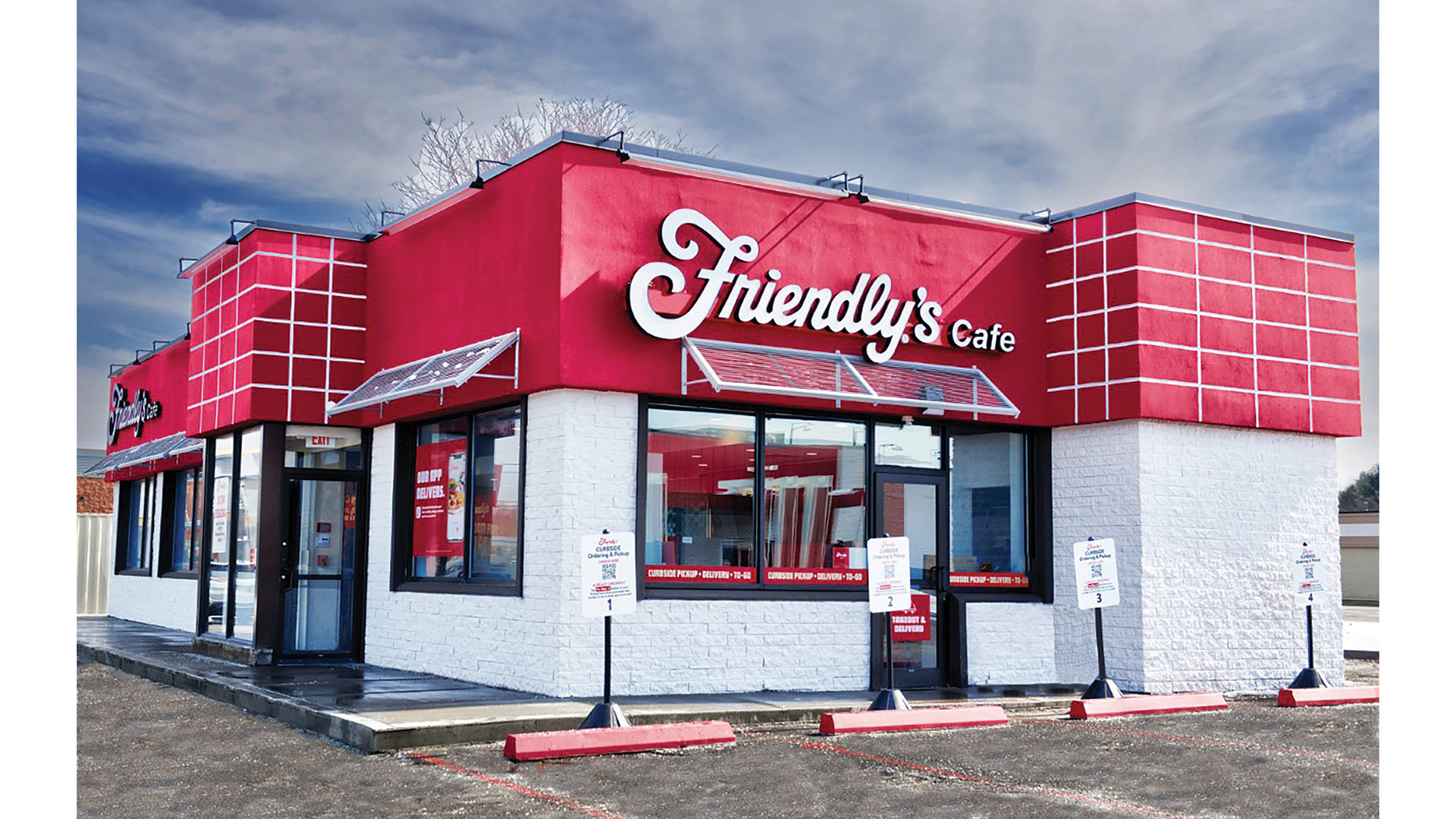
No matter the reason someone has for attending, the Home Show prides itself on helping both attendees and vendors with an abundance of opportunities.

“Our objective is to provide a venue with multiple vendors and a robust representation of products under one roof,” Crane said. “This show will help homeowners minimize the time it can take to decide on the best products and remove frustrations that can come with trying to meet and decide on a home-improvement company.”
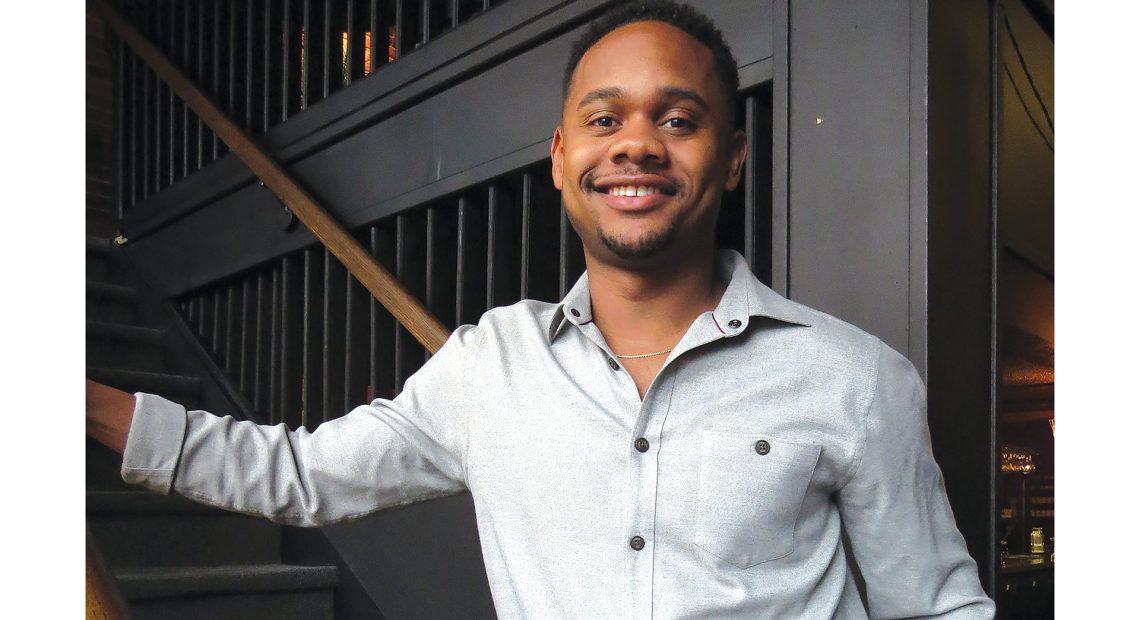
The 67th presentation of the Western Mass Home & Garden Show will take place in the Better Living Center building at the Eastern States Exposition. This year’s show hours are Thursday and Friday, March 24-25, 1 to 9 p.m.; Saturday, March 26, 10 a.m. to 9 p.m.; and Sunday, March 27, 10 a.m. to 5 p.m. General show admission is $10 for adults, and children under 12 are admitted free. A coupon reducing admission to $7 can be found on the show’s website. Parking on the Eastern States Exposition grounds is $5 per vehicle.

Home Improvement

Doors of Opportunity

Both at the Springfield store and online, EcoBuilding Bargains promotes itself as a way to save money and keep items out of landfills.

When Darcy Ratti was living in Southern Connecticut, she heard about EcoBuilding Bargains — shortly after she completely refinished her basement.

“I was so angry,” she recalled. “I would have saved so much money, and it would have looked so much cooler.”

These days, as store manager at the Springfield-based seller of reclaimed building materials, Ratti is sharing that enthusiasm with customers both near and, increasingly, far away.

“We get a lot of higher-quality materials now than we did four or five years ago as word has spread,” Ratti said, explaining how the store procures its ever-shifting stock of used building materials and also new items taken off contractors’ and wholesalers’ hands. “We’ve got brand-new Samson doors that have never been installed — an overstock. I’ve got a lot of brand-new windows that were a misorder.

“In general, people want to save some dollars here and there, and they want to buy something that will help out the environment a little bit,” she went on. “You can get better quality here for the price than you would at a big-box store. Instead of getting a pressboard cabinet set IKEA or Home Depot, for the same price, you can come here and get a full plywood set with all the bells and whistles.”

“People want to save some dollars here and there, and they want to buy something that will help out the environment a little bit.”

The Center for EcoTechnology (CET) launched EcoBuilding Bargains more than a decade ago as a way to repurpose materials that otherwise might be headed for landfills, but the past few years have seen the store expand beyond in-person sales and into an online presence, first on eBay in 2019 and then, last spring, onto its own e-commerce website (ecobuildingbargains.org), making it one of the few sellers of reclaimed materials with a national (and global) online platform.

“We started our e-commerce on eBay two and a half years ago, selling doorknobs, hinges, more of the antique, rare items that folks look for specifically,” Ratti explained. “Then we branched out with a broader range of items.”

Darcy Ratti

Darcy Ratti says she’s surprised at what people want to toss out — but her customers are the ones who benefit.

From there, the store launched its own web store last May. “Basically, anything that gets posted to our eBay store also gets posted to our web store, and vice versa,” she noted. “But we’ve expanded the types of stuff that people can buy online. You can buy cabinets online now. You can buy a door online and ship it. We’ve got an extremely large chandelier we’re selling to someone from Texas, waiting to be shipped. We’ve sold and shipped to every state, as well as places like Italy, Australia, and Japan.”

That’s a boon for people searching for very specific, hard-to-find items, and now don’t have to travel to Massachusetts for them. “Maybe it’s faucets you can’t find or brass hardware or an Anderson window sash that’s very specific to a certain model or a Velux skylight kit or a mid-century-modern Legomatic chair. We get into reclaimed items that are very specific. A customer who knows the exact model number can go online and type it in, and if we have it, we’re going to come up.”

An online store made even more sense during the pandemic, said Emily Gaylord, CET’s director of Communications and Engagement. “One, we wanted a safe way for customers to shop. Two, there was all this renewed interest in home spaces, and a lot of people had to make a home office out of nothing. Subsequently, we saw a lot of supply-chain issues. Honestly, I think, with the direction retail is going, online stores are inevitable.”

EcoBuilding Bargains also launched virtual shopping appointments for far-flung shoppers.

“Yes, you’re reducing your carbon footprint and helping us with our mission, but you’ll also find something you won’t be able to find anywhere else.”

“That was a really cool, important piece,” Gaylord said. “If you’re searching for a cabinet set, you can book a virtual appointment, send the measurements ahead of time, and we can walk you through them in a video call. Looking for a new front door? Here are six doors with the finish and size you want. Virtual shopping experiences are a huge time saver.”


Two Ways to Save Green

The clientele at EcoBuilding Bargains, both in person and online, has been broad, Gaylord told BusinessWest.

“We definitely get people who say, ‘I just need a window, something affordable; what do you have?’ And there are some people making sustainable choices, people who really care about their environmental impact and carbon footprint; they’re shopping with us as well. Then, over the last few years, the DIY space exploded, and we have trendy and unique materials for your space. We serve all those people.”

She noted that buying secondhand items has a sort of double environmental impact, keeping materials out of landfills while reducing the impact of what would have been made and purchased new instead.

Emily Gaylord

Emily Gaylord says the store has stocked newer and higher-quality materials in recent years.

“We’re dealing with some serious issues. We’re at a moment right now where people are understanding climate and environmental issues in a way they haven’t ever before,” Gaylord went on. “But making sustainable choices has so many benefits. Yes, you’re reducing your carbon footprint and helping us with our mission, but you’ll also find something you won’t be able to find anywhere else. Or you can have a much higher-quality item than you could otherwise afford. When you start thinking in a sustainable way, it’s not just for the earth, but for you as a business owner or homeowner.”

Items arrive in the store from a variety of sources, Ratti explained.

“We’re looking for the person who has that overstock or a contractor that has done a bunch of remodels, and they’re finding good, reusable materials and taking them to their shop or their garage and just hanging onto them because they know they’re good. We’re helping them defray the costs on their end so they don’t have to dispose of it, and they get a tax donation receipt.”

Homeowners are bringing in materials as well — after replacing an old vanity or lighting fixtures, for instance.

“What we saw during the pandemic was people coming up with unique ways to put together home offices, and they’d come in here for different pieces,” Ratti said.

She’s often surprised by the quality of items that wind up at EcoBuilding Bargains, like a striking, solid chestnut front door, nine feet tall and three inches thick.

“When you’re shopping more sustainably, you’re going to find better alternatives, not just your run-of-the-mill thing. You’re buying a door like that, and you’re spending less than you would somewhere else. We’ve got a marble mantel from 1867; it came out of a brownstone on Newbury Street in Boston. You’re not going to find that someplace else.”

Gaylord agreed. “It’s not a salvage yard; it’s high-quality materials. That’s really important for us and our mission; we don’t want to push stuff back into the world that’s not going to meet that mission. We want to make sure we’re selling good-quality doors, low-flow toilets, fixtures that don’t have any lead in them. We’re always thinking of the quality of the materials, not just the quantity.”

“We want to make sure we’re selling good-quality doors, low-flow toilets, fixtures that don’t have any lead in them. We’re always thinking of the quality of the materials, not just the quantity.”

Even the packing materials used to ship items are recycled, Ratti noted. “Here, you’re saving some money but also helping with the environment. By being a little more frugal, there’s less production happening in the world.”


City of Home Improvement

Gaylord feels like EcoBuilding Bargains, through its national presence online, is just one more way Springfield is being put on the map.

“To see our store in Springfield start to have a national reach, and people be exposed to us from all over the country, is amazing,” she said. “Springfield is really special, and our store is really special. Seeing people fall in love with it is great to see.”

And the reasons they are seeking out sustainable options aren’t going away.

“How we work and how we use buildings is in flux right now,” she told BusinessWest. “The world looks a lot different than it did two years ago. It’s really exciting to see our business in Springfield not slow down, but, in fact, innovate and grow. People are getting more exposed to the Western Mass. region through this. It’s more than just selling a reclaimed door.”


Joseph Bednar can be reached at [email protected]