Home Archive by category Sections (Page 28)

Sections

Architecture Special Coverage

Building Momentum

By Mark Morris

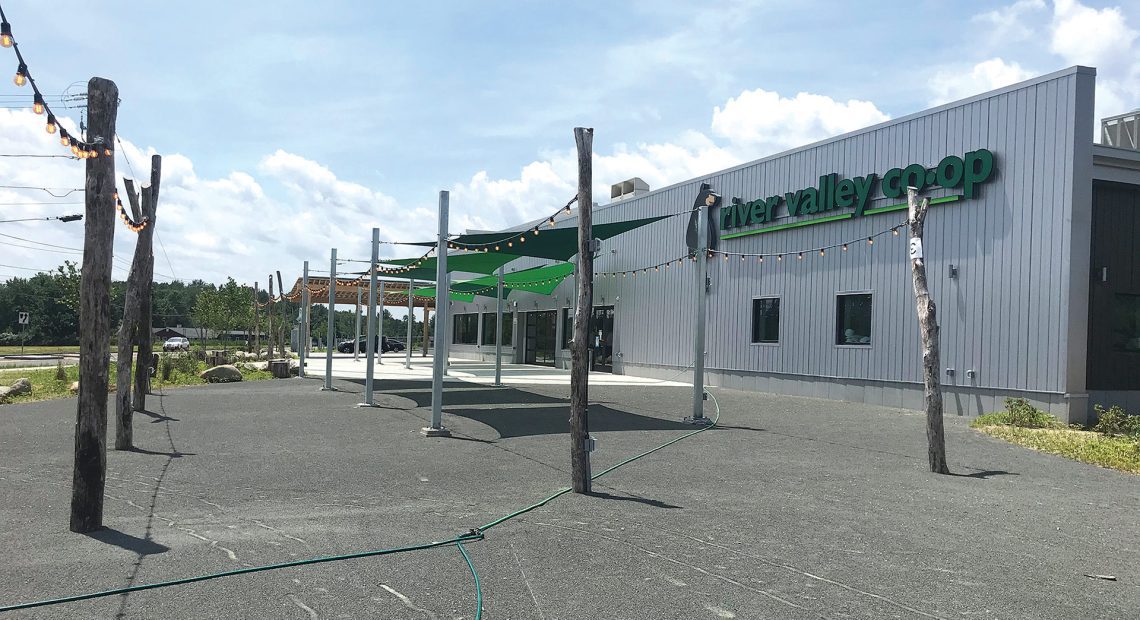
River Valley Co-op

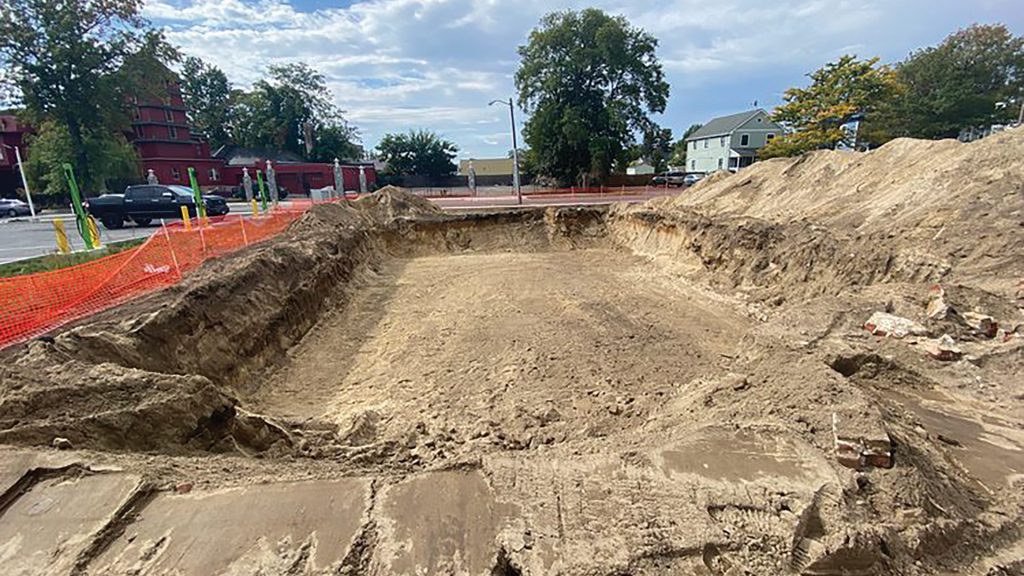
The outdoor seating area at River Valley Co-op before it opened last spring.

Curtis Edgin says his business is all about flexibility and constantly making adjustments. This is the case when times are ‘normal,’ he noting, adding that the pandemic and its many side-effects have only added new dimensions to this equation.

Edgin is a principal at Caolo & Bieniek Associates architecture firm in Springfield, and he appreciates that his firm has stayed busy for the last two years, a time when adjusting and remaining flexible became the norm for everyone, not just architects.

“We were fortunate to have a backlog going into the pandemic; because projects were at different phases, we’ve continued to stay busy throughout,” said Edgin said, noting that municipal projects such as schools, libraries and public safety facilities make up more than two-thirds of Caolo & Bieniek’s portfolio.

Much of the design work handled by Kuhn Riddle Architects in Amherst involves colleges and universities. When campuses switched to online learning during the height of the pandemic, they also put many of their building projects on pause, said Aelan Tierney, president of Kuhn Riddle, adding that this began to change this past fall and her firm has been extremely busy since then.

“Colleges felt more confident about the future in terms of bringing students back to campus, so all the on-hold projects came back to life,” she told BusinessWest. “It’s been a complete turnaround from where we were in 2020.”

Meanwhile, it was two years ago that daily headlines generated speculation about if and how area restaurants, pummeled by the pandemic and draconian restrictions, would survive. They have survived — and many are thriving — by adapting to changing times, said Thomas Douglas, principal of Thomas Douglas Architects in Northampton, a firm that specializes in the restaurant and hospitality sectors.

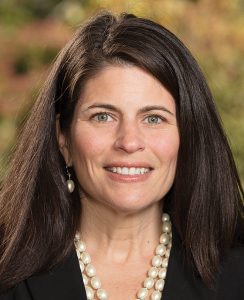
Kuhn Riddle Architects President Aelan Tierney

Kuhn Riddle Architects President Aelan Tierney

“Our restaurateur clients put their focus on refiguring their spaces with less seating and shifted to a different type of service model geared more toward takeout,” said Douglas, adding that these adjustments kept this sector — and his firm — busy at a time when such vibrancy seemed unlikely.

Together these stories convey a time of challenge and opportunity for area architecture firms — a time when some projects were scrapped or delayed, but when others came onto and then off the drawing board as different types of clients adjusted to what the pandemic brought to their doorsteps.

And for many, what it brought was a pressing need to improve the air circulation.

Indeed, design plans for the River Valley Co-op in Easthampton were drawn up long before COVID was on anyone’s radar, said Douglas. From its inception, the plan was for the co-op to run nearly net zero, with most of its heating and air conditioning provided by an array of solar panels covering a large portion of the parking lot. With much of the actual construction of River Valley occurring during the height of the pandemic, he noted that the firm made several changes on the fly. The original plan called for a grab-and-go food area that was nixed after contemplating the idea of people touching food in an open area. At the same time, air quality, took on a new urgency.

“In the middle of the project we needed to shift gears and upgrade the HVAC system with more-robust filtering capacities,” Douglas said. “We made these changes to better address the effects of the pandemic.”

The pandemic has brought other changes and adjustments, especially when it comes to needed materials, said those we spoke with, adding that supply chain shortages combined with steady price hikes for building materials and mechanical equipment have become a constant challenge.

Because architects plan projects that won’t break ground until months later, figuring out what materials will be available and what they will cost has become a big ongoing concern. Tierney said right now mechanical equipment such as generators are delayed up to 12 months before they are available.

“It’s very unsettling for clients and contractors to not know how long it will take to do a project,” Tierney said. “No one feels confident about cost estimates that are put together today because you don’t know if they will be relevant in three to six months when you actually start construction.”

“Any new project plan has to evaluate how it will impact the environment.”

For this issue and its focus on architecture and engineering, BusinessWest talked with several area architects about the many ways the pandemic has impacted business — and how this sector has responded as it always has, by making adjustments and positioning itself effectively for the day when the storm clouds move out.


Blueprint for Success

It’s called a ‘Zoom booth’ — by some people, anyway.

Like the name suggests, it’s a small space, like a phone booth, only instead of phone calls, it’s for the Zoom meetings that have now become part of day-today life in the modern workplace.

“It’s a place where someone in an open office setting can pop into a quieter space to take part in a remote online meeting,” said Tierney, adding that while her firm has included such spaces in many of its plans, it has also converted several conference rooms to accommodate meetings where some people attend in-person while others take part virtually.

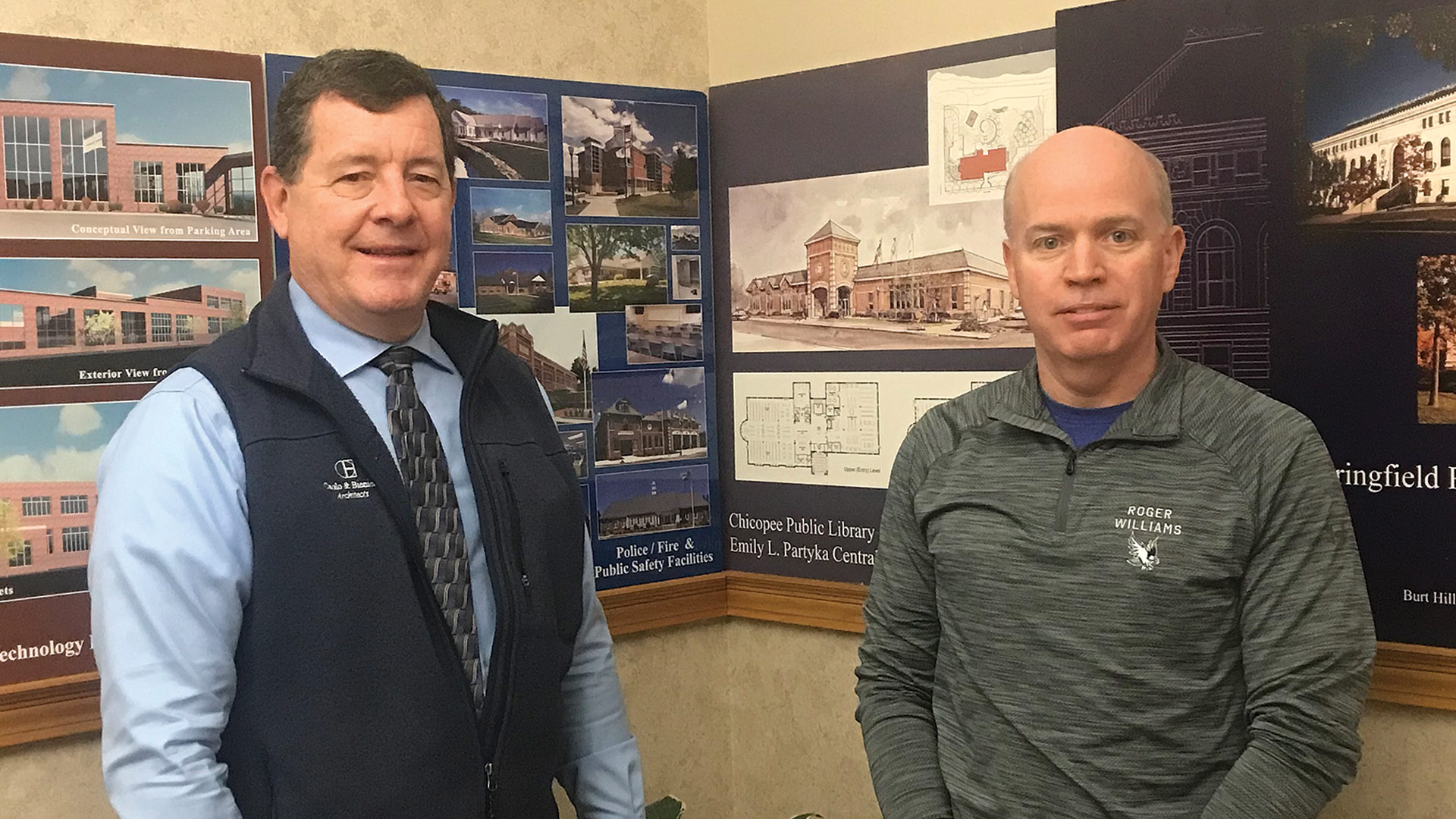
Curtis Edgin (left) and James Hanifan

Curtis Edgin (left) and James Hanifan say the pandemic has thrown extra layers of complexity into renovations, particularly with HVAC.

Zoom booths and altered conference rooms would be among the more subtle changes to the landscape resulting from the pandemic, said those we spoke with, adding that the more dramatic adjustments, as noted, involve air flow and a recognized need to improve it.

And the amount of work — and redesign — needed generally depends on the age and condition of the building.

Indeed, unlike making a design change in new construction, planning a retrofit with existing buildings brings another level of challenge, said Edgin, citing, as one example, a school client looking to replace its old rooftop heating unit with an upgraded unit that would add cooling to the system.

“First we look at structural considerations, such as whether the building support the new unit if it weighs more than the old one,” Edgin said.

The next step according to James Hanifan, also a principal at Caolo & Bieniek, concerns the duct work in the building.

“Many older facilities don’t have the ventilation systems that are required by today’s building codes,” he explained, adding that older buildings often depend on operational windows for ventilation which cannot be relied on in cold weather and can invite mold into the building during rainy times of the year.

Schools may opt to purchase stand-alone air filtering units to install in every classroom but that can be complicated, too.

“Sometimes they find out the electrical system can’t support all that additional equipment,” said Hanifan. “Now they’ve got a different issue.”

Recent funding from the American Rescue Plan Act (ARPA) has certainly helped municipalities in budgeting for these projects. Edgin anticipated that many will use their ARPA funds for improved HVAC and energy projects in their schools and other public buildings.

Overall, energy efficiency and sustainability are built into architecture plans. LEED (Leadership in Energy and Environmental Design) certification is one standard that has provided what Tierney called a great baseline for architects when considering sustainability standards.

Last year Gov. Charlie Baker signed Executive Order 594 which requires all state buildings to meet strict energy efficiency and emission standards going forward.

“Any new project plan has to evaluate how it will impact the environment,” Tierney said. “The goal is to reach carbon-neutral and net-zero emissions by 2050.” Independently, organizations are increasingly focused on reducing energy consumption and on the types of materials they use when constructing their buildings.

“It’s great to see Massachusetts as one of the strongest states in terms of energy code,” Tierney said. “They are aggressively increasing energy requirements every three years when they update state building codes, which is fantastic.”

Thomas Douglas

Thomas Douglas says River Valley Co-op had a strong emphasis on sustainability from the start.

While the River Valley Co-op had a strong emphasis on sustainability from its inception, Douglas suggested a creative addition to the plan that maintained the spirit of the project.

“My first college degree was in landscape architecture, so I worked with the coop to create a large outdoor patio that has a view of Mt. Tom,” Douglas said. With easy access from inside the building as well as outside, the layout can also accommodate a food truck next to the patio.

“We wanted to create a vibrant, exciting, and yet cozy outdoor atmosphere for the patio.”


Drawing on Experience

Meanwhile, both public and private spaces are being adjusted to provide employees and visitors with larger and, in many ways, different spaces.

Indeed, a few years ago, companies had begun planning office layouts that were open and airy to encourage more collaborative workspaces. The arrival of COVID caused a change to some of those plans.

“After designing for an open-office concept, the pandemic came along, and we had clients who wanted to go back to individual cubicles,” Edgin said.

Kuhn Riddle is still creating collaborative areas, while at the same time staying conscious about air exchange and filtration.

“As we begin opening back up and taking off our masks people remain concerned about air quality,” Tierney said. “The last two years have definitely influenced how we think about design.”

When the Westfield Boys and Girls Club was planning a childcare wing, it increased the size of the project from 11,000 to 15,000 square feet because the state had increased minimum space standards per child from 35 to 42 square feet after COVID hit, said Tierney, adding that her firm was brought in as the schematic design architect to work on this part of the project with Chris Carey, the architect of record on the building expansion.

“We don’t know if the state will ever go back to a smaller square-foot-per-child standard, but we wanted to be ready in the future for another pandemic or other event that requires keeping children spaced apart,” she explained.

Add to these challenges and adjustments the ongoing supply-chain issues and escalating prices of materials, which together bring new levels of complexity — and stress — to designing projects and seeing them to completion

As part of a dormitory renovation at Elms College, Hanifan was planning for a certain type of carpet only to be told that, if it even gets produced (and that’s a big if), there will be a 16-24 week lead time. He has already begun adjusting the plan because the project must be completed before the fall semester in September.

“We will look at other colors and if we can’t get those, we will have to look at other manufacturers.”

This constant uncertainty often puts his municipal clients in a tough spot.

“No one wants to hear that prices have spiked and everyone knows prices don’t tend to go down,” Hanifan said. “So, there is a lot of indecision on whether to go ahead with the project or wait to see if prices come back down at some point.”

While supply chain delays and rising costs are still part of daily life, a sense of optimism creeps in as the weather becomes warmer and COVID mandates get relaxed.

“It’s been a tough couple of years, but I think we’ve turned the corner,” Tierney said.

Hanifan acknowledged that in the immediate short-term, supply chain issues will continue because manufacturers are under pressure to get materials out as fast as they can.

“Eventually they will be able to re-stock and fill their warehouses once again,” Hanifan said. “It may be a few years out but I’m optimistic it will happen.”

All it takes is remaining flexible and making adjustments when necessary.

Technology

All Systems Go


One of the surprises of the pandemic’s early days was how quickly companies of all kinds were able to move their workers to remote, home-based setups. Much of the credit for that goes to the IT teams who helped them achieve that transition quickly. It’s just one way IT firms help clients navigate changes in technology, defend against constantly evolving cyberthreats, and make regular assessments of what a business needs to be efficient and effective.


It can start with a cyber breach. Or questions from an insurance company. Or a business simply realizing it needs a hand with its technology.

“Different clients call for different assessments,” said Joel Mollison, president of Northeast IT in West Springfield. “They might say, ‘we don’t know where we are with our technology,’ or maybe they have an outsourced IT department, but they’re having an ongoing issue, which triggers a call. ‘What are we doing right, what are we doing wrong?’ They want a second set of eyes on something.”

What they often find, he added, is “they don’t know what they don’t know,” and the conversation turns to this: what is the desired IT outcome?

“Every client is obviously unique,” Mollison said. “We want to work with them and understand how their business operates. We’re just an extension of their business. Our solutions need to be in line with their technology and business goals. So normally, when we work with a new business, we assess what they have currently and discuss what kind of issues they may be having or sticking points — maybe they’re not able to conduct business as fast as they would like, or their technology doesn’t work for them.”

“We’re just an extension of their business. Our solutions need to be in line with their technology and business goals.”

Or, these days, they have questions about maintaining and securing remote-work connections. Whatever the case, the high-tech side of the business world isn’t getting less complicated, highlighting the role that IT firms play for their clients.

“The goal for us is to act like your internal IT department,” said Jeremiah Beaudry, president of Bloo Solutions in Chicopee, and that means learning the ins and outs of a client’s business and how it uses hardware and software, so Bloo can make holistic recommendations about its technology needs.

Jeremiah Beaudry

Jeremiah Beaudry says his goal is to act like a client’s internal IT department, in every facet that may entail.

“Every business is different, and their needs are different. They all serve their clients differently,” Beaudry added. “Not every solution is right for every business, so one-size-fits-all packages don’t really work. We also want to know what tools you’re using now: are there redundancies that overlap, or are there other tools that are more unified and give you a more collaborative, one-pane-of-glass solution?”

Sean Hogan, president of Hogan Technology in Easthampton, recently published a blog post citing a report that worldwide IT spending is projected to total $4.5 trillion in 2022, an increase of 5.5% from 2021.

“This is a monumental amount of growth which can likely be attributed to employers embracing work-from-home or hybrid-work environments, security concerns over cybersecurity breaches, and the world’s desire to utilize cloud technology,” he wrote. “For small to mid-sized businesses (SMBs), this means that they will have more access to enterprise-level technology solutions, which will empower them to drive productivity and increase their bottom line, if they position themselves properly.”


Serve and Protect

It all starts with the basics, Beaudry said, with security topping the list.

“What data do you have now? How are you securing data to keep it out of bad actors’ hands, while making it easy for employees to access it? Balancing access with security is the hardest part.”

For example, people may dislike retyping a password every time they wake their computer up from screen-saver mode, but there’s a reason for that vigilance. And because passwords need to be complex — and people generally use a lot of them — he stresses the use of a password vault. “We’re getting people to adopt them instead of leaving Post-It notes all over their desk, which is a pretty huge fail.”

Bloo is putting more emphasis on end-user access in general, he went on — teaching people how to spot phishing attempts and e-mails from bad actors, and knowing what files are safe to open and download, and which aren’t. “That was important before the pandemic, but once people started working remotely, it added on variables to the mix.”

Mollison said a lot of IT security-tightening measures are being driven by the insurance industry.

“They’ve clamped down on organizations, requiring you to fill out a lengthy statement of your current security. That’s a big thing that’s happening, so there’s been a lot of discussion around that. A lot of times, folks come to us — they get that questionnaire and don’t even know how to answer it. They have an internal IT person, but it’s not their day job, just a hat they wear. So a lot of times, they come to us to make sure their business insurance is going to cover them. Actually, I’ve heard from a few firms that are paying an additional premium because they don’t have basic security pieces in place.”

Besides security and maintaining the network, Northeast also works with clients on replacement cycles for hardware and technology updates. “When Windows 7 went away in January 2020, all our clients knew about it well in advance, and had years to prepare for it and make changes. Those are the types of things we’re continuously doing to put clients in the best position in regard to technology and compliance.”

All of this has become increasingly difficult for businesses to handle in house, he added. “There are so many pitfalls, so much change. It takes a team of experts who understand the technology, the security levels, who understand all the concepts and how they relate to a particular organization.”

Joel Mollison

Joel Mollison says helping clients navigate cybersecurity is part technology, part behavior training.

Some services deal with the human side of IT and cybersecurity, Mollison noted.

“We’ve done training sessions with clients to go over common phishing techniques and what to look for to distinguish whether an e-mail is credible or not. Obviously, we promote spam filters and other security measures, but we’ll still do a phishing campaign and training videos, making sure our end users are keeping up with what they may see in the real world. Even spam-filtering technologies are not foolproof — things still get through.”

Small businesses shouldn’t assume they’re not targets, Hogan wrote — quite the contrary, actually. “For most small businesses, their IT defense strategy is to simply hope they aren’t a target; however, as larger enterprises increase their spending and become tougher to break into, unprepared SMBs will unfortunately become an ideal target.”

Sean Hogan

Sean Hogan

“All of this increased IT spending is reflective of a world that is accelerating its migration into a fully digital world, when we thought things were already moving in that direction as fast as they could.”

Mollison said Northeast doesn’t conduct free assessments with potential clients because he wants companies to be committed to the process.

“We want to develop a relationship with an organization and be their outsourced IT department and provide these types of services and help them grow, and that starts with being invested in participating in their assessment,” he told BusinessWest. “I’ve seen a lot of boilerplate, free assessments from other IT firms, and there’s not much to it, and they don’t do much for the clients.”


From a Distance

The shift to remote work over the past two years kept IT firms busy, but the ease of transition varied, Beaudry said.

“Working remotely is so different for each business; some clients just use Microsoft Word and Office docs, and working remotely is a pretty easy-to-accomplish task, versus some companies, which have a line of business applications and complex software, and you have to set up secure, virtual private networks to allow employees to access them.”

Businesses that weren’t already set up to work remotely found challenges early on, but they soon adapted — as the still-ongoing work-from-home revolution has made obvious.

“Most of our clients already had the technological components to work remotely, so it wasn’t a big issue,” Mollison said. “Numerous insurance agencies were remote within 48 hours. It really wasn’t a big deal for most companies — it usually boiled down to licensing and multiple security steps and VPNs.”

Whether at a business site or remotely, Beaudry said Bloo handles a wide range of IT issues for clients, including supporting the servers, hardware, and software applications; creating file shares; managing the servers; and maintaining security measures and patches.

“It’s a constant process; you have to be vigilant with those things,” he said. “We’re also dealing with end-user issues — ‘oh, my app won’t run,’ or ‘this program is giving me an error.’ It’s a lot of stuff to deal with, and now that this all stuff going remote, it’s evolving — instead of monitoring hardware, we’re having to monitor the dashboards for multiple cloud servers and take a look at 100 or 200 alerts a month; do these alerts all need action? Is it just an informational alert, or is there a pattern of things happening constantly?

“We’re a managed service provider,” he went on, “which means we are proactively doing all these things just as if you had an internal IT department. If the user is constantly pushing the limits of performance of that machine, we can see that on our dashboard.”

Speaking of which, Beaudry makes sure hardware assessments happen on a regular basis, “but we do a good job monitoring these things proactively, so we can avoid too many surprises,” he said, thereby avoiding unexpected downtime and loss of productivity. “Those surprises are what cost you the most money.”

And the bottom line matters, Hogan said, which is why companies of all kinds are investing in IT to boost efficiency and protect their assets.

“IT spending has increased so dramatically because the pandemic forced decision makers to make their organizations more flexible. They’re starting to understand the increased potential that they have to become more efficient with the latest in technology,” he wrote. “All of this increased IT spending is reflective of a world that is accelerating its migration into a fully digital world, when we thought things were already moving in that direction as fast as they could.”


Joseph Bednar can be reached at [email protected]

Wealth Management

Inflation: It’s Economics, Not Politics 

By Jeff Liquori


In July 2021, the Bureau of Labor Statistics released an unusual piece of data: the average price of used cars and trucks had increased a whopping 42% over the previous year. Given the constraints in the supply chain, this extraordinary jump was dismissed as an aberration; in fact, the total increase in consumer prices that month was one of the sharpest in recent history. Interestingly, the consumer price index (CPI) category that had the second-largest uptick? Energy.

Energy is sensitive to inflation. Prices may experience higher volatility in the short term, but ultimately supply and demand is what drives the price. It’s surprising that investors and analysts did not pay more attention to these fundamental metrics at that time.   

During the 2008-09 Great Financial Crisis, congress, passed two acts to rescue the financial system from near ruin, authorizing a total of $1.5 trillion in stimulus funds. Financial markets recovered and the economy expanded, albeit at a moderate pace. The first piece of legislation was at the end of Bush’s second term and the second passed two months into Obama’s first term.  

Jeff Liquori

“The fundamentals of supply and demand will support the persistence of inflationary pressure, and the occupant of the White House, past or present, has little to do with that.”

Two years ago, the planet faced a crisis not seen since the 1918 influenza pandemic: COVID-19. To combat it, countries locked down, effectively grinding commerce to a halt. In response, Congress enacted nearly $2.5 trillion of stimulus assistance, and Federal Reserve banks used their monetary tools to make capital markets even more liquid. In the third week of March 2020, extreme investor panic caused stock prices to bottom out.  But then Americans started to spend again, and in a big way. The economy strengthened quickly and by October the unemployment rate was approaching pre-Covid levels, at 5%, after skyrocketing to nearly 15% in April.  

Today, unemployment sits at 4% and inflation is running at a 4.8% annualized rate, the highest in three decades. The difference between 2020 and now is there are nearly 11 million open jobs, the most since the Bureau of Labor Statistics started tracking the data. Rising wages and attractive benefits have failed to attract enough workers, and so the supply chain issues have gotten worse as jobs go unfilled.   

This sharp increase in demand — due to a strong economy, massive stimulus, and unique constraints on global commerce — has put upward pressure on the prices of consumer goods. The price of oil provides an easy and familiar example. Notably, the cost to gas up our cars or heat our homes has soared dramatically. As oil prices increase, so does the cost of transport, which affects almost all consumer goods. Currently, a barrel of oil is $95.  

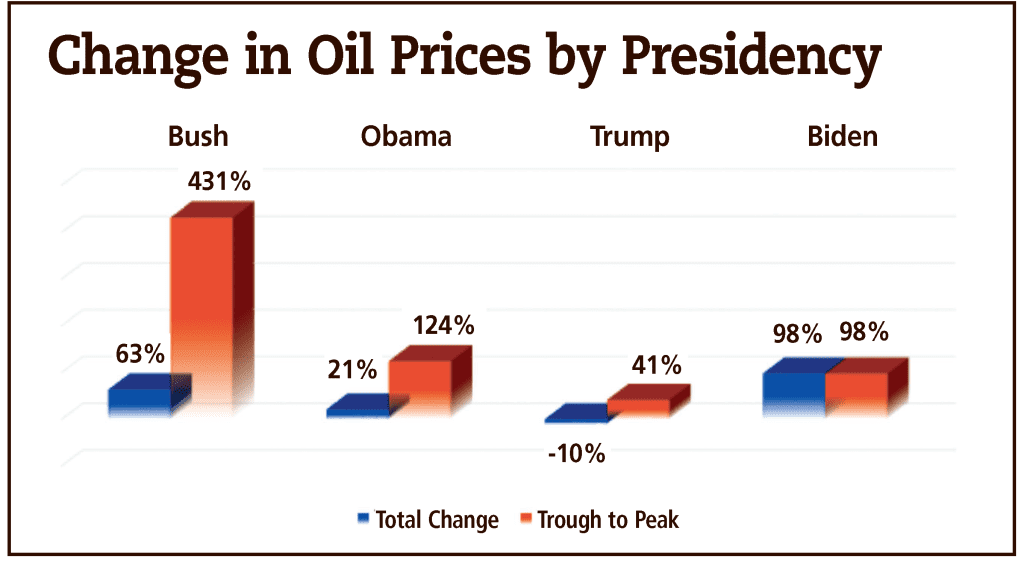
Blaming the White House for inflation is lazy. Macroeconomics are based on supply and demand, and demand is white hot at the moment. Every administration has dealt with volatile oil prices. Indeed, $100 oil is not remotely novel. Consider this: during George H.W. Bush’s term, in the throes of the Gulf War, oil hit $145 per barrel. At the end of Obama’s second term, 26 price was about $91 per barrel. Since January 2001, oil has fluctuated between a low of $27 and a high of $145 (all during George W. Bush’s presidency) but has risen steadily over the past two decades. Here are the stats: 

During the worst of the pandemic, there was a healthy supply of oil and demand fell off a cliff as global travel ceased overnight. Large oil refiners were paying to offload oil. Headlines like this one from Politico in April 2020 were common: “Oil prices go negative — and Washington is paralyzed over what to do.” And while the president has some influence via the strategic oil reserves and negotiations with OPEC, those tools only affect the supply side of the equation. 

Economics is a cycle. Investing is a cycle. Even our careers go through cycles. And we cannot know with certainty the long-term consequences of measures taken at the crisis points of any of these cycles. Politics has become so polarizing that we pick our sides and blame the other for almost any adverse event, especially when it affects our financial well-being.  

Geopolitics is hot right now because of the tensions in eastern Europe. Beyond the worry of what war brings, Russia is the third largest oil producer in the World behind Saudi Arabia and the United States. The global energy trade may see disruption, and energy prices are likely already reflecting that. It is unlikely, however, that the US consumer’s ability to spend will be dampened. The fundamentals of supply and demand will support the persistence of inflationary pressure, and the occupant of the White House, past or present, has little to do with that.


Jeff Liquori is the co-founder and chief Investment officer of Napatree Capital, an investment boutique with offices in Longmeadow as well as Providence and Westerly, R.I.; (401) 437-4730.


Wealth Management

Decisions, Decisions

By Barbara Trombley, CPA, MBA


Many employees are faced with the decision about whether to invest a portion of their paycheck in a Roth 401(k) or traditional 401(k). What is the difference and what are the implications?

First, most plans now offer both options. If your plan does not, it may be as simple as asking the plan provider if both options can be offered. One major difference between the two is how they are taxed. The traditional 401(k) gives tax benefits now. The employee can deduct their contributions from their taxes now — up to $20,500 if you are under age 50 and up to $27,000 if over. This can save thousands on your tax bill, depending upon what bracket you are in.

The Roth 401(k) does not offer tax benefits now. Contributions are made with after-tax money. Any growth on the funds is never taxed as long as the account has been held for at least five years, the distribution is qualified, and you take the distribution(s) after age 59 ½. The investment choices are usually the same as the traditional 401(k) and many people contribute to both.

Barbara Trombley

Barbara Trombley

“If you are single and have taxable income over $215,951, incremental income is taxed at 35%. Your contributions to a traditional 401(k) plan could save you $350 on every $1000 contribution. The flipside of this strategy is that, in retirement, all withdrawals are taxed as ordinary income.”

What option is best for you? Usually, it comes down to your personal tax situation. If you are in a very high tax bracket now and expect to be in a lower bracket at retirement, it may make sense to get the tax benefits now. For example, if you are single and have taxable income over $215,951, incremental income is taxed at 35%. Your contributions to a traditional 401(k) plan could save you $350 on every $1000 contribution. The flipside of this strategy is that, in retirement, all withdrawals are taxed as ordinary income.

Additionally, investors in traditional retirement plans need to take required minimum distributions beginning at age 72. Even if the retiree does not ‘need’ the funds, the government is ready to begin collecting its taxes on the funds that were deferred in the plan. As the retiree ages, the RMD factors increase, usually resulting in larger distributions. A young employee now that continually contributes to a traditional retirement plan, may have a large balance later in life. When it is time to take RMD’s if the account hasn’t been tapped previously, the amount to withdraw may be rather large, resulting in a big tax bill.

A Roth 401(k) is subject to the same RMD requirement as the traditional 401k. If the Roth 401k is rolled over into a Roth IRA, then RMD’s are not required to be taken. The funds can be used or held at the individual’s discretion, giving more flexibility to tax planning.

Both plans can be left directly to beneficiaries, and, in most instances, the beneficiary will have 10 years to liquidate the account. Of course, leaving tax-free money to your heirs would be more desirable to them but planning should be done to see if it is the correct choice for you.

In our opinion, it is desirable for retirees to have both types of funds — pre-tax and post-tax. This could give them a lot of flexibility to properly tax plan in retirement. Consult with your financial and tax advisors to see what makes the most sense for your individual situation.


Barbara Trombley is a financial advisor and CPA with Wilbraham-based Trombley, CPA; (413) 596-6992. Securities offered through LPL Financial. Member FINRA/SIPC. Advisory services offered through Trombley Associates, a registered investment advisor and separate entity from LPL Financial.

Cannabis

Extracting a Workforce

Susanne Swanker

Susanne Swanker says cannabis programs at AIC are being constantly reviewed and updated to remain current and relevant


The cannabis industry — and workforce — has come a long way in just a few years, Jeff Hayden says.

“What I think is really crucial, and what we’re trying to emphasize to job seekers, is that this is a business. This is not like going to somebody’s basement and growing a couple of plants. We’re talking about a multi-million-dollar investment for some of these companies,” said Hayden, vice president of Business and Community Services at Holyoke Community College (HCC).

In that city alone, for instance, entire mill buildings have been renovated and brought back to life, bringing jobs to the community and tax dollars to city coffers, he noted.

“This is a business where they’re generating private investment, creating new jobs, and they’re also generating tax revenue. It’s been a win for Holyoke in terms of the amount of growth that’s been stimulated.”

To keep the momentum going, these new companies need employees, which is why HCC launched its Cannabis Education Center in 2020, a series of non-credit courses, in conjunction with the Cannabis Community Care and Research Network, that provide skilled workforce training to prepare participants for a career in the cannabis industry. By this spring, 120 people will have completed the core program, and many will have begun or completed another career-specific track (more on that later).

The conversation about a cannabis training program at HCC began when legal adult-use cannabis was still being debated in the Bay State. If that came to pass, Hayden and others expected, significant workforce needs would follow. And that has proven to be true.

“This is not like going to somebody’s basement and growing a couple of plants. We’re talking about a multi-million-dollar investment for some of these companies.”

Similar discussions were happening at American International College (AIC) when adult-use cannabis was legalized, which is why it launched, also in 2020, a graduate-level program in cannabis science and commerce, the first of its kind in Western Mass.

The 30-credit program is designed for individuals interested in a career in the cannabis industry and provides students with an understanding of the science, business, and legal issues associated with the cannabis industry. The program offers education in the areas of basic science, including chemistry, horticulture, cultivation, uses, and delivery systems; business management, marketing, and operations; and federal and state laws and policies.

The first cohort of the program graduated in August, said Susanne Swanker, dean of the School of Business, Arts and Sciences at AIC, and they are now being surveyed to get a sense of where they are working in the cannabis industry.

“We’ll use that information to help us make changes as necessary to the curriculum,” she told BusinessWest. “We’re only in our second year now, but over the next few months, we’ll be reviewing the program for fresh content, updating materials, and ensuring currency and relevancy in the field, making sure we’re covering the topics and content needed.”

Jeff Hayden

Jeff Hayden says that, to continue growing, the cannabis industry in the region will need a solid pipeline of qualified workers.

Last fall, AIC introduced another cannabis-education track, an undergraduate certificate program called Micro Emerging Markets: Cannabis, which offers three business courses in rotation: “Cannabis Entrepreneurship,” “Cannabis Business Operations,” and “Law and Ethics of Cannabis” — again, with the goal of channeling a pipeline of skilled workers into a fast-growing industry at a time when all sectors are struggling to secure and retain employees.

“We’re in the process of adding some additional courses,” Swanker said, including a broad overview of the history and culture of cannabis, which could be a popular general-education course. “I think we have a lot of interest from our students in that. So that’s an option.”

Five-plus years after legalization in Massachusetts, the popularity of the cannabis industry is no longer in doubt, more than justifying the decisions by HCC and AIC to add some educational fuel to the workforce.


Knowledge Blooms

Hayden explained the thinking behind the Cannabis Education Center and its multiple tracks.

“Essentially, because this was new to Massachusetts, we tried to design a process to inform people about some of the fundamentals in relation to the industry itself, so we developed a module called the core program, and we ask every participant to go through the core program,” he said.

“We’re finding many of the students enrolled in the program are already in the field working, and they’re coming to us with information and knowledge. The discussion in the classroom is that much more enriching because of the prior experience they’re bringing.”

That program requires two eight-hour Saturday sessions. Beyond that are four separate, occupation-specific tracks, typically three all-day Saturday sessions, to train for a specific area of the cannabis workforce: patient services associate (what’s commonly known as a ‘budtender’), who works directly with customers on both adult and medical use; cultivation assistant, who helps in all areas of the grow operation and requires knowledge of plant biology, soils, hydroponics, plant health, nutrition, harvesting, trimming, inventory tracking, and managing plant waste; extraction technician, who learns how to safely extract useful molecular components from cannabis and hemp; and culinary assistant, who is responsible for cooking, baking, and infusing cannabis- or hemp-based products with extracts.

“We’re in the process of creating a fifth track designed for entrepreneurs,” added Hayden, who noted that the center focuses on five key pillars: community education; social-equity training; occupational training; custom contract training to cannabis businesses, including communication, leadership, and mentorship skills; and developing different trainings that would be useful for the industry.

Scholarships are available, and each job-training program is followed immediately by an internship period with a licensed cannabis industry employer. The center has helped place graduates in full-time jobs as well, at companies like GTI, Trulieve, and Analytic Labs, and some companies have engaged directly with HCC about the kinds of skills they need.

AIC relies on industry professionals as well, as adjunct instructors to complement the college’s own business professors.

“From the onset, the program has been a collaboration of full-time faculty in business working with individuals in the field, people who own their own business as well as individuals that are working in larger operations in different parts of the country,” Swanker said. “They work together to inform the current content, what needs to be covered, and develop the curriculum.”

This professional input from outside AIC is key, she added. “They’re the ones who are experts in the cannabis field, and the ones constantly helping us update materials and discussions. Also, we’re finding many of the students enrolled in the program are already in the field working, and they’re coming to us with information and knowledge. The discussion in the classroom is that much more enriching because of the prior experience they’re bringing.”

AIC leaders were quick to recognize the coming workforce needs in cannabis when the college developed its programs, Swanker said, and also found the Cannabis Control Commission’s focus on diversity and social equity to be appealing as well. “That’s something that speaks to us as an institution and fits our mission. That was just another attractive part of it.”


High Hopes

Swanker said interest in AIC’s cannabis programs remains strong. “When we launched it, we had a tremendous number of inquiries, and that remains at a very high level, which is very encouraging.”

And why not? According to a February 2021 jobs report issued by Leafly, the world’s largest cannabis website, legal cannabis supported 321,000 full-time jobs in the U.S. at the time, and since then, tens of thousands more jobs have been created in states like Massachusetts, Florida, Michigan, Missouri, New Jersey, Ohio, Oklahoma, and Pennsylvania, making cannabis one of the most robust job-creation engines nationally. In Massachusetts, adult-use cannabis sales crossed the $2 billion threshold last year.

In short, both nationally and regionally, this fast-growing market offers plenty of employment and entrepreneurial opportunities for years to come, and for a wide range of skill sets, Hayden said.

“We’re really at the start of it. This is a new industry with new opportunities for people looking to get into a new career area or take the skills they already have and use it in this new sector. If you’re an accountant or bookkeeper or human-resources specialist, then there are job opportunties within this industry for you.”

Which is why programs to educate the next wave of the cannabis workforce are expected to multiply and expand.

“The industry has a need for high levels of sophistication in terms of business management, marketing, and the like. I think we’re going to continue to see it grow,” Hayden added. “At some point, there might be too many companies trying to start up, but not yet; right now, they’re all trying to take advantage of opportunities to get in and grow.”


Joseph Bednar can be reached at [email protected]

Cannabis

A Real “Game-changer”

By Mark Morris

Kevin Perrier, left, and Volkan Polatol

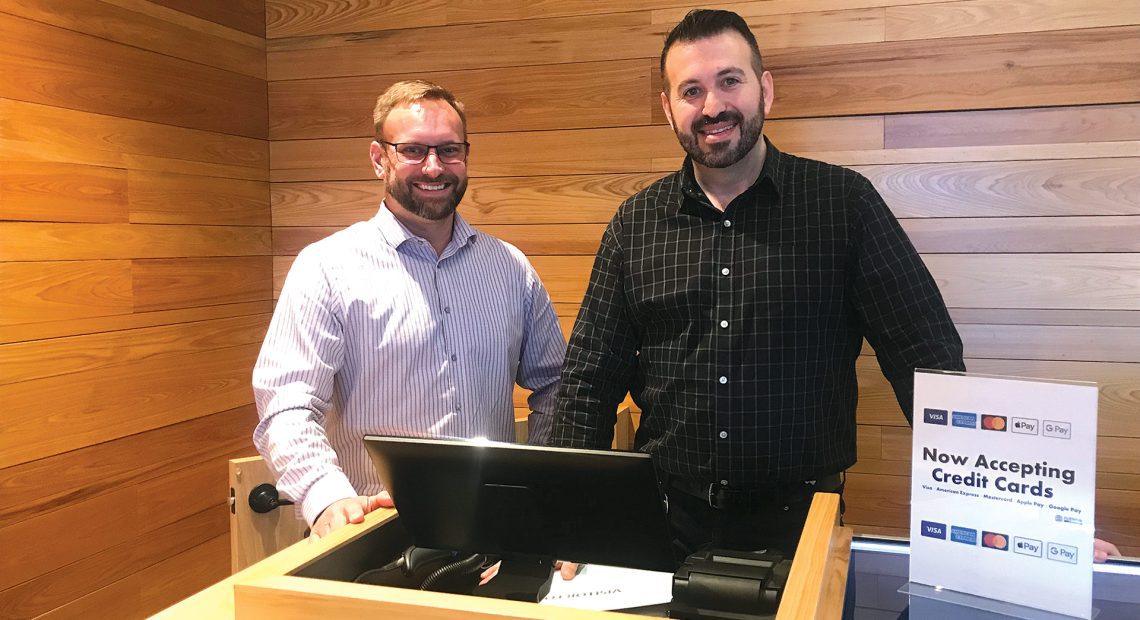
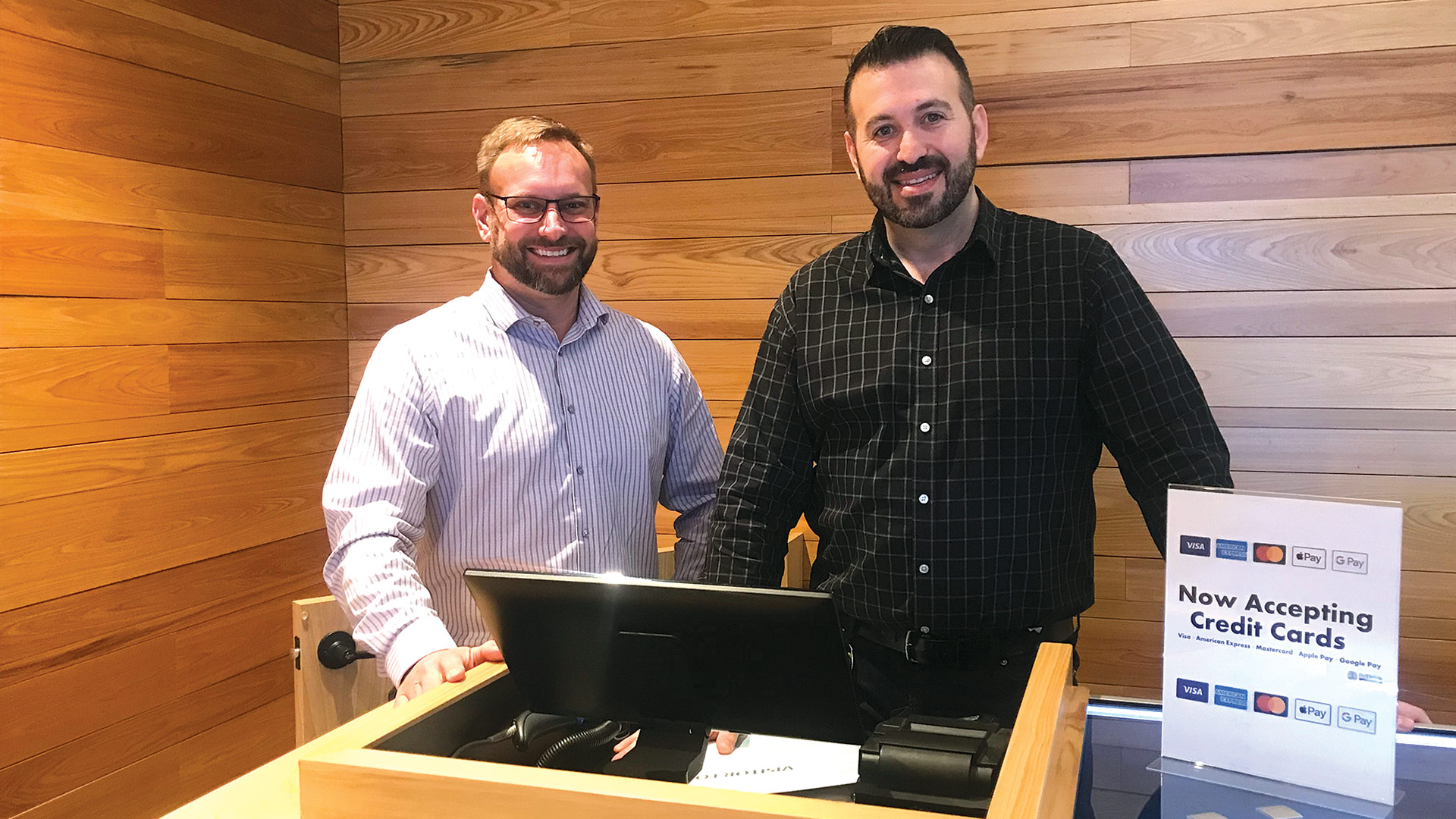
Kevin Perrier, left, and Volkan Polatol, partners at Dreamer Cannabis, are now able to offer credit card transactions at their dispensary. 

Since cannabis became legal in Massachusetts consumers have had to pay for their purchases with cash or a debit card. At a dispensary in Southampton, that has changed in a big way.

Beginning Feb. 14, customers at Dreamer Cannabis have been able to use their credit cards to purchase cannabis products.

“The term ‘game-changer’ gets thrown around a lot, but for this industry that’s pretty huge,” said Kevin Perrier, a partner with Dreamer Cannabis.

Because cannabis is legal in only 18 states, federal law prohibits credit card companies such as Visa, MasterCard, and American Express from accepting cannabis transactions in their systems.

Perrier and Volkan Polatol, his partner at Dreamer Cannabis, were exploring the idea of a cannabis delivery business when their research revealed an innovative way several cannabis companies in California were accepting payments by credit card.

“The method is similar to the way Venmo works,” Polatol said. Venmo is the peer-to-peer payment app that allows individuals to quickly exchange money with each other.

While credit card companies will not process cannabis transactions, accepting payments from third-party platforms is legal and compliant. When a Dreamer customer uses a credit card, the transaction is processed by a third-party platform which uses blockchain technology through the InterPlanetary File System (IPFS) to process the purchase. According to its website, IPFS is a peer-to-peer network that uses blockchain to make the web faster, safer, and more open. Blockchain is known for keeping data secure and for providing a permanent record of the data. For this reason, a growing number of banks support blockchain transactions.

“California has a more-developed cannabis market as they’ve been working with it much longer than any other state. Trends in cannabis seem to start there and migrate east.”

Credit card companies recognize blockchain transactions as legal and compliant, so they receive the data of the purchase through the blockchain and the consumer receives the charge on their bill.

While blockchain is often associated with Bitcoin and other cryptocurrencies, Perrier said the system use by Dreamer Cannabis is not involved in any cryptocurrency.

“Most people are not familiar with crypto, it’s complicated to use and it’s not stable,” he said. “The system we use runs on blockchain, but does not use crypto.”

Perrier said he and Polatol dug deep in their research and spoke with dispensaries in California who use this platform, eventually selecting a company from the Golden State.

“California has a more-developed cannabis market as they’ve been working with it much longer than any other state,” Perrier said. “Trends in cannabis seem to start there and migrate east.”

After looking into the viability of the payment system, the partners wanted to make sure it was legitimate.

“I was the first skeptic,” Polatol admits. “Obviously we didn’t want to introduce something that was going to turn people off.”      

Said Perrier, “I know the people who created this platform and their history. They are involved in many other reputable platforms and businesses.”

Another factor in offering credit card use involves keeping the consumer experience quick and simple.

“The ability to use a credit card makes purchasing cannabis more accessible to consumers,” Perrier said noting that using a debit card to buy cannabis is different than other debit card purchases.

For example, if a customer wants to use their debit card to make a purchase of $95.17, they take the equivalent of an ATM withdrawal through the dispensary’s system. Because it is an ATM withdrawal, they would round up to $100 to pay for their purchase and then receive the difference in cash. The customer must also pay a $3.50 transaction fee for using their debit card.

“We see a lot of head-scratching from first time customers,” Perrier said. “We’re hoping that using credit cards will make it a more straightforward and quick transaction.”    

To make the same $95.17 purchase with a credit card, the clerk will ask for the person’s mobile phone number and send them a link. The purchaser inputs their credit card information and receives acknowledgement of the purchase along with the dispensary. Added to the purchase is a 6% transaction fee to cover fees charged by the credit card company and the third-party platform. Customers can open an account with Dreamer to simplify the process. Using Apple Pay or Google Pay also requires fewer clicks to make a purchase.

“The transaction gets processed on a parallel channel and stays off the credit card networks,” Polatol said. “The purchase data is then forwarded to the credit card company from the third party, which keeps it all legal.”

Dreamer is the first cannabis dispensary in Massachusetts to accept payment by credit card. Perrier said there are a few similar efforts at other ventures across the state, but they are simply downloadable apps that tie into the person’s bank account and function like a debit card.

“All those apps really do is help the person avoid the $3.50 transaction fee,” Perrier said, adding that a debit account is only as viable as the funds that are available in it. “If you try to buy something on Wednesday and your paycheck doesn’t land in your account until Thursday, that money is not available to you until then.”

Offering the option of charging a purchase on a credit card brings huge potential for increasing business. Allowable limits of purchase still apply, of course. In Massachusetts, consumers may purchase up to one ounce of “flower,” which is the plant form of cannabis, or five grams of concentrate per day.

“We’re hoping it’s a win-win,” Perrier said. “Obviously it can boost our sales and we hope it makes purchasing cannabis easier for people.”

Ultimately, Perrier said, credit cards are part of evolving their business and staying ahead of the curve.

Meanwhile, he and Polatol have several projects on the horizon that promise to bring more innovation to the cannabis industry in Western Mass.

The first project involves the partners opening a dispensary at the former Sierra Grill restaurant in Northampton featuring products from the Honey Brand, a California-based company that makes cannabis oils that can be vaped or consumed as edibles.

Perrier and Polatol have also purchased a former Western Mass Electric Company building in Easthampton that they are converting into a canning facility for cannabis seltzer.

Finally, the two are close to unveiling a cannabis-delivery business that would allow customers to order cannabis from an app, pay for it online and have the purchase delivered to their door.

Perrier summed up their activity by joking, “If you don’t innovate, you die.”

Right now, the partners are educating the skeptics and naysayers who come into Dreamer and can’t believe credit card transactions are both safe and legal.

Perrier expects people to have questions, because it’s such a different concept for the cannabis business.

“As the first ones to offer credit cards, we have to educate the consumer,” Perrier said. “I think credit cards will be widely accepted in the coming years, but for now we just want to make it available for our customers as another way to pay for their purchases.”

In the long-term Perrier would like to see cannabis purchases become as routine as a trip to the liquor store.

“No one thinks twice about charging a liquor store purchase on a credit card,” he said adding that credit card acceptance makes it possible for cannabis purchases to eventually become more normalized and mainstream.

Business of Aging

When Memory Falters

By Mark Morris


As we age, the occasional struggle to find a word, or a sporadic lapse of memory, is hardly a cause for alarm. It becomes a concern when short-term memory or trouble finding words becomes a constant battle, because those are often signs of dementia.

Memory loss is usually observed by others and not the person who is afflicted. According to Lori Todd, executive director of Loomis Lakeside at Reeds Landing, a person tends to lose their short-term memory — such as not remembering what they had for breakfast — while their long-term memory stays sharp, and they can tell you all about what happened in 1950.

“We also see the person ask a question, get an answer, and then, 10 minutes later, ask the same question,” Todd said.

Understanding the difference between benign memory loss and early stages of dementia can be difficult for families of aging parents because confronting dementia often comes with lots of fear and denial.

“They know you are an important person in their life, and they know there is an emotional connection. Words aren’t as important as the emotions.”

Beth Cardillo, executive director of Armbrook Village in Westfield, works with families to better understand what is happening with their loved ones. Overcoming their fear and denial is the first big hurdle.

“Family members might admit that mom has a little dementia, but not Alzheimer’s,” Cardillo said. “They treat Alzheimer’s like it’s a dirty word.”

While there are more than 100 types of dementia, Alzheimer’s disease accounts for nearly two-thirds of all dementia diagnoses. Cardillo noted that it’s not unusual for someone to have Alzheimer’s as well as one or two other types of dementia.

On the last Wednesday of each month, she runs a caregiver support group that gives families a chance to hear what others are going through while caring for an aging parent.

Beth Cardillo

For loved ones of individuals with dementia, Beth Cardillo says, overcoming fear and denial is often the first challenge.

“I don’t say much; I’m simply there as a resource,” she said. “Most of the talking is done by group members who help clear up misconceptions and help others realize they are not alone.”

Cardillo called it a true support group, one that has been active for 10 years, the last two years via Zoom, and she welcomes any caregiver to join the group. “And I mean anyone because it’s a virtual group. We have family members from all over the country who join in the discussion.”


Keep Talking

Open communication with families can help them overcome some of the fear and denial that comes with seeing a loved one losing their cognitive abilities. This can also lead to better interactions.

One past practice which is now discouraged was to try to reality-orient an individual with dementia. For example, if a 95-year-old asks to see her mother, the natural tendency is to point out that her mother would have to be 130 years old. Todd recommends, instead of a rebuttal, just going with it.

“It’s an opportunity to engage and say, ‘let’s talk about your mother and all the wonderful things about her,’” she explained. “By going on that journey, it makes them feel good and improves their quality of life.”

Often, a son or daughter will insist on asking the parent with dementia to say their name and then, if they can come up with it, assume they are having a good day. Cardillo said knowing their children’s names doesn’t really matter and can cause embarrassment for the parent if they don’t succeed.

“They know you are an important person in their life, and they know there is an emotional connection,” she added. “Words aren’t as important as the emotions.”

At Reeds Landing, people with dementia live among the other residents. While resident assistants are there to help when needed, those with dementia have a daily routine and feel more included.

Lori Todd

“Concentrate on what makes them happy. Their long-term memory is still there, so it’s an opportunity to encourage talking about good memories they have.”

“We try to keep them at their highest level of functioning in more of a home-like setting rather than an institutional one,” Todd said.

People with dementia are capable of learning and in many ways remain the person they have always been, Cardillo added. “There are still moments of lucidity. Just because you have dementia, does not mean you are stupid.”

Programs that encourage a fail-free environment tend to work well for those with dementia, such as the painting program at Armbrook Village called Memories in the Making.

“Lots of conversation comes out during these sessions,” Cardillo said, recalling one resident who painted a summer scene. When she asked what that meant to the artist, she reminisced about vacations in Maine many years ago. “It doesn’t matter what they are painting; it’s really an opportunity to share their feelings and tell their stories.”

While staff at local senior communities are trained to look for signs of dementia in residents, it can be more difficult for seniors living at home. Todd usually sees an increase in phone calls after someone comes home for Thanksgiving, assuming their mom or dad is doing fine, only to discover things are not going well.

“We encourage people to talk with their parent’s physician when there has been a change in behavior,” she said. “The physician is a good resource because they know the baseline health of the parent.”


Past Meets Present

Helping people understand dementia is a constant activity for Cardillo. Seven years ago, she started the Dementia Friendly movement at Armbrook. Through a partnership with the city of Westfield, Armbrook staff train city employees, first responders, local businesses, and the public on how to recognize the signs of dementia and to better communicate with those afflicted with it.

Both Cardillo and Todd acknowledged that dementia can be frustrating for the person and their family. Because there is no cure for dementia, the emphasis then becomes on the person’s quality of life.

“Concentrate on what makes them happy,” Todd said. “Their long-term memory is still there, so it’s an opportunity to encourage talking about good memories they have.”

Music can also be an effective way to promote good memories. Cardillo referenced a study of a group of people with dementia who were suffering from depression. Researchers asked their families what music the person enjoyed when they were young and made a playlist of that music to play on headphones.

“It woke up their brains and changed their moods,” Cardillo said. “We all hear music and it brings us back to a certain time.” Because music gives most everyone fond memories, she added, it’s no surprise that music brings pleasure to those with dementia as well.

Whatever the milestones along the journey, once family members can move past their denial and fear, she noted, they can really make a difference for their parents.

“When people understand that dementia is not something to be feared, they can begin to accept it and be there for their loved ones.” u

Business of Aging

Room for Improvement

By Elizabeth Sears


Cooley Dickinson has a vintage 1973 Emergency Department — functioning well beyond its expected lifespan.

Even though this older facility has been a workhorse through the pandemic, helping support its community through what is now four waves of COVID-19, it has some obvious bottlenecks. Due to a constriction of space, those at Cooley Dickinson have found themselves getting creative, using hall beds in order to get by. However, an intriguing, $15.5 million solution is currently in the works for 2023.

The plan, “Transforming Emergency Care: Campaign for the Cooley Dickinson Emergency Department,” will include the renovation of 17,000 square feet, plus a 6,600-square-foot expansion. In 2019, Cooley Dickinson completed a master plan for facilities, and the Emergency Department was identified as an area greatly in need of expansion and and renovation.

“We looked at the entire institution, and the Emergency Department emerged as the number-one priority,” said Diane Dukette, chief Development officer at Cooley Dickinson. “Then came the pandemic, and that only further heightened that need we had to take over the endoscopy space to create a specialized respiratory Emergency Department.”

This project was delayed due to the COVID-19 pandemic; the initial plan was to start in 2020. However, this has allowed for plenty of time to plan, and those at Cooley Dickinson are feeling optimistic about the current timeline.

Diane Dukette

“We looked at the entire institution, and the Emergency Department emerged as the number-one priority.”

“The more planning you put into this, the better your construction phase is going to be, so we plan to really work with Consigli, our construction manager, to roll out a good phased-construction plan so it goes smoothly,” said Dr. Robert Redwood, an emergency-medicine specialist at the hospital.

Since this project is occurring in an endemic-COVID world, the plan is incorporating HVAC needs like filters and negative airflow throughout the Emergency Department. This will be essential for taking care of patients during an ongoing respiratory pandemic, Redwood said.

The ED expansion and renovation project continues to be the top priority of the organization. The Emergency Department is roughly 40% undersized right now for the population it serves, and that figure does not take into account the Pioneer Valley’s constantly growing population.

Due to the current space limitations in the existing ED, Cooley Dickinson’s staff strategically makes decisions every day about where to put patients. This is not ideal for anyone, but the staff is doing everything they can to ensure patient care, Dukette said.

“Our staff are spending more time doing workarounds and showing up and providing exceptional care in this space,” she told BusinessWest, adding that more space will allow them to do their jobs more efficiently.

Redwood spoke of the ‘triple aim’ in healthcare, which focuses on better outcomes, population health, and patient satisfaction. Now, there’s been considerable interest in a ‘quadruple aim.’ The Institute for Health Improvement has developed a four-part framework which includes care for the care team — something that has been key during this pandemic, he said. This factor will certainly be reflected in the upcoming project.

Dr. Robert Redwood

“We are sort of in the midst of a burnout epidemic as well during the COVID epidemic, and we want our facilities to be a place where staff feel proud to work and are able to take care of patients but also take care of themselves.”

“There’s going to be good lighting for the staff, staff respite areas and we’ll really try to take care of the people providing the care as well,” he said. “We are sort of in the midst of a burnout epidemic as well during the COVID epidemic, and we want our facilities to be a place where staff feel proud to work and are able to take care of patients but also take care of themselves.”


Space Exploration

It has been firmly established that crowding in emergency departments leads to poor outcomes, which is especially evident from the ED crowding that has been seen across the nation due to COVID-19. This has only emphasized the importance of streamlined processes where medical professionals can move their patient population through their space and get the emergencies diagnosed and stabilized in a rapid fashion, Redwood said.

“There are time-sensitive drugs,” he explained. “If you come to the emergency department with a stroke, my goal is to get you tPA — it’s called alteplase — within 60 minutes, and a key step there is getting this CT scan in a timely fashion, so the closer the CT is, when it’s co-located in the department, the quicker you can do those critical-care pathways.”

Another focus of this renovation project is creating a more geriatric-friendly facility. This includes features like large hallways, accessible bathrooms, nutrition stations, mobility aids, good acoustics, good signage, and bright lighting.

“These sound like no-brainers now, but they’re really not no-brainers,” Redwood explained. “You have to build it, you have to design it, elegantly. When patients come into the ED with dementia, they can easily have sensory overload, and then have behavioral changes due to sensory overload, so you want to have an environment that supports care for patients with dementia.”

Cooley Dickinson’s Emergency Department has received geriatric emergency department accreditation by the American College of Emergency Physicians, making it a pioneer within its larger healthcare system, Mass General Brigham. Indeed, it is the first hospital within the 13-hospital system to receive that accreditation. Other facilities in the system are going to follow suit, Redwood noted.

Another improvement to be included in this project is a larger behavioral-health pod, the need for which has only been exacerbated by two years of pandemic.

The phenomenon has been referred to as the “syndemic” — the COVID-19 pandemic plus a mental-health epidemic. Many of the support structures people have for their mental-health needs are lacking, Redwood explained, calling for improvements in behavioral-health resources.

“We’re going to have a dedicated behavioral health pod,” he said. “The current pod for behavioral health has four beds, and, for example, we have pediatric psych warding as a challenge in Massachusetts. We have two patients who have been there for well over a month in the pod, so those are beds that aren’t turning over, they aren’t readily usable. An expanded behavioral-health pod will be just really beneficial for the community.”

As noted, the price tag for the project is $15.5 million. Dr. Lynnette Watkins, president of Cooley Dickinson Health Care, recently announced a $1 million gift given by John and Elizabeth Armstrong of Amherst to contribute to the project. Additional fundraising efforts have been launched in these early stages of the project.

“What’s particularly exciting is that we had a group of individuals that came together to help us get this launched and gave us collectively a million-dollar challenge: to raise a million dollars by March 1, and then they’ll give us another million dollars,” Dukette said.

In regard to that $1 million goal, Cooley Dickinson has $117,000 left to raise over the next two weeks before it can garner the matching $1 million. Toward the end of the year, the hospital anticipates reaching out to the community for fundraising, which will coincide with when construction starts.

“This is a project that truly touches everyone in our community, and the club is honored to support the hospital,” said Steve Roberts, 2021-22 president of the Northampton Rotary Club, on the club’s recent $5,000 gift to the campaign.


Bottom Line

Redwood emphasized that, at the end of the day, what the Cooley Dickinson Emergency Department really needs is real estate.

“We need physical beds, and having an expanded footprint will allow us to really meet our community’s needs,” he said. “So we’re building an ED for 40,000 to 48,000 ED visits per year. Right now we’re around 32,000 to 34,000 visits per year, but the Valley is a popular place, it’s only growing, and we know we’re going to need that capacity.”

Both Redwood and Dukette enthusiastically stressed that this project is essential for the well-being of their community.

“We’re extremely proud of the fact that we are very inclusive, and we do everything we can to make whoever shows up in our emergency room feel welcomed and cared for,” Dukette said. “We’re a team.”

Community Spotlight Special Coverage

Holyoke Looks to Build on the Momentum from Cannabis, Entrepreneurship


Aaron Vega

Aaron Vega says there are many cannabis-related businesses now operating in Holyoke, and many more in the pipeline.

Joshua Garcia, Holyoke’s first Puerto Rican mayor and a lifelong resident of this historic community, says that, in many respects, history is repeating itself in the city.

Elaborating, he said that for the better part of a century, the paper and textile mills on the canals were a symbol of strength, a source of jobs, and, in many ways, the city’s identity (see Sidebar here)

It wasn’t that way through the latter half of the 20th century as most of the mills went south, and into the 21st century, he went on, but it’s becoming that way again, largely because of the booming cannabis industry that is breathing new life into those long-vacant mills.

“Those mills were the economic anchor,” he said. “And it’s interesting to see history repeat itself; but instead of the Paper City, there’s now this ‘Rolling Paper City’ interest. Although it’s a different industry … the impact is the same.”

Indeed, cannabis is changing the landscape in Holyoke, figuratively if not literally, although that, too. Aaron Vega, director of Planning & Economic Development in Holyoke and a former state representative, said there are now eight cannabis operations doing business in Holyoke, and several dozen more in various stages of development.

Just as important as the number of ventures is the broad diversity on display, he said, noting that the city boasts several cultivating operations, dispensaries, a testing lab, and more.

“We continue to see cannabis interest and cannabis companies opening,” said Vega. “There’s a lot in the pipeline.”

But while the emergence of a cannabis cluster in Holyoke — similar to what is happening with biotech in Worcester in many respects — has been impressive, there is much more to what most would call a resurgence in this city than one industry. There has been a surge in entrepreneurship that has brought many new businesses to High Street and other streets. There have been several new restaurants, for example, despite the toll the pandemic has taken on that sector, but many other kinds of ventures as well, said Jordan Hart, executive director of the Greater Holyoke Chamber of Commerce.

“Over the past year, we’ve had more than a dozen ribbon cuttings, most of them restaurants and all of them small businesses.”

“Over the past year, we’ve had more than a dozen ribbon cuttings, most of them restaurants and all of them small businesses,” she said, noting that her ceremonial scissors have been given a workout. She credits the pandemic and the manner in which it has prompted introspection and, for many, a desire for something different and hopefully more fulfilling than their 9-5 job, as being a catalyst for some of this activity.

Tessa Murphy Romboletti, director of EforAll Holyoke and now also at-large City Councilor — she was elected last November — agreed.

She said the pandemic has helped fuel interest in entrepreneurship across the board, meaning people of all ages and demographic groups. EforAll has been expanding and evolving in ongoing efforts to meet the needs of such individuals, she said, adding that it is now staging its 12th and 13th cohorts of aspiring entrepreneurs, one for English-speaking candidates, and one for Spanish. It is also adding a new program, called E-Forever, a resource for those who are already in business rather than trying to get off the ground.

But beyond COVID, this surge in entrepreneurship is also being fueled by Holyoke’s emergence as a landing spot for those looking for affordability, diversity, a growing cultural economy, and a chance to do something they may not be able to do in a larger, far more expensive municipality.

People like Jay Candelario, who grew up in the city, moved to New York, but eventually returned. Battling heavy doubts and some long odds, he took an historic home on Dwight Street that had been damaged in a lightning strike, and converted it into Jay’s Bed & Breakfast.

Opened in 2016, the facility has certainly been challenged by the pandemic, but it has hung on, through diversification into catering and events, and Candelario’s persistence and belief in not only himself and his concept, but Holyoke itself (more on that, later).

Jay Candelario

Jay Candelario, seen here at the grand staircase at his B&B on Dwight Street, says Holyoke is staging a resurgence and attracting many new residents and businesses.

For this, the latest installment of its Community Spotlight series, BusinessWest takes an in-depth look at Holyoke and the many forces that are shaping progress in the city and, as the mayor noted, enabling history to repeat itself.


On a Roll

While there are many developments in Holyoke from a business perspective, cannabis continues to be the story.

And as Vega said, it’s one that involves a large number of businesses, diversity of ventures, and large supply of potential new initiatives in the pipeline.

Providing a quick snapshot of the cannabis cluster in Holyoke, which has a popular destination because of its cheap electricity, location near major interstates, and large supply of old mill buildings, Vega said there are now more than 500 people working within the industry in Holyoke, many of whom have graduated from cannabis programs at area colleges (see related story, page 35), and many different kinds of facilities, from cultivation and manufacturing operations., to dispensaries, to a testing facility, Analytics Labs, which opened last year, on Appleton Street. It’s the first operation of its kind in Western Mass., and provides a vital service to businesses that are required to submit the cannabis to independent labs that run a number of tests, for potency, solvents, pesticides, pathogenic microbes, and more.

“We have several businesses already operating, and another dozen growth and manufacturing facilities that could be up and running by the end of the year,” said Vega.

But there are still many challenges facing those looking to enter this industry, especially the smaller ventures, he went on.

“I think there’s still a lot of challenges for these companies to get their financing,” said Vega. “The MSOs — the multi-state operators — are able to set up shop more easily than the locally owned companies, but they are starting to come to fruition.”

Tessa Murphy-Romboletti

Tessa Murphy-Romboletti, director of EforAll Holyoke, took her involvement in the city to a higher plane with election to the City Council last fall.

One development that may help some of these businesses get over the hump — and help Holyoke as well — is the creation of what Vega called an “incubator” for cannabis businesses in the old National Blank Book property on Cabot Street. There, many smaller businesses are getting support to break into the business and overcome the many hurdles — from financing to licensing to building a workforce — to opening the doors to a new cannabis business.

“We’re really excited about it,” said Vega, adding that there are a number of smaller enterprises occupying spaces in the facility and trying to move ventures forward.

Looking ahead, both Vega and Garcia said that one challenge — and opportunity — for the city is to promote the development of support businesses for the cannabis sector.

Elaborating, Vega said that these businesses must now order lighting, raw materials, and other products from companies on the other side of the country, and would certainly prefer to be able to source them locally.

“They all agree; there could be substantial savings if they didn’t have to order their products from Texas and Florida,” he told BusinessWest. “And we also like to think about the bigger picture — if we get those kinds of companies to land here in Western Mass., not just Holyoke, but Western Mass., there could be tremendous opportunities for the region.”

Elaborating, he said several neighboring states have either already legalized marijuana or are in the process of doing so, and having support businesses that can provide lighting and products in Massachusetts, as opposed to Texas, could facilitate efforts to make this area a hub, not just for Massachusetts, but for all of New England.


Getting Down to Business

Murphy-Romboletti said she first started thinking about running for City Council two years ago. A former city employee — she worked in the mayor’s office and, later, the Office of Planning & Economic Development — she said she has always wanted to be involved with the community and knew that the Council was where one could make an impact — on the city, but also its business community.

After consulting with her bosses with EforAll, a national organization with several locations in the Bay State, including two in Western Mass., and getting their blessing, she threw her hat into the ring. She’s only been on the job a few months now, and has spent most of that time reaching out to department heads and talking with them about what they need for their offices to run better and more effectively.

From an economic development perspective, she said she has long understood the Council’s impact on business. “It has the ability to slow down process or speed up process on things,” she said. “And I think permitting, in and of itself, within our local government, is confusing and not always as necessary as it needs to be, and that’s one of the reasons why I ran.”

Elaborating, and without actually using the phrase, she said one of her goals is to help make the city more business-friendly, and especially at a time when there is so much interest in entrepreneurship — both within the cannabis sector but also well beyond it.

Which … brings her back to her day job. EforAll is seeing growing numbers of applications for its cohorts, she said, adding there are 22 participants in the current sessions. The pandemic has brought a regrettable halt to most in-person learning opportunities (although she’s hoping that might change soon), but the agency is carrying on through Zoom.

A number of graduates have gone on to open businesses, many in the downtown area, she said, adding that the ongoing needs of these ventures prompted the creation of E-Forever.

Undertaken in conjunction with Entrepreneurs Forever, the new group is a “resource for those who have gone through the program and are currently in business, rather than those who are just getting started,” she explained.

“These businesses are generating revenue, and they have unique challenges,” she went on, adding that this group of perhaps 8-10 entrepreneurs will meet once a month, share information, and troubleshoot. “The entrepreneurs pick what they want to work on; it’s like having an accountability group that meets each month to support whatever challenges you’re having as an existing business owner.”

The broad goal, she said, is to enable more businesses to weather the many storms they will face as they mature and grow and stay in business, preferably in Holyoke.

A good deal of resilience has already been on display, said Jordan, adding that she couldn’t think of a single business in the city that closed during the pandemic, and, meanwhile, as she noted, many new ones have been opening.

Jordan Hart, executive director of the Greater Holyoke Chamber

Jordan Hart, executive director of the Greater Holyoke Chamber, says the pandemic has helped create a surge of entrepreneurship in the city and a number of new businesses.

“It’s been remarkable to see the perseverance the community has to see Holyoke thrive,” she said, adding that while existing businesses, often with help in the form of local, state, and federal grants, have found what it takes to survive the pandemic, COVID has inspired many others to join their ranks in the business community.

“People began to prioritize not only their personal life and their personal interests, but also their mental health and well-being,” she explained. “And many found that what they wanted was more work-life balance and flexible schedules. And that’s where entrepreneurship came into play … with people finding their true selves, what their purpose is, and what they want their purpose to be; the pandemic really shook things up in that sense.”

She said the roster of new businesses includes restaurants, like Crave, El Paradiso Colombiano, and the Avalon Café, and several cannabis-related businesses, but also a few boutiques. And, as noted, most are in the heart of downtown, bringing many formerly dormant spaces to life.


Rooms with a View

That historic home on Dwight Street that Jay Candelario found was more than dormant.

It needed considerable work inside and out, he told BusinessWest, adding that while most were more than willing to consider the property known to most as the Moriarty mansion and ultimately pass, he decided to take a chance.

“I’m a risk taker,” said Candelario, who was born in Puerto Rico, grew up in Holyoke and then Amherst, and moved to New York City as an adult. “And you would have to be a risk taker to take this on.”

Those sentiments reflected more than the condition of the Queen Anne Victorian; they also referenced the time of this acquisition (2009, the height of the Great Recession) and the seemingly long odds against creating a successful B&B in downtown Holyoke.

But Candelario was able to look past the challenges and the doubters and see opportunity. It’s taken a while for the vision to become reality, and the pandemic has certainly put more hurdles in front of him — he admits to coming close to packing it in and moving on to something else — but Candelario, like many business owners in Holyoke, has persevered.

“We have several businesses already operating, and another dozen growth and manufacturing facilities that could be up and running by the end of the year.”

As he gave BusinessWest a tour and pointed out rooms bearing the names of places he’s visited in and lived in — ‘Brazil,’ ‘New York,’ ‘Puerto Rico,’ and ‘Holyoke,’ among others — Candelario said business has been steady if unspectacular, with guests ranging from traveling nurses, to executives for Coca Cola, to “emergencies” in the form of needed beds for those being helped by the nonprofits Roca Holyoke and Women’s Shelter Companeras, now Alianza. Over the years, though, he’s been able to draw guests visiting area colleges, individuals in town on business, and those attending the St. Patrick’s Day parade and road race. His audience is those who want something different than the run-of-the-mill hotel room.

Shut down for the better part of a year by the pandemic starting in March, 2020, he said he’s been able to keep his dream alive by diversifying and expanding his operation into catering and the hosting of events ranging from baby showers to family reunions to nonprofit retreats.

While reflecting on his business and where he can take it, Candelario also ruminated on Holyoke, its present and its future. And he drew many comparisons to the Bronx, another diverse community he believes is also misunderstood and underappreciated. He lived there for some time, and was originally planning to open a B&B near Yankee Stadium until the economic downturn in 2008 scuttled those plans.

“The Bronx and Holyoke have a lot in common,” he said. “It’s the inner city, working class, different cultures; they’re melting pots that many people just don’t appreciate for all that they are.”

Beyond these qualities, the city boasts location and affordability, two important factors in these changing times.

“Holyoke is very affordable for those people who are starting off,” he explained. “They can get better housing for the buck. And if you want to work in Northampton, it’s 10 to 15 minutes away; Springfield is 10 to 15 minutes away; Agawam is 10-15 minutes away.

“I see Holyoke as a very progressive, very upwardly mobile city,” he went on. “You have people from many different areas coming here, not just locally, but from around the country. I run into people from Chicago who moved here, and Florida, California, New York City, and Boston. They come here because they see opportunities. People see the same thing that I see.”


View to the Future

Candelario said he assigned the name ‘Holyoke’ to one particular room at his B&B because, if one looks closely, he or she can see City Hall from one of the windows.

As he surveys the scene, though, he sees more than that iconic structure. Much more.

He sees a city that is putting its recent, not so glorious, past, behind it, and becoming something else: a destination of sorts, for travelers, but especially residents seeking affordability and quality of life, and businesses looking for a solid spot to land.

This is what Mayor Garcia had in mind when he said that history is repeating itself in Holyoke, and not just when it comes to the mills as a symbol of jobs and economic might.

Indeed, Holyoke’s past, as an ethnically diverse center of business and culture, is also its future.


George O’Brien can be reached at [email protected]

Special Coverage Wealth Management

Facing New Realities


The past few years — and even the past few months — have brought about changes to the landscape that should give individuals reason for thought as they consider their long-term financial goals — and how to reach them. These changes include everything from soaring real estate prices to inflation rates higher than those seen in the past 40 years. Overall, these changes and many others should prompt an even stronger emphasis on the ‘long term’ when it comes to financial planning.


By Patricia Matty


The pandemic and the resulting environment of the past few years has brought about a lot of changes to the financial advisory world.

While not unique to financial advisory, the widespread use of Zoom (or Microsoft Teams) meetings in lieu of face-to-face interactions has been a big change. This is true for initial meetings of new clients as well as existing client financial planning meetings and account reviews.

As we have all experienced, remote meetings make it much more difficult to get a real sense of someone’s body language, gauge their comfort (or not) with a recommendation, adequate vocalization of their fears, and an increased difficulty in just making a true emotional connection. Aside from the physical aspect of the change, there have been some other repercussions that I would like to focus on. Some of these changes have been driven by the client, the others are being driven by me as the advisor.

On the client driven side, there has been a lot of moving parts. Some of these changes are monetary, some not. Looking at monetary changes:

• Real estate prices have changed drastically over the past several years. For most people real estate is the first or second largest piece of their assets. The upending of the real estate market has greatly increased the value of home equity for a lot of people, which has strengthened their balance sheets. For the Millennials who had not yet entered the market, the price of entry became a lot higher, with parents being asked for help more than ever.


• The impressive increase in the stock market over the past two years has altered the client side of the ledger. At the start of the pandemic, many people felt they could never afford to retire. The recent run up has given some hopes of retiring earlier than ever.

• Prices have risen. As a visit to any grocery store or home improvement center will demonstrate, inflation levels have been creeping up.

Patricia Matty

“The gains made in real estate and stocks over the past few years are sometimes making clients too optimistic, and we need to temper expectations.”

On the non-monetary side:

• Many people lost a loved one due to Covid related illnesses. For many, this has them questioning their existing priorities in life. Even if you did not lose a loved one, you probably had severe restrictions on visiting many of them, which has had a similar effect.

• Working from home has caused a reassessment of priorities as well. For those where work from home may continue, they often want to live someplace completely different than where they reside today.

• There is a great pent-up demand for travel. ‘Stuff’ seems to be taking a backseat to experiences and travel.

But as I stated earlier, this isn’t one sided. On the advisory side, we have also seen some changes.

• Bitcoin and other cryptocurrencies now receive a lot more attention;

• The changing client priorities necessitate updating client goals, and therefore financial plans.

• The gains made in real estate and stocks over the past few years are sometimes making clients too optimistic, and we need to temper expectations.

• Increased use of more-sophisticated financial planning software that can be screen shared with clients on Zoom calls.

• And last but certainly not least: needing to incorporate some ‘long term’ in long term financial plans. This is especially true on inflation over time, as well as accounting for lifespans.

It has been quite some time since planners have been faced with an inflationary environment. Rising prices can be devastating to a financial plan if you are not adequately positioned. All too often, we see clients who are overly concerned about short-term market volatility, but turn a blind eye to the long-term effects of rising prices on their spending power. As our sophisticated software consistently demonstrates, however, this is the real risk to achieving your goals over time.

Regarding longevity, it is all too easy to say you and/or your spouse “won’t make it to our 90s” and fail to adequately invest for the long term. Despite COVID, people are living longer than ever, and healthcare continues to improve. Having adequate resources over the long term is essential and requires planning.

With all of the above said, in the wisdom of Forrest Gump, “Life is like a box of chocolates, you never know what you’re going to get.” We don’t know what the stock market, real estate market, inflation, lifespan, and other factors will be over the years to come. So what should you do in light of the evolving changes?

Meet with your advisor. In person if possible, especially if you have significant changes. Life changes, and so do your priorities. Make sure your advisor understands your goals, especially if they have shifted. In addition, have a two-sided dialogue with your advisor, making sure you are comfortable with their recommendations as to how to achieve your goals. u


Patricia Matty is senior vice president and financial advisory director at Springfield-based St. Germain Investment Management. She has an extensive education and business background, with 18 years in the financial services industry. Her background is in business management, financial planning and relationship development. She holds Series 7 and 66 designations for securities representatives and investment advisors, earned the Accredited Investment Fiduciary [AIF], and holds the Trust 1 certification; (413) 733-5111.

Business of Aging Special Coverage

Peace of Mind

Ruth’s House

Ruth’s House dedicates its lower-level Garden neighborhood to memory care.


The connection between music and memory is a complex and often surprising one. Just ask the families of loved ones with dementia at Ruth’s House, the assisted-living residence on the JGS Lifecare campus in Longmeadow.

“We ask, ‘what sort of music did your loved one enjoy?’ Then we have volunteers come in and build personal playlists,” said Susan Halpern, vice president of Development and Communications at JGS. “It’s amazing to see the reactions — to see someone who’s agitated get less agitated, or someone who had been very quiet come out of their shell because they’re hearing something that’s very familiar to them.”

Mary-Anne Schelb, director of Business Development, has also seen the results of what JGS calls its music and memory program.

“Maybe they’re not much of a talker, and suddenly they’re singing this song. It’s hard to carry on a conversation with them, but when the music comes on, they remember every word. The artistic and creative ability is really the last to go. It’s in there — we just need to know how to pull it out.”

Or, as Halpern put it, “it’s about meeting them where they are.” That’s why residents’ families fill out a long (around eight pages) resident profile upon admission, Schelb added.

“We really want to get to know your mom or dad, and we want to know what they like and don’t like, because then we utilize that.”

“If they can’t stand bingo, we’re not going to try to push bingo. Or if they love hot-air balloons, we can go up to them and ask, ‘hey, do you know we’re showing a hot-air-balloon movie in the movie room?’ You see their face light up — ‘you are? I love hot-air balloons.’ The profile is time-consuming, but we really want to get to know your mom or dad, and we want to know what they like and don’t like, because then we utilize that.”

Meeting residents where they are is especially important for those with early- to mid-stage memory impairments and other dementia-related diseases who live in the Garden at Ruth’s House, a separate, secure neighborhood that caters to individuals with increased cognitive and physical limitations, including Alzheimer’s and dementia, and where staff members are specifically trained to care for individuals in need of memory care.

Sue Halpern (left) and Mary-Anne Schelb

Sue Halpern (left) and Mary-Anne Schelb say incorporating memory care into the entire JGS continuum makes sense with people living longer and dementia becoming more prevalent.

But what some might not know, Schelb said, is that JGS has, over the years, incorporated specific memory-care training across its contimuum of services, from Spectrum Home Health & Hospice Care to Wernick Adult Day Health Care; from the Leavitt Family Jewish Home to the Sosin Center for Rehabilitation.

Why? Because the memory-care population is on the rise as Americans live longer than ever — and early-onset dementia in younger people is ticking up as well. So the model JGS has adopted, of making sure all the points along its continuum of services can handle different levels of dementia, is one increasingly taking hold in the world of senior living and care.

“We were the ones who spearheaded dementia-friendly Longmeadow a few years ago, which was really important to us, to make people aware of the differences of folks that have this higher level of memory loss, because people really didn’t know how to deal with them. They didn’t know what to do, how to act,” Schelb explained. “We wanted to make people aware, so I worked with the senior center, some emergency responders, and we worked with the Alzheimer’s Association and got certified as a dementia-friendly town.”

Similarly, making JGS a dementia-friendly campus was a natural evolution, she noted. “Except for Genesis independent living, every single piece of the campus concentrates on memory care.”


Gardening Tools

The Garden gives Ruth’s House an element of security and higher-level care for individuals with dementia, Schelb explained.

“Maybe you start out in traditional assisted living, and as they progress [with memory loss], we could add services to the apartment as long as they’re not a wander risk, and if they do become a wander risk, we’ve got the secure Garden level, which is beautiful inside and out,” she said, noting the waterfall, scenic walkways, and benches out back; the fact that the area is safely fenced in is obscured by the landscaping.

“We just wanted to make it this gorgeous, park-like environment. A lot of people like to walk, and and here they can be outside, and it gives them that sense of freedom.”

In the Leavitt skilled-nursing facility, two nursing neighborhoods are dedicated to caring for people with memory impairments, Halpern explained, while staff of the other JGS programs, like Wernick and Sosin, are trained in working with people with memory loss as well.

“As a campus, we’re caring for elders, and it sort of goes hand in hand that, as people get older, they’re suffering memory loss,” she told BusinessWest. “So we take the care of people with dementia, memory loss, and Alzheimer’s disease as a central care delivery that we train our staff on during orientation.”

That orientation, when staff are taught how to engage with people with dementia, is followed by annual reviews and specific skills-training events during the year, she added, noting that JGS will be using grant funds to expand that skills training.

Ruth’s House’s memory-care residents

Ruth’s House’s memory-care residents take part in both indoor and outdoor activities intended to engage their minds.

“We’re a person-centered campus, and we deal with memory impairment across our entire campus the same way,” Halpern added. “You take the approach that you’re meeting the person where they are.”

Added Schelb, “we’re finding a lot more people suffering from memory loss at earlier ages. Early-onset dementia and Alzheimer’s is something very real that a lot of people are experiencing, so we need to pivot and shift to make sure we can care for our folks here on the campus in any way, shape, or form.

“We’ve even got our home health dealing with folks with memory loss, or even end-stage Alzheimer’s in hospice,” she went on. “Unfortunately, we have seen more of it, across the board; I think healthcare in general has seen a lot more. And we want to be able to give our residents as fulfilled a life as possible.”

“We just wanted to make it this gorgeous, park-like environment. A lot of people like to walk, and and here they can be outside, and it gives them that sense of freedom.”

Many times, Halpern said, a senior-living facility is one of the first places family members contact when they suspect a memory issue.

“People reach out to us when they need help. And when do families need help? Often, it’s when they have a loved one who’s suffering from dementia and memory impairment, and they’ve tried to work with them at home. So we’ll work with them at home with our Spectrum Home Health Care, but then it can get to a point where you just can’t handle it. Maybe it’s the incontinence, maybe it’s the wandering and the risk of that, but we find that families are reaching out to us when they’re willing to give up their loved one. And it is a tough decision to place your loved one in a care setting.”

Even people with dementia who are able to live at home with family members can benefit from Wernick’s day programs, Halpern added.

“We were one of the first adult day health centers in Western Mass., back in the ’70s. We get a lot of people needing adult day care who have memory impairment and forgetfulness, and they are benefiting from being in social settings — and we offer social settings, be it in adult day care or assisted living, that helps people not feel isolated, and we help give them experiences that are failure-free.”


High-tech, Human Touch

Some of those experiences at Ruth’s House take place in a sensory room that allows residents to have experiences that reduce agitation and frustration, especially late in the day, a phenomenon known as sundowning.

“Some don’t want to be touched, or don’t like bright lights or loud sounds. They react differently to activities,” Schelb said, explaining that the sensory room is softly lit, soothing music often plays, and the room incorporates tactile technology, on touchscreens and activity panels, that stimulates in a calmer way.

“We downplay the aggravation for them. We teach staff how to recognize it and what to do, and it’s part of their care plan. We know what activities they like. And any new technology they have out there, we try to get and incorporate into our care plans and train staff to utilize them properly.”

Beyond its own programs, Ruth’s House works with families on their own communication, Schelb said.

“Sometimes we find families don’t know how to interact with their loved ones, causing frustrations. There’s a level of resentment because it really engulfs their whole life. We say, ‘let us help you; let us be the caregiver, and you go back to being the son or daughter or husband or wife.’ It’s really hard to do both.”

By focusing on the relationship and not the caregiving, families learn to move past the frustrations of life with Alzheimer’s or dementia, especially during the early stages when they’re just getting acclimated to the situation.

“They can get upset with mom or dad: ‘I just told you that; how do you not remember that?’ But they’re not purposefully forgetting; this is just part of the disease,” Schelb said, so family education and support groups are crucial — as is understanding when it’s time to seek the appropriate level of help. “Sometimes they can stay at home, and we can help. But sometimes they realize it’s just too much, and they realize they have options on our campus.”

It’s a campus that embraces not only person-centered care, Halpern said, but — at least in the Sosin Center — the ‘green house’ model of small-house care, which focuses on three goals: an authentic, home-like setting; meaningful life; and empowered staff.

“We recognize the environment is important to peoples’ well-being and how they feel,” she noted, adding that a second phase of what’s been called Project Transformation will bring the green-house model of renovations to the Leavitt Jewish Family Home as well — arguably a more important site for it, since it’s a long-term facility where residents will live the rest of their lives.

In short, Halpern said, JGS continues to look at ways to meet residents where they are.

“That affects how we care for people with dementia as well,” she added. “It’s part of our philosophy.”

Features

Sidebar

Joshua Garcia

Joshua Garcia

Joshua Garcia says that, among his friends, family, and colleagues at various career stops, there was always an expectation that that he would someday run for mayor of Holyoke. And not just run, but win.

“Even when I was a kid … people would say ‘this young man one day is going to run for mayor, should be mayor,’” he said, adding that it took a while before he eventually started believing — and acting on what people were saying.

Born and raised in Holyoke, he attended city schools and spent much of his time at the Holyoke Boys & Girls Club, where he would later work. Starting at an early age, he got deeply involved in the community.

That involvement included stints on the School Committee, the Fire Commission, Nueva Esperanza, an agency devoted to promoting entrepreneurship and spurring economic development in the city, and other groups. Meanwhile, on the career side, he was gaining experience in the management of municipalities, early on at the Holyoke Housing Authority (while he was also earning a master’s degree in Public Administration), then with the Pioneer Valley Planning Commission, which he served as municipal services coordinator, and later as town manager of Blandford, population 1,200.

That blend of professional growth and community involvement would earn Garcia a 40 Under Forty plaque from BusinessWest in 2015. Meanwhile, each of these stops seemed to bring him closer to that ‘someday’ when his friends and family thought he would run for mayor, and that day came last year, and an election that would determine a successor to Alex Morris, who left Holyoke City Hall to become town manager of Provincetown.

“I started getting the questions again … it was election time, and people were saying ‘why aren’t you running for mayor?’” he recalled. “My answer was that I liked my career track — it was great being a town manager of a town where I could go home at the end of the day and spend time with my family.”

It was with some prodding from his wife, Stefany, (Garcia actually called it an “endorsement”) that he was eventually swayed to become the seventh candidate to declare for the position.

“What many don’t realize is that small towns have their own set of unique challenges that can be just as challenging as a large city.”

“That endorsement really sealed the deal for me,” he told BusinessWest. “She just simply said that, in her opinion, being mayor of the City of Holyoke, knowing who I am, is bigger than her family. I thought that was a very humble and unselfish response. We talked more about what that meant …and felt strongly that if running for mayor to help more people is the sacrifice, then why not?”

He would eventually triumph in that crowded race, becoming the city’s first Puerto Rican mayor. He commenced finishing Morse’s unfinished term in November, and started his own first term in January.

Garcia moves into the corner office at a time when Holyoke is in what most would call a growth mode, especially when it comes to jobs, new business development, housing, and overall vibrancy. As the story on page 14 relates, the city has benefited tremendously from the strong five-year start of the cannabis industry, with many of its long dormant or underutilized mills roaring back to life as homes to a wide array of cannabis-related businesses.

But there is more to the story than this one industry, he said, adding that, even during a pandemic, many new businesses have opened across several sectors, especially hospitality.

“During the pandemic, when restaurants everywhere were shutting down, Holyoke was opening six new ones,” said the mayor, adding that the EforAll Holyoke, the nonprofit created to inspire would-be entrepreneurs and help them get started and to the proverbial ‘next stage,’ has helped create a wave of entrepreneurial energy that is bringing new businesses to the downtown and other areas, and also creating more interest in the city as a place to live.

While all this is positive, said Garcia, these forces are spawning some new and different challenges for Holyoke, especially when it comes to the affordability that has defined it for decades now.

“There’s a tidal wave that’s coming in a very positive way, but it’s going to create a new set of challenges that we’re going to have to figure out,” he told BusinessWest. “One of them is affordability. No one wants to be in a situation where they are priced out of their neighborhood. Costs are rising everywhere, not just in Holyoke but around the region. How to move forward and embrace these new quality-of-life activities that are going on, but also balance that with making sure we’re not pricing people out of the neighborhoods they grew up in. And that’s why affordable housing continues to stay in the forefront.”

While focusing on these issues, Garcia said he will also concentrate on how Holyoke is managed, with an eye toward improvement. And as he goes about that work, he will take some lessons from his last assignment.

Indeed, while Blandford and Holyoke are seemingly worlds apart when it comes to the size and nature of the communities, Garcia said he can draw on his experience serving that hilltown in his new role in the Paper City, especially when it comes to creativity — in management and finding solutions to problems.

“What many don’t realize is that small towns have their own set of unique challenges that can be just as challenging as a large city,” he explained. “The greatest benefit for a city of Holyoke’s size is capacity and resources — you have enough resources to hire full-time department heads and experts to help mitigate liability and meet mandates.

“In a town, you have the same expectation, but you have to be very creative in how you can keep and be competitive, meet needs and mandates, and maintain quality of life,” he went on. “Here, I make a call to a department, and I have someone on a grant, writing and executing it, and doing things. In a town, I’m it, with part-time people or volunteers; so oftentimes, the skill you build working in a small town is the ability to be as creative as you can to meet needs for the community.”

Elaborating, he said that, while Holyoke does have capacity and resources, the growth in new businesses, an unprecedented influx of federal money through ARPA (The American Rescue Plan Act of 2021) and other sources, and a growing mix of challenges and opportunities is putting the city to the test.

“The new challenge internally is the capacity to execute from start to finish,” he said. “In my campaign, I didn’t engage in any of the traditional rhetoric involved in campaigns; instead, I focused on the need for management. My focus with this budget season is to help departments build up so that they’re in a much better position to effectively carry out the responsibilities they’re charged with, and keep up with these projects.

“Holyoke’s form of government, with the mayor as the city manager, is antiquated,” he went on, adding that, overall, he’s working toward reducing or eliminating what he called ‘learning curves’ — in the mayor’s office and elsewhere in City Hall, and perhaps adding a city manager, comptroller, or other positions.

“Whatever model the city decides to go forward with, the idea is to strengthen internal controls and better mitigate harm and liability,” he went on. “Those are some of the longer-term objectives, and it’s going to require the community coming together, between this office, the City Council, and residents, because we’re talking about ordinance and charter changes, potentially.”


George O’Brien

Cannabis Special Coverage

Joint Concerns

Julie Steiner

As a law professor, Julie Steiner saw the thorny issues raised by cannabis legalization in Massachusetts — and the way it conflicted with federal law — very early in the process and turned it into a passion of sorts, not only educating students at Western New England University School of Law, but bringing other educational resources to the region and becoming a go-to resource on the topic of cannabis law. Yet, it’s not just legal nuts and bolts she’s interested in, but the real people impacted by a drug-regulation history in the U.S. that’s problematic at best — and still evolving.


Julie Steiner has been interested in the connections — and, often, the contradictions — between the fields of law and cannabis for a long time.

And when momentum was building in Massachusetts to legalize adult-use cannabis, just a few years after medical marijuana was given the green light, she really started thinking about the implications.

“Lawyers raise their hand and swear to uphold the law of the United States,” said Steiner, professor of Law at Western New England University (WNE) School of Law. “But cannabis is federally illegal, even though it’s technically legal in Massachusetts. How are lawyers to navigate this whole murky system?”

Based on informal conversations with her colleagues, plenty of law professionals were fascinated by this topic — and unsure how the practice of law could deal with the emerging business of cannabis.

“Cannabis is federally illegal, even though it’s technically legal in Massachusetts. How are lawyers to navigate this whole murky system?”

“It was getting off the ground in Colorado and Washington recreationally, so we had those two states to look at,” Steiner told BusinessWest. “But there was a dearth of scholarship. It was such an interesting time, really. Back then, support for legalization wasn’t as strong as it is now. In law, there was concern about clients and lawyers being prosecuted under RICO statutes.

“I called it the Wild West,” she went on. “The state bar association in Colorado had taken the stance that you can advise on the law, but since it’s federally illegal, if you actually started advising clients through the process of licensure, you risked bar sanction. That ultimately went away because courts reversed the bar stance on that, but it was a risky time. It was really, really interesting.”

That’s one reason why she applauds her university and its administration for being forward-thinking in establishing curriculum around this rapidly evolving topic, specifically a course called Cannabis Law and Policy. She proposed the course in 2015 and, after a year of legwork, and study, started teaching it in 2016, just a couple months before voters made adult-use cannabis legal in Massachusetts — but long before businesses actually started to open.

“Our primary mission was, and still is, lawyer competency,” Steiner explained. “I try to touch upon every facet that I can of the industry, teaching aspiring lawyers but also the practicing bar about how to counsel clients.

“I call the most risky the ‘plant touchers’ — cultivators, manufacturers, and retailers. They’re the most highly regulated and most vulnerable to prosecution if they do anything wrong,” she went on. “That requires a lot of competence, legal advice, knowledge about regulatory regimes, and ability to keep abreast of the ever-changing landscape.”

Julie Steiner welcomes Cannabis Control Commissioner Steven Hoffman

Julie Steiner welcomes Cannabis Control Commissioner Steven Hoffman as a guest lecturer in one of her Cannabis Law and Policy classes.

And changing it is, she emphasized. “I find I can’t rely on anything I said last month without updating it.”

Beyond the plant touchers, plenty of other types of businesses have been involved in the world of cannabis, from lightbulb suppliers for growers to drivers who transport money; from property landlords to IT and security firms. And the list goes on.

Sensing that this new industry would need legal guidance, Steiner not only created the course, but was involved in bringing Cannabis Control Commission (CCC) regulatory public hearings to the law school starting in 2018. The following year, the city of Springfield retained her to serve as a consultant to develop a process to solicit and select marijuana shops.

And she’s become a sought-after resource on cannabis law, having been been interviewed by regional and national media; published scholarly articles in many legal journals; advised educational institutions on the topic of drug policy; and lectured on the topic in WNE’s Mini Law School and Road Show programs.

It’s a field, she notes, that has already crept into numerous law niches, from banking and finance to taxation; from real estate to employment law; from intellectual-property law to prosecution and defense, just to name a few. “Cannabis law touches on all of it. It’s a serious and evolving subject field in the law.”


Legal, Yet Illegal

The Cannabis Law and Policy course, WNE’s website explains, “focuses on how society has historically, and is currently, regulating cannabis,” also touching on legal, professional, and business ethics; enforcement policy; and much more.

Prohibition, Steiner noted, began at the state level early in the 20th century and eventually crept into the federal code. Over the past decade or so, individual states have again led the change to decriminalization, then legalization, but federal law has not followed suit … yet.

As a result, if it wanted to, the U.S. government technically could enforce the federal Controlled Substances Act, which pre-empts all the conflicting state laws, she explained.

“I call the most risky the ‘plant touchers’ — cultivators, manufacturers, and retailers. They’re the most highly regulated and most vulnerable to prosecution if they do anything wrong.”

“Now, they can’t force states to enforce federal laws. The real conflict happens when participants, pursuant to those state regimes, start touching the plant. Once you get there, you have a conflict with the Controlled Substances Act. You have cultivation, which is prohibited. That’s where the federal government could technically come in and enforce. But that’s not happening because the federal government is exercising enforcement restraint.”

Changing public opinion is a factor as well, she noted. “When I started teaching this, public support was hovering just above 50% in the Gallup poll. Support is now about 68%. There’s much stronger public opinion for legalization than there was back then.”

Along with the history of cannabis regulation and enforcement, Steiner discusses civil rights, mass incarceration (using Michelle Alexander’s popular tome The New Jim Crow), and social equity.

“We have a robust dialogue about this. It’s very eye-opening to students,” she said, noting that drug laws regarding cannabis possession in the U.S. have historically had a fourfold disproportionate impact on people of color and those of lower socioeconomic means.

“Then we start thinking about what it means to be a lawyer representing the cannabis business. We talk about what that business looks like,” she went on, noting that she previously used Colorado and Washington as templates, but now draws on Massachusetts, since the cannabis industry has taken such deep roots here.

She also talks about banking challenges and Section 280E of the federal tax code, which requires even illegal enterprises to pay taxes. These tend to be more onerous for cannabis businesses, which can deduct the cost of goods, but not payroll.

“They get hammered. So lawyers work to structure these plant-touching businesses to maximize the taxation system, often creating two separate companies.”

The Cannabis Control Commission

The Cannabis Control Commission has often used the WNE Law School as an outpost for holding public hearings and listening sessions, like this one, attended by (from left) then-commissioners Britte McBride, Shaleen Title, Chairman Steven Hoffman, and Kay Doyle.

Steiner will bring in guest speakers from different areas of the law, including CCC members, to provide real-world perspectives, and students are also required to write and present their own independent scholarly papers on cannabis-law topics.

Speaking of the CCC, the law school’s seminars with commissioners and other experts in various areas of the law proved to be a valuable resource for locals, including potential business owners, who wanted information on topics ranging from licensing to operational requirements to municipal controls, without having to go to Boston.

“We thought early on we had the ability to align with the Cannabis Control Commission to help educate the practicing bar across the state,” she noted. “Lawyers, consultants, and people who wanted to be stakeholders would show up, and we’d talk about regulations and what businesses looked like. When they amended the regulations, we educated people again. We were, pre-COVID, the physical presence in Western Mass. for the Cannabis Control Commission.”


Changing the Narrative

Cannabis law is a passion project for Steiner, who also teaches Environmental and Land Use Law, Torts, and Introduction to Law.

“I’ve been involved in the history of how it has gone from its infancy through decriminalization through medical legalization, watching the birth of the adult, recreational-use industry, and now we have a viable and developed phenomenon. We have to keep pace with this, and that’s a fun challenge, educating lawyers and would-be lawyers. It’s truly a mission of mine in life.”

She prides herself on teaching law students how to be not only competent, but ethical practitioners in the field, who can counsel clients who often have plenty of misimpressions about legalization and what that means, since state and federal laws are currently so far apart.

As for federal legalization, “I welcome it because it’s sensible policy,” Steiner said. “We simply shouldn’t have a robust, viable workforce and an industry that is a real economic player that is forced to confront all-cash situations, which is dangerous and poor policy for everyone involved.”

Her public talks have addressed colleges grappling with the issue of legal medical marijuana, employers wondering if they can drug test for something that’s now legal in Massachusetts, and other audiences, ranging from public-health professionals to drug task forces, and even legislators. “Early on, policy influencers needed to think through policy changes. We tried to be on the cutting edge, helping them think through that lens.”

Steiner is also passionate about social justice in the realm of drug policy. “Or, should I say, social injustice,” she quickly added. “We have become part of the sealing and expungement movement and have partnered to provide sealing and expungement clinics.”

But even that effort is problematic, she wrote in a scholarly article last summer.

“While expungement is a laudable and necessary remedy to mitigate individual cannabis criminal record-based harm,” she wrote, “expungement also yields an outcome paradox: to further justice by expunging criminal records, society is erasing evidence of historic enforcement injustice.”

Because of the need to balance relief for the convicted with the need to maintain an historical account of the cannabis enforcement era, she suggests expunging entities maintain a record — one that eliminates sensitive, personally identifying information, while maintaining other important information of historic and legal value.

And that expungement process needs to continue, she told BusinessWest.

“We’ve gotten involved in helping those with prior drug convictions clear their records. This helps mitigate the profound effect of the War on Drugs, which we now understand overly penalized people given the severity of what was going on. And that criminal conviction follows them for life, with all those collateral consequences,” she added, making it harder for convicted drug users to access a job or housing. “It’s hampering people in their ability to move forward in life. We’re part of that social-justice movement to mitigate the effects of the War on Drugs.”

Again, cannabis law — and how it impacts not only future lawyers, but users as well, past and present — is one of Steiner’s passions, and it’s a satisfying challenge to stay atop the latest developments.

“We have a body of law now. When I jumped in, there was hardly any case law,” she said. “Learning about it, compiling it, and providing it to students is something I continually do.”

Joseph Bednar can be reached at [email protected]

Community Spotlight

Community Spotlight

By Mark Morris

Robin Wozniak says the chamber’s grant program is part of a broader effort

Robin Wozniak says the chamber’s grant program is part of a broader effort to expand and diversify its support programs for businesses.

Like most area communities, Agawam continues to cope with the COVID-19 pandemic, while also making plans for the day when it is history.

That sentiment applies to the business community, the school system, infrastructure projects, and the local chamber.

“As we find our way back to a normal life, we are also trying to help people find new opportunities for success going forward,” said Robin Wozniak, executive director of the West of the River Chamber of Commerce (WRC), as she talked about the present and the matter of preparing for the future. “These are times when we are all learning and growing together.”

With that statement, she summed up the sentiments of many in this community of roughly 29,000, which, like most area cities and towns, has suffered greatly through the pandemic, but has also seen COVID yield some opportunities, which have come in many forms.

These include American Rescue Plan Act (ARPA) funds, which the city plans to use mostly on infrastructure projects (more on that later), some new businesses, and even an acceleration of the timetable for reconstructing the Morgan-Sullivan Bridge, which connects Agawam with West Springfield. The bridge work was to be completed later this year, but wrapped up more than six months ago, due in large part to a $1.5 million bonus from the state to incentivize the general contractor, Northern Builders, to get the work done sooner.

But gaining the roughly four weeks on what would have been shutdown time if the 2020 Big E had not been canceled certainly helped in those efforts.

The bridge project was undertaken to improve traffic flow in and out of the city and, ultimately, spawn new business opportunities in that section of the community, Mayor William Sapelli said. Time will tell what ultimately transpires, but already there are plans to develop a large vacant lot just over the bridge and a block from City Hall.

Colvest Group purchased the property several years ago, used it to park cars during the Big E, and leased it to the contractors as a staging area for the bridge-reconstruction work. Soon, it will advance plans to develop the property into three business parcels, including an office building and a Starbucks location.

“We could get a new roof and a good boiler and better windows, but the facility will still not be appropriate to meet our education needs for the 21st century.”

As for the chamber, it plans to step up its support of small businesses impacted by the pandemic through a grant program, Wozniak noted, adding that the WRC plans to begin awarding business grants starting in June and extend them through the end of the year.

“We’re planning to announce five $1,000 grants at our annual meeting in June and continue awarding grants into the summer and fall,” she said. “We’re excited to start the application process.”


Getting Down to Business

Before he became mayor in 2018, Sapelli was the long-time school superintendent in Agawam. And while his list of responsibilities is now much broader, the schools remain a primary focus.

And among the many issues to be addressed is the city’s high school.

A recent assessment of Agawam High School recommended $26 million in repairs to the building. Since 2002, the town has applied to the Massachuetts School Building Authority (MSBA) for consideration of a new high school. The MSBA looks at building conditions, as well as demographics and population trends, as part of its approval process.

While Sapelli has seen West Springfield, Chicopee, and Longmeadow all build new high schools, he’s encouraged because those projects actually help move Agawam up the list.

Mayor William Sapelli

Mayor William Sapelli says Agawam is putting federal money to good use on everything from infrastructure to small-business support.

“One reason we’ve been overlooked was all the investments we’ve made over the years to maintain the building,” he said. Rather than continue to spend on the current high school — built in 1955 — he favors new construction.

“We could get a new roof and a good boiler and better windows, but the facility will still not be appropriate to meet our education needs for the 21st century,” he went on. If approved, the new school would be built on the practice fields adjacent to the current building.

A few years back, a new high-school building was proposed for the former Tuckahoe Turf Farm located near Route 187 and South Westfield Street. Now owned by the city, the 300-acre parcel will be developed into a passive recreation park for Agawam. Construction will begin in the spring to provide roads, parking areas, and access to a pond that will accommodate fishing, kayaks, and canoes.

A solar-energy installation is part of the parcel and will occupy nearly 50 acres of the land near South Westfield Street.

“The city will receive income from the solar array, which will help mitigate the costs to develop and maintain the property,” said Marc Strange, director of Planning and Community Development for Agawam. “The solar panels will occupy one small area of the parcel, leaving more than 200 acres for recreation and trails.”

While developing this long-vacant site, city leaders will continue to take steps to make the community more attractive for new business development.

As part of these efforts, infrastructure work is planned at the intersection of Springfield Street, North Street, and Maple Street, an area known as O’Brien’s Corner. This project, scheduled to start in the spring, will involve paving, adding curbs, and upgrading the traffic signals in the area.

Agawam received just over $8 million in funding from the American Rescue Plan Act (ARPA), which Sapelli plans to use on several stormwater infrastructure projects in town. Culverts on North Street and North Westfield Street have been temporarily repaired, but the state has made it clear both areas need a permanent solution. In addition, heavy rains are causing flooding problems on Meadow Street and Leland Avenue.

“Some of the puddles are so bad, people sent us photos of their neighbors going out in kayaks,” Sapelli said, adding that the photos helped emphasize the need for fixing these storm drains. “We are using the ARPA funds for what they are intended. These are projects that need to be addressed where we did not have the funding to do so.”

Agawam at a Glance

Year Incorporated: 1636
Population: 28,692
Area: 24.2 square miles
County: Hampden
Residential Tax Rate: $16.11
Commercial Tax Rate: $30.58
Median Household Income: $49,390
Family Household Income: $59,088
Type of government: Mayor; City Council
Largest Employers: OMG Inc., Agawam Public Schools, Six Flags New England, Whalley Computer Associates
* Latest information available

Beyond infrastructure, the city is using funds from various COVID-relief efforts to help the business community. Indeed, it secured a $200,000 Coronavirus Aid, Relief and Economic Security (CARES) grant designed to help micro-enterprises — five or fewer employees — in Agawam.

“These grants are designed to help these small-business owners with some relief until they can open their doors again,” Strange explained. “The grants help businesses that didn’t have access to other funds to help them.”

Meanwhile, the community is looking to support its beleaguered restaurants with an ordinance that will allow outdoor dining on a permanent basis.

“In the early days of the pandemic, outdoor dining was a lifesaver,” Sapelli said. “Now, going into the third year, it’s so popular, we are proposing an ordinance to make it permanent in Agawam.”


Giving Back

As for the chamber, its grant program is part of a broader effort to expand and diversify its support programs for businesses. For the past two years, the chamber has put its focus on keeping members up to date on health regulations, helping them identify grants they might qualify for, and any other information to keep them going.

“The last couple years have been all uphill for many of our members,” Wozniak said. “The chamber board feels the need to start giving back to our small businesses.”

Staying connected through events has been a long-time business model for chambers of commerce. Wozniak said she has reintroduced networking events with a hybrid twist where people can attend in person or take part remotely.

“We welcome those who feel comfortable going in person, and for those not yet ready, we offer a remote option so they can log on and enjoy the whole event from the safety of their home, remote office, or wherever.”

Wozniak reported the hybrid meetings have been successful because they help bring people face-to-face.

As she mentioned earlier, these have been times when business owners have been “learning and growing together.”

These efforts will hopefully yield dividends for the day when ‘normal’ is not a goal, but a reality.

Construction

Historic Renovation

An architectural rendering from Kuhn Riddle Architects

An architectural rendering from Kuhn Riddle Architects of the second-floor performing-arts and community space at Old Town Hall.

With the financial support from the Massachusetts Cultural Council Cultural Facilities Fund and the Easthampton Community Preservation Act, CitySpace is beginning the first phase of a multi-million-dollar project to restore Easthampton Old Town Hall, the majestic brick building centrally located in the city’s downtown, as a center for the arts.

The $511,000 first phase, a portion of the total $6.9 million restoration, will prepare the building’s air systems for energy-efficient use, add new HVAC systems, and upgrade the historic building’s electrical system. Phasing the project will provide system upgrades and prepare the building for its next phase: completing the renovation of a 3500-square-foot, 350-seat arts and entertainment venue equipped with theatrical lighting, sound and projection systems, flexible staging and seating, and full accessibility.

“This is not a new project; it’s something we’ve been talking about for a long time. I consider it the single most important, impactful project this city has going forward for economic development … I’m excited that we are starting it,” Easthampton City Councilor Dan Rist said at a Community Preservation Act Committee meeting in November. The committee and Easthampton’s City Council unanimously voted to push forward $255,576 of reserved funding.

“This is not a new project; it’s something we’ve been talking about for a long time. I consider it the single most important, impactful project this city has going forward for economic development … I’m excited that we are starting it.”

CitySpace originally intended to build the $6.9 million project in one stage. However, this past summer, the organization explored the option of phasing the building project with the help of Kuhn Riddle Architects of Amherst, and found that dividing the scope of work was feasible. Other than the addition of an energy-recovery ventilator, the infrastructure improvements entirely reflect the established 2018 architectural plans created for the rehabilitation project.

In 2019, CitySpace was awarded $200,000 from the Massachusetts Cultural Council through its Cultural Facilities Fund in support of the restoration of the Old Town Hall. In collaboration with MassDevelopment, the Cultural Facilities Fund provides important funding for capital projects of creative spaces, “in recognition of their profound economic impact on communities across Massachusetts,” according to the council’s website. These funds will go toward this project located in Easthampton’s Main Street corridor, with an expected ripple effect to the region’s businesses.

“The incomparable support of the Massachusetts Cultural Council, MassDevelopment, the Easthampton Community Preservation Act Committee, and the generosity of our Western Massachusetts friends, neighbors, and businesses is why we are able to make these infrastructure improvements,” said Burns Maxey, president of the board of CitySpace. “This project will have extraordinary impacts on our economy while providing affordability and access to space for the arts and people in our region. I am so thrilled to see this project begin.”

The infrastructure improvements are expected to be completed by the end of 2022. Subsequently, with funding secured by the end of 2022 for phase 2, construction is planned to begin in 2023.

To date, more than $4 million in grants and contributions have been received for the $6.9 million project. Most recently, the Mabel Louise Riley Foundation awarded CitySpace $100,000 in support of the project’s second phase, creating the 350-seat space for performances, concerts, and community events. Besides seating, lighting, and sound, renovations also will include a new box office, elevator, and entryway. CitySpace is seeking further support for the project and has naming opportunities available.

“As we embark on this year, momentum is building to complete this campaign,” Maxey said. “The incredible support from the Mabel Louise Riley Foundation is a windfall for CitySpace and our upcoming plans for Old Town Hall. We are so very thankful.”

CitySpace is a nonprofit that serves to restore, preserve, and manage Easthampton Old Town Hall as a center for the arts. Old Town Hall was built in 1869.

Construction

In Search of Workers


Construction employment dipped by 5,000 jobs between December and January even though hourly pay rose at a record pace in the past year, according to an analysis by Associated General Contractors of America of government data released last week. Association officials said future job gains are at risk from several factors that are slowing projects.

“Contractors are struggling to fill positions as potential workers opt out of the labor market or choose other industries,” said Ken Simonson, the association’s chief economist. “In addition, soaring materials costs and unpredictable delivery times are delaying projects and holding back employment gains.”

Simonson noted that average hourly earnings in the construction industry increased 5.1% from January 2021 to last month, the steepest 12-month increase in the 15-year history of the series. The industry average of $33.80 per hour exceeded the private-sector average by nearly 7%. However, competition for workers has intensified as other industries have hiked starting pay and offered working conditions that are not possible in construction, such as flexible hours or work from home.

Since January 2021, the industry has added 163,000 employees despite the decline last month. But the number of unemployed job seekers among former construction workers shrank by 229,000 over that time, indicating workers are leaving the workforce altogether or taking jobs in other sectors, Simonson added.

Ken Simonson

Ken Simonson

“Contractors are struggling to fill positions as potential workers opt out of the labor market or choose other industries.”

Construction employment totaled 7,523,000 last month, which was 101,000 (1.3%) fewer jobs than in the pre-pandemic peak month of February 2020. However, he noted, the totals mask large differences between residential and non-residential segments of the industry.

Non-residential construction firms — general building contractors, specialty trade contractors, and heavy and civil engineering construction firms — lost 9,000 employees in January. Non-residential employment remains 213,000 below the pre-pandemic peak set in February 2020. In contrast, employment in residential construction — comprising home-building and remodeling firms — edged up by 4,400 jobs in January and topped the February 2020 level by 112,000.

Association officials said the Construction Hiring and Business Outlook survey it released in January showed most contractors expect to add employees in 2022 but overwhelmingly find it difficult to find qualified workers.

“Construction firms are struggling to find workers to hire even as they are being forced to cope with rising materials prices and ongoing supply-chain disruptions,” said Stephen Sandherr, the association’s CEO.

Speaking of which, construction materials jumped nearly 20% in 2021 despite moderating in December, according to an an association analysis released last month. An association survey shows that contractors rate material costs as a top concern for 2022.

“Costs may not rise as steeply in 2022 as they did last year, but they are likely to remain volatile, with unpredictable prices and delivery dates for key materials.”

“Costs may not rise as steeply in 2022 as they did last year, but they are likely to remain volatile, with unpredictable prices and delivery dates for key materials,” Simonson said. “That volatility can be as hard to cope with as steadily rising prices and lead times.”

In the association’s 2022 Construction Hiring and Business Outlook Survey, material costs were listed as a top concern by 86% of contractors, more than any concern. Availability of materials and supply-chain disruptions were the second-most-frequent concern, listed by 77% of the more than 1,000 respondents.

The producer price index for inputs to new, non-residential construction — the prices charged by goods producers and service providers such as distributors and transportation firms — increased by 0.5% in December and 19.6% in 2021 as a whole. Those gains topped the rise in the index for new, non-residential construction — a measure of what contractors say they would charge to erect five types of non-residential buildings, Simonson noted. That index climbed by 0.3% for the month and 12.5% from a year earlier.

Prices moderated for some construction materials in December but still ended the year with large gains, Simonson observed. The price index for steel-mill products rose 0.2% in December, its smallest rise in 15 months, but soared 127.2% over 12 months. The index for diesel fuel declined 5.3% for the month but increased 54.9% for the year. The index for aluminum mill shapes slid 4.9% in December but rose 29.8% over 12 months, while the index for copper and brass mill shapes fell 3.3% in December but rose 23.4% over the year.

Some prices accelerated in December. The index for plastic construction products climbed 1.3% for the month and 34.0% over 12 months. The index for lumber and plywood rose 12.7% for the month and 17.6% for the year.

Association officials said rising materials prices threaten to undermine what is otherwise a strong outlook for the construction industry in 2022. They urged the Biden administration to reconsider its plans to double tariffs on Canadian lumber and leave other trade barriers in place that artificially inflate the costs of key construction materials.

“Making lumber and other materials even more expensive will not tame inflation, boost supplies of affordable housing, or help the economy grow,” Sandherr said. “Instead, the administration should be removing tariffs and beating inflation.”

Features Special Coverage

They Know the Drill

Rocky’s Ace Hardware President and CEO Rocco Falcone II

Rocky’s Ace Hardware President and CEO Rocco Falcone II


The Falcone family have been innovators since 1926, when Rocco Falcone II’s grandfather opened his first hardware store in Springfield — and later doubled his profits with a foray into tool rentals. Now part of the Ace Hardware co-op, the family business has made plenty more pivots since then, adopting the home-center model in the ’70s and then shifting to a more targeted, customer-service-focused model in the ’90s to combat the rise of Home Depot. And today, at a time when the pandemic is crushing small, independent stores, Rocky’s is still growing, to 38 stores and counting.


Rocco Falcone II didn’t need a pandemic to tell him his business is essential.

His family business, Rocky’s Ace Hardware — helmed for the past 30 years by Falcone, its third-generation president and CEO — has been proving that for more than 95 years.

But when businesses of all kinds were shuttered almost two years ago, during the early days of COVID-19, hardware stores were, indeed, among the ‘essential’ businesses the state allowed to remain open.

And it’s a good thing, judging by the surge in demand that followed.

“What really took off with COVID, the first area we saw a spike, was home-improvement projects. When people were suddenly staying home, the biggest thing they were buying was paint. They wanted to be productive working at home, and have a nice home office.”

“We’re fighting with Home Depot and Lowe’s for these products, and you want to get your fair share, but there’s a disruption in the supply chain.”

When the weather warmed up, the next spike was backyard grills. “Everyone wanted to get outside because of COVID, and they were buying Weber and Traeger grills and the Big Green Egg — gas, charcoal, smokers, pellet grills … that business remained strong, and still is.”

He paused for a moment. “But we’ve had our challenges, too.”

The biggest have emerged during the second year of the pandemic, and affect industries of all kinds: namely staffing and supply-chain issues. At Rocky’s, the former involves making sure everyone is healthy.

“We employ more than 500 people,” Falcone said. “I would say not a day goes by when someone in the company isn’t out on quarantine with COVID. It’s a challenge staffing stores. We have a great staff, though, and people are willing to help out. If a store’s assistant manager is out, or two assistants are out, we have someone from another store hop over to that store.”

Rocky’s has grown from a single store in downtown Springfield

Rocky’s has grown from a single store in downtown Springfield to a 38-location chain in eight states.

The supply issue, however, is more complex, and doesn’t necessarily involve the same products month to month. When Texas froze over in February 2021, paralyzing manufacturing and trucking down south, the situation crippled the supply of PVC piping and glues and adhesives — products produced in great volumes in Texas, a state most people associate more with oil and energy, Falcone said.

“The freezing created a big shortage in PVC, which you’d see when you’d go down the PVC aisles. The whole supply got disrupted.”

Oh, and back to those grills — it’s been very difficult at times to stock them, especially when big-box stores responded to the shortage by buying up six months’ worth. “That disrupted the supply chain even more. We’re fighting with Home Depot and Lowe’s for these products, and you want to get your fair share, but there’s a disruption in the supply chain.”

Or Stihl leaf blowers. “We’d be ordering at 8 in the morning, going on every day, seeing what they have. All our store managers were trying to reserve leaf blowers and other things. By 8:05, they were gone.”

All of which has spurred inflation, so store owners are seeing vendors push through price increases of 5% or 10% across the board, Falcone noted. “These are crazy times with the supply chain; now we’ve got price increases, and we’ve got to stay on top of that. It’s different for everyone. I know in the car business, new cars have gone up 5% to 10%, but used cars went up 25%. It’s kind of crazy. And we’re seeing that inflation in our prices, too.”

But here’s the thing: two years of economic disruption and shifts in customer expectations aren’t going to slow down a family business that has endured even more dramatic changes over the years — including, perhaps most notably, the rise of the big boxes starting in the early ’90s.


Tools for Success

The Rocky’s story begins much earlier that that, however — in 1926, to be exact — when Falcone’s grandfather, also named Rocco, opened a 500-square-foot hardware store at the corner of Main and Union streets in Springfield, soon relocated into larger quarters across the street, and later opened a rental center that would soon match the hardware store for annual revenue — just one of the family’s many smart ideas over the past century.

The original operation was a classic mom-and-pop operation, run by Rocco and his wife, Clara. Later, their son, Jim Falcone, would pitch in after school and on weekends. The venture survived the dark days of the Great Depression, and Rocco eventually expanded the operation in the early ’40s. When he passed away in 1965, his son, Jim Falcone, took the helm of the family business and, with his sister, Claire, as vice president, steered it toward steady growth.

“We started with rentals, hardware, paint, and wallpaper. By the ’60s and ’70s, when my father ran it, they were converting the stores to home centers, with kitchen cabinets, windows, lumber, and sheetrock.”

Rocky’s became a chain with the acquisition of a small hardware store on the corner of White Street and Belmont Avenue in Springfield, with another location soon to follow on the corner of Breckwood Boulevard and Wilbraham Road in the 16 Acres section of the city. The chain became regional with the acquisition of a small hardware store on Walnut Street in Agawam, owned by a longtime family friend.

In the mid-’70s, Jim recognized a shift in the hardware retail realm, one that would ultimately change the size and scope of the stores, increasing their size and shifting to a ‘home center’ model.

“We started with rentals, hardware, paint, and wallpaper,” the younger Rocco told BusinessWest. “By the ’60s and ’70s, when my father ran it, they were converting the stores to home centers, with kitchen cabinets, windows, lumber, and sheetrock.”

By the late ’80s, the Rocky’s chain had grown to seven locations and launched an affiliation with the Ace Hardware co-op, which offered Rocky’s the buying power of a national chain, national advertising, and the computerization of accounting and inventory procedures while still maintaining its identity.

“We really focused on automation, computerizing the business, streamlining inventory,” he recalled. “These individual-owner stores weren’t able to do that; they were still ordering with pencil and pad in the ’70s and ’80s. We got everything automated, and it took a lot of labor out of the process. That way, we could focus more on sales and customers, and spend less time ordering stuff.”

The Ace Hardware co-op offers Rocky’s the buying power of a national chain

The Ace Hardware co-op offers Rocky’s the buying power of a national chain, national advertising, and other advantages while still maintaining its identity.

Rocco II, who moved up the ladder from store manager to director to vice president of store operations, eventually took over as president and CEO in 1992, during the rise of Home Depot — a painful time for Rocky’s and all other small hardware chains, which coincided with a long recession that impacted home buying and remodeling.

When the Falcone family was honored by BusinessWest as its Top Entrepreneur for 2006, Jim told the magazine that these larger, national chains, rather than chasing Rocky’s from the scene, provided a much-needed wake-up call, one that would ultimately make the company more efficient, competitive, and service-oriented.

“When I became president in ’92, I said, ‘hey, wait a second,’” Rocco said, and seriously reconsidered the company’s place in the industry — specifically, where they could compete most effectively on price, and where they couldn’t. So they got rid of the kitchen-cabinet business, as well as doors, windows, insulation, sheetrock, and other staples of large-scale projects.

“We got out of the building materials, and a lot of stores got smaller. In the ’90s, when Home Depot came in, we got out of new construction and focused more on maintenance and repair.”

“No one wanted to come buy sheetrock from us,” he said. “We got out of the building materials, and a lot of stores got smaller. In the ’90s, when Home Depot came in, we got out of new construction and focused more on maintenance and repair.”

Yet, the footprint kept growing. In the late ’90s, Rocky’s acquired eight stores from a chain in Eastern Mass. that was experiencing financial problems, doubling the size of the operation. Today, with 38 stores in Massachusetts, Connecticut, Florida, Maine, New Hampshire, New Jersey, Pennsylvania and Rhode Island, Rocky’s is the largest family-owned Ace retailer.


Working on Additions

While the pandemic may have tested Rocky’s, it convinced others, mainly single-store operators, to leave the game, and Rocky’s has picked a few of those stores up.

The two most recent additions are Karp’s Hardware in Stamford, Conn. and Clarke’s Ace Hardware in New London, N.H. “In both those cases, individuals owned them, they were family businesses, and they didn’t have other family members ready or willing to take over the business when the owners were stressed out with COVID and wanted to sell,” Falcone said.

Those acquisitions followed expansions into Bath, Maine; Washington, N.J.; and Forks County, Pa. over the past five years.

“We’re in a growth mode now; we’re looking to continue to grow our business, continue to expand business,” he said. “There is this little pocket of hardware stores, where the people who own them are in their 60s and 70s, and this whole COVID situation has done them in. They’re just stressed out; they’ve created a nest egg and want to unlock the capital they’ve created in their business by selling.”

Rocky’s, on the other hand, thrives in an attractive niche between the big boxes and those individual owners, with an economy of scale that allows it to roll with industry change, always innovating, while focusing on customer service in ways Home Depot and Lowe’s aren’t necessarily known for, and which are impossible on the internet.

“People don’t want to buy paint online,” Falcone told BusinessWest. “You could, but you want to match the right color, and you want someone to reassure you that you’re making the right decision. We have high-service, high-touch paint experts.”

Then there’s power equipment. “We teach the customer how to use it and not hurt themselves, how to use the right fuel, the right mixture, things like that. People don’t want to buy chainsaws on the internet.

“And some gas grills are big and bulky,” he went on. “We assemble them, and assemble them right, so the gas connections are done properly. Now we’re coming up with white-glove delivery; instead of dropping it at the mailbox, for a slight added fee, we set it up on your deck and take away the old grill.

“We’re finalizing that now,” he added, along with the ability to buy from Ace online and pick up the product at a store (and get that lesson in how to use it, too).

Even the way stores are laid out has changed over the years, Falcone added, noting that making it easy to find products is part of customer service, too.


Hammering It Home

The fourth generation has joined the Rocky’s team, Falcone said: his son Johnny currently works in merchandise and buying — as noted earlier, a job with some added challenge these days.

Staffing can be a challenge as well, and it varies by store. “We try to treat people fairly,” Falcone said, and that goes beyond pay and benefits, and involves a culture of training.

“Our people tell us amazing stories: ‘I’m a homeowner, and now I know how to fix all these things — a light fixture, toilet, under-sink repair — where I’ve never done that type of thing before.’ That great training helps people grow over time as individuals. You can’t understate the value of that.”

It’s another way Rocky’s Ace Hardware is making people’s lives a little easier. Its success in doing so, and continued growth as it approaches a century in business, is a testament to a model — and a willingness to change it when necessary — that has seen this family business survive recessions, the big-box home-improvement boom, and a whole lot more.


Joseph Bednar can be reached at [email protected]

Construction Special Coverage

A Big Supply of Challenges

Christoper Burger, president of Inglewood Development

Christoper Burger, president of Inglewood Development, on site at a 12-unit apartment-complex project for the Holyoke Housing Authority.

How do you plan a construction project when you don’t know if all the supplies will be available, and even if all the workers will be ready to go — and stay healthy? Very carefully, said contractors who spoke with BusinessWest about the uncertainties of the construction trade these days. Demand and workflow are solid, they say — but the supply-chain and workforce challenges of the pandemic era continue to inject an element of frustration into many projects.


By Mark Morris


As the national economy continues to improve, local construction managers are telling BusinessWest they have plenty of work and a solid pipeline of projects for the immediate future.

That’s the good news.

The bad news, and there’s a good amount of it, comes in the form of a growing number of challenges, but especially supply-chain issues, inflation, and workforce matters, all of which are seeing varying degrees of improvement but nothing that is dramatic in nature.

Together, these factors make it difficult to make intelligent bids and do what every contractor wants to do — bring in a project on time and on budget.

“Everyone is tired of hearing about issues with the supply chain, but it’s a real thing,” said Christopher Burger, president of Inglewood Development in Longmeadow, noting that these issues stem from a variety of factors, everything from production challenges to problems getting materials shipped and then distributed to suppliers, to growing demand as the economy rebounds from the pandemic.

And they are prompting a wide array of colorful analogies — from hitting a moving target to shopping in a grocery store, COVID-style.

In addition to longer delays in securing needed materials, Burger said, even when materials are available, there are still glitches. As an example, an architectural roofing shingle manufacturer usually offers about a dozen colors of their product. After one of his customers made their selection, Berger had to tell the customer to pick another color from one of the three colors the company currently offers.

Trying to keep up with what’s available and what isn’t is like hitting a moving target, according to Carl Mercieri, vice president of South Hadley-based Marois Construction.

“Lumber is more available than it was six months ago, and while the price is still high, it’s leveled off for now,” he said. “On the other hand, rigid insulation is hard to get right now.”

Kevin Perrier, president of Five Star Building Corp. in Easthampton, said everyone in this sector is feeling the impact of COVID on finding available products. He compared purchasing construction materials to what shoppers are finding at the grocery store.

Kevin Perrier

“You walk in one day, and for some reason there is no pasta on the shelf; the next week, you go in, and maybe the cereal aisle is empty — it’s the same in this business.”

“You walk in one day, and for some reason there is no pasta on the shelf; the next week, you go in, and maybe the cereal aisle is empty — it’s the same in this business,” he said, noting that there is a similar hit-or-miss quality and inability to product availability that only increases the frustration level.

Indeed, Mercieri noted that, while lumber is available right now, that luxury (and, yes, it can be called that) may well be short lived. The recent protests among Canadian truckers over vaccine mandates may soon cause a shortage of lumber coming to the U.S. from Canada, he said.

After running his company for 22 years, Perrier said he could not have imagined the problems he has experienced with building materials over the past two years.

“There have always been long lead times for certain products, but generally most materials were readily available,” he explained. “This is a new experience, where lead times are no longer predictable, and some of the most common building materials are now delayed by weeks and months.”

For this issue and its focus on construction, BusinessWest takes an in-depth look at how several issues, most all of them COVID-related, are making this a good time, but also a very challenging time, for area contractors.


‘Lumber’ Curve

As he talked about supply-chain issues — and how the unavailability of needed materials is causing no end of frustration in his sector — Perrier noted that his crew had to install FRP interior wall paneling for a recent project. The adhesive used to secure the panels — easily available everywhere before the pandemic — was nowhere to be found when they needed it.

“We searched the whole country, multiple suppliers. We were told it would be 16 to 20 weeks before we could get the adhesive,” he said, with discernable exasperation in his voice.

Burger said products like overhead garage doors can have wait times of up to 14 months. Mercieri concurred, noting that his company was trying to finish a project for Yankee Candle, but the overhead doors caused a delay. “We had ordered the doors in May, and we just installed them in January.”

Carl Mercieri says hiring remains a challenge

Carl Mercieri says hiring remains a challenge, as few applicants have the experience the job requires.

A market environment of scarcity and price hikes also invites unethical practices. Perrier said he knows of subcontractors who have been approached by suppliers offering to reduce wait times if they are willing to pay more for the product. “If a product had a 40-week wait time, they could get it in 20 weeks if they were willing to pay 20% more for it.”

Situations like this beg the question, how does a contractor bid on a project and see it through completion with so many variables? The contractors who spoke with BusinessWest said they add in extra time for each job and keep a conversation going with their clients, most of whom are understanding of the times everyone is in and the challenges they present.

Open communication is key because it’s a given that timetables and prices will change during the project.

“When we need relief on the cost of material increases, we do what all good contractors do,” Mercieri said. “We open our books and show our client the original price from the vendor against the current price.”

While access to materials can be unpredictable, stockpiling them when available isn’t a feasible option, according to Perrier, because that would require large amounts of storage space that most contractors simply don’t have. Also, a big investment in materials today might become a losing proposition once supply catches up with already-considerable demand and prices move even slightly downward.

“There have always been long lead times for certain products, but generally most materials were readily available. This is a new experience, where lead times are no longer predictable, and some of the most common building materials are now delayed by weeks and months.”

As general contractors, Burger, Mercieri, and Perrier all remarked they are fortunate to have a core group of longtime employees. Problems arise, they said, as new projects get scheduled and they want to add new people, because, here again, there is ample demand but inadequate supply.

“As many ads as we run looking for workers, we don’t get much response,” Mercieri said. “Out of the 50 or 60 applications we receive, maybe one person has the experience we’re looking for.”

Subcontractors who do the plumbing, electrical, and other work on a building project have their own labor shortages that become even more pronounced when COVID strikes. By working as a team, subcontractors can be vulnerable to the easily transmissible virus, and one worker with a positive test can force the whole group into COVID protocols, causing another delay to a project.

“We’ve had jobsites where the subcontractor had COVID issues among their workers,” Burger said. “Out of precaution, they can’t show up for 2 or 3 days, at best, so that certainly hurts your schedule.”

Despite all the challenges, the three contractors have an optimistic outlook for the rest of this year and into 2023. They all have a mix of public and private projects, with some jobs bringing real satisfaction. Mercieri’s company is wrapping up a renovation project for the Mullins Center at UMass, and Burger discussed a building expansion nearing completion for Jewish Family Services in Springfield.

A rendering of the apartment complex

A rendering of the apartment complex Kevin Perrier says will change the facade of downtown Easthampton.

“They’re expanding their facility to accommodate Afghan refugees who will be coming in,” Burger said. “That was a nice project to work on, and we’re glad to be part of it.”

As an Easthampton native whose business is located there, Perrier admitted he has a soft spot for his hometown. One recent project involved his company designing and building a 30-unit apartment complex in downtown Easthampton at the corner of Cottage and Adams streets.

“Anything we can do to improve downtown means a lot to me,” he said. “That building will change the façade for downtown Easthampton.”

When BusinessWest caught up with Burger, his crew was in the early stages of building a 12-unit apartment complex for the Holyoke Housing Authority on South East Street. He said working with familiar clients like the Housing Authority makes it easier to get jobs done during these uncertain times.

“Repeat business is great because we all understand each other,” he said, also pointing to upcoming projects for longtime client Hot Table restaurants. In addition to just opening one in West Hartford, he is excited about working on new Hot Table locations planned for Westfield and Chicopee.

The aviation industry makes up a big part of Perrier’s business, with Delta airlines as a significant client. He is pleased to see things start to improve for the airlines. “From the second quarter of this year into 2023, we will be doing a massive amount of work at Logan and other New England airports for Delta.”

He also appreciates working with clients who understand the current climate and are moving ahead with their projects despite supply and labor challenges.


Nailing It Down

Perhaps the most frustrating thing about the current pricing, supply-chain, and workforce issues is the unpredictability surrounding them and an inability to project when or even if matters will improve, said those we spoke with.

In that respect, the construction industry is like every other business sector.

“Product shortages and price hikes are not unique to us or our industry,” Perrier said. “Most folks are experiencing them at the grocery store or just trying to find car parts.”

This shared pain doesn’t make the situation any more tolerable, said Perrier and others, adding that all they can really do is hope the economy continues to improve, the pandemic continues to recede, and the current ‘new norm’ will revert to a pre-pandemic norm.

In the meantime, life for contractors will continue to be like a trip to the grocery store. They just don’t know what will be on the shelves and when.

Accounting and Tax Planning Special Coverage

What Are the Risks, Rewards, and Unknown Tax Implications?

By Brendan Cawley, EA and Ian Coddington, CPA


While cryptocurrency has been around since 2008, its popularity has soared over the past two years as people dove into new interests during the pandemic. Whether you used your time in lockdown to learn how to bake banana bread or mine Dogecoins, it’s important to note that the latter may have come with some tax implications.

If you dipped your toes in the virtual currency waters, you may now be wondering — how will my transactions during the year affect my tax return? Our goal here is to give some basic insight into the crypto market, decentralized finance (‘DeFi’), and how the transactions along your cryptocurrency journey can affect your tax return this year and beyond.


What Is Cryptocurrency?

The IRS currently views cryptocurrency as a type of virtual currency. Virtual currency, such as Bitcoin, Ether, Roblox and V-Bucks, to name a few examples, is a digital representation of value, rather than a representation of the U.S. dollar or a foreign currency (‘real currency’), that functions as a unit of account, a store of value, and a medium of exchange.

Brendan Cawley

Ian Coddington

Ian Coddington

Cryptocurrency uses cryptography to secure transactions that are digitally recorded on a distributed ledger, such as a blockchain. The blockchain technology allows participants to confirm transactions without the need for central clearing authority.

“The landscape of cryptocurrency and digital assets is evolving daily. The variety of investment options continues to expand, as does the number of investors.”

With that in mind, decentralized finance (DeFi) has quickly become the hottest trend in blockchain technology, but it comes with its own uniquely complicated and confusing tax situations. And if learning how to navigate cryptocurrency and DeFi wasn’t complex enough, you have to do so with very little IRS guidance.


What Is Decentralized Finance?

When you think of centralized finance, you might think of banks, such as Bank of America or JPMorgan, which traditionally offer savings, lending, and investment options for their customers. Services often come with fees and can result in delays to accessing or withdrawing funds.

By using blockchain technology, users can validate transactions from peer to peer within a matter of seconds. Transactions can take place all around the world across computer networks without the need of a central authority. This is where DeFi comes in, where users can engage in contracts for lending, borrowing, and other financial services at the click of a button. These contracts are created through algorithms, rather than underwritten by a loan officer. Additionally, fees associated with central banks and the delay in completing certain transactions are no longer an issue.

There are several popular DeFi platforms, such as UniSwap, PancakeSwap, Fantom, Aave, and SushiSwap, to name a few. These platforms offer different services to consumers: staking, liquidity pools, yield farming, along with traditional lending and borrowing. Investors who have gotten in at the initial stages have been seeing massive returns on their investments. Services such as yield farming and liquidity pools lock in cryptocurrency assets to facilitate blockchain transactions and pay participants rewards in the form of cryptocurrency. However, the IRS has not determined specific guidance on the treatment of specific transactions within the DeFi space.

Consumers and investors are tempted to participate in the Defi market by varying annual percentage yields (APY) of 3% to 15%, sometimes even more. This is a far cry from the 0.01% APY that you might get in your local bank’s saving account or the 1% APY in a certificate of deposit. The riskiness involved in these transactions, as well as the potential tax implications, might scare off some investors, but with a $114 billion market cap in 2022, there are plenty more who are ready to enter the DeFi space.


How Complicated Can It Get?

With the DeFi foundation laid, let’s color the conversation through a real-life example with some surprising complexities. When exploring the world of DeFi, it is unlikely you’ll venture far without hearing about OlympusDAO. What is OlympusDAO? It is a decentralized reserve currency protocol based on the OHM token.

Hopefully, this example will illustrate just how quickly crypto can get complicated.

“While some trends at the beginning of the pandemic, such as whipped coffee and banana bread, seemed to dim their lights, the cryptocurrency market is continuing to blaze new trails.”

Participants seek returns through staking and bonding strategies. ‘Stakers’ stake their OHM tokens into a pool with other like-minded individuals. Those OHM tokens are then put to work on the blockchain and earn rewards in the form of more OHM. Alternatively, those choosing to engage in the bonding strategy provide liquidity in the form of other crypto assets or DAI tokens to the Olympus Treasury. These assets are the necessary backing for new OHM minted and help to provide stability to the value of OHM. To compensate the participants for bonding, the protocol makes OHM available for purchase at a discount after a vesting period.

Now suppose the staking option sounds appetizing. You open your account, you ensure you have sufficient funds, and you navigate to a centralized exchange in search of OHM. Oh no … OHM is not currently traded on a centralized exchange. So what do you do? You take a deep breath and turn to Google.

Quickly, you will recognize that OHM can only be purchased through a decentralized exchange (DEX) and you need the appropriate cryptocurrency, Ethereum (ETH), to participate. You purchase ETH on the centralized exchange for USD, which is a non-taxable event. With the ETH in hand (in your crypto wallet), you navigate to a DEX such as SushiSwap and exchange ETH for OHM. This exchange is a capital event, and gain/loss should be calculated. The cost basis of the newly acquired OHM should consider this gain or loss. OHM can now be staked on OlympusDAO in exchange for sOHM (‘staked’ OHM).

When OHM becomes sOHM, there is an argument to say this is a property exchange and taxable again as capital gain/loss. The sOHM earns more sOHM over time, which is ordinary income upon receipt. Eventually, you might decide to cash out your sOHM. When sOHM is exchanged back to OHM, a taxable exchange has occurred again. Finally, you convert your new pool of OHM back to ETH, which, as you likely guessed, is taxable as capital gain/loss.

While this example is considered fairly simple and common, this journey alone noted five different taxable events. Keep in mind the software currently available often struggles to appropriately track the tax basis of your crypto property and ordinary income received through each of the steps. Furthermore, trading fees can be challenging to track. When preparing for the 2021 filing season, consider reaching out to a qualified CPA.


Now What?

The landscape of cryptocurrency and digital assets is evolving daily. The variety of investment options continues to expand, as does the number of investors. As you consider joining the cryptocurrency marketplace, there are a few things to keep in mind.

First and foremost, investors should consider investing in cryptocurrency-tracking software. Subscriptions vary in price and quality. Providers are racing to improve their systems and close the reporting gaps for DeFi, NFTs, and play-to-earn. Staying apprised of new developments in this space is key for taxpayers as the IRS increases oversight for cryptocurrency.

Starting in 2023, the IRS will require that 1099-Bs are issued to taxpayers who invest in cryptocurrency. These forms will capture the proceeds and cost basis from the cryptocurrency investments. Taxpayers should be mindful of tracking these items independently to ensure accuracy.

The IRS is already issuing an increased number of notices to taxpayers who are known or suspected to invest in cryptocurrency. These notices typically are numbered 6174, 6174-A, and 6173. Only notice 6173 requires a response, but each notice indicates that the IRS is watching the taxpayer for cryptocurrency investments. In addition, the IRS requires that Form 8300 be filed by a taxpayer who receives more than $10,000 in digital assets starting after Jan. 1, 2023. Failure to report these details could result in civil penalties or felony charges.

Finally, please remember that the IRS’s definition of cryptocurrency and digital assets could change dramatically in the coming years. In fact, as of this past week, there has been a new court case that resulted in a decision that contradicts the IRS’s previous position on staking rewards.

Additionally, while cryptocurrency is currently viewed as property, if the IRS recharacterizes these investments as securities, then that could result in significant tax implications. For example, cryptocurrency is currently not subject to wash-sale rules presently due to its classification as property. This is an ever-evolving environment and requires prudence.

While some trends at the beginning of the pandemic, such as whipped coffee and banana bread, seemed to dim their lights, the cryptocurrency market is continuing to blaze new trails. It’s important to work with a qualified tax preparer to navigate the complex tax situations that come with entering the cryptocurrency marketplace.

This material is not intended to serve as tax or finance advice. You should obtain any appropriate professional advice relevant to your particular circumstances by consulting an advisor.


Brendan Cawley, EA, is a tax supervisor with the Holyoke-based accounting firm Meyers Brothers Kalicka, P.C., and Ian Coddington, CPA, is a senior associate with MBK. Lauren Foley, MSA, and Anthony Romei, MBA, both associates with the firm, also contributed to this article.

Commercial Real Estate Special Coverage

This Community Within a Community Is a Constantly Changing Picture

Back in 1997, Will Bundy and his wife, Paula, had a vision for the sprawling vacant mill in downtown Easthampton that had most recently been home to Stanley Home Products — to not only lease space to wide array of businesses, but create both a destination and a community. That vision has become reality, but this canvas, known as Eastworks, is still being filled in.

By Elizabeth Sears

The mill at 116 Pleasant St. in Easthampton was looking for a new purpose when Stanley Home Products shut down after 40 years of operation. The former mill had seen a variety of owners throughout the century, starting with West Boylston Manufacturing Co. in 1908. General Electric and even the U.S. Department of War had at one point called this building theirs.

Over the past quarter-century, 116 Pleasant St. has transformed into something entirely new, and it is a picture that is constantly changing and adding new dimensions.

“When we started, 25 years ago this March, the idea of the mill district was a very distant thought and idea, and so I feel like the artists and businesses and residential tenants who took a chance on Eastworks in its bare-bones stages really helped to form and define what the mill district could become,” said Will Bundy, owner and managing partner of Eastworks, referring to the broader effort to transform a number of Easthampton’s old mills into a home for artists and an eclectic mix of businesses.

When Bundy and his wife, Paula, bought the property, their vision was a broad one, and it involved not only filling its vast spaces, but creating both a destination and a community. And while the vision has become a reality, it is still very much an intriguing work in progress.

Heather Beck

Heather Beck says she’s developed not only a gratifying business at Eastworks, but many meaningful relationships.

Certainly one appeal of Eastworks, where it all started, is the sheer amount of space offered in the building. The former mill has nearly 500,000 square feet of space, most all of it with high ceilings and large windows, many with views of nearby Mount Tom. The property has become home to a wide range of businesses looking for room to grow in unique, comparatively inexpensive spaces.

Ventures like Easthampton Clay, a pottery school and studio that set up at Eastworks late last year. It offers classes, individual and private group lessons, workshops, and memberships that rent out shelf space and allow people 24-hour access to the studio.

“When we started, 25 years ago this March, the idea of the mill district was a very distant thought and idea, and so I feel like the artists and businesses and residential tenants who took a chance on Eastworks in its bare-bones stages really helped to form and define what the mill district could become.”

“We had four studios at one point, but they were all little spaces, and I just felt like that wasn’t conducive to community,” said Liz Rodriguez, owner of the venture. “I wanted us all together; I felt like the students really benefited from seeing what the members were doing. We occupy a lot of space in the building now.”

Eastworks is assuredly more than just an awe-inspiring building. What really brings the structure to life is the people who are occupying the space — a quality that has continued to grow and thrive throughout the years — as well as the sense of community that prevails, as we’ll see.

And while Eastworks has become a unique success story, there are chapters still to be written, said Bundy, noting that he still has roughly 100,000 square feet to be developed.

Efforts to bring that space to life are gaining momentum, most notably with the addition of another restaurant, Daily Operations, which opened its doors on Feb. 11.

“The mill district is becoming so vital and is changing so much that we, at least Eastworks, were looking at how do we finish our work,” said Bundy, noting that he is looking to meet an emerging need within the region by adding more residential units at Eastworks, complimenting the artists’ lofts on the top floor.

“We have a model that works; we have a very dynamic arts and entrepreneurial community, we have a significant nonprofit community,” he said of the current mix of tenants. “The next phase is … trying to create some additional housing in Easthampton, which is a really critical and important issue. Somewhere on our property, we’re looking at bringing in up to 150 units of housing.”

Easthampton Clay to Eastworks

The large amount of space available was a big selling point in bringing Easthampton Clay to Eastworks.

For this issue and its focus on commercial real estate, BusinessWest revisits Eastworks 25 years after it was conceptualized to see how this community within a community continues to grow and evolve.


Golden Opportunity

Heather Beck is a fine jeweler, metalsmith, and educator who runs Heather Beck Designs at Eastworks. A highlight of Beck’s business is something she calls “legacy jewelry” — made from family heirlooms that are repurposed into new pieces. Her clients get to carry the memory of their loved one with them through the new piece of jewelry while also helping to positively contribute to the environment through ethically sourced, recycled jewelry.

Beck is one of many tenants who spoke of the closeness that can be felt in the Eastworks community, and how she is aware that many tenants have become friends with each other and have stuck together through all the happenings of both the pandemic and regular work life.

“Erin McNally of Tiny Anvil, she’s down the hall, she’s one of my best friends … I get to have lunch with her and Trevor of Healy Guitars,” she said. “We get together almost every day for lunch, and we talk about our days, what’s going on with clients. We call ourselves the ‘lunch bunch.’ It’s an invaluable resource to have them in the building and down the hall for support.”

Beck said most of her custom clients are people who were referenced to her from other businesses at Eastworks or people she was able to meet at the property.

“Eastworks has such a great vibe … you’re always meeting new and interesting people,” he said. “I also love to ask people if they’ve been to Eastworks, because if you haven’t been here and seen the grandness of this old mill building that’s been converted into all these spaces, it’s just a really neat space to walk through.”

After a single visit and a few conversations with tenants at Eastworks, what becomes clear is a synergetic relationship between the businesses and their clienteles. The strong community aspect of Eastworks is abundantly apparent and reflects the spirit of the city of Easthampton itself.

“There are a lot of very dynamic parts in the puzzle that make us even stronger. That has to do with Easthampton, and it also happens to do with us having the kind of space people are seeking out,” said Bundy, adding that the unique, wide-open spaces have attracted many different kinds of businesses, many of them not exactly arts-related.

Like YoYoExpert, which has been at its Eastworks location for almost a decade. This venture brings yo-yo toys in from all over the world and teaches people how to use them through the internet.

André Boulay of YoYoExpert spoke enthusiastically of both the lively community experience at Eastworks and the impressiveness of the physical building itself.

“Eastworks has such a great vibe … you’re always meeting new and interesting people,” he said. “I also love to ask people if they’ve been to Eastworks, because if you haven’t been here and seen the grandness of this old mill building that’s been converted into all these spaces, it’s just a really neat space to walk through.”

The wide range of businesses at Eastworks lends itself to visitors enjoying a one-stop trip to complete many of their day’s errands.

“I get my hair cut in the building at the Lift. If I’m hungry, I just go upstairs to Riff’s,” Beck said. “I get my acupuncture done at the Easthampton Community Acupuncture with Cassie. I go to yoga classes upstairs at Sacred Roots.”


Passing the Test

The community at Eastworks has certainly been tested by the pandemic. Many of the businesses rely on foot traffic, and they have been impacted by a distinct lack of it since March 2020. And while the pandemic may have slowed the pace of new arrivals and expansions to some degree, there have been some notable additions, such as Peacock’s Nest Studio, a henna and body-art business at Eastworks that moved into the building in March 2020, right at the start of the pandemic. Since then, it has actually expanded its offerings, including a line of body-care products and different fabric projects like face masks.

“Coming out of COVID, one of the more vital parts of the building seems to be our creative community,” Bundy said. “Our maker community is very solid … it’s a reflection of the Easthampton arts community.”

André Boulay, who has been at Eastworks for almost a decade

André Boulay, who has been at Eastworks for almost a decade, praised the facility’s physical features, community experience, and “great vibe.”

After a long stint of ghost-town hallways and virtual everything, the maker portion of the Eastworks community came together for a vibrant event in early November of last year: Open Studios. This is an annual event during which all the art studios at Eastworks come together for an open house, allowing the public to come in and experience the breadth of what the local artists at Eastworks are doing by participating in a variety of activities.

Easthampton Clay’s first open-house event at Eastworks was part of Open Studios; it was an Empty Bowls event for the Easthampton Food Bank that drew more than 300 participants.

“We had lines out the door waiting for people to come in and throw bowls for charity, which was so sweet and amazing … it was really a mind-blowing experience,” Rodriguez said.

Lauren Grover, owner of Peacock’s Nest Studio, fondly recalled selling masks at Open Studios and spoke about how nice it was to finally have an in-person event after everything was held up by the pandemic for so long.

“It was a lot busier than I expected it to be; it was lovely,” she said. “As the pandemic eases, I look forward to having more events like that.”

Grover also noted the abundant amount of precautions that were taken by Eastworks to prevent the spread of COVID-19, which was echoed by Rodriguez of Easthampton Clay.

Another sentiment shared by several tenants at Eastworks was that the Open Studios event was important because it helped them gain more exposure to Western Mass. locals after the pandemic hampered their visibility in the community for a long time.

“No one had seen my work in almost two years, and then we finally did Open Studios in the fall,” Beck said. “I had a lookbook created, and our entire community came out for that event. It was probably the best-attended Open Studios we’ve ever had … people were able to finally see the work that had been hidden away behind my doors for two years.”

She noted that the exposure she received from Open Studios led to a complete turnaround in her business, and now she is busier than she has ever been, with a waitlist of orders.


Art of the Matter

What started as a vision for a vacant, 500,000-square-foot mill building back in 1997 has become a reality.

As it turns 25, Eastworks has become everything Will and Paula Bundy had hoped it would. It has become a destination, certainly, and a community — a bustling space for artists, entrepreneurs, innovators, and more — within a community.

The best part is the fact that the picture keeps changing, and the canvas continues to add more features and more color.

Which certainly bodes well for the next 25 years.


Features

New Year, Same Virus

By Alexander J. Cerbo, Esq.

As we enter a new year, our lives remain subject to COVID-19 and its variants. With cases surging across the country, vaccination has become a thing of the past as booster shots have become all the rage. Tired, worn out, and frustrated with this seemingly never-ending pandemic, it is important that employers remain vigilant of important COVID-related updates which may impact their workforce and, ultimately, their bottom line.


OSHA/CMS Litigation

At the end of 2021, the Occupational Safety and Health Administration (OSHA) and the Center for Medicare and Medicaid Services (CMS) issued vaccine mandates that would have impacted nearly 100 million American workers. The OSHA mandate required employers with 100 or more employees to implement a written policy requiring vaccination or weekly testing. The CMS mandate would have generally required vaccination of employees that work in healthcare facilities which receive Medicare and Medicaid reimbursement.

Alexander J. Cerbo

Alexander J. Cerbo

“It may be advantageous for employers who wish to mandate vaccination to require booster shots.”

In a major win for businesses across the country, the Supreme Court issued a stay on the OSHA mandate, concluding that the agency overstepped its authority as COVID-19 is not strictly an occupational hazard.

The Supreme Court’s stay is not a final ruling on the topic. The OSHA mandate continues to proceed in the lower courts, and the court left the door open for narrower regulations. Also, the court did allow the CMS mandate to proceed. The agency, in a recent memo, advised employers that their healthcare workers must be “fully vaccinated” (either two shots of the Moderna or Pfizer vaccines, or one shot of the Johnson & Johnson vaccine) by Feb. 28.


Vaccine Mandates

Besides OSHA and CMS, private employers can implement their own vaccine mandates if they wish. They may want to consider whether they want their employees to be ‘fully vaccinated’ as currently defined, or if they want their employees to be boosted as well. It may be advantageous for employers who wish to mandate vaccination to require booster shots. Early research suggests booster shots decrease the severity of symptoms, allowing those who contract the virus to recover more quickly. This, in turn, will allow employees to return to work sooner. Some exemptions do apply, including religious objections or a disability accommodation.

In addition, employers should continue to stay abreast of any updates relating to state and federal employee/contractor mandates. Gov. Charlie Baker’s executive order issued last August, requiring all state employees to be fully vaccinated, remains in effect, as does the executive order issued by the Biden administration in September requiring vaccination for all federal contractors and subcontractors.


At-home COVID Tests and Healthcare Coverage

The U.S. Food and Drug Administration has just authorized use of over-the-counter, at home COVID-19 tests. The departments of Health and Human Services, Labor, and Treasury collectively released FAQ guidance expanding upon existing requirements for group health plans to cover the cost of these tests, so long as they are taken for diagnostic purposes.

This will impose a major financial burden on self-insured employers, as they must now cover the cost of these tests either directly or through subsequent reimbursement. To incentivize direct coverage, group health plans may limit reimbursement from non-preferred pharmacies, or other retailers, to the lesser of $12 per test or the actual cost of the test if the plan provides direct coverage both through its pharmacy network and a direct-to-consumer shipping program.

Further, a group health plan may limit the number of at home COVID tests covered for each participant to no less than eight tests per 30-day period (no limit if the healthcare provider orders or administers the test following a clinical assessment).

As the pandemic evolves, employers need to carefully consider these and other COVID-related updates in order to adapt and operate accordingly.


Alexander Cerbo is an attorney who specializes in labor and employment-law matters at the Royal Law Firm LLP, a woman-owned, women-managed corporate law firm that is certified as a women’s business enterprise with the Massachusetts Supplier Diversity Office, the National Assoc. of Minority and Women Owned Law Firms, and the Women’s Business Enterprise National Council; (413) 586-2288; [email protected]

Features

Shot Down

By John S. Gannon, Esq., and Erica E. Flores, Esq.


John S. Gannon

Erica E. Flores

Erica E. Flores

A few weeks ago, the U.S. Supreme Court issued one of the most significant employment-law decisions in recent memory. In a decision that appeared to be driven (at least in part) by political ideologies, the six conservative justices of the court ruled against the Biden administration in the back-and-forth legal battle over an emergency temporary standard (ETS) issued by the Occupational Safety and Health Administration (OSHA).

If it had gone into effect, the ETS would have required workers at companies with 100 or more employees to either be fully vaccinated or tested for COVID-19 at least weekly. According to the court’s majority, however, OSHA likely does not have the authority to issue such a mandate.

“Although COVID-19 is a risk that occurs in many workplaces, it is not an occupational hazard in most. COVID-19 can and does spread at home, in schools, during sporting events, and everywhere else that people gather. That kind of universal risk is no different from the day-to-day dangers that all face from crime, air pollution, or any number of communicable diseases,” the court wrote. “Permitting OSHA to regulate the hazards of daily life — simply because most Americans have jobs and face those same risks while on the clock — would significantly expand OSHA’s regulatory authority without clear congressional authorization.”

Technically, the ETS is not dead — at least not yet. The court did not rule directly on whether the ETS is legally unenforceable. Instead, the court reinstated a hold on OSHA’s ability to enforce the ETS while litigation is pending elsewhere in lower courts.

“Employers have good reasons to consider implementing a vaccine mandate or ‘shot or test’ rule voluntarily.”

U.S. Secretary of Labor (and former Boston Mayor) Marty Walsh issued a forceful statement attacking the decision. “OSHA stands by the vaccination and testing emergency temporary standard as the best way to protect the nation’s workforce from a deadly virus that is infecting more than 750,000 Americans each day and has taken the lives of nearly a million Americans,” he said. “The common-sense standards established in the ETS remain critical, especially during the current surge, where unvaccinated people are 15 to 20 times more likely to die from COVID-19 than vaccinated people. OSHA will be evaluating all options to ensure workers are protected from this deadly virus.”

Walsh’s statement mirrored the dissenting opinion of the three liberal-leaning Supreme Court justices, who argued that COVID presents a “grave danger” to millions of employees and that the ETS is “necessary” to address these dangers.

It remains to be seen whether OSHA will continue to try to defend the ETS in court or withdraw the ETS entirely. Even if OSHA is successful in lower courts, the ETS appears to be doomed once those cases reach the Supreme Court. President Biden’s executive order requiring employees of federal contractors to get vaccinated is also on hold by court order, and its chances of survival look to be pretty slim.

But the ETS is not the only tool available to OSHA to help stop the spread of COVID in the workplace. Indeed, OSHA still has the power under its ‘general duty clause’ to penalize employers that fail to provide a workplace free of hazards that are likely to cause serious harm. Businesses with low vaccination rates and lackluster masking policies could conceivably get cited by OSHA under the general duty clause if it is clear to the agency that COVID is spreading in the workplace. In addition, private parties have filed numerous wrongful-death lawsuits against businesses where employees and/or their family members died of COVID that is believed to have originated in the workplace. Accordingly, employers have good reasons to consider implementing a vaccine mandate or ‘shot or test’ rule voluntarily.


Different Ruling for Healthcare Facilities

And even if the OSHA ETS and the federal contractor executive order are doomed, another Biden administration vaccine mandate is very much alive. Indeed, on the same day the Supreme Court blocked OSHA from enforcing the ETS for large employers, the court ruled that the Centers for Medicare and Medicaid Services (CMS) does have the necessary regulatory authority to require many healthcare facilities to mandate the COVID vaccine for all staff members.

Under the restrictive CMS rule, all employees, licensed providers, contractors, trainees, and volunteers of most Medicare- and Medicaid- certified providers and suppliers must be fully vaccinated for COVID, regardless of whether they perform their duties within the actual facility or provide care directly to patients. The rule covers a host of healthcare providers, including (but not limited to) hospitals, programs of all-inclusive care for the elderly, long-term-care facilities, intermediate-care facilities for individuals with intellectual disabilities, home health agencies, comprehensive outpatient rehabilitation facilities, community mental-health centers, and clinics, rehabilitation agencies, and public-health agencies as providers of outpatient physical therapy and speech-language pathology services.

When does the CMS rule go into effect? Covered facilities must demonstrate that all non-exempt staff have received a first dose of a COVID-19 vaccine by Jan. 27, and that all staff are fully vaccinated by Feb. 28. CMS will consider staff to have been fully vaccinated by the Feb. 28 deadline even if it has not yet been 14 days since they received their final dose. Booster doses are not required, but are recommended.

Covered employers must also develop policies and procedures to document and track staff vaccinations, assess requests for exemptions in accordance with federal law, and collect proper documentation of the need for a medical exemption, and must implement additional safety precautions for any staff members who are entitled to a religious or medical exemption. CMS has not offered substantive guidance as to when an employee or other staff member may be entitled to such an exemption, choosing instead to refer covered facilities to guidance published by the Equal Employment Opportunity Commission.

To avoid civil penalties, denial of payment, and even termination from the Medicare and Medicaid program, covered employers that have not already taken steps toward compliance with the CMS interim final rule should act immediately to develop and implement the necessary policies and procedures, determine staff vaccination status, collect required documentation, and assess requests for religious and medical exemptions.

When in doubt about requested exemptions, employers should also consider consulting experienced employment counsel, who can offer guidance and advice about when an exemption may be legally required for medical or religious reasons and when such an exemption can be lawfully denied.


John Gannon and Erica Flores are attorneys at the law firm Skoler, Abbott & Presser, P.C. in Springfield; (413) 737-4753; [email protected]; [email protected]

Banking and Financial Services

The People Have Spoken

Dan Moriarty (left) and Michael Rouette

Dan Moriarty (left) and Michael Rouette say it’s important to give customers a say in which nonprofits Monson Savings Bank supports.


The numbers speak for themselves: 3,500 votes, 373 nonprofits, $15,000.

That’s roughly the number of Monson Savings Bank (MSB) customers who cast votes in the bank’s 12th annual Community Giving Initiative, the number of different nonprofits they wanted to receive donations, and the total money being given to the top 10 vote getters.

“Each and every organization is a well-deserving nonprofit, and it is clear why they were chosen by our community members,” said Dan Moriarty, president and CEO of Monson Savings Bank. “Each nonprofit provides tremendously valuable resources to our communities and their residents.”

The 2022 winners of MSB’s Community Giving Initiative, announced two weeks ago, include Academy Hill School Scholarship, Behavioral Health Network, I Found Light Against All Odds, Miracle League of Western Massachusetts, Shriner’s Hospitals for Children, and Women’s Empowerment Scholarship, all based in Springfield; Rick’s Place and Wilbraham United Players, both based in Wilbraham; Link to Libraries Inc. of Hampden; and Monson Free Library in Monson.

“There are so many nonprofits doing great work, but we don’t know them all; we couldn’t ever know them all.”

“It follows our philosophy of giving back to the local communities. Our local communities help us, so we try to find ways to continually give back, and there are various ways to do that,” Moriarty told BusinessWest.

“There are so many nonprofits doing great work, but we don’t know them all; we couldn’t ever know them all,” he added. “So this is a good way to reach out to the community and all the nonprofits out there by having their followers introduce them to us. It’s been great, and very well-received. We’ve received thousands of votes every year for nonprofits people think are doing worthy things. That’s why we started it, and why we continue to do it.”

MSB isn’t the only bank running such a program, however; other banks have involved the community in giving initiatives as well, perhaps none longer than Florence Bank, which launched its annual Customers’ Choice Community Grants Program 20 years ago. Voting runs to the end of each December, and recipients are celebrated in May.

Unlike MSB’s program, which features a set number of recipients and equal funding to all winners, Florence gives grants to all organizations receiving at least 50 votes and distributes the money ($100,500 last year) according to their share of the votes — in last year’s case, more than 7,000 votes in all.

Last May, those funds went to Dakin Humane Society, Cancer Connection, Friends of Forbes Library, and Big Brothers Big Sisters of Hampshire County, $5,000 each; Our Lady of the Hills Parish, $4,837; Belchertown Animal Relief Committee Inc., $4,326; Friends of the Williamsburg Library, $3,815; J.F.K. Middle School, $3,303; Riverside Industries Inc. and Friends of Lilly Library, $3,146 each; It Takes a Village and Goshen Firefighters Assoc., $3,107 each; Edward Hopkins Educational Foundation, $2,989; Pioneer Valley Chinese Immersion Charter School, $2,556; Northampton Neighbors, $2,399; Hitchcock Center for the Environment, Granby Senior Center, and Friends of Northampton Legion Baseball, $2,281 each; Northampton Community Music Center and Community Action, $2,202 each; Friends of M.N. Spear Memorial Library, $2,084; Safe Passage, $2,005; R.K. Finn Ryan Road School, $1,966; and Historic Northampton and Belchertown K-9, $1,966 each. In addition, the Williamsburg Firefighters Assoc. and Whole Children of Hadley were each granted $500 for coming close to receiving 50 votes.

“We do normal corporate giving, but 20 years ago, we started doing these Customers’ Choice grants in an effort to listen to our customers,” bank President Kevin Day told BusinessWest. “How better to support the community than to support the nonprofits that our customers feel are important and doing a great job in the community?

“It’s a great program, and we’ve given close to a million and a half dollars,” he went on. “And our event in May is a wonderful event that really links us to the community and our customers who have directed where some of our money should go.”

Just as the pandemic has shifted the giving priorities of some banks and credit unions based on community need (see story on page 17), Florence Bank saw the same phenomenon occur in the Customers’ Choice program last year.

In the second half of 2019, only 10% of customers cast votes for organizations that ease food insecurity. But as more people became aware of those needs in 2020, twice as many votes were cast for food-security causes, and $21,528 of the total $100,500 awarded last May went to five organizations focused on feeding people: the Food Bank of Western Massachusetts, the Amherst and Northampton Survival Centers, Manna Community Kitchen in Northampton, and Easthampton Community Center.

“How better to support the community than to support the nonprofits that our customers feel are important and doing a great job in the community?”

Moriarty said the recipients in Monson Savings Bank’s program have shifted over the years as well, with more than 100 nonprofits benefiting in all.

“Some are repeat winners, and that speaks to their efforts to reach out to their followers to vote for them,” he said. “But it’s nice to see different nonprofits chosen.”

In any case, he added, “they are so genuinely appreciative of winning. It’s always nice to win a contest, but they are genuinely honored and thrilled to receive those donations. Every year, I talk to a few of them, and they seem so, so thankful. Some of these nonprofits count on the donations they receive from us and other community banks and other community businesses.”

Moriarty noted that the internet has been an important driver of the Community Giving Initiative, as social media was still on the rise when the program launched 12 years ago, offering a new way to connect people with the bank and generate enthusiasm online. “That was a catalyst for us in the initial stages. Social media wasn’t that big yet, but we knew it was coming.”

Clearly, customers are excited to wield some influence on this one element of their hometown bank’s giving priorities.

“We love working directly with the community and giving members a voice to ensure that the nonprofits that make a positive impact in our communities are recognized and supported,” said Michael Rouette, executive vice president and chief operating officer at MSB, when the 2022 recipients were announced. “As a local, community bank, we are committed to doing whatever it takes to support our customers, businesses, and communities. We understand that these charitable organizations have the power to truly make a difference for our neighbors. Thank you for casting your votes.”


—Joseph Bednar

Banking and Financial Services

There Are Few Changes, but Some Could Impact Your Return

By Dan Eger and Shannon Shainwald


It’s that time again already: time to file your taxes and close out 2021.

Over the past two years, we have all witnessed rapid changes to how we do business and live our lives. Tax season has been no different and has seen many changes to tax law and deadlines. Unlike the past two years, the 2022 tax season is currently set to complete with the normal deadlines, so be sure to get your taxes in order before the filing deadlines: April 18 for federal returns and April 19 for Massachusetts returns.


What’s New on Your 2021 Tax Return?

New changes to tax law for 2021 individual filing are not as hefty as in prior years, but there are still some changes that may make a difference on your return.

Dan Eger

Dan Eger

Shannon Shainwald

Watch out for letters from the IRS. Letter 6419 will reflect the child tax credit advance payments if you receive any in 2021. The child tax credit is also higher and includes 17-year-old children in 2021, so be sure you know which of your dependents qualify and for how much. Letter 6475 will reflect the third stimulus payment if you qualified to receive one. Letter 4869C will share your identity-protection PIN for your 2021 return if you have opted into the program or have dealt with fraudulent returns in the past.

The charitable deduction is once again available for up to $300 to those taking the standard deduction and was expanded to allow up to $600 for those who are married filing jointly in 2021.

For itemized returns, the annual charitable deduction limit for monetary donations is equal to 100% of your adjusted gross income for 2021, which means you can remove all taxable income with your donations.

Cryptocurrency has risen in popularity over the past year. Be aware of the tax implications on your cryptocurrency investments. Speak with a trusted tax preparer to make sure your investments are accounted for properly on your return.


Preparing Your Return

Will you be preparing your return yourself, or will you hire someone to file on your behalf? Have a plan in place now, so you know what required information you need to have at hand and what you expect to pay for completion of all needed forms. If you will be using a new tax preparer for 2021, they will ask for a copy of your prior-year return in addition to all relevant documents for your 2021 tax filing.

The IRS also offers a Free File program if your income is below $72,000. Go to irs.gov or see the IRS2Go app to see your options. You may also qualify for local tax assistance through programs like Volunteer Income Tax Assistance (VITA) and Tax Counseling for the Elderly (TCE).


Use Your Resources

The Interactive Tax Assistant (ITA) is an IRS online tool (irs.gov) to help you get answers to several tax-law items. ITA can help you determine what income is taxable, which deductions are allowed, filing status, who can be claimed as a dependent, and available tax credits. You can also visit www.mbkcpa.com/2021-tax-filing to find more resources for assistance with your 2021 tax filing, including blogs on the latest changes and links to useful IRS and state resources.


Be Vigilant

Be especially careful during this time of year to protect yourself against those trying to defraud or scam you. The IRS will never call you directly unless you are already in litigation with them. They will not initiate contact by e-mail, text, or social media. The IRS will contact you by U.S. mail. However, you still need to be wary of items received by mail. Anything requesting your Social Security number or any credit-card information is a dead giveaway for scam identification. Watch out for websites and social-media attempts that request money or personal information. You can check the irs.gov website to research any notice you receive or any concerns you may have. You can also contact your tax practitioner for assistance.


What If You Have Been Compromised?

How do you know if someone has filed a return with your information? The most common way is your tax return will get rejected for e-file. These scammers file early. You may also get a letter from the IRS requesting you verify certain information. If this does happen, there are steps to take to get this rectified.

First, contact the IRS Identity Protection Specialized Unit at (800) 908-4490. Then, file Form 14039 Identity Theft Affidavit, and paper file your return.

In addition, we recommend you take further steps with agencies outside the IRS:

• Report incidents of identity theft to the Federal Trade Commission at www.consumer.ftc.gov or the FTC Identity Theft hotline at (877) 438-4338 or TTY (866) 653-4261.

• File a report with the local police.

• Contact the fraud departments of the three major credit bureaus: Equifax: www.equifax.com, (800) 525-6285; Experian: www.experian.com, (888) 397-3742; or TransUnion: www.transunion.com, (800) 680-7289.

• Close any accounts that have been tampered with or opened fraudulently.


Identity Protection PIN (IP PIN)

If you are a confirmed identity-theft victim, the IRS will mail you a notice with your IP PIN each year. You need this number to electronically file your tax return.

You may also opt into the IP PIN program. Visit www.irs.gov/identity-theft-fraud-scams/get-an-identity-protection-pin to set up your IP PIN. An IP PIN helps prevent someone else from filing a fraudulent tax return using your Social Security number.


Get Your Paperwork in Order

Get your paperwork in order early to ease the stress of tax season. First, make a note of changes to your life. Did you welcome a child to your family this past year? Get married? Will one of your children be claiming themselves for 2021? Or, if you’ve experienced the unfortunate passing of your spouse or dependents, changes to your family will affect your return. Make sure you have all the necessary documentation in order, and you know how it will be handled for your return.

Below is a list the most common required forms and items to gather, as well as few other things for you to consider as you prepare for filing your 2021 tax return. Please note that this list is not exhaustive because everyone’s tax situation is different.


Documentation of Income

• W-2: Wages, salaries, and tips

• W-2G: Gambling winnings

• 1099-Int & 1099-OID: Interest income statements

• 1099-DIV: Dividend income statements

• 1099-B: Capital gains; sales of stock, land, and other items

• 1099-G: Certain government payments, statement of state tax refunds, unemployment benefits

• 1099-Misc: Miscellaneous income

• 1099-NEC: Independent contractor income

• 1099-S: Sale of real estate (home)

• 1099-R: Retirement income

• 1099-SSA: Social Security income

• K-1: Income from partnerships, trusts, and S-corporations


Documentation for Deductions

If you think all your deductions for Schedule A will not add up to more than $12,550 for single, $18,800 for head of household, or $25,100 for married filing jointly, save your time and plan to take the standard deduction.


Itemized Deductions

• Medical expenses, out of pocket (limited to 7.5% of adjusted gross income)

– Medical insurance (paid with post-tax dollars)

– Long-term-care insurance

– Prescription medicine and drugs

– Hospital expenses

– Long-term-care expenses (in-home nurse, nursing home, etc.)

– Doctor and dentist payments

– Eyeglasses and contacts

– Miles traveled for medical purposes

• State and local taxes you paid (limited to $10,000)

– State withholding from your W-2

– Real-estate taxes paid

– Estimated state tax payments and amount paid with prior-year return

– Personal property (excise)

• Interest you paid

– 1098-Misc: Mortgage interest statement

– Interest paid to private party for home purchase

– Qualified investment interest

– Points paid on purchase of principal residence

– Points paid to refinance (amortized over life of loan)

– Mortgage insurance premiums

• Gifts to charity

– Cash and check receipts from qualified organization

– Non-cash items need a summary list and responsible gift calculation (IRS tables). If the gift is valued more than $5,000, a written appraisal is required

– Donation and acknowledgement letters (over $250)

– Gifts of stocks; you need the market value on the date of gift


Additional Adjustments

• 1098-T: Tuition statement

• Educator expenses (up to $250)

• 1098-E: Student-loan interest deduction

• 5498 HAS: Health savings account contributions

• 1099-SA: Distributions from HSA

• Qualified child and dependent care expenses

• Verify any estimated tax payments (does not include taxes withheld)

Sole proprietors (Schedule C) or owners of rental real estate (Schedule E, Part I) need to compile all income and expenses for the year. You need to retain adequate documentation to substantiate the amounts that are reported.


File with Confidence

Make this tax season smooth by getting your paperwork organized early and letting your tax preparer know about any changes to your life or financial situation. The sooner you file, the sooner you can put 2021 in the past and focus on a great outlook for 2022.


Dan Eger is a tax supervisor at the Holyoke-based accounting firm Meyers Brothers Kalicka, P.C.; Shannon Shainwald is an administrative assistant at the firm.


Banking and Financial Services

The $1 Million Exemption Level Is Among the Lowest in the Country

By Barbara Trombley

Did you ever wonder why all of your Massachusetts neighbors move to Florida when they retire? And they make sure they spend six months and a day at their southern address?

Of course, the warm winter weather in sunny Florida is a draw. But another reason many people in Massachusetts change their state residence is to avoid the Massachusetts estate tax, which is levied on estates valued over $1 million. Given the value of real estate and 401(k) plans in Massachusetts, it is not that hard to pass this threshold for many middle-class people.

Surprisingly, the federal estate tax is $12.06 million per person in 2022. Also, it is portable between spouses. With the correct steps, a married couple can protect $24.12 million after the death of both spouses in 2022. Our state estate tax is shockingly different. Of the 18 states with an estate or inheritance tax, Massachusetts and Oregon have the lowest exemption level of $1 million.

Also, the Massachusetts estate tax has a regressive feature where, if you die with an estate valued at $1,000,001 or more, your heirs will pay a graduated tax starting at the first dollar over $40,000 (which is a small exclusion). The bill on a $1 million estate is about $40,000. The tax rate is a graduated one and rises from 0.8% to 16% depending on the size of the estate. The heirs of an estate worth $3 million could find themselves with a tax bill approaching $200,000.

Massachusetts is shockingly out of step with the nation and with the rest of New England. Maine, Connecticut, and Vermont all have exclusions of more than $5 million, and New Hampshire does not have an inheritance tax at all. Until our legislators raise the exemption to keep up with inflation and make the exemption a true one, residents will continue to flee the state or jump through hoops to help their heirs avoid the tax.

Barbara Trombley

Barbara Trombley

“The tax rate is a graduated one and rises from 0.8% to 16% depending on the size of the estate. The heirs of an estate worth $3 million could find themselves with a tax bill approaching $200,000.”

What is included in your estate? Bank accounts, real estate, retirement accounts, life-insurance proceeds, vehicles, etc. Upon the death of the first spouse, no tax is owed. It is upon the death of the last remaining spouse that the dollar amount of assets is counted and an estate tax will need to be filed if the total value exceeds $1 million. The return must be filed, and any tax must be paid nine months after the death. The state may grant an extension of time, but interest will accrue on any unpaid amounts past the due date.

What can be done to mitigate the tax if the laws don’t change? Perhaps you retitle the ownership of your house to a trust or to an adult child to remove it from your estate. Each spouse can also set up a trust to shelter $1 million upon their death. This keeps the funds out of their estate but available to the surviving spouse to use if set up correctly.

Cash and other assets can be gifted to reduce an estate, but be careful about capital gains or tax owed on retirement funds. Charitable contributions can also be made to reduce the size of the estate. Many retirees move to a tax-friendly state, like Florida, and become residents. Working with a qualified financial planner and an estate attorney is imperative to mitigate the estate tax.


Barbara Trombley is a financial advisor and CPA with Wilbraham-based Trombley, CPA; (413) 596-6992. Securities offered through LPL Financial. Member FINRA/SIPC. Advisory services offered through Trombley Associates, a registered investment advisor and separate entity from LPL Financial.

Education

Remote Possibilities

By Elizabeth Sears


Internships have always been known to take different shapes and forms, from a student teacher eagerly helping to prepare classroom activities to the stereotypical unpaid intern making copies and bringing coffee to co-workers while carefully shadowing how the different jobs at their company work.

Now, a new type of internship has been added to the mix: a student sitting at home in front of their laptop. For many students, this has become the new normal.

With the onset of the global COVID-19 pandemic in early 2020, the leaders of internship programs at universities in Western Mass. feared that students would not be able to have as many internship opportunities. George Layng, an internship coordinator at Westfield State University, recalled feelings of uncertainty when the fall 2020 semester approached.

“School was back in session, but it was all virtual … would internship sites be as receptive to having interns as they were in the past? Usually, we have more places that are willing to have interns than we have interns for, but our fear was that we’d be in the reverse, that we’d have more interns than we have places for,” Layng said.

“I think, actually, students are better able to manage that shift now because their classes are online and they are working more independently.”

However, despite the copious amounts of instability in many areas of academic life brought on by the pandemic, internship programs at colleges in the Western Mass. region have been running strongly with abundant student success. Layng said the number of students participating in his internship program has remained steady over the course of the pandemic, even when compared to pre-pandemic years.

“I think, actually, students are better able to manage that shift now because their classes are online and they are working more independently,” he told BusinessWest. “One of the silver linings is that they are more able and more prepared to work somewhat independently, somewhat virtually, and it not being a big issue.”

A large part of this success was credited to the ability of students, professors, and employers to remain adaptable during the continuously changing protocols throughout the pandemic. The willingness of employers to take on interns remotely and overcome that boundary, along with the determination of students to work through uncertain conditions, has proven to be a winning combination for successfully running internship programs during the pandemic.


New Normal

This is not to say internship programs have been running without their fair share of challenges.

Alan Bloomgarden, director of Experiential Learning at Elms College, spoke of how, even though his students have shown remarkable success at obtaining placements at various internship sites, constantly evolving safety concerns impacted some student internships and experiential-learning experiences.

Alan Bloomgarden

Alan Bloomgarden says students have done well with internship placements during the pandemic, but safety concerns have impacted some experiences.

“The employers themselves are, I think, not necessarily prioritizing construction of internships, where their employees are really required to do an additional amount of work to supervise students,” he said. “That is difficult under normal circumstances, and it may be a bridge too far for some employers under the current pressures of staffing and adapting to changing health and safety conditions.”

Bloomgarden noted that students in the social sciences and humanities have been encountering a greater degree of difficulty in internship placements because of changing circumstances. Even though the internship program at large is functioning well, some students have still found themselves in a place where the pandemic caused certain internships to fall short, when they might have been successful in a normal year.

Layng echoed this sentiment, remembering a particular instance with a student seeking an internship that highlights the recent limitations of certain internship placements caused by the pandemic.

“I had a student who I was trying to place at Baystate [Health] in the public relations department, and he had experience in healthcare public relations and marketing,” Layng noted. “He would have been an excellent candidate to take the next step … but the person at Baystate said they were just so busy, there’s so many cases, they just can’t really work with interns in the way that would really help them. That’s one clear way the pandemic lessened the opportunities for interns.”

On the other hand, one perhaps unexpected benefit of the recent shift to online internships has been the newfound ability for students to be placed at sites whose far-away locations would have typically eliminated them from being realistic options. The normalization of remote work has opened up opportunities for students in Western Mass. to intern at businesses in larger cities like Boston and New York without having to spend an entire semester away from their university.

“I have seen students develop some creative adaptations to the circumstances that we’re all facing,” Bloomgarden said. “Just as we’re seeing a changing workplace as a society, we’re seeing changes in the face of what internships look like.”

He spoke of how Elms College’s teacher-licensure students had been conducting their experiential learning in a hybrid format but are now being placed at schools in-person. The students in the college’s social-work program have also found themselves returning to in-person internship sites, Bloomgarden said.

“Just as we’re seeing a changing workplace as a society, we’re seeing changes in the face of what internships look like.”

While most students have been gradually returning to in-person internships, some students have been doing internships in this fashion throughout the course of the pandemic. This has been especially true for students who are looking to enter the medical field.

Bloomgarden described the experiences of students in the nursing program at the Elms, and how they have been continuing with clinical placements even with the pandemic.

“They are, in many ways, frontline workers,” he said. “Our students are conducting experiential learning in the same way that the permanent, full-time employees of the organizations hosting them are asking of their employees.”

Internship programs in Western Mass. colleges and universities have found that both students and employers now expect a conversation about the possibility of a virtually formatted internship. The high level of adaptability shown by employers has positively impacted students by allowing them internship opportunities even during very uncertain times.

“Employers are seeing the value of interns and the value of internships as an education practice,” Bloomgarden said. “Internships help with career readiness… they deepen one’s understanding of one’s discipline, having a chance to apply the methods, whatever the field is.”


Community Impact

Whether in-person, hybrid, or fully remote, leaders of internship programs still assert that internships in any format are substantially beneficial to students — and for a variety of reasons. Both Layng and Bloomgarden enthusiastically emphasized the importance of internships and the value they provide for a student’s future career.

“It’s a really good stepping stone to a career,” Layng said. “They are going to prepare you for what it’s like, getting ready for the professional world.”

He added that student feedback has been mostly satisfactory, with students expressing that they feel like they are still getting a quality internship even if a fair percentage of them are partially or completely remote.

“Internships and experiential learning can enable active citizenship and the advancement of social action.”

Bloomgarden spoke of the numerous ways that internships are beneficial not only to the students themselves, but also to the businesses they work at and the communities they are a part of.

“Internships and experiential learning can enable active citizenship and the advancement of social action,” he said. “Our job is to encourage and support the development of those pathways to making positive impact on the world. We want to encourage them in becoming meaningful contributors to their communities.”

Manufacturing

Innovation and Adaptation

Bill Bither

Bill Bither says employee-retention efforts should consider wages and culture, but also how cutting-edge the company’s technology is.


Manufacturing is a healthy industry, Bill Bither days, and demand for manufactured goods is soaring across all sectors. Meeting that demand is … well, a challenge.

“The first half of 2021 was quite strong; we were actually averaging around 30% higher than we’ve ever seen since we’ve been collecting this data,” said Bither, co-founder and CEO of MachineMetrics, a Northampton company that specializes in predictive analytics for manufacturers and serves hundreds of customers all over the globe.

“Then, after the July 4 holiday, we saw this tick down … it was almost like a shift change. That was likely due to the supply-chain issues that occurred over the summer, and we’re continuing to see that in our data through the second half of the year,” he went on. “But if you look into the beginning of 2022, we’re starting to see some of that come back.”

Jerry Foster, chief technology officer at Plex Systems Inc., a software company based in Michigan, saw a similar trend in 2021. He noted a steady, 18% decline in production from the end of the first quarter to the end of the third quarter, when companies were feeling the pinch of labor shortages (see story on page 36) and supply-chain issues.

“This was not due to the economy shrinking or decreased demand; it’s just the opposite. Our customers are reporting three to six months of backlogged orders just waiting to be fulfilled, waiting for raw materials or the workers to do that work. So this downturn is definitely due to those two main issues of labor and supply chain.”

Bither and Foster were joined last week by Chad Moutray, chief economist for the National Assoc. of Manufacturers (NAM), at a MachineMetrics-hosted webinar on the state of the manufacturing industry and the challenges that will continue to impact companies in 2022 and beyond.

To be sure, the past year was nothing like 2020 for many manufacturers. Foster estimates that Plex customers lost 26% of their normal year’s business during a deep trough in the spring of 2020. “Manufacturing really took it on the chin,” he said. “So 2021 had a lot of ground to catch up.”

It has done so — to a point. NAM has conducted a member outlook survey quarterly since 1997, and the sector has certainly rebounded since the recession of 2020, “but we have seen more recently that data pull back a little from where it was last summer,” Moutray said. Specifically, last June, 90.1% of members felt positive about their company’s outlook, but that crept down to 87.5% at the start of fall and 86.8% toward the end of 2021.

Manufacturing demand is really not the problem, he explained, despite a slight dip in production recently due to the surging Omicron variant. “In general, employment is the issue; it’s the ability to meet that demand that has been the larger issue we’ve continued to hear from our members.”

The survey revealed that members’ top four business challeges in the fourth quarter of 2021 — by far — were rising raw-material costs, supply-chain challenges, attracting and retaining a quality workforce, and transportation and logistics costs. Moutray noted that these are all issues that have arisen amid the global economic impact of the pandemic.

“They are intertwined,” he said. “Each of those issues, in my mind, are wrapped up and one and the same.”

They have also lent momentum to wage pressure on companies, the NAM survey suggests, with wages at an all-time high and expected to inch higher as manufacturers try to stay competitive for a shrinking pool of talent.

Add it up, and it all poses an interconnected, global series of manufacturing challenges that may not have an immediate end in sight — but could also bring about more innovation down the line.


Frustrating Shortages

The past year has not treated all manufacturers equally. According to NAM survey data, aerospace, computers and electronic products, chemicals, and machinery bounced back the most in 2021, while motor vehicles and automotive parts, printing, furniture, and petroleum and coal products lagged the most.

Bither noted the struggles of the automotive space in the second half of 2021. “That’s where those supply-chain issues with the chip shortage seemed to have the biggest impact.”

Moutray noted that just 1.9% of NAM survey respondents feel the supply-chain issues have already cleared up for them. Of the rest, 53.4% believe they will improve this year, 27.6% say the situation will stabilize in 2023 or beyond, and 17% are uncertain.

“It’s important to note some of these issues will take longer than that; the chip shortage could take a lot longer than 2022. The workforce issues are structural issues and are going to take a little bit longer.”

That said, Moutray is pleased that the majority of NAM members are optimistic about seeing supply-chain improvements between now and the end of 2022.

Even with that cautious optimism, however, “manufacturers still need to be smart about how they navigate the supply-chain challenges and workforce challenges,” he added. “Right now, obviously, Omicron is hitting manufacturers pretty hard; we’ve seen a number of stories that it’s affected overall production. So 2022 is shaping up to be much like the last couple of years — another year of uncertainty, which we’ve kind of gotten used to of late.”

Foster and Bither both said companies need to think about how employees are treated in terms of both wages and culture.

“We need to treat employees better because it is an employees’ market,” Bither said. “Part of that is having systems and technology that the younger generation of workers are used to and expect. If you’re an old-school manufacturer and you’re not leveraging these technologies, you’re going to have more difficulty bringing on this newer workforce. So leveraging these technologies and a really good user experience are going to be really important.”

That said, the current situation is also an opportunity to invest in technology, Moutray noted.

Foster agreed; when asked if robotics and AI will help relieve a qualified labor shortage, he answered, “most definitely. We used to be afraid that automation, robotics, and AI were going to take jobs. Now, we are desperate for these technologies just to keep our heads above water by filling gaps and compensating for labor issues.”


Investing in the Future

Moutray admits these have been trying times, not just during the pandemic, but before it, with trade wars and workforce issues that predate COVID-19.

“We’ve been talking about uncertainty as long as I’ve been at the NAM,” he said. “But I think manufacturers have had to be smart about some of the moves they’ve made over the past couple years when it comes to supply-chain management or technology adoption or upscaling their workers, and that’s going to pay off in spades moving forward. It’s not hard to be bullish about the manufacturing sector in terms of predicting growth and where it’s headed over the next few years.”

That said, he’s keeping a sharp eye on wage growth in 2022 as one of the key factors impacting manufacturers. Bither agreed, but added that the supply chain is still the problem of the day when he considers why machines are down across the industry.

In truth, all these factors are important — and none are easily solved. But the webinar participants agreed that manufacturers are an innovative bunch, and ready for the challenges ahead.

“Manufacturing has been behind other industries, but it’s catching up. There’s a lot more investment on this space, more adaptation,” Bither said. “It’s a really exciting time to be in the industry. As technology providers, we know we can get through the pandemic and all the other problems thrown our way.”


Joseph Bednar can be reached at [email protected]

Banking and Financial Services Special Coverage

More Than Writing Checks

Kevin Day

Kevin Day says banks — including Florence — responded strongly to rising food-insecurity needs during the pandemic.

Banks and credit unions have long touted their role in supporting local nonprofits through philanthropic efforts, but those efforts took on more urgency over the past two years, especially in areas such as food insecurity and other basic human needs. But even before the pandemic, these institutions were giving back in ways that went well beyond writing checks, from participating in fundraising events in the community to promoting a culture of volunteerism among officers and employees. In other words, the needs remain numerous, but so do the ways to address them.


When it comes to philanthropy, Kevin Day, says, Florence Bank’s overall goal never changes.

“We just try to be resilient and strengthen our communities and nonprofit sector,” said Day, the bank’s president and CEO. “We don’t necessarily go out year after year and do the same things; we tend to respond to the needs that arise, and needs in the community ebb and flow each year. Certainly, the last two years with COVID, we’ve responded to what the needs are and basically evaluated requests as they come in and tried to find the ones that have the broadest impact.”

The most obvious such need — one that many banks made a point of focus over the last two years — is food insecurity. Since the start of the pandemic, Florence Bank has donated at least $140,000 to organizations addressing that issue.

“We supported many local pantries and survival centers because the pandemic ramped up that need,” Day said. Meanwhile, “other organizations couldn’t run their normal events or even run the services they normally do. The way we managed our donations was responding to needs as they grew, and we were able to respond in a bigger way than normal.”

Craig Boivin, vice president of Marketing at UMassFive College Federal Credit Union, said it’s “in the DNA” of credit unions to invest money back into their local communities, and his institution does so in four main ways: writing checks to nonprofits, running donation drives, encouraging volunteerism among employees to help out community organizations, and financial-education programs that empower members in their financial lives.

“We had new requests coming in that we never had before because of agencies that were feeling an impact from a surge of families and individuals needing support because of the pandemic.”

Some of the events UMassFive typically supports, such as Will Bike 4 Food and Monte’s March, which both support the Food Bank of Western Massachusetts, took on new importance during the pandemic, while the credit union also raised $16,000 last year for the UMass Cancer Walk and Run, bringing its total support of cancer detection and prevention through that event to around $160,000. It has also made a 10-year, $100,000 commitment to CISA to help people access healthy food through farm shares.

Meanwhile, members can use their ‘Buzz Points’ from a debit-card reward program, typically redeemable for gift cards at local establishments, to donate to area nonprofits instead, Boivin said.

“We’ve really tried to play that up over the past couple years because there’s so much need in those local organizations, and not everyone has the means to support them by writing checks, so, just by doing normal shopping, they can donate points earned from the program.”

On what Boivin calls the “roll up your sleeves” side of the bank’s efforts, members and employees provided 350 pounds of personal items to food pantries and the Amherst and Northampton Survival Centers last year, collected hundreds of winter coats for people in need, while continuing to participate in events like the Connecticut River Conservancy’s Source to Sea Cleanup.

“During the pandemic, we were thinking creatively about what else can we do that’s different than what we’ve done in the past to support different folks,” Boivin said. “In some cases, it was really kind of doubling down on our efforts because the needs jumped more than expected.”

Kevin O’Connor, executive vice president and chief banking officer at Westfield Bank, agreed. He said that, during the pandemic, the bank has received requests for help for many new organizations, as well as different kinds of requests from nonprofits it has assisted in the past.

“We had new requests coming in that we never had before because of agencies that were feeling an impact from a surge of families and individuals needing support because of the pandemic,” he noted. “We looked at every agency we didn’t know and looked at how they were doing things to support people. It might have been people we already gave to before, like the Boys and Girls Club of Westfield, that was doing something new and different.”

The bank was able to support many of these new requests through what he called a ‘reallocation’ of resources, especially when it came to events — and there were many of them — that were canceled because of the pandemic.

Moving forward, he said the bank has increased its budget for giving in 2022 to support events and organizations it has backed for years, if not decades, and also support some of those new, pandemic-related requests that won’t be going away any time soon.


Expanding Needs

Dan Moriarty, president and CEO of Monson Savings Bank (MSB), said the bank has long supported the basic needs of people in the community, whether that’s food, shelter, clothing, or education, to name a few. “We look at the basic needs first, and then we look at community development and youth. We try to spread money around to as many organizations as we can. And need plays a major role in those decisions.”

The nature of the pandemic, and how it isolated people and disrupted the economic well-being of families and forced them into challenging situations, certainly changed the calculus of those efforts, Moriarty noted. “I think it exacerbated the need to help people with their basic needs, even more than during a normal cycle, outside of a pandemic. Again, with so much need out there, we strive to eliminate it.”

PeoplesBank recently announced a record level of charitable contributions in 2021, with donations reaching $1,315,000 over the past year with a total of close to $11 million donated since 2011. The bank has doubled its donations in the last five years.

“During the pandemic, we were thinking creatively about what else can we do that’s different than what we’ve done in the past to support different folks. In some cases, it was really kind of doubling down on our efforts because the needs jumped more than expected.”

“We do have funding focus areas, as we call them, that are probably similar to other banks,” said Matt Bannister, the bank’s senior vice president of Marketing and Corporate Responsibility, listing among them economic development, food insecurity, housing, social services, sustainability and the environment, and literacy (both early-childhood and financial).

“I would say 90% of our grant requests fit into one of those categories,” he said. “The other category is community, which is anything that doesn’t fit another category. For instance, fireworks or First Night Northampton — things that are good for community spirit.”

The bank has donated meals to frontline responders during the pandemic (as has UMassFive and other institutions) and PPE, actions which are unique to the current environment, but most people negatively impacted by COVID tend to fall into one of PeoplesBank’s traditional philanthropic focus areas, like housing needs, food insecurity, or social services.

“We’ve given to specific COVID causes as they’ve come up over the past couple of years,” Bannister said. “We’ve done that over and above the normal giving we do anyway.”

He noted that, “even giving what we give, we’re still not able to give to everyone who asks; the needs out there are pressing.” To further address those needs, the bank’s employees donate 10,000 volunteer hours per year, and 74 of them have served on 54 different nonprofit boards.

Florence Bank takes pride in similar efforts, Day said. “We encourage all our officers to be part of the nonprofit community in some way. And our employees are involved in roughly 125 organizations in the area, as board members, volunteering at events, and so on.”

Monson Savings Bank recently announced that its employees donated $8,880 to various local nonprofits in 2021 through the bank’s Team Giving Initiative Friday (TGIF) program.

“Western Massachusetts is not only the bank’s home, but home for many of our team members,” Moriarty said. “We work here, live here, and raise our families here. We are invested in the well-being of the local landscape and ensuring that our neighbors’ needs are met.”

Through the TGIF program, bank employees elect to donate $5 out of each of their paychecks to employee-selected nonprofit organizations that support the bank’s local communities. Since the program was launched seven years ago, MSB employees have donated a total of $45,170 to various charitable organizations.

“The TGIF program is just one example of our employees holding up the bank’s value of helping our neighbors in need,” Moriarty went on. “I often refer to us as a team here at Monson Savings. The TGIF program is a true team effort. Participants of this program donate just $5 out of their pay, and each donation comes together to create a large impact.”


Mission Driven

O’Connor said Westfield Bank, like other institutions, looked at new and different ways to support the community as a result of COVID, with many of them being public-health-related.

As one example, he cited the bank’s support of vaccination efforts in Springfield in a partnership effort with the Basketball Hall of Fame and other entities.

“We offered some support to help draw some bands and other kinds of entertainment to the Hall of Fame so that people would then hopefully go in and learn about vaccination, and hopefully get vaccinated, if that was their choosing,” he noted, adding that there were other initiatives with the Food Bank of Western Massachusetts and other agencies working to meet growing needs during the pandemic.

Boivin stressed that part of UMassFive’s community support stems from its financial-empowerment workshops, which have traditionally been offered at branches during the evening and sometimes during lunch hours.

“One silver lining of this pandemic is that it really forced us to get into the virtual world, opening those workshops up to a greater pool of people who might not get into our branches,” he said. “We had people from a much wider range of locations because we put content online and they could log in from home and don’t have to trek over to a branch.”

The workshop topics range from budgeting essentials to understanding credit to the basics of homebuying 101 — “quite a range of topics that all directly support our mission,” Boivin added, noting that these efforts and those directly supporting nonprofits all stem from the same philosophy.

“Even by giving out loans to people buying their first car or their first home, all those big life events, we play a role in the community,” he told BusinessWest. “Part of playing a role in the community is keeping more dollars local, investing in local organizations, and at the same time amplifying the mission of the credit union to better the financial lives of the people we serve. It takes many forms.”

Day agreed. “Community banks are in the same boat. Our employees are here, we all live and work in the community, and we all have a vested interest in making sure our community thrives.”

Unlike larger institutions whose management or directors don’t necessarily have a personal stake in the community, “for us, it’s a very important connection,” he added. “The decision makers are all here in the community. We’re not giving to places we don’t know. We see people impacted every single day, so there’s a tight connection between a bank like ours, where all our customers come from the local community, and our local organizations.”

Moriarty said Monson Savings Bank turns 150 this year, and he’s been looking at documents from the institution’s founding, which drove home MSB’s place in the community and why philanthropy is important, whether in a pandemic year or … well, a more normal one.

“Community banks were established to help people. They’ve always followed that mission,” he said. “We’re here to help the community; our mission is to help people save and prosper, but also to help the community wherever there’s a need, and we take that to heart.”


Joseph Bednar can be reached at [email protected]

Education Special Coverage

After the Sticker Shock

Bryan Gross

Bryan Gross says families aren’t always aware how many resources are available to help pay for college.

It’s not exactly news that the cost of college — at least, the published price tag — has consistently risen over the past two decades. But the net cost — what students actually pay — has actually crept down a bit. That’s largely due to the myriad resources families can access to help bring those costs down and reduce the initial sticker shock. Putting the pieces together takes some effort, self-education, and patience, but most families would agree that the end result, a degree, is worth the journey.


Fifty thousand. Sixty thousand. Seventy-five thousand.

A generation ago, dollar figures in that range might get a student through college; these days, at many schools, they’re typical price tags for one year.

Good thing no one pays sticker.

“I don’t care if you’re making $5 million a year or no money; there isn’t a single student paying the sticker price,” said Richard O’Connor, director of Financial Aid at American International College (AIC). “There’s a lot of shock when families see the sticker price, but as you take them further through the process, they see what the final bottom line is for them.”

Indeed, according to the College Board, for the 2021-22 year, the average published tuition and fees for full-time students average $10,740 for a public, four-year, in-state college, 1.6% higher than in 2020-21. For public, four-year, out-of-state schools, it’s $27,560, 1.5% higher than in 2020-21. Private, four-year colleges currently average $38,070, 2.1% higher than the year before.

However, the majority of full-time undergraduate students receive grant aid that helps them pay for a good deal of those costs. The average net tuition and fees paid by first-time, full-time, in-state students enrolled in public four-year institutions currently sit at $2,640, a 15-year-low. At private schools, it’s $14,990 — again, a 15-year low.

“Almost all families enrolling in college do not pay that sticker price,” said Bryan Gross, vice president of Enrollment Management and Marketing at Western New England University. “There’s always a combination of merit-based and need-based money that goes into it.”

Kerry Cole, vice president for Admissions at AIC, noted that all colleges offer merit scholarships based on a student’s GPA and other measures of high-school success. “They would receive it for all four years, as long as they’re successful progressing in the program. Every school has different guidelines students need to hit, but it’s usually pretty attainable for most students, in addition to federal or other institutional aid.”

In addition, she noted, “students may find it less expensive to go to private school, because of the aid award, than it is to go to a state school. When I was going through 20-plus years ago, that’s exactly what happened. I was a low-income student, had high academics, and was able to attend a private school and live on campus for the equivalent cost of a state school. A lot of people don’t know that until financial-aid time.”

“Almost all families enrolling in college do not pay that sticker price. There’s always a combination of merit-based and need-based money that goes into it.”

On the admissions side, Gross added, “it’s really important for families to understand that different colleges and universities have different ways they evaluate the family’s financial circumstances.” For example, some schools are ‘need-aware’ in crafting the merit package, incorporating a family’s ability to pay, while others, including AIC, are ‘need-blind’ when they award financial-aid packages.

Merit decisions are based on more than grades, too; schools also consider standardized test scores — although these are starting to recede in importance, and many colleges are even test-optional now — as well as extracurricular activities, volunteerism, letters of recommendation, and more.

And that’s just the start of what families need to know about paying for college — a process that can be confusing and intimidating, but is also rife with opportunities to shave down that sticker price even further.


Guiding Lights

Community colleges offer a less-daunting price tag to begin with, but that doesn’t mean the process of seeking aid and paying for school is any less thorny. Darcey Kemp, vice president of Student Affairs at Springfield Technical Community College, said STCC guides entering students and their families through a robust onboarding process.

“We do an initiative called Roadmap to STCC, a series of live webinars with students, parents, and guidance counselors on different topics over the course of the year, depending on the time of year it is,” she explained, noting that topics range from testing and placement to financial-aid deadlines and filling out the Free Application for Federal Student Aid (FAFSA).

Darcey Kemp

Darcey Kemp says efforts to help students manage college costs begin well before they arrive on campus and continue through their time at STCC.

“We make sure we’re ahead of all that,” Kemp said. “FAFSA can be intimidating, and we always want to make sure they know it’s coming and we’re helping them through the process.

“It’s important to normalize the financial-aid process,” she added. “It can be overwhelming — in particular, for anyone who has not had experience doing it before.”

Cole said colleges offer an online net price calculator, where families can input data on GPA, expected family contribution, and other factors to generate an expected net cost well before submitting FAFSA or getting an offer. “It’s not exact,” she noted, “but it’s pretty darn close.”

In addition, O’Connor noted, Western Mass. is rich with resources to secure outside scholarships, from entities ranging from community banks to Big Y; from the Horace Smith Fund to the Community Foundation of Western Massachusetts, the latter of which provides access to scores of scholarship opportunities with one application.

“The importance of a little effort in writing an essay can yield you thousands of dollars in outside scholarship money,” he added.

And high-school seniors shouldn’t overlook the smaller ones, Cole said. “Make this your part-time job on Sunday afternoon — take an hour or two, look for scholarships, write an essay, and send those out. Even $25, $50, $100, those add up; that’s a textbook.”

Gross refers students to fastweb.com, which he calls “a clearinghouse of lots of external scholarships. A lot of students don’t realize these scholarships often have a lot fewer applicants than you would expect, especially those that require an essay.”

Like Cole, Gross suggested students carve out time on the weekends to make an investment in their finances. “Now, the last thing you want to do is write another essay, but take Saturday or Sunday afternoon, and do some essay prompts; what you find on Fastweb can be reused and apply to a bunch. I’ve seen families surprised they got some of these national and regional scholarships — $1,000, $2,000, $3,000 … every bit helps.”

Meanwhile, he added, parents might reach out to their employers to see if they offer tuition-reimbursement programs they might not have even been aware of.

Once on campus, many students take advantage of federal work-study programs to reduce their tuition bill — and gain valuable work experience to boot.

“It’s a job on campus, but it’s also a learning experience for students,” Cole said. “If they’re going to make mistakes, better to make them here, and be mentored and educated through the process, than make them out in the corporate world. Many of them don’t have office experience; most students wouldn’t at 18 years old. That’s another benefit of work study.”

Gross stressed that jobs on campus are available, but not guaranteed. “You still need to interview for a job, show up, demonstrate skill, or you could lose the job.

“It’s a good opportunity for students,” he added, “but at the same time, with COVID-19 stress and academic demands, you always want to have a family conversation about whether working the first semester makes sense, or if it’s better to adjust to all the academic issues before working.”


A Dramatic Shift

A few colleges have made a splash in recent years by eliminating loans from their financial-aid packages and replacing them with grants. Smith College recently announced it would begin doing that starting this fall.

This expansion of the college’s financial-aid program represents a new annual investment of $7 million, which will bring the college’s total aid awarded next year to more than $90 million. All students receiving need-based institutional aid, which represents more than 60% of the student body, will receive an increase in their grant funding from the college.

Kerry Cole and Richard O’Connor

Kerry Cole and Richard O’Connor say students shouldn’t be hesitant to reach out if they run into difficulties with college costs during their time at AIC.

“Eliminating loans from financial-aid packages will enable Smith to recruit and enroll the best students, regardless of family resources, and enable future alums to begin their careers or continue their studies with their debts greatly reduced or eliminated,” President Kathleen McCartney wrote in a letter to the campus body last fall. Reducing college debt, she added, “will be life-changing for students, families, and future alums.”

In addition to providing financial aid, Smith will award one-time ‘startup grants’ of $1,000 to entering students with an expected family contribution of less than $7,000. And to seniors graduating in 2022 with need-based institutional grants, Smith will offer one-time ‘launch grants’ of $2,000 to help with the cost of transitioning to life after college. All these new initiatives will be funded through gifts to the college and recent endowment gains.

That’s a turn for the better for many students at the Northampton institution. But circumstances can turn for the worse, too, on any campus. A job loss or death in the family can suddenly put a student in financial distress, O’Connor noted. “There are some resources we use at AIC to try to help students who are enrolled and on their path, but face some financial hurdles, which pop up all the time for families.”

Sometimes the hurdle is too much to overcome, but he stressed the importance of contacting the Financial Aid office sooner than later. “My advice is, if you know you’re having some financial issues, reach out and start those conversations.”

Sometimes AIC isn’t the right school for a prospective student right now, but it could be in the future, Cole said. In that case, a transfer path from a community college may be the best option. “The important thing is to keep the same timeline. If you want to graduate in four years as a history major, go get yourself a solid liberal-arts foundation at a community college.

“We can talk about all your options early on,” she added. “Our goal is to have students finish.”

Kemp said families should learn about the Commonwealth Commitment program, which aims to significantly reduce college costs by having students do just that — spend two years at a community college followed by two years at a four-year institution. “We always want to make sure, especially in such challenging times, that we’re as proactive and sharing as much information as possible with the student.”

“It’s important to normalize the financial-aid process. It can be overwhelming — in particular, for anyone who has not had experience doing it before.”

Gross noted that the federal government has a process called professional judgment in the case of changing financial circumstances for students already enrolled at WNE or any other college. “We take families through the professional-judgment process, the government re-looks at the FAFSA information, and can adjust families’ expected contribution, which would potentially qualify them for more federal or state funding.”

In addition, “most schools have some emergency funding, which is limited,” he said, as colleges can’t hand out money to everyone.


Toward the Finish Line

At STCC, the importance of understanding the financial process, and laying down a foundation for success after college, doesn’t end with enrollment. A counselor is on campus twice a week, working with students individually with financial-aid questions.

In addition, the Center for Access Services provides a broad range of non-academic supports, including assistance with food and basic supplies in the event of financial hardship.

“There are some resources we use at AIC to try to help students who are enrolled and on their path, but face some financial hurdles, which pop up all the time for families.”

“During COVID in particular, we’ve seen an increase in students encountering short-term financial emergences that prevent them from continuing their education goal, so we help them overcome those short-term emergencies and successfully complete their coursework,” Kemp explained.

There’s a curricular focus on financial literacy as well, including a personal-finance course, she noted. “Everyone has different needs when it comes to personal finances. We’re really trying to provide as many supports as possible but educate students from a financial-literacy perspective as well.”

The bottom line? Colleges want students to succeed — when they’re on campus, to be sure, but also when they’re still pondering whether they can afford to enroll at all.

“The average school may discount tuition by 40% or 50%,” Gross said. “So definitely look beyond the sticker price.”


Joseph Bednar can be reached at [email protected]

Manufacturing Special Coverage

Making Changes


Steve Graham

Steve Graham stands in front of spools of 3D filament at Toner Plastics.

In manufacturing, as in many industries, the story of the past year has been one of shortages and high costs — shortages of both materials and workers, and rising costs of supplies and wages as a direct result of those trends. As this story and the one on page 39 make clear, the problem isn’t demand for manufactured products, but meeting that demand at a time of global disruption. Yet, for many companies, this may turn out to be a time of innovation, too.


By Mark Morris


Steven Graham called it a “double whammy.”

Specifically, throughout 2021, manufacturers faced a year full of supply-chain issues and the constant challenge of having enough workers. And when Graham, president and CEO of Toner Plastics in East Longmeadow, could find raw materials, they cost more — lots more.

“You operate at a smaller profit margin because you can’t necessarily pass along the price increases,” he said.

In Graham’s company, raw materials are mostly plastic pellets that are fabricated into diverse types of products ranging from craft items to medical devices. Because plastic is derived from oil, price swings are nothing new to him, but he described the last couple of years as brutal.

On top of normal supply-chain issues, Graham said last winter’s sudden freeze in Texas exacerbated an already-tough situation. There are usually plenty of warnings before hurricanes hit the Gulf of Mexico, which allows oil refineries to shut down days before to ride out the storm. The freeze arrived with no warning, leaving the refineries unprepared.

“The damage was more extensive, which shut them down much longer than we’ve seen after other weather events they’ve endured.”

As a result, Graham has seen persistent cost increases for the last 12 to 18 months. “I’ve been in this business 40 years, and I’ve never seen the size of the increases and the length of time they’ve stuck around.”

OMG Inc. in Agawam uses steel wire and flat stock for its line of screws and fasteners, as well as chemicals for the adhesives it makes for its roofing division. Since the pandemic, purchasing raw materials has been challenging and increasingly expensive.

“We often saw a doubling if not tripling of prices for our raw materials,” said Hubert McGovern, president and CEO of OMG.

While the supply situation has improved in the last couple of months, McGovern said, when materials do arrive, the next challenge is having enough workers to make the products and get them out the door. Between increased competition for workers and COVID-19, it’s difficult to stay fully staffed.

“At the height of the most recent COVID spike, 10% to 15% of our workforce was affected at some level of COVID quarantine,” McGovern said.

The jump in COVID cases also made the last weeks of 2021 difficult for Mestek, the Westfield manufacturer of HVAC equipment. Even though employees will often pitch in when there are staff shortages, delays still occur, said Peter Letendre, plant manager. “Lead times for certain products have been extended because we were lacking raw materials or we didn’t have the right people in place.”

One positive test can affect many employees. As an example, Graham said if one worker in the shipping area tests positive for COVID, the three other workers in that department also need to be tested. Each one who tests positive cannot return to work for five days, even if they have no symptoms.

“It causes the kind of staffing problems where we can’t run a line or drive the forklift trucks if those folks aren’t here,” he explained.

While COVID contributes to labor issues, the larger problem every industry faces involves getting and keeping employees. Kate Keiderling, Human Resources director at OMG, called it a continuous struggle to find the right people.

“We are always looking at pay rates, and we’ve added a sign-on bonus followed by a retention bonus if the person stays six months,” she said. “We’ve also increased the bonus we pay employees who refer others to work with us.”

Back in the fall, Mestek began offering attendance bonuses for workers who put in a full 40-hour week.

“It certainly improved attendance and retention,” Letendre said. “Perhaps more importantly, it has helped us in attracting new employees into manufacturing.”

Kate Keiderling

“We are always looking at pay rates, and we’ve added a sign-on bonus followed by a retention bonus if the person stays six months.”

For many years, Toner Plastics ran three full shifts primarily because plastic fabricating machines are most efficient when they continuously run. Long before concerns about labor shortages, Graham said the third shift was the most difficult to staff and was always the shift with the fewest workers. With the pressures of COVID concerns and worker shortages, he reconfigured the work week at Toner.

“We decided to eliminate the third shift and move to two shifts of 10-hour days, four days a week,” he told BusinessWest. With this schedule, everyone reaches 40 hours by Thursday, and if someone wants to work overtime or make up a day because of an absence, they can do so on Friday.

“This way, there’s no loss of income for missing a day, our production lines continue to run, and we are able to keep orders going out the door.”


Challenges to Expansion

In a different labor market, Letendre would have a ‘good’ problem. Last year, Mestek acquired Slant/Fin, a Long Island manufacturer of baseboard heaters and one of Mestek’s main competitors. This year, Slant/Fin’s equipment is being relocated to Westfield, where Mestek will manufacture the company’s radiant heating baseboard products sold at Home Depot stores across the U.S. This opportunity means Letendre needs to hire at least 50 more employees.

“In addition to trying to keep a healthy workforce here, we also have to expand, and that’s a real challenge,” Letendre said.

On top of attendance and retention bonuses, Mestek has expanded a program that encourages employees to increase their wages by developing additional skills.

“Orders for our fasteners continue to stay strong at home centers and retail lumberyards. In the last year, demand has also picked up in our flat-roofing business, so instead of slowing down, both divisions grew in sales.”

“We want to have people with a variety of skills so they can fill in for each other in a pinch,” he said. “Of course, that versatility has become even more important during the pandemic.”

Of course, the pandemic has also generated increased demand for Mestek HVAC products that circulate large amounts of air. Whether it’s for new construction or replacing an existing system, Letendre said this area of the business is booming. “We’re seeing an onslaught of orders for these products, which has been great.”

When the pandemic first hit, McGovern anticipated a slowdown in business for his company, but the exact opposite happened. OMG’s fastener division makes several types of screws used primarily in residential housing and on backyard decks. The first year of the pandemic saw a huge increase in backyard projects and home renovations, which drove demand for all those fasteners.

Peter Letendre

Peter Letendre says lead times for some products have been extended because of a lack of raw materials or people.

“Orders for our fasteners continue to stay strong at home centers and retail lumberyards,” he explained. “In the last year, demand has also picked up in our flat-roofing business, so instead of slowing down, both divisions grew in sales.”

Toner has manufactured the elastic used for N95 masks for years, long before anyone had heard of COVID. Graham explained that his company’s production was for a vendor who supplied the masks to U.S. Navy hospitals around the world. At the beginning of the pandemic, when demand for N95 masks exploded, he ramped up production from one line to three.

“We had already mastered the process and we knew where to get the raw materials to make them,” he said. “As long as we could get enough workers, we would run 24 hours a day to help fill the supply chain.”

By the first quarter of 2021, Graham said the supply chain caught up, and suddenly there was a glut of N95 masks. Toner still makes the elastics, but orders have gone back down to pre-COVID levels.

Looking ahead to this year and beyond, Graham pointed to 3D printing as a promising area for his company. Toner makes the plastic filament commonly used in desktop 3D printers.

“We entered the market when it first started back in 2012, and now we supply a number of the machine manufacturers with filament,” he said. “It’s been a good growth area for us.”

Part of Graham’s job is to look ahead to see who will be in the workforce to make the 3D filament and other Toner products in the future. For years, the industry knew about Baby Boomers reaching retirement age, but the pandemic caused many to leave the workforce sooner and in higher numbers than anyone anticipated — so the pool of available candidates seems to have shrunk.

“I think this labor situation will stay severe and be with us for a while,” he added.

With many long-term employees approaching retirement age, OMG is also paying close attention to who might be leaving and who can be trained to take over in key positions.

“So far, we have been able to fill some of the key roles we have wanted to,” Keiderling said. “However, we’re also expanding, so our need for labor will continue to increase.”

Is more automation the answer to filling the jobs left vacant by the tight labor market? Graham acknowledged the importance of continued automation at his company while also noting its benefits are limited. Right now, when a particular task is automated at Toner, the person who was on that machine will move to another line.

“This allows us to do get a little more done with the same number of people without any layoffs,” he said. “We have good people, and we want to keep them employed for as long as they want to work here; that’s important to us.”

Thus, while automation certainly helps, Graham does not see it replacing large numbers of jobs. McGovern concurred on the limits of automation, saying, “when you’re in a conference room, automation sounds like a great way to replace labor, but it’s not that simple.”


Thinking Differently

While the last two years have brought many changes, they have also pushed manufacturers to think differently about ways to run their businesses. While employee safety has always been a priority at Mestek, Letendre said the pandemic spurred a shift in focus to keeping workers healthy and safe in new ways. On-the-job workers are kept at a safe distance from each other, and everyone wears a mask, a requirement in Westfield.

Looking back on this new emphasis, he admitted, “we’ve gotten pretty good at keeping our employees healthy and safe.”

These times have also disrupted the normally rigid nature of the manufacturing environment. For instance, by eliminating the third shift and going to a four-day work week, Graham said, workers now have much more flexibility than in the past.

“It’s actually a good idea, and it makes sense for everyone,” he added. “We’ll probably make that move permanent.”

It’s just one more example of how the pandemic continues to alter the way manufacturers — and so many other industries — get the job done.

Community Spotlight Special Coverage

Community Spotlight

By Mark Morris

Chris Brittain

Chris Brittain says several projects in Lee, both town-funded and using ARPA aid, are moving forward.

As the pandemic enters its third year of disrupting life as we knew it, the business community in Lee continues to manage the disruptions of COVID-19 and its variants with a good degree of success. Colleen Henry attributes that to one reason.

“The local people here in Lee are strong supporters of our businesses,” said Henry, executive director of the Lee Chamber of Commerce.

Along with Lenox and Stockbridge, Lee is part of the Tri Town Health Department, which has maintained a mask mandate for all indoor spaces. One upside of the mask requirement is that it enables businesses, as well as town offices, to remain open without interruption.

That’s important, said interim Town Administrator Christopher Brittain, who has been on the job for only four months, yet has a full list of projects in the queue for this year and beyond.

Lee received an allocation of $1.6 million in American Rescue Plan Act (ARPA) funding, which will be spread out among several projects in town. Among them are replacing water lines in a couple of areas and upgrading the municipal website to make it easier for people to conduct town business online.

“When someone sells their home at $20,000 to $30,000 dollars over asking price, every house in that neighborhood increases in value. We can’t control the market, but we were able to lower the tax rate.”

All three towns in the Tri Town Health Department will contribute some of their ARPA money to fund the creation of a new food-inspector position in the department, a position certified by the U.S. Food and Drug Administration as part of a national standards program.

“Obviously, we have inspectors now,” Brittain said. “The new position gives us someone to provide guidance with federal programs and reduce issues with food service and retail food vendors.”

Outside of ARPA funds, Brittain discussed several projects in the works, including paving on Main Street, with $1 million in funding approved at the last town meeting to continue that project into the summer.

Lee at a glance

Year Incorporated: 1777
Population: 5,788
Area: 27 square miles
County: Berkshire
Residential Tax Rate: $13.65
Commercial Tax Rate: $13.65
Median Household Income: $41,566
Median Family Income: $49,630
Type of Government: Representative Town Meeting
Largest Employers: Lee Premium Outlets; Onyx Specialty Papers; the Landing at Laurel Lake; Oak n’ Spruce Resort; Big Y
* Latest information available

One significant project Brittain hopes to see make progress this year involves the former Eagle Mill paper company. Plans to redevelop the site feature 80 units of affordable and market-rate housing, as well as several restaurant and retail stores. The $55 million project has been in the works for several years, though the official groundbreaking was held only three months ago.

“Because of COVID, the Eagle Mill project is moving slower than everyone wants it to,” Brittain said, noting that a significant next step involves six dilapidated houses near the site, which were recently purchased to be torn down. Construction on the mill complex is scheduled to roll out in two phases. “This is a big project that will take up the entire north end of Main Street.”

Additional housing in Lee would certainly be welcome, said Henry, who noted the current supply of available houses is low because sales have been so brisk. “As a result, we have a lot of new residents, and that’s kind of exciting.”

In terms of real-estate taxes, the past year brought both good news and bad news, as the town lowered the tax rate, but selling prices for homes kept boosting valuations, resulting in higher taxes anyway.

“Whether we replace or renovate, we have to do something because the police are running out of space, and the ambulance building needs work.”

“When someone sells their home at $20,000 to $30,000 dollars over asking price, every house in that neighborhood increases in value,” Brittain said. “We can’t control the market, but we were able to lower the tax rate.”

For this year, the tax rate is $13.65 per thousand, down from $14.68 the year before. Because of higher valuations, he explained, the average tax increased by $193.


High Times Ahead

One industry relatively new to the tax rolls in Lee is cannabis. Right now, Canna Provisions is the only cannabis facility that’s up and running, but Brittain said the town has 14 permits for various cannabis facilities, with interested parties claiming 13 of them. Activity for future cannabis businesses includes a facility for growing on Route 102 under construction and a dispensary proposed for the former Cork and Hearth restaurant on the Lee/Lenox line.

The revenue from Canna Provisions has begun making a difference for the town. Brittain said the impact on tax revenue has made it possible for the town to consider hiring a full-time school resource officer, add streetlights in town, and begin a study on public-safety facilities.

Right now, Lee’s public-safety departments are in several buildings. The police operate out of two floors in Town Hall, the Fire Department is in an historic firehouse, and the town ambulance is located in a separate building.

“We are doing a study to see if we can consolidate public safety in one new building,” Brittain said. “Whether we replace or renovate, we have to do something because the police are running out of space, and the ambulance building needs work.”

An artist’s rendering of the Eagle Mill redevelopment project in Lee.

An artist’s rendering of the Eagle Mill redevelopment project in Lee.

While the study won’t happen for a while, he noted, thanks to the cannabis revenue, the town can explore its options for whether to invest in what it has or move forward with a new facility.

Before the Omicron variant of COVID hit, businesses in Lee were having a strong fall season. Henry said business was brisk. “We had lots of people come to Lee who were eating in our restaurants, staying in our hotels, and shopping in our stores, so we were pretty happy about the fall.”

Despite new variants of COVID and other disruptions to business, Henry noted that, because restaurants have developed strong takeout systems, they can quickly adapt and keep serving their customers.

“I’ve heard from people in Lee how grateful they were to still be able to get good food and how the restaurants worked to accommodate everyone,” she said, adding that the quick adaptation to takeout kept people employed “even though everyone still needs more workers.”

Looking ahead to other projects in town, plans are moving forward for a bike path that would run along the Housatonic River. The mile-long path would extend approximately from Big Y to Lee Bank. Brittain said it’s not certain if construction will begin this year, but the town is working with MassDOT to keep the project moving.

“We had lots of people come to Lee who were eating in our restaurants, staying in our hotels, and shopping in our stores, so we were pretty happy about the fall.”

Lee has also applied to become an Appalachian Trail Community. According to the Appalachian Trail Conservancy website, when a town along the trail receives designated community status, it is considered a support asset for all who use the trail, and the conservancy encourages people to explore these communities. If accepted, Lee looks to join Western Mass. communities of Cheshire, Dalton, Great Barrington, and North Adams with the designation.

“We’ve been working with the Appalachian Trail folks, and we’re hoping Lee receives its designation by the end of the year,” Brittain said.


Seeking a Return to Normalcy

For the past two years, Lee had to cancel its annual Founders Weekend celebration — which recognizes the founding of the town back in 1777 — due to COVID concerns. Henry said people in town treat it as a fun birthday celebration, and in 2022, the town will be 245 years old.

Held on the third weekend in September, the community-wide event takes place on Main Street, which is closed to traffic to allow restaurants and other vendors to set up in the middle of the street.

“Founders Weekend always draws a huge crowd, and that’s why we were not able to hold it the last two years. It was too difficult to keep such a large gathering safe,” Henry said.

While there is no guarantee Founders Weekend will happen this year, she has it listed in her event calendar, and both she and Brittain are hopeful the event will take place in September.

“I think people are ready for a fun blowout weekend,” Henry said. “We’re all looking forward to it.”

Community Spotlight

Community Spotlight

By Mark Morris

New Northampton Mayor Gina-Louise Sciarra

New Northampton Mayor Gina-Louise Sciarra says a redesign of Main Street is one of the city’s key issues moving forward.


As 2022 begins, Gina-Louise Sciarra starts the new year as Northampton’s new mayor. As she settles into the job, the city faces big opportunities and challenges, especially the constant challenge of managing COVID-19 and its variants. Even as the pandemic adapts, Sciarra said she’s confident the workers and businesses in Northampton will also adapt and keep moving forward.

“We have to help our businesses through this really difficult time and figure out what the next stage of our economy is going to look like,” Sciarra said. “We have a special downtown that we want to stay vibrant and keep it the popular destination it’s always been.”

One of the largest projects on the mayor’s agenda involves a redesign of Main Street. Northampton has a uniquely wide main artery, which Sciarra said is lovely in some ways, but it also presents safety issues.

“We’re going to make it safer for pedestrians and bicyclists, as well as create more green space,” she said. “The redesign will help us meet the next era of retail and commerce while keeping it a place people want to come and experience.”

Not surprisingly, the Main Street redesign has been a huge topic of conversation among downtown businesses, according to Amy Cahillane, executive director of the Downtown Northampton Assoc. (DNA). Cahillane said some of her members favor keeping the wide Main Street and making crosswalks safer, while others would like to see the street narrowed, allowing for wider sidewalks.

“I don’t think there will be a design that makes everyone happy,” Cahillane said. “At the same time, it’s important for all to understand the magnitude of impact that construction will have on downtown businesses.”

She added that she’s eager to find out if the city will support businesses during the redesign because, after two years of reduced income due to COVID, they will soon face a construction process that also hurts the bottom line.

“We’re going to make it safer for pedestrians and bicyclists, as well as create more green space. The redesign will help us meet the next era of retail and commerce while keeping it a place people want to come and experience.”

“I don’t think it can be publicized enough what the construction will look like and how to navigate downtown while businesses are open,” Cahillane said. “I would also like to see financial support for businesses after all they’ve had to endure.”

After years of community input on the project, Sciarra said Northampton is in line to receive nearly 25% from the state for the Main Street redesign project, and that’s enough to keep it moving toward a construction start in 2025.

“Because of the size of this project, we will also modernize the underground infrastructure during the construction period,” she said.


Rescue and Recovery

A more immediate task for the new mayor involves $22 million earmarked for Northampton under the American Rescue Plan Act (ARPA). Sciarra said one of her first actions will be appointing an advisory committee to determine how to best allocate the ARPA funds. She appreciates that not everyone starts a term in office with these resources.

Vince Jackson

Vince Jackson says businesses have been opening and closing in Northampton at about the same rate during the pandemic.

“It’s spectacular to have these funds, but it’s also a huge responsibility,” she said. “This money comes out of a tragic time, so I want to make sure we steward it well and get the most out of it to benefit Northampton.”

This year will also see a new municipal office with the introduction of the Department of Community Care. This new area of public safety resulted from the efforts of the Northampton Police and Review Committee appointed by previous Northampton Mayor David Narkewicz and Sciarra while she was City Council president. The review committee was charged with looking at what changes should be made to improve public safety.

“Their top recommendation was to create a city department to provide an unarmed response to non-criminal calls,” Sciarra explained.

After hiring Sean Donavan as implementation director for the department in November, the next step is to set up meetings with fire and police dispatchers to figure out how calls from the public will be allocated. Sciarra noted that, because the police have been the default 24/7 responders, they have handled many calls out of their realm.

“Weary because we’re just tired of COVID and the sense that we start to make progress only to see another setback. And wary because of all the uncertainty when you try to plan ahead in this environment.”

“My goal is to bring everyone together so we can figure out how to transfer some of these calls to our new service. We have a lot to do, but it’s exciting to set up a new department,” she said, noting that the goal is to have Community Care up and running by July 1, the start of the new fiscal year.

From late summer through the fall, many Northampton businesses reported robust sales, some approaching 2019 numbers. In December, the rapid ascension of the Omicron variant of COVID caused the mood to change. Vince Jackson, executive director of the Northampton Chamber of Commerce, explained it as people feeling “weary and wary.”

“Weary because we’re just tired of COVID and the sense that we start to make progress only to see another setback,” Jackson said. “And wary because of all the uncertainty when you try to plan ahead in this environment.”

For Jeffrey Hoess-Brooks, September and October felt like old times. Hoess-Brooks, regional managing director for the Hotel Northampton and Fairfield Suites, noted that, even when business was up, staffing levels were down — which remains an issue. On some days, the housekeeping crew could not finish their work until evening hours because they were so short-staffed.

“Everyone was pitching in to help,” Hoess-Brooks said. “I cleaned more guest rooms this summer than I have in my entire 32 years in the industry.” Still, while January and February are traditionally slow months, he remains optimistic that business and staffing will improve by spring.

Northampton at a glance

Year Incorporated: 1883
Population: 29.571
Area: 35.8 square miles
County: Hampshire
Residential tax rate: $17.89
Commercial tax rate: $17.89
Median Household Income: $56,999
Median Family Income: $80,179
Type of government: Mayor, City Council
Largest Employers: Cooley Dickinson Hospital; ServiceNet Inc.; Smith College; L-3 KEO
* Latest information available

To find ways to keep going, Cahillane said many business owners are upgrading their online shopping and ordering capabilities, while others are renovating their locations.

Despite all the challenges, Jackson remains hopeful about the coming year. He pointed out that, since the beginning of the pandemic, Northampton has seen 20 businesses close, but 20 new businesses opened during the same time. “It speaks to the resilience of the community and the example that it sets for the entrepreneurial spirit in Northampton.”


Raising All Boats

Meanwhile, Cahillane is busy planning her first community event for 2022, the Northampton Ice Arts Festival, scheduled for Feb. 11, featuring various ice sculptures throughout downtown.

“We’ve got our fingers crossed that we will be able to have the event, especially because it’s outside,” she said, acknowledging the uncertainty while continuing to move forward.

Outdoor dining, which Cahillane has called a lifesaver for many restaurants, remains very popular. Amit Kanoujia, general manager of India House (see story on page 25), is looking to start his outdoor seating earlier and expand it later this year because so many people have asked him to consider it. “In the early spring, our guests bring jackets, and by the fall, they are willing to wear parkas to soak in as much of the outdoor experience as they can.”

Kanoujia remarked on the spirit of cooperation he’s seen among businesses and city leaders to keep moving forward. Jackson echoed that sentiment and added that collaboration is more important now than ever before.

“At the chamber, we try to remind everyone that we are all investors in our community and in our economy,” he said. “When one succeeds, we all succeed.”

Hampshire County

Neighborhood Connections

By Elizabeth Sears

Elizabeth and Lennie Appelquist

Elizabeth and Lennie Appelquist say local small businesses — like their clients — are the economic drivers of communities.

There is a marquee sign on Northampton Street in Easthampton that has become quite the local sensation. This old-fashioned sign has caught the attention of many in the Hampshire County community with its constantly revolving inspirational quotes. It belongs to Cider House Media, a marketing company owned by Lennie and Elizabeth Appelquist, who launched their firm after moving to Easthampton from Los Angeles.

“In 2013, my wife and I ended up moving back here, she grew up here in Easthampton,” Lennie said. His original background was in the film industry, but his hobby in website design ended up developing into its own company. “We still had a lot of clients we were carrying with us, so that’s what we did. We started Cider House here officially.”

Cider House Media provides a wide gamut of marketing services, ranging from branding, website building, and search-engine optimization all the way down to smaller jobs like fixing a website’s e-mail form. No matter how large or small the task, he said, the company focuses on delivering outcomes for whatever needs clients might have.

“At our core, what we really like to do is work with small businesses that matter to their communities, that may not have the resources to do all of the marketing, or the technical expertise to do the website and handle the marketing … but also can’t necessarily afford a really large, big-city firm to take care of all those,” Appelquist said.

The majority of Cider House Media’s clients are local businesses in the Western Mass. region. Its focus has been websites for small businesses that touch their local markets, Appelquist said.

“Our founding belief, our belief that drives us, is that local businesses and small businesses in our towns, not just here in Western Mass. but everywhere, really are the economic drivers of our communities,” he explained. “They’re also a kind of life’s blood. They are what make our communities really awesome, the small businesses, and we just really like to work with them.”

“At our core, what we really like to do is work with small businesses that matter to their communities, that may not have the resources to do all of the marketing, or the technical expertise to do the website and handle the marketing … but also can’t necessarily afford a really large, big-city firm to take care of all those.”

A strong online presence has become a growing need for small businesses as they acclimate to the demands of internet-based consumers. Shortened attention spans paired with the massive shift to remote work brought on by the pandemic has amplified the need for businesses to have fast and efficient websites, Appelquist said.

“We were just having a debate this morning about website loading times,” he told BusinessWest. “The pandemic shed a light on a lot of things, and people really expect a lot out of what they get delivered online, so what they’re looking for trend-wise is a website that loads really quickly. They also want a website that delivers clear information right up front without them having to think too much or dig too deep.”

He explained how savvy consumers not only crave deliverability, but also require accurate information. Cider House Media helps clients take control of their online presence, which involves ensuring the consistency of all representative information found across the web.

“When someone is looking for a service, a product, a restaurant’s hours, the site should load fast, and then there should be a very clear path to the information they’re looking for,” Appelquist said. “A trend we’re seeing with a lot of small businesses is making sure they take control of all of the places where people can interact … their data becomes their brand, and so every touch point on the web, on other third-party websites, on their website, when someone answers the phone at the office, it all becomes representative of what their brand is. If it’s inconsistent, that just says inconsistency to the consumer.”


Changing Times

Cider House Media felt the severe impact the pandemic had on small businesses, experiencing client cancellations and a decline in activity at the beginning of 2020. It had just launched its largest-ever online advertising campaign, and an uncertain marketplace led the Appelquists to question if they were going to survive. However, after a few months, they started to see an interesting shift in their business.

“All of a sudden, every business that was out there trying to figure out a way to reach their clients realized they needed to be online, and they needed to understand what they were doing. They needed to understand how online marketing worked, how their social-media worked, and how ads worked,” Lennie Appelquist said.

This resulted in a transition from their initial decline to a sudden flood of business. It has been almost two years since the Cider House Media staff have been able to get together in the office, but business has essentially stabilized.

“All of a sudden, every business that was out there trying to figure out a way to reach their clients realized they needed to be online, and they needed to understand what they were doing. They needed to understand how online marketing worked, how their social-media worked, and how ads worked.”

Even so, the pandemic has caused them to rework their philosophy and really think about how to help their clients leverage the internet and people’s habits to bring in business while simultaneously facing the obstacle of not being able to utilize a physical retail space. “The marketplace changed along with the world, so we had to be agile and change some of our approach as well.”

Cider House Media’s increase in activity during the pandemic did not stop with the growth of its clientele. “One thing that happened over the pandemic is an interesting market we got into — the community-access TV market,” Appelquist said. Since the beginning of the pandemic, Cider House Media has started five and launched four additional websites for public-access television.

“That’s been a real big education, and since one of the things we really love is to work with businesses, nonprofits, local organizations, arts organizations, touchpoints in our community that make a difference … it was our first experience building something that was a real journalistic news resource. Things like that have been great.”

Cider House Media has been involved in several community-oriented projects, perhaps the most noteworthy and high-profile one being One Ferry Project, a mill-building revitalization project in Easthampton.

“Locally, we launched this year a new brand and website for the One Ferry Project,” Appelquist said. “We did the brand, the logo, the marketing tools, all the signage for the building, the website. The process for potential renters or buyers of space, condos, rental units, office space, we created a mechanism for them to inquire on the website and reach whomever they need to reach.”

Cider House Media has been engaging in its community ever since the couple moved into their office in Easthampton. Lennie and Elizabeth are both members of the Cottage Street Cultural District Committee, and Elizabeth is on the board of the River Valley Co-op, as well as president of the Emily Williston Memorial Library in Easthampton. Additionally, they have been regular participants in the Art Walk put on by Easthampton City Arts, which is a program that features art exhibits and creative performances open to the public.

“When we got our office in Easthampton, we wanted to kind of be part of the community and meet people, so we actually asked the director of Easthampton City Arts if we could be part of the Art Walk and have an artist display their work and have people over, and they were like, ‘absolutely, yes,’” Lennie said. “Almost from the time we opened our office in Easthampton, we were a destination on the Art Walk as well as working with them.”

Lennie and Elizabeth opened an art gallery on Cottage Street in Easthampton as a second business in 2018, helping to celebrate the work of local artists by hosting local art events, spoken word, and poetry. The gallery closed as a result of the pandemic, but Cider House Media still remains committed to supporting the arts in Hampshire County.

“One of the things in Easthampton, but also Pioneer Valley and Western Massachusetts, that I just find so, so amazing is how integral the arts are,” Lennie said. “Art, like commerce, is really important, and I think the art and the culture, and the ability to interact with art and meet the artist, and interact and find those people that you intersect with at those types of events … it’s all your community.”


Word on the Street

Lennie Appelquist spoke of the charm possessed by the walkable towns of Hampshire County, and how small details like connecting over the marquee sign or the local art exhibits creates a positively unique environment. He noted the ample opportunities for networking, partnerships, and synergies, describing a local butcher participating with a night with food at the local brewery. Above all, he emphasized the community-oriented nature of the area, and how gratifying it is to work with businesses in the county.

“All those opportunities that you have to be part of a community, to create community, to interact with community, are really, really important,” he said. “So I think that’s the part we like the most — helping a lot of our clients give voice to what excites them and drives them to do their business, and why they go do it every day.”

Insurance

What’s Covered?

By Mark Morris

Michael Long

Michael Long says inflation in the cost of construction materials is complicating the equation of replacement protection.


When preparing a homeowners policy, insurance companies want to know all the details. They’re not being nosy — they just want to accurately cover any potential loss, even the unexpected ones.

Indeed, insurance agents who spoke with BusinessWest said every homeowners policy begins with a worksheet that captures anything and everything about the home. Inquiries range from the obvious — like the age of the house, square footage, and condition of the roof — to details about the kitchen counters (formica or granite?), whether rooms feature hardwood floors or carpeting, as well as many other questions.

“We ask for lots of details so we can get a true estimate of the home to properly gauge the replacement value,” said Trish Vassallo, director of Operations for Encharter Insurance in Amherst, noting that policies are based on what it would cost to replace the home and its contents if there was an event that resulted in the total loss of the home, such as a devastating fire or tornado.

Insurance companies also try to factor in cost increases in building supplies and labor, so some offer homeowners policies with extended replacement protection that will cover 25% or 50% above the insured amount of the home.

Michael Long, CEO of the Axia Group in Springfield, explained that, with recent hyperinflation in building materials and labor, extended coverage may not be enough. Lumber has experienced a massive increase in price since the beginning of the pandemic, driven by supply-chain issues and an increase in demand. One measure for estimating building costs is the price for a board foot of lumber.

“Customers ask us why their policies increase each year, and the answer is the inflation guard, which keeps the policy in line with current construction costs.”

“Not long ago, a thousand board feet of lumber cost $345,” Long said. “It’s now up to $1,600 per thousand board feet.” That’s why one of the first conversations Long has with his clients is to make them aware of policies that offer guaranteed replacement costs that will cover rebuilding a home no matter what happens to the price of materials and labor.

While guaranteed replacement might be worthwhile for high-value homes, it can be expensive coverage. A more affordable way to keep pace with rebuilding costs comes in the form of policies with inflation-guard endorsements. Trish Woodbury, Personal Lines manager for McClure Insurance Agency in West Springfield, explained that policies with inflation-guard coverage are designed to increase the limits of what the insurance company will pay based on the costs of materials.

“Customers ask us why their policies increase each year, and the answer is the inflation guard, which keeps the policy in line with current construction costs,” she said.

Customers also ask Woodbury why the estimated replacement cost on a homeowners policy is so different than the market value of the home. The main reason is that market value is driven by the ups and downs of the real-estate market and is calculated using the house as well as the lot it sits on.

“The estimated replacement cost is based on all the specs of your house and the amount the insurance company will pay to bring you back to where you were before the incident that caused your loss,” Woodbury said. “We often have to explain the difference because it’s a far different number than the market value.”

That’s why including everything in the house from top to bottom is essential to having it insured. For example, if people fail to report they have a finished basement out of concern they may have to pay higher taxes, they won’t have coverage for a loss.

“We are not trying to uncover a tax increase for the towns; our concerns are, if you have a devastating loss, we want to make you whole again,” Vassallo said. “If you have a finished basement, we want to know how finished — is there a TV room, workout equipment, is there a bathroom down there? These are all important factors so we can come up with the appropriate replacement value and include it.”


Water, Water Everywhere

The most common claim for a homeowners policy is water damage from a leaking roof, burst pipe, or faulty toilet. Long pointed out that, if a burst pipe happens when no one is home, damage can be substantial, and the claim can be huge, even approaching six figures.

Because water-damage claims are so common and expensive, Woodbury said homeowners can now install devices to prevent a severe incident.

“One of the devices is an automatic water shutoff when a leak is detected,” Woodbury said. “Insurance companies have begun offering discounts to homeowners who install these.”

Damage from flooding is not covered under a traditional homeowners policy. Insurance companies define flooding as water from the surface and below, usually entering through the foundation of a house. If a homeowner has a mortgage and their house is in a high-risk zone for flooding, they are required to have flood insurance. Long pointed out that changing weather patterns may require a new way to think about flooding.

“Most people figure, if they are not near a river or other body of water, they’re OK,” he said. “If we received 42 inches of rain and your house is on a hill, it could still receive flood damage that would not be covered by a traditional insurance policy.”

“Without umbrella coverage, if you tried to sell your house while there was a personal-liability judgment against you, the creditors could go after the proceeds from the sale.”

Woodbury added that anyone can buy flood insurance, and if a house is not in a high-risk zone, the homeowner will receive a preferred rating and a lower price for the coverage. “It’s available to everyone, and we’ve been encouraging people to consider it.”

In addition to covering the dwelling unit, homeowners policies will also cover personal property — up to a point. If there are special items such as expensive jewelry or fine art, the best approach is to add a coverage rider for those items. As an example of why riders make sense, Vassallo gave an example of someone who owns a $75,000 baby grand piano.

“If you had a total loss, such as a fire, and your content limits are $200,000, replacing the piano would take a huge chunk of that $200,000, leaving you a much smaller balance to cover everything else,” she said. Thus, purchasing an inexpensive insurance rider for the piano gives it full coverage with no deductible, and it no longer affects the personal-property limit. “So, it becomes a separate item that we want to keep separate.”

Another type of policy associated with homeowners insurance is umbrella coverage. These are personal liability policies that provide coverage when the limits of a homeowners and auto insurance policy aren’t enough to pay a claim.

Umbrella coverage was once thought to be necessary for homeowners who have a dog, a swimming pool, or a young driver. Vassallo said. But with payments for personal-injury claims going higher all the time, everyone should consider the added protection of such a policy. “We even suggest it for renters because you never know who’s going to sue you.”

Some people feel they don’t need an umbrella policy because the Homestead Act protects them, Long said. But while it prevents creditors from taking a person’s home, the act’s protection stops there.

“Without umbrella coverage, if you tried to sell your house while there was a personal-liability judgment against you, the creditors could go after the proceeds from the sale,” he noted.

Water damage may top the list of common claims, but Long said dog-bite claims are growing in number. A typical homeowners policy can provide some coverage, but he strongly recommends dog owners have an umbrella policy, as the average claim for a dog bite is $40,000 — and people with a dog-bite claim often pay much more for homeowners policies in the future.

For many years, companies have maintained lists of dogs they will not insure under a homeowners policy. Woodbury pointed out that the list is driven by the number of claims they see for certain breeds.

“The lists change, too,” she said. “Because companies have seen fewer claims on German shepherds and huskies, they have come off some lists.”

Before purchasing a dog, Long recommends homeowners call their insurance agent, especially if they are not set on a particular breed. “Your agent can give you the current list of dogs the companies will not cover with insurance.”


Remote Control

While many people work from home these days, that work can take many forms. A person working full-time for a company is different than someone who operates a home-based business. Vassallo said homeowners policies are not intended to protect business exposure, so a person who runs a business out of their home needs to see their agent for a rider to their home policy.

Liability can become an issue if customers come to the home. It’s not unusual for tax accountants, music teachers, and others to have people at their home for business reasons. In insurance terms, that’s a liability exposure that can be addressed with a separate commercial rider for protection.

“Otherwise, using the example of the music teacher, if a student or parent slipped and fell, the teacher would have no protection,” Vassallo said.

Home ownership brings with it plenty of physical hazards. Insurance companies have begun offering protection for virtual hazards such as identity theft and cyberattacks.

Long said cyberattacks are growing at a rate of 200% every year. One of the top schemes is phishing — when a fraudster sends an e-mail that appears to be from a reputable company and encourages the receiver to click on links that compromise their security. But cyberattacks have moved away from laptops and phones and can now impact other areas of the house.

“Hackers are known to access data through WiFi-enabled thermostats,” Long said, adding that those who own WiFi-enabled refrigerators have also experienced attacks by hackers who use the appliance to mint cryptocurrency, such as bitcoin. “Many policies offer identity theft, and we are now strongly recommending our clients to add cyber protection.”

Before a homeowners policy comes up for renewal, agents will contact their customers to make sure their coverage stays up to date. It’s important for insurers to know about improvements such as a kitchen renovation.

“If you’ve upgraded to granite counters, it will now cost more to rebuild your home if you had a claim,” Woodbury said. “We want to make sure the limits on the policy keep up with the cost of rebuilding your house.”

Obviously, homeowners are not looking to pay more for coverage, and there are options for those who are interested only in price. Vassallo tries to help her customers understand why having sufficient coverage is so important.

“This is probably the largest asset they will ever own,” she said, “so let’s make sure we properly protect it.”

Commercial Real Estate

Fighting the Fight

Evan Plotkin

Evan Plotkin says a mural planned for this wall near Stearns Square will pay homage to that area’s important role in Springfield’s history.

Evan Plokin was joking — well, sort of — about just how well his team seemed to manage while he was home battling mesothelioma and rehabbing from complicated surgery to help rid his body of cancer.

“I learned that this place could function just fine without me,” he said, tongue in cheek, noting that his company, NAI Plotkin, completed several deals during those weeks while he was out, putting a cap on a busy year, despite damage done to the economy by the pandemic. “The four months I was pretty much out of action I was thinking the worst, but when I came back, all the deals that were in the pipeline that I thought were never going to close … things suddenly started to happen.”

Overall, this lengthy, ongoing ordeal — he was officially diagnosed with mesothelioma in March 2021 — has been a learning experience on many levels, starting with the disease itself.

Plotkin confessed to knowing little about it when he was diagnosed, other than the only way to be stricken with it is through prolonged exposure to asbestos — or, as he has learned since, through heavy use of talc. And a “review of his life’s story,” as he called it, revealed that he falls into that category.

“I had rashes when I was a youngster, throughout my elementary schools, and I can always remember my grandmother putting the powder on me,” he recalled. “As I got into sports, when I would sweat a lot, I would break out, and the baby powder helped. And I remember when I was playing football in high school, I would douse my shoulder pads with it before every practice and before every game.”

This review of his life and has led to a different kind of learning experience, this one concerning ongoing legal action against Johnson & Johnson — maker of the baby powder he put on those shoulder pads — which he is now a big part of.

“I’m on the creditor’s committee — we just had a meeting recently; five of us are representing 40,000 claimants in this litigation,” he said, noting that these claimants are pushing back hard on J&J’s efforts to form a separate company to capture all asbestos claims related to its baby powder and then, presumably, file bankruptcy. “Every one of us who has this disease wants our day in court, and not have this piled into a bankruptcy settlement.”

While waging battles on these various fronts, Plotkin, who firmly believes he’s on the road to recovery and is now back in his office several days a week, is continuing another fight — his decades-long struggle to return downtown Springfield to the vibrancy he knew when he was young.

Long a staunch advocate for the city and firm believer in the power of the arts as an economic-development strategy — he’s one of the organizers of the annual summer jazz festival in the city — Plotkin said considerable progress has been made in recent years to make Springfield a more attractive place to live and work, but there is still much to be done.

He talked about the need to become creative with the hundreds of thousands of square feet of vacant office space in the city (again, see the story on page 38), to renew and escalate efforts to revitalize the properties on Main Street across from MGM Springfield, and to continue work to use the city’s open spaces, especially its parks, to draw new residents — and businesses as well.

With that, he turned his attention to his latest project, a giant mural that will occupy a wall facing Stearns Square on Worthington Street.

Working in tandem with John Simpson, an art professor at UMass Amherst whose murals grace Elm Street and the I-91 viaduct, as well as the Springfield Improvement District, Plotkin, through a nonprofit he created called City Mosaic, won a grant to transform that wall — currently featuring faded images of cameras and related products sold at a store there in the 1940s — into a history book of sorts.

“It’s going to be a composition — we’re going to give a nod to many of the historic and important people from Springfield, right up to the present,” he said. “It’s going to be the largest mural in the city.”

For this issue, BusinessWest talked with Plotkin about the many battles he’s waging, and the progress he’s making with what could be considered the big picture — figuratively, but also quite literally.


Joining the Battle

Plotkin, who has long prided himself on taking good care of his body, exercising, and eating the right foods, said his cancer diagnosis nearly a year ago caught him off guard and left him searching for answers.

“To suddenly be told that you have this terrible disease … that was very traumatic,” he said, adding that, while he became consumed with understanding how he contracted mesothelioma, the more immediate concern was confronting the disease.

He underwent what is known as a HIPEC (hyperthermic chemotherapy) procedure in August. After removing visible tumors through standard surgical procedures, a surgeon will administer HIPEC treatment, during which a heated sterile solution — containing a chemotherapeutic agent — is continuously circulated throughout the peritoneal cavity for up to two hours.

The 10-hour procedure was followed by three months of rehabilitation, said Plotkin, noting that he lost more than 50 pounds through the ordeal, suffered a few setbacks while recovering, and endured a few trips to the emergency room.

But he believes the worst is over and that he is on the road to recovery.

“I’m feeling really good right now, so I’m very optimistic about my future,” he said. “I feel almost as good as I did before the surgery; I just have to watch it … but I’m back to normal, and everything is good for me.”

While knocking on the nearest available wood, Plotkin noted there isn’t much available data on HIPEC. “And the doctors and the oncologists — they don’t have any predictions for you,” he went on. “They just say they want to take film every six months and go from there.”

Meanwhile, he said many others in his situation have not been as fortunate in their fight.

“You hear some of the stories from some of the people you meet, and their stories are not as good. I just learned about a 28-year-old boy who had the surgery who died from complications — kidney problems after the surgery.”

Such stories put more emphasis on the ongoing lawsuits against Johnson & Johnson, which, by many accounts, involve more than 38,000 claimants and nearly $4 billion in damages being sought.

At present, that fight is on a pause of sorts after a bankruptcy judge in North Carolina halted the lawsuits against J&J after that company formed a subsidiary in Texas, known as LTL, to absorb the parent company’s asbestos liabilities. LTL promptly filed for bankruptcy in North Carolina.

The move, known as a ‘divisive merger’ as well as a ‘Texas two-step’ (because that’s where LTL was formed) has been slammed by lawmakers, including U.S. Sen. Elizabeth Warren, and Plotkin said claimants in the various suits are girding for a protracted battle.

“Everyone is lawyering up, and they’re ready to have hearings,” he said. “All this is going to be hopefully resolved, one way or another, in February.”

While the court fight against J&J is now capturing some of Plotkin’s time, he also has his work — a broad phrase, to be sure — keeping him busy.

He said he worked remotely for some time but is now back in his office at 1350 Main St., the one with the view facing south toward MGM Springfield. And he referenced what he can see out his window when talking about the major challenges still facing Springfield.

He said that, when MGM was originally proposed, the thinking — if not the promise — was that the casino, with its front door on Main Street, would bring more vibrancy, not to mention additional commercial development, to both sides of the street and that broad area.

That hasn’t happened yet, in part because most all casino visitors have been entering and exiting through the parking garage (especially during the pandemic), leaving little foot traffic on Main Street and, therefore, a minimal trickle-down effect.

“People go right back in the garage, and they’re out of here,” he said. “And that needs to be fixed; we need to get those people into the downtown.”

Turning his attention back to Stearns Square, he said that area has seen progress on several fronts in recent years, including the park itself, which underwent major restoration efforts a few years ago. Around it are new businesses, including Dewey’s, a jazz club; the promise of new restaurants; and prospects for that area once again being the centerpiece of a walkable city.

The new mural will be part of all this, he said, adding that it will turn back the clock in many respects.

“In one part of the mural, there’s going to be an image of what Stearns Square looked like more than 100 years ago,” he explained, noting that this look back will show how the ‘Puritan’ statue now at the corner of Chestnut and State streets near the Quadrangle was originally in Stearns Square, with the Puritan facing a globe at the turtle fountain in the south end of the park.

“The narrative behind that is the fountain has a giant globe on it with fish and turtles around it, and there’s water,” he explained. “It was the Puritan looking at the new world, and he knew he had to cross over the water to get there.”


Body of Evidence

As he related the history of the park and spoke about his mural project, Plotkin said he’s always believed the Puritan statue should return to its original setting.

He admits he’s probably not alone with that view, but he acknowledges that such a move would certainly be a longshot at this point and an uphill battle.

Speaking of uphill battles … he’s been involved with many of them lately, from his fight against mesothelioma to the drawn-out court skirmishes with Johnson & Johnson, to his campaign to revitalize downtown Springfield.

All of them are ongoing to one extent or another, and Plotkin is waging them the only way he knows how: with passion and determination.


George O’Brien can be reached at [email protected]

Features

Unwelcome Surprises

By Jodi K. Miller, Esq. and Ryan J. Barry, Esq.


Jodi K. Miller

Jodi K. Miller

Ryan J. Barry

Ryan J. Barry

A woman injures her ankle while jogging and goes to the local emergency department for treatment. Despite her injury, she makes sure to go to a hospital in her health plan’s network. Some weeks later, she receives a significant — and unexpected — bill from an emergency department physician. While the hospital was in her health plan’s network, it turns out the treating physician was not. Her health plan paid a portion of the physician’s charges, but she is responsible for the remainder.

This type of ‘balance’ or ‘surprise’ bill has been an ongoing issue when patients receive care from out-of-network providers, some of whom then bill patients the difference between their charges and the health plan’s benefit payment for out-of-network services. These bills are often a surprise because the patient either was not able to choose an in-network provider or was unaware that the provider was out of network until after the services were rendered.

“This type of ‘balance’ or ‘surprise’ bill has been an ongoing issue when patients receive care from out-of-network providers, some of whom then bill patients the difference between their charges and the health plan’s benefit payment for out-of-network services.”

Recently enacted legislation at the federal level and in Massachusetts attempt to address this issue.

A new federal law, the No Surprises Act, went into effect on Jan. 1. The No Surprises Act imposes requirements on healthcare facilities and providers, as well as on health plans, in three key areas: emergency services, non-emergency services provided by out-of-network providers at in-network facilities, and air ambulance services. When those services are rendered, health plans must make a payment to the out-of-network providers, and patients are responsible only for the cost-sharing obligations they would have incurred had the care been provided in network (e.g., co-payments and deductibles).

If the provider does not accept the health plan’s payment, the plan and the provider must attempt to negotiate a reimbursement rate. If negotiations fail, the plan or the provider can initiate a dispute-resolution process to resolve the issue. In these cases, providers may not bill the patient more than the cost-sharing amount, and they are potentially subject to civil monetary penalties of up to $10,000 per violation if they do so.

The No Surprises Act also provides that out-of-network providers of certain scheduled services may not balance-bill patients unless the provider has given advance notice and obtained written consent from the patient. The act sets out specific requirements for the content of the notice, including a good-faith estimate of the costs incurred and a list of in-network options for the patient. This notice and consent process, however, is not available for out-of-network providers of emergency services and other ancillary services (such as anesthesiology, pathology, radiology, and other diagnostic services), or in circumstances where there no in-network provider is available.

Other provisions of the No Surprises Act, including disclosure requirements for both providers and health plans, also aim to increase transparency and consumer protections. Providers are required to publicly disclose and provide to patients a one-page notice about the balance-billing requirements and prohibitions of the No Surprises Act, as well as state law. As discussed below, Massachusetts, too, has recently imposed new disclosure requirements for providers.

Notably, the protections of the No Surprises Act do not apply to emergency services by ground ambulance providers. In those circumstances, out-of-network ground ambulance providers may still bill patients for significant balances, which are invariably a surprise to patients who had no ability to choose an in-plan ambulance provider in an emergency.

Regulations implementing the No Surprises Act have not been without controversy. Medical associations have criticized the regulations implementing the dispute-resolution process as unfairly favoring health plans. Health plans, on the other hand, have lauded the regulations, maintaining that the process will make healthcare more affordable and avoid unnecessary increases in health-insurance premiums.

On Jan. 1, 2021, Massachusetts passed its own law to address balance billing for non-emergency services. That law, which also took effect on Jan. 1, requires healthcare providers to disclose to patients certain information regarding their participation in patients’ insurance plans and patients’ financial obligations for scheduled procedures and services.

Generally, providers are required to tell patients whether they participate in the patient’s insurance plan. If the provider does not participate in the patient’s plan, the provider must disclose the charges and any facility fees for the procedure or service. The provider must also inform the patient they will be responsible for the charges and any facility fees not covered through the patient’s health plan and that they may be able to obtain the procedure or service at a lower cost from an in-network provider.

The law also imposes new requirements on in-network providers to disclose information to patients regarding charges for procedures or services. Providers must also inform patients if their participation in the patient’s health plan changes during a continued course of treatment and make various disclosures when referring a patient to another provider.

There are two consequences if a provider violates the Massachusetts law. First, if an out-of-network provider fails to provide the required notifications and information, the provider cannot bill the patient at all, except for any co-payment, co-insurance, or deductible that would be payable had the patient received the service from an in-network provider. Second, the commissioner of the Department of Public Health is authorized to fine non-compliant providers up to $2,500 per violation.

The recently enacted federal and state laws seek to provide protections to consumers to avoid inadvertent balance bills from out-of-network providers. As these laws go into effect at the start of the new year, providers and health plans should be ready to implement the requirements, and consumers should see fewer surprises in their mailboxes.


Jodi Miller and Ryan Barry are partners in Bulkley Richardson’s healthcare practice.

Hampshire County

Positive Change

By Mark Morris

Ed Wingenbach

Ed Wingenbach says Hampshire College is identifying the urgent challenges of the 21st century and making them the emphasis of the curriculum.

If you were designing a college education today, what would it look like?

That’s the question Edward Wingenbach, president of Hampshire College, discussed with faculty, staff, and students in 2019. Back then, the college was facing financial struggles and even explored the possibility of merging with another institution.

At that time, the college unveiled Change in the Making, a fundraising effort launched with help from documentary filmmaker and Hampshire College alum Ken Burns. While the goal of the five-year campaign is to raise $60 million to directly fund the operations of the college, it also presented an opportunity to reinvent the definition of a liberal-arts education.

Wingenbach said the approach starts with identifying the urgent challenges of the 21st century and making them the emphasis of the curriculum.

“We have adopted four specific challenges that our faculty will incorporate into many of the courses they teach,” he said. For academic year 2022-23, the questions are: how should we act on our responsibilities in the face of a changing climate? How do we disrupt and dismantle white supremacy? How do we decide what constitutes truth in a ‘post-truth’ era? And how can art and creative practices heal trauma?

Jennifer Chrisler, chief Advancement officer for Hampshire College, said the questions were compiled with input from faculty, students, and staff. “It is a way of organizing the college around the kinds of questions the world is facing and that young people really want to tackle,” she explained.

The questions will be reviewed every year to see if new ones need to be added or dropped, Chrisler went on. “It’s a chance for students, faculty, and staff to weigh in on the way the curriculum is shaped on a regular basis. That usually doesn’t happen in higher education.”

Jennifer Chrisler

Jennifer Chrisler

“It’s a chance for students, faculty, and staff to weigh in on the way the curriculum is shaped on a regular basis. That usually doesn’t happen in higher education.”

Recently, the campaign received $5 million from an anonymous doner to establish the Ken Burns Initiative to Transform Higher Education, an effort Wingenbach described as a subset of the overall Change in the Making campaign. The donor had no previous affiliation with Hampshire and didn’t know much about the college until Wingenbach and his staff began talks with them.

“The donor was excited about the work we are doing and wanted to help us accelerate it while, at the same time, honoring Ken Burns, who is someone the donor knows very well,” Wingenbach said.


Unique Model

Hampshire College has always sought to transform higher education. Wingenbach said the point of the Change in the Making campaign is to pursue that vision with renewed vigor.

“Most colleges will have students pick an academic track they will study for four years with the hope these courses will prepare them for careers and opportunities that probably didn’t exist when they started college,” he noted.

“By contrast, we’re saying no one knows what the challenges and opportunities are going to be five years from now, but they will require creative, entrepreneurial thinkers who can work across all kinds of fields of knowledge. Students from Hampshire College will have been practicing this approach in increasingly sophisticated ways.”

To illustrate how this works in a real-world setting, Wingenbach gave the example of the COVID-19 vaccine rollout. While the vaccine was an amazing accomplishment, it was also important to think about how to communicate with people to persuade them to change their behavior and get the shot. By putting so much emphasis on just the vaccine’s development, he contends that only half the problem was solved.

“The point is that problems get solved when the technical and social sciences work together,” he noted.

While this approach is new to incoming classes, Wingenbach reported that students are enthusiastic about it. Chrisler said donors feel the same.

“Donors are excited because our approach represents an incredibly needed change in higher education today,” she said.

Chrisler added that donors also support the college because, when students leave as alums, they often go on to do extraordinary things. While Burns is the most famous alum, Chrisler cited others, such as Manual Castro who was recently appointed to the Mayor’s Office of Immigrant Affairs by New York City mayor Eric Adams, the first time this position has been held by an undocumented person, or ‘Dreamer.’ Chrisler also cited Stephen Gardner, named in December as the next CEO of Amtrak.

“When he came to Hampshire, Stephen was interested in the infrastructure of railroads and music,” she said. “Now he will be able to shape what rail transportation looks like in our country.”

Burns has often credited his success to his experience at Hampshire. In a news release on the anonymous donation, he expressed humility for the gift made in his honor and supported the college’s current efforts.

“I know Hampshire is transformative because I experienced it firsthand,” the filmmaker said. “Fifty years later, our nation needs fresh thinking in higher education, and Hampshire is poised to deliver on that opportunity.”

The anonymous donation is the second substantial contribution since James and Paula Crown invested $5 million in the campaign in late 2020. Early indications show this innovative approach is helping build back enrollments.

“This year’s entering class was nearly 100% over last year,” Wingenbach said. “In addition, we have doubled the number of applications we had at this time last year.”

While admitting there is still much to be done, Wingenbach said enrollments are now comparable to 2016 and 2017, when the college had much larger classes.


Looking Ahead

Chrisler recalled the tough days of 2019 as a pivotal time that helped everyone realize the importance of Hampshire College as an institution both for what it has done and what it can do.

“The tough times crystalized for many people the need for Hampshire to remain an independent and thriving college for its students, for the Pioneer Valley, and for higher education overall,” Chrisler said.

These days, as the college continues to innovate and write its next chapter, she said these are exciting times. “Most of us here are deeply grateful to be a part of that story.”

Commercial Real Estate

COVID and Property Value

By Laura Bellotti Cardillo


Laura Bellotti Cardillo

Laura Bellotti Cardillo

When property-tax assessments in Massachusetts came out at the end of 2020, many business owners were surprised to find their values had stayed the same or increased. Those assessments were premised on income and expense data from calendar year 2019, and therefore did not factor in the beginnings of the economic impact of the pandemic.

Now that property-tax assessments for fiscal year 2022 are being determined, commercial property owners whose real-estate assets were negatively impacted by the pandemic should take another look. Assessors must rely on calendar year 2020 income and expense data to determine current values and assessments, and after almost two years of living with COVID-19, the question remains whether the pandemic is a temporary anomaly or the economic impact will be of longer duration.

If your commercial real estate has been hit hard by the pandemic, here are some best practices that could help you achieve a reduction in your property assessment and lower your real-estate taxes.


Provide Extra Data and Projections

If the pandemic has continued to hamper your property’s performance through 2021, provide data through the third quarter of this year. While the assessment is based on numbers through year-end 2020, proof that things have not improved undercuts the argument that the pandemic is merely a blip.

Projections for 2022, 2023, and 2024 can be helpful in this regard as well. Many industries anticipate that a full recovery will take years. Demonstrating that you are not anticipating a swift bounce-back can support your argument that a reduction now is warranted.

“If the pandemic has continued to hamper your property’s performance through 2021, provide data through the third quarter of this year. While the assessment is based on numbers through year-end 2020, proof that things have not improved undercuts the argument that the pandemic is merely a blip.”


Document Use of PPP and Other Relief Funds

In some cases, assessors have asked if businesses received funds from the Paycheck Protection Program (PPP) or other relief initiatives. It is highly unlikely that these funds would have been used in a way that would increase the value of your real estate, so they should not factor into the fiscal year 2022 assessment.

Because PPP was designed specifically to cover payroll, utilities, and operating expenses, demonstrating in detail how these funds were spent (using materials you likely already have from your loan-forgiveness application) should help assessors put the receipt of these funds in proper context.


Values and Assessments Can Change Annually

Municipalities in Massachusetts have the ability to adjust assessments annually. Because values can be recalibrated year to year, now is the time for assessors to lower the values for the commercial property types hit hard by the pandemic.

Assuming certain commercial real-estate markets have begun to tick back up already or will begin to do so in 2022, assessors can make the necessary adjustments if and when the various sectors of the commercial property market roar back to life.


Laura Bellotti Cardillo is vice chair of the property-tax and valuation practice at Pullman & Comley. She heads the law firm’s Springfield office.

Cover Story Top Entrepreneur

Towering Achievements

Dinesh Patel and Vid Mitta Are Reimagining a Springfield Landmark

In 1996, BusinessWest introduced a new recognition program, one that pays homage to the entrepreneurial spirit that has long defined this region. Since then, the Top Entrepreneur honor has gone to small-business owners, college and hospital presidents, and even Holyoke’s municipal utility. This year’s recipients are Dinesh Patel and Vid Mitta, true serial entrepreneurs who rolled the dice and purchased Tower Square, the iconic but troubled Springfield landmark, in 2018. Their efforts to change the landscape and reimagine the property have been slowed by COVID, and there are many chapters in this story still left to write. But there are signs of progress, and the partners’ patience, persistence, and entrepreneurial mettle are big reasons why.

Demetrios Panteleakis recalls his company being one of many commercial real-estate brokerage firms that were interviewed to represent the new ownership group at Tower Square as leasing agent.

He also recalls being rather surprised when the Macmillan Group won the contract. That’s because … well, he was rather candid in his assessment of what needed to be done with the downtown Springfield landmark.

Probably too candid, in his mind.

“I think I was pretty brutal when it comes to what needed to change and what types of investments needed to be made in the building,” he said, looking back more than three years. “I sent it to them kind of thinking, ‘they’re going to look at this and probably say, ‘forget this guy — there’s no way we’re doing all this.’

“But to my surprise, and to my surprise ever since, it’s been the complete opposite,” he went on. “They wanted to meet with me again, and they wanted me to go into detail on a marketing plan, they wanted me to go into detail on the improvements … the concept of doing away with traditional retail and doing more of a community-based approach for the tenants of the building and focusing on just the constant improvement of the building.”

Panteleakis said that this response to his “brutal assessment,” and the actions taken since, go a long way toward explaining why partners Vid Mitta and Dinesh Patel have been named BusinessWest’s Top Entrepreneurs for 2022, the latest winners of an award first handed out in 1996.

Actually, this is the second time they’ve won the award — sort of. Indeed, they were, and still are, part of the ownership and management team of the Springfield Thunderbirds that took home the Top Entrepreneur award for 2017 for their efforts to not only bring hockey back to the city but make it a force in efforts to reinvigorate the downtown.

The two were already serial entrepreneurs at the time MassMutual was looking to sell the Tower Square complex in 2017, owning everything from hotels to fast-food restaurants; from an information-technology-solutions company to early-education facilities. But this was their first real joint venture and certainly their first class-A office tower, and Panteleakis said they entered this exercise with what he called a “thirst for learning.”

Demetrios Panteleakis stands in the space in Tower Square now occupied by Country Bank

Demetrios Panteleakis stands in the space in Tower Square now occupied by Country Bank, one of many new tenants to arrive since Vid Mitta and Dinesh Patel acquired the downtown Springfield landmark.

“And that’s unusual,” he went on. “Most people who own buildings always think they know more than the broker; it’s rare for them to listen. I was shocked when they started instituting the plan, and they really stuck to it.”

While listening has been a major ingredient in their success at Tower Square — and in business in general — there are many others, the partners told BusinessWest, including patience, especially amid COVID-19, which has certainly slowed the pace of progress. But also watching and learning what has worked elsewhere (we’ll see some examples of that) and applying it to their venture.

Persistence and adherence to the plan are also keys, they said.

“We just keep moving and keep achieving one target at a time,” said Mitta in describing the overall strategy for the property. “Right now, we’re at 70% occupancy, compared to roughly 40% when we took over the building. So we still have another 30% to go, so we’re not there yet, and we work on a day-to-day basis based on the leads that we get. We’ve come this far, and we hope to go all the way to the finish line, to 100%.”

Patel concurred, noting that, while nothing has really been easy with this venture — undertaken mostly during the two years of COVID and made much expensive and complicated because of it (more on that later) — there are encouraging signs. Overall, the project has been a learning experience and has emboldened the partners in many ways.

“I think I was pretty brutal when it comes to what needed to change and what types of investments needed to be made in the building. I sent it to them kind of thinking, ‘they’re going to look at this and probably say, ‘forget this guy — there’s no way we’re doing all this.”

“This project has given us a lot of confidence,” he said. “If there’s a space, and the structure is good, like we have here, we know we can create something in our mind and move forward.”

Tim Sheehan, Springfield’s chief Development officer, lauded the work at Tower Square, saying that, in many respects, the partners’ efforts mirror the original mission of the property and take it a new and higher level at a different point in the city’s history.

“This is a critically important project for Springfield,” he said. “The whole impetus behind the building itself was to enliven the commercial business district of the downtown, and to enliven it by bringing businesses to the heart of the city, workers to the heart of the city, visitors, and supportive retail, and clearly the building has done that.

“When you look back at how this was conceived in the 1960s as part of a large urban-renewal effort, the contemplation of this building really started with a small group of civic and downtown business leaders, and ultimately it was advanced by MassMutual,” Sheehan continued. “So I guess you could say Tower Square continues to attract entrepreneurial investors to the property. And while the vision that those initial investors had was clearly bold, Dinesh and Vid’s vision to reposition the property is as bold, if not bolder.”


Background — Check

A quick look at the partners’ résumés and portfolios of business interests reveals why the phrase ‘serial entrepreneur’ applies to both.

A pharmacist by trade, Patel has become a prolific business owner and developer. His portfolio now includes several 99 Restaurant & Pub locations, including one in Greenfield; a Walgreens in Worcester; a CVS in Bridgewater, Conn.; three McDonald’s franchises, including one in Holyoke; several Hampden Inn & Suites locations across New England; a few adult day-care facilities; and even a self-storage operation.

As for Mitta, he started as a software programmer and has, over the past three decades or so, put together a broad and diverse portfolio of business interests known collectively as Mitta’s Group. Like Patel, he has properties in the hospitality realm, including several hotels within the Marriott, Hyatt, Choice, and Wyndham franchises, but also owns several early-education facilities operating under the name the Learning Experience, as well as Synergic Solutions, which provides information-technology solutions to businesses around the globe.

The new façade on the hotel at Tower Square

The new façade on the hotel at Tower Square is symbolic of the changes that have taken place at the property.

And they continue to invest in new ventures, including development of a 14-acre parcel in Windsor, Conn. into a mixed-use complex that will include a hotel, apartments, a gas station, a car wash, and other components. Work on the project, to be called Windsor Crossing, is set to commence next spring.

The top line on each résumé now, though, is Tower Square, and how these two came together to purchase the 50-year-old landmark is an intriguing story, which they summed up as a calculated risk well worth taking.

The two certainly knew each other well — as noted, they both had ownership stakes in the Thunderbirds, and Patel had sold some properties to Mitta — but they had never launched a joint venture together … until Tower Square came on the market in late 2017.

“Most people who own buildings always think they know more than the broker; it’s rare for them to listen.”

“When I came across this particular listing from MassMutual, I approached Dinesh and asked him what his thoughts were,” Mitta said. “He said that if I was interested, he was willing to partner, and that got the ball rolling.”

Patel recalls them having a lengthy discussion concerning the property — which came in two parts, the hotel and the retail/office complex adjoining it — on opening night of the Thunderbirds’ 2017-18 season, which came only a day before the deadline for submitting bids for the Tower Square property.

cover of BusinessWest’s Top Entrepreneur issue

This is actually the second time Vid Mitta and Dinesh Patel have been on the cover of BusinessWest’s Top Entrepreneur issue. They’re part of the ownership and management group of the Springfield Thunderbirds that took home the honor in 2017.

“Between 4 and 5 o’clock, I was in Northampton on a bike ride, and I thought to myself, ‘I want to pull the trigger on this,’” he went on, adding that a bid was submitted mere minutes before the 5 p.m. deadline.

Bidding on Tower Square was certainly not a slam-dunk proposition at the time; in fact, it was far from it. While the building, which changed the downtown Springfield skyline in dramatic fashion when it opened in the late ’60s, had some core tenants in its retail space — UMass Amherst, Cambridge College, and a CVS, among others — and several more in its office tower, the complex had certainly seen better days.

MassMutual was soon to be vacating several floors in the office tower, many spaces in the retail portion of the building were vacant or underutilized, and the hotel on the property had lost the Marriott flag that had flown over it for decades and was now known as the Tower Square Hotel.

But while others were looking at a glass half-empty — or far worse — the two partners saw potential, and something else as well: an important property in a city that they had invested in and become part of.

“My wife and I were having lunch together and started talking about Tower Square,” Patel recalled. “She described it as an ‘iconic building’ in Springfield and a ‘once-in-a-lifetime opportunity.’ She said, ‘we need to figure out how to get this building.’”

Mitta recalls having similar thoughts, and noted that, while their initial interest was focused on the hotel, which they successfully bid on first, they eventually pursued the rest of the property as well, paying $17.5 million for both halves of the operation.

And they did so understanding that there would be much larger investments to come.

“We knew what we were getting into,” said Mitta, acknowledging that this comment covers considerable ground, meaning acknowledgement that large amounts of work needed to be done not only to get the Marriott flag back on the hotel, but to renovate the parking garage; repair and upgrade aging equipment, including the elevators; and undertake other improvements to bring new tenants, and new vibrancy, to the property.


Building Momentum

Elaborating, the two partners said they entered this joint venture with a plan of sorts, one that would take shape over the coming months and years.

That plan called for focusing less on traditional retail and more on creating something approaching a community, with pieces that would complement one another, said Patel, adding that, even before he and Mitta had finalized their commitment to bid on the property, he was talking with Dexter Johnson, president and CEO of the YMCA of Greater Springfield, about moving parts of that operation, specifically the fitness center and childcare facilities, to Tower Square.

“This project has given us a lot of confidence. If there’s a space, and the structure is good, like we have here, we know we can create something in our mind and move forward.”

Those operations would eventually become part of a larger plan that called for attracting businesses that would bring convenience, as well as needed products and services, to those working in the tower, but also the students attending classes there and those living in and around downtown, said the partners, adding that other components have come to include White Lion Brewing Co., a spa (SkinCatering), and even the wine exchange that recently opened in the space next to the Hot Table restaurant.

“We never thought that this would come back as a retail building,” Mitta said. “But when we purchased the property, we knew that MassMutual had already put UMass and Cambridge College into the retail mall, and that gave us a good start toward bringing more semi-retail businesses into the mall, so it would be a win-win situation for all of us.”

Previous Top Entrepreneurs

2020: Golden Years Homecare Services
2019: Cinda Jones, president of W.D. Cowls Inc.
2018: Antonacci Family, owners of USA Hauling, GreatHorse, and Sonny’s Place
2017: Owners and managers of the Springfield Thunderbirds
2016: Paul Kozub, founder and president of V-One Vodka
2015: The D’Amour Family, founders of Big Y
2014: Delcie Bean, president of Paragus Strategic IT
2013: Tim Van Epps, president and CEO of Sandri LLC
2012: Rick Crews and Jim Brennan, franchisees of Doctors Express
2011: Heriberto Flores, director of the New England Farm Workers’ Council and Partners for Community
2010: Bob Bolduc, founder and CEO of Pride
2009: Holyoke Gas & Electric
2008: Arlene Kelly and Kim Sanborn, founders of Human Resource Solutions and Convergent Solutions Inc.
2007: John Maybury, president of Maybury Material Handling
2006: Rocco, Jim, and Jayson Falcone, principals of Rocky’s Hardware Stores and Falcone Retail Properties
2005: James (Jeb) Balise, president of Balise Motor Sales
2004: Craig Melin, then-president and CEO of Cooley Dickinson Hospital
2003: Tony Dolphin, president of Springboard Technologies
2002: Timm Tobin, then-president of Tobin Systems Inc.
2001: Dan Kelley, then-president of Equal Access Partners
2000: Jim Ross, Doug Brown, and Richard DiGeronimo, then-principals of Concourse Communications
1999: Andrew Scibelli, then-president of Springfield Technical Community College
1998: Eric Suher, president of E.S. Sports
1997: Peter Rosskothen and Larry Perreault, then-co-owners of the Log Cabin Banquet and Meeting House
1996: David Epstein, president and co-founder of JavaNet and the JavaNet Café

Patel concurred, noting how he and Mitta have seen the ‘education hub’ concept work in Worcester, and they believe it can work in Springfield as well.

In the office tower, said Panteleakis, the goal has been to take advantage of the attractive class-A space, including the floors vacated by MassMutual, as well as other amenities, such as on-site parking, those aforementioned service businesses, and a safer, more vibrant downtown to bring some of the businesses that had left Springfield back to its central business district while also bringing some new names to that area.

And that has happened with the addition of Wellfleet, which now has its name and logo on the building, as well as Farm Credit Financial Partners, the Hampden County District Attorney’s Office, Country Bank, several state offices, and many other new tenants.

“We’ve replaced 150,000 square feet vacated by MassMutual with 140,000 square feet of new tenants,” Panteleakis said, adding that there is one more full floor to fill and several “smaller pockets” that remain vacant.

The partners said that, while there is certainly a plan in place, the simple objective moving forward is to continue adding complementary pieces and creating a destination — something Tower Square was decades ago but hasn’t been for some time.

“If you look at the building today, it efficiently serves the needs of modern office tenants, and that’s been though significant upgrades to that space,” Sheehan said. “The investment of more than $20 million in completely refurbishing the hotel and restoring the Marriott flag will attract new and more visitors to downtown and enhance the city’s attractiveness as a meeting and convention destination. Additionally, they’ve created a sense of excitement — I don’t think you can use any other word — about what the building’s public space could actually be.”

While progress has been made on many different levels at the Tower Square property, the pandemic has certainly slowed its pace, due to everything from the soaring cost of materials to labor shortages, said the partners, adding that it has also made improvements and enhancements more expensive — and far more expensive, in many cases.

That’s especially true with the ongoing work at the hotel, where supply-chain issues have made it difficult to obtain needed materials in a timely fashion. Overall, the project, with a price tag that has risen past $30 million, is well behind the original schedule, which had the hotel reopening last year, but the partners are confident that the facility will be welcoming guests by the end of the second quarter of this year.

“COVID has hurt us because the cost of construction has shot up, and the cost of raw materials has shot up as well,” Mitta said. “Every time we import things from China or some other country, the container fees alone are almost four to five times what they used to be two or three years back. We don’t want to stop, so we had to pay these higher prices and keep going.”

As just one example, Patel noted that steel prices have risen 48% this year, an increase that could not have been foreseen when they bought the property.

“Increases of 10% or so, you anticipate that; you can factor that in,” he noted. “But 48% to 50%, you can’t plan for that. It’s all about supply and demand.”

Despite the skyrocketing cost of the project, the partners remain optimistic about the hotel and its prospects for the future. They said COVID will eventually relent, and when it does, people — if not businesses — will be ready and willing to travel again.

“People are coming back,” Mitta said. “They’re traveling, they’re using hotels, and the travel industry is coming back — especially when it’s not related to business travel.”

COVID has also brought a halt to any plans to develop the parcel across Main Street from Tower Square, known to many as the ‘Steiger’s lot’ because that’s where the department store once stood.

The rooftop area at Tower Square

The rooftop area at Tower Square is one of many that have a new look.

Original plans called for building a Hyatt on that property, but the pandemic and its deep impact on travel of all kinds put that initiative on ice, said Patel, adding that their plans will be revisited once the Marriott opens.

Meanwhile, they’re advancing plans for Windsor Crossing and continually looking for new entrepreneurial opportunities. That thirst for new opportunities brought them to Tower Square in the first place, and it has seen them through this challenging but ultimately fulfilling time.

“It’s been exciting,” Mitta said. “Every day is a new adventure.”


Landmark Decision

Flashing back to when the partners acquired the Tower Square property, Mitta noted that they had both a plan as well as a backup plan, one that called for converting the office tower into residential space if the office market didn’t develop as anticipated.

That backup plan wasn’t needed, obviously, although there have been some struggles, and COVID certainly has brought many unanticipated challenges.

Instead, the partners are moving forward, as Mitta noted, achieving one target at a time. The larger goal is not to turn back the clock and make Tower Square exactly what it was decades ago, but turn it back to the extent that the landmark is a destination and center of vibrancy.

There is still work to do, but if Mitta and Patel have proven anything, it’s that they are persistent and determined to make the plan they put on the drawing board more than four years ago a reality.

They’ve also shown that they’re quite worthy of BusinessWest’s Top Entrepreneur honor.


George O’Brien can be reached at [email protected]