
Home Archive by category Sections (Page 34)

Sections

Estate Planning

Crunching the Numbers

The $1.9 trillion American Rescue Plan Act of 2021 was passed by the U.S. Congress by the narrowest of partisan margins, but its impact promises to be broad, for individuals and businesses alike. Following is a breakdown of how the act, signed into law by President Biden last month, affects everything from unemployment benefits to tax credits to employee retention.

By Jim Moran, CPA, MST


On March 11, President Biden signed the American Rescue Plan Act of 2021 (ARP). Biden’s $1.9 trillion COVID-19 relief package is aimed at stabilizing the economy, providing needed relief to individuals, small businesses, and improving and accelerating the administration of coronavirus vaccines and testing.

The relief package, which is Biden’s first major legislative initiative, is one of the largest in U.S. history and follows on the heels of the Trump administration’s $900 billion COVID relief package enacted in December 2020 (Consolidated Appropriations Act of 2021).

The most significant measures included in the ARP are the following:

• A third round of stimulus payments to individuals and their dependents;

• Extension of enhanced supplemental federal unemployment benefits through September 2021;

• Expansion of the child tax credit and child and dependent care credit;

• Extension of the Employee Retention Credit (ERC);

• $7.25 billion in aid to small businesses, including Paycheck Protection Program (PPP) loans;

• Increased federal subsidies for COBRA coverage;

• More than $360 billion in aid directed to states, cities, U.S. territories, and tribal governments (the Senate added $10 billion for critical infrastructure, including broadband internet, and $8.5 billion for rural hospitals);

• $160 billion earmarked for vaccine and testing programs to improve capacity and help curb the spread of COVID; this includes funds to create a national vaccine-distribution program that would offer free shots to all U.S. residents regardless of immigration status; and

• Other measures that address nutritional assistance, housing aid, and funds for schools.

Here are details on many (but not all) of the provisions of the ARP.


MEASURES AFFECTING INDIVIDUALS

The ARP includes several measures to help individuals who have been adversely affected by the impact of the pandemic on the economy. The additional round of stimulus checks, in conjunction with supplemental federal unemployment benefits, should provide some measure of relief to individuals. A temporarily enhanced child tax credit offers another area of assistance.


Cash Payments

An additional $1,400 payment is being sent for each dependent of the taxpayer, including adult dependents (such as college students and parents). The previous two stimulus payments limited the additional payments to dependent children age 16 or younger.

jim Moran

jim Moran

“The relief package, which is Biden’s first major legislative initiative, is one of the largest in U.S. history and follows on the heels of the Trump administration’s $900 billion.”

The amount of the stimulus payment is based on information in the taxpayer’s 2020 tax return if it had been filed and processed; otherwise, the 2019 return is used. The amount of the payment will not be taxable income for the recipient.

The stimulus payments are subject to certain limitations with respect to a household’s adjusted gross income. Households with adjusted gross income of more than $80,000 for single filers, $120,000 for head-of-household filers, and $160,000 for married filing jointly will not receive any payment. For taxpayers with adjusted gross incomes below those respective limitations, the stimulus is subject to a phaseout beginning at $75,000 for single filers, $112,500 for heads of household, and $150,000 for married filing jointly.


Extended Unemployment Benefits

The current weekly federal unemployment benefit of $300 (which applies in addition to any state unemployment benefits) is extended through Sept. 6, 2021; the Senate cut back the $400 that would have applied through Aug. 29 under the House version. The extension also covers the self-employed and individual contractors (such as gig workers) who typically are not entitled to unemployment benefits.

Additionally, the first $10,200 (per person if married filed jointly) of unemployment insurance received in 2020 would be non-taxable income for workers in households with income up to $150,000. If you have already filed your 2020 federal taxes (Form 1040 or 1040-SR), there is no need to file an amended return to figure the amount of unemployment compensation to exclude. The IRS will refigure your taxes using the excluded unemployment compensation amount and adjust your account accordingly. The IRS will send any refund amount directly to you.


Child Tax Credit

The child tax credit will be expanded considerably for 2021 to help low- and middle-income taxpayers (many of the same individuals who will be eligible for stimulus payments), and the credit will be refundable.

The amount of the credit will increase from the current $2,000 (for children under 17) to $3,000 per eligible child ($3,600 for a child under age six), and the $3,000 will also be available for children who are 17 years old. The increase in the maximum amount will phase out for heads of households earning $112,500 ($150,000 for couples).

Because the enhanced child tax credit will be fully refundable, eligible taxpayers will receive a refund for any credit amount not used to offset the individual’s federal income-tax liability. Part of the credit will be paid in advance by the IRS during the period July through December 2021 so that taxpayers do not have to wait until they file their tax returns for 2021. The IRS will publish future guidance as to how the payments will be refunded.


Child and Dependent Care Tax Credit

The child and dependent care tax credit will be expanded for 2021 to cover up to 50% of qualifying childcare expenses up to $4,000 for one child and $8,000 for two or more children for 2021 (currently, the credit is up to 35% of $3,000 for one child or 35% of $6,000 for two or more children). The credit will be refundable so that families with a low tax liability will be able to benefit; the refund will be fully available to families earning less than $125,000 and partially available for those earning between $125,000 and $400,000.


Earned Income Tax Credit (EITC)

The EITC will be expanded for 2021 to ensure it is available to low-paid workers who do not have any children in the home. The maximum credit will increase from about $530 to about $1,500, and the income cap to qualify for the EITC will go from about $16,000 to about $21,000. Further, the EITC will be available to individuals age 19-24 who are not full-time students, as well as those over 65.


MEASURES AFFECTING BUSINESSES

The ARP also contains provisions designed to assist businesses — small businesses in particular.


Small Businesses and Paycheck Protection Program

An additional $7.25 billion is allocated to assist small businesses and the PPP forgiven loans. The current eligibility rules remain unchanged for small businesses wishing to participate in the PPP, although there is a provision that will make more nonprofit organizations eligible for a PPP loan if certain requirements are met.

The PPP — which was originally created as part of the Coronavirus Aid, Relief, and Economic Security (CARES) Act enacted on March 27, 2020 — is designed to help small businesses that have suffered from disruptions and shutdowns related to the coronavirus pandemic and keep them operational by granting federally guaranteed loans to be used to retain staff at pre-COVID levels. A PPP loan may be forgiven in whole or in part if certain requirements are met.

The Economic Aid Act, which is part of the CAA, earmarked an additional $284 billion for PPP loans, with specific set-asides for eligible borrowers with no more than 10 employees or for loans of $250,000 or less to eligible borrowers in low- or moderate-income neighborhoods. The program has recently been extended from March 31, 2021 to May 31, 2021.


Employee Retention Credit (ERC)

The ERC, originally introduced under the CARES Act and enhanced under the CAA, aims to encourage employers (including tax-exempt entities) to keep employees on their payroll and continue providing health benefits during the COVID pandemic. The ERC is a refundable payroll-tax credit for wages paid and health coverage provided by an employer whose operations were either fully or partially suspended due to a COVID-related governmental order or that experienced a significant reduction in gross receipts.

The CAA extended the eligibility period of the ERC to June 30, 2021, increased the ERC rate from 50% to 70% of qualified wages, and increased the limit on per-employee wages from $10,000 for the year to $10,000 per quarter ($50,000 per quarter for startup businesses). The ARP also extends the ERC until Dec. 31, 2021 under the same terms as provided in the CAA.


Other Measures

• Employers offering COVID-related paid medical leave to their employees will be eligible for an expanded tax credit through Sept. 30, 2021.

• The ARP increases the proposed subsidies of insurance premiums for individual workers eligible for COBRA, after they were laid off or had their hours reduced, to 100% through Sept. 30, 2021.

• Funds are allocated for targeted Economic Injury Disaster Loan advance payments, as well as for particularly hard-hit industries such as restaurants, bars, and other eligible food and drink providers, shuttered venue operators, and the airline industry.

• Effective for taxable years beginning after Dec. 20, 2020, the ARP repeals IRC section 864(f), which allows U.S.-affiliated groups to elect to allocate interest on a worldwide basis. This provision was enacted as part of the American Jobs Creation Act of 2004 and has been deferred several times. The provision is relevant in computing the foreign tax-credit limitation under IRC section 904.

• The ARP does not cancel student-loan debt, but there is a provision that would make student loan forgiveness passed between Dec. 31, 2020 and Jan. 1, 2026 tax-free (normally, the cancellation of debt is considered taxable income).

• A deduction will be disallowed for compensation that exceeds $1 million for the highest-paid employees (such as the CEO, CFO, etc.) for taxable years beginning after Dec. 31, 2026.

• The limitation on excess business losses of non-corporate taxpayers enacted as part of the Tax Cuts and Jobs Act will be extended by one year through 2026.

• The threshold for third-party payment processors to report information to the IRS is lowered substantially. Specifically, IRC section 6050W(e) is revised so that the current threshold of $200,000 for at least 200 transactions is reduced to $600. As a result, such payment processors will have to provide a Form 1099K to sellers for whom they have processed more than $600 (regardless of the number of transactions). This change, which applies to tax returns for calendar years beginning after Dec. 31, 2021, will bring many more sellers, including ‘casual’ sellers, within the 1099K reporting net.

If you have questions about any of the items above, reach out to your tax professional, who will be able to navigate you through any portion of the American Rescue Plan Act and how it may affect you.


Jim Moran, CPA, MST is a tax manager at Melanson, advising clients on individual and corporate tax matters; [email protected]

Health Care Special Coverage

Youth in Crisis

Let’s face it — the past year of COVID-19 has probably been tough on you, in any number of ways that weigh on your peace of mind. But what about your kids? How are they doing? And … do you even know? That might seem like a flip or aggressive question, but a group of local teenagers who have been talking to public-health leaders about the issue say their parents aren’t fully hearing them when it comes to the impact of the pandemic. And that impact, in many cases, has been worrisome.


Alane Burgess began by stating the obvious.

“It’s not normal for kids to be home all the time.”

As clinic director of the BestLife Emotional Health & Wellness Center, a program of MHA Inc., Burgess is one of many healthcare professionals keenly invested in how the COVID-19 pandemic has impacted young people. And the picture is worrisome.

“They like to be out. They like to socialize. Most kids like to be with friends,” she said. “COVID forced isolation on a lot of people; they haven’t been able to go to school, to socialize, to be involved with activities they once loved, like sports. Community spaces haven’t been open.”

It’s not surprising, she added, that this isolation has contributed to an uptick in anxiety, depression, frustration, and a tendency to act out in negative ways.

Indeed, according to the Centers for Disease Control and Prevention, between April and October 2020, hospital emergency departments saw a rise in the share of total visits from childen for mental-health needs. Nationwide numbers on suicide deaths in 2020 are still unclear, but anecdotal evidence suggests an uptick.

“Kids are excited to go back and see their friends and have some sense of structure, to be in society again. But there are definitely a lot of adjustments to be made.”

But here’s the less obvious reality, Burgess noted: while the pandemic may be (and that’s may be) on its last legs and schools and other gathering places are slowly opening back up, that doesn’t mean the stresses of the past year will just fade away.

“Kids are excited to go back and see their friends and have some sense of structure, to be in society again,” she told BusinessWest. “But there are definitely a lot of adjustments to be made.”

When COVID struck, she noted, the shifts were quick and unplanned — kids were suddenly learning at home, and many of their parents were suddenly working there. It has been a challenging time, particularly for working parents with young children who need help with school.

But transitioning back to whatever will pass for the new normal poses its own challenges, she said. “It was originally going to be two weeks, and weeks turned into months, and months became a year. Now, they’re going back out into a world that’s changed; it’s not going to be the same — there will be masks and social distancing and limitations on clubs and activities.”

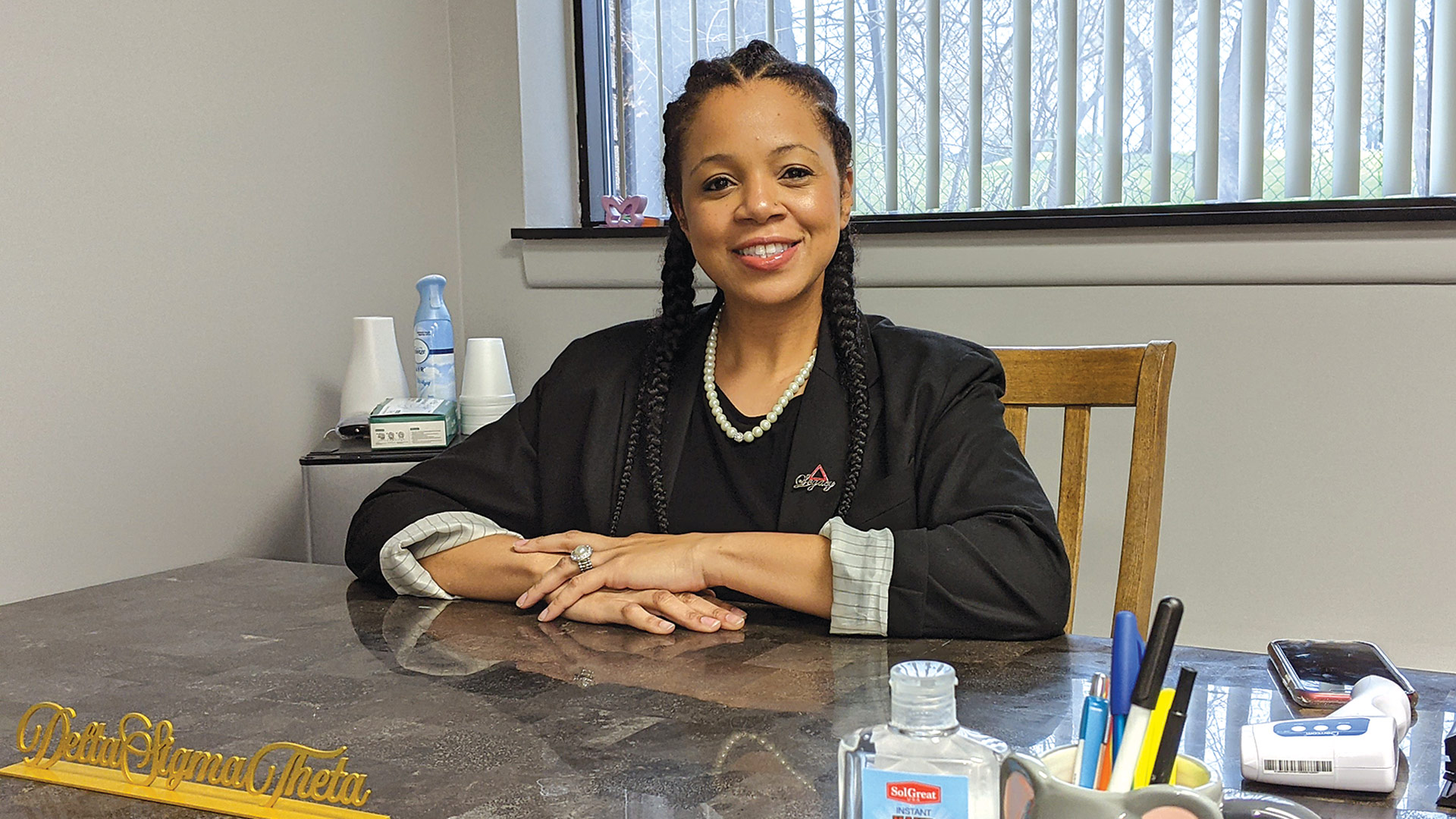
Tamera Crenshaw says barriers to accessing mental healthcare are myriad.

Tamera Crenshaw says barriers to accessing mental healthcare are myriad.

Socially, certain young people — those with a more introverted personality — found they thrived in the remote setting, and are anxious about returning to campus, Burgess added. Others found the home setting to be an escape from bullying, and are palpably fearful about going back.

Meanwhile, some students, depending on how rigorous their remote-learning experience was, might find themselves overwhelmed or feeling academically behind as teachers play catch-up. Many students report coasting to passing grades, even very good grades, while feeling they haven’t been learning much.

And the economic struggles affecting many families who lost income or jobs — a definite stressor on kids — certainly aren’t over.

Tamera Crenshaw, a clinical psychologist and founder of Tools for Success Counseling in Longmeadow, said she’s especially passionate about mental health in minority populations, a demographic disproportionately affected by mental-health issues — because, again, those issues tend to be exacerbated by factors like economic stress, which have also landed hard on those populations during COVID-19.

Even remote learning has been a greater problem for communities of color because of issues of technological access and family strife over financial matters, she added. “Home isn’t necessarily the most conducive learning environment — and COVID just exacerbated it.”

An uptick in suicidal ideation is especially concerning, Crenshaw said. “Someone can have a baseline of thought, but when kids are actually expressing a plan or intent, it’s scary. And we’re definitely seeing an increase.”

Some of the factors are typical stressors on teens in any given year, but despondency has certainly been driven by greater economic instability, which can raise tension and anxiety in the home, as well as two competing factors: a longing to end a year of isolation and get back to school, and health fears about the safety of doing so, especially for kids who know someone who has died of COVID.

“These kids have not been forgotten, but even with a vaccine, they’re going to be vaccinated last,” she noted. “I can’t imagine there’s not a fear of going back into the school environment when they haven’t been vaccinated.”

The issues are deep and complex, and solutions aren’t easy. But, like most others in the mental-health field, Crenshaw says the first step to helping young people take charge of mental-health issues is clear and simple.

“You’ve got to name it.”


Start the Conversation

That means breaking through societal stigma surrounding these struggles.

“My mission is to destigmatize mental health,” Crenshaw said, noting that several factors contribute to that stigma and the resulting reluctance to seek help. “I want to help debunk that stigma.”

Beyond attitudes toward mental health, another barrier is financial — the challenge of accessing insurance that will pay for treatment, or, for those who don’t have it, navigating out-of-pocket costs while already struggling economically, she added.

“It was originally going to be two weeks, and weeks turned into months, and months became a year. Now, they’re going back out into a world that’s changed; it’s not going to be the same — there will be masks and social distancing and limitations on clubs and activities.”

A third factor is religious belief, specifically a belief by some churchgoers that mental-health professionals are at odds with faith, or that faith makes such help unnecessary. “We’re trying to educate churches and knock down that barrier,” she said. “I’m a woman of faith myself.”

Another factor is the simple fact of how few therapists of color are working today. Crenshaw’s team is largely women of color, but her practice is an exception — which is unfortunate because she knows people of color will often have an easier time trusting someone right off the bat when they can relate to them or see themselves in them.

This last factor might be a long-term struggle to overcome, she added, noting that she teaches classes in her field at Westfield State University, and none of the 17 students currently in one of her classes is a woman of color.

In fact, the mental-health and social-work fields in general are in need of more talent, said Jessica Collins, executive director of the Public Health Institute of Western Massachusetts (PHIWM). She agreed about the access issue as well, noting that mental health should be a basic support, not something available only for people who can pay for it — especially when families who can’t pay are often in greater need of those supports.

Recognizing the importance of these issues among young people, before the pandemic even began, the Public Health Institute facilitated the formation of a youth mental-health coalition in Springfield — one that brings to the table direct service providers like BHN and Gándara, Springfield Public Schools, local therapists, and, critically, a group of 11 teenagers who meet regularly.

The question at the center of the initiative is simple, Collins said. “How do we best support kids? It might sound basic, but it’s fairly new; there has not been an emphasis on the mental health of kids except in extreme cases, where the kids have to go into inpatient care.”

One takeaway so far is that teens don’t feel fully heard by the distracted adults in their lives.

“What we’re hearing, loud and clear, from our young people is, when they talk to adults, adults are not skilled at supporting them,” Collins said. “Adults are stressed, adults are stretched, and that just adds to this epidemic of young people feeling hopeless and alone and unsupported.”

That’s why the Public Health Institute is talking about what kind of training adults — those who work in preschool and school programs, but also parents — might need to learn how to better listen to young people and work through and respond to what they’re hearing.

Jessica Collins

Jessica Collins says parents sometimes get so stressed, they don’t realize how stressed their kids are, too.

“These big direct-service providers are really competitive, so to get them in a room to talk about how can we work together to better support families, instead of just competing for them, that’s fairly new,” Collins said, adding that Daniel Warwick, Springfield’s superintendent of Schools, has also been on board with efforts like this for a long time.

For example, when he saw a 2017 report by PHIWM about the hopelessness felt by local teens who don’t identify as heterosexual, “he was so upset about that, a few years ago, he mandated some training for all Springfield public-school adults to better support kids who are LGBTQ+.”


Take It Seriously

That’s a good example of listening to young people and then taking them seriously — which is one way to normalize mental-health needs, Collins said. “If you can’t talk about it, you can’t figure out for yourself what you need.”

And one thing young people need right now is reconnection. While many kids are tired of the technology-only avenues for connecting with friends, Crenshaw said, Zoom calls, text chats, and the like have been an overall positive in staying in touch. But she also encourages kids and families to take opportunities to see friends and loved ones in person, in a safe manner, when possible.

“You can go to the park; you can go outside with a soccer ball, wear your mask, and connect. Some families have said, ‘we can’t do this alone,’ and became part of each other’s bubble, taking turns doing homeschooling. We encourage these ways of connecting with each other.”

And don’t give up on trying to talk to your kids, Burgess said, even when they don’t feel like talking back.

“The most important thing any parent can do during these times is open a dialogue with their children and allow kids to have open communication,” she said. “What are they thinking? What are they feeling? Then we can guide them and help them through their own resiliency and make adjustments.”

Families can help combat their kids’ isolation, she said, by planning quality family time, even if it’s just having dinner together, around the table, every night, or scheduling a family game night every week. Those moments, she noted, can naturally help kids let their guards down.

“You want to have that quality time, that open communication to talk and listen to your kids and ask, ‘how are you feeling? What’s going on? What can I do to help make things easier?’ Sometimes, as a parent, we’re not able to say ‘yes’ to everything, but we can look for compromises and help kids make some of the decisions.”

The problem in identifying signs of distress, Crenshaw said, is that teenagers, even on their best days, often prefer to be isolated, or present a sullen demeanor. So how can parents separate normal teen ‘attitude’ from real warning signs?

“Are they communicating as much with you, or are they isolating in their rooms moreso than normal? Are they eating normally?” she asked. “Even prior to COVID, parents would say, ‘I didn’t know there was a problem — I thought that’s how kids are.’”

It doesn’t hurt for parents to simply ask their kids, directly, how they’re feeling, what’s working or not working in their lives, how school is going, and if they’re feeling more anxiety than usual. “If a teen is isolated in their room, that could be typical teen behavior, but maybe not.”

Physical signs may be visible, too, Crenshaw said, noting that cutting — what’s referred to in her field as ‘self-injurious behavior’ — and eating disorders are more common than some parents think.

But more often, the signs are subtler. “It’s just really knowing their disposition and what they’re involved in.”

Burgess said it’s important for parents not to go it alone if their gut tells them something is truly wrong.

“If you notice your kid struggling with severe signs of depression — really isolating, really struggling — definitely seek professional help. If your kid is talking about suicide or even just having a hard time getting back into interacting or adjusting, seeking professional help is always key.”

In the end, coming out on the other side mentally healthy — and that goes for parents and children alike — will take patience and resilience, Burgess added.

“There’s no guidebook for this. There’s no ‘COVID for Dummies’ book. We’re all doing the best we can to adapt. We’re all just going through an unprecedented time.”


Joseph Bednar can be reached at [email protected]

Features

NFTs and Cryptocurrency

By Bart Galvin


Digital assets such as Bitcoin and non-fungible tokens (NFTs) are transforming global capital markets and the art world, with market capitalization reaching $2 trillion and digital artworks packaged through NFTs regularly selling for millions of dollars. As these assets gain prominence in the marketplace, it is increasingly important to understand why these assets appeal to investors, how they represent value, and how they function under the hood.


NFTs and Digital Art

NFTs have exploded in popularity in the past year, with notable examples like CryptoPunks, which are collectible, algorithmically generated pixel artworks, as well as the works of Mike Winkelmann (known professionally as Beeple), who recently sold a piece of NFT art at a Christie’s auction for $69 million.

Bart Galvin

An NFT is a unique digital token representing an interest in something else, which could be a piece of art, a share of stock, a stream of royalties, or even, in the case of Unisocks, entitlement to a physical pair of socks. NFTs are ‘non-fungible’ because, unlike cryptocurrencies, they aren’t interchangeable — your NFT corresponds to the specific entitlement or right to the underlying thing.

The eye-popping price tags of many digital-art NFTs poses the question: what exactly are you buying when you purchase an NFT? In its most basic form, an NFT is simply verifiable proof that you are the purchaser of whatever the NFT represents. But the devil is in the details. The rights granted by an NFT are entirely up its creator, so some NFTs have strict terms and conditions that prohibit exhibitions or commercial use of the art, while others might grant you the copyright in the work.


Cryptocurrency and the Rise of Bitcoin

Bitcoin has been the most prominent cryptocurrency since its introduction in 2008, but many other cryptocurrencies exist, such as Ethereum, an important part of many ‘smart contracts,’ and Tether, which is pegged to the value of the U.S. dollar. Bitcoin accounts for about half of global cryptocurrency market capitalization.

At the end of March, the price of one Bitcoin was approximately $60,000. Unlike a cryptocurrency like Tether, the value of Bitcoin can fluctuate wildly. Indeed, it has increased tenfold in the past year, dwarfing its previous peak of $17,000 in December 2017. The value of Bitcoin is determined almost entirely by what purchasers believe it is worth, and investors speculate on that value, driving price fluctuations. These price fluctuations can have a snowball effect, whereby widespread speculation in Bitcoin that drives the price upward can lead investors to believe Bitcoin will be adopted more widely, leading to further speculation that its value will increase.


Why Do People Care?

Cryptocurrencies and NFTs represent a fundamentally new way of transacting. The reason is in the revolutionary qualities of their underlying technology: the ‘blockchain.’ A blockchain can be thought of as a tamper-resistant digital store of data, constructed using computer cryptography and distributed among participants over the internet. Here’s what makes the blockchain special, and why people are jumping on board.

First, the blockchain allows parties to transact without intermediaries. No banks or clearinghouses are needed to execute or verify transactions since the underlying technology ensures that transfers are reliable, practically irreversible, and publicly verifiable.

“In the world of blockchain technology, Bitcoin and digital-art NFTs are the tip of the iceberg. There are already countless blockchain-based technologies, and new ones are invented every day.”

Second, blockchain transactions are not limited by jurisdictional or national boundaries. The transaction’s terms are dictated by computer code, not local law. Perhaps more importantly, the code is self-enforcing, which limits opportunistic behavior. Parties do not need to appeal to the judicial system to enforce an agreement because it happens automatically.

Third, blockchains are not subject to a central point of control or a central point of failure. Blockchains work by interconnecting users running the same software over a peer-to-peer network on the internet. No one party controls the blockchain. All new transactions are shared over the network, and they become final only when a majority of users determines that the transaction is valid. If a user doesn’t own the digital asset they’re trying to transfer, or tries to transfer it twice, the transaction will be rejected.

Fourth, blockchain transactions are publicly visible and verifiable. A blockchain serves as a ledger of transactions and all the transactions that came before them, allowing anyone to view and verify the trail of activity occurring over the network.

Fifth, blockchains allow parties to transact pseudonymously (not quite anonymously), without needing to trust or even know each other. All you need to know is your counterparty’s digital address or ‘wallet.’ And because transactions are practically irreversible and verified by the consensus of the network, the opportunities for fraud are heavily curtailed.


The Future of Blockchain Technologies

In the world of blockchain technology, Bitcoin and digital-art NFTs are the tip of the iceberg. There are already countless blockchain-based technologies, and new ones are invented every day. The blockchain is highly flexible and has tremendous untapped potential for consumer transactions, private contracts, corporate structuring, securities and derivatives, and even public administration. If your business is not using the blockchain yet, it’s only a matter of time.


Bart Galvin is an attorney at Bulkley Richardson, where he is a member of the Blockchain and Cryptocurrency practice group; (413) 272-6200.

Community Spotlight

Community Spotlight

By Mark Morris

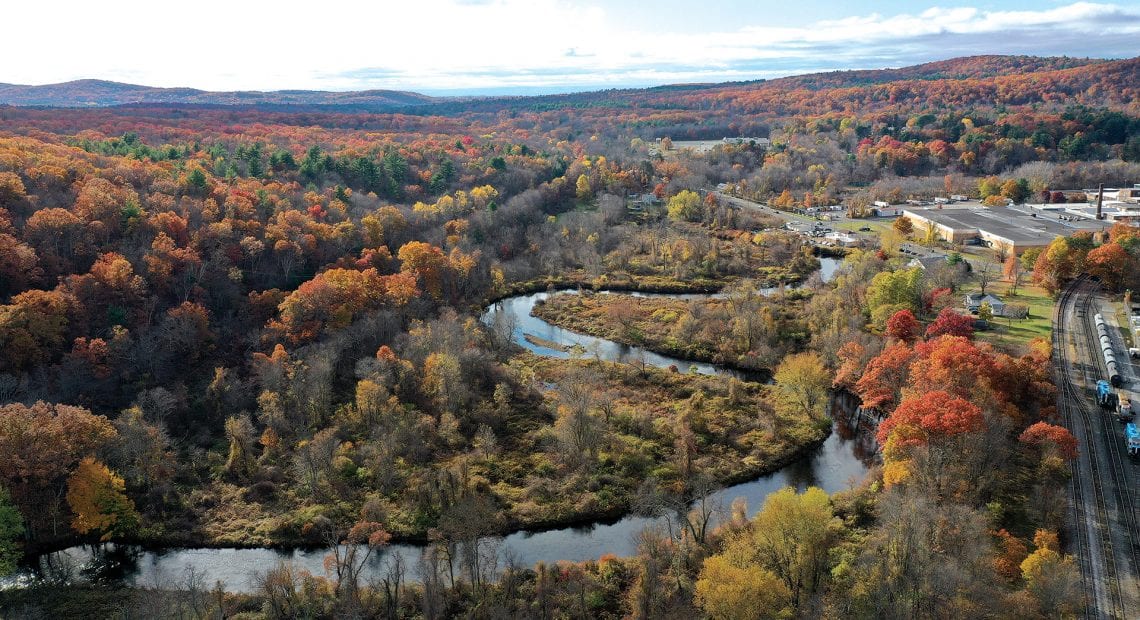
Palmer has a long history as a key train stop

Palmer has a long history as a key train stop, making it an oft-discussed part of conversations about expanded east-west rail.

As the nation recovers from a year of dealing with COVID-19, Palmer Town Manger Ryan McNutt looks to the future with optimism.

While larger cities had to contend with high COVID infection numbers and revenue losses from business taxes, Palmer maintained low infection numbers and relies more on residential taxes, which remained stable.

These days, as many people in the larger metropolitan areas work from home, there is no certainty they will return to five days a week in the office. That dynamic, McNutt believes, gives Palmer a real opportunity. With the average home price in Palmer at $191,000 compared to the Greater Boston area average of more than a half-million dollars, he wants to take advantage of this moment.

“The ability to start a family and work toward the American dream is much more difficult to afford in the Greater Boston area and much easier in our area,” he told BusinessWest. “We may see a change in working conditions where office workers spend up to four days a week at home, which would allow them to live in Western Mass. and take advantage of our affordability.”

McNutt is creating a marketing plan to reach out to the Boston area as well as other densely populated urban areas to promote the value and quality of life available in Palmer and surrounding areas.

“Right now, there are three alternative plans for how the east-west rail will be configured, and Palmer has a stop in each scenario.”

One huge boon for Palmer in this regard would be the proposed east-west rail project. The plan to offer passenger rail service from Pittsfield to Boston has been included in the federal infrastructure plan about to go to Congress. McNutt said east-west rail would be transformative for his town.

“Right now, there are three alternative plans for how the east-west rail will be configured, and Palmer has a stop in each scenario,” he said. Though many steps remain before the plan wins approval and comes to fruition, town planners are looking to identify the right location, and they want to make sure it’s shovel-ready.

“I want to be so ready that, if we were told they could helicopter in a train station and drop it where a site was selected, we want to be ready for that helicopter,” he said.


Engine of Opportunity

The economic potential of a train stop in Palmer is not lost on Andrew Surprise, CEO of Quabog Hills Chamber of Commerce. On the job since January, Surprise looks to help chamber members increase their engagement with state and local officials, as well as identify economic programs to benefit the area.

He has already begun working on a grant for downtown Palmer through the Transformative Development Initiative, a MassDevelopment program. The grant provides incentives for businesses to locate in condensed areas, like downtown settings, that are walkable.

“That’s a positive for us because Palmer’s downtown is very walkable,” Surprise said.

He is also applying to the Massachusetts Cultural Council to have downtown Palmer designated as a cultural district. In addition to being a walkable area, a community must show it hosts arts and cultural events on a regular basis.

Surprise admits these projects will take several years to be successful, but the effort would be worth it. “A well-developed and vibrant downtown will help us bring in other businesses.”

Andrew Surprise

Andrew Surprise

“Palmer is well-placed for manufacturing facilities; its access to major highways makes it easy to get products to Boston, Hartford, Albany, and New York City.”

As part of his outreach to local officials, he reminds them of Palmer’s tradition and continued relevance as a manufacturing town.

“There has been a lot of talk on the national level about restoring manufacturing jobs,” he said, adding that communities like Palmer that have plenty of available land could be attractive to Boston-area high-tech companies looking for manufacturing space. “Palmer is well-placed for manufacturing facilities; its access to major highways makes it easy to get products to Boston, Hartford, Albany, and New York City.”

The chamber recently conducted a survey among its members to find out how they weathered the pandemic. Results so far show that two-thirds of businesses have been able to avoid employee layoffs. By finding alternatives such as reducing hours, many avoided having to reduce their staffs.

Palmer at a glance

Year Incorporated: 1775
Population: 13,050
Area: 32 square miles
County: Hampden
Tax Rate, residential and commercial: Palmer, $22.63; Three Rivers, $23.28; Bondsville, $23.67; Thorndike, $23.62
Median Household Income: $41,443
Median Family Income: $49,358
Type of government: Town Manager; Town Council
Largest Employers: Baystate Wing Hospital; Sanderson MacLeod Inc., Camp Ramah of New England; Big Y World Class Market
* Latest information available

“We conducted the survey to learn what types of services the chamber could offer to help businesses find success going forward,” Surprise said, noting that these are only preliminary results, as all surveys have not yet been returned.

As a first step, the chamber is planning a number of seminars for small businesses to help them increase foot traffic and bring in new customers through approaches such as digital marketing.

“Many small businesses are not familiar with digital or social media marketing, and it’s really a necessary tool in the 21st century,” he noted.


On the Right Track

McNutt is hopeful some kind of infrastructure package passes Congress because, like municipal leaders all over the country, he faces big projects that need attention.

“There are 47,000 deficient bridges in the U.S., including the nine that are in Palmer,” he said.

But for a small community, he added, taking on a big infrastructure project is a heavy lift, and Palmer has been working with U.S. Rep. Richard Neal to secure funding for at least two bridges, on Main Street and Church Street, which need the most attention.

One project that could add significantly to the town tax revenues involves building 300 seasonal cottages on Forest Lake. McNutt is excited about the potential for this project.

“Folks are coming up from New York to buy our homes because they recognize that living space, fresh air, and not being stuck in small square footage are luxuries that we have here.”

“Right now the cottages are planned for warm-weather use and would bring plenty of folks in to stay in town,” he said. “They will most likely go to local restaurants and make other purchases, so we could see a real economic multiplier effect from this project.”

Palmer has also agreed to be a host community for the cannabis industry. Two retail sites and two cultivation businesses have run into delays to start their enterprises, but McNutt blames COVID for the slowdown.

“The Cannabis Control Commission held fewer meetings than they normally would, and site visits were more difficult to do,” he explained. “In short, everything in the regulatory environment was just harder to do during the pandemic.” He feels confident at least one site will be up and running this year or early in 2022.

As the number of people vaccinated increases and COVID concerns decrease, he believes the opportunity is now for Palmer and surrounding towns.

“Folks are coming up from New York to buy our homes because they recognize that living space, fresh air, and not being stuck in small square footage are luxuries that we have here.”

McNutt noted that people can still pursue the American dream by locating to Palmer because, in addition to its natural surroundings, the town has easy access to metropolitan areas. In short, he said, “we have the best of both worlds.”

Sports & Leisure

Buy the Buy

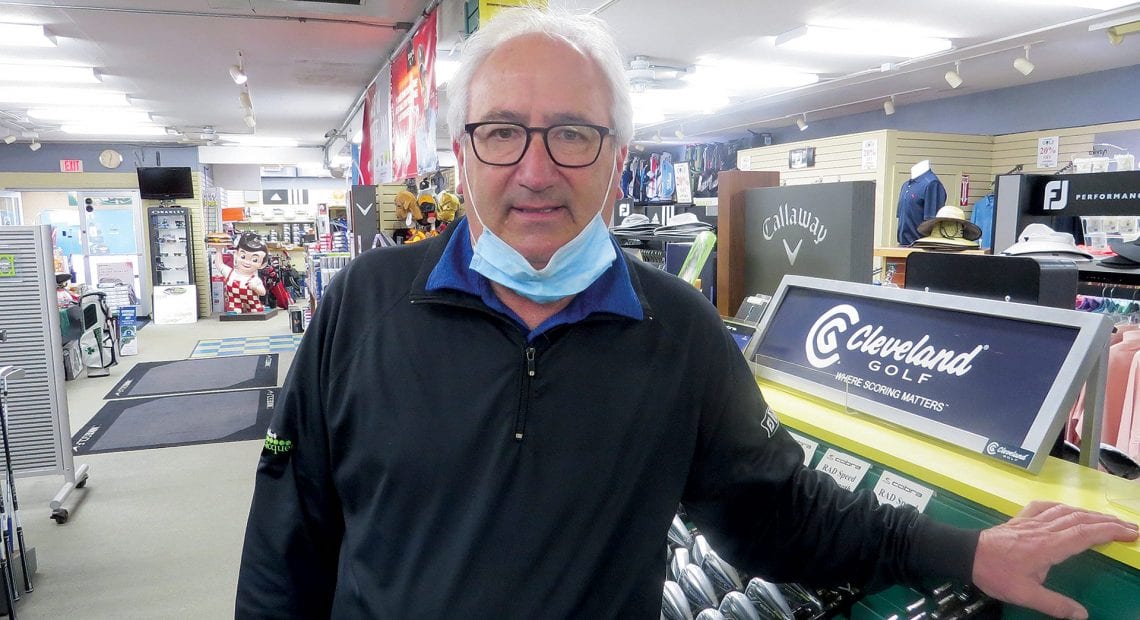
Dave DiRico

Dave DiRico says many people who discovered or rediscovered golf in 2020 are coming back to buy new equipment in 2021.

Dave DiRico says his shop is usually busy in late March and early April as golfers gear up for a new season.

This year, the look and feel have been different, and for many reasons. Golf got an unexpected and much-deserved boost last year when it became one of the few organized sports people could take part in. And it’s received another boost from the fact that Americans have been saving money as perhaps never before, and many of them have also been receiving stimulus checks from the government.

Add it all up, and March and April have been even busier than normal, said DiRico, owner of Dave DiRico’s Golf & Racquet, adding that, for now, he doesn’t see many signs of slowing down.

“We’re seeing it at all levels, all age groups, starting with the seniors,” he said. “They didn’t travel as much over the past year. They haven’t gone out to dinner; they didn’t go on their spring golf trip to Florida. And we’re seeing more of those people buying clubs — and that’s generally not our soft spot.”

That soft spot would be younger professionals and junior golfers, he went on, adding that these people are buying clubs, too, often with the help of the government.

Meanwhile, large numbers of people took up the game last year, or found it again after drifting away from it for whatever reason. Many of these people bought used equipment last year — so much that inventories dwindled significantly — and this year, they’re coming back for new clubs.

“Most of them are deciding to continue to play — they enjoyed it,” DiRico said. “And they’re trading in their used equipment for new stuff — because they intend to stay with it.”

The surge in play and its impact on the retail side of the game is reflected in the numbers. In the third quarter of 2020, for example, retail sales of golf equipment exceeded $1 billion for the first time ever for that period, according to Golf Datatech, an industry research firm. Meanwhile, Callaway Golf Co., which manufactures golf balls in Chicopee, reported a 20% surge in sales in the fourth quarter of 2020.

The problem some players are encountering, though, is limited inventories of new equipment. Indeed, the golf manufacturers, like those who make cars and countless other products, are experiencing supply-chain issues and difficulties getting the materials they need. This has led to sometimes lengthy waits for ordered clubs to be delivered.

“There’s such an increased demand with new golfers across the country that they’re all running out of equipment,” he explained. “They can only manufacture so much, and the demand is far more then they projected. Some companies can’t get shafts, others can’t get grips — you can’t make a golf club unless you have all the components.

“We have a few companies that are great — they’ve managed to stay ahead of this, and they’re doing very well,” he went on. “But then, we have some other companies … you have to wait 15 weeks to get a set of irons.”

Doing some quick math, DiRico said this will translate into delivery sometime in June, far longer than golfers anxious to get their hands on new irons or a new driver want to wait.

But, overall, this would have to be considered a good problem to have — if such things actually exist in business.

Only a few years ago, the golf industry was in a sharp decline, with membership down at most clubs, tee times readily available at public facilities, and racks full of new equipment for which there wasn’t strong demand. Things have changed in a hurry, and DiRico and others hope most of these trends — not the current supply-and-demand issues, certainly — have some permanence to them.


—George O’Brien

Sports & Leisure

A Simple Mission

Just over a year ago this time, Jesse Menachem and his staff at the Massachusetts Golf Assoc. (MGA) were fighting — and fighting hard — to convince the state simply to let golf-course owners maintain their property.

Despite some intense lobbying by his group, Gov. Charlie Baker made golf courses part of his broad shutdown of non-essential businesses in March 2020, and for weeks, the industry lingered in a sort of limbo, not knowing when, if, and under what circumstances courses would be allowed to reopen.

When they did, in mid-May, a number of limiting restrictions kept play at modest levels. But then … the lid came off, and the industry found itself in an enviable position. Indeed, golf was one of the few activities people could take part in during the pandemic, and people started taking it up — or taking it up again, as the case may be, a development that benefited public and private courses alike.

“I’ve heard from clubs that recorded anywhere from a 20% to 50% increase in rounds, which is incredible, because capacity was limited due to the longer intervals between tee times, as mandated by the state,” said Menachem, president of the MGA. “You couldn’t find tee times on weekends at many facilities; with people working from home, working remotely, not traveling, not having family activities like Little League and soccer, golf became number one in a lot of people’s minds, and the game really benefited.”

Jesse Menachem

Jesse Menachem

“If we can sustain or retain at least 25% to 33% of those who participated last year … that’s a goal; that’s a start. More would be great, but we have to be realistic.”

Now, as the 2021 season gets set to begin in earnest (some courses have already been open for several weeks), the golf industry has a simple, yet also complex, mission that Menachem summed up directly and succinctly: “make it sticky.”

By that, he meant those managing the state’s courses have to take advantage of this huge opportunity they’ve been granted and compel those who took to golf last year, because there were few attractive options, stay with the game now that other options exist.

“That’s our job; that’s what we’re up against — we have to make sure it’s sticky, and that’s something we have not been very good at,” he explained. “If we can sustain or retain at least 25% to 33% of those who participated last year … that’s a goal; that’s a start. More would be great, but we have to be realistic.”

Indeed, as they go about this mission, courses will have advantages and selling points they didn’t have last year, said Menachem, especially when it comes to their 19th holes, many of which were closed in 2020, while those that were open faced a mountain of restrictions on what they could serve, when, and how. They have also learned some lessons from last year, including how those longer intervals between tee times improved pace of play, reduced logjams on the course, and improved the overall player experience.

But golf will also be facing far more competition in 2021 when it comes to the time, attention, and spending dollars of those who found the game a year ago. Indeed, as restrictions are eased, individuals and families can return to restaurants, museums, the cottage at the beach, and more.

For course owners and managers, the emphasis must be on providing a solid experience, one that prompts a return visit — or several. This has always been the emphasis, he said, but now even moreso, with courses being presented with what would have to be a considered a unique opportunity.

“It’s really our obligation to make sure that experience is favorable,” Menachem told BusinessWest. “For those who are being reintroduced, or introduced for the first time, we’ve got to invite them back; we have to make them feel comfortable and cater to what their desires are. We have to do everything within our power to make sure that golfer on site has the best experience possible and keep them coming back.”


—George O’Brien

Estate Planning

Staying Ahead of the Scams

By Julie Quink


With the continued intensity created by the COVID-19 pandemic, business owners and individuals have continued to be victims of fraudulent activity as the scams and schemes are continually changing and increasing in number.

At a time of significant economic stress and uncertainty, the barrage of ever-changing fraudulent attempts and attacks becomes increasingly difficult to manage and prevent. Fraudsters have also become very creative in their methods of gathering sensitive information to commit fraud, so it becomes increasingly difficult to predict what might be coming next in the form of an attack.

Since the onset of the pandemic, these schemes have continued to include filing fraudulent unemployment claims. As practitioners, we have also noticed an increase in stolen identities, whether it be by the interception of documents containing personal information or through online access.

As professionals who work with clients to implement best practices and detection techniques, we fall victim to fraud attempts as well. The most recent fraud attempts include continued false unemployment claims and theft of identities through mail interception.


Fraudulent Unemployment Claims

The filing of fraudulent unemployment claims is not a new fraud scheme. However, the repeated attempts at compromising employee data and filing of fraudulent claims in other states has increased.

Fraudsters have taken to heart the saying, ‘if at first you don’t succeed, try, try again.’ Some businesses have seen repeat attempts at fraudulent claims filed against the business using the same employees but citing different reasons for filing for unemployment, such as break in service or lack of work.

Further, claims are being filed for employees in different states. The fraudster is using an employee’s information to file in a state in which the employee does not live or work to gain access to unemployment benefits in the state where they live. It has become a vicious cycle.

“The most recent fraud attempts include continued false unemployment claims and theft of identities through mail interception.”

States have tightened controls and verifications to try to manage these fraudulent claims, but the tightening of controls comes with a cost. Employees who have been victims of fraudulent claims in the past may have a more challenging time filing for unemployment as their account has now been flagged. The ease of filing online for these people has now become complicated and time-consuming as they try to navigate the unemployment system.

The continued monitoring of a business unemployment account to prevent and detect fraudulent activity and responding to fraudulent claims can be time-consuming. If fraudulent claims are paid against an employer account, it can impact the employer’s experience rate and unemployment account if not identified quickly.

This is not a new area of fraud, but the methods that fraudsters use to gain access and apply is ever-changing.


Identify Theft

Fraudulent unemployment claims are an example of identity theft. It is believed that some of the personal information used in filing fraudulent unemployment claims has come from data breaches. However, creative methods of accessing personal information have now encompassed intercepting hard documents.

Another area of data interception, with which we have had personal experience, is through the mail. If a fraudster is not able to access personal information through electronic means, why not try the good old-fashioned way, through the U.S. Postal Service or another carrier?

Intercepting mail is a scheme that seems to be on the rise. In one such case of which we are aware, information was intercepted prior to arrival at its intended location. Between the time it was initially mailed and the time it finally arrived at its location, the sender’s identity was stolen, and a loan was opened in their name, unbeknownst to them. The fraudster intercepted tax documents, which had personal identifying information, and secured a fraudulent loan. Ultimately, the fraudster, realizing that the mail was in a tracked envelope, secured the package with significant amounts of tape and forwarded it to the final destination.

The Office of the Inspector General for the U.S. Postal Service is diligent in investigating suspected mail theft, from both internal and external sources. Because of its commitment to finding and detecting mail fraud, the office has devoted the Office of Investigations to handle complaints and fraud.

The impacts of identity theft for a business owner or an individual can be far-reaching. Significant impacts can include compromising credit and financial hardship, compromising legal relationships and documents, and compromising tax filings.

Perhaps one of the most significant impacts may be the feeling of violation, distrust, betrayal, or even embarrassment created by the theft of identity. The unwinding and unpacking of identity theft can be a time-consuming and emotional process for business owners and individuals.


Takeaways

What we know is that fraud schemes are changing faster than business owners, individuals, and technology can keep up. Whether the fraud scheme is a recurring scheme or a new and improved scheme, the importance of diligence, communication, and monitoring should not be discounted.

Communication with employees about fraudulent schemes involving unemployment and mail, along with continued monitoring, are best practices in keeping information safe and secure.


Julie Quink is managing partner with West Springfield-based Burkhart Pizzanelli; (413) 734-9040.

Estate Planning

State of Uncertainty

By Cheryl Fitzgerald


Over the past year, a number of words and phrases have worked themselves into the lexicon, and our everyday usage: pandemic, quarantine, super spreader, and social distancing all make that list. As does the three-word phrase working from home, which quickly morphed into an acronym — WFH.

Indeed, in March 2020, many businesses large and small required or encouraged their employees to work from home as a way to help stop the spread of the coronavirus. At the time, it clearly was intended to be a short-term measure. Nobody could have predicted that, a year later, some of the same employees continue to work from home, whether mandated by their employees or as a way of life now.

However, this has created unintended consequences for businesses and individuals. Employees working in a state other than the company’s home (i.e., their home and business are in different states) could potentially create a need for the business to file in that other state (known as nexus).

From a business perspective, some guidelines have been issued for businesses to follow. Some states have provided relief and have said the presence of an employee working in a state due to shelter-in-place restrictions will not create nexus for tax purposes in that state.

“Employees working in a state other than the company’s home (i.e., their home and business are in different states) could potentially create a need for the business to file in that other state (known as nexus).”


Some states provided a temporary safe harbor or waiver from state withholdings and tax liability for remote work in a different state during the pandemic. And still others have provided that they will not use someone’s relocation during the pandemic as the basis for exceeding the de minimis activity the business can have in the state without it becoming a taxable issue for them.

Massachusetts in particular has provided corporations tax relief in situations in which employees work remotely from Massachusetts due solely to the COVID-19 pandemic to minimize disruption for corporations doing business in Massachusetts. The Bay State has indicated it will not change the intent of whether or not an employee who has started to ‘work’ in Massachusetts because that is his or her home (i.e., a company situated in another state now has an employee physically working in the state of Massachusetts) is subject to Massachusetts corporate tax. These rules are intended to be in place for Massachusetts until 90 days after the state of emergency is lifted.

For employees that had normally worked in Massachusetts, but are now working at home in a different state, Massachusetts has stated that, since this is for pandemic-related circumstances, they will continue to be treated as performing the service in Massachusetts and subject to Massachusetts individual taxes. Most states (but not all) have adopted similar sourcing rules. Most of these rules were put in place for the year 2020. However, some states are still under the same rules and guidelines, and this will continue during 2021.

The intent for most states is to minimize any tax impact for both employees and employers if an employee’s work location has changed solely due to the COVID-19 pandemic.

However, one state has decided the Massachusetts provisions are unfair to its residents. Prior to the pandemic, New Hampshire’s southern border saw a steady stream of workers heading into Massachusetts on a normal workday. With the pandemic and the stay-at-home orders, many of these employees converted to working at their residence in New Hampshire, which does not have an individual income tax.

Therefore, with Massachusetts indicating that these wages were still going to be considered Massachusetts wages and therefore taxable, the governor of New Hampshire felt this was unfair to their residents and has filed a lawsuit in the U.S. Supreme Court over Massachusetts’ “unconstitutional tax grab.”
New Hampshire Gov. Chris Sununu has argued that “Massachusetts cannot balance its budget on the backs of our citizens and punish our workers for working from home to keep themselves, their families, and those around them safe.” This lawsuit was filed in October 2020. Stay tuned.

Remote working becomes even more complicated when employees telecommute in a different state from which they typically work, and this will begin to impact the employee’s eligibility for local leave (i.e., sick leave).

As the pandemic continues, and with some states having set ending dates for some of these relief provisions, employers may continue to have employees who work remotely, either by choice or convenience. The taxability of which state the wages should be taxed in will need to be revisited by employers and employees alike.


Cheryl Fitzgerald, CPA is a senior manager at Holyoke-based accounting firm Meyers Brothers Kalicka, P.C.; (413) 536-8510.

Health Care

Mental Block

The health anxieties, economic stresses, substance abuse, and feelings of isolation exacerbated by COVID-19 aren’t exactly new, Dr. Barry Sarvet says. And they won’t fade when the pandemic does.

“Prior to the pandemic — and it’s easy to forget this now — we had an enormous amount of stress in our communities related to poverty, homelessness, economic struggles … people just facing an enormous amount of stress in their lives,” said the chair of Psychiatry at Baystate Health. “We had underemployment, unemployment, an opioid epidemic. It’s a very distressed community with a lot of long-term struggles, a lot of psychosocial stress. Every psychiatric disorder is influenced by environmental stresses, and those aren’t getting better. We need to pay more attention to them after the pandemic.”

Well before COVID-19, Sarvet noted, the region’s mental-health needs laid bare a shortage of inpatient beds for patients who need more help than outpatient visits can provide. It’s why Baystate announced a joint venture with Kindred Behavioral Health last summer to build and operate a $43 million behavioral-health hospital for the region, set to open in 2022. The hospital will be located on the former Holyoke Geriatric Authority site on Lower Westfield Road in Holyoke.

Dr. Barry Sarvet

“Every psychiatric disorder is influenced by environmental stresses, and those aren’t getting better.”

Holyoke Medical Center (HMC) had revealed a similar proposal in March 2020 to build a $40.6 million, 84-bed behavioral-health facility on its campus. But when Baystate’s plans came online, and the threatened closure of 74 inpatient beds at Providence Behavioral Health Hospital were saved by a change in ownership, HMC reverted to an earlier plan, to repurpose two of its existing units for behavioral health.

“We were concerned about providing a solution to get beds online as the state was developing guidelines for all hospitals to incentivize an increase in behavioral-health beds,” said Spiros Hatiras, president and CEO of HMC and Valley Health Systems.

The process of converting two units to behavioral health — an adult unit and one with a likely geriatric focus — began in October and will be finished by late April, and will add 34 new beds to the existing 20 at the hospital, more than doubling the total to 54. In doing so, it provides a more immediate solution to regional bed shortages, avoiding the need for a lengthy construction period (HMC’s new hospital was also expected to open in late 2022).

The internal repurposing of units had been conceived as a stopgap measure, but when Trinity Health announced the sale of Providence to Health Partners New England (HPNE), which committed to keeping inpatient beds open — and Baystate moved forward with its project — the stopgap made sense as a longer-term solution, although HMC could revisit a standalone behavioral-health hospital at some point in the future, Hatiras said.

Baystate’s project, meanwhile, will include 150 beds — 120 of them part of the original plan. The system has also contracted with the state Department of Mental Health to operate a 30-bed, long-term continuing-care unit for chronically mentally ill people who need a longer time in the hospital to stabilize before returning to the community, Sarvet explained.

This state-funded program, not accessible to regular referrals, was launched after the closures of Northampton State Hospital and other facilities like it. “Some patients need longer-term care, and this offers a length of stay to support people who don’t benefit from short-term hospitalization,” Sarvet said, adding that the DMH unit will be physically connected to the new hospital, but offer its own unique resources.

“New beds will be needed over the long term,” he said, speaking of the project as a whole. “We have had quite a shortage for many years, prior to the potential closure of Providence and prior to the pandemic. This substantial increase in needs is reflected in emergency-room visits from patients with a mental-health crisis. And we certainly see evidence that this isn’t a short-term blip, but part of a longer-term trend that predated the pandemic.”


Multiple Pivots

The prospect of any additional behavioral-health beds in the region is certainly a turnaround from a year ago, when Trinity Health announced it would close 74 inpatient beds at Providence Behavioral Health Hospital.

However, two months ago, the health system sold Providence to HPNE, which provided some management services at the facility from 2011 to 2014, and will operate the facility under the name MiraVista Behavioral Health. In doing so, it will resume operations of numerous outpatient programs, as well as including up to 84 inpatient psychiatric beds.

Spiros Hatiras

Spiros Hatiras

“We were concerned about providing a solution to get beds online as the state was developing guidelines for all hospitals to incentivize an increase in behavioral-health beds.”

“At the time we put forth the plan to build a new behavioral-health hospital, everyone else had pretty much abandoned any behavioral-health expansion,” Hatiras told BusinessWest. “People were shrinking programs; Providence was closing down their campus, and Baystate had put their plans on hold indefinitely. We decided we needed to do something to service the region. Since then, Baystate resurrected their plan to develop the old Geriatric Authority site.”

The recent moves come as no surprise at a time when state health officials have been incentivizing hospitals to open up behavioral-health beds in the wake of a sharp increase in cases due partly to the pandemic.

However, “we had a concern that what seemed like no beds could potentally become too many beds,” Hatiras explained. He disagrees with Marylou Sudders, secretary of Health and Human Services for the Commonwealth, who has said there can never be too many beds because the state has so many needs. Rather, he noted, “demand may be greater now than it will be a year from now as we move away from the pandemic spike; we might see demand go down.”

Two other factors, both geographic, also played into the decision to scale down HMC’s behavioral-health expansion. One is that HMC, Baystate, and Providence would have been providing around 225 beds within a three-mile radius of each other, and though the need for services is great statewide, there’s only so far patients and families will be willing or able to go to seek access to treatment — not to mention the difficulty of recruiting more physicians, nurses, and ancillary staff to such a concentrated area.

“We might find ourselves very quickly in a situation where we might not be able to staff those beds. Can we attract staff to this area? That’s always been difficult for Western Mass.,” Hatiras said, another reason why a smaller-scale project makes sense right now.

“I’m optimistic about the units we’re building coming online quickly and providing some relief,” he said. “It’s a good project, and we have a good track record in behavioral health. We know we can run it well, and the state has been very enthusiastic about it. I think we’re in really good shape.”

While the standalone hospital proposal is ‘parked’ for the moment, not abandoned completely, HMC has to be sure something of that scale would be both necessary and practical before moving forward, Hatiras added. “We’re a small community hospital. A project can’t be something that may or may not succeed financially; we can’t take a $45 million risk.”

Baystate currently has 69 behavioral-health beds at three of its affiliate locations: 27 at Baystate Wing Hospital, 22 at Baystate Franklin Medical Center, and 20 at Baystate Noble Hospital. When the new facility opens next fall, these three locations will close. A fourth location, the Adult Psychiatric Treatment Unit at Baystate Medical Center (BMC), which accommodates up to 28 medically complex behavioral-health patients, will remain open. Kindred Healthcare will manage the day-to-day operations of the behavioral hospital.

Sarvet firmly believes Baystate will able to fully staff the new venture.

“We do have a nursing shortage, so this will present a challenge, but I don’t think it’s insurmountable,” he told BusinessWest. “We’ll work very hard to include people from the region and hire locally, but we might need a wider net to bring people in. We are very confident we’ll be able to be successful.”


Not Waiting Around

In fact, all the local players in the inpatient realm of behavioral health need to be successful, Sarvet noted. For example, suicide rates are increasing, as are instances of anxiety and depression, including in young people (see story on page 4). Meanwhile, the workforce of psychotherapists and clinicians in outpatient settings haven’t been operating at full capacity — again, partly due to the pandemic and the shift to remote treatment settings.

Like HMC, Baystate isn’t waiting for a new building to expand certain aspects of behavioral care. It will open a 12-bed child unit at Baystate later this month, which will expand to a 24-bed unit in the new hospital next year, in response to a shortage of beds specifically for that population. “We see a large number of kids taken care of on medical floors, waiting for beds, up to several weeks,” Sarvet said.

All this movement is positive, Hatiras noted, though he does wish that leadership from HMC, Baystate, and Providence had engaged in deeper conversations about the region’s long-term behavioral-health needs and how to meet them before the recent rush of project launches and changes, bed closings, and ownership transitions.

“Let’s talk as a regional team and determine what makes sense for the region,” he said. “That still has purpose now. Let’s decide what makes sense in these areas before we build 250 beds and can’t staff them, or half of them sit empty.”

For his part, Sarvet agrees that the meeting the region’s inpatient behavioral-health needs is not a solo effort. “We don’t want to win the battle; we want all hospitals to be staffed. We’re in a friendly competition, and we want everyone to win.”


Joseph Bednar can be reached at [email protected]

Health Care

The Next Step

By Mark Morris


Jack Jury

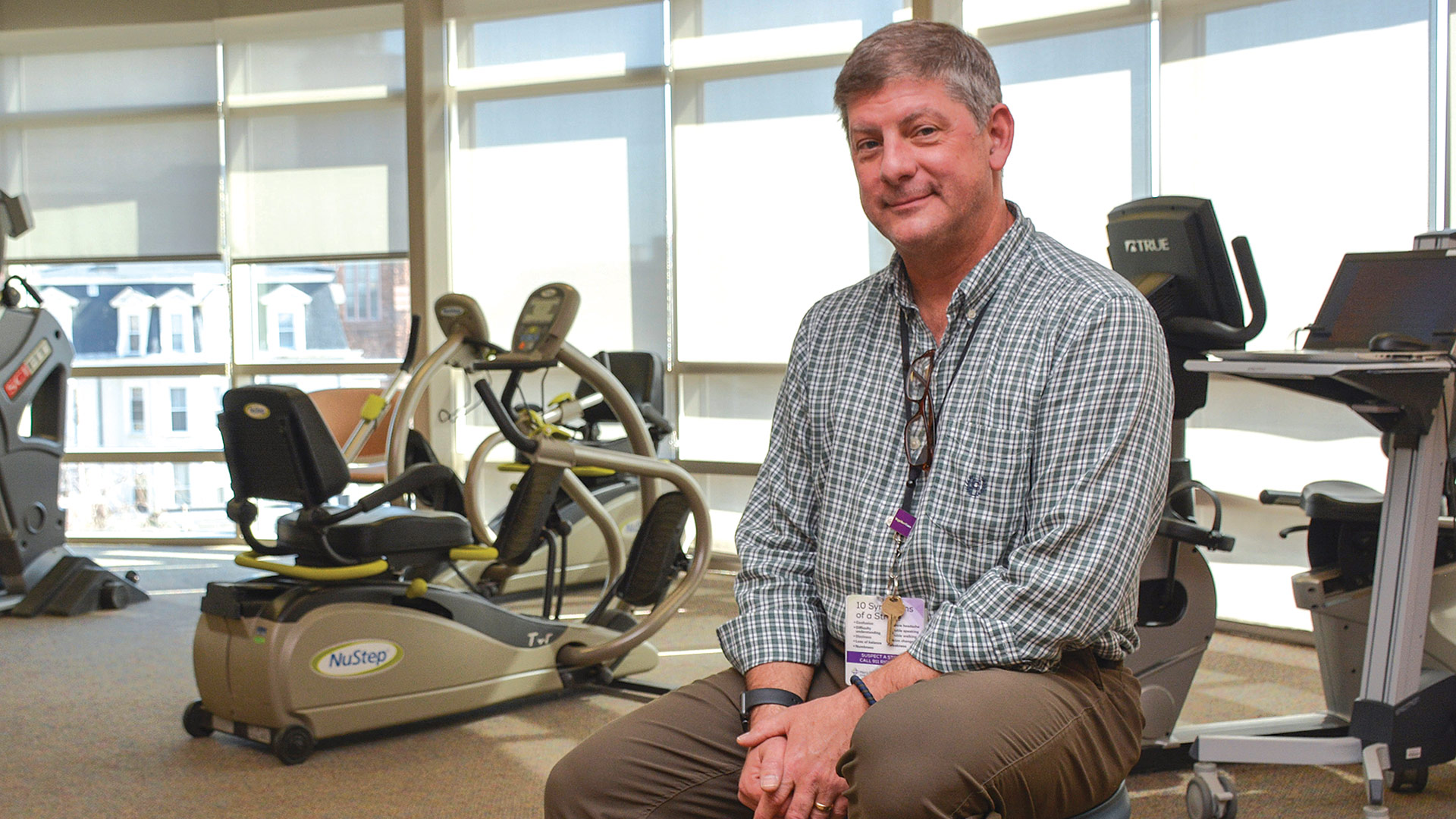
Jack Jury says today’s joint-replacement patients experience less pain and a shorter rehab than in the past.

As we age, it’s not unusual for our joints to become worn down from decades of use. For most people, their knees, hips, or shoulders will develop painful arthritis and need some kind of attention.

When a patient suffers from especially severe joint pain, doctors usually begin treatment by recommending physical therapy, as well as pain medications or an assistive device such as a cane or a walker. When these non-operative approaches work, they can provide relief and delay an eventual surgery.

However, “if the pain, function, and quality of life do not improve for the patient, that’s when we recommend joint-replacement surgery,” said Dr. Ben Snyder, an orthopedic surgeon at Cooley Dickinson Health Care.

Nearly 1 million Americans undergo joint-replacement surgery every year, with around 600,000 for knees and 300,000 for hips. According to Snyder, this safe and effective surgery is proliferating because, as people age, they want to remain active through their later years.

In the past, surgeries were often held off until patients were in their 70s because older-model replacement joints would not hold up for more than 10 or 15 years. “But improvements in joint-replacement techniques and technology have increased the longevity of joint-replacement surgery,” Snyder said. “Because of that, we’ve seen a big increase in patients who are 55 to 65 years old.”

A key to success for joint-replacement surgery involves getting patients out of bed and walking on the same day of surgery, Snyder noted. “We find that mobilizing patients early promotes faster recovery, less pain, and fewer complications.”

Andrea Noel-Doubleday, assistant director of Rehabilitation Services at Cooley Dickinson, has been a physical therapist for 25 years. In that time, she said, helping patients with their rehab has improved greatly because it has become a much less painful process for the patient.

Dr. Ben Snyder

Dr. Ben Snyder

“We find that mobilizing patients early promotes faster recovery, less pain, and fewer complications.”

“Joint-replacement surgeries have evolved and become so good that we just guide patients through their exercises,” she said. “For most patients, there isn’t the high level of pain in a rehab like there used to be.”

Less pain also translates to a shorter rehab process. Jack Jury, lead physical therapist at the Rehabilitation Hospital at Mercy Medical Center, said a full knee replacement for many patients is a day-stay surgery.

“They come in in the morning, have their knee replaced, work with us for couple sessions of physical therapy, and then go home the same day,” he explained.

While home exercises and outpatient rehabilitation remain essential, he noted, even they are taking less time. “A few years ago, it was not unusual for our patients to see us for 12 weeks of outpatient therapy. Now, four to five weeks is a long time to work with someone.”


Transition Game

Both Jury and Noel-Doubleday pointed out that rehabilitation hospitals play a key role in the healing process for patients who are not yet ready to move from the hospital directly to their home.

Those patients see people like Nick Rizas, inpatient therapy manager with Encompass Health Rehabilitation Hospital of Western Massachusetts. Rizas explained that patients are usually referred to Encompass because they have chronic conditions (such as obesity, diabetes, and active tobacco use) that make healing more challenging. He also works with patients when they decide to have both knees replaced at the same time.

“When a person is in pain because their knees are giving them trouble, getting both done means they only have to go through the process once,” he said, quickly adding that “this procedure would only happen after a discussion with the surgeon to determine that this is the best course of action.”

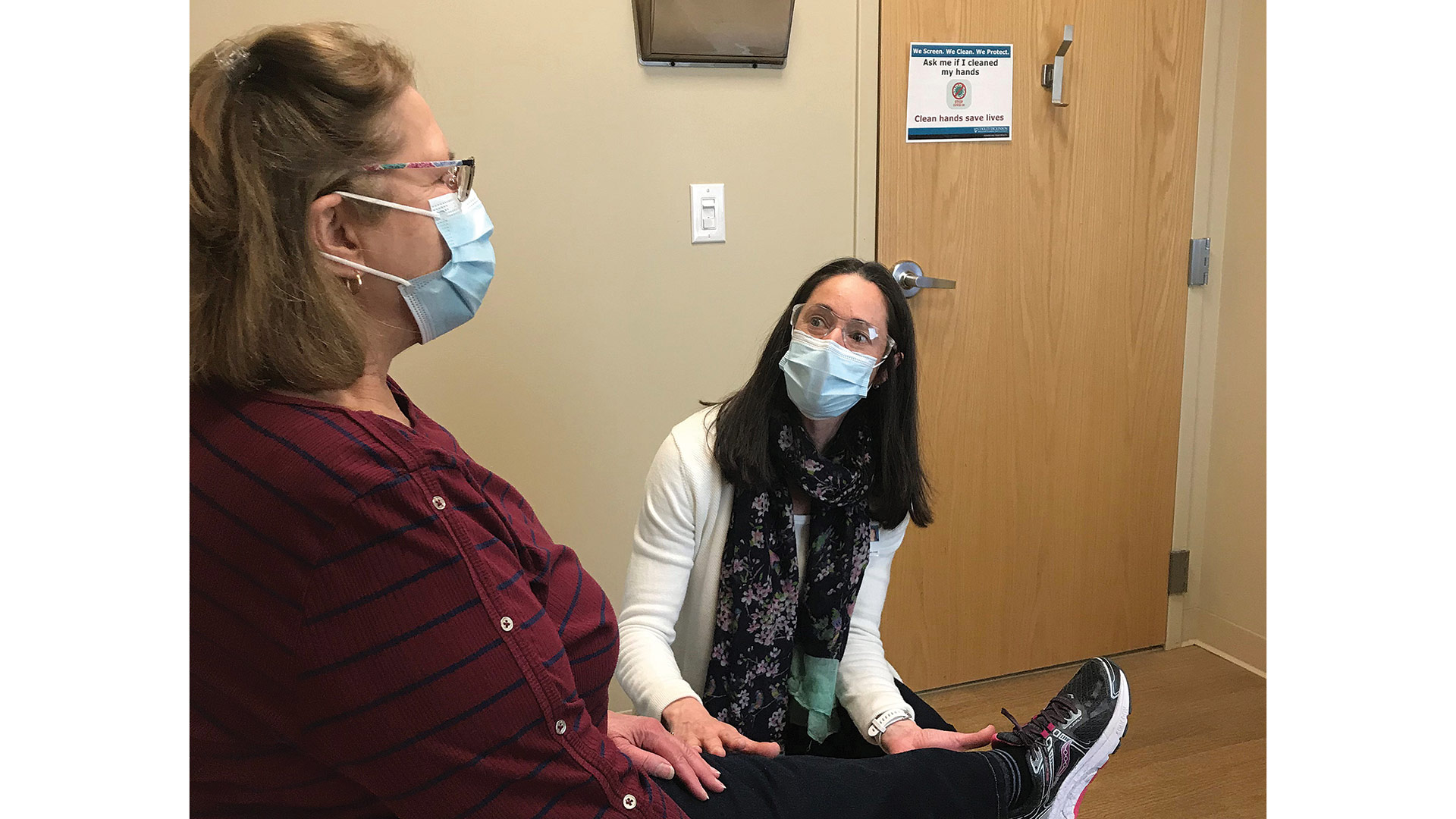
Andrea Noel-Doubleday speaks with a joint-replacement patient.

Andrea Noel-Doubleday speaks with a joint-replacement patient.

On occasion, physical therapy plays a role before surgery when doctors recommend patients for a program known as ‘prehab.’ Noel-Doubleday explained that prehab allows patients to increase their strength and become familiar with the exercises they will need to perform to properly heal after surgery.

“It can be hard to go through the exercises when you aren’t feeling great, but it’s worth it,” she said. “By being stronger before the surgery, patients can get back to their normal activity sooner.”

When Rizas does prehab work to help patients build strength in their leg or hip before surgery, he said, “it gives them a running head start on their rehab program.”

Healthy muscles around the joint play an important role in protecting it as well, he added, noting that the hips have a deep socket with lots of muscle surrounding them, while the shoulders have less muscle mass protecting them.

“By being stronger before the surgery, patients can get back to their normal activity sooner.”

“The shoulder socket is more like a golf ball on a tee; it’s much more delicate,” Rizas said. “We have to be more careful when treating a shoulder because the muscles surrounding it aren’t as big as in the hips and legs.”

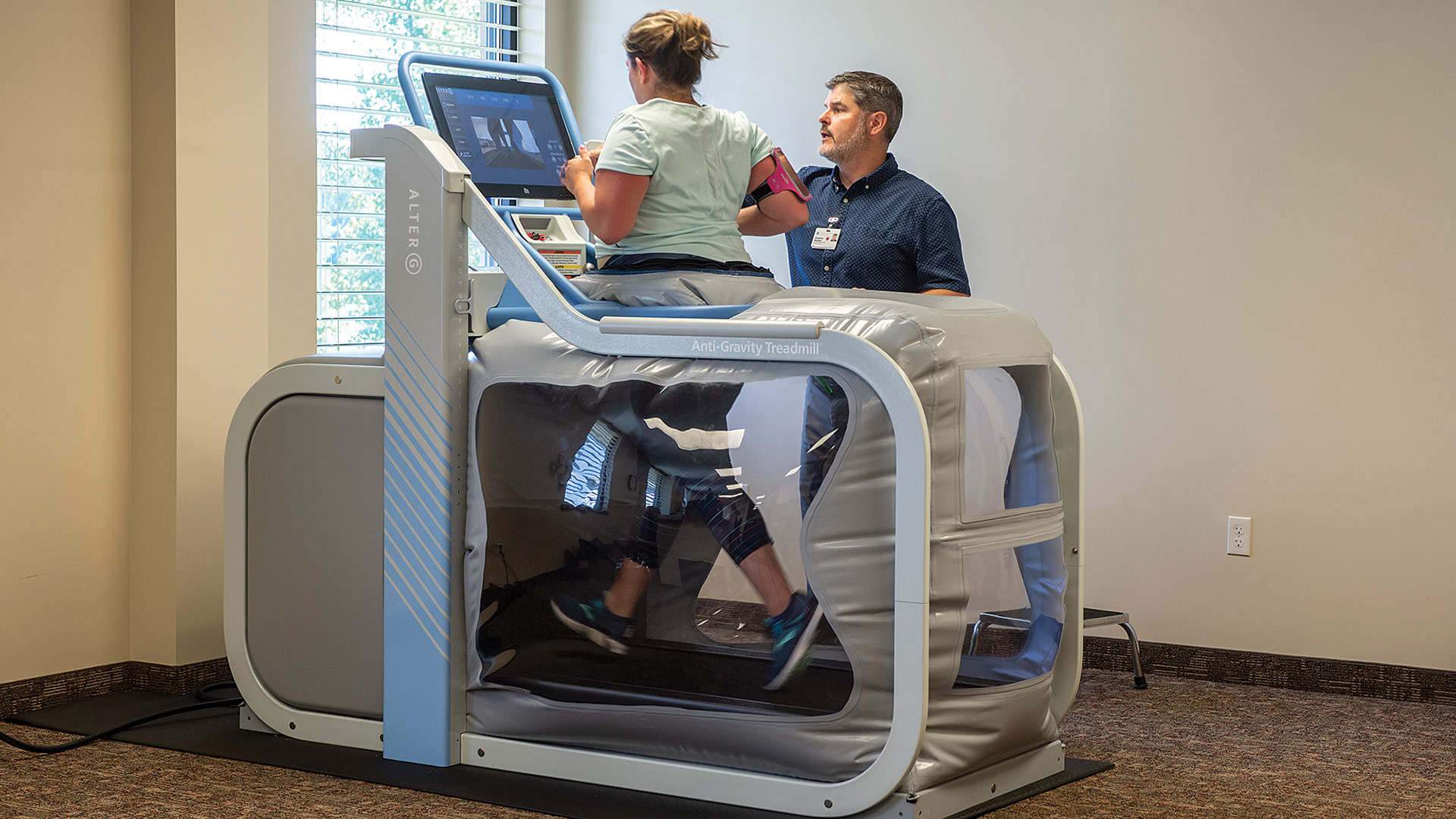
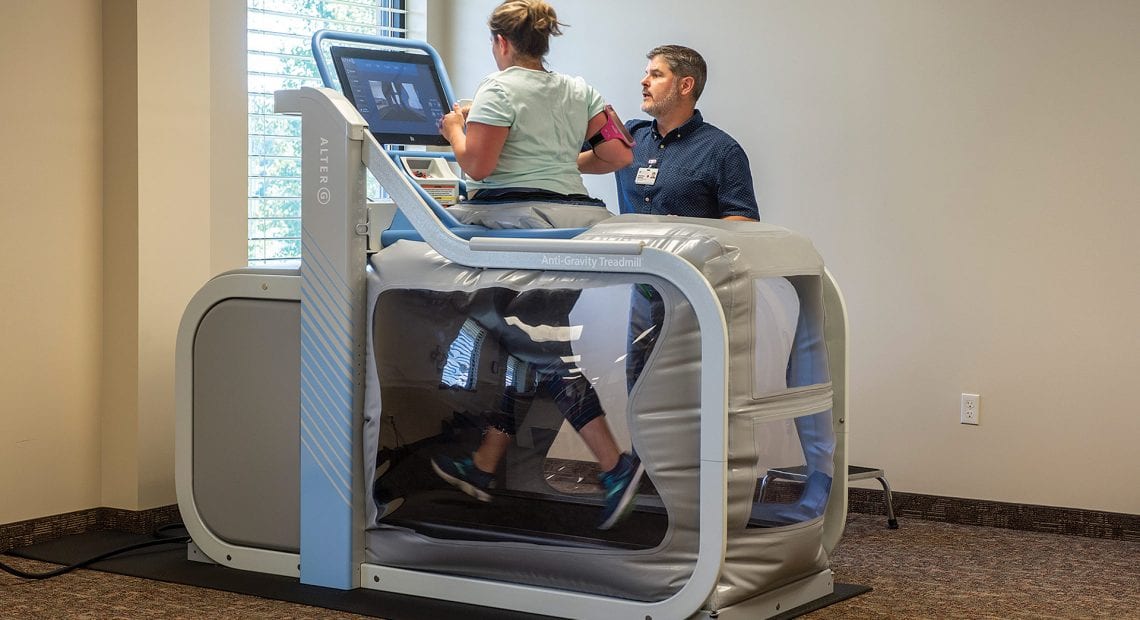
If a patient needs prehab but has trouble walking, therapists now have the AlterG, an anti-gravity treadmill that supports a person’s weight so they can exercise and build their strength prior to surgery. Noel-Doubleday said the treadmill also helps after surgery.

“If a patient is having difficulty getting their normal walking pattern back, the anti-gravity treadmill helps them get more comfortable and confident with their walking and with their movements before their full body weight is on the joint,” she explained, noting that equipment like this was not available even 10 years ago.


Playing Catch-up

One year ago, when COVID-19 infection rates began to overwhelm hospitals, joint replacements, along with other elective surgeries, came to a halt. Elective surgeries have since resumed, and doctors continue to catch up with what Snyder described as “innumerable joint-replacement surgeries” that were put on hold due to the pandemic.

One sign that joint-replacement procedures are back in business, Jury noted, was the recent addition of two new orthopedic surgeons at Mercy Medical Center.

The joint-replacement rehab areas have all beefed up their screening process as well as implemented all the necessary safety protocols to continue to see patients, Noel-Doubleday said. “COVID changed our routine, but it hasn’t stopped us from doing our jobs. We might work with patients in a different space or alter things slightly, but overall, we’ve made the necessary adjustments.”

As the world starts to emerge from pandemic times, many people are concerned about the “COVID 15,” a popular expression for the weight gained as a result of less activity during a year of being stuck inside. Maintaining a proper weight provides many health benefits, and lessening the wear and tear on the joints is one of them. Physical therapists say it’s a simple matter of biomechanics: the more weight we carry, the more stress we put on our joints.

Snyder recently authored a whitepaper on treating knee arthritis and discussed the relationship between weight and our joints. In the data he cited, for every pound a person loses, the force on the knees is reduced by five to 10 pounds.

Physical therapist Steve Markey

Physical therapist Steve Markey works with a patient on the AlterG anti-gravity treadmill.

Jury said carrying too much weight over time can also throw off structural alignments in the body, which exacerbates the stress on the joints. “We haven’t yet seen the impact from recent weight gains during COVID, and it will probably be years from now until we do.”

When joint-replacement surgery is necessary, Noel-Doubleday makes it a goal to educate patients before the procedure so they know what is involved. Jury makes sure his patients understand what he termed as “a couple important things” to know about joint replacement.

“First, it’s not an easy rehab, by any means,” he said. “But if the patient puts in the effort at physical-therapy appointments and, more importantly, at home with their independent program, they will most likely have a successful outcome.”

He noted that the success rate based on standard outcomes is much better today than it was even five years ago. In turn, most joint-replacement rehab patients these days expect to resume their activities at high levels after surgery. “If you look at walking, the goal is more than comfortably getting around, it’s being able to take a three-mile walk for exercise every day like they’ve done in the past.”

Noel-Doubleday said identifying specific activities patients want to return to is a change from past rehabilitation practices.

“For example, many patients want to resume playing golf or tennis, so we structure the rehab to help them do that again,” she said. “It’s been interesting to see how rehab has evolved like this, and it’s a lot of fun to be a part of it.”

The Cannabis Industry

Hire Calling

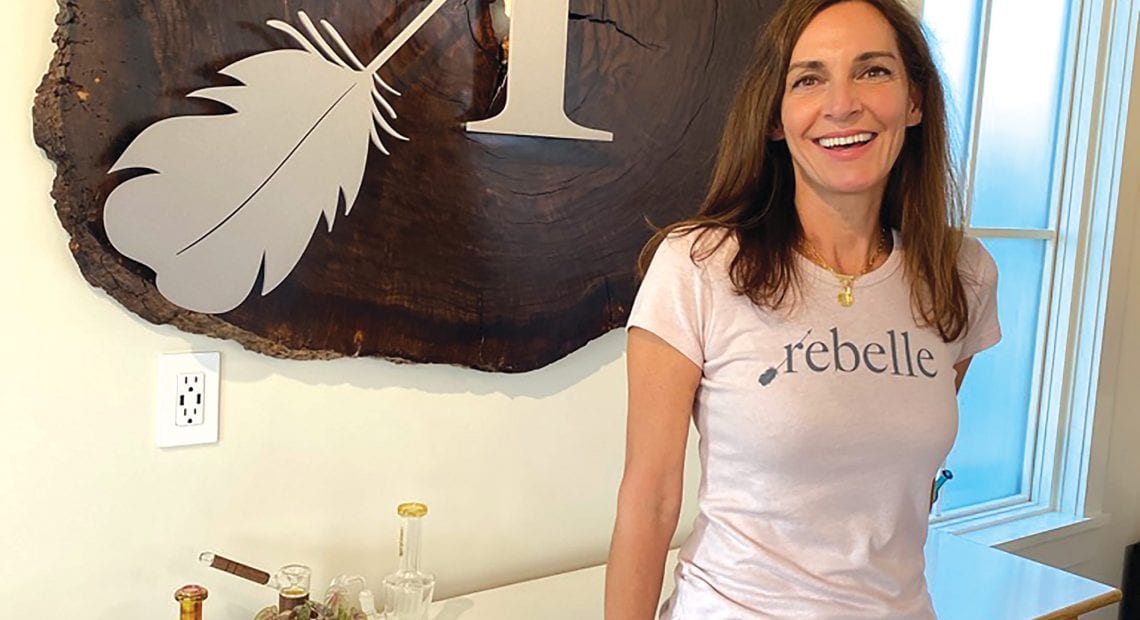
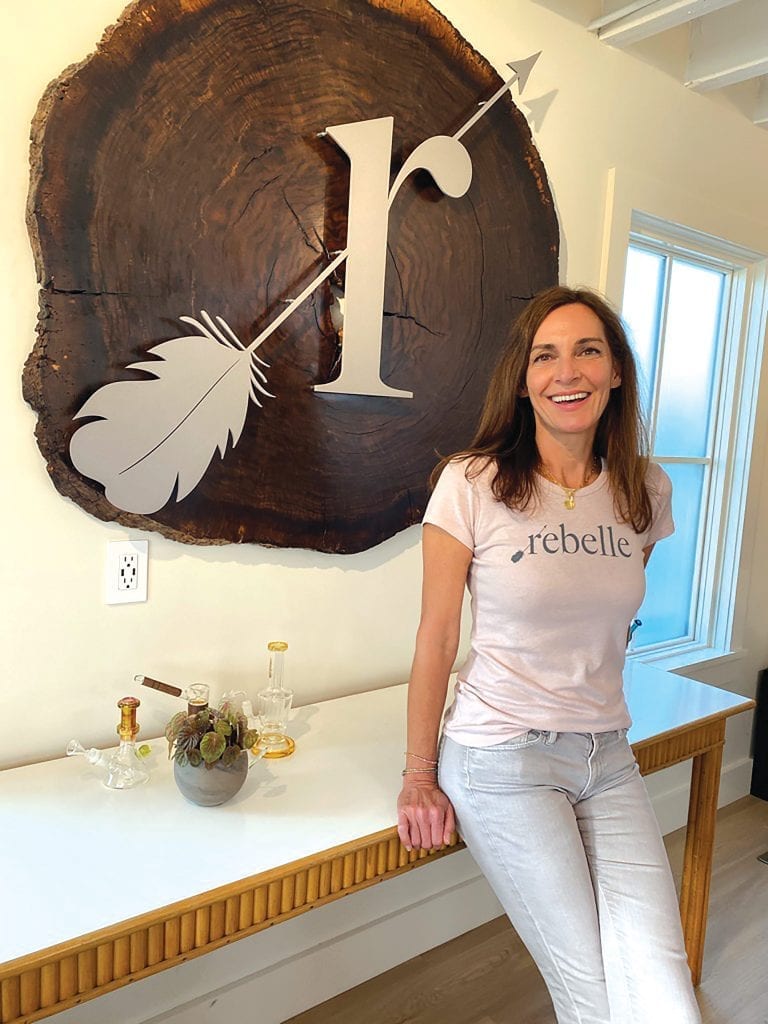
Charlotte Hanna of Community Growth Partners and Rebelle

Charlotte Hanna of Community Growth Partners and Rebelle


Charlotte Hanna calls it “moving from bullets to buds.”

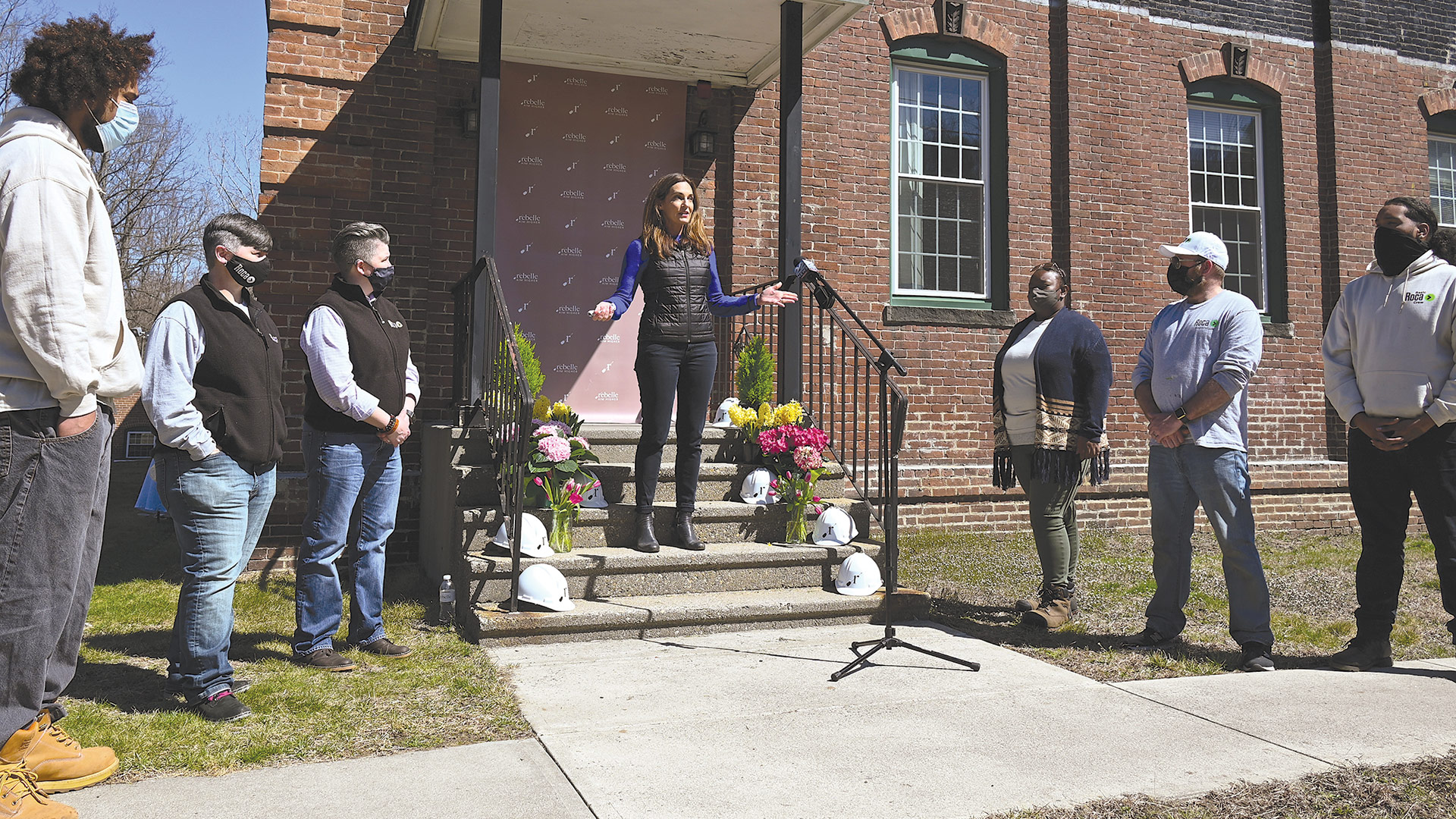
That’s how her company, Community Growth Partners (CGP), has characterized the renovation of the former Yankee Hill Machine plant in Northampton, once used to manufacture rifle silencers and accessories, into a cannabis cultivation and manufacturing facility.

But it also signifies something even more powerful, she said — an ongoing partnership between CGP and Roca, an agency that helps young men traumatized by urban violence to build emotional and workplace skills and forge a new path.

CGP has been employing Roca clients for more than a year at its flagship cannabis retail store in Great Barrington known as Rebelle, and will create about 50 more such jobs at the 23,000-square-foot building on Ladd Avenue in Northampton later this year.

It’s a way, Hanna said, to create pathways into a fast-growing industry for populations that were negatively impacted by the marijuana laws of the past.

“I like to call it just and equitable capitalism,” she added. “It’s a for-profit venture, but we’re trying to do things in a way that positively impacts people. I think the cannabis industry is the perfect industry for that. Our country put a lot of people in jail because of cannabis; a lot of wrongs need to be fixed. It seemed like a perfect opportunity to build this social experiment to see if we can have a company that does well, but also does good.”


Growth Opportunity

Hanna was seeking a career change when she began researching opportunities in the cannabis field.

“I’m a relative newcomer to the business,” she said. “I started exploring the industry in 2018, figuring out where the licensing opportunities may be. I’m based in New York City, and my home state, at the time, was very restrictive, with no opportunities to get into the business — so I turned my attention to the closest state to my hometown, where licensing was just opening up.”

Early in her career, she worked with grassroots organizations on social-justice issues, but found it difficult to live in New York on a nonprofit salary, so she pivoted to Wall Street, where she worked in finance with Goldman Sachs for a decade, followed by ventures in real-estate development.

Cannabis is what she calls the third phase of her career — and one in which she can once again work for social justice, this time in the form of social equity through employment. She was familiar with Roca from time spent in Boston, but didn’t know the organization was active in Western Mass. until, while driving in downtown Holyoke one day, she spotted a man wearing a Roca T-shirt, pulled over, and asked him about it. As it turned out, Roca had recently opened an office in Holyoke, and she stopped by.

“I’m excited to be very transparent about what we are and what we do, and I hope we find values-driven consumers who want to buy from a company that’s trying to do good.”

“I said, ‘how about entrusting your young people with me to work in the cannabis industry?’” she told BusinessWest. “I was surprised with how enlightened they were. They said, ‘we can’t believe no one has come to us before. We think it’s a great idea for our young people; we don’t have a problem with cannabis.’ That’s how I found them, by coincidence. No, kismet — it was meant to be.”

She’s a believer in supporting diversity in the cannabis business for the same reason the state established social-equity guidelines intended to bring opportunities in the industry to populations hard-hit by the U.S. government’s war on drugs that began in the 1970s.

Charlotte Hanna and members of Roca celebrate

Charlotte Hanna and members of Roca celebrate the start of construction at CGP’s Northampton facility.

“The war on drugs disproportionately impacted people of color,” Hanna said. “Great Barrington isn’t the most diverse place in the world, but I think we have good people who come from all backgrounds.”

For some of the Roca workers, it’s a long commute to that corner of the Berkshires, and some don’t have cars, so Hanna pays the agency to drive them back and forth. Northampton, as a second CGP site in Western Mass., may provide some flexibility in that regard. “The commitment at Roca runs deep,” she said. “They feel good about what we’re doing.”

So does Northampton, she said, praising the city for being especially friendly to cannabis businesses and not requiring a special-use permit as an additional layer of bureaucracy, simply a host-community agreement and a building permit. The site is also located in an opportunity zone, which confers additional tax advantages to businesses that invest economically in low-income neighborhoods.

“We’re going to be creating a lot of jobs here,” she said. “We’ll be staffing up with a lot of entry-level jobs from Roca, but also opportunities for management jobs; we’ll be building up our skilled extraction and manufacturing and processing teams as well.”


Taking Control

Hanna said she’s a fan of the Roca model of training, one that puts clients in lengthy, simulated work experiences and stresses job-readiness skills, so they’re ready to enter any work environment for further training in that field. In other words, Roca is teaching young people how to learn and be adaptable, so their opportunities are unlimited.

Cannabis seems to be an industry of unlimited growth as well — or, at least abundant growth, if the continuing proliferation of cultivation, manufacturing, retail, and other types of businesses is any indication.

While COVID-19 slowed the pace of fundraising and business development last year, Hanna said, she’s looking forward to opening the next phase of the CGP network. Besides the Northampton expansion, current growth initiatives include a wholesale and delivery license in Massachusetts, a pending craft-grow license in Illinois, and Rebelle’s new lifestyle-focused line of cannabis products and accessories that will launch in 2021.

“We always wanted to be vertically integrated,” Hanna said of the ability to control her own products from seed to sale. She pointed to the pandemic-fueled supply shortages in many industries last year as a good reason to take control of her own supply chain.

She added that opening the retail side of the business before the production side also helps the company learn what types of products customers want before they start making them.

“We live in a more transparent world than ever, and I hope consumers are more educated than ever,” she said. “I’m excited to be very transparent about what we are and what we do, and I hope we find values-driven consumers who want to buy from a company that’s trying to do good.” u


Joseph Bednar can be reached at [email protected]

The Cannabis Industry

Budding Connections

Stephanie McNair (left)and Nicole Desjardins say they want customers to stay, learn something, and enjoy the experience of buying cannabis.

It’s called Budstock.

As the first major community event staged at Turning Leaf Centers in Northampton, Stephanie McNair believes the three-day event — slated for April 16-18 and boasting the cheeky tagline ‘stock up on your favorite bud before 4/20’ — will help raise the new dispensary’s profile in a city that has rolled out the welcome mat for numerous cannabis enterprises.

Saturday will feature several music artists, as well as a food truck, in the large parking lot behind the King Street building, while inside, local artist Rodney Madison will display his works, and at the dispensary’s ‘craft bar,’ a series of workshops over the three days will teach visitors the finer points of concentrates, edibles, vapes, joint rolling, and more.

In short, it’s about education, entertainment, and community, said McNair, who opened Turning Leaf along with co-owner Mary Anne Gonzalez last month with the goal of not only inviting customers in, but asking them to stay a while.

“The cannabis industry in Western Mass. is evolving at a record pace, and with more and more cannabis retailers entering the market, it’s time to ‘turn the leaf’ to more of an experience, instead of the cattle-in, cattle-out type of doing business,” McNair told BusinessWest. “That’s why we have the craft bar, which is a place where customers can take time to educate themselves about our ever-changing products, gather with their friends, attend demonstrations, have rolling parties, and so on.”

As more dispensaries and other cannabis-related business spring up throughout Western Mass., McNair said it’s increasingly important for new enterprises to set themselves apart through price, product quality, and in other ways.

“We wanted to create a place where everyone can feel comfortable and have a good time and stay a while.”

At Turning Leaf, that means an emphasis on community and local connections, from events and craft-bar experiences to partnering with local growers and manufacturers to bring products to customers they can’t get at every shop.

“We’ve gained strong relationships with local craft growers and innovators, who are making more elevated products every day,” she said. “We’ve taken the time to cultivate a very eclectic menu with every product category, at every price point, with every type of cannbis consumer.”

It also means bringing needed exposure to local musicians and artists through indoor and outdoor performances and exhibits.

“Supporting our local community is something that is very important to us as a company,” she added. “We are looking to display and promote local artists and have event demonstrations and educational seminars in our space.”


Comfort Level

With a background in real estate and community-relations marketing, McNair found a business partner in Gonzalez with a similar vision for a cannabis business. “Being a Western Mass. native, I knew this was a place I wanted to be. It was just an easy fit for me.”

Central to that vision is a highly personal approach to product sales. “We wanted to create a place where everyone can feel comfortable and have a good time and stay a while. We have great parking, it’s easy to find, you can go sit at the craft bar and talk with our dispensary staff, and we want to make sure every customer leaves feeling completely satisfied with the products they’ve purchased.”

Nicole Desjardins, marketing manager at Turning Leaf, said they want to demystify cannabis use and, for newcomers, take away any anxiety.

“A lot of it is addressing the stigma through community — to find out what you don’t know with other people and have fun,” she said. “You don’t know how to roll a joint? We make that accessible in a fun way. Instead of just walking away with what you purchased, why not walk away with knowledge from some people you shared an experience with?”

McNair said her own experience with the city of Northampton has been a positive one.

“They’ve just been so welcoming for us as a local business coming in, giving us their support,” she said, adding that Mayor David Narkewicz and city boards have been extremely helpful, as has the Greater Northampton Chamber of Commerce. “Our host-community agreement and our outreach with the city was just a really happy experience for us. Everybody in Northampton really wants to help you make your business successful, and it shows.”

Meanwhile, customer support has come from all over, including visitors from Connecticut and New York, McNair added. “They’re intrigued by looking at our craft bar and our space, talking to us about cannabis and local art … we’ve been well-received in the past few weeks.”

She’s not worried about the number of businesses setting up shop in Northampton and neighboring communities; in fact, she sees it as a plus, generating a growing energy in the local cannabis trade that promises to lift all boats.

“Northampton is definitely making its mark, just as they did with the restaurant industry. More is better, and people want choices. They’re making Northampton a destination for cannabis.”

Desjardins agreed. “Every business has a different profile, a different flavor. I think Stephanie is absolutely right — I don’t see it as competition; there’s enough for everyone. Northampton is a destination city.”


What’s on the Menu?

McNail said Turning Leaf will continue to hone its product offerings, always with an eye toward an eclectic menu of options culled largely from area producers — again, in an effort to build a local-first model.

“We’re really committed to supporting our local community,” she noted. “We want to highlight local growers as well as live music and artists, and we also have made a commitment to have all of our sales associates certified with responsible vendor training before day one, which is no small task. And we continue to provide them with education so they can give you the very best service when it comes to what exactly it is you’re looking for, or perhaps not looking for.”

And if you’re not sure, just belly up to the bar and ask.


Joseph Bednar can be reached at [email protected]

The Cannabis Industry

Sustaining a Plan

Chris and Helen Andrews

In Holyoke, Chris and Helen Andrews found a cannabis-friendly city that shares their passions for entrepreneurship and sustainability.

Helen Gomez Andrews and her husband, Chris Gomez, have been, as she tactfully put it, “cannabis enthusiasts for longer than we haven’t.”

But when their 5-year-old daughter was diagnosed with epilepsy in 2015 — and became one of the first medical-marijuana cardholders in New York — their interest in cannabis became intensely personal.

At the same time, Helen was starting to feel uninspired in her finance career; she spent 13 years growing a career in private wealth management at Lehman Brothers, Barclays, and Morgan Stanley.

Inspired by the triple-bottom-line approach to impact investment she had become increasingly aligned with, she was looking for a different sort of investment — and found it in cannabis, where the High End, a cultivation, production, and retail enterprise now under development in Holyoke, became the first cannabis company in Massachusetts to be certified as both a minority business enterprise and a women business enterprise.

During her last few years at Morgan Stanley, “I was looking for passion in my work life, and not finding it,” Andrews said. “The confluence of that and my daughter’s diagnosis, and my husband itching to do something different, really pushed us to take the plunge.”

To call it a major leap would be an understatement; the couple sold their home in Brooklyn to buy the historic Eureka Blank Book building on Winter Street in Holyoke and begin the long process of renovating it. A second site on Dwight Street will become the retail face of the business, as well as a coffee shop.

Oh, and they’re not taking any shortcuts, aiming to use a sustainable growing process known as organic living soil.

“People told us we’re totally crazy to do something so labor-intensive when there’s so much great technology around automatic cultivation, focused on the highest THC and highest yield,” she told BusinessWest. “But that’s a departure from what’s really important to us, which is low impact to the environment and the sustainable, clean growing of a plant, staying away from synthetic nutrients. We’re trying to create as natural an environment as we can.”


Feels Like Home

In seeking out a host community with abundant real estate and a business-friendly attitude toward cannabis, Holyoke was an obvious choice.

“It was five times cheaper the next-cheapest town — and then we discovered the history of Holyoke; it was so amazing how it was the first planned industrial city in the country, largely built by Irish immigrants,” Andrews said, which was appealing to her Irish husband. Now, this multi-cultural couple — Helen was born in the Philippines — is feeling right at home.

Also appealing is the city’s abundance of carbon-neutral energy generation. “It makes perfect sense in the cannabis industry, and perfectly aligns with our values. We’re building a truly sustainable company in a welcoming city.”

“As we learned about vertical integration and the economics of cannabis and edibles manufacturing, it made perfect sense to pursue cultivation. So we pursued the full vertical.”

Chris’ background is in restaurants and retail, and the couple’s initial vision centered on marijuana edibles, but has since expanded significantly.

“As we learned about vertical integration and the economics of cannabis and edibles manufacturing, it made perfect sense to pursue cultivation,” she said. “So we pursued the full vertical.”

As for the spacious former mill, “we put all our eggs in this basket,” she said. “We’ve been in Holyoke since January 2019, working to build this business and really embedding ourselves into the Holyoke community, which has such a strong entrepreneurial spirit.”

Indeed, Andrews serves on the EforAll Holyoke advisory board, helping other budding entrepreneurs find their way. “There’s such a rich, diverse history here, and Chris and I both feel very grateful to be a part of this community, and have found this to be a great city to build our business.”

The economic impact of COVID-19 certainly set the project back, but the extended timeline helped the couple streamline and become more “laser-focused” about their priorities. They’re licensed for 30,000 square feet of cultivation, as well as manufacturing and retail, and plan to apply for a research license as well.

“Last year was rough, but it’s finally starting to pick up some momentum,” Andrews said, adding that the hope is to open the dispensary and coffee shop by the end of 2021, and the cultivation and production facility later in 2022, with the first harvest arriving months later.

Until the cultivation and production sides of the business come online, Helen and Chris are pursuing “a very differentiated, curated inventory according to our core values of ethical and sustainable cannabis,” she said. “So we’ve spent the better part of the last year and a half building relationships with individual farmers and small businesses. By the time our doors open, we’ll have some products from some amazing businesses that we can introduce to this market.”

Those products will include commonly sought-after items like cannabis flower to edibles. In regard to the latter, “the plan is to make some things everyone likes — chocolates, gummies, and mints — but also do something more elevated,” Andrews noted. “My husband has a network of culinary talent partners working on limited-edition chocolates. And, of course, we’ll have vapes and pre-rolls and all those other things.”


Have a Seat

Another reason for opening a coffee shop, she said, is to avoid the scenario she’s noticed at many dispensaries, with lines of customers circling the building, waiting patiently to get in.

“We thought we wanted to change that experience and be more welcoming with the coffee shop, to give folks in line somewhere welcoming and comfortable to wait, but also provide education.”

She wants the shop to be a place people can find information, as well. “They can stop by, collect some literature, and have a great cup of coffee or a delicious pastry — and Holyoke needs a coffee shop.”

It’s a city that also wants to continue growing its reputation as one of the region’s most cannabis-embracing communities, and this couple is happy to oblige, Helen said. “We’re excited and eager to go.”


Joseph Bednar can be reached at [email protected]

Coronavirus Features Special Coverage

The Shape of Things to Come

With the arrival of spring, stimulus checks, and vaccinations for growing numbers of residents, continued recovery from the steep economic decline of 2020 is in the forecast. But like the weather, economic rebounds are difficult to predict. With this recovery, there is still widespread speculation as to what shape it will take — U, V, W, K, even the Nike ‘swoosh.’ Myriad factors will ultimately determine that shape, from the ongoing threat of inflation to uncertainty about when and to what extent people will gather again, to questions about just how willing Americans are going to be when it comes to spending some of the money added to their bank accounts over the 12 months that ended in January.

$4 trillion!

That’s the amount Americans added to their bank accounts over the past 12 months or so, a savings rate perhaps never before seen in this country, which has hasn’t been known for that trait.

It came about because of all the things that people couldn’t spend money on, or didn’t see the need to spend on — everything from summer camp to vacation cruises; celebratory meals out at restaurants to new dress clothes; Red Sox tickets to visits to their favorite museum. Granted, there was some spending going on, especially when it came to things like pools, new flooring, and new deck furniture for the home — or a new home itself, be it a vacation home or a bigger primary residence.

“I am pretty optimistic that people are just to their wit’s end with being isolated; they really want to get out, do things, and buy things. They just want to live a normal life again.”

But, for the most part, Americans were saving in 2020.

And now that there is light at the end of the tunnel, and it seems like people will be able to spend some of the money they saved, the speculation involves just how willing they will be to go back in the water, if you will, and do some of the things they had to forgo for a year.

That’s just one of many factors that will ultimately decide the shape of the recovery we’re now in, and how quickly the nation will get back to something approaching normal.

As several of the stories in this issue reveal, the world, or at least this part of it, is returning to a sense of normal. Hotels are booking rooms again, airports are busy (or at least busier), Tanglewood and Jacob’s Pillow will have seasons in 2021 — albeit different kinds of seasons — and, overall, the state has entered into what Gov. Charlie Baker calls stage 4 of his recovery plan. This final stage will allow indoor and outdoor stadiums to run at 12% capacity, the state’s travel order to be downgraded to an advisory that recommends people entering Massachusetts quarantine for 10 days, public gatherings to be limited to 100 people indoors and 150 people outdoors, and exhibition and convention halls to operate if they can follow gathering limits.

It’s a big step forward, but much will depend on how willing people will be to gather in these places, and how confident they will be to travel. Meanwhile, there’s all that money that people saved and the latest round of stimulus checks now finding their way into people’s bank accounts. Will people spend them, and what will they spend them on?

And what if there is a spending frenzy and economists’ fears of inflation, potentially the runaway variety, become realized?

These are just some of the questions hanging over the job market and this overall recovery, which will, at the very least, be unlike anything else the country has experienced. Indeed, it has bounced back from recessions, tech bubbles, a 9/11 downturn, wars, and more. But it hasn’t seen anything quite like this — a pandemic-fueled economic crisis that wiped out millions of jobs, followed by, and accompanied by, federal stimulus on an unprecedented level.

Mark Melnik

Mark Melnik

“Just because we hear, ‘get back in the water, everybody,’ it doesn’t necessarily mean that folks will. I think there’s reason to be bullish about the Massachusetts economy in the second half of 2021 and the early part of 2022 because of the pent-up demand. But so many of these issues are going directly to the comfort level that people are going to have psychologically.”

“I’m a little less cautiously optimistic than some, but I am pretty optimistic that people are just to their wit’s end with being isolated; they really want to get out, do things, and buy things,” said Bob Nakosteen, professor of Economics at the Isenberg School of Management at UMass Amherst. “They just want to live a normal life again.”

Mark Melnik, director of Economic and Public Policy Research at the UMass Donahue Institute, concurred, but offered some caveats.

“There’s a psychological element to the economy,” he told BusinessWest. “Just because we hear, ‘get back in the water, everybody,’ it doesn’t necessarily mean that folks will. I think there’s reason to be bullish about the Massachusetts economy in the second half of 2021 and the early part of 2022 because of the pent-up demand. But so many of these issues are going directly to the comfort level that people are going to have psychologically.”


History Lessons

As they have many times over the past year, experts pointed to Worlds War II as the only recent point in history that can in any way compare with the ongoing pandemic, and noted that the comparisons hold when it comes to what happened when it was all over.

“During the war, people couldn’t buy a car, and there was a great deal of rationing,” said Nokosteen, adding that, as a result, people were saving. And while there was a lull right after the war ended, during which some feared the country would actually sink back into the Great Depression that officially ended with the war, people soon started spending — big time.

“Everyone wanted to spend money,” he told BusinessWest. “And they had some money — people started cashing in the war bonds they bought, and soldiers came home to the G.I. Bill. There were a lot of things that spurred the economy on, and it came back quickly after that initial slump.”

Experts are predicting something along those lines for 2021 and 2022, but there are a number of variables that could determine the ultimate shape of this recovery.

“In many ways, this recession has been the most unequal we’ve ever seen. And it has really exacerbated existing social inequalities, both in Massachusetts and nationally. People who were vulnerable to begin with are just made more vulnerable.”

“Looking at what’s taken place after the real substantial decrease in the first half of 2020, which was historic in terms of just how fast the economy contracted, and with the third round of stimulus hitting people’s bank accounts, we seem to have avoided some of the worst-case scenarios, which would have been a U-shaped recession, where we dragged along the bottom for a long time before we took off, or a very sharp, V-shaped recovery, which also would have been bad because of worries about inflation,” said Karl Petrik, a professor of Economics at Western New England University. “We managed to have missed both of those, and I’ve almost come to the opinion that we have a check-mark-like recovery.”

Elaborating, he said the country did see a recovery starting in the second half of 2020, and the second economic-stimulus package in January helped continue that momentum. The third stimulus package, coupled with pent-up demand and the ability to do things one couldn’t do in 2020 (spring break in Miami was one good example), should enable the economy to keep chugging, he went on, with the rosiest of forecasts calling for 6.5% growth, with the least rosy being around 4%.

“Both of which would be very good,” he told BusinessWest, adding that the expectation is that there will be a return to the ‘trend’ growth rate, which, after the Great Recession, was about 2.5%.

“One of the worries when you’re coming out of recession is that you know you’re going to go back to your trend growth rate — that’s why it’s the trend,” he explained. “You just don’t want to go back too soon because it just prolongs the pain in terms of the economy having the ability to recover; that’s what we saw after the Great Recession. We never saw the real takeoff, just a slow, steady, gradual growth rate up to 2019.”

Such fears probably fueled anxiety about going too small with recovery packages, Petrick noted, adding that he believes the $1.9 trillion bill that ultimately passed is certainly big enough.

Karl Petrick

Karl Petrick

“One of the worries when you’re coming out of recession is that you know you’re going to go back to your trend growth rate — that’s why it’s the trend. You just don’t want to go back too soon.”

But questions abound about how this recovery will play out and who will benefit most. With that, Melnik talked about the growing sentiment that the recovery has been, and will continue to be, K-shaped in nature, with lines going both up and down, depending on which income bracket you’re in.

“We’ve definitely seen a bifurcation in terms of educational attainment in industry, wages, and who’s been able to work and who’s been more likely to be unemployed, and long-term unemployed,” he explained. “Those people who tend to have limited educational attainment who were working in face-to-face industries, service-type sectors, including food service, restaurants, and hospitality, and other services like barber shops, dry cleaners, nail salons, and auto-repair places … those kinds of industries have been hurt dramatically, and they really haven’t recovered many of the lost jobs.

“In many ways, this recession has been the most unequal we’ve ever seen,” he went on. “And it has really exacerbated existing social inequalities, both in Massachusetts and nationally. People who were vulnerable to begin with are just made more vulnerable.”

Looking ahead and to what course the recovery will take, Nakosteen and others said so much depends on how comfortable people will be to go back to what life was like pre-pandemic, if you will.

“How are people going to feel going out in public when the public isn’t wearing masks?” he asked, adding quickly that he doesn’t know the answer. But whatever that answer is, it will go a long way toward determining how quickly and how profoundly the country, and this region, are able to rebound.

“It isn’t just vaccinations and dealing with these new variants,” he went on. “A lot of what will determine if there’s pent-up demand and how it’s released is truly behavioral. There’s no economic reason for there not to be a sharp rebound; I think it’s behavioral, it’s epidemiological, it’s medical.”


What’s in Store?

As for spending … area retailers are obviously looking for the lid to come off, although in some cases, the lid wasn’t on very hard to begin with.

Dave DiRico, owner of the golf shop in West Springfield that bears his name, said that, after a very quiet early spring last year, there was a surge in spending on golf equipment and apparel as many people picked up the game, or picked it up again, because it was one of the few things people could actually do.

It’s early in the new year, but that trend is continuing, he told BusinessWest, adding that the store has been packed with players loading up for the coming year.

“We’ve been really, really busy, even for this time of year,” he said. “A lot of people have money to spend, and … they’re spending it. We’re seeing a lot of people coming in telling us they’re spending their stimulus money, and that’s a good thing. That’s what it’s for, when you get right down to it — stimulating the economy.”

Peter Wirth, co-owner of Mercedes-Benz of Springfield, expressed similar sentiments, noting that, after sales ground to a halt right after the lockdown of last March, they picked back up as stimulus checks came in, carmakers started offering almost unprecedented incentives, and consumer confidence picked up.

Granted, lack of inventory, fueled by supply-chain issues, slowed the pace of progress somewhat, but many consumers simply ordered vehicles and waited — sometimes for months — for them to arrive at the dealership.

“The main things for us is consumer confidence,” he noted. “If the consumer has confidence in the economy as a whole and in their own situation, where they don’t feel like they’re going to lose their job next week, that’s when they’re going to spend money. And that affects us just like it impacts any other business. And I think more and more consumers feel we’re going to come out of the woods on this year, this summer, whenever it is.”

The picture is improving when it comes to inventory issues, said Wirth, who expects the numbers of new cars on the lot to continue rising through the year. Meanwhile, manufacturers are keeping their foot on the accelerator when it comes to incentives. Overall, he expects 2021 to be another solid year — one comparable to those just before the pandemic in terms of overall sales and service volume.

“We feel pretty about this year,” he said. “One news story can certainly change that, but the outlook for now is good, and that line about a rising tide lifting all boats is true, and we hope that this rising tide will help those businesses in hospitality and other sectors that have suffered so much.”

One sector certainly looking for a different kind of 2021 is the clothing industry, specifically businesses focused on dress clothes. Many workers simply didn’t have to buy any in 2020, as they working at home or still toiling in the office, often with more casual dress codes to match those of people working from their kitchen table.

“As a business owner, 2020 was my most challenging year, bar none; I was faced with more struggles and complications and challenges and problems to solve and situations to fix than I’ve ever faced before,” said William Brideau, owner of Jackson Connor, located in Thornes Market in Northampton, adding that the store has managed to keep going through persistence — and a PPP grant. But the challenges have continued into 2021.

Indeed, the first quarter of this year has in many ways been his most difficult, he said, due to a gap between infusions of stimulus, when it became more difficult to pay the bills. As more support comes in, he’s feeling optimistic about 2021, but he needs people to start investing in new threads — and not just shirts that can be seen during Zoom meetings.

William Brideau believes many people are ready to get dressed up

William Brideau believes many people are ready to get dressed up, which bodes well for his store, Jackson & Connor, which suffered through a rough 2020.

“A lot of people aren’t going for pants or more formal things below the waist,” he noted. “A lot of shirts, sweaters, and sport coats — and things have certainly veered more casual.”

But he has observed a pendulum swing of sorts, with more customers coming in recently looking for suits and ties.

“One of our really good customers came in recently and said, ‘I’ve had it — I’ve been in sweatpants for months, and I’m sick of it. I need a sportcoat, I need a shirt and tie, I need trousers. I want to look like I used to look; I miss that,’” said Brideau, adding that he believes many more people harbor similar sentiments.


Bottom Line

Over the past 12 months, people have come to miss a lot of the things they once enjoyed. The extent to which they’ve ‘had it’ with these matters — everything from the clothes on their back to the restaurants they haven’t been frequenting — will ultimately determine not just the composite shape of the recovery, but how, and for whom, things bounce back.

As Melnik noted, just because the ‘go back in the water’ advisories are out doesn’t mean people will heed them. And if they don’t, more of that $4 trillion will stay in bank accounts. And that might ultimately push back the date when we can really say the pandemic is behind us.


George O’Brien can be reached at [email protected]

Construction Special Coverage

Building Momentum

The past year has been an unusual time for the construction industry — one marked by project postponements, soaring prices for materials, and the establishment of strict COVID safety protocols on job sites. But for most builders, it wasn’t a devastating year, and, in many cases, it led to a surprisingly promising 2021. After all, the need for projects to be completed hasn’t gone away, and the backlog is actually creating a surplus of projects to bid on. The aforementioned challenges still remain, contractors say, but the work rolls on.

Laurie and John Raymaakers

Laurie and John Raymaakers say there’s plenty of infrastructure work available — and that trend should continue in the coming years.


By Mark Morris


For Dan Bradbury, 2020 was “a year of pivoting and finding new ways to get the job done.”

As director of sales and marketing for Associated Builders, Bradbury saw a slowdown at this time last year as several projects that were scheduled to break ground were instead postponed indefinitely.

By including construction as an essential industry, Gov. Charlie Baker allowed job sites to stay open and keep workers employed while following pandemic protocols. While Bradbury appreciated the ability to keep projects moving, other slowdowns were out of his control.

“There are a lot of hurdles to get over in a large industrial or commercial project, and COVID hit the brakes on all of them,” he said, noting in particular the new challenges surrounding what in the past had been routine business with municipal governments.

“We already had some projects scheduled to start this spring, but, more importantly, we’re starting to fill our pipeline again with projects that will take us well into the fall of this year and potentially into 2022 as well.”

“Because municipalities had to move to fully remote meetings, they occurred less often, which made it difficult to get building permits, zoning-board approvals, and the other essential documents we need to start and finish a building project,” Bradbury said, adding that Associated has projects in the works in a number of different sectors. One example is a 30,000-square-foot building in Bloomfield, Conn., where a local chemical company will occupy part of the building and lease the remaining space.

His company’s experience isn’t unique. BusinessWest spoke with several area construction managers to discuss how their industry looks this spring compared to a year ago, when COVID-19 suddenly changed the world — and the main takeaway is one of optimism and promise.

A significant part of Houle Construction’s business involves interior renovations for medical facilities. Company President Tim Pelletier noted that, when COVID first struck, business came to a complete halt as medical professionals were dealing with rapidly increasing numbers of COVID patients. One year later, he’s optimistic about the increase in construction activity.

“It’s absolutely busier than last year,” he said. “We’re seeing more projects taking shape, especially with our hospital clients.” In the meantime, Pelletier has picked up renovation projects at organizations that offer hall rentals, such as the Masonic Temple in East Longmeadow.

“The temple has not been able to host gatherings for the past year, so they are using the downtime to make renovations for when they can open again,” Pelletier said, adding that it’s a way to take advantage of what everyone has gone through and find a positive side.

An aerial view of Worcester South Community High School

An aerial view of Worcester South Community High School, one of the many recent school projects undertaken by Fontaine Brothers.

Bradbury credits pent-up demand for the increase in projects his company has been taking on this year.

“As soon as the calendar page turned to 2021, our phones started ringing,” he said. “We already had some projects scheduled to start this spring, but, more importantly, we’re starting to fill our pipeline again with projects that will take us well into the fall of this year and potentially into 2022 as well.”

Dave Fontaine Jr., vice president of Fontaine Brothers, said his company has been fortunate to have several projects ongoing since before the pandemic hit. Many of his largest projects involve building schools, for which budgets are approved long before breaking ground, so funding for them was not affected by COVID concerns. Since the pandemic hit, Fontaine said some towns have delayed public funding approvals, but not as many as he had anticipated.

“In the last six to eight months, we’ve picked up more than $400 million in new work,” he noted. “Some of these projects are in pre-construction now and will start this summer.”

Among the projects scheduled to begin in June are the $75 million DeBerry-Homer School in Springfield and the $240 million Doherty Memorial High School in Worcester.

Infrastructure construction also experienced steady business last year. J.L. Raymaakers and Sons Construction specializes in installing water and sewer lines as well as site excavation for municipalities, airports, and private companies. After a busy 2019, co-owner John Raymaakers said 2020 was nearly a record year for his company, and he’s on pace to fill up the project list for 2021.

Associated Builders project in Bloomfield, Conn

In this Associated Builders project in Bloomfield, Conn., a local chemical company will occupy part of the building and lease the remaining space.

“It’s amazing the amount of infrastructure work that is out there for bid,” Raymaakers said, explaining that his company subscribes to a register that lists all the new public and private projects available for bid. Since the middle of last year, he has seen no slowdown in the volume of bidding opportunities. “Looking only at our category of construction, there were five to six new projects announced just last week.”

Raymaakers predicted bridge construction, another area of expertise for his company, will also see increased activity.

“In the next few years, I think we are going to see a lot of work on replacing aging bridges in New England,” he said, adding that this should happen even without a federal government infrastructure bill, citing two recent bridge-replacement projects his crews are working on in Stockbridge and Pittsfield. Still, he’s hopeful that some kind of infrastructure legislation passes, saying it would be “a huge boost to us and others in our industry.”


Help Wanted

While business activity is brisk for everyone BusinessWest spoke with, they’ve all faced recent challenges; some are unique to doing business in the COVID environment, and others are chronic problems made worse by the virus. The issue of having enough workers was a challenge on both fronts.

“We’ve definitely lost people from the workforce due to COVID concerns,” Fontaine said. “They might be taking care of a family member, or they might be in a group that has underlying health concerns.”

He added that managing COVID on the job site is also difficult. “Anytime someone tests positive for COVID, that individual and anyone in close contact with them has to go home and quarantine for the time period,” he explained. “That can result in a lot of labor disruption on a daily basis.”

COVID also exacerbated the long-running problem of fewer workers in skilled-trade and general-labor jobs. Raymaakers said finding help in construction is a constant challenge. Co-owner Laurie Raymaakers pointed out that heavy-equipment operators and construction laborers can make a good living.

“There’s a misconception that laborers aren’t paid well,” she said. “The pay and benefits at our company are pretty good; the reality is there are just fewer people who want to do this type of work.”

She added that it’s also misleading to suggest laborers are not skilled, pointing out that her company’s laborers are highly skilled at making sure pipes are situated properly and secured to withstand years of service.

“Our workers also put together fire hydrants, which require about 50 bolts that have to be tightened in a certain pattern. Hydrants are under constant water pressure, so if it’s not built correctly, parts of the hydrant will go flying in the air.”

As older craftsmen such as plumbers and electricians continue to retire, their ranks are not being filled by enough younger workers. With projects increasing, Bradbury said an already-competitive labor market gets squeezed even further.

Tim Pelletier, president of Houle Constrution

Tim Pelletier, president of Houle Constrution, at the Masonic Temple in East Longmeadow.

“Between the demand for commercial/industrial as well as residential, everyone in the trades is busy, and they can’t find enough workers,” Bradbury said. “On top of that, solar companies are hiring all the electricians they can find at a time when electricians were already in short supply.”

The biggest hurdle to doing business right now, according to Bradbury, involves managing enormous price increases for materials, in some cases rising by more than 100% compared to this time last year.

“Over a period of months, we’ve seen multiple price increases in steel and lumber products,” he said. “Those two create a trickle up that affects prices for every other building material.”

Bradbury noted that steel manufacturing has been affected by labor outages due to COVID, leading to product-supply shortages. He also pointed to increased demand for lumber, especially on the residential side, where housing starts are booming. In addition, his company and many others receive a great deal of lumber from Canada, where the U.S. still has tariffs in place on lumber.

Bradbury said COVID issues are not affecting project schedules because his firm will not start a job until it has a guarantee that materials are available. “We are also adding cost protections in our contracts as a way to guard against the constant increases in materials.”

It’s too early to determine what immediate impact the pandemic will have on building design, but Bradbury said clients from current and future projects have begun asking about air handling and filtration.

“For sure, air handling and using UV light to sanitize a space are areas where people have been putting more focus,” he said. “I think these requests will continue as there is an increased emphasis on clean air and other ways to keep facilities sanitized.”

At Worcester South Community High School, workers installed air-handling units that use bipolar ionization, or, as Fontaine described it, a system that cleans the air and removes many of the germs and bacteria from the building.

“The motivation to install this system was driven by COVID, but there are other benefits, too,” he said. “Systems like this provide a better environment for people with asthma and other health concerns.”


Spring of Hope

The arrival of spring and increased numbers of people receiving COVID vaccines gives all the construction managers we spoke to a sense of optimism about life and getting their projects done.

At press time, asphalt plants in the area had begun to open. Because the plants close for the winter, municipalities will not allow road construction because there is no access to repave the roads. So the plant openings are great news for companies like Raymaakers, which plans its water- and sewer-line projects around those openings.

Other managers look forward to a time when they do not have to socially distance their crews and wear masks all day.

“Masks are another nuisance to deal with,” Pelletier said. “If we can start to get distancing and masks behind us, it will speed things up on the job site.”

As part of planning for future business, Bradbury has begun to ask some fundamental questions about what lies beyond the horizon. “Where is the growth potential going to be as we come out of COVID, and which industries will still want to build and have the money to build?”

As he considers the types of industries that are prevalent in Western Mass. and Northern Conn., such as aerospace and manufacturing, he wonders if government spending will still drive those industries. He has also given some thought to the insurance industry.

“Typically, there has been a huge demand for office space for the insurance industry, and how they address that moving forward is a big question mark coming out of COVID.”

As the insurance industry reconsiders its needs, Bradbury added, there has been a sharp decline in demand for all office space. “We are definitely not building more office space anytime soon.”

But his and other firms are building — and that’s good news after a year of uncertainty and a pandemic that hasn’t yet gone away.

Special Coverage Tourism & Hospitality

Get Back Here

It’s called ‘revenge spending,’ or ‘vacation retaliation’ — the idea that people who were unable able to spend money on travel last year will go all-out this year. Surveys say it’s a palpable sentiment among Americans right now; the question is whether they will actually follow through on those plans, and how safe they’ll feel doing so. When they’re ready, area tourism and hospitality leaders say, Western Mass. will be an ideal destination, boasting the variety of indoor and outdoor experiences and affordability that travelers seek — an ideal answer to all that pent-up demand.

Gillian Amaral (left) and Stacey Warren

Gillian Amaral (left) and Stacey Warren, co-founders of Three Chics Hospitality.

Mary Kay Wydra learned a couple new phrases over the past few months.

“The buzz term is ‘revenge spending,’” the president of the Greater Springfield Convention & Visitors Bureau (GSCVB) said. “That is, ‘I’ll spend more on things I was denied because of COVID.’ Things like in-person entertainment, eating at restaurants next to people, and travel.”

The other buzzword making its way around the tourism industry is ‘vacation retaliation,’ and it means roughly the same thing.

She likes those phrases — or, more accurately, what those sentiments portend. “That bodes well for us as a region,” she told BusinessWest. “We are affordable and easily accessible — a destination with a lot to offer.”

Indeed, while COVID-19 has been far from a positive for the region, it did open many people’s eyes to what Western Mass. has to offer, particularly those who migrated here to escape New York City or Boston at the height of the pandemic. That’s evident in the surging real-estate market, but also in the optimism many in the tourism and hospitality sector are beginning to feel about what lies ahead.

It can be detected in Hampden County’s hotel occupancy, which was 39% in January — down from the 49% recorded a year earlier, but significantly higher than the statewide figure of 29%, and on par with national numbers.

“A great number of people are planning to travel, and Western Mass. is well-positioned to get summer travelers. We have that combination of indoor and outdoor attractions and all this green space for recreation.”

It’s also impacting surveys, like a recent ‘sentiment study’ conducted by American Express that found that 84% of Americans have travel plans in the next six months, the highest figure since the earliest days of the pandemic. And 69% of those intend to take advantage of ‘second-city’ destinations, Wydra noted — in other words, those outside of big cities and top tourist spots.

Places, she said, like Western Mass.

“A great number of people are planning to travel, and Western Mass. is well-positioned to get summer travelers,” she added. “We have that combination of indoor and outdoor attractions and all this green space for recreation.”

One more statistic from the survey: 61% of travelers intend to spend more than normal because they couldn’t go anywhere last year.

That’s music to the ears of Stacey Warren and Gillian Amaral, two veterans of the hospitality industry who recently launched their own enterprise, Three Chics Hospitality, which seeks to market its clients to group-tour operators.

“Our clients are group-friendly restaurants and attractions interested in having motorcoach groups come to their establishments or attractions; we offer consulting and marketing for them,” said Warren, who has worked in the hotel field for 17 years.

She called such connections “vital” to the region. “Every single bus that comes in may need 20 or 25 overnight rooms, then you have 20 to 25 dinners at different restaurants, attraction tickets … one bus is really a big impact on the economy.”

Amaral agreed. “Based on multiple tours we can bring in, the economic impact to the region will be huge,” she said. “And just based on conversations I’ve had with people, they’re ready to travel, they’re ready to get out, but they’re also ready to have someone else do that for them. People are like, ‘I just want to go on a tour; tell me where to go, make it easy for me, and take me there.’ That’s our business model. It just makes sense to be ready when the environment is ready for us.”

That moment isn’t far away, Warren added. “People are ready, and we want to be here to help the restaurants and attractions capture that business while they’re here.”

Jonathan Butler, president and CEO of 1Berkshire, noted in a message to that organization’s members last week that sentiment around travel is starting to turn in a way that promises to benefit Western Mass.

“A year ago at this time, we were headed into two or three months of lockdown where nearly all economic activity ceased. A year later, we’re mostly headed in the other direction,” he said. “Vaccinations are finally beginning to add up, public-health metrics have improved, and statewide capacity and operating restrictions continue to be eased on an almost-weekly basis. Out-of-state travelers from neighboring states are now only subject to travel advisories, and within the next couple weeks, even those should continue to be relaxed.”

Sensing a changing tide, Butler noted, organizations like Tanglewood and Jacob’s Pillow (see story on page 39) both recently announced a return to live performances for the upcoming season, and will be joined by other institutions like Barrington Stage Co., Berkshire Theatre Group, and Shakespeare and Co. in bringing performing arts — and, in turn, visitors — back to the region.

“When you combine this exciting news with the continued momentum of the outdoor recreation economy, and our other major cultural properties operating closer to full capacity — now having a year under their belt in learning how to best operate during this pandemic — 2021 starts to feel far more exciting than a year ago.”


Taking the Long View

As director of Sales for Hampton Inn Chicopee/Springfield, as well as president of Hampton Inns of New England, Warren has her finger on the pulse of hospitality in the region, as does Amaral, an assistant professor of Management at Bay Path University who also runs Events by Gillian LLC, specializing in event management and consulting, and whose past event experience includes stints at the Eastern States Exposition, MassMutual Financial Group, Enterprise Rent-A-Car, and the Basketball Hall of Fame.

The third ‘chic’ in their new enterprise’s name is, well, hospitality itself, represented by the image of a pineapple. And they feel like Western Mass. has become more of a household name in tourism and hospitality — with the potential for an even broader reach.

Mary Kay Wydra says Western Mass. is well-positioned

Mary Kay Wydra says Western Mass. is well-positioned to raise its profile in the tourism world.

“A lot of the tour operators that have been bringing groups here would just use this as a stopover because they’re from all over the country, and a lot of them just think of Boston and the Cape,” Warren said. “But they’re starting to think of Western Mass., too, and wanting to do things to add on, to offer new and fun ideas for their clients and keep them coming back.

“There are so many great things they can do right here,” she went on. “We can keep them here for a couple of days and reap the rewards, and have their clients leave here happy and wanting to come back.”

Amaral said the two of them have talked about building a business around this concept for years, and felt like this was the right time — even during a pandemic.

“We felt like there was a need. People would come to the Massachusetts area and always go straight to Boston, but what about us here in Western Mass.?” she asked. “Fast-forward to a pandemic we’re almost out of, and we thought, this is the time for us to be positioned for the influx of travel that will come with group tours.”

With their deep knowledge of the region’s tourism industry, she added, they’re able to craft itineraries tour operators can sell to clients, and it’s not too soon to start making those connections, even when the economy isn’t fully opened up.

“Every single bus that comes in may need 20 or 25 overnight rooms, then you have 20 to 25 dinners at different restaurants, attraction tickets … one bus is really a big impact on the economy.”

“Everyone is poised and ready at this point to just go — let’s hit the switch and move forward,” Amaral said. “That’s why now is the time to launch, versus in July, when things are opening up and people are feeling comfortable. At that point, you’re behind.”

Wydra agreed, noting that statistic about 84% of Americans with travel plans in the near future. “People are creating destination wish lists, and simply having a future trip planned makes people happy. We’re optimistic people are going to visit this year. We pushed pause on marketing last year, but hope to start spending again.”

She said the meeting and convention business will be slower to return, simply because large events are often planned years in advance, and an organization that cancels an event here may not be able to return for a few years. Last year, 164 groups canceled or postponed events in the region, with an estimated economic impact of $97 million going unrealized. However, about half those who canceled plan to come back in a future year, she added.

In the meantime, the GSCVB is engaging in some creative sales pitches for the region by planning virtual site visits at destinations like the Amazing World of Dr. Seuss Museum, MGM Springfield, and the Basketball Hall of Fame.

“We’re showcasing the attractions because these attractions set us apart,” she said, adding that the bureau is equally intent on highlighting the many different meeting spaces available. “We want to make sure Western Mass., as a brand, stays out there in front of meeting planners.”

Lindsey Schmid, vice president of Tourism & Marketing for 1Berkshire, recently told Berkshire Magazine about a multi-pronged marketing approach, promoting all there is to do virtually in the Berkshires, as well as continuing to feed travelers ideas and imagery that will inspire them to plan a Berkshire getaway now and more extensive travel later. Part of that message is the outdoor recreation opportunities that helped the region’s tourism sector stay afloat last summer.

It’s a widely understood selling point; U.S. News & World Report’s recent “Best States” feature ranked Massachusetts the ninth-best state in which to live, based on eight factors ranging from healthcare and education to public safely. In the category of natural environment, the Commonwealth ranked fourth.

“Our region leans on the combination of natural beauty and cultural offerings that serve as anchors to drive economic activity; right now, those anchors are preparing for big things in the summer of 2021,” Butler noted.

He added that “the pandemic has tempted us all to lean on pessimism when thinking about the future, but the progressing conditions around us truly call for more cautious optimism. We shouldn’t be so naïve as to think that the summer of 2021 will mark a return to pre-pandemic activity, but we should absolutely be preparing ourselves for a far more robust season than a year ago.”


Up in the Air

Certainly, optimism is in the air, although it’s still mixed with some uncertainty. Gathering limits are still a thing, most live performances remain firmly lodged in the future, and some attractions have given no definitive answers on when they’ll open, and to what extent.

For instance, Six Flags New England held a large hiring event last month to fill 3,000 seasonal positions, but the company has issued no definite opening date yet — though it is expected to decide soon, looking to state guidance and the realities of its own business model.

It will do so with heavily publicized safety protocols, like every other tourist destination — an element of the sector Wydra is particularly proud of.

“We’re climbing out of this with precautions still in place,” she said. “I’m very proud of our attractions, with all the protocols put in place, the cleaning and everything else they’re doing to keep visitors safe. You’ll see a lot of that continue.”

Warren said visitors will want to feel safe before the sector really opens up. “There are still some people who are nervous, but we’re able to show them what we can do — what plans the restaurants and attractions have in place to keep them safe when they come — and that’s making them feel very comfortable and ready to visit.”

Amaral cited research showing that people are more comfortable and apt to travel when adequate protocols are in place.

“Being knowledgeable about what to expect ahead of time puts them at ease,” she added. “And, of course, so many people being vaccinated is helping as well. The apprehension, even from six months ago, is much different than it is now. People are just ready to go — with caution, but nonetheless, they’re saying, ‘let’s go.’”

Wydra agreed. “There’s definitely some optimism as we move forward with the vaccines. We’re always hearing about new ones being introduced, and the government keeps making people eligible for it — that’s great news.”

Butler tempered that optimism with the other side of pandemic reality — which is, we’re not out of it yet, and people shouldn’t just abandon the common-sense behaviors that keep case counts down.

“Any increase in business needs to be done with public health and safety as the foremost consideration,” he said. “But all of the larger-picture conditions that have fueled growing visitor and economic activity throughout the past two decades are aligning well.”

Warren has been in the hospitality field long enough to ride a few economic cycles, but she’s never witnessed anything like last year — “and I never want to see it again,” she said. “I’ve never had to cancel so many groups and lose literally millions of dollars in revenue. So I’m looking forward to coming back strong this year and help everyone to bounce back.”

She’s heard from tour operators that they do, indeed, want to come back. But they’ll be returning to a changed tourist economy, and change isn’t always a bad thing, Amaral said.

“This has been a wake-up call to most businesses to think differently, which is exciting to me. Let’s not wait for a pandemic or tragedy to happen to think about a different way to do business or attract a target market or a different product line. If there’s anything we can take from this, it’s don’t get into the same rut. Think about different ways to improve your business.”

Amid the changes, of course, some normalcy is more than welcome.

“Who would have thought, a year ago, that we couldn’t go into a bar and have a drink?” Wydra said. “I want to meet friends after work for drinks. And I’m excited, because I think we’ve got some positive stuff happening in the future.”


Joseph Bednar can be reached at [email protected]

Modern Office Special Coverage

Weathering the Storm

Ned Barowsky

Ned Barowsky says flexible leases, as offered in the co-working world, will be more in demand in the future, and rigid, long-term leases less so.

Since launching Click Workspace a decade ago, Mary Yun has seen nothing but growth in one of the region’s first co-working ventures.

That growth led her to abandon her original 1,000-square-foot facility in 2015 and develop a 9,000-square-foot building in downtown Northampton, which, at its peak prior to the pandemic, hosted 80 members and a host of community arts and cultural events.

“That was a good number for us, where we could operate with a full-time member advocate and myself as executive director overseeing all the operations and also working on events,” she said. “We’re mission-driven, bringing in the community through art shows and music; that was my wheelhouse.”

With 80 members, all the private offices and dedicated desks were filled, as was the shared open space, for the most part, while a meeting room holding 24 people was regularly put to use by the community. In short, Click was … well, clicking.

And then COVID-19 arrived.

“We’re finding, now that the vaccine is being distributed and the sun is shining, so to speak, we’re getting a surge of new interest recently as people are starting to feel more comfortable coming back into the world. People are sick of working from home.”

“When the closures happened, we closed down like all businesses, and we still had members supporting us, paying their monthly dues for a while. We had members who were now working remotely from home,” Yun said.

But the erosion began almost immediately.

“We had always maintained a good number of members who had private offices that were being funded by their companies. At their businesses, they were the remote workers,” she went on. “But, because everything was now remote, that benefit went away for a lot of our members, so we lost a handful.”

When Click reopened at the end of May, around 55 members were still supporting the space, paying their dues, even though not everyone was coming in regularly — usually, no more than a dozen at a time through last summer. A few members actually joined during the pandemic — some with their career situations in flux, others who needed a place to work because their homes were suddenly too crowded by partners and kids working and learning remotely.

Mary Yun expects membership to rise to its former high levels

Mary Yun expects membership to rise to its former high levels after the pandemic fades, but it may be a gradual process.

But it wasn’t enough. “Right now, we’re down to less than 30 members, which is a huge drop in revenue,” Yun said. “Right now, our membership is lower than when we first moved into this building almost six years ago.”

The basic concept behind co-working is simple. It’s a workspace where people can share a table or an office; access fast internet service and shared resources like a copier, conference rooms, and audio-visual equipment; and make the kinds of connections that inspire further growth and success.

The pandemic has impacted the model in the short term, but the people operating area co-working spaces believe it’s a model with plenty of potential in the long term, and perhaps even more than before COVID-19.

“Like most businesses, we definitely lost some business,” said Jeff Sauser, who co-owns Greenspace CoWork in downtown Greenfield with Jeremy Goldsher. “No one knew what to expect, and we managed to be as flexible as possible with members; those relationships are important to us. We gave every opportunity to pause membership and make changes.

“We lost a chunk of memberships — not everybody; some stayed on, even though they weren’t coming as often — but we were able to stay afloat and survive,” he went on. “We’re finding, now that the vaccine is being distributed and the sun is shining, so to speak, we’re getting a surge of new interest recently as people are starting to feel more comfortable coming back into the world. People are sick of working from home.”

As a consultant for a Boston-based company that used to have four offices there and now maintains just one, Sauser sees first-hand the way workplaces are evolving — and in a way that may benefit co-working facilities.

“People don’t come into work every day anymore. We expect more people will have more flexible working arrangements with their employees.”

Yun agreed, noting that many of Click’s members left because their kids were learning at home — which is sure to be a temporary situation; in fact, many schools have already invited students back to campus. She believes an increase in membership at Click is inevitable, though it may take some time.

“People are saying, ‘I’m sick of living in the city and running the rat race. I can live where the living is good but keep my big-city job.’ I feel co-working spaces are an early indicator of trends that will benefit towns, especially towns with great, walkable downtowns.”

“I think what’s going to happen is, when kids go back to school in the fall full-time, parents will be like, ‘maybe I can make it work at home,’ and continue to work at home, and in a couple months, they’ll start to get lonely — professionally lonely — and start to come back, which is why they came here in the first place,” she told BusinessWest. “Really, I’m hopeful and optimistic.”

Stroke of Inspiration

Ned Barowsky was certainly optimistic when he launched a franchise of the national co-working company Venture X in Holyoke, right next to the Holyoke Mall.

He’s owned the retail and office complex at 98 Lower Westfield Road for 25 years, and faced a series of vacancies over the past couple of years the departures of Pier One Imports, Kaoud Oriental Rugs, and a series of mattress stores. For six months, two brokers assigned by a large, national real-estate firm had been trying to fill the vacancies, to no avail. That’s when Barowsky was inspired to by the co-working model.

“I had done a couple franchises in the past; I was familiar with franchising, so I started looking at co-working spaces,” he said. “I just knew that everything was being shut down, and when people come back out, they’re not going to go back to these five-year leases, 10-year leases. People aren’t going to do that anymore. They’re going to want flexible plans — ‘I want to be here for a month, three months, six months, a year, and with a smaller footprint.’”

When he started researching a few companies, he was “blown away” by Venture X, which tags itself “the future of workspace.”

“That’s our tagline, but it literally is the future of workspace. It’s flexible — you decide how many of each kind of office you want,” he said, noting that some franchisees opt to emphasize shared space, but his facility includes fewer shared stations and about 65 offices, in several sizes, to house any number of workers. “I wanted more offices, so that’s what I did — I put in more offices.”

Jeremy Goldsher (left) and Jeff Sauser

Jeremy Goldsher (left) and Jeff Sauser say robust co-working spaces can be economic drivers for communities.

Sauser sees the potential, too, in companies downsizing their space and offering more flexible arrangements to workers — partly because of what they learned during the pandemic, when they saw how productive employees could be while working remotely. And that has implications for entire communities.

“I think co-working spaces are very well-positioned to receive those people,” he said. “I’m an urban planner — I’ve been thinking about this stuff long before the pandemic hit. A lot of trends show that, if people can work more flexibly, and make decisions about where they live based on lifestyle and not where the jobs are, people can move where they want to.”

He pointed to surging real-estate sales in Western Mass. and in the suburbs outside large cities like Boston.

“People are saying, ‘I’m sick of living in the city and running the rat race. I can live where the living is good but keep my big-city job,’” Sauser said. “I feel co-working spaces are an early indicator of trends that will benefit towns, especially towns with great, walkable downtowns.”

A lot of towns in Western Mass. offer that already — Greenfield has a walkable downtown, with opportunities to work in a co-working space, so it can be more competitive attracting new residents,” he went on. “I think of it as economic development for communities, not just for businesses like ours.”

Several years ago, Sauser and Goldsher met at a Franklin County Community Development Corp. event and were soon talking about the co-work concept, which Goldsher had seen flourishing while living in New York City. They say members are attracted to co-working for a number of reasons, among them lower prices than traditional office rent, flexible leases, and shared resources ranging from a printer, projector, meeting space, and wi-fi to a kitchen with free tea and coffee.

The pandemic actually revealed new opportunities for co-working spaces, Sauser added, from remote workers who live in rural communities with poor broadband access to college students who needed the space when campuses were closed, to working parents who craved a break from their suddenly bustling house.

“And we were honored to see a lot of members choose to stick with us and extend their membership even when they weren’t using the physical space,” Goldsher added. “Before this, the concept of co-working was a novelty, but we brought an urban concept to a smaller community and showed the model does translate in a different way. Now a lot of other opportunities are presenting themselves.”

Bills, Bills, Bills

Yun had a broader vision as she grew Click — one centered around the arts as an economic driver, with gallery shows, music performances, literary events, and the like, to emphasize Northampton’s cultural heritage while exposing new faces to Click’s eclectic space. That aspect of the complex has been wiped out during the pandemic.

“It’s been a hardship for the people who have been coming in — there’s very little community left right now with so few coming in,” she said. “We’re eking by, but we’re going to make it. I think a lot of it is because we operate as a nonprofit, so we had reserves built up, and we’re dipping into those reserves now.”

PPP loans, a Massachusetts small-business grant, and rent reduction have helped, but the complex will eventually need to boost its membership back up.

“It doesn’t matter whether you have one person here or 50; you have all these fixed expenses,” Yun said. “There may be a little bit of give in the rent, but we have to pull in fiber-optic internet — that’s a huge cost for us, almost $900 a month. All the utilities are fixed. Last summer, I said to myself, we need to be able to sustain ourselves until the summer of 2022 because I felt like that was going to be when the recovery was in full swing for us.”

That timeline seems more accelerated now, but she feels like the return to normalcy will still be a gradual one. “Do all the former members come back? A lot have moved on, and co-working is such that people come and people go all the time.”

The pandemic saw an influx of residents from New York to Western Mass., but many of them have purchased large homes with home offices, so it’s unclear what effect that migration will have on co-working. “It seems daunting, but we’ve been open for over five years here now, and I feel like we’re here to stay. Who knew we’d have a pandemic?”

To counter that still-active pandemic, Click, like every other workspace, has launched a series of safety protocols, from requiring masks when moving about to regular sanitization to pumping in fresh air.

Air quality was a big concern for Barowsky at Venture X as well. “During COVID, I was very cognizant of air-filtration systems. I spent well over $100,000 on seven rooftop units,” he said, in addition to investments in touchless bathrooms, numerous hand-sanitizer stations, and a keyless entry system.

Greenspace takes safety seriously as well, Sauser said. “From a COVID safety standpoint, we follow all the state guidelines and have protocols in place — cleaning, masks, sanitizers.”

Goldsher added that the state’s rules early on made little sense, noting that Greenspace was not designated an essential business, but — unlike Click — stayed open throughout the pandemic anyway because one of the companies it houses was deemed essential, and had to continue using the space.

“While I think we proved that we are a very necessary asset in the community, there’s this strange dichotomy being open for essential business and not being considered an essential business ourselves.”

Here to Stay

But those who own co-working spaces in Western Mass. — other prominent centers include AmherstWorks, 734 Workspace in Longmeadow, and Cubit Coworks in Holyoke, to name just a few — say they are indeed an essential part of the 21st-century economy.

“I think the future of the workplace is very much up in the air. There’s no way to predict what the open concept will look like in five years time, but we have some good ideas,” Goldsher said.

Sauser agreed that the future of the workplace is in flux, but suggested that the office of the future might look much like co-work spaces of today, “where flexibility is the emphasis, in part because office managers and companies dedicate less space to individual employees when employees are not coming in every day.”

Yun added that companies have decisions to make about whether to extend their traditional leases or move toward more flexibility and smaller footprints. That, in turn, could drive the next surge of growth in co-working, and she welcomes more such facilities, because each new complex will raise awareness of the model and its benefits.

“We don’t know how all this will shake out,” she said. “But the more co-working spaces exist, the better.”

Joseph Bednar can be reached at [email protected]

Tourism & Hospitality

Big Steps Forward

The productions at Jacob’s Pillow

The productions at Jacob’s Pillow for the 2021 season will all be outdoors, many at the Inside/Out stage, seen here.

For Jacob’s Pillow in Becket, the nation’s largest and longest running dance festival, 2020 was a lost year in almost every respect.

That’s almost, and we’ll get to that silver lining, if it can be called that, shortly. First, all those losses.

Jacob’s Pillow lost an entire season of live performances and all the revenue that comes with it, forcing a 50% reduction in the budget, layoffs, and other cutbacks. It also lost some momentum when it comes to fundraising, especially for a much-needed renovation of its main stage, the Ted Shawn Theatre, or the ‘Shawn,’ as it’s known. Then, in November, the company lost its smaller, more intimate performance space, the Doris Duke Theatre, or the ‘Duke,’ to a fast-moving fire, the cause of which has still not been determined.

But from the ashes, figuratively but also quite literally, Jacob’s Pillow has plans to roar back in 2021, said Pam Tatge, executive and artistic director. It will be a different kind of year, one with performances in outdoor settings only and to limited audiences, but one in which the company plans to lay a solid foundation for its 90th birthday in 2022, and for the decades to come.

Indeed, ambitious plans are in place to modernize the Ted Shawn Theatre, add air conditioning and new ventilation, and enlarge and improve the stage. Meanwhile, plans are expected to emerge for a new Duke, one that will be conceptualized and designed with input gathered from audiences and artists alike.

“We’ve embarked on a research study to really understand what audiences and artists loved about the Doris Duke Theatre, what they want to retain, and also what artists need for works being made in the 21st century,” Tatge noted. “We’re building a space, hopefully, for the next 90 years.”

While doing that, Jacob’s Pillow will also put on a season of live performances, the pieces of which are still coming together. It will run from June 30 to Aug. 29 and, for logistical reasons and lingering restrictions on travel, feature mostly performers based within driving distance of the 220-acre campus.

Audiences will be smaller and spaced apart for safety reasons, severely limiting in-person attendance. Which brings us to what would be considered the one bright spot for 2020, a schedule of 38 performances from years past — with new pre- and post-performance talks — presented virtually and to huge, global audiences, a development that made it possible for people who could never before get to Becket to take in a performance at the ‘Pillow.’

“We realized an audience for our virtual festival that had thousands more people than we could ever accommodate on the Pillow campus,” Tatge explained. “And 80% of those people were new to us — they had not been on our list before, and that was a great revelation; people know of Jacob’s Pillow, but they haven’t been able to make their way here. So in terms of accessibility and reaching people of different economic means and physical abilities, this was an amazing way to have the magic and joy that we experience on campus at the Pillow shared far more widely.”

For the 2021 season, most performances will again have virtual access internationally, a step to broaden audiences that Tatge called a “a big experiment.”

“We’ll want to see if the audience engagement is as great — it’s summertime, and things are opening again, so we’re going to see,” she said. “But I know a virtual platform has been in Jacob’s Pillow’s mission delivery, and it will continue to be a way that we deliver our mission into the future.”


Staging a Comeback

Tatge was at her residence in Connecticut when she got the phone call early in the afternoon on Nov. 16, delivering the terrible news that the Duke was on fire. She raced north as fast as she could and arrived in Becket just as the last remaining portions of the wooden structure were being consumed by the flames.

The loss of the beloved theater that hosted smaller productions seemed to provide a surreal ending to a terrible year that was all too real, and all too painful.

Looking back on it, Tatge said the Pillow, like every other live performing-arts venue, was severely tested by all the pandemic bought with it.

“With the cancellation of the season, we lost all of our earned-income potential — 40% of our budget is ticket income,” she explained. “We had to lay off 35% of our staff. Ultimately, we ended the year OK because we received a PPP grant. Without that grant, we would not have made it through as successfully.”

For 2021, there will be a new, very tight budget, hopes for a second round of PPP, and some high fundraising goals, Tatge went on, adding that there are many unknowns and considerable challenges ahead even as the proverbial light at the end of the tunnel when it comes to the pandemic draws closer.

Ted Shawn Theatre

At right, the Ted Shawn Theatre, which will undergo an $8 million renovation this year. At left, the Doris Duke Theatre, which was gutted by fire in November. Input is being sought on a replacement, and an architect is likely to be chosen later this year.

“Because our performances are going to be shorter, we won’t have the earned-income potential to bridge the gap between expenses and revenues,” she explained. “So we really need a subsidy, and we really need our community’s support to invest in putting artists back to work — who must get back to work if our field is going to survive this — and bring audiences back together.”

Overall, though, there is considerable optimism moving forward, and Tatge said that, for her, it’s fueled by the tremendous response she’s seen from the community, a broad term she uses to describe constituencies ranging from performers to patrons who take in their work.

“What has been impressive to me is the range of people who have contributed to Jacob’s Pillow so far, from artists themselves, who don’t have much but want to share something with Jacob’s Pillow, to alumni, to our board members and our members,” she said. “Jacob’s Pillow members are a devoted bunch, and they have stepped up, and we’re going to need that to continue until we get to 2022.”

“Our first priority is to bring people back together safely, so we have rigorous protocols that are in place — for audiences, performers, and staff.”

Optimism also abounds concerning the 2021 season of performances, which, as Tatge noted, will take place outdoors — at the Inside/Out stage and other settings around the sprawling campus.

“Our first priority is to bring people back together safely, so we have rigorous protocols that are in place — for audiences, performers, and staff,” she explained, adding that these protocols are being developed in conjunction with — and will be shared by — other performing-arts institutions in the Berkshires, such as Barrington Stage, Tanglewood, and other venues.

This collaboration is in many ways unprecedented, but also quite necessary, she went on, if the the tourism-dependent Berkshires region is to battle back from an incredibly difficult 2020.

The schedule calls for all activities — performances, workshops, and pre-performance talks — to take place outdoors or under a tent, said Tatge, adding that, in addition to the Inside/Out stage, the Pillow boasts a number of other ‘natural stages’ around the campus that will enable visiting companies to stretch their collective imaginations.

“There are so many parts of our campus that we’re going to be inviting audiences to discover,” she told BusinessWest. “And artists are crafting works particularly for our site, and that’s exciting.”

These performances will also be filmed, as most have been over the years, and presented virtually — an opportunity, as she noted earlier, to greatly expand audiences.

While the shows will go on in 2021, the Pillow is also looking to make huge strides with efforts to modernize and renovate the Shawn, opened during the 1940s, and replace the Duke.

The former, an $8 million project, has been in the works for several years, she said, adding that the pandemic has only reinforced the need for air-conditioning and improved ventilation. And this simple reality helped convince the board of directors that, despite the difficult and uncertain times, the Pillow needs to push ahead with a capital campaign conceived to raise the remaining $2 million needed for the project.

Pam Tatge says the ‘Pillow’ has put a horrendous 2020 behind it, but stern challenges remain for this Berkshires institution.

“We quickly realized that the Ted Shawn Theatre will not be viable as a theater in a post-COVID world without a ventilation system and air conditioning,” Tatge said. “It’s not a viable space at present, and we made the decision to take the Shawn offline this summer so we could move ahead with the renovation, which actually began in January, with pre-planning.”

Ultimately, the plan is to have the renovated theater ready for that 90th-anniversary year in 2022.

As for the 30-year-old Duke, that research study she mentioned has been completed, with the next steps in the process being to research architects and ultimately select one, determine the full scope of the project, and pinpoint just how much money will have to be raised beyond what is covered by insurance.


The Next Act

Moving forward, Tatge is focused on 2021, obviously, and bouncing back in a big way from a dismal 2020.

But she’s also focused on the future — not just the 90th-anniversary celebrations that will dominate 2022, but the years and decades to come.

The Pillow is a National Historic Landmark and a tradition in Western Mass., and the ultimate mission for staff and board members is to make sure it can serve future generations.

The pandemic severely tested the mettle of this institution, in every conceivable manner. But it has been made stronger by that test and, hopefully, even more resilient.

In short, the Pillow is ready to take big steps forward in 2021 — on stage and in every way.


George O’Brien can be reached at [email protected]

Construction

Firm Foundation

Mark Sullivan

Mark Sullivan says public work — his firm’s main niche — slowed down in 2020, but activity looks strong for the coming year.

Mark Sullivan wasn’t unlike countless other business owners, watching the COVID-19 story develop last February and March and wondering how his construction firm, D.A. Sullivan & Sons Inc., would fare.

While no one knew early on what the pandemic’s impact would be, the general consensus was “this isn’t going to go well at all,” he said. But the company, like all others, managed to keep moving forward, with office staff working from home and Zoom meetings a new fact of life.

“Ultimately, we were able to keep people working in whatever format worked best for the individual, and we’re thankful we didn’t have any layoffs in the field,” he went on. “We were able to employ everyone through 2020.”

What makes that notable is that this fourth-generation family business, which opened its doors in Northampton in 1897 and has been headquartered in that city ever since, relies heavily on public work, including some of the highest-profile municipal and collegiate projects in the region at any given time.

“Now it’s to the point where projects we built 30 or 40 years ago are being renovated or being torn down and replaced. It’s all cyclical.”

“We’ve always had a heavy mix of public work — probably half to 60% of what we do has been public work,” said Sullivan, who is the firm’s fifth president, while his brother, Dennis, is chief executive operator. “We certainly have private clients we do a lot of work for, and we look for that private work, but public work over the years has been the most consistent.”

When Gov. Charlie Baker shut down large swaths of the economy just over a year ago, “we were certainly fortunate we were deemed critical, or essential, and we were able to keep some projects going,” Sullivan recalled. “When COVID hit, we did lose some work; some projects were paused and some outright canceled as people tried to figure out what the pandemic was and what it meant in the near-term future.”

Some of the projects the firm completed in 2020 included a fitness center transformation at Massachusetts College of Liberal Arts in North Adams, a new administration building at Harriman & West Airport in that city, a renovation of the Pioneer Valley Transit Authority para-transit maintenance and storage facilities in Springfield, and the renovation of a mill building in Easthampton into apartments and office spaces.

“We rely on public work, and the state froze most public work after the first quarter. UMass did, too,” Sullivan said. “We had a backlog going into the year, and we finished up that work, but it was difficult getting new work toward the end of the year because everything had been frozen.”

renovation on Ferry Street in Easthampton

This mill renovation on Ferry Street in Easthampton features a mix of office space and apartments. (Photo by Leigh Chodos)

However, after the firm’s work volume in 2020 totaled about 20% from the year before, things are looking up. “What we’re seeing now is that, as the vaccine rolls out and people see the light at the end of the tunnel, those projects paused last year are coming back online.”

Considering that, he said, and the fact that new municipal projects are starting to emerge from the drawing board, “it looks to be a busy year.”


Plenty to Build On

Indeed, the projects currently underway — the firm typically manages 10 to 15 each year — speak to the breadth of the opportunities available in the municipal, academic, and other realms. They include:

• General-contracting services for the construction of the Newman Catholic Center at UMass Amherst, the UMass Fine Arts Center bridge renovation, a renovation and expansion of the Worcester Public Library, and the Chicopee City Hall renovation;

• Construction-management services for a renovation of Mount Holyoke College’s Gamble Auditorium and the construction of 38 cottage-style homes at Lathrop Community; and

• Owner’s project-management services for the renovation of the Westhampton Public Safety Complex and a renovation of the historic Grafton Public Library.

“It’s cyclical,” Sullivan said of public work. “You might be doing elementary schools for a decade, then find yourself doing middle schools after that. Now it’s to the point where projects we built 30 or 40 years ago are being renovated or being torn down and replaced. It’s all cyclical. We do a lot of work for the Five Colleges, UMass especially. It’s always varied, and it’s always interesting.”

The mill renovation in Easthampton was a fun challenge because of the condition of the building when the project began, he noted, while the Worcester library project is fun in other ways.

“Our partners got a kick out of the high-end millwork installation,” he said, noting details in the children’s room like a rocket ship and an eight-foot-tall book. “Most projects are budget-driven from a carpentry standpoint and may not get a millwork package that’s particularly interesting, so to speak. But every now and then, we get a library project or private-client work — we do a lot of private work for prep schools in the area — and those are projects carpenters can really sink their teeth into; they’re a lot of fun.”

Sullivan noted that construction management is becoming more the norm in the firm’s projects than straight general contracting. What hasn’t changed, however, is a reliance on cultivating relationships with municipalities, colleges, and other types of clients over time.

“It can be difficult to be a contractor of our size in the area we’re in and sustain longevity,” he said. “Every project is different, every client has a different process, and the relationships are unique, too; we value those relationships and rely on those relationships to keep work coming.”

That stability was in direct contrast to the upheaval of COVID-19, and how that affected the way workers were able to do their jobs.

“Initially, everyone was trying to figure it out,” he said. “There was no guidebook to follow; it was being established as we went along. That was true for everyone in our industry and in other industries deemed essential, and we were able to keep some projects moving forward in the field.

“Certainly, productivity took a hit, when we were sanitizing projects twice a day, taking temperatures, and keeping logs,” he went on, noting that, when a delivery person was found to have COVID, a whole job site shut down for a few days.

“In the big picture, we got through the whole year without too many issues,” he added. “It’s literally been a year since this thing hit; everyone has the protocols down pat.”


Getting to Work

Now that things seem to be looking up — both in the public-sector construction world and in general, with vaccines generating positive news on the COVID front — Sullivan is ready to tackle what he sees as pent-up demand.

“The need for work didn’t go away,” he told BusinessWest. “I think there’s a lot of liquidity in the market; last year, people held on to figure out a way through the pandemic, and now that they see an end in sight, things are starting to loosen up, and we’re very busy on the building side of things.”

As his family’s business has been for more than 120 years.

“We’ve been around a long time in Western Mass. We work roughly from Pittsfield to Worcester — that’s our zone — and there aren’t many mid-size contractors of our size left in Western Mass.,” he said, noting that the firm generates about $40 million in sales each year. “There are a few bigger firms and several smaller firms out there, but we’re happy with the size we are; it’s a good size. And we’re thankful just to be able to be working every day and be around as long as we have.”


Joseph Bednar can be reached at [email protected]

Modern Office

Flexible Thinking, Nimble Action

By Susan Robertson

To survive the pandemic, companies were forced to adapt very quickly to radically new circumstances. Even large organizations — where it’s typically difficult to shift directions quickly — managed to accomplish it. Leaders discovered that, when required, their organization could act much more quickly and nimbly than they normally do.

So, the obvious questions are: what was different? And how can you ‘hardwire’ this flexibility into your organization so it continues to be stronger in the future?


What Was Different?

All humans have a set of cognitive biases, which are mental shortcuts used for problem solving and decision making.

To be clear, cognitive biases are not individual or personal biases. They are a neuroscience phenomenon that all humans share. It’s also important to understand that they operate subconsciously; they affect your thinking in ways that you don’t realize.

You have two different thinking systems, commonly known as system 1 and system 2, sometimes referred to as thinking fast and thinking slow.

System 1 is the intuitive, quick, and easy thinking that we do most of the time. In fact, it accounts for about 98% of our thinking. It doesn’t require a lot of mental effort; we do it easily, quickly, and without having to think about the fact that we’re thinking.

System 2 thinking is deeper thinking, the kind that’s required for complex problem solving and decision making. This deeper thinking requires more effort and energy; it literally uses more calories. Since it’s less energy-efficient, our brain automatically and subconsciously defaults to the easier system-1 thinking whenever it can to save effort.

Cognitive biases result when our brain tries to stay in system-1 thinking, when perhaps it should be in system 2. The outcome is often sub-optimal solutions and/or poor decision making. But we don’t realize we have sub-optimized because all of this has happened subconsciously.

In typical circumstances, several of these cognitive biases conspire to make us perceive that continuing as we are — with only slower, incremental changes — seems like the best decision. It feels familiar, it feels lower risk … it just feels smarter. Choosing to do nothing different is, very often, simply the default. It frequently doesn’t even feel like we made a decision; instead, it feels like we were really smart for not making a potentially risky decision.

But during the pandemic, changing nothing, or changing very slowly, were simply not options. This particular situation was so unique that our brains didn’t have the choice to stay in short-cut system-1 thinking. System-2 thinking was required. Since we consciously realized we must change — quickly — our brains literally started working harder, in system 2, and the normal cognitive biases weren’t a factor.


How Can We Be More Nimble in the Future?

The key to maintaining flexible thinking and nimble behavior is to not allow our brains to fall into the trap of cognitive biases. Obviously, since these are intuitive and subconscious responses, this is not an easy task. But there are proven ways in which we can better manage our brains. Here are a few ways to start.

• Knock Out the Negativity Bias. This is the phenomenon in which negative experiences have a greater impact on your thoughts, feelings, and behaviors than positive experiences. So you are much more highly motivated to avoid the negative than you are to seek out positive. The way this manifests in your daily work is that you are much more prone to reject new ideas than to accept them, because rejecting ideas feels like you’re avoiding a potential negative.

Respond to “yes, but…” with “what if…?” This requires a dedicated and conscious mental effort, by everyone on the team, to monitor their own and the team’s response to new ideas. Every time “yes, but…” is uttered, the response needs to be, “what if we could solve for that?” This reframing of the problem into a question will trigger our brains to look for solutions, instead of instantly rejecting the idea.

• Short-circuit the Status-quo Bias. The status-quo bias is a subconscious preference for the current state of affairs. We use ‘current’ as a mental reference point, and any change from that is perceived as a loss. As a result, we frequently overestimate the risk of a change, and dramatically underestimate the risk of business as usual.

When weighing a choice of possible actions, be sure to overtly list “do nothing” as one of the choices, so you are forced to acknowledge it is a choice. Also include “risk” as one of the evaluation criteria, and force the team to list all the possible risks. Then comes the difficult part: remind the team that their subconscious brain is making them perceive the risks of doing nothing to be lower than the reality, so they should multiply the possibility of each of those risks.

• Curtail the Curse of Knowledge. In any subject where we have some expertise, we also have many subconscious assumptions about that subject. Under normal circumstances, this ‘curse of knowledge’ (these latent assumptions) limits our thinking and suppresses our ability to come up with radically new ideas.

Rely on advisors who don’t have the same curse of knowledge. In other words, seek out advice from people outside of your industry. When evaluating ideas or actions, these outsiders won’t have the same blinders that you have, so they will likely have a more clear-eyed view of the benefits and risks.

The bad news is that cognitive biases are always going to be a factor in our problem solving and decision making; they’re hardwired into us. The good news is that, with some dedicated and continuous mental effort, we can mitigate them and become nimbler in the face of change.


Susan Robertson empowers individuals, teams, and organizations to more nimbly adapt to change, by transforming thinking from “why we can’t” to “how might we?” She is a creative thinking expert with more than 20 years of experience coaching Fortune 500 companies. As an instructor on applied creativity at Harvard, she brings a scientific foundation to enhancing human creativity; www.susanrobertson.com

Community Spotlight

East Longmeadow Focuses on Improvements

By Mark Morris

From left, Michael Meunier, owner Kendall Knapik, and Orpheus Barrows from Pioneer Valley Arms.

From left, Michael Meunier, owner Kendall Knapik, and Orpheus Barrows from Pioneer Valley Arms.


When Mary McNally reflects on 2020, it’s with no small amount of gratitude for how well her town has weathered the pandemic up to this point.

“To state the obvious,” she said, “it’s been one heck of a year.”

As East Longmeadow’s town manager, she credits all the municipal staff, in particular the Health Department, for its efforts to advise and inform the public on COVID-19 matters, as well as the town’s emergency manager, Fire Chief Paul Morrissette.

“The pandemic gave people the chance to see how dedicated and committed municipal public workers are to the mission that is their vocation,” McNally said. “Their willingness to do what has to be done and go wherever they are needed is something people are aware of and appreciate. I certainly do.”

Though Town Hall has been closed since March 16 of last year, staffers have been able to meet the community’s demand for services through online meetings, e-mails, and phone calls.

“We had staff, including department heads, who met people in the parking lot of Town Hall if they needed access to a particular department for a document or other item,” she said. “It was like they were carhops at the old A&W.” Without committing to any specific timeline, she is hopeful Town Hall will reopen to the public in the next 90 to 120 days.

Though she has been the full-time town manager for only 16 months, McNally has been working on a master plan for East Longmeadow to better prioritize important projects. The town recently received a grant from the Pioneer Valley Planning Commission to hire a consultant to develop the plan. McNally said a recent Zoom session to plot out the vision of the master plan drew great participation from residents. Part of the grant requires the master plan to be completed by June, and she is confident about meeting that deadline.

“To state the obvious, it’s been one heck of a year.”

Back in December, the town council changed a zoning bylaw that has a direct impact on the site of the former Package Machinery. Once zoned only as industrial, the change allows for mixed use, which would allow residential as well as commercial buildings to locate there. McNally said the new zoning bylaw applies townwide.

“Previously, mixed-use zoning didn’t exist in East Longmeadow,” McNally said. “Because this zoning change applies to more than just the Package Machinery site, it opens the door for developments all over town.”

At this time, there are no formal proposals to develop the Package Machinery site, but past discussions have suggested construction of single-family homes, condominiums, apartments, and light-use business entities, she noted. “The idea would be to have a new walkable neighborhood near the bike trail and the center of town.”


Business Perspectives

While several businesses in East Longmeadow suffered from the pandemic, others experienced more demand for what they sell. Bobbi Hill is the fourth generation to work for W.B. Hill, a custom builder of oil trucks that has been incorporated since 1910 and located in East Longmeadow since 1965.

Hill’s title is manager, which she defines as running sales, marketing, parts, and human resources. The company primarily builds and maintains tank trucks, the kind that carry home heating oil and trailer tanks (known as ‘trailers’ or ‘tankers’) that connect to a truck cab, most often associated with hauling gasoline. Despite the world burning less petroleum during the pandemic, Hill said she saw only minor impact in a couple areas of business.

“The pandemic had a little impact on service work for tankers that needed repair,” she noted, quickly adding that COVID has not affected sales of new tank trucks, which have a backlog of orders. “If a customer walked in today to order a tank truck, I probably wouldn’t be able to deliver it until September.”

In the only consumer-facing part of the business, W.B. Hill is an official vehicle-inspection station. At the beginning of the pandemic, it shut down the consumer-vehicle business but continued with tanker inspections. “Pandemic or not, tankers need to be inspected,” she said. “They go through a lot of rigorous testing every year and cannot travel with an expired sticker.”

Though business is brisk right now and there is still plenty of demand to transport heating oil and gasoline, Hill has begun looking to the future.

“With electricity being pushed all over the country, I’m looking for us to become more of a parts business,” she said. By purchasing a building next door from Northeast Wholesale Lumber, she conceded that her “big dreams” of increasing the parts business is not happening right away because of high startup costs. Until then, Northeast continues to lease half the building.

“We are experiencing a bit of a boom in housing due in large part to the low interest rates.”

“We sell parts now, but I’d like to do more online and on a much larger scale,” she said. “There really isn’t anyone in New England who sells parts for these vehicles.”

Though a relatively new business in East Longmeadow, Pioneer Valley Arms (PVA) is another business that remained active during the pandemic. Owner Kendall Knapik, who opened the shop two years ago, had to shut down in the early days of the pandemic. A lawsuit by other gun stores claiming infringement of Second Amendment rights forced Gov. Charlie Baker to deem gun stores an essential business. When she reopened, Knapik’s already-successful shop saw a jump in sales.

“After the pandemic hit, our customer volume tripled,” she said. “We’ve increased our clientele tremendously, and we’re teaching many more safety classes.”

The combination of COVID-19, protests that took place in different parts of the country, and the presidential election all played a role in driving sales, she added. “Uncertainty and election years tend to drive sales more than a typical year.”

Knapik talked about a new wave of people coming in to protect themselves, their homes, and their loved ones. After 10 years in an industry she described as most often serving middle-aged male clients, Knapik opened her business to counter what she called the “usual gun-shop attitude.”

“It’s an attitude where shop owners and employees tend to be closed off to new clientele such as females,” she explained. “I wanted to have a shop where women and men would feel welcome and not afraid to come in.”

E. Longmeadow at a Glance

Year Incorporated: 1894
Population: 15,720
Area: 13.0 square miles
County: Hampden
Residential Tax Rate: $21.06
Commercial Tax Rate: $21.06
Median Household Income: $62,680
Median Family Income: $70,571
Type of Government: Town Council, Town Manager
Largest Employers: Lenox; Cartamundi; CareOne at Redstone; East Longmeadow Skilled Nursing and Rehabilitation
* Latest information available

Her strategy seems to be working, as female customers to the store have increased 30%. “I’ve done more background checks on gun sales for women in the past few weeks than ever before.”

Knapik made it clear that proper training and gun safety are the top priorities for PVA. She and her staff now hold safety classes every night of the week and, since the pandemic, have increased the number of classes during the day on Sunday.

“Our store draws many who are first-time buyers, so we get a lot of new people who just want to come in to learn about getting their gun license and what’s involved,” she said. “It’s something we definitely encourage.”

A potential gun owner must take a safety course in order to apply for a license-to-carry permit in Massachusetts.

“Some people are ready to pursue the process right away, while others need to mentally prepare themselves for it,” Knapik explained. “We’re just happy to be there to help them, whether they decide to pursue a license or not.”


Community Focus

Knapik credits her involvement in the East of the River Five Town Chamber of Commerce for helping to establish her business in town, and called joining the chamber “the best marketing decision we made.”

“Customers have really responded to the small shop and family-owned feel of PVA,” she said, adding that she and her staff are on a first-name basis with many of their customers.

While Knapik praised East Longmeadow as a welcoming place to do business, increasing numbers of people are finding it a good place to call home as well. McNally said 28 new houses and condominiums were completed in 2020, and an additional 19 homes and condos are currently under construction.

“We are experiencing a bit of a boom in housing due in large part to the low interest rates,” she said. Three developments — Bella Vista, Hidden Pond, and Fairway Lanes — have added 45 new building lots to the town.

Looking ahead, East Longmeadow continues to work with the Massachusetts School Building Assoc. to study whether the town needs to replace the 60-year-old high school with a new building or if the existing facility can be renovated to suit educational needs for the future. McNally sees the potential for a new high school as a key to keeping the community vital.

“If people have confidence in the educational system, it inspires them to be happy citizens who want to contribute to the betterment of the town.”

McNally concluded that, while many of the projects in town have not been completed, all are progressing. “We have several big projects that all require lots of time, attention, and planning. I’m pleased because we have a dedicated staff working on them full-time.”

Clearly, despite enduring “one heck of a year” marked by a worldwide pandemic, East Longmeadow is staying on track with important projects that promise to add economic vibrancy and quality of life.

Construction

Starts and Stops

Total construction starts fell 2% nationally in February to a seasonally adjusted annual rate of $797.3 billion, according to the latest report from Dodge Data & Analytics. Non-building construction starts posted a solid gain after rebounding from a weak January; however, residential and non-residential building starts declined, leading to a pullback in overall activity.

“With spring just around the corner, hope is building for a strong economic recovery fueled by the growing number of vaccinated Americans,” said Richard Branch, chief economist for Dodge Data & Analytics. “But the construction sector will be hard-pressed to take advantage of this resurgence as rapidly escalating materials prices and a supply overhang across many building sectors weighs on starts through the first half of the year.”

Non-building construction starts gained a robust 20% in February to a seasonally adjusted annual rate of $200.3 billion. The miscellaneous non-building sector (largely pipelines and site work) surged 76%, while environmental public works increased 26%, and highway and bridge starts moved 11% higher. By contrast, utility and gas plant starts lost 17% in February.

For the 12 months ending February 2021, total non-building starts were 13% lower than the 12 months ending February 2020. Highway and bridge starts were 4% higher on a 12-month rolling-sum basis, while environmental public works were up 1%. Miscellaneous non-building fell 26%, and utility and gas plant starts were down 37% for the 12 months ending February 2021.

The largest non-building projects to break ground in February were the $2.1 billion Line 3 Replacement Program, a 337-mile pipeline in Minnesota; the $1.2 billion Red River Water Supply Project in North Dakota, and the $950 million New England Clean Energy Connect Power Line in Maine.

Non-residential building starts fell 7% in February to a seasonally adjusted annual rate of $208.1 billion. Institutional starts dropped 8% during the month despite a strong pickup in healthcare. Warehouse starts fell back during the month following a robust January, offsetting gains in office and hotel starts, and dragging down the overall commercial sector by 8%.

For the 12 months ending February 2021, non-residential building starts dropped 28% compared to the 12 months ending February 2020. Commercial starts declined 30%, institutional starts were down 19%, and manufacturing starts slid 58% in the 12 months ending February 2021.

The largest non-residential building projects to break ground in February were Ohio State University’s $1.2 billion Wexner Inpatient Hospital Tower in Columbus; ApiJect Systems’ $785 million Gigafactory in Durham, N.C.; and Sterling EdgeCore’s $450 million data center in Sterling, Va.

Residential building starts slipped 7% in February to a seasonally adjusted annual rate of $388.9 billion. Both single-family and multi-family starts fell during the month, with each losing 7%.

For the 12 months ending February 2021, total residential starts were 4% higher than the 12 months ending February 2020. Single-family starts gained 12%, while multi-family starts were down 15% on a 12-month sum basis.

The largest multi-family structures to break ground in February were Bronx Point’s $349 million mixed-use development in the Bronx, N.Y.; the $215 million Broadway Block mixed-use building in Long Beach, Calif.; and the $200 million GoBroome mixed-use building in Manhattan, N.Y.

Regionally, February’s starts fell lower in the South Central and West regions but moved higher in the Midwest, Northeast, and South Atlantic Regions.

Earlier this month, Dodge Data & Analytics released its Dodge Momentum Index, which rose 7.1% in February. The Momentum Index is a monthly measure of the first (or initial) report for non-residential building projects in planning, which have been shown to lead construction spending for non-residential buildings by a full year. The institutional component of the Momentum Index jumped 26.3% during the month, while the commercial component was essentially flat.

February’s Momentum Index marked the highest levels in nearly three years as a result of a surge in large projects that entered planning. It remains to be seen if this level of activity, especially in the institutional sector, is sustainable given the tenuous economic recovery and rising material prices. Institutional planning projects in February were concentrated in large hospitals and labs, while commercial planning projects primarily included data centers, warehouses, and office projects. Compared to a year ago, the overall Momentum Index was up 9.2%; the commercial component was 15.2% higher, while the institutional component was down 3.3%.

Banking and Financial Services Special Coverage

Creating a Powerhouse

M&T Bank Corp. is no stranger to acquisitions, having broadly expanded its geographic footprint through a series of mergers over the past two decades.

But every acquisition is undertaken with purpose, Chairman and CEO René Jones said, and that includes the recent announcement that M&T will purchase Bridgeport, Conn.-based People’s United Financial Inc. in a $7.6 billion, all-stock transaction.

“The combination of M&T and People’s United will benefit both firms, providing additional growth opportunities beyond what either firm could achieve independently,” Jones said during a recent conference call with investors, adding that the culture of M&T will “resonate” with People’s United customers.

The transaction has already resonated through the region’s banking industry, as it will create a ‘super-regional’ banking franchise (as industry analysts are calling it), with approximately $200 billion in assets and a network of 1,135 branches and more than 2,000 ATMs spanning 12 states from Maine to Virginia and the District of Columbia.

The combined franchise will operate across some of the most populated and attractive banking markets in the U.S., M&T officials note. As part of the transaction, People’s United’s current headquarters in Bridgeport will become the New England regional headquarters for M&T.

Jack Barnes

Jack Barnes

“The merger extends our reach by providing customers access to a larger banking network and an expanded array of services.”

“In People’s United, we have found a partner with an equally long history of serving and supporting customers, businesses, and communities,” said Jones, who will continue to lead the expanded company in his current roles. “Combining our common legacies and our complementary footprints will strengthen our ability to serve our communities and customers, and provide solutions that make a difference in people’s lives. I am incredibly excited about this opportunity and look forward to welcoming new customers and team members to our M&T family.”

In the conference call, Jones recognized the value of People’s United’s footprint and resources.

“In addition to new geography, we expanded the talent and capabilities in our organization as well as the product sets vailable to our combined customers,” he noted, adding that the acquisition will make M&T the 11th-largest commercial-bank holding company in the U.S. by both assets and market capitalization.

In addition, “the combined geographic footprint is concentrated, offering a distribution system across the Northeast and mid-Atlantic states that represents over 20% of the U.S. population and over 25% of GDP, and has attractive levels of household income.”

Indeed, the median household income in People’s United’s footprint is almost $87,000, well above the national median, according to the Wall Street Journal. M&T will also add People’s United’s national equipment-finance business and its mortgage warehouse lending business.

“The density allows us to leverage local market knowledge, our recently bolstered technology infrastructure, and our nationally recognized brand,” Jones added, noting that the two companies have a complementary top-tier deposit share in core markets with a top-three share in most of their respective top-10 markets.

People’s United Bank’s headquarters in Bridgeport, Conn

People’s United Bank’s headquarters in Bridgeport, Conn. will become M&T’s New England regional headquarters.

“And People’s United’s outside proportion of core operating accounts makes it among the most attractive franchises in New England,” he added. “In our view, this is the most important characteristic of a stable, well-run franchise.”


Cultural Considerations

Jack Barnes, chairman and CEO of People’s United, noted that the cultures of the two banks are a good fit.

“M&T is a like-minded partner that shares our culture of supporting communities by focusing on building meaningful relationships and providing personalized products, services, and local market expertise to customers, while building on our legacy of excellence in service,” he said. “The merger extends our reach by providing customers access to a larger banking network and an expanded array of services. I am confident our shared community-banking philosophies will provide significant long-term value for our shareholders, employees, and loyal customers.”

M&T leaders note that both companies have been long been recognized for their community commitments and support of civic organizations. Over the past decade, M&T, through The M&T Charitable Foundation, has donated $263.7 million to more than 2,800 nonprofit organizations across eight states and the District of Columbia. M&T Bank has been awarded the highest possible Community Reinvestment Act rating on every examination since 1982 from the Federal Reserve Bank of New York.

Meanwhile, People’s United Community Foundation and People’s United Community Foundation of Eastern Massachusetts have granted $40 million to nonprofits aligned with the foundations’ collective mission since their inception in 2007. Through the foundations, M&T will use $90 million to support charitable activities in the communities currently served by People’s United.

In the Greater Springfield area, People’s United Bank traces its roots to the Bank of Western Massachusetts, which opened in 1987 and grew it into a regional commercial-lending power, one that was acquired by Chittenden Bank in 1995 and then again by People’s United in 2008.

People’s United, with a much longer history (it was founded in 1842), boasts more than 6,000 employees these days, offering commercial and retail banking, as well as weath-management services, through a network of more than 400 retail locations in Connecticut, New York, Massachusetts, Vermont, New Hampshire, and Maine. The company also provides specialized commercial services to customers nationwide. As of Dec. 31, 2020, the institution had total assets of more than $63 billion, loans of $44 billion, and deposits of $52 billion.

M&T, headquartered in Buffalo, N.Y., operates banking offices in New York, Maryland, New Jersey, Pennsylvania, Delaware, Connecticut, Virginia, West Virginia, and the District of Columbia. It ranks among the largest regional lenders in the Northeast, with $142.6 billion in assets at the end of 2020. Commercial real-estate loans comprise almost 40% of its portfolio, and despite the pandemic’s impact on that sector, loan performance at the bank has been better than expected over the past year.

Under the terms of the agreement, People’s United shareholders will receive 0.118 of a share of M&T common stock for each People’s United share they own. Following completion of the transaction, former People’s United shareholders will collectively own approximately 28% of the combined company.

The merger has been unanimously approved by the boards of directors of each company and is expected to close in the fourth quarter of 2021, subject to customary closing conditions, including receipt of regulatory approvals and approval by the shareholders of each company.


Open the Floodgates

The acqusition is just the latest in a series of regional mergers seeking scale in order to better compete with the largest U.S. banks as low interest rates cut into lending profits, Forbes reported.

Last year, for instance, Huntington Bancshares Inc. agreed to merge with TCF Financial Corp., First Citizens Bancshares Inc. announced plans to acquire CIT Group Inc., and PNC Financial Services Group Inc. struck a deal to buy the U.S. arm of Spain’s BBVA. The year before, BB&T and SunTrust merged to become Truist Financial Corp. in the largest bank deal since the financial crisis of 2008 ushered in stricter regulations.

Ultra-low interest rates and meager loan growth have made it difficult for banks to profit from lending, the Wall Street Journal notes. The effect is most pronounced on regional banks, which rely more on lending profits than their national counterparts. Net interest margin, or the difference between what a bank pays its depositors and what it earns from lending, hit a record low for commercial banks in the fourth quarter of 2020.

Tom Michaud, CEO of Keefe, Bruyette & Woods, recently told Barron’s that, if regional banks want to be “relevant and significant,” they need to compete against the ‘Big Four’ of JPMorgan Chase, Citigroup, Wells Fargo, and Bank of America.

Robert Kafafian of the Kafafian Group, a consulting firm in Bethlehem, Pa., told American Banker he expects a surge in bank mergers in 2021, partly due to needed investments in new technology. “Customers have shown they can adapt to changing technology. Adoption may have advanced three to five years faster than what it might have been otherwise without the pandemic. Tech capability is all the more important now.”

Jones agrees, but stressed that many different considerations went into the decision to purchase People’s United and create a new, super-regional bank.

“Not only are our geographics complementary,” he said, “so too are the talent, product sets, and credit cultures, creating a solid platform we can build upon.”


Joseph Bednar can be reached at [email protected]

Law Special Coverage

A Challenging Docket

Sudha Setty says the field of law continues to evolve

Sudha Setty says the field of law continues to evolve and create new opportunities, even during the pandemic.

It’s been a challenging year for businesses of all kinds, and the profession of law is no exception.

But in many ways, the pandemic set the critical role of lawyers in even sharper relief, says Sudha Setty, dean of the   (WNEU) School of Law.

“I hear, anecdotally, from our alumni that they’re busy; they have a lot of work going on. Frankly, the legal work coming out of the pandemic is substantial,” she told BusinessWest, and it extends far beyond business disruptions.

“The pandemic has hit very unevenly in a lot of communities, including Western Massachusetts, and you have issues of trying to get unemployment benefits or ensuring against foreclosure of homes or eviction,” she noted. “A lot of legal needs have come out of all that. Those needs existed previously, of course, but the pandemic has exacerbated them. So the need for lawyers to help in those capacities has increased exponentially in the past year.”

Or take the growing (literally and figuratively) field of cannabis; a course on “Cannabis and the Law” is hugely popular, Setty said, because students see legal opportunities in an industry that still has plenty of room to expand.

“I hear, anecdotally, from our alumni that they’re busy; they have a lot of work going on. Frankly, the legal work coming out of the pandemic is substantial.”

“It’s a new field, and it’s not going away. It’s a way to think about new opportunities as a lawyer, but you’re also learning nuts and bolts you can apply to other fields as well, like regulatory law and how to navigate state bureaucracy and a lot of other pieces that will be helpful even if your practice isn’t in cannabis law in the long run.”

In short, the world will always need lawyers, and after a very uneven past two decades when it comes to the job market and law-school enrollment, colleges across the U.S. have reported an uptick in applications over the past few years, one that hasn’t been slowed by the pandemic.

WNEU welcomed an incoming class of 130 last fall, well over the 88 who started classes in the fall of 2018, Setty’s first year as dean. While the fall 2021 numbers won’t be finalized until the summer, she hears from Admissions that applications are still strong.

“Nationwide, I know most law-school applications are up significantly,” she added. “In this region, it’s up about 20%, and we’re about the same. So I feel cautiously optimistic.”

Programs she has shepherded have only made WNEU a more attractive destination — for example, the Center for Social Justice, launched in the spring of 2019, has offered a robust series of community conversations, pro bono opportunities, and other initiatives aimed at giving students real-world experience in making a difference, even while in school.

“Students have always been interested in that mission, but now we have this focal point and can shepherd students toward job opportunities, toward scholarships, toward career paths, thinking about what they need to be a social-justice lawyer,” she said, noting, as one example, the Center’s Consumer Debt Initiative, which helps area individuals who are unrepresented in debt collection, sometimes over a few hundred dollars, sometimes a few thousand.

“We’ve heard a lot of discussions over the last few years about income inequality and economic justice, and I think we’re in a really good place in meeting the interests students have when they come into the law school.”

“They can make a difference in someone’s life. It’s a way for students, faculty, and lawyers from the greater community to address this economic-justice issue. We’ve heard a lot of discussions over the last few years about income inequality and economic justice, and I think we’re in a really good place in meeting the interests students have when they come into the law school.”

Add it up, and the WNEU School of Law hasn’t slowed down its pursuit of building a program that will remain relevant in the ever-changing field of law, well after life — and the educational experience — return to something resembling normal.


Back to School

Like every college and university, WNEU had to scramble last spring to get students learning remotely, and faculty and staff spent the summer raising their online competencies to make sure courses would be even more effective in the fall.

“Some of them were already ahead of the curve,” Setty said. “For some of us, including me, it was a lot of learning, a lot of training, a lot of mock classrooms we did with each other to build up our ability. This place is about good teaching, and that was the really important thing to drive home — that, by the time we got back in August, everyone had to continue this excellence in teaching as part of the ethos of the law school — in a hybrid format, if they had to.”

The 2020-21 year has, indeed, taken a hybrid form, with students alternating between learning remotely and in classrooms at the Blake Law Center, due to social distancing and capacity limits. “The largest classrooms normally hold more than 100, and now they’re at 40-something. So the students are rotating through,” she added. “Some students, for health reasons, can’t come at all, so they’re fully remote. That’s the way we’ve been operating.”

The law school has long been known for its use of clinics — in areas such as criminal defense, criminal prosecution, elder law, and family-law mediation — in which students blend classroom instruction with work on real cases, under the guidance of local attorneys. The vast majority of students get involved in clinics and externships, understanding the value of developing not only real-world legal knowledge, but the soft skills that will make them more employable.

Those clinics are still operating, Setty said, but they now feature a strong remote component as well.

“Lawyering these days is largely remote,” she noted. “Client counseling is remote. Witness interviews are remote. We have remote hearings in front of judges. So there’s a separate and related set of competencies that our students are learning, which deal with remote client presentation. It’s very different than what they’ve had to do before, and it has its challenges.”

However, she continued, “the flip side is that this is going to be a part of lawyering going forward. Everything’s not going back to fully in person after the pandemic fades. There are going to be some elements of remote trial work and remote client counseling, so I feel like our students are on the cutting edge of learning this stuff, so when they’re out looking for jobs, they can say, ‘not only do I have this skill set, I also have remote competencies in client representation; I’ve been a remote mediator, I’ve represented people in a criminal proceeding remotely.’ These are remarkable experiences they’re having — they’re very different, but absolutely what we need to do.”

Those graduates are entering a job market that has proven resilient during the pandemic, Setty said, noting that the contraction of law-school enrollment nationally a decade ago has gradually increased demand for talent.

“A lot of law schools were fully online for the full year, but we made a commitment and said, ‘we want to see our students in person and make this work.”

“The employment piece for the folks graduating during the pandemic, I think there’s still uncertainty around that,” she said. “But for the most part, our graduates have kept their jobs.”

The school has added some faculty members in the past two years, most recently Jennifer Taub, who specializes in white-collar crime, criminal procedures, and other business-law subjects, and authored the book Big Dirty Money: the Shocking Injustice and Unseen Cost of White Collar Crime.

“We’re on a positive swing,” Setty said. “The energy of our students, our faculty, and our staff has been terrific. Working through a pandemic requires a lot in terms of navigating the uncertainty and the need to adapt, but also all the hours it takes for faculty and staff to dig in and collectively make this work so we can have in-person education here.”


Community Focus

Setty took the reins as dean of the School of Law in 2018 after 12 years as a professor at WNEU. She first joined the faculty in 2006 as a professor of Law and associate dean for Faculty Development and Intellectual Life, and has produced notable scholarship in the areas of comparative law, rule of law, and national security.

Through her career, she has maintained that law schools are in a unique position to impact the future of a just society, and she has always seen WNEU as a place that launches the careers of thoughtful lawyers who work for the betterment of both their clients and society as a whole. The Center for Social Justice has been an important part of that philosophy over the past two years.

“I really wanted to establish this center and get it off the ground, and it has been terrific,” she said, crediting grants from MassMutual, individual law firms, and other entities to help fund its programming. “Not only is it a way to help our students and meet the social-justice mission of the law school, but it does such good work in the community. It’s great for attracting new students, but it’s also great for the work it does.”

Areas of focus have included economic justice, racial justice, and a recent effort, funded by a WNEU alum, to create an LGBTQ speaker series and support summer work in that realm for two students each year.

“It draws people in with a lot of interests,” she said of the center. “People come to law school wanting to make the world a better place, and they’re wondering how to do that — this speaks to them in a way that’s really profound.”

In fact, the law school as a whole has taken a hard look at its own efforts toward racial justice and diversity, equity, and inclusion issues, Setty said, from the coursework to how it connects with the outside community on issues like police practices.

“We have made an effort to think more about this and integrate it into our curriculum and how we engage in the larger community, but I want to do it in a sustained fashion so it’s not like, ‘oh, that was the focus for 2020; we don’t have to think about it anymore.’ The idea is to integrate it into who we are as a law school and focus on it going forward as well. It shouldn’t be a flavor-of-the-month issue, and then we move on.”

Setty is, however, more than ready to move past the pandemic and welcome students back on campus full-time, but she’s proud of what has been accomplished during the past unprecedented year.

“A lot of law schools were fully online for the full year, but we made a commitment and said, ‘we want to see our students in person and make this work,’” she told BusinessWest. “And we’ve been relatively successful. I continue to be really grateful to be the dean — particularly at a time when it’s required so much collective effort to make this happen.”


Joseph Bednar can be reached at [email protected]

Employment Special Coverage

Remote Possibilities

Most of Big Y’s 11,000 employees — those who stock shelves, prepare food, work the cashier lines, and do any number of other tasks — must do their jobs on site, in a specific location. But at Big Y’s 300-employee-strong customer-support center in Springfield, which supports those frontline workers, about 70% of them have worked remotely since the start of the pandemic.

“This past year, we learned that remote work can work, and it allows for a lot of flexibility for individuals,” said Michael Galat, vice president of Employee Services at the supermarket chain. “That being said, we’re a company where we stress collaboration and teamwork, and that has definitely been a challenge at times. Meetings using technology are different than having in-person meetings. It definitely can work, but there are pros and cons to it.”

The company’s pandemic response team was quick to set up safety protocols last spring to protect the thousands of customer-facing, frontline employees, but it also set many employees up with the necessary technology to work from home, put together a best-practices guide for working remotely, and has carefully followed the public-health data to determine when to bring them back.

“As time has gone on, they’ve seen the productivity; they see that the work is getting done, customers are being served, and people are happy. Now they’re saying, ‘maybe we don’t need to have everyone in.”

One important finding? Productivity never flagged — which tracks with accounts from many other area employers over the past 12 months. Thus, many employers feel no rush to bring everyone back before the pandemic is in the rear view — and that poses a question no one expected last March: does every employee really have to come back? And what if they don’t want to?

Meredith Wise

Meredith Wise says employers run the gamut when it comes to bringing back remote workers; some are anxious to do so, while others may see value in changing their model altogether.

Most employers last March thought shutdowns would last a couple months. But a year later, millions of workers are still working from home — and the result has been a national experiment with remote work that has borne some surprising data.

“It’s striking — we’re seeing a little bit of everything,” said Meredith Wise, president of the Employers Assoc. of the NorthEast. “We have a number of companies — like manufacturers — that never shut down and had employees come in the whole time. And we have companies starting to have employees coming back on a sporadic basis — maybe not five days a week, but two or three days a week. Then others have said, ‘we aren’t even thinking about having employees back until later in the year.’”

One reason for that hesitancy is the fact that workers have not only adapted to remote work, but have, in most cases, been as productive as they were in the office. So employers are taking their time bringing them back, looking to state guidance and public-health metrics to guide decisions.

“As time has gone on, they’ve seen the productivity; they see that the work is getting done, customers are being served, and people are happy,” Wise said. “Now they’re saying, ‘maybe we don’t need to have everyone in.’”

UMassFive College Federal Credit Union is one example of that phenomenon.

“We moved about 60% of our workforce home last spring, and it continues to be that way,” said Craig Boivin, vice president of Marketing. “We’re developing plans and processes for what this will look like in the post-pandemic world, but we’re not looking to bring people back until the state says it’s safe for large groups to gather indoors.”

During the exodus from office to home last March, he recalled, “I won’t say it was chaotic, but we had to make a lot of quick decisions at the senior level to make sure everyone had the equipment and support they needed at home,” in addition to developing guidelines to ensure accountability and making sure everyone understood new (to them, anyway) communication tools like Zoom and Slack.

“We found there are some real positives with productivity and being able to shut off some of the distractions,” he went on.

Employees — especially those who have grown to appreciate working from home, and even prefer it — are thinking similar thoughts, and that may pose a problem of pushback at some companies when they try to bring their teams back in. For now, in most cases, there’s no rush, but those days won’t last forever.


National Conversation

The same story is playing out nationally, with some companies planning to remain 100% remote post-pandemic, while others — including big names like Microsoft — taking a hybrid approach, giving workers more flexibility about where they work. Other companies are clamoring to bring everyone back.

“I see a hybrid approach in the future, finding balance, again, between meeting the needs of the business and allowing people flexibility to take care of their home life.”

“It’s no longer, ‘do you offer remote work?’ but, ‘do you offer it with enough organizational support so I can be as successful as the people who work in the office?’” Andrew Hewitt, senior analyst at market research firm Forrester, told CNN recently. He expects about 60% of companies will offer a hybrid work model, while 30% of companies will be back in the office, and 10% will be fully remote.

Since last summer, Big Y’s support-center workers have been required to be on site at least one day a week, and the company continues to discuss internally what the full transition back will look like.

“Productivity has not been an issue,” Galat said. “But, with our company, the culture is a huge component of it. Collaborating and having discussions on Zoom … you can do that, but it’s not the same.”

By essentially being forced into a mode of flexibility since last March, he believes companies — including Big Y — have learned some important lessons going forward. “I see a hybrid approach in the future, finding balance, again, between meeting the needs of the business and allowing people flexibility to take care of their home life. It’s a constant discussion we’re having with the executive team about what’s working, what’s not working, and what this will look like in the future.”

The fact that the support center is not just an 8-to-5 operation, but requires coverage on nights and weekends, allows for some flexibility of schedules for workers juggling their kids’ remote learning or taking care of parents, he added. “We continue to take care of business, while allowing people the flexibility to take care of home needs as well.”

Another of the region’s largest employers, MassMutual, continues to keep a large swath of workers off campus, and is in the process of evaluating their return to the office, said Chelsea Haraty, communications consultant in Media Relations for the company.

Craig Boivin

Craig Boivin

“At a high level, we expect to have MassMutual employees return to our corporate offices in a slow, phased manner later this year,” she told BusinessWest. “We will continue to monitor and reassess that plan, factoring in a number of considerations — including guidance from medical experts and government officials, a sustained reduction in cases, broader availability of testing and vaccines, as well as our employees’ circumstances and comfort in returning.”

What employers are starting to understand, Wise said, is that employees are also weighing the pros and cons of coming back, and while some are eager, others would rather stay home, and may make that fact known.

“Employers have employees all over the spectrum — some want to get back into the office and don’t feel part of the team when they’re not. Others are saying, ‘I’m not sure I want to come back; I’m not sure about the cleaning protocols and sanitation protocols. Are people wearing masks? I’m not sure I’m comfortable in the office.’”

She noted that some companies are fine pushing those decisions into the future. “They’re saying, ‘things are going pretty smoothly; we don’t have quite as much water-cooler talk, not as much gossip going on, and people are really productive when they’re remote. We don’t have to have people come back to the office and incur the expense of coffee and bathroom supplies. Maybe we can cut some of our expenses.’”

Including some major expenses — most notably the office space itself. “Some of these companies have leases coming up in the next year, so they’re asking, ‘can I reduce my footprint? Do we need as much space as we have?’”


Back and Forth

On the other hand, Wise said, questions about workplace culture are very real. “Some companies are looking at their culture, their camaraderie, their teamwork, just the ability to walk down the hall and talk to somebody, and they want to get all their employees back in the office as soon as they can.”

She noted the importance of age-old rituals of the workplace, walking in the door at the start of the day and asking co-workers about their weekend, or their family, or whatever might be going on, whether it’s related to their jobs or not.

“How do you incorporate new personnel into the culture outside of the physical environment? That’s a big challenge.”

“When people are removed from an environment that really is a team, where you’ve gotten to know each other’s family situations and personal life, you really do lose that with a remote connection,” she said. “When people come into an office meeting, they sit down and chit-chat with the person next to them a little. It’s hard to recreate that on a Zoom meeting; you lose some of that personal connection.”

Boivin agreed. “The productivity piece seems to be working out pretty solidly now,” he told BusinessWest. “At the same time, the collaborative, in-person aspect is missed.”

One big topic of conversation is new-employee onboarding, he said, noting that orientation is conducted in person, and video communications are a regular reality, but he wonders if that’s enough to keep them engaged.

Mike Galat

Mike Galat

“I have a new graphic designer in the Marketing department who started at the end of August. She’s been [physically] at UMassFive for just a day or two. How do you incorporate new personnel into the culture outside of the physical environment? That’s a big challenge.”

Also challenging is the way boundaries between work and personal life have blurred, whether it’s juggling job responsibilities with helping kids with remote schoolwork, or simply working too many hours.

“Productivity is up,” Wise said, “but some of it is putting in longer hours — rolling out of bed, having breakfast, and getting right to work instead of commuting, and then at 5, instead of getting in the car and driving home to fix dinner, they keep working. Something we’ve heard is that people need to build in some transition time so they don’t start working at 7 and quit at 6.”

Whatever the reason, many employees will be more than happy to return to the pre-pandemic work world.

“Now that we’re going on a year, a lot of people are saying, ‘I thought I wanted this, but I really want to be back in the office — maybe not five days a week for 52 weeks a year, but maybe in the office three days and at home two days,” she added. “A lot of employees are saying, ‘this isn’t what I thought it was going to be — I need to be back around people; I need to have boundaries by being back in the office.’”

Each industry is different, too, Wise added. For example, companies where creativity is crucial, like marketing firms, probably find it easier to brainstorm when people are together in one physical space, able to immediately bounce ideas off one another.

“I don’t think it’s a one-size-fits-all answer that’s going to fit every organization,” she said. “My guess would be a lot of manufacturers, since they have individuals on the floor who have to be at work, are going to be less likely to have their office staff remain totally remote because that creates an us-and-them mentality. But some other organizations will allow many people to stay totally remote, or there may be that hybrid of people working in the office and then from home.”

Galat agreed, adding that that he’s heard of some companies staying fully remote, but most seem to be moving toward a hybrid approach — which speaks to one way COVID-19 may have permanently altered the American workplace.

“We’ve learned a lot through the year,” he said. “We miss that component of teamwork and collaboration; not having that makes it more challenging. But I think the hybrid approach might be the approach we look at going forward. We’ll evaluate and fine-tune it as we go.”


Joseph Bednar can be reached at [email protected]


Special Coverage Women in Businesss

Learning to Take Charge

By Mark Morris

Only one-third of all businesses in Western Mass. are owned by women, according to a recent survey. In the healthcare sector, one of the largest employers in the region, leadership positions are held by women 41% of the time — with outliers like one hospital where it’s only 16%.

These findings are from a 2019 study commissioned by the Women’s Fund of Western Massachusetts titled “Status of Women and Girls in Western Massachusetts.”

To address disparities like the ones in the survey, the Women’s Fund and Holyoke Community College (HCC) have teamed up on an eight-week training program this spring for women who want to enhance their leadership skills.

Titled “Women Leaning into Leadership: Empowering Your Voice,” the course begins March 25 and runs through May 13.

According to Michele Cabral, executive director of Professional Education and Corporate Learning at HCC, the idea for the course grew out of the Women’s Leadership Luncheon Series, hosted by the college.

Until COVID-19 forced it into a virtual meeting, the college hosted the luncheon every month for the past five years. With attendance limited to 28 attendees, four women leaders would each select a topic relevant to women and leadership, then break out the attendees into four groups to discuss their particular subject. The next month, the groups would rotate so they could discuss a different topic with a different leader. Areas of discussion have included dealing with different leadership styles, the role of communication, and conflict management when you’re the only woman in the room.

When COVID hit, Cabral said they pivoted to a remote video lunch and changed the format to having one person lead the discussion and opening it to anyone who wants to join via video. A recent conversation covered how to deal with changes brought on by the pandemic. Because some women wanted to discuss some of the topics in more depth, Cabral said, developing a course was a logical next step.

Michele Cabral

Michele Cabral

“These women want to get to know themselves better, to identify what skills they need to focus on and promote their strengths. They were looking for a more structured program to help guide them through that process.”

“These women want to get to know themselves better, to identify what skills they need to focus on and promote their strengths,” she explained. “They were looking for a more structured program to help guide them through that process.”

A few years back, Monica Borgatti attended the Women’s Leadership Luncheons at HCC. As chief operating officer for the Women’s Fund of Western Massachusetts, she especially liked the cohort-style of learning (a collaborative approach in which individuals advance together in an education program) that took place at the events.

“The cohort model works well in this type of learning situation because people start to feel comfortable with each other, and they are more willing to be vulnerable as they share and learn together,” she said.

The luncheon reminded her of a program the Women’s Fund used to run known as the Leadership Institute for Political and Public Impact (LIPPI). While it had some success, Borgatti and her colleagues thought the program suffered from trying to be all things to all women and fell short in that effort. After compiling feedback from women who had gone through LIPPI, the Women’s Fund put the program on hold.

“LIPPI grads gave the program its highest marks in the cohort learning approach,” she recalled. The graduates also cited networking opportunities and making connections as solid benefits from the program.

After wrapping up LIPPI, Borgatti explained, the Women’s Fund’s emphasis shifted from creating and running programs to identifying leadership programs it could adapt for this area, as well as support for existing programs.

“When I learned HCC was developing a more in-depth leadership program, I thought it was worth exploring to see if there might be a partnership opportunity for the Women’s Fund,” she said.


Engaged in Equity

The course is targeted to women in mid-career, especially those who are emerging as leaders in their careers and the community. As part of its partnership, the Women’s Fund is offering sponsorships of up to $650 to defray the $799 tuition cost.

“The Women’s Fund is contributing in such a meaningful way. With their sponsorships, HCC is able to bring this program to people who would not have access otherwise,” Cabral said, adding that many employers do not reimburse the cost of training, so these sponsorships make the course more accessible for women who struggle to pay for self-development.

“HCC provides the education, the Women’s Fund provides the sponsorship, and together, we bring our common mission out to the community,” she noted.

Borgatti said taking part in the course was an easy call because it allows her organization to reach women who are seeking personal and professional development. “We want to see more women in leadership positions across our region, so we’re proud to partner with HCC to help more women become effective leaders.”

While the goals of the Women’s Fund address gender equity and gender justice, Borgatti also made it clear that her organization also strives to improve racial equity and racial justice.

“We know that women are not in leadership roles as much as men, and there are even fewer women of color in leadership positions,” she said, noting that the HCC course is one way to support the current and future leaders of color in the community.

“HCC provides the education, the Women’s Fund provides the sponsorship, and together, we bring our common mission out to the community.”

Borgatti added that her organization became involved to make sure affordability would not prevent anyone from taking the course. “We want to encourage more women of color in programs like this, and we want to make sure it’s financially accessible for all women.”

Cabral noted several highlights of the course, such as assessing communication styles and techniques, as well as working with each woman to develop a professional roadmap to help her reach her potential. Each program participant will also receive 30 minutes of private, one-on-one coaching from Annie Shibata, owner of Growth Mindset Leadership and Communication Coaching in Cincinnati, who will coach each student via video link.

“Incorporating one-on-one coaching elevates the course to a higher level of really personalizing the experience for each individual,” Cabral said.

One of the main reasons the Women’s Fund got involved was to encourage more representation of women in leadership. Borgatti hopes women who take the course emerge more confident in their skills and abilities to step into all sorts of leadership roles.

“We want to see more women CEOs, more women chiefs of police, more women judges,” she said. “Unless we support women being able to access these opportunities, we’re not going to see real change.”

At the end of the day, Cabral said, she and Borgatti share a common mission: to elevate the skills of women who are willing to put in the work. “We want to make sure those skills are here in Western Mass., and they stay in Western Mass.”

Community Spotlight

Community Spotlight

Tyler Saremi

Tyler Saremi sees potential in West Springfield’s downtown, and is taking steps to inject some economic vibrancy.

When Tyler Saremi looks at what is considered downtown West Springfield — the Elm Street/Park Street area — he doesn’t see Northampton or West Hartford.

But he can easily imagine a day when that section of this city that still calls itself a town can attain something approaching a level of vibrancy and an eclectic mix of businesses, especially those in the hospitality sector, that define those communities.

And he’s doing his best to bring that day closer. Indeed, the multi-faceted business run by his family that he serves as vice president, Saremi LLP, acquired 95 Elm St. — known to most as the United Bank building because it was the main tenant for many years — with the goal of … well, turning back the clock in many respects.

The century-old building has, over the decades, been home to cafés, restaurants, a grocery store, banks, and other types of retail, said Saremi, adding that it has always been a destination, and the broad goal with this project is to make it one again. Thus, it has been rebranded as Town Common.

Already, Tandem Bagel, the Hadley-based company with locations there and also in Easthampton and Northampton, will soon occupy space where bank-teller windows have stood on the first floor; the target date for opening is July. Meanwhile, at the other end of the first floor, Saremi pointed to the place where intends to put a restaurant. He said two other leases have been signed, and several more are pending.

“People are just really excited to be part of bringing downtown West Springfield back,” he said. “Our main intention is a café and a restaurant on the first floor; whether we have to open a restaurant ourselves or partner with someone, we don’t care. That’s part of our commitment to West Springfield — it needs a café, and it needs a restaurant, and that’s what we’re going to do.”

“It’s going to be a tough year, but there are reasons for optimism — we see things opening back up.”

The redevelopment of 95 Elm St. is just one of the intriguing stories unfolding in West Springfield, a community that is, like many others, trying to rebound from a pandemic that has taken a huge toll on hospitality-related businesses. And West Side, as it’s called, has many of them, said Mayor Will Reichelt, who counted 20 hotels and motels and a number of restaurants in his community.

But the biggest business in that sector, obviously, is the Big E, which is responsible for filling many those hotels, motels, and restaurants, not just during the 17 days of the annual fair, but almost year-round, as that venue hosts a number of shows centered on everything from horses to toy railroads; dogs to guns and knives.

The Big E has been mostly empty and silent since the pandemic arrived a year ago, and while the outlook for 2021 is more promising, there remains a huge number of unknows, especially with regard to the fair, a situation that Big E President and CEO Gene Cassidy summed up this way:

“It’s like you’re navigating your way down a dark alleyway; you don’t know what’s in front of you — if there’s suddenly going to be a crack in the pavement or if you’re going to walk into a dumpster,” he said, using that phrase to indicate how difficult it is to plan when the rules keep changing, often without much, if any, notice. “Our goal, simply, is to plan to produce a product that people are going to enjoy.”

Cassidy is quite confident there will be a Big E this September — he just doesn’t how many people will be allowed to attend. He doesn’t think it will be full capacity, as in 100,000 people on a weekend day, as in fairs past. Instead, he’s expecting some percentage of that number, which won’t be ideal, but certainly better than last year.

And while most of his energy and attention is still focused on this year’s fair, he said he’s spending a good amount of time lobbying officials to understand the importance of fairs and live events in general, and to help ensure the long-term survival of such institutions, something he believes is now imperiled.

Overall, though, he’s optimistic about the rest of 2021.

Gene Cassidy says a sparsely attended Big E is better than none at all

Gene Cassidy says a sparsely attended Big E is better than none at all, and he’s moving forward with planning after having to cancel the 2020 fair.

“It’s going to be a tough year, but there are reasons for optimism — we see things opening back up,” he said, noting that various expert projections of herd immunity by fall or even sooner are encouraging, even as innumerable challenges and question marks loom.

For this, the latest installment in its Community Spotlight series, BusinessWest takes a hard look at West Side and its efforts to become even more of a destination, even as its business community continues to battle COVID-19 and all the challenges it has brought.


Road to Progress

Reichelt, now wrapping up his second term in office, with plans to seek a third, said he can’t find too many silver linings from the pandemic and all the havoc it caused in 2020.

But he can find at least one — acceleration of the process to replace the Morgan-Sullivan Bridge, which connects his city with Agawam. The bridge project, which commenced two years ago, has to pause during the 17-day run of the Big E, he explained, adding that work actually comes to a halt for three weeks or more because of logistical concerns.

Obviously, that didn’t happen in 2020, he went on, adding that a project that was due to be completed this summer will now be done by spring.

“The work is way ahead of schedule,” he said. “Without the Big E, they probably gained a month of working time, and that will certainly help out on the back end.”

The broad mission moving forward is to get more people to travel over that bridge and other thoroughfares into West Side, said Reichelt, adding that the city has always considered itself at the crossroads of this region — I-91 and the turnpike connect there, and Route 5 runs through it as well. This location has long been a huge asset, one that paved the way, if you will, for major retailers and car dealers alike to populate Riverdale Street and Memorial Avenue. It has also brought visitors to the community not only for the Big E and shows on its grounds, but for myriad other tourism- and business-related functions, from leaf peeping to the semiannual EASTEC trade show.

The ongoing goal is to continually take advantage of this asset, build on the foundation that’s been laid, and try to spread the vibrancy to other areas of the city.

Which brings us back to Elm Street, Town Common, and the huge ‘Under New Management’ banner now adorning it.

As he gave BusinessWest a tour, Saremi pointed out the spot where Tandem Bagel would go, then did the same with the restaurant. Venturing to the second floor, much of which is now occupied by Saremi LLP, he showed where a number of smaller spaces, individual offices, and even co-working space might be carved out.

“We want to make it more walkable, more friendly, and more inviting so we can complement the business investment that’s happening there.”

Later, he pointed out one of the huge windows to the traffic — specifically, the juncture of Route 20 and Elm Street.

“This intersection has so much traffic … we need to get people to stop here in downtown West Side, get out, walk around, go to some shops, get something to eat — that’s how I see it,” he noted, adding that there are already some attractions there, including the Celery Stalk restaurant, a legendary luncheon stop; as well as bNapoli restaurant and the Majestic Theater. The broad goal is to build on that critical mass, he said, noting that clusters of eateries and entertainment venues have been the formula for success in Northampton, West Hartford, and other communities.

Reichelt concurred, and told BusinessWest the city is always striving to build on its already-impressive portfolio of retail- and hospitality-related businesses — and also fill in some spots that are less vibrant than others.

Mayor Will Reichelt

Mayor Will Reichelt says initiatives like a new economic recovery director and a series of infrastructure plans will help keep West Springfield on the right track.

As an example, he pointed to Riverdale Street, which actually has two distinct sections, if you will. There’s the one south of I-91, which is thriving and always has, said the mayor, who worked at the Donut Dip on that throughfare in his youth and thus speaks from experience. Then there’s the stretch north of the highway, which, while still vibrant by most measures, has some vacancies and, in general, is underperforming.

Reichelt said the city will look to help address this situation, and other business and economic-development issues in the city, through the hiring, at least on a temporary basis, of what’s being called an ‘economic recovery director.’

“The goal with this new position is to build better business relationships in the community, help with business retention, and focus on some of the underutilized areas, like the north-of-91 section of Riverdale,” he explained.

Already, there are signs of progress, he said, noting the reopened White Hut, the expansion of Calabrese Market on Park Street, and the sale of the former Hofbrahaus property to the owner of the Hangar Pub and Grill and growing ‘Wings Over’ stable of restaurants, among other positive developments.

“The common citizen wants their life to return to normal,” he said. “So I think people will come out … they will come back to fair.”

Meanwhile, a number of infrastructure plans now in place are designed to improve traffic flow and, ultimately, promote more vibrancy in the city. First up is Park Street, he said, adding that it is being repaved and steps are being taken to taken to make the commons more accessible and safer to use. Those plans include what the mayor called a mile-long loop or walking and biking trail around the green space.

Elm Street will follow, he went on, adding that this will be a multi-faceted initiative designed to beautify the area, add more parking, redesign the intersection of Elm Street and Route 20, and allow people to make more and better use of the green space there.

“We want to make it more walkable, more friendly, and more inviting so we can complement the business investment that’s happening there,” he told BusinessWest, adding that this project is in the design phase and should commence in 2022. Likewise, a huge, $25 million project to improve traffic flow on Memorial Avenue will take place that same year.


Fair Assessment

Sitting in the large conference room in the Big E’s administration building, Cassidy reflected on what has been an ultra-challenging 12 months for this regional institution — and what lies ahead, to the extent that he could, obviously.

He said every aspect of this enterprise — from the annual fall fair to the year-round shows that draw visitors from across the Northeast, to the restaurant on the grounds, Storrowton Tavern — have been deeply impacted by the pandemic.

And the hurt is still being felt. The shows slated for weekends in January and February were all canceled, he said, with some, including the huge Western Mass. Home & Garden Show, moved back on the calendar, in this case to August.

The Big E has received some support — nearly $1 million in the first round of PPP, with an application in for the second round of funding. There have been some cutbacks — the workforce has been trimmed from 30 full-time employees to 25 — and those who are left have found themselves with … let’s call them broadened job descriptions.

“Those of us who are still here have had to do jobs we’ve never had to before,” he noted, adding that such tasks include everything from directing traffic for the few events that have been staged to making sure the buildings on the grounds are secure. “Everyone has had to pitch in.”

West Springfield at a glance

Year Incorporated: 1774
Population: 28,529
Area: 17.5 square miles
County: Hampden
Residential Tax Rate: $16.90
Commercial Tax Rate: $32.49
Median Household Income: $40,266
Median Family Income: $50,282
Type of Government: Mayor, City Council
Largest Employers: Eversource Energy, Harris Corp., Home Depot, Interim Health Care, Mercy Home Care
* Latest information available

As for the last three quarters of 2021, Cassidy said there are certainly some signs of optimism with his industry. For example, the Canadian government recently gave the green light for the popular Calgary Stampede to take place in June. Meanwhile, the Pasco County Fair in Florida was recently staged, albeit with a number of restrictions and safety precautions in place.

Cassidy took it in while on a trip to Tampa for ‘Florida Week’ and a number of trade association meetings that were staged in-person, which is significant in and of itself, he noted, adding that the main topic of conversation, obviously, was how to stage events safely.

“Interestingly, at the Pasco County Fair, we were there on a Tuesday night, it was chilly, but the fair manager indicated that attendance actually exceeded what it was last year, and he attributed that to the fact that people want to get out,” he recalled. “They want to resume ‘normal,’ and that’s in a state where businesses have been open and Main Street is open.”

But while he can look ahead and try to plan, there are too many question marks to do the latter with any amount of efficacy. These question marks surround everything from what the attendance restrictions will be to whether — and under what conditions — the state buildings can open, to whether individuals and families will be willing to come back out and be part of a mass gathering on the midway or one of the concert venues.

The major consideration is what will be permitted for attendance, said Cassidy, adding that it’s a simple but troubling fact that the costs of operating the fair will be roughly the same whether it’s at full capacity, 50%, or some other number. But the bottom line is that a smaller fair, attendance-wise, is certainly preferable to no fair at all.

“It costs the same to produce the fair for 1.6 million people as it does to produce the fair for one,” he said. “Our staff is preparing a conventional Big E and will try to deliver the product we’re known for.”

Cassidy believes that, as he saw in Florida, there will a significant amount of pent-up demand and that people will want to return to the fairgrounds.

“The common citizen wants their life to return to normal,” he said. “So I think people will come out … they will come back to fair.”

Reichelt agreed, and said the return of the fair this fall, even a smaller fair, will help the region’s economy and, specifically, many of those hospitality-related businesses that have been deeply impacted by the pandemic.

“Having it happen will be good, not only for the Big E, but for the region to bring back that sense of normalcy,” he noted. “And it will be helpful for businesses in the area as they start to recover from all this.”


George O’Brien can be reached at [email protected]

Banking and Financial Services

Taking the Long View

By Mark Morris

Matt Landon and Jeff Liguori saw an opportunity for Napatree Capital to better serve Western Mass. out of its new location in Longmeadow.

In a co-working office space at the historic Brewer-Young mansion, Jeff Liguori and Matt Landon help people build their financial futures.

Liguori, founder and chief investment officer of Napatree Capital in Providence, R.I., relocated to Western Mass. in 2015 and began to sense increasing demand for his firm’s services in this area. In January, he hired longtime acquaintance and Western Mass. native Landon as a partner in the firm. Together, they discussed opening a local office, and on Feb. 1, Napatree Capital opened its five-person firm in the restored mansion in Longmeadow’s center.

While Napatree could have served clients here from Providence, Liguori and Landon both thought it was important to have a physical presence in Western Mass.

“It was serendipity that there was one opening left in the Brewer-Young mansion,” Landon said. “We felt this iconic and different building fit with our image, so we jumped on the opportunity to locate there.”

Liguori, who grew up in Westerly, R.I., named his firm after Napatree Point in Watch Hill.

“Our investment committee is skilled at finding temporarily undervalued, underloved, and underappreciated companies that are selling at a discount. But we feel they’ll get the recognition they deserve in the near- or medium-term horizon.”

“It’s a beautiful stretch of beach where I’ve spent many summers,” he said. “As the southwesternmost point of Rhode Island, it separates Block Island Sound from Long Island Sound, so it really splits Rhode Island from New York.”

Because he liked the symbolism of its location and the relative obscurity of the name, he sought copyrights for several variations of the Napatree name in anticipation of one day starting his own firm. “Very few people have heard of it; even many Rhode Islanders don’t know Napatree Point.”

Liguori explained that his firm specializes in two areas: working with private investors looking to reach long-term financial goals, and managing endowments for nonprofits, which he called a growing area of business.

The firm’s business philosophy starts with ‘value investments,’ which Liguori says has to do with how a stock measures up against its industry or sector. The firm has had success taking a contrarian approach by investing in companies that are currently under the radar and might be underpriced by the market.

“Our investment committee is skilled at finding temporarily undervalued, underloved, and underappreciated companies that are selling at a discount,” Landon explained. “But we feel they’ll get the recognition they deserve in the near- or medium-term horizon.”

Landon also made it clear that Napatree takes the long view toward investing. “We’re not traders; we are long-term owners of companies.”

All advisors at Napatree are fiduciaries, meaning they can only recommend investments that are in the client’s best interest. By contrast, financial advisors who are not fiduciaries are held to a much more lenient ‘suitability’ standard. For example, two index funds based on stocks listed in the Standard and Poor’s 500 may seem similar on the surface. If one fund charges high fees and the other low fees, they are technically both suitable investments. A fiduciary, however, is required to recommend the fund with the lower fee because it is better for the client. Landon pointed out that he enjoys sticking with a fiduciary approach.

“It makes doing business very simple when you operate from a fiduciary standard,” he explained. “If you do what’s in the client’s best interest all the time, it’s an easy path to follow, and everyone wins.”


Upward Projections

Liguori pointed out that growth in his business comes in two ways: investment performance and taking on new clients. When the world came to a halt last March, however, meeting with potential new clients became extremely difficult. As advisors and investors, Liguori and his colleagues listened to the concerns of panicked clients, while at the same time they continued to research and act on investment strategies.

“We are also business owners worried about our business,” Liguori said. “We saw assets evaporate, so that meant our fees went down 30%.” Digging in and working harder was a key to getting through the trying times, he added. “As the founder of the firm, and on a personal level, I couldn’t be more grateful for where we are now after what we went through last March.”

Landon added that the pandemic strengthened client relationships as communication became more important and frequent, especially for clients whose industries were hit hard by coronavirus. While there are clear challenges and roadblocks ahead, the market horizon looks further out and toward more recovery.

“We try to reinforce to our clients that better earnings and brighter days are ahead, along with being empathetic to where they are right now,” Landon said.

After a slowdown at the beginning of COVID, Napatree saw a big uptick in the fourth quarter of last year. Liguori said that set the table for projected 20% growth in 2021.

“The last 12 months have been similar to a full market cycle, something that usually takes place over a five-year time period,” he said. “Clients who were full-on panicked in the beginning and were able to stay invested are now reaping the rewards of their patience.”

He admitted that even clients who have stayed invested are still anxious about the future. Most concerns are ones that existed long before COVID-19. In addition to parents who worry about saving enough for their children’s college education, the number-one concern Landon hears involves retirement.

“About 80% to 90% of the people we talk to have not been trained in investing; they would rather be gardening or hiking. So, if we can help put them at ease and feel good about the path they are on, it’s enormously rewarding.”

“People often ask if they will have enough to retire comfortably and live with dignity,” he said, noting that, because people are living longer, financial planning for retirement now involves making sure people have money for up to three decades after they retire.

Recent findings prove the point. Data from the CDC shows the average life expectancy for everyone born in the U.S. to be 78.9 years, but when calculating life expectancy after reaching age 65, it’s a different story. According to 2018 findings from the Society of Actuaries, there’s a 50% chance that a 65-year-old male lives to age 87, and that a 65-year-old female lives to age 89. For couples at age 65, there is a 50% chance at least one of them will live to age 93, and a 25% chance one will live to 98.

Disruptive events, like pandemics, can create the kind of fear and anxiety in people that lead to bad decision making in their efforts to reach long-term savings goals such as college and retirement.

Liguori said behavioral investing, whether it’s driven by fear or greed, usually leads to dangerous outcomes. His firm looks to avoid the herd mentality that can happen during volatile markets and instead focus on the client’s long-term objectives. He noted the GameStop stock bubble as an example that may look good in the near term, but the usual outcome for a small investor in events like this is disaster. Napatree’s philosophy, Landon added, is the exact opposite of chasing bubbles.

“We want to buy compelling long-term businesses that are selling at a discount right now because we’ve researched the likelihood they will be going up, not down,” he explained, adding that, when Napatree recommends a company to a client, the firm also own it.

“When we believe in an investment, it’s where we are putting our own money as well,” he said. “We think it’s important to show that we invest in the same companies as our clients.”

Another part of Napatree’s business involves helping small and medium-sized companies manage their employee 401(k) programs. Landon said the firm works with a couple dozen businesses to make sure programs are designed well and priced fairly, and that employees feel confident about participating in the plan.

“About 80% to 90% of the people we talk to have not been trained in investing; they would rather be gardening or hiking,” he added. “So, if we can help put them at ease and feel good about the path they are on, it’s enormously rewarding.”


Bottom Line

Landon said he and his colleagues love to meet with people to dissect their financial situations, and if it leads to someone being a client, that’s even better.

“We’re excited to be here in Western Mass. to expand the Napatree footprint,” he told BusinessWest. “We look forward to helping a lot of people and doing good things in the community.”

Banking and Financial Services

Tax-loss Harvesting

By Gabe Jacobson

Tax-loss harvesting is the selling of stocks, ETFs, mutual funds, and other securities at a loss with the goal of reducing taxes on other short- and long-term capital gains.

Does It Apply to Me?

Minimizing taxes is an important goal for investors, and tax-loss harvesting is a useful strategy for reducing your total tax bill. If you sell stocks, exchange-traded funds (ETFs), or mutual funds for a gain this year in a taxable, non-retirement, investment account, you may want to utilize tax loss harvesting to reduce potential taxes on any capital gains generated by those sales.

Tax-loss harvesting applies to investments of all sizes, so whether you have $5,000 or $5 million in your portfolio, you can still benefit from tax-loss harvesting.

Full-service financial advisors usually perform tax-loss harvesting as a part of their service and will coordinate with your tax advisor, but robo-advisors are beginning to offer this service for additional fees. These fees may not make sense given your situation, so consult your tax advisor if you are uncertain. Even in a rising stock market, some individual stocks or sectors may decline in price, giving an opportunity for tax-loss harvesting, which can be done at the end of the year but may be more effective during periods of volatility throughout the year.

You may want to consult your tax advisor about tax-loss harvesting if you have a self-service brokerage account. Pay special attention to tax-loss harvesting if you bought and sold securities within the same year because your capital-gains tax will be much higher than if you held the investments for over one year.

How Does It Work?

Tax-loss harvesting is also known as tax-loss selling because it involves selling securities at a loss, generating capital losses. This seems counter-intuitive. After all, most people buy securities hoping that the price per share will increase over time, allowing them to earn capital gains when they sell. These capital gains, like all other sources of income, come with a tax bill attached.

“Tax-loss harvesting works because capital losses are subtracted from capital gains when you file your tax return, so you pay taxes only on the gains in excess of losses.”


Tax-loss harvesting works because capital losses are subtracted from capital gains when you file your tax return, so you pay taxes only on the gains in excess of losses. However, capital gains and losses are grouped into two buckets based on how long the investments were held for.

Capital gains on securities sold more than one year after the purchase date are considered long-term and are taxed at lower rates. In 2020, the long-term capital gains rates range from 0% to 20%, depending on income levels; most people will fall in the 15% range.

However, if securities are sold within a year of the purchase date, the gains are considered short-term and are taxed at the same rate as wages or business income, which in 2020 range from 10% to 37%. These two buckets cannot be mixed, so you cannot reduce your short-term capital gains by long-term capital losses or vice versa.

Sure, it’s nice to mitigate your tax liability, but wouldn’t you lose more money selling your investments for a loss than you save in taxes? Why not just wait for those prices to bounce back and sell for a gain, assuming you expect the investment’s price to eventually recover? The price may recover down the line, but the tax bill associated with any capital gains generated this year cannot be avoided unless a loss is generated in the same year.

The solution is purchasing a similar asset shortly after selling for a loss. This way, you ‘harvest’ the capital loss for tax purposes while making little actual change to your investment portfolio. The IRS instructs that you must wait at least 30 days before purchasing another asset that is “substantially identical” to the asset sold for a loss, but there are enough similar assets available to allow immediate reinvestment in most situations.

An Example to Clarify

Here is a hypothetical example using common investments: the S&P 500 large-company index and Russell 2000 small-company index tracking ETFs (the prices are fictionalized for ease of understanding, but the ETFs are real and can be purchased through most brokerages).

In this example, in your brokerage account, you purchased 10 shares of iShares Core S&P 500 ETF (IVV) on Jan. 1, 2021 for $100 per share, for a $1,000 total investment. On the same date, you also purchased 10 shares of the iShares Russell 2000 ETF (IWM) for $200 per share, or a $2,000 investment. By Nov. 1, 2021 the price of IVV (the large-company index) has doubled to $200 per share, and you decide to sell five of your 10 shares, generating $1,000 in short-term capital gains.

However, you do not want to pay income taxes on an additional $1,000 on top of your regular wages. You notice that the small company index IWM’s price has dropped to $100 per share, so you lost $1,000 on that investment. You do not want to sell at a loss, but then you realize that, if you sell all 10 shares of IWM, you can generate a short-term capital loss of $1,000 which will completely mitigate the short-term gains from your sale of five shares of IVV when you file your income tax return.

You sell all 10 shares of IMW, but you still want to invest in small-company stocks. You immediately purchase $1,000 worth of shares in iShares MSCI small-cap index fund SMLF with the cash received from the sale of IWM. This fund gives you similar exposure to the Russell 2000 small-company index fund (IWM) you just sold without tracking the same index, meaning the IRS will not consider the two funds “substantially identical,” so you can purchase it before the 30 days are up. At this point, you have effectively received $1,000 in capital gains without generating any taxable gains, and you have maintained your portfolio allocations.

Note that, if you had purchased IVV more than a year before you sold it on Nov. 1, 2021, the gain would be classified as long-term, so the short-term loss generated on the sale of IMW would not offset this gain. Speak to your tax advisor regarding capital-loss carry-forwards, as capital losses not used to offset gains in one year can be applied to future tax years.


Gabe Jacobson is an associate at the Holyoke-based accounting firm Meyers Brothers Kalicka, P.C.; (413) 536-8510.

Law

MREs and HCAs

By Mary-Lou Rup

Under Massachusetts’ recreational-marijuana statute, those seeking to operate a marijuana retail establishment (MRE) must obtain a license to operate from the Cannabis Control Commission (CCC). Municipalities exercise local control over MRE applicants through ordinances or bylaws setting ‘reasonable’ controls on the time, place, and manner of operations and limiting the number of MREs within their borders.

During the first step of the licensing process, MRE applicants must obtain approval from the municipality, and the municipality and applicant execute a host-community agreement (HCA), which sets forth the conditions under which the MRE can operate. During the second step, the CCC determines to which approved applicants it will issue licenses, which in part requires a one-page certification that the applicant and municipality have executed an HCA.

Municipalities may require that MREs pay a ‘community impact fee,’ statutorily capped at 3% of the MRE’s gross sales for five years, to cover a variety of actual costs to the municipality reasonably related to the MRE’s operations.

“An appeal now pending in the Supreme Judicial Court (SJC) may resolve issues related to the degree to which municipalities exercise control over which applicants move on to the second step.”

In HCAs, many municipalities require additional payments by the MREs, often based on an additional percentage of gross sales and/or charitable donations to entities selected by the municipality. These additional costs have, for the most part, gone unchallenged by MRE applicants anxious to obtain the HCA necessary in order to be licensed to operate.

An appeal now pending in the Supreme Judicial Court (SJC) may resolve issues related to the degree to which municipalities exercise control over which applicants move on to the second step. The case involves Mederi Inc., which sought to operate one of five MREs permitted by the city of Salem. Mederi received the necessary special permit and alleges it met all other requirements of the city’s application process. A city committee reviewed the applications before entering HCAs with four applicants; Mederi was not among them and sued. Dismissal of that suit lead to Mederi’s appeal.

Two arguments made by Mederi are of interest. Mederi challenges the city’s authority to select with which qualified applicants it would enter HCAs, effectively controlling those which the CCC could then consider for licensing. Mederi also argues that the city exceeded its lawful authority by, among other actions, imposing as a condition of its HCA fees in excess of the 3% community-impact fee. Specifically, the city required five annual payments of 1% of gross sales to a ‘traffic-enhancement fund’ and at least $25,000 in charitable contributions to local causes.

Mederi posits that allowing municipalities to utilize these ‘pay-to-play’ provisions and to pre-select which qualified applicants it will allow to advance to the CCC adversely impacts the statute’s provisions giving priority to economic-empowerment applicants — provisions intended to assist areas of disproportionate impact disadvantaged by high rates of criminal activity involving marijuana.

In opposition, the city argues that it could properly decide with which applicants to enter into HCAs. It asserts that the local-control step of the MRE-licensing process allows municipalities to weigh competing proposals and exercise discretion in choosing the most suitable applicants. The city argues that its selected applicants were the “strongest possible operators” based on experience in the marijuana industry and intent to operate in the “least impactful locations” in Salem.

The CCC filed an amicus brief in the case. Pointing to competing legislative mandates, it asserted that, while the statute does not authorize it to regulate or participate in the initial local-control portion of the licensing process, the statute also requires that it give MRE licensing priority to existent medical-marijuana treatment centers and economic-empowerment applicants.

It noted that municipalities’ exclusive control of the HCA process seemed to advantage more experienced and better-resourced applicants, leaving economic-empowerment applicants at a competitive disadvantage, and, in effect, controlled those whose license applications the CCC is able to consider. The CCC has recommended amendments to the statute, addressing, among other matters, this issue and the additional fees imposed in HCAs. Its recommendations are presently under consideration in the legislature.

Stay tuned. The SJC heard arguments on Feb. 3 and, under its usual 130-day timeline, may be expected to issue its decision by early summer.


Mary-Lou Rup served as associate justice of the Massachusetts Superior Court until her retirement in 2018, when she joined the litigation group of Bulkley Richardson as senior counsel.

Law

Knick-knack Knockouts

By Valerie Vignaux, Esq.

The most prolonged and venomous arguments I’ve witnessed in my estate-administration practice have not been over money. In my experience, the highest level of emotional warfare is reserved for tangible, personal property, or the ‘stuff’ that mom and dad, or grandma and grandpa, leave behind in the house.

The $7 porcelain ballerina that sat on the mantel for 50 years, the carbon-steel chef’s knife in the kitchen, costume jewelry, a crocheted Kleenex holder, photo albums, even the washing machine, if you can believe it — these are the objects that can send otherwise well-behaved, loving, and gentle family members to opposite corners of the boxing ring to steel themselves for a fight. And fight they do.

“Not me, and not my family,” we all say. But it can happen to the best of us, and the conflict has the potential to do serious damage to a family already grieving the loss of a loved one. Adult siblings revert to traits and behaviors not exhibited since ages 6 to 12. Beloved in-laws who were once an integral part of the family are now interlopers who deserve nothing. And only after mom is gone do we learn that she seems to have promised her cuckoo clock to all four of her children. (Pro tip: none of you should take the cuckoo clock. Your own families will thank you for letting that one go.)

How do we prevent such consternation at a time when we should be coming together in our shared sadness? A list. A simple, old-fashioned list. I call such a list a will memorandum, and Massachusetts General Laws recognizes such a “separate writing identifying [the] devise of certain types of tangible property.”

One of the most appealing aspects of the will memorandum is that this list can be updated, changed, thrown out, and begun anew at any time, without having to change the will itself. In fact, a properly written and executed last will and testament document typically provides that the author (the testator or testatrix) may leave such a memo, listing specific items for specific people.

“The most prolonged and venomous arguments I’ve witnessed in my estate-administration practice have not been over money.”

For any object of significant monetary value — jewelry, works of art, vehicles, and rare books are all such examples — I recommend providing for distribution directly in the will or trust document, as opposed to a separate memorandum. Similarly, a will memorandum is not an appropriate place to include gifts of money or real estate. But for all those personal belongings that have more emotional than dollar value, such a list is perfect.

Some of my clients have also placed notes on the backs or bottoms of objects around the house, stating who is to receive it upon the client’s death. This works, but I prefer a list that is dated and signed and kept with the client’s copy of his or her will. It is helpful, too, if I, as the client’s estate-planning attorney, have a copy in my file.

How does one start writing a will memorandum? Ask your family members what they want. Understandably, many people are not eager to have these conversations, but it is a gift to those you leave behind to prepare for your passing, and a gift to prevent discord in the family.

Want to achieve the next level of preparedness? Start giving possessions away before you die. If you know that your niece would enjoy your bamboo fishing pole, give it to her now so you can see her smile, hear her thank you, and forestall any arguments about it later. Further, giving away some of your possessions now will reduce the burden on those you leave behind to clean out your residence.

Take a look around your home. Is there decluttering that could be done now? (For almost all of us, the answer is assuredly yes). Start making a list of items that you can part with now, and ask your family and friends if they’re interested in any of them. By starting the process during your life, you are lessening the burden you might otherwise leave your loved ones.

‘But I’m only 40 (or 50 or 60),” you say. You’re not too young to start. Do yourself and your family members a favor and start making that list. Every one of us has at least a few things that would be meaningful to another. If you don’t have children, consider your siblings, nieces, nephews, and friends.

One last thing: although it can feel like tempting fate, please be assured that making a will memorandum (or having a will prepared, for that matter) will not cause your death. It will not court the agents of your demise. It will be an exercise of control over the uncontrollable. It will actually make you feel better, not worse. And it will make things markedly easier for those loved ones you leave behind.


Valerie Vignaux is an attorney with Bacon Wilson, P.C., and a member of the firm’s estate-planning and elder-law team. She assists clients with all manner of estate planning and administration, including probate, and provides representation for guardianship and conservatorship matters. She received the Partner in Care Award from Linda Manor in 2017 and served on the board of directors for Highland Valley Elder Services; (413) 584-1287; [email protected]

Law

Non-competition Agreements

By Timothy M. Netkovick, Esq.

Everyone is aware of the honeymoon phase of the employment relationship — that time period when the employee begins work and both parties are filled with high expectations for the relationship.

Possibly, prior to beginning the relationship, an employer has the employee sign a non-competition agreement as a sort of prenuptial agreement, hoping to never have to use it. However, fast-forward a few years, the employment relationship goes sour, and the employee leaves the company. Not only does the employee leave the company, but they also begin soliciting clients, or maybe even fellow employees, to join them at their new place of employment.

As employers are aware, Massachusetts enacted the Noncompetition Agreement Act in 2018. Prior to the act, there was little restriction on the contents of a non-competition agreement other than what terms would be enforced by a court in the event of a dispute. That changed with the provisions of the act. Now, in the scenario above, if the employer sought to enforce the non-competition agreement, it would need to pay the former employee not to work during the competition period.

This is because the act mandates that, to be enforceable, a non-competition agreement must contain a ‘garden-leave clause,’ defined as 50% of the employee’s highest annualized salary within the two years preceding termination.

“While the Noncompetition Agreement Act requires employers to pay former employees not to work, there may be other options available to employers.”
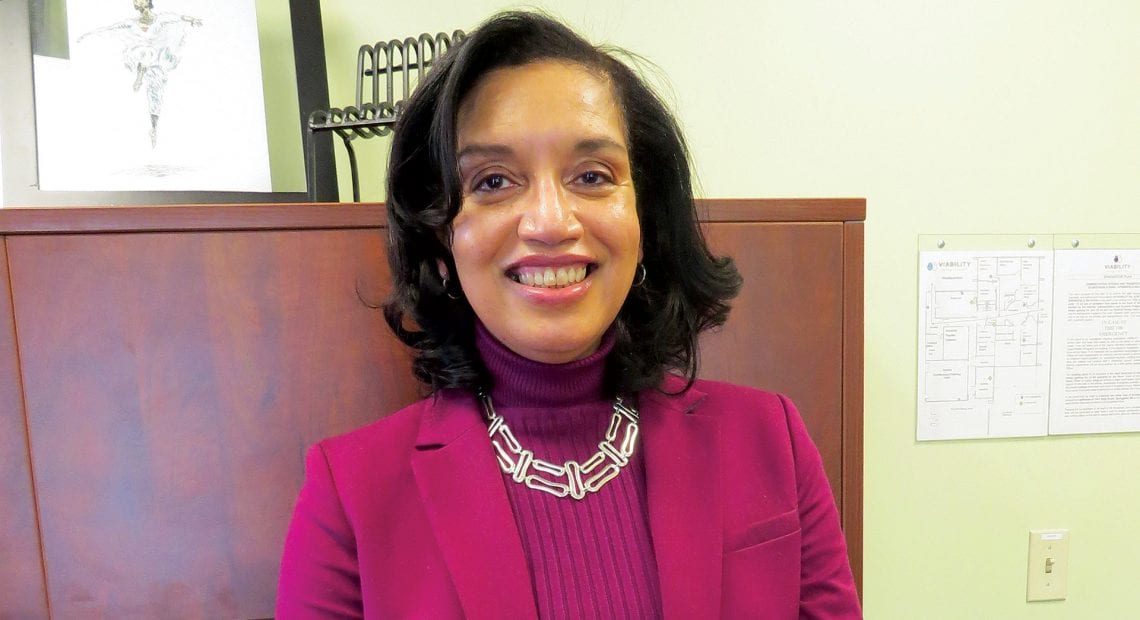
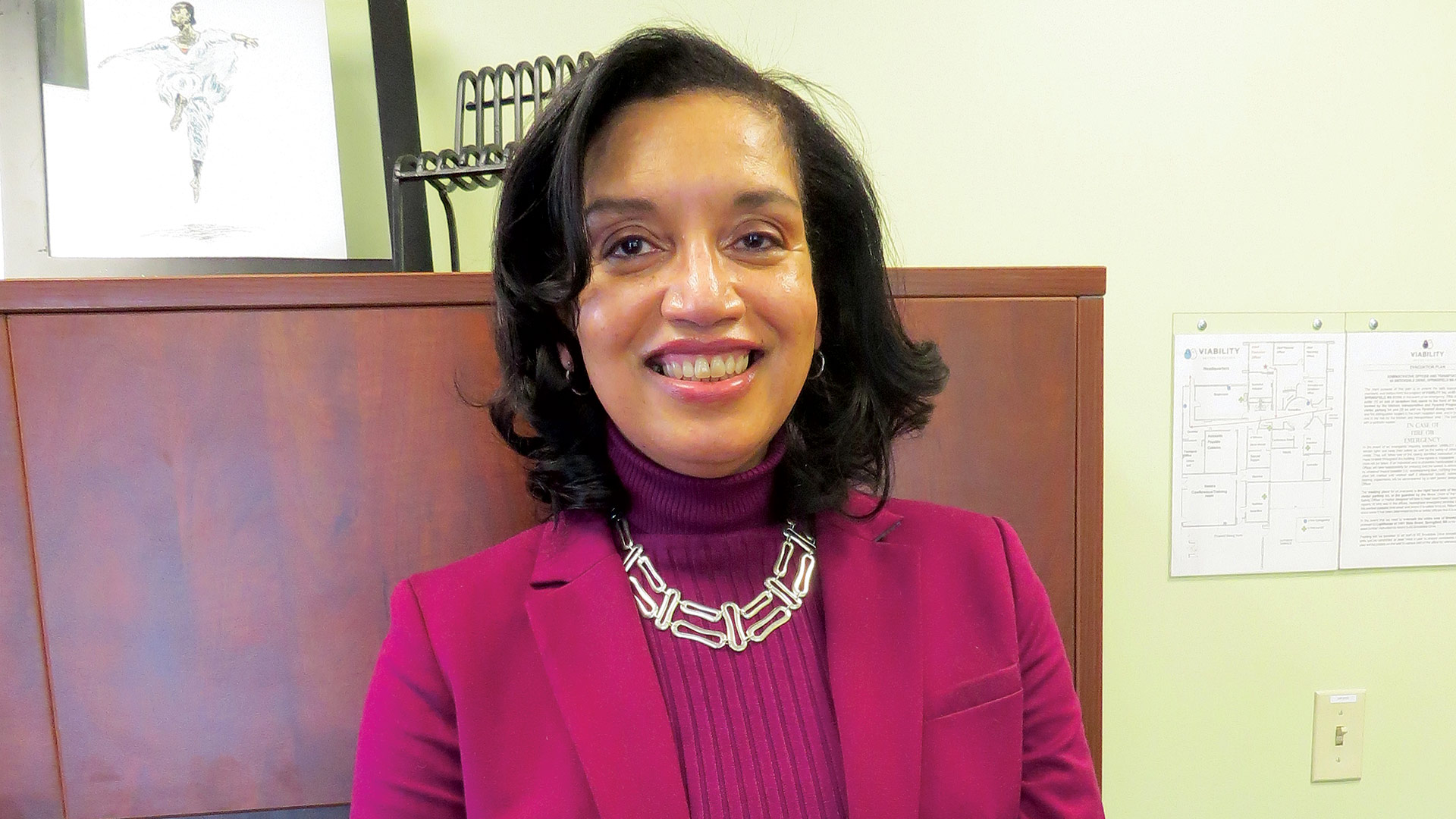
Employers therefore must answer the question: what do I really want with a non-competition agreement? Is it to stop the former employee from working? Or is the goal to maintain the status of my business? If the goal is to maintain the status of the business, employers may be able to utilize non-solicitation and non-disclosure agreements, which can protect the former employer’s interests while also allowing the former employee to work.

Both such agreements are excluded from the definition of ‘non-competition agreement’ by the act, meaning they do not need to include garden-leave clauses.

A non-solicitation agreement does not prohibit a former employee from working for a competitor when the employment relationship ends. Instead, it serves to prohibit the former employee from soliciting clients and other employees of the former employer to join them at their new place of employment. A non-solicitation agreement can therefore be an effective tool in preserving the current status of the business by prohibiting a former employee from taking clients and other employees with them to their new place of employment.

A non-disclosure agreement also does not prohibit a former employee from working for a competitor when the employment relationship ends. Nor does it prohibit the former employee from soliciting clients and other employees from joining them at their new place of employment. Instead, it serves to prohibit the former employee from disclosing any confidential information from the former employer. The confidential information protected could be a trade secret or other highly sensitive material.

In short, while the Noncompetition Agreement Act requires employers to pay former employees not to work, there may be other options available to employers. It is therefore wise to consult with employment counsel to review your potential options to protect your business interests after the employment relationship has ended. u


Timothy M. Netkovick, Esq. is a litigation attorney who specializes in labor and employment-law matters at the Royal Law Firm LLP, a woman-owned, women-managed corporate law firm certified as a women’s business enterprise with the Massachusetts Supplier Diversity Office, the National Assoc. of Minority and Women Owned Law Firms, and the Women’s Business Enterprise National Council; (413) 586-2288; [email protected]

Employment

Putting Experience to Work

Colleen Holmes says client employment, inclusion, and empowerment have been challenged by the pandemic.

Colleen Holmes says client employment, inclusion, and empowerment have been challenged by the pandemic.

Colleen Holmes calls it a ‘full-circle moment.’

That’s how she chose to describe her decision to assume the role of president and CEO of Viability, the Springfield-based nonprofit with a broad mission that boils to providing services — and creating opportunities — for those with disabilities. Those opportunities come in a number of forms, and we’ll get to that shortly.

But first, that ‘full circle’ reference. Holmes used it to note that she spent a full decade at one of the legacy agencies, in this case Human Resources Unlimited (HRU), that became Viability in 2107 (Community Enterprises was the other) before moving on to a new role leading as president and CEO of the 18 Degrees agency.

So she’s back where she was. Well, sort of, but not really. Viability is a much bigger agency than HRU was — it boasts $36 million in annual revenues, 420 employees, and 37 sites in four states — and so much has changed in the interim, much it before COVID-19. And the pandemic has simply added another layer — or several layers, when you get right down to it — of challenge and intrigue.

“Coronavirus has in no way taken away from the need for the services we provide. And in many ways, it has made it even more important to provide those services; that has been job one for me, and for all of us here.”

“Coronavirus has in no way taken away from the need for the services we provide,” Holmes explained. “And in many ways, it has made it even more important to provide those services; that has been job one for me, and for all of us here.”

In that respect, much hasn’t changed, and she has, indeed, come full circle, especially when it comes to agency’s mission, which boils down to enriching the lives of the people served by the agency and continuously reinforcing the belief that every individual, no matter their ability, can be a valuable contributor to the community — and the workforce.

It carries out this mission through a number of programs and services, including:

• Clubhouses, which provide members with a supportive environment to increase their vocational, educational, and social skills;

• Partnering with more than 600 employers to provide members with a variety of supported employment opportunities;

• Community living programs that provide that provide care management, direct care, and referral services to individuals with disabilities, enabling them to live in the community with dignity;

• Day supports and various recreational programs that provide individuals with a broad range of community activities; and

• Transitional services that provide members with upfront job-readiness skills, placement assistance, and ongoing supports.

The common denominator in each of these areas, said Holmes, is dedicated staff that not only make the programs happen, but make the individual goal set by and for each member attainable.

“This work doesn’t happen without our staff — and I don’t mean that simply from the standpoint of hands being on deck,” she said. “A lot of the way in which progress is made with individuals is through trusted relationships that are built that give people a safe space to try things, to grow, to progress, to fail and come back and try again another day. Those trusted relationships are pivotal, and our staff’s ability to offer that is everything.”

But COVID has certainly impacted many of these initiatives, said Holmes, adding that the agency has collectively overcome a number of challenges to keep employment, inclusion, access, and empowerment for people with disabilities in the forefront, despite the pandemic. Moving forward, lessons learned from the pandemic will be applied to the future of these programs and services and how they are provided.

“What worries me is that some of these people are losing ground that they worked so hard to gain — people who were working, people who were gaining life skills, people who were gaining in their levels of independence, people who were ready for their next step in employment. There are a number of folks who have lost ground.”

And there will be some important ground to be made up, she said, adding that, in some cases, COVID stunted the progress being made by some members who were forced inside and into a form of isolation that is not part of this agency’s MO.

“What worries me is that some of these people are losing ground that they worked so hard to gain — people who were working, people who were gaining life skills, people who were gaining in their levels of independence, people who were ready for their next step in employment,” she noted. “There are a number of folks who have lost ground.”

Overall, however, many members, and the agency as a whole, have been able to carry on and move forward through this pandemic, she went on, adding that many members work in essential positions, and they take pride in being essential.

For this issue and its focus on employment, BusinessWest talked at length with Holmes about her new assignment, but especially about how the pandemic has only magnified the need for the various services this agency provides, and how Viability has gone about responding to this changed landscape.


Work in Progress

Holmes said she certainly wasn’t looking for a new challenge when Don Kozera, the long-time CEO of HRU, her former boss (she served the agency as special projects coordinator), and, most recently, the interim president and CEO of Viability following the unexpected passing of Dick Venn (who stepped into that role after having the same titles at Community Enterprises), asked to talk with her about possibly becoming a candidate for this role.

Suffice it to say he did a good sales job, although it wasn’t necessarily a quick or easy sell.

“He said he thought I would be a good fit for this position and asked if I might consider it,” Holmes recalled. “And I said, ‘I don’t know … I’ll go talk to people; I’m always happy to do that.’”

She did talk to people, and came away intrigued by the possibilities.

“What I saw in this was an opportunity to sort of test my skills and challenge myself in a larger organization; this one is probably two and half times the size of the organization I was leading,” she explained. “Also, and this is probably most compelling, coming to Viability was an opportunity to advance work that matters to me in a different and larger arena.

“Our focus is on employment, training, empowerment, and inclusion with people who have disabilities and other challenges and disadvantages,” she went on, “and that speaks very much to me, in the combination of capacity building and social-justice change.”

Fast-forwarding a little, she did enter what became a nationwide search for a permanent president and CEO, and prevailed through a series of interviews conducted virtually, which she described as a new and different experience — at least as the interviewee.

She arrived in November to a full plate of challenges, including continuation of the daunting process of combining HRU and Community Enterprises into the larger entity that exists today, work that was in some ways slowed, and complicated, by both the passing of Venn and then the arrival of COVID.

“As I came on board, the organization that I am coming to know was ready to be on the other side of that transition,” she told BusinessWest. “And it would have been on the other side sooner had it not been interrupted by the grief and loss of Dick Venn, and had it not been for a pandemic.”

Elaborating, she said that what has been delayed has been the process of “breaking down the silos” within the organization. “You have a much larger organization in every way you can name — there’s more staff, many more programs and services, and in more geographic areas — and one that was continuing to grow, not just as a result of the merger but because it’s part of the mission, vision, and value of the organization. It’s about silos, systems work, and some of the basic functional things, like IT.”

A big part of the process of leading the organization to that proverbial ‘other side’ is to do a lot of “listening, watching, and learning,” she noted.

“You don’t walk into an organization like this one and think you know what you need to know,” she explained. “And I can say I’ve walked into an organization of people who are very welcoming, very helpful, who have lots to share, and who are deeply committed to the mission. Our people show up because they believe in the work that they’re doing and the people they’re working with.”


The Job at Hand

Supporting and nurturing this staff is just one of the many priorities for Holmes moving forward — and is, in itself, a challenge.

“One of my larger concerns, and it’s one that’s certainly shared, is the fact that human-service salaries are woefully inadequate to the jobs people do,” she explained. “Joining in advocacy efforts at the state level for eliminating the disparity in pay between community-based providers and state employees who do substantially the same work is important. But it’s also important for us as an organization to prioritize our staff to the extent that the limitations of our largely state-funded dollars allow us to do. Continuing services and supporting our staff are real priorities.”

Another priority, of course, will be transitioning, if that’s the right word, to a post-COVID world. Many staff members have been working remotely, she noted, and there are questions moving forward about how and where work will be carried out and even how much office space the agency may actually need in the short and long term.

And there are many factors to consider in making those decisions, she said.

“It comes down to how we most effectively support the services and the staff members that are delivering the services,” she explained. “There might be a natural tendency to say, ‘OK, there are certain positions that can be carried out remotely, so let’s just put all of them out and save that space.’ But it’s more complicated than that; human-services work is very collaborative. It’s teamwork, but more deeply than that, there is an environment of support that’s hard to come by when you’re not in contact with people, when people don’t see you walk through the hall and see you being a little more tired, a little more stressed than normal. In the kind of work we do, we need to pay attention to that.”

Meanwhile, there are those lessons learned and the new ways of doing things that came about out of necessity — and ingenuity.

“There was a brief period when staff needed to switch to providing services remotely, and … by golly, they did it,” Holmes told BusinessWest. “You get creative, and I’m sure we all have; you learn how to do some things differently, and you discover that the paradigm of how services are provided is turned on its head.

“That’s a new skill set we’ll carry forward, but it by no means replaces in-person services,” she went on, adding that, moving forward, the agency will look toward using the new skills and new technology, including virtual reality, to carry out its mission.

She noted that Viability is using virtual reality to acclimate and train clients and members for job placements. “We started during the pandemic, and we’re very much in the testing and piloting stage,” she explained, adding that early results are very positive. “If you have folks who have autism or others who for various reasons are highly sensitive to changes in environment or to noises, or just to new experiences … to be able to take a work environment and load it into a virtual-reality system so that people can safely explore and navigate that workspace without actually being there is very advantageous. It can lead to much smoother transitions.”

As for the employment programs, the ones that put thousands of individuals in jobs across this region and beyond, COVID prompted some businesses to close and many others to slow down, said Holmes, adding that obvious question marks remain about when and to what extent business, and jobs, will pick up again.

“It is a concern as to how long the economic rebound takes, and if there continues to be a shortage of positions,” she said. “As is so often the case, people who are marginalized are pushed out first, so that is a concern. But there are a number of employers we partner with who, through experience, will tell you the value of working with us, and that, when it comes to our members, their attendance is superior, and the quality of their work is at least on par.”


Past Is Prologue

Holmes has talked with many such employers over the years, so she understands those sentiments. She has, as she said at the top, come full circle when it comes to her career in human services.

But in most all respects, she is not coming back to where she was years ago. The landscape has changed in myriad ways and, thanks to COVID, it continues to change, each month and almost each week.

This is a different test, a sterner test, one she fully embraces. As she said, she’s excited about the opportunities — for herself, but especially for those benefiting from Viability’s programs and services.


George O’Brien can be reached at [email protected]

Employment

Don We Not Our BLM Apparel

By Tim Murphy

Americans across the country have been actively engaging in the Black Lives Matter (BLM) social-justice movement, which advocates against incidents of racially motivated violence police. Often, BLM supporters will demonstrate their commitment to the movement not only by protesting, but also by wearing apparel, such as T-shirts and face coverings, with BLM messaging.

But what happens when supporters wear this clothing to work? Can employers enforce a dress code requiring employees to refrain from wearing politically motivated clothing? Yes, a recent Massachusetts federal court determined. Even so, is it worth the negative publicity and PR fallout? You be the judge.

The case involved the well-known Whole Foods grocery store, and a group of nearly 30 Whole Foods’ employees who claimed to be negatively impacted by the store’s “neutral” dress-code policy, which prohibited employees from wearing clothing with visible slogans, messages, logos, and/or advertising that are not Whole Foods-related.

“Can employers enforce a dress code requiring employees to refrain from wearing politically motivated clothing? Yes.”



Beginning around June 2020, in the wake of George Floyd’s killing and subsequent nationwide protests, Whole Foods employees began wearing masks and other attire with BLM messaging to work. Some employees were disciplined for violating the dress-neutral dress-code policy, while others were sent home without pay and directed to change clothing. Several employees quit, and others kept wearing BLM clothing to protest the store’s actions.

Then, a group of 27 employees filed a lawsuit against Whole Foods, accusing the store of racial discrimination. They claimed Whole Foods was selectively enforcing its dress code banning “visible slogans, messages, logos, and/or advertising” against black employees.

Last month, a federal District Court judge dismissed the race-discrimination claims. The court was not convinced that Whole Foods was enforcing the policy based on race-related reasons. Instead, it was enforcing a neutral dress-code policy with no consideration to race. The court noted that, “at worst, they were selectively enforcing a dress code to suppress certain speech in the workplace.” The judge went on to state that, “however unappealing that might be, it is not conduct made unlawful” by anti-discrimination laws.

On its face, this decision makes sense. Generally speaking, an employer can lawfully implement and enforce a dress code, as long as it is applied equally to all employees. This is particularly important when violations of the dress code negatively affect productivity or lead to employee disputes. As far as political speech is concerned, the First Amendment provides no protection for employees unless they work for the government, because the First Amendment applies only to governmental restrictions on speech.

Additionally, in Massachusetts, there are no state laws or protections for speech in a private workplace. It also appears there was no evidence in this case supporting the argument that Whole Foods was selectively enforcing the dress-code policy against black employees.

Given the current political climate, employers may be left wondering whether Whole Foods and other retail employers are making the right move by enforcing dress-code policies in a way that restricts political and socially progressive speech. Certainly, there are arguments to be made that these policies are geared toward improving customer relations and eliminating politically charged disputes between workers and customers. Last summer, much news was made about a customer in Target berating an employee wearing BLM attire with questions about whether “all lives matter.”

The same can be said for employee relations. It is not hard to envision heated disputes around the water cooler over clothing that bears political or social-justice messages.

That said, this case has generated a lot of publicity for Whole Foods. And they are not alone. Starbucks had a similar dress-code policy that prohibited employees from wearing BLM attire and other clothing bearing political and social messaging. After protests and public outcry, Starbucks reversed its position and began allowing employee to wear T-shirts or pins supporting the Black Lives Matter movement.

Businesses need to pay careful attention to this issue. While the adoption of strict, ‘neutral’ dress codes appears legal, there could be unintended consequences, including irreversible harm to employee morale and negative public-relations nightmares.


Tim Murphy is an attorney with the Springfield-based firm Skoler Abbott & Presser, specializing in labor relations, union campaigns, collective bargaining and arbitration, employment litigation, and employment counseling; (413) 737-4753.

Women in Businesss

Progress Report

By Janine Fondon

On March 8 (International Women’s Day), the 2021 On the Move Forum to Advance Women, presented by Bay Path University, Springfield Museums, and a host of local organizations, virtually hosted some 200 women of all backgrounds from Western Mass. and beyond. Through conversations and speakers, women voiced their hopes and elevated their concerns to support the future success of women in leadership at all levels.

Speakers noted there is much work to be done to change the trajectory of women in companies and organizations, given that women still operate in a world where they are paid less than men. Also, women have limited leadership opportunities in the C-suite and have experienced workplace challenges in the face of the COVID-19 crisis. Also, black women and Latinas still make less than anyone in the workforce, and their opportunities for promotions are certainly limited. Where do we go from here?

The forum theme, “Women in Leadership: This Is What Change Looks Like — Past, Present, and Future,” offered attendees an inter-generational, cross-cultural, gender-inclusive, and history-infused conversation focused on advancing women, led by moderator Nikai Fondon.

The event presented voices and content that showed what change could look like — young, diverse, professional women on the move to create a new world; experienced leaders of all backgrounds who share their expertise; and college-aged women exploring new skills. Now in its fifth year, the event has engaged more than 1,000 women in community conversations and presentations on women’s history, empowerment, and advancement.

“The numbers also show us that change needs to happen to build more inclusive workplaces at all levels and in all industries. We must keep watch that our colleges and universities understand the magnitude of not only recruitment and retention, but belonging and mentoring.”

This year’s event aligned with the priority theme of the 65th session of the United Nations Commission on the Status of Women, “Women in Leadership: Achieving an Equal Future in a COVID-19 World.” According to Catalyst, “in 2020, women of color represented only 18% of entry-level positions, and few advanced to leadership positions. While white women held almost one-third (32.8%) of total management positions in the U.S. in 2020, Asian women (2.2%), black women (4.1%), and Hispanic women (4.5%) held a much smaller share.”

During the forum, the speakers and participants during the conversations voiced the sentiments expressed in these statistics. Most women still face obstacles in moving up the ladder at work. These statistics remind us that young women professionals who are rising to new opportunities in industry may have to pick up the path of experienced women today who still fight these trends after more than 20 years.

The numbers also show us that change needs to happen to build more inclusive workplaces at all levels and in all industries. We must keep watch that our colleges and universities understand the magnitude of not only recruitment and retention, but belonging and mentoring.

Also, as black women, Latinas, and women of color climb the ladder of success, they find that every step along the way may not come with the support they need or expect. A study conducted by Lean In and SurveyMonkey finds that, although more than 80% of white employees view themselves as allies to women of color at work, just 45% of black women and 55% of Latinas say they have strong allies in the workplace. There is more work to be done to build relationships that drive trust and transformation in the workplace, and more conversations need to confirm informal and formal sources of support.


Diversity, Equity, and Inclusion

To help make a change in the workplace, educational institutions, companies, and organizations continue to underscore the importance of diversity, equity, and inclusion. While these efforts allow for some change, we need strategic approaches to systemic racism and inequities that address issues for companies and individuals. Many young professionals, consumers, and communities are at the forefront of social justice, so shifts in social responsibility, outreach, and accountability could drive change on many levels.

Bay Path President Sandra Doran noted in her speech that she has been committed to the advancement of women and the power of education. “I embrace these beliefs because I come from a family of educators and strong women. I have witnessed first-hand the power of higher education for women. My grandmother attended Barnard, a women’s college, and my mother returned to school to earn her degree at a women’s college as an adult learner. With such personal role models, I felt called to be the president of Bay Path.”

However, noting the effects of COVID-19, she noted that, “by now, we all know the burden of the pandemic fell harder on women than on men. Women make up the majority of front-line workers in deeply affected industries like retail, food service, hospitality, and healthcare, and also picked up a disproportionate share of the additional loads of schoolwork, housework, and elderly care. Black women have faced the highest rate of unemployment among women at 8.9%, followed by Latinx women at 8.5%. This pandemic has uncovered the fragility of our systems, from healthcare to daycare to education, and it is our calling, women — and men of substance — to create change. And the pipeline of women in leadership positions has shrunk.”

“As we move past International Women’s Day and Women’s History Month, there must be even more commitment to revisiting practices in workplaces, classrooms, boardrooms, meeting places, and Zoom rooms to deliver equity, belonging, and dismantling ‘isms.’”

Doran also referenced an IBM study that “noted how women on corporate boards and in C-suites around the world have made no progress since 2019, when IBM did its first study on the subject.”

Another report, the 2020 Women in the Workplace study, conducted in partnership with Lean In and McKinsey, tracked the progress of women in corporate America. The data set reflects contributions from 317 companies that participated in the study and more than 40,000 people. According to the report, “the boundaries between work and home have blurred, and women, in particular, have been negatively impacted.”

In the study, women of color were noted as particularly impacted by COVID. “Women — especially women of color — are more likely to have been laid off or furloughed during the COVID-19 crisis, stalling their careers and jeopardizing their financial security. Meanwhile, black women already faced more barriers to advancement than most other employees. This is an emergency for corporate America. Companies risk losing women in leadership — and future women leaders — and unwinding years of painstaking progress toward gender diversity.”


Adverse Impact on Black Women and Latinas

While many black women and Latinas have made strides and found success in corporations and organizations, far too many remain underutilized, left behind, not included, and overlooked for opportunities. The numbers document their trajectory in a world where, in most cases, they are paid less than everyone else. Also, according to a report by CNBC, “employment for black women is 9.7% lower than it was in February 2020. Employment for white men, white women, and black men is down 5%, 5.4%, and 5.9%, respectively.”

A report by Lean In also confirms the experiences of black women in the workplace, noting that black women are significantly underrepresented in leadership roles, much less likely to be promoted to manager (and their representation dwindles from there), more likely to see their successes discounted, and less likely to get the support and access they need to advance. In addition, black women face more day-to-day discrimination at work. They want to lead — and they are motivated to improve their workplaces — but often find themselves unfairly penalized for being ambitious.

These findings should cause us all to pause and revisit our workplace policies, practices, and procedures. While not every black woman may have these experiences, other personal scenarios that they face result in negative trends. Most of all, these findings should prompt us to think about how everyone is treated in the workplace and how we treat each other. Most of all, we should consider how we can understand what others feel and find ways to communicate. If we were all treating each other as ourselves, we would not have these trends.


LGBTQIA+ Equality

While many communities and individuals experience an uncertain landscape in the workplace, we must continue to stay vigilant about trends that impact inclusion. For LGBTQIA+ (lesbian, gay, bisexual, pansexual, transgender, genderqueer, queer, intersex, agender, asexual, and other queer-identifying) communities, the journey to equality continues to “ebb and flow,” as Kathleen Martin of Springfield College and her wife, Andrea Hickson Martin of Bay Path University, noted:

“There is no doubt that there have been tremendous strides over the past decade for LGBTQIA+ equality. In 2012, the Obama administration supported marriage equality. In 2015, in the Supreme Court of the United States case Obergefell v. Hodges, marriage equality was made federal law, paving the way for our marriage in 2017. In 2019, Congress approved a comprehensive LGBTQIA+ civil-rights bill, providing non-discrimination protections for the LGBTQIA+ community in employment, housing, public spaces, education, jury service, credit, and federal funding. During the Trump administration, however, LGBTQIA+ rights were rolled back through a ban on transgender military service, the appointment of anti-LGBTQIA+ judges at various levels of the judicial system, the rolling back of the Obama-era Civil Rights Act protecting transgender and non-binary workers from employment discrimination, and the rescinding of Title IX rules requiring schools, including colleges and universities, to address sexual harassment, including sexual violence.

“As with everything in life, there is a constant ebb and flow,” Martin and Hickson continued. “On the first day of the Biden-Harris administration, President Biden signed an executive order preventing and combating discrimination on the basis of gender identity or sexual orientation, reinstating the LGBTQIA+ protections the Trump administration removed. More recently, the administration has directed the Department of Education to ‘review all of its existing regulations, orders, guidance, and policies to ensure consistency with the Biden-Harris administration’s policy that students be guaranteed education free from sexual violence.’ This includes an evaluation of the Title IX burden of proof issued under the previous administration.”

As stated, the ebb and flow of policy continue to take us away from setting a more consistent, inclusive world and workplace where all people can succeed.

As we move past International Women’s Day and Women’s History Month, there must be even more commitment to revisiting practices in workplaces, classrooms, boardrooms, meeting places, and Zoom rooms to deliver equity, belonging, and dismantling ‘isms.’ Also, we must begin to employ new ways for engaging, recognizing, and retaining black women, Latinas, and women of color who are still hidden in plain view.


Janine Fondon is a writer, speaker, assistant professor, and chair of Undergraduate Communications at Bay Path University. She is a frequent contributor to publications and media outlets on the topics of social justice, women’s history, and diversity, equity, and inclusion. She recently curated and produced an exhibit and series of public events at Springfield Museums, called “Voices of Resilience: The Intersection of Women on the Move.” She was named a 2020 Difference Maker by BusinessWest, a 2020 Pynchon Award winner, and one of the top African-American female professors in 2018 by the African American Female Professors Assoc.

Women in Businesss

Pink Slip

By Joanne Hilferty, Dan Kenary, and Brooke Thomson

In 2020, the same year a record number of women were elected to Congress and the first woman was elected vice president, COVID-19 had a devastating and potentially permanent impact on women in the workforce.

The percentage of women participating in the U.S. labor market in October 2020 was the lowest since 1988, and of the 9.8 million jobs that have not yet returned, 55% belong to women. In one year, COVID-19 wiped out a generation of progress and put the precariousness of being a woman in the modern American workplace into stark perspective.

Before the pandemic, women in Massachusetts were participating in the workforce at increasing rates, surpassing the national rate by 2019. COVID-19 brought them back to where they were at the end of the Great Recession in 2009.

More than 40% of female employees in Massachusetts work in education, healthcare, and social assistance, sectors that have been particularly hard hit by the economic downturn. Add the lack of quality childcare options brought about by the closure of schools and early-education programs, and you have a perfect storm forcing women to face gut-wrenching choices.

“In one year, COVID-19 wiped out a generation of progress and put the precariousness of being a woman in the modern American workplace into stark perspective.”

According to the U.S. Bureau of Labor Statistics, in September 2020, when schools typically reopen, a staggering 69% of women said the pandemic was keeping them from returning to work for reasons other than downsizing or business closure. In a survey conducted by the Associated Industries of Massachusetts (AIM) last fall, 67% of employers listed lack of childcare as a primary concern for their workforces.

Fortunately, organizations in Massachusetts are taking a leadership role in addressing the ongoing challenges facing women in the workforce. The Boston Women’s Workforce Council, the Commonwealth Institute, and the newly formed Massachusetts Business Coalition for Early Childhood Education are focused on advancing important changes, such as pay and representation equity. Even before the pandemic, women on average made about 81 cents for every dollar earned by their male counterparts.

Women and men should have the same options to pursue a career and raise a family, but the pandemic has laid bare the reality that women are expected to take greater responsibility for their families without sufficient support.

Ensuring that jobs traditionally filled by women have more extensive protections and finding a path toward more balanced representation of women in industries like information technology, transportation, and construction — fields where female representation is still limited — are also critical steps to achieve greater balance in the long term. However, immediate action is needed to ensure progress made by women does not erode further.

That is why AIM is calling on employers to make a commitment now to review their practices and policies and make immediate, substantive adjustments to mitigate the impact of COVID-19 on women and other caregivers in the workforce. Specific recommendations include:

• Committing to providing pay increases and advancement steps to women caregivers on schedule rather than penalizing those who have been on leave or working limited hours;

• Extending the time workers can be on leave to coincide with the duration of the pandemic;

• Giving hiring preference to former workers, if their experience and skills allow, who were required to leave the workplace due to family demands;

• Extending the time that returning workers can bridge tenure for benefits and other considerations to coincide with the full duration of the pandemic;

• Listening to individual employees about their specific needs and expectations and not making assumptions about what each woman or caregiver can or cannot do; and

• Instituting practices that reduce conflict with remote schooling, such as not holding meetings before 9 a.m. or at lunch, when children need assistance.

These steps alone will not fully offset the impact of the pandemic on women; they will, however, demonstrate the business community’s commitment to supporting the Commonwealth’s skilled female labor force. Massachusetts cannot afford to go back to business as usual as the light begins to shine at the end of the COVID-19 tunnel, especially when it comes to how businesses and public policy treat working women.

The pandemic has presented an unprecedented responsibility for the Commonwealth and the nation to see decreasing numbers of female workforce participation for what they are — gaps in the system allowing available and accessible talent to fall straight through. Failure to act on them now will have long-term, devastating impacts on the Massachusetts economy.

Joanne Hilferty is board chair at Associated Industries of Massachusetts (AIM) and president and CEO of Morgan Memorial Goodwill Industries. Dan Kenary is immediate past chair of the AIM board and CEO and co-founder of Mass Bay Brewing Co. Brooke Thomson is executive vice president of Government Affairs at AIM. This article first appeared as an op-ed in the Boston Globe.


Home Improvement Special Coverage

Backyard Experience


By Mark Morris

On a Thursday in February while snow fell on the region, Bob Schwein was answering a steady stream of phone calls at Drewnowski Pools.

Sure, some calls were from people who use their spas year-round, but many more inquiries were to schedule swimming-pool openings.

“Swimming-pool owners know that if they want to schedule a pool opening for Memorial Day, when thousands of other people want to open their pools, they need to schedule now,” said Schwein, sales manager for Drewnowski.

Early spring is typically when he receives calls to replace vinyl pool liners and to repair or renovate pools made from gunite, a concrete product used for many inground pools. “Repairs to gunite pools can take weeks, and people don’t want to interrupt the middle of their swimming season, so we usually schedule these early in the year.”

With his business growing over the last five years, Schwein said backyard pools are not what they used to be, particularly inground pools (see photo above).

“It used to be a rectangle with a three-foot concrete walk around the pool and a fence surrounding it by itself in the yard,” he noted. “Now, the pool is part of an entire backyard experience.”

That trend — toward creating an experience right outside the back door — is one that many different types of outdoor-improvement contractors can attest to, particularly during the era of COVID-19. BusinessWest spoke with several who said people are spending more money on their homes simply because they are spending more time at home.

The oft-heard story is that people were encouraged to only go out when necessary, and those who were fortunate enough to work from home during this time have been able to save some money, while also becoming more acutely aware of repairs and renovations they may have been putting off. As a result, many contractors reported their most successful year of business in 2020.

As many of the pandemic restrictions continue, people are not sure how long they will continue to work and attend school from home. It reminds Brian Rudd, owner of Vista Home Improvement, of the uncertainty that emerged during a different historic time.

“After 9/11, we saw people start to nest, and they began to see their home as their kingdom,” he said. “Since the pandemic, the desire to nest at home has happened to an even larger degree.”

“Right now, people are addressing the aesthetics of their houses because they are home more and able to address these things now.”

And they’ve been increasingly looking outside the home, not just inside. After a record year in 2020, Rudd reported that even more customers want new siding and new windows. “Right now, people are addressing the aesthetics of their houses because they are home more and able to address these things now.”

It’s not unusual for customers to call Dave Graziano, landscape project manager for Graziano Gardens, to replace old, overgrown plantings with new ones. Last year was different because, along with replacing old plantings, customers wanted to make other improvements to their property.

“Whether it was adding a big patio or simply hanging flower baskets, people wanted to create more outdoor living space, no matter how large or small their yard might be,” he said.

Brian Campedelli, president of Pioneer Landscaping, said his business doubled in 2020 because people decided to invest in their homes rather than vacations. “The money they would have spent on vacation instead went into their backyards, where we helped them create an outdoor entertainment area.”

Both Graziano and Campedelli noted that firepits have become one of the most popular additions to the backyard.

“While we build a lot of circular firepits, people are getting creative and asking us for square or triangular pits to match the seating they have around it,” Campedelli said.

A worker with Pioneer Landscaping places patio stones.

A worker with Pioneer Landscaping places patio stones.

Once considered only for warmer climates, outdoor kitchens are also a growing part of his business, with many designs incorporating a pizza oven.

“In the past, people would not build outdoor kitchens because of the short season to use them, but I don’t hear that as much anymore,” he said. “I think people are just going for it.”


Dive Right In

‘Going for it’ is an increasingly common mindset when it comes to buying an inground pool as well, Schwein noted.

While Drewnowski sells inground and above-ground pools, installation is handled by its parent company, Juliano Pools of Vernon, Conn. As busy as Juliano was last year, many who wanted pools couldn’t get them, due to higher demand than normal combined with shortages of materials and labor. Schwein said 2021 is off to a good start because those who couldn’t purchase last year can do so this year.

“We have a spillover of people from last year and new people who have decided to buy a pool this year, so I’m positive that combination will mean another banner year,” he told BusinessWest.

For years, many believed that houses with inground pools would be tough to sell. The red-hot real-estate market since last spring seems to have made that concern a moot point. Many first-time homebuyers are also first-time pool owners who are calling Schwein for advice on how to maintain their inground asset.

“From what I’ve seen, people are not afraid to buy a house with an existing pool. In fact, to many, it’s a selling point,” he said. While a typical home inspection does not cover the condition of a swimming pool, Drewnowski has pool inspectors available to help prospective buyers understand what they are getting.

With less inventory in the housing market, Rudd observed that many people choose to upgrade the house they have. By the same token, when people do purchase a home, they often come to see him, armed with plans.

“From what I’ve seen, people are not afraid to buy a house with an existing pool. In fact, to many, it’s a selling point.”

“When people move, they improve. And when they don’t move, they improve,” he said with a laugh.

Sprucing up a house isn’t complete until landscaping provides the final touch. In addition to landscaping services, Graziano Gardens has a retail store for those who want to tackle backyard projects themselves. Graziano saw new faces in the garden center last year, resulting in what he termed a “mini-explosion.”

“We sold out of trowels, shovels, gloves, watering cans, things we’ve never sold out of before,” he said. Also hard to come by were grown items such as hanging baskets, vegetable plants, and even evergreen hedges. “It seems like people just wanted to fill in that spot.”

Brian Campedelli says customers are looking for more creativity in firepit design.

Brian Campedelli says customers are looking for more creativity in firepit design.

Dry, warm temperatures early last spring, combined with parents and kids cooped up in their homes, might have led to a shortage in pool heaters. Schwein said he took many calls from exasperated parents who bought a heater and opened their pool earlier than usual to get their kids outside and squeeze a few more months out of the swimming season. That logic was fine until manufacturers ran into COVID issues and Schwein could no longer get them.

“The demand was high, and the supply was low,” he said. “Heaters are something that would normally take six days to get, but last year we ran into three-month delays.”

The pandemic also forced several contractors to find new ways to do business. A summer ritual for many involves periodic trips to the local swimming-pool retailer with samples of pool water to make sure the chemical balance keeps the water clean and safe. When COVID first hit, Schwein said, customers were no longer allowed into his store. “We had to change our business model.”

Specifically, customers left water samples outside the door where employees would test the sample and call the customer with a list of what chemicals were needed. After completing the transaction over the phone, an employee would deliver the chemicals to the customer’s house. Schwein admits it put a strain on his staff and customers, but everyone adjusted well.

“Our customers were able to get what they needed, but the way we had to do everything was different.”

When the pandemic first hit, Rudd and his staff were forced to become familiar with 10 years of new technology in less than three months. Beyond Zoom meetings, Vista consultants used satellite technology to measure houses for roofs and siding when they could not visit a client in person. While skeptical in the beginning, he now calls the technology “amazing.”

Dave Graziano says his garden center sold out of many popular plants last year.

Dave Graziano says his garden center sold out of many popular plants last year.

“I’m from the days of using a tape measure and a pencil, so at first I took comparison measurements to make sure the satellites were accurate,” he said. “It’s scary how accurate they are.”

Rudd enjoys using computer-design tools to give homeowners a good idea of how their space will look with improvements.

“We take a picture of the house, upload it into one of our applications, and change the house right in front of them,” he explained. “It leads to great interaction with the client and lets them have control of their purchase, with us there to guide them.”

Campedelli said it’s difficult for clients to envision a dramatic renovation of their backyard, so computer design goes a long way toward sealing the deal.

“Once they see the design, they want to move forward,” he noted, adding that, once the job is done, he enjoys how thrilled customers are with the result. “It changes their lives in a positive way.”


Getting Ahead

With spring around the corner, contractors are preparing for another busy year. Schwein pointed out that his phone is ringing now because customers have learned from the pandemic.

“Last year, people were patient and understood slowdowns due to COVID issues, so they are calling now because they don’t want to hear the COVID excuse this year,” he said.

After a busy 2020 as both a contractor and a retailer, Graziano’s main takeaway from last year was that people want to make their properties into their own oasis.

“Whether they do it themselves or they hire a landscape professional, I think that trend will continue through this year,” he said.

In the meantime, he’s got what he called a “good problem” — figuring out how many more shovels and watering cans to order for 2021.

Special Coverage Technology

A Critical Gap


Margaret Tantillo clearly remembers — honestly, who doesn’t? — the day Gov. Charlie Baker started shutting down the economy a year ago this month.

As the executive director of Dress for Success Western Massachusetts, an organization dedicated to the economic empowerment of women, she started calling participants in the days that followed, asking what issues they were having. One that kept coming up was access to the internet.

“If people are not connected, they’re going to be left behind in terms of being able to participate in the workforce,” Tantillo said.

So, identifying digital equity as connectivity, access to equipment, and the knowledge and ability to use software, Dress for Success enlisted a group of volunteers to form a digital task force, providing one-on-one coaching for about 40 women and providing more than 250 hours on the phone coaching.

“For the most part, we’re helping people operate on Zoom so they can participate in training and apply for jobs and interview virtually,” she said — just one way internet connectivity is a lifeline for people in these times.

Or, conversely, how lack of it can have a crushing impact.

It’s an issue that has received more attention during the pandemic, as tens of millions of Americans have struggled with remote learning, telehealth, and the ability to work from home because they lack access to fast, reliable internet service.

This ‘digital divide,’ as its commonly known, is not a new phenomenon, but the way COVID-19 has laid bare the problem is forcing lawmakers and others to see it in a new light.

“There are still communities in Western Mass. that don’t have high-speed internet access, or internet at all,” said state Sen. Eric Lesser, who has long championed this cause. “Frankly, in the year 2021, that’s a national embarrassment.”

State leaders haven’t ignored the issue, including tens of millions of dollars for infrastructure in bond authorizations over multiple budgets and economic-development bills, Lesser said, and Gov. Baker has set a goal to reach every community.

State Sen. Eric Lesser

State Sen. Eric Lesser calls the lack of connectivity in some Bay State towns “a national embarrassment.”

“But, frankly, the fact that we have communities that don’t have broadband internet access raises very profound questions about how a high-tech state like Massachusetts, in this day and age, can allow that to happen.”

As president and CEO of the Western Massachusetts Economic Development Council, Rick Sullivan said the EDC has long taken the position — even before COVID-19 made it a more pressing issue — that the state needs to bring internet connectivity into every city and town. He noted that Gov. Deval Patrick’s administration started building the backbone, and the Baker administration has been diligent in making sure communities get financing to execute plans to bring broadband to their residents.

“For a lot of the smaller communities, that is probably the single biggest opportunity they have for economic development in the region,” Sullivan said. “People can choose to work from home, but they need to have the access that helps people choose to live in those communities, and it makes it easier to sell your properties, and that increases values in small towns.”

But even large cities have a digital divide, he added, which has been exposed to a greater extent by COVID-19.

Tantillo noted that, according to Census data from last year, 31% of households in Springfield have no internet access, and 37% don’t even have a computer. That means no remote work, no remote education, no telehealth, no … well, the list goes on.

These digital-divide issue arose during a public hearing last week in Springfield on the relicensing of Comcast. “Parts of Springfield need better connection,” Sullivan said. “The mayor was clear in his opening statements that this was an issue they would be taking a look at. But in every city and town, there are some connectivity issues that clearly need to be addressed.”

Learning Lessons

Yves Salomon-Fernández, president of Greenfield Community College (GCC), understood the need for connectivity before students began attending classes remotely last spring, but that move more clearly exposed the scope of the issue.

“The digital divide is real, especially in certain areas of Franklin County and in the hilltowns. Even in the city of Greenfield, there are places with spotty internet access, and with all of us being on Zoom right now, it slows down the connectivity we have for our faculty, staff, and students,” she added, noting that GCC had to purchase technology for many of them to teach and learn remotely.

“We also have students who are housing-insecure and may not have access to the internet. We gave them a hotspot if they have no cellphone service, and we have accommodated them on campus in various ways.”

She noted that even parts of the GCC campus contain dead zones where cellphones won’t work; the college has a phone tree set up for emergency alerts because cellular connectivity isn’t a given everywhere.

“If the college, a critical institution and a community asset, has these issues,” she said, “imagine what it’s like for small businesses and individuals.”

The flawed vaccine rollout in Massachusetts (see story on page 40) has laid bare another impact of the digital divide: access to vaccination appointments. Even if the state’s website wasn’t confusing or prone to crashing early on, Lesser said, it still wasn’t acceptable to make it the only option to sign up, which is why he and other legislators have pushed for a phone option, which was implented last month.

“You were pretty much shutting out a whole community of people, especially the 75-and-older category, when you set up a system that’s website-only,” he noted.

But vaccine distribution will be completed over the coming months; what won’t change are the other reasons people need to access the internet from home. Solving the issue won’t be easy with the patchwork of different levels of responsibility — towns, the state, FCC regulators on the federal level — when it comes to regulating contracts and service arrangements.

That’s why Lesser is high on municipal broadband, offered by a city to its residents like a public utility — an initiative that Chicopee and Westfield have undertaken, to name two local projects. “It really is like the water or electricity of the 21st century, that’s delivered by the city as well.”

More such municipal projects will also increase competition, he said, which could force other providers to lower their prices and boost speed.

Even people who have internet access through large companies often deal with higher costs than they can easily afford, Lesser said. “The costs are astronomical in the U.S. — people pay much more per month than in Europe or Asia.”

Therefore, “the state needs to look at ways to open the market more and create more competition,” he added, and that could simply entail putting more pressure on big internet companies.

“The problem is, internet service is left to the private sector when it’s a public good,” he said. “It doesn’t make economic sense for big companies to invest in infrastructure to get the internet turned on in small communities. The state may have to mandate they have to make those investments if they want to provide service for bigger locations.”

An Issue of Equity

Tantillo agrees with Lesser that society should be looking at connectivity as a utility and a basic, affordable service, but goes a step further.

Margaret Tantillo says the digital divide, if not rectified, could leave generations behind when it comes to economic opportunity.

Margaret Tantillo says the digital divide, if not rectified, could leave generations behind when it comes to economic opportunity.

“From an equity perspective, this disproportionately impacts women and people of color, so it’s also a social-justice issue,” she said. “But a crisis like this is also a big opportunity to be transformative. Springfield is considered the city of innovation. With a bold solution and reallocating resources, who knows what this community can transform into, if everyone has the opportunity to participate equally in online banking, telehealth, access to jobs, even to engage civically?”

Salomon-Fernández agreed. “In this day and age, it’s also an equity issue when you have people disconnected from the rest of the world. In the United States of America, and in one of the most technologically advanced states in the country, that’s a concern.”

And a particularly acute one, she added, in Franklin County, which contains some of the more rural and economically marginalized towns in the state. The impact isn’t just a problem in the present — it can have long-term effects.

“The world is increasingly globalized, and not being connected has negative repercussions on communities,” she added. “We are creating an underclass of people not able to take full advantage of economic possibilities through digitalization and connectivity. That has real effects, not just on teaching and learning, but also on the vibrancy of our whole region.”

The Federal Communications Commission’s latest broadband deployment report concluded that the “digital divide is rapidly closing.” But some voices in that agency are more hesitant.

“If this crisis has revealed anything, it is the hard truth that the digital divide is very real and very big,” FCC Commissioner Jessica Rosenworcel said in a statement released along with the report last month. “It confounds logic that today the FCC decides to release a report that says that broadband is being deployed to all Americans in a reasonable and timely fashion.”

The most recent available data from Pew Research, published in 2019, found that around 27% of Americans don’t have home broadband. That percentage is higher for Americans whose annual income is less than $30,000 (44%), black and Hispanic Americans (34% and 39%, respectively), rural Americans (37%), and those with a high-school education or less (44%).

Pew also reported, from a survey conducted last April, that 22% of parents — 40% in low-income families — whose children were learning remotely say they have to use public wi-fi because they lack a reliable internet connection at home.

Sullivan noted that some companies, like Comcast, and municipal utilities in cities like Holyoke and Westfield have made connectivity available to school children during the pandemic, which has been important.

“But going forward, it needs to be universal, and everyone needs to be able to have access,” he said. “It’s so important for education and for economic-development opportunities in every city and town. If we had that, combined with our quality of life and the cost of living we have here in Western Mass., we could be a place where people choose to live and work from home.”

Opening Eyes

Proponents of improved internet access in Massachusetts say COVID-19 certainly made the digital divide more evident, but it certainly didn’t cause it.

“I think it exacerbated that problem,” Tantillo said. “The digital divide has now become a chasm. And if we don’t solve it, generations will be left behind. I think people are more aware of that, so people are more invested in solving it.”

That awareness is critical, she said, in generating the kind of momentum that will move decision makers.

“It’s the plumbing of the 21st century, and the pandemic showed this,” Lesser said. “Vital services like education and, increasingly, healthcare, with the rise of telehealth, are critical services delivered to people through the internet. We’ve operated through a prism of treating this like DirecTV or cable television, like entertainment, an extra in your house. And that’s just not the case anymore.”

For many Americans, Tantillo added, connectivity is something to be taken for granted, but more people are realizing that’s just not the case.

“If I’m sitting there with my laptop, I’m not thinking about the 50,000 residents in Springfield without connectivity — I’m thinking about my own needs. But this is being exposed on a broader level.”

She understands — and has expressed — the negative impact of not being connected, but prefers to couch the issue in a more hopeful, visionary way.

“We know what the ramifications are if we don’t fix the problem of the digital divide,” Tantillo said. “But here’s the amazing thing: we don’t know all the opportunities and how we can transform communities when we fix this and provide digital equity for everyone.”

Salomon-Fernández certainly hopes that happens.

“I think the pandemic has laid bare a lot of the fissures, the inaccessibility and inequity in our democracy, and also the ability of different folks in different regions to reach the same levels of economic prosperity,” she said. “While many people may not have been concerned about them pre-pandemic, it’s obvious now that the cracks are wide open. Hopefully it’s an opportunity for us.”

Joseph Bednar can be reached at [email protected]

Manufacturing Special Coverage

Machine Learning

Mary Bidwell says hands-on training will always be critical, but the pandemic taught ACC about what can be accomplished remotely as well.


As pivots go, this one was pretty smooth, Mary Bidwell says.

But that’s fitting for an academic program built on precision.

It was almost a year ago — March 13, to be exact — when Asnuntuck Community College (ACC) sent everyone home, including students in its Advanced Manufacturing Technology program, which Bidwell serves as interim dean.

“We finished online through April and the end of May, and by the beginning of June, we were able to open back up,” she said, adding that students were able to finish their hands-on training in fields like welding and mechatronics on campus through the summer. “We were one of the first departments back on the ground.”

In the meantime, the program reinvented itself in some ways, turning to online content in ways professors and administrators hadn’t considered before, not only in classwork for the student body, but in community-focused courses for area workers seeking to boost their skills.

“We’ve pivoted well and created online content, we created hybrid models, we got students back in, and we’ve got good safety protocols in play — and we’re looking forward to getting even more students on the ground,” she told BusinessWest. “And now we have this whole portfolio of online opportunities we didn’t have before, and we’ve diversified what we can offer the community, which is great.”

Innovation and adaptation are not foreign concepts in the field of advanced manufacturing, or at ACC, which has become a robust collegiate pipeline into the manufacturing workforce.

The Advanced Manufacturing Technology Center at ACC has been around for almost a quarter-century, but it received a major overhaul four years ago with the opening of a 27,000-square-foot addition, more than doubling its space to about 50,000 square feet. It includes an 11,000-square-foot machining lab with 90 computerized numeric control (CNC) and manual machines, an additive-manufacturing lab equipped for both plastic and metal 3D printing, a metrology lab featuring computerized measuring machines, state-of-the-art computer labs — and a whole lot more.

But the center’s most impressive offering may be its partnerships with area manufacturers, who have guided ACC in crafting its certificate program as a way to get skilled workers in their doors quickly — typically at salaries starting around $50,000 or higher.

The program has created work opportunities for both young people and career changers, and addressed what has been a persistent lack of qualified employees these companies need to grow. Normally, advanced manufacturers are looking for people with three to five years of experience. But ACC students are interning during their second semester and being hired for jobs immediately after, at good salaries. The reason is that the curriculum is customized according to industry needs.

Companies can then build on that training, hiring certificate holders, further training them up, and often providing additional education opportunities along with that full-time paycheck.

“People are always thinking about four-year degrees, but if your pathway is through community college, your debt can be so much less,” Bidwell said. “That’s such an opportunity: to start a career and have someone else pay for it.”

Even though the pandemic has temporarily slowed demand for workers at some companies, Bidwell and her team — and the industry in general — believe that’s not likely to continue, especially with an aging workforce in many corners.

“You still hear about the silver tsunami,” she said. “We need to have people ready when they’re needed.”


Working Through It

The pandemic has slowed the pace of business in industries like aerospace and at regional anchor companies like Sikorsky Aircraft, mainly due to supply-chain issues dating back to last spring, but students in all three of ACC’s advanced-manufacturing areas — welding, machining, and robotics/mechatronics — are finding jobs, Bidwell said.

“It seems like the staffing agencies have been a source lately that, at times in the past, we didn’t use as much because of our direct contacts,” she said. “But students are getting placed; they’re still going into companies we’ve always worked with.”

Enrollment in the program is about 60% what it usually is, she added. “We did lose students because people just don’t want to go online at all — they want to get back on the ground. Hopefully we’ll see that return for the fall and definitely next spring as vaccines roll out further.”

The numbers aren’t really a problem, though, because of capacity and social-distancing rules on campus. Students have engaged in a hybrid model this year, with some remote instruction and the necessary hands-on training on campus. As expanded vaccination hopefully leads to herd immunity, Bidwell is confident that those limits can be lifted next year, but the college will plan for all contingencies, including more hybrid learning.

The Advanced Manufacturing Technology Center at ACC has 50,000 square feet of space devoted to robotics and mechatronics, machining, and welding.

The Advanced Manufacturing Technology Center at ACC has 50,000 square feet of space devoted to robotics and mechatronics, machining, and welding.

“We’ve proven we can do it, and people have been successful,” she said, adding that the marketing message has been, “people wear their mask and social distance, and you don’t have to stop your education. We’re here for you, and jobs are waiting. As we head into summer and fall, people who want to go to school and get that education, they can.”

While student ages can range from 18 to 65, the average age at the Advanced Manufacturing Technology Center during the Great Recession, when many more people were looking to switch careers, was around 45. Today, it’s under 30, but no matter the age, the idea is to equip students with a strong foundation from which they can grow into any number of careers.

That foundation begins with a hands-on approach to learning the machinery and techniques, from 3D printers, lathes, and surface grinders to welding and robotics labs — a healthy mix of manual and CNC machines.

Mary Bidwell with one of the center’s 3-D printers.

Mary Bidwell with one of the center’s 3-D printers.

Even in a healthy economy, the program still attracts a good number of mid-life career changers who see opportunities they don’t have in their current jobs. Meanwhile, high-school students can take classes at ACC to gain manufacturing credits before they enroll, and a second-chance program gives incarcerated individuals hands-on experience to secure employment once they’re eligible for parole.

It all adds up to a manufacturing resource, and an economic driver, that has attracted plenty of public funding from the state and from private foundations, such as the Gene Haas Foundation, which aims to build skills in the machining industry, and recently awarded the program a $15,000 grant to use for student scholarships for tuition and books.


Mind the Gaps

The program has also attracted attention of other kinds. The center was recently featured in the new book Workforce Education: A New Roadmap, written by MIT Professors William Bonvillian and Sanjay Sarma. The book explores the gaps and problems in the U.S. workforce education system, while also spotlighting how programs, including ACC’s Advanced Manufacturing Technology program, help to mitigate deficiencies across the country to build a stronger workforce.

“We spent time visiting and learning about apprenticeship programs, about new employer training programs, and visiting lots of community colleges,” Bonvillian said. “We found that our community colleges are our critical, not-so-secret weapon in educating our workforce, so we spent time at many.”

While the two were researching programs, they learned from an MIT friend, who grew up in Enfield, about Asnuntuck’s program, and Bonvillian set up a visit to the college.

“I was very impressed by the programs they presented in advanced-manufacturing skills that reached not only community-college students, but students from area high schools and incumbent workers at area companies,” he said. “In the book, we called this the ‘trifecta’ — Asnuntuck was using its flexible programs, its year-round schedule, and its new advanced-manufacturing center with its up-to-date equipment to reach three groups: workers and high-school students, as well as more traditional community-college students.”

That outreach is a constant challenge, Bidwell said, noting that, while outdated perceptions about today’s manufacturing floors — which many older people believe are dirty and unsafe — are changing, they do persist, and work needs to be done to get young people interested.

“I think it’s better than it was, but we’re not there 100%,” she said of the perception problem, adding that many companies market themselves online with videos taken on their clean, high-tech floors. “We are getting a younger population than we did years ago, but we’re still going around the state, trying to educate as much as we can. Guidance counselors are a big piece in high school. We need guidance counselors talking up manufacturing, and they have to understand it themselves. We’ve definitely made strides in that.”

Educating parents about what these careers really entail is part of the process as well, she added.

ACC has had students on campus part-time in a hybrid model since the fall.

ACC has had students on campus part-time in a hybrid model since the fall.

“There’s a big push in high school now, but we want to get the middle schools, to get young people aware of manufacturing and create those career pathways. We’re looking at the inner cities, where there’s a lot of population, and the message is, ‘these are viable careers where you can sustain a family and have a good, livable wage.’”

Bonvillian believes Asnuntuck and similar programs can help satisfy the demand for educating a workforce that has been impacted this past year, and not just in manufacturing.

“The COVID crisis is hitting hard at some important sectors like retail and hospitality, and workers there may well need to find new work,” he said. “The U.S. needs to prioritize training more workers more quickly than the country’s current disconnected approach to workforce education allows.”


Opportunity Awaits

The connection that First Lady Jill Biden has to community colleges — and her advocacy for them — is important, too, in changing perceptions and helping people understand college and career opportunities they might not have considered, Bidwell said.

“We want more people to take advantage of all that community colleges have available. We see it in manufacturing, but also IT — there’s a big need for IT professionals, and for healthcare professionals.”

And she doesn’t expect any dip in opportunity for students — young or older — who want to explore the modern manufacturing world.

“There’s really a lot of energy in Connecticut, and in Western Mass., right over the border,” Bidwell said. “The plan is to get out of this [pandemic] and keep growing, and be ready for the demand when things turn around.”


Joseph Bednar can be reached at [email protected]

Business of Aging Special Coverage

Taking Shots

Rob Whitten, executive director of the Leavitt Family Jewish Home

Rob Whitten, executive director of the Leavitt Family Jewish Home, gets vaccinated in January. For the public, the process has been thornier.

February was the month all seniors in Massachusetts would finally be able to get the COVID-19 vaccine.

Instead, it was a month of frustration.

“It’s simply inexcusable, in a state with the healthcare infrastructure and high-tech reputation we have, that the vaccine rollout was allowed to fall behind every other state so quickly,” state Sen. Eric Lesser told BusinessWest, calling the state’s scheduling website “an obstacle course with all these links and hoops to go through, instead of making it simple, like Travelocity or KAYAK or Open Table.”

That’s when it wasn’t crashing altogether, like it did two weeks ago, when the state opened up vaccine appointments to all individuals 65 and over, as well as individuals age 16 and older with two or more co-morbidities, from a list that includes asthma, cancer, obesity, diabetes, and a host of other conditions.

Later in phase 2, access will roll out to workers in the fields of education, transit, grocery stores, utilities, agriculture, public works, and public health, as well as individuals with one co-morbidity. Phase 3, expected to begin in April, will include everyone else.

Lesser hopes the process — not just to schedule a vaccination, but to get one — improves well before then. One positive was the establishment of a 24/7 call center for the many people who lack internet access (see related story on page 30), something he and dozens of other state lawmakers demanded.

Before that, with online-only signup, “you were locking out whole categories of people,” he noted. As for the website, “it is improving, but it’s still far too confusing and far too hard for people.”

In an address to the public last Thursday, Gov. Charlie Baker acknowledged the frustration around scheduling appointments, but noted that most of it comes down to supply and demand.

“I know how frustrated people are with the pace of the vaccine rollout and how anxious they are to get themselves and their loved ones vaccinated,” he said, but noted that about 450,000 requests for first-dose vaccines arrive each week from hospitals, community health centers, and other entities, but the state receives only 130,000 first doses of vaccine weekly from the federal government.

“We’re putting every dose we get to work each week,” Baker said. “But we don’t receive anywhere near enough vaccine each week from the feds to provide our existing vaccinators with what they request, or to work through most of the currently eligible population that wants a vaccine now. We want people to get vaccinated. We want people to be safe.”

In a hearing with legislators that day, the governor noted that residents have been able to book more than 300,000 appointments through the system despite its flaws, and that Massachusetts is first state in the nation in first doses administered per capita among the 24 states with more than 5 million residents.

While she understands the supply-and-demand issues, Dr. Nahid Bhadelia says the state’s website troubles have still been “a bit of a disappointment.”

While she understands the supply-and-demand issues, Dr. Nahid Bhadelia says the state’s website troubles have still been “a bit of a disappointment.”

State Rep. William Driscoll, the House chairman of the Joint Committee on COVID-19 and Emergency Preparedness and Management, was having none of it. “I just really want to stress that I think you’re missing how broken the system is right now,” he told Baker, “and the approach is not working for the citizens of the Commonwealth. It needs to be addressed.”

Baker’s hopes for more vaccine entering the state may get a boost from Pfizer and Moderna both annoucing plans to double production in March from February’s levels, and by the Johnson & Johnson vaccine nearing emergency authorization.

“They have some very good efficacy data, and they said they’ll deliver another 20 million doses. That’s a one-dose vaccine, so that’s 20 million more people, hopefully, immunized by the end of March,” said Dr. Nahid Bhadelia, infectious-disease physician and medical director of the Special Pathogens Unit at Boston Medical Center, in a Facebook Live conversation with state Sen. Adam Hines, also on Thursday.

Bhadelia understands Baker’s frustration with supply … to a point. “Demand really outweighs supply, still. But last week’s challenges with the website were kind of drastic,” she said. “That was a bit of a disappointment.”

She and Hinds agreed that a waiting list for a vaccine is one thing, but a waiting room just to get on the site is understandably frustrating for people.

However, she also noted some positives, like a movement at the state level toward delivering more doses to pharmacies and local clinics, after perhaps over-emphasizing the mass-vaccination sites (of which Western Mass., to date, hosts only one).

“I’m glad the governor is going back to clinics. We have to get them where people can access them,” Bhadelia said, adding that distribution through doctors’ offices and pharmacies is a tougher organizational challenge, but worth the effort to help people go to providers they trust.

She didn’t deny the website problems, however. “If they try and can’t access it, one day they will give up.”


Confidence Boost

And if there’s one thing healthcare professionals don’t want, it’s for people to lose their enthusiasm for getting vaccinated. That’s why the state and various health organizations have rolled out public messaging around the benefits of the vaccine, especially targeting people who might be skeptical of its benefits.

“We recognize it’s a journey, and folks might not feel comfortable with it today, but maybe you’ll feel comfortable tomorrow,” said Lindsey Tucker, associate commissioner of the Massachusetts Department of Public Health (DPH). “We want to be sure that, when you’re eligible for the vaccine, you can access it when you’re ready for it.”

“Even though you’re vaccinated, you still need to wear a mask, stay six feet apart, avoid crowds, and wash your hands frequently.”

Tucker said those words during a webinar held last month by the Public Health Institute of Western Massachusetts, which also featured input from Dr. Sarah Haessler, lead epidemiologist and infectious-disease specialist at Baystate Health, who has emerged as a leading local voice in public information around COVID-19.

Haessler detailed the amount of data that emerged from clinical trials for the vaccines, and noted that the FDA will approve one only if the expected benefits outweigh potential risks.

“The FDA reviewed all the data — it’s pages and pages and pages of data — around every single thing they did in these clinical trials to be sure of the safety and efficacy of the vaccination,” she said, noting that multiple mechanisms are currently in place to track instances of side effects.

While significant side effects are rare — anaphylaxis is one, which is why individuals receiving the shots must remain at the vaccination site for 15 to 30 minutes — most people experience nothing more than arm soreness, fever, chills, tiredness, and headache; most symptoms fade after a day or two, although they last longer in rare cases. Many people feel no effects at all.

“It’s certainly a lot safer to get the vaccine knowing there are just minor side effects than to take your chances getting infected with COVID-19,” Haessler added. “The more people we vaccinate, the closer we get to herd immunity, and the closer we get to going back to life, where we can see our family and friends and return to pre-pandemic activity.”

Also in February, during the Massachusetts Medical Society’s monthly COVID-19 conference call with DPH physicians, State Epidemiologist Dr. Catherine Brown talked about the DPH’s public vaccine-confidence campaign.

“The campaign recognizes that there are particular populations, especially people of color and other minority populations, that may have understandable increased concern about receiving the vaccine,” Brown said, noting that Public Health Commissioner Dr. Monica Bharel considers health equity to be a primary priority. “Therefore, DPH is having additional, ongoing conversations about the best ways to try to improve vaccine confidence among some of these groups that are harder to reach.”

At the same time, Haessler was quick to note that the vaccine is not a license to stop doing the things that slow the viral spread. It takes about 10 days for someone to begin developing immunity after the first dose, and full protection doesn’t arrive until about 14 days after the second dose. But it’s still unknown how easily vaccinated individuals can spread the virus to others.

“The bottom line is, even though you’re vaccinated, you still need to wear a mask, stay six feet apart, avoid crowds, and wash your hands frequently,” she explained, noting that vaccination is the last layer of protection, but far from the only one.

It is, of course, a critical one, and that’s a message she continues to spread to those who might be anxious about making an appointment.

“Educate yourself about vaccine safety and talk to trusted sources — your own personal healthcare provider as well as people you know who have been vaccinated,” Haessler said. “Many, many healthcare workers in our community are vaccinated now because we went first.

“I think a lot of our healthcare workers were anxious at first, but as they saw their colleagues getting the vaccine and doing fine with it, they were excited, because now there’s a light at the end of the tunnel — there’s some hope that helped bolster confidence in it,” she went on. “The more we know about this, the more people will feel comfortable with it. Knowledge is power.”


Better Days?

Bhadelia, who is also an assistant professor at Boston University School of Medicine and has spoken on CNN and MSNBC about the pandemic, said she’s optimistic about the fact that COVID cases in Massachusetts have been trending down, while acknowledging that testing has also gone down in the Bay State during the vaccine rollout.

Still, she added, “there is a general consensus that it’s not only the testing that’s gone down; it seems there is truly a drop in cases.”

Concern lingers about the COVID-19 variants, which are currently circulating in Massachusetts, particularly the South African variant, which may affect the efficacy of vaccines. But she noted that, even against that variant, vaccination will reduce the risk of severe hospitalization and death.

Taking a federal perspective, Bhadelia also praised the Biden administration’s approach to the vaccine rollout, which she said is science-based and features regular briefings. “The science is always changing, so it’s really great to stay on top of it instead of just guessing at what’s behind the curtain.”

Most Americans, of course, just want to know what’s down the road. So does the governor.

“We want people to turn the corner on COVID, and I can’t tell you how much we would like to see that happen faster,” Baker said. “But to put to work all the folks who are available today to vaccinate our residents and dramatically increase the number of people able to get vaccinated each week here in the Commonwealth, we’re going to need to see a dramatic increase in federal supply coming to Massachusetts.”


Joseph Bednar can be reached at [email protected]