Home Archive by category Sections (Page 40)

Sections

Coronavirus Sections Special Coverage

Dropping Down a Gear

By George O’Brien

Steve Lewis spends a good amount of each winter in Florida, and this year was no exception. He was planning on returning to the Northeast in late February, but eventually saw little point in doing so.

As February turned to March, there was even less incentive.

“I figure if you’re going to work from home, you might as well do it where it’s warm and sunny, and where you can play golf,” said Lewis, owner of Steve Lewis Subaru in Hadley, whose Florida address is the Delray Beach area.

But, make no mistake, he is, like most people, WFH, and from Florida he has a very clear picture of what’s happening at his dealership — and within the auto industry itself — during this pandemic. As it is for most all businesses, this an ultra-challenging time that comes with some learning curves and a great deal of uncertainty about what’s going to happen over the next several months.

Sales for March and April of this year are down roughly 50% from what they were over this same period last year, said Lewis, echoing others we spoke with on that estimate. Meanwhile, service work is better, but not as good as in ‘normal’ times. Meanwhile, methods of doing business have changed, with both sales and a good amount of service being undertaken with the customer never visiting the dealership.

And as the pandemic continues, many in the industry, including those we spoke with, said these trends will continue, to one extent or another, even after people are talking about this virus in the past tense.

“We saw this coming — we slowly started to see this change,” said Carla Cosenzi, president of TommyCar Auto Group, referring to everything from online buying to pick-up and drop-off for service work. “We were one of the dealers that believed this this was going to be the future, and I believe this will train the consumer on just how easy it is to buy a car online. And I think this will push online buying to happen for car dealers sooner than it may have if the virus hadn’t happened. But this was coming.”

As for volume of sales, it is obviously down dramatically, as those projections for year-over-year numbers would indicate. But they’re actually better than some people thought they might be, and they might get better still if consumers gain the confidence to take advantage of a number of incentives now being offered.

“I don’t think I’ve seen a better time to buy in all the years that I’ve been in this business,” said Lewis, who has a roughly a half-century under his belt. Elaborating, he listed everything from lower sticker prices to deferred payments; from gas prices now under $2 a gallon (and likely headed lower) to lower insurance costs resulting from people driving less.

Peter Wirth, co-owner of Mercedes Benz of Springfield, agreed that these incentives might be enough to inspire some people who were thinking about buying or leasing and needed something to incite them to action.

“There are some people where it doesn’t matter what the incentives are, they won’t buy a car, and there are people who would have bought the car with or without the incentives,” he explained. “And then there this is middle piece where you can maybe push someone over the edge — they’ll buy if they think they’re getting a really good deal. That has happened, and it’s probably going to continue to happen through May and into the summer.”

And if these incentives aren’t enough, there’s ongoing speculation that, because many car manufacturers have shut down entirely or shifted to making respirators or other products, there may come a day — when, no one can really say — when getting the model you want might become more difficult.

For now, the lots are full, manufacturers and dealers are providing incentives to help clear that inventory, and the world waits to see if and when the economy improves to the point where more people gain the needed confidence to make such a large and important purchase.

That’s the view from Florida, and right here in Western Mass. as well, as this sector works to drive through something that no one currently working within it has dealt with before.

Hitting the Brakes

Lewis told BusinessWest his main role at the dealership with his name on it is to act as a type of cheerleader for his staff. And in the middle of a pandemic, if that’s where we are, there isn’t much need for a cheerleader.

“I get people up and running, but the people who are there are maxed out,” he explained. “We’re bringing people back bit by bit because our business is increasing on a daily basis, but we’re certainly not there yet.”

Elaborating, he said maybe half the company’s employees are back at the dealership, with the service department “insanely busy,” as he put it, and sales working its way back, but volume still well off last year’s pace during what is traditionally a good time for dealers.

On the service side, Lewis, like others we spoke with, said there’s a lot of recall work being done, and some routine, or scheduled, maintenance, but certainly not as much, because people aren’t driving as much, and they’re less inclined to visit the dealership for service — even those who drive the brand he sells.

“Subaru people are very diligent — if they’re 200 miles over their oil change, they think they’re going straight to hell,” said Lewis. “They say, ‘am I OK, is everything OK?’ And we say, ‘yeah, you’re OK.’”

Meanwhile, much of the service work being undertaken doesn’t involve visits to the dealership anyway, as those we spoke with said the pick-up/drop-off method is becoming increasingly popular, and it is likely to stick once this is over. And even those who do come to the dealership for service can’t hang out in the waiting room — at least to the extent they once did — so they’re given a loaner car, even if it’s only for a few hours.

To conduct this type of service, a dealership needs to build an infrastructure, meaning both staff to do the picking up and dropping off and the loaner cars to be left with customers while their vehicle is being worked on. And those we spoke with have been doing just that.

Indeed, Cosenzi said TommyCar saw this coming and put an operation in place. It’s called TommyCar Go.

“We had the infrastructure in place before COVID-19 struck, so it wasn’t a difficult transition for us,” she explained. “We already had the loaner fleet, we already had the personnel in place, we already had the advertising in place and the website organized; for us, we were ahead of the curve when many other dealerships were scrambling to get their operations in place.”

Wirth said Mercedes-Benz now has a fleet of 40 brand-new cars and a team of staff members he would like to grow that is assigned to picking up and dropping off, a service that was starting to catch on before the pandemic forced everyone into their homes, but now has become much more popular.

“Consumers are adjusting to a new normal — they’re not done adjusting, but they are getting more used to it,” he told BusinessWest. “We’re doing more pick-up and drop-off than we ever have before, and we were doing a fair amount before that. And on the flip side, we’re very active with reaching out to people to get service campaigns or recalls that were pending that we would ordinarily just take care of the next time the car comes in.

“And some of this is going to stay with us; consumer behavior will change — it won’t be 180 degrees, but it will be different, and more people will be comfortable with pick-up and drop-off,” Wirth said, adding that his dealership is working to improve the process and is currently researching an app that will enable customers to track where the driver is and when he or she will make that pick-up or drop-off.

Providing Incentive

Meanwhile, patterns are changing on the sales side, again out of necessity. Consumers are doing their shopping online, and increasingly, they’re getting into a new car without having to get into the showroom. And often without leaving their home.

Buyers are directed to the dealers’ websites, the paperwork is now handled via e-mail and DocuSign, and cars are either picked up outside the dealership or, increasingly, in their driveway. And in keeping with the times, the cars are thoroughly sanitized before the keys change hands.

“These are hermetically sealed — they’re like an operating room when people pick them up,” said Lewis, echoing the sentiments of others and speaking for them when he said that dealers are doing their best to make sure buyers get a full tutorial on how everything works, even if the sales associate isn’t sitting in the passenger seat explaining each feature, as has historically been the case.

“Through the internet, we go over the car as best we can,” he explained. “And we invite them back in when this is all over for a complete tour of their automobile.”

Cosenzi agreed. “We’ve done a lot of FaceTiming and Google conferencing, and we’ve set up every kind of conference, from Skype to Google — whatever the customer wants,” she said in reference to creating opportunities to learn all about their car. “There’s been a lot of Webexing.”

As for sales volume, as noted earlier, those numbers are well off last year’s pace, but in some respects better than some might have expected given the damage done to the economy, the huge numbers of people now unemployed, and the high degree of uncertainty when it comes to the future and when the region and the country can return to something approaching normal.

“The way we’re tracking now, April’s going to be about 50% of what it was last year, which is better than we thought,” said Wirth, noting that all the sales have been handled online. “In the beginning, people were thinking that there was no business to be had, but gradually things improved.”

Cosenzi agreed. “There was a lull at the beginning when this first happened,” she noted. “I think everyone was in shock and was really scared. But now, the manufacturers have come out with so many amazing offers, we’re seeing people want to take advantage of that.”

Indeed, the incentives have come in a number of forms, from lower prices, to deferred payments, to protection if the buyer loses their job to COVID-19, and they are commanding the attention of many consumers.

Because most sales are internet-driven, Lewis said, he’s drawing business from a wider geographic area as people shop for the best deal.

“People are really shopping for the best dollar now,” he explained, “because there’s no sales personality involved in the sale; it’s all through the internet, and it’s all about who has the best price, and our pricing is such that we need to move their cars.”

Indeed, his dealership, like most at the moment, has plenty of cars. Lewis said his dealership has a full lot, more cars stored elsewhere, and it’s currently holding up cars at Subaru’s port of entry in Rhode Island.

“We have 150 new cars in stock, and about 100 used cars in stock,” he noted. “That’s about a month’s supply normally, but now it’s a two-months’ supply; we’re paying interest on them, so we’ve got to move them once the floodgates open; I could probably have 300 cars on site right now that are either delivered and on the lot or allocated to us, and we’ve held their delivery up because we don’t have any place to put them.”

Lots of Questions

If sales pick up, as some project they might, and those inventories are depleted, getting new supplies of cars might become more difficult until the manufacturers ramp up production again, noted those we spoke with.

But that day is far off, and there is still a great amount of uncertainty about what can and will happen over the next few months or even the next few weeks, as the stay-at-home order has been extended to at least May 18.

For now, dealers are coping with lots of cars, lots of questions, new ways of doing things, and trends that might become the new norm.

It’s all part of life for a sector that was moving in the fast lane but has had to drop down a gear — or two. Or three.

George O’Brien can be reached at [email protected]
Commercial Real Estate Sections Special Coverage

Hitting ‘Pause’


Evan Plotkin calls it the “trickle-up effect.”

He was referring specifically to the pressures placed on the owners of multi-family dwellings and apartment complexes — and also to those landlords’ vendors — when, as a result of job losses forced by COVID-19, tenants cannot pay their rent, yet they’re protected from eviction by state and/or federal legislation.

“Multi-family property-management companies and landlords may be impacted disproportionately to the extent that there are forgiveness rules being discussed that would loosen rent-payment obligations and allow residential tenants to defer rent payments,” he said. “Clearly, unless there are provisions for the property owners to be made whole on the deferral or forgiveness of rent, it could create a variety of economic hardships to those property owners.”

But the trickle-up effect applies to virtually all types of commercial real estate and fallout from COVID-19, said Plotkin, president of Springfield-based NAI Plotkin, who tragically lost his mother to the virus earlier this month. He and other property managers who spoke with BusinessWest noted that the pandemic has forced the closure of all kinds of businesses and severely impacted the cash flow of almost all others. And this has obviously made it difficult for some to the pay the rent.

Some tenants have requested deferrals or other forms of help, but others didn’t exactly ask. They essentially just took them.

“I have some tenants, large, strong companies, that have sent letters saying they have stopped all payments to all vendors, landlords, etc. — period, without any time frame,” said Ken Vincunas, president of Development Associates, which has co-developed and now manages a number of office and retail properties in Western Mass. and Connecticut. “There was no explanation, really, just ‘we’re strong and we’ll be back, but … we’re not paying you.’”

Vincunas, who was in the process of writing e-mails to those at the top levels of those companies saying that such tactics were “un-American, like hoarding, and not the right thing to do,” said many other large companies have been far more diplomatic, with actual requests for 50% of rent payments, with offers to pay it back over the next six to 12 months.

Meanwhile, others we spoke with said they are working with tenants while also introducing, or reacquainting, them with the phrase force majeure (more on that later).

Ken Vincunas

Ken Vincunas

“There was no explanation, really, just ‘we’re strong and we’ll be back, but … we’re not paying you.”

But issues with collecting rent comprise just one of the many COVID-19-related challenges now facing commercial real-estate brokers and managers. Others include trying to do business differently, with many people working remotely; a dramatic slowing of activity within the market as companies pause to assess the damage and debate whether to move forward with planned deals; and emerging concerns that, as time goes by and companies see the advantages to having people work at home, companies may adjust their needs for space downward in the years to come, creating more problems for building owners.

“Businesses are getting a test run right now with working from home,” said Plotkin. “And if that works for them, there’s a strong possibility they might want to continue that, which would create havoc in the office-leasing market — and the office-investment market.

“Everything flows from the occupancy of your building,” he went on. “If your building becomes less occupied, it’s worth less, the market value goes down, and it triggers all kinds of things that are not necessarily good for the office-business market; that’s a clear fear that we have.”

Jack Dill, a principal with Springfield-based Colebrook Realty Services, which manages a number of properties across the region, agreed, but offered the hope that these ongoing experiments will lead some to conclude, as he has, that having people working in one place promotes collaboration.

“Work is a social enterprise — it’s about relationships, and it’s about trust,” he told BusinessWest. “It’s about the free flow of information, and that’s a lot harder when people are disbursed.”

Vacancy Signs

As he talked with BusinessWest in mid-April, Vincunas noted that he had recently sent in his application for relief from the SBA-administered Paycheck Protection Program.

The application was made to essentially cover the costs of keeping the staff at Development Associates’ small office in Greenfield — located at the Greenfield Corporate Center, which the company manages — on the payroll.

And that’s just one of a long list of COVID-19-related hardships that the company is coping with. Indeed, Vincunas noted that one staff member, concerned about the health risks associated with coming to work, abruptly retired several weeks back, prompting some shuffling of duties and leaving the company generally short-handed.

“She didn’t want to leave the house,” he noted. “And that really set us back. She retired, and that was that, leaving us to pick up the slack.”

The story is generally the same with other property managers and brokers, who are, like businesses in virtually every other sector, coping with new realities when it comes to where and how work is being conducted.

Evan Plotkin

Evan Plotkin

“Businesses are getting a test run right now with working from home. And if that works for them, there’s a strong possibility they might want to continue that, which would create havoc in the office-leasing market — and the office-investment market.”

As for business itself … on the brokerage side, things have slowed considerably, as might be expected given the vast amounts of disruption, fear, and general uncertainty caused by the pandemic.

But some deals have been completed. Vincunas said he signed on a new tenant at the beginning of the crisis, and some smaller build-out efforts — being undertaken “slowly and carefully to ensure social distancing” — are in progress.

Dill said the ‘deal flow,’ as he called it, is still moving, and his company closed on a few leases early in April. Properties are still being shown, he went on, albeit carefully, and while observing certain protocols, such as frequent use of hand sanitizer and sanitizing frequently touched surfaces.

But, like others we spoke with, he noted that, as the crisis has continued, the pace of business has slowed, and many who were in the exploratory stages of a potential move have backed off, waiting for the skies to clear.

“We’ve had some say, ‘interesting, attractive property, we’re interested, but things are so unsure, let’s let this settle down and we’ll re-engage at the other end of this.’”

Vincunas agreed. “At the beginning of this, I lost three hot deals that were going ahead, and none of them have come through,” he said, noting that one involved a building in Agawam he was going to buy and lease to an interested tenant. That interest is now gone.

“I had two other tenants who were going to lease space in a building we own already, and both of them said, ‘we have to slow down, things are changing … we don’t know,’” he went on. “Everyone has this uncertainty, and they’re thinking, ‘let’s not do anything for a while.’”

As for existing tenants, while some are experiencing something approaching business as usual — Vincunas has a kidney-dialysis venture and an ambulance company in his portfolio of tenants, and they certainly fall into that category — many have been forced to close their doors because they’re not essential, and most others are hurting to some degree.

Therefore, property owners are working with these tenants, offering some deferrals on at least a portion of their rent, Plotkin explained, noting that there is what amounts to a ‘base rent’ amount in each lease, as well as an additional amount to cover operating expenses, including security, cleaning, utilities, and others.

“The base-rent amount can be deferred, not abated, for a period of time,” he explained. “But the amount for operating expenses can’t, because we still have to keep the lights on, and we still have to pay the bills.”

Extraordinary Times

This brings us back to ‘force majeure,’ a common clause in contracts that essentially frees both parties from liability and obligation when an extraordinary event or circumstance — such as a war, riot, hurricane, or flood — prevents one or both parties from fulfilling their obligations under the contract.

A pandemic certainly fits that description because some businesses have been forced to close by state decree, and almost all others have been negatively impacted in some way. It’s the force majeure clause that no doubt prompted those letters that Vincunas described earlier.

Dill said Colebrook is working with clients on a case-by-case basis, and is working with tenants experiencing hardships. Like the others we spoke with, he referenced the trickle-up effect, or the ripple effect, that tenants not being able pay some or all of their rent will generate.

“When you go to the next circle out … if landlords have tenants who can’t operate and therefore don’t have the cash flow to pay rent and other changes, that immediately impacts landlords and their ability to meet their obligations, including debt service,” he explained.

While coping with the present, those we spoke with are also looking to the future, and they project that the pandemic will change the landscape in perhaps profound ways.

For starters, Vincunas believes that the current trend toward more purchases being made online, with items — from groceries to books to sporting goods — being delivered to the home will continue, and it will drive need for additional warehouse space.

“So many things are drop-shipped,” he explained. “The warehouse and logistics business is due for a big infusion of activity, just by the nature of a growing reluctance among people to leave the house.”

Conversely, this trend will negatively impact the retail side of the business, a trend that’s already playing out on Main Streets and in malls across the country.

But it’s the office sector that has those looking down the road most concerned. Indeed, those we spoke with said it’s possible, and perhaps likely, that companies will learn from this pandemic that there are advantages to having some people working at home and fewer people at the office. And, eventually, this will lead to downsizing and less overall demand for office space.

“The office market, and retail, are the two sectors of real estate that will be most impacted by this,” said Plotkin. “In the case of office, we were seeing some pretty good momentum right before COVID-19 — Springfield usually lags behind, but nationally, the office segment was doing very well. That has come to a complete standstill.

“And the fear amongst my colleagues is that people are starting to realize that this home-work model works for them, and will this replace the need for office space?” he went on. “It remains to be seen how this is going to play out, but that’s a real fear out there; as leases renew, those tenants might be evaluating whether they need the amount of space they occupied. They may do a home/office model that would reduce the amount of space they need.”

Those we spoke with are certainly hoping that, while businesses get this ‘test run,’ as Plotkin described it, they decide there are advantages to having co-workers in one place.

“That collaborative model is important for innovation,” said Plotkin. “Having people together in close proximity offers the sharing of ideas and collaboration in ways you can’t get with a Zoom meeting.”

Dill agreed. He said companies, and his is one of them, are experimenting with having workers dispersed and working from home, and some of the results are trickling in.

“It’s working pretty well,” he said. “But it’s not the same as having your people together, where they can meet casually, sit down in the same room, and solve a problem.”

Time and Place

Just what will come of the ongoing ‘test run’ of remote working remains to be seen.

What’s clear now, though, is that this pandemic is having a significant impact on the commercial real-estate market locally, and across the country.

The ‘trickle-up’ effect, as well as the trickle-down effect, are real, and as the crisis continues, the toll it is taking on this important sector continues to mount.

George O’Brien can be reached at [email protected]
Coronavirus Sections Special Coverage

The New Math

Julie Quink noted that, at her accounting firm — as well as most others — it is tradition to have a large party on April 15, the tax-filing deadline, or perhaps the 16th.

Steve Erickson

Steve Erickson

Patrick Leary

Patrick Leary

Julie Quink

Julie Quink

Jim Barrett

Jim Barrett

These are celebrations of hard work well done, she told BusinessWest, adding that staff members who have been under a great deal of stress and working long hours and long weeks can take a deep breath and relax, knowing that the worst is over for another year.

This April 15, there was no party at Burkhart Pizzanelli, the firm she serves as managing partner, or at most other firms. And it’s not just because the filing deadline has been extended to July 15 by both the state and federal governments.

It’s because there is still a great deal of stress, and the long hours continue as accounting firms play a huge role in trying to help their clients get to the other side of the COVID-19 pandemic.

“On a personal level, I’ve probably never worked as hard in my entire career as I have this year,” she noted. “I’ve put in many more hours than I have other years, and I know others have as well.”

Quink was one of several area accounting-firm executives to speak with BusinessWest as part of the latest in a series of virtual roundtable discussions concerning COVID-19. Those at the ‘table’ said these are, quite obviously, different times for accountants. While some of the work hasn’t changed, like all those tax returns, some of it has, including efforts to help clients of all sizes and in virtually every sector file for disaster relief (especially through the Small Business Administration’s Paycheck Protection Program), and — now that the money has started coming in — properly manage those funds so that the loans granted are forgivable.

But the work goes well beyond helping clients fill out the necessary paperwork, said Steve Erickson, CPA, partner in charge of Whittlesey’s Holyoke office. He said clients need to carefully manage cash flow, and they also need plans for the short and long term as they address life during — and after — this pandemic, and his firm, like others, has stepped in to assist with this often-difficult work.

“The biggest concern we see is cash flow and advising clients on what’s coming down the pike and making good long-term plans for whatever they’re doing,” he told BusinessWest. “And each one of them is unique; I can’t say that there’s one that’s very similar to the other.”

Meanwhile, the manner in which work is being done is obviously changing as well. Many of those we spoke with are working at home — some or all of the time — while discussions with clients and co-workers are now done mostly by phone, e-mail, or Zoom. And since accountants are working with clients’ sensitive financial information while at home, proper protocols and security measures have been added.

There are lessons being learned. Summing up the comments offered, it seems that those in accounting work much more efficiently — and certainly communicate much better — when they’re together in the same office, sharing ideas and collaborating. As for clients … the remote meetings have worked well, for the most part, and they may be the preferred method moving forward.

“From a positive standpoint, this has shined a bit of a light on our firm as far as our processes, our policies, how we can do things better, and what we should be looking to do better, said Patrick Leary, CPA, a partner with Springfield-based MP CPAs. “Hopefully, we’re going to learn from this and everyone else will learn from this and make themselves a stronger firm.”

“The biggest concern we see is cash flow and advising clients on what’s coming down the pike and making good long-term plans for whatever they’re doing. And each one of them is unique; I can’t say that there’s one that’s very similar to the other.”

Overall, this has been, and will continue to be, an intriguing, challenging, and in most all ways rewarding time for accountants, said those at the virtual table. Clients are calling them — and leaning on them for help — like never before, and as a result, relationships are being strengthened, and new ones are being formed.

Jim Barrett, managing partner at Holyoke-based Meyers Brothers Kalicka, said that, for some time, his firm — and most all firms, for that matter — have been working to broaden the umbrella of services to clients and develop relationships that are more advisory and consultative in nature.

The pandemic has in some ways forced the issue.

“This crisis has spurred us to do more consultative and advisory work with clients, not only with navigating the stimulus package, but also navigating any changes in their business, be it with employees or costs,” Barrett explained, adding that this work is certainly ongoing and is likely to continue for some time.

Beyond the Numbers

All through her career, Quink told BusinessWest, she’s prided herself on having the answers when clients have questions.

She still has most of the answers, but COVID-19 has changed that equation as well, because now, the questions are, well, different — in many cases, much different.

“This is my 29th year doing this, and I can’t recall a time when I’ve said ‘I don’t know the answer to that’ as much as I have these past few months, and follow it up with ‘I’ll have to get back to you,’” she told BusinessWest, adding that, in many cases, the answers don’t come easily.

That’s because clients are asking about whether to furlough employees or lay them off; or about whether employees can be ordered back to work; or about how to handle a situation where a laid-off employee is making far more on unemployment than they would on the job — and, therefore, wants to stay laid off; or about what to do with employees who must stay on the payroll for the loan from the SBA to be forgivable, but have no work to do because the business can’t open yet because it’s not deemed ‘essential.’

“People who scrambled to apply for the loan as soon as they could for fear that the funds were going to run out are now starting to receive those proceeds, and they’re asking, ‘if I bring my employees back, what am I going to do with them?’” said Leary, noting that there are many types of businesses that fall into this category. “Do they paint the walls?

“If you’re a lower-wage earner, and you can make the same or more on employment, what’s the incentive to go back to work and help my employer have some of his loans forgiven?” he went on. “It’s a predicament that a lot of companies are facing, and we haven’t seen any real guidance on it.”

Coping with such questions is a new reality for accountants. Actually, it’s one of many new realities. And they all come on top of the oldest of realties — tax season.

Add it all up — pun intended — and this has been a very different start to the year for accountants. Things began as they generally do, with tax-return work starting to flow in during the winter months and building toward the annual late-March, early April crush. By mid-March, though, as the pandemic reached Western Mass., and especially after non-essential businesses were ordered closed on March 24, things changed dramatically.

Clients were suddenly thrust into a situation unlike anything they’d seen before, said Barrett, and they were calling their accountant in search of some answers and, more importantly, some guidance.

“There’s a lot of companies and medical practices who have never gone through this before, and they’re doing the appropriate thing … their financial people are going through their expenses, they’re going through what needs to be paid and what should be paid — basic business decisions that they’re trying to make under a period of duress,” said Barrett. “What we see is that either the company doesn’t have a financial person — it’s the owner asking us — or they do have a financial person, and that person is, for the most part, by themselves, and they’re looking for advice or just want to bounce their plan off someone to see that it makes sense.”

And as clients started calling with new and different needs, accountants were having to adjust to new ways to work.

Indeed, most have been working at home — another of those new realities that brings its own set of challenges — and thus communicating with clients and colleagues alike in ways other than face-to-face.

“We’ve instituted procedures and policies that we never had before because we’ve never had that many people working out of the office,” said Barrett, whose sentiments were echoed by others at the ‘table.’ “We’re still fine-tuning those moving forward, but it’s changing the way we work, without a doubt.”

Erickson agreed. He said Whittlesey closed its three offices on March 18 and went to remote access. Like everyone else who’s gone through it, he called it a learning experience.

“It was a little bumpy at first, just getting used to the whole thing and trying to stay out of the kitchen and all the snacks in there,” he noted. “But, overall, it’s gone smoothly.”

Quink noted that, while Burkhart Pizzanelli has closed its office to outside traffic, some staffers still come to the office most days, and carefully practice social distancing — while taking a number of other steps in the name of safety — while doing so.

“We’re not on top of each other; we have a nice layout so we can maintain the appropriate distance,” she explained. “At lunchtime, it might look like you’re looking at the royal family — there’s one on one end of the table and one at the other end, and we’re always going around and reminding each other about being safe and taking the steps to stay safe; we emphasize that, if one of us goes down, the entire firm is down.”

Forms and Function

But it’s the nature of the work, more than how it’s carried out, that has been the more dramatic, and impactful, change for accountants.

Much of it has involved filing for PPP relief and now helping clients carefully manage that money, but, as noted earlier, it goes well beyond that.

There are all those questions to answer, or try to answer, as the case may be, but there’s also the task of helping companies plan — something that’s very difficult to do in these times — for whatever might happen in the coming months.

“We have spent quite a bit of time with our corporate clients talking about cash-flow management and cash-flow projections,” said Leary. “We’re talking through ‘what-if’ scenarios with a range of clients that runs the gamut, from those in the cleaning-supply business who cannot get enough product in the door to those in the hospitality industry who have shuttered their doors.

“We’ve had some discussions with some distributors and manufacturers who are now being more cognizant of their suppliers and their inventory levels,” he went on, offering a specific example of the consultative work going on. “They’re looking at having redundant suppliers; instead of having just a West Coast supplier, they’re asking whether they should also have one from Canada or one in the Asia market. If borders get closed, do they have a redundant supplier, and what is the proper inventory level? There’s a lot of thoughtful planning going on.”

Erickson concurred, and noted that, while planning, clients of all sizes are grappling with the moment as well, and this means dealing with everything from cash flow to employment matters to discussions with the landlord and the bank about possible deferrals of payments.

Quink agreed and noted that, overall, there are important conversations to be had with clients. And while some of them, especially those with the cleaning companies that have more work than they can handle, are upbeat in nature, most are exactly the opposite.

“We’re having a lot of strategy conversations with clients, and the reality is that some of the clients we’re taking to … we know they’re not going to make it through this,” she said. “So we’re having the best conversations we can to position them so that when that happens — if it happens — they’re at least well-advised.”

While it’s difficult to see any silver linings to the current crisis situation, the accountants at the ‘table’ said they can find some in the way that clients are looking to learn from what’s happened and take steps to not only survive the pandemic but be a better, stronger company for the future.

“There are a lot of people proactively planning for the long term,” Leary said. “And to me, that’s positive; they’re not making impulsive decisions and thinking that this is going to close their doors permanently. It’s more, ‘when we come out of this, how do we do it better?’ And that’s encouraging.”

As for the accounting firms themselves, they’re dealing with the moment themselves, and it’s a challenging time. Most of the consulting work mentioned above is provided at the upper levels, by the partners, who, at the same time, are trying to manage younger staff members, many of them working remotely.

“We’re trying to juggle two things at once, and we’re frustrated that we can’t teach as much, and it’s difficult to manage younger people at home,” Barrett said. “Meanwhile, there’s that thought in the back of our minds … ‘boy, I hope we get paid for this.’”

Indeed, while firms are eager to help, they are advising clients knowing that the bills for their services may wind up at or near the bottom of the pile of those that get paid. Such fears are the basis for comments shared by many at the table that, while this will be a busy year, it may not be a good one when it comes to the bottom line.

This is just one of many stress-inducing matters to contend with during a year that will be unlike any other for the accounting firms in the region.

“The toll that this pandemic has taken on our team from the mental perspective is enormous,” said Quink. “It not just how it’s extended the season, but how it’s added a lot to our workloads.”

Bottom Line

Getting back to the annual April 15 celebration … Quink told BusinessWest there might be a party on July 15, when tax returns are now due. But maybe not.

Tax season will be over, but the work of helping clients navigate their way through COVID-19-generated whitewater will be ongoing.

That’s part of the new reality for accountants, and it will become the status quo for the foreseeable future. It will be a challenging time in many different respects, and one that gives new meaning to the phrase ‘taxing situation.’

George O’Brien can be reached at [email protected]
Coronavirus Sections Special Coverage

Shaky Ground

Curtis Edgin

Curtis Edgin says the status of jobs often comes down to how far along in the pipeline they are.

Kevin Rothschild-Shea had just gotten off a conference call with employees of his company, Architecture EL in East Longmeadow — one of many he’s undertaken since his team began working largely remotely.

“We’re doing well. We’ve jumped to working remotely and continue to function,” he said. “We’re maintaining our focus on multi-family and affordable housing, which has been strong, and we’re fortunate to have a number of projects.”

Looking 12 to 24 months out, the outlook is a bit murkier.

“We’re fortunate to have a lot of work in the pipeline, but we’re definitely seeing a reduction in new work and jobs starting out,” he told BusinessWest. “Quite a number of projects have been put on hold given the economic and COVID climate, so we’re seeing new projects hit ‘pause’ to a greater or lesser degree.

“We feel pretty comfortable with the workload right now, but when we look down the road, there are definitely concerns,” Rothschild-Shea went on. “We just want to keep everyone working and employed, keep everyone safe, and keep doing what we do.”

Curtis Edgin, president of Caolo & Bieniek Associates in Chicopee, told a similar story as he keeps in contact with his team remotely as well.

“We’re still busy — it’s not quite as efficient as working side by side and collaborating,” he said, adding quickly that his team has had no problem managing a number of projects currently in the pipeline. After that, though…

“We’re fortunate to have a lot of work in the pipeline, but we’re definitely seeing a reduction in new work and jobs starting out.”

“I think there will be a long-term impact in that people will be afraid — or forced, based on economic reasons, to slow down — until things stabilize and get back to where they need to be,” he said. “Right now, it’s hard to ask taxpayers or a corporation to spend additional money when they’re worried about other things.

“For the near term, we’re going to be busy, then we’ll probably see a slowdown,” Edgin went on. “That’s more of a long-term impact that will eventually correct itself like any other construction cycle.”

That’s the hope, anyway. Meanwhile, as definitive answers about the eventual length of the economic shutdown, and the damage it will cause, are difficult to assess right now, firms continue to plan for an uncertain future.

Moving Forward

Edgin said Caolo & Bieniek has plenty projects in various phases, and how the pandemic affects individual project can vary dramatically between jobs.

“Some projects are able to maintain their schedule,” he noted. “One of our school projects is going on, there’s a lot of site work, so nothing keeps people from working at different ends of the site. At some other projects, interior ones, [COVID-19] is starting to impact the ability to perform the work if people are working side by side. It depends on the project.”

On the municipal side, he explained, everything that needs to be voter-approved going forward — that is, when city and town halls begin ramping back up — may be a harder sell, an any tax increases during these times of sudden unemployment will be met with resistance.

“On the flip side, with the interest rates being so low, now is a wonderful time to continue,” Edgin added. “Many of these municipalities have already secured the approval of taxpayers, selectmen, or whoever makes the decision to actually move forward, and a lot of them getting really great financing rates, getting a lot of mileage out of their dollar.”

On the private commercial side, many companies and developers will wait for the dust to settle. “If they’re already committed, if we’re already moving forward, typically they keep going. If they’re just about to move on a project, maybe they have just a little hesitation.”

Kevin Rothschild-Shea

Kevin Rothschild-Shea says his firm is on solid footing in the short term, but expects work across the industry to slow somewhat after that.

In addition to its usual array of multi-family and affordable-housing projects, Architecture EL has been tackling, among other things, a Holyoke project with Local 104 Plumbers and Pipefitters and a project for Theodores’ in downtown Springfield.

“They’ve had significant slowdowns, as all restaurants have, but continue to look down the road at their overall restaurant needs, and they’re looking to keep that project on track,” Rothschild-Shea said. Meanwhile, he understands that other businesses will respond to the current economic climate by tapping the brakes and preserving cash flow.

The architecture world has responded to the COVID-19 crisis in other ways, too. For example, the American Institute of Architects (AIA) launched a task force to help inform public officials, healthcare-facility owners, and architects on adapting buildings into temporary healthcare facilities.

“On a daily basis, I am hearing from our architects who feel a deep sense of moral duty to support our healthcare providers on the front lines of this pandemic,” AIA President Jane Frederick wrote on the AIA website. “As our communities assess buildings to address growing surge capacity, we hope this task force will be a resource to ensure buildings are appropriately and safely adapted for our doctors and nurses.”

“I think there will be a long-term impact in that people will be afraid — or forced, based on economic reasons, to slow down — until things stabilize and get back to where they need to be.”

The task force has developed a model of ‘rapid-response safety space asssessment’ for AIA members that will include considerations for the suitability of buildings, spaces, and other sites for patient care.

“This is a race against time for healthcare facilities to meet bed surge-capacity needs,” Kirsten Waltz, president of the AIA Academy of Architecture for Health and director of Facilities, Planning, and Design for Baystate Health, also noted on the website. “This task force will help inform best practices for quickly assessing building inventory and identifying locations that are most appropriate to be adapted for this crisis.”

Waiting Game

Meanwhile, life goes on for local firms like Architecture EL, even if the team can’t see each other face to face.

“We see a little loss of efficiency in terms of communicating, trying to connect with the team, but we’re doing well on that front,” Rothschild-Shea said, adding that he conducts at least three project-management conference calls a week. “I’m looking forward to the camaraderie of working together.”

He believes companies, in architecture and elsewhere, will take lessons from these many weeks of remote work, many of them positive, if only an understanding the capabilities technology-supported teams have to do things more efficiently.

“It’s a whole different way of working,” he added. “We’re already looking down the road at the so-called recovery and how we will reintegrate and get back to work. But we expect there will be some changes for the better. We’re trying to look at the positives.”

Edgin said Caolo & Bieniek, like other firms, is able to keep employees busy in the short team because of the long arc of many projects, but no one can really predict the impact of a sustained economic shutdown.

“It’s different here than in retail, where you need to have someone coming through the door purchasing something to pay the sales clerk,” he noted. “We’ve got things in the works in the near term. As for the more intermediate term and the future … we’ll see.”

Joseph Bednar can be reached at [email protected]
Coronavirus Sections Special Coverage

Neighbors Helping Neighbors

The Amherst Area Chamber of Commerce has partnered with the Amherst Business Improvement District’s launch of the Relief and Resiliency Microgrant Program to provide financial relief to Amherst-wide small businesses affected by COVID-19 closures, through the newly formed Downtown Amherst Foundation (DAF). The foundation, a 501(c)(3) nonprofit, was formed as a means to develop downtown Amherst cultural projects, such as a permanent outdoor performance space, but has shifted its focus to support Amherst economic stability during this difficult time.

Now, the Downtown Amherst Foundation is expanding its focus to all of Amherst, with the launch of the Relief and Resiliency Microgrant Program, executed and managed in partnership with the Amherst Area Chamber of Commerce. The goal is to raise $500,000, and $80,000 has been raised so far.

The negative economic impact of COVID-19 is unprecedented. In downtown Amherst alone, more than 70% of surveyed businesses said they could not survive a shutdown through May. The Downtown Amherst Foundation’s program intends to offer microgrants to small, local businesses and individual contractors to meet their short-term financial needs. The grant can cover employee wages and benefits (including benefits associated with employment, such as health insurance), accounts payable, fixed costs, inventory, rent, and utilities. The grants are available for Amherst small businesses, independent contractors, and self-employed individuals who operate brick-and-mortar businesses.

The foundation hopes to have funds in place and be open for applications on May 1, with an initial deadline of May 10. Subsequent deadlines will be announced. Individual donations are needed and will be tax-free. Checks can be sent to the Downtown Amherst Foundation, 35 South Pleasant St., Amherst, MA 01002, and gifts can also be made online at www.downtownamherstfoundation.org.

The new focus addresses the challenges and shortfalls of the federal stimulus package as a way to manage continual fiscal costs to help Amherst businesses weather the uncertainties of the pandemic and put them on sound footing. Amherst’s economy is uniquely aligned with higher education, and the shutdown and closures of the colleges and university hit the town earlier than other communities in the state.

The grant review committee includes Irvin Rhodes, organizational development consultant; Ellen Brout Lindsay, nonprofit consultant; Tony Maroulis, executive director of External Relations & University Events, UMass Amherst; Ralph Tate, investment-management specialist and treasurer of Kestrel Land Trust; and Glenn Barrett, CEO of Ortholite. These community members say they are united in their love of Amherst and have no conflicts of interest as business owners or landlords.

The initial push will be fundraising through Patronicity, an organization that partners with state agencies, foundations, private corporations, and granting organizations to offer pools of funding, often in the form of grants, to the organization’s constituent communities. Thomas Moore of TigerWeb, a digital marketing firm, donated the program’s logo design.

E-mail Claudia Pazmany, executive director of the Amherst Area Chamber of Commerce, with any inquiries at [email protected].

Coronavirus Sections Special Coverage

The New Math

By George O’Brien

Julie Quink noted that, at her accounting firm — as well as most others — it is tradition to have a large party on April 15, the tax-filing deadline, or perhaps the 16th.

These are celebrations of hard work well done, she told BusinessWest, adding that staff members who have been under a great deal of stress and working long hours and long weeks can take a deep breath and relax, knowing that the worst is over for another year.

This April 15, there was no party at Burkhart Pizzanelli, the firm she serves as managing partner, or at most other firms. And it’s not just because the filing deadline has been extended to July 15 by both the state and federal governments.

It’s because there is still a great deal of stress, and the long hours continue as accounting firms play a huge role in trying to help their clients get to the other side of the COVID-19 pandemic.

“On a personal level, I’ve probably never worked as hard in my entire career as I have this year,” she noted. “I’ve put in many more hours than I have other years, and I know others have as well.”

Quink was one of several area accounting-firm executives to speak with BusinessWest as part of the latest in a series of virtual roundtable discussions concerning COVID-19. Those at the ‘table’ said these are, quite obviously, different times for accountants. While some of the work hasn’t changed, like all those tax returns, some of it has, including efforts to help clients of all sizes and in virtually every sector file for disaster relief (especially through the Small Business Administration’s Paycheck Protection Program), and — now that the money has started coming in — properly manage those funds so that the loans granted are forgivable.

But the work goes well beyond helping clients fill out the necessary paperwork, said Steve Erickson, CPA, partner in charge of Whittlesey’s Holyoke office. He said clients need to carefully manage cash flow, and they also need plans for the short and long term as they address life during — and after — this pandemic, and his firm, like others, has stepped in to assist with this often-difficult work.

“The biggest concern we see is cash flow and advising clients on what’s coming down the pike and making good long-term plans for whatever they’re doing,” he told BusinessWest. “And each one of them is unique; I can’t say that there’s one that’s very similar to the other.”

Meanwhile, the manner in which work is being done is obviously changing as well. Many of those we spoke with are working at home — some or all of the time — while discussions with clients and co-workers are now done mostly by phone, e-mail, or Zoom. And since accountants are working with clients’ sensitive financial information while at home, proper protocols and security measures have been added.

There are lessons being learned. Summing up the comments offered, it seems that those in accounting work much more efficiently — and certainly communicate much better — when they’re together in the same office, sharing ideas and collaborating. As for clients … the remote meetings have worked well, for the most part, and they may be the preferred method moving forward.

“From a positive standpoint, this has shined a bit of a light on our firm as far as our processes, our policies, how we can do things better, and what we should be looking to do better, said Patrick Leary, CPA, a partner with Springfield-based MP CPAs. “Hopefully, we’re going to learn from this and everyone else will learn from this and make themselves a stronger firm.”

Overall, this has been, and will continue to be, an intriguing, challenging, and in most all ways rewarding time for accountants, said those at the virtual table. Clients are calling them — and leaning on them for help — like never before, and as a result, relationships are being strengthened, and new ones are being formed.

Jim Barrett, managing partner at Holyoke-based Meyers Brothers Kalicka, said that, for some time, his firm — and most all firms, for that matter — have been working to broaden the umbrella of services to clients and develop relationships that are more advisory and consultative in nature.

The pandemic has in some ways forced the issue.

“This crisis has spurred us to do more consultative and advisory work with clients, not only with navigating the stimulus package, but also navigating any changes in their business, be it with employees or costs,” Barrett explained, adding that this work is certainly ongoing and is likely to continue for some time.

Beyond the Numbers

All through her career, Quink told BusinessWest, she’s prided herself on having the answers when clients have questions.

She still has most of the answers, but COVID-19 has changed that equation as well, because now, the questions are, well, different — in many cases, much different.

“This is my 29th year doing this, and I can’t recall a time when I’ve said ‘I don’t know the answer to that’ as much as I have these past few months, and follow it up with ‘I’ll have to get back to you,’”  she told BusinessWest, adding that, in many cases, the answers don’t come easily.

That’s because clients are asking about whether to furlough employees or lay them off; or about whether employees can be ordered back to work; or about how to handle a situation where a laid-off employee is making far more on unemployment than they would on the job — and, therefore, wants to stay laid off; or about what to do with employees who must stay on the payroll for the loan from the SBA to be forgivable, but have no work to do because the business can’t open yet because it’s not deemed ‘essential.’

“People who scrambled to apply for the loan as soon as they could for fear that the funds were going to run out are now starting to receive those proceeds, and they’re asking, ‘if I bring my employees back, what am I going to do with them?’” said Leary, noting that there are many types of businesses that fall into this category. “Do they paint the walls?

“If you’re a lower-wage earner, and you can make the same or more on employment, what’s the incentive to go back to work and help my employer have some of his loans forgiven?” he went on. “It’s a predicament that a lot of companies are facing, and we haven’t seen any real guidance on it.”

Coping with such questions is a new reality for accountants. Actually, it’s one of many new realities. And they all come on top of the oldest of realties — tax season.

Add it all up — pun intended — and this has been a very different start to the year for accountants. Things began as they generally do, with tax-return work starting to flow in during the winter months and building toward the annual late-March, early April crush. By mid-March, though, as the pandemic reached Western Mass., and especially after non-essential businesses were ordered closed on March 24, things changed dramatically.

Clients were suddenly thrust into a situation unlike anything they’d seen before, said Barrett, and they were calling their accountant in search of some answers and, more importantly, some guidance.

“There’s a lot of companies and medical practices who have never gone through this before, and they’re doing the appropriate thing … their financial people are going through their expenses, they’re going through what needs to be paid and what should be paid — basic business decisions that they’re trying to make under a period of duress,” said Barrett. “What we see is that either the company doesn’t have a financial person — it’s the owner asking us — or they do have a financial person, and that person is, for the most part, by themselves, and they’re looking for advice or just want to bounce their plan off someone to see that it makes sense.”

And as clients started calling with new and different needs, accountants were having to adjust to new ways to work.

Indeed, most have been working at home — another of those new realities that brings its own set of challenges — and thus communicating with clients and colleagues alike in ways other than face-to-face.

“We’ve instituted procedures and policies that we never had before because we’ve never had that many people working out of the office,” said Barrett, whose sentiments were echoed by others at the ‘table.’ “We’re still fine-tuning those moving forward, but it’s changing the way we work, without a doubt.”

Erickson agreed. He said Whittlesey closed its three offices on March 18 and went to remote access. Like everyone else who’s gone through it, he called it a learning experience.

“It was a little bumpy at first, just getting used to the whole thing and trying to stay out of the kitchen and all the snacks in there,” he noted. “But, overall, it’s gone smoothly.”

Quink noted that, while Burkhart Pizzanelli has closed its office to outside traffic, some staffers still come to the office most days, and carefully practice social distancing — while taking a number of other steps in the name of safety — while doing so.

“We’re not on top of each other; we have a nice layout so we can maintain the appropriate distance,” she explained. “At lunchtime, it might look like you’re looking at the royal family — there’s one on one end of the table and one at the other end, and we’re always going around and reminding each other about being safe and taking the steps to stay safe; we emphasize that, if one of us goes down, the entire firm is down.”

Forms and Function

But it’s the nature of the work, more than how it’s carried out, that has been the more dramatic, and impactful, change for accountants.

Much of it has involved filing for PPP relief and now helping clients carefully manage that money, but, as noted earlier, it goes well beyond that.

There are all those questions to answer, or try to answer, as the case may be, but there’s also the task of helping companies plan — something that’s very difficult to do in these times — for whatever might happen in the coming months.

“We have spent quite a bit of time with our corporate clients talking about cash-flow management and cash-flow projections,” said Leary. “We’re talking through ‘what-if’ scenarios with a range of clients that runs the gamut, from those in the cleaning-supply business who cannot get enough product in the door to those in the hospitality industry who have shuttered their doors.

“We’ve had some discussions with some distributors and manufacturers who are now being more cognizant of their suppliers and their inventory levels,” he went on, offering a specific example of the consultative work going on. “They’re looking at having redundant suppliers; instead of having just a West Coast supplier, they’re asking whether they should also have one from Canada or one in the Asia market. If borders get closed, do they have a redundant supplier, and what is the proper inventory level? There’s a lot of thoughtful planning going on.”

Erickson concurred, and noted that, while planning, clients of all sizes are grappling with the moment as well, and this means dealing with everything from cash flow to employment matters to discussions with the landlord and the bank about possible deferrals of payments.

Quink agreed and noted that, overall, there are important conversations to be had with clients. And while some of them, especially those with the cleaning companies that have more work than they can handle, are upbeat in nature, most are exactly the opposite.

“We’re having a lot of strategy conversations with clients, and the reality is that some of the clients we’re taking to … we know they’re not going to make it through this,” she said. “So we’re having the best conversations we can to position them so that when that happens — if it happens — they’re at least well-advised.”

While it’s difficult to see any silver linings to the current crisis situation, the accountants at the ‘table’ said they can find some in the way that clients are looking to learn from what’s happened and take steps to not only survive the pandemic but be a better, stronger company for the future.

“There are a lot of people proactively planning for the long term,” Leary said. “And to me, that’s positive; they’re not making impulsive decisions and thinking that this is going to close their doors permanently. It’s more, ‘when we come out of this, how do we do it better?’ And that’s encouraging.”

As for the accounting firms themselves, they’re dealing with the moment themselves, and it’s a challenging time. Most of the consulting work mentioned above is provided at the upper levels, by the partners, who, at the same time, are trying to manage younger staff members, many of them working remotely.

“We’re trying to juggle two things at once, and we’re frustrated that we can’t teach as much, and it’s difficult to manage younger people at home,” Barrett said. “Meanwhile, there’s that thought in the back of our minds … ‘boy, I hope we get paid for this.’”

Indeed, while firms are eager to help, they are advising clients knowing that the bills for their services may wind up at or near the bottom of the pile of those that get paid. Such fears are the basis for comments shared by many at the table that, while this will be a busy year, it may not be a good one when it comes to the bottom line.

This is just one of many stress-inducing matters to contend with during a year that will be unlike any other for the accounting firms in the region.

“The toll that this pandemic has taken on our team from the mental perspective is enormous,” said Quink. “It not just how it’s extended the season, but how it’s added a lot to our workloads.”

Bottom Line

Getting back to the annual April 15 celebration … Quink told BusinessWest there might be a party on July 15, when tax returns are now due. But maybe not.

Tax season will be over, but the work of helping clients navigate their way through COVID-19-generated whitewater will be ongoing.

That’s part of the new reality for accountants, and it will become the status quo for the foreseeable future. It will be a challenging time in many different respects, and one that gives new meaning to the phrase ‘taxing situation.’ 

George O’Brien can be reached at [email protected]

Coronavirus Sections Special Coverage

‘Eds and meds.’

That’s the phrase people use when talking about the backbone of this region’s economy. That’s short for education and medicine, and those two sectors really are the pillars when it comes to the economy in Western Mass.

There are others, to be sure — precision manufacturing, tourism and hospitality, financial services, and a huge population of nonprofit agencies. But eds and meds … those are the two areas that seemingly hold everything else up, from the service sector to the broad construction industry; from food and beverage to hospitality.

And now, these pillars of the economy are being seriously impacted by the COVID-19 pandemic. There will certainly be a trickle-down effect that will touch every sector of the economy, and it will be significant, but for these two sectors themselves, the pandemic brings them the sternest test they’ve ever faced.

Let’s start with healthcare. And the place to start there is there, with the hospitals that dominate that sector. Unable to perform elective surgeries and facing a host of new expenses because of the pandemic, these institutions, which employ tens of thousands of people between them, are facing serious cash-flow challenges.

Yes, these hospitals will receive some disaster relief from state and federal governments, and eventually, they will be able to return to something approaching normal — as in what was happening just six weeks ago — but hospitals are suffering fiscal wounds that will not heal quickly or easily.

As for the other many facets of the healthcare sector, many practices are closed or operating at far less than full capacity as the pandemic has many people reluctant to leave their homes for treatment that simply cannot be administered from six feet away.

Like businesses in other sectors, healthcare practices can apply for disaster relief, and some are receiving it, but almost every business in this sector is being negatively impacted, and some are simply in survival mode. The day will come when people will want to go back to the dentist, the optometrist, and the podiatrist, but one can only schedule so many appointments in a day.

Like other businesses, these practices are losing money they really can’t recover.

Overall, though, the ‘meds’ sector is strong, and it will eventually bounce back. And while the same is likely true for the ‘eds’ side of the equation, these are perilous times for this sector as well.

Indeed, the region’s colleges and universities are, for the most part, ghost towns at the moment. Campuses are essentially shut down, and learning is being carried out remotely. Schools that already seeing their endowments take big hits are facing huge losses as they reimburse students for room and board for this semester. And now serious question marks loom about the fall semester.

Behind closed doors, many college administrators are conceding that students may not be able to return in September, and they may not be able to come back until next spring. Meanwhile, many graduating high-school students, not to mention their parents, are wondering whether a crowded a college campus is the place to be — this fall, next spring, or in general.

This is the time of year when those seniors commit to colleges, with May 1 being a traditional deadline of sorts. Now, that deadline is being pushed back at most institutions in the hope that time will sharpen what it is, at the moment, a very fuzzy picture.

It is almost certain that, between the pandemic and the fiscal hardships it is causing to individuals and families, enrollment will be down, at a time when high-school graduating classes have been getting smaller and many colleges were already facing enrollment challenges.

Like the ‘meds’ sector, the ‘eds’ sector is strong and resilient. Many of the institutions have been around for 150 years or more, and they will survive this. But they likely won’t be the same.

And neither will the region, because these are the pillars of the Western Mass. economy, and they hold up everything else.

Coronavirus Sections Special Coverage

Dropped Shots

By George O’Brien

Ted Perez Jr. calls it a “non-winter.” And he’s seen more than a few during roughly a half-century of work at East Mountain Country Club in Westfield, where he’s now the president and head professional.

A non-winter is just what it sounds like — a winter that isn’t. And that’s what this region had in 2019-20, except for those few weeks in early December.

Thus, East Mountain, as it is whenever the weather allows, was open most days all through the first three and half months of this year, so much so that Perez said the club, built by his father in 1960, was on target for its best year in perhaps a few decades.

“Golf certainly isn’t what it was 25 years ago, and it’s been a long time since we’ve had a sustained good year,” he said, referring to a downturn that started with the Great Recession and has lingered since. “But we were on course to have as good a year as we’ve had in a very long time.”

Needless to say, the COVID-19 pandemic has certainly changed things in a hurry. All courses in the state were ordered closed in late March, as well as their 19th hole and banquet facilities. By then, pretty much every banquet and event through March, April, and May had been cancelled or postponed anyway.

All this is bad, but what makes it far worse is that Perez and other course owners and managers can’t understand the order — golf is played outdoors, and it’s relatively easy to socially distance — and they can’t plan because no one knows if or when the ban on play will be lifted.

“A golf course is almost like a public park,” said Antillio Cardaropoli, owner of Twin Hills Country Club in Longmeadow, a private club. “People can go out for a walk, and when you’re playing golf, the most people you have together is four, and they’re usually going in different directions on the course. This [ban] makes no sense to me.”

Perez agreed.

“I have 120 acres here — it’s very, very, very easy to maintain separation and keep six feet apart on the golf course,” he said. “I truly don’t understand why there’s even a discussion about it; there should be no debate about this whatsoever.”

To add insult to injury, if that’s the appropriate phrase, most other states, including neighboring Connecticut, have deemed that golf is essential. Well, they’re allowing the courses to open, let’s put it that way. And many in the Bay State are crossing over the line to play, said Cardaropoli.

“A golf course is almost like a public park. People can go out for a walk, and when you’re playing golf, the most people you have together is four, and they’re usually going in different directions on the course. This [ban] makes no sense to me.”

Overall, the pandemic has impacted every facet of the golf business, said Jesse Menachem, president of the Massachusetts Golf Assoc., adding that this is a long list. It includes greens fees and cart rentals, obviously, but also fundraising tournaments, leagues, food and beverages (a huge component of every club’s revenue stream), those banquets, retail (if people aren’t playing, they’re not buying clubs, balls, and new shoes), and more.

“Depending on how long this goes … if we cannot allow for golf operations to exist for another four, six, or eight weeks, that’s going to put courses in a very tough position,” said Menachem in early April, noting that the golf industry creates 25,000 jobs and is a $2.7 billion business. “This is prime time, not just for daily access, but for acquiring golfers and getting new members for private clubs.”

The best hope for course owners and managers is that, as the state begins to turn its economy back on — and that won’t happen before May 4 — golf courses will be on the list of businesses that can begin operating, with restrictions, to be sure. If that’s the case, courses will have lost several important weeks of on-course revenue and who knows how many weeks or months of banquet and food and beverage revenue.

“That’s certainly not ideal,” said Perez, “but we can cope with that.”

However, if courses can’t reopen on May 4 or soon thereafter, then what has been a challenging time for the golf industry will reach a new, unprecedented level of pain.

“From this point on, every week is critical to lose,” said Perez, noting that courses in this part of the country make more than 75% of their revenue between mid-April and mid-September. “This is revenue you just can’t make up.”

No Course of Action

It’s called ‘Good Friday, Bad Golf.’ It’s an annual event at East Mountain, a start-of-the-season gathering staged when most people have the day off from work and they’re eager to take the sticks out of the basement.

“It’s a huge golf outing — 140 players — and prime-rib dinner, the whole nine yards; when you add everything up, the golf, the bar, the snack bar, the dinner … it’s a huge day,” said Perez, noting that it obviously wasn’t a big day this year. “That’s gone; that’s been wiped out, and I can’t make it up.”

The question on everyone’s mind, and the question that can’t be answered, is how much more will be wiped out during the 2020 season?

Indeed, golf, like many other businesses, is in a state of limbo, or suspended animation. Courses can be maintained — that work has been deemed essential — but no one can play on them. Some still try, but such covert activities have drawn the ire of elected officials, if not the course owners themselves; Springfield Mayor Domenic Sarno’s very public threat to barricade the city’s two municipal golf courses to keep people off them made headlines across the state.

For those managing courses, they can deal with the present, and they are (more on that in a moment), but, as noted, they can’t plan for the future because they have no idea what it looks like.

Overall, it’s not a good place to be.

“You can’t give anyone any answers because no one knows what’s going to happen,” Cararopoli said. “The governor says it may be May 4. What it it isn’t? No one knows.”

Elaborating, he said the many question marks about the future are wreaking havoc on the banquet side of the ledger. “We’ve lost so many events already — weddings, bar mitzvahs, proms, showers, birthdays,” he noted. “And no one can rebook because they don’t know what’s going to transpire over the next few months.”

As for dealing with the present, club owners and managers are doing what they can to cope. Perez has filed an application for relief from the federal Paycheck Protection Program (PPP), and received initial approval. He was quick to note that this money can mostly be used for payroll, so when it comes to his myriad other expenses, he’s cutting corners in any way he can.

“I’m penny-pinching everything I can,” he noted, adding quickly that he’s not sure when he’ll be getting his PPP loan, adding to his cash-flow anxiety.

At Twin Hills, Cardaropoli has had to lay off a number of staff members — mostly on the banquet and food and beverage side of the house — and is unsure what to tell employees when it comes to if or when they might return.

As for the members … well, they are in a state of limbo as well, said Cardaropoli, adding that overall membership numbers are understandably down as some who might normally commit in the late winter or early spring — and that’s when a good number do — are waiting to see what happens before they sign on the dotted line and write a check.

“It’s made a big difference — March and April are the biggest months for having new members sign on,” he explained. “Now, because of the situation, fewer are signing on because they don’t know when they can start to play; membership is at a standstill.”

As for those who have signed up and started paying … if the season starts soon, fees may not have to be adjusted much or at all, Cardaropoli said. But if courses stay closed for several more weeks or months, that will certainly change, he went on, adding that it is unknown at this time just what services clubs will be offer to offer to members in 2020.

These scenarios are playing out at public and private courses across the state, said Menachem, adding that his organization continues to monitor the situation and diplomatically lobby the governor to let the courses open.

“We absolutely want to continue to advocate for our business and allow for access to golfers and enable these businesses to operate,” he said. “But we want to be respectful and realistic given what’s going on in this state, the country, and the world.”

Like Perez, Cardaropoli, and all other course owners and managers, Menachem sees golf as solid exercise and good release for those who are cooped up in their homes, and a business that should be open.

He said it would be easy to make adjustments that would enable people to play and stay safe. These include limiting carts to one passenger each — or eliminating them altogether and requiring people to walk; spacing out tee times to eliminate large gatherings at the first tee and reduce the number of people on the course at one time; limiting payments to contact-less options; pulling the cups out of the holes an inch or two to keep the ball from falling in; and keeping the flagsticks in the hole or eliminating them as well.

Perez agreed.

“Typically, we get eight foursomes an hour — a group goes out every seven and a half minutes,” he told BusinessWest. “Make it so you only have five tee times, one every 12 minutes, so you get a little more separation on the golf course. These are some of the things other golf courses are doing.

“I have a friend in Connecticut … this is what she’s doing. She’s gone with no carts, and she said it couldn’t have gone any smoother,” he went on, noting that more than 40 states allow golf courses to be open, with some restrictions. “And she’s getting 140 to 150 golfers a day. If I could get 100 players a day, I could weather this storm; zero a day just doesn’t work.”

Bottom Line

Indeed, it doesn’t.

That’s the reality for area course owners and managers today. They’re guardedly optimistic that things will change soon, but they simply don’t know.

Golf, the game, is hard. Golf, the business, has been just as hard for the past several years. And now, it’s become even more difficult.

Estate Planning

Signs of the Times

Hyman Darling says the calls started coming in several weeks ago.

At first, there were a few, and then, as the news about the COVID-19 pandemic became steadily worse and the grim reality of the situation became ever more apparent, the volume started increasing.

On the other end of the line were people looking to update a will or estate plan, or, more likely, finish the one they’d started but never finished or finally get started with one, he said, adding that there are obvious reasons why.

“Everyone knows someone who knows someone who has the virus, and they’re worried — about their parents, their brothers, their cousins … somebody,” said Darling, a partner with the Springfield-based law firm Bacon Wilson and one of the region’s pre-eminent estate-planning specialists. “And there’s more people sitting at home with less to do; they’re paying attention to this and thinking about it. The news is very distressing, and people are responding to it.”

Meanwhile, healthcare workers, and especially those on the front lines of the crisis, don’t have to watch on TV — they can see it right in from them — and, thus, they’re responsible for many of these calls to Darling and specialists like him across the area.

This phenomenon, if it can be called that, is certainly keeping area estate planners much busier than they were, providing some much-needed peace of mind to those who are watching the news and seeing the death tolls rise, and even adding some new phrases to the lexicon, like ‘driveway signing.’

Hyman Darling

Hyman Darling

“Everyone knows someone who knows someone who has the virus, and they’re worried — about their parents, their brothers, their cousins … somebody. And there’s more people sitting at home with less to do; they’re paying attention to this and thinking about it. The news is very distressing, and people are responding to it.”

That’s the phrase Liz Sillin, an estate-planning specialist with Springfield-based Bulkley Richardson, summoned as she talked about one of the more challenging aspects of this development: documents need to be signed and notarized, and at this moment (things may well change), Massachusetts does not allow electronic signatures for such documents as wills and healthcare proxies.

That’s why there really are signings in the driveway — and with all the proper precautions taken for preventing or at least minimizing the spread of the virus.

“We take as many steps as possible to keep us all away from one another and not cross-contaminate the paper,” said Sillin, who has now been part of a few of these elaborate exercises, which involve the lawyers and four participants — the party creating the document, two witnesses, and a notary. “Everyone brings their own pen, and everyone steps back while one person signs, preferably without touching the paper with his or her hand. We use lots of hand sanitizer; we use a clipboard, and we sanitize the clipboard. It’s kind of a bizarre process, but there are people for whom getting these documents done is paramount, and if remote signing isn’t legal, this is the only way we can do it.”

Liz Sillin

Liz Sillin

“Everyone brings their own pen, and everyone steps back while one person signs, preferably without touching the paper with his or her hand. We use lots of hand sanitizer; we use a clipboard, and we sanitize the clipboard. It’s kind of a bizarre process, but there are people for whom getting these documents done is paramount, and if remote signing isn’t legal, this is the only way we can do it.”

Mike Simolo, an estate-planning specialist with Springfield-based Robinson Donovan, who, like most all of his counterparts, has taken part in a few driveway signings himself, agreed. And, like others we spoke with, he said that, while it’s unfortunate that it took a pandemic to get people to do what they should have some time ago, he’s glad that many have been motivated to get this important work done.

“People who had been putting this off for one reason or another are suddenly deciding not to put it off anymore,” he said. “They’re calling up, hoping to get a plan a plan in place sooner, rather than later.”

With the accent on sooner.

And while their phones are ringing more often, those we spoke with noted that they are apprehensive that some, in an effort to get something done, and in a hurry, will take shortcuts, perhaps visit one of the legal websites out there, or, worse still, take the DIY route.

“This is LegalZoom’s dream situation,” said Simolo, referring to the popular website that provides legal assistance. “People are waking up, watching the news, and realizing, ‘I don’t have anything.’”

He said that, while people can certainly take that route, he projects that many who do will leave out something or make a mistake that could have serious implications later, when loved ones are left to settle an estate (more on that later).

Mike Simolo

Mike Simolo

“People who had been putting this off for one reason or another are suddenly deciding not to put it off anymore. They’re calling up, hoping to get a plan in place sooner, rather than later. ”

For this issue and its focus on estate planning, BusinessWest looks at how the COVID-19 pandemic is prompting many to get important estate-planning work done, and how the legal community is responding.

Where There’s a Will…

As she talked about her greater workload and when and why it came about, Gina Barry, another partner and estate-planning specialist with Bacon Wilson, used the story of a pharmacist at one of the local hospitals — an individual with a number of the health risks that make him especially vulnerable to the virus — to touch on a number of the relevant points in this intriguing development.

“He’s working long hours in the hospital,” she said, “and he was terrified — and he probably still is — that, because of his high-risk concerns, he would be one of those who would contract the virus and not survive it.

“We started his plan a few years back,” she went on. “Recently, he e-mailed me and said, ‘I have no right to ask this, given that I delayed a bit, but can you rush?’ And I said, ‘absolutely, I can rush.’ I dropped everything and got it done.”

Continuing that story, Barry said this individual managed to get the notary from the hospital and two of his co-workers together to sign these documents, and she Zoomed in for the gathering to make sure everyone was signing in the right place.

As noted, this anecdote touches on a number of the many elements of this story, from the fear exhibited by healthcare workers to the need to move fast; from the logistics involved with getting a signing done to the technology used by lawyers to get the documents signed, sealed, and delivered.

And it’s a story that is now playing itself out countless times across the region.

Indeed, while not everyone calling to write or update a will or a related document is in healthcare — and the lawyers we spoke with said these individuals have been given first priority — most everyone is terrified. And they’re also in a hurry.

And, for the most part, estate-planning specialists are able to accommodate them.

Simolo said a process that might normally take several weeks can be expedited and handled in perhaps a week to 10 days, with a fairly simple will being done in just a few days.

Meanwhile, many of these wills and other documents — living wills and healthcare proxies are also being sought — are being created in what would be considered non-traditional ways. Indeed, since face-to-face meetings are all but out given new social-distancing guidelines, estate-planning specialists are using the phone, Zoom, and other vehicles for communicating with clients and getting documents reviewed.

“People don’t care about coming in now,” said Darling. “They’re happy to do the telephone messaging, e-mails, Zoom … as long as it gets done, they don’t care if they meet us in person.”

Interest in getting documents written and notarized is especially acute among those in healthcare, and often it’s those individuals’ loved ones who are getting the ball rolling.

“I’ve been contacted by the husbands and wives of doctors,” Simolo said. “They’re saying, ‘let’s get this done as soon as humanly possible.”

Sillin agreed, and noted that there is interest among those old and young to have their affairs in order.

“Just today, I got a call from someone who is a doctor — he’s very young and has a young family,” she explained. “He’s in a facility that has cases around him, and he’s like, ‘yikes, I have to do something.”

But interest is across the board, said those we spoke with, adding that some of those calling are finally getting around to having these documents written, while others are realizing that the ones they have are dated and need to be made current.

“People are at home reading about nothing but COVID-19,” said Sillin. “They begin to contemplate this aspect of life, and we’ve been getting a lot of calls from people of all ages who want to get going on some estate planning.”

Simolo agreed.

“It’s mostly been people who don’t have a plan in place or had a plan in place 25 years ago, when the kids were 3,” said Simolo. “Now, the grandkids are 3 — that kind of thing.”

But while those we spoke with are certainly pleased that their phones are ringing more — for themselves, but especially for their clients — they are concerned that many may try to do this work online or even draft something themselves.

“It’s been my experience that, nine times out of 10, something’s missing from those documents,” said Darling, adding that, in many other cases, documents are not signed properly. “You get what you pay for, and mistakes made now can be very costly later — not for the deceased, but for their loved ones; litigation is very expensive in a will contest, not to mention the emotional stress that it brings on family members.”

Barry agreed and summoned an analogy she’s used many times during her career — too many to count by her estimate — when talking about do-it-yourself wills and related documents.

“You can pull your own tooth, too,” she said. “But would you rather visit a dentist or tie a string to a doorknob and try it that way?”

Peace of Mind

Finishing her story about the pharmacist in one of the local hospitals, Barry said that, at the conclusion of the signing — which, again, she witnessed via Zoom — she asked her client if he now had some peace of mind.

“He signed, and his shoulders must have dropped like four inches visibly,” she told BusinessWest. “They were up around his ears, and he just relaxed and dropped his shoulders. And I said to myself, ‘this is why we’re doing this.’”

And doing a lot of this.

There aren’t very many bright spots to be found in the midst of this pandemic, but this is clearly one of them. People across the region are becoming proactive and getting needed documents in place.

And that’s allowing many more people to sigh, relax, and drop their shoulders.

George O’Brien can be reached at [email protected]

Health Care

Life on the Front Lines

Dr. Andrew Artenstein

Dr. Andrew Artenstein, chief physician executive and chief academic officer for Baystate Health.
Photo courtesy of Baystate Health

Dr. Andrew Artenstein isn’t the first to notice the lack of cars on the roads, but he’s certainly among those most invested in those open roads.

“When I leave work, I’m used to traffic, and there’s no traffic,” said the chief physician executive and chief academic officer at Baystate Health. “Every day feels like Sunday out there. The streets are a lot quieter. Hospitals don’t have visitors, so the hallways are quieter.”

Fewer people out and about means the social-distancing movement has largely taken hold in Western Mass., meaning fewer transmissions of the novel coronavirus and fewer cases of COVID-19 than would be present if people weren’t staying home. The question is, how much difference will it make in the end?

“I can tell you that I don’t know the effect, but I do know anything will help,” Artenstein told BusinessWest. “It’s the right thing to do, and it will hopefully blunt the peak. It will not prevent it totally, but if you can blunt the peak, flatten the curve, we can possibly manage the surge.”

What that surge will represent wasn’t clear at press time, when the state had tallied close to 17,000 cases of COVID-19 — a number that may be much higher as you’re reading this.

Based on expert estimates, Gov. Charlie Baker said Thursday that coronavirus hospitalizations in the state will likely peak between April 10 and April 20, with the total estimate of coronavirus cases in the state ranging from 47,000 to 172,000 over the course of the epidemic, or about 0.7% to 2.5% of the population.

“It appears the community has done a really good job of generally heeding the recommendations from our national and state public-health experts, which is, if you’re not sick, don’t come to the hospital,” Artenstein went on. “People still need other types of care; people still have cardiac issues or lung issues or kidney issues. That’s not going to stop. But people who don’t need emergency or hospital-level care, for the most part, are finding care in other ways, which is what they’re being told to do. That keeps people from transmitting infection in hospitals, and keeps them away from other patients who might be sick.”

That means patient volume for non-urgent matters is indeed down at Baystate, with some of that work being moved to telephone or telehealth platforms (more on that later), as well as outpatient clinics and urgent-care centers, all of which are also trying to enforce social distancing as best they can.

What is on the rise in the emergency room are cases of respiratory illness, fevers, and coughs, with many of those being admitted and testing positive for coronavirus.

“It appears the community has done a really good job of generally heeding the recommendations from our national and state public-health experts, which is, if you’re not sick, don’t come to the hospital.”

“There’s clearly a lot of transmission going on in the community, which is exactly what you’d expect from a pandemic,” he said. “If you look at the data, the vast majority of people [with the virus] are not sick enough to need to go to the hospital, but they’re still infectious and potentially transmitting it if they’re not isolating themselves.”

Artenstein should know all about the effects of isolation on pandemics. He founded and directed the Center for Biodefense and Emerging Pathogens at Brown University for more than a decade before arriving at Baystate, so “I have a fair amount of experience with these things. But this is a unique experience … a 100-year event.”

It’s an event that has seen Mercy Medical Center, like Baystate, shift from a strategy prioritizing preventive wellness to one that focuses on readiness and the immediate response to coronavirus — and an expansion of capacity where possible, said Dr. Robert Roose, the hospital’s chief medical officer.

“At this point, we have been heavily focused on increasing our available beds and staffing to continue to respond to the needs of the community, and we have been seeing increasing numbers of patients infected with COVID — and the acuity of those cases continues to increase,” he told BusinessWest.

That increase in the number of patients requiring hospitalization reflects what Mercy’s leaders are tracking on a national level, and he expects the trend to increase over the coming weeks.

HCC Police Captain Dale Brown stacks boxes

HCC Police Captain Dale Brown stacks boxes of personal protection equipment for delivery to area hospitals.

“In regard to our local preparedness, we have a robust surge plan that identifies three different levels of escalation to increase our capacity to treat increasing numbers of patients,” he explained. “We’re also coordinating with other local and regional hospitals on a surge-capacity plan in the event we need to share resources among different hospitals in the region.”

Testing, Testing

What would help predict and manage the coming surge is a more robust array of testing resources, but local hospitals are still hampered by a limit on how much is available at the state level.

“At the present moment, we’re prioritizing testing patients who are symptomatic and in need of care in the Emergency Department, as well as healthcare workers and first responders,” Roose said. “We’re prioritizing those groups per the CDC, and as testing capacity increases, then we’ll be able to offer more testing as it becomes more readily available.”

Artenstein reported the same protocol for priority test groups: patients hospitalized with symptoms, employees showing symptoms, and some first responders who are symptomatic. “We know it’s not in our control; it’s a national issue, and we’ve been severely limited in our ability to test. It’s starting to improve because of a tremendous effort by people at Baystate and some of our government officials to help us get more testing and more capacity and more rapid turnaround time. We’re starting to see an improvement, but it’s still not where it needs to be.”

As for the coming surge, Baystate began preparing for that in a number of ways over the past few weeks, including the construction of a rapid-response triage facility just outside the entrance to the ER. It holds around 40 chairs — each of them six feet apart — for individuals entering the ER.

“There’s community transmission of the virus at this point,” said Dr. Niels Rathlev, chair of the Department of Emergency Medicine, when the project was announced last month. “And we really are preparing for more patients showing up for screening. This is not to expand testing; the real issue is to try to keep patients that don’t require admission to the hospital — acute emergency care — and screen them rapidly out here.”

Construction of the triage center is a step that mirrors what is happening in other parts of the country, Rathlev noted, adding that some areas, such as the state of Washington, established such centers weeks ago in anticipation of a surge in visits to the ER and the critical need to triage those coming in. Meanwhile, field hospitals are being created at sites like Worcester’s DCU Center and the Boston Convention and Exposition Center.

Capacity concerns also cross over into the realm of protective equipment like masks and gloves. Roose said Mercy is working aggressively with suppliers to make sure it has what it needs. “I will say we have supplies, but I don’t think any hospital around here feels particularly comfortable with the amount they have because there may be a large influx of patients at any time.”

It’s a problem that has required some creativity. Earlier this month, Patriots owner Robert Kraft sent a team plane to China to pick up 1.2 million N95 masks. In all, Kraft partnered with the state to purchase 1.4 million masks for Massachusetts, and purchased another 300,000 protective masks for New York.

Locally, institutions have stepped up enthusiastically to meet the need. Springfield Technical Community College’s (STCC) School of Health and Patient Simulation donated personal protective equipment — including surgical masks, isolation gowns, and exam gloves — to Baystate Medical Center, Mercy Medical Center, Holyoke Medical Center, and Cooley Dickinson Hospital, in addition to emergency medical services personnel in the West Springfield Fire Department.

“We recognize there is a critical need for personal protective equipment at hospitals and medical centers,” said Christopher Scott, dean of the School of Health and Patient Simulation at STCC. “By donating our supplies, we are doing what we can to protect the healthcare workers who are running short on masks and other protective equipment. The community needs to work together to ensure we defeat this pandemic.”

Holyoke Community College donated similar equipment from its health-science programs to area hospitals. HCC Police Captain Dale Brown spent a day last month conducting an inventory of collected supplies — including boxes of isolation gowns, exam gloves, masks, goggles, hand sanitizer, and microbial wipes — at the Campus Police station. A representative from the Massachusetts Emergency Management Agency picked everything up to coordinate delivery to area hospitals.

“At this point, we have been heavily focused on increasing our available beds and staffing to continue to respond to the needs of the community, and we have been seeing increasing numbers of patients infected with COVID — and the acuity of those cases continues to increase.”

Even Dakin Humane Society pitched in, donating its in-house supply of disposable surgical gowns and booties, along with other personal protective equipment, to Baystate.

“We’ve seen news stories about the need for protective equipment being faced by those in human healthcare, so we reached out to Baystate Medical Center because they’re local,” said Karina King, Dakin’s director of Operations. “We anticipated that human health workers would need these supplies soon, so we recently stopped using disposable items at Dakin and found alternative equipment, including smocks that could be laundered and re-used instead of being disposed of.”

A researcher from UMass Amherst contributed in a different way, with a dose of data. Richard Peltier, a professor in the university’s School of Public Health and Health Sciences, partnered with Dr. Brian Hollenbeck, chief of Infectious Disease at New England Baptist Hospital in Boston, to test in his lab whether used N95 facemasks were still effective at blocking infectious particles after sterilization. They determined that, yes, masks could be safely sterilized and reused.

“While these are ordinarily disposable protective devices for medical workers, these are not ordinary times,” Peltier said, “and this science shows that sterilized face masks will protect our healthcare providers who are working under extraordinary conditions.”

Across the Distance

In short, there’s a lot going on to both help hospitals prepare for the surge and to reduce non-critical traffic as much as possible. To that end, a number of institutions have stepped up their telehealth efforts, including Valley Health Systems, which includes Holyoke Medical Center, Holyoke Medical Group, and River Valley Counseling Center.

“We are expanding our capabilities to meet the needs of our patients, especially those with ongoing health concerns that need to be treated and in contact with their healthcare providers,” said Spiros Hatiras, president and CEO of HMC. “It is important for everyone to maintain their health and safety regarding pre-existing conditions, as much as it is to protect from COVID-19.”

Behavioral Health Network (BHN) introduced a new program, BHNTeleCare, that allows individuals to continue counseling sessions with their therapists from the safety of their own homes.

According to Katherine Wilson, president and CEO of BHN, “this innovation in the way we provide therapy and counseling services is groundbreaking and allows us to render services where people are. This is particularly critical as a result of the needs that have emerged due to the spread of COVID-19. It allows a counseling avenue for those suffering anxiety and in need of support during this time of crisis affecting individuals and families.”

Meanwhile, MHA also introduced its new TeleWell virtual service delivery, which allows mental-health clinicians and their clients make virtual connections using a smartphone, tablet, or computer.

“With social distancing now part of daily life, people who receive therapy for emotional support, or who would like to, may experience uncertainty when it comes to making and keeping office-based appointments,” said Sara Kendall, vice president of Clinical Operations for MHA. “TeleWell provides another option by enabling people to keep their appointments virtually. Every day, more BestLife clients are using this option.”

All these efforts — including simply staying at home to avoid transmission — are helping, Roose said.

“I cannot stress enough how important the efforts of the community are in ensuring that our healthcare providers and resources adequately meet the needs of this crisis,” he said. “Physical distancing, diligent hand washing, isolating and quarantines when appropriate — those are the efforts that will flatten the curve and lessen the impact of this disease, and ensure that our healthcare providers have what they need to provide the care the community needs.

Meanwhile, Mercy’s incident command center continues to keep in contact with the entire Trinity Health system every day. “And every single day, I stress the importance of efforts we can all take to impact this disease. It’s something we all have the power to impact if we take proper precautions and follow the guidelines around physical distancing and quarantines. I can’t stress that enough.”

Those community efforts don’t guarantee Massachusetts won’t become as strained as New York City, Artenstein said, but they help.

“My feeling is that April is going to be very challenging in Western Massachusetts, and after that, I don’t know,” he told BusinessWest. “It quite possibly could extend well into May. I don’t think we’ll be completely out of the woods, and I do think, if you look at epidemics and pandemics, there are second and third waves sometimes.”

For example, he explained, the Spanish flu of 1918 saw a second wave late that year, and an even worse third wave arrived the following spring. COVID-19 has the potential of following a similar track because it’s new, and people haven’t built up the blanket of underlying immunity that keeps seasonal flu, while dangerous as well, under control.

“With each passing day, it becomes clearer we’re living in an unprecedented time, and with that comes uncertainty,” Roose added. “As this pandemic evolves, we are all called upon to learn quickly, work collaboratively, and constantly change how we do things. This is a community crisis, and it takes involvement and the efforts and support of everyone in our community.”

Ready for the Surge

Roose emphasized that he greatly appreciates those efforts, not just in the community, but from the selfless healthcare workers on the front lines.

“I could not be more inspired and impressed by our teams of providers, clinicians, nurses, everyone showing a commitment to putting patients first and responding to the needs of the community,” he said. “In a crisis like this, people show their true character, and it’s clear to me we’re much stronger together, and our teams are rising to this challenge.”

Artenstein agreed.

“I’ve never seen a group of more dedicated, committed, and compassionate people than I’ve seen here,” he said. “They’re working hard in adverse conditions.”

At the same time, he added, “they’re nervous, scared for their familes, and scared for themselves — and they have the right to be scared. But our people are true to their mission to provide excellent, compassionate care.”

No matter what form the April surge may take.

“This is a very unique point in our history — one that, hopefully, we’ll look back on and not have to relive.”

Joseph Bednar can be reached at [email protected]

Estate Planning

A Pandemic Estate Plan

By Gina M. Barry

COVID-19, also known as the novel coronavirus, has arrived in our communities. While statistics show that many people will survive being infected, they may experience incapacity due to significant symptoms, such as breathing difficulties and fever, and, for some, the infection will be fatal.

Most have diligently stocked up on food and household supplies, particularly disinfectants. Some have also prepared a kit of ‘illness supplies,’ containing items that would be needed in the event of illness, such as a thermometer, acetaminophen, and herbal teas. Surely, this preparedness helps to alleviate some of the anxiety that has become rampant as this virus takes its toll on our communities.

However, if you were to become so ill that you could not communicate, do you know who would handle your affairs? Have you given that person the legal authority that they would need to do so without added cost, time, and administrative difficulties? Additional peace of mind can be found in ensuring that you have a plan in place should you become ill or pass away.

Gina M. Barry

Gina M. Barry

“Estate planners are using modern technology, such as videoconferencing, to help you plan with the least amount of risk to all involved.”

Fortunately, legal services have been deemed to be ‘essential’ during this pandemic, and estate planners are using modern technology, such as videoconferencing, to help you plan with the least amount of risk to all involved.

Further, unless remote notarizations become legally acceptable, strict office protocols are in place to minimize the risk of illness transmission when documents are being signed.

A pandemic estate plan should, at minimum, contain the following documents:

Last Will and Testament

Your will directs how your probate assets will be distributed after you pass away. Your probate assets are those assets held in your name alone that do not have a designated beneficiary. A will is also necessary for you to name a personal representative (formerly known as executor), who will carry out your estate. Your personal representative will gather your probate assets, pay valid debts, and distribute the balance as set forth in your will. Further, a guardian can be named in your will to take custody of minor or disabled children. Likewise, a trust may be established in your will to provide ongoing financial protection for these children and other beneficiaries who should not receive their inheritance outright, usually due to spendthrift or addiction concerns.

Healthcare Proxy — and Possibly a MOLST

A healthcare proxy is a document that designates a person to make healthcare decisions for you if you are unable to make them for yourself. Your healthcare agent should make your decisions as you would make them if you were able.

Should you lose capacity and not have a proxy in place, your loved ones will need to petition the Probate Court to become your guardian, which is a lengthy, expensive, and public process. Further, access to the courts is more restricted during the pandemic, with a number of courts being accessible only for emergencies due to court staff having received positive COVID-19 diagnoses.

‘Living-will’ language should be included within the proxy to address your end-of-life decisions. This language generally sets forth that you do not want extraordinary medical procedures used to keep you alive when there is no likelihood of recovery. Due to the need for ventilators for COVID-19 treatment, many have asked whether they would be placed on a ventilator if needed.

Fortunately, recovery is quite possible with ventilator support; therefore, the triggering event of ‘no likelihood of recovery’ would not be present in most cases, and ventilator support for COVID-19 would be instituted. Here, it is especially important to review the language in an existing document and to discuss these concerns with your named proxy.

Those of advanced age, the terminally ill, and those with painful, chronic conditions may also consider establishing medical orders for life-sustaining treatment (MOLST) in addition to a healthcare proxy. A MOLST is a form, usually printed on bright pink paper, that contains actionable medical orders that are effective immediately based upon your current medical condition. A MOLST would eliminate the need for living-will language, but the best practice would be to reference the MOLST in your proxy.

“It is important to note that a living will and a MOLST are very different. A MOLST form needs to be signed by both you and your physician and is used by physicians to understand your wishes at a glance.”

It is important to note that a living will and a MOLST are very different. A MOLST form needs to be signed by both you and your physician and is used by physicians to understand your wishes at a glance.

A healthcare proxy, on the ther hand, only takes effect if you are incapacitated. Also, a living will asks the health care agent to take into account all facts and circumstances to decide whether recovery is likely before carrying out instructions to withhold or terminate life support, whereas a MOLST sets forth decisions you have already made about what you do and do not want as far as medical care.

The MOLST takes the place of do-not-resuscitate (DNR) and do-not-intubate (DNI) forms, as the MOLST is more comprehensive, but existing DNR and DNI forms remain valid. The MOLST not only addresses these situations, but also sets forth wishes regarding hospitalization, dialysis, and artificial means of receiving nutrition and hydration.

Durable Power of Attorney

A durable power of attorney is a document that designates someone to make financial decisions for you. The durable power of attorney is a very powerful document with authority that is as broad as the powers granted within it.

It gives power to the person you name to handle all your financial decisions, not just pay your bills. Should you lose capacity and not have a durable power of attorney in place, your loved ones will have to petition the Probate Court to become your conservator, which involves the same obstacles described above as to the appointment of a guardian.

Homestead Declaration

If you own your primary residence in Massachusetts, you should also record a homestead declaration in order to protect the equity in your primary residence up to $500,000 from attachment, seizure, execution on judgment, levy, or sale for the payment of debts. In some cases, such as advanced age or disability, the equity protection can be up to $1 million.

If a homestead declaration is not recorded, there is an automatic $125,000 of equity protection, which may be adequate for some. Homestead protection will likely be particularly important as the financial consequences of this pandemic take hold.

Conclusion

The COVID-19 pandemic has brought the possibility of disability or death to the fore, and prior dismissals of ‘it won’t happen to me’ ring hollow.

We are at a time when you should presume that it will, in fact, happen to you.

That being the case, would you prefer to have a plan in place to ensure your loved ones can manage your affairs with the least amount of delay, cost, and stress? If the answer is yes, please call an estate-planning attorney today, establish or update your plan, and give yourself and your family that much more peace of mind during this pandemic.

Gina M. Barry is a partner with the law firm Bacon Wilson, P.C. She is a member of the National Assoc. of Elder Law Attorneys, the Estate Planning Council, and the Western Massachusetts Elder Care Professionals Assoc. She concentrates her practice in the areas of estate and asset-protection planning, probate administration and litigation, guardianships, conservatorships, and residential real estate; (413) 781-0560; [email protected]

Health Care

A New Normal

By Mark Morris

Dr. S. Lowell Kahn

Dr. S. Lowell Kahn says he feels an obligation to the community to offer his services because it’s so difficult for people to get healthcare right now.

At a time when COVID-19 is dominating everyone’s attention and resources, people are still experiencing other urgent health issues such as heart attacks, strokes, and any number of other medical conditions that require treatment.

During the last few days of March, BusinessWest spoke with several area physicians about the challenges they are confronting in trying to serve the needs of their patients who require medical attention that is not related to the coronavirus.

The doctors BusinessWest spoke with have all reduced their normal business activity and only see patients for emergency or medically necessary reasons. They all said they closely follow the guidelines from the Centers for Disease Control and Prevention (CDC), notices from Massachusetts Gov. Charlie Baker, as well as information from their respective medical societies.

“It’s a challenging environment, to say the least,” said Dr. S. Lowell Kahn, president of New England Endovascular Center.

Kahn said he feels an obligation to the community to offer his services because it’s so difficult for people to get healthcare during these times. The procedures he is doing are non-elective, and in many cases essential for patients, as well as their doctors.

“People with cancer still need chemotherapy, and those with bad peripheral veins need a biopsy first,” he explained. “If we don’t provide that biopsy, the oncologist can’t properly treat them.”

Dr. Stephen Jacapraro, a dentist with Family Dental Care, is only opening his office when someone has a dental emergency. He said moving from reduced hours to closing up completely was a fast transition.

“We are filling a need because my patient doesn’t want go to the emergency room, and the ER staff doesn’t want him there at this time.”

“Back on March 16, the Massachusetts Dental Association recommended that we start limiting hours; then, on March 19th, the state became more stringent, and since then, we shut down completely except for emergencies,” said Jacapraro. “If someone has severe pain or swelling, I can diagnose it, but even in normal circumstances, I would refer the patient to the proper specialist, such as an endodontist or dental surgeon.”

Dr. Christopher Peteros, a podiatrist with New England Foot Specialists, is limiting his practice to seeing post-surgical patients who need follow-up attention, diabetics with foot issues, and others with medically urgent foot conditions.

“If I have a diabetic patient with an infection in his foot, I don’t want to send him to the emergency room at this time,” Peteros said, adding that there is less risk involved in taking care of the patient in his office than sending him to the hospital. “We are filling a need because my patient doesn’t want go to the emergency room, and the ER staff doesn’t want him there at this time.”

Not Business as Usual

Even fairly routine procedures that are usually done in a hospital setting have become more difficult due to hospitals preparing to be overwhelmed with coronavirus cases. Replacing a dialysis catheter for patients would normally be handled in a hospital, but Kahn has been doing them in his office.

“Even though this isn’t considered an emergency procedure, for dialysis patients, it really needs to get done,” he noted, adding that patients prefer to go to his office these days rather than risk exposure to COVID-19 at the hospital.

Dr. Christopher Peteros

Dr. Christopher Peteros is seeing patients with urgent issues for two reasons: because they need care right away, and to keep them out of hospitals.

All three doctors spoke of following the latest protocols for constantly wiping down their offices, as well as screening patients more carefully before they arrive. They all said that, if there is any reason to believe a patient has been exposed to the coronavirus, they are kept away from the office.

In the interest of social distancing, the doctors are spreading out appointment times to prevent more than one patient from being in the waiting room at any time. Kahn has taken it one step further, and offers patients the option of waiting in their car until they are ready to be seen.

“We used to let family members come in and sit with the patient in our recovery area after their procedure, said Kahn. “We don’t allow that anymore.”

The safety of their teams is an obvious priority for all three doctors as well. Kahn said all his staff wear masks the entire time they are in the office.

“We screen ourselves every single day using screening questions issued by the CDC,” Kahn said, noting that they go through the entire list of questions to check every staff member for a fever, cough, shortness of breath, etc.

“People are scared these days. It’s not fun being a healthcare worker like it was before,” he told BusinessWest.

Jacapraro said one of his concerns is that he and his staff are “toward the older, more vulnerable age group,” so one upside of seeing only emergency cases is that it limits his staff’s exposure to the public. He also mentioned that, with masks and gloves in such high demand, the limited hours allows him to conserve his supplies.

“We’ve been cohesive as a team, trying to keep each other healthy both physically and mentally. We’re staying strong through it to make sure we can stay open to help patients who need us.”

“Our suppliers are taking care of the hospitals first, as they should,” he said, adding that, even with limited supplies, he has enough in stock to handle emergencies.

With his primary supplier unavailable, Jacapraro has been using a secondary supplier for masks whose price is four times higher. Jacapraro doesn’t believe the supplier is jacking up the price, but that it’s more likely a cost difference between suppliers. “When you’re not making any money, however, you still have to pay them four times as much.”

Back in mid-March, the U.S. surgeon general asked doctors to stop all elective procedures, a move that has proven almost self-regulating as the doctors have said patients are more reluctant to seek services at this time.

“Some of my patients are asking me to push off appointments, and I’m asking the others to do so as well,” said Peteros.

Jacapraro added that, once social distancing was being encouraged, the Massachusetts Dental Assoc. recommended stopping all elective treatments. “Obviously, we have to get closer than six feet to help our patients.”

Some of the most common procedures are being seen in a different light in the environment of the COVID-19 pandemic. The Society of Interventional Radiology (SIR) issued a reminder to doctors about a basic procedure that Kahn had done many times in his office.

The procedure involves inserting a feeding tube through the skin and into the stomach. Before doing that, however, the doctor inserts a catheter into the patient’s nose, through the esophagus, and into the stomach to determine the best location for the feeding tube. When the catheter is being inserted into the patient’s nose, it is common for them to have a gag reflex. The SIR cautioned that the gag reflex could aerosolize the COVID-19 virus, and recommended that, unless the doctor and staff wear N95 masks and full headgear, they could potentially expose themselves to the virus.

“This has always been a quick and safe procedure, but we’ve had to rethink it,” Kahn said. “And for the time being, we have backed off on doing feeding tubes, per these recommendations.”

Carrying On

The doctors who spoke with BusinessWest have all based their COVID-19 protocols on information from the CDC, and they advise consumers do the same.

“There’s a lot of bad information out there on social media, where suddenly, everyone thinks they’re an epidemiologist,” said Kahn, adding that consumers should get their information from reliable sources.

Early on, as they understood the significance of the coronavirus, Kahn met with his staff to allow everyone to voice their concerns about practicing medicine at this time. By the end of the meeting, he noted, everyone was on board with how they needed to proceed.

“We’ve been cohesive as a team, trying to keep each other healthy both physically and mentally,” he said, while seemingly speaking for everyone in the industry. “We’re staying strong through it to make sure we can stay open to help patients who need us.”

Health Care

Back to Basics

By Ashley Tresoline

The World Health Organization has declared COVID-19 a pandemic. We are all trying to navigate through figuring out what is best for ourselves and our families in these uncertain times. As we all stock our homes with extra food, hand sanitizer, and the toilet paper we waited four hours for at the store, we need to be thinking about how we can keep ourselves healthy too: not just by preparing our homes, but by preparing our bodies as well. All of us are facing a new normal for the foreseeable future.

We need to refocus and go back to basics of everyday living to help us support our immune systems. Here are some tips to do just that.

Get enough sleep. I know your latest binge-worthy Netflix show is calling your name, but you still need to be trying to get seven to nine hours of sleep a night. When we are sleep-deprived, we are more likely to get sick. When we sleep, we make proteins called cytokines, which help regulate the immune system.

Stay hydrated. Drinking water seems so simple. Drinking plenty of water ensures that your blood will carry plenty of oxygen to all the cells of your body. This means all of your body’s systems will function properly, because they’ll be getting plenty of oxygen. Your immune system functions best when your muscles and organs are functioning best. If the taste of plain water is hard for you to stomach, add a little lemon, lime, or cucumber.

“Drinking plenty of water ensures that your blood will carry plenty of oxygen to all the cells of your body. This means all of your body’s systems will function properly, because they’ll be getting plenty of oxygen.”

Stay as active as possible. It is so easy to sit around more than we usually do because we are in our houses and don’t have many social activities. Make your workout a priority for your mental and physical health. There are so many gyms and studios that are offering online training and classes for you to do in your own living room. Being active will help you feel less stressed and help keep your immune system functioning in tip-top shape.

Eat your greens. Do you remember when your mom used to tell you to eat your broccoli because it would make you big and strong? Well, guess what? She was right. When you want to boost your body’s immune system, you can do it naturally by eating the most nutritious foods. Dark, leafy greens and cruciferous veggies are recommended by dietitians because these foods contain high levels of minerals, antioxidants, and vitamins. Broccoli is considered one of the most versatile vegetables to buy because you can consume it in a variety of ways, such as raw in salad, steamed, or sautéed.

Eat other foods that help with your immune system. These include citrus fruits such as oranges, limes, and lemons to help with vitamin C, ginger to protect against bacteria and inflammation, sweet potatoes, green and black tea for the amino acids, mushrooms rich in B vitamins and minerals, yogurt for the probiotics and vitamin D, spinach because of its vitamin C and iron, and turmeric for its anti-inflammatory properties and flavonoids to help fight off countless infections.

Avoid alcohol and processed sugar. I know these are difficult times and drinking in moderation in most cases is OK, but an increase in your alcohol intake can increase a person’s exposure to bacterial and viral infections. Processed sugar can weaken the immune system, and we all know we should limit our processed sugar on a normal basis. Realistically, we all will have a treat or two every now and then, but processed foods are nutrient-poor. When we eat a lot of sugar, the immune system is habitually deprived of nutrients. We need nutrient-dense food to help our immune system fight off colds and viruses.

Incorporate supplements and vitamins. A lot of us take a daily multi-vitamin, which is a good way for us to help get the recommended vitamins and minerals we need in our diet. There are many other supplements that claim they can help you boost your immunity but be careful, as they can load you up with vitamins and minerals your body can’t absorb. Loading up on some minerals and vitamins in large doses can cause you to have other health problems, such as nausea, vomiting, dizziness, kidney problems, headaches, and many more serious conditions, depending on your health situation.

There are a few natural cold supplements that aren’t all bad to add to your health regimen, such as elderberry syrup and zinc lozenges. Elderberry contains natural substances called flavonoids, which can help reduce swelling, fight inflammation, and boost immunity. Studies have shown elderberry can ease the symptoms of the flu, bacterial sinus infections, and bronchitis. The benefits seem to be most effective when started 24 to 48 hours after symptoms begin. (However, never consume a product made with raw elderberry.) Zinc lozenges can also help reduce cold and flu symptoms, but they come with the risk of overwhelming your body with too much zinc. If you take too much, you may be at risk for nausea, vomiting, stomach upset, copper deficiency, and risk of suppressing the immune system. Be sure to speak to a healthcare professional before adding any supplements to your healthcare regimen. Some supplements can react with prescription medications and over-the-counter medications you are taking.

Your body is working hard to keep you healthy. Help your body by eating right, getting proper sleep, staying hydrated, and keeping active. Health is a cumulative thing, so keep up your best health and wellness practices while we are in this difficult time — and, of course, wash your hands!

Ashley Tresoline is the founder of Bella Foodie, LLC; [email protected]

Coronavirus Sections Special Coverage

Signs of the Times

By George O’Brien

Hyman G. Darling

Hyman Darling

Liz Sillin

Gina Barry

Hyman Darling says the calls started coming in several weeks ago.

At first, there were a few, and then, as the news about the COVID-19 pandemic became steadily worse and the grim reality of the situation became ever more apparent, the volume started increasing.

On the other end of the line were people looking to update a will or estate plan, or, more likely, finish the one they’d started but never finished or finally get started with one, he said, adding that there are obvious reasons why.

“Everyone knows someone who knows someone who has the virus, and they’re worried — about their parents, their brothers, their cousins … somebody,” said Darling, a partner with the Springfield-based law firm Bacon Wilson and one of the region’s pre-eminent estate-planning specialists. “And there’s more people sitting at home with less to do; they’re paying attention to this and thinking about it. The news is very distressing, and people are responding to it.”

Meanwhile, healthcare workers, and especially those on the front lines of the crisis, don’t have to watch on TV — they can see it right in from them — and, thus, they’re responsible for many of these calls to Darling and specialists like him across the area.

This phenomenon, if it can be called that, is certainly keeping area estate planners much busier than they were, providing some much-needed peace of mind to those who are watching the news and seeing the death tolls rise, and even adding some new phrases to the lexicon, like ‘driveway signing.’

That’s the phrase Liz Sillin, an estate-planning specialist with Springfield-based Bulkley Richardson, summoned as she talked about one of the more challenging aspects of this development: documents need to be signed and notarized, and at this moment (things may well change), Massachusetts does not allow electronic signatures for such documents as wills and healthcare proxies.

That’s why there really are signings in the driveway — and with all the proper precautions taken for preventing or at least minimizing the spread of the virus.

“We take as many steps as possible to keep us all away from one another and not cross-contaminate the paper,” said Sillin, who has now been part of a few of these elaborate exercises, which involve the lawyers and four participants — the party creating the document, two witnesses, and a notary. “Everyone brings their own pen, and everyone steps back while one person signs, preferably without touching the paper with his or her hand. We use lots of hand sanitizer; we use a clipboard, and we sanitize the clipboard. It’s kind of a bizarre process, but there are people for whom getting these documents done is paramount, and if remote signing isn’t legal, this is the only way we can do it.”

Mike Simolo, an estate-planning specialist with Springfield-based Robinson Donovan, who, like most all of his counterparts, has taken part in a few driveway signings himself, agreed. And, like others we spoke with, he said that, while it’s unfortunate that it took a pandemic to get people to do what they should have some time ago, he’s glad that many have been motivated to get this important work done.

“People who had been putting this off for one reason or another are suddenly deciding not to put it off anymore,” he said. “They’re calling up, hoping to get a plan a plan in place sooner, rather than later.”

With the accent on sooner.

And while their phones are ringing more often, those we spoke with noted that they are apprehensive that some, in an effort to get something done, and in a hurry, will take shortcuts, perhaps visit one of the legal websites out there, or, worse still, take the DIY route.

“This is LegalZoom’s dream situation,” said Simolo, referring to the popular website that provides legal assistance. “People are waking up, watching the news, and realizing, ‘I don’t have anything.’”

He said that, while people can certainly take that route, he projects that many who do will leave out something or make a mistake that could have serious implications later, when loved ones are left to settle an estate (more on that later).

For our upcoming issue’s focus on estate planning, BusinessWest looks at how the COVID-19 pandemic is prompting many to get important estate-planning work done, and how the legal community is responding.

Where There’s a Will…

As she talked about her greater workload and when and why it came about, Gina Barry, another partner and estate-planning specialist with Bacon Wilson, used the story of a pharmacist at one of the local hospitals — an individual with a number of the health risks that make him especially vulnerable to the virus — to touch on a number of the relevant points in this intriguing development.

“He’s working long hours in the hospital,” she said, “and he was terrified — and he probably still is — that, because of his high-risk concerns, he would be one of those who would contract the virus and not survive it.

“We started his plan a few years back,” she went on. “Recently, he e-mailed me and said, ‘I have no right to ask this, given that I delayed a bit, but can you rush?’ And I said, ‘absolutely, I can rush.’ I dropped everything and got it done.”

Continuing that story, Barry said this individual managed to get the notary from the hospital and two of his co-workers together to sign these documents, and she Zoomed in for the gathering to make sure everyone was signing in the right place.

As noted, this anecdote touches on a number of the many elements of this story, from the fear exhibited by healthcare workers to the need to move fast; from the logistics involved with getting a signing done to the technology used by lawyers to get the documents signed, sealed, and delivered.

And it’s a story that is now playing itself out countless times across the region.

Indeed, while not everyone calling to write or update a will or a related document is in healthcare — and the lawyers we spoke with said these individuals have been given first priority —  most everyone is terrified. And they’re also in a hurry.

And, for the most part, estate-planning specialists are able to accommodate them.

Simolo said a process that might normally take several weeks can be expedited and handled in perhaps a week to 10 days, with a fairly simple will being done in just a few days.

Meanwhile, many of these wills and other documents — living wills and healthcare proxies are also being sought — are being created in what would be considered non-traditional ways. Indeed, since face-to-face meetings are all but out given new social-distancing guidelines, estate-planning specialists are using the phone, Zoom, and other vehicles for communicating with clients and getting documents reviewed.

“People don’t care about coming in now,” said Darling. “They’re happy to do the telephone messaging, e-mails, Zoom … as long as it gets done, they don’t care if they meet us in person.”

Interest in getting documents written and notarized is especially acute among those in healthcare, and often it’s those individuals’ loved ones who are getting the ball rolling.

“I’ve been contacted by the husbands and wives of doctors,” Simolo said. “They’re saying, ‘let’s get this done as soon as humanly possible.”

Sillin agreed, and noted that there is interest among those old and young to have their affairs in order.

“Just today, I got a call from someone who is a doctor  — he’s very young and has a young family,” she explained. “He’s in a facility that has cases around him, and he’s like, ‘yikes, I have to do something.”

But interest is across the board, said those we spoke with, adding that some of those calling are finally getting around to having these documents written, while others are realizing that the ones they have are dated and need to be made current.

“People are at home reading about nothing but COVID-19,” said Sillin. “They begin to contemplate this aspect of life, and we’ve been getting a lot of calls from people of all ages who want to get going on some estate planning.”

Simolo agreed.

“It’s mostly been people who don’t have a plan in place or had a plan in place 25 years ago, when the kids were 3,” said Simolo. “Now, the grandkids are 3 — that kind of thing.”

But while those we spoke with are certainly pleased that their phones are ringing more — for themselves, but especially for their clients — they are concerned that many may try to do this work online or even draft something themselves.

“It’s been my experience that, nine times out of 10, something’s missing from those documents,” said Darling, adding that, in many other cases, documents are not signed properly. “You get what you pay for, and mistakes made now can be very costly later — not for the deceased, but for their loved ones; litigation is very expensive in a will contest, not to mention the emotional stress that it brings on family members.”

Barry agreed and summoned an analogy she’s used many times during her career — too many to count by her estimate — when talking about do-it-yourself wills and related documents.

“You can pull your own tooth, too,” she said. “But would you rather visit a dentist or tie a string to a doorknob and try it that way?”

Peace of Mind

Finishing her story about the pharmacist in one of the local hospitals, Barry said that, at the conclusion of the signing — which, again, she witnessed via Zoom — she asked her client if he now had some peace of mind.

“He signed, and his shoulders must have dropped like four inches visibly,” she told BusinessWest. “They were up around his ears, and he just relaxed and dropped his shoulders. And I said to myself, ‘this is why we’re doing this.’”

And doing a lot of this.

There aren’t very many bright spots to be found in the midst of this pandemic, but this is clearly one of them. People across the region are becoming proactive and getting needed documents in place.

And that’s allowing many more people to sigh, relax, and drop their shoulders.

George O’Brien can be reached at [email protected]

Coronavirus Sections Special Coverage

Strong Medicine

As COVID-19 continues to upend nearly every aspect of life in the U.S., Congress has been working to relieve suffering Americans. Having passed the Families First Coronavirus Response Act on March 18 in an effort to limit the spread of the pandemic and support relief efforts, Congress turned to stabilizing the economy. After days of furious negotiations between Republicans and Democrats on Capitol Hill and Trump administration officials, Congress passed the Coronavirus Aid, Relief, and Economic Security (CARES) Act. With a $2.2 trillion price tag, the act is the most expensive piece of legislation ever passed.

The act passed in the Senate by a unanimous vote late on March 25 and was passed in the House of Representatives on March 27. The President signed the bill into law later that day.

The CARES Act looks to make a significant impact on the economy by providing loan forgiveness, supporting small businesses, enhancing unemployment insurance, and providing federal loans to industries severely impacted by the pandemic. In addition, it provides tax relief and tax incentives for individuals and businesses alike. The majority of the tax relief is designed to increase liquidity in the economy, largely through the relaxation of limitations on business deductions and the deferral of taxes, but also with the introduction of recovery rebates for individuals.

In this article, Meyers Brothers Kalicka, P.C., in conjunction with its affiliation with CPAmerica, presents some of the key elements of the CARES Act and how they will impact individuals and businesses.

INDIVIDUAL TAX RELIEF

Recovery Rebates

The most well-publicized provision is the $1,200 recovery rebates for individual taxpayers. The rebate amounts are advance refunds of credits against 2020 taxes, and equal to $1,200 for individuals, or $2,400 for joint filers, with a $500 credit for each child. The amount of each rebate is phased out by $5 for every $100 in excess of a threshold amount. This threshold amount is based upon 2018 adjusted gross income (unless a 2019 return has already been filed), and the phaseout begins at $75,000 for single filers, $112,500 for heads of households, and $150,000 for joint filers. Thus, the rebates are completely phased out for single filers with 2018 (or 2019, if applicable) adjusted gross income over $99,000, heads of household with $136,500 (or higher, depending upon whether status is established because of children), and joint filers with $198,000.

In order to be eligible for a recovery rebate, the individual must not be: (1) a non-resident alien, (2) able to be claimed as a dependent on another taxpayer’s return, or (3) an estate or trust, and must have included a Social Security number for both the taxpayer, the taxpayer’s spouse, and eligible children (or an adoption taxpayer identification number, where appropriate). The act includes additional rules for the application of the credit.

The Secretary of the Treasury has been directed to provide the rebate as rapidly as possible.

Retirement Plans

The CARES Act also waives the 10% penalty on early withdrawals up to $100,000 from qualified retirement plans for coronavirus-related distributions. For purposes of the penalty waiver, a coronavirus-related distribution is one made during the 2020 calendar year to an individual (or the spouse of an individual) diagnosed with COVID-19 with a CDC-approved test, or to an individual who experiences adverse financial consequences as a result of quarantine, business closure, layoff, or reduced hours due to the virus. Any income attributable to an early withdrawal is subject to tax over a three-year period, and taxpayers may recontribute the withdrawn amounts to a qualified retirement plan without regard to annual caps on contributions if made within three years.

This relief is commonly granted by Congress in the wake of major disaster declarations, such as those made after a major hurricane.

The act also waives all required minimum distributions for 2020, regardless of whether the taxpayer has been impacted by the pandemic.

Charitable Contributions

The CARES Act enhances tax incentives for making charitable contributions for the 2020 tax year. First, it allows an above-the-line deduction of up to $300 for charitable contributions made by individuals. This allows an individual to claim a deduction for a charitable contribution, even if the individual does not itemize deductions.

Additionally, the percent-of-adjusted-gross-income (AGI) limitations are increased for all taxpayers as well as for specific types of contributions. For the 2020 tax year, individuals can claim an unlimited itemized deduction for a charitable contribution, which is normally limited to 50% of AGI. In the case of corporations, the usual 10%-of-AGI limitation is increased to 25% for the 2020 tax year. Finally, the contribution of food inventory, the deduction for which is normally limited to 15% of AGI, is increased to 25% for the 2020 tax year.

Student Loans Paid by Employers

The act provides for an exclusion of up to $5,250 from income for payments of an employee’s education loans. In order for the exclusion to apply, the loan must have been incurred by the employee for the education of the employee (so, for example, the loan must not have been incurred to pay for the education of the employee’s child). The payment can be made to the employee or directly to the lender. The exclusion only applies for payments made by an employer after the date of enactment and before Jan. 1, 2021.

The $5,250 cap applies to both the new student-loan repayment benefit as well as other educational assistance (e.g., tuition, fees, books) provided by the employee.

BUSINESS TAX RELIEF

Employee Retention Credit

The CARES Act grants eligible employers a credit against employment taxes equal to 50% of qualified wages paid to employees who are not working due to the employer’s full or partial cessation of business or a significant decline in gross receipts. The credit is available to be claimed on a quarterly basis, but the amount of wages, including health benefits, for which the credit can be claimed is limited to $10,000 in aggregate per employee for all quarters. The provision contains several requirements defining qualified wages, qualified employees, and qualified employers. The credit applies to wages paid after March 12, 2020 and before Jan. 1, 2021.

This is very similar to the paid leave credits granted to employers under the Families First Coronavirus Response Act signed into law on March 18, with some changes to the requirements. Most significantly, neither the employee nor the employer have to be directly impacted by infection.

This is also similar to the employee retention credits Congress provides after major disasters, but with different requirements and limitations.

Payroll Tax Deferral

In order to free up employers’ cash flow and retain employees during times of quarantine or shutdown, the CARES Act defers the payment of payroll taxes. Payroll taxes due from the period beginning on the date the CARES Act is signed into law and ending on Dec. 31, 2020, are deferred. The 6.2% OASID portion of payroll taxes incurred by employers, and 50% of the equivalent payroll taxes incurred by self-employed persons, qualify for the deferral. Half of the deferred payroll taxes are due on Dec. 31, 2021, with the remainder due on Dec. 31, 2022.

Net Operating Losses

The act allows for a five-year carry-back of net operating losses (NOLs) arising in 2018, 2019, or 2020 by a business. Businesses will be able to amend or modify tax returns for tax years dating back to 2013 in order to take advantage of the carry-back. Under current law, only farming NOLs are allowed to be carried back, and the carry-back is limited to two years.

The Tax Cuts and Jobs Act (TCJA) eliminated the carry-back of NOLs for tax years ending after 2017 and allowed for the indefinite carry-forward for NOLs. Prior to the TCJA, an NOL could be carried back two years, with longer carry-back periods for NOLs arising from a casualty or declared disaster or farming losses.

The CARES Act also eliminates loss-limitation rules applicable to sole proprietors and pass-through entities to allow them to take advantage of the NOL carryback. Additionally, the act allows for NOLs arising before Jan. 1, 2021 to fully offset income. Under current law, NOLs are limited to 80% of taxable income.

Minimum Tax Credits

The TCJA eliminated the alternative minimum tax for corporations for tax years after 2017, but allowed corporations to claim a refundable portion of any unused minimum tax credits through 2021. The amount of the refundable credit is limited to 50% of any excess minimum tax in 2018 through 2020, before being fully refundable in 2021. The act accelerates the year for which a fully refundable credit can be claimed to 2019, and allows corporations to elect to claim the fully refundable minimum tax credits in 2018.

Business Interest Expense Limitation

The TCJA limited the amount of allowable deductions for business interest (regardless of the type of entity) for tax years beginning after 2017. The limitation is generally the amount of business interest income for the year plus 30% of the taxpayer’s adjusted taxable income for the year. The limitation does not apply to taxpayers with average annual gross receipts for the prior three year below an inflation-adjusted amount. For 2020, this amount is $26 million or less.

The act increases the limitation amount to 50% of the taxpayer’s adjusted taxable income for 2019 and 2020 (with a special allocation election required for partnerships for 2019). In calculating the limitation for 2020, the taxpayer may elect to use adjusted taxable income for 2019.

The option to use 2019 adjusted taxable income in calculating the limitation is meant to counteract the likelihood that incomes will not be higher in 2020 because of the economic environment, whereas 2019 was generally a very high revenue year for businesses.

Qualified Improvement Property

When Congress drafted the TCJA, it allowed for 100% bonus-depreciation rules to apply to all MACRS property with a recovery period of 20 years or less. Before the TCJA, qualified improvement property was depreciated as 39-year residential real property, unless it separately qualified as 15-year qualified leasehold improvement property, 15-year retail improvement property, or 15-year restaurant property. Congress eliminated the three separate categories of 15-year improvement properties with the intention of making all qualified improvement property 15-year property. However, it failed to do so, and as a result, qualified improvement property is depreciated as 39-year property and not qualified for bonus depreciation.

This is known in tax circles as the ‘retail glitch.’ A technical amendment has long been promised and had been included in early drafts of several pieces of legislation since the TCJA became law in December 2017. However, it never made it into the final version of any piece of significant legislation voted on by either chamber of Congress.

The CARES Act corrects this congressional oversight by defining qualified improvement property as 15-year property, thus allowing 100% of improvements to be deducted in the year incurred. The change is made as if included in the TCJA and, thus, is effective for property acquired and placed in service after Sept. 27, 2017.

The closures and quarantines related to the COVID-19 pandemic have been especially hard on small businesses, which include restaurants and local retail stores. This technical correction allows any expenses incurred by owners to make improvements to the physical premises related to these businesses to be accelerated into the 2017 or 2018 tax year on an amended return, or the 2019 tax year on a return due July 15, 2020.

Excise Tax Relief

The act also provides a temporary exception from alcohol excise taxes for alcohol for use in or contained in hand sanitizer produced or directed by the U.S. Food and Drug Administration related to the pandemic. The act also suspends excise taxes on aviation and kerosene used in aviation fuel. The exception and suspensions are applicable to 2020 only.

ADDITIONAL PROVISIONS

The CARES Act is a massive act, the majority of which does not have a tax impact. However, some smaller, but no less significant, provisions impacting federal tax are sprinkled outside of the tax-related division of the act. These provisions include:

• The exclusion from tax of any forgiven small-business loans, mortgage obligations, or other loan obligations forgiven by the lender during the applicable period;

• A safe harbor from the definition of a high-deductible health plan permitting telehealth services to be included, even though such services do not carry a deductible;

• The inclusion of over-the-counter menstrual products as qualified medical expenses for purposes of distributions from health savings accounts and health flexible spending arrangements;

• Pension funding relief for failures to meet contribution requirements to defined benefit plans during 2020; and

• Allowing certain charitable employers whose primary exempt purpose is providing services to mothers and children to use small employer charity pension plan rules.

Commercial Real Estate

Developing Story

Jeff Daley, CEO at Westmass Area Development Corp

Jeff Daley, CEO at Westmass Area Development Corp

Jeff Daley boasted a long career in development, with experience on the municipal, state, and private realms, when an intriguing opportunity came about last year: the role of CEO at Westmass Area Development Corp., which oversees a number of newsworthy projects in the region, most notably Ludlow Mills. He couldn’t pass up the opportunity to connect municipalities and developers on a larger scale — and help generate the sort of economic activity and job creation that makes communities strong.

Jeff Daley was working for the state in 2005 when it created a district improvement financing (DIF) program, essentially a tool that enables towns to capture incremental tax revenues from new private investment to pay for public improvement projects.

A decade later, while leading his own development firm, CJC Development Advisors, he put that knowledge to good use on the Longmeadow/East Longmeadow line. It’s the sort of experience — working with muncipalities and developers — that he brings to his latest role as CEO of Westmass Area Development Corp., which he took on last summer.

The project he referenced was a campus of sorts being developed by two entities — Baystate Health, which was building a multi-practice healthcare center on the Longmeadow side, and Berkshire Healthcare, which was building East Longmeadow Skilled Nursing Center on that town’s side of the line.

“I looked at this as a challenge. Westmass has been around for 60 years, and certainly there’s still a lot of good left that needs to be done — there are a lot of good projects out there.”

“They needed about $3 million in public infrastructure to make those projects work,” Daley recalled, referring to the extensive road, water, and sewer work undertaken a few years ago along the Dwight Street corridor. So CJC put together a DIF by which new tax dollars from the two developers’ private investment paid for the debt service for the $3 million worth of public infrastructure.

“It was the first municipal DIF in the state,” he recalled. “And it’s a huge success. Those projects would not have come to fruition, either the larger Berkshire Health building out back or the Baystate Health facility up front. They just couldn’t make it work if they had to put $3 million into public infrastructure.”

Daley wants to bring that problem-solving spirit into his current role leading Westmass, where his responsibilities include negotiating corporate acquisitions, land sales and leases, and incentive proposals; applying for grants; and marketing resources and development services to organizations and businesses considering investment in the region, as well as evaluating opportunities for new industrial-park development and coordinating federal, state, and local economic-development grants and resources.

“If there are projects that need to be done, communities may not have the staff on hand to manage projects, and we can provide services for the development of projects,” he told BusinessWest. “And, in concert with that, we’re working with developers. They may not know all the programs that are out there, and those are the kinds of programs I want to instill at Westmass. When communities and/or developers have questions about development and how to go about programs, I want them to think of Westmass first. And if we can’t do it, we’ll tell you we can’t and set you up with who can.”

After all, development is good for communities, in many ways. But his passion is more organic than that, because when Daley sees development, he sees jobs.

“I believe the creation of good, stable jobs is really most impact you can have on communities. If people are working, they have money to spend, which is good for the economy. But it’s also providing a stable environment for kids to grow up in, when mom and dad are working and able to pay the rent. I look it as more granular economic development, as opposed to just building buildings and putting people to work. It affects everybody down to young kids in our communities, and that’s important to me when we’re doing developments.”

Park Life

The former executive director of the Westfield Redevelopment Authority, Daley worked on several projects in the downtown area, which certainly needed more energy and vibrancy. He left that job in 2014 to work for a couple of construction companies before launching his own company in 2016.

“At CJC, I worked with a lot of clients, including municipalities and private developers, working on putting financial plans together for public infrastructure, commercial-development projects, and such,” he explained. “We did construction management for private developers, did a couple of urban-renewal plans, and strategic planning for those projects.”

When the opportunity arose to head up Westmass following the untimely death of its former CEO, Eric Nelson, the job seemed to mesh well with Daley’s experience and passions.

“My business was going very, very well, I had very good clients, and it was a hard decision to make,” he recalled. “But I looked at this as a challenge. Westmass has been around for 60 years, and certainly there’s still a lot of good left that needs to be done — there are a lot of good projects out there.”

Like Ludlow Mills, one of the agency’s signature projects. Last summer, Westmass announced state and federal funding to construct Riverside Drive at the rear of the complex, making the development accessible to substantially more development. The site already includes 75 Winn Development apartments in Mill 10 for those over age 55 and is host to Encompass Health Rehabilitation Hospital of Western Massachusetts.

Creating a city street behind the property creates frontage for several properties and makes it more palatable for companies to access water and sewer, which makes the sites more attractive to lease, he explained. That project is scheduled to wrap up later this year.

In all, about 35% of the 7 million square feet at Ludlow Mills is rehabbed and active. “There’s a lot of activity,” Daley said, noting that Westmass moved its main leasing office to the site in December. “Additionally, we have about 80 acres off the east side of the back road, Riverside Drive, that is high, dry, and flat. There are some wetlands, but about 50 or 60 acres that are developable out there, and by doing this new road, it’s going to get them frontage in order for us to go out and market it to companies. So that’s really exciting.”

Meanwhile, Ludlow Mills is waiting for historical tax credits on the clock-tower portion of the development, a $20 to $30 million investment that will be what Daley called “the showpiece of our investment.”

“We’re really excited about that,” he added, noting that Ludlow is building a new senior center at the site. “That’s going to be a beautiful building to showcase the property from the eastern side. So there’s a lot of momentum, a lot of people are interested, and it’s not just storage facilities; there’s a lot of jobs in there. These people are coming in and creating jobs in machine shops and other facilities that really attract businesses. This is one of our marquee projects we’re looking to grow for a long time.”

A few miles away, the Chicopee River Business Park, which Westmass has owned for 25 years, tells a different story. Harvey Industries purchased a parcel a number of years ago, but Westmass is still looking to market the mostly vacant, 170-acre complex.

“We really want to look out for the long-term benefit of the park. We are selling it as a bulk sale for 170 acres, but we’ll work with people to do what’s best for them,” he explained, noting that the location is attractive for industry, with its proximity to I-291 and the ability to get trucks in and out without disturbing residential neighborhoods.

On the other hand, Westmass’ other industrial parks — in Hadley, East Longmeadow, and Westfield — are full, Daley noted. “We continue to build parks and take on projects that benefit Western Mass., both with jobs and creating quality of life for people. That’s the endgame of Westmass; we work to get parcels ready for sale and make sure the right businesses go into them.”

Step by Step

Westmass made a real-estate deal of a different kind in December, moving its corporate offices to Monarch Place in downtown Springfield, which Daley sees as an opportunity to raise the organization’s brand and presence, while continuing its work connecting developers, municipalities, and other entities.

“We can work with towns and cities and private developers as well, and act as their economic-development arm, whether it’s putting together public infrastructure financing, putting together urban-renewal plans, putting together plans for strategic development in communities — all that is needed out there,” he told BusinessWest. “That’s the exciting part. A lot of cities and towns don’t have the ability to do that because they don’t have the staff or the means to take on those sorts of projects. We can, here at Westmass.”

He harkens back to his time in Westfield, when the city tapped into numerous funding sources to develop urban-renewal projects downtown and elsewhere.

“We just dug deep and figured out what we could do. There are more programs out there than people realize. They go about their daily business and it’s not their job to know about the programs, but Westmass can help them see what’s available for public infrastructure programs, for land deals — we can put together the infrastructure to get their project done.”

Which is good — not just for communities, but the individual families living in them.

“I believe everything good starts with people working, and the things we do to help projects get to the finish line and get developed really impact thousands of people around Western Mass. every day,” Daley said. “That’s what I’m passionate about. If people are going out to work and working hard every day, it’s a different life at home. Every little bit helps.”

Joseph Bednar can be reached at businesswest.com

Construction

Essential Questions

Since the state ordered most workplaces to close their doors last week, there has still been plenty of work going on — just less of it, in most cases, including in construction. Amid that slowdown are questions — is construction considered an essential function during this time? — and concerns, particularly concerning the amount of work being postponed in the short term and the potential long-term impact of a broad economic shutdown.

Is construction essential?

Well, to those who make their livelihood in that field, sure. Which is why they’re pleased that Gov. Baker, in his March 23 order to shutter most businesses in Massachusetts for two weeks, included among the exempt, ‘essential’ services “construction workers who support the construction, operation, inspection, and maintenance of construction sites and construction projects (including housing construction.”

That’s broad enough to include most firms — but it does nothing to prevent individual jobs from being shut down due to widespread uncertainty about the impact of coronavirus on the overall economy.

“Since Governor Baker made his announcement, I would say maybe 25% to 30% of our projects were postponed or put on hold. Some just didn’t want any outside contractors on their site,” Carol Campbell, president of Chicopee Industrial Contractors, said — only two days after Baker’s order.

The news isn’t all bad, she added, especially concerning work that’s critical to a client’s supply chain. “Our phone is still ringing, and we’re still seeing some quotes going out.”

That’s worth noting, especially as many businesses, like bars and restaurants, have closed up shop completely for the time being, Campbell noted. “We’re still working, so we’re still feel quite fortunate. But, quite honestly, I don’t know what this means in the future. We have a pipeline of work, but I don’t know when this is going to break.”

For his part, the governor doesn’t want construction to slow down too much, announcing last week that his administration is finalizing guidance to establish standards around safe practices for construction work during the outbreak of COVID-19. At a press conference, he noted that, when a project is shut down, “you may be shutting it down permanently in some cases.”

While Boston Mayor Martin Walsh ordered construction sites to shut down for two weeks, and a few other communities have followed suit, Baker is trying to avoid a broad rollback of work that could have a long-term ripple effect.

“We have a lot of housing construction currently going on in Massachusetts. To completely lose, potentially, all of that new housing for the Commonwealth, housing stock, would be a tremendous loss,” the governor added. “There’s public construction that’s going on that needs to be completed. Some of it has to do with upgrading existing infrastructure, but a lot of it has to do with expanding infrastructure that people have deemed critical and important, that needs to be continued and finished.”

In other words, essential work. Which is why Campbell hopes the economy comes back to life soon, though not at the expense of public safety.

“We have a lot of housing construction currently going on in Massachusetts. To completely lose, potentially, all of that new housing for the Commonwealth, housing stock, would be a tremendous loss.”

“The president is saying Easter, but I think that’s too aggressive,” she said, adding that she thinks other economic experts’ projections of an early-June return to normal activity seems more realistic.

“But then I fear what that means,” she added. “I made a commitment to myself two weeks ago that we’re not going to do layoffs; we’re going to go two weeks by two weeks. We are keeping people busy; when we have jobs, they’re put on jobs. We’re doing additional things in house to make sure they have a full week’s paycheck and health benefits. So, right now, my business brain is still working, but the empathy and social side of my brain and heart have me worried about my employees.”

Vital Arguments

Across the U.S., the construction sector in in varying shades of limbo at the moment because the federal government recently released a list detailing industries whose workers are “essential” and should continue normal work schedules. Although the document lists industries for which construction is critical, construction itself was not explicitly included — and some states consult that list when determining which industries can work during shelter-in-place orders, notes Stephen Sandherr, CEO of Associated General Contractors of America.

“Halting construction activity will do more harm than good for construction workers, community residents, and the economy,” he said in a statement last week, noting that construction firms are already acting to ensure the safety and health of their employees in the face of the outbreak, including increased hygiene and halting group gatherings of staff, on top of the fact that construction workers already wear protective equipment, including gloves that will help protect them and their co-workers.

“Given the precautions already in place, halting construction will do little to protect the health and safety of construction workers. But it will go a long way in undermining economic vitality by depriving millions of workers of the wages they will need over the coming days,” Sandherr added. “At the same time, these measures have the potential to bankrupt many construction firms who have contractual obligations to stay on schedule or risk incurring significant financial penalties.”

Boston’s temporary construction ban — which excludes “emergency work,” including emergency street repairs and utility hookups — has alread caused concern due to the threat of delay-related claims, note Steven Gates and John Gavin of the international law firm K&L Gates, writing in National Law Review.

“Although each contract needs to be examined individually, many contracts contain force majeure clauses that may excuse delays based on the city’s ban on construction or delays generally caused by the outbreak,” they explain, noting that an analagous situation was the restrictions put in place in New York City in the aftermath of 9/11, when courts recognized that the circumstances could support a defense of impossibility.

During the temporary shutdown in Boston, some companies are looking to make an impact against coronavirus. Associated Industries of Massachusetts (AIM) reported that Suffolk Construction of Boston is donating more than 1,250 N95 protective masks to the Mass General Brigham hospital network so they can be used to protect patients and medical personnel. The firm has also reached out to other construction companies in the Boston region to encourage them to donate their masks to local hospitals to assist in the effort.

Spreading Anxiety … and Hope

Back in Western Mass., Campbell said her company’s policies and protocols for a time like this are in order, and they’ve always been diligent about cleanliness and reducing the spread of germs.

What she’s more concerned about is the long-term damage any sort of major construction-industry slowdown will produce. The global financial collapse of 2008 spurred the Great Recession, but because of how its projects were scheduled, Chicopee Industrial Contractors had strong years in 2008 and 2009.

“Then, wham, it was like hitting a brick wall,” she said. But at least there was time to see the tough years coming. “With this, we felt it right away with everyone else, and usually we don’t because of the type of business we are.

“If you go back to every recession when I’ve been interviewed by BusinessWest, I’ve made the same statement — ‘I’ve seen nothing like this before,’” she continued — and she especially feels that way right now, even though no one can tell whether the current climate will, in fact, bring on the ‘R’ word.

“I feel every recession should be the same, right? You play by the rules and come out on the other side,” Campbell went on. “I don’t know. With the stimulus package, I hope there’s help for small businesses, yet the other side of me knows, with all the increases in taxes we’ll see, we’re going to be chasing our tails for quite a long time.”

In AIM’s report on employer concerns surrounding COVID-19, Gary MacDonald, executive vice president of AIM HR Solutions, said those he’s spoken with have, like Campbell, been busy exercising the empathy part of their brains because they know workers are worried.

“I made a commitment to myself two weeks ago that we’re not going to do layoffs; we’re going to go two weeks by two weeks. We are keeping people busy; when we have jobs, they’re put on jobs.”

“We have seen an overwhelming sense of concern from companies about their employees’ welfare. ‘How can we best keep them safe? What can we do to keep them employed? If we have to reduce our workforce, how do we continue pay and benefits the best we can?’” he noted, adding that his team has answered countless calls from worried AIM members during the past two weeks. “The crisis has really brought out the best instincts of employers as they fulfill their responsibilities as the keepers of economic opportunity in Massachusetts.”

In short, he added, “we hear this consistent expression of compassion, care, and ‘we are in this together.’”

Sandherr said he hopes that concern is reciprocated by lawmakers and governors who can, in some ways, impact the amount of construction work going forward. “We understand the need for social distancing to help slow the spread of coronavirus. But needlessly shutting down projects where workers are already protected will not help. Instead, it will threaten the livelihood of millions of craft professionals, force many small and family-owned businesses to shut down, and undermine the nation’s ability to respond to natural disasters, including the coronavirus.”

Right now, Campbell said, her employees are not too frightened.

“We’re telling them we will get through this — and it is we — and we will come out on the other end,” she told BusinessWest. “But other people I’ve talked to are panicked, and rightfully so. How many people have six to eight months of income in their savings accounts? I know all the financial advisors say to do that, but most do not.”

At a time when everyone — employers and workforce alike — are in an unprecedented kind of limbo, that other end can seem frustratingly out of reach.

Joseph Bednar can be reached at [email protected]

Construction

Home Makers

Walk-in closets in master bedrooms, low-emissivity windows, and laundry rooms are the most likely features in typical new homes in 2020, based on a recent survey of single-family home builders by the National Assoc. of Home Builders.

Energy-efficient features such as efficient lighting, programmable thermostats, and ENERGY STAR appliances will also be popular, as will open design concepts such as great rooms and nine-plus-foot ceilings on the first floor. Energy-efficient or eco-friendly features not likely to be included in new homes, however, are cork flooring in main-level living areas, geothermal heat pumps, and solar water heating and cooling.

Consumers continue to desire smaller homes, not only in overall square footage, but also the number of features, such as bedrooms and bathrooms. This four-year downward trend has led to the smallest average home size since 2011 at 2,520 square feet — only 20 square feet above the average in 2007, the pre-recession peak. The percentage of homes incorporating four-plus bedrooms, three-plus full bathrooms, and three-plus-car garages have also dropped to levels not seen since 2012.

“This points to an industry trying to meet the demands of the entry-level home buyer,” said Rose Quint, NAHB assistant vice president of survey research. “Builders are struggling to meet these demands, however, because of factors such as restrictive zoning regulations and lot prices, with the price of a new lot in 2019 averaging $57,000.”

NAHB also examined preferences among first-time buyers and repeat buyers to help builders determine what features are most likely to resonate in the market in 2020. When asked which they prefer, the majority of both first-time buyers and repeat buyers would rather have a smaller home with high-quality products and services than a bigger home with fewer amenities. The top features desired by both groups include:

• Laundry rooms;

• ENERGY STAR windows;

• Hardwood flooring;

• Walk-in pantries;

• Patios;

• Ceiling fans; and

• Kitchen double sinks.

These trends are reflected in this year’s Best in American Living Award (BALA) winners as well. For example, designers are including flex spaces that add increased functionality to laundry rooms, hardwood flooring and wood finishes to add warmth and character both inside and outside the home, and creating outdoor spaces that seamlessly integrate with indoor living.

“This points to an industry trying to meet the demands of the entry-level home buyer. Builders are struggling to meet these demands, however, because of factors such as restrictive zoning regulations and lot prices.”

“Every year, winners of the Best in American Living Awards showcase the best of what the home building industry has to offer,” said Donald Ruthroff of the Dahlin Group. “As the chair of the BALA subcommittee and BALA judging, I am privileged to see projects from across the nation, and those projects help me identify the design trends that drive discussions in our offices with our clients.”

Designers are also working to address attainability concerns by developing multi-family and higher-density projects that feel more like single-family homes to meet consumer interest at more affordable price points.

Coronavirus Sections Special Coverage

A New Reality

The massive federal stimulus that took shape last week brought some clarity to how the government would address troubling impact of COVID-19 and the large-scale economic shutdown that has emerged in response to this public-health crisis. Other efforts on the state and local levels aim to help businesses and families struggling with job loss and the suspension of livelihoods. Of course, the true relief will come when this viral threat subsides and businesses ramp back up. But no one knows exactly when that will be.

The news came in quickly — and landed hard.

Last Thursday morning, the Department of Labor issued its first unemployment-claims report since much of the country began implementing, in various ways and at various speeds, some form of economic shutdown to slow the spread of coronavirus and the respiratory illness it causes, known as COVID-19.

The news was not good. The number of Americans filing for unemployment benefits skyrocketed to a record-breaking 3.28 million for the week ended March 21 — nearly doubling expectations of 1.64 million claims. The previous record was 695,000 claims filed during October 1982.

It’s a big problem — and sometimes, big problems require big solutions. Which is why lawmakers in Washington spent much of last week hammering out a $2 trillion stimulus package aimed at helping families facing sudden job loss, small-business owners trying to survive, and entire battered industries ride out what is increasingly looking like a severe disruption to America’s economic way of life.

“Business owners … will be receiving a lifeline from the federal government that is unprecedented in scope, speed, and breadth,” Scott Foster, a partner with Bulkley Richardson, said the morning after details of the stimulus became known.

Among its many provisions, the Keeping American Workers Paid and Employed Act appears to apply to every for-profit business with fewer than 500 employees, including sole proprietors, Foster noted. The act would allow these businesses to obtain a loan — at 4% interest with a 10-year repayment term — to cover payroll costs, including healthcare premiums and paid time off, rent, utilities, mortgage payments (interest, not principal), and interest on other pre-existing loans for any eight-week period falling between Feb. 15 and June 30.

“To summarize, if you are a business and are willing to keep your employees on the payroll, pay your rent or mortgage, and stay in business, the federal government is prepared to pay your rent, your utilities, and your payroll — for employees making under $100,000 annually — for eight weeks, and the payment is tax-free,” Foster said. “It sounds too good to be true, but the public policy is sound — the easiest and best way to get financial support to the most Americans is through their employers.”

Unlike most other loans, this one will be forgiven in an amount equal to the sum of payroll costs, payments of interest on any covered mortgage, payments on any covered rent obligations, and covered utility payments. And to encourage businesses to retain their employees, the amount to be forgiven would be reduced if the business reduces its workforce.

“Business owners … will be receiving a lifeline from the federal government that is unprecedented in scope, speed, and breadth.”

Families will receive a simpler but shorter-term fix — a tax rebate totaling $1,200 for most adults and $500 for each child — which will be distributed as checks in the coming weeks. Meanwhile, states will get help in the form of a $150 billion grant fund, to be distributed proportional to population size, with a minimum of $1.25 billion for states with the smallest populations.

For many of the impacted, it’s a start, at a time of unprecedented anxiety — after all, the country has never voluntarily shut down activity on a massive scale due to a health threat, or for any other reason. This issue of BusinessWest details many of the ways businesses and families are coping, and plenty of advice from local professionals on the best ways to do so. It’s a story that changes by the day, but read on for a snapshot of where we are now.

Targeted Assistance

For many, the COVID-19 threat really hit home the morning — March 23, to be exact — when Gov. Charlie Baker issued an emergency order requiring all businesses and organizations that do not provide “COVID-19 essential services” to close their physical workplaces and facilities to workers, customers, and the public at least until April 7, while continuing to operate remotely when possible.

Those ‘essential’ businesses include healthcare and public health; law enforcement, public safety, and first responders; food and agriculture; critical manufacturing; transportation; energy; water and wastewater; public works; communications and information technology; financial services; defense industry base; chemical manufacturing and hazardous materials; and news media.

Everyone else is being asked to work at home, and most area companies were already moving in that direction before Baker’s mandate. The Springfield Regional Chamber polled its members last week about how the order impacted their operations. Almost two-thirds — 62% — said their employees were already working remotely, 27% said they began remote work after March 23, and 11% said they temporarily closed all operations because they cannot work remotely.

The threat of a longer shutdown looms, and may be foreshadowed by the governor’s order last week to keep all schools and most childcare programs closed at least until May 4, while requesting that educators gear up for the long haul by developing and enhancing online-learning capabilities.

“It sounds too good to be true, but the public policy is sound — the easiest and best way to get financial support to the most Americans is through their employers.”

In the meantime, a number of relief efforts have popped up at the federal, state, and local levels. For example, the U.S. Small Business Administration (SBA) will offer low-interest federal Economic Injury Disaster Loans for working capital to Massachusetts small businesses suffering substantial economic injury as a result of COVID-19. Applicants may apply online at disasterloan.sba.gov/ela.

This week, the Baker-Polito administration also announced economic support for Massachusetts small businesses with the Small Business Recovery Loan Fund, a $10 million fund that will provide emergency capital up to $75,000 to Massachusetts-based businesses impacted by COVID-19 with under 50 full- and part-time employees, including nonprofits. The application is at empoweringsmallbusiness.org.

Meanwhile, Common Capital offers a Fast Track Loan Program to address the needs of local businesses that need quick access to capital. Applicants seeking funding from the program to help mitigate the effects of the COVID-19 pandemic can contact Kim Gaughan, loan fund manager, at (413) 233-1684 or [email protected] for more information.

The Baker-Polito administration also announced steps last week to keep vulnerable families in their homes, preserve the health and safety of low-income renters and homeowners, and prevent homelessness due to reduced or lost income. Specifically, the Department of Housing and Community Development (DHCD) will temporarily suspend terminations of federal and state rental vouchers under its purview, while MassHousing is transferring $5 million to the DHCD for a COVID-19 Rental Assistance for Families in Transition fund to assist families facing rent insecurity.

In addition, the state Division of Banks has issued new guidance to financial institutions and lenders urging them to provide relief for borrowers — several banks have already committed to do so — and will advocate for a 60-day stay on behalf of all homeowners facing imminent foreclosure on their homes. Finally, affordable-housing operators are being urged to suspend non-essential evictions for loss of income or employment circumstances resulting in a tenant’s inability to make rent.

Meanwhile, Massachusetts will delay the collection of sales tax, meals tax, and room-occupancy taxes in the restaurant and hospitality sector for up to three months, while waiving all penalties and interest. And, of course, the IRS has informed all taxpayers that this year’s filing deadline has been moved forward three months to July 15.

Nonprofits are being squeezed by the crisis as well. In response, the Community Foundation of Western Massachusetts (CFWM) established the COVID-19 Response Fund for the Pioneer Valley with a lead gift of $1 million from MassMutual and contributions from a number of area businesses. The fund will provide resources to Pioneer Valley nonprofits serving populations most impacted by the crisis, such as the elderly, those without stable housing, families needing food, and those with health vulnerabilities. To make a gift, visit communityfoundation.org/coronavirus-donations or e-mail [email protected].

Meanwhile, Berkshire United Way and Berkshire Taconic Community Foundation have established the COVID-19 Emergency Response Fund for Berkshire County to rapidly deploy resources to community-based organizations as they respond to the impact of the coronavirus in Berkshire County. Numerous corporate funders have already emerged. To donate, visit berkshireunitedway.org/donate. Nonprofits can request funds at berkshireunitedway.org.

Finally, to help individuals in need, the United Way of Pioneer Valley established the COVID-19 Recovery and Relief Fund to provide aid and resources to those affected by the current public-health emergency. Funds collected will help families and individuals impacted by the pandemic to meet their basic, childcare, housing and financial needs. Visit www.uwpv.org for more information.

Hunkering Down

Resources such as these are critical because there’s really no telling when the region and country can return to some semblance of economic normalcy. Judging by what the medical community knows about how aggressively coronavirus spreads, the health costs of emerging from this collective cocoon too soon are too great — the healthcare system would simply be overrun. That’s why ‘flattening the curve; has become the watchword of the day.

Unfortunately, many businesses feel overrun in a different way. The Springfield Regional Chamber conducted a different poll recently, asking members what level of impact they expect the COVID-19 crisis have on their business.

More than four-fifths have major concerns; 34% say the crisis may put them out of business, while 47% say it will significantly impact their financials. Another 15% say they’ll be impacted financially but expect to weather the storm, while 4% say it’s too early to know.

In many ways, it’s too early to predict many things related to COVID-19 and its impact. Meanwhile, a nation increasingly shelters in place, seeking relief and solutions where they can find them, and hoping for the best.

Joseph Bednar can be reached at [email protected]

Coronavirus Features

Lessons Learned from Experience

By Nancy Urbschat

Nancy Urbschat in her home office.

Nancy Urbschat in her home office.

Many of you are experiencing work at home for the first time, and without the luxury of months of planning like those at our marking firm, TSM Design, did when we decided to go virtual on Jan. 1, 2019.

We are now in the midst of a global pandemic, and socially distancing people is the only way to flatten the COVID-19 curve. (Now that’s a sentence I would not have imagined writing, let alone living through. But here we are.)

These are challenging times for everyone. Our concept of normalcy is changing daily. We barely have time to catch our breath before there are new rules of engagement. Businesses have gone from limiting the size of meetings to prohibiting travel and work-at-home orders.

During TSM Design’s morning Zoom on March 16, we started the meeting discussing the impact the virus was having on our lives. Our conversation then turned to all of you who are just starting to work at home. We wondered if we could be helpful sharing what we’ve learned during these past 15 months.

Your Office

• Create a designated workspace in your home. The kitchen or dining-room table is not ideal.

• If possible, position your desk by a window. Then don’t forget to open the shades.

• While you’re working with no one else around, you have the luxury of cranking up the volume on your favorite tunes. No earbuds necessary!

• Don’t assume that your reputation for a messy desk is suddenly going to change now that you’re home.

Virtual Meetings and Conference Calls

• Be mindful of your meeting attendees’ view inside your office.

• If your video is on and no one can see you, uncover your camera. (This has happened on more than one occasion.)

• If you have a barky dog, leave your audio on mute until it’s your turn to speak.

• Project a professional image — at least from the waist up.

• Try never to schedule a virtual presentation with multiple attendees gathered around one computer screen. It’s deadly when you can’t see audience reaction.

• If you have a camera, please turn it on. Keep the playing field level. If you can see me, I ought to be able to see you.

• Provide tutorials for people who are new to videoconferencing platforms.

• Assume the role of facilitator. Pose questions, talk less, listen more.

Productivity

• Take a brisk walk before you start your workday.

• Maintain a regular morning meeting with your team. We try to Zoom every day at 8:30 a.m.

• Try to get your most challenging work done early in the day.

• Save your work frequently — especially if you have a cat that likes to walk across your keyboard.

• Keep a running to-do list. Go ahead and celebrate what got crossed off at the end of every day.

• Don’t sit for hours on end. Get up. Do a few stretches. Walk around the block.

• Don’t eat at your desk. Go to your kitchen and make lunch. Savor it. Then go back to work.

• Give yourself permission to give in to small distractions. If there is a pile of dishes in the sink that’s bothering you, do the dishes. Then go back to work.

Your Mental Health

• Get a good night’s sleep, with plenty of deep sleep and REM. It might be a good time to buy a Fitbit or other device to track your sleep and your heart rate.

• Eat healthy, and stay hydrated.

• Use your newfound virtual-meeting tools to stay in touch with family and friends.

• Schedule a Zoom dinner party.

• Take care of one another.

• Be kind to everyone.

Some Final Thoughts

After a while, the novelty of working from home may wear off. If and when that happens, we hope you’ll remember all of the service-industry workers who have to show up to work in order to get paid. And remember the healthcare workers who are on the front lines, doing battle against the virus, who continue to be in harm’s way without adequate masks and other critical protection.

No one knows how long social distancing will be required or whether more dramatic actions will be necessary. We find ourselves wondering whether people are taking this pandemic seriously and doing what’s necessary to avoid a bona fide human catastrophe. Recent photos from Fort Lauderdale beaches were mind-boggling. Yet, in that same social-media stream, there were posts about acts of courage and heroism.

This is a defining moment for us. Will future generations take pride in how we were able to make sacrifices, pull together, and care for each other?

Your Homework Assignment

So, first-time work-at-homers, get yourself set up, settle in, and shoot me an e-mail about how it’s going.

Nancy Urbschat is president of TSM Design; [email protected]

Coronavirus Features

Taking Action

If your business, or one or more of your major customers’ or suppliers’ businesses, have been or could be adversely impacted by the effects of the coronavirus outbreak, Bulkley Richardson recommends considering the following proactive actions:

1. Review Insurance Coverage. Most standard business insurance packages include ‘business-interruption’ coverage. Business-interruption insurance is designed to replace income lost in the event that a business is halted for some reason, such as a fire or a natural disaster. It can also cover government lockdowns or mandatory curfews or closings such as those becoming more widespread as a result of the coronavirus. In addition to lost income, such coverage may also include items such as operating expenses, a move to a temporary location if necessary, payroll, taxes, and rent or loan payments. Since the language that addresses the terms of business-interruption coverage and exclusions can be lengthy and complex, it can be helpful to have your policy reviewed by a qualified expert.

2. Review Critical Contracts. It is quite common for certain types of contracts, such as supply contracts that require future performance on the part of one or both parties, to include a contract provision that allows a party to suspend or terminate the performance of its obligations when certain circumstances beyond their control arise, making performance inadvisable, commercially impracticable, illegal, or impossible. Such provisions are most often referred to and appear under a ‘force majeure’ clause of a contract. If disaster strikes or the unanticipated occurs beyond the control of a party, such in the case of coronavirus, a force majeure clause may excuse one or both parties from performance of their contractual obligations without liability to the other party.

Determining which types of circumstances will be covered by the force majeure clause is obviously essential. Standard provisions often cover natural disasters like hurricanes, floods, earthquakes, and weather disturbances sometimes referred to as ‘acts of God.’ Other covered events can include war, terrorism or threats of terrorism, civil disorder, labor strikes or disruptions, fire, disease, or medical epidemics, pandemics, or other outbreaks. Such provisions can also place certain obligations on a party seeking to take advantage of excused performance such as undertaking reasonable actions to minimize potential damages to the other party. As with insurance coverage, it can be very helpful to have the assistance of a qualified expert in reviewing contracts critical to the survival of your business.

3. Communications. Once you have reviewed the terms of your business-insurance coverage and critical contracts, you will be in a much better position to effectively communicate with your insurers, suppliers, customers, vendors, creditors, and other parties with whom your business has relationships concerning the uncertainties facing your business and the businesses of those with whom you have significant ongoing relationships.

Actions like placing an insurance carrier on notice of or making a business-interruption insurance claim, advising another party of your intention to exercise your rights under a force majeure clause of a contract or being prepared for another party with whom you have an important relationship to do so, or effectively communicating with a lender, landlord, or other creditor to productively address disruptions to such relationships are all critical to minimizing losses and ensuring the survival of your business. As with the interpretation of insurance policies and other contracts, input from experts can be very helpful in developing effective communications and providing advice concerning the parties to whom such communications should be directed.

Bulkley Richardson launched a COVID-19 Response Team to address issues critical to businesses and their employees. Call (413) 272-6200 to reach the team.


Education

Looking Back, Looking Ahead

Carol Leary

Carol Leary

Since arriving at the campus of Bay Path College in 1994, Carol Leary has always had her focus on what the future of higher education would — or should — look like, and positioning the institution for that day. As she prepares to retire in late June, she still has her eye on the future. She predicts that careers — and college programs to prepare people for them — will look much different years down the road, and institutions must be open to changing how they do business.

Carol Leary says she found the photo as she commenced the still-ongoing task of essentially packing up after a remarkable 26-year career as the president of Bay Path University — only it wasn’t a university when she arrived, as we all know.

It’s a shot of herself with former Secretary of Labor and Secretary of Transportation Elizabeth Dole — one of the first keynoters at the school’s Women’s Leadership Conference — and Caron Hobin, an administrator at Bay Path who back then had the title of dean of Continuing Education, and is now vice president of Strategic Alliances, a role we’ll hear more about later.

Since finding it on a shelf not far from her first edition of Bay Path Crossroads, the school’s admissions magazine (which also features Dole on the cover), Leary has been showing this photo to pretty much everyone who ventures into her office.

“It brings back so many memories — and it was the beginning,” she said, adding that it has become her favorite photo, not just because she and others can marvel at how much younger she and Hobin were back when it was taken, but because of the way it makes her pause and think about everything that has happened since it was snapped.

It is quite a list — from that aforementioned progression to a university to its dramatic growth; from the addition of baccalaureate, then master’s, and finally doctoral degrees to the creation of the American Women’s College, the first all-women, all-online baccalaureate program in the nation; from the opening of a new science center to national recognition is such fields as cybersecurity. And it is certainly worth dwelling on all those accomplishments.

Leary has certainly been doing some of that over the past several weeks as she winds down her tenure and anticipates the beginning of retirement in late June, especially as she finds more artifacts as she starts to pack up her belongings. But not too much, as her time has been consumed with everything from welcoming her successor — Sandra Doran was introduced to the campus community in late February — to dealing with the many effects of coronavirus, which has hit the higher-education sector extremely hard.

And while the latter is now dominating the final weeks of her tenure, with decisions to be made about events, classes, and more, Leary spent much of her time this winter not looking back, but looking ahead to the future of higher education and how schools like Bay Path can prepare for, and be on the cutting edge of, what should be profound change.

In most respects, this is merely a continuation of what she’s been doing since arrived at the Longmeadow campus in the fall of 1994.

“Colleges are facing some incredible headwinds,” she said. “And beginning a year ago, at each executive committee meeting of the board, I started sharing some of those challenges and opportunities facing not only Bay Path but all colleges and universities.”

When asked to elaborate on these headwinds, she started with demographics, especially those concerning the size of high-school graduating classes. “The number of 18-year-olds is dropping dramatically in this country, and that won’t turn around unless immigration is opened up and you get a flood of immigrants,” she explained. “All colleges are facing it, so what do you do?”

Many schools are shifting their focus to graduate degrees and adult students, and Bay Path was somewhat ahead of this curve when it started added such programs 20 years ago, Leary said, adding quickly that, while such steps have worked, schools can’t depend on them moving forward.

Carol Leary, seen here introducing poet Maya Angelou

Carol Leary, seen here introducing poet Maya Angelou at one of Bay Path’s Women’s Leadership Conferences, has led the school through a period of unprecedented growth and expansion.

“There are now many more competitors — everyone is adding new programs,” she went on, noting that this is true of both adult (non-traditional) programs and online education, another arena where Bay Path was a pioneer. “As more schools enter the marketplace, that increases your competition, and then pricing gets driven down.”

There are many other headwinds, especially the soaring cost of higher education and the ways in which students will learn, she said, adding that it is incumbent upon all schools to try to get ahead of these issues and respond proactively, rather than react when it is perhaps too late.

This is the mindset she took to Bay Path back in 1994, and it’s the one she’s leaving with the board and her staff as she packs up those photos and other memory-triggering artifacts from a career with a number of milestones.

For this issue and its focus on education, training, and employment, BusinessWest talked at length with Leary. It was supposed to be to flip through a figurative photo album assembled over a quarter-century, but, in keeping with her character, she was much more focused on the future than the past.

Developing Story

As noted, that photo of Leary with Dole and Hobin triggers a number of memories — and stories, which lead to even more stories.

One that Leary likes to tell involves how Dole’s presence at the conference helped lead to another keynoter of note — Margaret Thatcher.

“People ask how we accomplished what we did, and I always said the number-one reason was that I hired very committed, very passionate, and very smart people. And that is the secret sauce — who you hire. I give them all the credit.”

“She [Dole] had an advance person, a young man maybe 25 years old, and I’m in the wings with him listening to her speak, and he said, ‘who else would you like to have?’” she recalled. “I said, ‘we don’t have the first woman president of the United States yet, so I’d love the first woman prime minister of Great Britain.’ And he said, ‘my mother is her advance person.’”

Fast-forwarding a little, she said arrangements were made for Leary and Hobin to fly to Washington and deliver the invitation to Thatcher personally. She eventually came to downtown Springfield in the spring of 1998, thus adding her name to a lengthy list of keynoters that also includes Maya Angelou, Jane Fonda, Madeleine Albright, Rita Moreno, Queen Latifah, and many others.

There are stories — and photos — involving all those individuals, said Leary, who got to spend some time with each one of them.

But while she loves to tell those stories, an even more pleasant assignment is talking about the women, many of them first-generation college students, who have come to the Bay Path campus over the past quarter-century. Creating opportunities for them has been the most significant accomplishment of her career, she said, adding that her tenure has in many ways been defined by the small framed copy of that quote attributed to Steve Jobs — “The ones who are crazy enough to think they can change the world usually do” — she keeps near her desk.

“I don’t even know if he actually said that, but they say he said it,” she noted with a laugh. “Anyway, I always tell people that’s how we have to look at every issue.”

And that mindset has led to a stunning transformation of the 123-year-old school, which was a secretarial school decades ago and a sleepy two-year school when she and her husband, Noel, first visited it after she was recruited to apply to be its fifth president.

By now, most know the story. While many of their friends and family were dubious about this small school as her next career stop after working for several years at Simmons College (another women’s school), the Learys didn’t have any doubts.

But nothing about the turnaround effort — and it has to be called that — was quick or easy. And all the efforts were the result of teamwork, said Leary, who, over the years, has said repeatedly that the success of the institution is not due to one person, but rather a large and talented team.

“People ask how we accomplished what we did, and I always said the number-one reason was that I hired very committed, very passionate, and very smart people,” she said. “And that is the secret sauce — who you hire. I give them all the credit.”

While finding old photographs and items like that issue of Crossroads, Leary has also come across some of the letters (yes, she kept them) from institutions trying to recruit her and headhunters asking to apply for positions. More than the letters themselves, she remembers how she replied to them.

This copy of Bay Path College Crossroads

This copy of Bay Path College Crossroads, with Elizabeth Dole on the cover, is one of many poignant pieces of memorabilia Carol Leary has come across while packing up after her remarkable career at the school.

“I always said, ‘my work here isn’t done — I’m in the middle of this vision or that vision,’” she recalled. “I never had the yearning to go anywhere.”

The work was never done because the school was seemingly always in a state of transition — first from a two-year school to the baccalaureate level, then to the master’s level, and then online and the introduction of new healthcare programs, and then doctorate programs.

And because it needs to, the school is still transitioning.

School of Thought

As she talked with BusinessWest a few weeks ago, Leary was splitting her time a number of different ways — although coronavirus had certainly seized most of it as this article was being written, including the postponement of the annual Women’s Leadership Conference, which had been set for March 27 at the MassMutual Center. Meanwhile, there are several retirement parties scheduled, as well as the annual President’s Gala, a huge fundraiser for the university and, specifically, the President’s Scholarships established by Leary to assist first-generation students. Those are still proceeding as scheduled, although the virus and the response to it is a story that changes quickly.

What won’t be changing quickly — in speed or direction — are those headwinds facing seemingly all the most prestigious colleges and universities.

And the most pressing issue, she told BusinessWest, is doing something about the high cost of a college education.

“As higher-education professionals, we have to figure out how to deliver our model in an affordable way so that families can send their children and adults can attend as well and not have high debt,” she explained. “That’s why the American Women’s College was created in 2013, but it is not going to be unique anymore because, as the number of 18-year-olds goes down, colleges have to think about other sources of revenue.”

With this in mind, Leary said Bay Path long ago started looking at new strategies for growth and creating learning opportunities. And it has created a new division, the Office of Strategic Alliances — Hobin now leads it — which is focused on non-credit work and professional development.

“We’re thinking not necessarily about a student coming to us, graduating in four years, and maybe getting a graduate degree, but more in terms of ‘what do we need to do to educate that student through her life cycle,” Leary explained, pointing, with emphasis, to a report she’s seen indicating that a child born today has the potential to live to 150 years.

“If you think about that, they may have an 80-year work life,” she went on. “And so, the college degree they earn at age 22 may not be relevant at age 60, 70, or even 80; a child today will have a longer work life, and it will be a much different work life than what people are experiencing today.

“I can’t even predict what it will be like, but colleges have to stay relevant,” she said, adding that Bay Path’s new division will handle professional development for businesses that want to retool and retrain their workforces. “That’s probably the future; that’s where we need to be — not just offering degrees but also offering lifelong learning opportunities.”

In that future, which is probably not far down the road, Leary projects that higher education will be “unbundled,” as she put it, into degrees but also short- and long-term programs, and with students not necessarily spending four years at one institution, but rather moving in and out of a school.

“This is going to shake up my colleagues in the field, but if I had a crystal ball … I don’t think students are going to come to one college and stay there for 120 credits,” she explained, summoning the acronym CLEP, or college-level examination program, which enables individuals with prior knowledge in a college course subject to earn college credits by passing an exam, thus possibly earning a degree more efficiently and inexpensively.

“I always said, ‘my work here isn’t done — I’m in the middle of this vision or that vision.’ I never had the yearning to go anywhere.”

“We already see students coming and going, bringing in community college and other college credits, CLEP, advanced placement, and more,” she went on. Meanwhile, adults don’t some in expecting to take 120 credits because somewhere in their life they may have taken a year somewhere and then life happened and they dropped out.

“Overall, colleges are going to have to reflect on what is learning, how does learning place, where does it take place, and how does it fit it into a credential like a degree; I don’t believe that degrees are going to be place-bound,” she said in conclusion, adding that such reflection must lead to often-profound change in how things are done.

And higher education is not exactly noted for its willingness to change, she said, adding that this sentiment must shift if the smaller institutions want to not only survive but thrive.

Future Course

As noted, Leary will be staying on until late June, and between now and then she has to move out of her home on campus and pack up everything in her office, including a number of awards she’s received from organizations ranging from the Girl Scouts to BusinessWest; she’s actually won two honors from this magazine — its Difference Makers award and its Women of Impact award.

She’s also planned out the first several months of retirement, with several trips scheduled — to England in July and Italy in August, if coronavirus doesn’t get in the way — and work on two boards in Ogunquit, Maine, where she will spend roughly half the year, with the other half in Fort Lauderdale. She even has a T-shirt that reads, “Yes, I have a plan for retirement.”

As for the school she’s leaving … it’s a much different, much better, and much more resilient institution than the one she found a quarter-century ago. She insists that people shouldn’t credit her for that. Instead, they should maybe credit Steve Jobs and that quote attributed to him.

Leary didn’t set out to change the world, necessarily, just that small bit of it off Longmeadow Street. To say she did so would be a huge understatement, and in the course of doing so, she changed countless lives in the process.

George O’Brien can be reached at [email protected]

Coronavirus Cover Story Features Special Coverage

Life in Limbo

It was becoming clear weeks ago that the novel coronavirus would have some sort of economic impact once it washed ashore in the U.S. — but it’s still not clear, and perhaps won’t be for some time, how severe and wide-ranging the damage could be, as people cancel travel plans, curtail business operations, shut down college campuses, and take any number of other actions to stay safe. It’s a fast-moving story, and one that’s only beginning.

The first confirmed cases of the novel coronavirus had barely shown up in the U.S. when some of Bob Nakosteen’s students in an online graduate economics course started dropping the course because they were dealing with a more immediate issue: supply-chain interruptions in their own companies.

“These companies have supply chains that stretch into China, and, well … the word ‘disruptive’ doesn’t even capture it,” Nakosteen said. “Those chains have been completely severed. These people are absolutely in crisis mode.

“A situation like this interacts with the ethic of lean production,” he went on. “People keep limited inventories — and that’s great as long as there’s a supply chain that’s frictionless and reliable. As soon as you get a disruption in the supply chain, which could happen because of a strike, because of a virus, for any number of reasons, there’s no inventory buffer. It doesn’t cause delayed difficulty to the firm; it causes an immediate one. And that’s what you’ve got now.”

Editor’s Note:

The coronavirus pandemic is impacting this region and its business community in ways that are far-reaching and unprecedented. Visit COVID-19 News & Updates  and opt into BusinessWest Daily News to stay informed with daily updates.

More than a week has passed since we spoke with Nakosteen — a professor and chair of the Department of Operations and Information Management at Isenberg School of Management at UMass Amherst — for this story, meaning another week for the supply-chain situation for manufacturers and other companies to deteriorate.

In fact, when it comes to the economic impact of the virus that causes the respiratory illness known as COVID-19, now officially a pandemic, virtually everything has only gotten worse.

“We have to assume everything will be affected. Airlines are experiencing reduced demand, cancelling hundreds and thousands of flights,” he said, noting that reduced tourism will hit numerous sectors, from hotels and restaurants to ground transportation and convention halls, that rely on travelers.

“How many firms are curtailing business travel? The NCAA now plans to play playing games with empty stands,” he went on, a decision that became official soon after — not to mention the NBA suspending its season outright. “What happens to the people who provide parking and concessions? Now multiply that over hundreds or thousands of events that are scheduled to take place over the next couple of months. It’s going to have an economic effect.”

UMass Amherst

UMass Amherst is one of several area colleges and universities that are sending students home and will conduct remote classes only for the time being.

Nakosteen’s own campus is certainly feeling that impact. The day before BusinessWest went to press, the five campuses in the UMass system suspended in-person instruction and will transition to online course delivery, at least through early April and perhaps beyond. That followed a similar move by Amherst College, whose president, Carolyn Martin, told students the college was taking to heart the announcement by Dr. Anthony Fauci, director of the National Institute of Allergy and Infectious Diseases, that the U.S. is past the point of totally containing COVID-19. Other area colleges have since followed suit, or are considering their options.

“While there continue to be no reported cases of the virus on our campus, we need to focus on mitigating its possible effects,” she said, using language that will no doubt be similar to the statements other colleges, in Massachusetts and across the U.S., are currently preparing. “We know that many people will travel widely during spring break, no matter how hard we try to discourage it. The risk of having hundreds of people return from their travels to the campus is too great. The best time to act in ways that slow the spread of the virus is now.”

While all travel is slowing — for example, the governors of Massachusetts and Connecticut have both curtailed out-of-state business travel by government employees, and President Trump issued a European travel ban — Don Anderson, owner of the Cruise Store in East Longmeadow, has seen vacation travel take a major hit.

“We’re a society where, when you’re growing up, you eat your meal, and then you get your dessert. Now we have a situation where people are not having their dessert — their vacation,” he told BusinessWest. “Imagine kids not going to the islands or not going to a park, to the annual parade, not going anywhere. We are a society that works our butts off, we put in overtime, so we can have our time off. To have a year with no time off, that’s not who we are. As Americans, we want our vacation, we want our escape, so we can recharge and come back and work our butts off again.”

But they’re increasingly calling off those vacations, even though Fauci told reporters last week that cruise ships, with all the precautions they’re taking (more on that later), are safe for healthy young people.

“These companies have supply chains that stretch into China, and, well … the word ‘disruptive’ doesn’t even capture it. Those chains have been completely severed. These people are absolutely in crisis mode.”

“The bottom line is, we are unintentionally punishing ourselves by not having an escape. A good portion of our customers are going on trips, but many are not,” Anderson said, adding that he expects the industry to recover after the crisis is over. “That’s what we’re all hoping. Otherwise, it’s a dire situation for the industry and even more so for the economies that travel impacts directly and indirectly, including the United States.”

For now, though, businesses of all kinds are in a sort of limbo, bearing the initial brunt of an economic storm spreading as quickly as coronavirus itself — no one really sure how severe it will get, and when it will turn around.

Sobering Education

Many companies, from small outfits with a few employees to regional giants, are grappling with similar questions about what to do if the virus threatens their workforce. On that upper end, size-wise, is MassMutual in Springfield, which has certainly talked strategy in recent days.

“MassMutual is taking appropriate action to protect the health of our employees, their families, and our community and assure the continuity of our business operations,” Laura Crisco, head of Media Relations and Strategic Communications, told BusinessWest. “This includes limiting non-essential domestic and international business travel and ensuring employees are prepared to work remotely, including proactively testing work-from-home capabilities.”

In the meantime, MassMutual is limiting non-essential guests at its offices, enhancing cleaning protocols at its facilities, and limiting large-scale meetings, she added. “We are continuously monitoring this evolving situation, reassessing our approach, and staying in close communication with our employees.”

Most importantly, Crisco said, anyone who is sick is encouraged to stay home, and the company is also communicating basic guidance on how to prevent the spread of germs, such as thorough hand washing, using hand sanitizer, covering coughs and sneezes, avoiding close contact with people who are sick, avoiding touching faces with unwashed hands, and frequently cleaning and disinfecting touched objects and surfaces.

Kevin Day, president of Florence Bank, told BusinessWest the institution has disaster plans in place for a host of circumstances, from epidemics to natural disasters, and has developed strategies for meeting basic customer needs in case staffing is reduced.

Bob Nakosteen

“As soon as you get a disruption in the supply chain, which could happen because of a strike, because of a virus, for any number of reasons, there’s no inventory buffer. It doesn’t cause delayed difficulty to the firm; it causes an immediate one.”

“We just checked with all our managers and asked, ‘are we comfortable that everyone is cross-trained enough, so that, if your area was out, we could function?’ Pretty much everyone said, ‘yes, we have the plans right here, we know exactly what we’d do.’

He understands, however, that no one can anticipate the extent of the crisis quite yet.

“It’s not like we haven’t seen challenges in the past. Whatever challenge is presented, we’ve just got to get the right people in the building together and think about how to continue to do what we do, which is open the door and serve the customers. We have those things in place,” Day said. “As it ramps up, and all of a sudden your employees start coming down with it, the escalation would get much greater, and you might have to take more draconian steps.”

‘Draconian’ might be a word some people used when they first heard about the college shutdowns, but there’s a logic behind that move.

“While at this time there are no confirmed cases of COVID-19 on our campus or in the surrounding community, we are taking these steps as a precautionary measure to protect the health and well-being of our students, faculty, and staff,” Kumble Subbaswamy, chancellor of UMass Amherst, said in a statement to students. “By reducing population density on campus, we will enable the social distancing that will mitigate the spread of the virus. There is presently no evidence that our campus is unsafe, but our transition to remote learning is intended to create a safer environment for all — for the students who return home and the faculty and staff who remain.”

He conceded that the move is a massive disruption for students and families, but said the university is committed to helping those with the greatest needs on an individual basis. Meanwhile, the Provost’s office is working with the deans to identify laboratory, studio, and capstone courses where face-to-face instruction is essential, and students in these courses will be notified whether they can return to campus after spring break.

At the same time, Martin said Amherst College will consider making exceptions for students who say it’s impossible to find another place to stay.

“It saddens us to be taking these measures,” she added. “It will be hard to give up, even temporarily, the close colloquy and individual attention that defines Amherst College, but our faculty and staff will make this change rewarding in its own way, and we will have acted in one another’s best interests.”

Elementary-, middle- and high schools may close as well, after Gov. Charlie Baker, as part of his emergency declaration last week, freed school districts from mandatory-days rules, so that they have the flexibility to make decisions on temporary closures due to coronavirus.

Specifically, the longest any school district will be required to go is its already-scheduled 185th day. No schools will be required to be in session after June 30. Schools may also disregard all attendance data for the remainder of the school year.

Reaction or Overreaction?

While some economic impacts may be inevitable, Anderson questioned whether some businesses are being hurt more than others based on, in his case, media spin that has focused on a couple of recent outbreaks on cruise ships.

“Honestly, I’m more concerned walking into the supermarket — that tomato I’m grabbing or fresh produce I’m purchasing, I don’t know how many people before me have touched it. I don’t know who’s touching the elevator button. I don’t know who entered their pin number on the debit/credit-card reader. Even when we voted, everyone who used the polling booth shared the same pens,” he said, adding quickly that election officials in East Longmeadow, where he is a Town Council member, did occasionally wipe down the voting surfaces and pens, as did other communities.

“What we do know is there’s been well over 20,000 deaths of American citizens from the flu this season alone, but I’m not seeing large, front-page stories about that,” Anderson noted. “Why aren’t there long lines out of the local CVS or Walgreens to get the flu vaccine?”

Dr. Robert Roose

Dr. Robert Roose

“We are regularly in touch with the state Department of Health as well as monitoring guidance from the Centers for Disease Control. That’s important to ensure all of our activities are aligned with the latest data and resources.”

The key, he said, is a balanced and measured response — and for people to use healthy practices all the time. As one example, he noted the hand-washing stations at the entrance of all restaurants on cruise ships. While at least two cruise lines have temporarily suspended voyages, those still operating strictly follow those protocols.

“You have dedicated crew reminding everyone and watching so you wash your hands before going in,” he said. “It’s not something you see in stateside restaurants. But on cruise ships, you have to wash your hands. These washing stations were a consequence years ago of the norovirus impacting a small number of cruise-ship passengers. As a result, the incidences onboard ships has lowered.”

Meanwhile, U.S. Travel Assoc. President and CEO Roger Dow worried about bold moves like barring European travel. “Temporarily shutting off travel from Europe is going to exacerbate the already-heavy impact of coronavirus on the travel industry and the 15.7 million Americans whose jobs depend on travel,” Dow said in a statement.

While many businesses struggle with the economic impact of the novel coronavirus and the anxiety it’s causing among Americans, others see it as a chance to expand their services.

For example, the Springfield-based law firm Bulkley Richardson launched a COVID-19 response team last week comprised of attorneys in the areas of business, finance, employment, schools, healthcare, and cybersecurity. Understanding that each business will be affected differently, the firm noted that taking proactive measures may help minimize the risk of business interruptions, and the COVID-19 response team has developed — and posted on its website — a catalog of issues to be considered by each business owner or manager.

Meanwhile, Associated Industries of Massachusetts published an expansive guide to employment-law issues that might arise due to the virus, dealing with everything from quarantines and temporary shutdowns to remote work and employee privacy issues. That guide is available at aimnet.org/blog/the-employers-guide-to-covid-19. John Gannon, a partner with Skoler, Abbott & Presser, also answers some relevant questions in this issue.

Righting the ship if COVID-19 sparks an actual recession could be difficult, for a number of reasons, writes Annie Lowrey, who covers economic policy for the Atlantic. She notes several reasons why a coronavirus recession could be difficult to reverse in the short term, including its uncertainty, demand and supply shocks at the same time (that supply-chain issue again), political polarization in the U.S., the global nature of COVID-19, and the fact that monetary policy is near exhaustion, as the Federal Reserve has already cut rates to near-historic lows, leaving little room to maneuver in the coming months

“They really don’t have much space to cut,” Nakosteen added. “Normally when the economy runs into trouble, the Federal Reserve runs in to the rescue. The problem now is we don’t have much room to rescue.”

He also cited the psychological factor that can quickly turn economic anxiety into something worse. “People say, ‘oh my God,’ they start drawing in their tentacles, and that’s when you have a recession.”

Lives in the Balance

None of this is to suggest that the economic impacts of COVID-19 outweigh the human ones. This is, foremost, a health crisis, one the healthcare community, particularly hospitals, are bracing for.

“We have an emergency preparedness committee, but those policies are sort of general,” said Dr. Joanne Levin, medical director of Infection Prevention at Cooley Dickinson Hospital. “We’ve had a lot of incidents in the past decade — we’ve prepared for Ebola, measles, H1N1, a lot of things. But each epidemic is different in how it’s transmitted and what to watch for. With each epidemic, we have to go through the emergency preparation plan and figure things out.”

Dr. Robert Roose, chief medical officer at Mercy Medical Center, echoed that idea. “We have a standard infection-control committee and a plan that we would activate whenever we have a surge of infectious-disease patients,” he told BusinessWest. “This particular situation is rapidly evolving. We are regularly in touch with the state Department of Health as well as monitoring guidance from the Centers for Disease Control. That’s important to ensure all of our activities are aligned with the latest data and resources.”

Meanwhile, the state Department of Public Health (DPH) continues to offer guidance to the public at www.mass.gov/2019coronavirus. It’s also urging older adults and those with health issues to avoid large crowds and events, while individuals who live in households with vulnerable people, like elderly parents, should also consider avoiding crowds. The DPH is also issuing guidance to long-term-care facilities, where sick visitors could endanger dozens of people very quickly.

Still, coronavirus is also an economic story, one with a plot that’s only beginning to take shape. It also may be a long story, with no end in sight.

“We’re in a position where we don’t know exactly what’s going to happen, but we can speculate on what parts of the economy are going to be affected,” Nakosteen said. “We’re all watching it play out without a whole lot of idea how it will play out.”

Joseph Bednar can be reached at [email protected]

Banking and Financial Services

Natural Transition

Kevin Day

Kevin Day

In some ways, Kevin Day is no stranger to running Florence Bank — he was already overseeing about 90% of its departments as executive vice president, a series of responsibilities he gradually took on after coming aboard as CFO in 2008. So he was a natural choice to succeed John Heaps Jr., who recently stepped down after 25 years as president. Day’s mandate is simple — keep a bank known for its steady, organic growth moving forward, and keep cultivating the culture of teamwork that allows such growth to occur.

When Kevin Day joined Florence Bank as chief financial officer in 2008, he was responsible for finance, facilities, and risk management. He must have been doing something right, because his role later expanded to include compliance in 2013, residential lending in 2014, and retail banking in 2016, at which time he earned the title of executive vice president.

“Gradually, my role expanded to where, all of a sudden, I looked back one day and said, ‘wow, 90% of the bank reports to me. How did that happen?’” he said.

That broad oversight made him a natural choice to replace John Heaps Jr., who stepped down as president of Florence Bank in January after 25 years in that role. On May 1, he’ll retire as CEO as well, and Day will take on that title, too.

“Gradually, my role expanded to where, all of a sudden, I looked back one day and said, ‘wow, 90% of the bank reports to me. How did that happen?”

“In my CFO role, I tended to have fingers in a lot of different places anyway — rate setting, strategy in many areas, facilities. We had started to expand into Hampden County. I had full responsibility for that transition, along with retail responsibility,” Day explained. “Then, a few years back, when John said, ‘hey, retirement’s coming up for me. Would you be interested in stepping in after me as president?’ I said I’d be happy to.

“You know, honestly, that wasn’t a role that I came here for,” he added. “My philosophy in life in general, but certainly in business, has been ‘just do the best you can.’ It’s the key tenet I spoke to our employees about at our meeting when I was promoted. I said, ‘the number-one thing you can do is just do your best in whatever role you have.’ And that’s all I’ve ever tried to do. I would have been happy to sit here as CFO the rest of my career, but when John decided to move on, I said, ‘yeah.’”

The job is the culmination of not only more than 11 years at Florence Bank, but a lengthy career spent in the financial world, including roles at more than a half-dozen other banks. This change, at least culturally, promises to be a smooth one, he noted.

“Every job transition I’ve ever had, it takes a year to figure out, ‘what have I gotten into?’ — whether it’s good or bad,” he explained. “After a year, you can look back and say, ‘wow, this is what this place is all about.’ I don’t have any of that here. I know many of our customers, I know our staff, and they all know me. It has been extremely smooth.”

Much of the credit for that has to do with the culture fostered by Heaps over the past quarter-century, Day said — one that emphasizes teamwork in all dealings.

John Heaps Jr., who served as president of Florence Bank for 25 years

John Heaps Jr., who served as president of Florence Bank for 25 years, grew its assets and reach steadily over that time, including a successful and ongoing push into Hampden County.

“That’s the key. It’s one of two key principles I live by. The other is simplicity. I don’t like things complex. When you make decisions when you can’t understand things, you get it wrong more often than you get it right,” he went on. “John always explained things and discussed things. And with all the moves we’ve made, everyone’s been on board.”

Those moves have been many in recent years, including that aforementioned Hampden County expansion (more on that later). And Day is excited to see how the bank continues to evolve from his chair in the office he never thought he’d occupy.

Part of the Team

Immediately after earning his bachelor’s degree in business administration at UMass Amherst, Day worked for five years as a CPA for the accounting firm Arthur Young & Co. in Worcester. When he looked for a career change, he got into banking “totally by accident.”

Well, not exactly — he had been rubbing shoulders with bank controllers, treasurers, and presidents as part of his CPA work, and always found their work interesting. When a position became available as a controller for Consumers Bank, also in Worcester, “it hit all my criteria,” he recalled, and he jumped into a new role.

After three years, the bank was sold, and he jumped off for a position in New Hampshire, where he lived for 25 years and raised a family, working for a number of institutions. “I learned a lot in each job, some from really good experiences and some from really tough experiences, but all of that shapes who you are. Several things I went through in the banking world were really awesome experiences, and some I would never want to repeat again.”

“I learned a lot in each job, some from really good experiences and some from really tough experiences, but all of that shapes who you are. Several things I went through in the banking world were really awesome experiences, and some I would never want to repeat again.”

His next stop was Unibank in Central Mass., where he worked for 15 years, and figured he would remain there as CFO for the rest of his career. But he was intrigued by a job description from Florence Bank, also for a CFO — and by the interview process itself.

“The way we do interviews here, particularly for senior people, is the president and all the senior officers individually interview you. I spent the whole day here, basically every hour talking to a different person, and that really impressed me,” Day recalled. “Number one, it gave me insight into all the different people who were here running the various areas of the bank. And what struck me was, ‘wow, these people are really nice.’ They were very genuine, and the bank’s a good bank — I could tell that from the financials.”

In 2008, at the height of a global financial crisis, it may have been a dicey time to switch banks, he said, but because of Florence’s financial health — Heaps had been steadily growing assets and services since his arrival — and the impression the senior staff had made during those interviews, Day accepted the job.

Job one was moving forward from a time of great difficulty in the industry, he added. “Things started moving in a decent direction. We had low capital ratio at the time, so we put a plan in place to improve that. The economy became better, and the plan worked; our capital levels rose, and we started making decent money, and things just came together.”

That sense of teamwork and collaboration helped, he told BusinessWest. “Every organization likes to think of themselves, ‘oh, we’re a team.’ But very few actually are. We really have a great team. We’re careful to bring people in who buy in and agree with the culture we have. That sense of teamwork is important, which makes my transition to president really easy, honestly.

“There’s no jealousy, no backstabbing,” he added. “That’s one of the things that drew me in the first place. These people aren’t climbing over each other, they’re working together.”

Heading South

Lately, they’ve been working on a multi-phase expansion into Hampden County. Florence Bank, headquartered in its namesake town, has long been a Hampshire County institution, with branches in Amherst, Belchertown, Easthampton, Granby, Hadley, Northampton, and Williamsburg.

But in the past three years, it opened up branches in West Springfield and Springfield, with a site in Chicopee to follow in 2020, and then perhaps two to four more in the next five years.

“I’ve been intimately involved in site selection, branch design, branch staffing, setting up everything related to that,” Day said. “It’s been a great deal of my day-to-day responsibilities over the past several years.”

When he announced the first move a few years ago, Heaps said a recent spate of mergers of community banks in Hampden County created an uncommon opportunity for a mutually held bank that makes decisions about what’s best for customers and the community without input from stockholders.

And a geographic presence needs to be a part of that strategy, Day said — even in the mobile age.

“Branching is changing,” he noted. “Banking in general has gone electronic. Customers can do so much more away from the branch. But they still need to know who they’re banking with, and we feel you’ve got to have a footprint, and people have to be able to see you. If we’re not physically in the communities, it doesn’t feel like we’re there.”

“I feel bad for people who get up in the morning and sort of dread coming to work. I’ve enjoyed coming to work most of my career. But coming here is the best of anything I’ve done. I’m glad I’m ending my career in a place like this.”

Although online and mobile banking are now omnipresent, he went on, customers still want a place they can go to get questions answered and problems solved. “No one wants to wait on the phone — talking face to face is still important, even with all our convenience and technology. Our electronic channels are expanding, but if you have a problem, you want to go to a branch.”

That presence is a form of marketing, but traditional media messaging is important, too. The bank’s marketing emphasizes the tagline ‘always,’ reflecting its mutual form of ownership, which assures, among other things, that it can’t be forced into a sale or merger with another bank.

“We’re always going to be here,” Day said. “You never have to worry that next year we’ll be owned by someone else, and the decision makers will be in Connecticut or Boston or New York or California. The decision makers work here and live here.”

That mutual model is important to many people in the Pioneer Valley who grew up in a community-bank culture, he added. “Our mutual model is what allows us to be local and stay local. When you’re owned by shareholders, those shareholders are from who knows where, and their goals and objectives can be vastly different from what ours are.”

He added that he knows customers who have been with the bank 40 years or more, through all phases of their lives — and all the financial challenges life brings, from buying a home to paying college tuition to saving for retirement.

“I don’t know anybody who really loves change, but it’s a fact of life. You’ve got to deal with it,” he said. “It’s good to know that your banking situation is something that won’t change. Florence will be here.”

In a Good Place

During Heaps’ 25-year tenure as president, Florence Bank’s capital has grown from $24 million to $161 million, and assets have grown from $283 million to $1.4 billion, and from four branches to 11 — soon to be 12. Meanwhile, the staff has doubled from 112 full-time employees to 221 now.

While the future will see at least a couple more branches, Day said the focus will continue to be on steady, organic growth, as opposed to the merger-happy way some local banks have grown over the past two decades.

The coming years will also bring a continued emphasis on community giving, as evidenced by the 18th annual Customers’ Choice Community Grants Program, celebrated at Look Park on March 10, where 57 nonprofits received $100,000 in awards based on voting by bank customers. The program has given more than $1.2 million since its inception.

“Our customers love it, the community loves it — it’s just a heartwarming event,” Day said. “We give a lot outside that program, but this is a step above. It just cements our core mission to help as many people as we can, as best we can.”

Active in the community in other ways, Day is currently a member of the board of directors and the finance committee for United Way of Hampshire County, a board member for the Springfield Rescue Mission, a member of the finance committee for Westfield Evangelical Free Church, and board president for the Northeast Center for Youth and Families.

But serving people through his job gratifies him just as much.

“I think it’s the people I work with,” he told BusinessWest. “Yes, they’re all extremely competent in their disciplines, but I’ve worked in places with really smart people who are not fun to work with. Here, they’re smart and good at what they do and nice to be around.

“I feel bad for people who get up in the morning and sort of dread coming to work,” he added. “I’ve enjoyed coming to work most of my career. But coming here is the best of anything I’ve done. I’m glad I’m ending my career in a place like this.”

Joseph Bednar can be reached at [email protected]
Women in Businesss

Engineering Change

Ashley Sullivan

As recently as last year, Ashley Sullivan didn’t expect to one day sit in the president’s chair at O’Reilly, Talbot & Okun — but that was OK, since she enjoyed her job so much. Now, as the firm’s leader, she gets to emphasize and expand on what she likes, including a culture of mentorship and growth that encourages employees to continually learn and pursue more responsibility, all in service to clients with ever-changing needs.

There was a time last year, Ashley Sullivan said, when the principals at O’Reilly, Talbot & Okun (OTO) weren’t sure how the company’s succession plan would proceed, or who would be its next leader. But they knew they had to talk about it.

“So many other companies are at the same age, where the leaders are getting ready to retire, so what now?” said Sullivan, who was named president of the 26-year-old geoenvironmental engineering firm in January. “I kept hearing maybe they’d look for an outside buyer, and I think it was just put off, put off, put off, because they were having fun doing what they were doing.”

But the conversation had to proceed, she went on. Of the three founders, Jim Okun works part-time, Kevin O’Reilly plans to cut back as well. While Mike Talbot plans to be around full-time for awhile, the firm needed direction for the future.

“They didn’t want to close the doors. We have a great company and a great staff,” Sullivan told BusinessWest. “So I think people at different stages, so it was maybe people wanted different things, and it was just put off.”

When the conversation got serious, the solution, they found, was right in front of them.

“I’ve learned through this process, and talking to other companies going through it, that it’s not an easy thing to transition from the founders to a generational company. Once you get past that, it gets a little easier.”

“I’ve learned through this process, and talking to other companies going through it, that it’s not an easy thing to transition from the founders to a generational company,” she said. “Once you get past that, it gets a little easier. So it was just something we had to work through and negotiate through. The choice ended up being, can we transition internally? Can we make this work? Do we have the people to make this work? And we just fought like hell to make that work.”

The transition has been well-received, said Sullivan, who came on board at OTO 20 years ago. Since then, she has been instrumental in growing and developing business in the geotechnical and construction services of the company. She has also been a key mentor to junior staff and an advisor to upper management, as well as an influencer on the firm’s marketing, work culture, and business development (more on all of that later).

Ashley Sullivan discusses the One Ferry Street project

Ashley Sullivan discusses the One Ferry Street project in Easthampton with OTO field engineer Dustin Humphrey and client Mike Michon.

“The energy here is fantastic. Last year was tough — when you’re working on any sort of change, it’s hard because everybody’s a little nervous: ‘what does this mean for me?’ And sometimes you lose focus on the overall goal,” she explained. “We have the clients, we have the work. We just had to figure out how to keep it going. So last year there was a little uncertainty and fear, for lack of a better word. This year, once the paperwork was done, the energy is through the roof.”

Culture Matters

It was during a time when she was working fewer hours that Sullivan came to understand and appreciate her workplace and its culture.

“They allowed me to have a flexible schedule when I had children, and it was something you didn’t see a lot at that time,” she said, noting that she cut back to 24 hours in 2005, sometimes more if she was needed, and was still working 32 hours not too long ago. Not surprisingly, she’s a strong advocate of work-life balance.

“I was still allowed to progress and advance my career in that way, and now I can say that it works. You can let people have a balance of where they want to be home. I wanted to get my kids on and off the bus, but I wanted to have a meaningful career too, and I found that difficult at 40 hours. So it’s something that I strongly feel works, and I want to continue to develop that culture here.”

Sullivan also instructs the civil engineering capstone design course at Western New England University. In this role, she guides graduating students through a mock building project where many of her peers join her in presenting practical technical knowledge, writing skills, and soft-skills training.

“I like to make a difference with the younger engineers, especially women,” she said. “We don’t see a lot of women in this field, and if girls don’t see women in those roles, they don’t even know it’s possible. But my children think nothing of women engineers. They just know it’s possible.”

Teaching also requires her to constantly learn more, she added. “Plus I was doing something I loved, working with students. The energy in a classroom … it just re-energizes me. Mike Talbot is now teaching a class because we see the benefit to being in community. I’ve hired a couple of my students — I have an intern from there now. It’s a great feed to get great engineers. It’s been so helpful in ways I never thought it would be.”

Sullivan enjoys being a mentor in other ways as well, including for young engineers at work.

“I love to build confidence in people,” she said. “I was a very shy kid, and I think engineering, amazingly, somehow gave me confidence in school, and that’s what I like to do for other people. I like to encourage them or say, ‘you can do more than this,’ or ‘here are some habits that will help you,’ and you see them just soar.

“There are so many amazing people here,” she said, and she strives to encourage them. “‘You got this.’ ‘You can do this.’ ‘Go to that meeting; you’re going to kill it.’ What can we do to help you?’ That’s what really gets me excited in the morning, helping people and seeing them achieve — and seeing how it builds on itself and builds on itself.”

But encouragement comes not just in words, but in opportunities. She cited the example of Christine Arruda, who started with the company in an administrative role, then took classes in drafting and computer-aided design, and now manages much of the firm’s industrial-hygiene work as a technical specialist.

Ashley Sullivan observes soil-investigation and foundation work

Ashley Sullivan observes soil-investigation and foundation work at the One Ferry Street project.

“It’s not uncommon here for people to come in and try different things. We have a culture of, ‘do you want to try to do that? Let’s do it.’ It’s a growth mindset, and I want that to continue and explode,” she said. “What do people want to do? What are some of their goals? Let’s get people into the roles they enjoy and then support them in whatever ways they can be supported. You get people doing the things they really enjoy.”

Much of the company’s evolution over the year has been tied to industry trends and the shifting needs of clients, and this focus on continuing learning serves that growth well, she said, again citing Arruda’s interest in radon, which is something schools have been concerned about in their buildings.

“Our big thing is, how can we provide value for a project?” she said. “There are only so many clients in this area. To be successful, we have to continually adapt to what clients’ needs are. So we’re always adapting and growing, and I think people who work here like that.”

Changing with the Times

Change — and taking advantage of opportunities — have been constant since the early days of O’Reilly, Talbot & Okun. Before the three founders launched their venture in 1994, they were working together at an environmental-services firm in Connecticut.

The Bay State had just developed the Massachusetts Contingency Plan, a law that tells people how to go about cleaning up spills of hazardous materials. As that program rolled out, the three saw an emerging need for people with their skills. So they started a company.

“I like to make a difference with the younger engineers, especially women. We don’t see a lot of women in this field, and if girls don’t see women in those roles, they don’t even know it’s possible. But my children think nothing of women engineers. They just know it’s possible.”

Over the years, OTO’s services have included testing commercial properties for hazardous materials and overseeing cleanup, asbestos management in schools and offices, brownfield redevelopment, indoor air-quality assessments, and geotechnical engineering, which may involve helping developers assess how much force and weight the ground under a proposed structure can stand, or determining the strength of an existing building’s foundation and surrounding topography.

Sullivan said Massachusetts has done a good job cleaning up its largest contaminated sites, so the firm now focuses more on-site redevelopment.

“The big cleanups mostly are done, but you still have things that were left in the ground because they said it’s OK to leave them in the ground, but if you’re going to redig or redevelop that site, you need to manage it,” she explained, noting that it’s tougher these days to find untouched land to develop in Massachusetts, Connecticut, and Rhode Island, so geotech services on redevelopment projects are becoming more important. “We shift to what our clients need.”

The end result is often satisfying, especially when a vacant eyesore, like the old mills in Holyoke and Easthampton, come to live.

“Those are some of our favorite projects, because whenever we see a property get redeveloped and reused and come back to life, that just benefits the neighborhood, the community, and us. Those are great projects.”

Suffice to say, Sullivan loves her job on a number of levels, and wants her employees to feel the same way, which is why she keeps raising the bar when it comes to culture, mentorship, and growth.

“We’re not afraid to ask for help,” she told BusinessWest, explaining that she brought in a leadership group — the Boulder Co., based in Connecticut — to cultivate soft skills and leadership training.

“We had a retreat, and it was absolutely amazing. It’s really giving people skills like emotional intelligence and how to get over fears of speaking in public and how to work together better. It’s led to a big energy change here, and you’re seeing people step out of their shells and believe they can do more,” she explained. “We always know we need to be technically proficient and get that training, but sometimes, as engineers and scientists, we forget about the other half — that all our work is based on relationships, and if we continually work on that, we’ll do well.”

It’s a message Sullivan doesn’t mind sharing far and wide.

“My goal right now is to be one of the best places in Springfield to work because I think that’s how you attract the best people,” she said. “One of the reasons I stayed here was because I was able to do these things.”

Joseph Bednar can be reached at [email protected]
Law

Time to Make a Strong Case

Ken Albano, managing partner at Bacon Wilson.

For years now, it’s been the common refrain among those charged with hiring at companies across a number of industry sectors: good help is hard — or at least harder — to find and retain.

Increasingly, words to that effect are being heard in a sector where they’ve traditionally not been heard as much — the legal community.

Indeed, representatives of several area firms told BusinessWest that, while they can still recruit and hire talent — for the most part — it’s a more challenging assignment in many cases and often takes longer.

“It’s certainly more challenging now than it has been in the past,” said John Gannon, a partner and employment-law specialist at Springfield-based Skoler, Abbott & Presser, who penned an article for this issue on the many questions employers have about dealing with coronavirus. “But this is not unique to law firms — this is economy-wide, nationwide; it’s just hard to find people because everyone’s working.”

Indeed, this is, by and large, a buyer’s, or job seeker’s, market. Given these conditions, where law firms — like other employers in virtually every sector — are upping the ante with wages and benefits, it becomes more difficult for Springfield-area firms to compete. It’s a completely different playing field than the one that existed during and just after the Great Recession, he went on, when jobs were scarce and law firms saturated with lawyers were very much in the driver’s seat.

Ken Albano, managing partner at Bacon Wilson, which is based in Springfield and also has offices in Northampton and Westfield, agreed.

“It’s certainly more challenging now than it has been in the past. But this is not unique to law firms — this is economy-wide, nationwide; it’s just hard to find people because everyone’s working.”

“It’s challenging, but then it’s always been somewhat challenging in this market,” he told BusinessWest, adding that many factors are contributing to the current environment, including everything from the smaller classes at many law schools, which resulted from that depressed job market after the Great Recession, among other factors, to the lower pay scales in the 413 compared to markets like Boston, New York, and even Hartford (more on that later), to what appears to be fewer people moving into certain areas of the law.

To emphasize that last point, he reached for the Feb. 24 issue of Massachusetts Lawyers Weekly, specifically the ‘Employment’ page. Using a blue sharpie, he had circled the ads seeking litigators with varying levels of experience — and there were quite a few of them.

John Gannon says recruiting lawyers to this market has always been somewhat challenging, and with the current job climate, it is even more so.

‘Associate — Civil Litigation’ read one ad, while another was headlined ‘Senior Litigation Associate,’ and several read simply ‘Litigation Associate.’ One, for a firm in Charlestown, was more specific: ‘Trusts & Estates & Probate Litigation Associate — Must Love Dogs.’

Albano’s interest in those ads was understandable.

“Our firm’s biggest frustration has been in that one particular practice area, litigation,” he said, noting that the firm lost two of its best litigators, Bob Murphy and Kevin Maltby, to the bench in recent years, and has struggled to fill the void. “And I’m not sure why that is; maybe it’s the anxiety, maybe people don’t like to speak in public. It’s not just us — people are struggling to find people who want to go to court.”

Putting aside the need for litigators, and even litigators who love dogs, hiring has, overall, become more challenging for law firms in Greater Springfield, and this is prompting a response similar to that given by those in other sectors. Specifically, it’s one focused on being imaginative and resourceful, and employing tactics designed to familiarize law-school students with opportunities in this area and also sell this region both to those just starting their careers and those looking at a lateral move.

“We made a decision at a partners’ retreat to put a very targeted and strategic approach to hiring in place,” said Betsey Quick, executive director at Bulkley Richardson, which has offices in Springfield and Hadley, adding that part of this strategy is to focus primarily on area law schools, bring in summer associates and interns, and make them familiar with the firm and the region. And it’s a strategy that’s working.

“These are people who have a connection to the area, and our client community is out our windows,” she explained. “It’s a challenge to find someone who wants to be in the area, but there are so many law schools within 50 miles, and these students have a connection to the community, and if you have a connection to the community, you’re going to know people who need legal services.”

For this issue and its focus on law, BusinessWest takes a look at the job market and the challenges facing firms seeking to hire. As in the courtroom itself, this assignment requires making a very strong case in order to prevail in the end.

Hire Power

As this issue went to press, those managing area law firms certainly had a lot more on their minds than finding new associates.

Indeed, as the number of coronavirus cases climbed steadily upward through last week, every firm in the region was developing contingency plans, making preparations for employees to work at home if necessary, checking corporate insurance policies to see if they’re covered (probably not) in the event that the virus seriously disrupts business, and monitoring the situation at the various law schools — some, including Western New England University, were weighing whether to shut things down for the rest of the spring, and some had already decided to do so.

“Our firm’s biggest frustration has been in that one particular practice area, litigation. And I’m not sure why that is; maybe it’s the anxiety, maybe people don’t like to speak in public. It’s not just us — people are struggling to find people who want to go to court.”

But the matter of hiring is an all-important one in this sector, and it is an issue for the long term as firms look to do everything from filling specific vacancies in departments to ensuring a healthy mix of young and mid-career lawyers to ensure sustainability and inevitable transition to a younger generation, said Quick, adding that Bulkey Richardson recognized a need for such a mix and is aggressively pursuing one.

“We have a commitment to hire, or attempt to hire, at least three young people per year,” she said, adding that this number could go higher if the firm sees good talent and doesn’t want to pass it up. “And that’s part of our strategy; if we don’t keep a targeted and strategic approach to hiring young lawyers, we’re going to be top-heavy.

“Every firm faces succession issues,” she went on. “It’s a difficult, challenging problem to face, and part of it is just bringing up young lawyers behind them, especially while they’re here to talk to them and train them and take them to meet clients; it’s important to tap that wealth of knowledge.”

But when it comes to hiring lawyers, the Springfield market has always been somewhat unique — and challenging, said those we spoke with.

Betsey Quick

Betsey Quick says Bulkley Richardson’s hiring strategy has focused on seeking out law-school students who can make local connections and, overall, a commitment to this market.

In some ways, it competes with firms in New York, Boston, Hartford, Providence, and Worcester for talent, but its wage scale has always been significantly below New York and Boston and also well below those in those other cities. So, in some respects, this region doesn’t compete against those markets.

“What comes with practicing in this market is a lower salary — it’s a fact of life,” said Albano. “And a lot of times, when we do make offers to potential new associates, we can’t compete with the Boston and Hartford markets because, on average, a new associate can make a lot more money working in those arenas than they can in Springfield or Amherst or wherever.

“We’ve lost associates in the commercial practice group to Hartford,” he went on, estimating that salaries there are perhaps 20% higher than in Springfield. “And we don’t chase people — we say, ‘this is the offer, and it’s the same offer we’ve made to people that have been in your shoes, and they’re working here now.’ That’s one of the reasons why it’s hard to compete with those markets.”

Overall, the strategy has been to sell this market as a great place to live — and practice law — and to target (and in some respects recruit) candidates who want to be in this market and can commit to being here.

“We’re always looking for people who want to put down roots in Springfield,” said Gannon. “That’s a very important characteristic in all of the applicants we look at.”

Albano agreed.

“It’s tough to have someone from the Boston area come here knowing that the salary is going to be less,” he said, referring in this case to lateral hires. “But you try to impress upon these people that the cost of living is much less here. And we’ve seen both sides of the fence; we’ve had people that have worked in Boston come here and say, ‘I’d love to have a place where my dog can walk on real grass, have a fence around my yard, and not have to go to a skyscraper to go to work.’”

Quick, who handled aspects of recruiting for firms in Boston and Washington, D.C. before coming to Bulkley Richardson, acknowledged that the Springfield market is somewhat unique because of the lower salary ranges, underscoring the need, when it comes to entry-level hiring, to focus on law students who have or can create local connections.

“Anyone can look at the GPA [grade point average] and see how these students are doing on paper,” she told BusinessWest. “But are they going to fit culturally? Are they going to stay in the area? Do they have a tie to the area? Do they have a reason to want to be here? These are the things we look for.”

As for those already in the profession, in this tight job market, the task of recruiting and hiring becomes more difficult because most people are working, said Gannon, and also because the companies they’re working for want to keep them. And it’s the same in the legal profession.

“Most of the people who want to be working are working, and because unemployment rates are so low, what employers have been doing for the past couple of years is doing whatever they can to retain good people,” he said, adding that this means law-firm managers as well. “This means higher compensation, trying to pay more of the lion’s share of employee benefits, offering more generous PTO [paid time off] policies, and letting people work at home, which is a big one for many people. People are happy where they’re working — most of them, anyway.”

As for those coming right out of law school, they certainly want to be happy where they work, and, given the current climate, they have a good chance of succeeding with that mission. One strategy for Western Mass. firms — again, one that businesses in other sectors employ as well — is to familiarize young people with the region and create a familiarity and comfort level that may help sway decisions when it comes time to find a job.

“We’ve been fortunate in that we’ve been able to hire bright, qualified individuals in law school, both at Western New England and UConn, to become law clerks at Bacon Wilson,” he said. “They work for us for a couple of years, and we can see the progress and the value, and quite often they’ll say, ‘I like this place, it’s like family; is there a job opening for us?’ And more often than not, we make one for them because we want to keep that type of talent on our page.”

Final Arguments

Looking down the road is always difficult — especially when there is an unprecedented wildcard like the coronavirus. Indeed, law firms might soon be in less of a growth mode than they currently are.

But for now, and for the foreseeable future, the outlook is promising for business — if not for recruiting lawyers to the 413, necessarily. Whether the task is filling a vacancy in the estate planning or real estate department or finding a litigator — one who loves dogs or not — the assignment is becoming increasingly challenging.

And, like employers across the broad spectrum of business, law firms must respond proactively to this changing environment.

George O’Brien can be reached at [email protected]
Community Spotlight

Community Spotlight

Tessa Murphy-Romboletti

Tessa Murphy-Romboletti says the addition of a Spanish-speaking accelerator program will enable EforAll Holyoke to become an even more impactful component of the region’s entrepreneurship ecosystem.

It’s been more than three years now since Holyoke Mayor Alex Morse told a TV reporter, tongue in cheek (or not), that he wanted to rename Holyoke ‘Rolling Paper City,’ in a nod to its past — and its potential future as home to businesses in the cannabis industry spawned by a ballot initiative in the fall of 2016.

Things have moved slowly as the city has looked to take full advantage of both its red-carpet treatment for the cannabis industry and vast supply of old mill space — ideal for cultivation as well as other types of businesses in this sector — more slowly than most would have anticipated.

But by most accounts, 2020 should be the year this sector begins to, well, light things up in Holyoke.

Indeed, while Green Thumb Industries, better known to most as GTI, is the only cannabis-related business operating in Holyoke at the moment, that is certain to change soon. True Leaf is ready to commence cultivation operations in the large building on Canal Street that was formerly home to Conklin Office, said Morse, and there are other businesses moving ever closer to the starting line.

“Unfortunately, the length of the process at the state level has slowed things a bit, but 2020 seems poised to be the year we see some concrete results from our embrace of and leadership in the cannabis industry,” said Morse, who, while filling his role as CEO of the city, is also running for Congress this fall. “We’re looking at hundreds of jobs between cultivation and dispensing, and we’re seeing the growth in commercial property values as a result of these investments.”

Meanwhile, there are large tracts of real estate either sold to or under option to a number of other cannabis-related businesses, said Marcos Marrero, the city’s director of Planning and Economic Development.

“We have about 20 companies that have approached us for a host-community agreement; a few of those are no longer proceeding, but we have probably close to a dozen that are still in some part of the process, and we expect a couple to open at some point this year,” said Marrero, who noted that, for decades, Holyoke’s problem was that it had far too much unused or underutilized old mill space. It’s certainly not there yet, but some are starting to think about the possibility of actually running out of that commodity.

But cannabis is certainly not the only promising story in Holyoke at the moment. Indeed, progress is evident on a number of fronts, from the development of several co-working spaces in the city to a thriving cultural economy; from the prospects for a new retail plaza in the vicinity of the Holyoke Mall to Holyoke Community College’s culinary-arts center in the heart of downtown; from Amazon’s new distribution center just off I-91, which has brought more than 100 jobs to the city, to Holyoke Medical Center’s recently announced proposal to build a new, standalone inpatient behavioral-health facility on its campus.

“Unfortunately, the length of the process at the state level has slowed things a bit, but 2020 seems poised to be the year we see some concrete results from our embrace of and leadership in the cannabis industry.”

Then there are the city’s efforts to foster entrepreneurship, especially through the agency known as EforAll Holyoke, which last year cut the ceremonial ribbon at its facilities on High Street.

The agency, originally known as SPARK, will graduate its third accelerator class on March 26, said Executive Director Tessa Murphy-Romboletti, adding that EforAll will soon be expanding with a Spanish-language accelerator, something that’s definitely needed in this diverse community.

“Many people can understand English, but to learn in the language you’re comfortable with … that makes such a difference,” she noted, adding that other EforAll locations have offered programs in Spanish. “There is a need for this here.”

For this, the latest installment of its Community Spotlight series, BusinessWest puts the focus on what is still known as the Paper City, a community that has greatly diversified its economy is looking to continue that pattern in the coming years.

In Good Company

Murphy-Romboletti says she won’t be leading the Spanish-speaking accelerator — she’ll be hiring someone to assume that responsibility — but she is taking steps to be better able communicate in that language.

“I’m using Rosetta Stone, and I’m basically telling the people in my life who speak Spanish that they should only speak Spanish to me so I can learn,” she said. “Just growing up in Holyoke, I feel like I understand it fairly well, but I’m still struggling to communicate.”

These language lessons are just one of many items on her plate, including final preparations for the March 26 graduation ceremony, at which accelerator participants will showcase their businesses and many will receive what Murphy-Romboletti refers to affectionately as “those big giant checks” — facsimiles in amounts that will range from a few hundred to a few thousand dollars, as well as some seed money.

Those awards may not sound significant, but to small-business owner, they can provide a huge boost, she went on, adding that they can cover the cost of forming a limited liability corporation (LLC), buy a new copier, or perhaps purchase some insurance.

“Those are the little things that a startup often has a hard time attaining,” she said. “That money is very important to them.”

As for the seed money, provided by an array of sources, it is awarded based on how well businesses meet stated goals for growth and development.

“We have them set goals for each quarter, and the entrepreneurs keep meeting monthly with their mentors,” she explained. “We survey them before we meet, and there’s a peer-ranking process based on the progress they’ve made toward the goals they set at the beginning of the quarter. It’s a combination of mentor feedback and peer feedback, and it’s a good way to keep the momentum going.”

Summarizing the breakdown of the first several cohorts, Murphy-Romboletti said there has been a good mix of businesses, including several food-related ventures, some professional services, a few nonprofits, and some construction-related endeavors. None are large in size or scope, but most all of them have promise, and many are already contributing to vibrancy in Holyoke by leasing real estate, buying goods and services, and providing them as well.

“When an entrepreneur is getting started, it can be a very lonely process, and we want people to know they don’t have to go through this whole thing alone,” she said. “And I think we’re starting to see the impact this has on the local economy, when there’s new businesses registering and they’re getting bank accounts for their business, and they’re doing things the right way so they can be legitimate businesses that will contribute to the economy.”

Marrero agreed, noting that the companies fostered by these efforts to promote entrepreneurship have created more than 100 jobs, most of them in Holyoke.

“Not everything is a home run — there are a lot of singles, but that’s another way of getting into the Hall of Fame,” he said. “We’re continuing our efforts to create a culture of entrepreneurship, and we’re starting to see some results.”

Thus, promoting entrepreneurship is an economic-development strategy in Holyoke, said Morse, adding that, while it’s good to attract large corporations like Amazon, growing organically by fostering small businesses is usually a more reliable path to growth.

But there are several other growth strategies being executed, and the cannabis industry, and the city’s pursuit of it, could certainly be considered one of them.

Indeed, while some communities were somewhat cautious in their approach to this sector and others (West Springfield, for example) decided they didn’t want such businesses within their boundaries at all, Holyoke has, seemingly since the day the ballot initiative was passed, been quite aggressive in pursuit of cannabis businesses — and jobs.

Ned Barowsky

Ned Barowsky

“I’m working with a development group that wants to put in more retail — perhaps a few drive-thrus, a coffee shop, and maybe some fast food, with some traditional retail in back. The plans are still coming together.”

And, as the mayor noted earlier, 2020 is shaping up as a year when many of the businesses that have been putting down roots, to use an industry phrase, will start to see their efforts bear fruit.

True Leaf has been aggressively building out its massive space, said Marrero, and it is expected to employ more than 100 people when it that cultivation and processing operation opens later this year. Other similar businesses are also in the process of readying spaces, including Boston Bud Co., Solierge, and Canna Provisions, which will soon be opening a dispensary in downtown Holyoke.

“Once they open, that will create a lot more economic activity, including hiring, and as soon as they have sales, that will also generate income for the city,” he went on, adding that there will be a ramp-up period for the cultivators as the first crops grow. But when these companies are fully operational, he expects that more than 200 jobs will be added.

Meanwhile, mill space continues to be absorbed by this sector, he said, adding that 5 Appleton St. was recently acquired for cannabis-related uses, bringing the total amount of real estate sold or under option to roughly 500,000 square feet, by his estimates, thus creating speculation, and even concern, that no one could have imagined even a decade ago.

“Eight years ago, the concern was that there was too much empty space,” said Marrero. “The long-term proposition and concern for someone in my position is that we might be running out of inventory, which is funny to think, but it could happen.”

What’s in Store

Meanwhile, retail is also an economic-development strategy, or at least a key contributor to the city’s tax base and overall vibrancy. It remains so, but that sector is changing, primarily because of the city’s new corporate citizen, Amazon, and others like it. The landscape is changing — figuratively, but also quite literally.

Evidence of this change is evident at Holyoke Mall Crossing, a retail center just off I-91 at the intersection of Holyoke Street and Lower Westfield Road. Actually, it’s more a former retail center, said owner Ned Barowsky, who acquired the property in 1996. Indeed, a number of former retail spaces now have different uses, as homes to professionals, healthcare facilities, and service providers, as evidenced by the current tenant list.

It includes Baystate Dental, Rehab Solutions, Ross Webber & Grinnell Insurance, ServiceNet, Vonnahme Eye, Great Clips, and H&R Block. It doesn’t include Kaoud Oriental Rugs and Pier 1, two long-time tenants that became the latest retail outlets to leave that location, leaving 13,000 square feet of contiguous space on the ground floor that Barowsky is now working aggressively to lease with ads touting this as “the best location in Western Mass.” And he expects that there will be more healthcare and professionals in this space instead of traditional retailers.

“Slowly but surely, I’ve been converting my building, which was once 100% retail, into office and medical uses,” he said, adding that he expects this trend, which started roughly a decade ago, to continue. “The only true retail left is Hunt’s Photo and Video, which is doing very well.”

Because of the location at the junction of the turnpike and I-91, he said, the site would be ideal for medical practices and other healthcare-related businesses, and he’s already talked with several interested parties.

While spending most of his time and energy working to fill Holyoke Mall Crossing, Barowsky is in early-stage work on a new retail development on a five-acre parcel adjacent to that property that he acquired from the mall. His primary motivation was to create more parking for the healthcare and service-oriented businesses now populating the Crossing, and he will keep one acre for that purpose. As for the rest, a vision is coming into focus.

“I’m working with a development group that wants to put in more retail — perhaps a few drive-thrus, a coffee shop, and maybe some fast food, with some traditional retail in back,” he told BusinessWest. “The plans are still coming together.”

Meanwhile, at the Holyoke Mall, which recently marked 40 years of dominating the local retail landscape, the landscape is shifting there as well, from traditional retail — although there is still plenty of that — to family entertainment and recreation.

“They’re been very savvy about remaining relevant, not like other malls,” said Marrero, citing recent additions such as a Planet Fitness and bowling alleys, as well as new theaters now under construction in the site once occupied by Sears. “They’re integrating a lot more lifestyle entertainment.”

Barowsky, who, as noted, has been a neighbor of the mall for a quarter-century, said that facility is still thriving because of its ability to adjust and put emphasis on entertainment at a time when traditional retail is struggling.

“They’re doing a lot of entertainment-related things to get people in, and hopefully people will shop while they’re there,” he said. “They’re doing a great job of adjusting — the parking lot is still full all the time.”

While the mall is evolving, so too is the downtown area, said Marrero, adding that several new businesses have opened in recent months and more are in the planning stages, including a restaurant, Jud’s, along the Canal Walk; a high-end salon called the Plan, which describes itself as a “sustainable, mission-driven beauty company” and “a force for positive change”; and the Avalon Café, a lounge and game café expected to open soon on Dwight Street.

Most of the growth involves small businesses, said those we spoke with, noting that this organic growth will likely inspire additional vibrancy across many sectors.

“When a forest burns, the forest doesn’t grow back by planting a giant oak tree in the middle of it,” said Marrero. “You have to organically grow an economic ecosystem that feeds off of itself and allows bigger businesses to come in; it’s the small businesses that start putting together the foundation for a place where people want to work and live and enjoy the surroundings.”

Building Blocks

This is what Holyoke has been building toward, said all those we spoke with — building that economic ecosystem that feeds off itself.

There are, as noted, a number of moving parts, from cannabis-related ventures to the small businesses in the accelerator cohorts at EforAll, to the new entertainment options at the Holyoke Mall.

As with the cannabis sector itself, the pieces are coming together slowly but surely. And 2020 is shaping up as a year when it all comes together.

George O’Brien can be reached at [email protected]

Banking and Financial Services

Volatility Is the Order of the Day

By Jean Deliso

Jean Deliso

Jean Deliso

The market has acted like a roller coaster in recent months, up one day, down another — but where will it end up?

Most investors tend to get unsettled and concerned by such market conditions, and if you are in that group, now is the time to speak to your financial professional to ensure that your investment allocation is consistent with your financial goals. Those investors with a near-term retirement timeline generally should be more focused on preservation of capital. Those with multiple years or even decades before retirement can take a longer perspective as they have more time to wait out market volatility.

All investors should remember to be calm. The worst mistake in this market, or any market, is to try to time the ups and downs. Granted, this volatility can be unnerving, but it’s the price we pay for the potentially greater returns from investing in equities.

In the past 20 years (2000 to 2020), there have been at least two major bear markets with short-term losses in value around 50%, yet it’s also true that, from Dec. 31, 2002 to Dec. 31, 2018, the S&P 500 stock index tripled in value.*

Zacks Investment Management, one of the portfolio managers I work with, produced a white paper listing four reasons to expect more volatility in 2020. I think it’s worthwhile to share some of these highlights:

Reason 1: We cannot ignore history. Over the past 38 years, the S&P 500 has had corrections; they are frequent, and they are the norm.

Reason 2: Low volatility generally gives way to high volatility. From October 2019 to January 2020, the S&P index experienced an unusually low level of volatility. From a historical perspective, such periods of low volatility tend to give way to periods of high volatility. We saw examples of this type of market behavior prior to January 2018 and October 2018.

Reason 3: Stock buybacks are on the decline. Stock buybacks are a corporation’s main tool for reducing outstanding supply of shares, and thereby boosting shareholder value. Stock buybacks were down in 2019, with more declines expected in 2020. Fewer buybacks could mean a tougher road for corporations exceeding their earnings per their share targets. This could make investors jittery.

“The bottom line is that volatility can be a good thing for equity markets, sometimes unsettling but it is normal and to be expected.”

Reason 4: It’s not a straightforward election year. This does not necessarily refer to a political outcome, but more concerning is alleged foreign interference, and potential contested results, civil unrest, and other extraneous factors that might lead to a period of political instability.

 The bottom line is that volatility can be a good thing for equity markets. Though sometimes unsettling, it is normal and to be expected. I tend to agree with Zacks that the S&P 500 index is due for a correction this year on par with the historical averages after several years of increases. We could experience a correction in the 10% to 15% range.

Let’s remember that dollar-cost averaging can be a great tool in managing short-term volatility as well. While no one can predict the future, and the past is no guarantee of future results, historical performance has shown that market downturns can offer attractive investment opportunities, and dollar-cost averaging can help in this regard.

Remember, though, that dollar-cost averaging does not ensure a profit and does not protect against loss in declining markets. It involves continuous investing during a period of fluctuating price levels. To maintain such a strategy, investors should consider their ability to continue investing through differing market conditions.

This article would not be complete without mentioning continuing concerns about COVID-19. As a society, we don’t know enough about it yet to understand how pervasive it will become and how long it will impact the markets. It’s too early to assess the ultimate impact of the virus. Headlines continue to focus on the spread of the virus and those who become ill; however, one should keep in mind that most people who have contracted the virus have gone on to make a full recovery.

Weaker global growth does not often mean recession in the U.S., and the consumer remains a strong factor against a U.S. recession. Lower rates may further boost the housing market, and both manufacturing and wholesaling inventories are at high levels in the U.S., which could mitigate supply-chain disruptions from Asia. More accommodative monetary policy could serve to calm the financial markets and minimize the economic and psychological impacts.

From a financial perspective, it’s important to maintain a diversified portfolio for times like this, and in panicked environments, it’s imperative to keep a level head rather than simply react. Those investors with longer time horizons should try and remain calm and patient when volatility takes hold.

A well-designed financial allocation consistent with your risk tolerance and investment goals is the key. Investors tend to make short-term decisions with long-term assets, but it is important to keep a long-range approach with your money and stick to your investing goals.

For the shorter-term investors, now is a good time to connect and review your plans with your financial professional. Double-check to make sure that your goals and objectives are still in line with your investments. Also, it is important not to stay passive on the sidelines, as investors we need to be engaged in the process and be a full participant in the process.

Jean M. Deliso, CFP is a financial advisor offering investment advisory services through Eagle Strategies LLC, a registered investment adviser, and is a registered representative of and offers securities products and services through NYLIFE Securities LLC, member FINRA/SIPC, a licensed insurance agency. Eagle Strategies and NYLIFE Securities are New York Life companies. Deliso Financial & Insurance Services is not owned or operated by NYLIFE Securities LLC or its affiliates. Neither Deliso Financial & Insurance Services nor Eagle Strategies LLC or its subsidiaries and affiliates provide tax, legal, or accounting advice. Please consult your own tax, legal or accounting professional regarding your particular situation.

*Source: Standard & Poor’s 500 index, 12/31/18. Average annual returns are based on the S&P 500 Index from 12/31/02 to 12/31/18. Large-capitalization stock performance is measured by the S&P 500 index, an unmanaged index considered to be representative of the U.S. stock market. Prices of common stocks will fluctuate with market conditions and may involve loss of principal when sold. Results assume reinvestment of all distributions, including dividends, earnings, and expenses, and are not indicative of any past or future returns of any investment. It is not possible to invest directly into an index. Past performance is no guarantee of future results.

Law

Fresh Start

By John Greaney and Sarah Morgan

John Greaney

Sarah Morgan

Cannabis is a controlled substance under federal law. Massachusetts, however, has shifted from total prohibition to limited legalization. Despite this change, for many individuals, prior convictions for possession of marijuana may still cause major consequences. This raises the question: what can now be done about prior convictions for minor marijuana offenses that are no longer considered crimes under Massachusetts law?

Cannabis (marijuana) is made criminal as a Schedule I narcotic under the federal Controlled Substances Act. Notwithstanding the federal prohibition, Massachusetts and several other states have passed laws loosening the restrictions on small amounts of marijuana for personal use. In 2008, voters in Massachusetts approved a ballot question decriminalizing marijuana possession of up to one ounce per person. Massachusetts enacted an additional measure in 2012, allowing the purchase and use of marijuana for therapeutic uses from registered marijuana dispensaries.

Moving further away from prohibition, in 2016 Massachusetts enacted a law permitting individuals over the age of 21 to possess up to one ounce on their person and up to 10 ounces in their homes. The Cannabis Control Commission, the state agency which now regulates the recreational and medical marijuana industry, is considering social consumption of marijuana at sites designated as licensed marijuana establishments, such as cannabis cafés.

Despite the significant progress made, convictions for marijuana possession under the former criminalization scheme may continue to have lasting effects on individuals. Even minor convictions for possession appear on a person’s criminal offender record information (CORI) report and may disqualify him or her from employment or housing opportunities or possibly lead to other adverse consequences.

The impact of prior criminal convictions for possession also may disproportionately affect people of color. A study conducted by the Cannabis Control Commission found that African-American and Hispanic people — in particular, men — had been disproportionately convicted for cannabis possession between 2000 and 2013 as compared to white people during the same period.

“Despite the significant progress made, convictions for marijuana possession under the former criminalization scheme may continue to have lasting effects on individuals.”

Although the 2016 legalization bill permitted individuals to possess up to one ounce of marijuana, it did nothing to erase past convictions and their lasting impacts.

In 2018, our Legislature addressed the retroactivity problem when it enacted the Massachusetts Criminal Justice Reform Law, comprehensive legislation that allows individuals to seal or expunge their criminal records for offenses that are no longer a crime. This permits individuals who have been convicted for possession of one ounce or less of cannabis to seal or expunge their record. The law does not allow for sealing or expungement of more significant marijuana offenses.

The Criminal Justice Reform bill reflects the Commonwealth’s new views on marijuana use and a progressive intent to address the effects and disparate impacts of marijuana criminalization.

Under our revised laws, sealing and expungement are the two mechanisms available to limit, or remove, minor marijuana convictions from criminal records. Sealing records restricts who can access them and involves a relatively simple process — a petitioner must complete a petition to seal and mail it to the Office of the Commissioner of Probation in Boston. Once sealed, a person may answer, “I have no record,” when asked about criminal records concerning possession of marijuana by an employment or housing screener. However, state law-enforcement agencies and offices responsible for administering foster care, adoption, and childcare programs may still access sealed records.

Expungement permanently destroys a criminal record and allows a person to claim, without limitation, “I have no record,” when asked about their criminal history for any purpose. Expunging records requires a petitioner to file a petition for expungement in court and may require a hearing if either the petitioner or the district attorney, who must be notified of the petition, requests one. A judge hearing a petition for expungement has discretion to approve or deny it. Importantly, individuals who are not citizens, or whose immigration status may be impacted by the process, should not seal, or attempt to expunge, their records without consulting an immigration attorney.

Once a criminal conviction has been sealed or expunged, an individual is no longer obligated to report these convictions on an application for employment or housing. The Massachusetts Ban the Box Law prohibits employers from asking applicants in an initial employment application about their criminal records except in limited circumstances. The changes to the law also require employers to include specific informative language related to criminal-record disclosures in any requests provided to applicants. Applicants whose records have been expunged may answer ‘no record’ on an application for employment or housing.

Once a criminal conviction has been sealed or expunged, an individual is no longer obligated to report these convictions on an application for employment or housing.

At all stages of the hiring process, employers are absolutely prohibited from inquiring about criminal records — or anything related to criminal records — that have been sealed or expunged. In other words, once an employer learns that the applicant either has no record or that the records have been sealed or expunged, the employer cannot inquire further. In view of these changes, employers should review their hiring practices and applications and adjust them, and the interview process, accordingly.

Sealing and expunging prior convictions opens many new doors of opportunity for those impacted by the decades-long criminalization of marijuana in Massachusetts.

Anyone interested in exploring their options for addressing their qualifying Massachusetts cannabis convictions should contact the Hampden County Bar Assoc. regarding “Off the Record: A Clinic on Removing Past Marijuana Convictions from Your Record,” a free event to review individual circumstances and receive assistance on preparing the necessary documents. The clinic is co-sponsored by the Hampden County Bar Assoc., INSA, Sigma Pi Phi, and the Western New England University School of Law Center for Social Justice. 

Justice John Greaney is a former justice of the Supreme Judicial Court and senior counsel at Bulkley Richardson.  Sarah Morgan is an associate in the litigation and cannabis practices at Bulkley Richardson.

Law

LLCs in the Bay State

By Benjamin M. Coyle, Esq.

Benjamin M. Coyle

Benjamin M. Coyle

Many families have homes or other real estate that parents hope to pass along to the next generation. In the world of estate planning, there are a variety of ways to achieve the movement of a family home from parents to children — sometimes through a trust, sometimes through a will after death, or even sometimes by outright gift.

While all these methods have their place, another option that should be considered is the formation of a limited-liability company (LLC) to hold title to real estate.

In Massachusetts, a limited-liability company is a business entity, formed with the secretary of the Commonwealth, and offering great flexibility in its management. This flexibility is very appealing, particularly when a home or other real estate is to be owned, used, and managed by a group.

For example, parents may want their four children to inherit a property equally. By using an LLC, rather than deeding each child a 25% interest in the property outright, parents would be able to transfer shares in the LLC to their children. Doing things this way is beneficial for several reasons.

One of the most important advantages of an LLC is the ability to work under an operating agreement — a formal, written document that clearly states the owners/members of the LLC, their respective interests, and the manner in which the LLC is operated and governed. The operating agreement can also allocate profits and losses to various members (which can be different than their ownership interest). Most importantly, the operating agreement also clearly states rules for use of the property by the members, and allocation of expenses.

“One of the most important advantages of an LLC is the ability to work under an operating agreement — a formal, written document that clearly states the owners/members of the LLC, their respective interests, and the manner in which the LLC is operated and governed.”

This gives everyone involved a crystal-clear understanding of their privileges and responsibilities relative to the property.

Once an LLC is formed and an operating agreement established, the real estate in question would be transferred into the LLC by deed, and the LLC would then be the owner of the property. By transferring the property to the LLC, the grantor has essentially converted real estate into tangible personal property, thereby avoiding many of the probate complexities of real estate.

Additionally, an LLC offers continuity in the property’s title, while still providing for the flexibility of changing ownership interests and membership shares (in contrast to multiple deeds divvying up the property, which could cause significant title confusion).

In the event the property is rented, the LLC provides limited-liability protection for its members, either short term or long term. Further, LLCs often offer tax advantages (over outright ownership) with respect to rental income, repair costs, renovations, and other expenses associated with the property. Additionally, since the LLC is a recognized business entity, it may often be easier for the LLC to obtain insurance or borrow money from a bank, in contrast with the banking difficulties that can be experienced by individuals with a shared interest via deed, or if the property were held in a trust.

Although there are significant advantages to the LLC, there are also startup costs and recurring annual expenses associated with the formation and continued maintenance of the LLC. Initial formation costs include a filing fee of $500 with the secretary of the Commonwealth, and any legal fees associated with the completion of articles of organization and the operating agreement.

Massachusetts requires that LLCs file an annual report with the secretary of the Commonwealth. For LLCs formed outside of Massachusetts, the Commonwealth requires a foreign LLC to register in Massachusetts and comply with the state’s annual filing requirements.

It is good practice (and may even be required by the operating agreement) for the members of an LLC to hold regular meetings, at least annually, where they discuss the business of the prior year and the upcoming year as it pertains to the LLC and the operation of the property. The LLC should maintain a corporate book that includes the minutes of each membership meeting, as well as minutes for any special meetings that may occur throughout the year. Since the LLC is a business entity, it will require its own tax-identification number and annual tax return. Depending upon the tax election chosen by the LLC, if there is any associated tax liability, those costs can potentially be passed on to each member to be addressed on their individual tax returns, and the expenses associated with annual fees and costs can be deducted from any LLC income.

An LLC is an excellent option to consider when determining the best way to address transferring real estate from one generation to the next. The transfer can occur during the lifetime of the current owners with relative ease and can be added to many existing estate plans, thereby providing families with effective ownership transitions and limited liability for the members of the LLC.

Benjamin M. Coyle is a shareholder with Bacon Wilson, P.C. He specializes in matters of estate planning and administration, and also has extensive experience with real estate, business, corporate, and municipal law; (413) 781-0560; [email protected]

Women in Businesss

Bringing the Past to Life

By Laura Grant

Janine Fondon is seen here next to a portrait of her grandmother Miriam Kirkaldy.

In 1917, Miriam Kirkaldy landed on the shores of Ellis Island seeking to create a new life for herself. Despite the discrimination she faced as a woman of color, she found work in New York City and eventually became a homeowner before starting a family.

More than 100 years later, her granddaughter, Janine Fondon, stood beside her portrait at the Springfield Museums exhibit “Voices of Resilience: The Intersection of Women on the Move.” Fondon curated “Voices of Resilience” to honor the accomplishments of women who changed the world — and the exhibit does this in a number of ways.

It highlights ‘hidden figures’ with a particular focus on women of color, including African-Americans, Latinas, Caribbeans, and Native Americans, among others. The walls of the exhibit are covered with panels, all of which have photos and descriptions of these women. Examples include Jenny Slew and Elizabeth Freeman, or MumBet, who fought the legal system for their freedom in the 1700s, as well as LuJuana Hood, who founded Springfield’s Pan African Historical Museum in 1995. The exhibit stretches over hundreds of years, chronologically, beginning with female pharaohs and queens — “the first female CEOs,” Fondon said.

The exhibit provides ample evidence showing just how dedicated Fondon is to uplifting the communities around her.

She explained that she splits her focus into three main areas. The first is teaching. Having received a graduate degree in Communications and Business, she has held multiple editorial and managerial positions for companies such as ABC-TV, BankBoston, CBS-TV, and Digital Equipment Corp. She began teaching in 2012 and is currently an assistant professor and the chair of the Communications Department at Bay Path University, as well as an adjunct faculty member at Cambridge College and Westfield State University. She teaches undergraduate communication classes with subjects ranging from marketing principles to social media, and absolutely loves the work.

“It has been a joy because we have walked into the new era of communication,” she told BusinessWest.

One of Fondon’s clearest goals is to push for diverse and inclusive communities, and to that end, she launched her own company with her husband, Tom Fondon, in 1996. UnityFirst has seen many forms over the years, but at its core, the intent is the same: the website strives to share stories of people of color.

And through e-mails, newsletters, and social networking, it connects people from all across the country. News updates and profile pieces are distributed to a network of more than 2 million members. It also hosts the African American Newswire, which users can utilize to send information directly to more than 4,000 press groups and publications.

While UnityFirst has a focus throughout the U.S., Fondon also strove for upliftment specifically within the Pioneer Valley with “Voices of Resilience,” which is open through April 26 and features the stories of activists and businesswomen spanning hundreds of years who have history within Massachusetts.

Making Connections

When curating the exhibit, Fondon aimed to not only provide information but to give visitors a chance to truly learn about these women and connect with them. This also meant encouraging attendees to consider their own lives or to give gratitude toward the people who had inspired them. Part of “Voices of Resilience” features a board where visitors can write their own stories and pin them up.

Many people used the chance to thank the women dear to them — mothers, sisters, teachers, and friends. Some highlighted historical women, such as mathematician Katherine Johnson. One guest said Fondon herself is an inspiration.

“On the day of the opening, we already knew it was going to be a powerful exhibit, and we were honored to have it here at the Museums. … There was so much positive energy and so many happy people, proud people. That felt incredible.”

Fondon said she felt it was crucial to give visitors an opportunity to share their history. As such, she worked with poet María Luisa Arroyo, who wrote a piece specifically for the exhibit. The poem insists that all stories belong in this space. In the final line, she writes: “Sit here. I will listen.”

This idea of connection — hearing stories and telling them in turn — is reflected in the exhibit’s events. Springfield Museums staged a ceremony on the date the exhibit opened, and the event brought in the voices of some of the featured women, such as the family of Carole Fredericks, a blues and rock artist. Her relatives were able to talk about Fredericks’ life and the legacy she left on music. In Fondon’s words, it “opened up the storytelling.”

“On the day of the opening, we already knew it was going to be a powerful exhibit, and we were honored to have it here at the Museums,” said Karen Fisk, the museum’s director of Marketing and Communication Strategy. “We were overwhelmed by how many people showed up. Our Blake Court was absolutely full, and people were lined up all along the balconies looking down, which was a beautiful sight. There was so much positive energy and so many happy people, proud people. That felt incredible.”

“Voices of Resilience” was also home to the fourth On the Move forum on March 8, which is International Women’s Day. Beginning in 2017, Fondon organized this annual event to encourage conversation and networking among women in the community. This year’s forum featured keynote speaker Kamilah A’Vant as well as a group of business owners and professors as panelists ready to answer questions from the audience. Much like the opening ceremony, it provided a chance for genuine connection between the speakers and the visitors.

Fisk remarked on this event as well, saying she and Fondon wanted at least 50% of the gathering to consist of adolescents and young adults. To their delight, they far surpassed this goal. Groups from multiple schools came to the event to engage with the panelists and ask questions about employment and voting.

“The On the Move forum had young people and older people speaking to the power that women have, especially when they work together,” Fisk explained. “Janine unites people to work together.”

The exhibit’s closing ceremony will be on April 26 and will serve as a direct collaboration piece between Fondon and several spoken-word poets, as well as with Marlene Yu, a Chinese-American artist whose acrylic paintings are currently on display in the Michele and Donald D’Amour Museum of Fine Arts at the Springfield Museums.

These works are massive, bright, and colorful, while also capturing the spirit of environmentalism and providing commentary on climate change. Her work will be featured during the event’s closing ceremony, and Fondon was glad to have a chance to collaborate with her. Despite Yu’s age, she continues to paint nearly every day and has produced more than 4,000 pieces of work in her lifetime.

Fondon found that inspiring.

“There was a perfect melding between the ‘Voices of Resilience’ and [Yu’s work]. That is the heartbeat of the exhibit,” she remarked. “I said, ‘she’s a resilient woman’ without even knowing her — just from the power of those pieces.”

Of course, Fondon’s hard work does not go unnoticed. Her work at WTCC 90.7 FM, a diversity-focused radio program in Springfield, earned her an honorary degree at Springfield Technical Community College. She was recognized as an outstanding professor by the African-American Female Professors Assoc. and has received countless other awards for her leadership abilities.

Still, what drives Fondon the most is not accolades; it’s rooted in her family. That is the reason why she is able to give so much to the community. Fondon said she works with her husband on everything, particularly regarding UnityFirst, which the two of them started together. The exhibit even features a quilt given to Fondon in order to honor their marriage. It represents not only the joining of two families but also the deep cultural history behind the heirloom. It is clearly a prized possession, and one that sits right in the center of the exhibit.

Her daughter is at the heart of what inspires her, too.

“I want my daughter to not only know the history, but make new history,” Fondon said. “We need to get our young generation in this city excited. We need to engage them in their future. Even my daughter was just so excited to learn about her grandmother.

“If we can help young people not only find their story here, but also give them the ability to make new stories, that’s what a community wants,” she added. “We need to make sure they know that we want them, and we want them to help drive the future of this city.”

Cover Story Meetings & Conventions

Nothing but Net

John Doleva, left, and Eugene Cassidy say Hooplandia could have a huge economic impact on the Greater Springfield region.

One observer referred to Hoopfest, the giant 3-on-3 basketball tournament in Spokane, Wash., as a ‘phenomenon,’ and the adjective fits. The event consumes 40 blocks in the downtown and literally takes over the city each June. Inspired, a group of organizers are looking to do something similar — although Springfield won’t be taken over — in just four months. The event is called Hooplandia, and it’s already being hailed as a slam dunk for the region.

Mark Rivers called it “an a-ha moment.’ Then he quickly amended the phrase in a poignant manner.

“It was an ‘aha/duh!’ moment.”

He was referring to his visit last summer to the giant 3-on-3 basketball tournament in downtown Spokane, Wash., called Hoopfest. And by giant, we mean giant. Indeed, it is billed as the largest event of its kind in the world, and no one doubts that claim. It annually draws more than 7,000 teams, or 28,000 participants (four people to a team on average), and total visitation for the tournament, staged the final weekend in June, approaches 200,000‚ which is roughly the city’s population.

While taking in Hoopfest and marveling at its size and the manner in which it has become synonymous with Spokane, Rivers, an event promoter by trade who has developed strong ties to both the Basketball Hall of Fame and the Big E, had that aforementioned ‘moment,’ during which he concluded that this event, or something like it, would be an even more natural fit in the birthplace of basketball.

“I was thinking, ‘why isn’t there an event like this in Springfield?’”

“I was thinking, ‘why isn’t there an event like this in Springfield?’” he recalled, adding that not only is the city home to the Hall of Fame, it’s located in the heavily populated Northeast, whereas Spokane is in decidedly rural Central Washington.

“It just seemed to make a whole lot of sense,” he went on, adding that what also made sense was to stage the event in the wide-open spaces of the Big E, which has all the needed infrastructure, and also at the Hall of Fame and its Center Court, which would be a special place to play games and act as a magnet for teams around the world.

Fast-forward eight months or so, and Hooplandia, the name chosen for this event, is moving on a fast train toward its June 26-28 debut. Such speed is attainable because of the partners involved — especially the Big E, where most of the games will be staged, and the Hall of Game, which is, indeed, proving to be a strong selling point.

Mark Rivers, seen here at a recent press event announcing Hooplandia, says the gathering has the potential to be a legacy event for the region.

“I’ve already had inquiries from teams in Russia, Belgium, Slovakia, Latvia, Poland, and Brazil,” Rivers explained. “I don’t know if we’ll get teams from all those countries, but we’ve had inquiries — a lot of these teams have expressed an interest in playing in the hometown of basketball and increasing their profile with games in the U.S.”

The goals for this first edition of Hooplandia — and specifically the one for participation (2,500 teams) — are ambitious, said Eugene Cassidy, president and CEO of the Big E, but they are also attainable — and sustainable.

“I firmly believe that, first year out of the box, we can be the second-largest 3-on-3 in the country,” said Cassidy, who experienced Hoopfest while visiting Spokane for a fair-association meeting a few years ago and had the same reaction as Rivers. “And my goal is to supersede Spokane within three to five years.”

Even if the first-year goals are met, or even approached, then Hooplandia could well wind up being one of the biggest single events (the 16-day Big E aside, obviously) the region has seen.

That becomes apparent in the projections for overall economic impact, a formula with a number of factors, including hotel stays, restaurant meals, rental cars, and many others, that Mary Kay Wydra, executive director of the Greater Springfield Convention and Visitors Bureau, describes this way:

“It’s an industry standard, and we use it for all our conventions. We populate different data fields, like the average daily rate they’ll pay, how many people are coming, how many rooms they’ll be utilizing … we put that into the calculator, and it spits out a number for us.”

However the number is derived, for this first edition of Hooplandia, the projected total is roughly $7.3 million. For some perspective, the recently staged Red Sox Winter Weekend, which brought a host of star players, past and present, fans from across the broad Red Sox nation, and a horde of media, was projected to bring in $2 million (the final numbers are still being tabulated). Meanwhile, the AHL All-Star Classic weekend, staged just over a year ago, brought in $2.8 million, according to Wydra, and the much-publicized square-dancing convention in 2015 that brought 4,000 people to Springfield for eight days brought in $2.3 million.

“I firmly believe that, first year out of the box, we can be the second-largest 3-on-3 in the country. And my goal is to supersede Spokane within three to five years.”

“This is certainly about basketball, but it’s also about economic development and tourism,” said John Doleva, president and CEO of the Hall of Fame. “It’s about filling hotel rooms and having people come to the Hall and the Seuss museum and the Armory and local restaurants … this is a multi-day event, and people will stay for the duration and perhaps longer.”

For this issue and its focus on meetings and conventions, BusinessWest takes an in-depth look at Hooplandia, what it can become, and what it might mean to the region.

Court of Opinion

Rivers calls it “getting the plane off the ground.”

That’s an industry phrase of sorts for launching an event of this magnitude. It’s never easy, he said, but with Hooplandia, there are a number of factors contributing to make it somewhat easier.

Especially the ability to stage this huge event at the Big E, a place — and a business — that’s well-versed in hosting large events, everything from the fair itself to a wide range of shows and competitions that fill the calendar.

To help explain, Rivers first referenced Hoopfest, which, essentially takes over downtown Spokane for three days, shutting down roughly 40 blocks in the heart of the city, a logistically difficult and expensive undertaking.

“Typically, when an event like this comes together, you do have a hard time getting the plane off the ground because your first expenses are renting port-a-potties, tents and road barricades, permits, shutting down streets, and doing all those things,” he went on. “You won’t have to do any of those at the fairgrounds, so it just seemed like a natural fit.”

Indeed, the majority of Hooplandia’s thousands of individual games will take place on the roads within the Big E’s 39 acres, although some will be played in its historic Coliseum, said Cassidy, adding that there is infrastructure in place to effectively handle the teams, spectators, media, and anyone else who descends on the area.

“We can handle large numbers of people; we have the capacity to host huge events — it’s what we do,” he said, adding that he has always viewed the Big E as an economic driver for the region — again, not just with the annual fair but all the events staged there — and Hooplandia provides another opportunity to build upon that role.

At the same time, the event provides an opportunity to further leverage basketball for the benefit of the region’s economy.

“It occurred to me that basketball should be an economic growth industry for Springfield,” he noted. “Hooplandia can help drive attendance to the Hall, drive awareness, and build the brand of basketball in the city where it was invented.”

Planning continues for the event, which, as noted earlier, has the ambitious goal of attracting 2,500 teams. And these teams will cover a broad spectrum, said all those we spoke with, adding that this will differentiate this tourney and festival from some others like it and add to its already strong drawing power.

Mark Rivers says the Big E’s vast spaces and deep infrastructure will help ‘get the plane off the ground’ when it comes to Hooplandia.

Indeed, there will be divisions for youths, high-school and college players, professionals, first responders, veterans, military, wheelchair, Special Olympics, and more, said Rivers.

There will also be an under-8, or U8, division, for which entrance fees will be waived in honor of the late Kobe Bryant, the former NBA superstar who died in a recent helicopter crash (and wore number 8 in his playing days).

In addition to the hoop tournaments, a number of other activities are on the agenda, many to take place the Friday night before the playing starts in the Coliseum, said Doleva. These include slam dunk, 3-point shot, free throw, full-court shot, dribble course, and vertical jump competitions.

To date, several partners have signed on, including Chevrolet, the first national-level sponsor, as well as USA Basketball, Springfield College, and Boys & Girls Clubs, which Hooplandia has designated as its charitable partner, offering financial support and playing opportunities for boys and girls in the region. For more information, visit www.hooplandia.com.

Overall, in the opinion of those now planning it, this is the right event at the right time, and the right city (or region), and we’ll address each of those in turn.

Actually, the first two go together. The event is 3-on-3 basketball, and the timing could not be better, because the sport — already described as the largest urban team sport in the world in one study — is enjoying a surge in popularity, said Doleva, with new leagues such as Big3, a league founded by Ice Cube featuring mostly former NBA stars.

And it will almost certainly enjoy another growth spurt after the Summer Olympics in Tokyo, where 3-on-3 basketball will make its debut as an Olympic sport.

“3-on-3 has become sort of the hot segment of the sport, and for a bunch of reasons,” said Rivers. “The Olympics is part of it, but beyond that, 3-on-3 makes the sport more accessible because you only need six players, and you only need half a court; it’s particularly hot in Europe, and many of the best teams come from former Soviet Bloc countries — that’s where a lot of the great ball is being played.”

As for the place, as Rivers and others noted, Springfield, and in this case Greater Springfield (the Big E is across the river), is a natural location.

Not only it is the home of the game and its Hall of Fame, but it’s located in the Northeast, two hours from New York, 90 minutes from Boston, and well within reach of a number of large metropolitan areas.

And, as noted, some of those great teams from Europe — and individuals from across the country — are already expressing interest in playing on what could truly be called the sport’s home court.

A Slam Dunk

This brings us back to those projections about overall economic impact. The numbers are still being crunched and there are a number of factors that go into the final projection, said Wydra, but at the moment, the number is $7 million.

That’s based on the assumption that, while many participating teams will be local, meaning they will drive to and from the Big E each day to compete, a good number — again, just how many is not yet known — will have to travel into the region and stay a few nights.

At the moment, the projected number of hotel-room nights is 1,500, said Wydra. Again, to put things in perspective, there were 840 room nights for Red Sox Winter Weekend and 4,666 for the square-dance convention, and for Hall of Fame induction ceremonies, the number varies depending on who is being inducted, but the 2019 edition had 850.

And for Hooplandia, these room nights will be coming at an important time for the region’s hospitality-related businesses, she went on, adding that the college-graduation season will have ended, but summer won’t be in highest gear.

“I love the timing — school is just out, and people have the ability to travel,” she said. “The other good thing about the June weekend is that Six Flags is up and running, and we have a lot of things for people to do when they’re not at the event. You bring people in for specific purpose, but if we can expose them to other things, we have the ability to bring them back again as a leisure visitor, and that’s very important.”

Wydra said that a now-former member of her team had a chance to observe and absorb Hoopfest first-hand — and somewhat by accident.

Coincidentally, Spokane was hosting the square-dance convention mentioned earlier the year before Springfield was scheduled to do so — and on the same weekend as Hoopfest. The GSCVB had someone on hand to observe the dance gathering and promote the following year’s edition.

But while doing so, she got a good taste of the reach — and the deep impact — of the 3-on-3 festival.

“I remember her calling in and us asking about the square-dance event, and she said, ‘the city’s been taken over by this massive basketball event, and everywhere you look there’s basketball courts, traffic’s been rerouted … it’s huge.”

It won’t be quite like that in Greater Springfield because the event will mostly take place at the Big E. But the impact will be significant, and the region — and especially its hospitality sector — will know that there are thousands of people in the area to play 3-on-3 basketball.

And organizers say it has the potential to not only reach the size of Hoopfest in terms of teams and visitation, but perhaps match it in terms of impact and providing an identity for the region — which would be saying something given what the Spokane event has become.

“Hoopfest is truly part of the culture of that community,” said Rivers. “Hoopfest is to Spokane what the Tournament of Roses is to Pasadena — it’s the fair-haired community phenomenon of that region, and it’s wonderfully done.

“With Hooplandia, I believe we have the makings of a true legacy event, something that could last for decades, much like Hoopfest,” he went on. “I think it will have meaningful, long-lasting economic impact, and I also think that, over the years, it will become a week in June that will be about more than basketball — it will be a week-long celebration of the sport.”

Cassidy agreed. While in Spokane, he saw and heard that the city referred to itself as ‘Hoop Town USA,’ and has trademarked that brand. “Quite honestly, I was offended by that,” he told BusinessWest, noting that Springfield should have that designation. With Hooplandia, hopefully it will — trademark aside.

Getting a Bounce

Returning to Spokane one last time, figuratively, anyway, Rivers described it as a “phenomenon.”

“It’s unbelievable … you can’t get a hotel room, you can’t get a rental car, you can’t get a dinner reservation,” he said. “It’s exciting, and it’s fun.”

Whether Hooplandia can approach that same kind of impact remains to be seen, but all those involved believe it has the potential to be, as they say in this sport, a slam dunk.

Or, as Rivers and others said, a legacy event for this region.

George O’Brien can be reached at [email protected]

Features

Blast from the Past

Todd Crossett and Sonya Yetter

It’s a small business, but it might just be a big part of a significant movement. Granny’s Baking Table, which opened just a few months ago, speaks to a different age in Springfield’s history, when small, locally owned businesses dominated Main Street and the roads around it. And in many ways, it operates in a way consistent with that age — there’s no wi-fi and, instead, a focus on conversation. It’s a blast from the past, but those behind it hope they represent the future.

Todd Crossett remembers how it all started — and especially how his chapter in this story began.

Then a faculty member at the Isenberg School of Management at UMass Amherst, he was making beignets, a French pastry featuring dough and powdered sugar, as a hobby more than anything else. His son told him they were so good that he could sell them from a bicycle.

So he did. In downtown Springfield.

“There were a lot of motivations for that, starting with the fact that downtown Springfield was kind of boring at that time, and I complained about it a lot,” he told BusinessWest, noting that he’s lived in the Mason Square area for more than 25 years. “But then I thought, ‘what am I going to do about it?’ So I thought, ‘this is my contribution, a funky bicycle and beignets that people swoon over; that will be my part.’

“But it didn’t end that way, did it?” he went on, with a hearty laugh, gesturing to his current business partner.

That would be Sonya Yetter, who, While Crossett was selling his beignets on his bike, was in business for herself with a soup and sandwich shop in the Forest Park section of the city.

After years spent cocktail waitressing, bartending, and other assorted jobs, she decided to attend culinary school in Europe. Upon returning to the States, she lived and worked in Maryland and Florida before returning to her hometown of Springfield.

“There were a lot of motivations for that, starting with the fact that downtown Springfield was kind of boring at that time, and I complained about it a lot. But then I thought, ‘what am I going to do about it?’ So I thought, ‘this is my contribution, a funky bicycle and beignets that people swoon over; that will be my part.’”

Through a series of circumstances that will be detailed later, the two have come together in a new venture called Granny’s Baking Table, a name that reflects what goes on there, but doesn’t come close to telling the whole story.

Granny’s is a blast from the past, and in all kinds of ways, as we’ll see. It’s a nod to a day when the streets of downtown Springfield were teeming with small, locally owned businesses like this one. And it’s a nod to the small bakery, with this one combining the baking traditions of the American South and Northern Europe.

It’s all summed up — sort of — in this line from the eatery’s website: “It is our mission to create a space and products that harken to simpler times, when baking was from scratch and the table was for gathering and conversation.”

The menu, like many other aspects of Granny’s Baking Table, is simple, direct, and a nod to the past.

That table — and there is, for the most part, just one large one that sits in the middle of the room — is indeed just for those purposes. There is no wi-fi, so one could do some work, theoretically, but if they wanted to read the morning paper, they would likely have to do it the old-fashioned way and crack open the print edition.

Speaking of old-fashioned, there’s more of that on display at this venue, from the simple menu displayed on a chalkboard — items include the ‘Oh Lawdy’ to the ‘Goodness Gracious’ to the ‘Not Too Fancy,’ a phrase that describes pretty much everything in the place — to the pictures on the wall; some are of family members, others of random individuals that reflect the diversity of the city and its downtown being celebrated at this establishment, to the holiday cookie exchange staged in mid-December (more on that later)

Overall, Granny’s is a nod to the past, and so far, to one degree or another, it seems to be working. The partners acknowledge that, three months after opening, they’re seeing both newcomers and repeat customers, and a good supply of both. But they acknowledged that it’s difficult going up against national chain coffee shops and other forms of competition. And they also acknowledged that times have indeed changed, and operating a business based on small-batch baking is far from easy.

The scope of the challenge they’re facing is reflected in the skepticism they encountered as they went about securing a site, putting a business plan in place, and getting the doors open. It came from family, friends, and even the broker that showed them the property.

“People didn’t like our concepts; they didn’t like the one table, they didn’t like the no wi-fi — there was so much that people were averse to,” Crossett explained. “But we believed in what we were doing, and we still believe in it.”

For this issue, BusinessWest takes an in-depth look at this unique new venture and how its principals are undertaking a noble but nonetheless daunting assignment — bringing the past into the present and making it work.

To-Dough List

Returning to the story of how these two came together — a story they share often because they’re asked often — that chapter really began when Crossett was serving as food-vending recruiter for the Springfield Jazz Festival, and knocked on the door to Yetter’s business in Forest Park.

He successfully recruited her for the event, and they kept in touch. “And here we are,” she said while bypassing several subsequent chapters as the two talked with BusinessWest at that large table in the middle of the room — actually, it’s several smaller tables pushed together.

Filling in the gaps, Crossett said he was looking for a space in downtown Springfield — specifically some square footage in the Innovation Center taking shape on Bridge Street — a from which to sell beignets and other items. Unbeknownst to him, Yetter, a UMass graduate who grew up Springfield, had signed a lease for the property almost across the street — one that had most recently been home to the Honey Bunny’s clothing store but had seen a number of uses over the decades — as a second location for her business.

The Innovation Center plans essentially fizzled as the development of that property changed course, Crosset recalled, adding that he left the last discussions on those plans quite dejected. He was on a cross-country tour with his son when he started thinking about how he and Yetter would not be in competition with one another, so maybe they should become partners.

Some of the pastries available at Granny’s Baking Table.

“He texted me and said, ‘we should talk,’” Yetter recalled, again zooming through subsequent steps for another ‘and here we are.’

That text was sent roughly a year ago; the months that followed were spent converting the space into a bakery — ceilings had to be raised, and a kitchen had to be built — as well as overcoming the skepticism of others around them and getting the venture off the ground.

They were fueled by the desire to make downtown less boring and to be a part of ongoing efforts to restore the vitality that Yetter remembers from her childhood.

“I grew up here, so I remember what downtown once was,” she told BusinessWest, adding that she was in one of the last classes to graduate from Classical High School, which closed in 1986. “I spent a lot of time in Johnson’s Bookstore and Steiger’s — it was a booming, booming town.”

By the time she returned to the city, it was no longer booming, she said, adding that she believes the large shopping malls, now struggling mightily themselves, sucked much of the life out of the central business district. The best hope for the future is small businesses moving into the downtown, she said, adding that Granny’s is part of that movement.

“My hope, and my belief, is that there are more people who are interested in becoming small-business owners now and perfect a craft they might have,” she said. “It’s my hope that this will revitalize the downtown area.”

The communal table, designed to stimulate conversation among patrons.

Today, Yetter splits her time between the Super Sweet Sandwich Shop in Forest Park and Granny’s, with more time at the latter because it’s just getting off the ground. Both she and Crossett said they are off to a solid start and they expect to gain momentum as more people find out about them and perhaps change some eating habits — specifically getting away from fast food, not only at lunch but breakfast as well.

Granny’s features an array of pastries — each day the lineup is different — that include danish, scones, sticky buns, muffins, beignets, and more. The lunch menu, as noted, is rather simple and focused on the basics; for example, the Not Too Fancy is pulled pork with homemade barbecue sauce, the Oh Lawdy is sweet-tea-brined fried chicken with pimento cheese and spicy peach jam served on a biscuit, and the Goodness Gracious is a mustard-infused, buttery croissant with black forest ham and smoked cheese.

Thus far, there’s been a lot of grab and go, especially with the businesspeople working downtown, said Crossett, but there have been many who have sat down to eat as well.

“It is our mission to create a space and products that harken to simpler times, when baking was from scratch and the table was for gathering and conversation.”

Which means that most have had to adjust some other habits as well, the partners acknowledged, noting again that there is no wi-fi here, and there is that ‘communal table.’

“We have a space where we want people to come in and talk and have a conversation,” Yetter explained, “and hopefully get to know anyone else who’s at the table with them — that’s our goal.”

It’s a goal that’s being met in many respects.

“Sometimes you’ll see a full table, and other times you’ll see a few people there,” said Yetter. “What we’ve noticed is that they talk to each other now, which is what we wanted — getting people to talk that normally wouldn’t.”

What’s Cooking

When asked about the success formula to date, Crosset said there are some interesting ingredients.

“We got into the space together, we both have a good sense of humor, we’re both patient, and we’re both really, really finicky about our product,” he explained. “And those things hold us together.”

Yetter agreed, and said another big factor was successfully creating “the feel and the vibe” they were looking for — which together speak to another age, another time, as reflected in that mission statement on the website and the reference to simpler times and baking from scratch.

Time will tell if the skeptics were right or if these somewhat unlikely partners can actually turn back the hands of time. But for now, they seem to be taking some of the boring out of downtown and giving people something new to talk about — whether it’s at that communal table or back in their office.

George O’Brien can be reached at [email protected]

Home Improvement

Age of Automation

The design trend known broadly as home automation comes in many forms, from a command to Amazon’s Alexa to turn off the lights to a smartphone app that controls door locks and room temperature — and a dozen other functions — from across the country. This technology is attractive, says one local expert, because it solves problems in a very individualized way — and people like technology that makes their lives easier.

When people think of home automation, what comes to mind? Heat controls and security cameras, for sure. Maybe the TV and music, or door locks, or window blinds.

Bill Laplante also thinks of his shower.

“I have a digital control panel in my shower,” said the president of Laplante Construction in East Longmeadow, noting that he inputs a ‘user profile’ that gives him the exact temperature and flow he wants. “My wife has a different profile, so hers is four or five degrees cooler, and a different shower head. A lot of this stuff is pretty cool.”

It’s stuff that’s becoming more common in the modern home, as the rise of what’s known as the ‘Internet of things’ has people connecting any number of household functions to the Internet and controlling them from smartphone apps.

“Take lighting systems. We changed our bulbs, and now the lights are controlled by cell phone,” Laplante told BusinessWest. “I’ve gotten pretty lazy with the technology — instead of getting up to turn on the lights, I just grab my phone.”

But he’s not just enjoying smart-home technology at his own house; he’s building homes for customers who increasingly demand such features themselves. He works with EPOS Systems in West Springfield — a company whose motto is “Your future home. Today.” — on whole-home automation systems that run off one app, known as Control4. But people can take an a la carte approach as well.

Bill Laplante says homeowners have many options when it comes to automation, but many today are opting for full-home systems that run off a single app.

“I see a combination of both. Some people, usually in the higher-end homes, will want a whole-house smarthome system that’s controlled by one app and can do multiple things with lighting, television, heat, cameras, all of that stored on one app,” he explained. “And then there are other people who want less expensive options, who have multiple apps that do different things, but it’s not necessarily controlled by one central program.”

The uses for such a system are myriad.

“When you’re away for vacation and you forgot to turn your heat down, you can do it remotely. Even the door locks — you can send a code from your phone to unlock the door for someone cleaning the house or someone coming over to watch your kids,” Laplante said. “Control4 is really a home-management system, a technology-management system. You can create lighting scenes, you can control television, music, security, garage-door cameras — virtually everything that could link together, you can link through this central system.”

The popularity of so-called ‘smart homes’ is only expected to increase as more people experience it and costs continue to drop. According to Forbes, the value of the smart-home device market will grow from $55 billion in 2016 to $174 billion by 2025.

Dan Crouss says home automation is about solving problems — and quality of life.

Dan Crouss, owner of EPOS, said homeowners have many points of entry to choose from.

“Sometimes you start out small, but then we tie in the music and the TVs and all that stuff into one app. You kind of piecemeal it as you go — start small and work your way up over the years. Some people do it all at once when they build their house, but usually it’s small increments.”

And it’s not as foreign a concept as some people may think, he added.

“Everyone’s got some type of automation from their phone, even if it’s just Siri or Alexa controlling the lights. What we do is take it a step further, put it into one app instead of having 15 apps. Everybody’s got a little bit, but we’re able to tie it all into one interface.”

Problem Solvers

EPOS was launched in 2007, the merger between two companies, Perfect Sound and Olympic Electric. Its services have evolved considerably since then, both because technology is always advancing and because people are attracted to products that make their lives easier, Crouss said.

“Home automation can start out as a simple Alexa that turns on lights. Then door locks and heat are two things people usually do. Being able to unlock your door for somebody when you’re not home is a big deal. And with heat, I can save a lot of money. I get home at random times because of my job, so, if I’m getting home at 5:30, I can log on at 4 and pump up the heat a little bit, so when I get home, it’s nice and warm, but I saved a lot of money during the day.”

Then homeowners may add options from there, he added, from window shades — which can be adjusted or programmed to bring some extra sunlight into the house during the winter or keep it darker and cooler in the summer — to strategically placed cameras, both for outdoor security and to monitor the interior of a home when residents are away for the winter.

“Sometimes you start out small, but then we tie in the music and the TVs and all that stuff into one app. You kind of piecemeal it as you go — start small and work your way up over the years. Some people do it all at once when they build their house, but usually it’s small increments.”

“You can get a notification on your phone if you have movement at the front door,” Laplante said. “And you can pull up the camera view and pull up the audio and say, ‘can I help you?’ and do it all remotely. You can be on vacation and you’re answering your door, essentially. There are all types of things like that that are pretty cool, and most manufacturers now are incorporating things like this into their own apps and making everything as seamless as possible.”

As he noted earlier, many people opt for buying individual devices, such as one that manages the garage door.

“When your car pulls into the driveway, it will automatically open the garage door rather than actually pushing a button. You can also let somebody in your garage door remotely with your app. So you have individual products like this, with their own apps, which create the, quote-unquote, ‘smart home,’ or you can have a central control system that controls all of the various components of the house.”

The whole-house system can be preset for any number of situations, from delivering the exact heating and lighting arrangement upon waking up in the morning to creating a variety of ‘lighting scenes’ in the kitchen, such as for cooking, dining, or hosting a party — or telling the Christmas tree when to turn on and off every day.

“Basically, what home automation does is solve people’s problems, and everybody’s got different ones to solve,” Crouss said. “When my kids were growing up, they’d get off the bus and would put in their [front door] code, and I would get a text to let me know my daughter was off the bus. Or let’s say cleaners come to your house, who bill by the hour. There’s a time stamp when they put in the code and a time stamp when they lock the door.”

As another example, “people with oil tanks have smart sensors that automatically e-mail you when the tank is getting low, or e-mail people who deliver the oil. A lot of people with vacation homes show up, and the oil is way down. This is a way to avoid that problem.”

Price and Promise

In Forbes, Bernard Marr, a futurist, author, and business and technology advisor, recently noted a few developments on the horizon when it comes to smart homes. One is increasing standardization, as manufacturers of smart-home devices are increasingly ensuring their products and services will work on platforms provided by Amazon, Google, Samsung, and Apple to capture the broadest customer base.

He also sees smart homes actually becoming smarter over time as they make use of machine learning, computer vision, natural language processing, and other technologies that are capable of making decisions and learning. Smart thermostat systems from Nest and Honeywell already use machine learning to adapt their behavior to the inhabitants of a house, based on observing and then replicating their habits, and that trend should accelerate to other devices as well.

Finally, the global rollout of 5G, as well as improved wi-fi technology, mean smart-home devices will be linked by faster, more powerful networks, meaning better access to data and processing resources in the cloud.

“The smart-home technology has come way, way down in price,” Laplante said, especially when it comes to buying multiple devices. “The Control4 system is nice because everything runs through one app. But people have multiple apps on their phones for multiple things anyway.

“There are many different components,” he added. “The cost depends on how much you bring into the system. The big advantage to having a one-hub system is that everything runs through that system, so you’re going to one app.”

EPOS continues to introduce new services, Crouss said, like ‘smart outlets’ that can reboot cable or Internet if it goes down, rather than having to deal with physical plugs and wires. In fact, those devices can now send a signal on their own and be rebooted automatically when a problem is detected.

“Most of my customers want this technology, want to be able to do those things,” Laplante said. “Especially when you’re going away, you want to be able to control things, you want to keep an eye on the house. If you go away for the winter, you want to be in contact with your home, to monitor the temperature and see if there are any issues.”

Not to mention that much of this technology — whether it’s changing the music coming out of the ceiling speakers or stepping into a perfect shower — is just, well, fun.

“It’s something the average person today is expecting — especially the younger generations,” he said. “They grew up with technology, and they expect it. And it is kind of neat.”

Joseph Bednar can be reached at [email protected]

Business of Aging

Shifting the Balance

Visiting Angels Director Michele Anstett

When Michele Anstett opened a Visiting Angels franchise with her husband in 1999, it was only the ninth branch of a home-care company that now boasts more than 500 locations in the U.S. and overseas. Home care in general had yet to proliferate; maybe a dozen agencies were offering such services in the Pioneer Valley.

The law of supply and demand meant there were more caregivers than jobs, which was great for companies, she noted.

“We had more control, and they were more willing to do what we said. Because there were fewer agencies for these caregivers to go to, they had less choice. They were easier to hire back then — you could find a well-trained one easily because there was a deeper pool, and they were more experienced. The pay was lower — like $7.50 an hour when we started. And more of them were willing to work full-time. They were more likely to take whatever you could give them.”

These days, that balance has shifted, to say the least. Home-care services, both small independents and national chains, now dot the region, and workers are in demand.

“Now, it’s not us with the control,” Anstett said. “They have the control. They can pick where they want to go. They can choose how many hours they want to work. They’re less willing to take whatever you want to give them.”

It helps, she said, that her Visiting Angels franchise, now celebrating its 21st year, is a known name with deep roots in the community.

“You don’t have someone down the hall where you can yell, ‘hey, can you help me?’ This can be a challenge for some nurses, but the nurses we have appreciate meeting with a patient exclusively, being able to develop relationships they often don’t have time for in an acute-care setting.”

“When we first started, there were only a few businesses like this. It was just emerging, and it was something that was really needed,” she told BusinessWest. “Our model was based on what people wanted. We matched the caregiver to the client. We weren’t telling people, ‘we’ll come here at this time.’ We made it all about the client. But we also matched them with a caregiver, and they could meet their caregiver and say, ‘yes, this works,’ or ‘no, this isn’t a good fit.’ There’s a lot of work in matching a personality, skill level, schedule — it’s really challenging.”

That philosophy hasn’t changed over the years, but the challenge has become more intense with increased competition for certified nursing assistants, home health aides, and personal-care assistants.

Also more challenging is the level of care many patients require, in an era when hospital stays are shorter and Americans are living longer than ever before.

“I was a home-care nurse fresh out of nursing school in the early ’90s, and compared to the patients we saw then — even compared to five years ago, really — the patients are much higher acuity, much more complex, and they really need a lot of care coordination and are on so many medications,” said Priscilla Ross, executive director of Cooley Dickinson VNA & Hospice.

“One of the biggest roles of the home-care nurse is reconciling those medications, because medication errors are one of the most common reasons for rehospitalization,” she went on — for example, people often don’t follow instructions, or aren’t aware of certain drug interactions, or are mixing pharmacy prescriptions with mail-order drugs. “Things are so much more complex than years ago, with hospitals focused on shorter stays, and there’s pressure on skilled-nursing and rehab facilities for shorter stays as well, so people are coming home with more needs.”

Michele Anstett (second from left) with some of her team at Visiting Angels, from left, Julie Dewberry, Helen Gobeil, and Natali Pilecki.

For this issue’s focus on the business of aging, BusinessWest spoke with several home-care professionals about what’s appealing about this critical work, what’s challenging, and why those challenges are only increasing as the senior population in the U.S. continues to swell.

Return to Form

The VNA has a sizable clinical staff, as many of its clients have been in and out of hospitals or acute rehab settings. But the focus isn’t on the illness itself, Ross said, but returning people to functional status in the short term. “They want to get back to making dinner, doing the laundry, taking care of grandchildren. With nursing and rehab, that process can happen much more quickly.”

She noted that the national shortage of non-medical home health aides may be more pronounced than the shortage of nurses, but it’s a struggle for organizations to recruit both. For nurses, not only is the pay scale less than in, say, a hospital setting, but some nurses don’t like the autonomy and independence that home care requires; they’d rather work in a team setting. Of course, other nurses desire the opposite, and relish the idea of focusing on one patient instead of several at a time.

“You don’t have someone down the hall where you can yell, ‘hey, can you help me?’ This can be a challenge for some nurses, but the nurses we have appreciate meeting with a patient exclusively, being able to develop relationships they often don’t have time for in an acute-care setting.”

Julie Dewberry, marketing and recruitment specialist for Visiting Angels, agreed. “They like the one on one,” she said. “They don’t have the pressure of one person with five different patients. Some come from nursing homes and say they don’t want to do that.”

Helen Gobeil, staffing supervisor for Visiting Angels, said determining who will be a good care worker is as much art as science.

“It’s a mother’s instinct — you’ve got to feel it,” she said about sitting with prospective staff. “You see they’re caring, they want to work, they really enjoy elders. They don’t call them old people; they respect them. I have to feel it.”

That ‘feel’ can be as simple as whether the interviewee makes eye contact, Anstett said. “What’s their demeanor? Are they a warm and caring person? If they’re warm, caring, and compassionate, that’s the basis, and we can move on to skill.”

That skill can be reflected in many ways — their degree, their experience, perhaps a referral. Sometimes, the agency will bring on someone whose only experience was taking care of their grandmother. “If they have good character, we’ll put them on a companion case, with a mentor, and help them get more education. We didn’t do that before. Now that the pool is lower, we’re trying to find ways to bring in more people.”

One way is to offer more training to staff. In addition, Visiting Angels has done well bringing on nursing students from area colleges, who are able to supplement their income while gaining on-the-job experience. “They’re very good workers,” she said.

The shallower pool of talent is only one growing challenge; a tougher financial climate is another. Wages are higher — Anstett said her goal is to keep what she pays workers above Massachusetts’ minimum wage as it creeps toward $15 over the next few years — as well as higher recruiting costs and expanded paid medical and family leave in the Bay State.

Finally, as noted earlier, workers increasingly eschew full-time work and often make home care one of two jobs, and they increasingly resist set shifts in favor of flexible schedules.

“We are a known name with deep roots, but it is a challenge,” she said. “We do well, though — we’re finding people of quality. Because of our experience, we understand what makes a good caregiver and who wouldn’t make a good caregiver, and how to screen them properly.”

Constant Mission

Roseann Martoccia, executive director of WestMass ElderCare, says her 45-year-old organization’s goal has long been in line with the goals of the home-care industry.

“From the beginning, our mission has been constant: to help people remain at home with the supports they need,” she said, noting that most people, as they age, want to remain in their homes, with some measure of independence.

To help them achieve that goal, WestMass ElderCare offers a broad range of supports, not just home care, aimed at helping seniors live independently. These range from nutrition services — it delivers about 1,400 hot meals daily in seven communities — to adult foster care; from housing support to personal-care management, helping people with chronic conditions or disabilities direct their own care by hiring and supervising personal-care attendants.

In the realm of home care, the goal is similar to other agencies: to help transition people from rehab settings into the home, and to maintain their function there.

“Our goal is to provide compassionate care and guidance so people can live in their homes and communities,” Martoccia said. “When we visit the home, we’re setting up a plan of care. What is your family doing? What do you need help with? What do you want help with? What’s most important?”

“Generally, people have chronic conditions, and their family may be at a distance, or they may not have a lot of family supports,” she continued. “In that case, we might be providing more services to them, helping them with many things they may not be able to accomplish on their own.”

WestMass focuses on the needs of family caregivers as well as patients, she added — people who have to work or raise families, but still want to make sure their parents or grandparents are OK.

“A lot of times, we hear caregiver stories about how what we do helps them and gives them peace of mind,” she said. “They may be checking in daily or weekly, but they know services will be coming.”

Cooley Dickinson VNA & Hospice has a different model than home-care agencies that focus on non-clinical assistance, often over the long term. Instead, it hires nurses and physical, occupational, and speech therapists, among other team members, to help clients transition from an acute or rehab setting to home life over a shorter term. Involving family caregivers in the process is often critical.

“We offer things your average person can’t provide without some training — wound care, IV therapy, or teaching about disease processes and how to manage an illness and manage medications,” Ross explained. “We’re teaching family members how to do wound care, how to provide care at home.”

The other side of the company is hospice care, which can be a longer-term engagement for people who are grappling with terminal illness and the decisions that come with it.

“What matters to you? What are your goals? How do you want your care to play out? It’s really hard to have that conversation, introducing that sense of taking away hope from people,” Ross said.

“But often, when you open those conversations, you’re relieving a burden for the patient and their family, and giving them an opportunity to actually talk about the elephant in the room — and that can lead to earlier access to care,” she went on. “Studies show that the earlier patients get on hospice, the better they do in the course of their terminal illness and the better the family does in the bereavement process.”

Giving Back

There’s a large, framed photograph at Visiting Angels of an aide with Anstett’s mother-in-law, who required home care due to Alzheimer’s disease around the time she and her husband opened the franchise; she passed away a few years ago. It’s a reminder that these services hit close to home for many people, and they’re important.

And not just for the clients, said Natalie Pilecki, the company’s administrative specialist. For workers in this field — at least the good ones — it’s more than a job.

“Spending time with the elderly is always nice,” she told BusinessWest. “The hours are good, the flexibility is always good, and they enjoy socializing with the elderly. Every day is different — it’s different every time you walk into their house.”

A good work experience starts with the employer, though, Anstett said. “I think we all have to value our workforce. We did a survey of our caregivers, about what’s most important to them. They put the highest value on how they’re treated. Pay was second, and benefits third. We listen to our caregivers, and those are the things we work on.”

She noted that one client has been with the company for 13 years, just one of many long-term connections being made.

“You develop a relationship with clients and their families. It’s about giving, and when you give, people respond. The job gives back.”

Joseph Bednar can be reached at [email protected]

Technology

Into the Breach

Cybersecurity experts say there’s still plenty of misunderstanding when it comes to the reality of data threats. For example, it’s not just big companies being attacked — these days, everyone is a target, and data thieves are becoming more subtle and savvy with their methods. That means companies need to be more vigilant — but it also means career opportunities abound in a field that desperately needs more young talent.
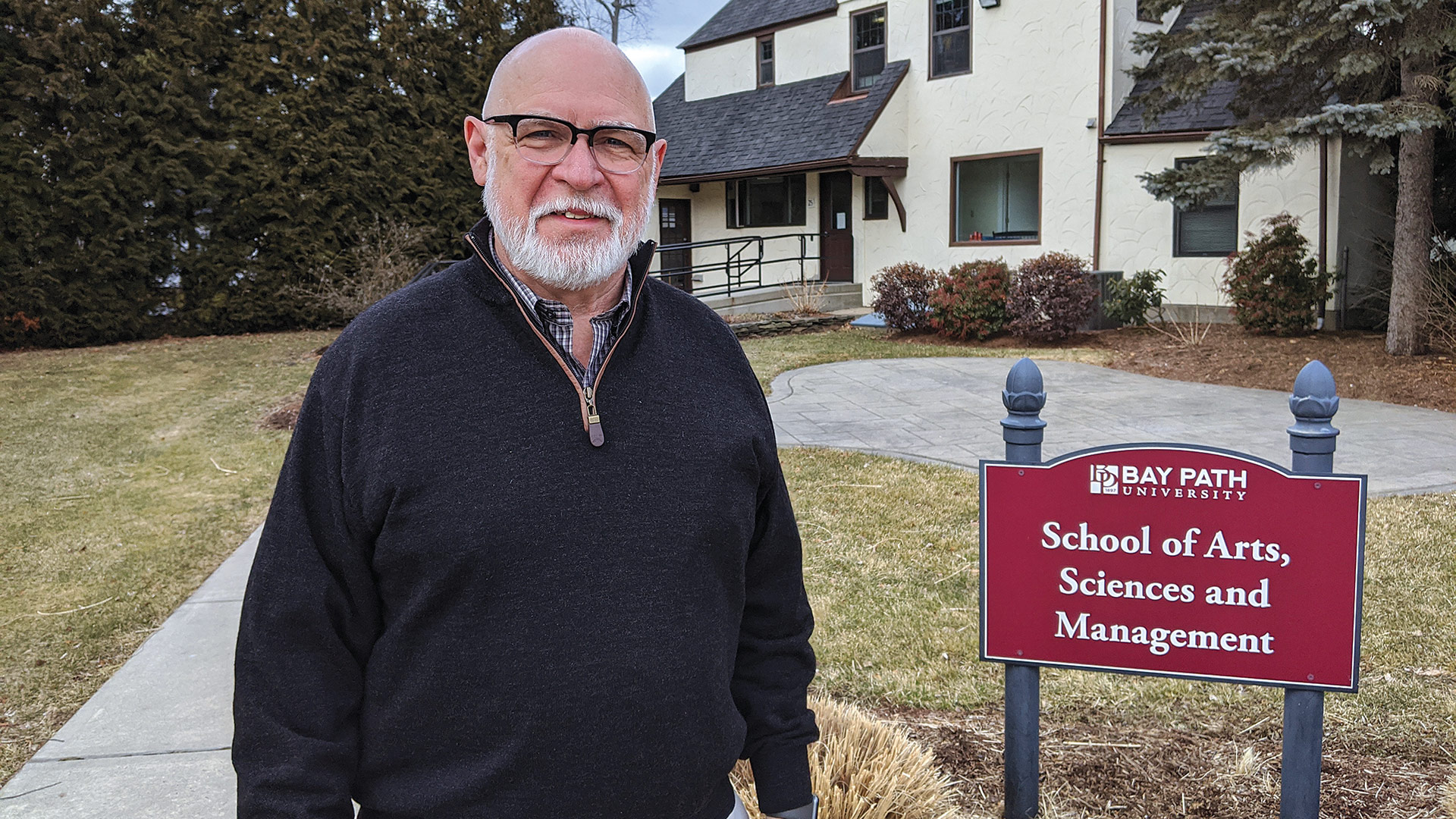
Everyone knows what cybersecurity is. Fewer know what people who work in the field actually do — and how much they earn.

And that’s a problem, Tom Loper said, when it comes to drawing young talent into a field that desperately needs it — and will need it for many years to come, as the breadth and complexity of data threats continue to evolve.

“That’s why we need to start with the high-school students,” said Loper, associate provost and dean of the School of Science and Management at Bay Path University. “They don’t really understand cybersecurity, and that’s a big problem because we have this incredible shortage of folks qualified to work in cybersecurity.”

Bay Path is doing its part, he said, not only with two undergraduate programs in the field and a graduate program in cybersecurity management, but by actively promoting those tracks to incoming students with undecided majors.

“We allow them to take cyber courses that first semester just to try it out, and the whole faculty is steering them toward it because the pay is so good in this field. Most of the ones who take it, believe it or not, they stay in that field,” he said, noting that about 90 students are currently enrolled in the three programs. “That’s a pretty good number for a small school like this. Now, we’re trying to get more high-school students to understand.”

“Companies are becoming more savvy. They’re asking, ‘how protected am I?’ The word’s getting out there, but unfortunately, it’s getting out because someone hears that a friend or another company got attacked.”

Loper said Bay Path’s programs are tailored specifically to the requirements of various cybersecurity careers, so students can get entry-level jobs immediately and go on to earn whatever further industry certifications they may need. “We have graduates making $60,000 to $80,000 coming out of school with these degrees. And if they get some experience before graduation, they’re worth even more.”

Tom Loper said cybersecurity is a complex challenge best tackled from a region-wide, ‘ecosystem’ perspective.

To that end, Bay Path recently won a grant from the Mass Cyber Center at MassTech to support internship and workforce experiences for students. That’s just one aspect, he said, of the way the region can build a cybersecurity hub from what he calls an “ecosystem perspective,” one that encompasses high-school and college students, workforce-development programs, government agencies, and business sectors where cybersecurity is important. These days, that’s most of them.

“Companies are becoming more savvy,” said Mark Jardim, lead engineer at CMD Technology Group in East Longmeadow. “They’re asking, ‘how protected am I?’ The word’s getting out there, but unfortunately, it’s getting out because someone hears that a friend or another company got attacked. But they are calling us and saying, ‘how can we be more protected?’”

Chris Rivers, vice president of Phillips Insurance in Chicopee, agreed that more companies are coming around to the threat potential.

“It sometimes depends on whether they’ve had an incident or a near miss,” he said, adding that, while people may hear news reports about data breaches at large companies, no business of any size is totally immune.

In fact, “smaller businesses tend to have less security, and sometimes it’s easier for hackers to get in there, taking credit-card information or any type of information, really. Think of a law office, and the risk of private information being taken and used against clients.

“Things we’ve preached over the years still hold true — they just keep changing the vector of attack. And the damage to smaller companies is more significant because they often don’t have the resources to deal with it, and it’s painful.”

“If you have a breach and data is stolen,” Rivers added, “it can get pretty costly.”

Data security has become a primary form of business insurance at all commercial agencies, but a policy to recover damages, even a comprehensive one, isn’t enough; the long-term brand damage, Rivers noted, is much harder to quantify. “Once your reputation is gone, it’s gone.”

The fact that businesses are catching on to this reality, combined with high-tech advances that will making defending against cybercrime more challenging, has created significant opportunities in what promises to be one of the most important career fields over the next decade.

Human Nature

Charlie Christianson, president of CMD and its sister company, Peritus Security, said data breaches cost companies $11.5 billion in 2019. And the threats come in many forms.

“Things we’ve preached over the years still hold true — they just keep changing the vector of attack,” he told BusinessWest. “And the damage to smaller companies is more significant because they often don’t have the resources to deal with it, and it’s painful.”

The human element to data breaches is still prominent, as e-mail phishing schemes remain the number-one way cybercriminals gain access to networks. These often arrive with URLs that are very close to a legitimate address. More importantly, phishers are ever-honing their ability to replicate the tone, language, and content of the supposed sender.

“They look incredibly realistic,” Christianson said. “A week doesn’t go by where we don’t get one and say, ‘wow, this looks good.’ For people who don’t live it every day, it can be very easy to fall into the trap. The trick is to just stop and think about it before you click on it.”

These attacks are more specific and targeted in the past, he went on, but they’re not the only way data thieves are getting in. Another is through employees’ personal devices, which don’t typically boast the security features of a large corporate system.

“Devices are hit and used to launch an attack, or they’re infected and brought into a secure environment. What’s on that device can get into the corporate network and spread,” he explained, which is why many companies have tightened up their BYOD (bring your own device) policies.

“That’s slowing down as businesses are becoming aware of the risk,” Jardim added. “We’re actually seeing a trend of slowing down the bring-your-own-device idea in the workforce; companies are saying, ‘maybe we shouldn’t do that because attackers are using those vulnerabilities.’”

The trend known as the internet of things, or IoT, poses new threats as well, Christianson said.

“When people think about securing their network, they think about their computers, their servers, their tablets, things like that. But they don’t think about the SimpliSafe security system or the time clock that hangs on the wall or the voice-over-IP phone system they use every day. You have all these devices that aren’t being maintained — they just let them run.”

He knows of one company that was attacked through its security-camera system, and said segmenting networks is one way to minimize such a threat. “That shouldn’t be on same network as your finances.”

The defenses against breach attempts are myriad, from password portals and multi-factor verification of online accounts to geoblocking traffic coming from overseas.

“A lot can be done with training,” Christianson said. “The most important thing you have in your business is your people, and educating people how to act and what to do when they see something — to make your staff savvy — is one of the most beneficial things you can do.”

Mark Jardim (left) and Charlie Christianson say cybercrime is constantly evolving, and so must the strategies businesses employ to prevent it.

It’s definitely a challenge, Jardim added. “We have to protect every single door and window, we have to be right 100% of the time, and a hacker just needs to find one vulnerability.”

Cultivating an Ecosystem

That list of threats and defenses — which only skims the surface — drives home the need for a more robust cybersecurity workforce, Loper said.

“We believe you have to take a regional approach to cybersecurity,” he noted. “We don’t believe you can just think of yourself as island unto yourself. Whether you’re a big organization or a small organization, you’re part of the supply chain, and there are opportunities for breaches. Everyone is connected.”

Boosting workforce-development programs is one spoke on the wheel. “It needs more attention. At one point, we didn’t have enough tool and die makers. The Commonwealth got behind it, and now we have enough. Something like that is going to happen in the high schools, and across this region, where we’re retraining people to work in this space just because there are so many opportunities.”

“The most important thing you have in your business is your people, and educating people how to act and what to do when they see something — to make your staff savvy — is one of the most beneficial things you can do.”

One plan is to develop a ‘cyber range,’ which is a simulated IT environment that emulates the IT structure of businesses, Loper explained. “We can bring people into the cyber range and help them deal with threats to a simulated environment.”

All these strategies are running headlong into the rise, in the very near future, of 5G wireless connectivity, which will dramatically increase data speed — and perhaps security threats as well.

“The threat we have now is going to go on steroids with 5G and with IoT,” Loper said. “The opportunties for business development will be greater than ever, and the opportunities for penetration will be greater than ever as well. It’s amazing what’s happening with 5G — it’s mostly good, but pretty darn challenging.”

Those threats provide business for commercial insurers, and that coverage is important, Rivers said, but businesses have to think about their own common-sense defenses as well.

“As we do renewals or reach out to clients, we try to bring out what policies are available to them to protect them from different things,” he noted. “It’s easy for us to recommend everything, but there’s a cost, so we try to inform them what’s out there so they can make decisions — ‘do I want this? Do I want that?’”

Rivers cited a statistic from Philadelphia Insurance Companies, which reports that the average cost of a data breach is $204 per lost record, with more than half of such costs attributable to lost customers and the associated public-relations expenses to rebuild an organization’s reputation.

“It’s one thing to take the data out, but when your brand is affected because you’ve had this incredible breach, that’s something else,” Loper added. “Your brand is what people think it is; it’s not what you think it is, like in the old days. Now, just look on social media, and that tells you what your brand is. Cybersecurity is one of those things that, if not done properly, can undermine your brand so quickly.”

In the end, Jardim said, the idea is to minimize risk.

“I always joke, the most secure machine is one that’s shut off in a locked room, but you have to find a balance,” he said — one that employs measures from simple common sense to choosing the right firewall.

“We see clients who have $5 million businesses buying a $100 firewall from Staples. You’re not going to protect your infrastructrure with that. You need the right equipment for your size. You need professional stuff for your business — you can’t use the same equipment you buy for your house for your business.”

“Well, you can,” Christianson added quickly, noting just one more way people might take a limited view of cybersecurity threats — and come to regret it.

Joseph Bednar can be reached at [email protected]

Community Spotlight

Community Spotlight

Mark Avery, co-founder of Two Weeks Notice Brewing, says the company is working hard to build its brand.

Mark Avery says he doesn’t tell the story as much as he used to — maybe because so many people have heard it by now — but he still gets asked on a fairly regular basis.

And he never tires of telling it, because it’s a good story — and, perhaps more importantly, it’s good marketing.

As he recalls, he was out driving one day and thinking about how great it would be to finally give his two weeks notice at work and start making a living doing what had become his passion — brewing beer.

“And that’s when a lightbulb went off in my head,” he said, “and Two Weeks Notice Brewing was essentially born. I Googled it to see if anyone else had it, and luckily no one else did.”

“The vast majority of what we see is redevelopment projects, and we see a steady amount of development happening every year.”

Today, Avery and business partner Derrick Upson — the individual to whom he left those two weeks notice — are brewing a number of labels at their location on Bosworth Street in West Springfield, across Memorial Avenue from the Big E. They include everything from ‘Resignation IPA’ to ‘Casual Friday,’ a pale ale; from ‘West Side Big Slide,’ another IPA that features the Big E’s famous yellow slide on the label, to ‘Bumby Love,’ an imperial stout. Meanwhile, the tap room the partners opened soon after labeling their first can has become an increasingly popular venue, as evidenced by the large crowd on a recent Saturday.

Thus, Two Weeks Notice has become one of many intriguing development stories in West Springfield in recent months. Or redevelopment stories, as the case may be. Indeed, while this community of 29,000 lies on the crossroads of New England, literally — both I-91 and the Mass Turnpike have exits in it — there isn’t much undeveloped land left. Thus, most of the new-business stories involve redevelopment of existing property.

City Planner Allyson Manuel says many of the business projects in West Springfield involve redevelopment of existing properties.

In the case of Two Weeks Notice, it was a comprehensive renovation of the former Angie’s Tortellinis property, a complicated undertaking, as we’ll see. And there have been several others in recent years, said City Planner Allyson Manuel, listing everything from a new seafood restaurant taking the site of the old Bertucci’s on Riverdale Street to remaking an old junkyard operation into the Hot Brass shooting and archery range just off Memorial Avenue.

And now, the city is looking to write more of these stories, especially at two landmark restaurants on or just off Memorial Avenue that are now sporting ‘closed’ signs in their windows.

One is the site that most still refer to as the Hofbrahaus, even though that restaurant closed several years ago, with 1105 Main (also the address) opening in that same space. The other is the small but nonetheless significant White Hut, an eatery with a very loyal following that closed abruptly a few weeks ago.

The site has been in the news almost constantly since, with TV film crews seen getting close-up shots of that aforementioned sign, with most of the news centered on exploratory efforts by Peter Picknelly and Andy Yee, principals of the Bean Restaurant Group, to launch another rescue operation.

The first, of course, was a reopening of another culinary landmark, the Student Prince in downtown Springfield, after it closed briefly in 2014. At press time, the partners were still essentially crunching numbers, said a spokesperson for the Bean Group, adding that a decision on the fate of the beloved burger restaurant would be coming “soon.”

Two landmark restaurants in West Side — the White Hut, above, and 1105 Main (formerly the Hofbrauhaus), now have ‘closed’ signs in their windows.

Meanwhile, there are other properties awaiting redevelopment, said Manuel, listing the former home to United Bank on Elm Street and a mill property off Front Street that was gifted to the city by Neenah Paper Co. in 2018, among others.

But the more pressing news involves infrastructure, she told BusinessWest, adding that the city, and especially businesses along Memorial Avenue, eagerly await the completion of what amounts to the replacement and widening of the Morgan-Sullivan Bridge, which connects the city to Agawam; the latest target date is late summer 2021, an improvement over the original timetable due to incentives being offered by the state for early completion. The other major project is an upgrade to Memorial Avenue itself, a comprehensive project that calls for reconfigured lanes and a bike lane and promises improved traffic flow.

For this, the latest installment in its Community Spotlight series, BusinessWest tells West Side’s story, which is increasingly one of redevelopment.

Feeling a Draught

Avery told BusinessWest that the Angie’s Tortellinis property — it actually had other uses after Angie’s moved to Westfield several years ago — had been vacant for some time when he and Upson first looked at it.

By then, at least a few other brewers had been through and decided that the property would be too difficult to convert for that use. They thought otherwise, although they conceded it would be a stern challenge.

“There were drop ceilings everywhere, the heat hadn’t been on in more than a year, probably … it was a dump when we got it,” he recalled, adding that a number of refrigeration units had to be ripped out and the area that is now that tap room required almost complete demolition and rebuilding.

Backing up a bit, and returning to that story about the name now over the door, he said Upson was his boss at a company called Pioneer Tool Supply, which was located in West Springfield when he started and eventually relocated to the industrial park in Agawam. When not working, Avery was spending most of his time home brewing — and thinking about taking that from a pastime to a career.

After that lightbulb moment noted earlier, he had a name, and he also had several recipes. He was set to partner with another individual and open a brewery in Westfield, but the two eventually concluded that the partnership wasn’t going to work. That’s when Upson, who by then was big into craft beers, entered the equation, and Avery eventually did give his two weeks notice.

They started selling cans in the fall of 2018 and haven’t looked back. The company’s various brands are now on tap in a number of area bars and restaurants, including several in West Springfield and Agawam, and loyal followers can buy cans at the brewery. On the Saturday we visited, Avery had just finished brewing a batch of what he called Performance Review 13 — and, yes, there were a dozen versions before it.

“These are the beers where I kind of play around with different hops, different yeasts, and different styles if I want to,” he explained. “It gives me a little creativity to break up the monotony of production.”

The tap room is now open Thursday through Sunday, and while business — and growth — have been steady, Avery says more aggressive marketing, and just getting the word out, is perhaps the company’s top priority at the moment.

“We’re working to get our name out — we’re still fairly unknown at this point,” he explained. “People will come in and say, ‘this is the first time we’re been here,’ or ‘we’ve never heard of you guys’ — even people in West Side. So we need to change that and grow the brand. For the most part, it’s just doing interesting and fun events.”

While Two Weeks Notice Brewing goes about building its brand, there are other things brewing in West Springfield, pun intended. Especially those infrastructure projects.

Like its neighbor to the west, Agawam, West Side has struggled during the lengthy but very necessary project to replace the 70-year-old Morgan-Sullivan Bridge. Gene Cassidy, president and CEO of the Big E, which worked with officials in both cities to minimize the impact of the bridge work during the fair’s 17-day run, said businesses along Memorial Avenue have definitely been affected by the project, which began roughly 18 months ago.

“In the late afternoons, traffic gets backed up all the way to our to our main entrance,” he said, noting that it is several hundred yards from the bridge. “Many businesses are struggling, and people are going elsewhere to do business.”

He praised the state for incentivizing the contractor handling the work, Palmer-based Northern Construction Service, thus pushing up the closing date and making this fall’s Big E hopefully the last that will have to cope with the bridge work.

But not long after that project is over, another much-anticipated project, the redesign and reconstruction of Memorial Avenue, will commence, said Manuel, noting there is no timetable at present, but the target date is the spring or summer of 2022 — after the bridge project is done.

When asked to summarize the scope of the project, she summoned the phrase ‘road diet’ to describe what will take place before elaborating.

West Springfield at a glance

Year Incorporated: 1774
Population: 28,529
Area: 17.5 square miles
County: Hampden
Residential Tax Rate: $16.99
Commercial Tax Rate: $32.65
Median Household Income: $40,266
Median Family Income: $50,282
Type of Government: Mayor, City Council
Largest Employers: Eversource Energy, Harris Corp., Home Depot, Interim Health Care, Mercy Home Care
* Latest information available

“This is the new best practice, and it involves reducing the amount of pavement while at the same time incorporating amenities or facilities for transportation other than personal vehicles, such as bikes, pedestrians, and buses,” she explained. “By designing it more efficiently, especially when it comes to the intersections and turning areas, you ideally need fewer lanes — that’s what is meant by road diet.

“The plans are not finalized,” she went on. “But it will have a bike lane and new sidewalks and trees; in addition to trying to improve traffic flow, it’s also a beautification project.”

Thus, there will be significant change to a thoroughfare that is already in a seemingly constant state of motion, not only with vehicular traffic, but also with businesses coming and going.

That’s certainly the case today, with a new, larger Planet Fitness opening in the Century Plaza, and the fate of both the White Hut and the Hofbrauhaus property still unknown.

Both landmarks date back to the 1930s, and they have become part of the landscape on Memorial Avenue, said Manuel, adding that the hope is that both will soon have new names over the door, or, in the case of the White Hut, perhaps the same name but with new ownership.

As for the Hofbrauhaus property, it presents both challenges and opportunities.

“The size of the facility is a bit daunting for another restaurant,” she noted. “But the location is so good that I’m sure that something will happen there.”

Meanwhile, movement is also a constant on the other major thoroughfare in the city, Riverdale Street, where the new seafood restaurant is set to open soon, said Manuel. It’s not far from a recently opened Marriott Courtyard, which was built on the site of the former Boston Billiards, yet another example of redevelopment in this city.

“The vast majority of what we see is redevelopment projects, and we see a steady amount of development happening every year,” she said, adding there are many other examples of this, including the ongoing expansion of Titan Industries on Baldwin Street, Hot Brass, and the Holyoke Creative Arts Center moving into one of the mills vacated by Neenah Paper.

Lager Than Life

The hope, and the expectation, is that this pattern will continue, Manuel said, adding that, while the city is indeed land-poor, it is opportunity-rich given its location, easy accessibility, and inventory of properties that can be redeveloped.

Sometimes it takes some imagination and determination — as was certainly the case with Two Weeks Notice and the former tortellini factory — but West Springfield has generally proven to be a mailing address worthy of such diligence.

Avery noted the same while finishing that batch of Performance Review 13, which will hopefully become yet another positive chapter in a business story written in a city where more such sagas are penned each year.

George O’Brien can be reached at [email protected]

Meetings & Conventions

Making a Match

Mary Kay Wydra (left) and Alicia Szenda say the region’s recent momentum and new attractions have made it a stronger sell to event and convention planners.

Conventions are good business for a city like Springfield. But they don’t exist in a vacuum.

“We’ll ask if they have time for things outside their program,” said Mary Kay Wydra, president of the Greater Springfield Convention & Visitors Bureau (GSCVB). “Are they bringing spouses? Will they have time, either pre-event or post-event, to go to Yankee Candle, or Six Flags, or the Seuss museum?”

“That’s part of their convention experience as well,” added Alicia Szenda, the GSVCB’s director of Sales. “They might be at the MassMutual Center for three or four days, but they might do a couple off-site events, too. We can help them — ‘OK, do you want to do the Springfield Museums? The Hall of Fame? What is it that your group is interested in?’ Because we do want them to have a good experience and feel welcome.”

Both Wydra and Szenda share a philosophy that, while conventions and major sporting events positively impact the region during the weekend or week they’re around, they also pose an opportunity to draw convention-goers back in the future — either as a group for future events, or individually, as leisure travelers.

That’s why attracting convention business focuses not just on the venue, lodging, and amenities involved in the event itself, but on the entire region.

“Our goal is always to expose them to more of what we have to offer,” Wydra told BusinessWest. “Sometimes we whet their appetite, and they come back as a leisure visitor. That’s a goal. If we do our job right, they’ll come back again.”

And when they’re here, they’ll spend money, from hotels and restaurants to gas stations and recreation destinations, Szenda added. “We’re really lucky we have great attractions, and that’s enough to keep people entertained while they’re here and get them to come back.”

The convention and event mix in 2020 is a diverse agenda, one featuring newcomers and repeat business alike. The city recently hosted the New England Fence Assoc., which the GSCVB had been trying to bring in for years, as well as the New England Region Volleyball Assoc. (NERVA). In its sixth straight year here, the latter event filled 2,000 hotel-room nights over the course of a weekend.

The city will also host the Amateur Athletic Union volleyball super-regional in March — partly because someone who took part in the NERVA event liked what he saw from the city. “We’re hoping that becomes annual as well,” Szenda said.

Other upcoming events include the largest collegiate fencing competition in the country and a First Robotics event at the Eastern States Exposition, both in April; a gathering of the National Assoc. of Basketball Coaches in May; and Hooplandia in June. And that’s just the tip of the iceberg.

In all cases, Szenda said, the goal is to match what an organization needs with what a venue — and the city and region — have to offer. Take the International Jugglers’ Assoc., which convened in Springfield last year.

“This group was looking to go anywhere in the country, so we looked at their parameters and put together a proposal. They needed a convention center, two full-service hotels within walking distance, a historic theater, and a fun kind of bar atmosphere with a stage. I read that and was like, ‘that fits perfectly here,’” she recalled, noting that Symphony Hall was an ideal theater, and Theodores’ fit the bill for the bar.

Our goal is always to expose them to more of what we have to offer. Sometimes we whet their appetite, and they come back as a leisure visitor. That’s a goal. If we do our job right, they’ll come back again.”

The GSCVB will also suggest gathering options that planners might not know about — perhaps a cruise outing on the Lady Bea, or an outdoor reception at the Springfield Museums. “You can have a unique dinner event on Center Court at the Basketball Hall of Fame. Nowhere else in the world can you do that event. We try to be creative, and try to really hype the assets we have.”

Rising Interest

The GSCVB has seen an uptick in conventions in recent years, and Szenda is constantly talking with hotels, asking them to quote rates and block off a certain inventory of rooms, sometimes three years out. Then she gets to work finding the aforementioned local connections, setting up reasonably priced hotel options and assembling tourism information about the region.

The bureau also boasts a hospitality program that many similar-sized cities don’t offer, which includes everything from airport pickups and hotel greeters to downtown maps and goodie bags.

“At the end of the day, it’s about sales,” she said. “We go to trade shows, but we also get leads from locals who live around here who might be part of national associations or hobby groups or special-interest groups who want to bring the event they travel to every year here. Once we make that initial contact, the process becomes pretty streamlined. We want to get all the information we can from them — how many room nights do they need? What kind of venue do they need?”

Organizations based in New England already see Greater Springfield as a convenient location, with interstates 90 and 91 intersecting here, and they might be aware of its recreational and hospitality options. Those from far away, though, may need some convincing, and that’s what Szenda does when she attends those industry trade shows, where she may schedule appointments with up to 30 meeting planners or sporting-event organzers to talk about how this region suits their needs.

“We’re Western Mass. — we don’t have the cachet of a first-tier city, like Boston or Chicago,” Wydra said. “With national groups, a lot of times, that’s where a local person comes into play.”

For instance, the National Square Dance Convention, a national gathering of Daughters of the Nile, and a large insurance convention all landed in Springfield in recent years because a local member got the ball rolling. “I think the local tie to national groups is a really important and powerful one for us.”

One selling point is that national groups that hold conventions in the Pioneer Valley get plenty of local attention — everyone knows they’re here, and are often excited about it.

“We tell the event planner, ‘you’re going to be a big fish in a little pond,’” Wydra said, noting that Daughters of the Nile held its convention in Orlando the year before coming to Springfield. “I don’t know if the local people knew they were in Orlando. But when they came to Springfield, there was a story or photograph in our mainstream media, talking about this group, every day they were here. You kind of take over our city, our region.”

Another plus? Springfield is a different city than it was five years ago, with MGM Springfield, the Seuss museum, and ongoing Basketball Hall of Fame renovations among the recent major stories.

“I go to these trade shows, and all they want to know is what’s new,” Szenda said. “With some cities, they sit there and say, ‘we’ve got the same stuff,’ but we’ve been able to go every year and say ‘this is what’s new, this is what’s new.’”

Wydra agreed. “That makes our job so much easier and more exciting. The sell is easier when we can say we’ve added these things.”

Key Connections

‘It takes a village’ is a bit of a cliché, Wydra admitted, but in the GSCVB’s case, it really is true, especially when it comes to booking events and providing the kind of experience that will bring people back.

“It does take a village to host a group of people. Everyone’s got to work together,” she said, adding that the region is fortunate to have assets like Eastern States, a campus-like setting with plenty of parking and room for large equipment, not to mention a modern convention center in the heart of Springfield and a couple of anchor hotels downtown complemented by a growing roster of lodging options around the region.

“Anyone who lives here and belongs to a group or goes to an event they want to host, they should contact me,” Szenda said, putting that sales hat back on for a moment. “If we get the site visit, we have a better shot of landing that event.”

“We do the work for them,” Wydra added. “We try to make it as easy as possible, but those local leads are so important.”

Joseph Bednar can be reached at [email protected]