Home Posts tagged Departments (Page 7)
Company Notebook Departments

Springfield College, STCC Sign Articulation Agreement for IT Students

SPRINGFIELD — Springfield Technical Community College (STCC) and Springfield College recently signed an articulation agreement allowing students at Springfield College to take Information Technology classes at STCC, recognizing the high quality of the Computer and IT Security program offered at STCC. Additionally, the agreement allows STCC students completing an associate’s degree in Computer Information Technologies to transfer to Springfield College as juniors in their Computer and Information Sciences major. “The agreement between STCC and Springfield College is historic because it gives bilateral pathways for STCC students to continue their education by earning a bachelor’s degree at Springfield College and it allows Springfield College students to gain access to the computer networking and security curriculum and expertise offered at STCC,” said Brian Candido, STCC Computer Information Technologies program chairman and associate professor. “It is a true win-win scenario for all students and faculty at both institutions.” Candido said the two colleges have been working together in this capacity since 2008 through the Cooperative Colleges of Greater Springfield (CCGS). The formal signing of this articulation agreement not only creates an opportunity for STCC students to transfer to Springfield College as juniors, but also allows STCC students to become eligible for school-based scholarships based on their grade-point averages. For Springfield College student Karon Perkins, the partnership between STCC and Springfield College gives him access to a top-notch IT program as well as a chance to experience campus life at another college besides his own. “STCC offers a good selection of programs not offered at Springfield College,” said Perkins. “And having the opportunity to come to STCC gives me a taste of a different college — what it’s like to be on a different campus — and I’ve learned a lot.” Leona Ittleman, dean of STCC’s School of Business and Information Technologies, credits both STCC and Springfield College faculty for the work they have done to make this agreement between the campuses a reality. “Some of our best students transfer to Springfield College and receive the benefits of our colleagues’ experience and dedication to student learning,” she noted. The Computer and Information Sciences major at Springfield College is a professional program that offers a solid core of theoretical and applied computer-science courses and provides students with the choice of one of four required concentrations: Information Systems, Software Development, Game Programming, or Internet and Network Security.


Big Y Raises $194,000 to Fight Breast Cancer

SPRINGFIELD — In order to raise awareness and funds to fight breast cancer, all Big Y Supermarkets donated proceeds from the company’s October initiative “Partners of Hope” to 17 breast-cancer support groups throughout Massachusetts and Connecticut. This month-long program reflects the partnership, commitment, and support of breast-cancer awareness and research that are so vital for many. In October,  Big Y raised $194,000, which was donated to nearly two dozen organizations. Locally, these included the Women’s Imaging Center at Berkshire Medical Center, Rays of Hope, and the Mercy Breast Care Center. “Big Y is committed to promoting breast-cancer awareness to our community,” said Big Y CEO Donald D’Amour. “Over the past five years, we’ve made tremendous progress thanks to our customers, vendors, and employees. In addition, these funds benefit local programs throughout our region. It is truly a collaborative effort.” Since 2007, the chain has raised more than $863,000 for this cause. During the entire month of October, specially marked ‘pink’ products and promotions involved almost every department in the store. Big Y donated a portion of the proceeds from several departments, including floral and produce. Many other items with pink packaging were available, and their manufacturers also made a donation of a portion of their proceeds for breast-cancer research as well. Big Y’s pink, reusable, earth-friendly shopping bag highlighting the breast-cancer awareness campaign were available, and every store promoted Partners of Hope pink ribbons for $1 as a way of generating additional proceeds for breast-cancer organizations throughout Massachusetts and Connecticut.


Cooley Dickinson Named a Leapfrog Top Hospital

NORTHAMPTON — Cooley Dickinson Hospital is one of 92 hospitals nationwide and eight in Massachusetts named to the Leapfrog Group’s annual list of Top Hospitals, which was announced on Dec. 4 at Leapfrog’s annual meeting. “It is because our doctors, nurses, allied-health professionals, and staff take the steps necessary to ensure that our patients receive safe, high-quality care that Cooley Dickinson achieved this recognition,” said Craig Melin, president and CEO. “Being named a Top Hospital is validation from an independent authority that our staff is continuously focused on delivering a high quality of care. Ultimately, our patients benefit most from our efforts, because they are less likely to experience quality or safety events at Cooley Dickinson.” Leah Binder, president and CEO of the Leapfrog Group, said the Top Hospital distinction “is by far the most competitive award a hospital can receive. Leapfrog holds hospitals to the highest standards on behalf of our purchaser members and their employees. By achieving the Top Hospital accolade, Cooley Dickinson has demonstrated exemplary performance across all areas of quality and patient safety that are analyzed on the Leapfrog Hospital Survey.” Besides announcing this year’s Top Hospitals, the Leapfrog Group focused on transparency as the key to improved hospital safety at its annual meeting. Cooley Dickinson was selected as a Top Hospital out of nearly 1,200 hospitals participating in the Leapfrog Group’s annual survey. Hospitals reaching this achievement include academic medical centers, teaching hospitals, children’s hospitals, and community hospitals in rural, suburban, and urban settings.

Top Hospital selections are based on the results of the Leapfrog Group’s annual hospital survey, which measures hospitals’ performance on patient safety and quality, focusing on three critical areas of hospital care: how patients fare, resource use, and management structures in place to prevent errors. The results of the survey are posted at www.leapfroggroup.org/cp.

Health Care Sections
Baystate’s New ED Is Focused on the Patient Experience

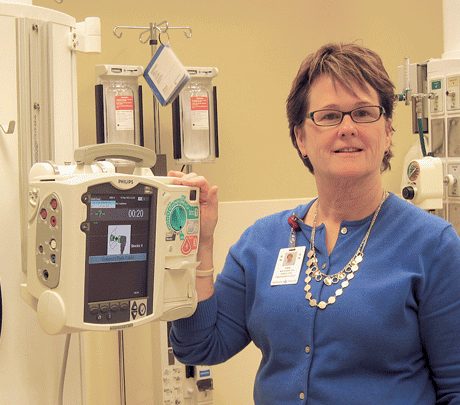
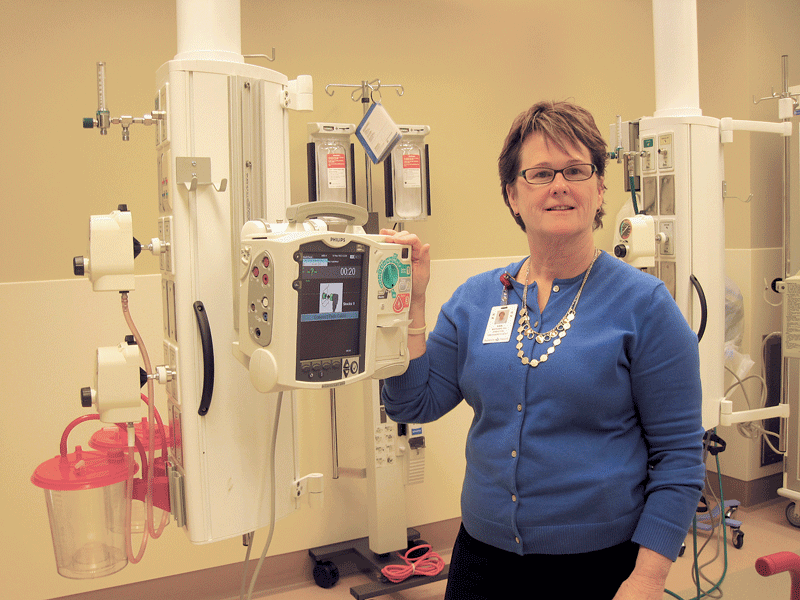
Ann Maynard

Ann Maynard says the new emergency department at Baystate Medical Center was designed with the patient experience in mind.

Ann Maynard acknowledged that visitors to Baystate Medical Center’s new, 73,000-square-foot emergency department will likely spend less time there, on average, than they would in the 17,000-square-foot facility it is replacing.

But getting patients seen, treated, and back out the door in good order is not the overriding mission of the new ED — although that’s certainly a big part of it, said Maynard, a registered nurse and director of Emergency Services for Baystate.

Instead, overall patient satisfaction is the guiding principal behind every facet of the new facility — from the colors on the walls to the sheltered ambulance bays; from the private rooms (each with their own sink and supplies) that replace bays with sliding curtains in the old ED, to a more comprehensive triage system.

“We’ve focused on comfort and privacy as much as expediency,” said Maynard, stressing repeatedly that so-called wait times will be improved. “This is not about time, but what’s happening while you’re waiting. Now, you’ll be in a private room with your family, and not in a hallway where people have to move your stretcher to get to a sink.”

Maynard made these observations and many others as she gave BusinessWest a tour of the expansive, $45 million ED, which officially opened its doors on Dec. 3.

Part of what was known before it was built as the Hospital of the Future, the ED was christened at an elaborate grand opening on Nov. 30 that was attended by more than 200 people and featured comments from Maynard; Baystate President and CEO Mark Tolosky; Richard Steele, chairman of the Baystate board of directors; and Niels Rathlev, chairman of Emergency Medicine for the system.

Among the many common threads among those speeches were the phrase ‘state of the art,’ the clear need for such a facility within the community, and the fact that the new ED came about through exhaustive research and the feedback of not only who will work in this unit, but those who will be treated there.

This point was stressed repeatedly by Maynard as she took BusinessWest through the new ED’s six ‘pods,’ waiting rooms, and other facilities a few days before the unit opened its doors.

“When we started this project, there were some guiding principles,” she said. “When we made decisions, we made them looking through the patient’s eyes and the staff’s eyes. And we always went back to patient safety — with each decision we made, we started with, ‘how will this affect our patients?’”

And this philosophy helps explain everything from the tiny, low-to-the-ground toilets that sit beside standard units in the pediatric pod, to the laptops in the children’s waiting room, to an expedited registration process.

For this issue and its focus on healthcare, BusinessWest takes readers on their own tour of the facility, in a figurative sense, and explains the many thought processes behind its design and operating model.

Space Exploration

The pediatric pod at the new ED

The pediatric pod at the new ED has its own entrance, triage area, look, and feel.

Maynard said the new ED was originally scheduled to be a big part of phase 2 of the Hospital of the Future, but was eventually moved into what she called the “fast lane” because of the basic inadequacy of the facility it has replaced.

The now-former ER, last updated in 1985, was originally designed to treat roughly 60,000 patients a year. In recent years, however, it was administering services to roughly twice that volume, and with obvious negative impact on overall patient experience.

“Just that constraint alone needed to be fixed,” she said, referring to the ED’s footprint. “We were really limited by the space we were in.”

The new ED is not merely almost four times larger than the old one in terms of square footage, said Maynard, noting that, in addition to more room — 94 private rooms compared to 48 bays — it has a design and individual components chosen to both create efficiencies and improve the overall experience for patients and family members.

And as she talked about how it all came together, Maynard said those designing and building the new ER took the simple yet effective approach of putting themselves in the shoes of both the ED staff member and the patient, whether that individual was 4 or 94.

“We’ve had family-advisory groups that we’ve met with and had discussions with about their visit with us and their perception of the experience,” said Maynard, adding that those perceptions, perhaps as much or even more than the actual care administered, played into how the new facility was designed. “People think things like, ‘does anyone know I’m here?’ and ‘does anyone care that I’m here?’

“We save lives every day in this emergency department,” she continued. “And those people send us thank-you notes. It’s the patients who wait for five or six hours that became frustrated because of the  process that we had in place.”

The new ED was designed, in essence, to make such questions, and such frustrations, relics of the past, she said, adding that she was part of a large team that visited other emergency departments, conducted extensive research, and asked myriad questions of patients and staff to design a facility that will serve the system and the region for decades to come.

That team included ED staff and leadership, the architect firm hired to design the facility (Boston-based Steffian Bradley, which also designed the MassMutual Wing, another part of phase 1), and others within the system. This group visited other ERs of comparative size to Baystate, which is the second-largest facility in the state.

Those visits, and the answers to the questions put to staff, patients, and family, helped inspire a design and operating system that Maynard believes will address those issues of comfort, privacy, and expediency.


The Lights Fantastic

The feedback Maynard described has led to what she considers some vast improvements over the old emergency facilities.

And perhaps the most visible example is the pediatric pod, with its Disney-inspired characters on the walls in the waiting area, bright colors, counters shaped like lilypads, and even a strobe-light effect in the imaging room, designed to take the patient’s mind off what they’re going through.

Such features, in addition to the dedicated entrance, waiting room, and triage area, make sense on a number of levels, said Maynard, adding quickly that young children are not adults, nor should be treated like them — or near them — in the emergency department.

“Children should not have to compete for the adult resources or with the adult resources,” she explained. “Meanwhile, parents don’t want want to have their children exposed to what we see in the adult pods.”

The children’s waiting area has a reading area and computers, and each private room in that pod has a television set, she continued, adding that all of these features are designed to help make what is usually a traumatic experience for young people less so.

In their own way, each of the other pods — designated by letters and designed for various levels of emergencies — embodies that basic philosophy of the children’s unit, meaning a patient-focused approach.

The private rooms are good examples, she said, adding that, in addition to a sink — there were only 14 sinks total in the old ER — each one has its own supplies, chairs for family members, and adequate privacy. What’s more, staff members in each pod face these private rooms, where in the old ED, they had their backs essentially turned to patients.

“If you’re a patient and you’re on one of these stretchers, I [the attending nurse] have a computer I can do my documentation with, a monitor … all the supplies and equipment I need to take care of the patient are right here in this room,” she said while taking BusinessWest into one of the units in Pod B. “This makes things much more efficient when it comes to time — I no longer have to leave the room to get anything; it’s already here.”

The supply carts in each room, she went on, are stocked to handle the needs of four or five patients, which is about how many times a room will be turned over each day, saving more time for those attending to patients.

And these are just some of the elements that should enable the new ER to create quicker, as well as better, stays for the patients, said Maynard, adding that several measures and design features will likely improve wait times.

“From the minute the patient walks in the door, the focus is on how we get the patient to the doctor to start the treatment as quickly and safely as possible,” she said, adding that this process starts with triage, or, to be more specific, streamlining that process.

At Baystate’s new ED, triage and registration (known as ‘quick reg’) are essentially combined, with a nurse handling both duties, said Maynard, adding that treatment essentially begins at the point of triage.

Meanwhile, nurses can also handle protocol orders — blood draws, urine samples, and other matters — so that, by the time a patient sees a doctor, results from those tests are back.

As she talked about the improved triage system, she referenced something known as the emergency services index (ESI), which rates patients’ situations on a scale of 1 to 5.

That highest number might be assigned to someone with a minor rash, she explained, while a 1 would be an individual “with the potential of dying,” a patient with severe trauma, for example, or one going into cardiac arrest.

The pods in the adult portion of the new ED are arranged to treat people at various spots on the ESI spectrum, she explained, adding that, in the old ER, there was far less segregation, and therefore less efficiency.


To the Future

Maynard told BusinessWest that the new ED will not magically reduce the waits in the ER from four or five hours down to one or two.

It will still take time to properly and safely administer care, she stressed repeatedly, and the new facilities were designed to create a better, more efficient, more patient-friendly environment in which that can happen.

All this is certainly worth celebrating, and that’s exactly what the Baystate community did on Nov. 30.


George O’Brien can be reached at [email protected]

Company Notebook Departments

Square One Impacted by Gas Explosion

SPRINGFIELD — After the June 1, 2011 tornado wiped out their childcare and administrative offices in the south end of Springfield, Square One, a nonprofit childcare organization with facilities in Springfield and Holyoke, is now starting from square one again since the Nov. 23 late-afternoon gas explosion on Worthington Street severely affected the childcare space that the organization leased. Luckily, no one was in the space due to the holiday, but if it had been a typical Friday, about 100 children and 30 staff members would have been at risk. The site at 155 Chestnut St. is now condemned, forcing Square One officials to quickly find alternate childcare locations for 55 of the 100 children that were enrolled at that location and cannot be placed in Square One programs due to space. Since the explosion, Square One officials have been reaching out to all other providers in the community to identify what programming spaces for various age groups are available, and to walk parents through the relocation process. “We have people coming in every morning saying, ‘I have to go to work,’ ‘I have to go to school,’ ‘I need childcare now,’ and they do,” said Kim Lee, vice president of advancement. Other area nonprofits, including the YMCA on Chestnut Street, have offered some temporary space to Square One. “Our mission right now is to serve the children and their parents,” Lee said, “and if it means helping those families to find quality programming in another provider’s program, then that’s what we have to do.” The company still owns 947 Main Street, which was hit by the tornado, but it will have to be demolished and rebuilt. Lee said Square One is looking for temporary space near that original South End location, but nobody wants to sell or rent to them because everybody is holding out for the possibility of an MGM casino. “But if we do finally relocate there and the casino comes, we’ll be right I the middle of it all.” Childcare officials will continue to discuss short-term options and long-term opportunities.


Greenfield Big Y Completes Upgrades

SPRINGFIELD — As the last of many major remodeling efforts this past year, Big Y Foods Inc. announced the completion of the renovation of its Greenfield Big Y World Class Market at 237 Mohawk Trail, Route 2. Big Y has been a part of the Greenfield community since it opened its first store in 1987. In 2002, the company moved across the street to its current location. This past effort began in March and includes upgrades in every department, including new equipment and fixtures, new paint inside and out, as well as a new floor. All of the store’s fresh-foods departments had the most significant changes, including meals to go, delicatessen, seafood, bakery, produce, floral, and meat. There are also new gluten-free products as well as many more Latino offerings and additional locally produced wine and beers within the market. Lastly, the store has added some new, smaller-sized grocery carts for quick shopping trips. Ed Williams, store director in Greenfield, has 32 years of supermarket experience with Big Y. During his early years in the supermarket business, he worked in various department positions throughout the store. In 1989, Williams became a store director, managing stores in Northampton, Palmer, Greenfield, Chicopee, Southwick, Southampton, Springfield, and South Hadley. He moved back to this location last January. As part of the grand reopening celebration, Newton School, Math & Science Academy, Poet Seat Therapeutic Day Program, Greenfield Middle School, Greenfield High School, Discovery School at Four Corners, Academy of Early Learning, Federal Street School, 8th Grade Academy, Greenfield Center School, Eagle Mountain School, Cornerstone Christian School, and Stoneleigh Burnham School will each receive a donation of 500,000 Education Express Points toward free equipment and supplies for their schools. Big Y’s Education Express program has helped more than 2,000 local schools earn more than $13 million in free educational, sports, and electronic equipment since its inception.


Insurance Center Partners with Link to Libraries

AGAWAM — The Insurance Center of New England has become the latest area company to partner with the nonprofit group Link to Libraries in its Business Book Link Project. ICNE is sponsoring the Martin Luther King Jr. Charter School. Link to Libraries, in collaboration with the Insurance Center, will donate 200 new books each year for a three-year period as part of the Business Book Link Project, which has the twin goals of stocking school library shelves and getting students excited about reading. For more information on Link to Libraries, call (413) 224 1031 or visit www.linktolibraries.org.

Health Care Sections
SPHS Breaks Ground for a New Medical Office Facility

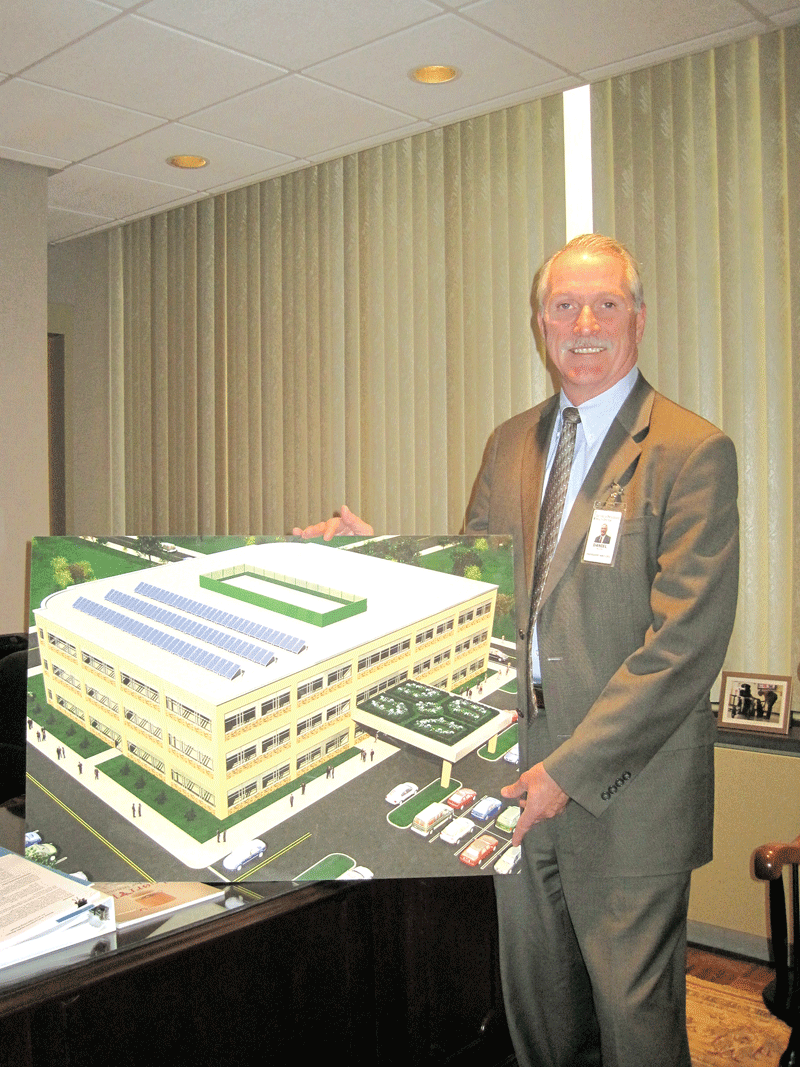
Dan Moen

A new, three-story, 75,000-square-foot medical office building is one more phase in what Dan Moen believes will be continued growth for Mercy Medical Center.

Dan Moen, president and CEO of the Sisters of Providence Health System (SPHS), is rather proud of the new silver ceremonial shovel in his office.

He told BusinessWest that it’s more than a souvenir from an elaborate groundbreaking ceremony staged late last month for a medical outpatient office building at the corner of Carew and Chestnut streets. It’s also a symbol of an intriguing partnership — and a fairly new and different business model.

Indeed, in a departure from past practice, SPHS will not own the three-story, 75,000-square-foot facility to be built on the Mercy Medical Center campus that will become the new home to the Weldon Rehabilitation Hospital’s outpatient rehabilitation programs, the Mercy Hearing Center, and two Mercy-affiliated physician practices. (Hampden County Physician Associates will also occupy half of the office space in the new facility through consolidation of several existing medical-practice sites in the area.)

Instead, it will lease the space from developer Carew Chestnut Partners, a firm with medical-commercial real-estate development and management. Under the terms of a construction and land-lease agreement, Carew Chestnut Partners will develop and own the new building, while the SPHS will maintain ownership of the land, which it will lease to Carew Chestnut Partners.

“In this case, we get revenue from leasing the land to the partnership, so that’s a plus for us, and we’re not using our own capital for a facility that we really need,” Moen explained. “For lack of a better term, it’s what we call a ‘non-core’ asset, meaning we don’t have to own it because there are developers out there that do a very good job at medical development, so it’s a win for everybody.

“I’m a big believer in the concept that we don’t have to own everything,” Moen continued, adding that the lease-back model is becoming popular among healthcare systems nationwide because it allows the hospital or system to do what it does best — while also freeing up resources for other medical programs — and developers to do what they do best.

“Many hospitals and healthcare systems across the country are doing this type of partnership these days because access to capital for hospitals can be scarce, and we want to make sure we are saving our debt capacity for those projects that only the hospital can do,” Moen explained.  “So if we want to expand a particular service that is hospital-based, an in-patient service or a cancer program, we want to make sure we have the ability to borrow money to do that.”

Andrew Henshon, managing partner of Carew Chestnut Partners, said his company has extensive experience not only in the construction and development of medical office space, but also in the management of such properties.

“We’re very pleased to participate in this new venture with Mercy Medical Center and Hampden County Physician Associates,” he said. “The new, environmentally friendly medical office building promises to be one of the region’s leading destinations for outpatient medical care and services.”

Plans for the facility were taking shape when Moen took the helm at SPHS in early 2011, but over the past 12 months, the project has come off the drawing board, and with a design that places a heavy emphasis on mopdern, ‘green’ building features and techniques.

“Whatever type of construction we want to do these days, we have to pay attention to the environment,” Mosen explained. “It’s the right thing to do, and it will cost us less money over the long run.”

Henshon told BusinessWest that green aspects of the development include solar panels, green roofs, water-efficient fixtures, high-efficiency heating and cooling systems, and recycled and environmentally friendly materials, including limited use of volatile organic compounds (VOCs).

The Mercy Hearing Center building, built in 1927, as well as an on-site maintenance building, will be torn down to make way for the new development, which Moen said is expected to be complete by December 2013.

The design, not to mention the operating model, are a reflection of the health system’s broad mission, said Moen.

“Mercy Medical Center is committed to the delivery of outstanding patient care and the best healthcare experience possible,” he explained. “This innovative partnership will allow us to further that goal so we can offer patients quality care in a spacious, bright, state-of-the-art setting that also features easily accessible parking.”

As the construction commences, Moen added that plans past the new building are being discussed.

“We just engaged a firm, MorrisSwitzer, to help us with a facility master plan for the campus,” he said. “This is a very experienced healthcare consultant firm, and it will help us look at what the campus will look like five or 10 years down the road.”

The master-plan discussions, being undertaken with all departments at SPHS, should take about six months to complete, he said.

For now, though, the focus is on the project just launched, which, like the shovel in Moen’s office, is symbolic of new partnerships and imaginative ways to meet the system’s mission and improve service to the region.


— Elizabeth Taras

Holiday Party Planner Sections
And for Banquet Managers, that Means Creating Opportunities

Rachel Voci, banquet manager at Tekoa Country Club

Rachel Voci, banquet manager at Tekoa Country Club

Andrew Calvanese, partner with his sons Vinny and Donald at the Storrowton Tavern in West Springfield, can remember a time when the holiday party season was literally booming.

“The ’80s were just incredible,” recalled Calvanese, who was then managing Suffield Country Club, noting that money was seemingly no object, and budgets were nonexistent.

To say that the times have changed would be a huge understatement.

“Today, we deal with some pretty big companies, and they are really watching how they spend their money; they are definitely budgeting,” said Calvanese, who fully expects that trend to continue this year, although he remains optimistic that more companies will be in a mood to party.”

Peter Rosskothen, president and CEO of the Log Cabin and Delaney House, takes a similar outlook. He said 2008 and 2009, the height of the Great Recession, were the worst years he’s seen in terms of holiday-party spending. Things have improved a little each year since, and he’s hoping that trend will continue.

Summing things up, he said he’s not wasting time pining for a return for those free-spending days in the ’80s; he’ll settle for what he called stability.

“It’s my hope that this year will get us close to where we were before the ’08 and ’09 disaster,” he told BusinessWest, “but I’m not so sure we’ll get there.”

Peter Rosskothen

Peter Rosskothen says 2008 and 2009 were bad years for holiday-party spending, but things have improved steadily since.

His guarded optimism is reflected in the results from the latest annual survey of corporate America’s holiday party plans conducted by Amrop Battalia Winston, a leading global executive-search firm, which conducted the survey among a cross-section of 120 companies.

In 2011, 26% of U.S. companies did not hold a holiday party, up 5% from the year prior, and nearly half cited budgetary issues as the reason why. Analyzing those numbers, Dale Winston, Amrop Battalia Winston’s chairwoman and CEO, said, “there was uncertainty about the speed of the recovery in 2010; that has been replaced by the certainty that the recovery has a long way to go.”

For this issue and its focus on holiday party planning, BusinessWest talked with area banquet-facility owners and managers about their expectations for the season ahead and the factors that will determine just how wonderful this time of the year will be for them.

Sign of the Times

Overall, the facility managers we spoke with say they’re enjoying a steady year thus far, and, in some cases, better than steady.

“Right through January, right up to now (post-Big E), to the end of the year, our banquet business is excellent,” said Andy Calvanese, noting that the family has noted consistent growth since they acquired the landmark nine years ago.

Offering a total of six room options, the largest being the Carriage House for 350 and the smallest, the Tavern, seating 35, Storrowton is one of the oldest establishments in the area; portions of the buildings date back more than 200 years.

Meanwhile Patrick Gottschlicht, owner of Munich Haus in Chicopee, has battled back from the Great Recession and a devastating fire in a neighboring apartment complex to record a few solid years.

And at Tekoa Country Club, banquet manager Rachel Voci, starting from what amounted to scratch after the facility changed hands in 2009, has amassed a solid book of business. She’s built her corporate and wedding business to 98 bookings this year (not counting golf outings) in her 400-seat Berkshire Room and 200-seat Westfield Room, and with recent interior renovations, she aims to establish a new reputation, and is looking forward to improving her numbers this holiday season.

But as the leaves start to turn, there is still a huge dose of uncertainty about will happen during what has historically been a very important — and lucrative — time for banquet-facility owners.

Much of that uncertainty has to do with employers, their appetite for spending at a time when the economy could go either way, and the level of importance they attach to employee morale.

According to the 2011 Amrop Battalia Winston survey, for more than half (53%) of all companies that were still planning on holding a get-together, employee morale was the reason.

In this environment, said Voci, banquet facilities have to work with employers and become partners in staging their events, providing value for the dollar and, in some cases, some imaginative ideas on how to make the event meaningful and memorable.

At the same time, the pressure is on banquet managers to help all kinds of potential customers with limited budgets — and increasingly, that means groups of employees.

“Over the last few years, companies have cut back on corporate parties, and I see more people planning their own little gatherings,” Rosskothen told BusinessWest. “So a group within a company goes out and has dinner.”

Envision the sales team or the IT division of a company having its own special get-together, and everyone pitches in to pay their way. Both Calvanese and Gottschlicht see the same trend and will work with budgets for even the smallest of groups.

Voci added that some of those small parties will join what is now an increasingly common event, the small-group holiday get-together, which enables small companies or departments within bigger entities to enjoy the look and feel of a full ballroom.

Group Effort

Another challenge and opportunity for banquet managers, said those we spoke with, is the need to move quickly and help those last-minute event organizers, and there are many of them.

“Across the board, last-minute planning is much more common than ever,” said Rosskothen. “Information technology allows us to be last-minute, we can communicate with our employees last-minute, and I would not think anything of somebody calling two weeks before and planning a party.”

But another trend that Rosskothen would like to see more of is the use of the holiday party as morale builder and vehicle for saying ‘thank you’ to employees, many of whom have suffered in various ways because of the economic downturn.

“I’ll speak as an employer,” said Rosskothen. “I think finding ways for us to acknowledge our co-workers is always going to be normal, and the holidays are one of those times, and if financial means allow, we should do something for our employees.”

What that ‘something’ is depends on each decision maker, and that individual should put some time and attention into their work, he continued.

“They have to put effort into it … don’t just make it a two-minute phone call,” said Rosskothen. “Think it through, plan it well, and make it worthwhile, especially since resources are tight.”

Voci says she works with clients to brainstorm, and even the smallest touches, such as a signature drink for the night in lieu of a costly open bar, will help to personalize the event and show effort on the employer’s part.

Gottschlicht will offer employers his new authentic German Biergarten, which seats 160, an addition to the 200 for the second-floor banquet hall. After the apartment-house fire next door last year that nearly consumed the Munich Haus, Gottschlicht purchased the cleared lot and created a unique Biergarten with long benches, a bandstand, and large tents and a large bar that he’s not yet sure will be year-round; he’s still working out the kinks.

“But if anyone wants to do an Oktoberfest-themed holiday party, we have heaters, and we’ll try it, and we have accordion players we can provide as well,” he laughed. “It really depends on the weather.”


Decking the Halls

Andy Calvanese has had a successful year at Storrowton Tavern

Andy Calvanese has had a successful year at Storrowton Tavern and is hopeful for more of the same come this holiday season.

“I see the light at the end of the tunnel,” said Calvanese. “I think the economy is starting to turn, and I always remain open-minded; after 50 years, I’m still learning. I also think companies are going to be wiser; it’s OK to spend, we all spend, we all get extravagant once in a while, but not all the time. I think that trend is gone.”

Rosskothen agreed. “Holidays will be tough for a long time until we forget about these times,” he said, noting that hope for the future is still something to celebrate. “You have to find a balance.”

With the memories of the over-the-top ’80s and visions of sugarplums (sort of) dancing in their heads, owners and managers of area banquet facilities have come to the realization that times have changed, and they’re likely to be this way for the foreseeable future. In this environment, they have to create their own opportunities and make the most of them.

If they can, this holiday season might become something approaching wonderful.


Elizabeth Taras can be reached at [email protected]

Law Sections
And How Can I Get My Ex to Help Cover These Expenses?

Melissa R. Gillis

Melissa R. Gillis

If you divorced your ex-spouse when your kids were young, it is possible that you did not consider the funding of your children’s college education in your support order. Now that they are on the brink of college, you may be looking ahead to that considerable financial hurdle and wondering how you will be able to pay for it, and how to ask your ex-spouse to contribute their fair share. You may also be wondering how college will affect existing child-support payments.

Separation agreements and divorce judgments often don’t make a specific provision for how children’s college education will be funded, what percentage of the total cost each parent will pay, and what happens to weekly child-support payments as a result, which is entirely distinguishable from college contributions.

Instead, what is most commonly seen is ‘blanket language.’ That’s the language in an agreement or order that says child support is to be paid until a child is deemed emancipated, and once each child reaches the age of college, both parents will attempt to discuss with each other how college will be paid. They also agree to discuss which college each child will attend, given their aptitudes and desires. Parents also have an understanding that they must exchange financial information and cooperate with their child’s financial-aid office. Unfortunately, such blanket language often leaves parents confused as to what the nexus should be between their weekly child-support order and each parent’s college-contribution percentage.

Reaching that perfect balance between a weekly support order and college contribution can be tricky at best. Most parents paying weekly child-support orders pursuant to the child-support guidelines can’t pay both and don’t feel that they should have to. If there have been some college funds or accounts set aside to assist paying parents, an agreement or order should dictate whether those accounts are to be utilized prior to either parent contributing out of pocket, or whether the funds within the accounts are actually a part of the contribution that a parent will be required to make.

In the case where there is no fund set aside, and a parent is now being asked to pay both a weekly support amount and contribute to college, the typical paying parent begins to feel as though their weekly support is more like alimony. They fear that they are being set up for exactly that: a request for alimony once child support is over, creating a never-ending stream of payments to a spouse they haven’t been married to for years.

The best time to discuss how to pay for college and how this affects a weekly support order is certainly not when the first tuition payment is due, but the September of that child’s senior year of high school. By then, you probably know whether your child is going to apply to a community college, a state university, Harvard (or its cost equivalent), or something in between. This gives you a feeling for what the tuition will be, whether financial aid is necessary, and how much input each parent will or wants to have in the college-selection process.

If there is a required mediation clause in the parties’ agreement or judgment, then arguably you and your ex-spouse can wait until your child’s actual acceptance is received from the institution. But be careful not to set your child’s expectations too high if you know there is simply no way to afford a $40,000-per-year tuition bill even with loans. Being practical, reasonable, and knowledgeable of the law is the key to successful negotiations in this regard.

If you and your ex-spouse can’t work out how much each should contribute, what should happen to weekly child-support payments, whether to use any college savings or investment accounts first or last, and whether to require your child to apply for student loans, scholarships, and grants without court intervention, a modification action should be filed about eight to 10 months prior to the child’s entrance to college to allow adequate time for financial discovery. During this period, you and your ex-spouse may reach resolution, but in the event that you cannot, there is enough time to have a trial on the merits and receive the judge’s decision.

The statute governing periodic payments of child support from one parent to another provides that, between the ages of 18 and 21, a court can award child support if a child principally resides with the custodial parent and is principally dependent upon them for support, without any requirement that a child be attending college. Between the ages of 21 and 23, a court can still award child support if a child continues to principally reside and be dependent upon the custodial parent, but they must be pursuing further education, not to exceed a bachelors’ degree.

Because there is no ‘bright-line’ rule for how judges must treat weekly support orders if a parent is also ordered to contribute to college, this opens up myriad possibilities and differing judicial decisions. It should also be noted that the actual child-support guidelines are merely discretionary and arguably do not apply after a child reaches the age of 18.

Often, practitioners will run the guidelines for children over the age of 18 anyway to give the judge a suggestion of what could be and to perform an analysis of what some combination of weekly support payments and direct college contribution would look like, in an attempt to figure out how much extra the paying parent should be asked to contribute.

That said, the resulting possibilities are endless. Some judges use the ‘1/3, 1/3, 1/3’ approach, making the parents and the child each responsible for contributing one-third of the total, whether by loans or cash equivalent. Other possibilities include:

• A straight contribution to college, only if the child will spend approximately equal time living with each parent when home from school, with termination of the weekly support order;

• An order of straight continued weekly child support to the custodial parent if the other parent doesn’t have much contact with the child;

• A combination of reduced weekly support and a percentage of college funding, depending on whether the child will live at home and the ability of a parent to pay; or even

• Both continued weekly payments plus a substantial college contribution.

The above options will all be dependent upon additional factors, including whether there are remaining non-college-age children still in the home, the non-custodial parent’s ability to pay, and the custodial parent’s inability to contribute.

Any way it’s looked at, the message is clear. Absent an agreement, and given the amount of judicial discretion present, it is imperative that a parent facing this battle have a skilled lawyer in their corner who can advocate all the intricacies in order to best suit the needs of the child without breaking the bank of one or both parents or causing an undue burden on one parent because the other refuses to provide an adequate financial contribution to their child’s higher education.


Melissa R. Gillis, Esq. is an attorney with Bacon Wilson, P.C. in the domestic, special education, and real estate departments; (413) 781-0560; baconwilson.com/attorneys/gillis

Education Sections
How the Tornado Helped Bring a School — and a Community — Together

Terry Powe

Terry Powe says the tornado that struck the Brookings School a year ago has helped provide a new sense of perspective for all those involved with the institution.

On the first day of school last August, a young girl pulled a broken chunk of slate from her pocket and showed it to Terry Powe.
“She told me it was a piece of our old school that she had found on the ground after the tornado and she kept it with her everywhere she went,” said the principal of Elias Brookings Elementary School in the Six Corners neighborhood of Springfield. “Her family had lost their home and was living in a shelter.”
The child was one of many Brookings families affected by June 1 tornado, which unleashed its fury on the neighborhood, destroying homes and businesses as well as the nearly century-old school.
Powe says it’s a miracle no one was hurt, as school was dismissed less than an hour before the twister hit the ground. “If it had been an hour later, there would have been deaths, and we would have needed grief counselors and still been in mourning,” she said, explaining that windows were blown out, walls collapsed, desks and furniture were strewn everywhere, and tree limbs and construction debris from nearby structures made the interior look like a war zone.
The girl with the slate is one of myriad anecdotes from the past 13 months that show, in rather dramatic fashion, how the school and the surrounding community has picked up the pieces — figuratively but also quite literally — and moved on, and with a renewed sense of commitment.
Indeed, while the tornado turned hundreds of lives upside down in that neighborhood, it has in many ways been a catalyst for the school’s rebound from poor performance ratings from the state and a feeling of being overwhelmed by the challenges being faced.
“People here see things differently now; everything has been put into perspective,” said Powe. “The tornado allowed everyone to take an inventory on life, realize the strengths we had, and put them into action. Since that day, everyone – including the children – has been working really hard and bringing their best efforts to school every day.”
Meanwhile, in the shadow of the boarded up school a modular facility has risen — a compelling story of triumph over adversity in its own right — and a new, $28 million school is being planned for a site at the corner of Hickory and Walnut Streets.
“The future is bright — so bright I might need sunglasses,” Powe said. “This really has been a blessing in disguise and allowed us to see how much care and thoughtfulness exists within different groups in the community.”
For this issue and its focus on education, BusinessWest visited Powe and others at the school to see and learn how a disaster gave all those involved with this institution a much-needed second wind.

Clouding the Issue
Powe has faced significant challenges since she was hired to run the Brookings school four years ago.
When she accepted the position, the school, named for a Civil War veteran and educator and opened in 1926, housed students in kindergarten through grade 8. However, officials decided to do away with the middle school classes and students in grade six, then seven and eight, began to be phased out.
The staff was still adjusting to the change when the Mass. Department of Elementary and Secondary Education named Brookings as one of the underperforming “Level 4” schools in the state. That’s the lowest level the state system has, and the designation required changes that included replacing 50% of the staff over a specific time line. In addition, the school day had to be lengthened by 45 minutes to give teachers more time to focus on areas where students had scored poorly on state tests.
“The designation gave us an opportunity to look at the root causes for performance and create a redesign plan to get back on track,” Powe said. “We implemented a plan without funding before the tornado hit and although we had some challenges, we did as much as we could to put it into action.”
It worked well, and prior to the tornado, the school had made significant gains; 25% of the staff members had been replaced, and although Brookings was still deemed underperforming, it had made double-digit gains in math and gained almost eight points in English Language Arts.
This year, thanks to additional funding, the school gained a new assistant principal and two additional coaches to help teachers hone their skills. “We have established a culture that we call the Brookings Way,” Powe said, adding quickly that change takes time.
However, she told BusinessWest that studies show that high-performing schools share three common traits — adaptability, cohesiveness, and a focus on goals, and all three are present, to one extent or another, at Brookings.
“Adaptation had been our lowest category,” said Powe. “In education, you have to look at the cards you are dealt and then play them, and our staff had had a really hard time playing those cards.”
And the tornado only shuffled the deck even further, she said, noting, however, that in many ways it has brought people closer together, provided fresh perspective on what’s important in life, and fostered a commitment to excellence that, in many respects, wasn’t there before the sky turned dark.

Winds of Change

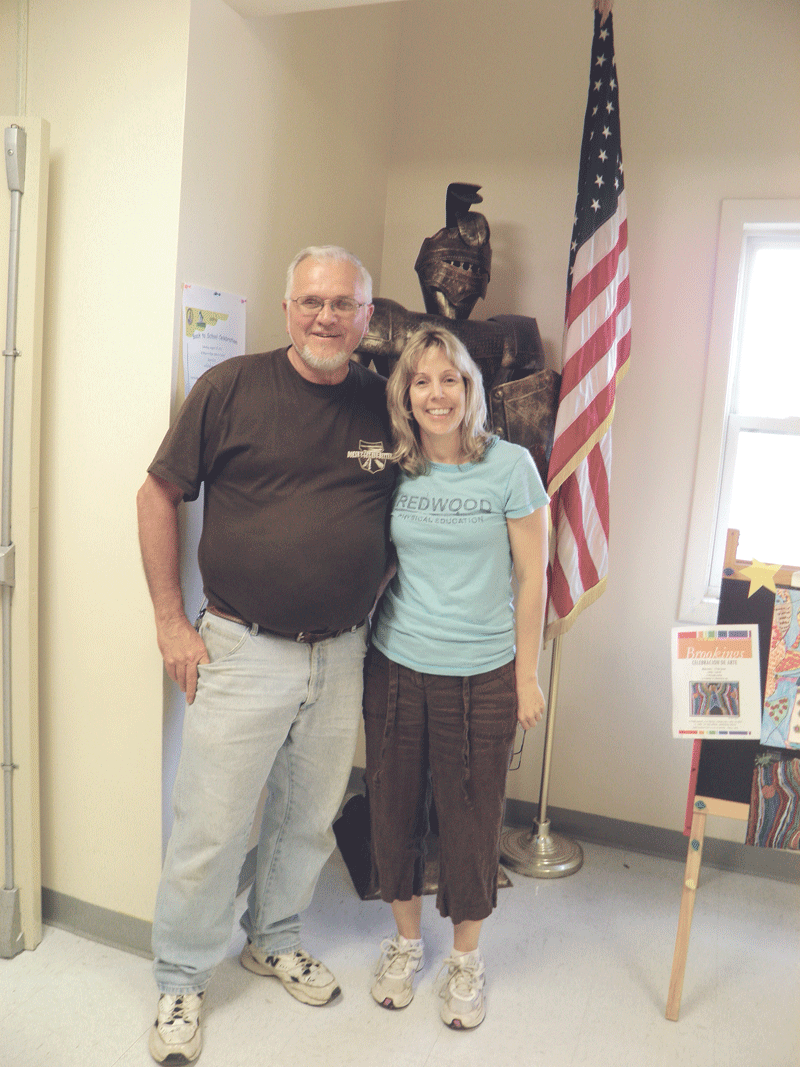
Elias Brookings School Senior Custodian George Rollins

Elias Brookings School Senior Custodian George Rollins and adjustment counselor Gianna Allentuck say the tornado brought the school community together in a way that couldn’t have been imagined.

The day after the tornado, staff members assembled at two places: the school, where they worked to clear a path on the sidewalk, and at the Longmeadow home of adjustment counselor Gianna Allentuck.
Their first priority was to call every student to make sure they were safe. They then created a plan and took steps to kick off what would become a monumental collection effort for the 57 Brookings families that had lost their homes or been displaced.
The outpouring of support and donations was so substantial that Allentuck’s garage soon filled, so organizers staged a distribution program on July 1 in the J.C. Williams Community Center on Florence Street. They also held frequent distribution efforts outside the school, and students witnessed caring in action as their teachers stood outside throughout the summer, ready to share an encouraging word and a smile while handing out supplies that ranged from diapers to shampoo and underwear.
The staff members shifted their focus to collecting school supplies as the months went on and were astonished again by the outpouring of backpacks, crayons, and items students would need to return to classes. “My garage got so full, we had to rent storage space in Enfield,” said Allentuck, adding that the barrage of donations included stuffed animals, sleeping bags and towels, which necessitated a second major distribution effort.
Throughout the summer, staff members also visited families in shelters, hotels, and their homes to see how they were faring, and gave them donated items, while school nurse Pam Maynard did a tremendous amount of outreach.
The staff had also united to help the students finish the year in the days following the tornado. The children arrived at Brookings in the morning, then had to be bussed to two different schools depending on their grade, which meant many family members were split up.
“There were a lot of logistics involved and some of the younger kids were frightened,” said Allentuck. “It could have been chaotic, but the staff stepped up and made sure the children felt safe and loved. It was our finest hour.”

Moving Experience
In the meantime, school officials were working hard behind the scences to insure the children had classrooms to return to at summer’s end.
David Meehan, director of operations for Facilities Management in Springfield, said finding modular units, getting permits and assembling them in less than two months was a daunting challenge. “We did it in approximately 45 days; a project of this scope would normally take 90 days or more to complete,” he explained.
Rita Coppola-Wallace agreed. “A lot of people don’t realize the effort that goes into a project like this,” said the director of the Department of Capital Asset Construction in Springfield. “It took an extreme amount of coordination, but the vendors and city departments all rose to the challenge and did more than they needed. We literally pulled permits within hours, and everyone I called was phenomenal, from the contractor to the funding agencies.”
Thirty portable classroom structures, including 20 two-story units and 10 one-story units, were installed behind the old school on Hancock Street.
But there were unexpected setbacks. For example, right before the Fourth of July, water began gushing from the ground as workers set footings 30 feet into the ground. “They pumped water 24-7 for a week,” Coppola-Wallace said, explaining that the site is close to the Mill River. “It was a tough experience, but we had fun along the way. When people get hit by tragedies, their best side comes out.”
Meehan said Brookings senior custodian George Rollins played a major role in getting the job done on time. He worked close to 90 hours each week from the day following the tornado until school opened.
Rollins cares deeply about the school. It’s his alma mater, and he was determined to salvage everything possible from the old building, then do whatever it took to have the modular units ready for the children.
“At one point, we had 25 people cleaning furniture from the old building. We also had to coordinate getting teachers in and out of the building in the days following the tornado,” Rollins said, explaining they needed to salvage what they could from their classrooms, but could not stay inside long due to air- quality issues caused by the devastation.
“We put our heart and soul into this,” he continued. “It brought us together because we had to depend on one another. Everyone had to be cooperative and understanding, and even the kids had to give. They had to adapt to difficult circumstances, which for some included losing their homes.”
But stability seemed hard to come by, as the day Brookings was set to open, all Springfield Public Schools were closed due to an approaching hurricane, which downed trees, caused power outages, and wreaked its own devastation. And in the weeks that followed, there were myriad new adjustments as 25% of the staff was new hires and the modular units lacked a cafeteria, gym, and storage space.
But the community continued to step forward, and the spirit of cooperation and changes that took place within the school were remarkable.
Teachers held a book drive throughout the school year that proved so successful that each child was allowed to choose four books to keep at the end of the year. The school also staged a “Perfect Attendance Day” and due to community support, each student being honored received a $10 gift certificate. Allentuck said the numbers jumped from less than five with perfect attendance in February of 2010-2011 to 55 this year.
Staff members also began to pursue grant money that resulted in positive outcomes.
“This has been a year of celebration; even though I am a hopeful person, I never imagined we would be sharing the celebratory attitude that has been prevalent all year,” Allentuck said, adding that she doesn’t believe the transformation would have taken place without the tornado.

New School of Thought
Initially, the city hoped to save the 87-year-old school building, but a feasibility study determined that was not feasible. When the need for a new building became apparent, city officials approached Springfield College, because it owned a sizeable piece of vacant piece of land across Walnut street.
“It was not for sale, but they quickly jumped on board and were willing to become a partner,” Coppola-Wallace said. City officials are in the process of acquiring the land and plan to build a $28 million state-of-the-art school on it to replace the old building.
“I am very hopeful that we can finally get ahead of the game, because in the past the constants were always changing,” said Powe “We have stability now and I am looking forward to next year and the future in a new building.”
The day when that new school opens its doors is still a long way off, and there will no doubt be many challenges to overcome along the way.
But the tornado has fostered a new sense of resiliency at the Brookings School. All those involved, including the young girl with the slate, have picked up the pieces and shown that a disaster of this magnitude can destroy a building — but not dreams.

Company Notebook Departments

Normandeau Communications Changes Name to Normandeau Technologies
WEST SPRINGFIELD — In a strategic move designed to better convey the company’s full range of products and services, Normandeau Communications recently changed its name to Normandeau Technologies Inc. “It is our goal to have our name reflect more than just communications, but the entire breadth of solutions provided — telephone systems, structured cabling, networking, carrier and Internet services, mobility solutions, surveillance, call accounting, overhead paging, and messaging on hold,” said Kim Durand, director of sales for the company. “Our dedication toward building relationships with our customers and technical expertise has led us to become valued partners in decision-making processes for all their technology needs.” As part of its efforts to educate business owners and managers on the latest technology and how to take full advantage of it, Normandeau will offer ‘Lunch & Learn’ meetings at its new technology and training facility, located at the company’s office at 2097 Riverdale St., West Springfield. “We look forward to serving our community and providing educational opportunities to learn more about how new technology can benefit our customers,” said Durand.

Ludlow Mills Awarded $200,0050 EPA Cleanup Grant
LUDLOW — The U.S. Department of Environmental Protection has awarded WestMass Area Development Corp., owner and developer of the Ludlow Mills project, a $200,000 brownfields cleanup grant, another sign of progress in the continuing redevelopment of the 1.4 million-square-foot redevelopment project. The grant was part of a competitive process, and Ludlow Mills is one of 18 projects in Massachusetts to receive EPA Region One grants in this round. Westmass will use the funding to immediately begin removing asbestos from old mill buildings on the site. Westmass President Kenn Delude said the funds will augment state funding from the Office of Energy and Environmental Affairs for environmental remediation work that did not cover the removal of asbestos. “This is another significant step forward in the redevelopment of the largest brownfield mill-redevelopment project in New England,” said Delude. Westmass recently announced two projects for the site — a $27 million initiative launched by HealthSouth to build a new rehabilitation hospital, and a $22 million, 83-unit senior independent-housing project.

WEEI Radio Awarded UMass Athletic Broadcast Rights
SPRINGFIELD — Sports Radio 105.5 WEEI-FM recently announced an exclusive partnership with UMass that makes it the official home of UMass football and basketball. The five-year agreement kicks off with the 2012 football season, which begins on Aug. 30 at the University of Connecticut. In addition to comprehensive game coverage, WEEI Springfield will host the UMass coaches shows, featuring The Charlie Molnar Show and The Derrick Kellogg Show. The agreement was brokered by Nelligan Sports marketing, the multi-media rights holder for UMass Athletics.

Columbia Gas Donates Blankets to Friends of the Homeless
SPRINGFIELD — Employees of Columbia Gas of Massachusetts visited the Friends of the Homeless shelter on Worthington Street in Springfield recently to donate 150 heavy-duty blankets to the shelter. Columbia Gas employees have adopted Friends of the Homeless as one of the local charitable organizations they will be supporting in 2012, said Andrea Luppi, manager of Communications and Community Relations. “In addition to the donation of blankets, once a month, a group of employees from all departments has volunteered to serve lunch at the shelter and spend some time getting to know the people there,” she said. “It gives everyone a good feeling to be able to do something for a group that needs and deserves some help.” Last year, Columbia Gas signed on as one of the primary sponsors of “Journey in My Shoes,” which was the first fund-raising event for Friends of the Homeless.

Health Care Sections
Coping with Being Stuck in the Middle, Caring for Parents and Kids

Lisa L. Halbert

Lisa L. Halbert

They call it the ‘sandwich generation,’ those individuals who care for their young, college-aged, adult, or boomerang kids, while at the same time caring for parents or in-laws who need some level of assistance. These stuck-in-the-middle people are overworked, stressed, tired, and oftentimes financially strapped from the burden.
Typically there is some hope or expectation that, as a child ages, parenting modulates from hands-on caregiving duties to those of chauffeur, disciplinarian, and behavior-modeling duties, and then the child goes their own way. For many with aging parents, however, the roles reverse, and caring for parents expands from driving them to appointments to moving them in to live with you, to engaging in disagreements as if you had another grumpy child — and even to the adult equivalents of diapering and assisting with feeding.
For some, it is an honor to care for aging parents. This commitment comes not only from a strong sense of family, but also from concern that nursing-home experiences are not ideal and can be prohibitively expensive. For others, it is an obligation, whether self-imposed or not. For most people caught in the sandwich generation, perhaps it is a blend of love, obligation, and concern about how they would want to be treated if or when they become stuck in such a needy situation.
While the sandwich generation connotes comfort, the nitty-gritty is that caregiving for any one person is hard enough, but when attention and care must be divided among three generations — your parents, spouse, and children — the emotional, physical, and financial toll can become devastating. From both a practical and estate-planning perspective, steps that caregivers might consider taking include the following:

Anticipate Problems Before They Arise
As early as possible, consider typical sandwich-generation issues. Initiate discussions with your parents about how they want to live, whether they have long-term-care insurance, what kind of health care and life-saving measures are desired, and who should make legal and medical decisions for them if they are no longer able to handle their own affairs. Yes, these are difficult topics and not ripe for the holidays, but as an adult child of aging parents, you must address these types of questions while there is still time to plan. This can help your whole family avoid a lot of problems down the road.

Apply the Golden Rule
Remember your parents telling you that you should treat others as you would want to be treated? Well, now is the time to take that to heart, especially as even loving family members are sometimes not nice to those who are infirmed. You might talk about them rather than to them, or make decisions for them rather than with them. You might overestimate your loved one’s disabilities and underestimate their capabilities.
Too often, we equate intelligence with language and the ability to communicate, but how would you feel if you became hard of hearing or lost your ability to speak? Would that make you less intelligent?
Now is also your opportunity to train your children about how to treat you a few decades down the road. Teach them by example to be tolerant, loving, and kind. Teach them to include seniors in decision making and to be respectful.

Essential Legal Documents
In addition to a will, there are three basic estate-planning documents that every adult should consider. A health care proxy (HCP) authorizes another to make health care decisions when someone cannot make those decisions for himself or herself. A durable power of attorney (POA) authorizes someone to make decisions about issues in another’s legal world, such as bank accounts, brokerage accounts, or almost anything relating to money. This document can be drafted so that you and your elderly relative can access accounts at the same time. As the attorney-in-fact under a POA, therefore, you can help reinforce your family member’s independence in that he or she can retain some control until capacity diminishes.
The third document, a living will, provides a specific directive to the individual’s physician regarding under which circumstances the individual is to be kept alive by life-sustaining equipment and when the physician is to stop such mechanical approaches and allow the patient to die with as much dignity and as little pain as possible.  Some attorneys combine this directive within the HCP, while others leave it as a standalone document. Either approach works.
It is important to note that a diagnosis of Alzheimer’s or early dementia does not prohibit the consideration and signing of essential estate-planning documents. As early as possible, you must have your parent talk to estate-planning counsel. If your parent remains aware of basic information, he or she may still have capacity to sign the forms. This documentation is important, if not imperative, for both you and your parent. Statistics show that caregivers actually frequently falter because the stress and the pressure of caregiving may lead to their own injury or illness.
When documentation is in place, have it reviewed periodically, especially with any change in family structure, to ensure that the appropriate people are named to the appropriate positions.
Keep in mind that, while you might be a wonderful caregiver, loading up with financial responsibilities may result in too much of a time commitment for you. Sharing those same responsibilities with siblings or others might be the better choice.
Understand that, without a POA and/or HCP in place, situations will likely arise that require court action, whether guardianship or conservatorship, to be initiated. And while a POA and/or HCP are not a guarantee that you can avoid these actions (and additional costs), the chances of needing court involvement drops significantly.

Preserve Your Own Assets
Financial planners constantly say it is foolish to raid your retirement savings to pay for your children’s college education or your parents’ long-term care. Your kids can take out student loans that they have plenty of time to repay, and your parents’ own assets should finance their care for as long as possible.
If caregiving to a parent is likely to be in your future, urge your children to explore multiple financial-aid options to fund college, which will help alleviate the burden on you, especially merit grants and scholarships that neither of you will have to repay after they graduate. For some, one part of the puzzle might be to consider having your child spend a couple years at a community college, and then transfer to a four-year program, which can save tens of thousands of dollars. For others, consider whether your child might qualify for more money from needs-based aid as opposed to merit-based scholarships. A good college advisor should be fluent in advising which schools look at what information relative to financial aid. Also, understand that the optimal time to consider college financial-aid planning is when your child is in 9th or 10th grade.
As for your parents, you might consider involving a financial planner in advance of their caregiving needs changing. An evaluation of assets and income as well as expenses (current and then modified for the new living situation) can be done to consider whether investments should be adjusted so as to produce more or less income. Also consider long-term-care insurance, whether for nursing home care and/or home care — and the earlier, the better.
Identify a qualified financial planner who can advise whether a long-term-care insurance or home-care insurance policy may suit your parents’ needs. It is important to ascertain that the policy you’re considering meets current Medicaid requirements. These requirements are quite specific, so while your financial planner or insurance agent may have some knowledge of the issues, check with your legal counsel, who should be able to lend insight. Typically the premium will increase with age, and you and your parents should carefully consider the services provided and length of the term. Your lawyer may also be able to provide guidance while you’re in this process.
A caregiving contract may also be appropriate for services that you will provide for your parents, especially in cases where you leave or decline traditional employment in favor of caregiving. Such contracts should address the prospective wages and range of services to be paid under the contract. Contracts can also address your parent’s financial contribution to any modification of the residence where your parent will be living, yours or their own.
When considering caring for a parent who could potentially need traditional nursing-home assistance or renovating your home to accommodate the new caregiving duties, in order to avoid violating certain Medicaid regulations, a properly written contract must be made in advance of the cash outlay. If your parents make promises to compensate you via their will, or you are too proud to discuss the issues in advance, the result could be you bearing the financial brunt and never receiving appropriate compensation, irrespective of good intentions.

Check Your Health
From a practical standpoint, it must also be mentioned that you will be no good to your parents or your children unless you make yourself a priority. Get proper exercise, rest, and relaxation. Remain involved with your interests and friends. Keep communication lines open with your partner, parents, siblings, and children, and enlist the help of others. You cannot bear this burden alone without considerable stress taking its toll on you.

Lisa L. Halbert, Esq. is an associate in the Northampton office of Bacon & Wilson, P.C. A member of the estate-planning, elder, and real-estate departments, she is especially focused on legal matters relating to asset protection; (413) 584-1287; baconwilson.com/attorneys/halbert

Company Notebook Departments

Hampden Bancorp Plans Cash Dividend
SPRINGFIELD — Hampden Bancorp Inc., the holding company for Hampden Bank, recently announced it had a $624,000, or 246.6%, increase in net income for the three months ended March 31, 2012, to $877,000, as compared to $253,000 for the same period in 2011. The provision for loan losses decreased $575,000 for the three-month period ended March 31, 2012 compared to the same period in 2011, due to decreases in delinquent loans, including non-accrual loans, declining impaired loans, and continued improvement in general economic conditions. In addition, the company’s total assets increased $37.8 million, or 6.6%, from $573.3 million at June 30, 2011 to $611.1 million at March 31, 2012. Securities increased $19.6 million, or 17.5%, to $131.5 million, and cash and cash equivalents increased $7.2 million, or 23.0%, to $38.3 million at March 31, 2012. Deposits increased $18.2 million, or 4.4%, to $435.4 million at March 31, 2012, from $417.3 million at June 30, 2011. The company has been focused more on obtaining core deposits than time deposits, according to Thomas R. Burton, CEO and vice chairman. “Economic conditions in our local economy continue to improve, as evidenced by a decline in delinquent and impaired loans as well as a nominal increase in loan growth,” he said. “We have reduced the provision for loan losses while continuing to maintain strong ratios related to our reserve coverage. Overall, we are pleased with the results but recognize that asset growth is necessary for continued financial improvement.” The board of directors declared a quarterly cash dividend of $0.04 per common share, payable on May 31, to shareholders of record at the close of business on May 16.

WMECo Launches Mobile Web Site
SPRINGFIELD — Western Massachusetts Electric Co. (WMECo) recently launched a mobile Web site for customers who use smartphones. Using the new mobile site, customers can view their account, pay their bill, view current power outages, or report a new power outage, all from the specially designed Web site. “It’s important to us that our customers feel we are accessible,” said Peter Clarke, WMECo president and chief operating officer. “They have told us they want more and easier ways to manage their accounts and receive information from us, so this is a logical next step for us to deliver on that request.” The mobile Web site works with either an iPhone or Android device. When customers access wmeco.com from a smartphone, they will be automatically directed to the mobile-friendly Web site.  In addition, the mobile site puts customers one touch away from calling or e-mailing WMECo customer service and from accessing the company’s Twitter, Facebook, and YouTube pages. Customers may also click a link on the site to view the company’s full Web site. WMECo, a Northeast Utilities company, serves approximately 210,000 customers in 59 communities throughout Western Mass.

Whalley Selected for ITC47 Contract
SOUTHWICK — Whalley Computer Associates (WCA) was recently awarded the ITC47 contract, which will allow it to continue to sell technology products such as desktop computers, laptops, servers, storage devices, and numerous other related technology products to organizations that use the Massachusetts State Purchasing Contract as a purchasing tool. WCA, a leading supplier to Massachusetts K-12 schools, partners with 181 of the state’s 320 school systems to provide technology products, services, training, and consultation. WCA also works with 57 cities and towns, 36 law-enforcement departments, 19 public colleges and universities, and 12 state agencies. “I think the number of Massachusetts organizations that have selected us as their primary vendor validates our decision to remain a large, regional, locally owned business,” said Paul Whalley, vice president and a former elementary-school teacher. Whalley noted that WCA is the sixth-largest vendor of the prestigious Massachusetts Higher Education Consortium (MHEC) contract, which has 600 suppliers providing computers, books, vehicles, science materials, furniture, and nearly every other product required by public Massachusetts colleges and universities. “WCA is also unique in having an office in the western part of Massachusetts and another in Central and Eastern Mass.,” said Whalley. “This allows us to rapidly and easily service those organizations that have offices throughout the state.”

Tighe & Bond Ranked Among Top Design Firms
WESTFIELD — The Engineering News-Record (ENR) once again ranked Tighe & Bond among the top 500 design firms in the nation, according to David Pinsky, president. ENR ranks companies by the previous year’s gross revenue for providing design services to domestic and international markets. Tighe & Bond ranked 272 in ENR’s 2012 report, which exceeds last year’s ranking of 309 and reflects the firm’s 2011 annual gross revenue of $36 million. “Last year was a very successful and profitable year for us,” said Pinsky. “We saw growth in all of our primary business units and acquired a sixth office in Portsmouth, N.H., that enables us to better serve our clients in that state, Southeastern Maine, and Northeastern Mass. All of this is backed by our ongoing commitment to deliver the highest-quality services to our clients on time and within budget.” The Boston Business Journal also ranked Tighe & Bond as one of the largest engineering firms in Massachusetts, according to Pinsky. In its 2012 Book of Lists, the journal ranked the firm 12th out of 25 top-billing firms.

Columbia Gas Supports Link to Libraries
SPRINGFIELD — Columbia Gas of Massachusetts has given a grant to Link to Libraries to help promote literacy and donate books to public elementary schools and nonprofit organizations in Western Mass. The funds will be used to supply all children entering kindergarten in Holyoke and Springfield with literacy bookbags. “We are tremendously honored that the Columbia Gas of Massachusetts has decided to join us in our mission,” said Susan Jaye-Kaplan, Link to Libraries co-founder. “This grant will have substantial economic impact in our mission to enhance early literacy and promote that all youth be proficient readers by grade 4.” Steve Bryant, president of Columbia Gas, noted that “Columbia Gas, as well as our employees, is committed to supporting families in need. Helping to provide books to kindergarten children is just one way we can help ensure that children get started on the right path to become lifelong readers.” Since its inception in 2008, Link to Libraries has donated more than 50,000 new books to area youth.

Big Y Adds 41st Pharmacy
SPRINGFIELD — Big Y Foods Inc. recently opened its 41st pharmacy in the World Class Market at 700 Main St., Suite 2, in Great Barrington. Pharmacy Manager Helen Costello, R.Ph., will be working alongside pharmacist Julie Samale, R.Ph. and technician Raeven Fuller to bring added convenience to grocery shoppers in Southern Berkshire County. Pharmacy hours will be weekdays, 9 a.m. to 8 p.m.; Saturdays, 9 a.m. to 5 p.m.; and Sundays, 9 a.m. to 1 p.m. Big Y Pharmacies plan to conduct special wellness events throughout the next few months, including total cholesterol and blood-pressure screenings, glucose and body-fat-percentage testing, and skin analysis. Big Y currently operates pharmacies throughout Massachusetts and Connecticut.

Commercial Real Estate Sections
Chicopee Crossing Will Complement Booming Growth on Route 33

Marriott Courtyard that will anchor Chicopee Crossing

An artist’s rendering of the Marriott Courtyard that will anchor Chicopee Crossing.

At the front of a large, open plot of land on Memorial Drive in Chicopee, just south of Mass Pike exit 5, is a lone Chipotle Mexican Grill — and nothing else.
But judging by the volume of cars pulling in each day, Frank Colaccino has to be optimistic about the prospects for the rest of that open space, which he has dubbed Chicopee Crossing.
“I was surprised that Chipotle has such a following, but they do a very, very good job,” said Colaccino, president of the Colvest Group in Windsor, Conn., which is developing the site. And other restaurants and retailers should see value in joining Chipotle there, he added.
“It’s so accessible — you have access right off the Mass Pike and from Route 33, a major street with a high traffic count — and you have a lot of traffic generators around there, from a Wal-Mart to a Home Depot to Stop & Shop, Big Y, and a BJ’s Wholesale Club. That’s a lot of retail attractions, and we’re right in the middle of all those traffic generators.”
The process of developing Chicopee Crossing began in 2009, but had to clear a major hurdle first. Namely, the city had to find a way to allow northbound drivers on Memorial Drive — separated from the southbound lane by a guardrail — access to the property.
“The access was only on one side of Route 33,” Colaccino said — and with plenty of other retail and restaurant options at the next few busy intersections, none of them allowing U-turns, it was unrealistic to think northbound drivers would make the effort to reverse course for Chicopee Crossing. “To make this an attractive site for retailers, we had to put a traffic light in, and in order to do that, we had to go through the state, through Mass Highway — because it’s a state road — and get their permission.”
That process, he noted, took about 14 months, and involved input from several different agencies. “But that happened, and we’ve put in the traffic signal. It’s installed and operating.” The intersection allows not only left turns into the development, but also access from across the street, where a host of other retail ventures have sprung up over the past decade, and where an Aldi’s supermarket will be built later this year.
While the intersection issue was working its way to resolution, infrastructure for Chicopee Crossing — from water and sewer drains to electric installations and road paving — were being completed, and Colaccino expects construction work to begin in earnest early this summer, following commitments by tenants.
The one building already erected, the 7,000-square-foot structure which currently houses Chipotle, will soon have two other tenants to fill its remaining space: Great Clips, a national hair-salon chain, and a national telephone store. Three other buildings of similar size are also planned; they’re expected to be a second fast-food restaurant, a family restaurant, and a bank. Behind those will be a three-story office building and a 40,000-square-foot retail complex.
Further back will be a Marriott Courtyard hotel. That portion of the project is owned and being developed by Dennis Patel of BK-Investments.
“We’re starting to see some more activity out there,” Colaccino said regarding interest from potential tenants at Chicopee Crossing, “so we’re optimistic that something will happen soon.”

Setting Their Sites
Chicopee Mayor Michael Bissonnette said last year that the key event in bringing Chicopee Crossing to reality was a financial commitment by the state — specifically, $1.25 million through the Massachusetts Opportunity Relocations and Expansion Jobs Capital Program — to pay for the construction of the new intersection, allowing access from both sides of the Route 33 and connecting the new development with the former Casey Chevrolet (and future Aldi’s) property.
“It’s a great project, and it’s going to have the best access off the Pike of any piece of land in Western Mass.,” said Kate Brown, Chicopee’s Planning Department director. “I guess we’re hopeful, now that the economy seems to be picking up, that we’ll see more activity in that location.”
In particular, she noted, the hospitality industry was sluggish during the Great Recession, casting caution over any new hotel project, so it’s encouraging to see the Marriott Courtyard, and all the other proposed elements of the development, coming together.
As for other retailers and restaurant chains that might be feeling out the property, “I can certainly see that site as a draw because the hotel won’t have a restaurant facility,” Brown added. “So it’s kind of a captive audience.”
Any new additions would join a flood of retail and restaurant ventures that have sprung up along Memorial Drive just north and south of the Pike entrance over the past few decades.
The former Fairfield Mall property across the street was the most significant recent development; after those buildings were torn down in 2002, they were gradually replaced by a Home Depot and a Wal-Mart Supercenter. Those, in turn, anchor a plaza that now includes a Marshall’s, Staples, 99 Restaurant, Applebees, and about a dozen smaller retailers and quick-service eateries; a Friendly’s at the south edge of the site is the only survivor from the mall years.
Yet, Brown said the corridor began to pick up even before that, around 1996, with a series of smaller store openings. Since the mid-’90s, “if we had a vacant spot, we’d have a building on it quickly. It’s been pretty amazing. I wish we had more land there, actually. We were kind of skeptical that the stores located in the [Wal-Mart] shopping center would be viable, but it’s been a very stable group of businesses.”
Colvest, which has built a solid portfolio of projects in Western Mass., from several CVS locations to a new office complex on East Columbus Avenue in Springfield, has never taken on this kind of mixed-use project before, Colaccino told BusinessWest, but he’s excited about the potential for this particular site, for the very reason others mentioned — the fact that exit 5 has become a significant retail destination.
“I think this is a prime mixed-use project, with everything that’s here,” he said, adding that he has enjoyed working with Chicopee officials on bringing the development to the verge of the construction phase.
“All the people I’ve worked with in the city of Chicopee have been terrific,” he noted. “Mayor Bissonnette has been great to work with, and they have been very cooperative.
“They have a system in Chicopee,” Colaccino continued. “When a developer comes in, they get all the various departments together to talk about all the issues that might come up and all the different needs they have and what the developer has to do. They really make the process streamlined, and you don’t have to guess at everything. They just tell you, ‘these are the requirements,’ and we work together to make those things happen in a way that’s beneficial to everybody.”

Bottom Line
Nothing will happen — except for the hotel, of course — without commitments from tenants, and Colaccino expects those to be firmed up in short order so that construction can proceed this summer.
“We won’t build on spec,” he said, not even the office building. “But we envision some demand for office space there, and when that comes in, we’ll be ready. I think we’re envisioning some 22,000 to 25,000 square feet of office space, and that could be any number of uses — a doctor’s office, a dentist’s office, it could be a professional office, a mixed office with medical … any number of things.”
In any case, construction workers will be digging for drainage and other underground work very soon, and the hotel foundation will follow. After that, “we wait for the tenants,” Colaccino said, conceding that he’s anxious to see that phase move swiftly. “It doesn’t do us any good to have land just sitting there.”

Joseph Bednar can be reached at [email protected]

Features
EANE Has Been a Resource for Nearly 100 Years

Meredith Wise

Meredith Wise says the Employers Association of the NorthEast acts as a partner with area business owners and managers.

It was well over a century ago when a group of business owners in manufacturing decided that, rather than hold on to the unique workforce solutions they had formed within their own firms, they would share this information and, in the process, benefit their entire industry.
This group of businessmen was originally based in Connecticut, but in 1913, a branch of similar visionary mill owners in Western Mass. saw the wisdom of this way of doing things and joined the movement. That, Meredith Wise told BusinessWest, is how the Employers Association of the NorthEast got its start.
“They felt that they could do better in their businesses if they shared all manner of interests, best practices, how they could be doing things,” said Wise, the group’s president. “Part of it at that point in time was to combat union organizations. But when you look back at the records, it wasn’t militant, or ‘keep the unions out at all costs.’ Instead, it was, ‘how do we make our workforce better so that they’re not interested in unions?’”
Today, the EANE has broadened both its member base and its geographic scope. Where once manufacturing was the only sector served, today the 830-plus members range across New England and into Eastern New York, with virtually every industry represented.
The smallest of companies on up to firms with a workforce numbering in the thousands benefit from the combined wisdom of the organization, which Wise said simply exists “to provide the best human resources, training and development information, and services to our members so that they can improve their business and meet their overall goals.”
That early mythology of ‘union busting’ is one that Wise again dismissed. “What we’re doing is trying to improve the relationship between an employer and their employees,” she explained, “so that there’s not a need for any third parties — whether that’s a union or an employee going to the Mass. Commission Against Discrimination, or to an attorney. What we want to do is work with our members to provide a better workplace for their employees.
“The idea,” she continued, “is to keep good communication, before something becomes a problem.”
In an increasingly volatile business climate featuring outsourcing, ‘rightsizing,’ fluctuations within the economy, and information technology entering the workplace at light speed, Wise said her organization is there to provide assistance and advice to its members, with the expectation of bolstering each company’s strengths and bettering its bottom line.
And that is where Wise and her staff at the EANE are getting down to business. Often a company lacks the ability to devote time or resources to changing compliance regulations and the complications of business in the fast-paced technology arena. While there are times she hears from new clients, more often, she works with businesses that understand the long history of EANE’s assistance, and seek to get their own share of its experience in the marketplace.

Motivational Speaker
While the agency’s name puts the spotlight on the employers themselves, Wise said that much of what her organization focuses on is the workforce.
“The thought is that, in order for companies to reach what they want to achieve, they have to make sure that they’ve got the right people in the right spots with the right talent and skills, all to do what needs to get done,” she explained. “Without those people, and without that motivation and competency, a business isn’t going to meet its bottom line.”
Here, she said the EANE is engaged to assist with the HR departments of its members to fine-tune industry, legal, and regulatory compliances, but without forgetting those individuals on the floor, and always with the goal of attracting, retaining, and motivating the employee base to keep the business moving in a progressive fashion.
“We do a lot of passing along of best practices in human-resource areas — what other companies are doing around retention, engagement, what they’re doing to keep people motivated in the economic climate that we’ve got, how they’re keeping people motivated when they’re asking them to do more with less,” Wise said.
To achieve such goals, she said the EANE spends a significant amount of time in training for leadership, management development, customer service, and teamwork — either in seminars or at roundtable discussions. “We provide all of the skills that people need in order to help their businesses grow,” she added.
But rather than an outsourced model of HR, she said the EANE acts as a partner, or addition, to the existing departments within member businesses.
“Everything has gotten so complicated, and changes so fast, that it’s hard for one person to have all the resources and all the skills that they need,” she continued, “even for a few people in the HR department. So we look at ourselves as augmenting that function within an organization.”
Such complications arise as the very nature of business hierarchy has been shifting away from a purely top-down model. In generations past, a president, CEO, CFO, or senior management team were the people who made all the decisions within a company.
“That fit the environment that was there,” Wise went on. “But nowadays, so much is changing in the business sphere that almost everyone within an organization has to have some decision-making capability. It is increasingly important to be sure that people have the training, the skills, that they’re onboard with the mission and vision of the organization, that they’re held accountable for their decisions, that they have the knowledge to make those decisions. That gets complicated for an organization to do.”
Sometimes, this can be a difficult decision for business leadership to make. But the EANE helps each client take a look at its practices, policies, benefits programs, and employee engagement, and shares the best practices from other employers as well as helping to design strategies unique to that organization.
It’s not always about putting out a fire, Wise said. “Lots of times where we get that call, it happens when a CFO, CEO, or an HR person is out in a group and they’re kibitzing with their peers. That person may ask their colleagues about pain points in their own business — starting to see some turnover, maybe losing some good people. Sometimes it’s just about a number of workers ready to retire. They’ll ask who you are using as a resource. Then our name comes up.”

Stock in Trade
There are still people who say the EANE aims to keep unions out of the workplace, Wise said. Further explaining her dismissal of this notion, an aim of her organization is instead to ensure that her clients’ workforce gets valued attention and recognition.
“We’re not stepping into the middle of that relationship — getting between the employer and the worker,” she continued. “We’re not the employer’s voice to the employee, or vice versa. What we’re trying to do is coach the employer so that their practices and procedures are positive.
“It’s not that we want to keep out unions,” she continued, “but to improve that relationship so that the employee doesn’t feel the need for a union, or that they don’t feel discriminated against, or that, if there’s a harassment issue, that the employee feels comfortable walking into that HR director’s office, the CEO’s office, and telling them about issues that are important to talk about.”
But that’s not as much of an issue, she said, as the nature of the modern workplace, which is evolving on a near-constant basis. And her advice to all business owners and managers is to work within the changes that have taken place rather than try make older ways of doing things work is this changed environment.
Speaking of the Baby Boomer generation as an example, she said that there are many who are nearing or at retirement age. “Some of them may not be able to retire now,” Wise said, “as their savings may have been decimated through the recession. But what is happening within the workplace is that those in their late 50s or 60s, maybe they’re not at a place where they can retire, but they can step back from the 50-hour workweeks. How can an employer meet the needs of that population?”
Here, the unfolding technology that increasingly drives the office could be utilized for Boomers to work from remote locations or work more flexibly outside of a traditional workweek. Such models are also advantageous to newly minted college graduates, for whom a 9-to-5, Monday-through-Friday schedule might not work effectively.
“This is an example of a good lesson from the last few years on how business needs to better leverage technology,” she said.
As she reflected on the long history of her organization and a century of providing assistance to area businesses, Wise said it’s important to note that the EANE is based in the region it serves.
“What we try to get across to our members is that we’re not just their partner, and not just their resource,” she said. “We’re local, and we’re tied into the communities that are here — which means we understand the environments in which they’re working.
“We’ve been here for over 100 years,” she added with a smile, “and I hope we can continue to be helping organizations for another 100.”

40 Under 40 The Class of 2012
Manager of Public Affairs, Baystate Medical Center

Craft-BenYou won’t find it on his résumé, but Ben Craft lists among many work experiences a short stint as “professional sumo wrestler.”
Make that very short, said Craft, noting that he was paid what amounts to $300 for a few appearances in the ring against college-level sumo wrestlers when he was on a one-year teaching assignment in the Japanese coastal town of Kuchinotsu, just outside Nagasaki.
This would be the first of many intriguing business mailing addresses for Craft. Indeed, other stops have been at the Wall Street Journal, where he served for some time as an assistant preparing the daily competition report and later served as editor, and the United Nations building, where he specialized in environmental issues in human development.
Today, he works in Baystate Health’s corporate offices on Chestnut Street in Springfield, but practically since the day he arrived in 2008, much of his focus has been on the $296 million project that used to be called the Hospital of the Future. Now, it’s the hospital of the present, or, more formally, the MassMutual Wing and Davis Family Heart and Vascular Center.
While that project has certainly dominated his time and energy, Craft said there are intriguing stories being written in the many departments within the Baystate system every day, and it is his informal job description to help relate them.
“I’m very fortunate in my job in that I get to tell the stories, and I get to be around the people who really make these things happen,” he explained. “I like to think of myself as a writer, and working here is a writer’s paradise; you have compelling stories, drama, larger-than-life characters, and emotional intensity.”
While his work keeps him quite busy, Craft has managed to find time for work in the community, especially with Best Buddies, which he serves as chairman of its advisory board; he was named champion of the year for Best Buddies of Western Mass. for his fund-raising and advisory leadership.
He saves most of his non-working time, though, for his wife Erin and daughter Emma — a family that will soon be larger, as the Crafts are expecting their second child in June.
— George O’Brien

Opinion
Maintaining Momentum at UMass Amherst

There were no real surprises at the elaborate press conference staged last week to introduce Kumble Subbaswamy as the chancellor-elect at UMass Amherst (see story, page 10).
The current provost at the University of Kentucky, due to assume his new post in July, said all the things that one would anticipate him saying — about taking the flagship campus to the proverbial next level, improving town-gown relations, maintaining and possibly expanding the school’s work within Greater Springfield, and striving to improve access to the university. In the course of doing all that, he used the words you would expect him to use: challenge, opportunity, relationships, partnerships, collaboration, communication, and transparency.
But he also used a word that some might not expect to hear — momentum. And he used it early and often, in phrases like ‘maintaining momentum,’ ‘building on the existing momentum,’ and others like it. And he was right to do so.
In the wake of what amounts to the ouster of Chancellor Robert Holub, it would be easy to forget or overlook the existence of a good deal of momentum at the flagship campus of the state university. Subbaswamy was wise to acknowledge it, and, more importantly, he understands that one of his primary goals is to sustain the current momentum, and in the many forms it takes.
In recent years, UMass has made great strides in its efforts to win more federal research dollars, and also in the broad and all-important category of fund-raising. Meanwhile, the many cranes operating on campus are a compelling sign of expansion and modernization.
But perhaps the most impressive gains, we feel, have come in the realm of economic development, or making the Amherst campus much more the ‘economic engine’ that area business and civic leaders have long desired — and expected — it to become.
Indeed, for years the phrase heard in the Greater Springfield area was, ‘why isn’t UMass doing more?’ And you heard it in reference to everything from a physical presence in downtown Springfield to job creation; from putting the vast resources at the Amherst campus to work helping individual businesses and economic sectors grow and thrive, to efforts to enable more area residents to attain four-year degrees. Even the football team’s ascension to the bowl subdivision connotes upward movement.
The fact that you don’t hear that phrase nearly as often indicates that the school has become far more involved in those initiatives and has created a good deal of that aforementioned momentum.
Examples abound, and include:
• Expansion efforts at the Pioneer Valley Life Sciences Institute, a collaborative effort with Baystate Health;
• The university’s lead role in making the Green High Performance Computing Center a reality in downtown Holyoke, where it is generating enthusiasm about bringing related businesses to that city;
• A project to move the university’s Design Center into one of the buildings in Springfield’s Court Square;
• The Precision Manufacturing Regional Alliance Project, or PMRAP, as it’s known, a project being undertaken with the Regional Employment Board of Hampden County and the National Tooling & Machining Assoc. to transfer technology from two departments at the university (Polymer Science and Mechanical and Industrial Engineering) to area precision manufacturers; and
• An ongoing partnership with Springfield Technical Community College to reinvigorate the Scibelli Enterprise Center on the STCC campus and, in so doing, help more fledging business ventures get off the ground or to that next level.
Together, these initiatives and many others add up to progress and (here’s that word again) momentum, not only for the university, but for the region and especially its largest city.
Subbaswamy told the press that there are many aspects to his job description as chancellor — everything from promoting the university and strengthening its brand to making sure a host of constituencies, from lawmakers to alumni, understand its true value to the Commonwealth.
But he can put ‘maintaining momentum’ at the very top of his list, and, judging from his comments, he already has.

Columns Sections
Insurance Payments for Your Autistic Child

Dennis G. Egan

Dennis G. Egan


Having a child with autism creates many challenges, not the least of which is the potential financial impact on your family. Until recently, many families were burdened with a mountain of bills when attempting to have their child diagnosed with and treated for disorders within the autism spectrum. But, thanks to a new Massachusetts law, that is changing.
In August 2010, ARICA (an Act Relative to Insurance Coverage for Autism) was signed into law by Gov. Deval Patrick; it became effective on Jan. 1, 2011. This law requires health-insurance companies in Massachusetts to provide coverage with respect to the diagnosis and treatment of autism-spectrum disorders, regardless of the age of the individual afflicted by the disorder.
Despite what many believe, or at least have questioned, ARICA has no impact on the special-education services provided by school districts, as required under the Individuals with Disabilities Act and Massachusetts law.
Melissa R. Gillis

Melissa R. Gillis

To clarify, ARICA requires that health insurers provide payment for supplemental services, in addition to services provided by school districts, pursuant to a student’s individualized education plan (IEP). Services covered by ARICA include, but are not limited to, medication, counseling, psychiatric care, psychological care, physical therapy, speech therapy, and occupational therapy.
This law includes several significant factors that are noteworthy:
• Reimbursement cannot be sought for services provided by a school district in furtherance of a child’s IEP;
• School districts are prohibited from requiring that services otherwise provided under the child’s IEP be sought via private health insurance coverage; and
• Potential coverage under ARICA cannot be considered by a child’s IEP team when developing the child’s IEP.
There are, however, several exceptions to coverage under ARICA. For example, self-funded plans that fall under the auspices of ERISA are not required to provide insurance coverage. In addition, individuals who receive health care coverage under MassHealth or CommonHealth are not eligible for the coverage provided by ARICA. In addition, insurers may opt out of required participation if applicable costs to the insurance exceed 1% of its otherwise current costs.
As with any new legislation, the implementation of ARICA has progressed, and will evolve, in fits and starts as interested parties educate themselves and others with respect to the practical application of the law.
For example, health-insurance companies that fall under the requirements of ARICA may require a copy of the child’s IEP prior to making coverage decisions. As such, it is very important that the parents of a child covered by ARICA proactively inform the school district that all requests for their child’s IEP be directed to themselves as the parent of guardian. Remember that Massachusetts law prevents school districts from disseminating information relative to a child’s IEP to a private health-insurance provider without the parent or guardian’s informed, prior written consent.
As with any change, especially one of this magnitude, the key to successful transition is communication. You should contact your child’s school district to ensure that it is aware of the provisions of ARICA, as well as its effect on the services that the district provides. This discussion should include such issues as what policies the district has in place to ensure that your child’s confidential information is not shared with insurers without your written consent, as well as a review of the district’s continuing education of staff and administrators relative to ARICA. Parents may also request literature from the school district in order to ensure that the district has written procedures in place to ensure proper application of ARICA.
With your child’s best interests in mind, it is important to reach out to his doctors and therapists to discuss this new law and the impact that it has on services provided, both pursuant to your child’s IEP and privately. It is important that any services provided to your child by a doctor or therapist be properly coded when billed to avoid confusion, which can ultimately lead to additional costs and/or delays.
Communication with your health-insurance company is crucial — first, to confirm that the provisions of ARICA apply to your health insurer, and, second, to ensure that covered services are provided and billed appropriately. In addition, any questions with respect to co-pays and out-of- pocket expenses are best addressed prior to receipt of services.
Informing your insurer proactively that your child receives services that fall within the scope of ARICA, and requesting written information with respect to its compliance with ARICA, will reduce the likelihood that billing questions and issues arise. As with any issue, proper documentation of any and all services provided will assist in resolving any potential issues in a timely manner.
Luckily, a number of quality resources are available for those who have questions related to ARICA. The Commonwealth of Massachusetts Division of Insurance has published guidance with respect to ARICA, and many autism advocacy and support groups have held and continue to hold informational workshops.
If you need legal assistance when wading through the waters of autism-disorder diagnosis and treatment payments, make sure you consult with a qualified special-education attorney. n

Melissa R. Gillis, Esq. is an attorney with Bacon Wilson, P.C. in the special-education, domestic, and real-estate departments; (413) 781-0560; baconwilson.com/attorneys/gillis. Dennis G. Egan Jr., Esq. is an attorney with Bacon Wilson, P.C., concentrating in special education, business, and corporate law; (413) 781-0560; baconwilson.com/attorneys/egan

Banking and Financial Services Sections
Measure Reforming Alimony Is Certainly History in the Making

Get ready, payers and recipients — a new statute is in town, and after so many years, it’s finally about alimony.
In an historic move, Gov. Deval Patrick signed into law “An Act Reforming Alimony in the Commonwealth,” which went into effect March 1. This Massachusetts statutory law, known as M.G.L. c. 208, §§ 48-55 inclusive, defines alimony, classifies it prospectively into four categories, and applies retroactively to existing orders. Gone are the days of unjustified lifetime alimony awards, the extension of alimony past the payer’s retirement age, and the ability of a recipient spouse to receive alimony during their cohabitation with another.
Understandably, judges and lawyers alike are both excited and nervous with such a tremendous new practice tool. From the court’s perspective, the apprehension stems from both its ability to handle the imminent floodgate of litigation and the amount of judicial discretion inherent in the wording of the statute itself. From the lawyers’ perspective, it’s the unknown judicial interpretation of the law to each specific fact pattern, coupled with the technical skill it will take to make effective arguments about how the law applies to each case.
In an attempt to preserve judicial discretion, balance consistency with flexibility, encourage settlement, provide finality, and for the comingled effect of situations where there is child support, this law has potential loopholes and room for creative arguments, much to the dismay of those who seek determinative rules for dealing with the one issue that arguably creates the largest amount of contested divorce litigation.
Specifically, the act is designed to accomplish the following:
• Articulate and define alimony into four separate categories: general-term alimony, rehabilitative alimony, reimbursement alimony, and transitional alimony;
• Set durational time limits that mandate termination of alimony awards no later than a certain date, determined by the length of the marriage;
• Provide parameters for setting the form, amount, and duration of alimony, including the definition of income;
• Suspend, reduce, or terminate alimony upon the cohabitation of the recipient spouse; and
• Terminate alimony upon the payer attaining retirement age, as defined by Social Security.
Retroactively, all existing alimony awards are considered general-term alimony. These awards can now be modified by termination or reduction, should a change in circumstances occur whereby the payer no longer has the ability to pay and/or the recipient’s need is reduced.
In addition, the act provides per-se (meaning that no other circumstance is required) grounds for termination of alimony upon any of the following circumstances:
• Remarriage of the recipient spouse;
• Death of either spouse;
• No later than a certain date pursuant to the act’s articulated durational limits;
• The payer attaining the full retirement age; or, most anticipated,
• The cohabitation of the recipient spouse.
The act also establishes a schedule setting forth when modifications can be filed, seemingly designed to allow both payer and recipient the opportunity for future financial planning, as well as decreasing the immediate judicial burden relative to the opened floodgates of litigation. Specifically, the schedules are for reaching the age of retirement and exceeding durational limits for payment. Notably, however, if there is a basis for modification in addition to an award exceeding durational limits or the payor reaching the full retirement age, the filing schedule is inapplicable, and March 1, 2012 is the magic date.
Testing the statute in Massachusetts courts will help clarify one of the main questions domestic lawyers receive from clients who are paying alimony: whether a recipient’s cohabitation with another person post-divorce, in and of itself, is sufficient to warrant termination. Currently, Massachusetts case law allows for alteration or termination of alimony on the basis of cohabitation only when myriad other factors exist, including the economic benefit and change in circumstance received from the non-spouse co-habitator.
Pursuant to the act, however, general-term alimony will now statutorily be suspended, reduced, or terminated upon the cohabitation of the recipient spouse when the payor shows that the recipient spouse has maintained a common household for a continuous period of at least three months. Evidence of maintaining a common household will surely be a great source of litigation, and includes sharing a primary residence, economic interdependence of the couple, economic dependence of one person on the other, oral or written statements or representations made to third parties regarding the relationship of the persons, engaging in conduct and collaborative roles in furtherance of their life together, and the benefit in the life of the recipient, both from the new relationship and their community reputation as a couple.
Overall, the time is ripe for alimony payers to pull out their old agreements and consult with a creative attorney who is knowledgeable about this substantive change in Massachusetts law. Before each payer goes through this process, however, it is important to note that, if the effect of the existing agreement provides that it “survives as an independent contract” and is “incorporated but not merged” into the actual divorce judgment, the act specifically states that no modification is allowed. If, however, your agreement “merges and incorporates” into the judgment of divorce, a consult will determine if and when the opportunity is ripe to file a modification action, seeking either a reduction or termination.
To those people who have been paying alimony longer than they were married, or who are paying alimony to an ex-spouse who has been living with someone else for years, this measure represents true relief. The light at the end of the tunnel is now in sight and burning bright. Although lawyers cannot yet predict how individual judges will interpret the specific language of the act, the message is clear: alimony in marriages fewer than 20 years in duration is no longer forever.

Melissa R. Gillis, Esq. is an attorney with Bacon Wilson, P.C. in the domestic, special education, and real estate departments; (413) 781-0560; baconwilson.com/attorneys/gillis. Thomas R. Reidy, Esq. is a member of the domestic relations team; (413) 781-0560; baconwilson.com/attorneys/reidy

Education Sections
Bay Path Initiative Is Designed to Position Graduates for Success

Kathleen Bourque, left, and Carol Leary

Kathleen Bourque, left, and Carol Leary

It’s called WELL, short for Women as Empowered Learners and Leaders, a new program at Bay Path College in Longmeadow designed to test and enhance leadership skills. It’s part of a bold initiative to reposition the school as ‘the new American women’s college for the 21st century,’ an endeavor launched with the goal of enabling women to seize the opportunities that await them in what Bay Path’s president calls “the New America.”

Carol Leary wants to plant a stake in the ground that will distinguish Bay Path College as a learning environment where graduates can master the skills and rounded education necessary for success in what she calls “the new America.”
That stake is grounded in ethical behavior, good citizenship, financial literacy, a solid academic education, and the knowledge that volunteerism and health and fitness play a vital role in a woman’s well-being. “We want to become known as ‘the new American women’s college for the 21st century,’” Leary said.
To that end, faculty, staff, and college officials at the Longmeadow campus spent 10 months taking a thoughtful look at their course offerings as well as the skills graduates will need to transcend barriers in the future.
“We began looking at our evolution, and realized our history included some very interesting and bold initiatives that changed the status quo in many ways,” Leary said. “We have been educating and advocating for women since 1897, and the DNA of Bay Path is very entrepreneurial, so we had to take a close look at our environment to figure out how to best serve our population. The America of tomorrow will be a very different place, so we also had to determine what it will be like, as well as what we could do to promote the advancement of women to meet the demands of the workforce in the future.”
Although women have made many gains in recent years, there are still arenas where tremendous opportunity exists, Leary told BusinessWest.
“Women have so much potential to go further in business, science, law, and heath-related fields, and will play a critical role in the future of this country,” she explained, citing statistics to back up her statement. “About 50% of all professional and management positions in this country are held by women, yet women hold very, very few of the top leadership positions. There are eight women CEO’s in Fortune 500 companies, but that only accounts for 3.6% of the positions. And although 60% of college students are female, only 26% of college presidents are women. The glass is half-full, so women will have the opportunity to achieve these positions in the future.”
Transforming this vision into reality is an involved process, but everyone at Bay Path is excited about it. Their new program, known as WELL (Women as Empowered Learners and Leaders), contains a revamped curriculum and speaks to the broad goals the school has outlined.

Building Confidence
WELL, launched in September, includes mandated courses, or ‘destinations,’ for each year of study. However, the focus of the program is rooted in liberal arts. “We believe that studying liberal arts gives students a depth, breadth, and appreciation of the world,” said Leary.
The first WELL course, which all students take during their first semester, teaches them about leadership styles. They figure out their own style and identify their passions as they learn to work in collaboration with others. Leary said understanding leadership styles, which range from authoritarian to laissez-faire, can go a long way when employees work on projects with people whose styles differ from their own.
“We want to create a learning environment with many opportunities where students can test and enhance their leadership skills,” said Leary. “They need to learn how to hone these skills in a way that helps them achieve their dreams; we want women to dream boldly about what they want to do with their lives.”
She explained that this does not mean every woman needs to become a CEO. “But when they see a problem, we want them to step out of their comfort zone and say, ‘I will make a difference in this person’s life or change the way things are being done.’ The whole environment we are trying to create is so much broader than what students can learn inside a classroom.”
Leary has an open-door policy and often invites students into her office to talk about how they can facilitate change on campus. If they want to start a new club, she urges them to create a business plan to “solve the problem” and bring it back it back to her.
About six months ago, she gave an international student the title of ‘presidential ambassador’ and had her put together a plan detailing how the college could attract and recruit more international students.
In addition, a freshman was paid an hourly fee to interview students and find out what they thought when they heard the words “new American women’s college.” The student was given a deadline for the project, which included research to determine the number of students she would need to interview from each class to get a fair representation.
“We’re creating an environment with expectations. During our open house, we tell the young women that each one of them has incredible potential,” Leary said, adding that adult learners in their One Day a Week Saturday program say Bay Path has given them a second chance at success.
“The WELL program helps students find their voice as women so their inner spirit can be translated into leadership and they can take the initiative and solve problems,” she continued. “We want them to be willing to volunteer and be part of a team. If we create an environment where their potential is valued and we show them that we believe in them, they will soar to incredible heights.”
Kathleen Bourque, vice president for Institutional Advancement, agreed.  “A lot of women have never stopped to take stock of their own value. We want to give them that opportunity and also give them experiences that will allow them to grow.”

Practical Matters
During their sophomore year, students will take a course in financial literacy, which is especially important since the majority of women in the undergraduate program are first-generation college students. “We want to make sure they know how to invest for retirement and do so immediately after they get their first paycheck,” Leary said.
The course will also teach students how to read the fine print in contracts, whether they are purchasing an automobile or signing a rental agreement or home mortgage. “Some of our students don’t know how to balance a checkbook. They need to have these skills to become financially independent and be able to support themselves and their families,” she explained.
Health and fitness is another area WELL addresses. “If you model fitness to young people, they will incorporate it into their lifestyle and continue it when they have families,” Leary said. Their program includes education about nutrition, so the calorie count and salt content is listed on the menu of foods served in the cafeteria. Fitness instructor Rob Panetti also creates a daily list of ‘Rob’s picks,’ or food choices he recommends, and often sits with students while they eat to discuss their diets.
In addition, “when we introduced a boxing class, 90 students signed up,” Leary said, attesting to the enthusiasm the program is generating.
The college has also added a number of new offerings designed to provide more life skills. They include a Toastmaster’s group to enhance communication skills, and new fields of study, including majors in neuroscience and biochemistry, which will be introduced next fall. Bay Path is also in the process of getting the accreditation needed to offer a master’s degree for physician assistants, and a new online completer program was launched in January that allows women to transfer up to 60 credits (which can include credits for life experience) towards a bachelor’s degree.
“Women will play a greater role in the new America, and these programs will respond to the needs of the future of this country as well as the region,” Leary said. “The new America will be diverse and a place where people will need to think globally every day and understand how we fit into the global economy.”
Ethics is another area incorporated into the WELL program. In the past, students signed an honor code on their first day of classes agreeing to behave in an ethical manner. But the new program will take things a step further by introducing ethical dilemmas graduates may face in their chosen professions. “Ethical behavior is one of the most critical things we can teach,” Leary said.
The plan is to rotate the chair in ethics between academic departments so students in different disciplines can be exposed to situations they may face in the workplace. Faculty members will also be available to speak about the topic in public schools, which reflects Bay Path’s focus on community service.
“That value is introduced the day students arrive on campus,” Leary said, explaining that every new student must take part in a community-service project. Endeavors have ranged from working at Goodwill Industries to reading to children at Square One in Springfield, to cleaning up embankments along the Connecticut River.

Enhanced Tradition
On the first day of classes each year, the school holds an ‘awakening’ ceremony that begins at about 5:30 a.m. Students and staff members gather in a circle after walking around campus with lit candles, and speeches are given about the alpha and the omega — beginning and end — of their life on campus. “We use the circle as a symbol of community,” Leary said. “It’s a very moving experience, and one that is very spiritual.”
The ceremony is also an introduction and segue into ‘the new American women’s college for the 21st century,’ a place where dreams are born, and also where education encompasses the critical values, knowledge, and skills students will need to fulfill their potential on a rapidly changing planet.

Health Care Sections
Understand the Significance of This Important Document

Hyman G. Darling

Hyman G. Darling

Paramedics are often called to a home because of an emergency situation. In such instances, most people wish to be resuscitated or defibrillated in order to maintain their life and hopefully recover with quality of life. Most people also desire that extraordinary medical procedures be utilized in a time of crisis. But this is not the case in every situation.
While an individual is competent, he or she may exercise their option to have treatment provided to them or discontinued, so that no further attempt should be made to provide them with life support and related medical treatment. While competent, it is relatively straightforward and easy for someone to make decisions regarding their own health care. When competency falls into somewhat of a gray area, the test for competency helps to determine whether the patient understands the nature of their illness and the effects that proposed treatment or lack thereof would have on them.
Since 1990, a person in Massachusetts has been able to make their own decisions and provide for their future care with a document called a health care proxy. This is similar to a living will or a document called five wishes or advance medical directives. These documents designate another person to substitute for the patient in making decisions regarding end of life and ongoing health care treatment.
However, the standard form provided by medical facilities does not provide for a so-called do-not-resuscitate order (DNR). Many individually prepared documents do include language that permits the agent under the health proxy to make decisions for the patient relative to all medical decisions, including end of life and possibly a DNR.
In the absence of a health care proxy, a guardian will have to be appointed by the Probate Court in order to determine not only ongoing care for the patient, but also extraordinary treatment or the withdrawal of that treatment. These cases may take a significant time period from the inception of the filing of the documents in Probate Court, giving notice to all parties, scheduling a hearing, and, very often, hiring an attorney or guardian ad litem (another person, usually an attorney, appointed to represent the interests of the incapacitated person).
This process will likely be even more drawn out as a result of the enactment of the Uniform Probate Code of 2009, which protects an incapacitated person’s rights by instituting various protections or hurdles that must be overcome before a decision is made regarding an incapacitated person’s health care, especially end-of-life decisions. Certainly, most people don’t want their life made public within the Probate Court, which is also a time-consuming, often-emotionally draining, and expensive process. All of these issues may be compounded when there is a contest regarding who should serve as the guardian and whether or not the person’s end-of-life decisions are being carried out in a manner that is appropriate for them and as they may have desired.
Most people have heard of famous end-of-life cases, namely Karen Quinlan, Nancy Cruzan, and Terri Schiavo, all of which brought national attention to the issue of making decisions for another person, especially relative termination of life support. It is interesting to note that the cases mentioned involve relatively young women, as opposed to older individuals, regarding the withdrawal of mechanical life-support machines, which, when removed, allow an individual to die shortly thereafter. Had these women signed DNRs when they were competent, their families would have been spared tremendous anguish.
A DNR order becomes a separate and distinct issue relative to the decision-making process, because it normally is executed by a person and is also signed off as accepted by that individual’s physician. A DNR is not necessarily made public, but rather provided by the physician to the patient. The form is normally kept in the physician’s office, and copies or separate portions of the form are then given to the patient, who may keep one in their wallet, post one on the refrigerator, or display one in a prominent place within his or her home in the event that it is needed.
Normally, when paramedics are called to a home, they must take all action necessary to preserve the life of the patient, but they are protected from potential liability by a DNR order, which allows them to withhold life-sustaining measures. Each DNR order in Massachusetts has a separate number, as initially a program was considered in which all DNR orders would be entered into a central database, which would be maintained and available 24/7 in situations where the patient may need to have care considered but not administered.
There are many instances in which DNR orders are used effectively. In the case of a terminal illness, such as COPD, liver failure, kidney failure, etc., where one’s life will only be prolonged with more treatment, that person may opt for a DNR order.
This is not to say that oxygen, dialysis, and other procedures would not be continued, but if that individual went into cardiac failure, or was stricken with another ailment, such as pneumonia or a similar life-threatening situation, then the patient could refuse treatment that would prolong their life. The individual should also instruct his or her caregivers to consider not calling 911 in times of crisis, as this normally implies that care is desired.
Normally, a DNR does not come into play when one is placed on hospice, as hospice implies and requires that no heroic measures be used to keep a person alive.
On the other hand, sometimes a person doesn’t want to sign a DNR, but rather prefers a health proxy that includes so-called living-will language, which states that he or she does not wish to be kept alive by heroic means unless there is going to be a relatively good quality of life and a reasonable expectancy to regain the baseline of the care and health that they enjoyed prior to the unfortunate illness, accident, or other issue causing a health decline.
In other situations, DNR orders may be suspended when one is having medical treatment such as a surgery, in which, if the DNR were not suspended, then the medical treatment may have to be terminated. This is similar to instances where a health care proxy is suspended during medical procedures.
It is important to take the decision whether or not to sign a DNR very seriously. Naturally, if an individual is in an accident and there is a good chance that they will recover, then they likely would want such things as a using a defibrillator or respirator to save their life. Individuals who wish to sign a DNR should be fully informed of the effect of signing the document.
Once it is signed, copies should be provided to all other physicians who may be treating the patient, as well the health care proxy agent, family members, and even any attorney who created other estate-planning documents, so that the DNR will be made part of the record with the health proxy.
Possibly someday, a national (or at least a state) registry bank of DNR orders will be initiated, and records will be maintained for the individuals who wish to execute it. After signing, it is a good idea to renew this document on an annual basis to establish that the patient continues to understand the nature of it.

Attorney Hyman G. Darling is chairman of Bacon Wilson, P.C.’s Estate Planning and Elder Law departments, and he is recognized as the area’s preeminent estate planner. His areas of expertise include all areas of estate planning, probate, and elder law. He is a frequent lecturer on various estate-planning and elder-law topics at local and national levels, and he hosts a popular estate-planning blog at bwlaw.blogs.com/estate_planning_bits; (413) 781-0560; baconwilson.com

Company Notebook Departments

NEPA to Manage
Life Laboratories
SPRINGFIELD — The Sisters of Providence Health System has announced a collaboration with New England Pathology Associates (NEPA) to manage Life Laboratories. Dr. Scott Wolf, senior vice president of medical affairs and chief medical officer at Mercy Medical Center, noted that the collaboration will make Life Laboratories the first and only physician-led and physician-managed clinical laboratory in the region. Dr. Lanu Stoddart will serve as the pathologist administrator, directing the operation and growth of Life Laboratories. A member of NEPA since November 2009, Stoddart has extensive experience in clinical pathology laboratory operations, serving in the past as medical director of S.E.D. Medical Laboratories in New Mexico and currently as chief of pathology at Harrington Memorial Hospital in Southbridge. Dr. Krystyna Sikorska will continue in her role as medical director of Life Laboratories. The innovative management relationship has already been recognized nationally, with NEPA invited to formally present its concept at the 2012 G2 Intelligence Pathology Institute Conference in Florida, according to Wolf. “For patients, the change at Life Laboratories will be transparent,” he said. “Likewise, daily operations of Life Laboratories will remain essentially unchanged. For physicians and their practices, however, direct access to physician managers will provide a unique feature and benefit.” Life Laboratories is a full-service medical diagnostic laboratory that conducts approximately 4 million tests per year for three hospitals, physician group practices, mental-health facilities, dozens of long-term care facilities, and hundreds of physicians.

Berkshire Hills Reports
Fourth-quarter Growth
PITTSFIELD — Berkshire Hills Bancorp Inc. recently reported fourth-quarter 2011 core earnings per share totaling $0.44, increasing by 57% compared to $0.28 in the fourth quarter of 2010. This increase resulted from ongoing organic growth together with the benefit of the acquisitions of Rome Bancorp and Legacy Bancorp, according to a statement by Berkshire President and CEO Michael Daly. Fourth-quarter GAAP (generally accepted accounting principles) net income included merger-related expenses, together with income from discontinued operations. These non-core items together equated to a net charge of $0.04 per share and resulted in GAAP net income of $0.40 per share, compared to $0.26 per share in the fourth quarter of 2010. For the full year, core earnings per share increased by 53% to $1.56 in 2011, compared to $1.02 in 2010. GAAP net earnings per share totaled $0.98 for 2011 compared to $1.00 in 2010. “Our merger integrations are now completed, allowing us to focus on revenue enhancements going forward,” said Daly.

MMWEC Refunding
Saves Utilities $16.8M
LUDLOW — A refunding bond issue recently closed by the Massachusetts Municipal Wholesale Electric Co. (MMWEC) will save $16.8 million for 28 state municipal utilities, strengthening their ability to secure stable and reliable power resources for the future, according to MMWEC CEO Ronald DeCurzio. In favorable market conditions, MMWEC issued $164.8 million in tax-exempt revenue bonds with a total interest cost of 1.2%. Proceeds from the bond issue and other available funds will be used to refund and retire approximately $214 million in higher-interest bonds issued by MMWEC in 2001. The refunding savings will be realized over the life of the bonds, which mature between 2012 and 2016. “This refunding will certainly give the municipal light departments greater flexibility to position their energy portfolios in pursuing physical assets for the longer term, from 2016 and beyond,” said DeCurzio. The 2012 MMWEC bonds are rated A+ by Fitch Ratings and have A ratings from Standard & Poor’s, all with a stable outlook, added DeCurzio. The underwriting team included Morgan Stanley, lead manager, and BMO Capital Markets. PFM Financial Management Inc. served as MMWEC’s financial advisor, with Nixon Peabody LLP acting as bond counsel. MMWEC is a nonprofit, public corporation and political subdivision of the Commonwealth of Massachusetts that provides a variety of power-supply, financial, risk-management, and other services to the state’s consumer-owned municipal utilities.

Columbia Gas Announces Reduction in Winter Costs
WESTBOROUGH — Effective Feb. 1, the winter rates for natural gas will reduce a typical residential customer’s total heating bill over the next three months by nearly 11%, according to Steve Bryant, president of Columbia Gas of Massachusetts. The reduction is a result of lower natural-gas commodity costs. Natural gas is sold in a unit measurement called a ‘therm,’ equivalent to 100,000 British thermal units (BTU) of energy. The rate reduction of $0.1378 per therm would save a natural-gas heating customer $22 in February, if using 160 therms of gas. “Lower gas bills in the middle of the winter is great news for the many families who are struggling to make ends meet,” said Bryant. “Natural-gas prices have remained stable for the last few years, and today’s cost to customers is as low as nearly 10 years ago. That is a claim we are proud to announce to our customers.” Bryant added that help is available for customers struggling to cope with household finances and winter heating bills. For more information, call (800) 882-5454 or visit www.columbiagasma.com.

Couple Chooses New Career Path Together
NORTHAMPTON and WESTWOOD — The Honorable E. Chouteau Levine, a retired Massachusetts Probate and Family Court judge, and William Levine, a veteran divorce lawyer and mediator, recently launched Levine Dispute Resolution Center, LLC (LDRC). The new firm provides private and cost-effective dispute-resolution services such as mediation, arbitration, and related impartial professional services. The Levines resolve all manner of family law and probate matters, and will also address elder, small-business, and other kinds of disputes in their Greater Boston (Westwood) and Western Mass. (Northampton) offices. LDRC is described as a first-of-its-kind venture in that, while there are many mediators in the market, there is no other partnership operating as a team with the probate and family-law experience of the Levines, according to the couple. The Levines both believe strongly that most family disputes can and should be resolved by facilitated negotiation rather than by legal confrontation, and they are launching LDRC to provide a non-threatening way for parties in dispute to do so. For more information on their services, visit www.levinedisputeresolution.com.

Colony Hills Capital Closes on Alabama Property
WILBRAHAM — Colony Hills Capital (CHC) recently announced the closing of its $28 million purchase of a multifamily housing property in the growing Alabama suburb of Hoover. The garden-style apartment property, occupying more than 45 acres, is the first to be purchased by the privately held real-estate investment group since its formation in 2008, according to Glenn Hanson, principal director and founder of CHC. “It is a momentous occasion for us to report the successful closing on our first property as a significant acquisition,” he said. “Riverchase Landing is a wonderful community that is well-located, and it holds tremendous promise for our investors.” The Hoover property is a suburb outside Birmingham. Hanson noted that the property was built in three phases, consists of 468 units, and has approximately 740,000 square feet. Colony Hills Capital is a Massachusetts limited-liability company with an express investment focus on multi-family rental properties falling within specific demographic, socioeconomic, and real-estate markets that are cash-flow-positive on acquisition, generating outsized investor returns, according to Hanson.

ESB Announces
Fourth-quarter Results
EASTHAMPTON — William Hogan Jr., president and CEO of Easthampton Savings Bank, reported to the directors at the quarterly meeting that the bank experienced exceptional growth in assets, deposits, loans, and capital in the fourth quarter. The bank’s total assets have grown to almost $942 million. Bozena Dabek, senior vice president and CFO, further reported that the bank’s total assets increased almost $56 million over last year. “That’s an increase of 6%,” she noted. “Our capital ratio ended the year at 12.06%; we continue to be one of the best-capitalized banks in the area.” Denise Laizer, senior vice president and chief lending officer, noted that, over the past year, total loans increased 10% or almost $61 million, an increase of almost $13 million over the last quarter. Total loans now stand at $648 million. Thomas Brown, senior vice president of Retail Banking, reported on the bank’s unprecedented deposit growth, which was up more than $52 million for the year. That’s an increase of 7%, and total deposits now stand at almost $756 million.

Departments People on the Move

Florence Savings Bank announced the following:

Erin L. Couture

Erin L. Couture

• Erin L. Couture has been elected Vice President, Commercial Lending Officer of the Commercial Lending Department; and
Nancy D. Mirkin

Nancy D. Mirkin

• Nancy D. Mirkin has been elected Vice President, Commercial Lending Officer of the Commercial Lending Department.
•••••
Attorney John G. Bagley, Partner at Morrison Mahoney in Springfield, has been admitted to the American College of Trial Lawyers. He is the first person in the 63-year history of the firm to be inducted into the American College of Trial Lawyers. Bagley’s practice focuses on medical, dental, and legal malpractice; professional liability; product liability; commercial litigation; construction liability; employment litigation; and general negligence.
•••••
Karina L. Schrengohst, Esq. has been elected to serve as a member of the Board of Directors of Community Enterprises Inc. She is an Associate at Royal LLP, a management-side labor- and employment-law firm.
•••••
TD Bank announced the following:
• Gregg P. Desmarais has been appointed Store Manager at the TD Bank branch at 60 Main St., Westfield. He is responsible for new-business development, consumer and business lending, managing personnel, and overseeing the day-to-day operations; and
Derrick P. Feuerstein

Derrick P. Feuerstein

• Derrick P. Feuerstein has been named Store Manager of the TD Bank Hadley store, 140 Russell St. An Assistant Vice President, he is responsible for new-business development, managing personnel, consumer and business lending, and overseeing daily operations.
•••••
Six-Point Creative Works in Springfield announced the following:
• Meghan Lynch has been appointed President and Chief Executive Officer. In her new role, she is responsible for business and client development, and continues to manage day-to-day agency operations; and
• Marsha Montori will serve as Chief Strategist for client accounts.
•••••
Bacon Wilson, P.C. of Springfield announced that eight attorneys have been distinguished as New England “SuperLawyers,” and six of its attorneys have been distinguished as “Rising Stars” in the November issue of Boston magazine:
Paul R. Salvage

Paul R. Salvage

• Attorney Paul R. Salvage is the Co-chairman of the Insolvency Department. His practice deals with creditors, individuals, and companies facing financial difficulties. He was named a SuperLawyer;
Gary L. Fialky

Gary L. Fialky

• Attorney Gary L. Fialky is Chairman of the Corporate Department. His practice is concentrated in business and banking law, with an emphasis on business formations, mergers, and acquisitions. He was named a SuperLawyer;
Michael B. Katz

Michael B. Katz

• Attorney Michael B. Katz is Co-chairman of the Bankruptcy Department. His practice is concentrated in business and insolvency law. He was named a SuperLawyer;
Paul H. Rothschild

Paul H. Rothschild

• Attorney Paul H. Rothschild is Chairman of the Litigation Department. His practice is concentrated in general litigation, as well as personal injury, product liability, medical malpractice, and employer/employee disputes. He was named a SuperLawyer;
Hyman G. Darling

Hyman G. Darling

• Attorney Hyman G. Darling is Chairman of the Estate Planning and Elder Law departments. His areas of expertise include all areas of estate planning, probate, and elder law. He was named a SuperLawyer;
Michael J. Coyne

Michael J. Coyne

• Attorney Michael J. Coyne is a member of the Litigation Department with experience in commercial litigation, motor-vehicle franchising, banking litigation, lender-liability defense, franchise-litigation defense, municipal-law litigation, and government-contracts litigation. He was named a SuperLawyer;
Francis R. Mirkin

Francis R. Mirkin

• Attorney Francis R. Mirkin specializes in commercial and residential real estate and general business matters, as well as commercial-loan documentation. He was named a SuperLawyer;
Stephen B. Monsein

Stephen B. Monsein

• Attorney Stephen B. Monsein is a member of the Domestic Relations and Litigation departments. His work is concentrated on divorce cases, but he also handles personal-injury cases and does OUI defense work. He was named a SuperLawyer;
Gina M. Barry

Gina M. Barry

• Attorney Gina M. Barry is a member of the Estate Planning/Elder Law Department whose practice includes estate-planning issues as well as pet estate planning. Additional areas of focus include guardianship, conservatorship, planning for long-term care, and residential real estate. She was named a Rising Star;
Justin H. Dion

Justin H. Dion

• Attorney Justin H. Dion focuses on insolvency, business, and financial matters. In addition to handling Chapter 7, 11, and 13 bankruptcies, he also does financial planning, conducts foreclosures, and handles collection matters for lenders, as well as practicing nonprofit and real estate law. He was named a Rising Star;
Adam J. Basch

Adam J. Basch

• Attorney Adam J. Basch is a member of the Litigation Department whose areas of practice include construction litigation, personal injury, general litigation, and commercial litigation. He was named a Rising Star;
Todd C. Ratner

Todd C. Ratner

• Attorney Todd C. Ratner is a member of the Estate Planning/Elder Law Department whose practice includes estate-planning issues. Additional areas of practice include commercial and residential real estate together with general business and corporate law. He was named a Rising Star;
Benjamin M. Coyle

Benjamin M. Coyle

• Attorney Benjamin M. Coyle is a member of the Business and Corporate, Estate Planning and Elder, Litigation, and Municipal departments. He was named a Rising Star; and
Kevin V. Maltby

Kevin V. Maltby

• Attorney Kevin V. Maltby concentrates his practice on litigation and employment law. He was named a Rising Star.
•••••
The YMCA of Greater Springfield announced five new board members. They are:
• Ray Berry;
• Jules Gaudreau;
• Brendon Hutchins;
• John Koomson; and
• Sarah A. Williams.
The addition of these new members brings the total number of board members to 26.
•••••
Freedom Credit Union announced the following:
• Amy E. Fyden has been appointed Branch Officer of the Easthampton branch; and
• Beverly Walz has been appointed Branch Officer of the Sixteen Acres branch in Springfield.
As branch officers, both women oversee the financial and lending operations of their branch, develop new business opportunities with individuals and businesses, and promote financial literacy at area schools.
•••••
SABIC in the Americas, based in Pittsfield, announced the following:
• Innovative Plastics Executive Vice Presi-dent Charlie Crew will retire on Jan. 1; and
• Keith J. Smith, formerly of DuPont, will succeed Crew. Smith joined the company in December to plan for the transition.
SABIC acquired GE Plastics in 2007 and integrated it into its diverse portfolio as the Innovative Plastics strategic business unit.

Cover Story Sections Top Entrepreneur
Herbie Flores Is Making His Vision for Springfield Reality

COVER0112aHeriberto “Herbie” Flores has always had a heart for needy people, partly because he grew up poor. From its humble origins 40 years ago providing legal and financial assistance for migrant farm workers, he has grown his multi-agency nonprofit, Partners for Community, into an $80 million force for economic development and community improvement. But he’s made bigger news with a series of real-estate acquisitions, including the Paramount Theater (seen here), that promise to transform Springfield’s downtown. The kind of long-term change Flores envisions for the City of Homes will require energy and passion — and BusinessWest’s Top Entrepreneur for 2011 has no shortage of either.

“This city is coming back,” Heriberto Flores said. “People don’t want to live out in the woods.”
He was sharing a vision of a societal shift away from suburban sprawl back to a city-life model, especially as aging Baby Boomers increasingly seek to live close to all the amenities they need and desire, from food stores and restaurants to banks and performing arts.
As Flores spoke those words, he was standing beside the stage of the 86-year-old Paramount Theater on Main Street in Springfield, an icon of music and theater that has fallen into disrepair — but whose walls, ceilings, and fixtures are breathtaking in their ornate beauty, for anyone willing to look beyond the dust, grime, and faded paint.
And vision is something Herbie Flores has in spades.
Just as he sees the potential in the Paramount — a $1.75 million purchase that will require millions more to restore to a multicultural center for performing arts and community events — he’s also an unabashed optimist when it comes to Springfield itself, choosing to focus on the positives of the city and not the large pockets of poverty, high-school dropout rates, crime, and other issues that often color people’s perceptions.
“When you start looking at the assets, the city has clean water and natural resources. We have companies like Big Y, Peter Pan, and MassMutual. We have three TV stations in this city. We have Baystate Medical Center — how many people would kill to have a hospital like that in their region? And all the schools and universities … this is a very good region,” he told BusinessWest.
“I could live anywhere, but I live in Springfield,” Flores continued. “The investments we make in the city, some people say, ‘they’re paying too much for that.’ ‘Why are they doing that?’ But you have to invest for the future. I don’t believe Springfield will be in the position it is today in the future. I see the changes coming.”
For the past three decades, from his stewardship of a social-assistance network called Partners for Community to his more recent ambition to transform the city’s downtown, Herbie Flores has been the catalyst for many of those changes, and for those reasons, among others, he is BusinessWest’s Top Entrepreneur for 2011.

Herbie Flores outside the State House in Boston, mid-1980s.

Herbie Flores outside the State House in Boston, mid-1980s.

“He’s making investments in Springfield, and this region, at a time when some people and businesses are dis-investing,” said BusinessWest Editor George O’Brien as he explained the selection of Flores as the magazine’s 16th top entrepreneur. “He directs a number of nonprofit agencies, but his actions, especially in recent years, are, in a word, entrepreneurial.
“Purchases like the Paramount and the Bowles building [further south on Main Street] involve risk, and they require vision,” O’Brien continued. “Together with other things happening downtown to bring vibrancy and a larger, more diverse residential population in that area, these bold steps could provide the much-needed spark that Springfield needs.”
Said Flores, “the city needs help, the city and the region; we have a responsibility to step up to the plate. There are problems, but you can’t just stand in the corner and complain. And nobody’s going to do it for you.”
That optimism doesn’t go unnoticed by those in Flores’ circle.
“I think very highly of Herbie,” said Russ Omer, vice president of Commercial Lending for Chicopee Savings Bank, the lead lender on the Paramount project. “He’s been involved in the neighborhood for 30 years, and I’ve always known Herbie to be community-minded. Whatever he did, he always did it for the betterment of his community. The Paramount is just one example of what he does for Greater Springfield.”
For this issue, Flores speaks about some of those initiatives, and discusses how he is creating a legacy that promises to keep improving Springfield long after he’s gone.

Street-level Perspective

Bowles Building

Herbie Flores says the acquisition of the Bowles Building could be a spark for downtown revitalization.

At one point during a lengthy interview, Flores brought BusinessWest to the Borinquen project in the impoverished North End of Springfield. The initiative involves the renovation of 41 units of low-income housing, as well as six commercial spaces, including amenities like a grocery store and a laundromat.
The $11 million project, completed in July 2011, combined federal tax credits, private-investment tax credits, Mass. Department of Housing and Community Development funds, city of Springfield HOME funds, and private financing — a good example of the tapestry of players Flores must weave together to turn one of his visions into reality.
And although it’s just one parcel amid one of the poorest neighborhoods in Massachusetts, when one stands under the rebuilt wood porches and clean, quiet doorways away from the street, it doesn’t feel like a low-income neighborhood.
“America was not built by rich people,” Flores said. “It was built by poor people who did something to create wealth.”
Flores knows something about starting poor. Born in Caguas, Puerto Rico, he was intimately acquainted with poverty as his family struggled for sustenance throughout his childhood. It was there, he said, that he began to identify himself with economically deprived groups and devote himself to service on their behalf.
He moved to Springfield with his family in 1965, then served with the Army in Vietnam in the late ’60s. He has remained active in veterans’ causes, and was named Springfield Veteran of the Year in 2001.
But it was his affinity with migrant farm workers that led to the development of an agency — the New England Farm Workers’ Council — to help them out with various needs, from fuel assistance to job skills to education. That agency would, in the decades that followed, morph into Partners for Community, an $80 million nonprofit with several departments under its umbrella.
Those include the Corporation for Public Management, which seeks solutions to welfare dependency, chronic joblessness, and illiteracy, and also focuses on providing services to those with physical and developmental disabilities; the Corporation for Justice Management, a leader in community-based offender re-entry services to reduce recidivism and address public safety; and New England Partners in Faith, which supports small, faith-based organizations.

Solid Ground
Those agencies share space with a number of private businesses in a number of buildings owned by the Farm Workers’ Council downtown, including 11-13 Hampden St., 1628 Main St., and 1666 Main St., among others.
About 25 years ago, Flores made his first forays into real estate through Brightwood Development Corp. (BDC), a nonprofit formed with the goal of providing housing and economic development on the north side of Springfield. As president and CEO of the BDC, he developed a $2.5 million shopping center, La Plaza del Mercado, on Main Street in 1995, followed by a $3 million neighborhood medical clinic, El Centro de Salud Medico Inc., the next year. That was immediately followed by a $2 million rehabilitation of blighted, multi-family houses in the North End.
His recent deals are helping him secure a wide swath of downtown, which will have a dual effect. First, the resulting critical mass of space will ultimately create economies of scale for development opportunities, as well as a diverse mix of inventory that will suit the needs of a wide range of potential tenants. Second, it will allow him to control the immediate environs around his buildings, reducing opportunities for negative elements to creep in.
The Massasoit building, which houses the Paramount, will be renovated as phase one of Flores’ planned downtown redevelopment. The theater will boast a completely new façade, with interior renovation of the seats and stage area, including all technical aspects of a performing-arts theater. Work on the four-story building, which will include other commercial and residential space, is expected to begin during the first quarter of 2012.
As Flores led BusinessWest through the cavernous corridors — including a projection room hollowed out of equipment and rows of narrow, beaten-up, red seats in need of restoration or replacement — he talked about the impossibility of pleasing everyone with a project of this scale, but with a clear belief that the end result will be worth all the give and take.
“You can work to do something for yourself,” he said from the theater floor, just in front of the stage, “or you can work to do something for society.” Clearly, he envisions a restored, vibrant Paramount as an example of the latter.
Then there’s the Bowles building, a property recently purchased for $2 million which currently houses the Student Prince restaurant; that structure will be phase two of the council’s planned downtown development. The office building will be renovated for commercial and residential space, with work beginning sometime in 2013. However, the adjacent parking lot, which will be converted to a four-story, covered parking garage, will be part of phase one and will be completed first.
Flores said the Bowles project could became a key initiative in efforts to prompt more people with disposable income to make downtown Springfield their mailing address, a necessary ingredient in any municipal recovery effort.
Flores has been a participant in two so-called ‘City2City’ excursions that have taken delegations from the Springfield area to resurgent cities — Greensboro and Winston-Salem, N.C. in 2010, and Grand Rapids, Mich. late last year — and said that, in both instances, investments in the downtown areas, and especially those in market-rate housing and entertainment-related ventures, provided sparks that translated into real momentum.
He says he wants to do the same in Springfield.

Glass Half-full
Flores said he enjoys the politics and networking necessary to bring together the necessary investors, both public and private, to create real-estate deals. And he enjoys the challenge of doing so at a time when many people still don’t believe in Springfield’s potential.
“Sometimes people tell you it’s a bad time to invest in Springfield,” he said. “But if you take that attitude, nothing gets done. You have to be able to see the opportunities and run with them.”
Simply put, it doesn’t matter whether people see the city’s glass as half-empty of half-full. “The way I see it, even if the glass is empty, then there are more opportunities.”
The number of projects occurring downtown, he added, will make the landscape more attractive to other investors, although many of the city’s problems — keeping kids in school, creating more jobs, etc. — will take more than time and money to solve, and he also believes Springfield desperately needs an infusion of young, middle-class residents. Still, he said, banks are willing to back realistic capital projects today, even though lending regulations are more difficult to navigate.
Omer called Flores an example of someone creating projects that the entire community can benefit from — the Paramount being a good example.
“He wants to make it available to faith-based organizations, Springfield public schools, and other community events, as well as some general entertainment,” he said, adding that the mere idea of restoring that building appeals to many longtime city dwellers.
“I tell the story that I grew up in Springfield, and I used to go to the movies there. They’d pass out free pencil boxes in the ’50s and ’60s. Today, it could be a museum in itself. I think it’s a great thing to preserve in Springfield, and now the city is going to get to enjoy it.”
Flores says he doesn’t envision the Paramount as a standalone attraction, but something that should operate alongside other entertainment venues and restaurants as part of a destination district for fine arts.
“The symphony should be doing a show, the Basketball Hall of Fame should be doing some kind of activity, the MassMutual Center should be doing some hockey, CityStage should be doing something, and the Paramount should be doing something,” he said. “If we think with a big vision, advertising will come in, and everyone can make money.”
Omer said Flores approaches projects with the big picture in mind, “kind of like a chess player, always four or five moves ahead of the pack. He’s a very bright, astute businessman, and over the years he’s been very successful at completing his projects.”

Something to Build On
In addition to his other endeavors, Flores is president of the North End Educational Development Fund, which administers the largest Hispanic scholarship fund in New England, providing college scholarships for underprivileged, inner-city Springfield residents — and, hopefully, starts them on their own journeys of success.
“I’d like to see another 25 millionaires come out of Springfield,” he told BusinessWest. “If people can make money here, they will invest and stay. I see myself as a catalyst to open doors.”
As he walked around the Bowles building and toward his modest office overlooking Hampden Street, Flores said people have wondered what wealth he could have amassed as a for-profit real-estate entity. But he said he’s building more than just physical structures. He’s also constructing a legacy — through his nonprofit endeavors guided by a committed board — that will far outlast his own life and continue to remake Springfield for decades to come.
“I’m not making anything for myself,” he said. “I’m building all this wealth for the nonprofit, so that, when I’m gone, we’ll be able to do some good in the future. Money is neutral — money is not good or bad. Good people with money can do good things, and bad people with money can do a lot of bad things.
“I have tried to set up these programs and buildings to have something for the next generation,” he continued. “I don’t know who’s going to be here 25 years from now, but these programs and services will still be here.”
Flores said he believes people should take responsibility for their community with the resources they have, and he’s tried to run his business — and prioritize his life — that way.
“I’m hard on myself. I keep saying there’s more that can be done,” he said. “I ask, ‘did you leave it better than found it? What did you do to make this country better?’ I can honestly say I’m still working on it.”
To Herbie Flores, that goal is paramount — and reachable.

Joseph Bednar can be reached at businesswest.com

Previous Top Entrepreneurs

• 2010: Bob Bolduc, founder and CEO of Pride
• 2009: The Holyoke Gas & Electric Department
• 2008: Arlene Kelly and Kim Sanborn, founders of Human Resource Solutions and Convergent Solutions Inc.
• 2007: John Maybury, president of Maybury Material Handling
• 2006: Rocco, Jim, and Jayson Falcone, principals of Rocky’s Hardware Stores and Falcone Retail Properties
• 2005: James (Jeb) Balise, president of Balise Motor Sales
• 2004: Craig Melin, president and CEO of Cooley Dickinson Hospital in Northampton
• 2003: Tony Dolphin, president of Springboard Technologies in Springfield
• 2002: Timm Tobin, then-president of Tobin Systems Inc.
• 2001: Dan Kelley, then-president of Equal Access Partners
• 2000: Jim Ross, Doug Brown, and Richard DiGeronimo, then-principals of Concourse Communications
• 1999: Andrew Scibelli, then-president of Springfield Technical Community College
• 1998: Eric Suher, president of E.S. Sports in Holyoke
• 1997: Peter Rosskothen and Larry Perreault, co-owners of the Log Cabin Banquet and Meeting House
• 1996: David Epstein, president and co-founder of JavaNet and the JavaNet Café in Northampton

Briefcase Departments

MassMutual Invests in BMC’s Future
SPRINGFIELD — Massachusetts Mutual Life Insurance Co. (MassMutual) recently made a $3 million contribution to Baystate Medical Center’s capital campaign to support construction of its new facility. “At MassMutual, we recognize the importance of good health and well-being, as well as the benefits of leading a healthy lifestyle,” said Roger Crandall, chairman, president, and CEO of MassMutual. “So it’s only fitting that MassMutual does its share to contribute to this project, as our employees, agents, policyholders, and the community at large in this region will directly benefit from the outstanding care this great facility will provide.” In recognition of MassMutual’s commitment to Baystate Medical Center, Mark Tolosky, president and CEO of Baystate Health, announced the naming of its first phase of the building project; it will be known as the MassMutual Wing. “We are so grateful that MassMutual shares our vision of good health for the community and has so generously provided this support, which significantly helps us to replace an aging infrastructure and continue to meet the health care needs of the people of Western Mass. right here in Springfield,” said Tolosky. The first phase is on schedule and on budget for opening in March 2012. The MassMutual Wing will house the Davis Family Heart and Vascular Center, which includes six surgical/endovascular suites to accommodate advanced, lifesaving cardiovascular procedures, and 32 cardiovascular critical care rooms that will support state-of-the-art medicine and at the same time provide ample room for the comforting presence of patients’ family members and friends. The $296 million project has made a significant economic impact on the region, with job growth for the construction industry benefiting from the addition of approximately 300 new jobs on site since breaking ground in 2009. Approximately 70% of the work on the project has been completed by local and regional businesses. In addition, Baystate expects to add more than 200 permanent clinical and medical positions.

Kennedy Named Chief Development Officer
SPRINGFIELD — Lifelong city resident Kevin Kennedy was recently tapped by Mayor Domenic Sarno to serve as the city’s new chief development officer. Kennedy will manage a consolidated Community Development Department created in 2008 under Springfield’s Finance Control Board. He also will oversee the city’s Housing, Neighborhood, Economic Development, Code Enforcement, and Planning departments, as well as staffing of the redevelopment and industrial-development financing authorities. Sarno described Kennedy in a statement as “exceptionally well-suited for the job of chief development officer.” Sarno added that Kennedy is a “seasoned professional who possesses the knowledge and experience to navigate the economic-development waters on the federal, state, and local levels as well as with the private sector.” Kennedy has served as the chief economic-development assistant to U.S. Rep. Richard E. Neal since 1989. “Kevin Kennedy’s departure is a bittersweet occasion for me,” said Neal in a statement. “While I am sad he is leaving my congressional office, the city of Springfield will once again be the beneficiary of his considerable talents.” Neal cited Kennedy’s work on the State Street Corridor Initiative, the construction of the U.S. Courthouse, the new state data center, and the creation of the Neal Municipal Operations Center as areas where he has demonstrated effective leadership. In related news, Sarno announced that Christopher Moskal of Springfield, who has served as interim chief development officer, now will serve as director of the Springfield Redevelopment Authority. Moskal previously served as executive director of the Springfield Parking Authority. Sarno noted that the two appointments underscore his commitment to supporting the city’s planning and development functions to ensure they are optimally configured for maximum effectiveness. “The city’s ongoing investment in economic development will pay substantial dividends in terms of increasing development activity, stimulating job creation, and expanding our municipal tax base,” said Sarno. Both appointments are effective immediately. Kennedy will earn an annual salary of $125,000, and Moskal will receive an annual salary of $97,950.

Common Capital
Unveils New Focus
HOLYOKE — The Western Mass. Enterprise Fund has expanded its mission, changed its name, and put more capital on the table for local community-development projects, according to executive director Chris Sikes. In a recent announcement at Open Square, Sikes presented the company’s new name, Common Capital, and revealed a new logo, along with the company’s newly expanded role in the region. “It is clear to us that there is ample capital available to fund major change in Western Mass.,” said Sikes. “The challenge is not to access the money, but to help the region absorb that capital and leverage it for the common good.” Common Capital’s new focus, according to Sikes, includes extending lending well beyond small-business microloans, significantly increasing the company’s capital base, and enlarging business-advisory services. To help guide investments, Common Capital has initiated a discovery process to document specific needs within local business and community-development networks. Sikes noted that the process will include a “listening tour” with potential collaborative partners throughout the region to reconfirm community needs and resources. “We have capital and are well-positioned to attract much more,” he said, adding, “our goal is to find new and better ways to put it to use creating jobs, stimulating community development, and improving the quality of life in Western Mass.”

Women’s Fund to Award $150,000 in Grants
EASTHAMPTON — Applications are now available from the Women’s Fund of Western Mass., which will award $150,000 in grants in 2012 to organizations or programs serving women and girls in the four counties of Western Mass. Grants will range up to $15,000. “We look for projects that truly address the root causes, that influence long-term social change for women and girls, particularly around education, economic development, and safety,” said Julie Kumble, director of grants and programs. “Our three grant categories make it easier for organizations to decide where they might best fit in — operating support, project support, and capacity-building grants.” Before applying for a grant, Kumble recommends that applicants listen to a webinar that describes the application process. For more information on the webinar or for an application, visit www.womensfund.net. Since 1998, the Women’s Fund has awarded $1.7 million in grants.

Education Sections
Link to Libraries Expands Its Mission — and Its Reach

Susan Jaye-Kaplan, left, and Janet Crimmins

Susan Jaye-Kaplan, left, and Janet Crimmins say the LTL mission has evolved and now involves much more than filling the shelves of area libraries.

It all started in early 2008 with a few dozen books collected and then donated to the library at the White Street School in Springfield. Since then, the work — and the mission — of Link to Libraries has expanded and evolved. Instead of simply filling shelves with books — although that’s still a big part of the equation — the organization is developing new and imaginative ways to not only put books directly in the hands of young children, but also involve business and civic leaders in the critical assignment of promoting childhood literacy.

By GEORGE O’BRIEN

Janet Crimmins says she’s read hundreds of letters from young students who have become involved in the Link to Libraries program.
Most of these missives come after a read-aloud program coinciding with a large donation of books to the school’s library from of the organization, which Crimmins and co-founder Susan Jaye-Kaplan started three years ago. Most of these handwritten notes come complete with some curious grammar and spelling, but they all get right to the point:
“Thank you for donating books to our library. We are going to have more fun and we are going to be smarter,” wrote Jerrick Wilson. “I can’t wieght [sic] to read it. I like the book you read to us. It was funny. The bookbag are [sic] cool.”
And there was this from a girl named Samantha: “Thank you Links to Librarie [sic]. I am so thankful because I got to learn new vocabulary to become smarter, so I can have a good job like you. Now I am going to read more books so thank you so much.”
As much as she likes reading such messages, and she really does, Crimmins says she covets her collection of photos featuring children and their books even more. “They’re more expressive than the letters,” she noted, adding that the smiles and the excitement they convey help those who volunteer time, energy, and imagination to this effort know that they are making an impact when statistical, measurable evidence to that effect is elusive and probably years if not decades away.
But those involved with LTL are driven by the belief that absolutely nothing bad can happen when you put books in the hands of young people who might otherwise not have that experience — and that plenty of good can result.
And their work is capturing the imagination of not only young people, their teachers, and principals, but also the business community, which is contributing in a number of different ways. Start with the space at Rediker Software’s headquarters in Hampden that’s been donated by the company as combination warehouse, staging area for donations and bookbag-packing efforts, and photo gallery (those aforementioned pictures of children with books now crowd the walls).
But there are many other efforts — ranging from financial gifts to donations of books and bookbags, to the recruitment of volunteer ‘celebrity’ readers, which include PeoplesBank President Doug Bowen; Steve Bradley, vice president of Government and Community Relations at Baystate Health; and Peter Rosskothen, co-owner of the Log Cabin and Delaney House — that speak to how far this organization and its work have come.
There is actually a waiting list for read-aloud assignments, said Jaye-Kaplan, noting that many individuals have expressed an interest in taking part in the program. There is another waiting list, however, one featuring several dozen schools seeking donations for their libraries, a situation that speaks to the toll the recent downturn has taken on education programs and facilities.
For this issue, BusinessWest relates the story of Link to Libraries, and how its founders are finding that the assignment they’ve taken on continues to grow in scope, importance, and overall satisfaction for those involved.

Must Reading
Margaret Thompson was asked for a snapshot of the student body at the Kensington Avenue School in Springfield. It’s not a particularly pretty picture.
Indeed, 96% of the youngsters, clustered into several streets near the ‘X’ in the city’s Forest Park neighborhood, live in poverty. Thompson, the school’s principal, says she has no hard figure on how many of her students live in single-parent homes, but offered “most all of them.” Some live with grandparents or other relatives, while others are in foster homes, and still others are in shelters, she told BusinessWest.
And then there’s the transience factor; between December and March of last year, 50 of the roughly 340 students in the school left as their parents or guardians moved out of the area, and another 30 came in, a revolving door that provides a stern test for educators.
“The neighborhood itself is not a safe place,” Thompson went on. “But the school is; it’s like a beacon in this neighborhood.”
It’s not written in the organization’s mission statement, but Link to Libraries was essentially created because there are, unfortunately, many schools like Kensington Avenue in the Pioneer Valley, and especially in urban areas like Springfield and Holyoke — places where the gift of a book is “like a treasure,” said Thompson, and donations of a few hundred books to that school’s library — extensively damaged in a flood two years — have an impact well beyond the dollar value of the volumes in question.
It was with facilities like Kensington Avenue School in mind that Kaplan and Crimmins launched Link to Libraries in early 2008. They started on Crimmins’ dining room table, where 65 books, gathered from various sources, were packed up and delivered to the library at the White Street School in Springfield, also in the Forest Park area.
The exercise served as an inspiring beginning, enough to validate what the co-founders were trying to do and ignite a passion to soon recalibrate goals and expectations.
“Everyone — the students, teacher, and principal — were so excited about what we left that we both said, ‘this is something we can do,’” Jaye-Kaplan recalled. “We spent the whole day afterward networking and talking about what we could do and what we should be doing.”
Such humble beginnings are certainly not forgotten amid the thousands of books that arrive at the warehouse monthly, but there have been profound changes and countless signs of exponential growth since a group of 10 volunteers got LTL off the ground.
Indeed, for an organization dedicated to the printed word, some impressive numbers are being used to tell the story.
For example, more than 35,000 books have been distributed to date, and the number for 2011 is approaching 25,000. Also, some 35 area schools and nonprofit organizations — most in Holyoke and Springfield, but several from other surrounding communities — have been involved in book donations, and nearly 10,000 students have received a book.
Meanwhile, another statistic was added this past September: 3,000. That’s the number of young people who received ‘Welcome to Kindergarten’ literacy kits for the start of the new school year. Each child receives two books, a bookbag, and several items for parents and guardians designed to stress the importance of reading and offer tips on encouraging children to do so.
The kit includes a bookmark supplied by the Reading Success by 4th Grade initiative created by the Irene E. and George A. Davis Foundation, as well as a pamphlet from the Harvard Graduate School of Education called Encouraging Your Child to Read.
The program is not exactly unique, said Kaplan, noting that many school departments in Massachusetts and other states have such initiatives. What is unique is that this is funded entirely by LTL, while the others are mostly supported by public dollars.
The kindergarten program, the contents of the literacy kits, as well as a new ‘Read Together’ initiative involving young, disadvantaged children are just a few examples of how the LTL mission has evolved from merely filling library shelves — which remains a big part of the equation — to putting books directly in the hands of children and offering encouragement to read.

Chapters and Verse
While Jaye-Kaplan and Crimmins both do a little of everything — and that includes lugging boxes of books up the three floors to the warehouse (“it’s good exercise; it keeps us in shape,” said the former) — they have developed their own assignment niches, and become quite proficient at each.
Crimmins is unofficially in charge of reading and reviewing children’s books and making recommendations for titles to be purchased and read, while one of Jaye-Kaplan’s primary assignments is writing grant applications.
“I’m the reader, she’s the writer,” said Crimmins. “I’m happiest when I have my nose in a book; I’ve probably read more than half the books we order — and that’s about 400-500 different titles at a time. Each one is chosen for a different reason; they’re all different topics, and they cover a broad age range.”
Jaye-Kaplan, who was a long-time grant judge for Billie Jean King’s Women’s Sports Foundation, believes she’s a better judge than grant writer, but has still enjoyed enormous success in winning funds for Link to Libraries. She says the organization’s mission and partnerships within the community help win the favor of the judges weighing her applications, and that she usually vies for smaller amounts — and for a reason.
“We know other organizations are in need of money, and if we get overzealous, then some others will lose out,” she explained. “So I’m willing to write more grant applications for smaller amounts and spread the wealth.”
And both founders have it within their job descriptions to recruit volunteers to help at the warehouse, readers for classroom duties, and businesses to provide both monetary and in-kind donations. And they don’t seem to be having problems on any of those fronts, especially when it comes to securing help from the business community.
Indeed, while wary of listing participating businesses out of fear that she might forget someone, Jaye-Kaplan eventually acquiesced, and noted that contributions in several shapes and sizes have come from businesses large and small.
She said companies as diverse as Excel Dryer, Big Y, Health New England, Kelly Fradet, Reddiker Software, and Johnson & Hill Staffing have provided financial support and/or help stamping books, loading bookbags, and helping to stock the shelves in the warehouse.
Meanwhile, the read-aloud initiative continues to grow, said Jaye-Kaplan, and is now an important component in the broader effort to promote literacy, not simply supply books to libraries.
She said there are a number of benefits for program participants, meaning both the adults and the children. The former gain an eye-opening look at the challenges faced by educators in schools and districts serving disadvantaged young people, as well as the satisfaction of being part of the solution to the problem. The latter, meanwhile, get to hear a story, while also gaining time with some positive role models (especially adult male professionals, who are missing from the lives of many of the students) and an understanding that community leaders think enough of this organization and its mission to take time out to volunteer.
Both the level of support from the business community and the growing ranks of celebrity readers help Crimmins, Jaye-Kaplan, and others involved with Link to Libraries answer that difficult but necessary question: is this initiative making a real difference in the community?
“I just look at the faces in the photos of the children,” said Crimmins. “They say a lot; they and the letters we get tell us that we’re making a positive influence in these kids’ lives.”
Said Jaye-Kaplan: “we have children tell us over and over again that they’ve never had a book in their home. Some of them are so overwhelmed that they don’t want to bring the book home for fear that it will be lost. We have principals and superintendents of schools who don’t just want us to deliver the books; they want to come here and see what we have, make suggestions, and thank us. They’re committed to helping us succeed.”

Far from the End
Given how far LTL has come in 3 ½ short years, Jaye-Kaplan and Crimmins say it’s difficult to project what those often-quoted numbers will be a few years out.
They both think it’s fair to say that the organization will continue to expand and hone its mission and find new and imaginative ways to put books in the hands of children, while continuing to preach the importance of childhood literacy.
Meanwhile, more read-alouds are scheduled to get more area business and civic leaders involved in the initiative and bring the message home in ways beyond the gleaming new volumes on the library shelves.
After all, there are thousands of children, like young Jerrick Wilson, who can’t wieght for their next book.

George O’Brien can be reached at [email protected]

Education Sections
Start Early When Determining and Preparing for Life After School

Dennis G. Egan

Dennis G. Egan

Parents and guardians of special-education students often misunderstand the rights that state and federal law affords such students, particularly in the area of transitional planning. Transition services are those designed to prepare children for education beyond high school, employment, and independent living, and must be included in the first individualized education plan (IEP) in effect when a child turns 16 years old (typically developed when the student is 15).
Federal and state laws dictate that school districts provide transition planning to special-education students between the ages of 14 and 22. These services are in furtherance of the free appropriate public education (FAPE) that special-education students are entitled to receive.
Melissa R. Gillis

Melissa R. Gillis

The IEP process for a student receiving transitional services is much like that of any special education student; however, it differs in one critical area — once a student reaches the age of 14, he or she must be invited, though is not required, to participate in the IEP process. The key to effective transition planning is starting early and understanding what services your special-education child is entitled to, and which are appropriate given his or her academic achievement and potential post-secondary life skills.
Effective transition planning starts well before the student reaches the age of 14, however, and takes into account individual needs, strengths, weaknesses, and interests. Specific services may include academic instruction, exposure to social experiences, training in adult living skills, or soft skills such as interviewing or résumé writing. Effective communication between your child (however he or she is able) and you, as the parent or guardian, is always the first step in successful transition planning. Although most students — special education or otherwise — don’t know what they want to do after leaving high school, these discussions should take place early and often during the child’s high-school career.
Whether your child wishes to attend college is another important consideration, because the answer to this question often dictates the transition services requested and received. For example, both formal and informal assessments should be performed in order to evaluate how your child compares to other students, as well as identify his or her strengths and weaknesses, all in an attempt to make a determination about whether college, trade school, life class, or another avenue should be pursued.
In order to identify your child’s needs, preferences, interests, and strengths, the following assessments can be performed. Formal assessments are standardized tests that include areas covering knowledge on independent living skills, the student’s personality, career preference tests, and vocational-skills evaluations. Informal assessments are the subjective observation of your child both in and out of the classroom setting, and may include viewing him or her in their workplace or interviews.
Transition planning is not an abstract idea. In fact, your child’s IEP should clearly identify his or her post-secondary goals, as well as the services being provided by the school district in furtherance of those goals. As with any effective IEP, post-secondary goals should be clearly stated, deemed achievable, updated at least annually, and address three general areas — those that the student hopes to achieve after high school, those appropriate to the individual student, and those capable of being objectively measured — all focusing on education and training, employment potential, and independent-living skills. Appropriate questions to ask when developing an effective IEP include:
• What are your child’s hopes and dreams?
• What skills are necessary in order for your child to achieve those hopes and dreams?
• What areas need attention in order for your child to master these skills?
• What services will help your child hone these skills? and
• How will you know that the services are or have been effective?
Effective communication with your special-education child is only the first step to ensuring that he or she receives appropriate and successful transition services. In fact, such communication will assure optimal results only if it is committed to writing. In other words, not only must the IEP be well-written, but the services requested to be provided by the school district must be memorialized in writing via the Transition Planning Form (TPF) in order to ensure that all services requested are accepted and document what services are to be provided.
It is important to note that, like any area of an IEP, the transition-services provision is a ‘living thing.’ That is, your child may want to attend college when they are 14 or 15, but by the time they turn 16 or 17, they may decide that a vocational skill is more desirable. In such cases, effective communication with both your child and the school district is imperative in order to assure that transitional services are adjusted when necessary so that the post-high-school student is on the desired path.
While this article contains only general considerations with regard to transition services, like any other part of special education, it is vital that you as a parent are an active participant in the process. Advocacy on behalf of your child, as well as self-advocacy, are the only ways to ensure that he or she receives the transition services necessary to promote a successful post-secondary life.

Melissa R. Gillis, Esq. is an attorney with Bacon Wilson, P.C. in the special-education, domestic, and real-estate departments; (413) 781-0560; baconwilson.com/attorneys/gillis. Dennis G. Egan Jr. is an attorney with Bacon Wilson, P.C., concentrating in special education, business, and corporate law; (413) 781-0560;  baconwilson.com/attorneys/egan.

Health Care Sections
Mercy’s Expanded, Renovated ER Is a Statistical Success

Dr. Louis Durkin

Dr. Louis Durkin says Mercy’s updated ER successfully addresses issues of flow and flexibility, improving the department’s overall performance.

‘Flow’ and ‘flexibility.’
There were and are many goals and ambitions behind the $1.3 million expansion and renovation of Mercy Medical Center’s Emergency Department, but those two words pretty much tell the story, said Dr. Louis Durkin.
He’s the medical director for the Department of Emergency Medicine at Mercy, and while he didn’t actually design the ER improvements, he worked hand-in-hand with the architect to blueprint a facility designed to enable the department to move patients in and out more quickly (the ‘flow’ part of the equation), due in large part to space that can be used for many different purposes and to treat patients with various levels of emergencies (there’s the flexibility).
Ready for business starting early this fall, the expanded and renovated ER is already yielding improvement in some of many barometers used to track performance in the ER, said Durkin, citing both the “door-to-provider” measure — the medical center is now averaging under 30 minutes, the industry benchmark — and the stat known as “door to door,” which is now under four hours, another industry standard.
“For fast-track patients, it’s usually under 90 minutes,” he said, referring to those with less-serious issues. “But for our total population, which includes the patients that are admitted to the hospital with large workups, there is now a turn-around of under four hours, which is pretty good.”
Meanwhile, there’s also been improvement in another measure, the so-called “left without treatment” measure,” which, as the name suggests, denotes people who have left the ER for one reason or another — the wait was too long or the simply changed their mind, for example. At Mercy, that number has come down from 6% to 2% over the past several months.
The renovated ER passed a significant test during the recent late-October snowstorm, said Durkin, noting that resulting power outages taxed the facility and its personnel because many patients couldn’t be discharged to homes without power. And it will get another test in the flu season due to start later this month.
But he is confident the facility will bear up to those challenges because of the detail that went into the design, and also because of that level of flexibility, which enables the ER team to continually tweak and improve the facility and its operations.
Durkin told BusinessWest that the enhancements to the ER have been in the planning stages for more than two years now, and were made necessary by escalating numbers that were not an aberration but a trend expected to continue for many years.
Elaborating, he said that ER volume, which was averaging just over 70,000 several years ago, has been escalating steadily, peaking at 79,000 in 2009, and averaging more than 75,000 the past few years. The reasons for upward movement of the needle are many, he explained, citing two important trends — a significant rise in the number of people who have health care insurance (thanks to reform measures in the Bay State) coupled with stagnancy in the number of primary care physicians — as primary drivers.
“You have more people with insurance, but you have the same number of primary care physicians,” he said, adding that the bottom-line result is more visits to all ERs, and especially Mercy’s, one of the busiest in the state.
In response to the trend and its impact on some of the statistics referenced earlier, Mercy blueprinted a project that would increase the number of ER beds from 32 to 43, said Durkin, adding that this would yield significant improvement in another industry barometer for emergency departments. This would be the one using an official target of one bed for every 1,200 patient visits per year.
Mercy was well above 2,000 per bed before the expansion, and is now much closer to the industry goal, Durkin continued, adding that it is not only the number of beds that is improving overall statistical performance, but also that aforementioned flexibility in how they can be used.
To illustrate, Durkin provided a quick tour of the new ER, which is the result of a project that involved expansion, consolidation, renovation, and modernization. There are now five color-coded pods, or areas designated for specific types of patients. These include the so-called fast-track, or less-serious cases; acute cases (those more serious); and those involving patients with behavioral-health or substance-abuse issues.
Before, the ER had just one bed designated for behavioral-health-related cases, he said, adding that capacity for such cases has quadrupled, and even those expanded facilities are usually at or near capacity.
While each pod has a specific use, there is a large amount of flexibility that is part and parcel to emergency-room operations, and the new ER provides more of that commodity.
“The ideal flexibility comes when any patient can be seen in any bed, as opposed to having specialized beds and specialized rooms,” he explained. “We still need to have those, in that we have acute-resuscitation pods, but for the most part, we have more flexibility; if we start getting a higher number of more-acute patients, we can treat them in the fast-track area, and vice-versa.
“Soon, we’ll be able to treat almost any patient anywhere in the department no matter how acute they are,” he continued, “and that’s important, because most bottlenecks occur when you have specific rooms that you can only use for suture, for example. The ratio of acute to not-so-acute patients changes from day to day and hour to hour, so you have to be ready and make sure you can evenly distribute the workload.”

George O’Brien can be reached at [email protected]

Departments People on the Move

Josiah B. Neiderbach recently joined the Pioneer Valley Planning Commission in Springfield as a Land Use and Environment Planner.
•••••

Lynn Brown

Lynn Brown

Lynn Brown has been appointed First Vice President of Commercial Banking at PeoplesBank in Holyoke. Brown joins PeoplesBank with more than 26 years of experience in the financial-services industry. She is a seasoned commercial banking professional who has worked in the area for the majority of her career. At her previous position, Brown was responsible for managing a commercial-loan portfolio totaling more than $85 million. She is the chair of the board of directors for the Behavioral Health Network and is a member the board of directors for the East Longmeadow Education Endowment Fund.
•••••
Amy B. Royal has been named a Director of Aditus Inc., a community-based education and employment agency serving individuals with developmental disabilities. She is a Senior Partner at Royal LLP, a management-side labor- and employment-law firm.
•••••
Nancy Milkey

Nancy Milkey

Nancy Milkey, PG, LSP, has been named Tighe & Bond’s Technical Practice Leader for the Environmental Practice Group. In this role, she coordinates and champions the Westfield firm’s extensive environmental-assessment capabilities and ensures the group stays abreast of local, state, and federal regulations that impact clients. She is a registered brownfields professional, a Massachusetts-licensed site professional, and a professional geologist in New Hampshire.
•••••
Alicia M. Szenda has been appointed Director of Sales at the Greater Springfield Convention and Visitors Bureau. She previously served as Group Sales Manager. In her new position, Szenda manages convention and meetings sales for all member properties in the Pioneer Valley, and serves as the hotel liaison for the TEAM Springfield sales strategy for conventions. She will also coordinate group tour activities for the bureau.
•••••
Elisabeth E. Johnson has been appointed by TD Bank as Vice President, Portfolio Manager in Commercial Real Estate in Springfield. She is responsible for managing a $280 million portfolio of commercial mortgages and lines of credit, as well as credit administration, risk management, and compliance of existing loans.
•••••
Katya Cerar has been named Director of Transition Aged Youth Services at ServiceNet.
•••••
United Bank, based in West Springfield, announced the following:
Donna George-Ebbeling

Donna George-Ebbeling

• Donna George-Ebbeling has been named Senior Vice President and Chief Credit Officer. She brings with her more than 25 years of banking experience in credit administration, most recently with People’s United Bank and previously with the former Bank of Boston. Her experience includes credit analysis, management of regional credit departments, and risk-management responsibilities.
• Donna Easton-Vicalvi has been promoted to Vice President, Government Banking. A former town treasurer with more than 15 years experience in municipal government and banking when she joined United Bank in 2008 as assistant vice president of government banking, Easton-Vicalvi has since built and maintained significant customer relationships with numerous municipalities in the surrounding area. She also plays an active role with various industry and community organizations.

Health Care Sections
Baystate’s New COO Puts the Focus on Quality and Value

Greg Harb was asked about the job description for the title on his business card — chief operating officer/executive vice president at Baystate Health, a newly created position at the region’s largest health network.
He said part of it is creating an operational road map for this system, which has a wide array of facilities stretched across three counties and more than 10,000 employees, a task he says involves everyone at Baystate Health. “But it’s more about keeping everyone on course — following that map and getting to where we want to go.”
Elaborating, he said that it’s one thing to have a plan or a multi-faceted strategy for providing quality care in an increasingly challenging environment for all providers (and Baystate has one, which he would expand on in great detail), and it’s quite another to properly execute that plan. And in many ways, his job description comes down to leading, or enabling, effective execution.
“I’m working closely with physician leaders, and also interacting frequently with front-line co-workers,” he said by way of explaining his role within the system. “We’ll have open forums on a regular basis, and I’m also working with the leaders of our different operating entities — the hospitals, the physician practices, our home health and visiting nurses associations — to make sure we’re executing those system objectives and system strategies.
“We’re constantly spending time evaluating our strategies,” he continued, making use of the collective ‘we,’ as he would repeatedly as he talked with BusinessWest, “and ensuring that we’ve got the right tactics to execute those strategies.”
And, as he said, there are many components to the system’s strategic plan. He identified five core strategic objectives, all in support of the integrated health network he says is the model of the future:
• A focus on quality of care provided;
• “Financial stewardship of this community resource”;
• Ensuring that the system is providing innovation in how it provides care;
• Commitment to academic endeavors; “we want to continue to educate health care professionals in the future”; and
• Ensuring that the system “has the most talented group of co-workers in this part of the country.”
Summing all that up, while also condensing his own job description even further, he said it comes down to that simple (yet also exceedingly complex) term ‘value’ and how to provide it in everything the system does.
For this issue, BusinessWest talked at length with Harb about his new assignment at Baystate Health, the many components of his job description, and that all-important focus on value.

Background Check
Harb comes to Baystate from the St. Joseph’s/Candler (SJC) Health System in Savannah, Ga., where he took the same title he has now: chief operating officer. Prior to that, he was COO and executive vice president of the Baptist Health System of East Tennessee, and held similar positions at Valley Baptist Health System in Harlington, Texas, and Memorial Hermann Healthcare System in Houston.
Like Baystate, SJC is an integrated system with a number of components, including two hospitals (St. Joseph’s and Candler, each with roughly 300 beds), a home-health component, the Lewis Cancer and Research Pavilion, and many other programs.
Harb listed a number of accomplishments from his five-year stint at SJC, including an improvement in net operating income from $336,516 in FY 2007 to $3.1 million in FY 2008 and $8.6 million in FY 2010; development and implementation of a strategy that decreaed premium pay 30% compared to the same period the prior year, resulting in a $4.4 million annual savings; decreasing labor as a percentage of net patient revenue from 44.6% in FY 2005 to 39.9% in FY 2010; work with the system’s board to establish a ‘collaborative’ with a competing health care system, with the primary objective of reducing supply cost; and co-leadership of an enterprise-wide “patient throughput initiative,” which resulted in a 0.4-day reduction in average length of stay at each hospital.
He told BusinessWest that recruiters brought him into the search for a COO at Baystate last fall, and he was attracted by the prospect of working with others there to lead the system through a challenging period of transition for all providers.
“What was most appealing about Baystate is that this is truly one of those integrated regional health networks,” he explained, “where you’ve got Health New England as the payer partner, comprehensive and regionally distributed acute-care hospitals, an integrated, multi-specialty physician practice within the system, all the outpatient services, and parts of the continuum of health with home care and hospice,” he explained. “So Baystate is very well-positioned to really lead the transformation of care, and that was very exciting to me as a professional.”
During the interview process, he said he had the opportunity to meet with Baystate leadership, including CEO Mark Tolosky, whom Harb described as “dynamic,” as well as board members, and came away impressed with the common vision and the basic approach to achieving it.
“There was singularity in terms of their focus on wanting to be that integrated regional system and trying to position Baystate to really change the way care is delivered,” he explained.
Upon arriving in March, Harb said he spent a considerable amount of time acclimating himself to the Baystate system and understanding the dynamics of the many moving parts within the delivery network.
When asked what he took away from that acclimation process and the many forums he had with administrators, physicians, and employees at every level, he said it was the sense that everyone is pulling in the same direction.
“There’s a real commitment to Baystate Health’s strategies, a commitment to the execution of those initiatives, and a real positive outlook that, if we do execute those strategies, we’ll continue to be a leader in Western Massachusetts,” he said. “There was a positive outlook that we’re well-positioned as a system, but that doesn’t mean that there weren’t or aren’t significant challenges facing Baystate and everyone else in health care.”

Care Package
Which brings him back to the five core strategic objectives he mentioned earlier, and how they are all integral to that process of providing value and enabling systems to effectively serve the public when the costs of providing services (especially in the case of Medicaid and Medicare) are not fully reimbursed by payers.
Starting with that term, or philosophy, of quality, he said that it comes in three areas: clinical — the outcomes provided — as well as patient experience, which Harb described as a “core deliverable,” and access. “We want to ensure that our community has access to our physician practices, acute-care services, as well as our outpatient services.”
And a big component in the effort to deliver quality is transparency, he told BusinessWest, adding that the system posts all clinical outcomes on its Web site.
Regarding financial stewardship, Harb said a key part of this strategic initiative is removing waste from the system in order to provide care in the most cost-efficient manner.  As part of that effort, the system started down what he called a “lean journey” nearly 18 months ago, and now applies lean practices in a number of departments, leading to significant gains in efficiency and plans to expand the program.
Meanwhile, the system, which has undergone a large reduction in force (185 positions were eliminated in late June), has also focused on non-labor expenses, such as costs within the supply chain, he continued, and has managed to reduce expenses by roughly $40 million to $50 million over the past several years. “We’re constantly looking at ways to remove waste without compromising quality,” he explained, adding that such efforts are helping Baystate toward its three-year goal of breaking even on Medicare services (which constitute a large percentage of total volume within the system).
Innovation in the delivery of services plays a part in both the achievement of quality and financial stewardship, he continued, citing as one example, the advent of patient-centered medical homes (the system has 16 of them), a relatively new model of the organization of primary care. It involves an individual’s primary-care physician and family and focuses on care needs, including prevention and wellness.
“These homes, which coordinate care across the entire continuum, are a real innovation and an opportunity to improve the way in which we provide care,” Harb said, adding that another key to Baystate’s success quotient is recruitment of top talent across the board.
“We need to make sure that we recruit, retain, and develop the best physicians, the best nurses … all parts of our delivery system,” he said. “We have an aging workforce, so the constant challenge of recruiting and retaining our caregivers is something we spend a lot of time on. And we understand that this is at the core of all that we provide; the people — the team — are the most important element in the process.”
And the ongoing task of proper execution of strategic initiatives is a total team effort, he went on, summing up the many financial and operational challenges facing providers by saying that they must continue to “appropriately redesign care and remove waste, but not impact quality of care.”
Elaborating on this redesign process, he said it involves reduction, or elimination, of the fragmentation process in health care today, and the creation of truly integrated systems. This is a large component of Harb’s assignment, and one of the many motivations behind the $250 million Hospital of the Future expansion now taking shape on the Baystate campus.
“One of the core parts of my responsibility is seeing that we’re truly integrating our care,” he said, “and that we’re not just approaching it from a hospital perspective, or from a physician-practice perspective, or a post-acute perspective, but making sure that we are truly coordinating that across the system.”

Bottom Line
When asked how he would evaluate his level of success in his new position, Harb said there would be a number of effective measures.
“Are we hitting our quality metrics? Are we hitting our patient-experience metrics? Are we performing well financially? Are we recruiting and retaining our talent? Are our co-worker engagement scores improving? It’s very much based on how we perform against the measured objectives of our system,” he explained.
In more simple terms, though, he’ll be successful if he can keep the system on course, able to follow that roadmap for progress in a changing health care landscape, and, in a word, execute.

Cover Story
Troy Industries Has Growth, Diversification In Its Sights

Steve Troy calls his venture, “the biggest company no one’s heard of.” And that’s largely due to his hard work to fly under the radar screen as he’s nurtured Troy Industries, a government contractor that designs, manufactures, and markets advanced small arms components and other products, into a diverse, cutting-edge company that will soon have 100 employees. But remaining anonymous is becoming increasingly difficult as this unique success story adds new and intriguing chapters.

Steve Troy already had plenty of evidence that his company was becoming a real force in the large but mostly unseen world of modern small arms design and manufacturing.
There were the soaring revenues, which had doubled nearly every year since the venture was started in 2003, as well as a rapidly expanding workforce, which stood at six only a few years ago, and is now approaching 100. And then, there was the growing collection of trade magazine covers featuring company products —  publications such as Guns & Ammo, Tactical Weapons, American Rifleman, Shotgun News, and SWAT magazine.
But then came some additional proof that made him pause and reflect.
Indeed, when Troy, a Massachusetts state trooper stationed in Lee (he calls that his “night job”) was issued his MP 15 semi-automatic patrol rifle roughly a year ago, he noticed that the Smith &Wesson-made product bore several components with the Troy Industries name on them.
“I looked down, and there they were, a Troy sight and a Troy handguard,” he said, adding that he was not involved in the procurement process, and, to the best of his knowledge, the state police didn’t know he manufactured the components. “For them to endorse that product was personally rewarding, and it also drove home the importance of the high quality standards we set here; I’m using this gun.”
Personal satisfaction has come in a number of forms for Troy since he started the company not long after a deployment in Kuwait as a security forces team chief with the  U.S. Air Force in 1998, during which he concluded that he could design and manufacture a gun sight better than the one on the weapon he was issued — and then set out to prove his point.
Since then, Troy Industries has seen its product catalog expand to more than 300 items — including sights, slings, upgrade kits for existing weapons (much more on that later), and a gun stock that comes complete with an embedded GPS device — and revenues skyrocket. (Troy, the sole owner of the venture, wouldn’t release specific numbers, but said sales are now in eight-digit territory and he believes they could hit nine in only a few years.)
The company is now a vendor for some of the best-known arms makers in the world, including Smith & Wesson, Sturm Ruger, Viking Tactics, LaRue Tactical, and many others, and its products are being used by U.S. Army Special Forces (Green Berets), SEAL teams, SWAT units, traditional law enforcement, government agencies, the Colombian National Police, and similar outfits in other countries.

Law enforcement is another market in which Troy Industries is looking for greater market share.

Law enforcement is another market in which Troy Industries is looking for greater market share.

Along the way, there have been several prominent success stories, probably the most significant of which is an upgrade kit, known as the “M14 modular chassis system,” that has enabled the U.S. military to take thousands of mothballed M14 carbines produced at the Springfield Armory in the years just prior to its closure in 1968 and put them back into productive use as a more attractive alternative to the smaller-caliber M16.
“We’ve taken a weapon that was 50 years old and transformed it into the front-line, tip-of-the-spear of American special operations and airborne brigades,” he said, adding that the chassis system reduces recoil, enabling users to fire more quickly and accurately, while also allowing users to add scopes and other hardware that transform the basic M14 into a sniper weapon. “These are being used all over Afghanistan and Iraq, and soldiers are doing very well with them.”
Meanwhile, the company has produced its own version of the M-4 carbine, one of the mainstays in the U.S. military today, and has submitted the entry in hopes of winning a large government contract to replace the current Colt product now in use.
At least that’s the ultimate goal.
At the very least, Troy Industries wants to use this exercise to showcase individual components of the product — everything from the sight to the magazine — with the hope and expectation that some of those parts will become specifications for the eventual weapon chosen for production.
As that project and a host of other initiatives are advanced, the main challenge for this company moving forward, said Troy, who is still a part-time CEO in this venture — he parks his state police car, No. 2061 in a designated spot behind the building — is to effectively control the growth of this rapidly expanding company and create an effective balance of on-site production and outsourced work.
“The growth has been phenomenal, but we need to carefully control growth going forward,” he explained. “The business is there for us because of the reputation we’ve built, and it’s easy to attract new business, but we want to make sure that we can deliver on what we promise.”

Taking His Shot
The Troy Industries logo says a little about the company, sort of, but a lot more about its founder.
And it’s not the design — a somewhat mean-looking Trojan horse with what appear to be heavily armed soldiers rappelling down it — that speaks volumes, as much as the time and energy Steve Troy says he put into it.
“I came up with it myself and I’m rather proud of it,” he said, adding that there was much thought and imagination that went into the concept, which is both a play on his last name and a nod to modern weaponry and technology, as well as great attention to detail.
And the same can certainly be said for every other aspect of this venture, which Troy started with a $10,000 home equity loan, some mechanical ability but no formal training in that area (he said he built that house himself), and certainly no shortage of confidence as he went about designing and manufacturing improvements over what he saw and experienced first-hand when it came to weaponry.
Retelling the story, Troy said that he was already involved in a different kind of entrepreneurial venture with a colleague from his deployment in Kuwait when he started to conceptualize what would become Troy Industries. That business was called Basher Tactical, which he started with Matthew Picardi, now a lieutenant colonel in Homeland Security. It provided training seminars for police departments and federal agencies seeking to learn how to handle so-called “active-shooter disturbances,” such as the incidents at Columbine in 1999, Heath High School in West Paducah, Ky., in 1997, and Virginia Tech in 2007.
“We’d set training scenarios for between 100 and 150 students,” he explained, “where we had both a classroom session and an active portion where we actually seize control of a school; we’d teach the history of active shooters, and some theories on response, touch on motivation, and then do a training scenario in which they’d be responding, containing, and assaulting the situation.”
Eventually, Picardi would opt to continue his work in training, while Troy would launch his own venture, focused on small arms components and accessories, that started with some R&D and crude prototyping in his basement.
“While I was in Kuwait, I saw some shortfalls in the weapons they had,” said Troy, an expert marksman, “pistol master,” and trained sniper. “I decided that I could do better; I saw what was out there, and no one was really hitting it right on the head, so I developed a set of folding sights for a federal contract that I responded to and won for internally silenced rifles for tunnel fighting for homeland security.”
To date, the company has delivered more than 500,000 of these or similar sights, while also expanding the product catalog to more than 300 products. These items come with names — such as ‘battlerail,’ ‘prograde sling adapter,’ ‘low-profile gas block,’ ‘mash hook,’ ‘NAV stock’ (that’s the GPS device), and ‘Medieval flash suppressor,’ to name just a few — that mean little to those not versed in automatic or semi-automatic weapons, and some sell for just a few dollars each.
But together, this roster of products has become a very effective niche for the company, and for a number of area manufacturers as well; while Troy produces some of these components and accessories at its facilities on Capital Drive in West Springfield, a former U.S. Postal Service processing facility, many others are outsourced to a host of businesses, all within 10 miles of the Troy plant.
Most all the products now in the catalog have come to fruition though the same basic formula, if you will, that Troy employed with the folding sight that he started with: observing, listening, and learning, and then applying that data to improve upon products already on the market.
And it has obviously been a winning formula, based on Steve Troy’s ambitious sales projections, as well as the amount of expansion going on at the company’s facility. And if the growth has come quickly and steadily, it has also come quietly. Indeed, with the exception of those trade-industry magazine covers and stories — seen by a relatively small percentage of the population — Troy Industries has flown effectively under the radar, especially in this region.
“We’re probably the biggest company no one’s heard of,” said Troy, adding that BusinessWest’s look inside is the first provided to local media. Nationally? Well that’s a slightly different story; Troy has been starting to get some attention, he noted, adding that one of the Hollywood studios has expressed interest in doing a television segment on the company and recently asked for background information with which to start preliminary research.

Staying on Target
While giving a tour of his facility — which included stops at everything from the injection molding area to the procurement warehouse, complete with razor wire (security is ultra tight here) to a new employee-wellness center now taking shape in an area being built out on the second level of the 55,000-square-foot complex — Troy stopped to pick up one of the M4s that he and his engineering team designed from scratch.
Moving his hands quickly across the weapon, Troy pointed out several features that he thought made the gun stand out, from the sight to the hand rest, and reiterated his hope that at least some of these individual components will catch the attention of those who will eventually award the contract.
“We’re competing against 60 other companies, and from what we understand, we’re in the top of the competition,” he said. “What we think the Army will do is say, ‘we’d like to take the features on these various weapons and combine them’; we’re just trying to enable the government to see our accessories, which is our main line, and our enhancements, and maybe incorporate them into the rifle of the future for the military.
“Right now, basically only commando forces are using our products,” he continued. “They’re choosing them over the general-issue items, because we’re superior to everything that is issued in the Army, but we’re not mainstream, or general issue.”
While gunning hard for such broader customer bases, Steve Troy is focused on many other aspects of a rapidly evolving business plan.
Chief among is them is the expansion of his operations and manufacturing facilities, a definite work in progress being undertaken with expected further growth, diversification, and new-product development in mind. Indeed, as he showcased different areas of the business, Troy noted that many were at some level of transition to new and larger quarters.
One in particular is the engineering department; 10 people are currently crowded into cramped quarters that will soon be replaced by a much larger suite of offices on that second level.
Meanwhile, in addition to an ongoing push to increase the quantity of items in the colorful product catalog, there is also a greater stress on quality and efficiency. The company recently received ISO-9001 status — Troy proudly displayed the plaque — and is engaged in an organization-wide ‘lean’ initiative.
“Most people in our industry choose not to do this,” he said of ISO certification. “It’s not required in our industry, but as a growing company working toward being different and unique among the competition, I chose that as a way of strengthening our quality and our processes.
“With this rapid growth that we’ve had, we just haven’t had time to slow down,” he continued. “With many things, we’ve just thrown money at them; we’ve characteristically had a high scrap rate, rather than really getting into the problems that were scrapping parts.”
The stronger focus on lean will enable the company to continue its insistence on only sending out parts that meet the highest of standards — “the user is betting his life that the product will perform properly,” said Troy — while also reducing waste and therefore cost.
Part of the quality initiative is to continue to increase the amount of work done on-site, he continued. “We’re not looking to take all our production in-house, but we certainly want to have more involvement in especially our military product line,” Troy told BusinessWest. “Doing so will only help ensure quality.”
Marketing is another area in which the company is sharpening its focus. While it is still somewhat press shy (and that is changing), Troy is being aggressive with getting its name and product list known across the broad market in which it operates. Initiatives include everything from a large, high-tech trade booth display, taken to several dozen shows a year, to an interactive Web site designed, in large part, to tell the company’s story.
There is also ongoing work in research and development, much of it following intensive research, consultation with customers and potential customers, and lots of hard questions about what’s needed in the field.
“There are some incredible things that are happening around the world that we’re involved in,” he said. “We’re doing consultation for governments, as well as counter-terrorism training, consultation on product design and development for larger weapons manufacturers, and other work that I’m passionate about.”

Bullet Points
‘Passion’ was the word Troy used to also describe his work with the State Police, and explain why he is still a part-time CEO at the company he started.
“I guess it’s one of the ways I give back the community,” he said of his police work, adding quickly that he is at least thinking about retirement and devoting more time and energy to Troy Industries.
For now, though, his police uniform still hangs on a locker in his cramped office (he’s also due to get larger quarters through the renovation project), where the walls feature photos, citations, and assorted memorabilia from his days in the military.
Those experiences helped provide the spark for the largest company that most people have never heard of, but will probably know much more about soon, because it’s going great guns — and in more ways than one.

George O’Brien can be reached at [email protected]

Accounting and Tax Planning Sections
Understand the Many Ways It Can Impact Your Bottom Line

Bruce Fogel

Bruce Fogel

Everybody knows that the government is out of money and needs to raise cash. However, do you understand the financial impact that the 2010 health care legislation will have on your family?
This isn’t just about everybody being required to carry health insurance. It is much more. The government is using this legislation as a revenue builder, and you will be paying the bill. So what will your cost be?

Individual Mandate
The new federal law requires that non-exempt individuals must maintain qualifying health-insurance coverage for themselves and their dependents or face a tax penalty after 2013. Similar to Massachusetts law, those without qualifying health coverage will be required to pay a tax penalty. The federal penalty will be the greater of: (a) $695 per year, up to a maximum of three times that amount, or $2,085, per family, or (b) 2.5% of household income over the threshold amount of income required for income-tax-return filing.
The penalty will be phased in according to the following schedule: $95 in 2014, $325 in 2015, and $695 in 2016 for the flat fee; or 1.0% of taxable income in 2014, 2.0% of taxable income in 2015, and 2.5% of taxable income in 2016. Beginning after 2016, the penalty will be increased annually by a cost-of-living adjustment.
Exemptions will be available for a variety of reasons, including but not limited to, financial hardship,  those without coverage for less than three months, illegal aliens, prisoners, those for whom the lowest cost plan option exceeds 8% of household income, and those with incomes below the tax-filing threshold (in 2011 the threshold for taxpayers under age 65 is $9,500 for singles and $19,000 for couples).

Premium Assistance Tax Credits for Purchasing Health Insurance
A refundable tax credit is available to certain individuals who are not eligible for Medicaid, employer-subsidized health insurance, or other acceptable health coverage, and who get health insurance by enrolling in a qualified health plan through a state-run insurance exchange for tax years after 2013. While the credit generally will be payable directly to the insurer, individuals can elect to purchase health insurance out of pocket and then claim the credit on their Form 1040.
Based on the information provided to the exchange, the individual receives a premium-assistance credit based on income, and IRS pays the premium-assistance credit amount directly to the insurance plan in which the individual is enrolled. The individual then pays to the plan in which he or she is enrolled the dollar difference between the premium-assistance credit amount and the total premium charged for the plan. For employed individuals who purchase health insurance through an exchange, the premium payments are made through payroll deductions.
The premium-assistance credit will be available for individuals and families with incomes up to 400% of the federal poverty level ($43,320 for an individual or $88,200 for a family of four, using 2009 poverty level figures) who are not eligible for Medicaid, employer-sponsored insurance, or other acceptable coverage.

Higher Medicare Taxes on
High-income Taxpayers
High-income taxpayers will be subject to a tax increase on wages and a new levy on investments as well.

Higher Medicare Payroll Tax on Wages
Under current law, wages are subject to a 2.9% Medicare payroll tax with employees and employers paying 1.45% each. Self-employed people pay both halves of the tax, but are allowed to deduct half of this amount for income-tax purposes. While the payroll tax for Social Security applies to earnings up to an annual ceiling ($106,800 for 2011 and increasing to $110,100 for 2012), the Medicare tax is levied on all earnings without limit.
Under the provisions of the new law, which goes into effect in 2013, most taxpayers will continue to pay the 1.45% Medicare hospital-insurance tax, but single people earning more than $200,000, and married couples earning more than $250,000, will be required to pay an additional 0.9% (2.35% in total) on the excess over those base amounts. Self-employed individuals will pay 3.8% on earnings over the threshold.

Medicare Payroll Tax Extended to Investments
As part of the revenue-generation aspect of the new laws, beginning in 2013, a Medicare tax will, for the first time, be applied to net investment income. A new 3.8% tax will be imposed on such income of single taxpayers with adjusted gross income above $200,000, and joint filers over $250,000. Net investment income includes interest, dividends, royalties, rents, gross income from a trade or business involving passive activities, and net gain from disposition of property (other than most property held in a trade or business) reduced by properly allocable deductions to such income.
The new tax is intended to apply only to income in excess of the $200,000/$250,000 thresholds. For example, if a couple earns $200,000 in wages and $100,000 in capital gains, $50,000 will be subject to the new tax ($300,000 minus $250,000).
Additionally, while not directly applicable to individuals, this new tax is also applicable to estates and trusts. In such situations, the tax is 3.8% of the lesser of (a) undistributed net investment income, or (b) the excess of AGI over the dollar amount at which the highest estate- and income-tax bracket begins.

Threshold for Medical-expenses Deduction Raised
Under current law, taxpayers can include in their itemized deductions unreimbursed medical expenses for regular income-tax purposes (not AMT) only to the extent that those expenses exceed 7.5% of the taxpayer’s AGI.
As noted, the new law raises the threshold for itemized medical expense deductions from 7.5% of AGI to 10%, effective for tax years beginning after Dec. 31, 2012. However, it should be noted that the threshold for individuals age 65 and older (and their spouses) will remain unchanged at 7.5% through 2016.

Reimbursement Limited for Some OTC Medications
Qualified medical expenses, which are expenses that can be reimbursed tax-free through a health reimbursement account (HRA), health flexible savings account (FSA), health savings account (HAS), or Archer Medical Savings Account (MSA), no longer include over-the-counter medicines (except for insulin, which continues to qualify), unless prescribed by a doctor, effective for tax years beginning after Dec. 31, 2010.

Increased Penalties on Non-qualified Distributions
from HSAs and Archer MSAs
The penalty tax on distributions from a health savings account or an Archer MSA that are not used for qualified medical expenses has been increased to 20% (from 10% for HSAs and from 15% for Archer MSAs) of the disbursed amount, effective for distributions made after Dec. 31, 2010.

FSAs Limited to $2,500
An FSA is one of a number of tax-advantaged financial accounts that can be set up through a cafeteria plan of an employer. It allows an employee to set aside a portion of his or her earnings to pay for qualified expenses as established in the cafeteria plan, most commonly for medical expenses, but often for dependent care or other expenses. Under current law, there is no limit on the amount of contributions to an FSA. Under the new law, however, allowable contributions to health FSAs will be capped at $2,500 per year, effective for tax years beginning after Dec. 31, 2012. The dollar amount will be indexed for inflation after 2013.

Dependent Coverage in Employer Health Plans
Effective as of March 30, 2010, the new law extended the general exclusion for reimbursements for medical-care expenses under an employer-provided accident or health plan to any child of an employee who has not attained age 27 (whether they qualify as a dependent or not) as of the end of the tax year.
This change is also intended to apply to the exclusion for employer-provided coverage under an accident or health plan for injuries or sickness for such a child. A parallel change is made for voluntary employee benefit associations (VEBAs) and 401(h) accounts. Also, self-employed individuals are permitted to take a deduction for the health insurance costs of any child of the taxpayer who has not attained age 27 as of the end of the tax year.

Excise Tax on Tanning Services
The new law imposes a 10% excise tax on indoor tanning services. The tax, which will be paid by the individual on whom the tanning services are performed, but collected and remitted by the person receiving payment for the tanning services, will take effect July 1, 2010.

Liberalized Adoption-credit and Adoption-assistance Rules
For tax years beginning after Dec. 31, 2009, the adoption tax credit is increased by $1,000, made refundable, and extended through 2011. The employer-provided adoption-assistance exclusion is also increased by $1,000.

Bottom Line
These are some of the highlights of the 55-page health care legislation that was signed into law by President Obama on March 30, 2010. It affects every American citizen to varying financial degrees and phases, in different aspects, at various timeframes. If you have questions about how it will affect your family, it would be wise to consult with your tax advisor.

Bruce M. Fogel, Esq. is a partner with Bacon Wilson, P.C. in Northampton. He is a member of the firm’s estate-planning, elder, real-estate, and business departments. He has extensive experience in matters relating to income, gift, and estate taxes, and he focuses on the tax implications of all legal transactions. He also co-hosts the “Taxes and Assets” radio show on WHMP-AM; (413) 584-1287;
[email protected]

Briefcase Departments

Colleges Form Partnership on Workforce Training
SPRINGFIELD — Businesses throughout Hampden and Hampshire counties can now access custom-designed workforce training through a partnership between Holyoke Community College (HCC) and Springfield Technical Community College (STCC). TWO — Training & Workforce Options — is a joint endeavor that provides a single source for customized workforce development and training in the region. HCC President Bill Messner noted that the colleges have offered extensive workforce training and development for decades, but now there is one telephone number and easy Web access for this business resource. STCC President Ira Rubenzahl added that TWO will offer a wide range of training, from computer software and certification preparation to manufacturing; from management skills to ESL in the workplace. “Our goal is to make Western Mass. a more desirable place to grow your business,” said Rubenzahl. Messner added that “both colleges have a long-term track record; it makes sense for us to combine and offer greater efficiency.” Classes will be scheduled at the need and desire of the customer, whether immediately or at some preferred time in the future. TWO can also provide distance classes online if that’s more convenient for the individual employees, or provide an instructor at the business address. Debbie Bellucci, dean of the STCC School of Continuing Education and Distance Learning, noted that contract training can be designed based on an individual company’s specific needs and desired outcomes. For more information on TWO, call (413) 755-6100.

UMass Wins Grant to Host $7.5 Million Northeast Climate Science Center
AMHERST — U.S. Secretary of the Interior Ken Salazar recently announced that UMass Amherst has been chosen to lead a consortium of seven universities and host a major new endeavor, the Northeast Climate Science Center, through a five-year, $7.5 million grant. It will support federal, state, and other agencies by studying the effects of climate change on ecosystems, wildlife, water, and other resources in the region. UMass Amherst and partner institutions in Wisconsin, Minnesota, New York, and Massachusetts will together receive $1.5 million core funding each year for five years, with more project-specific funds available. The Northeast CSC is one of eight established by the Interior Department since Salazar founded the program in 2009. The region includes New England and states west to Minnesota and south to Maryland. “Selecting the locations for the final three of our eight climate science centers is a major milestone in our efforts to implement our department-wide climate-change strategy,” Salazar said. “The nationwide network of climate science centers will provide the scientific talent and commitment necessary for understanding how climate change and other landscape stressors will change the face of the U.S., and how the Department of the Interior, as our nation’s chief steward of natural and cultural resources, can prepare and respond.” Specific challenges could include climate impacts on water resources, agriculture and grazing, fish and wildlife responses to climate change, forest resilience, invasive species, protecting migratory fish and waterfowl, sea-level rise, coastal erosion, flood management, and water quality. Funded research is only one benefit of being named a CSC. The designation also positions the university for a future leadership role in regional and national climate research, according to Michael Malone, UMass Amherst vice chancellor for research and engagement. Principal investigator of the new CSC at UMass Amherst is Richard Palmer, head of Civil and Environmental Engineering, with co-principal investigators Raymond Bradley, distinguished university professor and director of the Climate System Research Center; Curt Griffin, professor of Wildlife Ecology and Conservation and co-director of the Environmental Sciences Program; and Keith Nislow, wildlife and fish team leader of the USDA Forest Service Northern Research Station. Bradley noted there is a pressing need for information on how climate change will affect conditions at the local level, which requires studies using high-resolution climate models. “Most studies so far provide broad-scale assessments at the national level,” he said, “but resource managers need more detailed information that is relevant to their specific problems. One of our goals for the new center is to develop this capability.” Palmer said that, to win this major federal recognition, UMass Amherst and its partner institutions demonstrated that they offer unparalleled research strengths and established multi-disciplinary collaborations spanning the Northeast region needed to carry out research on specific regional climate-change effects. Graduate students from many UMass Amherst departments and undergraduates in the Commonwealth Honors College will be involved in the Northeast CSC, including a possible exchange program with other regional centers. In addition to UMass Amherst, other Northeast CSC members are the University of Wisconsin Madison, the University of Missouri Columbia, the University of Minnesota, the College of Menominee Nation in Keshena, Wis., the Marine Biological Laboratory at Woods Hole, Mass., and Columbia University in New York City. According to the Department of the Interior, the eight regional climate science centers extend from a hub at the National Climate Change and Wildlife Center at the U.S. Geological Survey national headquarters. In addition to Interior Department bureaus such as the U.S. Fish and Wildlife Service and National Park Service, other federal cooperating agencies taking part in the CSC program are the U.S. Forest Service and NOAA. State, tribal, landowner, and non-governmental organization interests also will be engaged in identifying science priorities for the CSCs. Other climate science centers are located in Alaska, the Pacific Islands, and the Northwest, Southwest, North Central, South Central, and Southeast regions of the U.S.

UMass Amherst Cops $3M Grant for Science, Math Teacher Development
AMHERST — The School of Education at the UMass Amherst has received a six-year, $3 million grant from the National Science Foundation to create a network that helps train and retain science and mathematics teachers for middle and high schools in Western Mass. The project addresses the critical need for middle- and high-school science, technology, engineering, and mathematics (STEM) teachers through collaboration between UMass Amherst educators — and researchers from the School of Education and the colleges of Natural Sciences and Engineering — and mathematics and science administrators from regional school districts. The participating schools include the Springfield, Holyoke, and Greenfield public schools and the Mahar Regional School District in Orange. The Amherst-based Hitchcock Center for the Environment, a nonprofit organization focused on the professional development of teachers and the education of young people in the sciences, is a key partner in this project. The program is designed to encourage talented students and professionals to pursue teaching careers and develop long-term commitments to teaching students in high-needs secondary schools. This grant was accompanied by $1.5 million in matching contributions from the university and project partners. UMass Amherst faculty involved in the grant are Kathleen Davis, Sandra Madden, and Barbara Madeloni, all of the School of Education’s department of Teacher Education and Curriculum Studies; Stephen Schneider, head of the department of Astronomy in the College of Natural Sciences; and Paula Sturdevant Rees, from the Water Resources Research Center and the College of Engineering. The six-year project supports an engaged community of 20 master teacher fellows — teachers with master’s degrees and demonstrated excellence in teaching currently working in the partner districts — and 20 teaching fellows who are post-baccalaureate students and professionals holding STEM degrees who will earn a teaching credential and teach in a high-needs district. It provides these science and mathematics teachers with community support, licensure, graduate degrees and certificates, and salary supplements while they teach.

Massachusetts Public Higher Ed Enrollment Hits All-time High
BOSTON — The Mass. Department of Higher Education recently released data showing that the state’s public colleges and universities continue to experience substantial enrollment growth, hitting a 10-year record high in 2011. The 2011 Early Enrollment and Long-term Trend Comparisons, presented to the Mass. Board of Higher Education this morning, show a 23% increase in undergraduate enrollment at the state’s community colleges, state universities and University of Massachusetts campuses between fall, 2001 and fall, 2011. The report also shows that selected colleges and universities have witnessed dramatic fall-to-fall enrollment increases in the past year. Framingham State University’s enrollment increased 15%, while Worcester State University’s enrollment grew by 9%. These increases occurred despite a smaller pool of high school graduates across the state due to various demographic changes. “The data tell an important story, namely that our public colleges and universities continue to play a decidedly more important role in educating the future citizens and workforce of the Commonwealth,” said Richard M. Freeland, Commissioner of Higher Education for Massachusetts. “While the numbers are not as dramatic as in recent years, this new analysis shows that our enrollment growth remains consistent and our role in educating the state’s future citizenry and workforce continues to expand.” While the greatest growth in enrollment over the past few years has been at the community college level, this past year saw the highest enrollment increases in the state university segment. Framingham State University President Timothy Flanagan attributes the increase to the university’s own growth plan, accommodation of transfer students, and current economic realities. “Families are seeking value, which they define as high quality academic programs and world class faculty to prepare students for careers and further study,” said Flanagan.

School of Public Health Wins $2.5M Grant, National Recognition
AMHERST — Training to improve the nation’s public health system by strengthening the technical, scientific, managerial, and leadership competence of current and future public-health workers will soon be under way in Springfield, Holyoke, Pittsfield, and the Berkshires, supported by a four-year, $2.5 million grant to the School of Public Health and Health Sciences (SPHHS) at UMass Amherst. Dean Marjorie Aelion, with lead faculty investigators Dan Gerber and Stuart Chipkin, recently announced the U.S. Department of Health and Human Services award to the SPHHS at UMass Amherst, which creates a Public Health Training Center on the campus. Similar awards were also given to Yale, Columbia, and Johns Hopkins universities. Through the center, training will be available to 30 current community health workers in Springfield, Holyoke, Pittsfield, and the Berkshires each year over the next four years. Concurrently, 30 UMass Amherst SPHHS undergraduate student interns will be placed in some of the communities to help administer new programs each year.

Green Business Sections
Initiatives Strive for Success Far Beyond the Classroom

Bill Woolridge

Bill Woolridge says the management curriculum at UMass has become more attuned to green issues.

As the chief coordinator of Greenfield Community College’s Renewable Energy/ Energy Efficiency Program, Teresa Jones told BusinessWest that these are exciting times to be in higher education.
Speaking to the ‘community’ component of her school, where she is also an associate professor, Jones said that “our economy in Greenfield and the surrounding area is a step ahead of many other areas with regard to sustainability and green thinking.
“But as an educator,” she continued, “I think the question I always go back to is, how does a community college contribute to job growth and economic development?”
GCC is one of the Pioneer Valley’s green beacons in developing student programs that strive for a role not just in the evolving green economy, but also in the much-needed pragmatism of job creation.
UMass Amherst has embraced sustainability on all levels, from the administration to the student body. The university has set a goal to become carbon-neutral by the year 2050, and over the last decade has reduced greenhouse-gas emissions by 30%. Within the academic departments, a notable example is the Green Building program in the Department of Environmental Conservation, which has been actively involved with students and the region’s construction sector.
At the Isenberg School of Management, Bill Woolridge is the chair of the Management Department, and he told BusinessWest how the class he teaches has evolved over the years to become more attuned to the changing priorities of green consciousness.
He carefully stressed the Amherst campus’s thorough approach to sustainability. But his department is aware of what he called “the bigger picture.”
“In most schools’ management curriculum,” he explained, “there’s that course that speaks to the role of business in the broader social environment.
“I hadn’t taught that in quite a while,” he went on, “and about six years ago decided that I would. As I started to become reacquainted with that material, I realized that addressing sustainable issues is really the challenge of the current generation of students.”
Keith Hensley

Keith Hensley says green-business programs, at their most effective, will drive job opportunities in the regional economy.

The area’s ivory towers don’t envision a role in a green economy that is relegated only to the classroom, however. At Holyoke Community College, Keith Hensley is the executive director of Workforce and Economic Development, and he has designs on nothing short of transformative educational roles for both the school and its students.
HCC has partnered with two organizations to broaden the school’s certificate and training programs within a green economy — with both real-time results for jobs in the marketplace and opportunities for businesses to embrace sustainable practices that also help the bottom line.
For this article, BusinessWest asked people within these schools to explain their own green report cards. Jones was speaking of her own school specifically, but could just as easily been including the goals of her colleagues at other colleges, when she noted that “GCC, above all, serves as a convener for the community. We bring together diverse interests, talents, energies, concerns, ideas, and insights.” It’s that type of thinking that’s making this green curriculum as successful in the job market as it is in the classroom.

Certifiably Green
Hensley said that HCC’s current roster of green programs took root a few years back.
“About two years ago, we partnered with the Hampden County Regional Employment Board,” he explained. “They had applied for a workforce grant from the state for energy conservation — for certain types of training, such as weatherization and insulation, solar-boiler technician training, and energy-auditor training.”
The projected outcomes for the grant were job placements, he said. While the school charted the most success of any institution in the Commonwealth also receiving those funds, “it still wasn’t as much as I would have liked to see.
“What that told us, when everything shook out, is that there currently are not enough jobs in those particular occupations in the state,” he said. “And what we did was take a look at the entire sustainable, energy-efficiency, renewable-energy field as it stands right now, and we homed in on a few things.”
The Green Communities Program, from the state’s Department of Energy and Environmental Affairs, strives for signatory cities and towns to reduce their overall carbon footprint. Among 72 others, Holyoke and Springfield have signed on. Hensley cited that legislation, as well as an overall environmentally minded population in the Pioneer Valley, as two factors in HCC’s redesign of its green programming.
“And we also looked at the economy as it stands right now,” he said. “Unlike other parts of the country, our manufacturing base is still there. So, with decreased product demand that comes from a bad economy, it’s pushing manufacturing employers to think innovatively, figure out how they can cut costs.”
To meet these needs, HCC has forged partnerships with two organizations: HospitalityGreen LLC, a New York-based consulting firm, and the Energy Conservation Training Co., which specializes in numerous aspects of professional training and certification.
With HospitalityGreen, there are four short yet intensive courses: “Green Facilities Training for Managers,” “Introduction to Green Purchasing,” “Getting to Sustainability Through Changes in Waste Contracting,” and a “Green Custodial and Janitorial” course.
“Participants get a ton of online tools when they go back to their own facilities,” Hensley added. “And we also advise them on how to approach owners and managers of the company, to get their suggestions through.”
Also with HospitalityGreen are two full-day classes for the restaurant and hospitality industries. A core of information will tell participants what it means to be green, and how sustainability affects business.
“The attendees from the companies will get a few days of training, and they go back out to their employers and start doing their audit,” he said. “The bottom line here is to save the businesses money, but also to get a designation as a green restaurant or a green hotel. That has huge implications, especially in this area, where people are environmentally conscious.”
With ECONTC, Holyoke Community College has implemented a series of courses for the building trades. Using metrics set by the Building Performance Institute, a national organization for energy-efficient standards, the classes include “BPI Building Analyst/Envelope Training,” “BPI Heating Professional Training and Certification,” and “Residential Energy Services Network and Home Energy Rating Systems Rater Training and Certification.”
“For all this new programming,” Hensley said, “our mission is twofold. It’s to help companies save money, or make more money, in the case of green-lodging and green-restaurant certification. We expect that those companies who get certified will get more business. And on the other hand, it’s to help companies and homeowners who will be impacted by these trained people, to be included in what it means to be a green community in this region.”

Talkin’ ’bout an Evolution
Back in the 1970s, Woolridge said, when he was the age of his students now, environmental issues were an academic niche in business schools.
“We would talk about EPA rules and so forth,” he said. “It was seen as a compliance issue — an obligation. One of the costs of doing business was to adhere to these government strictures. But that has all moved to the front burner. It’s something we can’t put off anymore.”
Meanwhile, the class he has been teaching is constantly evolving. “The way I teach the course, and the way many others around the country do, is that it’s more an opportunity than an obligation,” he explained. “This is a challenge for this generation and the next generation of business leaders as to what is going to fuel economic growth over the next decades — solving our social and environmental problems on a global scale.”
When asked the name of the class, Woolridge laughed. “Even that’s in flux. It has officially this year been called ‘Social Responsibility and Sustainability.’ This semester on the syllabus, I’m tweaking it, though, looking for the right label. Some of us are calling this ‘Sustainable Enterprise.’
“It has some historic analysis,” he explained, “but it has more of what I would call an examination of sustainable business practices. We use something known as the Socrates database that has 2,500 large businesses profiled, and they have done pretty comprehensive analysis in many areas, particularly with regard to the natural environment, social issues, their governing structures, and so forth. So we look there to get a sense of how industries are doing, relative to these dimensions, and how specific businesses within those industries are doing.
The other important component in the class is to identify the business opportunities presented by these challenges, he added. “This is the challenge for the next generation of business leaders.”
Ideally, Woolridge envisions a certificate program in the undergraduate Business school for Sustainable Practices. “Fairly soon,” he said. “Maybe at the beginning of the next academic year.”
Add to that a class in social entrepreneurship. “This concept is generally about creating new enterprises to solve social issues. Overall, our goal here is to give students perspective, skills, and, for those students going on to small business or entrepreneurship, a sense of the opportunities that do exist.”
UMass Amherst has the critical mass of demand for classes in this field, he said, and a labor market which will support this in future job placements. “It’s impossible to quantify in any real numbers,” he said, “but I know, if we build it, they will come.”

Community Action Plan
An important aspect of GCC’s green classwork translating into actual jobs, Jones said, is that those same employers were part of the original team helping to create the program.
The RE/EE Program at GCC originally started as a $372,000 Workforce Competitive Trust Fund grant, in partnership with the Franklin/Hampshire Regional Employment Board. However, more than 40 regional organizations, from nonprofits to small businesses, also collaborated on the course design for certificate and degree programs.
“The businesses know the program intimately, but also the people that are coming through it,” she explained. “My husband is a small-business owner, and I know for a fact that this is absolutely critical. Here, a business knows who they’re getting, what they know academically, and what their capacities are. A lot of businesses in our area are pretty small, so in the hiring of even one employee, you want to make sure that the match is pretty good.”
Jones cited two examples of substantial outcomes from the GCC program. NorthEast Solar Design Associates in Hatfield started out, she said, with “a really smart husband-and-wife team.” They were one of the businesses involved in developing the school’s curriculum and, in short time, hired students from the program. In the last five years they have expanded to six full-time workers.
“Prior to their involvement here,” Jones said, “they were an established solar company, but not really growing. They are doing major commercial photovoltaic installations. And when in short time you grow to six employees, that is huge growth for a small company. Even though it may be small for some people, this amounts to a massive repositioning of their company.” And the business is expected to hire three more in the near future.
Another key partner with GCC has been the 82-year old Sandri Companies, based in Greenfield. A number of GCC students have gone on to work for Sandri, and Jones cited the company as an example of keeping up with the changing face of a traditional industry.
“They are adding whole new divisions to their enterprise, from wood-pellet burners, weatherization, and solar to energy audits,” Jones explained. “When a company of their size looks into the future to determine how they will continue to stay relevant, this is how you do it. You bring people into your company who know these technologies. You don’t just pay lip service, but get people who can manage these technologies and continue to expand your market.”
And that same logic, she said, applies to her department at GCC. “As we head into the future, it’s a much broader market than I think anyone could have thought.”
Expanding on the role her school plays in the realm of sustainable practices and green initiatives, Jones gives GCC good marks. But the work continues to evolve, and to stay successful and viable in the unfolding green economy, schools need to be as responsive as the business community.
“We listen for where there are places we might contribute directly, for ways that our faculty, staff, and administration can catalyze the creative and entrepreneurial energy that resides in our region,” she said. “Our program is a reflection of that vibrant energy, and continues to respond and change with the rapidly emerging green industries of the 21st century.”

Law Sections
Autism Legislation: What It Means for Your Child

By MELISSA R. GILLIS, Esq. and DENNIS G. Egan Jr.

Melissa R. Gillis

Melissa R. Gillis

Imagine this: an issue so big that when the governor signs a much-anticipated bill into law so many parents and families want to view the historic event that the signing has to take place at Fenway Park in Boston, instead of the State House, to accommodate the crowd.
Well, that’s exactly what happened on August 3, 2010 when Gov. Deval Patrick signed House Bill 4935 (an Act Relative to Insurance Coverage for Autism Spectrum Disorder, or ARICA) into law. As the crowd cheered, Massachusetts, finally having recognized the unfair and unreasonable burden imposed on families with children diagnosed with autism, became the 23rd state to pass such legislation.
Effective Jan. 1, 2011, private health-insurance plans, employees and retirees under the state plan, hospital service plans, and HMOs are now required to provide coverage of evidence-based, medically necessary autism therapies for diagnosed persons of all ages. After being deemed medically necessary by a doctor, coverage will include habilitative and rehabilitative treatments, psychiatric and other therapeutic care, diagnostic tests, applied behavioral analysis and health treatments, pharmaceuticals, and other care provided, prescribed, or ordered by a licensed physician or psychologist for a person on the autism spectrum, including speech, occupational therapy, and physical therapy. There is no age restriction for any of these treatments to begin or end.
Additionally, insurers cannot establish dollar-amount, annual, or lifetime service limitations on the required coverage that are less than that for other physical conditions, and they are prohibited from limiting the number of visits an individual makes to an autism-service provider. Implementation of ARICA is, however, based on each policy’s specific annual renewal date, so coverage goes into effect only when your company’s insurance plan renews after Jan. 1, 2011.
Dennis G. Egan

Dennis G. Egan

There are several types of plans, however, that are not subject to ARICA. These include self-funded plans, which are regulated by ERISA and therefore subject to federal laws, unless they comply with state laws as a matter of practice. Importantly, services received under MassHealth and CommonHealth are also not subject to ARICA.
Contacting your employer is the easiest way to determine if they are subject to this new law, and for those covered by MassHealth and CommonHealth, families with autistic children under the age of 9 can apply for the Mass. Children’s Autism Medicaid Waiver through the Department of Developmental Services. Additionally, if your plan is regulated by ERISA, the recently enacted federal health care reform contains language that will eventually cover autism treatment. Other caveats to the new law include a clause wherein insurers can opt out of providing coverage for three years if their costs rise by more than1% per year. However, this determination is to be made based on an independent review and not by the insurers themselves.
Opponents of ARICA and small-business owners argue that the cost of providing health care benefits to employees will become even more difficult for businesses already struggling to absorb rising plan premiums. Concerned that increased costs will ultimately cause business owners to offer less-quality health care packages or be reluctant to hire new employees who would be eligible for health insurance, they may have no alternative but to pass the cost along to employees.
ARICA leaves those who are skeptical asking, ‘what’s the catch?’ Many suspicious parents believe the insurance companies will use it as a way to deny claims and force parents to jump through a number of hoops before agreeing to cover services, or that some will simply give up trying. Others don’t want their children to be forced into a label of being on the autism spectrum disorder, and urge everyone to make sure there are proper medical assessments and treatments prior thereto, which seemingly is a catch-22 scenario in and of itself.
Yet advocates, including Autism Speaks, say this law is one of the most comprehensive in the nation, and will finally provide families with the relief desperately needed so that children can receive the therapies they deserve in order to meet their full developmental potential. Your child will no longer be denied, and parents will no longer have to pay out of pocket for health treatment if it’s deemed medically necessary because of an autism diagnosis. Other ARICA proponents argue that, until now, many parents were prevented from actually getting a diagnosis of autism for their child because of a lack of proper insurance coverage.
Under ARICA, educational services provided under an individualized education plan are unaffected. But while insurers are not required to pay for in-school services, studies show that, in other states that have similar legislation, towns and the states themselves end up actually saving money because, when children with autism receive appropriate treatment, more of them are likely to be able to participate in regular classes, thereby reducing the cost of expensive special-education services.
That said, as with any new law or significant change, time is required to work out the kinks, but generally speaking, Massachusetts has certainly made a huge step in the right direction with the acknowledgement that autism is a growing national health crisis, if not an epidemic, and that the time is now for insurance companies to assist families in ensuring their children get the proper treatment and care, just as they would for the flu or common cold.

Melissa R. Gillis, Esq. is an associate with Bacon Wilson, P.C. in the special education, family, and real estate departments; (413) 781-0560; [email protected]. Dennis G. Egan Jr. is an associate with Bacon Wilson, P.C, concentrating in special education, business, and corporate law; (413) 781-0560; [email protected]

Law Sections
You Should Prepare Now to Prevent Future Problems

Hyman G. Darling

Hyman G. Darling


Maintaining your estate plan is very important, regardless of your health or age. In fact, the Commonwealth of Massachusetts has already drafted a will for you, so if you want to make your own decisions about the distribution of your assets, the only way to do so is through your own will. But that’s just the first step.
This year has brought many state-specific changes in laws that require an update of your plan. For instance, in Massachusetts, there is a new homestead declaration law, which was enacted to provide an automatic exemption for homeowners. There is an additional increased exemption available if it is claimed; however, a document must be prepared, notarized, and recorded in order to become effective.
In addition, the federal law relative to estate taxes has changed so that the exemption is now $5 million per person, but only for two years. Then you must also consider your own state-specific tax laws and tax rates. Since no one knows what the law will be in two years, you shouldn’t count on the $5 million exemption forever, and therefore should plan around an anticipated reduction in the exemption.
Additional documents also need to be revised regardless of the size of your estate. One of the most important is the health care proxy, also known as a health directive, advance directive, or living will in some states. This is not just for the elderly. In fact, everyone over the age of 18 should have one, and this includes your college-age kids, because hospital privacy laws may actually prevent you from obtaining information about them if they become hurt or sick. Three of the most-highly publicized cases regarding the right to die included Karen Quinlan, Nancy Cruzan, and Terri Schiavo, all relatively young women who did not have a health care proxy in place.
This document allows you to designate who will be your decision maker in the unfortunate event of incapacity, as well as whether you wish to be kept alive by machines, and donate your organs. It also may include directives for funeral arrangements, such as cremation, burial, memorials, etc.
The power of attorney is another vital document that every individual should have. It nominates an individual or an entity, such as a bank or trust company, to make financial decisions for you when you become incapacitated and are unable to attend to your own financial matters. This would include paying bills, attending to investments, maintaining or selling a residence, paying a mortgage, filing tax returns, and all other financial matters.
Please note that the person nominated under the power of attorney does not have to be the same person who is serving for health-related decisions. This is an important concept, and the people that you nominate may serve different roles and have different strengths in performing various tasks. Care should be given when making these decisions to select the most appropriate, responsible, and trustworthy individuals to carry out these duties. If you already have a health proxy and power of attorney, it may be appropriate to review them at this time to be sure that the individuals named are still able and competent to make these decisions.
Your will should also be reviewed to be sure that the individuals who are named as executors and beneficiaries remain appropriate for the tasks. If your child or grandchild is named as a beneficiary and has financial or marital problems, or has been declared disabled, it may be appropriate to have their share held in a trust as opposed to providing an outright distribution for them. If a trust is being established, care should be given to choose a trustee who will be capable and willing to attend to all financial affairs.
Consideration for guardians to care for your minor children if you are unable to do so is another important consideration. Please also consider this if you are a grandparent caring for your grandchildren.

Financial Matters
Other areas of concern that must be considered include retirement planning and financial planning. It’s never too early to plan for retirement and provide funds for your children’s education. Setting up so-called 529 Plans, as well as establishing IRAs, Roth IRAs, and funding a 401(k) and other qualified plans, are a necessity. Funds that are contributed at an early age may contribute significant appreciation with compounding and will provide for additional retirement funds to augment whatever your private pension or Social Security may fund.
Other considerations in your planning process include verifying beneficiary designations of life insurance, annuities, and retirement plans. Be sure that the individuals named are still appropriate and listed in the correct percentages and amounts. Also, charitable planning is a major consideration if you want charitable deductions, either during your lifetime or upon your death. Long-term care insurance is also important if you want to alleviate the need to spend private funds for long-term care, be it institutionalized care or home care. The sooner and earlier a policy is purchased, the less costly the premiums, and the more likely you will be insurable, since medical issues may prevent coverage in the future.
In addition, preparing an inventory of your assets, making a list of your professional advisors, and also providing your login names and passwords to online accounts should be completed, so if you become disabled or pass away, there won’t be any delay or problems in accessing those accounts and paying your bills. This includes social-media sites, because your family may wish to create an online memorial or take your pages down.
Nobody likes to contemplate what the future inevitably holds, but it is critically important to follow through on the planning process and complete the necessary documents to minimize taxes, avoid probate, and preserve assets for the next generation.

Attorney Hyman G. Darling is chairman of Bacon Wilson, P.C.’s Estate Planning and Elder Law Departments. His areas of expertise include all areas of estate planning, probate, and elder law. He is a frequent lecturer on various estate-planning and elder-law topics at local and national levels, and he hosts a popular estate-planning blog at bwlaw.blogs.com; (413) 781-0560; baconwilson.com.

Features
City of Homes Boasts an Inviting Mix of Amenities

From left, Chris DeVoie, John DeVoie, and Don Watroba say Hot Table was so successful in 16 Acres that they expanded to a second, downtown location, which is also thriving.

From left, Chris DeVoie, John DeVoie, and Don Watroba say Hot Table was so successful in 16 Acres that they expanded to a second, downtown location, which is also thriving.

John DeVoie, his brother, Chris DeVoie, and Don Watroba opened Hot Table in the 16 Acres neighborhood of Springfield in 2007. The restaurant specializes in paninis, and the trio chose Springfield as the site for their new business because the city is their home and they are Springfield natives.
“We love the place and want to see it thrive,” John said. “We also saw an opportunity, as there was an underserved market there. Western New England College, which is now a university, was right across the street, and Springfield College was right down the street. And the college community didn’t even have a local coffeehouse.”
Their success led the restaurateurs to open a second location on Main Street in 2009, which is 1,000 feet larger and boasts an outdoor patio. John said the downtown site has also drawn a large crowd, and their location has one of the highest concentrations of working people in one location in Western Mass.
“I couldn’t be happier about our growth and the fact that we have expanded under the current economic conditions,” he told BusinessWest. “Everyone has to come into Springfield eventually, whether it’s for jury duty, to go to the hospital, or to see a lawyer, and the density of the population and traffic provides a real opportunity for businesses.”
The diverse population and the fact that economic incentives abound in the city are among the strong motivating factors for entrepreneurs and established businesses looking to relocate their operations, said Mayor Domenic Sarno, now winding down his second two-year term in office.
“The city is the economic engine for the region, and we have incentives for any and all businesses, from the mom-and-pop operations to businesses on a larger scale,” he said, adding that economic help can be found via initiatives like the city’s small-business loan program, which lends companies up to $20,000, its neighborhood storefront program, and special tax assessments that add gradual increments to a company’s tax bill after an expansion.
Bruce Stebbins, administrator for business development, explained that the city will exempt the value of improvements for a period of time and gradually ease them into a company’s tax bill. “The state also offers tax credits, because we are designated as a Gateway City, so we consider ourselves an affordable location for companies looking to serve the Northeast market,” he added.
Sarno cited access to broadband as another advantage. The city has allowed the Mass. Broadband Institute to thread a 21st-century communications network through a network of underground conduits that will result in broadband service up to 1,000 times faster when it is complete.
Business property exists in many neighborhoods, and the city has worked hard to streamline its permitting process. Christopher Moskal, interim chief development officer, said officials have spent three years on the project and eliminated many of the hoops businesses once had to jump through.
“We bring all of the necessary departments to the table for a one-stop shopping experience so businesses can get the permits they need quickly and save money,” he said.
Carl Frattini, director of business development for Northeast Utilities, says the city is easy to work with. “Our solar program focuses on using restricted-use properties such as brownfields to accommodate large-scale PV facilities. These projects offer economies of scale that make them more cost-effective, but they often have complex permitting requirements,” he explained.
“On May 12, we announced the Indian Orchard Solar Facility, a 2.2-megawatt project located on a 12-acre brownfield site in the Indian Orchard section of Springfield,” he continued. “The city was well-organized, particularly the Springfield Redevelopment Authority, and they did an outstanding job working with us to make this project happen. Given the time and resources necessary to develop these types of projects, it’s more than reassuring to know the city, along with community stakeholders like the Indian Orchard Citizens Council, are ready and willing to collaborate.”
Sarno cited other benefits of operating a business in Springfield. “We have a railroad, and the Springfield Technical Community College Enterprise Center is a great place for startups. And the city offers a complete toolkit for new and expanding businesses,” he said.
For this, the latest installment of ‘Doing Business In,’ BusinessWest looks at the current conditions in the City of Homes, and why there are some good reasons to consider the unofficial capital of Western Mass. as a place to locate or expand a venture.

It’s Elementary
Chet Wojcik is a real proponent of Springfield. He moved Alliance Medical Gas from North Carolina to Agawam in July 2010, and the following January, the owner and CEO relocated the firm to the Scibelli Enterprise Center in Springfield.
“We wanted to be in a building that was historically preserved, and all of the state and federal resources are in this building,” Wojcik said, ticking off agencies that range from the Mass. Small Business Development Center Network to the federal Small Business Administration to SCORE.
Wojcik has taken advantage of activities staged by the STCC Business Incubator, also located in the downtown site. “This city is pro-business,” he said.
Available property includes public and private sites that run the gamut from the former School Department headquarters on 195 State St. to sites in the Hollywood section of the South End that are included in the South End Redevelopment Plan, which has spurred a great deal of infrastructure work in the last few years.
“There are business parcels in every neighborhood, and we feel we can offer workforce-planning programs that businesses need to succeed in Springfield,” said Moskal. “We work hand-in-hand with them to provide skilled labor.”
An example of this is a collaborative effort between the School Department and Smith & Wesson, which brings high-school juniors and seniors into the company for hands-on experience and mentoring programs. “They are introducing their line of business to prospective high-school graduates,” Moskal said.
Nicholas Fyntrilakis, assistant vice president of Responsibility for MassMutual in Springfield, agrees that the city has a lot to offer. “This is MassMutual’s 160th anniversary. The business started as one person in a rented office and has grown to a Fortune 500 company,” he said. “Springfield has provided us with a terrific workforce locally and regionally, and is a terrific place to live and work. For those thinking of planting a flag in Springfield, we are centrally located with great access to highways, a nearby airport, and broadband fiber optics. Plus, the city is really committed to helping small businesses grow and transition.”
Fyntrilakis is also on the board of the nonprofit corporation DevelopSpringfield, which is dedicated to advancing development and redevelopment projects and expanding revitalization within the city.
“We offer grants up to $10,000 to businesses on Main Street and State Street,” he said, explaining that companies are required to provide 25% in matching funds for improvement projects. “It is a really nice initiative that is unique to Springfield. The economy and demographics of the city are also diverse, and the general climate toward business is positive.
“Folks are eager to support businesses, and many have had a lot of success,” he added, pointing to the Puerto Rican Bakery on Main Street and Red Rose Pizzeria, which started out small and has grown exponentially over the years to include a banquet facility.
Mary Ellen Scott says Springfield is the center of all of the activity in Western Mass. She opened United Personnel 26 years ago, and believes it is a perfect place for business owners who want to be situated in an urban setting, but also want to forge strong connections in the community.
“I grew up in Boston and lived in New York City for 10 years, and I believe Springfield is a great place for people to live,” she told BusinessWest. “It’s a smaller city and a place where people develop relationships. If I lived in New York City, I probably would not know the mayor personally or the president of MassMutual. You can walk down Main Street and say ‘hi’ to five people you know in one block.”
Scott, a member of the Economic Development Council of Western Mass., added that Springfield has a ready supply of labor. “My company is in the business of supplying people, and there is a diverse workforce in Springfield,” she said, adding that United is able to fill employers’ needs for positions in offices, light-industrial settings, manufacturing, and more.

At Home with the Idea
“Springfield also has easy access to highways for distribution purposes. And there is a lower cost of living here than in Hartford, Boston, or New York City, which means savings for employers,” Scott continued, listing more reasons why business owners and managers should give the community some consideration as a landing spot.
“The city has its issues,” she continued, “but the pleasure of living here far outweighs them, and city officials are really trying to make it a better place.”

Opinion
UMass Amherst Stuck in Cycle of Turmoil

What’s happening at UMass Amherst with regard to Chancellor Robert Holub is disturbing on a number of levels — from the leaking of information from a supposedly confidential professional review, which led to a front-page Boston Globe story detailing Holub’s probable ouster, to the momentum-halting turnover in the chancellor’s office, which is suddenly becoming chronic. And everything in between.
As we write this, Holub is reportedly in negotiations designed not to save his job, but apparently to strike some kind of settlement that will allow him to leave on something approaching his terms. Unless something unforeseen happens, he’ll soon be the former chancellor, ushering in yet another period of transition at the state university’s largest campus — meaning turnover in the top ranks of the administration, stress and uncertainty at the lower ranks, still another strategic plan of action, and large amounts of doubt about just where this institution is headed.
Meanwhile, a capable administrator who has implemented some sound programs and created some real progress in the school’s efforts to get to that proverbial next level will be gone, and some of those initiatives will likely die on the vine.
But these aren’t the biggest problems facing the Amherst campus. No, the biggest concern is a system that promotes this revolving door and leaves the Amherst campus as the ‘flagship’ school in name only.
But let’s back up a minute. Holub is gone, or soon to be gone, because of what that prison captain in Cool Hand Luke famously called a “failure to communicate.”
It’s not that Holub doesn’t possess this skill, it’s more a case of him just not using it, or using it enough — the primary case in point being his proposal to create a new medical school in Springfield in partnership with Baystate Health.
When you decide to formally study such a concept — which is a very good idea, by the way, one that would help with everything from revitalization efforts in Springfield to filling a critical need for more doctors in the state — but don’t tell some of the key players, including the president of a university system that already has a medical school in Worcester, that’s bad. Very bad.
But does the punishment in this case — Holub’s ouster — fit the crime of not communicating as effectively as most people would like? We don’t think so, although we appear to be in the minority. In any case, the school will now lose an administrator who excelled at town-gown relations, made significant strides forward in efforts to make the university a much bigger force in the city of Springfield, and who wasn’t afraid to take bold steps like moving the school’s football program up to the Football Bowl Subdivision.
If Holub goes, as expected, an interim will be named, a nationwide search will be launched, a new chancellor will be hired, several top administrators will be replaced, and many departments will experience  upheaval. And in three or four years, we can do it all again, making the process of transforming this school into a top-flight research institution lengthier and more difficult.
Perhaps a chancellor will be found who can provide real leadership and stay for six or seven years, but that’s not likely given the crush of politics that is part and parcel to this job and the fact that the chancellor simply doesn’t have the power befitting that of someone who leads a so-called flagship campus.
And he’s not likely to get that power — which would come if the president of the university was also the chancellor of the flagship school, a model followed in other states — any time soon, because of those aforementioned politics and the simple fact that the chancellors of the campuses in Boston, Lowell, and Dartmouth wouldn’t want to cede any of their power.
As we said at the top, what’s happening in Amherst is regrettable and disturbing. But the worst thing about it is that this is apparently a trend, and one that seems likely to continue.

Health Care Sections
In the Trauma Bay, Work Is Carefully Choreographed
Dr. Reginald Alouidor

Dr. Reginald Alouidor, here consulting with surgical residents, says work in the trauma unit is a total team effort.


It is 4:56 p.m., and Dr. Reginald Alouidor is looking at his pager.
It is alerting him to the fact that an elderly woman is being transported from Cooley Dickinson Hospital in Northampton to the trauma unit at Baystate Medical Center. She had fallen in her home, suffering injuries to her face, as well as a broken wrist, but there are fears that she has also sustained brain injuries. “She was stable, but there was blood in her brain and the potential for deterioration,” Alouidor would explain later.
In the parlance of the trauma unit, this is what is known as a ‘category-2,’ or ‘cat-2,’ emergency, an incident less severe in nature than a ‘cat 1,’ which could be a serious motor-vehicle accident; a gunshot wound, or GSW, as one is called; a stabbing; or perhaps a paralyzing injury to an athlete.
But with either category, the message on the pager sets in motion a highly choreographed response that is part and parcel to life in the only level-1 trauma unit in Western Mass. When the patient arrives from CDH, the so-called ‘trauma team’ is ready and waiting to administer care that will continue long after the individual is taken from the trauma bay.
On this particular Monday, BusinessWest was a guest in the bay and surrounding emergency department to talk with team members about their work, its challenges, and rewards, and also record what would be considered a typical night in the trauma unit, although all those involved say there is no such thing.
Each day is different, said Alouidor, the attending trauma physician on this night, and unpredictability is the only constant.
Soon after the aforementioned patient, who suffered what’s known as a ‘mechanical fall’ arrives, the bay becomes awash in motion, with the various players — Alouidor, residents, a nurse, and others — attending to specific duties while trying to maintain order in what would be considered close quarters. There are a half-dozen people treating the patient, looking at information, and consulting with one another as data is pored over. In other instances, including most cat-1 cases, there may be two or three times that many people in the room (including security personnel and family members), necessitating what Alouidor calls “crowd control.”
“Having 10, 15, or even 20 people in the room is not unusual, and there’s a sign on the wall that identifies who is supposed to be there,” he explained. “It shows the room, it shows where the bed is, and it shows the position of each member of the team. As trauma-attending, when I have a very ill patient, I don’t just walk around the bed; I know where I’m supposed to stand — I have a position at the foot of the bed. My airway resident has a position at the head of the bed, the ED-attending has a position at the head of the bed, the trauma nurse and the trauma scrub nurse all have their positions marked out, they know where they’re supposed to be.
“So when we talk about choreography, or ballet, when we walk in the room, everyone knows their role,” he continued, “and everyone knows where they’re supposed to be.”
Life in the trauma unit is demanding, said those we spoke with, work that requires a broad mix of abilities, from the surgical skills needed to save lives to the soft skills one must possess to properly inform, comfort, and console patients’ family members.
“It’s a golden rule — the family needs to know what’s going on,” said Alouidor. “Even during resuscitation, family members have a right to be present, and someone from the team will detach from the team and stay at the side of that person so that they know what’s going on. If we admit a 4-year-old, the best medication I can provide to calm that child is his mother or father to hold his hand.”
Both tragedy and triumph, if it can be called that, can be found in the trauma unit.
“We make a lot of great saves here,” said trauma nurse Concetta ‘Chetty’ Jez, an evening supervisor in the emergency department and 38-year nursing veteran, who would emphasize that word ‘we’ with every comment she made about the trauma unit. “We don’t save everyone, but when you walk away, you’re thinking, ‘we really did it.’”
For this issue, BusinessWest talked at length with Alouidor and other members of the trauma team that night to gain a perspective on the choreography that goes on in the trauma unit, and how the ‘controlled chaos,’ as some described it, represents teamwork personified.

Step by Step
Alouidor, who was born in Zaire but is a citizen of Haiti and grew up in that country, told the BusinessWest that he’s always been drawn to emergency-room medicine and especially trauma care.
And in Haiti, where he did his first four years of surgical residency work, this care took on a different tone and tenor than what he would experience here later in his career, and provided different kinds of learning experiences.
“I come from a third-world country where our trauma systems are not as well as organized as here in the U.S.,” he explained. “Back home, we see things that you may have seen in the states 50 or 60 years ago, because at work, employees are not protected, and as a result, their hands get mangled in machines. Also, the streets are not properly lighted and the cars are not properly inspected, and as a result, you have a vehicle traveling with 20 people that was meant for 10, and when this vehicle tips over, everyone is injured.
“It’s a country where basic emergency services and transportation are not well-organized,” he continued. “So someone who has a car crash in a town 100 miles away from the capital is not stabilized and is brought to us by means other than an ambulance, and without having been properly screened or triaged. These are the patients that we had to take care of, so as a medical student, I was always very involved in the care of these patients and recall in my third and fourth year of medical school taking extra time to spend with residents in surgery so I could get more exposure to trauma.”
Alouidor would do a second surgical residency in New York City, and eventually came to Baystate in the summer of 2006. There, he spends roughly one-third of his time in what is the only level-1 trauma unit in the four western counties of Massachusetts — there is one at UMass Medical Center in Worcester and six in Boston — and one of three that serve Connecticut.
Level 1 is the highest designation for trauma units, and such facilities provde the highest level of care, said Dr. Ronald Gross, chief of Trauma and Emergency Surgery Services at Baystate Medical Center, noting that there are three levels of trauma facilities in Massachusetts, and as many as five in other states.
“If you take the overall spectrum of trauma, 100% of all injured patients, level-1 centers will care for about 15% of the trauma patients,” he explained. “All of the rest can be very well-cared for at community hospitals that are level 2 or less. The most severely injured patients should go to a level-1 center, and the statistics show that, if they do, you decrease their mortality by 25%. In fact, the numbers show that if you don’t take your patients to a level-1 trauma center and they go somewhere else first, mortality is four times that of those who go to a trauma center first.”
An emergency department is part and parcel of what is needed to have a level-1 trauma center, he continued, adding that trauma surgeons work hand-in-glove with emergency medicine physicians who staff the ER.
Key elements of a level-1 center include 24-hour in-house coverage by general surgeons and prompt availability of care in varying specialties, such as orthopedic surgery, neurosurgery, plastic surgery, anesthesiology, emergency medicine, radiology, internal medicine, oral and maxillofacial surgery, and critical care, said Gross.  In addition, a level-1 center has a program of research, is a leader in trauma education and injury prevention, and is a referral resource for communities in nearby regions.
The long, severe winter of 2010-11 has added to what would be considered a typical workload in the trauma unit — again, if there is such a thing, said Gross. He noted that there have been more weather-related motor-vehicle accidents, by his estimation, a higher number of serious slip-and-fall incidents, and considerably more cases of people falling off roofs, an obvious result of the heavy snowfalls and homeowners’ attempts — almost always ill-advised — to reduce the threat of collapse. Meanwhile, Alouidor said this winter has seen a high volume of what he called ‘interpersonal violence’ — “there’s been a lot of penetrating injuries, a lot of gunshot wounds and stabbings” — a statistical anomaly he could not explain.
A recent serious head injury, a true cat 1, provides an insightful look at the full breadth of the work performed by trauma-team members after the pager goes off — and well after the patient leaves the bay.
“He had a very severe brain injury, and at the time of admission, we were all concerned about the potential outcome,” Alouidor recalled. “This patient put in a week in our ICU in which he received what we categorize as maximum medical therapy.”
Elaborating, he said that surgical teams moved quickly to decompress the brain, a procedure gaining more acceptance after recent success with soldiers in Iraq and Afghanistan.
“A large fragment of bone is removed, and thus the brain has room to swell,” he explained. “When there’s a brain injury, the brain’s main response is to swell, and with the swelling, the pressure in the brain increases, and that’s what leads to complications. There are multiple medications we can use to decrease the swelling and decrease the pressure and stabilize the patient, but this patient did not respond to any form of medical therapy, so at that point we had to decompress his brain.
“Despite this, his brain pressures were not properly controlled,” he continued. “After several days, he eventually died. We spent those days with the family, hand-in-hand with his wife, his children, his parents; it was a very long process, and a case that shows how we’re not just taking care of the patient, but taking care of the family.”

On the Clock
When asked what he enjoys (if that’s an appropriate word) about trauma work, Alouidor said he takes a great deal of satisfaction from making a profound and often immediate impact on someone who is probably having the worst day of his or her life, but there is much more to it than that.
“I like what I do for a variety of reasons,” he explained. “It’s not only the relatively quick results, but also the fact that I really like taking care of my patients; I’m very busy and very involved in their care, and that’s rewarding.
“There’s a wide range of results in trauma,” he continued, adding that not all of them come quickly, and some are obviously tragic in nature. “It’s not only the person who comes in in extremus that you can turn around very quickly by properly resuscitating them in the emergency room, bringing them to surgery, and doing the right operation at the right time, and watching this patient turn the corner within hours and come back to life; that’s the best-case scenario, but they’re not all like that.”
On the Monday he spoke with BusinessWest, Alouidor’s day began at 7 a.m., and the shift would continue until 7 the next morning. That might seem like a long shift to most, but he’s used to it — so much so that his body’s ‘clock’ is impacted when he’s not working. Indeed, he finds that, when he’s on vacation, by the time he’s a few days into a trip, or about when he’d normally be taking a turn in the trauma unit, he finds himself staying up all night.
Since this Monday was relatively quiet, Alouidor was able to spend some time with BusinessWest and discuss the many nuances of work in trauma. He said he arrives each day expecting “anything and everything,” and quite often gets both.
There is often no rhyme or reason to the level of the activity in the trauma unit, although there are some circumstances that will obviously contribute to volume, he explained, noting that the frequency of motor-vehicle accidents increases with bad weather and poor road conditions, and, in general, more bad things happen when people are outdoors, such as the summertime.
And there is, he maintains, scientific evidence of — and common-sense explanations behind — surges in activity during hot weather and full moons.
“The heat does things to people,” he said with a smile. “There is actually data in the literature that demonstrates that, when it’s a warm summer night or when the moon is out, trauma departments are more busy, and this is something we have known for years. When it’s warm, people are outside, and when they’re outside, things tend to happen — accidents, people fall off the balcony — and some bad things, like fights. And when you have a full moon, there is light until very late, and since people are out later, there’s more potential for them to get into trouble.”
And while this Monday was uncharacteristically calm — until mid-evening, at least — there are occasions, and many of them, he noted, when the patient volume on the first day of the work week will prompt someone to say, ‘are you sure today is Monday?’
Penetrating wounds, especially those related to interpersonal violence, have been occurring with great frequency this winter and, in general, over the past several years, said Alouidor, who noted that, had there been a shooting on the night of BusinessWest’s visit, he probably would not have been at liberty to talk about it due to health care privacy regulations. So he used a hypothetical situation to discuss these cat-1 cases and all the ways the trauma unit responds, starting with what his pager would be telling him when it went off.

Teaming with Anticipation
“It would be alerting us to a ‘category 1, GSW,’” he explained. “There would be an age to follow, a location of the wound or wounds — chest, body, head — and there be be vital signs, blood pressure, heart rate, mental status, and EMS can tell us if the patient is critical, meaning minimum vital signs, or stable.
“And stable is a relative term —  young, healthy people can tolerate a lot before they crash, but when they do crash, they’re in trouble,” he explained, adding that ‘critical’ is a relative term as well, and one that refers to potentially life-threatening injuries and an individual who needs to be stabilized.
With the information from EMS in hand, the trauma team begins to mobilize, said Alouidor, noting that the information on his pager is also now in the hands of other departments and individuals whose services will likely be required. This list includes the ICU, the operating room, radiology, the blood bank, lab, and also pastoral care.
“We care for these patients, but also their families,” he said. “If someone arrives here and has their 25-year-old wife or 50-year-old mother or 17-year-old son with them, someone needs to sit down with these people and talk them through what’s going on. We’ll provide the necessary medical information, but they also need support; we want to make sure there’s someone there for the family if they need someone to talk to.”
By the time the patient arrives, the team members are ready, he continued, adding that, by this, he means they are gowned, masked, and fully prepared to perform the rapid assessment that is needed in such cases. Airway, breathing, and circulation are the first things checked, he said, adding that disabilities, mental status, and injuries are also assessed.
“I’m not distracted by the fact that someone has a hole in their chest and a hole in their abdomen and they’re screaming bloody murder,” he told BusinessWest. “What’s important to me is to see if the person is stable first, and then, in a very systematic fashion, we go over things. People look at us very cynically and say, ‘this guy’s been shot in the abdomen; why are you looking at the airway first?’ That’s because the first thing that’s going to kill this person is not the fact that they’ve been shot in the liver or in the blood vessels in the stomach. What’s going to kill them first is that they’re not breathing. What’s going to kill them afterward is the fact that they don’t have circulating blood.
“Then, we go on to assess the injuries and do what’s called a secondary survey,” he continued. “Then we make our decisions. Is this patient stable? Is he critical? Is this a patient we will do a workup on? This might be a gunshot wound we assess in ED and determine it’s not a penetrating injury. Then we can say, ‘it’s your lucky day; you got shot, and the bullet only grazed you,’ or ‘it didn’t go through any significant structures.’”
If the patient is critical and needs surgery, he or she is in the operating room within minutes, Alouidor went on, adding that other types of trauma, be they injuries from a car accident, fire, or fall from a roof, are assessed and treated in the same fashion.
And with every step in the process, the team is involved.
“I don’t work alone — I work with a team,” he stressed. “I could not provide the care I provide alone. And one of the reasons why modern trauma centers are so successful is not just because they have good doctors, nurses, X-ray technicians, or anesthesiologists. They are successful because they have good systems, and these systems are put in over months and years, and it is these systems that lead to good outcomes.”
Children make up a small percentage of the caseload in trauma, said Alouidor, adding that they bring some additional challenges to the fore.
Communication is one of them, he explained, adding that very young children can’t articulate what’s happened or where it hurts. “Parents can provide a story,” he explained, “but sometimes, that story is, ‘I was in the other room, I walked in, I saw him lying on the floor,’ so we don’t really know what happened in those circumstances. And to me, that’s one of the more challenging aspects of caring for kids.”
“Some people say it’s difficult to treat children because when you look at them you see your own children,” he continued. “And while that’s true, when I look at my patients, whether it’s the 20-year-old, the 45-year-old, or the 85-year-old, I tend to see someone I know. I think about my niece, who is 20 years old, I think about my brother, who’s 45, and I think about my parents. You tend to find yourself in any patient you’re seeing.
“It is more difficult to accept a child who has significant injuries, especially when you know the outcome will not be good, as opposed to someone who’s older,” he continued. “That’s not to say that you don’t care as much [with the older individual], but it’s easier to understand and cope with someone who’s 88 and coming to the end of their life than it is with a child who’s 4 who has a devastating injury and will live with those complications for the rest of his life.”

Work in Progress
‘The Q word.’
That’s the usually unspoken term for ‘quiet’ in the trauma unit — and in most hospital settings, for that matter.
Those who are superstitious won’t say it out loud, said Dr. Mazen Al-Mansour, a surgical resident at Baystate who spends good deal of his time handling trauma work. That’s because doing so will, in their minds, inevitably change the course of an otherwise calm evening in the bay.
Al-Mansour is a fourth-year resident in the Department of Surgery, which means he’s nearing the end of this long, grueling stretch of his training. He told BusinessWest he would like to become a general surgeon, but enjoys many aspects of trauma work, especially the pace and unpredictability of the work.
When asked if organized, or controlled, chaos would be a good way to describe what goes on, he said only those who don’t work in the unit would use that term, even if it is fairly accurate.
“Everyone knows exactly what’s going on and what’s going to happen next, when there are multiple traumas at the same time or when we get extremely sick patients,” he explained. “It can be a little chaotic, but that’s the nature of traumas.”
Echoing Alouidor, Al-Mansour said work in the trauma unit requires a mix of skills, from the ability to assess and treat a penetrating wound to the compassion needed to address the wants and needs of family members.
“We work closely with extensively trained trauma surgeons who have the experience of dealing with life-threatening injuries in different areas of the body and different kinds of trauma, such as penetrating trauma or blunt trauma such as a motor-vehicle accident or people who are struck by vehicles,” he said. “We get to work closely with these people — we get to be the first-assist when it comes to the operation, and we get to watch these people talking to families, and we get to be involved with the families as well.
“There are different levels of people who get involved, and different levels of experience,” he continued, “and a lot of mentorship and observation on the part of younger people to pick up on the skills and the knowledge of how to handle the trauma patients and their families.”
Jez, whose job it is to coordinate nurse activity in the emergency department, including the trauma unit, said trauma nurses are specially trained for their work, which is demanding physically and also emotionally, but in many ways rewarding.
“It’s one of the greatest places to work in, and the nurses, while they can feel stressed — it’s a very, very busy place — will say that they truly make a difference,” she said, adding that the nurses play a critical and yet often overlooked role in the ED and the trauma bay.
“When these patients come in to the trauma unit, there’s this huge hurry — everyone’s in this big rush, everyone’s all excited, and the adrenaline’s flowing,” she explained. “And the nurse is in the middle of it. It’s the nurse and the patient, it’s the nurse who brings in the family, it’s the nurse who does all the meds, it’s the nurse that’s doing all the re-evaluation, it’s the nurse who’s there when you’ve lost the patient, and it’s the nurse who makes the patient look presentable so the family can come in and see him.
“They do it because it they love it,” she said of the nurses and their work. “They cry a lot down there — that goes with this territory — and they find order in the chaos.”
Alouidor stressed repeatedly that ‘quiet’ — he’s not at all afraid to use the ‘Q’ word — doesn’t translate into not busy.
Indeed, trauma physicians have patients to continually evaluate and myriad other types of work to handle when beds 9 and 10 in the trauma unit are empty or emergencies have passed. And they know that, at any minute, even if the moon isn’t out or it’s warm outside, the pace of the evening can change dramatically — and often does.
That’s why there are systems and procedures and signs on the walls in the bay telling people where to stand. The only job description for the people who work in this unit is to be ready — before the pager alerts them to an arriving patient, and long after the controlled chaos begins.

George O’Brien can be reached at [email protected]

Departments People on the Move

Jason Randall has been named Director of Human Resources at Peter Pan Bus Lines of Springfield. He will supervise the Human Resources and Benefits Administration departments, handling the needs of more than 800 employees at its bases of operation in Massachusetts, Rhode Island, Connecticut, Greater New York/New Jersey, and Washington, D.C. locations.
•••••
Monson Savings Bank announced the following:

Lisa Gerulaitis

Lisa Gerulaitis

• Lisa Gerulaitis has been appointed a Mortgage Originator; and
• Marline Charette-Strange has been appointed a Mortgage Originator.

Marline Charette-Strange

Marline Charette-Strange

•••••
Interior Designer Sarah Sopelak was among the 31 recent winners from the national California Paints’ Color Challenge. Two of her designed color schemes were selected by three interior-design judges among thousands of applicants. Her color schemes can be viewed at www.californiapaints.com/designergallery/sarahsopelak.html. Sopelak works as an interior designer with both Jablonski DeVriese Architects of Springfield and Lexington Group Inc. of West Springfield. She has become a LEED Accredited Professional (Leadership in Energy and Environmental Design), and is an allied member of the American Society of Interior Designers. The concept for her winning interior color scheme is based on the tropical fruit mango. Satellite, her winning exterior color scheme, is based on the concept of the Earth’s atmosphere, the exosphere.
•••••
Brian Wolf

Brian Wolf

Brian Wolf has joined Hatch Mott MacDonald in Holyoke as a Principal Project Manager. He will direct many of the firm’s projects to ensure the best possible results are done on time and within budget, and meet client expectations while maintaining safety and quality.
•••••
Personal Fitness Trainer Lynne Marie Wanamaker has joined the Northampton Athletic Club. Wanamaker will create custom exercise programs for adults who want to be stronger and live longer.
•••••
Doug Coombs

Doug Coombs

Doug Coombs, a Sales Associate in the Coldwell Banker Residential Brokerage office in Longmeadow, has been recognized with the Coldwell Banker International President’s Elite Award. The distinguished honor is awarded to the top 1% of approximately 90,000 sales associates worldwide in the Coldwell Banker system. With more than 30 years of real-estate experience, Coombs has created marketing systems to help sell houses across the spectrum. These systems helped him sell more than 70 houses last year, five times the national average, and placed him in the top 10 of all Coldwell Banker agents in New England.
•••••
Attorney Kelley Cooper Miller

Attorney Kelley Cooper Miller

Attorney Kelley Cooper Miller has joined Royal LLP of Northampton, serving in the areas of ERISA law, employee benefits, and taxation matters.
•••••
John Rogers, Associate Vice President for Institutional Effectiveness at American International College, Springfield, was recently recognized at a conference in Montreal. Rogers and his colleague, Khim Sim, a professor of Accounting at Western Washington State University, presented a research paper at the annual conference of the Decision Sciences Institute. Rogers and Sim received an award for the best academic paper in Application of Management Theory, one of five papers to receive awards out of 170 presentations at the conference. The annual conference draws academic researchers from around the world, and papers are peer-reviewed for acceptance and deal with all areas of management science, including financial modeling, consumer behavior, operations management, and organization behavior and systems theory. Rogers and Sim studied the use of lean and Six Sigma techniques to reorganize and dramatically improve productivity at Callaway Golf, formerly the Spalding plant in Chicopee. Their field study showed how management was able to engage both workers and staff of the plant in a comprehensive program of organizational change.
•••••
The Lathrop Communities announced the following:
• Shardool S. Parmar, President of Pioneer Valley Hotel Group, has been named to the Board; and
• Judith Rabig, Vice President of Research and Innovation at the Overlook Institute, Masonic Health Systems, has been named to the Board.
•••••
The Quabaug Corp. in North Brookfield announced the following:
• Eric Rosen has been named President and Chief Operating Officer;
• Nancy Beaudoin has been named Wellness Manager;
• Daniel Fleck has been named Process Chemist; and
• Leon Jablonski has been named Utility Supervisor.
•••••
Gisella Caputi-Zawasky has been promoted to Manager at the TD Bank branch office at 958 State St. in Springfield.
•••••
O’Reilly, Talbot & Okun, with offices in Springfield and Westborough, announced the following:
• Robert Kirchherr has been promoted to Principal;
• Edward Weagle has been promoted to Associate; and
• Valerie Tillinghast has been promoted to Associate.
•••••
Westfield Bank announced the following:
• Denise Begley has been promoted to Assistant Vice President of Retail Operations and Customer Relations;
• Kelly Pignatare has been promoted to Assistant Vice President of Small Business Sales; and
• Cristina Bussell has been promoted to Assistant Vice President and Human Resources Manager.
•••••
Katya Berezovskaya

Katya Berezovskaya

Katya Berezovskaya has joined Country Bank as Retail Lending Development Officer. She has more than 13 years of experience in the finance industry and an extensive background in residential lending. Prior to joining Country Bank, she worked with TD Banknorth Mortgage Group and Bank of America Home Loans.
•••••
Michele Lincoln

Michele Lincoln

Michele Lincoln has joined Kitchens by Chapdelaine as a Designer. She holds a degree in architectural design, CKD accreditation from the National Kitchen and Bath Assoc., and has more than 23 years of experience in the kitchen and bath home-remodeling industry.

40 Under 40 The Class of 2011
Assistant Executive Director of Management, Springfield Housing Authority

Nicole Contois

Nicole Contois

Nicole Contois is an executive at the Springfield Housing Authority, a Big Sister, and a dedicated Red Sox fan. She was hired out of college for a temporary position seven years ago, but quickly climbed the ladder of success.
“Once I started at this organization, I knew I wanted to play a bigger role and interact with our residents by making decisions and creating programs that will enhance their futures,” she said.
Today, Contois oversees the management of three public-housing districts with more than 1,400 apartments, as well as the Housing Authority’s resident services, human resources, and finance departments. Her goal at the agency is to help people launch their own pathways to success.
“We serve a very vulnerable population, and are able to provide them with housing, which is a basic need in life,” she said. “We provide families and elders with affordable housing and wraparound services that assist them in meeting their goals. For some, these goals include education, careers, and home ownership.”
Contois said seeing families overcome obstacles gives her a real sense of accomplishment. “We are able to help families advance and move forward toward success through all the services we provide,” she added. “We empower them, because many don’t think they can move past their situation.”
Contois is also dedicated to helping people outside of work. It’s been that way since she was a middle-school student and worked in the snack bar at Jewish Geriatric Services, where her great-grandparents lived. “I have always gained satisfaction knowing that I could make a difference in people’s lives,” she said.
Three years ago, through the Big Brothers Big Sisters organization, she became a Big Sister to a 7-year-old girl named Haley, who needed a female role model. “I felt I could be a positive force in her life,” she said. They enjoy ice skating, movies, and, most of all, Red Sox games together.
Contois also plays tennis and golf and hits the ski slopes. But in every arena she enters, her winning spirit leads the way for others.
— Kathleen Mitchell

Employment Sections
For Lower Insurance Premiums, it Pays to Keep Employees Fit

Healthier employees lead to lower premiums, according to numerous studies. If companies can help their workers improve their health without cutting benefits or shifting more premium costs to employees, where is the downside? After all, Fortune 1000 companies have been using wellness programs for years to combat the rising costs of health care.
So, the question is, why aren’t smaller companies using this proven method to lower their health care costs?
Randy Boss, a risk architect for Ottawa Kent Insurance in Jenison, Mich., helps companies implement successful wellness programs. And he says he can understand how employers feel.
“They’re frustrated because most likely they have tried things that didn’t work,” said Boss. “There seems to be a wellness vendor on every street corner these days and many use ROIs from Fortune 1000 wellness programs as their own, yet they had nothing to do with that program.”
All wellness programs are not equal! This is a very important problem and something companies need to understand when selecting the appropriate wellness program for their company.” Secondly, Boss says, “businesses tend to think short-term and not long-term, and expect to see solid and immediate savings on their health care costs.”
Yet, the benefits of having healthy workers transcend reduced health care costs, including workers’ compensation and lower absenteeism. Healthy workers are less prone to injury and when injured, they recover quicker than less healthy workers. Conversely, out-of-shape workers are at a higher risk for injury and healing is often delayed and complicated by other health factors. If workers change and modify their lifestyle and reduce their health risks, medical costs decline.
While this may seem intuitive, the connection between wellness and workers’ compensation has been slow to take root. The reasons appear to be separate risk-management departments overseeing workers’ comp and group health, concerns about expanding the employers’ liability for work-related injuries, a focus on workplace safety rather than workers’ health, and a number of small companies with high workers’ comp costs that do not offer health insurance have all been contributing factors. Still, one of the major areas of concern for employers is an out-of-shape employee.
According to a recent Duke University study, the cost of obesity among full-time employees is estimated to be $73.1 billion a year. This is the first study to quantify the total value of lost job productivity as a result of health problems, which is more costly than medical expenditures.
The report recommends that employers promote healthy foods in the workplace, encourage a culture of wellness from the CEO on down, and provide economic and other incentives to employees who show signs of improvement. And there is evidence that this plan can work for employers.
A University of Michigan study of a Midwest utility company’s workplace wellness program found that over nine years, the utility company spent $7.3 million for the program and reaped $12.1 million in savings. Medical and pharmacy costs, time off, and worker’s compensation factored into the savings. The study, which took into account a number of costs, including indirect costs of implementing wellness programs, such as recruitment and the cost of changing menus, showed that wellness programs work long-term even though employees aged during the course of the study.
Overall, the program cost the employer $100 per employee. The cost of lost work time, workers’ compensation, and pharmacy and medical expenses among employees who participated each year increased by $96, compared with a $355 increase among employees who did not participate.
This is good news for employers. Amid heightened cost pressures and leaner staffs brought about by the prolonged economic downturn, employers need to reduce all types of absences to help maintain productivity. While employers tend to focus their energies on controlling the highly visible health care costs, which are more easily shifted, there are significant opportunities to control other costs with wellness programs.
On average, employers can see a 30% reduction in workers’ compensation and disability claim costs, according to a review of 42 published studies involving the economic returns of wellness programs. Moreover, such programs will reduce the costs of absences that, according to the 2010 Kronos/Mercer Survey on the Total Financial Impact of Employee Absences, add up to 8.7% of payroll costs, more than half the cost of health care.
It stands to reason that healthier employees will use less sick time. But ultimately, companies need to make a commitment to helping their employees stay in better shape.
“Employers should focus on health and wellness at work,” says Boss. “Businesses should allocate 2% to 3% of their budget to an effective program that includes at least 90% participation by employees and a wellness coach on site to effect behavior change.”
Although budget and company size will dictate the type of program a company can undertake, there are five steps that companies should take before launching a wellness program:
Evaluate. Know your cost drivers. Analyze workers’ compensation, health care, and absenteeism data to identify common issues and trends. Understand the legal regulations governing wellness programs.
Do a workplace assessment. Examine the physical and cultural framework in which the wellness program will operate. Consider opportunities for on-site physical activity, partnerships with community wellness providers, local gyms or health and nutrition classes, on-site vending machines and cafeteria, etc. Identify the interests and motivation of employees as well as barriers to employee participation through surveys, wellness committees, along with an analysis of past efforts.
Educate. For several years, businesses have been shifting more of the costs of health insurance to workers through increased premiums and higher deductibles. Since 2005 workers’ contributions to premiums have gone up 47%, while wages have increased 18%. Employees are feeling the pinch. Show them how participating in a wellness program can affect premiums as a result of making less use of medical care.
Obtain management support. A wellness program will not succeed without the ongoing support of management. Communicate the goals of the program and assess the commitment of supervisors and management.
Identify goals and metrics for measuring success. When implementing a wellness initiative, senior management will want to see a return on investment. Establishing a consensus on the goals or metrics for measuring the success of the program will help shape the program and ensure its success.
When it comes to implementing a wellness plan at your place of business, it’s really all about risk versus reward. And the rewards can be huge, but only if the plan is properly implemented and the management team is committed to its success.

Preston Diamond is managing director and co-founder of the Institute of WorkComp Professionals (IWCP), based in Asheville, N.C. In 2010, IWCP created a sister organization, the Institute of Benefits & Wellness Advisors, that trains, tests and certifies select insurance professionals to apply the concepts of risk management to benefit; (828) 274-0959.

Features
City Leaders Want to Make It Easy to Get Started

Mayor Mike Bissonnette (left) and Tom Haberlin

Mayor Mike Bissonnette (left) and Tom Haberlin hope to see more shovels on the wall as Chicopee builds on its momentum.

Ask anyone about the business community in Chicopee, Mayor Mike Bissonnette told BusinessWest, and you’re going to get a biased opinion.
“Talk to new owners or existing operations, and they’ll tell you,” he said. “They come to City Hall telling us, ‘we want to be here.’”
With one of the Pioneer Valley’s more bustling commercial thoroughfares on Memorial Drive, along with an expanding series of industrial parks adjacent to the Westover Air Force Base, that rhetoric is indeed grounded in pragmatic reality.
But such enthusiasm has been put to the test in recent years, most recently and famously with the profound downsizing at the Callaway Golf plant on Meadow Street. The factory cut back hundreds of jobs due to corporate restructuring — meaning a shift in manufacturing to low-cost wages in Mexico and China — but the city was able to keep operations continuing for some of the more prestigious lines of the brand; for now, roughly 150 to 200 jobs are safe in Chicopee.
While that chip shot into the rough might spell disaster for many other communities’ business base, Chicopee, while impacted, has not been staggered because of its diversified business portfolio — both of varied industries and different geographic locations for growth. And Bissonnette gives a great deal of credit to the seasoned professionals he has in City Hall, all of whom he says are actively engaged in supporting a business-friendly climate for development.
“We have one-stop shopping on permitting and licensing,” he explained, “where we put all our department heads together when someone has a proposal, before they file it, so that we can identify for them what we see as significant issues or potential hurdles that they need to address before they file their plans.”
One of those departments in the city, the Office of Community Development, has a storehouse of ideas on what needs to be addressed within the city and how that can be, or has been, accomplished. Tom Haberlin has decades of experience as the city’s director of economic development, and he said that, while some solid momentum has been building in the Westover business parks and the city’s center, there is still considerable work to be done.
The Westover Economic Development Corp., owner of the burgeoning commercial parks — Airparks North, East, West, and soon-to-be-developed South — is affiliated with the Economic Development Council of Western Mass., and Bissonnette and Haberlin praised that organization for its substantial and fruitful marketing efforts.
“The EDC provides excellent overall region-wide marketing for prospects outside the area,” Haberlin said, “so when developers show up here, they might cast a wider net. Maybe five or six times a month we’ll get a prospectus looking for 25,000 square feet somewhere in the city.”
While new investors eye the desirable properties in the city’s portfolio, such as a $35 million development slated to break ground across from the Home Depot on Memorial Drive containing retail, restaurant, office, and hotel space, there are some businesses that didn’t need to look very far to find the perfect spot in Chicopee.
The John R. Lyman Co. has been a city business since 1906. As owner of the subsidiary LymTech Scientific, the business manufactures specialized wiping cloths for a variety of industrial uses. Third-generation owner Bill Wright said that, when it came time for him to realistically address the modernizing needs for his business, he needed to make a decision.
Should the company relocate closer to its suppliers and core clients, in the southern U.S.? It’s a decision that many business owners face, but for Wright and his wife, Anita, it was simple.
“There’s a lot of heart in my decision to stay,” he said, standing among the boxes scattered around his offices about to be moved to their new location on Westover Road. Like his own history with the company, he said that many of his employees are second- or third-generation also. He could have forced the hand of local officials to keep his expanding business in town, he explained, “but I’m not interested in playing hardball with these people’s jobs.”
Like the officials in City Hall, Wright said that Chicopee is a good place to do business, and his words are echoed by both newcomers to the commercial tax rolls as well as some that have put the city on the map. In this latest profile of the area’s business community, BusinessWest looks at Chicopee, a city that has good reason to have a biased perspective on its commercial future.

Practice Makes Permits
On a large wall opposite his desk, Bissonnette hangs the prized shovels from groundbreaking ceremonies in the city. It’s a fairly large collection, and if the trend continues, he might need a bigger wall.
Chicopee has been fortunate to secure some high-profile business imports, primarily in the Westover area. Bimbo Bakeries, new owner of Sara Lee, is one of the world’s largest commercial bakeries, and on Taxiway Drive, it is completing work on a $33 million warehouse and distribution center.
Bissonnette and Haberlin both agreed that the EDC is doing effective work in terms of attracting new tenants such as the bakery, and they said City Hall’s role in landing these businesses takes the form of making the process for stetting up shop as simple as it can be.
“In my view, the city’s role is to not be an impediment,” Bissonnette said. “In terms of our branding, from a sort of industry standpoint, people talk to each other. We want those people to know how easy it is to start here.”
As an example, he cited the research and development facility for Qteros at Westover. “That was a last-minute decision by Qteros to change its location and come to Chicopee,” he explained. “We were very proud of that. We were able to get their permitting turned around in two weeks, so they could move forward with applications for federal funding.
“The Commonwealth has said that they want to see permitting turned around in six months,” he continued. “They think that’s a good target. I think six weeks is too long, so we try to turn things around from the date it’s filed to the time it’s approved in about two weeks.”
Victor Augusto said that he grew up right around the corner, on Dwight Street, from his present office.
He’s the CEO of Bernadino’s Bakery, a Chicopee institution started by the Stadnicki family back in 1918. A decade ago, he underwent a $1 million expansion to modernize the facility and improve distribution and production. When asked if it would have been more cost-effective to build new, he said the company could have easily relocated to another community.
“Most of our employees live here, though,” he explained. “I would not want to lose them.”
Since the expansion, Augusto said that Bernadino’s has grown, and now provides bread to many area schools and hospitals. But a major avenue of commerce has come from private-label production and distribution of other manufacturers’ products.
“Our trucks are already going to Stop and Shop, with our label,” he explained. “While we’re there, in a few more minutes, we can put in Vermont Breads, or Joseph’s Pitas, or Mission products. Transportation is a good percentage of costs, so these outside companies benefit.”
Augusto said that Bernadino’s range spans most of the Northeast, as far south as New Jersey. He sees the distribution component of his operations as one key to the continued growth of the bakery, despite the trend toward low-carb lifestyles.
While the Atkins Diet phenomenon was a hiccup in the company’s history, he laughed as he described some of the customers that come from far outside the city limits every day to get his signature baked goods.
“One gentleman comes every day from Longmeadow to get one type of bread,” he said, “and he’s tall and skinny!”

People Power
There are many emotions wrapped up in Wright’s decision to move his operations to Westover. He was just a kid when he first started coming to work with his father in the same building where he later operated the company.
“Here we are manufacturing clean-room products in a warehouse built in the 19th century,” he explained. “We had a lot of space, but it was the wrong type of space. These buildings were designed for hand carts, and here we are with gas-powered fork trucks. The accident waiting to happen never happened, and thank goodness for that.”
Meanwhile, Lyman sells his high-tech and industrial wiping cloths all over the world, and to some of the biggest names on these shores. Steinway Pianos is one of his oldest accounts, and locally, he provides cloths to Yankee Candle, Callaway, Hasbro, and E-Ink in South Hadley, maker of the technology found in ‘e-reader’ portable devices, such as Kindles and Nooks.
After a Chicopee Chamber of Commerce event at the Westover municipal airport, he and his wife noticed a building with a large ‘available’ sign. “I wrote the number in my BlackBerry,” he said, “and called them the next morning.
“At the time it was still occupied by a shrinking plastics business,” he continued, “and I thought, ‘what would we ever do with all this space?’ Well, we bought the facility last March, and are constructing a building within the building to house a clean room. We haven’t even moved in yet, and I’m not worried at all about having too much space.”
As Lyman’s business expands into the high-tech arena, so too does his expanding market base. “But we’re a small business,” he said, “and we want to act small — to be reactive and personable.
“Our forte is service and quality,” he explained, “and while it’s tough to go head to head with the competition in Asia, what we do is outperform on this continent, quality and service-wise, because we’re here and we can react fast. We make good product and can make them think twice before shifting to an Asian competitor.”
Even though his client base in this area was once the manufacturing plants that have long since departed, he said that there never once was a thought that he would take the opportunity to expand by relocating his operations elsewhere.
“There’s a pledge of loyalty to our long-time employees,” Lyman said. “There are a lot of second-generation employees, or cousins, friends. There’s a community here.”

Strength in Numbers
It’s business owners like Augusto and Wright who give Bissonnette reason to think that his office’s collection of shovels hasn’t even come close to rounding out.
After the sale last year of 57 acres to the Westover EDC, the proposed Airpark South will have the ability to attract the largest-possible commercial tenants. The mayor cited the region’s loss of Pepsico some years back because no community in the Pioneer Valley had the space available for its needs, which was in the neighborhood of 1 million square feet of floor space.
And with that business community’s strength comes an important aspect for the city at large — a good commercial base to offset homeowners’ taxes.
“For the fifth year in a row we have the lowest residential tax bill in the entire Valley,” Bissonnette said, “and lower water and utility rates than most other communities. One of the things I hear almost universally, from places like Callaway, is that the dedication of the employees, the quality of the employees, is what keeps them wanting to stay here.”
Chicopee might have some hard numbers to put toward that line of thought, also, as census results are tallied. “We believe that our population has gone up, on the order of 1,000-plus. We’ll be one of the few communities in Western Mass to show that kind of growth,” said Bissonnette. “This augurs well for money allocated from the government, based on population. That could easily turn into $15 million to $20 million over the next decade.”
And that will turn into more people who are biased toward the city of Chicopee. Looking over the evidence from all those groundbreaking ceremonies, Bissonnette said, “I believe we are poised to come back bigger and better. I’m privileged to sit here.”