Home Posts tagged Law (Page 33)
Departments People on the Move

Denise V. Laizer

Denise V. Laizer

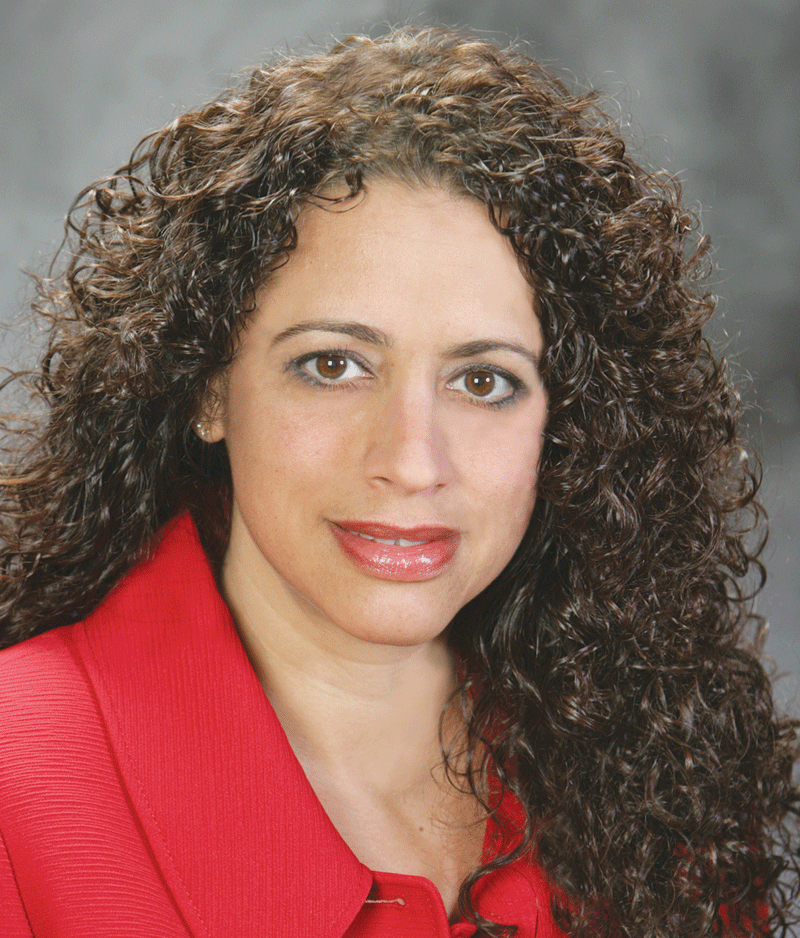
Denise V. Laizer, Senior Vice President and Chief Lending Officer for Easthampton Savings Bank, has been named a Community Bank Hero for 2012 by Banker and Tradesman magazine. Readers of Banker & Tradesman were asked to nominate individuals who work in a Massachusetts community bank, are respected industry professionals who have made a significant impact on those around them, and make outstanding contributions to their institution. Criteria for candidates also included giving back to the community and the industry with time, energy, and resources through volunteerism, community service, and charity. Laizer, who was one of 16 selected, will be honored at a special awards ceremony in Boston on May 23.
•••••
Michael Ravosa was recently elected to the Board of Trustees at American International College in Springfield. He is the Vice President for Investment for the RBD Wealth Management Group, UBS Financial Services.
•••••
United Fresh Foundation’s Center for Leadership Excellence has chosen John Heon, Produce and Floral Sales Manager, Big Y World Class Market in Great Barrington, as an honoree for its 2012 awards. Heon was honored among 25 produce managers representing 20 supermarket chains, commissaries, and independent retail stores within the U.S. and Canada. Winners were selected by a team of produce experts who examined efforts to increase produce consumption through everyday excellence in merchandising, special displays and promotions, community service, and commitment to total customer satisfaction. Heon has been with Big Y for 31 years.
•••••
North Brookfield Savings Bank announced the following:
• Rick Egan has been named Assistant Vice President and Commercial Loan Officer. He is responsible for developing new and existing commercial-lending relationships, advising business customers on available lending products, and helping borrowers achieve their financing goals.
• Lillian Carlson has been named Loan Officer. She is responsible for creating and maintaining relationships with existing and prospective loan customers as well as assisting customers with the mortgage-lending process and helping them find financing solutions.
•••••
Kim Bushey

Kim Bushey

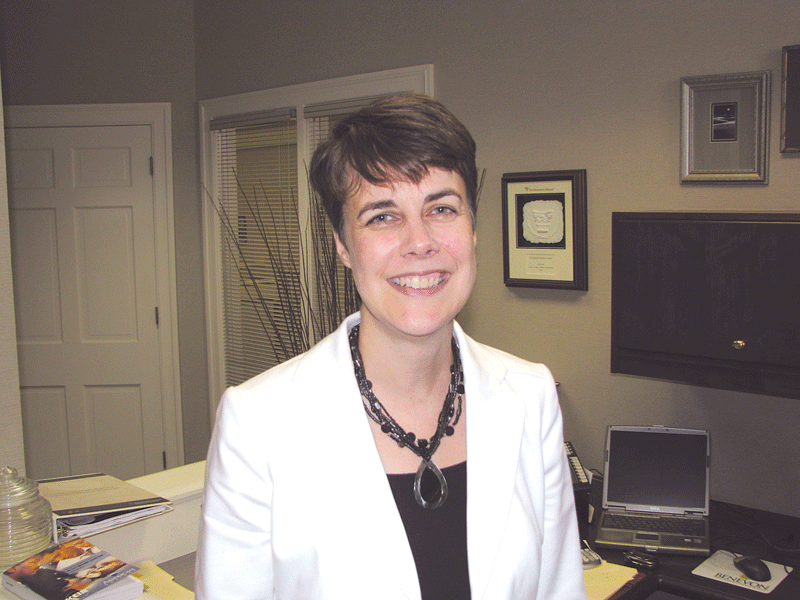
Santander Holdings USA Inc. and Sovereign Bank, N.A., wholly owned subsidiaries of Banco Santander, announced the appointment of Kim Bushey as Senior Vice President and Business Banking Executive for Connecticut and Western Mass. Bushey, based out of the West Hartford, Conn. office, will be responsible for serving the needs of local businesses with annual revenue of $3 million to $20 million.
•••••
Attorney Danielle I. Nicklas has joined Cooley Shrair in Springfield as Associate Legal Counsel. Nicklas focuses her practice on health law, including health care compliance, risk management, Stark law, and anti-kickback regulations.
•••••
James M. Lavelle, General Manager of the Holyoke Gas & Electric Department, will receive the 2012 Henry A. Fifield Award for Voluntary Service to the Greater Holyoke Chamber of Commerce. The late Henry Fifield was an Ampad executive who served the chamber in many capacities, including chairman of the board. Lavelle will be honored at the 122nd annual meeting of the Holyoke Chamber on May 30 at the Log Cabin Banquet and Meeting House. The award presentation and reception for Lavelle will be a highlight of the annual meeting, which will also include an election of officers and directors for the 2012-13 year.
•••••
David Fedor, an independent Financial Advisor affiliated with Commonwealth Financial Network and President of Fedor Financial Group in West Springfield, was named to Commonwealth’s Winners Circle. The distinction recognizes 167 out of Commonwealth’s 1,400 financial advisors nationwide.
•••••
The Hampden County Bar Assoc. announced the following:
• Attorney Kevin J. Claffey received the John M. Greaney Award during the association’s National Law Day Ceremony at Springfield District Court; and
• Noreen E. Nardi received the John M. Greaney Award during National Law Day. The annual awards are given to both an attorney and a non-attorney who are deemed outstanding citizens of the Hampden County legal community.
•••••
John Elder Robison was among 15 individuals recently selected to serve on the U.S. Health and Human Services Interagency Autism Coordinating Committee. Robison is an adjunct faculty member in the Department of Communication Sciences and Disorders at Elms College, Chicopee. He speaks publicly about his experience as a person on the autism spectrum, and is the author of Look Me in the Eye: My Life with Asperger’s and Be Different: Adventures of a Free-Range Aspergian.
•••••
Tighe & Bond of Westfield announced the following:
• Stephen Seigal, P.E., BCEE, has joined the firm as a Vice President, and will work out of the Worcester office. A civil engineer with 36 years of regional experience in the wastewater industry, Seigal has planned, designed, and provided construction-phase engineering services for more than 24 wastewater treatment facilities throughout the region.
• David Loring, P.E., LEED AP, has been named Technical Practice Leader for the Civil Practice Group. In this role, he will coordinate and advance the firm’s civil-engineering capabilities, oversee the continual advancement of relevant technical skills, and promote professional development of key staff. He will also ensure that the Civil Practice Group stays abreast of local, state, and federal regulations that impact clients. Loring is a licensed civil engineer and construction supervisor in Massachusetts, as well as a LEED Accredited Professional.
•••••
American International College in Springfield has named Dr. Cesarina Thompson Dean of the School of Health Sciences. Thompson will begin her duties on July 1. She was inducted as a Fellow in the National League for Nursing’s Academy of Nursing Education for her research and scholarly activities focusing on advancing nursing education. She received a Ph.D. in Adult Education and a M.S. in Nursing from the University of Connecticut, and a bachelor’s degree from the University of Bridgeport.
•••••
The Massachusetts Municipal Wholesale Electric Company (MMWEC) announced the following election of directors and officers:
• Paul Robbins, Principal of Paul Robbins Associates and a gubernatorial appointee, was elected Chairman;
• Phillip W. Sweeney, Marblehead Municipal Light Department Commission Chairman, was elected to a two-year term on the board;
• Kevin P. Kelly, Groton Electric Light Department Manager, was elected to a three-year board term; and
• Peter D. Dion, General Manager of the Wakefield Municipal Gas & Light Department, was re-elected by the membership to his fourth one-year term as President of MMWEC.
Additional MMWEC officers for the coming year, as elected by the board, include:
• Ronald C. DeCurzio, CEO and Secretary;
•  Jeffrey B. Iafrati, Treasurer;
• Stephen J. Smith, Assistant Treasurer;
•  Nancy A. Brown, Assistant Secretary; and
•  Nicholas J. Scobbo Jr., General Counsel.
Other MMWEC directors, elected previously by the membership, include:
• Gary R. Babin, Director of the Mansfield Municipal Electric Department;
• Jeffrey R.  Cady, Manager of the Chicopee Muncipal Lighting Plant;
• Sean Hamilton, General Manager of the Sterling Municipal Light Department;
• Jonathan V. Fitch, Princeton Municipal Light Department Manager; and
• James M. Lavelle, Holyoke Gas & Electric Department Manager.
In addition to Robbins, Michael J. Flynn serves on the board as gubernatorial appointee. Flynn also represents the Town of Wilbraham on the board, with Luis Vitorino and John M. Flynn representing the towns of Ludlow and Hampden, respectively.
•••••
Big Y Foods Inc. of Springfield announced the following:
• Michael J. Galat has been named interim Senior Director of Employee Services. He will oversee the entire department, including employee policies and procedures, training and development, morale and engagement, recognition, progressive discipline, employee benefits, and wellness initiatives; and
• Sean S. Nimmons has been appointed a District Director for the eastern zone. He is responsible for managing all aspects of the 15-store zone, including employees, financial performance, merchandising, and operations.
•••••
Daniel R. Moriarty has been named Senior Vice President and Chief Financial Officer at Monson Savings Bank. A member of the bank’s senior leadership team, he is responsible for leading the bank’s financial functions, operations, and reporting.

Departments Picture This

Send photos with a caption and contact information to:  ‘Picture This’ c/o BusinessWest Magazine, 1441 Main Street, Springfield, MA 01103 or to [email protected]

Continuing the Legacy

The Sisters of Providence Health System staged its eighth annual Continuing the Legacy luncheon on May 4 in the Springfield Sheraton ballroom. More than 500 people attended the annual fundraiser, at which guests are inspired by, and educated about, the SPHS mission, services and advancements. The event introduces the multi-year giving society, Providence Circle, and invites guests to provide financial or other support. From top, Judith Danek, of Chicopee, tells the gathering about her family’s positive experiences at Mercy Medical Center; John E. Sjoberg, SPHS trustee and SPHS Foundation Board chair, speaks to attendees; and Daniel P. Moen, President and CEO, SPHS, (standing) is surrounded by members of the Sisters of Providence congregation; seated (from left) are Sisters Mary McGrath, SP, Ruth McGoldrick, SP, Margaret McCleary, SP, and Elizabeth Oleksak, SP. Standing (from left) are Sisters Mary Martin de Porres, SP, Priscilla St. Pierre, Joan Manning, SP, and Ann Horgan, SP.


Art of the Matter

Students from the UMass Amherst Commonwealth Honors College, none of whom are Fine Arts majors, showcased their artwork in a pre-concert gallery opening and reception in the lobby of One Financial Plaza on May 12. The students’ works were inspired by Gustav Holst’s The Planets, being performed that evening by the Springfield Symphony Orchestra. Top to bottom, exhibiting senior Rachel Mroz and guest Charlene Baiardi discuss a painting; parents Louise and Bernie Hartnett and Connoisseur Rosemary Tracy Woods view a recreation of Botticelli’s Primavera; James Vinick of Moors & Cabot Investments and Marjorie Koft contemplate an artist’s unique chimpanzee concept; Springfield City Councilor Timothy Rooke and Spirit of Springfield President Judy Matt discuss the artists’ talent; and (from left) Professor John Simpson, Beverly Hill, Evan Plotkin, and Willie Hill Jr. celebrate the opening of the exhibit and gallery. The event was sponsored by UMass Amherst, NIA Plotkin, and Springfield Symphony Orchestra.


Corridan Center Dedication

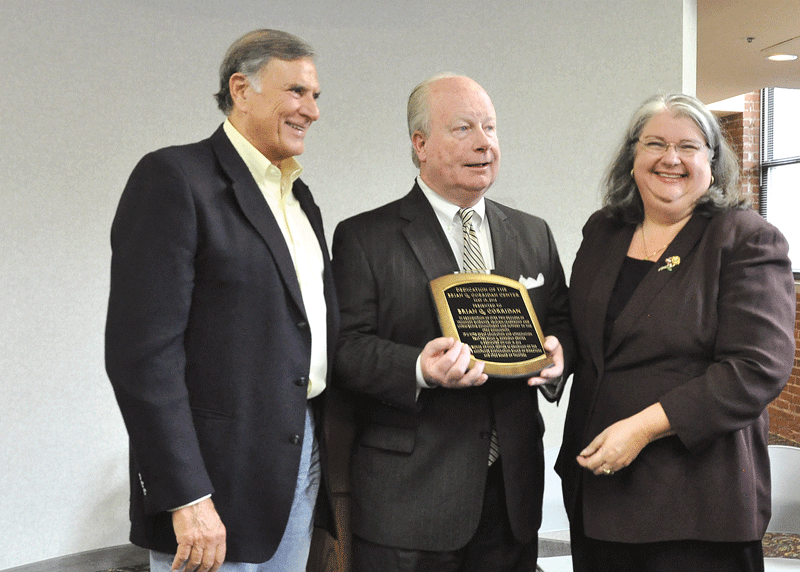
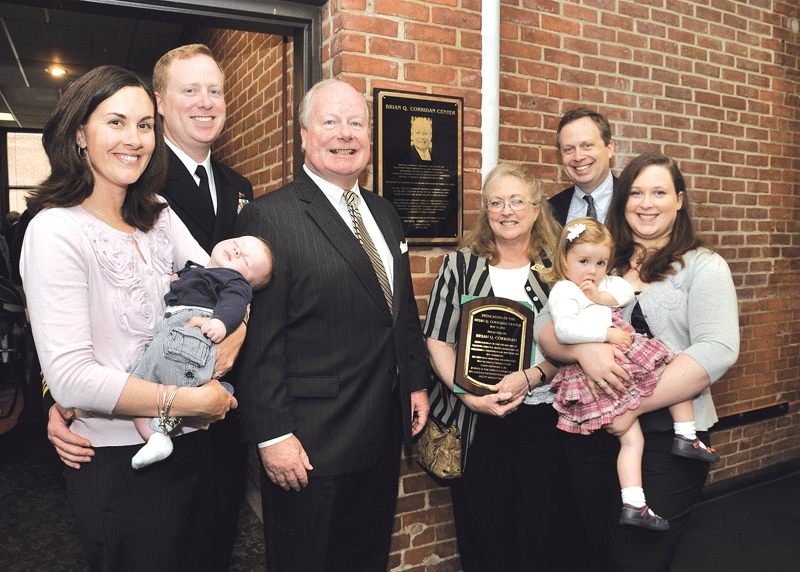
The Springfield Technical Community College (STCC) Technology Park dining commons courtyard was recently dedicated to Brian Q. Corridan, president and CEO of the investment firm Corridan & Co. Corridan was honored in recognition of his years of service to the STCC Board of Trustees, including several years as president, a lengthy tenure as chairman of the STCC Assistance Corporation Board of Directors, and strong record of community service. Top, Corridan (center) poses with former STCC President Andrew Scibelli and Gail Carberry, former STCC vice president and current president of Quinsigamond Community College in Worcester. Below, Corridan with his family in front of the plaque inside the center.


Greaney Award Winners

On May 1, the fourth annual John M. Greaney Awards were given out during the Hampden County Bar Association’s National Law Day Ceremony in the Springfield District Court. The awards are given to both an attorney and non-attorney who are deemed outstanding citizens of the Hampden County legal community. Here, Greaney, center, is seen with this year’s winners, Kevin J. Claffey, Esq., and Noreen E. Nardi.

Employment Sections
What a Résumé Can Say — or Not Say — About a Candidate

Katherine Lamondia-Wrinkle

Katherine Lamondia-Wrinkle says the references from the résumé don’t always tell the whole story.

Cynthia Landry says that, despite many advances in the process of recruiting, evaluating, and eventually hiring talent, the résumé remains one of the most critical pieces of the puzzle.
It presents the candidate with a chance to make a case, she explained, and thus do what every job seeker strives to do — get their foot in the door. And yet, many simply don’t make effective use of that opportunity, and sometimes that’s why the door doesn’t open, said Landry, a human resources generalist for Health New England (HNE).
“The résumé is for you to put your best attributes out there so we can match your skills to the requirements of the job,” she told BusinessWest, adding quickly that such attributes can be lost amid too many words about things that don’t matter — someone’s hobbies, for example — and too few about what does matter, such as how an individual has helped a company grow revenues and reduce expenses.
Katherine Lamondia-Wrinkle, a partner with the law offices of Thomas M. Libbos, agrees. She said too many candidates fail to take full advantage of a résumé’s ability to make a good first impression. Meanwhile, she advises business owners and managers to maximize their opportunities to use a résumé to learn about a candidate, and thus pose effective questions that will enable them to ascertain more.
Kim Kenney-Rockwal, director of human resources for HNE, said there is an art and science to both writing and reading résumés, and she stressed the importance of using the document to not only present a past employment history, but also — and more importantly — explain what one has accomplished and how.
“If you have two people that are equally qualified, it’s hard to differentiate each one,” she explained. “You have to show how you stand out, and you need to show how you can bring more to that position than anyone else.”
For this issue and its focus on employment, BusinessWest talked with several résumé readers and writers about what a résumé can say — and why, all too often, it doesn’t say enough.

The Write Stuff
Jill Grindle, a certified professional résumé writer who owns A Step Ahead Résumé in Agawam, said there are three styles of résumés.
The first and most common is the chronological résumé. While entirely overused, it serves a purpose for someone younger — say, a recent college graduate who doesn’t have much work history to report. The next is what’s known as the combination or hybrid, and it lists not only the dates and places one has worked, but also what they accomplished in that job. For instance, did the applicant start a new process that saved himself and others in the office time and effort? Did she go above and beyond her sales goals? Were they rewarded by their former employer for certain accomplishments?
The third style is the functional résumé, and, according to Grindle, this is the “job obituary.”
“It’s typically used when someone has a spotty work history and feels they need to minimize those gaps, but it’s a red flag for most employers, and it’s very hard to track when a skill was learned in what job during what dates.”
The functional résumé style lists a candidate’s information by skill sets, and while it does allow the person to match their skills to what a job description is requiring, it’s difficult for an employer to read, especially when 20 seconds is about all you get to make an impression on paper or computer screen.
Typically, those with many years out of the workforce — due to, say, raising a family, military obligations, or a multi-track job history — might use this style, but the hybrid should still be the number-one style choice.
Kenney-Rockwal says that fewer than one-quarter of the résumés that Health New England receives are in the hybrid format, and this is regrettable because opportunities are missed to showcase how a person has truly benefited a company.
“How much money did you save the company in what amount of time?” she said, referring to one question that a résumé should help answer. “Don’t just tell me what the role was; tell me what you did in that role to make it different.”
She adds that one of the biggest mistakes that people make is taking their former job description and simply transfering it onto the résumé.

Mind the Gap
But what about those gaps in a work history? According to Grindle, candidates should just be honest.
“If you were home raising children, say so,” she said. “If you had to leave full-time work to care for ailing children, you’re not alone. Many Baby Boomers, who are still a major force in the labor pool, are facing this same issue and will continue to for many years. If you were off for some time, what did you do during that time to gain more skills, or what effort did you take to make use of that time for the future?”
Kenney-Rockwal agrees, and said that the effort to keep strengthening skills during those gaps shows serious intent. “If someone is transitioning from one industry to another, then of course we are going to expect some gaps of time for education or job searching. Even using the time wisely to go back to school is important, and we recognize that.”
Elisa Rose, another human resources generalist with HNE, adds that some of the questions being asked these days regarding work-history gaps include inquires about what a person learned during their time off that can be beneficial to the company.
Lamondia-Wrinkle is leery of short-term hiccups in the work history, and uses the applicant’s references to do some fact-finding. Obviously, she’s looking for a reference to give a great review of the candidate, but sometimes the unfavorable review — if she can get it in this age of privacy laws and fears of legal ramification — doesn’t always tell the full story.
She gives the example of a recent position that had to be filled by someone who had fantastic people skills and would represent the firm at the first point of phone or in-person contact. One résumé presented the initial requirements, and after a stellar set of interviews, the reference from a former employer just didn’t add up for this particular candidate.
“Her references were not supportive of what her résumé said, but we really took a chance on who she was, how well she appeared, and how well-spoken she was — despite the poor references.”
Lamondia-Wrinkle says the situation turned out to be the result of bad feelings that lingered between the candidate and the former employer who made the past personal. “She really impressed us in the personal interview. She’s been a phenomenal asset to our company; she was the right person for the job.”

The Bottom Line
The résumé is still a force to be reckoned with and doesn’t appear to be going away anytime soon. Kenney-Rockwal says that not everybody can afford to hire a professional résumé writer, or automatically know the presentation skills that are necessary for the personal interview, but there are plenty of area organizations and career fairs that offer free services to help.
And, while there are many aspects to the job search, the résumé is one of the keys, she stressed — a key that just might open a door and allow one to get a foot inside.

Elizabeth Taras can be reached at [email protected]

Court Dockets Departments

The following is a compilation of recent lawsuits involving area businesses and organizations. These are strictly allegations that have yet to be proven in a court of law. Readers are advised to contact the parties listed, or the court, for more information concerning the individual claims.

FRANKLIN SUPERIOR COURT
Faye Ferris v. Deerfield Academy
Allegation: Negligent maintenance of sidewalk, causing slip and fall: $157,500
Filed: 2/27/12

HAMPDEN SUPERIOR COURT
Annmarie Lafreniere v. Wing Memorial Hospital
Allegation: Wrongful termination: $25,000+
Filed: 3/22/12

Beck Aluminum Corp. v. Diecast Realty Holdings, LLC
Allegation: Non-payment of goods sold and delivered: $30,398.94
Filed: 3/28/12

James Marrin v. Tri-Lift Inc., Mitsubishi Caterpillar Forklift America Inc. and Jungheinrich
Allegation: Negligence in the design and manufacture of a pallet truck, causing it to malfunction and cause severe operator injury: $15,894.15
Filed 3/28/12

S & A Supply Inc. v. Statewide Mechanical Contractors Inc.
Allegation: Non-payment on goods sold and delivered: $30,073.91
Filed: 3/22/12

Titan USA Enterprises Inc. v. RTS Cutting Tools Inc.
Allegation: Breach of contract and unfair and deceptive acts: $80,000
Filed: 3/21/12

HOLYOKE DISTRICT COURT
Raymond St. Hilaire v. C & L Restaurant Group
Allegation: Breach of duty of care and negligence in preparation and service of food, causing injury when plaintiff bit into an onion ring and fractured his tooth: $1,528
Filed: 2/1/12

PALMER DISTRICT COURT
Capital One Bank v. Laura’s Cleaning
Allegation: Non-payment for credit advanced: $5,405.77
Filed: 3/5/12

SPRINGFIELD DISTRICT COURT
Berkshire Bank v. Quality Care Transportation, LLC and Hasapall Mohamed
Allegation: Default on small-business account: $10,304.79
Filed: 3/26/12

Constellation New Energy Inc. v. New Belmont Variety
Allegation: Breach of energy service agreement/price watch agreement and account annexed: $11,272.90
Filed: 3/29/12

Thomas Johnson v. Excellence Auto Exchange
Allegation: Breach of contract regarding the sale of a vehicle: $12,569.52
Filed: 3/2/12

Entrepreneurship Sections
Entrepreneurs Gain Insight at Valley Venture Mentors Program

EntreneurshipDPartThe idea for Marcie Muehlke’s business was born when she went shopping for her wedding gown. “I wanted something that was beautiful, but also had a beautiful story behind it; I didn’t want a dress made in China in a sweatshop or by children,” said the Amherst resident.
Her search proved futile, but after talking with friends, the 29-year-old realized they shared her values — and so did many others.
“So I founded Joya Bride with the idea of having women’s cooperatives in Southeast Asia produce wedding dresses that would make women look beautiful and feel joyful on their wedding day,” Muehlke said, noting that her goal since she was a college undergraduate has been to figure out a sustainable way to help women in the developing world.
Muehlke recently returned from three weeks in Southeast Asia, where she met with silk makers and independent craftswomen. “It was an amazing trip,” she said.
It was also a journey she might never have undertaken without the help, support, and guidance she has received from Valley Venture Mentors, or VVM. The Springfield-based group provides critical support to entrepreneurs by linking them to business professionals who act as mentors during structured monthly pitch-and-planning sessions as well as in private meetings between sessions.
Although Muehlke had conducted academic research before making the decision to launch her company, the guidance she’s received from the group has been invaluable.
“Each month they posed questions about things like price points, sourcing, and supply-chain marketing, and through long conversations with my mentors, I was able to nail down answers and move forward,” she said. “They provided me with lots of valuable advice as well as help in making overseas contacts.
“I haven’t signed any contracts yet, but I have sample dresses and a few orders, and when I graduate next month from the Isenberg School of Management at UMass Amherst, I’ll devote myself to this full-time,” Muehlke continued. “It’s a decision the group really helped me with. We talked through the pros and cons, and they gave me the moral support to take the risk. They’ve helped me make critical decisions and move forward to make this business become a reality. It would have been a lot more difficult and slower without them.”
Muehlke’s comments are typical of those who have received — and continue to receive — support from the program. And for this issue, BusinessWest talked with several individuals on both sides of the mentoring spectrum about the VVM and its potential to spur business growth, and thus employment, in this region.

Valuable Exchange
Muehlke was one of more than 60 people who met in the Springfield law offices of Bulkley, Richardson and Gelinas during the VVM’s monthly meeting in April, where the degree of energy, enthusiasm, and intense interest in new business concepts was certainly palpable.
Four groups who hope to be accepted into the program delivered timed presentations. Their auditions had to include an executive summary, a video, and a pitch focused on how and why their company could work. When they finished, three teams already accepted into the VVM program reported back to the group on progress they have made since the last meeting.
Scott Foster, a partner and business law attorney with Bulkley, Richardson and Gelinas who started VVM with Paul Silva, managing partner of Angel Catalyst, said two main premises must be incorporated into each presentation. The first is called the ‘pain,’ which translates into the need or problem the entrepreneurs will fill or solve, as well as “why the world needs it.”
For example, a company dubbed Mission Control presented an idea for a software product that would be affordable and easy for nonprofits to use and noted that the market lacks software that meets the needs of such organizations.
After explaining why their product or service is valuable and viable, the entrepreneurs finish their presentations with the second critical component of the program, termed the ‘ask,’ which is a problem they must solve to move their venture forward — and a matter they want and need help solving.
Foster said entrance into the program is determined by the degree of maturity of an idea, and what the presenter has already accomplished. “We’ve had people present ideas that were not developed enough for us to be helpful,” he said.
Those who are accepted must be willing to accept what Foster refers to as “lovingly critical advice.”
“But this is not a shark tank — even if a mentor thinks an idea is the worst thing he or she has ever heard of, their job is to think about the challenges the business will face,” he explained, adding that groups who are not accepted can return and present their ideas again after they have done more work on them.
After the presentations, mentors meet with the presenters in two short break-out sessions where they pose questions aimed at helping the fledging entrepreneurs hone their ideas, identify exactly who their product or service will appeal to, where they might get financial backing, and the best way to market their idea. After those sessions, the mentors meet with teams already accepted into the program.
Foster said mentors refrain from giving advice, but may introduce solutions they have found helpful in solving similar problems. And between meetings, mentors, as well as the facilitator assigned to each group, often reach out to teams with help that can include introductions to people outside of VVM.
“We had one team that was creating a commercial coating to reduce the drag on ships,” said Foster. “One of our mentors knew someone at the Navy laboratories and was able to help the group get their product tested by the Navy. It’s a lot of work because the mentors and board members are all volunteers, but although it takes an enormous effort, it is very rewarding.”
Gourmet food and beverages are served to create a convivial atmosphere, and when the meetings finish, people often go to the sports bar in Tower Square to continue talking. “We’re hearing about innovative concepts and ideas that can change the world,” Foster said.
As word about VVM spreads, the number of people wanting to present ideas has mushroomed. “The majority of people we accept are still in early stages of establishing their company, and many are operating out of their homes, which is the stage where the least amount of assistance is available,” Foster told Business West.
The original concept called for a six-month membership for entrepreneurs accepted into the program. But that model has changed. “Some only need four months, while others come to a few meetings, then take time off to apply the advice they received before they return,” said Foster, offering the example of a person who came to the group with a viable concept, but needed time to bring it to fruition and figure out what the appropriate market for the product was before he was prepared to return. “But this is a lifeline for people. It’s the difference between sitting at home and thinking about a good idea and getting out there and getting it done.”
Nathaniel Davis was accepted into VVM last June. His company, Play/Give/Win, offers nonprofits and other people who want to raise money an innovative way to do so. Instead of asking for donations, charities can invite people to pay to play online games with prizes, or go on ‘missions’ that range from ‘liking’ a Facebook page or Twitter account, which translates into a cash value due to business sponsors, to checking in at a location where they can redeem a coupon.
“VVM has been absolutely pivotal in helping us create a working product, get customers, and generate our first revenue,” said Davis.
Before he found out about VVM last spring, Davis said he spent a large amount of money trying to make connections in Boston, and believed he would eventually have to relocate to a major hub such as New York or Silicon Valley, where there is strong support for technology entrepreneurs, in order to be successful.
But all that has changed as a result of his involvement with VVM. Davis had outsourced his Web development to India, but the relationships he made through his mentors allowed him to bring it back to Massachusetts at a lower cost, convey the concept in simpler terms, and define his product so the average person can understand it.
“They also helped me discover whether I was actually onto something,” he said. “I believed I had a viable idea, but they helped confirm it and provided valuable feedback that helped me redefine my business model. It’s a good place to come and pitch an idea; you will be among professionals in the area who have already succeeded and can help you avoid pitfalls and mistakes they made along the way.”

Changing Direction
“Entrepreneurship, whether for profit or nonprofit, is what changes an economy to make it more responsive to the region,” said mentor Rick Feldman, who has been involved with fledging firms for 30 years. “My world is the world of enterprise development; I’ve started and sold two companies and, years ago, started the Western Mass. Software Assoc. to do this type of work.”
Feldman enjoys his involvement with VVM, and says part of the group’s goal is to help people figure out the right path to take and think seriously about whether they are prepared to own their own business.
“In some cases, that means rethinking their plans; they may actually want a job or career, and you find that out through lovingly critical conversation,” he said, using a phrase other mentors employed on a frequent basis.
He’s worked with two people in VVM who decided that going into business was something they were not prepared to do. “They found their niche in another way, through a job,” Feldman explained.
Mentor Mike Ippolito had the same experience. He was mentor to a group he met with four or five times. “They couldn’t seem to get their business model down, and eventually they all found good jobs,” he explained. “When you are in a startup, you have to look around and ask if the path you are on is the right one. We encourage people to look at all of their options and hopefully come up with a decision.”
However, those who decide to move forward get help from a variety of professionals, who essentially urge them to think globally. “We’re not looking for companies that want to stay small, but for those who want to swing for the fences, hit a home run, and become as big as Facebook,” Foster said. “It’s a little crazy, but we want them to think big, become very successful, and employ hundreds of people.”
Cloud2Market founder Robert La Ferla said VMM has been very helpful to him and his partner, Chitra Dwarka. “They showed us gaps we needed to address as well as areas in which we needed to communicate more effectively. And our mentor gave us ideas about different markets to target,” La Ferla said.
Their business is aimed at redefining the call experience for consumers and businesses via a visual, branded, interactive, and easy-to-use mobile app and cloud service designed as a single integrated solution for customers that will increase satisfaction and reduce costs.
Mentor Daniel Lieberman says VVM also benefits those who volunteer. “It gives the established business community an opportunity to meet people and get new ideas for growth,” he said, adding that he was a mentor to Davis’s company for three months and has been part of the program for nine months. “It is very fulfilling, and I’ve learned a lot. I’m in Internet marketing, so it is good for me to be aware of what the business trends are.”
Mentor Jim Mumm looks forward to the monthly meetings. “It’s exciting to be around people with great ideas who are working long hours to make them happen; the caliber of people who come here and help is incredible,” he said. “This keeps me in an entrepreneurial mindset as I am around other like-minded people, whether they are wildly successful or just getting started. I get more than I give, and it makes you rethink what you are doing in your company and why.”

Positive Gains
Muehlke said the monthly presentations at VVM helped her to polish her public-speaking skills. “You have to explain your concept, present any updates, and defend your decisions; public speaking and pitching a business is not easy, and this has been a great way to practice,” she said. “This is a community of support, and their energy and enthusiasm are as important as their actual advice. I’m so glad I have been able to be part of it so I can provide brides with dresses that make them look beautiful and feel more joyful, knowing they are helping women around the world.”
It’s a goal right in line with the purpose of VVM. “These people are building ventures and satisfying significant niches,” Silva said. “They may not all be high-tech, but they are all high-scale.”

Law Sections
Know Your Options When Incorporating Your Small Business

Michael Gove

Michael Gove

The majority of companies begin as modest businesses owned by a sole proprietor or partnership, and often it is not until the company has grown do owners consider incorporating the venture. Whether small or large, all businesses can benefit from incorporating, but the most basic reason for considering a change in the business structure boils down to managing potential risk.
Incorporation is the act of forming a new legal entity (business structure) that provides certain business, tax, and legal advantages to its owners. The separate legal entity can own property, pay taxes, sign binding contracts, and, most importantly, protect its principals from many types of liability.
When deciding to incorporate, the following advantages should be considered:
• Limitation of Liability: The main advantage to creating a business entity is the limitation of liability faced by principals of the business. If a business is run as a sole proprietorship, the business owner assumes all liability, but when the business is a separate legal entity, an individual principal’s or investor’s liability is limited to the amount he has invested. In contrast, as a sole proprietor, your personal assets can be seized to pay the debts of the business.
• Raising Money Can Be Easier: Business entities can borrow or incur debt and can sell shares, which can make it easier to obtain capital for your business to develop.
• Deductible Expenses: Business entities may be subject to advantageous rules for business expenses.
• Protection of Trade Names: While not conclusive, the registration of your business-entity name with the secretary of state will provide additional protection against another business with an identical or similar name.
• Additional Credibility: A business entity may have more credibility with potential clients.
• Continuation of the Business: A business entity may continue to exist even beyond the death of a principal.
There are a variety of business entities that a business owner may use, and each provides specific legal and tax advantages and disadvantages. These include:
• Sole Proprietor: A sole proprietorship describes a simple business structure that is owned by an individual. Many smaller businesses operate as sole proprietorships; however, as mentioned above, one of the major disadvantages of this structure is that the owner is personally responsible for all legal and financial liabilities. A business-related lawsuit or IRS tax audit can place the owner’s personal assets at risk of seizure. Further, all business income is taxed as personal earned income by the owner. Though an owner may choose to use a trade name (also known as a d/b/a), there is no legal separation of the owner from the business.
• General Partnership: A general partnership allows two or more parties to share in the liability and profits of a company. Those parties can be comprised of corporations, individuals, other partnerships, trusts, or any combination thereof. Advantages of a general partnership include its ease of establishment and its ability to use the financial and managerial strengths of all partners. The disadvantages of a general partnership include the unlimited liability faced by the partners for the legal and financial liabilities of the business; that liability caused or incurred by one partner leaves all partners vulnerable to seizure of business and sometimes personal assets; and that one partner is able to commit the partnership to obligations without approval from the other partners.
• Limited Partnership: The limited partnership (LP) business structure creates a separate legal entity that involves one or more general partners and one or more limited partners. The limited partners typically invest capital in the business and are limited in their liability proportional to the amount of capital they invest. The general partner controls the operation of the partnership and is personally liable for its obligations and debts. (A corporation is often placed in the general-partner position in order to absorb the liability.)
A majority vote of the voting partners, unless specified otherwise by a written agreement, can change who serves as general partner. When a limited partner is sued personally and a judgment is issued, that limited partner’s interest in the limited-partnership entity is protected from seizure, as are any assets held by the limited partnership. Because of this protection, the limited partnership can be effective in shielding assets from creditors.
• Limited-liability Partnership: A limited-liability partnership (LLP) is most often employed in professional practices such as law, accounting, and architecture. This type of separate legal entity allows for liability protection for all general partners, as well as management rights. In most cases, the limited-liability partnership provides for the same limited liability found in a corporation. For tax purposes, the limited-iability partnership is a flow-through entity like a partnership.
• Limited-liability Company: The limited-liability company (LLC) combines the limited-liability benefits of a corporation and the tax benefits of a sole proprietorship (though one can choose to have the LLC taxed as a corporation). In an LLC, the owners are referred to as members. When the LLC is sued, its status as a separate legal entity can protect the individual members from liability. When the members are sued personally, the LLC and its assets are protected from being seized by creditors of the members. Because of these benefits, a limited-liability company is a popular choice of business entity for a wide variety of objectives.
• Corporation: Depending on a number of factors, a corporation can choose to file taxes either as a C corporation (where taxes are paid by the corporation) or as an S corporation (where income is passed through to the owners and is taxed on them individually). A corporation can choose to be an S corporation if it has fewer than 100 shareholders and all shareholders are U.S. residents. As a C corporation, there is no limit on the number of shareholders; additionally, C corporations can deduct employee medical expenses and insurance costs.
Once you have created a business entity, you will also need to request a federal employee identification number (FEIN) from the IRS. With a FEIN, your business will be able to open a bank account. Maintaining the company’s bank account separate from other business or personal accounts is crucial to avoiding a determination that funds have been ‘co-mingled.’ Updates with the secretary of state will be required at least annually, and more often if changes are made. Depending on the type of work being conducted, additional licenses or certificates may be required from the state or municipality where your business operates.
Remember, your business is ever-growing and changing. It is always a good idea to seek the assistance of a responsible tax professional and a qualified business attorney who can offer practical answers to your questions.

Michael S. Gove is an associate with Springfield-based Cooley, Shrair, P.C.; (413) 735-8037; [email protected]

Law Sections
New Legislation Could Set the Stage for a New Policy in Massachusetts

John S. Gannon

John S. Gannon

Last year, Connecticut became the first state to pass legislation requiring employers to provide paid sick leave to employees. The law, which went into effect on Jan. 1, 2012, requires most employers with 50 or more employees to provide paid sick days to their service workers, i.e. employees who regularly deal with the public.
Similar pieces of legislation have made their way up Beacon Hill over the last few years, but none have garnered enough support to raise eyebrows. However, with the new Connecticut law gaining national attention, Massachusetts may be more likely than ever to pass paid-sick-leave legislation.

Earned Paid Sick Time
Last month, paid-sick-leave supporters introduced their latest version of the bill to the state Legislature. The bill, titled “An Act Establishing Earned Paid Sick Time,” tracks analogous legislation proposed in previous years.
The law would require all employers with more than 10 employees to provide a minimum of 56 hours of paid sick leave to their employees on an annual basis. Employers with six to 10 employees would be required to provide at least 40 hours of paid sick leave, and the smaller ‘mom and pops’ with fewer than six employees need only give 40 hours of unpaid sick time.
Employees would accrue one hour of paid leave for every 30 hours worked. They would also be entitled to carry over unused leave into their next year of employment. However, even if employees were able to carry over some unused sick leave, they would not be entitled to take more than their annual allotment during any given calendar year.

Define ‘Sick Time’
The proposed legislation would allow employees to use paid sick leave for a variety of reasons.  First, they could use it to care for their own physical or mental illness that requires that they either stay home or seek professional medical care. This would permit usage for everything from the common cold to serious health conditions requiring a stay in the hospital.
Employees would also be able to use paid leave to attend routine medical appointments for themselves or for their children, spouse, and parents. Paid leave could also be used to care for an ill family member. Finally, employees could use the leave to address psychological, physical, or legal effects of domestic violence.

Prove It
In the ’80s classic Ferris Bueller’s Day Off, Matthew Broderick is able to pull off a legendary sick-day scheme that begins with faking an illness. Will Massachusetts employees be able to follow in his footsteps?
The newest version of the legislation gives employers the right to request ‘reasonable documentation’ only when an employee is out for more than a day. This is more favorable to employers than earlier versions of the bill, which allowed a request for documentation only for absences of three days or greater. Still, it doesn’t take Ferris Bueller to realize that single-day trips to Fenway Park or the beach under the guise of an illness may go unnoticed.

Compliance
The good news is that employers who already provide paid sick leave under a PTO, vacation, or other leave policy will not need to change their policies if they already provide the requisite amount of leave and permit carryover as designed under the proposed legislation.
The current form of the bill would consider any such policy to be in compliance with the law.  However, the paid-leave policy must permit the employee to use time for the reasons listed above, and documentation requirements can be no more demanding than specified in the law.

Going Forward
Naturally, the legislation has drawn praise from workers’ rights groups and criticism from business advocates. Supporters of the proposed law argue that employees should not have to sacrifice their health for wages. They also claim that paid sick leave would reduce the spread of communicable diseases among coworkers and to business customers.
Opponents are quick to point out that these benefits come at a price. The National Federation of Independent Business (NFIB) estimates that mandatory paid leave will cost Massachusetts nearly 12,000 jobs over the next several years, with smaller businesses bearing the brunt of the losses.
Finally, it’s important to remember that mandatory paid sick leave is only proposed legislation in Massachusetts. The bill has several hurdles to leap before it could be fully voted on by the Legislature and put before the Governor for passage. Still, paid sick leave legislation is something to keep track of in 2012.

John Gannon is an associate with Skoler, Abbot & Presser, P.C. He received his juris doctor, cum laude, from Western New England University School of Law; (413) 737-4753; [email protected]

Law Sections
Bulkley Richardson Stakes Out New Ground

John Pucci, left, and Andrew Levchuk

John Pucci, left, and Andrew Levchuk bring expertise to Bulkley Richardson in some key, growing niches of law.

John Pucci has amassed a considerable record in white-collar crime. No, not that kind of record.
Specifically, he prosecuted criminal cases for the government as chief of the U.S. Attorney’s Office in Springfield before moving into private practice as a partner at Fierst, Pucci & Kane in Northampton.
For Bulkley, Richardson and Gelinas, the Springfield-based law firm that brought him on board as a partner earlier this year, his experience on both sides of white-collar-crime and other specialties make him a valuable asset. As part of his role, he’ll handle federal tax-evasion cases, public-corruption claims, and cases involving companies and individuals under pharmaceutical investigation — but, this time, fighting for the defense.
“It’s an enormous advantage for a practitioner in the white-collar crime arena to have worked inside government, because you really get a feel for how and why cases are prosecuted, where the fault lines are in terms of evaluating the case, and how the bureaucracy works — and doesn’t work,” Pucci said.
“Dealing internally with the IRS and FBI is a bit of an art form which takes years to learn,” he added. “When you come to the defense side, you have an ingrained sense of how the government is evaluating the same documents you’re looking at for a client.”
Pucci’s not the only new attorney at Bulkley Richardson. He actually hired Andrew Levchuk at the U.S. Attorney’s Office 20 years ago, “and we find ourselves back here, together, in 2012 by virtue of a collection of circumstances that were surely unforeseeable when I hired him,” Pucci told BusinessWest.
Levchuk, who also joined the firm earlier this year, most recently worked for the U.S. Department of Justice, serving as deputy chief of the Human Rights and Special Prosecutions Section of the Criminal Division.
“I had spent part of my time in Washington as senior counsel at the computer crime and intellectual property section, and we worked on computer issues like data theft and data privacy, and also worked with international groups focused on those issues,” he told BusinessWest.
“That’s now a big issue here in Massachusetts and across the country,” he added. “Massachusetts has very strict data-privacy and data-protection regulations that apply not only to large institutions, but medium-sized businesses as well. In addition, these are very important concerns for health care clients.”
Pucci — who also brought to Bulkley Richardson his associate at Fierst, Pucci & Kane, Lizette Richards — is happy to be reunited with Levchuk. “By chance, we had a discussion, and Andy was interested in coming here.” Pucci said. “I told him he’d be a great addition, and at my suggestion, he came down to talk to the folks here, and here we are.”

Ahead of the Curve
Here they are, indeed — along with a diverse assemblage of fellow attorneys. As a law firm that traces its roots back to the 1920s and has grown to a roster of 45 lawyers with a wide diversity of specialties, Bulkley Richardson doesn’t want to stand pat, instead always considering what the current trends are in law, and trying to meet them, said Sandy Dibble, chair of the firm’s executive committee.
“Our size is incidental to what we are and what we can do,” he said, noting that it’s actually a relatively small firm when compared to some metropolitan and international firms.
The company expanded into Boston 10 years ago, an office that has thrived while focusing largely on representation of financial institutions. No one, Dibble said, could foresee the scope of the crisis that engulfed the financial-services industry in 2008.
“That turmoil has produced lots of litigation for banks. We represent mutual funds and most major banks. We rarely do foreclosures, but we do defend banks and other financial institutions when they’re sued,” he explained. “Banks like Sovereign, Bank of America, Citizens, JPMorgan Chase are big clients, and we do work for them in multiple states in New England through the Boston office. We have good lawyers out there, and it has been very successful.”
Bulkley Richardson has also seen plenty of growth in its health care specialty, particularly at a time when local and national health-insurance reform, and generally increasing compliance demands, require skilled legal aid.
“That’s a hugely active field from a legal perspective, with a tremendous amount of new legislation at the state and federal level, lots of new regulation, lots of new regulatory activity among the clients we represent,” Dibble said — among them Baystate Health and several other hospitals in Western Mass.
“We’re certainly not the only law firm representing these clients, but we do work with them in various areas of expertise,” he continued. “We do a lot of work involving government and how to structure organizations, how to manage them so they have a high level of compliance and ethical behavior. We also interact with the government agencies that supervise health care institutions.”
Among its other strengths, Dibble said, the firm handles plenty of litigation work and boasts a strong business and corporate practice, ranging from the purchase and sale of businesses and real estate to representing nonprofits and foundations in all facets of their operations; from drafting contracts for construction projects to that aforementioned advisory role for health care institutions.
Those efforts included handling financing for Baystate Medical Center’s $296 million expansion project. “That was a pretty challenging undertaking because we were putting it together right at the time the economy was collapsing,” he said. “So we were happy to be able to get that accomplished.”
The firm also represents many individual clients, including business owners and public figures; Bill and Camille Cosby are among the firm’s valued longtime clients, Dibble said.
Not every specialty thrives at any given time, he noted — for example, commercial real estate work has experienced an overall decline in the past few years. “Diversity is helpful to a firm, which is why we’ve made some significant additions, bringing in some additional resources in areas we weren’t as strong in.”

Keeping Secrets
Among those is corporate data security, one of Levchuk’s strong suits.
“Five years ago,” he said, “the big data-security issues involved large computer networks and hacking into banks of health care institutions, and by people seeking to obtain personal information which they could then use to steal identities, credit-card numbers, and so on.
“Now,” he continued, “that has evolved into data theft from a variety of other devices. We all walk around with handheld computers; that’s what smartphones are. Think about the data a smartphone contains. And from an employer’s perspective, think about the data that employees send and receive on smartphones, and you can see how security is now a major issue. Breaches can lead to serious civil liability — and occasionally criminal liability — so it’s important that companies have the right policies in place and get up to speed on these issues.”
For his part, Pucci said he’s built up a strong résumé of complex civil and complex criminal cases, but, having gotten to know Dibble and others at Bulkley Richardson, “I was desiring to make a change and get into a larger environment, a richer environment. I had a discussion that led to my decision to come here. There had not been a white-collar practice here for at least a decade, maybe never.
“This firm is an ideal place for us to settle into because it’s got a lot of rich history,” Pucci continued, as Levchuk nodded agreement. “It’s been here 80 years, which means it’s got a solidity to it and a sense of permanence. It’s got a lot of depth in its resources; just from among the lawyers who walk the hallways, you can get an answer to almost any question in any area, which is helpful.
“And on the service side,” he added, “we employ people who don’t exist in a smaller firm without our resources, and that allows you to lawyer instead of having to manage. Back in my old firm, as co-managing partner, I spent a lot of time managing issues and day-to-day problems, not practicing law. This is a great environment to practice law.”
That distinction is important, he said, for clients who, in many cases, are facing one of the more difficult situations in their life.
“It’s very important that we as lawyers keep in mind that our clients have a problem, and we should try to be problem-solvers,” Pucci said. “And the problem-solving process, working through the legal system, is a complex matter. Here, all our essential focus is on being a lawyer.”
But Dibble was quick to add that the firm’s attorneys are dedicated to helping people outside of work, too.
“We have a lot of people on the boards of dozens of organizations, people who volunteer their time, and we as a firm contribute financially to a lot of organizations,” he said. “That’s important to our culture. We want our people to recognize that we’re all part of a community — especially in a smaller city like this. That’s not to say that people in big cities don’t take part, but in a place like this, there aren’t so many people available to help out that you can skip it.”

Building a Case
With the Great Recession hopefully fading, Dibble said, Bulkley Richardson is hoping to build on a very strong 2011 — which followed a slightly-off 2010 — as it continues to diversify and grow.
“It’s a very competitive market out there; there are some very good firms in Western Mass. and some very good lawyers,” he said. “But the competition is not just local; there’s also a lot of competition from Boston and New York firms, national and international firms, who would like to do some of the work we do.”
And have been doing for more than 80 years.

Joseph Bednar can be reached at [email protected]

Opinion
Crowdfunding Could Spur Startups

The Great Depression led to the adoption of a series of laws designed to prevent individual investors from being fleeced by unscrupulous and fraudulent ‘businessmen.’ These laws provided the framework of securities laws that have been navigated by countless entrepreneurs since the 1930s seeking legitimate investment in their fledgling businesses. Conversely, the Great Recession has pushed Congress to adopt the Jumpstart Our Business Startups (JOBS) Act, signed into law by President Obama on April 5, which fundamentally changes the rules of the investment game for businesses of all sizes.
Perhaps the most significant change is allowing startups to use ‘crowdfunding” to raise capital. There is significant potential for a flourishing of startups as this new flavor of capital comes online. There is also the opportunity for regular Americans to get the same opportunity angel investors have had for decades — the small chance to make a lot of money and a much larger chance of losing every penny — investing in startups.
Crowdfunding is the modernization of an old process — raising small amounts of money from a large number of people — using the power and scope of the Internet. Crowdfunding via the Internet already exists in many different forms. Independent journalists fund investigative journalism not funded by the mainstream media via Spot.us; Kickstarter.com allows inventors and artists to raise funding directly from (and sell to) people passionate about the product; and Kiva.org assists developing-world entrepreneurs to connect directly to individual philanthropists to secure microloans.
Here’s how it usually works. Entrepreneurs create a ‘pitch’ profile on a crowdfunding Web site. The crowdfunding site reviews the profile to be sure it is appropriate and not fraudulent (with varying levels of success). The crowdfunding sites have an incentive to list only honest, worthy companies — otherwise, the ‘crowd’ will migrate to an alternate crowdfunding Web site. If the application is approved, the entrepreneurs use social media to promote their pitch to communities of people likely to be receptive to the idea. People who take interest review the profile, often engage in an online discussion with the entrepreneurs, and may make a financial contribution through the crowdfunding site.
The SEC will be finalizing the rules and restrictions on crowdfunding over the next 270 days; however, the JOBS Act already contains significant limitations on both the investor and the company seeking investments through crowdfunding. Companies can raise only $1 million every 12 months through crowdfunding (however, these companies still can — and many will — raise additional funds pursuant to the current, more traditional private-placement rules). Depending on the predefined target that the company establishes for its fund-raising round, the company will need to prepare detailed financial statements (audited if the target is more than $500,000) and deliver these to any prospective investor. The company must also provide both the SEC and prospective investors indepth information about the company and the offering, including the company’s business plan, the risks of the investment, and information about the officers, directors, or managers of the company.
Although any American can participate in crowdfunding as an investor, each crowdfunder will be able to invest only a limited percentage of their annual income (5% for individuals with income under $100,000, 10% for those over this threshold) in any 12-month period. Additionally, the equity that these crowdfunders receive will be restricted stock — it cannot be transferred for 12 months, with few exceptions.
The legalization of crowdfunding will also lead to the launch of a new kind of company — the fund-raising portal — as any company raising funds through crowdfunding must use these portals to act as the conduit between the company and the investors. These portals will exist only on the Internet — there will be no bricks-and-mortar storefront for these portals. The portal will need to register with the SEC and take reasonable steps to ensure that all participating in crowdfunding have followed all of the SEC’s rules — essentially the SEC will be ‘deputizing’ the portals to enforce the SEC’s rules. Companies using a portal should expect to pay 6% to 10% of the total funds raised as a service fee.
Congress and the president hope crowdfunding will lead to more startups obtaining critical funding early in their development, which should lead to more small businesses getting off the ground. However, the individuals investing in these early-stage companies need to be aware of the risks of these investments and remember the golden rule of investing: “if it sounds too good to be true, it probably is.”

Attorney Scott Foster, Esq. and Paul Silva are co-founders of Valley Venture Mentors.

Opinion
40 Reasons to Feel Good About the Future

When BusinessWest started its 40 Under Forty Program just over five years ago, there were expectations — and also some trepidation.
We knew we could identify some rising stars in the region’s business, nonprofit, and entrepreneurship realms, but there were always whispers — and sometimes loud doubts — about just how deep the talent pool was.
As we introduce the sixth class of 40 Under Forty winners, it’s clear that the pool is quite deep — and also very inspiring. For those looking for positive signs that this region will have the young leadership it will need to grow and take on the many challenges facing municipalities in this global, information-based economy, the profiles beginning on page A6 should provide them.
Each of these stories is unique, but there are many common denominators, especially the twin desires to excel and make a difference in the community. Here are just a few examples:
• Carla Cosenzi, the high scorer among the more then 100 nominees. In business, she and her brother, Thomas, are not only continuing the legacy established by their father in the automobile industry, but they’re building upon it with the addition of a Volkswagen dealership in Northampton. In the community, she’s continuing another tradition — the Thomas E. Cosenzi Driving for the Cure charity golf tournament (named after her father, who succumbed to cancer several years ago), which has to date raised more than $200,000 in support of brain-cancer research;
• Ben Einstein, the serial entrepreneur who is devoting considerable time and energy to the cause of helping others get businesses off the ground and to the next level though his involvement with the Idea Mill conference, which is likely to become an annual event in this region;
• Eric Hall, the Westfield police sergeant who became the first law-enforcement officer to join a 40 Under Forty class. His passions are fighting and preventing crime, and helping young people make smart choices. He can often be seen sharing lunch with elementary-school students, and is now chairman of the board at the city’s YMCA;
• Jason Tsitso, who has helped R&R Windows battle back from the rough patch resulting from the Great Recession and its crippling impact on the construction sector. In the community, he took his passion for bicycling and channeled it into a fun — and highly successful — fund-raiser for Habitat for Humanity called Trails for Nails.
• State Sen. James Welch, one of the few public-sector leaders to become a 40 Under Forty winner. He has mastered the art and science of constituent service, especially in the wake of the June 1 tornado, the path of which closely approximates the district he represents.
• Sheila Moreau, who, with her mother, has helped shape MindWing Concepts into one of the more intriguing entrepreneurial success stories in recent years. What’s more, she’s making good on a commitment to serve the community in a number of ways, especially as a volunteer with the Holyoke St. Patrick’s Day parade. She even sings the national anthem at sporting events and community gatherings.
The other 34 stories are equally compelling, but these are representative of this year’s class. You won’t find the word in every profile, but the trait these young men and women share is passion — to achieve excellence, to innovate, to help others within our community, and, most importantly, to lead.
After reading these stories, you should feel at least a little better about the future of this region. Thanks to them, it looks very bright.

40 Under 40 The Class of 2012
Tax Manager, Meyers Brothers Kalicka

Reynolds-JenniferJennifer Reynolds joked that the next time she takes part in the Mass Dash — during which relay teams raising money for the Jimmy Fund run more than 200 miles as they traverse the state in a 30-hour window — she will likely be a little more selective when it comes to the geography she is to cover.
“They gave me all the worst legs because I was new and I said I didn’t care,” she recalled with a laugh, noting that her 22-mile contribution included a climb up Ashfield Mountain at 2 in the afternoon in 90-degree heat. “I made a note to myself not to do that again, but it really doesn’t matter — I just like being part of it.”
Reynolds is part of many things when it comes to community service, a commitment that has included membership in Rotary International, work with an organization called Children in the Country, and a leadership role with the Women’s Fund of Western Mass. She balances all this with a growing list of professional responsibilities in her role as a tax manager for the Holyoke-based accounting firm Meyers Brothers Kalicka, a position she’s held since 2007, and one that enables her to deploy abilities attained over a lengthy career in public accounting, and also a law degree she earned at Western New England University.
She said that, contrary to popular opinion, accounting is about much more than crunching numbers, and there is actually a good deal of variety in her work. “I like the fact that you’re working with different clients all the time,” she explained. “Every day is different, and each client situation is unique.”
In recent years, Reynolds’ crowded schedule has become even more so as she added involvement in higher education to her résumé. She is now an adjunct professor at Elms College, and designed the Corporate Tax class, creating a hybrid classroom environment that blends in-class work and online components.
Add all this up — that’s an industry term — and it’s clear that Reynolds is always on the move, and in many different ways.
— George O’Brien

40 Under 40 The Class of 2012
President, Ellis Title Company

Ginter-ElizabethElizabeth Ginter believes that, if a person is successful, he or she has an obligation to give back to their community. It’s a code of ethics she lives by, and her involvement in the community is impressive.
She loves Springfield, and although her family moved to Pennsylvania when she was a freshman in high school and she earned a bachelor’s degree from University of Pittsburgh, she couldn’t wait to return to the City of Homes. “It is a unique community with a lot of diversity, and I think it’s a really good place to live,” she said. “There are so many things to do in the area.”
Ginter’s career at Ellis began before she graduated from Western New England University School of Law. Although she wanted to become a tax attorney, she answered an ad that contained the word ‘taxes,’ and was hired by the title company as a law clerk. She worked full-time there while studying for the bar exam, and discovered an immediate affinity for the work.
“I found the perfect job. I was a history major in college, and it suits me well,” she said. In fact, she did so well that she was promoted to president before the age of 30.
Ginter is also on the board of directors for the Young Professional Society of Greater Springfield, and serves on a committee that is rewriting YPS’ mission and vision statement. “Part of my quest is to get young professionals to stay in the area and want to work here. It’s important to me,” she said.
She has taken part in a number of charitable endeavors connected to YPS that include Habitat for Humanity, Junior Achievement, and Keep Springfield Beautiful. “I’m on the community outreach committee and co-chair of the golf committee. If there is a committee that needs help, I feel compelled to volunteer. I get a good feeling from it,” Ginter said.
“I am not the loudest person in the room,” she added, “but I am always behind the scenes helping.”
— Kathleen Mitchell

40 Under 40 The Class of 2012
Law Clerk, Shatz, Schwartz & Fentin, P.C.; Springfield City Councilor

Fenton-MichaelMichael Fenton has wanted to be an attorney since he was a young child. “I have a passion for justice and truth and a desire to fight for those ends,” he said.
The Springfield native is an Oliver Wendell Holmes Scholar at Western New England University School of Law and a member of its prestigious Law Review panel. He earned an MBA in December and will graduate with a juris doctorate degree in May. He plans to take the bar exam in July, and currently works as a law clerk at Shatz, Schwartz & Fentin, P.C.
“I have been developing my legal skills through different pathways with the end goal of becoming an effective business/corporate attorney,” Fenton said.
That effectiveness is put to use in a variety of volunteer and civic arenas as Fenton is determined to use his knowledge to make a difference in the community.
At the age of 22, he was elected to the Springfield City Council, then re-elected to a second term in Ward 2, where he has lived for most of his life. He is a trustee at his alma mater, Cathedral High School, and has dedicated countless hours to help rebuild the school, which was heavily damaged by last June’s tornado. “I really believe in Cathedral’s mission,” he said.
Fenton also belongs to the Ward 2 Neighborhood Council in Springfield and is a graduate of the Springfield Citizens Police Academy.
“The opportunities I’ve had have helped me to become more savvy about local issues,” he said. “I want to help people solve problems and achieve desirable results, whether I’m working as an elected official serving constituents, an attorney serving clients, or as a volunteer giving back to the community. I’ve been given a lot, and I’m incredibly fortunate to have had so many academic and professional opportunities at such a young age, and want to help others have the same opportunities.”
— Kathleen Mitchell

40 Under 40 Cover Story The Class of 2012
The Young Business and Community Leaders of Western Massachusetts

In 2007, BusinessWest introduced a new recognition program called 40 Under Forty. It wasn’t unique — business journals across the country have similar initiatives — but it was new to this region.

It was designed to enlighten the region and introduce it to 40 rising stars in the realms of business, nonprofit management, and community service. It was also created to inspire others to become leaders and find their own ways to join the ranks of 40 Under Forty winners. Five years later, the program continues to succeed on all levels, and a 40 Under Forty plaque has become a coveted prize across the four counties of Western Mass.
It has become a symbol of excellence, an honor that speaks to the energy, drive, passion, and commitment to help others that all the winners share.
With that, we introduce the Class of 2012, a diverse group that includes entrepreneurs, professionals, nonprofit managers, a state senator, and a police sergeant. The stories are all different, but the common denominator is that these young men and women possess that most important of qualities: leadership.

2012 40 Under Forty Winners:

Allison Biggs
Christopher Connelly
Scott Conrad
Erin Corriveau
Carla Cosenzi
Ben Craft
Michele Crochetiere
Christopher DiStefano
Keshawn Dodds
Ben Einstein
Michael Fenton
Tim Fisk
Elizabeth Ginter
Eric Hall
Brendon Hutchins
Kevin Jennings
Kristen Kellner
Dr. Ronald Laprise
Danielle Lord
Waleska Lugo-DeJesus
Trecia Marchand
Ryan McCollum
Sheila Moreau
Kelli Ann Nielsen
Neil Nordstrom
Edward Nuñez
Adam Ondrick
Gladys Oyola
Shardool Parmar
Vincent Petrangelo
Terry Powe
Jennifer Reynolds
Jessica Roncarati-Howe
Dan Rukakoski
Dr. Nate Somers
Joshua Spooner
Jaclyn Stevenson
Jason Tsitso
Sen. James Welch
Karen Woods

Photography for this special section by Denise Smith Photography

Meet Our Judges

This year’s nominations were scored by a panel of five judges, who accepted the daunting challenge of reviewing more than 110 nominations, and scoring individuals based on several factors, ranging from achievements in business to work within the community. BusinessWest would like to thank these outstanding members of the Western Mass. business community for volunteering their time to the sixth annual 40 Under Forty competition. They are:
40u40Judges2012

• Scott Foster, partner in the Business & Finance Department of the law firm Bulkley Richardson, develops practical, cost-effective legal strategies that complement the goals of the business and the business owner. His clients range from startups seeking venture capital to established businesses preparing for a transition to the next generation or a transfer to new owners. Foster, a member of the 40 Under Forty Class of 2011, is the co-founder of Valley Venture Mentors, an organization that provides critical mentoring to early-stage, pre-seed companies. He also serves on committees of local organizations focused on growing the business and entrepreneurial community in the Pioneer Valley.
• Jaimye Hebert is currently a vice president of Commercial Lending at Monson Savings Bank. Previously she worked for People’s United Bank (formerly known as the Bank of Western Massachusetts) as a vice president of Commercial Lending and various other positions, including credit officer and portfolio manager. A graduate of Springfield Technical Community College and Western New England University and a 40 Under Forty honoree in 2011, Hebert is a lifelong resident of Western Mass. and serves on the STCC Foundation board of directors. She is also actively involved with local organizations, including the American Cancer Society Relay for Life and the Pioneer Valley Junior Soccer League.
• Lynn Ostrowski is the director of Brand & Corporate Relations at Health New England. Her role includes oversight of brand, marketing and advertising, graphic design, communications, community relations, sponsorships, public relations, and government affairs. She recently joined the faculty of Elms College, appointed program coordinator for the Health Services Administration undergraduate degree. She earned her bachelor’s degree in Health Fitness and her master’s degree in Health Promotion & Wellness Management from Springfield College, and her doctorate in Health Psychology from Capella University.
• Kirk Smith is president and CEO of the YMCA of Greater Springfield, a position he took just over a year ago. He has been an operator of residential facilities and a nonprofit executive, minister, and motivational speaker for more than 17 years in Ohio, Florida, and Massachusetts. Smith holds a bachelor’s degree in Science of Human Services and a master’s in Organizational Management and Leadership from Springfield College. Smith has been featured on several national and local television shows and in news publications and magazines discussing YMCA work in urban communities and professional staff development.
• Jim Theroux is the Flavin Professor of Entrepreneurship at UMass Amherst. He had a business career in the cable-TV industry that began with Time-Warner Cable. After several years there, he went out on his own by raising $20 million in venture capital to start a new cable company. That company was sold in 1991, at which time Theroux joined the faculty at UMass Amherst. There, Theroux has partnered with scientists to form new companies. He is a co-founder of two biotech ventures and a food-science company. In addition to angel investing, Theroux is an advisor to many area businesses. He received his MBA at Harvard University and his doctorate in Educational Technology at UMass.

Sponsored by:
DBA Certificates Departments

The following Business Certificates and Trade Names were issued or renewed during the month of April 2012.

AGAWAM

A. Russo Concrete
76 Highland St.
Anthony Russo

Cars by Joseph
33 Portland St.
Joseph Rose

HBH Direct
42 Warren St.
Victoria Orlova

JBM Odds & Ends
475 Meadow St.
Brian Anderson

Law Office of Tyson Ence
100 Main St.
Tyson Ence

Legacy Realty Group
32 Losito Lane
Mario Maloni

Most Build General Contractors
113 Bridge St.
Jason Wolfe

Romel’s Furniture Repair
420 Main St.
Romel Lteif

The Decksperts
6 Hope Farms Dr.
Dwain Devine

CHICOPEE

Encores
30 Asselin St.
Ruth Niernasz

Ironclad Security Systems
57 Elm St.
Jason Boulet

John’s Carpet and Upholstery Cleaning
23 Polaski Ave.
John Derosambeau

Kamy’s Food and Fuel Inc.
817 Front St.
Kamini Sanghui

Muse Salon & Spa
665 Prospect St.
Teresa Moran

South Side Renegades
45 Pearl St.
Emanuel Floyd

EAST LONGMEADOW

Beauty Time LLC
16 Maple St.
Lillian Lam

Ciao Bella Salon
128 Shaker Road
Christine M. O’Connell

Elite Therapeutic Massage
489 North Main St.
Jennifer Fijel

Peppas by the Slice Pizzeria
33 Harkness Ave.
Argira DeGuglielmo

Reliable Bookkeeping & Tax Services
674 North Main St.
Ming L. Tsang

Tickets for Groups Inc.
337 Pinehurst Dr.
Deborah S. Axtell

Visual Changes
35 Harkness Ave.
Laura Webb

GREENFIELD

Cowan’s Garage
93 Vernon St.
James Cowan

Dollar Tree
255 Mohawk Trail
Dollar Tree Stores Inc.

Nlitn Media Group
310 Chapman St.
David Browning

Peaceful Body Works
278 Main St.
Aleashia Pease

Scott’s Barber Shop
372 Federal St.
Scott Greaves

Stitch Lounge
30 Mohawk Trail
Jenna L. Smith

Unified Body Therapy
5 Park St.
Charles Cooper

V.O. Rell Enterprises
332 Deerfield St.
Dan Oros

Walgreens
329 Conway St.
Michael Felish

HOLYOKE

JRE Masonry
24 Thomas Ave.
Jerome R. Ezold

Juju’s Boutique
592 Dwight St.
Dilli Vassallo

Nobody Productions
27 Wolcott St.
Roberto Deza

South Summer Motor
525 South Summer St.
John A. Galivan

LUDLOW

9 to 5 Business Solutions
1 Swan Ave.
Carmina Fernandes

Compass Restoration Services, LLC
563 Center St.
Victor Rodrigues

Tony’s Auto Appraisal and Service
25 Joy St.
Fernando Barros

PALMER

Blatant Beer, LLC
101 Bishop St.
Blatant Brewery, LLC

Fordable Used Cars
1317 Main St.
Ivan Vlasyuk

Hollywood Cuts and Styles
1622 North Main St.
Naomi L. Mills

Jimmy’s Pizzaria
1365 Main St.
James Carvalho

Nesco Sales, Inc.
89 ½ State St.
Kevin Comstock

SPRINGFIELD

Alpha to Omega Painting
126 Barre St.
Augustine J. Stuetzel

Awesome Windows
30 Aeden St.
Richard Bianchi

Baystate Builders
28 Gilman St.
Gino Decesare

Brr Mix A-Lot
888 Sumner Ave.
Vu T. Nguyen

Bryant Northeast
467 Cottage St.
Carrier Enterprise

Buckle-Up #2
1655 Boston Road
Victor Davila

Checkerboard Panini
43 Glenmore St.
Charyl A. Ricapito

Chili Dogs
50 Sanderson St.
Eugene Pretlow

Common Good Builders
250 Albany St.
Robert Anthony

Compucell
1097 State St.
David J. Rodriguez

De la Rosa Lawn Sprinkler
306 St. James Ave.
Rigoberto De la Rosa

Eastfield Tire and Auto
1514 Boston Road
Holyoke Tire and Auto

Equitable Real Estate
175 State St.
Albert J. Beaumier

Europa Cleaning Service
1350 Main St.
Luisa Cardaropoli

Exclusive
79 Gold St.
Myriam Vega

Family Mini Market
234 Orange St.
Erica I. Nunez

Fashion Rite
625 Boston Road
Muhammed Waseem

First Step
29 Marble St.
Linda Colon

G & T Lawncare
67 Johnson St.
Thuy Lee

HB Collectibles
34 Leyfred Terr.
William F. Boyden

Hair Cuttery
1712 Boston Road
Creative

Homans Associates
467 Cottage St.
Carrier Enterprise

I Can Help You
57 David St.
Donald E. Freeman

Innovative Roomscapes
1105 Sumner Ave.
Christopher Phelps

WESTFIELD

Aguda Services Run Your Errands
163 Joseph Ave.
Melody Aguda

AMR Building & Remodeling
113 Westwood Dr.
Stuart Richter II

Appalachian Enterprises
97 Reservoir Ave.
Denise Atkinson

Charter Tree Service
5 Pearl St.
Allison Charter

Cusson Remodeling
64 Yeoman Ave.
Christopher Cusson

First Choice Real Estate
72 Mill St.
Eve M. Crampton

Good Choice Home Improvement
21 Paper St.
Igor Khomichuk

Legacy Funeral Home Inc.
4 Princeton St.
Joseph Kozikowski

Sherry Dvorchak
45 Meadow St.
Sherry Dvorchak

The Wright Pet Sitter
85 City View Boulevard
William Wright

WEST SPRINGFIELD

Cornerstone Construction Company
105 Hampden St.
Anatoliy Paliy

E. Scott Landscaping
320 Massachusetts Ave.
Eric Scott

Hale Channel Photography
124 Lincoln St.
Brian M. Hale

Lattitude
1338 Memorial Ave.
Jeffrey Daigneau

North Garden Chinese Restaurant
42 Myron St.
Raymond Kan

The Puppy Place
935 Riverdale St.
Richard Carty

Van Deene Medical Building Partner
75 Van Deene Ave.
Jonathan C. Sudal

Westside Checking
205 Elm St.
JMT Check Cashing Inc.

Court Dockets Departments

The following is a compilation of recent lawsuits involving area businesses and organizations. These are strictly allegations that have yet to be proven in a court of law. Readers are advised to contact the parties listed, or the court, for more information concerning the individual claims.

CHICOPEE DISTRICT COURT
Desiree K. Gibbons v. Zheng’s Garden, LLC
Allegation: Negligence in property maintenance causing slip and fall: $9,337.60
Filed: 2/14/12

FRANKLIN SUPERIOR COURT
Kathleen Hunter v. The Bank of Canton
Allegation: Unfair and deceptive trade practices regarding foreclosure on home: $269,000
Filed: 3/23/12

HAMPDEN SUPERIOR COURT
Meadow Village, LLC v. City of Westfield
Allegation: Eminent-domain damage assessment: $35,000
Filed: 4/2/12

Northgate Medical, P.C. v. PSS World Medical Inc. f/k/a Physician Sales & Services Inc. and James Milewski
Allegation: Defendants converted business property belonging to plaintiff: $33,519.16
Filed: 3/15/12

TD Bank, N.A. v. NSS Contracting Inc. and Michael Scyocurka
Allegation: Breach of contract and failure to pay: $26,071.71
Filed: 3/8/12

Varandas & Sons Contracting Inc. v. Geeleher Enterprises Inc. and Fidelity and Deposit Co. of Maryland
Allegation: Non-payment of labor and materials provided: $187,406.10
Filed: 3/13/12

Vulcraft of New York Inc. v. H.B.H. Steel Inc. d/b/a Metro West Steel
Allegation: Non-payment of goods sold and delivered: $179,082
Filed: 4/2/12

HOLYOKE DISTRICT COURT
Tanya and Matthew Rogalski v. Gary Rome Hyundai Inc.
Allegation: The defendant failed to make the proper and required disclosures regarding the sale of an automobile: $22,907.89
Filed: 1/10/12

PALMER DISTRICT COURT
Citibank N.A. v. Luzi’s Autobody Inc.
Allegation: Non-payment on business-loan account: $24,796.13
Filed: 3/23/12

SPRINGFIELD DISTRICT COURT
Abide Inc. v. J.L.B. Enterprises and James L. Bent
Allegation: Balance remaining for asbestos-removal services provided: $5,740.49
Filed: 3/2/12

Dashaunna Porter v. Car Credit 1st
Allegation: Defendant sold the plaintiff a defective vehicle: $12,259.73
Filed: 3/9/12

Liberty Insurance Co. v. Xambioa Painting and Cleaning and Ivone Regina Freitas
Allegation: Non-payment on two workers’ compensation policies: $8,965.64
Filed: 3/8/12

Columns Sections
The Research & Development Tax Credit

Kristina Drzal-Houghton

Kristina Drzal-Houghton

During these challenging economic times, manufacturers may be overlooking a significant source of revenue for hiring additional workers, expanding operations, and improving their bottom lines: the research and development (R&D) tax credit.
Large companies have banked on these credits for years, feeding a misperception that the credit is limited to high-tech, cutting-edge research companies, multinationals, or Fortune 1000 firms. However, when the credit was enacted by Congress, one of the important goals was to fuel innovation and hiring in the area which produces the most jobs in America: small and mid-sized companies. Recent changes to the credit have helped further this goal dramatically.
Over the past few years, Congress reduced the documentation and qualification requirements to make this credit accessible to companies outside of the Fortune 1000. Court rulings have also boosted eligibility and provided much-needed clarification. In the last two years, five major R&D tax-credit court cases added additional guidance in this area. All of these cases resulted in taxpayer-friendly outcomes that provide a clear, consistent, affirmative message toward estimation and costs that can be claimed. One case involving an automotive supplier had broad implications for companies in the plastics and manufacturing industry as a whole.
Specifically, the court ruled that a company could capture supply expenses incurred for the development of tooling and dies sold to the client. Another case reaffirmed this decision and expanded its applicability toward manufacturers developing products sold to clients. Specifically, the court ruled that the taxpayer could capture all of the expenses related to some of the unique boats the company developed. When viewed through the prism of the manufacturing industry, this applies to the tooling and prototypes sold to clients. An example could be the plastic injection mold developed to make a plastic car part.
Today’s manufacturer may not realize that their activities may entitle them to generous R&D tax incentives, and even if they do, the traditional notions of R&D may cause manufacturers to limit qualified research expenditures to activities associated with new-product and invention developments. However, in many cases, manufacturers spend a considerable amount of time and effort to develop product designs that achieve optimized manufacturing process performance. Furthermore, many manufacturers, including ‘job shops,’ conduct extensive activities to design and develop the manufacturing processes themselves to achieve specific project requirements or to stay ahead of competitors in the marketplace.
All these activities may require time and money both in the engineering department and on the production floor itself, which may be captured as qualified research expenditures leading to significant tax benefits. If you think you have to be a large public corporation developing products and inventions to be conducting qualified activities as defined by the Internal Revenue Code, think again.
Manufacturers with qualifying R&D activities are entitled to a 20% research tax credit (potentially equaling hundreds of thousands of dollars), subject to certain limitations for previous years. The credit is much more powerful than a deduction because it offsets taxes owed or paid, dollar for dollar, as opposed to just reducing a company’s taxable income. Even better, a business can obtain the credit for all open tax years — generally the last three years plus the current year. Any credits not currently utilizable can be carried forward 20 years.
To fully capture the eligible costs for this credit and defend your calculations should you be audited, you need a group of experts with either scientific or engineering experience to help qualify, quantify, and substantiate the credit. A company I’ve dealt with which has such expertise is an organization called Alliantgroup, a national, specialty tax-advisory firm. They provide businesses with a no-obligation assessment of their eligibility for tax credits. With recent changes to these incentives, they have been able to bring extra value to our clients, making this a win-win proposition for everyone.
A noted supporter of the R&D credit, former IRS Commissioner and Alliantgroup Vice Chairman Mark Everson, has urged manufacturers and their CPAs to educate themselves about the credit.
“Manufacturing is a foundational component of the American economy. The R&D credit can be a lifesaver for small and mid-size businesses, and in particular manufacturers. It is critical that businesses capture these funds.”
The U.S. Congress and many state governments realize how critical innovation is to the future of America’s competitiveness in the world, and the R&D credit is an important incentive to nurture that innovation. They also know that the companies engaging in these activities are supporting millions of high-skilled, well-paying jobs.
In addition to manufacturing, Brian Aumueller, director for Alliantgroup, has seen first-hand a variety of industries that are benefiting from the credit, including architecture, engineering, and contracting. He notes, “the broadened applicability of the credit has enhanced the opportunity for companies in various industries across the country — New England is no exception. In 2011, we have seen local companies capture over $16 million in credits, and expect that pace to increase in 2012 and beyond.”
The following examples illustrate how more businesses are taking full advantage of this important tax incentive program, resulting in a new stream of income in these trying economic times and saving jobs.
A contract manufacturer with $20 million in revenues realized a credit in excess of $400,000 due to changes in law that enable the costs related to plastic injection molds and tools sold to customers to be claimed.
Similarly, a tire-mold manufacturer realized about $60,000 in credits from the design of tire molds and the related costs of tire-mold prototypes.
For these and other reasons, the R&D credit will be around for a long time, and any company with relevant products or services would be smart to realize its benefits. By taking a strategic approach to R&D tax credits, businesses can realize significant cost savings benefiting the company, its employees, and the economy as a whole.

Kristina Drzal Houghton, CPA, is partner in charge of Taxation for Meyers Brothers Kalicka, P.C.; 536-8510; www.mbkcpa.com

Building Permits Departments

The following building permits were issued during the month of March 2012.

AGAWAM

Bethany Assembly of God
580 Main St.
$7,000 — Repair water damage

O’Leary/Vincunas No. Two, LLC
200 Silver St.
$50,000 — New office construction

Six Flags New England
1623 Main St.
$20,000 — Form and pour concrete slab in new coaster area

Southgate Properties, LLC
820 Suffield St.
$250,000 — Remodel existing Hampden Bank

AMHERST

145 State Street Partners
145 State St.
$5,000 — Install 20 replacement windows

Jones Properties Limited Partnership
1 Pray St.
$91,000 — Renovation to create Olde Towne Tavern

South Congregational Church
1066 South East St.
$5,000 — Window replacement

CHICOPEE

Chicopee Savings Bank
229 Exchange St.
$14,000 — Strip and re-roof

City of Chicopee
617 Montgomery St.
$40,000 — Install teller line for credit union branch

Everson Distributing
280 New Ludlow Road
$39,000 — Metal roof replacement

Home Depot USA Inc.
655 Memorial Dr.
$292,000 — Remove and replace roof

MJP Realty LLC
152 Center St.
$73,000 — Re-roof

Nicholas Doup
526 Chicopee St.
$10,000 — Frame and finish an office

EASTHAMPTON

Bernard Gawle
112 Union St.
$280,000 — Construction of a new addition

Interland
180 Pleasant St.
$15,000 — Enclose equipment room

Williston Northampton School
15 Payson Ave.
$5,000 — Install 29 replacement windows

EAST LONGMEADOW

Lafiorentina Bakery
236 Shaker Road
$100,000 — Remodel

HOLYOKE

Bureau for Exceptional Children Inc.
555 Northampton St.
$15,000 — Construct storage building

Clear Channel Radio Inc.
410 County Road
$14,000 — Renovation of transmitter building

Sealed Air Corporation
2030 Homestead Ave.
$210,000 — Construct enclosure

LUDLOW

Doretta Lemieux
311 West St.
$32,000 — Re-shingle roof

Charlie Alfonso
11 Chmura St.
$9,000 — New siding

Halgas O’Donnell Realty
291-293 Moody St.
$45,500 — New roof

NORTHAMPTON

Boston and Maine Railroad
Bradfors St. Pump Station
$254,000 — New pump transfer station

Katherine M. Hicks
190 Nonotuck St.
$56,000 — Remove partitions and frame new walls in Building 1

Nonotuck Mills, LLC
296 Nonotuck St.
$77,000 — Interior renovations for offices

Northampton Brewery
11 Brewster St.
$45,000 — Remodel restrooms

Papa Gino’s Inc.
301 King St.
$30,000 — Replace roof

Roger Saloom
4 Center Ct.
$300,000 — Interior renovations

Smith College
44 College Lane
$3,112,000 — Renovate classrooms and labs

SOUTH HADLEY

Loomis Village
246 North Main St.
$4,300 — Addition

SPRINGFIELD

405 Armory Street, LLC
405 Armory St.
$32,000 — Interior renovations in a convenience store

Baystate Medical Center
759 Chestnut St.
$45,000 — Create additional entrance in family waiting room

Colvest/Spfld 1, LLC
793 B Boston Road
$29,000 — Renovation for a 1,000-square-foot tenant space

Nicolai Law Group, P.C.
146 Chestnut St.
$21,000 — Erect five new offices

Spring of Hope Church
35 Alden St.
$138,500 — Exterior repairs

The Association for Community Living
220 Brookdale St.
$77,000 — Installation of new roof

WEST SPRINGFIELD

Chris Zheng, DDR
935 Riverdale St.
$5,500 — Renovate existing space

Fibermark
101 Front St.
$68,000 — Construct five new offices within an existing space

Slavic Pentecostal Church
2611 Westfield St.
$7,000 — Enclose loading dock

The Laguercia Family
1362 Westfield St.
$10,000 — Renovate existing space for hair salon

DBA Certificates Departments

The following Business Certificates and Trade Names were issued or renewed during the month of March 2012.

AGAWAM

ELS / Spectrum Alliance
11 Almgren Dr.
Spectrum Analytical Inc.

HD Systems Integration Inc.
419 Springfield St.
Jayson LaCasse

JMS Mechanical
140 Autumn St.
Stephen Brown

Rosefundraising
22 Vernon St.
Dean Molta

Sandlin Consulting
90 Granger Dr.
Rosemary Sandlin

AMHERST

Miss Leticia Music
41 Blue Hills Road
Leticia Davies

Potwine Neighborhood Farm
216 Potwine Lane
Jesse Selman

Shortbord Marketing Group
65 Salem St.
James Frey

Wags n’ Wiggles
28 The Hollow
Meghan Waldron

CHICOPEE

Automotive Dealer Personnel
5 Nutmeg Circle
David Robison

Berzenski Flooring & Sanding
649 Prospect St.
Randy Berzenski

CL Construction
11 Falcon Circle
Chet Lokey Jr.

Defy Gravity
12 Center St.
Raul Roman

Liberty Tax Service
749 Memorial Dr.
Kristin Kicza

Master Designs
47 Lester St.
Nancy Hebert

The Pet House
1889 Memorial Dr.
Kelly Rouleau

West Street Market
108 West St.
Margarita Plagakis

EASTHAMPTON

Ambient Owl
17 Treehouse Circle
Terri O’Toole

BPM
15 Howard Ave.
Eric Peloquin

C.J. Auto Detailing
1 Loomis Way
Christopher Lebron

Fine Art Handling & Consulting
116 Pleasant St.
Daniel Farrell

Harper’s Ferry Software
69 Garfield Ave.
Peter Wagner

The Conscious Learner
32 Briggs St.
Mark Vecchio

The Zengineer
378 Main St.
Bucky Sparkle

HADLEY

East Coast Fragrance
367 Russell St.
Nashir Uddin

HOLYOKE

All Star Fashion
123 High St.
Javier Rosa

Clean Slate Centers
384 High St.
Ram Gopta

Friendly Variety Store
1373 Dwight St.
Olga Lopez

Mt. Tom Groom Shop
320 Easthampton Road
Linda Henderson

Mt. Tom Veterinary Services Inc.
320 Easthampton Road
Linda Henderson

Western Mass Pediatrics
18 Hospital Dr.
Hank J. Porter

NORTHAMPTON

B & B Ventures LLC
141 Damon Road
Bonnie Cueman

Bacon Wilson
31 Trumbull Road
Steven Krevalin

Foley Investigations
947 Burts Pit Road
Deborah Foley

Glamazon
5 East St.
Cassie MacColl

Krantz Wellness
92 Main St.
Stefanie Krantz

Murre Creative
30 North Maple St.
Maureen Scanlon

Northampton Reiki
16 Center St.
Primary Care Foundation Inc.

Paradise City Painting
57 Upland Road
Thomas Quinn

Starr’s Pizzeria & Restaurant
59 Main St.
Alexander Carballo-Diaz

Strong & Healthy Smiles
40 Main St.
Suzanne R. Keller

PALMER

Russo’s Lakeside Steak & Seafood
702 River St.
Todd Russo

Salon Trendz Etc.
1110 Park St.
Melissa Brodeur

Sun at Palmer
1426 Main St.
David A. Rome

SPRINGFIELD

Joslad & Associates
83 Superior Ave.
Joseph Aimua

Kickmass Lacrosse Club
1537 Main St.
Daniel L. McCreary

Law Office of Anthony J. Canata
244 Bridge St.
Anthony J. Canata

Lee’s Sports
47 Pearl St.
Dorothy Lee

Luxe Burger Bar
1200 Hall of Fame Blvd.
John Elkhay

M.G. Home Improvement
41 Devens St.
Marcin Gadziala

Mail Mall
53 Lester St.
Morning Santiago

Mar Music Group
42 Dewey St.
Emanuel Diaz

Masters At Custom
128 Hampden St.
Jermaine Jason

Maxim Lingerie Showroom
333 East Columbus Ave.
Quitman Boyce

Melissa’s Place
1555 Wilbraham Road
Melissa Chesbro

Millennium Nails Salon
1655 Boston Road
Kim Dang

Mundo Mobile
1104 Main St.
Rafael A. Dominguez

Northeastern Sheet Metal
75 Market Place
Thomas J. Messenger

Nuworld Entertainment
100 Whittier St.
Sam W. Bradley

Orchard Auto Sales
1307 Worcester St.
Richard Francis

P.J.B. Home Improvement
67 Lang St.
Paul J. Babiec

Papale & Bouvier Eye Center
1515 Allen St.
Center for Eye

Perfectly Polished Nail
181 Chestnut St.
Nia Francella

Plan B Springfield
1000 West Columbus Blvd.
Shawn M. Skehan

Progresso Auto Repair
1142 State St.
Jacinto Mendonga

Prospect Variety
51 Prospect St.
Martin E. Severino

Quick Stop Food Mart
889 Carew St.
Amtul S. Khoula

Reboot Electronics
1228 Main St.
Emmanuel Pena

Rockmore Painters
60 Oregon St.
Hugh O’Connor

Santana Flooring
268 Evergreen Road
Gabriel Antonio

Santiago Towing
546 Chestnut St.
Jose Santiago

Sissy’s Accessories
20 Maple St.
Sheryl A. Chase

Springfield Nails
682 Belmont Ave.
Thu H. Nguyen

Stepforward Production
71 Gates Ave.
Kevin A. Young

Stephanie Beth Photography
301 Plumtree Road
Stephanie B. Brown

Templo San Lazaro
718 Main St.
Zulma Mestres

The Boulevard Grill
668 Page Blvd.
Stephen A. Amato

Throneroom Enterprises
116 Florence St.
Steven R. Williams

WEST SPRINGFIELD

Baghdad Bakery
464 Main St.
Dheyaa Habeeb

Delto Affordable Construction
33 Birnie Ave.
Vladimir Garygun

DMS Enterprises
7 Upper Church St.
Dawn M. Spiegler

Gengras Motors Inc.
1712 Riverdale St.
Clayton Gengras

Jodoin Home Improvement II
22 Willard Ave.
Darrin T. Jodoin

John R. Sweeney Insurance Agency
56 Union St.
John R. Sweeney

Johnnie’s Distribution
23 Worthen St.
Johnnie Young

Mike Enterprizes
142 Nelson St.
Michael S. Blanchard

Niquette Studios
51 Ashley St.
Leslie Niquette

Ray Sweeney Insurance Agency
293 Elm St.
Ray Sweeney Agency

Riverdale Gold Exchange
1353 Riverdale St.
Norman A. Hannoush

Skin Spa Aesthetics
698 Westfield St.
Leah M. Hurlbut

Vlad’s Transportation
820 Union St.
Volodymyr Zhukovsky

Western Mass Hypnosis Center
201 Westfield St.
Thaddeus J. Muszynski

Court Dockets Departments

The following is a compilation of recent lawsuits involving area businesses and organizations. These are strictly allegations that have yet to be proven in a court of law. Readers are advised to contact the parties listed, or the court, for more information concerning the individual claims.

HAMPDEN SUPERIOR COURT
Airflyte Inc. v. Waltzing Matilda Aviation Inc.
Allegation: Non-payment of goods sold and delivered: $77,523.21
Filed: 2/28/12

James Connif v. Andrew B. Chertoff M.D.
Allegation: Medical malpractice pertaining to the negligent treatment of a fracture: $3,544,229.19
Filed: 2/26/12

Michael Girard v. Pride Convenience Inc. and Robert Bolduc
Allegation: Wage, retaliation, and related claims: $60,000
Filed: 2/28/12

Tara Dunphy v. Aspen Dental Management Inc.
Allegation: Dental malpractice: $250,000.00
Filed: 3/5/12

William O’Brien v. Hurley’s Garage and The Traveler’s Indemnity Company
Allegation: Negligence in vehicle maintenance causing operator injury: $108,458.13
Filed: 3/1/12

HAMPSHIRE SUPERIOR COURT
Pawnee Leasing Corporation v. Volkswagen of Northampton and Andrew Feuerstein
Allegation: Breach of lease agreement: $45,586.13
Filed: 1/30/12

NORTHAMPTON DISTRICT COURT
American Express Bank v. Pittsinger Plumbing and Heating
Allegation: Breach of contract and monies owed: $10,051.68
Filed: 1/31/12

PALMER DISTRICT COURT
United Rentals Inc. v. Sullivan Commercial Painting, et al
Allegation: Non-payment of materials, equipment, and services on a construction project: $20,511.90
Filed: 2/10/12

SPRINGFIELD DISTRICT COURT
American Express Bank, FSB v. Feman Steel, LLC and Edward Johnson
Allegation: Monies due for breach of contract: $5,153.64
Filed: 3/1/12

Greta Stone v. Planet Fitness
Allegation: Negligent maintenance of treadmill causing injury: $9,200
Filed: 3/6/12

Thomas Johnson v. Excellence Auto Exchange
Allegation: Breach of contract and breach of implied warranty of merchantability pertaining to the sale of a vehicle: $12,569.52
Filed: 3/2/12

United Rentals Inc. v. Environmental Fire Protection Inc.
Allegation: Non-payment of materials, equipment, and services on a construction project: $11,000
Filed: 2/3/12

United Rentals Inc. v. Tuckerman Steel Fabricators Inc.
Allegation: Non-payment of materials, equipment, and services on a construction project: $11,534.45
Filed: 3/6/12

Health Care Sections
A Health Care Proxy Ensures That Wishes Will Be Honored

Hyman Darling

Hyman Darling says a health care proxy solves the issue of who’s in charge of making critical medical decisions.


No one likes to think about what might happen if they were in a serious accident or had a disease that left them unable to speak and make their wishes known.
But, unfortunately, such situations occur every day. And although people may have expressed opinions about medical measures that could prolong their life if they became ill or injured, loved ones may disagree on what is best.
Fortunately, there is an easy solution to the problem that costs $100 or less. People can create a document that declares someone their health care proxy, granting them the power to make medical decisions if a doctor declares the patient mentally incapacitated. This can result from a wide variety of circumstances, ranging from a stroke or advanced dementia to an auto accident. The document can include specific instructions, such as whether the person wants to be an organ donor or be cremated.
“Everyone who is at least 18 should complete a health care proxy after giving simple consideration to their intentions and the people they plan to appoint as future decision makers,” said Hyman Darling, an attorney with Springfield-based Bacon and Wilson, P.C., noting that it’s important to discuss decisions with the person named as agent/decision maker and provide them with a copy of the document.
Designating someone as a health care agent/proxy can reduce arguments among family members in difficult situations.
“Everyone wants to be in charge, but if a health care proxy hasn’t been appointed, no one is in charge, including the spouse,” Darling explained. And although doctors might perform surgery or proceed with treatments for a patient if everyone in the family agrees on a proposed course of action, if they disagree, the matter may end up in court and take weeks to resolve, especially if it is contested.
“It’s much better to have a health care proxy than not have one, even though there may still be family differences and a lot of emotion,” said attorney Jeffrey Roberts of Robinson Donovan, P.C. in Springfield.
If the document is prepared by an attorney, that individual can also defend it if a family member disagrees on anything. “The power to make life-and-death decisions only goes into effect if a physician declares a person mentally incapacitated. And if that occurs, the person designated as their agent is required to speak for them and act as they would act, which is not necessarily the way the agent would normally act,” Roberts said, adding that the more information a document contains, the easier it is to know exactly what someone wants and carry out those wishes.

Historical Perspective
The issue began receiving national attention several decades ago when high-profile cases, such as one involving a woman named Karen Ann Quinlan, came to light. After the 21-year-old suffered irreversible brain damage, her parents discovered they were legally barred from turning off the artificial life-support systems that were keeping her alive, even though her condition was deteriorating and doctors felt there was no hope of recovery.
Darling said this case, which ended up in the Supreme Court, and others like it cost hundreds of thousands of dollars to resolve and exact a heavy emotional toll on the families involved.
Prior to these cases, people typically assigned someone to take care of their affairs if they were unable to do so; this was often the case for soldiers who went to war. “But there was never anything legal where states allowed people to designate someone as their agent to make health care decisions for them if they became incapacitated,” Roberts said.
“This in a relatively modern concept,” he told BusinessWest. “In the past, the health care provider had the choice of relying on the nearest relative to make decisions or having a guardian appointed by the court if family members couldn’t agree or there were no relatives.
“The system called out for order because health care providers wanted some protection,” he continued. “It’s a very cumbersome procedure to have a guardian appointed, and if two people disagree, they have to go court and fight it out. The health care proxy law created a safe haven for Massachusetts residents that resolves 98% of these issues.”
In recent years, many states have enacted laws that allow people to sign a document which names someone to stand in their stead if anything extreme happens. “In Connecticut it’s called an advance-care directive, in Florida it’s a health-care surrogate, in Massachusetts it’s a health care proxy, while in other states it’s a living will,” Roberts said.
Documents that are legal in one state are honored by the others, and in Massachusetts the language typically found in a living will can be included in the proxy document. This language can include whether heroic measures should be taken to keep the person alive.


“Someone may only want to be given pain medication if it reaches that point,” Darling said. “And it’s a lot more stressful on the family if someone hasn’t named a health care proxy.”
He added that, if family members disagree with the person appointed as the proxy, the attorney who drew up the document can hold a family meeting.

Transfer of Power
Darling said physicians should have a copy of a person’s health care proxy form so they can release information needed to make medical decisions. He also advises clients to talk about their wishes with the person they plan to name as their agent.
One of his clients was a soldier being deployed to Afghanistan who did not want artificial measures taken to keep him alive if he was injured in the line of duty. He had planned to name his parents as his health care agents, but they told him it would be too difficult for them to carry out his directives.
Darling cited other cases where family members told a loved one they would not be comfortable doing what was asked. “The person who is appointed should be responsible, trustworthy, and able to carry out the wishes that have been expressed,” Darling said, adding that Internet tools such as Skype and e-mail make it easy for physicians to communicate with people who are geographically distant.
However, despite advance directives, decisions can still be difficult. “There is no bright line, but at least this gets rid of vagaries,” Roberts said.
Some people elect to name several individuals as agents on their health care proxy document, but Roberts advises against this. “The statue states that a person can name a proxy and an alternative,” he said, adding that listing more than one person has never been challenged in court. “But if you name three children, you may be creating arguments that the system was designed to avoid.”
Darling said a proxy document can include what is known as the ‘five wishes,’ which are included in a national advance directive created by the nonprofit organization Aging with Dignity. They are:
• Who you want to make health care decisions for you when you can’t make them;
• The kind of medical treatment you want or don’t want;
• How comfortable you want to be;
• How you want people to treat you; and
• What you want loved ones to know.
Although health care proxy documents can be obtained via the Internet, they do not usually include such provisions or language that specifies anything other than who the proxy will be. An attorney can provide that language or the person can do research and add it to the document. But the person named as proxy will need to have a copy of the document in the event of an emergency.
“Living-will language makes sure there are no arguments about issues as whether to put someone on a ventilator if doctors say there is no chance of recovery,” Roberts said.
Other things people need to know are that signing a new document revokes previous ones, and that Massachusetts law prohibits an ex-spouse from making decisions if the document was written while the couple was still married. In addition, people cannot list the administrator, operator, or employee of a health care facility such as a hospital or nursing home where they are a patient or resident as their proxy or resident unless the person is related by blood, marriage, or adoption.

Keeping the Peace
Roberts says that if people want to get their affairs organized, they should appoint a durable power of attorney as well as a health care proxy, so both their financial and health care wishes can be handled in the event that help is required.
“It’s the flip side of the coin and you can name different people,” he explained. “But in the end, you need a decider, even though the person may consult with other family members. And the more you do in advance, the more it reduces risks.”
It also gives people power over what might happen to them today and in the future if their ability to make and voice decisions is compromised. “It’s simple, but complicated,” Roberts said. But it’s a powerful measure that can provide people and their families with peace of mind, which is a priceless gift.

Opinion
Sending a Mixed Message on Jobs

There are more mixed signals from the Obama administration on jobs: a craven capitulation on regulation in the name of job creation, and a surprisingly good speech by a top official on the importance of American manufacturing.
President Barack Obama will shortly sign the so-called bipartisan JOBS Act. The law is neither bipartisan nor about creating jobs. It exempts an estimated 80% of new publicly traded corporations from the Securities and Exchange Commission’s (SEC) usual disclosure requirements for up to five years after their initial public offering (IPO). 
The law was promoted by investment bankers, venture-capital firms, and the Republican leadership, who were all alarmed that IPOs (not surprisingly) have declined in today’s distressed economy. The remedy? Gut investor protections, the better to promote new stocks. 
The premise is that, by facilitating new stock offerings, the law will create jobs. Mainly, it will create jobs for one set of lawyers working to exploit the loopholes and another representing ripped-off investors. 
The law is ‘bipartisan’ only to the extent that the administration, despite the opposition of SEC Chair Mary Schapiro, didn’t have the nerve to oppose it. This is what today’s bipartisanship looks like — take-no-prisoners Republicans intimidating Wall Street-oriented Democrats.
That’s the bad news. The good news is a terrific, little-noticed speech by the administration’s chief economic official, Gene Sperling, who heads the president’s National Economic Council. In the speech, delivered recently at the National Press Club to a conference on the renaissance of American manufacturing, Sperling made arguments that are standard in circles to the administration’s left, but are rarely embraced by centrist Democrats. “We do believe that, even if today only 12% of the U.S. private-sector workforce is employed in manufacturing, it is a sector that punches above its weight,” he said, “when you take into account the outsized role that manufacturing plays in innovation through R&D investment and patents, the tight linkage between innovation and manufacturing production, the higher-wage jobs it produces, its importance for exports, the spillover benefits that manufacturing facilities have on firms and communities around them, and the deeper economic harm that comes from allowing our manufacturing production capacity to be hollowed out.”
Well-put. Citing a number of studies that justify these conclusions, Sperling added, “more than any other industry, manufacturing firms account for a disproportionate share of innovative activity in the U.S. — 70% of private-sector R&D and over 90% of patents issued. As a country, it matters where these benefits occur.”
So what, exactly, is the administration doing to promote U.S. manufacturing, big time?
Well, Sperling touted the few billion dollars the administration has spent on advanced-manufacturing initiatives, its support for clean energy and related technologies, its efforts to give manufacturing firms tax breaks, its proposal for an $8 billion Community to Career Fund to train workers for high-skill manufacturing jobs, and recent complaints against China’s protectionism when it comes to export of ‘rare earths.’ The Administration also plans a new Interagency Trade Enforcement Center (to do what the office of the U.S. trade representative should have been doing all along.)
It’s a start, and an excellent case for a bolder industrial policy and a much tougher trade strategy against foreign mercantilism — neither of which the White House is pursuing. For the most part, our trade policy is on auto-pilot, promoting ‘free-trade’ deals that turn a blind eye to foreign subsidies and promote outsourcing of U.S. manufacturing jobs. The administration’s late manufacturing czar, Ron Bloom, got no staff and was not permitted to utter the words ‘industrial’ and ‘policy’ in the same sentence.
The challenge for Sperling is to persuade his boss to turn the welcome words of this fine speech into national policy. And to stop backing totally phony Republican ‘jobs’ measures like the JOBS Act.

Robert Kuttner is co-founder and co-editor of the American Prospect.

Columns Sections
Insurance Payments for Your Autistic Child

Dennis G. Egan

Dennis G. Egan


Having a child with autism creates many challenges, not the least of which is the potential financial impact on your family. Until recently, many families were burdened with a mountain of bills when attempting to have their child diagnosed with and treated for disorders within the autism spectrum. But, thanks to a new Massachusetts law, that is changing.
In August 2010, ARICA (an Act Relative to Insurance Coverage for Autism) was signed into law by Gov. Deval Patrick; it became effective on Jan. 1, 2011. This law requires health-insurance companies in Massachusetts to provide coverage with respect to the diagnosis and treatment of autism-spectrum disorders, regardless of the age of the individual afflicted by the disorder.
Despite what many believe, or at least have questioned, ARICA has no impact on the special-education services provided by school districts, as required under the Individuals with Disabilities Act and Massachusetts law.
Melissa R. Gillis

Melissa R. Gillis

To clarify, ARICA requires that health insurers provide payment for supplemental services, in addition to services provided by school districts, pursuant to a student’s individualized education plan (IEP). Services covered by ARICA include, but are not limited to, medication, counseling, psychiatric care, psychological care, physical therapy, speech therapy, and occupational therapy.
This law includes several significant factors that are noteworthy:
• Reimbursement cannot be sought for services provided by a school district in furtherance of a child’s IEP;
• School districts are prohibited from requiring that services otherwise provided under the child’s IEP be sought via private health insurance coverage; and
• Potential coverage under ARICA cannot be considered by a child’s IEP team when developing the child’s IEP.
There are, however, several exceptions to coverage under ARICA. For example, self-funded plans that fall under the auspices of ERISA are not required to provide insurance coverage. In addition, individuals who receive health care coverage under MassHealth or CommonHealth are not eligible for the coverage provided by ARICA. In addition, insurers may opt out of required participation if applicable costs to the insurance exceed 1% of its otherwise current costs.
As with any new legislation, the implementation of ARICA has progressed, and will evolve, in fits and starts as interested parties educate themselves and others with respect to the practical application of the law.
For example, health-insurance companies that fall under the requirements of ARICA may require a copy of the child’s IEP prior to making coverage decisions. As such, it is very important that the parents of a child covered by ARICA proactively inform the school district that all requests for their child’s IEP be directed to themselves as the parent of guardian. Remember that Massachusetts law prevents school districts from disseminating information relative to a child’s IEP to a private health-insurance provider without the parent or guardian’s informed, prior written consent.
As with any change, especially one of this magnitude, the key to successful transition is communication. You should contact your child’s school district to ensure that it is aware of the provisions of ARICA, as well as its effect on the services that the district provides. This discussion should include such issues as what policies the district has in place to ensure that your child’s confidential information is not shared with insurers without your written consent, as well as a review of the district’s continuing education of staff and administrators relative to ARICA. Parents may also request literature from the school district in order to ensure that the district has written procedures in place to ensure proper application of ARICA.
With your child’s best interests in mind, it is important to reach out to his doctors and therapists to discuss this new law and the impact that it has on services provided, both pursuant to your child’s IEP and privately. It is important that any services provided to your child by a doctor or therapist be properly coded when billed to avoid confusion, which can ultimately lead to additional costs and/or delays.
Communication with your health-insurance company is crucial — first, to confirm that the provisions of ARICA apply to your health insurer, and, second, to ensure that covered services are provided and billed appropriately. In addition, any questions with respect to co-pays and out-of- pocket expenses are best addressed prior to receipt of services.
Informing your insurer proactively that your child receives services that fall within the scope of ARICA, and requesting written information with respect to its compliance with ARICA, will reduce the likelihood that billing questions and issues arise. As with any issue, proper documentation of any and all services provided will assist in resolving any potential issues in a timely manner.
Luckily, a number of quality resources are available for those who have questions related to ARICA. The Commonwealth of Massachusetts Division of Insurance has published guidance with respect to ARICA, and many autism advocacy and support groups have held and continue to hold informational workshops.
If you need legal assistance when wading through the waters of autism-disorder diagnosis and treatment payments, make sure you consult with a qualified special-education attorney. n

Melissa R. Gillis, Esq. is an attorney with Bacon Wilson, P.C. in the special-education, domestic, and real-estate departments; (413) 781-0560; baconwilson.com/attorneys/gillis. Dennis G. Egan Jr., Esq. is an attorney with Bacon Wilson, P.C., concentrating in special education, business, and corporate law; (413) 781-0560; baconwilson.com/attorneys/egan

Environment and Engineering Sections
New OSHA Compliance Rules for Employers Are on the Way

Daniel W. Morton-Bentley

Daniel W. Morton-Bentley

After years of deliberation, the U.S. Occupational Safety and Health Administration (OSHA) will soon release a rule requiring employers to develop a written injury and illness prevention program (IIPP). This requirement, already in place in several states, is a proactive measure designed to help employers find and fix hazards in the workplace.
The rule is also likely to include additional requirements, such as developing a system for communicating with employees and conducting employee trainings.
OSHA is the federal agency that administers the Occupational Safety and Health Act. OSHA’s duty is to ensure that workplaces are safe and free of hazards. To that end, it prescribes safety regulations and engages in site investigations. While these efforts have largely been remedial in nature, OSHA’s new rule represents a significant step toward preventative regulation.
Generally, IIPP programs require employers to develop, communicate, and carry out workplace injury-prevention plans. More than a dozen states have adopted such programs, including, most notably, California. Thirty-four states either require or encourage employers to adopt IIPPs (15 require them), and many large organizations have voluntarily done so. OSHA has identified six elements crucial to any IIPP program:
• Management leadership;
• Worker participation;
• Hazard identification and assessment;
• Hazard prevention and control;
• Education and training; and
• Program evaluation and improvement.
OSHA has not yet released a draft of its IIPP program, but it is likely that the federal program will resemble California’s influential program, first instituted in 1991. That state’s IIPP initiative requires that plans be in writing and satisfy the seven following criteria:
• Accountability (identifying the person(s) responsible for administering the program);
• Compliance (creating a system that recognizes compliant employees and requires regular training and retraining);
• Communication (ensuring employee awareness of the IIPP and developing a system for communicating with employees that informs them of their right to complain without fear of reprisal);
• Identification (identifying and evaluating workplace hazards, including scheduled periodic inspections);
• Investigation (implementing a procedure to investigate occupational injury or occupational illness);
• Methodology (developing methods and/or procedures for correcting unsafe or unhealthy conditions); and
• Instruction (providing training and instruction at specified times).
California’s law also contains exceptions for small employers. Businesses with fewer than 10 employees can satisfy the communication requirement by orally informing employees about potential hazards, and businesses with fewer than 20 employees are exempt from certain documentation requirements.
California’s IIPP plan also contemplates, but does not require, the establishment of a labor/management health and safety committee. If California employers have a labor/management committee that meets often enough and satisfies certain requirements, this satisfies the employer’s communication requirement. OSHA’s rule could include a similar provision, or mandate the creation of such a committee.
What will this rule mean for your business? If you don’t already have an IIPP, developing one will certainly cost time and money. But, despite these short-term costs, OSHA anticipates that the rule will produce savings in the long run. A study cited in a January 2012 OSHA white paper indicates that IIPP programs have consistently increased productivity, reduced costs, and improved both employee retention and morale.
The effect of OSHA’s proposed rule on small businesses deserves special note.  This new requirement will be yet another legal hoop for small-business owners to leap through. However, as explained in the OSHA white paper noted above, the rule will likely be procedural and not mandate specific, quantifiable results.  Therefore, small businesses must only develop a plan suited to meet the needs of their specific workplaces (which may be relatively simple).
Small businesses should also be aware of the effect of the Small Business Regulatory Enforcement Fairness Act (SBREFA). This law affords small businesses greater input into the regulatory process and eases the burden of enforcement and administrative penalties on small businesses.
When a proposed OSHA rule (such as this one) is expected to have a significant impact on small entities, OSHA initiates a consultation process with the Small Business Administration. A review panel is convened and considers comments from industry representatives. After this meeting, a written report is prepared and submitted to OSHA within 60 days. OSHA then reviews the report, incorporates suggestions, and publishes the rule in the Federal Register for public comment. OSHA’s IIPP rule will undergo this process shortly (it was delayed late last month).
Businesses will be able to weigh in on the IIPP rule. Small businesses may contact the U.S. Small Business Administration’s small-business ombudsman at (888) REG-FAIR in anticipation of, or during, the SBREFA review process.  And once this process is complete and a final version of the rule is published in the Federal Register, any business (or interested member of the public) may submit written comments to OSHA during the rule’s notice and comment period.
OSHA has been pushing for a federal IIPP requirement for years, and it will likely be here before we know it.  Businesses both small and large now have opportunities to offer their thoughts on the rule and to plan for what a written IIPP plan will mean for their organizations.

Daniel W. Morton-Bentley, Esq. specializes exclusively in management-side labor and employment law at Royal LLP, a woman-owned, boutique, management-side labor and employment law firm; (413) 586-2288; [email protected]

Environment and Engineering Sections
Rivers Protection Act Balances Needs of Development, Environment

Melissa Coady paused before explaining the Rivers Protection Act. Because there’s a lot to explain.
“Of all the pieces of wetlands protection regulations, the section about riverfront protection is the most convoluted,” said Coady, project environmental scientist for Tighe & Bond in Westfield. “There’s so much ‘if this, then this’ that has do with when a parcel was created or when the land was subdivided.”
The Rivers Protection Act, initiated by the Massachusetts Department of Environmental Protection (DEP), was passed into law in 1996 with a number of goals in mind, from preventing water pollution to erosion control; from protecting wildlife to preserving shellfish supplies. It does so by barring or heavily regulating development along the edges of rivers and streams.
“The riverfront area exists to protect the functions and value of those streams and the adjacent areas, in terms of water supplies, groundwater, flood control, prevention of floor damage, wildlife habitat, and fisheries,” Coady said. “It’s trying to roll all these into one area.”
Any understanding of those regulations begins with the riverfront area itself, which is defined as the area along any perennial stream — roughly defined as a stream or river that runs all year, except in extreme drought — between the water line’s annual high-water mark and a parallel line measured 200 feet offshore (except in certain urban areas; more on that later).
“The initial purpose of the Rivers Protection Act was to provide a buffer zone along streams and rivers that are considered perennial — that is, they don’t dry out,” said John Prenosil, president of JMP Environmental Consutling in Springfield. “The idea is to provide wildlife habitat protection, water quality, flood protection, nutrient removal, benefits of that nature.
“A perennial stream,” he explained, “is defined as a stream that’s shown on the most recent USGS [U.S. Geological Survey] mapping as a solid blue line. A dashed line represents an intermittent stream, meaning it dries out.”
And protected property doesn’t necessarily have to be, well, wet. According to the DEP, “riverfront areas may contain wetlands and flood plains, as well as what have traditionally been considered upland areas. As a result, the features of the riverfront area vary by location: from asphalt and landscaped greenways in urban areas to woods, lawns, and farm fields in suburban and rural areas.”

Melissa Coady says the state’s riverfront rules are among its most complex regulations in the realm of wetlands protection.

As Coady noted, “even though it can be comprised entirely of an upland, non-vegetated area, it’s still considered a wetland resource area under the act.”
That can make life tricky for developers, and even thornier for individuals who purchase their dream property, only to find out it’s essentially useless to them.

Multiple Goals
The DEP, however, decided 16 years ago that the value of protecting waterways outweighed the needs of developers. It argued that unspoiled riverfront areas prevent pollution by filtering and trapping sediments, oils, metals, and other pollutants, as well as cleaning water through toxic chemical breakdown in soils and plant roots.
It also asserted that riverfronts protect water supplies by removing pollutants that are carried in runoff from nearby commercial sites, roadways, housing developments, and parking lots before they reach surface water, as well as allowing water to seep down into the ground to replenish groundwater supplies and maintain base flows in streams and wetlands. More than 60% of Massachusetts communities are at least partly dependent on surface water as their primary source of drinking water.
In addition, according to the DEP, riverfront areas protect fisheries and land containing shellfish by moderating stream temperatures, reducing erosion, and filtering sediments and pollutants before they reach rivers — important, because these fisheries and shellfish beds are critical for recreational and commercial harvesting, as well as providing food sources to support the aquatic food chain.
Riverfront areas also protect wildlife habitats by providing food, shelter, and water for many plants, birds, and animals; serving as travel corridors year-round and during seasonal migrations; and harboring rare or endangered plants and animals.
Finally, the DEP noted, riverfronts control flooding and prevent storm damage by absorbing and storing water during storms and releasing the water slowly back to the river.
The law does take into account the fact that urban development tends to spring up alongside waterways. The protected area is reduced from 200 feet to 25 feet inland from the high-water mark in cities with a population above 90,000 or areas of smaller communities with a certain population density; in Western Mass., only Springfield merits that distinction.

John Prenosil

John Prenosil says navigating the nuances of the act is difficult because every site and proposed development project is different.

Prenosil said the 25-foot urban zone “makes sense from a development standpoint; it’s difficult to work in a riverfront area that’s never developed. The point of the act was to protect an undisturbed buffer from the edge of streams and rivers. I think the original intent and purpose was not so much to provide protection along developed areas. It’s for when you go up to the hilltowns and have that proverbial 30-foot-wide trout stream, to provide some protection from development.”
Historically, Coady said, urban areas were built up along rivers to begin with, “so the function and value of undeveloped riverfront areas are virtually absent. But there’s still a need to regulate to a certain extent how those areas get developed.”
However, Prenosil noted, “that being said, the Rivers Protection Act does make development in urbanized areas difficult for sure,” even in municipalities that qualify for the 25-foot protected area.
Of all the resource areas designated by the DEP, Coady said, riverfronts are probably the trickiest to deal with. “The burden is always on the applicant no matter what the filing is — to demonstrate that you’ve met the performance standards, that you won’t have an adverse impact, and if you do have an impact on the resource area, that you’re mitigating it in the way the regulations call for.”

Some Exceptions
But what about properties purchased before the act went into effect? It turns out the law offers a bit of wiggle room.
“If you are working on a parcel of land that was recorded on or before Oct. 6, 1997, then you are allowed to alter 5,000 square feet, or 10% of the total riverfront area, whichever is greater,” Coady explained. However, “you have to keep at least 100 feet of undisturbed vegetation between the high-water line of the river and the limits of your disturbance. So, even though the provision allows for the development of the riverfront area, they’re still trying to protect the corridor along the river.”
And what if someone purchases a previously developed parcel along a river or stream? As it turns out, the state grants some leeway for development, as municipalities and state agencies are always seeking to improve neglected properties while still adhering to the intent of the 1996 law.
“If you’re not looking at a pristine landscape, if you’ve got an area that already has roads, or has an old parking lot, or is devoid of topsoil — dumping grounds, that sort of thing — if you clean that up, you can develop that area,” Coady explained.
“They’re trying to give an incentive to improve the existing conditions,” she added. “But there are some caveats. The total footprint of the work can’t exceed the total amount of degraded area, and you have to provide some sort of restoration of the degraded riverfront area.
“It could be that people have been dumping things there, and you could be removing the dumped material. You could plant native herbaceous or woody species to enhance the existing riverfront area,” she continued. For instance, if the previously developed area encroaches to within 75 feet of the river, but the 50 feet closest to the water line is undisturbed, a developer might provide new plantings over the intervening 25 feet.
“When you’re redeveloping a piece,” Prenosil noted, “as long as everything stays the same footprint, it’s relatively straightforward, as long as you’re getting no closer to the waterfront.”
Decisions are made on a case-by-case basis, Coady added. “That’s one of the reasons this set of regulations is so lengthy and complex. It’s very difficult, even with a clear-cut case, to fit these projects into neat little boxes. A lot of headscratching goes into it, and sometimes, there’s a lot of gray area.”

Common Good
The DEP claims that the legislation “took a measured approach to environmental protection — work in the riverfront area is not prohibited, but applicants must demonstrate that their projects have no practicable alternatives and will have no significant adverse impacts.”
With her background in this field, Coady said, it was natural for her to consider flood plains and wetlands and rare species when she purchased property, but not everyone seeks professional help before making a purchase, and many have been stuck with undevelopable land.
“It would absolutely be recommended to have a feasibility study done beforehand,” she said. “If the property has any wetlands or riverfront area, it would be advisable to take into consideration what uses someone wants to get out of that property in the future, because it may not be feasible under the current regulations.”
The law can be particularly thorny in cities that don’t meet the population threshold for the 25-foot exception, Prenosil said.
“This works great up in the hilltowns, but Pittsfield is problematic when working with residential areas,” he noted. “It’s difficult to apply one standard to everyone because there’s always unique situations.
“Basically,” he continued, “the DEP said, ‘look, we need more protections along the streams and rivers.’ The regulations are always changing; they’re dynamic. Maybe the next iteration of this will address some of those problems.”

Joseph Bednar can be reached at [email protected]

Sections Technology
Could the Valley Become a Hub for Video-game Companies?

Allan Blair freely admitted his understanding of the video-game industry is limited. Or was, anyway.
“I had the simplistic view that gaming meant being frustrated by Angry Birds,” said Blair, president of the Western Mass. Economic Development Council (EDC). “The fact is, it’s truly a business, a real industry, and not just something to wile away time on. I had no idea.
“But once I got my mind around that,” he continued, “naturally, as an economic developer, I asked, ‘how do we nurture growth in this kind of industry in Massachusetts?’ As I learned about the industry, I came to believe we have in Western Mass. a lot of aspects necessary for this industry to grow and thrive.”
That was the general sentiment among more than two dozen panelists participating in “Digital Games: Playing in the Valley,” a recent symposium co-sponsored by host Hampshire College, the Mass. Digital Games Institute, and the EDC. The event drafted video-game entrepreneurs, professors from several colleges, political and economic-development leaders, and other speakers to discuss the potential of this fast-growing industry to take root and bring economic benefits to the Bay State.
“I am not part of what you would consider the ‘video-game generation,’ but video games encompass more than they used to,” said state Rep. Jim McGovern (D-3rd District). “Few industries these days can project the growth characteristics of the game industry … and those jobs should be in Massachusetts.”

Mike Levine

Mike Levine says Western Mass. won’t reach its full potential in video-game development and related fields until the region is adequately wired for high-speed Internet.

Many already are; the Bay State’s digital-games cluster employs nearly 4,000 people at more than 75 companies, with gross industry revenues estimated at around $2 billion. More than 20 colleges and universities in Massachusetts offer majors or courses in game design and development. And much of that activity is thriving in the Pioneer Valley.
“The Western Mass. region thrives on creativity and innovation, and I want to see these businesses blossom right here, and for these students to stay in the Valley and pursue their passion for video-game design,” McGovern said, noting that game technology has crossed over into other industries, from military training to medical applications, and is likely to expand further. “This is not a bunch of people talking about this in theory; this industry is growing now. And to get the economy back on its feet again, this is one of the answers.”

No Smokestacks
John Musante, Amherst’s town manager, called video games a potential “smokestack industry without the smokestacks. I enthusiastically believe that the gaming industry would be good for Amherst and good for our region.”
He mentioned that the three colleges in his town alone — UMass, Hampshire, and Amherst — include some 29,000 students at any given time, while others at the symposium noted that the 13 colleges in Western Mass. total some 65,000 students, many of whom are enthusiastic about gaming and might be likely to pursue jobs in the industry locally if they exist.
“Creativity and innovation are what our region is all about,” Musante added. “We believe the creative economy is part of our future, and the prominent potential of the gaming industry certainly seems like a perfect opportunity to build upon together, right here in the Valley.”
Take Raf Anzovin, for example. He launched Anzovin Inc., which creates character animation for games and other entertainment, in Florence in 1999 — a time when he was one of only a handful of people in the area doing that kind of work.
“There are both advantages and disadvantages to being in this area,” Anzovin said. “The cost of living is difficult to minimize. I’m not sure we could possibly start a small character-animation studio from nothing in a place where the cost of living wasn’t so low. We’ve also had a good relationship with the colleges; there’s a lot of good talent coming out of them, and that’s been very beneficial.”
Then there’s HitPoint Studios, a game-development outfit specializing in newer platforms such as social and mobile games. “We started HitPoint in 2008 with eight people in Greenfield,” said its founder, Paul Hake. “Now we’re in Hatfield with 37 people, and we’re anticipating growing quite a bit more.
“We’re excited about what’s going on in the Valley,” added Hake, who sees the region eventually becoming not just a mini-hub for the video-game industry, but a full-blown hub.
Musante said the region sells itself, especially at a time when industry professionals are virtually connected across the globe, and no longer have to be located in a major metropolitan center.
“We have a critical mass of higher education and talent. We have space,” Musante said, adding that the Pioneer Valley’s location less than two hours from Boston and less than four hours from Manhattan, combined with that aforementioned lower cost of living, is a major draw, as well as reputable public-school systems and the region’s natural beauty and outdoor activities. “We feel like we have a lot of things to nurture this industry so it can grow right here in the Valley.”
That growth is already happening, said Pat Larkin, director of the John Adams Innovation Institute, an arm of the Mass. Technology Collaborative. “In this region, the market has already spoken,” he argued. “Firms have flourished; they’re able to germinate, be disruptive, do startups, and grow on a sustained basis in this region.”

Ruth West (right, with Terrence Masson from Northeastern University)

Ruth West (right, with Terrence Masson from Northeastern University) says the fact that game development requires both creative and technical skills is a draw for many students.

However, precisely because it’s not New York or San Francisco or even Boston, this “middle-tier” region, as he called it, needs to more aggressively market itself. “We need to work harder, smarter, faster, better in order to build and sustain the critical mass we want to achieve.”

Getting Wired
The region poses some drawbacks, too — including one very basic problem in many rural communities.
“The Internet is really what made all this possible, in my opinion,” said Mike Levine, president of Pileated Pictures, an online- and mobile-entertainment studio in Shelburne Falls. “Amazingly, up in the hilltowns, many people do not have broadband. I really think this is a crime at this point; it’s like people not having electricity or television. That’s the number-one issue. Everyone should be connected in the state — not just for entertainment, but for public safety and other reasons.”
Hake agreed, noting that “broadband connectivity in Western Mass. is still not where it needs to be.” Another challenge, he said, is the lack of an experienced workforce to staff growing video-game companies. “We have huge amounts of talent coming out of the colleges, but we have a hard time finding industry veterans.”
There’s a sort of chicken-and-egg component to this issue, however, suggested Joe Minton, president of Digital Development Management in Northampton, which represents video-game-development studios; before that, he was president of game developer Cyberlore Studios.
Specifically, he said, the industry needs to expand in the region to attract that pool of available talent. “In San Francisco, you can walk down the street and meet five or 10 people willing to hire you.”
He talked about the importance of building critical mass in the region, forming a kind of ‘safety net’ so that talented designers, programmers, and others will know that, if one opportunity doesn’t work out, others will be available. Building many success stories, he said, “will make it much easier to bring talent here.”
Fred Fierst, a partner at law firm Fierst & Kane in Northampton, has represented video-game companies for 20 years, he said, amassing a strong reputation in the U.S. and overseas. But even he still sometimes encounters a “credibility issue” regarding Western Mass. that must be overcome. “They think if you’re not a New York or LA laywer, you can’t be a good lawyer; even a Boston lawyer is considered second-rate.”
Fierst noted another issue in video-game development, and that’s a pronounced dearth of women in the field. “I am constantly amazed how few women there are, and those who are [in the field] are in marketing and PR,” he said. “But that’s changing.”
Anzovin agreed. “I’d love to see more women in the industry,” he said, noting that he has worked with many female producers, but few artists and programmers — in other words, people on the creative side. “I don’t know that there’s a magical solution to that problem, but it’s getting better slowly.”

Back to School
Hake said colleges and universities are doing their part by recruiting more women into computer science and related programs.
Ruth West, associate professor and director of Computer Graphics at Springfield College, said the field has an appeal that should appeal to a wide variety of career seekers, no matter their gender. “It requires students to use their whole brain. It’s not just creative, but you have to think technically. There’s a whole mechanical side and a visual side, and it gets students to integrate their whole personality.”
It also requires professors to constantly keep up with trends, she said, which is why she and other faculty attend many conferences and continually track the industry in other ways.
“The only thing we can teach them is how to learn, because five years from now, it’s going to be something different,” West said. For example, social-media and mobile games have dominated the field recently. “I learned 56 programs, and they need to learn how to be that flexible.”
Paul Dickson, visiting assistant professor of Computer Science at Hampshire College, said video-game design is a motivator for students to learn many other skills. His program focuses on training students as generalists, so they can adapt to any platform, a trait valued by smaller video-game companies. Students who go on to specialized work — in a certain type of programming or animation, say — may find greater opportunities at larger companies.
“Games are a hook,” said Mark Claypool, professor and director of Interactive Media and Game Development at Worcester Polytechnic Institute. “We get students coming through the doors passionate about the things they’ve been playing. That’s gold, to get a student who comes to college excited about learning something … not just about the latest game, but the physical calculus, the music, the storytelling. There are lots of elements that have to go into the next great game.”
Or the next great … whatever. “There are many applications outside entertainment,” Claypool said, “and that’s where the real action is going to be; that’s where the real money is.”
McGovern said Massachusetts clearly has the intellectual capital to build on this work and be an innovator in those future applications, adding that state leaders are continually trying to determine how best to invest in those growing industries through infrastructure and research dollars.
“I feel like there’s a renaissance period going on now,” Pileated’s Levine said, noting that, when he was in school, video games weren’t even mentioned as a possible career path. “Now we actually have schools teaching programs, and kids coming out of school knowing game design.
“I think it’s a very exciting time,” he continued. “As a company, we’re really interested in growing our business in this region, and we need young talent who understand mobile and social gaming far more than we do. What we learned was a very different business model. Things are changing very rapidly.”
And because of online connectivity, breakthroughs can happen anywhere, Minton said. “The world is flat, and it’s really exciting what can be done nowadays.”
He cited Rovio, the Finnish maker of the Angry Birds franchise. “This was a small company making a number of games that weren’t very successful,” he noted. “Now they have many, many hundreds of people. It just takes one hit — and there’s no reason that can’t happen here.”

Joseph Bednar can be reached at [email protected]

Court Dockets Departments

The following is a compilation of recent lawsuits involving area businesses and organizations. These are strictly allegations that have yet to be proven in a court of law. Readers are advised to contact the parties listed, or the court, for more information concerning the individual claims.

HAMPDEN SUPERIOR COURT
Complete Restoration Solutions Inc. v. Oak Tree Inn Corp. and Fernando F. Nogueira
Allegation: Balance due for repair and cleaning services rendered: $31,113.37
Filed: 2/28/12

Cynthia and Lester Hebert v. Valley Surgeons Inc., Bradford C. Gray, M.D., Ernest M. Mittelholzer, M.D., and Holyoke Radiologists
Allegation: Medical malpractice: $775,000
Filed: 3/1/12

L.L Klink & Sons Inc. v. Hampden Structural Systems Inc. d/b/a Private Garden Greenhouse Systems and Joseph Hickson
Allegation: Suit for enforcement of a previous judgment: $45,744.25
Filed: 3/5/12

Maria Consedine v. Home Goods Inc.
Allegation: Products stacked on a shelf fell on the plaintiff’s foot, causing a fracture: $3,356.55
Filed: 2/24/12

William Brock v. Pride Convenience Inc. and Robert Bolduc
Allegation: Non-payment of wages: $30,000
Filed: 2/28/12

HAMPSHIRE SUPERIOR COURT
Unifirst Corp. v. Everything Sounds Custom
Allegation: Breach of contract: $14,186.75
Filed: 2/2/12

NORTHAMPTON DISTRICT COURT
M and I Bank, FSB v. Easthampton Trading Co. Inc.
Allegation: Balance due on business line of credit: $40,019.43
Filed: 1/23/12

Tri-County Schools v. Mohawk Trail Regional School District
Allegation: Unpaid educational services provided: $19,755.16
Filed: 2/15/12

PALMER DISTRICT COURT
Capital One Bank v. The Cheney Team
Allegation: Monies owed for credit advanced: $7,201.97
Filed: 1/20/12

SPRINGFIELD DISTRICT COURT
Acushnet Co. v. Hampden Realty Partners, LLC and William Tragakis and Domenic L. Cardinale
Allegation: Non-payment of goods sold and delivered: $21,087.81
Filed: 1/24/12

Jason Payero v. TR Stone Trucking Co.
Allegation: Failure to pay wages: $10,873
Filed: 2/21/12

Pacific Southwest Industries v. Langone Pipeline and Utility
Allegation: Non-payment of goods sold and delivered: $9,134.74
Filed: 1/24/12

Stanislav Vasilevski and Eugene Dubakov a/k/a Yavgeni Divakov v. Orchard Car Co. Inc.
Allegation: Common-law fraud and breach of contract for sale of a motor vehicle: $18,100
Filed: 2/10/12

United Rentals Inc. v. Bridges, LLC
Allegation: Non-payment of materials, equipment, and services on a construction project: $11,915.24
Filed: 2/8/12

Court Dockets Departments

The following is a compilation of recent lawsuits involving area businesses and organizations. These are strictly allegations that have yet to be proven in a court of law. Readers are advised to contact the parties listed, or the court, for more information concerning the individual claims.

GREENFIELD DISTRICT COURT
Marcone Appliance Parts Co. v. Applianceman and James H. Mercier
Allegation: Non-payment of goods sold and delivered: $16,203.20
Filed: 12/15/11

HAMPDEN SUPERIOR COURT
Alexander Sierra v. Progressive Direct Insurance Co.
Allegation: Unfair and deceptive trade practices: $2 million
Filed: 12/29/11

Baystate Health Inc. v. Veritech Corp.
Allegation: Defendant breached agreements to market jointly developed multi-media instructional programs: $25,000+
Filed: 1/11/12

Cowles and Cowles, LLC v. R. Levesque Associates and Terrence R. Reynolds, P.E.
Allegation: Breach of contract: $300,000
Filed: 1/4/12

Donna J. Dowdall v. City of Holyoke, Alex Morse, and Adam Pudelko
Allegation: Breach of contract: $100,000
Filed: 1/9/12

Tyde Richards v. Steven Graziano, Media Realty, and Patient EDU, LLC
Allegation: Non-payment of a promissory note: $34,936
Filed: 1/20/12

Vanessa Cestero v. Century 21 Mortgage Inc. and PHH Mortgage Corp.
Allegation: Defendant failed to implement contracted loan modifications: $25,000+
Filed: 1/20/12

Weston McLain v. Springfield Towing and Robert Jones
Allegation: Breach of contract: $5,220
Filed: 1/9/12

PALMER DISTRICT COURT
Custom Security Inc. v. Akcess Biometric Corp.
Allegation: Plaintiff seeks reimbursement for monies that were prepaid to the defendant for services that were not provided: $16,102.32
Filed: 1/27/12

SPRINGFIELD DISTRICT COURT
Accu-Tech Corp. v. RF Communications Services Inc.
Allegation: Non-payment of goods sold and delivered: $11,213.97
Filed: 1/10/12

Liberty Mutual Insurance Co. v. Impact Carpentry Inc.
Allegation: Non-payment of a workers’ compensation policy: $20,554.05
Filed: 1/19/12

MVA Center for Rehabilitation v. Travelers of MA
Allegation: Denial of payment for necessary and reasonable medical bills: $5,391.83
Filed: 1/19/12

Paul’s Crane Service, LLC v. Statewide Mechanical Contracting Inc.
Allegation: Non-payment of services rendered and breach of contract: $5,204.88
Filed: 1/10/12

United Rentals Inc. v. Synergyone Solutions Inc. f/k/a/ Aircare Environmental Services Inc.
Allegation: Non-payment of materials, equipment, and services provided: $14,446.51
Filed: 1/9/12

Western Mass. Electric Co. v. Beloff Billiards Inc.
Allegation: Non-payment of utility services: $3,586.43
Filed: 1/9/12

Columns Sections
Use Non-disclosure Agreements to Keep Things Confidential

Dawn McDonald

Dawn McDonald

Practically every business hires independent contractors. But rarely do they obtain non-disclosure agreements prior to disclosing information to the contractors.
If you hired a third party to develop your Web site, did you require an NDA before discussing your business procedures or methods? If you invented a new product or business process, did you obtain a NDA from manufacturers or distributors before discussions began? While this seems like common sense, most businesses fail to recognize this important protection.
A non-disclosure agreement is a legal contract between at least two parties that outlines confidential material, knowledge, or information that is to be shared between the parties, while one or both wish to restrict access to the data by third parties. The non-disclosure agreement is a contract creating a confidential relationship between parties to protect any type of proprietary information.
NDAs are often used when two or more entities are considering doing business and need to understand the processes used by the other for purposes of evaluating the business relationship. Employment contracts will often include a non-disclosure agreement clause restricting the use and dissemination of confidential, company-owned information.
Non-disclosure agreements may also contain clauses that protect the person receiving the information so that, if they lawfully receive the information through other sources, they would not be obligated to keep the information secret. The NDA typically requires the receiving party to maintain the information in confidence when the information was supplied directly by the disclosing party named in the agreement.
Many agreements are unilateral or directional NDAs. This would be used when only one party is disclosing information which is to remain confidential and requires that the other party not use the disclosed information without compensating the discloser. Another common type of non-disclosure agreement is a mutual agreement where both entities intend to disclose information that should remain confidential.
Just because a document or clause is titled ‘non-disclosure agreement’ does not mean it provides you with the appropriate level of protection. A non-disclosure agreement can protect any type of information that is not commonly or publicly known and may be very detailed; however, agreements generally address the following basic issues:
•Parties to the agreement;
•Definition of information to be held confidential;
•Time period of the confidentiality;
•Term the agreement is binding;
•Exclusions, if any, from the agreement; and
•Types of permissible disclosure, such as those required by law or court order.
Unless they can provide a compelling reason for their refusal, warning lights should go off if a party refuses to sign a non-disclosure agreement. Analyze the business relationship and the deal itself and consider whether you should walk away in the event one party refuses to sign.
To minimize and manage your risk, obtaining non-disclosure agreements should become a standard practice for your business.  Do not expose your business secrets to others without this protection.

Dawn D. McDonald is an associate with Cooley, Shrair P.C., focusing her practice on assisting clients in the areas of commercial litigation and labor and employment law; (413) 735-8045; [email protected]

Features
Women Lag Behind Men in Attaining Leadership Roles and Financial Parity

Elaine Sarsynski

Elaine Sarsynski says women believe meritocracy exists, and they will be recognized for their efforts without having to call attention to themselves. But she thinks this is a false perception.

It’s been decades since female Baby Boomers took to the workplace demanding equal wages for equal work. And although women have indeed come a long way, gross inequities still exist in terms of the status they have achieved in economic and leadership realms.
“There is still a stark difference between the earning potential of women and men,” said Elaine Sarsynski, executive vice president for MassMutual’s Retirement Services Division and CEO of MassMutual International. “Even though women make up almost 50% of the workforce today and hold almost 52% of managerial positions in professional occupations, as you start to go up the pyramid, the real issues begin. Today, there are 17 female CEOs in Fortune 500 companies, which is only 3.6%. And when you include Fortune 1000 companies, you are still looking at only 35 female CEOs.”
Other statistics mirror this lack of parity. In 2010, females who worked full-time made 77 cents for every dollar earned by men, according to the Institute for Women’s Policy Research. The inequity often starts from the time they are hired, and a difference of $3,000 in starting salaries between a man and woman is significant.
“It translates into hundreds of thousands of dollars when you factor in retirement, promotions, and bonuses,” said Kristine Barnett, assistant dean of the College of Arts and Sciences and director of the WELL (Women as Empowered Learners and Leaders) campus theme program at Bay Path College in Longmeadow.
Women also haven’t fared well in the political arena. A recent United Nations report shows the U.S. ranks 75th among the world’s countries in terms of the percentage of women in political office. “We are behind Indonesia, Bosnia, and the Dominican Republic,” said Carla Oleska, CEO of the Women’s Fund in Easthampton, adding that Sweden, South Africa, Cuba, and Iceland are in the forefront.
Kate Kane

Kate Kane says that advancing to the top levels of many businesses requires a certain amount of personal sacrifice.

Meanwhile, Kate Kane, managing director of Northwestern Mutual Life Insurance in Springfield, says the world of finance is also male-dominated. “I don’t see many women running financial-service field operations,” she told BusinessWest. “I think roadblocks still exist due to the reality of what it takes to be at the top level in any corporation or sales organization; if you want to be in a C suite, there is a certain amount of personal sacrifice that goes with it. The expectation is that you will give your life to your career.”
Many women are not willing or able to do this, but those who do seek such positions face real roadblocks on the path to success. Experts say the reasons are complex and range from ongoing gender conditioning to embedded corporate patriarchal systems, along with myriad other issues, including women’s denial that inequality still exists.
But the combination of these factors means that a woman’s best efforts may not result in success. A recent survey conducted by Catalyst Inc. shows that, when women did all of the things they were told would help them get ahead and used the same tactics as men, they still advanced less rapidly and profoundly than their male counterparts and had slower increases in pay growth.
However, initiatives to help women succeed are beginning to gain force, such as Vision 2020, which has 102 delegates from the across the nation who have united with the goal of advancing women’s equality by the year 2020. Measures they have adopted include raising awareness, developing shared leadership, and creating opportunities for success for future generations.
“Women want to become executive leaders and have the talent, capability, and wisdom to do so, but ultimately the system forces them to make decisions that do not complement their lives; if you want to become a partner in a law firm, do you spend 70 hours a week at work and put off having children?” Oleska said, citing a host of situations women face that include dealing with aging parents, as this responsibility frequently falls on them.
“There is a lot at stake when women consider whether they will pursue a position in executive leadership. The expectations for a CEO do not allow for a healthy work/life balance, and some women don’t want to be out seven nights a week,” she continued. “But as we continue to build a critical mass of women executives, we will see some of these systems change.”

Work in Progress?
Gender differences are inherent in every workplace, and even though some things are real and others are a matter of perception, they create problems for women trying to climb the corporate ladder.
Sarsynski believes part of the reason so few women achieve the coveted C office is because decisions in succession management are often made by male-dominated boards of directors, which, she says, tend to be biased against women. “But women-owned businesses employ 35% more people than all Fortune 500 companies combined, and 40% of all U.S. businesses are owned by women,” she continued, “so the idea that women don’t make good managers just doesn’t hold up.”

Kristine Barnett

Kristine Barnett says women are more uncomfortable than men when it comes to promoting and negotiating for themselves in the workplace.

Still, Barnett says standards for men and women are very different.
“Men are promoted on potential, while women are promoted only after they have demonstrated competence and results,” she opined. “So men come to the workforce with a different attitude; they feel very capable and don’t have to prove themselves the way women do.”
Experts tell women who want to attain high-ranking positions to find mentors and executive sponsors who can help them advance their careers. “They also need to have clear conversations with their managers about how they can achieve additional competencies, and be very vocal about where they want to go in their careers,” Sarsynski said. “It’s important for a woman to find her voice. There is absolutely no doubt in my mind that women are every bit as competent as men and are often superior leaders, but they need to become more focused and communicate during critical conversations with decision makers.”
Effort and initiative are additional factors in success, and ambitious women need to become knowledgeable about every nuance of the business line they are interested in, she went on. And it’s also critical for them to take risks in groups, where their knowledge can stand out. In fact, learning effective communication skills and putting them to use during presentations and discussions is an essential component in moving up the corporate ladder.
Sarsynski says women think meritocracy exists, and they will be recognized for their efforts without having to call attention to themselves. But, she argued, this is a false perception, adding that women need to learn to promote themselves and their accomplishments in the way men have done for generations. But this isn’t easy, because touting their success runs counter to the socialization process.
“Women tend to embrace teamwork,” she noted. “They want to make sure the members of their team receive recognition, and tend to be quieter about self-promotion. They also tend to take the blame if there is a problem with a project, whereas men tend to self-promote and leverage the power of their relationships.”
Barnett agrees. “Women are socialized to be more compliant and sensitive to the feelings of others; they are taught not to boast, as it is seen as unattractive, whereas men are socialized to compete in healthy ways and be direct about what they need,” she said, adding that, since women don’t negotiate well for themselves, if a woman and man with the same credentials compete for the same job, the man is likely to negotiate a higher salary.
“Men are more comfortable negotiating; they are socialized to know their self-worth and believe in it, where women are socialized into minimizing their self-worth and not leading with it,” Barnett continued. “A woman will be happy just to be offered the job, while a man will say, ‘I am worth more.’ And companies know the game.”
Carla Oleska

Carla Oleska says workplace paradigms often make it difficult for women to achieve their career goals.

Expectations are also tempered because women with children are realistic about the number of hours they can devote solely to work, said Oleska, noting that Oprah Winfrey is one of many high-profile women who made the decision not to have children because it would interfere with her career.
Kane agrees, and says the added responsibility can compete with success at work. “The biggest problem is that, 90% of the time, women still are the primary caretakers of children, and if they are sick or if the women have older relatives or parents who need help, that also falls on them.”
In the past, women have made attempts to change the perception of the game, but found it didn’t work well. One attempt came during the 1980s, when many women broke through what was known as the glass ceiling by emulating a man’s style. In addition to adopting more assertive behavior, their dress code was dominated by business suits with large shoulder pads that Barnett said were meant to mirror a man’s physique.
“They thought it would make them more successful,” she said. “But there was a backlash, as men realized that emulating their style didn’t change anything; they had a figurehead, not someone who was going to change the culture.”

New Ideas
Kane says women in executive positions today face myriad issues in regard to change in their workplace.
“I’m always aware of the fact that I am one of the few who has gotten to the level I have attained. There is a sense of pride, but I also think about whether I should be crusading for wholesale change,” she said, adding it can be problematic because those who change a culture risk doing away with elements that work well. “But you do want to embrace new perspectives, thought processes, and talents that could make it even better. It is an incredibly nuanced and difficult issue.”
Oleska has a small staff, and says the Women’s Fund makes it a priority to model how work and motherhood can coexist by allowing employees to work from home if their children have snow days or are sick. “We try to take the system here and make it work for women’s lives, not against them. Some companies have made wonderful strides and are family-friendly. And when that happens, ultimately, everyone benefits,” she said.
Northwestern Mutual is putting together a corporate-led department that will deal with issues of inclusion as well as diversity. But change doesn’t happen overnight. “There is a lot of talk about flex time, but I have very few clients who have that in their workplace; the majority must report to their office, and their productivity is measured by how much time they spend there,” said Kane.
Sarsynksi is proud of MassMutual’s approach to diversity and gender issues, and says information gleaned from a number of diverse employee-resource groups has led to better business decisions. Flex time and the ability to work at home is determined by individual managers, and the company has a physician, day-care facility, and hairdresser on site to help make things easier for employees.
Still, early conditioning prompts women who are allowed flex time or given the opportunity to work at home to feel they must explain their actions, said Barnett. “It is a sensitive issue because women do believe they have to justify their decisions.”
Kane said business leaders need to consider whether their workplace and culture are inclusive enough to make women feel comfortable so they will remain in their positions. “It’s the crux of the problem. If you fill positions with high-quality people because you want to solve demographic issues but don’t change anything else, it won’t work due to cultural norms, especially in sales, where employees must be competitive and aggressive to succeed,” she explained.
MassMutual is taking the lead by launching a Women’s Leadership Forum next month that will focus on retention, development, and advancement of women in leadership.
Retention is especially important, since many women make the decision to leave their jobs and start their own businesses so they lead more balanced lives.
“More and more women are choosing the entrepreneurial route. If you own your own business, you can choose your hours and are not judged,” Kane said, adding that managers often assess work performance in terms of hours spent at the office even though people are still tethered to their jobs via technology 24 hours a day.

Hope Prevails
One of the reasons momentum has slowed in terms of economic parity is that most people are unaware or would rather not face the fact that inequity still exists. “People think there has been progress, so they believe the issue doesn’t need to be on the front burner,” Barnett said, adding that many young women also adhere to this belief.
Still, she believes America is headed in the right direction. “Women who reach CEO levels have power and are changing cultures, which filters down and benefits everyone,” she said. “The issues will never go away, but I would be happy to see them diminish. And I think the progress women have made is tremendous. But they will have to take responsibility to keep the momentum going, and awareness is key.”

Banking and Financial Services Sections
Measure Reforming Alimony Is Certainly History in the Making

Get ready, payers and recipients — a new statute is in town, and after so many years, it’s finally about alimony.
In an historic move, Gov. Deval Patrick signed into law “An Act Reforming Alimony in the Commonwealth,” which went into effect March 1. This Massachusetts statutory law, known as M.G.L. c. 208, §§ 48-55 inclusive, defines alimony, classifies it prospectively into four categories, and applies retroactively to existing orders. Gone are the days of unjustified lifetime alimony awards, the extension of alimony past the payer’s retirement age, and the ability of a recipient spouse to receive alimony during their cohabitation with another.
Understandably, judges and lawyers alike are both excited and nervous with such a tremendous new practice tool. From the court’s perspective, the apprehension stems from both its ability to handle the imminent floodgate of litigation and the amount of judicial discretion inherent in the wording of the statute itself. From the lawyers’ perspective, it’s the unknown judicial interpretation of the law to each specific fact pattern, coupled with the technical skill it will take to make effective arguments about how the law applies to each case.
In an attempt to preserve judicial discretion, balance consistency with flexibility, encourage settlement, provide finality, and for the comingled effect of situations where there is child support, this law has potential loopholes and room for creative arguments, much to the dismay of those who seek determinative rules for dealing with the one issue that arguably creates the largest amount of contested divorce litigation.
Specifically, the act is designed to accomplish the following:
• Articulate and define alimony into four separate categories: general-term alimony, rehabilitative alimony, reimbursement alimony, and transitional alimony;
• Set durational time limits that mandate termination of alimony awards no later than a certain date, determined by the length of the marriage;
• Provide parameters for setting the form, amount, and duration of alimony, including the definition of income;
• Suspend, reduce, or terminate alimony upon the cohabitation of the recipient spouse; and
• Terminate alimony upon the payer attaining retirement age, as defined by Social Security.
Retroactively, all existing alimony awards are considered general-term alimony. These awards can now be modified by termination or reduction, should a change in circumstances occur whereby the payer no longer has the ability to pay and/or the recipient’s need is reduced.
In addition, the act provides per-se (meaning that no other circumstance is required) grounds for termination of alimony upon any of the following circumstances:
• Remarriage of the recipient spouse;
• Death of either spouse;
• No later than a certain date pursuant to the act’s articulated durational limits;
• The payer attaining the full retirement age; or, most anticipated,
• The cohabitation of the recipient spouse.
The act also establishes a schedule setting forth when modifications can be filed, seemingly designed to allow both payer and recipient the opportunity for future financial planning, as well as decreasing the immediate judicial burden relative to the opened floodgates of litigation. Specifically, the schedules are for reaching the age of retirement and exceeding durational limits for payment. Notably, however, if there is a basis for modification in addition to an award exceeding durational limits or the payor reaching the full retirement age, the filing schedule is inapplicable, and March 1, 2012 is the magic date.
Testing the statute in Massachusetts courts will help clarify one of the main questions domestic lawyers receive from clients who are paying alimony: whether a recipient’s cohabitation with another person post-divorce, in and of itself, is sufficient to warrant termination. Currently, Massachusetts case law allows for alteration or termination of alimony on the basis of cohabitation only when myriad other factors exist, including the economic benefit and change in circumstance received from the non-spouse co-habitator.
Pursuant to the act, however, general-term alimony will now statutorily be suspended, reduced, or terminated upon the cohabitation of the recipient spouse when the payor shows that the recipient spouse has maintained a common household for a continuous period of at least three months. Evidence of maintaining a common household will surely be a great source of litigation, and includes sharing a primary residence, economic interdependence of the couple, economic dependence of one person on the other, oral or written statements or representations made to third parties regarding the relationship of the persons, engaging in conduct and collaborative roles in furtherance of their life together, and the benefit in the life of the recipient, both from the new relationship and their community reputation as a couple.
Overall, the time is ripe for alimony payers to pull out their old agreements and consult with a creative attorney who is knowledgeable about this substantive change in Massachusetts law. Before each payer goes through this process, however, it is important to note that, if the effect of the existing agreement provides that it “survives as an independent contract” and is “incorporated but not merged” into the actual divorce judgment, the act specifically states that no modification is allowed. If, however, your agreement “merges and incorporates” into the judgment of divorce, a consult will determine if and when the opportunity is ripe to file a modification action, seeking either a reduction or termination.
To those people who have been paying alimony longer than they were married, or who are paying alimony to an ex-spouse who has been living with someone else for years, this measure represents true relief. The light at the end of the tunnel is now in sight and burning bright. Although lawyers cannot yet predict how individual judges will interpret the specific language of the act, the message is clear: alimony in marriages fewer than 20 years in duration is no longer forever.

Melissa R. Gillis, Esq. is an attorney with Bacon Wilson, P.C. in the domestic, special education, and real estate departments; (413) 781-0560; baconwilson.com/attorneys/gillis. Thomas R. Reidy, Esq. is a member of the domestic relations team; (413) 781-0560; baconwilson.com/attorneys/reidy

Banking and Financial Services Sections
Know the Rules to Avoid Costly Workers’ Compensation Risks

By DAVID MOTOSKY, CRM

David Matosky

David Matosky

There is no doubt that the cost to employers of providing workers’ compensation insurance benefits for their employees can be a significant budget line item. Just as significant can be the potential cost to employers when they hire non-employees within the usual course and scope of their business operations who might be uninsured for workers’ compensation, without even knowing it.
Whether an employer hires casual labor to help complete a specific project, contracts with a subcontractor to provide specific services to the employer, or hires an independent contractor to perform direct work for or on behalf of the employer, workers’ compensation laws are pretty clear. In the vast majority of cases, an employer will be held responsible for workers’ compensation benefits payable to uninsured ‘contractors.’ But there is an easy way for employers, regardless of their business or industry, to practice sound risk management and avoid the potential of having their loss experience and workers’ compensation insurance costs negatively impacted by workers who aren’t on their direct payroll.
Requiring a current and valid certificate of insurance evidencing proof of workers’ compensation insurance from anyone who does work for you is a simple and practical way to reduce your potential exposure in this area.
In Massachusetts, it is presumed that any person performing services for another is an employee unless the employer can meet the following three-part test:
• One, the individual is free from control and direction in connection with the performance of the service, both under his contract for the performance of service and in fact;
• Two, the service is performed outside the usual course of business of the employer; and
• Three, the individual is customarily engaged in an independently established trade, occupation, profession, or business of the same nature as that involved in the service performed. An employer’s failure to demonstrate all of the above sufficiently establishes an employer/employee relationship under the law.
Let’s first get a clear understanding of the two basic components that directly impact an employer’s workers’ compensation expenses: the direct insurance premium cost to the employer, and the employer’s loss experience. In theory, there is a direct correlation between the two. To the extent that loss experience is favorable, the premium cost will be low. Conversely, to the extent that loss experience is poor, the premium cost will be high.
There are three premium-bearing components that directly impact an employer’s workers’ compensation insurance premium cost: annual payroll, manual-class-code rates, and the employer’s experience-modification factor (and its companion ARAP surcharge, if applicable).
The annual payroll amount is initially estimated by an employer prior to the inception date of the policy, and is subject to audit at the end of the policy term. Payroll includes salary, wages, two-thirds of overtime expenses, casual and temporary labor costs, and payments made to subcontractors that are uninsured for their own workers’ compensation exposures. There is a direct correlation between payroll and premium — the higher the payroll, the higher the premium; the lower the payroll, the lower the premium.
The manual-class-code rates are set and established by the Mass. Workers’ Compensation Rating and Inspection Bureau, and subject to approval by the Mass. Division of Insurance. There are hundreds of class codes, each assigned to a specific classification, that recognizes the predominant work functions of an employee. At the inception of each policy term, the manual class-code rates are applied to the annual payroll amount per classification of employees, per $100 of payroll, to calculate the manual premium. At expiration of each policy term, the insurance company will perform an audit of the payroll to determine the actual classification and payroll exposures during the policy term.
The insurer will charge additional premium if payroll was underreported, or refund premium if payroll was overestimated, subject to any class-code minimum premium. There is a direct correlation between the manual-class-code rates and premium — the higher the rates, the higher the premium; the lower the rates, the lower the premium.
Insurance companies can file for approval of rate deviations from the established manual rates. In what is referred to as the voluntary insurance market, deviated rates are readily available and plentiful. Policies written through the Mass. Workers’ Compensation Assigned Risk Pool (MWCARP), the market of last resort in the state, are written with only the manual rates applied, without the potential for savings of deviated rates, or premium discounts, for that matter. In general, employers with favorable loss experience have many options available in the voluntary market, whereas employers with poor loss experience or high hazard operations end up in the pool.
An experience-modification factor, and any companion ARAP surcharge, is calculated on an annual basis by the Mass. Workers’ Compensation Rating and Inspection Bureau (WCRIB) for each employer, prior to the inception of each policy term. The experience-modification factor is applied to manual premium to calculate standard premium. Any applicable ARAP surcharge is then applied to the standard premium to calculate the additional surcharge. Those employers that operate in multiple states in addition to Massachusetts have their calculations performed by the National Council on Compensation Insurance (NCCI), using the same basic formula. For smaller employers that aren’t eligible for experience rating, a merit-rating calculation is performed by the WCRIB. Merit rating acts in a similar fashion to experience rating.
In very basic terms, an experience-modification factor, and any companion ARAP surcharge, rewards an employer that has favorable loss experience by applying a credit to their premium, and penalizes an employer which has negative loss experience by applying a debit to their premium. There is a direct correlation between the experience-modification factor and premium — the higher the experience-modification factor, the higher the premium; the lower the experience-modification factor, the lower the premium.
An experience-modification factor of 1.0 is neutral, with no credit or debit applied. An experience modification factor of 1.1 applies a debit of 10% to premium. An experience modification factor of 0.9 applies a credit of 10% to premium.
Prior to Oct. 23, 2002, sole proprietors and partners of legal partnerships were unable to cover themselves as employees under a worker’s compensation policy that they purchased. The change to M.G.L. Chapter 152 allowed a sole proprietor or partner to elect coverage; otherwise they would not be covered under the policy for any work-related injury. If coverage election is made, the minimum payroll for premium computation purposes for each respective employee is set by the state on an annual basis, based upon the state’s average weekly wage (AWW). Currently, this minimum payroll amount for policies effective Oct. 1, 2011 and after is $41,300, even if the actual payroll is less.
At the same time, the change to M.G.L. 152 made it possible for certain corporate officers and directors to exempt themselves from coverage by applying to the Mass. Department of Industrial Accidents (DIA) for approval. If approved by the DIA, the payroll of the respective officer or director would not be included for premium-computation purposes. The officer or director must own at least 25% of the issued and outstanding corporate stock. If the corporation has no employees, other than those officers that have exercised their right of exemption, the corporation is not required to carry workers’ compensation insurance. If the corporation has other employees, or subsequently hires an employee, they must secure coverage in compliance with M.G.L. Chapter 152.
Any newly formed corporations are encouraged to consider the right of exemption and file Form 153 with the DIA for approval in a timely manner. Otherwise you run the risk of being issued a stop-work order (SWO) by the DIA. Over the past several years, the DIA has been aggressively investigating employers to ensure the existence of valid insurance in compliance with the law, issuing SWOs and assessing fines for noncompliance.
In January 2004, the DIA clarified that legal partnerships include LLCs and LLPs, and therefore the members of an LLC and the partners of an LLP may also elect to carry workers’ compensation insurance coverage for themselves. As is the case with sole proprietors, if coverage election is not made, there will be no coverage under the policy for any work-related injury.
Certificates of insurance evidencing workers’ compensation that are issued to sole proprietors and legal partnerships should list on them whether or not the sole proprietor or partners have elected coverage or not. If the certificate of insurance you are provided is silent as to the election of coverage, you are encouraged to contact the insurance agent or insurance company that has issued the certificate for clarification.
A word of caution when it comes to certificates of insurance and your reliance upon them — they may not be worth the paper they are printed on. They only provide a snapshot of the insurance coverage in force at the instant ‘print file’ was hit. Since that time, the policy could have been cancelled for misrepresentation or non-payment of premium.
The bottom line is that every employer should require, track, and maintain on file certificates of insurance from any person or employer that they enter into contracts with. Otherwise, a potential work-related injury to an uninsured employee will negatively impact your loss experience, increase your experience modification factor, and certainly increase your workers’ compensation insurance cost for years to come.
If you ever have any questions or concerns regarding the validity of a certificate of insurance, or how hiring a subcontractor or independent contractor might impact your own workers’ compensation insurance policy and its cost, your best bet is to rely upon the advice of your local independent insurance agent.

David Matosky is operations director for First American Insurance Agency in Chicopee, and has earned the designation of certified risk manager;
[email protected]

Opinion
The Mortgage Deal with the Devil

The long-awaited mortgage deal between the federal government, 49 state attorneys general, and five big banks that was announced last month is pretty thin gruel, but it could have been a lot worse.
Under the deal, the banks will provide relief to homeowners in a deal variously described as ranging from $25 billion to more than $40 billion. But a look at the fine print suggests that only about $5 billion in cash will actually change hands. Some $1.5 billion will go directly to homeowners who went through foreclosure, with each receiving about $2,000. Other cash will go to states to help distressed homeowners.
The rest of the money will be granted in the form of ‘credits’ to banks that refinance loans or reduce principal amounts of underwater mortgages. But this is, in fact, funny money. Much of this writedown has already been taken by the banks, which know that an underwater mortgage is worth far less than its nominal value.
In exchange for agreeing to refinance loans, the banks will get protection from penalties narrowly related to the ‘robo-signing’ scandal, in which an assembly line of clerks certified that mortgages had been properly recorded and transferred when, in fact, they were not.
The Obama administration dearly wanted this deal so that it could demonstrate greater help for homeowners and, in turn, relieve the damaging impact of the housing collapse on the economic recovery. The administration’s main programs to date, the Home Affordable Mortgage Program and later the Home Affordable Refinance Program, have been notable failures because they were voluntary for the banks. Bankers got to decide who qualified, and the most seriously underwater homeowners were not eligible. Housing prices have continued to decline.
The actual relief under this latest deal is a drop in the bucket measured against the $700 billion by which mortgages are underwater. The best thing that can be said for the deal is that it could be a down payment for much deeper homeowner relief, if state attorneys general and the newly activated federal prosecutorial task force get serious about bigger criminal and civil suits against banks.
That hope was almost precluded by the agreement. The banks bargained hard for broader protection against future liability. They didn’t get it mainly because progressive state attorneys general held out for the right to continue investigating, filing civil suits, and criminal prosecutions. Recently, as if to demonstrate his seriousness, New York’s Eric Schneiderman filed a suit against Mortgage Electronic Registration System (MERS), the largely illegal electronic mortgage transfer and recording system set up by the big banks to expedite mortgage securitization.
Thanks to pressure from Schneiderman and four other progressive attorneys general, it’s still open season for all other civil and criminal liability related to fraudulent activities by banks and their confederates in the creation, packaging, and marketing of mortgage-backed securities whose abuse was at the heart of the financial collapse.
The question now is whether federal and state law-enforcement agencies will use the authority they have. For the first three years of the Obama administration, the feds have gone far too easy on the banks. Though Schneiderman has been added to a newly activated federal task force, it remains to be seen whether the same Justice Department and Securities and Exchange Commission (SEC) that declined to take vigorous action have truly reversed course.
Ideally, we didn’t need this settlement now. It would have been better for prosecutors to mount more cases, not just related to robo-signing and MERS but aimed at the fraud at the heart of mortgage securitization. Then, prosecutors could extract penalties that more accurately fit the crime—specifically fines and mortgage relief as restitution, well into the hundreds of billions of dollars.
This is said to be Schneiderman’s goal, both in agreeing to join the settlement once it was revised so as not to tie his hands and taking part in the Justice Department task force.
The settlement is (barely) better than nothing only if pressure is kept on the Obama administration to view it not as an end but as a beginning. The signs are good that Schneiderman and the other progressive attorneys general see it that way. But it will take quite a deathbed conversion for the Justice Department and SEC to reverse their record of the past three years.

Robert Kuttner is co-founder and co-editor of the American Prospect.

Agenda Departments

‘Music for the Eyes’ Exhibition, Reception
Through April 7: The artwork of Preston Trombly, host of Sirius/XM Satellite Radio’s nationally broadcast Symphony Hall channel, titled “Music for the Eyes,” will be exhibited through April 7 at the Arno Maris Gallery in Ely Hall on the Westfield State University campus. An artist reception at the gallery is planned for Feb. 29 from 5:30 to 8 p.m. On March 7 at 9:30 a.m., Trombly will present a lecture on his work at the gallery titled “Confluence of Creativity: Similarities Between Composing Music and Making Visual Art.” Regular gallery hours are Tuesday through Friday from 2 to 5 p.m., Thursday from 2 to 7 p.m., and Saturday from 1 to 5 p.m. For more information, call (413) 572-4400 or visit www.westfield.ma.edu/galleries.

Manufacturing Seminar
Feb. 29: Presentations by the Economic Development Council of Western Mass., MassDevelopment, Massachusetts Offices of International Trade and Investment, and Associated Industries of Massachusetts will highlight a seminar titled “Promoting Manufacturing in Massachusetts,” from 4 to 7 p.m. at the Springfield Country Club, 1375 Elm St., West Springfield. A networking reception is also planned. For more information or to register, contact Gloria Fischer at [email protected].

Zonta Club to Fete Gobi
March 12: State Rep. Anne M. Gobi has been chosen by the Zonta Club of Quaboag Valley to receive its Founders Day Award. Gobi will be honored at the club’s dinner meeting at 5:30 p.m. at the Ludlow Country Club, 1 Tony Lema Dr., Ludlow. Gobi was first elected to the Massachusetts House of Representatives in 2001, and represents the 11 towns of the 5th Worcester District. She previously taught in the public school system, and opened her own law practice in 1996. She has worked with Legal Assistance Corporation of Central Mass. to provide free legal services to victims of domestic violence. She is currently a member of the Women’s Caucus, and has co-sponsored bills to update 209A restraining orders to give victims greater protections and enhance the ability of law enforcement to act on the orders. The Founders Day Award is given annually to a woman in the greater Quaboag area who exemplifies the ideals of Zonta International, a service organization of business and professional women. The event is open to the public and tickets must be reserved by March 1. Tickets are $18 payable by March 1, or $20 payable at the door. For more information, contact Marge Cavanaugh at (413) 283-6448 or via e-mail to [email protected], or visit www.zontaqv.org.

Women in Philanthropy Conference
March 13: Women in Philanthropy of Western Mass. will host a conference titled “Growing Philanthropy, New Visions, New Voices,” from 8 a.m. to 4 p.m. at the MassMutual Center, 1277 Main St., Springfield. The event features nationally known leaders in the field of fund development, and is appropriate for women and men who are seasoned professionals or newcomers to the field. Workshops will be led by Penelope Burk, author of Donor-Centered Fundraising; Phil Cubeta, chair in Philanthropy of the American College; and Karen Osborne, president of the Osborne Group. The keynote address, titled “New Leadership for a New Nonprofit Sector,” will be presented by Rosetta Thurman. In addition, sessions will be led by Diana McLain Smith, chief transformation officer of New Profit Inc.; Kristin Leutz and Katie Allan Zobel of the Community Foundation of Western Mass.; Phyllis Williams-Thompson of the Prematurity Campaign of the March of Dimes; Deborah Koch, director of grants at Springfield Technical Community College; Dennis Bidwell of Bidwell Advisors; and Joe Waters and Joanna MacDonald, co-authors of Cause Marketing for Dummies. For more conference details, visit www.wipwm.com. The cost of the conference, with an early discount, is $140. For more information, contact Carol Constant at (413) 222-1761 or [email protected].

Financing Your Business
March 16: The Mass. Small Business Development Center Network will host a lecture titled “Financing Your Business” from 9 to 11 a.m. at the Scibelli Enterprise Center, 1 Federal St., Springfield. Speakers will include Ray Milano of the U.S. Small Business Administration, Gary Besser of First Niagara Bank, and Christopher Sikes, director of Common Capital Inc. Topics include what lenders are looking for, SBA loan programs, new SBA programs, and venture capital and grants. For more information, call (413) 737-6712 or visit www.msbdc.org/wmass. The cost is $40.

Pioneer Valley USO Gala
March 16: The Log Cabin on Easthampton Road in Holyoke will be the setting for the second annual dinner-dance gala of the Pioneer Valley USO. The featured speaker will be American Captain Richard Phillips, who offered himself as a hostage to save his crew from Somali pirates and was freed in a high-seas rescue by U.S. Navy SEALS. The gala theme will be “Proud to be an American.” A cocktail hour at 6 p.m. will be followed by the dinner program at 7. Heroes from each branch of the U.S. Armed Forces and top Pioneer Valley USO supporters will be honored. The Western Massachusetts All Stars Band, led by Joe Pereira, will provide the evening’s entertainment. Tickets are $45 per person and are available online at www.pioneervalleyuso.org or by calling (413) 557-3290. Tickets are limited. The mission of the Pioneer Valley USO is to “lift the spirits of America’s troops and their families.”

Difference Makers
March 22: BusinessWest will stage its Fourth Annual Difference Makers Celebration at the Log Cabin Banquet & Meeting House in Holyoke. The program recognizes area individuals and organizations that are truly making a difference in this region. This year’s honorees are:
• Donald and Charlie D’Amour, chairman/CEO and president/COO, respectively, of Big Y Foods;
• William Messner, president of Holyoke Community College;
• Majors Tom and Linda-Jo Perks, officers with the Springfield Corps of the Salvation Army;
• Bob Schwarz, executive vice president of Peter Pan Bus Lines; and
• The Women’s Fund of Western Massachusetts.
The awards ceremony will feature entertainment, butlered hors d’ oeuvres, and introductions of the winners. Tickets are $55 per person, with tables of 10 available. For more information or to order tickets, call (413) 781-8600, e-mail [email protected], or visit www.businesswest.com.

Women’s Leadership Conference
March 23: Keynote speakers Sister Helen Prejean, Marjora Carter, and Ashley Judd will share personal stories, as well as insightful advice and perspectives, during Bay Path College’s annual event at the MassMutual Center in downtown Springfield. The theme for the 7:30 a.m. to 4:30 p.m. event is “Lead with Compassion.” Prejean is a member of the Sisters of St. Joseph of Medaille and an anti-death penalty activist, while Carter, an eco-entrepreneur, is president of the Majora Carter Group, and Judd is a film and stage actor and human-rights activist. For more information on the conference or to register, visit www.baypathconference.com or call Briana Sitler, director of special programs, at (413) 565-1066.

Author Lecture
March 28: Internationally acclaimed author Tom Perrotta will read from his upcoming novel, The Leftovers, at 10:10 a.m. and 11:15 a.m. in Scibelli Hall Theater, as part of the Ovations series at Springfield Technical Community College. The talks are free and open to the public. Two of Perrotta’s books, Election and Little Children, have been made into movies, and five novels have been national bestsellers. For more information, call (413) 755-4233.

Not Just Business as Usual
April 5: Former NBA player and businessman Ulysses “Junior” Bridgeman will be the guest speaker at the Springfield Technical Community College Foundation’s third annual Not Just Business as Usual event at the Naismith Memorial Basketball Hall of Fame in Springfield. A cocktail and networking reception is planned from 5:30 to 7 p.m., followed by the dinner program from 7 to 9 p.m. Bridgeman spent most of his 12-year NBA career with the Milwaukee Bucks, but also played for the Los Angeles Lakers. He is the current franchise owner of more than 160 Wendy’s and 120 Chili’s restaurants. The event encourages local businesses to come together for an evening to network, learn from one another, and support student success. Funds from the event will provide students access to opportunities through scholarships, technology, and career direction to be successful future employees and citizens. “It’s a time to celebrate innovations, change, and our region’s success,” said STCC Foundation Interim Director Robert LePage. A variety of sponsorship opportunities are available, and individual tickets are $175 each. For more information, contact LePage at (413) 755-4477 or [email protected].

Constitution Café
April 10: Author and philosopher Christopher Phillips’ latest book, Constitution Café, draws on the nation’s rebellious past to incite meaningful change today. He proposes that Americans revise the Constitution every so often, not just to reflect the changing times, but to revive and perpetuate the original revolutionary spirit. He will present a free lecture at 8 p.m. in the dining hall at Blake Student Commons, on the Bay Path College campus, 588 Longmeadow St., Longmeadow. The lecture is part of the annual Kaleidoscope series. For more information, call (413) 565-1000 or visit www.baypath.edu.

Marketing Basics Seminar
April 11: The Mass. Small Business Development Center Network will host a lecture titled “Marketing Basics” from 3 to 5 p.m. at the Greater Northampton Chamber of Commerce, 99 Pleasant St., Northampton. Dianne Doherty of the MSBDC Network will present the workshop that will focus on the basic disciplines of marketing, beginning with research (primary, secondary, qualitative, and quantitative). For more information, call (413) 737-6712 or visit www.msbdc.org/wmass. The cost is $40.

Slam Poet Lecture
April 13: Taylor Mali, a former high-school teacher who has emerged from the slam-poetry movement as one of its leaders, will discuss his performances at 10:10 a.m. and 11:15 a.m. in Scibelli Hall Theater, as part of the Ovations series at Springfield Technical Community College. The talks are free and open to the public. For more information, call (413) 755-4233.

Comedy Night to
Benefit Charities
April 21: Smith & Wesson Corp. will host a benefit comedy show to support two local children’s charities, the Shriners Hospitals for Children and the Ronald McDonald House, beginning at 6 p.m. at the Cedars Banquet Hall, 419 Island Pond Road, Springfield. Tickets are $30 per person, and include the show, hot and cold hors d’oeuvres prior to the show, a cash bar, raffles, fund-raising, games, and music. Teddie Barrett of Teddie B. Comedy will emcee the event, featuring professional comedians Bill Campbell, Dan Crohn, and Stacy Yannetty Pema. For tickets or more information, contact Phyllis Settembro, Smith & Wesson, (413) 747-3597; Karen Motyka, Shriners Hospital, (413) 787-2032; or Jennifer Putnam, Ronald McDonald House, (413) 794-5683.

Walk of Champions
May 6: The Goodnough Dike area of the Quabbin Reservoir will be the setting for the seventh annual Walk of Champions in Ware. Participants walk in honor or in memory of loved ones affected by cancer, with the determination to make a difference in those affected by the disease. The event offers a five-mile or two-mile walk, with entertainment and refreshments along the route. For more information, visit www.baystatehealth.org/woc or e-mail Michelle Graci, manager of fund-raising events at Baystate Health at [email protected].

40 Under Forty
June 21: BusinessWest will present its sixth class of regional rising stars at its annual 40 Under Forty gala at the Log Cabin Banquet & Meeting House in Holyoke. Nominations are currently being scored by a panel of five judges. The 40 highest scorers will be feted at the June 21 gala, which will feature music, lavish food stations, and introductions of the winners. Tickets are $60 per person, with tables of 10 available. Early registration is advised, as seating is limited. For more information, call (413) 781-8600, ext. 100, or visit www.businesswest.com.

Western Mass.
Business Expo
Oct. 11: BusinessWest will again present the Western Mass. Business Expo. The event, which made its debut last fall at the MassMutual Center in downtown Springfield, will feature more than 180 exhibitors, seminars, special presentations, breakfast and lunch programs, and the year’s most extensive networking opportunity. Comcast Business Class will again be the presenting sponsor of the event. Details, including breakfast and lunch agendas, seminar topics, and featured speakers, will be printed in the pages of BusinessWest over the coming months. For more information or to purchase a booth, call (413) 781-8600, or e-mail [email protected], or visit www.wmbexpo.com.

Departments People on the Move

Carole Desroches

Carole Desroches

Carole Desroches has been appointed Assistant Vice President/Investment Officer at Westfield Bank. She has 16 years of experience in the banking industry, and will work primarily out of the corporate office. She will work with Westfield Bank’s investment portfolio to develop new strategies and provide ongoing analysis.
•••••
EBTEC of Agawam recently recognized nine employees, each with more than 25 years of service, representing 255 years of combined employment at the high-energy-beam-manufacturing facility. Those honored were:
• Christopher English;
• Daniel Hebert;
• Cathy Anderson;
• Mark Modzeleski;
• Mathew Girouard;
• Vincent Mammano;
• Paul Krassler;
• David Maheu, and
• Brian Havens.
•••••
Carla J. Potts has been named Coordinator of Media Relations in the Marketing and Communications Department at Springfield Technical Community College.
•••••
Chicopee Savings Bank announced the following:
• Irene Alves has been promoted to Assistant Vice President of Retail Lending Operations;
• Gloria Faria has been promoted to Assistant Vice President of Retail Banking and also manages the bank’s Ludlow office;
• Clare Ladue has been promoted to Assistant Vice President of Retail Banking and is also managing the main office in Chicopee;
• Becky Elias has been promoted to Portfolio Manager; and
• Sarah Medeiros has been promoted to Credit Officer.
•••••
Dan Carstens, publisher of the Airport News & Bradley International Cargo Guide, will serve as Marketing Consultant to the Connecticut Airport Authority (CAA). His role includes identifying new routes and enhancements for Bradley International Airport and the state’s general-aviation airports. The CAA was established last July to develop, improve, and operate Bradley International and the state’s five general airports (Danielson, Groton/New London, Hartford Brainard, Waterbury-Oxford, and Windham).
•••••
Shaun Dwyer has been named First Vice President and Commercial Team Leader for Berkshire Bank in the Pioneer Valley.
•••••
MassMutual’s Retirement Services Division in Springfield announced the following:
• John Budd has been appointed National Practice Leader covering the division’s institutional retirement products. In this newly created role, Budd is responsible for leading MassMutual’s distribution strategy for its stable-value investment-only and defined-benefit businesses, working with the division’s managing directors and their key advisor relationships; and
• Brian Mezey has joined the division as Managing Director of Institutional Sales. In this role, Mezey is responsible for working with retirement-plan advisors in mid-sized and large markets, and is partnered with Andy Hanlon covering the Eastern New England region.
•••••
Market Mentors in West Springfield announced the following:
• Jessica Lemieux has joined the firm as an Account Executive. She is responsible for managing accounts and client expectations, as well as outreach for new business;
• Karin O’Keefe has joined the firm as Account Coordinator and Manager of Digital Advertising. She will coordinate various accounts and oversee all social networking and digital advertising; and
• Laura Stopa has joined the firm and will assist the Art Director with Web coding and design.
•••••
Charles Frago

Charles Frago

Charles Frago has joined Wolf & Co., P.C. of Boston as a Principal on the tax-service team of Wolf’s Financial Institutions group. Frago will focus on tax planning, compliance, mergers and acquisitions, stock-based compensation, and preparing clients for tax examinations.
•••••
John P. O’Rourke has been named Director of Electricity for the Hampshire Council of Governments. He will lead the Hampshire Electricity Program, and work to expand the customer base by providing lower-cost electricity to government entities, school districts, nonprofits, and businesses throughout Western Mass.
•••••
Syeda Maham Al Rafai has joined Hatch Mott MacDonald in Holyoke as an Engineer. She is experienced in AutoCAD and Risa2D beam-column design, and will enroll in the engineer-in-training program for the state of Massachusetts.
•••••
Michael Natale was recently named Vice President of Sales for Leonard E. Belcher Inc. He will oversee all sales operations of the multi-branded, multi-state distributor.
•••••
Thomas W. Barney, Certified Financial Planner, has joined Heaphy Trust Group and Heaphy Investments, which offer investment-management, financial-planning, and fiduciary services to individuals, nonprofits, and retirement plans.
•••••
Susan Barbiasz has been promoted to Manager of the Chicopee Savings Bank Ware branch. She will manage the day-to-day operations of the branch office located at Gibbs Crossing on Palmer Road.
•••••
Michele A. Rooke has been named a Shareholder with the law firm of Doherty, Wallace, Pillsbury & Murphy. Rooke joined the firm in 2002 after serving as an Assistant District Attorney for Hampden County. She represents plaintiffs and defendants in a variety of civil-litigation matters. Her practice also includes criminal defense.

Education Sections
Bay Path Initiative Is Designed to Position Graduates for Success

Kathleen Bourque, left, and Carol Leary

Kathleen Bourque, left, and Carol Leary

It’s called WELL, short for Women as Empowered Learners and Leaders, a new program at Bay Path College in Longmeadow designed to test and enhance leadership skills. It’s part of a bold initiative to reposition the school as ‘the new American women’s college for the 21st century,’ an endeavor launched with the goal of enabling women to seize the opportunities that await them in what Bay Path’s president calls “the New America.”

Carol Leary wants to plant a stake in the ground that will distinguish Bay Path College as a learning environment where graduates can master the skills and rounded education necessary for success in what she calls “the new America.”
That stake is grounded in ethical behavior, good citizenship, financial literacy, a solid academic education, and the knowledge that volunteerism and health and fitness play a vital role in a woman’s well-being. “We want to become known as ‘the new American women’s college for the 21st century,’” Leary said.
To that end, faculty, staff, and college officials at the Longmeadow campus spent 10 months taking a thoughtful look at their course offerings as well as the skills graduates will need to transcend barriers in the future.
“We began looking at our evolution, and realized our history included some very interesting and bold initiatives that changed the status quo in many ways,” Leary said. “We have been educating and advocating for women since 1897, and the DNA of Bay Path is very entrepreneurial, so we had to take a close look at our environment to figure out how to best serve our population. The America of tomorrow will be a very different place, so we also had to determine what it will be like, as well as what we could do to promote the advancement of women to meet the demands of the workforce in the future.”
Although women have made many gains in recent years, there are still arenas where tremendous opportunity exists, Leary told BusinessWest.
“Women have so much potential to go further in business, science, law, and heath-related fields, and will play a critical role in the future of this country,” she explained, citing statistics to back up her statement. “About 50% of all professional and management positions in this country are held by women, yet women hold very, very few of the top leadership positions. There are eight women CEO’s in Fortune 500 companies, but that only accounts for 3.6% of the positions. And although 60% of college students are female, only 26% of college presidents are women. The glass is half-full, so women will have the opportunity to achieve these positions in the future.”
Transforming this vision into reality is an involved process, but everyone at Bay Path is excited about it. Their new program, known as WELL (Women as Empowered Learners and Leaders), contains a revamped curriculum and speaks to the broad goals the school has outlined.

Building Confidence
WELL, launched in September, includes mandated courses, or ‘destinations,’ for each year of study. However, the focus of the program is rooted in liberal arts. “We believe that studying liberal arts gives students a depth, breadth, and appreciation of the world,” said Leary.
The first WELL course, which all students take during their first semester, teaches them about leadership styles. They figure out their own style and identify their passions as they learn to work in collaboration with others. Leary said understanding leadership styles, which range from authoritarian to laissez-faire, can go a long way when employees work on projects with people whose styles differ from their own.
“We want to create a learning environment with many opportunities where students can test and enhance their leadership skills,” said Leary. “They need to learn how to hone these skills in a way that helps them achieve their dreams; we want women to dream boldly about what they want to do with their lives.”
She explained that this does not mean every woman needs to become a CEO. “But when they see a problem, we want them to step out of their comfort zone and say, ‘I will make a difference in this person’s life or change the way things are being done.’ The whole environment we are trying to create is so much broader than what students can learn inside a classroom.”
Leary has an open-door policy and often invites students into her office to talk about how they can facilitate change on campus. If they want to start a new club, she urges them to create a business plan to “solve the problem” and bring it back it back to her.
About six months ago, she gave an international student the title of ‘presidential ambassador’ and had her put together a plan detailing how the college could attract and recruit more international students.
In addition, a freshman was paid an hourly fee to interview students and find out what they thought when they heard the words “new American women’s college.” The student was given a deadline for the project, which included research to determine the number of students she would need to interview from each class to get a fair representation.
“We’re creating an environment with expectations. During our open house, we tell the young women that each one of them has incredible potential,” Leary said, adding that adult learners in their One Day a Week Saturday program say Bay Path has given them a second chance at success.
“The WELL program helps students find their voice as women so their inner spirit can be translated into leadership and they can take the initiative and solve problems,” she continued. “We want them to be willing to volunteer and be part of a team. If we create an environment where their potential is valued and we show them that we believe in them, they will soar to incredible heights.”
Kathleen Bourque, vice president for Institutional Advancement, agreed.  “A lot of women have never stopped to take stock of their own value. We want to give them that opportunity and also give them experiences that will allow them to grow.”

Practical Matters
During their sophomore year, students will take a course in financial literacy, which is especially important since the majority of women in the undergraduate program are first-generation college students. “We want to make sure they know how to invest for retirement and do so immediately after they get their first paycheck,” Leary said.
The course will also teach students how to read the fine print in contracts, whether they are purchasing an automobile or signing a rental agreement or home mortgage. “Some of our students don’t know how to balance a checkbook. They need to have these skills to become financially independent and be able to support themselves and their families,” she explained.
Health and fitness is another area WELL addresses. “If you model fitness to young people, they will incorporate it into their lifestyle and continue it when they have families,” Leary said. Their program includes education about nutrition, so the calorie count and salt content is listed on the menu of foods served in the cafeteria. Fitness instructor Rob Panetti also creates a daily list of ‘Rob’s picks,’ or food choices he recommends, and often sits with students while they eat to discuss their diets.
In addition, “when we introduced a boxing class, 90 students signed up,” Leary said, attesting to the enthusiasm the program is generating.
The college has also added a number of new offerings designed to provide more life skills. They include a Toastmaster’s group to enhance communication skills, and new fields of study, including majors in neuroscience and biochemistry, which will be introduced next fall. Bay Path is also in the process of getting the accreditation needed to offer a master’s degree for physician assistants, and a new online completer program was launched in January that allows women to transfer up to 60 credits (which can include credits for life experience) towards a bachelor’s degree.
“Women will play a greater role in the new America, and these programs will respond to the needs of the future of this country as well as the region,” Leary said. “The new America will be diverse and a place where people will need to think globally every day and understand how we fit into the global economy.”
Ethics is another area incorporated into the WELL program. In the past, students signed an honor code on their first day of classes agreeing to behave in an ethical manner. But the new program will take things a step further by introducing ethical dilemmas graduates may face in their chosen professions. “Ethical behavior is one of the most critical things we can teach,” Leary said.
The plan is to rotate the chair in ethics between academic departments so students in different disciplines can be exposed to situations they may face in the workplace. Faculty members will also be available to speak about the topic in public schools, which reflects Bay Path’s focus on community service.
“That value is introduced the day students arrive on campus,” Leary said, explaining that every new student must take part in a community-service project. Endeavors have ranged from working at Goodwill Industries to reading to children at Square One in Springfield, to cleaning up embankments along the Connecticut River.

Enhanced Tradition
On the first day of classes each year, the school holds an ‘awakening’ ceremony that begins at about 5:30 a.m. Students and staff members gather in a circle after walking around campus with lit candles, and speeches are given about the alpha and the omega — beginning and end — of their life on campus. “We use the circle as a symbol of community,” Leary said. “It’s a very moving experience, and one that is very spiritual.”
The ceremony is also an introduction and segue into ‘the new American women’s college for the 21st century,’ a place where dreams are born, and also where education encompasses the critical values, knowledge, and skills students will need to fulfill their potential on a rapidly changing planet.

Employment Sections
Understanding Reasonable Accommodations and the Interactive Process

Karina L. Schrengohst

Karina L. Schrengohst

Federal law pertaining to disability discrimination can be challenging to navigate for employers.
For example, an employee, Jill, does not say to her supervisor, “I need a reasonable accommodation for my disability.” Instead, she says, “I’m having a hard time getting to work on time because of the medical treatments I’m undergoing.” And an employee, Jack, does not say to his supervisor, “I am a qualified individual with a disability, and I’m exercising my rights under the Americans with Disabilities Act.” Instead, he says, “my wheelchair doesn’t fit under my desk.”
These examples illustrate one challenge that employers face under the ADA: identifying requests for accommodation. The law does not require an employee to make any reference to the ADA or use any magic words, such as ‘disability’ or ‘reasonable accommodation,’ when requesting an accommodation.
Thus, supervisors and managers need to be able to recognize the variety of ways in which a request for an accommodation may be articulated. Jill did not explicitly request a change to her work schedule, and Jack did not explicitly ask that a modification be made to his workspace; however, in both scenarios there is either an expressed or obvious connection to a medical condition or impairment that might be a disability. Both Jack and Jill are making requests for a reasonable accommodation.
The ADA requires that an employer provide a reasonable accommodation to an applicant or employee with a disability, unless such accommodation would cause an undue hardship to the employer. A reasonable accommodation is a modification or change to the workplace that enables an individual with a disability to apply for a job, perform job duties, or enjoy the benefits and privileges of employment.
Reasonable accommodations are determined on a case-by-case basis and may include, for example, modifying work schedules, granting time off, making the workplace accessible by wheelchair, or providing an interpreter. An employer does not have to provide an accommodation if it would cause undue hardship to the employer. Whether an accommodation would cause undue hardship is evaluated in light of the difficulty of providing such accommodation, the disruption to the employer’s operations, and the cost in relation to the financial resources of the employer. The difficultly, disruption, or expense must be significant.
Another difficult area of the ADA that employers must tackle is engaging in the interactive process with an employee with a disability in need of accommodation. The interactive process is simply an informal, interactive dialogue between the employer and the employee to identify the limitations resulting from the disability and discuss reasonable accommodation options. There should be direct communication between the employer and the employee in which both parties explore possible accommodations. The employee may offer options for what he or she thinks would be the most effective and preferred accommodation, and the employer may offer alternative suggestions. The goal of the interactive process is that the employer and the employee work together in identifying reasonable and effective accommodations.
The interactive process does not require that an employer provide the employee’s preferred accommodation. If there is more than one effective accommodation, the employer has the discretion to choose the most-cost-effective, least-burdensome accommodation.
For example, an employee, Sarah, has a severe learning disability, and reading is extremely difficult. Her supervisor sends her detailed written memoranda that she has trouble understanding. However, she has no difficulty understanding oral communication. Sarah requests that her employer install a computer program with voice output, and that her supervisor send all written memoranda through e-mail, which the computer can then read to her. The supervisor asks whether a digital voice recorder would accomplish the same objective, and Sarah agrees that it would.
Since both accommodations are effective, the employer may choose to provide a digital voice recorder so that Sarah’s supervisor can record her memoranda and then Sarah can listen to them.
In recent years, federal law has greatly expanded the definition of disability, thus making it easier for disabled individuals to come within the ADA’s protection. As a result of this broadening of the scope of protection, there has been a shift in disability-discrimination cases from determining whether an employee is disabled under the law to whether an employer complied with its obligations under the ADA. This also means that, as more employees fall under the protection of the ADA, there are more occasions for employers to face the risk of non-compliance.
One way employers can reduce their risk is to ensure that they are prepared to navigate difficult issues that arise under the ADA. Toward this end, supervisors and managers should be trained to identify a request or need for an accommodation. In addition, once an issue is identified, the individual(s) responsible for handling such requests must be properly prepared to engage in an interactive dialogue with the employee.

Karina L. Schrengohst, Esq. specializes exclusively in management-side labor and employment law at Royal LLP, a woman-owned, boutique, management-side labor- and employment-law firm; (413) 586-2288; [email protected]

Opinion
Making the Most of the Casino Era

Optimize.
That’s word we keep hearing with regard to casinos these days.
Springfield Mayor Domenic Sarno used it liberally after the former Westinghouse site off Route 291 was acquired by a casino developer, and people started thinking about the possibility of the City of Homes as the site for a facility. Kevin Kennedy, the city’s recently named chief development officer, used it as well, as he talked with BusinessWest and other media outlets about his goals and aspirations moving forward.
And Stephen Crosby, named chair of the Massachusetts Gaming Commission last fall, and now known as the ‘casino czar’ in some quarters, put that term to work as he talked with us about how he hopes his panel may go well beyond regulating casinos, and also work with them to “maximize the public good” (see story, page 6).
All this talk of optimization is centered on the fact that the time for talking about whether expanded gaming is good for the state is over — casinos are now the law in the Commonwealth. Now, instead, it’s time to discuss how to make casinos good for the state. Or at least better than what many of the naysayers are predicting.
And we hope that this talk is considerably more than just rhetoric, because casinos are much more than a source of jobs and what amounts to a giant ATM machine for the state; they are a potentially disruptive force in the local economy.
Therefore, it’s incumbent upon the state, its casino commission, host communities, and impacted businesses and entertainment venues to not just ‘do’ casinos, but do them right.
Which is why we were encouraged by Crosby’s comments, specifically those about going beyond the role of regulator — although, as he said, his panel will certainly be that — and into the position of partner, or collaborator, with the gaming industry on the broad assignment of getting this right.
To date, so much of the focus has been on where the casinos will be located and which developer is to be chosen. And this is obviously important, especially in the communities where sites have been proposed — Springfield, Holyoke, Palmer, Brimfield, and others — and communities that neighbor those cities and towns.
But what’s potentially much more important is how the casinos will operate, and in what ways they can work with local communities to not simply minimize traffic problems or contribute economically to education systems or other civic priorities.
When Kennedy talked with BusinessWest in the Jan. 16 issue, he spoke of the vast potential of a casino located in the so-called North Blocks section of Springfield, just beyond the arch. Such a facility would be one of the key pieces in a downtown-revitalization strategy, he said, adding that a casino there would also benefit a soon-to-be-revitalized Union Station and its adjoining parking facility. Meanwhile, according to his vision, that North End casino would make use of downtown facilities, such as Symphony Hall, CityStage, and the Paramount for shows, thus spreading the wealth in both a figurative and literal sense.
The odds of such a proposal becoming reality are quite long, to use an industry term, but they are an example of the kind of outside-the-box, or, in this case, outside-the-casino thinking that will be needed in the months and years to come.
As the casino process moves forward, we need ‘optimize’ to become more than a word, more than a goal. It must be a guiding force as expanded gaming becomes reality in this state.

Features
A Conversation with the ‘Casino Czar’

Stephen Crosby says the Gaming Commission will be a regulator

Stephen Crosby says the Gaming Commission will be a regulator, but it may also collaborate with the casino industry to maximize the public good.

Stephen Crosby, the recently named chair of the Massachusetts Gaming Commission, says the top priority for his panel is to conduct a process that will be above reproach. But in many ways, that test could become a mere baseline for the commission, he told BusinessWest in a wide-ranging interview, adding that the five-member body could go well beyond the role of regulator and become what he called a “proactive participant” in the process of optimizing the advent of casino gambling for the public good.
Transparency.
That’s a word Stephen Crosby used very early and quite often as he talked about the process for determining how casino licenses will be awarded in the Bay State. Named chairman of the state’s Gaming Commission roughly three months ago by Gov. Deval Patrick, Crosby doesn’t know everything about how that process will shake out — actually, he doesn’t know many things, right down to where his office will be — but what he does know is that it will be a very public, highly transparent procedure.
In short, there shouldn’t be any doubts about whether the selection process was conducted fairly, honestly, and free of politics, said Crosby, who sat down with BusinessWest recently at the Newton Marriott to discuss what he knows and what he believes about this critical juncture in the state’s history, during which all eyes will be on him and the four other commission members, due to be chosen by the end of next month.
“Nothing will be as public as this,” said Crosby, who will step down at least temporarily from his role as dean of the John W. McCormack Graduate School of Public Studies at UMass Boston to take on his new role. “The governor wants this to be a clean process, and we do have to figure out how to maximize transparency, which goes to the issue of having the public and participants think this was on the level.””
But while he wants the process to be above reproach — something a similar process in Pennsylvania certainly wasn’t (more on that later) — Crosby himself wants much more from it. Indeed, he told BusinessWest that he believes the Gaming Commission may be able to partner with developers to “optimize” (another word he used often) the coming of casinos to the Bay State.
“There’s another metric for success beyond that baseline,” he said, referring to a process that passes the fairness test. “And that is to figure out a way that, when this is over and people look back at the process, they say, ‘wow, these people really thought outside of the box; they thought of a way to take the leverage of expanded gaming in Massachusetts and turn it into a really creative public good.’”
And while the commission will ultimately be tasked with answering some huge questions about where casinos will go and how they will be regulated, it will get there by asking some, said Crosby, adding that the queries about what should drive the panel’s decisions will likely be put to many different constituencies.
“We’re going to want to know what smart, interesting people think,” he said, adding quickly that specifics of the process are far from being settled. “I think we’d want to ask everyone we could think of asking — all the affected constituences, people with experience in this, people from the affected communities, religious leaders, and the parties [developers] themselves; I think we’d want to ask them to help us think creatively and determine why it’s good to do this or bad to do that.”
Crosby acknowledged that there is no manual, or road map, for this assignment, and that this is both part of the challenge and opportunity awaiting the commission — a body that almost always appears in print with the adjective ‘powerful’ preceding it — and something that appealed to him when asked by the governor to take the job.
“Given that the issue of whether we’re going to have expanded gaming or not has been decided, the matter of who is going to be responsible for trying to see that it’s done in whatever is the appropriate way … that’s an interesting challenging that appealed to me,” he said. “This is so de-novo — there’s a piece of legislation, and that’s it, nothing else. There’s no office space, no rules or regs, and, other than what’s in the law, there’s no standards.
“What I found so interesting about this,” he continued, “was the chance to take something from absolute ground zero to, hopefully, the end of the process, where the public and participants thought the process was on the level.”

Background — Check
Crosby, 66, said that, for the record, he’s “never been much of an enthusiast of gaming as a way to raise revenues,” but has been pragmatic in his outlook.
In a 2003 Boston Globe op-ed piece, he wrote during the casino debate that the state could hardly do worse with gaming than it did with the lottery system, which he said shortchanged communities to the point of “promoting gambling for the sake of gambling.”
He went on to write that casinos would likely funnel more gambling proceeds to cities and towns than the lottery and might actually reduce the overall amount of gambling, and “that’s probably a public-policy good.”
At this moment, though, his views on casino gambling are entirely moot. Casinos are now the law, he said, and it’s essentially his commission’s assignment to carry out the law — or at least those portions that pertain to the licensing and operating of facilities.
And he will bring to his role as chairman of that body vast experience in business — he’s started or managed several different companies — as well as public service, education, and law (he earned a J.D. at Boston University after earning a bachelor’s degree at Harvard).
His business background includes a number of ventures, ranging from a contract-publishing outfit called the Crosby Vandenburgh Group, which counted ESPN and AMC among its clients, to something called Interactive Radio Corp., which devised a unique method of delivering low-cost, two-way, GPS-informed data to in-vehicle radios and telematics units.
His public-sector experience includes stints as chief of staff for Gov. Jane Swift in 2002, and secretary of the state Executive Office of Administration and Finance under Gov. Paul Cellucci. And in recent years, he’s been called upon to lead or serve on a number of review panels; in 2009, Patrick chose him to head a panel studying compensation of top managers at the state’s quasi-public agencies, and in 2010, Crosby was chosen by the Supreme Judicial Court to serve on a task force assigned to review hiring practices in the patronage-plagued probation department.
He’s also been a frequent guest commentator in the media, with appearances, or op-eds, in forums ranging from CNN to the Boston Business Journal to the New York Times.
Called even-handed and a good listener by many colleagues and observers in press accounts since his appointment by the governor, Crosby said he believes the sum of his various experiences will benefit him during this high-profile, high-stakes assignment.
“I’ve been deeply involved in every aspect of public-policy making and public-institution building and evaluating,” he said of his résumé. “I’ve been an entrepreneur, I’ve had experience with the press, I know a lot about public and private finance, and I’m a lawyer.”
He’s already had to exercise some of these skills, especially working with the press. Indeed, he’s done a number of interviews like this one, in which he’s discussed the commission’s task and how it will likely be carried out, but he’s also had to answer questions about whether some of the decisions regarding casinos have already been made — literally, if not figuratively.
He was asked recently by the Boston Globe, for example, to comment on some analysts’ conjecture that the reason so few casino proposals have been developed for the eastern region of the state (one of three created by the gaming legislation) was because potential bidders believed a license for those who want to build at Suffolk Downs in East Boston was a fait accompli, due to support from legislative leaders.
“Any suggestion that this process is somehow wired is absolutely and totally false,” Crosby told the Globe. “I would hope no prospective operator would elect not to participate in Eastern Mass. due to a [misrepresentation], because it is absolutely not predetermined.”
What Crosby says he doesn’t have is extensive knowledge about the casino industry; thus, he intends to go about learning, a process that is already well-underway. He said he’s absorbing background in the form of studies on the industry regarding everything from return on investment to compulsive gambling, to “the key pressure points for income and expense.”
Meanwhile, he’s looking at best practices in other states, and also into what went wrong in Pennsylvania, where the process became mired in controversy and, eventually, lawsuits. Crosby is still learning about that experience, but has read some of the grand-jury reports.
“The commissioners felt tremendously under the gun to get moving — the state was in need of the revenue,” he said. “And I think the governing environment put pressure on them to move quickly.
“They either didn’t want to do or didn’t have time to do proper vetting of the parties involved,” he continued. “It was, at best, a poor process, and something I think we can learn from.”

Dicey Situation
When asked about the factors that will eventually determine which parties are awarded licenses — the $64,000 question on everyone’s mind — Crosby said there will be many considerations, some perhaps still to be determined.
He summed it up this way when talking about the requests for proposals (RFPs) that will eventually be issued and then evaluated — and the wording that may be included:
“Eliciting from the prospective providers what we really care about — after we’ve figured out what we’ll really care about — will be its own art form.”
Elaborating, he said many of the factors to be weighed are known (they’re in the law), and it all starts with what he called the ‘cleanliness’ of the proposition, meaning that the party behind the proposal is above reproach. Other matters that will play into the decisions, he continued, include everything from economic development, with the matter of quality jobs being one of the priorities laid out in the legislation, to the impact on host communities, surrounding communities, and entertainment venues in a given region.
And one of the issues for the commission to decide, he went on, is just how subjective or objective the decision-making process will be.
“We’ll have to decide to what extent we want to try to objectify the ratings,” he explained, adding that doing so “is good from a standpoint of transparency and clarity of analysis, as opposed to subjectifying the analysis, which gives us more flexibility to think broadly and outside the box about how these values are manifest.
“There are benefits to both approaches,” he continued, “and that’s something the commission will have to figure out.”
And while doing so, the commission will also have to determine the level to which it wants to proactively engage the casino industry and impacted constituencies in that process of optimizing expanded gaming.
“We know we’re going to get some jobs, and we know we’re going to get some revenue to the state,” he explained, “but all of these people that have a financial interest in being part of this are A, smart and creative; B, they’re resourceful; and C, we would like to think about how we get their intelligence, creativity, and resources to not only advance their financial good, but also a broader public good.
“Is there a way to optimize the greater good beyond just not doing this badly?” he continued, noting that this is a compelling question that the commission will have to answer. “And whether we are able to articulate any such aspirations remains to be seen, but these are aspirations that I think will be interesting and provocative to talk about, and that we’ll be asking everyone around to help us with.”
Summing things up — and speaking for himself and not the committee, obviously — Crosby said he hopes the panel will ultimately think proactively and decide, with the help of the various constituencies and interest groups involved, whether it can go beyond being a mere regulator and also step into the role of partner with the casino industry.
“Do we want to collaborate with the industry in maximizing the public good?” he asked. “Should we be proactive in suggesting ideas, locations, and business strategies? Should we try to learn about and contribute to the discussion about potential competition with other states?
“I don’t know the answers to these questions,” he went on. “We are absolutely going to be a regulator, there’s no question about that, and an exceedingly rigorous regulator at that. But should we also be a proactive participant? That’s a question that needs to be talked about.”

The Bottom Line
When asked if the process that lies ahead is in some ways intimidating, Crosby said that’s too strong a word.
“We’re going to try to extrapolate from the multiple experiences that have been had across the country, and couple that with our own probably considerable experience, as well as a commitment to be as collaborative as humanly possible,” he explained, “to do well something that has been done many times before.
“Is this intimidating? No, but it will certainly be challenging,” he continued, adding that there are many things the public and casino developers can bet on from this commission — including that concept of transparency.

George O’Brien can be reached at [email protected]