Home Posts tagged Manufacturing (Page 13)
Cover Story
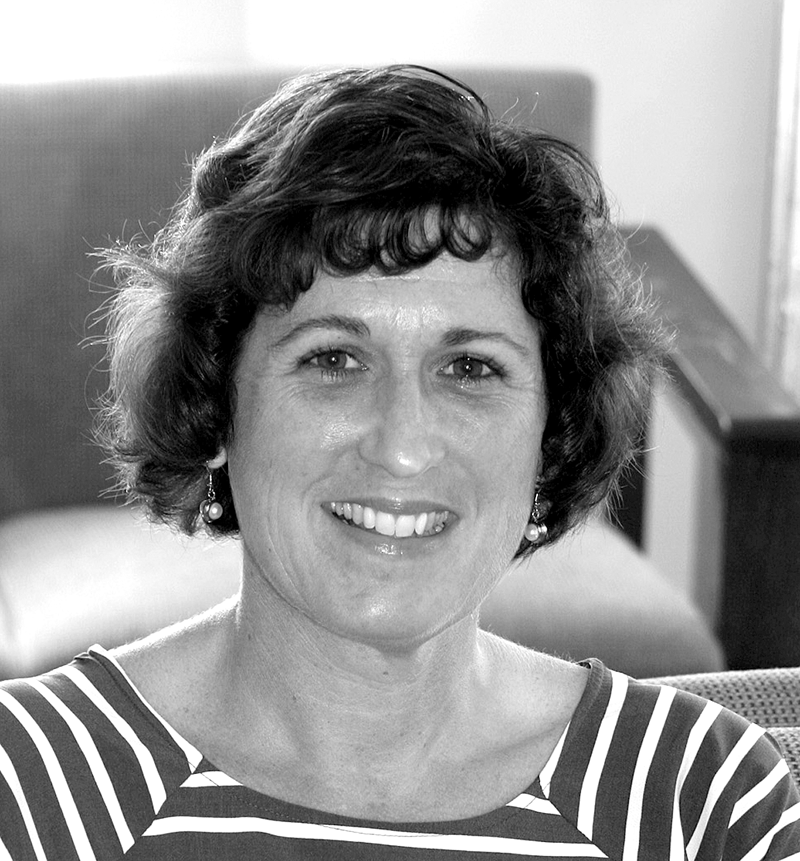
Mary-Beth Cooper Takes the Helm at Springfield College

COVER-BW1013aMary-Beth Cooper says her dog, Dakota, feels right at home on the picturesque Springfield College campus.
The 8-year-old yellow lab — now sporting a tag, a gift from some friends, that identifies him as ‘First Dog’ — has become somewhat of a fixture at the school only a month or so after moving into the President’s House, she said, adding that he’s making friends quickly, especially with students and faculty who appear willing to share their lunch or afternoon snack with him. “He loves it here; he’s very comfortable with the new surroundings.”
And the same can be said for his owner, the 13th president of the 128-year-old school and the first woman to hold that title.
She told BusinessWest she was comfortable with the institution long before she actually toured it, and even well before her first two interviews for the position, the first via Skype and the second at a hotel at Bradley International Airport — although those sessions and her subsequent visit certainly reinforced her opinion.
She liked the feel and the fit so much that she quickly terminated a quest for another college president’s position to focus all her energies on this one.
The primary reason why is the culture that pervades the school, one summed up by its motto (“Spirit Mind Body”), she said, noting that she was aware of it from work she had done, first as a volunteer and later as chair of the board, with the YMCA in the city of Rochester, N.Y., where she served as an administrator at both the University of Rochester and, later, the Rochester Institute of Technology.
Springfield College and the Y organization share a unique history, she said, noting that the college was once known as the International YMCA Training School, and there is still a strong relationship today. From that connection, she became familiar with the college’s humanics philosophy to educate the whole person.
But there were other factors that made her comfortable with the school located on the shore of Lake Massasoit, she said, listing, for starters, many similarities between Springfield and Rochester, and also between the work done within the community at both Springfield College and the Rochester schools she served.
Both cities are former manufacturing centers still trying to reinvent themselves, she said, noting that, while Rochester once boasted such industry giants as Kodak, IBM, and Xerox, its major employers today are those aforementioned colleges and a supermarket chain.

college and the community

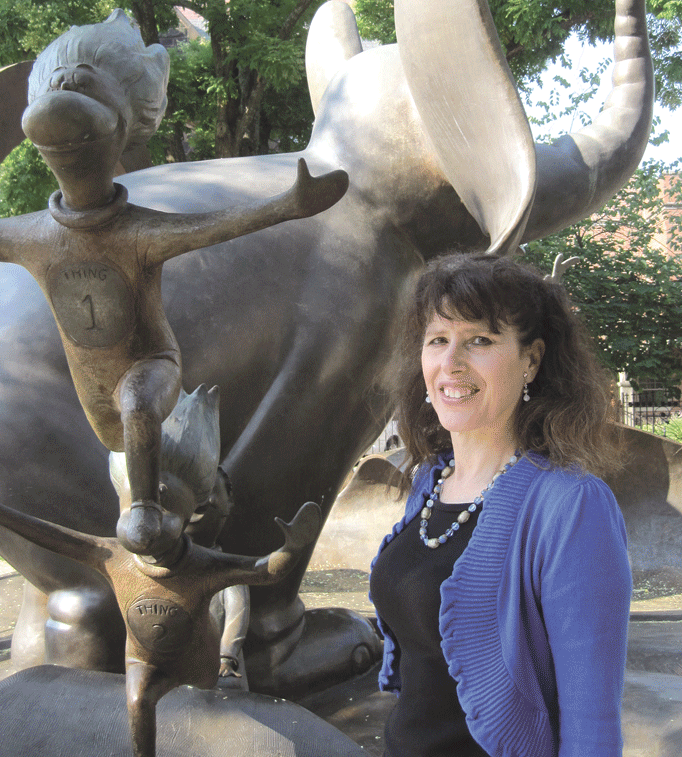
Mary-Beth Cooper says she understands the relationship between a college and the community.

As for work within the community, she said the schools in Rochester and Springfield College have strong track records of caring that are part of the institutions’ fabric.
At SC, this tradition is perhaps best exemplified by the recent Humanics in Action Day, during which students, faculty, and staff (including Cooper) performed a day of concentrated community service throughout Springfield involving roughly 100 specific projects.
“Some people do service because they believe it’s an obligation,” she noted. “Students here are drawn to service because it’s part of who they are. And they go on from their experience here and become involved members of the community where they live.”
As she talked with BusinessWest just a few weeks after taking the reins at the school, Cooper noted that her predecessor, Richard Flynn, had registered some notable accomplishments in recent years — everything from increasing enrollment to significant building and renovation projects on campus, to several new academic initiatives, including an MBA program unwrapped in 2011. Meanwhile, he established and strengthened relationships with a number of constituencies, including the YMCA and Springfield City Hall.
“He did a lot of the hard work and left me in a good position,” she said with a laugh, noting quickly that there is still plenty to do in the months and years to come.
At the top of that list is raising the school’s profile, she said, adding that, while it is well-known regionally, the college is far more of an unknown commodity in other parts of the country. Also, while enrollment has risen, there is still room for improvement, and also a need to broaden the applicant pool for this school known for everything from its affiliation with the Y to its diverse degree offerings in health and fitness, to its strong graduate programs.
For this issue and its focus on education, BusinessWest talked at length with Cooper about her latest career challenge and how she intends to build on the progress recorded at this venerable Springfield institution.

Degree of Difficulty
Roughly five years ago, Cooper told BusinessWest, she decided that, from a personal- and professional-development standpoint, her next job in higher education should be as a college president.
However, her son, Calvin, was a sophomore in high school at that time, and she had basically already made another very personal decision — not to disrupt that important time of his life with a move to another part of the country, and to wait until he was at least a freshman in college to make such a career move.
Last fall, with Calvin firmly entrenched at the University of Delaware, she started looking at opportunities to lead a college campus, and was actually fairly deep into the process of applying for a job when friends and colleagues, including the director of the Greater Rochester Y, urged her to train her sights on the position at Springfield College she had seen posted in the Chronicle of Higher Education.
At the time, she was senior vice president of Student Affairs at RIT, a role she described as “responsibility for anything outside the classroom that doesn’t involve a transaction.”
That definition fits everything from sports — and she’s been involved with them for most of her career, and continues that pattern today — to what would be considered ‘town-gown’ activities and relationships.
Prior to that, she served as dean of students at the University of Rochester and vice president for Student Affairs at St. John Fisher College, also in Rochester.
This is not a traditional path to the president’s office, she noted, adding that many campus leaders today still come from the academic or development (fund-raising) realms. But she said her background has provided tremendous insight into how a campus functions and how a school can, and should, become involved in the community.
And she does have some background in academics, having taught as an adjunct professor at the University of Rochester’s Warner School of Education for many years.
Meanwhile, she has a strong track record of work within the Rochester community, working with both the YMCA and the United Way in that city, among other endeavors. In 2005, she was named one of the city’s “most influential women” by the Rochester Business Journal.
She said her work with the YMCA was particularly eye-opening, providing her with insight into the needs of a community and how an educational institution can help address them.
“As a member of the administration at the University of Rochester, I began to learn what that community needed,” she explained. “And for me, it was an opportunity to think about youth, families, affordable daycare, and the plight of a population much different than the students at the college. It was an interesting time for me, and it helped me understand the relationship between a school and a community.
“The core values at Springfield College could not have been a better match for me — it was a perfect fit,” she continued. “When I applied, I was hopeful that they would see it the same way.”
Obviously, they did, as she prevailed in what she called a “robust” search at Springfield College that involved more than 100 candidates, including some sitting college presidents.
She said she’s proud of being the first woman president at the school, and believes the choice represents another bit of progress when it comes to putting more women in the corner office on college campuses. But she contends that gender remains an issue in too many hiring scenarios.
“There are women in positions who are ready to take leadership roles,” she said. “Our workforce in higher education is like every other workforce; there are many people who are retirement-eligible, and when positions become available, you’ll see more and more female presidents. I don’t know how long it will take for real change to happen, but it will come.”
Since arriving on campus, she’s been very busy meeting with students, faculty, administrators, and other on-campus constituencies, and has met with Springfield Mayor Domenic Sarno to discuss the community and the school’s role within it.
She’s also taken in a number of Springfield College sporting events, including the recent gridiron triumph over Western New England University, attended the Basketball Hall of Fame induction ceremonies last month (the game was invented at Springfield College, and the first hall of fame was located on the campus), and has commenced a search for a running club to join.
“I’m not very fast, but I can run long distances,” she said, adding that she’s looking forward to getting out into the community in the months ahead and gaining a full appreciation of the challenges facing the region and the ways the college can help address them.
“People want my ear,” she went on. “So I’m trying to listen to our faculty, students, and staff and get their thoughts on what the college should focus on. And I’m trying to get out there.”

School of Thought
Since she first interviewed for the job — and especially since arriving on campus — Cooper said she’s been somewhat overwhelmed by the positive sentiments and equally positive energy that exists on campus, within the alumni ranks, and what could be called the Springfield College community.
“I’ve never been to a campus — and I’ve worked at several, big schools, small schools — where people speak so favorably about the institution,” she told BusinessWest. “Whether it’s alumni, parents, current students, staff, faculty … it’s almost unbelievable. And so something right must happen here in terms of what the experience is like.
“My hope is that I don’t become blasé about all this,” she went on. “My hope is that I continue to be amazed by the good will that goes on here.”
While it’s not her official job description, maintaining this steady flow of positivity is Cooper’s broad mission at the college. She said the philosophy she will take to this assignment is to resist resting on the accomplishments of the past several years and instead build on what’s been accomplished.
Efforts to continue growing enrollment are certainly part of this equation, she said, adding that, while she has no specific goals in mind, she believes there are opportunities to increase the numbers of both undergraduate and graduate students.
This can be accomplished through a combination of more aggressive marketing and awareness-building efforts, she said, adding that one of her priorities is to tell the school’s story through every vehicle available to do so, and especially ongoing efforts to anticipate the needs of both students and employers and then meet them through effective academic programming.
Elaborating, she said the school must maintain and sharpen its focus on properly preparing graduates for the rigors of the workforce and the specific challenges of their chosen fields.
And with that, she summoned the phrase “cross discipline,” which she used to describe the path higher education must take in the future.
Elaborating, she said that what students want — and need — today is the ability to couple study paths, such as a major and a minor, two majors, or a four-year degree with an additional one-year MBA, to enhance their odds of succeeding in a profession.
“The question is, what offerings do we provide for students that give them the most robust portfolio, a skill set to go out and be an entrepreneur, and understand the business side of a program as well as the content?” she said. “Cross discipline will be the key, and in fact, I’ve been blunt enough to stand in front of the faculty on my second day here and say, ‘the future of Springfield College really lies in your hands,’ because what we deliver for students is significant, and the experience we offer is stellar, and we must to continue to do that.”
And while focusing on what happens in the classroom, Cooper will also work to find new avenues to express that commitment to service that was one of the many factors that drew her to the school months ago.
“I’m going to examine our relationship with the community, and look at both what we’ve done in the past and what we might do in the future,” she said. “The community has incredible challenges, but so do so many other cities, in the Northeast in particular. We have to ask ourselves, ‘what is the role of this college, or any college, in dealing with these challenges?’”
Overall, she said, the challenge moving forward is to continually enhance what the the school can offer to students in terms of the “total experience,” but without eroding the traditions and programs the school is noted for.
“We have some terrific traditions,” she said, “and students embrace those, and they come here because of them.”

Tail End
Summing up her first month or so on campus, Cooper said it’s been a whirlwind of meetings, large and small, with a wide range of constituencies that, as she said, want her ear.
Through all that talking and especially listening, she’s become even more convinced that she, the school, and its culture constitute a perfect match.
“I’m really glad to be here,” she told BusinessWest. “I think this is going to be a great time for me and the school.”
Like the First Dog, she’s very comfortable in her new surroundings.

George O’Brien can be reached at [email protected]

DBA Certificates Departments

The following Business Certificates and Trade Names were issued or renewed during the month of and September 2013.

AGAWAM

AAA Can & Bottle Return
204 Springfield St.
Russell Scalise

Agawam’s Java Stop
704 Springfield St.
Craig Jurasz

F-Transport, LLC
1085 North St.
Fedor Songorov

CHICOPEE

A+ Educational Services
145 Anson St.
Darren Wuensch

Ace Industrial Cleaning Company
55 Boutin St.
Gary Minutillo

Bellz Eco-Tech Cleaning Services
419 Montcalm St.
Vickie D. Washington

iFuze Marketing
343 Chicopee St.
Christopher Benson

KC’S Handyman
56 St. James Ave.
Kirk A. Williams

Lynch Maintenance Services
12 Wawel St.
Edward Lynch

EAST LONGMEADOW

Carlson Roofing Company
176 Porter Road
Robert L. Carlson Jr.

Countryside Store
334 Somers Road
Ramesh Patel

Impressions Hair Salon
43 Maple St.
Richard Remillard

JL Communications
67 Nottingham Dr.
Janet Lupacchino

Martin Roofing, LLC
85 Lee St.
Robert A. Martin

Pioneer Valley Painting
149 Braeburn Road
Vincent Settembre

Subway
24 Shaker Road
John L. Moylan

GREENFIELD

Bad Influence Motorsports
91 Main St.
William Thompson

Darmanchev Masonry
36 Cleveland St.
Ivan Darmanchev

The Solar Express
176 Federal St.
Alexander Fiorey

Thurston Chef Services
80 Lunt Dr.
Tony Thurston

Walgreens
5 Pierce St.
Mark Wagner

Whitney Hill Antiques
102 Main St.
Dale Whitney

HOLYOKE

Authentic Beauty & Barber
330 High St.
Vimaris Davila

Dam Café
27 Myrtle Ave.
Michael E. McMahon

Fashion Nails
293 High St.
Khoi D. Dao

Megan’s Treasures
50 Holyoke St.
Nancy A. Oles

Rock Valley Detail Service
53 Mountain Road
Dolchan Sirkissoon

SPRINGFIELD

Cardaropoli Realty
203 Dickinson St.
Anthony Cardaropoli

Cedar Tree Sound Productions
154 Gillette Ave.
Mark R. Suse

Changmu Corporation
1655 Boston Road
Chang H. Kim

City Vacuum
994 Main St.
Michael J. Little

Confidential Computer Care
1242 Main St.
Arthur F. Geary

Corona St. Barbershop
23 St. James Blvd.
Adrian Andrews

CT’S Towing & Auto Repair
466 Main St.
Christine Noel

Dave’s Soda and Pet Food
1330 Carew St.
David A. Ratner

Dazzle Studio of Dance
605 Page Blvd.
Lisa M. Attanasio

Direct Auto Promotions
880 Boston Road
Michelle J. Dicienzo

Don Rico’s Café & Bakery
684 Belmont Ave.
Martha Terrero

Enticing Affairs
4 Crosby St.
Dana M. Brathwaite

EWB Lawncare & Snow Removal
30 Gatewood Road
Ernest Buffaloe

Fractal Dynamics
45 Willow St.
Spiro Marangoudakis

Grace’s Beauty Supply
298 Belmont Ave.
Ellena Y. Kolliegbo

Harris Property Inspection
7 Clayton St.
Ernest Harris

Hokkaido, LLC
1374 Allen St.
Zhang S. Fang

Husky Pizza Inc.
565 Main St.
Inci Kavraz

JTR Heating and Cooling
83 Parkside St.
Julio Torres

James S. Randall
94 Island Pond Road
James S. Randall

K’s Kakes
143 Dwight St.
Luz Cruz

La Casa Del Reggaeton
72 Locust St.
Felix Y. Tejada

Ladies with Choices
14 Battery St.
Veleka L. Atoya

Latina & Company Salon
1498 Allen St.
Yanitza Nogue

Lilo’s Tire
784 Bay St.
Angel L. Rivera

Local Yo Inc.
455 Breckwood Blvd.
Nicole E. Apostle

Luis Used Appliances
167 White St.
Luis A. Rivera

M. Glushien Electrical
113 Wheeler Ave.
Jay Glushien

Mach One Transport
34 Ontario St.
Eduardo Burgos

Major League Barber Shop
602 Page Blvd.
Juan Santiago

Mass Lanka, Inc.
2879 Main St.
Riswan M. Raufdeen

Mavis A. Sarpong-Krampah
394 Canon Circle
Mavis A. Krampah

Merrill Lynch
1414 Main St.
Erik Miller

N2U Entertainment
62 Forest Park Ave.
Bertrand C. Daniel

Nee Nee’s Devine Edibles
162 Mallowhill Road
Helen Johnson

New Era Accounting
603 Sumner Ave.
Olufemi Aina

New Fashion Inc.
260 Eastern Ave.
Mary Rosado

Oriental Gifts and More
1714 Boston Road
Wei J. Zheng

PCMC Transportation
1 Federal St.
Rose A. Rice

WESTFIELD

All Custom Welding & Fabrication
264 Union St.
David Woelper

CFB’s Farrier Service
189 Honey Pot Road
Cary F. Bedor

Crimson Lion
12 Joyce Dr.
William Corcoran

Greg’s Auto Repair
301 North Elm St.
Gregory A. Hunter

Mas Cleaning Service
11 Surrey Lane
Patricia Genovese

MIDAC Corporation
6 Coleman Ave.
Gerald Auth

Quality Machining & Manufacturing
179 Joseph Ave.
Steven Sobczyk

Rob, The Painter
304 Valley View Dr.
Robert Draper

Western Mass Kites Association
14 Arnold St.
Syed S. Rahman

WEST SPRINGFIELD

Bear Cat Fence
44 Oak St.
Barry Bishop

Electronic Reseller
13 North Blvd.
Gheorghe Grigora

Expo Liquors
1122 Memorial Ave.
Dadson Inc.

Grosso Chiropractic
615 Westfield St.
Cynthia R. Grosso

McClelland Health Systems
85 Interstate Dr.
MHHP Acquisition

Springfield Country Club
1375 Elm St.
Azelio Vivarelli

Chamber Corners Departments

ACCGS
www.myonlinechamber.com
(413) 787-1555

Oct. 9: Lunch ‘n’ Learn, 11:30 a.m.-1 p.m., at One Financial Plaza Community Room, 1350 Main St., Springfield. The program, “Birds Tweet, but Should You? Is Social Media Right for Your Business?” will discuss strategies behind using social media, determining your return on investment and tips on how to best deploy social media to your advantage. Reservations are $20 for members, $30 for general admission, and includes networking time and a boxed lunch. Reservations may be made online at www.myonlinechamber.com or by calling Cecile Larose at (413) 755-1313.

Oct. 24: A Chocolate Affair, 6-9 p.m., at Chez Josef in Agawam. Indulge yourself in chocolate, shopping, and networking. Presented by the Professional Women’s Chamber, an affiliate of the ACCGS. Exhibitor space is $70. Reservations to attend are $40. Reservations may be made online at www.myonlinechamber.com or by calling Cecile Larose at (413) 755-1313.

Oct. 25: Super 60, 11:30 a.m.-1:30 p.m., at Chez Josef in Agawam. Celebrate the region’s top-performing companies. Now, in its 24th year, this awards program celebrates the success of the fastest-growing privately owned businesses in the region that continue to make significant contributions to the strength of the regional economy. Presented by Health New England with support from Hampden Bank, Sullivan Hayes & Quinn, the Republican, and WWLP-TV 22. Reservations are $50 for members, $70 for general admission. Reservations may be made online at www.myonlinechamber.com or by contacting Cecile Larose at (413) 755-1313.

AMHERST AREA CHAMBER OF COMMERCE
www.amherstarea.com
(413) 253-0700

Oct. 18: Legislative Breakfast, 7:15-9 a.m., at the Lord Jeffery Inn. Sponsored by Western Massachusetts Electric Co. Admission: $15 for members, $20 for non-members.

GREATER EASTHAMPTON CHAMBER OF COMMERCE
www.easthamptonchamber.org
(413) 527-9414

Oct. 8: Mayoral Forum, 6 p.m., Eastworks Meeting Space, Suite 160, 116 Pleasant St., Easthampton. Learn about the Easthampton mayoral candidates’ views on business and their plans for the future of Easthampton. Free and open to the public.

Oct. 10: Networking by Night Business Card Exchange, 5-7 p.m. Hosted and sponsored by Cernak Buick, 102 Northampton St., Easthampton. Hors d’ouevres, beer, and wine available. Door prizes. Tickets: $5 for members, $15 for future members.

Oct. 15: GRIST — Get Real Individual Support Today, 9-10 a.m. at the Greater Easthampton Chamber of Commerce, 33 Union St., Easthampton. The GRIST group is a free member benefit, an ongoing small group of folks who meet regularly to share ideas and get advice on the daily challenges of running a successful business. RSVP to group leaders Derek Allard at [email protected] or (413) 282-9957, or Fran Fahey at [email protected] or (413) 529-1189. Free to chamber members and future members.

Oct. 21: Celebrity Bartenders Night, 6-9 p.m., at Opa-Opa Steakhouse & Brewery, 169 College Highway, Southampton. Join us for a night of fun with local celebrities mixing drinks. Tips benefit the chamber’s holiday lighting fund. Raffles and more fun. Admission: free.

HOLYOKE CHAMBER OF COMMERCE
www.holycham.com
(413) 534-3376

Oct. 9: Autumn Business Breakfast, 7:30-9 a.m., at the Log Cabin. Sponsored by the Republican and Holyoke Medical Center. Recognizing new members, business milestones, and networking breakfast meeting. Cost: members, $22 in advance, $28 at the door. Call the chamber at (413) 534-3376 to sign up.
Oct. 16: Chamber After Hours, 5-7 p.m., at the Center for Health Education, 404 Jarvis Ave., Holyoke (former Grynn & Barrett Studios). Business networking event to take place at HCC’s newest education facility. Networking, 50/50 raffle, and door prizes. Cost: $10 for members, $15 for the public. Call the chamber at (413) 534-3376 to sign up.

Oct. 22: Social Media with Constant Contact Workshop, 8:30-10:30 a.m., at the Greater Holyoke Chamber of Commerce, Executive Conference Room, 177 High St., Holyoke. Sponsored by PeoplesBank and the Republican. This information-packed seminar offers a basic review of the essential strategies and best practices a business or organization should understand to successfully get started with social-media marketing. Admission is free. Brought to you by Constant Contact. For reservations, call the chamber office at (413) 534-3376.

Oct. 30: Manufacturing Breakfast, 7:30-9:30 a.m., at the Wherehouse, 109 Lyman St., Holyoke. For reservations, call the chamber office at (413) 534-3376.

MASSACHUSETTS CHAMBER OF COMMERCE
www.massachusettschambersofcommerce.com
(413) 525-2506

Nov. 12: Massachusetts Chamber of Commerce Annual Meeting & Awards Luncheon, 9 a.m. registration, at the DoubleTree, Westborough. For more information on ticket sales and sponsorship opportunities, call the chamber office at (413) 525-2506 or e-mail [email protected].

GREATER NORTHAMPTON CHAMBER OF COMMERCE
www.explorenorthampton.com
(413) 584-1900

Oct. 8: Business to Customer Marketing Workshop: “On-the-spot Marketing Tips for Increasing Foot Traffic,” 1-3 p.m. Hosted and sponsored by the Greater Northampton Chamber of Commerce. Presented by the Creative Marketing Group. The Creative Marketing Group will meet with you and your fellow retail business owners and managers at our conference-room table, listen to your marketing and communications concerns, and help you brainstorm practical, professional solutions on the spot. Learn more about how to strategize, advertise, brand, and promote your business, reach the media, and maximize your message in person, in print, and online. Cost: free, but pre-registration is required, and space is limited. To register, contact Esther at [email protected]

Oct. 22: Business to Business Marketing Workshop, 3:30-5 p.m., at the Greater Northampton Chamber of Commerce. Cost: free, but pre-registration is required, and space is limited. To register, contact Esther at [email protected].

Nov. 6: Arrive@5 Chamber Networking Event, 5-7 p.m. Hosted by the World War II Club. Sponsors: Homeward Vets. Catered by Big Kats Catering. The chamber will be collecting donations for Homeward Vets. A list of needed donations will be posted on its website. Cost: $10 for members, $15 for non-members. RSVP to Esther at [email protected].

WEST OF THE RIVER CHAMBER OF COMMERCE
www.ourwrc.com
(413) 426-3880

Oct. 10: West Springfield Mayoral Debate, 6-8 p.m., at West Springfield City Hall. Event is open to the public and free for both members and non-members. For more information, contact the chamber office at (413) 426-3880 or e-mail [email protected].

Oct. 17: Business with Bacon, 7-9 a.m., at Crestview Country Club. Speaker: Gaming Commissioner Bruce Stebbins. Cost: $25 for chamber members, $30 for non-members. For more information, contact the chamber office at (413) 426-3880, or e-mail [email protected].

Oct. 23: Business to Business Expo, hosted by the West of the River Chamber, the North Central CT Chamber, the Bradley Regional Chamber, and the East Windsor Chamber, 4:30-7:30 p.m. Hosted by Holiday Inn, Enfield. Cost: $100 for a six-foot table if you are a member of any chamber and pay in full by Sept. 27, or $150 for a six-foot table if you are not a member of any chamber or do not pay in full by Sept. 27. For more information, contact the chamber office at (413) 426-3880, or email [email protected].

GREATER WESTFIELD CHAMBER OF COMMERCE
www.westfieldbiz.org
(413) 568-1618

Oct. 9: October WestNet Connection, 5-7 p.m., at East Mountain Country Club, 1458 East Mountain Road, Westfield. An evening of networking; don’t forget your business cards. Complimentary hors d’oeuvres and cocktails. Walk-ins are welcome. Tickets: $10 for members, $15 cash for non-members. To register, call Pam Bussell at the chamber office at (413) 568-1618, or e-mail [email protected].

Creative Economy Sections
Indian Orchard Mills Creates a Community for Artists

Sarah Concannon

Sarah Concannon is a very recent addition to the tenant population at Indian Orchard Mills, but she is already enamored with the sense of community she says exists there.

Sarah Concannon is an artist with a mission.
She calls it “The People in Your Neighborhood,” and it involves painting a portrait of a resident (of her choosing) from each of Springfield’s 17 recognized neighborhoods.
At this point, she’s still in what would be considered the planning and fund-raising stages of this endeavor. While contemplating a process for selecting her subjects, she’s also going about the task of amassing the nearly $7,000 she estimates she’ll need to complete the project; she recently ventured onto Kickstarter, a website that provides a vehicle for crowd-funding creative initiatives via the Internet.
“This is probably the only way I’d be able to fund a project like this,” she told BusinessWest, adding that she recently took one big step forward with this initiative — and what amounts to a fledgling business venture. That would be her move, just a few weeks ago, into a 100-square-foot studio at the Indian Orchard Mills in Springfield.
This step up, from a studio (of sorts) in a small spare bedroom in her home in Springfield, provides her with the physical space with which to flex her creative muscles while she continues her day job as an inventory-control analyst for Baystate Health. But it also gives her much more.
Indeed, she’s now part of what can only be called a community of artists at the sprawling mill complex, one that is fueling the economy in many respects, and also providing a strong support network for artisans trying to make dreams come true and, in many instances, turn passions into successful businesses.
There are now more than 50 artists in the 300,000-square-foot, 12-building mill complex, said Charles Brush, who used that term to describe individuals creating everything from jewelry to furniture to exhibits for the Basketball Hall of Fame.
Brush bought the landmark in 1998 and has committed himself to continuing — and expanding — the work started by the mill’s previous owner, Muriel Dane.
Her name is on the 2,000-square-foot gallery in the mill, which is one focal point of twice-yearly open studio events, said Brush, noting that what Dane created, and he took to a higher level, is much more than physical space in which to paint or sculpt.
“You’ll never see an environment like this anywhere else,” he noted, “because I work with the tenants, and we all work with, and for, each other, with one goal in mind, and that is just to get it done and make it right, whatever ‘it’ happens to be.
Todd Harris

Todd Harris’ company merges engineering and art to create unique museum exhibits like this larger-than-life eagle’s nest bound for a Connecticut learning center.

“This doesn’t happen by accident or because you’re giving the place away — art is business, but consistency is the key to any business, doing the same thing all the time,” he went on, adding that the mill’s mission is to provide a mailing address, but also an atmosphere, where artists can create, collaborate, and thrive.
The story being written in each of the studios is different in some respects, although there are common denominators — a passion for art and a desire to be part of this community of artisans.
For some, like Peter Barnett, a fine landscape and portrait artist and retired systems analyst at MassMutual, his work is still mostly a hobby, albeit a full-time pursuit.
“I paint things that turn me on, clouds and rocks,” he joked, adding, “I don’t personally need to sell work to keep food on the table, but I do love to sell work, and I really like the community, the interaction, I find here.”
For others, like Todd Harris, the mill has become home to a new business venture. He left a lucrative career as an engineering consultant to start 42 design fab, which creates exhibits for museums and nature centers across the country.
“We’re trying to make this work as a business and support the whole creative-economy thing because you should be able to make a living for a team of people that come to work every day and have fun doing creative things,” he said. “Our growth plan is about pushing our boundaries artistically and making it work as a business.”
For this issue and its focus on the region’s burgeoning creative economy, BusinessWest takes an in-depth look at one of the most recognizable — and successful — manifestations of that phenomenon, the Indian Orchard Mills, a landmark that speaks to the region’s past, but is now a symbol of its future.

Brush Strokes
Crystal Popko says people will invariably have two questions when they first encounter her jewelry made from butterfly wings.
“‘Are they real?’ and ‘what happened to the butterfly?’ — that’s what everyone wants to know,” she said, adding that the answer to the first query is ‘yes,’ and the response to the second is that the insect died naturally. (She acquires the wings from a nearby butterfly conservancy.)
Popko, who also works with fused glass as well as feathers, leaves, and other products from nature, is typical of the dozens of artists who now call the mill complex home.
Like many artists aspiring to turn their talent into a business, she started working out of her house. She would spend summers working, seven days a week, as a waitress on the Cape, trying to earn enough to spend her winters making and selling jewelry.
Three years ago, she decided to make her art a career, knowing that she would need, among other things, a studio where she could create and clients could see her work. She said she was drawn to the mill by its location, attractive lease rates, and, most importantly, that aforementioned community of artists already doing business there.
Carol Russell, a creator of stained-glass art, moved in for the same reason.
“I came here for the sense of community,” she told BusinessWest, “and being around other people and their energy.”
‘Community’ and ‘energy’ are words one hears often while walking the hallways of the mill complex, said Brush, who has a background in finance and manufacturing, but admits to being initially overwhelmed by the mill, its size, and all that goes into its upkeep.
But he was too intrigued by its vast potential to walk away when he started thinking about acquiring the mill in 1997. And he has no regrets about what most would consider a risky undertaking.
“It looked like it would be fun, and it’s really been a blast,” he said. While a number of industry groups (from asbestos abatement to precision manufacturing) are represented on a tenant list that now numbers more than 130, he noted, the growing number of artists — and the wide diversity of that constituency — is what has given the mill much of its identity.
“Everybody has a different definition of art,” he noted, adding quickly that his is quite broad, largely because of what he sees happening on each of the mill’s five floors. “Some people think artists stand at easels or over a lump of clay — and we have those in droves — but in my mind, arts is the creative, like the guy [Harris] that makes the museum exhibits. Yes, it’s manufacturing, but there is a lot of art that goes into what they do.
“What our woodworkers do with raw materials, what leaves here — the cabinetry, the furniture — is all art,” he went on. “We are a creative-industry complex, and as far as I’m concerned, the industry is just as artistic as traditional art.”
In his role as landlord, Brush says it’s his job to give all of his tenants an environment in which they can thrive. And when it comes to the artists — of all kinds — this means providing the space and the opportunity to create, collaborate, and feed off that aforementioned energy.

Peter Barnett

Peter Barnett has enjoyed the creative interaction of the artists at Indian Orchard Mills for two decades.

And nowhere is this more evident than at the Dane Gallery and the two open-studio events, he said.
The gallery is open Saturdays from noon to 4 p.m., and it features works created by many of the mill’s tenants. Open year-round, the gallery allows each artist the opportunity to produce their own show for a month; Concannon’s “The People in Your Neighborhood” is expected to be ready for display in the gallery next year.
As for the open studios, they are, as the name suggests, events where tenants open up their studios to the public, with works on display and for sale.
Now in their 21st year, these events have drawn thousands of visitors to the mill (necessitating their expansion from one-day affairs to two) and, in so doing, have inspired a number of artists to join the community at the mill.
Such was the case with Concannon, who took in one of the open studios several years ago and began formulating plans to one day be one of the artists greeting guests. That day became reality a few months ago, when she and her husband, Greg Matthews, determined that they had the financial wherewithal for her to make her painting more than a part-time pursuit.
“It’s so inspiring to be a part of a community where people speak the same language and can offer critiques of your work if you want it,” said Concannon. “I can’t wait to get started because I know how good it will feel to be painting again and what a sense of accomplishment awaits if I’m able to make this project successful.”

His Nest Eggs
As he talked with BusinessWest, Harris showed off a larger-than-life eagle’s nest, complete with three oversized eggs, that is in the final stages and bound for the Harry C. Barnes Memorial Nature Center in Bristol, Conn.
It’s an example of how his company has merged engineering and art to create unique learning experiences, and also one of the hundreds of unique and diverse forms that the creative economy takes in the region — and especially Indian Orchard Mills.
There, tenants haven’t just created works of art. They’ve created a community — and real momentum in the efforts to make this sector an economic driver.

Elizabeth Taras can be reached at [email protected]

Banking and Financial Services Sections
Help Employees Help Themselves to a Successful Retirement

Charlie Epstein

Charlie Epstein

It has been my experience that, if you ask the average employee if they would like to retire with enough money to be financially independent with reduced financial anxiety, they will say yes. If you than ask them what are the chances that this will actually happen to them, the response is a scary, “not in my lifetime!”
Does it have to be this way? Not necessarily. One thing is for certain: for the average employee, saving for retirement is a difficult thing to do. Left to their own devices, they will always find other things to do with their money than save for some future date they cannot even imagine.
As an employer who sponsors a 401(k) retirement plan for your employees, let me acknowledge you for offering this valuable benefit to your employees. There is no requirement that you do, and yet … you do.
And as long as you are offering such a valuable benefit, then why not also offer all the automatic features possible that study after study have proven increase the likelihood of your employees saving enough money to achieve that comfortable, and even wonderful, retirement they are dreaming of?
I have written about these features before, but they merit repeating, especially as the year comes to a close. Now is the time to sit down and review your plan document and assess the value of adding these features, for your employee’s benefit and even for yours.

• Automatic enrollment at a 6% level. Make it easy and automatic when your employees enroll in your 401(k) plan. Automatic enrollment does just that. Rather than opting in, your employees have to opt out of the plan. Studies show that 70% or more of the employees that are automatically enrolled into contributing to their 401(k) plan do just that; they contribute and keep on doing so. And while you’re at it, instead of starting them with a measly 3% contribution (which is the ERISA minimum), bump it to 6%.
• Automatic escalation. This feature says that each year you send out a 30-day notice, notifying all your employees that you will be increasing their contribution to the 401(k) plan by 1%, unless they notify you they don’t want to increase. This feature is critical to improving the chances of an employee saving enough money over their lifetime for retirement. As a rule of thumb, the average employee needs to save 10% of their pay each year to accumulate enough money by the time they are age 65. For most employees, saving 10% immediately is very difficult, but if they start at 6% and you increase their savings automatically by 1% a year, they will achieve this 10% savings rate in just four years. Best of all, most won’t miss the 1% each year.
• Automatic enrollment into a target-date, lifestyle, or balanced investment. These are known as qualified deferred investment accounts (QDIA). When auto-enrolling or re-enrolling your employees into the 401(k) plan, it may also make sense to do so into one of these QDIA options. The vast majority of employees participating in a 401(k) plan have little or no investment knowledge or experience. These fund choices manage an employees’ investments based on the level of risk they are willing to assume or actually avoid. A solid target date fund will also reduce the level of equity exposure gradually over time as the employee gets closer to their retirement date. By re-enrolling your employees once a year into a target-date fund, you, as the plan sponsor, receive fiduciary protection. This protection is provided by ERISA, provided you document you have a prudent process for evaluating the QDIA investments in your 401(k) plan.
• The ‘Stretch Match’: I believe a savings goal for employees should be a minimum of 10% of their pay. Unfortunately, employers on average offer a matching contribution of either 50% of employees’ pay up to 5% or 6%, or use a ‘safe-harbor’ matching contribution of dollar for dollar on the first 4%.
The result is that employees are conditioned only to save up to their employers’ match level of 4%, 5%, or 6%. If, however, an employer offered a matching contribution of 50% on the first 5% and 25% on the next 5%, their out-of-pocket cost may be close to their original match, and they will have incentivized their employees to stretch their savings to the full 10% to get the company’s full matching contribution.
Adding these four simple features — automatic enrollment, automatic escalation, automatic enrollment and/or re-enrollment into a QDIA, and the stretch match — to your 401(k) plan in 2014 will go a long way toward impacting your employees’ saving behavior and potential success in achieving an adequate savings rate to create financial independence with reduced financial anxiety.

Charles Epstein is the author of “Paychecks for Life: How to Turn Your 401(k) Into a Paycheck Manufacturing Company.” He consults on company-sponsored retirement plans and has been nominated one of the “Top 100 Most Influential Individuals in the 401(k) Industry” by 401kWire; [email protected]

Features
Bradley Sets Lofty Goals for Growing Passenger Volume

JetBlue

JetBlue, which will be introducing nonstop service from Bradley to Fort Myers and Tampa this fall, is one many airlines adding routes at the airport.

There was a good deal of pageantry at Bradley International Airport on Aug. 27 as an American Airlines jet rumbled down the runway on its way to Los Angeles.
Water cannons were spraying over the plane as it taxied for takeoff — a traditional sendoff in the aviation business — and before that there were speeches from Connecticut’s governor and officials from the airline. Balloons adorned the gate, and passengers walked over a red carpet to get on the aircraft.
The pomp and circumstance clearly indicated that this was not an ordinary flight, and, in most respects, it wasn’t. It marked the triumphant return of nonstop service from Bradley to the West Coast since airlines ceased such operations more than a decade ago, and Kevin Dillon is confident that this route has staying power.
He also believes that there will be many more ceremonies of a similar nature in the near future. In fact, some of them are no doubt already in the planning stages.
Indeed, in October, JetBlue will begin offering daily nonstop trips to Fort Myers and Tampa, Fla., joining Southwest Airlines in providing service to those cities out of Bradley. And Southwest is planning to add daily nonstop flights to Atlanta three days a week beginning in November, becoming a competitor to Delta in that service.
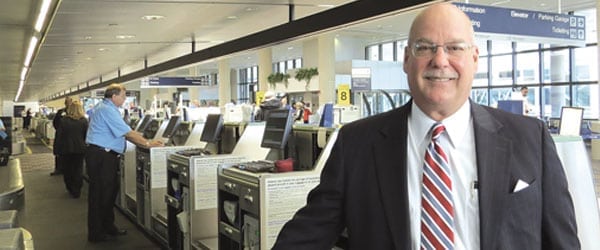
These new offerings are part of a multi-faceted strategic initiative being implemented by Dillon, executive director of the recently formed Connecticut Airport Authority (CAA), to boost passenger volume at Bradley and make it more of an economic force in the Hartford-Springfield region.
Like many medium-hub airports, Bradley suffered the loss of a number of routes in the wake of the recession, said Dillon, as airlines sought to pare expenses and become leaner operations. By adding more routes and creating competition with certain cities, such as Atlanta and Tampa, Bradley can bring down the cost of many tickets and provide more convenience to those it serves.
And these are just some of the many goals Dillon has set for Bradley. Others include everything from making the word ‘International’ in the facility’s name more meaningful — and accurate — by restoring service to Europe, which was discontinued after a very brief run a decade ago, to bringing more employers to the region by fully exploiting Connecticut’s new Bradley Airport Development Zone.
“This is an airport that has a whole lot of potential that has not been realized,” said Dillon, who took the reins at the CAA just over a year ago. “I think there’s a real opportunity to enhance the overall business. This is a great market area, not only geographically — halfway between Boston and New York — but also the relatively affluent population base, which lends itself to good air service. There is a lot of opportunity here.”
In a wide-ranging interview, BusinessWest talked with Dillon about his plans for Bradley, and how he plans to borrow lessons learned from a number of stops in a 38-year career in aviation and airport management as he goes about taking this regional asset to the proverbial next level.

Tracing His Routes
Dillon started his career with the Port Authority of New York and New Jersey, in its tunnels and bridges division.
“I quickly saw that the exciting line of business for the Port Authority was the aviation side, so I got myself transferred to aviation and started as a skycap supervisor,” he said, adding that he would go on to hold a number of positions at John F. Kennedy International and LaGuardia airports, including acting general manager at LaGuardia.
“Those years with the Port Authority gave me a good aviation background and education,” he said, “and really allowed me to achieve the things I’ve done within the industry.”
From there, he went on to serve as director of Aviation Operations at Logan International Airport in Boston for the Mass. Port Authority, and then became director of Manchester (N.H.) Airport, while also serving as chief executive of the city’s Aviation Department.
Subsequently, he served as the deputy executive director of Orlando International and Orlando Executive airports, and then served as president and CEO of the Rhode Island Airport Corp., beginning in early 2008.
At many of his stops, he’s been involved in large development initiatives. At Manchester, for example, he completed a $500 million capital-development program that included two terminal expansions, a parking garage, a new airport-entrance roadway, and extension of both runways. And in Boston, he was involved in the massive, $2 billion ‘Logan 2000’ initiative that included runway, terminal, and parking improvements.
He said the opportunity to lead the new Connecticut Airport Authority — and manage Bradley and the state’s five general aviation airports — represented an intriguing challenge.

The water-cannon salute was just part of the pageantry as American Airlines launched nonstop service from Bradley to Los Angeles last month.

The water-cannon salute was just part of the pageantry as American Airlines launched nonstop service from Bradley to Los Angeles last month.

“This is a real opportunity that most aviation professionals don’t have,” he explained, “meaning a chance to build a brand-new organization from the ground up. This is an exciting time for the airport system and a real challenge for me.”
While there are many aspects to his to-do list at Bradley, the primary assignment is to take the current annual passenger count, roughly 5 million, and move it incrementally closer to, and then hopefully beyond, the airport’s peak years just before the recession, when volume exceeded 7.5 million.
And the key to moving those numbers skyward, obviously, is routes, he told BusinessWest, adding that one of his primary goals is to officiate more ceremonies like the one on Aug. 27.
“When you think it through, every level of success at an airport depends on having healthy route structure,” he explained. “It generates passenger flow, and good passenger flow generates good revenues through the concessions, and good revenues at the airport generate the ability to build additional facilities.
“It really starts with good route structure,” he continued, “and this first year I’ve spent a lot of time analyzing the route structure and trying to enhance the opportunities, and I think we’ve had a good deal of success.”
Upon arriving at Bradley, Dillon told BusinessWest, he realized that, for the last several years, the state was not aggressively marketing the airport to airlines, and this resulted in stagnancy in the number of routes and passengers. One of the reasons for this may have been since-lifted restrictions on travel when it came to state employees.
“I don’t know how you could market the airport if you couldn’t travel and visit the airlines,” he said, adding that airport administrators have recently made up for lost time. “When I first arrived here, it became very clear to me that a lot of time needed to be spent talking to the airlines and convincing the airlines that there are good future plans for this facility.”
And this time and energy has generated results, he went on, citing American’s addition of the non-stop flight to Los Angeles, Southwest’s pending service to Atlanta, and JetBlue’s additional offerings to Florida. These new routes will heighten competition, which will ultimately benefit passengers.
“The more I can bring in competition, the better the price levels will be,” he explained. “There’s a strategy that goes into the route structure you have, because there are two things we’re trying to accomplish — add additional nonstop destinations that we don’t have today, but also bring in fair levels that will make this the airport of choice.”
Looking ahead, he said there are several areas of the country, as well as specific cities, for which Bradley would like to add nonstop service, or more such routes, as the case may be. These include the Texas market, other destinations in Florida, San Francisco, Phoenix, and others.

No Flights of Fancy
But another key to enabling Bradley to attain that ‘airport of choice’ status, of course, is the return of international service to Europe, said Dillon, noting that convenient trans-Atlantic service is vitally important to the local business community.
This was made clear in some recent research undertaken by their airport involving 23 area companies of various sizes. Among the questions put to these businesses were ones involving the size of their travel budgets and the frequency with which they used trans-Atlantic services. The results, said Dillon, were eye-opening.
“Just these 23 companies alone are spending about $40 million annually on trans-Atlantic service,” he noted. “That’s a significant number to take to an airline, combine with an airline-incentive program I’ve put in place here, and put together a great marketing package.”
The primary targets of such service would be London, Amsterdam, Frankfurt, and Paris, he went on, noting that connections can be made at those cities to virtually any city in Europe — and well outside it.
And officials at Bradley are currently putting their pitch together, he said, adding that, in addition to those impressive numbers from the business community, he can offer an incentive program that would waive airline-usage fees for a period of up to two years.
“That becomes a powerful selling point,” he said, adding that he is fairly confident that trans-Atlantic service can be returned to the airport. “Airlines know quite a bit about how much it would cost to operate out of Bradley Airport, but what they don’t have is that very detailed information about the demographics within the market. That’s where we can be extremely helpful to an airline in terms of convincing them to start service here.”
Beyond expansion of the route structure and building passenger volume, there are other immediate goals at Bradley, said Dillon, citing customer service as one.
Within that broad realm, there are plans to enhance not only physical facilities, but also what he called “empirical services,” with that latter category including everything from frequent-flyer programs to frequent-parker programs that will reward people for parking at the airport.
Plans are emerging for a frequent-flyer lounge, he told BusinessWest, adding that such an amenity would be another selling point in the effort to bring back trans-Atlantic service. Meanwhile, the airport is advancing plans for a consolidated transportation center that will house all of the rental cars that are currently scattered in and around the airport, and also handle bus service to the airport and, potentially, rail service that could become a component of enhanced commuter-rail operations between New Haven and Southern Vermont.
“There will be stops in Hartford and Windsor Locks,” he said of that rail-enhancement initiative currently underway. “At a minimum, I need to develop a high-frequency bus service back and forth between that Windsor Locks station and the airport, and who knows? If the volume is there at some point in the future, maybe that [transportation center] becomes a light-rail connection.”
As for the new rental-car facility, it brings a number of benefits for the airport.
“This is a great customer service in that the cars are now located in one convenient location that will be connected to the terminal facilities by a climate-controlled walkway,” he said, “but it will also free up all of this property that the rental-car companies are sitting on today for a higher and better use for economic-development purposes.”
Another goal for Dillon and the CAA is taking down the old, unused Terminal B, he said, adding that it has become a symbol of sorts of some of the downsizing and deterioration within the aviation industry.
“That terminal building is on the main entry to the airport,” he noted. “We want to demonstrate to people that this is a new day at Bradley, and we’re very anxious to take down that old terminal facility and start some new development.”
A third, very broad goal for the CAA is to enhance economic-development efforts at Bradley and the five smaller general-aviation airports in Connecticut, said Dillon, adding that the vehicles for growth will be economic-development zones created at each airport that feature tax incentives for those who locate or expand within them.
“What we would like to do is get out there and promote the availability of these zones, which provide tax incentives for relocation into those zones of businesses that are dedicated to either manufacturing or airport services,” he told BusinessWest. We want to make sure we’re making the best use of those as possible.”
With that, he summoned the term ‘aerotropolis,’ which is used within the industry to describe an airport-centered area devoted to economic development.
Such a facility already exists at Bradley, he said, noting that many manufacturing and airport-services business are located within a few miles of the airport. The goal is to expand that zone and bring more jobs that would benefit both Northern Conn. and Western Mass.

Soar Subject
As he mentioned earlier, Dillon expects that Bradley will be making extensive use of that red carpet rolled out on Aug. 27 at similar events in the weeks and months ahead.
The airport is being aggressive in its pursuit of new routes — and also new opportunities to better serve customers from across the Hartford-Springfield area.
And as it continues to add nonstop flights and amenities designed to make it easier for customers to reach their destinations, Bradley is ultimately clearing a way to get where it wants to go.
That would be status as the airport of choice.

George O’Brien can be reached at [email protected]

Law Sections
Skoler, Abbott & Presser Helps Employers Navigate Legal Minefields

Susan Fentin

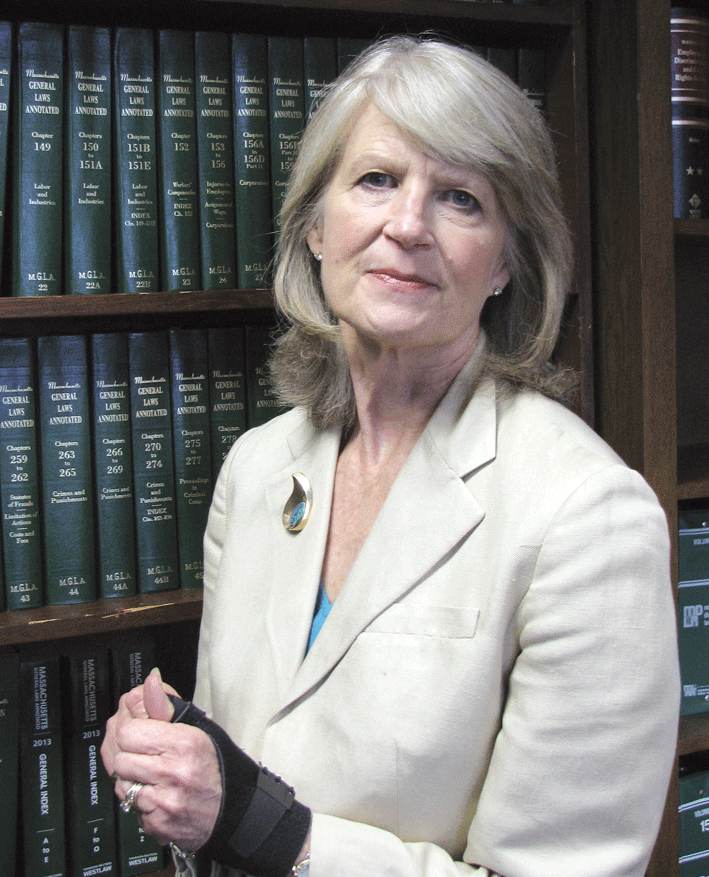
Susan Fentin says she much prefers helping clients sidestep employment-law pitfalls than defending them in court.

Employment litigation was a lot easier a generation ago.
“In the late ’70s and early ’80s, the courts started looking for exceptions to employment at will,” said Ralph Abbott, a partner with Springfield-based employment-law firm Skoler, Abbott & Presser, referring to a company’s right to fire someone for any reason. “Prior to that, when somebody sued a company on an employment matter, you went to court and said the magic words ‘employment at will,’ and then it was over.”
However, the regulatory landscape surrounding employment law has changed dramatically since Title VII of the Civil Rights Act of 1964 barred discrimination on the basis of sex, race, color, religion, and national origin. The evolution of that law, and new protections under the Americans with Disabilities Act (ADA) of 1990 and the Family Medical Leave Act (FMLA) of 1993, just to name two developments, have significantly broadened the scope of workers’ rights.
“Now, if an employee feels they’ve been treated unfairly and looks around for a reason to file a lawsuit, it’s pretty easy to find one,” said Susan Fentin, another partner at the firm.
“It’s just become so much more complicated,” added Timothy Murphy, another partner. “You really do need to have the support of a law firm that specializes in this.”
Specifically, Skoler, Abbott & Presser practices only management-side employment law, counting among its clients businesses of all types, from mom-and-pop companies to multinationals. However, its work spans much more than defending companies against worker grievances in court.
“We much prefer keeping clients out of trouble than defending them when they get into trouble,” Fentin said. “With just a 15-minute phone call, we can say, ‘let’s handle it this way.’ It doesn’t always mean we avoid litigation, but they can set themselves up in a better position.”
Abbott explained that the practice is divided into three “buckets.” There’s traditional labor work, such as negotiations, arbitrations, and advising clients on remaining union-free. Another bucket is employee litigation, including actions under the Mass. Commission Against Discrimination and a host of other state and federal agencies. The third area of practice is the everyday work, as Fentin described, of advising clients on the ever-changing world of employment law and how it applies to their companies.
Take wage-and-hour claims, which Abbott called the “lawsuit du jour” in his field these days, with issues ranging from unpaid overtime hours to misclassification of employees as independent contractors.
“The state law changed a few years ago, with triple damage mandatory for any state wage-and-hour violation — even ones that are good-faith mistakes,” Murphy noted. “As you can imagine, as these claims become more lucrative, more folks are looking at these types of lawsuits, so we’ve seen a real spike there.”
The result, Abbott said, is that there’s more risk than ever for employers and their management and human-resources teams, who often don’t have the resources to keep up with how quickly regulations are changing.
“People aren’t born to be managers; they don’t come out of the womb like that,” he told BusinessWest. “They’ve been promoted, usually because of meritorious service, but they need the skills and training to avoid the pitfalls. People just don’t know this stuff.
“That’s where we come in,” he continued. “We see employers as basically well-meaning people trying to do the right thing under difficult circumstances.”
They might do everything right and still get sued, Fentin noted. “All we can do is manage the level of risk and minimize the possibility of a suit to the greatest extent possible.”

Union Labels
Since its inception in 1964, Skoler, Abbott & Presser has worked with employers in the realm of labor relations and collective bargaining, including all aspects of the National Labor Relations Act of 1935.
But that law, too, has evolved with the times. “One major change is that it’s starting to expand the concept of protected, concerted activity into areas where it was never utilized before,” Abbott said. “We’re seeing that they’re poking more into employment relationships than they have in the past.”
Take the brave new world of social media, for example. The National Labor Relations Board (NLRB), which administers labor law under the act, has made several high-profile rulings regarding the right of employees to complain about their jobs on Facebook and other sites.
Abbott cited the term ‘electronic water cooler’ when talking about the Internet and social media. “In the old days, when employees gathered around and moaned and groaned about their supervisor or what the company was going or not doing, they’d do it around the water cooler. Now it’s done online, and that has created problems for employers, who see all their dirty linen exposed to the world.”
The NLRB has stepped forcefully into this new paradigm, ruling on multiple occasions that such speech is protected. “The world has changed, and (so has) the way people communicate; people will say things on Facebook and not realize the implications,” Abbott said — and companies must understand and learn to deal with this reality.
This federal push for expanded workers’ rights comes at a time when only seven in 100 private-sector workers in the U.S. are in a union, Murphy noted.
“The NLRB is trying to establish some relevance in an environment where the standard labor relationship is not as predominant as it used to be,” Fentin added.
Abbott agreed. “We’re not seeing the uptick in union organizing — in New England and other parts of the country — that was expected with the present administration and its pro-labor view,” Abbott said of President Obama’s five years at the helm. “That hasn’t materialized into greater numbers of new members for unions or significant organizing drives, so the NLRB is now looking for relevance; they’re looking to expand their clout in the world.”
That’s evident in the recent strikes of fast-food restaurants by employees looking to significantly increase their wages. “That’s not related to a union,” he said, “but it’s clearly aided and supported by unions that want to pressure the fast-food industry on the wage issue.”
Meanwhile, unions are certainly not dead, Fentin said, which is why the firm continues to offer strategies to clients looking to remain non-unionized. “The manufacturing sector in Massachusetts has obviously shrunk over the years,” she noted, “but a fair number of clients in human-services agencies are now big targets for unions. We’ve had a couple of clients targeted by union-organizing drives.”

Educate and Connect

The firm’s client training goes well beyond union avoidance, however, encompassing seminars and briefings on topics such as personnel policies, sexual harassment, wage-and-hour laws, discipline and documentation, drug testing, workplace safety, and, of course, the broad implications of the aforementioned ADA and FMLA.
“The firm teaches master classes in both of those,” Fentin said. “The FMLA is a complicated statute to administer; it requires a lot of procedural paperwork.”
It also has a higher profile than it used to, she added. “More people are aware of it, and more likely to believe that they were treated wrongly because of their protected class.”
In addition, “we do a lot of training in discipline and documentation to make sure supervisors understand the importance of being fair and having a business-based reason” for firing, she explained. “We have an at-will law in Massachusetts, but, frankly, if you don’t give a good reason, people will feel they’re not being treated fairly.”
The firm’s educational efforts extend beyond its clients, she added. “We also write and edit the Massachusetts Employment Law Letter. That requires us to be constantly on top of what’s going on. It’s really written for the HR professional — it’s not esoteric; it’s written in plain language so anyone can take an issue we’re talking about and apply it to their own situation.”
Fentin said her work sometimes feels more like family law than business law because it often involves people with long-standing relationships, and when someone feels wronged, the process can get messy. “I had a mediation yesterday that failed because the employee wanted her day in court, and wanted to be vindicated,” she recalled. “It can be an emotional relationship.”
Murphy said the firm encourages clients to talk with a lawyer before they make any personnel decision that can lead to litigation.
“We walk through what the options are so the problem doesn’t happen,” he said. “We take a lot of pride in keeping people out of trouble, even though that’s not the most lucrative course. We’re building long-term relationships — we’ve had some clients since the 1960s. We don’t want to have one transaction with a client; we want to understand their business and be a partner with them, to help them thrive without having to worry about litigation or union problems.”
Abbott said a good result often comes down to simply treating people well and keeping the lines of communication open. “Unions aren’t going to get any traction in a company that treats their employees fairly. You don’t have to be the best-paying company in the world, but you do have to be focused on the employer-employee relationship. And that commitment starts at the top of the company.”
Fentin sees much of her role as trying to keep honest business people out of trouble. “All they’re trying to do is run their businesses. They don’t want to discriminate against anybody, and they want to make sure they’re doing things the right way.
“It is expensive if it ends up in court,” she added. “Talk about a drain on management morale, a time drain, a financial drain. It’s not fun. The better route is to develop strategies that keep you out of trouble.”

Something New
From anti-bullying policies in the workplace to regulations regarding the use of smartphones at work, “there’s always something new bubbling up,” Fentin said. “There’s never a dull month.”
Medical marijuana is another one of those new, hot issues, partly because of the rift between state laws, in states like Massachusetts where its use has been sanctioned, and federal law, which still maintains that it’s illegal. For instance, what if someone uses marijuana for health reasons at home, then fails a drug test at work because traces are still in his system?
“We’re still looking for court guidance on that,” she said. “Frankly, these decisions will take a long time to bubble through.”
Yet, such uncertainty isn’t frustrating to Fentin, but gratifying in a way, because she knows that clients have much at stake from such issues, and she and her fellow attorneys at Skoler, Abbott & Presser are equipped to help employers deal with them.
“This isn’t something abstract — I’m talking about people and how to help them keep their jobs and make their businesses more efficient,” she said. “I love my clients; my clients are my friends.”
Abbott had a similar take. “I believe a lot of people think of a company as a logo, a building, a product,” he said. “Our view of a company is of people — it’s managers, it’s HR people, trying to do the best they can under tough circumstances.”

Joseph Bednar can be reached at [email protected]

Manufacturing Sections
Toolmaker Disston Completes Its Move to Chicopee Location

Mark Marzeotti

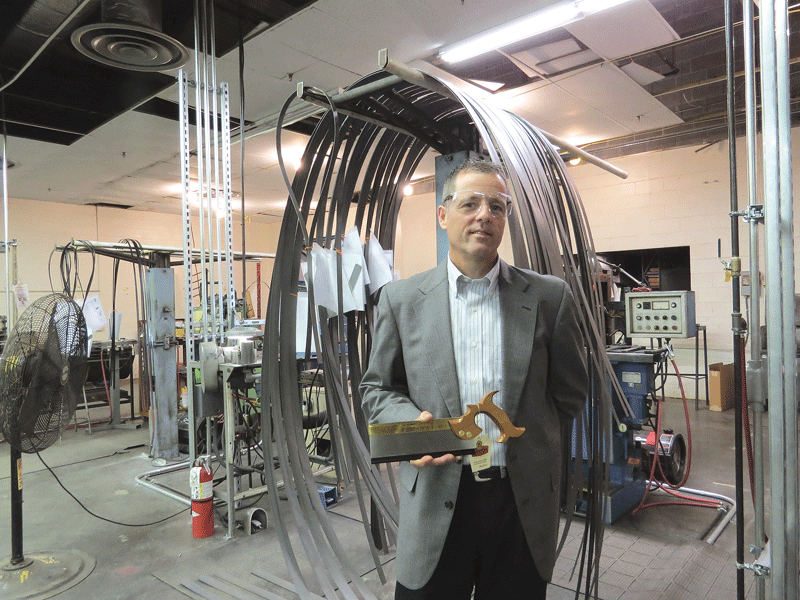
Mark Marzeotti says Disston’s move to Chicopee is part of a larger strategic initiative to make the company more competitive.

In the annals of handsaw manufacturing, the name Disston holds a special place.
Indeed, for decades, that brand was synonymous with quality and the phrase ‘top of the line.’ Visit eBay, and dozens of the company’s saws are listed, some with price tags well above $100, depending on the age and condition of the item in question.
But one doesn’t see that name or distinctive medallion much anymore. Instead, the current iteration of the Disston Saw Works of Philadelphia, started in 1840 and later known as Henry Disston & Sons Inc., makes a number of power-tool accessories, including bandsaw, reciprocating jigsaw, and circular saw blades, and other products for the industrial markets under the brand names Blu Mold, Blu Mold Xtreme, RemGrit, and Aggressor. It also makes tools for the consumer market, with most carrying private labels such as Craftsman (Sears and Kmart), Master Mechanic (TrueValue), and Cobalt (Lowe’s).
But while the Disston name is, for now at least, gone from the marketplace, more importantly for the region, it remains a part of the its still-vibrant manufacturing sector, and now appears on signage at the old Buxton warehouse and distribution facility on Plainfield Street in Chicopee.
The company completed the relocation of its remaining U.S. operations from Deerfield to that site last month, the latest step in what has been a large-scale reorganization aimed at keeping the company competitive and reducing its overall cost of doing business, said Mark Marzeotti, Disston’s vice president of Sales & Marketing.
Most of the domestic manufacturing operations have been moved to China, Marzeotti explained, noting that almost all of the company’s main competitors, including Black & Decker/DeWalt, Skil, Stanley, Irwin, and others, moved all or most production overseas years ago.
“We’re one of the last companies to transition manufacturing of power-tool accessories to China,” he noted. “And we were truly at a disadvantage on a cost standpoint, due to labor-cost differences, by continuing to manufacture in the United States; this seems to be the nature of the beast as it relates to our industry.”
The Chicopee plant, which staged an open house on Aug. 30, is roughly half the size (100,000 square feet, compared to 250,000 square feet) of the Deerfield facility, and more efficient, said Marzeotti, noting that several potential sites were explored before Disston settled on the former Buxton building.
There are currently 50 employees at the Chicopee facility, down from 65 in Deerfield (a number that has been falling steadily in recent years), he continued, adding that there is optimism that this figure could rise, based on recent success in that aforementioned consumer market.
Tracing the Disston company’s recent history, Marzeotti said it was owned for several years by Greenfield Industries, which eventually sold it to Stephen Chen, an entrepreneur and owner of several manufacturing operations, including one that made bandsaw blanks for Disston.
Over the past 24 months, Chen moved most components of the U.S. operation to China, where he owns several plants and is also involved in a number of joint ventures, said Marzeotti, adding that the light-manufacturing operations now in Chicopee are centered on production of Remgrit brand products — hole saw, bandsaw, and reciprocating saw blades with a carbide grit edge — for the industrial market, as well as custom welding of bandsaw loops, another subspecialty the company developed in recent years.
Company officials determined that they could these manufacturing components in this country because they are higher-margin products, said Marzeotti, and also because there is not U.S.-made competition in those categories.
Growth in employment numbers at the Chicopee plant is likely, he told BusinessWest, because of improved volume in the consumer market and projections for more of the same in the near future.
“We won a recent review at TrueValue and went from 100 SKUs to 700 SKUs, we’ve added 22 Craftsman-branded items at Kmart, and we’ve doubled our business at Sears,” he explained, adding that, while these consumer accounts and other industrial accounts involve mostly products overseas, there will be likely be a need for additional employees to receive, repackage, and distribute these products, and that work would be done in Chicopee.
Looking down the road, Marzeotti said the company is mulling the possible return of the Disston brand of handsaws. “Since handsaws are still sold, it would likely make sense for us to come out with a premier line of handsaws under the Disston label,” he said, adding quickly that there is no timetable for such an initiative.
In the meantime, though, the company will work to expand production of those other brands that currently roll out of its plants, and grow market share in the ultra-competitive power-tool-accessory market.
And the Chicopee plant will play a big part in those plans.

— George O’Brien

Manufacturing Sections
Savage Arms Continues a Tradition of Entrepreneurship, Innovation

Al Kasper

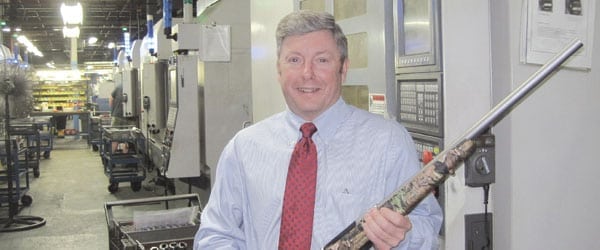
Al Kasper says a passionate team focused on innovation and lean manufacturing is the key to success at Savage Arms.

Al Kasper says there are three business fundamentals that have made 119-year old Savage Arms, the world’s largest manufacturer of hunting rifles and shotguns, so successful since its well-documented recovery from Chapter 11 bankruptcy two decades ago.
The first is a dedicated and passionate leadership team, one that has been hand-picked over the past 20 years. The second is a focus on lean manufacturing that was decidedly missing for most of the ’70s and ’80s, one of the main reasons for the company’s financial turmoil. And the third is a practice of innovative product development, enabled by a company-wide philosophy of not only listening to customers and industry experts, but also responding proactively to what they’re saying.
Kasper — who took the helm as president and CEO after ATK, an aerospace, defense, and commercial-products company, completed its acquisition of Savage in June — said those traits were instilled by his predecessor, Ronald Coburn, who is credited with rescuing the company from bankruptcy.
And today, they are taking Savage to the top of a highly competitive shooting-arms industry, with more than $200 million in annual sales, said Kasper, adding that the lessons learned then still apply today.
“Ron, himself, went out and sold,” recalled Kasper, who joined Savage 1996 as Coburn was staging the comeback. “Coming out of bankruptcy, the company didn’t have a lot of resources, so he literally went customer to customer — Wal-Mart, Kmart, and others — and was successful getting our rifles into those stores at the time.”
The efforts brought much-needed revenue to the company and gave it the time and breathing room to create a culture defined by innovation and entrepreneurship.
Indeed, while fixing what wasn’t working from an operations standpoint, and putting the company on a sound fiscal footing, were Coburn’s primary missions at first, he later created — and continued to inspire — new-product development and continuous improvement in production efficiency that caught the attention of the world.
Looking back, Kasper pointed to the year 2001, what he called ‘the renaissance’ of Savage Arms, and what followed, which was the growing popularity of the model 110, the flagship rifle of the company, and important innovations such as the AccuTrigger and AccuStock (more on them later) — key developments in taking the company to where it is today.
While talk of more stringent gun-control measures is driving sales of guns and ammunition to new heights in this country, Kasper said the lessons learned years ago and the ability to stay on the cutting edge of innovation are the real driving forces behind Savage’s continued success.
For this issue and its focus on manufacturing, BusinessWest toured the cavernous, 350,000-square-foot Savage Arms plant in Westfield to get a first-hand look at how the entrepreneurial spirit that originally defined the company and then enabled its historic comeback is still very much in evidence.

Taking Their Best Shot

The famous Savage Arms Indian head logo

The famous Savage Arms Indian head logo is on display in the company’s museum-like front lobby. It was a gift from Chief Lame Deer to company co-founder Arthur Savage in 1919.

Tracing the company’s history, Kasper said the story begins with Arthur Savage, inventor of the model 99 hammerless lever-action rifle, and Joshua Stevens, inventor of the .22-caliber long rifle cartridge, two entrepreneurs who struggled to get their own ventures off the ground, but persevered and came together to launch the Savage Arms Company in Utica, N.Y.
“Arthur Savage was a prolific inventor — he started with a rifle and built the company from that point,” said Kasper as he showed BusinessWest the expansive front lobby at the plant, which serves as a museum of sorts, showcasing hundreds of rifles, handguns, and some of Savage’s other developments, including an upright washing machine invention and the world’s first motorized lawnmower.
By 1919, Savage and Stevens were manufacturing high-powered rifles, .22-caliber rifles, pistols, and ammunition. Their products caught the attention of Cheyenne Indian Chief Lame Deer, who struck a deal for lever-action rifles in return for Indian-reservation support and endorsement — as well as the imagery that became the Indian head Savage Arms logo, which remains in use today.
Savage passed away as World War II was beginning, but the company provided a variety of weapons for that conflict, including something called the Savage-Halpine torpedo, as well as machine guns for planes and ground forces.
The company moved to the Westfield location in 1959 and continued to grow, said Kasper, but between the early ’60s and late ’80s, several public and private corporations owned and sold Savage Arms.
“These owners were conglomerates and/or private-equity holders that just continually took cash out and put no cash in,” said Kasper, adding that the slide that ended in the Chapter 11 bankruptcy filing was a two-decade-long decline characterized by inefficient operations — to the point where the cost of making some products exceeded their sales price — and an overall lack of passion in the leadership of the company. With no new-product development and no advancement in equipment, the quality of the products plummeted, and the company fell on very hard times.
Enter Coburn as president and CEO in 1989. Kasper said he analyzed the production line and determined that the only product being made profitably was the lowest-volume product, the model 110 bolt-action rifle.
“Ron did a phenomenal job of taking the corporation from bankruptcy in 1988 and righting the ship, positioning the company to begin a growth path,” said Kasper. “He simplified the right products, stayed the course, and started putting a team together.”
Indeed, Coburn halted all production and, once his analysis was complete, began to focus on lean manufacturing of that one product.
By 1995, Coburn raised enough money to purchase Savage Arms and took it private, later hiring Kasper to assist him with the financials and operations of the company.
In the years to come, the company would put its name on a number of landmark innovations, including the SNAIL, a Savage-designed and patented environmentally friendly shooting-range system that has since been adopted by the NRA, FBI, numerous special forces, all major firearms manufacturers, police, military, and private shooting clubs in the U.S. and 14 other countries.
Meanwhile, in 1998, a hunting handgun called the Striker Rimfire was introduced through a newly acquired factory in Canada, and in late 2000, Savage developed the world’s first smokeless muzzleloader and introduced a number of short magnums to complement its Centerfire rifle series.
While Coburn may have started the rebirth of Savage Arms through independent retailers and national giants like Wal-Mart, in recent years, the rise of mega-specialty sporting-goods stores, like Dick’s, Cabela’s, and Bass Pro Shops, gave Savage even more effective points of sale. Featuring Savage Arms products in an atmosphere that is almost Disney-like for hunting and target-shooting enthusiasts, the manufacturer rose to prominence and caught the attention of ATK.
On June 24, ATK announced that it had completed the acquisition of Savage Sports Corp., allowing Savage’s products to be natural complements to ATK’s existing hunting and shooting sports ammunition and accessories business. Ron Johnson took over briefly as Savage’s CEO after Coburn’s retirement until the sale with ATK, then moved on to head up Savage’s BowTech Archery brand, which ATK did not acquire.
“The Savage acquisition adds tremendous capability to our hunting and shooting sports portfolio,” said Jay Tibbets, ATK Sporting Group president. “Their current offerings are well-positioned as affordable, high-quality products, and Savage Arms will help make us a more valued supplier to our customers.”
Kasper praised ATK’s flexible integration plan and its understanding that, with limited resources, and business being as healthy as it is, shipping products on time and keeping customer service at a high are main focuses.
The company now boasts 468 employees in the Westfield plant, and another 158 split between the Ontario, Canada plant and the Suffield, Conn. sales and marketing office.

High-caliber Innovation
Returning to the Coburn legacy, Kasper explained that the former CEO and the team he was building had no qualms about reaching out and seeking advice from experts and those who love hunting and target shooting, and this willingness to reach out has become another key element in the company’s success.
Bill Dermody, director of marketing for Savage, calls this practice “corporate humility,” while quickly acknowledging that this is his term for outreach.
“At Savage, if we want to get into a certain market — long-range target shooting, for example — we don’t assume we know everything,” Dermody told BusinessWest. “We’ll go out and find experts on that topic and bring them in and have them advise us on how that product needs to be.”
But simply soliciting feedback isn’t enough, said Kasper.
“It’s whether you listen to them or not that matters most, and we know our competitors are hearing the same things and seeing the same things in the marketplace,” he said.  “Yet, we’re the first to be there and address the issue with a particular product.”
In addition to calling upon experts, listening to customer opinions is a company policy, and commentary is solicited via e-mail and phone, and at more than 70 consumer events and 85 private gun clubs per year in the U.S. alone. Such outreach has been a driving force in the company’s new-product development, strategic plan, and pattern of innovation in recent years.
For instance, the model 110, the former staple of the company during the 2001 renaissance period, is now obsolete. “That gun today has no common components to what Ron was peddling in the ’90s,” Kasper said with a laugh.
The reason is the AccuTrigger.
It was developed by the company in early 2003, and it became the answer to a nagging problem within the industry — the need for a better, crisper trigger that would prevent discharge from jarred or dropped guns. The trigger problem was inadvertently supporting an already established, and quite aggravating, after-market industry of custom gunsmithing, known as ‘trigger jobs,’ that brought an additional expense to gun owners.
“So we looked at these things that gunsmiths were doing to customize rifles and said, ‘how can we do that on a manufacturing basis?’” said Dermody. “How do we give the end user what he wants right up front as a final product?”
The AccuTrigger did more than just solve a safety and accuracy issue for all rifles; it set a new standard in the industry and put Savage back on the map.
“AccuTrigger made people that had never considered buying a Savage want to pick up a Savage and check it out,” said Dermody. So significant was the development that it pulled customers from major competitors like Ruger and Remington.
“If imitation is the sincerest form of flattery, we’re the most flattered gun company out there,” Dermody added. “And it took everybody [competitors] about five to six years to figure out a way around the patent.”
Not content to rest on its laurels — another trait instilled by Coburn and his leadership team — the innovators at Savage looked for the next problem to solve. They found that, due to the market moving from wood stocks, which would scratch, warp, or dent, to synthetic stocks, which were lighter and less rigid, a new problem had arisen: heat and stress would cause the stock to flex ever so slightly, causing the bullet to fly off line.
The solution, eventually named the AccuStock, was an aluminum-rail system molded into the stock, engaging the action three-dimensionally along the rifle’s entire length.
Both the AccuTrigger and AccuStock are textbook examples of how Savage Arms has stayed on the cutting edge of technology in the industry and how its tradition of innovation has generated visibility and, more importantly, sales.
Today, Savage Arms offers more than a dozen gun models, but there are more than 1,000 SKUs to customize each product. The biggest seller now is the Axis bolt-action mounted rifle, designed and developed to be a low-cost, high-value, entry-level hunting and sporting rifle, offered in a number of calibers.

Triggering Results
The front lobby at Savage has always been a tribute to the past, and for a few decades, that’s all it was, because the past was all the company could celebrate.
But today, the pieces on display, including some of the innovations of the past few decades, are symbols of an ongoing tradition of excellence and innovation, and a clear indication that this company isn’t done with creating products that can change an industry.
“The most important part of Ron’s legacy is the team he built here,” Kasper said. “We’re not short on ideas; there are exciting opportunities that lie in front of us.”

Elizabeth Taras can be reached at [email protected]

Community Profile Features
Businesses Reflect Southampton’s Rural Character

Eric Snyder

Eric Snyder says a small but healthy collection of businesses operate in Southampton, a town that values its rural character.

Bruce Coombs has observed the slow pace of progress in Southampton over the years, a quality long ingrained in the fabric of this rural community.
He owns two businesses on College Highway, the section of Route 10 that runs north and south through town: land-surveying firm Heritage Surveys, and a second enterprise, Heritage Books, located in the historic 1904 building that once housed Southampton Library.
“I started Heritage Surveys in 1976 in the basement of the building which is currently a Subway,” he told BusinessWest. In the decades since, “we’ve had to deal with various town boards and officials — not only in Southampton, but in other towns — and that’s a constantly changing scenario because board members change continuously. There have been some great people on the boards who are very cooperative and easy to deal with, and there have been others on the boards with personal axes to grind, who haven’t been as cooperative.”
Still, he was quick to add, “we deal with that in all communities, and Southampton currenty has a pretty good Planning Board and Conservation Commission, and I’m able to work with them. We currently have two subdivision projects before the Planning Board.”
To be sure, Southampton’s residential growth has outpaced its commercial growth, with the housing stock rising more than 50% from 1990 to 2010, and population rising from 4,500 to more than 5,800 over that period. Meanwhile, the number of companies doing business in town has hovered around 125 for the better part of the last decade.
“We have approximately 33 members from Southampton,” said Eric Snyder, president of the Greater Easthampton Chamber of Commerce, which includes Southampton in its purview.
“They are primarily the smaller businesses,” he added. “There’s limited manufacturing here, and they also seem to be on the smaller side. We have a couple of machine-shop members, contractors, things like that.”
Still, despite the lingering effects of the Great Recession, “our understanding is that business is holding on well here. There are a lot of successful family businesses — historically, a lot of businesses here have been family businesses. And our local businesses are holding their own in this economy.”

Resistant to Change
Southampton’s rural character is almost two centuries in the making, dating back to the mid-19th century, when manufacturing mills began to spring up across Massachusetts. In particular, communities along the Connecticut River and its tributaries developed thriving mill industries.
In the 1840s, a businessman named Samuel Williston proposed to build a mill in Southampton, but the town was reluctant to support such industry and the influx of immigrant workers that came with it. So, in 1847, Williston established his National Felt Mill in neighboring Easthampton, and Southampton focused mainly on agriculture as its primary economic base, in so doing maintaining a more rural character than nearby communities like Westfield and Holyoke.
Today, Southampton is still largely rural — only 1% of the town’s land is zoned commercial, virtually all of it along the Route 10 corridor — and serves primarily as a bedroom community for Greater Springfield and Northern Conn. In fact, of the town’s roughly 5,800 residents, close to 40% commute to jobs in Springfield, Holyoke, Westfield, Northampton, Easthampton, Chicopee, West Springfield, Amherst, or South Hadley, while only about 350 work in Southampton itself.
The town’s economy consists mainly of small stores, restaurants, and service businesses, many of them family-owned or home-based, with a smattering of chains, including Big Y, Rite Aid, and Tractor Supply.
When town officials were preparing a master plan for Southampton earlier this year, they solicited opinions from residents, who, for the most part, are interested in expanding the town’s municipal tax base, but at the same time eager to protect the community’s rural character.
“The greatest challenge in achieving this vision,” the planners wrote, “will be determining what type of economic growth should be promoted in the future and what type of public infrastructure, such as water and sewer service, will be feasible to support economic growth in areas where it is desired.”
In addition, the report noted, “residents expressed a preference for encouraging types of economic growth that maintain and expand the town’s existing and proposed recreational opportunities and amenities, especially those that are connected to Southampton’s natural, cultural, and recreational resources. This approach would benefit residents directly and also serve as an economic marketing attraction. Further, residents said they would also like to support small businesses and provide services that support home-based businesses, such as coffee shops, computer support, and meeting locations.”
Home-based enterprises — about 85 residents work from home — indeed make up a significant portion of the town’s business culture, while working farms, while not as numerous as they once were, are still prevalent, with 43 still in operation.
Among the businesses operating in the town’s tiny commercial zones, Big Y is by far the largest employer, with 170 jobs in Southampton, while other moderate-sized companies include Heritage Surveys, Marmon Keystone, Connecticut Valley Biological, and Lyman Sheet Metal, all of which employ between 10 and 25 people.

Nature’s Way
What Southampton lacks in commercial zoning, it makes up for in spades when it comes to open space. In fact, 87% of the land in town remains in a natural, undeveloped state, with about 22% of that, or some 4,100 acres, designated as open space or recreational lands, most of which is permanently protected from future development.
That natural character of the town’s geography is a treasured facet of Southampton life to many residents, and helps explain the slow pace of economic growth. In fact, a 2005 open-space survey revealed that residents enthusiastically support the development of bike paths, sidewalks, conservation trails, and playing fields, even as they’re less concerned with attracting an influx of businesses.
“While the market ultimately drives the types of businesses that will choose to locate in Southampton, the town can take active steps to encourage the preferred types of business through its zoning bylaws and infrastructure improvements,” the recent master plan states. “It is possible for this bedroom community to increase its commercial base and maintain its rural character, but town officials will need to be wise on where they place their investments.”
Away from his land-surveying business, Coombs is able to interact with a wide variety of residents on the weekends, when his bookstore is open for business (he also maintains a website offering access to 30,000 books). No matter which hat he happens to be wearing, “this is really a great town to live and work in.”
But it’s not always a town that embraces change, he added.
“I had been on the planning board for about 10 years, and also served on the Rural Lands Committee,” he said. “At one point, we did kind of a zoning review that was partially funded by the Forestry Service. It was a project that included some master planning, and we came up with proposed revisions to the bylaws. It was defeated.”
Added Snyder, “there is a certain amount of retail businesses in a couple of centralized areas — basically on the Route 10 corridor, College Highway — but, personally, I get the impression that residents would prefer to keep the character of the town as it is — primarily a rural-based community.”
Coombs called the growth he has seen — primarily on the residential side — normal, “non-offensive” growth.
“I think people like living here,” he told BusinessWest, “and they like to move to Southampton from other communities — more so than moving the other way.”

Joseph Bednar can be reached at [email protected]

Community Profile Features
Great Barrington Has Become a True Destination

GreatBarringtonIt’s been difficult for Doria Polinger to keep enough handmade chocolates on the shelves of the store she opened about a month ago on Railroad Street in Great Barrington.

“Almost everything I make has sold every day — business has been amazing, even though we are tucked away and many people find us by surprise,” she said about H.R. Zeppelin Fine Handmade Chocolates.

Polinger began looking for the right location for her specialty shop several years ago. The Stockbridge resident and New York City transplant chose Great Barrington because of its “urban feel” and the mix of people who pass through the town. “There are tourists, people who live here year-round, and people who have second homes,” she explained. “Everyone comingles well, which is nice.”

Doria Polinger

Doria Polinger says her business thrives in Great Barrington, even though many visitors find her by accident.

The town is the center of what’s known as the Southern Berkshire District, and is the cultural and commercial hub of the area. Sean Stanton, chairman of the select board, said 90% of the surrounding communities don’t have grocery stores, gas stations, and other basic services.

“Our infrastructure serves residents and people who come here in the summer as well as the surrounding communities,” he told BusinessWest, adding that Great Barrington gets a steady stream of traffic due to its central location.

Route 7 is the town’s Main Street, and Route 23 passes west to east. It combines with Routes 7 and 41 in the western part of town and Route 183 in the eastern part, which also follows a section of Route 7 northward from Route 23, before splitting toward the village of Housatonic. As a result, people from Boston, Upstate New York, and the New York metropolitan area are among the many tourists who visit Great Barringtons’s bustling downtown, where streets are home to small storefronts that sell products ranging from clothing made from hand-woven fabric to homemade food products that include cheese, bread, barbecue sauce, and meat and produce from local farms.

Richard Stanley, who built the four-screen Triplex Cinema downtown and owns other real estate, said the extent of Great Barrington’s vitality can be understood by the fact that, although the town only has 7,700 full-time residents, it is home to 65 restaurants, a number of art galleries, and the well-known Mahaiwe Performing Arts Center, as well as many specialty stores and small businesses.

Richard Stanley

Richard Stanley says the Triplex Cinema he developed has helped to revitalize the town and turn it into a thriving resort destination.

“We’re ground zero for the Berkshires, and the diversity of the population is incredible,” he noted. “There are artisans, business people, and people in financial services here.”

Town Manager Jennifer Tabakin agrees.  “We’re not only a residential community, we are an employment hub — 10,000 people come here to work,” she said, adding that many second homeowners enjoy Great Barrington year-round.

Stanley concurs. “We’re a second-home community for the New York metropolitan area.”

The agricultural community is also thriving. “Many young people are coming back to the area purchasing land to develop as farms, and people are also coming here to learn how to do organic farming,” Stanton said. “We have an internship program for sustainable agriculture, two garden centers, and a lot of landscapers.”

Stanton operates Blue Hill Farms, which is a mixed livestock operation, and says much of the town’s land is under conservation easement and/or agricultural-preservation restrictions.

“Although most of it is being used, there is other land which could be designated as agricultural,” he said, “which would reduce the property taxes on it by 75%.”


Logging Growth

Great Barrington has been honored with many accolades that attest to its character, which include being named the “number-one small town in the U.S.” last year by Smithsonian magazine.

Since its early beginnings, the town has been divided into two sections: the downtown area and Housatonic Village, located on its north side. In its heyday, Housatonic was a booming mill village that provided employment for generations of townsfolk, getting its name from the Housatonic Manufacturing Co. located there.

The village is important in Great Barrington’s history due to its mills, and today, the space within some of them has been transformed into offices, businesses, and apartments with ample room for growth. “There is a fair amount of vacant space available in two of the mill buildings,” Stanley said.

He purchased his first building in town in 1989. “It was just another sleepy place on the map then, and people thought I was nuts,” he told BusinessWest. “It was so quiet, you could shoot a cannon down most of the streets at 5 o’clock.”

But over time, New York residents discovered its beauty and began buying second homes there. In addition, a parking lot was constructed, Stanley built his Triplex Cinema, and the town that had served as a retreat for the wealthy during the Gilded Age was rediscovered. “Today, people come here for the town’s unique combination of beauty, for movies and entertainment, for its restaurants and stores, and for the local art galleries,” Stanley said.

Sean Stanton

Sean Stanton, a farmer and chair of the town’s select board, shows off one of the Great White Tomatoes he grows at Blue Hill Farms.

But although town officials have created partnerships to bring in more tourists, they have also taken steps to ensure that Great Barrington retains its pastoral setting and recreational opportunities. The town contains 3,000 acres of state-owned forest property and has an unlimited number of hiking trails. It is also home to Ski Butternut, and its close proximity to Catamount Ski Area in Egremont helps make it a busy place even during the winter.

And while the community has staged a stunning turnaround, there are projects in various stages of development that could make it even more of a destination.

Topping that list is the $30 million redevelopment of the former New England Log Homes factory site at 100 Bridge St.

“The Community Development Corp. of Southern Berkshire County owned the property for about 20 years,” said Stanley. “It was a brownfields site, but nothing was migrating, so they felt no sense of immediacy to do anything with it.”

But in past few years that changed, and several weeks ago preliminary plans were approved for the eight-acre property that will offer public access to the Housatonic River and provide mixed-use opportunities for businesses, nonprofits, and new restaurants. The plan calls for 50 to 70 new housing units and 40,000 to 50,000 square feet of commercial space.

Stanley sits on the board of directors of the development corporation, and said the state Department of Environmental Protection worked with the panel to determine the best use for the property. “The plan is threefold: to foster commerce on the retail level and create higher-paying jobs and a residential environment,” he said.

The anchor tenant will be Berkshire Co-op Market, which generated $8.3 million in sales last year and has outgrown its current location on Bridge Street. The market is owned by 3,500 members and offers locally grown meat, produce, and other products. It is expected to open next fall in a 10,000-square-foot space, which will include a café.

“The co-op supports local farms and is very active in the community,” said Betsy Andrus, executive director of the Southern Berkshire Chamber of Commerce. “It helps entrepreneurs develop local products and was instrumental in creating a program in the schools after students reached out to them requesting better food. Plus, almost every restaurant in town is farm-to-table. They vary their menus according to the season.”

The redevelopment theme for the site, which is in line with the foodstuffs that will be sold there, includes a wellness center, and Stanley said doctors who practice alternative medicine have already expressed interest in office space.

He added that the site is within walking distance of the downtown, and the board of directors has agreed to think of it as an extension of Main Street because there are buildings available for business use in between.

One of them is the former Searles Middle School, which offers views of the Housatonic River and mountains and sits adjacent to the old Bryant School, which is being redeveloped. It will be the first project of its size to receive the LEED Gold designation in Southern Berkshire County and provides for a ‘destination’ mixed use of the property that respects the character of the historic buildings while enhancing public access of the Housatonic River and creating jobs.

Other development opportunities exist on the former Great Barrington Fairgrounds property. The 50-acre site was recently purchased by the Fair Ground Community Redevelopment Project Inc., a nonprofit group that plans to use it as a sustainable community resource for education, recreation, and agriculture, which would include community gardens and a greenhouse.

More opportunity lies at the Searles Castle, built in 1888, which has been on the market since 2007. The castle contains 40 rooms with more than 60,000 square feet of floor space and 36 fireplaces. After being converted from a private home, it was used as a private girl’s school, conference center, a golf course, and most recently was owned by the John Dewey Academy, which served troubled teens.

“The property has 80 acres of grounds with fountains and ponds,” Andrus explained. “The carriage house alone is beautiful and could be used for businesses.”


Destination Location

Overall, Great Barrington is flourishing. “The future continues to look bright as we get more diversity in terms of people and types of businesses and continue to support our farming community,” Stanley said.

Added Tabakin, “the quality of life here is wonderful. It’s a wonderful place to work, raise a family, and enjoy recreational activities.”

Stanton concurred, noting, “there is a lot going on here.”

Sections Travel and Tourism
Springfield Seeks State Designation for a Cultural District
Kay Simpson

Kay Simpson says creation of a cultural district will help Springfield brand its many attractions, while spurring economic development.

Evan Plotkin equated it to a business hanging out a sign that reads “under new management.”

Though he quickly acknowledged that the analogy isn’t perfect — the city hasn’t actually changed leadership at the top, and won’t for at least a few more years — he went ahead with it anyway, because he considers it an effective way to talk about what the creation of a cultural district in Springfield can and likely will do for the community.

“Business owners put out an ‘under new management’ sign on a restaurant, for example, when they want to change the dynamic,” said Plotkin, president of NAI Plotkin and a prime mover in ongoing efforts to revitalize and promote the city’s downtown. “They do it because they want people to know that something has changed, something’s different, something’s better — that people should want to come there again.”

Creating a cultural district can do very much the same thing for Springfield, he went on, noting that it will help the city brand itself and its many cultural attractions and, in many ways, give people a reason to give the community a look — or another look.

Kay Simpson agreed. She’s the vice president of Springfield Museums and one of the primary architects of a proposed cultural district that would cover several blocks downtown and include everything from the Armory Museum to the Paramount; from the Community Music School to the five museums in the Quadrangle; from Symphony Hall to the clubs on Worthington Street.

The formal application for creation of the district was sent to the Mass. Cultural Council (MCC) on Aug. 15, said Simpson, who literally knocked on some wood as she talked about what she considers decent odds that the city will join Pittsfield, Easthampton, Lowell, Gloucester, and other cities gaining state designation for a cultural district.

“This is a great tool for promoting the arts,” she said, adding that, beyond building awareness of the city’s attractions, creation of a cultural district will also better position the city for funding from such organizations as the National Endowment for the Arts, and also spur economic development. “A district can stimulate business, especially creative-economy businesses.”

Her optimism about the proposal’s chances is based on comments made by MCC officials who have walked the planned district already and provided input on the application and how it should be written, and also on the large volume of attractions and institutions packed into the multi-block area identified in the map to the right.

Springfield Cultural District Map loRes 5“It’s remarkable when you consider how many major cultural institutions are located in the downtown area,” she said. “This is not a huge geographic area, but there is a dense concentration of cultural assets.”

David Starr concurred. The president of the Republican and chair of the city’s Cultural Coordination Committee described the planned district as a “true gem,” and said its creation will provide new and potent opportunities to increase awareness of the city’s cultural amenities and build on that foundation.

“The problem has always been that these institutions never got the outside recognition that they deserved,” he explained, referring to the museums in the Quadrangle, the symphony, and other organizations. “A cultural district will help sell them and help brand them to not just the local area, but people outside this region.”

For this issue and its focus on travel and tourism, BusinessWest takes an in-depth look at the proposed cultural district and what its architects believe it can do for the city and its ongoing efforts to revitalize the downtown area.


Mapping Out a Strategy

The MCC’s Cultural Districts Initiative was authorized by an act of the state Legislature in 2010 and launched in 2011.

It was inspired by mounting evidence that thriving creative sectors stimulate economic development, said Simpson, noting that the prevailing theory has been that such districts attract artists, cultural organizations, and entrepreneurs, while helping specific communities create or strengthen a sense of place.

“By having the cultural-district designation, you’re creating an environment where all kinds of businesses can come into an area,” she explained. “These creative-economy businesses include everything from art galleries to graphic-design enterprises to coffee shops and restaurants.

“You’re creating a brand for a community,” she went on, “so that people from outside that community know that, if they go to the cultural district in Springfield, there’s going to be a lot for them to do. They can go to museums, see historic monuments and sites, and have lots to do in terms of both the visual arts and the performing arts.”

There are currently 17 cultural districts across the state, with more being proposed. They have been established in Barnstable, Boston, Cambridge, Concord, Easthampton, Essex, Gloucester (which has two), Lowell, Lynn, Marlborough, Natick, Orleans, Pittsfield, Rockport, Sandwich, and Shelburne Falls.

Springfield’s proposed cultural district would be bordered by East Columbus Avenue, Bliss Street, Stockbridge Street, High Street, Federal Street, Pearl Street, Dwight Street, Lyman Street, and Frank B. Murray Street, according to a prepared summary.

That section is home to number of cultural attractions and institutions, including the Springfield Armory National Historic Site, the Quadrangle, the historic Mattoon Street area, the MassMutual Center, Symphony Hall, CityStage, the Paramount, and the Community Music School, said Simpson, adding that it also includes several parks, some retail areas, and a number of restaurants, clubs, and hotels.

One of the required traits of a district, as set down by the MCC, is that it be walkable, said Simpson, noting that, while this comparatively large area — which officials originally thought might encompass two districts — constitutes a “good walk,” it meets that stipulation.

Most of the existing cultural districts have names that identify a specific neighborhood, landmark, or street. Easthampton’s, for example, is called the Cottage Street Cultural District, a nod to the many former mills and storefronts on that thoroughfare that have become home to arts-related businesses and agencies. Meanwhile, Lowell’s Canalway District takes its name from an historic section of that former textile-manufacturing center, which has also become a center for the cultural community, and spotlights the city’s most enduring character trait — its canals.

Those leading the drive for Springfield’s district recently ran a contest to name it; submissions are currently being weighed by a panel of judges, and a winner is to be announced soon.

By whatever name the district takes, it is expected to become a point of reference for Springfield, a vehicle for branding the City of Homes, and a source of momentum as the community seeks to build its creative economy and, overall, bring vibrancy to a long-challenged section of the city, said Plotkin.

In a big-picture sense, the broad goal behind the cultural district is to change the conversation about Springfield, he went on, adding that, in recent years, most of the talk has been about financial struggles (the city was run by a control board for several years), crime, poverty, and high dropout rates in the city’s high schools.

“This cultural district will build a sense of community,” he noted. “It will help break down some of those walls that people have about Springfield, including the sense that we’re a broken city with low self-esteem.

“We have to break out of that and build some pride and some community,” he went on. “We have to start doing things that will really change the city, and I believe a cultural district will do that. Doing this can help to start changing the conversation about Springfield and about what we really are culturally and what we have here.”

It can also help make a community more visible — and attractive — to those looking for landing spots for a company or sites for everything from day trips to meetings and conventions, said Simpson, who said creation of a cultural district in Boston’s Fenway area has apparently done all that.

“In the Fenway, they’ve said they have seen an increase in occupancy rates in office buildings and storefronts since the cultural district was created,” she said, noting that the area, home to several museums and other attractions, is in many ways similar to downtown Springfield. “Meanwhile, it has created for them the sense that they’re more recognized in terms of gaining political support.”


Sign of the Times

Springfield will probably find out sometime this fall if its proposal for a cultural district has been accepted by the MCC, said Simpson.

If all goes as those behind this initiative believe it will, then the city will soon have a new vehicle for marketing itself and perhaps making some real progress in ongoing efforts to change some of the perceptions about the community.

In other words, the ‘under new management’ sign can go on the door. It will then be up the city to make the most of that development. n


George O’Brien can be reached at [email protected]


Departments Incorporations

The following business incorporations were recorded in Hampden, Hampshire, and Franklin counties and are the latest available. They are listed by community.
AGAWAM


Square Liquors Inc., 132 Glendale Road, Agawam, MA 01001. Sheela Patel, 245 Whiting Farms Road, Holyoke, MA 01040. Liquor store.


BERNARDSTON


Ruder Small Bioceuticals Inc., 712 Brattleboro Road, Bernardston, MA 01337. Sales of animal, equine, and human products.


CHICOPEE


Westover Building Supply Inc., 37 Telegraph Ave., Chicopee, MA 01020. Marcus Thayer, 24 Rockland St., Springfield, MA 01118. Sales of building materials and construction supplies.


FLORENCE


Pioneer Precision Optics Inc., 296 Nonotuck St., Florence, MA 01062. Thomas McGrath, 470 Park Hill Road, Florence, MA 01062. Machine shop.


The Knighten Guild and Company, 199 Ryan Road, Floreence, MA 01063. David Agro, 89 Clark St., Brattleboro, VT, 05301. Nonprofit organization developed to create and produce events such with the purpose of: creating, strengthening and expanding the opportunities for local performers,

educators, crafters, artisans, and businesses to engage with local audiences.


GRANBY


Professional Women’s Chamber of Commerce of Western Massachusetts Inc., 5 County View Lane, Granby, MA 01033. Michelle Cayo, same. To promote the status of women business owners and professionals. Nonprofit organization established to empower women business owners and career-oriented women through participation in leadership, education and networking opportunities; to strengthen the positive impact for women in the business community in Western Mass.; to deal with all matters of common interest to women who work in mercantile, manufacturing, commercial and professional groups; to solicit, receive, invest and expend monies, dues and gifts, and to have all other powers as may be incidental to or necessary for the carrying out of the foregoing purposes; all to the end result that Western Mass. shall be a more prosperous, healthy and in all respects a more desirable place to work and operate their own business.


LEE


Romano Tree Service Inc., 300 Chestnut St., Lee, MA 01238. Lorenzo William Romano, same. Lumber and tree trimming, cutting and removal.


MONTAGUE


VR Trucking Inc., 194 Turners Falls Road, Montague, MA 01351. Vladimir Romashka, same. Specialty and dedicated services of transporting foods, commercial goods, vehicles, and other commodities via flatbed, container, and heavy-hauling trailers on a for-hire basis.


NORTHAMPTON


Weatherfield, Harris and Hobbs Inc., 29 Main St., Northampton, MA 01060. Nathand Blehar, same. Bar.


PALMER


Touched by an Angel Inc., 1022 Chestnut St., Palmer, MA 01069. Helena Stephens, same. Home care services.


PITTSFIELD


New Elm St. Convenience Inc., 155 Elm St., Pittsfield, MA 01201. Piyush Shah. 1064 Holmes Road, Pittsfield, MA 01201. Convenience store.


Whitney Center for the Arts Inc., 42 Wendell Ave., Pittsfield, MA 01201. Lisa Whitney, 312 West 105th St., Apt #1, New York, MA 10025. A facility for established and up-and-coming artists to showcase their talents; give back to the community by promoting and fostering arts and cultural related development in Pittsfield/Berkshires; and preserve the historic Thomas Colt house. Planned activities, music and dramatic performances, art gallery, rental space, corporate events, and other art- and culture- related activities


SPRINGFIELD


Mr. Fix It Home Maintenance & Improvement Inc., 685 Berkshire Ave, Springfield, MA 01109-1008. Santo Feliberty Jr., 22 MAARECO St., Springfield, MA 01109. Home improvement services.


Music Tribute Productions Inc., 52 Maryland St., Springfield, MA 01108. Anthony Manzi, same. Promotions of various entertainment and music.


PCMC Transportation Inc., One Federal St., Building 101, Springfield, MA 01105. Rose-Ann Gaskin-Rice, same. Transportation services.


Real Beef Music Group Inc., 113 Massachusetts Ave., Springfield, MA, 01101. David Hall, same. Music recording studio.


Two-Six for Kicks Inc., 28 Angelica Dr., Springfield, MA 01129. Khari Mitchell, same. Nonprofit organization established to accept donations of new and previously utilized sporting goods and equipment and make donations of this equipment to individuals and organizations within and outside of the United States.


Veterans First: Comprehensive Outreach Center of Western Mass. Inc., 721 State Street, Springfield, MA 01109. Charles Rucks, 101 Mulberry St., #213, Springfield, MA 01102. Nonprofit organization designed to assist veterans and their dependents to access and receive federal, state, local, and veterans benefits for which they are eligible and entitled, to enhance their lives.


Viz Connect Inc., 1350 Main St., Suite 1407, Springfield, MA 01103. Paul Cooleen, same. Mobile and online marketing services.


Web Wizard Inc., 195 Dickinson St., Floor 2, Springfield, MA 01108. Lawerence Shea, same. Broad-spectrum web services to business.


WESTFIELD


R F Transportation Inc., 30 Williams St., Apt. 6, Westfield, MA 01085. Alla Raylyan, same. Transportation services.


Rock Solid Services Inc., 241 Timberswamp Road, Westfield, MA 01085. Sydney Brodeur, same. Residential and small commercial general landscaping services.


Yurko Express, 125 Lapointe Road, Westfield, MA 01085. Yuriy Koval, same. Trucking.


Departments People on the Move

Mary Paquette

Mary Paquette

Mary Paquette has been named Director of Dexter Health Services at American International College, where she will operate in a dual capacity, serving as both a clinician and Director of Medical Services. As a senior member of the Student Affairs Leadership Team, Paquette will have shared responsibility for division-wide strategic planning and assessment activities, manage the day-to-day operations of the campus health center, provide direct medical care, and respond to medical emergencies as required. Paquette will also serve as an advocate for student health needs, managing and providing leadership for a broad range of student-development-oriented departments and programs, which will focus on prevention and education to help students become knowledgeable healthcare consumers. Paquette served previously as associate director of health services at Western New England University. She earned her BSN degree from Elms College and her MSN degree from UMass Amherst. She also studied Coronary Care Nursing at Middlesex Community College and received OSHA/occupational medicine training at STCC, and works in the Emergency Department at Johnson Memorial Hospital in Stafford Springs, Conn. and Hartford Hospital.

•••••

Trisha Neill

Trisha Neill

Holyoke Medical Center announced the promotion of Trisha Neill to the position of Manager of Physical Therapy, Occupational Therapy, and Cardiac and Pulmonary Rehabilitation. Neill received her BS in Physical Therapy from the University of New England, and during the past year, she completed her doctorate of Physical Therapy degree from Simmons College. She has worked in a variety of physical-therapy positions throughout Western Mass. and has been with Holyoke Medical Center for 11 years.

•••••

Spherion, a national recruiting and staffing franchise, recently announced that Brian Houle is the new local franchise owner/operator of the West Springfield office. Houle will be responsible for leading the growth of the firm in the region. He is expanding temp and temp-to-hire for non-clinical healthcare positions and will focus on professional-level positions for direct hire in the areas of accounting and finance, human resources, engineering and manufacturing, and sales and marketing. Houle has a BS from the University of Lowell and an EMBA from Suffolk University, and served in the Massachusetts National Guard.

•••••

Julie Buehler was recently appointed Vice Chancellor for Information Services and Strategy and Chief Information Officer (CIO) at UMass Amherst. Buehler, who has served as deputy CIO at the University of Rochester since 2008, will oversee UMass Amherst’s Office of Information Technologies. Working with the campus administration, individual colleges, and faculty governance bodies, and in coordination with the UMass system IT office, she will also plan and implement the campus’s information and electronic communication strategy, including academic, research, and administrative computing. Buehler, who was an American Council on Education fellow in 2010-11 at the Rochester Institute of Technology, has also been leading an organizational development initiative at the University of Rochester to strengthen communications, foster diversity, and improve the IT unit’s alignment with institutional goals. The pilot effort led to the creation of a new professional-development program for staff to share expertise and develop leadership skills. Buehler received her BS in accounting from the State University of New York at Geneseo and was licensed as a Certified Public Accountant in 1994. She earned her MBA with a concentration in accounting and information systems in 1997 from the William E. Simon Graduate School of Business Administration at the University of Rochester.

•••••

Kazimierz Borawski

Kazimierz Borawski

Kazimierz Borawski, Vice President of Finance at United Bank, recently graduated from the New England School for Financial Studies at Babson College, an intensive two-year program for bank managers, run by the Mass. Bankers Assoc. Borawski, who joined United Bank in 2010, is primarily responsible for coordinating all phases of financial planning, asset-liability management, profitability analysis and reporting, peer-group comparisons, and investor presentations. In addition, he is a member of United’s Asset Liability Management and Enterprise Risk Management committees. His past experience includes a role as an accounting consultant in the Retirement Services division at MassMutual Financial in Springfield. Previously, he served as senior financial associate with JPMorgan Chase in New York City, in the investment banking division. Borawski has an MBA from Manhattan College and a bachelor’s degree in Accounting from Baruch College in New York.

Autos Sections
Outlook Brightening for Auto Makers, Dealers

Mike Balise

Mike Balise says manufacturers are building more cars than consumers will buy, which will benefit car shoppers by deflating prices.

The highways are getting a little shinier.

The Great Recession hit many industries hard, and auto dealers were no exception. As consumers put non-necessary expenditures on hold and hung onto their clunkers a little longer, the average age of cars on the road soared past 12 years.

But they couldn’t put off those trade-ins forever, and with the economy showing signs of life and consumer confidence inching up, carmakers and dealers are reaping the benefits.

“New-car sales are hot,” said Mike Balise, vice president of his family’s regional chain of dealerships. “The overall trend in the industry is up; they’re making 16 million cars again.”

In fact, just five years ago, that was the standard number of vehicles rolling off North American assembly lines. But after dropping below 16 million in 2008 for the first time in 10 years, new-car production bottomed out at around 8 million a couple years later. The fact that manufacturers are producing with confidence again bodes well for dealerships in Massachusetts and everywhere else.

According to the Fabricators & Manufacturers Assoc., manufacturers have curtailed production and instead focused on keeping their operations lean while still meeting the rising demand for auto parts — another result of aging cars on the road. They note that the increased production, expected to top 16.7 million units in 2015, will result in higher employment in auto manufacturing as well.

It will also impact the used-car market, Balise said. “You saw used-car values peak in the spring, and they’re starting to come down faster than they normally would because the new-car manufacturers are coming on stronger; they’ll suppress the market in terms of transaction prices.

“As these manufacturers ramp up capacity,” he explained, “they’re building too many cars. They’re talking about building 16 million, and that is true, but they’re only going to retail 14.5 million. The other 1.5 million will go to Enterprise, Hertz, Avis, your fleets, and they only use them six to 13 months. So there are going to be lots of 5-, 6-, 10,000-mile current-year used cars going to auction.”

In short, he said, “new-car sales are brisk, prices are going down, because the capacity to make cars is still greater than the marketplace, and that will lower the prices of cars and lower the value of late-model used cars.”


Lease of Their Concerns

Gary Rome, president of the Hyundai store in Holyoke and the Kia dealership in Enfield that bear his name, said he has not yet experienced a huge spike in business stemming from the new manufacturer confidence. “But our service and our parts sales have increased dramatically — about 28%.”

Leases are soaring too, he added.

“That’s the other thing — we’ve seen an increase in leasing from a lot of folks,” he said, noting that, on average nationally, leases account for around 11% of all new-car transactions. At Gary Rome, the number currently approaches 35%.

“People are looking to get more car for less money, which they can do with a lease,” he said, noting that the popularity of the option tends to ebb and flow according to how aggressively car makers are pushing special lease programs. “When manufacturers have inventory and they want to move it, they’ll incentivize the leasing to make it more enticing for customers. And customers are responding to that — interest rates are lower, payments are lower, with little or no money down.”

Retail incentives to buy have steadily decreased since peaking during the heart of the recession, when 0% financing was all the rage.

“In general, the car companies have shown some restraint in discounting,” writes Jim Henry in Forbes. “In fact, average actual transaction prices hit a record [in May] of $28,921, according to J.D. Power and Associates. That is what consumers actually paid, net of incentives. In May 2008, that number was $24,404.”

What they want to pay for, Balise said, hasn’t changed much.

“Mileage, reliability, and safety tend to dominate everything,” he told BusinessWest, noting that gas has hovered close to $4 per gallon for so long that people have made gas mileage a permanent part of their car-buying priorities.

“I think it’s always in people’s minds; they’re always considering it. Even my friends buying things like Denalis and Explorers — one guy in particular tows a racecar, and he was very conscious about a three-mile difference between two choices. For most people, it’s very top of mind, and certainly the manufacturers are producing models with better mileage than ever, lots of great choices.”

That enthusiasm has not, however, crossed over to electric vehicles.

“In general, I think that the tendency toward electric cars is going at a very slow pace,” Balise said, noting that GM has lowered the price of its Volt about 20%.

“Those cars seem to be more peripheral. No one bought the Volt except a few people who wanted to be at the cusp of that technology.  Everyone else, if Chevy showed you a Malibu and a Volt and then showed you the price, 99 out of 100 people are going to choose the Malibu all day long.”

The U.S. government has attached tax incentives to electric cars, but Balise said consumers simply haven’t been responsive to them. “The government is trying to create a market that doesn’t exist. Who wants a car you have to recharge, and that takes three or four hours to recharge?”

Analysts have noticed the same trend. “Increased sales are in store for fuel-efficient cars and trucks, especially compact cars, subcompact cars, and hybrids. Despite fairly steady gas prices, consumers are finally ready to commit to these segments for longer than the length of a gas price spike,” noted Colorado-based Accurate Auto Body in its blog.

“They are not eager to commit to all-electric vehicles, though, so automakers will increasingly concentrate their efforts on plug-in hybrids and hybrids. And for those consumers desiring hybrid technology without the hybrid cost, additional hybrid features will be found in more economical conventional cars as manufacturers upgrade their efforts to meet the government’s corporate average fuel economy (CAFE) standards.”


Smart Shoppers

Meeting consumer demands has become more challenging at a time when shoppers are showing up at dealerships with more information and research than ever at their fingertips, Rome said. But he considers that not a negative, but an opportunity to meet their questions with knowledge and attentive service.

“We know that 90% of our customers are going on the Internet to do research, and our job is to provide them with efficient responses that are informative. It’s not unusual for customers to be on the lot at our dealership while using their smartphones to look elsewhere or verify information, to make sure they’re getting a good deal, to look at reviews, to make sure they’re doing business with the right dealership. It’s actually good to see.”

That’s because the Holyoke dealership recently won the Hyundai President’s Award for customer satisfaction, ranking sixth out of 812 dealers in the country. “We’ve seen stability, even in a down market, because of the way we treat our customers,” Rome said, which extends to the company’s charitable involvement in the community. “We have a mantra that we use here: people today come to expect more, so extraordinary is the new ordinary, and people have come to expect an extraordinary experience.”

Across the country, car buyers are increasingly seeking those experiences. According to more than 70 economists and analysts from business, academia, and government who participated in the Chicago Fed’s annual Automotive Outlook Symposium in May, the nation’s economic growth is forecast to be solid this year and strengthen somewhat in 2014; they expect that to translate to 15.3 million new-car sales this year and 15.8 million in 2014, after bottoming out at 10.6 million in 2009.

Truck sales are a particular bright spot. Kenny Veith, partner with Americas Commercial Transportation Research Co., noted at the symposium that, while heavy-duty truck sales are forecast to decrease from 278,700 units in 2012 to 262,300 units in 2013, they are expected to surge to 300,900 units in 2014, while medium-duty truck sales are projected to grow from 188,400 units in 2012 to 197,600 units in 2013 and 213,700 units in 2014.

“For domestic brands, rising pickup truck sales are expected to be another significant factor,” adds Henry in Forbes. “Pickup sales are an important sign of recovery in the housing market. They’re also big-ticket, highly profitable sales in a product segment where the domestic manufacturers still dominate. J.D. Power said it expects full-size pickups to account for 11.4% of industry retail sales, up from 9.7% in May 2012.”

Balise has seen that activity at his own dealerships. “It’s been a really good year for most manufacturers, and trucks are as hot as they’ve been in a long time,” he said.

Rome is confident enough in the industry outlook that he plans to renovate his Holyoke dealership, following a recent renovation of the Kia store in Enfield. “We’re going to reinvest,” he told BusinessWest.

In other words, he keeps rolling along — just like the industry as a whole.


Joseph Bednar can be reached at [email protected]

Departments Picture This

Send photos with a caption and contact information to: ‘Picture This’ c/o BusinessWest Magazine, 1441 Main Street, Springfield, MA 01103 or to [email protected]

Dirty Money

BankBenefitDaffyBankBenefitDuckSix Flags New England recently presented buckets of dirty coins collected from a fountain in the theme park to the YMCA of Greater Springfield, in support of the creation of the new Agawam YMCA Wellness & Program Family Center. The Y team spent the afternoon at United Bank, also a great supporter of the Y, counting and cleaning the money, which amounted to just under $2,000. Left: Lori Stickles, personal banking officer from United Bank, helps Six Flags mascot Daffy Duck weigh coins after cleaning. Right: Agawam Mayor Richard Cohen (third from right) is flanked by Daffy Duck and Betty Grimaldi, Agawam Y committee member, as Stickles (far right) joins Jennifer Mance, director of Sales & Marketing at Six Flags New England (far left), and volunteers and friends of the Y.

New Digs

TommyCarA ceremonial groundbreaking marked the official start of construction for two relocated auto dealerships, Northampton Volkswagen and Country Hyundai. The location is the former site of the Kollmorgen manufacturing plant on the corner of King Street and Damon Road in Northampton; the site will relocate the Volkswagen dealership from across Damon Road, and the Hyundai dealership from Greenfield. Both dealerships are slated to open in January 2014. Pictured, from left, are Carolyn Misch, senior land use planner, City of Northampton; Suzanne Beck, executive director of the Northampton Chamber of Commerce; and Carla Cosenzi and Tommy Cosenzi, co-presidents of TommyCar Auto.

Opinion
Lessons from Detroit — and Springfield

The numbers are exponentially greater — well, more than exponentially: $19 billion as opposed to several hundred million — but there are a great many similarities between what happened in Detroit earlier this month and what occurred in Springfield nearly a decade ago.

Putting it simply, both cities just bottomed out. Like the elderly woman in that famous TV commercial, they had fallen, and they couldn’t get up, at least not without extraordinary measures — a union-crunching control board in Springfield and a record-setting bankruptcy in the Motor City. And neither development came about overnight; they were both a long time in coming.

Indeed, there are many reasons why these great cities wound up in those somewhat similar situations. Start with mismanagement — Detroit built what amounted to a monorail to nowhere and made promises to unions it knew it couldn’t keep, and Springfield simply spent far more money than it had for way too long. But there was also white flight and the demise of the middle class in both communities, rampant crime, and serious declines in tax revenue as both residents and businesses moved elsewhere.

But maybe the biggest reason why both communities hit bottom with such loud thuds was that what had been entrepreneurial cities — perhaps two of the most entrepreneurial cities in the nation’s history — more or less stopped being entrepreneurial. And this is a lesson that must be learned by communities across the country.

Detroit started with carriages and engines for boats, and eventually, people like Henry Ford started putting engines in carriages, and the fortunes of that city dramatically changed. By the 1950s, nearly 2 million people were calling Detroit home (the population is now down to 700,000) and the city was among the most prosperous in the country.

Springfield started with the Armory, and the spirit of innovation soon spread throughout the city. Entrepreneurs started businesses that made everything from revolvers to toys; ice skates to trolley cars; monkey wrenches to parking meters.

Only a few of those items are still made here, because much of the manufacturing in the Northeast went to southern states or overseas. And the jobs that went with those companies simply haven’t been replaced.

Why? There are many reasons, but a big one is that this region, and Springfield in particular, has put too much emphasis on trying to bring businesses here rather than build businesses here.

It all comes back to being entrepreneurial, a character trait that Springfield, Detroit, and many other struggling cities have lost. And that’s the lesson other former manufacturing centers, including some of the Gateway cities in this region, must learn.

One source of inspiration could be Holyoke, a city that suffered from many of the same problems as Springfield and Detroit, although it has avoided full economic collapse.

There, the city is using the new Massachusetts Green High Performance Computing Center and an emerging cultural community to begin the process of filling millions of square feet of old mill space with small, often technology-related businesses, related service businesses, apartments, and condos. It will be a slow process, but the outlook is quite promising.

Springfield will have to do something similar, even if an $800 million casino emerges in the tornado-ravaged South End, as MGM hopes it will. That’s because a casino won’t change the city’s fortunes — it will only help change its fortunes.

As for Detroit … well, bankruptcy will offer the opportunity to start over. What the city does with that opportunity remains to be seen, but whatever happens will certainly take decades to emerge.

That’s OK, because it took decades for Detroit, Springfield, and other old industrial cities to complete their fall and hit bottom.

That’s what happens when entrepreneurial cities stop being entrepreneurial.

Opinion
Gateway Cities Don’t Need Silver Bullet

By ALAN MALLACH and LAVEA BRACHMAN


They have been called shrinking cities and gateway cities. But by any label — our preferred term is ‘legacy cities’ — medium-sized metropolitan areas struggling with manufacturing decline and population loss are a never-ending project in many parts of the country, including Massachusetts.

Almost every year, some silver bullet — a sports arena, a casino, a conference center — promises salvation and rebirth for Brockton, Lawrence, New Bedford, Springfield, or Pittsfield. Avoiding the fate of Detroit, which just filed for bankruptcy, only adds to the pressure for a big solution.

The truth is, the silver-bullet syndrome can inhibit revitalization. A megaproject can become an important asset, but it is not a strategy for change in itself, unless it is integrated into larger schemes to make a meaningful contribution to the city’s future. A more incremental approach built on collaboration and partnerships holds more promise for rebuilding.

The way forward may look more like silver buckshot — with a focus on these key areas:

• Have faith in downtowns. The physical fabric of the central core, with density, a walkable urban texture, and proximity to major institutions and employers, is a powerful attraction for young single people and couples, and a strong basis for residential redevelopment. Set a friendly regulatory environment for infill redevelopment, reinvent public spaces, and encourage private market reuse of older buildings.

• Sustain viable neighborhoods. In these targeted areas, build partnerships with neighborhood associations and community-development corporations to implement multifaceted neighborhood strategies that draw demand, rebuild housing markets, and address destabilizing elements such as crime, foreclosure, and property abandonment.

• Don’t be afraid to demolish. Repurposing large inventories of vacant land strategically is a major springboard for change in heavily disinvested areas. Cities should explore large-scale reconfiguration of land uses, including the use of vacant land properties for public open space, urban agriculture, or stormwater management.

• Reinvent the economic base. Not every city can become the next biotech capital. But an honest assessment of local assets and regional competitive advantages can help build new export-oriented economies. Partner with local educational institutions and major employers to build an educational and workforce-development plan and a competitive regional labor market.

• Build new partnerships. In almost every city, universities and medical centers — ‘eds and meds’ — are bedrock institutions, part of a foundational network of public, nonprofit, and private collaboration. Similarly, state and federal governments must rethink their roles, becoming more nimble, more effective, and less biased toward suburban areas.

• Make sure all city residents benefit from change. Many cities are fractured, with large and growing economic and racial disparities. Engaging residents, and providing the educational and workforce-development systems they need to become competitive, can build a stronger city for everyone.

While legacy cities and their regions are already inextricably linked by social and economic realities, far more must be done to make these connections positive forces for regenerating both the city and the rest of the region. Public-policy changes at both state and national levels should be pursued to foster greater regional integration. Regionalized infrastructure, particularly transit, sewer, and water systems, should be encouraged to strengthen city and regional ties that foster economic growth.

All this may sound as if so many pieces need to fall in place. They do. Yet, an approach we call ‘strategic incrementalism’ can help keep the momentum going. Rather than devote significant time and resources to large-scale, comprehensive planning, legacy cities should focus on building partnerships, supporting multiple initiatives, and more organically internalizing a shared vision for the future.

America’s legacy cities were once the great economic engines of this country. The right mixture of new forms and directions, fueled by their powerful assets and historic can-do culture of achievement, can provide the springboard for a new era of prosperity.


Alan Mallach is a senior fellow at the Center for Community Progress. Lavea Brachman is executive director of the Greater Ohio Policy Center.

Departments Incorporations

The following business incorporations were recorded in Hampden, Hampshire, and Franklin counties and are the latest available. They are listed by community.


GREENFIELD


Mark Pereira Electric Inc., 123 Hope St., Greenfield, MA 01301. Mark Pereira, same. Electrician.


LENOX


Hook & Loom Rug Company, 12 Beecher Lane, Lenox, MA 01240. Whitney Selke, same. Rug manufacturing.


Mazcots Sports Bar & Grill, Inc. 490 Pittsfield Road, Lenox, MA 01240. Anthony Mazzeo, 57 Winesap Road, Pittsfield, MA 01201. Sports bar.


LONGMEADOW


Gul Alam, P.C., 90 Brookside Dr., Longmeadow, MA 0110690. Aroosa Alam, MD., same. General medical practice.


HOLYOKE


Iglesia De Dios Con Nosotros Cri Stiana Unidad Inc., 16 Spring St., Holyoke, MA 01040. Jose Manuel Estrada, 20 Hampden St., Holyoke, MA 01040. Church.


NORTH ADAMS


Loomis Inc., 41 Highland Ave., North Adams, MA 01247. Lisa Ann Loomis, same. Community-based residential facility for people with developmental disabilities.


NORTHAMPTON


LogicTrail Inc., 214 State St., Northampton, MA 01060. Alexander Simon, same. Strategic marketing and development of customer relations programs.


PITTSFIELD


Feronia Forests Fund, LTD, 4 Second St., Pittsfield MA, 01201. Giovanna Cugnasca, 254 East 68th St., New York, NY 10065. Charitable and educational purposes.


KDMA06 Inc., 27E. Housatonic St., Pittsfield, MA 01201. Dan Talmi, 27E. Housatonic St., Pittsfield, MA 01201. Touring ballet.


MBA Hospitality Inc., 150 West Housatonic St., Pittsfield, MA 01201.

Bharatkumar Patel, same. Hotel.


SOUTH HADLEY


Iglesia Del Cristo Vivo, 16 Main St., South Hadley, MA 01075. Daniel Rivera, 63 Agnes St., Springfield, MA 01107. Church.


SOUTHAMPTON


Mending of the Spirit, 12 Old County Road, Southampton, MA 01073. Sunia Hood, same. Outreach to families and individuals helping to find meaning and purpose with a deeper relationship with God.


Mia’s Pizza Inc., 73 Moose Brook Road, Southampton, MA 01073. Shaun Dallas Sutherland. Pizzaria.


SPRINGFIELD


Freedom of Life Society Inc., 19 Wentworth St., Springfield, MA 01104. Richard Yyson Moutrie, 609 Aspen Glen Dr., Hamden, CT, 06518.


Giving Council Inc., 15 Watling St., Springfield, MA 01104. Marvin Council Jr., same. Community-based programs that promote financial and moral responsibility, community development, community revitalization, physical fitness, fundraising for community and charitable purposes, home ownership, and personal growth. To promote cooperation between charitable and non-profit organizations which serve the community and provide a structure for volunteers to serve.


Hot Mama’s Acquisition Corp., 134 Avocado St., Springfield, MA 01104. Matthew Morse, same. Food manufacturing and distribution.


WESTFIELD


Friends of Pine Hill Cemetery Inc., 140 West Silver St., Westfield, MA 01085. Dale Mae Dickson, 140 West Silver St., Westfield, MA 01085.


Community Profile Features
Westfield Takes Flight with New Jobs, Development

CommunityProfilesWestfieldWhen BusinessWest sat down this month with Westfield Mayor Daniel Knapik and Kate Phelon, executive director of the Greater Westfield Chamber of Commerce, it was just one more connection in what has become a strong bond between the city and its chamber.
Take the monthly Mayor’s Coffee Hour the chamber launched to forge a stronger relationship between the city’s leaders and its business community.
“That gives businesses and residents first-hand access to city officials,” Phelon said. “We’re very proud that we have that kind of access to the mayor; not many cities can say they do that on a regular basis.”
The mayor agrees. “We really have opened the door to businesses,” said Knapik, noting that some companies had never before approached the city about their issues.
“Manufacturing companies have different needs than small operators,” Phelon said. “It’s good that we can have this open-door policy and bring these issues in and have dialogue.”

Mayor Daniel Knapik, left, and Jeff Daley

Mayor Daniel Knapik, left, and Jeff Daley say Westfield’s investments in its infrastructure have already begun to spur more development.

Both of them agreed, however, that much of the dialogue in Westfield has been positive lately, from job-creation success stories — from Armbrook Village bringing in 100 jobs with a new assisted-living community to the expansion of Gulfstream, which will add 100 jobs while retaining 130 more — to the dramatic reconstruction of the Whip City’s downtown that has improved traffic flow and generated buzz and business there.
“The best testimony is from folks who haven’t been in Westfield in a while,” Knapik said, “when they come into the downtown and say, ‘wow, what happened?’ And there’s more coming.”

Ready for Takeoff
They might say the same about Barnes Airport on the city’s north side, which has leveraged millions of dollars in public and private investment in the service of infrastructure upgrades and development projects.
“We’ve had multiple funding sources, at the federal, state, and city levels, to get $14 million for a new runway,” said Jeff Daley, the city’s advancement officer. “The current runway is 28 years old, which is eight years past its life expectancy. They’ll be ripping out the entire 9,500 feet of runway and rebuilding it. A large portion of the north and south end of the runway will be concrete, and the middle section will be a specialized tar pavement that will allow the F16s and other planes not to rip it up.”
The 104th Fighter Wing of the Air National Guard has been relocated to Westover Air Reserve Base and Otis Air Force Base during the project, which is expected to be completed by Thanksgiving. Daley said the new runway will attract more commercial use of the airport. Meanwhile, Rectrix Aviation, which bought out Airflyte, is working to increase its investment at Barnes to bring a wider range of services to its clients.
Meanwhile, Daley said, “we obtained a grant from the state to redesign and rebuild Airport Industrial Park Road. It was a $2 million grant, and we’re returning $800,000 back to the state; we managed to do it with $1.2 million. We made it safer with a full redesign; the hairpin turn there was dangerous. We paved it, and we’ll have some new signage to alert people to come to the industrial park.”
That’s where the city is developing 80 acres — perhaps 12 to 15 subdivided lots — for light-manufacturing and aviation-supported businesses. “We’ve had serious conversations with four or five companies looking there, waiting for the road to be finished,” Daley said.
“Add to that Gulfstream’s expansion, and we think Barnes is in a position of growth, with the most action we’ve seen there in years,” Knapik said, noting that the airport is on the cusp of generating more revenue than the city is investing in it. “We’re close to breaking even now, and some of the other situations coming to light will add more revenue to the city. It took a long time to bring it to break-even status.”
Speaking of breaking even, the mayor said, one of the best stories in the city recently is the turnaround of Noble Hospital. After seven years running a deficit, it was able to turn a profit last year.
“It’s great what they’ve been able to do, to modernize the hospital and open up space that had been shuttered and really find niche services for our community, from gastroenterology to expanding the breast-cancer unit,” he continued. “When I came into office, it was pretty dire over there, but it’s been astounding. They’ve been able to invest in their physical plant and turn a profit, which is great news. They seem to be in position for a pretty strong future now.”

Bridges to Progress
So does the downtown area, following a $14.5 million reconstruction of Main and Broad streets and the Park Square Green, and the four-year Great River Bridge project that paired the renovation of that span, over the Westfield River, with the construction of a second bridge next to it.
Those successes will be followed by a significant commercial development at Elm and Arnold streets, featuring a 130,000-square-foot mixed-use facility, a 2,000-square-foot transportation center, and a five-story parking garage. Daley pegged completion of the project — which has been discussed in some form or other for decades — for 2015 or 2016.
“There have been lots of iterations to it,” he said, noting that the city would like the mixed-use facility to include retail, restaurants, and office space. As for the parking garage, “we’re fortunate to have parking problems, and we’re developing up to 500 new spaces to make it a more attractive prospect to come downtown and shop and have dinner.”
The mayor is excited by the prospects. “We’ve said for years that, if the city took care of its property and infrastructure, which we’ve been doing, the rest will follow,” Knapik said of the proposal, and the hope that it will continue a downtown revitalization that has already seen a number of new businesses open on that stretch of Routes 10 and 202.
Those include eateries and a copy center, businesses that will cater to a growing number of college students living downtown following the conversion of the Lansdowne building on Thomas Street into a 216-bed dormitory for Westfield State University. In addition, the former WSU training school building on Washington Street is being redeveloped into privately owned market-rate housing, which would add more student life to Westfield’s downtown.
“We’ve already seen the opening of many new downtown businesses that cater to the young folks living downtown,” Knapik said, including three restaurants with outdoor seating.
“With the City Council allowing outside seating, that’s a first for Westfield,” Phelon said. “I don’t think we’ve ever had that before. Now people will see people sitting and eating outside,” creating more energy downtown.
The city is also moving forward with plans for the riverfront area on the south side of town, which may include a mix of uses. “We’re reviewing four concepts now, and we’ll unveil those to the public over the next two months or so,” said Knapik, who would like to see that project connect with the Columbia Greenway Rail Trail. “These are all things that have been kicked around the city for 20 years or so, and they’re all starting to click now, so we’re happy about that.”

Challenges Remain
Knapik said the city’s unemployment rate, hovering between 6.5% and 6.8%, “isn’t bad, but we need it to be better to really knock us out of the economic slowdown we’re in. But we feel like, with the diverse base we have — including military, healthcare, precision machining, and warehousing — we’re seeing excellent growth in some areas.”
Daley noted that, since 2010, the city has attracted more than $120 million in private investment and has another $72 million in the pipeline. “Currently, 7,000 jobs have been retained by those efforts, and 800 new jobs over three years. There’s a pretty good story to tell there. We’re working very hard to keep retention up … and to make Westfield a place where people want to grow and stay.”
Phelon said the city is working to cultivate its creative economy in an organized way, as nearby communities such as Northampton, Easthampton, and Holyoke have done. “We’re in the infant stages of this. We applied for a grant to take inventory of the creative economy in the city. That can drive economic development, and the chamber is happy to be a part of that.”
The idea, Knapik said, is to bring different “puzzle pieces” that make up the city’s economy out of their individual silos and into an organized effort to promote Westfield’s vitality.
The mayor also touted the city’s efforts to keep property taxes lower than in some surrounding cities and towns. “We want to be that business-friendly community.”
It has tried to do so at a time when state aid to cities is low — in Westfield’s case, down about 30% since before the recession. Yet, plenty of investment continues, giving the mayor plenty to talk about at those coffee hours.
“It’s good,” he said of that communication. “A lot of times, policy is made in an echo chamber. This way, we ensure that both sides are heard. We hear them, and they hear us.”

Joseph Bednar can be reached at [email protected]

Opinion
A Critical Vote for Springfield

Almost one year ago, the Springfield Chamber of Commerce began discussing what impact an $800 million gaming resort would have on the city of Springfield and its residents, workforce, and business community. We engaged all the developers, consulted with chambers of commerce throughout the U.S. that had casinos in their cities, and completed extensive analyses.
We wanted to be sure we thoroughly understood the issues and also understood how to capitalize on the positive impact an $800 million investment would have on the city and the region, and minimize any potential drawbacks. In the end, we determined that the benefits presented by this opportunity far outweighed any reservations, and the chamber membership endorsed a Springfield-based casino.
The city of Springfield has now chosen MGM as its preferred applicant for the sole Western Mass. license. The Springfield Chamber stands firmly with the city on its decision and supports a ‘yes’ vote on July 16.
So, why does the Springfield Chamber of Commerce take this stand? There are many reasons, including:
• Jobs. According to the analysis, 2,000 construction jobs will be followed by 3,000 permanent jobs covering a broad spectrum of career and occupational opportunities, from the service sector to manufacturing to professional services. These 3,000 jobs are new jobs for Springfield and the region. With jobs come opportunities — for educational and professional advancement, financial stability and financial independence, home ownership … the list goes on. With those jobs comes increased disposable income. And the business community reaps a benefit as well: dollars will be spent locally with existing businesses, expanding businesses, and fueling our future entrepreneurial opportunities.
• Tax revenues. Significant amounts of tax revenues, including property taxes, meals taxes, and hotel-room taxes, along with several other dedicated funds to be paid by MGM as committed to in the host-community agreement, will flow to the city.  These added revenues will aid Springfield in enhancing public safety, supporting our school system, maintaining roads and parks, and much more.
• Business development. The chamber strongly believes that there are many opportunities for existing businesses to become vendors of goods and services to the resort. Written into the signed agreement between the city and MGM is a commitment to provide $50 million per year of procurement opportunities for locally provided goods and services to meet MGM’s needs. As part of the chamber’s due diligence, it solicited feedback from other business organizations where MGM has a gaming facility and found that MGM has been true to its word.
The chamber also wanted to be sure that local businesses, especially those that have been the lifeblood of the city for many years, were not disadvantaged by the resort. Again, MGM’s commitment in the host-community agreement reaffirmed its support for our business community, and the chamber is now very involved in reaching out to its members to determine what the supply of these goods and services is in our area and to assist any and all businesses in qualifying as vendors and increasing their production capacity if need be.
• Community support. MGM has also committed itself to the city and its people. Its commitments in the host-community agreement include numerous recreational amenities, such as an ice-skating rink, a vibrant riverfront, and an enhanced public golf course. Our world-class existing facilities, including the MassMutual Center, Symphony Hall, and CityStage, are all incorporated into the plans, and the commitments will help solidify the future of these great venues.
So, why does the Springfield Chamber of Commerce support a ‘yes’ vote? Jobs, income for individuals and families, property upgrades, discretionary spending kept within the community, enrichment to our existing cultural and recreational treasures, financial assistance to Springfield, and economic opportunities for all. These are the reasons  why the Springfield Chamber urges its members and the citizens of Springfield to embrace MGM and vote ‘yes’ for the city’s future on July 16.

Jeffrey Ciuffreda is executive director of the Springfield Chamber of Commerce.

Sections Women in Businesss
WPO Provides a Unique Support System for Women in Business

Cathy Crosky

Cathy Crosky says WPO helps second-stage companies — those with more than 10 employees and $1 million in annual revenues — address their specific needs.

Laura Wright calls it her “sounding board.”
That’s one of the many descriptive words and phrases that she and other members applied to the Women Presidents Organization, or WPO, and its Springfield chapter. And they hint broadly at a specific, and distinctive, form of support provided to those who have found it.
Created for women who own or manage what are known as second-stage companies — those with more than 10 employees and $1 million in annual revenues — or direct large nonprofit agencies, WPO is unique in that regard, and also in the way it helps members address their specific problems and issues, said Wright, president of CSW Inc. in Ludlow.
She told BusinessWest that the monthly meetings put her in a room with successful individuals facing similar challenges — and possessing a common desire to help such peers. And this is just the environment she needs at this stage of her life and career.
“I’m in a male-dominated industry,” said Wright, whose company manufactures printing plates and cutting dies for the packaging industry and also offers brand-management services to consumer product companies. “But I found results-oriented women in the group who were focused on their businesses and very successful. And they’ve helped me grow my business.”
Meghan Sullivan concurred.
“It’s very refreshing to be in a room of people that have very similar experiences,” said Sullivan, managing partner of the Springfield-based law firm Sullivan Hayes & Quinn. “Whether it’s being a leader and shouldering that burden or balancing the obligations of work and the joys and obligations of family — we’re all going through the same kinds of things.”
Cathy Crosky, chair of the Springfield chapter of WPO, said the group now boasts 10 members (most chapters have no more than 20) who meet monthly for three hours. They represent a number of business sectors — from manufacturing to professional services to the nonprofit realm — but share common challenges inside and outside the workplace.
“Once you get your business over a million, it requires a different kind of leadership than when you started the business,” said Crosky, an executive coach and organizational transformation consultant with Charter Oak Consulting Group in Williamstown. “You need different things at a different stages, and women don’t have many role models or mothers that did what we do, but they still have the same challenges.”
The organization’s website announces that it provides “a professionally facilitated, non-judgmental forum for second-stage peers to bring the ‘genius out of the group,’ accelerate the growth of their businesses, and to promote the acceptance and advancement of women entrepreneurs in all industries.”
Translating, and elaborating, Crosky said the group makes extensive use of a roundtable process called Peerspectives, developed by the Edward Lowe Foundation (named after the entrepreneur who, among other things, gave the world cat litter) to drill down on an issue and help the individual presenting a dilemma or goal benefit from collective peer wisdom.
“We ask questions, and that requires the person who is looking for feedback to talk through their issue based on the questions,” she said, adding that the group doesn’t provide answers, but rather helps members forge their own. “So, rather than being told, ‘this is what you should do,’ there is a series of questions that brings problem solving to a deeper level — for them and for us.”
For this issue and its focus on women in business, we spoke with a number of members of the Springfield chapter of WPO to find out how this organization benefits its members, and why its roundtable format is successful in generating results for all those involved in the discussions.

Accountability Now
Shalu Arora, president of Skylightsys Strategic Staffing, an information-technology staffing agency in East Hartford, Conn., started her company eight years ago, and is known in entrepreneurial circles as a ‘gazelle’ because of the speed with which her company grew; she hit $1 million in sales in her second year.
And as a gazelle, she has different needs — and conversations — than those who are just getting a business off the ground. Being in a room full of people who understand her situation, mostly because they’ve been there themselves, is one of the biggest benefits from being a WPO member, she said.
“A startup doesn’t need any processes,” Arora told BusinessWest. “Second-stage business owners need the right advice in terms of legal, compliance, staff management, employee handbooks … the list goes on. You go from managing yourself and a few others to having a large group, and there’s a lot that goes with that.”

From left, Shalu Arora, Meghan Sullivan, Pattie Hallberg, and Laura Wright

From left, Shalu Arora, Meghan Sullivan, Pattie Hallberg, and Laura Wright say WPO members are held accountable for taking the steps necessary to solve their issues.

She said she joined WPO to increase her network of business leaders, but also to help build and hone her leadership skills — and the roundtable discussions have certainly helped her do that. “You’re not here to sell yourself or your company, and in every other organization, you have to put your game face on,” she explained. “This is not about a sales opportunity; it’s about a true way to build your leadership skills.”
Arora’s situation, and outlook, are typical of those who have joined the Springfield chapter, one of 105 around the world. Their individual stories vary, but their motivations for joining the organization are essentially the same: they want to grow their businesses or nonprofits, and they want to grow professionally.
And they’ve come to understand that the best way to do that is to be around people who understand what it takes to do both, and can, as the WPO website suggests, pull the collective genius out of the group.
People like Pattie Hallberg.
The CEO of the Girl Scouts of Central and Western Massachusetts, based in Holyoke, Hallberg is a member of WPO and also involved with the Longmeadow Business Group, which is comprised mostly of men, and said there really is no other women’s group that maintains the continual focus on education and business development that WPO does.
A year ago, Hallberg was looking for opportunities to explore different aspects of business and management, and WPO came into a conversation with a friend. She joined, and helps brings the nonprofit perspective into the group’s discussions, with the understanding that it’s the same perspective of those in business.
“There’s a place for nonprofit conversation that people may think is a little bit different than a business conversation, but there’s really not that much difference — we just have different products,” Hallberg said, adding that she’s intrigued by the breadth and depth of issues put on the table for discussion.
Some of them are strictly business- and bottom-line-oriented, she went on, while others involve the overriding assignment of balancing work and life — and finding a formula for succeeding at both.
Wright noted that many discussions involve how to take a business to the next level, and these conversations are multi-faceted, involving more than spread sheets, sales projections, and marketing strategies.
“Those are the most interesting conversations; it’s a great forum for making a change and making a business what you want it to be,” she explained. “And that all goes back to the members treating each other as the whole person, not just as a businessperson.”
Perhaps the one word that came up most often in commentary about WPO and how it benefits members was accountability. If women want to grow professionally and personally, they have to put plans in place and affect change where it’s needed, said Sullivan, adding that the group works diligently to keep members’ feet to the fire.
Indeed, if the previous month’s meeting spent a good deal of time on one of the member’s concerns, that member should expect to report what’s happened since in the very next meeting, said Sullivan, who, when asked how accountability is achieved, was quick to respond.
“They ask you,” she said, laughing. “They ask, ‘did you do it?’ And they ask why you did or didn’t do it; they put you right on the spot, and it forces you to face that you’re procrastinating, or it forces you to have a perspective that you didn’t have, but you should have had.”
In addition to the Peerspectives roundtable, there are other methods of learning through WPO, including articles and books, business-planning methods, self-assessment tools, and presenting and discussing various leadership topics, said Crosky. But the group has attended some retreats staged by the Edward Lowe Foundation, and a recent addition to the schedule is a new annual conference in Rhode Island with the WPO chapters from Boston and Rhode Island, which allows the Springfield chapter to expand its network and collectively learn from others facing similar challenges.

Tapping into Wisdom
Arora told BusinessWest that it’s hard to look at the bottom line and say her company’s continued growth is due to WPO, but she can state with confidence that it has definitely helped.
“If you help the leader, you help the company,” she said. “I’ve made bolder, better, and swifter decisions than before I was part of this group.”
Enabling its members to say such things is among the many goals of the WPO organization, which acts as a sounding board, as Wright described, or as a board of directors, as others have noted — or as a tough, yet compassionate, group of peers, which is perhaps the most accurate description.
And one can’t underestimate the power of peers.

Elizabeth Taras can be reached at [email protected]

Departments Incorporations

The following business incorporations were recorded in Hampden, Hampshire, and Franklin counties and are the latest available. They are listed by community.

CHICOPEE

Almonte Mini Market Inc., 47 Meetinghouse Road, Chicopee, MA 01013. Jose Almonte, 193 Cabot St., Holyoke, MA 01040. Retail store market and sales.

Church of God Restored of Man Inc., 10 Center St., Suite 207, Chicopee, MA 01013. William Javier Santiago, 708 Main St., Springfield, MA 01105. Preach, and teach the word of God.

Diecast Tool & Die Company, 896 Sheridan St., Chicopee, MA 01020. Beth Zastawny, 91 Irla Dr., Ludlow, MA 01056. Manufacturing of aluminum components and molds.

FEEDING HILLS

ATZ Payroll Solutions Inc., 525 Springfield St., Suite M, Feeding Hills, MA 01030. James Shea, same. Payroll services.

GREENFIELD

Dat Group Inc., 53 Silvio O. Conte Dr., Greenfield, MA 01301. J. Nicholas Filler, same. Manufacturing and distribution.

HOLYOKE

Cindy M. Bigras Inc., 1866 Northampton St., Holyoke, MA 01040. Cindy Bigras, same. Financial planning and investment management.

PITTSFIELD

Berkshire Mountain Lodge Owners Association Inc, 8 Dan Fox Dr., Pittsfield, MA 01201. Brian Heller, 901 La Tierra Dr., San Marcos, CA 92078. Association in connection with the timeshare plan for Berkshire Mountain Lodge.

SPRINGFIELD

Chak’s Peacock Inc., 338 Cooley St., Springfield, MA 01128. Kam Chak, 17 Cluster Circle, Springfield, MA 01128. Restaurant.

Chieftan Inc., 38 Brighton St., Springfield, MA 01118. Joseph Salvatore Tavella III, same. Estimating and sales.

Creative Minds Early Learning Program and School Age Inc., 322 Commonwealth Ave., Springfield, MA 01108. Saida David, same. Daycare program.

Debilitating Medical Condition Treatment Centers Inc., 11-13 Hampden St., Springfield, MA 01103. Herberto Flores, 833 Chestnut St., Springfield, MA 01107. To promote and support activities for the treatment of debilitating medical conditions.

Eli Serrano Ministries Inc., 30 Bowdoin St., Springfield, MA 01109. Eli Serrano, 20 Windermere Dr., Feeding Hills, MA 01109.

WESTFIELD

Chinese Association of Western Massachusetts Inc., 24 North Elm St., Westfield, MA 01085. Xiaoke Duan, 51 Laurel Lane, Longmeadow, MA 01106. To preserve Chinese culture and heritage, celebrate Chinese cultural events, and assist and connect its members in order to: organize culturally related social and recreational activities; promote a broader and deeper understanding of Chinese culture; offer advisory and education to enable members to become better citizens; provide information for academic, career, and business opportunities; and advocate for the rights of ethnic minorities and assist Chinese newcomers in Western Mass.

Company Notebook Departments

Curry Printing Moves to Union Street
WEST SPRINGFIELD — After 37 years in the same location at 191 Elm St., Curry Printing has moved to 91 Union St. in West Springfield. Curry’s new location is larger and will offer better parking for its customers. Curry has continued to stay on top of the ever-changing world of digital printing. It offers full-color, on-demand printing of brochures, envelopes, posters, carbonless forms, booklets, manuals, and other time-sensitive projects. The shop also prints large-format display items such as banners, posters, and outdoor signs. An overhead door at the new location will enable indoor installation of vehicle graphics. Curry can still be reached at (413) 785-1363. The website is www.curry-printing.com.

AIC to Offer Program in Public Health
SPRINGFIELD — In an effort to address continuing and emerging health challenges, American International College has established a new undergraduate major in Public Health. Cesarina Thompson, dean of the AIC School of Health Sciences, said the program, which begins in the fall, builds on the school’s other successful health programs of Nursing, Physical Therapy, and Occupational Therapy. “The new Public Health major will prepare graduates to work in a variety of settings and engage in a wide range of health promotion, health protection, and disease-prevention activities,” said Thompson. “Even though the U.S. spends far more on medical care than any other nation, we rank well below many of its global counterparts and competitors on a number of health outcomes, including overall life expectancy and the incidence of preventable diseases and injuries.” At the completion of the program, Thompson said, it is expected that graduates will have the necessary knowledge of methods to assess population-wide health concerns and understanding related to the U.S. and other selected healthcare and healthcare-delivery systems. Students will also learn structures for and approaches to developing health policies and health-policy analysis. Other areas of study will include population health perspectives and the needs of vulnerable populations, social and behavioral theories applicable to health behavior and how these theories may be applied to address a variety of public health issues, and principles of epidemiology necessary to understand health and illness.

HVAC Supplier SpacePak Introduces AirCell
WESTFIELD — Leading HVAC systems supplier SpacePak recently announced the introduction of AirCell, a new hydronic product for commercial and residential applications. AirCell is a modular, compact, high-efficiency air handler that uses 30% less energy than traditional fan-based HVAC systems, the company said. SpacePak’s hydronic technology, the most efficient way to transfer energy for both heating and cooling, offers an environmentally friendly system that reduces the amount of CFCs used. Additionally, micro-zone design creates multiple precise, self-controlled areas to reduce energy and fuel usage. The systems were designed by Mestek Inc., a family of manufacturers of HVAC equipment and automated manufacturing machinery based in Westfield. John Baldasaro, director of Sales for the Residential Comfort Group at Mestek, explained that the SpacePak and AirCell systems offer an alternative to traditional systems that carry chemical refrigerants into the home. “Hydronic systems are more environmentally friendly because water is a better conductor of energy than air, and AirCell allows for refrigerants to remain outside of the building, cooling or heating the water that ultimately travels through the system,” he said, noting that AirCell uses variable-speed fans and an integrated control system that automatically slows fan speeds during off-peak times, reducing overall energy usage.

Mercy Again Recognized as Top 100 Value Hospital
SPRINGFIELD — For the fourth consecutive year, Mercy Medical Center has been recognized as a Top 100 Community Value hospital by Cleverley + Associates, a leading healthcare financial consulting firm. Mercy’s designation is noted in the independent organization’s recent publication State of the Hospital Industry – 2013 Edition. “Mercy Medical Center’s longstanding reputation for delivering high-quality care at a reasonable cost has once again been independently confirmed with the presentation of both the Community Value 100 and Community Value Five Star Awards,” said Daniel Moen, president and CEO for the Sisters of Providence Health System. “We are proud to be identified among the nation’s highest-scoring facilities in measures of quality of care and costs for the fourth year in a row. With an increasing focus on healthcare value and value-based purchasing of healthcare services driven by healthcare reform, providers are challenged to maximize their productivity and efficiency without sacrificing quality. These awards are further validation that Mercy Medical Center successfully meets those challenges.” The State of the Hospital Industry reports selected measures of hospital financial performance and discusses the critical factors that lie behind them.

Big Y Donates $40,000 to Red Cross Oklahoma Tornado Disaster Relief
SPRINGFIELD — In response to tornadoes that touched down recently and caused massive destruction throughout parts of Oklahoma, Big Y World Class Markets responded by hosting a donation program in all Massachusetts and Connecticut stores. Big Y World Class Markets collected donations from customer and employees for the American Red Cross disaster relief. Funds were raised through a special in-store customer/employee donation program. The community and employee donations, along with additional support from Big Y, resulted in a donation of $40,000, which will be utilized by both Massachusetts and Connecticut American Red Cross chapters in support of the ongoing relief efforts in the devastated communities and for the many people affected by the natural disaster. A formal check presentation to the Massachusetts American Red Cross was held on June 26. Donald D’Amour, CEO of Big Y Foods, presented the contribution to Rick Lee, Pioneer Valley Chapter director, and Mark Brinkerhoff, Pioneer Valley director of Community Support. “Time and time again, Big Y, its employees, and customers have shown incredible compassion and generosity toward people in need,” said Lee. “This customer donation program is one of many that Big Y has run for the Red Cross in recent years, and we are more than grateful for their continued support.”

Easthampton Savings to Build New Office in Belchertown
EASTHAMPTON — William Hogan Jr., president of Easthampton Savings Bank, recently announced the bank’s plans to build a new office in Belchertown. The bank purchased a piece of property and will be constructing a 2,500-square-foot, full-service office, with a drive-up ATM and safe-deposit boxes. It will be located less than a mile from the bank’s current location at 175 State St. The bank has leased space in Belchertown for almost 10 years. The decision to build was based on Easthampton Savings Bank’s long-term commitment to the town of Belchertown. The bank plans to have the new office open by the end of 2013.

Opinion
Why Springfield Should Vote ‘Yes’

There are a number of good reasons why Springfield residents should vote ‘yes’ when they go to the polls on July 16 to consider the host community agreement forged by city officials and administrators with MGM Resorts International — the next step in the process of deciding the winner of the license for a Western Mass. casino.
Maybe the most compelling is an argument made by a number of business leaders and economic development officials over the past year or so. The specific words expressed vary, but it usually sounds something like this: ‘if someone wants to spend $800 million in your city — you let them!’ (And while generally, exclamation points are not used in business writing, in this case, we’ll make an exception.)
OK, it’s not as simple as all that, but it’s actually very close. We’ll amend this argument slightly. ‘If someone wants to spend $800 million in your city, and there is no better (and in this case, no other) viable option for stimulating economic development and creating thousands of new jobs — you let them!’
We understand that there are a number of risks involved with casinos in general and urban casinos in particular — they simply haven’t worked in a number of regions of this country — but we believe that these are risks well worth taking.
That’s because in Springfield, a city that has been struggling for the better part of a half century now, there really is no ‘plan B’ when it comes to spurring new jobs, creating energy, and possibly resurrecting a neighborhood — in this case, the beleaguered, tornado-ravaged South End.
The proposed MGM Springfield complex has the potential to do all that. Yes, it also has the potential to come up considerably short with each of those assignments, but we don’t believe that it will. Its somewhat unique inside-out design will make this proposed facility part of a neighborhood, not a casino-in-a-box that sucks the life out of one.
But let’s look at this another way. Instead of focusing on the possible ramifications of a ‘yes’ vote, let’s consider what a ‘no’ vote means. Essentially it means that the Western Mass. casino — and yes, there will be one — will be located somewhere else, and there are at least two other landing spots.
If that happens, Springfield will not get the complications that come with construction of such a facility, or the traffic, or some of the problems that might come with a casino on the edge of its central business district.
But it also won’t get the chance to put itself back on the map, or reshape its South End neighborhood and achieve the revitalization that has eluded that area for nearly 50 years, or see the direct benefits in the form of contributions to nonprofits, investments in facilities and infrastructure, and donations that will boost public safety initiatives.
A ‘no’ vote will also result in a depressing return to the drawing board in search of another method of providing the economic spark needed to reverse this city’s fortunes. There has been little to come off that drawing board since Springfield’s manufacturing base started to erode just after World War II, and there is little to suggest that much else will come off it in the years to come.
MGM’s proposal for Springfield may not win the contest for the Western Mass. casino license. Indeed, the Mass. Gaming Commission may decide that another plan is more alluring and better for the Commonwealth. But this proposal can’t win unless Springfield voters provide the opportunity for it to get to the next level ‘And thus, we strongly urge them to do so.
We can state the case for this casino in a number of ways, but the argument we mentioned earlier does it best: ‘if someone wants to spend $800 million in your city — you let them!’
There’s that exclamation point again, and it is certainly needed.

Features
McGovern Adjusts to a Greatly Changed District

Rep. Jim McGovern, left,

Rep. Jim McGovern, left, speaks with some of his new constituents in Amherst.

Congressman Jim McGovern was talking about how to spur economic development and job creation in some of the Hampshire, Franklin, and Worcester County communities that are now part of his territory — a significantly reworked Second District — and he started by going back to a speech he gave before the Worcester Chamber of Commerce roughly a year after he was first elected to the House in 1996.
This was to be a candid talk — one he feared might be a little too candid.
“I thought I’d get booed out of the hall,” he recalled with a laugh, adding that he was essentially telling those assembled that they were wandering aimlessly in their pursuit of progress, and thus underperforming. “I said, ‘economic development here reminds me of my then-3-year-old son’s soccer team; if someone kicks the ball to the left, they all run to the left, and if someone kicks it to the right, they all head to the right — no one knows what their position or assignment is.’
“I said there was no logic behind what we were doing here — we’re simply not connecting the dots,” he went on. “And a number of people came up to me later and said, ‘we agree — there’s no plan here; there’s no thought being given to economic development.’”
Over the next several years, Worcester and its officials put some thought into it, he told BusinessWest, adding that, as a result, progress has been made in several areas, from significant growth of sectors like the biosciences and medical-device manufacturing to reinvigoration of Worcester Airport, which will be a stop for JetBlue starting in the fall (more on all of this later).
It all happened through creation of plans and establishment of partnerships with a host of constituencies, from local colleges and universities to private developers, to make them reality, he said, adding that he will work to take some of the lessons learned in Worcester and other communities he’s served, and apply them in cities and towns he might have needed Mapquest to find before late last year.
Indeed, McGovern was probably the congressman most impacted by last year’s massive statewide redistricting effort, facilitated, in some respects, by the retirement of John Olver, whose old First District was essentially parceled out to McGovern and Richard Neal, who formerly represented a much different Second District and also added a host of new communities to his territory.
2nd Congressional District Map

2nd Congressional District Map

McGovern’s former district (the Third) included Worcester, his birthplace and political base, near its west boundary, and swept like a giant apostrophe to the south and east, all the way to Fall River. Now, Worcester is near the eastern end of a district that winds through five counties, the Quabbin Reservoir, and 63 cities and towns (he formerly had only 28), including ones that border Rhode Island, Connecticut, New Hampshire, and Vermont.
“It’s quite a change — I have a lot of learning to do,” he said, adding quickly that this is an ongoing process that has really just begun.
His said his assignment going forward is to continue visiting those 63 communities, learning about both common and specific challenges, and then create some plans — as he helped draft in Worcester — to address matters such as bolstering the agriculture and tourism sectors and finding new uses for the millions of square feet of idle old mill space in Athol, Orange, Palmer, Ware, and many other communities.
But perhaps his overriding mission, he went on, is to disprove some comments from an anonymous reader posted at the end of a story in one of the local papers announcing the results of redistricting. McGovern didn’t have the exact wording on that missive, but he could effectively paraphrase.
“‘We got screwed,’ this person wrote,” he told BusinessWest, adding that he or she went to to say, “‘what the hell is a big-city Worcester politician going to care about what goes on here in the Pioneer Valley?’”
To prove this individual wrong, McGovern, consistently ranked among the most liberal congressmen in the country, said he knows he has to be visible and accessible — and he’s already doing that, through numerous visits to the area and the opening of a district office on Pleasant Street in Northampton — but he also has to be active and accountable, and create progress on the most overriding issue facing every city and town in the Commonwealth: jobs.
For this issue, BusinessWest talked at length with McGovern about what he’s learned through several months of discussions with his new Western Mass. constituents, and how he plans to incorporate lessons learned in Worcester, Fall River, and elsewhere to his work in the 413 area code.

Progress Report
It’s called Gateway Park at WPI.
That’s the name put on ambitious project in downtown Worcester that speaks, in general terms, to the progress made after McGovern’s aforementioned speech to the city’s Chamber of Commerce.
Originally developed as a joint venture with the Worcester Business Development Corp., the park is now solely owned by Worcester Polytechnic Institute. Now in stage 2 of development, its flagship complex is the 125,000-square-foot Life Sciences and Bioengineering Center, which opened in 2007 and is fully occupied with graduate research laboratories, life-sciences companies, state-of-the-art core facilities, and WPI’s Corporate and Professional Education division. The strategic plan eventually calls for five buildings on this site.
The park is perhaps the most significant of the many positive steps Worcester has taken over the past 15 years, said McGovern, adding that it exemplifies the basic approach he embraces when it comes to economic development and job creation. Summing it up, he said it comes down to putting a firm strategic plan in place — in this case, Worcester’s commitment to building its life-sciences sector — and creating partnerships to make it reality.
The same pattern was followed in Fall River and a property now known as the Narrows Center for the Arts, he said, referencing the 280-seat facility, built on the top floor of an old mill building, that hosts national and local performing and visual artists, musicians, writers, and performers.
“They took an abandoned factory and turned it into a spot where some of the top musicians in the country come to play,” he said. “People from all around the region come to attend these concerts, and when they do, they eat at the local restaurants, sometimes they spend the night, they might go shopping beforehand, they attend the local festivals; it all helps out.”
Successes of this magnitude will be difficult to replicate in rural Hampshire and Franklin counties, but McGovern believes he can take the same basic approach and spur economic development in some of the communities he’s now representing.
Getting to know and understand these communities — while also disproving that anonymous commentary mentioned earlier — is the latest career challenge for McGovern, who described his 1996 victory over Republican incumbent Peter Blute as “surprising.”
It came two years after his first bid for Congress while working as a senior aide to long-time Rep. Joe Moakley, in which he lost a crowded Democratic primary. He’s faced only sporadic opposition since, while cementing himself as one of Washington’s most liberal lawmakers and making a mark in areas ranging from transportation to education to nutrition. He currently serves on the powerful Rules Committee, and also on the House Committee on Agriculture.
Since last fall, McGovern has been spending significant amounts of time getting to know his new district and the people who call it home. “Trying to learn all that I need to learn and know all that I need to know is like drinking water from a fire hose — it’s a lot of stuff, and every community is unique.”
He said it’s been a learning experience on many levels.
“People out here take their politics seriously,” he said, referring specifically to the Hampshire and Franklin County portions of his district, which also includes one precinct in Palmer, which is in Hampden County. “They care passionately about the issues, and I’ve had some of the most candid and interesting conversations ever in this part of the district.”
He said his previous district was created to benefit a Republican (Blute), and was therefore more conservative than this new Second District, which includes, in Amherst and Northampton, some of the most liberal communities in the entire state, but also has many conservative pockets as well.
“There’s a little bit of everything — moderate, liberal, Tea Party,” he said with a laugh. “Between Worcester and Franklin County, there are pockets of everything, which keeps life interesting; every day is a learning experience.”
One thing McGovern said he’s already learned is that this region is, by his estimation, “a hell of a lot more coordinated than Worcester was 10 years ago.” Elaborating, the said the Economic Development Council of Western Mass. the Pioneer Valley Planning Commission, and other agencies have identified challenges and opportunities, and have undertaken a number of coordinated initiatives to spark economic development.
“There are good things happening here,” he said. “The challenge for me is to plug into what’s going on and figure out how I can help.”

The Job at Hand
With such a large, spread-out district (compared to everyone but Neal, who represents all of Berkshire County and all but the Palmer precinct in Hampden County), McGovern said he has to maximize his time and carefully plan out his schedule.
He explained that, if he has three days to spend in the district, for example, he’ll spend one in each area: west (Northampton), east (Worcester), and northeast (Leominster).
And while visiting Western Mass. cities and towns, McGovern said he’s learned that the challenges and concerns are pretty much the same as they are across the state. Specifically, the main priority is jobs, and in many communities that were former manufacturing centers, this means reinventing themselves into something else, while also looking at new kinds of manufacturing, different from the paper and textile making that once dominated the scene.
“The one common thread I see and hear in all parts of my district is people worried about their economic security,” he told BusinessWest. “They’re worried about jobs. There’s a good deal of support for reinvigorating our manufacturing base and also support for training programs for displaced workers in the region, because a number of people have lost their jobs in this difficult economy. There’s also a lot of talk about energy-efficiency and renewable-energy projects.”
In Worcester, the process of creating that proverbial something else would never be described as easy, and it is very much still ongoing, said McGovern, but it was greatly facilitated by planning and the many colleges and universities that call that city home, including Assumption, Clark, Holy Cross, Worcester State University, WPI, and UMass Medical School, among others. These collaborations have involved from biosciences to renewable energy.
“I’m proud of what we’ve accomplished in Worcester — we’ve established some collaborations that have made a difference,” referencing projects ranging from Gateway Park to a revitalized Union Station and the Canal District surrounding it; from the airport to reinvigoration of depressed neighborhoods. “A friend of mine who hadn’t been to Worcester in seven years visited recently and couldn’t believe how much had changed and how much new construction was going on; we’re building every day.”
The many colleges in the Amherst/Northampton area, and especially UMass Amherst, can play a similar role, said the congressman, adding that one of his goals is to continue to expand the relationship-building efforts between the university and the communities that surround it to stimulate new business opportunities — and jobs.
“In some states, the natural resources are the minerals in the ground,” he said. “Here, the natural resources are the educational institutions, the colleges. We have all these knowledge-based institutions in the Pioneer Valley that complement and coordinate very well with the schools we have in Worcester. There are opportunities for collaboration that would benefit both areas.”
Meanwhile, in the more rural areas of Hampshire and Franklin counties, agriculture remains a key component of the economy, and McGovern said this makes his seat on the Agriculture Committee more relevant and important. And while working to sustain and perhaps grow agriculture-related businesses, he wants to examine new business opportunities in some of these rural communities, including different options in manufacturing, reuse of the old mills still dominating the landscape, and bolstering tourism, much as Fall River has done through efforts to revitalize its waterfront district.
“It all begins with vision and thinking outside the box,” he said, referring specifically to finding new uses for old mills, but also to economic development in general. “There is a need for housing across the state, and maybe some of these old mills can be redeveloped for that purpose, but also for business development, a supermarket, light manufacturing, and more.”
When it comes to tourism, awareness of what this region and others have to offer, or lack thereof, is part of the problem — and the challenge moving forward, he said, adding that most other sections of the country do a much better job of promoting their tourism assets.
In each community, and with each initiative, the key is to have a plan, or specific strategic direction, said McGovern, returning once again to Worcester and Gateway Park.
“With that initiative, we all sat in a room together, had a conversation about what we were going to do, and then took assignments,” he recalled. “It takes a plan, and what Worcester was lacking was a vision; the ingredients were there to make incredible things happen — what was needed was vision and a plan.”

Summing Up
Those same ingredients are needed in many of the Western Mass. communities that McGovern now counts within his district. Helping put them together is one of the primary items on his to-do list, along with taking initiatives already in progress and moving them forward through partnerships.
“Most all of the challenges we’re facing are not going to be solved by the federal government alone, or the state government alone, or the local government alone, or the private sector alone,” he concluded. “It’s going to involve partnerships and collaborations, and I think I’ve been pretty good at those things.”
But perhaps the most pressing matter is to disprove the comments from that anonymous reader concerned about what a Worcester-based Congressman can do in the Pioneer Valley.
If he can succeed with the former, McGovern said, he knows that the latter will essentially take care of itself.

George O’Brien can be reached at [email protected]

Features
$100 Million Expected to Spur Innovation, Economic Development

Ed Leyden

Ed Leyden says the $100 million in grants for life sciences represent an opportunity for his company to diversify, expand, and eventually add jobs.

Ed Leyden called it “science — not science fiction.”
That was his way of describing a product not yet on the market, but one he believes might be there soon. This would be a wristwatch-like device that would collect vital signs such as blood pressure, heart rate, blood sugar, and more, that could be sent to a doctor if needed.
“There’s a push on now for diagnostics, and what’s called ‘self-diagnostics’ — things you can wear, like a watch,” said Leyden, president of Ben Franklin Design and Manufacturing Company in Agawam and co-chair of the state’s Advanced Manufacturing Collaborative. “They can monitor a number of bodily functions and download them right to your phone — it would be an extremely early-warning system.”
Developing such a monitor, prototyping the device, and then eventually manufacturing it — preferably in the Pioneer Valley — are some of the many goals, if not expectations, that accompany $100 million in grants from the state via the Massachusetts Life Sciences Center (MLSC), that were announced at an elaborate ceremony earlier this month in the shadow of UMass Amherst’s gleaming new $157 million Life Sciences Laboratory.
The awards — $95 million to UMass Amherst and $5.5 million to the Pioneer Valley Life Sciences Institute in Springfield — are part of a $1 billion, 10-year investment on the part of the state designed to stimulate growth of its life-sciences supercluster, considered the largest in the country.
When asked what this latest investment would mean for the Western Mass. region and the state as a whole, Susan Windham-Bannister, president and CEO of the MLSC, said simply, “drive economic development and job creation.”
She then elaborated, telling BusinessWest that this investment — which will fit out and equip a substantial portion of the Life Sciences Laboratory, which will house three new research centers (more on them later) — could help this region replicate the development of life-sciences-related businesses and jobs seen in Cambridge and Worcester, the two strongest pockets for that sector in the state.
To describe what’s happened in those cities, she summoned the phrase “innovation-driven economic development,” which she would use early and often.
“In this model, you begin to create some smaller companies, some spin-outs, and some specialized, innovative technologies,” she explained. “And the large companies want to be around that; they want to be near to what’s happening, so they begin to locate in that area.
“You have small companies growing up, and you have large companies putting up a footprint near these centers of activity,” she continued. “This is the new model of innovation-driven economic development, and it’s really upside-down from the traditional model. You’re not looking to use lots of incentives to get a large company to move; instead, you invest in young companies, and you invest in these centers of specialized expertise that large companies want to be around and take advantage of.”
For this issue, BusinessWest takes an in-depth look at the $100 million investment made by the state and what it means for this region and the life-sciences sector now stretching across the Commonwealth.

Down to a Science
Summing up the state’s $100 million investment in the two Western Mass. facilities, Windham-Bannister said these grants are intended to build on the specific strengths of this region. Specifically, these include the university and the research currently taking place there and that will take place at at the Life Sciences Laboratory, as well as a precision manufacturing sector that is expected to work with those researchers to eventually bring new products to the market — and, if all goes according to plan, manufacture them in the Bay State, and, more specifically, the 413 area code.
This strategic direction, if one wants to call it that, stemmed from work funded by a $300,000 training grant designed to identify the highest and best use for grants from the life-sciences center in this market, she explained. “We set out to determine what were the basic strengths within Western Mass. in the life sciences, what were the strengths at the university and PVLSI, how could we accelerate and build on those strengths, and, more importantly, how could they interact with the companies in the community to help them grow and also encourage startups?”
The answer, arrived at eventually, was to essentially fund three new research centers at the Life Sciences Laboratory, with the goal of creating collaborations with biotechnology firms, medical-device manufacturers, pharmaceutical companies, and other players to bring new products to the market and, in the process, create new jobs.
The three centers will each have a specific focus:
• Personalized Health Monitoring will focus on developing nanotechnology and large dataset management to improve healthcare through low-cost, wearable wireless sensors that analyze patient data continuously in real time, said Windham-Bannister. Biomanufacturing firms, medical-device manufacturers, ‘big-data’ analysts, and other healthcare industry partners will produce prototypes, test them, and assess their manufacturing feasibility.
• Bioactive Delivery will focus on discovery and application of new drugs, agricultural, and ‘nutriceutical’ compounds, she told BusinessWest. “These are things that are very product-oriented, they are input to the development of drugs and devices, and they play to the strengths of the expertise not just at the university, but also in the region, where there is a lot of innovation going on with regard to materials.”
• Models to Medicine will be focused on translating basic protein research by UMass Amherst experts into new therapeutic targets. This center will capitalize on an explosion of discoveries over the past 10 years suggesting that a variety of protein dysfunctions play a role in Alzheimer’s, Parkinson’s, cancer, and infectious diseases.
Meanwhile, the $5.5 million targeted for the PVLSI will support the development of a new Center of Innovation in Health Informatics and Technology, which will be focused on advancing public/private-sector partnerships and incubating innovative technology solutions developed by startups and larger, more established vendor firms in areas such as population health management, healthcare quality, big-data analytics, and mobile health.
Assessing these plans for PVLSI and the Life Sciences Laboratory, Leyden said the investments being made by the state could generate opportunities for precision-manufacturing shops like Ben Franklin and eventually bring new jobs to that sector.
He said his firm, which specializes in making parts for the nuclear, aerospace, defense, power-generation, and other sectors, doesn’t do much work in medical-device manufacturing, but could, because it has the personnel, equipment, and ability to meet the high quality standards necessary to succeed in that specific niche. And there are many area firms in that category.
“The infrastructure is here,” he explained. “We have a strong advanced-manufacturing base here, and even the companies that don’t have experience with medical devices could move into that area — the work is very similar to what they’ve doing already.
“And to me, being a strong manufacturer is being diversified,” Leyden continued. “If you have the ability, and you’re doing another sector’s worth of work, you’re further insulated from the ups and downs from the economy and the manufacturing world.”
There are many existing firms in the area that could eventually benefit through the research that will take place at the university at PVLSI and through collaborative efforts with those teams, said Windham-Bannister, adding that the state’s investment could also spur new startups and possibly prompt life-sciences companies in Worcester, Cambridge, and elsewhere to establish a presence in Western Mass. to take full advantage of the research going on here.
All this is part of innovation-driven economic development, she told BusinessWest, noting that there has already been considerable interest in the three planned centers expressed by life-sciences-related firms not only in Western Mass., but across the state.
“I would think that these companies would want to have a presence close to these centers,” she continued, “because that’s what we’ve seen in Worcester and also what we’ve seen in Cambridge.”

Making Things Happen

Windham-Bannister said it’s impossible to place a timeline on this process of innovation-driven economic development. But, drawing on what’s happened in Worcester, Cambridge, and elsewhere, she said she wouldn’t be surprised if progress comes quickly, and that, as a result of these investments, Massachusetts was able to build on what is already considered a substantial lead in a national competition to create jobs within the broad life-sciences sector.
“The goal at the Life Sciences Center is to translate good science into good business across the Commonwealth, and to enhance this state’s position as a global leader in this realm,” she said, adding that these latest developments in Western Mass. will certainly help move the needle further in the right direction.

George O’Brien can be reached at [email protected]

Opinion
Turning Good Science into Good Jobs

So, just what does $100 million buy today?
Many business owners and economic development leaders are asking that question, following the announcement earlier this month that the state, through the Massachusetts Life Sciences Center, has funneled $95 million in grants to the Life Sciences Laboratory at UMass Amherst and another $5.5 million to the Pioneer Valley Life Sciences Institute in Springfield, with the broad goal of leveraging that investment to spur economic development and jobs (see story, page 9).
In this case, $100 million would appear to buy opportunity — in many forms, but especially an opportunity to further diversify this region’s economy, something that desperately needs to be done — while bolstering a still-vital precision-manufacturing sector, making this region a much bigger part of this state’s rise to the top when it comes to generating business in the life sciences, and propelling the university to a higher level in terms of research and prestige.
Will $100 million buy all that? Probably not, but it will certainly generate some momentum that might make all those things possible.
That’s what state leaders, including Gov. Patrick, university administrators, and elected officials were saying at an elaborate press event on June 6 to announce the grants, and they may well be right. These investments — that’s the best word to describe what the state is doing — are designed to stimulate what Susan Windham-Bannister and others call “innovation-driven economic development,” which would be something new to this region, but also something actually quite old.
Indeed, in recent years, the main thrust of economic development, not just here but elsewhere, has been to attract large employers to vast expanses in industrial parks. We’ve had some success with that approach in the Pioneer Valley, but other regions have enjoyed much more.
Innovation-driven development is different. It starts with the development of materials, products, processes, and expertise, and uses all of the above to stimulate startup companies, bring opportunities to existing ventures, and draw companies from other areas who want to take advantage of all this.
We saw this happen with the Springfield Armory, which wasn’t exactly a startup operation (although, in some respects, it fits that description), but was the birthplace of a great deal of innovation, which eventually led to a number of businesses started by people who worked at the Armory, and, eventually, to the birth of a thriving precision-manufacturing sector. The same can also be said, in many respects, for the gunmaking industry that developed in Western Mass. and Connecticut, which was truly innovation-driven.
Fast-forward more than 200 years, and this region now has an opportunity for different kinds of innovation, from the development of personalized health-monitoring devices using nanotechnology, to discovery and application of new compounds to fight infection, to translating basic protein research into new therapeutic treatments for Alzheimer’s, cancer, and other infectious diseases.
These are the types of research-and-development opportunities that will be taking place at three research centers to be constructed and equipped through that $95 million grant to the university. Meanwhile, at PVLSI, the $5.5 million grant will support the development of a new Center of Innovation in Health Informatics and Technology, designed to spur progress in such areas as population health management and healthcare quality.
In Cambridge and Worcester, similar investments, both public and private, have led to the formation of dozens of companies and the creation of thousands of jobs in the broad life-sciences sector, and Windham-Bannister believes that model could be replicated in Western Mass.
Time will tell if she’s right and if this region can, indeed, translate good science into good business and good jobs, but this region has been handed what appears to be a golden opportunity.
The challenge now is to take full advantage of it.

Briefcase Departments

Mohegan Sun Increases Projected Project Cost
PALMER — Mohegan Sun has upped the projected cost of its Palmer gambling resort to nearly $1 billion with the addition of an indoor-outdoor water park and a second hotel, making the rural project the largest in the competition for the sole Western Mass. casino license. The project will probably include indoor surfing, a lazy river feature, and an extensive series of outdoor zip lines. The new $130 million to $150 million resort component, inspired by the Pump House water park at the Jay Peak resort in Vermont, will be developed by Boston-based Finard Properties, which has also joined with Mohegan Sun to build a retail complex at the development. Plans call for the second hotel to be connected to the water park and detached from the main casino hotel. The second hotel would have about 250 rooms. Mohegan Sun is one of three prominent gambling companies in the hunt for casino development rights in Western Mass. Mohegan is competing with MGM Resorts, which has proposed a casino and entertainment complex in downtown Springfield, and Hard Rock International, which has planned a casino and hotel resort on the Big E fairgrounds in West Springfield. The state Gambling Commission is expected to choose the winning project in early 2014.

Springfield Symphony Orchestra Hires New Executive Director
SPRINGFIELD — The board of the Springfield Symphony Orchestra (SSO) announced that it has hired Audrey Szychukski as the new executive director of the SSO. Audrey Szychulski will join the SSO on Aug. 1 upon leaving her current position as executive director of the Erie Philharmonic in Erie, Pa. Szychulski fills the vacancy created in January when long-time SSO Executive Director Michael Jonnes retired. SSO President Kristina Drzal Houghton noted that, “from our first round of résumé screening, and through every subsequent step of interviewing, reference gathering, and especially after spending time with her, Audrey has consistently stood out as our most promising candidate for this critical position. The executive board and I feel that we have found the right person to help us lead the SSO through our next period of success.” SSO Musical Director Kevin Rhodes was equally positive, commenting that “I could not be more excited to be welcoming Audrey to the SSO family. She will bring an energetic blend of skill, enthusiasm, and musical knowledge to the SSO. Trained as both an arts administrator and as a musician, I am really looking forward to the synergy that Audrey and I will develop as the Springfield Symphony begins its 70th-anniversary season and we guide the orchestra into its eighth decade.” The symphony will make a further announcement and formal introduction closer to Szychulski’s official start date. Peter Salerno, acting executive director of the SSO, will continue in that capacity until Aug. 1.

REB Head Bill Ward to Step Down This Fall
SPRINGFIELD — J. William “Bill” Ward, a longtime leader in the region’s workforce-development arena and president and CEO of the Regional Employment Board of Hampden County (REB), will step down from his position at the end of this year or early 2014. Ward has served in his position with the REB for 32 years and was the driving force behind the organization’s leadership and innovation in a number of workforce initiatives, including the development of one-stop career centers FutureWorks in Springfield and CareerPoint in Holyoke, which serve 20,000 job seekers annually. In a career that has been primarily focused on creating access to employment and self-sufficiency for the region’s low-income citizens, it was under Ward’s leadership that the REB established the Minority Employment Program in the 1980s. This initiative found employment for approximately 500 people a year during the program’s existence. The REB opened the first competitively bid one-stop career centers in 1992, which were recognized by the National Alliance of Business as the “One-Stop Centers of the Year.” Ward launched the Center for Youth Internships and Employment to prepare disadvantaged youth for employment, and formed the Women’s Mentoring Partnership designed to help women transition from welfare to work, matching low-income women with professional women in the business world for mentorship and support. In 1992 he founded the Literacy Volunteer Network, which trained more than 400 volunteers to tutor adult learners in English-literacy skills. The LiteracyWorks initiative formed during his tenure has coordinated various literacy initiatives in the region. Under his leadership, an early-literacy initiative, Talk/Read/Succeed, achieved local and national funding while aiming to raise the literacy skills of young children living in Springfield Public Housing centers, a requirement for future economic success. The REB under his direction started a precision-manufacturing initiative designed to replace retiring workers in the industry with the next generation of machinists by strengthening training and outreach at vocational schools in the region. Ward has been recognized for taking a leadership role in promoting community justice and in 2010 received the Human Relations Award from the National Conference for Community and Justice. In 2009 BusinessWest magazine honored him as a Difference Maker for his contributions to quality of life in the Pioneer Valley. His community service and engagement include service as board president of the Assoc. of Community Living, Abilities Unlimited/Kamp for Kids, and Partners for a Healthier Community.  He also serves on the board of Friends of the Homeless of Greater Springfield. The REB board of directors has established a search committee to identify the organization’s next leader, and a successor will be selected by late this year. Information on the position can be found online at www.rebhc.org.

Construction Unemployment Falls to 10.8% in May
WASHINGTON, D.C. — With the summer building season underway, the nation’s construction industry added 7,000 jobs in May as the unemployment rate dipped to 10.8%, which is down from 13.2% in April and the lowest rate since October 2008, according to U.S. Labor Department. Since May 2012, the industry added 189,000 jobs, or 3.4%. Despite gains in every other construction sector, the non-residential building sector lost 2,600 jobs for the month. Year-over-year, the sector added 15,300 jobs, or 2.3%. Non-residential specialty trade contractors added 1,200 jobs in May and netted 51,600 workers, or 2.5%, since the same time last year. Heavy and civil-engineering employment rose by 3,100 jobs in May and increased by 28,600 jobs, or 3.3%, from May 2012. In contrast, the residential sector added 900 jobs for the month and 18,100 jobs, or 3.2%, during the last year. Residential specialty trade contractors added 4,600 workers for the month and 76,300 workers, or 5.2%, on a year-over-year basis. Overall, the nation added 175,000 jobs as the private sector expanded by 178,000 jobs and the public sector shrunk by 3,000 jobs.

Chamber Corners Departments

ACCGS
www.myonlinechamber.com
(413) 787-1555

• June 5: ACCGS June Business@Breakfast, 7:15-9 a.m., at the Richard B. Flynn Campus Union at Springfield College, 263 Alden St., Springfield. Guest speaker will be Kirk Smith, president and CEO of the YMCA of Greater Springfield, speaking on “A New Way of Doing the Business of a Nonprofit: The Importance of Being VIVID!” Salute to Richard Flynn for his service as president of Springfield College as he leaves the college after 14 years to enjoy retirement. Also to be saluted will be O&G Industries, celebrating 90 years in business. Chief Greeter: John Doleva, president and CEO of Naismith Memorial Basketball Hall of Fame. Season Pass Sponsor: Freedom Credit Union; Season Sign Sponsor: FastSigns; Speaker Sponsor: Jewish Geriatric Services; Coffee Bar Sponsor: Skoler, Abbott & Presser, P.C.; Table Sponsor: La Quinta Inn and Suites. Cost is $20 for members, $30 general admission. Tickets are available at www.myonlinechamber.com or by e-mailing Cecile Larose at [email protected].
• June 7: “Small Business and the Affordable Care Act — What’s Coming?” noon-1:30 p.m., at Ludlow Country Club, 1 Tony Lema Dr., Ludlow. A panel of experts will discuss the impact of the Affordable Care Act on the regional business community and economy at the East of the River Five Town Chamber of Commerce (ERC5) Annual Meeting. Panelists will include Rick Lord, president of Associated Industries of Massachusetts; Peter Straley, president of Health New England; Steven Bradley, vice president of Government, Community Relations, and Public Affairs for Baystate Health; and David Leslie, controller for Glenmeadow Retirement Community. Cost is $20 for members, $30 general admission. Tickets are available at www.myonlinechamber.com or by e-mailing Cecile Larose at [email protected].
• June 12: Viva Las Chamber!, the June After-5, 5-7 p.m., at Chez Josef, 176 Shoemaker Lane, Agawam. Cost is $5 for members, $10 general admission. Tickets are available at www.myonlinechamber.com or by e-mailing Cecile Larose at [email protected].
• June 26: ACCGS Annual Meeting, 11:30 a.m.-1 p.m., at the Sheraton Springfield, 1 Monarch Place, Springfield. Featured speaker will be James T. Brett, president and CEO of the New England Council, New England’s voice of business on Capitol Hill. The chamber will also announce this year’s Richard J. Moriarty Citizen of the Year. Cost is $40 for members, $60 general admission. Tickets are available at www.myonlinechamber.com or by e-mailing Cecile Larose at [email protected].

CHICOPEE CHAMBER OF COMMERCE
www.chicopeechamber.org
(413) 594-2101

• June 5: Annual Golf Tournament, 10 a.m. start, at Chicopee Country Club. Cost is $125 per golfer; $100 for tee sponsorship. Hole-in-one sponsors: Curry Honda-Curry Nissan and Teddy Bear Pools & Spas. Cart sponsor: Pilgrim Interiors Inc.

FRANKLIN COUNTY CHAMBER OF COMMERCE
www.franklincc.org
(413) 773-5463

• June 21: 94th Annual Meeting and Legislative Breakfast, 7:30-9 a.m. at Eaglebrook School in Deerfield. State representatives and senators have been invited to speak. Cost is $12 for FCCC members, $15 for non-members.

GREATER EASTHAMPTON CHAMBER OF COMMERCE
www.easthamptonchamber.org
(413) 527-9414

• June 13: Networking By Night Business Card Exchange, 5-7 p.m. Hosted by Freedom Credit Union and Wireless Zone, 422 Main St., Easthampton. Enjoy hors d’ouevres, host beer and wine, and door prizes. Tickets are $5 for members, $15 for future members.
• July 26: 29th Annual Golf Tournament, starting at 9 a.m., at Southampton Country Club. Reserve now before the event sells out. Cost is $400 per team. Tee sponsorships available for $75 and $125. Contact the chamber to sign up a team or arrange a tee sponsor, a raffle prize, or gift donation.

GREATER HOLYOKE CHAMBER OF COMMERCE
www.holycham.com
(413) 534-3376
.
• June 19: Chamber Business Connections, 5-7 p.m., Massachusetts Green High Performance Computing Center, 100 Bigelow St., Holyoke. Sponsored by Northeast IT Systems and Westfield Bank. If you are in the IT/computer equipment, software, or sales industry, please attend as the chamber’s guest. Cost is $10 for chamber members, $15 for non-members. Join your friends and colleagues for this informal evening of networking.
• June 20: Ask a Chamber Expert Series: Blueprint Reading, 8:30-10 a.m., Greater Holyoke Chamber of Commerce Conference Room, 177 High St., Holyoke. Cost: $10 for members, $25 for the public, includes a continental breakfast. Call the chamber at (413) 534-3376 to sign up, or register at holyokechamber.com.
• June 26: Summer Recognition Breakfast, 7:30-9 a.m., Yankee Pedlar, 1866 Northampton St., Holyoke. Cost: $20 for members, $25 for the public. Call the chamber at (413) 534-3376 to sign up, or register at holyokechamber.com.

MASSACHUSETTS CHAMBER OF COMMERCE
massachusettschamberofcommerce.com
(413) 525-2506

• June 26: Manufacturing Matters Lunch Meeting, at Storrowton Tavern, West Springfield. Tickets are $30 for members, $40 for non-members. For more information on ticket sales, call (413) 525-2506 or e-mail [email protected].
• July 22: Massachusetts Chamber of Commerce Golf Tournament, at Tekoa Country Club, Westfield. Shotgun start at 11 a.m. Cost is $100 per golfer. For more information on registration and sponsorship opportunities, call (413) 525-2506 or e-mail [email protected].
• Nov. 12: Massachusetts Chamber of Commerce Annual Meeting & Awards Luncheon, 9 a.m., at the Double Tree, Westborough. For more information on ticket sales and sponsorship opportunities, contact the chamber office at (413) 525-2506 or e-mail [email protected]

GREATER NORTHAMPTON CHAMBER OF COMMERCE
www.explorenorthampton.com
(413) 584-1900
• June 6: June Arrive @ 5, 5-7 p.m. Hosted and Sponsored by Florence Savings Bank, 85 Main St., Florence. Help us celebrate Florence Savings Bank’s 140th anniversary. Cost is $10 for members. RSVP at [email protected].

NORTHAMPTON AREA YOUNG PROFESSIONAL SOCIETY
www.thenayp.com
(413) 584-1900
• June 12: Nonprofit Board Fair, 5 p.m., at the  Smith College Conference Center. Part of NAYP’s mission is to promote leadership and volunteerism in the next generation of community leaders. The Nonprofit Board Fair will feature more than 20 organizations that are actively seeking the next generation of leaders, and provide opportunities to showcase board, committee, and volunteering opportunities that exist at their nonprofits. The fair offers attendees a chance to hold discussions with more than 20 local nonprofits in one location. Sponsored by Gage-Wiley & Co. Inc. This free event will take the place of NAYP’s June Networking Social, and is open to all community members.

PROFESSIONAL WOMEN’S CHAMBER
www.professionalwomenschamber.com
(413) 755-1310
• June 6: Women of the Year Celebration Banquet, 5:30-8 p.m., at the Cedars Banquet Hall, 375 Island Pond Road, Springfield. Celebrate the accomplishments of Jean Deliso, president and owner of Deliso Financial and Insurance Services. Cost is $55 per person. For tickets, visit www.myonlinechamber.com or e-mail Cecile Larose at [email protected].

WEST OF THE RIVER CHAMBER OF COMMERCE
www.ourwrc.com
413-426-3880
• June 5: Wicked Wednesday, 5-7 p.m., at Lattitude. Wicked Wednesdays are monthly social events hosted by various businesses and restaurants. These events bring members and non-members together to socially network in a laid-back atmosphere. Free for vhamber members, $10 for non-members. This event is open to the public. Guests must pay at the door if they are non-members. For more information, contact the chamber office at (413) 426-3880 or e-mail [email protected].
• June 20: West of the River Chamber of Commerce Annual Breakfast Meeting, 7-9 a.m. at Chez Josef in Agawam. Tickets are $25 for members, $30 for non-members. Featured speaker: Mark Darren Gregor, business and career coach. Presenting sponsor: Hard Rock Hotel and Casino of New England. For more information on registration and sponsorship opportunities contact the chamber office at (413) 426-3880 or [email protected].
• August 19: West of the River Chamber of Commerce 10th Annual Golf Tournament, at Springfield Country Club, West Springfield. Cost is $125 per golfer. Presenting sponsor: Hard Rock Hotel and Casino of New England. For more information on registration and sponsorship opportunities, contact the chamber office at (413) 426-3880 or email [email protected].

GREATER WESTFIELD CHAMBER OF COMMERCE
www.westfieldbiz.org
(413) 568-1618
• June 10: Mayor’s Coffee Hour, 8-9 p.m., at the Arbors, 40 Court St., Westfield. Mayor Knapik will speak about all that is happening around Westfield and field questions. The event is free and open to the pubic. To register, call Pam Bussell at the chamber office at (413) 568-1618 or e-mail [email protected]
• June 12: June WestNet Connection, 5-7 p.m. Hosted by Westfield Bank of Southwick, 462 College Highway, Southwick. An evening of networking; don’t forget your business cards. Complimentary hors d’oeuvres and cocktails. Walk-ins are welcome. Tickets: $10 for members, $15 cash for non-members.  To register, call Pam Bussell at the chamber office at (413) 568-1618 or e-mail [email protected].
• June 14: June 2013 Chamber Breakfast, 7:15-9 a.m., at Shaker Farms Country Club, 866 Shaker Road, Westfield. Platinum Sponsor: First Niagara. Guest speaker: Steven Grossman, treasurer and receiver general. Anniversary salutes: the Carson Center, 50th; East Mountain Country Club, 50th. Tickets: $25 for members, $30 for non-members. To register, call Pam Bussell at the chamber office at (413) 568-1618 or email [email protected].

Community Profile Features
Ludlow Looks to the Future by Restoring the Past

LudlowCommunityProfilesMAPCarmina Fernandes is certainly involved in her hometown, and she wants to get others involved as well.
“One thing I want to do is create partnerships with residents, with business people, with the chamber,” said Fernandes, who serves on the town’s Board of Selectmen and the East of the River 5 Town Chamber of Commerce board, in addition to owning a law office downtown. “If we do that, the possibilities are endless. I’m really excited about creating partnerships here.”
Ludlow is a gem that’s getting some polish these days, particularly at the Ludlow Mills site, a former jute-making factory that once anchored the southern end of town along the Chicopee River. The redevelopment of that property — which includes a mix of new development and reuse of close to 1 million square feet of existing manufacturing and warehouse space — will be a 20-year process overseen by Westmass Area Development Corp.
“It really was the Ludlow Mills that created this town,” Fernandes said. “Fortunately for us, the Westmass Area Development Corp. decided this location was a little gem and came forth with a project worth between $200 and $300 million.”
The site has long been one of Ludlow’s identifying marks; its famous clock tower even graces the town seal. “There’s so much history around that location,” Fernandes said of the old jute factory. “Being of Portuguese descent, it’s also the reason my family and many of our Portuguese descendants came to this town.”
The first tenant on the redeveloped site will be HealthSouth, which is building a $27 million, 53-bed hospital there, to be staffed by 240 employees. The rehabilitation hospital, which is currently located nearby on Chestnut Place, will feature private rooms, a gym, and an open floor plan. Construction of the 74,000-square-foot facility should be completed by the end of 2013.

Carmina Fernandes

Carmina Fernandes says Ludlow is growing commercially and residentially.

“We’re very excited not only to retain HealthSouth in Ludlow, but at a much bigger level, with amazing services,” Fernandes said.
Also moving to Ludlow Mills is Winn Development, which is planning a $20 million, 83-unit senior-housing complex on four floors of a renovated mill building, originally constructed in 1907. With an aging population in town, Fernandes said, the development complements HealthSouth well and meets an overall need for senior-targeted services.
More commercial and industrial tenants are expected to follow as the site is gradually developed over the next two decades. As part of the project, the town received a state transportation bond of more than $1 million to repair neighboring streets and a $1.5 million environmental bond from the Commonwealth to clean contamination on the lot. Westmass is even having the historic clock repaired.
“The town is very excited about this project,” Fernandes said. “Westmass is taking an old, run-down, dilapidated property, a site that was eventually going to turn into a liability to the town, and is slowly bringing the site back to its former glory and launching it into the 21st century.”

Moving Along

Ludlow is certainly not resting on its laurels, however. “We are definitely forward-thinking, and we want to be business-friendly,” Fernandes told BusinessWest. “We understand that we want to keep that balance, so our residents have a high quality of life, yet we still make it easy to do business in this town.”
She touted continued growth on the residential front. “Ludlow is a desirable town with great quality of life and a great education system, so our home values have stayed strong throughout this bad economy.”
Newer developments include a 100-lot subdivision on Parker Lane Extension between Parker Lane and Denis Avenue, a 15-lot subdivision being developed off Center Street across from Higher Brook Drive, and several condominium developments, to name a few.
Small businesses have found a home in town as well, Fernandes said. “Ludlow is one of the remaining land-rich communities outside of Springfield, and the town is reaping benefits from the development.”
She cited a new medical office building for Hampden County Physicians at Holyoke and Moody streets; Alegria Dance & Fitness, which took over a formerly dilapidated building near Randall’s Farm; AJE Financial Services on Center Street; and Dave’s Soda and Pet City and Gomes Construction, both of which located operations in pre-existing commercial sites.
“We’ve been able to bring a lot of our business development using existing commercial sites that were not generating much of anything, taking those sites and redeveloping them. It’s a win-win all around,” Fernandes said. “We tend not to have vacant buildings for too long. There’s a constant flow of activity, which is fantastic.”
She credits a streamlined permitting process with some of that progress, and hopes to use the town’s website to deliver an online application process. The town’s low single tax rate for commercial and residential property is another draw, she added. “That benefits our residents and entices businesses, and when businesses come into town, that creates jobs for our residents.”
Meanwhile, “we want to do an inventory of all sites available for business. What are the priority sites? We hope to market and promote these projects, including the mill project,” she said, adding that she hopes to put market and economic analytics on the town’s website.
And she didn’t shy away from the elephant in the room — or at least a nearby room — when she brought up the casino battle among Springfield, Palmer, and West Springfield, the first two of which border Ludlow.
“There will be an impact on businesses in Ludlow, with a lot more people coming through town. Whomever gets chosen, that would be exciting for any business, because it means more people spending money.”

Age-old Concerns
Another project in town involves the conversion of the Stevens Memorial Building on Chestnut Street — a former factory that more recently was used as a Boys and Girls Club — into 28 units of rental housing for seniors and the disabled. HAPHousing was chosen as the developer, and state funding and subsidies will make the units affordable to low-income seniors. Construction will begin this year.
The Ludlow Mills project also includes a planned riverwalk, Fernandes noted. “That will be wonderful for our residents, who will have another area to enjoy the scenery and the weather and the river. Residents haven’t had much access to that area, so we’re very excited about that as well.”
Speaking of redeveloping open space, last year, the Board of Selectmen forged a contract with Borrego Solar Systems of Lowell to install solar panels on the town’s landfill for 2.7 megawatts of photovoltaic generation. “Again,” she said, “it’s taking a site that was not being used for anything, but when you look at sites creatively, amazing things can come out of them.
“We’re thinking outside the box and generating income by making the best use of the location,” Fernandes continued, noting that Borrego will sell electricity produced at the landfill to Ludlow at about 4 to 5 cents per kilowatt hour, around half the 9 cents it currently pays. In addition, those rates are locked in for the 20-year life of the contract, allowing the town to estimate its future energy spending with more certainty.
The project also reduces the city’s carbon footprint, Fernandes noted, which goes hand in hand with other recent ‘green’ efforts, like a recycling program that was recently launched. “This town is forward-thinking. This is our town, our future, our planet, our kids.”
Fernandes makes no secret of her enthusiasm for Ludlow, particularly its multi-ethnic heritage. “One of the things I love about this town is the huge diversity of residents, from Portuguese to Polish to Turkish to Vietnamese and others. It creates little niches,” she said, noting that cultural events like the annual Portuguese Festa bring in tens of thousands of visitors annually. “That helps our restaurants and businesses.”
Another exciting development, she said, is the possible inclusion of Ludlow on the TV show Communities of Distinction, a Fox Business series hosted by Terry Bradshaw.
“We’ve been in conversation with Communities of Distinction to be selected as a town to be highlighted on that show,” Fernandes explained. “They base their selection on a variety of things, like economic development, quality of life, education — just an overall specialness to this town, so I’m not surprised Ludlow would be considered.”

Joseph Bednar can be reached at [email protected]

Opinion
A Winning Proposition

We’ve written on many occasions about how the region’s economy has moved on from its strong manufacturing heritage, but is still very much searching for something else with which to create jobs and revitalize cities and towns. And we’ve said that this something else is actually many things — but especially both the development of new, potential-laden sectors, such as green energy and the biosciences, and the expansion of other, existing sectors, such as education, healthcare, retail, and, yes, tourism.
And so we are encouraged by the announcement that area tourism and hospitality leaders have joined other regions of the country in creating a sports commission dedicated to the assignment of bringing more and different sporting events and championships to the four counties of Western Mass. (see story on page 14). The commission, launched last month, will bring organization and sophistication to the work of hosting events, and if it succeeds — and we believe it will — the region’s broad hospitality sector should benefit greatly.
This commission is not a game changer when it comes to the regional economy — it’s not going to dramatically alter the fortunes of specific venues, like the MassMutual Center, business groups (such as restaurants or hotels), or individual cities and towns that host events. But it could well be an important contributor at a time when area economic-development leaders understand that there isn’t one answer to the region’s ongoing sluggishness, but several answers.
As the commission begins its work, though, it’s important to keep expectations in check. Greater Springfield is not going to play host to the 2024 Olympics, the 2022 World Cup, the Super Bowl, or any of the seemingly endless number of college football bowl games. And it probably won’t host another of golf’s major championships, as it did in 2004, when the U.S. Golf Association brought the U.S. Women’s Open to the Orchards in South Hadley.
It is far more likely that the region will play host to gymnastics events, cycling competitions, weightlifting, rowing, or other, less-high-profile events. But there is opportunity with these smaller tournaments to fill hotel rooms, bring more business to area restaurants, and give the region the exposure it needs to become a destination for still more events.
Attracting such events will not be easy, primarily because the competition for them is mounting — there are now roughly 300 sports commissions around the country, a phenomenon fueled by the vast potential of sports as an economic driver. But this region has some advantages as it prepares to compete with other regions.
These include location — Greater Springfield is easily accessible to many population centers — as well as affordability (this is a third-tier destination with rates to fit almost any budget) and a host of amenities and attractions that will give competitors and their families something else to do while they’re here.
The region also boasts 17 colleges and universities that help provide it with a strong portfolio of sporting assets (arenas, fields, tennis courts, among others) as well as resources ranging from several rivers and mountains to bicycle and motocross tracks.
Add it all up, and the sports commission can make a pretty strong case as it markets the four western counties to the National Collegiate Athletic Assoc. and myriad other event-staging organizations.
As we said earlier, the addition of a half-dozen or 10 carefully chosen sporting events is not going to dramatically change the picture here in Western Mass. But for many business sectors and communities, they can improve the picture, and become one of the many answers this region will need as it goes about bolstering and diversifying its economy.

Sections Technology
Holyoke Medical Center Innovates with Shared Patient Information

Carl Cameron

Carl Cameron says the future of healthcare IT is the instant sharing of information among different providers, and HMC is busy developing that connectivity.

It’s an increasingly connected world out there, Carl Cameron says, and healthcare providers can no longer deny it.
As director of Information Technology at Holyoke Medical Center, he understands better than most the trends and government mandates that have begun to collide like tectonic plates in his industry — forever altering the medical landscape.
Fortunately, he said, HMC has been well ahead of the game.
Take, for example, the Healthcare Information and Management Systems Society (HIMSS) and its data-analysis arm, HIMSS Analytics, which tracks the progress of healthcare organizations toward meeting federal mandates for electronic health records (EMR).
“They are the organizational IT group for healthcare,” Cameron explained, “and six or seven years ago, they determined how hospitals are rated with implementation of EMR and how that ties into patient safety and improved outcomes. They start with stage 0 — basically very little automation at all — and go up to stage 7, a complete electronic record throughout the hospital.
“We were recently validated as a stage-6 hospital,” he continued, adding that there are only 15 such institutions in Massachusetts, and only 11% of all U.S. hospitals rate at stage 6 or higher, “so just being in that category kind of puts us ahead of where most hospital systems are.”
That effort has encompassed several fronts, from HMC’s adoption of computerized physician order entry in 2009 — three years before the state required it — to a switch from paper chart entry to doctors using computer tablets when interacting with patients.
Perhaps most ambitious, though, has been the hospital’s partnership with EMR vendor eClinicalWorks and its progress in connecting patient records with community physicians outside the hospital.
“One of the projects that we’re in the process of implementing — one that puts us a little bit ahead of others — is our health-information exchange,” Cameron said, explaining that 40 community doctors were initially recruited into the system.
“We’re also working with Holyoke Health Center [HHC] to bring an additional 30 providers on board connecting to the health-information exchange,” he added, noting that additional plans are in the works to connect 30 providers from River Valley Counseling, where behavioral-health patients are referred from HHC.
“This kind of closes the gap in terms of episodic care,” Cameron said, noting that, traditionally, “if a patient visits a physician or the ED, they document it, and the information stops there; it’s not shared across the continuum to other caregivers involved in that patient’s care.”
By creating a health-information exchange, he explained, the hospital reduces the chance of diagnosis or treatment error by making information about a patient’s last primary-care visit, current medications, recent procedures and test results, and the like immediately available to whomever happens to be treating them.
“So, if I walk into the emergency room today and I was at my primary-care office three weeks ago,” he said, “the ED physicians can see what I was there for, what medications my primary-care doctor prescribed, any new medications, if I have any allergies, those types of things.”

Drawing Interest
Cameron was quick to note that patients are not required to participate in the exchange, but the vast majority do. “We have a whole patient-consent process where patients must opt in, but the opt-in rate is around 93%.”
And the exchange could grow to include more than just written records, he added.
“One thing that’s going to set us apart over the next six to 12 months is the ability to add imaging results through the exchange — not just being able to see the patient information, but diagnostic images that have been taken.”
The exchange will also eventually help the hospital with public-health tracking and reporting, Cameron said. “Because the health exchange is going to become the repository of information, it will enable us to do population health reporting. For example, how many diabetics are there in the community, and are they following up with their patient care? It really allows us to manage chronic diseases better.”
A robust health-information exchange makes sense especially against the backdrop of the nascent accountable-care model of healthcare delivery, by which several providers in the community take joint responsibility for a patient’s long-term care.
“We see the health exchange as a foundation — that’s what we’re doing, setting the foundation for these other initiatives,” he told BusinessWest. “Very quickly we anticipate being up over 100 physicians in the health exchange, and we only went up with this in November, so we’ve made some good traction.”
The end goal, Cameron said, is to share information among various healthcare institutions. “I see that happening in multiple ways. I see us forming partnerships with other hospitals to create connectivity or expand the highway, so to speak, and I see the state as an important partner as well, to create that connectivity beyond the local borders in Western Mass.,” he explained, citing the example of a patient in Springfield with a cancer diagnosis who seeks a second opinion or specialized treatment in Boston.
“I think we’re a ways off from that, but we’ve taken the first steps with the state,” he said, noting that he is also working with a colleague in Illinois on testing the functionality of health-information exchanges across state lines, and researching how state and federal laws would govern such an effort.

Easy Access

Patients will soon benefit from EMR in other ways, too. For example, Holyoke Medical Center will roll out its ‘patient portal’ by the end of August, allowing patients to access their hospital records online.
“That’s new, and that’s coming,” Cameron said. “We’ve actually rolled that out internally to employees as a way to get feedback. We’re helping our vendor to develop it and make changes to the product.”
He recognizes that this brave new world of shared and accessible information is a shock to the system for many — not just patients, but providers, too.
“Physicians are all overwhelmed with this push to electronic health records, so we’re working very hard to create partnerships with physicians, to create ease of use and efficiency. We’re trying to help them transition from the old way of practicing to what the new way is going to be.”
He conceded that many physicians are anxious and feel like EMR is being forced on them. “But it is going to help improve healthcare. It is going to make the system more efficient — but it’s going to take some time.
“The way I try to articulate it is, banking and manufacturing have all had IT systems for 30, 40 years,” Cameron told BusinessWest. “On the clinical side, we’re in healthcare IT 1.0. We’re very early in the process. There are going to be bumps in the road, but we have to work together to fix them as we move forward.”
At the end of the day, he said, “I don’t lose sight of the fact that, yes, we’re doing a lot with technology, but it’s all about patient care, patient safety, and improving outcomes.”

Joseph Bednar can be reached at [email protected]

Departments Picture This

Send photos with a caption and contact information to:  ‘Picture This’ c/o BusinessWest Magazine, 1441 Main Street, Springfield, MA 01103 or to [email protected]

Drive Time

BaliseRibbonCutBaliseLadiesAn official ribbon cutting marked the opening of the new, 27,000-square-foot Balise Ford of Wilbraham on the corner of Boston Road and Stony Hill Road, pictured below. After an eight-month construction effort, the dealership moved from its temporary setting a quarter-mile east. The new facility will offer a state-of-the-art sales and service department. Top, Jeb Balise (fourth from the left), president and CEO of Balise Motor Sales, officially cuts the ribbon, flanked on the left by Eric Fuller, member of Wilbraham Planning Board; Phil Podgorny, regional manager of New England for Ford; and Bob Russell, Wilbraham selectman; and on the right by Jason Perez, general manager of Balise Ford of Wilbraham; and Dick Butler, member of the Wilbraham Planning Board. Bottom, the Balise marketing team poses on the back of a 2013 Ford F-150. From left are Kristin Garini, digital marketing manager; Megan Boshuyzen, graphic designer; Dale MacDonald, media manager; and Crystal Childs, social media specialist.

Who Done It?

GrayHouseCastNine area ‘celebrities’ recently volunteered their time and talent to portray various suspects in a second annual murder mystery dinner titled Quicker Than The Eye. The interactive evening benefited the Gray House Inc., a nonprofit that provides food, clothing, and educational services to nearly 8,000 Springfield-area residents each year. Featured players included (from left) Chris Buendo, co-publisher, Reminder Publications; Ellen Freyman, attorney, Shatz, Schwartz and Fentin, P.C.; Korri Piper, development and communications director, Greater Springfield Habitat for Humanity; Karen Boyd, the Zito & Karen Morning Show, Mix 93.1; Anthony Cignoli, president of A.L. Cignoli Co.; Jill Monson, owner, Inspired Marketing; Brady Chianciola, assistant vice president and regional manager, PeoplesBank; Elizabeth Taras, staff writer, BusinessWest and the Healthcare News; and Kimberly Robinson William, diversity consultant, the Office of Diversity & Inclusion at Baystate Health.

Airing His Opinions

YPSmeetingYPSexcelDryerDenis Gagnon, president of Excel Dryer in East Longmeadow, and inventor of the XLERATOR hand dryer, spoke to members of the Young Professional Society of Greater Springfield for the May CEO Luncheon. After a tour of the manufacturing facility, Gagnon and son Bill, vice president of Marketing and Key Accounts, explained how the family’s investments in new products, especially the XLERATOR, which is now the industry standard, has enabled the company to grow exponentially since it was purchased in 1997. Pictured in the Excel plant, bottom, with Denis Gagnon (third from left), are YPS board members (from left) Jeremy Casey, assistant vice president and commercial service officer, Westfield Bank; Jack Toner, sales, Sumner & Toner Insurance Agency; Nick Gelfand, owner, NRG Real Estate Inc.; Sharon Czarnecki, assistant vice president and commercial loan officer/Small Business Development, Westfield Bank; and Bill Gagnon.

Dave and Dinosaurs

Dave Ratner at schoolDavid Ratner, CEO of Dave’s Soda and Pet City of Agawam and Hadley, recently read to students at the James Clark School in Agawam as part of the Link to Libraries Business Book Link program. Ratner shared a story about dinosaurs with the first-grade class of teacher Kathy Planzo, at right.

Chamber Corners Departments

ACCGS
www.myonlinechamber.com
(413) 787-1555
• June 5: ACCGS June Business@Breakfast, 7:15-9 a.m., at the Richard B. Flynn Campus Union at Springfield College, 263 Alden St., Springfield. Guest speaker will be Kirk Smith, president and CEO of the YMCA of Greater Springfield, speaking on “A New Way of Doing the Business of a Nonprofit: The Importance of Being VIVID!” Salute to Richard Flynn for his service as president of Springfield College as he leaves the college after 14 years to enjoy retirement. Also to be saluted will be O&G Industries, celebrating 90 years in business. Chief Greeter: John Doleva, president and CEO of Naismith Memorial Basketball Hall of Fame. Season Pass Sponsor: Freedom Credit Union; Season Sign Sponsor: FastSigns; Speaker Sponsor: Jewish Geriatric Services; Coffee Bar Sponsor: Skoler, Abbott & Presser, P.C.; Table Sponsor: La Quinta Inn and Suites. Cost is $20 for members, $30 general admission. Tickets are available at www.myonlinechamber.com or by e-mailing Cecile Larose at [email protected].
• June 7: “Small Business and the Affordable Care Act — What’s Coming?” noon-1:30 p.m., at Ludlow Country Club, 1 Tony Lema Dr., Ludlow. A panel of experts will discuss the impact of the Affordable Care Act on the regional business community and economy at the East of the River Five Town Chamber of Commerce (ERC5) Annual Meeting. Panelists will include Rick Lord, president of Associated Industries of Massachusetts; Peter Straley, president of Health New England; Steven Bradley, vice president of Government, Community Relations, and Public Affairs for Baystate Health; and David Leslie, controller for Glenmeadow Retirement Community. Cost is $20 for members, $30 general admission. Tickets are available at www.myonlinechamber.com or by e-mailing Cecile Larose at [email protected].
• June 12: Viva Las Chamber!, the June After-5, 5-7 p.m., at Chez Josef, 176 Shoemaker Lane, Agawam. Cost is $5 for members, $10 general admission. Tickets are available at www.myonlinechamber.com or by e-mailing Cecile Larose at [email protected].
• June 26: ACCGS Annual Meeting, 11:30 a.m.-1 p.m., at the Sheraton Springfield, 1 Monarch Place, Springfield. Featured speaker will be James T. Brett, president and CEO of the New England Council, New England’s voice of business on Capitol Hill. The chamber will also announce this year’s Richard J. Moriarty Citizen of the Year. Cost is $40 for members, $60 general admission. Tickets are available at www.myonlinechamber.com or by e-mailing Cecile Larose at [email protected].

CHICOPEE CHAMBER OF COMMERCE
www.chicopeechamber.org
(413) 594-2101
• May 22: Business After Hours, 5-7 p.m., at Berkshire Bank, 1339 Memorial Dr. in Chicopee. For more information, contact the chamber at (413) 594-2101 or e-mail [email protected].
• June 5: Annual Golf Tournament, 10 a.m. start, at Chicopee Country Club. Cost is $125 per golfer; $100 for tee sponsorship. Hole-in-one sponsors: Curry Honda-Curry Nissan and Teddy Bear Pools & Spas. Cart sponsor: Pilgrim Interiors Inc.

FRANKLIN COUNTY
CHAMBER OF COMMERCE
www.franklincc.org
(413) 773-5463
• June 21: 94th Annual Meeting and Legislative Breakfast, 7:30-9 a.m. at Eaglebrook School in Deerfield. State representatives and senators have been invited to speak. Cost is $12 for FCCC members, $15 for non-members.

GREATER EASTHAMPTON CHAMBER OF COMMERCE
www.easthamptonchamber.org
(413) 527-9414
• June 13: Networking By Night Business Card Exchange, 5-7 p.m. Hosted by Freedom Credit Union and Wireless Zone, 422 Main St., Easthampton. Enjoy hors d’ouevres, host beer and wine, and door prizes. Tickets are $5 for members, $15 for future members.
• July 26: 29th Annual Golf Tournament, starting at 9 a.m., at Southampton Country Club. Reserve now before the event sells out. Cost is $400 per team. Tee sponsorships available for $75 and $125. Contact the chamber to sign up a team or arrange a tee sponsor, a raffle prize, or gift donation.

GREATER HOLYOKE
CHAMBER OF COMMERCE
www.holycham.com
(413) 534-3376
• May 21: Chamber Business Connections, 5-7 p.m. Sponsored and hosted by Sovereign Consulting, 4 Open Square Way, Suite 307. If you are in the architecture, engineering, or development industry, please attend as the chamber’s guest. Cost is $10 for chamber members, $15 for non-members. Presented by the Greater Holyoke Chamber of Commerce Ambassadors Committee. Join your friends and colleagues for this informal evening of networking.
• May 29: Greater Holyoke Chamber of Commerce Annual Meeting, 5 p.m., at the Delaney House in Holyoke. Program followed by grand reception, including the Fifield Awards. Sponsored by the Greater Holyoke Chamber Corporate Leaders. Cocktails from 5 to 5:30; annual meeting, 5:30; dinner begins at 6. Admission: $30 in advance, $40 at the door. Open to the public. The chamber will also honor chamber member retirees Rosalie Deane, Holyoke Housing Authority; David Dupont, superintendent of Holyoke Public Schools; and John Kelley, People’s United Bank.
• June 19: Chamber Business Connections, 5-7 p.m., Massachusetts Green High Performance Computing Center, 100 Bigelow St., Holyoke. Sponsored by Northeast IT Systems and Westfield Bank. If you are in the IT/computer equipment, software, or sales industry, please attend as the chamber’s guest. Cost is $10 for chamber members, $15 for non-members. Join your friends and colleagues for this informal evening of networking.
• June 20: Ask a Chamber Expert Series: Blueprint Reading, 8:30-10 a.m., Greater Holyoke Chamber of Commerce Conference Room, 177 High St., Holyoke. Cost: $10 for members, $25 for the public, includes a continental breakfast. Call the chamber at (413) 534-3376 to sign up, or register at holyokechamber.com.
• June 26: Summer Recognition Breakfast, 7:30-9 a.m., Yankee Pedlar, 1866 Northampton St., Holyoke. Cost: $20 for members, $25 for the public. Call the chamber at (413) 534-3376 to sign up, or register at holyokechamber.com.

MASSACHUSETTS
CHAMBER OF COMMERCE
(413) 525-2506
• June 26: Manufacturing Matters Lunch Meeting, at Storrowton Tavern, West Springfield. Tickets are $30 for members, $40 for non-members. For more information on ticket sales, call (413) 525-2506 or e-mail [email protected].
• July 22: Massachusetts Chamber of Commerce Golf Tournament, at Tekoa Country Club, Westfield. Shotgun start at 11 a.m. Cost is $100 per golfer. For more information on registration and sponsorship opportunities, call (413) 525-2506 or e-mail [email protected].
• Nov. 12: Massachusetts Chamber of Commerce Annual Meeting & Awards Luncheon, 9 a.m., at the Double Tree, Westborough. For more information on ticket sales and sponsorship opportunities, contact the chamber office at (413) 525-2506 or e-mail [email protected]

GREATER NORTHAMPTON CHAMBER OF COMMERCE
www.explorenorthampton.com
(413) 584-1900
• June 6: June Arrive @ 5, 5-7 p.m. Hosted and Sponsored by Florence Savings Bank, 85 Main St., Florence. Help us celebrate Florence Savings Bank’s 140th anniversary. Cost is $10 for members. RSVP at [email protected].

NORTHAMPTON AREA YOUNG PROFESSIONAL SOCIETY
www.thenayp.com
(413) 584-1900
• June 12: Nonprofit Board Fair, 5 p.m., at the  Smith College Conference Center. Part of NAYP’s mission is to promote leadership and volunteerism in the next generation of community leaders. The Nonprofit Board Fair will feature more than 20 organizations that are currently and actively seeking the next generation of leaders, and provide opportunities to showcase board, committee, and volunteering opportunities that exist at their nonprofits. The fair offers attendees a chance to hold discussions with more than 20 local nonprofits in one location. Sponsored by Gage-Wiley & Co. Inc. This event will take the place of NAYP’s June Networking Social, and is open for all community members at no cost.

PROFESSIONAL WOMEN’S CHAMBER
www.professionalwomenschamber.com
(413) 755-1310
• June 6: Women of the Year Celebration Banquet, 5:30-8 p.m., at the Cedars Banquet Hall, 375 Island Pond Road, Springfield. Celebrate the accomplishments of Jean Deliso, president and owner of Deliso Financial and Insurance Services. Cost is $55 per person. For tickets, visit www.myonlinechamber.com or e-mail Cecile Larose at [email protected].

WEST OF THE RIVER
CHAMBER OF COMMERCE
www.ourwrc.com
413-426-3880
• June 5: Wicked Wednesday, 5-7 p.m., at Lattitude. Wicked Wednesdays are monthly social events hosted by various businesses and restaurants. These events bring members and non-members together to socially network in a laid-back atmosphere. Free for vhamber members, $10 for non-members. This event is open to the public. Guests must pay at the door if they are non-members. For more information, contact the chamber office at (413) 426-3880 or e-mail [email protected].
• June 20: West of the River Chamber of Commerce Annual Breakfast Meeting, 7-9 a.m. at Chez Josef in Agawam. Tickets are $25 for members, $30 for non-members. Featured speaker: Mark Darren Gregor, business and career coach. Presenting sponsor: Hard Rock Hotel and Casino of New England. For more information on registration and sponsorship opportunities contact the chamber office at (413) 426-3880 or [email protected].
• August 19: West of the River Chamber of Commerce 10th Annual Golf Tournament, at Springfield Country Club, West Springfield. Cost is $125 per golfer. Presenting sponsor: Hard Rock Hotel and Casino of New England. For more information on registration and sponsorship opportunities, contact the chamber office at (413) 426-3880 or email [email protected].

GREATER WESTFIELD CHAMBER OF COMMERCE
www.westfieldbiz.org
(413) 568-1618
• June 10: Mayor’s Coffee Hour, 8-9 p.m., at the Arbors, 40 Court St., Westfield. Mayor Knapik will speak about all that is happening around Westfield and field questions. The event is free and open to the pubic. To register, call Pam Bussell at the chamber office at (413) 568-1618 or e-mail [email protected]
• June 12: June WestNet Connection, 5-7 p.m. Hosted by Westfield Bank of Southwick, 462 College Highway, Southwick. An evening of networking; don’t forget your business cards. Complimentary hors d’oeuvres and cocktails. Walk-ins are welcome. Tickets: $10 for members, $15 cash for non-members.  To register, call Pam Bussell at the chamber office at (413) 568-1618 or e-mail [email protected].
• June 14: June 2013 Chamber Breakfast, 7:15-9 a.m., at Shaker Farms Country Club, 866 Shaker Road, Westfield. Platinum Sponsor: First Niagara. Guest speaker: Steven Grossman, treasurer and receiver general. Anniversary salutes: the Carson Center, 50th; East Mountain Country Club, 50th. Tickets: $25 for members, $30 for non-members. To register, call Pam Bussell at the chamber office at (413) 568-1618 or email [email protected].

Departments Picture This

Send photos with a caption and contact information to:  ‘Picture This’ c/o BusinessWest Magazine, 1441 Main Street, Springfield, MA 01103 or to [email protected]

House Party

HapHousingHAPHousing recently celebrated its 40th anniversary at the organization’s annual event and fund-raiser at the MassMutual Center, and received a generous donation of $75,000 from the event’s sponsor, Citizens Bank. HAPHousing provides a broad range of housing services to meet the needs of low- and moderate-income households and is the region’s largest nonprofit developer of affordable housing. More than 400 attendees also witnessed the success achieved by three of HAPHousing’s program participants, pictured above. From left, Wally Quinones, who rebuilt on Clark Street after the 2011 tornado; Derek Washington, formerly homeless and now employed and off of public assistance; and Gladys Morales, who went from a shelter to self-sufficiency and owning her own home.

Learning Experience

Polaris04427687Dan Warwick, superintendent of Springfield Public Schools (second from left), recently presented an Outstanding Community Leadership award to United Water for its exceptional outreach and education programs to Springfield students. United Water, which operates the Bondi’s Island wastewater treatment facility, is a founding sponsor for the World Is Our Classroom program, and has donated nearly $775,000 over the past 10 years. Nearly 20,000 Springfield fifth-grade students have participated in the World Is Our Classroom program, which advocates learning outside of the classroom, since its inception in 2003. Here, Nora Burke Patton, left, executive director of World is Our Classroom, poses with, from left, Warwick; Don Goodroe, area manager for United Water; and Katharine Pedersen, executive director of the Springfield Water and Sewer Commission.

Ingenuity on Display

IMG_5613IMG_5620Thousands of attendees descended on Eastern States Exposition in West Springfield last week for EASTEC, the largest manufacturing trade show on the East Coast. Sponsored by the Society of Manufacturing Engineers (SME), the three-day event, now staged every other year, showcased more than 550 exhibitors and pre-registered more than 14,000 attendees to view exhibits of industrial equipment and take in educational programs focused on continuous quality improvement, advanced manufacturing, and the importance of workforce development. At top, attendees stroll the aisles. Middle, Kevin Garvey, left, field service and sales, and Kathleen Trudeau, vice president, sales and service, both of Hayden Corp. in West Springfield, stand with Steve Roy, sales engineer of Hayden Laser Services LLC. Bottom, Tony Nelson, left, forging manager, and Larry Flatley, specialty services business manager, staff the Smith & Wesson booth.IMG_5625

Features
East Longmeadow Is on a Growth Trajectory

ELongmeadow Community ProfilesMAPRobyn Macdonald says East Longmeadow’s popularity is growing, offering untold opportunities for businesses. “It’s a sleepy little town that’s starting to wake up,” said the town’s Planning, Zoning Board, and Conservation director.
George Kingston agrees, and says business plays an integral role in the economy. “When people think of East Longmeadow, they think of big houses with big lawns. We have those, but there are also important parts of the town that most people never see,” said the chair of the Planning Board. “And the voters recognize the importance of business and industry in supporting the tax base.”
The town has proved attractive to residential and industrial developers in recent years and has experienced a fair amount of growth. But its bucolic atmosphere, which dates back to its agrarian days, still remains, and even its Industrial Garden District and Deer Park Industrial Center are places where manicured lawns and flower gardens belie the scope of the commercial and manufacturing ventures there.
However, most businesses are small and located in and around the town center on Shaker Road and North Main Street. “The majority are owned by people who either live in East Longmeadow or live very close to town,” Kingston noted, adding that the wide variety of shops and services allow residents to get most of their needs met without leaving the town’s 13 square miles.
“We have grocery stores, 10 dental practices, Hampden County Physicians, a lot of salons, and many after-school programs, so people who move here can have a house on a half-acre and only travel a half-mile to take their kids to dancing or gymnastics. If they want to go out at night, they have their choice of 25 restaurants.

Robyn Macdonald

Robyn Macdonald calls East Longmeadow a sleepy little town that’s starting to wake up.

“And people can also work here,” he said, naming firms with sizeable workforces, such as Lenox, which is undergoing an expansion.
Maintaining the town’s pastoral atmosphere is something officials have put time and thought into, so a bylaw prohibits big-box stores. “Retail establishments are limited to 65,000 square feet, and drive-thrus with products for human consumption are not allowed,” Macdonald said.
But homes and building lots are in high demand, and a number of residential developments are under construction or have been built over the past two years. So, although the town felt the effects of the downturn in the economy that began in 2008, “businesses and residents dug in their heels and rode out the storm. And now, you can absolutely see that things are improving,” Macdonald said. “East Longmeadow is an up-and-coming community with a lot of new families. And the school system is tops, which is why a lot of people move here.”

Business Opportunities
Center Square was built in recent years on property that had sat vacant for decades. Today, it is filled with a variety of shops and eateries which include upscale clothing stores, Spoleto’s restaurant, Starbucks, Sleepy’s, a dry cleaner, a card shop, and a law office on the second floor of one of the retail strips. There is also a Walgreens and a Webster Bank branch on the property, which boasts Rocky’s Ace Hardware as an anchor.
Macdonald said the first permits for the complex were taken out in 2004, but it took several years before construction began. “But it has really enhanced the center,” she told BusinessWest, adding that Bentley’s Bistro had just opened within walking distance on North Main Street.
Kingston concurs. “There is lots of parking, and businesses in Center Square are doing really well,” he said. In addition, La Fiorentina bakery and Zonin’s deli opened in late December after renovations on a building a short distance down the street were complete. Their main locations are in Springfield, but Kingston said the town’s uniform tax rate makes moving or expanding to East Longmeadow an attractive prospect.
Large commercial ventures are concentrated in the Industrial Garden District, made up of 530 acres that were former cornfields. When it was originally designed, town officials wanted to preserve its natural beauty, so parcels must be at least 75,000 square feet and must have 250 feet of frontage for every 75,000 square feet they occupy.
The area has been marketed in conjunction with Westmass Area Development Corp., and about 30 companies and commercial manufacturers have settled there, including Milton Bradley (Hasbro), Rubbermaid, and Suddekor.
But although a decided effort has been made to separate commercial and residential areas, there are a number of older industries located along what used to be the railroad, including a wood-processing plant and a large metal-fabrication facility. “But newer industry goes into the industrial park,” Kingston said, adding that there are a few vacant buildings ready for tenants, along with vacant land, particularly in the Deer Park area, which was added to the complex in the late ’80s and early ’90s.
The Arbors Kids recently received Planning Board approval to locate in the district, and will offer day and after-school care as well as a summer camp. “They will take over a vacant industrial building and have plans to renovate the interior; it’s a large facility and will have athletic fields and a swimming pool,” Macdonald said.
In addition to the space in the industrial park, Kingston noted, there are a few other parcels that town officials would like see developed. However, they have some challenges, including the former Package Machinery plant on Chestnut Street, made up of 41 acres and a large building, as well as the former Community Feed property, which contains about three acres and is within walking distance of Center Square. “It has great potential and is a great place for retail development. But there could be traffic problems in the morning and evening.”
He told BusinessWest that the town has also seen an “explosion” of home-based businesses over the past five years, which many people are operating via the Internet. “They don’t have any impact on our residential areas, but are everywhere in town,” he said. “And there are a number of businesses who do things like pet grooming at other people’s homes.”

Steady Evolution
After World War II, the Speight Brothers built hundreds of Cape Cod-style homes in an area that ran from Blackman’s Pond on North Main Street to the town center. The development brought young families to the community, which is a trend that continues today.
However, Macdonald would like to see more affordable-housing complexes built for seniors who have lived in town all their lives, but no longer need large homes.
Some developers have moved to fill the niche. Bluebird Estates, an independent-living facility, was built in 2006 on 11 acres of former Bluebird Acres farmland on the west side of Parker Street. And a new assisted-living facility is being built on acreage across the street. “East Longmeadow Senior Living is under construction,” Macdonald said, adding that its 89,287 square feet will contain 71 assisted-living suites and 32 for people with memory loss.
In addition, the Fields at Chestnut, built by Roulier Associates as an over-55 community with plans for 120 high-end, single family dwellings, is in its final building phase.
“But we still need more projects to satisfy the empty-nester needs of people 55 and over,” Macdonald said, adding that three farm properties for sale in residential districts could be developed.
Younger homeowners have more choices, and the demand for expansive homes has spurred recent growth. “We have seen a pickup in housing builds — there are several new subdivisions started and others being talked about,” Kingston said. “There are also plans for new houses on fill-in lots where homeowners divided their land and are putting up a second house.”

George Kingston

George Kingston says the Industrial Garden District boasts about 30 companies, including Suddekor.

In addition, builders are purchasing older homes and renovating them. “A lot of people want to live in East Longmeadow, and land values are very high here,” Kingston said. “So, despite the housing slump, we have seen continued growth.”
The new Bella Vista Estates development contains 30 35,000-square-foot single-family lots with plans to build five-bedroom homes on each of them.
There is also a three-year-old development on Black Dog Lane, where six of the seven lots have been sold. “And Wisteria Lane, with six lots off of Somers Road, was just approved,” Macdonald said.
In addition, six lots on Winterberry Lane in the northeast corner of town have also been  approved. “They are large and range from 25,000 to 40,000 square feet,” she noted. “The town continues to grow, as people love to live in East Longmeadow.”
While the homes being built are expensive, the town has become more upscale, added Kingston, and the new developments reflect an ongoing movement.

Bright Outlook
Macdonald said companies looking to move or expand should consider East Longmeadow. “We still have plenty of room, and the opportunities here are great. The town welcomes large and small businesses, and our Industrial Garden District is a beautiful area which is easy to get to from I-91.”
But despite continuing growth, officials say, East Longmeadow will not lose its beauty. “We work hard in planning to try to maintain a good quality of life, but also make sure we have tax generation so we can fund our schools, infrastructure, and services,” Kingston said. “And East Longmeadow has achieved a pretty good balance.”

Architecture Sections
Architects Are Seeing the Light — and So Are Their Clients

Kevin Chrobak

Kevin Chrobak feels that the public is increasingly motivated by the industrial design of products from companies like Apple and manufacturers with a high design aesthetic.

Kevin Chrobak, principal architect for Juster Pope Frazier LLC, doesn’t have a single light on in his conference room, or in his spacious office area that seems to ooze creativity. He doesn’t need any on a bright day.
His Northampton-based studio, located in a former brick mill building dating back to the 19th century, has the large full-story windows reminiscent of a time when the workday was governed by the sun.
“A lot of the concepts of this building, and others like it, was that you wanted a lot of daylight and a lot of volume of space, so the notion of ‘day lighting’ was a concept from before 1900,” said Chrobak. “For example, its 8:30 in the morning and there’s not a single light on, and it’s perfectly adequate.”
Day lighting, a new buzz term in the architectural realm but a concept that actually grew out of the Industrial Revolution, is back in vogue. But not just because of the cool aesthetics; rather, designers are drawn to the reduced costs for lighting, heating, and cooling when advanced, energy-efficient windows replace those that are more than 100 years old — which, in Chrobak’s case, they did.
Greg Zorzi, left, and Christopher Novelli

Greg Zorzi, left, and Christopher Novelli see a return to city living in downtown structures, prompted by the younger generation’s demand for intelligent use of existing resources.

In addition to redesigning old or historic structures, Jonathan Salvon, principal at Kuhn Riddle Architects Inc. in Amherst, has seen a trend toward more-modern design styles. His firm is known for designing the new UMass Amherst marching band building, the Amherst Police Department headquarters, and the new broadcast facility for New England Public Radio (NPR) in the Fuller Block on Main Street in downtown Springfield.
“Organic forms, in general, are currently quite popular at the moment with generally modern architecture,” said Salvon. “And I mean modern with a capital ‘M.’
He was speaking of a rebirth of architectural Modernism, which roughly spanned the time between World War I and the early 1970s, and is generally characterized by simplification of form and an absence of applied decoration.
While Chrobak doesn’t see a specific ‘look’ today, he does see imitation, and more client attention to the carefully designed look of popular commercial products.
“There’s a saying that some of the best ideas out there are stolen, but you do see influences start to creep from one project to another,” said Chrobak. “There certainly is influence that runs from magazine to magazine, and I think the public is becoming more cognizant of design as being important in their lives.”
This, he feels, is motivated by the industrial design of products from companies like Apple, and manufacturers that have a very high design aesthetic. “That has helped to bring higher awareness of design in all different disciplines.”
Other advances have taken the act of designing architecturally to a whole new level. The advanced technology of computer-aided design, more affordable green-building products, urban awareness, and understanding new work/life behaviors have all contributed to expanding the choices that today’s architects have to make, both in form and function.
As the construction industry claws its way back from the most severe recession in decades, BusinessWest talked with area architects about the trends, and attitudes, shaping their industry. Overall, they are invigorated to see the public more demanding of creative design and energy-efficient function, which is giving way to a new generation of sustainable and smart structures that will reshape Western Mass. buildings, and even cities, in the years to come.

Trickle-down Effect
Any talk these days of architecture or construction will immediately become a conversation about green building. Leadership in Energy and Environmental Design (LEED) is a voluntary, market-driven program that provides third-party verification of green buildings. It provides building owners and operators with a framework for identifying and implementing practical and measurable green-building design, construction, operations, and maintenance solutions.
Even locally, as with every new program, costs eventually do come down, due to competition and becoming an industry standard.
“There was a time when doing a LEED building was a premium cost, but the industry has ramped up to meet the demand,” said Salvon. “So it’s not the premium that it used to be.”
Greg Zorzi, president of Studio One Inc. in Springfield, agreed.
“We’ve done a couple of LEED projects recently, and I don’t think there was a substantive percentage more that the owner paid to get a LEED building,” he said. “And if they did pay a bit more, they’re going to achieve that back in the energy savings.”
Globally, on the leading edge of the green-building movement is a strategy called biomimicry: using patterns in nature, particularly in biological systems, to inspire innovative and more-efficient designs within architecture and engineering. While global interests are not immediately adopted by those in the Western Mass. area, or even the New England region, the efforts are important.
Christopher Novelli, an architect at Studio One, sees biomimicry at this juncture as more limited to what he called ‘paper architecture’ — student work or architects’ projects that are mostly experimentation with the design of buildings that will never get built.
But design movements have to start somewhere, and there’s a trend, Salvon said, toward more attention to organic design or, rather, more care toward natural materials in either the form of the building or in the materials within. His examples: bamboo flooring, grass or bark-like wall coverings, and unique ceiling products that mimic outdoor scenery.
But to get some of those designs takes experimentation and advancements in technology, specifically computer-aided design and computer-driven routering that didn’t exist a decade ago.
Zorzi told BusinessWest that the future emergence of unique types of biomimicry, or new organic-design products, requires students and architects to write computer code and bypass the traditional design process. Thus, the design is then carved out from large-scale computer-aided machines.
“The computer code has its parameters and sort of creates itself, but that opens the door to experimenting with new forms, which find their way into more traditional building here,” Novelli added.
“Where the more experimental buildings tend to be constructed,” Zorzi added, “is based on where the money is — Dubai, Tokyo, Singapore, for example.”
Salvon agreed. “Some of the newer elements are due to high-end computer-modeling software with deep-pocketed backers, and allow for fabrication that is different than conventional construction.”
While this extremely advanced technology has not yet entered into mainstream architecture and construction, it is an emerging technology that will change the way architects and contractors work in the future, Zorzi added.
“But, yes, computers are influencing everything,” said Chrobak, whose firm is known for its designs of the unique Eric Carle Museum in Amherst and the Elms College Center for Natural and Health Sciences, which is currently under construction in Chicopee.

Staying Power
“A common theme in our market is that a lot of work is renovation work — so how do you take a new design aesthetic and work it into an existing building that may be more than 100 years old?” Salvon asked rhetorically, as many of his clients have as well.
“Not just design, but sustainability has become extremely important, maybe moreso due to the downturn of the economy; folks want their building to be more efficient,” he said.
One of the more obvious energy-efficiency products has been glass.
Its usage has typically been a symbol of energy inefficiency, as heat exchange in large, translucent surfaces is higher than in insulated walling. But new glass systems are changing that.
As an example, Zorzi noted ‘curtain-wall’ systems that are the essence of the high-performance envelope. While not a new concept, what the systems are made of, and what they do now, certainly is.
“Years ago, you wouldn’t be able to achieve having full walls of glass,” he said. “There would be so much heat loss or gain, and as stylish as it is, it wouldn’t be functional.”
A glass wall today would have a ‘double-skin’ system — two layers, filled with a gas that allows the building to passively cool itself. But the quality of the glass, the curvature, and the ability to withstand wind and hold snow loads, said Zorzi, is what makes him marvel at buildings such as Springfield’s new federal courthouse on State Street, which makes heavy use of glass.
In his work, Chrobak also sees a lot of adaptive reuse, and he feels it is motivated by clients’ project costs.
“If you’re building with a shell, it’s often cheaper than building from scratch, so the concept of ‘reuse and recycle’ applies to buildings as well.”
Cities, in general, are seeing an enormous amount of reuse of former manufacturing buildings as well as old apartment buildings.
Both Zorzi and Novelli see a return to city living in those structures, prompted by the younger generation and their awareness of, and demand for, intelligent use of existing resources and the environment.
“Some people think that suburbs are the next ghettos,” said Zorzi.  “When you see that return back to the city and how it relates to architecture in a single building, you have to shift your design focus to create more multi-purpose spaces, mixed-use, and live/work spaces.”
An example is more office and retail on bottom floors and living spaces above. Technology allows people to work from anywhere, and many companies are allowing employees to work from home, which has increased overall demand for office areas in new designs, regardless of the client’s age. “So the designs that we’re doing have to relate to that,” said Novelli.
But city living involves not just the redesign of one building these days, said Zorzi, but entails the entire urban environment around that building, which is a demand of the public.
“I think a good local example of that is the proposed casino,” Zorzi told BusinessWest. “We have MGM Springfield with an outward-facing real urban focus with livened streetscapes and retail shops, and bringing in the local businesses is part of that flavor. Then you had Penn National with an inward-facing focus. You look at the traffic patterns — the traffic comes in, gambles, and leaves.”
“The MGM proposal is very indicative of the trends that we’re seeing, more of a focus on the urban element, rather than the one isolated building,” Novelli pointed out.

Creative Economy
Jonathan SalvonWhat the future holds for architects is a series of new challenges and opportunities.
The American Institute of Architects has put forth the 2030 Challenge, which Novelli described as a step-by-step pledge for architects to design ‘net-zero’ buildings, or those that literally produce their own energy through mini-turbines, solar power, high-performance building products, and, of course, smart design.
“There are always new materials and new approaches,” said Salvon. “And a lot of manufacturers are putting a lot of money into R&D to develop new materials to either meet existing demand or create new demand.”
And as the competition heats up for more sustainable products for both new construction and adaptive reuse, the prices will flatten out and the heyday of those net-zero buildings is nearer than ever.
In the meantime, architects continue to have designs on continued growth in an industry where the future is as clear as a glass wall.

Elizabeth Taras can be reached at [email protected]

Architecture Sections
Architecture EL Seeks a Balance Between Beauty and Function

Kevin Shea

Kevin Shea says his firm has stayed busy in its first five years with a very diverse roster of jobs.

Kevin Shea says many kids grow up watching their dad build a garage or repair a shed. In his case, helping out around the house inspired him to pursue an equally hands-on career.
“I remember seeing old blueprints, and that was of interest to me,” said Shea, owner of Architecture EL Inc. in East Longmeadow. “Architecture actually ended up fitting my personality, that blend of hands-on and creative, mechanical and artistic. It worked out to be a good balance.”
After graduating from Roger Williams University in Rhode Island, he took a job with a small architecture firm for 18 years before deciding in 2008 to strike out on his own.
“I grew up in the Hampden-Wilbraham area, so this is pretty much my region,” he said. “Basically, we’re a small office built on the idea of direct design. The final product is never far from my hands.”
Architecture EL — the acronym stands for Environment Life — is essentially a two-person operation, though the firm will contract to bring on a handful of others for big jobs. “We’re trying to grow to the point where we can bring in some additional staff,” Shea said. “It’s just a matter of waiting for the economy to stabilize.”
In fact, the company has never operated in a thriving economy, launching in 2008, just before the financial crash kicked off the Great Recession, from which the region and nation are still trying to recover. But Shea — who repeatedly used the word ‘fortunate’ to describe the past few years while speaking to BusinessWest — said he has kept consistently busy, with dozens of projects on the docket now, albeit most of them small.
“Our work is commercial, municipal, residential … in Western Mass., most architects are jacks of all trades. And with the economy the past few years, you do whatever comes along.”

Built for Success
Shea has weathered an uncertain economic climate, he said, by focusing on personal service — working closely with clients from design conception through construction and occupancy — but also on that flexibility and diversity he mentioned.
“Historically, my base was strongly commercial. It started with medical and multi-family residential projects,” he said, adding that Architecture EL will take on most any type of proposal. “We’re small, so we’re pretty fortunate to have a nice volume of work and some good diversity.”
He detailed some of the firm’s recent and ongoing work to demonstrate that variety, from a demonstration center alongside the jet-engine fabrication facility at Pratt & Whitney in Middletown, Conn. to the Wilbraham Grange building on Main Street, which is being retrofit into a single-family residence.
In addition, “we’re currently bidding for improvements to the Hatfield Town Hall; we’re expanding their primary town offices and meeting rooms, and we also did a study for an elevator and accessible entry throughout the building. We also did a study for the Historical Society in hopes of fitting out the upper level for a museum.”
He also cited work for the Westfield Museum, which is moving into a historically registered building that once housed a whip manufacturing company. “We’re in the first phase — building envelope improvements, masonry restoration, windows, slate roof — and heading toward the next phase, which will really define the museum space. There’s a mix of historical elements, and it has its own host of issues, but it’s a neat little project.”
Almost all the firm’s assignments come from direct referrals, “people who are actually interested in doing the work, not just guys fishing.” The project log is mostly private work, but there are some public projects as well.
“It’s something different all the time,” he said, “but, at the end of the day, it’s all about solving a problem. Sometimes it’s the budget, sometimes it’s technical, sometimes it’s historical or accessibility … the reality is, it’s all about solving problems with a design solution.
“I think we do a pretty good job pulling everything together — the artistic and the technical sides,” Shea added, noting that some firms specialize in the technical side of the industry, while others were trained at universities that stress esoteric design concepts over functionality.
“My background is strongly rooted in creative design, but also supported by buildability and what will serve the client,” he explained. “And, of course, we look to be as forward-thinking as possible in energy-efficient design solutions.”
‘Green’ design is, of course, a hot trend in architecture and construction these days, but not only on large projects. For instance, homeowners and small businesses affected by the freak weather events of 2011 were also looking to rebuild in greener ways.
“There was a definite uptick with the hurricanes, tornadoes, and snowstorm; people were looking at better insulation, generators, better fuels; solar is certainly making inroads.”
The firm designed a few rebuilding jobs in Monson after the twister devastated that community, Shea recalled. “I felt fortunate to help people rebuilding their house or their business. Those were great jobs because people were really struggling, fighting with their insurance companies, and I felt good coming in and helping them, being part of the solution rather than part of the problem.”

Early Inspiration
As he works to meet client needs and eventually grow Architecture EL into a larger company, Shea recalled that his early life inspired not just his career choice, but his work ethic in general.
“Growing up, we were a small family that lived modestly. We used to fix everything that broke; we didn’t call people,” he said. “If we needed something built, we built it. Now, everyone hires someone to mow their lawn.”
He said a “Berkshires can-do mentality” was instilled in him early on. “It helped me all the way through my career. In college, I worked construction in the summer. They told me I was the first college kid who knew how to work. I’ve been working all my life, building and fixing things, very hands-on, and that just translated to how I tackle my business.”
And that work ethic is paying dividends today. “We get hired based on who we are, our experience, and our contacts,” he said. “We provide a great level of service and quality control. That’s what people are looking for.”

Joseph Bednar can be reached at [email protected]

Law Sections
Why the Employee Stock Ownership Plan May Be a Sound Alternative

By Steven J. Schwartz, Esq. and David K. Webber, Esq.
When evaluating the various alternatives for an exit strategy, a business owner should consider a sale to an employee stock ownership plan (ESOP). In order to determine whether an ESOP is the best strategy, it is necessary to become familiar with its elements.
An ESOP is a qualified defined-contribution retirement plan established under §§ 401(a), 409 and 4975 of the Internal Revenue Code. Unlike other qualified plans, an ESOP is designed primarily to invest in shares of a closely held corporation, referred to in the code as ‘employer securities.’ The sponsor company may transfer the shares of common stock as a qualified contribution, or the ESOP may purchase shares from shareholders or the sponsor company. In a ‘leveraged’ ESOP, the company takes out a bank loan to fund the purchase, then lends the funds to the ESOP to finance the purchase of shares. A 100% sale of shares to an ESOP may require a series of smaller transfers because 100% bank financing is unlikely.
The selling  shareholder may receive cash as partial or complete consideration for the shares. In the alternative, or in addition to cash, the selling shareholder may self-finance a portion by accepting a note as partial payment. As the note is paid off in installments, the plan trustee transfers shares to each of the employees’ accounts, eventually vesting all the stock in employee accounts in accordance with the terms of the plan.

How It Works
The ESOP sale transaction has several moving parts. The following example illustrates a hypothetical leveraged ESOP transaction.
Assume Frank started a widget company 20 years ago, and now owns all 30,000 shares of Optimistic Manufacturing Inc. The company is doing well. It has 30 employees and a fair market value of $10 million. Frank is also the sole officer and director of the company. Key employees manage the day‑to‑day operations of the company and are qualified to run the company without the current shareholder.
Frank is 60 years old and wants to provide liquidity to benefit his family. He wants to protect his employees and to continue working for the indefinite future. He realizes that a strategic purchaser will likely pay more and pose less risk to him than a sale to an ESOP. He will accept installment payments in order to make a 100% sale of his shares.
The success of the ESOP transaction will depend on the employees’ ability to carry on the company without Frank. It is not uncommon for a business owner to do all the planning for an ESOP with a resulting decision not to proceed, because of the inability of the management team to convince Frank and the company’s bank that they can successfully manage the business.
For the purposes of this hypothetical, assume the company’s bank agrees to partially finance the transaction and lends the company $6 million on a six-year note. Frank accepts a promissory note for the remaining $4 million of the purchase price. The bank loan is secured by the assets of the company. Frank receives a junior lien on the assets.
The company receives the bank funds and lends the proceeds to the ESOP on the same terms. The ESOP uses the entire bank-loan proceeds to buy 18,000 shares (60%) of the company’s shares from Frank. In addition, the ESOP issues a $4 million, six-year promissory note directly to Frank in exchange for the other 12,000 shares (40%). This makes the ESOP the sole owner of the company. The company guarantees the obligation due Frank and secures it with the company’s assets.
Each year for six years, the company makes a tax-deductible contribution from earnings to the ESOP, which the ESOP uses to repay the notes to the company and to Frank. The company then pays the bank loan. During this time, the ESOP holds the shares in a trust ‘suspense account’ and releases them for allocation to participant accounts as the debt is repaid. In this six-year example, approximately one-sixth of the shares (5,000 shares) will be released to the accounts of the employee participants each year.
The ESOP is overseen by trustees. Frank may serve as a trustee.  Frank may retain his position as president of the company. Each employee votes the shares that have been allocated to them, and the trustee votes the remaining unallocated shares.
There will be three sets of documents required to complete the transaction: the sale documents (purchase-and-sale agreement, consents, etc.), the bank loan documents, and the ESOP plan documents. Approval will be needed from the Internal Revenue Service. In addition, the parties will usually need to employ a qualified appraiser and a third-party administrator to ensure that the ESOP plan complies with ERISA requirements. The agenda may be a bit long, but that should not be a reason not to consider an ESOP, because a sale to a third party may require as extensive an agenda.

Tax Ramifications
In structuring the transaction, there will be tax ramifications to consider. At the time of the transaction, the parties will need to decide whether the company will be a C-corporation or an S-corporation. If it will be a C‑corporation, the seller may reinvest the proceeds tax-free in qualified investments, including corporate bonds and common and preferred stock. In order for the seller to receive a tax-free investment, the ESOP must be the owner of 30% of the shares of the company. In addition, for a C‑corporation, the company will be able to contribute up to 25% of qualified employees’ compensation to the ESOP plan, plus the amount of interest the ESOP paid on the loan.
S‑corporations pose special difficulties, because ordinarily a trust such as an ESOP cannot own shares in an S‑corporation. The above-described tax benefits are not available for S‑corporations. However, if the plan is the sole shareholder of an S‑corporation, there will be no federal income tax on the earnings. If sales are less than $6 million, there will be no Massachusetts tax. If annual sales exceed $6 million, the company will be required to pay Massachusetts corporate excise tax.
Valuation of the company is very important. There may be discount issues for the stock transfers with respect to sales of minority interests. Transforming the shares of a C‑corporation into preferred shares with a dividend rate can enhance their value. (S‑corporations can only have one class of stock, so preferred shares are not an option). The company will need a professional appraisal of the stock value each year. Despite the complexity of an ESOP, it has unique advantages that must be considered by a business owner who is considering an exit strategy.  Unlike any other form of exit plan, it offers a realistic, tax-advantaged means for employees to purchase a company.
ESOPs are appropriate only under specific circumstances. The company must be a corporation, not an LLC or partnership; it must have earnings sufficient to support the ESOP debt payments; and the seller may need to be willing to accept a lower payment than one offered by a strategic purchaser, and usually an installment sale to permit the company to pay in cash for the shares over time, rather than simply walking away as might happen with a third-party sale.
Most importantly, it is critical to have smart, experienced employees to form the new management team.

Attorney Steven J. Schwartz, a shareholder with Shatz, Schwartz and Fentin, P.C., concentrates his practice in the areas of family-business planning, mergers and acquisitions, corporate law, and estate planning. Schwartz’s practice involves representation of principals in family-business planning (including exit planning for business owners), representation of individuals and corporations in the purchase and sale of business enterprises, strategic planning for the future of clients’ businesses, and providing advice as to alternatives in financing through loans and venture capital; (413) 737-1131. Attorney David K. Webber is an associate at Shatz, Schwartz and Fentin, P.C., and practices in the areas of business transactions, estate and succession planning, taxation, and nonprofits. Webber was appointed a note editor by Western New England Law Review; (413) 737-1131.