Home Posts tagged Manufacturing (Page 14)
Agenda Departments

Co-op Power Sustainability Summit
May 11: Co-op Power will host its ninth annual Sustainability Summit at Hampshire College from 9 a.m. to 6:30 p.m. Keynote speaker Halina Brown, of Clark University and the Sustainable Consumption Research and Action Initiative, will lead a session on “Transitioning to the New Economy,” an exploration of the interface between material consumption, human fulfillment, lifestyle satisfaction, and technological change. Attendees will connect with activists, thinkers, green professionals, and organizations involved in promoting justice and sustainability. The summit will feature workshops on a diverse array of topics, from cooperative development to sustainable heating options. Workshops include “Connecting to Small Business Success,” “Investing Your IRA Funds Locally,” and “Equity as a Key Issue in Sustainability.” The summit will also feature an exhibitor area with live music and representatives from green businesses and grass-roots organizations. Lunch, snacks, and beverages will be provided. The cost is $45 for the general public, $35 for Co-op Power members, and $15 for students and low-income individuals. This year, Co-op Power’s annual meeting/potluck will take place as part of the summit from 4 to 6:30 p.m. Members will make decisions about cooperation and autonomy among the decentralized network of local organizing councils. All are welcome to attend. Register online at www.cooppower.coop or call (877) 266-7543 or e-mail [email protected] for more information.

EASTEC 2013
May 14-16: EASTEC, the premier manufacturing exposition in the Northeast will be held at the Eastern States Exposition in West Springfield on May 14 and 15 from 9 a.m. to 5 p.m. and on May 16 from 9 a.m. to 3 p.m. The event will offer a variety of exhibitors, educational offerings, tours of nearby facilities, and much more. For more information and to register to attend, visit www.easteconline.com.

Life Is a Cabaret
May 18: HospiceCare in the Berkshires will hold its Annual Gala on May 18 at the Pittsfield Country Club. This year’s theme, “Life is a Cabaret,” reflects HCIB’s commitment to helping families and patients live the best and fullest life possible in the time they have remaining. Cabaret Performers at this year’s Gala include Dr. Marcella Bradway, Jeff Cook, Mary Farley, Gary Freifeld, Pam Rich, and Laurie Schiff, led by Artistic Director Sherri James Buxton and Music Director Bob Shepherd. Proceeds from the event will be used to expand and continue community programs of bereavement services, complementary therapies, and care coordination. Tickets cost $125 per person and may be ordered by calling the HospiceCare office at (413) 443-2994 by May 10. For more information about HospiceCare in the Berkshires, visit www.hcib.org.

Wine Gala and Auction
May 18: Berkshire Museum’s ninth biennial Wine Gala and Auction will be held at 5 p.m. This festive evening of wine tastings, live and silent auctions, and a sumptuous dinner is a fund-raiser for the museum’s education programs, which last year provided more than 16,000 educational experiences for students and teachers from the wider Berkshires region. The event is a highlight of the Museum’s 110th-anniversary celebrations. “The Berkshire Museum Wine Gala and Auction only happens every other year, and the wine lots and lifestyle packages at the auction have been attracting collectors and enthusiasts for nearly two decades,” said Van Shields, Berkshire Museum’s executive director. “The event is a marvelous opportunity to acquire some great and rare wines as well as enjoy good company and an excellent dinner. It’s a classic kickoff to summer in the Berkshires.” The evening’s guest of honor is Riccardo Illy, owner of the Mastrojanni Winery in Tuscany, Italy, and president of the Illy Coffee Co. of Europe. Auctioneer Marie Keep of Skinner Wine Auctions will lead the live auction of more than 30 lots of rare and fine wines, unique vacations, and exclusive dinners. Sponsorships and tickets are now available. For more information or to make reservations, call (413) 443-7171, ext. 37, or visit www.berkshiremuseum.org/2013winegala.

40 Under Forty
June 20: BusinessWest will present its seventh class of regional rising stars at the annual 40 Under Forty gala at the Log Cabin Banquet & Meeting House in Holyoke. The event will feature music, lavish food stations, and introductions of the winners, who were profiled at length in the April 22 issue. Look for event details in upcoming issues of BusinessWest, or call (413) 781-8600, ext. 100 for more information.

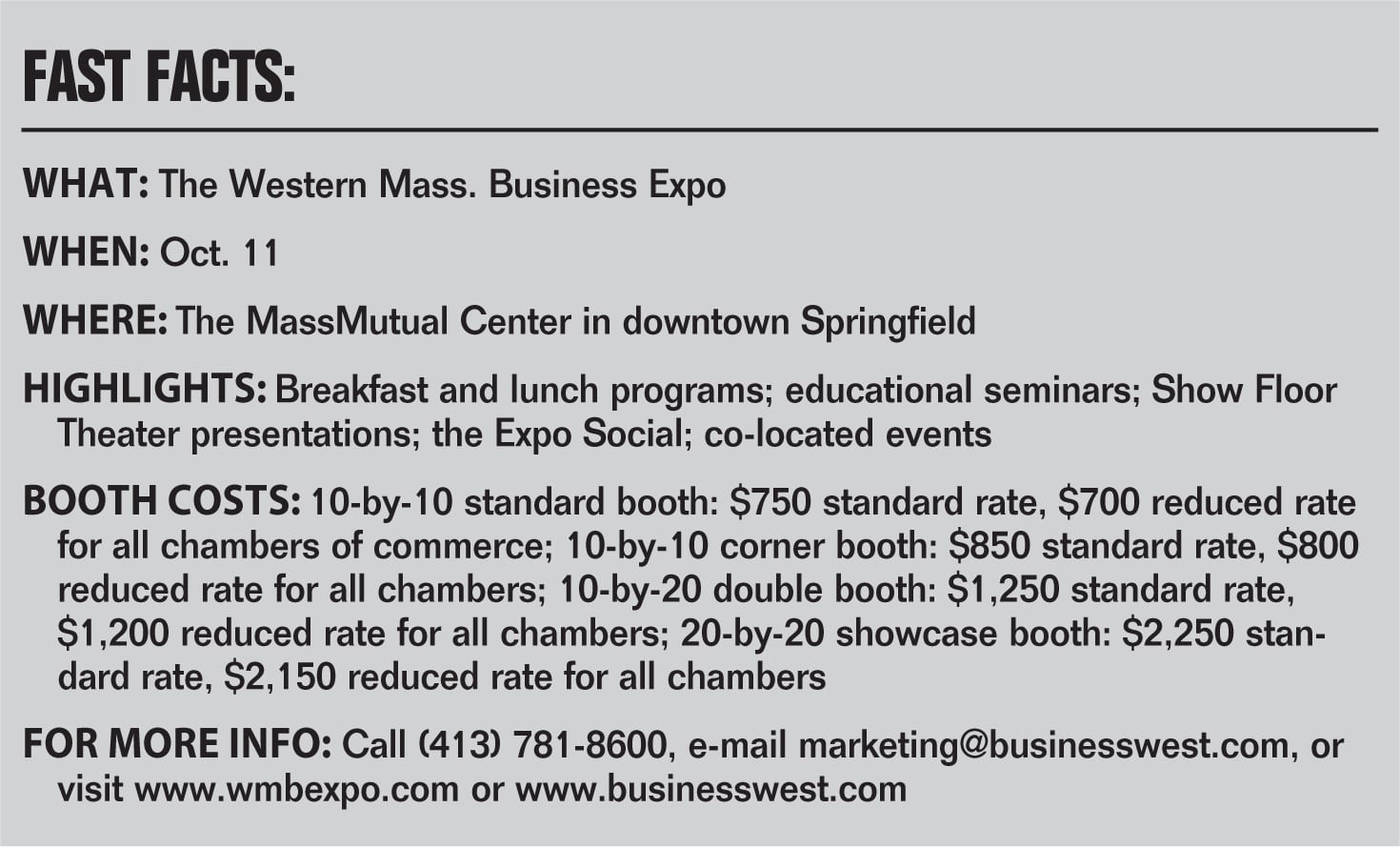
Western Mass. Business Expo 2013
Nov. 6: Planning is underway for the Western Mass. Business Expo 2013, a day-long business-to-business event to take place at the MassMutual Center in downtown Springfield. This fall’s show, the third edition of the Expo, which is again being produced by BusinessWest, will feature more than 100 exhibitors, seminars on timely issues of the day, special Show Floor Theater presentations, breakfast and lunch programs, and the wrap-up Expo social, which has become a not-to-be-missed networking event. Details of the specific programming will be printed in upcoming editions of BusinessWest and can also be seen online at www.wmbexpo.com or www.businesswest.com. For more information on the event or to reserve booth space, call (413) 781-8600, ext. 100.

40 Under 40 The Class of 2013
Vice President and Commercial Loan Officer, Florence Savings Bank, age 34

Couture-ErinErin Couture has many accomplishments and examples of civic leadership on her résumé — everything from her large and diverse commercial-loan portfolio at Florence Savings Bank to the $10,000 she raised in 2012 for the Leukemia & Lymphoma Society through the Team in Training program.
The contribution you don’t see on her résumé, though, was by far the most significant.
Indeed, in early 2012, she became a bone-marrow donor for her sister, who was diagnosed with leukemia that is still in remission one year later. Erin is one of six siblings, but the one deemed to be a perfect match. And today, her efforts to get more people in the registry for bone-marrow donations is just one of the many things vying for — and winning — some of her time.
First and foremost is her family, including her husband, Darren, and sons Brandon and Gabriel. Then, there’s that commercial-lending portfolio and all that goes into maintaining and growing it. And as she described that work, she said it doesn’t come down to crunching numbers — although that’s certainly part of it — but understanding people and working with and for them.
“Every loan, every business owner is different — they have specific needs, goals, and challenges,” said Couture, adding that she manages loans ranging from $10,000 to $7 million, in sectors from manufacturing to retail. “And this work is about much more than just giving someone a loan; it’s about helping them succeed in business, and that’s the part I find most rewarding.”
Then there’s her work within the community, which ranges from involvement with the Northampton Chamber of Commerce, which she serves on its finance committee, to the Big Brothers Big Sisters advisory board, for which she is vice president; from membership in the area young-professional societies to teaching financial literacy to high-school students, to running half-marathons to raise money for the Leukemia & Lymphoma Society (she ran her first not long ago, and is now gearing up for her fourth).
She’s also involved in the Daffodil Fun Run, a fund-raiser for the American Cancer Society that in three short years has grown to more than 700 runners, just another example of how helping others is a priority for Couture — right down to the bone.

— George O’Brien

Agenda Departments

Obamacare and Employers
April 24, May 2, May 9: Royal LLP — a law firm specializing exclusively in management-side labor- and employment-law litigation and preventative practices to avoid litigation — will join experts on the Patient Protection Affordable Care Act (known as Obamacare) in presenting an informational series of workshops that will provide an interactive, step-by-step analysis of how the act applies to both small and large employers, including what employers should be doing now to prepare for the 2014 mandates. All sessions will be held at the Hu Ke Lau in Chicopee. Session 1, which will be held on April 24, will provide a general overview of the law, including key components, potential implications, and impact on employers. Session 2, which will be held on May 2, will address the shared responsibility requirements. Session 3, which will be held on May 9, will detail the impact of the law. For more information, contact Ann-Marie Marcil at (413) 586-2288 or [email protected].

Elevator Pitch Competition
April 24: Five local community banks will sponsor a live elevator pitch competition at the awards banquet for the Harold Grinspoon Charitable Foundation’s Entrepreneurship Initiative, starting at 5 p.m. at Log Cabin in Holyoke. Representatives from each bank — Berkshire Bank, Country Bank for Savings, First Niagara Bank, PeoplesBank, and United Bank — will also serve as judges. An elevator pitch is an overview of an idea for a new business. The name reflects the fact that an elevator pitch can be delivered in the timespan of an elevator ride. The term is used when an entrepreneur pitches an idea to a venture capitalist to receive funding. The competition will feature a student representative from each of the participating local colleges: American International College, Amherst College, Bay Path College, Elms College, Greenfield Community College, Hampshire College, Holyoke Community College, Mount Holyoke College, Smith College, Springfield College, Springfield Technical Community College, UMass Amherst, Western New England University, and Westfield State University. The judges will choose the top three students, who will receive cash awards. All participants will receive a stipend for participating. This is the eighth year that an elevator pitch competition will be held at the event. Other program highlights include keynote speaker Stanley Kowalski, founding CEO and chairman of the board of FloDesign in Wilbraham; an Entrepreneurs & Awardees Exhibit featuring 59 student entrepreneurs from area colleges; and the announcement of the Grinspoon, Garvey & Young Alumni Spirit Award. For more information about the banquet, e-mail Cari Carpenter at [email protected].

Strategic Investments in Owner-Operated Companies
April 25: Peter Doyle, chief investment strategist at Kinetics Mutual Funds, will deliver a presentation titled “A New Paradigm: Strategic Investments in Owner-operated Companies” at 4 p.m. at the Colony Club in Springfield. The event, sponsored by Martinelli Discenza Investment Counsel, was postponed from its original date of Feb. 25. Owner-operators are broadly defined as corporate management teams that have considerable personal wealth invested alongside their shareholders. The actions of these management teams over the past several years — actively allocating capital into attractive opportunities and engaging in various actions to enhance shareholder value — stand in stark contrast to those of agent managers, who have focused on cost-cutting measures to maintain margins at the possible expense of future growth. To RSVP for the event, call Lisa Kozak at (413) 567-8411.

EANE Management Conference
April 25: The Employers Association of the NorthEast will hold its ninth annual management conference, “Leadership and Mentorship in Action,” at the Holiday Inn in Enfield, Conn. The conference will address the direct impact of mentoring and leadership development on the growth and success of organizations. Keynote speaker Doug Dvorak, a contributing author to the bestselling book The Masters of Success, will present his popular program “The Magic of Mentoring.” Additional presenters include Ravi Kulkarni and Lynn Turner of ClearVision Alliance. A panel of representatives from area companies will discuss next-generation mentoring. Conference breakout sessions include “Leadership Behavior and Employee Engagement,” “Building Effective Teams,” and “DiSC Work of Leaders.” For more information about the conference, contact Karen Cronenberger at (877) 662-6444 or [email protected]. To register, call (877) 662-6444 or visit www.eane.org.

A Heart Healthy Toast
April 26: Whether you’re a seasoned wine enthusiast or a recreational wine drinker, you will find something pleasing to your palate at “A Heart Healthy Toast,” sponsored by the Holyoke Hospital Auxiliary Assoc. from 6 to 8 p.m. at Hamel’s Summit View Banquet House in Holyoke. The tasting will spotlight a variety of wines from around the world that have been carefully selected by Liquors 44. Everyone attending will be provided with a personal program booklet where notes can be taken for each wine, noting likes and dislikes. Vendor representatives will be available to give their tips for using all the senses to taste wine and how to call out subtle variations. The funds raised will be used toward the “Extreme Makeover” of the Work Connection located at Holyoke Medical Center. The Work Connection is an occupational health clinic located at the medical center that provides health services to local businesses in the area. Tickets for the wine tasting are $40 per person and will include a selection of Hamel’s hot and cold appetizers, fruit, and cheeses. Call Deborah Long Smith at (413) 534-2568 to order tickets.

EASTEC 2013
May 14-16: EASTEC, the premier manufacturing exposition in the Northeast will be held at the Eastern States Exposition in West Springfield on May 14 and 15 from 9 a.m. to 5 p.m. and on May 16 from 9 a.m. to 3 p.m. The event will offer a variety of exhibitors, educational offerings, tours of nearby facilities, and much more. For more information and to register to attend, visit www.easteconline.com.

40 Under Forty
June 20: BusinessWest will present its seventh class of regional rising stars at the annual 40 Under Forty gala at the Log Cabin Banquet & Meeting House in Holyoke. The event will feature music, lavish food stations, and introductions of the winners, who are profiled at length in this issue. Look for event details in upcoming issues of BusinessWest, or call (413) 781-8600, ext. 100 for more information.

Western Mass Business Expo 2013
Nov. 6: Planning is underway for the Western Mass Business Expo 2013, a day-long business-to-business event to take place at the MassMutual Center in downtown Springfield. This fall’s show, the third edition of the Expo, which is again being produced by BusinessWest, will feature more than 100 exhibitors, seminars on timely issues of the day, special Show Floor Theater presentations, breakfast and lunch programs, and the wrap-up Expo social, which has become a not-to-be-missed networking event. Details of the specific programming will be printed in upcoming editions of BusinessWest, and can also be seen online at www.wmbexpo.com or www.businesswest.com. For more information on the event or to reserve booth space, call (413) 781-8600, ext. 100.

Company Notebook Departments

Urgent Care of Wilbraham Opens Its Doors
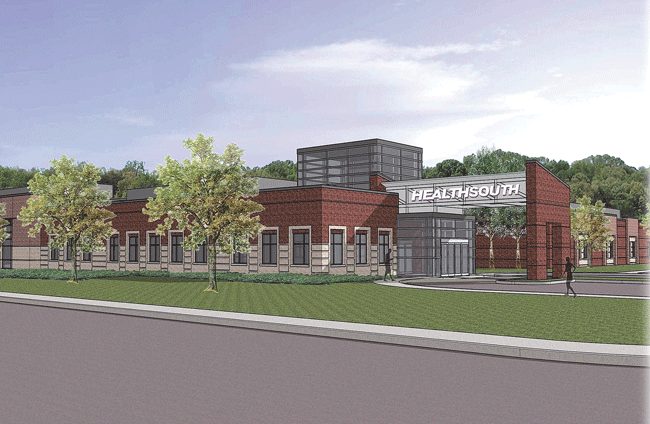
WILBRAHAM — Urgent Care of Wilbraham, PC recently opened its doors at 2040 Wilbraham Road. The facility, owned and operated by Richard J. Freniere and Rock Jean-Guillaume, both board-certified emergency medicine physicians, provides professional medical care without an appointment. The clinic is equipped to handle a wide range of health-related issues, including aches and pains, allergies, asthma, bites and burns, bone injuries and fractures, cuts and laceration repairs, earaches, fevers, infections, pediatric illness, sprains and strains, sore throats, upper respiratory illnesses, vomiting and diarrhea, and other urgent illnesses or injuries. The facility is open Monday through Friday, 9 a.m. to 7 p.m., and Saturday and Sunday from 9 a.m. to 5 p.m. For more information, www.UrgentCareofWilbraham.com.

AIM Honors LENOX with Global Trade Award
EAST LONGMEADOW — The Associated Industries of Massachusetts International Business Council (AIM-IBC) announced that LENOX, based in East Longmeadow, is one of three winners of its18th annual Global Trade Awards, which recognize Massachusetts firms, institutions, and public agencies of all sizes that have demonstrated excellence in international trade. The other winners are Millipore, in Billerica, and Kinefac, in Worcester. The three companies will be honored at AIM’s 98th Annual Meeting on May 10 at the Waltham Westin Hotel. The event will include a keynote address by Massachusetts Gov. Deval Patrick. Originally known as the American Saw & Manufacturing Company, LENOX, winner of the Ambassador’s Award, has been a leader in premium-performance tools such as band saw blades and power tool accessories since its founding in 1915. LENOX counts 900 employees worldwide, including over 600 in Massachusetts. Nearly half of production is exported around the world, to China and Asia, Brazil and Latin America, and Europe. LENOX has continued to grow by understanding its customers’ needs and adapting its products and services for new industries in global markets. Over the past 10 years, LENOX has invested $100 million in new capital for its only manufacturing facility worldwide, located in East Longmeadow. The company has hired more than 120 people in Western Mass. in the past two years. LENOX is part of Newell Rubbermaid, the global marketer of consumer and commercial products. “Our Global Trade Award winners are exemplary Massachusetts businesses that don’t think in terms of boundaries or borders, but in terms of opportunity,” said Richard Lord, president and CEO of AIM. “Taking advantage of all that Massachusetts has to offer positions companies like our winners for exceptional global success.”

United Bank Foundation Awards $43,000 to Area Non-profits
WEST SPRINGFIELD — The United Bank Foundation announced recently that it has awarded $43,000 to 11 non-profit organizations in the Springfield region in its most recent round of funding. The grants covered a variety of programs and initiatives throughout the Springfield area:
• The foundation awarded $10,000, to be paid over two years, to Elms College in Chicopee toward the construction of a Center for Natural and Health Sciences;
• The Gateway Education Foundation Inc., based in Huntington, received a grant of $5,000 for its “Funds for Learning Program.” The program supports school projects that fall outside of the budgets of the seven schools in the Gateway school district;
• Human Resources Unlimited Inc. in Springfield received $5,000 for its Changing Habits Transforming Lives job readiness and placement program;
• WestMass Eldercare was awarded $5,000 to fund services for low- income elders in Holyoke, South Hadley, Chicopee, and surrounding areas;
• Junior Achievement (JA) of Western Massachusetts was awarded $4,000 to expand programs in Holyoke, Northampton, and East Longmeadow;
• The Western Mass. Council, Boy Scouts of America received $3,500 for the continuation, enhancement, and expansion of the Scoutreach programs in Springfield;
• In Holyoke, the Public Library received $2,500 from the foundation to support the month-long series “Holyoke Points of View” in April;
• Springfield Partners for Community Action was awarded $2,000 for its Volunteer Income Tax Assistance and Earned Income Tax Credit Program for low income individuals;
• The Westfield Public Schools received $1,000 to fund the purchase of materials needed for the high school science fair and advancement to the regional and state finals.
• The foundation awarded $2,500 to World Is Our Classroom to fund the Westfield Manufacturing Education initiative at Mestek Inc., a collaboration with the Westfield Public Schools to offer fifth-grade students a hands-on application of science and technology in a real life manufacturing plant setting; and
• In West Springfield, the foundation awarded $2,500 to the high school to fund the purchase of the National Archery in Schools curriculum.
The United Bank Foundation has awarded more than $1.7 million in grants since it was established in 2005 as a permanent source of funding to benefit communities in United Bank’s market area. The Foundation board of directors meets quarterly to review requests submitted by 501(c)(3) nonprofit organizations in cities and towns served by United Bank branches. The foundation’s four primary funding areas of interest are education, health and human services, youth development and cultural programs. Foundation guidelines can be found online at bankatunited.com.

Departments Incorporations

The following business incorporations were recorded in Hampden, Hampshire, and Franklin counties and are the latest available. They are listed by community.

AGAWAM

New England Intermodal Services Inc., 57 Barn Road, Agawam, MA 01001. Cynthia Herring, same. Trucking company.

AMHERST

Notch Consulting Inc., 535 West St., Amherst, MA 01002. Paul Ita, same. Market research and consulting.

CHICOPEE

Kelly’s Inc., 621 Center St., Chicopee MA 01013. Leo Buono, 44 Oak Hollow Road, Springfield, MA 01128. Lounge.

Mija Inc., 95 Ward St., Chicopee, MA 01020. Michael Gibson, same. Adult entertainment web cam.

EASTHAMPTON

Molly Montgomery Painting Inc., 69 Pleasant St., Easthampton, MA 01027. Molly Montgomery, same. Painting.

GRANBY

M.R. Cote Inc., 71 Kendall St., Granby, MA 01033. Michael Cote, same. Electrical contracting and carpentry.

HADLEY

Mathematical Staircase Inc., 278 Bay Road, Hadley, MA 01035. Sarah-Marie Belcastro, same. To educate mathematically talented secondary and tertiary students.

HATFIELD

Jessica Marie Photography Inc., 22 North Hatfield Road, Hatfield, MA 01038. Jessica Marie Kacsenski, same. Photography service.

HOLYOKE

La Copa Inc., 447 Main St., Holyoke, MA. Aida Dejesus, 34 Britton St., Chicopee, MA 01020. Bar and restaurant.

Movimiento Pentecostal Poder Y Uncion, 77 Hamilton St., Holyoke, MA 01040. Organization of churches within the United States and abroad.

LUDLOW

JW Dobiecki Consulting Inc., 70 Applewood Dr., Ludlow, MA 01056. John Walter Dobiecki. Consulting services.

L&L Supply and Mechanical Inc., 399 Fuller St., Ludlow, MA 01056. Lindsay Lemek, 425 Fuller St., Ludlow, MA 01056. Equipment and materials for water and sewer mains.

MONSON

J & T Sisley Corporation, 194 Moulton Hill Road, Monson, MA 01057. Joan Lowbridge-Sisley, same. Information-technology consulting.

PALMER

M. Scott Construction Inc., 21 Wilbraham St., Office #203, Palmer, MA 01069. Michael Scott, 93 Hovey Road, Monson, MA 01057. Trucking and consulting.

PITTSFIELD

Jesters Inc., 35 Grant St., Pittsfield, MA 01201. Christina Gillette, same. Food services.

SPRINGFIELD

Julie’s Hollywood Café Inc., 374 Allen Park Road, Apt. 374, Springfield, MA 01118. Julie Ratzenberger, same. Food and beverage service — bar.

Karss Inc., 1324 Boston Road, Springfield, MA 01119. Muhammed Warasat, 30 Wyndward Road, Longmeadow, MA 01106. Restaurant.

Mamarazzi Photography Inc., 6 Kenway Dr., Springfield, MA 01104. Jacqueline Slattion, 83 McKinley Ave., Ludlow MA 01058. Photography.

Marden Homes Inc., 86 Milford St., Springfield, MA 01107. Marshal Walden, same. To buy repair and sell real estate.

Maroon Corporation, 78 Randolph St., Springfield, MA 01108. Brennan Tougias, same. Food service.

Newton Road Press Inc., 986 Allen St., Springfield, MA 01118. Daivd Karwoski, same. Books and written materials.

WEST SPRINGFIELD

New Era Inc., 39 Rochelle St., West Springfield, MA 01089. Arshad Imam, same. Gas station.

WESTFIELD

Jayco Manufacturing Inc., 121 Summit Lock Road, Suite #1, Westfield, MA 01085. Joseph Michonski, 86 Joseph Ave., Westfield, MA 01085. Manufacturing of precision aerospace parts for various local businesses.

New England Eating Disorders Alliance Inc., 7 Fairview St., Westfield, MA 01085. Viktoria Filev, same. To prevent eating disorders through education, awareness, and support in recovery.

Company Notebook Departments

V-One Founder Wins Entrepreneurship Award

HADLEY — Valley Vodka Inc., a Western Mass.-based company, announced that Paul Kozub, owner and founder of V-One Vodka, was one of three winners of the Entrepreneur of the Year award at the 2013 Nightclub & Bar show in Las Vegas. Nightclub & Bar Media Group announced the winner of the first annual Nightclub & Bar show in late March. The national awards program celebrates emerging small businesses producing innovative products for the nightlife industry. Nightclub & Bar set out to find the next big company to take off in 2013. The Entrepreneurs Program is a unique opportunity for new companies to be recognized for their outstanding innovation and awarded with a complimentary booth at the 2013 Nightclub & Bar Convention and Trade Show, which took place in Las Vegas March 19-21. Companies that qualified submitted their brand, company, product, or new innovation to a panel of industry judges for review. “This is our first event outside of the New England market, so I was thrilled to be recognized on a national level,” said Kozub. “The Nightclub & Bar Show is the largest of its kind, with over 900 exhibitors. We are very humbled to be chosen out of this elite group of companies. The three winners are shining examples of originality and innovation in today’s tough marketplace.” The winners will be profiled on nightclub.com and highlighted in the BarIQ e-newsletter. V-One Vodka was started by Paul Kozub in 2005 as a way to honor his recently deceased Polish grandfather and his entrepreneurial father, who passed away a few months after Paul graduated from college. The V-One recipe was developed in the basement of his Hadley, home. V-One is now produced exclusively by Polmos Lublin in Poland. It is the only vodka made solely from 100% organic spelt wheat, the rarest and most expensive grain in the world. Today, a small amount of this wheat is grown in Hadley, while the majority is grown in Poland. BusinessWest named Kozub a 40 Under Forty honoree in 2007.


Greenough Packaging Certified as Minority and

Woman-owned Enterprise

WEST SPRINGFIELD — Greenough Packaging & Maintenance, a leading regional distributor of shipping, safety, break-room, janitorial, cleaning, and facility-maintenance supplies, was recently certified as a Minority and Woman-owned Business Enterprise by the Mass. Supplier Diversity Office of the Commonwealth’s Operational Services Division. The OSD’s standard of certification is a rigorous process that includes an in-depth review of the business as well as a site inspection. The certification process is designed to confirm that the business is at least 51% owned, operated, and controlled by a minority or woman. Greenough became a woman-owned business when controlling interest in the company was acquired by Sandy Cassanelli in 2003. As the majority shareholder and CEO of Greenough, Cassanelli provides strategic direction to the organization and oversees operations and accounting. “I am delighted that Greenough has been certified as a woman-owned business enterprise,” she said. “The certification will enable us to both expand our business and create new jobs as well as to better serve our customers by helping them meet their supplier-diversity initiatives.” By including woman-owned businesses among their vendors, corporations and government agencies demonstrate their commitment to fostering diversity and the continued development of their supplier/vendor diversity programs. The Mass. Operational Services Division (OSD) is the Commonwealth’s central procurement and contracting office. In 2010, Gov. Deval Patrick signed Executive Order 523, establishing a Small Business Purchasing Program (SBPP) in Massachusetts. The mission of the SBPP is to support the existence and growth of small businesses by directing state spending for non-construction goods and services to SBPP-participating vendors. The OSD is responsible for SBPP development and implementation, including policies, training, capacity building, and annual benchmarks. Greenough serves customers from a broad range of markets throughout the U.S., including manufacturing, education, property management, retail, medical, food processing, fulfillment, commercial cleaning, and distribution. In addition, it provides custom-packaging and food-packaging solutions.


People’s United Awards $5,000 to Gray House

SPRINGFIELD — The People’s United Community Foundation, the philanthropic arm of People’s United Bank, announced that it has awarded $5,000 to the Gray House in Springfield. The Gray House, a human-services agency, encourages neighbors in transition to achieve a more stable, safe, and productive life through education and community service. The grant from People’s United Community Foundation will support the Kids’ Club after-school and summer programs, which provide a safe, caring environment where children are served nutritious meals and participate in educational and creative activities. “The Gray House is honored to receive this grant from People’s United Community Foundation and continue our partnership,” said Dena Calvanese, executive director of the Gray House. “People’s United Community Foundation’s support helps us provide children opportunities to learn, engage in constructive activities, and have fun.” Timothy Crimmins Jr., officer of People’s United Community Foundation and president of the Massachusetts Division of People’s United Bank, said the Gray House is a valuable resource in the community. “We are proud to contribute to their success,” he continued. “By working together, we can truly build a better tomorrow for kids. The Gray House enhances the early-educational experience for many local children and supports the efforts of parents and caregivers in the community.” Established in 2007, People’s United Community Foundation was formed to help support programs and activities that enhance quality of life for citizens in the communities that People’s United Bank serves. It places special emphasis on programs designed to promote economic self-sufficiency, education, and improved conditions for low-income families and neighborhoods. The funding priorities of the foundation include community development, youth development, and affordable housing.


NAACP Backs Casino Plan

of MGM International

SPRINGFIELD — The general membership of the Greater Springfield NAACP voted recently to ratify the recommendation of its executive committee concerning a proposed casino in Western Mass. “Given the recent statements by city officials that they intend to only put one applicant on the ballot and intend to name that applicant in the coming weeks, this is the appropriate time to release our recommendation,” the organization stated in a release. While the branch did not vote to support gaming, it did take a position that the plan advanced by MGM International provides the best opportunities for African-Americans and other communities of color to be included in construction work, professional-services contracts, and employee hiring should it be selected to build a facility in the region.

Construction Sections
SolaBlock Wants to Drive Solar Power Up a Wall

Patrick Quinlan

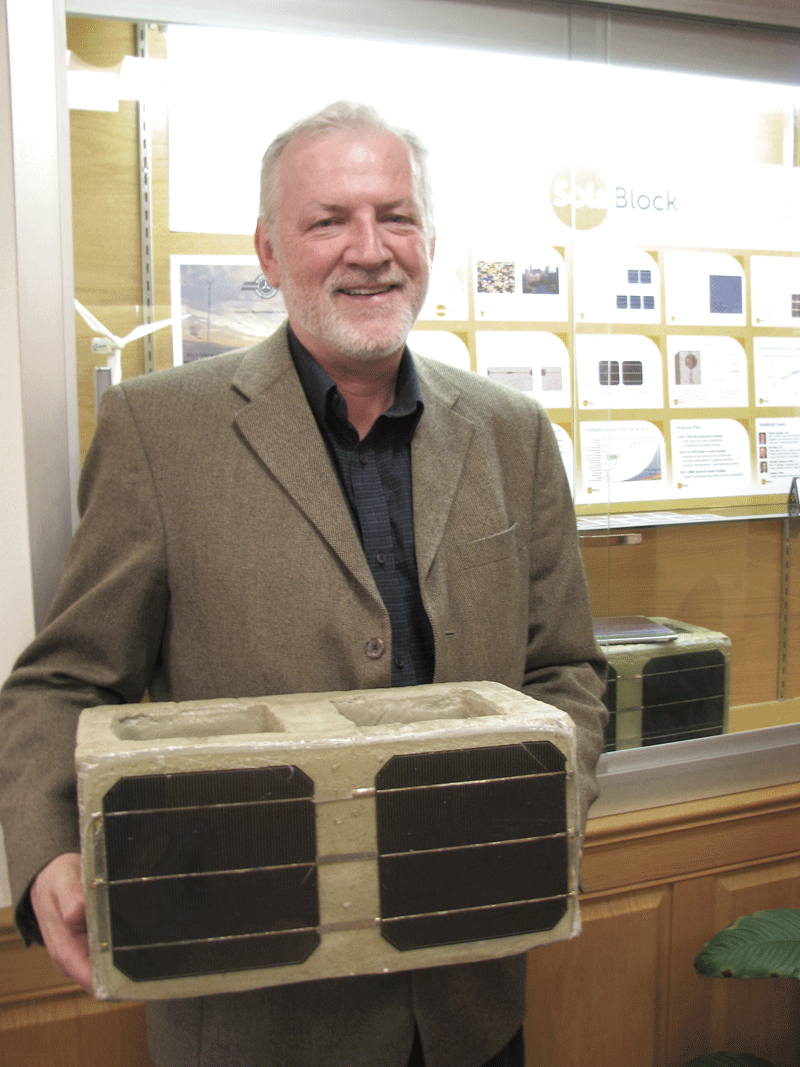
Patrick Quinlan shows off a SolaBlock prototype.

Solar energy. It’s not just for rooftops anymore.

At least, not if Patrick Quinlan has anything to say about it. A longtime player on the national stage in the renewable-energy arena, he’s now developing some bright ideas in Springfield, as a tenant in the small-business incubator at the Scibelli Enterprise Center (SEC).

His latest project, SolaBlock, is a simple-enough concept: photovoltaic (PV) cells are built into cinderblocks, which are then used to build vertical walls — or laid over existing walls — where they generate energy from the sun.

“We’re so excited about all the possibilities,” Quinlan said. “I walk through the city and look up and say, ‘oh my goodness, that could all be SolaBlock.’ Or I drive down the road and see all the highway walls and say, ‘that could be SolaBlock.’” And the potential is not limited to the U.S., he noted. “We’re thinking globally.”

This summer, thanks to a $40,000 state grant (more on that later), the technology — for which Quinlan holds four patents — will be put to the test on a small building at the Springfield Technical Community College (STCC) Technical Park, which also houses the Enterprise Center.

But he’s already thinking big. Among the capabilities of SolaBlock units, Quinlan says they are expected to:

• ‘Solarize’ residential or commercial building walls, retaining walls, garden walls, or any wall receiving sun for a good portion of the day, and also harvest renewable energy from highway sound walls, bridges, parking structures, railroad rights of way, property walls, or any other conventionally walled location.

Sound walls on highways, in fact, are a particularly intriguing option, because they’re not obstructed by trees in the summertime, yet aren’t totally covered by snow in the wintertime, noted Marla Michel, SEC director. “Trees get in the way of solar, but they’ve already been cleared on highways.”

• Provide critical solar power to unattended buildings, signs, or off-grid buildings that would otherwise be susceptible to vandalism or theft. “We wanted to make it so you couldn’t steal it, couldn’t break it, and it’ll be there for the life of the building,” Quinlan said.

• Provide secure power to critical buildings or shelters that may lose grid power or conventional PV in hurricane-force winds. Quinlan noted that SolaBlock can withstand winds of above 100 mph.

• Enable substantial solar electric generation for buildings sited in complex urban settings. “We’re really interested in the notion that you could have an off-grid, completely autonomous apartment in the middle of New York City, or out in the woods, freed of needing any electricity from the grid,” he said, noting that cities can lose power on a wide scale, as Manhattan did during Hurricane Sandy. “There are a lot of reasons why people want to be green and energy-secure, even in the city.”

• Provide autonomous, solar-powered electric-vehicle charging stations at remote locations.

But the benefits don’t stop with energy conservation and access; SolaBlock can be an effective educational tool as well. “This would be great for schools, because the solar could be at ground level, and kids could walk to it,” Quinlan said, adding that the connections could be viewed indoors throughout the year.

All told, Quinlan and his partners — Jason Laverty, William Stein, and Danielle Thorburn — have high hopes for SolaBlock. To date, those hopes have been founded on untested hypotheses … but that’s about to change.


Testing, Testing

Enter the Mass. Clean Energy Center (MassCEC) and the Mass. Technology Transfer Center, which recently awarded a total of $200,000 to five Bay State entrepreneurs as part of the MassCEC Catalyst Program, which aims to fund the commercialization of new clean-energy technologies from startup companies or being spun out of established research institutions.

“The clean-energy innovations developed in Massachusetts are driving the clean-energy sector forward,” said Energy and Environmental Affairs Secretary Rick Sullivan, who chairs the MassCEC board of directors. “There are 5,000 clean-energy companies in Massachusetts, and these types of programs help support and grow this bustling industry.”

The $40,000 grants are intended to help early-stage researchers demonstrate the commercial viability of new clean-energy technology.

This will take place at Building 112 of the tech park, a small brick building used as a maintenance shed. The south and west walls, as well as the roof, will be covered with SolaBlock units, and meters will be installed to measure the energy production of the solar cells and compare the performance of the vertical and roof installations. An Internet connection will allow the public to read those meters and check the progress of the demo over the course of a full year. That project should go online by the fall.

“We’re grateful to the Clean Energy Center for having faith in us in Western Mass.,” Quinlan said, noting that the public often thinks of the Commonwealth’s clean-tech hub in terms of MIT and other Boston-area research institutions. “A $40,000 grant is a really big deal for us. And it’ll all be out there on the Internet for everyone to see.”

Quinlan said SolaBlock’s ‘concrete masonry units’ (CMUs) can be integrated into almost any existing wall specification, since the blocks retain their original insulation, compression, smoke, and fire-rating capabilities. And they’re economically attractive because the expensive metal frames used for both mounting traditional PV materials in a framed module and for mounting the modules to a building are eliminated. There is some additional cost of wiring from block to block, but at a fraction of the cost of the aluminum and steel needed for conventional construction.

He noted, however that the vertically placed blocks are expected to produce around two-thirds of the energy produced by a traditional, tilted PV array — hence the placement on both the walls and roof of the test building, to compare performance. However, he said, energy generation may be augmented by the placement of reflective materials (decorative white stone, for example) in front of the blocks.

Still, while vertical blocks may receive less sunlight than roof-mounted panels, SolaBlock walls can be installed over vast surface areas of a building that would not otherwise be providing electric power, therefore increasing the total energy production by the building — a key feature in achieving certification in the ever-popular Leadership in Energy and Environmental Design program administered by the U.S. Green Building Council.

“The kits have to be high-automation,” Quinlan said, noting that one building fitted with SolaBlock cells might require thousands of blocks.

To that end, Quinlan outlined a business plan in which the company assembles the PV ‘kits’ and ships them to regional partners in the form of masonry-supply companies. SolaBlock has already reached out to Chicopee Mason Supplies in this region.

“They will be manufacturing the modified blocks we’ll be using under an agreement that gives them exclusive license in the region,” he explained. “We are developing a regional distribution partnership with them to distribute the finished material.”

That example will be repeated across the country. “We’ll build all the electronics in Western Mass.,” he continued, “then we’ll ship the electrical parts to our regional contract manufacturers to combine them and sell them regionally using the same model.”

That makes sense, Michel noted, because concrete blocks are typically sold only regionally due to their weight.

“It’s uneconomical to distribute them beyond about 200 miles,” Quinlan added. “More to the point, we discovered that most of the businesses that make concrete products are longtime family businesses in their regions, and we’d rather work with them than compete with them.”

That appeals to Quinlan on a personal level.

“I have an affinity for the trades,” he said, noting that his father was a plumber, and he put himself through college working with him. “SolaBlock is a way for people in the trades to work in the clean-tech arena. It’s not just for the elite. This is basically clean tech for regular people. You build it, it’s green, and it provides energy independence.”


The Next Phase

Quinlan, the former associate director of the UMass Wind Energy Center, has plenty of experience in the field of renewable-energy technology development. He worked as a science fellow in the U.S. Congress and as a technology fellow at the White House Office of Science and Technology Policy. He’s also a former employee of the National Renewable Energy Laboratory. “I’ve worked in energy since 1984, in both the technical and policy sides.”

For the current phase of his professional life, “instead of taking a job with someone else, I basically decided to start up new companies,” he said, adding that he wants to be a catalyst to grow the clean-tech industry in the region as a whole, and he sees the Enterprise Center as an ideal home for those efforts.

“I thought, I want to be part of that. I want Scibelli to be my home base for doing this,” he told BusinessWest, noting that, in addition to SolaBlock, he’s launched a second company, Black Island Wind Turbines.

Michel views the startup as an ideal tenant at the SEC. “The state is trying to grow this cluster both in Massachusetts and also regionally, throughout New England. The Enterprise Center has been active in supporting the regional growth of clean tech through support for companies like Pat’s.

“We’re a multi-use facility, but our vision of the tech park is really to have more support for clean tech. It’s a great place to do business,” she added. “And SolaBlock is innovating in an industry that’s hungry for innovation.”

Quinlan said the Enterprise Center has been critical to landing the kind of support — like the MassCEC grant — necessary to take the next step.

“I was drawn to this like a moth to a flame; this is the exact kind of environment I needed to have,” he told BusinessWest. “Without that, it would have been just us trying to do our best, competing with everyone else trying to get the attention of those who could help us. [Michel] has taken half the effort out of that.”

Down the road, if all goes as planned, he expects to begin looking for manufacturing space so SolaBlock can start building the kits. And Quinlan believes a huge market exists for the product — again returning to the appeal of vandal-resistant PV units in urban areas where the risk of theft has hindered consideration of conventional solar systems. Specifically, all electrical equipment of value is located behind the wall, making the systems unattractive for dismantling. Yet, individual concrete blocks can be repaired with a replacement kit.

“We can also use it for brick replacement — replacing bricks on walls,” he said. “It’s pretty weatherproof and vandal-proof. It’s not like regular solar panels where people are afraid to put them up on the chance they could be vandalized or stolen. We have utility customers who are very excited about this.”

So is Quinlan, who believes not just in his idea, but in this region.

“I’m a very strong supporter of Western Mass.,” he said. “I went to school here, and I want to live here. What I want to do is provide a means for myself and my colleagues in clean tech to have a really good quality of life and good occupations right here in the Valley — and that is very possible.”


Joseph Bednar can be reached at [email protected]

Banking and Financial Services Sections
Taking Steps Now Can Help Ensure a More Comfortable Retirement

Charlie Epstein

Charlie Epstein

This past month I had the occasion to speak at the American Society of Pension Actuaries  401(k) Summit in Las Vegas. As I wandered around the slot machines and blackjack and craps tables, I thought, what an interesting location for a conference on creating a secure retirement for America’s workers.

For the majority of people, saving in their 401(k) over the last few years may have felt like putting their chips down on red number 7 at the roulette table and praying for the ball to fall on that number.

If you had invested in the S&P 500 index for 10 years ending Dec. 31 2008, your average annualized return would have been -1.38% At that time, financial magazines were hyping the “new normal” and the “death of equities.” Fast-forward four years, and the 10-year return was +7.10%. Investing, in any asset class, is a long-term proposition. Just ask Warren Buffett.

So what’s the real message, for both 401(k) participants and their employers who create plans? That we need to begin to focus more on the most important part of the retirement equation. This is ascertaining the income placement for retirement, or what I like to call ‘paychecks for life.’ By receiving education through the advisory firm on their 401(k) plan, participants can use this benefit prudently and not haphazardly from trending financial propaganda.

Here are some steps that should be taken right now:

• Education sessions: Make sure your current advisor and 401(k) carrier provide regular education meetings that not just focus on investment performance, but teach your employees how to calculate exactly what they need to save every month, at a reasonable rate of return, to accumulate enough money at retirement to pay for all the things they  desire to do. I call this ‘desirement’ planning.Why? Because Webster’s definition of retirement is to “put out of use.” I don’t know anyone working today who wants to be out out of use when they retire.

Working today should allow you to retire successfully and do all the things you desire to do tomorrow.

• Annual gap statement: Your current 401(k) record keeper can now provide each employee a gap report to show them, based on their current savings rate and a reasonable interest assumption, how much money they will have at retirement.  Many of the providers will convert this lump-sum number into a monthly benefit — or paycheck for life. Your employees can see how much money they would actually have every month coming to them from their future 401(k) value. For many employees, this benefit is an eye-opening number and something they can easily relate to their current paycheck. It will indicate to them if they are on track or how far they are from replacing their present-day income.

• Plan level employee success: Ask your current record keeper if he or she can provide you with an overall plan-level participant report. This will allow you to analyze plan level demographics and how efficient your employees’ savings behaviors are. The data will allow you and your advisor to customize education meetings for employees who potentially have a major shortfall in obtaining a successful retirement. These outcomes are very effective in getting employees to increase their savings rate or adjust their investment allocations, and even with getting non-participants to start taking advantage of the benefit.

• Bold plan design: National 401(k) studies have proven that employers that implement automatic features encouraging their employees to save and progressively save more will improve the plan’s performance, resulting in healthier 401(k) balances for participants.

Here are the best automated features you should consider adding to your 401(k) plan:

—  Automatic enrollment: All employees, once eligible, are automatically enrolled in the plan. They always have the option to opt out. The more successful plans automatically enroll their employees, not at the minimum 3% savings rate, but at the employer matching rate, which could be 6%. To be eligible to participate in the Exxon Mobil 401(k) plan, an employee must save a minimum of 10%. That’s bold plan design, but it works. The truth is, employees must be saving at least 10% of their pay to achieve a paycheck for life. For older employees, the rate may be higher.

— Automatic increase: One way to get employees to the magic 10% savings rate is to automatically increase their contributions by 1% per year. This is incremental success, and it works. If your employees are at 6% today, you will do them a great service by automatically increasing their contribution by 1% a year until they get to 10%. Again, employees always have the option to opt out of this feature.

These simple steps — customized education, income-gap statements for all your employees, along with two automatic plan-design features — will go a long way toward helping your employees view their 401(k) as a personal paycheck-manufacturing company. Leave the gambling to the casinos.

The Department of Labor greatly encourages you to use these automatic features, to such a degree that, if you follow the proper steps in communicating these automatic features to your employees, they will be granted fiduciary protection.


Charlie Epstein is the author of Paychecks for Life. His book teaches nine principles to help employees turn their 401(k) plans into paycheck-manufacturing companies; [email protected]. His book is available at www.paychecksforlife.org and at amazon.com.

Banking and Financial Services Sections
Commercial Loans to Female Business Owners on the Rise

Mary Meehan

Mary Meehan says women are becoming more prominent in many fields, from medicine to management to law, and her loan portfolio reflects that.

Robert Polito would like to take credit for Webster Bank’s success in reaching certain elements of the commercial-loan market, including women business owners.

But he can’t. As the bank’s senior vice president and director of government-guaranteed lending, he more accurately characterizes his role as embracing already-existing trends, from the ever-increasing number of female business owners to the evolving priorities of the U.S. Small Business Administration.

The SBA — which guarantees loans by commercial banks and other lenders and provides capital to small businesses that are often unable to qualify for conventional credit — has, in fact, recognized Webster as Connecticut’s top lender to women-owned and minority-owned businesses.

“I would love to say it was my strategy to focus on minority- and women-owned businesses, but, honestly, it has been a policy of the SBA to really focus on four main areas: minorities, women, veterans, and rural businesses. We’ve done tremendously well with the first three,” Polito said, noting that Webster’s geographic footprint, in largely urban areas, doesn’t facilitate very much lending in rural markets.

“We have a lot of women, veterans, and minority businesses. And it’s something I really do want to focus on,” he continued. “One-third of my portfolio at Webster Bank is women owners — and that includes women only, not husband-and-wife teams. When I speak to my branch managers — who are mostly women — I’m really proud of that. I think it’s putting your money where your mouth is — not just saying it, but doing it.”

United Bank is doing it as well, having been named Massachusetts’ top lender to women-owned businesses for the past two years. Barbara-Jean Deloria, the bank’s senior vice president of commercial and retail lending credits two factors for that success.

“First, having commercial lenders who are women has been an influence on our ability to market to other women,” she told BusinessWest. “Obviously, in the past, the commercial-lending world has been dominated by male lenders, and by having more women in the marketplace attracts that business niche. Also, there are definitely more women-owned businesses that have surfaced in the past 10 years.”

Lenders both regional and national have noticed. In 1995, Wells Fargo made a commitment to lend $1 billion to women who owned businesses. Earlier this month, the financial-services giant said it would lend $55 billion to such companies by 2020.

Lisa Stevens, Wells Fargo’s lead executive for small business, issued a statement that “women-owned businesses are among America’s fastest growing segments, and we are honored to support their role in shaping the future of small business.” In fact, some 30% of U.S. businesses are owned by women — a number that continues to grow.

For this issue’s focus on banking and finance, BusinessWest sits down with several of the region’s commercial-lending players to talk about that trend, and what it means for lenders, borrowers, and the economy as a whole.


Growing Clout

Mary Meehan, first vice president of Commercial Loans at PeoplesBank, has experienced similar success lending to women.

“Roughly 40% of my portfolio is women business owners,” Meehan said, a number that includes manufacturing companies, commercial enterprises, and a range of other types of businesses. “We also have women who own investment and real-estate properties, and female doctors in medical offices; that whole area continues to grow as more women go to medical school. In fact, lending to women has also grown as more women get their MBAs or go to law school.”

Clearly, she said, this trend in commercial lending is being driven by larger economic and demographic shifts, from more women entrepreneurs to more daughters stepping into the CEO role in family enterprises, when sons used to dominate succession. “That’s a natural progression in terms of family-run businesses in general.”

The role of women in the region’s business landscape is even more impressive, Meehan said, considering that the 40% figure she cited doesn’t include nonprofits — which form a considerable niche in Western Mass. and at PeoplesBank; many such organizations are run by women.

The increasing profile of women’s business, in fact, is one reason why the SBA and other agencies have chosen to recognize entities that lend to women, said Dena Hall, senior vice president of Marketing and Community Relations at United Bank. “That they’ve designated an award for lending to women is significant.”

Richard Collins, United Bank’s president and CEO, welcomes the opportunity. “We are always eager to help women in business achieve their goals,” he said. “Their success is always significant to the growth of the economy, and their contributions are more vital than ever in today’s economic environment.”

Statistics from the federal government’s National Women’s Business Council (NWBC) back up that perception with hard numbers. Women-owned firms make up 28.7% of all non-farm businesses across the country and generate $1.2 trillion in total receipts. A full 88.3% of these firms are non-employer firms, while the remaining 11.7% have paid employees, employing a total of 7.6 million people.

In addition, women-owned businesses make up 52% of all businesses in health care and social assistance while other top industries for women include educational services (46% are women-owned), waste management and remediation services (37%), retail trade (34%), and arts, entertainment, and recreation (30%).

However, bank and government lending remains a largely untapped resource, according to the NWBC, as 56% of women-owned businesses used personal or family savings to start or acquire their business, compared to fewer than 1% who used a business loan from the federal, state, or local government or a government-guaranteed business loan from a bank.

However, for those who pursue SBA and other types of loans, Deloria said women are more educated than ever about the resources available to them. “I think women-owned businesses are very proactive on doing the research; even before they come in to see me, they recognize that the SBA is a really good resource for them. Most of the time, they’ve already researched that aspect of it.”

Polito agreed, and added that women tend to carefully consider the perspective the prospective lender brings to the table. “I don’t want to generalize, but it has been my experience, when I do meet with women-owned businesses, I find they’re more willing [than men] to listen to recommendations and guidance about what I’ve seen with other businesses of a similar size or a similar business model. They’re more willing to listen and take guidance from the bank.”


Forging Ties

That sort of openness and teamwork lends itself to a successful loan, Meehan said, especially when it comes to solo or small businesses. “We have a focus especially on the small-business side, a focus on our branches and lending to someone who comes into the branch. The manager is focused on developing that small-business relationship.

“We go through the same due diligence process, male or female, of getting to know the customer’s business and everything that entails.”

And there’s no shortage of resources available to educate borrowers on what the process entails. Deloria said she’s been active with the Women’s Chamber and other business-networking groups and found them to be effective ways to meet business owners and share information.

“We’re trying to offer more education, identify women’s organizations in the communities we serve to do more outreach,” Polito added. “Frankly, its intimidating for pretty much everyone, and often very intimidating for women- and minority-owned businesses, to walk into a bank and apply for a loan. But I don’t want people to feel that way.”

He said loan officers at Webster “put their noses to the grindstone” for every application that comes in, rather than turning down a potentially promising loan after a cursory look at a credit score. “Two people have to decline a loan. What we’ve instituted for many years is a second-look process. When a deal is declined, we have a second reviewer look at it to make sure we can’t do it.

“Even an SBA guarantee can never make a good loan out of a bad loan,” he added. “But if we can get the loan over the hump for approval, we’ll do it; we’ll take that chance.”

That’s because a successful loan benefits everyone: the bank, the borrower, and, in theory, the customers and employees of the company — which is increasingly likely to be run by a woman.

“The business works or it doesn’t — male or female, and no matter what the color of their skin is,” Polito concluded. “So, the more outreach we can do, the better. Everyone wins when you get capital into the market.”


Joseph Bednar can be reached at [email protected]

Environment and Engineering Sections
FloDesign’s New CEO Eyes Aggressive Growth Patterns

Walter Thresher

Walter Thresher says he would like to position FloDesign to be a ‘skunkworks’ operation for defense and aerospace corporations.

Walter Thresher certainly wasn’t thinking about retiring after a nearly 34-year career at Hamilton Sunstrand, now United Technologies Aerospace Systems, but he was looking to perhaps throttle down a bit, to borrow an industry term, after work on everything from the B2 bomber to the Comanche helicopter to Boeing’s 787 Dreamliner.

“I was looking for a different challenge — something approaching part-time,” he told BusinessWest, adding that he’s found the former, but not exactly the latter, in his new capacity as CEO of Wilbraham-based FloDesign.

This is the company, founded by Western New England University Engineering professor Walter Perez and led by WNEU Engineering graduate and serial entrepreneur Stanley Kowalski, that is most associated with a radical new design for wind turbines. But while that concept was, indeed, designed by FloDesign engineers, Kowalski and Perez now maintain only a minority ownership in the company they spun off to take the concept to the marketplace — FloDesign Wind Turbine — and the company is now headquartered in Waltham.

Meanwhile, another spinoff, FloDesign Sonics, still based in Wilbraham, is engaged in developing technology using sound waves for a variety of uses, including water purification.

The parent corporation, FloDesign, is essentially an aerospace company that has designed, prototyped, and developed products ranging from noise suppressors for jet engines to something called a RAP nozzle, a device that transmits a fluid force, gas, or fine particles over a distance with minimal loses. Thresher takes the helm at an intriguing time for the enterprise, as it looks to create new business opportunities and avenues for growth.

Thresher, who came to the company in February, is considering a number of options for the company, but especially evolution into what he called a ‘skunkworks operation’ for major defense and aerospace companies, like Hamilton Sundstrand.

Skunk Works is the official alias for Lockheed Martin’s Advanced Development Programs operation, formerly known as Lockheed Advanced Development Projects, which was created in the 1940s and developed aircraft ranging from the U-2 to the SR-71 Blackbird to the F-22 Raptor. But over the ensuing decades, the term has been applied (using the lower case) to a group within an organization, or an outside venture, given a high degree of autonomy to conceive and prototype new products and technologies.

“The team we have here has very good capability in design, rapid prototyping, and then getting parts on test fast,” he explained. “And that’s something that larger companies have a hard time doing; they tend to go slow and follow very fixed processes. What I’d like to do is operate as a skunkworks operation for a larger company.”

Thresher brings vast experience in aerospace product development and engineering to his new position at FloDesign.

After starting his career with Pratt and Whitney as a development engineer in turbine cooling and dirt-separator development, the WNEU graduate moved to Hamilton Sundstrand a year later, where he developed high-pressure water separators, air mixers, sub-freezing heat exchangers, and air-bearing turbomachinery. He led the engineering efforts to improve heat-exchanger-manufacturing processes and defined the build process for air-bearing air-cycle machines used in a number of current military fixed-wing applications.

He has also been responsible for systems on the B2 bomber, and was chief project engineer for the Environmental Control System (ECS) for the F/A-18 E/F aircraft. Later, he was the design manager for the thermal-management systems for the Boeing 787 Dreamliner program, and also performed the function of weight manager to control and reduce the weight of the design. As part of that effort, his team received a special challenge award from Boeing for creative use of design tools to achieve weight reduction.

He was previously chief engineer for the Comanche helicopter ECS, and was most recently the chief engineer for the CH53K HLR helicopter secondary power system. During the design phase, he led efforts to reduce system weight, resulting in a simplified system with little functional compromise, and a 10%-under-contract weight system.

Summing up what’s on that extensive résumé, Thresher said his work centered on parts and systems such as water collectors, air mixers, and heat exchangers, devices similar to those with which FloDesign has made its reputation.

What’s more, the company had been working on some specific projects that intrigued him, such as initiatives involving UAVs, or unmanned air vehicles, for both military and civilian use.

Thresher was eventually approached by Kowalski about taking the helm at the aerospace division of the company. “I was thinking that this was a bit more than a part-time job,” he said, “but it was an exciting opportunity to do some of the things that were on my list at Hamilton.”

He told BusinessWest that his primary job description is to determine the next direction for the aerospace unit. One of his immediate goals is to use proprietary mixer/ejector technology that the company has developed to move two products from the drawing board to the market.

One is a noise-suppressing device that has been in development and funded through a grant from the Small Business Innovation Research program, while the other is the RAP nozzle, which Thresher believes has potential for use in a number of markets, from fire suppression to personal protection.

“We’re trying to figure out just where to go with it at this point,” he explained. “But it has a number of potential applications.”

And his long-range goal for FloDesign is to become an independent skunkworks operation that would take advantage of its experience with everything from scale-model testing to work in design of “less-than-lethal” weapons to design and develop products and technologies for what could become a variety of clients.

“We’re able to do things faster and less expensively than larger operations can,” he explained. “That’s a major area of opportunity that I plan to expand.”

Thresher said FloDesign could thrive in such a role because, while there are many smaller shops that specialize in one phase of product development — design, fabrication, or testing, for example — there are few that can, like FloDesign, handle them all.

“We also have the technical capability to think through what the issues are with the first round of what was designed and tested, and even design modifications,” he said. “And that’s what would make us unique compared to other companies.

“Normally, at a test house, you take parts there, you run a test, they give you the data, and you go home,” he went on. “At a design house, you tell them what you want designed, they do the design, and they give it back to you. We can do all those things.”


— George O’Brien

Columns Sections
Managing the Property Tax on Your Business

Most businesses have recently finished their tax year and are closing their books and analyzing expenses. Part of this process is usually reviewing what expenses can be reduced in future years to add profits.

Many times, the amount paid for personal property tax is not even considered in this process. However, effectively managing this tax can have a significant impact on the final amount assessed. This article will explain a few simple steps you can take to ensure that you’re not overpaying your company’s personal property tax.

The Form of List (FOL) is a document used by Massachusetts cities and towns to calculate the local personal property taxes of businesses. The form, which is issued early in the year, is often completed with very little regard. Unfortunately, this particular form can have significant tax consequences.

When completing the FOL, be sure to report a value for all the assets listed on your books. No asset has a zero value in the eyes of your city or town. Be mindful of this and make sure that the assets listed on your books accurately represent those assets you actually possess — there is no need to pay a tax on something you no longer own.

The majority of local assessors will assign a fair market value to the assets on your books, none of which will have a value lower than 10% of the original cost. This makes it very important to write off all of those old computers, that broken-down forklift, or even that traded-in copier still included in your fixed assets.

Another issue to keep in mind is that some local assessors require that the disposal of assets be formally communicated to them. Simply leaving those assets off the listing doesn’t ensure that they will be removed from the assessor’s file. Businesses can request a list from the assessor summarizing their assets, their cost, and their assessed value. Use this list to cross out assets that have been disposed of (or abandoned) so they are removed from your base taxable amount.

If you are a Massachusetts corporation registered with the state, you pay a tangible-property excise tax on your state income-tax return for the net book value of furniture, fixtures, and inventory.

Local assessors should assess you only a personal property-tax bill at the local mill rate on non-manufacturing machinery owned. Care should be taken to ensure that items being listed as non-manufacturing machinery (computers, copiers etc.) are not also listed under furniture or fixtures on your state tax return. This will result in a double tax.

If your business is not incorporated (a sole proprietor or partnership, for example), the city or town can tax all of your fixed assets and inventory at the local mill rate. It could be advantageous to consider the effect of this difference. Local property rates can be about $40 per thousand of fair market value versus the state rate of $2.60 per thousand of net book value.


New Requirement

This year, Massachusetts has introduced a new filing requirement. Based on this new obligation, corporations and LLCs taxed as corporations (including S corporations) must now file a “Certificate of Entity Tax Status” with the MA DOR annually. Companies who have a web-file business account with the state will now see a new tab for “Annual Certificate of Entity Tax Status,” which allows them to submit the information needed to be included on the MA DOR Annual List of Corporations for Property Tax Status, also called the Corporation Book.

This list is examined by local assessors for a few different reasons. The first reason is to determine if your business is a corporation, preventing a local tax on your inventory, furniture, and fixtures. The second reason, and perhaps the most important part of this process, is to determine whether or not you are in fact a classified manufacturer.

Classified manufacturers receive a local property-tax exemption on their machinery in addition to their inventory, furniture, and fixtures. As outlined above, the differences in the taxable amount and tax rate make this very beneficial. So how do you go about determining whether or not your business has the classified manufacturing status? If you don’t have it, how do you go about getting it?

On the Corporate List, there is a code to distinguish companies that are classified manufacturers in Massachusetts. If your company is not distinguished on the list as such, you need to file a Form 355Q with the MA DOR for status approval. There are certain qualifications that must be met in order to be considered a classified manufacturer in the Bay State.

Generally, a corporation may be classified as a manufacturing corporation for any calendar year if it is in existence and engaged in manufacturing in Massachusetts as of Jan. 1 of that year. A corporation is engaged in manufacturing if both of the following requirements are satisfied:

1.  The activities of the corporation involve manufacturing; and

2.  The manufacturing activities performed by the corporation are substantial.

Manufacturing is defined as the process of substantially transforming raw or finished materials by hand or machinery, and through human skill and knowledge, into a product possessing a new name and nature, and adapted to a new use. This is a facts-and-circumstances test emphasizing the importance of what information you provide when completing the Form 355Q.

There may be other challenges to overcome, but this is a good starting point when determining whether your company could be eligible to receive the local property-tax exemption on machinery. If you believe that your company meets any of the requirements listed above, you should be sure to discuss this with your accountant or tax advisor. Do not assume that you should receive an exemption without the state’s approval; cities and towns are aggressively working to identify businesses not qualified for the local exemption either partially as a corporation or more extensively as a classified manufacturer.

When that Form of List comes in the mail this year, be sure to pay attention and, as always, consult your tax advisor.


Dan Eger is a tax associate for the Holyoke-based public accounting firm Meyers Brothers Kalicka, P.C.; (413) 322-3555; [email protected]

Features
At the Donahue Institute, They Also Help Formulate the Questions

Executive Director J. Lynn Griesemer

Executive Director J. Lynn Griesemer

While J. Lynn Griesemer still hears the phrase ‘think tank’ used in reference to the University of Massachusetts Donahue Institute (UMDI), she acknowledges that she’s heard that largely inaccurate description less often in recent years.

And she believes that’s because more groups and individuals are coming to understand that this agency, attached to the UMass President’s Office, is so much more than that.

Indeed, while the institute certainly has its share of experts among its 100 employees — on subjects ranging from the U.S. Census and the numbers it generates to passenger rail service in the Northeast Corridor — and has been called upon to conduct research on matters as disparate as college-graduate retention rates and the workforce needs of the state’s life-sciences industry, it also boasts a number of programs that one might not expect from a pure think tank.

For starters, said Griesemer, the agency’s executive director, there’s a so-called special initiative called the Academy for Newly Elected Legislators. This is a biannual program (senators and representatives are elected to two-year terms) that the institute funds from its own budget. It’s designed to help newcomers to Beacon Hill with everything from understanding the nuances of the state’s budget to dealing with the media.

There’s also another recent endeavor called the Massachusetts STEM (Science, Technology, Engineering, and Mathematics) Summit. The ninth edition of the program, staged last October inside Gillette Stadium in Foxboro, was hosted by the Donahue Institute and the Massachusetts Business Roundtable and sponsored by more than two dozen colleges, universities, businesses, and education-related agencies. It brought more than 1,200 people together for sessions with titles like “Preschool Science Standards: Connecting Theory to Early Childhood Education” and “Aligning STEM and the Commonwealth’s Economic Development Strategy.”

Couple these initiatives with long-standing Donahue Institute programs involving everything from the training of state employees to workforce-development initiatives to early-childhood-education services, and it’s easy to see why the term ‘think tank,’ while in some ways appropriate, doesn’t quite cover things.

And this lack of a simple descriptive phrase makes the institute quite unique, said Eric Heller, its deputy director, who spends a good amount of his time educating people about what the UMDI does and how it does it.

“When you think of a traditional think tank and the white papers it would produce … that’s not the typical bread-and-butter work that goes on here,” he told BusinessWest. “The work here is client-oriented; we support ourselves by doing work for clients to help them solve problems.”

But there remains a large and vibrant research component at the institute, as evidenced by the white board that dominates one wall in the office occupued by Dan Hodge, the recently named director of the agency’s Economic and Public Policy Research department.

It lists more than a dozen potential projects, or “opportunities,” as he called them, and several initiatives already underway, including a study on the growth potential of the manufacturing sector in the Berkshires, commissioned by the Pittsfield Economic Revitalization Corp., and another research project, undertaken for the Boston Redevelopment Authority, on retention of college graduates.

Dan Hodge

Dan Hodge is currently overseeing projects on matters ranging from the industrial sector in the Berkshires to growth issues involving businesses across the region.

“Even Boston thinks about the notion of brain drain,” Hodge said with a laugh, noting that the issue is now national in scope, although many of those who study it are uncertain just how much of a concern it should be. “Part of the argument that we’re trying to make, or one conclusion we’re reaching, is that it matters less if someone went to Boston University or Dartmouth; what matters more is that the individual is a skilled, educated worker in the area.”

For this issue, BusinessWest takes an in-depth look at the Donahue Institute and the many kinds of work it undertakes within the Commonwealth and beyond.


Getting the Idea

Griesemer was somewhat apologetic when she brought up another of those special initiatives involving the UMDI — research into the feasibility and practicality of a UMass satellite facility in downtown Springfield, a development that many believe would bring foot traffic and therefore more vitality to the city’s central business district.

That report is nearly ready, she said, but isn’t something she can talk about in any detail until the ink is officially dry and the product has been delivered to the client — in this case, the President’s Office itself.

“There’s need, but the real issue is going to be money — funding such a facility,” said Griesemer, while politely declining further comment and acknowledging that there are many officials at the university and Springfield City Hall who are eagerly awaiting the report and its findings. “I spent a lot of time on that project personally, and understand how important this is to the city.”

There have been countless similar initiatives since the UMDI was created by an act of the state Legislature in 1970 and eventually led by former state Senate President Maurice Donahue, a Holyoke Democrat who was looking for a new challenge after leaving his Senate seat for what turned out to be an unsuccessful run for governor.

The institute was originally charged with “bringing the intellectual resources of the university to bear on the needs of the Commonwealth and its citizens,” said Heller, adding that this unofficial mission, while intact, has evolved and manifested in a number of ways over the past 43 years.

In the beginning, for example, much of the emphasis was placed on training and educating individuals involved in state and local government, said Griesemer, adding that the federal government was pumping large sums of money into such initiatives in the early and mid-’70s.

One of the institute’s early programs, for example, was an annual ‘cherry sheet conference,’ created to help officials in cities and towns understand the state appropriations that were detailed on documents that came in that unusual color.

“We still do a lot of work with those in state and local government, but from that beginning, the institute has grown and evolved significantly,” Griesemer explained, adding that it now has a staff of 100 and six business units handling roughly $15 million in contracts and grants each year. The UMDI will handle roughly 140 contracts each fiscal year, with dollar amounts ranging from a few thousand to several million.

Those six business units are Applied Research & Program Evaluation, Economic & Public Policy Research, Organizational Development & Learning Solutions, Early Childhood Services, Workforce Development Services, and Civic Initiative/International Programs. A seventh unit — Financial Management Education & Training — is being phased out.

The institute is described in its own promotional literature as a “client-focused provider of a broad array of consulting services, including applied research, training, organizational development, management support, technical assistance, educational programming, international-exchange programming, and workforce-development services.”

As it goes about that broad assignment, the UMDI serves clients in the public, nonprofit, and private sectors through grants and contracts, Heller went on, noting that the institute works throughout Massachusetts, across New England, nationally, and also through international programs. In doing so, it routinely collaborates with a broad range of individuals and organizations to meet client needs, including UMass faculty, independent consultants, and other consulting organizations. And, in some cases, the university itself is the client.

The institute is headquartered in Hadley, at a facility within the WestMass development known as University Park, and also has a facility in Brockton that houses a career center for employers and displaced workers, another in Shrewsbury that houses the Applied Research & Program Evaluation unit, and other operations scattered across New England and also in Washington, D.C.

And while its role extends well beyond pure research and advocacy, some of its most important work falls within those realms. As an example, Griesemer cited important work it does for the state with regard to the Census.

“We support the Common-wealth by being the home for the U.S. Census in Massachusetts,” she explained. “We help ensure the best count for Massachusetts, which in turns leads to the state getting the most federal money, because the Census count and the subsequent estimates affect 140 federal formulas involving 140 federal programs. And if you don’t have as good a count as you can get, you’re losing money.”

And there are some of those aforementioned white papers, or detailed reports for clients, said Heller, listing, as just one example, a document called “Growing Talent: Meeting the Evolving Needs of the Massachusetts Life Science Industry,” which was prepared by the institute and commissioned by the Massachusetts Life Sciences Center and the Massachusetts Biotechnology Council.


Study in Perseverance

Some of the UMDI’s most visible work falls to the Economic & Public Policy Research unit, which Hodge took over just a few months ago.

He had been working as an independent consultant after stints with Regional Economic Models Inc. (REMI) in Amherst, a venture started by a long-time UMass Amherst economics professor; Cambridge Systematics, known for transportation-related policy and planning work; and the Boston-area office of engineering and architecture company HDR, when the position became open.

Hodge said he was intrigued because the job presented him with an opportunity to blend his experience in research with many recent projects that have made him familiar with this region, its economic-development leaders, the issues it faces, and its prospects for growth.

These include a study undertaken while he was at HDR that focused on passenger rail service in the so-called Knowledge Corridor, which stretches from Northampton to New Haven, Conn., which was undertaken for the Pioneer Valley Planning Commission, and another initiative involving the High Performance Computing Center in Holyoke and the development of an innovation-based economic-development strategy for Holyoke and the Pioneer Valley.

“The big thing for me was a chance to continue to focus on the Massachusetts economy,” he told BusinessWest, adding that he and his team do this through analysis of current economic trends and statistics (Hodge presented a broad overview of the state’s economy at the Affiliated Chambers Outlook Luncheon, for example), and also through various projects, such as those currently listed on that white board in his office.

“To a large extent, we function almost as a quasi-consulting group within the university,” he explained, adding that the institute is being called upon to conduct research and then analyze the resulting data on a host of timely matters.

The study on manufacturing in the Berkshires, for example, was commissioned to identify potential growth areas for a region known more for its tourism-related businesses and institutions, at a time when it is trying to diversify its overall economy.

“Growing Talent,” a report undertaken for the Life Sciences Institute and the Mass. Biotechnology Council

“Growing Talent,” a report undertaken for the Life Sciences Institute and the Mass. Biotechnology Council, is one of hundreds prepared by the Donahue Institute since 1970.

“The Berkshires aren’t necessarily known for manufacturing, but there is some tradition of manufacturing there and a number of small to mid-sized companies that are doing quite well,” Hodge explained. “We’re looking at how that sector can potentially be expanded and how could it possibly be a supplier to the many semiconductor firms in New York, for example.”

Another current initiative undertaken by Hodge’s division is a business-growth study for the Pioneer Valley, a project undertaken for several clients working collaboratively, including Common Capital, the PVPC, the Economic Development Council of Western Mass., and the Franklin Regional Council of Governments. The specific assignment is to create a detailed profile of existing businesses in the region and identify growth trends among individual sectors and companies.

A key component of the work is a detailed business survey designed to identify both the factors likely to stimulate or restrict growth and the types of support needed, said Dodge, adding that the initiative has thus far generated nearly 200 responses from Hampden, Hampshire, and Franklin counties.

“There are financial needs that could be met by organizations like Common Capital,” he explained. “But there are other concerns, such as access to skilled workers, that affect a number of businesses across the region.”


Thought Process

While handling those 140 contracts, or assignments, each year, Griesemer said, the Donohue Institute must also do some strategic planning of its own, to remain effectively positioned to meet the needs of its many kinds of clients.

“In this business, you have to be constantly scanning the environment to see what’s emerging,” she explained. “The development of each of our units has a history behind it; they all came about because of opportunities — what was out there as far as recognized needs, and could we meet those needs? That continues today.

“And there are some characteristics of the institute from a business standpoint that have opened up some of those doors,” she continued. “We are like a mid-sized consulting company that has the good fortune of being located inside a public university.”

These thoughts bring her back to the uniqueness of the institute — “there are organizations within universities that will do one of the pieces of the institute’s work, but not all the pieces,” she said — and some of the work it does that falls well outside basic research or consulting.

And the STEM Summit, co-sponsored by businesses and institutions ranging from Raytheon to Westfield State University, is a perfect example.

“This is an event that’s grown steadily over the past 10 years, and taking it to Gillette Stadium has taken it to a new level,” said Heller, adding that the program has drawn attendees from across the country who want to learn about the state’s aggressive approach to tackling the STEM challenge, and how the summit is a key component in those efforts.

The Academy for Newly Elected Legislators is another example. The three-day, non-partisan program, jointly conducted with the president of the Senate and speaker of the House, falls under the category of community service and speaks to the original motivations for creating the institute, said Griesemer.

“We focus on everything from communication, working with the press, to ethics, how the budget works, and the overall process — what happens when you’re on the floor of the House or Senate,” she explained, adding that there was a special program this year on the economy and the budget featuring Michael Widmer, president of the Mass. Taxpayers Assoc., and Michael Goldman, co-editor of MassBenchmarks.

Looking ahead, Griesemer and Heller said that, because much of the institute’s work is generated by federal grants and contracts, the agency is watching the phenomenon known as sequestration very closely.

As an example, Heller cited work handled by the Applied Research & Program Evaluation group, which will often collaborate with the state Department of Elementary and Secondary Education on projects funded by federal grants.

Beyond that, well, it’s often up to clients to decide what’s next for the UMDI, said Heller and Griesemer, before quickly adding that the institute can in many ways help clients and potential clients figure out what’s coming down the road.

“All of our clients will tell us what’s next,” said Griesemer, “but we also engage heavily with clients about shaping their own thoughts about what’s next. And that’s tricky business, because sometimes clients will be absolutely convinced that it’s this, or the facts are that. But one of our first engagements with a client is always around helping them shape what the questions are and what they’re really trying to accomplish with an engagement with us.

“We’ll do a needs assessment, because the perception about what is needed may not be, in reality, what is needed,” she continued. “Helping a client shape their thinking, and their request, is always critical.”

Heller concurred. “Helping them ask the right questions of themselves is an important part of what we do,” he told BusinessWest. “And I think that’s very common in consulting; it’s not uncommon that the presenting question or need, or perceived need, does not end up being what the real need is. And when you’re good at working with this client to think through and explore all the aspects of what they’re dealing with, then you end up providing them with a service that is much more responsive and that really helps them.”


Schools of Thought

Such involvement is just another example of how the institute is not like most other consulting organizations, and why ‘think tank,’ doesn’t always, or even usually, work when describing the institute and what it does within and for the Commonwealth.

Heller doesn’t have a simple one- or two-word phrase to sum it all up, and that’s one of the challenges he faces when he goes about explaining the UMDI’s mission and how it’s carried out.

It takes probably a full sentence or two to do that, he said, and it comes down to not only coming up with the answers, but helping clients understand — and formulate — the questions.

George O’Brien can be reached at [email protected]


Opinion
Let’s Not Forget What’s Really Important

The formal program for the Affiliated Chambers’ Outlook Luncheon was only a few minutes old when Springfield Mayor Domenic Sarno stepped to the microphone.

He started with some humor — a joke about how Big E President Eugene Cassidy had said the mayor was there that day to formally endorse the Hard Rock casino proposed for the Big E grounds — and then snuck in a little poignancy.

It was rather innocuous, something about how the casino issue was “sucking all the life out of the room.”

He moved on quickly, but the point was made — casinos are, in fact, sucking the life out of the room, and they’re drawing needed attention and energy away from other things. That’s not exactly a news flash, but it is relevant and certainly worth remembering.

The casino is a huge, 800-pound, $800 million gorilla or elephant in the room (take your pick), and the identification of the winner of the Western Mass. casino license will be the biggest news story in decades; it’s been that long since the Republican has used 120-point type on a page 1 headline, but the paper might just put it to use in this case.

But while that story plays out, we can’t forget everything else that’s happening in this region from an economic-development perspective. That’s because it will take four years for a casino to open its doors, and when it does open, it will not magically transform this region or even the host city into a thriving center for business.

This issue of BusinessWest provides some timely and pertinent matters that this region can’t forget about while the casino sweepstakes plays itself out.

For starters, there’s the University of Massachusetts Donahue Institute (page 6) and, more importantly, some of the work it’s doing — to gauge the need for and the benefits to be derived from enhanced passenger rail service; to identify strategies for expanding the manufacturing sector in the Berkshires; and to chart the needs of small and mid-sized businesses across the region and suggest ways of meeting them, among many other initiatives.

There’s also the work taking place in the city of Holyoke (page 13) to reinvent that community and diversify its economy — through the arts, technology, and other sectors — without a casino within its boundaries. There are other stories involving this region’s two largest sectors — education (page 27) and healthcare (page 44) — which emphasize the need to focus on ways to keep these industry groups vibrant and growing.

And then’s there’s Delcie Bean.

The 26-year-old serial entrepreneur, and now owner of one of the fastest-growing private companies in the country, is one of the rising stars in the region’s business galaxy, and a prime example of where this region really needs to focus its efforts.

Success in stimulating the creation and growth of more small businesses like Bean’s Paragus Strategic IT will ultimately be more important to the long-term vibrancy of this region’s economy than the casino that will eventually open its doors somewhere within the 413 area code. That’s because a gaming complex won’t change the complexion of dozens of cities and towns in the four western counties nearly as much as jobs like the 27 (and counting) that Bean has created.

We can easily understand why casinos are sucking the life out of the room, as Sarno mentioned. This development is exciting — several companies want to spend $800 million in Western Massachusetts! — and there are countless parties that have huge stakes in the outcome of that competition.

But we can’t wait until that contest is over, and we certainly can’t wait until the casino opens its doors, to save most of our attention for those matters that will ultimately have a much greater impact on the long-term health of this region.

Sections Technology
Report on Innovation Economy Details Opportunities, Challenges

The state’s innovation economy is experiencing three new shifts that present both opportunities and challenges, including the growth of new sectors like robotics and ‘Big Data’ as major economic drivers, according to the annual Index of the Massachusetts Innovation Economy, recently released by the Innovation Institute at the Massachusetts Technology Collaborative (MassTech).

The index benchmarks the performance of Massachusetts in key innovation-economy sectors against nine leading technology states.

“Our innovation economy is both producing new opportunities and facing new challenges. The net outcome is that our innovation economy is growing and supporting our rebound from the economic downturn,” said Pamela Goldberg, CEO of the Massachusetts Technology Collaborative. “Most of our key innovation industries are adding jobs, and newer sectors like robotics and big data are growing at a remarkable pace. There is, however, work ahead to preserve our leadership status as a global hub for innovation.”

Almost 40% of the state’s employment is concentrated in the 11 key sectors of the innovation economy, and employment rose in 7 of the 11 key sectors in the first quarter of 2012. Meanwhile, average annual wages for all innovation industries increased from 2010 to 2011.

The three new shifts identified by the report are:

• New sectors, such as robotics and Big Data, that are growing and emerging as significant economic drivers. Employment in both areas has outpaced that of the entire Massachusetts economy as well as the 11 clusters identified as the innovation economy. Robotics generated substantial gains in employment between 2007 and 2010, and Big Data’s employment grew 21% in that same time period.

• A changing capital landscape. Massachusetts is also experiencing an increase in angel investment, which nearly doubled between 2009 and 2011. Many entrepreneurs are pursuing innovation with smaller capital requirements than in the past, due to factors such as virtualization of company functions. While Massachusetts retained its first-in-the-nation ranking for venture-capital investment per GDP, the dollar amount of venture-capital investment in the state is still below pre-recession levels.

• Competition. Massachusetts retains its position of strength as compared to other leading technology states, but this year’s index reveals that many other states are gaining ground. For example, while Massachusetts ranks second in industry funding of academic R&D per capita, three other leading technology states grew at a faster rate from 2005 to 2010. Analysis indicates that this trend in broad-based growth may be due to the democratization of innovation and entrepreneurship across the country and globe.

“Our innovation economy has become a global calling card for the Commonwealth, and the Patrick-Murray administration’s continued investments in innovation, technology, and life sciences will help keep Massachusetts at the head of the pack,” said Secretary of Housing and Economic Development Greg Bialecki. “The index shows why the administration has called for increasing investments in innovation, education, and infrastructure.”

Added Patricia Flynn, trustee professor of Economics and Management at Bentley University and chair of the Innovation Index Committee, “the index demonstrates the central role the innovation economy plays in jobs, incomes, and long-term economic growth in the state.” However, she noted, “this year’s index highlights why Massachusetts cannot afford to become complacent with its role as an innovation leader, and that now more than ever we need to invest in the state’s innovative people and assets.”

The new edition of the Innovation Index will feature a new, interactive web portal which provides the public with easier access to the information contained within the index, as well as additional charts and data. The web portal also allows for MassTech to update index data throughout the year.

“The index helps us assess where we are as a Commonwealth and informs the debate about where we are headed,” said Patrick Larkin, director of the Innovation Institute at MassTech. “This new index portal makes this data more accessible to all participants in the state’s innovation ecosystem.”

Other highlights from the Index include:

• As of the second quarter of 2012, Massachusetts had the fastest-growing computer and communications hardware sector employment out of the leading technology states, demonstrating the continued vitality of this key component of the state’s tech sector.

• Massachusetts had the highest number of patents per capita in the country for 2011, an increase of 5.4% from 2010.

• Massachusetts’ research institutions attract the largest share of the National Institutes of Health (NIH) extramural research funding per $1,000 GDP among leading technology states.

• Our total science and engineering talent increased 6% between 2000 and 2011, driven by a 33% increase among those who were born outside the U.S. and relocated to Massachusetts during the same period.

In partnership with the Patrick-Murray Administration, MassTech makes strategic investments that help create conditions for innovation to thrive. These include the Massachusetts Green High Performance Computing Center in Holyoke, which helps position Massachusetts as a global leader in Big Data; the Massachusetts Digital Gaming Institute at Becker College (MassDiGI), which supports the digital-gaming sector; a recent spotlight report on the Commonwealth’s manufacturing renaissance; and a new tech-sector internship program launching this spring to support talent retention.

Features
Pittsfield Remakes Itself as Center for Arts, Sciences
Daniel Bianchi

Daniel Bianchi says young people are moving to Pittsfield from metropolitan areas and opening businesses that utilize cutting-edge technology.

Mayor Daniel Bianchi has a vision for the future.

It’s decidedly ambitious, but coupled with a strategic plan designed to make Pittsfield the center for life sciences in Western Mass.

“Gov. Deval Patrick is adamant about making Massachusetts the life-science capital of the world, and I want Pittsfield and Berkshire County to be the western end of that,” Bianchi told BusinessWest.

The cornerstone of his plan is the proposed Berkshire Life Sciences Center, which has a $6.5 million earmark from the state and will be situated in the new William Stanley Business Park, on 50 acres of ground once occupied by General Electric’s large transformer-manufacturing complex.

“We like to think that ideas can be brainstormed in Boston but can be built here in the Berkshires, and we plan to leverage the $6.5 million with private investments. We know we won’t attract research companies, but once they are ready to commercialize a product, they can come to the beautiful Berkshires and rent space at $50 a square foot,” Bianchi said, adding that agriculture plays a significant role in the area and is related to the life sciences and green energy.

Another part of the park will be utilized for traditional manufacturing, but Bianchi noted that Pittsfield is a great place for any business to position itself, due to its geographic location and comparatively low cost of living. “Synergy is a key word here, and we are examining that as part of our business plan, because clustering is so important, especially in the life sciences.”

The plastics industry is already flourishing in Pittsfield, as are small companies that make innovative medical devices. And some of the most sophisticated work being done for the armed forces is taking place at General Dynamics Advanced Information Systems.

In addition, the city’s Economic Revitalization Corp. was selected as one of four communities in the state to receive a $150,000 grant to help small businesses increase their Internet use.

Bianchi has also started a fund for small companies that are successful, but need help to expand their operations. “We are hoping to grow from within, and the money we set aside for these businesses is pegged for job creation,” he said. “But our strength isn’t only in our community, but the entire region. Pittsfield is the largest city in Berkshire County, but we are fostering collaborative economic development.”

Meanwhile, the city has undergone a real renaissance, especially in the cultural arena. Year-round events staged by the Office of Cultural Development have spawned a number of new restaurants and retail shops, as well as new apartment complexes created within the shells of historic buildings that are rented as quickly as they are built.

In fact, young people are flocking to the city from New York and other metropolitan areas and opening businesses that utilize cutting-edge technology. As Bianchi sees it, they are moving to Pittsfield for a reason.

“There is a lot to be said about the great lifestyle here. People who live here can leave work at 5 p.m. and be on a ski lift at 5:30,” he said. “We have state forests, beautiful lakes, and very competitively priced land and real estate, along with a solid educational system that includes both a four-year and two-year college. And one of my goals is to build a technical vocational high school, which will be a great boon to economic development.”

Bonnie Galant, acting director of the department of Community Development, is working collaboratively with Bianchi and others to fuel the city’s progress. “There is so much going on here that it is hard to keep track of, and it’s incredible to see how much Pittsfield has changed,” she said. “People who haven’t been here for years wouldn’t even recognize the city. There is an amazing difference in the skyline, and we are trying to encourage the life sciences because it is an up-and-coming industry for the future, especially here in the Berkshires where the cost of living and doing business is significantly less than in Boston.”


Cultural Leader

Bonnie Galant

Bonnie Galant says people are amazed at the amount of money being invested in Pittsfield.

Pittsfield’s new Upstreet Cultural District was the first area west of Boston to be designated as a cultural district by the state, and director of Cultural Development Megan Whilden has been named a Gateway Cities Innovation Institute senior fellow.

“We are one of only five communities in Massachusetts with this designation; the rest are in the eastern part of the state, and we are seen as a leader in cultural revitalization, especially among Gateway Cities,” she told BusinessWest.

The Upstreet District encompasses most of the downtown area, and the name is a throwback to yesteryear. “Upstreet was what the old-timers called downtown. We have tried to integrate the old with the new so everyone feels included when it comes to the arts,” Whilden added.

Their efforts have been successful, and thousands of people visit Pittsfield each year to take part in cultural offerings, which range from First Friday Art Walks to Third Thursday events, an annual Jazz Festival, the Latino-American Family Fiesta de Pittsfield, and a popular Ethnic Fair.

In addition, the Office of Cultural Development manages the Lichtenstein Center for the Arts, a year-round community-arts center owned by the city, which features monthly exhibitions, performances and classes, as well as working artist studios.

Its most recent event was the 10×10 Upstreet Arts Festival, held Feb. 14-24, which was an enormous success. “It’s a contemporary arts festival held downtown that we started last year,” Whilden said, noting that there were more than 75 offerings this year, ranging from comedies and theater performances to dance, music, film, art shows, and other offerings.

“We had more than 20 programming partners, which is an example of how we work collaboratively to create new events and initiatives that will benefit residents and attract visitors,” Whilden said. “The festival was a hallmark of what we do and will continue to do.”

Another celebration held last summer was named “Call Me Melville” to pay tribute to author Herman Melville, who wrote Moby-Dick when he lived in the city. “We had new plays written for the celebration and brought in a rock band from Brooklyn that wrote a song for each of the 135 chapters in the book,” Whilden said. “We also had an online book club which posted a chapter from the book each day.”

The event included youth initiatives, and high-school students formed a giant white whale on their football field in a flash mob. “We like to be creative, collaborative, and inclusive so everyone is part of the cultural life in Pittsfield,” Whilden explained.

Other cultural attractions include the Berkshire Museum, which has undergone a $9 million addition; Berkshire Community College; Berkshire Athenaeum; Wahconah Park; Canoe Meadows Wildlife Sanctuary; and Bousquet Ski Area and Summer Resort.

There is also the historic Colonial Theater and the Tony Award-winning Barrington Stage Company. The two joined forces over the past two years and formed the Berkshire Theater Group, which stages a full roster of performances.

Galant says the Common, a park within walking distance of downtown, is being restored, and new housing continues to be built. “The Amsterdam Apartments are a block west of downtown, and last year a $15 million historic renovation was completed on the former Rice Silk Mill, which turned it into 45 apartments. It’s a really interesting building, and they kept the beams, bricks, and large windows as well as a lot of other architectural features.”

In addition, the Onota Building has been purchased and will be renovated into 25 apartments with commercial space on the ground floor, while the Howard Building, which sits a block from downtown near City Hall, has also been purchased with plans to create 39 high-end apartments, along with a roof terrace, workout room, and other amenities.

“People are astounded at the change and the amount of money that has been invested in the city,” Galant said. “Berkshire Regional Transit runs an $11 million intermodal station that opened in 2004, and $100 million has been invested downtown in the past 10 years. The McKay Street parking garage is undergoing a $7.6 million renovation, $14 million has been put into streetscapes so far in an improvement project that is expected to exceed $20 million, the Colonial Theater underwent at $19.3 million renovation, the Barrington Stage project cost $6 million, and the multiplex Beacon Cinema Center cost $23 million.”

In addition, a $40 million expansion of the municipal airport was completed last fall, which will make it accessible for larger jets.

Plus, the healthcare sector continues to expand, led by Berkshire Health Systems. Berkshire Medical Center boasts a new surgical wing and emergency room, which cost approximately $43 million, and a new, state-of-the-art, $32 million cancer-treatment center is in the works. “They will break ground for it this summer,” Bianchi said, adding that these projects, combined with the city’s proximity to UMass Amherst and the fact that the Massachusetts College of Liberal Arts is building its own life-science center, makes it an ideal place to establish the Berkshire Life Science Center.

“We will have a strong case to make in Boston because we can build on our existing strengths,” he said.


Winning Combination

Overll, Pittsfield’s future holds great promise on many levels, from the arts to the life sciences to its attractiveness as a home to young professionals.

“Our collaborations with successful businesses and government, combined with civic support, will accelerate innovation and success,” Bianchi said. “We are engaging young people on our boards, have an old-fashioned marketing and recruitment effort planned, and are very confident we will be successful.”

Opinion
Developing a Skilled Workforce

Gov. Deval Patrick recently disclosed plans to include $112 million in the state budget for the MASSGrant college-scholarship program. It was no surprise he chose to make the announcement during a visit with students at Springfield Technical Community College’s Smith & Wesson Technology Applications Center. The center teaches precision machining and other skills needed in modern manufacturing.

The governor has strongly stated his intention to support the state’s fifth-largest employment sector, manufacturing. As states struggle with limited budgets, he recognizes manufacturing education as an investment in long-term growth. And that is why the Society of Manufacturing Engineers (SME) is especially pleased to return to West Springfield this May for EASTEC, the largest manufacturing event in the Northeast.

Manufacturing education is in crisis. While the national unemployment rate remains near 8% (Massachusetts was at 6.7% in December), as many as 600,000 manufacturing jobs have gone unfilled because of a shortage of skilled workers. The question for state government executives is how to replace retiring skilled workers with the next generation of workers who can operate and maintain sophisticated machinery designed to speed production times and cut costs.

Massachusetts is already taking many of the actions SME outlines in its Workforce Imperative: A Manufacturing Education Strategy, including:

• Partnering with business. The state’s Advanced Manufacturing Collaborative is an excellent example of how business, government, and educators can identify the skills that are needed, understand and update the curriculum, and engage students in real-world projects through design-build competitions and internships.

• Access to education. The governor signed into law last year reforms of the state’s community-college system. The goal is to make community colleges “more responsive to the needs of businesses and help fill the skills gap that can often leave employers with a shortage of well-trained job prospects.” We hope the reform will also include national accreditation for schools and skills certification for students.

• Supporting STEM. The SME education strategy calls for building a strong foundation for science, technology, engineering, and mathematics. Earlier this year, Lt. Gov. Timothy Murray announced the expansion of five programs across the state to prepare workers for careers in STEM fields. In addition to approximately $428,000 from the state’s STEM Pipeline Fund, the programs will leverage more than $1.3 million in matching funds from participating corporations, private foundations, and federal government sources.

A major challenge is to dispel the antiquated stereotypes students may have about manufacturing and STEM programs. A major focus of EASTEC will be a new “Dream It Do It” manufacturing student challenge. It gives students and educators the opportunity to see and experience the ‘wow’ factor in modern manufacturing — new, cutting-edge technologies that are transforming how we make things.

Massachusetts is leading the way on building a workforce prepared to tackle the challenges ahead of us. We hope other states will follow.


Mark C. Tomlinson, CMfgE, EMCP, is executive director and CEO of the Society of Manufacturing Engineers (SME). SME, the organizer of EASTEC, is a leader in workforce-development issues in manufacturing, working with industry, academic, and government partners to support the current and future skilled workforce.

Features
Employers Brace for a Possible Casino-fueled Talent Flight
Keith Makarowsky

Keith Makarowsky says that staffing is already tight, and he is concerned that it will only get tougher with a casino in the area.

When New York Times bestselling author Erma Bombeck wrote her book The Grass Is Always Greener over the Septic Tank in 1976, Vogue called it “the exposé to end all exposés — the truth about the suburbs.”

It offered humorous stories, based on real research, enlightening readers as to why so many long for what the Joneses have.

Today, the ‘grass is always greener’ attitude is one that’s being used by many employers with regard to the eventual arrival of a casino in Western Mass. and the likely response from many currently in the workforce. It’s a mindset they’ll be looking to prevent, or least keep under reasonable control.

That’s because the inevitability of a casino somewhere in the 413 area code — be it in Springfield, West Springfield, or Palmer — and the 2,000 to 3,000 jobs that will come with it, have many, both employed and unemployed, thinking and dreaming about a situation better than the one they’re in.

Keith Makarowsky, partner and owner of JT’s Sports Bar, Theodore’s, and Smith’s Billiards in downtown Springfield, which together employ close to 90 people, is one of the many concerned employers.

“I’m already having a hard time staffing,” he said. “And it’s only going to get worse — much worse.”

If U.S. Department of Labor statistics are any indicator, Makarowsky, whose businesses are located just a few blocks from the dueling Springfield casino proposals, may see talent flight from all three venues. In 2010, the commercial casino and gaming-equipment-manufacturing industry employed nearly 370,000 — more direct employees than the U.S. automobile industry. The thriving gaming-entertainment industry expects that number to rise to more than 470,000 over the next 10 years.

And those jobs come across a number of fields and professions. Most think about blackjack dealers, pit bosses, waitstaff in restaurants, and other hospitality-related positions, but there are also myriad money-handling and backroom operations that should have employers in the broad financial-services realm concerned.

“There will be many levels of educated professionals that will be needed, as well as a big customer-service element behind the scenes, and these people will come from the banks, the professional-service firms, and local hotels,” said Kristina Drzal Houghton, partner and director of Taxation Services at Meyers Brothers Kalicka, P.C.

Peter Rosskothen, owner and president of Log Cabin Banquet and Meeting House, the Delaney House, and catering through Log Rolling and at Wyckoff Country Club, takes a generally positive approach to the situation while focusing on what he believes is the primary challenge for the region — supplying a trained, talented workforce for the casino without necessarily impacting existing employers.

“Of course I have fears, but I’m focusing on the positive side,” said Rosskothen, who manages a staff of 200. He believes there’s enough unemployment in this market to supply current and future workforce needs. “But we need to get them to a level that they’re hireable, and my biggest concern now is, how do we plan … how do I keep my good employees while the casino gets its good employees?”

This is, in many ways, the unofficial assignment for a recently established consortium called the Community College Casino Careers Training Institute. The unique initiative, developed by leaders at Holyoke Community College (HCC) and Springfield Technical Community College (STCC), is a collaboration among the Commonwealth’s community colleges, one that gives casino developers a single point of contact in the three different regions across the state where casinos will be constructed to help develop their workforce.

Peter Rosskothen

Peter Rosskothen knows that educational programs that target skills for casino jobs will benefit many who are unemployed in the region.

While HCC and STCC currently offer programs in many of the professional skill sets casinos will require, neither offer dealer- and entertainment-related courses, which prompted the consortium to consult and contract with Atlantic Cape Community College in Atlantic City (more on this later).

For this issue and its focus on the casino era, BusinessWest takes an in-depth look at how an $800 million gaming facility, such as those being proposed for Western Mass., could and likely will impact the region’s employment situation, and also what employers can do to improve their odds of minimizing the impact on their businesses.


Sure Bet

The question of ‘if’ a casino is coming to Western Mass. has long since given way to other queries about ‘when’ and ‘where.’ And this inevitability has business owners thinking about many things, from opportunities to partner with the casino operator of choice (see related story, page 17) to what will happen with their current staff when the 800-pound gorilla sets up shop.

John Thomas, general manager of Max’s Tavern at the Basketball Hall of Fame, believes a casino — wherever it lands — will be a positive development for Springfield simply in terms of bringing more people into the area. “It’s more competition for us because we’re going to have a casino with restaurants, and it’s going to make me step up my game a little bit more.”

From a staffing standpoint, though, Thomas, who not only oversees Max’s Tavern, but catering for events in the MassMutual Room, at center court, and in the Hall concourse, believes retention will be an even greater challenge in his sector.

“A casino is definitely one of those things that could steal away a couple of my servers and chefs,” he said, “and I don’t want to have to hire new employees because it takes six months to train them, and turnover is not the best thing for guest services.”

If surveys by the American Gaming Assoc. (AGA) are to be believed, turnover may prove inevitable for local employers.

A 2007 AGA Survey of Attitudes of Casino Industry Employees by Peter D. Hart Research Associates Inc. found that more than 85% of the nation’s gaming employees find their job satisfying. Another 2007 AGA study with PricewaterhouseCoopers LLP, the Gaming Industry Diversity Snapshot, found that participating casinos hired a greater percentage of black, Hispanic, and Asian workers than the U.S. workforce — overall, employing more minorities than the national workforce by 20.6%.

“I think small businesses might be the loser on that,” said Thomas, referring to local businesses that rely on a non-professional, minority workforce. “The grass looks greener at the casino.”

To retain his employees, Thomas told BusinessWest that his strategy is to treat them like guests. The Max Restaurant Group, he said, pays its employees well, covers half their health insurance, and holds frequent reviews. These steps have facilitated retention to the point where some of Thomas’s employees have been with Max’s for 10 years, and the majority for at least five years.

Rosskothen said he feels that he offers a fair wage and a pleasant, comfortable work environment to keep his staff satisfied with their jobs. “It’s the best shot I have at keeping them here,” he said, adding that all employers will have to sharpen their focus on retention strategies if they are to minimize the impact from a casino.

Houghton agreed.

“A casino is more than two years away,” she continued. “There is plenty of time for companies to access what their policies are and where their biggest areas of exposure are with their employees … because two years from now it’ll be too late, and the employees then are going to say, ‘too little, too late.’”

She said Meyers Brothers strives to be the proverbial ‘employer of choice’ with competitive pay, attractive perks, and flex hours, even during tax season. Despite all that, the company remains at risk of losing auditors and accountants to a casino, and its challenge moving forward is to minimize that risk while also perhaps trying to educate employees that the grass isn’t necessarily greener at a very large employer like a casino operator.

“I often hear that the honeymoon period does not last long,” she said. “And it’s probably a lot better to work for the local management companies than the bigger companies.”


Schools of Thought

While employers brace for the potential fallout from the onset of the casino era, area community colleges and workforce-related agencies are taking up the challenge of making sure this region has a large, talented workforce in place for not only the casino, but existing employers as well.

Holyoke Community College Presi-dent William Messner told BusinessWest that the consortium is an opportunity for the community colleges to demonstrate the ability to respond effectively, efficiently, and collaboratively to a significant statewide workforce need. To do so, they’ll need to cooperate with one another and with other workforce-related entities, such as the regional employment boards, FutureWorks, CareerPoint, and other agencies, all of which can play a role in meeting the opportunity and challenge of casino job placement.

Messner, who also leads the statewide Presidents Council of Massachusetts Community Colleges, and Ira Rubenzahl, president of STCC, convened the state’s community colleges, created three regions that will each host casinos (each with a lead college), and joined forces with the aforementioned workforce entities. The concept was met with enthusiasm from all those involved, said Messner, including the casino developers, who face the daunting task of filling 2,000 to 3,000 positions.

Rosskothen’s take on the consortium idea: “a brilliant concept.”

“We want people to look at this opportunity and say, ‘OK, I can work as a dealer, a receptionist, a housekeeping person, make good money, and make it a career,’” he said. “We need more of this in Western Mass.”

And it would appear the consortium is something gaming developers would like to see more of, too.

“My sense was that there is a varied pattern of experience from state to state, but as best as I could assess, no one had put together quite the same sort of organized effort that we are intending,” said Messner. “More often, it was a fairly disorganized effort with a variety of institutions and organizations sort of knocking on the door of the casino developer, leaving the developer trying to sort out who they were going to work with.”

Messner added that the final step included discussions with the Gaming Commission, which cautioned that the colleges could not be the exclusive parties working with developers, while expressing overall support for the concept.

Messner further explained that HCC programs in information technology, business, security, and hospitality could all be useful at a local casino, but gaming-related jobs that involve the gaming function and handling of money will require a great deal of scrutiny and a license from the state, so specific help was needed.

The consortium contracted with an institution that certainly knows the business of gambling: Atlantic Cape Community College in Atlantic City. In cooperation for more than 30 years with the gaming industry, its consulting services and tested curriculum have been used throughout the world, said Messner.

He added that some classes that provide employees with needed skills might be only a few weeks or a few months in length and at staggered hours, a schedule that should prove attractive to existing employers, many of whom will want to take advantage of additional training for employees as a retention tool when the casinos come knocking.

“I cannot send them to a one- or two-year kind of curriculum,” said Rosskothen, “but if they need to improve a specific skill, they’ll make money for my business and for themselves … it’s a win-win, and I keep them.”


Double or Nothing

Many area employers would be reluctant to use that phrase ‘win-win’ when it comes to a Western Mass. casino, especially when it comes to workforce issues and the prospects for a talent flight.

But with at least a few years to go before a casino opens its doors, there is the potential for a scenario in which, as Rosskothen suggests, casinos can have good help and area employers can retain theirs.

That is the job at hand — both literally and figuratively.


Elizabeth Taras can be reached at [email protected]

Briefcase Departments

Mohegan Sun Taps Partner for Casino Project

PALMER — Mohegan Sun has announced a strategic partnership with Brigade Capital Management on its project to build a destination resort casino in Palmer. The agreement with Brigade — a $12 billion New York-based investment advisor — coincides with Mohegan Sun’s formal application for a casino license to the Mass. Gaming Commission.
“This is an important day for Mohegan Sun, for Western Mass., and the entire Commonwealth. Today, we take the next critical step in fulfilling our commitment to bringing new jobs and economic growth to the region,” said Bruce “Two Dogs” Bozsum, chairman of the Mohegan Tribal Council. “It’s our intent to be the first casino to open its doors in Massachusetts.”
Added Mohegan Tribal Gaming Authority CEO Mitchell Etess, “Brigade Capital Management will be a great partner and important asset to this project. They are experienced as institutional investment partners on gaming projects in several states across the U.S., and understand the business that Mohegan Sun has been successful in for 16 years.” Through this agreement, Brigade will invest capital into the corporate entity that is being established to develop Mohegan Sun’s project in Western Mass. “Mohegan Sun is one of the most recognized casino gaming brands in the U.S., and they embody the proven model of success for gaming in New England,” said Don Morgan, managing member of Brigade. “This project will be built at the best location for a casino in Massachusetts, by a team with combined experience in multiple licensing jurisdictions, and managed by one of the premier gaming operators in the U.S. We are excited to be a partner in this endeavor and to have a role in establishing the Massachusetts casino gaming industry.”
Mohegan Sun is planning a world-class destination casino resort in Palmer that promises to create thousands of jobs and bring economic growth to Western Mass. Mohegan Sun established a storefront office in Palmer more than three years ago, and has conducted outreach to thousands of area residents through its Community Conversations series, appearances at other community meetings, a Mohegan Sun in Palmer newsletter and social-media outreach. Mohegan Sun is also far along in discussions with Palmer officials on a host community agreement, which is required under the Massachusetts casino-gaming legislation.
“Our project has distinct and unique advantages with regard to location, access, and infrastructure. Its rural setting on 150 acres — adjacent to other large parcels that present ancillary development possibilities — is ideal for creating the type of gaming facility that New England patrons are familiar with and have made successful over the past two decades,” Etess said. “Moreover, our host community of Palmer has been welcoming, motivated, and supportive. The community is excited about the jobs and economic development that Mohegan Sun will bring to the entire region.”


MGHPCC Awards $500,000

in Grants for Research

HOLYOKE — The Massachusetts Green High Performance Computing Center (MGHPCC) has announced $500,000 in seed grants to six multi-university teams to support cross-institutional research among MGHPCC members.
The MGHPCC, which opened in November, is intended to promote research collaboration among the participating universities — Boston University, Harvard University, the Massachusetts Institute of Technology, Northeastern University, and UMass — through high-performance computing, a pillar of major scientific research today. The seed grant program is intended to accelerate the MGHPCC’s mission of computational collaboration. This is the second round of seed grants awarded by the MGHPCC Consortium, and it brings the total amount of awards to $1.1 million. The six winners were chosen from a field of 26 applications by a committee of researchers from the participating universities. The funded projects are: “The CaterPillar Project: Exploring the Dark Matter Substructure of Milky Way Galaxies”; “Designing Cloud and Big Data Platforms for Scientific and HPC Applications”; “Strength and Fracture Mechanisms of Hierarchical Biological Materials”; “Computational Identification of Outcome-Associated DNA Alterations in Neuroblastoma”; “Genome-Scale Characterization of Chromosonal Aberrations Using Parallelizable Compression Algorithms”; and “Automated Segmentation of Vessel Network Structures in Large Image Stack Sets.” The grant amounts ranged from $52,000 to $131,000. The request for proposals sought “novel collaborative researchactivities addressing significant and challenging problems at the forefront of high-performance technical computing.” Proposals also had to include a strategy for followup research that would attract external funding.
“This year’s awards span basic astrophysics research, computer-systems innovation, and real-time clinical application, and highlight the richness of the region as a world leading center of gravity for academic discovery,” said Chris Hill, an MIT researcher who served on the committee.


MassDOT Releases

Transportation Plan

BOSTON — The Board of the Mass. Department of Transportation (MassDOT) and Transportation Secretary and CEO Richard Davey have announced a plan for the next generation of transportation investment in the Commonwealth. The plan includes passenger-rail service connect Boston and Springfield, commonly known as the “Inland Route,” and the rehabilitation of infrastructure to support rail service between Pittsfield and New York City. A $362.4 million investment to fund the Inland Route will cover rehabilitation along the route, creating a second track, widening bridges, upgrading signals purchasing train equipment, and constructing or rehabilitating stations. This will also support future high-speed rail connection to New York City via Springfield. Another $113.8 million in funding for rail service between the Berkshires and New York City will include rehabilitation of track, signals, and structures between Pittsfield and the Massachusetts-Connecticut state line to support future rail service between Pittsfield and New York City. The current line is served by freight carriers and is not up to standards necessary for commuter service. The plan also includes a $32.2 million increase to the Pioneer Valley Transit Authority in fiscal year 2014, a $3.2 million increase to the Berkshire Regional Transit Authority (BRTA), and a $1 million increase to the Franklin Regional Transit Authority (FRTA). The PVTA is receiving the largest increase of all regional transit authorities in the state. Additional Western Mass. investments in the plan, including funding for the 1-91 Viaduct in Springfield, reconstruction of Route 2 in Erving Center, and investments in the Mohawk bike and pedestrian trail in North Adams and the Skyline Trail in Hinsdale, promise to further ensure regional transportation equity, create jobs, and expand economic opportunity.  “We have parts of this Commonwealth whose opportunities are constrained by substandard service and lack of access. Our plan outlines increased investments in passenger rail in Western Mass. and regional transit authorities to unlock opportunities across the board,” said Gov. Deval Patrick. “Improving our transportation system is key to meeting our economic potential, for Western Mass. and every region of the Commonwealth.”


Hospitals Request Response to Community Health Survey

PIONEER VALLEY — The Coalition of Western Massachusetts Hospitals is conducting a community-health-needs assessment to identify and address the most pressing public health needs in the Pioneer Valley. Community members are encouraged to participate in this process by taking the Community Health Survey. The link to the survey can be found on the participating hospitals’ websites and at www.surveymonkey.com/s/masschna.
The coalition is a partnership between eight area tax-exempt hospitals: Baystate Medical Center, Baystate Franklin Medical Center, Baystate Mary Lane Hospital, Cooley Dickinson Hospital, Holyoke Medical Center, Mercy Medical Center, Shriners Hospitals for Children – Springfield, and Wing Memorial Hospital and Medical Centers. The survey is currently available online in English and Spanish and will soon be available in Russian and Vietnamese (paper copy only).
The coalition began meeting to plan the process for this community-health-needs assessment in August, and is scheduled to have reports finalized by this spring. Its goal is to identify the health and safety assets of area communities and also to determine the potential concerns they face. They will do so by asking residents for their opinions about these issues, services presently available, their satisfaction with these services, and identification of others programs that may be needed. The survey should take no more than 15 minutes to complete and will be available through Feb. 15. Survey respondents will be identifiable only by ZIP code, and all individual responses will be kept confidential.
All survey respondents will have the option to enter a drawing for an iPad Mini and several gift cards. Personal contact information entered for drawing registration will be kept confidential and used solely for the purpose of this drawing and not for any marketing purposes.


Chamber Seeks Input for

2013 Woman of the Year

SPRINGFIELD — The Professional Women’s Chamber, a division of the Affiliated Chambers of Commerce of Greater Springfield, is seeking nominations for the 2013 Woman of the Year Award. This award has been presented annually since 1954 to a woman in the Western Mass. area who exemplifies outstanding leadership, professional accomplishment, and service to the community. The nominee’s achievements can be representative of a lifetime’s work or for more recent successes. Any woman in the Pioneer Valley is eligible for nomination, and a chamber affiliation is not required. A Woman of the Year nomination form may be obtained online at www.professionalwomenschamber.com or by emailing Nancy Mirkin, committee chair, at [email protected]. Nomination documents are due by Feb. 15.


Consortium Plans Program

to Train Casino Workers

SPRINGFIELD — In an effort to prepare local residents for future casino jobs, a consortium of community colleges from across the state, led by Springfield Technical Community College and Holyoke Community College (HCC), recently signed worker-training agreements with four prospective casino developers. The group, called the Community College Casino Careers Training Institute, gives casino developers a single point of contact to help develop their workforce. William Messner, president of HCC, said the consortium hopes to have a training program up and running sometime in 2015, about one year before any of the proposed casinos would open.


MassINC Program Aims to

Stimulate Gateway Cities

The Gateway Cities Innovation Institute, an entity run by MassINC, is proposing a $1.7 billion public investment in Massachusetts’ Gateway Cities, which include Springfield, Holyoke, Pittsfield, and Westfield. The Gateway Cities Innovation Institute focuses on the 24 cities designated by the Massachusetts Legislature as Gateway Cities — midsize urban cities, typically former manufacturing centers — that anchor their regional economies but have had trouble attracting new growth and investment. MassINC predicts that its $1.7 million investment would stimulate at least seven projects totaling $3.4 billion of new development or reuse, which could in turn leverage nearly $7 billion in investments and create about 80,000 jobs. The money would be split between public funding and loan guarantees, tax incentives, regulatory reform, and technical assistance.

Departments People on the Move

Jeffrey McCormick

Jeffrey McCormick

Jeffrey McCormick, a Partner at Robinson Donovan, P.C. in Springfield, who concentrates his practice in the area of civil litigation, has been named the 2013 President of the Massachusetts Chapter of the American Board of Trial Advocates (ABOTA). Formed in 1958, ABOTA is dedicated to the preservation of the Seventh-Amendment right to civil trial by jury, to the promotion of the legal profession and civility among the trial bar, and to the support of an independent judiciary and the rule of law. Applicants must have tried at least 20 civil cases to verdict and must practice with the highest ethical and professional standards of conduct. Massachusetts was the first colony in America to guarantee a right to a civil jury trial with the adoption of the Bodie of Liberties in 1641. McCormick, a past president of the Mass. Bar Assoc., is a fellow in the American College of Trial Lawyers. He has taken more than 100 trials to conclusion and has settled, mediated, and arbitrated hundreds of other cases. Among other appointments and honors, he has served on the Mass. Judicial Nominating Commission, the Mass. Board of Bar Overseers, and the Supreme Judicial Court Committee on the Rules of Professional Conduct. He has consistently been listed in The Best Lawyers in America, and in the past has been named a Best Lawyer of the Year in the area of personal-injury litigation in Springfield. He has also been named a Massachusetts and New England Super Lawyer and has received the Super Lawyer designation of one of the top 100 lawyers in Massachusetts. He has been inducted as a fellow in the Litigation Counsel of America.

•••••

Bacon Wilson, P.C., with law offices in Springfield and Northampton, recently announced that Mark Tanner, Esq. has been named a Partner. Tanner, a trial lawyer, works predominantly out of the Northampton office and represents clients in court cases involving business disputes, serious personal injury, land use and zoning, will and estate disputes, and criminal defense. He is currently the president of the Northampton Soccer Club and serves on the Board of Directors of the People’s Institute Inc., the Franklin County Community Development Corp., and the Hampshire County Bar Assoc. A former president of the Hampshire County Bar Assoc. and recipient of the SuperLawyers Rising Stars award for five years, Tanner is also an author of numerous local articles and a member of BusinessWest’s 40 Under Forty class of 2007. Tanner earned his J.D. with honors from the University of Wyoming, his M.B.A. from University of Colorado, his B.S. cum laude from UMass, and his A.A. from New Mexico Military Institute, where he was commissioned as an officer in the Army Reserves.

•••••

Susan Kelly

Susan Kelly

Susan Kelly, CPC, was recently honored as the 2012 Corporate Consultant of the Year by Management Search Inc. (MSI), one of the largest privately held executive-search firms in New England. As Managing Partner, Kelly specializes in placing professional positions within manufacturing and service companies in the Northeast and has been instrumental in the company’s growth. She joined MSI in March of 1987, swiftly developing her client base in the manufacturing and service industry throughout Massachusetts and Connecticut.

•••••

David Cameron has joined the Northampton office of engineering and design firm Stantec. An environmental scientist with more than 20 years of experience, Cameron has particular expertise in evaluating and permitting the natural-resources impacts of land development related to electric generation and transmission projects. Cameron will serve as a Senior Project Manager on environmental permitting projects across New England and help support Stantec’s power projects across the country. Stantec employs more than 120 employees across Massachusetts.

•••••

Jessica Ridley

Jessica Ridley

TransFluenci Interpreting and Translations Services recently promoted Jessica Ridley to Partner. Ridley was formerly the Operations Manager and has been instrumental in the company’s growth and expansion over the past six years. She previously worked at Meadowbrook as Director of Admissions and Director of Marketing. Ridley will continue to add new customers, provide more languages, and oversee the selection of high-quality interpreters and translators who provide service to state agencies, hospitals, community clinics, school districts, and legal services.

•••••

The UMass Donahue Institute (UMDI), the public service, outreach, and economic-development unit of the UMass President’s Office, recently named Daniel Hodge as the new Director of Economic and Public Policy Research. An applied economist and lifelong resident of Massachusetts, Hodge brings to his position more than 18 years of experience assessing local, regional, state, and multi-state economies in terms of economic impacts, competitiveness, target industries, strategic plans, and infrastructure investments. Most recently, he was the principal and owner of Hodge Economic Consulting, and he has held prior positions at HDR Decision Economics, Cambridge Systematics, and Regional Economic Models Inc. His unique background combines rigorous, data-driven, quantitative economic analysis with significant experience developing strategic plans and policy initiatives, and his work has impacted major projects in Massachusetts, New England, and nationally. He was the project manager for the widely praised Innovation-based Economic Development Strategy for Holyoke and the Pioneer Valley, as well as a study for the Boston Redevelopment Authority on the Economic and Sustainability Benefits of Boston’s ARRA Investments. Most recently, he served as the on-call economist for the Appalachian Regional Commission and the Florida Department of Transportation. Hodge earned his master’s degree in Applied Economics and master’s in Public Policy from the University of Michigan, and holds a B.A. in Economics and Business from Lafayette College.

Banking and Financial Services Sections
How Do I Know If My Business Should Be Filing in Multiple States?

Jennifer Reynolds

Jennifer Reynolds

With the speed at which technology is changing and the borderless environment in which we now live, businesses often find themselves unknowingly doing business in states other than the one they call home.

In fact, in today’s business environment, very few companies do business in only one state. Further, it is not unusual to find that small to medium-sized closely held companies are doing business in several states — or even all 50. And it’s no secret that states are struggling financially. As such, they are all competing for your tax dollars.

A review of your company’s interstate activities can help comply with the various tax laws and identify valuable tax-saving opportunities.


So, how do you know if your business should be filing in other states?

A state’s power to tax your business depends on its connection (or nexus, as it is referred to in the world of accountants and attorneys) with the state. The level of nexus required, however, may vary depending on the tax involved. The four most prevalent state taxes are:

• Sales and use taxes;

• Corporate income taxes;

• Franchise taxes; and

• Payroll taxes.

Many early nexus cases involved sales and use taxes. Technically, the consumer is responsible for those taxes, but because of the impracticality of collecting them from individuals, states have placed this burden on the seller.


Do you have an economic presence?

Going back to the founding fathers, the Commerce Clause prohibited states from imposing tax on out-of-state businesses unless that business had a ‘substantial nexus’ with the taxing state. Substantial nexus, as you can imagine, can be interpreted differently by each person. So how do we know what constitutes substantial nexus?

Well, as with all interpretations of the Constitution, the courts interpret the meaning. Here, U.S. Supreme Court decisions have determined that, for purposes of applying the commerce clause, ‘substantial nexus’ means physical presence. Thus, states cannot constitutionally tax an out-of-state business unless that business has some form of physical presence in that state.

In its landmark 1992 decision in Quill v. North Dakota, the U.S. Supreme Court ruled that a state cannot require an out-of-state seller to collect sales or use taxes unless it has a substantial physical presence in the state. Again, the meaning of ‘physical presence’ depends on the facts and circumstances. But, in general, you have a physical presence if you maintain offices, stores, manufacturing or distribution facilities, property, or employees in the state.

In the age of e-commerce, it’s extremely easy for companies to do business remotely with customers in states or countries where they have no physical presence. Many courts and state legislatures believe that economic presence is a more relevant indicator of a business’s connection with a state.

Over the last few years, there has been a trend in the courts toward eliminating the physical-presence requirement, at least for purposes of income and franchise taxes. But for now, physical presence is still required today to trigger sales and use tax-collection obligations, but many states require only a very minimal presence to establish nexus, and the courts are agreeing.

However, under Federal Public Law 86-272, states are prohibited from taxing a company’s income if its only activity in that state consists of the solicitation of orders or the sale of tangible personal property that is approved and shipped from outside of that state.

One caveat, though: this law does not apply to intangible property. Hence, several recent cases have allowed states to tax an out-of-state firm’s income on intangibles such as credit cards or trademark licenses, even though the firm had no physical presence in that state. A substantial ‘economic’ presence was sufficient.

For example, Connecticut has now instituted a ‘bright-line’ economic nexus test. A taxpayer is deemed to have substantial economic presence if it generates receipts of $500,000 or more attributable to the purposeful direction of business activities toward the state, examined in light of the frequency, quantity, and systematic nature of a company’s economic contacts with this state, without regard to physical presence, to the extent permitted by the U.S. Constitution.

However, Public Law 86-272 will continue to restrict Connecticut’s ability to impose a tax on income derived within its borders from interstate commerce if that activity was only the solicitation of orders of tangible personal property, and where those orders are sent from outside of Connecticut for acceptance and subsequently shipped from outside of Connecticut. And Connecticut is not alone. More states are pushing for economic presence in lieu of a required physical presence.


Am I doubling my tax obligations by crossing state lines?

You might think that establishing nexus with a state increases your tax exposure, but in some cases it does the opposite.

Consider corporate income taxes. Many states determine the portion of your income subject to their tax using a three-factor formula based on the percentage of your sales, property, and payroll attributable to the state. (In some states, the sales factor is double-weighted.) Others use a single-factor formula based on sales. If you’re able to apportion some of your income to a state with a lower tax rate, it can actually reduce your company’s tax bill.


Taking the ‘I’ll take my chances and let them find me’ approach can be a gamble.

Revenue-hungry states will continue to extend the geographical reach of their tax laws, and state agencies will continue to communicate with each other about state taxes. Along with companies, state revenue departments are also becoming more sophisticated.

For example, many states are starting to query vendor files of customers within the state. In-state auditors are looking at invoices to ensure that proper sales and use taxes are being paid for the out-of-state businesses with potential nexus in their state. From there, the states are generating nexus questionnaires to businesses that appear in their audits but are not showing as being registered in their state.

States are not only going after current taxes, but targeting businesses and individuals for back taxes from the date they first started doing business in that state. In addition to the tax, states are imposing penalties for not registering to do business in the state (which itself requires a fee and generally requires the company to file annual reports). The penalties for not registering, and penalties and interest for late filing and payment of taxes, can be substantial.


How can I be proactive to determine my company’s exposure to other states?

To ensure compliance with all applicable laws, be sure to periodically review your business’s interstate activities either internally with your accounting staff or with a qualified tax or legal advisor.

A nexus study may help you to understand your company’s obligations in the various states. It helps to identify your company’s normal business activities in relation to the various nexus standards, based on the type of tax (i.e. income, franchise, payroll, sales and use, or even a ‘privilege tax’ imposed by some states) and the states with which you may have connections.

Having the information up front before you begin a job or do business in another state can help you manage your company’s bottom line. Managing and planning for potential filing and tax obligations in advance can mean the difference between a profitable job and an unprofitable job.

This article is intended to provide a general overview of the multi-state tax environment. As always, you should consult your tax and/or legal advisor regarding the applicability of this general information to your business’s specific situations.


Jennifer Reynolds is a tax manager with the Holyoke-based certified public accounting firm Meyers Brothers Kalicka, P.C.; (413) 322-3542; [email protected]

Features
In Chicopee, a Can-do Attitude Generates Progress

Editor’s Note: In an effort to keep its readership abreast of what’s happening in cities and towns across Western Mass., BusinessWest is commencing a year-long series of community profiles. We begin with the second-largest city in the region — Chicopee.

There is a small, carved wooden turtle that sits on Michael Bissonnette’s desk in Chicopee City Hall. It’s been there since early 2007, near the end of his first full year as mayor of this city of just over 55,000 residents.

As of yet, the turtle has no name, said Bissonnette, adding that it won’t until the so-called River Mills Project, a 65-acre brownfield site along the Chicopee River involving the former Uniroyal and Facemate manufacturing complexes, is fully ready for redevelopment. The initiative, marked by lengthy court fights and the complicated process of acquiring property and securing the funds to remediate it, has been nearly 30 years in the making. But there has been some dramatic progress in recent years, which brings the mayor back to his turtle.

“It’s my reminder to be patient — all good things come in time,” said Bissonnette,  noting that the story of the tortoise and the hare resonates in Chicopee, where city leaders believe they are winning an important race for greater vibrancy, job opportunities, and tax revenue by being diligent and doing things right, and not necessarily quickly — although the pace of progress has picked up considerably (more on that later).

But patience is not the city’s only virtue, said the mayor, also citing perseverance, imagination, and even an ability to embrace modern telecommunications technology in an effort to better serve residents.

Indeed, just before speaking with BusinessWest, Bissonnette, a prolific user of Facebook and other forms of social media to communicate with various constituencies, texted a directive to the Department of Public Works to meet a resident’s request to have a street sanded.

“We’re in a digital age, and its all part of our ability to reach out and be customer-friendly,” said the mayor. “And I can be responsive to that.”

Beyond the visible progress at what is usually called simply the ‘Uniroyal site,’ greatly facilitated by the city’s ability to win funding for participation with the state’s Brownfields Support Team (BST), there are many other signs of growth and vibrancy in the city.

They include the Marriott Residence hotel now taking shape as part of the Chicopee Crossing project on Memorial Drive, progress with ongoing work to replace the Davitt Bridge in the heart of downtown, and two new, state-of-the art high schools built over the past decade.

Meanwhile, the city has been able to maintain and even grow its strong manufacturing base — which accounts for 22% to 25% of the jobs in the community —  and is looking to add more in both existing manufacturing facilities and a 110-acre parcel near the Massachusetts Turnpike recently acquired by the Westover Metropolitan Development Corp.

From a fiscal standpoint, the city has rarely been in a stronger situation, with an A+ credit rating and $15 million in the so-called ‘rainy-day fund,’ the high-water mark for that account.

Summing up what has happened and what could happen in the years to come, Tom Haberlin, the city’s economic development director and long-time planning and development official, said the community has honed its can-do attitude with an even more business-friendly approach in City Hall.

“Chicopee remains a very easy place to get things done,” he said. “It doesn’t have the levels of bureaucracy you see in other cities, and this has helped us in many ways over the years.”

As BusinessWest begins its year-long series of community profiles, it starts with Chicopee, an old industrial city that that has stayed true to those roots while also managing to diversify its economy.


Progress Report

Bissonnette acknowledged that the phrase ‘running the city like a business’ has been used and overused in recent years and has lost some of its meaning. But this is exactly the approach he has taken since he was first elected in 2005, and he believes it has paid dividends.

Elaborating, he said the broad goal of his administration is to eliminate or minimize bureaucracy and politics (to the extent that it can), and create operating systems that remove barriers to progress, not add more.

“I can’t tell you how many developers have complimented the process, saying that we cut red tape and bend over backwards to accommodate the needs of the private sector, and that has paid off,” Bissonnette said. “The idea that a government is going to function more like a business is very appealing to the private sector, and it’s an extension of our business-friendly approach.

Mayor Michael Bissonnette

Mayor Michael Bissonnette says Chicopee takes a business-friendly attitude.

“When the state talks about taking six months to get something permitted, we laugh and say, ‘let’s try to do it in six weeks,’” he continued, adding that this operating philosophy has certainly helped the city withstand the prolonged economic downturn, and will be a real asset when conditions improve and companies gain the confidence to proceed with new building and expansion projects.

Meanwhile, he went on, the city has been aggressive in its pursuit of state and federal funding for various initiatives, such as the Uniroyal site, a character trait that has enabled it to advance a number of infrastructure and development projects.

That aggressiveness has paid off, said Haberlin, with grant awards on a scale not often often seen in a city this size.

“It’s very rare for a city to get these types of awards, and it’s a tribute to those that put the proposal together,” Haberlin said, referring specifically to funding secured for the Uniroyal project. “The BST knew that this project was moving at a very rapid rate and they would get the biggest bang for their dollar and it would be spent effectively.”

Kate Brown, the city’s long-time planning director, agreed.

“That turtle should have blisters on its feet,” she said with a laugh, “because, after the brownfields team was put together, this thing just took off. But nobody believed it could happen this fast.”

While work on the Uniroyal site proceeds ahead of schedule, city officials are enthusiastic about additional development opportunities in several parts of the city, including the Memorial Drive area, downtown, and the 110-acre site acquired by the Westover Metropolitan Development Corp.

“Potentially, that could be the springboard for some huge economic development,” said Haberlin, adding that the property is coming on line as city officials and regional economic-development leaders are hearing their phones ring again with regard to companies looking for places to locate or expand.

Haberlin referenced one manufacturer he chose not to name that was interested in existing real estate in the city, an attractive alternative to new building.

“It’s the first real inquiry we’ve seen in six or seven years,” he noted, adding that this company’s interest goes well beyond the routine tire-kicking witnessed in recent years.

Haberlin said Chicopee has a decent inventory of manufacturing and distribution facilities that were built at or near the $125-per-square-foot price point but are now selling for perhaps 20% to 25% of the cost, creating opportunities for both businesses and the city.

“The quality that this particular manufacturer is looking at couldn’t even be built today at that [$125-per-square-foot] cost, so they’re really trying to take advantage of the values out here,” he explained.

Momentum Is Building

Looking ahead, Bissonnette said city officials are working aggressively to properly position the city for everything from new manufacturing-sector jobs to a casino in Western Mass.

With regard to the latter, the mayor said he certainly hasn’t given up on the prospect of a gaming facility in his city — “we fully expect a casino to be built adjacent to Chicopee, if not in Chicopee” — but will be prepared to benefit no matter where it goes.

As for the former, the city has created a number of partnerships aimed at making sure it has a  large and qualified workforce in place for current employers and potential new ones.

If a company is interested in workers with a particular skill set, said the mayor, relationships with Springfield Technical Community College, Holyoke Community College, Chicopee Comprehensive High School, Branford Hall Career Institute, and Porter and Chester Institute can facilitate the process of creating customized training programs.

“We say to interested precision-manufacturing companies, ‘tell us what you want us to train these students in, and we’ll train to suit,’” he noted, adding that, at Chicopee Comp, an advisory group with experts across different areas of manufacturing is helping the city to figure out what manufacturing jobs may look like in the future, and what skill sets will be necessary to secure one.

And while consistently looking for better ways to assist employers and potential employers, the city is always searching for new and more effective ways to serve constituents as well, said the mayor.

This includes use of social media as a way to communicate with residents, hear and read their concerns, and, in essence, create a dialogue on the issues facing the community, he told BusinessWest.

In addition to the mayor’s use of Facebook and Twitter, the internal information technology department, which maintains the city’s website, has been decentralized, a process that Bissonnette calls rare in municipalities.

This makes each department head accountable for uploading and maintaining his or her department’s up-to-date information. Going a step further, Bissonnette told BusinessWest that Chicopee was recently selected to be the only city in Hampden County, in conjunction with Boston, to get a smart app for smartphones through a three-year ‘efficiency in government’ grant from the state.

The app will be implemented in the spring to allow for complaints to make it to the proper department in real time; the Chicopee Police Department and DPW, the two entities that receive the most requests, will be the first to go live, bringing more of the transparency in government that  Bissonnette said the city wants and needs.

After all, he said, it shouldn’t be a mystery about how to get a pothole filled or a sign replaced. “And you shouldn’t have to know somebody to get your street plowed or your trash picked up.”

The Finish Line

Bissonnette told BusinessWest that another of his goals moving forward is to revamp the city’s charter. Among those things on his wish list are a four-year term for the mayor (it’s currently two, which he believes adds up to too much time campaigning and not enough time managing the city) and revisions to create a strong-mayor form of government.

Whether he succeeds with those goals remains to be seen. As for most others, including the prospects for his turtle getting a name, he is eternally optimistic.

“We’re a can-do community,” he said. “We get things done.”


Elizabeth Taras can be reached at [email protected]

Features
Penn National Likes Its Odds of Winning the Casino Contest

Penn National’s proposed Hollywood Casino Springfield

A view from the north of Penn National’s proposed Hollywood Casino Springfield.

Editor’s Note: This is the latest in a series of articles detailing the players and issues involved in the competition to place a resort casino in Western Mass. This segment focuses on Penn National Gaming Corp. and its plans for a casino in Springfield’s North End.


Tim Wilmott says that, if a company was going to build a casino in Springfield, it probably couldn’t pick a more challenging site for such a project than the one Penn National has chosen in Springfield’s North End.

After all, the $800 million proposal, to be called Hollywood Casino Springfield, involves relocating two of the city’s largest businesses — the Republican, its 330 employees, and its massive press operation, as well as Peter Pan Bus Lines and its more than 250 local employees — and then remediating those properties and making them ready for construction. Those moves come complete with myriad headaches and a very large price tag.

But this high degree of difficulty and the benefits to be derived from such an aggressive course are big parts of what makes this site so attractive to the Wyomissing, Pa.-based company, said Wilmott, its president.

Indeed, it is his belief that, by taking on a location that has, in addition to these stern logistical challenges, vast potential for further economic development, or what Penn National officials call a “ripple effect,” the casino operator has gained an edge in what all are expecting to be a spirited and expensive competition to win the license to operate in Western Mass.

“We took a look a lot of Western Mass. communities as we were deciding where to focus our efforts in this state,” he explained. “Clearly, we thought the Western Mass. region gave us the greatest chance of victory, and as we looked at the various locations in that zone, we felt that, to win the overall bid, we had to have the greatest community impact — and this site provides that.”

The relocation of the Republican and the creation of Republican Village Square

The relocation of the Republican and the creation of Republican Village Square in the heart of downtown are part of what Penn National officials call the “ripple effect.”

Detailing this potential impact during a wide-ranging interview with BusinessWest, Wilmott and others with the company said the printing operation at the Republican will obviously have to be relocated, probably to one of the business parks in the northeast corner of Springfield — Memorial II, near Smith & Wesson, or the Chicopee River Industrial Park that straddles the border with Chicopee. Also, the other units of the business — editorial, advertising, distribution, and more — would be relocated as well, probably to one of the downtown office buildings, providing a boost to the central business district.

Meanwhile, Peter Pan’s various business operations would also be relocated, Wilmott continued, with transportation-related units going across Main Street to a revitalized Union Station, and others (administrative personnel, for example) moving to Union Station or the center of the downtown.

“Given the energy that our development would have in that part of downtown Springfield, with the relocation of the Republican, the relocation of Peter Pan Bus Lines, and the revitalization of Union Station and the Paramount Theater,” said Wilmott, “we thought that all of these things give us a lot of credibility, both at the city level and at the state level. We think it gives us the best chance to win the bid.”

This potential ripple effect prompted Wilmott to draw comparisons between the Springfield initiative and a casino Penn National opened just over two months ago in Columbus, Ohio.

There, at the behest of city officials, the company essentially put aside a proposal to locate a casino in the arena district of the city, and instead blueprinted plans to place one on the site of a former Delphi Auto Parts manufacturing facility in a neighborhood plagued by poverty and crime.

“It was listed as one of the poorest communities, not only in Ohio but in all of the Midwest — their dubious distinction was to be listed as the ‘loneliest town in America’ at one point by one of the travel magazines,” said Eric Schippers, Penn National’s vice president of Public Affairs.

He told BusinessWest that the ripple effect in that community is still in its infancy stage, but there is evidence that the casino is becoming a catalyst for growth (much more on that later).

For this issue, BusinessWest continues its series of stories on the battle for the Western Mass. casino license with an in-depth look at Penn National’s plans for the North Side of Springfield, and how company officials believe it will more than stand up to the competition.


Roll of the Dice

Penn National staged an elaborate unveiling of its plans for the North End on Dec. 20 at the refurbished Paramount Theater.

The red carpet, with a decidedly Las Vegas-like look and feel, drew more than 200 people, and allowed Wilmott and other officials with the company to present long-awaited details on the Hollywood casino. Specific aspects of the plan had been kept under wraps, by and large, while the company hammered out an agreement to acquire an option on the Republican’s properties from the paper’s parent company, Advance Publications Inc., he said, according to an agreement was reached just days before the unveiling.

Penn National, an operator of casinos and racetracks that currently has 26 facilities in 18 states, is proposing a 300,000-square-foot casino-resort complex, including a 250-room hotel, 100,000 square feet of gaming space, 2,000 square feet of retail, and extensive renovations to the nearby Paramount. Company officials project roughly 2,500 construction jobs and 1,500 permanent jobs.

Plans call for what Jay Snowden, Penn National’s senior vice president, dubbed a “regionally focused” mix of restaurants and clubs, including a sports bar that would become former Boston College and New England Patriots star Doug Flutie’s first foray into the hospitality business.

Other planned restaurants include Davio’s, a chain of steakhouses owned by Springfield native Steve Difillippo; Ole Mexican, a Boston-based chain; b.good, a high-end burger chain; and a deli to be operated by the Scherff family, owners of the downtown Springfield landmark the Student Prince.

The broad plan has been formalized over the past several months, said Schippers, but in reality, it has been perhaps 20 years in the making.

Indeed, the proposal unveiled at the Paramount is similar in a great many ways to a concept first proposed by the late Peter L. Picknelly, then-president of Peter Pan Bus Lines, noted Schippers, adding that it made a good deal of sense in the early ’90s, and still does today.

That’s because it involves minimum disruption of residential neighborhoods; makes effective use of nearby highways, especially Routes 91 and 291, to create easy access; and creates economic-development opportunities in a low-income neighborhood — the North End.

“I don’t think he [the elder Picknelly] was envisioning some of the significant additional ripple effect that we’re going to bring about,” said Shippers. “But certainly his vision for revitalizing the North End and making it a gateway to the downtown is consistent with what we’re proposing.”

Wilmott agreed, and told BusinessWest that Picknelly’s two-decade-old vision eventually became the focus of the company’s efforts once it decided to enter the Massachusetts casino contest.

Elaborating, and echoing officials with other casino operators focusing on this market, Wilmott said Western Mass. (and, more specifically, Springfield) offers perhaps the clearest path to a casino license in the Bay State — most believe Suffolk Downs is a virtual lock for the Boston-area license, and the Southeastern Mass. license fight is complicated by possible participation by the Wampanoag tribe — and also the best geography.

And by that, he meant access to lucrative markets to the west, south, and east of the city, a location that makes entry into the Massachusetts market well worth the expense, and the risks, involved with such a gambit.

“As we look at every market, we look at the location and the proximity of customers to that specific location,” Wilmott explained. “As we look at the demographics of the Springfield MSA [metropolitan statistical area] with its location to Hartford, with its location to the west and Albany, and also to the east, we like what we see. When we look at all of these studies, proximity always wins the battle in terms of where customers want to visit a casino.

He said he sees little chance that three casinos in Massachusetts will saturate the regional market, because there remains limited competition from the two Connecticut casinos, which, while they are down somewhat from pre-recession days in terms of overall revenue, are still two of the largest casino operations in the country.

“There is always the risk that, over time, the state of Massachusetts, after its gets this initial lot of licenses, will fall in love with the revenue and say, ‘let’s open this to further expansion,’” he continued. “We run that risk in every jurisdiction we operate in, and it’s up to the lawmakers in that state to determine how far they want to go with this. It’s always a risk we run when we make investments in new jurisdictions.”

Penn National now finds itself in a two-way fight to get on a referendum ballot in Springfield — although there is a good chance that both its plan and another submitted by MGM Resorts International for the South End wind up before voters — and, for the moment, anyway, a three-way contest for the Western Mass. license, with Mohegan Sun’s proposal for Palmer still very much in the mix.


Headline News

As he gauged the fight ahead — without commenting on rival MGM’s plans (something both camps have been asked to refrain from by Springfield officials) — Wilmott said he liked his company’s chances moving forward.

The ripple effect is a big part of the reason why, he noted, but there are others as well, starting with access and traffic flow.

Snowden told BusinessWest that, beyond the additional development opportunities, the North End site offered perhaps the best scenario when it came to getting traffic in and out of a Springfield-based casino.

“The more time we spent in Springfield understanding the traffic-congestion problems that exist, we felt that the location in the North End offered the best solution,” he said. “That’s because, regardless of whether you’re coming from the north via 91 or 90, or from the south along 91, or from the east of 291, we have three separate ramping-system solutions. We really felt that this provided us the best point of access from any direction, and would help to mitigate the traffic concerns in Springfield.”

But what separates Penn National’s plans from others, Wilmott believes, is its ability to create new jobs and help spark economic-development activity in those areas of the city to which dislocated businesses and employees are moved.

In the case of the Republican and its non-printing operations, he noted that, while dozens of employees will be moved only a few blocks, the impact will be significant on retailers in the central business district and perhaps on the commercial real-estate market as a whole.

Meanwhile, he continued, relocation of the printing facilities and employees will help fill some industrial-park space in the northeast corner of the city.

George Arwady, publisher of the Republican, summed things up simply by saying, “we’re in the way here,” meaning the newspaper’s 180,000-square-foot facility, including the massive press, happens to be where the casino wants to go.

Getting out of the way will be a two-part process that will require some logistical maneuvering, he told BusinessWest, adding that a second, currently unused printing press owned by Advance Publications and currently warehoused in Michigan would be brought to Springfield to enable the company to continue printing its own newspaper, as well as several others it now prints in a growing business venture, while the current press is dismantled and moved.

“It’s a very unusual situation … we’re not a partner in this project, we’re not an investor, we’re not in the casino business — we’re just selling our property,” he explained, adding that, as the process advances, there could be triggers that would actually result in the start of construction of a new printing facility before a casino license is granted.

As for the non-printing operations and personnel, Arwady said the company is seeking to lease class A office space “in the heart of downtown.” He wasn’t more specific, and didn’t say how much space would be needed, but the Dec. 20 unveiling included some details of a facility to be known as “Republican Village Square.”

“The newspaper is actively seeking vacant Class A office space and public gathering space, and we already have had design firms looking at options,” said Arwady. “The Republican plans to use the power of its affiliated website, MassLive.com, to create an interactive, 21st-century village square to bring large numbers of people together for a wide range of fun and community-building activities; at lunchtime, after work, on the evenings and weekends, this aspect of the project will bring new energy and life to the very center of the city.

“Although the details are still under development, we plan to use our combined media strength in English and Spanish to make this new site the place to be in the entire region,” he continued. “Not just for browsing the web and enjoying a cup of coffee, but also for public meetings, blood drives, the creation of video on MassLive and YouTube, singing groups, art shows, and a thousand other purposes. … The goal would be to create a beehive of activity in the heart of downtown 24-7, instead of only during the workday. This would be good for our business, and also very, very good for the heart of our city.”

Meanwhile, Peter A. Picknelly, CEO of Peter Pan Bus Lines and a 50% partner with Penn National in the Hollwood Casino Springfield project, told BusinessWest that his company was always supportive of the city’s efforts to revitalize Union Station, and was asked on several occasions to be a tenant in that facility. The big problem with that equation, he went on, was redevelopment of the existing bus terminal and related facilities — or, to be more precise, lack of viable opportunities to do so.

“We’re in a building across the street [from Union Station], it works for us, we pay ourselves rent, we have vendors that pay us money,” he explained. “We’ve told the city that, while we support Union Station, we simply can’t leave this property abandoned and go next door and pay rent. That’s illogical, and no business person would do that.”

The proposed Hollywood casino effectively solves that problem, he went on, adding that the Penn National plan creates ripples by bolstering the Union Station initiative and requiring Peter Plan to relocate other departments in other parts of the city.

Elaborating, he said there are three business operations that would be moved: the bus-company operation would be moved into Union Station, while administration and support personnel would move to either Union Station or 31 Elm St., currently being developed by the Picknelly-owned company Opal Management, depending on space availability and lease structure in the station, among other conditions. The third facet of the business, maintenance, would be relocated to a new facility, he went on, adding that the company is currently looking at property on Tapley Street and other sites for new construction.

“This proposal is what I view as true urban renewal,” said Picknelly. “And that’s why we picked Penn National as a partner; they embraced this concept. We didn’t just want to build a casino in Springfield; we want to use a casino to help revitalize the city.”


Placing their Bets

This notion of urban renewal is the point that Penn National officials will be stressing as the process moves forward, said Wilmott, adding that the next stage involves finalizing proposals for review by both the city and the state.

Final bids are due by Jan. 3, he continued, adding that Springfield officials are looking for specific details on everything from revenue projections to traffic plans to human resources. The city will then decide if it wants to enter into negotiations with one or both operators on what’s known as local-impact fee. Ballot questions on one or both plans would come much later in the year.

Assessing the landscape, Penn National says the Springfield competition will be highly competitive, and one they believe could ultimately be decided — if other considerations, ranging from finances to impact on public safety to traffic, are relatively equal — by that community impact, or ripple effect, that Wilmott described.

And with that, he, Snowden, and Schippers returned to Columbus, Ohio and the company’s project there.

The casino opened just a few weeks ago, they stressed, but work that began well before the ceremonial ribbon was cut has created a growing sense of momentum in that neighborhood.

“We’ve worked with a coalition of business owners in West Columbus to talk about how we can be a catalyst for other positive development in that area,” said Schippers, “so there’s a new spring in the step of the business community there.

“Like in Springfield, we believe there is going to be a very positive ripple effect there after we’re underway and in a fully stable environment,” he continued, adding that among the developments are a new restaurant in the area near the casino, movement to redevelop an all-but-abandoned car lot, and action among elected officials to make investments in the infrastructure there.

“There have been road improvements, transportation studies have been conducted, and now it appears that the state will be investing more in getting better access and better roads to that area,” said Schippers. “Other businesses have announced plans to add shifts or make new investments, and people are exploring the addition of another hotel, which would create even more of a catalytic effect.”

The same types of things will likely take place in Springfield, said Snowden, starting with the activity to result from the need to relocate the two impacted businesses along Main Street.

“There won’t be just one construction project taking place in Springfield,” he noted. “You’re going to have the elements of the Republican relocation and the same with Peter Pan. It’s not just the breaking of ground in a single phase for the casino, hotel, parking, and restaurants, but also the ripple effect taking place at the same time.”

Wilmott agreed.

“That’s why we liked this site in the first place,” he said. “All things being equal — if we’re matching MGM in terms of impact fees to the community, for example — we think the site is more valuable to the long-term economic development of Springfield than other sites. And that’s why we believe that site should win out.”


Trump Card?

Time will tell if those at Penn National are right in their assessment of this contest and their proposal. For now, they are guardedly optimistic about their chances in this high-stakes competition, primarily because they like the hand they’re playing.

There are many aspects to their plan, but they’re betting that the ripple effect to be created by their $800 million facility will be the deciding factor — and ultimately enough to claim the prize in the middle of the table.


George O’Brien can be reached at [email protected]

Commercial Real Estate Sections
High-profile Ludlow Mills Project Takes Big Steps Forward

Westmass President Kenn Delude

Westmass President Kenn Delude

Kenn Delude hadn’t seen — or heard — anything quite like it, and he had been in the industrial-park development business for more than 30 years by then.

It was the time just before, during, and since the Great Recession of 2008, and in some respects, it’s still ongoing.

“It was painfully slow,” Delude, president of Westmass Area Development Corp., recalled, looking back (although he alternated between the past and present tenses) on that time when the phone literally didn’t ring for weeks and sales of industrial-park parcels were extremely few and very far between. “I’ve seen many downturns in the economy, but nothing as broad-based as that, nothing that severe.”

But it was at the height of this development drought that Westmass started putting together the most ambitious project in its 52-year existence — redevelopment of the sprawling Ludlow Mills complex in the center of that community. And despite the hardships and the realization that the slump would continue into 2014 and probably beyond, the Westmass board never wavered in its pursuit of the mill property, said Delude, and for two very good reasons.

The first was the realization that, eventually, the development climate would change and there would once again be demand for land and space in which companies could expand, he said, noting that, while Westmass and Westover Metropolitan Development Corp. have adequate supplies of property at the moment, both organizations must think decades out. The second reason was that the mills provided a unique opportunity for Westmass to do something groundbreaking — in both a literal and figurative sense.

“Strategically, this was a decision made by the board to take on a brownfield project, to get involved in a community, and obviously get involved and deal with the issues concerning preservation,” he explained during an interview in the Westmass office within the complex. “Overall, we wanted to create a model for property like this that could be used elsewhere or inspire other parties such as municipalities to take on something like this.

“We have countless mills throughout our region, and they’re located, like this one, by beautiful rivers,” he continued. “They have prime locations from many perspectives, but they’re underutilized, or they’ve fallen into disrepair.”

Westmass is roughly 18 months into what will probably be at least a 20-year endeavor to redevelop the mills and fill the adjoining 170 acres of greenfield property. But already there is a good deal of momentum, despite the still-sluggish economy.

Indeed, the steel is due to be delivered within days for the next phase of construction of a new, $27 million HealthSouth rehabilitation hospital on a parcel in the center of the mill complex. And in conjunction with that project, plans are being developed for the first stage of a riverwalk that will connect the site with the nearby Chicopee River in ways that could promote further development. Meanwhile, plans are moving forward for a senior-housing complex to be created in what’s known as Mill 10.

At the same time, the phone has actually started to ring again in the Westmass office, said Delude, noting that there has been interest expressed in some of the larger green parcels within the mill complex.

And in another development that is expected to create still more momentum, the project was recently included in the third round of funding for the state’s Brownfield Support Team (BST) initiative. Launched in 2008 by Lt. Gov. Tim Murray, the BST brings together local, state, and federal agencies to help advance and accelerate redevelopment efforts involving brownfield sites.

Such designation has triggered progress at both the former Uniroyal site in Chicopee and the former Chapman Valve complex in Indian Orchard, said Delude, adding that BST involvement will bring needed resources and expertise to the matter of readying sites for future new construction or reuse.

“This gives us access to a team that can help us understand and perhaps deal with some of the challenges a developer and a community face when trying to redevelop property like this,” he said. “You have very stringent energy codes and greenhouse-gas analyses, and goals you’re trying to achieve, and, at the same time, you’ve got historic-preservation regulations to contend with. There are a number of issues to address, and these consultants can help us find answers.”

For this issue and its focus on commercial real estate, BusinessWest takes an in-depth look at the Ludlow Mills project and how a picture is starting to develop across the vast, blank canvas it represents.


Milling About

As he talked with BusinessWest about the mill project — something he’s done on several occasions since it was first put on the drawing board in 2009 — Delude said it does many things for Westmass.

For starters, it gives the agency an immediate, and always welcome, revenue source.

Indeed, the agency is now a landlord and property manager, collecting rent from nearly three dozen tenants. This additional income, especially at a time when the many business owners are still hesitant about taking on new construction and the cost of such work is considerably more than retrofitting existing space, provides the agency with needed stability.

Meanwhile, it also provides much greater diversity, he said, noting that, in addition to developable, often shovel-ready land that is currently not in high demand, Westmass now has former mill property in its portfolio, and it comes in many shapes and sizes, and with myriad potential uses. The development corporation also gains needed acreage for larger-scale projects, and even 6,000-square-foot stockhouses — dozens of them were used to store raw materials at the jute-manufacturing complex — that could serve effectively as incubator facilities for startups and next-stage companies.

HealthSouth facility

An architect’s rendering of the new HealthSouth facility now starting to take shape at the Ludlow Mills complex.

“That’s an interesting market because it’s very expensive to build a 6,000-square-foot facility — there are no scales of economy working for you, and it’s often difficult for a developer to create a parcel and dedicate the needed frontage for a 6,000-square-foot building,” he explained. “So this gives us the mechanism to attract and capture businesses that need such a facility and help them grow.

“The perfect scenario would be to have someone as a lease tenant,” he continued, “and as they became successful and grew, they would be able to build new at Ludlow Mills on another location. There would be a natural continuity there, and people wouldn’t have to leave the area, or even the community, to grow.”

All this, or at least much of it, was envisioned by Delude and the Westmass board as the Ludlow Mills acquisition started to take shape in the midst of that deep downturn that Delude described.

Retelling the story of how this project came to be, Delude said the nearly 1.5 million-square-foot mill complex was once the very heart of Ludlow’s economy — so much so that the clock tower at the corner of one of the mills has become the unofficial symbol of Ludlow, used on the town seal as well as the masthead of the weekly Ludlow Register.

After the mill operations shut down, the complex became home to a host to a number of businesses across several sectors, including manufacturing and distribution. The maze of buildings and adjacent undeveloped land, totaling more than 1,000 acres, caught the attention of Westmass officials as they scouted opportunities to expand the agency’s reach, portfolio of developable land, and roster of business opportunities.

Delude acknowledged that the project is seemingly far removed from the agency’s primary business model — creating, marketing, and, eventually, filling business parks (it now has five across Hampden and Hampshire counties) — but is firmly in keeping with the Westmass mission of creating opportunities for economic development in the region.


Building Momentum

The vast potential of the Ludlow Mills for creating different kinds of development opportunities is driven home by the first two announced projects for the site.

One is a $20 million plan forwarded by WinnDevelopment to build 83 units of senior housing on four floors of what’s known as Mill 10, built in 1907. It represents one of many forms of possible reuse of an existing structure, said Delude, adding that this proposal also meets a recognized need for such a facility in Ludlow, and thus presents an opportunity for many long-time residents to continue living in that community.

The second project, the new HealthSouth rehabilitation hospital, is new construction, and represents an opportunity for Westmass and the mill complex to enable a business to expand and stay within the region or, in this case, in the town of Ludlow itself.

“We wanted to stay in Ludlow, but at the same time we knew we couldn’t stay here,” said HealthSouth president Scott Keen, referring to the old Ludlow Hospital, which currently houses his facility and is only a few hundred yards from the mill complex. “From a business perspective, if you’re in a town that’s supported you for many years, and the community supports you, and you’ve had a successful business, it makes no sense to do anything but try to find a way to stay, and that the mill gave us an opportunity to do.”

Elaborating, he said the complex provided the acreage and the location the growing venture needed to take an operation inconveniently spaced over five floors of the old community hospital and move it to a facility with nearly 20,000 additional square feet all on one floor.

Moving forward, Westmass wants to create more of both types of development opportunities, said Delude, adding that the mill complex offers the size, flexibility, and existing facilities to meet almost any need.

To prove it, he went to a large, aerial photo of the complex, complete with blocks of yellow designed to show what could potentially be built in certain areas of the parcel.

For example, the area around the site of the new HealthSouth facility is suitable for buildings 10,000 to 40,000 square feet in size, while the greenfield further to the east is suitable for buildings of 60,000 to 150,000 square feet. Meanwhile, those aforementioned stockhouses can accommodate smaller ventures, and the existing mill structures can house a wide range of business and residential ventures.

“The broad goal for us is to be as flexible to the market-driven demand as possible,” said Delude.

And this is where the potential to create a working model for other communities and development agencies to emulate comes into focus, he continued, adding that there are similar mill complexes (although not as large) across the state that present the same set of challenges and potential opportunities.

“When we met with legislators on Beacon Hill to discuss funding for this project, there were a number who identified with this project and the challenges and were encouraging us to forward, because they had their own mill experiences,” said Delude, referring to officials from Haverhill, Lawrence, and other former manufacturing centers.

This connection, coupled with the large scale of the project, were certainly factors that led the Ludlow initiative to be chosen for assistance from the Brownfield Support Team, he went on, adding that the technical support from the BST will help facilitate and accelerate efforts to make the site ready for the various kinds of development it can support.

Meetings with the team will commence later this month, he went on, adding that the expertise provided by team members may help remove some of the potential roadblocks to the development, specifically the need to balance historic-preservation efforts with increasing demands — both at the legislative level and within the business community — for buildings that are energy-efficient.

“These buildings were built in the early 1900s — they’re energy-inefficient by nature,” said Delude. “For the first time, the Department of Energy Resources will be on a round of Brownfield Support Team intiative projects, and they’re interested in use of renewable energies and sustainability, and that hits the sweet spot with us and these older buildings.”


Progress in Site

Delude said the high-profile nature of the Ludlow Mills project brings with it a certain amount of pressure to succeed, but overall, the fact that high-ranking state officials, including Gov. Deval Patrick, are watching this project is a very positive thing.

“They want us to succeed, and they’re giving us the tools to succeed,” he said of state officials. “If there is any pressure, it’s internal to ourselves; we want to succeed, and we want to do it as quickly as possible, but there is a natural process that has to take place, and it starts with infrastructure, and it starts with preparing for the development that we’ve modeled and that we hope to achieve.

“We have a lot of people behind this project and enthusiastically supporting this project,” he went on, adding quickly, “it would nice if the economy would support it as well.”

It will — eventually — but even now, the sluggish times are not enough to dampen enthusiasm for a project that promises to be historic on a number of levels.


George O’Brien can be reached at [email protected]

Briefcase Departments

PVPC Issues Top 10 ‘Resolves’ for 2013

SPRINGFIELD — The Pioneer Valley Planning Commission has released its top 10 ‘resolves’ for 2014. In condensed form, these include commitments to: (1) work in concert with a broad array of partnering organizations to support, guide, and complete a regionwide economic-growth study targeted at 500 small and mid-sized Pioneer Valley firms demonstrating significant growth and job-expansion potential; (2) participate in and contribute to a statewide transportation-funding advocacy campaign and strive to ensure that the priority transportation needs and projects of the Pioneer Valley are addressed in an effective, timely, and equitable manner; (3) organize and undertake a regional effort designed to coordinate as well as provide technical assistance to potential
casino host and surrounding communities that are located within the Pioneer Valley region, working with the Mass. Gaming Commission, affected municipalities, casino developers, and other interested parties; (4) organize and launch the PVPC’s scheduled 10-year review and overhaul of the Pioneer Valley Plan for Progress; (5) continue with support provided by the Commonwealth’s District Local Technical Assistance Program to pursue
a variety of municipal shared-service initiatives and planning projects based on a regionwide solicitation process; (6) assist and support the Mass. Department of Transportation and the federal Railroad Administration as these agencies jointly launch the long-awaited ‘Inland Route’ rail-passenger-service feasibility analysis, and help to focus this study on the Boston-Worcester-Springfield east-west rail corridor and its potential to connect these cities and their surrounding areas with New York City and Montreal; (7) prepare, refine, and issue the draft and final versions of seven distinct element plans (e.g., food security, housing, climate change, etc.) which have been developed by the PVPC staff in tandem with work groups that were convened to provide advice, expertise, and feedback; (8) initiate, with 10 project partners, a two-year, $1.9 million Centers for Disease Control-funded Community Transformation Project aimed at improving the health of Springfield residents adversely affected by chronic diseases through healthy food and nutrition programs, physical activities, public-health interventions and infrastructure improvement projects, among others; (9) continue efforts undertaken over the past two years to assist PVPC communities to recover from the June 2011 tornado and pursue measures that could strengthen the level of community resilience to better address and respond to future natural and man-made disasters; and (10) work with state lawmakers and Massachusetts legislators in Washington to shape and advance policy and legislative initiatives at both the federal and state level that support and benefit
the Pioneer Valley and its member communities and residents. The complete list of resolves is available at www.pvpc.org/resources/2013%20resolves.pdf.


Construction Industry Loses Jobs in November

WASHINGTON, D.C. — National construction-industry employment fell by 20,000 jobs in November, pushing the sector’s unemployment rate to 12.2%, up from 11.4% the previous month, according to the Dec. 7 employment report by the U.S. Department of Labor. Year over year, construction employment is down by 6,000 jobs, or 0.1%. The non-residential building construction sector lost 4,300 jobs in November. The residential building construction sector lost 6,800 jobs for the month and has lost 15,700 jobs, or 2.8%, since November 2011. Non-residential specialty trade contractors lost 7,400 jobs for the month and have lost 16,000 jobs, or 0.8%, year over year. In contrast, residential specialty trade contractors added 3,200 jobs in November and have added 20,700 jobs, or 1.4%, compared to the same time last year. Heavy and civil-engineering construction sector employment decreased by 3,800 jobs in November, but has increased by 5,900 jobs, or 0.7%, during the past 12 months. Across all industries, the nation added 146,000 jobs as the private sector expanded by 147,000 jobs and the public sector shrunk by 1,000 jobs. The national unemployment rate decreased to 7.7% in November from 7.9% in October. “If there was any question that the construction industry continues to struggle in this economy, [this] Labor Department employment report provided the answer,” said Associated Builders and Contractors Chief Economist Anirban Basu. “In November, the economy essentially wiped out the previous gains that had been registered in the construction industry.” The other major sector to lose jobs in November was manufacturing. The fact that construction and manufacturing both lost jobs is not coincidental, Basu said, as many economic decision makers have adopted a wait-and-see attitude due to the nation’s fiscal cliff and other sources of uncertainty, including geopolitical uncertainty. “While many businesses maintain their standard daily operations, and some even add jobs in the process, larger decisions and investments are put on hold. These decisions often revolve around major investments in plants and equipment. When these types of expenditures are postponed, related industries like manufacturing and construction suffer.”

Banking and Financial Services Sections
My Holiday Wish List for Your 401(k) Plan in 2013

Charlie Epstein

Charlie Epstein

Here are eight action items for you to put in your Christmas stocking or under your menorah to create successful retirement-plan outcomes for you and your employees in 2013.

• Create or review the investment policy statement (IPS). If your 401(k) plan was audited by the U.S. Department of Labor (DOL), which is a greater possibility now that the DOL has hired an additional 300 auditors, one of the first documents they will ask for is your plan’s IPS. The ideal IPS gives clear guidelines, creates a reasonable process, provides a roadmap for making sound, long-term-oriented investment decisions, and even outlines criteria for keeping the investment committee, or a solo-business-owner plan sponsor, on track.

• Benchmark plan fees and services. You should review your plan fees and services on an annual basis and, at least every three to five years, perform a full RFP (request for proposal) and benchmark your plan’s fees and services to determine the ‘reasonableness’ of the fees you are paying and the level and quality of the services you receive from all your service providers.

The onus is on you, the plan fiduciary, to benchmark the fee and service data you now possess. This can be a detailed and lengthy process, requiring considerable expertise. This is where the services of an advisor with the knowledge and expertise of the retirement-plan industry can be an invaluable asset.

• Perform investment due diligence. You should review your plan’s investment options and benchmark the performance and fees on a regular basis — either quarterly, semiannually, or annually — to insure your participants are receiving ‘best in class.’

• Assess the plan’s investment menu. In the current, dynamic investment environment, you should perform investment-structure evaluation as part of your regular due-diligence process. Some things to consider:

— Is your money market the most appropriate ‘cash’ account for your plan?  Most are paying 0% after expenses today.

— Should you streamline the investment-fund lineup? Less is more. As a rule of thumb, 16 to 18 fund choices should be enough.

— Are diversification funds, such as real estate, natural resources, emerging markets, and inflation-protected bond funds appropriate options to add?

— Should you add low-cost index or ETF fund options to mitigate costs?

— If your qualified deferred investment account is a money-market or guaranteed account, you should consider changing to a target date, lifestyle, or age-based managed account for greater fiduciary protection.

• Examine your plan’s target-date fund. After the passage of the Pension Protection Act in 2006, plan sponsors rushed to add target-date funds as their qualified default investment alternative (QDIA), and many settled on their record keeper’s target-date fund. At least 50 to 60 new target-date fund options have been launched since 2006.

What seemed like a good fit six years ago might not be so today. You should consider re-evaluating your target-date fund for a number of reasons: performance, fees, and glide path — is your QDIA a glide-to or glide-through retirement glide path, and which do you deem appropriate for your employees? Actively managed target-date funds and funds with tactical and asset-protection strategies have entered the market. You should evaluate your target-date fund’s appropriateness at least once a year.

• Revisit auto features. I wrote an article titled “Bold and Scold” some time back. In it, I encouraged you and your plan advisor to consider adding auto features to increase the chances of your employees achieving greater success at retirement. You should add all auto features that the Pension Protection Act offers, not only because you are protected as a plan fiduciary, but because these feature automatic enrollment, automatic increase of employee contribution by at least 1% a year, and auto-default into your plan’s target-date fund; all have been proven to increase an employee’s chances of retiring with more money in their plan and thus more income at retirement.

• Increase employee education and communication. Your employees need help and encouragement to save an ever-increasing amount throughout their working years. Your 401(k) plan is the single greatest mechanism they have to achieve a successful retirement with what I call a ‘paycheck for life.’ In addition, the two largest assets your employees will own in their lifetime are their home and their 401(k) account balances.

They treat their home with respect. By this I mean they would never go to Foxwoods or Mohegan Sun and bet their home on ‘red 7.’ Yet, every day, they treat the 401(k) like a casino, because the average employee does not have the time, tenacity, or expertise to pick investments. They need help, and they need it on an ongoing basis. At a minimum, you should have your plan’s advisor available twice a year to provide group education and meet once a year, one-on-one, with all employees to assist them in making more informed and more appropriate saving and investment decisions designed specifically for their personal financial situation.

• Document, document, document. The DOL has essentially stated in numerous retirement-plan litigation cases that, if it wasn’t documented, it never happened. Make sure you document everything you do related to your company’s 401(k) plan. Record all investment due-diligence meetings and fee-benchmarking and RFP analysis. Record all education meetings and plan communications. Keep a plan file with all plan documents and reports. Be prepared for a DOL audit in advance.

I hope you will unwrap all eight of these plan recommendations and put them into action in 2013 and beyond. You will sleep easier, and your employees will be more successful in creating paychecks for life.


Charles D. Epstein is the author of Paychecks for Life: How to Turn Your 401(k) into a Paycheck Manufacturing Company. As the 401(k) Coach, he has been nominated one of the top 100 most influential individuals in the 401(k) industry by 401kWire; (413) 478-8580; www.paychecksforlife.org

Features Getting Down to Business
Casinos Add to Full Slate for Springfield Chamber

Springfield Chamber leaders (from left) Jeff Ciuffreda, Jeff Fialky, and Patrick Leary

Springfield Chamber leaders (from left) Jeff Ciuffreda, Jeff Fialky, and Patrick Leary all say that casinos are just one of many issues on the agency’s crowded plate.

Patrick Leary acknowledged that much of the current discussion involving casinos in Springfield is centered on where and who — meaning the location and the chosen operator.

But the Springfield Chamber of Commerce isn’t focusing on those specific matters, and it probably won’t, said Leary, a partner with the Springfield-based accounting firm Moriarty & Primack and current president of the chamber’s board. But that doesn’t mean the organization isn’t getting involved in what would be the largest development project in the city’s history if it comes to fruition.

Instead, the chamber is taking a more global view, one that can best be described as providing a voice for its membership on this all-important issue, said Leary.

“North End, South End … regardless of who it is and where it is, we’re more concerned that the chamber’s members aren’t forgotten in this whole process,” he told BusinessWest. “It would be very easy to have a casino move into the North End or South End and start siphoning business away from the central business district and pulling employees away from our membership; we need to look at all those issues that are going to affect our membership.”

Jeffrey Ciuffreda, executive director of the 550-member Springfield Chamber, as well as the larger Affiliated Chambers of Commerce of Greater Springfield, agreed.

He said the chamber has thus far decided, as an organization, to endorse the concept of a Springfield-based casino — with some stated suggestions, or requests, designed to protect the interests of existing businesses in the city.

These include:

• “A preferential procurement program for gods and services from Springfield businesses with measurable goals”;

• “Employing those unemployed and underemployed,” with an emphasis on those residing in Springfield now or in the future in market rate housing; and

• “Enhancement of downtown Springfield and the city as a whole,” among others.

The wording on the chamber’s measure sums up the charge for the group during the casino fight. The organization voted to “support a Springfield-based casino development that adequately addresses the issues and concerns of the membership of the Springfield Chamber of Commerce.”

So, in many respects, the chamber is taking the same approach with casinos that it does with other issues impacting the local business community, said Ciuffreda, listing everything from tax classification and efforts to lower the commercial rate to zoning policy and matters involving the compensation and term length of Springfield’s mayor.

The common denominator, he said, is creating an environment in which the city and its business community can succeed.

“We have a very large and diverse membership base in Springfield,” said Ciuffreda. “Our mission is to effectively represent these businesses, advocate for them, and, in general, create a business-friendly environment in the city.”

For this issue, BusinessWest concludes its Getting Down to Business series with an in-depth look at the Springfield Chamber, which finds itself in the middle of a hotly contested battle for the Western Mass. casino license, but also has a number of other matters on its plate.


Playing Their Cards

When asked about the chamber’s role with casinos moving forward, Ciuffreda said the time for debate about whether expanded gaming is something the state wants or needs is over — legislation passed just over a year ago allows up to three casinos and a slots parlor — and the chamber’s current assignment reflects this.

“Now, the issue of ‘do you want a casino?’ is off the table,” he said, while acknowledging that city residents must still approve a referendum on a casino plan or plans. “The issue now is ‘how does this benefit Springfield?’”

Elaborating, he said the chamber’s official role is to communicate the desires and concerns of its membership and the business community as a whole, and to secure itself a seat at the table in discussions with casino operators — both literally and figuratively.

Concerning the former, Kate Kane, managing director of the Springfield office of Northwestern Mutual Financial/the Zuzdo Group, and a former Springfield Chamber board member, has been appointed to an ad-hoc committee appointed by mayor Domenic Sarno to review competing casino proposals; she will, in essence, represent the chamber and its membership on the panel. As for the latter, the chamber intends to be quite visible and vocal as negotiations continue with casino operators, said both Leary and Ciuffreda.

And to carry out that assignment, the chamber has appointed its own casino subcommittee, one that has met several times and thoroughly researched other urban centers with casinos, including Detroit, Kansas City, Mo., and Biloxi, Miss.

“We discussed the good and the bad of having a casino, how they [operators] negotiated, and whether they even negotiated,” said Leary, “and the board voted to endorse the Springfield-based casino with the provision that we’re going to have certain items that we need to have addressed before we’ll fully endorse and advocate for casinos.”

Both Ciuffreda and Leary said they’re impressed with the plans of both casino operators (MGM and Penn National) proposing facilities in Springfield, just as they were with Ameristar’s concept for the former Westinghouse site before that company withdrew from the competition. But both also added that some of the promises to hire minorities and women are already part of the state’s gaming legislation.

While other chambers had to reach out and call for the casino developers to do something specific on that front, “it’s already built into ours,” Ciuffreda said.

“Not taking anything away from MGM or Penn National; there’s a minimum standard [through the legislation], and they’ve exceeded those standards,” he continued. “But it’s a compliment to Gov. Patrick and the Legislature for writing a very solid measure that protects what we have right now and adds to it.”


East Meets West

Yet, as the pitched casino battle plays itself out, the Springfield chamber will have other matters to address, which collectively fall under the category of giving its membership a strong, clear, united voice in both Springfield City Hall and Beacon Hill.

Indeed, advocacy is one of the most visible and impactful ways that the chamber brings value to its members through the long reach of the ACCGS, said Ciuffreda, adding that there are many ways in which this aspect of the group’s mission is carried out.

For starters, there’s the ACCGS’s annual bus trip to the State House every April, a program that brings 65 area business and nonprofit leaders to Boston to meet with delegation members, gain insight into pressing issues impacting the business community, and express their view on such issues.

“Boston just doesn’t see that many people in that building at one time from Western Mass.,” said Leary. “And that translates to 65 business leaders who represent literally thousands of people.”

And while the chamber brings its members to Boston, it has also succeeded in bringing Boston-based elected officials to Springfield. Indeed, Ciuffreda secured Jay Gonzalez, secretary of the Executive Office of Administration and Finance, as a speaker for a recent luncheon program, and has consistently brought top officials within the Patrick administration — and the governor himself — for area events.

“I see it as a win-win situation,” he said of such high-profile speaking engagements. “Area business owners and managers get to hear directly from these officials, and we can provide a large audience for them.”

Chamber visibility in Springfield City Hall is far more constant, obviously, said Ciuffreda, adding that the chamber has been, and continues to be, vocal on issues ranging from tax classification to city-wide zoning policy; from tornado recovery to the mayor’s salary.

That last item is still a matter to be settled, he continued, adding that it is one of many action items to result from the 2007 Urban Land Institute study on Springfield, which took place as the city was struggling to fight its way out of receivership and blueprint an economic-development strategy for the years ahead.

The report’s recommendations for City Hall included lengthening the mayor’s term in office from two to four years, adding a chief financial officer (those steps have already been taken), and raising the mayor’s salary above its current $95,000, in an effort to consistently attract top talent to that position.

“It’s a sensitive issue when you talk about a pay increase for a mayor,” said Jeffrey Fialky, a partner with the law firm Bacon Wilson and chamber board member, as he talked about why the chamber is involved in such matters. “But it’s such an important part of the ability to retain strong serving mayors as well as the ability to attract new mayoral candidates.”

Tim Murphy, a partner with the law firm Skoler, Abbott, & Presser, P.C., represented the chamber on the compensation committee, and explained its recommendations. “The pay has been $95,000 since 1997,” he explained. “What the committee was able to agree on was immediately increasing the mayor’s pay to $110,000 and having an annual cost-of-living increase of 2.5% going forward.”

Ciuffreda said the pay issue is slated to be resurrected in 2013, and is an important consideration for the city as it looks to ensure strong leadership in the corner office in the years and decades to come.

Education is another matter the chamber, and the ACCGS as a whole, is addressing in many ways and on many levels, said Ciuffreda, adding that it is involved in everything from early education to efforts to reduce the city’s disturbingly high dropout rates, to initiatives involving training and retaining key members of the workforce.

One stated goal is supporting efforts to close the so-called skills gap in the region, a factor contributing to difficulties for many companies with filling open positions, even at a time of high unemployment, and stifling growth efforts for some ventures.

One such initiative is the Precision Manufacturing Training Program (PMTP), a pilot program aimed at providing individuals with the skills needed to succeed in today’s technology-oriented precision-manufacturing sector.

“There’s a big emphasis on the veterans returning from Iraq and Afghanistan,” said Ciuffreda, adding that the state is looking to expand the program based on the success of an initial thrust involving more than 130 participants.

The PMTP is funded by a $750,000 grant from the Executive Office of Housing and Economic Development through the work of the chamber, the Regional Employment Board of Hampden County, and the Economic Development Council of Western Mass., and will take place at Springfield Technical Community College and Westfield Vocational Technical High School.


Odds Are

Ciuffreda said a series of circumstances — from geography to what is perceived to be a more open competitive landscape in the Western Mass. region — has made Springfield ground zero in the casino fight.

This development has added new challenges and more layers of involvement to the Springfield chamber’s itinerary. But casinos are just one of many issues that will compete for the group’s energy and attention.

The bigger assignment is to keep providing that aforementioned voice for its members, something it has done for more than a century now, and will keep doing long after the casino is built — wherever it winds up.


Elizabeth Taras can be reached at [email protected]

Briefcase Departments

Ameristar Withdraws from Casino Competition

SPRINGFIELD — The competition for a winning casino bid in Springfield narrowed to two late last month when Ameristar Casinos dropped plans for a $910 million resort casino on property it owns on Page Boulevard. Although Las Vegas-based Ameristar believed it had the superior proposal for a casino in Western Mass., the company concluded there is not sufficient likelihood that the basis upon which it could be awarded the license to develop and operate a casino in Springfield is favorable enough to warrant its further pursuit. Specifically, the local selection process, various project requirements, and associated costs led to the decision to reserve Ameristar’s resources for other opportunities. Ameristar has not yet made a determination concerning plans for marketing the 40-acre Page Boulevard site, which it says is the largest commercially developable site in Springfield. The site’s size, location, and ease of access to major highways make it attractive for a variety of large-scale developments in addition to a casino. “This was a difficult decision that will unfortunately result in us not being able to bring a world-class casino entertainment facility to Western Mass.” Ameristar CEO Gordon Kanofsky said. “However, I am extremely proud of the efforts of our team members who aggressively pursued this project. We are grateful for the hundreds of meaningful relationships we have built in the Pioneer Valley and the Commonwealth and for the widespread community support we received over the last year while introducing New Englanders to our company.” Mayor Domenic Sarno responded by saying, “obviously the city is very disappointed in Ameristar’s decision to withdraw from the competition to locate a world-class resort casino in Springfield. Ameristar made a strong proposal for an exciting project that would have given our voters a clear choice as to the type of location that would best serve the city. Nonetheless, I am confident that the proposals of MGM and Penn Gaming will create a robust competition resulting in a project that will … revitalize Springfield [and] create thousands of good-paying jobs for our residents and significant opportunities for our business community, with sustainable economic benefits for our great city, but also for Western Mass. and the state. We wish Ameristar the best as they continue their business and pursue other opportunities.”


Ludlow Mills Named Priority Project

BOSTON — Lt. Gov. Timothy Murray recently announced that Ludlow Mills, the 170-acre site planned for redevelopment by Westmass Area Development Corp., is among five new projects designated for cleanup assistance through the Patrick-Murray administration’s Brownfields Support Team (BST) Initiative. Ludlow Mills is the only project located in Western Mass. that is involved in the third round of the BST. Ludlow Mills is a mixed-use project with primary focus on commercial and industrial development. The site has environmental-cleanup needs that require further assessment and has received both state and federal grants that have provided site and environmental remediation. In responding to the announcement of the site as a brownfield support priority, Kenn Delude, Westmass president and CEO, said, “Westmass, the town of Ludlow, and our region are pleased by the lieutenant governor’s announcement to include the Ludlow Mills Preservation and Redevelopment project in the BST, and we thank Gov. Patrick and the administration and our legislative delegation for their continued support and assistance. As the largest brownfield mill-redevelopment project in New England, the Ludlow Mills project will significantly benefit from the interdisciplinary work of the BST to address complex and complicated environmental aspects of this project as we work to revitalize the site, retain and grow jobs, and improve the regional economy.” Westmass and HealthSouth recently jointly broke ground on a 74,500-square-foot, 53-bed, LEED (Leadership in Energy and Environmental Design) Silver-certified rehabilitation hospital that will offer all private rooms for patients needing rehabilitative care. The hospital is slated for completion in November 2013. Planning is also underway to develop a $20 million, 83-unit senior-housing complex on the site. Both projects will result in hundreds of construction jobs and hundreds of permanent jobs once completed. Redevelopment of the Ludlow Mills complex over the next two decades will create and retain more than 2,000 jobs and stimulate up to $300 million in private investment. The 170-acre site includes 66 buildings, offers approximately 1,450,000 square feet of space, and is bordered by 1.5 miles of riverfront. Buildout of the project will occur over 15 or more years, and the project will embrace sustainable-development principles and will seek to encourage LEED-quality new construction at the site. Launched in 2008, the BST has coordinated 24 state, local, and federal agencies over the last several years to tackle some of the state’s most complex brownfields and has helped deliver more than $18 million in funding to accelerate cleanup and streamline progress to overcome technical roadblocks.


Business Confidence Index Drops on Fiscal-cliff Fears

BOSTON — The Associated Industries of Massachusetts (AIM) Business Confidence Index lost 4.3 points in November to 46.8 as Massachusetts employers found themselves swept toward the ‘fiscal cliff” of drastic federal budget reductions and tax increases. “The tax increases set to take effect unless Congress acts will affect virtually every business, and the automatic spending cuts will hit hard at both defense and non-defense sectors in Massachusetts — and serious macroeconomic effects are also projected,” said Raymond Torto, global chief economist at CB Richard Ellis Group Inc. and chair of AIM’s Board of Economic Advisors (BEA). “After an election that did little to break the deadlock in Washington, we are very close to the edge. Whereas October’s results merely pointed to this concern, November’s treat an adverse outcome as a probability. In October we noted a weak reading for national conditions, while other index components held up well. The November readings are off almost across the board. The main Index dropped well below 50, into negative territory on our scale. Respondents expect conditions to deteriorate over the coming six months. And employers are losing confidence in the situations of their own companies, which we generally interpret as a reaction to rising uncertainty.” Because most survey responses were submitted shortly after the election, Torto added, they do not reflect more recent developments that may signal movement toward compromise in Washington. AIM’s Business Confidence Index has been issued monthly since July 1991 under the oversight of the Board of Economic Advisors.


Nation’s Non-residential Construction Spending Rises Slightly in November

WASHINGTON, D.C. — The nation’s non-residential construction industry experienced a modest gain in October as spending increased 0.5% to $571.3 billion, according to the Dec. 3 report by the U.S. Census Bureau. Total non-residential construction spending — which includes both private and public projects — is up 5.1% compared to one year ago. Private, non-residential construction spending increased 0.3% for the month and is up 10.7% year over year. Public, non-residential construction spending increased 0.8% for the month, but is 0.4% lower than the same time last year. Eleven of 16 non-residential construction subsectors posted increases in October, including transportation, up 5.3%; water supply, up 4.3; and lodging, up 3.9%. Ten construction subsectors experienced increases in spending year over year, including lodging, up 29.3%; transportation, up 21.2%; and power, up 19.2%. In contrast, five construction subsectors posted decreases in spending for the month, including communication, down 6.9%; manufacturing, down 2.7%; highway and street, down 2.3%; sewage and waste disposal, down 1.7%; and conservation and development, down 1.5%. Construction subsectors registering decreases in year-over-year spending include conservation and development, down 13.6%; water supply, down 7.2%; highway and street, down 4.8%; communication, down 3.8%; sewage and waste disposal, down 3.8%; and religious, down 3.7%. Residential construction spending jumped 3% for the month and is up 19.4% from the same time last year. Total construction spending — which encompasses both non-residential and residential spending — was up 1.4% for the month and is up 9.6% compared to October 2011. “As the nation approaches its fiscal cliff — a collection of tax increases and spending cuts that kick in at the end of the year — the pattern of recovery in non-residential construction spending has shifted,” said Associated Builders and Contractors Chief Economist Anirban Basu. “Earlier this year, private-sector, non-residential construction spending growth was more robust, but has since declined. This comes as little surprise, as more projects are being put on hold.” He added, “there are two likely scenarios for non-residential construction spending in the U.S. Both scenarios hinge upon the outcome of the fiscal-cliff debate. Under one scenario, the nation falls back into recession, resulting in diminished public and private non-residential construction spending. Under the other scenario, a productive outcome on the fiscal cliff is achieved, and non-residential construction spending accelerates at some point in 2013 and into 2014.”

City2City Sections
City2City

Allentown’s new, $230 hockey-arena development

Allentown’s new, $230 hockey-arena development also includes a 220-room hotel, office space, restaurants, and other retail uses.

Mayor Ed Pawlowski lost the battle to host the Lehigh Valley area casino, but he believes he may have won an even bigger prize for Allentown in something called a neighborhood improvement zone, or NIZ.

The concept, which became reality only after a prolonged battle in the state Legislature and then several court fights, stipulates that all state and city tax revenue, except real-estate taxes, collected by businesses within the NIZ will be used to repay 30-year bonds issued by the Allentown Economic Development Corp. to fund various development projects in the zone.

That list is topped by a new, $230 million arena that will host the Lehigh County Phantoms (the displaced affiliate of the Philadelphia Flyers), but also includes a new 220-room hotel, perhaps 2 million square feet of new office space spanning two initiatives, new restaurants, and other forms of retail development.

The NIZ has spawned considerable debate about what the lost tax revenue — perhaps $15 million annually, by some estimates — will mean for the Commonwealth of Pennyslvania, and also whether the NIZ activity represents new development or simply moving business from one side of Allentown to the other.

But what can’t be debated is how the zone has changed the landscape in this city in Eastern Pennsylvania, visited by the City2City Springfield delegation late last month.

Indeed, there is now a 30-foot-deep hole at Seventh and Hamilton streets, covering roughly three city blocks of what had been vacant or underutilized properties taken by eminent domain for the creation of what will be known as City Center.

This was the site of an elaborate groundbreaking ceremony for the arena project on Nov. 29, at which city officials and Phantom executives used special hockey-stick-handled shovels to move some dirt around.

“We are breaking ground on the future of Allentown,” said Pawlowski at the event, using that phrase to describe both the ceremony and the NIZ itself, which is a novel concept and unique to Allentown.

In a later interview with BusinessWest, he said the zone, and the broad City Center project, came about as Allentown was searching for ways to spark new development in a community struggling to recover from both the recession and a region-wide loss of manufacturing jobs to other parts of this country and other nations.

Allentown was one of a handful of communities in Lehigh County that were targeted by casino operators after enabling legislation was passed roughly a decade ago, and eventually became a finalist in the contest won by neighboring Bethlehem.

The 130-acre NIZ and what is taking shape within its boundaries is not officially described as ‘plan B,’ said the mayor, but that’s what it amounts to, and he believes it has the potential to be as much of a game changer as a gaming facility would be.

“It’s a huge economic-development tool,” he told BusinessWest, suggesting that officials in Springfield look closely at trying to do something similar. “It’s something that would be incredibly viable and help attract business from other states if it’s done right.”

Pawlowski said city officials looking for alternative financing models needed to build an arena and bring the Phantoms to Allentown, researched tactics used in other cities, and eventually focused on a strategy used in Arizona involving state-tax revenues — in ways similar to how tax-increment-financing, or TIF, packages involving local property taxes are utilized — to finance public and private initiatives.

The NIZ is in many ways better than a TIF project or zone, said the mayor, because local property taxes are not lost to the community or its school department. “It’s a cost-neutral proposal for the state, but a net-plus for the municipality and for economic development.”

And in the case of the Allentown’s NIZ, it encouraged development across many sectors, expanding the project well beyond the arena.

“We realized that just putting in an arena wasn’t going to be the end-all answer for development,” he explained. “It could be a key anchor to bring people and resources back into the urban core, but we needed other elements to also occur around it.”

The eventual legislation passed in Pennsylvania works on a simple theory — that state and local taxes essentially deferred to cover bonds floated for redevelopment projects will be recovered, and perhaps far surpassed, by taxes generated by new development taking place within the neighborhood-improvement district.

It’s a noble experiment that was met with some initial skepticism and opposition, said Pawlowski, as well as some concerns from institutional investors involved in the project about whether the Legislature could someday repeal the measure.

That led to follow-up legislation with a clause stipulating that the law couldn’t be repealed, and then eventually another modification involving earned income tax, an issue that spawned several lawsuits that delayed work within the zone.

“It actually passed the Legislature three times and was signed by two governors,” said Pawlowski. “It was no easy task — it was a monumental task — but we were able to pull it off, and it’s generated lots of revenue: all state taxes, all incremental taxes, for the next 30 years, for both public and private development.”

The arena, first office complex, and hotel are slated to be completed by 2014, said the mayor, adding that other components will be in place within a few years after that. And much of it represents what he considers new development.

That includes a new division, involving sports medicine and orthopedics, for Lehigh Valley Hospital; a consolidation initiative involving Penn National Bank; a new headquarters facility for Lehigh Fuels; and new office facilities expected to bring many law firms and accounting firms.

Adding all this up, Pawlowski believes the NIZ will likely have more long-term benefits for Allentown than a casino.

“I think it’s better than plan A,” he said. “They can have the casino; the casino has helped, but it is not a catalyst for other economic development.”


— George O’Brien

Building Permits Departments

The following building permits were issued during the month of October 2012.


AGAWAM


Ben Franklin Design and Manufacturing

938 Suffield St.

$40,000 — Replace roof


Genesis Healthcare

61 Cooper St.

$10,000 — Install new concrete pad


Marc Sparks

176 Shoemaker Lane

$350,000 — Interior renovation


AMHERST


Amherst Presidential Village

950 North Pleasant St.

$27,000 — New roof


J. Gumbo

19 North Pleasant St.

$2,000 — Install cabinets


CHICOPEE


Atlas Property

32 Lucretia Ave.

$11,500 — New roof


Bernashe Realty Inc.

1783 Memorial Dr.

$8,000 — New roof


Chicopee Grove Realty Associates, LLC

233-235 Grove St.

$5,400 – New roof over porch


City of Chicopee

680 Front St.

$10,000 — Install panel roofing


Satya Enterprises, LLC

500 Memorial Dr.

$9,056,000 — Construction of a new Residence Inn


EASTHAMPTON


Easthampton Savings Bank

36 Main St.

$230,000 — Sidewalk and window replacement


Eastworks, LLP

116 Pleasant St.

$8,500 — Build demising wall to separate warehouse form sales office


Eastworks, LLP

116 Pleasant St.

$9,000 — Construct non-bearing partitions to create bar/lounge


HADLEY


Chipotle Mexican Grill

354 Russell St.

$41,500 — Interior renovations


Hadley Pet Hotel

155 Russell St.

$57,500 — Install HVAC system


McDonald’s

374 Russell St.

$17,500 — New kitchen exhaust system


Verizon Wireless

99 East River Dr.

$9,000 — Nine upgraded antenna


HOLYOKE


Holyoke Gas & Electric

30 Water St.

$59,000 — Install storefront windows


Sisters of Providence

1233 Main St.

$144,000 — Roof work


United Waste Management Holding Inc.

686 Main St.

$2,559,000 — Build waste transfer facility


NORTHAMPTON


518 Pleasant Street, LLC

518 Pleasant St.

$56,000 — New roof


City of Northampton

240 Main St.

$724,000 — Conversion to storage building at the Leachate Treatment Facility


Corliss Ruggiero LLC

50 Center St.

$23,000 — Replace roof


Smith College

60 Elm St.

$75,000 — Replace front entry door


PALMER


Dunkin Donuts

1559 Main St.

$103,000 — Cosmetic renovations


SOUTH HADLEY


Senior Center

45 Dayton St.

$561,000 — Roof repairs


SPRINGFIELD


Baystate Health

50 Maple St.

$55,000 — Renovate office space


Big Y Foods, Inc.

60 Memorial Dr.

$20,000 — Renovate interior office partitions


Big Y Foods Inc.

2145 Roosevelt Ave.

$115,000 — New roof


Honore, LLC

417 Liberty St.

$14,000 — Interior renovations


Robert McCaroll

44 Dale St.

$18,750 — Exterior repairs


WESTFIELD


City of Westfield

22 Ashley St.

$25,000,000 — Construction of a new elementary school


WEST SPRINGFIELD


Jay Kruzel

1319 Riverdale St.

$23,000 — Re-roof


NGL Supply & Wholesale

1275 Union St.

$6,000 — Install a truck scale


U-Name-It-Storage, LLC

203 Circuit Ave.

$15,000 — Siding

Opinion
Not All Jobs Are Created Equal

We heard the presidential candidates discuss their views again at the most recent debate, and it is clear that they agree on at least one thing: jobs and job-creation policies are critical to the future of the economy. Yet, like many politicians, policy makers, and pundits, the candidates continue to gloss over what both men certainly know to be true: not all jobs are created equal.

Based on our work at the Martin Trust Center for MIT Entrepreneurship, we see two clear and distinct routes to new job creation.

There are small and medium-sized companies created to offer traditional goods and services to a local or regional market. Think ‘mom-and-pop’ operations. They include your yoga studio and the pizza place down the street. While valuable to the economy in general, these companies are not large enough to serve as a growth engine for the entire economy. They do, however, offer important opportunities for employment and provide valuable services.

The other route to job creation comes from exploiting new technological advances to create businesses that aim to compete in a global market. Think of a large pharmaceutical company or biotech firm.

Both small companies and innovation-driven enterprises create jobs, but the types and numbers of jobs they create are remarkably different.

Small businesses are a vital part of our economy, particularly for individuals with relatively lower levels of education and skills. They give people the opportunity to work independently and to use their skills, particularly in times when large, established companies are laying off workers. Unfortunately, many small businesses employ only the founder and spouse or just a handful of workers. These companies create jobs, but they typically provide lower-than-average wages and poor benefits.

Contrast these companies with the innovation-driven enterprises. These companies seek to address global markets — offering goods and services based on some kind of substantial innovation linked to a clear understanding of a specific market.

These companies generally employ individuals with high levels of education and training. New biotechnology companies, for example, are usually founded, led, and staffed by physicians or individuals with MBAs or PhDs in molecular biology. As these companies grow, they also create a wealth of high-quality, auxiliary employment for those with lower skills — laboratory technicians, manufacturing staff, hospital workers, etc. The Massachusetts governor’s office has calculated that for every high-level biotechnology job created, five lower-level jobs are also created.

Yet politicians and policy makers often fail to make a distinction between jobs created by small ‘mom-and-pop’ enterprises and innovation-driven enterprises. It is a critical mistake. They are different, and the policies to support them differ.

Small-business creation is an important part of job creation, but it is only a part of what is needed to create large transformations in the economy. Innovation-driven companies generate many more new jobs and exports than small business.

If job creation and economic prosperity are the goals, innovation-driven entrepreneurship must be a major element of government strategy and policymaking. Not all jobs are created equal, and we need both kinds of companies in order to create the vibrant economy both candidates are seeking and voters are demanding. As a result, separate and equitable organizations need to be set up, with different programs and mindsets. From training programs and tax incentives to business accelerators and mentoring activities, entrepreneurial support programs must be designed differently for innovation-driven enterprises and small-business entrepreneurs.

Policies and politicians who lump both sorts of entrepreneurs together are likely to fail. Going forward, both candidates need to address job creation in a way that recognizes the distinction between the two types of organizations.


Bill Aulet is managing director at the Martin Trust Center for MIT Entrepreneurship and senior lecturer at the MIT Sloan School of Management. Fiona Murray is faculty director of the Martin Trust Center for MIT Entrepreneurship and professor of Management of Technology at the MIT Sloan School of Management.

Environment and Engineering Sections
Statewide Initiative Helps Chicopee Move the Needle on Uniroyal Site

Uniroyal complex in Chicopee

One of the buildings in the former Uniroyal complex in Chicopee.

Tom Haberlin, director of Economic Development for Chicopee, has been dealing with the fate of the sprawling former Uniroyal plant and neighboring property in the center of the city for more than 30 years.

And as he talked about the project and the recent progress made in readying the site for redevelopment, he chose words that were succinct yet powerful.

“We’ve had a stage-four cancer here in the heart of Chicopee for decades,” he said. “And cancer surgery is expensive.”

That cancer, of course, is the combination Uniroyal (tires) and Facemate (a Johnson & Johnson textile mill) site, a 65-acre strip of polluted land and buildings along the Chicopee Falls section of Chicopee River that, until last year, was home to 23 century-old manufacturing, administrative, and maintenance buildings in various stages of physical and environmental decay. Only 11 of the original buildings remain.

The area is officially designated by the Commonwealth as a ‘brownfield’ site, due to the high level of environmental contamination on the property — PCBs, petroleum, and asbestos have been identified there — and with this designation, as well as proper planning and considerable collaboration with state and federal agencies, the city has finally begun to see real progress in efforts to rehab the site.

Much of this momentum is due to an initiative launched by Lt. Gov. Tim Murray, who dealt with a number of brownfield projects when he was mayor of Worcester, and took that experience — and lessons learned from it — to the State House. There, in collaboration with Gov. Deval Patrick, he worked to create the Brownfield Support Team (BST), which in many ways complements the 1998 Brownfields Act by bringing together state environmental and economic-development agencies to target assistance for some of the Commonwealth’s most challenging and complex brownfield sites.

The Uniroyal/Facemate site was one of six across the state to receive assistance under Round 2 of the BST initiative; four others are in Attleboro, Chelmsford, Somerville, and South Gardner, while citywide assistance was granted for Brockton. (Springfield’s Chapman Valve site was among five included in the first round of funding).

Assistance from the BST has accelerated work on an initiative known as RiverMills at Chicopee Falls, a project that includes construction of a new senior center on the Uniroyal site, possible development of market-rate housing and office/retail facilities, and expansion of a river walk.

The BST was created to help communities clear the innumerable hurdles presented by brownfield-site redevelopment, including assistance with both charting a course for contaminated property and then dealing with — and securing funds and other support from — an alphabet soup of state and federal agencies, said Chicopee Mayor Michael Bissonnette.

To date, the program has helped to coordinate efforts and secure support from MassDevelopment, the federal Environmental Protection Agency, the Community Development Block Grant (CDBG) program, and others, said the mayor.

For this issue and its focus on Environment & Engineering, BusinessWest talked with Murray and city officials about the many challenges involved with brownfield development, and how the BST is helping to write a new chapter in the history of the Chicopee site.


Not Treading Lightly

Bissonnette said people in Chicopee often ask, “how come it takes so long to knock down those buildings?”

“I get that all the time,” the mayor sighed. “People don’t realize that it’s a very complex process that involves asbestos, mercury, PCBs, and other petroleum contaminants, and asbestos remediation, for one, can triple this long part of the process.”

He offered the example of a fictitious $2 million project to demolish an old manufacturing plant. The building looks hollow — just a pile of old bricks — but $1.3 million will be needed to properly dispose of all the contaminants, many broken down by the elements and leaching into the soil, while the actual razing of the structure costs only $700,000.

Returning to the Uniroyal/Facemate site, the mayor said, “we could sell it, on its best day, for $4 million, but it would take $20 million to get there [cleaned up], and then we’d hope for a private partner to develop it.”

The question is, who will pay that $20 million, he went on, adding that no private development would take on that burden and the municipality is certainly not in a position to do so.

Michael Bissonnette

Michael Bissonnette says local residents don’t realize how costly and complicated it is to raze a large brownfield site.

Overcoming such stalemates and achieving progress on projects that have, like the Uniroyal property, moved at a snail’s pace for decades was the specific motivation behind creation of the BST, Murray told BusinessWest. He noted that clearing such roadblocks requires high levels of patience, collaboration, accountability, and, most of all, funding, and the BST was designed to generate all of the above.

He recalled a report showing that remediating Worcester’s brownfield sites would potentially result in almost $30 million in tax revenue for the city, which in one year would provide funds to resurface every needy street, cut property taxes, and allow aggressive movement on school construction.

“This was a pretty powerful data point that struck me,” he said, “and it got me thinking that, if we had a focused and disciplined approach, and prioritized the cleanups with the highest return first, we’d be making some progress over time.”

He convened the Mayor’s Brownfield Roundtable, which met monthly with the Legislature, the private sector, and state agencies to talk about how they could prioritize sites. Brownfield sites typically require massive environmental oversight and have multiple owners, and agencies are often putting liens against landowners or fighting one thing or another in several courts. All told, the complexity before one even gets to remediation is challenging at best.

In the case of the Uniroyal/Facemate site, all of the above were in play, and assistance from the BST has helped pave the path to progress.


Getting a Grip

“When we started, the city did not have control of either site, and the municipality had to get control of it, a clear title,” Bissonnette explained. “And the EPA had a lien against the Facemate land.

“We were in an interesting position of arguing with them [the EPA] that they were trying to collect money from us on the one hand,” he continued, “but eventually we’re trying to get money from them to clean this up on the other hand. It didn’t make sense.”

It eventually worked out as a ‘discharge of the lien,’ which was litigated in three different courts and is something quite rare, Bissonnette said. The city then partnered with MassDevelopment for a $4 million grant to do site assessment and remediation assistance, and the EPA gave $600,000 more for asbestos cleanup. A $5 million loan was taken out by the city, and $1.4 million from a Community Development Block Grant (CDBG) is being used to help pay that loan.

“The city has cobbled together pretty close to $10 million in federal and state monies and loans, with the city putting in $4 million of the $8 million needed for a senior center on the Facemate site,” said Haberlin. “In late October, we’re expecting to hear on approval of a $1.6 million MassWorks grant to finance the construction of roads, water, sewer, and a pump station to the senior center and two private parcels on either side.”

In all, the 65-acre site includes 45 acres (only 20 to 25 are buildable) of Uniroyal property, and 20 acres of Facemate, but while the Facemate area of the site is set, the Uniroyal ownership is another issue. Haberlin said it was purchased from a private owner by Michelin North America several few years ago, and the company inherited all the issues that come with a brownfields site; Michelin argues that it is responsible for cleaning up what the decaying buildings do to the soil, but not the buildings themselves.

Haberlin said he belives he has another five years of what he called the “Uniroyal saga” to contend with, and Bissonnette concurs.

“If this was easy, it would have been done before me.” Bissonnette said. “But the good news is that Michelin is coming to the table, and we are moving toward a joint agreement on how this will proceed.”

All those involved say the assistance from the BST has been instrumental in moving the process forward, and that the Chicopee project, the largest to date in terms of size to be so designated, provides more evidence that the unique initiative is working and worthy of emulation.

Murray said the Uniroyal/Facemate project was chosen for assistance because the RiverMills at Chicopee Falls redevelopment opportunity was already in motion and had solid potential for return on investment, but needed a higher level of coordination to move ahead.

“We try to target some of the bigger projects where maybe a municipality has some preliminary and conceptual plans done, so we don’t have to start from the beginning,” he explained. “But the municipality just needs the technical expertise, the resources, and the staff power to move it forward.”

Through the BST, said the lieutenant governor, a dedicated staff person from each of the agencies is assigned to the project in question, providing a level of ownership, or accountability, that is needed with such complex projects.

“They are involved in weekly conference calls and monthly meetings,” he explained. “The idea is that you’re all in charge [of your own agency], and it’s your responsibility; you’re accountable. And it’s been a very good model.”

Murray is encouraged by not only the recent remediation progress of Round 1 of the BST and now the advancement of Round 2, but the EPA reports that other states are looking at the Massachusetts model to replicate it.

“I do think we are ahead of the curve, and in the last round nationally of brownfields money [$69.3 million in assessment/cleanup grants and revolving loan funds], we got $6.75 million of that total, far and away the highest total of any state,” Murray told BusinessWest. “I think it’s because we have a track record of collaboration and coordination, and we want to get this money from the federal level as quickly as possible so communities like Chicopee are the beneficiaries.”

Round 3 is in the works, and all teams, especially the DEP and EPA, will be looking at which sites could be next. And a large number of projects are competing for funds, something Murray says is a good problem to have.

“It forces the communities to prioritize which sites they want to go forward on,” he said, “and forces municipalities to come up with consensus plans and be disciplined in their approach.”


Clean Slate

For Chicopee, the figurative field of dreams is quickly — at least by government standards — becoming the literal reality. Bissonnette is encouraged by the many comments from people he sees at the post office in Chicopee Falls, who no longer stare at the old, vacant Facemate buildings.

“It’s an encouraging sign for them; those buildings are gone, and it means progress,” said the mayor. “We will soon have the most beautiful walk and bikeway along that river. It’s gorgeous, but they just can’t see it yet.”

In other words, the expensive cancer treatment is working.


Elizabeth Taras can be reached at [email protected]

Features
Business Expo Offers Inspiration and Education to Attendees

A man who climbed Mt. Everest. A woman who built her business from nothing and sold it for over $200 million. The head of the company that makes FiveFinger running shoes. These dynamic speakers and more are all at the Western Mass. Business Expo on Oct. 11. Why would you be anywhere else?

“This Expo is exceptionally well-developed this year,” said Kate Campiti, associate publisher of BusinessWest, which is producing this second annual event. “The variety of our inspiring, high-level speakers, informative programs, and the depth of our educational seminars are unmatched.”

From the Expo Kickoff Breakfast, with Mass. Commissioner of Higher Education Richard Freeland, presented by the Affiliated Chambers of Commerce of Greater Springfield (ACCGS), to the Expo Luncheon with Michael Clayton, Ambassador for Trust, who led the most successful BBB in the nation, and 12 educational seminars throughout the day, the schedule is fully packed. After only one year, the success of the Expo’s outreach and the audience that it attracts demonstrate how it has evolved into yet another educational experience.

“We’ve created what we’re calling ‘co-located’ events,” said Campiti. “These are events that would have occurred elsewhere, but the ease of opening up to our public has brought them to the Expo.”

Of those events, the first, from 8 to 9:30 a.m., includes the Purchasing Management Association of Western New England, a membership organization that serves the manufacturing community and the purchasing arm of those companies. The group will host their monthly meeting with Herb Robins, who will speak on “Lean 8 Wastes and Inefficiencies.”

From 10 a.m. to noon, the Pioneer Valley Planning Commission, UMass, and the Scibelli Enterprise Center at STCC will sponsor a Business Service Provider MeetUp. This event offers the nonprofits and agencies that serve small startups and entrepreneurs a chance to meet each other and learn more about how each agency helps their clients.

From 1 to 4 p.m., the Assoc. of Operations Management, a group that supports the manufacturing sector, will welcome Birgit Matthiesen of the Canadian Manufacturers and Exporters Assoc., who covers Capitol Hill and the Executive Branch, and works closely with U.S. associations toward heightened North American competitiveness.

In addition to more than 180 exhibitors, other highlights include Michael Matty of St. Germain Investment Management, who just recently climbed Mount Everest; Nancy Butler, author of Above All Else: Success in Life and Business; Michael Martin, GM of Vibram FiveFingers running shoes; four sessions about e-mail marketing and social media by Constant Contact; a Health Care Corridor; and the aforementioned co-located events that will provide impetus for the region’s business community to learn, build lasting relationships, and grow.

And speaking of relationships, the day will close out with what has become known simply as the Expo Social, where exhibitors and visitors can converse with each other from 4 to 6:30 p.m. Again, why would you want be anywhere else?

Sponsoring this entire event is Comcast Business Class, in addition to silver sponsors Health New England, Johnson & Hill Staffing Services, and Stevens 470. Booths are going fast, but a few are still available and can be ordered by calling (413) 781-8600, logging onto www.wmbexpo.com or www.BusinessWest.com, or e-mailing [email protected].

Briefcase Departments

GSCVB Touts Discounts in Updated WOW Value Book

SPRINGFIELD — The Greater Springfield Convention & Visitors Bureau (GSCVB) has produced a new edition of the WOW Value Book, a collection of discount coupons for several of the Pioneer Valley’s leading attractions, restaurants, shops, and more. Offers include discounted admission prices, free restaurant items with the purchase of entrée selections, and shopping discounts. More than 12,500 copies of the dollar-bill-sized book have been printed. Each of the offers highlighted in the coupon book are also available online by visiting www.valleyvisitor.com and clicking “Download WOW Values.” The book offers more than $100 in total savings. According to GSCVB President Mary Kay Wydra, “we got a terrific response to the earlier edition of the WOW Value Book that we released several months ago, and it was our plan to have subsequent editions to allow our seasonal attractions to participate. We created the book for people who came to the region to attend conventions and meetings, to encourage them to visit our restaurants, shops, and attractions in their free time. It also came in handy for people who couldn’t download and print the coupons on our Web site.” Pioneer Valley residents who would like a copy of the WOW Value Book should email [email protected] and provide their name and mailing address, or call (413) 787-1548. The book’s participants include: Adolfo’s Ristorante, Artist Square Group Art Gallery, Bright Nights at Forest Park, CityStage and Symphony Hall, Frigo’s Foods, the Handbag Outlet, La Fiorentina Pastry Shop, Mana Iguana’s, Nadim’s Mediterranean Grill, the Naismith Memorial Basketball Hall of Fame, Petra Hookah Lounge, Springfield Museums, the Student Prince Café and the Fort Dining Room, Zonin’s Deli, and the Zoo in Forest Park, all in Springfield; the Pizza Guy and Six Flags New England in Agawam; the Eric Carle Museum of Picture Book Art and the White Hut in Amherst; Lee Premium Outlets in Lee; the Loft Restaurant & Lounge in Northampton; Renew.calm, Storrowtown Tavern & Carriage House, and the White Hut in West Springfield; Horizons Restaurant & Bar in Wilbraham; the Connecticut Science Center in Hartford; and Friendly’s locations throughout the Pioneer Valley.


Survey: Employers Increase Health and Wellness Benefits

ATLANTA — More employers are offering benefits that encourage employees to improve their health, according to a survey released by the Society for Human Resource Management (SHRM) at its 2012 Annual Conference and Exposition in Atlanta. Over the past five years, benefits that reward employees for improving their health have jumped — a sign that organizations are looking for ways to cut business costs and recognize that employees value these benefits. For example, the percentage of employers offering health and lifestyle coaching jumped from 33% in 2008 to 45% in 2012, and rewards or bonuses for completing a health and wellness program increased from 23% in 2008 to 35% in 2012. “Employers recognize that providing employees with the opportunity to improve their health can increase morale, confidence, and productivity,” said Mark Schmit, vice president of research at SHRM. “Organizations continue to look for ways to manage costs as the economy slowly improves. Benefits that encourage healthier behavior are a cost-effective way to keep up employee morale, while healthier employees also help decrease health care costs to employers and employees.” SHRM’s 2012 Employee Benefits Survey found that, while most employee benefits stabilized this year, 73% of HR professionals reported that the economic downtown negatively impacted employee-benefit offerings (11% to a large extent and 62% to some extent). This is more or less the same as in 2011, when 77% said the economy negatively affected benefits to some or a large extent. Because of the economy and recent employment-related legislation, many employers have switched to benefits that shift primary responsibility and control to employees. For example, more employers offer defined-contribution retirement-savings plans (92%) than defined-benefit pension plans (21%) in 2012, putting the impetus on employees to manage their own retirement savings instead of relying on employer-provided pensions. “By shifting primary responsibility in controlling certain health care and financial benefits, employers are recognizing a shift in workplace culture,” said Schmit. “The new plans allow employees have more control over how they save for retirement and manage their health, while reducing costs for employers. These plans are also more flexible, and thus more attractive, to employees who will likely not spend an entire career with one organization.” Employer spending on benefits remained stable this year, with organizations spending, on average, 19% of an employee’s annual salary on voluntary benefits, 18% on mandatory benefits, and 10% on pay for time employees did not work. Paid-time-off plans have become more  popular; more than half of organizations (51%) provide paid-time-off plans, a combination of traditional vacation time, sick leave, and personal days in one plan, up from 42% in 2009. For more survey data, visit shrm.org/surveys.


Construction Backlog Bounces Back in

Second Quarter

WASHINGTON, D.C. — Associated Builders and Contractors (ABC) reported that its Construction Backlog Indicator (CBI) rose 4.3% in the second quarter of 2012 after declining the two previous quarters. Despite the quarterly expansion, CBI is 0.3 months, or 4.2%, below the second quarter of 2011, and progress in the Northeast region of the U.S remains sluggish. CBI is a forward-looking economic indicator that measures the amount of construction work under contract to be completed in the future. “The CBI accurately predicted both the broader economic softness experienced during the first half of 2012, as well as a flattening of the nation’s non-residential construction recovery,” said ABC Chief Economist Anirban Basu. “The latest CBI data is now projecting gradual acceleration in non-residential construction spending, and perhaps a slight increase in the overall pace of construction activity going forward. Unfortunately, any improvement in non-residential construction activity is likely to remain modest given the ongoing uncertainty regarding America’s fiscal cliff — a number of tax increases and spending cuts that take effect at the end of the year — as well as European sovereign-debt issues and increasingly volatile energy prices. While there is pent-up demand for new construction in the power, manufacturing, and infrastructure segments, the level of economic and political uncertainty remains far too elevated to permit more aggressive non-residential-construction spending recovery in the near term.” During the second quarter of 2012, the Northeast had the smallest gain in construction backlog at 0.05 months for the quarter, and is now at 7.28 months. Across the U.S. average construction backlog rose for all monitored industry segments after declining the two previous quarters. The infrastructure segment registered the largest quarter-to-quarter construction backlog increase, up 1.4 months to more than 10 months — the first time infrastructure backlog has been above 10 months since the second quarter of 2010. Construction backlog in the heavy-industrial category is at its highest level since the first quarter of 2011, but at the lowest level of all the industry segments at 5.92 months. Construction backlog in the commercial and institutional segment is 0.85 months lower than one year ago, and now stands at 7.78 months.


Prices of Construction Materials Decline Again

WASHINGTON, D.C. — Prices of construction materials declined 0.7% in July, according to the Aug. 14 Producer Price Index report released by the U.S. Department of Labor. On a yearly basis, construction materials prices are down 0.6% — the first year-over-year decline since November 2009, when non-residential construction spending was at its lowest point. Non-residential construction materials prices also are down, falling 0.9% for the month and 1.2% for the year. Prices for iron and steel dropped 3.7% for the month and are 9.7% lower on a yearly basis. Softwood lumber prices fell 3.7% in July, but are still 5.9% higher than in July 2011. Steel-mill product prices decreased 2.8% for the month and are down 5.9% year over year. Prices for fabricated structural metal products slipped 1% for the month and are up 0.1% during the past 12 months. Prices for prepared asphalt, tar roofing, and siding surged 5.4% for the month, but are still down 3.8% year over year. Non-ferrous wire and cable prices increased 0.5% for the month, but are down 8.9% from July 2011. Prices for concrete products are up 0.3% for the month and are 1.8% higher year over year. Prices for plumbing fixtures and fittings inched up 0.1% in July and are 1.2% more expensive than one year ago. Crude-energy-material prices increased 0.6% in July, the first monthly increase since February 2012. Year over year, crude-energy-material prices are down 19.1%. Overall, the nation’s wholesale-goods prices increased 0.3% for the month and are 0.5% higher than in July 2011. The report “should be viewed by the non-residential construction industry as good news,” said Anirban Basu, chief economist at Associated Builders and Contractors. “Prices of a number of key inputs declined significantly last month, including steel-mill products, iron and steel, and softwood lumber. Lower construction materials prices translate into more attractive project pro-formas, which in turn make it more likely that a project will be financed and move forward. While it is true that last month’s decline in materials prices is a reflection of a still-sluggish economic environment, there are reasons for growing optimism. For example, much of the economy’s lackluster performance can be attributed to ongoing uncertainty emerging from Washington, D.C., including the looming fiscal cliff. If Congress acts soon to create greater certainty around federal budgetary and taxation issues, the level of business certainty would increase meaningfully. That would result in the availability of more risk-seeking capital to finance projects. Anecdotal and survey information indicate that bankers are becoming more aggressive in their lending. Lower and more stable materials prices are associated with less risky construction, and permanent loans and are more likely to attract capital to construction projects. This means that, for the first time in several months, more robust recovery in non-residential construction spending is conceivable. However, Congress and the administration still must act appropriately before capital becomes sufficiently risk-seeking.”

Opinion
New Restaurants Will Spice Things Up

Call it the coming burger battle.
That’s one way to describe the upcoming — and in some ways ongoing — change in the restaurant landscape in Greater Springfield.
Indeed, while every restaurant already has a good burger — or two, or three — on the menu, the Springfield area will soon be host to three restaurants specializing in so-called high-end burgers, and there are several other establishments already in the market that might fit that description, depending on how you define it.
It’s safe to say that no one will be asking that question from the early ’80s, ‘where’s the beef?’ It will all around us, and taking interesting names, like the Frankenstein, the Double-Double, Death by Burger, Fatty Melt, and a host of others.
But what does it all mean in the larger scheme of things when it comes to the economic health and well-being of this region? Maybe not much on the surface, but then again, it’s another piece of the puzzle, at a time when the region needs to be filling in those pieces.
As we’ve said on many occasions, the Greater Springfield economy is still in the process of reinventing itself from its days as a manufacturing hub. There are many facets to this reinvention, as the cities that have been through the process with a great deal of success — like Providence, Lowell, New Haven, and others — can attest.
Part of it concerns building vibrancy, creating a buzz, if you will, and making the area in question a destination — a place that people will want to visit, but also work, live, and start a business. High-end burger restaurants can’t do that alone, but they can be part of the broad solution.
As the story on page 6 explains, Max Burger, a category in the Max’s chain that has thrived in Connecticut, has opened in the Longmeadow Shops. Meanwhile, Plan B Burger, which has several locations in Connecticut, is opening in the Basketball Hall of Fame in a few weeks, and Luxe Burger, an operation with one existing restaurant in Providence, is opening in the former visitors center a block from the Hall.
With those latter two, people are already asking ‘where are they going to park all the cars?’ Good. Parking problems are actually a good thing; they connote vibrancy and the fact that people want to come to your city. Northampton has long had a parking problem that other cities and towns in this region would love to have.
The interest shown by these restaurant groups in Greater Springfield — and, more specifically, the city’s riverfront — is encouraging. It shows that this region has the demographics, and the ‘character,’ for lack of a better term, needed to inspire people to take a chance and make a large investment here.
And if these ventures succeed — and we have every reason to expect that they will — then they will likely prompt others to make similar investments. And if that happens, then this region, and Springfield in particular, will have more of that critical mass that will attract more young people, more empty nesters, more businesses, and more jobs. And this will prompt the construction of more market-rate housing that will help create an even more attractive demographic for businesses looking for a place to land or expand.
OK, three high-end hamburger restaurants are not going to do all that. But they can help. They can be part of the process of moving Springfield forward and closer to being the more vibrant city, the destination, that everyone wants it to become.
The burger battles are set to begin. Watch your cholesterol — please — and also watch and see if these new additions can help breathe more life into this area and, well, add some spice to the local economy.
We certainly hope they can.

Features
GECC Looks to Channel Entrepreneurial Energy

Eric Snyder

Eric Snyder says a large supply of entrepreneurial spirit has helped revitalize Easthampton’s downtown and former mills, and given the chamber some new priorities.

Eric Snyder says that, while there are still a few large employers in Easthampton — Berry Tubed Products, National Nonwovens, and Stevens Urethane, for example — the business landscape in this community in the shadow of Mount Tom is now dominated by small (or, in many cases, very small) ventures.
“We have a lot of two- or three-person businesses, as well as a large number of sole proprietorships, and many of them are artists,” said Snyder, executive director of the Greater Easthampton Chamber of Commerce (GECC), noting that, as the face of business in this city has evolved over the past several decades, the chamber has responded accordingly.
Indeed, while the basic mission of the organization — representing the needs of the business community and giving it a voice on pertinent matters — hasn’t changed, many of the ways in which that mission manifests itself have.
In short, the chamber, which turned 50 last year, is doing more than it has historically in the broad categories of networking, education, and building exposure, said Synder, in an effort to help the myriad small businesses now filling storefronts and old mill space get off the ground or get to the next level.
“We’re concentrating more on the marketing of these small businesses and trying to keep them more in the forefront,” said Snyder, adding that the chamber now hosts a wide range of networking events, including its Networking at Night program on the second Thursday of each month, a casino night, and wine- and microbrew-tasting get-togethers. “We’re trying to get people to meet people; it’s as simple as that.”
And then, there’s a new monthly newsletter, sent electronically to the chamber’s approximately 300 members. It includes everything from legislative updates and reminders on upcoming events (Bear Fest 2012 was a lead item in the recent edition — more on that later) to news and notes on members; from a list of new arrivals at the chamber to something called ‘Member Spotlight.’
As the name suggests, this segment profiles a GECC member through words and a short video. One recent issue turned the spotlight on Web-tactics Inc., an eight-year-old company that handles Web-site design and other technology-solutions work. The video featured Janel Jordan, the company’s president.
“We like to educate people — ‘Web speak’ is very confusing and very scary, especially to someone just getting started,” said Jordan as the camera rolled. “We’re very patient … and we hold the client’s hand through the entire process.”
Such videos have now told a number of stories, noted Snyder, adding that the free service was designed to assist young and growing businesses by providing them with another marketing vehicle, one that has already brought results to some who have been profiled.
“It’s helping them get their name out and make those all-important connections,” said Snyder, who would put that last word to repeated use.
For this, the latest installment of its Getting Down to Business series, BusinessWest takes an indepth look at the changing business climate in Easthampton and how the half-century-old chamber is evolving to effectively serve its constituents.

Bear Necessities
A quick look at the rundown of new chamber members in the July newsletter speaks volumes about the still-emerging business landscape in this community.
That list includes Fitness Fusion, Furniture Recyclers, Glory of India restaurant, Mountain View Antiques & Collectibles, and Studio 72, among others.
Most of these ventures fall into that ‘very small business’ category, said Snyder, adding that many are now located in storefronts in a revitalized downtown or in the many renovated and rejuvenated former mill complexes that once gave this community its identity.
These include Eastworks (the former Stanhome headquarters building), the Paragon Arts & Industry Building, and Mill 180, all on Pleasant Street, and many others in and around the central business district.
These facilities are now home to a host of businesses across several sectors, including many that would fall into the category of ‘creative economy,’ said Snyder, adding that, on the whole, they speak to the vast supply of what he called “entrepreneurial energy” in this former manufacturing hub.
“Our downtown areas and shops are filling up again,” he said, noting significant progress on Cottage and Union streets in particular. “And we have a good amount of new businesses, which bodes well for the downtown.
“At the same time, things are picking up in the old mill buildings, especially along the Pleasant Street corridor,” he continued. “And we’re seeing a little bit of everything — light manufacturing, studios, and small businesses. Many of these are arts-related, but we’re also seeing the High & Mighty Brewery on Pleasant Street and another brewery operation progressing on East Street.”
What most of these small businesses need are visibility and those aforementioned connections, said Snyder, adding that many chamber initiatives added in recent years have been designed to provide those commodities, while also building what could be called the Easthampton brand.
The various networking events are a big part of the connection-building process, he noted, adding that attendance has been strong at such recent, and now stable, additions as Casino Night (there have been three) and the wine-tasting event, now in its fifth year.
As for branding and putting the city in the spotlight, the Bear Fest has been the biggest addition to the calendar, said Snyder, adding that the chamber partners with Easthampton City Arts on the initiative, now in its second incarnation (the first was in 2009).
This is a public art project in which life-size fiberglass bears are creatively transformed by locally and nationally known artists, putting Easthampton on the map as West Springfield has with its terriers, Springfield with its giant sneakers, and Chicopee with its replica C-5As.
This year, 92 bears now populate various locations in and around downtown. Sponsored by various businesses and organizations, the bears, to be auctioned off later this year at an event at the Log Cabin Banquet & Meeting House, bring thousands of visitors to the city’s streets and former mills, said Snyder, where they are introduced to many of the community’s new businesses.
Further introductions are being made on the new e-newsletter, he continued, adding that the publication has become another effective form of networking, as businesses can post news items and events, become a profile subject, and otherwise raise their profile among the diverse chamber membership.
The July edition, for example, has an item about Mary Ann’s Dance and More being featured in a recent issue of Retail Minded, a trade magazine devoted to news, education, and support of boutique businesses. There was also an extensive preview of Bear Fest 2012, with a call for sponsorships, an update on the Easthampton Farmers Market, and a look back at the Easthampton Spirit Committee’s family event and fireworks. There’s even a section called ‘Making Moves,’ highlighting such things as the opening of Mahan Bicycles and the expansion of Fur’s-a-Flyin with a new venture called Hairy’s Pet Supply.
“This is all free marketing, and we encourage people to take full advantage of it,” said Snyder. “It’s a way to bring additional value to members and help them make those connections.”

Work of Arts
Jordan mentions such connections during her member-spotlight interview.
“The networking events are priceless,” she said by way of explaining why Web-tactics is a member of the GECC. “You can go to one and meet hundreds of businesses and individuals and get referrals.”
Such get-togethers have always been part of the fabric of the chamber, but today, they’re even more important, as the city’s business community continues its evolution from a handful of mills that employed hundreds or thousands, to seemingly countless ventures that employ just a few.
“It’s a change for us, but then again, it isn’t,” said Snyder. “It’s always been about helping people meet people.”

George O’Brien can be reached at [email protected]

Features
Quaboag Chamber Spotlights an Intriguing Region

Lenny Weake

With the passing of gaming legislation, Lenny Weake says, the Quaboag chamber is now committed to fully harnessing whatever a Palmer casino would bring to the region.

When the state Legislature passed a comprehensive gaming bill last fall, it did more than usher in the casino era in the Commonwealth.
It also changed Lenny Weake’s job description. Well, sort of.
“Let’s just say they broadened it in a way,” said Weake, president of the Quaboag Hills Chamber of Commerce, which is headquartered less than a mile from where Mohegan Sun wants to build a resort casino on a hillside just off the Mass Pike exit in Palmer.
Elaborating, Weake said that, in the years leading up to that historic vote, the Quaboag chamber was in many respects a spectator on the gaming issue, taking a Switzerland-like stance of neutrality on a matter that sharply divided its membership. But with the passing of gaming legislation, the chamber understood that it could no longer stand on the sidelines, he told BusinessWest, adding that the issue now isn’t whether casinos are right for the state, it’s about jobs and economic development, the foundations of the chamber’s mission.
And, more to the point, it’s about effectively “harnessing” (a word Weake would use often) the vast potential for commerce and economic vitality that comes with a casino in one’s backyard.
“Everything has shifted … this isn’t about gaming anymore; it’s about what Palmer could be in the next five years,” he explained. “We’re not going to sit by and let this thing develop without making sure that we’re part of the process.
“Our role is changing; if Mohegan Sun is going to bring 4 million people into the region each year, we need to figure out how to work with those people and get those visitors off the mountain, in a sense, and get them into our communities,” he continued. We can’t let this economic development go by and not be a part of it, and not figure out a way to harness those 4 million visitors and have them explore the region.”
In recent months, this mindset has manifested itself in many ways, said Weake, but mostly through meetings with Mohegan Sun officials, town administrators, members of the Gaming Commission itself, and other players, including Northeast Realty, a development group that is advancing a number of additional development plans in and around Palmer, most of them contingent upon a casino being built in that community.
The broad assignment in each case, he said, is to make sure the Quaboag region’s business community has a voice in the proceedings, and that its interests are clearly understood. And in many ways, this simply represents a logical extension of the chamber’s ongoing work to promote and advance business in the region, Weake noted, adding that his work often comes down to putting the Quaboag area on the map — in a figurative sense.
Indeed, one of Weake’s priorities since he arrived at the chamber more than a decade ago has been to create and expand initiatives that will help people discover this region that lies roughly halfway between Springfield and Worcester and boasts attractions ranging from the Quabbin Reservoir to the giant antiques show in Brimfield — and, while doing so, support its businesses.
His latest effort in this regard is what he calls a “treasure hunt.” Still very much a work in progress, the initiative, based loosely on the hobby known as letterboxing (in which small, weatherproof boxes are hidden in publicly accessible areas, with clues distributed about how to find them), is designed to encourage people to get out and explore a region still in many ways saddled with the label ‘best-kept secret.’
“We want to expose people living right in our region to all there is to see and do here,” said Weake. “And while they’re out exploring, we want them to experience the restaurants we have here and other types of businesses and attractions.”

Exploring All Options
As he talked about the Quaboag chamber, Weake said it is similar to most such organizations in the Bay State, but has some unique challenges.
First, there is its sheer size; it stretches from Palmer east to Spencer, just outside Worcester, covering three counties (Hampden, Hampshire, and Worcester) and two area codes, a region covered by 10 different newspapers. Meanwhile, the communities represented by the chamber — Belchertown, Brimfield, Brookfield, East Brookfield, Hardwick, Holland, Monson, New Braintree, North Brookfield, Palmer, Spencer, Wales, Ware, Warren, and West Brookfield — are small (total population is about 36,000), and the business community is dominated by small (in most cases, very small) businesses.
Many of the communities, including Palmer and Ware, are former manufacturing centers trying to reinvent themselves and attract new sources of jobs, with many focusing on tourism.
As a result, much of the chamber’s work involves promoting and branding the region, and thus driving visitorship, said Weake, citing the Brimfield antiques shows, which the chamber promotes extensively through its Web site, as one primary example. The chamber also prints an annual recreation guide, which includes information on accommodations, attractions, events, farms, orchards, restaurants, shops, and more.
The ‘treasure-hunt’ concept is the latest manifestation of these efforts, he said, adding that much of the Quaboag region, despite the chamber’s best efforts, remains an unknown quantity to many Baystate residents. By compelling area residents and visitors to look for the various clues, the chamber is expecting them to learn about the area, individual communities, and, yes, specific businesses.
“We want to create something that will make people search through the region, learn about history, learn about the towns, but also have fun doing it,” he said, adding that the chamber is working to create what he called a prototype involving the town of Monson. “We want to come up with a treasure hunt, where, in the process of finding clues, people can learn all about this area.
“It’s in its beginning stages — we have to develop the concept, and then we have to sell it,” he continued, adding that the program will be akin to but not exactly like letterboxes. “We want people to see what we have; we want them to learn about people like [Hall of Fame baseball owner and manager] Connie Mack, who grew up in Brookfield.”
But there is much more to the chamber’s work than tourism, said Weake, adding that services to members have included everything from assistance in the wake of last summer’s tornadoes (Monson and Brimfield were especially hard-hit) to an annual resources directory, to a concept called Hot Deals, which enables businesses to post promotions on the chamber’s Web site.
The passing of gaming legislation last fall simply adds another comprehensive layer of advocacy to the chamber’s workload, he said, adding that the coming months will be both exciting and challenging.
Summing up the chamber’s involvement in the broad gaming issue, Weake repeatedly came back to that notion of harnessing everything that casinos bring to the table, from those projected 4 million visitors to actual commerce (hopefully to be conducted with local vendors), to hundreds of employees, many of whom might need a map to find Palmer.
“When Mohegan goes out to bid on products and services, we want to make sure that our businesses can competitively bid,” he explained, citing just one example of how the chamber will attempt to assist Quaboag-area companies and make sure their voices are heard. “We want to be able to educate businesses on how to work with Mohegan.”
Another example, he went on, is the point systems used by casino resorts to reward repeat customers. “We want to work with Mohegan and try to make sure businesses in this region can redeem those points,” he explained, “so people can go to the Salem Cross Inn [in Brookfield], for example, with points they’ve earned in Palmer.”
Weake said that individual casino developers looking to win the approval of the five-member Gaming Commission must make their applications as attractive as possible, and a big part of this involves commitments to partner with the community as a whole and the business community as well.
He said part of the changed, expanded role for the Quaboag chamber is to shape those partnerships in mutually benefiting ways.

Doubling Down
Weake stressed repeatedly that the chamber’s current work with regard to the matter of gaming should not be described as efforts to support a casino in Palmer. Rather, it is about job creation, economic development, and giving the business community stretched across those 15 Quaboag towns a strong voice in the matters of the day.
In that respect, the Legislature’s vote last fall did not technically change his job description — it merely added many new dimensions to what he was already doing every day.
And there’s a good bet — literally and figuratively — that these efforts will only become more elaborate, and intriguing, in the months and years to come.

George O’Brien can be reached at [email protected]

Banking and Financial Services Sections
O’Connell Eyes Continued Growth as He Takes the Reins at Wolf & Company

Mark O’Connell now oversees Wolf & Co. from his office in Tower Square in Springfield.

Mark O’Connell now oversees Wolf & Co. from his office in Tower Square in Springfield.

Mark O’Connell says he can usually get from his house in Belchertown to Wolf & Company P.C.’s Boston offices in less time than most of his colleagues who live within the Route 128 beltway.
That’s good, because he’ll be making that trek much more often in the coming months and years as he takes the helm of the century-old accounting firm. He’ll still be working primarily out of the downtown Springfield office that he helped open and that has been his business address for the past 15 years, but he will obviously have more responsibilities as he takes the reins from long-time president and CEO Daniel DeVasto.
At the top of that list is ongoing execution of a long-term strategic plan that has put the company in a strong growth mode, said O’Connell, who assumed his new position on July 1.
Indeed, Wolf was named one of the five fastest-growing CPA firms in the $20 million to $30 million category nationally by Inside Public Accounting magazine, he told BusinessWest, adding that it has achieved such status through a number of strategic initiatives.
These include attaining greater market share in many geographic areas, including Western Mass., as well as within specific sectors of the economy, including the nonprofit realm, manufacturing, family and closely held businesses, and higher education, he noted. Meanwhile, Wolf has succeeded in providing more services to existing clients, he said, adding that the company’s WolfPAC software (a suite of enterprise risk-assessment tools and risk-management plans) has opened many doors and ultimately allowed the company to handle additional needs for clients as well.
Such growth strategies are necessary in areas where there is little economic growth, such as Western Mass., said O’Connell, and also in a regional economy that is in many ways still recovering from the Great Recession, producing an operating environment for accounting firms that he described as “the new normal” (more on that later).
Looking ahead, O’Connell said the company, which has offices in Boston, Springfield, and Alabany, will consider expansion into additional markets in the Northeast and perhaps nationally, and in the meantime will continue to exploit growth opportunities in existing service areas.
And it will do so through continuous promotion of what he said is known simply as the “Wolf culture,” or VIRTUE philosophy, an acronym created by the words vision, integrity, respect, trust, understanding, and excellence.
Overall, he said, this will be an exciting time for the company, and also for him professionally.
“I’m very excited about this opportunity, and am focused on making the transition as smooth as possible,” he said, while praising his predecessor for putting a solid road map in place for the company. “There is not a need for dramatic change; there is a need for continued growth and focus on those efforts, but the core operations of our firm have been humming along very well.”
In this issue, BusinessWest talked at length with O’Connell on the occasion of the arrival of his new business cards with the title ‘president & CEO’ under his name, thus getting some clear insight into where he wants to take this company.

By the Numbers
O’Connell told BusinessWest that, while most of Wolf’s 175 employees work in the Boston office, the company is officially headquartered there, and the president and CEO traditionally works out of that facility, he has no plans to relocate to that part of the state or put his office there.
As he said, he can get to the High Street office quicker than most who live in the Hub and its immediate suburbs, and besides, he grew up in Springfield and enjoys the quality of life in this region.
A graduate of Classical High School and Western New England University, where he majored in accounting, he started at a small firm and eventually moved on to KPMG, which was then one of the so-called Big 6 national accounting firms, and had an office in downtown Springfield.
As the spate of mergers and consolidations that reduced the number of ‘big’ firms continued, KPMG closed its Springfield office in the mid-’90s, and O’Connell went to the company’s Hartford office. He said it soon became clear that, if he wanted to ascend within that firm, he would have to go to New York or another major urban center to do it, and this was not his preferred career course.
“By that time, Wolf had been making some inroads into the financial-services marketplace in Western Mass.,” said O’Connell, “so I reached out to them with the idea of starting an office here.”
Company officials in Boston were intrigued, and a Springfield office became reality in 1997, starting in what is now the TD Bank building. Wolf quickly gained some traction in this region, and the office was eventually moved into larger quarters — ironically, space that KPMG was subleasing out in Tower Square.
Over the years, the Springfield office has achieved substantial growth — it has done particularly well in the nonprofit and higher-education sectors — and the company has made some further inroads in Northern Conn., said O’Connell, adding that, while overseeing the progression of that office, he became part of Wolf’s executive committee.
And when DeVasto announced his intention to retire early this year, O’Connell became one of the candidates to succeed him, and eventually prevailed in what became an extensive search.
The transition process, O’Connell said, will come in many forms. Elaborating, he noted that he will be assuming new responsibilities and direction of the company’s three offices, which will require an inevitable reduction in direct accounting work for clients in his own portfolio.
“I will be keeping some of my clients,” he explained, “but my goal is to reach a balance in the size of my practice that will enable me to keep a good-sized practice but also handle the responsibilities I have as CEO. We have a very professional organization, so the ability to delegate responsibilites to other shareholders in the firm or to our administrative infrastructure should enable me to do that.”
Beyond that, though, he is expecting a very smooth transition at the top, mostly because of the systems and philosophies that DeVasto put into place, the experience he gained while serving on the executive committee, and the simple fact that very little, if anything, is broken and in need of fixing.

Bean Aggressive
And that includes the overall long-term strategic plan, which calls for growth both organically and through expansion into new geographic markets.
“Our firm takes on a niche structure,” O’Connell told BusinessWest. “We have individual niches that are focused on specific industries; some of those niches are going to be able to expand within our existing geographic footprint, and others, especially our financial-services niche, we’ll look to grow through geographic expansion.
“There’s been a lot of consolidation in the banking industry,” he continued. “And as that consolidation continues, we have to go further afield to get the work.”
And while much of the growth strategy involves expansion into new regions — the company recently gained its first audit client in New Jersey, for example — or gaining market share in existing service areas, another component involves providing a wider range of services to existing clients.
And this brings him back to the WolfPAC software.
“This product is sold throughout the country — we have clients using it in Califiornia,” he explained, noting that many banks now use the software. “It has allowed us to gain name recognition in other parts of the country. In New Jersey, for example, we’ve sold several WolfPAC modules, and people would seek us out and ask, ‘can you provide other professional services to us?’
“That’s an exciting way of breaking into the marketplace,” he explained. “From an audit, tax, and risk-management perspective, this business is built on trust, and it takes a long time to build those relationships and gain the work, and this is one way to facilitate that process.”
Looking at the current picture, O’Connell said that, in many ways, the state and this region are still recovering from the recession and its many aftereffects, and this means the accounting profession as well.
Firms had to adjust to a changing climate in which there was little if any new growth, and many ventures went out of business, downsized their operations, or had trouble paying their bills — all key contributors to that “new normal” he described. In this environment, many firms, including Wolf on a small scale, took the opportunity to “rightsize,” as he called it, and many have stayed at the new, smaller size.
Conditions are improving somewhat, he continued, and many accounting firms, Wolf included, are hiring again.
“We hired four people last year, and we will be hiring three more in September,” he explained, adding that another of the company’s challenges moving forward, especially with its intention to grow and expand geographically, is to find and cultivate new talent. “We’re continuing to build a pipeline.”
And as it does so, it faces heavy competition from what are now the Big 4 firms — PwC (PricewaterhouseCoopers), Deloitte Touche Tohmatsu, Ernst & Young, and KPMG.
“We have to sell people on a way of life and a well-defined career path,” O’Connell explained. “But it’s hard to talk a young, aggressive accountant out of wanting to get Big-4 credentials under their belt.”

Firm Commitment
O’Connell told BusinessWest that, for the foreseeable future, meaning until the formal transition process is over, he expects to be in Boston perhaps two or three days a week.
After that, he anticipates being able to reduce his time on the Turnpike, especially with the help of technology, specifically in the form of a new conferencing system.
And beyond putting a lot more miles on the car, he is projecting only a smooth transition and further momentum as the company continues its second century in business.

George O’Brien can be reached at [email protected]

Banking and Financial Services Sections
How to Improve Your Minimum Adequate Rate of Success

Charlie Epstein

Charlie Epstein

If you are the owner of a company and you sponsor a qualified retirement plan, such as a 401(k), I’d like to ask you to consider the following scenario. Imagine you are about to board an airplane at Bradley International Airport. Your destination is Los Angeles. As you are checking in at the gate, the agent comes on the PA system and says, “ladies and gentlemen, I have an announcement to make. The captain and the FAA want me to let you know that there is an 85% chance that this plane will not make it to your final destination on time and safely. Have a nice flight!”
Would you board that airplane? Of course not! Why? There is not a minimum adequate rate of success (MARS) for you to feel comfortable that you will get to your destination on time and safely.
Let me ask you another question: what is the MARS of your company’s 401(k) retirement plan? What is the minimum adequate rate of success that all of your employees will arrive at their final destination (retirement) with an adequate percentage of replacement income? Will they arrive at their retirement destination on time and safely, with enough money to generate a ‘paycheck for life’ to pay for all the things they desire to do when they retire? What percentage of your employees will have replaced an adequate percentage of their current income (i.e. approximately 70% to 90%, adjusted for inflation) at their retirement age? Do you even know?
A reporter at the Dallas Morning News recently interviewed me for a story on the pending employee-fee-disclosure regulations. The reporter read an article I wrote, in which I stated that the majority of retirement expenses have already been available for participants both on their Web site and on their statements. I also noted that while some of the disclosures will be new, the majority of 401(k) participants won’t even notice or care. I went on to tell the reporter that the Department of Labor’s emphasis on fee disclosure and transparency misses the bigger issue — employees need to save more money, not save more on expenses.
Now, don’t get me wrong. Saving on expenses is a good thing, but not the most important factor when it comes to creating paychecks for life through your company’s retirement plan. Study after study has shown that actually increasing your contribution percentage by 1% more per year is six times more valuable than saving 50% of 1% in expenses.
Plan sponsors and advisors need to educate participants on the need to save more money. How much more? To start with, a minimum adequate rate of savings for an employee to successfully accumulate enough money by retirement age is 10%. The average savings rate in America’s 401(k) plans currently stands at a dismal 3% to 4%. The 10% savings rate should be the starting point by which you, the plan sponsor/fiduciary, can begin to benchmark your 401(k) plan’s MARS. Hold your advisor accountable to help you measure this success rate each year, and begin moving the dial by getting employees to save more.
The onus cannot be entirely on your employees. You can (and must) do more to encourage this higher rate of savings by integrating automatic features into your plan:
• Automatic enrollment at a rate at least equal to your company match. If you have a 50% match on the first 6% of pay that employees contribute, then begin the automatic-enrollment feature at 6% of pay. It’s simple. As soon as employees become eligible to participate in your 401(k) plan, they are automatically enrolled at 6%. If they want to opt out, they can. The Vanguard Group and other large providers like Fidelity have done studies showing that 70% of employees who are automatically enrolled stay in the plan at the rate they were enrolled.
• Automatic increase. As an entrepreneur, you know the power of ‘incremental success.’ Every day, you work incrementally to improve the quality of your products and services to increase incrementally your margins and profits. There is no overnight success. It takes a long-term commitment to work every day to improve your business model.
The same can be said of saving for retirement. You don’t get rich overnight. The turtle usually wins the race, one slow step at a time. If the goal is to get a larger percentage of your employees saving 10%, it will not happen overnight. It takes time. However, employees need the support and structure in place to help get them there. This is why adding the automatic-increase feature to your retirement plan is so critical.
If, for example, employees have been automatically enrolled at 6%, then (with the automatic-increase feature) each year employees’ contributions will be automatically increased by 1%. In four years, they will be saving the magic 10% and well on their way to creating a paycheck for life. Similarly, studies show that 70% of plan participants do not opt out of the automatic-increase feature. They don’t actually miss the 1% in their paychecks. With ongoing education on the benefits of incrementally increasing savings by 1% each year, employee success rates will increase.
If your motivation for establishing a 401(k) plan is to provide a valuable benefit to your employees, then you may want consider if the value is truly there. I believe the best way to gauge that value is by focusing on employee success, which you can do by evaluating what your plan’s current success rate is for each employee and what your new MARS benchmark and goal will be going forward.
Getting your retirement plan to MARS won’t be easy and won’t happen overnight. However, neither was getting America to the moon! After President Kennedy announced in 1961 that we would put a man on the moon by the end of the decade, it took us only eight years to do it. If you announced that your company will have a minimum adequate success rate of 10% for 85% of all of your employees by the end of the decade, you can make it happen. You can set in motion all sorts of unforeseen positive forces that will jet-propel a larger portion of your employee population to arriving on time and safely with a paycheck for life at their retirement destination.

Charlie Epstein is the author of Paychecks for Life — How to Turn Your 401(k) into a Paycheck Manufacturing Company (www.paychecksforlife.org). As America’s 401(k) Coach, he has been nominated one of the top 100 Most Influential Individuals in the 401(k) Industry by 401k Wire Magazine. He has trained more than 2,000 advisors across the country on how to create greater success for plan sponsors and plan participants; (413) 478-8580; [email protected]

Commercial Real Estate Sections
Pittsfield Strives to Generate Interest in Business Park at GE Site

Above, the GE Pittsfield Works in 1946. At top, an aerial shot of the portion of that same property that has become the William Stanley Business Park.

Cory Thurston says the name William Stanley Business Park was chosen to recognize the power of innovation, in this case the work of an inventor credited with, among other things, the development of the induction coil, or transformer.
Stanley, a long-time engineer with Westinghouse, created his prototype in 1886, in Great Barrington, but his concept, which made it possible to spread electric service over a wide area, would most dramatically change the landscape — and in many different ways — in nearby Pittsfield. It was there that he started the Stanley Electric Manufacturing Co., the venture eventually purchased by General Electric and later renamed the GE Pittsfield Works, a sprawling large-transformer-manufacturing complex that, at its height in the 1960s, employed more than 13,000 people.
Today, Thurston, executive director of the Pittsfield Economic Development Authority (PEDA), is hoping that innovation can again transform this property near Silver Lake more than a quarter-century after GE announced that it was closing the massive plant. The 52-acre business park, created on roughly a dozen various-sized parcels, transferred to the city by GE in recent years, officially opened in early June with a ribbon-cutting ceremony at the Mountain One Financial Center in a corner of the property off East Street.
The facility, a 6,735-square-foot, LEED-certified structure dominated by glass, is catching the attention of the city and the region, said Thurston, who is confident that it will also capture the imagination of the business and development communities, and eventually help repopulate the mostly barren acreage with a broad mix of businesses.
“It showed the naysayers, who didn’t believe anything would ever happen here, what can be done,” he explained, adding that the quick timeline for the project — it was announced in April 2011, ground was broken that August, and construction was completed on March 30 — demonstrates how the city is committed to making things happen on the property.
Moving forward, one possible catalyst for redevelopment could be a planned 20,000-square-foot life-sciences building, said Thurston, adding that the venture could be funded through a $6.5 million earmark granted to Pittsfield as part of the Commonwealth’s Life Sciences Bond Bill.
Intended as a stage-two facility for companies looking for room to get to the next stage, the 20,000-square-foot center would be a facility that could house and foster the kind of innovation that gave the park its name.
Beyond that initiative, though, the park could become home to anything from retail to light industrial; from green-energy ventures (there’s already a 1.8-magawatt solar power array on the property) to municipal facilities.
“We’re optimistic,” said Thurston. “Typically, in the Northeast, 70% of your economic development comes from within, from expansion of companies in the market already. We’re focusing quite a bit on making sure that our existing businesses have opportunities to grow, while we’re also looking at other options such as government facilities.”
There are a number of challenges involved with redeveloping the former GE complex, said Thurston, listing everything from the stigma attached to brownfield sites, even though this one has been cleaned, to competition in the form of perhaps 1 million square feet of former mill space in Berkshire County vying for the attention of startups and established businesses alike. But he is optimistic that the park can soon become a center for both innovation and jobs, as it was decades ago.
“We believe that this is a model for cooperative remediation and redevelopment efforts across the country,” he told BusnessWest while looking over a large aerial photograph of the GE complex taken decades ago. “There is enormous potential here.”
For this issue and its focus on commercial real estate, BusinessWest ventured to Pittsfield to learn how officials there hope to transform the landscape in this section of the city and, in some ways, have history repeat itself.

Current Events
Thurston said it’s difficult to quantify or even qualify the impact GE’s operation had — and still has — on the city.

This view from the northeast shows some of the vast open space now available for redevelopment with the transfer of the former GE property to the city of Pittsfield.

“Let’s just say GE made Pittsfield,” he told BusinessWest, adding that the manufacturing complex certainly contributed to the social and economic fabric of the community. But there was considerable controversy as well, especially in the form of environmental contamination involving land at the site, Silver Lake, and the nearby Housatonic River (GE agreed to pay $250 million to clean it up). Meanwhile, the demise of the transformer plant also led to years of economic struggle, outmigration (many young people left the city when GE did), and ongoing, often-painful efforts to reinvent and diversify the city’s economy.
And part of that reinvention is the redevelopment of the property on which Stanley Electric and then GE operated for close to a century, a project that has been ongoing for more than 13 years now and is defined by both challenges and opportunities.
Fast-forwarding through the years since a definitive economic-development agreement between GE, the city, the Environmental Protection Agency, and other parties was inked, Thurston said the 52 acres now under PEDA’s control have been remediated and transferred to the city for redevelopment. The pace of progress has often been frustratingly slow — the last parcels were not transferred until earlier this year — but significant momentum has been generated in recent months.
Standing outside the front door of PEDA’s office on Kellogg Street, which has a commanding 360-degree view of the site, Thurston hit the highlights. Pointing to his far right, toward Silver Lake, he referenced the solar installation completed by Western Mass. Electric Co. in 2010, as well as Mountain One’s project.
Turning to his far left, he pointed out a large 16-acre parcel on which several GE buildings once stood. It is, to the best of Thurston’s knowledge, the largest open, developable (“unimpeded” was the word he chose) tract in Pittsfield, and land that could be subdivided any number of ways to suit the needs of developers.
And, sweeping his hand to the right, he pointed out Woodlawn Avenue and the now-closed bridge (built in 1906) over the railroad tracks that run through the middle of the complex. The street, formerly a private way that bisected GE’s plant, will be repaired and made a public road, and a new bridge will be constructed by the state, said Thurston.
“This will hopefully be a real catalyst for our rebuild,” he said, noting that the site, hemmed in by residential neighborhoods and narrow, winding side streets, will need a secondary form of access in the form of an open Woodlawn Avenue to reach its full potential. “Finishing up these key infrastructure pieces is very crucial for us and our ability to put a large manufacturing facility or retail center that employs a large number of people on one of these sites.”
As he talked about that process, Thurston said the plan has several basic components, all designed to increase awareness of the site and its many amenities, and then bringing prospective tenants to PEDA’s door.
At present, the city is conducting some target marketing, while also working to connect with a host of public and private partners on the project, he continued, noting that this constituency includes a number of players.
Cory Thurston, seen in front of a map of the new business park

Cory Thurston, seen in front of a map of the new business park, says the site has amenities that could attract ventures from across several sectors of the economy.

For starters, there are state agencies that assist businesses in efforts to expand or relocate within the Commonwealth, he noted, listing the Mass. Office of Business Development and the Mass. Alliance for Economic Development, among others. There are also regional agencies such as the chambers of commerce serving the Berkshires, as well as 1Berkshire, which exists to stimulate new job growth and economic opportunity in the region by sparking collaboration between artists, designers, cultural institutions, and businesses.
Meanwhile, another potential partner, and major asset, as Thurston described it, is CSX Corp., which has a rail line that runs through the middle of the site and, with Woodlawn Avenue, creates four sectors of redevelopment.
“We’re working with their economic-development team to identify rail-friendly tenants that might be interested in an opportunity in downtown Pittsfield,” he explained. “They’re in a large growth mode, and rail service could be an important factor in drawing people to this site.”

Watts Next?
PEDA and these various partners have what Thurston considers a very salable product, one with amenities attractive to businesses in a variety of sectors.
At the top of this list is developable land that is in many cases ‘shovel-ready,’ a technical term used to describe land that is clean, fully permitted, and, as the phrase suggests, ready for a shovel.
Other parcels don’t quite fit that description, said Thurston, listing that aforementioned 16-acre parcel, for example, which has elevation changes and old foundations as the primary but still minor challenges to be overcome.
Another amenity, he told BusinessWest, is location, which is driven home in promotional aerial photographs of the site that prominently feature Crystal Lake and the nearby Berkshire mountains.
Beyond scenery, though, Pittsfield is located roughly halfway between Albany and Boston, said Thurston, and thus could be an attractive option for emerging technology and life-sciences companies operating or doing business in both markets. There is also the Berkshires’ still-affordable high quality of life, he went on, adding that this mix of selling points should turn some heads.
However, there are some challenges as well, including an economy still in recovery mode, that aforementioned stigma about brownfield sites, especially one with such a high profile, and a huge glut of former mill space in Pittsfield and surrounding communities that offers an attractive alternative to business owners, and one that usually carries a lower price tag than new construction.
“We’re confronting the same challenges being faced from a manufacturing and industrial perspective across the Northeast,” he explained. “New construction is difficult, and we have a lot of wonderful facilities in Pittsfield and across Berkshire County, like some of the old paper mills that have been repurposed, where businesses can grow and expand; there’s a lot of competitive real estate that still stands.”
But overall, Thurston believes the business park is the proverbial right place at the right time, and he thinks the planned life-sciences building is a potential-laden project that could drive that point home, while also creating some potential future tenants.
As currently conceived, the center would go beyond a typical incubator, providing next-stage companies with the shared lab space, broadband capacity, and other amenities needed to make that jump to where they’re ready to begin production and take on employees.
“This would be a nice, low-cost, quality-of-life facility that they could move their venture to and continue their growth and development,” he said, adding that the next phase in the project is convincing the state to release the earmark, a process that is already underway. “We want to create something new and exciting in Pittsfield.”
Overall, PEDA will be patient with the broad redevelopment process, said Thurston, adding that, in every way possible, it will “leave its options open.”
That sentiment applies to everything from potential reuses — the site has been mentioned as home to everything from retail complexes to municipal facilities, including a new courthouse and police station — to individual parcels.
Indeed, while it is likely that the 16-acre parcel mentioned earlier will be subdivided, PEDA will not do that until options for one larger user have been explored and exhausted.

Getting Amped Up
While it’s extremely unlikely that the former GE site will again be home to 13,000 jobs, said Thurston, the business park created there has vast potential to again play a lead role in shaping the economy of Pittsfield and the surrounding area.
What that shape will be is anyone’s guess, he noted, adding that it will take years to fill in the canvas.
But the process is well underway, momentum is building, and there are clear signs that this facility can live up to the name it’s been given.

George O’Brien can be reached at [email protected]
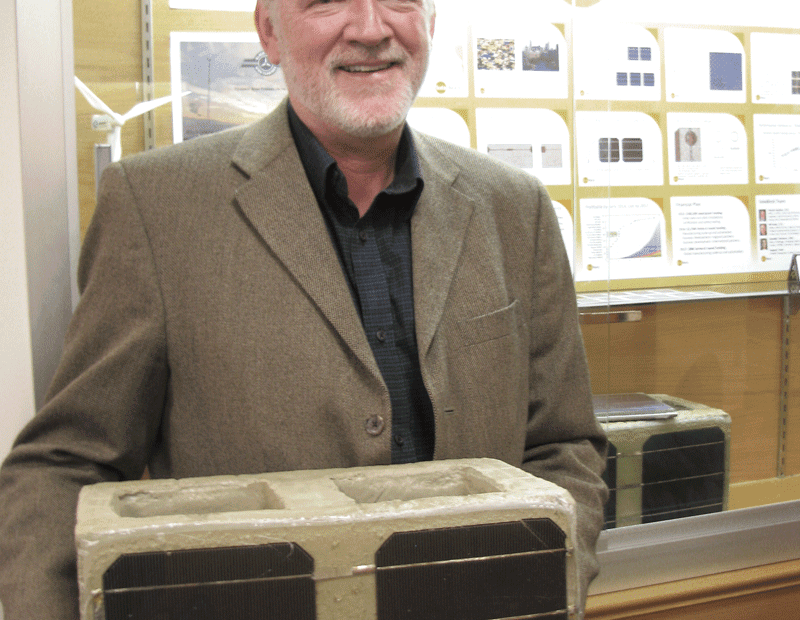
Court Dockets Departments

The following is a compilation of recent lawsuits involving area businesses and organizations. These are strictly allegations that have yet to be proven in a court of law. Readers are advised to contact the parties listed, or the court, for more information concerning the individual claims.

CHICOPEE
DISTRICT COURT
TBF Financial, LLC v. JSLC Corp., and Sandra and Joseph Marlin
Allegation: Breach of lease agreement: $21,378.06
Filed: 6/15/12

HAMPDEN
SUPERIOR COURT
Aaryn Blain v. Porterhouse Media
Allegation: Breach of contractual agreement: $25,000+
Filed: 5/8/12

Country Development Corp. v. Colorful Creations Bead Co. Inc. and Patricia and Stanley Pawlowicz
Allegation: Breach of lease agreement: $77,643.88
Filed: 5/2/12

Jenco Property Maintenance Services v. ITT Power Solutions d/b/a Exelis
Allegation: Breach of contract for snow plowing: $450,000
Filed: 5/18/12

John J. Walczak v. Turley Publications
Allegation: Breach of contract: $25,000
Filed 5/31/12

Michelle Michaels v. Superior Oxygen Systems Inc. and Inova Lab Inc.
Allegation: Failure to pay promissory notes: $150,000
Filed: 5/23/12

Rafal Lasiuk v. Liquor Town
Allegation: Action for monies had and received, unjust enrichment, and fraud: $96,817.50
Filed: 5/11/12

Shawntell Lee Waldon, administratrix of the estate of Aaron Lavanta Waldon v. Helsant Inc. d/b/a LACE
Allegation: Careless and improper security and maintenance at Club 418, causing wrongful death: $500,000+
Filed: 5/16/12

HAMPSHIRE
SUPERIOR COURT
Eclipse Manufacturing Inc. v. Gillespie Corp.
Allegation: Non-payment of monies loaned: $60,000
Filed: 5/23/12

Felix Perez v. Anthony’s Dance Club
Allegation: Negligent hiring and supervision, causing personal injury: $40,000
Filed: 5/15/12

R.E. Laplante Construction Inc. v. Harold L. Eaton Associates Inc.
Allegation: Breach of contract to supply land survey: $25,000
Filed: 5/29/12

NORTHAMPTON
DISTRICT COURT
American Express Bank FSB v. Pitt-singer P&H and Donald R. Pittsinger
Allegation: Non-payment on previous judgment: $10,759.23
Filed: 5/27/12

Constellation Newenergy Inc. v. Stop n’ Save
Allegation: Non-payment of services rendered: $8,342.50
Filed: 5/17/12

Eastern Brothers, LTD, d/b/a Black River Produce v. Sunflower Inc., d/b/a Green Street Café and John A. Sielski
Allegation: Non-payment of goods sold and delivered: $10,666.94
Filed: 6/14/12

Santa Buckley Energy Inc. v. Volkswagon of Northampton
Allegation: Non-payment of services and goods: $7,016.38
Filed: 6/1/12

WESTFIELD
DISTRICT COURT
Cach, LLC v. Daval Home Services Inc. and Keith G. Roy
Allegation: Breach of credit-card agreement: $16,840.11
Filed: 5/25/12