SPRINGFIELD — At its recent annual meeting, the YMCA of Greater Springfield announced four appointments to its board of directors. They include Fran Smith, a veteran of the newspaper advertising and circulation business for 34 years, and currently advertising manager at the Republican and masslive.com; Mark Smith, vice president of Manufacturing & Supply Chain Management for Smith & Wesson, who was previously a director with the Chicago-based consulting firm Alvarez & Marsal; Dan Flynn, senior vice president and marketing manager at People’s United Bank; and Stacey Church, assistant general manager of the MassMutual Center in downtown Springfield. “The YMCA of Greater Springfield is very fortunate to have such strong, high-level board leadership,” said Kirk Smith, president & CEO of the YMCA of Greater Springfield. “We are grateful to have such a diverse, expert team to work with our staff to ensure that the youth-development, healthy-living, and social-responsibility needs of our community are being met.”
WASHINGTON, D.C. — Total construction spending rose modestly for the third straight month in April as a mix of increases and declines in public and private categories showed the sector’s recovery remains fragile and fragmented, according to an analysis of new Census Bureau data by the Associated General Contractors of America (AGC). Association officials said the industry could benefit from new federal investments in infrastructure to offset declining public-sector demand. “Residential, private non-residential, and public construction spending all have areas of strength but also pockets of weakness,” said Ken Simonson, the association’s chief economist. “While the overall trend remains more positive than last year, growth is likely to be spotty for the foreseeable future.” Construction put in place totaled $954 billion in April, 0.2% above the revised February total and 8.6% higher than in April 2013. The year-over-year growth so far in 2014 has exceeded the full-year increase of 5% recorded from 2012 to 2013. Private residential construction spending inched up 0.1% in April to a six-year high. The latest total exceeded the year-ago level by 17%. Single-family construction rose 1.3% in April and 14% year-over-year. Multi-family spending soared 4.4% and 31%, respectively. Improvements to existing single- and multi-family structures slumped 2.2% for the month but increased 17% from a year ago. Private non-residential spending dipped 0.1% in April but climbed 5.6% over 12 months. Most major categories increased from year-ago levels. However, the largest private segment, power construction — comprising work on oil and gas fields and pipelines as well as electricity projects — slipped 0.6% for the month and 3.9% over the year. The fastest-growing private type was office construction, which jumped 3.1% in April and 26% since April 2013. Public construction spending rose 0.8% for the month and 1.2% year-over-year. The largest public segment, highway and street construction, declined 1.1% in April but increased 4.9% from a year before. The second-biggest category, educational construction, gained 3% and 4.9%, respectively. “The outlook for the rest of 2014 remains uneven,” Simonson predicted. “Demand for apartments appears to be very strong, but there are several warning signs about home building. Despite dropping last month, power and manufacturing construction should remain the leading private non-residential categories, with hefty growth for the year as a whole. The rebound in public construction that occurred last month may not be repeated soon.”
SPRINGFIELD — Mayor Dominic Sarno joined other public officials and neighborhood business leaders on June 2 for a ribbon cutting to mark the grand opening of the Q Restaurant, the latest example of renewed reinvestment and revitalization along the State Street corridor. Advertised as serving “real southern barbecue,” the restaurant opened for lunch on May 19 and started serving lunch and dinner on May 26. The restaurant is open from 11 a.m. to 10 p.m., Monday through Saturday. “This is another example of the city’s continuing ability to attract new investment that revitalizes neighborhoods,” said Sarno. “Not too long ago, this building was seized by the city. Now, it is back on the tax rolls, it is looking better than ever, and I’m hoping it will be an asset to the neighborhood for years to come.” Located at 890 State St., the property was purchased from the city in 2013 by Craig and Chris Spagnoli, a father-and-son team that had previously worked with the city on revitalizing foreclosed properties in the Forest Park neighborhood. The Spagnolis have invested more than $500,000 in starting the restaurant and are also planning to rehabilitate the upper floors into 15 units of rental housing. “My son Chris’s wife, Sarah, is from the South, and since we’ve been working in Springfield, we’ve always talked about how we thought a good southern barbecue restaurant would go over well,” said Craig Spagnoli. “We’re hoping Q will be a popular place for the neighborhood, for the colleges nearby, and for commuters wanting to pick up takeout on their way home.” The restaurant is located in Mason Square on the edge of the campus of American International College and a few blocks from Springfield College. It is across the street from the former Indian Motorcycle factory, and the restaurant boasts several Indian models as a tribute to the neighborhood’s manufacturing legacy.
Partnerships Anchor Easthampton’s Development
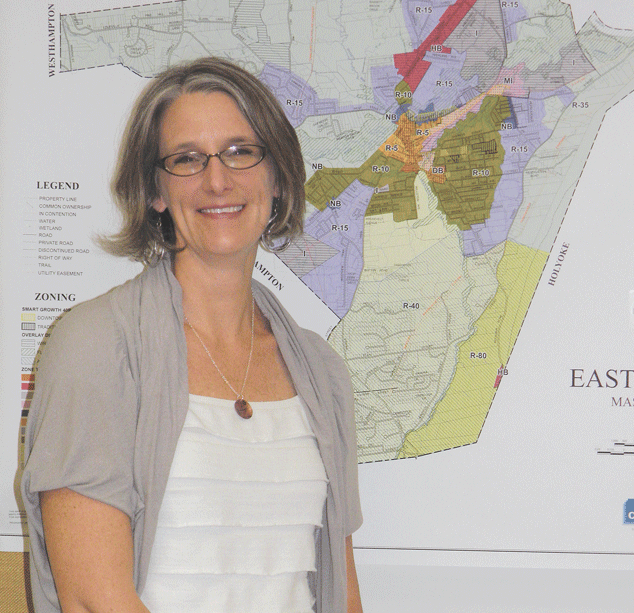
Jessica Allan says Easthampton will soon have three breweries, thanks to the quality of its water and improvements in infrastructure.
“One hand helps the other here, and partnerships between the city and private business owners have spearheaded revitalization,” she explained. “Public funding has encouraged business owners to make investments, which is how our story began.”
Town Planner Jessica Allan agrees.
“The city finds money through grants for infrastructure, and as a result, private business owners use their own money to make improvements to their property,” she noted. “Things have happened in Easthampton because the community and city have worked together to improve different areas. Our arts community has also formed collaborations to help Easthampton gain recognition in and outside of the Pioneer Valley.
“In the past, Easthampton had a really strong manufacturing base. It is still happening within the mills, but in a creative way,” she continued, citing enterprises that include furniture makers and a high-end wrapping-paper business whose clients include New York City boutiques.
She pointed to the Pleasant Street mills project that is now underway as a good example of a public-private partnership. Several years ago, Michael Michon, who owns Mill 180; Will Bundy, who owns the Eastworks Mill; and James Witmer, who owns the Brickyard Mill, approached the city for help. “They told us they had tenants who wanted to move into their buildings but were hesitant due to the lack of parking,” Allan said, adding that the trio had the idea of connecting their buildings and flipping the entrances, so they would open facing the Manhan Rail Trail instead of on Pleasant Street, because there was space there for a new parking lot.
The owners paid for the design, which includes 440 parking spaces, trees, and lighting. “The city did its part by applying for a MassWorks grant. The city received $2.75 million in October 2012 for the first phase of the project, and a second $1.5 million a year later to increase the parking capacity,” Allan said.
Money from the first grant will pay for an upgrade of the water lines as well as burying the electric lines. “We’re really dealing with safety issues,” Allan said. “The original water lines are still there, and the fire-suppression system doesn’t have enough pressure. There will also be new lateral connections to each building, so, if there is a problem in one building, it won’t affect the others. And burying the electric lines is helpful to the fire department.”
All those involved said Western Mass Electric Co. is a key player in the undertaking and that the utility made additional investments outside the area to some of their substations so the mills can get the power they need.
Cadieux says the project has been challenging, and Allan has held weekly construction meetings with representatives from city departments, the mill owners, the design consultant and engineering team, WMECO, and the construction contractor.
“The project is really complex, and a number of easements were needed,” she said. “But the end result will be rewarding and will spawn new economic activity. And the mill owners have spent millions on their buildings in anticipation of being able to fill in their empty space.”
Cadieux agrees. “It’s absolutely fantastic to have all these groups working together,” she said. “The project is very important to everyone involved.”
Ongoing Collaborations
Cadieux said the city’s history of partnerships began 15 years ago on Cottage Street when a buyer wanted to purchase the former 9,000-square-foot Majestic Theater, which was an eyesore that had been closed for years.
“But the owner of the theater insisted that he would not sell to the man unless he also bought the parking lot across the street. He couldn’t afford both properties, but the city was able to help by purchasing the lot with state funds,” she explained. “It was advantageous to both sides because the city needed more parking. And since that time, the city has received a great deal of state funding for infrastructure improvements. As a result, many restaurants and businesses have gone into space on the street.”
The city’s next major project is aimed at helping downtown businesses as well as providing people with a new recreational outlet. It’s called the Nashawannuck Pond Promenade Park, and will finally bring to fruition an idea that was born about a decade ago. The park is in the design stages, and, thanks in part to a $400,000 grant from the state, construction is expected to begin this summer.
“The 30-acre pond is in the heart of the community and will provide a gathering space for residents and visitors,” Allan said, as she viewed the peaceful body of water from the mayor’s office windows.
“The park will be the gateway to the cultural district on Cottage Street and will make Easthampton a destination location. We want to attract tourism and bring foot traffic downtown,” she told BusinessWest, adding that this is another example of how public funding spurs economic development in the city.

Mayor Karen Cadieux says Easthampton is flourishing due to its diverse economy.
She added that the city is also looking at streamlining its permitting process and has partnered with the Greater Easthampton Chamber of Commerce to develop a workshop for first-time business owners. “In the past two years, ten new businesses have applied for permits downtown, and we are filling in vacant storefronts,” she said.
Allan explained that increased interest in space downtown is related to Easthampton City Arts+ and the events it sponsors, such as monthly art walks, which are very popular.
The formation of that organization resulted from yet another collaboration, this one between Easthampton City Arts and the Easthampton Cultural Council, which shared office space and coordinated events at Old Town Hall with a shared mission before they merged and became ECA+.
The group has worked with the city on a variety of occasions, and last year it was successful in its bid to have Cottage Street designated by the state as its 16th cultural district. “The effort was spearheaded by ECA+,” Allan said, adding that the city applied for the designation from the Mass. Cultural Council in January 2013.
The mayor says these partnerships are beneficial. “It’s exciting to have all of this happening in one community, and the growth that is taking place due to partnerships between the city, private businesses, and the arts community makes Easthampton unique.
“Again, it’s a matter of people working hand in hand,” Cadieux continued. “The arts community stimulates art growth, which attracts businesses to the city, and that results in our diversity.”
Fifty affordable-housing units called Cottage Square Apartments are also under construction in a long-abandoned building at 15 Cottage St. “It was our largest tax title and was purchased by a developer three years ago. The city supported the developer’s idea, and the project was permitted under special zoning,” Cadieux explained, referring to Easthampton’s so-called “smart-growth zoning,” which allows for denser development downtown. The mayor added that the city procured $200,000 in Community Preservation Act monies, which has helped the owner leverage additional state and federal funding.
Improvements to infrastructure, as well as the city’s pure water, which comes from the Barnes Aquifer, have also played a role in attracting three breweries to the city over the past three years. The Abandoned Building Brewery was created through a renovation of 2,700 square feet in the Brickyard Mill; the Ford Hill Brewery and Hop Farm, located in a 9,500-square-foot building on three acres less than a mile away, is expected to be operational by the end of the year; and New City Brewing, which is not yet open, has chosen Mill 180 as its home.
Bright Future
Cadieux said partnerships will continue to take center stage in Easthampton. “Things have happened here because the business community and the city have worked together. We are committed to working collaboratively with our business and arts community and do all we can to foster partnerships.
“As a result,” she concluded, “we are flourishing — which is exciting, especially during these economic times.”

Tech Foundry Aims to Build a Skilled Workforce — and More

Delcie Bean, president of Paragus Strategic IT and founder of Tech Foundry.
In fact, said its president, Delcie Bean, the firm would like to grow even faster, but that’s not always possible, because of the difficulty finding the right talent. It’s a story other business owners have been telling as well.
“We have been struggling with staffing for a long time, as has everyone else in the area,” Bean said. “We thought it was just us because our requirements are so stringent, and that’s why we’re having trouble hiring people. But it turns out everyone is looking for the same people but can’t find them — MassMutual, Baystate, Health New England, and smaller places like MassLive, Mobius, and Entre. They’re all having the same problem — they can’t hire. And that impedes growth, it impedes service, it impedes research and development.”
So, about a year ago, Bean started writing down ideas to tackle the problem — on a napkin. “I still have that napkin somewhere,” he said. “I wrote what the problem was and how we can go about solving it.”
The problem, in very specific terms, is that most people applying for available jobs, with IT firms and in other industries, lack not only the necessary skills, he noted, but also a certain level of professional acumen. “They don’t know customer service, they don’t know how to fill out a résumé or cover letter, they can’t interact with people well or write a business-formatted e-mail. Even the ones who have the technical skills, we can’t hire them because they aren’t ‘people people,’ they aren’t professionals — they’re not employable.”
“It’s not just a problem in the IT sector,” he reiterated. “Many sectors in Massachusetts are saying the same thing; they can’t find entry-level employees who come to the table with professional skills. We’ve seen it in precision manufacturing, financial services, healthcare — a lot of the sectors we work with say they have the same problems.”
From those napkin scribblings, however, emerged a possible solution, an ambitious workforce-development program Bean calls Tech Foundry. The goal of the new nonprofit, which will soon complete almost $500,000 in fund-raising for a one-year pilot project, is to train unemployed and high-school-age individuals and match them with the very precise needs of area companies.
“A lot of existing workforce-development programs use a broad-based curriculum, with all the kids learning the same stuff in the same way, then demonstrate what they know by taking tests,” he said. “I had some very frank, open conversations with the community colleges, and they admitted what they’re doing well and where they can improve. They admitted that, in many ways, they’re not equipped to handle what some sectors are asking for.”
The ambitious, innovative Tech Foundry is seeking nothing less than a game change when it comes to training workers and keeping them in a region that has been bleeding talent for a long time. It’s an idea with ramifications for not only education and workforce development, Bean said, but overall economic growth in the region as well.
Badges? We Need Badges
And it all begins by earning badges.
Backing up a little, Bean interviewed a number of companies about their needs and asked them to be very specific. “Customer service? What exactly does that mean? So I asked for 15 things they want applicants to know how to do. Same thing on the technical side — they say they want someone proficient in Excel, so I made them explain exactly what they want them to do in Microsoft Excel.”

Delcie Bean describes the Tech Foundry space, still being completed and furnished, as “Googlesque.”
“It allows us to have a common language between employers and people training future employees,” he continued. “Everyone will be on the same page. Right now, we’re misaligned, and this forces us all into one set of agreed-upon skills as we define what each position needs.”
The core idea of Tech Foundry, then, is to use those very specific badges to match job seekers with available jobs.
“We built what we call an engine — a real-world, scalable, real-time model for delivering education,” Bean said. “Say Paragus wants to hire two people. We’d log onto the engine and post the job and a list of badges associated with that position. Then we’d specify when we plan to hire, how many we want to hire, a couple more criteria, and hit submit.”
The end result, he told BusinessWest, resembles not so much a traditional want ad, but something more akin to a manufacturer placing an order for an item: “I say, ‘here’s the part I need; here’s my specific timetable,’ and that part is delivered to me.”
Meanwhile, students in the program will see these requests come up on the engine and get a feel for what they need to accomplish to find the ideal career. “They become aware of market demand and can tailor their education to meet that demand. Maybe a position opens up, and you have 80% of the badges already. You say, ‘I like that company, I like the pay, and I know what I need to do to get where I need to be for them to hire me,’ and you focus your time on getting the remaining badges.”
One of the critical aspects of the program, for many, will be the way it bypasses college debt for those who don’t need a degree and makes college more affordable for those who do.
“We’re going to show kids how to get a $40,000 job right out of high school — to earn a living wage,” said Bean, who famously launched his company when he was 14 and bypassed college to focus on growing it.
While some of the careers Tech Foundry graduates achieve won’t require a college education, he noted, for those that do, many participating companies are expected to offer tuition-reimbursement plans for night school, weekend study, or an online degree. “Why not get your professional education on someone else’s dime? Your education is tailored to the career path you love, you’re doing the work and getting a paycheck at the same time — you’d be crazy not to do it.”
Starting Young
Bean envisions an engine where hundreds of Tech Foundry graduates are seeing precise company needs in real time and constantly making matches. In fact, Bean would like to target four or five groups of career seekers — unemployed people, veterans, young people with some college experience who dropped out, high-schoolers, and — possibly — parolees trying to get a fresh start after jail time. But he can’t serve all those groups right off the bat.
“We decided to pick one for the pilot, and that’s high-school kids,” he said, noting that the initial idea was to teach them job skills, confidence, and professionalism over several years. The problem is that a pilot of 100 students over four years would cost between $3 million and $5 million in personnel and other resources, and Bean thought it unlikely that he’d secure that level of funding for an unproven concept.
So, instead, he’s launching a one-year pilot program involving 25 teenagers, all entering their senior year of high school this fall. It will cost $482,000, most of which has already been raised — mainly with small donations, although larger ones, like $50,000 from MassMutual and $125,000 from an anonymous donor, helped a great deal.
The pilot will essentially be an accelerated version of the program, with the 25 students — who have already been chosen from around 100 applicants — taking part in a six-week curriculum starting July 7 and running through mid-August.
When school starts in the fall, Tech Foundry will essentially become an after-school program, with the participants studying there five to 10 hours a week until graduating in the spring. After that, they will be placed among 15 companies that have committed to participating in the pilot.
“That will be the proof of concept we use to fund-raise, to show that we’re economically viable,” he said, before scaling the project up to 100 participants at a time, from the different demographics he mentioned. Teachers have already been hired, as well as an executive director and director of operations.
Tech Foundry has leased the ninth floor of Harrison Place in downtown Springfield and spent $40,000 renovating it to resemble a Silicon Valley workspace, with brightly colored paint and carpeting and what Bean called “a funky-cool café and weird furniture. It’s a very creative and engaging place. It’s Googlesque.”
Speaking of Google, Bean is thinking big when it comes to the regional economic-development potential of his new enterprise. He noted Cambridge’s tech explosion convinced companies like Google, Microsoft, and Amazon, as well as a number of smaller firms, to set down roots there and generate a critical mass of growth. “They produced 10,000 new jobs in three years. Those are insane numbers, crazy numbers. But it’s been done elsewhere — Raleigh, Austin, New Orleans, Denver … it’s happening all over the country.”
But it only happens where there’s a skilled workforce, because the big players are desperate for talent, he said. And the presence of a Google or Microsoft will help the region retain the talented graduates from UMass and other regional colleges who have been packing up their degrees and leaving for better, higher-paying opportunities than are available here.
“That will solve what people thought was the original problem, the brain drain,” he explained. “We’ll be able to keep UMass graduates because they’ll be able to work at these brand-name companies right here.”
Pieces in the Valley
The catalyst for achieving all that, Bean stressed, is a skilled workforce.
“We all know we have a low cost of living here, tons of infrastructure, a great lifestyle, access to the outdoors — we have all these assets,” he said. “But without a catalyst, we can’t sell those assets. That’s what Tech Foundry is trying to do, to build that catalyst.”
In fact, he added, Greater Springfield has the potential to become an even more promising hub than those other cities he mentioned. “We’re right between Boston and New York, we have an airport in Hartford, we have the computing center and low-cost electric in Holyoke … this is a phenomenal region.”
He believes Tech Foundry will be the first step in keeping more talent in a region with so much to offer. For promising high-school students and eventually others, the project may prove to be a vital link to a lucrative, satisfying career.
“They’ll see the data in real time,” Bean said. “They will know what the market demand is, and they’ll know, in very specific terms, what they need to do to get to the level they need to get that job.”
And, like other local businesspeople who have volunteered to be part of the training starting in July, he’ll be right in the middle of it, teaching some of the classes himself.
“I’m excited that I get to work with these kids,” said someone who understands youthful ambition better than most. “I’m so passionate about this.”
Joseph Bednar can be reached at [email protected]
FIT Solutions Creates a Strong Niche Within the Staffing Industry

Jackie Fallon says her company has achieved steady growth through its focus on the specific needs of both the clients it serves and the candidates it places with those firms.
The first word is an acronym that blends her last name with the sector she specializes in — Fallon Information Technology — while the second amounts to what Fallon believes the company provides to both the businesses it serves and the individuals it places with those clients; she calls them candidates. Meanwhile, she does a lot with that word ‘FIT,’ as evidenced by the slogan on her letterhead — ‘Providing IT Resources That FIT Your Business.’
Unfortunately — and this is probably a sign of the times — many jump to the wrong conclusion. “A lot of people think we’re a fitness company, and we’re not, obviously,” said Fallon with a laugh.
Despite this confusion, Fallon is nonetheless making a name for herself in a challenging subsector within the broad staffing industry — helping companies of all sizes, but especially small to mid-size enterprises, find the IT personnel they need to enable their ventures to operate effectively in an increasingly technology-driven world.
It’s challenging, she said, because, despite some attractive benefits to being in IT — the pay is generally good, and work is, for the most part, still plentiful — not enough young people are getting into the field. She speculated that the bursting of the dotcom bubble early last decade and the exporting of considerable work overseas to India and other spots may have prompted parents to steer their children toward other vocations.
Those attitudes are changing, Fallon went on, but finding a good quantity of candidates remains a problem. Meanwhile, there’s the matter of quality, or effectively matching candidates with clients. And that can be a challenge, because many small business owners and managers simply don’t know what they need when they set about finding IT help.
“Small to mid-size companies rarely hire an IT person,” she explained while pinpointing her company’s bread and butter. “And when they do, human resources has no idea what to look for; he or she is given a list of specs and technical jargon they don’t understand. So they look to us as an extension of their internal HR department.”
By excelling in that role, the company has made broad inroads in several sectors, including higher education — UMass, Bay Path, Mount Holyoke, and other area schools are clients — as well as healthcare, with Health New England and Accountable Care Associates among those FIT has served, and manufacturing, with Dalton-based Crane & Co. which makes the country’s currency, among the company’s many repeat customers.
As it marks 10 years in business, FIT, which serves the Western Mass. and Northern Conn. markets, continues to grow and expand that client base because it has been able to correctly anticipate and decipher those aforementioned needs and, as the slogan says, provide solutions that fit.
That phrase applies not only to the companies FIT serves, but also the individuals it places, she went on, noting that the company goes to great lengths to make sure the fit is good for both sides of the equation, because if it isn’t, neither party will benefit.
For this issue, BusinessWest looks at how this company has carved an effective niche within the local economy, and at where it — or IT, as the case may be — can go from here.
Technically Speaking
Fallon didn’t want to name the large IT-staffing company she worked for at the start of the last decade. But she did want to talk about how it conducted business.
“I didn’t like the way they treated clients or their candidates,” she said, referring, again, to the two constituencies in this industry. “It was all a numbers game, and it was about quantity versus quality and trying to make the candidate take as little as possible so they could make a higher hourly profit.
“I just didn’t like that, but from that experience, I learned a lot about the staffing industry, I learned that I liked dealing with people, which I’ve known all along, and I had enough technical knowledge to be dangerous,” she went on. With all that in mind, she decided she was ready to go into business for herself with a company that would do things differently.
Backing up a bit, and retracing the steps that prompted her to launch her own venture, Fallon said she graduated from Western New England University and was hired by IBM, starting as a word-processing secretary. She moved on to be a systems engineer on the company’s AS 400 product line, working primarily on the sales side, installation of equipment, and training people on how to use it.
She did that for more than a decade before accepting an offer to join one of her clients, software maker DataProfit, in the mid ’90s. There, she started the company’s hardware division and ran it until not long before the company went under in 2001. She described it as a great learning experience that also enabled her to make some connections that would serve her well in the years to come.
As DataProfit’s struggles mounted and its demise became increasingly apparent, Fallon segued into the staffing side of the IT industry, working for that aforementioned large player focused on numbers. In 2004, she decided to go out on her own with a venture that would take a personal approach to staffing and put the emphasis on quality, not quantity.
From the beginning, her company has focused primarily on small to mid-sized companies — ventures that are generally big enough to have IT staff as opposed to outsourced help, but not big enough to have their own recruiting departments — although MassMutual, ING, and other large corporations are also on the client list.
FIT handles permanent placement, temporary staffing, temp-to-hire scenarios, outsourced recruiting, and other services, and provides clients with a wide range of personnel, including chief information officers, project managers, web developers, application developers, business and system analysts, database designers and administrators, and help-desk and technical-support personnel.
“We do direct hiring — people will call and say, ‘we want to hire someone; help us find the right person,’” she explained. “But we also do pure contract work — someone needs three developers for a project for six months — and also temp-to-hire.”
Finding qualified individuals to fill these various positions has, as she said, become an ongoing challenge.
“There are a lot of openings for candidates,” Fallon explained, “because there are not enough young people getting into the IT sector to make up for the ones we’re losing to the retirement side.
“There are many reasons for this,” she went on. “I think the parents of these young people became wary after the dotcom bust and the outsourcing to India and told their kids they didn’t want to get into this field because their jobs would be eliminated. But that sentiment couldn’t be further from the truth — we’re seeing a lot of companies come back onshore because of the issues they’ve had outsourcing offshore.”
Overall, FIT owes its success in this niche to knowing its clients and understanding what they want — and don’t want — when it comes to IT personnel, and consistently providing solutions (there’s that word again).
“Clients want to look at me as an extension of their company,” she explained. “And you really need to get to know them. You need to know what kinds of people they like and what kinds of people they don’t like; if it’s a quiet office, you can’t send in someone who’s loud and boisterous. And if you take care of your clients, they’ll take care of you.”
Looking ahead, Fallon said FIT Solutions is ideally situated for continued, and perhaps profound, growth.
Indeed, she noted the company doesn’t have any direct competition in this market, although some players have tried to enter the field and failed to gain a foothold, primarily because of those aforementioned challenges. Meanwhile, information technology continues to change, improve, and be an ever-growing part of doing business, which makes this work somewhat recession-proof.
“Even in the downturn, we were still very busy because there were IT projects that had to be done,” she explained. “Companies took the contract route because they couldn’t afford to bring people on full-time, but they still needed their projects done.”
But while FIT could, in theory, grow to the size of Fallon’s former employer, she is opting for what she called “smart growth,” which will leave her with the size — and mindset — to effectively serve clients.
The Bottom Line
While some people may mistakenly believe Fallon’s venture is a fitness company, most business owners now know the name, the acronym, the mission, and, most important, the track record for success.
And as FIT Solutions moves into its second decade of serving clients and candidates, it is more determined than ever to live up to both words in that name.
George O’Brien can be reached at [email protected]
New HealthSouth Facility Opens Its Doors in Ludlow Mills Complex
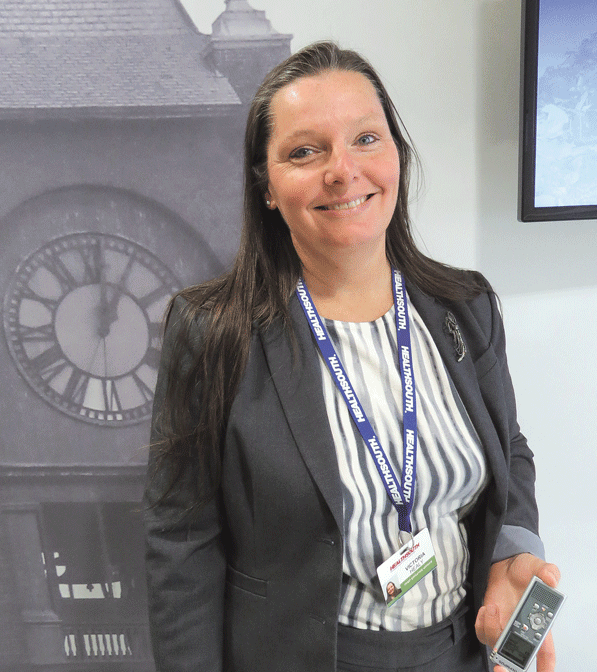
Victoria Healy stands in the front lobby of the new HealthSouth facility, complete with a mural depicting the signature clock tower in the Ludlow Mills complex.
“It was difficult giving tours there — that facility was not an easy sell,” said Healy, who gave more than a few over the years in her role as controller.
There were five floors to negotiate, she told BusinessWest as she talked about the former Ludlow Hospital, an acute-care facility built in 1907, adding that the elevators were old and slow, the rooms had multiple patients and shared bathrooms, and the rehab areas were quite small.
All this made for competitive disadvantages at a time when patients and their families were becoming far more discerning about where and how they receive care, and doing their homework before choosing a provider.
“What we’re finding now is that people are really educated, and if they’re going to have surgery they believe will require rehab after the fact, like having both knees replaced, they’re doing the legwork up front,” she explained. “They’re figuring out where they’re going to go before they need it.”
These days, giving such tours is a very welcome assignment for Healy, now the facility’s CEO, and anyone else who gets to do the honors.
That’s because the new, $28 million HealthSouth, built at the Ludlow Mills complex and opened last December, is state-of-the-art in every sense of that phrase — from its pending LEED (Leadership in Energy and Environmental Design) certification to the private rooms and accompanying spacious bathrooms; from the large inpatient gym, where occupational, physical, and speech therapists work with patients, to the courtyard, which doubles as what Healy called a “functional therapy gym” (more on that later).
“Tours are a lot more fun here — this building sells itself,” she told BusinessWest, adding that there have been dozens of visits in recent weeks from prospective patients and their families, town officials, the press, and other constituencies.
But while the new, 53-bed, 74,000-square-foot HealthSouth is a model of the present and, in many respects, future of rehabilitation services, there is also a nod — actually, several of them — to the past. In this case, it’s the hospital’s new home, the massive former jute-manufacturing complex that is now the site of an ambitious redevelopment project being undertaken by Westmass Area Development Corp.
Indeed, the HealthSouth facility is one of the first undertakings within this initiative, which includes both new construction and repurposing old mills, and those constructing and then decorating the hospital acknowledged the rich history of the site.
For starters, 100,000 bricks salvaged from some of the dozens of historic stock houses that populate the property were used in the construction of the new hospital. They can be seen in the front lobby, which also features several planed wooden beams from those stockhouses, several photos of the mills, and a large mural featuring the signature clock tower that dominates the property and has become the town’s most recognized landmark.
Meanwhile, a mix of artwork adorns corridors throughout the facility — a colorful collection of photographs of area landmarks (everything from Mount Greylock to Westfield’s Tekoa Country Club), as well as a number of vintage photos, many a century or more old, including many of the old mill complex and the nearby Putts Bridge that links Ludlow with Indian Orchard, as well as other town landmarks.
Healy said an early favorite among patients and staff alike is an image from the maternity unit at the former Springfield Hospital, circa 1905, showing nine infants on one large cart.
“We originally thought those were loaves of bread, but they’re babies,” she said. ‘Times have definitely changed.”
For this issue, BusinessWest took one of the many tours being offered these days by Healy and her staff to gain some perspective on what this new facility means for the organization in terms of serving patients and achieving desired growth.
It’s Not Run of the Mill
Healy, who joined HealthSouth’s Ludlow operation in 1999 — a few years after the corporation acquired it from Advantage Rehabilitation, which set up shop soon after Ludlow Hospital closed its doors in the early ’90s — said administrators have known for some time that larger, more efficient, and far more modern facilities were needed.
Indeed, while the company has a reputation for good outcomes for its patients and has long enjoyed a high occupancy rate (roughly 90%), the multi-level, 60,000-square-foot facility presented some real challenges.
The 53 beds were placed in far fewer rooms than the current facility, she explained, noting that there were often three or four patients to a room. This created issues with privacy and infection control, but also presented some logistical problems.
For example, as the patient population shifted, gender-wise, patients would have to be moved, often several times during a typical two-week stay, said Healy, adding that this was an inconvenience for both patients and their families.
“We had such a high occupancy rate, in order to accommodate more patients, we had to do a lot of room moves,” she noted. “In an average length of stay of 13 days, a patient might move three or four times.”
And then, there were the multiple beds and common bathrooms, which, suffice it to say, were not the highlights of those aforementioned tours.
“When the younger generations toured and saw the three- and four-bed rooms and the shared bathroom, they were not interested in coming to our hospital,” Healy noted, “especially when they came from either Baystate or Wing and the new units at those facilities, which featured all private rooms.
“And the bathrooms we had at the old hospital were more like toilets,” she went on. “The sinks were outside the bathroom, and the showers were toward the nursing unit. It was more like a gym shower.”
These and other problems and challenges are now talked about nostalgically, if that’s the right term, by HealthSouth’s staff of 225.
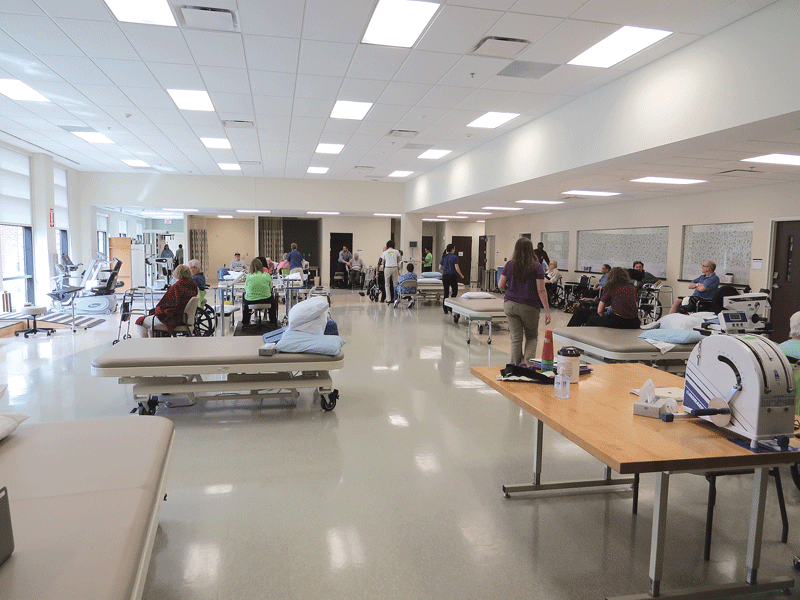
The inpatient gymnasium can host dozens of patients and therapists, and represents a marked improvement over facilities in the former HealthSouth Rehabilitation Hospital.
“It’s a huge change — like night and day,” said Healy with a laugh, adding that the new facility allows for the same patient outcomes, a better patient experience, and a far more appealing environment in which the staff can work.
All of the above became evident as Healy offered BusinessWest a tour, starting outside her office in the administrative area. Nearly 20 people now work in one designated area — where before they were spread throughout the old hospital — allowing for better communication and improved productivity.
But the hospital really exists for its patients, she said, before moving quickly through the lobby to an outpatient-treatment area that represents a vast improvement over the same facility at the old Ludlow Hospital, enabling HealthSouth to better compete in a crowded field of outpatient-service providers, which is a small but still-important component of the business.
The main thrust is inpatient care, she said while moving on to the two wings with patient rooms for those recovering from everything from stroke and other neurological disorders to spinal-cord injury; from amputations to cardiac and pulmonary conditions.
While these rooms have become a strong selling point for those doing that aforementioned legwork that Healy described, there are many other amenities.
These include a spacious day room where patients and their families can relax and spend time together. Activities range from bingo to church services, said Healy, adding that there is another gathering space unofficially named the ‘night room,’ she noted, because it doesn’t have the huge windows that define the ‘day room.’
Around the corner is the large inpatient gym, which can accommodate several dozen patients and therapists at one time. And then, there’s the large courtyard, which, as she said, doubles as a functional therapy gym. There are stairs, handrails, and several slight changes in elevation, Healy noted, adding that navigating all this can certainly assist many patients in their recovery efforts.
“One of the challenges that many patients have as they’re learning, especially after a stroke or a car accident, is that it’s very difficult for them to learn to walk on different surfaces,” she explained. “So here, there are stairs, ramps, brick, concrete, stone, and sand. After a life-changing event, it’s very difficult to learn how to reambulate on surfaces like this, so we’re excited about what we can do here.
“Also, I think it’s good therapy for the soul to have the fresh air and the sunshine,” she went on. “Our goal is to get people back to their lives, and this [courtyard] is closer to life than anything a hospital can simulate.”
The facility has been closed through the long, harsh winter, said Healy, but now that spring has finally sprung, patients and their therapists are taking full advantage of the opportunities afforded them.
The new hospital comes complete with a large amount of shell space, said Healy, adding that the ultimate goal is to expand into that space with more patient rooms.
To do so, HealthSouth will have to convince state health officials there is sufficient need, she said. At the moment, this would be difficult to do because most competing facilities have lower occupancy rates.
“There is space for an additional 17 beds, and it’s our goal to eventually expand into it,” she said, noting that, as the population ages and need for rehab services rises, this space will eventually be put to use.
Making More History
That shell space is currently not on the agenda for most of the tours being given at the new HealthSouth, but there are plenty of other things to see and experience, said Healy, reiterating, again, how much more enjoyable it is to introduce people to this facility than the old hospital just a few blocks away.
“It’s the best part of my day,” she told BusinessWest, adding that the new facility provides the room to grow and an environment in which patients and staff can thrive.
Which means it’s a place where more history can be made.
George O’Brien can be reached at [email protected]
BOSTON — Gov. Deval Patrick is asking the Legislature to approve a bill that would make $100 million available to the state’s 26 so-called Gateway Cities, including Springfield, Holyoke, Chicopee, Westfield, and Pittsfield, for a host of economic development initiatives. Included in the bill are provisions for: $15 million for commercial development projects; $10 million in grants and loans to clean up contaminated industrial sites; $5 million for loans fort small businesses; $25 million in annual tax credits for companies that commit to adding jobs; and $20 million for “middle” skills job training in manufacturing and information technology. “We are trying to make sure every resident — and not just residents of Boston — have access to economic opportunities,” said Alex Zaroulis, a spokeswoman for Patrick’s office of Administration and Finance. However, some legislators said the proposed spending was not enough to make a real difference in the struggling cities. “The level of funding proposed by the governor is simply insufficient,” said Rep. Antonio Cabral, a New Bedford Democrat. “The surest way to undermine faith in the Commonwealth’s programs is to fund them at a level that we know won’t solve the problem.”

Massachusetts Export Center Helps Firms Do Business Overseas
 To Ann Pieroway, the statistics speak volumes.
Take, for example, the fact that Massachusetts companies exported more than $26.8 billion in goods last year — a 4.63% increase over 2012 — and ranks as the 17th-highest exporting state in the U.S.
Or that the Bay State ranks second nationally in seafood exports, third in medical-device exports, and fourth in the U.S. in high-tech exports. Or that 28% of the state’s manufacturing workers depend on international exports for their jobs, which ranks fourth nationally.
Those achievements don’t happen in a vacuum, said Pieroway, regional director of the Western Mass. office of the Mass. Export Center (MEC).
“We have a very simple mission: to help companies throughout the Commonwealth achieve success in global markets and contribute to economic growth in our state,” she said. “The goal is to maintain jobs or grow jobs.”
It does so by providing a range of resources to client companies, from counseling and technical assistance to market research and assessment, to a wide range of training programs to help businesses navigate the tricky, hyper-regulated world of exports. As for the center’s effectiveness, Pieroway said, the numbers speak loudly there, too.
“For our latest impact study, we sent out a questionnaire to our clients — significant clients, not just somebody we’ve answered questions for,” she explained. Almost 70% responded, and reported $240 million in financial return from their dealings with the MEC in 2011. “That’s not total exports; that $240 million for 2011 is their increase in export sales due to the help they’ve received from the Massachusetts Export Center.”
With a background in offshore manufacturing, Pieroway has been involved in the export arena since 1983, when she was appointed to the governor’s International Trade Council.
“Back then, there were 27 different groups that had their fingers in international trade, but no one primary group,” she said, explaining the germination of the MEC. Paula Murphy, who still serves as statewide director, got the program running 20 years ago, and Pieroway came on board soon after. “We’re a specialty center of the Mass. Small Business Development Center Network, which put the funding in.”

Ann Pieroway says the success of the Massachusetts Export Center can be measured in the additional dollars exporters bring into the Bay State.
The state contributes as well, Pieroway said, and studies show that, for every tax dollar it kicks in, $4 is pumped back into the state economy. “So we don’t get cut; we’ve always been level-funded. We put out an impact study that goes to all legislators, and everyone can see what we do — $240 million is a lot of money.”
She also noted that the $2.2 trillion in overall U.S. exports accounts for 9.8 million jobs. “Supposedly, every time you get a $125,000 increase in export sales, a job is created somewhere in the network. That’s very important to us here in the Valley.”
Helping Hands
While Pieroway wasn’t at liberty to name specific clients, she did cite a broad range of services the agency provides, including:
Export counseling and technical assistance. These services are customized to each client’s needs, and might include:
• Export planning and preparation;
• Assessment of export readiness;
• Export strategy and international business-plan development;
• Assessment and selection of target export markets;
• International sales and marketing;
• Identification and qualification of overseas customers and partners;
• International payment and financing;
• Export logistics, including shipping, documentation, terms, and controls;
• North American Free Trade Agreement compliance and eligibility; and
• Working with export service providers, such as international banks, law firms, and freight forwarders.
International market research and assessment. The center has access to a wealth of information on export markets. Examples of research provided to clients include:
• General information on doing business in different countries;
• Demographic, economic, political, and cultural information on different countries;
• Market size, characteristics, and trends;
• Trade barriers and regulatory issues;
• Detailed statistical information on U.S. exports by state, product, and country.
International business-development assistance. Through the center’s partnership with other state and federal government agencies, companies can take advantage of specific programs to market their products and services internationally. These services include:
• International business-plan development;
• Assessment and selection of target export markets;
• Guidance on international sales, marketing, and distribution-channel development and management;
• Identification and qualification of overseas customers and partners;
• Participation in overseas trade shows and missions; and
• Connections with state and federal overseas offices for in-country support.
Export training programs. Partners for Trade, the state’s official export training initiative, is a regional collaborative between the Massachusetts Export Center, chambers of commerce, trade associations, economic-development agencies, and the private sector, working together to present frequent seminars on international trade.
Partners for Trade programs offer Massachusetts companies an overview of topics like international marketing, legal issues, export logistics, international distribution, and others, including country-specific and industry-specific export issues. Much of the training is provided by international trade experts from the private sector, including international business lawyers, export consultants, freight forwarders, international bankers, and international business executives from area companies. On average, more than 1,000 companies participate in the Partners for Trade program each year.
The Massachusetts Export Resource Center. Launched in 2012, the MERC offers a wide range of instructional and practical information on exporting, including training modules, video guides, workbooks, and templates.
The bottom line, Pieroway said, is that the MEC deals in information — lots of it.
“When I first started this job 19 years ago, we used to get reports from the Department of Commerce monthly, and we would send requests to Amherst; our research people would send us a stack of paper like this to take to our clients,” she said, spreading her hands a foot apart. “We no longer have a research department; we do all our own research, or have our interns do research. The things available today were nowhere near available 20 years ago; it’s all Internet research now.”
That information is invaluable to companies navigating the often-thorny, heavily regulated world of international business. Pieroway told of a seven-month-long effort to help a client send a product to China. “Anything going to China gets extra scrutiny. They finally allowed it, with all kinds of conditions. I just pray this company adheres to those conditions.
“We’ve helped companies in every industry there is,” she added, “from agriculture to guns to butternut squash to cosmetics to precision machining — you name it,” she said. And whether a client needs a license or legal assistance or any of a host of other requests, “I connect them with somebody who can help them. We have a wonderful network of support across the Commonwealth.”
Ship Shape
The day she spoke with BusinessWest, Pieroway was preparing for a Partners for Trade seminar in Holyoke called “Fundamentals of Exporting.”
“We want people to have a basic understanding of the process. For some people it’s daunting — there’s a little more paperwork going international — but we achieve results the same way you would domestically: research your client and find out who they are.”
The MEC recently launched another program, called Compliance Alliance, a forum for exporting firms that offers:
• Periodic briefings that address a variety of regulatory compliance issues and provide an opportunity for exporters to network and share best practices with one another;
• Conferences and seminars that provide in-depth training across a broad range of compliance and operational issues. Speakers include exporters, law firms, consulting firms and representatives from government export regulatory authorities;
• An e-newsletter containing updates about current compliance issues and events; and
• Online resources, such as a member directory, a compliance resource library, and a job board.
That word ‘compliance’ comes up often for a reason, Pieroway said, adding that the federal government has tried to simplify international trade, but those efforts have often just made it more difficult.
“We’re doing a lot more webinars, so a lot more people can participate, from all across the country,” she said. “We’re known for our compliance training. We know what companies are going through, and we do a lot of hand holding here.”
That hand-holding has led to national recognition, especially in 2008, when the agency won both the Presidential E Award for excellence in exporting — the highest honor the federal government issues in the exporting arena — and the SBA’s Service Excellence and Innovation Award.
“This year, we won the SBA award for the state and for the region,” Pieroway said. “We feel we should have won the national award, too. I think they thought we’d won too much.”
A 2010 survey found that more than 11,000 Masschusetts companies were exporting goods — about 90% of them small and medium-sized businesses. Along with all the other resources the MEC provides, Pieroway boils a company’s international-trade success down to a strong commitment — of people and resources — by top management.
“You’ve got to have someone in charge of this,” she said, reflecting back to when a company’s compliance ‘expert’ was often a secretary tasked with figuring out how to move product out of the country. “So they became the experts. Now there’s more emphasis on training.”
Pieroway conceded that most companies still get involved in exporting by being reactive, not proactive — for example, when foreign buyers take an interest in a product at a trade show. But the world has been shrinking, so to speak, for a long time, and opportunities abound in other countries for businesses willing to seek it out and learn the ins and outs of exporting. And that takes work.
“You cannot do international business sitting in your chair in your office; you have to leave the country to be really successful,” she said. “It depends on your commitment — of time, personnel, and money.”
Joseph Bednar can be reached at [email protected]
Technology Park Is Writing a New Chapter to Its Rich History
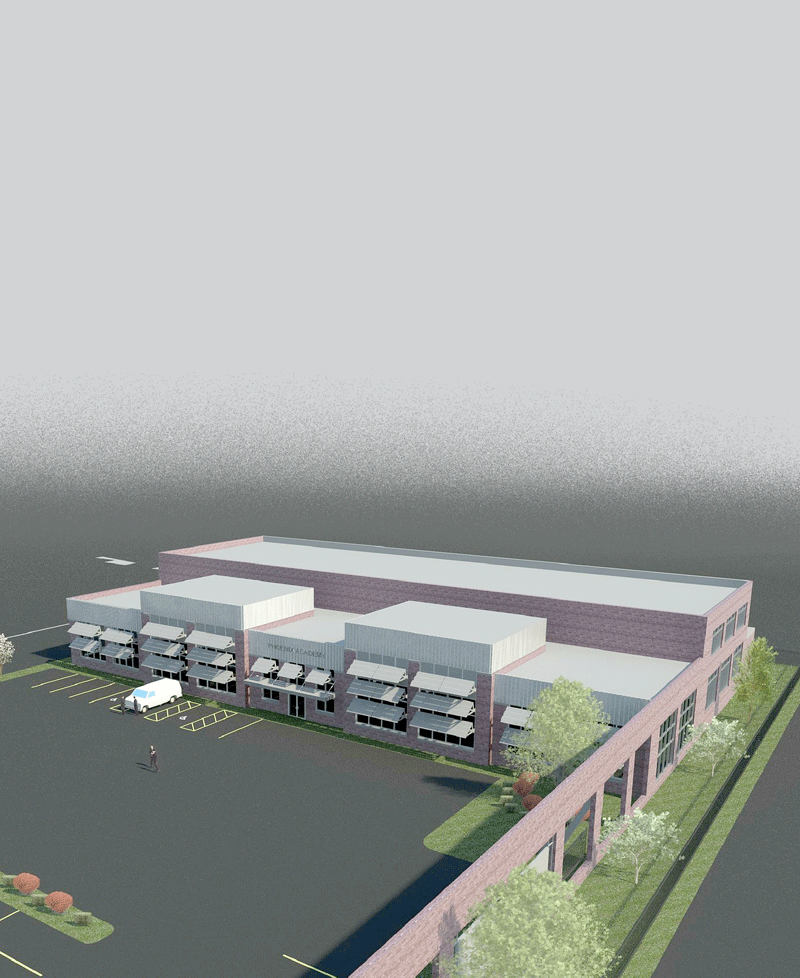
An architect’s rendering of the Phoenix Charter Academy that will take shape in the Technology Park at Springfield Technical Community College.
It was a laudable concept, but one she wasn’t at all sure would actually work.
And as she commenced a search for a place to fulfill this dream in the city of Chelsea, it became abundantly clear that few others were sure it would work either.
“I had to practically beg people to let us be in a building,” Anderson recalled. “We had no track record, no history, and a brand-new model no one had tried. And we were working with some really tough characters.”
Eventually, space was secured in the former Assumption School, and Phoenix opened its doors in the fall of 2006. Conditions were not ideal — in fact, they were far from it. But the school’s staff and those first 75 students persevered, and soon Phoenix began making real headway toward meeting its stated mission.
In the process, said Anderson, she and other administrators learned invaluable lessons about creating an environment where students could not only learn, but also aspire to excellence.
“We learned early on how important space is,” she explained. “You can’t just stick kids in a space that looks like you’re not going to hold them to a high standard, or one that says they don’t deserve a beautiful space in which to learn.”
Fast-forward to the fall of 2012, and Anderson and her staff had those lessons clearly in mind as they went about searching for space in which to expand the Phoenix network in Western Mass. The charter was extended to include Springfield, Holyoke, and Chicopee, communities that have large numbers of at-risk students and struggling school systems, and school officials focused their search for space in the City of Homes.
A few months later, that search ended in what some might consider an unlikely location — the Technology Park at Springfield Technical Community College, and, more specifically, long-vacant space once occupied by Springboard Technologies, or at least a big part of what will be left of that building after a large portion of it is razed.
Indeed, the Phoenix facility will become the cornerstone of an imaginative reuse plan for the 110,000-square-foot Springboard building — a.k.a. Building 104 in the former Springfield Armory complex that was also once home to Digital Equipment Corp. — which has been vacant since early 2009.
Plans call for razing roughly 70,000 square feet of the structure — the middle portion of the building — then creating a temporary home for Phoenix in 16,000 square feet of surviving space on the south end of the site (classes are expected to begin in mid-August), while also building out a permanent home for the school in 30,000 square feet of Building 104 left standing on the north end. The school’s temporary quarters will then be leased out to new tenants.
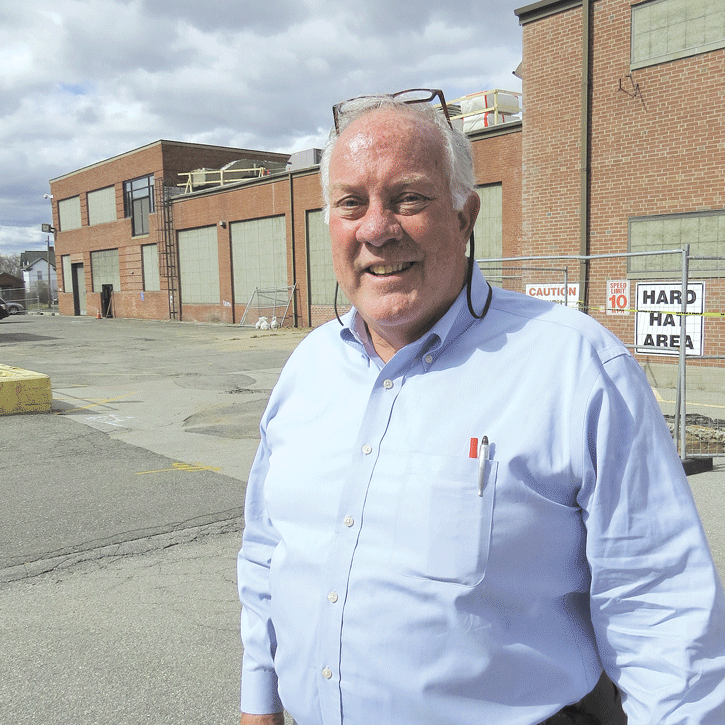
Bob Greeley, leasing agent for the Tech Park, stands in front of the portion of Building 104 that will soon be coming down.
Considering all that, Paul Stelzer, president of Holyoke-based Appleton Corp., which manages the tech park for its owner, the STCC Assistance Corp., called this series of developments a “win-win-win” scenario, with maybe a few more ‘wins’ as well. He counted Phoenix, the college, the Mason Square area, and the city as a whole among those that will benefit from these projects in one way or another, while the Tech Park itself will get a new look and new opportunities to expand its tenant base.
“We’re excited about this, because we have the ability to do something good for the community,” Stelzer said, referring to the charter school. “And we have more space to lease, which could lead to bringing more jobs to this region.”
Challenges remain for those operating the Tech Park — Western Mass. Electric Co., which moved in more than a decade ago, will soon be vacating more than 15,000 square feet of space serving as its headquarters — but the complex (not including Building 104) is more than 90% occupied, and the WMECO space and remaining portion of Building 104 create possibilities for bringing new companies, and jobs, to a region that needs them.
For this issue and its focus on commercial real estate, BusinessWest looks at what is shaping up to be an intriguing next chapter for the Tech Park, and possible subsequent developments for the historic facility.
Building Blocks
Since Springboard closed its doors in 2009 after struggling and downsizing for several years, and even well before that as the demise of the company became increasingly apparent, Building 104 has been a persistent challenge for Tech Park managers trying to reposition that space and generate needed revenue.
The space became a source of controversy and even contentiousness as the assistance corporation offered it as an alternative location for the state-operated data center that was eventually built at the site of the former Technical High School. U.S. Rep. Richard Neal pushed hard for the Tech High site, and eventually prevailed in what became a bitter fight over where the center would be located.
In the years since, there has been little interest in cavernous Building 104, used for manufacturing by both Digital and the Armory, primarily because there is a glut of such space on the market — and has been since the start of the Great Recession — and the Tech Park space is generally not able to compete with such properties on price, said Bob Greeley, owner of R.J. Greeley Co., long-time leasing agent for the park.
However, a new vision for the property began to take shape starting in late 2012, as plans for the neighborhood grocery store — a project pushed by city officials and agencies such as DevelopSpringfield — started to come together and, later, when Anderson and her staff began a hard search for a location in which to create Phoenix’s Springfield facility.
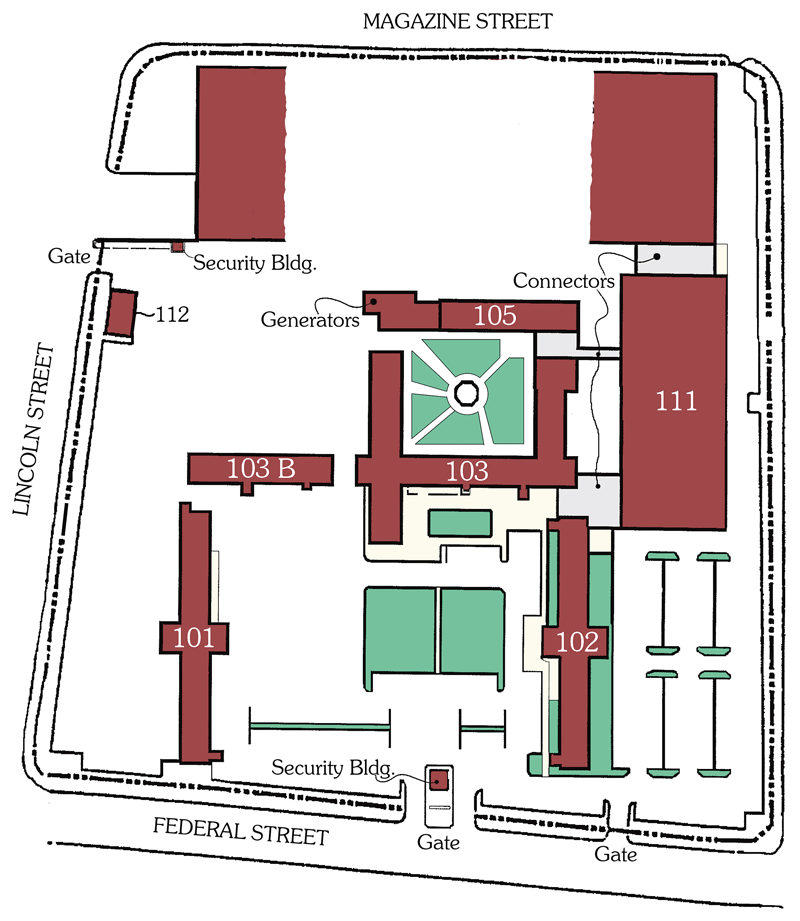
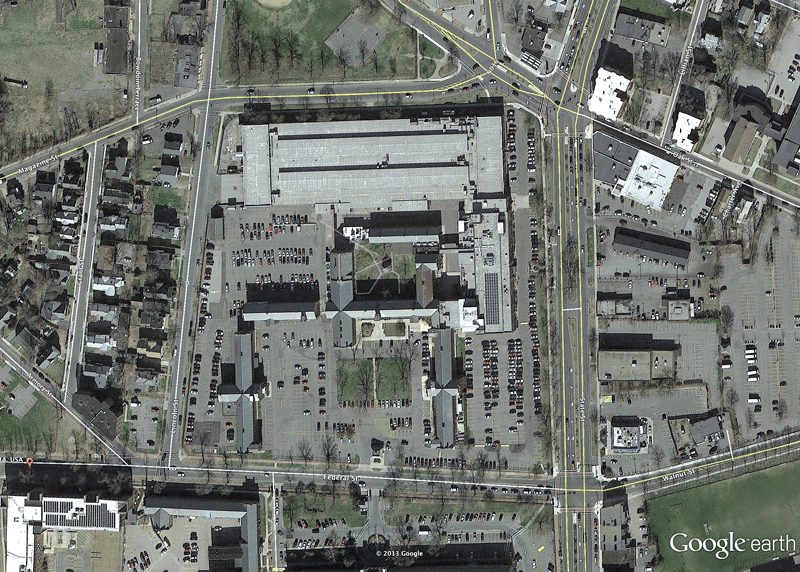
The aerial photo at left shows the massive Building 104 at the top of the image. At right is a site map showing what the park will look like when a large section of the building is razed.
 “For eight or nine years, we’ve been trying to lease all or part of that former manufacturing building,” said Stelzer. “We were looking for a solution, and circumstances emerged that presented us with an opportunity to do something meaningful there.”
The assistance corporation applied for and received a $3.86 million infrastructure grant from the state to essentially move the parking facilities off Walnut Street into the Tech Park, said Stelzer, adding that the funding will cover the costs of demolition and creating a new parking lot.
When those funds were secured, work commenced with the National Park Service and state and local historical commissions on how the assistance corporation would adaptively reuse the park and how demolition would be accomplished and also remain sensitive to the historic nature of the site for the Armory days.
Meanwhile, park administrators started working on a viable plan for repositioning the portions of the building that would be left standing, said Stelzer, adding the charter school presented itself as an attractive option.
“The Tech Park board and the college had long had thoughts of having a charter school near the campus,” he explained. “And this [Phoenix] facility will give a real boost to the community because it serves a different population.”
That population consists of students who have struggled in a traditional high-school setting, said Anderson, noting that many have dropped out for various reasons, such as academic issues, teen pregnancy, and others.
The school presents an alternative for such individuals, she went on, adding that the model involves a blend of rigorous academics — a longer school day and year, advanced-placement classes, college-class dual-enrollment options, and a strict culture — with social and emotional supports for each student.
“We develop teachers and leaders who believe in the possibility of human change and growth,” she said, “and who fight tirelessly for better outcomes for kids.”
Sara Ofusu-Amah, chief operating officer for Phoenix, said the school is planning to open in its temporary quarters on August 15, with the goal of being in the permanent building in January. Already, 88 students have enrolled — a number that reinforces the perceived need for such a facility — and school officials believe they will easily reach their target of 125 for the fall semester.
The permanent facility will include several classrooms, she said, as well as an on-site day-care facility for the children of students, a small library, a student-support center, science labs, and multi-purpose space school officials call the ‘nest,’ which will serve as the gym, auditorium, and meeting space.
“We want a beautiful space that celebrates academics and scholarship,” she said. “But there’s not a lot of bells and whistles; this is a place focused on preparing students for college.”
The 16,000 square feet that will become the temporary home for the charter school has the potential to host businesses of varying sizes across a number of sectors, said Stelzer, who described it as “higher-end flex space.”
“It will have the ability to do office, light assembly, a clean-energy tenant, or a small call center,” he explained. “We can be flexible there.”
While work begins to demolish the middle 70,000 square feet of Building 104 and outfit the south portion of the property as the temporary home for Phoenix, Greeley is seeking new tenants for the space occupied by WMECO, which is slated to move out in June.
The space was formerly part of a large call center operated by RCN, and while it’s attractive and well-appointed, it brings some challenges as well, said Greeley.
There are a number of small offices and conference rooms, he noted, which would make it ideal for use as a corporate headquarters. However, many companies today favor more open floor plans to facilitate communication between employees and improve work flow.
The space may also prove difficult to subdivide because of the way it’s laid out, he went on, adding quickly that the space gives the park some valuable inventory at a time when the economy is showing signs of life and many businesses are possibly gaining the confidence to move forward with expansion plans and new initiatives.
Space Exploration
It’s unlikely that those who conceptualized the Tech Park and were there when the ribbon was cut in 1996 could have imagined the developments unfolding on the site today.
Then again, the park has always been a work in progress, a regional asset that has evolved as the region’s economy and business community have. It’s an evolutionary process that continues today.
In other words, a site already steeped in history is continuing to write more of it.
George O’Brien can be reached at [email protected]
The following Business Certificates and Trade Names were issued or renewed during the month of May 2014.
AGAWAM
Ayotte Tree Service
4 Independence Road
Joshua Ayotte
Bancroft Bridals
967 Springfield St.
Mark Kendall
J.L. Cleaning Company
43 Royal St.
Lyudmila Barisov
CHICOPEE
Albee & Sons Contracting
32 Providence St.
David Albee
Chicopee Scrap and Auto Recycling
235 Meadow St.
Patel Hemant-Kumar
Emerald Cleaning Service
33 Leclair St.
Juan Garcia
Nelson’s Home Improvement
18 Beeler Ave.
Nelson Pantoja Jr.
Sofia Amelia Home
34 Madison St.
Sofia Hoyle
Tri-State Roofing Systems Inc.
788 Sheridan St.
Jon J. Hambley
GREENFIELD
Crown Mediation
298 High St.
Juanita Thomas
End Grain Artistry
181 Deerfield St.
Alexander Giguere
Four Corners Fine Wine and Spirits
402 Federal St.
Steven Schechterle
Replay
231 Main St.
Alan Cadran
Western Mass Roller Derby
1385 Bernardston Road
Katherine Skipper
Wiley and Russell Manufacturing
40 Russell St.
David Brock
PALMER
AJC Mechanical, LLC
1008 Baptist Hill St.
Lawrence Caputo Jr.
Computer Training of America
1448 North Main St.
Thomas Gingras
JWB Enterprises
37 Ware St.
Jason Bessette
Marlene’s Beauty Salon
1461 North Main St.
Jean Ciuka
Palmer Recycling Corporation
2 Fenton St.
Pamela Douthwright
Trackside Motors, LLC
1316 Main St.
William Davis
SOUTHWICK
Berkshire Kitchens & Baths
8 Evergreen St.
Dean Porter
Coyote Vapors
51 Tannery Road
Stephen Kostusiak
Cruise Planners
2 Lauren Lane
Denise Edinger
Hair of the Dog
610 College Highway
Jennie Tierney
SPRINGFIELD
413 Video Productions
40 Edgewood St.
Aaron Williams
A. Diamond Investment
371 Sunrise Terrace
Virginia Sally
ACC Business
351 Bridge St.
Michael R. Weitz
Adalia Couture
33 Villa Parkway
Dania K. Scott
Angel House of Magic
224 Talmadge Dr.
Angel M. Mojica
APC Repair
132 Bellevue Ave.
David Krisna
Asadero Del Caribe
2757 Main St.
Isidro Rodriguez
Avenue Six Luxury Apparel
17 Eldridge St.
Sasha Feliciano
B2Z Mini Mart
468 Bridge St.
Muhammad Bilal
Body Parts Finder
45 Cambridge St.
David Grant
Brofloe Music Group
143 Main St.
Eric Newkirk
Brother’s Market
106 Oak Grove Ave.
Christian Jimenez
Buen Provecho Restaurant
30 Fort Pleasant Ave.
Mildred I. Cruz
Business Buying Solutions
2358 Wilbraham Road
Joseph A. Monzillo
Coastline Automotive
501 St. James Ave.
Beris F. Gouldbourne
D. Johnson
64 Fernald St.
Derek Johnson
Del’s Repair Service
53 Sunrise Terrace
Delmar R. Hermany
Dillweedz Café
91 State St.
Hai X. Nguyen
Drona, LLC
477 Boston Road
Ramchandra Parekh
Fast Hands
426 Sumner Ave.
Jermaine Cowell
Findik Corporation
1350 Allen St.
Omer Karaarslan
First Class Custom Carpentry
440 Sumner Ave.
Dane R. Stillson
Fresh Homes
94 Jonquil Dr.
Dana Botta-Arroyo
Garvey Landscaping
448 Tinkham Road
Dennis Garvey
Gemini Barbershop
45 Pearl St.
Benjamin Parrilla
JK Tiles
27 Devens St.
Jan Kochman
Wicked Flyboarding
25 Acrebrook Road
Richard Daniel
YMM Services Inc.
295 Allen St.
Yasir Osman
WESTFIELD
JR Cleaning Service
18 Dubois St.
Jesus Felix
Lecrenski Brothers Inc.
14 Delmont Ave.
Dana Lecrenski
WEST SPRINGFIELD
Affiance-Events
93 Charles Ave.
Angela Cooper
Beauty & Nail Supply
366 Memorial Ave.
Long H. Ly
C & N Renovations
174 Birnie Ave.
Christopher Guyette
Construction Design Solutions
514 Morgan Road
Michael Mason
M & S Transportation
171 Falmouth Road
Mark C. Masi
Moreau Distributing
1583 Riverdale St.
Robert W. Moreau
Native Lands
919 Elm St.
Stephen C. Piatt
Primitive Friends Country
235 Forest Glen
Erin Rogers
Thibault Fuel, LLC
41 Chapin St.
Rene Thibault
Turkish Cultural Center
507 Union St.
Arif Yilmar
The following business incorporations were recorded in Hampden, Hampshire, and Franklin counties and are the latest available. They are listed by community.
AGAWAM
Agawam Youth Lacrosse Association Inc., 71 Hemlock Ridge, Feeding Hills, MA 01030. Geoffrey William Moore, same. To provide for local youth in the grades of kindergarten through eighth the opportunity to learn and play the game of lacrosse, to develop and foster good sportsmanship and conduct among all participants, coaches, parents, and spectators, to encourage parents, relatives, friends, and sponsors to support Agawam Youth Lacrosse Inc. and its purposes in an active and constructive manner.
AMHERST
Amherst Regional Public Schools Parent Guardian Organization Inc., 170 Chestnut St., Amherst, MA 01002. Rebekah Demling, 20 Atwater Circle, Amherst, MA 01002. To support the students, parents, teachers, and administrative staff of Amherst Regional Public Schools by fostering goodwill throughout the community, providing a forum for communication, recruiting volunteers, and raising funds.
BRIMFIELD
Brimfield Mill Corp., 48 Palmer Road, Brimfield, MA 01010 Eric Schultz, same. Textile manufacturing.
CHICOPEE
Bailey Mechanical Services Inc., 394 Irene St., Chicopee, MA 01020. Matthew Bailey, same. Heating, ventilation, air conditioning services.
EAST LONGMEADOW
Biolitec U.S. Inc., 515 Shaker Road, East Longmeadow, MA 01028. Wolfgang Neuberger, Tiara Tanzanite Building, Apt. 404, The Palm Dubai, U.A.E., ARE, FF 00000. Service, manufacture and sales of medical lasers and fiber optic delivery systems and endoscopes.
HADLEY
Brilliant Future Inc., 6 Aloha Dr., Hadley, MA 01035. Lu Jiang, same. Consulting services such as education and travel.
HATFIELD
Beni Fettle Inc., 3 Main Street, Hatfield, MA 01038. Jill Esz Smith, same. Developing innovative sports therapy equipment for the quadruped.
LEE
Artemis Forum Inc., 100 Columbia Street, Lee, MA 01238. Elizabeth Debold, same. Non-profit organization established to support and facilitate the spiritual, psychological, and social equality of women and men by bringing together the jewel of self-realization and liberation with the latest understanding of human development.
LONGMEADOW
Association of the Catholic Therapists Inc., 861 Converse St., Longmeadow, MA 01106. Bernard Marshall.
LUDLOW
Baystate Developers Inc., 83 Carmelina’s Circle, Ludlow, MA 01056. Paulo Baltazar, 308 Woodland Circle, Ludlow, MA 01056. Acquire, improve, repair, and sell real estate.
NORTH ADAMS
360 Berkshire Realty Group Inc., 131 Ashland St., North Adams, MA 01247. Michael Hernandez, 160 Eagle St., North Adams, MA 01247. Real estate agency.
NORTHAMPTON
All Team Inc., 349 Coles Meadow Road, Northampton, MA 01060. Cheryl Pascucci, same. To provide education and tools to the workforce as part of a wellness program.
PITTSFIELD
Ancient Language Inc., 305 North St., Pittsfield, MA 01201. Annette Kramek, 605 Benedict Road, Pittsfield, MA 01201. Wholesale and retail apparel design and sales.
Atlantic Coast Aces Hockey Club Inc., 51 Chapman Road, Pittsfield, MA 01201. Chad Baumann, same. Non-profit youth hockey organization focused on skill development and education of the game. The aces will provide a place for the youth hockey player who aspires to become a better student athlete. A place that will foster their love of the game and provide a fun and challenging atmosphere that will lead to life long memories and friendships. Our mission — bringing our youth closer together through common interest in sportsmanship and competition; to produce student athletes that thrive in the classroom as well as on the ice; provide a safe, fun, challenging, and highly competitive environment; promote sportsmanship, build character and discipline, including respect of one’s opponents; pursuit of excellence through individual development and teamwork and ethical and responsible behavior on and off the ice.
Better off Bowling Inc. 82 Wendell Ave., Suite 100, Pittsfield, MA 01201. Christopher Mitchell, same. Recreational bowling league.
SOUTH HADLEY
77 Number Mon Corporation, 480 Granby Road, South Hadley, MA 01075. Soutsamone Phengvongsy, 371 Pleasant St., Holyoke, MA 01040. Asian cuisine.
SPRINGFIELD
Addisyn Furniture Inc., 1566 State St., Springfield, MA 01109. Mukesh Tandon, same. Retail furniture store.
Bins Wireless Inc., 1655 Boston Road, SPC S01, Springfield, MA 01129. Joonsoon Lim, 150 Maple Road, Longmeadow, MA 01106. Retail sales of cell phone accessories.
Brakes Plus Inc., 1179 East Columbus Ave., Springfield, MA 01105 Linda Ronen, 24 Churchill Dr., Longmeadow, MA 01106. Auto repairs.
The following is a compilation of recent lawsuits involving area businesses and organizations. These are strictly allegations that have yet to be proven in a court of law. Readers are advised to contact the parties listed, or the court, for more information concerning the individual claims.
CHICOPEE DISTRICT COURT
Cory Bartson v. 2 Guys Auto Sales Inc. and Efrain Santana
Allegation: Defendant breached a contract by failing to reimburse the plaintiff for the purchase of a vehicle and one-half of the profits of the resale value of the vehicle: $9,950
Filed: 3/25/14
HAMPDEN SUPERIOR COURT
Action Air Inc. v. Reed McNaughton d/b/a Dr. Energy Saver, Karen M. Brown, and William J. Bates
Allegation: Failure to pay under the terms of a construction agreement: $10,000
Filed: 3/21/14
Liberty Mutual Fire Insurance Co. v. Christopher R. Porter Builders Inc.
Allegation: Unpaid workers’ compensation policy: $34,719.20
Filed: 3/19/14
Matthew Brackman v. Reliant Medical Group Inc.
Allegation: Breach of contract: $100,000
Filed: 3/14/14
Robin Murphy v. Hu Ke Lau Inc. and Edison L. Lee
Allegation: Failure to pay wages: $75,000
Filed: 3/17/14
Teddy Bear Pools Inc. and Theodore Hebert v. Eastern States Exposition and Eugene Cassidy, as president of Eastern States
Allegation: Injunctive relief for civil-rights violation and breach of contract: $300,000
Filed: 3/31/14
HAMPSHIRE SUPERIOR COURT
Easthampton Savings Bank v. Sun Technical Services Inc. and Robert W. Humphreys
Allegation: Breach of contract: $91,104.75
Filed: 3/10/14
Roger J. Belanger v. Stiebel Properties
Allegation: Plaintiff struck and injured by snow falling from a roof: $82,569.22
Filed: 2/4/14
HOLYOKE DISTRICT COURT
Open & Shut d/b/a Raynor Door Sales v. Runnals & Sons Construction Services Inc.
Allegation: Non-payment of construction supplies and services rendered: $22,014.28
Filed: 3/4/14
NORTHAMPTON DISTRICT COURT
John W. Bresnahan v. General Mills Inc.
Allegation: Negligence in manufacturing of Wheaties Fuel causing injury when plaintiff tried to ingest: $24,000
Filed: 2/27/14
Judith Dickson v. Hampshire Village Condo Assoc.
Allegation: Negligent maintenance of property causing slip and fall: $24,599.99
Filed: 2/14/14
Pave, Tile, and Stone Inc. v. Nonotuck Mills, LLC
Allegation: Breach of contract and failure to repair or remediate contamination: $25,000
Filed: 2/26/14
PALMER DISTRICT COURT
Tracy Gousy and Lori Hull v. O.C. White Co.
Allegation: Non-payment of vacation pay upon separation from company: $3,600
Filed: 4/10/14
HIBU Inc. f/k/a Yellowbook Inc. v. James B. Lynch d/b/a J&B Landscape Construction
Allegation: Monies due for breach of contract, monies loaned, advertising, and services rendered: $11,394.96
Filed: 3/24/14
SPRINGFIELD DISTRICT COURT
Jacqueline H. Glasco v. F.P.S. Inc. and Burger King Corp.
Allegation: Negligent maintenance of property causing slip and fall: $4,166.55
Filed: 2/27/14
Joan Wollmershauser v. Mercy Hospital
Allegation: Automated door struck plaintiff in the face causing injury: $14,651.37
Filed: 2/4/14
WESTFIELD DISTRICT COURT
Logic Business Loans Inc. v. Smart Restaurant Inc. d/b/a Fresco Ristorante and Thomas Smart
Allegation: Breach of contract: $14,592.16
Filed: 3/18/14
Associate Attorney, Doherty, Wallace, Pillsbury & Murphy, P.C., age 39
 bMichael Schneider studied theology and political philosophy as an undergraduate, and considered heading to divinity school for his master’s studies.
Eventually, though, “I didn’t think some of the work was for me,” he said. “I was happy with the education, and I really enjoyed learning about that field, but I didn’t enjoy the prospect of writing those books. I decided I wanted to work with people a little more.”
So he switched gears in favor of law school, and is now an associate attorney with Doherty, Wallace, Pillsbury & Murphy, with a general business practice that encompasses everything from zoning and permitting in commercial real estate to mergers and acquisitions, especially in the precision-manufacturing field.
“We did two fairly large deals in 2012 that involved European buyers,” he recalled. “That was a lot of fun; it gives you an opportunity to punch above your weight class. In a Chicago or D.C. law firm, there might be 10 or 12 people on a team for that project; here, there’s one or two of us.”
In addition, Schneider was the lead attorney for the permitting and financial work for the Sisters of St. Joseph senior residences at Mont Marie in Holyoke.
“I enjoy getting people over the goal line on things that are difficult or complex, but ultimately very rewarding for them,” he said. “It’s a pretty intimate relationship, and we help them do some major things in their life. And it’s satisfying to help facilitate that with someone.”
Schneider enjoys helping people outside of work as well, including serving on the Longmeadow Conservation Commission and as vice president of the Children’s Chorus of Springfield. “This great group is in its seventh year,” he said, noting that it fills — or at least begins to fill — a serious need in Springfield, where fewer than half of grade-school students have access to music education in their curriculum.
“The kids in this chorus come from about 25 different schools,” he continued. “Countless studies show that kids with access to music education do better in school. My mother is a teacher, and my brother is an opera singer, so I have a lot of respect for it. Music education was something I took for granted, and to help fill that gap now is important.”
— Joseph Bednar
Chicopee Is Well-positioned for Economic Growth

Mayor Richard Kos says Chicopee’s transportation infrastructure, diverse mix of businesses, and abundance of available building sites all contribute to its economic stability.
“The city’s insignia is ‘Industraie Variae,’ and Chicopee has a variety of industries that show the breadth of its diversity and help it to weather economic storms,” the mayor told BusinessWest.
Four major highways — Interstates 90, 91, 291, and 391 — exit into Chicopee, and state roads, including Routes 33, 116, and 141, connect to the city’s six neighborhoods, or communities — Chicopee Center (Cabotville), Chicopee Falls, Willimansett, Fairview, Aldenville, and Burnett Road.
Kos, who was mayor from 1997 to 2004 and took office again in January, said his goal is to help Chicopee realize its full potential, especially in its business parks and sections of the city that have not seen much growth in recent years.
Kenn Delude, president and CEO of Westmass Area Development Corp., cites the Chicopee River Business Park as an example of an area poised for development. The park, built on the grounds of the former Oxford Country Club and Springfield Rifle Range, is located at the intersection of I-90 and I-291, and contains plots that vary in size and could be used for office space and/or manufacturing.
“The park contains 147 acres and has fully permitted sites for sale that are complete with utilities,” Delude said, adding that 826,000 square feet of space has been pre-permitted, and incentives are available for qualified businesses. “The sites range from 15,000 to 45,000 square feet, although we could accommodate up to 100,000 square feet. The infrastructure is there, the prices are appropriate, and Westmass will handle the permitting.”
Kos said the industrial park was developed in cooperation with Springfield and contains land in both cities. Infrastructure grants have totaled $4.2 million, but growth has been slow over the past 12 years, and a streamlined permitting process has been created to promote development.
Delude told BusinessWest that many other areas of Chicopee are also rife with opportunity. “Chicopee has existing buildings that are available and ready for occupancy. There is also potential for new construction, and at the same time, the city continues to accumulate land and develop Air Park South,” he said.
The park contains about 80 acres of vacant land acquired from the city by Westover Metropolitan Development Corp. It is located between Burnett Road, Chicopee Municipal Airport, and the Chicopee River Business Park.
In addition, Economic Development Manager Tom Haberlin says there are a number of buildings for sale that were erected in the ’80s and ’90s and are good buys. “They’re available for 25 cents on the dollar in terms of market rate, and can be retrofitted for manufacturing for less than it would cost to build something new.”
For this issue’s Community Spotlight, Kos, Delude, Haberlin, and other city officials talked with BusinessWest at length about opportunities for new business, as well as about firms that recently moved to Chicopee or have chosen to expand and relocate their enterprises within the city’s boundaries.
“My transition team has helped to identify opportunities for economic development,” Kos said.
Future Growth
An exciting development is slated to take place at Westover Air Reserve Base. In addition to the fact that the Great New England Air Show will be staged there again this year, fears that the base could be closed due to military cutbacks have been relieved, thanks to recently passed legislation.

Kenn Delude, left, and Lee Pouliot say new hangars for corporate use at Westover Air Reserve Base will mitigate the cost of running the base and add to the city’s economic vitality.
“The public/private investment will enhance Westover and mitigate its costs,” said Kos. “This is the first time that a state has made an investment in a federal military facility, and it reflects the commitment of the community to withstand base closures.”
The city, MassDevelopment, and Western Mass. Development Corp. will be involved in the project, and city officials hope it will lead to an aviation-repair program in Chicopee Comprehensive High School’s Career Education Development division.
Another newsworthy development is the renovation of 150,000 square feet in a building on Champion Drive that was home to the packaging manufacturer RockTenn and sat empty after the corporation closed its Chicopee operation five years ago. The space will be occupied by the German firm Menck Windows.
“They chose to locate here because of the workforce and the city’s ability to train students at Chicopee Comprehensive High School for high-level precision-manufacturing jobs,” Kos said.
The mayor added that the manufacturer was impressed by the school’s vocational-training program and the fact that the city is willing to work closely with them.
“Chicopee has a long history of being supportive of businesses and job creation, and tax incentives helped this as well,” he continued. “Menck looked at more than 20 sites in Western Mass. before they chose our city. This will be their first manufacturing operation in the U.S.”
The business is expected to open in June and will create 50 new jobs.
Haberlin spoke about another success story that involves the manufacturer Lymtech Scientific. “They had offers to move south, but chose stay in Chicopee when they decided to expand their Cabotville operation. They purchased a building at the entrance to Westover and made a substantial investment, which was underwritten by the city and Mass Development,” he said. “The building was ready, so it was cost-effective. They built a clean room and, as a result, have grown quickly.”
Delude added that MicroTek, which is located in Westover Air Park West, is yet another firm that opted to remain in Chicopee when it decided to expand its 24,000-square-foot operation housed in a building on Justin Road.
“They looked at sites everywhere, but wanted to stay in the city,” he said. “They purchased a 55,000-square-foot building in the park.”
To add to the mix, T.J.Maxx has become a tenant in Air Park West. “They expanded from 55,000 square feet to 100,000 square feet,” Kos said. “So staying put is moving forward for a lot of our businesses.”
The mayor said one of Chicopee’s assets is the fact that it’s a data crossroads. “When the Mass Turnpike was redone, new data lines were installed, which is important for businesses that need a lot of capacity.”
In another section of the city, a development known as Chicopee Crossing is taking shape. The Residence Inn by Marriott opened in the complex on Memorial Drive, and Buffalo Wild Wings recently won preliminary approval from the city council to build a restaurant with a liquor license there.
Economic growth continues to occur along that busy thoroughfare. In February, Chick-fil-A opened beside Aldi’s supermarket, and the former IHOP Restaurant, which sat empty for a decade, has become the second McDonald’s restaurant along Memorial Drive.
In other areas of the city, the Collegian Court restaurant, a landmark establishment, reopened last year after being closed for seven years, and the Munich Haus also expanded and added a beer garden with 60 seats, Haberlin said.
Meanwhile, the city also continues to make water and sewer infrastructure improvements, and a $9 million bond has been approved by the City Council to install a second water line to the Quabbin Reservoir, which is the source of Chicopee’s water supply. In addition, the city’s sewer-separation project is scheduled to be complete by June 2015. “It will have addressed 80% of the combined-sewer-overflow issue,” Kos said.
Renewal is also taking place in Chicopee Center at Ames Privilege Apartments. The units are located in a former Civil War foundry that made swords and cannons on 1 Springfield St. But half of them were never opened because the city condemned a portion of the building in 1988 due to weakened support beams, and those apartments sat vacant for 20 years, Haberlin said.
But MassHousing closed on an $8 million loan last summer to allow the developer to renovate 94 occupied apartments and completely restore the 40 units that have never been rented. An additional $1 million was provided by the Affordable Housing Trust Fund, and funding also came from the the city itself and private investments. “We’ll finally see a project that was started in the ’80s brought to completion,” Haberlin said.
Future Outlook
Moving forward, Kos said the city has much more going for it than its location. There is momentum, land, a business-friendly City Hall, and a large legislative delegation — four state representatives and three state senators — that makes sure the city gets attention from the Commonwealth.
“As we move forward, it is important to recognize Chicopee’s strengths, which include its location, its competitive tax rate, the quality of its utilities, and the benefit of having its own municipal electric supplier,” said the mayor. “I plan to make sure that public and private economic developers, as well as the city team, interconnect on a regular basis so their skill sets enhance their ability and knowledge.”
Which is, indeed, a surefire recipe for success.
Chicopee at a glance
Year Incorporated: 1848
Population: 55,298 (2010); 54,653 (2000)
Area: 23.9 square miles
County: Hampden
Residential Tax Rate: 16.51
Commercial Tax Rate: 29.60
Median Household Income: $35,672
Family Household Income: $44,136
Type of government: Mayor, City Council
Largest employers: Westover Air Reserve Base, J. Polep Distribution Services, Avery Dennison Corp., Callaway Golf Ball Operations Inc., Microtek Inc.
* Latest information available
Serial Entrepreneurs Scale New Heights with Qnect
From left, Jef Sharp, Jeff Hausthor, and Henry Lederman created QuickQnect, software the connects the joints in a steel structure via an automatic process.
The entrepreneurs, who have been partners in five business ventures, joined Henry Lederman last October to start a new company called Qnect, and are launching a new software product called QuickQnect at the three-day NASCC Steel Conference in Toronto.
They say the product will revolutionize the way the joints in a steel structure are connected. “The idea of turning this manual process into a software solution is brand-new, and QuickQnect is up to 100 times faster than the conventional way of connecting the joints in a building,” said Sharp, adding that the service is available in the cloud.
Lederman, who has spent 42 years in the steel-detailing industry, developed an early version of the software that has already been used in 11 buildings, including structures at UMass and Harvard. And when BusinessWest spoke to the three entrepreneurs, they were looking forward to introducing their breakthrough product at the Toronto conference, which is expected to attract more than 3,500 structural engineers, steel fabricators, erectors, detailers, and educators involved in the design and construction of fabricated steel buildings and bridges.
Lederman said QuickQnect combines two critical components of the steel-connection process into one, eliminating weeks or months of manual labor required to connect each joint in a multi-story steel structure.
He created the new software to stay competitive in an industry that has cut costs by outsourcing work overseas. Developing it was a process, but the first step was recognizing there was room for improvement in the three-dimensional system used by steel-detailing companies.
Lederman’s history includes high-profile projects, including the World Trade Center Memorial Museum in New York City and Tata Hall at Harvard University. He has been a speaker at industry events and is a leader in detailing innovation.
“It’s fun starting something from scratch that has never been done before. And what this new product [QuickQnect] does is pretty extraordinary. But developing it was tempered by my desire to see it in its fullest commercial form,” he said.
That pursuit brought Lederman together with Sharp and Hausthor last fall. They were introduced through a friend, and his original plan was simply to get ideas from the successful entrepreneurs.
But the meeting proved to be serendipitous. Sharp and Hausthor were looking to start a new business, and Lederman was impressed by their background and knowledge. “They had amazing expertise, as they had grown other companies and also had IT experience. They had what I needed to take the company beyond what I had envisioned,” he said. “They viewed things I might have had doubts about as minor obstacles.”
Sharp and Hausthor said working with Lederman met the criteria they have established for a new venture (more about that later) as they know what it takes to transform a novel idea into a product, then market it successfully. But it’s work they truly enjoy.
“It’s exhilarating to start a new company, and even though there is risk, stress, and tension, there is also a feeling of accomplishment you can’t get with most 9-to-5 jobs,” Sharp said. “And this is an amazing company.”
Each of the entrepreneurs has different skills, and their titles at Qnect reflect their honed talents. Sharp is CEO, Hausthor is COO, and Lederman is CFO. They all agree that education is critical and learning must be an ongoing process. “It’s an interesting path, and the importance of entrepreneurs can’t be fully stated,” Sharp said.
However, he was quick to add that it takes a team effort to be successful. “Identifying great people is the most important job of a CEO.”
Lederman concurred. “There are many amazing business people doing wonderful things, but it’s very hard to find the right resources,” he said.
Still, they are confident they will reach their goals because their product will save time and money. But it took sophisticated engineering skills to create the software that automates a manual process. “Two hundred calculations are necessary for every joint, and there can be upwards of 2,000 joints in a building,” Hausthor said as he spoke about a building, constructed with the pre-commercial version of the software, that had 11,000 joints.
Sharp said they have also put together an exceptionally talented development team.
“I’m confident they will be unstoppable in building and expanding our software breakthrough. The design of the joints in a building is really important, and reducing months of work to a few hours drives everything else, including the cost of using steel, which is the most environmentally friendly solution for large buildings and is 97% recyclable,” he noted, adding they hope to identify powerful local investors.
Storied Past
The three men have impressive backgrounds. Lederman has built three successful companies, Sharp has founded six, and Hausthor has directed IT and software-development efforts and operations logistics for six firms.
“I like all new technology and enjoy investigating new things,” Hausthor said.
Sharp and Hausthor have been partners in five ventures and love being on the cutting edge of development. They also share a passion for helping the planet.
“It’s exciting to do things that have never been done before,” said Sharp. “You can start a business by buying a franchise in which everything is set up for you. But it’s not as creative or interesting as starting something from nothing and building something of great value that will last.”
His first business was a mobile food service he named the Clam Scam, which he launched when he was in college.
His next venture was started in 1999 after he moved to Western Mass. from New York, where he had been running a manufacturing company called Gravity Graphics. “I had a burning idea for a dot.com company that would sell excess manufacturing capacity online,” he said.
The idea didn’t require resources or capital, since he simply wanted to make more efficient use of what already existed on the planet. “Having a company that has an impact on the world has always been important to me, and in the past, green has always been a theme,” Sharp told BusinessWest.
Hausthor, who joined Sharp in the business known as XSCapacity, was a self-described “Fortune 500 guy” before they met. He had been a programmer analyst for Deloitte, an associate at Morgan Stanley, a technical specialist for Sony Electronics, and a project manager for Sony Corp. of America.
A friend introduced the two men, they had lunch together, and a short time later, Sharp asked Hausthor to help him start XSCapacity.
The idea appealed to Hausthor. “I had moved to Western Mass. and was working from home. I was in charge of 40 people in New Jersey, but I felt isolated,” he said. “So I made the jump.”
The idea took flight as other firms adopted the novel idea of using real estate, autos, and more to maximum capacity. “XSCapacity was a concept,” Sharp explained. And although they were reasonably successful in building their product and raising money, the company became part of the dot.com collapse.
Their next venture was TechCavalry in Northampton, which provided computer service for small businesses and homes. “We needed to do something quickly which we could fund ourselves that would provide us with relatively instant revenue,” Sharp said, adding they sold the firm in 2012 after 11 years, and it is still in business today.
Although TechCavalry was successful, “we felt compelled to do something good for the world that would have a positive impact,” Hausthor said. So in 2006 they founded Qteros Inc. with two other partners.
“The company was created to start green companies,” Sharp said. “We worked nights and weekends, and it took us nine months to find our first project.” They combined talents with Susan Leschine, a professor at UMass Amherst, who had discovered a microbe that made ethanol from cellulose.
“But we had to scale up the technology, as it was still at the test-tube level at UMass,” Hausthor said. “We had to make it into a product that needed to go into a $200 million facility. We were still running Tech Cavalry, and suddenly we were microbiologists at a facility in Marlborough.”
Sharp describes the time as “a whirlwind. We hired two scientists a month and grew quickly.” They secured a government grant, and their backers included the petroleum giant BP. The firm had 50 employees when the pair left in 2008, although Sharp continued to serve on the board of directors until 2012.
They were discussing what to do next when Sharp met Steve Frank from Florence, who had started a supercomputer business and was looking to expand. “He convinced us it should be our next company,” Sharp said, adding that Paneve, which has grown into a large data firm today, made a new type of computer chips.
But when the operation moved to Colorado at the behest of its engineers, and its Amherst office closed, Sharp and Hausthor decided to remain here and began a new search for another startup, which occurred when they met Lederman.
By that time, the duo had developed criteria to determine whether a business opportunity fit their needs. “It has to have good people,” Sharp said, adding that it’s important to him to have control of who is hired. “The product also has to be reasonably close to being ready to sell, as we have already owned two companies that spent a long time in the development stage. When we joined Henry, he was already using a pre-commercial version of the product, but wanted help scaling up and driving the business. The chemistry was good, and it was an excellent combination of our skills.”
Hausthor agreed. “The product also has to be protectable in terms of patent and other intellectual properties and has to be a technology that helps the world,” he added.
The fact that Lederman’s business was local made it especially appealing, he added. “We had met people in Boston who wanted our help, but we didn’t want to drive long distances or have to fly to do business.”
Conscious Choice
Sharp says starting new companies has become a way of life. “It’s pretty cool knowing that you can start something from an idea. But no entrepreneur does it alone. It’s very much a team effort, and it’s critical that the team gets credit, because without them you could never be successful.”
Sharp admits it’s not for everyone. “Starting your own company can be very exciting, but it can be just as exciting to join a young company,” he said, reiterating the importance of a strong team.
But people like Sharp, Hausthor, and Lederman will always thrive on work that is on the cutting edge.
“I was an entrepreneur before the word was coined,” Sharp said, “and what is really exciting is that we are always doing things that haven’t been done before.”
Chinese Rail Manufacturer Eyes Former Westinghouse Site in Springfield
Changchun Railway Vehicles Co., the world’s largest manufacturer of rail cars, is strongly considering establishing its first North American operation in Springfield, on the 40-acre former Westinghouse site on Page Boulevard.
The Chinese company has been talking to city officials about building a 125,000-square-foot rail-car assembly plant and 33,750-square-foot office building at the site. Ameristar most recently purchased the property for $16 million in 2012, one of three casino companies that initially proposed gaming developments in the City of Homes, but later pulled out of the competition.
“We are very excited to be in discussion with the city of Springfield as we identify and address the necessary steps to advance our goal of building a rail-car manufacturing facility in Springfield,” Changchun President Lu Xiwei said in a prepared statement. “The interest and support displayed by Springfield officials at this early stage encourages our partnership and demonstrates a mutual interest in this effort.”
Changchun executives met Tuesday with Mayor Domenic Sarno and with U.S. Rep. Richard Neal, among other officials.
Interest in the site was spurred by the Massachusetts Bay Transportation Authority’s $1.3 billion program, announced last year, to replace and increase the capacity of its Red Line and Orange Line trains. According to the authority, the project will bring reliable, long-term relief to commuters who travel the Massachusetts Turnpike and rely on the Red and Orange lines to get to work and school.
Last October, the MBTA issued a request for proposals for the procurement to replace the 44-year old Red Line cars and 32-year old Orange Line cars. The project will deliver at least 226 vehicles — 152 Orange Line cars, replacing the entire fleet of 120, and 74 Red Line cars, with an option to increase the fleet to 132.
According to the MBTA, the new cars will provide improved reliability, accessibility, and energy efficiency. New features will include increased capacity and additional seating, wider electrically operated doors, four accessible areas per car, LED lighting, modern HVAC systems, and advanced passenger information and announcement systems.
The MBTA expects to award a contract for the cars by next winter, with the condition that the final assembly of the cars will take place in Massachusetts. Following extensive (and required) pilot train testing, Orange Line car delivery is scheduled to begin by winter 2018-19, and Red Line car delivery by the fall of 2019.
“Prompted by their participation in the request for proposals for the Orange/Red Line car procurement, [Changchun] representatives announced initial proceedings, including their selection of Springfield for its rich manufacturing heritage,” Changchun said in a press release, citing “ongoing conversations of support with state, city, local, and community officials.”
If the company, one of as many as nine vying for the work, gets the MBTA contract, it could employ 150 to 300 workers for at least 10 years. Using Springfield as a base, Changchun could conceivably expand further into the North American market.
The 60-year-old manufacturer has built more than 30,000 railway vehicles, exporting them to countries including North Korea, Iran, Iraq, Pakistan, and Sri Lanka.
In recent years, it has moved into higher-profile markets such as Hong Kong, Thailand, New Zealand, Australia, Saudi Arabia, and Brazil. Since 1995, Changchun has obtained more than $3 billion in export orders.
— Joseph Bednar
Economic Transformation Continues in Pittsfield
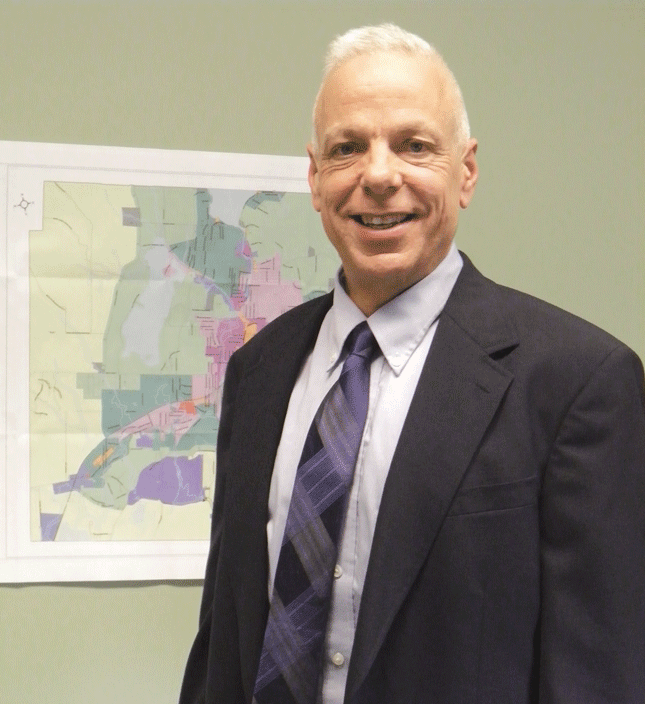
Community Development Director Douglas Clark says diversity is the key to sustained growth in Pittsfield.
“We have a lot of good things going on and are progressing nicely,” he told BusinessWest.
Douglas Clark concurred. “We want to be diverse. You have to grow on multiple fronts,” said the city’s community development director.
The Innovation Center holds real promise, and $6.5 million has already been earmarked for the project as part of the Commonwealth’s Life Sciences Bond Bill. It will be built in William Stanley Business Park, which encompasses 52 acres on the grounds of the former General Electric Pittsfield Works. The park opened in the summer of 2012 with a ribbon-cutting ceremony for its first tenant, Mountain One Financial Center, but since that time, plans for the Innovation Center have taken center stage.
Clark said the original plan called for a ‘life science center,’ but the name was changed to reflect the fact that Pittsfield has more plastic and advanced-manufacturing companies than life-science companies.
The 20,000-square-foot center will provide space for the development of new products, support services, and specialized equipment. Companies will pay a membership fee to use the facility, and will be able to lease space for first-stage commercialization.
“It will provide them with access to new, expensive equipment such as a 3-D printer. Plus, we envision support services with intellectual-property rights, patents, and a range of other things a startup might need,” Clark said. “We also hope to foster connections with one or more research universities, such as UMass or RPI [Rensselaer Polytechnic Institute], and become connected to high-speed computer service through the Mass Broadband Initiative. Our hope is that, if a company’s first-stage commercialization is successful, they might move into their own building.”
The center will contain a clean room with a controlled level of contamination, which advanced-manufacturing companies require to produce medical devices and other sensitive equipment.
However, Clark said the room will also offer educational opportunities. “Berkshire Community College could run training in the clean room and tie it into their curriculum.”
Progress has been fueled through a number of groups. Bianchi created a Life Science Task Force to develop ideas for the site, New England Expansion Strategies was hired to conduct outreach and feasibility studies, and Pittsfield Economic Development Authority (PEDA) is doing everything possible to move the project forward via loans and technical assistance. “We are not lying idle,” said the mayor.
Clark agreed. “The task force meets to discuss initiatives, including how Pittsfield can capitalize on life-science industries. They are a strategic focus of the Commonwealth, and we are hoping not to be left out of the discussion,” he said, adding that PEDA has commissioned a study of advanced manufacturing in the Berkshires.
An example of a success story is Nuclea Biotechnologies Inc., which develops and makes diagnostic tests for cancer and diabetes. It moved to Elm Street about a year ago, and recently received a $510,000 state tax incentive from the Massachusetts Life Sciences Center to develop more manufacturing in Pittsfield and create 25 jobs.
The city and PEDA have also joined forces to entice a rail-car manufacturer to the business park.
“The MBTA [Massachusetts Bay Transportation Authority] has issued a request for proposals for an $850 million contract to build railway cars for their Orange and Red Line trains,” with the stipulation that they must be assembled within the state, Clark said. “So a few weeks ago, the city put forth an offer of $1 million, and PEDA offered another $1 million incentive to try to bring a rail-car manufacturer here.”
Proposals are due in May, and any firm coming to Pittsfield will need to develop a parcel and erect a new building in the park, which could cost up to $20 million. But Clark said PEDA has a foundation suitable for construction, and the offer has led to meetings with a number of rail-car manufacturers. “It could bring 200 to 250 jobs to the city,” he added.
Potential for development also exists in Downing Industrial Park, and city officials are in discussion with a high-tech company about the former Meadwestvaco Resource building there, which has been unoccupied for years. If the company decides to settle in the city, Bianchi said, it will add about 100 scientifically oriented jobs to the area.
And although GE closed its transformer and aerospace operation in Pittsfield more than two decades ago, its presence is still evident. GE Advanced Materials, now owned by SABIC Innovative Plastics, has made Pittsfield its North American headquarters, and General Dynamics occupies many of the old GE buildings and is a major employer for the area.
Expanding Metropolis
The city’s downtown, which has undergone a transformation over the past decade, continues to evolve. Pittsfield has received $1.7 million to complete work on its main common, which Bianchi describes as “the largest, most centrally located urban block in the city,” and an additional $2 million in grants has been allocated for Phase 3 of the downtown streetscape-improvement project.
Community Development Specialist Laura Mick noted that infrastructure improvements have been ongoing since 2005, when a concerned citizens advisory committee told city officials the area needed more aesthetic appeal, better lighting, and improved pedestrian safety. “So we updated the master plan. We wanted to create a new image.”
To that end, new sidewalk treatments and LED decorative lighting have been installed; bump-outs were shortened, which makes it safer to cross the streets; and benches, bike racks, new trees, and a rain garden have combined to change the landscape.
Mick said Phase 3 of the plan, which will kick off this spring, will continue the improvements and include a bicycle lane.
The project has brought new restaurants and retail shops to the area, and Bianchi said there is not much vacant space left as developers continue to take advantage of tax credits and repurpose buildings that had sat abandoned for years.
They include the former Berkshire Bank building on 54 North St. Last month, NBT Bank opened a full-service location on the first floor, which will serve as the central location for its Berkshire County presence. Office space on the second floor has also been leased out and is being rented by attorneys. “The building is unique, and the bank fills a gap downtown,” Bianchi said.
A block away, Allegrone Construction is converting the old Goodrich House behind City Hall into about 20 market-rate apartments. That project is nearing completion, but Allegrone has plans for a similar makeover in the nearby Onota building.
In addition, Tierney Construction recently announced construction of a new boutique hotel with 43 rooms and space for meetings. It will occupy 68,000 square feet in two connected brick buildings that run from 273 to 297 North St. “Tierney will also maintain the two restaurants that are there now, and hope to get started on the hotel in 12 to 18 months,” Bianchi said.
Other efforts to promote vitality include a parking-management study commissioned by the city to ensure it is using available space wisely. “These things all work together to create a vibrant downtown,” Clark said.
Change is also occurring nearby. “We are seeing little restaurants, shops, and ethnic markets opening,” Bianchi said, adding that they offer Polish, Far Eastern, and Columbian products.
In addition, an architect hopes to put greenhouses inside the former Eagles building in the Morningside neighborhood, located a few blocks from downtown. “It would complement the farmers’ market that opened last year,” Bianchi said.
The arts community is also thriving. “Pittsfield used to be the ‘hole in the donut’ as far as the arts went, but with the Colonial and Berkshire theaters, Great Barrington Stage, the Beacon Cinema, and our First Friday Art Walks, we have filled that hole,” Clark said.
Bianchi said Barrington Stage opened a second venue about three years ago in a former Veterans of Foreign Wars hall, and the city’s newest art project, which is in the works, is a retrospective that will show how art and industry intertwined throughout Pittsfield’s history.
“The GE plant created glass bushings that were almost a crossover between art and industry,” the mayor said, citing one example. The undertaking will include televised interviews of residents who will recall the heyday of the mills.
In addition to arts and entertainment, Clark said the city offers recreation in the form of a state forest, a ski area, three golf courses, and two large lakes within city limits. But the arts overlay district and these venues are not enough to attract and retain skilled workers, so city officials are working in conjunction with other groups on workforce development.
To that end, a new vocational technical high school will be built on the grounds of Taconic High School, where enhanced programs to prepare people for careers in advanced manufacturing can be developed with partners such as Berkshire Community College.
Bianchi said the city is working with the Mass. School Building Needs Authority on the high school. DAR Associates in Waltham was selected to do the design, and it expects to have several concepts to choose from that will result in either a renovation and expansion of the existing building or a brand-new school. “The new school is integral to helping businesses grow,” the mayor said.
Moving Forward
Progress is expected to continue as people from many walks of life continue to join forces.
“We have a community that knows how to work together and really pull together for mutual purposes, and we are able to turn to the state and federal government and show them investments downtown which inspire them to invest in us,” Bianchi said. “We also have had good public and private partnerships for the last 10 years, and Mass Business Development is interested in helping us with a lot of these projects.”
Clark concurs. “Things don’t change in a linear, predictable fashion,” he said. “They spiral up or down, and right now, Pittsfield is in a good upward spiral.”
Pittsfield at a glance
Year Incorporated: 1761
Population: 44,737 (2010); 45,793 (2000)
Area: 42.5 square miles
County: Berkshire
Residential Tax Rate: 16.70
Commercial Tax Rate: 34.47
Median Household Income: $35,655
Family Household Income: $46,228
Type of government: Mayor, City Council
Largest employers: Berkshire Health Systems, General Dynamics Advanced Info Systems, SABIC Innovative Plastics
* Latest information available
The following business incorporations were recorded in Hampden, Hampshire, and Franklin counties and are the latest available. They are listed by community.
BELCHERTOWN
Krunali Inc., 134 South St., Belchertown, MA 01007. Hemant Kumar Patel, same. Recycling services.
EAST LONGMEADOW
Lingualinks International Online Inc., 117 Millbrook Dr., East Longmeadow, MA 01028. Katherine Delaney Chung, same. Internet-based program designed to teach world cultures and languages to children around the world.
GRANVILLE
Little Birch Inc., 33 South Lane, Granville, MA 01034. Susan L. Brzoska, same. Acquire, buy, own, maintain, lease, rent and sell real property.
MONSON
Metamorphosis Place Inc., 23 Munn Road, Monson, MA 01057. Judy A. Van De Geer, same. Non-profit organization designed to assist people to grow in mind, body and spirit.
NORTH ADAMS
Northern Berkshire Interfaith Action Initiative Inc., 43 Eagle St., North Adams, MA 01247. Food pantry.
NORTHAMPTON
Infusion Institute Inc., 40 Fort St., Apt. 1, Northampton, MA 01060. Dennis George Lomax, same. Non-profit organization designed exclusively for educational purposes.
Inner Imager Productions Inc., 45 Olander Dr., Northampton, MA 01060. Peter Halperin, same. Multi-media entertainment business consultants.
Lange Chiropractic Inc., 300 Pleasant St., Suite 2, Northampton, MA 01060. Kimberly A. Lange, 7 Pheasant Lane, South Hadley, MA 01075. Chiropractic office.
Laurie E. Herzog, PH.D., P.C., 155 Main St., Northampton, MA 01060. Laurie E. Herzog, 367 Prospect St., Northampton, MA 01060. Clinical social work services.
PITTSFIELD
M & T Auto Sales Inc., 376 Tyler St., Pittsfield, MA 01201. Taylor Barlett,
56 Barlett Ave., Pittsfield, MA 01201. Auto sales.
Mickle Electric Inc., 489 Dalton Ave., Pittsfield, MA 01201. Patrick W.
Mickle, 6 Park Dr., Lanesboro, MA 01237. Master electrician.
WEST SPRINGFIELD
It’s West Springfield Inc., 10 Central St., Ste 20, West Springfield, MA 01089. Roberta Page, 117 Upper Beverly Hills, West Springfield, MA 01090-0423. Non-profit organization designed to plan, encourage, support, establish and promote community activities and events.
J Shea Enterprises Inc., 95 Poplar Ave, West Springfield, MA 01089. James Shea, same. Barber shop.
JX2 Productions Inc., 80 Windsor St., Suite C, West Springfield, MA 01089. Event production services. Andrew P. Jensen, same.
Raising Hope Together Inc., 61 Upper Church St., West Springfield, MA 01089. Emil Farjo, 323 Rogers Ave., West Springfield, MA 01089. Established to provide for the needs of West Springfield residents who are affected by natural or man-made disasters.
WESTFIELD
Ray of Hope International Church, 15 Summer St., first Floor, Westfield, MA 01085-3104. Parlad Gurung, same. Church.
SPRINGFIELD
La Minita De Kelsey Inc., 84 Woodside Terrace, Springfield, MA 01108.
Eugenio Valdez, same. Grocery market.
Minot Peak Management Inc., 14 Larkspur St., Springfield, MA 01108.
Jennifer P. Metsch, same. Real estate acquisition, ownership, leasing and management.
Money Squared Inc., 97 Florence St, Apt. 2, Springfield, MA 01105. Daniel C. Becker, same. Manufacturing of digital currency.
Ramani Inc., 1534 State St., Springfield, MA 01109. Kiesha R. Edmondson, 206 Miller Way, Windsor, CT 06095. Restaurant and bar.
Rexco Inc., 1082 Page Boulevard, Springfield, MA 01104. Holly E. Ferris, same. Ownership and operation of a property.
Greenfield’s Location, Technology Aid Reinvention

Bob Pyers says developments ranging from expanded Amtrak service to new broadband infrastructure will help Greenfield grow and prosper.
“We told them you’re not going to get any traction on anything until you change your system of government,” said Pyers, now Greenfield’s economic development director, a position he’s held since Mayor William Martin unseated Greenfield’s first mayor, Christine Forgey, in a write-in campaign in 2009.
Forgey served two terms after the town applied for, and was granted, a city form of government in 2003; under her leadership and, now, with four full years under Martin’s guidance, the city’s unemployment rate has fallen from 8.3% to 6.7% — lower than both the Commonwealth and the nation, Pyers said.
“We’ve been very successful since converting from the selectman style of government to mayoral; it changed things because you have greater impact in terms of designing your business plan,” he said, noting that a mayor’s decision comes much faster than the colliding opinions of select board members and their executive council. “In the old system, it was very difficult for decisions to be made because there was always a naysayer.”
The critics are far fewer these days, Pyers continued, because the city is seeing traction in many areas, like a visible solar farm on a capped landfill and the invisible addition of underground broadband for high-speed Internet, VoIP, (voice over Internet protocol, which facilitates multi-media sessions over online networks), and future wireless Internet for businesses and residences.
“Reinventing itself” is how Martin characterizes Greenfield’s current efforts to become self-sustaining, just as it used to be just after the Civil War through its own gas and electric companies, which were sold to larger corporations in the 1930s. The mission is to now return to that efficient and environmentally sound existence.

Mayor William Martin says Greenfield’s efforts to become more self-sustaining are nothing short of a reinvention.
The reinvention of Greenfield, which is central to almost a half-million residents within a 25-mile radius, is possible, both told BusinessWest, because of the city’s best natural attribute: its location.
Greenfield has historically prospered in its Upper Pioneer Valley setting as a nexus for walking the famous Mohawk Trail — which became the well-traveled Route 2 that crosses over I-91 — and connecting with roads that lead to Boston, Springfield, Albany, and even Montreal, Martin said.
Revitalized Amtrak passenger service coming online along the Connecticut River in the next year, Pyers added, will help the city — the administrative center of Franklin County — continue to act as a net importer of diverse forms of labor, including manufacturing, retail, tourism, and public-services jobs.
“In the old-fashioned sense, Greenfield is the county seat,” Pyers explained. “We’re the center of the population and the center of all public services, as well as employment.”
For this issue’s Community Spotlight, Martin and Pyers explained how those in Greenfield are using this central location, and the transportation and new technology it supports, to spur future growth in a number of different ways.
Investing in the Future
Of Greenfield’s 9,500-strong workforce, 8,500 of those live in town, Pyers said. But a couple of years ago, the town lost a growing IT firm called HitPoint that moved to Amherst because the infrastructure it needed just wasn’t available in Greenfield. Once in Amherst, HitPoint grew from 10 employees to 35. Pyers said that isn’t going to happen in Greenfield again.
To that end, Greenfield, in partnership with the Department of Public Utilities, is in the last stages of approval to create what’s called a Municipal Aggregate Plan, providing the town with affordable high-speed Internet, broadband, and VoIP, preparing a level, high-tech playing field on which new and existing businesses can grow.
The project is being tackled in conjunction with the Massachusetts Broadband Institute (MBI), a division of the Massachusetts Technology Collaborative. Martin said the MBI has the authority to invest up to $40 million in state capital funding for broadband-related infrastructure and improvement projects. The MBI works closely with municipalities like Greenfield, broadband service providers, and other key stakeholders to create new, statewide digital opportunities. To that end, the MBI has ‘ringed’ Greenfield with seven miles of broadband, with access to about 25 large buildings, said Martin.
The three-phase effort will begin with updating the town’s current IT infrastructure; phase two will expand that hard-wired infrastructure to 25 more major businesses, and the third will benefit the public in the form of free wi-fi — downtown first, and then further outside the town center. Part of that effort involves a promising study by the Franklin County Council of Governments regarding the feasibility of a proposed Internet interconnect facility for a city-owned, 100-acre brownfield-turned-industrial park abutting I-91 — essentially a server farm and switching station for other providers.
As the city solicits private developers, Pyers said, there are two benefits: spinoff businesses that need to be located near high-speed connectivity, and the fact that the extremely expensive mechanics on the property would be privately owned — and the largest taxpayer in Greenfield.
Additionally, when Martin was elected in 2009, he immediately took advantage of the Green Communities Act of 2008, legislation that encourages investment in renewable energy. During the recession, Greenfield was able to build a revenue-generating, 17-acre solar farm on a capped landfill, and is instituting new energy upgrades for residential properties through a Community Development Block Grant (CDBG) program by working with the Department of Energy Resources. By mid-spring, the plan will allow Greenfield to purchase all the electricity for the town’s businesses and residences.
“It won’t cost the town anything, just our investment in looking for the best deal, which should be lower than any other entity, and our distributor, Western Massachusetts Electric Co., will handle house calls and billing,” Martin explained.
While a small community like Greenfield can’t influence the economy, it can prepare its infrastructure and sustainability efforts for when the national and state forecast picks up, said Pyers. “So we’re concentrating on making our investments in things that will make the cost of production in Greenfield, and for service industries, much more competitive.”
Smart Crossroads
Regardless of the industry, businesses take seriously both cost of production and availability of high-tech services, and both Martin and Pyers said several Greenfield firms will immediately benefit from the city’s investments.
They include New England Natural Bakers, producer of granola and tofu; Real Pickles, producer of naturally fermented pickles; PV2, an installer of solar farms and solar applications for business and residential use; Argotec, producer of plastic film for other manufacturers’ applications; Bete Fog Nozzle Inc., a high-precision maker of spray guns and devices used in industrial applications; and the Sandri Company, which provides a diverse combination of energy products (its leader, Tim Van Epps, was named BusinessWest’s Top Entrepreneur for 2013).
While Country Hyundai recently moved to brand-new headquarters in Northampton (see story on page 31), Dillon Chevrolet and Toyota of Greenfield have recently expanded in the west end of the city. More retail business development includes more than 200,000 square feet on the Mohawk Trail; a possible 100-acre parcel on French King Highway, targeted for manufacturing in the power-services industry; and a 40,000-square-foot expansion of an existing food-service business in town.
The renovation and expansion of the Franklin County Courthouse from 60,000 to 96,000 square feet is another bright spot, but one challenge will be to fill the 48,000-square-foot vacancy on Main Street left by the Juvenile Court when it moves to the larger courthouse, Martin added.

A new hotel above Wilson’s is an example of how Greenfield is growing in myriad ways.
Scheduled to open within the next two years, the hotel will help support a new cultural-district initiative centered around the stately, but vacant, First National Bank building right off the Town Common, and the many events that the Greenfield Business Assoc., a division of the Franklin County Chamber of Commerce, produces each year, including the three-decade-old Green River Festival on the grounds of Greenfield Community College, which attracts thousands each July.
Residents take much pride in Greenfield Community College, Martin noted, adding that, while the city is surrounded by public and private schools, the newest addition to that list is the Massachusetts Virtual Academy, or ‘MAVA @ Greenfield,’ the first of only two distance-learning schools of its kind in the state.
As part of the Commonwealth of Massachusetts Virtual School, the MAVA is a K-12 public school, similar to a charter-school model, that operates independently under a board of trustees. Its 28 certified teachers primarily teach from a remote location using the Internet, Martin explained. Now serving 500 students, MAVA has the ability to serve up to 2,500. The state has indicated that there are approximately 19,000 resident students that would want to participate who are international musicians or athletes, have health issues, or are home-schooled students requiring hybrid classes.
Meanwhile, the MAVA is joined by the new $66 million (80% reimbursed by the state) Greenfield High School, which replaces the original 1950s structure. Classrooms will open this September to 500 students, allowing for growth up to 685, he explained. The entire new school will be fully complete by September 2015, and the original structure demolished.
“We’ll now have a combination of a 1,000-seat auditorium in our new high school and a Cultural Arts District in the downtown,” Martin added. “It’s going to be another catalyst for creating and maintaining momentum in Greenfield.”
Spreading the Word
After the high-school completion, a possible consolidation of public-safety departments, the need for a new senior center, and refurbishment of other 75- to 110-year-old structures are all up for discussion. As those plans develop, the return of improved Amtrak passenger service — for trains topping 75 mph, running between New York’s Grand Central Station and Montreal — will allow more people to discover a reinvented Greenfield.
“When people come into Greenfield, they have that ‘wow, this is quite an interesting place’ type of response,” said Martin. “We’re hearing that more and more, and that spreads the word.”
While the physical changes in Greenfield include new building facades on Main Street that replaced older ones, the city’s biggest changes in the works can’t be seen because they’re either underground, in the form of broadband, or soon to be in the air, as wireless Internet.
“There’s a new vitality, and we’re moving at a different speed now,” Martin said. But while he’s always striving to create a more efficient city, Greenfield — true to its heritage as a county seat — also continues to benefit in every way from its advantageous natural setting.
“Obviously, the Mohawks, the Iroquois, the settlers, and the colonists all noticed the location,” the mayor said. “It’s location, location, location — so let’s use it.”
Greenfield at a Glance
Year Incorporated: 1753
Population: 17,456 (2010); 18,168 (2000)
Area: 21.9 square miles
County: Franklin
Residential Tax Rate: 20.72
Commercial Tax Rate: 20.72
Median Household Income: $38,219
Family Household Income: $46,412
Type of government: Mayor, City Council
Largest employers: Baystate Franklin Medical Center, Greenfield Community College, Argotec, Bete Fog Nozzle Inc.
* Latest information available
Elizabeth Taras can be reached at [email protected]
EDC Head Blair to Step Down
SPRINGFIELD — Allan Blair will retire as president and CEO of the Western Mass. Economic Development Council at the end of 2014 after 18 years at the helm of the regional economic-development agency. A search committee, headed by Peter Straley, chairman and CEO of Health New England, will seek his replacement. The EDC provides support for companies looking to locate or grow in the region, through services including real-estate searches, workforce, manufacturing supply chain, data and demographics, incentives and financing, new market opportunities, service procurement, and academic research and development opportunities. The EDC also acts as an umbrella group for other business-oriented organizations, including the Affiliated Chambers of Commerce of Greater Springfield, the Greater Springfield Convention and Visitors Bureau, the Amherst Business Improvement District, the Westfield Business Improvement District, the Northampton Business Improvement District, the Springfield Business Improvement District, the Westmass Area Development Corp. and the Westover Metropolitan Airport and Westover Metropolitan Development Corp.
DevelopSpringfield Announces Grant for Façade Improvement
SPRINGFIELD — DevelopSpringfield, a nonprofit 501(c)(3) development corporation, announced that it has awarded a $10,000 grant for façade improvements to the New England Farm Workers Council for renovations to the International Bier Garten located at 1600 Main St. The grant is made possible under the organization’s Corridor Storefront Improvement Program, which provides grants of up to $10,000 for exterior improvements to first-floor storefronts located on State and Main streets in Springfield. The recently awarded funds were used to revitalize and repair the existing façade to meet building-code and safety standards, and to comply with Springfield Historic Commission requirements. The grant is supporting more than $70,000 in improvements on the façade alone. The full project is a partnership between the New England Farm Workers Council and the Fort Restaurant and is a key component efforts toward revitalization in downtown Springfield. The project partners estimate that the project will bring more than $2 million annually in economic benefit to the community. They also hope the project will be an example of how economic revitalization can spur downtown Springfield’s renaissance and support the city’s transformation into a thriving cultural and entertainment hub for Western Mass. For more information on the Corridor Storefront Improvement Program, visit www.developspringfield.com and click on ‘programs,’ or contact Jay Minkarah, DevelopSpringfield president and CEO, at (413) 209-8808 or [email protected].
Construction Employment Declines in December
WASHINGTON, D.C. — Construction employment declined by 16,000 in December, but the industry unemployment rate fell to 11.4%, according to an analysis of new government data by the Associated General Contractors of America. Association officials noted that the new employment data was likely impacted by cold weather, but also reflects underlying weakness in the construction sector. “Given the variability of weather, especially in winter, the downturn in December is not cause for alarm,” said Ken Simonson, the association’s chief economist. “The data does show how uneven the recovery remains with residential construction doing very well, but the public sector remains weak, and private nonresidential construction is mixed.” Construction employment totaled 5,833,000 in December, an increase of 122,000 from a year earlier, Simonson noted. But while employment grew by 2.1% during the past year, construction employment remains nearly 1.9 million below the sector’s April 2006 peak. Meanwhile, the unemployment rate for workers actively looking for jobs and last employed in construction declined from 13.5% in December 2012 to 11.4% last month. Non-residential construction firms lost 22,900 new jobs in December, while residential firms added 6,200 jobs. Non-residential specialty trade contractors lost 12,900 jobs for the month, the most of any segment, while heavy and civil engineering firms — which are most likely to perform federal construction work — lost 8,800 jobs. Meanwhile, residential building contractors added the most new jobs during the past month, with 4,800. The number of unemployed construction workers dropped from 1,105,000 in December 2012 to 958,000 in December 2013, a decline of 147,000. Yet the industry added only 122,000 new jobs during the same time frame. The shrinking pool of available construction workers may be one reason so many firms report having a hard time finding qualified workers, Simonson noted. Association officials said the outlook for construction could be helped by new investments in infrastructure and other construction programs. They urged Congress to finalize Water Resources Development Act legislation to invest in ports and other waterways. They also said Congress and the Obama administration should work together to find a way to pay for needed repairs to aging roads and bridges before the current transportation legislation expires at the end of September. “If the economy continues to expand and Washington can work together to make needed infrastructure investments, firms should be able to add significantly more jobs in 2014,” said Stephen Sandherr, the association’s CEO. “But Congress and the administration need to set aside partisan differences and find a way to work together in the interest of our economy.”
Holiday Retail Sales Down in Massachusetts
BOSTON — Holiday retail sales in Massachusetts fell short of analysts’ expectations in 2013. Sales in November and December climbed just 2% from the same period in 2012, well below the 3.5% jump expected by the Retailers Assoc. of Massachusetts. There was one less weekend between Thanksgiving and Christmas, and a snowstorm on the second weekend of December further limited the amount of time shoppers spent in stores and hurt impulse buying, which account for one-third of all department-store purchases. On the national level, the National Retail Federation said total U.S. holiday sales jumped 3.8% to $601.8 billion in November and December, up from a 3.5% increase recorded in the same two months of 2012. Meanwhile, the U.S. Commerce Department said retail sales, excluding auto purchases, climbed 3.7% in December over the same month in 2012. But department-store sales fell 3.3%, compared with December 2012.
New England Economy Showing Signs of Life
WASHINGTON, D.C. — The outlook for New England is “generally positive” as the economy continues to expand modestly and most industries report better sales and improving business conditions, according to a Federal Reserve survey. The report, known as the Beige Book, found manufacturers reporting increased sales, healthcare consulting booming as the industry grapples with the Affordable Care Act, and median prices for homes rising in most of the region. However, hiring remains subdued in most industries, and wage increases remain modest at best. Nationally, the survey found moderate or modest economic growth and increased hiring in most of the country. It noted that harsh winter weather in recent weeks had a minor impact on consumer spending, which accounts for about 70% of the nation’s economic activity. Although home sales in New England were lower than a year ago, real-estate markets in the region experienced increased prices for single-family homes, according to the survey. The Fed said the small sales decline could be the result of low inventories, a pause after strong sales earlier in the year, or uncertainty among consumers following the partial government shutdown in October. But “New England realtors agree that 2013 has been a good year overall,” the report says, “and they remain optimistic about sales increases.” Commercial real-estate leasing remained steady, while construction activity increased, boosting building in health, education, life sciences, and commercial sectors. Manufacturers reported increased or steady sales, and retailers also reported solid performances.”
Berkshire Bank Awards Scholarships for Service
PITTSFIELD — Berkshire Bank has announced it will honor 30 high-school seniors in Massachusetts, New York, Connecticut, and Southern Vermont through its annual Scholarship Awards Program. The program will award $45,000 in total scholarship dollars to students who have exemplified community service through their volunteer efforts, have been successful academically, and have a demonstrated financial need. Additionally, students must attend a school that is located in a community with a Berkshire Bank office. “Berkshire Bank believes that one of life’s most exciting moments is going to college, and we want to do our part to help make it more affordable for students in need, said Lori Gazzillo, director of the Berkshire Bank Foundation. “This program exemplifies our support of education and demonstrates our commitment to the communities we serve. Our employees rally around this program by serving as reviewers of all of the applications that we receive from so many well-deserving students.” Through the program, 30 $1,500 scholarships will be awarded to high-school seniors who will be attending a two- or four-year college in the fall. Applications will be evaluated based on demonstrated volunteerism in the community and through participation in extracurricular school activities. In addition, applicants must have a GPA of at least 3.0 and a financial need (total family income under $75,000). An independent panel of bank employee volunteers will review all applications and select this year’s winners. Students can apply online at www.berkshirebank.com/scholarships. To be considered, all applications must be submitted online by March 26 at 4 p.m. For additional information, contact the Berkshire Bank Foundation at [email protected].
The following Business Certificates and Trade Names were issued or renewed during the month of and January 2014.
AGAWAM
EZ Life Ideas
37 Overlook Dr.
Newton Vezina
My Dance Pants
471 Meadow St.
Lorrie A. Rousseau
Silver Linings Home Care
159 Main St.
Tania Spear
UBU Hair Design
322 Cooper St.
Sherri Laflamme
CHICOPEE
Cosgrove Remodeling
99 Grape St.
Thomas Hodsdon
Graphics Your Way
225 Tolpa Circle
Terry L. Messier
Paquette Construction
175 Montgomery St.
David Paquette
GREENFIELD
Alliance Group
13 Cedar St.
John Michelson
Big Y Foods Inc.
237 Mohawk Trail
Michael Gold
Child at Heart Art Gallery
54 Briar Way
Paul McDonough
China Gourmet
78 Mohawk Trail
Hsien F. Chang
Community 911 Training Inc.
38 Haywood St.
Matthew Wolkendreit
Greenfield Grille
40 Federal St.
Joseph Poirier Sr.
Radical Self-Care Now
34 Glenbrook Dr.
Katherine Golub
Synergy Transportation Service
25 Park Ave.
Jason Markwell
The Lunch Box
221 Main St.
Joseph Motika
HOLYOKE
Goodfellas Barbershop
665 High St.
Ferdinand Rivera
Holyoke Heating & Air
43 Woodland St.
Ronald Theriault
Oakdale Property Services
78 Calumet Road
Jonathan Hilchey
Portal Del Cielo
285 High St.
Lillian Calvo
PALMER
Country Corner Citgo Inc.
5 Springfield St.
Peter McKearney
Dominick’s Family Restaurant
2047 Main St.
Edward Glaszcz
Historical Nipmuc Tribe
189 Breckenridge St.
Tracy Riley
Miss Trans-America Pageant
1037 Pleasant St.
Christa Hilfers
Palmer Restaurant
1376 Main St.
Elias Poupopoulos
SPRINGFIELD
Mommy’s
324 Wilbraham Road
Henry B. Ogirri
Nicoletti & Brown
15 Colfax St.
James T. Brown
Oriental Gift and More
1714 Boston Road
Chun F. Yang
Plink Plunk Play
63 Lakevilla Ave.
Rita F. Bartholomew
Ray’s Auto Repair & Towing
3 Fountain St.
Ramon L. Rivas
S & S Renovation
127 Balfour Dr.
Stephanie L. Goggin
Serenev Affordable Tax
67 Suffolk St.
Angella D. Martin
Superior Home Health
83 Hazen St.
Shari Anglin
The Sports Shack
152 Main St.
Sandra A. Babbie
Tower Convenience Store
10 Chestnut St.
Zahid Farooqui
Tranquility Day Spa & Salon
1655 Boston Road
Charles Tran
Universal Caulking
42 Kimberly Ave.
Anthony M. Dewdney
Westside Pizza
1291 Boston Road
Vedat Kan
Wheeler’s Convenience
597 Dickinson St.
Faiz Rabbani
WESTFIELD
Aura Nails and Spa
261 East Main St.
Youngran Chang
Boss’ Business
19 Parkside Ave.
Petro M. Makarchuk
Dorsey Installations
25 State St.
Anthony Dorsey
Elite Tanning by Jennifer Amy Inc.
16 Union Ave.
Jennifer A. Pasterkiewicz
Florek Family Farm
840 Granville Road
Christopher J. Florek
Hickory Hill Farm
325 Montgomery Road
Dennis L. Bishop
Max Sound
50 Pleasant St.
Maxim Cravet
Vivid Hair Salon & Spa
99 Elm St.
Basia Belz
WEST SPRINGFIELD
Belar US
105 River St.
Michael Vasilyev
Metal Craft Manufacturing
54 Myron St.
Peter Urbanek
Morales Flooring
309 Park St.
Enis E. Morales
Music Sound
20 Labelle St.
Mikala Filistovich
Pizza Hut
1048 Riverdale St.
Pizza Hut of America
Promoter
38 Humphrey Lane
Aleksander Vasilyev
Rainbow Accessories
39 Rochelle St.
Sara Arshad
Ram Sia, LLC
1500 Riverdale St.
Dilip Rana
Superior Painting & Renovation
64 Prince Ave.
Sean Kearney
Trend Sound Promoter
457 Union St.
Mykhaylo Onulyak
Vilo
116 Almon Ave.
Vitali Loban

REB’s New Director Wants to Build on Recent Momentum

Dave Cruise says one of his priorities is to continue the employment board’s tradition of innovation in tackling regional workforce-development issues.
Dave Cruise’s desk — or, more specifically, what sits on it — speaks volumes about his work with the Regional Employment Board of Hampden County, and also his work ethic and his passion for putting other people to work.
Sitting in one corner are a few “toys,” as he calls them, including a plastic device (a tracheal tube of sorts once made by Mitchell Machine in Springfield), as a well as a small plastic castle tower, complete with an interior staircase, that are there as reminders of the many different types of products made in this region and of the high degree of precision involved with such work.
There’s also his personal pair of safety goggles, given to him by officials at Hoppe Technologies in Chicopee, which have been put to great use over the years as Cruise has carried out his assignment as project director of the REB’s Precision Manufacturing Regional Alliance Project, as well as a pair of earplugs, which haven’t been used much at all, by his recollection, because he likes to listen.
And then, there’s the paperwork.
It covers all but a few square inches of desk, credenza, and connecting leaf that is home to his computer monitor. It has become the stuff of legend in this agency, and Cruise can readily joke about it.
“People who know me would say my desk actually looks pretty clean today,” he said with a laugh as he talked with BusinessWest on the last day of 2013. “It may look cluttered, but it’s organized; I know where everything is, trust me.”
Hopefully he can say the same thing in a few weeks after he moves everything next door, to the much larger office assigned to the REB’s president, a post he officially assumed late in the afternoon on Jan. 2 as Bill Ward closed the book on a more-than-30-year stint at the helm of the agency.
Cruise’s new desk will likely become even more cluttered than the old one because there is much work to do in the weeks and months ahead — and for the time being, he won’t be naming a new project director of the Precision Manufacturing Regional Alliance Project.
“I’m going to be very careful about what our budget looks like moving forward into FY 15 so that we have the resources to be able to do what we need to do here. Before I add staff, I want to make sure we can sustain that staff,” he explained, adding that, while he’ll be keeping some of his former responsibilities with that program, he’ll also be parceling others out to different staff members.
In the meantime, he will also be leading the work to draft a new strategic plan for the REB. The previous, three-year document sunsetted at the end of the year, he explained, adding that, under normal circumstances, a new one would certainly have been in place by now, but the search for a new director — and Ward’s insistence that his successor be involved with writing a new plan — changed the timetable.
Cruise will bring to his new position a wide range of experience in workforce development and education, including a lengthy stint as director of the Mass. Career Development Institute (MCDI) and a host of assignments with Springfield Public Schools, as well as some specific skills and management techniques he’s developed over a 45-year career.
“My training has always been in workforce development, so I feel very comfortable moving from what I would describe as a sectoral initiative in manufacturing to seeing that sectoral initiative as part of the REB’s broader mission around workforce development and job creation,” he explained. “I’m excited about the opportunity to come into this work; I believe I can add some value to work we’re doing here. Bill has been a pioneer, and I hope to build on what’s been accomplished. The platform is there, and my role is to come here and move that work to the next level.”
For this issue and its focus on employment, BusinessWest talked at length with Cruise about his new assignment and also about the many challenges facing both employers and those looking to join the workforce.
Moving the Pile
Cruise said that he was not initially a candidate for the president’s position when Ward officially announced he would be stepping down early last summer, primarily because he considered much of the work he was doing with the region’s manufacturing sector to be unfinished business. And he wanted to finish it, or at least stay with it.
But things changed as the search commenced, reached a point last fall where a few finalists were interviewed, and was then expanded, he explained.
“I had given it some thought during the initial process last summer, but didn’t get engaged at that point,” he explained. “I continued to give it some thought both personally and professionally when the process was expanded. I sat down with my family and talked about the work ahead, and decided to become an applicant.
“I was very much involved in the work I’m doing in manufacturing, and I’m very committed to that assignment,” he went on. “I realized that, going forward, that work is part of a broader body of work being done here at the Regional Employment Board, and that I could probably bring that work to the level that I wanted to by being in a position to influence, manage, and direct the work from a different perspective and bring some different resources to it.”
Thus, Cruise will add another line to a diverse résumé with a number of stops, all involved, in one way or another, with the broad ream of workforce development.
He started in 1967 at Springfield’s Roger L. Putnam Vocational Technical High School, where he taught English until 1973, before moving to MCDI.
He first served as supervisor, overseeing training programs for unemployed adults and youth, while also analyzing labor-market trends and assessing needs within specific sectors of the economy. He was named director in 1980 and managed the now-closed agency through one of the busiest periods in its history, managing a staff of more than 150 and training up to 550 people in day and evening division programs.
From MCDI, he moved on to Springfield Public Schools, where he served as director of Occupational Education, director of personnel, chief operations officer, and finally executive director of Human Resources.
He then worked briefly as a consultant before being tapped by Ward to be program manager of the Literacy Works of Hampden County initiative from 2004 to 2006, and then the Precision Manufacturing Regional Alliance Project.
Over the past seven years, Cruise has been putting those goggles, if not the earplugs, to good use, visiting area precision manufacturers, assessing their needs, and developing programs to put more workers in the pipeline. Among the many initiatives that have occupied his time — and space on his desk — have been efforts to introduce young people to the manufacturing sector and convince both them and their parents that it is a field with a future, not just a glorious past.
One of the more recent endeavors, launched just last fall, is a pilot program called Pathways to Prosperity in Advanced Manufacturing, or simply ‘Pathways,’ which puts ninth-grade students at West Springfield High School on a career pathway that will eventually take them to Springfield Technical Community College and then, hopefully, employment with one of the many manufacturers desperate for qualified help.
The program, which started with 40 students, involves a number of partners, ranging from the REB, STCC, and the high school to several employers in West Side and Agawam (among them Advance Welding, Hayden Corp., Ben Franklin Design & Manufacturing, and Atlantic Fasteners), as well as the Eastern States Exposition, NUVO Bank, and the Bates Fullum Insurance Agency.
Cruise counts the ability to create and sustain such partnerships as one of his greatest strengths, and he said it’s one of many skill sets he will need as he goes about the task of guiding the REB as it carries out a rather broad mission.
Overall, he views his primary job description to be both innovator and facilitator when it comes to the REB’s many initiatives.
“We have a very talented group of people here. They work very hard, and they’re very dedicated to the mission of the REB,” he told BusinessWest. “They understand the vision, the values, and the purpose of the organization. My job is to be a resource to them and provide them with the tools they need to take their work to the next level.
“My goal is to strive toward operational excellence,” he went on. “I’m very committed to making sure that we do quality work that will respond to the business needs of the companies in the area, but that we also keep focused on our commitment to the customers, the clients that we’re here to serve.”
Parts of the Whole
Cruise expects a new strategic plan to be ready for the REB’s quarterly meeting in March, if not sooner. When asked about what will likely be in it, he said it will continue to focus on the many aspects of the REB’s mission and priorities such as youth, literacy, education, and especially innovation.
That last term essentially defined Ward’s lengthy tenure as REB president, he went on, and the agency must continue to exude that quality if it is to meet the region’s many workforce challenges — and secure the public and private funds that will be needed to carry out those assignments.
“I’m committed to the notion of innovative ideas,” Cruise explained, adding that this is an important companion piece to one of the REB’s primary assignments — collecting workforce data. “It’s going to be very important to look at some of the work being done by the REB that I believe is innovative and seeing how we can scale that work up, not only across the region but perhaps across the state.”
Moving forward, he said there are several priorities for the REB that are both part of its mission and key elements for the new strategic plan. They include:
• Identifying new public and private funding sources, or, more specifically, combinations of both for various initiatives;
• Continuing and escalating programs involving literacy and, overall, the education and employability of adults;
• A focus on young people and making sure they have what Cruise called the “employability skills necessary in the 21st century,” work that involves everything from early childhood education to programs like Pathways;
• Work to deepen and broaden relationships with area businesses and industry groups; and
• Being an advocate for workforce development as economic development, or, as Cruise put it, “telling our story.”
Elaborating, he said that all of these concepts, or strategic initiatives, are interrelated, and as an example, he said that workforce-development-related agencies (like the REB) that have good data as well as innovative ideas about what to do in response to that information, and work aggressively to tell their stories, are better-positioned to secure funding for such initiatives.
“It’s going to be those organizations and those agencies that have good data, have good strategic plans, have a clear mission, and then have the talent to pull it off, that are going to be able to get funding moving forward,” he explained. “I’m very committed to operational excellence here at the REB; I want to make sure that we’re doing quality work and that our work defines us, because I believe that if we can make that case and share it with people, especially with this notion of innovation and innovative ideas, that money will follow.
“I don’t think you can go out today and simply make an ask,” he continued, referring to requests for state and federal funds that are in shorter supply than years ago, as well as private money from businesses and foundations. “You simply need to demonstrate that you can add value to what that ask is all about.”
As for that goal of deepening and broadening relationships with industry groups and specific businesses, Cruise said this assignment involves both telling the REB’s story and, more importantly, listening to what those in various sectors are saying about what they’re seeing today — and expect to see tomorrow.
“I want to deepen those relationships, but I also want to engage more business and industry in different sectors in the work we’re doing,” he said. “I’m going to try to spend a reasonable amount of time out in the community. I want to go out and listen and learn; I want to see how people who are familiar with our work perceive us, and for people who are not familiar with the work we do, I want to build a relationship and a partnership with them.”
Work in Progress
When asked about the particular strengths he believes he brings to the table, Cruise put “relationship building and partnership building” at the very top of the list.
“I’m a good listener, and I believe in convening and facilitating,” he said, adding that these are qualities that will serve him well as he goes about the task of not only continuing to carry out the REB’s broad mission, but also building a tradition of innovation.
He said he has the commitment — and the desk space — to carry out his new assignment.
George O’Brien can be reached at [email protected]
SBA Stakes Out Strategies to Help Women-owned Businesses Grow
By KAREN GORDON MILLS
Today, women-owned businesses are the fastest-growing segment of new businesses in our economy.
In fact, an analysis by American Express suggests that the number of women-owned businesses has risen by 200,000 over the past year alone, which is equivalent to just under 550 new women-owned firms created each day.
Regardless of how you slice the data, we know that this trend is growing and that women are over-indexing in entrepreneurship.
As administrator of the U.S. Small Business Administration (SBA), I’ve traveled all around the country meeting with small-business owners and entrepreneurs. I see how their businesses are transforming their industries and rebuilding their communities following the economic downturn.
These are businesses like UEC Electronics in South Carolina. Rebecca Ufkes, an engineer and the company’s president, is laser-focused on growing her successful electronics manufacturing business. She is supplying products to major manufacturers, such as Boeing, Cummins Engine Co, as well as the U.S. Marines and Air Force. And she is creating good American manufacturing jobs in the process.
UEC employs 194 workers, an increase of 49% since August 2011. And Rebecca is part of a growing American supply chain of innovative small businesses that is driving large, multi-national manufacturers to bring more production back to the U.S.
However, today, many women-owned entrepreneurs face what we call the ‘missing middle.’
For example, take my home state of Maine. According to the most recent census data, men owned 54% of businesses in Maine, and women owned 26% of businesses in the state (the remainder were co-owned). However, when you look at the receipts of these businesses, women-owned businesses lagged behind, capturing only 7% of receipts, compared to 78% of receipts earned by male-owned firms. A similar trend is occurring in states across the country.
Clearly, women-owned firms are growing greater in numbers, but challenges persist in scaling their operations and garnering market share.
At the SBA, we have the proven tools needed to bridge that missing middle, and to ensure that all entrepreneurs have the tools they need to grow their businesses, reach new markets, and realize their full potential. These include:
• Access to capital. According to the Urban Institute, SBA loans are three to five times more likely to go to women- and minority-owned businesses than conventional loans. And since President Obama took office, SBA has supported more than $12 billion in lending through more than 35,000 SBA loans to women-owned businesses.
• Contracting. At the SBA, one of our priorities is making sure that more qualified women-, veteran-, and minority-owned small businesses have access to government and commercial supply-chain opportunities. That’s why we put into place the Women’s Contracting Rule, which means that, for the first time, federal agencies can set aside contracting opportunities for women-owned small businesses in more than 300 industries where women are underrepresented. Congress gave SBA this authority in 2000, but it was never implemented. Under President Obama’s leadership, we have made it a priority — and have gotten it done. And recently, we expanded the limits to ensure that women-owned businesses are eligible for larger government contracts.
• Counseling. Our Office of Women’s Business Ownership oversees a national network of 106 Women’s Business Centers (WBCs) that support women who want to start or grow their business. We’re connecting with more women every day, and, in FY 2012 alone, we counseled and trained more than 136,000 women entrepreneurs.
We are committed to helping women entrepreneurs because we know how much potential they have to contribute to America’s economic growth. n
Karen Gordon Mills is a former administrator of the U.S. Small Business Administration. This article first appeared on the SBA’s community blog;
www.sba.gov
Send photos with a caption and contact information to: ‘Picture This’ c/o BusinessWest Magazine, 1441 Main Street, Springfield, MA 01103 or to [email protected]
Heartfelt Check
 Holyoke HealthCare Center, a member of National HealthCare (NHC), and its philanthropic arm, the Foundation for Geriatric Education (TFGE), recently presented a check for $4,810 to Holyoke Medical Center to cover the cost a five-day ‘boot camp’ for participants who have been recently diagnosed with congestive heart failure (CHF). Large-number bathroom scales can now be purchased for those with CHF to weigh themselves everyday, an important part of the self-management process. The camp is offered through the multi-agency ‘cross-continuum team’ consisting of Holyoke Medical Center, Holyoke HealthCare Center, the Care Center, Holyoke Visiting Nurse Assoc., and Renaissance Manor. Pictured, from left, are HMC President and CEO Spiros Hatiras, HMC Education and Training Manager Carlene Bailey, HHCC Director of Nursing Mary Walas, HMC STAAR Program Manager Cherelyn Roberts, and HHCC Administrator Thomas Accomando.
OnCore Performance
 Employees of Springfield-based OnCore Manufacturing donated gift bags and boxes filled with items to complete the wish lists of 30 elementary-school-aged children served through Square One’s after-school programs. OnCore, a provider of product- commercialization services to international blue-chip aerospace and defense, industrial, and medical companies, is a partner with Square One, a nonprofit that provides low-cost education and care programs, along with transportation, to encourage and support local children who will be the leaders of the future. Pictured, from left, are OnCore employees Nancy McDonough, Anne DeCillis, and Heather Ferreira.
State Touts Benefits of Energy-efficiency Projects
BOSTON — State Energy and Environmental Affairs (EEA) Secretary Rick Sullivan recently announced that energy-efficiency improvements by homeowners, businesses, and government agencies across the Commonwealth from 2010 through 2012 resulted in significant electric and natural-gas savings, as well as reductions in greenhouse-gas emissions. In total, the Commonwealth’s three-year statewide energy-efficiency plans delivered 2,390 gigawatt hours, 49 million therms, and nearly 1.4 million metric tons of energy savings and greenhouse-gas reductions. These reductions are equivalent to the annual electricity consumption of more than 314,000 homes, the natural-gas usage of 52,000 homes, and, in terms of greenhouse-gas reduction, the equivalent of taking nearly 290,000 cars off the road. The plans were authorized by the Green Communities Act of 2008 (GCA) and approved by the Department of Public Utilities in January 2010. “This year’s report shows that more than 14,000 small businesses and 6,000 large businesses engaged in energy-efficiency efforts in 2012, proving once again that efficiency is a win-win with economic and environmental benefits alike,” said Sullivan. “By implementing these three-year plans, the Patrick administration is reducing greenhouse-gas emissions, cutting energy use, and creating jobs.” Under the three-year plan, Massachusetts committed to one of the most ambitious energy-efficiency efforts in the nation, investing more in energy efficiency per capita than any other state. The 2013-15 plans, underway now, are equally ambitious, projected to deliver nearly $9 billion in benefits from an investment of $2.2 billion. The electric savings are projected to reduce retail sales of electricity by 2.6% in 2015. These results are significant enough to be included in long-term load forecasting by the Independent System Operator New England (ISO-NE), the organization responsible for determining New England’s grid reliability. “Massachusetts’ energy-efficiency programs are delivering nation-leading economic and environmental benefits to residents and businesses throughout the Commonwealth,” said Department of Energy Resources Commissioner Mark Sylvia. “I thank the EEAC members, the utilities, and energy-efficiency service providers that deliver the Mass Save programs for continuing to push the envelope in making energy efficiency our first fuel.” The Global Warming Solutions Act, signed by Gov. Deval Patrick in 2008, made the Clean Energy and Climate Plan for 2020 a requirement. The plan mandates a gradual greenhouse-gas emissions reduction and a scheduling of emissions goals that is designed to spur innovation and promote research and development in the clean-energy industry. The Commonwealth has set a 2020 reduction target of 25% below 1990 levels, and has released a plan outlining a portfolio of policies and programs to meet the goal. This year, Patrick set a new solar goal after reaching the previous goal of 250 megawatts four years early. The Commonwealth now aims to install 1,600 megawatts of solar capacity by 2020. The clean-energy revolution is yielding economic benefits as well, with 11.8% job growth in the last year and 24% growth in the last two years; nearly 80,000 people are employed in the clean tech industry in Massachusetts.
Construction Spending Increases as Private-sector Demand Grows
WASHINGTON, D.C. — Total construction spending increased between October and November, and for the year, amid growing private-sector demand, according to an analysis of new Census Bureau data by Associated General Contractors of America. Association officials noted, however, that the spending levels were held back by declining public-sector investments for both the month and the year. “The non-residential construction spending figures are even more positive than they appear, with most categories now positive year over year,” said Ken Simonson, the association’s chief economist. “The outlook appears favorable for many types of private non-residential and multi-family construction, but remains flat or negative for public spending.” Construction put in place totaled $934 billion in November, rising 1.0% since October and 5.9% since November 2012. Private residential construction spending increased by 1.9% in November and jumped 17% from a year earlier. Private non-residential spending climbed 2.7% for the month and 1.0% year over year. Public construction spending dropped 1.8% for the month and 0.2% over 12 months. Over the past 12 months, the biggest jump in construction spending has occurred in new multi-family construction, which rose 0.9% for the month and 36% year over year. The lodging sector recorded the second-highest annual gain, with spending rising 32.7% for the year and 0.3% for the month. Spending on communications facilities experienced the largest monthly increase, jumping 11.2% in November, although it is still down 10.5% for the year. The largest private non-residential category, power construction — which includes oil and gas field and pipeline projects as well as power plants, renewable power, and transmission lines — increased by 3.3% in November but is actually down 24.2% for the year. Simonson noted, however, that there was a surge in power construction during the last quarter of 2012 as contractors rushed to finish wind projects before the expected expiration of the wind-production tax credit at the end of 2012. Those credits were extended for projects that broke ground by the end of 2013, explaining the more recent surge. “Both the electricity and oil and gas components of power construction should do well in 2014,” he added.
MMS, AMA Oppose E-cigarettes for Youth
WALTHAM — A resolution on electronic cigarettes led the list of the policies adopted by physicians of the Mass. Medical Society (MMS) at its interim meeting held last month. The interim meeting brings together hundreds of Massachusetts physicians from across the state to consider specific resolutions on public-health policy, healthcare delivery, and organizational administration by the society’s House of Delegates, its policy-making body. Resolutions adopted by the delegates become policies of the organization. Delegates voted for a resolution stating that the MMS opposes the marketing, sales, and use of e-cigarettes and other nicotine-delivery products among youth, particularly for people under the age of 18, and urging the MMS top keep working with state lawmakers and officials to develop strategies to prevent the marketing, sale, and use of those products for individuals within that age group. In voting for the policy, MMS noted that the use of electronic cigarettes by U.S. middle- and high-school students (grades 6-12) more than doubled from 3.3% in 2011 to 6.8% in 2012, according to the U.S. Centers for Disease Control. The society also expressed concern that the nicotine-containing vapor generated from the battery-powered e-cigarettes is often flavored, which can make them more appealing to young people, and that the use of e-cigarettes has the potential negative impact of nicotine on adolescent brain development and may encourage young non-smokers to become users of conventional cigarettes or other tobacco products. The statement coincides with the American Medical Society’s similar concern over e-cigarettes. At the recent interim meeting of its own House of Delegates, the AMA adopted policy advocating for the U.S. Food and Drug Administration (FDA) to extend its tobacco regulations to include all non-pharmaceutical tobacco and nicotine products, including e-cigarettes, pipes, cigars, and hookahs. The AMA said FDA oversight of these products is necessary in order to ensure safety and proper labeling, and to deter adulteration and the sale of tobacco products to minors. The AMA’s existing policy on e-cigarettes from 2010 recommends that they be classified as drug-delivery devices, subject to the same FDA regulations as all other drug-delivery devices, and supports prohibiting the sale of e-cigarettes that are not FDA-approved. “This policy recommendation for FDA could help ensure that e-cigarettes and other tobacco products have proper oversight and regulation to limit the detrimental health consequences that come from these products,” said AMA board member Dr. Albert Osbahr III. “Very little data exists on the safety of these tobacco and nicotine products, and the FDA has warned that they are potentially addicting and contain harmful toxins.”
Massachusetts Adds 6,500 Jobs in November
BOSTON — The Executive Office of Labor and Workforce Development reported that the Bureau of Labor Statistics’ (BLS) preliminary estimates show that Massachusetts added 6,500 jobs in November, and the total unemployment rate was 7.15%. Over the year, the unemployment rate was up 0.4% from the November 2012 rate of 6.7%. The private sector added 4,900 jobs in November, particularly in professional, scientific, and business services; manufacturing; financial activities; education and health services; information; and construction. Since December 2012, Massachusetts has gained 46,600 jobs. Over the year, from November 2012 to November 2013, Massachusetts added 55,300 jobs in total, 53,800 of which were in the private sector. Revised BLS estimates show that 9,400 jobs were added in October. The unemployment rate is based on a monthly sample of households. Job estimates are derived from a monthly sample survey of employers.
A Stern Challenge for the Region
If it seems like you’re spending more of your time reading about people retiring or going to functions where the guest of honor leaves the room with a rocking chair, gold watch, or gift certificate for a cruise, it is most definitely not your imagination.
Instead, it’s more evidence of a demographic phenomenon, one that reflects the size and influence of the Baby Boom generation.
Indeed, all that talk years ago about how this generation was going to start retiring — and in big numbers — is no longer talk. It’s reality.
And while this inevitable consequence of the passage of time is good for the people who handle IRAs, make watches and rocking chairs, host retirement parties, and operate cruise lines, it poses a huge challenge for this region as a whole and specific business sectors as well.
In just the past 12 to 18 months, this region has seen the retirement of several chamber of commerce directors, nonprofit managers (Gary McCarthy at the Springfield Boys & Girls Club is just one example), economic-development leaders (Bill Ward at the Regional Employment Board of Hampden County tops that list), and healthcare executives — Carol Katz, longtime director of Loomis Communities, retired in 2012, Holyoke Medical Center CEO Hank Porten stepped down earlier this year, and Mark Tolosky, president and CEO of Baystate Health; Peter Straley, president and CEO of Health New England; and Craig Melin, president and CEO of Cooley Dickinson Hospital, will leave their jobs in 2014.
And there have been countless people whose exploits didn’t make the pages of BusinessWest who have also moved on to that proverbial next stage of their lives, with tens of thousands more to do so in the next several years.
The challenge is obvious: these people must be replaced.
And while it would seem that this wouldn’t be a problem with a statewide unemployment rate of roughly 7% and a number closer to 10% in major urban areas in this region, the reality is that many of those who are unemployed simply do not have the skills to move into these positions.
This is especially true in sectors such as precision manufacturing and healthcare, where employers have openings — hundreds and perhaps thousands of them — that they cannot fill because of that skills gap that we keep reading about. Like those aforementioned retirements, that gap is real, not your imagination.
And while there will always be people who can step into the shoes of leaders like Ward, Lee, Tolosky, Melin, and Straley, it is fair to ask if those who will occupy their offices and those of executives across the region possess the leadership skills that enabled their successors to be so successful.
So, moving forward, this region has to continue its efforts to address this demographic challenge — which is no longer looming, but actually here — and accelerate and intensify them.
Programs like Leadership Pioneer Valley, created at the encouragement of the Pioneer Valley Planning Commission with all these retirements in mind, must continue to educate area young people about this region and its strengths, weaknesses, and challenges, and prepare them to be the leaders of tomorrow.
Meanwhile, people like David Cruise, who will have the unenviable task of succeeding Ward at the REB, must work in collaboration with local employers, area colleges and universities, and other economic-development agencies to close that skills gap. If they don’t, employers will be increasingly challenged to find that most important ingredient in any business success story: talent.
In reality, it is mostly the very oldest of the Baby Boomers (and those who belong to the generation before it) who are retiring these days. The huge bubble is still to come, and it may be delayed somewhat by the need for many members of this generation to work longer to secure a comfortable retirement.
But while there is still time to address this challenge, that time is running out.
The following Business Certificates and Trade Names were issued or renewed during the month of December 2013.
AGAWAM
A & B Properties
134 Tobacco Farm Road
Alan Betournay
Air Duct Cleaning
31 St. Jacques Ave.
Eric Vieu
DD Appliances & More
766 Springfield St.
David Roman
Prime Construction
1004 North St.
Vladislav Vorobel
Sullivan Consulting
94 Dogwood Lane
Michael Sullivan
Tech Bootcamps
503 Silver St.
Tatiana DiDonato
CHICOPEE
Cordero Digital Consulting
91 Providence St.
Felix Cordero
Flowers by Andre
24 Billings St.
Andre Palatino
Jess Daycare
165 Szetela Dr.
Jessica Thornton
Music Sound
57 Larchmont St.
Natalya Arbuzov
Tree of Life Journeys
188 Chicopee St.
Kathi Munson
EAST LONGMEADOW
Advanced Urology of New England
40 Crane Ave.
Jacqueline Brecht
All Hose Inc.
341 Shaker Rd.
Timothy J. McCoy
Baystate Rug Distributors Inc.
55 North Main St.
Joseph Montemagni
Danny’s PC Repair
624 North Main St.
Minh Vien
Erin Chrusciel Photography
28 Country Club Dr.
Erin Chrusciel
Logo Effect
21 Redstone Dr.
Bonnie Pellerin
Nail Party
628 North Main St.
Jong K. Lee
The Ideal Way
280 North Main St.
Dierdre Pizzoferrato
Shosana P. Fitness
576 North Main St.
Shoshana Porter
The Spa of Eden Skin & Body
51 Prospect St.
Yelena Ivanov
Toner Plastics Inc.
35 Industrial Dr.
Steven Graham
HOLYOKE
Holyoke Works
100 Front St.
Larry Bay
Plumtree Products
48 Jefferson St.
Amy V. Meo
Tutti Frutti Frozen Yogurt
50 Holyoke St.
Huot Ang
LUDLOW
Nutritional Services Consulting
54 Owens Way
Lynn Moylan
Palatino Auto & Truck Repair
110 Moody St.
Adelino Palatino
Roberts Auto Body
119 Carmelino Circle
Miroslaw Kopec
NORTHAMPTON
Finding Earth Works
29 Columbus Ave.
Alexandra Schroeder
Haven Body Arts, LLC
108 Main St.
Penelope Silverstein
Ken Hobby Design Build
95 South St.
Ken Hobbs
Main Street Haircuts
17 Main St.
Jessy Kaminski
Ninth Amulet
225 Elm St.
Elizabeth Beller
Sunnyside Childcare
557 Easthampton Road
Shelley Hinderbaker
PALMER
Motyka Funeral Home
2186 Main St.
George Motyka
Tang’s Chinese Restaurant
1581 North Main St.
Xiu Z. Chi
The Turtle Pond Tavern
349 Wilbraham St.
Karl Benware
Tricia’s Techniques
1461 North Main St.
Patricia Woffenden
SOUTHWICK
D & S Manufacturing
10 Hudson Dr.
Richard Sosnowich
Mark’s Property Services
45 Hillside Road
Mark Kuchachik
SPRINGFIELD
A & S Convenience Store
276 Oakland St.
Muhmmad Ashraf
ABA General Contracting
251 Senator St.
Olga Jagiello
Baystate Health System
345 Page Blvd.
Dennis Chalke
Centro de Nutricion
181 Chestnut St.
Clemente Orlando
China Bo Express
762 Boston Road
Tok Chang
Concentra
140 Carando Dr.
Baystate, LLC
Energizing N’ Touch Massage
529 Main St.
Hermenia Grayson
ETL’s Pharaohs Realm
691 State St.
Eddie T. Long
Family Pawn
461 Main St.
Hai D. Duong
Gordo Wireless World
856 Main St.
Maringel Benitez
Jay’s Nest, LLC
884 Sumner Ave.
Janette Ortiz
WESTFIELD
A Dream Come True Learning Centers
1029 North Road
Monica Crimmins
Avery Bats
77 Mill St.
Matthew Avery
Berkshire Product Group, LLC
16 Union Ave.
Scott Renius
Sisters Canvas & Custom Sewing
24 Elm St.
Kelly B. Houlihan
Trend Sound Promoter
176 Springdale Road
Lidia A. Grusetchi
WEST SPRINGFIELD
Dante Club Inc.
1198 Memorial Ave.
Harry Willey
Friendly’s
1094 Riverdale St.
Shanna Rhoades
Healthtrax Fitness
155 Ashley Ave.
Marina Lebo
Integrated Marketing
117 Upper Beverly Hills
Page One Productions
K and C Associates, LLC
92 Cataumet Lane
Catherine R. Hedges
Keuco Group of Bernardston
1299 Riverdale St.
Kevin Pernice
Paint Nite Springfield
93 Bonair Ave.
Christina Udas
River Inn Motel
55 Main St.
Ohm Namoshiray
Sibley Property Services
101 Sibley Ave.
John Alexander
U-Haul Company of Mass
380 Union St.
Emma Gilsdorf
Wicked Salon
338 Westfield St.
Michaela M. Murray
Worldwide Staffing
425 Union St.
KWLS Inc.
Yolanda Landscaping
596 Main St.
Maria Rodriguez
The following business incorporations were recorded in Hampden, Hampshire, and Franklin counties and are the latest available. They are listed by community.
EAST LONGMEADOW
Verendus Holdings Inc., 444A North Main St., Suite 234, East Longmeadow, MA 01028. Dominic Kirchner II, same. Management and consulting.
FEEDING HILLS
Rick’s Pools Inc., 507 Springfield St., Feeding Hills, MA 01030. Robert Fleming, 418 Wilbraham Street, Palmer, MA 01069. Swimming pool maintenance and repair.
The JW Academy High School Inc., 404 Barry St., Feeding Hills, MA 01030. Trina Linette Davis, same. Charitable, religious, educational, and scientific purposes.
NORTHAMPTON
Citysprout Inc., 136 West St., Suite 102B, Northampton, MA 01060. William J. Trienens, same. Connecting consumers through web and mobile social commerce platforms.
Florence Medical Uniforms Inc., 64 Gothic Suite 8, Northampton, MA 01060. Christopher Gentili MR, 51 Edencrest Dr., Cranston, CT 02920. Retail sales of medical uniforms and accessories.
PITTSFIELD
Financial Accounting Services Inc., One Pheasant Way, Pittsfield, MA 01201-9123. T. Neal Burton II, same. Accounting service for small businesses.
SOUTHAMPTON
Classic Burgers Inc., 114 White Loaf Road, Southampton, MA 01077. Barry G. Parker, same. Restaurant.
Laurin Builders Inc., 317 College Highway, Southampton, MA 01073. Ronald D. Laurin, same. Construction.
SPRINGFIELD
Conde Tech Systems Inc., 58 Edwards St., Suite #402, Springfield, MA 01105. C. Whitaker Battle, same. SIP manufacturing.
Mi Pais Restaurant Corporation, 344 Bay St., Springfield, MA 01109. Juan Carmelo Rodriguez, 95 Beaumont St., Springfield, MA 01109. Restaurant and take out.
Springfield Bone & Joint, P.C., 299 Carew St., Suite 305, Springfield, MA 01104. Michael J. Craig, same. Professional services specializing in orthopedics surgery and medicine.
WEST SPRINGFIELD
West Springfield Veterans Council Inc., 63 Morton St., West Springfield, MA 01089. Jose Irizarry, 182 Greystone Ave., West Springfield, MA 01089. To promote the welfare of honorably discharged members of the US military services.
WESTFIELD
Westfield-West Springfield Lodge of Elks Inc. #1481, 56 Franklin St., Westfield, MA 01085. Christopher J. Chistolini, 48 Colony Circle, Westfield, MA 01085. Non-profit fraternal organization.
The following building permits were issued during the month of December 2013.
CHICOPEE
D & D Chicopee Realty
49 Highland Ave.
$10,500 — Remodel second floor
Default Service Inc.
46 McKinstry Ave.
$8,000 — Strip and re-roof
Pioneer Valley Condo Association
63 Colonial Circle
$25,000 — New roof
Primo Electric
711 East Main St.
$25,000 — Create office space
PALMER
Development Associates
21 Third St.
$10,000 — Foundation only for addition to manufacturing plant
SOUTH HADLEY
Cumberland Farms
507 Newton St.
$2,000 — Exterior renovations
SPRINGFIELD
3640 Main St., LLC
3640 Main St.
$63,000 — Build out for new office
Baystate Medical
298 Carew St.
$274,000 — Fit out space for pharmacy
Pearson Development Co.
1322 Liberty St.
$35,000 — New roof
Performing Arts Center
1000 State St.
$93,000 — Interior renovations
Smith and Wesson
2100 Roosevelt Ave.
$318,000 — Create a new testing room
WEST SPRINGFIELD
Church of the Good Shepard
214 Elm St.
$15,000 — New roof
Clarion Hotel and Conference Center
1080 Riverdale St.
$5,000 — Interior renovations
Dominic and Christine Pompi
1272 Memorial Ave.
$55,000 — Strip and re-roof
Hayden Corporation
333 River St.
$10,000 — Extend access drive behind building and exterior renovations
Joe Stevens
1501 Elm St.
$68,000 — Interior repairs
State’s Jobless Rate Remains Above 7%
BOSTON — The state’s unemployment rate remained above 7% for the fourth consecutive month in October as the Commonwealth’s expansion continued what has been a slow advance. The jobless rate rose to 7.2% in October, compared with 7.1% in September and 7.2% in August, according to the state Executive Office of Labor and Workforce Development. The U.S. unemployment rate was 7.3% for October. Massachusetts added 9,100 jobs in October after increasing payrolls by 9,400 positions in September, the state reported. However, those gains were not enough to put a dent in unemployment, analysts said. The automatic federal budget cuts known as sequestration, which went into effect earlier this year, have disproportionately hurt Massachusetts, due to its high concentration of industries that rely on such funding, such as defense, healthcare, and scientific research, experts noted. The leisure and hospitality sector, which includes hotels and restaurants, led October’s job gains, adding 3,200 positions. Trade, transportation, and utilities gained 2,500 jobs, and the education and health services sector added 1,900 jobs. Construction jobs have grown steadily, adding 1,300 jobs in the month and 6,300 over the past year, a 5.5% increase. The financial activities sector added 600 jobs in October, and the professional, scientific, and business services sector gained only 600 jobs. Manufacturing lost 1,400 jobs over the month, and government employers cut 200 jobs.
Senate Backs Minimum-wage Hike; House Considering Vote
BOSTON — The state Senate voted overwhelmingly late last month to raise the state’s minimum wage from $8 per hour to $11 per hour over three years, putting the Commonwealth on track for the highest such pay in the nation. The Senate voted 32-7 to approve the increase. The measure calls for $1 increases on July 1 in the next three years. House leaders are balking at the proposal, however, warning that it would be a mistake unless the state also cuts costs for businesses by overhauling the state’s unemployment-insurance system. “Right now, the whole proposal, as far as we’re concerned, is in flux,” Speaker Joe DeLeo told the Boston Globe, adding that he expects a vote in the House will wait until at least January.
Governor Pledges $200m for I-91 Viaduct Work
SPRINGFIELD — Gov. Deval Patrick announced $200 million late last month to replace a section of the I-91 viaduct in downtown Springfield, but told the audience at an Affiliated Chambers of Commerce of Greater Springfield luncheon that the 2½-year project is only one step toward taking that section of the highway to grade level — or below. “It’s a great opportunity for the city and region to restore the connection of the downtown and riverfront,” Patrick told those assembled. The city’s mayor, Domenic Sarno, said the project could have a potentially huge impact on the city, and said he’s asked the state to think big. “Stay tuned,” he told the audience. “I want something bold and visionary.”
Millford Voters Latest to Say ‘No’ to a Casino
MILFORD — Voters in Milford became the latest in the state to turn thumbs down to a casino plan late last month, rejecting a $1 billion proposal involving Foxwoods by a nearly 2-1 margin. The agreement, which would have allowed the casino giant access to a resort on 187 acres off Interstate 495, was defeated by a vote of 65% to 35%. Voters in Milford thus joined those in West Springfield, Palmer, East Boston, and other cities and towns that have rejected casinos in their communities.
Tower Square Chosen for UMass Satellite Facility
SPRINGFIELD — UMass Amherst officials have chosen Tower Square in downtown Springfield as the site of what’s being called a “satellite center,” which is due to be open for the start of the fall semester in 2014. The facility will be known as “UMass Springfield.” At an elaborate press conference staged in the Tower Square concourse, university, state, and city officials announced that the MassMutual-owned facility had prevailed in a months-long competition to host the satellite facility. The other locations to submit bids were Harrison Place, 1350 Main St. (One Financial Plaza), and the Peter Pan bus terminal. The center will include academic programs to be offered by the UMass campuses in conjunction with UMass Online and UMass Amherst’s Springfield programs.
WSU Trustees Name Interim President
WESTFIELD — Westfield State University trustees have named Elizabeth Preston, vice president of Student Affairs, as the school’s interim president, following the resignation early last month of embattled president Evan Dobelle. Preston will serve until a permanent president is selected, a process that university board of trustees chairman John Flynn expects will take at least until the end of the school year to complete.
Mohegan Sun, Suffolk Downs to Team Up for Revere Casino Bid
BOSTON — Connecticut casino giant Mohegan Sun has agreed to join a Suffolk Downs casino bid in Revere, giving both parties in that entity a second chance to win big in the competition for coveted casino licenses. Mohegan Sun had spent the past five years trying to win the rights to build a casino off the Mass. Turnpike exit in Palmer, but voters there rejected a host-community agreement at a Nov. 5 referendum vote. Meanwhile, Suffolk Downs saw voters in East Boston reject plans to build a casino on track-owned land in that community. Track officials later reworked their plans — placing the casino entirely on land in neighboring Revere, which approved a casino referendum — and commenced a search for a new partner after Caesars Entertainment was asked to bow out amid questions and concerns posed by the Mass. Gaming Commission.
Training & Workforce Options Takes Region-wide View

Bob LePage, executive director of Training & Workforce Options.
He related a conversation he had with the head of an area manufacturing firm. “He said, ‘we have more work than we have capacity. And what’s the biggest capacity constriction? Lack of workers. If I could find them, I’d add a shift, I’d add another line. Our challenge is, we need more qualified workers, whether that’s taking assemblers and upscaling them to machinists or convincing young people that working in today’s manufacturing environment is not what your grandfather did.’”
One regional manufacturer, LePage added, is anticipating 300 to 400 retirements in the next five years. Simply put, “we can’t close the gap based on what’s coming out of high school.”
As the executive director of Training & Workforce Options (TWO), a partnership between Springfield Technical Community College and Holyoke Community College, LePage thinks about these issues all the time. The initiative was launched in 2011 to provide specialized contract training for a range of client businesses. But along the way, it has created sector-wide collaborations to help tackle workforce needs across entire industries.
“TWO grew out of a workforce assessment done by the two community colleges, which came together and decided there are a lot of opportunities to build collaboration between the two colleges, and opportunities for us to work collaboratively with the Regional Employment Board [REB]on supporting and building sector-based strategies.
“It’s come a long way,” he added. “We first had to develop staffing, planning, infrastructure, processes, procedures, how we’re going to do things.”
In the meantime, TWO has worked with the REB and others on developing workforce strategies on a sector-by-sector basis, he explained.
“If we use the example of healthcare, a year and a half ago, we started assessing what the medical coding needs were for the region,” LePage noted, because the U.S. Department of Health and Human Services is replacing the current standard code sets in 2014, creating reimbursement challenges for providers.
Along with Kelly Aiken, the REB’s director of Health Care Initiatives, and about a dozen regional healthcare employers, LePage explained, TWO developed a partnership by which medical coding and billing students can transfer credits between colleges, and will also launch a training academy to help employers train their workers in the upcoming conversion.
“TWO came in and really provided the skill-assessment expertise we didn’t have before,” Aiken said, and not just in the coding realm, but in direct care as well. “Employers have said there’s either a mismatch between supply and demand, or the industry is changing so rapidly that we need to revisit and revamp career pathways. TWO has been instrumental in helping us collect data from employers and walk employers through the skill-assessment process so we can really understand where the gaps exist.
“I really look at them as a side-by-side partner,” she added, “to fill us in and help employers and training institutions figure out how to fill those gaps through regional and organizational strategies.”
Across the Board
Healthcare is just one of the many sectors TWO has a hand in, however. The partnership recently brought together a group of regional financial-services providers — banks, insurance companies, and others — to discuss workforce needs, and the end result is a new certification program to train people to fill financial call-center jobs.
“The first class of 17 students is going through an intensive training program and will hopefully be placed into jobs in January,” LePage said. “This was an industry-driven need.”
Returning to healthcare, yet another TWO initiative aims to help providers develop new systems to remove inefficiency and waste from healthcare — a major issue in these days of cost-cutting and accountable care. TWO has also worked with Wingate of Wilbraham, a skilled-nursing facility, by training workers in STCC’s simulation lab.
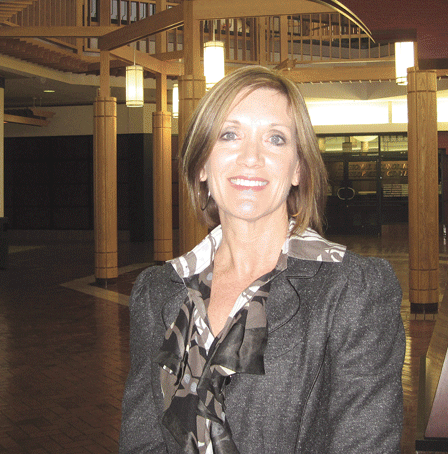
Kelley Tucky says MGM Springfield is depending on regional job-training efforts to build a 3,000-strong workforce in the city.
And in the manufacturing realm, “we recently partnered with the Westfield Chamber to host a manufacturing workforce forum. We had manufacturers at Savage Industries host 10 or 12 companies around the idea of developing new regional programs for machine operators. In most cases, they might need one programmer but six or 12 operators. Our goal is to develop a new training program to allow us to provide on-site operator training.”
When thinking about the number of precision machinists approaching retirement, LePage said, the challenge is to create large-scale programs to develop the next generation.
“We’ve worked with a number of individual organizations — we might work with them on a multi-year training program, help them do organizational assessment, skills assessment, build a training program with them, and help them capture state resources to enhance the performance of employees.”
Such investments pay off, he noted. “Every dollar invested in support of manufacturing yields $1.64 return on investment in the first year alone. Every time you support labor-pool investment, your community makes money.”
TWO has engaged in similar strategy-building initiatives with area hospitality employers. “We partnered with the [Greater Springfield] Convention & Visitors Bureau on a formal needs assessment. What are the workforce challenges for the hospitality industry? We’re now starting to put together strategies to support their emerging needs, both culinary and front of house.”
Upping the Ante
The hospitality industry is only one of many sectors acutely aware of the probability of MGM Resorts International building a casino in Springfield’s South End, now that the proposal is the only viable casino plan for Western Mass. being considered by the state Gaming Commission.
“It’s highly likely this region is going to have to navigate 3,000 to 4,000 new jobs in the next 24 to 36 months,” LePage said. “TWO has taken the lead in partnering with the Gaming Commission to develop a workforce strategy to support the casino industry.
“We know, for example, that, if you want to be a dealer or in gaming, you have to pass a very specific set of requirements, and if you can’t pass them, you can’t work in a casino,” he added. And those requirements, he noted, could pose difficulties.
Kelley Tucky, vice president of Community and Public Affairs for MGM Springfield, agrees, saying her team has been working closely with the Mass. Casino Career Training Institute — which oversees employee regulations, licensure, and training — to ease some of the obstacles to employment.
“We’ve made our position known that we see the current CORI and SORI background-check requirements to be somewhat restrictive,” she told BusinessWest. “For instance, if we have someone working in the warehouse with a history of bankruptcy, it matters very little to us. Certainly, in a position where data is being handled or where there’s tremendous responsibility with money handling, you want those individuals to be vetted thoroughly, but we’ve heard from the one-stop career centers, the Gaming Commission, and others that they see some roadblocks already.”
Meanwhile, MGM has developed ties with the career centers and TWO to develop strategies for recruitment and soft-skills training, from interview and résumé-writing skills to language barriers. “Those are very important for us,” Tucky said. “We’ve built our reputation on providing an exceptional level of customer service. We gauge that from the minute an individual walks in the door for an interview. The more the one-stops train their clientele in those skills, the more confident we are that we’ll find the talent we need.”
However, the casino challenge extends far beyond MGM’s needs, LePage noted, as businesses in a host of sectors anticipate losing many of their own workers to the casino — for example, a bank teller who might want to be trained as a dealer or money handler — and having to refill those positions.
“We’re very aware of what’s going to be happening with the gaming industry,” he said. “If we want to have 3,000 new jobs in the region, we don’t want to subtract 1,000 jobs from other employers just by moving from one place to another. We have to grow 3,000 new workers throughout the region, but we have to develop strategies to fill multiple sectors, so there’s very little ripple effect.”
Take healthcare CEOs, he added. “The concern for them is culinary. They service a large number of people each day with food. And they currently have challenges hiring people. Add another 150 to 200 culinary jobs in the region, and they might have a bigger challenge.”
Tucky sees that sort of movement as an overall plus for the job market and the economic vibrancy of the region.
“Churn is good in terms of changing jobs, changing opportunities. It’s a good thing because people are exposed to additional career options — for instance, veterans returning from active duty, even the semi-retired. We offer jobs across the spectrum, and if we can attract a bright personality and they have the basic skills for the job, we will train for everything else.
“People see this as economic development for the region,” she continued. “It’s all about economic revitalization, and we’ve done a really good job being transparent. We see the benefits for Springfield and the Western Mass. economy, and we feel it’s a win-win.”
LePage agrees — if there’s an effective strategy in place that benefits MGM without disadvantaging other employers. “With the entry of a large employer into the region, we’ve tried to build partnerships across the region. No one organization can solve these regional workforce challenges.”
Mind the Gap
Casino or not, those workforce challenges are persistent, and the term ‘skills gap’ is nothing new to Western Mass. employers.
LePage noted that only about 78 in 100 teens in Greater Springfield make it through high school, but even if the rate was 100%, “we wouldn’t come close to meeting our workforce needs.”
That’s why TWO is so important — not only because it brings together the two colleges’ strengths, such as HCC’s English as a Second Language program and STCC’s Adult Basic Education initiatives, but because the colleges are bringing so many other voices into the conversation.
“What you see with all this collaboration is that there’s very little ego,” LePage said. “It isn’t what the colleges want done, it’s what industries want done. We’re listening to industries and hearing what they need and how they need it, and then saying, ‘OK, what can we do to solve this problem?’ That is the key to all of it; it has to be industry-driven. If you try to force change on industry, that’s not going to work. You’ve got to let those guys tell you what they need, then do the best you can to fulfill those needs.”
Aiken believes the effort has begun to bear real fruit.
“We love the fact that the community colleges are collaborating together,” she said. “We at the REB are all about collaboration, and they are a model for how community colleges and other institutions can collaborate together.”
Joseph Bednar can be reached at [email protected]
Lenox Boasts More Than Just Seasonal Charms
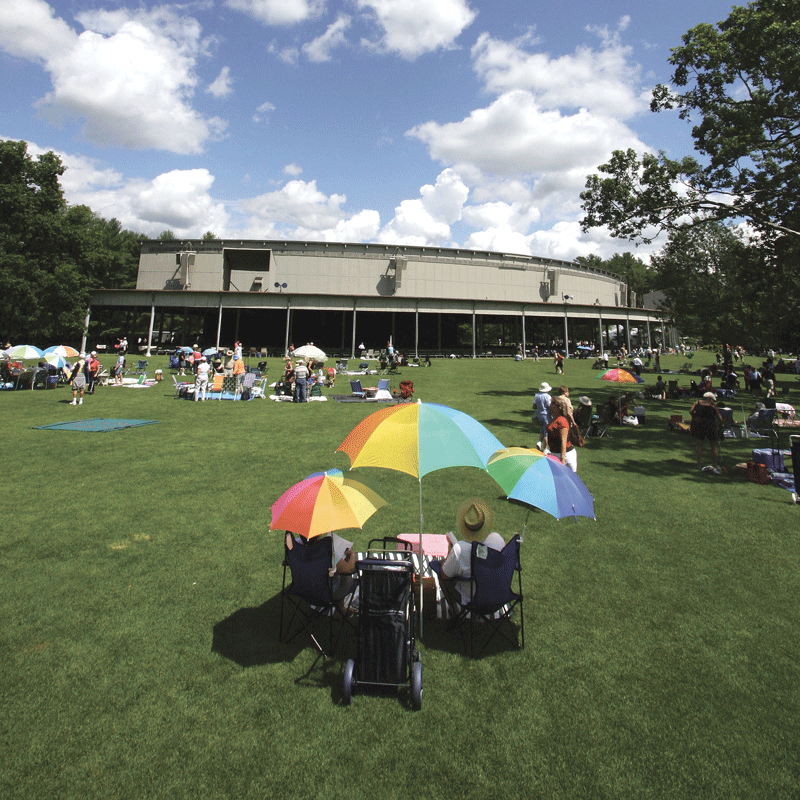
Tanglewood, which hosts the Boston Symphony Orchestra and other musical events, is one of the top tourism draws to Lenox.
“Predominantly, Lenox revolves around Tanglewood and Shakespeare & Co. and the multiple art venues in town, and as a result, we have a very productive summer. There can be a shortage of rooms in hospitality,” said Bortolotto, who serves on the Lenox Chamber of Commerce board of directors.
“If you talk to many of the local folks, you’ll find out that many have this preconceived idea that Lenox is busy from June through October, and then the town gets really quiet,” he added. “To an extent, that’s true.”
But he’s trying to get people to think about this small community — population just over 5,000 — in different ways, talking up its energy and recent commercial growth, and not just its many downtown inns and its high-profile performance spaces.
“From a chamber perspective, it used to be that, if you weren’t downtown, you kind of didn’t partake in all things Lenox,” he said. “What’s happening right now — what’s been happening for the last five years or so — is that Route 7, which is just outside downtown, connecting Pittsfield to Lee, has experienced growth of a different type. We now have three banks on that little stretch, where before there were only two downtown. We have multiple attorney’s offices, a fitness facility, a printing company, some retail.”
One notable success story has emerged in the Lenox Shops, a cluster of once-underutilized retail space along Route 7.
“It had a few stores, until a gentleman named David Ward bought the place and started revamping,” Bortolotto told BusinessWest. “He added condos out back and brought some non-retail businesses and restaurants to it. It’s going to be huge.”
In addition, Berkshire Health Systems, the largest employer in Berkshire County, will occupy a large portion of the complex, and healthcare services, from primary care to ob/gyn to yoga, will have a strong presence — and a flow of employees to support other businesses in the shops.
“So Route 7 has really come along, with more professional businesses and not just retail,” he added. “And, of course, we have Cranwell Resort, Spa and Golf Club nearby — a beautiful place to be.”
Growth Pattern
The character of fast-growing Route 7, with its chain hotels and motels, is different than downtown’s Main Street, Church Street, and surrounding roads, which play host to a number of inns, bed and breakfasts, and locally owned shops.
“Downtown is largely retail,” said Bortolotto, who is also branch manager of NBT Bank in town. “You have two banks, some attorney’s offices, a lot of realtors — that’s part of the makeup, some of the more profitable businesses — but the retail, they tend to close for a good part of the year. Church Street gets very quiet. Some restaurants choose to close for the whole winter season because they figure they lose less money by not adding staff and other expenses.”
Laura Shack has bucked that trend for two decades. She opened Roseborough Grill in downtown Lenox in 1993, then transformed it into Firefly, which she calls a “new American bistro,” 10 years later.
“Roseborough Grill had a great run, but that was because there were only 25 restaurants in Berkshire County, and now there are probably 125,” she said. “It got to the point where it was more of a struggle to maintain the antique, country feel, and I didn’t have a big bar. But I love what I do, so I reinvested and gutted the place, changed the name, and started over.”
Firefly features the huge bar she craved, and a décor that’s contemporary and rustic at the same time. “We changed the menu a little bit, did some tapas and light plates — just changing with the times — and it’s been a great run. There were times when the economy was struggling, but this is one of the few restaurants in Lenox that stays open year-round. We’ve created an extremely loyal clientele due to the fact that I cater to the locals tremendously. We went from having 10 people in the winter to 100. People come in, spend money, have drinks — and they come back.”
Shack partly credits a well-received series of daily specials, from a $5 burger to 50-cent chicken wings, a $16 prime rib, and $10 lobster rolls, which locals look forward to. She’s used a similar strategy at her new breakfast-and-lunch eatery, Kitchen on the Commons, located at the transformed Lenox Shops, and is a testimony, Bortolotto says, to the fact that local businesses can succeed year-round in town.
Our challenge as a chamber is to say, ‘look, if you build it, they will come,’” he said. “If you stay open, it won’t happen overnight, but people will come and spend. As they go ski in Great Barrington or Hancock, they may feel inclined to come to Lenox.
“The challenge is to get more people to downtown, yes, but Lenox is sort of changing that,” he added, noting that the chamber is actively trying to lure non-tourism-related business into its fold.
“Some of the professional service people say, ‘look, I’m not going to join the chamber because I really don’t see the benefit; the chamber revolves around the arts. But I work in a professional business, working with attorneys, electricians, and car businesses, and when I joined the chamber, one of my goals was to add value to those businesses. We’re trying to do some of that.”
Taste of Home
A New York City native, Shack said she came to Lenox for the summer 23 years ago and never left. “What I’ve learned is, you have to cater to the locals, and you have to be super warm and friendly and welcoming. I have staff who have been with me for 20 years; I’m known as Mama Shack, and I’ve raised a lot of kids out of there. They started at the age of 13 or 14, and some are still here. They started out busing tables, and I taught them how to cook or bartend.”
One of those, Zee Vassos, left Roseborough for college but decided the food industry was what he loved, Shack said, “so he came back and helped me open Firefly. Then, after being out in Boston for a few years, he came back again, and we just opened Kitchen on the Commons in May. We had a great summer. David Ward, who owns the complex, really turned it around.”
Bortolotto said the chamber has become more open to cooperating with local towns on events and marketing. “It’s one county, not ‘we’re Lenox, and you’re everyone else.’ We’re mixing more, and we’re more open-minded these days than we were 10 or 15 years ago, definitely.”
There’s more to Lenox than its downtown and Route 7, of course, including Lenox Dale, a blue-collar village straddling Lenox and Lee that used to be home to a cluster of paper mills and today still features some manufacturing.
But, overall, Lenox is mainly known as the home to arts destinations like Tanglewood — where the Boston Symphony Orchestra plays — and a knot of rustic inns, while Bortolotto and the chamber continue to raise the profile of the town’s other charms.
Shack certainly finds the town charming, and hated the early days when she closed for part of the time during the off-season. “I find continuity is really important, being open seven days a week, so people don’t ever question, ‘are they open?’
“I love the people. The town is great,” she continued. “Obviously, having Tanglewood around the corner is wonderful. But I’ve really gotten to know the local people, and the clientele makes it really nice. People are grateful I’m here for them, and I’m grateful to have them.”
Joseph Bednar can be reached at [email protected]

Chambers Respond to a Challenging New Environment

Jeff Ciuffreda says the ACCGS and Springfield Chamber have “retooled” when it comes to the services offered to members.
The president and CEO of the New Bedford Area Chamber and the incoming president of the Mass. Assoc. of Chamber of Commerce Executives (MACE) summoned that phrase to express the sentiment that, while many have a tendency to paint these institutions with one broad brush, they are in many ways very different from one another.
This is true with regard to everything from size to geography to the specific focus of programs and energy within each organization, he said, noting that his chamber, for example, leads a number of initiatives aimed at supporting and growing the New Bedford area’s $1 billion fishing industry.
But despite these apparent differences, chambers across this state — and around the country, for that matter — are facing some common, and formidable, challenges.
Chief among them is membership. It is down for almost all chambers, and by 25% or more at many of them from 10 or even five years ago, said Jeffrey Ciuffreda, president of the Affiliated Chambers of Commerce of Greater Springfield and executive director of the Springfield Chamber. That latter organization had perhaps 750 members five years ago, he said, and now counts roughly 520, a nearly 30% decrease that he described as “typical,” at least in his estimation.
There are several reasons for such drops, said Ciuffreda and others we spoke with. He and Nascimento both mentioned lingering effects from the Great Recession and a related, ongoing trend toward consolidation in many industries — from banking to insurance; from healthcare to the media — that has simply left fewer players to pay dues to a chamber.
But there are other factors, said Ciuffreda, listing everything from competition from other chambers and groups such as young professional organizations to some changing attitudes about chambers on the part of the mostly smaller businesses that now dominate membership rosters.
“Before, the larger, more established corporations joined the chamber because it was the right thing to do, and the chamber was looked upon as the chief cheerleader for that community,” he said. “Now, when you’re out there getting new members, you’re getting mostly smaller businesses that are looking to the chamber for more assistance, guidance, and some advocacy.”
Summing it all up, Ciuffreda described the current environment as “the changing face of chambers,” and said some organizations are reacting to it more quickly and more effectively than others. Overall, chambers are doing things they haven’t done recently, or much at all, he told BusinessWest, mentioning such initiatives as strategic planning, marketing studies, and deep introspection about mission, programming, and ways to bring more value to members and prospective members.
According to Kate Phelon, a relative newcomer to chamber administration — she took the reins of the Greater Westfield organization three years ago — while providing value has always been a key element in any chamber’s success, in this changed environment it is more imperative than ever to provide what amounts to ROI to members.
And this means all members, she said, adding that the Westfield Chamber has been working to identify the needs of specific sectors, or groups, and develop programs to meet them.
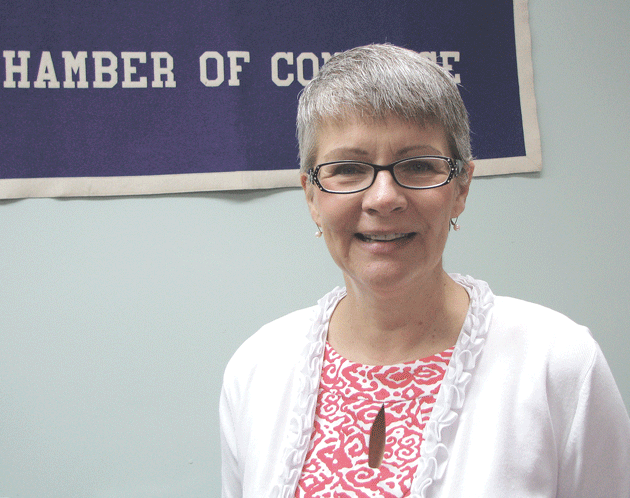
Kate Phelon says the Westfield Chamber is focused on finding ways to serve members across all business sectors, from manufacturers to nonprofits.
Kathy Anderson, who segued from Holyoke City Hall, specifically the office of Planning and Economic Development, to the directorship of that city’s chamber 18 months ago, agreed.
She said the Holyoke Chamber has been aggressive in development of new programs, ranging from an ‘Ask a Chamber Expert’ initiative to an endeavor to spotlight the work of manufacturers based in the city, to something called SPARK (Stimulating Potential, Accessing Resource Knowledge), a venture aimed at “fanning the flame of entrepreneurship” (more on these efforts later).
They were all blueprinted, she said, to provide value-added services to different business groups, while also enabling the chamber to “keep changing and evolving, and providing something fresh and different.”
For this issue, BusinessWest takes an in-depth look at this changing face of chambers of commerce, and at what area organizations are doing to adjust to — and thrive in — this new environment.
Matters of Relevance
As he talked about the current climate for chambers and their leaders, Nascimento said there are both challenges and opportunities, and that the common denominator involving elements of each category is the term ‘relevance.’
He used it to describe what chambers must have at a time when they are smaller — at least in terms of membership — than they were years ago, but more is being asked from them, both in the community and from those members.
“Relevance is not a new term, but it is re-emerging within our industry,” he explained. “Is the programming relevant to our members? Is it adding value to our members? Is it providing value to our communities?”
Elaborating, he said that the chambers that are most effectively responding to the changing times are becoming involved in the many facets of economic development — from education to tourism to advocacy — and are becoming more focused on the communities they’re serving.
As examples, he noted his chamber’s work to support the fishing industry — it has helped create what’s known as a ‘seafood buyers mission,’ an event that last year recorded $12 million in sales — and also its work with other groups to revive the region’s convention and visitors bureau, thus bolstering another strong sector of its economy.
There are similar examples from across the state, he said, adding that proactive chambers are changing and getting more involved, again, out of necessity, to gain and retain members.
Indeed, the biggest challenge facing what Nascimento called the “chamber industry” is the same one confronting most all business sectors — ongoing consolidation.
“Our members are merging, they’re being bought out, they’re retiring, and all because of a number of factors — globalization, competition, and others,” he explained, noting that his chamber has seen membership drop from 1,200 to roughly 950 over the past decade or so. “The market out there for traditional members of a chamber are the stakeholders in the business community — your banks, your credit unions, insurance companies, printers, local media, hospitals — and all those industries are consolidating themselves.
“Since I’ve been here over the past seven years, we’ve seen several of our local community banks merge with other community banks that are members,” he went on. “And we’ve seen media merge; at one point, we had a daily newspaper in New Bedford, another daily in a neighboring community, a business publication, and a weekly newspaper in each of the towns. Now, there’s one company that owns them all.”
Similar developments have taken place within the insurance sector, where a number of smaller, family owned agencies have been merged into larger operations; the printing sector; and even office supplies, he said. “We used to have three or four office-supply companies in New Bedford, but they’re all gone — there’s one company, and it’s a regional company.”
This “shrinkage” within the marketplace, as he called it, has left chambers with little choice but to sharpen their focus on services to members and find new — or sometimes old — ways to be relevant.
Ciuffreda agreed, and said the ACCGS and the Springfield Chamber are responding to this challenge in many ways, but mostly a sharper focus on identifying needs and concerns among members — and in the community — and then addressing them.
“We’ve retooled a little bit,” he told BusinessWest, using a word he would come back to often. “When we look at the reasons why people join chambers, it’s clear that we’ve moved on from those days when it was the right thing to do. People are much more focused on services and what they can get out of being a member.”
And this goes beyond benefits such as programs that aggregate small businesses to provide savings on health insurance or discount pharmacy cards, he went on, adding that members are looking for more technical assistance, advocacy, and involvement in key issues.
He said the ACCGS, which has been “in and out” with regard to providing technical assistance to small businesses, will look to get back in if funding can be secured from the state and the private sector. Meanwhile, he said the organization is already more involved in such matters as education and closing the so-called skills gap that is impacting many sectors.
“We’re getting much more involved in education because we are hearing from businesses that want to expand that there is clearly a skills gap,” he noted. “We’re more involved with the school systems, the vocational schools, and the community colleges to try and close that gap.”
Getting Down to Business
The need to effectively identify member needs and tailor a roster of services to meet them is one of many motivating factors behind the ACCGS’s continued involvement in programs with marketing and business students at Western New England University, specifically those taught by marketing professor Janelle Goodnight.
She told BusinessWest that, on several occasions, her students have gathered research on the ACCGS, competing chambers in this region, and chambers in general, and then developed comprehensive marketing plans for consideration.
The latest of these plans will be ready by the end of the fall, she said, adding that, because the ACCGS is a client, she could not get into specifics about what will likely be in the document. But she did say that research conducted last spring revealed that many ACCGS members and prospective members did not fully understand the full range of services the chamber provides, and thus need an education through effective marketing.
Meanwhile, that research also revealed that the chamber’s membership is getting older — “members are aging out” was the phrase Goodnight used — and it is not as diverse, from a demographic standpoint, as the region it serves. Thus, moving forward, two obvious goals are to attract both younger business owners and minority business owners.
The need to more effectively serve members represents one of the many ways in which chambers are very much like the small businesses that dominate their membership roles, said Phelon. They are still coping with the lingering effects of the Great Recession, she noted, but also myriad other issues, ranging from the challenge of understanding and making effective use of technology to mastering the many nuances of social media, to simply finding ways to grow in an environment where it is difficult to do so.
“I have IT issues every day,” she said. “Things are changing constantly … should I get this piece of equipment? How am I going to swipe my credit cards? It’s very hard to keep up, and that’s just one challenge we’re facing.”
Some of the others give credence to Nascimento’s comments about each chamber being different. The Westfield Chamber, for example, serves 10 communities. Westfield and Southwick are home to most members, but the organization’s reach also extends to the small hilltowns (many with populations of 1,000 people or fewer) to the west.
Reaching out to the business owners in these communities, and then convincing them to take part in events and programs several miles down Route 20, can be difficult, she went on, but succeeding in those efforts not only helps the chamber, but it builds a stronger regional business community.
Phelon’s philosophy is summed up in the slogan she puts on the front of her membership packets: ‘The Power of Connectivity.’
She said it refers to the many ways in which the chamber can provide connections — from face-to-face networking events, which she still considers far more effective than social-media outlets, to simply providing information that can help a business owner solve a problem or seize an opportunity.
Phelon said the Westfield Chamber probably had between 400 and 450 members in the late ’80s, but is now roughly half that size, with about 215 at present. While it is not realistic to think the organization can again reach its high-water mark, she said there is certainly room for improvement, and it’s happening, thanks in large part to the hiring of a business development manager.
“Now, we’re actually growing,” she said, noting that, in recent years, new memberships have barely kept pace with the inevitable attrition chambers see each year. “And our ability to keep growing is related directly to our success with providing value to all our members.”
Value Proposition
As she talked about the many new initiatives at the Greater Holyoke Chamber, Anderson said they’ve been developed with several goals in mind. Providing more value to members is obviously one of them, she noted, but beyond that is a desire to help businesses with the challenges that are common to all of them — marketing, gaining new business, and saving money.
One of these concepts, called ‘Ask a Chamber Expert,’ has all these goals in mind.
Started last year, this series of workshops, as the title suggests, enables participants to ask a designated chamber member about some specific subject matter, which to date has included ‘How to Use Facebook to Promote Your Business,’ ‘How to Use LinkedIn as a Connecting Point,’ ‘How to Write a Business Plan,’ and even ‘How to Read a Blueprint,’ a requested program that was comparatively well-attended.
“I certainly learned a lot that day,” said Anderson, adding that the program brings benefits to both those asking the questions and those answering them.
“If I use my own members for these workshops and they become the expert in the room, this gets the people to network and know the businesses within our chamber organization,” she explained. “But it also gives low-cost [$10] advice to members, and if they want more help beyond that and want to hire that person to help them, they can do that.”
Meanwhile, another new initiative is aimed specifically at manufacturers, a constituency that, as Phelon noted, doesn’t directly benefit from many traditional chamber programs, such as after-5 events and breakfasts, where service-related businesses can more easily secure new customers.
The multi-faceted initiative is instead designed to build awareness of manufacturing facilities, said Anderson, noting that such exposure could help generate new business while also introducing young people to potential career opportunities.
“October was Manufacturing Month,” she said, pointing to a full slate of events and programs designed to celebrate and draw attention to that sector. “We had three different tours of manufacturing facilities, and they were open to the public because manufacturers want people to know what they do and what’s being made in the community.”
Another endeavor, in which the chamber will partner with the city’s Boys & Girls Club and, more specifically, with those involved in videography, will place three-to five-minute vignettes about Holyoke-area manufacturers on the chamber’s website.
“This is a value added for them, because they want people to know what they’re doing,” she explained, adding that businesses with specific needs may learn that a Holyoke business can make that part or product. “And down the road, we’re going to have a number of Baby Boomers retiring, and there are questions about who’s going to fill those positions. This program will allow these companies to show what kinds of great jobs there are in our manufacturing businesses.”
And then, there’s SPARK, which is designed to help people bring ideas to reality, said Anderson, by connecting individuals with resources and getting them the support they need. The program will offer mentoring, training, advising, tutoring, teaching opportunities, micro loans and below-market real-estate services, she noted, adding that the name was chosen in part to recognize those who have the ‘spark,’ or desire, to take their dreams to the next level, but need various forms of help to make them happen.
Like Phelon, Ciuffreda, and Nascimento, Anderson also mentioned efforts to partner with other chambers and various economic-development-related organizations to bring still more value to members and bolster the business community or specific sectors within it.
These efforts and the others chronicled above represent a response to the new landscape facing chambers, said Nascimento, adding quickly that the scene didn’t change overnight, and the necessary adjustments won’t come that quickly either.
“There are a lot of challenges for chambers,” he said in conclusion, “but there are also a lot of opportunities. This is an exciting time for chambers and our industry; we’re helping our members, and our communities, with many difficult challenges taking place out there.”
Joining the Fight
While Nascimento contends that if you’ve seen one chamber, you’ve seen just one chamber, these organizations are facing a number of common challenges in a climate seemingly far removed from the one that existed decades ago, when joining the chamber was simply the responsible thing to do.
Words like ‘value’ and ‘relevance’ were not recently added to the chamber industry’s lexicon, but they have certainly taken on new meaning — and importance.
And they will continue to be watchwords in the months and years to come.
George O’Brien can be reached at [email protected]
State Moves Forward with Interstate 91 Study
SPRINGFIELD — State officials have chosen a consultant to study possible alternative alignments for Interstate 91 through Springfield, while highway officials proceed with a plan to replace decks on a deteriorating elevated portion of the highway in the city. The state Department of Transportation has selected the Cheshire, Conn.-based consulting firm Milone & MacBroom to evaluate alternatives for a section of Interstate 91, including possibly depressing the highway section to ground level or below ground. At the same time, the state highway division will be moving forward with a plan to replace decks on the crumbling Interstate 91 viaduct. Milone & MacBroom will study a section of Interstate 91 south of the most elevated portion of the viaduct near the Naismith Memorial Basketball Hall of Fame. At the same time, the state highway division will develop a plan for replacing the decks of the existing Interstate 91 viaduct, which raised safety concerns after a chunk of concrete fell from the section in April. The activity comes amid plans by MGM Resorts International to build $800 million casino in the South End of Springfield that would front Interstate 91 and would draw most of its traffic from the highway. MGM is competing with Mohegan Sun Massachusetts in Palmer for the single casino license to be awarded in Western Mass. The state is starting contract negotiations with Milone & MacBroom with a goal of starting work in January. The firm will coordinate with the state highway division as it moves forward with its proposal to replace the decks on the viaduct.
U.S. Manufacturing Gains 2,000 Jobs in September
WASHINGTON, D.C. — The latest monthly U.S. jobs report shows America’s manufacturing sector gained 2,000 jobs in September. However, for all of 2013, the U.S. has gained only 12,000 manufacturing jobs. Commented Scott Paul, President of the Alliance for American Manufacturing (AAM), “in manufacturing, we’ve been treading water for nearly 18 months now. Yet no one in Washington seems to care. The September jobs report shows that private-sector job growth, and manufacturing in particular, is too weak to put the U.S. on a sound fiscal footing or to get the middle class back on track. It’s time for Congress to stop manufacturing crises and deal with our real manufacturing crisis. Washington needs to put into place policies that will get America back to work. The neglect is glaring: 70,000 structurally deficient bridges. Math and science achievement down compared to other industrialized nations. And our economic competitors are not standing still. This is no way to run a country or to support the private sector’s efforts to create jobs. And here’s the kicker: the October numbers could be even worse.” President Obama set a goal of creating 1 million new manufacturing jobs in his second term. To follow the president’s progress, the AAM continually updates a jobs tracker based on monthly jobs data from the Bureau of Labor Statistics (BLS).
Student Debt Load Rising in Bay State
BOSTON — More students in Massachusetts public universities and colleges are incurring larger amounts of debt to finance their educations, the state higher education commissioner told lawmakers recently. “Let me sound the alarm on this issue,” Commissioner Richard Freeland said at the fourth in a series of hearings on college debt. “Make no mistake: the burden of student debt could derail us from achieving our goals.” The average debt for graduates of the University of Massachusetts system, other state universities, and community colleges increased 27% from fiscal 2008 through fiscal 2011, the last year for which data are available, Freeland said. And the percentage of graduates who accumulated debt rose across all levels, including a high of 64.8% at the state universities in 2011. The average graduate in the UMass system left with $26,844 in debt in 2011, an increase of $5,525 over three years earlier. At other state universities, the average figure was $22,362, a jump of $4,822. For graduates of community colleges, the average debt in 2011 ranged from $7,229 for graduates with associate degrees to $4,655 for graduates with one-year certificates or less. The percentage of graduates who left the UMass system in debt rose to 61.4% in 2011 from 57.9% in 2008. The biggest increase in public institutions, from 31.1% to 48.6%, was registered by community-college graduates with one- or two-year certificates.
Savage Arms, Cirtec Medical Win Grants
WESTFIELD, EAST LONGMEADOW — Firearms manufacturer Savage Arms in Westfield and Cirtec Medical in East Longmeadow, a maker of medical devices, have been awarded grants from the state’s Workforce Training Fund to expand their workforces and train employees in lean-manufacturing processes. Savage Arms was awarded $179,600, which will be used to train 400 employees, and 48 new jobs are expected to be created. Cirtec Medical was awarded $106,805, which will be used to train 63 employees, and three new jobs are expected to be created as a result of training. Lean manufacturing emphasizes on avoiding waste and improving quality, and is based on the Toyota manufacturing methods. The two awards are part of a package of 37 grants totaling $2.8 million. All told, the grants fund 3,106 current and newly hired employees. Savage Arms represents one-third of the total market for traditional firearms, with a particular focus on bolt-action rifles. Cirtec Medical is a contract design, development, and manufacturing firm focusing on medical devices, with a particular strength in active and passive implantable devices and minimally invasive systems.
State Increases Incentives for Hiring Veterans, Long-term Unemployed
BOSTON — The Executive Office of Labor and Workforce Development announced that it has more than doubled cash grants available to employers hiring Massachusetts residents who have been unemployed for six months or more, or Massachusetts veterans (regardless of length of unemployment). Increased grant funding is available through the state’s Hiring Incentive Training Grant (HITG), a program of the Massachusetts Workforce Training Fund. Any for-profit company or nonprofit organization that contributes to the Massachusetts Workforce Training Fund, a state fund enacted in 1998, is encouraged to apply. Eligible employers may now apply for grants of $5,000 for each new hire who meets the HITG program requirements. Employers may receive up to $75,000 each calendar year. Upon approval, payment will be available to the employer once the new hire has retained employment for at least 120 days. A copy of the Hiring Incentive Training Grant application, eligibility requirements, frequently asked questions, and other relevant materials are available at EOLWD’s website, www.mass.gov/hiringgrant. Grant awards are subject to funding availability, and applications are reviewed on a rolling basis.
Retailers Cautious About Seasonal Hiring Boosts
WASHINGTON — Facing economic wariness and wavering consumer confidence, retailers are approaching their holiday hiring with caution, forecasters say. Research firm Challenger, Gray & Christmas said it expects hiring will, at best, match the 752,000 retail jobs that were added last year between October and December, and the National Retail Federation projects retailers will add between 720,000 and 780,000 seasonal workers this year. Retailers are making their staffing decisions against a backdrop of uncertainty caused by tepid economic growth and, more recently, standoffs in Congress over funding the federal government and the debt limit. Toys R Us plans to hire 45,000 workers, about the same as it hired last year. Kohl’s is poised to hire 50,000 workers, also consistent with its 2012 hiring. Macy’s is set to add 83,000 seasonal workers, a slight increase from the 80,000 brought on the previous year. Wal-Mart says it will hire 55,000 holiday workers, a 10% increase from 2012. It will also transition an additional 35,000 temporary workers to part-time positions and yet another 35,000 part-time workers to full-time positions. Meanwhile, Target plans to pare back its seasonal staffing, expecting to add 70,000 workers in 2013 compared with 88,000 last year. The company said it will focus on giving existing staffers the chance to work extra hours. Foot traffic to bricks-and-mortar stores is taking a hit as more consumers buy online. That growth is reflected in Amazon.com’s hiring plans; the online giant expects to create 70,000 seasonal positions, a 40% increase from last year. While holiday retail hiring is expected to be somewhat flat, sales are expected to inch up. The National Retail Federation forecasts a 3.9% increase to $602.1 billion, an improvement over last year’s sales growth of 3.5% over 2011.
WSU President Files Suit Against Several Parties
WESTFIELD — Evan Dobelle, the embattled president of Westfield State University who was placed on paid leave of absence last month amid investigations of alleged improper spending and violations of university policies regarding travel and credit, has filed suit in U.S. District Court in Springfield against a number of parties directly or indirectly related to the action taken against him. Dobelle, who is suing the university, Higher Education Commissioner Richard Freeland, three trustees, the school’s accounting firm, a Boston law firm, and the university’s lawyers, is seeking an unspecified amount of money and legal fees. He claims that Freeland and the trustees are waging a “guerilla war for control of the university,” and that Freeland used extortion-like tactics in an attempt to force Dobelle from office. The suit also alleges that trustees Chairman John Flynn III conducted a “one-man investigation” into Dobelle’s travel between 2008 and 2013. Also named in the suit are trustees Kevin Queenin and Elizabeth Scheibel, the former Northwestern district attorney; the Braintree-based accounting firm O’Connell and Drew; Rudin and Rudman, a Boston law firm; and James Cox, lawyer for the Board of Trustees. The trustees voted on Oct. 15 to suspend Dobelle, following a 10-hou, closed-door meeting the president. The board also hired a Boston-based law firm to investigate Dobelle’s travel and spending, and report back by Nov. 25.
A Step Forward for Springfield
Seemingly lost amid all those much larger headlines last month concerning the World Series, the debt-ceiling crisis, and Westfield State President Evan Dobelle getting suspended and then suing everyone who had anything to do with that action was this item in the local paper: ‘Springfield City Council OKs raises for mayor, councilors.’
This development — at least the first part of the equation — has been talked about for some time and, in most respects, was expected and almost a foregone conclusion. But it is still a significant step forward for Springfield.
(Before explaining why, we’ll quickly address the second part of that headline: This is how it works in situations like this; city councils, in general, will gladly approve a pay hike for the mayor as long as they are quite sure the votes are there to give themselves one, too. It’s not going to happen otherwise, so just accept it and move on.)
That bit of local politics aside, this vote by the council to take the mayor’s salary from $95,000 to $135,000 — the first raise for the city’s chief executive since Bill Clinton was starting his second term — represents real progress when it comes to securing solid leadership in the city for years to come.
Raising the mayor’s salary does not ensure effective leadership — there are untold examples of how people in public positions with big salaries have failed in their roles (see Dobelle) — but it certainly helps in that regard. That’s because many people, especially members of the local business community, have eschewed bids for public office simply because they could not afford to take a serious pay cut.
This $40,000 raise will reward the current mayor, Domenic Sarno, but, more importantly, it will help ensure large, deep fields of candidates in the future.
And from our view, solid leadership is perhaps the most important ingredient in the large volume of work that remains to be done when it comes to returning Springfield, the state’s and the unofficial capital of Western Mass., to prominence.
Let’s just look at the near future. If a planned resort casino is built in the South End of the community, the city’s leadership, and especially the mayor, will have to assimilate that nearly $1 billion development and work to ensure that it becomes some kind of asset, not a liability; no small task. Meanwhile, that mayor will still have to deal with a school system in crisis, a downtown that will need much more than a casino, public safety issues, and the ongoing problem of reinventing this former manufacturing hub.
And if the casino is built somewhere else? Well, that mayor will have to contend with all those latter items listed above and then also deal with what will be serious psychological fallout — and find a way to develop several blocks of underutilized and/or tornado-damaged property the old fashioned way, and at a time when it is very difficult to convince developers to invest in the city.
Either way, whoever is in the corner office is going to have their hands full.
A $135,000 salary won’t make the job any easier, but it might help ensure that those who win that assignment have the wherewithal to carry it out effectively.
Springfield’s goal moving forward is to make itself a community of choice again. It held that distinction once, but it was a long, long time ago. Regaining that status won’t happen quickly or easily, and it won’t happen at all unless there is strong consistent leadership for many years to come.
The council’s vote to raise the mayor’s salary is just one step, but an important one, in moving the city forward. And it’s a step that other area communities currently underpaying their mayors — Chicopee, Easthampton, and others on that list — should emulate.
The following is a compilation of recent lawsuits involving area businesses and organizations. These are strictly allegations that have yet to be proven in a court of law. Readers are advised to contact the parties listed, or the court, for more information concerning the individual claims.
CHICOPEE DISTRICT COURT
Javier Morales v. PVTA
Allegation: Negligent operation of a motor vehicle causing personal injury: $4,883.51
Filed: 9/23/13
HAMPDEN SUPERIOR COURT
Eastfield Glass Company Inc. v. Fontaine Inc. and Federal Insurance Company
Allegation: Breach of construction agreement for new high school and monies owed: $80,912.50
Filed: 10/11/13
Fred L. Aaron v. Creating Comfort Outlet, LLP and Joshua Barina and Jose Barina Jr.
Allegation: Breach of lease agreement: $163,658.35
Filed: 10/4/13
RK Petroleum Inc. v. Arya Petroleum Corp.
Allegation: Breach of promissory note: $315,000
Filed: 10/9/13
University Driving School Inc. v. Anthony R. Gomez d/b/a Western Mass Auto Academy
Allegation: Violation of agreement not to compete: $2,500
Filed: 10/1/13
HAMPSHIRE SUPERIOR COURT
John Mesheau v. IKO Manufacturing Inc.
Allegation: Breach of contract and express and implied warranties and unfair and deceptive trade practices: $60,000+
Filed: 9/6/13
PALMER DISTRICT COURT
Paley, Rothman, Goldstein, Rosenberg, EIG, & Cooper, Chartered v. Hampden Structural Steel Inc. d/b/a Private Garden Greenhouse Systems
Allegation: Non-payment on previous judgment: $9,263.09
Filed: 8/26/13
SPRINGFIELD DISTRICT COURT
Ashaunti Lawrence v. Fara Leasing Inc.
Allegation: Negligent operation by a taxicab driver causing injury: $4,257.32
Filed: 9/20/13
Robert D. Manz v. Pioneer Valley Transit Authority
Allegation: Breach of contract: $2,400+
Filed: 10/7/13
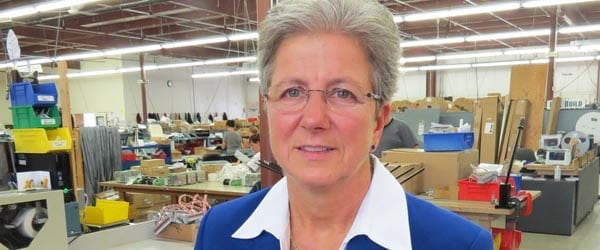
How Anne Paradis Put a Charge into MicroTek
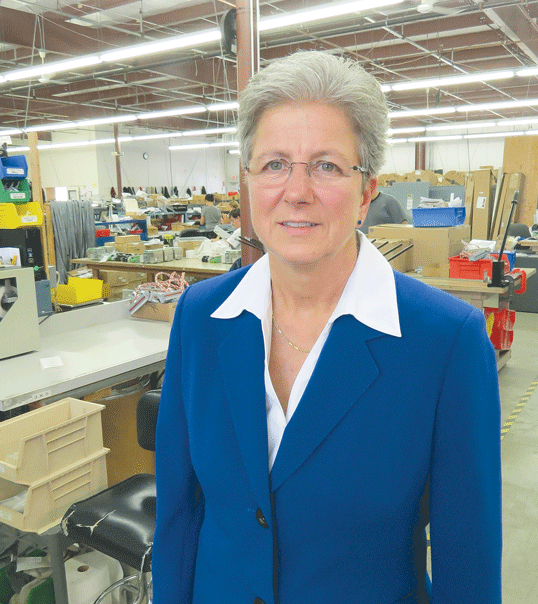
Anne Paradis
What she found is that what’s written in a book doesn’t usually — or easily — translate into what one will find on the shop floor.
“I had taken manufacturing courses as part of my MBA program, but it was nothing like what I encountered here,” she explained. “You learn how to schedule machine hours and go through all the production planning, and I can remember thinking at the time, ‘I can do this.’ But quite honestly, when I got in here and tried to apply those principles, it was very, very different, because you couldn’t plan productivity at a set level, and machine hours weren’t constant, and…”
Her voice trailed off as if there was much more, which there was. And she learned just about all of it, she said, by doing.
“I learned how to do every job in the place except soldering, which to this day I can’t do,” she said, adding that there are many roles at this company that produces cables and wire harnessing and touts its team members as ‘interconnect specialists.’ “I learned on the job. All the product knowledge and assembly knowledge I got, I learned from people who were working for the company.
“I sat and assembled cables with people,” she went on. “I asked questions; I made mistakes. In those days, it was all hands on deck, and if something had to go out the door and we needed another pair of hands, I would sit at the workbench and help to finish the job. The employees got a kick out of watching me join the production lines — and they still do.”
Such occurrences are rare, though, because Paradis spends most of her time now on the broad subject of growing revenue, an assignment that has many subplots, including everything from withstanding ever-increasing competition, foreign and domestic, to weathering three recessions, to building a new plant in Chicopee’s Westover Airpark West more than a dozen years ago.
She’s obviously fared well in her career transition, taking the company from roughly $750,000 in sales when she started to nearly $8 million, and from maybe 20 employees to more than 120, and placement on such lists as the Boston Business Journal’s ‘Top 100 Women-led Companies,’ Mass High Tech’s ‘New England’s 30 Largest Women-owned Tech Companies,’ and, most recently, BusinessWest’s compilation of the region’s largest manufacturers.
Meanwhile, she has continued and greatly enhanced the company’s standing as a leader in the hiring of individuals with developmental disabilities — with roughly 15% of its workforce falling into that category. This was the original mission of the company when it was created 30 years ago, she said, adding that, while MicroTek has evolved from a service program into a strategic business, its focus on providing employment opportunities for the developmentally disabled is one, but not the only, example of why the phrase ‘making connections’ refers to much more than the company’s product lines.
And her success with the many aspects of that phrase makes Paradis an intriguing subject for a new series in BusinessWest that will focus on women in business.
In the coming months, the magazine will profile individuals in a number of sectors to gain an appreciation for how far women have come in business and the specific fields that comprise it, but also for the work that remains to be done.
We start with a woman who still can’t solder — she said there are enough skilled craftspeople at the company to keep from even wanting to try — but has mastered many of the aspects of operating a business in today’s ultra-challenging climate, especially the most important: people.
Wired for Growth
As she gave BusinessWest a tour of the 24,000-square-foot MicroTek plant on Justin Drive, Paradis stopped at a number of the workstations where she learned this business and its specific products more than 25 years ago.
She explained the processes involved with specific parts, offered high praise for the workforce, and ended with some pointed commentary.
“This is a good example of how manufacturing is still a big part of our economy in Western Mass.,” she said. “People say this sector is in decline, and maybe it’s not what it once was, but what we’re doing here shows that manufacturing is very much alive and well.”
How Paradis came to be in a position to give such a tour, speak as one of the prominent voices in the region’s manufacturing realm, and lead her company to placement on those aforementioned business-magazine lists of the largest women-owned businesses is an intriguing story, one with elements of timing and circumstance, but also perseverance and entrepreneurial spirit.
It begins with Paradis’ decision to major in psychology and gravitate toward work in human services, specifically with the state Department of Mental Retardation, now known as the state Department of Developmental Disabilities.
She eventually took a job working in the development of community residential programs for adults with developmental disabilities in the wake of the closing of Northampton State Hospital, Belchertown State School, and other facilities. Specifically, she said she was involved with a pioneering concept that would enable individuals to remain in their residences on a permanent basis, rather than transition into different facilities as they gained more independence and their need for services and support diminished, which was the accepted model at the time.
“This was 30 to 35 years ago, and in those days, the community movement for people with disabilities was still in its infancy,” she explained. “And one of my first jobs was to help push the agenda of these more progressive program types.
However, he would soon become frustrated with the lack of progress with this movement, and especially with the funding restraints that soon emerged, and decided to make what would be her first career course change, pursue her MBA at UMass, and move into what she called the “business arena.”
Her first stop was at New England Business Associates in Holyoke, a management-consulting firm that assisted small businesses with the hiring of those with disabilities. One of her eventual clients was Microtek, which was created in the early 80s by human-services advocates working in conjunction with the University of Oregon, which was at the time researching models for employing people with disabilities. One of those models was to start a company where one controls the environment, provides the training, and brings in the work. In this case, the work — developed through a connection between one of the researchers at the University of Oregon and Hewlett Packard — was assembly of cables and wire harnesses.
When Paradis first started working for MicroTek, it was one of four operations — there was another in Orange, Mass. and two more in Virginia — for which she helped develop a marketing cooperative designed to generate new business and enable the participating companies to grow and eventually add more employees to the payroll.
While the other three ventures enjoyed success in this endeavor, MicroTek suffered from what Paradis called “poor management.” The company’s board eventually asked her to step in and run the company for a short time while a search for a new CEO was carried out.
That ‘short time’ has turned out to be 26 years — and counting.
“I came in to find problems a bit more complicated than the board realized,” she told BusinessWest. “I took a year’s leave of absence to run the company, and at the end of that year they made me an offer to stay.”
She accepted that challenge knowing that she had overcame what she described as a “lack of skills in certain areas.” Elaborating, she said her biggest challenges were learning manufacturing in general, and MicroTek’s line of products (custom wire harnesses and cable assemblies) in particular.
“I did not have an engineering background, and that made it challenging,” she noted. “But I was fortunate, because at the time, MicroTek was a very small company, and that afforded me the opportunity to learn on the job.
“I had a lot of strengths — managing staff, putting systems in place, and organizational development, because my undergraduate degree was in psychology — but I needed to learn this business,” she went on, adding that she completed much of this learning while serving as interim CEO, progress that gave her the confidence to accept the board’s offer and stay on.
People Power
Over the past 26 years, Paradis has coped not only with the everyday challenges facing all business and managers — everything from cash flow to inventory control to finding qualified workers — but also more global matters, such as mounting competitors, especially from overseas operations, new-product development, and the worst economic downturn since the 1930s.
She described it all as a continuation that learning experience that began when she became interim CEO, one that is clearly still ongoing.
Indeed, while the plaques on the wall containing those business-magazine lists show that the company has clearly come a long way, there are some new challenges to face — and some old ones as well.
At or near the top of that list is mounting competition. While there have historically been some barriers to taking this kind of manufacturing overseas — including the high quality of work demanded and transportation costs — they have been coming down in recent years, said Paradis, noting that the company is facing intense competition from China, Mexico, and other countries.
It has responded by working to automate more processes in what is still a labor-intensive business, while also diversifying into some new product lines, specifically control panels built for customers in the security and medical fields.
The company, which suffered, as all manufacturers did, during the Great Recession, has rebounded, and growth has been steady over the past several years, said Paradis, adding that she has set an aggressive, but realistic, goal of reaching $12 million in sales over the next few years.
But the term ‘success’ has many meanings at MicroTek, she went on, adding that, while the bottom line is perhaps the most important, the company’s original mission is still an important barometer when it comes to that word.
And in this realm, more goes into this equation than simply hiring the developmentally disabled, she went on, adding that the company’s broader goal is to integrate such individuals, treat them as they would any employee, and make them part of highly successful and efficient teams.
One of the reasons for the company’s success has been its ability to do this by effectively giving these employees both the support and the tools they need to succeed, she told BusinessWest, adding that this is a philosophy that permeates the company and all aspects of its workforce.
“Everyone has the same benefits and the same access to company services, and people work on some part of all of the work that goes out of here,” she explained. “We have integrated teams, and the idea of partnering people with co-workers and providing them with the support they need extends well beyond the employees with disabilities, because we also employ a number of people who speak English as a second language and may have difficulty reading English.
“The transformation for the company over the years has been in this area,” she went on. “There were special supports and training that we started out using for the individuals with disabilities, and over the years, we’ve just adopted those as standard operating procedure for the company.”
Current Events
Paradis says that, while she’s quite proud of the plaques in the front lobby and what they represent in terms of both the company’s success and her standing as a woman in business, she’s more proud of the many ways in which MicroTek has become a role model.
Its success in the current, highly competitive environment provides evidence that manufacturing is still very much alive in the Bay State and this region. Meanwhile, its success with hiring, training, and integrating individuals with a wide range of challenges shows that ‘diversity’ can be much more than a buzzword.
These are among the many accomplishments for Paradis, who still can’t solder, but has developed a rare talent for making connections — and in a number of very important ways.
George O’Brien can be reached at [email protected]
AFFILIATED CHAMBERS OF COMMERCE OF GREATER SPRINGFIELD
www.myonlinechamber.com
(413) 787-1555
• Oct. 25: Super 60 Luncheon, 11:30 a.m.-1:30 p.m., at Chez Josef, Agawam. Celebrate the region’s top-performing companies. Now in its 24th year, this awards program celebrates the success of the fastest-growing privately owned businesses in the region that continue to make significant contributions to the strength of the regional economy. Presented by Health New England with support from Hampden Bank, Sullivan Hayes & Quinn, the Republican, and WWLP-TV 22. Reservations are $50 for members, $70 for general admission. Reservations may be made online at www.myonlinechamber.com or by contacting Cecile Larose at (413) 755-1313.
• Nov. 6: Business@Breakfast, 7:30- 9 a.m., at the Western Mass Business Expo, MassMutual Center, Springfield. Keynote speaker: Jim Koch, founder of the Boston Beer Co. and maker of the Samuel Adams family of beers. Hear the story of how Koch took his generations-old family recipe and changed the beverage landscape forever. Sponsored by the Regional Employment Board of Hampden County, MassMutual Center, United Personnel, and Frigo’s Foods. Reservations are $25 and may be made online at www.myonlinechamber.com or by contacting Cecile Larose at (413) 755-1313.
• Nov. 13: ACCGS After 5, 5-7 p.m., the TD Bank Building. Sponsored by TD Bank. Tickets are $5 for members, $10 for general admission. Reservations may be made online at www.myonlinechamber.com or by contacting Cecile Larose at (413) 755-1313.
• Nov. 21: ACCGS Government Reception, 5-7 p.m. at the Carriage House, Storrowton Tavern, West Springfield. A great opportunity to meet socially with your local, state, and federal officials. Sponsored by Baystate Health, Columbia Gas of Massachusetts, and United Personnel. Tickets are $50 for members, $70 for general admission, which includes complimentary beverages and hors d’oeuvres. Reservations may be made online at www.myonlinechamber.com.
• Nov. 26: ACCGS Pastries, Politics, and Policy, 7:30-9 a.m. Reservations are $15 for members, $20 for general admission, and includes complimentary beverages and hors d’oeuvres. Call (413) 755-1313 for more information. Reservations may be made online at www.myonlinechamber.com.
• Dec. 4: ACCGS Business @ Breakfast, 7:15-9 a.m., at the Colony Club, Springfield. Topic: “The Value of Volunteerism.” Sponsored By Masiello Employment Services. Tickets are $20 for members, $30 for general admission, which includes complimentary beverages and hors d’oeuvres. Reservations may be made online at www.myonlinechamber.com.
AMHERST AREA CHAMBER OF COMMERCE
www.amherstarea.com
(413) 253-0700
• Oct. 18: Legislative Breakfast, 7:15 – 9 a.m., at the Lord Jeffery Inn. Sponsored by Western Massachusetts Electric Co. Admission: $15 for members, $20 for non-members.
• Nov. 20: Chamber After 5, 5-7 p.m., at the Amherst Survival Center. Sponsored by SciDose LLC. Admission: $10 for members, $15 for non-members.
CHICOPEE CHAMBER OF COMMERCE
www.chicopeechamber.org
(413) 594-2101
• Nov. 3: November Salute Breakfast, 7:15-9 a.m., at the Castle of Knights, 1599 Memorial Dr. in Chicopee. Admission: $20 for members, $26 for non-members.
GREATER EASTHAMPTON CHAMBER OF COMMERCE
www.easthamptonchamber.org
(413) 527-9414
• Oct. 21: Celebrity Bartenders Night, 6-9 p.m. at Opa-Opa Steakhouse & Brewery, 169 College Highway, Southampton. Join us for a night of fun with local celebrities mixing your drinks! Your tips benefit the chamber’s holiday lighting fund. Raffles and fun. Admission is free.
GREATER HOLYOKE CHAMBER OF COMMERCE
www.holycham.com
(413) 534-3376
• Oct. 22: Social Media with Constant Contact Workshop, 8:30-10:30 a.m., at the Greater Holyoke Chamber of Commerce, Executive Conference Room, 177 High St., Holyoke. Sponsored by PeoplesBank and the Republican. This information-packed seminar offers a basic review of the essential strategies and best practices a business or organization should understand to successfully get started with social-media marketing. Admission is free. Presented by Constant Contact. For reservations, call the chamber office at (413) 534-3376.
• Oct. 30: Manufacturing Breakfast, 7:30-9:30 a.m., at the Wherehouse, 109 Lyman St., Holyoke. For reservations, call the chamber office at (413) 534-3376.
GREATER NORTHAMPTON CHAMBER OF COMMERCE
www.explorenorthampton.com
(413) 584-1900
• Oct. 22: Business to Business Marketing Workshop, 3:30-5 p.m., at the Greater Northampton Chamber of Commerce. “In a Flash: On-the-spot Marketing Tips for Growing Your Visibility.” Struggling to gain visibility with your target audience? Are your marketing materials producing tangible results? Are your best messaging ideas living only in your head? The chamber has help on the way. Three women business owners — Janice Beetle, Ruth Griggs, and Maureen Scanlon of the Creative, a marketing and communications collaboration in Northampton — will lead a B-to-B flash-marketing workshop. They will meet with fellow business owners at our conference room table, listen to your marketing and communications concerns, and help you brainstorm practical, professional solutions on the spot. Learn more about how to strategize, advertise, brand, and promote your business, reach the media, and maximize your message in person, in print, and online. The workshop is free, but pre-registration is required, and space is limited. To register for this workshop, contact Jasmin Tomic at (413) 584-1900 or [email protected].
• Nov. 6: Arrive@5 Chamber Networking Event, 5-7 p.m., at the World War II Club. Sponsors: Homeward Vets. Catered by Big Kats Catering. We’ll be collecting donations for Homeward Vets. A list of needed donations will be posted on the website. Tickets are $10 for members, $15 for non-members. RSVP to Esther at [email protected].
• Nov: 19: “The Art of Consulting,” 8:30-10 a.m. at the chamber office. This special program is a collection of the guiding principles of consulting that sum up the lessons presenter Don Lesser he has learned over the past 30 years. Each topic is summarized in a short, often humorous saying, which is followed by a longer explanation. In this session, Lesser, who has been a consultant and run a business that uses consultants for more than 30 years, will cover some of the basics of being a consultant, including “The Three Laws of Consulting,” “What Have You Done for Me Lately?” “Rules for Good Client Management,” and “Discount Sushi, or How Much Should You Charge?” The workshop is free, but pre-registration is required, and space is limited. To register, call (413) 584-1900, or e-mail www.explorenorthampton.com.
GREATER WESTFIELD CHAMBER OF COMMERCE
www.westfieldbiz.org
(413) 568-1618
• Nov. 4: Mayor’s Coffee Hour, 8-9 a.m., at the Genesis Spiritual Life and Conference Center, 53 Mill St., Westfield. Have coffee with Mayor Daniel Knapik, who will share information about what’s happening in the city. For more information or to register, contact Pam Bussell at the chamber office at (413) 568-1618.
• Nov. 6: 2013 Annual Meeting & Awards Dinner at the Westwood Restaurant, 94 North Elm St., Westfield. More information to come as this event date approaches.
• Nov. 13: WestNet, 5-7 p.m., the Cove, 90 Point Grove Road, Southwick. Come and meet chamber members and bring your business cards for a great networking opportunity. Cost: $10 cash for chamber members, $15 cash for non-members. Payment can be made in advance or at the door. Walk-ins are welcome. Call the chamber at (413) 568-1618, or e-mail Pam Bussell at [email protected] for more information. Your first WestNet is always free.
MASSACHUSETTS CHAMBER OF COMMERCE
(413) 525-2506
• Nov. 12: Massachusetts Chamber of Commerce Annual Meeting & Awards Luncheon, 9 a.m. registration, at the Double Tree, Westborough. For more information on ticket sales and sponsorship opportunities, call the chamber office at (413) 525-2506 or e-mail [email protected].
NORTHAMPTON AREA YOUNG PROFESSIONAL SOCIETY
www.thenayp.com
(413) 584-1900
• Nov. 14: November Networking Social, 5 p.m., at the Northampton Brewery. Community involvement, networking, business and professional development. NAYP is excited to host its first event at the famed Northampton Brewery. Enjoy delicious beer and savory hors d’oeuvres. Cost: free for members, $10 for non-members. RSVP on Facebook.
PROFESSIONAL WOMEN’S CHAMBER
www.professionalwomenschamber.com
(413) 755-1310
• Oct. 24: A Chocolate Affair, 6-9 p.m., at Chez Josef, Agawam. Indulge yourself in chocolate, shopping, and networking. Presented by the Professional Women’s Chamber, an affiliate of the ACCGS. Exhibitor space is $70. Reservations to attend are $40. Reservations may be made online at www.myonlinechamber.com or by contacting Cecile Larose at (413) 755-1313.
• Nov. 6: November Luncheon at the Western Mass. Business Expo, at the MassMutual Center, 11:30 a.m.-1 p.m. Keynote Speaker: Kathrine Switzer, first female Boston Marathoner in 1967. More than 40 years later, Switzer’s story continues to capture the public’s imagination. Reservations cost $35 members, $40 for non-members, and may be made at www.myonlinechamber.com or by contacting Cecile Larose at (413) 755-1313.
WEST OF THE RIVER CHAMBER OF COMMERCE
www.ourwrc.com
413-426-3880
• Oct. 23: West of the River Chamber of Commerce Business to Business Expo, hosted by WRC, North Central CT Chamber, Bradley Regional Chamber, and East Windsor Chamber, 4:30-7:30 p.m. at the Holiday Inn, Enfield. For more information, contact the chamber office at (413) 426-3880 or e-mail [email protected].
YOUNG PROFESSIONAL SOCIETY OF GREATER SPRINGFIELD
www.springfieldyps.com
• Oct. 31: The Young Professional Society of Greater Springfield and Northampton Area Young Professionals are co-producing a special October CEO Panel Luncheon, 11:30 a.m.-2 p.m., at Sláinte restaurant, 80 Jarvis Ave., Holyoke. Led by moderator George O’Brien, editor of BusinessWest magazine, the panel will explore the question, what steps can the Pioneer Valley take to foster entrepreneurship and cultivate talent? Lunch and networking, 11:30 a.m. to 12:15 p.m; panel, 12:15 to 2 p.m. Sponsored by Adam Quenneville Roofing and Siding and BusinessWest.
Enfield Enjoys Vibrant Business Development
 Last year, Jeannette Norman and her husband, Lou Masachi, purchased the former Friendly’s restaurant at 86 Enfield St. in Enfield, Conn. “The building had sat empty for several years and was an eyesore,” Norman said.
But they were intrigued by the location — right off of I-91 and almost in front of MassMutual — and after gutting and renovating the building and cleaning up the property, they opened the doors to the Backyard Bar and Grill on July 2, 2012.
Although the couple hoped the eatery would do well with a broad clientele — it boasts a full bar as well as a children’s menu and a good environment for families — its popularity has been greater than they imagined. “Business has been excellent, even better than we expected,” Norman said.
She cites Enfield as an ideal spot to own and operate a business. “It has a lot of diversity in terms of demographics, a lot of commercial opportunity, and a good mix of residents and businesses,” Norman told BusinessWest, adding they opened an outdoor patio in May, which has also proved to be a draw.
Town officials say the success the couple has experienced mirrors the experience of many business owners as Enfield has undergone an unprecedented amount of growth in the last few years. “In the past year alone, we have issued more than $100 million in building permits, which is more than the town has ever done in its history,” said Town Manager Matthew Coppler.
The upswing is remarkable, considering a number of serious setbacks that occurred in 2007 and 2008. “Westvaco closed, and Lego downsized from 800 to 300 employees,” Coppler said, adding that the cutback resulted in 1 million square feet of empty distribution and manufacturing space.
Circuit City and Bernie’s also went out of business, along with a number of other retail stores. “Things were very bleak at one point, and we had one of the highest vacancy rates of retail space in the state. It was very bad for about two and a half years,” Coppler said.
But in 2009, Enfield’s economy began to rebound, and in the ensuing years the town saw rapid growth. “What has come out of the setbacks we suffered is far greater than what we had here before,” he said.
Lego’s Enfield warehouse and offices have undergone a $10 million renovation, which transformed it from a manufacturing facility into offices for white-collar workers. Phase 1 is finished, another expansion is planned, and when it is complete, the number of jobs regained will be close to those that were eliminated. The toymaker’s distribution and manufacturing space has also been filled, including square footage leased by Coca-Cola and Advanced Auto.
In addition, Westvaco’s property was purchased by Data Warehouse Co., while the former Bernie’s store became home to Underwriter’s Laboratories when the company relocated to Enfield.
The German biomedical equipment maker Eppendorf Manufacturing Co. has also expanded twice in less than 10 years, and last spring, the firm began a $25 million expansion to its production plant, in addition to buying land from the town.
Growth also occurred at MassMutual. The company tackled a $15 million renovation of its Enfield campus after purchasing the Hartford’s Retirement Services division. “They are finishing the exterior of the building right now,” Coppler said, adding that the acquisition brought about 300 new jobs to Enfield.
Yankee Castings is also expanding, with a 5,000-square-foot addition. “And the second phase of their addition will add another 40,000 square feet,” he noted.
The retail arena has also improved considerably, and the former home of Circuit City is now occupied by P.T. Richards. Meanwhile, storefronts in Enfield Mall that sat empty are now occupied. “We have gained back more than we lost,” Coppler said. “Things have happened very quickly, especially on the commercial side.”
Winning Combination
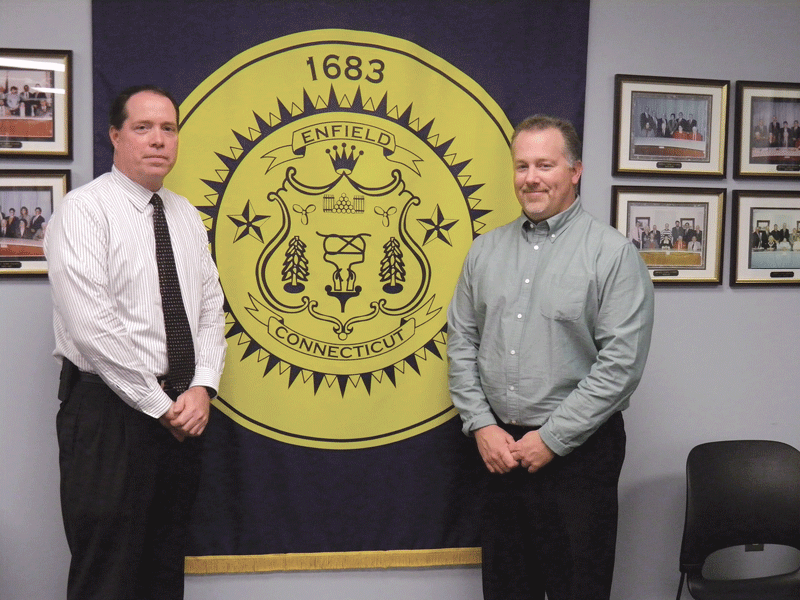
Matthew Coppler, left, and Peter Bryanton say Enfield businesses are thriving, and more space is available.
The large anchor industries in town, which include Lego, Hallmark, MassMutual, and Eppendorf, have also helped to keep the economy strong. “And Brooks Brothers is consolidating all of its operations to Enfield,” Coppler said, adding that, during the past two years, partnerships have formed between these cornerstone businesses and the town’s schools, leading to internships and externships for students. “One of our goals is to keep our youth here.”
The third draw is the affordability of housing and rental space. “It provides a lot of opportunity for people who want to live and work in our town,” he said.
Peter Bryanton agreed. “Enfield has every available service people need. It’s all right here,” said the town’s director of Community Development. “We have seven plazas and an enclosed mall, and in the last 18 months, Aspen Dental and Moe’s restaurant have opened up in Enfield Commons, and on Hazard Avenue, the site of the former Bickford’s has become home to Chipotle, Supercuts, and a wireless store.
“Plus,” he continued, “Hartford Hospital has several satellite medical facilities in Enfield, and St. Francis Hospital recently established health facilities here. These are all building blocks to the future we are trying to create.”
A fourth attraction is the active role citizens play in the town’s government. “The people who live here want the best for their community and believe in living up to their responsibility. They want to be part of town committees,” Coppler said. Recently, 50 residents applied for 13 spots on the high-school building committee. It’s a quality that stretches back to World War II, when Enfield had the highest per-capita enlistment rate in the U.S., he noted.
But although the town has experienced tremendous growth in the past few years, officials say they continue to work to keep Enfield vital. “We are trying to live up to our reputation of creating an environment that makes people want to live here,” Coppler said, citing infrastructure improvements that include $60 million spent on sidewalks and roads over the last 15 years.
Town leaders have also adopted measures to streamline the permitting process. “In the past, Enfield was seen as creating barriers to growth. But that has changed,” he said, explaining that officials made a concerted effort to meet with business owners to get feedback about how they could improve the system, then implemented their suggestions.
He cited the exterior renovation of MassMutual, which is nearing completion, as an example of that success. “They came to us with their plan on June 26, and within a month, they had all of the approvals they needed, including those for wetlands,” he said, adding that the wetlands presented a challenge for the town, “but our land-use board holds special meetings when things need to get done.”
The town also took a proactive stance in 2008 and 2009 by building a Hampton Inn on the edge of the industrial park. It contained a pad for a restaurant, and a Longhorn’s Steakhouse is set to open there soon.
Dedicated Initiative
Enfield is made up of a number of neighborhoods or small villages, which include Hazardville, Scitico, Shaker Pines, Southwood Acres, and Thompsonville.
Once home to manufacturing mills, Thompsonville is today the focus of a revitalization plan aimed at bringing new life to the area that was once considered downtown when the Bigelow-Sanford Carpet Co. was thriving and an untold number of homes were built to accommodate workers.
But the town’s center of activity moved when Enfield Mall was constructed. The neighborhood took another hit when Bigelow closed its doors, and “Thompsonville was left in the dust,” Coppler said.
Bryanton agreed, saying the village is now “an urban center with a lot of absentee landlords.” But plans have been put in place to rejuvenate the area. A $3.5 million intermodal transportation center is being built to accommodate travelers on the planned Thompsonville stop of the New Haven-Hartford-Springfield commuter rail line.
“It will be multimodal and will include rail and bus service and a pedestrian/bike path that will link Enfield Street to the Connecticut River as part of the Connecticut River Access Project,” he told BusinessWest.
The downtown is dense, and although there are numerous vacancies, “we know that transit helps bring about economic development,” Bryanton said. “We have also put in new streets and sidewalks and done a large pond-restoration project.”
In addition, the nonprofit Enfield Community Development Corp. has been tasked with granting $180,000 in microloans for startup businesses and expansions in Thompsonville. A tax-abatement process for improvements and new construction in the area is also in place, and town officials are in the process of completing a zoning study to ensure that space is available for new businesses that fit in with the natural surroundings, he added.
As for Coppler, he believes the town is filled with vitality and has experienced tremendous growth, but has not yet realized its full potential.
“Today, our vacancy rate is the second-lowest in the state,” he said. “There is money to be made here, and we can show that we have worked to help businesses come to Enfield or expand here.”