Home Posts tagged Security (Page 6)
Court Dockets Departments

The following is a compilation of recent lawsuits involving area businesses and organizations. These are strictly allegations that have yet to be proven in a court of law. Readers are advised to contact the parties listed, or the court, for more information concerning the individual claims.

HAMPDEN SUPERIOR COURT
Belmont Laundry Inc. v. DEE Services Inc. of Springfield
Allegation: Breach of contract for uniform rental: $32,250.58
Filed: 6/1/15

Central New England Agricultural Services Inc. v. J. Calabrese, LLC and Joseph T. Calabrese
Allegation: Breach of lease agreement: $25,625
Filed: 6/3/15

U.S. Fluids Inc. v. Connecticut Safety and Maintenance, LLC
Allegation: Breach of contract when goods paid for were not delivered: $10,000
Filed: 5/26/15

HAMPSHIRE SUPERIOR COURT
Fillion’s Landscaping Inc. v. Ford Motor Co.
Allegation: Breach of contract: $25,000+
Filed: 4/21/15

Gary Mallows v. Hub International New England, LLC
Allegation: Breach of contract: $40,000
Filed: 6/16/15

Laurie McGuire v. Berkel Inc.
Allegation: Product liability: $77,261
Filed: 6/2/15

NORTHAMPTON DISTRICT COURT
Bernard P. Gawle and Julia A. Gawle v. Michael F. Pinard d/b/a Topitz
Allegation: Breach of lease agreement: $9,664
Filed: 6/19/15

PALMER DISTRICT COURT
Jamy Lazarick v. Hulmes Transportation Services, American International Group, and James Fateau
Allegation: Fateau, while driving a vehicle in the employment of Hulmes, ran over the plaintiff’s foot and left the scene of the accident: $3,461.03
Filed: 6/12/15

Tara Lavertue v. Gil’s Gym & Racquet Health Club d/b/a All Day All Night Fitness
Allegation: Defendant refused to cancel health membership and improperly collected monthly payment: $502
Filed: 6/9/15

SPRINGFIELD DISTRICT COURT
Helen Skelton, as POA for Anastasia Skelton v. Extremely Clean Energy, LLC a/k/a Extremely Clean 2
Allegation: Breach of contract for repairs and renovations to residential property: $20,000
Filed: 4/29/15

J & E Roof Systems v. Craig McCarthy d/b/a Quality Renovations
Allegation: Monies due in previous judgment: $7,248.23

Perkins Paper, LLC v. Diamond Gourmet Meat and Deli, LLC
Allegation: Non-payment of goods sold and delivered: $2,002.66
Filed: 5/11/15

WESTFIELD DISTRICT COURT
Westfield Bank v. Susanne C. McLean d/b/a Northeastern Transport
Allegation: Breach of security agreement for car loan: $14,216.80
Filed: 6/22/15

Daily News

SPRINGFIELD — Barry Crosby, president and CEO of Freedom Credit Union, announced the new executive committee of the board of directors, the appointment of a new board member, and two appointments to the leadership team of the credit union.

At the recent annual meeting of the credit union, Lawrence Bouley was elected chairman of the board of directors for the next three years. Bouley has been a board member of Freedom for the past 11 years and, prior to that, served on the FHBT Credit Union Board for 25 years. During his tenure, he will play an active role in the strategic direction of the credit union.

Along with Bouley, the following board members were elected to three-year posts on the board’s executive committee: Donald Emerson, vice chairman; Louis Guillette, treasurer; William Carey, clerk; and John Reigner, security officer.

Brian Harrington has been appointed to the board of directors to fulfill the unexpired term of a recently vacated seat. Harrington is an attorney and a deputy regional director in the Springfield office of the Mass. Department of Environmental Protection. While on the Freedom board of directors, he will be a member of the auditing committee, site committee, and security committee.

In other news, David Chase Sr. has joined Freedom Credit Union as vice president of Member Business Lending. Chase has more than 25 years of experience in the banking industry with an extensive background in commercial lending. Most recently, he was vice president of Commercial Lending at Hampden Bank. Chase is actively involved with several organizations, including the West of the River Chamber of Commerce as a board member. Chase is also a vice president of the board of Gray House and also serves as a member of the town of Agawam Planning Board.

Finally, Christine Williams has been promoted to branch officer of the Freedom branch in Easthampton. In this capacity, she will oversee the financial and lending operations of the branch and develop new business opportunities with individuals and companies. For the past two years, Williams has been the assistant branch officer at the Easthampton Branch, and, prior to that, she worked at Citizens Bank. She has more than eight years of banking and credit-union experience.

Employment Sections
Carpet-cleaning Venture Advances HRU’s Mission

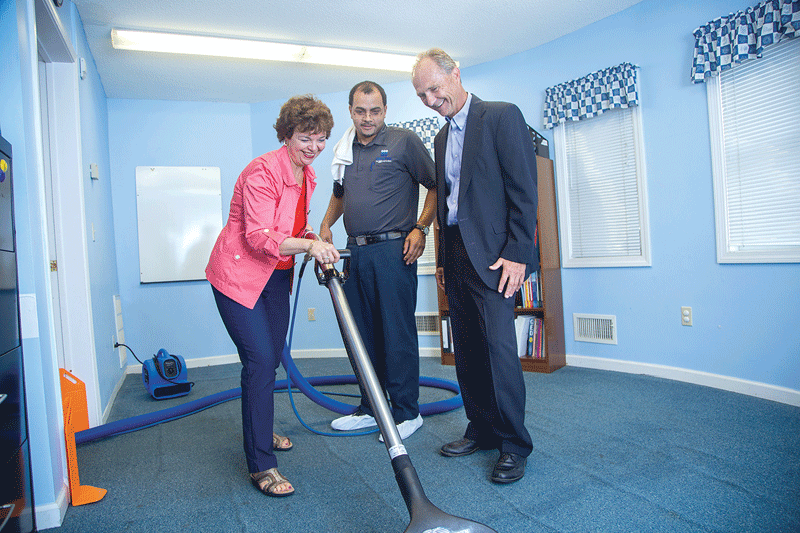
Zerorez’s Luis Cerrano (center) demonstrates the company’s equipment

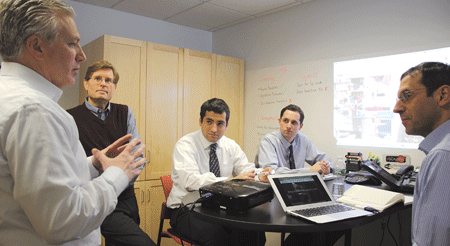
Zerorez’s Luis Cerrano (center) demonstrates the company’s equipment for Sue Mastroianni, board member of the Gray House in Springfield, and HRU president Don Kozera.

When Human Resources Unlimited (HRU) decided that its core mission — training and placing people with disabilities in meaningful jobs — would benefit from partnering with a national franchise, carpet cleaning didn’t seem like the most exciting option.

“We looked around the country and found there were few not-for-profits owning franchises, and then we set up specific criteria around what we hope to achieve, how much revenue we need, how much risk we’re willing to accept, and what the tradeoff is between profits and mission,” said Don Kozera, HRU’s long-time president.

The agency wound up looking at 600 chains, then took a harder look at 60 of them, before narrowing its search to three that fit the organization’s criteria. One of those was Zerorez, a carpet-surface cleaning company based in Salt Lake City with a national presence — except in New England.

“What attracted us was its patented ‘green’ approach to cleaning,” he said of Zerorez’s innovative use of what it calls “empowered water” (more on that later). “And if you can innovate in carpet cleaning, you can probably innovate the world. It’s also a technology-based company. With this phone in my hand, I know where all the vehicles are, if their machines are on, how much we booked today, where those leads came from … I know exactly what’s going on.”

But there was some hesitancy based on the perceived lack of a ‘wow’ factor. “People said, ‘really? Carpet cleaning? Don’t we want to do something more exciting?’ But the more we investigated it, the more we talked to franchises across the country and sat down with the owners and looked at their technology, looked at the environmentally friendly detergents being used, that there was a social cause, it made sense.”

So HRU opened its first Zerorez franchise in Holyoke in March, with more likely to follow. “We have a bigger strategy,” Kozera said. “We have the rights to the Hartford and Boston markets. We didn’t do this to own one franchise; we did it as a strategy of revenue generation and job development. It’s solely owned by HRU, but it might not be solely owned in the future; it depends on how much capital we need for expansion plans.”

None of this, of course, answers the question of why Human Resources Unlimited, which trains and places clients in some 120 area businesses and has started and closed myriad businesses of its own to achieve the same goals, embraced the franchise model. Simply put, Kozera said, it’s because HRU eventually wants to do some franchising of its own.

Active Intent

It starts with a program HRU created called Move to Work.

“It’s a platform designed to help people who have been out of the workforce — chronically unemployed people, not just people with disabilities. It’s a unique approach that uses physical health, emotional health, and financial health to create a healthy, productive worker.”

The concept is explained by the program’s original title, the admittedly clunkier Changing Habits and Transforming Lives. It takes principles not typically applied to job training, including exercise and physical fitness, and meshes them with conventional job training and the ‘soft skills’ — communication skills, personal work habits, etc. — so in demand by companies.

“With most people who are chronically unemployed, the data will show they’re physically not healthy, emotionally not healthy,” Kozera said. “Of course, being unemployed for a long time can lead to bad habits and losing self-esteem.”

Move to Work, he went on, “was originally to better our services. If people exercise for 20 to 40 minutes at 60% to 80% of their maximum heart rate, their ability to learn and retain information is greatly increased for up to four hours. That’s a scientific fact. So every one of our sessions starts with that.

“But, really, the foundation is our soft-skills training program,” Kozera explained. “Employers in this area are saying, ‘we cannot find qualified workers — at any level.’ The Federal Reserve did a report on Springfield five years ago that really outlined those issues. Companies said, ‘what do we need? People who come to work on time, with a good social skill set. We’ll train them on what we do technically. But we need those types of people.’”

So Move to Work was developed as an eight- or 16-week course to build those skills while incorporating the benefits of exercise for greater mental focus. Recently, HRU applied the program at Tech Foundry, a nonprofit that trains high-school students for information-technology jobs.

Having demonstrated its value, Human Resources Unlimited would like to turn Move to Work into a national model. And that’s something the agency has never before attempted.

“Our goal is to bring this new model into the marketplace as both an innovative program and something that can earn money,” Kozera told BusinessWest. “But it’s not easy to do. How can we raise enough revenue to support the expansion of that model?”

The answer was another question. “It’s taking a self-replicating model to the marketplace, and who does that? Franchises. They take a brand and replicate the brand. Through this confluence of activities, we said, ‘well, if we’re going to learn more about the replication and expansion of a brand into a national model, where else to learn from than franchises?’ So we started looking around, saying, ‘maybe we can start a franchise and look at owning franchises as a way to support ourselves and learn how to be a franchisor of Move to Work.’”

Workplace Legacy

A company like Zerorez is certainly new terrain for HRU. But doing things a little differently has long been the agency’s bread and butter.

Realizing that many employers didn’t believe people with developmental disabilities could work in complicated job environments, Human Resources Unlimited — then knwn as the Carval Workshop — was created in 1970 to be the vocational training center for Belchertown State School residents and provide employment opportunities for residents of the facility.

Zerorez

Zerorez recently donated its services to clean high-traffic areas of the Gray House to demonstrate its work and help another mission-driven organization.

It has expanded and evolved over the years, now offering a broad range of services, from assistance for individuals moving from public assistance to the workplace to a ‘day habilitation’ program called Pyramid for people with developmental disabilities; from commercial endeavors, of which Zerorez is the latest, to a series of so-called ‘clubhouses’ that provide members with a supportive environment where they can get specialized assistance with vocational skills and transition into good jobs at area companies, as well as increasing their participation in the community.

Kozera, who joined the organization in 1980 as fiscal director before moving into the president’s chair, said Zerorez is a good match for HRU because of it’s mission-driven approach to cleaning.

“Zerorez uses technology that was borrowed from the oil-cleanup industry,” he explained. What the national company calls ‘empowered water’ is actually electrolyzed and oxidized to create an environmentally friendly cleaning solution.

Traditional steam cleaning, the company notes, uses heated water mixed with soaps, detergents, and toxic chemicals that are injected into the carpet under pressure, which soak the carpets, pads and backing. Even though some of the soap, dirt, and water are removed, a considerable portion of this mixture remains embedded in the carpet. As the carpet dries, the detergent attaches to the carpet fibers and acts as a magnet for dirt and other substances. Empowered water, on the other hand, is applied to carpet fibers by a patented high-pressure spray system that loosens embedded dirt and removes it.

Zerorez cleans rugs, tiles, wood floors, furniture, counters … basically anything that people walk on, sit on, or work on, Kozera said. The primary market is residential, although it has commercial clients as well.

“We haven’t burst on the market,” he added, noting that the Holyoke franchise, which boasts three trucks and four employees to start, had 37 clients in May and is on track for 50 in June. But in the long run, Zerorez’s established structure and recognized name will help the local office succeed and, importantly, grow its roster of employees and fleet of trucks.

“What has a higher rate of success in business, Joe’s Burger Shop or McDonald’s? With a franchise, there’s a system, a proven model, there’s support. Other franchisees are amazing about sharing everything they know. They help each other. I don’t know how many networks are like that. They tell us what’s successful, what’s not successful. It’s a nice family created by the franchisors.”

Kozera said franchisors wanted HRU to commit to more than one market, adding that, overall, franchised businesses are more often sold to corporations than individuals these days. “You can’t buy just one; you have to buy three, so you have to have $2 million just to enter the market.”

At the same time, national networks have become more willing to sell franchises to nonprofits, while nonprofit boards, which tend to be conservative in their risk taking, like the security of partnering with a known commodity.

Furthermore, “Zerorez has a 90% retention rate in an industry that probably has a 10% retention rate,” Kozera said. “The other appealing part of this is that every customer has to rate us … and if they don’t rate us at least 9 out of 10, we fail.” The idea, he added, is to leverage great customer service into customers for life, one floor at a time.

Destination Unknown

Kozera knows that nothing is a given in any industry. “Any time you open a business,” he said, “the reality is, you don’t know what’s going to happen.”

But if it succeeds, the Holyoke Zerorez office — the first of what might be several across the region — will benefit HRU in three ways, by generating revenue, providing an education in franchising the agency can apply to Move to Work, and, of course, providing jobs for clients.

“It has a call center, and we place a lot of people in call centers at multiple locations; that’s a skill base many of our members have, and they’ve been very successful at that job,” he said, adding quickly, “we’re not creating jobs that don’t exist. We have one technician for one van; we’re not going to put two people there just to create a job.”

As for Human Resources Unlimited in general — which recently moved to a larger headquarters in Springfield — a (slowly) strengthening economy is ramping up demand for qualified workers at all kinds of companies, which can only benefit clients.

“We want to use these franchise concepts throughout the whole business, not just Zerorez,” Kozera said, referring mainly to the key factors of consistency and trust that drive consumers to known brands.

“We want to apply that to everything we do. We don’t have a whole lot of experience in business to business. But the sales process and the marketing process are things that will help us organizationally because human services — in particular placement organizations — don’t invest a lot in marketing and sales. We invest a lot in human capital; we just don’t measure it well.”

HRU’s first franchise business could help change that, while creating cross-learning opportunities across the organization that, hopefully, help more individuals find work.

And that, more than anything, is what makes carpet cleaning exciting.

Joseph Bednar can be reached at [email protected]

Agenda Departments

ACCGS Golf Tournament
July 13: The Ranch Golf Club in Southwick will be the setting for the Affiliated Chambers of Commerce of Greater Springfield’s (ACCGS) 2015 Golf Tournament. The tournament is sponsored by Bacon Wilson, P.C., Barr & Barr Inc., Florence Savings Bank, Frank Webb’s Bath Center, HealthSouth, Insurance Center of New England, and Vanasse Hangen Brustlin Inc. The tournament will kick off with registration and practice on one of its six target greens, two pitching greens, and pitching nets at 11 a.m. A course-side lunch, sponsored by the MassMutual Center, will be served from 11 a.m. until noon, with a shotgun start at 12:30 p.m. Golfers will enjoy a scramble format, hole-in-one contests sponsored by Rocky’s Ace Hardware and Teddy Bear Pools & Spas, longest-drive and closest-to-the-line competitions, a putting contest sponsored by Chicopee Savings Bank, and an opportunity to win from a wide selection of raffle prizes, including Red Sox tickets and gift cards. The day will conclude with a reception, buffet dinner, and awards ceremony. An added attraction this year will be the opportunity to win the use of a fully-stocked golf cart for the tournament, completed with snacks, cigars, additional raffle tickets, alcoholic and non-alcoholic beverages, and more. The tournament entry fee is $600 per foursome (individual golfers are welcome at $150) and includes greens fees, cart, lunch, reception, and souvenir photo sponsored by Arrow Security Co. Inc. and Eastfield Mall. Non-golfers may attend the reception only for $30 per person. To register, visit www.myonlinechamber.com or e-mail ACCGS Member Services Director Sarah Mazzaferro at [email protected].

Indian Motocycle Day
July 26: From 9 a.m. to 3 p.m., the Springfield Museums will present their sixth annual Indian Motocycle Day, the continuation of a long-standing tradition honoring the classic motorcycles that were manufactured in the city from 1901 to 1953. Last year, more than 1,000 people attended the event, which featured more than 60 classic, Springfield-built Indians owned by local collectors, The event is sponsored by the Sampson Family and AAA Pioneer Valley; the media sponsor is Rock 102 WAQY. MassMutual is the 2015 premier sponsor of the Springfield Museums. The museums re-established the Indian Day tradition in 2010 after a five-year hiatus. From 1970 to 2005, the event was held at the now-closed Indian Motocycle Museum on Hendee Street in Springfield. Esta Manthos, together with her late husband Charlie, were the owners of the former museum. In 2007, Manthos donated her extensive collection of Indian Motocycles, artifacts, and memorabilia to the Springfield Museums, where it is now on view in the Lyman & Merrie Wood Museum of Springfield History. This year’s Indian Day will pay tribute to Bob’s Indian of Etters, Pa., for its many years of supporting the heritage of classic Indian cycles. The original dealership was founded in the 1950s by Bob and Kay Markey, and has been a treasure trove of motorcycle history for over half a century. In addition to the motorcycles on display, there will be a variety of vendors, food and beverages, music provided by Rock 102, and the awarding of trophies for the best Indians in a variety of categories. Commemorative T-shirts will be available for purchase. Anyone bringing a pre-1953 Indian will receive a free admission pass plus a commemorative Indian Day button. Exhibitors, and especially vendors, are encouraged to pre-register by calling (413) 263-6800, ext. 304. Admission to the event is $10 for adults and $5 for children ages 3-17. For those wishing to attend the event and tour museum buildings, general admission is $18 for adults, $12 for seniors and college students, and $9.50 for children ages 3-17. Admission to the event and the museums is free for members of Springfield Museums; free museum admission is available for Springfield residents after 3 p.m. For information, call (413) 263-6800, ext. 304, or visit www.springfieldmuseums.org.

Driving for the Cure Golf Tournament
Aug. 17: The seventh annual Tom Cosenzi Driving for the Cure Charity Golf Tournament will tee off at Crestview Country Club in Agawam. The presenting sponsor for this year’s tournament is Autotrader. The tournament will be a four-player scramble. Tournament-day check-in begins at 10:30 a.m., and tee time is at 12:30 p.m. The event includes lunch, golf, dinner, raffle prizes, contests, and more. The tournament was started by Carla and Tommy Cosenzi, owners of TommyCar Auto Group, in memory of their father, Tom Cosenzi, who passed away from a glioblastoma brain tumor in 2009, in the hopes of carrying on his legacy and finding a cure for this disease. To date, this tournament has raised a total of $480,000 in its six-year partnership with the Jimmy Fund, one of the largest organized golf programs in the U.S. All proceeds support Dr. Patrick Wen and his team of researchers in the Neuro-Oncology Department at Dana Farber Cancer Institute. To register an individual or team, or to become a tournament sponsor, visit www.tomcosenzidrivingforthecure.com. For more information, contact Kayla Currie at (413) 570-1319 or [email protected].

Valley Fest
Aug. 29: White Lion Brewing Co. announced that it will host its inaugural beer festival, called Valley Fest, at Court Square in downtown Springfield. MGM Springfield will be the presenting sponsor. The festival is poised to be White Lion’s signature annual event, introducing the young brand to craft-beer enthusiasts throughout New England and beyond. White Lion Brewing Co., the city of Springfield’s only brewery, launched in October 2014. Founder Ray Berry and brewmaster Mike Yates have released three selections under the White Lion brand and have been busy promoting their efforts in venues all over Massachusetts and other New England states. Berry anticipates that more than 50 breweries and many local food vendors will converge on Court Square for two sessions. Enthusiasts will have an opportunity to sample more than 100 varieties of beer and hard cider alongside pairing selections by local chefs. A number of sponsors have already committed to the event, including MassMutual Financial Group, the Young Professional Society of Greater Springfield, the Dennis Group, Springfield Sheraton Monarch Place, Paragus Strategic IT, Williams Distributing, and the Springfield Business Improvement District (BID). Visit www.valleybrewfest.com for event details, ongoing updates, and sponsorship opportunities. A portion of Valley Fest proceeds will support several local charities.

Western Mass. Business Expo
Nov. 4: 
Comcast Business will present the fifth annual Western Mass. Business Expo at the MassMutual Center in downtown Springfield, produced by BusinessWest and the Healthcare News in partnership with Go Graphix and Rider Productions. The business-to-business show will feature more than 100 booths, seminars and Show Floor Theater presentations, breakfast and lunch programs, and a day-capping Expo Social. Details about tevents, programs, and featured speakers will be printed in future issues of BusinessWest. Sponsors include MGM Springfield, presidential and Expo Social sponsor; the Isenberg School of Business at UMass Amherst, education sponsor; Johnson & Hill and Health New England, director level sponsors; and 94.7 WMAS, media sponsor. Additional sponsorship opportunities are available. Exhibitor spaces are also available; booth prices start at $750. For more information on sponsorships or booth purchase, call (413) 781-8600, ext. 100.

Daily News

BOSTON — The New England Information Office of the U.S. Bureau of Labor Statistics has released regional data on employer costs for employee compensation (ECEC) for March 2015. ECEC data are based on the National Compensation Survey (NCS), which measures employer costs for wages, salaries, and employee benefits.

Total compensation costs among private-industry employers in New England averaged $38.35 per hour worked in March 2015. Wages and salaries accounted for 71.2% of total compensation costs (or $27.28 per hour), while benefits accounted for 28.8% of costs (or $11.06 per hour).

Total benefits costs to employers within the New England division were comprised, primarily, of the following categories: insurance (including life, health, short- and long-term disability insurance), $2.95 per hour worked; legally required benefits (including Social Security and Medicare), $2.92 per hour; and paid leave (including vacation, holiday, sick, and personal leave categories), $2.72 per hour. Retirement and savings added another $1.41 per hour to the total benefits cost in New England.

In the U.S., compensation costs among private industry employers averaged $31.65 per hour worked in March. Wages and salaries, at $21.94 per hour, accounted for 69.3% of these costs, while benefits, at $9.71, made up the remaining 30.7%.

Daily News

SPRINGFIELD — The Ranch Golf Club in Southwick will be the setting for the Affiliated Chambers of Commerce of Greater Springfield’s (ACCGS) 2015 Golf Tournament on Monday, July 13.

The tournament is sponsored by Bacon Wilson, P.C., Barr & Barr Inc., Florence Savings Bank, Frank Webb’s Bath Center, HealthSouth, Insurance Center of New England, and Vanasse Hangen Brustlin Inc. The tournament will kick off with registration and practice on one of its six target greens, two pitching greens, and pitching nets at 11 a.m. A course-side lunch, sponsored by the MassMutual Center, will be served from 11 a.m. until noon, with a shotgun start at 12:30 p.m.

Golfers will enjoy a scramble format, hole-in-one contests sponsored by Rocky’s Ace Hardware and Teddy Bear Pools & Spas, longest-drive and closest-to-the-line competitions, a putting contest sponsored by Chicopee Savings Bank, and an opportunity to win from a wide selection of raffle prizes, including Red Sox tickets and gift cards. The day will conclude with a reception, buffet dinner, and awards ceremony.

An added attraction this year will be the opportunity to win the use of a fully-stocked golf cart for the tournament, completed with snacks, cigars, additional raffle tickets, alcoholic and non-alcoholic beverages, and more.

Sponsorship levels for every budget are available, from the presenting-sponsor level to 18 flag-sponsor levels that reward sponsors with a keepsake personalized pin flag, to the budget-friendly tee-sponsor level.

The tournament entry fee is $600 per foursome (individual golfers are welcome at $150) and includes greens fees, cart, lunch, reception, and souvenir photo sponsored by Arrow Security Co. Inc. and Eastfield Mall. Non-golfers may attend the reception only for $30 per person.

For information on sponsorship opportunities, contact ACCGS Member Services Director Sarah Mazzaferro at [email protected] or (413) 755-1313. To register for the tournament, visit www.myonlinechamber.com or e-mail Mazzaferro.

Accounting and Tax Planning Sections
Stay on the Right Side of the IRS and Minimize Your Tax Liability

By JAMES BARRETT

TaxAccountingDPartTax planning for 2015 is a venture in uncertainty.

Last December, Congress passed legislation extending a number of expired tax provisions. Unfortunately, they were extended only until Dec. 31, 2014. At this point, we don’t know their status for 2015 and beyond.

There has been a great deal of talk about tax simplification, but currently, it appears to be all talk with no substance and little momentum for achieving true reform.

On April 16, the U.S. House of Representatives voted to repeal the estate tax, but this was seen as a largely symbolic gesture because the U.S. Senate does not appear to have enough votes to pass the legislation. Even if the bill were to survive the Senate, President Obama is likely to veto it. The House is apparently attempting to keep the issue in the forefront with an eye to repeal in 2017.

Rules regarding IRA rollovers have changed. As of 2015, taxpayers may make only one IRA-to-IRA rollover per year. This does not limit direct rollovers from trustee to trustee.

James Barrett

James Barrett

It should also be pointed out that the penalty for failure to maintain qualifying health insurance takes a big leap in 2015. The penalty is the greater of $325 for each adult and $162.50 for each child (but no more than $975) or 2% of household income minus the amount of the taxpayer’s tax-filing threshold.

Dealing with the IRS has become more difficult as a result of budget cuts that make it difficult to reach IRS personnel by phone or in person at most offices. On the flip side, the chances of being audited by the IRS are at the lowest they have been for years. However, the IRS remains quite proficient at sending out computer-generated notices, usually from document-matching processes.

Inflation Adjustments

As usual, there are some adjustments to a number of tax-related amounts for 2015.

The personal and dependency exemptions were increased by $50 per individual. The standard deduction for all filing statuses increased between $100 and $200, while the additional standard deduction for taxpayers who are age 65 and over or blind increased $50 for both married statuses but did not increase for head-of-household or single filers.

Tax brackets, along with phase-out ranges for itemized deductions, personal exemptions, the AMT exemption, IRAs, and several credits, were increased slightly for inflation.

The personal exemption and itemized deduction phase-out threshold for married filing jointly is now an adjusted gross income of $309,900. For single filers, it is $258,250.

The itemized-deduction phase-out reduces otherwise-allowable itemized deductions by 3% of the itemized deductions exceeding the threshold amount. The reduction cannot reduce itemized deductions below 80% of the otherwise deductible amount.

Certain itemized deductions are not subject to the phase-out — medical expenses, investment-interest expense, casualty and theft losses, and gambling losses.

Business mileage increased Jan. 14 to 57.5 cents a mile, while the deduction for medical or moving mileage dropped by a half-cent to 23 cents. The deduction for charitable mileage remains unchanged at 14 cents.

The new limits for some of the major items are outlined in the accompanying table.InflationAdjusted2015TaxProvisions

Timing of Deductions

As the standard deduction continues to increase each year, fewer and fewer taxpayers are finding that they can itemize deductions.

Statistically, only about one-third of all taxpayers use Schedule A, Itemized Deductions. In addition to the inflation factor, some other influences make itemizing a less attractive option.

First is the increase in the threshold for deducting medical expenses. This threshold had remained at 7.5% of adjusted gross income for a number of years. However, for most taxpayers, the threshold has increased to 10% under the Affordable Care Act.

Another factor affecting itemizing is the decrease in interest rates. As interest rates have declined, so has the amount of interest taxpayers are paying. As a result, the mortgage-interest deduction has declined. Many taxpayers are now finding they no longer have enough deductions to itemize.

When taxpayers find themselves in a situation where they are close to the itemization threshold, they can often decrease their tax liability through the timing of their deductions. This strategy simply involves speeding up or delaying certain deductions, bunching them as much as possible in a particular year.

For example, in a year in which the taxpayer has enough medical expenses to deduct, a good strategy is to pay as many of these bills as possible in that year to take advantage of greater medical deductions.

Another area open to the timing of the deduction is charitable contributions. By delaying or speeding up such contributions, taxpayers can bunch them into one year for maximum benefit. While regarding charitable giving, do not overlook the tax benefit to be derived from non-cash charitable contributions.

Depending on the local property tax laws, it may be possible to pay two years of property tax bills in one calendar year to get maximum benefit from the deduction. However, be aware of early-payment discounts and late-payment penalties that would wipe out the benefits from taking the itemized deduction.

Another related strategy is to consider if you are in the itemized-deduction phase-out area for the current year. If you have an unusually large amount of income in the current year, it may be beneficial to maximize itemized deductions in the following year, when you are not subject to the phase-out.

Keep in mind that the items in question can be deducted only in the year in which they are considered paid. You cannot choose which year to deduct the item if it has been paid.

Bills paid with a credit card can be deducted in the year in which the credit card is charged, not when the amount is paid to the credit-card company. If the provider of the goods or services has been paid, you may take the amount as an itemized deduction.

Non-cash Contributions Can Be Money in Your Pocket

We live in a throwaway society. We buy something, use it, and then discard it when it no longer suits our needs.

Frequently, these items are in good condition and can be useful to others. Making a contribution of these items to a qualified tax-exempt charitable organization is a win-win-win situation. The organization benefits from the revenues generated by the contribution, the donor gets a tax deduction, and someone gets a usable item at a good price.

The accompanying table illustrates the process of deducting the contribution on Form 1040. It is a fairly simple reporting model, with increasing requirements as the dollar value of the contribution increases.NonCashCharitableContributions
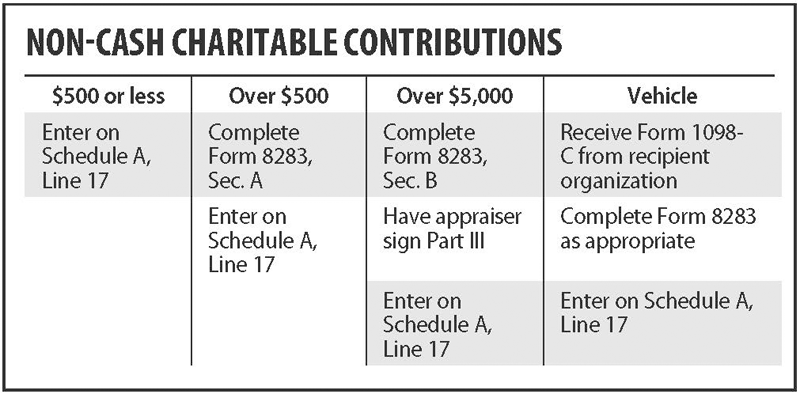
If the contribution exceeds $5,000 in value, an appraisal must be obtained. The cost of this appraisal is deductible as a miscellaneous itemized deduction subject to the 2% limitation. The appraisal requirement does not apply to registered securities.

If the donated item is a vehicle, boat, or airplane, the recipient organization is required to issue the donor a Form 1098-C, and the deduction amount will be the proceeds the organization received from the sale of the vehicle or the Blue Book value if it was retained for use in the organization.

Securities and certain other capital assets that have been held for more than 12 months can be donated, and the donor can take a deduction for the fair market value of the asset instead of the donor’s basis. This can yield a large deduction at little cost for assets that have significantly increased in value.

When donating household items, many people have a tendency to stuff their goods into a large garbage bag and tell the tax preparer that they donated “three bags of clothing and household goods, and here’s my receipt from the organization.” This haphazard approach will not stand up to an IRS audit. The taxpayer is required to have an itemized list of the items donated.

Valuing the items that are donated can be a problem and somewhat time-consuming. But a little time can pay significant rewards. Both the Salvation Army and Goodwill publish a valuation guide for donated items, which may be downloaded for free from their respective websites.

Another approach is to use computer programs. Intuit offers It’s Deductible, which is free online at www.itsdeductible.com.

There is also a mobile app for Apple. You simply input information about the charity, proceed to list your donated items, and let the program value them for you. The IRS generally accepts the values assigned by these guides or programs.

Using one of the above methods, a simple spreadsheet or some other system will help keep your donation records up to date and simplify your document gathering at tax time. An organized list may mean a larger deduction for you.

Capital-gain Rates and Net Investment Income Tax

If someone were to ask, “what is the capital-gain tax rate?” the best answer would have to be: “it depends.”

First, you should determine whether the sale is subject to taxation at the ordinary income rate or at the preferred capital-gain rate. A capital asset must be held for more than 12 months to qualify for capital-gain treatment. Otherwise, it is taxed at ordinary income rates, which vary from 10% to 39.6%.

Even if the sale of the asset meets the criteria for capital-gain treatment, the rate can be zero, 15%, 20%, 25%, or 28%. Then there may be an additional 3.8% net investment income tax levied on top of those rates.

It should be noted that the capital-gain rate is a rate that substitutes for the ordinary income rate. The sale is not subject to both regular income tax and the capital-gain tax.

Generally, a capital gain arises from the sale of investment property or real estate. In addition to gains from the sale of capital assets being subject to the capital-gain rate, qualified dividends are taxed at that rate but are not capital gains. The highest capital-gain rate is 28%, levied on gains from the sale of collectibles or qualified small-business stock. Next would be the tax on unrecaptured Section 1250 gains at 25%.

This brings us to the more common capital-gain rates, which are applied to most capital asset sales. This rate varies.

Taxpayers in the 39.6% (highest) bracket will be subject to a 20% capital-gain rate. Those not in the highest bracket but in the 25% or higher bracket must pay at the 15% rate. Taxpayers in the 10% or 15% brackets have a zero capital-gain rate applied.

These rates can be somewhat misleading since some taxpayers will be subject to the 3.8% net investment income tax. This is a surtax on taxpayers whose modified adjusted gross income exceeds $250,000 for married couples filing jointly ($125,000 for married filing single and $200,000 for everyone else).

Estates and trusts are subject to this tax, which can be significant. They will be subject to this tax on the lesser of:

• Undistributed net investment income; or
• Adjusted gross income over the amount at which the highest tax bracket for a trust or an estate begins (currently $12,300).

This tax makes the effective capital gain rate as high as 23.8%.

However, estates and trusts can avoid the tax by making income distributions to the beneficiaries. Since the threshold subject to the tax is significantly higher for individuals, this option could eliminate the tax altogether.

The net investment income tax is levied on income in addition to capital gains. Net investment income includes most dividends, interest, annuities, royalties, rents, and the taxable portion of gains from the sale of property. The regulations defining net investment income take 159 pages to define the term, so consult with your CPA regarding your liability for this tax.

A separate tax was enacted as a part of the Affordable Care Act that also applies to individuals with high incomes. The 0.9% additional Medicare tax is levied on earned income in excess of certain threshold amounts. The thresholds are the same as the ones for the net investment income tax.

However, collecting the tax is somewhat complex. If an individual has wages in excess of $200,000, the employer is required to withhold the tax on earnings in excess of that amount. If neither spouse exceeds the $200,000 threshold but they have a combined earned income in excess of $250,000, they must pay the tax when they file their Form 1040.

As with the additional Medicare tax, taxpayers are advised to consult with their CPA to take steps to mitigate this tax — or at least to be prepared for it.

Home-office Safe Harbor

If your business operates out of your home, the IRS will allow you to take a tax deduction for your home office.

To qualify for the deduction, you are required to:

• Have an area in your home that is exclusively and regularly used as a home office; and
• Use the home as your principal place of business.

If you are an employee, you are subject to these same two criteria. In addition, your home office must be for the convenience of the employer. An employee cannot rent a portion of the home to the employer, use the rented portion to perform services as an employee for that employer, and take a home-office deduction.

The home-office deduction is based on the portion of the home that is used for business. A percentage of many home expenditures can be allocated to the cost of the office. In addition, a depreciation deduction may be included in the cost.

The IRS now offers a simplified safe-harbor option for deducting home-office expenses. Rather than determining the actual expenses incurred in the home, taxpayers may simply deduct $5 per square foot used as an office for the deduction. Keep in mind that using the safe-harbor method means there will be no depreciation recapture when the home is sold.

A taxpayer may choose either deduction method each year. The election is made by filing the return using the method of choice for that year.

Home-office Deduction for a Corporation

The home-office deduction is designed for a sole proprietorship filing a Schedule C. Business owners who choose to incorporate their businesses will lose the advantage of deducting the expenses of a home office because the corporation and the taxpayer become two separate, distinct entities at the time of incorporation.

Three alternatives can be chosen that would allow a home-office deduction in these situations. First, assuming that corporation owners are also employees of their corporations, they could take the employee home-office deduction on their Schedule A as a miscellaneous itemized deduction.

However, this approach has two disadvantages. First, the deduction is subject to the 2% limitation on miscellaneous itemized deductions, potentially eliminating some or all of the deduction. Secondly, taxpayers who do not itemize cannot obtain a home-office deduction.

The second choice is for corporations to pay rent to their owners for use of a home office. This rent is deductible by the corporations, and the owners must report the rent on their Form 1040, Schedule E.

However, an owner can set the amount of rent equal to the expenses associated with the home office and show no gain or loss on the rental activity on the Form 1040. Using this method, the owner can create some personal cash flow since deducting depreciation on the office is an allowable expense.

The third alternative is to have the corporation pay the owner for any out-of-pocket costs of a home office under an accountable plan. Reimbursed expenses must be actual job-related expenses that the owner must substantiate by providing the corporation with receipts or other documentation.

These expenses can include a portion of mortgage interest, property taxes, utilities, insurance, security service, and repairs. They would be reimbursed based on the percentage of the home that is represented by the office area.

These last two methods require some rigorous record keeping. But the bottom line is that either of these approaches can yield benefits to the taxpayer and the corporation.

Tangible Property Regulations

New tangible property regulations went into effect on Jan. 1, 2014. These regulations are far-reaching and designed to guide taxpayers in determining whether an expenditure can be classified as an expense or must be capitalized and depreciated.

In many cases, the answer is clear. Routine ‘ordinary and necessary’ business expenses are normally expensed. These include supplies, payroll, purchased inventory (when sold), small tools, insurance, licenses and fees, and routine maintenance.

At the other extreme are items that are clearly long-lived assets and must be capitalized and depreciated — vehicles, machinery and equipment, buildings, etc. Companies may use a de minimis safe-harbor election to simplify accounting records. This amount is $5,000 if the company has an applicable financial statement (AFS), and $500 otherwise. Expenditures below these amounts may be expensed. An AFS is generally an audited statement filed with the SEC or with a government agency.

Where the major issues come into play is in considering whether a repair can be classified as an improvement to the asset. Under IRS regulations, property is improved if it undergoes a betterment, an adaptation, or a restoration. If it is an improvement, it should be depreciated.

Betterment:
• Fixes a ‘material condition or defect’ in the property that existed before acquisition of the asset;
• Results in a material addition to the property; or
• Results in a material increase in the property’s capacity.

Restoration:
• Returns a property to its normal, efficient operating condition after falling into disrepair;
• Rebuilds the property to like-new condition after the end of its economic life;
• Replaces a major component or substantial structural part of the property;
• Replaces a component of the property for which the owner has taken a loss; or
• Repairs damage to the property for which the owner has taken a basis adjustment for a casualty loss.

Adaptation:
• Fits a unit of property to a new or different use.

The definition of the unit of property (UOP) is critical. It helps determine whether an expenditure should be capitalized or expensed.

For example, a building may be defined as a UOP, or each of the enumerated building systems may be defined as a UOP. For non-buildings, the UOP is defined by the IRS as all components that are functionally interdependent, unless the taxpayer used a different depreciation method or recovery period for a component at the time it was placed into service.

There are two additional safe harbors — an election for small taxpayers and a routine-maintenance safe harbor.

Conclusion

Tax laws change at an amazing pace. It is estimated that more than 5,000 changes to federal tax laws have been made since 2001. That’s an average of more than one change per day. The Internal Revenue Code was 73,954 pages in 2013, which makes War and Peace look like a short story.

The information contained in this article was current at the time it was published. However, it is by no means certain that it will remain current for the rest of 2015.

Why bring this up? Simply to emphasize how incredibly complex our tax laws have become. Tax planning is necessary in today’s complex world so that you can stay on the right side of the IRS and minimize your tax liability.


James Barrett is managing partner of Meyers Brothers Kalicka in Holyoke; (413) 536-8510; [email protected]

Chamber Corners Departments

AMHERST AREA CHAMBER OF COMMERCE
www.amherstarea.com
(413) 253-0700
 
• June 24: After 5, 5-7 p.m., hosted by J.F. Conlon, 29 University Dr., Amherst. Sponsored in part by J.F. Conlon & Associates. Cost: $10 for members, $15 for non-members. Register online at www.amherstarea.com or call the chamber office at (413) 253-0700.
 
GREATER CHICOPEE CHAMBER OF COMMERCE
www.chicopeechamber.org
(413) 594-2101
 
• June 17: Breakfast & Health Fair, American Red Cross Blood Drive, hosted by Castle of Knights, 1599 Memorial Dr., Chicopee. Exhibitor space available: $125 per table for members, $175 for non-members.
• June 18: Mornings With the Mayor, 8-9 a.m., hosted by Willimansett Center West, 546 Chicopee St., Chicopee. Free for chamber members.
• June 24: Business After Hours, 5-7 p.m., hosted by Wireless Zone, 601E Memorial Dr., Chicopee. Cost: $10 for members, $15 for non-members. 

GREATER EASTHAMPTON CHAMBER OF COMMERCE
www.easthamptonchamber.org
(413) 527-9414

• June 18: Speaker Breakfast, 7:30-9 a.m., hosted by Williston Northampton School, 19 Payson Ave., Easthampton. Join us for breakfast and educational discussion with keynote speaker Tim Brennan, Pioneer Valley Planning Commission executive director, regarding the regional impact and importance of the North South Rail Project. Register online at www.easthamptonchamber.org or call Denise at (413) 527-9414.
 
GREATER HOLYOKE CHAMBER OF COMMERCE
www.holycham.com
(413) 534-3376
 
• June 19: 125th Anniversary Gala Ball, hosted by the Log Cabin, 500 Easthampton Road, Holyoke. Cocktails at 6 p.m., dinner at 7 p.m. Enjoy an elegant meal and dance to the music of the Floyd Patterson Band. Join Marcotte Ford as one of the major event sponsors by calling (413) 34-3376. Event is open to the public, More details to follow.
 
GREATER NORTHAMPTON CHAMBER OF COMMERCE
www.explorenorthampton.com
(413) 584-1900
 
• June 25: 2015 Workshop: “Taking Control of Your Energy Costs: Money-saving Strategies for Businesses,” 9-10 a.m., hosted by Greater Northampton Chamber of Commerce, 99 Pleasant St., Northampton. Join the Hampshire Council of Governments Electricity Department to learn about easy strategies for reducing the amount you spend on electricity each year. Learn about local, state, and utility resources for financing energy-saving projects and how to evaluate offers from electricity suppliers — and much more. Admission is free. Pre-registration is required; space is limited. To register, visit [email protected]
• June 26: 2015 Workshop: “Microsoft Excel: Tips, Tricks & Shortcuts in Microsoft Excel,” 9-11 a.m., hosted by Greater Northampton Chamber of Commerce, 99 Pleasant St., Northampton. Presented by Pioneer Training. This workshop will present our favorite tips, tricks, and shortcuts that we have collected and developed over 15 years of teaching and using Microsoft Excel. Participants are encouraged to bring laptops and follow along with the instructor, but this is not required. Admission: $20 for members, $30 for non-members. Pre-registration is required; space is limited. To register, visit [email protected]
 
GREATER WESTFIELD CHAMBER OF COMMERCE
www.westfieldbiz.org
(413) 568-1618
 
• June 19: Chamber Breakfast, 7:15 a.m. to 9:00 a.m. Hosted by The Ranch Golf Club, 65 Sunnyside Road, Southwick. Platinum sponsor: Mestek. Golf sponsor: Berkshire Bank. Silver sponsor: First Niagara and Prolamina. Cost: $25 for members, $30 for non-members. Golf special: Registered attendees of the breakfast can golf at a discounted rate of only $65 at the Ranch Golf Club following the breakfast. Call Bill Rosenblum, golf pro, to register at (413) 569-9333, ext. 3. To register, call Pam at the chamber at (413) 568-1618.
• June 22: Social Security Workshop: “Make Social Security Work for You,” 4:30-5:30 p.m., hosted by Holiday Inn Express, 39 Southampton Road, Westfield. Sponsored by Renaissance Advisory Services, LLC. Guest speaker: William Sheehan, district manager (retired), Springfield Social Security Office. Before you retire, ask questions: when should I begin Social Security? Do I plan to keep working? Will all my expenses be covered? What will my beneficiaries receive?  Learn about Social Security strategies that may fit into your overall plan. Cost: free for chamber members, $30 for non-members.
 
WEST OF THE RIVER CHAMBER OF COMMERCE
www.ourwrc.com
413-426-3880
 
• June 18: Annual Breakfast Meeting, 7-9 a.m., hosted By Chez Josef, Agawam. Sponsored by OMG, Ormsby Insurance, and Development Associates. Event will kick off with the welcoming of new chairman Chuck Kelly and the incoming WRC board of directors. Cost: $25 for chamber members, $30 for non-members. For more information and for tickets, call the chamber office at (413) 426-3880 or e-mail [email protected].

Departments Picture This

Send photos with a caption and contact information to: ‘Picture This’ c/o BusinessWest Magazine, 1441 Main Street, Springfield, MA 01103 or to [email protected]

LTL-2LinkToLibraries

Exciting Chapters

The nonprofit group Link to Libraries (LTL) continues to expand its presence in the region and write new chapters in its success story. Above, students at Bowie School in Chicopee and librarian Joyce Hogan thank LTL for a literacy and technology grant the agency awarded to the school. It will be used to purchase library programs and headphones for the students at the school. Meanwhile, on June 4, LTL celebrated its end of year with a volunteer ice-cream social and make-your-own-sundae party. More than two dozen volunteers turned out to enjoy a sweet evening of social fun. Included were volunteers from Westfield, West Springfield, Longmeadow, Wilbraham, Monson, Springfield, Hampden, and Holyoke.

UTCA-Image-BUTCA-Image-A

UTCA Celebrates Milestone

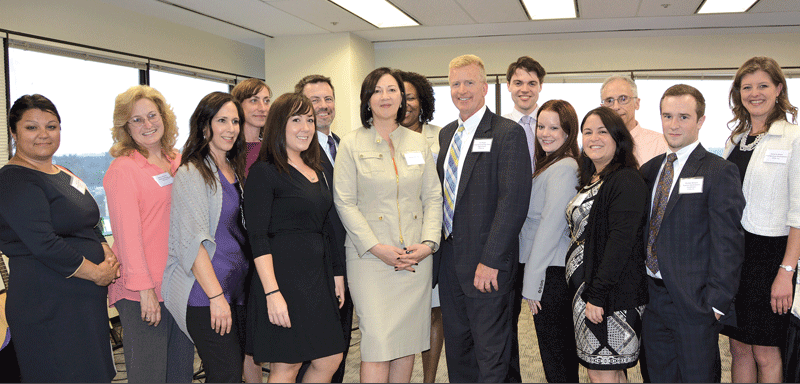
Unemployment Tax Control Associates Inc. (UTCA), a national unemployment-insurance service provider based in Springfield, with offices in Boston and Houston, recently celebrated a quarter-century in operation with an Anniversary and Client Appreciation Party on May 27. The event, held at One Financial Plaza in Springfield, included a distinguished guest list comprised of clients, business owners, presidents, and CEOs of several local and national companies. At right, Suzanne Murphy (left), founder and CEO of UTCA, celebrates with her first client, Barbara Pilarcik, executive director of the Assoc. for Community Living in Springfield.

PB-Chicopee-Comp.-High-SchoolPB-Chicopee-High-School

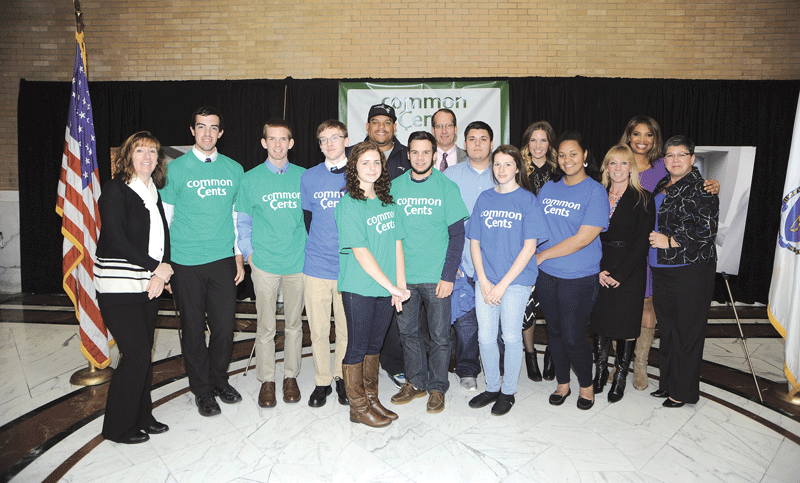
Common Cents

PeoplesBank sent two Chicopee High School teams to Boston recently to compete in Common Cents, a program hosted by the Mass. Banking Assoc. (MBA). The bank supported participating students from Chicopee High School and Chicopee Comprehensive High School at the statewide competition last fall at the State House. At top, the Chicopee Comprehensive High School team is seen with, from left, Mary Paleologopoulos, teacher at Chicopee Comp; Jermaine Wiggins, former New England Patriots player; Jeffrey Fuhrer, executive vice president, Federal Reserve Bank of Boston; Ashlee Feldman, radio personality, JAM’N 94.5; Karen Volpe, branch manager, PeoplesBank Fairview office; Latoyia Edwards, anchor, NECN; and Donna Wiley, regional manager, PeoplesBank. Below, the Chicopee High School Team with, from left, Wiggins; Shavon Diaz, teacher, Chicopee High School; Fuhrer; Feldman; Edwards; Volpe; and Wiley.

PictureThisMercy

Transforming Care

Mercy Medical Center announced that ProShred Security and Convergent Solutions Inc. (CSI) have joined together to pledge a gift of $25,000 to Transforming Cancer Care — the Capital Campaign for the Sister Caritas Cancer Center. The campaign was launched to support the $15 million expansion of the Sister Caritas Cancer Center at Mercy Medical Center. These funds will be used to consolidate all cancer services into a single, unified space and meet the increased demand for outpatient cancer services. The $25,000 contribution reflects a joint gift from two Wilbraham-based companies: ProShred Security, owned and operated by Joseph Kelly and Barry Sanborn, and Convergent Solutions Inc., owned and operated by their wives, Arlene Kelly and Kim Sanborn. Both couples are longtime supporters of the Sisters of Providence Health System (SPHS) and Brightside for Families and Children. From left, Daniel Moen, president and CEO, SPHS; Barry and Kim Sanborn; Joseph and Arlene Kelly; and Diane Dukette, vice president of Fund Development, SPHS.

Daily News

HAMPDEN — Monson Savings Bank is holding a complimentary workshop titled “Social Security: The Choice of a Lifetime.” It will be presented by Kevin Flynn, regional vice president of Nationwide Financial, and an expert on retirement planning and helping people to understand Social Security and how to optimize their benefits.

The event is designed to give people a comprehensive understanding of the rules and details regarding when and how to file for Social Security. It will be held Tuesday, June 16 from 5 to 6:30 p.m. at the Hampden Senior Center at 104 Allen St. in Hampden. The free event is open to the public.

“This workshop is back by popular demand,” said Steven Lowell, president of Monson Savings Bank. “Knowing when and how to file for Social Security can have a big impact on retirement income. We have offered this workshop before, and those who attended were very appreciative of the information.”

Those interested in attending should call Anna Driscoll at (413) 267-1221 or e-mail [email protected]. Seating is limited. Refreshments will be served.

Daily News

HADLEY — You have heard the stories about Target, Home Depot and Sony, but could something like that really happen to a small business in Western Mass.? What are the biggest threats facing a small business when it comes to IT security? Spoiler alert: it isn’t what you think.

Join Paragus Strategic IT on Thursday, June 11 as it kicks off its new breakfast series by taking a look at these questions and eating some great food. Presenters will review what’s happening locally, regionally, nationally, and globally when it comes to IT security, and share valuable tips that can help prevent your business from becoming the victim of a cyberattack.

The event is scheduled for 8 to 9:30 a.m. at Paragus Strategic IT, 112 Russell St., Hadley. To register, visit www.eventbrite.com/e/paragus-breakfast-series-tickets-16867459024.

Court Dockets Departments

The following is a compilation of recent lawsuits involving area businesses and organizations. These are strictly allegations that have yet to be proven in a court of law. Readers are advised to contact the parties listed, or the court, for more information concerning the individual claims.

FRANKLIN SUPERIOR COURT
Christian Antunes v. City of Greenfield
Allegation: Plaintiff’s home was flooded with sewage backflow when town employees attempted to repair a main sewer line: $48,179
Filed: 3/11/15

Multimedia Center Inc. v. Lange Chiropractic Inc. and Kimberly Lange
Allegation: Non-payment of promissory note: $58,000
Filed: 2/25/15

HAMPDEN SUPERIOR COURT
Cosale Inc. v. NiSource Inc. and Baystate Gas Co. d/b/a Columbia Gas of MA
Allegation: Employees of Columbia negligently ruptured a pipe causing a massive explosion, property damage, and lost revenue: $301,066.59
Filed: 3/13/15

PALMER DISTRICT COURT
Jordan Quitero v. Boston Road Auto Mall and Platte River Insurance Co.
Allegation: Breach of contract and odometer fraud: $12,650
Filed: 3/25/15

SPRINGFIELD DISTRICT COURT
Security Credit Services, LLC v. Silks Auto Service Inc.
Allegation: Non-payment on business credit account: $58,063.19
Filed: 3/20/15

Tamaro Ako-Brew v. Graham’s Package Store Inc. and 1655 Main St., LLC
Allegation: Negligent maintenance of property causing slip and fall: $1,634
Filed: 3/19/15

Daily News

AGAWAM — The Employers Association of the NorthEast (EANE) and FIT Staffing are partnering to offer a new IT Roundtable Series. The first event will take place on Tuesday, May 19 at 8:30 a.m. at the EANE offices in Agawam, and will feature an interactive discussion on the top trends and issues facing CIOs and IT managers in today’s changing business climate.

Topics like information security, big-data management, and BYOD (bring your own device) are posing critical challenges for businesses across a wide array of industries. IT leaders from regional businesses are welcome attend and bring their unique challenges to the group for discussion about best practices and solutions. For more information, contact Allison Ebner at FIT Staffing at [email protected] or (413) 355-5125.

Daily News

HOLYOKE — PeoplesBank will present “Staying Ahead of the Hackers” on Wednesday, May 13 from 7:45 to 9:30 a.m. in the PeoplesBank Conference Center, 330 Whitney Ave., Holyoke.

The presentation is part of the bank’s 2015 Business Banking Seminar Series. This free seminar will focus on best practices in security to ensure that your small business does not become a victim to the latest security threats. Presenter Matthew Putvinski serves as director of the Information Technology Assurance Services group at Wolf & Co.

To join this workshop, register online at bit.ly/PBsignup by May 8. For questions on the 2015 Business Banking Seminar Series, e-mail [email protected] or call (413) 538-9500.

Features
Common Capital Program Helps Individuals Fuel Small Businesses

Common CapitalBeverly Weeks spent close to two decades as a librarian at West Springfield High School, so she understands the importance of researching matters thoroughly.

And that’s exactly what the now-retired Weeks did several months ago when she decided to reel in one of her investments, which she determined was too heavily focused on fossil fuels, and redirect that money toward something far more sustainable — and rewarding.

That research took her to Common Capital’s Community First Fund, which pools investments from people like Weeks and loans them to individuals trying to get a business off the ground or to that proverbial next level.

And that’s where her search ended.

“I was looking around for alternatives — I was searching for investments that would go back into my community, and this struck me as a good one,” she told BusinessWest. “I liked the fact that I would be making a loan that then makes it possible for a venture to get on its feet or add a new aspect or product to its business.

Claudine Baj

Claudine Baj says loans channeled to her through Common Capital have helped her expand her kitchen and bring in needed help.

“And I like the fact that it’s a loan, so the money keeps circulating,” she went on, adding that, as part of that extensive research she conducted, she read how Common Capital, formerly the Western Mass. Enterprise Fund, assisted some of those businesses crippled by the fire in a Hadley strip mall in the fall of 2013. “It’s rewarding to lend a helping hand — or a helping dollar, as the case may be.”

Such sentiments are exactly what administrators at Common Capital had in mind a few years ago when they decided to become part of what is now a national trend toward creating community loan pools to assist fledgling businesses.

Chris Sikes, Common Capital’s CEO, said this movement, if it can be called that, can be traced to New Hampshire, and it has quickly spread to many other areas of the country.

That’s because the concept is fairly simple, and — to the growing number of people who, like Weeks, desire investments that that can in some way be categorized as ‘sustainable’ — it’s also quite appealing.

Here’s how it works locally: the Community First Fund will accept donations of any size from $500 to $50,000 (the old floor was $1,000, but it was lowered to enable more people to participate). The loan term is three years with a 2% annual rate of return (better than most currently advertised CD rates certainly), with interest paid to participants semi-annually. Common Capital’s initial goal was to raise $500,000, but that has been passed — approximately $600,000 has ben amassed to date — and the new target is $1 million.

Contributions are pooled and placed in Common Capital’s general fund, where they are loaned to a diverse and growing roster of entrepreneurs who need some capital to make an important step forward, whatever that might be.

People like Claudine Gaj.

She started the Magic Spoon, a catering business, in 1998, and, over the ensuing years, has recorded steady if unspectacular growth. By early last year, she had come to a point most entrepreneurs reach, where she really wanted and needed to bring in help.

Jerry Zalucki, seen here with his wife, Suzanne

Jerry Zalucki, seen here with his wife, Suzanne, says that, when banks wouldn’t listen to his plans for his fledgling business, Common Capital would.

First, though, she needed to expand her facilities and add equipment, and to do that, she needed capital. She has found it through two loans facilitated by Common Capital and channeled through the Samuel Adams Brewing the American Dream loan program, launched by the Boston-based company’s founder, Jim Koch.

“I went to a Brewing the American Dream event, a meet-and-greet, and I got to meet Jim Koch,” Gaj recalled. “He said, ‘where do you want to be?’ And I said, ‘I really want to hire someone who has skills so I can get out of the kitchen, do more marketing, and be the boss, not the business.’

“He said, ‘what’s stopping you?’ and said, ‘I need to remodel my kitchen,’” she went on, adding that the second loan ($8,500) came through in January. She has, in fact, hired someone, and is “getting there” when it comes to bringing in more business.

Baj is, in many respects, the type of small-business owner that Common Capital assists, said Sikes, adding that the unofficial mission behind the Community First Program is to put more companies like Magic Spoon in the portfolio.

Thus, the program represents the quintessential win, win, win scenario. Donors win because they enter into totally safe investments (loans are secured by Common Capital) with a decent rate of return while spurring economic development and job creation in the region; loan recipients win because they secure financing they probably couldn’t receive from traditional sources; and the region wins because the fund is fueling a recognized surge in entrepreneurial activity.

For this issue, BusinessWest takes an in-depth look at the Community First Fund and the many different ways it can measure success.


The Ride Stuff

Jerry Zalucki was searching for the right words. It’s not that he didn’t know what to say — he certainly did. He just didn’t know how, at least without offending a large group of business professionals.

He was trying to describe the commercial-lending environment in early 2011, just a few years after the Great Recession, and, more specifically, what it was like to be on the other side of the table from those doing the lending — or not.

“Let’s just say … well, let’s just say … it wasn’t a good time to be out there for looking for a loan,” he told BusinessWest, adding that it was his misfortune to be seeking some capital at that time for a venture called Auto Custom Leathers, an offshoot of a larger enterprise that had been sold.

It specialized in after-market leather and vinyl auto interiors — its current marketing slogan is ‘cover your ride with our hides’ — and Zalucki was able to use his own money to get the business into what he would approximate as first, maybe second gear.

“We had about 1,000 patterns, and I had the know-how, the knowledge, and the market idea, and thought I could make a go of it,” he recalled. “I had a little bit of money and did what I needed to do to get it going — but I knew it wasn’t enough.”

Indeed, to gain any real speed, Zalucki knew he needed capital, but the banks weren’t bashful about saying no, without even really hearing him out, at least in Zalucki’s estimation.

“You know when someone looks like they’re listening, but you know they’re not really listening … that’s how I felt. I had an idea, I did the numbers, I crunched everything, but no one cared,” he recalled, adding that a friend put him in touch with Sam Ortiz, director of Lending at Common Capital, who not only listened, but asked a number of questions.

Fast-forwarding a little, Common Capital was able to award Zalucki a $100,000 loan and a $50,000 line of credit. He used that capital to buy some equipment and expand the venture. His workforce went from eight to 15, and to accommodate the new growth created by that expansion, Common Capital awarded him a second package totaling $225,000.

“If it wasn’t for them, there’s no way I would have continued, and no way all this would have happened,” said Zalucki, adding that, while he’s not exactly in the driver’s seat, figuratively speaking, he certainly has his business on the right road.

In essence, Common Capital was created to help people like Zalucki and ventures like Auto Custom Leathers, said Sikes, adding that the Community First Fund, which accurately reflects the agency’s mission statement, was launched so the institution could assist more ventures like this one.

“Our goal as a nonprofit and as a community lender is to create economic opportunity,” he explained. “And central to that is creating a local, sustainable economy, and one of our main strategies for doing that is getting the community involved in its own economy.

“We have the ‘buy local’ movement, and we have the ‘invest locally’ movement as well,” he went on. “The Community First Fund provides an opportunity for people to invest locally and see their loans go into local businesses, create jobs, generate more local goods and services, and provide area residents and businesses more opportunities to buy local goods and services. We see this as a multiplier effect.”

In many respects, the timing for the launch of the program could not have been better. Indeed, several forces are coming together to make the Community First Fund a vehicle for economic development — and an attractive investment.

First, Baby Boomers — and also the generations behind them — are coming into money, record amounts of it, noted Sikes, quoting statistics showing that the Boomers stand to inherit something north of $30 trillion through what’s known as the ‘great wealth transfer.’ Meanwhile, many Boomers have done pretty well themselves, he went on, adding that many are seeking not only places to put their money, but places that meet a growing sense of environmental and societal sustainability — and responsibility.

At the same time, there is a great deal of entrepreneurial energy in the region, said Sikes, citing the efforts of groups such as Valley Venture Mentors and others to encourage entrepreneurship and mentor small-business owners. Also, with the arrival of MGM Springfield, there may be opportunities to do business with the casino giant for those with the wherewithal to take advantage of them.

Inevitably, most small-business owners will need capital, he continued, and some will need to turn to what would be considered non-traditional sources to get it.


Generating Interest

Chris Sikes, CEO of Common Capital

Chris Sikes, CEO of Common Capital, says the Community First Fund enables individuals to get involved with the local economy.

Helping to provide such funding is rewarding for Community First Fund participants on a number of levels, said Sikes.

“For the investor, it’s a chance to really feel and know that, financially, they’re investing in the community,” he said. “And that has a psychological, social, and even emotional impact on people, so they’re more concerned about the community.”

Elaborating, he said that, in the larger scheme of things, $500,000 or $1 million is not a large amount of money. But when one is talking about small (often very small) businesses, such an amount can go a long way and make a huge impact in the life of an enterprise.

“What we’re doing at Common Capital is really exciting, and we’re going to need a lot more local capital moving forward,” he explained. “Public monies are going to be diminishing, and the private investments are going to be more and more important.”

Those sentiments, or words to that effect in literature introducing and explaining the Community First Fund, resonated with Marty Wohl.

A Northampton-based dentist, he was, like Weeks, searching for investments that would do more than earn a respectable return. And he was motivated by the opportunity to get involved in a meaningful way.

“This program piqued my interest because, living in a community for a long time, you support different activities, causes, and charities,” he explained. “And this seemed a little like providing a fishing pole instead of a fish. It just made sense to provide funds that can be returned, but also make a difference.

“In a sense, it’s like a municipal bond, but obviously without any collateral or security or insurance,” he went on, adding that he became a participant nearly two years ago. “But being so local, it’s very effective for community building. And there’s a recognizable need for this, and that’s satisfying as well.”

Sikes said Wohl is typical of many donors to the fund in that he’s a professional from the Northampton-Amherst area (the northern portion of the region seems to be embracing this concept more than the Springfield area to the south), has a strong sense of community, and was looking for a sound, safe, and sustainable investment.

Moving forward, Common Capital’s goals are to grow the fund through wider participation, eventually improve the rate of return to make it more attractive, and perhaps give investors more control over where funds are directed — such as to a specific region or economic sector, Sikes told BusinessWest.

To reach more potential participants, Common Capital will more aggressively market the concept; to date, it has relied on word of mouth and information on its own website, common-capital.org. And one of the most effective ways to market the fund is simply to tell the stories of business owners who have been supported by loans from the agency.

“We want to get people excited about this, because it’s helping us do some great things in the community,” he explained. “We want to grow this fund and give it a broader impact across the region.”

Wohl’s first commitment to the Community First Fund will run its course in roughly a year. He’s already thinking about re-upping — he considers that a strong possibility — and might opt for a larger investment.

“I’ll decide that when the time comes,” he said. “Right now, I see no reason not to participate again.”

Weeks offered similar sentiments.

“I think this is something I may do again,” she told BusinessWest. “I didn’t give a whole lot the first time, but it was enough to make a difference, I hope, and I like that part about this.”


Bottom Line

Like everyone else who has secured a business loan, Baj now has some dueling emotions.

She’s elated that she received the money and is excited about what it means for her and her venture. At the same time, she’s naturally a little apprehensive about paying it back and taking the step forward needed to generate that revenue.

“We’re going to do some additional marketing and do whatever else we need to do to get where we want to be,” she said. “I’m not a grow-by-leaps-and-bounds person; it’s through small, steady steps — that’s how I want to run my business, because I never want to be too far ahead of what I can really handle. This is an exciting time for us.”

The Community First Fund was created to place more people in such a state, said Sikes, adding that he believes the program will continue to grow, gain momentum, and help write more entrepreneurial success stories.

That’s because, as he said, there are multiple winners in this scenario, including people like Weeks, who want to lend a helping hand — and a helping dollar.


George O’Brien can be reached at [email protected]

Features
How a New Type of Virus Is Destroying Small Businesses

By DELCIE BEAN

Since the advent of the computer, even before the Internet, there have been viruses.

At its most simple form, a virus occurs when malicious computer code is hidden inside of other programs or data. While the concept of a virus itself is anything but new, just about everything else about them is.

Delcie Bean

Delcie Bean

A computer virus typically fits into one of three categories. First are nuisance viruses, typically created by a single person or a very small team that creates a virus that makes a computer do something that frustrates or annoys the user. In these cases, the most that is ever gained by the authors is bragging rights among their peers.

Second are resource viruses, which turn a computer into a robot that can be controlled by a hacker to do things like send spam e-mail. Typically the creator has a financial motive, but the end user whose computer is infected doesn’t typically suffer any consequences and, in many cases, might not even realize for months that they are infected.

For many years, these were by far the two most common types of viruses, but over the last 18 months, we have seen an unprecedented number of infections by a third category called ransomware. This type of virus infects a user’s computer and then holds the data contained on it hostage for a ransom.

As if that wasn’t scary enough, there is something else that makes this particular category a real concern. Normally a virus will come out, it will run its course, a protection will be developed by the antivirus community, and the problem will slowly fade out of existence. In this case, however, not only has the antivirus community been having a very hard time figuring out how to block it, each time they have been successful, the virus has come back a few months later even stronger and harder to stop.

The latest virus of this third category we find ourselves tangling with is called CryptoWall 3.0. We have been dealing with versions of this virus for the past two years; however, this latest strand is without question the most dangerous and complex virus that has ever hit the U.S. This is without question cyberterrorism, and the victims this time, more than ever, aren’t just home users, but businesses.

Once you get this virus, it immediately begins encrypting any data it can see. It scans your network drives, Dropbox, Google drive, and desktop, and encrypts everything it can touch. It is even able to infect your backups so you can’t simply just restore your files.

Once the files are encrypted, you have to pay a ransom to get them unencrypted. Some versions of the virus are even using a complex algorithm that estimates how much money they think you can afford. Most people end up with a $500 ransom at first that gets larger the longer you don’t pay it. However, you have only 30 days, and after that, you’re done. If you pay the ransom, they will promptly send you a key that will unlock all of your files. If you don’t, your files are gone forever because you will never be able to open them.

Over the last three months alone, I have personally seen a wide range of victims, including medical offices that have lost access to their electronic medical records as well as other critical patient data, law firms that lose access to client-management systems and case files, companies from all industries that lose access to their e-mail, municipalities that lose access to their billing systems, and manufactures that lose access to their ERPs.

In every single case, it was a work-stopping event where the business owner was put in the very difficult situation of having to decide to pay a ransom to an overseas terrorist or lose access to critical data forever.

In the short term, there is little we can expect from law enforcement. The terrorists seem to be aware of how to escape prosecution, using bitcoins as their form of ransom payment and being careful to never hit any one customer for more than a couple hundred thousand dollars, well beneath the realm of investigation for the FBI.

Fortunately, there are some things you can do. First, have your e-mail filtered externally by a reputable third-party cloud service. This helps to keep an e-mailed infection from ever reaching your network. Second, have a business-grade firewall that has the option of subscription-based security services, — and, of course, activate them. Third, use a remote backup application to back up your data offsite and in a way that the virus can’t infect. Fourth, make sure you are using a reputable anti-virus product that has a centralized management component, that it is installed on every machine, and that it is set up to send out notifications to whomever manages your IT if a threat is detected.

There is no silver bullet here — it just isn’t that easy. With just one of these groups estimated to have reaped $3 billion in revenue last year alone, stopping their attacks isn’t going to be easy, and it’s only going to get harder. Your best defense is to make sure you have well-educated and experienced resources looking out for your business’s interests.


Delcie Bean is founder and CEO of Paragus Strategic IT; (413) 587-2666, ext. 105; [email protected]

Court Dockets Departments

The following is a compilation of recent lawsuits involving area businesses and organizations. These are strictly allegations that have yet to be proven in a court of law. Readers are advised to contact the parties listed, or the court, for more information concerning the individual claims.

CHICOPEE DISTRICT COURT
Esteban Sanchez-Mejias and Maria Hernandez v. Commerce Insurance Co.
Allegation: Breach of contract and refusal to issue agreed-upon settlement checks: $7,325+
Filed: 4/3/15

FRANKLIN SUPERIOR COURT
Lisa Wood v. Massachusetts Department of State Police, Commonwealth of Massachusetts, and Executive Office of Public Safety and Security
Allegation: Plaintiff’s vehicle was struck by a Mass. State Police, resulting in injury: $91,922.18
Filed: 2/25/15

GREENFIELD DISTRICT COURT
Deborah G. Earle v. BJ’s Wholesale Club
Allegation: Negligent maintenance of property causing slip and fall: $7,183.16
Filed: 2/15/15

HAMPDEN SUPERIOR COURT
La Casse v. Lego Systems Inc.
Allegation: Defendant failed to compensate for damages to property: $42,524.55
Filed: 3/6/15

PALMER DISTRICT COURT
Hibu Inc. f/k/a Yellowbook Sales and Distribution Co. Inc. v. Alban Insurance Agency and Orlando Alban
Allegation: Monies due for breach of contract, monies owed, advertising, and other services rendered: $10,797.78
Filed: 3/4/15

SPRINGFIELD DISTRICT COURT
Caserta Co., LLC v. Chase Management Services Inc.
Allegation: Breach of commercial lease: $19,550
Filed: 3/19/15

Laura Bardelli v. GA and BJ, LLC d/b/a Ambiance HR
Allegation: Negligence in hair-removal service, causing significant burns and scarring: $25,000+
Filed: 3/18/15

40 Under 40 The Class of 2015
Certified Financial Planner, New England Financial Group; Age 38

Keith Tatlock

Keith Tatlock

The ‘lock’ in Keith Tatlock’s last name reflects his mission in life. Security is important to him, and the principles he learned in the military permeate everything he does.

Tatlock is a major in the Air National Guard at Barnes Air National Guard Base in Westfield, where he serves as aircraft maintenance officer, as well as an award-winning certified financial planner. “The military has played an important role in the backbone of who I am,” he said. “It allowed me to develop skill sets and leadership abilities, and the camaraderie and discipline were a natural fit.”

In fact, Tatlock has demonstrated the Air Force values of “integrity first, service before self, and excellence in everything” throughout his career.

He became a certified financial planner in 2005, and leads a team that manages $70 million in assets for New England Financial Group (NEFG). He has more than 300 clients, has grown the business by more than 28%, and has been recognized among the top 10 of company producers. “It’s important to help my clients put a plan into place that will protect them during different stages of their life,” he said.

Tatlock was named NEFG’s Associate of the Year in 2006 and its Top Associate in 2009, 2010, 2012, and 2013. In addition, the group he oversees was recognized as the company’s Top Advisor Team in 2012 and 2013. “Money is a very sensitive subject, and integrity is an important factor in my work,” he said.

Tatlock is a member of the Financial Planning Assoc. of Massachusetts, where he supports military personnel, especially those stationed overseas. He’s also a chartered federal benefits employee consultant who has been feted for his work with federal employees, the military, and public-school teachers.

He and his wife Christina are parents to 5-year-old Jake and 1-year-old Lyla. Meanwhile, he has received four Accommodation Medals for Meritorious Service and climbed the ranks in the Air National Guard, where his leadership skills were recognized in 2003 during Operation Iraqi Freedom.

He was deployed to an undisclosed location in support of Operation Freedom in 2012 and says it has been easy to transfer his military leadership skills to his civilian career. “It’s important to help keep people secure,” he said. “If you are not putting in 110%, you are not putting in your top performance.”

— Kathleen Mitchell

Photo by Denise Smith Photography

Daily News

WESTFIELD — The Continuing Professional Education Forum, held at the Westfield Athenaeum, has announced its seven-week spring series. All programs are three hours in length and start at 3 p.m. on the following Tuesdays:

• April 21: “The Dollars and Cents of Divorce,” Attorney Julie Dialessi-Lafley, Bacon Wilson;
• April 28: “Social Security Questions Answered,” Tim Flynn, Edward Jones;
• May 5: “Dealing with IRS Collection Division,” Attorney Eric Green, Green & Sklarz;
• May 12: “Income T’s: Today, Tomorrow, and Taxes,” Garry Heiney, Income & Wealth Advisors;
• May 19: “Why Are We Afraid to Invest?” Michael Callahan, Retirement Plan Advisory Services;
• May 26: “Exchange-traded Funds in Retirement Planning,” Michael Callahan, Retirement Advisory Plan Services; and
• June 2: “Massachusetts Employment-law Update,” Attorney Karina Schrengohost, Royal LLP.

The CPE Forum was established in 1980 by Josephine Sarnelli, CPA. She continues to volunteer her services in organizing 40 hours of educational programming each year. “The CPE Forum’s mission is to provide high-quality educational programs at a low cost to business professionals, including certified public accountants, enrolled agents, and others seeking continuing professional educational credits for licensing purposes,” she said. “It is also open to the general community.”

The cost of attending the entire series is $50, which provides 21 hours of continuing professional education (CPE) credits. “Besides being an incredible value, the CPE Forum offers a place for business professionals to meet, exchange ideas, and network,” Sarnelli added.

All sessions are held at Lang Auditorium at the Westfield Athenaeum, 6 Elm St., Westfield. Payment to the CPE Forum is due at the time of attending. For more information, visit www.cpeforum.org or call (413) 746-9067.

Opinion
Olympics Numbers Just Don’t Add Up

By Andrew Zimbalist

The UMass Donahue Institute’s recent report on the economic impact of a 2024 Summer Olympics in Boston wasn’t surprising, given its assumptions and methodology — it projected gains of more than 50,000 jobs and billions of dollars.

While parts of the report are well-reasoned, the predicted impacts are suspect. That’s because the institute accepted the unrealistic assertions of the Boston 2024 organization regarding costs, revenues, and financing; used an inappropriate input-output methodology; ignored scholarly literature on the economic impact of hosting mega-sporting events; and misapprehended some items contained in the Boston bid.

In essence, the report’s results flow out of the assumptions that all operating costs will be covered by revenue from the Games, all construction costs will be covered privately, and the federal government will pick up 100% of the security costs (optimistically forecast at only $1 billion).

Consider each of these elements. The Boston 2024 bid shows operating costs and revenues at $4.7 billion. To get to this figure, Boston 2024 invokes $1 billion in “additional” or “other” revenue, the sources of which are not revealed. Boston 2024 also assumes it will take in $1.15 billion in ticket sales. London had an 80,000-seat Olympic Stadium, replete with luxury boxes and other revenue-generating accoutrements. Boston 2024 is planning a temporary, spartan, 60,000 seat stadium. London generated only $990 million in ticket sales. How will Boston top that by more than 16%?

Boston 2024’s operating costs include a $600 million payment to the U.S. Olympic Committee in recognition that some of the domestic sponsorship money will come from corporate relationships built by the USOC. Illogically, the new report figures $220 million of this money will go toward creating business and employment in Boston. This number is then multiplied by roughly 1.9 (the new employment generates new income, which brings new consumption, etc.), according to the IMPLAN model used in the report.

But this model is inappropriate for estimating the economic impact of mega-events. The sheer volume of construction around mega-events leads to the use of companies and workers from outside the hosting region, leading to much larger leakages out of the local economy and unrealistically high multipliers, among other problems.

It is noteworthy that most macro-economic models of the entire U.S. economy have multipliers of around 1.2. Since the Boston economy is only a small fraction of the U.S. economy, it is not feasible that it would have a multiplier that is more than 50% larger. Yet, that is what the report’s results depend on.

Although the institute expresses some skepticism, its report incorporates Boston 2024’s claim that all the venues will be built with private money. Why would a U.S. company build an Olympic stadium that will be torn down? Or a velodrome? Or a pentathlon stadium? Why has no company stepped forward and declared its intention to even explore this opportunity?

Based on its IMPLAN model, the report estimates that hosting the Olympics will generate more than 50,000 new jobs in 2024. It says these workers will spend some of the money they earn here, further boosting the local economy. But that makes no allowance for the fact that Olympic Games are notorious for relying on voluntary labor.

The Donahue report also examines the uncertainty of the impact of hosting on tourism, both during the games and after. It mentions that London tourism during the summer of 2012 was down by 8% compared with 2011. The report might have added that 2012 was one year further removed from the financial crisis of 2008-09, and, other things equal, we would expect higher tourism figures in 2012. The report neglects to mention that tourist arrivals in Beijing in 2008 were down 20%. Despite this evidence, and that from scholarly studies, the report curiously projects a substantial boost to Boston’s tourism.

If one builds an empirical model and simply assumes that all the investment will be private and that the investment won’t displace other investments, it is easy to show output and job growth. But these rosy projections are no more realistic than Boston 2024’s starry-eyed claim that no public money will be spent.

Andrew Zimbalist is a professor of economics at Smith College. His new book is “Circus Maximus: The Economic Gamble Behind Hosting the Olympics and World Cup.”

Law Sections
SJC Interprets Key Provisions of Alimony Reform Act

By KATHERINE E. McCARTHY

Katherine McCarthy

Katherine McCarthy

The passage of the Alimony Reform Act of 2011 brought about widespread changes to alimony in Massachusetts. Perhaps not surprisingly, the act also left many questions regarding how it would be interpreted by the probate and family courts.

Over the past few years, attorneys, judges, and litigants alike have questioned whether certain provisions of the act permit relief to individuals seeking to modify or terminate alimony orders that predate the passage of the act. This question was answered in part by recent decisions rendered by the Commonwealth’s highest court, the Supreme Judicial Court (SJC).

Three cases were argued before the SJC, all relating to the effect of the act on separation agreements or divorce judgments that predate the act. The SJC determined that the only provision of the act that is applicable to separation agreements and/or divorce judgments that are dated prior to March 1 2012 is a section in the act that allows for the modification of alimony based on the length of the marriage.

One major change brought on by the act is that, under most circumstances, general-term alimony will end once the payor reaches full retirement age under Social Security, unless the divorcing parties agree to another end date or the court deviates from this rule. But the question remained whether that provision of the act would apply to alimony orders that entered before the effective date of the act — in other words, whether the new retirement provision could be applied retroactively, or whether it applied only to alimony judgments that were entered after the date of the act.

The SJC determined that the Legislature did not intend for the retirement provision to apply retroactively. Consequently, a payor under a separation agreement or judgment entered prior to March 1, 2012 may not seek to terminate his or her alimony obligation based solely on the fact that he or she has reached full retirement age under Social Security. Rather, the payor must establish that there has been a material change of circumstances since entry of the alimony order which would justify the termination.

Another issue addressed by the SJC was whether the cohabitation provision of the act applies to alimony orders that entered prior to the effective date of the act. Under the act, a payor may seek to terminate his or her alimony obligation if the recipient is cohabitating with another individual as that term is defined in the act. The SJC decided that this provision, similar to the provision regarding retirement, is not retroactive and applies only to alimony orders entered into following the enactment of the act.

Therefore, payors who entered into agreements to pay alimony or are subject to divorce judgments prior to the enactment of the act must establish a material change in circumstances in order to modify or terminate their alimony obligation.

But it is not all bad news for payors of alimony established in agreements or judgments dated prior to the act, at least not those who were married for fewer than 20 years. The new alimony law allows a payor with an alimony order that predates the passage of the act to seek a modification based solely on the length of the marriage. The act contains detailed guidelines dictating when a payor can seek a modification or termination of alimony on these grounds.

In sum, while these recent cases have clarified some of the limits of the act, they are just the beginning of what are likely to be more challenges to the interpretation of the language of the act and the legislative intent behind the law.

Katherine E. McCarthy is an associate with Robinson Donovan, P.C., where she concentrates on domestic relations; (413) 732-2301.

Health Care Sections
Healthcare, IT Experts Discuss How Their Worlds Are Colliding

From left, Michael Feld, Dr. Neil Kudler, and Delcie Bean

From left, Michael Feld, Dr. Neil Kudler, and Delcie Bean discuss how information technology in healthcare is increasingly driven by medical needs.

When the federal government gave physicians a deadline to implement electronic medical records (EMR) in their practices, they were met with a flood of options, said Delcie Bean, president of Paragus Strategic IT, who saw a business opportunity to guide doctors through the process.

Unfortunately, “when medical records first came out, they were designed by technologists, not doctors. We saw that disconnect; they weren’t designed around how interactions are normally done,” Bean said at a recent seminar, “Technology Has the Power to Change Healthcare,” produced by BusinessWest and the Healthcare News, and sponsored by Comcast Business.

As a result, he continued, many practices tried out two or even three EMR systems before finding one they could work with, and that came with a cost. “We’ve seen improvements in that area, but there’s still a long way to go.”

Delcie Bean

Delcie Bean

The EMR landscape is just one facet of a larger problem, one discussed at length by Bean and two other panelists: Neil Kudler, vice president and chief medical information officer (CMIO) for Baystate Health; and Michael Feld, CEO of VertitechIT and acting chief technology officer of Baystate Health and Lancaster General Hospital.

That problem, in a nutshell, is that information technology in healthcare has not, to this point, been driven by the needs of care providers, and that has caused frustration and confusion and led to a situation where, Kudler argued, healthcare is at least two decades behind other industries in implementing new IT advances.

For instance, he said, compare IT in healthcare with the way the Internet has altered retail consumer habits. “None of you use a travel agency anymore, or go to one store, then another store, then another store,” he told about 100 people who attended the event. “When I grew up in the ’70s, it was a rite of passage to go to the mall. But my kids shop on Amazon quickly and easily, with the same momentary thrill as I had when I bought records in a record store.”

The difference, of course, is that IT advances in retail met well-established needs: greater convenience and the ability to quickly compare prices, which drives down costs. Bean said healthcare has been slow to identify exactly what it wants from technology.

“We’re all about grabbing market share, not creating better products,” he said, noting that poor EMR products left a bad taste in doctors’ mouths. “It’s leveling out now, though, and we’re starting to see need drive the innovation. We’re adopting technology because we want to do something better. As long as need drives the technology, we’ll wind up with products that are sustainable.”

Feld understands this, noting that his firm, VertitechIT, recently hired a doctor. “We’re pure IT,” he said. “We need to know more about medicine. IT often has blinders on; it doesn’t know what the customers require.”

Dr. Neil Kudler

Dr. Neil Kudler

As a result, he said, healthcare organizations — which have made striking advances in the use of technology to improve imaging, surgery, and overall quality of care — continue to struggle when it comes to implementing information technology.

But that story might be changing.

Pushed Along

Specifically, Kudler said, if healthcare is moving forward, in some cases, it’s being moved by outside forces.

“The Affordable Care Act has really pushed us along, and has rocketed healthcare IT over the past five or six years because of federal mandates requiring us to make use of these technologies,” he noted. “Now, I hear from my friends and colleagues, ‘I didn’t go to medical school to be a data analyst, or to sit in front of a computer screen.’”

As the CMIO at Baystate, he continued, “my approach to healthcare IT is really, how do we make these technologies more seamless and integrated into workflow, so people are not held up by the computer itself, and so computers don’t take the place of a person? That really is the crux of technology: how can we engage the patients in their own care — and engage doctors, nurses, all the allied professionals — and make sure these technologies improve care without disrupting it in negative ways?”

Michael Feld

Michael Feld

Kudler said healthcare is at a sort of “nexus point” where providers must better understand technology if they don’t want to be frustrated by it, because changes are definitely coming — one of the reasons his role at Baystate is so critical.

“The CMIO is a position cropping up across the country and various health systems,” he explained. It is, in fact, an evolution from doctors who have long taken an interest in IT and promoted its adoption among their peers. It’s an important role, he added, because, in most cases, “there’s a very clear distinction between information technologists and those who deliver healthcare.

“Having not only the right resources and technology, but the right clinicians in place,” he added, “will drive demand for those technologies while building a powerful infrastructure.”

IT doesn’t come without concerns, however, among them the thorny issue of information sharing in an age of heightened privacy regulations.

“Privacy is a mandated issue; there are rules we all have to follow,” Feld said. “The real issue in sharing, from a technological point of view, is compatibility. That, frankly, is proving to be much more difficult.”

In short, he said, computer systems in various health systems were not built to be interconnected. “It’s parochial in nature. There’s no centralized location I can go to get data about a patient. These are problems that need to be overcome for proper sharing.”

And if patient data will eventually be connected, what about the challenge of ensuring that all providers have the necessary bandwidth access to reach it?

“There has been a lot of progress in that field in the last 10 years,” Feld noted. “The amount of infrastructure, fiber, and wireless towers installed in this country is amazing. Europe is still ahead of us in cellular technology and wired technology to houses, but that gap is narrowing quickly.

“We may have all this technology to collect data,” he added, “but unless this data is moved around to where it can be used, it doesn’t do much good.”

Even cities known for plentiful bandwidth, like Springfield, have gaps, Bean was quick to note.

“You can’t say, ‘Springfield is all set, Agawam is all set.’ Oftentimes, they’re not. If you open an office on the wrong street, you don’t have bandwidth. We have clients in Springfield who don’t have bandwidth, and they have to bear the construction costs of the carrier — $50,000, $80,000, $90,000. So many small practices can’t afford to bring bandwidth to their office.”

The panelists also touched on the issue of data breaches, like the recent one involving Anthem, which may have exposed 11 million customers’ medical and financial data to hackers. Feld said one challenge is convincing organizations that everyone must understand security matters, not just the C-suite and IT professionals.

“The real issue is that people aren’t aware of the security requirements in their daily operations,” he said. “It’s a dangerous thing to make two, three, or four people responsible for it. The community has to be responsible for it. At Baystate, we’re going to different groups; we are educating every one of the employees on proper security procedures — things as simple as password controls and not storing things on certain devices.

“It’s a major effort,” he added, but one that will bear fruit as more companies get serious about it. “You’ll see these kinds of breaks in the future, but you should see them start to decline. But it’ll take time.”

Bean agreed on the importance of educating entire organizations. “It could be reception, could be the HVAC installer, could be a more innocuous part of the organization that causes a breach in security,” he said. “You have to educate the end users, the vendors. You have to think about where the doors are being kept open right now.”

Tools of the Trade

None of the panelists doubted that healthcare has the ability to close the 20-year gap Kudler spoke of. But change might not be driven by large health systems alone, Bean noted.

“Because of the availability of technology and the fact that its cost is scaled to the size of the organization, we’re seeing some of the most advanced technology being used by the smallest groups,” he said. “Technology is an equalizer. Sometimes smaller companies are the most innovative, plowing a path for other organizations to see what works and what doesn’t work. Smaller clients are able to be more nimble than large organizations.”

In the end, though, “technology is not a silver bullet; technology is a tool,” Bean said. “You can’t advance technology without defining what outcomes you want to achieve — whether its more convenience or better care — and work backward from those. You can’t just say, ‘technology is a solution; let’s implement it, and good things will happen.’”


Joseph Bednar can be reached at [email protected]

Environment and Engineering Sections
FloDesign Continues to Ride a Wave of Innovation

Stanley Kowalski says FloDesign

Stanley Kowalski says FloDesign and its spinoffs are continuing a pattern of turning ideas into breakthroughs — and new companies.

Stanley Kowalski III says filters will soon become obsolete.

“They will never be needed in anything again — during manufacturing, in automobiles, airplanes, furnaces, faucets — anything you can possibly think of,” Kowalski, chairman of the board at Wilbraham-based FloDesign Inc., told BusinessWest, adding that he and his team at FloDesign Sonics, a spinoff venture, are developing technology that will use sound waves for that work.

That technology is based on a scientific discovery made two years ago by a team of engineers at FloDesign Sonics, co-founded by Kowalski, Bart Lipkens, Louis Masi, and Walter Presz, after Lipkens received a grant from the U.S. Department of Homeland Security to figure out how to rid reservoirs of anthrax.

“During a process of trial and error, we discovered that acoustics could play a vital role in detection,” said Kowalski. “It led to the discovery of a three- dimensional wave that we did not predict, and since literature didn’t capture what we saw and the theory for it was not fully developed, we went on a quest to find out why and how it worked.”

The principle they discovered is complex, but Kowalski provided a simplified way to explain it. “First, think of sound waves as an invisible force field that can be used to manipulate and hold things in space,” he said. “Next, imagine a chamber filled with fluid; if you generate a consistent flow of sound waves through it, then introduce living cells or debris into the wave, it will be held there by the invisible force field, and the cells will be gently pushed together and form clumps. When they get big enough, they either fall out of the solution due to gravity or rise to the top due to buoyancy.

“The 3-D wave is like an invisible catcher’s mitt,” he continued. “It retains the contaminant, and, because the diameter of the debris is increased due to acoustic forces, the gravity or buoyancy becomes dominant, and the clumps rise or fall out.”

This invisible catcher’s mitt has a seemingly unlimited number of practical applications, including drug manufacturing and filtering blood during surgery, said Kowalski, adding that the sound-wave technology is one of many interesting developments at FloDesign and its many spinoffs.

These include work on a firearms noise suppressor for the military, a development that will reduce high incidences of hearing damage, as well as new prototype development for a diverse set of clients.

Wayne Thresher, who took the helm at FloDesign three years ago, said engineers who work for the company and its spinoffs pride themselves in thinking outside of the box, executing a design efficiently, and manufacturing a prototype.

“We recently finished a product for a company related to fluid flow; they had needed it for three years, but couldn’t figure out how to make it. But Dr. Presz and I went to their location, and within 20 minutes, we came up with two concepts,” he said. “We like a good challenge, and a lot of things relate to fluid flow and air flow. This is our 25th year in business, and we have some really good success stories.”

For this issue and its focus on environment and engineering, BusinessWest looks at some of those success stories and others that are still being written.

Down to a Science

Kowalski said FloDesign Sonics’ sound-wave technology was patented and has earned the company several prestigious grants in a highly competitive market.

The first was from the National Science Foundation, which issued a challenge to find a way to separate oil and gas contaminants from water. This is critical work because a number of states have had their water supplies polluted due to a process called hydraulic fracturing, or fracking. It involves pumping hundreds of thousands of gallons of water, sand, and chemicals into the ground to break apart rock and free the gas inside, which is problematic because some of the water that returns to ground level is contaminated.

From left, Bart Lipkens, Stanley Kowalski, Brian McCarthy, and Matthew Wilander

From left, Bart Lipkens, Stanley Kowalski, Brian McCarthy, and Matthew Wilander show off new technology used to manufacture pharmaceuticals.

FloDesign Sonics received a grant in 2012 for the initial phase of the project, and another in 2013 to build a prototype, said Kowalski, adding that, later that year, it also tested a prototype for a life-sciences application that involves harvesting and filtering cells derived from the ovaries of Chinese hamsters that are used to make injectable monoclonal antibody drugs, which are being used to fight cancer, diabetes, and other illnesses.

“Most drug manufacturers use a process called ‘harvesting’ in which the Chinese hamster cell is separated via filtration or centrifuge and then killed. Genetic engineering has enabled cells to reproduce readily and create higher concentrations per batch, but the higher concentrations put a burden on the current filtration and centrifugation methods that results in fouling of filters and loss of product,” Kowalski explained. “But FloDesign Sonics’ new method does not touch the cell. We can handle higher cell concentrations for batch processes and enable continuous manufacturing where the cell is kept alive; it is continuously fed with nutrients and continues to express the protein.

“This is the holy grail of drug manufacturing. All future drugs will be made this way, and FloDesign Sonics believes they have unlocked this potential,” he told BusinessWest, adding that the company used venture-capital money to perform more than 100 trials with leading biopharmaceutical companies, which resulted in six prototypes and a machine it is now selling.

In March 2014, the company hired 14 new employees, and in September of that year, it received another prestigious grant from the National Institute for Health, which came with a new challenge: devising a better way of filtering blood during bypass surgery.

“Although it’s the most popular surgery in the world, it is so invasive that incisions to the body cause fat and debris to be released into the bloodstream; the particles can get caught in the brain and cause strokes, which is referred to as ‘pump head,’” said Kowalski, explaining that this phenomenon occurs because the particles are not captured when they go through the centrifuges and filters used in the bypass process.

FloDesign Sonics used the $100,000 grant to put its acoustic-separation technology to work in a new machine that captures the particles, which it is testing on pigs. “We hope to have human trials with it shortly,” Kowalski said.

So, although the company has yet to create its own website or launch a marketing campaign, it has undergone remarkable growth over the past 18 months, including the securing of $10 million in investments, $3 million in grants, and frequent offers to buy the firm out.

“The discovery we made has limitless possibilities, which range from cleaning the planet’s water supply to use in the life-science field and manufacturing adaptations,” Kowalski said. “When we first started, we were really just replicating what others had done, but when we began getting into theories of acoustics, we found missing holes that we probed. We had already developed a system that worked through trial and error, but it was kind of a 3M moment when we understood the depths of what we had discovered.

“Recall that 3M discovered a glue ideal for the Post-it Note and didn’t realize how important the invention was,” he went on. “We had also discovered an amazing tool, but had to identify needs for it in industry. It blows us away that we’re now helping get life-saving drugs to people faster and cheaper.”

Lipkens, who secured the prestigious grants, said it’s exciting to take new technology and put it to use in successful commercial applications.

“It was always my dream to take a discovery in the lab and transform it into a startup company and see everyone involved, including students, become part of a successful endeavor,” he said, adding that he taught a course with his wife, Kirsten, in how acoustics work in musical instruments before the discovery was made at FloDesign Sonics.

Designs on Growth

Taking discoveries and turning them into products and companies, while also involving students in those developments, has been the pattern at FloDesign from the start.

The aerospace firm has designed, prototyped, and developed products ranging from noise suppressors for jet engines to something called a RAP nozzle, which transmits a fluid force, gas, or fine particles over a distance with minimal loss. The company recently purchased a new CNC mill and lathe, which will allow it to manufacture more prototypes in its Wilbraham location.

This ability to take a concept from the design stage to production is important to Thresher, whose former employers included United Technologies. “They outsourced all of their machine work, eliminating local mom-and-pop operations, and I thought it was the wrong way to do business,” he said.

Although FloDesign is not set up to do mass production, it has the capability of manufacturing up to 2,000 parts for a company, which sets it apart from other contract-engineering firms in the area.

“Engineering companies don’t usually have their own machine shops or the ability to manufacture what they design,” Thresher said, adding that, as a result, many engineers don’t consider factors such as cost when they create a design. “But we do, as we specialize in prototype development.”

Presz created the company in 1990 while he was an engineering professor at Western New England College so he could give his students an opportunity to put theory into practice, and, as a result, FloDesign has a history of using student interns. The experience has proved invaluable for many, including Amanda Kalish, who was unable to find a job after graduating from Worcester Polytechnic Institute.

“Employers want you to have work experience, so this allowed me to bridge the gap while giving me the flexibility to finish my master’s degree in mechanical engineering,” she said.

It has also given her the opportunity to take an idea from concept to prototype and, in some cases, a finished product. “What they do here is unique,” she told BusinessWest. “In a larger company, you are only assigned one aspect of a project and don’t get to see the whole cycle.”

Kowalski said FloDesign Sonics is just one of several spinoff companies that have come out of FloDesign. They include FloDesign Wind Turbine, which was founded in 2008, and FloDesign Water Turbine, which was established in 2009. “They all have something to do with fluid dynamics and acoustic solutions. We have the best people in the world working on this.”

A new product may soon spawn another company. It’s a firearm suppressor that FloDesign developed for the U.S. Marine Corps, and Kowalski said there is enormous potential for it.

He explained that almost every soldier in combat returns with hearing loss, which costs the government more than $2 billion each year. “If they can put a suppressor on every firearm, it could result in a paradigm shift,” he noted.

Although suppressors have existed for some time, they are prohibitively expensive and last only one-tenth as long as the barrel of a gun. “But the prototypes we have developed last longer than the barrel,” Kowalski said.

Expanding Horizons

Mike Harsh, who has recently been appointed to FloDesign Sonic’s board of directors, spent almost 36 years in medical instrumentation and imaging at GE Healthcare, he told BusinessWest, and he has never seen anything like the technology FloDesign Sonics has developed.

“It has the potential to fundamentally change entire industries and the way they think about filtration,” he said. “The entrepreneurial spirit in this company is contagious, and the convergence of this unique and innovative application of acoustics to filtration will unleash a new tool in healthcare that can also be leveraged into other industries.”

Kowalski is also enthusiastic and describes FloDesign’s Wilbraham location as a “think tank.”

“We have created more than 300 jobs, and, although this is our hub, we also have offices in Charlton and Waltham. But it all started here,” he said, as he watched fluid circulate in and out of the machine created by FloDesign Sonics to solve filtration problems related to the manufacture of new pharmaceutical drugs.

“We plan to save people’s lives and eventually clean the planet with our invention,” he said, describing what has become a very fluid path to success.

Company Notebook Departments

MassMutual Announces 2014 Financial Results
SPRINGFIELD — Massachusetts Mutual Life Insurance Co. announced strong consolidated statutory financial results for 2014, including a substantial increase in earnings and net income, record sales in key businesses, and highest-ever levels of assets under management, statutory surplus, and total adjusted capital. The company reported that, for the year ended Dec. 31, 2014, sales of whole-life insurance were $418 million, up 20% from the prior 12 months — representing the ninth consecutive year of record highs — while retirement-plan sales rose 23% to $9.1 billion, also a record. The net gain from operations before policyowner dividends and taxes — the company’s primary earnings measure as a mutual company — was up 27% to $2.2 billion. Further, MassMutual’s highest-ever levels of statutory surplus and total adjusted capital — both key indicators of the company’s overall financial stability — were $14.2 billion and $16.4 billion, respectively, and continued to provide the company with substantial financial resources that help deliver long-term financial confidence and security to policyowners and customers. “I am pleased to report that 2014 was another tremendous year for MassMutual,” said Roger Crandall, MassMutual’s chairman, president, and CEO. “By delivering record results, outpacing growth in our industry, and increasing our financial strength, we performed favorably against the backdrop of a U.S. economy that continued a slow but steady rebound in 2014. Our results further illustrate our powerful momentum and have positioned the company for another great year in 2015.” He added, “through our people, products, and solutions, we continued to take steps to build a better company for our policyowners and customers, and deliver on our purpose to help people secure their future and protect the ones they love.” While dividends are not guaranteed, MassMutual’s board of directors approved an estimated 2015 dividend payout of $1.6 billion, which reflects a dividend interest rate of 7.10% on eligible participating life-insurance policies, highest among its mutual competitors. Also driving MassMutual’s 2014 success was its growing network of financial professionals, who help people gain confidence by bringing clarity and solutions to some of the biggest financial challenges they face. MassMutual expanded that network by 6% over 2013 to more than 5,500 financial professionals at the end of 2014, an all-time high.

The Spa Opens for Business in Westfield
WESTFIELD — New England Dermatology & Laser Center announced the opening of the Spa, a med spa located at 57 Union St. The new med spa at New England Dermatology & Laser Center boasts a peaceful, rejuvenating atmosphere and a complete menu of services designed to relax and revitalize. “The Spa provides restorative and nourishing treatments, including your favorite spa services and products, in addition to a complete line of medically supervised esthetic procedures,” said Dr. Stanley Glazer, a board-certified physician with over 40 years experience in dermatology. “The Spa offers guests an escape from the rigors of the day-to-day by focusing on inner and outer wellness.” Glazer is joined at the Spa by Dr. Michael Loosemore, a board-certified physician with nearly 10 years of experience in dermatology and dermatologic surgery; aesthetic nurse specialist Mary Jo Devlin; aesthetic supervisor Laurie Circosta; and clinical operations manager Shannon Page. The Spa’s full menu of services include customized clinical skin care, massage and body treatments, facials, manicures, pedicures, makeup, and waxing. Also available are laser treatments including hair removal and fine-line treatment, and medical esthetics like microneedling, microdermabrasion, Botox injections, dermal fillers, and laser treatments. The Spa provides restorative and nourishing treatments for both men and women, as well as teens. For more information, visit westfieldspa.com.

CDH Expands Pharmacy as Part of New Cancer Center

NORTHAMPTON — Cooley Dickinson Hospital recently went live with the operation of its expanded pharmacy, which is the first visible and tangible part of the Massachusetts General Cancer Center at Cooley Dickinson Hospital. “Renovations to the pharmacy are an essential underpinning to the future of cancer care at Cooley Dickinson,” said Dr. Mark Novotny, chief medical officer. An expanded pharmacy with new oncology pharmacy staff allows Cooley Dickinson to offer people living with cancer the same treatment regimens, protocols, and safety for chemotherapy and radiation that Mass General Cancer Center physicians use. “This is about getting Mass General Cancer Center quality at Cooley Dickinson Hospital,” said Dr. Sean Mullally, medical oncologist and medical director of the CDH cancer center. In addition, the oversight of the Massachusetts General Hospital Cancer Center means people newly diagnosed or living with cancer no longer need to decide if they should go to Boston for care. “They can come here, and their team will help them decide what care they should receive and where,” Novotny said. The renovated pharmacy includes a new sterile-preparation space with separate rooms for chemotherapy and intravenous compounding. Chemotherapy is drug treatment given in pill, injection, and intravenous forms to kill cancer cells. The sterile-prep area has positive air pressure and hoods that filter air to prevent possible contamination while preparing the drugs. The chemotherapy prep area has negative air pressure to reduce the risk of chemotherapy exposure and specialized chemotherapy hoods that filter air to prevent contamination and preserve negative pressure to protect staff. Improved storage, more automation, and fail-safe technologies reduce the risks of introducing errors when dispensing medications from the pharmacy. Chemotherapy regimens will be reviewed and approved by on-site oncology clinical pharmacists and prepared by chemotherapy pharmacy technicians dedicated to the cancer center. The renovations to the pharmacy were needed to provide the right chemotherapy hoods, space, sterile prep areas, and ventilation for mixing chemotherapy according to best practices. In addition, the renovations and expanded space increase the standard of care for all Cooley Dickinson patients with an increased focus on quality and safety.

Springfield College Program Recognized by National Organization
SPRINGFIELD — The Springfield College Strength and Conditioning Graduate Program has again received acceptance into the National Strength and Conditioning Assoc. (NSCA) Education Recognition Program (ERP) for the next three years. “The graduate strength and conditioning program provides challenging academic coursework combined with internship opportunities that in many instances lead to student employment,” said Tracey Matthews, dean of the School of Health, Physical Education, and Recreation. “Dr. Brian Thompson has built a stellar program, and this achievement is evidence of the commitment and passion our faculty place in our graduate programs. We are extremely proud of this recognition. This further affirms the strength of our program.” A new benefit of having ERP acceptance will be the opportunity for Springfield College to host an Exam Prep Live Clinic providing students a comprehensive review of information most relevant to the certified strength and conditioning specialist (CSCS) and the national strength and condition association-certified personal trainer (NSCA-CPT) exams. As a NSCA Exam Prep Live Clinic host school, Springfield College students would be able to take advantage of a discounted rate when registering for the exam, as well as discounted rates on all CSCS and NSCA-CPT exams. Additional benefits for the college resulting from the ERP acceptance include a strong presence on the NSCA’s official website, a listing in the NSCA membership newsletter that is distributed to professional and associate members, and the opportunity for the college to receive up to three complimentary career postings on the nsca.com career-resources page for the three-year period. The Springfield College Strength and Conditioning Graduate Program prepares students to work with athletes as strength and conditioning coaches in secondary-school, collegiate, professional, and private settings. Students develop the skills and knowledge needed to design physiologically sound programs that enhance athletic performance, as well as the coaching skills needed to implement the programs.

Country Nissan Wins DealerRater Consumer Satisfaction Award

HADLEY — Country Nissan has been awarded a 2015 DealerRater Consumer Satisfaction Award, a recognition auto dealerships can earn by delivering outstanding customer service as rated by online consumer reviews. DealerRater, the car-dealer review site for consumers, created the Consumer Satisfaction Awards to enable online car shoppers to instantly spot car dealerships that provide high-quality customer service. Country Nissan has achieved consistently high marks on the DealerRater website, placing it among the top dealerships nationwide. Online shoppers visiting Country Nissan’s dealer review page on DealerRater.com will find a “2015 Consumer Satisfaction Award winner” designation.

Renaissance Advisory Services Moves to Ludlow
LUDLOW — Renaissance Advisory Services, LLC announced its expansion and relocation to Ludlow. A ribbon-cutting ceremony was held recently with staff members, invited guests, and representatives of the East of the River 5 Town Chamber of Commerce in attendance. State Rep. Thomas Petrolati (D-Ludlow) performed the ceremony. According to managing director Werner Maiwald, Ludlow was selected due to the convenient access to current clients. Renaissance Advisory Services, LLC is a fully independent financial-advisory firm that works with individual and corporate clients. The firm offers portfolio services such as 401(k), IRA, personal retirement, and distribution-planning services. It also offers gas and oil syndication, fixed income accounts, corporate buy/sell, corporate executive insurance, high-income disability planning, long-term care planning, and charitable giving plans. The firm consists of two primary advisors, Werner Maiwald and Michael Hurst, who have a total of 65 years combined experience. The firm is presently seeking a third advisor. Gail Sherman, past president for the Greater Chicopee Chamber of Commerce, is the executive marketing director; Christine Maiwald serves as corporate administrator; and AnnMarie Gaudette is the receptionist. “We are unique because we are long-term advisors; we are not day traders,” said Maiwald. “We only bring on a limited number of new clients each year, which allows us to fulfill our investment philosophy and maximize our service capabilities. The financial well-being of our clients is our ultimate goal.” For more information, visit www.renadvisorysvcs.com.

Daily News

NORTHAMPTON — Following nationwide searches, Cooley Dickinson President and CEO Joanne Marqusee announced that two healthcare executives, Katherine Bechtold and Anthony Scibelli, have joined the organization’s senior leadership team.

Bechtold has been selected as Cooley Dickinson Health Care’s vice president of patient care services and chief nursing officer.

“I am very excited to have someone with Kate’s depth of experience, clear commitment to quality care and service excellence, collaborative style, and ability to inspire staff at all levels join the senior leadership team,” Marqusee said.

Added Bechtold, “I am excited about this wonderful opportunity to lead nursing and patient-care services at Cooley Dickinson. I was impressed with the commitment to patient care that I heard from staff and medical staff alike and look forward to being part of the new leadership team that Joanne Marqusee is building.”

Most recently, Bechtold served as the senior vice president and chief nurse executive for MultiCare Health System in Tacoma, Wash., where she oversaw system-wide nursing and clinical policies, case management, social work, and quality care for the five-hospital system and its primary-care, urgent-care, and specialty clinics.

She also served for eight years as chief nursing officer and vice president of patient care at Centura Health Systems in Englewood, Colo., and Saint Anthony Hospital System. She counts among her accomplishments leading Saint Anthony Central Hospital to one of the highest scores in the nation for nursing quality indicators and significantly reducing nursing-management turnover rates.

Scibelli has joined Cooley Dickinson Health Care as vice president, operations and chief administrative officer. He will supervise a number of departments, including Facilities, Housekeeping, Transport, Security, Nutrition, Lab, Imaging, and Human Resources.

“I am very excited that a leader with Tony’s range of experience, dedication to service excellence, and ability to lead teams and promote teamwork has accepted this important position. He will add much to the new senior leader team we are building,” Marqusee said.

Scibelli has most recently served as senior vice president, Human Resources, Support Services, and Post Acute Operations at Mohawk Valley Health System in Utica, N.Y., which resulted from the affiliation of Faxton-St. Luke’s Healthcare and St. Elizabeth Medical Center. He oversaw a range of functions, including Human Resources, Facilities Management, Support Services, Home Care, and Long-term Care. Scibelli joined Faxton-St. Luke’s Healthcare in 2004 as vice president, Human Resources and was promoted several times there.

Before joining Faxton-St. Luke’s, Scibelli worked in the food industry, where he got his start at Big Y Foods in Springfield. He earned a bachelor’s degree at Worcester State College and master’s degrees from Lesley College in Cambridge and SUNY Albany.

Daily News

SPRINGFIELD — Massachusetts Mutual Life Insurance Co. announced strong consolidated statutory financial results for 2014, including a substantial increase in earnings and net income, record sales in key businesses, and highest-ever levels of assets under management, statutory surplus, and total adjusted capital.

The company reported that, for the year ended Dec. 31, 2014, sales of whole-life insurance were $418 million, up 20% from the prior 12 months — representing the ninth consecutive year of record highs — while retirement-plan sales rose 23% to $9.1 billion, also a record. The net gain from operations before policyowner dividends and taxes — the company’s primary earnings measure as a mutual company — was up 27% to $2.2 billion.

Further, MassMutual’s highest-ever levels of statutory surplus and total adjusted capital — both key indicators of the company’s overall financial stability — were $14.2 billion and $16.4 billion, respectively, and continued to provide the company with substantial financial resources that help deliver long-term financial confidence and security to policyowners and customers.

“I am pleased to report that 2014 was another tremendous year for MassMutual,” said Roger Crandall, MassMutual’s chairman, president, and CEO. “By delivering record results, outpacing growth in our industry, and increasing our financial strength, we performed favorably against the backdrop of a U.S. economy that continued a slow but steady rebound in 2014. Our results further illustrate our powerful momentum and have positioned the company for another great year in 2015.”

He added, “through our people, products, and solutions, we continued to take steps to build a better company for our policyowners and customers, and deliver on our purpose to help people secure their future and protect the ones they love.”

While dividends are not guaranteed, MassMutual’s board of directors approved an estimated 2015 dividend payout of $1.6 billion, which reflects a dividend interest rate of 7.10% on eligible participating life-insurance policies, highest among its mutual competitors.

Also driving MassMutual’s 2014 success was its growing network of financial professionals, who help people gain confidence by bringing clarity and solutions to some of the biggest financial challenges they face. MassMutual expanded that network by 6% over 2013 to more than 5,500 financial professionals at the end of 2014, an all-time high.

Features
WNEU Students Tackle Crowd-funding Project for Russian Robotics Firm

discuss online marketing

From left, John Garvey, Harlan Spotts, Mark Manolakis, Matt O’Connor, and Dan Koval discuss online marketing.

John Garvey is in the business of making connections, which is how a small team of marketing students at Western New England University wound up launching an online fund-raising campaign for a small, Russian robotics firm.

“I work pro bono as a mentor with an organization called MassChallenge,” said Garvey, president of marketing agency Garvey Communication Associates, referring to the Boston-based startup accelerator program. “They contacted me and asked if I’d be interested in working with a variety of Russian startups.”

The one that interested him was a company called xTurion, led by CEO Sergey Kolyubin, which had developed an intriguing, multi-faceted home-security system that roves around the house like a Roomba.

“They were looking for digital marketing help,” Garvey said, and that brought to mind two people: Dan Koval, a Great Barrington-based marketer and inventor, who has some experience with online fund-raising campaigns through the crowd-funding site Kickstarter, and Harlan Spotts, a professor of Marketing in the College of Business at Western New England University, who is always looking for educational, real-world projects for his students.

“Harlan is a long-time friend of mine,” Garvey said, “so I thought it would be a neat project to get him together with the Russian startup to work on a Kickstarter campaign.”

Dan Koval

Dan Koval offered his expertise with marketing and crowd funding to the xTurion/WNEU project.

Spotts and two students in a class called Marketing Seminar — Mark Manolakis and Matt O’Connor — recently met with Koval to pick his brain on developing such a campaign, and the pitch is expected to go live in April.

But back up a moment — what, exactly, is Kickstarter? And why is crowd funding the latest buzzword in digital marketing and fund-raising?

“In the past, entrepreneurs with ideas for businesses relied on venture capital or raised seed funding from friends and family,” writes Amanda Barbara in Forbes. “Crowd funding offers an advantage traditional methods don’t by providing validation as well as money. A successful campaign shows that there’s a market for what you offer. Getting additional funding is easier once an idea is proven viable.”

Crowd-funding sites like Kickstarter, Indiegogo, and other, smaller entities essentially generate funds from the public to complete projects, from books, music, and movies to high-tech gadgets. Kickstarter is especially strong with cutting-edge inventions, Barbara notes. In return for their support, donors are offered rewards depending on their level of giving. The catch? The beneficiary sets a monetary goal and a time deadline; if the goal isn’t reached, no money is collected.

Kickstarter alone boasts that 8 million people have visited the site to back a project, while 284,000 people have backed 10 or more enterprises. In other words, crowd funding has reached the big time in the world of startups.

“In years past, crowd funding as a means of financing a business was a novelty, a rare exception to the traditional methods of bank loans, venture capital, and borrowing money,” writes Nicole Fallon, assistant editor of Business News Daily. “Today, announcing your crowd-funding campaign is just as common as any of these other options, if not more so.”

Spotts and his students, as well as the innovators at xTurion, hope to ride that wave to a successful campaign — and perhaps the next big thing in home security.

Keeping Watch

The xTurion robot features multiple sensors to detect flames and smoke, burglars, water leakages, and environmental factors, like the home’s temperature, humidity, and air quality. Homeowners can access the data ­— and camera images — remotely through their smartphones, which also helps separate genuine threats from false alarms.

“It’s a global home security system, and they chose us to market it,” Manolakism said. “It’s shaped like a dome, moves around the house, and is linked to your cell phone.”

He added that it’s a more effective system than the iCam Pro, another Kickstarter-aided home-security product, because it can move from room to room along a pre-programmed route.

“It’s a little robot that lives around the house; it’s basically a home-security system all in one,” O’Connor added. “It has tons of features — fire monitors, temperature sensors, all the environmental controls. And it runs all on wi-fi; you can have up to five users logged into it at once, with an app that goes with it. If it detects something, it calls you, then keeps calling down the line to whoever is logged in.

“And we’re marketing it,” he added. “Specifically, we have to figure out the best way to do a Kickstarter campaign. We just have to make sure the campaign is up and running by mid-April.”

The team is considering a goal of $150,000, which would allow xTurion to manufacture and start selling the product — hopefully by the end of 2015 — and generating enough profit to become self-sustaining, which is, of course, the goal of any crowd-funding campaign.

Koval was impressed. “The home-security industry is looking for new technology,” he said. Not that he’s a stranger to marketing intriguing products online.

“I always wanted to start a business,” said Koval, who studied marketing at UMass. But an opportunity with General Electric — which eventually saw him stationed in London and other European locales — proved irresistible, and he put his business dreams on hold for awhile. “Finally I quit and went to business school. That’s when you realize how little you really know about business.”

After his first Internet business “bombed,” Koval had an odd product idea around 2002 — a cuckoo clock with a cow replacing the bird. Convinced the MooCoo clock could be a hit, he set about finding someone to manufacture the product and then sold it through online retail channels. “It took off like crazy,” he said, and eventually expanded to other animals. “I didn’t get rich, but I bought a house and made a nice living. I sold maybe a little less than a million of those.”

From the giftware business, he moved on to something more serious. A chance conversation with a hotel-room attendant educated him about the risk of back, neck, and carpal-tunnel injuries associated with that job. “Considering how many occupational injuries there are, and how much it costs hotels to lose these people, and the cost to the workers themselves in quality of life, there was a huge incentive here for companies to reduce these injuries.”

Eventually, he developed the Duop mop, which uses a telescopic handle and a ball-and-socket mechanism to allow users to clean from ceiling to floor without too much bending and straining.

“We found that a lot of room attendants don’t use any mops; they just get down on the floor, on their hands and knees, and clean the floor,” he said, noting that the Duop eliminates the need to put that kind of strain on the body.

“So I’m in the mop business now,” he laughed, although he’s also staying active on Kickstarter by helping a friend launch a campaign for crafty housewares, in particular a candle in the shape of a cat; as the wax melts, it gradually reveals a metallic cat skeleton. “At first, I thought, ‘that’s ridiculous. Who would want something like that?’”

But the designer won him over. “We chose Kickstarter because they do a lot of design projects. I felt like the Kickstarter audience was most aligned to burning cats.”

Catch All

That’s the world of crowd funding — it’s a welcoming environment for a wide variety of products and artistic creations, and it’s hard to tell which ideas will, well, catch fire.

Among his initial advice to Spotts, Koval suggested hiring a professional videographer to shoot video of the device in action, and also to create a fund-raising goal that will get the product off the ground, but not much else. “You don’t want too much slack in there at all; you don’t try to get rich off Kickstarter.”

Rather, he noted, it’s a place to get started — a goal that applies equally to home-security robots, cat candles, or next-generation mops. n

Joseph Bednar can be reached at [email protected]

Sections Technology
The Best Way to Contain Costs Is to Spend More Money

By GREG PELLERIN

A little boy sits down at the table next to his father and says, “hey, Dad, would you like to save some money?” Dad replies, “sure, what do you have in mind?” The little boy replies, “why not buy me a bike? Then I won’t have to wear my shoes out so fast!”

I told that joke to a CFO recently, and he offered me a rather reluctant smile. With all seriousness, I told him there may be more truth to that story than he might want to admit. I asked him to join me as we walked around the office, going from department to department, watching people toiling away at their computers. All he saw was too many people. All I saw was too much old technology.

Greg Pellerin

Greg Pellerin

There was a time, not too long ago, when you could get away with keeping the same hardware and software for five years or longer. It might take a licking, but as long as it was still ticking, there was no use in replacing it. As it aged, new technology and people were brought in to address cutting-edge applications, but because the old systems were deemed too important to the company’s core operation, they (and the people being paid to operate and maintain them) were left alone.  Things don’t work that way anymore, or at least they shouldn’t.

Today, older technologies are nothing but a drain on the operating budget because, from an OpEx perspective, they are fully depreciated. Headcount can’t be reduced because trained people are needed for operation of those old but critical systems.

The best way to break this endless IT cycle is to establish a regularly scheduled information-technology assessment and refresh process. As tough as it may be for your CFO to accept, spending money on new IT resources at regular intervals (as well as assessing the people needed to run them) eliminates the even more expensive and disruptive result of trying to fix everything at once.

It comes down to three basic areas: IT operations, network design, and equipment. Here’s a look at what a comprehensive IT-assessment process should entail to create an effective technology refresh plan.

• IT operations. Start by looking at the people and procedures you have in place to meet current and future business goals. Identify whether your network is fast enough and efficient enough to accomplish those objectives.  Interviews with key business and IT stakeholders are key elements of the process.
• Network design. Are your current network switching, routing, and security designs stable, safe, and secure? Are connectivity and controls in place to meet current needs, let alone future growth?
• Equipment. Conduct a complete cataloguing of organizational hardware (PC, server, and user-device inventory). Assess condition, expandability, life expectancy, and replacement cost. Identify technology gaps and ask if day-to-day operations are limited by your current infrastructure (for example, a printer that can only print 10 pages a minute and what implications 20-page-per-minute capability would have on productivity).

In the end, the goal is to provide a road map for leveraging IT as a competitive advantage. Establish a technology-refresh schedule, then stick to it.

Donald Trump once said that “sometimes the best investments are the ones you don’t make.” But when it comes to the regular assessment of your IT infrastructure, you might want to tell Donald, “you’re fired!”


Greg Pellerin is a 15-year veteran of the telecommunications and IT industries and a co-founder of VertitechIT, one of the fastest-growing business and healthcare IT networking and consulting firms in the country; (413) 268-1605; [email protected]

Features
Author, Economist Andrew Zimbalist Says Olympics Are a Bad Deal

OlympicsAuthorAndrew Zimbalist shakes his head at the prospect of the Summer Olympics coming to Boston in 2024. While the U.S. Olympic Committee paints a rosy picture of gleaming new construction, increased tourism, and long-term economic growth, Zimbalist argues that Olympic host cities almost never see these benefits.

As one of the world’s foremost sports economists, he should know. In fact, the Smith College professor of Economics recently published a book, Circus Maximus, on this very topic.

“In theory, the Olympics aren’t bad,” Zimbalist told BusinessWest. “In practice, there’s virtually no evidence that the city benefits. There may be some short-term benefit if everything goes well, in terms of volunteerism, pride, and togetherness. People feel good for a couple of months, then that fades away.”

“But,” he continued, “is it worth $5, $10, $15 billion to have that experience? The city ends up getting saddled with debt, and many times saddled with stadiums that are underutilized. Because of the cost to build and maintain them, we call them white elephants. And the presumed benefits of increased tourism, increased trade, and increased foreign investment are now borne out empirically; these things don’t increase over the trajectory they were already on.”

In short, if your city is chosen to host the Olympics, it probably didn’t need an image boost to begin with. And it certainly doesn’t need the debt. For a return of some $5 billion or $6 billion, the cost of staging the Summer Olympics were an estimated $16 billion in Athens in 2004, $40 billion in Beijing in 2008, and nearly $20 billion in London in 2012 — much of this investment tied up in infrastructure projects that may not be useful going forward.

Zimbalist argues that the Olympics are sold to the public as an economic boon when it’s just the opposite, a catalyst for tourism when evidence suggests it’s not.

“Whether it’s congestion, terrorism, or other fears, not one of these things necessarily makes people want to come to your city and trade with your city,” he said. “Even when the Olympics are pulled off well, are there really people around the world who haven’t heard of Boston and say, ‘hey, let’s travel to Boston’? Probably a few. It’s fair to say there are some feel-good benefits, but they’re very evanescent, very ephemeral. And for the economy, the benefits are illusory.”

Frankly, he continued, the Olympics are an opportunity for special interests to line their pockets at the long-term expense of the host city and the public. In a broad, candid interview with BusinessWest, he explained several reasons why the bidding and organizing structure encourages that outcome, and why the system isn’t likely to change anytime soon.

The Price Isn’t Right

If the bidding process were rational, Zimbalist argues, local organizing committees would understand how much their city stands to gain, and then cap their bids below that level.

The problem is that local committees are dominated by private business interests — contractors, construction unions, architects, investment bankers, and lawyers, to name a few — which individually stand to gain from the massive construction required by the International Olympic Committee (IOC).

“Boston 2024 is a committee of private executives, largely from the construction industry. Some other industries are represented as well, but construction benefits more than any other industry,” he explained, adding that the construction contracts to be handed out are essentially “other people’s money.”

“Some of it comes from the Olympic Games, some from taxpayers, some from corporate sponsors, but it’s not their money. And they’re going to get the contracts; why wouldn’t they love the Olympics? They get to do all this massive construction in a relatively short period of time. Meanwhile, a lot of contracts get rushed and get charged higher costs than normal.”

The model suffers from what economists call a “principal/agent problem,” Zimbalist explained. The city (the principal) is not properly represented by the local organizing committee (the agent). So the more extravagant the bid, the more the committee members personally benefit, and they don’t think about (or care about) the public benefit versus the public cost — hence, the massive overbidding.

In his latest book, Andrew Zimbalist

In his latest book, Andrew Zimbalist makes the case that the Olympics saddles host cities with debt while bringing few long-term benefits.

“The most problematic aspect about the structure is that you have one organizer, the International Olympic Committee, that, in essence, auctions the right to host the Olympic Games. You have multiple cities around the world competing against each other and one monopoly seller,” he said.

“That situation almost always ends up with an overzealous overcommitment for extra funding, extravagance, and frills. Imagine six or seven cities all wanting to get this; five cities think it’s worth $4 billion, but one city thinks it’s worth $5 billion. That city is the outlier, the one that can’t agree with everyone else, and they’re the ones that end up winning.”

Will Boston approach its bid differently? Not if it wants to win, Zimbalist said.

“We keep hearing about how frugal and bare-bones Boston is going to be. They’re going to be building, they say, an Olympic stadium with a 60,000-seat capacity that doesn’t have any luxury boxes, club seats, or catering facilities, among other things. And when the games are over, they’ll take it apart.

“Other than the fact that, in my mind, it makes no sense to spend $500 million on a stadium that exists for 17 days,” he continued, “the problem is, Boston’s going to be competing against cities like Paris, Rome, either Berlin or Hamburg, Melbourne, Doha (capital of Qatar), and Johannesburg, and they’re not all going to put forward bare-bones plans. At the end of the day, the IOC will take the plan that most honors them and their traditions, and that’s going to be the most extravagant plan.”

In short, he said, “meeting the committee’s demands for infrastructure and facilities makes it impossible economically to get a reasonable return. That’s the most difficult thing Boston or any other city has to overcome.”

Tourist Trap

But what about the long-term gains a city might realize in increased tourism? It’s an attractive idea, Zimbalist said, but the publicity generated by the Games themselves is not guaranteed to be positive. Just ask the organizers of Olympics plagued by disorganization (London, Sochi), pollution (Beijing), corruption (Salt Lake City, Nagano), or terrorism (Atlanta).

“The publicity you get is not necessarily good publicity,” he went on. “Mexico didn’t get good publicity when they had to kill 2,000 students demonstrating, or when the African-American athletes raised their fists on the medal stands to protest race relations in the States. Munich didn’t get good publicity when 11 Israeli athletes were killed by terrorists. Montreal didn’t get good publicity when budget overruns were nine times over the initial bid price.”

Even during the Games, evidence suggests that the influx of Olympic tourism is offset by locals moving away for three weeks and tourists who would otherwise visit the city staying away as well. “In the short run, a lot of tourists decide they don’t want to deal with the high prices, congestion, and security issues, and tourism goes down in net terms.”

The best way to promote tourism is word of mouth, and that doesn’t translate to the Olympics, he added.

“Normally, when a tourist goes to Boston, he goes home and talks to friends and relatives: ‘Boston was great! We went to the Boston Garden, we saw the U.S.S. Constitution, we visited the Museum of Fine Arts, we heard the symphony’ … on and on. And people say to themselves, ‘hey, I want to go to Boston, too.’ But an Olympic tourist goes home and says, ‘I saw a terrific 50-meter dash, really exciting hurdles, a great relay.’ That’s not going to promote tourism in Boston. You lose the word-of-mouth effect.”

Zimbalist admits there have been exceptions. Barcelona, which staged the Summer Games in 1992, is often held up as a model for the Olympics bringing long-term benefits to the host city.

However, “Barcelona was a complicated story with many elements to it,” he explained. “Barcelona and Catalonia had been neglected regions for many years. When Franco died in 1975, the people of Barcelona said, ‘we’ve got to rebuild our city.’” That effort involved razing a warehouse district that separated downtown from the sea and a series of other development initiatives, all underway long before the Olympic bid.

“When they won the games, they had been building anyway. They started with a vision and an actual plan to change their city, and they folded the Olympics into that,” Zimbalist said. “They reversed the usual order, where there is no coherent plan, and the IOC tells you it needs 33 venues, and you contort your city to fit their plan.

“Barcelona was a gem of a city, largely undiscovered, with spectacular architecture, interesting culture, good climate, and a great location,” he said. “It was a city waiting to happen, and the Olympics gave it the spark.”

The Case for Reform

Boston, Zimbalist argues, does not need that spark, and neither do most countries bidding for the Games. In fact, the money they will spend over decades for that 17-day extravaganza would be better invested in needed infrastructure improvements, reduced rates from the national airline to boost tourism, multiplied trade missions, and a host of other efforts with tangible, long-term benefits.

Barcelona ran up a $6 billion debt to host the 1992 Summer Games, but the resulting image boost and surge in tourism continues to this day. Still, he said, the city is an outlier among all the other recent hosts still saddled with debt and rusting hulks of unused metal that once housed two weeks of sporting events.

Critics have floated ideas to reform the bid system — for example, choose a handful of rotating sites around the globe with permanent venues, which would dramatically reduce infrastructure costs.

“You could do a continental rotation system,” Zimbalist explained. “Every four years, a different continent would be the host, and the continent could choose one venue. It would ensure you wouldn’t have to rebuild the Olympic stadium. I think that makes a lot of sense. But the cities not chosen would say that’s not fair.”

Meanwhile, the IOC is starting to feel the heat for its debt-generating ways in the form of caution from potential host cities, particularly in the lower-profile Winter Games. Cities such as Oslo, Stockholm, Munich, and Davos all bailed out of 2022 bids, leaving only Beijing and Almaty, Kazakhstan currently in the running.

“Both are autocratic countries, and neither is ideal for hosting,” he said. “The extravagance, the gigantism, the grandiosity has gone so far that cities have started becoming leery about bidding.”

Will the International Olympic Committee change its ways? Zimbalist doesn’t think so.

“The IOC is reportedly making the case for other cities to bid,” he said. “They’re trying to gin up interest in the Olympics again so they can resume their traditional competitive bidding and extravagance.”

In other words, business as usual. Boston has been warned.

Joseph Bednar can be reached at [email protected]

Law Sections
Law Helps the Disabled Gain Greater Control of Their Financial Lives

By HYMAN G. DARLING, Esq.

Hyman G. Darling

Hyman G. Darling

The House and Senate, together with President Obama, recently passed the ABLE (Achieving a Better Life Experience) Act of 2014.

This new law will allow a disabled individual to establish a tax-free savings account while preserving government benefits. The ABLE savings account is modeled after the so-called 529 College Savings Plan, where funds are contributed on an annual basis, and the income earned is free from tax.

ABLE accounts allow the beneficiary to contribute $14,000 per year, provided the account balance does not exceed $100,000. Based on current tax rates, income-tax savings are minimal. The appeal and protection of the new law is that the individual can have a savings account without jeopardizing Social Security, Medicaid, and other benefits.

Unlike conventional savings accounts, all funds in an ABLE account are subject to payback, meaning that, if the ABLE account’s beneficiary passes away, then the state is entitled to reclaim benefits paid, up to the amount of the account at death. The intention, therefore, is that the funds will be spent on the individual’s needs and expenses, and not saved for a rainy day.

If a disabled person receives a lump sum — for example from an inheritance, divorce settlement, tort injury, retroactive Social Security Benefits, etc. — up to $14,000 may be contributed to an ABLE account without affecting other benefits. In this way, the ABLE account may eliminate the need to set up a special-needs trust or contribute the funds to a pooled trust.

The disabled individuals who will benefit most from the ABLE Act of 2014 are primarily those who do not have significant assets. A number of disabled people may also have ‘third-party’ special-needs trusts, which do not require payback. In this way, trust funds can be preserved for other beneficiaries, while ABLE account funds may be used only for the ongoing needs of the disabled person. ABLE account funds may be used for education, healthcare, transportation, and housing, among other expenses. ABLE accounts will have no impact on Medicaid eligibility.

Many worthy organizations worked for the passage of this bill, including the National Academy of Elder Law Attorneys, the Special Needs Alliance, and the National Down Syndrome Society. The ABLE Act, however, does contain some significant restrictions, including the provision that the disability must have been present before age 26. The act, nevertheless, was passed with overwhelming support from both Democrats and Republicans. The House passed it with a vote of 404-17, and the Senate approved the bill by a vote of 76-16. President Obama signed the bill into law before leaving for the 2014 winter holidays.

Disabled persons can start setting up ABLE accounts in 2015, if they can find a bank, broker, or agency to establish the account. While the ABLE Act changes federal law to allow for the savings accounts, each state must now create its own regulations. At this time, it is anticipated that the same banks or brokerage firms who offer 529 College Savings Plans are likely to offer the new ABLE accounts as well.

Living with a disability can be both time-consuming and expensive. There are approximately 58 million individuals with disabilities in the U.S. Given its restrictions, the ABLE Act of 2014 will affect a relatively small portion of those individuals and their families. The act is, however, an important step toward disabled individuals gaining greater control of their financial lives.


Attorney Hyman G. Darling is chair of Bacon Wilson, P.C.’s Estate Planning and Elder Law departments. His areas of expertise include all areas of estate planning, probate, and elder law. He is a frequent lecturer on various estate-planning and elder-law topics at local and national levels; (413) 781-0560; [email protected]

Daily News

SPRINGFIELD — Western New England University School of Law and the Center for Innovation and Entrepreneurship will present a cutting-edge program highlighting current legal issues in privacy, data security, and cybersecurity law on Tuesday, Feb. 3, from 4 to 7 p.m. in the Blake Law Center, 1215 Wilbraham Road, Springfield. The program is free and open to the public. Light refreshments will be provided.

The panel will explore current and evolving legal, insurance, and regulatory trends affecting this rapidly changing and growing area of law. The speakers will identify emerging issues to prepare for in 2015 and beyond, and will discuss legal concerns that keep them awake at night.

For law students and practitioners who are not yet involved in this area of law, the speakers will also share how they came to practice in this field, and offer suggestions on how to gain experience and pursue a career in privacy, data security, and cybersecurity. As part of this discussion, the panel will note available training and certification programs at the International Assoc. of Privacy Professionals to increase one’s profile and build knowledge.

The presenters include Kathleen Porter, partner, Robinson & Cole LLP, CIPP/US (program chair); Elena Gervin, vice president, Claim Legal and Specialized Services, Travelers; Andrew Levchuk, counsel, Bulkley, Richardson and Gelinas, CISSP; and Richard Reynolds, privacy counsel, Boston Scientific Corp., CIPP/US.

Sections Security
Companies Need to Stay Vigilant Against Hackers

Charlie Christianson

Charlie Christianson says small companies should not assume their size protects them from hacker attacks.

It turns out Target wasn’t the only … well, target.

A year ago, Target announced that hackers had stolen personal information from some 110 million customer accounts. A handful of similarly high-profile breaches followed, including the breach of some 83 million JPMorgan Chase accounts in August and financial data from 56 million Home Depot customers in September.

Other high-profile victims of cybercrime in 2014 included Staples, Healthcare.gov, Neiman Marcus, and, of course, Sony, which endured the release of e-mails that strained relationships across the entertainment industry.

But those are major corporations, household names. The smaller companies that dot Western Mass. don’t have to worry about such attacks, right?

Think again.

“Small to medium-sized businesses tune out because they think, ‘I’m just too small; no one’s going to want to attack me.’ The reality is, attacks on soft targets are going up astronomically every day,” said Charlie Christianson, president and CEO of Peritus Security Partners and CMD Technology Group.

“We want businesses to understand that there’s no magic bullet, no one product or solution that’s going to eliminate all the security risks,” he added. “Defenses need to be layered, and you have to include your people in the process. You’ve got to educate the people using your systems and make sure the culture in your organization is security-centric, and that everyone understands the risks that are out there.”

James Baker, lead security consultant for Peritus, agreed.

“Those are extreme cases,” he said of cases like Target and Sony, “but people shouldn’t have the attitude that ‘it won’t happen to me.’ A lot of hackers go after low-hanging fruit; they’re not focusing on a specific company or organization. Maybe your firewalls are misconfigured, and someone’s doing a scan, looking for certain ports open, and all of a sudden you pop up. It can be done fairly easily. It’s not a direct attack on your organization — it’s about low-hanging fruit, and your fruit is exposed.”

Although awareness is growing of the threats, he added, smaller companies often figure it’s not worth investing scarce resources into hiring a full-time cybersecurity professional or using a consultant.

“They think, ‘we don’t find a significant need for this. Why would we want to budget money on something we don’t feel we need?’” Baker told BusinessWest. “But once people do get compromised, they become very reactionary. Target did not have a CISO [chief information-security officer]; they did not have a security representative in the executive organization. Since this happened, they hired a brand-new CISO and compliance officer, who have that voice in management.

“But at smaller companies, where budgets are tight and personnel are overworked, they just go to the IT person whose responsibility is to keep the organization running, thinking, ‘he understands security.’

“We see that a lot,” Christianson added, “especially in small companies, where one person in the house has a little tech savvy and they’re the guy or woman who handles everything, who wears a whole bunch of hats. They put out the fires as they exist, and although they give it their best shot, security is not what they do. They don’t understand what the best practices are; they don’t understand all the things you need to do to secure an organization.”

For this issue’s focus on security, BusinessWest explores the reasons why that mindset is changing at many companies — sometimes, unfortunately, after the damage is done.

Head in the Cloud

One major change that has complicated cybsersecurity is the fact that so much data is stored in the cloud and shared among remote devices, said Dave DelVecchio, owner of Innovative Business Systems in Easthampton. He believes companies need to take a hard look at how data is shared and where, with the goal of “letting the good guys in and keeping the bad guys out.”

For example, “if you’re a 40-, 50-, or 100-person company, whether you have an internal IT department or outsource to a company like us, what are the appropriate safeguards to put in place if you want to allow remote access on company-owned devices?” he asked. “Now that employees have more technology in their hands, and they want to store their calendars and contacts on their smartphone, what if a device is stolen or falls into the wrong hands?”

Mark Jardim (right, with James Baker)

Mark Jardim (right, with James Baker) says that, when it comes to remote access, companies must strike a balance between employee convenience and protecting data.

The question companies need to ask is what benefit they’re getting from allowing remote sharing of data. “I think it’s important to go back and see what people are trying to accomplish. The goal of working with technology in any business is to improve efficiencies and be able to get more done with less. That goal hasn’t changed in 40, 50 years, since ENIAC, in fact,” he said, referring to the first computer, built in the 1940s.

“Ultimately, what really matters is providing a secure and stable user environment to allow users access to technology to allow them to do their jobs,” he went on. “Employers need to decide whether allowing sensitive data on [remote] devices helps them achieve those efficiencies, and if so, they need to make sure employees understand how to protect that data.”

Baker agreed. “Years ago, there was a perimeter around your infrastructure to protect you. But that perimeter is gone. With the cloud and mobile devices and the need for businesses to virtualize and have information in the cloud, the idea of having a perimeter around your infrastructure to protect your assets is going away,” he told BusinessWest.

More important, he said, is the human element — educating employees in best practices to protect data, whether that’s creating strong passwords and storing them properly or restricting company-wide access to certain records. “Whether they work for a hospital dealing with patient records or they’re handling credit-card information, your employees have got to understand the data they’re working with, how to protect it, and what are the tools in their repertoire to assist in that.”

Mark Jardim, lead engineer for CMD, said companies can’t secure data without knowing where it is. “We see laptops out in the field, and they have Dropbox, and the person is saving all his stuff there, maybe synching the laptop to work, and it’s not encrypted. Now he has all this data, not encrypted, not backed up. What happens if someone steals or hacks the computer?”

One common hacker ploy is to break into a device, encrypt important data, and extort the victim for money — often hundreds or thousands of dollars — to unencrypt it. “A police department in Massachusetts got infected with malware and actually paid the hacker money to get the data back,” Jardim said.

Christianson said his company recently tested a client’s employees by creating an e-mail that looked like it came from an internal source but was actually a faux phishing scam. “When they clicked the link, it took them to a bogus webpage that looked like the organization’s webpage, where they were asked to enter their name and password.” Thirty percent of the recipients gave up their data.

“People opened the e-mail thinking it was from a trusted resource,” Baker said. “That is where education and awareness come into play. You can explain to them what happened and how they were tricked and how they can protect themselves in the future.”

Because of the sophistication of hackers and phishing scams, Jardim concedes that today’s environment is much more of a minefield for companies. “Before, you had a firewall, and everything was behind the firewall. Now you have data everywhere, and you have to find a good balance between user convenience and protecting that data.”

Compliance and Common Sense

DelVecchio noted that companies in regulated industries, like finance and healthcare, face a strict regulatory environment that guides their cybersecurity decisions and, in many cases, forces them to employ compliance and security personnel. But for other types of business, it’s a gray area.

“The industry is a big determining factor in how they define their security and remote-access plan,” he said. “But for any business, regardless of industry, there should be a plan. If you fail to plan, you plan to fail — it’s an old, silly line, but it’s true in this case.”

Even with the Sony hack, which didn’t necessarily threaten regulated data, “they got into sensitive e-mails,” Christianson said, “and now all these stars are getting this information about what people are saying behind their backs. It affects contract negotiations and all kinds of things.”

Jardim said the fundamentals are still strong passwords, strong firewalls, and lots of education. “The easiest way to get a lot of the risk out is to have good practices in place. When JPMorgan recently got hacked, basically, one of their servers didn’t have two-factor authentication. What’s scary is, JPMorgan spent $250 million on secure systems. But, because of one small mistake, they got violated. Best practices were overlooked.”

Christianson agreed, noting that the security of an entire system is only as good as the weakest point.

“Security companies have to be right 100% of the time,” Baker added. “A hacker only has to be right 1% of the time.”

And the threats come from everywhere, he noted. “Somebody from Canada can hack you as easily as a 15-year-old in the Philippines practicing his hacking skills, or the guy next door. There are no boundaries. And to think you can call some sort of law enforcement to assist in this is a bit naïve. If you’re a Home Depot where billions of dollars are involved, the federal government will get involved, but otherwise, it’s not significant enough in cost. They have much bigger fish to fry.”

For the hacked organization, however, it’s a very big deal. The Target attack cost the company $148 million and affiliated financial institutions $200 million. In Home Depot’s case, those figures were $62 million and $90 million, respectively. For small companies, the cost of cleaning up a breach can be even greater, even though the numbers are much smaller, because budgets are already stretched thin.

“The culture starts at the top, with management or the board of directors,” Baker said. “They play a key role in this. They need to realize this is an important aspect of their organization, that there are consequences if you don’t protect sensitive data.”

In other words, don’t make yourself a target.

Joseph Bednar can be reached at [email protected]

Sections Security
Serv-U Locksmiths Knows the Nuts and Deadbolts of This Business

Steve Horowitz

Steve Horowitz says he deals with both clients making long-term security plans and those facing an immediate crisis.

The phone rings at all hours of the day and night, 365 days a year.

Many callers have an immediate crisis, which might range from a business owner who just terminated an employee and needs to have the locks on their building changed, to a supervisor who misplaced the master key to an apartment block that opens hundreds of units, and fears it could get into the wrong hands.

There are also new store managers who want to change the combination to a company safe, and others who discover their door won’t close properly due to damage or wear and tear, and thus cannot be locked.

“About 80% of our business is commercial, and our customers call us whenever they have a security issue and need help resolving it — we’re on the road every day,” said Steve Horowitz, owner of Serv-U Locksmiths in Springfield, adding that the company’s fleet of six mobile vehicles allows it to respond quickly.

But selling and servicing security products is not all Serv-U does. Educating clients is critical to its success because the security industry has changed significantly over the years and continues to evolve. So, in addition to selling locks, keys, and devices, and replacing, rekeying, or repairing them, the company’s employees spend time talking to clients to determine what products will best meet their needs.

Solutions can range from something as simple as a deadbolt doorknob with a key lock to a highly sophisticated security system, to a fire-resistant or burglar-proof safe.

Horowitz told BusinessWest that specific types of security devices, locks, or systems are used in certain industries.

“For example, retail storeowners often have shoplifters leave through their back doors with merchandise,” he explained. “They need a lock with an alarm built in that will go off if someone opens the door, but still allow them to maintain the door as a fire exit. We have products to solve every security issue and fit every situation.”

Hospitals also require special security in areas such as rooms or closets where medications are stored. “If a hospital gave an employee a generic key, it could be copied at any hardware store,” Horowitz said. “So, we have several high-security lock systems that are exclusive to our store.”

He added that, whenever a key to these systems is issued, the person who gets it must sign a registration form. The forms are kept in the store, and a key can be duplicated only by a Serv-U employee after the person requesting it shows their driver’s license and re-signs the registration form, to ensure the signatures match.

“It makes it impossible for them to go to any other locksmith to get another key. It’s a very high level of security used to prevent stealing or ensure safety,” Horowitz went on, noting that special keys are also used in areas that contain hazardous materials within a factory or hospital.

Seven of Serv-U’s 12 employees have worked for the company for more than 20 years and continually take classes to stay current with changes within the industry.

“There is a lot more to security than buying a lock or having a key made, and a lot of customers come to us after they purchase a product and find that it doesn’t resolve their problem,” he added.

Business Evolves

The first Serv-U store was opened in 1954. “My father, Sam Horowitz, and two of my uncles, Ben Horowitz and Jordan Rosenkrantz, opened Serv-U Hardware in Springfield. The original store was part of the True Value Home Center chain, and in addition to other products, they duplicated house and car keys and sold locks to homeowners,” Horowitz said, as he recounted the history of the business.

In the ’70s, the trio recognized the growing demand for security and hired a locksmith, which allowed them to expand their line of products.

During the next decade, Horowitz, his brother Lenny, and four of their cousins took over from their fathers and expanded the operation. “We opened hardware home centers in Northampton, Westfield, and Enfield, which all included full-service lock shops,” Horowitz said. They also added a number of specialty sections, including a home-decorating department that carried everything from paint and wallpaper to unfinished furniture; an automotive supply department; and a Baby Castle that sold infant furniture and accessories.

However, by 2001, big-box stores made it difficult to compete, and the family closed everything except the Springfield store. “My brother Lenny and I owned it, and we kept the lock shop and the decorating center open,” Horowitz said.

Things changed again three months ago, when Lenny moved to Florida and Horowitz became the sole owner. He closed the home-decorating department in October and made the decision to dedicate the business entirely to locksmithing.

Today, Serv-U Locksmiths has a fleet of six fully equipped service vehicles and a long list of commercial customers who have been with the business for decades. “They include banks, hospitals, colleges, manufacturing facilities, property-management companies, federal and state agencies, and housing authorities,” Horowitz said, adding that the company also provides products and services to homeowners.

Its mobile team serves clients within a 30-mile radius of the store, which extends into the Berkshires, Northern Conn., and even south of Hartford. “People call us with a variety of problems, and if someone needs us, we are there, which is how we have built our business and our reputation.”

One thing that sets Serv-U apart from other area locksmiths is its large showroom. “It makes us unique and gives customers the opportunity to talk to a locksmith, see how different products work, and get advice,” said Horowitz. “It also allows them to bring their locks here to be repaired, which can save them money.”

The number of security systems Serv-U carries is extensive, he added. “Originally, locks were only used with keys. Today, keys are still very prevalent, but there are also locks that use combinations or key fobs.”

He explained that the key-fob system is used frequently by businesses due to its sophistication.

“A fob can be programmed to only allow a person to enter a building or area at a certain time or certain day of the week,” Horowitz said. “The idea is to give a company more control over which employees have access to certain parts of their building. For example, someone with a fob who works third shift may not be able to enter the building at other times of the day. Plus, the person managing the fobs can delete them at any time and can also print out an audit trail, which shows not only who entered the building, but what door they used and the time they entered.”

He added that, when a company purchases this type of system, a Serv-U employee goes to their office and trains designated staff members in how to use the software.

“The fobs can be reprogrammed from a computer, which gives a manager control over security even when he or she is not there,” Horowitz went on, adding that many hospitals, banks, and colleges use this type of system.

Educated Choices

Safes are another important security product, and Serv-U sells, services, delivers, and installs models that range from $100 to $3,500. Some are made to secure guns, while others are fire-resistant, burglar-resistant, or both.

But they are not all created equal, and Horowitz said people frequently purchase models that are inadequate for their needs.

“People think ‘safe’ means secure. But it depends on the type of security they are seeking,” he told BusinessWest, noting that, although most safes have undergone testing by Underwriters Laboratory, the length of time they can withstand fire, water, or other elements can differ greatly.

In fact, the materials used to make the safe, as well as the way it is constructed, play an enormous role in whether or not it is likely to protect against theft.

“Although they have locks, fire safes are not constructed to keep burglars out, and safes that protect against burglary have a hole drilled into the floor of the unit that allows the safe to be bolted to the floor of the building, so once the door is closed, it can’t be removed; the materials need to be strong enough to resist drills and other power tools,” Horowitz said. “We see a lot of commercial customers using safes that are not appropriate for their needs. It all goes back to education. There are answers to things people don’t know to ask about and solutions to every security problem.”

In addition, Serv-U also installs and repairs commercial doors. “We carry far more than locks. We also sell door closers, hinges, doors, door viewers, and weather stripping,” Horowitz said, adding that these products are also necessary to ensure security.

The business also serves the public, and the demand for car keys with embedded computer chips is on the rise. “In most cases, we can cut them for less than the car dealers,” Horowitz said. “But since these keys contain anti-theft devices, they typically cost between $25 and $200. And although some people say they don’t want to spend that much, we inform them that, if they lose all of their car keys, we can make new ones, but it will be much more expensive if we have to generate a key from nothing.”

Keys to the Future

Times have changed since Serv-U Hardware first opened its doors. “But our locksmith business has survived for 60 years and will continue to do so; it’s satisfying because we solve problems every day,” Horowitz said, adding that his employees take a proactive stance in continuing their own education as well as educating the public about changes in the industry.

“Our business keeps growing,” he added, “and although I am not sure where the locksmith trade will be in the next 15 years, I can assure you that Serv-U Locksmiths will be there too.”

Community Spotlight Features
In Enfield, Growth Efforts Focus on Thompsonville

Peter Bryanton

Peter Bryanton says Thompsonville was a thriving center in its heyday, but may be on its way back.

Enfield town officials have had a revitalization plan for the village of Thompsonville for more than two decades now. It was created in 1992 after the former Bigelow-Sanford Carpet Co. was transformed into a 470-unit apartment complex.

Community Development Division Director Peter Bryanton said that Thompsonville was a thriving center in its heyday, with stores, eateries, and businesses that benefitted from the people who lived in the neighborhood and worked in the Bigelow factory. But after the mill closed in 1971, the area began to languish, and many neighborhood businesses closed their doors.

However, when construction on Bigelow Commons began, small businesses began to open again. “Town officials thought Bigelow Commons was a new starting point and formed a committee to work toward revitalizing the village. The Thompsonville Revitalization Strategy Plan was created as a result of their effort, and although it was a good plan, it was never implemented due to a lack of funding and resources,” Bryanton told BusinessWest, adding that updates were made in 2010.

But over the past year, a great deal of progress has occurred, and what was once a dream is fast becoming a reality. In fact, the town held a recent breakfast for commercial real-estate investors, developers, consultants, and other interested parties, which was attended by more than 100 people. The goal was to let them know about projects and new initiatives that have drawn residents and tourists into Thompsonville, and why it is has become a desirable investment.

“We told people what we’ve done and where we are headed, and we also created a book for them that shows every piece of property available in Enfield,” said Courtney Hendricson, assistant town manager of Development Services, adding that the impetus behind the recent initiatives was the announcement that a commuter rail line linking New Haven, Hartford, and Springfield will begin operating in 2016.

“Our plan revolves around building a new, multi-modal transit center that will include commuter rail and bus service; we know that many people want to live near these stations,” she said. “Rail service will make it easy to get to different places without owning a car, and surveys show that people in their 20s and 30s overwhelmingly want a walkable lifestyle. There is generally a 30% increase in property values within a half-mile of a transit station.”

Bryanton agreed. “Revitalization is finally happening; five years ago it was just an idea, but now it’s a reality. Once Enfield has commuter rail service, it will become a destination for people looking for a lifestyle based around public transit — we just need to get the transit center built,” he said, adding that it will be located in the former Westfield Casket Hardware building on 33 North River St.

He added that the four-story structure, which sits on the Connecticut River, is owned by Enfield Community Development Corp. and is in good shape.

“The ground floor will be used as the entranceway to get upstairs to the second floor, where the rail platform will be located. The third and fourth floors will be turned into loft apartments,” Bryanton said, adding that a portion of space on the first and second floors will also be designated for mixed use, which will allow people to shop, eat, and do business at the station.

However, land is needed to build a parking lot and a bus turnaround, and the town has been negotiating with Northeast Utilities about a plot adjacent to the building that was once home to a power plant. It is contaminated, so the negotiations are focused on who will pay for the cleanup, which will likely be a joint effort financed with brownfield grant money and funds from NU.

“In addition to the parking lot and bus turnaround, we also plan to build a new riverfront park on the property,” Bryanton said.

Town officials are lobbying the state and federal government to get funding to build the transit platform. “State officials told us they will build it after the rail service begins, but that means it would not stop in Enfield when it starts up, which is key to our development focus,” Hendricson said.

However, work is progressing, and Connecticut recently launched the Hartford Line. The commuter rail service will use Amtrak’s New Haven–Springfield Line and supplement existing intercity rail services between the two cities. The project is a joint venture between Connecticut and Massachusetts, with support from the federal government.

Once the line is operational and the transit platform has been built, Enfield officials say, they plan to focus their efforts on promoting public transportation, which will help spur private investment in the village.

Multi-faceted Approach

Hendricson said the town’s economic-development efforts rest on five pillars.

The first is an initiative called Riverfront Recapture, which involves capitalizing on access to the Connecticut River. “It’s our greatest natural resource and borders many of our neighborhoods as well as downtown Thompsonville, so we feel it has a lot of potential,” she explained, adding that the town plans to build a hiking and bicycling trail along the river, extending from Fresh Water Pond to the business corridor and down to the river. It is currently in the design stage.

The second and most important pillar is the revitalization plan for Thompsonville. “But we don’t want to ignore our other neighborhoods, which include Hazardville,” Hendricson said, noting that lessons learned from a successful streetscape plan implanted there, as well as from projects completed in other areas of town, will be employed in Thompsonville’s revival.

She also stressed that town officials feel it is important to celebrate the businesses that stayed open after the Bigelow carpet factory closed and have done well.

The fourth pillar is to continue to attract new businesses and retain the 3,000 companies that make Enfield their home. “They include many Fortune 100 companies,” said Hendricson. “We share the headquarters for MassMutual and are home to the headquarters for the North American and South American branches of Lego. The Hallmark Distribution Center and Advanced Auto Distribution Centers for the entire East Coast are also in Enfield, and we have many small, mom-and-pop businesses and home-based operations.”

Finally, town officials also plan to take advantage of the traffic that the MGM casino in Springfield will generate. “We believe Enfield could serve as a secondary destination because we have so many retail businesses and restaurants,” Hendricson said, discussing how the commuter rail platform in Thompsonville will play into the equation.

The revitalization of that village is being done in stages. The infrastructure around Fresh Water Pond, located in the center of the neighborhood, has been upgraded with new lighting, benches, planters, and trash receptacles. “We are also working to improve a walking path around the lake,” Hendricson said. “It is an ongoing effort.”

Engaging the interest of businesses and residents is another element in the plan. “It’s critical to make sure the neighborhood meets their needs,” she went on.

Hendricson noted that Thompsonville contains many multi-family homes, and although officials hope new residences will be built, they want to retain the character that was established when the carpet mill was thriving. “We’re not looking to change the proportion of multi-family housing. But we are looking to increase the number of housing options, so people can choose to live in a loft apartment, a multi-family residence, or a single-family home,” she told BusinessWest.

Town officials have staged new events over the past year to attract people to the center. The signature event was a Community and Farmer’s Market, staged from June through October on Wednesdays from 4 to 8 p.m. in front of Fresh Water Pond. There were 30 to 40 vendors each week, including artisans, farmers, food trucks and community groups, said Hendricson, adding that the market was a great success and went far beyond expectations.

Festivals were also held for families on Earth Day and Halloween, which generated positive feedback, while a presentation for business owners allowed officials to share their vision for the future. “We gave awards to businesses who have been in Thompsonville for years; we wanted to recognize and thank them. We plan to do this annually,” Hendricson said.

In addition, land was set aside to create a community garden. “There were 50 plots, and we asked people to pay $25 to become a member. They received soil and seeds, and they shared equipment. The town provided water, porta-potties, and security cameras, and a master gardener from the University of Connecticut gave a weekly seminar,” Hendricson said. “The garden was run by volunteers, and people are already asking if we are going to do it again next summer. We’ve been really working to engage the community.”

Another initiative, which focused on the use of alternative transportation, proved highly successful. Called the Magic Carpet Shuttle, it’s a bus service that takes people through the town with a number of dropoff spots. It connects to the Hartford Express (run by the Connecticut Department of Transportation) in the Macy’s parking lot.

“We started the shuttle to prove that residents will use other modes of transportation, but it has taken off beyond our expectations,” said Hendricson. “We expanded the route and the hours because 100 to 150 people ride on it every day.”

The success of these programs is being used to show investors that the outlook for Thompsonville is bright. “We’ve been meeting with developers in Greater Hartford and Springfield who are looking for opportunities,” she went on.

The town is also in the process of changing the zoning in the village, Bryanton added. It is mostly residential, but will soon have more areas designated for mixed-use development.

Moving Forward

Town officials believe their vision for Thompsonville will be realized over the next few years.

“We’ve done our homework and are making it into a desirable destination by bringing back its economic vitality,” Hendricson said. “There is so much potential, and I can easily picture it becoming a walkable, safe, attractive downtown for tourists and residents. I have no doubt it will happen.”

Bryanton agreed. “It’s been a long process to get where we are today, but we are finally on the doorstep,” he said. “We have a vision, and we know that, once the transit center is in place, people will come here.”

Enfield at a glance

Year Incorporated: 1683 in Massachusetts; annexed to Connecticut in 1749
Population: 44,654 (2010)
Area: 34.2 square miles
County: Hartford
Residential Tax Rate: $29.13 (plus fire district tax)

Commercial Tax Rate: $29.13 (plus fire district tax)
Median Household Income: $69,356
<strong>Family Household Income: $80,997
Type of government: Town Council; Town Manager
Largest Employers: MassMutual; Hallmark Cards Distribution Center; the Lego Group

* Latest information available

Columns Sections
Consider the Many Options with IRAs

By KEVIN E. HINES, CPA, MST, CVA, CSEP

Kevin Hines

Kevin Hines

It’s a common belief that Social Security benefits alone will not be enough to fund your retirement, these benefits will most likely diminish over the years as the need grows, and you will need to supplement them with other income, whether through part-time work or retirement savings.

It is a given that, if you can contribute to your employer’s retirement plan, you should do so. At a minimum, you should participate with your employer so that you can maximize any company matching, since this is newfound money. This article will explore other options beyond employer retirement plans.

Traditional IRA

The IRA began back in 1974 when it was first added as a tax-advantaged investment (deferral of taxes until withdrawal). Current rules allow you to make annual tax-deductible contributions up to $5,500 (and an additional $1,000 if you are over age 50); these can be made before April 15, 2015 for calendar year 2014. There are certain restrictions for which taxpayers can take the deduction.

If you can participate in your employer plan and your income levels are higher than threshold amounts (single taxpayers with income in excess of $129,000 and married filing jointly with income in excess of $191,000), you may be limited in the amount of your deduction. An additional requirement is that you have earned income that equals or exceeds the amount of the contribution. Examples of earned income would be W-2 wages, sole-proprietorship income, or partnership pass-through income subject to self-employment taxes.

Advantages of an IRA

There are several advantages to having an IRA or some other tax-advantaged retirement plan:

• You are able to invest more dollars because the investment is on a pre-tax basis;

• The earnings are tax-deferred as well; and

• Taxes are paid only when you withdraw the funds down the road. The common thinking is that, at retirement, you should be in a lower tax bracket and, therefore, pay less in taxes. This thinking may need to be re-evaluated in the future based on where the tax law is heading.

Disadvantages of an IRA

It is only fair to consider the negative attributes as well as the good:

• If you should withdraw the funds before age 59 1/2, there could be a penalty for early withdrawal of funds; and

• You will pay at ordinary tax rates when the funds are withdrawn and possibly lose out on the preferred tax rates of capital gain and qualified dividends, which are taxed at lower rates.

Spousal IRA

As required by tax law, you must have earned income in order to contribute to an IRA. There is one exception to this rule. Should your spouse have earned income, you may treat a portion of his or her earnings as your earnings. This will allow a spouse to contribute to his or her own IRA separate from the working partner. This would be the same for traditional and same-sex marriages recognized by your home state.

Non-deductible IRA

If you are not eligible to take advantage of the tax-deductible IRA (for reasons mentioned above), you still can put money into your IRA. Keep in mind that one of the advantages is the tax deferral on the earnings held within an IRA even if you miss out on the tax deduction.

IRA Payouts

There are a number of considerations when planning for IRA withdrawals:

• If you make a withdrawal from an IRA before age 59 1/2, generally there will be a 10% penalty, in addition to the withdrawal being included as taxable income. There are a number of exceptions to this for hardship causes, but generally, it is not a good idea to withdraw funds until after this age;

• You may defer withdrawals until age 70 1/2. It is generally an advantage to defer the payment of tax as long as you can. This will allow for more funds (the funds you would have paid in taxes) to be invested longer; and

• Should one spouse pass away, you may elect to defer taking into income the IRA funds by completing a spousal rollover and deferring the income until a later date.

Roth IRA

In 1997, along came the Roth IRA. This IRA involves a different approach to investing one’s retirement funds.

The Roth does not allow for an income-tax deduction when you contribute funds. The benefit is that, under current tax law, you will not pay any income tax on the withdrawal of the funds, both income and contributions, provided that you do not withdraw within the first five years and you are older than age 59 1/2.

Best of all, you are not required to begin withdrawing funds during your lifetime if you so choose. As you consider these Roths, think estate planning.

Consideration of Roth Rollover

Beginning in 2010, any taxpayer may take funds out of an IRA account and roll them over into a Roth IRA. The disadvantage to this practice is that you must pay income taxes up front on funds being rolled over. However, the estate-planning opportunities are significant in the right situation.

Consider the following example. Grandparents roll their funds into a Roth IRA and pay the tax up front. They name their grandchildren as beneficiaries. This might allow the funds to continue to accumulate during the remainder of the grandparents’ life and then be drawn down over the following 20-plus years tax-free by the grandchildren. This is real planning, especially if you don’t need the funds during your lifetime.

Consult with a Professional

This topic is a very complex area of income tax and estate planning and is fraught with peril. Consider seeking a tax or estate professional to sit with you and review your situation, particularly because each situation is unique.


Kevin E. Hines, CPA, MST, CVA, CSEP, is a partner with Meyers Brothers Kalicka, P.C., with specialties in business valuations, estate planning, and taxes; (413) 536-8510.

Daily News

WESTFIELD — Noble Visiting Nurse & Hospice recently sponsored the annual Children’s Christmas Party at Barnes Air National Guard Base. The event, co-sponsored by the Family Readiness Group and USO Pioneer Valley, was for families of all active base personnel. This year’s event featured crafts and other activities for children, including photos with Santa, a gift for each child up to 10 years old, and light refreshments.

Jennifer Cesaitis, airman and Family Readiness Program manager, said the 104th Wing was “thrilled” to have Noble Visiting Nurse & Hospice on board as a sponsor. “This is the first Christmas party that we had Noble join us in sponsoring. They really helped take it to the next level.”

Each year, Noble Visiting Nurse & Hospice provides comprehensive home-health and hospice care to over 1,400 local residents and their families across the Pioneer Valley. CEO and President David Mol — who made a guest appearance as a certain jolly bearded fellow — said the event was “very meaningful” to participate in. “Family is central to our mission — helping patients receive care at home, closer to their loved ones. We think about this a lot during the holidays, and the Christmas party was a perfect event for us to help sponsor.”

Cesaitis said the event was “a real team effort,” with each division of the base pulling together something special. Maintenance provided the space (the hangar), Civil Engineering completed setup, Security Forces handled gate access and parking, Emergency Management took on music and DJ duties, Ammunition organized hot-dog sales, and one of the base’s firefighters drew caricatures. “The goal of this event is to foster community on base, and having Noble on board extends that out a bit,” Cesaitis said. “Our families make a lot of sacrifices, and this is one way to give back to them.”

Noble Visiting Nurse & Hospice will also sponsor Barnes’ annual Easter Egg Hunt in the spring.

Daily News

CHICOPEE — Gov. Deval Patrick recently released a business plan on growth opportunities at Westover Airport, outlining numerous steps the Commonwealth and Greater Chicopee region can undertake to grow the economy in Western Mass. and to support the mission of Westover Air Reserve Base (ARB), the joint user of the military and civilian airfield.

As a result of the plan’s findings, Patrick announced four initiatives to benefit the Westover region, including the proposed creation of a UMass Amherst Research, Development, and Training Center in Chicopee.

“Westover Airport and Westover Air Reserve Base are two stellar assets with so much potential for smart growth,” said Patrick. “To support the region’s economy and potential for more private and commercial air service, I commissioned this report to look at a wide variety of options. I’m pleased with the team’s effort and with UMass Amherst’s plan to open a research, development, and training center in Chicopee to tap into the innovative minds in the city and region.”

Patrick has allocated up to $5 million to UMass Amherst to support the creation of a research and development partnership program at Westover ARB. This funding would be used to lease and renovate a vacant Westover ARB building to establish a National Aeronautics, Research, Development, and Training Center with UMass Amherst as the lead institution.

UMass Amherst is in the process of partnering with NASA on several innovative research projects leveraging promising new technologies to promote efficiencies, safety, and economic growth in aviation. This research would be performed at the proposed center by UMass Amherst and its industry partner M2C Aerospace, a Massachusetts-based, woman-owned small business.

The Commonwealth’s funding leverages $15 million in private investment and sponsored research to be conducted by UMass Amherst and benefiting federal agencies. This site would also host a school to train air-traffic controllers and pilots and provide aviation-related courses for the next generation of researchers and engineers to develop future technologies. The proposed aeronautics center will also serve as a nexus for government and industry to collaborate on future aviation initiatives. The Westover site will house state-of-the-art laboratories, including a high-fidelity, 3-D, simulation-based training capability that meets the FAA’s requirements for certifying air-traffic controllers at U.S. aviation facilities.

A significant number of air controllers in the New England region are expected to retire in the next 10 years, which will increase the demand for a modern educational facility. This approach could be adapted for new civilian controllers, which — in combination with the transitioning military controllers — would help alleviate the FAA’s shortage of certifiable controllers and allow for joint military training with Westover’s staff.

It is estimated that this partnership could generate millions of dollars annually in research, education, and training from a combination of government agencies, such as the Department of Defense, the Department of Homeland Security, NASA, the U.S. Department of Transportation, and the Federal Aviation Administration, as well as the aviation industry. This fall, Patrick celebrated the grand opening of the UMass Center in Springfield, and the Chicopee site will add to its already-strong educational assets in Western Mass.

“This partnership involving UMass Amherst, NASA, and industry will address vital national needs in the aviation sector and help revitalize the Western Massachusetts economy,” said UMass Amherst Chancellor Kumble Subbaswamy, who also serves as a member of the Military Task Force. “This is a perfect match for our role as one on the country’s top research universities, applying our expertise to enhance the safety of air travel and foster economic opportunity.”

Environment and Engineering Sections
UMass Takes Leadership Role in Clean-water Innovation

David Reckhow

David Reckhow says state and federal investments in his department’s work may lead to breakthroughs in the way water is treated worldwide.

David Reckhow says water treatment is ripe for innovation.

“We’re working with technologies that are about a century old. We haven’t really advanced all that much over the past 100 years,” said the professor in UMass Amherst’s College of Engineering. “Think about biotechnology or information technology, and all the advances that have been made over the past century. Now imagine what our lives would be like if we had 100-year-old information technology.”

But that’s what water-treatment workers must deal with. Admittedly, one reason is that the processes in use have worked remarkably well at keeping people safe.

“Most of the water treatment being done in this country uses what we call conventional technology, which is fairly simple,” he told BusinessWest. “It involves simply adding a coagulant to untreated water, which allows particles to settle. We send the particulates through a filter, add chlorine as a disinfectant, and we’re done. That technology was developed around the turn of last century, and it’s been in use for 100 years. And it’s been great, because it’s controlled cholera and protected us from other waterborne diseases.”

However, other problems have emerged over time, such as a possible link between long-term chlorine exposure and increased risk of bladder cancer. “It tends to result in elevated levels of some carcinogenic compounds and can cause chronic diseases,” Reckhow said. “So, we’ve solved some acute-disease problems, but now we have some chronic-disease problems.”

That’s one example of why Reckhow’s leadership of the Environmental Engineering and Wastewater Resources Group, a division of the university’s Department of Civil and Environmental Engineering, is so important.

“We’ve been doing research on water for the 29 years I’ve been here,” he said. “We have a very active group — one of the leading groups in the country in this field — but we’ve been a well-kept secret. Not many people outside the field know about what we’re doing. But when something like this happens, people take notice.”

‘This’ refers to a $4.1 million grant Reckhow recently garnered from the U.S. Environmental Protection Agency, which will fund a national center for drinking-water innovation on the Amherst campus. That comes on the heels of Gov. Deval Patrick’s recent signing of a water-infrastructure bill earmarking $1.5 million from the state Department of Environmental Protection for water innovation.

The federally funded center will be one of two national research centers — the other is in Boulder, Colo. — focused on testing and demonstrating cutting-edge technologies for drinking-water systems. The Patrick administration, through the Mass. Clean Energy Center (MassCEC), supplemented the federal investment with a $100,000 grant for other water-innovation projects on campus.

In short, UMass is tapping into significant state and federal resources to move water research and treatment well forward into the 21st century — a time when rising global population and other factors threaten to make drinkable water the pressing issue across the planet.

Particle Man

In a tour of his department’s laboratories, Reckhow showed BusinessWest several high-tech pieces of equipment, including a $650,000 Xevo liquid chromatograph mass spectrometer manufactured by Waters Corp. in Milford, and used to identify the type and amount of chemicals present in a water sample.

“We got a grant for $700,000 to buy this thing, and we’re getting it up and running; we’re just about there,” he said. “We’ve been slowly outfitting the lab, so we probably have the best water-engineering testing laboratory in the country.”

The $4.1 million EPA grant will expand this work, funding the creation of the WINSSS, or Water Innovation Network for Small Sustainable Systems. The EPA intends to use this center and the one in Colorado to test and refine emerging water technologies for the betterment of the water utilities across the country.

“The EPA center is charged with developing technologies that are most appropriate for all drinking-water systems,” Reckhow said, adding that the work will be aimed at improving small treatment systems, which typically don’t have the resources of larger systems to solve their own problems. In addition, 97% of drinking-water systems in the U.S. are considered small.

engineering labs at UMass

The $4.1 million EPA center will be built near the engineering labs at UMass (pictured), where the Environmental Engineering and Wastewater Resources Group conducts its research.

“It’s really challenging — they’re just overwhelmed,” he added. “Often, very small operations in small communities don’t have the budget to hire people focused only on water. What they really need is help in having access to technologies that are inexpensive, that are green, that don’t require a lot of energy, don’t require a lot of attention and maintenance. These are some of the characteristics we look for; even big utilities would like that. Our task is to develop these technologies to the point where we can hand them of to another entity to carry them to the market.”

That could be one role for the New England Water Innovation Network (NEWIN), which has been working with UMass on ways to move early innovations into pilot tests and into use by the public and private sectors. Having traveled with Patrick to Israel and Singapore to see model water-innovation networks first-hand, Reckhow wants to help the campus create similar infrastructure for Massachusetts.

He noted that the industry faces a barrage of challenges, from the regulatory environment and increasing competition for water supplies to contamination and climate change. So they want to develop partnerships designed to foster a constant back-and-forth between innovators, researchers and end users.

One ongoing area of research involves ferrate, a compound produced by mixing iron salt with chlorine before it is used to treat water. The process eliminates much of the chlorine and has proven comparable to chlorine as a disinfectant, without the side effects.

“Ferrate may help us back off the chlorine a little bit and reduce the concentration of some of the carcinogenic byproducts we get,” Reckhow said. “It’s a green chemical because it doesn’t use chlorine, and we make it on site; there are various ways of making it.”

That’s only one of many promising efforts, however. “Before we received the grant, we identified 16 projects representing different technologies we’re going to work with,” he told BusinessWest. “The technologies we’re developing will ultimately help to alleviate some of those problems, especially if we can come up with better ways of taking used water to make it reusable.”

Singapore, for instance, is one country which has instituted water reuse. “Singapore has to do it because it’s a small land mass, and they’re at the mercy of their neighbors to get supplemental water beyond what falls as rain on that small country,” he said. “They have been forced to deal with this issue, but we think there are better ways to do this.”

As the governor noted at the press conference announcing the grant, “all over the world and right here at home in the Commonwealth, water challenges are threatening the environment and the economy. Investing in the development of water-innovation technologies not only protects precious natural resources and public health, but creates high-quality local jobs.”

Trial and Error

Among the projects UMass and NEWIN are collaborating on is the development of physical facilities for entrepreneurs in water-testing technology. One of those is a university-owned parcel of land adjacent to the Amherst Wastewater Treatment Plant, where UMass had built a wastewater pilot testing plant during the 1970s.

“It’s old and outmoded and not used, but we’re trying to get money from the state to rebuild it, so it’s a facility that can be used by companies making water-technology devices — startups or established companies or, for that matter, someone who just has a really good idea,” he explained.

“This is perceived as a real need in the industry, holding Massachusetts — and the whole country, in some respects — back a little bit: the lack of existing facilities. It’s expensive to do this. We have an earmark in the environmental bond bill to rebuild this pilot plant so it could be made available to anyone in the community — in reality, anyone in the country.”

WINSSS will focus on bringing early innovations to where they can be pilot-tested, an initiative that could spur the economy, Reckhow said, considering that the global water industry is estimated to generate as much as $600 billion annually. With about 300 institutions in Massachusetts involved in water technology, NEWIN was formed to connect these players and help convert their ideas into workable products.

“The EPA center will be focused on early-stage development of technology, and the mandate is to work on technologies that are most appropriate for small drinking-water systems,” he said, adding that those technologies often carry over into larger systems, particularly wastewater. Meanwhile, the restored testing plant will focus primarily on small to medium-sized wastewater systems, generally later-state development. “Together, they mesh nicely.”

He noted that the MassCEC grant will pay for a mobile pilot unit — a 35-foot trailer fitted with high-tech equipment — that will bridge that gap between early-stage and late-stage innovation and allow UMass to test treatment devices on site in the Commonwealth and beyond. Meanwhile, a recent grant from the National Science Foundation has helped fund the latest, most sensitive equipment for measuring contaminants in drinking water and wastewater.

It’s an issue of particular concern in areas like Cape Cod, which has been dealing with a growing problem of contaminants leaching from wastewater to groundwater to residential wells — just one of the public-health concerns being monitored in Reckhow’s laboratories.

“Providing safe, clean drinking water is critical for maintaining the health and security of the Commonwealth,” said UMass Amherst Chancellor Kumble Subbaswamy. “Researchers here at UMass Amherst are on the front lines of efforts to make sure that clean water is a reality for all our communities and citizens.”

Global Resolve

Reckhow and Patrick have been involved with the Massachusetts-Israel Innovation Partnership (MIIP), launched in 2011 after the governor participated in a trade mission to Israel. During that 10-day mission, a coalition of the state’s leading business executives and senior government officials explored growth opportunities of common interest for Massachusetts’ and Israel’s innovation industries.

One of those interests was safe water — and concern over this issue is only expected to increase in the coming decades.

“They talk about water being the next oil,” Reckhow said. “We’re running out of quality water. There’s plenty of water on the planet, but most of it is not usable; the water in the ocean is not usable, or, at least, it’s very expensive to use. So, as we move forward, there’s going to be more conflict over existing high-quality water sources. We have seen it in the Middle East for a long time, but it’s going to be more widespread.

“It’s an issue of national security around the world,” he added. “Israel has made some good strides. And we’re addressing some of these issues here in Massachusetts.”

Joseph Bednar can be reached at [email protected]

Economic Outlook Sections
What to Expect in Labor and Employment Law in 2015

By SUSAN G. FENTIN, Esq.

For employers in Massachusetts, 2014 was quite a year: in addition to multiple Supreme Court decisions, the Equal Employment Opportunity Commission (EEOC) issued guidance on the Pregnancy Discrimination Act, and new Massachusetts legislation increased the minimum wage, created rights for employees who are victims of domestic violence, and mandated paid sick leave for employers of more than 10 workers.

SUSAN G. FENTIN

Susan G. Fentin

So what can employers expect from the new year? Based on Congress’s recent inability to pass any meaningful legislation, we don’t expect much from that body, and we don’t have a crystal ball as to what we can expect from the Massachusetts Legislature. But several cases pending before the U.S. Supreme Court could have significant impact on Massachusetts employers. Plus, we can count on some revised regulations related to wage-and-hour exempt status.

Here’s a summary of some issues that employers should watch for in the coming year.

Wage-and-hour Regulations

In March, President Obama directed the secretary of Labor to modernize and streamline the existing wage/hour regulations, specifically to consider how the executive, administrative, and profession exemptions should be updated to provide minimum wage and overtime protection to more employees.

In May, the Department of Labor (DOL) announced its plans to review these so-called ‘white-collar’ exemptions. Many labor and employment advisors expected proposed regulations to be issued after the November elections, but the DOL has announced that these regulations will not likely be rolled out until early 2015. There is no question that the regulations governing exempt status will be revised; the only questions are how and when. This is a change that will definitely take place in 2015, and employers should plan now to re-evaluate their exempt classifications when the final regulations are issued.

Supreme Court Cases

• Integrity Staffing Solutions v. Busk: In October, the court heard oral arguments in this case, which deals with whether time spent going through security is compensable under the Fair Labor Standards Act. Integrity staffs warehouses for its customers and requires workers in those warehouses to pass through security clearance before leaving for the day, a process that sometimes takes up to 25 minutes to complete.
If the court determines that the time spent in security is ‘integral and indispensable’ to the employees’ principal job activities — fulfilling online purchase orders — the employees will be entitled to be paid for that time. However, if the security line is determined to be ‘postliminary’ to the employees’ work, it’s not compensable.

• M&G Polymers v. Tackett: This is a labor case that wrestles with the interpretation of collective-bargaining agreements under the Labor Management Relations Act. At issue are retiree healthcare benefits for M&G’s unionized employees, as outlined in the CBA. In 2006, M&G announced that retirees would be required to begin making contributions toward the cost of their healthcare coverage. The union objected, arguing that, since the agreement was silent on the duration of the benefit, the employees were entitled to lifetime retiree healthcare benefits without any contribution. According to M&G, other documents, ‘cap’ letters, and ‘side’ letters were intended to modify the agreement for M&G’s plant in Apple Grove, W.V. The court will decide what type of language is required to support a benefit of indefinite duration.

• Mach Mining v. EEOC: In the Bay State, the vast majority of discrimination charges are handled by the Mass. Commission Against Discrimination, so many Massachusetts employers do not have to deal with the federal EEOC. However, for those that face an EEOC charge, this case may have consequences. When the EEOC finds probable cause in a discrimination case, it is required to engage in discussions with the employer in an effort to resolve the matter prior to litigation. In this case, the EEOC cut short the conciliation efforts and filed suit.
Mach Mining claimed that the EEOC did not attempt to conciliate in good faith and that the company should be able to defend the lawsuit on that basis. The court will decide whether litigating the EEOC’s good-faith efforts at conciliation can be considered an affirmative defense in such cases.

• Young v. UPS: This case dovetails with the EEOC’s newly issued enforcement guidance on the Pregnancy Discrimination Act. Young’s doctor restricted her ability to lift more than 20 pounds after she became pregnant, and as a result she could not meet one of the essential requirements of her position. Although UPS had a light-duty policy, it was available only to employees who had been injured on the job or who suffered from a disability under the Americans with Disabilities Act.
UPS gave Young an unpaid, job-protected leave until she could return to work, but the leave was unpaid, and she lost her medical coverage. UPS claimed that its light-duty policy was “gender-blind” because both women and men who were injured at work or disabled under the ADA were eligible for light duty. Young claimed that she was entitled to light duty under the PDA. The court’s decision will have far-reaching impact on the ability of pregnant workers to claim entitlement to light duty as a reasonable accommodation for pregnancy-related work restrictions.

• EEOC v. Abercrombie & Fitch
: Samantha Elauf wore a hijab (head scarf) to her interview for a retail position at Abercrombie. Although she scored well on the interview, she was not hired. She believed it was because her head scarf conflicted with the company’s dress code, although she never discussed her head scarf or any religious beliefs with the interviewer.
A lower court ruled that, because religious beliefs are personal, Elauf was required to tell Abercrombie that she wore the scarf for religious purposes in order to trigger Abercrombie’s duty to consider whether exempting her from its dress code would be a reasonable accommodation for her religious beliefs. The court will decide whether Abercrombie had notice of Elauf’s religious beliefs and their impact on her attire simply because she came to the interview dressed in a head scarf.

Employers who are interested in staying up to date on these and other significant developments in labor and employment law can sign up for a blog, “The Law@Work,” available at www.skoler-abbott.com.


Attorney Susan G. Fentin has been a partner at Skoler, Abbott & Presser since 2004. Her practice concentrates on labor and employment counseling, advising large and small employers on their responsibilities and obligations under state and federal employment laws, and representing employers before state and federal agencies and in court. She speaks frequently to employer groups, conducts training on avoiding problems in employment law, and teaches master classes on both the FMLA and ADA; [email protected]; (413) 737-4753.