Home Posts tagged Security (Page 5)
Daily News

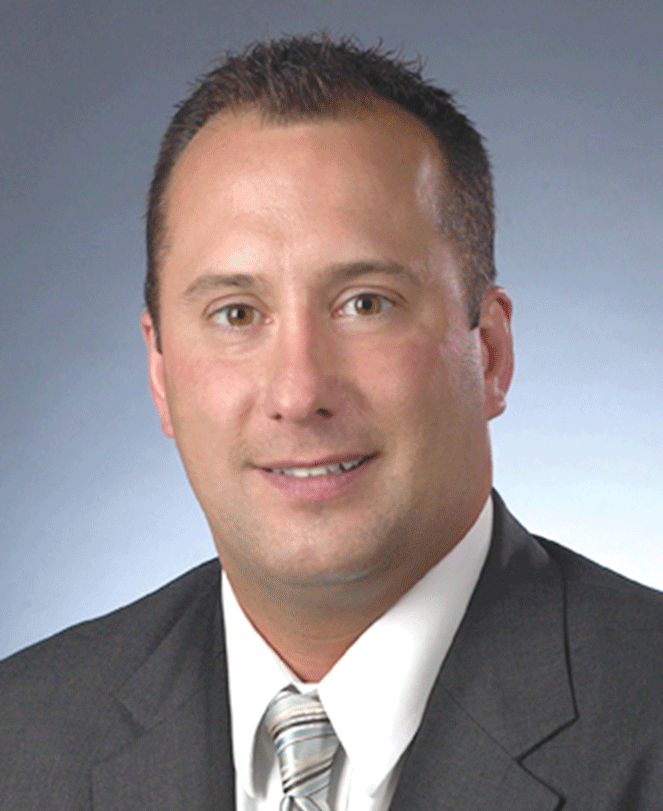
PITTSFIELD — Christopher Buono has joined the CompuWorks HealthyIT team as virtual chief information officer. As a VCIO, he guides clients through the critical process of aligning technology decisions with organizational goals by understanding where the company is today and its vision for the future.

Buono has worked in the information-technology field for more than 20 years, including 12 years in leadership roles. He holds a bachelor’s degree in management information systems from the University at Albany Business School and attended the MBA program at Rensselaer Polytechnic Institute’s Lally School of Management. He holds numerous technical certifications, including Microsoft Certified Systems Engineer, Certified Novell Engineer, Certified Information Systems Security Professional, and Cisco Certified Network Administration. He serves on the board for Community Health Programs and on the strategic planning committee for WAM Theatre.

According to CompuWorks partner Alan Bauman, “we are very pleased to have Chris on our team and to be able to offer his depth and breadth of experience and perspective to meet the IT challenges of our clients.”

Class of 2016 Difference Makers

His Career Has Been All About ‘Embracing the Challenge’

Hampden County Sheriff Michael J. Ashe Jr.

Hampden County Sheriff Michael J. Ashe Jr.
Leah Martin Photography

Since taking office back in January 1975, Michael Ashe has spent roughly 15,000 days as sheriff of Hampden County.

The one everyone remembers was that Friday in October 1990 when he led what amounted to an armed takeover of the National Guard Armory on Roosevelt Avenue in Springfield. It was mounted in response to what Ashe considered dangerous overcrowding at the county jail on York Street, built in 1886 to house a fraction of the inmates he was hosting at the time.

The incident (more on it later) garnered headlines locally, regionally, and even nationally, and in many ways it finally propelled Hampden County’s commissioners to move toward replacing York Street — although nothing about the process of siting and then building the new jail in Ludlow would be considered easy.

While proud of what transpired on that afternoon more than 25 years ago, Ashe, now months away from retirement, hinted strongly that he would much rather be remembered for what transpired on the 14,999 or so other days. These would be things that didn’t land him on the 5 o’clock news, necessarily (although sometimes they did) — but did succeed in changing lives, and in all kinds of ways.

Summing up that work, he used the phrases “embracing the challenge” and “professional excellence” for the first of perhaps 20 times, and in reference to himself, his staff, and, yes, his inmates as well.

Elaborating, he said professional excellence is the manner in which his department embraces the challenge — actually, a whole host of challenges he bundled into one big one — of making the dramatic leap from essentially warehousing inmates, which was the practice in Hampden County and most everywhere else in 1974, to working toward rehabilitating them and making them productive contributors to society.

This philosophy has manifested itself in everything from programs to earn inmates a GED to the multi-faceted After Incarceration Support Systems Program (AISSP), to bold initiatives like Roca, designed to give those seemingly out of options one more chance to turn things around.

Slicing through all those programs, Ashe said the common denominator is making the inmate accountable for making his or her own course correction and, more importantly, staying on that heading. And the proof that he has succeeded in that mission comes in a variety of forms, especially the recently released statistics on incarceration rates in Hampden County.

They show that, between September 2007, when there were 2,245 offenders in the sheriff’s custody — the high-water mark, if you will — and Dec. 31, 2015, the number had dropped to 1,432, a 36% reduction.

Some of this decline can be attributed to lower crime rates in Springfield, Holyoke, and other communities due to improved policing, but another huge factor is a reduction in the number of what the sheriff’s office calls “recycled offenders” through a host of anti-recidivism initiatives.

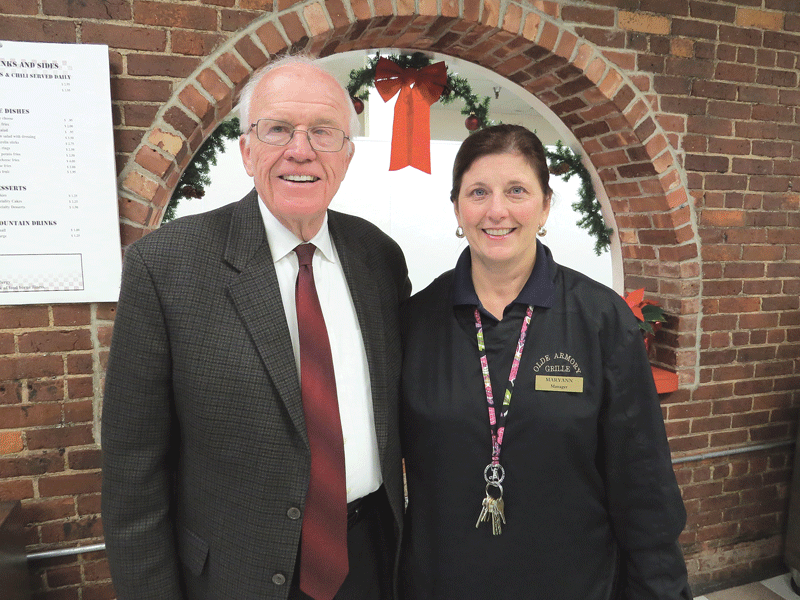
Like the Olde Armory Grille. This is a luncheon restaurant and catering venture (a break-even business) operated by the Sheriff’s Department at the Springfield Technology Park across from Springfield Technical Community College, and in one of the former Springfield Armory buildings, hence the name. It is managed by Cpl. Maryann Alben, but staffed by inmates engaged in everything from preparing meals to cashing out customers.

‘Bill’ (rules prohibit use of his last name) is one of the inmates currently on assignment.

He’s been working on the fryolator and doing prep work, often for the hot entrée specials, and hopes to one day soon be doing such work in what most would call the real world, drawing on experiences at the grille and also while working for his uncle, who once owned a few restaurants.

He said the program has helped him with fundamentals, a term he used to refer to the kitchen, but also life in general.

“I went from being behind the wall to being out in the community,” he said. “And now I’m into the community.”

Bill’s journey — and Ashe’s life’s work — are pretty much defined by something called the “Hampden County Model: Guiding Principles for Best Correctional Practice.”

There are 20 of them (see bottom), ranging from No. 4: “Those in custody should begin their participation in positive and productive activities as soon as possible in their incarceration” to No. 15: “A spirit of innovation should permeate the operation. This innovation should be data-informed, evidence-based, and include process and outcome measures.”

But it is while explaining No. 2 — “Correctional facilities should seek to positively impact those in custody, and not be mere holding agents or human warehouses” — that Ashe and his office get to the heart of the matter and the force that has driven his many initiatives.

“It is a simple law of life that nothing changes if nothing changes,” it reads.

By generating all kinds of change, especially in the minds and hearts of those entrusted to his care, Ashe is the epitome of a Difference Maker.

Coming to Terms

Sheriff

The old and the new

The old and the new: above, Mike Ashe at the old York Street Jail, which was finally replaced in the ’90s with a new facility in Ludlow, bottom.

Ashe told BusinessWest that, when he first took the helm as sheriff in 1975, not long after a riot at York Street, he was in the jail almost every day, a sharp departure from his current schedule.

Perhaps the image he remembers most from those early days was the white knuckles of the inmates. They were hard to miss, he recalled, as the prisoners grasped the bars of their cells, an indication, he believed, of immense frustration with their plight.

“There was a great deal of tension, and you see it in those knuckles.” he said. “Inmates had a lot of time on their hands; people were just languishing in their cells. I think the only program they had at the time was a part-time education program conducted with the Springfield School Department, an adult basic-education initiative. That was it, and it was only part-time.”

Doing something about those white knuckles has been, in many ways, his personally written job description. As he talked about everything involved with it, he spent most of his time and energy discussing how one approaches that work, using more words that he would also wear out: ‘intensity’ and ‘focus.’

Together, those nouns — as well as the operating philosophy “firm but fair, and having strength reinforced with decency” — have shaped a remarkable career, one that he freely admits lasted far longer than he thought it would when he took out papers to run for sheriff early in 1974. It’s been a tenure defined partly by longevity — since he was first elected, there have been seven U.S. presidents (he had his photo taken with one — Jimmy Carter); eight Massachusetts governors (nine if you count Mike Dukakis twice, because he had non-consecutive stints in office); and eight mayors of Springfield — but in the end, that is merely a sidebar.

So too, at least figuratively speaking, are the takeover of the Armory and the building of a new Hampden County jail, although the former was huge news, and the latter was a long-running story, as in at least 20 years, by most accounts.

Recalling the Armory seizure, Ashe said it was a back-door attempt — literally, the sheriff’s department officials gathered at the front door while the inmates were brought in through the back — to bring attention to the overcrowding issue, because all other attempts to do so had failed to yield results.

“We were trying to get people to listen, because it was clear to us that they weren’t listening,” he explained. “We went to the Armory that Friday afternoon and basically evoked a law that went back to the 1700s. Getting into the building was key; once we did that, we knew we’d get everyone’s attention.”

No, the sheriff’s story isn’t defined only by the Armory takeover or his long tenure. It involves how he spent his career working to give his staff less work to do — or at least fewer inmates to guard.

To explain the philosophy that has driven the many ways Ashe has worked to lessen that workload, one must go back to guiding principle No. 2.

“If incarceration is allowed to be a holding pattern, a period of suspended animation, those in custody are more likely to go back to doing what they have always done when they are released,” it reads, “because they will be what they have always been. The only difference may be that they have more anger and more shrewdness as they pursue their criminal career.”

Elaborating on what this principle and the others mean in the larger scheme of things, Ashe said most inmates assigned to his care have been given sentences of seven to eight  months. Relatively speaking, that’s a short window, but it’s an important time. And what the sheriff’s office does with it — or, more importantly, what that office enables the inmate to do with it — will likely determine if the individual in question becomes one of those recycled offenders.

So we return once more to the second principle for insight into how Ashe believes that time should be spent.

“Most inmates come to jail or prison with a long history of social maladjustment, carrying a great deal of baggage in the form of histories of substance abuse; deficits in their educational, vocational, and ethical development; and disconnectedness to the mores and values of the larger community,” it reads. “Given the time and resources dedicated to corrections, it is absolute folly in social policy not to seek to address these deficit areas that inmates have brought to their incarceration.”

And address them he has, through programs that have won recognition nationally, but, more importantly, have succeeded in bringing down the inmate count by reducing the number of repeat offenders.

Sentence Structure

As he talked about these programs, Ashe began by offering a profile of his inmates, one of the few things that hasn’t changed much in 40 years.

“Roughly 90% come there with drug or alcohol problems,” he explained. “You’re looking at a seventh-grade education, on average; 93% of them lack any kind of marketable skill; and 70% of the people are unemployed at the point of arrest.

“Everyone knows that, in the state of Massachusetts, no one just happens to end up in jail — they land there after a long period of what I call irresponsible behavior,” he went on, adding that, likewise, no one just happens to correct that behavior and rehabilitate themselves.

Instead, that comes about by addressing those gaps he mentioned, or doing something about addiction, the lack of an education, the shortage of marketable skills, and the absence of a job.

In a nutshell, this is what the sum of the programs Ashe and his staff have created — both inside and outside the prison walls — is all about.

“What I’m most proud of, I think, is that we never waved at those gaps,” he told BusinessWest. “We put together strategies to deal with these issues.”

And as he likes to say — in those principles, or to anyone who will listen — re-entry to society begins on the first day of incarceration.

That’s when an extensive, seven- to 10-day orientation program and testing period begins, one designed, as Ashe said, to let staff “get to know the inmate — let’s find out who this guy is.”

Such steps are important, he went on, because even amid all those common denominators concerning education, addiction, and lack of job skills, there is still plenty of room for individualization when it comes to correctional programs.

Orientation is then followed by a mandatory transitional program, during which the sheriff says he’s trying he capture the inmate’s heart and mind. Far more times than not, he does, although sometimes it’s a struggle.

And as he said, the work has to begin immediately.

“I didn’t want them to languish,” he explained. “In years past, we would have programs, but they would have a beginning and an end, so you had waiting lists; to get into the GED program would take three weeks, to get into anger management would take four weeks, and I didn’t want that.

“If they come in and just languish in a cell for four, five, or six weeks, I’ve lost them,” he went on. “The subculture wins out — the inmates take over.”

There are always those reluctant to enter the mandatory transition program, the sheriff noted, adding that these individuals are sent to what’s known as the ‘accountability pod,’ a sterile environment where there are fewer rights and privileges. In far more cases than not, time spent there produces the desired results.

“Inevitably, what happens is, at the end of two to four weeks, they say, ‘Sheriff, I get it,’” Ashe told BusinessWest. “They say, ‘this is a coerced program … mainstream me; I’ll go to your programs.’ Not all the time, but a lot of the time, inmates will look back and say, ‘Sheriff, I’m glad you forced me to go through this.’”

Elaborating, he said ‘this’ is the process of addressing the various forms of baggage identified in principle 2 — addiction, lack of education, and a lack of job skills. Initiatives to address them include intense, 28-day addiction-treatment programs; GED classes; an extensive vocational program featuring graphics, welding, carpentry, food service, and other trades; and more.

Many of those who take part in the culinary-arts program will then move on to work at the Olde Armory Grille, an example — one of many — of how the work that begins inside the walls can lead to a productive life when one moves outside those walls.

Indeed, roughly 80% of the women who work in various capacities at the grille — and statistics show women enter the county jail with even fewer marketable skills than men — are finding work in the hospitality sector upon release, said Ashe.

To find out how that specific program works, and how it exemplifies all the programs operated by the Sheriff’s Department, we talked to Alben and Bill.

Food for Thought

The grille, which opened its doors in 2009, is in many ways an embodiment of that line explaining principle 2 regarding change. Indeed, there was a good deal of apprehension about this initiative at first, the sheriff recalled, adding that those attitudes had to change before the facility could become reality.

Over the years, it has become one of the most visible examples of the Sheriff’s Department’s focus on providing inmates with a fresh start — and a popular lunch spot for the hundreds of employees at the tech park and the community college across Federal Street.

Sheriff Ashe with Maryann Alben

Sheriff Ashe with Maryann Alben, catering and dining room manager at the Olde Armory Grille.

The restaurant is designed to provide real work experience and training for participants returning from incarceration as they re-enter communities, said Alben, adding that it involves inmates from the Ludlow jail, the Western Mass. Regional Women’s Correctional Center in Chicopee, and the Western Mass. Correctional Alcohol Center. These are inmates in what is known as ‘pre-release,’ meaning they can leave the correctional facility and go out into the community and work.

When asked what the program provides for its participants, who have to survive a lengthy interview process to join the staff, Alben didn’t start by listing cooking, serving, making change, or pricing produce — although they are all part if the equation. Instead, she began with prerequisites for all of the above.

“Self-esteem is huge,” she said. “When most women come in here, they have slouched shoulders … many of them have never had a job before,” she explained, adding that this is reality even for individuals in their 40s or 50s. “You bring them in here, and you try to build them up. Some of them will catch on sooner than others; some of them worked in restaurants way back when.

“We help them understand how to work with customers and leave the jail behind them,” she went on, adding that inmates don’t often exercise their people skills inside the walls, but must hone those abilities if they’re going to make it in the real world.

And many do, she went on, adding that there are many employers within the broad restaurant community who are able and, more importantly, willing to take on such individuals.

In fact, roughly 87% of those who take part are eventually placed, usually in kitchen prep work, she said, a statistic that reflects both the need for good help and the quality of the program.

Bill hopes to be a part of the majority that uses the grille as an important stepping stone.

“This is the next step in getting back into the community 100%,” he explained. “Not only with getting up early with a job to go to five days a week, but in the way it prepares me mentally and fundamentally for the next step into the real world.”

Such comments explain why an inmate’s final days at the grille involve more emotions than one might expect.

Indeed, the end of one’s service means the beginning of a new and intriguing chapter, which translates into happiness tinged with a dose of apprehension. Meanwhile, there is some sadness that results from the end of friendships forged with customers who frequent the establishment. And there is also gratitude, usually in large quantities.

“We’re giving them a chance to prove themselves,” said Alben. “And when they leave here, most of all them will say, ‘thank you for believing in me.’”

If they could, they would say the same thing to Sheriff Ashe. He not only believed in them, he challenged them and held them accountable, a real departure from four decades ago and what could truly be called white-knuckle times.

No Holds Barred

When asked what he would miss most about being sheriff of Hampden County, Ashe paused for a moment to think back and reflect.

“I think I would have to say that it’s the challenges, embracing the challenges,” he said one last time. “I’ll miss the work of recognizing the problems that our society faces and trying to come up with solutions.”

That answer, maybe as much as anything that he’s done over the past 41 years and will do over the next 11 months, helps explain why Ashe will be remembered for much more than what happened at that National Guard Armory.

And why he’s truly a Difference Maker.

George O’Brien can be reached at [email protected]


Guiding Principles of Best Correctional Policy

(As developed by the Hampden County Model, 1975-2013)

1. Within any correctional facility or operation, there must be an atmosphere and an ethos of respect for the full humanity and potential of any human being within that institution and an effort to maximize that potential. This is the first and overriding principle from which all other principles emanate, and without which no real corrections is possible.

2. Correctional facilities should seek to positively impact those in custody, and not be mere holding agents or human warehouses.

3. Those in custody should put in busy, full, and productive days, and should be challenged to pick up the tools and directions to build a law-abiding life.

4. Those in custody should begin their participation in positive and productive activities as soon as possible in their incarceration.

5. All efforts should be made to break down the traditional barriers between correctional security and correctional human services.

6. Productive and positive activities for those in custody should be understood to be investments in the future of the community.

7. Correctional institutions should be communities of lawfulness. There should be zero tolerance, overt or tacit, for any violence within the institution. Those in custody who assault others in custody should be prosecuted as if such actions took place in free society. Staff should be diligently trained and monitored in use of force that is necessary and non-excessive to maintain safety, security, order, and lawfulness.

8. The operational philosophy of positively impacting those in custody and respecting their full humanity must predominate at all levels of security.

9. Offenders should be directed toward understanding their full impact on victims and their community and should make restorative and reparative acts toward their victims and the community at large.

10. Offenders should be classified to the least level of security that is consistent with public safety and is merited by their own behavior.

11. There should be a continuum of gradual, supervised, and supported community re-entry for offenders.

12. Community partnerships should be cultivated and developed for offender re-entry success. These partnerships should include the criminal-justice and law-enforcement communities as part of a public-safety team.

13. Staff should be held accountable to be positive and productive.

14. All staff should be inspired, encouraged, and supervised to strive for excellence in their work.

15. A spirit of innovation should permeate the operation. This innovation should be data-informed, evidenced-based, and include process and outcome measures.

16. In-service training should be ongoing and mandatory for all employees.

17. There should be a medical program that links with public health agencies and public health doctors from the home neighborhoods and communities of those in custody and which takes a pro-active approach to finding and treating illness and disease in the custodial population.

18. Modern technological advances should be integrated into a correctional operation for optimal efficiency and effectiveness.

19. Any correctional facility, no matter what its locale, should seek to be involved in, and to involve, the local community, to welcome within its fences the positive elements of the community, and to be a positive participant and neighbor in community life. This reaching out should be both toward the community that hosts the facility and the communities from which those in custody come.

20. Balance is the key. A correctional operation should reach for the stars but be rooted in the firm ground of common sense.

Class of 2016 Difference Makers

This Inspirational Leader Isn’t in the Community; She’s of the Community

Carol Leary

Carol Leary, President of Bay Path University
Leah Martin Photography

Carol Leary says the executive search firms, the headhunters, don’t call very often any more. In fact, she can’t remember the last time one of them did.

She still gets e-mails gauging her interest in various positions, but they’re almost always of that variety that goes out to hundreds, if not thousands, of people. “Are you interested in, or would you care to nominate someone for, the job of president of ‘fill-in-blank college’” is how they usually start.

But not so long ago, Leary, who took the helm at Bay Path University in Longmeadow in late 1994, was getting calls all the time, most of them related to attractive opportunities within the broad realm of higher education. She declined to get into specifics, but said one of them was “very, very flattering.”

Still, it met with the same response as all the others — no response.

When asked why, Leary offered an answer that went on for some time. Paraphrasing that response, she said she was in a job — and in a community — that she was very committed to. And she had, and still has, no intention of leaving either one.

“Noel and I are not dazzled by big or prestigious; we’re dazzled by mission, vision, and making an impact,” said Leary, referring to her husband of 43 years. “We really love this community. We think you can make an impact here; you can make a difference.”
And the evidence that she has done just that is everywhere.

It is in every corner of the Longmeadow campus, starting with the brick sign at the front gate, which declares that this nearly 120-year-old institution, once known as a junior college, is now a university.

Carol Leary is where she always is

Carol Leary is where she always is — the middle of things — after a recent Bay Path commencement exercise.

It also exists in the many other communities where Bay Path now has a presence, including Springfield, where the school located its American Women’s College Online in a downtown office tower in 2013, and East Longmeadow, where it opened the $13.7 million Phillip H. Ryan Health Science Center a year ago.

It’s also on the recently unveiled plaque at the D’Amour Museum of Fine Arts at the Quadrangle, the one that reads ‘The Carol and Noel Leary Gallery of Impressionist Art’ in recognition of their $300,000 contribution to that institution, which Noel has served as a board member for many years.

And, in a way, it’s in virtually every business and nonprofit in the region — or, to be more specific, any organization that has sent employees to the Women’s Professional Development Conference, which Leary initiated amid considerable skepticism (even at Bay Path) soon after her arrival.

When the conference was first conceptualized, organizers were hoping to draw 400 people; 800 turned out that first year. Today, the event attracts more than 2,000 attendees annually, and over the years it has welcomed keynoters ranging from Margaret Thatcher to Barbara Walters to Maya Angelou.

But Leary is best known for the turnaround story she is very much still writing at Bay Path, a school that was struggling and suffering from declining enrollment when she arrived.

Over the past two decades, she has led efforts that have taken that enrollment from just under 500 to more than 3,000 when all campuses and all programs, including online offerings, are considered. When she arrived, the school offered 14 associate degrees and three baccalaureate degrees; now, it offers 62 baccalaureate degrees and 20 graduate and post-graduate degrees.

In 2015, for the second year in row, the Chronicle of Higher Education included Bay Path on its list of the fastest-growing baccalaureate colleges in the country, and just a few months ago, Leary and Bay Path were ranked 25th in the 2015 ‘Top-100 Women-led Businesses in Massachusetts’ compilation sponsored by the Boston Globe and the Commonwealth Institute.
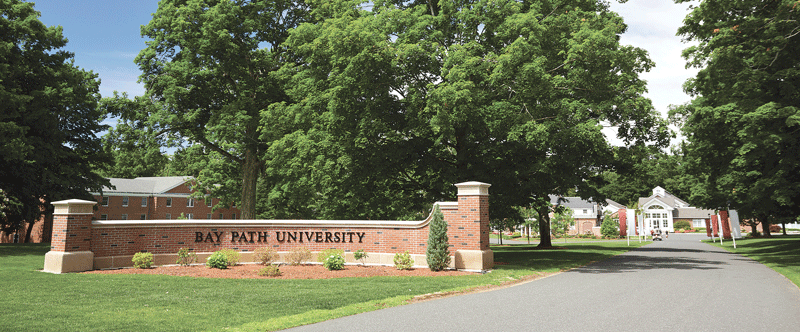
The sign at the main entrance

The sign at the main entrance explains just how far Bay Path has come under Carol Leary’s stewardship.

Such growth and acclaim didn’t come overnight or very easily, said Leary, who attributed the school’s success to vision, assembling a focused, driven team (much more on that later), and a responsive boards of trustees — all of which have facilitated effective execution of a number of strategic plans.

“Let’s see … there was Vision 2001, and 2006, and 2011, which we had to redo halfway through because of the crash, so there was 2013, and Vision 2016, which ends in June, and then we just launched Vision 2019,” she said, adding that she would like to be around for its end.

“I’ll do it only as long as my board wants me and the faculty and staff feel I can be effective as their leader,” she explained. “And as long as I can get up every day and say ‘wow, it’s great to go to work today.’”

She’s said that since day one, and it’s an attitude that only begins to explain why she’s a Difference Maker.

Making a Course Change

Leary told BusinessWest that, with few exceptions, all of them recently and schedule-related, she has interviewed the finalists for every position on campus, from provost to security guard, since the day she arrived on campus, succeeding Jeanette Wright, who passed away months earlier.

And there’s one question she asks everyone.

She wouldn’t divulge it (on the record, anyway) — “if I did, then someone might read this, and then they’d be prepared to answer it if they ever applied here” — but did say that it revealed something important about the individual sitting across the table.

“To me, that’s the most important part of any CEO’s job — the hiring of the individuals who will be working in the organization,” she explained. “Beyond the résumé and the skill set, I dig a little deeper. And my question tells me what that person cares about; it tells me what motivates them.”

The practice of interviewing every job finalist — but not her specific question of choice — was something Leary took with her from Simmons College, where she spent several years in various positions, including vice president for Administration and assistant to the president, the twin titles she held at the end of her tenure.

But that’s not all she borrowed from that Boston-based institution. Indeed, the Women’s Conference was based on an event Simmons started years earlier, and Leary has also patterned Bay Path’s growth formula on Simmons’ hard focus on diversity when it comes to degree programs.

She applied those lessons and others while undertaking a turnaround initiative at Bay Path that almost never happened — because Leary almost didn’t apply.

“I sent in my letter of interest and résumé on the last day applications were due,” she told BusinessWest, adding that she was encouraged to apply by others who thought she was ready and able to become president of a college — especially this one — but very much needed to be talked into doing so.

“I was nominated for this job — I wasn’t even looking for a presidency,” she went on, adding that, while she had her doctorate and “six years in the trenches,” as she called it, she wasn’t sure she was ready to lead a college. “I loved Simmons, I loved my job, I loved the mission, and I loved working in Boston; it was great.”

It was with all that love as a backdrop that she and Noel, while returning to Boston from a vacation in Niagara Falls that August, decided to swing through the Bay Path campus to get a look at and perhaps a feel for the institution. Suffice it to say they liked what they saw, heard, and could envision.

Indeed, what the two eventually found beyond the idyllic campus located in the heart of an affluent Springfield suburb was a college that possessed what Leary described using that time-honored phrase “good bones.”

And by that, she meant that it still had a sound reputation — years earlier, it was regarded as one of the top secretarial schools in the Northeast, if not the country — and, perhaps more importantly, a solid financial foundation upon which things could be built.

“I knew that Bay Path had been challenged with a decrease in its enrollment over several years,” she recalled. “But all the presidents had kept the institution financially strong; they kept deferred maintenance down, and the endowment was healthy for such a small school of 500 students. I looked at their programs, and I saw the challenges they were facing. But I looked at the balance sheet, and we both said, ‘we can see ourselves here; this has incredible potential as a women’s college.’”

When asked about those struggles with enrollment, Leary said they resulted in part from the fact that there was declining interest in women’s colleges, fueled in part by the fact that most every elite school in the country was by that time admitting women, giving them many more options. But it also stemmed from the fact that Bay Path simply wasn’t offering the products — meaning baccalaureate and graduate degrees — that women wanted, needed, and were going elsewhere to get.

So she set about changing that equation.

But first, she needed to assemble a team; draft a strategic plan for repositioning the school; achieve buy-in from several constituencies, but especially the board of trustees; effectively execute the plan; and then continually amend it as need and demand for products grew.

Spoiler alert (not really; this story is well known): she and those she eventually hired succeeded with all of the above.

To make a long story short, the college soon began adding degree programs in a number of fields, while also expanding geographically with new campuses in Sturbridge and Burlington, and technologically. It’s been a turnaround defined by the terms vision, teamwork, innovation, and entrepreneurship.

Milestones along the way include everything from the establishment of athletics (there are eight varsity sports now) to the first graduate-degree program (Communications and Information Management), launched in 2000, a year ahead of schedule; from the introduction of the innovative One-Day-a-Week Saturday College to those new campuses; from the launching of the American Women’s Online College to the school’s being granted status as a university in 2014.

Add it all up, and Leary and her staff have accomplished the mission she set when she arrived — to make Bay Path a destination.

That’s a great story, but the better one — and the reason why all those executive search firms were calling her — is the manner in which all this was accomplished.

Study in Relationship Building

And maybe no one can explain this better than Caron Hoban.

She didn’t work directly with Leary at Simmons — they were assigned to different campuses but served together on a few committees — but certainly knew of her. And when Leary went to Bay Path, Hoban decided to follow just a few months later.

“I knew her a little bit, and I was looking to make my next move just as she had been made president at Bay Path; they had a position open, and I applied for it,” said Hoban, who now holds the position of chief strategic officer.

When asked to summarize what Leary has accomplished at the school and attempt to put it all in perspective, Hoban obliged. But is doing so, she focused much more on how Leary orchestrated such a turnaround and, perhaps even more importantly, why.

And as she articulated these points, Hoban identified what she and others consider Leary’s greatest strengths — listening and forging partnerships.

“One of her greatest gifts is relationship building,” Hoban explained. “So when she came to Bay Path and the Greater Springfield area 21 years ago, she really committed to not just learning more about the college, but really understanding the whole region. She met with hundreds and hundreds of people and just listened.

“At my first meeting with her, she said, ‘what I’ve really been trying to do in my early days is listen to people and understand what the college needs and what the region needs,’” Hoban went on, adding that from this came the decision to create a women’s professional conference modeled on the one at Simmons, and a commitment to add graduate programs in several areas of study.

“She knew that the way to grow the campus and move from 500 students, which is what we had when she arrived, to the 3,000 we have now is by adding master’s-degree programs,” Hoban went on. “And these came about by her going out and listening to what the workforce needs were in the community.”

But Hoban said Leary’s listening and relationship-building talents extended to the campus community, the people she hired, and her own instincts, and this greatly facilitated what was, in every aspect of the word, a turnaround that was critical to the school’s very survival.

In 2007, President Leary welcomed poet, author, and civil-rights activist Maya Angelou

In 2007, President Leary welcomed poet, author, and civil-rights activist Maya Angelou to the Women’s Leadership Conference.

Indeed, in 1996, Leary recalled, she essentially asked the board for permission to spend $10 million of the $14 million the school had in the bank at the time over the next several years to hire faculty, add programs, and, in essence, take the school to the next level.

“I remember the conversations that were had around the table, and there was one member of the board, the chair of the academic committee, who said, ‘if we don’t do this, there might not be a future for Bay Path,’” she recalled. “I recommended that we make that investment — it had athletics in it, the Women’s Leadership Conference, and much more; that was Vision 2001.”

As it turned out, she didn’t have to spend all the money she asked for, because those degree programs added early on were so successful that revenues increased tremendously, to the point where the school didn’t have to take money out of the bank.

Looking back on what’s transpired at Bay Path, and also at the dynamics of administration in higher education, Leary said turning around a college as she and her team did is like turning around an aircraft carrier; in neither case does it happen quickly or easily.

In fact, she said it takes at least a full decade to blueprint and effectively execute a turnaround strategy, and that’s why relatively few colleges fully succeed with such initiatives — the president or chancellor doesn’t stay long enough to see the project to completion. And, inevitably, new leadership will in some ways alter the course and speed of a plan, if not create their own.

But Leary has given Bay Path not one decade, but two, and she’s needed all of that time to put the school on such lists as the Chronicle of Higher Education’s compilation of fastest-growing schools.

In keeping with her personality, Leary recoils when a question is asked with a tone focusing on what she has done. Indeed, she attributes the school’s progression to hiring the right people and then simply providing them with the tools and environment needed to flourish.

“I got up every day and knew I had to hire the best possible staff, people who believed in the mission,” she recalled. “And when people ask why Bay Path has been so successful, I say it’s because I hired the right people at the right time, and they just threw themselves into their jobs.”

While giving considerable credit to those she’s interviewed and hired over the years, Leary saved some for Noel and his willingness to share what she called “an equal-opportunity marriage.”

Elaborating, she said she agreed to uproot and follow him to Washington, D.C. and a job in commercial real estate there decades ago, and he more than reciprocated by first following her to Boston as she took a job at Simmons, then making another major adjustment — trying to serve his clients in the Hub from 100 miles away — when she came to Bay Path. He did that for more than a decade before retiring and taking on the role of supporting her various efforts.

“Noel has been a tremendous, tremendous support to me,” she explained. “He basically said, ‘this is an important job, I love what you’re doing, and I enjoy being a part of it.’”

And she implied that what he meant by ‘it’ was not simply her work at the campus on Longmeadow Street, but her efforts well outside it. They are so numerous and impactful that Hoban chose to say that Leary isn’t in the community, “she’s of the community.”

And perhaps the best example of that has been the women’s conference and how the region’s business community has embraced it.

Learning Curves

Dena Hall says it’s a good problem to have. Well … sort of.

There are more people at United Bank, which Hall serves as regional president, who want to go to the conference than the institution can effectively send.

Far more.

And that has led to some hand-wringing among those administrators (like Hall) whose job descriptions now include deciding who gets to go each spring and who doesn’t.

“We’ve gotten to the point where we have too many who want to go — we just can’t accommodate everyone, because we can’t have 50 current or emerging leaders out of the company at one time,” she explained. “So we’ve put it on each of our managers to identify one or two women in their business line who they believe should attend the conference and who will really benefit from what they see and hear.”

But these hard decisions comprise the only thing Hall doesn’t like about the women’s conference, except maybe finding a parking space that morning. That, too, has become a challenge, but, for the region as a whole, also a great problem to have.

Because that means that 2,000 women — and some men as well — are not only hearing the keynoters such as Walters, Angelou, and others, but networking and learning through a host of seminars and breakout sessions.

“You always learn something,” said Hall, who has been attending the conference for more than a dozen years. “Last year, I participated in the time-management workshop, and it changed the entire way I look at my schedule from Monday through Friday; the woman was fantastic.

“And there’s tons of networking,” she went on. “We use the conference here as a coaching and development tool for the more junior women on our team. There’s a lot of value in it, and for us, the fact that it’s five minutes away makes it so much easier than sending someone to Boston or New Haven or anywhere else.”

The conference is a college initiative — indeed, its primary goal beyond the desire to help educate and empower women is to give the school valuable exposure — but it is also a community endeavor, and one of many examples of how Leary is of, not just in, the community.

Others include everything from her service to the Colony Club — she was the first woman to chair its board — to her time on the boards of the Community Foundation, the Beveridge Foundation, WGBY, and United Bank, among others. She was also the honorary chair of Habitat for Humanity’s All Women build project in 2009.

And then, there was the support she and Noel gave to the museums and the current capital campaign called “Seuss & Springfield: Building a Better Quandrangle,” a gift that Springfield Museums President Kay Simpson described as not only generous, but a model to others who thought they might not be able to afford such philanthropy.

“One of the motivating factors for Carol and Noel,” she noted, “is that they wanted to demonstrate that, even if you don’t think you can make a substantial gift, with planning, you can do it.”

Leary said planning began years ago, and was inspired by a desire to preserve and expand a treasure that many in this area simply don’t appreciate for its quality.

“We really believe in the museum — we absolutely adore it,” she said. “I said to my niece and nephew at the gala [where the gift was announced], ‘this is your inheritance; you might be in the will, but there isn’t going to be any money in it — it’s going right here, so you can bring your children and your children’s children here decades from now.’

“Noel told the audience that night, ‘we have some big birthdays coming up, but forget Tiffany’s; we’re giving it to the museums,’” she went on. “That’s how much we think of this region; there are so many gems, like the museums, the symphony, CityStage, and others that need support.”

From left, Donald D’Amour, Michele D’Amour, Carol Leary, and Noel Leary

From left, Donald D’Amour, Michele D’Amour, Carol Leary, and Noel Leary at the ceremony marking the naming of the Gallery of Impressionist Art.

And looking back on her time here, she said it has been her mission not only to be involved in the community herself, but to get the college immersed in it as well. She considers these efforts successful and cites examples of involvement ranging from Habitat for Humanity to Big Brothers Big Sisters; from Link to Libraries to the college’s sponsorship of the recent Springfield Public Forum and partnerships that brought speakers such as Supreme Court Justice Sonia Sotomayor and author Wes Moore.

“You can’t be an ivory tower,” she told BusinessWest. “We have to be part and parcel of the good, the bad, and the ugly of any community.”

As she talked about the importance of involvement in this community, Leary made it a point to talk about the region itself, which she has chosen to call home. She said it has attributes and selling points that are easier for people not from the 413 area code to appreciate.

And this is something she would like to see change.

“People underrate this area, and the negativity has to stop,” she said with twinges of anger and urgency in her voice. “The language and the perception has to start changing from all of us who have a voice; we have to talk more positively.”

A Class Act

When asked how long she intended to stay at the helm at Bay Path, Leary didn’t give anything approaching a specific answer other than a reference to wanting to see how Vision 2019 shakes out.

Instead, she conveyed the sentiment that was implied in all those non-responses to inquiries from executive search firms: she’s not at all ready to leave this job or this community.

As she said, one can have an impact here. One can make a difference.

Not everyone does so, but she has, and in a number of ways.

George O’Brien can be reached at [email protected]

Community Spotlight Features

Community Spotlight

Mayor Richard Kos (right) and Mike Vedovelli

Mayor Richard Kos (right) and Mike Vedovelli say Chicopee has issued an RFP for the old library building adjacent to City Hall.

Mayor Richard Kos says Chicopee is well-poised for growth, thanks to what he called a multi-faceted approach to economic development.

“We’re trying to address the city as a whole to make sure we strengthen any areas where there are weaknesses,” he told BusinessWest a few days after being sworn into office for the second consecutive term and sixth term overall. “Although any urban environment has challenges, Chicopee has a great track record of addressing infrastructure needs in conjunction with development opportunities, and we continue to build on this in one of the strongest financial communities in the state.”

To that end, biweekly meetings are held to assess projects that are underway or on the drawing board. And there are several in those categories, as developers convert space in old mills and buildings downtown and a variety of neighborhoods for housing, business, or industrial use.

In turn, the city has done its part; in addition to initiating infrastructure improvements that encourage growth, it has a new middle school, is focused on improving its network of parks, and stays closely aligned with Westover Air Reserve Base, which has a significant economic impact on the city and region.

Revitalization is taking place in Chicopee Center, and Kos said two high-profile projects show that significant investments are being made downtown. The first is a $6 million conversion of the former John R. Lyman Mill building at the lower end of Front Street, situated next to the Chicopee River Canal, that has been vacant for several years.

A developer has purchased it and plans to convert the space into 80 market-rate live/work/loft apartments, Kos noted, adding that a groundbreaking ceremony is expected for March.

The second project is a $7 million renovation of the Kendall Building at 4 Springfield St., which has been purchased by Valley Opportunity Council. That agency plans to convert it into 39 apartments with $3.1 million in help from the state, Kos explained.

A request for proposals was also issued last month for Chicopee’s old library, which sits adjacent to City Hall.

“We’re looking to see what the private sector wants to do with the property,” Kos said, adding that the city secured a number of grants that allowed it to undertake selective remediation and resolve contamination issues in the building.

“Marketing this building is part of the emphasis we’re placing on our downtown,” he went on, noting that security cameras were installed downtown last year to help make it “a safe, secure, and convenient place to live.”

Michael Vedovelli said the city is fortunate to be working with developers in the old mills, and received a $2.6 million MassWorks grant to make utility, water, and sewer infrastructure improvements in the canal area.

“It’s a very competitive process, and they are difficult to obtain; there were 110 grant applicants, and only 37 were awarded,” said the director of Community and Economic Development. “But we constantly do all we can to create a vibrant downtown, and the projects in Chicopee Center are moving forward and will generate more activity.”

Tom Haberlin, the city’s Economic Development manager, agreed, saying these are the first investments that have been made in the area since 40 new apartments opened last year at Ames Privilege, a former mill and downtown complex that is home to several businesses and 120 apartments.

“When these projects are finished, the bookends [of the mills] will be complete, which leaves the middle of the sandwich to be developed, and we are hopeful that the owners of the mills will ramp up their plans,” he told BusinessWest, explaining that Ames Privilege and the Lyman building sit on opposite ends of the mill area that flanks the canal.

Private investment is being matched by public investments, and the city has demolished a six-family property on 296 Front St. that it plans to turn into a parking lot.

Kos said adding parking space is part of an effort to make City Hall more accessible, and earlier this month the City Council voted to fund an analysis of the building in hopes of turning the antiquated third-floor auditorium into a community meeting center. The council also allocated $500,000 to preserve stained-glass windows in the building that had deteriorated.

The well-known Munich Haus restaurant downtown is also making improvements, which include enlarging its parking area. Its owners purchased the former Ferris parking lot downtown and are awaiting final approval to reconstruct it, Kos said. The new lot will contain more than 50 spaces to complement the businesses’ beer garden and restaurant, and 15 will be designated as free public parking sites.

“Chicopee is one of the largest cities in the area that provides substantial free parking, which is part of the comfort and ease of getting into our downtown,” Kos noted, adding that Munich Haus also purchased the former Bank of Boston building and continues to invest in Chicopee.

Multitude of Projects

As Kos mentioned earlier, there are a host of economic-development initiatives taking place across Chicopee.

Cleanup efforts continue on the 27-acre Uniroyal property, for example, and last year the city not only secured a $200,000 grant to make improvements to the six-story historic administration building on the site, the City Council approved adding $186,000 to weatherproof and preserve it for the future.

The former Facemate site is also being addressed, and several acres are out for bid.

“We anticipate interest in building senior living there,” Kos said, explaining that the acreage abuts the new $10 million RiverMills Senior Center that opened in September 2014.

Progress is also taking place at the former Schine Inn. It was built in 1960 and decades later became the Plantation Inn, known for its 30-foot waving mascot that greeted travelers coming off Exit 6 on the Mass Pike. Kos said 194 motel units on the site have been demolished so a luxury auto dealer can fulfill plans to build a dealership there.

Developments are also taking place in Aldenville, and the former Racing Oil Service Center at 181 Front St., which has remained vacant since 2004 due to contamination issues, will be cleaned up, thanks to a $200,000 grant from the Environmental Protection Agency.

The city also welcomed coffee-maker manufacturer Chemex to a location off James Street after the business moved from its Pittsfield location to Chicopee, said Kos, noting that many businesses move to or expand in Chicopee due to its accessible location. In fact, it has been marketed as the ‘Crossroads of New England’ because of its easy access to I-91, I-391, and the Pike.

Education ranks high on the list of Chicopee’s assets, and last year the 90-year-old former Chicopee High School building on Front Street reopened as the 1st Sgt. Kevin Dupont Middle School after undergoing a $38 million renovation. The building boasts a television production room and a number of new science laboratories, and Kos says half of the city’s middle-school students attend the new school.

Work on the city’s network of parks is ongoing, and last year, a $20,000 KaBOOM! grant paid for new playground equipment at Nash Park with the help of volunteer labor. And although the public outdoor pools were found in need of extensive repairs, the city was able to reopen the Rivers Park pool last summer after it received a $400,000 state grant to do needed work. And earlier this month, the City Council accepted another state grant that will pay for 70% of the cost of replacing Ray Ash Park pool located in the city’s center, Kos said.

Westover Air Reserve Base is a major entity that adds to the city’s economy, and the 2015 Air Show proved to be of its most successful public events. Nearly 375,000 people attended, and an economic-impact study estimated the air show had an $11.5 million economic impact in the area, Kos said, explaining that more than $9 million was spent on hotel stays, meals, gas, and other items. Meanwhile, he added, the fact that base commander Col. Albert Lupenski was recently promoted to general shows his leadership has captured attention in Washington, D.C.

In addition, eight of Westover’s C5-As are being retrofitted with the “quietest engines in the industry and will become C-5M Super Galaxy aircraft,” Kos noted.

Many military installations across the country have closed due to budget cuts, but the city has an innovative plan to help Westover remain open. Kos said 69 multi-family units of military housing on 26 acres that were purchased from the U.S. Navy in 2011 are being demolished to make way for a three-megawatt solar farm on the property with the aim of reducing Westover’s utility bills.

MassDevelopment agreed to provide $1 million to fund the project, and that grant was matched by $1 million from the state.

The base uses approximately $2 million of electricity each year, so this step will save the facility $100,000 annually, which equates to a 5% reduction, Kos said.

“The solar farm will also be a plus for the city because we are clearing up a long-abandoned property and developing it into a taxpaying entity; it will benefit Chicopee, Westover, and the neighborhood,” he noted, noting that roughly 70% of the acreage will contain the solar farm, while the remainder will be preserved for future development because it is contiguous with Westover AirPark North.

The park contains the former Avery Dennison Corp. building, which was purchased by investors after the plant closed two years ago. Yankee Candle now occupies 289,000 square feet of the building, Kos noted, adding that the company opened a distribution operation there.

Haberlin said the number of available commercial and industrial buildings in the city is one of its strengths because many communities lack the space that businesses need to expand. “Chicopee continues to have a supply of large industrial buildings that are being reabsorbed and reused. The cost is typically about $30 per square foot, which is 30 to 40% less than the cost of new construction.”

Celebrating Continued Success

The city is divided into distinct neighborhoods that include Chicopee Center, Chicopee Falls, Willimansett, Fairview, the Burnett Road area, and Aldenville, and last September the city held its first block party downtown.

“We received a $7,500 grant from MassDevelopment and had help from local businesses,” Kos said. “The streets were closed from noon to 10 p.m., and more than 7,000 people attended the family-friendly event that showcased food, entertainment, and the convenient assets of our city in a way that multiple generations could enjoy. We also have a Halloween event downtown which 3,000 families attended last October, and our annual Christmas-tree lighting that more than 1,000 people turned out to see. We are a substantial city that still has a small-town atmosphere and sense of community.”

Haberlin agreed. “Our neighborhoods complement each other and give the city its unique flavor,” he said, “making it a great place to live, work, play, and call home.”


Chicopee at a glance

Year Incorporated: 1848
Population: 55,795
Area: 23.9 square miles
County: Hampshire
Residential Tax Rate: $16.91
Commercial Tax Rate: $31.17
Median Household Income: $45,763
Family Household Income: $58,118
Type of government: Mayor, City Council
Largest employers: Westover Air Reserve Base; Chicopee City Hall; Ethos Energy; J. Polep Distribution Services

* Latest information available


Banking and Financial Services Sections

Delayed Reaction

By BOB CUMMINGS

Bob Cummings

Bob Cummings

For many employers, their first challenge with the Affordable Care Act (ACA) may be compliance with the new reporting requirements.

Under the ACA, the Internal Revenue Code added IRS Section 6056, which requires ‘applicable large employers’ to file information returns with the IRS and provide statements to their full-time employees about the health-insurance coverage that the employer offered. Under the terms of the ACA, an applicable large employer generally means an employer that had 50 or more full-time employees (including full-time equivalent employees) in the preceding calendar year.

Last month, the IRS released IRS Notice 2016-4, which delays Sections 6055 and 6056 reporting for the 2015 reporting year. Forms 1095-B and 1095-C must now be distributed to employees by March 31, as opposed to the original due date of Feb. 1. If filing by paper, forms 1094-B, 1095-B, 1094-C, and 1095-C must be filed with the IRS by May 31 (changed from Feb. 29). If filing electronically, the forms are due to the IRS by June 30 (changed from March 31). The extended deadlines apply to all filers automatically. In summary, the deadline for distributing forms to employees has been extended two months, while the filing deadline with the IRS has been extended three months.

The original due dates were aligned so that individual taxpayers could use the information contained in the forms to file their individual tax returns. Specifically, the information is needed by individuals to help determine whether they were eligible for the premium tax credit or subject to the individual mandate. The IRS has granted this automatic extension due to the fact that insurers, self-insuring employers, and other providers of minimum essential coverage need additional time to adapt and implement systems and procedures to comply with the reporting requirement.

As a result of this delay, if individuals have not received the information by the time they file their individual tax return, they may rely upon other information received from employers or coverage providers when filing their returns. They need not amend their returns once they receive the forms, but they should keep them with their tax records.

The IRS reinforced that an employer should make a good-faith effort with reporting. If an employer does not comply with the extended deadlines, the employer could be subject to penalties. Applicable large employers must report whether an individual is covered by minimum essential health benefits coverage, and that an offer such was made to each full-time employee.

Applicable large employers will need to file IRS Form 1094-C, Transmittal of Employer-provided Health Insurance Offer and Coverage Information Returns, and IRS Form 1095-C, Employer-provided Health Insurance Offer and Coverage, to report the information required. These 1095-C forms are to be provided by Jan. 31 for the calendar year 2015 coverage periods. (The final versions of these forms will not available until February.)

What qualifies as an offer of ‘minimum essential health benefits coverage?’ Well, the IRS says it is an offer that satisfies all of the following criteria:

1. An offer of minimum essential coverage that provides minimum value and includes 10 minimum essential healthcare services: outpatient services, emergency services, hospitalization, maternity/newborn care, mental-health and substance-abuse services, prescription drugs, rehabilitation (for injuries, disabilities, or chronic conditions), lab services, preventive/wellness programs and chronic-disease management, and pediatric services;

2. The employee’s cost for employee-only coverage for each month does not exceed 9.5% of the mainland single federal poverty line divided by 12; and

3. An offer of minimum essential coverage is also made to the employee’s spouse and dependents (if any).

These new employer-health-benefits reporting forms and instructions look complicated even to benefits professionals, and they will require gathering quite a bit of information. For example, Form 1095-C is a form an employer is supposed to use to give employees the health-benefits information they need to fill out their own tax forms and insurance coverage applications, and to give the Internal Revenue Service, the Employee Benefits Security Administration, and the U.S. Department of Health and Human Services the information they need to detect individual taxpayers’ violations of the Patient Protection and Affordable Care Act (PPACA) rules.

An employer is also supposed to send the IRS a 1094-C summary form, or report, on the information provided in the 1095-C forms, along with copies of the 1095-Cs.

The IRS and other agencies are supposed to use the 1094-Cs, together with the 1095-Cs, to detect any problems with employer compliance with the PPACA employer mandate rules described in Internal Revenue Code Section 4980(H).

This is a major new compliance burden for employers, and the IRS and other federal agencies will most likely show some compassion initially for employers who are making a good-faith effort to comply with the rules.

Most benefits-compliance professionals believe the IRS will begin a major enforcement initiative by this May, because as many as 50,000 employer-benefit plans may be audited over the first two years for compliance. Employers should do everything possible to avoid compliance traps that could trigger an audit.

Among the compliance challenges is the requirement that employers must track full-time-equivalent employees. Basically an employer must track all of their part-time employees, even if those employees may likely not get the 1095-C forms. If a part-time employee becomes full-time at any point in the year, even for only a short period, then the employer has to provide the 1095-C form for that individual.

One of the major challenges confronting employers who will have to comply is the fact that so many are still relying on a paper-based benefits-administration system. It will be virtually impossible to do the tracking and the reporting without an automated benefits-administration system. This really spells the end of paper-based benefits administration for employers subject to these new tracking and reporting requirements.  Employers will have to adopt an online benefits-administration technology platform in order to perform both the tracking and reporting requirements under Section 6056.

The good news is that there are a number of outstanding benefits-technology solutions available for employers today. Forward-thinking benefits professionals are rapidly incorporating and delivering technology platforms across their client base.

The benefits business today is also a technology business. From ACA reporting to employee communications; benefits enrollment and administration to HRIS functionality like paid-time-off tracking or onboarding, an extensive array of software and employee services can be provided on one fully integrated platform. This means, as an employer’s benefits needs evolve, benefits professionals can provide added functionality, configurability, sophistication, and services.

Are you ready to navigate the new world of healthcare compliance and reporting? Ask your benefits consultant if they are ready to advise and assist you.

Bob Cummings is CEO and managing principal of Northampton-based American Benefits Group; (413) 727-7211.

Briefcase Departments

Pittsfield to Welcome MassDevelopment TDI Fellow

PITTSFIELD — MassDevelopment has selected Pittsfield, Brockton, and New Bedford for its second round of Transformative Development Initiative (TDI) fellows to advance local redevelopment visions in those cities’ TDI districts. The fellows, who will have experience in city planning, community partnership building, real estate, and economic development, will work in their host districts for three years in collaboration with local partnerships. These fellows follow the successful initial placements earlier this year in Springfield, Haverhill, and Lynn. “This grant is another recognition that Pittsfield is moving forward,” said state Sen. Ben Downing (D-Pittsfield). “Support through the TDI program will help revitalize the Tyler Street corridor and build on the great work of local business and community organizations.” MassDevelopment is accepting qualifications for these new fellows positions, which will begin in spring 2016, on its website. Staff members from Peabody and Worcester will participate in this round as adjunct fellows, joining cohort activities such as monthly meetings, skills building, site visits, and regional leadership development. Brockton, New Bedford, and Pittsfield are three of the 10 Gateway Cities selected in December 2014 as the pilot TDI districts in development, along with Haverhill, Holyoke, Lynn, Peabody, Revere, Springfield, and Worcester. As a part of the program, each will receive a range of real-estate-development services to support local visions for redevelopment, and to catalyze and leverage investments and economic activities. Everett and Malden are receiving directed regional planning and implementation assistance to advance their districts’ TDI visions. “The first three fellows have quickly become indispensable parts of the economic-development communities in Haverhill, Lynn, and Springfield by partnering with local organizations to create redevelopment opportunities,” said MassDevelopment President and CEO Marty Jones. “We look forward to the new faces that will arrive in Brockton, New Bedford, and Pittsfield to support those cities’ visions.”

State Adds 19 to Green Communities List

BOSTON — The Baker-Polito administration announced that 19 more cities and towns have been designated Green Communities by the Department of Energy Resources (DOER) and will receive more than $3.1 million for local clean-energy and energy-efficiency projects. The Western Mass. communities added to the list, and their funding, include Adams ($166,865), Bernardston ($131,290), Egremont ($138,570), Stockbridge ($139,625), West Springfield ($222,765), and Windsor ($137,880). “The Green Communities program demonstrates state and local governments can work together to save energy and taxpayers’ money, while making the Commonwealth a healthier place to live,” said Gov. Charlie Baker. “These 19 communities will be able to invest in energy efficiency and renewable energy, reducing energy costs and reducing their carbon footprints.” Added Lt. Gov. Karyn Polito, “helping cities and towns reduce their energy consumption allows them to channel their financial savings into other municipal needs, like public safety, education, and municipal buildings. These grants further reiterate the Commonwealth’s ability to work with municipalities to ensure Massachusetts continues to be a leader in clean energy and energy efficiency.” The 155 Green Communities are cities and towns of all sizes that range from the Berkshires to Cape Cod and are home to 54% of Massachusetts’ population. All Green Communities commit to reducing municipal energy consumption by 20% over five years. “Through the Green Communities program, DOER is able to work with municipalities to find clean-energy solutions that reduce long-term energy costs and strengthen local economies,” said Energy and Environmental Affairs Secretary Matthew Beaton. “The commitment and hard work of these 19 communities to reduce their energy use and undertake clean-energy projects will help Massachusetts continue its leadership in energy efficiency, renewable energy, and emissions reductions.”

Holiday Sales Up 7.9% This Year

WASHINGTON, D.C. — The holiday shopping season isn’t quite over yet — many of those who received gift cards have yet to hit the stores — but a study has shown that it is already a solid one for retailers. Indeed, retail sales were up 7.9% between Black Friday and Christmas Eve compared to the same period a year ago, according to MasterCard SpendingPulse, which studies transaction and survey data on purchases made with credit cards, cash, and checks. The report found that e-commerce provided crucial holiday momentum this holiday season, with sales up 20% in that realm.

Defense-contract Work Contributed $20B to State Economy in FY 2013

AMHERST — The Commonwealth’s defense-contract work supported more than 88,000 workers and contributed more than $20 billion to the Massachusetts economy, while Massachusetts military installations directly or indirectly supported more than 57,000 jobs with a total economic contribution of more than $13 billion, in fiscal year 2013, according to two new UMass Donahue Institute reports. Massachusetts companies exemplifying the connections between the defense sector and small businesses include Holyoke’s Meridian Industrial Group, which does machining for portable MRI equipment; Southampton’s J&E Precision Tool, which produces components for Black Hawk helicopters, periscopes, and F-22s and F-35s; and CPI Radant Technologies Division in Stow, which develops components for military aircraft. “The Commonwealth’s six bases and defense-related firms continue to have a major impact on the Massachusetts economy, both in terms of jobs and dollars,” said Gov. Charlie Baker. “Academia, business, and technology — three of the Commonwealth’s top sectors — play a role in our installations and defense contracts, helping this industry serve as an economic driver. We look forward to their continued growth and contribution to Massachusetts.” The Massachusetts Military Asset and Security Strategy Task Force and MassDevelopment commissioned the reports. The first studied the impact of the Commonwealth’s six military installations — Barnes Air National Guard Base, Fort Devens Reserve Forces Training Area, Hanscom Air Force Base, Joint Base Cape Cod, U.S. Army Natick Soldier Systems Center, and Westover Air Reserve Base — and the Massachusetts Army National Guard and the U.S. Army Reserve. The second report studied the defense industry’s contribution to the New England economy, finding that, in fiscal year 2013, New England defense contracting generated nearly $49 billion and more than 218,000 jobs.

College Farm Market Project Launched with $25,000 Grant

GREENFIELD — The Rural Community College Alliance has awarded a $25,000 grant to Greenfield Community College (GCC), Community Involved in Sustaining Agriculture (CISA), and the Franklin Community Co-op (FCC) to fund a new collaborative College Farm Market Project (CFMP). GCC farm and food systems and business majors will work as interns with CISA and FCC to enhance and expand on existing opportunities with farmers’ markets in the Pioneer Valley. The project’s goal is to develop a replicable model for coordinating food- and farm-focused education, marketing, and sales that support the growing sustainable farm movement in Western Mass. The RCCA grant will fund six three-credit paid internships for GCC students while the costs of the credits earned are covered by other grants the college has won. Three interns will work at FCC, and three will work at CISA. The grant also provides funds to defray some of the partner-agency staff time needed for this project and for staff to attend national and regional conferences to share information about the project with other colleges and organizations. This grant brings together three organizations that have significant impact on regional farm and food systems and will enhance coordination around food justice and development of farmers’ markets. The internships housed at FCC will continue the work of fall 2015 GCC interns to create a mid-week farmers’ market in Greenfield, seeing its development from its opening this spring through the remainder of the summer and fall. At CISA, the GCC interns will focus on broader regional issues that affect farmers’ markets in general, further food justice and SNAP matching efforts, provide replicable templates for building market business structures, and expand the customer base for locally grown foods that promote sustainable models for farm viability. Staff and administrators from the three organizations will meet regularly to develop long-term structures for interorganization collaboration for strengthening agricultural cooperative supports in the region. “This project enhances the learning of our students in farm and food systems and in business through work experience in which they can apply their academic work,” said Christine Copeland, SAGE assistant and internship coordinator at GCC. “It’s great for their career prospects, and they also make professional contacts and network with people in their field.”

State Issues Grants to Three Area Farms

BOSTON — The Baker-Polito administration recently announced that five Massachusetts farms with land permanently protected from development through the state’s Agricultural Preservation Restriction (APR) Program — including three in Western Mass. — have been awarded $400,000 in grant funding for infrastructure improvements. “These agricultural investments help create jobs and make Massachusetts’ farms more competitive in the national and global marketplace,” said Gov. Charlie Baker. “Our administration is committed to supporting Massachusetts’ vibrant agriculture industry, which provides fresh, healthy food for the Commonwealth’s residents.” The local grantees include Burnett Farm in Adams, $50,000 for barn expansion; Luther Belden Farm in Hatfield; $100,000 for dairy infrastructure improvements; and the Kitchen Garden in Sunderland, $75,000 for produce packing and storage building. The APR Improvement Program, established in 2009, is funded by the federal Farm and Lands Protection Program and is administered by the Department of Agricultural Resources. The program also provides recipients with technical and business-planning assistance to identify the best use of funds to improve farm infrastructure and productivity. Since 2009, AIP has provided more than $3.5 million in total grants (average $66,509 per farm) and $330,150 in technical assistance (average $6,229 per farm) to Massachusetts APR farms that own a combined total of more than 7,000 acres of protected farmland.

Departments People on the Move

The Sisters of Providence Health System (SPHS) announced that three physicians have been named to expanded leadership roles for Mercy Behavioral Health Care and Providence Behavioral Health Hospital (PBHH) in Holyoke.
• Dr. Maria Russo-Appel, who has served as the chief medical officer of PBHH for the past year, has been appointed to the position of vice president of Mercy Behavioral Health Care. In this role, Russo-Appel will lead the psychiatric care and behavioral health service lines, including PBHH, for SPHS;
• Dr. Robert Roose, who has been serving as chief medical officer of Addiction Services of SPHS for the past the two and a half years, will have expanded responsibilities in a dual role as CMO/vice president of Addiction and Recovery Services, Mercy Behavioral Health Care, and will assume both medical and administrative leadership responsibilities for all addiction-treatment and recovery-service lines; and
• Dr. Gaurav Chawla, who has been serving as chief of Psychiatry, will assume the role of chief medical officer, Mercy Behavioral Health Care, and lead new SPHS initiatives in behavioral health, such as integration of behavioral health in both primary care and integration into population health management.

•••••

Partners for a Healthier Community (PHC) has confirmed Jessica Collins as its executive director. Collins is a nine-year veteran of the Springfield-based nonprofit, where she previously served as interim executive director and deputy director. She will be leading the institute’s expansion of services in research and evaluation, coalition building, and policy advocacy. “Communities of color, members of the LGBT community, and people with disabilities face significant disparities in health in our region,” Collins said. “Our mission is to address these inequities so that all people will have what they need to lead healthy lives.” PHC was recently awarded the contract to lead the Community Health Needs Assessment for the 10 regional hospitals in Western Mass. in collaboration with the Pioneer Valley Planning Commission and the Collaborative for Educational Services. “This assessment documents the existing health needs of each community and provides the data necessary to develop effective strategies to address health inequities,” Collins said. Added Rev. Karen Rucks, PHC’s board chair, “having a local public-health institute to serve Western Mass. is invaluable. The staff of Partners for a Healthier Community bring an understanding of the context and communities in our region to their services. They are committed to building capacity in our region to better understand how to use data and to collect and report on specific issues that are worthy of collective attention.” Prior to coming to PHC, Collins led community-based participatory research projects including the Shape Up Somerville program focused on the prevention of childhood obesity in Cambridge and Somerville. Other nationally recognized community-health initiatives led by Collins include efforts to address substance abuse and suicide prevention, as well as preschool oral health. In addition, Collins announced the hiring of Jessica Payne as senior research associate. Payne brings 25 years of experience in program development, evaluation, and needs assessment. She has extensive knowledge of regional communities and public-health initiatives, and collaborates with partners and informants of varied backgrounds relative to age, gender, socioeconomic status, race, ethnicity, occupation, and region. Since 1988, her company, Jessica Payne Consulting, has provided research and evaluation services in the healthcare, education, community-development, marketing, and culture and arts industries.

•••••

Jules Gaudreau, president of the Gaudreau Group in Wilbraham, was recently inducted as president of his industry’s national trade organization, the National Assoc. of Insurance and Financial Advisors (NAIFA). “It will be a great privilege and responsibility to lead an association of over 42,000 professionals who help American families achieve financial security,” Gaudreau said. “I look forward to advocating on their behalf in Washington and throughout the country as I have done for over 25 years here in Massachusetts.” One of the nation’s oldest and largest associations representing the interests of insurance professionals and financial advisors, NAIFA is the only organization that serves and represents insurance and financial advisors regardless of the products they sell or the focus of their practice. Members include insurance agents, financial advisors, multi-line agents, and health-insurance and employee-benefits specialists. NAIFA’s mission is to advocate for a positive legislative and regulatory environment, enhance business and professional skills, and promote the ethical conduct of its members.

Daily News

WILBRAHAM — Jules Gaudreau, third-generation owner of the Gaudreau Group, was recently inducted as president of his industry’s national trade organization, the National Assoc. of Insurance and Financial Advisors (NAIFA).

“It will be a great privilege and responsibility to lead an association of over 42,000 professionals who help American families achieve financial security. I look forward to advocating on their behalf in Washington and throughout the country as I have done for over 25 years here in Massachusetts,” Gaudreau said.

Founded in 1890 as the National Assoc. of Life Underwriters, NAIFA is one of the nation’s oldest and largest associations representing the interests of insurance professionals and financial advisors across the U.S. NAIFA is the only organization that serves and represents insurance and financial advisors regardless of the products they sell or the focus of their practice. Members include insurance agents, financial advisors, multi-line agents, and health-insurance and employee-benefits specialists. NAIFA’s mission is to advocate for a positive legislative and regulatory environment, enhance business and professional skills, and promote the ethical conduct of its members.

The Gaudreau Group, launched in 1921, is one of the largest independently owned insurance agencies in the Northeast. This family-owned business was originally founded by Oscar Gaudreau, and today serves more than 6,000 families and businesses across 14 states with a broad range of insurance and financial products. A perpetual Super 60 Winner, it was recently honored with the Reader Raves award from the Republican as the region’s best insurance agency. The Gaudreau Group and its affiliated wealth-management firm, Gaudreau-Wealth New England, employs 30 professionals, including the next generation, Jules Gaudreau III.

Gaudreau is a member of the Million Dollar Round Table and a Top of the Table qualifier. He is also past president of both the state and local affiliates of NAIFA, and past president of Independent Insurance Agents of Hampden County and the Estate Planning Council of Hampden County.

Gaudreau has served as president of numerous community organizations, including the Wilbraham Rotary Club and the Wilbraham Nature and Cultural Center. He also chaired the annual scholarship campaign for the YMCA of Greater Springfield, and encourages his employees to serve on nonprofit boards as well.

“In my position, I am able to help individuals when they are most vulnerable, many times suffering a business or personal loss,” he said. “It is in our enlightened self-interest to make our area a better place to work and live.”

Daily News

The Commonwealth’s defense-contract work supported more than 88,000 workers and contributed more than $20 billion to the Massachusetts economy, while Massachusetts military installations directly or indirectly supported more than 57,000 jobs with a total economic contribution of more than $13 billion in fiscal year 2013, according to two new University of Massachusetts Donahue Institute reports. Massachusetts companies exemplifying the crucial and beneficial connections between the defense sector and small businesses include Holyoke’s Meridian Industrial Group, which does machining for portable MRI equipment; Southampton’s J&E Precision Tool, which produces components for Black Hawk helicopters, periscopes, and F-22s and F-35s; and CPI Radant Technologies Division in Stow, which develops components for military aircraft.

“The Commonwealth’s six bases and defense-related firms continue to have a major impact on the Massachusetts economy, both in terms of jobs and dollars,” said Gov. Baker. “Academia, business, and technology – three of the Commonwealth’s top sectors — play a role in our installations and defense contracts, helping this industry serve as an economic driver. We look forward to their continued growth and contribution to Massachusetts.”

The Massachusetts Military Asset and Security Strategy Task Force and MassDevelopment commissioned the reports. The first studied the impact of the Commonwealth’s six military installations – Barnes Air National Guard Base, the Fort Devens Reserve Forces Training Area, Hanscom Air Force Base, Joint Base Cape Cod, the U.S. Army Natick Soldier Systems Center, and Westover Air Reserve Base — and the Massachusetts Army National Guard and the U.S. Army Reserve. To view the full report, click here.

“Massachusetts is on the cutting edge in helping our military modernize,” Sen. Elizabeth Warren said. “The work that goes on at military installations and by defense contractors across the Commonwealth is critical to our national security and to our state’s economy, and I am glad to partner with our local industry to make certain that Washington recognizes and supports the excellent work done here.”

The second report studied the defense industry’s contribution to the New England economy, finding that in fiscal year 2013, New England defense contracting generated nearly $49 billion and more than 218,000 jobs.

Daily News

WILBRAHAM — Jules Gaudreau, president of the Gaudreau Group in Wilbraham, was recently inducted as president of his industry’s national trade organization, the National Assoc. of Insurance and Financial Advisors (NAIFA).

“It will be a great privilege and responsibility to lead an association of over 42,000 professionals who help American families achieve financial security,” Gaudreau said. “I look forward to advocating on their behalf in Washington and throughout the country as I have done for over 25 years here in Massachusetts.”

One of the nation’s oldest and largest associations representing the interests of insurance professionals and financial advisors, NAIFA is the only organization that serves and represents insurance and financial advisors regardless of the products they sell or the focus of their practice. Members include insurance agents, financial advisors, multi-line agents, and health-insurance and employee-benefits specialists. NAIFA’s mission is to advocate for a positive legislative and regulatory environment, enhance business and professional skills, and promote the ethical conduct of its members.

The Gaudreau Group, founded in 1921, is one of the largest independently owned insurance agencies in the Northeast, serving more than 6,000 families and businesses across 14 states with a broad range of insurance and financial products. A perpetual Super 60 winner, it was recently honored in the Reader Raves awards from the Republican as the region’s best insurance agency. The Gaudreau Group and its affiliated wealth-management firm, Gaudreau-Wealth New England, employs 30 professionals.

“In my position, I am able to help individuals when they are most vulnerable, many times suffering a business or personal loss,” Gaudreau said. “It is in our enlightened self-interest to make our area a better place to work and live.”

Community Spotlight Features

Community Spotlight

David Nixon says Texas Roadhouse expects to open soon on Route 9

David Nixon says Texas Roadhouse expects to open soon on Route 9, one of several new businesses that went through with their plans even after a moratorium on new natural-gas hookups.

Officials in Hadley recently met with a developer to go over some technical zoning issues for a new retail establishment he hopes to build in town.

Town Administrator David Nixon said it’s one of many projects that are underway or on the drawing board, and a combination of factors make Hadley a great place for a business to grow and flourish.

“We have low property taxes, a stable single tax rate, affordable water and sewer utilities, appropriate zoning, and good access to transportation,” he told BusinessWest. “The town is in a strong financial position and has a AA+ rating from Standard & Poor’s, so as a package Hadley is an attractive place for businesses.”

However, last spring Berkshire Gas issued a moratorium on new or expanded service in Hampshire and Franklin counties due to a lack of pipeline capacity, which led town officials to become concerned that the decision would impact economic-development potential, not to mention a number of projects that had been started but were not complete.

Nixon said he took a proactive stance and voiced his concerns when he met with Berkshire Gas representatives as well as state Rep. John Scibak, chair of the Joint Committee on Labor and Workforce Development, and state Sen. Stanley Rosenberg to talk about possible consequences of the moratorium.

“You don’t know what will happen when a major energy provider tells you, ‘sorry, there is no more,’” Nixon said, adding that the decision affects all towns in both counties. “But we have been very pleased that it hasn’t caused a slowdown in economic development in Hadley. Companies are continuing to build here; they are using propane instead of natural gas.”

Indeed, Bob Bolduc said the lack of the energy source did not hinder progress on a new, $6 million Super Pride station and 6,000-square-foot convenience store being built on Route 9 that can be seen immediately upon crossing the Calvin Coolidge Bridge into Hadley.

“Route 9 has a high traffic count, and the visibility of the site is excellent,” Bolduc said, explaining that Pride accumulated 4.5 acres of the choice property over a period of several years and nine structures, including the former Aqua Vitae restaurant and several houses being demolished to make way for the new facility that will occupy two acres.

“Although we were disappointed that we couldn’t have natural gas, a large propane tank will be satisfactory because it’s what we have in Southwick, Belchertown, and Palmer,” he noted.

Other commercial construction projects that have moved forward since the moratorium include a new, 7,163-square-foot Texas Roadhouse which is nearly finished; a 6,192-square-foot Advanced Auto Parts store; a new, 10,000-square-foot mall containing five storefronts that will be known as Mill Valley Commons, which is expected to open in February or March; and American River Nutrition, a manufacturing firm that makes vitamin E and is building a 24,192-square-foot plant on Venture Way, expected to open sometime in the near future.

“They had all planned to heat with natural gas, but switched to propane,” said Building Commissioner Tim Neyhart, explaining that piping designed for natural gas has been modified accordingly.

Development of East Street Commons, which consists of 32 new, affordable, and energy-efficient single-story homes for people 55 and older, was also affected by the moratorium. “They had to decide whether to continue building, and it drastically slowed down the project because the developer has to change every unit,” Neyhart said, adding that natural gas pipes do exist on East Street, and if the moratorium is lifted, people could tie into them in the future.

For this, the latest installment in its Community Spotlight series, BusinessWest looks at how neither the natural-gas moratorium nor anything else has failed to slow the pace of progress in this farming community turned retail mecca situated strategically between Northampton and Amherst.

What’s in Store?

Bolduc told BusinessWest that navigating the state permitting process for his project has taken took two years and cost $200,000, which is typical for a new gas station on a state highway because a bevy of environmental and traffic studies must be undertaken to ensure the facility won’t affect endangered plants, endangered species, or their natural habitats.

But it is finally complete, and although construction will not begin until spring, when it is complete, the new Pride complex will be among the largest in the region, with a drive-up window for coffee and a Subway restaurant with a seating area inside.

“We’ve applied for a license to sell beer and wine, which Pride does in five other stores,” Bolduc continued, adding that the company is working closely with the UMass Campus and Community Coalition to Reduce High Risk Drinking. The organization’s efforts are highlighted on a billboard that went up in late October near the Calvin Coolidge Bridge that bears the group’s website and the message “Working Together to Prevent Underage and Dangerous Drinking.”

“It’s an impressive group, and they have a lot of good ideas about where to place alcohol in the store, as well as the signage for it, and the optimal hours of operation,” said Bolduc. “We will be their poster child; it’s a first for a business to roll up their sleeves and do proactive work based on their recommendations.”

The Pride complex is one of many initiatives underway or in the planning stages, said Nixon, adding that the town is taking a proactive stance to reduce energy costs and officials are supporting projects related to alternative energy.

They include a new solar farm on Mill River Road built by Nexamp that is expected to be operational by the end of the month. He said the town offered Nexamp the option of making payments in lieu of taxes over a period of 20 years, which will increase by about 2% annually.

“It helps everyone avoid a roller-coaster ride. If we collected taxes right away, we would get a lot of money up front before they started making much, but as their property and equipment depreciated, we would get a lot less,” Nixon explained, adding that another solar farm that was completed by Nexamp about two years ago subsidizes 70% of the town’s municipal power at a 21% discount and Nexamp has agreed to subsidize the remaining 30% at a 16% discount.

“The town spends $225,000 annually on electricity, so it will be a significant savings,” he noted.

In addition, Hampshire College plans to build a solar farm in Hadley to power its buildings, and town officials are working out a pilot agreement with the institution.

“We also partnered with the Hampshire Council of Governments and were able to get a three-year extension on a fixed rate for municipal electricity. So we are looking at a stable cost that will be discounted by the two solar farms, above and beyond any conservation measures we take,” Nixon continued.

In other news, the Municipal Building Committee is working to renovate old structures, and progress has been made on that front. Asbestos flooring in Town Hall was removed and replaced during the summer, and lighting in the building was improved.

Nixon said Town Hall operations were moved to the public-safety complex during the six weeks it took to complete the project.

“We used the temporary move as an exercise related to our emergency-management plan,” he noted. “Outside of a few technical issues, it went very smoothly, and the issues were documented so know what works, what doesn’t, and what changes we need to made for a real emergency.”

There are also plans to install new front doors on the facility and new roofs on the three buildings — the senior center, public-safety complex, and garage used by the Department of Public Works — which is all being paid for with local funding.

And although cutting costs, making improvements to municipal buildings, and fostering economic growth is important, Hadley has no plans to ignore its agricultural history. In fact, the town recently implemented a Farmland Preservation Agreement, and is working to transfer property-development rights to preserve farmland that is put up for sale.

“We’re in the process of buying 100 acres through a partnership with the state,” Nixon said, adding that this land will be protected from development. “Hadley leads the Commonwealth in open-space preservation; we have 3,000 acres of preserved land, not counting state forests, which speaks to food security and natural-habitat preservation. It’s important because farming is a lifeway and part of our heritage.”

Hadley has also done millions of dollars of infrastructure work over the past year. “We’ve been working on culverts, bridges, roads, and sewer and water lines. Two existing pumping stations were refurbished at a cost of $1.86 million, in addition to $182,000 spent on the design and engineering,” Nixon said. “And we’re working on a state-funded culvert project that will cost $900,000, and replacing water and sewer lines at a cost of $377,000 and $240,000.”

Moving Forward

Hadley is doing well in terms of economic growth, and the prospects for more in the year ahead look good.

“I’m seeing solid growth,” Nixon said. “There is still commercial land left to build on and places that can be rebuilt, which is what Pride is doing on the land near the bridge. About 21,000 vehicles travel along Route 9 every day, and businesses there provide employment as well as goods and services that people want and need: food, entertainment, gardening centers, movie theaters, dining facilities, a pet motel, and commodities that range from sporting goods to electronics. Overall, Hadley is an attractive place to do business.”

The town’s master plan is being updated, and surveys, focus groups, and public hearings have been held to get public input. “It should be completed in another year and will have a lot to say about housing, zoning, roads, population, and land preservation,” Nixon noted.

Which will all add up to change that officials believe will make Hadley an even more vibrant town in the years to come.


Hadley at a glance

Year Incorporated: 1661
Population: 5,013  (2011)
Area: 24.7 square miles
County: Hampden
Residential Tax Rate: $11.15
Commercial Tax Rate: $11.15
Median Household Income: $51,851 (2010)
Family Household Income: $61,897 (2010)
Type of government: Open Town Meeting, Board of Selectmen
Largest Employers: Super Stop & Shop; Evaluation Systems Group Pearson; Elaine Center at Hadley; Home Depot; Lowe’s Home Improvement
* Latest information available

Sections Travel and Tourism

Plane Speaking

Janice Webb

Janice Webb says that the strong dollar, coupled with a desire among Baby Boomers to see the world, is the prevailing force when it comes to travel in 2016.

Janice Webb says three area couples put down their deposit for a trip to Paris for next April on the morning of Nov. 13, just hours before news of the terrorist attacks across the City of Light first broke on CNN.

Webb, owner of Emerald City Travel in Springfield, circled back with the group the next day to see if they had any questions or concerns — or intentions to change their travel plans.

They had some of the former, certainly, but none of the latter, she told BusinessWest, adding that the prevailing attitude was that, while the attacks that killed 130 people were alarming, they were not enough to prompt cancellation of a trip, which would continue with a river cruise to Amsterdam, that those involved have been looking forward to for most of their lives.

“They all e-mailed back and said, ‘let’s do this and hope for the best,’ and that appears to be the common sentiment,” said Webb, a 30-year industry veteran who noted that the various forms of turmoil in Europe are colliding head on with a potent package — a weak euro combined with a powerful desire among retiring Baby Boomers and others to get out and see the world, or at least the homes of their ancestors.

The latter is, by and large, the much stronger force at the moment.

“People want to travel, and they’re not going to let this stop them,” she said, using ‘this’ to describe the sum of the international and domestic turmoil. “They’re going to be more cautious, certainly, but they’re still going to travel.”

Paul O’Meara agreed. He’s the business development manager for the Globus family of travel brands, which includes Avalon Waterways, Cosmos, and Monograms. He told BusinessWest that, since 9/11, and even moreso in recent years, international travelers have adapted to what he called a “new norm.”

Roughly translated, this equates to expectations — for longer lines and tighter security at airports, armed soldiers at many popular tourist destinations in Europe, and, yes, possible incidents involving terrorism.

“People are more experienced now, they know what to expect, and they’re more aware of their safety and more aware of their surroundings,” he said, adding that such travelers would certainly take notice of the recent global travel alert issued by the U.S. State Department (in effect until February), but they would not be intimidated or frozen by it. “This is not 1985 or 1965; travelers are more sophisticated now, and they’ve adjusted to this new norm.”

As for the attacks in France’s capital city and their impact on travel there, he summed things up with a line he would utter more than a few times.

“Paris is Paris — there’s a reason why 30 million people go there every year,” he said, adding that his company books more visits to that city than any other except Rome. “We have about 500,000 people booked on various trips to Paris, and fewer than a dozen have cancelled.”

But an attitude of defiance when it comes to not letting terrorism get in the way of a long-planned, long-dreamed-about trip to Europe also extends to Berlin, London, Venice, Belgium (despite the fact that Brussels was locked down for several days last month), and, to a lesser extent, Istanbul, although some cruise lines and travel companies are changing some itineraries in Turkey.

“The knee-jerk reaction to what happened in Paris or in Brussels is that people aren’t going to travel there,” said O’Meara. “But that’s not what’s happening.”

For this issue and its focus on travel and tourism, BusinessWest looks at how recent events are spawning concern, but they’re not keeping travelers from reaching their destination — whatever that might be.

Cruise Control

As he talked about travel to Europe and why he doesn’t expect it to be seriously dented by the attacks in Paris and other terrorist actions in that part of the world, O’Meara started his explanation by detailing one of his company’s current offerings.

It’s a package known as ‘Italian Vista,’ and it features eight days with stops in cities like Rome, Florence, Milan, and Venice, and includes hotel stays, meals, and guided tours. The price this fall was an already-attractive $1,999, and for next year, it’s a jaw-dropping $1,449.

“That’s all due to the weak euro and the attractive exchange rates,” he told BusinessWest, adding that such sticker prices on trips across the continent help explain why bookings for 2016 are running roughly 13% ahead of the pace for last year, despite the attacks in Paris, the bomb that brought down a Russian airliner, the refugee crisis, and other forms of turmoil.

“This is the time to book, and people are doing it,” he said. “The prices are attractive, the dollar is strong … these are great opportunities, and people don’t want to miss out on them.”

the City of Light

The terrorist attacks in Paris were unnerving, but thus far, they do not appear to be a deterrent for those making plans to visit the City of Light.

That’s not to say that the terrorist attacks in Paris are not having an impact in that city or others. Indeed, the general manager of the Palace Hotel Park Hyatt Paris-Vendome and Park Hyatt’s vice president for France recently told The New York Times, “Naturally, occupancy is drastically decreasing in the wake of the attacks … we noticed a lot of cancellations right after the attacks for the following days and weeks, with the decrease more significant on bookings from the leisure traveler segment than the business one.”

But overall, O’Meara says travelers are simply pausing before traveling to Paris and other destinations, and the sentiment within the travel industry is that they won’t be pausing for long, unless there are more incidents.

Webb agreed. She said fall is the time when travel companies put out deals designed to fill cruise ships and hotels for the coming season, and thus far, travelers have not been shy about snapping them up.

“They offer these deals, which include airfare sales, percentage discounts, and past-passenger discounts, to get the product rolling,” she said, adding that these discounts are typical of what’s been offered the past several years. “And I’ve had a lot of people make reservations starting the first week in October; it’s been steady since, and it’s mostly European product.”

She said there are many factors at play when it comes to the ongoing surge in international travel — and travel in general. They include the strong dollar, which is now worth almost as much as a euro, when three years ago the rate was almost 1.4 dollars to the euro.

But there’s more to the equation. Bad winters, especially the one in 2015, have promoted many to conclude that, to endure such punishment, they need to break it up with a week or 10 days someplace warm, usually coinciding with February school vacation.

Adventure-packed destinations are still very much in vogue, which means Costa Rica is still hot, said Webb, adding quickly that many people young and old have already been there and done that, and now, most are just looking for a good deal and a good beach.

Then there are the aging Baby Boomers, many of them with disposable income, and others as well, who want to visit places they’ve heard about or the country their family calls home.

For many in this region, that means Italy or Ireland. “It seems like there’s lots of Irish and Italians in the Springfield area,” said Webb, who is booking lots of trips to both countries.

But there is still another factor in all this, she went on, noting that, overall, events like those that took place in Paris have only a temporary impact on travel — if other conditions are favorable, such as the economy — and usually not a deep impact.

An exception to that rule was 9/11, Webb added quickly, noting that the industry suffered greatly as business was frozen by uncertainty. But even then, there were groups and individuals who were undaunted and determined to seize opportunities.

“People were generally fearful at first,” she said of the days and weeks following 9/11. “But there’s one contingent of people who travel right away because they know the prices are going to be low, and they’re going to book the bargains. And then, a second contingent of people come right behind them, because they’re just tired of not doing what they want to do, and at that point, they perceive the risk to be worth taking to see what they want to see or live the way they want to live.”

Whether this pattern continues in the wake of this tumultuous fall remains to be seen, but all indications are that it will.

But while travelers will be undaunted, for the most part, they will also be more cautious, Webb predicted. She predicted that some may opt to travel with a group rather than visiting a city or region on their own, which is good for cruise-ship lines and tour operators.

Meanwhile, others may seek out destinations deemed to be safe, or at least safer.

“Sometimes a travel warning like this will push people to cruising,” Webb explained, “because if a port is deemed unsafe, the cruise line won’t go there; they’ll just substitute another port, and so people feel confident that, if the cruise lines go there, it’s a safe place to go.”

Not Tripped Up

Even within the confines of that ‘new norm’ O’Meara described, the terrorist attacks in Paris were certainly unsettling — for travelers and the travel industry.

Thus far, though, it appears that the package of attractive fares, a strong dollar, a desire among Boomers to see the world, and ‘Paris being Paris’ is creating opportunities well worth the sum of the risks involved.

Like those three local couples bound for Paris next spring, people are booking, and hoping for the best.

George O’Brien can be reached at [email protected]

Daily News

BOSTON — The New England Information Office of the U.S. Bureau of Labor Statistics has released regional data on employer costs for employee compensation (ECEC) for September. ECEC data are based on the National Compensation Survey, which measures employer costs for wages, salaries, and employee benefits. Among the highlights:

  • Total compensation costs among private-industry employers in New England averaged $37.64 per hour worked in September. Wages and salaries accounted for 70.5% of total compensation costs (or $26.54 per hour), while benefits accounted for 29.5% of costs (or $11.10 per hour).
  • Total benefit costs to employers within the New England division mainly comprised the following categories: insurance (including life, health, short- and long-term disability insurance), $2.99 per hour worked; legally required benefits (including Social Security and Medicare), $2.87 per hour; and paid leave (including vacation, holiday, sick, and personal leave), $2.73 per hour. Retirement and savings added another $1.48 per hour to the total benefits cost in New England.
  • In the U.S., compensation costs among private-industry employers averaged $31.53 per hour worked in September. Wages and salaries, at $21.98 per hour, accounted for 69.7% of these costs, while benefits, at $9.55, made up the remaining 30.3%.
Briefcase Departments

Business Confidence Up, Manufacturing Challenged

BOSTON — The Associated Industries of Massachusetts (AIM) Business Confidence Index rose 1.3 points in November to 56.9, almost exactly where it stood a year before (56.8). “The story here is less the monthly gain than the longer-term pattern,” said Raymond Torto, Chair of AIM’s Board of Economic Advisors and lecturer at Harvard Graduate School of Design. “Over the past year, the index rose nicely for five months and then started a fitful decline back to where it was last November. The hidden trend behind that pattern is a divergence in confidence levels between manufacturers and other employers.” He added that “our state’s manufacturing sector, which relies heavily upon international demand for its world-class products, is up against a strong dollar and weak conditions in all its major export markets — China, Japan, Canada, and Western Europe. Domestic demand is down as well because of global conditions and large inventories. In March, manufacturers were almost as confident as other employers, but the confidence gap has grown significantly since then.” Torto noted that the manufacturing sector is overrepresented in AIM’s survey, but that it plays a vital part in the Massachusetts economy. “If the sector continues to struggle in 2016, other sectors will feel the repercussions, especially in regions of the state with concentrations of manufacturing industries.” AIM’s Business Confidence Index has been issued monthly since July 1991 under the oversight of the Board of Economic Advisors. Presented on a 100-point scale on which 50 is neutral, the index attained a historical high of 68.5 in 1997 and 1998; its all-time low was 33.3 in February 2009.

State Issues Financial-literacy Report

BOSTON — State Treasurer Deb Goldberg, accompanied by her Financial Literacy Task Force, released their statewide report on the status of financial education in the Commonwealth. “I have always understood the responsibilities of the Treasurer’s office include insuring economic stability within our state,” Goldberg said. “This means building a robust financial-literacy program, which is a critical step toward strengthening economic security for everyone in Massachusetts.” The task force, under the direction of the Treasurer’s Office of Economic Empowerment, launched a comprehensive research effort in April. The diverse group of policymakers, educators, bankers, and advocates convened for six months. Their goal was to develop a road map to resources that will empower every Massachusetts resident with the skills they need to manage their money, plan for college, save for retirement, and better understand the impact of their economic decisions. “Implementing the recommendations of this task force will make a difference in the quality of the lives of Massachusetts citizens of all ages and backgrounds,” said former Undersecretary of Consumer Affairs and Business Regulation Barbara Anthony, who chaired the task force. “The task force work presents the vital road map for the future of financial literacy in our state.” Some initiatives within the report include increasing accessibility to all financial education activities and programs throughout the state, promoting a public financial-education awareness campaign, communicating the family-dynamic principle to stakeholders, and incorporating it in all financial-literacy programming within the Office of Economic Empowerment. The 31 task force members identified three key demographic groups — K-12 students, college students, and adults — for the largest scope of fiscal impact on the state. The task force’s final report serves as an action plan for Goldberg and the Economic Empowerment Trust Fund Board. “Though we are keenly aware all adults can benefit from financial services, the adult subcommittee of Treasurer Goldberg’s Financial Literacy Task Force determined low-to-moderate income families, first-generation immigrants, women, seniors, and veterans are particularly vulnerable, and have set forth recommendations to ensure their financial well-being throughout their lifetime,” said Sylvia de Haas Phillips, subcommittee co-chair and senior vice president of United Way.

Standard & Poor’s Affirms State’s AA+ Bond Rating

BOSTON — In a communication to the Commonwealth, Standard & Poor’s Ratings Services shared that it has affirmed Massachusetts’ AA+ credit rating on its general obligation bonds, while also providing notice that it is changing the Commonwealth’s outlook to ‘negative’ due to concerns about a multi-year trend on spending and the use of reserve funds. “While we have retained our current AA+ rating, we recognize and acknowledge the areas of concern raised today by Standard & Poor’s revised outlook,” Treasurer Deb Goldberg said. “I will continue to emphasize the importance of building our reserves, and I look forward to working with the administration and Legislature to establish the path to a healthier, stronger reserve balance for Massachusetts.”

Daily News

BOSTON — State Treasurer Deb Goldberg, accompanied by her Financial Literacy Task Force, released their statewide report on the status of financial education in the Commonwealth.

“I have always understood the responsibilities of the Treasurer’s office include insuring economic stability within our state,” Goldberg said. “This means building a robust financial-literacy program, which is a critical step toward strengthening economic security for everyone in Massachusetts.”

The task force, under the direction of the Treasurer’s Office of Economic Empowerment, launched a comprehensive research effort in April. The diverse group of policymakers, educators, bankers, and advocates convened for six months. Their goal was to develop a road map to resources that will empower every Massachusetts resident with the skills they need to manage their money, plan for college, save for retirement, and better understand the impact of their economic decisions.

“Implementing the recommendations of this task force will make a difference in the quality of the lives of Massachusetts citizens of all ages and backgrounds,” said former Undersecretary of Consumer Affairs and Business Regulation Barbara Anthony, who chaired the task force. “The task force work presents the vital road map for the future of financial literacy in our state.”

Some initiatives within the report include increasing accessibility to all financial education activities and programs throughout the state, promoting a public financial-education awareness campaign, communicating the family-dynamic principle to stakeholders, and incorporating it in all financial-literacy programming within the Office of Economic Empowerment.

The 31 task force members identified three key demographic groups — K-12 students, college students, and adults — for the largest scope of fiscal impact on the state. The task force’s final report serves as an action plan for Goldberg and the Economic Empowerment Trust Fund Board.

“Though we are keenly aware all adults can benefit from financial services, the adult subcommittee of Treasurer Goldberg’s Financial Literacy Task Force determined low-to-moderate income families, first-generation immigrants, women, seniors, and veterans are particularly vulnerable, and have set forth recommendations to ensure their financial well-being throughout their lifetime,” said Sylvia de Haas Phillips, subcommittee co-chair and senior vice president of United Way.

Health Care Sections

Steering Committee

Al Parrow

Al Parrow enjoys driving for the Road to Recovery program so much that he bakes cookies for patients and the people who work in the chemotherapy and radiation units.

When Al Parrow retired from his job at ADT Security Systems, he never imagined that, a year later, he would spend his days driving people he didn’t know to and from doctor’s appointments.

But the 70-year-old has become part of a team of dedicated volunteers who make a profound difference in people’s lives through the American Cancer Society’s Road to Recovery program. The initiative provides free transportation to people who have no other way to get to cancer treatments, and volunteers say the gratitude those patients express is more than enough payment for using their own vehicles and gas.

Parrow signed up as a Road to Recovery volunteer four and a half years ago after he began to get bored with retirement, and says he has been behind the wheel constantly ever since.

“I seldom say ‘no’ if they call me; I’ll drive five days a week if someone is without a ride,” he told BusinessWest as he spoke about the intangible rewards of the position. “Everyone is so appreciative, and they always thank you.”

Gary Watson

Gary Watson drives two to three days a week for the Road to Recovery program and has taken people as far as Boston for cancer treatments.

“I drove one man to his daily radiation treatments, and he didn’t speak English, so we couldn’t converse, but each time I picked him up, his wife stood in their front window and bowed to me,” he went on. “On the day of his final treatment, she came running out and gave me a big hug, then they stood together and bowed in the rain while I drove away. It is the highest sign of respect. Little things like this mean so much, and volunteering is uplifting because everyone you meet is so grateful. The rewards are phenomenal, and it’s worth every trip every day.”

Gary Watson could not agree more.

He’s been a Road to Recovery driver for more than six years, and enjoys it so much that, when he was unable to drive after surgery, he worked from home as a program coordinator. But once he regained his strength, he got behind the wheel again, because he finds the personal interaction very satisfying.

“I started doing this because I wanted to do something after I retired that would be rewarding and allow me to meet wonderful people,” said the 73-year-old, explaining that, when he saw an item in the newspaper seeking drivers for the program, he knew it would be a good fit, because he has known many people with cancer and is a good driver.

Although the majority of volunteers take people only to appointments at local hospitals, sometimes a patient needs to go to Boston for a second opinion or specialized treatment or procedure, and Watson is always willing to go the distance.

“I knew there was a need for long-distance drivers, and it was something I was willing to do,” he said.

Several years ago, the Springfield resident was recognized with a Driver of the Year Award, but he told BusinessWest to downplay the honor. “I’m just so glad there is a program that offers a service like this for folks who truly need transportation. They’re very grateful,” he said.

Indeed, that’s exactly how Betty Swanson feels. “I don’t have any family whatsoever, and I wouldn’t be able to get to my treatments without this program,” said the 78-year-old. “I’m a widow, we never had children, and I don’t have any siblings. I do have a car, but haven’t been able to drive since I had surgery last December.”

Parrow has given her many rides, and she enjoys his sense of humor. “He is such a nice man and keeps me in stitches all the way to my appointments. When we arrive, he gets out of the car, opens the door, and comes into the building with me. I tell him he doesn’t have to do it, but he takes my mind off of things,” she said.

Driving Force

Karen Mernoff , Road to Recovery coordinator for Hampden and Franklin counties and the South Shore of Massachusetts, says comments like Swanson’s are typical.

Drivers in this program often ease people’s troubles simply by their willingness to help, she noted.

“We can’t cure people’s cancer, but we can make their life easier during treatment,” said Mernoff. “Most of them don’t have family in the area, and many elderly people have stopped driving.”

It is for these reasons and many others that the Road to Recovery program, which has been operational for many years, is currently in dire need of volunteers who are able and willing to transport people to chemotherapy and radiation treatments or procedures.

“We recently had to turn people away who were desperate for a ride, and some had to miss their cancer treatments as a result,” Mernoff explained.

Michele Dilley urges people who are interested in volunteering to call the American Cancer Society at (800) 227-2345. “I truly believe this is a life-saving program for people who don’t have family nearby,” said the ACS program manager for mission delivery in the Bay State.

Background checks are conducted on all potential drivers. But anyone who is 18 to 85 with a clean driving record, a reliable and insured vehicle, and a desire to help is welcome.

Referrals come from social workers or patients who call the ACS, and Mernoff said she does her best to match drivers with people who live near them to reduce the time they are on the road.

She told BusinessWest about an elderly patient who was taking two buses to get to chemotherapy, and added that it hurts to have to tell people there is no one who can give them a ride. And since many volunteers are seniors and go south during the winter, the need for help increases at this time of year.

Volunteers are free to drive as little or as often as they want, and if someone is having a hectic week, it’s perfectly acceptable to say they aren’t available.

“There are no penalties, and people can take breaks or vacations whenever they want,” said Mernoff. “We are very flexible, and if something comes up and someone can’t drive or has to take time off for a personal matter, it’s fine.”

Joe Audette

Joe Audette says volunteers for the Road to Recovery program perform a valuable service in the community.

In most cases, volunteers take someone to an appointment, bring them home, and are able to return to their own home within an hour.

“Sometimes the person just needs to go for blood work. But if they didn’t have the ride, they couldn’t get it done, which is why our program is so critical,” she continued. “But we don’t expect people to go out in a snowstorm or really bad weather.”

Still, some drivers are so dedicated, they will do their best to get patients the care they need, even in inclement weather.

Joe Audette is one of them. After retiring from a 42-year career with the U.S. Postal Service and thinking about volunteering at a hospital, he discovered the Road to Recovery program.

“I like to drive, like meeting new people, and wanted to give back to the community,” said the 69-year-old.

He has driven patients to and from appointments for the past three years.

“I’ll drive anytime unless the weather is so bad that they cancel everything; some people are in treatment every day or every other day, and the ACS tells you how long the appointment is likely to be,” he went on. “It’s interesting, and you meet some really nice people. I’m not much of a talker, but I try to cheer them up by keeping the conversation light and commenting on the weather or the way people in cars around us are driving. I stay in the office once we arrive because they might get done early or need an extended amount of time. And it feels so good when they thank me.”

The Ride Stuff

Audette has also gone above and beyond for some people. For example, a man he drove was upset because his prescription wasn’t ready at the pharmacy when they arrived after his appointment. So, although Audette knew it wasn’t part of his job, he offered to pick it up later. “I wanted to ease his worries,” he said.

In another instance, a woman accompanied her husband to the treatment, but told Audette there was no need for him to stay while her spouse had a procedure.

“But she changed her mind, and when it was over, she told me she was glad I was there. She would have sat in the waiting room for several hours by herself, and you never know what’s going to happen or what’s going on in someone’s mind,” Audette said. “I’ve had surgeries and always had family members or someone there to pick me up. I knew I wasn’t alone, and don’t want anyone else to feel that way.”

He has been invited into people’s homes, and at least one family has offered him something to eat. But that rarely happens and is not something he’s comfortable with. But he loves the interaction that occurs while he drives.

“One lady was Russian and didn’t speak any English. So we used hand signals to communicate, and when we got to the hospital, we were laughing,” he recalled.

He added that, although some of the people he has transported have their own cars, they can’t drive because of medication they are taking, and often don’t want to take a bus because their immune systems are compromised.

Occasionally volunteers and patients get to know one another well enough that the patient requests that particular driver when they need a ride again. “But it’s not necessary to form relationships with the people you transport, and we don’t expect it to happen,” Mernoff said.

Parrow is extremely outgoing, and has laughed and joked with patients.

“I’m a cribbage fanatic, and since I usually wait for the patients, when I found a lady who also liked the game, we played during her chemotherapy treatments,” he told BusinessWest.

Parrow has also encouraged people to continue with their treatments when they tell him they are discouraged and feel like stopping.

“And because I like to cook, I bake cookies and give them to the patients and people who work in the radiation and oncology units,” he continued. “Not everyone has to do as much as I do, but I lost my mother to cancer more than 30 years ago, and if she was still alive and sick, I hope someone like me who enjoys driving would give her rides.”

Worthy Cause

In addition to losing his mother to cancer, Parrow has also lost a brother, sister-in-law, and niece. He finds the volunteer work meaningful and brings different types of music on CDs to suit the tastes of those he’s driving. “Everyone doesn’t have to do these things,” he said. “But I really enjoy this.”

Audette expressed similar feelings. “I feel good about doing something useful for someone else, and hope I give each person a few minutes of happiness,” he said, explaining that they often laugh together.

But, enjoyment aside, this volunteer work makes a profound difference.

“I can’t tell you enough how important this is,” Swanson said. “I have no other way to get to my appointments and no one else I can count on. This program is a lifesaver, and I appreciate it so much.”

Columns Sections

Finance

  By RACHEL CURRY

With year-end fast approaching, taxpayers are looking for any deduction available in order to minimize their personal income taxes. If you have young children, childcare may be one of the highest deductible expenses you will encounter.

Most individuals have a requirement to file a tax return annually, and if you have young children, the likelihood is that you have paid some form of child-care expense throughout the year. If this applies to you, then you may be eligible to enroll in an employer-sponsored cafeteria plan (also known as a Section 125 plan), or you may receive a federal tax credit against your federal tax owed at the end of the year. In order to decide which benefit would be the best option for your situation, you need to know all the details. With either option, it is important to note that, if you are married, both spouses need earned income, and the child must be 12 years old or younger and your dependent.

A cafeteria plan is a benefit that may be provided by your employer. This would allow you to contribute up to $5,000 per year of pretax earnings into a specific, employer-controlled account. This account would then be used to reimburse you for any dependent-care expenses. A cafeteria plan allows you to reduce your gross income, which in turn reduces the amount you pay in federal, Social Security, and some state taxes.

Unless your employer specifically states otherwise, the money in your cafeteria account at the end of the year will be lost. This is an important factor to think about when deciding how much to contribute into this specified account. Another consideration is the cash-flow effect. Your salary is reduced, but you must provide proof of payment of daycare expenses to receive the reimbursement. You want the total amount contributed to not exceed the expenses you pay out throughout the year. This way, you are maximizing the benefits of having this type of plan.

Since the amount you contribute to the cafeteria plan is not included in your wages, you will see a separate line item on Form W-2, Box 10 that states ‘Café 125.’ You would report the W-2 wages as seen on the form, and since you already received a pre-tax benefit from being enrolled in this plan, you may not be eligible to also receive an additional credit on your taxes for the expenses paid through this plan. You are required to file a Form 2441, which is explained later in this article.

If your employer does not offer a cafeteria plan, there is another dependent-care option available in the form of a personal federal tax credit. Similar to the cafeteria plan, this credit has specific guidelines that need to be met in order to receive the total credit. As mentioned above, you must have earned income, which includes wages, salaries or tips, and self-employment income. If you are filing a joint tax return, your spouse must also have earned income. If you are out of work for a period of time but are actively looking for a job, you may still be eligible for the credit.

If you believe the credit may apply, you should provide your tax professional with a list of all applicable expenses. Be sure to note that expenses may include day care or education costs below kindergarten. These expenses are for the care of the child. The credit is equal to 20% to 35% of the total qualified expenses. The percentage of the total expenses that you can deduct depends on your adjusted gross income. The maximum amount of qualified expenses you’re allowed to use to calculate the credit is $3,000 for one qualifying person and $6,000 for two or more qualifying persons. To claim this credit on your tax return, you must complete Form 2441: Child and Dependent Care Expenses and attach it to your Form 1040. On this form you must disclose the name, address, and taxpayer identification number of the individual or organization that is providing the care. It is important to keep supporting documentation in your records in case of an IRS inquiry. If the information is incorrect or incomplete, your credit may not be allowed.

In conclusion, taxpayers with taxable income that is taxed at a rate higher than 20% (married filing joint $74,900, single $37,450) are more likely to obtain greater benefit from a cafeteria plan than taking the tax credit. Another additional benefit of the cafeteria plan is the Social Security tax savings on the amount contributed to the plan. When you receive a credit on your tax return, this also means you are reducing your tax, not receiving an actual refund.

When you are enrolled in a cafeteria plan, you are getting the benefit of reducing your taxable wages before you even begin to prepare your tax return.

If you have any questions, be sure to contact your tax professional.

Rachel Curry is a tax associate with the Holyoke-based public accounting firm Meyers Brothers Kalicka, P.C.; (413) 322-3488; [email protected]

Daily News

AMHERST — People around the world are suffering from a proliferation of violent conflicts and social upheavals, and a massive tide of refugees is seeking to escape the violence. At the same time, there is increasing evidence of the impact of climate change on human societies, in the form of droughts, floods, forest fires and coastal erosion.

In recognition of this confluence of tragedies, this year’s annual Jackie Pritzen Lecture will focus on conflict in the age of climate change and depleting resources.

Author and Five College professor Michael Klare will address the trends facing the global community in his lecture, “World on Edge: War and Peace in the Climate Change Era,” at 4:30 p.m. on Dec. 2 at Hampshire College’s Franklin Patterson Hall.

In his lecture, Klare will tackle these subjects and discuss the likelihood that climate change will lead to increased violence globally. While no final answer can be given to questions about the effect climate change will ultimately have, some trends are beginning to emerge and Klare — at the forefront of writing, researching and speaking on these issues — will share his insights into these pressing matters.

Klare is the Five College Professor of Peace and World Security Studies based at Hampshire College, a position he has held since 1985. He has written widely on U.S. military policy, international peace and security affairs, the global arms trade and global resource politics. The author of 14 books, including, most recently, The Race for What’s Left, Klare’s writing has appeared in Foreign Affairs, Harper’s, the Nation, and Scientific American, among many other journals. He serves on the board of the Arms Control Association and advises other organizations in the field.

The annual Five College Jackie Pritzen Lecture is named for longtime consortium staff member, Jackie M. Pritzen, who worked with many different faculty groups during her 25 years at the consortium. The lectures were initiated in tribute to the central role that faculty members play in furthering cooperation among the five institutions, and to celebrate a distinguished faculty member whose scholarship, teaching and service continue that work.

The Five College Consortium, based in Amherst, is celebrating its 50th year advancing the extensive educational and cultural objectives of its member institutions — Amherst, Hampshire, Mount Holyoke and Smith colleges and the UMass Amherst.

Daily News

WARE — Country Bank President and CEO Paul Scully recently announced that Dawn Fleury has been promoted to senior vice president. Fleury has been with Country Bank since 2012 as the first vice President and chief risk officer. Fleury manages the bank’s comprehensive risk management programs, which includes the Risk, Internal Audit, Security, Commercial Credit, and Loan Workout and Collections departments.

“Dawn’s broad knowledge base in the areas that she manages is a great asset to the bank and in turn benefits our customers. It is terrific to recognize Dawn for her exceptional leadership,” said Scully.

Prior to joining Country Bank, Fleury was employed at the Federal Deposit Insurance Corporation from 1991 through 2012 where she served as a senior risk examiner and an accounting specialist. She is a certified public accountant in Massachusetts, and has a bachelor’s of Science in Business Administration from Western New England University. Dawn is a tennis coordinator in Western Massachusetts, and organizes competitive USTA leagues and tournaments for women, men, and mixed doubles.

Country Bank is a full-service mutual community bank serving Central and Western Mass. with 15 offices in Ware, Palmer, West Brookfield, Brimfield, Belchertown, Wilbraham, Ludlow, Leicester, Paxton, Charlton and Worcester.

Daily News

MONSON — Monson Savings Bank recently announced the introduction of Apple Pay for use with the bank’s personal and business debit cards.

Apple Pay is a new mobile payment system that allows people to pay for purchases using certain Apple devices in more than 1 million (so far) participating stores and within participating applications.

This payment system is more secure than traditional debit- or credit-card payments because, when people add their credit or debit cards to their Apple Wallet, the card numbers are not stored on the device, nor on Apple’s servers. Instead, a unique device account number is assigned, encrypted, and securely stored in the secure element on the device. Each transaction is authorized with a one-time ‘token,’ or unique security code, instead of using the security code from the back of the credit or debit card. Additionally, cashiers do not see names, card numbers, or card-security codes. The process is also known as ‘tokenization.’

“We’re extremely pleased to offer our individual and business customers this new, secure and private way to pay with their Monson Savings Bank debit cards,” said Steve Lowell, president and CEO of Monson Savings Bank. “There have been far too many security breaches involving stolen credit and debit numbers, and everyone is rightly concerned about payment security these days. This technology does a lot to allay those concerns. And it’s also extremely convenient and easy to use.”

Apple Pay is compatible with the following devices: iPhone 6, iPhone 6 Plus, iPhone 6s, and iPhone 6s Plus; Apple Watch paired with iPhone 6, 6 Plus, 6s, 6s Plus, 5, 5c, or 5s; and iPad Pro, iPad Air 2, iPad mini 3, and iPad mini 4.

People can learn more about Apple Pay and how to use it at monsonsavings.com.

Daily News

GREENFIELD — Community Legal Aid (CLA) announced receipt of a $15,000 grant from the Franklin Fund of the Community Foundation of Western Massachusetts to fund a second year of its Legal Educational Partnership with Greenfield Community College (GCC).

The partnership between CLA and GCC places a CLA legal advocate on campus to provide income-eligible students with information about their legal rights, screening for government-benefits eligibility, and legal help.

“This one-stop approach to solving students’ non-academic problems by resolving legal matters that impede economic stability will help clear the path for students’ successful educational and professional careers,” said Jonathan Mannina, Community Legal Aid’s executive director.

In the project’s first year, Wendy Kane, a CLA benefits advocate with more than 30 years of experience, worked in collaboration with Rosemarie Freeland, coordinator of GCC’s Women’s Resource Center, to let students, faculty, and staff know about the project, schedule on-campus intakes to discuss legal problems, and screen students to make sure they were maximizing their income. CLA then assisted more than 30 GCC students with legal issues including domestic violence, divorce, child support, visitation, custody, eviction, government benefits, and denial of housing subsidies.

GCC President Robert Pura called the first year of the program a “huge success” and looks forward to “continuing to build and strengthen this critical and innovative partnership.”

Community Legal Aid aims to ensure fairness in the justice system by providing free legal services to more than 5,000 low-income and elderly residents of Western and Central Mass. each year. Its mission is to improve the lives of low-income and elderly people through legal assistance that protects fundamental rights, secures access to basic needs, and challenges policies and practices that harm its clients.

CLA intervenes in moments of crisis, when clients’ problems — protecting their livelihood, home, health, or family — require immediate legal solutions. It helps tenants facing wrongful eviction, survivors of domestic violence, workers denied lawful benefits, children in need of stable homes, and elders whose economic security or healthcare is in jeopardy.

CLA has full-time offices in Northampton, Pittsfield, Springfield, and Worcester, as well as satellite offices in North Adams, Greenfield, Fitchburg, Southbridge, and Milford. To learn more, visit www.communitylegal.org.

Daily News

NORTHAMPTON — Royal LLP, a woman-owned, boutique, management-side labor and employment law firm, announced that Amy Royal, principal and founding partner of the firm, has been honored as one of New England’s Super Lawyers and has been included in the 2015 issue of New England Super Lawyers magazine. Super Lawyers consists of attorneys throughout New England who are nominated by their peers as outstanding lawyers, and each nomination undergoes an extensive selection process.

With nearly 15 years experience, Royal has successfully defended employers in both federal and state courts as well as before administrative agencies in a variety of areas of employment law, including employment discrimination and sexual harassment, unfair competition, breach of contract and wrongful discharge claims, workers’ compensation, and Family and Medical Leave Act, Employee Retirement Income Security Act, and Fair Labor Standards Act violations, with a special emphasis on wage-and-hour class actions.

Royal regularly advises non-union clients on maintaining a union-free workplace and performs other preventive work such as wage-and-hour-law compliance, record-keeping audits, drafting of employee manuals and affirmative-action plans, and management training. In addition, she assists unionized clients during contract negotiations, at arbitrations, and with respect to employee grievances and unfair-labor-practices charges.

Royal’s accolades also include Massachusetts Lawyers Weekly’s 2012 Top Women of Law award recognizing her as a top woman lawyer in Massachusetts, as well as BusinessWest’s prestigious 40 Under Forty award recognizing her for outstanding leadership in the Pioneer Valley business community.

Health Care Sections

The Big Disconnect

The big disconnect

Implementation of electric health records (EHR) has been a process defined by clearly stated goals and — thus far — frustrating results. The objective was and still is to improve communication and share important medical information. In practice, the technology simply hasn’t worked as designed, an opinion summed up in these comments from the head of the American Medical Assoc.: “Physicians are trying to use EHRs to improve patient care, investing a lot of time and money into making them work, but they are being thwarted.”

The goals of electronic health records are easily understood. The path to get there … well, that’s a bit thornier.

“The big push for us is still meaningful use and the sharing of data. That’s what everyone wants … to share information across the continuum,” said Carl Cameron, chief operating officer at Holyoke Medical Center, before offering an example of what an effective EHR system would accomplish.

“If your primary-care doctor sends you a referral to a specialist, they can share information back and forth. If you end up in the emergency room, the doctor can see the information about your last visit or past visits to the primary-care office. Historically, care has been episodic. Basically, if you have a sore throat or something else is wrong with you, you call the doctor’s office, they see you and document it, and nobody else may ever see that note.”

However, when the Centers for Medicare & Medicaid Services (CMS) created mandates in 2009 for hospitals and other providers to move toward EHR use (the term is used interchangeably with EMR, or electronic medical record), they didn’t anticipate the sheer number of different systems that would arise and the confusion they would engender. Today, well over 80% of all physician practices in Massachusetts have established EHRs — for practices with more than 10 doctors, the figure is close to 100% — but not without frustration, cost, and a large dose of uncertainty.

It’s not just a Massachusetts problem. Dr. Steven Stack, president of the American Medical Assoc., recently wrote an article in which he detailed cases like that of a Georgia physician in pulmonary critical care and sleep medicine who was an early adopter of EHR technology in 2006, more than three years before the legislation that mandated it and established the first deadlines.

She said her three-physician practice has spent $84,000 on EHR and related IT costs, yet she doesn’t plan to continue its use, preferring instead to take a financial penalty, because she’s so dissatisfied with the limitations of the system.

Carl Cameron

Carl Cameron says a key goal of electronic health records is sharing patient information across the continuum of providers — no easy feat.

“Physicians are trying to use EHRs to improve patient care, investing a lot of time and money into making them work, but they are being thwarted,” Stack wrote. “The goal of the meaningful-use program was to encourage physician adoption of EHRs. This has been accomplished. Today, more than 80% of physicians have implemented some form of EHR system. But we’re not getting what we expected from this technology.

“As physicians,” he went on, “we had hoped that these tools would help facilitate patient engagement, reduce administrative burdens, and promote the exchange of data. Those three things have definitely not happened. Instead, we’re dealing with systems that won’t talk to one another, cost too much to maintain, and require us to spend an inordinate amount of time entering data instead of helping patients.”

Delcie Bean, CEO of Paragus Strategic IT in Hadley, has heard similar frustrations. His firm got into the EHR consulting business several years ago — a ripe field, since doctors by 2011 and 2012 were hiring EHR vendors at a rapid pace. The pace has slowed down considerably, Bean said, largely because the practices that planned to adopt EHRs have done so, but also because of uncertainty about the technology’s end game.

“There seem to be some practices that, for one of a couple reasons, are hesitant to do it. First and foremost, there continues to be a huge consolidation of private practices by hospitals, and doctors are saying, ‘why spend all that time and money when, in a couple of years, we’ll be acquired by a hospital?’ It’s hard to answer that question,” he said, adding that many doctors don’t feel incentivized to adopt the technology until it becomes marketable or it becomes more clear whether they’ll be acquired or stay private.

“The second thing is, there has been a ton of consolidation at the EMR level, and a lot of providers are waiting to see which EMRs end up being the one their specialty or their region rallies around,” Bean continued, adding that the number of competing EMR systems has begun to shrink, from around 500 at its peak to about 400 today. “With so many players, doctors are waiting to see who’s going to end up on top before they invest. With such a huge investment of time and money, they’re afraid of getting it wrong. I don’t blame them.”

In the Beginning

EMRs represent a new and often-intimidating landscape for doctors. As recently as 2003, fewer than 5% of the Commonwealth’s hospitals, and even fewer practices, used any sort of electronic record system, according to the Mass. Medical Society (MMS).

Lee Martinez

Lee Martinez says hospital IT challenges range from consolidating community-based physicians under EHR systems to teaching patients how to use online data portals.

But in 2009, as part of the American Reinvestment and Recovery Act (ARRA), the federal government included a section called Health Information Technology for Economic and Clinical Health, or HITECH, with the goal of improving patient care through federal investment in IT infrastructure and — crucially — adoption of electronic health records capable of interoperability, privacy, and security.

Included in ARRA — otherwise known as the federal stimulus bill — were provisions for incentives of at least $44,000 per physician for meaningful use of an EHR. Reimbursement would be issued through Medicare and Medicaid after proof of regular EHR use in more than 20 areas, including computerized order entry, e-prescribing, recording demographics, medication lists, allergies, vital signs, smoking status, and several clinical measures.

At the heart of this process is the term ‘meaningful use,’ which is essentially using EHR technology to improve healthcare quality, safety, and efficiency; engage patients and families more directly in their care; improve care coordination between providers; improve population and public health; and maintain privacy and security of patient information.

Stage 1 of meaningful use, the explosion of activity in 2011 and 2012 that Bean referred to, concentrated on data capture and sharing. The goal of stage 2, which CMS expected to be complete by this year, focused on advancing clinical processes, such as more rigorous health-information exchanges, stricter requirements for e-prescribing and lab results, electronic transmission of patient-care data across multiple settings, and more patient-controlled data.

The problem is that many providers need more time to achieve the goals of stage 2 meaningful use, and won’t realistically approach the requirements for stage 3 by the 2017 deadline; these include improving quality, safety, efficiency, and health outcomes; patient access to self-management tools; and documented improvements in population health through EHRs, just to name a few.

“I think it’s a huge challenge, and it’s draining the resources that many providers need to put into this, whether it’s dollars or staff or upgrading applications or hardware — all those things enter into the picture,” MMS President Dr. Dennis Dimitri told BusinessWest. “And even though the EHRs have to be certified to allow physicians to use them and qualify for the incentive payment, it doesn’t mean the EHR allows you to easily do all the tasks of stage 2 and eventually stage 3.

“Anecdotally, I know more than one physician who’s said, ‘it’s too hard to work, too time-consuming, and it’s interfering with my ability to take care of my patients; I’m not going to qualify for stage-2 meaningful use,’” he went on. “And with the potential for financial penalties from CMS, physicians are just putting their hands up and saying, ‘I can’t do it.’”

That’s why medical societies across the country are pushing for changes in the timelines for meaningful use stage 2 and 3, he added. “Physicians bought in; they thought it was the right thing to do. And now they’re finding out these systems are not living up to the promise.”

Theoretically, EHRs should improve practice efficiency. By replacing paper records with electronic data, the thought went, practices could reduce record handling and access data more quickly for clinical, workflow, and billing purposes. EHRs are also intended to improve quality of care, reduce prescribing and treatment errors, and prepare practices for the collaborative world of accountable care.

But, in reality, the MMS reports, doctors are complaining that inputting data electronically actually takes up more time than written records, system outages are persistent, technical support from vendors can be unreliable, and — perhaps most significantly — interoperability and transportability of data from one EHR brand to another is not yet common, and changing brands can be costly, time-consuming, and stressful.

“Electronic medical records have added to the amount of time physicians spend entering data, which increases their workload. Most physicians will tell you their day is longer by using EMRs, not shorter,” Dimitri told HCN. “They also worry that an electronic medical record gets between them and the patient, when the physician is spending a lot of time looking at the medical record, filling in information, checking boxes. There has been some concern that may have a negative impact on the patient-physician relationship.”

Cameron agreed. “Providers have to change the way they interact with patients, and that’s not always easy because now they’re talking with the patient with a laptop between them, looking at the record. Certainly, that’s a challenge.”

Come Together

As for interoperability of EHR systems, the industry is seeing improvement, if only due to consolidation. In fact, according to the MMS, 80% of Massachusetts practices are using one of seven large EHR vendors.

“People wanted to get away from this ad hoc system of 20 EMRs in the community,” said Lee Martinez, chief information officer at Cooley Dickinson Hospital. So CDH, for its part, is moving to Epic, one of those seven vendors, and is slowly bringing its affiliated physician practices on board.

However, Bean said, interoperability remains a big question mark for many practice administrators grappling with EHR adoption. “Doctors know this will help their practice ultimately, but there are so many questions about interoperability, referrals, how patients access their records — a lot of uncertainty and unknowns. And whenever there’s uncertainty, people stay on the fence about it.”

Meanwhile, Holyoke Medical System has about 80 doctors in its health-information exchange, which uses the eClinicalWorks system.

“We’re working very hard to put all these initiatives in place and make sure we provide good-quality patient care,” Cameron said. “We’re in the process now of implementing a product called Qpid, which is essentially like a Google for healthcare. Basically, it sits on top of your medical record and becomes a search engine to help us do surveillance on a behavioral-health patient or cardiac patient, for example; when the patient presents in the emergency room, it will give the clinician a dashboard of past information so they don’t have to search the entire medical record.

“We believe that snapshot provides a higher level of care for the patient,” he went on, “helping clinicians make real-time decisions in the emergency room. Eventually, we’re going to tie that into the health-information exchange … we see this as a very powerful tool.”

The next piece, Cameron said, is applying EHR systems to population health, in terms of managing, say, the region’s diebetic population or COPD population, with the goal of reducing rehospitalization.

“That’s the big focus — keeping them out of the emergency room and, if they do show up, making sure they don’t come back within 30 days, because Medicare and others are starting to penalize hospitals for patients [returning to] the emergency room,” he explained. “We’ll have patient-care navigators with access to patients’ information, so if they have chronic diseases such as diabetes, follow up with them, make sure they’re keeping their appointment to see their specialist, make sure they’re taking their medications. This will help reduce the overall healthcare costs of those patients.”

Another component to population health is teaching patients how to use electronic portals, secure websites where they can access their personal health information.

“We have a patient portal and a physician portal here at Cooley Dickinson,” Martinez said. “I think that’s one big promise for the near term — getting patients more involved in this. In our community, a lot of patients are using the portal to manage their own care. We think that’s extremely important.”

Understanding the broad promise of EHRs but also recognizing the current challenges, both the AMA and the MMS are advocating for a pause in stage 3 mandates until all practices can reach stage 2. For its part, the Centers for Medicare and Medicaid Services (CMS) recently issued some final and proposed regulations for stages 2 and 3 of meaningful use (see story, page 33).

Dimitri recently testified before the state Legislature’s Joint Committee on Health Care Financing in support of a bill that would provide additional time for healthcare providers to comply with the interoperable EHR mandate contained in the 2012 healthcare cost-containment bill, Chapter 224.

“While the medical society continues to study and encourage adoption of interoperable medical records where appropriate,” he told lawmakers, “legislative mandates carrying financial penalties are not the appropriate policy level to promote this practice.”

Brave New World

Speaking with BusinessWest, Dimitri said the state’s physicians are not shrinking away from the future, but rather embracing it.

“I think physicians have been excited about the potential of electronic medical records for some time. A few early adopters have been doing some kind of electronic medical record for well over a decade. A larger number of physicians didn’t have full electronic medical records, but had been electronically prescribing for some period of time — again, going back well over a decade.

“Since then,” he went on, “the speed with which electronic medical records have been adopted in physician practices has picked up so much that in excess of 80% of physician practices now have an electronic medical record. So, from my perspective, physicians have been very interested in this technology and have high hopes about what it can do for them. The bad news is, electronic medical records have not been the panacea that many of us hoped they would, improving the ability to collect and share data and extract information about patients and population health.”

Time will tell whether EHRs flourish and reach their intended goals, but HMC’s Cameron feels the promise is worth the effort.

“There are a lot of challenges right now,” he said, “but I still believe technology should be a part of revolutionizing healthcare.”

Banking and Financial Services Sections

How to Retire with Confidence

By VINCENT PETRANGELO

Vincent Petrangelo

Vincent Petrangelo

When you envision your retirement future, what do you see? Some conjure an image of rest and relaxation, traveling the world, or spending more time with loved ones. For others, it could be volunteering or continuing to work at what you love.

But whatever your vision may be, it takes patience and planning — and viewing your retirement savings not as a lump sum, but as a monthly income stream — to smoothly transition into the next phase of your life.

What follows are some practical thoughts on how to achieve such a transition.

Defining Expectations

Because Americans are living longer, planning for a long, healthy, and active retirement takes on even greater importance. That means thinking very long-term, since you could be retired for 30 years or more. So as you’re thinking about retirement, you’ll need to understand what you want and need and how to save for those goals so that your money will last as long as you need it to.

When retirement rendezvous are keeping you and your loved ones busy, the last thing you’ll want to worry about is outliving your money.

A 2015 study conducted by the Employee Benefit Research Institute revealed that almost a quarter of soon-to-be retirees worry about doing just that. Only 22% of workers are “very confident” they’ll have enough money for a comfortable retirement, while 24% are “not at all confident.” Getting guidance and advice from a financial professional who understands retirement can go a long way to building up confidence in your financial future.

Getting Started

One of the best — and easiest — ways to begin saving is to take full advantage of any retirement plan matching contributions your employer may offer. While the specifics vary, many companies will match whatever you contribute to the retirement plan (up to a certain percentage of your income). Similar opportunities could be available to you through corporate profit-sharing plans, employee-stock-purchase plans (ESPPs), and employee-stock-ownership plans (ESOPs).

Even better? Automate those savings. Most financial institutions allow transfers from your checking or savings into your retirement account, allowing you to contribute before you see your take home pay. You’ll also be able to take advantage of the long-term benefits of dollar-cost averaging, which can reduce your risk of investing a large amount in a single investment at the wrong time.

By putting in even a small amount every month, you can make a huge difference in your retirement readiness down the road. For instance, contributing $100 every month to an investment that yields an annual interest rate of 6% translates into more than $46,000 saved over 20 years, and almost $197,000 over a 40-year career. And when you’re ready, you can work with a knowledgeable financial professional to establish a sustainable withdrawal strategy that allows you to tap into this source in a disciplined way over time, so you can create a steady stream of income when you’re no longer receiving a paycheck.

This is a hypothetical example for illustration purposes only and does not represent an actual investment. Investing involves risk, and you may incur a profit or loss regardless of strategy selected.

Playing Catch-up

If you find yourself off track, consider these strategies to help accelerate your retirement readiness.

• Save More. Cut back anywhere you can and use that money to boost your contributions to your 401(k) and other retirement accounts. Maximize your contributions as soon as you can in order to take advantage of any employer match and to give the investments more time to potentially grow.

• Maximize Tax Efficiencies. Those 50 years of age or older have the opportunity to contribute a greater tax-free amount to their retirement accounts. For instance, this year’s 401(k), 403(b) and Profit Sharing Plan catch-up contributions can be up to $6,000. It pays to investigate all your options and take advantage of the ones that fit your specific situation.

• Retire Later. You may not like this option, but giving your investments more time to grow can lead to a bigger payoff in the long run. Working full-time may not always be an option, but by working longer you can delay drawing from your assets and can help maximize Social Security benefits if you wait to collect until full retirement age.

• Adjust Your Plan. Revisit your goals — particularly needs and wants — with a trusted financial advisor to ensure you can cover essential expenses throughout your life. Determining how much you need for the retirement you envision, what you need to get there, how to invest your money, how to account for inflation, what your healthcare costs are likely to be … these are matters your advisor understands and deals with daily. By following their professional advice, you may find your situation is brighter than you think.

Remember, there are a lot of moving parts here — projected investment returns, inflation, changes to tax and healthcare provisions, etc. — so there’s no such thing as ‘set it and forget it.’ It pays to get a little help. Bear in mind that a number of seemingly small changes can add up to meaningful numbers, especially when you add in the effect of compounding investment returns over a period of years.

The most important thing you can do to improve your retirement future is to start saving now. It’s never too early or too late. There are strategies that can help no matter what stage of life you’re in.

Balancing your financial reality with the lifestyle you want to create takes some finesse, but it’s worth the effort so you can create an income stream designed to cover your basic needs and wants when you’re no longer working full time. What you put in today and in the days to come will help you secure the retirement you’ve always envisioned — and enjoy it every step of the way.

 
Vincent Petrangelo is a wealth management specialist, carrying the AIF® Accredited Investment Fiduciary designation and a partner of deViller Petangelo Wealth Management of Raymond James in Springfield. He also serves as the local branch manager of the Raymond James office; (413) 372-6600. 

Insurance Sections

Take Charge of the Situation

By DAVID GRIFFIN

David Griffin

David Griffin

The nationwide shift to EMV is well underway.

EMV — which stands for Europay, MasterCard and Visa — is a global standard for cards equipped with computer chips and the technology used to authenticate chip-card transactions. In the wake of numerous large-scale data breaches and increasing rates of counterfeit card fraud, U.S. card issuers are migrating to this new technology to protect consumers and reduce the costs of fraud.

“These new and improved cards are being deployed to improve payment security, making it more difficult for fraudsters to successfully counterfeit cards,” says Julie Conroy, research director for retail banking at Aite Group, a financial industry research company. “It’s an important step forward.”

Most of all, it means greater protection against fraud.

Approximately 120 million Americans have already received an EMV credit card and that number is projected to reach nearly 600 million by the end of 2015, according to Smart Card Alliance estimates.

Here are six frequently asked questions to help you understand the changes:

1. Why are EMV cards more secure than traditional cards?

It’s that small, metallic square you’ll see on new cards. That’s a computer chip, and it’s what sets apart the new generation of cards.

2. How do I use an EMV card to make a purchase?

Just like magnetic-stripe cards, EMV cards are processed for payment in two steps: card reading and transaction verification.

3. Will I still have to sign or enter a PIN for my card transaction?

Yes and no. You will have to do one of those verification methods, but it depends on the verification method tied to your EMV card, not if your card is debit or credit.

Chip-and-PIN cards operate just like the checking-account debit card you have been using for years.

4. If fraud occurs after EMV cards are issued, who will be liable for the costs?

Today, if an in-store transaction is conducted using a counterfeit, stolen, or otherwise compromised card, consumer losses from that transaction fall back on the payment processor or issuing bank, depending on the card’s terms and conditions.

After an October 1, 2015, deadline created by major U.S. credit card issuers MasterCard, Visa, Discover, and American Express, the liability for card-present fraud will shift to whichever party is the least EMV-compliant in a fraudulent transaction.

Consider the example of a financial institution that issues a chip card used at a merchant that has not changed its system to accept chip technology. This allows a counterfeit card to be successfully used.

“The cost of the fraud will fall back on the merchant,” says Martin Ferenczi, president of Oberthur Technologies, the leading global EMV product and service provider.

EMV Cards and Retailer Liability

Most insurance carriers have a coverage called either “data breach” or “cyber liability.” Presently the coverage has been undersold. With the conversion to EMV cards, it is very important for retail merchants using credit cards to become familiar with this coverage and its options. Coverage varies by carrier coverage forms. The important thing to know is that local businesses have a larger exposure.

In addition, EMV debit cards will roll out at a slower pace; only 25% of debit cards will utilize EMV by the end of 2015. This number will increase to 96% by the end of 2017. Automated fuel dispensers will have until 2017 to shift to EMV cards.

5. If I want to use my chip-card at a retailer that doesn’t support EMV technology yet, will it work?

Yes. The first round of EMV cards — many of which are already in consumers’ hands — will be equipped with both chip and magnetic-stripe functions so consumer spending is not disrupted and merchants can adjust.

If you find yourself at a point-of-sale terminal and are not sure whether to dip or swipe your card, have no fear. The terminal will walk you through the process.

“For example, if you enter a card into the chip reader slot but the reader isn’t activated yet, it will come up with an error and you’ll be prompted to swipe the card in order to use it,” says Randy Vanderhoof, executive director of the Smart Card Alliance.

And vice-versa.

6. Will I be able to use my EMV card when I travel outside the country?

Yes and no.

The U.S. is the last major market still using the magnetic-stripe card system. Many European countries moved to EMV technology years ago to combat high fraud rates. That shift has left many U.S. consumers who have magnetic-strip cards looking for other forms of payment when they travel.

Finally, as criminals become more and more sophisticated, it is important to make sure, as a business, your crime coverage does as well. Do you have cyber liability coverage, electronic fund transfer fraud coverage, and employee dishonesty coverage?

Crime coverage in the future will be as important to buy as general liability coverage.

David Griffin is a principal and the executive vice president and treasurer of The Dowd Insurance Agencies. He is a licensed insurance advisor (LIA) as well as a certified insurance counselor (CIC); [email protected]; (413) 437-1005.

Bankruptcies Departments

The following bankruptcy petitions were recently filed in U.S. Bankruptcy Court. Readers should confirm all information with the court.

Abbott, Robert Gordon
205 Templeton
Phillipston, MA 01331
Chapter: 7
Filing Date: 09/10/15

Archambault, Joan M.
643 Newton St.
South Hadley, MA 01075
Chapter: 7
Filing Date: 09/15/15

Barrett, Cheryl A.
a/k/a Newland, Cheryl A.
a/k/a Archambo, Cheryl A.
140 Newton St.
South Hadley, MA 01075
Chapter: 7
Filing Date: 09/05/15

Berthiaume, Mark L.
Berthiaume, Hazel B.
27 Marlene Dr.
Feeding Hills, MA 01030
Chapter: 7
Filing Date: 09/15/15

Bridges, Royal M.
115 Berkshire Ave.
Southwick, MA 01077
Chapter: 13
Filing Date: 09/01/15

Casey, Elaine
80 Brush Hill Ave.
Unit #73
West Springfield, MA 01089
Chapter: 13
Filing Date: 09/15/15

Coakley, Nicole D.
P.O. Box 572
Springfield, MA 01101
Chapter: 13
Filing Date: 09/15/15

Condino, Kimberly A.
6 McDowell Dr.
South Hadley, MA 01075
Chapter: 7
Filing Date: 09/13/15

Costa, Linda A.
a/k/a Wright, Linda A.
P.O. Box 15
Monterey, MA 01245
Chapter: 7
Filing Date: 09/14/15

Coughlin, Jennifer L.
19 Healy St.
West Springfield, MA 01089
Chapter: 7
Filing Date: 09/13/15

Cowher, Timothy A.
Cowher, Kerry A.
11 Lakeshore Dr.
Sturbridge, MA 01518
Chapter: 7
Filing Date: 09/08/15

Dart, Richard L.
212 Savoy Ave.
Springfield, MA 01104
Chapter: 7
Filing Date: 09/04/15

Garcia, Luis R.
P.O. Box 5126
Springfield, MA 01101
Chapter: 7
Filing Date: 09/14/15

Gosciminski, Anthony J.
11 Florence St., 2nd Fl.
Chicopee, MA 01013
Chapter: 7
Filing Date: 09/03/15

Hitchcock, Yvette Duval
a/k/a Duval, Yvette M.
1449 County Road
Great Barrington, MA 01230
Chapter: 13
Filing Date: 09/02/15

Houle, Gary J.
87 West St.
Easthampton, MA 01027
Chapter: 13
Filing Date: 09/09/15

Irizarry, Lizette
43 Leslie St.
Springfield, MA 01104
Chapter: 7
Filing Date: 09/11/15

Kasperowski, Trista L.
a/k/a Valego, Trista L.
23 Laurel St.
Holyoke, MA 01040
Chapter: 7
Filing Date: 09/09/15

Kimotho, Rosemary
256 Tremont St.
Springfield, MA 01104
Chapter: 13
Filing Date: 09/14/15

Kosla, Edward W.
95 High St.
Gilbertville, MA 01031
Chapter: 7
Filing Date: 08/31/15

Lapointe, Steven
Lapointe, Sinoun
14 Portland St.
Holyoke, MA 01040
Chapter: 7
Filing Date: 09/05/15

Lenville, John J.
Lenville, Susan M.
58 Sunrise Terrace
Springfield, MA 01119
Chapter: 7
Filing Date: 09/13/15

Maiore, Rachel A.
392 Chesterfield Road
Leeds, MA 01053
Chapter: 13
Filing Date: 09/14/15

McCarthy, Sylvester
McCarthy, Louise A.
92 Marengo Park
Springfield, MA 01108
Chapter: 7
Filing Date: 09/03/15

Morel, Victoria D.
430 Tokeneke Road
Holyoke, MA 01040
Chapter: 7
Filing Date: 09/03/15

Napoli Pizzeria
Mario’s Pizzeria
DCS Security
M G A J S, Inc.
Liquori, Mario J.
70 Wayside St.
Springfield, MA 01118
Chapter: 7
Filing Date: 09/15/15

Nisbet, John H.
Nisbet, Meta S.
146 Smead Hill Road
Colrain, MA 01340-9631
Chapter: 7
Filing Date: 09/14/15

Olson, Eric W.
Olson, Jane
98 Pheasant Hill Dr.
Feeding Hills, MA 01030
Chapter: 7
Filing Date: 09/01/15

Paris, Tomas
450 Hancock St.
Springfield, MA 01105
Chapter: 7
Filing Date: 09/14/15

Perez, Tracy R.
93 Grochmal Ave. #68
Springfield, MA 01151
Chapter: 7
Filing Date: 09/02/15

Pierson, Mark A.
104 Leona Dr.
Pittsfield, MA 01201
Chapter: 7
Filing Date: 09/04/15

Pippin, Daniel C.
1 Robbins Road
Monson, MA 01057
Chapter: 7
Filing Date: 09/09/15

Podmore, Brian M.
35 Felicia St.
Springfield, MA 01104
Chapter: 7
Filing Date: 09/14/15

Politis, Thea A.
15 Maud St.
Pittsfield, MA 01201
Chapter: 7
Filing Date: 09/04/15

Provost, Paula E.
355 Springfield St
Agawam, MA 01001
Chapter: 13
Filing Date: 09/11/15

Reynolds, Timothy G.
392 Chesterfield Road
Leeds, MA 01053
Chapter: 13
Filing Date: 09/14/15

Rodriguez, Patty A.
a/k/a Gubelman, Patty
11 Jayne Ave.
Pittsfield, MA 01201
Chapter: 7
Filing Date: 09/04/15

Seremet, Veaceslav
Seremet, Olesya S.
a/k/a Buchachaya, Olesya S.
91 Woodmont St.
West Springfield, MA 01089
Chapter: 7
Filing Date: 09/03/15

Taylor, Bruce C.
Taylor, Lynda L.
99 Hildreth Ave.
South Hadley, MA 01075
Chapter: 7
Filing Date: 09/14/15

Torres, Santiago
323 High St.
Holyoke, MA 01040
Chapter: 7
Filing Date: 09/10/15

Tuttle, Robert E.
P.O. Box 481
Westfield, MA 01086
Chapter: 13
Filing Date: 09/04/15

Wilkinson, Gail M.
8 Day St.
Feeding Hills, MA 01030
Chapter: 7
Filing Date: 09/10/15

Daily News

BOSTON — Should a landlord’s mistake handling a security deposit give a tenant a defense against eviction? That is the question the Supreme Judicial Court (SJC) will decide after hearing oral arguments on Thursday, Nov. 5, a decision that could have major ramifications for landlord-tenant law and rents in Massachusetts. On Tuesday, the court received an amicus brief from Amherst attorney Peter Vickery on behalf of the statewide group MassLandlords.net.

“The short answer is no,” says Vickery. “A security-deposit mistake does not give a tenant a defense against a landlord’s claim for possession.”

The question came up in the case of Meikle v. Nurse, where the landlord had not followed all the rules regarding security deposits. The judge allowed the tenant’s security-deposit counterclaim, but — because the dollar value of the counterclaim was outweighed by the rent the tenant owed — the judge granted the landlord possession. The tenant, represented by the Harvard Legal Aid Bureau, appealed, and the SJC opted to take it up from the Appeals Court’s docket.

“It’s about the distinction between a counterclaim and a defense,” said Vickery, whose practice focuses on civil litigation, particularly in the areas of landlord-tenant and employment law. “Nobody disputes that, if a landlord who is suing for rent and possession has violated the security-deposit laws, then the tenant can raise that as a counterclaim. The statute makes that clear. The statute also says that some claims and counterclaims can also serve as defenses. There’s a list of them in Chapter 239, Section 2A. Security-deposit violations are not on that list.”

According to the brief filed by the Harvard Legal Aid Bureau, the counterclaim is also a defense because another part of Chapter 239 (Section 8A) says that a tenant may raise any claim “by defense or counterclaim.” But, Vickery argues, the word ‘or’ really matters.

“The word ‘or’ is disjunctive,” he noted. “Colloquially we use it to mean ‘and/or,’ but in statutes and other legal documents, it means ‘one but not both.’ If the Legislature had intended to abolish the distinction between counterclaims and defenses, it would have done so. But instead it used the word ‘or.’ And it could have included security-deposit violations in the list of defenses in section 2A, but it chose not to.”

Security deposits are supposed to help a landlord guard against the risk of property damage. But many landlords are already reluctant to take security deposits because the rules about them are complicated and it is easy to make a mistake.

“We routinely receive requests for help where either the landlord or in some cases the bank has messed up compliance with the complicated security-deposit law,” said Doug Quattrochi, executive director of MassLandlords.net. “It’s not surprising Harvard Legal Aid is confused.”

Even a simple mistake can lead to the landlord paying the tenant treble damages (three months’ rent) plus legal fees. This encourages landlords to refuse security deposits and lower risk through higher rents. If the SJC decides that security-deposit violations do give rise to a defense against possession, even fewer landlords will ask for security deposits, and rents will rise accordingly.

MassLandlords.net was launched in February 2014 as the first professionally staffed trade association for landlords in Massachusetts. Vickery is a a graduate of Boston University School of Law and a former member of the Governor’s Council.

Daily News

BOSTON — Gov. Charlie Baker has proclaimed October Cyber Security Awareness Month in Massachusetts in conjunction with the Department of Homeland Security’s National Cyber Security Awareness Month, to engage and educate the public and private sectors about preparedness for issues related to cybersecurity.

“This month is a great opportunity to raise awareness about the importance of cybersecurity for the people of Massachusetts, our businesses, and state government,” Baker said. “The cybersecurity field also represents a great opportunity for Massachusetts to utilize the multi-disciplinary collection of assets and capacities in our universities, our industries, and our government to be a leader globally in cybersecurity services.”

Added Kristen Lepore, secretary of the Executive Office for Administration and Finance, “MassIT’s Enterprise Security Office is essential to ensuring the security of the state’s data. Their collaboration with the federal government and national groups like the Multi-State Information Sharing & Analysis Center (MS-ISAC) allows the state to share best practices about cybersecurity with our partners at the local level.”

According to Kevin Burns, the Commonwealth’s chief information security officer, “we recognize that the single most important element of cybersecurity for constituents is safeguarding their private, personal information. Ensuring privacy and security to the greatest possible extent is central to our work, and to help us in that endeavor, we are fortunate to actively collaborate and partner with the nation’s most critical players in this space — from the Department of Homeland Security and the Multi-State Information Sharing & Analysis Center to industry-leading private-sector organizations.”

To raise awareness throughout the month of October, MassIT will post new content on the state’s cybersecurity homepage, www.mass.gov/cybersecurity. A digital cybersecurity awareness campaign using billboards will also run throughout the state as part of the state Department of Transportation’s Public Service Announcement Program.

Autos Sections

Measures of Control

Brian Farnsworth

Brian Farnsworth says all-wheel drive is appealing because drivers don’t have to think about turning it on and off.

Though casual car shoppers may speak of four-wheel drive and all-wheel drive as if they’re interchangeable, that’s far from the truth, Damon Cartelli says. Which system is preferable comes down to how that vehicle will be used.

“Any time you have an option that adds security — that allows people to drive to their destination with a little more security than in a traditional front-wheel-drive vehicle — people want that,” said Cartelli, president of the local Fathers & Sons chain of auto dealerships.

But while four-wheel drive dominated the market for a long time, all-wheel drive has long been recognized as the superior option for driving in inclement weather — including those snowy and icy days of a typical Massachusetts winter.

“With four-wheel drive,” Cartelli said, “each tire receives 25% of the vehicle’s power at all times. So, while a rear-wheel drive car gets 50% in each of the two rear wheels, with four-wheel drive, the power is broken down evenly between right front, right rear, left front, and left rear.

“The difference with all-wheel drive is, the system has the capability of transferring power to the wheels that are gripping, based on sensors detecting which wheels have lost traction,” he continued. “The result is better traction in wet or inclement weather — or any weather, for that matter.”

Cartelli said Audi was a pioneer of all-wheel drive back in the 1980s with its Quattro system, which helped it dominate rally racing for a decade. “Audi was eventually banned from this race circuit because the Quattro system gave them an unfair advantage against rear-wheel-drive cars.”

Today, he noted, all-wheel drive is a selling point in a wide range of cars for drivers who want stability in any weather condition.

“If you’re not buying a truck, you’re looking for classic all-wheel drive, and you don’t have to worry about anything. You get in and do your thing,” added Brian Farnsworth, a sales consultant with Marcotte Ford in Holyoke, which features four-wheel drive in Ford trucks and larger SUVs, like the Expedition, but all-wheel drive in cars and smaller SUVs.

“The main thing with all-wheel drive is, there’s no user input. You don’t have to select it; it’s always monitoring road conditions and what you’re doing, whether that’s steering, braking, or accelerating,” Farnsworth noted.

The latest all-wheel-drive systems use high-tech software and wheel sensors to detect wheel slippage more quickly than ever before, then react by activating traction control to reduce that slippage while rerouting engine torque to the wheel with the best grip on the road — as opposed to the evenly divided torque of four-wheel drive.

“It may sense when you’re taking a corner too quickly and transfer power to the wheels that are getting the grip,” Farnsworth said. “In that scenario — in any scenario, whether it’s hitting ice, sand, whatever — it senses spin in milliseconds, sometimes correcting it so that it doesn’t happen in the first place. Same thing when you take an off ramp too quickly, things like that.”

It also automatically reverts to two-wheel drive when cruising on the highway to improve fuel economy, he added.

“Four-wheel drive is a lot more heavy-duty, more work-oriented, for things like towing a boat out of the water, towing up a grade, things like that,” he went on. “It can’t be used on dry pavement, so if you take that off ramp too quickly, it doesn’t help you.”

Pros and Cons

In short, dealers say, the choice often comes down to how much off-roading a driver expects to do.

Four-wheel drive, they note, provides added traction when needed and is generally less expensive than all-wheel drive because it’s based on simpler technology. And, of course, it’s the preferred system for difficult terrain.

However, it doesn’t provide extra traction and better handling in everyday driving situations — but drivers often believe it does, leading some to take more chances on the road. The driver also has to actively turn four-wheel drive on and remember to turn it off afterward to prevent draining fuel economy.

On the other hand, all-wheel drive increases grip and control under any condition and works all the time. While it can’t match the levels of traction in low-speed off-roading that traditional four-wheel-drive systems provide, all-wheel drive does pose some clear advantages, notes Peter Braun at digitaltrends.com.

“In the sort of winter road conditions that most drivers experience, it’s nice to have a drivetrain, like a modern AWD system, that responds instantly without the driver having to toggle any switches,” he writes. “In addition, most vehicles featuring AWD tend to have better weight distribution, which also aids in traction.”

For many drivers, he added, particularly those down south who rarely experience wintry driving conditions, basic front- or rear-wheel drive is fine. Still, many drivers value the added level of comfort and peace of mind an all-wheel-drive system provides.

Farnsworth said Ford, like other car makers, has incorporated a number of different all-wheel-drive systems that shift power around in different ways, but one thing they all have in common is the ability to operate without any user input or thought, and then switch back off under normal conditions. “It’s always on when you need it most, but always trying to save you gas when you don’t.”

That does not, however, free drivers from basic common sense when operating in wintry weather, like speeding down hills during snowstorms.

“Some people think they’re invincible. They think if they’re going down a hill and hit ice, they’ll be fine because of their four-wheel or all-wheel drive,” he explained. “But it only helps you get going. It doesn’t help you stop.”

It’s also no substitute for tires that have proper tread, Farnsworth added. “It really all comes down to this: no matter what kind of drive train you have, your tires are the most important thing. The fanciest all-wheel drive in the world is not going to help you if your tires are bad. It’s just simple common sense. It’s constantly monitoring slippage, but if nothing’s getting a grip, if the tires aren’t catching, you’re not going anywhere.”

That’s a common refrain in the industry, even among those who sing the praises of all-wheel and four-wheel drive.

“You can’t put a price on safety, but shelling out [for all-wheel drive] isn’t a get-out-of-a-ditch-free card either,” writes Ben Bowers at gearpatrol.com. “No matter what you wind up picking, our advice is to study up on good winter driving skills, focus on regular maintenance, and work on improving your decision making behind the wheel first. After all, at the end of the day, it’s the man behind the machine, not the other way around.”

Peace of Mind

Even today’s front-wheel-drive vehicles handle well in wet or snowy weather as long as they’re fitted with the proper seasonal tires and the driver is careful, Cartelli said. But for people who don’t have the option of staying home from work during those New England snowstorms — doctors and nurses, for example — all-wheel drive brings an added layer of comfort. “If you have to be somewhere no matter what, all-wheel drive with the right tires will get you there.”

No matter how they use their vehicles, Farnsworth added, purchasing drive-train options beyond front- or rear-wheel drive is an investment worth making, if only for the peace of mind.

“All the new SUVs drive much like cars; the all-wheel-drive systems are not as bulky, so they don’t drive like a truck,” he said, adding that many drivers come to take the systems for granted — until it’s time to buy a new vehicle. “When they come in, it’s the first thing out of their mouth: ‘I need that all-wheel drive.’ It makes them feel safer; it’s definitely a security blanket for them.”

Joseph Bednar can be reached at [email protected]

DBA Certificates Departments

The following Business Certificates and Trade Names were issued or renewed during the month of September 2015.

CHICOPEE

ABM Transmission & Engine Technology
1090 Chicopee St.
Mark MacDonald

Jayda Party Rental
106 Meeting House Road
Leslie O. Torres

GREENFIELD

D’Angelo Grilled Sandwiches
68 Mohawk Trail
Lanod Corporation

Designs by Carleigh
94 Main St.
Carleigh Niedzwiedz

Dollar Express
10 Colrain Road
Andrea Jaffe

Franklin Chiropractic Center
77 Mohawk Trail
Jeffrey Denny

Patty’s Cleaning Service
15 Frederick St.
Parry Stratton-Poulin

Stobierski & Connor
377 Main St.
Pamela Stobierski

HOLYOKE

90’s Nails
50 Holyoke St.
Hung Huynh

Amed Ed’s Restaurant
8 North Bridge St.
Antonio DiBendetto

C Britton Foundry
85 Sargeant St.
Christopher Britton

Fresh Ink Tattoo
138 High St.
Enrique Guerra

Holyoke Mini Market
657 High St.
Daniel Santiago

La Favorita Mini Market
156 High St.
John Almonte

ModaPlu Lola
254 Maple St.
Alice Gonzalez

Rayzor Sharp Images
118 Maple St.
Raymond Rodriguez

Solstice Marketing Concepts
50 Holyoke St.
Jan Michel

Subway
330 Main St.
Daisy Florek

PALMER

DSDS Shop
1152 Main St.
Oleg Loginov

Pervez Transports
81 Springfield St.
Rehman Chaudhary

War Collectibles Inc.
1426 Main St.
Randy Schofield

Your Comfort Zone
2094 Main St.
Jeffrey Drolet

SPRINGFIELD

16 Acres Barbershop
1194 Parker St.
Khalil Chehimi

AD Family Cleaning Services
174 Prospect St.
Alberto Dominguez

Adam Beshara Inc.
479 Breckwood Blvd.
Adam Beshara

Alberto Marte
895 Carew St.
Alberto Marte

Alex & Millie Security
48 Massasoit St.
Alexander Santiago

Alex D. Cleaning
109 Arbe Ave.
Alexander Dominguez

Caylan’s Lawn Care
38 Bartlett St.
Edward L. Wallace

Cocoa Cleaning
109 Arbe Ave.
Esteban Dominguez

Egnardo Inc.
344 Orange St.
Rafael Cruz

Four Seasons Buffet
1714 Boston Road
Liyu Qui

H & F Services Corporation
50 Maynard St.
Lucas Hernandez

HSD Corporation
314 Bay St.
AamirWani

Instant Tattoo, LLC
141 Main St.
Edward Zuzgo

J & D Polishing
33 Mohawk Dr.
Dennis Nelson

JP Heating
131 Penrose St.
Juan L. Pagan

Jones Fun House
128 Tallyho Dr.
Helena Davis

Law Office of Christopher B. Myhrum
1500 Main St.
Christopher B. Myhrum

Liberty Mini Mart
739 Liberty St.
Jose N. Aponte

Life Choices Enterprise
145 Ambrose St.
Richard Mills

Los Gigantes De la Plena
1655 Main St.
Freddy Rivera

MagnetiqMuziq
12 Ladd St.
Benjamin Blake

Maxi Drug Inc.
126 Island Pond Road
Michael Podgurski

Miss Glamour
304 Allen Park Road
Ras Morgan

WEST SPRINGFIELD

Debrons Salon
242 Westfield St.
Deborah Lynn

Macadvocate
1267 Riverdale St.
Robert Fuller

Manchester Home Improvement
209 Rogers Ave.
Barry Manchester

Royal Nails
935 Riverdale St.
Hoang Vo

Daily News

SPRINGFIELD — Are you confused about your options for Medicare and Social Security? At “Countdown to 65” — taking place on Tuesday, Sept. 29 from 5:30 to 7:30 p.m. in the second-floor Rotunda Conference Room at Monarch Place in downtown Springfield — Kevin Hansen from the Principal Funds Advanced Retirement Team and Susan Flanagan, senior outreach consultant with Blue Cross Blue Shield, will address the issues most pre-retirees have regarding their choices with these federal programs.

Admission is free, and wine and hors d’oeuvres will be available. Seating is limited. RSVP to Kimberly Galinski at [email protected] or Lindsey Arventos at [email protected], or call (413) 736-6712.

Opinion

Editorial

Since BusinessWest began publishing in 1984 as the Western Mass. Business Journal, it has shined a bright spotlight on both entrepreneurs and entrepreneurship.

The former, of course, refers to people — adventurous, forward-thinking, ambitious people who have taken ideas and converted them into successful businesses. Over the years, the magazine has devoted thousands of words and front-page photos to entrepreneurs who have shaped the local business landscape, from Peter Picknelly to Delcie Bean — with hundreds in between.

The latter, meanwhile, refers to the ongoing work to encourage people to become entrepreneurs and then assist and mentor them as they bring ideas to the marketplace, a centerpiece of regional efforts in the broad realm of entrepreneurship.

In short, we’ve celebrated entrepreneurs — BusinessWest even created an annual award to recognize the region’s ‘top entrepreneur,’ and Bean was the latest to receive that honor — and we’ve encouraged and recognized efforts to create more stories like his. Indeed, the magazine recognized Valley Venture Mentors as one of its Difference Makers for 2015 for its efforts to foster entrepreneurship and help business owners reach that critical ‘next stage’ — whatever it might be.

With this issue, BusinessWest takes its focus on entrepreneurs and entrepreneurship to a different, even higher level, with a new series of profiles that will collectively capture a new wave of entrepreneurial energy sweeping across the region.

Over the next year, we’ll relate some very intriguing stories about people young and old, with concepts ranging from software to hard cider; wedding dresses to pet-security devices, and how they are working to caress these products and services into thriving businesses.

As we’ve mentioned before and in many different ways, this enprepreneurial energy and the forces behind it constitute a far bigger story than the casino soon to take shape in Springfield’s South End, and a far bigger story than the subway-car-manufacturing facility soon to build on the other end of the city.

For while the casino will create a few thousand jobs and provide a spark for the convention and tourism business, and while the new manufacturing plant will come with hundreds of those proverbial good jobs and good wages, the stories of entrepreneurship unfolding across the entire region hold the key to a stronger, more sustainable economy for Western Mass.

We begin our series with a story on Northampton-based Machine Metrics (see story, page 6). This is an emerging company started by serial entreprepreneurs Bill Bither and Eric Fogg that has created a potentially game-changing software product that enables precision manufacturers to track the performance of each machine and each production shift.

This is a very specific, but also potentially lucrative, niche — but so are most of the others we’ll be profiling in the months to come.

The principals at Machine Metrics are in the process of scaling up their venture and will be aided in those efforts with a recent round of venture-capital funding. They exude optimism as they talk about the size of the market they’re penetrating and their ability to grab a huge share of that market.

It’s impossible to say where this venture will be in five years or even five months, but in many respects, it seems like the sky is the limit.

Getting to this point has taken imagination, hard work, and determination, and much more of each will be required to navigate the many challenges that lie ahead.

It is the same for the dozens of other risk takers trying to build on this region’s lengthy and distinguished history of entrepreneurship. That’s what makes these stories so compelling.

And that’s why we’re proud to be telling them.

Banking and Financial Services Sections

A More Cooperative Merger

CEO Michael Tucker

Greenfield Cooperative Bank President and CEO Michael Tucker

For the CEO of Greenfield Cooperative Bank, the recent merger with Northampton Cooperative Bank — joining two institutions with a combined 236 years of history — made sense on a number of levels, from their similar cultures to the prospect of greater lending clout, to different but compatible branch footprints that eliminated the need for layoffs. The goal, he said, was to make the merger as seamless for customers as possible, while putting a broader range of services within their reach.

For 36 years in the banking industry, Michael Tucker has weathered plenty of changes, so the recent merger of Greenfield Cooperative Bank — where he has served as president and CEO since 2002 — and Northampton Cooperative Bank was far from a first.

“I’ve been through four of these, and I’ve been on both sides,” he said, referring to being the larger or smaller bank in mergers and acquisitions. “My first one was 30 years ago, when the old Nonotuck Savings Bank merged with SIS. They made sure Nonotuck looked like SIS on day one, and they lost half their customers within a year.”

It’s a lesson he hasn’t forgotten, which is why customers at the two recently merged co-op banks — announced 15 months ago and made official on April 1 — were met with a much more seamless transition. “Here, our goal was to make it transparent for customers. We aren’t closing offices or laying anyone off.”

The overall entity — which now boasts about $525 million in deposits, more than $60 million in capital, 10 branches, and 98 employees — is officially called Greenfield Cooperative Bank, taking the name of the larger institution.

But, while the six Franklin County branches that have been operating under the Greenfield name — two in Greenfield and one each in Northfield, Sunderland, Shelburne Falls, and Turners Falls — will continue to do so, the four Hampshire County branches, two each in Northampton and Amherst, will continue to operate under the Northampton Cooperative Bank name their customers are used to, as a division of Greenfield Co-op.


Click HERE to download a PDF listing of Banks in Western Mass.


“We committed to using the Northampton Co-op name in Hampshire County, for existing branches and any that might open in the future,” Tucker said, noting that no physical expansion plans are on the drawing board yet, as bank leaders want to first make sure the current branches are running smoothly.

“Why give up all that history, all that goodwill, for either brand?” he continued, noting that Greenfield Co-op dates back to 1905, and Northampton Co-op to 1889. “Early on, people said, ‘let’s come up with a new name for the combined bank.’ I’ve seen that done elsewhere, and people just ask, ‘now, what bank was that?’”

William Stapleton, formerly president and CEO of Northampton Co-op, now serves as CEO of Greenfield Bancorp, MHC, and chairman of the combined bank, with Tucker remaining as president of the holding company and president and CEO of the combined bank. Both of them cited expanded customer access, improved economies of scale, and more efficient operations as reasons for the deal.

“A $100 million bank would have trouble surviving today, because of the expenses,” Tucker said, referring specifically to increased regulatory and compliance costs for banks in today’s environment. “My commitment when I came here was to stay mutual and make sure I handed this bank off to the next generation healthier than when I found it. I think this merger helps us to ensure that. Now we spread those expenses over a bigger base.”

Check Mates

That’s not to say Greenfield Cooperative wasn’t already growing, having increased its deposits by an average of 5% to 6% annually in Tucker’s 13-year tenure, effectively doubling that figure from $175 million to $350 million.

“When we looked at where we might grow next, we were looking at Hampshire County,” he told BusinessWest, adding, however, that a merger with a similar organization made more sense than building more Greenfield Co-op branches there. As it turned out, he found a sympathetic ear in Stapleton.

“We had a lot in common with Northampton Cooperative Bank,” Tucker went on. “Bill and I had been talking off and on for a number of years. That happens a lot in the industry.”

With the approval of each bank’s 11-member board, the merger underwent the normal regulatory processes and became official on April 1, just over five months ago. As for the directors, the banks simply merged them into one 22-member board, which will be whittled down through impending retirements to something more manageable. Board meetings are typically held in Deerfield, between the bank’s two namesake cities.

“There will always be a few bumps, but it’s been pretty smooth,” Tucker said of the merger, noting that the two institutions already used the same Connecticut-based financial-technology service, COCC, and there was no duplication of account numbers, allowing Northampton Co-op customers to keep their checks and debit cards. Those customers also have access to new financial services and low-cost Mass Save energy loans through Greenfield Co-op, as well as programs like IDSafeChoice, an identify-theft protection service Greenfield partnered with a decade ago.

Meanwhile, the merged institution is finding efficiencies and cost savings in pending retirements. “I had three senior officers scheduled to retire this year. After our merger, I only had to replace one; for the other two, we used people in Northampton.”

Greenfield Co-op

Greenfield Co-op has been headquartered in the same location since the 1940s, while both it and Northampton Co-op boast histories spanning well over a century.

At the same time, Tucker said, “a lot of our customers are happy they can do business in the Northampton-Amherst neck of the woods. We’ve added commercial-lending capabilities down there; they really didn’t do commercial loans, but we hired two new lenders to service the area, and stationed one of our investment-services guys, from Florence, in Northampton.”

Moving from $39 million in capital to more than $60 million after the merge also allows Greenfield Co-op to offer larger loans, including SBA loans. “Our lending house limit was 10% of capital, so that goes from $3.9 million up to $6 million. Sometimes customers outgrow you; it’s nice keeping pace with our customers.”

Employees have already taken advantage of new career opportunities as well, with some already moving to branches closer to where they live. “It gives a broader career path for some people,” Tucker said. “I think that will continue as we grow.”

Career Moves

Tucker spent 20 years at SIS before moving to Easthampton Savings Bank in 1999 as senior operating officer and in-house counsel, spending three and a half years there before Greenfield came calling.

A lawyer by trade, he never planned on advancing that far in the banking world when he started out as an SIS teller in 1979 while attending law school at night. “I was planning to be there four years, then go on to my own practice, but the CEO of SIS back then was a lawyer who had started doing real-estate closings back in the ’50s. He encouraged me, and I ended up staying; by the late ’80s, I got my master’s in banking law.”

The dual expertise served him well as he rose to higher positions, and he has never lost his passion for learning more about his industry — especially at a time when online and mobile banking platforms have changed the way banks interact with their customers.

“There will always be a place for brick-and-mortar customers who want to be able to talk to a person,” he said. “That’s the local edge; otherwise, you might as well bank with Capital One out of Ohio. But, at the same time, some customers never come into the bank. I remember when teller lines were out the door to cash Social Security checks, but that’s all direct deposit now. There are still lines, but it’s to socialize and update their passbook and see the tellers, who are also their friends. You don’t have to come into the bank anymore, so branches are smaller now.”

Although he foresees working about seven more years before retirement, the rapid changes in banking — both regulatory and technological — help drive Tucker’s involvement with organizations like the Mass. Bankers Assoc., which he chaired until last year, and the Federal Reserve Bank in Boston, where he currently serves on the board of directors. “Part of that, for me, is continuing to learn, staying active in the industry. And it’s an industry, I think, where we do a lot of good for people — and it’s fun.”

He says he’s acutely aware of the roles community banks play in the business fabric of Western Mass., from philanthropy and civic involvement to loan support for families and businesses.

“We are lucky to have this many healthy community banks in the region,” he told BusinessWest. “It’s competition for us, with literally a branch on every corner. But if I’m a local customer, and I think of the dollars contributed, the volunteerism … that’s something irreplaceable, it really is.”

For example, the bank recently donated money to both Baystate Franklin Medical Center in Greenfield and Cooley Dickinson Hospital in Northampton, gifts that, Tucker noted, aren’t totally altruistic, in the sense that healthy individuals comprise healthy, vibrant, attractive communities. “We want people to buy homes here, start businesses, send their kids to school — all the things that make a community a community.”

Sounding Board

As Greenfield Cooperative Bank seeks to grow in its expanded footprint, Tucker continues to seek input from customers on how to improve their experience.

“My door is open, unless I’m in a meeting, and customers come in all day and make comments, good and bad, but mostly good,” he said, adding that he regularly visits each branch to chat with staff and customers. “If this was Bank of America, it would be physically impossible for the CEO to do that.”

He recognizes that not every interaction with a bank is positive — the rare foreclosure being one example. “But we don’t want to own homes; we want to keep people in their homes. We help finance homes, finance businesses, help pay for college or a new car or home improvements, help people plan for retirement or plan for their kids’ college — all pretty fun things.

“We get to interact with people on a lot of positive things,” Tucker concluded. “That’s part of the reason I fell in love with the industry. I didn’t think I’d like it as much as I do.”

Joseph Bednar can be reached at [email protected]

Estate Planning Sections

Informed Decisions Are Critical When Claiming Benefits

By HYMAN G. DARLING, Esq.

Hyman G. Darling

Hyman G. Darling

Years ago, it was standard practice to claim Social Security benefits at age 65. Most people retired about that age, and Social Security was available to help with retirement, based on the amounts paid in over the course of an individual’s working life.

Now, it is a major financial decision as to when to claim your benefits, when to collect your benefits, and how to maximize income for both the claimant and the claimant’s spouse.

Initially, it should be noted that Social Security is essentially a pension to be received based on the amount of money and years worked by an individual. A person receives a monthly benefit for life and, usually, a survivor benefit for a spouse and sometimes for children who are either disabled or under the age of 18. Naturally, the longer a person lives, the longer payments will continue.

It is estimated that, if a person lives 10 years after initiating receipt of their Social Security benefits, they will get their money back. Those who live 20 years receive their money back plus interest. After 20 years, a person not only receives their payments into the system plus interest, but also receives money derived from others who have paid into the system.

Age 62 is the earliest the benefit may be started. For those born before 1954, full retirement age is 66. In order to determine the full retirement age for those born after 1954, add two months to age 66 for each year through 1959. For those born in 1960 or after, the full retirement age is 67.

For single people making this decision, some factors to contemplate include health, tax situation, and intentions for continuing work or to retire. In view of these factors, one may estimate what a monthly payment might be, and can make a more informed decision as to whether to take the benefit early or at full retirement age.

For the vast majority of Americans, once income begins, the amount is locked in and will not change, with the exception of cost-of-living increases. It is also important to consider that, if benefits are claimed earlier versus later, then the base amount is lower, and subsequent cost-of-living increases are based on that lower figure. Over the course of many years, this could make a significant difference. In 2014, the cost-of-living increase was 1.7%, and this year the increase is 1.5%.

To calculate early benefits, subtract approximately 8% (from what the full retirement-age benefit would have been) per year for each year prior to full retirement age. While it will take many years to make up the difference, it is important to consider what the overall benefit will be over the course of 10 to 20 years, and whether a person needs to rely upon Social Security as a main source of retirement income.

Naturally, health and financial status make a significant difference. For those in poor health, it may be better to claim the income early, so that benefits will be received for the longest possible period, albeit at a lower amount than if the income was delayed. Similarly, if a person really needs the money sooner, they should possibly claim it sooner, although they will take a discount on the amount. This penalty does last forever. In most cases, there are no benefits prior to age 62.

If a person is fortunate enough to have other sources of income, such as IRA benefits, a pension, or possibly other unearned income, the Social Security benefit may not be needed immediately. If in good health, delaying the income claim can ensure a significantly higher monthly benefit.

For those still working who also claim Social Security benefits prior to full retirement age, income is subject to the ‘earnings test.’ This formula reduces a person’s Social Security benefits by $1 for every $2 of earnings in excess of $15,720 (the amount for 2015). Once full retirement age is attained, then the benefit is recalculated to omit the months in which benefits were withheld.

The decision about when to start income becomes even more complex for married people. When a person claims income on their own record, this has an effect on the spouse. The spouse must be at least 62 in order to claim benefits. In most cases, if the older spouse decides to claim benefits at a later age, such as 70, then upon the death of the older spouse, the most the younger spouse can receive is 50% of this amount.

Of course, the younger spouse is also subject to his or her earnings test and the same penalties as the older spouse who is claiming the primary benefit. The numbers must be reviewed to determine what an older spouse’s earnings record is, with a decision as to when to claim his or her benefits, whether early or at full retirement age. The younger spouse, however, is not permitted to claim the spousal benefit and delay his or her own benefits.

One of the popular options is known as the ‘file-and-suspend’ method. In this situation, when the higher-earning spouse requests benefits at full retirement age, they can then request that the benefits be suspended. This means that the lower-earning spouse is able to claim benefits while the higher-earning spouse delays their benefit until age 70. This cannot be done until the higher-earning spouse reaches full retirement age.

In this situation, if the higher-earning spouse predeceases the lower-earning spouse, then the lower-earning spouse does inherit the age 70 claiming decision, thus providing a significantly larger benefit for the living spouse. Of course, age differences, health issues, and necessary income are all issues which should be reviewed before making these decisions.

Another strategy is to ‘gamble’ the decision. It would be nice to have the proverbial crystal ball and be able to know when each spouse will die because that would allow the optimum decision to be made in advance. Without knowing what will occur, however, an option would be to wait until both spouses reach 70 to claim their highest possible benefits. This will allow both to receive a larger amount, but the spouse with the lower earnings (likely the younger spouse) may take their amount earlier, thus allowing the higher-earning spouse to delay and postpone benefits until age 70. Again, this is a gamble, but it allows both spouses to maximize the amount so long as they live a longer period of time.

Another choice is to claim some income now, and claim more later. This is what is known as a ‘restricted claim,’ which means that a person who is claiming the spouse’s benefits postpones their own benefits until age 70. In order to take advantage of this option, one spouse must have filed for benefits, or filed and suspended.

In this situation, for instance, if a husband’s benefit at full retirement age is greater than his wife’s, and he is at least one month older than his wife, at age 66 the wife could file for benefits. Because she files and the husband has already attained full retirement age, he can also claim a portion of his wife’s benefit until he turns 70. At age 70, his check is increased to what his benefit would have been, plus an increase for waiting. It also provides him with a larger base for cost-of-living adjustments (the annual increase as determined by the Social Security Administration).

Some significant appeal in this case lies in the fact that, if the husband dies first, the wife inherits his age-70 claiming decision. In this situation, both spouses must have reached full retirement age to utilize this option, and it may be they cannot afford, or don’t want to, wait until both have reached the age of 66.

Divorce is another issue that can complicate Social Security calculations. If the marriage was longer than 10 years, the divorce occurred more than two years prior, and the spouses remain unmarried, then the lower-earning person is entitled to claim the benefits of the ex-spouse. If a person had multiple marriages in the past 10 years, then both ex-spouses may claim benefits without adversely affecting the benefits of the other.

When claiming in this situation, it is important that Social Security numbers for all individuals, including all former spouses, are utilized, so that the Social Security Administration can determine which person to claim as the highest wage earner. One should also bring a marriage certificate and divorce decree to the Social Security office when claiming for benefits of an ex-spouse.

An ironic provision in the law also provides that, if both ex-spouses never remarried, they can each claim spousal benefits while delaying their own benefits until age 70. Married spouses cannot do this, but unmarried former spouses have this opportunity. For instance, if a divorced couple determine that the husband’s benefit at age 62 would have been a lower amount, then his ex-spouse would receive only 82.5% of his benefit, whereas if he had waited until 70, his ex-spouse’s benefit would be approximately 132% of his original benefit. With multiple marriages, the decisions become more difficult, but provide additional opportunities to receive greater benefits.

Of course, when one spouse dies, a surviving spouse should check with Social Security to determine whether there are any benefits available for the survivor. It is sometimes possible to claim benefits sooner rather than later, as well as provide for minor or disabled children.

There are many planning opportunities for a person to claim the maximum benefits over life. All strategies and decisions should be considered prior to retirement, and if a person is considering electing to start benefits, they should check with the Social Security Administration several months before retirement age to determine options, so that they will have sufficient time to make intelligent decisions.

Each situation must be reviewed independently, and while the Social Security Administration does have a website that provides information and calculations (www.ssa.gov), it may be helpful in some cases to meet with a Social Security representative to ensure understanding of all options. There are private companies that provide independent evaluations (for a fee, of course), but the cost of such an advisor may be recouped in a short period of time if the advisor secures a greater financial benefit.

Between Medicare costs, prescription drugs, and housing expenses, a person’s Social Security may be their largest source of income. As stated earlier, life is a gamble. Even so, it is important to make intelligent decisions rather than merely accepting the amount that initially seems to be higher. Many benefit plans are irrevocable, so informed choices are critical when claiming Social Security benefits.


Attorney Hyman G. Darling is chair of the Estate Planning and Elder Law departments at Bacon Wilson, P.C. His areas of expertise include all areas of estate planning, probate, and elder law. He is a frequent lecturer on various estate-planning and elder-law topics; (413) 781-0560; [email protected]
Court Dockets Departments

The following is a compilation of recent lawsuits involving area businesses and organizations. These are strictly allegations that have yet to be proven in a court of law. Readers are advised to contact the parties listed, or the court, for more information concerning the individual claims.

CHICOPEE DISTRICT COURT

Can Capital Asset Servicing Inc. f/k/a New Logic Business Loans Inc. v. Jacinto-Blanco Munoz d/b/a Chintos Pizza Restaurant
Allegation: Breach of contract: $9,549.32
Filed: 6/4/2015

Jose Garcia v. Rodney O. Maye and Excellence Auto Exchange Inc.

Allegation: Vehicle sold without a valid title: $4,286.06
Filed: 6/16/15

GREENFIELD DISTRICT COURT

Jason M. Kicza d/b/a Northeast Treecare & Landscaping v. Split Excavating Inc.
Allegation: Non-payment for services rendered: $24,402.50
Filed: 5/22/15

HAMPDEN SUPERIOR COURT

Brett J. Vottero v. Garda CL New England Inc., Gary Holland, Michael Kelly, and Michael Zanatta
Allegation: Defendants wrongfully accused defendant of a crime: $790,000
Filed: 6/22/15

Common Capital Inc. v. CT-Family Care Services, LLC and Justinian Rweyemamil
Allegation: Default on payment of note: $86,190.50
Filed: 6/16/15

Richard Millitello and Santiago Alvarez v. JD Rivet & Co. Inc. and David King
Allegation: Workplace discrimination: $350,000+
Filed: 6/3/15

TD Bank v. Arcadia Glass Inc.
Allegation: Default on promissory note: $117,973.77
Filed: 6/17/15

SPRINGFIELD DISTRICT COURT

Christopher Canty v. James Fiore d/b/a One Stop Plaza & HTMD Inc.
Allegation: Negligent failure to provide adequate security: $24,353.17
Filed: 5/29/15

Western Mass Electric Co. v. County Waste & Recycling Services Inc., Verizon New England Inc., and Shaun L. Hurst
Allegation: CWRS truck, operated by Mr. Hurst, became entangled in low-hanging telephone wires, which brought down plaintiff’s electric poles: $5,611
Filed: 6/22/15

Construction Sections

Staying Plugged in to Opportunity

David Mitowski and Tim Hodnicki

David Mitowski and Tim Hodnicki stand near a van for Generator Boss, a new division created by Easthampton Electrical Services.

Easthampton Electrical Services, launched 60 years ago by Henry Mitowski, has always been entrepreneurial in nature, expanding from its roots in residential work to commercial customers, especially large apartment complexes. Today, this entrepreneurial bent continues with two new divisions, one focused on sales and service of home generators, and the other on a unique model for residential service. Overall, the company is keeping up with current trends — literally and figuratively.

Easthampton Electrical Services has been successful in a challenging niche market, and this track record is something President David Mitowski is quite proud of.

The company specializes in major apartment renovations, which is difficult work, because the units are usually occupied, and, unlike working in a new-construction setting, where electricians do their work and leave, they not only have to interact with residents, they also work alongside plumbers, carpenters, and other professionals who are doing renovations in the same unit at the same time.

“It takes a lot of teamwork and complex coordination, and can be slow and tedious,” said Mitowski. “We have to schedule things with the contractor and take part in daily and weekly meetings.”

The personality of their electricians factors heavily into the work because they need to be friendly and personable as the job may require moving tenants’ furniture, interacting with them, and explaining what they are doing.

“They need to put the tenant at ease, diffuse any animosity before it happens and do a really good job cleaning up. We leave a place in better shape than when we get there,” Mitowksi said.

But while the company has thrived on this demanding playing field, it has by no means been limited to it.

Indeed, as the firm started 60 years ago by Mitkowski’s father, Henry, soon after he finished his tour of duty with the Marine Corps, marks that milestone, it can also celebrate business diversity and an entrepreneurial spirit.

One could say that Easthampton Electrical has remained plugged in — figuratively speaking in this case — to changes within the industry and new and potentially lucrative opportunities.

The company has created two new divisions over the past few years, both of which are in the process of being trademarked.

The first, called Generator Boss, was born in response to recognized need after several recent weather calamities that created sizable and prolonged power outages, including the 2011 tornado and October nor’easter the same year.

As the names suggests, this venture involves the sale, installation, and service of home generators, and to date it has proven a sound addition to the company’s portfolio of services.

As has the other new division, called Electrical Experts, which is limited strictly to residential work, which runs the gamut from replacing an electrical outlet to resetting a circuit breaker or changing all of the wiring in a house.

What makes this service different from the way other contractors work is that everything has a pre-set price listed on a menu, and their trucks carry thousands of parts, making it highly unusual for an electrician to have to leave a job and return, which saves the homeowner and the company time and money.

Together, these various business divisions have made Easthampton Electrical a powerful player in the highly competitive local market, one with strong growth potential.

For this issue and its focus on construction, BusinessWest looks at the company’s first 60 years of keeping the lights on, and how the future looks even brighter.

Watt’s Happening

David Mitkowski said he started working with and beside his father when he was roughly 10 years old.

He told BusinessWest that all through high school and college, the plan was not to get involved with the family business. However, after graduating from college in 1973 with a degree in psychology, he realized he didn’t want to continue his schooling, which was necessary to pursue a job in that field.

“I was at a crossroads,” he said, while explaining why he decided to go join his father and eventually succeed him as president.

“My father had four employees at the time and did mostly small commercial and residential jobs, but I went to an estimating school and started bidding on big projects, such as schools and fire stations,” he went on, adding that his father handled the smaller jobs as he transitioned the company into the commercial, industrial, and bid market.

Since that time, Easthampton Electric has renovated more than 2,000 apartments and approximately 2 million square feet of commercial and industrial space. It has also completed more than 100 new residential projects and an equal number of new commercial and industrial jobs.

“At one point in the 80s, we had 35 employees. But then the economy took a downturn and we had to scale back,” Mitowski said, as he outlined the firm’s history and its tradition of doing quality work.

David Mitowski

David Mitowski says electricians at Easthampton Electrical Services are carefully chosen not only for their technical skills, but their ability to relate well to people.

Today, 75% of the company’s work involves renovating apartments, and Mitowski said it has become known for its ability to excel in this area. And due to its long history, in some cases it is returning to places it has worked at in the past; for example, it handled the original electric work when Heritage Green in Sturbridge was built 25 years ago, and went back for a second time as it helped rehab the apartment complex and bring it up to current standards.

Personality and the willingness to help others also comes into play in this niche, because the tradespeople working in an apartment must be willing to help each other.

“We might need to help a plumber lift a sink into place, but they will turn around and help us later,” Mitowski explained. “You can teach someone to do electrical work, but you can’t teach them respect for others and give them a likeable attitude, and we put as much emphasis on that when we hire someone as we do on their skills.”

The company recently finished rehabbing Colonial Estates in Springfield, and, overall, the work included installing new kitchens, bathrooms, lighting, smoke detectors, and safety upgrades in the 500-unit complex. “Right now, we’re working on an apartment complex in Pittsfield and also just finished 100 units in Pittsfield,” Mitowski said.

Although the atmosphere is not for everyone, Tim Hodnicki, who has been with the firm for 14 years and was recently named vice president, enjoys working in a team environment.

“We all come together to get a job done and try to complete it as quickly as possible. For example, everyone needed to revamp a kitchen goes in the same time and we may be able to install a brand new one in a day or two because we help each other,” he said. “The tradespeople work as a unit, which helps to forge strong relationships and leads to repeat business. It’s very different than working in new construction because everyone has to get along.”

Amping Up

In many ways, though, the second generation of the company has been as entrepreneurial as the first, especially in recent years and with the addition of new business ventures.

These expansion efforts have involved seizing opportunites as they have presented themselves, said Mitowski, and this was especially true with Generator Boss.

He said the idea was formulated after he received a call from General Electric and Briggs and Stratton asking if he wanted to sell generators.

“We had installed commercial models, but realized no one in the area was installing whole home automatic generators,” he noted, adding that although people were buying them from local stores, they had to hire a plumber and electrician to install them, and if something went wrong, they had no way to know which professional to contact.

Hodnicki agreed, and said people appreciate not having to call different professionals.

“We do the entire installation and all the maintenance, which includes yearly oil changes,” he explained. “The generators have been really popular; they kick on as soon as the power goes off and keep the heat on in the winter and the air conditioning going in the summer.

“They’re especially important if people have a well or have medical issues,” he went on, adding that price varies depending on the size of the home and how much the homeowner wants to operate, but the cost typically ranges from $5,000 to $10,000.

“They give people independence and security during a storm,” Mitowski said. “We installed one in Chester and the homeowner called us later and told us he lost power the next day.”

Meanwhile, the decision to launch Electrical Experts was made last September after Mitowski once again received a call.

It came from Success Group International in Florida, which asked if he was interested in joining a network of providers that use the same small business plan, which includes a pre-set price system, and is based on a model that was created after defining best practices for plumbers, roofers, heating and air conditioning specialists, and electricians.

Mitowski said the concept appealed to him, because the company hadn’t done much residential work after he transitioned it into the commercial/industrial sector.

The new venture involved a tremendous amount of training, and prices had to be adjusted to fit the Western Mass. geographic area, but the new branch of the company opened in March and has done very well.

“We’re very responsive, and schedule specific service times so customers don’t have to wait for someone to show up,” Hodnicki said.

He spent an enormous amount of time and energy training the electricians assigned to the new division and new method of pricing, but says it eliminates inefficiencies and is more cost effective than the usual way of doing business.

Mitowski concurs. “In the past, people would call us with a problem and we would send an electrician to their home who might have to go to the store and get a part. After they returned to the office, we would price the visit and send the person a bill,” he said, adding that one of customers’ biggest complaints has always been that a job takes too long. “We realize some people work faster than others, but this doesn’t affect the customer now because we charge a uniform price and they know what the work will cost right down to the penny before we start.

“Payments are made immediately after we finish, and we can get people approved for financing if they need it,” he went on. “No one else in the area has a system like this.”

Customers can also elect to sign up for a yearly plan, which costs $9.95 a month and gives them a discounted price on all services, a free annual inspection of their home’s electrical service, and waives any dispatch fees. “It includes checking every smoke detector and installing new batteries,” Mitowski said. “The yearly plan is especially good for people in older homes with aging electrical systems because we can keep an eye on things.”

Every electrician assigned to the division has been carefully screened and must undergo regular drug testing. “We believe it will help eliminate any doubts a homeowner might have about letting someone into their home,” Hodnicki said, adding that yearly background checks are also planned.

In addition, the company began installing EZ Breathe Ventilation Systems in people’s basements a year ago, a type of exhaust fan that can cover up to 7,000 square feet and maintain healthy humidity levels for $2 to $4 per month, eliminating the need for a dehumidifier.

“Before we decided to install the units we put one in the basement here. This building is about 100 years old and it got rid of the musty odor and all of the moisture,” Mitowski said, adding that the units cost $1,500 to $1,700 and bring fresh dry air into a basement while expelling odors, mold spores and contaminated air.

Wired for Growth

Mitowski is enthusiastic about the company’s new ventures, and says Easthampton Electrical’s future is bright.

“We have a lot of good things going on,” he said. “Our new divisions have exceeded our expectations and we’re very excited about their potential for success. We’re looking to grow, and this gives us a better chance to serve the local community. Rehabilitation work is great, but we want to serve more homeowners and make sure they get the value for their dollar that they expect.”

He added that Hodnicki wants to continue to expand the business, which is another bright spot for the company as it seeks out new ways to serve the residents of Western Mass. and Connecticut.

Departments People on the Move

Springfield-based United Personnel announced the promotion of two staff members, Danielle Cirillo and Marlene Johnson:

Danielle Cirillo

Danielle Cirillo

Marlene Johnson

Marlene Johnson

Cirillo, who most recently has served as a staffing consultant in United Personnel’s Light Industrial Staffing Division, has been promoted to Project Manager for one of United Personnel’s larger accounts. In her new role, Cirillo will oversee all aspects of account management, including on-site staffing support, recruitment, employee relations, and project-based initiatives. She is a member of the Young Professional Society of Greater Springfield. “I am pleased to receive this promotion, and I look forward to working with our clients to produce great results for them,” said Cirillo, an alumni of Western New England University.
Johnson, who most recently served as a recruiter for United’s Professional Division, has been promoted to Staffing Consultant. In that role, she will work with both candidates and client companies, serving as the liaison between the two. “If you work hard, persevere, and persist, you will accomplish all that you desire,” said Johnson, who holds a bachelor’s degree in business administration from Monroe College in New York City, and also serves as United’s Diversity Program Coordinator. She serves on the advisory committee for the School of Business and Information Technologies and is a member of the Young Professional Society of Greater Springfield. “We are pleased to recognize the dedication and results-oriented approach of both Danielle and Marlene,” said Tricia Canavan, president of United Personnel, “and look forward to the positive impact they will have for our clients and candidates in their new roles.”
•••••
Stuart Kirshner

Stuart Kirshner

Environmental Compliance Services Inc. (ECS) announced that Stuart Kirshner has joined the firm as Health and Safety Manager. Kirshner has more than 18 years of experience in the environmental and safety sectors. His key skills include environmental health and safety (EHS) management program development, implementation, and administration. He applies compliance-enforcement policies through motivation, training, and process control, and his collaborative leadership style promotes team building, engagement, and a compliance culture. In his capacity as ECS’ health and safety manager, Kirshner is responsible for occupational safety and health for 25 office locations in 11 states, as well as enhancement of the firm’s safety culture through motivation and engagement of the workforce. His initial tasks include collaborating with the firm’s Information Technology department to redevelop the existing environmental health and safety program into a computer-based management system. He is also integrating EHS processes into the business-process-management system. Kirshner holds a bachelor’s degree in environmental management, as well as an undergraduate certificate for project management. He is a certified hazardous materials manager and a combat life saver certified by the U.S. Army.
•••••
Cheryl Hoey

Cheryl Hoey

Geoffrey Frost

Geoffrey Frost

Gomes, DaCruz & Tracy, P.C. recently announced the hiring of Cheryl Hoey, CPA, and Geoffrey Frost. Hoey has been hired as a Staff Accountant. She specializes in small-business and individual tax returns. Before joining the firm, she worked as a senior financial-risk consultant for an insurance company as well as a tax preparer for a local accountant during tax season. Frost has been hired as a Staff Accountant. He is a recent graduate from Elms College and has volunteered for Junior Achievement.
•••••
Freedom Credit Union announced the new executive committee of the board of directors, the appointment of a new board member, and two appointments to the leadership team of the credit union. At the recent annual meeting of the credit union, Lawrence Bouley was elected Chairman of the board of directors for the next three years. Bouley has been a board member of Freedom for the past 11 years and, prior to that, served on the FHBT Credit Union Board for 25 years. During his tenure, he will play an active role in the strategic direction of the credit union. Along with Bouley, the following board members were elected to three-year posts on the board’s executive committee: Donald Emerson, Vice Chairman; Louis Guillette, Treasurer; William Carey, Clerk; and John Reigner, Security Officer. Brian Harrington has been appointed to the board of directors to fulfill the unexpired term of a recently vacated seat. Harrington is an attorney and a deputy regional director in the Springfield office of the Mass. Department of Environmental Protection. While on the Freedom board of directors, he will be a member of the auditing committee, site committee, and security committee. In other news, David Chase Sr. has joined Freedom Credit Union as Vice President of Member Business Lending. Chase has more than 25 years of experience in the banking industry with an extensive background in commercial lending. Most recently, he was vice president of Commercial Lending at Hampden Bank. Chase is actively involved with several organizations, including the West of the River Chamber of Commerce as a board member. Chase is also a vice president of the board of Gray House and also serves as a member of the town of Agawam Planning Board. Finally, Christine Williams has been promoted to branch officer of the Freedom branch in Easthampton. In this capacity, she will oversee the financial and lending operations of the branch and develop new business opportunities with individuals and companies. For the past two years, Williams has been the assistant branch officer at the Easthampton Branch, and, prior to that, she worked at Citizens Bank. She has more than eight years of banking and credit-union experience.
•••••
Greg Richane

Greg Richane

Leadership Pioneer Valley (LPV) announced that Greg Richane has joined the LPV team as Program Coordinator. In this role, Richane will be responsible for coordinating and facilitating LPV’s signature 10-month regional leadership-development program and helping to recruit future participants. Richane comes to Leadership Pioneer Valley with a background in advocacy, events, and community engagement. Most recently, he worked as an organizer with the Federation of Protestant Welfare Agencies, where he mobilized human-service professionals, clergy, and others to advocate for the needs of New York’s most vulnerable residents. In earlier roles, heworked as a housing advocate, campaign field organizer, and manager of large-scale fund-raising events, collaborating with professional and volunteer constituencies ranging from homeless adults to elected officials. Richane is a volunteer with the Northampton Survival Center and an active member of First Churches of Northampton. He holds a degree in theater studies from Boston University’s School of Fine Arts.
•••••
The American Network of Community Options and Resources (ANCOR) recently recognized John Frederick of New England Business Associates in Springfield as the 2015 Direct Support Professional of the Year for Massachusetts. “We at New England Business Associates are proud of John. “The award shows the dedication Frederick has to support people with disabilities and reflects the quality of services provided by New England Business Associates,” said Jeannine Pavlak, executive director. The award was presented at the 2015 ANCOR Annual Conference, “Ignite!” in Arlington, Va. Direct support professionals (DSPs) — also referred to as caregivers, personal assistants, and direct-care or home-care aides — provide a rich mosaic of daily support services for the many Americans with disabilities. DSPs are integral in helping people with disabilities participate in their communities and lead full and independent lives. Since 2007, ANCOR has honored exceptional DSPs with the Direct Support Professional Recognition Award for exemplary work in furthering community inclusion and full participation for the many Americans living with intellectual, developmental, and other disabilities. “The work that DSPs do is so important, not just to the people with disabilities they serve, but also to the social and economic lives of their communities,” said Chris Sparks, president of ANCOR. “DSPs like John deserve recognition for the difficult but inspiring work they do every day.” ANCOR’s Direct Support Professional Recognition Award is given to those who personify the values of ANCOR’s National Advocacy Campaign, which works to ensure a well-trained and sustainable direct-support workforce. Nominees are judged on the work they’ve done to build social networks, substantive community participation, and advocating for the people they serve. New England Business Associates is a nonprofit organization whose mission is to improve quality of life for individuals with disabilities through integrated employment and community involvement. Through its 32 years of service, NEBA has maintained an employment rate at or above 85%, serving more than 400 individuals annually.
•••••
The YWCA of Western Massachusetts board of directors met recently and elected the following individuals: Ann Donah, director of Development for Easter Seals Massachusetts; Nicole Griffin, president of Griffin Staffing Network; Pastor Gail Hill of Family Church in Springfield; Arlene Rodriquez, dean of the School of Arts, Humanities and Social Sciences at Springfield Technical Community College; attorney Deborah Saremi, general counsel of Future Health, LLC and Saremi, LLP Property Management Co.; Jamina Scippio-McFadden, director of Marketing & Community Relations at the UMass Center at Springfield; and Nancy Urbschat, principal and owner of TSM Design. Ann Turnberg, Coldwell Banker and president of the YWCA board of directors, was elected for a second term.

Daily News

SPRINGFIELD — Springfield College has received more than $800,000 in AmeriCorps grant funding to support the college’s efforts with the Mass. Reading Corps and the School Turnaround Initiative throughout the city of Springfield. Funding for both programs allows 78 Springfield College AmeriCorps members to serve as Pre-K literacy tutors, academic coaches, school counselors, and academic support specialists in 17 public schools in Springfield, in HeadStart and Square One Programs, and in YMCA PreK classrooms. The grants are administered by the Mass. Service Alliance (MSA) with funding from the Corporation for National and Community Service (CNCS). New three-year grant funding for the Mass. Reading Corps will continue to support Springfield College AmeriCorps members serving as literacy tutors in public and private PreK classrooms in Springfield.

The AmeriCorps members implement whole-group, small-group, and one-on-one literacy interventions targeting the “Big 5” language and early literacy skills that are essential for future reading success. The Mass. Reading Corps is a replication of the Minnesota Reading Corps model, the nation’s largest state AmeriCorps tutoring program. Funding for year three of the School Turnaround Initiative will allow Springfield College AmeriCorps members to continue serving in teams as academic coaches, school counselors, and academic support specialists in high-need elementary, middle, and high schools in Springfield. Members support each school’s turnaround plan by serving as caring adult advocates, mentors, coaches, and counselors focusing on research-based risk factors for dropping out, including low attendance, course failure in English and Math, and behavioral issues.

First funded in 1997, the Springfield College AmeriCorps Program has provided several models of service to the City of Springfield over the years, reports Dr. Linda Marston, director of Grants and Sponsored Research at the College. “It remains the largest, continuously funded sponsored program supporting community engagement at Springfield College,” added Marston. During the 2014-15 academic year, Springfield College AmeriCorps members provided more than 44,000 hours of service to 479 at-risk students in grades Pre-K through grade 12 in the Springfield Public Schools and the Springfield-based Square One and HeadStart programs. “Service to others is essential to Springfield College’s mission, and the AmeriCorps Program allows Springfield College students and members of the community to provide meaningful service that has a measurable impact on Springfield youth and on the members themselves,” explains Shannon Langone, Springfield College AmeriCorps Program director. “AmeriCorps members leave the program with a strong sense of commitment to their community and to continuing to serve others throughout their lives.”

At the state level, the Commonwealth received $10,615,471 in AmeriCorps funding from the CNCS. These grants support 1,564 AmeriCorps members across the state to serve 23 programs.

AmeriCorps members will directly address critical needs in Massachusetts including early literacy, college readiness, academic literacy of English Language Learners, land stewardship, natural resource management, legal services to unaccompanied children and low-income families, food security and affordable housing.

Daily News

BOSTON — On July 21, The Equal Pay Coalition hosted a press conference and rally in support of the Equal Pay Bill at the State House. The coalition was joined by legislators, the Massachusetts Caucus of Women Legislators and officials in highlighting the importance of passing the Equal Pay Bill. They stood in solidarity with members of the public and rallied the crowd to voice their support and join them in Gardner Auditorium for the hearing of the bill before the Joint Committee on Labor and Workforce Development. “I am pleased that the Massachusetts Caucus of Women Legislators has chosen Equal Pay as its priority legislation this session,” said Senator Anne Gobi (D – Spencer). “In 1923, Representative Susan Walker Fitzgerald was the first woman elected to the Massachusetts legislature and she was the first legislator to push for equal pay. We have been talking about this for far too long – now is the time to get something done.” Said Attorney General Maura Healey, “it’s 2015 and it’s long past time for employers in this state and across the country to pay women the same wage for the same work. When a women’s pay falls behind, families fall behind,” “We need to do better, because this isn’t just a women’s issue, it’s a core economic security challenge for our families and for our state.” Treasurer Deb Goldberg agreed. “Wage equality is not just a women’s issue,” she said. “It’s a family issue and it’s an economic imperative that affects the health and well-being of our entire state.” The Equal Pay Bill seeks to bridge the wage gap in three main ways: demand equal pay for comparable work, establish pay transparency, and require fairness in hiring practices.

Opinion
Social Security: A Modest Suggestion

By BEN BRANCH

The U.S. retirement system is beset with challenges. First, the shift from defined-benefit to defined-contribution plans coupled with low contribution rates and poor investment performance means many will have inadequate resources at retirement. Second, longer life expectancies and declining birth rates are increasing the ratio of retirees to workers. Third, the Social Security trust fund is projected to run dry in about 20 years.

The present system does provide a comfortable retirement for those with generous coverage under the remaining defined-benefit plans as well as for those with large sums in their defined-contribution accounts or elsewhere. Those having modest pre-retirement incomes may, however, have little or nothing built up in their retirement accounts. They must largely look to Social Security, which was not designed to be their sole support.

Moreover, unless something is done about it, the Social Security System will in the future be unable to continue to fully fund its payment obligations.

Suggested approaches include increasing the Social Security tax rate and/or increasing the standard retirement age (very difficult politically). Moreover, a higher standard retirement age would force everyone to defer retirement or accept a lower benefit when many people are physically unable to continue working. And even if something is done to improve the system’s finances, that would not necessarily address the problem facing those who retire with too little put aside to live comfortably.

Under the current system, those over age 62 who wish to retire prior to their standard retirement age (66 for most people) must do so at a reduced benefit rate. If, however, they are willing to defer drawing benefits beyond their standard retirement age, their benefit rate increases by 8% for each year they defer up to their 70th birthday.

Note, however that each additional year deferred has a greater impact in terms of reducing the post-retirement payments. A 66-year-old with a 20-year life expectancy who defers a year reduces the years of drawing benefits by 1/20th. One who defers one more year, five years later, with a 15-year life expectancy, has reduced the remaining years of drawing benefits by 1/15th.

To the extent that people can be induced to defer their retirement, our Social Security system benefits both from the additional tax revenues and from the years for which benefits are not paid. Similarly, the overall economy benefits from the additional production of those who continue working. Even the Medicare system would benefit to the extent that those covered by their employer would defer signing up for Medicare.

Clearly, increasing the propensity of people to defer their retirement has many pluses for both the individual and the economy. Can such deferrals be increased? I suggest the following ways for encouraging people to defer their retirement:

• Allow the benefit rates to continue to increase for those who wish to defer retirement past age 70;
• Allow retirees the option of drawing partial benefits while the percentage of benefits that are deferred continue to be increased;
• Promote SSI-benefit-payment deferrals with an education campaign; and
• Encourage additional years of deferral by increasing the rate of increase in the benefit. For example, benefits could be increased by 7% for the first year, 7.5% in the second, 8% in the third, and so on. This process would reflect the advantage to the system for people retiring well past age 66.

Clearly, increasing retirement deferrals would reduce the payments going out while increasing the funds coming in to the Social Security trust fund. Once benefits begin, the benefit rate will be higher, but paid for fewer years. Thus, the total amount paid out may not be very different from what would have been paid out without the deferral. Indeed, the overall economic system would also have been helped out by the tax payments resulting from the additional years of working.

This modest proposal would not only allow, but encourage those who are able to do so to continue to work productively well past the standard retirement age, without forcing continued employment on those who would find such a requirement onerous.


Ben Branch is a professor of Finance at the Isenberg School of Management at UMass Amherst; [email protected]