Home Posts tagged Technology (Page 18)
Daily News

PITTSFIELD — Berkshire Bank announced that it has partnered with IBM Security Trusteer Rapport to offer online banking fraud-protection software for bank customers at no charge.

Trusteer Rapport works with customers’ current antivirus software and web browsers to provide comprehensive protection for their online banking. The product was developed by the online security experts at Trusteer and currently protects more than 30 million users worldwide. It is optimized to stop financial malware and prevent financial fraud. It adds an extra layer of security to the antivirus software consumers are already using.

From the moment it is installed, IBM Security Trusteer Rapport protects devices and mitigates financial malware infections. Trusteer Rapport works by protecting internet connections and creating a tunnel for safe communication with Berkshire Bank’s online banking by detecting and blocking any attempt by malware to compromise a consumer’s browser and online banking session. By stopping malware’s behavior, Trusteer Rapport’s innovative technology protects consumers’ sensitive and private information.

For more information about IBM Security Trusteer Rapport, visit any Berkshire Bank branch or call (800) 773-5601.

Business Management Sections
This Growing Trend Can Make Employers Tipsy

By GREG PELLERIN
An airplane pilot wants to bring his own propeller to work. A fireman insists on bringing his hose from home. A student says, “to heck with the textbook the teacher wants me to read; I’ll find one I like better.”

These scenarios might appear to be somewhat preposterous, but what if the pilot, fireman, and student insist that their ‘stuff’ will allow them to work better, faster, and more effectively? What’s an airline executive, fire chief, or teacher to say in response?

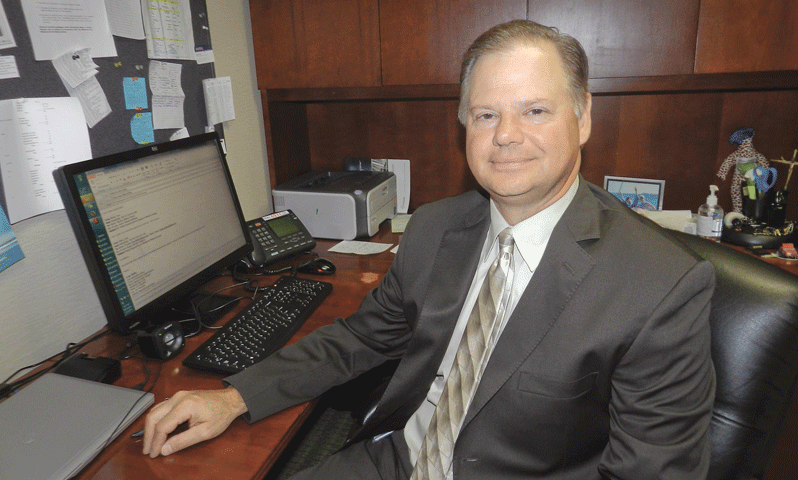
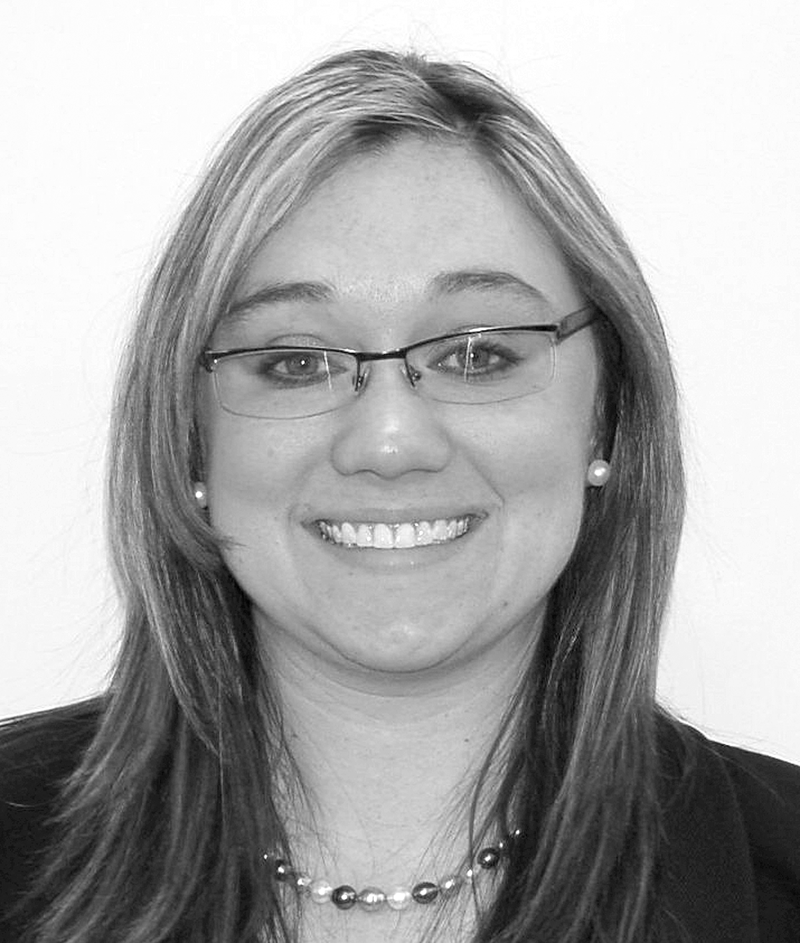
Greg Pellerin

Greg Pellerin

BYOD, short for ‘bring your own device,’ is the latest headache facing IT departments across the country and around the world. In increasing numbers, employees are insisting on bringing their laptop computers, tablets, and cell phones to work with them — security and compliance be damned. BYOD has employers scrambling to balance worker satisfaction, productivity, and the benefits of not having to pay for all this stuff, with the potential for sensitive data breaches, violations of privacy laws, and the need to have IT people well-versed in supporting the variety of end-user devices now being brought into the workplace.

BYOD even has its own Wikipedia page. “BYOD is making significant inroads in the business world, with about 75% of employees in high-growth markets such as Brazil and Russia and 44% in developed markets already using their own technology at work,” it reads. “In most cases, businesses simply can’t block the trend. Companies like Workspot believe that BYOD may help employees be more productive.  Others say it increases employee morale and convenience by using their own devices and makes the company look like a flexible and attractive employer. Many feel that BYOD can even be a means to attract new hires, pointing to a survey that indicates 44% of job seekers view an organization more positively if it supports their device.”

One of the biggest challenges for BYOD is in the healthcare industry. The electronic health record (EHR) mandate set by the federal government has doctors and nurses expecting instant access to information. Oftentimes, that means using their own cell phones, laptops, or tablets, which comes with the risk of exposing sensitive data, in violation of HIPAA regulations.

According to Anders Lofgren, writing for Health Management Technology, “banning devices outright isn’t an option, as about 70% of IT specialists and physicians already use mobile devices to access electronic health records.” Lofgren suggests implementing a comprehensive BYOD policy as soon as possible. Here are some suggestions on what to include.

• Start by Defining BYOD
. Mobile phones may be permitted, but iPhones, Android devices, and, heaven forbid, Blackberrys require different security protocols.

• Implement MDM. That stands for mobile device management, and basically means registering each and every device with your IT department.  It’ll be up to IT to set security policies and determine how data will be accessed, stored, and used.  They’ll also decide what apps will be allowed or banned, a potential major hurdle for any BYOD policy. MDM will also mean new, complex passwords, something employees generally dislike with a passion.

• Acceptable Use. Most companies have rules about corporate-issued mobile devices governing what an employee can and cannot do. That policy needs to be reassessed with BYOD, since personal devices can be used to access potentially offensive material using the company’s network connection. Do I hear First Amendment lawsuit?

• Termination. What happens when an employee leaves the company? You can’t take back his or her phone, but you must be able to remove e-mail access and other proprietary applications. When will this process occur, and how will it be enforced?

Embracing BYOD may be a necessity in keeping a 21st-century employee happy and productive, but, like BYOB, liability questions can arise if an accident occurs on the way home. n

Greg Pellerin is a 15-year veteran of the telecommunications and IT industries and a co-founder of VertitechIT, one of the fastest-growing business and healthcare IT networking and consulting firms in the U.S.;  (413) 268-1605; [email protected]

Health Care Sections
Hospitals Challenged by New Era of Fiscal Efficiency

HCNcoverARTaugARTDr. Doug Salvador says the push toward more efficiency in healthcare is working.

According to recent information from the Centers for Medicare & Medicaid Services (CMS), “healthcare spending trends have flattened, and some of the forecasts of spending from three, four, and five years ago have proven to be incorrect; we’re actually spending fewer dollars than we were,” said Salvador, vice president of Medical Affairs at Baystate Medical Center.

But the shift has been a challenging one, and no one expects it to get any easier.

For example, each year, the American College of Healthcare Executives (ACHE) surveys more than 1,000 hospital CEOs about their top concerns, including governmental mandates, patient safety and satisfaction, personnel shortages, care for the uninsured, physician-hospital relationships, implementing new technology, and other issues. For 10 years running, the broad category of ‘financial challenges’ has topped that list. In fact, it ranked far ahead of the number-two challenge — the tangentially related matter of healthcare-reform implementation — in the last three polls.

“It is not surprising that financial challenges and health-reform implementation are on the minds of hospital CEOs,” said Deborah Bowen, president and CEO of ACHE. “In addition, both government mandates and patient safety remain top priorities as CEOs and leadership teams work hard to improve patient care and redesign care delivery as they face a challenging reimbursement climate.”

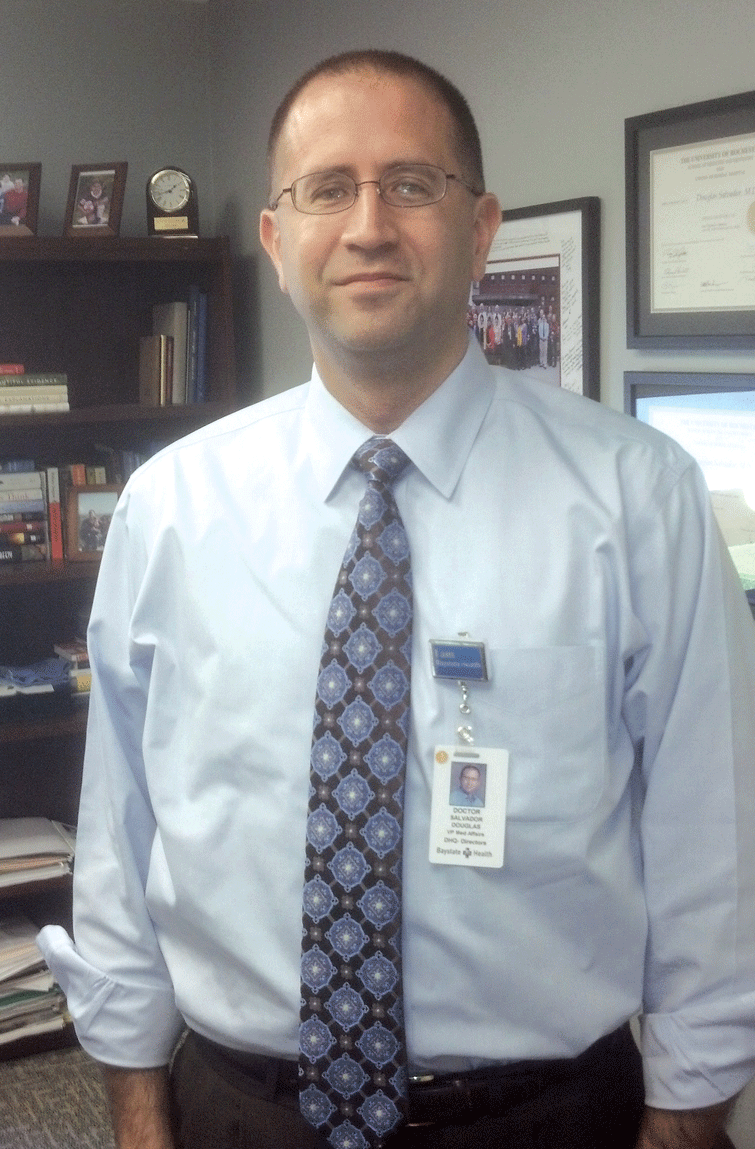
Dr. Doug Salvador

Dr. Doug Salvador says healthcare reform is not simply about insurance — it’s also about controlling, and bringing down, the cost of delivering care.

Dr. Doug Salvador says healthcare reform is not simply about insurance — it’s also about controlling, and bringing down, the cost of delivering care.[/caption]Healthcare reform is deeply entwined in the issue of hospital finances, Salvador noted, because the Affordable Care Act (ACA), or Obamacare, crystallizes many of the cost-saving measures hospitals have been moving toward in recent years, such as reducing hospital readmissions, emphasizing preventive health in the community, and reducing unnecessary tests and treatment.

“The ACA is designed to move us in that direction,” he told BusinessWest. “We are in a time of transition in healthcare, where to meet the goals of population health, we have to invest in taking care of patients outside the hospital. So we’re making some of these investments and, at the same time, have to preserve and improve the care we deliver in the traditional sense. That’s the transformation, and that’s what’s causing the results of these surveys.”

But keeping hospitals in the black while meeting patient needs and expanding services is not a new issue; hospitals have long lamented that their expenses constantly overshoot the reimbursements from public and private payers. But a decade-long shift to new, efficiency-based models of care seems to be having an impact on the industry that hospital leaders hope will make a positive difference in the long term.

Delivery Reform

Salvador noted that, when most people think about the ACA, they think of health insurance, which is only natural.

“There are two parts to ACA — one is insurance reform, and the other is healthcare-delivery reform. Insurance reform, insuring more of the uninsured, is what 95% of the press is about,” he explained. “But healthcare-delivery reform is really a set of experiments, of which Baystate was an early adapter.”

One is the move toward accountable care, which replaces the standard fee-for-service reimbursement model — under which hospitals are paid a fee for each procedure, plus additional fees for any complications that would require a readmission — with a system by which a group of different providers are paid a flat fee for keeping a patient healthy, which provides incentives to eliminate unnecessary costs, but also to make sure patients get the care they do need, because a major goal is to prevent rehospitalization.

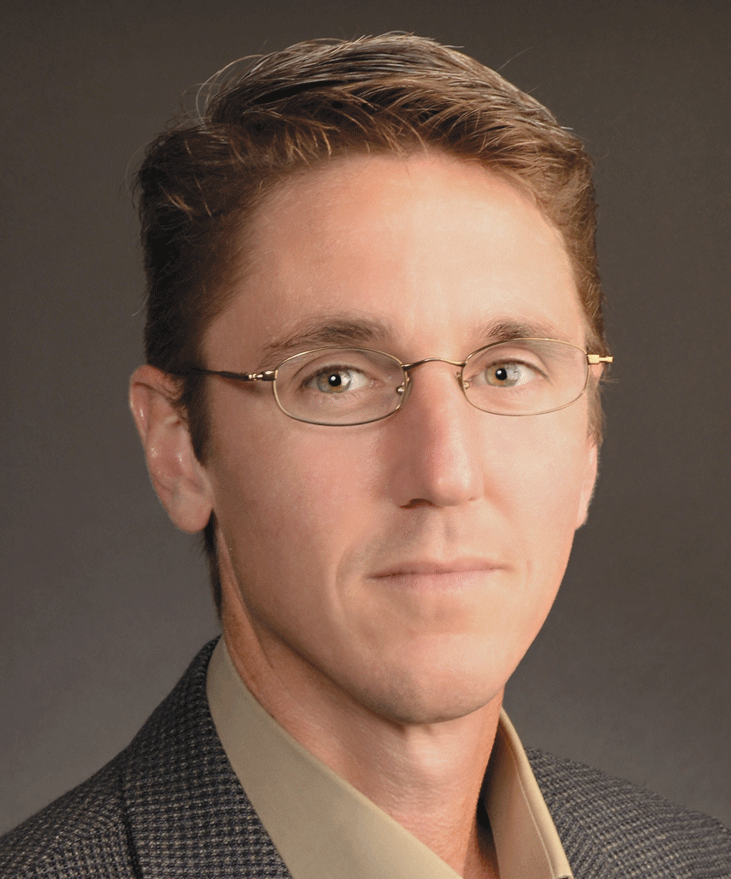
Thomas Robert

Thomas Robert says Mercy Medical Center has implemented several protocols to achieve a balance between quality care and efficiency.

“The last thing a surgeon or oncologist should be paid for is complications. Right now, if you have more of them, you do better,” Dr. James Mohler, chairman of the Urology Department at Roswell Park Cancer Institute in Buffalo, N.Y., told MedCity News. “What you’re really talking about is paying for outcomes, because that’s what healthcare is about. You want to deliver the right care and do it really well, so that the net cost to the country and to a patient will be less.”

As outlined by the Institute for Healthcare Improvement, a Massachusetts-based organization that promotes innovation and safety in medicine, accountable care has three interlocking goals: improving the experience of care, improving the health of populations, and reducing per-capita costs of healthcare.

Those goals lay out in stark terms, Salvador said, why efficiency in healthcare doesn’t mean lower-quality care. “As care for individuals gets better, population health improves, and cost of care for the whole population decreases.”

The Sisters of Providence Health System (SPHS), which includes Mercy Medical Center, has been talking about accountable care for the better part of a decade and has realigned the way it structures care and payments.

“Through the ACO we have and other contracts we’re involved with, we feel that the future of healthcare is very much focused on population health,” said Thomas Robert, chief financial officer and senior vice president of Finance at SPHS. “Our readmission rates are among the lowest in the Commonwealth, and we are working to build a clinically integrated network with physicians in the community to be able to utilize these efficiencies for the benefit of the community.”

Mercy has implemented several protocols for achieving this balance between quality care and efficiency, from its high-tech Care Connect system — a sort of centralized air-traffic control for the whole hospital, ensuring that patients move through the system without delay — to an increased emphasis on arranging follow-up care, whether it’s home care, skilled nursing, rehab, or simply a primary-care visit.

“That has translated into a better patient experience but also reduced the length of stay, as we get them into a more proper setting, a more cost-effective setting,” Robert said. “And we follow up with the patient to make sure they follow up with these schedules. Again, that all leads to population health. So many times, patients get discharged without proper follow-up, and that’s where readmissions come from. We assist patients after they leave the hospital and make sure their care continues.”

The heart of accountable care, however, is how it’s paid for, and both Mercy and Baystate are participating in the model, backed by the Centers for Medicare & Medicaid Services, of bundled payments to multiple care providers for individual patients.

“We’re early adopters,” Salvador said. “For certain types of patient services we deliver, we agree with CMS to get paid for them on a 90-day bundle, which aligns the doctors, hospitals, and post-acute care providers. We’re all being interested in the same thing: making care the best and most efficient it can be.”

Big Plans

This new era of efficiency certainly doesn’t mean hospitals aren’t moving forward with expanded services and new technology; in fact, Western Mass. hospitals have been in a growth mode for some time. Baystate recently completed a $250 million expansion, Cooley Dickinson Hospital and Berkshire Medical Center are building cancer centers, and even smaller institutions like Noble Hospital have invested heavily over the past few years in equipment, services, and facility renovations (see related story, page 42).

“The financial pressures and challenges will not get easier,” Noble President and CEO Ronald Bryant told BusinessWest, “and it will continue to be a balancing act between costs we can support and our needs.”

Robert said SPHS has adopted a philosophy of “incremental investment” to make sure that Mercy and other elements of the health system grow as needed, but budgets remain under control.

“When we go through the capital planning process each year, we take all the wishes that are out there and really prioritize them according to quality and outcome for patients, patient experience, and increasing efficiency,” he explained. “We work closely with physician providers to help us prioritize those capital needs, and we target when we absolutely need to make the expense.”

A good example is Mercy’s recent conversion of its inpatient floors to private rooms. “We knew we couldn’t do the private rooms all at once; funds were not available for us all at once, and we’d also disrupt patient care,” Robert said. “So we started that process in 2011, in four phases, which we just completed. Now 80% of our rooms are private — a project that basically took three-plus years to complete.”

The system tries to be creative in other ways with its capital dollars, he noted, like its joint venture with Hampden County Physician Associates and Carew Chestnut Partners to build a $20 million outpatient medical office center at the corner of Carew and Chestnut streets in Springfield.

Because of the partnership, he said, “Mercy did not have to put up any capital dollars. We now have this very important access point on our campus without expending additional capital dollars. It’s really about trying to be creative.”

But efficiency also means tightening belts when it comes to care, Salvador said, and that’s something all hospitals have to deal with — as well as patients, who have become accustomed over the years to being offered any number of treatments and tests when admitted to the hospital.

“One of the interesting things for me is the link between the quality of care we deliver and how much the care costs,” Salvador said. “The challenge for hospitals with the ACA is to prove the value of all the care we deliver.”

From that challenge has sprung a national campaign called Choosing Wisely, led by the American Board of Internal Medicine Foundation with the support of close to 100 specialty medical organizations.

“They have identified a number of common practices that physicians have said we should question the value of — is the money worth the benefit of those practices? We’re seeing hospitals across the country — and Western Mass. is no different — really looking at some of those practices,” Salvador explained, and either justifying their widespread use or determining whether they may be of less patient-care value than they’re worth financially.

“One example is blood transfusions,” he continued. “They’re very common, and in fact they save lives, but evidence has come out recently to question whether using blood in some cases, particularly in certain patient groups, actually doesn’t save lives, doesn’t add value. So we’re seeing a national trend toward using less blood.”

In the same way, participating emergency physicians have questioned the use of high-end imaging for headaches, pathologists have questioned vitamin D testing, and so on.

“Cardiologists have a list, orthopedic surgeons have a list … it goes on and on,” Salvador said. “It also engages patients about their care, and I think that’s always been important. I think we’re getting better at it, and things like this help us do that.”

Beyond the Bottom Line

Salvador said he came to Baystate six months ago to grapple with these very questions, because transforming healthcare is part of the organization’s culture.

“From my perspective, a lot of hospitals across the country are discovering that the answer lies, more than ever before, in our continuing effort to improve the quality of care by delivering the best care with the fewest complications,” he said, emphasizing again the philosophy behind accountable care and the new national push to keep costs down. After all, he said, it’s not quality care that raises costs, but unnecessary care.

“Most of us are working very hard to reduce readmissions to the hospital and deliver excellent care both inside and outside the hospital,” he went on. “When we don’t have patients returning to the hospital, the overall cost goes down.”

It’s easier said than done, but hospital leaders say they’re making real progress toward this more efficient model of care. And that’s got more than just patients feeling better.

Joseph Bednar can be reached at [email protected]

Health Care Sections
Noble CEO Ronald Bryant Creates a Network of New Services

Ronald Bryant

Ronald Bryant says his primary accomplishment has been to create an environment where people want to succeed and are put in a position to do so.

Ronald Bryant’s vision for Noble Hospital in Westfield has seemingly no limits.

Over the past three years, the president and chief operating officer has instituted impressive change that has brought new life to the independent medical facility and reinstated its standing as a top-notch center for healthcare in the Greater Westfield area.

Improvements include new physicians; a renovated patient wing; a new, comprehensive primary-care office building; a new, $450,000 Noble Walk-In Express Care service next door; a urology practice; new orthopedic offices; comprehensive breast-cancer services with a full-time breast surgeon; and a lot more, which have been realized through dedicated teamwork and outreach efforts, led by Bryant’s tireless effort.

“I have not done this alone. It has been accomplished with physicians, nurses, trustees, and administrative staff, which extends to dieticians who make sure patients have the right nutrition,” said Bryant. “My job is to create an environment where people want to succeed and are put in a position to be able to do so. And healthcare is moving so fast that you cannot stop. You have to get up every day and continually try to improve your organization.”

The hospital has 97 beds in a 257,000-square-foot building, which includes a telemetry unit, an intensive-care unit, a 20-bed psychiatric unit, a 15-bed inpatient rehabilitation unit, physician office space, and a medical/surgical unit which has been completely renovated with upgraded floors, walls, bathrooms, and nursing station, made possible due to money raised at the annual Noble Ball.

Noble’s new diagnostic imaging and X-ray service

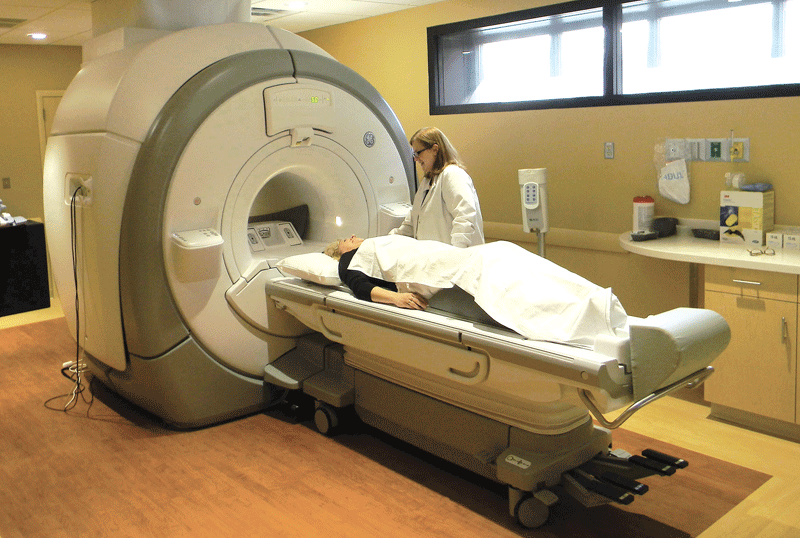
Noble’s new diagnostic imaging and X-ray service offers cutting-edge technology that helps physicians make definitive diagnoses.

The expansion of services has been accomplished within a relatively short period of time, but Bryant said it was carefully orchestrated.

“We were very prudent in making sure the investments we made promoted healthcare within the community,” he said. “Noble has always been consistent and conscientious about providing quality care, but in the past, we didn’t have enough physician services to keep patients in the community.”

That was caused in part by the critical shortage of primary-care physicians in Massachusetts as well as a national shortage, which made it difficult to attract these specialists to Noble.

But the hospital has been successful in recent recruitment efforts, and a primary-care office opened in July in a new building on 67 Union St. with seven primary-care doctors.

Noble’s efforts to attract physicians has also resulted in a partnership with the Urology Group of Western New England, P.C., which now has state-of-the-art exam rooms and office space within the hospital.

“This came about as part of our effort to build new relationships with physicians,” Bryant said. “They have their own waiting room and testing lab here now.”

There is also a new obstetrician-gynecological program, created through an affiliation with Baystate Medical Center. “Patients see their doctors here and deliver their babies at Baystate,” Bryant said, adding it is too costly for a hospital of Noble’s size to be able to do everything alone.

To that end, the third floor is now home to new cardiopulmonary offices and services, which also involves a liaison. “We partnered with the Baystate Regional Heart Attack Program and can get people out our door to their cardiology department faster than anyone else in the Valley and all of our competitors,” the CEO told BusinessWest.

Other improvements include a new, state-of-the-art, $2.6 million MRI center, which opened at the same time as the urology offices, along with a new van to transport patients. The service is free to senior citizens or anyone who needs it in the hospital’s primary service area.

“We’ve invested more than $6 million in the hospital over the last few years in equipment, services, and facility renovations,” Bryant said, adding that these investments have made a difference, and the hospital’s patient satisfaction scores for 2012-13, as measured by the Centers for Medicare and Medicaid Services, are the highest in Pioneer Valley.

“This is especially significant because not only are we the smallest independent hospital in the state, we are also the lowest-cost hospital in Massachusetts,” he said.

Strong Commitment

Noble’s CEO worked as a public accountant for a government agency before he entered the healthcare field, where he has put his talents to work for the past 15 years.

He was born and raised in Worcester, graduated from Assumption College, and is currently working on a master’s degree in health administration. He serves on the board of the Mass. Hospital Assoc. and Noble’s Visiting Nurse Assoc., and chairs the Greater Westfield Chamber of Commerce.

The licensed, certified public accountant began his healthcare career at MetroWest Medical Center in Framingham and Natick, where he served as account manager for the developmental disabilities and home health department. That stint led him to join Health Management Associates, a nonprofit organization that represents 70 community hospitals in the South and Southwest.

Time spent with that group inspired Bryant’s passion for community hospitals. “I went through their management program and realized early on that community hospitals were a good fit for my personality,” he said.

After working in South Carolina and Oklahoma, his family wanted to move closer to home, so when he was offered the position of chief financial officer at Martha’s Vineyard Hospital, he accepted.

Five years later, he moved to Goodall Hospital in Maine, where he held the same position, and three years later, he landed at Noble.

Bryant served for nine months as Noble’s CFO before moving to the position of president and CEO in August 2011.

“Noble Hospital offered challenges which were a good fit for my skill set,” he noted. “I had the financial background needed to compete in today’s healthcare environment and knew there was a good chance that the hospital had a bright future.”

However, he conceded that, in spite of this belief, Noble was in difficult financial straits when he arrived.

“I knew that, without proper fiscal management, physician recruitment, and rebuilding service lines, the future was in jeopardy,” he said. “The organization was in a good geographic location and had strong demographics, but had poor fiscal management.”

However, his past experience soon came into play. “Both Martha’s Vineyard and Goodall were financially challenged, but I was very fortunate to have mentors at both hospitals who taught me a great deal,” he said.

His first step was to rebuild the hospital’s four-person revenue team.

“I brought in new talent and reorganized and revamped a new, talented team of 20 people,” Bryant said, noting that the top two factors that lead to the success or downfall of any community hospital are its physicians and management of its revenue.

“So, after we solidified our financial position, we turned our attention to growth,” he explained.

This was critical because a community survey of the hospital’s service lines revealed a shortage of physicians in the area. “It also showed that more than half of the population was not aware of the services Noble provided, so our task was clear.”

The hospital took steps to recruit doctors to work there full-time, and cultivated relationships with others willing to become affiliated with Noble.

The effort was very successful.

“Twenty-four months ago, we had one physician on staff, and now we have seven, and to complement this, we also rebuilt specialist services,” Bryant noted, adding that the hospital re-established relationships that had existed in the past and formed new ones with specialists on the other side of the river.

That included its partnership with the urology group as well as the creation of a comprehensive breast-cancer program.

“We also hired a gastroenterologist to partner with the existing one on staff, and revamped our radiology, anesthesiology, and pathology services, which helped build confidence among the physicians in our community. If a hospital doesn’t offer strong services, physicians won’t send their patients there,” Bryant explained.

The demand for general surgeons was also met, and Noble now has two surgeons who also work for another hospital. “It fills two needs — ours and their need for more volume,” the CEO said. “And a good percentage of our doctors are also affiliated with Baystate Medical Center.”

For example, Noble’s breast-cancer surgeon brings in plastic surgeons from Baystate Medical Center to do reconstructive surgery on their patients. “Our doctors and affiliated physicians work together, and these types of relationships help make us successful,” Bryant said.

Once the hospital had attracted enough physicians, the next step was to create a comprehensive marketing program that was specifically designed to reintroduce Noble to the community. It began two and a half years ago with a “Yes Noble” website, on which Noble employees wrote about how much they enjoyed working there. “We just won an award for it,” Bryant said.

From there, efforts were aimed at informing residents in the hospital’s geographic area of the services Noble offered, as well as introducing doctors in the Noble Health Network. It was accomplished via speaking engagements, radio and TV advertising, publications, and a healthcare symposium in Westfield that attracted 100 people who learned about what Noble was doing in the area of healthcare reform.

“We speak at all major community events and are very, very visible in the community,” Bryant said.

In addition, the hospital hosts a series of ongoing employee luncheons where physicians talk about what they do.

“There will always be competition, but from the time I came here, I believed that, if we did our job in a high-quality fashion, patients would not want to cross the river,” Bryant said. “I told myself from the beginning that I wanted each individual in our community to think of Noble first for their healthcare needs. I want our healthcare network to be the best place to give and receive safe, quality, compassionate care.”

Ongoing Mission

The vision that Bryant brought to the position continues to broaden. “Everything we’ve done has been geared toward keeping patients here, and the confidence we’ve built has allowed us to maintain our market,” he said. “But I’m always thinking about what’s next. It’s really important to adapt to change and be able to capitalize when opportunities arise.”

To facilitate that goal, he has surrounded himself with people who are talented and have great imagination.

“The financial pressures and challenges will not get easier, and it will continue to be a balancing act between costs we can support and our needs. But I want to go further and continue to grow our market,” he said. “Our work hasn’t stopped, and we will continue to develop our network so we will become the provider of choice in our area.”

Health Care Sections
Baystate CIO Joel Vengco Says His Job Requires Wearing Many Hats
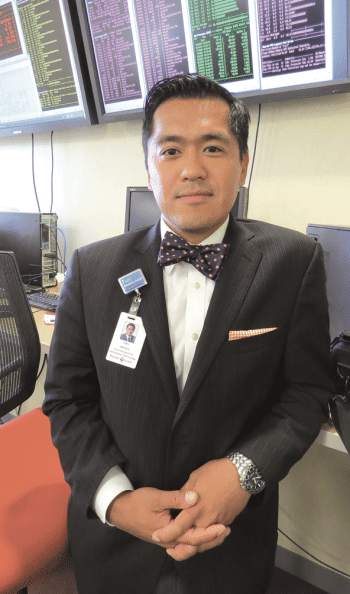
Joel Vengco

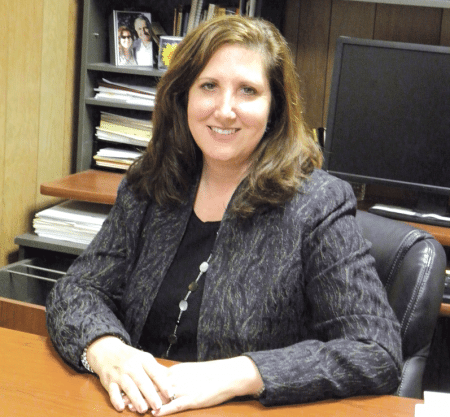
Joel Vengco says healthcare IT now involves much more than technology. Increasingly, the focus is on taking data and transforming it into information — and then knowledge.

Joel Vengco was talking about the role of the hospital, or health system, chief information officer (CIO) — the position he holds with Baystate Health — and how it has evolved over the years.

And he started with some subtle humor.

“There’s a lot more meetings to go to,” he said with a laugh, choosing that starting point to explain how and especially why this administrative position is now much more about information and operational strategy than it is about hardware and software.

“CIOs today are more strategic in nature; today, there’s so much reliance on technology and on information inside those technologies that the CIO has to be part of the strategic discussion and the envisionment of business as a whole,” he told BusinessWest. “And that’s a different skill set altogether. You really have to understand strategic development, you have to understand the business that you’re in, and you have to understand finance.

“And you have to be more of a people person than I think CIOs were in the past,” he went on, adding quickly that he certainly wasn’t disparaging those who came before him, just referencing how times have changed. “Many of them would sort of hide out in the data center and focus on putting up a server. We’re now forced to be out there, talking to our partners and our users and really helping to lead the use of technology and information for competitive advantage or progression of the business.”

Elaborating, Vengco said the CIO must now wear a number of hats in addition to those that have been traditionally worn. Indeed, while the CIO is still tasked with keeping a health system running from a technology standpoint — what Vengco called “keeping the lights on,” a reference to everything from PCs to operating-room equipment — there is now much more to this job.

“In many ways, I wear an operating hat, a strategic hat, a finance hat, and sometimes I even wear a clinical hat, even though I’m not a clinician,” he said. “And then, you have to wear the innovation hat, because you can’t be stagnant and just look at the technology in front of you; you need to understand and begin to distill all the new technologies that are coming down the pike and correlate them with the current problems and the future state.”

With that mentality, Vengco was one of the key architects of the Baystate Innovation Center, what he described as a cross between an incubator and an accelerator that is taking shape at 1350 Main St. in downtown Springfield (more on that later).

But perhaps the most important line of the job description for today’s healthcare CIO, he said, may be enabling both a specific health system and the community it serves to make more and much better use of the vast amounts of data that modern technology allows people to collect.

Vengco, who came to Baystate in 2012 after work with GE Healthcare, has spent much of his career focusing on information and analytics, or what he called “liberating data,” and transforming it first into information and then knowledge.

“Data is the raw content of systems; it’s the diamond in the rough,” he explained. “You really have to transform it, or massage it, in layman’s terms, to really come up with information from that data. and then, from that information, you can develop knowledge through the delivery of an architecture that really takes that information and makes it actionable for people.

“If you put most of the raw data we have into a computer or an algorithm, it wouldn’t be able to compute anything out of it. In isolation, it may not necessarily make much sense; it’s just data, not information,” he went on. “But once you put it into context, like if you took a lab value and put it in the context of a disease state, or, better yet, you aggregated all of those labs and correlated it with a specific chronic disease state for a cohort of patients, then you have information about diabetes or information about congestive heart failure.”

For this issue, BusinessWest talked at length with Vengco about the evolving and expanding role of the CIO — and about all those hats he and others who take that title are now wearing.

Technically Speaking

Vengco told BusinessWest that, since childhood, he’s been drawn to the healthcare field, and that he attended medical school to essentially appease his parents and become a doctor. But his career path took an abrupt turn during his second year there.

“I was transitioning into my Ph.D. years, and one of my thesis advisors had suggested that I look at doing some work with a health information technology firm, which back then [2001] was pretty novel,” he explained, noting that the firm in question was Boston-based Eclipsys. “The idea was to develop a national data warehouse where I could develop algorithms for disease progression, outcome measurement, develop new clinical decision-support rules in analytics — a lot of the things we’re talking about now in terms of big data, but perhaps it could be done in this corporation.”

He took on that challenge, and in the course of doing so discovered that there was a considerable challenge behind utilizing the data collected by health systems because it was largely unusable, and not “liberated,” a term he would use early and often to describe this phenomenon.

In short order, finding ways to make such data more usable became his career passion.

He left medical school and entered the field of informatics and analytics. He interned at Partners Health Care and later taught at Harvard before landing at Boston Medical Center for his first IT operations job.

“It was at that time that I started to see the value of understanding technology in the context of a journey toward really understanding information,” he noted. “Because, ultimately, my real interest here was to try to figure out how to utilize this information so we could develop new knowledge and new insights. Technology changes so rapidly, but what is a mainstay and the most important element for me is information that we can gather from these systems. It’s like DNA for the human body; this information is the DNA for coordinating and developing quality care for the future.”

From Boston Medical Center, he went to GE Healthcare, where he became vice president of a global business called eHealth, a job he took to better understand what people in other countries were doing in the emerging field of population health.

He took part in projects in the U.K., France, Australia, Canada, and other countries — many of them involving health-information exchanges, care-management systems, collaboration systems, mobile health platforms, and population-health analytics — and took some valuable lessons back to the U.S.

Vengco said he wasn’t looking to leave GE, but always harbored a desire to return to the setting of the health system CIO, preferably in Boston, and in early 2012, Baystate was advertising for one.

“I hadn’t really thought about Springfield or Baystate — I knew of it, but didn’t really know the culture and the footprint of the community,” he said. “When I was recruited to take the interview, I came out here to see what it was about, not really looking to make an adjustment or a move. But I was really surprised with the vision Baystate had and the leadership it had.”

What’s more, he toured the region and came away with the impression that it would be an ideal setting for the innovation center that is now becoming reality.

“I enjoyed my discussions with Baystate, and was deeply moved by the mission they had for the community and healthcare in general,” he said. “It really matches my vision and my hopes — that healthcare needs to be more patient-centered.”

Making IT Happen

Vengco said the work of the IT Department at Baystate has four main pillars:

• Optimization, or making the most of the technology systems that exist today;

• Community engagement, or community collaboration, a realm that includes an initiative known as the Pioneer Valley Information Exchange (PVIX), which essentially creates a single patient record that optimizes the care delivery of all transitions of care across the continuum;

• Analytics, or the liberation of data; and

• An innovation platform, perhaps best represented by the innovation center.

Focusing on all four, plus that aforementioned work to keep the lights on, has become a considerable challenge, said Vengco, noting that he and his staff of roughly 230 are inspired by the breadth and depth of that challenge.

“You really are thinking well beyond the technology that you have to install,” he noted. “It’s an exciting time, but it’s also very daunting; I feel the enormity of the task, and so does my staff.”

And with that, he returned to his thoughts about how IT now extends into the realm of information — both gathering it and liberating it.

“The historic design of the EHRs (electronic health record systems) in the past and somewhat current state is that they take in data, but they don’t necessarily spit it out easily,” he explained. “And data loses its value if you don’t have the ability to liberate it and use it for the delivery of care. And that has been my mission since I started this journey back in 2001.

“There’s so much to be gleaned and to be achieved through the data we have locked in our systems,” he went on. “That’s why liberating that data is the first mission we should all have, because once we have that information in hand, it becomes knowledge and actionable delivery of care.”

Many of the Baystate IT Department’s initiatives have come together in the creation and operation of the PVIX, said Vengco, adding that the broad aim is to create a single patient record that can be used by a host of area care providers.

“Patients are very mobile; they’ll see a specialist, see a primary-care provider, visit the hospital … and those care organizations may not be affiliated with each other and so may not be on the same electronic medical record system,” he explained. “So when a patient goes in for his next visit and the provider wants to see all the meds they’re on and all the allergies they may have, they may not see all that comprehensive data because it may be in other systems dispersed across the community.

“So, today, we have to hope that a patient knows all the meds they take and all the allergies they have, or that the medical group down the street that they just visited will fax that information,” he went on. “But that doesn’t happen consistently, so you wind up treating patients with the information you have, and it might not be enough.”

The PVIX was created to solve that problem, he went on, by creating a comprehensive record that essentially follows the patient.

Founding members of the exchange include Baystate, Mercy Medical Center, Health New England, Riverbend Medical Group, Berkshire Health Systems, Holyoke Medical Center, and many others, said Vengco, adding that some of the challenges moving forward are convincing patients that their information is secure and also convincing providers that sharing such information is the right thing to do at this critical juncture for the healthcare industry.

“There’s still an uncertainty among organizations that care for patients about whether they should be sharing that data with other collaborating providers,” he explained. “And some of that stems from the notion that this data is competitively advantageous — that, if I share this data, you might know enough about me and my market to steal my patients.

“That’s just not where we need to be to care for our patients in the appropriate way,” he continued. “We have to be able to say, ‘for the betterment of patient care, quality of care, and efficient care delivery, we need to be able to exchange this information.’”

Center of Attention

Putting on that aforementioned innovation hat, Vengco stressed the importance of not simply understanding and maintaining the technology of today, but also anticipating the technology of tomorrow and being at the forefront of its development.

This was the impetus for the Baystate Innovation Center, which is still under construction but is in many ways already operating at One Financial Plaza in downtown Springfield.

“We need to make a mind road map, if you will, of what technology needs to look like in the future for your business,” he explained, noting that the innovation center was created, with the help of a $5.5 million state grant, to focus on solving the problems of healthcare today through technology and informatics.

The center’s creation — not to mention its location — brings another layer to a growing regional emphasis on entreprenurship, technology, and economic development, said Vengco, noting that, within a few blocks of each other, the innovation center, Valley Venture Mentors, and Tech Foundry, a facility dedicated to training individuals for careers in IT, are creating enormous momentum for new technology startups and getting established companies to the next stage.

“For those of us in healthcare, the rapid change that has come as a result of reform and the need to change healthcare delivery requires us to continue to innovate,” he said. “And for Baystate, this is an extension of our mission because it enables us to continue to look forward to doing the best that we possibly can to deliver the best possible care to the community through these innovations, while still maintaining our current operations.”

Elaborating, Vengco said innovation center administrators are looking for ventures that are in what he called the “last mile of development.”

“They come in with a solution already in hand, but it really needs a few more tweaks here and there, and that’s where we really come into play,” he noted. “We provide that innovator with the necessary adjustments and development advisement to get them to a usable product or solution.”

And these products and solutions are carefully chosen to meet the objectives of the health system, he noted, adding that organizers are not necessarily looking for the next Google.

“The intention here is to make sure we’re bringing in solutions that will address system objectives,” he told BusinessWest, adding that these include improving quality of care, patient progress, high-value care, and bending the cost curve. “We’re looking for technology that’s relevant to the problems we’re trying to solve. It’s not about making money; it’s about delivering an innovation that’s going to help us achieve our mission in an optimal way.”

He went on to say that he considers Baystate to be a model health system in a model state — Massachusetts is generally considered to be on or well ahead of the curve when it comes to innovations in healthcare — and that the Baystate system, by implementing products and concepts developed at the innovation center, could become an important proving ground moving forward.

“As you look at all of these other organizations, these integrated delivery systems that are being built or are already in place, they’re aspiring to be what I believe Baystate is already beginning to become,” he explained. “And we’re in a state that in many ways is one and a half to two years advanced in terms of policy and reform, and that becomes very attractive for developing solutions when you’re looking at ways to impact care delivery across the country. If you can do it here, it’s likely that it’s going to be impactful elsewhere; it’s a really great environment to do that kind of innovation.”

For the Record

Summing up his thoughts on health IT and where it’s headed, Vengco said it is going to play an increasingly vital role in the delivery of patient care and overall population health.

And carrying out the many and diverse aspects of his department’s mission will become ever more challenging as it extends well beyond technology and optimizing all that it brings to the table.

“My responsibility is to try to engage our leadership and our strategy so we can focus the use of technology and information,” he explained. “That’s the challenge; everyone wants the next technology, but we have to make sure we’re selecting it strategically and that it continues to support our mission.”

George O’Brien can be reached at [email protected]

Briefcase Departments

State to Purchase Knowledge Corridor Line
GREENFIELD — Gov. Deval Patrick announced an agreement in principle allowing the Commonwealth to purchase the Knowledge Corridor rail line between East Northfield and Springfield from Pan Am Southern, a joint venture of Pan Am and Norfolk Southern. The 49-mile segment of rail is currently undergoing a major restoration that will allow for more efficient passenger service, in response to increased demand, and will allow the Commonwealth to maintain and enhance freight service, which will take trucks off the roads, reducing congestion and greenhouse-gas emissions. “For close to 100 years, the Commonwealth’s rail infrastructure was the lifeblood of economic vitality for communities in Franklin and Berkshire counties, and across Western Mass.,” said Patrick. “Through this agreement, we are realizing the renewed value this infrastructure can have in creating economic opportunities throughout the region.” The agreement in principle to purchase the Knowledge Corridor rail line is an important milestone in the Knowledge Corridor/Restore Vermonter Project. The project will restore the original route of Amtrak’s Vermonter travelling between St. Albans, Vermont, and Washington, D.C. from its current routing via Palmer and Amherst. The work on the project includes upgrades to the 50-mile Pan Am Southern Connecticut River Line running between Springfield and East Northfield, known as the Knowledge Corridor. The ongoing restoration project will lead to the relocation of the Vermonter, Amtrak’s north-south passenger rail service to the Knowledge Corridor, by the end of 2014, potentially reducing trip times by 25 minutes. Starting in East Northfield, the restoration runs south to Springfield and includes the construction of three new station platforms in Greenfield, Northampton, and Holyoke. Passenger service on this line ceased in the 1980s and was rerouted southeast to Palmer, where trains reverse direction and head west to Springfield. “It is clear that the residents of Western Massachusetts are hungry for rail service,” said U.S. Rep. Jim McGovern. “Today’s announcement, coupled with state and federal investments to rehabilitate the Knowledge Corridor line, will make such service a reality.” Added U.S. Rep. Richard Neal, “as an outspoken supporter of increased rail travel throughout New England, I am pleased the Commonwealth has agreed to purchase the rail line that runs along the Knowledge Corridor. The completion of this segment of track will lead to increased passenger and freight service from the Pioneer Valley to the Vermont border. Not only will this project will help improve our transportation infrastructure, it will also grow the local economy. It’s exciting news for Western Massachusetts.” Initiated in August 2012, the restoration work consists of the replacement of approximately 95,000 rail ties, new continuously welded rail, new active warning signals and crossing gates at 23 public-grade crossings, upgrades to six bridges, and the first phase of a new signal installation. The restoration is funded through a $75 million grant awarded by the Federal Railroad Administration and approximately $40 million in state funds. The work is expected to be complete in 2016, after the start of passenger service. These improvements will improve safety, increase operating speeds for existing freight-train traffic and the Vermonter, and enhance capacity on the rail line to accommodate future increased levels of train traffic. “The Knowledge Corridor is a rail asset that will play a key role in the region’s transportation system, both by delivering improved customer service in the form of faster travel times, as well as by being built to a standard that can accommodate more freight,” said MassDOT Secretary and CEO Richard Davey. “Purchasing the line will also allow us to preserve the line’s viability for the long term, and will position the Commonwealth to use this line for increased passenger service that could provide commuters in the region a competitive alternative to driving on I-91.” The Knowledge Corridor/Restore Vermonter project is part of the vision for a New England high-speed, intercity rail network that will provide a foundation for economic competitiveness and promote livable communities from major and smaller cities to rural areas. Beyond the Knowledge Corridor, the Commonwealth’s work to increase rail opportunities for commuters and tourists alike continues. MassDOT has been working closely with Pan Am Southern, the city of North Adams, and the town of Adams to have Berkshire Scenic Railway operate the Adams Branch railroad line between the two towns. The operation of a scenic railway between North Adams and Adams would be another draw for the thousands of tourists who flock to the Berkshires each year.

Assistance Center Opens in North Adams for Former Hospital Workers
NORTH ADAMS — State Secretary of Labor and Workforce Development Rachel Kaprielian and state Health and Human Services Secretary John Polanowicz recently joined legislators and local workforce-development officials at a ribbon-cutting ceremony to officially open a worker-assistance center inside North Adams City Hall. The center is the latest effort to marshal state resources in helping 530 area residents who lost their jobs when North Adams Regional Hospital (NARH) and its affiliates closed in March. “The Patrick Administration is committed to making sure no worker or region is left behind as the state’s economy continues to improve and enjoys record job growth,” said Kaprielian. “This center and the skills-training opportunities the state is allocating will help get these residents back to work.” The Mass. Department of Public Health has been instrumental in helping the hospital reopen as a healthcare facility and restore regional healthcare services. Three months ago, Berkshire Health Systems opened an emergency room in the facility and hired approximately 150 former NARH employees. “Massachusetts is committed to ensuring that quality healthcare is accessible in every region across the Commonwealth,” said Polanowicz. “This worker assistance center in North Adams reinforces the administration’s commitment to the region’s healthcare community, and to supporting workers, patients, and families.” Added North Adams Mayor Richard Alcombright, “a huge ‘thank you’ to our state partners at the Executive Office of Labor & Workforce Development, and our local partners at Berkshire County Regional Employment Board and BerkshireWorks, for providing this wonderful opportunity to the residents of our Greater Northern Berkshire region. This center will provide significant resources to the unemployed and underemployed that will help them seek out opportunities and provide training for the skills necessary to attain employment. What is also very exciting is that this center will be located right next to our Veteran’s Services Office, providing an on-the-spot resource for our local veterans seeking employment.”

State, MassChallenge Launch Government Innovation Competition
BOSTON — MassIT, the Commonwealth’s lead state agency for technology across the executive branch, announced a first-of-its-kind MassIT Government Innovation Competition, with a $50,000 prize for the winning project. MassIT will partner with MassChallenge, a start-up accelerator that supports high-impact, early-stage entrepreneurs, on this initiative. The goal of the MassIT Government Innovation Competition is to provide high-quality startups with incentives to develop innovative solutions that can help the state government meet constituent needs more efficiently and at lower cost to taxpayers. For the first time, the Commonwealth will have access to entrepreneurs focused on improving the constituent-government relationship. The Commonwealth plans to implement a pilot of the winning project, with the goal of cost-effectively improving delivery of services to constituents, achieving greater internal efficiencies, or both. “Massachusetts is renowned as a hub for technology and innovation; MassChallenge’s support of high-impact, early-stage entrepreneurs has helped enhance that reputation. By working together, MassIT and MassChallenge can accelerate the Commonwealth’s use of technology solutions and harness the wealth of expertise available to us,” said Bill Oates, the state’s chief information officer. MassChallenge awards more than $1 million in cash prizes each year to winning startups, with zero equity taken. Additional benefits for startups include world-class mentorship and training, free office space, access to funding, legal advice, media exposure, and more than $10 million of in-kind support. MassChallenge is open to early-stage entrepreneurs from any industry, from anywhere in the world. Now in its fifth year, the competition has supported 489 startups, which have created more than 4,000 new jobs and raised more than $550 million in outside funding. This year alone, MassChallenge received approximately 1,650 applications from 50 countries and 40 states. After initial rounds of judging of all applicants, 128 finalists — in honor of Massachusetts’s Route 128 technology corridor — are invited to participate in MassChallenge’s four-month startup accelerator program and related sidecar competitions. The MassIT Government Innovation Competition is open to any qualifying startup that applies by the Aug. 27 deadline. Entrepreneurs whose work can help MassIT leverage innovation to support, enable, and transform the operation of state government and delivery of services to constituents are invited to compete.

State Reaches Solar Milestone
BOSTON — Gov. Deval Patrick announced another major clean-energy milestone, surpassing 15,000 solar installations in the Commonwealth. There are now 15,762 systems installed across Massachusetts, a 20-fold increase from 2008. “This achievement is due in large part to the strength of the Massachusetts solar industry,” Patrick said. “Clean-energy investments are smart for the environment and the economy, as proven by our 24% industry job growth in the last two years.” There were 778 systems installed in Massachusetts on Jan. 1, 2008. As a result of this exponential growth, Massachusetts ranked fourth in the nation for new solar capacity installed in 2013 by the Solar Energy Industries Assoc. It also ranked fourth nationally in total solar jobs in 2013 by the Solar Foundation’s National Solar Jobs Census. There are more than 8,000 people working in the solar industry in the Commonwealth, and nearly 80,000 clean-energy workers at 5,500 companies. “These achievements show that the Patrick administration’s policies and strategic investments are paying off,” said state Energy and Environmental Affairs Secretary Maeve Vallely Bartlett. “When we are competitive with other states much sunnier than ours, it’s a testament to the commitment of state and local officials, as well as home and business owners across the Commonwealth, to renewable energy.”

Chamber Corners Departments

AFFILIATED CHAMBERS OF COMMERCE OF GREATER SPRINGFIELD
www.myonlinechamber.com
(413) 787-1555

• Sept. 10: ERC5/ACCGS Millfest After 5, 5 p.m. to dusk, at Ludlow Mills, 100 State St., Ludlow. Tickets are $15 for members, $25 for general admission.

• Sept. 23: ACCGS Pastries, Politics & Policy, 8-9 a.m.
An informal roundtable discussion, designed for political and policy junkies. Reservations are $15 for members, $25 for general admission, which includes continental breakfast. Reservations may be made online at www.myonlinechamber.com.

• Sept. 30: Rake in the Business Table Top Showcase, 4:30-7 p.m., at the Castle of Knights, 1599 Memorial Dr., Chicopee. Network with more than 100 vendors. Reservations are $5 in advance, $10 at the door.  Reservations may be made online at www.myonlinechamber.com.

GREATER CHICOPEE CHAMBER OF COMMERCE
www.chicopeechamber.org
(413) 594-2101

• Sept. 10: CEO Luncheon at the Munich Haus Restaurant. Registration at 11:45, lunch at noon. Network and hear from Eric Lapointe, executive vice president of the Springfield Falcons, who recently joined the organization and oversees all revenue-generating functions of the team. Tickets are $25 for members, $30 for general admission.

• Sept. 17: Salute Breakfast, 7:15-9 a.m., at the Collegian Court, 89 Park St., Chicopee. Tickets are $20 for members, $26 for non-members.
• Sept. 25: The “Taking Care of Business,” series continues with “Negotiating and Understanding Leases,” 9-11 a.m.,  at the Residence Inn by Marriott, 500 Memorial Dr., Chicopee. Sponsored by Common Capital. Cost is $20 for members, $30 for non-members.

• Sept. 30:  Table Top Expo & Business Networking Event, 4:30-7 p.m., at the Castle of Knights, 1599 Memorial Dr. in Chicopee. Presented by the Greater Chicopee, Holyoke, and Westfield chambers of commerce and ACCGS. Tickets are $5 pre-registered, $10 at the door. Sign up at www.chicopeechamber.org.

GREATER EASTHAMPTON CHAMBER OF COMMERCE
www.easthamptonchamber.org
(413) 527-9414

• Sept. 11: Networking By Night Business Card Exchange, 5-7 p.m., at the Look Park Garden House, 300 North Main St., Florence. Sponsored by Residential Mortgage Services. Door prizes, hors d’ouevres, host beer and wine. Tickets: $5 for members, $15 for future members. RSVP requested.

• Sept. 12-13: Electronic recycling fund-raiser, Sept. 12, 1-4 p.m.; Sept. 13, 8:30 to noon. Dropoff location at Liberty and Mechanic streets, Easthampton. Sponsored by Duseau Trucking LLC and A-Z Storage  & Properties. Proceeds to benefit the chamber’s programs, including the Holiday Lighting Fund. Responsibly dispose of your old computers, monitors, TVs, telephones, stereos, and office or home appliances. No registration required; open to all members of  the Greater Easthampton community. Nominal recycling fees. We cannot accept refrigerators, freezers, dehumidifiers, or any appliances containing freon. For more information, contact the chamber.

GREATER HOLYOKE CHAMBER OF COMMERCE
www.holycham.com
(413) 534-3376

• Sept. 10: Legislative Coffee Hour, 7:45-9 a.m., at Slainte Restaurant, 80 Jarvis Ave., Holyoke, featuring guest speakers Mayor Alex Morse, City Council President Kevin Jourdain, and City Treasurer Jon Lumbra. Sponsored by Ferriter Law and Marcotte Ford. Tickets are $18 for members, $25 at the door and for non-members.

• Sept. 17: Annual Outing Clambake, 5:30-8 p.m., at Holyoke Country Club, 3 Country Club Road, Holyoke. Lobster dinner, putting contest, raffle prizes, 50/50 raffle, chowder cookoff. Sponsored by United Water, Pioneer Valley Railroad, and CareerPoint. Tickets are $30 for members and advance reservations, and $40 for non-members and at the door. The public is invited to attend.

• Sept. 30: Table Top Showcase, 4:30-7 p.m., at the Castle of Knights in Chicopee. Four area chambers — Greater Holyoke, Greater Chicopee, Greater Westfield, and the ACCGS — are getting together to present a tabletop mini-trade show. Tables cost $125. Visitors pay $10 in advance and $15 at the door. Call the Holyoke Chamber at (413) 534-3376 to secure a table, or sign up online at holyokechamber.com.

GREATER NORTHAMPTON CHAMBER OF COMMERCE
www.explorenorthampton.com
(413) 584-1900

• Sept. 10: Northampton Chamber Monthly Arrive @5, 5-7 p.m. Arrive when you can, stay as long as you can. Sponsors: Greenfield Savings Bank, Hathaway Farms, and United Personnel. Tickets are $10 for members, $15 for non-members.

• Sept. 11:
2014 Workshop: “Introduction to Google Docs,” 9-11 a.m. at Pioneer Training, 139B Damon Road, Northampton. Pre-registration is required, and space is limited. Tickets are $20 for members, $25 for non-members. To register, e-mail [email protected].

GREATER WESTFIELD CHAMBER OF COMMERCE
www.westfieldbiz.org
(413) 568-1618

• Sept. 8: Chamber Open House, 4-7 p.m., at the Greater Westfield Chamber, 16 North Elm St., Westfield. Help us celebrate our new location by stopping in to see our new office. Refreshments will be served.

• Sept. 9: Lunch & Lecture Series 1, presented by Tim Flynn, AAMS, Edward Jones Investments, 11:30 a.m.-1 p.m., at Noble Hospital, Conference Room A, Westfield. Topic: “Retirement and Investments for Business.” Cost: free to chamber members, $25 for non-members, or $60 for all three in the series. For more information, call Pam at the chamber office at (413) 568-1618.

• Sept. 10:
After 5 Connection, 5-7 p.m., at the Holiday Inn Express, 39 Southampton Road, Westfield. Sponsored by Advanced Medical Consulting and Billing. Complimentary refreshments provided. Walk-ins are welcome. Cost is $10 for members, $15 for non-members (cash at the door). To register, call Pam at the chamber office at (413) 568-1618.

• Sept. 15:
Speaker Series, part 1 of 3. “Legal Issues Affecting Business,” presented by Royal LLP, 8-9:15 a.m., at the Genesis Spiritual Life & Conference Center, Westfield. Cost: free to chamber members, $25 for non-members, or $60 for all three in the series. For more information, call Pam at the chamber office, (413) 568-1618.

• Sept. 19: September Breakfast, 7:15-9 a.m., at the 104th Fighter Wing ANG, 175 Falcon Dr., Westfield. Sponsors: Platinum, Westfield Bank; Gold, Savage Arms; Silver, Prolamina and Wealth Technology Group. Speaker: Dr. Alan Robinson,  co-author of The Idea-Driven Organization. Cost is $25 for members, $30 for non-members. To register, call Pam at the chamber office at (413) 568-1618. Consider donating a raffle prize to the event.

• Sept. 30: 17th Annual Table Top Showcase, 4:30-7 p.m., at the Castle of Knights, Chicopee. Cost: $5 in advance through the chamber or $10 at the door. Opportunities available for sponsorships and exhibitor tables. For more information, call Pam at the chamber office at (413) 568-1618.

PROFESSIONAL WOMEN’S CHAMBER
www.professionalwomenschamber.com
(413) 755-1310

• Sept. 24: PWC Headline Luncheon, 11:30 a.m. to 1 p.m. at the Yankee Pedlar, 1866 Northampton St., Holyoke. The speaker will be Jane Iredale, president and founder of Jane Iredale Skin Care. Tickets are $25 for members, $35 for general admission.

SOUTH HADLEY GRANBY CHAMBER OF COMMERCE
(413) 532-6451
www.shgchamber.com

• Sept. 16: “What’s Your Granby Business?” Open House, 5 p.m., hosted by the new Granby Free Public Library, 297 East State St., Granby. Mingle with South Hadley and Granby business people and check out the beautiful new Granby library. Finger food and beverages. Tickets are $5 for chamber members, $10 for non-members, unless you are a Granby business owner — then it’s free.

WEST OF THE RIVER CHAMBER OF COMMERCE
www.ourwrc.com
(413) 568-1618

• Sept. 8: Open House, 4-7 p.m. The Greater Westfield Chamber of Commerce is pleased to announce its new office at 16 North Elm St. in Westfield. Join us for an open house.

• Sept. 17: Networking Lunch, noon to 1:30 p.m. at Kaptain Jimmy’s, 916 Suffield St, Agawam. Network with fellow chamber members over lunch. Each member will get approximately one minute to offer a brief pitch about their company. E-mail [email protected] to register.

Daily News

SPRINGFIELD — The Business Growth Center at Springfield Technology Park has received a grant from the Massachusetts Growth Capital Corp. (MGCC) to help underserved or disadvantaged business owners in the Pioneer Valley grow, or stabilize, their enterprises.

The funds will enable the center to continue its Stronger Businesses Program, starting Oct. 7, and supplement funding for its staff. This is the second time the Business Growth Center has received this MGCC grant for the Stronger Businesses Program, which focuses on businesses with fewer than 20 employees. An assistant program manager will also be added to the center’s staff to support its Growth Advisory Program and seminars.

The grant is part of the MGCC’s 2015 Small Business Assistance Grants Program, which is designed to complement and enhance the traditional public and private small-business assistance network. The Business Growth Center is one of 30 organizations statewide to receive 25 grants, and the only one in Hampden or Hampshire county to receive funding from the MGCC.

“Businesses with fewer than 20 employees dominate the Pioneer Valley,” said Marla Michel, the Business Growth Center’s director. “They will benefit from this support, as it allows us to re-offer a proven business-growth workshop and build our capacity for other growth programs.”

The Stronger Businesses Program is an eight-session, in-depth offering for motivated leaders of for-profit and nonprofit businesses aiming to strengthen their organizations and accelerate growth through better decision making, new-product introductions, and more efficient operations. The program starts on Oct. 7 and, after a five-week ‘homework’ period, runs from Nov. 12 to Dec. 23. Business owners can bring an associate at no additional charge to help absorb what they learn more effectively.

Discounts are available to members of all the regional chambers of commerce and the Western Mass. chapter of the National Machine and Tooling Assoc., as well as clients of the Business Growth Center’s service providers: the Massachusetts Small Business Development Center Network, the New England Business Associates Business Development Center, and SCORE.

Participants in last year’s program reported increased business stabilization or growth as a result of the program. “If I hadn’t taken this class, my company wouldn’t have been in as upward a position as it is,” said Kristin Maier, program participant and president of Peerless Precision Inc. in Westfield.

Added Leslie Belay, senior program manager at MGCC, “we are pleased to have the Business Growth Center as one of our grantees in Western Mass. Their Stronger Businesses Program is compelling and will assist small-business owners in expanding their products and services to meet new growth opportunities in the Pioneer Valley.”

Registration is open for the Stronger Businesses Program and available on the center’s website.

Daily News

SPRINGFIELD — Dr. Mary-Beth Cooper, president of Springfield College, will address the Springfield Rotary Club’s luncheon meeting on Friday, Sept. 5. Her topic will be “Getting to Know the College and the Community.”

Cooper became the 13th president of Springfield College in August 2013. Choosing to work in education administration because of its vibrant atmosphere, Cooper said the guiding forces in her career have been her passion for learning, her yearning for intellectual stimulation, and her vision for human potential. She firmly believes that education can be the answer to creating a prosperous, successful community of thinkers and doers. In addition to her administrative leadership, she takes seriously her role as a mentor to and advocate for students, women, and athletes. Prior to coming to Springfield College, Cooper served as senior vice president for Student Affairs at Rochester Institute of Technology in New York.

The Springfield Rotary Club meets every Friday at 12:15 p.m. in the MassMutual Room at the Basketball Hall of Fame, West Columbus Avenue, Springfield. The luncheon is $17 per person and is open to the public.
For more information on the Springfield Rotary or becoming a member, contact 
Springfield Club Membership Chair Mike Healy at (860) 796-1435 or visit www.springfieldmarotary.org.

Commercial Real Estate Features Sections

Springfield Unveils Blueprint for Downtown Innovation District

From the wreckage of a natural-gas explosion in Springfield almost two years ago has emerged a revitalization plan — one that encompasses far more than the immediate blast zone.

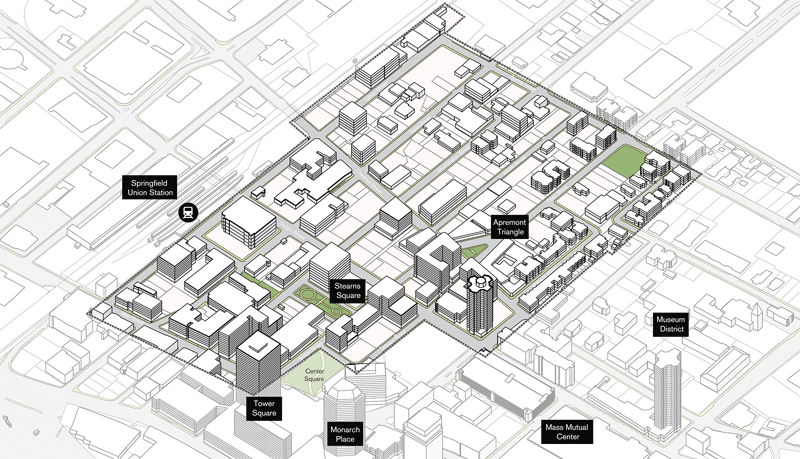
The “Worthington Street District Plan,” as the plan’s creators title it, contains an overarching vision of transforming much of downtown Springfield into an ‘innovation district,’ characterized by entrepreneurial businesses, expanded market-rate housing, new dining and entertainment options, and a raft of infrastructure and traffic-flow improvements.

It is, in a word, ambitious, said Kevin Hively of Ninigret Partners of Rhode Island, which produced the study in conjunction with Utile Inc. of Boston. The firms were hired by DevelopSpringfield, using part of an $850,000 settlement between the city and Columbia Gas stemming from the natural-gas explosion that rocked the Worthington Street-Chestnut Street area the day after Thanksgiving in 2012.

Base-Model“We want to create an innovation district with a lot of energy and momentum taking place, but the fact of the matter is, innovation districts are driven by talent, and talent is driven by job opportunities and quality of life,” Hively told an assembly of municipal and economic-development officials and other neighborhood stakeholders.

“If you’re going to have an innovation district, you have to create a strong, robust, urban lifestyle environment,” he added. “The reality is, they are related.”

A key example is Kendall Square in Cambridge, which boasts, by far, the nation’s highest density of biotech and IT firms — 163 per square mile, to be precise. (Palo Alto, Calif. comes in a distant second, with 36.) Yet, Kendall Square developers have also been focused on quality of life, as evidenced by the emergence of outdoor cafés, charging stations for electronic devices, and lively kayak and canoe activity along the Charles River.

To develop such an environment in Springfield, the report notes, Worthington Street and its environs is the best place to start.

The key is the neighborhood’s pre-existing assets, including the architectural character of the building stock, public ownership of a number of parking lots and other empty parcels, existing housing stock that can be upgraded, proximity to Union Station, and pre-existing places — like Stearns Square, Apremont Triangle, and Matoon Street — that can serve as anchors for activity.

Once demand for an urban lifestyle — and development in response to that demand — lift the profile of this neighborhood, businesses will hopefully become interested in the neighborhoods northeast of Chestnut Street, producing a cascade effect of development, public improvement, and general buzz across the entire district.

Mayor Domenic Sarno noted that the plan isn’t unlike the city’s efforts over the past three years to bring large-scale improvements to Springfield in the wake of the June 2011 tornado. “From a potentially devastating tragedy, an opportunity has come forth,” he said. “As we did with the tornado, we have an opportunity to define this area as an innovation district.”

Jay Minkarah, president and CEO of DevelopSpringfield, said his organization commissioned the study to establish a vision for how the downtown area should be developed. “We have a tremendous opportunity to create a truly vibrant, urban district, one that is walkable, with an innovation-based economy and market-rate housing — those are exactly the things we’d like to do.”

After all, Sarno added, “if we want to move the city forward, we have to be bold and innovative.”

Food for Thought

As one example, Sarno emphasized repositioning the city’s entertainment district as a restaurant district, because a neighborhood known for catering solely to large clubs and their patrons detracts from its universal appeal.

The Utile/Ninigret report highlighted several ways this can be accomplished, including placing size limits on venues to discourage large clubs; requiring all venues to have full kitchens; and using façade-improvement program funds to improve the aesthetic appearance of the district.

Another key is drawing an eclectic mix of retail businesses to the district, a goal, Hively noted, that Springfield officials can’t just wish into reality.

“It’s very hard to create a successful retail business,” he noted. “It’s out of the hands of the city. It cannot create a successful retail business, but it can create an environment that allows people to come in; then it’s up to the retailers to get people to come in and convert those people from shoppers to buyers.”

But downtown revitalization is about more than making it a destination for diners and shoppers; attracting people to live there is equally important, which is why the city is also looking at ways to develop more market-rate housing downtown. Officials believe a growing network of young entrepreneurs and residents want to see downtown become more livable, and that future rail service to the area will bring new opportunities, both to attract residents and encourage further development around Union Station.

It may sound a dizzying exercise in chickens and eggs, but the report highlights several improvements Springfield can undertake to make the district more attractive for both walkers and motorists. These include upgrading Stearns Square; redesigning Apremont Triangle’s open space and streetscape; converting Dwight and Chestnut streets to two-way streets; restriping travel lanes on cross streets; retrofitting Worthington and Bridge streets; improving Lyman Street, especially at the entrance to Union Station; and incorporating public art and lighting into underpasses.

This stretch of Worthington Street, which includes the site of the natural-gas blast, is among the areas the city hopes to revitalize as part of a broad innovation district.

This stretch of Worthington Street, which includes the site of the natural-gas blast, is among the areas the city hopes to revitalize as part of a broad innovation district.

The good news, Hively noted, is that the innovation district has plenty going for it already, from the neighborhood’s pre-existing geographic assets to economic-development success stories such as the Baystate Innovation Center, a business accelerator that creates an anchor and partner for health technology startups; the entrepreneurial support system of entities like Valley Venture Mentors, Springfield Angels, and River Valley Investors; and Tech Foundry, which acts as a training ground for building career skills and filling job openings.

“Everyone in the world wants an innovation district, but not everyone can have one,” Hively said, adding that the key questions are, does it have to be created from scratch, and are there people willing to make it happen? Clearly, he added, the answers in Springfield are no and yes, respectively. “You don’t have to create this from whole cloth.”

Added Sarno, “we are thinking big, thinking bold, thinking innovative. But the bones are already here, where other cities are sinking millions of dollars into that.”

Still, while those foundational elements exist, the study notes, they are still nascent and the lack critical mass necessary to have a major impact — yet. Other efforts are necessary, among them the potential conversion of the Willys-Overland Building on Worthington Street, which was damaged in the explosion, into a catalytic project featuring a mix of business uses, small-scale manufacturing, and housing.

Sarno said he envisions a neighborhood of revitalized properties featuring retail, dining, and business on ground level, parking on the second floor, and market-rate housing on the third. “It is extremely important that we continue to make downtown Springfield vibrant.”

Safety First

Kevin Kennedy, Springfield’s chief development officer, said the study is valuable in the way it outlines development concepts and encourages residents and businesses to generate more. “For some ideas, the city would have to help with some infrastructure, and that’s what we would do.”

The city has also been focused on public safety and raising people’s confidence in walking downtown — efforts that include everything from a lighting-improvement project along some of the city’s main thoroughfares, including the downtown club district, to police strategies to more effectively patrol the area. Public perception of crime and safety, after all, are “the 900-pound gorilla in the room,” said the mayor.

However, Evan Plotkin, president of NAI Plotkin, told Sarno and others gathered at the study presentation that the best way to make the innovation district safe is to make it vibrant. “Bringing foot traffic to these neighborhoods will do more to create a sense of safety than anything else you can do,” he said. “Having a police plan will augment that, but there’s nothing better for public safety than foot traffic.”

As for the Utile/Ninigret report, Plotkin said he hopes the city moves forward with some of the ambitious plans, and that the study doesn’t just sit on a shelf. “I think we can get it done.”

He’s not alone, judging by the sentiment of Herbie Flores, executive director of the New England Farmworkers’ Council and, like Plotkin, someone invested in the future of Springfield’s downtown.

“There are always going to be negative people in Springfield,” Flores told Sarno at the end of the presentation. “The hell with them. We’re behind you.”

Joseph Bednar can be reached at [email protected]

Chamber Corners Departments

AFFILIATED CHAMBERS OF COMMERCE OF GREATER SPRINGFIELD
www.myonlinechamber.com
(413) 787-1555

Sept. 3: ACCGS Business@Breakfast, 7:15-9 a.m., at the Sheraton Springfield, One Monarch Place, Springfield. “Keeping All the Balls in the Air” with Rob Peck, Zestworks. The event will also salute Elegant Affairs (25th anniversary) and Springfield Partners for Community Action (50th anniversary). The breakfast is sponsored by United Personnel.Tickets are $20 for members ($25 walk-in) and $30 for general admission.

Sept. 10: ERC5/ACCGS Millfest After 5, 5 p.m. to dusk, at Ludlow Mills, 100 State St., Ludlow. Music, great food, lots of fun, and networking. Tickets are $15 for members, $25 for general admission. Proceeds benefit the ERC5 Scholarship Fund. The East of the River Five Town Chamber of Commerce is an affiliate of the Affiliated Chambers of Commerce of Greater Springfield.

Sept. 23: ACCGS Pastries, Politics & Policy, 8-9 a.m.
An informal roundtable discussion, designed for political and policy junkies. Reservations are $15 for members, $25 for general admission, which includes continental breakfast. Reservations may be made online at www.myonlinechamber.com.

Sept. 30: Rake in the Business Table Top Showcase, 4:30-7 p.m., at the Castle of Knights, 1599 Memorial Dr., Chicopee. Network with more than 100 vendors. Reservations are $5 in advance, $10 at the door. Reservations may be made online at www.myonlinechamber.com. Presented by the Affiliated Chambers of Commerce of Greater Springfield and the Greater Chicopee, Holyoke, and Westfield chambers of commerce.

AMHERST AREA CHAMBER OF COMMERCE
www.amherstarea.com
(413) 253-0700

Aug. 27: 48th Annual Community Breakfast, 7:30-9 a.m. in the Student Union Ballroom on the UMass Amherst campus. The annual Community Breakfast signals the start of the academic year and is an opportunity to meet newcomers to the community; see old friends, neighbors, and colleagues; and talk about the year ahead. All are welcome at this buffet breakfast and gathering of area business owners, legislators, mayors, select board representatives, and members of the academic and business communities. Tickets are $8 in advance or $10 at the door. For more information, call (413) 577-1101 or e-mail [email protected].

GREATER CHICOPEE CHAMBER OF COMMERCE
www.chicopeechamber.org
(413) 594-2101

Sept. 5: “Taking Care of Business: How to Develop and Grow Your Business,” a six-part workshop series, begins with “From Startup to Finish: Financing Your Business,” from 9 to 11 a.m. at Residence Inn by Marriott, 500 Memorial Dr., Chicopee. Sponsored by Common Capital. Cost is $20 for members, $30 for non-members.

Sept. 10: CEO Luncheon at the Munich Haus Restaurant. Registration at 11:45, lunch at noon. Network and hear from Eric Lapointe, executive vice president of the Springfield Falcons, who recently joined the organization and oversees all revenue-generating functions of the team. His most recent position was with the NHL’s Florida Panthers as director of premium seating, where his primary responsibilities included managing the senior-level sales and service team, developing and executing premium selling strategies, and driving revenue. He comes to Springfield with a career that includes managerial and sales responsibilities with the NFL’s Cleveland Browns and Miami Dolphins and the NBA’s Miami Heat. Lapointe’s extensive sports-business experience includes working under some of the most influential figures in professional sports, including Mike Holmgren, Bill Parcells, and Pat Riley. He is a graduate of UMass Amherst with a bachelor’s degree in sport management, and received a master’s degree in management from Cambridge College. Tickets are $25 for members, $30 for general admission.

Sept. 17: Salute Breakfast, 7:15-9 a.m., at the Collegian Court, 89 Park St., Chicopee. Tickets are $20 for members, $26 for non-members.

Sept. 25: The “Taking Care of Business,” series continues with “Negotiating and Understanding Leases,” 9-11 a.m., at the Residence Inn by Marriott, 500 Memorial Dr., Chicopee. Sponsored by Common Capital. Cost is $20 for members, $30 for non-members.

Sept. 30: Table Top Expo & Business Networking Event, 4:30-7 p.m., at the Castle of Knights, 1599 Memorial Dr. in Chicopee. Presented by the Greater Chicopee, Holyoke, and Westfield chambers of commerce and ACCGS. Tickets are $5 pre-registered, $10 at the door. Sign up at www.chicopeechamber.org.

GREATER EASTHAMPTON CHAMBER OF COMMERCE
www.easthamptonchamber.org
(413) 527-9414

Sept. 11: Networking By Night Business Card Exchange, 5-7 p.m., at the Look Park Garden House, 300 North Main St., Florence. Sponsored by Residential Mortgage Services. Door prizes, hors d’ouevres, host beer and wine. Tickets: $5 for members, $15 for future members. RSVP requested.

Sept. 12-13: Electronic recycling fund-raiser, Sept. 12, 1-4 p.m.; Sept. 13, 8:30 to noon. Dropoff location at Liberty and Mechanic streets, Easthampton. Sponsored by Duseau Trucking LLC and A-Z Storage & Properties. Proceeds to benefit the chamber’s programs, including the Holiday Lighting Fund. Responsibly dispose of your old computers, monitors, TVs, telephones, stereos, and office or home appliances. No registration required; open to all members of the Greater Easthampton community. Nominal recycling fees. We cannot accept refrigerators, freezers, dehumidifiers, or any appliances containing freon. For more information, contact the chamber.

GREATER HOLYOKE CHAMBER OF COMMERCE
www.holycham.com
(413) 534-3376

Sept. 10: Legislative Coffee Hour, 7:45-9 a.m., at Slainte Restaurant, 80 Jarvis Ave., Holyoke, featuring guest speakers Mayor Alex Morse, City Council President Kevin Jourdain, and City Treasurer Jon Lumbra. Join us for coffee and conversation, where members of the community have a chance to ask questions regarding issues facing Western Mass. and the Greater Holyoke area. Sponsored by Ferriter Law and Marcotte Ford. Tickets are $18 for members, $25 at the door and for non-members.

Sept. 17: Annual Outing Clambake, 5:30-8 p.m., at Holyoke Country Club, 3 Country Club Road, Holyoke. Lobster dinner, putting contest, raffle prizes, 50/50 raffle, chowder cookoff. Sponsored by United Water, Pioneer Valley Railroad, and CareerPoint. Tickets are $30 for members and advance reservations, and $40 for non-members and at the door. The public is invited to attend.

Sept. 30: Table Top Showcase, 4:30-7 p.m., at the Castle of Knights in Chicopee. Four area chambers — Greater Holyoke, Greater Chicopee, Greater Westfield, and the ACCGS — are getting together to present a tabletop mini-trade show. Tables cost $125. Visitors pay $10 in advance and $15 at the door. Call the Holyoke Chamber at (413) 534-3376 to secure a table, or sign up online at www.holycham.com.

Oct. 8: Autumn Business Breakfast at the Log Cabin, 7:30-9 a.m. Recognizing new members, business milestones, and networking breakfast meeting. Sponsored by the Republican and Holyoke Medical Center. Cost:
$22 for members in advance, $28 for non-members and at the door. Call the chamber at (413) 534-3376 for more information.

GREATER NORTHAMPTON CHAMBER OF COMMERCE
www.explorenorthampton.com
(413) 584-1900

Sept. 10: Northampton Chamber Monthly Arrive @5, 5-7 p.m. Arrive when you can, stay as long as you can. A casual mix and mingle with your colleagues and friends. Sponsors: Greenfield Savings Bank, Hathaway Farms, and United Personnel. Tickets are $10 for members, $15 for non-members.

Sept. 11: 2014 Workshop: “Introduction to Google Docs,” 9-11 a.m. at Pioneer Training, 139B Damon Road, Northampton. The class includes an introductory section on Google Drive, the online storage location for Google Docs. Participants will learn how to set up a local Google Drive folder, create new documents in the Google Docs format, and convert Word documents to the Google Docs format. The class will focus on basic formatting and editing techniques in Google Docs, but will also cover best practices for using Google Docs. Pre-registration is required, and space is limited. Tickets are $20 for members, $25 for non-members. To register, e-mail [email protected].

GREATER WESTFIELD CHAMBER OF COMMERCE
www.westfieldbiz.org
(413) 568-1618

Sept. 8: Chamber Open House, 4-7 p.m., at the Greater Westfield Chamber, 16 North Elm St., Westfield. Help us celebrate our new location by stopping in to see our new office. We’ve relocated to better serve our members and communities. Refreshments will be served.

Sept. 9: Lunch & Lecture Series 1, presented by Tim Flynn, AAMS, Edward Jones Investments, 11:30 a.m.-1 p.m., at Noble Hospital, Conference Room A, Westfield. Topic: “Retirement and Investments for Business.” Cost: free to chamber members, $25 for non-members, or $60 for all three in the series. For more information, call Pam at the chamber office at (413) 568-1618.

Sept. 10: After 5 Connection, 5-7 p.m., at the Holiday Inn Express, 39 Southampton Road, Westfield. Sponsored by Advanced Medical Consulting and Billing. Great connection opportunities. Complimentary refreshments provided. Walk-ins are welcome. Cost is $10 for members, $15 for non-members (cash at the door). To register, call Pam at the chamber office at (413) 568-1618.

Sept. 15: Speaker Series, part 1 of 3. “Legal Issues Affecting Business,” presented by Royal LLP, 8-9:15 a.m., at the Genesis Spiritual Life & Conference Center, Westfield. Cost: free to chamber members, $25 for non-members, or $60 for all three in the series. For more information, call Pam at the chamber office, (413) 568-1618.

Sept. 19: September Breakfast, 7:15-9 a.m., at the 104th Fighter Wing ANG, 175 Falcon Dr., Westfield. Sponsors: Platinum, Westfield Bank; Gold, Savage Arms; Silver, Prolamina and Wealth Technology Group. Speaker: Dr. Alan Robinson, co-author of The Idea-Driven Organization. Cost is $25 for members, $30 for non-members. To register, call Pam at the chamber office at (413) 568-1618. Consider donating a raffle prize to the event.

Sept. 30: 17th Annual Table Top Showcase, 4:30-7 p.m., at the Castle of Knights, Chicopee. Cost: $5 in advance through the chamber or $10 at the door. Opportunities available for sponsorships and exhibitor tables. For more information, call Pam at the chamber office at (413) 568-1618.

PROFESSIONAL WOMEN’S CHAMBER
www.professionalwomenschamber.com
(413) 755-1310

Sept. 17: PWC Headline Luncheon, 11:30 a.m. to 1 p.m. at the Yankee Pedlar, 1866 Northampton St., Holyoke. The speaker will be Jane Iredale, president and founder of Jane Iredale Skin Care. Tickets are $25 for members, $35 for general admission.

SOUTH HADLEY GRANBY CHAMBER OF COMMERCE
www.shgchamber.com
(413) 532-6451

Sept. 16: “What’s Your Granby Business?” Open House, 5 p.m., hosted by the new Granby Free Public Library, 297 East State St., Granby. Mingle with South Hadley and Granby business people and check out the beautiful new Granby library. Finger food and beverages. Tickets are $5 for chamber members, $10 for non-members, unless you are a Granby business owner — then it’s free.

WEST OF THE RIVER CHAMBER OF COMMERCE
www.ourwrc.com
(413) 568-1618

Sept. 3: Wicked Wednesday, 5-7 p.m., at E.B’s Restaurant, 385 Walnut St Ext., Agawam.

Sept. 8: Open House, 4-7 p.m. The Greater Westfield Chamber of Commerce is pleased to announce its new office at 16 North Elm St. in Westfield. Join us for an open house.

Sept. 17: Networking Lunch, noon to 1:30 p.m. at Kaptain Jimmy’s, 916 Suffield St, Agawam. Network with fellow chamber members over lunch. Each member will get approximately one minute to offer a brief pitch about their company. E-mail [email protected] to register.

Opinion

Education Alone Won’t Save the Economy

By ROBERT KUTTNER

Our economy is now five years into an economic recovery, yet the wages of most Americans are flat. For the entire period between 1979 and 2013, median worker wages rose by just 7.9% while the economy’s growth and productivity rose 64.9%. The top 1% has made off with nearly all of the economy’s gains since 2000.

Is there nothing that can be done to improve this picture? To hear a lot of economists tell the story, the remedy is mostly education. It’s true that better-educated people command higher earnings. But it’s also the case that the relative premium paid to college graduates has been declining in recent years. If everyone in America got a doctorate, the job market would not be transformed. Mainly, we’d have a lot of frustrated, overeducated people.

The current period of widening inequality, after all, is one during which more and more Americans have been going to college. Conversely, the era of broadly distributed prosperity in the three decades after World War II was a time when many in the blue-collar middle class hadn’t graduated from high school.

I’m not disparaging education — it’s good for both the economy and the society to have a well-educated population. But the sources of equality and prosperity mainly lie elsewhere.

Three big things have changed in recent years that better explain why this recovery is accompanied by flat wages.

First, the financial collapse is still exerting a drag on the economy. Until the crash of 2008, ordinary families whose incomes had not kept pace with the cost of living had been borrowing to sustain their consumption. Americans ran up credit-card debts, borrowed to attend college, and above all borrowed against their homes. All of that camouflaged stagnant earnings. But the crash ended the borrowing binge. Without increasing debt (which is the wrong remedy), household purchasing power is too low to stimulate a strong recovery.

Second, corporate America got increasingly into the habit of hiring people on a temporary, part time, or contracted-out basis. Traditional payroll jobs became harder to come by. A small fraction of Americans turned this new insecurity into a plus, becoming entrepreneurs. But for every successful Internet startup and every truly joyous freelancer, there are dozens of people for whom working as a ‘consultant’ is nothing but disguised unemployment.

Third, the sources of labor bargaining, including strong federal labor-market regulation and trade unionism power, have been weakened. In their absence, corporations and investors are able to capture the lion’s share of the economy’s productivity growth.

So, are we just stuck? Do the characteristics of the new economy simply doom us to flat incomes for most people and stratospheric gains for the few? Actually, several things could be done to restore a better distribution of the economy’s productivity growth. But most of them are outside mainstream political debate.

A good historic parallel is the burst of deferred growth that came with World War II. In 1940, unemployment topped 13%, and many economists argued that technology had displaced so many human workers that this was the best the economy could do. But by 1942, unemployment had vanished.

In the intervening two years, workers did not suddenly become smarter, better educated, or more diligent. Rather, the government borrowed money and taxed the wealthy in order to massively invest in fighting World War II. The war, in turn, became the greatest accidental economic stimulus program ever. As a side effect, wartime spending produced scientific breakthroughs and technological gains as well as more purchasing power.

Today, we don’t need another war. But we do need major investment in decaying public infrastructure and in transition to a green, sustainable economy.

The wartime economy propelled America into the post-war boom and laid the groundwork for the post-war middle class. After the war, we doubled down with social investments such as the GI Bill and major infrastructure projects, as well as minimum-wage regulation.

We could do it again. All that stand in our way are a lot of bad economics and a consensus of the elites that cutting deficits and rewarding speculators take precedence over rebuilding the country. The obstacles to restoring prosperity are not economic. They are political.

Robert Kuttner is co-editor of the American Prospect and professor of Social Policy at Brandeis University.

Opinion

In Pursuit of an Innovation District

Kevin Hively, one of the authors of a redevelopment plan for the area impacted by the natural-gas explosion in 2012 — and the streets surrounding the so-called ‘blast zone’ — hit the nail on the head while explaining why this plan is ambitious and why it will be quite challenging to convert into reality.

“We want to create an innovation district with a lot of energy and momentum taking place,” he told those assembled at a press conference earlier this month staged near where the blast took place. “But the fact of the matter is, innovation districts are driven by talent, and talent is driven by job opportunities and quality of life.”

Right now, Springfield can’t say it offers either one. And that’s why there’s not much talent here around which to create an innovation district.

But there is promise for both, and that is the city’s ongoing mission — to convert that promise into something tangible, something that will attract talent.

Backing up a bit, the report, called “The Worthington Street District Plan,” lays out not only what the city can do with the multi-block area in its central business district, but also the stern challenges that lie in the way.

Indeed, as Hively pointed out at the press event, probably every city in the country would like to create a thriving innovation district, but certainly not all of them can. To replicate, even on a much smaller scale, what has been accomplished in Cambridge, Silicon Valley, and North Carolina’s Research Triangle will take some luck, a good deal of patience, and, well, some innovation.

And the city is not exactly starting from a position of strength. While this area of the city has some assets, most of them — like Apremont Triangle, Stearns Square, the existing entertainment district, and Union Station — are not going to attract that aforementioned talent, at least not in their current form.

But there is some momentum in a few key areas — promoting entrepreneurship, opening up avenues to capital, and promoting innovation. This momentum is best exemplified in initiatives like Valley Venture Mentors, which encourages entrepreneurship and helps fledgling businesses get off the ground; the Baystate Innovation Center, described as a mix between an incubator and an accelerator now taking shape in downtown Springfield; and Tech Foundry, which is billed as a training ground for those who might enter the technology field.

And there are other positive developments, such as the new UMass Center at Springfield in Tower Square and the potential for a casino in the South End.

But as Hively pointed out, talent is driven by job opportunities and quality of life. Springfield can’t match Cambridge, Boston, or San Francisco, or even Providence or Lowell at this time.

It must do something about both crime and the perception of crime, foster the development of more restaurants, shops, and cultural attractions, and, above all else, help create attractive places for people to live.

At the moment, there is a distinct lack of people who have a desire to live, work, or start a business downtown, and this is the equation that simply must change.

How? That’s the $64,000 question. Most observers say you can’t just build housing and then hope eateries, clubs, and shops will follow. Likewise, you can’t — or shouldn’t — open those businesses until you are sure there is a critical mass of people with disposable income to support them.

Is an innovation district possible? Of course it is. Is it doable in Springfield? Perhaps, but, then again, most every city has tried or is trying to create one, and success has been hard to come by.

One thing is for sure. There is little, if any, time to waste, and the city will have to be energetic and imaginative if it is going to attract the talent needed to make an innovation district thrive.

Daily News

BOSTON — MassIT, the Commonwealth’s lead state agency for technology across the executive branch, announced a first-of-its-kind MassIT Government Innovation Competition, with a $50,000 prize for the winning project. MassIT will partner with MassChallenge, a start-up accelerator that supports high-impact, early-stage entrepreneurs, on this initiative.

The goal of the MassIT Government Innovation Competition is to provide high-quality startups with incentives to develop innovative solutions that can help the state government meet constituent needs more efficiently and at lower cost to taxpayers. For the first time, the Commonwealth will have access to entrepreneurs focused on improving the constituent-government relationship. The Commonwealth plans to implement a pilot of the winning project, with the goal of cost-effectively improving delivery of services to constituents, achieving greater internal efficiencies, or both.

“Massachusetts is renowned as a hub for technology and innovation; MassChallenge’s support of high-impact, early-stage entrepreneurs has helped enhance that reputation. By working together, MassIT and MassChallenge can accelerate the Commonwealth’s use of technology solutions and harness the wealth of expertise available to us,” said Bill Oates, the state’s chief information officer.

MassChallenge awards more than $1 million in cash prizes each year to winning startups, with zero equity taken. Additional benefits for startups include world-class mentorship and training, free office space, access to funding, legal advice, media exposure, and more than $10 million of in-kind support. MassChallenge is open to early-stage entrepreneurs from any industry, from anywhere in the world.

Now in its fifth year, the competition has supported 489 startups, which have created more than 4,000 new jobs and raised more than $550 million in outside funding. This year alone, MassChallenge received approximately 1,650 applications from 50 countries and 40 states. After initial rounds of judging of all applicants, 128 finalists — in honor of Massachusetts’s Route 128 technology corridor — are invited to participate in MassChallenge’s four-month startup accelerator program and related sidecar competitions.

In addition to the creation of business gains, this competition is aligned with and supports the work of the Tony Parnham, the Commonwealth’s government innovation officer (GIO), whose role was created in 2012. “The Commonwealth has been pursuing a number of innovative projects to enhance the delivery of state government services,” Parnham said. “The MassIT Government Innovation Competition helps us to explore new possibilities by leveraging the creative talent within the startup ecosystem.”

Added Akhil Nigam, MassChallenge co-founder and president, “the Commonwealth has been a longtime supporter of innovation and a critical partner to MassChallenge since the founding of our organization. The MassIT Government Innovation Competition is an outstanding opportunity for entrepreneurs to use government resources to help make a big impact.”

The MassIT Government Innovation Competition is open to any qualifying startup that applies by the Aug. 27 deadline. Entrepreneurs whose work can help MassIT leverage innovation to support, enable, and transform the operation of state government and delivery of services to constituents are invited to compete.

Daily News

SPRINGFIELD — Baystate Health has selected Premier Inc.’s data-warehouse and business-intelligence platform, PremierConnect Enterprise, to support the development of innovative solutions within its new Health Informatics & Technology Innovation Center.

Home to the largest health-insurance company in Western Mass. and a flagship academic medical center, Baystate Health received a $5.5 million grant from the state last year to build the Baystate Health Innovation Center. The Innovation Center, which will officially launch this fall, is designed to connect healthcare information technology (HIT) vendors with physicians and other providers of care at Baystate Health to co-develop innovative solutions to the rapidly changing healthcare environment.

Baystate Health has been a member of Premier and its predecessor companies for 30 years, leveraging both its performance and supply-chain services. Last fall, the health system deployed PremierConnect Enterprise to quickly and more efficiently access, integrate, and interpret its clinical, financial, and operational data. Seeing the positive results, the Innovation Center signed a separate, multi-year agreement to use PremierConnect Enterprise to integrate payer, provider, and other healthcare data from participating innovators within a structured collaborative environment. By leveraging PremierConnect Enterprise’s platform and unique healthcare-data model, innovators will easily access and manipulate data for testing and scaling new HIT solutions.

“Our goal is to grow innovative solutions for the very real challenges of healthcare today in collaboration with innovators from around the globe,” said Joel Vengco, vice president and chief information officer at Baystate Health. “This long-term partnership with Premier provides us with the infrastructure and capabilities necessary to liberate healthcare data within an open workspace that a broad group of researchers, innovators, and providers can access. The platform and data combined will allow us to accelerate new HIT solutions that improve the quality and efficiency of patient care.”

The Innovation Center resources will be available for select innovators working on solutions that support new healthcare models, beyond the use of electronic health records, to better manage population health, value-based care, and the revenue cycle. PremierConnect Enterprise is a cloud-based service managed by Premier. It will support this work through its multifaceted platform that combines data warehousing with the ability to acquire, standardize, transform, and integrate big data; produce actionable analytics; and garner predictive insights.

“Baystate Health is a model health system with a strong footprint in leading research across the critical areas of healthcare quality and outcomes,” said Michael Alkire, Premier’s chief operating officer. “Premier is proud to be a part of the next-generation work of the Innovation Center and its innovators at such a crucial time, as we chisel away the silos in healthcare.”

Keith Figlioli, Premier’s senior vice president of healthcare informatics and a member of the Office of the National Coordinator’s Health IT Standards Committee, noted that “this collaboration is vital to the creation of flexible HIT resources and infrastructures that bring the best ideas from the brightest minds to reality more quickly, and spread them across our industry.”

PremierConnect Enterprise includes expert advisory services and membership in the Data Alliance Collaborative, a group of the nation’s leading health systems, including Baystate Health, that share knowledge and assets to accelerate the development of the analytics and business intelligence needed to improve population health and operational performance. The Innovation Center provides a new way for collaborative participants to work with innovators to test potential solutions that advance value-based care. These solutions are expected to have a direct path toward the possible adoption of HIT best practices across Premier’s alliance of 3,000 hospitals and 110,000 other providers.

Premier expects its expanded relationship with the Baystate Health Innovation Center to contribute to fiscal 2015 revenue and earnings. With the addition of the Innovation Center, Premier now has nine healthcare organizations leveraging its PremierConnect Enterprise services.

Daily News

BOSTON — Gov. Deval Patrick has signed H.4377, “An Act to Promote Economic Growth in the Commonwealth,” building on his administration’s economic-development strategy of investing in education, innovation, and infrastructure.

The economic-development package provides new tools and training to ensure the Massachusetts workforce meets the needs of employers, invests in Gateway Cities to promote development across the entire state, and provides incentives to create jobs and stimulate the economy. Patrick also refiled legislation that limits the use of non-compete agreements and adopts the Uniform Trade Secrets Act to ensure that government acts to retain talented entrepreneurs, supports individual career growth, and encourages the development of new, innovative businesses to drive future economic growth.

The legislation also includes a provision to give local governments across Massachusetts control over the number of liquor licenses in their jurisdiction. Placing the authority to approve liquor licenses in the hands of municipal officials will allow local communities to make responsible decisions regarding their economic development and growth, helping to free the Legislature from time-consuming local issues.

“In important ways, this legislation improves existing tools and provides a few new ones to continue our strong job growth, and I thank the Legislature for being so responsive,” said Patrick. “At the same time, we have unfinished business, so I am filing further legislation today to give innovators and municipalities all the tools they need to grow jobs and opportunity.”

The act bolsters the economic revitalization of the Commonwealth’s Gateway Cities with $15 million for the Gateway Cities Transformative Development Fund and encourages the reuse of brownfields in economically distressed areas of Massachusetts with $10 million in funding.

“This legislation makes many targeted investments in our emerging industries, like big data and advanced manufacturing, that are necessary to create a competitive environment here in Massachusetts and grow our status as a leader in the world economy,” said Senate President Therese Murray. “By capitalizing on our state’s existing and developing industries, as well as investing in a strong, educated workforce, we are outlining a path to success for our residents and promoting economic development throughout the entire Commonwealth.”

Added House Speaker Robert DeLeo, “this comprehensive bill will help ensure that residents, businesses, and communities are able to compete and excel in a dynamic economy. We’ve made substantial gains in strengthening our economy and must now focus on broadening the circle of prosperity beyond Greater Boston to all regions of the Commonwealth. This bill does just that while preparing future leaders through provisions like MassCAN, a computer-science-education partnership, and the Talent Pipeline Initiative.”

In the area of workforce development and training, the act includes $12 million for the Middle Skills Job Training Grant Fund to support advanced manufacturing, mechanical and technical skills at vocational-technical schools, and community colleges. Also, the Workforce Competitiveness Trust Fund will receive $1.5 million to prepare Massachusetts residents for new jobs in high-demand occupations, helping close the middle-skills gap and creating a seamless pathway to employment.

The economic-development legislation also includes a number of initiatives to expand the Commonwealth’s world-class innovation economy, including $2 million for a Big Data Innovation and Workforce Fund to promote the use of big data, open data, and analytics, and $2 million for the Innovation Institute Fund at the Massachusetts Technology Collaborative. The legislation also creates a $1 million talent-pipeline program that will provide matching grants aimed at increasing technology and innovation internships, and another $1 million for a startup mentoring program to connect early-stage entrepreneurs, technology startups, and small business with experienced business enterprises and capital financing.

DBA Certificates Departments

The following Business Certificates and Trade Names were issued or renewed during the month of July 2014.

HOLYOKE

Fashion Nails
293 High St.
Phat Dang

Knoxworx Multimedia
36 Maplecrest Circle
Mark Knox

M & M Mini Market
869 Hampden St.
Rizwana Sheikh

Pickles Pub & Pizzeria
910 Hampton St.
Rene D. Dulude

Sbarro America Inc.
50 Holyoke St.
Stuart Steinberg

LUDLOW

Grandma Romeo’s Baby Boutique
53 Hampshire St.
Tracy Romeo

Max’s What-not Shop
8 Chestnut St.
Beth Wallace

Primavera
257 East St.
Jack Nuno

Steppin Out II
200 Center St.
Sarah Lewison

NORTHAMPTON

Bird’s Store
94 Maple St.
Guarang Patel

Dust Dancer
42 Fruit St.
Patricia Trant

Florence Wellness Spa
44 Maple St.
Feng Liu

Nimetan Magic & Publishing Company
81 Conz St.
Phillip Browning

River Valley Tae Kwon Do
306 King St.
William Timan

The Firefly Salon
21 Locust St.
Kay Gregory

PALMER

Country Memorials, LLC
1303 Calkins Road
Country Memorials, LLC

Evolution Limousine Service
3054 High St.
Evolution Limousine Service

Flamingo Motor Sports
2 Wilbraham St.
Russell Baker

Lena’s Salon & Day Spa
1581 North Main St.
Helena Rua

Life’s Memories and More
1085 Park St.
Tanya Bullock

O’Connor Auto Body
45 Commercial St.
Daniel P. O’Connor

Palmer Heating Inc.
2099 Calkins Road
Alfred Bisinette

Woods Group Realty
1415 Park St.
Debra Woods

SOUTHWICK

Glow Spray Tanning, LLC
21 Matthews Road
Lauri Scott-Smith

The Sweet Leaf
535 College Highway
Tanya Carr

SPRINGFIELD

A+ Seamless Gutters
18 Glenham St.
Johnny Cintron

Allen Ridge Collectibles
57 East Allen Ridge Road
Madelyn S. Allen

Alterations by Elizabeth
210 Maple St.
Elizabeth A. Daniels

Ambrosia Lounge
143 Main St.
Bruce A. Earl

Annie’s Kitchen
1297 Worcester St.
Ann M. Masso

Auto Craft Sales & Service
568 Main St.
Sharon Hogue

Baystate Reference Laboratory
759 Chestnut St.
Baystate Medical

Big Red’s Variety, LLC
1196 St. James Ave.
Natalie A. Henry

Boston Road OP, LLC
429 Boston Road
Sanjay P. Patel

Bournigal Auto Sales
1500 State St.
Juselino Clemente

BP Mart
1100 Page Blvd.
Radwan Zaitoun

Broadway Baby Boutique
671 Dickinson St.
Maureen Denise

Buen Provecho Restaurant
152 Rifle St.
Damaris Morales

Clarity Imagine Technology
75 Cadwell Dr.
Aldo C. Deluca

Clean & Pristine Pool
79 Merida St.
Kevin Randall

Dad’s Variety and Cuisine
1081 State St.
Earl V. Watson

Daniel C. Brightwell
252 Wilbraham Road
Daniel Brightwell

DFS Distribution, LLC
23 Leete St.
Sheila J. Armstead

Dollar Tree
1060 Wilbraham Road
Deborah E. Miller

Empowerment
104 Woodlawn St.
Michelle L. Crean

Fallas
1522 Boston Road
Southern Island

Family GK Wendy
29 Locus St.
Cristobal Villala

Fashion Merari
35 Spring St.
Luz M. Santana

Galerie Blanc
1411 Plumtree Road
Brie E. Shonak

Hess Retail Operations
453 Cooley St.
Andrew Berstein

HVAC Handyman
38 Zephyr Lane
Frank A. Colucci

IO Appliances Store
12 Parker St.
Doel Velazquez

Ice Busters
21 Burns Ave.
Robert H. Bourget

WEST SPRINGFIELD

A & E Transportation
76 Ashley St.
Elshad Hasanzade

Beauty Nails Care
366 Memorial Ave.
Long H. Ly

Cherry Computers
877 Prospect Ave.
Jason Rossmeisl

Express Brows & Beauty
520 Main St.
Pam Mehta

Lee’s Diagnostics
413 Main St.
Ahmed Becar

Quality Inn
1150 Riverdale St.
Shubham, LLC

Employment Sections
Sunshine Village Provides Opportunities for Clients, Solutions for Employers

Gina Golash Kos

Gina Golash Kos says Sunshine Village has made a significant difference in the lives of individuals with disabilities.

Gina Golash Kos says Sunshine Village gives people with disabilities the opportunity to fulfill their potential, become independent, and learn valuable work skills.

“People’s lives are better today because of a dream conceived by a small group of parents in 1967 who wanted to create a warm, welcoming organization to help their children and other people with disabilities,” said Kos, the agency’s executive director. “That dream was and is Sunshine Village, and today the organization helps people find employment, make friends, and do things they never thought they could.”

The agency serves 400 adults age 22 and older, and has formed close ties with many local businesses that augment their employee base with trained workers who are available on a temporary, seasonal, or permanent basis.

“It’s a win-win situation because people with disabilities get the opportunity to work and businesses get great employees who show up on time and do the job correctly,” Kos told BusinessWest.

She added that using Sunshine Village as a subcontractor is cost-effective because it pays for traditional employee-related benefits and its employees are prescreened, trained, and overseen by a supervisor who accompanies them to the worksite each day.

“We typically meet with the employer, tour their operation, talk to them about the work they need done, and help them determine how we can help them save time and money through group or individual placements, before we assign people to a job,” Kos said.

Last November, Callaway Golf Balls Operations Inc. in Chicopee hired a six-person team from Sunshine Village to help fulfill a number of orders. “We put them on the assembly line and also had them label and unpack golf balls,” said Georgia London, Callaway’s maintenance, repair, and operating buyer and parts-crib supervisor. “They were here for six months, and we grew to love them. They showed up every day smiling, ready for the next challenge, and their smiles never diminished, no matter what we asked them to do. I was impressed and amazed by how conscientious they were and by their focus on quality. It was an excellent situation, and as soon as business picks up, we will hire them again.”

Kos said people who work for Sunshine Village are happy to be given the opportunity to earn a paycheck. Although some might not be able to meet the demands of a workplace on their own, the supervision they receive allows them to be successful.

“The workers we place are proud to do jobs that others might find repetitive or boring,” Kos said. “So many people with disabilities want to work and have the chance to prove themselves, and with our support, they are able to meet employers’ expectations and often exceed them.”

For this issue and its focus on employment, BusinessWest takes an in-depth look at Sunshine Village and its strong track record of providing opportunities for its clients and solutions for area employers.

Work in Progress

The village became a reality 47 years ago, thanks to the efforts of a group of parents whose children had disabilities. Under the direction of P. Joseph Casey of Chicopee, they procured 13 acres of donated land and built their program.

“They started with a nursery school and playground,” Kos said, adding that Sunshine Village soon grew to include three large buildings and a ballfield. “Over time, it went from a grassroots organization led by parents to a well-respected, sophisticated organization led by a board of directors.”

Sunshine employees

Sunshine employees (from left) Colleen Brosnan, Jonathan Gelula, and Richard Klisiewicz say their training center prepares people to work in industrial and commercial settings.

The agency employs more than 200 staff members, and its annual operating budget exceeds $10 million, which comes from federal and state money, boosted by private funding and proceeds from an annual fund-raising golf tournament.

Services provided by clients range from packaging to document preparation, catalog assembly, custom display assembly, box folding, labeling, collating, shrink-wrapping, clamshell and blister packaging, liquid pouring, and more.

Many begin their careers by working in the Employment Services Division’s integrated training center on the Chicopee campus, which prepares individuals to work in industrial and commercial settings.

“It’s a hub where we help people find jobs,” Kos said, adding that individuals with and without disabilities are trained alongside each other and fulfill orders that companies outsource to the facility.

The jobs can range from redoing work that was done incorrectly, such as removing inappropriate stickers and replacing them with the right ones, or removing products from boxes that were packed incorrectly, then repacking them. “We support a lot of manufacturers,” she added.

Sunshine Village also has a federal contract, and its employees maintain and clean all of the buildings and hangars at Westover Air Reserve Base. In addition, some perform other janitorial work, such as dusting, vacuuming, and emptying wastebaskets at local companies.

In addition, Sunshine Village opened a Community Based Day Service last month to allow individuals to find their own jobs while enhancing their professional skills through internships and volunteer opportunities, while enjoying an array of social and recreational activities.

Kos says the unpaid internships give people the opportunity to experience different types of jobs and work environments. “It’s important because some individuals are not sure what they would like to do,” she explained. “They may enjoy sitting and working quietly or prefer a fast-paced environment with a lot of other people around them.”

The volunteer work is also helpful. “Our clients have helped local churches with cleaning and spent time in local food pantries, at the Chicopee Public Library, and in the Thomas J. O’Connor Animal Control and Adoption Center,” Kos said. “Volunteering is a great way for people to get ready for their first job and give back to the community.” She added that groups planning nonprofit events are invited to call Sunshine Village if they need volunteers.

Expanded Horizons

In addition to its Employment Services Division, Sunshine Village offers a Day Habilitation Services Program, which runs year-round and helps people acquire the skills they need to become productive members of their communities. It is a medically based model with offerings tailored to meet each individual’s strengths and needs.

“Physical, speech, and occupational therapies are incorporated into music, culinary, art, and sport therapy programs,” Kos said. “People might work on gross motor skills in music therapy or fine motor skills in art therapy. Music therapy helps them communicate and express themselves while they have fun and socialize with others. They also learn to prepare food in our culinary program and participate in yoga and tae kwon do classes in our sports program. We focus on developing functional life skills, improving coping strategies, and increasing independence.” Adaptive devices and equipment are also used to maximize each person’s potential.

Jonathan Scytkowksi and Samuel Whittle fill out job applications with help from Miguel Colon.

Jonathan Scytkowksi and Samuel Whittle fill out job applications with help from Miguel Colon.

These programs are conducted at a variety of locations. In addition to providing services at Sunshine Village’s main campus on Litwin Lane in Chicopee, the agency also operates community-based sites in Three Rivers, Westfield, Springfield, and Chicopee Falls, said Kos, adding that the organization receives a great deal of support from the community.

The golf tournament, for example, allows the agency to pay for improvements to its buildings, new technology, and holiday parties, as well as adaptive equipment and extra supplies, she noted.

Meanwhile, the Chicopee Elder Council 69 of the Knights of Columbus and Fairview Council #4044 have made generous donations to the agency, and many businesses provide ongoing support. “We are very fortunate to have so many people helping us,” Kos said.

As a result, Sunshine Village’s programs continue to grow. “We’re developing a day program specifically designed to meet the needs of people with autism-spectrum disorders,” she noted. “We want to help them live independent lives by promoting social and daily living skills and improving communication.”

The program is still in the planning stages, but the demand for it is clear. “Autism is a growing problem, and during the last year we have talked with our funding sources, local sources, and parents to determine the types of services that are needed,” Kos said.

People employed by Sunshine Village are proud that, since 1968, all of the organization’s programs have received the highest level of accreditation by the Commission on Accreditation of Rehabilitation Facilities. “And the most recent accreditation, which was highly complimentary, was completed in April,” Kos told BusinessWest.

Bright Prospects

Sunshine Village has made a significant difference in the lives of individuals with disabilities.

“Everything we do, which includes the people participating in services, our experienced and caring employees, our innovative programs, and our effective outcomes, is a realization of our founders’ dream,” Kos said.

“We serve so many people who are truly happy, and we are proud of our history and what we achieve day by day,” she went on. “Our partnerships are growing and will continue to expand, which allows us to help people find jobs while providing employers with good employees. So we are confident about the future of our organization, because our success is sustained by compassion and enthusiasm and realized through strategic planning and effective leadership.”

Daily News

PITTSFIELD ― Berkshire Museum has been awarded energy-incentive grants totaling $83,600 from Berkshire Gas and Western Massachusetts Electric Company (WMECo) in partial funding for a project to incorporate energy-efficiency measures into the museum’s heating, ventilation, and air-conditioning (HVAC) building systems.

Berkshire Gas awarded $50,000, and WMECo provided $33,600 for an innovative solution to control humidity, which is necessary to protect the museum’s collections of art, historical objects, and natural specimens. The design innovation recycles the heat byproduct from a new high-efficiency chiller, thereby saving energy while providing humidity control.

The HVAC improvements were implemented over the past year as part of the museum’s 21st Century Energy project, which included changes to the building envelope and lighting systems, also with the aim of reducing energy consumption. An engineering study determined that the museum will reduce both electricity and gas use for an annual savings of $60,000 at current prices. Lead funding for the museum’s 21st Century Energy project was provided by a $1 million award from the U.S. Department of Energy’s National Energy Technology Laboratory in September 2012.

“We are thrilled to have contributed in this way to the important mission of the Berkshire Museum,” said Berkshire Gas President Karen Zink. “Innovative energy-management technologies and practices will allow visitors to experience the treasures of the past and present well into the future. We salute the Berkshire Museum for their work, their professionalism, and their commitment to providing a first-rate museum for the Berkshires.”

Added Tilak Subrahmanian, vice president of energy efficiency at Northeast Utilities, WMECo’s parent company, “WMECo is proud that our expertise using the latest technology to control temperature and humidity is helping prevent damage to precious artifacts. Our energy-efficiency experts are well aware that uniform climate control helps the museum attract sought-after collections, as well as making it comfortable for the people who come to see them.”

Berkshire Museum Executive Director Van Shields said that “the representatives from WMECo and Berkshire Gas played a critical role in helping us sort through different approaches to control temperature and humidity, while improving energy conservation. Having their expertise on the design team from the very beginning helped us create the innovative solution to meet our needs. We are very grateful to our energy providers for their proactive participation in helping design systems to conserve energy, and for the grants that helped us implement our plans.”

Located at 39 South St. in downtown Pittsfield, Berkshire Museum is open from 10 a.m. to 5 p.m. Monday through Saturday, and noon to 5 p.m. on Sunday. Admission is $13 for adults, $6 for children, and free for members and children age 3 and under. For more information, visit www.berkshiremuseum.org or call (413) 443-7171.

Daily News

SPRINGFIELD — Labor and Workforce Development Secretary Rachel Kaprielian recently sat in on the first class of students at Tech Foundry, a new workforce-development program that will recruit, train, and place urban high-school students, unemployed college graduates, and veterans in jobs within the high-tech industry in the Pioneer Valley.

Tech Foundry is just one of a number of organizations participating in the Commonwealth’s YouthWorks program, which subsidized jobs and training for more than 4,800 at-risk teens and young adults in 31 communities this summer.

“This is the kind of innovative use of YouthWorks funding that the Patrick Administration would like to see replicated across the state,” said Kaprielian. “Tech Foundry partnered with the Hampden Regional Employment Board (REB) and New England Farm Workers’ Council, which operates the YouthWorks program in Springfield, to introduce these students to in-demand careers and fill the shortage of computer-science professionals in Western Mass.”

Kaprielian shadowed 17-year-old Arian Richardson, one of 22 students in the inaugural class who is taking classes and earning ‘badges’ in hard and soft skills to set them up for entry-level jobs in the tech industry. The high-school students are learning how to dress professionally and interview, as well as basic computer science like scripting and network management. In between classes, the students intern at local tech firms.

“I know that successful business leaders have to know much more about technology than ever before to be competitive in their industry,” said Richardson. “I want to learn technology so that I can be a better leader down the road.”

Added Delcie Bean, president of Tech Foundry and owner of Paragus Strategic IT, “we believe our approach to badge-based learning combined with a curriculum that is 100% driven by regional employers is a unique model that is not only going to someday make Springfield a large employer of IT talent in the country, but also serve as a model for other industries. We are incredibly grateful to have such a great relationship with the REB and Farm Workers’ Council.”

David Cruise, executive director of the Hampden Regional Employment Board, noted that “Tech Foundry represents an innovative opportunity for students to experience a summer of work and learning that exposes them to educational and career pathways in a high-demand industry. The REB is excited about this partnership with Tech Foundry and looks forward to expanding its partnership going forward.”

Daily News

SPRINGFIELD — The physicians of Baystate Ob/Gyn Group Inc. announced that it has been awarded its sixth consecutive accreditation by the American Institute of Ultrasound in Medicine. A practice must reapply for accreditation every three years.

Baystate Ob/Gyn Group achieved this recognition by meeting rigorous voluntary guidelines set by the diagnostic-ultrasound profession. During the accreditation process, all facets of the ultrasound department were assessed, including the training and qualifications of physicians and sonographers, ultrasound equipment maintenance, documentation and record-keeping practices, quality-assurance methods, as well as the thoroughness, technical quality, and interpretation of the sonograms the practice performs.

“AIUM accreditation is an important indication of our commitment to providing comprehensive, high-quality healthcare that is accessible and convenient for the patient,” said Dr. Charlene Case, director of the Ultrasound Department at Baystate Ob/Gyn Group. “When necessary, our state-of-the-art ultrasound technology provides us with detailed images right in our own office that we can use as a component in the care of our patients. This technology, including 3-D and 4-D capabilities, is an irreplaceable clinical tool for our practitioners.”

Daily News

SPRINGFIELD — Organizers of the free Jazz & Roots Festival on August 9, from 11 a.m. to 10 p.m. in Court Square have announced the lineup of musical acts. The purpose of the festival is to celebrate the emergence of Springfield’s Cultural District,and promote an arts driven, community oriented, and sustainable revitalization of the city. Organizers are striving for an inclusive event with a variety of performers, which include:

• Phil Woods: A Springfield native, Woods has established himself as one of the most brilliant alto saxophonists in jazz. He devoted himself to the alto saxophone since the age of 12 and was a student of the Julliard Conservatory. Although he did not copy Charlie “Bird” Parker, bop’s greatest saxophonist, he was known as the New Bird.

• Charles Neville: The second oldest brother and saxophonist of New Orleans’ first family of funk. The Neville Brothers, a collective of four talented brothers and powerfully unique personalities who have thrived on an explosive fusion of diversity and unity, have represented the heart and soul of New Orleans for decades.

• Matthew Curry
: (sponsored by MGM Springfield): Curry has played with the greats since the start, jamming regularly with Tommy Castro, Bernard Allison, Bryan Lee, and Ronnie Baker Brooks. He was one of five international finalists in Ampeg’s “Straight-Up Tone” competition. He has played major summer festivals including the Mississippi Valley Blues Festival and the Chicago Blues Festival. Matthew Curry is a 2013 inductee into the prestigious Brotherhood of the Guitar sponsored by Guitar Center, Ernie Ball, and Fender. Blues Blast Magazine nominated Matthew Curry in 2011 for an unprecedented three awards: Best Debut CD, Sean Costello Rising Star, and Best Blues song.

• Greg Caputo: He’s toured with the big bands of Count Basie, Harry James, Tommy Dorsey, Jimmy Dorsey, Artie Shaw, Benny Goodman, Nelson Riddle, Lionel Hampton, Cab Calloway and Sammy Kay. Greg has also performed with, Benny Waters, Joe Wilder, Phil Woods, Patti Page, Grover Mitchell, Claude Williams, Sheila Jordan, Don Cornell, Barry Harris and Sammy Davis Jr.

• Charmaine Neville: As the daughter of Charles Neville, she is heir to a rich New Orleans musical legacy but has succeeded in placing her own stamp on this musical heritage. Neville and her band dish out a spicy mix of blues to some V-8-driven R & B.

• Grace Kelly: You’ve heard the name before from the movies but perhaps you haven’t heard of this 22-year old Korean American singer/songwriter/saxophonist/composer. She wrote her first song when she was 7 years old, recorded her first out of eight independently released CDs at 12, and orchestrated, arranged and performed an original composition with the Boston Pops Orchestra at 14.

• Chuchito Valdés
: Following in the footsteps of his famed father Chucho Valdés and grandfather Bebo Valdés, continues the legacy of great piano players from Cuba.

• Jim Argiro Quintet: At first glance, the Argiro Quintet appears as an extension of the famous George Shearing Quintet. And while retaining the essence of that revered ensemble, the musical approach is much more adventurous, creating lively, highly original versions of American standards and intricately woven originals.

• Jessica Freeman: A vocalist who studied at Berklee College of Music. She also plays classical violin and has performed with the Brooklyn Symphony. She currently lives in Holyoke and is headed into the Holyoke Community College Radiology Technology program. She hopes to travel the world singing, dancing, and playing violin.

• Alex Snydman: He made a surprising yet decisive switch from guitar to drums during his Senior year at Hampshire College. Since that time in 2003, Alex has fervently sought out a veritable who’s who in modern jazz to study with. This list includes Eric Harland, Gregory Hutchinson, John Riley, Bob Gullotti, Joe La Barbera, and Damion Reid, among others.

• Mikata: Performs a full repertoire of hard-hitting Salsa, Merengue, Bachata, Bolero, Cha-cha and Latin Jazz. The band is renowned for their contemporary arrangements of the great classics of Mambo and Salsa from the1950’s, 60’s and 70’s — an era when the dynamic, percussive quality of Latin music reigned supreme.
Blues to Green, a non-profit organization using music and art to celebrate community and culture, build shared purpose, and catalyze social and environmental change, working in partnership with the City of Springfield and the Springfield Business Improvement District is presenting the Springfield Jazz & Roots Festival as its first event in the area of many to come. Attendees can also enjoy theater, art, dance, poetry and community as the festival is partnering with these community organizations: The Performance Project, Bing Arts Center, and Community Music School. In addition, Mercy Medical Center will be collecting new socks as a part of the Healthcare for the Homeless program. There will also be music workshops at the Community Music School beginning at noon with Charmaine Neville and Grace Kelly.
This event is a unique opportunity to promote Springfield as Western Massachusetts’ largest urban center and a sought out artistic/cultural destination. The festival aims to bring people from Springfield and the surrounding region together to foster connection, stimulate the local economy, and highlight positive initiatives contributing to the betterment of Springfield’s residents and uniting the city with the rest of the Pioneer Valley. There will be an Opening Party at the Bing Arts Center, Sumner Avenue, Springfield on August 8 at 8 p.m. with Jeremy Turgeon & Bonded.
This event was made possible in part by the support of MassMutual Financial Group, MGM Springfield, NAI Plotkin/One Financial Plaza, and Mercy Medical Center. For more information log on to www.SpringfieldJazzFest.com.

Daily News

HARTFORD, Conn. – Whittlesey & Hadley, P.C., one of the area’s largest regional CPA firms, announced its plan to diversify geographically and grow in size, services and staff, beginning with a merger with Lester Halpern & Company, P.C., of Holyoke, a leading regional CPA firm providing a broad range of accounting, audit, tax and management consulting services to closely held business, nonprofit and governmental sectors of Western Mass. and throughout New England. The merger is effective August 1. Whittlesey & Hadley provides accounting, audit, tax, technology and business consulting services to clients primarily throughout the northeast, with access to a worldwide network of resources through PKF North America. For more than 50 years, the firm has served closely held businesses, including manufacturing, construction and distribution, real estate, financial institutions, healthcare, government and technology industries, as well as the nonprofit sector, the firm’s largest niche focus. The firm has 100 professional and administrative staff located in downtown Hartford. “We moved to a larger office space in downtown Hartford, providing us with the resources to begin our future growth,” said Drew Andrews, managing partner of Whittlesey & Hadley, P.C. “It is a common vision, philosophy and dedication to provide a superior client experience that we are seeking when merging with CPA firms. Lester Halpern & Company brought that to the table. This merger represents our first step in an aggressive plan to grow our services and staff throughout the northeast, while retaining our valued reputation as having the expertise of a national firm but the responsiveness of a local firm that clients expect and deserve from its professional services partner.” Established in 1959, Lester Halpern & Company’s 25 employees will continue to serve their client base out of the Holyoke office, while acquiring the Whittlesey & Hadley brand. “Whittlesey & Hadley, P.C.’s presence and extensive resources offer an opportunity for Lester Halpern & Company to greatly expand the services available to our clients,” said Thomas Terry, the managing partner of Lester Halpern & Company, P.C. “Integrating our abilities and our experiences will result in a stronger base for future growth.”

Sections Technology
Anzovin Studio Stays on the Cutting Edge of Animation Technology

By KEVIN FLANDERS

Raf Anzovin, left, and David Boutilier

Raf Anzovin, left, and David Boutilier, with an image they created for an American Canoe Assoc. public service announcement.

Raf Anzovin, president of Northampton-based Anzovin Studio, has discovered that success in the animation industry comes to those who push their businesses to the edge — the cutting edge of technology.

Dedicated to supplying an array of services to clients while regularly improving the tools with which they create their products, the Anzovin Studio staff has mastered an ingenious two-pronged approach. Even when business is thriving, the company challenges itself to refine its practices and streamline its productivity, which serves to benefit both artists and clients.

“It’s amazing to look back and see how far animation has come in the last 15 years,” said Anzovin, who opened the studio in 2000 with his father, Steven Anzovin. “When you compare movies like the first Toy Story to current movies, you’ll see a huge difference in the quality of the characters and the exactness in the way they move. The industry has progressed in leaps and bounds in terms of the quality you’re expected to create. Something that would have been considered good in the ’90s would be viewed as well below average today.”

With that truth constantly in mind, Anzovin and his staff strive each year to develop new software that not only benefits Anzovin Studio artists but also draws the interest of clients. One of the studio’s latest and most successful software products, Anzovin Rig Tools, is expected to provide major advances in the area of character rigging. Because Anzovin’s software programmers and artists work in close collaboration, each new plug-in tool and application serves a specific need, with the ultimate goal of making computer-animated characters as seamless and believable as possible.

“We’re very excited about it — this particular area of animation hasn’t had significant upgrades since the ’90s,” Anzovin said of the new product, which has not yet been brought to market.

If the success of the studio’s previous products is any indication, then Anzovin Rig Tools will be utilized by some of the most prominent players in the industry. In past years, companies like Dreamworks, Disney, and Sony have bought Anzovin’s products, while the studio has consulted with clients like Microsoft, EA, and Hasbro.

“There are certain areas like character rigging where we are really pushing the technology,” added Anzovin, who takes pride in spearheading technological advances.

In short, he told BusinessWest, companies that fail to keep up with the breakneck speed of invention in this industry find it doesn’t take long to fall behind.

Products on All Platforms

In addition to its software-design work, Anzovin Studio produces educational and entertainment content through several media each year. Its art can be seen in everything from commercials to public-service announcements to video games, depending on the client and the request.

Last year, the studio supplied animation for a PSA run by the American Canoe Assoc., a piece that employed cartoon-like characters to convey water-safety tips in a unique manner.

“A lot of times, clients come to us looking to create PSAs that get the point across but also have entertainment value,” said Jake Mazonson, an artist and producer at the studio. “Animation is a good tool to communicate information in a fun, engaging way.”

Anzovin said the studio usually produces art for a handful of TV commercials each year, but that number might rise in future years, because the amount of content featuring animation is expected to increase. With the popularity of video sharing and downloading, the Internet is also a source of boundless potential for animators, especially when distributed across social-media platforms.

Meanwhile, video games have generated solid business as well, with the studio providing cut-scene animations for such games as Halo II, Charlie and the Chocolate Factory, The Da Vinci Code, The Sims Medieval, and Mercenaries II, among others.

“One of the great things about animation is that it can be used as a communication tool but also for entertainment — we often bring those two aspects together in our projects,” Anzovin said.

But the staff’s emphasis isn’t always on fun and entertainment when it comes to video games. The studio frequently contributes animations for instructional games and programs designed for individuals preparing to deal with hazardous law-enforcement and military situations. A recently released training program for the Department of Defense, for example, included art created by Anzovin’s staff to help simulate civilian populations in various locations. The tool will help soldiers learn how to defuse potentially dangerous encounters in highly populated areas.

“It’s really nice when we can help solve problems and serve social purposes,” added Mazonson, who is excited to be working on a new project with the American Canoe Assoc. — an animated memoir of individuals recounting their stories from the water. The project will be funded by a grant allocated by the U.S. Coast Guard.

How It Works

The concepts and methods that drive computer animation can be a little tricky to understand — if not downright mind-boggling at times — but Mazonson described the complexities of creating character-rigging products in remarkably simple terms.

“It’s a lot like making a puppet, with the strings and all of the different parts,” he told BusinessWest. “You have to figure out how to arrange everything in such a way that others will be able to use it.”

Anzovin believes one of the major keys to successful animation is to become a master of movement. Many movie animators have perfected the art to such a degree that, from a distance, animated characters can often be mistaken for actors. Their movements are swift and natural, seemingly enhanced with each movie.

“The goal is to present movement in a believable way,” Anzovin said. “One of the things that movies like Frozen and Tangled do well is combine the subtleties that are possible in computer animation with the graphic quality of movement. At times, you’re trying to create something that is more lifelike and exciting than life itself.”

So how long does it take to create such vivid animations? In terms of average project length — from the initial design stages to completion — a variety of factors come into play. Sometimes a project can be finished in just a few weeks, while other endeavors can last up to two years.

“It depends on the scope of the project and what the client is asking for,” said David Boutilier, vice president of Anzovin Studio. “Every project has a different script and style, and each client has a different level of experience. Some people are experts, while others only have a little experience in animation. All of those things affect how long it takes.”

ACAmasterComp00172

Above, imagery created by Anzovin Studio for the American Canoe Assoc. Below, animation created for client Squelch Inc.

Above, imagery created by Anzovin Studio for the American Canoe Assoc. Below, animation created for client Squelch Inc.

Raf Anzovin never spent a day in a college classroom, but he wound up teaching collegiate courses. He didn’t attend high school, either. Homeschooled and self-taught in the world of computer animation, he found this industry to be an open road for an 18-year-old going into business with his father. The possibilities offered in this new, exciting, undeveloped terrain were limitless, the perfect career choice for technologically inclined artists like Anzovin whose passion and ambition are matched only by their creativity.

“Everything was just starting up back then — a wild west,” he recalls. “Even if you had basic abilities in animation, you could make a name for yourself. Everything has come a long way since then.”

After exploring various institutions, Anzovin decided not to attend college because there weren’t many computer-animation programs available. Instead, he went to work with his father, starting off in Amherst and eventually moving into the studio’s current Nonotuck Mill office in 2009. Now, five years after calling the Florence section of Northampton home, the business has become an industry leader in technological innovation, with major companies routinely turning to Anzovin and his staff for consultation.

“The tools you have determine how quickly you can produce things, which is one of the reasons why we create our own products,” Anzovin said. “Animation is a very time-consuming process, but the way we approach it, by developing our own tools, certainly gives us an advantage.”

Added Mazonson, “technology and art are constantly interacting with everything we do.”

Branching Out

Over the next few years, Anzovin hopes to continue consulting with his studio’s partners and also to build new relationships, preferably with local businesses. As one of the only companies in the region focusing heavily on character animation, most of its clients are based outside Massachusetts, many of them in different time zones.

“I think one of the reasons [for the low number of local clients] is a lack of exposure,” Mazonson said. “A lot of people don’t know there’s an animation studio right here in Western Mass.”

One project that might help raise the studio’s profile  will take place in the coming year — a collaboration with representatives from Google. Though Anzovin couldn’t get into much detail about the project, he said it will likely involve mobile devices and the creation of tools.

Judging by how far animation has progressed in the last decade, in addition to Anzovin Studio’s commitment to innovation, the company will likely be redefining industry standards for years to come.

Sections Technology
Hogan Technology Is in the Business of IT Solutions

Sean, left, and Andrew Hogan

Sean, left, and Andrew Hogan have been in business since 1986 and keep pace with innovative technology that helps their clients.

Many companies experience frustration and setbacks when a problem occurs with their computer, Internet, or telephone system. And if all three stop working simultaneously, as many did during the freak October snowstorm of 2011, company officials often don’t know which provider to call first.

Sean and Andrew Hogan, who co-own Hogan Technology in Easthampton, have solved that problem. Their company’s motto is, “why call three companies when you can call one?”

In fact, they have flipped the way the typical repair model operates. Rather than waiting for a problem to occur, then responding to it, Hogan employees constantly monitor clients’ Internet-technology systems, which allows them to identify problems and resolve them before the client is even aware they exist.

“Technology is imperfect, and it is inevitable that things will go wrong,” Sean said. “If they didn’t, there would be no need for our company. But we understand that, if a business’ computer or phone system goes down, they are out of business until the problem is fixed, so our emphasis is on managed service. What makes us different from other companies is that we provide a comprehensive, bundled solution.”

That requires expertise in many areas. “There are a lot of parts and pieces to technological systems, and it can be very confusing,” said Sean. “So we become a company’s management team, which relieves a lot of duties for office managers or people assigned to the job.”

He added that this is especially important for small firms that do not have a full-time Internet-technology expert. “One person in the office usually gets assigned to support its IT system because that person enjoys working with computers. But the Internet is vast and has so many specialties, one person alone cannot have enough knowledge to fix every problem,” he told BusinessWest.

It can also be difficult for employees who don’t know the language used by computer experts to talk to a software representative, especially since so many companies run specialized software related to their industry.

But Hogan Technology has a bevy of experts who handle these issues.

“We monitor everything related to a company’s systems,” said Sean. “Our team receives an alert on potential outages, so we address them before they become a problem. By being proactive, we are partnering with our clients. And if we keep their business up and running, they are happy.”

He added that this approach saves time and money. “Our model has really evolved; the old way of doing things was to have a company call when something broke, then run out to fix it. But the hourly cost of doing that can be very expensive. A company could go several months with very small bills, then have a major failure. And since businesses can’t live without technology, they have to pay to fix the problem.”

To eliminate that issue, Hogan Technology charges a monthly fee, which helps clients avoid unexpected charges.

The company also has a full-time employee dedicated to customer support who spends her time calling clients to check how their systems are running. “She’s an advocate for them,” Sean said.

Another unusual service is free: lifetime employee training. “Whenever there is a turnover in staff or a new person is hired, we send in a trainer. The people who use our equipment should be our biggest fans,” said Andrew, noting that, if individuals find the training easy to understand, they become proponents of Hogan Technology, which can translate into word-of-mouth advertising.

“We implemented lifetime training because we heard so many customers complain about technology they had been using in the past,” he went on. “They told us they didn’t know how to use it or keep it up to date.”

Keeping Pace

Hogan Technology was founded in 1986 as Hogan Associates by John Hogan and his sons, Sean and Andrew.

The idea for the family business was born after John gave Sean an article to read about the ethernet, which was the newest technology at the time. He was in college, saw it as an opportunity to create a business dedicated to the professional installation of communications systems, and said the trio’s skills fit well with the vision.

At the time, John was retired after 35 years in the communications industry, and he and Sean were working part-time doing computer networking for a local firm, while Andrew was in sales.

“No one had ethernet networking, but everyone needed it, so we were able to get a lot of work,” Sean recalled, adding that, prior to that development, there was no industry standard for cables and wiring, so communication systems could not be linked.

The company quickly became profitable. “In the early years, we had no competition — we all wore tool belts and were laborers,” Sean said, recalling how personal computers replaced terminal servers and high-speed cables were required to support developing technology.

Since its humble beginnings, the company has kept pace with change and gone above and beyond for its clients. For example, years ago, it was not uncommon for Sean and Andrew to drive the company’s bucket truck several hours to fix a problem for a customer on a weekend.

“We take our business very seriously,” Sean told BusinessWest, reiterating that they realize it’s essential for businesses to stay operational at all times.

In time, the name Hogan Associates was changed to Hogan Communications, then changed again to Hogan Technology to reflect the work they were doing.

The company has won a number of awards, and today its ideal client is a business owner who allows Hogan to manage and support all of the company’s technology. The brothers are proud of the service they provide, and in 27 years, they have never had a year in which they lost money.

Part of this success is due to their dedication to maintaining seamless service, which can include overseeing technology needs that change due to a move or expansion. “We specialize in helping customers move. It’s a stressful time for them,” Sean said.

Before the physical move takes place, Andrew examines drawings of the new space and makes recommendations about the cabling the client will need to handle its audiovisual and conference needs. He also checks the wi-fi capability of the building and provides a design for security infrastructure.

“We look at everything that plays into their computer network and consult with them about what they need,” Sean said.

They also deal with their Internet service. “We sell and support every Internet provider, and because we are a master agent, we are able to customize solutions. After all that is complete, we coordinate the physical move of the technology and connect it so the customer has very little or no down time,” Sean said.

For example, the firm was hired to partner with Benchmark Carbide in Springfield when the company moved to a new location. “They needed someone who could handle all aspects of their technology,” Sean explained, adding that this included their phone system, computer networking, and computer installation.

Continued Support

The company currently has 21 employees and about 700 clients. In the past, it limited its customer base to businesses within a three-hour drive, but today Hogan has clients across the nation and handles their international phone systems.

“For example, we have a customer in Agawam with offices in Europe,” Sean explained. “We set up a voice-over-IP system that connects their phones through one network.”

The company’s resources are further enhanced by membership in the Technology Assurance Group, comprised of 105 communication companies in North America who work together. “We are like a brotherhood and provide support to each other,” said Sean.

Andrew agreed. “We attend owners meetings, which allow us to find out what is working well in the industry and what is not working. A lot of things come and go, and we approach every item we sell with the belief that there needs to be a return on investment for our clients.

“If we can prove the equipment we offer them will make their company more productive, efficient, and drive profits, we truly are partners with them,” he added, noting that the affiliation “also gives us buying power so we can compete with larger companies.”

Hogan Technology strives to develop long-term relationships and has clients who have been with them for 20 years. “We meet with every customer quarterly to see what their pain points are and help them forecast what they will need to keep active and productive,” Andrew said. “Then we develop a plan based on their budget and needs. They might not be able to get everything at once, but we come up with a solution and implement it so they can add things as their budget allows.”

Autumn Leshinski

Autumn Leshinski works full-time as a customer advocate and calls clients to make sure their systems are running smoothly.

Sean said this is important because many companies have had buyer’s remorse after purchasing technology that became outdated quickly. “We become a trusted advisor to them because technology is our business,” he explained.

They also hold frequent educational seminars to keep clients abreast of major changes, such as cloud-based voice services. “During the October 2011 snowstorm, many services were down, but the cloud was never down. And the beauty of having this service is that, if an event like that occurs, we can redirect all of a company’s phone lines to their cell phones or to a temporary office; it’s part of a disaster plan we set up for each client,” Sean said.

Their own back-up plan includes an office in South Carolina as well as a virtual server in the cloud.

Master Plan

Although Hogan Technology cannot control everything that happens to a client’s information-technology system, Sean said, it can resolve any problems related to it.

“In order for a company to stay up and running, it needs a partner in technology — someone who is committed to the relationship and has the resources to support them,” he said. And when that company is Hogan Technology, he said, assurances that all is well are sure to be met.

Sections Technology
When It Comes to IT, Responsibility Is Reaching to the Top

By GREG PELLERIN

Greg Pellerin

Greg Pellerin

When it comes to your company’s IT infrastructure, whose job is it, anyway? Who takes the blame (or maybe even the fall) if something goes wrong? More and more, responsibility for an IT failure is reaching all the way to the executive suite.

In May, Target CEO Gregg Steinhafel resigned after a major data-security breach. Some said it wasn’t his fault, but the company’s board disagreed, saying it was a result of underinvestment in Target’s IT systems. The Associated Press quoted Daniel Ives, analyst for FBR Capital Markets, who said, “ultimately, it’s the CIO and the IT managers that are really more in the weeds, but just like the head coach of a football or basketball team that doesn’t make the playoffs, the CEO is ultimately responsible.”

And consider the case of James Thaw, president and CEO of Athens Regional Health System in Georgia. Thaw’s organization, like almost every hospital in America, had invested millions in implementation of an electronic health record (EHR) system. Whether there was pressure on the IT department to roll out the new software before it was fully tested is unclear, but according to the Athens Banner-Herald, the result was near-chaos.

Physicians sent a formal letter of complaint to the hospital’s administration claiming the implementation process was too aggressive and resulted in “medication errors, orders being lost or overlooked, emergency-department patients leaving after long waits, and an inpatient who wasn’t seen by a physician for five days.”

The letter was published less than two weeks after the hospital’s PR department proudly touted the new, integrated system as “the most meaningful and largest-scale information-technology system in its 95 year history.”

Thaw and Chief Information Officer Gretchen Tegethoff have since resigned.  Whether they were responsible for pressing the ‘go live’ button prematurely is unknown. Most hospitals contract with a team of external consultants who sit alongside representatives of the institution’s medical and administrative staff to oversee implementation over a one- to four-year timeframe. The fate of those consultants and team members is unknown.

So, what’s an executive to do? Most CEOs got to where they are because of their strategic abilities, not necessarily their technical strengths. What questions should they be asking their staff regarding major IT decisions?

“It comes down to two words: integration and communication,” said Michael Feld, president of VertitechIT, a nationally renowned expert consultant in IT management, and the acting chief technology officer at Lancaster General Hospital.  “IT is the engine that keeps an organization running, but oftentimes, CEOs will treat the department as a necessary evil.  Your IT people need to know where the company is going and how technology will play a role in that growth. When they don’t, you’ve got problems.”

Feld offers up three areas of advice on how to avoid an IT disaster that could have implications in the C-suite and the entire company:

• You wouldn’t think of launching a new sales or product initiative without announcing and getting buy-in from the sales and marketing departments. Integrate your IT department in the same way. Make sure everyone, from your chief information officer to front-line system engineers, understand issues that affect the life of the company.  Everyone should understand IT’s role in achieving those goals.

• Plan an off-site retreat with your CIO. He or she is, after all, no different than the CEO, one level down. Senior company executives need to know what your network can do, not necessarily how it’s done. Place the focus on understanding risks, benefits, costs, and the relationships all of them have to each other.

• Put your personal biases on the shelf. That new company initiative may have been born in your office, but it’s easy to fool yourself into believing that IT can just make it happen. Keep asking questions and challenge whether your internal systems and people are ready to press ‘go.’ Is there a fail-safe, redundant backup plan in place when something goes wrong? Are your internal people trained and fluent in its operation, and are there outside resources lined up for those special situations? If the answer is no, find out why.

No one wants to just throw money at a problem, hoping it will go away. But you can’t fight a fire without a long enough hose, and that new fire truck will be useless if there’s not enough water coming from the hydrant. In the end, it’s the chief that will take responsibility if things spin out of control. To paraphrase Smokey the Bear, ultimately, you can prevent forest fires. n


Greg Pellerin is a 15-year veteran of the telecommunications and IT industries and a co-founder of VertitechIT, one of the fastest-growing business and healthcare IT networking and consulting firms in the country; (413) 268-1605; [email protected]

Features
Is This as Good as the Recovery Is Going to Get?

Mike Oleksak

Mike Oleksak says positive things are happening with the economy, but many business owners don’t believe what they’re seeing and hearing.

Andre Mayer says business owners who are still waiting for what would be considered a real economic recovery should probably stop waiting.

That’s because, in his view, this is about as real as it’s going to get.

“At this point, we’re really past the recovery phase; the recession ended five years ago,” said Mayer, senior vice president for communications and research at Associated Industries of Massachusetts. “We never had the recovery we were hoping for and expecting — that big burst of growth where GDP goes up quickly and rejoins the prior trend line. It never happened.”

And it’s very likely that it just won’t happen, at least not any time soon, he said, adding that business owners would be wise to accept this state of the economy and get on with hiring people, expanding their ventures, and moving forward rather than waiting for that aforementioned burst.

And he believes many are doing just that.

“We have been adding quite a few jobs in the first quarter of this year, when the national economy was contracting,” he said, adding that ‘we,’ in this case, refers to the state as a whole, but includes Western Mass. “And that, to me, seems to reflect a change of attitude. In other words, employers, instead of hunkering down and going all out to preserve productivity and not dilute it, because that’s what got them through the recession, are now taking a more sustainable path and sort of coming to the realization that this is the economy we have to live with.”

Bob Nakosteen, professor of Economics at the Isenberg School of Management at UMass Amherst, agreed, and pointed to the latest unemployment figures as evidence of what he considered progress, at least in some respects.

Indeed, while the state’s jobless rate fell to 5.5% in June, the lowest since August 2008, and 3,700 jobs were added, the manufacturing sector lost more than 1,000 jobs, and the construction industry lost more than 900, what Nakosteen called “hidden disappointments.”

And he said they may provide more evidence of something that many are now calling ‘secular stagnation,’ or ‘economic immobilism,’ terms that aren’t new — they go back at least as far as the Great Depression — but are being summoned with greater frequency by many economists to help describe and explain the phenomenon that Mayer touched on: a recovery that certainly doesn’t look or feel like one.

“There are a number of factors in our economy, some of them demographic, some of them technological, some of them stemming from globalization, that imply that we’re simply not going to experience the growth in this economy that we have in the past, especially job growth,” said Nakosteen while explaining secular stagnation, which he said is now being hotly debated in the “economics blogosphere.” “The workforce is getting older and large numbers are retiring, technology is developing quickly — but it’s doing so in a way that seems to be removing jobs rather than adding jobs — and globalization continues to put great pressure on our domestic workforce, especially the blue-collar occupations and manufacturing.

“And the prospects for any of this changing are simply not good,” he went on, adding that some economists believe it may be decades before the current scene improves markedly.

Meanwhile, the tepid state of the recovery is being reflected by ongoing caution on the part of area business owners, said commercial lenders we spoke with, who noted that many, perhaps still waiting for that burst they have seen following other downturns, such as the ones in the mid-’90s and just after 9/11, are hesitant about pulling the trigger on expansions or new hiring.

“I don’t see anybody really jumping in full force to bring people back or undertake plant expansion,” said Michael Oleksak, executive vice president and chief lending officer at Holyoke-based PeoplesBank. “Everyone is still pretty hesitant.”

Luke Kettles, senior vice president and chief lending officer at Hampden Bank, agreed, summoning a phrase that has been given a thorough workout over the past several years.

“People are guardedly optimistic,” he said, adding that, in this case, that means they often lack the confidence to move ahead with expansion plans or new hiring.

“Employers are not adding people unless they really need to,” he explained, adding that most are still looking to improve efficiency and trim fat rather than add to their workforces.

For this issue, BusinessWest takes an in-depth look at the state of the recovery, such as it is, and whether any change in the forecast can be expected any time soon.

Dollar Signs

While secular stagnation, if that’s what the region is experiencing, is a mostly negative term, there are some positives to be gleaned from recent economic statistics and trends, said both Nakosteen and Mayer.

Perhaps the most important of these is that the recovery — and job growth — has finally extended beyond the Greater Boston area, said Nakosteen, adding that both Central and Western Mass. are enjoying better unemployment numbers of late.

The June jobs report provides more evidence of this, he noted, but real signs of improvement started appearing earlier in the spring.

“Over the past few months, unemployment rates have come down dramatically in metropolitan areas in the Berkshires and Springfield, where they were the highest,” he noted. “This is a really good thing. It doesn’t mean they’re low enough to make you feel you’re in a true recovery, but for the first time since the recovery began, it now seems to be extending past Route 495.”

Mayer agreed. “Growth has evened out a good deal,” he told BusinessWest, adding that the Greater Boston area recovered quickly and profoundly after the recession while most of the rest of the state lagged well behind.

“Over the past year, the jobs have been added in the Worcester and Springfield metro areas at the same rate as in the Boston and MetroWest areas,” he noted. “At this point, we’re seeing growth, albeit modest growth, on the labor-market side almost everywhere.”

Luke Kettles

Luke Kettles says some sectors, such as senior housing, are experiencing growth, but by and large, many business owners are hesitant about expanding or new hiring.

Still, the recovery being witnessed in this region — and many other parts of the country, for that matter — is atypical of what is generally seen after prolonged downturns, said Mayer, citing a lack of growth in GDP and describing what much of the country, and this region, have experienced as a “watered-down version of a boom.”

“One reason, maybe the main reason, why this recession was such a bad one is that it seems to have knocked our GDP down a few percentage points long-term — we haven’t just bounced right back to that point where we left off,” he said. “And by now, waiting for that to happen doesn’t seem realistic, although we are on an upward track.”

Nakosteen concurred. “Sometimes after a recession, we’d have 9% or 10% gross-domestic-product growth for a year or two — it was just stunning,” he said. “We haven’t done better than two or three percentage points the past several years, and I just don’t think you’re going to see that big figure ever again.

“That’s a dangerous thing for me to say,” he added quickly, reflecting on the gravity of his own words. “But I’m buying into this secular-stagnation argument, and I don’t know what to tell people except that, however they have to adjust to the idea that there may not be a pot of gold at the end of the rainbow, they’d probably better at least think that through.”

Referencing the declines in both manufacturing and construction jobs, he said those numbers, if they don’t change, are ample evidence that the recovery lacks “oomph,” and that this is as good as it is likely to get.

“I thought manufacturing, and construction as well, were on very positive trajectories, and that this might continue more or less unabated,” he noted. “Now, there’s been an abatement.”

That said, both Mayer and Nakosteen anticipate further improvement in the economy, especially if business owners and managers can somehow gain the confidence needed to expand operations and add to their workforces — and consumers can buy again — possibly by recognizing the new economic reality for what it is, and making it better than it’s been.

“It’s time for us to not wait for magic, but to think hard about what we can do to continually make our economic climate better,” Nakosteen said.

Lending Credence

But Oleksak and Kettles said there are still a number of factors holding area business owners back when it comes to hiring and borrowing to expand.

And many are still continuing to do what essentially got them through the recession, said Oleksak, referring to everything from better inventory control to improving production efficiencies to controlling or, in many cases, reducing salary.

Uncertainty about health-insurance costs is one of the factors leading to hesitancy, he noted, adding that these expenses have been a drain on hiring for some time because they keep going up and there is little, if anything, to indicate that this trend will not continue.

Meanwhile, interest rates, which are still historically low but moving back up and projected to continue rising, are another impediment to progress.

“We’ve had such low interest rates for so long that’s there’s also concern about over-leveraging yourself in light of the fact that we’re going to see some higher interest rates down the road,” he explained. “And when interest rates start increasing, there’s more concern about the economy, with people asking if we’re going to fall backward again.”

Kettles said that some sectors, such as senior living, medical office facilities, social services, and even self-storage, are doing well, and Hampden Bank is having a solid year in commercial lending, due in part to the many bank mergers in recent years.

Still, he also sees hesitancy among many business owners, especially when it comes to hiring.

“Benefit costs are increasing, and healthcare costs are pretty significant, so people do not hire unless it’s really necessary,” he said. “Profit margins may be improving, nationally as well as locally, but I think it’s through improving efficiencies and doing more with less. People aren’t going out and adding a position unless they really need to, and a lot of times they’ll try to use part-time labor until they really need a full-time position.”

Kettles noted that many of the manufacturers the bank does business with have been willing to make investments in new equipment and technology, but these purchases often translate to fewer jobs, not more of them.

Overall, confidence, or the lack thereof, remains a factor as well, said both Kettles and Oleksak, noting that, while the June jobs report is generally positive, business owners aren’t necessarily buying into such reports.

“There is some improvement going on,” said Oleksak, “and people are being cautiously optimistic, but I’m not sure they’re really believing what they’re seeing.”

As evidence of this, he cited the residential real-estate market. While those at PeoplesBank and other institutions were expecting the refinancing market to slow this year, mainly because most everyone who could refinance already has, they were expecting sales to pick up, but they haven’t.

“If you look at the numbers, we’re about 5% to 10% behind last year,” he said, adding that an overall lack of confidence is the primary reason.

Whether confidence improves in the near future is likely a function of whether the news continues to improve, and whether it can actually convince people to believe what they see, said those we spoke with.

Nakosteen, for one, believes conditions will continue to improve.

“I think the next 12 months are going to be pretty good,” he told BusinessWest. “A lot of things, especially at the national level, but also at the state level, are getting better. Households are just in a much better position than they’ve been in for years to make healthy consumption decisions, and therefore employers will be making more job offers, buying more equipment, and so on. Over the next year, we’re going to see reasonable economic growth.”

Bottom Line

But what does ‘reasonable’ mean?

It probably doesn’t mean the kind of burst that traditionally accompanies the end of a recession, or the kind of oomph that economists expected and business owners are in many respects still waiting and hoping for.

As Mayer explained, that kind of jolt simply isn’t realistic a full five years after the recession was declared over.

This is the economy this region may have to deal with — like it or not.


George O’Brien can be reached at [email protected]

Health Care Sections
Local Projects Reflect the Evolution of Cancer Centers

A rendering of the BMC Cancer Center in Pittsfield

A rendering of the BMC Cancer Center in Pittsfield

Mark Fulco recognizes the trends.

In fact, as senior vice president of strategy and marketing for the Sisters of Providence Health System, it’s part of his job to understand the demographic and medical trends in the region — and how SPHS should respond to them.

“Every year, we do a community health-needs assessment and some ongoing tracking of what’s happening with demographics and what’s happening with diseases in the region,” he said. “And cancer rates in our region are higher than the national trend. Meanwhile, our demographics are older than a lot of regions, and we’re aging in place; there’s not as much outmigration as in some other regions. And as folks age, we’ll continue to see both actual and predicted growth in cancer prevalence.”

In short, “we said, ‘wow, we’ve got some things we need to prepare for.’”

SPHS is doing so with a major expansion of its Sr. Caritas Cancer Center in Springfield, increasing its floor space from 16,000 square feet to almost 40,000 and bringing more cancer services together in one location.

“We’re bringing radiation oncology and medical oncology under one roof, which is ideal for the patient, both from a convenience standpoint and from a comprehensive care standpoint, because they can get all their care in one place,” Fulco said. “And having everyone together in one place is very effective for clinicians because there is quite a bit of interaction between various medical specialists who provide care in the cancer center. So having everything together in one place is very efficient for both caregivers and providers.”

That under-one-roof philosophy is one that has guided the recent surge in dedicated cancer centers around the country and particularly in Western Mass., where Baystate Health’s 65,000-square-foot D’Amour Center for Cancer Care and SPHS’s Sr. Caritas Cancer Center, both built in 2003, pioneered the concept.

In addition to the Caritas expansion, Berkshire Health Systems, which runs Berkshire Medical Center in Pittsfield, opened the BMC Cancer Center last fall and is gradually moving all cancer services under one roof. Meanwhile, Cooley Dickinson Hospital in Northampton, which has collaborated with Massachusetts General Hospital on cancer services since 2009, is now affiliated with that institution and will open the Mass General Cancer Center at Cooley Dickinson Hospital next year.

“Cancer care is a multi-disciplinary disease,” said Dr. Sean Mullally, medical director of the CDH Cancer Care Program. “It requires the input of a medical oncologist, radiation oncologist, and surgical oncologist, and it’s very important, in many situations, to have a collaborative approach from all three specialties.”

Michael Leary, director of media relations at Berkshire Medical Center, said the way cancer patients were shuttled around just a few years ago is not considered acceptable today.

The Sr. Caritas Cancer Center

The Sr. Caritas Cancer Center expansion, which will more than double the facility’s floor space, is expected to be completed in 18 months.

“Take a step back to what cancer services were like. You may have seen the hematologist/oncologist separately, and if you needed radiation services, you saw the radiation oncologist in a different location. If you needed rehabilitation therapy, you ended up in a third location. For social work, psychology, or counseling assistance of any kind, it was yet another location.”

That’s why the health system repurposed the original Hillcrest Hospital in Pittsfield to bring those services under one roof, said Ann McDonald, director of Oncology Services for BMC.

“We opened initially with medical oncology, infusion, and laboratory services,” she told BusinessWest. “Over the course of the next year, we will continue to add services, start opening some integrative health services, combining nutrition services, care navigation, social work, and movement therapy.

“The next phase, which won’t open until late this year, is a multi-disciplinary clinic, where patients can see a variety of physicians during treatment,” she continued. “We’ll have palliative-care services in the future. The last phase will be a year from now, when radiation oncology moves from its current site [at BMC] to the new cancer center. Then all our oncology physicians will see patients in one place.”

In this issue, BusinessWest examines the recent evolution of cancer care at area hospitals and why both patients and providers are cheering the effort to bring comprehensive oncology services under one roof.

Come Together

The plans for the Caritas Center expansion, which broke ground in the spring, include medical-oncology offices, including physician offices and examination rooms, on the first floor, and medical-oncology treatment space, including 32 infusion bays, an oncology pharmacy, and laboratory space, on the second floor. The project is expected to take 18 months.

The center is also adding two medical oncologists by the fall bringing that number to five, and has been using space in Weldon Rehabilitation Hospital — which, like the cancer center, is located on the Mercy Medical Center campus — pending the expansion of the Caritas Center.

Bringing more services into one building will offer patients much more efficient, comprehensive treatment, Fulco said. “By having the team together, we’re able to more efficiently deliver those services.”

Another driving factor in oncology, reflected in the design of the expanded cancer center, is the shift from inpatient to outpatient care. “We’re preparing for that; we think more and more care will be delivered on an outpatient basis. Even today, most of it is, except for surgical treatment,” he noted. “Over the years, we’ve seen care and treatment dramatically change, both the way care is delivered and the setting.”

Meanwhile, the first phase of the new BMC Cancer Center opened in November, including the new offices of Berkshire Hematology Oncology, BMC Infusion Services, and the Cancer Center Laboratory and Pharmacy.

Dr. Sean Mullally and Janet O’Connor

Dr. Sean Mullally and Janet O’Connor say CDH’s affiliation with the Mass General Cancer Center has only strengthened what has been a five-year collaboration.

When the center is fully complete, it will include those departments in addition to radiation oncology — which is currently located at the main BMC campus — and integrative support services for patients and family. The idea, Leary said, was to for individualized planning and treatment care to be provided by medical, surgical, and radiation oncologists working as a team.

“The goal was to take all the disciplines and put them together in one location, which happens to be a very beautiful location, the Hillcrest campus of Berkshire Medical Center, formerly Hillcrest Hospital,” he explained. “It’s a really pretty section of Pittsfield, overlooking a gorgeous lake, surrounded by pine trees and walking trails. We wanted a location for patients that was calming and soothing, but also one place they could go to receive as much care as possible. They’re facing enough challenges as it is; we’re making it as easy as possible on them.”

That’s especially true in the Berkshires, he said, which is even farther from cutting-edge oncology services in Boston — or even major highways — than the other regional hospitals building or expanding cancer centers.

“It’s really important to provide this care close to home,” Leary noted. “In any small community, the tendency is to think you can’t get state-of-the-art, advanced care unless you go to Boston or New York — Sloan Kettering or somewhere like that.

“But with the investments Berkshire Health Systems has made in its cancer program over the past several years, we have technology that, frankly, many cancer centers don’t, including one of the highest-end versions of tomotherapy,” he said, referring to a form of radiation therapy. “We do that because we don’t want people to have to go to Boston or New York. Obviously, we’d rather they stay in their community for their quality of life — and it makes it easier on their families, too.”

McDonald noted that BHS can also videoconference with, say, a geneticist in Boston, when necessary, so that a patient doesn’t have to spend five hours on the Pike. “We can send the information and do an entire consultation in a room at the cancer center.”

Getting Better

Cooley Dickinson can videoconference with Boston as well — specifically, Mass General, the institution it merged with last year.

Mullally said the affiliation expands what was already a healthy collaborative partnership when it comes to cancer care, and what is being called the Mass General Cancer Center at Cooley Dickinson will relocate into a new building on the CDH campus in 2015. The cancer center will be operated by Mass General Hospital Cancer Center, he added, and all its physicians will become Mass General doctors.

Expanded services will include access to clinical trials at Mass General Cancer Center, an increased number of chemotherapy and radiation-therapy treatment protocols, increased access to genetic screening and counseling, and, of course, implementation of Mass General’s multi-disciplinary care model, where patients and their medical, radiation, and surgical oncologists can meet in a single appointment to plan all aspects of care.

Janet O’Connor, the center’s clinical nurse director, said the facility emphasizes both state-of-the-art treatment and services that impact body, mind, and spirit, with integrative therapies including acupuncture, massage, and Reiki.

She said the high-tech and high-touch elements of modern cancer care are equally important, reflecting the fact that reducing stress enhances healing. So, while CDH now has access to the type of cutting-edge care available at Mass General, patients will receive treatment in a building designed with a healing atmosphere in mind.

“We’re building a beautiful space,” O’Connor said. “The waiting room space will be very open with lots of light, and we’re creating a green roof with windows looking onto the roof and greenery.” The center will include 18 infusion areas, up to 12 exam rooms, and swing space for the support services, from nutrition to massage. “The idea is to keep the patient with us and bring our people to them, so they can have a consultation with a dietician, or with someone in occupational or physical therapy … we’re providing space where they can go to the patient.”

An interior rendering

An interior rendering of the soon-to-be-expanded Sr. Caritas Cancer Center.

Patients and families were involved in the design phase, she added, and they will be further consulted on what kinds of committees or programs may be developed down the line.

Mullally also stressed the clinical-trial benefits of the Mass General affiliation, as MGH is one of the nation’s leaders in targeted therapy trials in melanoma, brain tumors, and other solid tumors.

“For the most part, if people want access to clinical trials, they need to drive to Boston. In the future, we’ll be able to provide many trials here, so it doesn’t require a ride back and forth,” he noted, adding that subspecialists at Mass General are easy to access when their consultation is needed. “They have an open-door policy; they pick up the phone.”

I Feel Fine

The cancer centers at Berkshire and SPHS are also embracing some new modalities, including the STAR (Survivorship Training and Rehabilitation) Program, an evidence-based education and training program that many hospitals and cancer centers offer to their administrative and clinical staff to develop more effective oncology-rehab services.

“It allows cancer patients, like those who have joint surgery, to go to rehabilitation faster and get better more quickly because of this enhanced focus on their rehab,” Fulco said.

The addition of rehabilitation oncology — combined with physicians’ new ability to coordinate care in one building — adds up to better quality of life for patients in Pittsfield, McDonald said.

“For so long, helping people survive was the primary outcome. As survival improves, quality-of-life treatment takes on additional meaning,” she said, which is why it’s important to add elements like exercise and rehabilitation; integrative services like yoga, Reiki, and acupuncture; and nutrition education. In fact, the center will invite guest chefs in for demonstrations on cooking healthy food.

Meanwhile, Leary said, “the Berkshires are a very good place for artists, and we’ve lined the walls of the cancer center with pieces of art by local artists. We’ve been able to display the talents of our community there.”

All the new cancer centers take the healing environment into account, Mullally said, and CDH is no exception. In the end, though, what drives the evolution of cancer care is that emphasis on bringing services to patients under one roof, and lessening their anxiety at what may just be the worst moment of their life.

“It makes it more convenient, and patients have better outcomes, if all the specialties are working together at the same time,” he said. “It makes for more patient-centered care.”

Joseph Bednar can be reached at [email protected]

Health Care Sections
Sophisticated Technology Changes the Way Hearing Aids Work

James Caldarola, left, and Jeffrey Halls

James Caldarola, left, and Jeffrey Halls say qualified professionals customize hearing aids to fit a person’s preferences as well as their home and work environments.

About a year ago, a man made an appointment to see Jeffrey Halls after he returned from a hunting trip.

“He told me he sat on a perch in a tree for days without any luck,” Halls, co-owner of Baystate Hearing Aids in West Springfield, recalled. “Then, he looked down and saw two deer right beneath him. He hadn’t heard them moving through the woods, and that prompted him to seek help for his hearing loss.”

This story is typical of what he hears from customers, he went on, adding that the man knew his hearing had declined, but like many people, failed to address the problem until it affected an activity he loved.

Statistics from the Hearing Loss Assoc. of America show that 48 million adults in the U.S. suffer from hearing loss. It is the third-most-common physical condition after arthritis and heart disease, and although most people associate the condition with aging, 65% of Americans with hearing loss are under age 65, and the majority are in the workforce.

But most people wait five to seven years to seek help. Experts say some think their hearing loss is not advanced enough to do anything about it, while others, working with outdated information, don’t want to be seen wearing a hearing aid.

Indeed, today’s hearing aids have kept up with advances in technology, and some are so small they are almost invisible to the eye. There are a wide variety of styles to choose from and a vast array of programs that are coupled with the computer chips inside them. In fact, many automatically adapt to different physical settings and have Bluetooth connectivity.

“People often avoid seeing a specialist about their hearing loss because they think a hearing aid will make them look old. But a hearing loss is more obvious than today’s hearing aids,” said audiologist Susan Bankoski Chunyk, who owns Hampden Hearing Center in East Longmeadow.

James Caldarola agrees. “People are surprised at the size and clarity of the hearing aids available today, and with Bluetooth, they work better with phones and TVs than they did in the past,” said the co-owner of Baystate Hearing Aids. “Hearing aids can’t restore a person’s hearing, but they can make it a lot better. And since most hearing loss is gradual, many people aren’t aware of what they could be missing.”

Chunyk explained that a person who is gradually losing their hearing may not notice they have stopped hearing environmental sounds, such as crickets chirping or the click of a directional signal in a car. “But family members, friends, and co-workers may notice the person is having trouble understanding them.”

People often compensate for the problem by talking more loudly to the person with the hearing loss or repeating themselves.

But it’s not a good solution, and ignoring the problem can lead to other health issues, including dementia.

“Mild untreated hearing loss doubles your risk for dementia, moderate untreated hearing loss triples it, and severe untreated loss makes dementia five times more likely,” said Chunyk. “In addition, research shows links between untreated hearing loss and depression, anxiety, poor self-esteem, fatigue, isolation, and loneliness.

“It is important to act sooner rather than later because better hearing improves every aspect of a person’s life,” she went on. “But, unfortunately, only 15% to 20% of people with hearing loss ever seek help.”

However, the problem is growing and is now linked to a variety of health conditions. “New research shows hearing loss is twice as common in adults with diabetes, smokers, and people with heart disease,” she told BusinessWest. “It is also common in people with kidney disease.”

Hearing loss can be hereditary or related to aging, occupational noise, or frequent use of earbuds with the volume turned on high. “In many of these cases, it is preventable,” Chunyk said, adding that using earbuds for extended periods of time with the volume turned up can be dangerous.

Caldarola said there is a need for increased awareness about hearing loss along with the technological advances that make today’s hearing aids comfortable to wear and smarter than they were in the past. “Some people don’t think they have a loss because they can hear things far away or can hear some sounds very well. But we recommend that people over the age of 40 get tested every two or three years,” he said.

Technological Advances

Most hearing aids sold in the U.S. are digital, and are a vast improvement over older analog models, which were difficult to adjust and amplified background noise as well as speech. Today’s models respond to noise in the environment, so people don’t have to experience problems associated with feedback and echoes.

“Today’s hearing aids are all digital, which allows us to customize them to make sounds clear and natural,” Caldarola said, explaining that people hear over a range of sound, which involves tone and pitch.

Chunyk concurred. “Thirty years ago, we used to adjust hearing-aid settings with a tiny screwdriver; this limited the range of possible adjustments,” she said. “But today’s digital instruments are programmed via the computer, which makes the adjustments more precise and personalized to an individual’s needs. The newest hearing aids are sleek and discreet, so they are less visible and more comfortable to wear. In fact, some people who get them are so excited about how small they are that they take them out and show them to their friends.”

The new devices are also adaptable. “In the past, if someone got a hearing aid and their hearing changed, they were forced to get a new one. But today, we can reprogram a hearing aid in minutes,” Halls said.

A hearing test will determine whether a person will benefit from a hearing aid, and if it can make a difference, they will be shown models that meet their cosmetic preferences and lifestyle needs.

“Not all hearing aids are the same,” Chunyk said. “We pick a category that is appropriate for mild to moderate hearing loss or a severe degree of loss. There are also super-power or ultra-power aids for people with profound hearing loss.”

Halls said people hear over a spectrum, which includes high to low pitch. “The ability to hear high pitches makes speech clear,” he explained, adding that the newest hearing aids will allow people to hear sounds such as a bird chirping outside their window, although the pitch may sound a bit different than it does to people without a hearing loss.

Hearing aids are classified by the U.S. Food and Drug Administration as medical devices, but many people confuse them with over-the-counter models that can be purchased at retail stores or via the Internet.

“The over-the counter models are simply sound-amplifying devices,” Chunyk noted, adding that she has patients who have told her they purchased them, then threw them away because they didn’t help.

“Hearing loss is not just about volume; more often, it is about clarity, which can only be addressed with professional help,” she continued, adding that, although most hearing loss cannot be treated medically, hearing aids can do a lot to restore hearing.

Susan Bankoski Chunyk

Susan Bankoski Chunyk shows off a device that can stream sound from a cell phone to a hearing aid with the touch of a button.

“Technology has gotten smarter and smarter,” she went on. “Since 1996, there have been big breakthroughs every few years, and although hearing-aid technology doesn’t change as frequently as it does for iPhones, there have been big changes in computer chips, which allow them to process sound better and more automatically and allow the hearing aids to be programmed to respond differently in different acoustical conditions.”

For example, some have a feature that allows them to automatically adjust to a quiet place or noisy setting.

“If the person is in a quiet room, the hearing aid will go into surround-sound mode,” said Chunyk. “But if they walk into a noisy restaurant with competing noise, the instrument will activate directional microphones which automatically focus forward and reduce sound from the side and back so the wearer can hear the person in front of them.

“At the same time, there is noise-reduction circuitry inside that will recognize a voice and focus on it, while reducing everything else,” she continued. “Older hearing aids often required people to push a button to make changes, but today’s models do it automatically with more precision.”

Another major improvement is the reduction of feedback. “Older styles used to give off a high-pitched squeal if a person hugged someone or did anything that blocked the aid,” Chunyk told BusinessWest. “But today’s technology controls feedback much more effectively.”

These high-tech hearing aids come in many styles, but many factors go into choosing the one that is right for each individual. “Part of the selection process is knowing what the person’s preferences are for sound and what type of environment they are in every day,” she explained. “The needs of a very active person are different than someone who is home all the time just watching TV.”


New Features

Today’s hearing aids work well with other electronic devices. “There is connectivity between hearing instruments and mobile phones, land lines, and televisions,” Chunyk said. “For example, one manufacturer makes a model that allows a person to wear a small device around their neck that is paired with their cell phone. When the phone rings, they push a button on the device, and it streams the sound to their hearing aid through a microphone. If there is too much background noise, they can hold the streamer close to their face to eliminate it.”

Caldarola noted that Bluetooth technology has resulted in hearing aids which automatically cue into a phone. “In the past, people had to push a button to hear on the phone, but now many models are automatic and have features that reduce background noise without manual intervention, so speech is more intelligible,” he explained.

Other accessories include lapel microphone clips that can be put on another person’s collar in a place like a noisy restaurant. “It sends the person’s voice to the hearing aid,” said Chunyk, adding that several manufacturers have hearing aids that are made to be compatible with iPhones and work through free apps.

However, there is a lot to know about purchasing a hearing aid, and Caldarola and Halls offer the following advice:

• Ask people who wear hearing aids where they got them and if they were happy with the service;

• Ask about the seller’s return policy and if they can repair hearing aids on the premises;

• If you have been fitted with a hearing aid and experience a problem, ask for help in resolving it. Most people need several visits before the settings reflect their preferences;

• Ask if additional features can be added later on, like Bluetooth or a remote control; and

• Ask about any additional costs that will be charged after you purchase the hearing aid.

Halls said fitting a hearing aid is a process. He and Caldarola advise clients to wear a new device for a week, then return so adjustments can be made. “Sometimes it takes several visits to achieve a goal.”

In some instances, they have had to go to the person’s home to solve the problem. For example, one woman who complained her refrigerator sounded too loud discovered it was too loud and she needed a new one.

But in many cases, hearing aids can be fine-tuned. “We can add a program for golfers that will eliminate wind noise,” Halls said, citing one example.

Ringing in the ears can also be masked. But people need to be realistic, because hearing aids have limitations, and some situations may continue to be problematic, such as hearing a person who talks rapidly, mumbles, or speaks very softly. “In these instances, even with a hearing aid, it can be difficult for the person to understand 100% of what is being said,” Caldarola said. “It’s unrealistic to expect to restore hearing to the way it was when a person was 16 years old.”

But hearing aids have internal memories, and experts can tell how often it switches from one mode to another, which helps the fitter to make adjustments.

Moving Forward

Caldarola has two patents for hearing aids, and his latest model is called the Micro-Air. It is suspended in the ear canal, and what sets it apart from other instruments is that it allows natural sounds to pass through the ear canal while amplifying the frequencies that the person who wears it is missing. The result is the elimination of background noise and echoing which plagued many people in the past.

Such advances will continue, and technology has come so far, there is no reason why people should shy away from the thought of visiting a hearing specialist.

“More than 75% of people with hearing loss could benefit from a hearing aid,” Caldarola said. “If the loss starts affecting your life, it’s time to get checked.”

Chunyk concurred. “People shouldn’t wait,” she told BusinessWest. “It’s a whole new world.”

Daily News

SPRINGFIELD — The Springfield Museums have been selected to participate in the Museum Assessment Program (MAP), a program funded by the federal Institute of Museum and Library Services (IMLS) and administered by the American Alliance of Museums (AAM). Last year, the Springfield Museums received full accreditation from the AAM, a milestone that only 6% museums in America have achieved.

As part of the IMLS National Leadership Program, MAP advances best practices and fosters improvement in museums. Museums of all types and sizes are eligible to participate in the program, including those focused on art, history, science and technology, children, and natural history, as well as historic houses, nature centers, botanical gardens, and zoos.

MAP is a self-motivated program; application to and participation in MAP is initiated by each local institution, and those accepted invest considerable human and institutional resources into the assessment. The main steps in the MAP process include a confidential process of self-study, peer review, and implementation. Museums use the assessment process to strengthen operations, build capacity, and enhance communication throughout the organization and in response to community needs. Participant museums choose one of three categories for its assessment: collections stewardship, organizational, and community engagement. The Springfield Museums will take part in the collections-stewardship assessment process.

Kay Simpson, vice president of the Springfield Museums, supervised the two-year accreditation process and will serve as the project manager for the MAP process. “We’re proud and excited to participate in the MAP program,” she said, “as it will serve to emphasize the national significance of our collections and our standing as a cultural treasure for the region.”

Choosing to be part of the MAP program is indicative of the commitment to civic involvement, public service, and overall excellence on the part of Springfield Museums, said Ford Bell, president of AAM. “Studies have shown America’s museums to be among the country’s most trusted and valued institutions. MAP is designed to make them even better.”

Daily News

NORTH ADAMS — Massachusetts College of Liberal Arts (MCLA) announced that Gov. Deval Patrick recently appointed Lisa Chamberlain, managing partner of the Chamberlain Group, based in Great Barrington, as the newest member of the MCLA board of trustees.

According to Tyler Fairbank, board chair, the Chamberlain Group is an integral part of the innovation economy in the Berkshires. “Lisa Chamberlain brings with her specialized experience and management skills that blend artistry with technology. As such, she is the perfect person to join this university at this time in our history. I look forward to working with Lisa, and am thankful for her commitment, not only to MCLA’s mission, but also to public higher education in the Commonwealth. She will be a great addition to our board.”

Added Chamberlain, “I’m honored to be asked and delighted to accept. MCLA is a jewel in the education crown of Massachusetts. As an alumna parent, I have watched the dynamic stewardship of the college by President Mary Grant with profound admiration. It will be a joy to participate from the inside in the future of MCLA and all it brings to the region and the broader community.” She succeeds outgoing trustee Steve Crowe, who recently completed his term of service.

Founded in 1999, the Chamberlain Group is a Massachusetts-based studio that designs and builds mimetic organs for surgical and interventional training. It is a collective of sculptors, designers, fabricators, engineers, and model makers who work collaboratively with medical-device manufacturers, leading surgeons, and teaching hospitals worldwide.

A graduate of Princeton University with graduate work at Yale, Chamberlain later joined the Academy-Award-winning, New York City-based design and effects studio R/GA, where she met and collaborated with Eric Chamberlain. Together, they were instrumental in building R/GA’s reputation for work in feature films, graphic design, computer graphics, and digital video. Their combined film credits include effects, opening titles, and feature campaigns for Superman, The World According to Garp, Zelig, Predator, Predator II, The Big Chill, Tootsie, Gandhi, Body Double, Ghostbusters, Judge Dredd, Eraser, and The Matrix.

Daily News

BOSTON — UMass President Robert Caret announced $865,000 in grants to faculty members from the President’s Science and Technology Initiatives Fund to support several promising research projects. They range from using big-data analytics in climatology and healthcare to developing radar-like laser technology known as LIDAR to study wind energy and ocean and forested environments.

The initiatives showcase a range of innovative research being undertaken by UMass faculty members that contribute to the growth of the Commonwealth’s economy, especially in the science and technology areas, and extend the boundaries of human knowledge. The grants help accelerate research activity across all five campuses and position researchers to attract larger investments from external sources to expand the scope of their projects.

“With the level of the federal government’s support of R&D still in question, we must do all we can to support the university’s role in the state’s innovation economy,” Caret said. “We are committed to strengthening our economic engagement in strategic areas such as clean energy, the environment, life sciences, and big data, and these grants are another step in that direction.”

This is the 11th year of awards from the President’s Science and Technology Initiatives Fund, one of three funds that Caret supports to help advance the work of UMass faculty members. The other two are the Creative Economy Initiatives Fund and the Commercial Ventures and Intellectual Property Technology Development Fund.

Since 2004, the Science and Technology fund has provided $10 million to UMass researchers, which in turn has helped to generate $240 million in funding from federal and private sources. These science and technology investments have been one of the factors in helping the university grow its research and development budget to nearly $600 million. The investments have helped to establish some of the most important R&D centers across the state, including the Center for Hierarchical Nanomanufacturing at UMass Amherst; the Center for Personalized Cancer Therapy at UMass Boston; the Center for Scientific Computing and Data Visualization Research at UMass Dartmouth; the Massachusetts Medical Device Development Center and New England Robotics and Validation & Experimentation Center at UMass Lowell; and the UMass Center for Clinical and Translational Science at UMass Worcester.

Nearly 80 projects representing the breadth of academic inquiry at UMass have been funded to date. This year’s projects receiving grants from the Science and Technology Initiatives Fund include:

• UMass Cancer Avatar Institute, Dale Greiner and Giles Whalen, UMass Medical School: a proposed multi-campus institute that would provide mice engineered as ‘avatars’ of individual human patient tumors, enabling technology developed for diabetes research to be used to integrate biomarker identification platform for multiple cancer types. The initiative has three components: establishment of a tumor bank, which has already begun via internal funds; clinical pathology evaluation of tumors in these specialized mice; and a new ‘humanized mouse core’ to link the tumor bank to individual investigators in multiple cancer-research fields. Award: $125,000 (not including an additional $25,000 matching grant provided by the medical school, for a total of $150,000 in funding to the research team).

• Center for Computational Climatology & Paleoclimatology, Robert DeConto and Raymond Bradley, UMass Amherst: an effort that brings together academic scientists and engineers, industrial researchers, and users of high-performance computing resources to the issue of climate change. The grant will help develop a center for climate-related computation and numerical modeling of value to the Commonwealth, and contribute to the field of climate science by applying big-data computational analysis, modeling, data mining, and visualization to climate-change research. Award: $104,000.

• Center for MicroBiome Research, Beth McCormick, UMass Medical School: a project that proposes to develop a center of research and education for the ‘microbiome,’ the term used to describe the ecosystem of the 100 trillion bacteria in the human body, in collaboration with UMass Amherst’s new Life Sciences Laboratories and the UMass Dartmouth Center for Scientific Computing and Data Visualization Research. The exploration of the microbiome — and its role in health, development, and disease — is a vast, mostly untapped area of biomedical research and therapeutic potential. The center proposes to use big-data analysis (advanced computational and bioinformatics) to research microbiome-related genomic and clinical data, and involves multiple industry partners. Award: $125,000 (not including an additional $25,000 matching grant provided by the medical school, for a total of $150,000 in funding to the research team).

• Mass. BioFoundry, Center for Discovery & Synthesis of Bioactive Molecules, Elizabeth Vierling and Susan Roberts, UMass Amherst: an initiative establishing a ‘biofoundry’ with the goal of discovering valuable molecules from unique plant and microbial species and developing processes, either biological or chemical, by which they can be produced in quantities sufficient for medical or industrial applications. This research center will include a natural-products library (3,500 plant species) donated by an industry partner, along with related research equipment, valued at more than $1 million. The team will work with the medical school’s Small-Molecule Screening Facility and Northeastern University’s Antimicrobial Discovery Center. Award: $150,000.

DBA Certificates Departments

The following Business Certificates and Trade Names were issued or renewed during the month of June 2014.

AGAWAM

Cirillo Realty
986 Main St.
Cirillo Realty

GD Courier Services
101 High St.
Gary Dionne

Moe’s Donuts
185 James St.
Maureen Weiner

Winnersatthewire.com
53 Provin Mountain Dr.
James Lockwood

CHICOPEE

Golden Mirror Hair Salon
218 Exchange St.
Gladys Pedrosa

Honey Land Farms
1296 Montgomery St.
Sattar Ahmed

Kind Discounts
585 Sheridan St.
Thomas Schofield

Storm Ready
1512 Memorial Dr.
Robert Prince

HOLYOKE

Cellular Galaxy
50 Holyoke St.
Swostik Magal

Classic Magic Beauty Salon
594 Dwight St.
Betsie Pagan

Holyoke Laundromat
556 High St.
Alexander Katsman

Indigo Painters
322 Pine St.
Raquel Figueroa

My Assistive Technology Resources & Services
214 Southampton Road
Michael Clark

Quick Stop Food Mart
172 Sargeant St.
Tariq Khan

Trak II Convenience, LLC
330 Main St.
Johnny Kayrouz

Wright’s Masonry
113 Westfield Road
Timothy J. Wright

NORTHAMPTON

Action Based Therapeutic Solutions
25 Bank Row
Adam Barcroft

Baseball Treasures
355 Main St.
George Price

Mobil Food & Tobacco
142 Mohawk Trail
Aneesa Batool

Nails 2 Go
30 Mohawk Trail
Rebecca Vishaway

Red Door Studios
13 Federal St.
Jason Blais

PALMER

A Plus Landscaping
1332 Thorndike St.
Eric Taylor

Evolution Limousine Service
3054 High St.
Kevin Wenzel

Woods Group Realty
1415 Park St.
Debra Woods

SPRINGFIELD

A & B Transport
2055 Allen St.
Freddy Rosario

Abacus Insurance
712 Boston Road
Pedro Berrios

Advanced Cash Services
931 Belmont Ave.
Angel Plaza

Ali Ozan Koseglu
16 Gold St.
Ali O. Koseglu

Anglin Superior Innovations
83 Hazen St.
Shari K. Anglin

Atwater Children’s Boutique
142 Springfield St.
Kathleen McCormick

Avado Clothing Company
1508 Plumtree Road
Anthony Tyrone

Baystate Wesson Women’s
3300 Main St.
Baystate Medical

Big D Jamaican Cuisine
646 Page Blvd.
Donovan Simon

Brodowski Home Improvement
38 Fallston St.
David Brodowski

Citizens Landscaping
88 Better Way
Frank J. Silva

D & G Jamaican Cuisine
5 Preston St.
Danail A. McKenzie

Dean’s Sewer & Drain Cleaning
134 Sunrise Terrace
Dean Veratti

Ebidbooks.com
731 Carew St.
Derek R. Remy

En Cellphone Accessories
279 Milll St.
Porfirio Diaz

Express Grocery
1133 State St.
Emiliano D. Rodriguez

Farone Inc.
1441 Main St.
Maria Alfarone

Fresh International
27 Terrace Lane
Kirk Rigg

General Contracting Services
656 Alden St.
Anny Mendoza

Handy Hammermen
152 Quincy St.
Alban Medina

J & J Market & Deli
1344 Dwight St.
Jose Duverge

J.P. Removal Services
116 Middlesex St.
Justin Patterson

WESTFIELD

Anytime Clock & Watch Repairs
48 Elm St.
Ray Messier

Black Dragon’s Kajunkenbo Karate
81 Main St.
Lynne M. Smith

Riverside Productions, LLC
77 Mill St.
Joseph Albano

S.K.
4 School St.
Sergey Kimenko

Ski’s Landscaping
708 North Road
Mike Szewczynski

T & T Cleaning Service
6 Crestwood Circle
Therese Trottier

WEST SPRINGFIELD

99 Second Hand
242 Memorial Ave.
Lien Chen

A Pittiefull World
49 Baldwin St.
Diminic Alfano

Apple Ridge Yard Services
129 Apple Ridge Road
Wendy Browning

Applied Chemistries Inc.
145 Western Ave.
Brian St. Pierre

Bobcat of Greater Springfield
181 Wayside Ave.
Brian St. Pierre

Car Hunter
54 Oleander St.
Roman Shtefan

Doggy Doody Disposal
165 Ohio Ave.
Theresa Selvoski

Elegant Nails
634 Kings Highway
Lien T. Tran

Global Dynamix Construction
26 Wilbert Dr.
Daniel Tarnovskiy

Over the Moon
206 Norman St.
Pauline R. Delton

Runze Center for Tai Chi
214 Elm St.
Wentao Wei

Spirit Halloween Superstore
219 Memorial Ave.
Barry Susson

US Trucking Express
56 Lathrop St.
Andrei Mineev

Company Notebook Departments

Bay Path Is Now Officially a University
LONGMEADOW — Bay Path faculty, staff and students marked July 1 as the official first day as a university — in fact, the first women’s university in the Commonwealth. Before a crowd of more than 250 members from the Bay Path community, President Carol Leary said, “we are enthusiastic about becoming Bay Path University as it more appropriately reflects the complexity, drive, and bold dreams of this institution. Our three campuses have been expanded by a location in downtown Springfield, bringing us back to our roots, that boasts the first online college in the country exclusively for women. Soon, we will have a new location in East Longmeadow with a 57,000-square-foot building to house our programs in health science.” She noted that 19 graduate degrees, online learning communities, and athletic fields round out the picture of “today’s Bay Path.” This spring, the college secured approvals for the transition to university status from the Mass. Department of Higher Education and the New England Assoc. of Schools and Colleges (NEASC). With this approval, the board of trustees also reaffirmed the university’s mission to the education of women at the undergraduate level. Bay Path is a four-year, private university with an enrollment of more than 2,400 students at its Longmeadow campus and satellite campuses in Sturbridge and Burlington. The university offers undergraduate degrees for women, graduate degrees for men and women on campus and online, and the American Women’s College, offering accelerated degrees programs for adult women online or on campus through its One-Day-a-Week program.

Jewish Lifecare Announces Campaign
LONGMEADOW — Dr. Robert Baevsky, chair of the Jewish Lifecare board of directors, announced that Susan Kline and Stephen Krevalin, longtime volunteers for the organization formerly known as Jewish Geriatric Services, are chairing Project Transformation: A New World of Care, a $9 million capital campaign in support of several projects that will transform elder-care services at Jewish Lifecare. “Jewish Lifecare has always prided itself on being a progressive, forward-looking organization that continuously engages the ever-changing needs of the elderly,” said Baevsky. “Project Transformation: A New World of Care continues our journey of culture change and person-centered care, as we enhance, build, and expand services and facilities to improve health outcomes and enhance resident dignity, independence, and quality of life.” Both Kline and Krevalin are former chairs of the Jewish Lifecare board of directors. Kline served as chair from 2012 to 2014, during which time she led the strategic-planning process leading to Project Transformation. Krevalin served as chair from 1996 to 2000, and has served on or chaired numerous committees, including the 2012 Centennial Celebration. Both Kline and Krevalin also served on the rebranding committee, leading to the organization’s rebranding as Jewish Lifecare. “For the past two years, it has been my privilege to chair the board of directors and help shape this transformational journey,” said Kline. “As we move away from traditional models of care and embrace the small-house model of care, we will not only improve the care provided, but also enhance the dignity of those living here.” In addition to her Jewish Lifecare volunteerism, Kline has also long been associated with the Harold Grinspoon Foundation, currently overseeing all HGF programs and grants in Western Mass. Krevalin, a managing partner at Bacon Wilson, P.C., and his family have given back to the Jewish Lifecare community for generations. The Project Transformation: A New World of Care campaign will support the construction of a state-of-the-art, 24-bed rehabilitation facility; renovations to the Leavitt Family Jewish Home in the small-house model of care; and other significant upgrades to the entire campus. Other funding sources will include an owner’s equity contribution and bank financing. Jewish Lifecare has engaged the architectural firm of Perkins Eastman, as well as Jude Rabig, two of the foremost experts on culture change and small-house design in the U.S., to assist in the design of the upgrades and new facility. Groundbreaking for the new rehabilitation center is expected later this fall, with construction to be completed by the fall of 2015.

Plastics Manufacturer Pioneers New Technology
LUDLOW — Meredith-Springfield Associates Inc., a plastics manufacturer specializing in extrusion blow molding and injection stretch blow molding, is pioneering the use of new technology to manufacture sustainable plastic packaging for major brands like Mrs. Dash, owned by B&G Foods. “An analysis of the Mrs. Dash packaging process revealed the need to create a more sustainable bottle,” said Mel O’Leary Jr., president and CEO of Meredith-Springfield. “While sustainable packaging has become a point of interest for manufacturers with regard to environmental benefits, significant cost savings can also be realized. Sustainable package innovation offered by advanced plastic molding technology minimizes packaging costs, which in turn reduces warehousing and transportation costs as well.” Meredith-Springfield constructed pilot molds and conducted design experiments with the objective of reducing the amount of PET (polyethylene terephthalate) used in the creation of Mrs. Dash packaging. “Manufacturers seeking more sustainable plastic packaging should look for innovative ways to reduce PET,” said O’Leary. “For Mrs. Dash, we are using the most advanced plastic molding technology to alter the amount of plastic and place PET only where it most impacts package performance.” By adjusting the weight-bearing performance of the packaging, Meredith-Springfield was able to reduce the weight of a Mrs. Dash bottle by more than 25%. The more sustainable packaging saves B&G Foods an excess of 200,000 pounds of PET resin per year and reduces related costs of optimizing other aspects of the molding and delivery process. “In reducing the weight, we carefully engineered the placement of remaining mass of plastic to go into the areas of the bottle which would maximize top-loading ability,” said O’Leary. The entire redesign resulted in a significant cost savings for B&G Foods, but required in-depth research and development. The new extrusion blow molding machine produces more than 100,000 Mrs. Dash bottles in each 24-hour production period and is capable of delivering more than 35 million units per year. “This process is a major volume addition to our evolving PET business,” said O’Leary. “It provides economies of scale with resin, packaging, and transportation purchases, so it helps lower all costs and adds to our critical mass on both extrusion blow molding and stretch blow molding capabilities.” The machine is a one-step process for making specialty PET bottles versus a two-step process used to make carbonated beverage bottles. Beverage bottles require multiple steps; first, a ‘preform’ is molded in an injection molding machine and then transferred to a reheat-stretch machine. “Our technology is the most energy-efficient method available,” said O’Leary. “It goes from plastic pellets to finished bottles on one machine.”

Holiday Inn Express Ludlow Receives Recognition for Service
LUDLOW — Pioneer Valley Hotel Group announced that its Holiday Inn Express Ludlow received recognition from InterContinental Hotels Group (IHG) for service excellence among the 47 Holiday Inns and Holiday Inn Expresses in the Greater Boston region. The three-story, 71-room hotel at 321 Center St. ranked first in overall service, first in lowest percentage of guest problems, and second for overall guest satisfaction. General Manager Melissa Labonte said that “it is an honor to be recognized for the hard work my staff puts in each day. We really do believe our guests are like family. When they are here, they are home.” The hotel is located just south of the Mass Pike. Guests enjoy complimentary high-speed wireless Internet throughout the hotel, as well as Express Start breakfast in the lobby each morning. The hotel also features a fitness center, indoor heated pool, and 24-hour business center. Holiday Inn Express Ludlow is owned and operated by Pioneer Valley Hotel Group, LLC. Reservations can be made by calling (413) 589-9300 or visiting hiexpress.com/ludlowma. Group and meeting inquiries can be directed to Connie Foster, the hotel’s director of sales, at (413) 750-3106 or [email protected].

Leavitt Family Jewish Home Accredited by Joint Commission
LONGMEADOW — The Leavitt Family Jewish Home at Jewish Lifecare has earned the Joint Commission’s Gold Seal of Approval for accreditation by demonstrating compliance with the Joint Commission’s national standards for healthcare qualityand patient and resident safety in nursing homes. The accreditation award recognizes the nursing home’s dedication to continuous compliance with the Joint Commission’s state-of-the-art standards. The Jewish Home underwent a rigorous, on-site survey on June 18. A Joint Commission surveyor evaluated the nursing home for compliance with standards of care specific to the needs of patients and residents, including infection prevention and control, leadership, and medication management. “In achieving Joint Commission accreditation, the Leavitt Family Jewish Home has demonstrated its commitment to the highest level of care for its patients and residents that goes above and beyond federal and state requirements,” said Gina Zimmermann, executive director, Nursing Care Center Accreditation for the Joint Commission. “Accreditation is a voluntary process, and I commend the Jewish Home for successfully undertaking this challenge to elevate its standard of care and instill confidence in the community it serves.” The Joint Commission’s Nursing Care Center accreditation program, formerly the Long Term Care accreditation program, was established in 1966 and accredits nearly 1,000 organizations offering nursing home services. The Joint Commission’s standards address important functions relating to the care of patients and residents and the management of nursing-care centers. The standards are developed in consultation with industry experts, providers, measurement experts, and consumers. “With Joint Commission accreditation, we are making a significant investment in quality on a day-to-day basis from the top down. Joint Commission accreditation provides us a framework to take our organization to the next level and helps create a culture of excellence,” said Stephen Roizen, administrator of the Leavitt Family Jewish Home. “Achieving Joint Commission accreditation, for our organization, is a major step toward maintaining excellence and continually improving the care we provide.”

Departments People on the Move

Hampden Bancorp Inc. announced the following:

Robert Massey

Robert Massey

Robert Massey has been named Chief Operations Officer. He has more than 38 years of experience in banking, most recently serving as chief financial officer, a position he had held from 2008. He began his banking career with Amherst Savings Bank in 1976. During his career, Massey has held senior positions of responsibility for financial reporting, investments, retail banking, information technology, bank operations, human resources, and auditing. He joined Hampden Bank in 1991 as its treasurer. He is a 1973 graduate of Holyoke Community College and 1975 graduate of UMass Amherst. He has served on the boards of several community organizations and is currently president of Hampden Savings Charitable Foundation, treasurer of Hampden Bank Charitable Foundation, treasurer of Nonotuck Resource Associates Inc., audit committee chairman for the Western Mass. Council of Boy Scouts of America, and a board member for the American Red Cross Pioneer Valley Chapter. Massey has been past president of the Great Trails Council Boy Scouts of America, finance officer of American Legion Post 271, and a former instructor for the Center for Financial Training; and
Tara Corthell

Tara Corthell

Tara Corthell has been named Chief Financial Officer. She joined Hampden Bank in 2006 as vice president, finance manager. In 2013, she was promoted to senior vice president, director of finance, and she oversees the finance and accounting areas, including internal and external financial reporting, managing the accounting department, budgeting, investments, borrowings, and other finance and accounting functions. She earned a bachelor’s degree in finance and accounting as well as a master’s degree in accounting from Western New England University. Prior to joining to the bank, she held accounting and finance positions at the Hartford Insurance Co. in Connecticut and State Street (formerly Investors Bank and Trust) in Boston. She is an active member in several professional organizations and a student mentor at Brookings Elementary School in Springfield.
•••••
North Brookfield Savings Bank (NBSB) announced several promotions in its branches and corporate offices:
Patty Ostrout

Patty Ostrout

Laurie Wisniewski

Laurie Wisniewski

• Vice President Patty Ostrout has been promoted to Senior Vice President of Retail Banking. With more than 25 years in the financial industry, Ostrout started with NBSB in 2012;
• Operations Manager Laurie Wisniewski has been promoted to Vice President of Operations. She started as a teller at NBSB in 1985 before holding positions in accounting and other aspects of the organization. Her promotion to vice president of Operations means she is coming full circle, as she’ll be working closely again with the branches and in the deposit areas of banking;
Tammy Martin

Tammy Martin

Courtney Fitzmaurice

Courtney Fitzmaurice

• Branch Administrator Tammy Martin has been promoted to Assistant Vice President/Branch Administrator. Martin received her bachelor’s degree from Worcester State College (now Worcester State University) and has more than 10 years of experience in the banking industry. She has been at NBSB for nearly two years; and
• Credit Analyst Courtney Fitzmaurice has been promoted to Assistant Vice President/Commercial Portfolio Manager. A graduate of Worcester State University and the Massachusetts Banker’s Commercial Lending School, Fitzmaurice joined the bank in 2011. As commercial portfolio manager, she will work directly with small businesses through the expanding Business Center at NBSB, which offers a wide range of loan and deposit products for business customers. The Business Center was also recently named a preferred lender for the U.S. Small Business Administration.
•••••
Berkshire Hills Bancorp Inc. announced that William Ryan has been appointed to its board of directors as Chairman. Ryan was formerly chairman of the board and CEO of TD Banknorth. The company also announced that Lawrence Bossidy has retired from Berkshire’s board of directors. Bossidy has served as Berkshire’s lead independent director since 2012, and previously served as chairman since 2002. Ryan is the majority owner of the Maine Red Claws, an NBA Development League basketball team affiliated with the Boston Celtics. He also serves as a trustee of the Libra Foundation and serves on the board of advisors at the University of New England.
•••••
Cheri Mills

Cheri Mills

PeoplesBank announced the appointment of Cheri Mills as Assistant Vice President and Consumer & Business Banking Center manager at the St. James Avenue office in Springfield. She brings more than 27 years of banking experience to her new position. Mills attended Holyoke Community College and Elms College. She serves as the president of the Wilbraham Middle School PTO, registrar and volunteer coordinator for the Falcon Youth Football Assoc., and secretary/treasurer of the Morgan Memorial Scholarship Foundation.
•••••
Baystate Health recently announced three leadership appointments for its regional community hospitals:
Steven Bradley succeeds Chuck Gijanto as President of Baystate Franklin Medical Center and the Baystate Northern Region. Bradley has served for 14 years as Baystate Health’s vice president for Government and Community Relations and Public Affairs. He led the team that garnered state approval for Baystate Medical Center’s $300 million Hospital of the Future project, and more recently helped facilitate a resolution to a lengthy labor dispute at Baystate Franklin Medical Center. Prior to joining Baystate Health, Bradley served as regional director for what was then known as the Mass. Department of Mental Retardation, where he carried administrative, financial, and regulatory responsibilities and provided leadership to 6,000 direct and contract employees serving thousands of patients and families in the region. Bradley also served as chief of staff to state Sen. Stanley Rosenberg (D-Amherst), and has grown to know Franklin County well in that role and in his subsequent positions. He has served as selectman in the town of Pelham and as board president for the Massachusetts Public Health Assoc., and is past chair of the board of trustees for Springfield Technical Community College and the Affiliated Chambers of Commerce of Greater Springfield’s legislative affairs committee;
Dennis Chalke has been named Senior Vice President of Community Hospitals for Baystate Health, an expansion of his current role. Chalke currently serves as Chief Financial Officer and Treasurer for Baystate Health, and will continue in that role in addition to his new position. In his expanded role, he will oversee the presidents of Baystate’s community hospitals and regions. He has more than 26 years of healthcare experience, having joined Baystate in 1988. Chalke holds an MBA from UMass Amherst and a bachelor’s degree in economics from Ithaca College; and
• Dr. M. Shafeeq Ahmed will continue in his role as Chief Operating Officer and Chief Medical Officer for Baystate Mary Lane Hospital, and will also serve as Acting President of Baystate Mary Lane Hospital. Ahmed’s responsibilities include leadership for inpatient and outpatient practice operations, hospital medical-staff oversight, provider recruitment, quality and patient-satisfaction program oversight, leadership development, strategic planning, and financial stewardship. He was recently named one of “100 Hospital and Health System Chief Medical Officers to Know” by Becker’s Hospital Review. Prior to his arrival at BMLH, Ahmed had served as president of the medical staff, chief of Ob/Gyn, and a member of the board of directors at the Naval Hospital at Cherry Point in North Carolina. Ahmed is also a member of the Baystate Medical Practices board of directors, and he has served as vice president of the BMLH medical staff. He completed his bachelor’s and master’s degrees at Boston University, received his doctorate in medicine from Boston University School of Medicine, and completed his ob/gyn residency training through Tufts University at Baystate Medical Center.
Additional leadership appointments for the Baystate Eastern Region will be made at a later date, with Ahmed continuing to serve in a senior leadership role.
•••••
Danielle Drapeau

Danielle Drapeau

Florence Savings Bank announced that Danielle Drapeau has joined the bank as a Mortgage Production Officer. Drapeau brings more than 20 years of banking experience to her new role with FSB. Most recently, she was an underwriter-officer with United Bank, located in West Springfield. Her experience includes underwriting loans that include FHA, VA, Fannie Mae, and USDA Farmers Home. FSB President and CEO John Heaps Jr. said that “Danielle is a welcome addition to our team here at Florence Savings Bank. Her expertise will provide tremendous value to us and to the customers we serve.”
•••••


David Chase, vice president and commercial lender for Hampden Bank, was recently named a 2014 Community Bank Hero by Banker & Tradesman magazine. This honor is given to business professionals who provide outstanding service to their clients, and who have gone above and beyond for the community. Chase was recently honored at an awards gala held at the Hyatt Regency Hotel in Boston. A lifetime resident of Western Mass., he is actively involved with several organizations, including the West of the River Chamber of Commerce as a board member. Chase is also a board member of the Gray House, where he volunteers his time to the organization’s efforts to revitalize the community.

Meetings & Conventions Sections
Hotel Northampton Blends Location, History, and Amenities

Mansour Ghalibaf

Mansour Ghalibaf says the key to his success at the Hotel Northampton is listening to guests and always striving to meet their needs.

The recipe for success at the Hotel Northampton, which hosts about 1,000 meetings and conventions every year, contains ingredients that are difficult to replicate.
First, there is the old-fashioned historic charm of the hotel itself, which was built in 1927 with great attention to detail and an elegant ballroom designed for formal affairs. Next is the advanced technology available to meeting planners, including state-of-the-art sound systems and audio-visual equipment.
Then there’s a third fundamental — the hotel’s location.
It is set in the heart of Northampton’s thriving downtown, which allows people who attend business retreats, meetings, and conferences to season their stay with visits to eclectic shops, restaurants, museums, and art and entertainment venues.
But perhaps the most critical ingredient is owner Mansour Ghalibaf’s belief about the importance of catering to clients and surpassing their expectations.
“Everything we do is for our guests,” said Ghalibaf, who has 33 years of experience in the hotel business, began working at Hotel Northampton in 1990, and purchased it in 2006. “We listen to our customers, and whatever they want … they get.”
That extends to unusual ethnic foods. “We have had people who are planning weddings ask for foods that are not on our menu. Our chef has gotten recipes from them, and we have prepared the food under their guidance and had them taste it to be sure we got it right,” he told BusinessWest.
He added that many people who come to the hotel to stage a social event such as a retirement party need help with the planning process. “We know it’s something people don’t do often, and we want their event to be successful, so our staff members act as consultants and advise them on what they need to do,” he said. “We want them to be happy.”
In fact, Hotel Northampton’s service and amenities have caused it to be featured in more than one edition of Yankee magazine, and the hotel and Ghalibaf have also won a number of awards.
But he doesn’t seek that type of publicity. He prefers to go about his business quietly, showing due respect to guests and conference planners whose events range from meetings that take half of a day to itineraries that last up to a week.
“Every group needs a different type of setup, and we have a lot of repeat business from groups who come here and appreciate the high quality of our food as well as the service,” he said. “We conduct a follow-up survey which is sent to all of the managers who attend a conference, then review the results. It’s important to listen to your customers, and it’s something we have done for a long time.”

Staying Power
The hotel has 6,000 square feet of meeting space for event planners to choose from, with offerings that range from the formal to the informal. There are also 196 rooms for overnight stays, which include a cottage with two suites and two large rooms.
The hotel’s insider boardroom, which Ghalibaf describes as “elegant,” is often used for meetings of 18 people or fewer, while the executive boardroom can hold up to 20.
The T.K. Room is larger and can accommodate up to 45 meeting participants, while the Northampton Room holds 50 to 55. “It has windows on three sides and is a very bright room,” he said.
The Hampshire Room holds up 80 people, but large groups often prefer to stage meetings in the ballroom, where tables and audio-visual equipment are set up according to need.
MeetingsNoHoHotelart“The hotel has a lot of the technological equipment that groups need, and we also work with a local company, so we are able to provide everything from lighting to a closed-circuit camera,” Ghalibaf noted. In addition, wireless and wired Internet access is available throughout the hotel.
Meeting planners also have their choice of two award-winning restaurants on the premises — the historic Wiggins Tavern and Coolidge Park Café, which offers seasonal outdoor dining.
But there is a wide variety of other eateries within walking distance, and the hotel’s location definitely adds to its appeal.
“Northampton is a vibrant city with theaters, restaurants, and shops with welcoming merchants, which helps to make our hotel exclusive and very unique,” said Ghalibaf, adding that many firms that host retreats for their managerial staff look for a place where they can enjoy local comedy, restaurants, and other attractions, and Hotel Northampton gives them that option. “We’ve had groups that also schedule activities such as whitewater rafting or golf; the atmosphere and number of things to do here allows participants to enjoy each other’s company and build camaraderie.”
The food is also a source of pride, and Ghalibaf said the hotel has received an untold number of letters from guests who rave about the cuisine. “Most of our ingredients are fresh. We don’t try to save money on food.”
The menu is enhanced by the fact that he is serving his second term as chair of the Mass. Restaurant Assoc., which gives him access to a variety of chefs. “The hospitality community is close-knit, and everyone helps each other,” said Ghalibaf, adding that restaurants in Northampton have borrowed food from other nearby eateries if they run out of an item. “These things all make a difference, and our guests reap the benefits.”

On Location
The Hotel Northampton was built in 1927, thanks to funding by the chamber of commerce and local businesses that felt the city needed an upscale place for guests to stay.
Three years later, entrepreneur Lewis Wiggins moved the Wiggins Restaurant from Hopkinton, N.H. to Northampton, where it was attached to the hotel’s lower level. The tavern had been built in 1786 by his grandfather, Benjamin Wiggins, and the move was tricky.
In order to accomplish it, the building had to be disassembled, then carefully reconstructed, using the carved paneling, hand-hewn beams, and stone and brick hearths brought to the site from New Hampshire.
When the restoration was complete, Lewis, who was a renowned antique collector, filled the tavern with antiques from the original building as well as others purchased throughout New England.
He continued to add to the collection, and by 1937, two staff members were assigned to mingle with guests and discuss the hotel and its antiques. Many of these pieces still grace the hallways, restaurants, and lobby of the hotel, which went through a number of owners over the years.
Ghalibaf was hired in 1990 to handle the hotel’s operations and budget, and in 2006, he purchased it with partner and hotelier Tony Murquett from the United Kingdom. Since that time, Ghalibaf has worked to improve the property and provide noteworthy service in the historic setting, which appeals to wedding planners as well as conference planners.
In fact, the hotel hosts about 75 weddings each year, and many are held in the ballroom. “Discriminating couples appreciate its atmosphere. There is nothing like it in Massachusetts — it’s very elegant and was designed for balls,” said Ghalibaf, as he talked about the room’s arched windows and historic charm.

The Hotel Northampton

The Hotel Northampton hosts about 75 weddings per year, many of them in its sumptuous ballroom.

However, he allows only one wedding a day to take place on the property. “We give the space exclusively to the bride and groom. It’s their day,” he explained, adding that the hotel works with local businesses that provide wedding cakes, photography, and horse-and-buggy rides.
Event planners also find the space attractive, and in some instances, classroom-style tables are set up for a morning or afternoon meeting. When it ends, participants are given a break, while employees, including members of the management staff, rush to replace the long tables with round ones so lunch or dinner can be enjoyed beneath the enormous crystal chandelier in the room’s unusual setting. However, some groups choose to eat in Wiggins Tavern, while others dine downtown.
“The ability to enjoy downtown Northampton also makes our hotel exclusive and very unique,” said Ghalibaf. “But the bottom line is that, if people have a good experience, they will come back.”
This pattern extends to Hollywood actors and actresses. Indeed, Ghalibaf noted an instance where word of mouth, which has increased the hotel’s business exponentially, made a difference.
It occurred when actor Michael Caine was staying at Hotel Northampton during the filming of the movie The Cider House Rules — several scenes were shot on the grounds of the former Northampton State Hospital.
“He was in our cottage for two weeks and no one knew it,” said Ghalibaf. “The staff kept it quiet, and we did a lot of work behind the scenes because we wanted to respect his time and privacy. As a result, he was able to put on a hat and sit in the café without anyone bothering him.”
When Caine returned to Hollywood, he told his peers about the experience, and later, actor Mel Gibson stayed at the hotel during the filming of Edge of Darkness.
Tom Cruise and Nicole Kidman also stayed there during the first days of the filming of Malice. In addition, the Dalai Lama was a guest at the hotel in 2007 when he came to the city to speak at Smith College. Ghalibaf said his hotel stay required unusual security measures, but everything possible was done to secure his privacy. “We try our best to provide comfort and relaxation and fill every need.”

Landmark Decision
Other factors play into the success of the hotel, which is listed in the National Trust for Historic Preservation’s Historic Hotels of America. They include the fact that General Manager Essie Motameni has more than 40 years of experience in the hotel business, as well as frequent upgrades to the property, such as new locks installed last month that work when a guest holds an electronically programmed card in front of the door of their room.
“We take care of our guests and all of their needs and provide 21st-century technology and convenience with the charm of yesteryear,” said Ghalibaf, recounting ingredients in the recipe that is responsible for the Hotel Northampton’s award-winning success.

Sales and Marketing Sections
Today’s Direct Mail Offers Great Opportunities

Tina Stevens

Tina Stevens

I often write about digital marketing technologies, but it is a great time for your business to take a fresh look at the direct-mail marketing channel.

I often hear people dismiss mail as ‘old school,’ and many seem to consider it ineffective. Two points on that. First, have you noticed how little mail you now receive in your mailbox? You may interpret that to mean ‘everyone knows mail doesn’t work.’ But research shows that mail does work when used intelligently as a component of your marketing plan. And that uncluttered mailbox means there is a bigger chance that your mail piece will be noticed.

Second, data shows that direct mail generates a higher response rate than e-mail. Consider how many promotional e-mails you receive versus direct mail in a given day. That large volume of e-mail makes it difficult for e-mail to penetrate your attention and grab your interest. Once that e-mail scrolls by, it is pretty much gone forever in terms of the recipient. The response rate for direct mail is 4.4% compared to 0.12% for e-mail, according to data from the DMO Council.


Direct Mail Is Effective

Direct mail is the original big data channel. Direct mail is where marketers began to segment, customize, target, and measure the results of their actions when sending catalogs, magazines, postcards, etc.

We have been refining, improving, and utilizing these processes for a long time. Today’s software programs have added even more power to data management and manipulation. The amount of data that is available for direct mail is extensive, and it is very accurate, especially when compared with some of the consumer data gathered online.

Your house list of customers, prospects, and contacts is your big data. You should be carefully growing and managing your house lists; they are a valuable component of your marketing efforts. When using direct mail, you can analyze and segment your internal lists based on the data you have collected about customer preferences and purchases. You can use your software to clean up your lists by removing duplications and identifying addresses that need to be completed.

You can also have your list run through a National Change of Address update for further accuracy. For small and local businesses that have a very targeted audience, direct mail can be highly effective when used with your house list.

Purchased mailing lists are also a viable option when using direct mail for prospecting. They let you reach out to potential customers that are located in the vicinity of your retail location and share similar characteristics with your customer base. Working with a mail house or list company, you can use a data-profiling program to review your customers and then create a model for your best prospects. Most consumers have many e-mail addresses while they have just one mailing address, which helps make direct mail more efficient for prospecting.

People Like Direct Mail

We continue to hear that we need to deliver the right message to the right person at the right time. Just as important, we need to deliver that message in the recipients’ preferred media.

A study by Epsilon noted that consumers trust some marketing channels more than others. You may be surprised that it also found that 50% of U.S. consumers prefer direct mail to e-mail. This preference also includes 18-24 year olds, so you should not assume that a younger audience will ignore your direct mail.

Meanwhile, according to the U.S. Postal Service, 98% of people retrieve their mail daily, and 77% of people sort it immediately. That means there is an excellent chance that your recipient will at least touch and see your mailing. It is up to you to ensure that your mailing is timely and relevant to the recipient so that you capitalize on this valuable opportunity.

Integrating Direct Mail into the Mix

Using direct mail alone can be successful for your retail business when utilizing your house lists and quality prospecting lists. It can be more effective when combined with other marketing activities to enhance and strengthen the results of your marketing efforts.

Direct mail can be used in conjunction with e-mail to improve performance, heighten engagement, and provide new creative opportunities. When well-combined, they can provide a 10% to 30% uplift in conversion, according to Epsilon. You can also link print with other online actions to increase response. Your direct mail can include a PURL (personalized URL) or a QR (quick response) code to easily send the mail recipient to an online message that reinforces the print message.

In addition, you can also utilize variable data technology to provide customized messages and unique PURLs or QR codes for a totally customized experience. These PURLs and QR codes are very trackable so you can measure and test the response to your mailing. Consider creating a first impression with direct mail, reinforcing it with e-mail, and using your website to expand on it and encourage response.

Tina Stevens is president of Stevens 470, a full-service marketing, advertising, and design firm in Westfield; (413) 568-2660; [email protected]
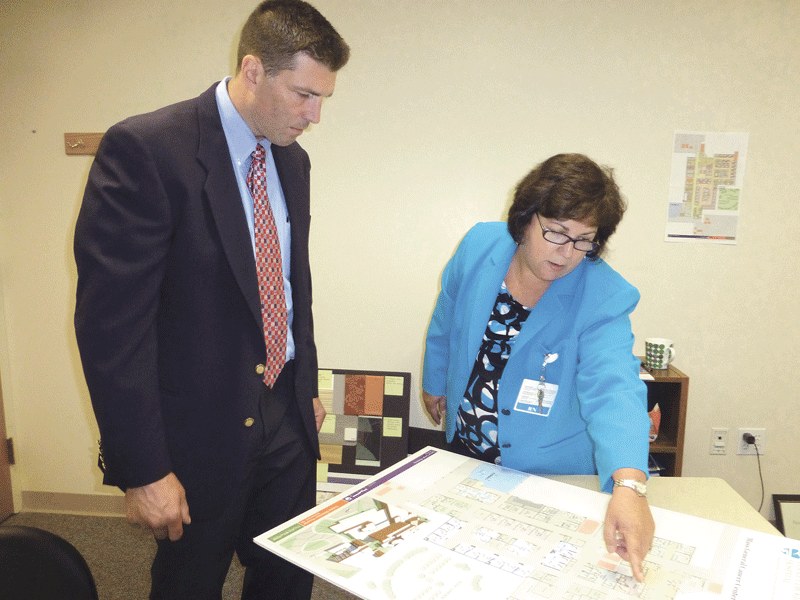
Daily News

SPRINGFIELD — William Dávila, a Springfield native and longtime executive at nonprofit institutions, has been named director of operations for the UMass Center at Springfield.

A 1996 graduate of UMass Amherst who holds advanced degrees from Boston College and the University of Hartford, Dávila said he is excited to help bring opportunity to his hometown. “I want people to feel this is a center that is welcoming to them. My message is that this is a gateway to opportunity.”

The UMass Center at Springfield is a new facility housed in Tower Square in downtown Springfield. Its 26,000 square feet of space includes classrooms, specialized nursing classrooms, conference rooms, and a computer lab. A welcome center where prospective students can learn about courses is already open. Classes begin Sept. 2.

UMass President Robert Caret noted that, “with this appointment, the campuses of the UMass system, in partnership with the local community colleges, are ready to deliver important, life-improving educational programs to the people who need them most. The UMass Center at Springfield will fuel the economic well-being of the entire region.”

Added UMass Amherst Chancellor Kumble Subbaswamy, “as we consolidate the university’s Springfield-area programs in this central location, I know William Dávila will be a well-respected and active advocate in the community who will help residents take advantage of these opportunities. As the Commonwealth’s flagship campus, UMass Amherst will play a leadership role in creating new career paths in the region.”

Through the UMass Center at Springfield, the UMass campuses in Amherst, Boston, Dartmouth, and Lowell, as well as Holyoke Community College, Springfield Technical Community College, and UMass Online, are able to bring their strengths to a variety of programs. The 40 initial course offerings draw on key industry needs in the region, including advanced manufacturing, management, cybersecurity, information technology, and casino management.

“This matches up perfectly with the needs of the area,” Dávila said. “These are professional skills that the community needs.” As the Springfield center develops more courses and certificate programs, Dávila expects to see more cooperation with the community colleges and area private colleges as well.

Daily News

BOSTON — President Robert Caret announced $270,000 in grants from the President’s Creative Economy Initiatives Fund to support eight projects by UMass faculty members in the arts, humanities, and social sciences that will bring new creative resources to Massachusetts communities.

The initiatives include supporting an LGBT community archives and education center in Northampton, developing a marketing toolkit to help nonprofit arts and cultural organizations involved in the creative economy in the Fall River-New Bedford area, and collaborating with the Peace Institute in the Dorchester section of Boston to assist victims of violence.

“The Creative Economy Initiatives Fund provides us with a unique opportunity to contribute the talent and resources of the University of Massachusetts to communities and organizations across the state that are helping to enrich the quality of life in the Commonwealth,” said Caret. “These projects — and the partnerships with nonprofits and creative industries that stem from them — are foundational to our role as an institution that is committed to making a difference wherever and whenever we can.”

The fund was created in 2007 to complement the President’s Science and Technology Initiatives Fund. In its eight years of operation, the Creative Economy Initiatives Fund has made 73 awards totaling more than $2 million. It has supported preservation of the W.E.B. Du Bois boyhood home in Great Barrington and established both the Lowell Youth Orchestra and a permanent Jack Kerouac education and tourism site in Lowell. It has brought UMass Dartmouth students together with Durfee High School students to create a photographic history of Fall River’s neighborhoods, helped establish a women artisans’ cooperative in New Bedford, developed a workers’ upholstery co-op in Springfield, and sponsored numerous music, dance, and theatre performances in Boston, Amherst, and Lowell. This year, the Creative Economy Initiatives Fund will provide $270,000 in grants to the following local initiatives and faculty members:

• Judyie Al-Bilali, Gilbert McCauley, and Priscilla Page, Theatre Department, UMass Amherst: “Art, Legacy & Community.” Project staff will work with community groups in the Greater Springfield area to produce an original theater production and develop Du Bois Performance Workshops for education in multicultural theater, with both activities to take place in Springfield. Amount awarded: $32,000.

• Mitch Boucher, University Without Walls; Julio Capo Jr., History Department and Commonwealth Honors College; and Jessica Johnson, History Department, all at UMass Amherst: “A LGBTQI Community Archives and Education Center.” This project will support the Sexual Minorities Archives (SMA) in Northampton, helping SMA preserve, build, and provide wider access to its resources; develop regional walking tours and other interactive programs; and establish greater national and international community links for these unique and valuable historical materials. Amount awarded: $29,334.

Daily News

SPRINGFIELD — Hampden Zimmerman, a provider of lighting design, announced a partnership with Energize Connecticut to offer commercial customers in Connecticut a rebate to save money by reducing energy and electricity costs through the installation of high-efficiency lighting.

The Energize CT LED program improves commercial customers’ cost-saving efforts by providing the opportunity to convert from halogen, incandescent, compact fluorescent, or full-wattage linear fluorescent lamps to energy-efficient LED lamps or reduced-wattage fluorescents. Energize Connecticut’s utility partners, Connecticut Light and Power (CL&P) and United Luminating (UL), are collaborating with electrical distributors like Hampden Zimmerman to offer commercial lighting customers discounts on pricing.

“For commercial customers who are concerned about ever-increasing utility bills, this is a smart way to save electricity,” said Mark Lauria, regional president of Hampden Zimmerman. “By bringing the incremental cost of premium replacement technology down at the distributor level, customers can purchase products at a cost comparable to conventional lighting solutions.”

Energize Connecticut is an initiative dedicated to empowering Connecticut citizens to make smart energy choices. It provides Connecticut consumers, businesses, and communities the resources and information they need to make it easy to save energy and build a clean-energy future for everyone in the state. It is an initiative of the Connecticut Energy Efficiency Fund, the Clean Energy Finance and Investment Authority, the state, and local electric and gas utilities. The initiative is funded through a charge on customer energy bills.

“Energy Star-certified commercial-lighting fixtures provide up to 80% energy and cost savings, lasting 10 times longer than traditional, incandescent lighting. Plus, qualified fixtures and replacement lamps produce lower heat, which lowers air-conditioning costs,” said Lauria. “The long lifespan and efficiency of the lights require fewer replacement bulbs, which helps business owners save utility costs — anywhere from $5 to $22 a year per lamp installed — as well as labor and replacement fees.”