
Home Posts tagged Technology (Page 17)
Opinion
Invest in Public Higher Education

Over the past several years, the state Department of Higher Education has devised imaginative and compelling ways to make its case for increased funding for the state’s public colleges and universities. And this year is no exception.

In its recent report, creatively titled “Degrees of Urgency: Why Massachusetts Needs More College Graduates Now” (see related story page 24), the department uses words and numbers (lots of them) to describe what it calls a “perfect storm” of conditions that threaten to leave the state with a dramatic shortage of college graduates to fuel its technology-driven economy.

These conditions include everything from falling numbers of high-school students entering college following a somewhat lengthy population surge, to the rising percentage of jobs in the Commonwealth that will require some college education: 72% is the projection for the year 2020.

“In Massachusetts today, there are an estimated six job openings for every college graduate holding an associate degree or certificate in computer science or IT, and more than 17 openings for every graduate with a bachelor’s degree,” the report states. “Put another way, Massachusetts needs more than 5,000 computer-science and information-technology graduates right now.”

The report contains a number of quotes from business leaders about how finding qualified help is the biggest impediment to their success, and also many charts verifying the state’s merely average performance when it comes to funding public higher education. It’s all intended to open some eyes on Beacon Hill and change some attitudes about the state’s public colleges, and we hope the report is successful in doing all that.

That’s because the report’s authors hit the nail on the head when they say there has never been a time when the public institutions were more important to the economic health and well-being of the Commonwealth.

Indeed, the state’s bevy of prestigious private colleges, a list that includes Harvard, Wellesley, Smith, Mount Holyoke, and MIT, educate the world — people who traditionally go back to the country or state they came from to earn a living. Meanwhile, the state’s public schools educate those who will stay in this state, or their region, to forge a career.

A quick look at the business community in Western Mass. provides strong evidence of this. While area companies do boast employees who graduated from Harvard, Boston College, Amherst, Babson, Western New England University, and the Elms, the ranks are far more populated with graduates from UMass Amherst, Westfield State University, Holyoke Community College, and Springfield Technical Community College.

And it is the same in other regions of the state.

If Western Mass., and those other areas of the state as well, are to remain competitive when it comes to attracting and retaining businesses and, therefore, jobs it must have a solid pipeline of qualified workers. And this pipeline is going to be filled mostly by the public colleges and universities.

The Department of Higher Education report calls for a stronger commitment, or investment (that’s the more fitting term) in public higher education. It specifically calls for an additional $475 million over the next five years to help bring more individuals into the pipeline — and see them through to the end.

We hope the Legislature will heed this request and make that investment. That’s because Higher Education Commissioner Richard Freeland was right when he told BusinessWest that the state has been historically average when it comes to funding public higher education in comparison to other states.

And average isn’t going to be good enough in the future.

Education Sections
WNEU’s Biomedical Engineering Program Is in a Growth Mode

By KEVIN FLANDERS

Dr. Robert Gettens

Dr. Robert Gettens, right, with students Hadiatou Barry (left) and Dena Navarroli, check out lab equipment in the Biomedical Engineering department at WNEU.

Inside the labs at Western New England University’s Biomedical Engineering (BME) department, students aren’t simply studying the technologies behind medicine. They’re constantly searching for ways to improve them.

It’s a philosophy, acting Department Chair Dr. Robert Gettens and BME students agree, that prepares them well to be leaders in a variety of careers. Many recent WNEU graduates have become specialized medical attorneys. Others have gravitated toward research. One particularly accomplished alumnus, Ryan Turner, is on his way to becoming a brain surgeon. But, regardless of what path graduates choose, they all share an ability to comprehensively analyze and enhance technology, a trait that is imbued in each student while studying at WNEU.

“Rather than teach students what the functions are of particular medical devices, we focus on the fundamentals of engineering so they will be able to go out and design new products,” said Gettens, an associate professor who will remain the acting department chair until Dr. Judy Cezeaux returns from her sabbatical.

Named by U.S. News to its “Best in Undergraduate Engineering” list, WNEU’s Biomedical Engineering department has seen a marked increase in enrollment over the past five years. What was once a fledgling department with fewer than 10 graduates per year has become a paragon of biomedical pedagogy that sends about 20 students each year into the field. With five professors — each boasting impressive credentials to go along with a Ph.D. — the department has inspired students from throughout the nation to pack their cold-weather gear in preparation of continuing their studies in Western Mass.

“The numbers have skyrocketed,” said Gettens, who praised his students for their commitment and relentless pursuit of knowledge. “The students are always so engaged and dedicated to learning.”

Training Future Inventors

Take a moment to reflect on how far medical devices and the technologies that allow for their creation have come in the last 10, 20, and 50 years, enabling millions of individuals to have hope that wouldn’t have existed in the past. Now project those same time frames into the future, and the possibilities for expansion and invention seem unimaginable.

But for BME professors and students, future technologies are not only imaginable but viable. Every invention starts somewhere, and perhaps the incipient traces of tomorrow’s next breakthrough are currently confined to the notebook of a student in Western Mass. It’s not that much of a stretch, considering that 10 BME students at WNEU have been listed as inventors on patents since 2010. Moreover, almost 22% of graduating seniors since 2001 have received regional or national awards for their senior design projects. Engineering careers are no longer dominated by men, either, as more than 40% of WNEU’s BME students are women.

“What we teach here is engineering, which is all about designing,” Gettens told BusinessWest. “By the time they graduate, our students know how to design medical devices.”

The BME department also collaborates with several area hospitals to ensure that students are provided with the best opportunities possible. Among its partners are Baystate Medical Center, Mercy Medical Center, and Shriners Hospital for Children, as well as other local organizations and hospitals that utilize and advance medical technology. Additionally, a few seniors are currently teamed up with hospitals or companies to develop new devices that could potentially transcend the way patients are cared for.

In short, at WNEU, the future truly does lie in the here and now.

And the BME department hasn’t grown exclusively from an enrollment perspective. Following a two-phase, $12.8 million renovation and expansion project at Sleith Hall that concluded in September, students and staff are benefiting daily from two brand-new laboratories. The bioinstrumentation lab is dedicated mostly to the electronic components of engineering, including electrocardiography, bioamplifier design, ultrasound, signal-processing systems, and pulse oximetry. The second lab, meanwhile, serves as a simulated hospital room, complete with a dummy patient decked out in WNEU apparel who occupies the hospital bed. In this lab, students get to see the latest technologies in action and record their effectiveness in a medical setting. That way, when it comes time for these innovations to serve actual patients in hospitals, they will function at the highest levels possible.

In addition to their work inside the labs, WNEU students also have an opportunity each year to take part in a global health and technology course that includes a trip to Guatemala to learn about healthcare in a foreign environment. The BME department, which also includes professors Dr. Anthony English, Dr. Michael Rust, and Dr. Brent Ulrey, know a thing or two about travel, as they’ve earned degrees from several universities and conducted research throughout the nation.

What’s Next?

For thousands of graduating college seniors each year, a degree doesn’t necessarily translate into a job. In some cases, it’s a matter of too many graduates and limited positions to be filled within that field, while in others the problem is rooted in choice of major. But for those emerging from the BME program at WNEU, it’s not a question of whether they will find a job, but which position they’ll choose.

Sometimes opportunities abound to the extent that graduates must first determine what field they’ll choose, then begin the process of applying for positions.

“Many of our graduates work for companies that make medical devices, and others are working for the government,” said Gettens, who earned his Ph.D. in biomedical engineering from Syracuse University and also served as an engineering officer in the U.S. Army. “They can also go to graduate school to do more research, or they can go to medical school. It depends on what interests them.”

Nationally, 20% of all BME students go on to medical school, according to WNEU’s statistics. But since the university offers a unique, six-year engineering/law program, many of its students have selected the two-for-one degree and backed up their knowledge of medical technology with legal education, a decision that opens many doors.

For WNEU seniors Hadiatou Barry and Dena Navarroli, it will soon be time to say goodbye to William H. Sleith Hall and begin their careers. Armed with advanced training that will serve them well in any field, it will surely be a bittersweet departure.

“I love it here — the professors are really down to earth; you have your fun moments and your serious moments,” said Barry, who is originally from New York City. “It’s the best of both worlds.”

Navarroli, who came to WNEU from Gilbert, Ariz., added, “I was really scared moving all the way from Arizona, but the professors have really supported me. They’ve been great, and they provide so many opportunities here that you can’t find anywhere else.”

For their senior design projects, Barry is researching quantum dot nanocarrier systems for targeted drug delivery, while Navarroli is working with a clinical sponsor on an innovative breast-cancer-surgery device. Both students have excelled in the BME program, and Barry is taking advantage of the rigorous six-year engineering/law opportunity. When she graduates, she’ll be able to choose between patent law and medical litigation if she selects a legal career, both of which are branches of law that require extensive knowledge of medical technology.

“It’s definitely been challenging, but this was my top choice, and it’s been a great experience,” she said.

Both Barry and Navarroli have bright futures ahead of them, as employment of biomedical engineers is expected to increase by nearly 30% by 2022, according to the U.S. Bureau of Labor Statistics. In recent years, WNEU seniors have gone on to work for such major healthcare companies and institutions as Active Medical Devices, Covidien, St. Louis University, Cornell University, Respironics Novametrix LLC, and Microtest Laboratories Inc., among others.

Rewarding Field

Interests and specialties aside, WNEU’s BME students and professors were drawn together by a common passion — helping people in need.

Though many biomedical-engineering students throughout the nation may never operate on a single patient in their careers, the technologies they develop help doctors and nurses save countless lives. From advanced imaging systems to pioneering point-of-care devices, BME students situate themselves on the cutting edge of technology by studying thousands of applications and mechanisms during their college years. They also dedicate several hours each week to reviewing case studies and staying current on the latest research and literature pertaining to the constantly evolving field.

And the research is hardly limited to the students. With busy teaching schedules, professors sometimes struggle to find enough time to complete multiple research projects each semester.

“The faculty members have done a lot of research lately in micro- and nano-devices,” said Gettens, whose department recently received a $500,000 grant from Massachusetts Life Sciences. “Because the professors usually do 12 credit hours of teaching [per semester], trying to find time for research can definitely be a challenge.”

Gettens said the grant will allow for the purchase of equipment that facilitates micro- and nano-fabrication for medical devices. To outsiders, these words might as well be written in a different language, but for those immersed in the innovative, collaborative culture of biomedical engineering, the more complex the application, the more enthralling the endeavor.

And that explains why the program — and the job opportunities it creates — are both on the rise.

Accounting and Tax Planning Sections
Careful Planning Can Lessen Your Tax Burden

By KRISTINA DRZAL HOUGHTON, CPA, MST

Kristina Drzal-Houghton

Kristina Drzal-Houghton

U.S. taxpayers are facing more uncertainty than usual as they approach the 2014 tax-planning season. Many may feel trapped in limbo while Congress has been preoccupied with the November midterm election and its results — leaving legislation that could alter the current tax picture up in the air.

Since D.C. lawmakers are unlikely to pass, extend, or modify tax provisions anytime soon, tax planning may seem pointless. But, actually, careful planning is wise regardless of the situation and even more important during uncertain times.

Even though the federal tax laws haven’t changed much from last year, your circumstances may have changed. And some rules that expired on Dec. 31, 2013 may yet be restored, even retroactively, to Jan. 1, 2014. It could be the perfect time for you to get a fresh perspective.

To make sure you’re taking all the appropriate steps to minimize your individual and business taxes, you should anticipate possible changes with the informed guidance of your tax professional.

Tax Strategies for Individuals

Before you can make wise planning decisions about your individual taxes, you need to be aware of your current tax situation.

Can you control when you receive income, or at least determine when deductible expenses are paid? If you can control timing, you have a valuable planning tool that can enable you to reduce your taxable income and tax liability.

Maximize your tax strategies by forecasting income-tax positions for 2014 and, to the extent possible, subsequent years. Evaluate not only the amount of your income but also the types of income you anticipate generating, your marginal tax bracket, net investment income, wages and self-employment earnings, and capital gains and losses.

Before deciding to accelerate or defer income and prepay or delay deductible expenses, you need to gauge the possible effect of the alternative minimum tax (AMT) on these tax-planning strategies. Having a number of miscellaneous itemized deductions, personal exemptions, medical expenses, and state and local taxes can trigger AMT.

The opportunity to take advantage of income timing exists particularly for taxpayers who are:

• In a different tax bracket in 2014 than in 2015;
• Subject to the AMT in one year but not the other;
• Subject to the 3.8% net investment income (NII) tax in one year but not the other; or
• Subject to the additional 0.9% Medicare tax on earned income in one year but not the other.

The 3.8% NII tax and the 0.9% Medicare tax apply when your modified adjusted gross income exceeds threshold amounts. Net investment income includes dividends, rents, interest, passive activity income, capital gains, annuities, and royalties. Passive pass-through income is subject to the NII tax.

The NII tax does not apply to non-passive income, such as:

• Self-employment income;
• Income from an active trade or business;
• Portions of the gain on the sale of an active interest in a partnership or S corporation with investment assets; and
• IRA or qualified plan distributions.

Remember that the additional 0.9% Medicare payroll tax applies to earnings of self-employed individuals and wages in excess of the thresholds in the table above.

After analyzing your specific tax situation, if you anticipate that your income will be higher in 2015, you might benefit from accelerating income into 2014 and possibly postponing deductions, keeping the AMT threat in mind.

On the other hand, if you think you may be in a lower tax bracket in 2015, look for ways to defer some of your 2014 income. For example, you could delay into 2015:

• Collecting rents;
• Receiving payments for services;
• Accepting a year-end bonus; and
• Collecting business debts.

Also, if you itemize deductions, consider prepaying some of your 2015 tax-deductible expenses in 2014. The following expenses are commonly prepaid as part of year-end tax planning:

• Charitable contributions. You may take a tax deduction for cash contributions to qualified charities of up to 50% of adjusted gross income (AGI). When contemplating charitable contributions, consider contributing appreciated securities that you have held for more than one year. Usually, you will receive a charitable deduction for the full value of the securities, while avoiding the capital-gains tax that would be incurred upon sale of the securities.
• State and local income taxes. You may prepay any state and local income taxes normally due on Jan. 15, 2015 if you do not expect to be subject to the AMT in 2014.
• Real-estate taxes. You can prepay in 2014 any real-estate tax due early in 2015. But you should keep in mind how the AMT could affect both years when preparing to pay real-estate taxes on your residence or other personal real estate. However, real-estate tax on rental property is deductible and can be safely prepaid even if you are subject to the AMT.
• Mortgage interest. Your ability to deduct prepaid interest has limits. But, to the extent your January mortgage payment reflects interest accrued as of Dec. 31, 2014, a payment before year end will secure the interest deduction in 2014.
• Miscellaneous itemized deductions. These include unreimbursed employee business expenses, tax-return preparation fees, investment expenses, and certain other miscellaneous itemized deductions that together are in excess of 2% of AGI.

The amount of itemized deductions you can claim on your 2014 tax return is reduced by 3% of the amount by which your AGI exceeds the thresholds, which began as low as $152,000. However, deductions for medical expenses, investment interest, casualty and theft losses, and gambling losses are not subject to the limitation. Taxpayers cannot lose more than 80% of the itemized deductions subject to the phaseout.


Know Your Tax Rates, Exemptions, and Phaseouts

A personal exemption is usually available for you, your spouse if you are married and file a joint return, and each dependent (a qualifying child or qualifying relative who meets certain tests). The personal exemption for 2014 is $3,950.

But the total personal exemptions to which you are entitled will be phased out, or reduced, by 2% of the amount that your AGI exceeds the threshold for your filing status. The threshold amounts for the personal-exemption phaseout are the same as for itemized deductions.

Even when federal income-tax rates are the same for you in both years, accelerating deductible expenses into 2014 and/or deferring income into 2015 or later years can provide a longer period to benefit from money that you will eventually pay in taxes.


Beware the Alternative Minimum Tax Trap

As mentioned previously, determining whether you are subject to the alternative minimum tax in any given year figures prominently in tax planning.

Every year the IRS ties, or indexes, to inflation the AMT exemption and related thresholds based on filing status. If it’s apparent that you will be subject to the AMT in 2014, you should consider deferring certain tax payments that are not deductible for AMT purposes until 2015. For example, you may defer your 2014 state and local income taxes and real-estate taxes, except taxes on rental property, which are not subject to the AMT. Also consider deferring into 2015 your miscellaneous itemized deductions, such as investment expenses and employee business expenses.

However, if the AMT will not apply to your taxes in 2014, but could apply in 2015, you may want to prepay some of these expenses to lock in a 2015 tax benefit. Just be careful that your prepayment does not make you subject to AMT in 2014.

If you do not expect to be subject to the AMT in either year, the age-old strategy of deduction ‘bunching’ could apply. If this is expected to be a high year for miscellaneous itemized deductions, consider accelerating next year’s expenses into this year.

Or, if this is a low year for these deductions, try to defer these expenses for the rest of the year into next year. This method helps you maximize the likelihood that these deductions will result in a tax benefit.


Exploit Long-term Capital Gains

While avoiding or deferring tax may be your primary goal, to the extent there is income to report, the income of choice is long-term capital gain thanks to the favorable tax rate available. Short-term capital gain is taxed at your ordinary income tax rate.

If you hold a capital asset for more than one year before selling it, your capital gain is long-term. For most taxpayers, long-term capital gain is taxed at rates no higher than 15%. But taxpayers in the 10% to 15% ordinary income-tax bracket have a long-term capital-gain tax rate of 0%.

Taxpayers whose income exceeds the thresholds set for the relatively new 39.6% ordinary tax rate are subject to a 20% rate on capital gain.

If the long-term capital-gain rates of 0%, 15%, or 20% are not complicated enough, keep in mind that special rates of 25% can apply to certain real estate, and 28% to certain collectibles. Also, gains on the sale of certain C corporations held for more than five years can qualify for a 0% rate. Talk to your tax adviser before you assume the long-term capital gains rate that would apply.

Remember that you can use capital losses, including worthless securities and bad debts, to offset capital gains. If you lose more than you gain during the year, you can offset ordinary income by up to $3,000 of your losses. Then you can carry forward any excess losses into the next tax year.

However, you should be careful not to violate the ‘wash sale’ rule by buying an asset nearly identical to the one you sold at a loss within 30 days before or after the sale. Otherwise, the wash-sale rule will prevent you from claiming the loss immediately. While wash-sale losses are deferred, wash-sale gains are fully taxable. It’s important to discuss the meaning of nearly, or ‘substantially,’ identical assets with your tax adviser.


Contribute to a Retirement Plan

You may be able to reduce your taxes by contributing to a retirement plan. If your employer sponsors a retirement plan, such as a 401(k), 403(b), or SIMPLE plan, your contributions avoid current taxation, as will any investment earnings until you begin receiving distributions from the plan. Some plans allow you to make after-tax Roth contributions, which will not reduce your current income, but you will generally have no tax to pay when those amounts, plus any associated earnings, are withdrawn in future years.

You and your spouse must have earned income to contribute to either a traditional or Roth IRA. Only taxpayers with modified AGI below certain thresholds are permitted to contribute to a Roth IRA. If a workplace retirement plan covers you or your spouse, modified AGI also controls your ability to deduct your contribution to a traditional IRA.

If you would like to contribute to a Roth IRA, but your income exceeds the threshold, consider contributing to a traditional IRA for 2014, and convert the IRA to a Roth IRA in 2015. Be sure to inquire about the tax consequences of the conversion, especially if you have funds in other traditional IRAs.

In addition to the SIMPLE IRA, self-employed individuals can have a simplified employee pension (SEP) plan. They may contribute as much as 25% of their net earnings from self-employment, not including contributions to themselves. The contribution limit is $52,000 in 2014. The self-employed may set up a SEP plan as late as the due date, including extensions, of their 2014 income tax return.

An individual, or solo, 401(k) is another option for the self-employed. For 2014, a self-employed individual, as an employee, may defer up to $17,500 ($23,000 for age 50 or older) of annual compensation. Acting as the employer, the individual may contribute 25% of net profits, excluding the deferred $17,500, up to a maximum contribution of $52,000.


Withholding and Estimated Tax Payments

If you expect to be subject to an underpayment penalty for failure to pay your 2014 tax liability on a timely basis, consider increasing your withholding between now and the end of the year to reduce or eliminate the penalty. Increasing your final estimated tax deposit due Jan. 15, 2015 may reduce the amount of the penalty but is unlikely to eliminate it entirely.

Withholding, even if done on the last day of the tax year, is deemed withheld ratably throughout the tax year. Underpayment penalties can be avoided when total withholdings and estimated tax payments exceed the 2013 tax liability or, in the case of higher-income taxpayers, 110% of 2013 tax.

Tax Strategies for Business Owners

The main tax issue to keep in mind if you’re a business owner is that a number of tax provisions, such as 50% bonus depreciation, expired at the end of 2013. In addition, the Section 179 deduction has been limited significantly.

Congress may pass legislation to renew or modify these tax breaks — perhaps retroactively. Of course, you can’t count on that possibility, so if you have used these provisions to reduce your taxes in the past, it might be advisable to adjust your withholding and estimated tax payments for 2014.


Special 50% Bonus Depreciation

Through 2013, businesses could use the special bonus depreciation to deduct up to 50% of the cost of such assets as new equipment, computer software, and other qualifying property placed into service by year end. The 50% bonus depreciation did not apply to used equipment. Unless Congress acts, it will not be available at all in 2014.


Section 179 Deduction

Under Section 179 of the IRS Tax Code, businesses could expense the full cost of new and used equipment, including technology, in the year of purchase instead of over a number of years. They still can. However, the amount they can expense has dropped from an upper limit of $500,000 in 2013 to $25,000 in 2014 — a sizable difference. If your company has nearly reached the $25,000 expensing limit, you may want to postpone further purchases until 2015.

The 2014 limit on equipment purchases qualifying for Section 179 treatment is $200,000. After a business reaches the maximum amount, the available tax deduction phases out on a dollar-for-dollar basis. In other words, once a business buys $225,000 of equipment, the deduction is reduced to zero. You should monitor your company’s total purchases to prevent the phaseout.


Repair Regulations

The IRS and the U.S. Treasury have issued final tangible property regulations (TPRs) that become mandatory for tax year 2014. These TPRs will likely require most businesses to file additional tax returns and supporting statements and/or include in their returns certain annual elections. Those new, additional returns are referred to as IRS Form 3115, Change in Accounting Method.

If you have multiple trades or businesses, more than one building, or leasehold improvements, whether or not these are contained in separate legal entities, such as LLCs, or disregarded entities, we may have to prepare numerous, separate Form 3115s, as well as make numerous TPR annual elections. Since the changes required by the TPR are so widespread, starting on the various analysis prior to year end is highly suggested.

While the preparation of the IRS form 3115 will be done, in the majority of cases, by this 2014 tax-return filing, certain new annual elections related to the TPRs are anticipated to be required and/or chosen for every income-tax filing subsequent to your adoption of the new TPRs.

You should discuss with your tax adviser the TPR elections choices. While they will certainly advise you on the alternatives or choices that are available for you regarding these TPR annual method elections, please remember the final choices are yours to make. The three common annual method TPR elections are the following:

• The de minimis safe harbor for writeoff of property acquisitions and non-incidental material and supplies costing less than your book writeoff policy, such as items costing less than a certain dollar amount (for example, less than $500 per item);
• If applicable, the safe harbor for small taxpayers, where you can elect not to capitalize improvements or repairs on eligible building property (i.e., your buildings with depreciable basis less than $1 million per building; and
• The partial asset disposition elections under §1.168(i)-8(d)(2). This election is made annually to enable you to apply this section to a disposition of a portion of a prior asset that you have replaced with a subsequent improvement. An example of the application of this method is where you replace a roof on one of your buildings, and you are then able to write off the remaining depreciable basis of the prior roof. You’d make this election to avoid a situation where you will depreciate two roofs at the same time, instead of recording a loss on the disposition of the original roof.

In addition to filing these changes in accounting methods, and the making of the annual TPR elections outlined above, your internal processes that may have to be modified include:

• Accounting for ‘non-incidental’ material and supplies; and
• Establishment of a capitalization writeoff policy dictating a certain writeoff amount (e.g., “our policy is that we are going to expense all purchases under $500”). If you do not, you may be limited to a $200 per item write-off policy, including the creation of an internal writing of what actions, expenditures, or items would require capitalization (such as improvements, acquisitions, restorations, betterments, adaptions, etc.), as opposed to expenditures that would be categorized as repair and maintenance expenses.

If you do not currently have a written and communicated capitalization policy, we advise you that, in order to take advantage of the annual de minimis writeoff safe harbor described above, you must create and execute that writing and communication before Jan. 1, 2015, if you desire to employ the writeoff policy in next year’s tax returns, since the policy needs to be adopted prior to the beginning of the effected tax year. Also, review your depreciation schedules to see what assets on that list may qualify for writeoff in the 2014 tax year.

In preforming the analysis for these changes, you may find that, in applying the TPRs, your business can benefit from an additional deduction in 2014.


Conclusion

As the 2014 tax season approaches, taxpayers have a lot of questions. Will expired tax provisions be reinstated? If so, will they apply retroactively to the beginning of the year? Will they be altered? Will new tax laws make it through the legislative process?

Most importantly, how will these decisions affect your taxes?

These are legitimate concerns. Unfortunately, no one can predict the future. But we can suggest that you and your tax professionals should diligently watch the tax landscape for pending legislation that could have an impact on your taxes. Your safest course of action in the midst of uncertainty is to remain in close communication with your tax adviser for the latest guidance.


Kristina Drzal Houghton, CPA, MST is a partner with the Holyoke-based accounting firm Meyers Brothers Kalicka, and director of the firm’s Taxation Division; [email protected]

Education Sections
Report Urges Action to Increase Number of College Graduates

StateGradsUrgencyDPartRichard Freeland says the numbers don’t lie. If anything, they’re conservative, which should be cause for alarm or — preferably, in his view — decisive action.

He was referring to projections contained the latest Vision Project report released recently by the Mass. Department of Higher Education. Titled “Degrees of Urgency: Why Massachusetts Needs More College Graduates Now,” the report uses rhetoric, but mostly numbers to explain that thesis.

Starting with 72%. That’s the percentage of Massachusetts jobs that will require some college education by 2020, said Freeland, the state’s commissioner of Higher Education. That number is the highest in the country, he added, and a reflection of the high-tech jobs that are now dominating the state’s economy.

But there’s also 55,000 to 65,000 — that’s the projected shortfall in the number of college graduates the state will experience by 2030, according to the report. Then there are 6:1 and 17:1, the current ratios of job openings to recent bachelor’s degree recipients in the fields of healthcare and information technology, respectively. And finally, there’s -9%. That’s the projected drop in Massachusetts high-school students graduating annually between 2009 and 2020.

Add all these numbers up, figuratively, and the state is facing what Freeland calls a “perfect storm,” one that could seriously threaten or slow its high-tech economy.

“The Massachusetts workforce has become heavily dependent on the graduates of public higher education,” he said. “And unless we raise the level of our game, we’re not going to have the workforce we need.”

This is a message that should resonate with incoming Gov. Charlie Baker and the Legislature, he said, adding that the state’s ability to compete with leading technology states such as California, New York, and New Jersey will be imperiled unless steps are taken.

Richard Freeland

Richard Freeland

“Degrees of Urgency” recommends three: boosting college-completion rates; closing achievement gaps, especially those involving the African-American and Latino populations; and attracting and graduating more students from underserved populations.

None of the above constitutes rocket science, and these steps have been the basic goals spelled out in the Higher Education Department’s Vision Project, said Bill Messner, president of Holyoke Community College, who said the problem outlined in the report and the solutions to it appear relatively simple. In reality, though, they are not.

“We have to get more people into college, and we have to get more people through college — it’s as simple as that,” he said, adding quickly that changing demographics across the state and especially in the Pioneer Valley (more on them later), current funding levels for the state’s public institutions, and those projections of falling numbers of high-school graduates will make these stern challenges.

What will help, said Freeland, is a broader commitment from the Legislature to fund public higher education at a level well above the current one, which is, in every sense of the word, average, in terms of national statistics.

“Massachusetts still ranks very much in the middle of the pack among the states in terms of per-student investment in public higher education,” he said while explaining his department’s call for an additional $475 million over five years that would be spread out over the state’s community colleges, state universities, and the many campuses of the University of Massachusetts. “We still haven’t made a commitment to investing in genuine excellence in public higher ed, and that’s the point of this report; Massachusetts can’t get by with an average system of public higher education and an average level of investment.”

Such a boost will make the state’s public schools more affordable and, thus, more attractive to those challenged by the cost of higher education, he said, and also to the comparatively high number of high-school graduates who feel compelled to leave the Bay State to attend college.

Overall, recent funding increases for public higher education have essentially restored what was lost in the fiscally trying years following the Great Recession, Freeland said, adding that a greater investment is needed to build on recent momentum and enable the public colleges to meet the additional burden they’ve been asked to absorb.

For this issue and its focus on education, BuinessWest takes an in-depth look at the “Degrees of Urgency” report and the suggested steps for possibly clearing the skies.

Course of Action

Messner told BusinessWest that the gathering storm outlined in the report is already much in evidence at HCC, in the form of recent enrollment figures.

In 2009, the year after the Great Recession began, there were 7,400 students enrolled, he noted. By 2011, the number was down to 7,100. In 2013, it was 6,700 (down more than 5%), and in 2014, it was 6,600. And another 1% to 2% drop is projected for 2015.

Bill Messner

Bill Messner says falling high-school populations, coupled with demographic changes, have impacted enrollment at Holyoke Community College.

Behind these statistics is declining high-school enrollment, Messner acknowledged quickly, but there’s much more to it than that, especially changing demographics.

“Whatever bubble was moving through has come and gone,” he said of the high-school population. “Meanwhile, the demographic mix in our region is changing, and that’s no surprise — we’re seeing it at HCC, and other people are seeing it as well.

“We have more first-generation, low-income students coming to us, and that reflects the population as a whole,” he went on. “We have fewer college-educated students moving into the area, and more non-college-educated people moving in, which results in more first-generation college students.

“The other way of saying that,” he continued, “is that the only growth population in Western Massachusetts tends to be immigrants, and the large majority of these immigrants do not have a college education, and they’re not coming from cultures where a college education is necessarily the priority it is here in the United States.”

But while enrollment is down, the number of graduates has not changed appreciably, Messner went on, noting that, in 2011, the high-water mark, there were 1,128. In 2013, there were 958, and in 2014, there were 1,105, a nearly 15% increase. These numbers clearly show that the college is becoming more successful in moving those students who do enroll through to graduation.

And these real-time developments add some exclamation points to the “Degrees of Urgency” report and those three steps outlined to put more students into the pipeline, see them through to the other end, and make them part of a qualified workforce, said Messner, adding that, while the report talks mostly about conditions projected for down the road, many of the anticipated changes in numbers are already taking place.

“Community colleges are pretty good canaries in the coal mine, so to speak,” he said. “If you look at our enrollment — and our enrollment is no different than any other community college — it peaked in 2008 and has been on a steady decline since then, and there’s little to indicate that this will change.”

Messner noted that, while there has been progress in closing achievement gaps and improving graduation rates, as his statistics show and the report states, there is considerable work to be done.

Completing His Thoughts

Freeland agreed, and returned to what the “Degrees of Urgency” report calls the “Big Three” strategies to increase the number of students graduating with degrees or certificates.

He said declining high-school enrollment is a reality the state will have to live with, and, given those numbers, there must be a commitment to improving completion rates in general, attracting more students from underserved populations to the public colleges and universities, and closing achievement gaps.

Included in that ‘underserved populations’ category are adult students (those ages 25-65 who have some college credits but not a degree), military veterans, and high-school graduates heading to out-of-state colleges.

Massachusetts has more individuals in that third category than most states (it ranks 29th in that category), said Freeland, listing as possible causes everything from the small size of the Commonwealth — “if you want to get away, as many students do, you almost have to leave the state” — to a lack of awareness, or appreciation, when it comes to the public higher education system here.

“Public higher education in Massachusetts has never enjoyed a strong reputation,” he explained. “You have students leaving Massachusetts to attend public colleges and universities in other states. Staying in state and going to one of the public schools doesn’t have a lot of cache among high-school students, although UMass Amherst may be beginning to acquire that.”

Changing this equation won’t happen quickly or easily, he went on, adding that the quality of education being provided and its cost are two big factors that could be addressed through a greater investment in public higher education in this state.

As for those adult students, they most aspire to jobs that require a college degree or certificate, but they are not yet ready for college-level work, said Freeland, adding that, in addition to the challenge of getting them enrolled or re-enrolled, these individuals must also confront competing job and family pressures.

Thus, they embody two components of the report’s three-pronged strategy — getting into college and then getting through it.

As the report states, there have been some improvements in graduation rates, such as those logged at HCC, but additional efforts, encompassing everything from mentoring to making more enrollees ‘college-ready,’ will be needed.

“We have been working very hard on what we call ‘student success,’ which is shorthand for retaining and graduating more students, and we’re not peculiar in that — everyone’s working on that,” said Messner, adding that this hard work, coupled with more emphasis on attaining a degree, rather than taking certain courses and attaining a certain number of credits for transfer, is at least partially responsible for that rise.

But there are still many challenges ahead, most of them manifesting themselves in those lower enrollment figures he relayed.

As he talked about ways to stem that tide, he focused on one of the big problems — poor high-school graduation rates in many area cities, especially Springfield and Holyoke — while relaying some comments he made at a recent United Way meeting on that subject (see related story on page 27).

“I told people, ‘this is not a problem for the Springfield School Department or the Holyoke School Department — anyone who hires people from the local workforce is going to be impacted by this,’” he recalled. “If we don’t increase our high-school graduation rates, we’re going to see a dramatic decline in the number of college graduates, and that doesn’t bode well for our economy.”

The Bottom Line

Looking ahead about six months, Messner said the final tally for the number of graduates at next spring’s commencement ceremony will be very telling. And right now, he’s not at all sure what to expect.

“If it’s up or even close to the number we had for last spring, it will be a really good sign that something positive is going on,” he said, adding quickly that, whatever the number is, stern challenges remain for those looking to put more students in the pipeline — and hire them if and when they graduate.

Freeland concurred, and noted that all those numbers in the Vision Project report add up to an ominous forecast — one for a perfect storm.

It probably won’t miss this region, he noted, and, in fact, it will hit harder than most others. But with appropriate steps, the state can weather it.

George O’Brien can be reached at [email protected]

Daily News

SPRINGFIELD — In response to the recent opening of the Agawam YMCA Wellness & Program Family Center, the YMCA of Greater Springfield is announcing the a donation of $10,000 from Comcast. The Agawam YMCA is the latest addition to the YMCA of Greater Springfield’s many locations, providing membership and program opportunities to the Agawam region.

With support from Comcast in the way of public-service announcements and direct financial contributions, the Agawam YMCA is slated to impact more than 3,000 youth, teens, families, and seniors in Agawam and its surrounding communities. The YMCA of Greater Springfield serves 115,000 members and program participants in 14 cities and towns throughout the region.

The Agawam YMCA includes a health and wellness center, sauna, group exercise space, café, technology center, and community meeting space. Naming opportunities for donors are still available. To learn more about the YMCA of Greater Springfield, contact Nikki Durham at [email protected] or visit www.springfieldy.org.

Daily News

PITTSFIELD — Nuclea Biotechnologies Inc. announced that it has secured a new U.S. design patent for the design of its beam-dump assembly, a mechanical component that will be utilized in multiple diagnostic applications.

The beam-dump assembly is used for the detection of low-abundance proteins within microfluidic-based environments. It identifies a change in biological samples by reading laser light. This detection instrument will be used for protein detection in Nuclea’s fatty-acid synthase (FAS), HER-2/neu, and CAIX diagnostic tests, with future potential use in additional diagnostic tests. The design patent is an important step for Nuclea as the company continues to expand its intellectual property surrounding its proprietary tests and methods.

“This is another milestone for Nuclea in developing new diagnostic-based technology as it relates to the analysis of fluids in a variety of diseases,” said Patrick Muraca, the company’s president and CEO.

Based in Pittsfield, Nuclea, with additional operations in Worcester and Cambridge, has developed and is commercializing unique diagnostic tests for colon, breast, leukemia, lung, and prostate cancer, as well as for diabetes and other metabolic syndromes. Nuclea also performs research leading to novel molecular oncology companion diagnostics for the pharmaceutical and biotechnology industries.

Banking and Financial Services Cover Story Sections
Banks Navigate a Rapidly Changing Chess Board

BankLandscapeDPartIn assessing the many ways banking in Massachusetts has changed, Dan Forte summons two numbers: 338 and 175.

The first, said Forte, president of the Mass. Bankers Assoc., is the number of banks with offices in the Bay State in 1990. The second number is the same tally at the end of 2013.

“That’s a 48% drop, which, annualized, is a 2% drop per year,” Forte said. “There have been some periods where the consolidation was slower, while in some periods, it has been a little faster. We’re coming out of an economic trough, albeit slowly, and as the economy gets stronger, you’ll see mergers pick up over the next few years.”

Indeed, after a few relatively — but never totally — quiet years on the bank-merger front, 2014 has brought a rush of movement, most recently Berkshire Bank bringing Hampden Bank under its banner (see sidebar, page 19).

“It’s a combination of things,” Forte said, noting that the region’s most recent big moves — Berkshire’s in-market acquisition of Hampden, the interstate ‘merger of equals’ between United Bank and Rockville Bank a year ago, and Connecticut-based Farmington Bank’s plan to expand into Massachusetts — are very different from each other.

“The community banks are going to remain strong, but, like every other industry, there’s going to be a lot of change, and this is part of the change,” he said. “It’s really nothing new.”

Or, as Brian Corridan put it, “we have a lot of very good banks here in Western Massachusetts. But the world is changing, and the checker game in banking has become a chess game.”

Corridan, a local expert on the financial-services industry and president of Corridan & Co. in Chicopee, emphasized that not only are mergers and consolidations par for the course these days, they’re not the biggest story.

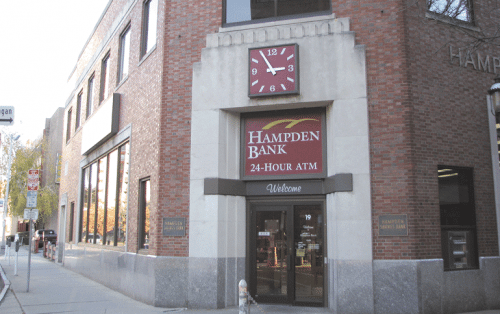
Hampden Bank

Berkshire Bank leaders are discussing whether to retain, consolidate, or close Hampden Bank branches that overlap Berkshire branch footprints — including Hampden’s headquarters in downtown Springfield.

“The reality goes far beyond the larger banks in our area merging with the smaller banks. We are now banked internationally right here in our Valley,” Corridan said, citing Citizens Bank, an affiliate of the Royal Bank of Scotland; TD Bank, part of Toronto-Dominion Bank in Canada; and the most recent entry, Spain-based Santander, which acquired Sovereign Bank in 2009.

“Look around — people have accounts at Citizens, TD Bank, and Santander. We’re not just talking about regional banks anymore, but foreign banks. They see the value of retail banking in our area,” Corridan said. “And it’s just the tip of the iceberg; there’s a lot of consolidation to come as banks look for economies of scale.”

That’s one of the reasons offered by Sean Gray, Berkshire Bank’s executive vice president of retail sales, in explaining why his institution is “doubling down on Springfield,” where Hampden Bank is headquartered, and where Berkshire already has a significant presence.

“Ultimately, there are economies of scale that come with larger size,” he said. “We believe we have to be big enough to do all the things larger institutions can do, but we feel we need to keep our roots in local decision making, and stay active in foundations and volunteerism and all the things you want a community bank to do at the end of the day.”

When it comes to making moves on this massive chessboard, how does a bank become more efficient, more profitable, and offer expanded services and a broader range of loans, while also maintaining the community involvement and high-touch environment long valued by retail customers in Western Mass.? For this issue’s focus on banking and financial services, BusinessWest examines how creating this balance has become, for banks large and small, the name of the game.

In the Red Tape

Ironically, much of the recent movement among banks to grow larger, quickly, has come as a result of new regulations in the wake of the 2008 financial collapse — a crisis in which the largest banks shouldered much more blame than smaller community banks.

“Since Obama came to town, it’s been a regulatory jungle, and the departments within individual banks experiencing the highest growth rate are the compliance departments,” Corridan said. “In response to more complicated regulations, the federal government is demanding more reports, and that rocks your bottom line. If you have to put $400,000 to $500,000 into your compliance department, that may upset the balance of whether you had a profitable balance or you’re in the red.”

Forte agreed, citing the way ‘call reports’ — the condition reports banks issue to regulators at the end of each quarter — have become much more onerous.

“The costs of doing business are clearly increasing,” he told BusinessWest. “As of 2012, there were 1,995 items in a call report. In 1990, there were 569 items. And the regulations coming out of Dodd-Frank are going to increase them even further; they’re looking now at increasing the number of reporting requirements by 63 elements. Every item takes time and costs money, and the risk of not completing these forms correctly is significant.”

Therefore, he said, banks aren’t just expanding their brand when they merge; they’re spreading these regulatory costs over a larger footprint.

For William Crawford IV, CEO of Rockville Bank, the decision to merge United with Rockville was about investing smartly in an aggressive growth plan.

“Getting to $5 billion in assets, getting to that scale, was very important,” he said. “We’re seeing a lot of small banks seek out strategic partners, much as we saw with Hampden, simply because the economics of being a very small community bank — say, under $1 billion — is very difficult when you look at the interest-rate environment out there. It makes it very difficult to lend money, and, unfortunately, we may be in this environment for an extended period of time.”

Still, he emphasized the importance of maintaining community ties, particularly in the realm of long-established charitable and volunteer efforts.

“Both companies, United and Rockville, have significant foundations that will continue to invest here as we always have,” he said. “And because of our increased size and scale, we have more resources to do those things. So, from a community perspective, two companies coming together is definitely a plus.”

While customers might occasionally feel disoriented by changes in bank ownership, Forte noted that banks have been contracting nationally at a 3% annualized rate, putting Massachusetts behind the U.S. pace. Some of that has to do with the fact that 70% of the banks in Massachusetts are mutual banks, which are limited in how they can merge.

“It requires the right alignment of planets — the board, management, succession timing, etc.,” he said. “Clearly, the trend from this year is a little faster than three years ago, which is not surprising, given all that’s been going on economically.”

The loosening of state laws across the U.S. governing interstate banking, starting around 30 years ago, created a much more nurturing environment for mergers, leading to the remarkable contraction in Massachusetts-based banks since 1990, Forte said.

“State lines are fairly arbitrary; you’re looking more at economies. That’s why interstate banking is so critical; it gave banks large and small the ability to expand geographically, regardless of state boundaries.”

Cache and Carry

Forte emphasized, however, the vigilance with which merging banks protect their reputation as local institutions.

“Community banks are a vibrant sector of the economy, and they help their local communities,” he said. “Their biggest strength is being high-touch. If they can maintain the high-touch aspect and be quick followers of technology and keep costs down going forward, they will continue to confound the pundits who have long predicted their demise.

“I believe there will continue to be a strong community-bank sector of the industry, and we’re not going to become like Canada, with six large banks and 100 credit unions that serve as the local banks,” he added. “We have vibrant community banks here in Massachusetts.”

That said, Corridan noted, “we’re down two publicly traded banks in the Pioneer Valley — Chicopee and Westfield. Look back 25 years, when we had BankBoston, Shawmut, Bank of New England, Baybank … we had smaller banks, and dozens of them.”

With their gradual fade, he predicted that the next 10 to 15 years will see a rapid ascent in credit-union membership. “If you want to bank locally, you’ll see credit unions get stronger, because they’re going to be the local banking entity.”

Springfield resident Morriss Partee, creator of EverythingCU.com, an online source for credit-union information and advocacy, hopes that’s the case, but admitted progress toward that goal has been gradual at best.

“Consolidation in banking has been going on for a very, very long time, and people always say the credit unions stand to benefit from that, and they certainly have to some extent,” Partee said. “At the same time, it’s surprising that they haven’t benefited even more than they have.

“The option of banking locally is just not that important to a lot of people,” he continued. “Of course, it’s important, but a lot of people don’t think deeply about their bank relationship. They say, ‘OK, I have checking; I have a big bank with lots of ATMs around; I can be functional in society.’”

Partee says there’s still plenty of untapped potential for credit unions, but they have to convince people it’s easy to switch over. EverythingCU.com has long offered a ‘switch kit’ to make that task easier and, in recent years, help people do it online. “People hear about credit unions from their friends or see representatives at a trade show and say, ‘OK, your credit union sounds great, but it’s not worth the hassle of moving.’”

Partee, who has been a vocal opponent of a Springfield casino, puts large national and international banks in the same category — businesses, he says, that want to benefit from Springfield but who, at the topmost levels, don’t care about detrimental effects on the community because they don’t live here.

“When lending decisions are made locally, that’s going to help the local community,” he said. “There are still local community banks that are staying local, and a lot of people feel just as passionately about their local community bank as they do about their credit union. With the largest banks — the internationals, especially — it seems like doing business with them is not necessarily helping the local economy; they’re not as responsive to entrepreneurs or people who don’t fit into neat little boxes they can check off in their system.”

Pittsfield-based Berkshire Bank, for its part, has been careful to characterize its acquisition of Hampden as a way of doubling its commitment to Greater Springfield, not uprooting a locally headquartered bank with a 162-year presence.

“We are keeping local leadership and local decision making right here,” Gray said, noting that Hampden Bank President Glenn Welch will remain the combined bank’s regional president for the Pioneer Valley. “We are the largest bank headquartered in Western Mass., and when we look at our overall investment in the region, Springfield has to be a part of that. We are very committed to Glenn and his leadership and his commitment to this region.”

Checking the Landscape

Partly because of the economies of scale produced by the merger, Gray said the combined institution would grow more quickly than the two would have separately. The fate of individual branches, some of which now have overlapping footprints, is still being discussed, though Berkshire is determined, he added, to keep as many current Hampden employees in place as possible.

That brings up a common concern in the industry — overbranching. Strikingly, while the number of banks in the Bay State has been cut in half over the past 25 years, the number of total branches has risen by 12%. “You’ve got a lot more branching,” Forte said, “as well as more services that provide easier access to customers, like remote deposit capture, online banking, and mobile banking.”

Considering these trends, and the fact that real-estate is the second-highest cost for banks after personnel, one would expect banks to start closing branches, rather than open more, he noted. But that hasn’t happened yet.

“New England is overbanked in terms of the number of branches per household,” Crawford said. “And it’s higher than it needs to be. Look at the transaction levels, and look at how frequently people conduct business inside a branch, versus using a mobile device for bill pay, or even a call center. The reality is, there are probably too many bank branches right now, and that structure can’t be supported by the way customers do their banking these days.”

Perhaps that’s the next phase of what has become an intriguing and unpredictable game.

“Think of how much change banks have gone through, and imagine what they will look like in three years, seven years, or 10 years,” Crawford told BusinessWest. “We need to have leadership that can figure out what’s working and work with vendors to get there — and do it in a way that’s attractive to customers and cost-competitive with much larger players. That’s the challenge.”

Berkshire Hills Acquisition of Hampden Bank Creates $7B Institution

Berkshire Hills Bancorp’s recent acquisition of Hampden Bancorp — bringing Hampden Bank under the Berkshire Bank banner — means that, for the first time in generations, no bank will be headquartered in Springfield. But Berkshire leaders say customers and the community will both benefit from the merger.

“This in-market partnership will create a strong platform for serving our combined customers, while producing attractive returns for both our existing shareholders and the new shareholders from Hampden joining us in this transaction,” said Michael Daly, president and CEO of Pittsfield-based Berkshire Bank. “This merger complements our expansion initiatives in Central Massachusetts and Hartford, a combined market area that is the second-largest in New England.”

Berkshire Hills Bancorp and Hampden Bancorp have signed a definitive merger agreement under which Berkshire will acquire Hampden and its subsidiary, Hampden Bank, in an all-stock transaction valued at approximately $109 million. Berkshire’s total assets will increase to $7.1 billion, including the $706 million in acquired Hampden assets.

Sean Gray, Berkshire’s executive vice president of retail banking, said the move “deepens our investment and commitment to the marketplace. We’re already in Springfield and the surrounding communities, so this gives us better economies of scale in that marketplace, which allows is to do more, and we’re excited about that opportunity.”

The in-market merger is expected to create efficiencies, strategic growth, and market-share benefits for the consolidated operations of the two banks in the Springfield area. Hampden operates 10 branches in the Greater Springfield area and reported $508 million in net loans and $490 million in deposits as of Sept. 30, 2014. Berkshire operates 11 branches with $627 million in deposits in the same market area.

“We will move into the top-five position in deposit market share,” Daly said, “and plan to use this opportunity to further capitalize on our strong product set and culture of customer engagement.”

Gray echoed the concept of culture. “I think we started with like values. We believe that a community bank has a responsibility to the community, and I think Hampden Bank thinks about it the same way. There’s a mutual respect there,” he said, adding that “our CEO has a great relationship with their CEO, and they both felt that the time was right.”

He also noted that Berkshire, like Hampden, has a culture of community involvement through donations — $269,852 since 2013 — and employee volunteerism.

Glenn Welch, president and CEO of Hampden Bank — who will become Berkshire’s regional president for the Pioneer Valley — said he is “delighted to be joining the Berkshire franchise. Our two banks share rich histories, consistent core values, and a strong commitment to customers and communities. I’m proud of our 162 years of serving customers in our markets and believe the combination created by our two companies will benefit our clients, communities, and shareholders.”

Under the terms of the merger agreement, each outstanding share of Hampden common stock will be exchanged for 0.81 shares of Berkshire Hills common stock. The merger is valued at $20.53 per share of Hampden common stock based on the $25.35 average closing price of Berkshire’s stock for the five-day period ending Nov. 3, 2014. The $20.53 per-share value represents 133% of Hampden’s $15.49 tangible book value per share and a 6.0% premium to core deposits based on financial information as of Sept. 30, 2014.

Gray conceded that the merger could lead to closings where Berkshire and Hampden have an overlapping branch presence, but nothing has been decided yet.

“Right now, we’re in the evaluation process,” he said. As for employees, “obviously, there will be some redundancy in jobs. But Hampden has 126 employees, and Berkshire right now has 102 openings. Will each of those employees map directly to these openings? We don’t know yet, but we do have a track record here.”

Specifically, he referred to Berkshire’s acquisition of Legacy Bancorp in 2010. “We were able to retain a good majority of those jobs. We put a lot of emphasis on that part of the evaluation process.”

Meanwhile, “from a customer perspective, they will have more branches,” Gray said. “We’ll be looking at what makes sense moving forward, but at the end of the day, the customers of this region will have enhanced services and more total branches.”


Joseph Bednar can be reached at [email protected]

Banking and Financial Services Sections
Pioneer Valley Credit Union Takes a Service-focused Approach

By KEVIN FLANDERS

Anabela Pereira Grenier

In her 30 years with PVCU, Anabela Pereira Grenier has seen assets rise from $2 million to $52 million.

Once a fledgling establishment operating out of a single post office room in 1923, Pioneer Valley Credit Union now runs five branches and offers a wide array of services and programs to its members.

Celebrating her 30th year with the institution, President and CEO Anabela Pereira Grenier has witnessed most of this growth just during her tenure. Since she started with PVCU, the credit union has increased its assets from $2 million to $52 million, in addition to expanding from 900 members to 7,500. It wasn’t always easy — especially during the recent recession — but PVCU has weathered the storm, she said, and emerged even stronger.

“We are the oldest operating postal credit union in the nation,” Pereira Grenier said of PVCU, which began as an institution exclusively for postal workers nearly a century ago. “It took a while, but once membership grew, we really took off.”

In 2008, right after the financial-industry collapse, PVCU officials decided to reach out to major Western Mass. employer groups in an attempt to stabilize business through a turbulent period. The decision not only provided an infusion of short-term momentum, but ultimately helped the member-owned credit union steer a course toward sustained success.

Baystate Health added PVCU as its credit union in 2008, followed by Westover Air Reserve Base. Later, Westfield’s Savage Arms and other prominent employers came on board, and the credit union now serves several other large companies and organizations, as well as federal employees in Springfield.

“We have increased our staff by more than 50% to keep up with the demand of the programs we offer,” said Trecia Marchand, vice president of marketing and business development. “Everyone is excited about the growth we have experienced. People know they can trust us when they see that these large employers have entrusted us with their most valuable assets — their employees.”

Creating Solutions

For Pereira Grenier and her team, the impetus behind every decision is member satisfaction. She said her staff understands the constraints of a challenging economy and strives to make it as easy as possible for members to navigate their finances, which has led to the creation of several innovative approaches.

For example, the CU on the Go Mobile Branch Solution was launched to enable members to use PVCU’s financial services at their workplaces. The project has been successful, she said, especially for people whose schedules don’t allow them to visit the credit union during normal business hours.

“When people see that their credit union is there to help them and provide services, they really appreciate it,” added Marchand, who has been with PVCU for eight years. “Employers don’t have to pay to offer this employee benefit. We bring the services to them — it’s a win-win situation for everyone.”

To ensure that members understand their options, PVCU has also developed a training system that elevates loan officers to certified financial life coaches. The certification process takes about one year, during which time loan officers learn how to familiarize members with financial practices and explain complex procedures in coherent, easily understandable presentations.

A session between a member and a financial life coach, Pereira Grenier said, is usually a one-on-one meeting tailored toward the member’s individual needs. From teaching people about their credit scores to analyzing how their budgets can be improved, the goal of every life coach is to help people save money and gain knowledge.

Additionally, the credit union offers financial-literacy courses for larger audiences, usually a few times yearly. PVCU is also amenable to visiting employers upon request for large group presentations.

“We are very dedicated to financial literacy,” Pereira Grenier told BusinessWest, “and have invested a lot of time and money into training our financial life coaches.”

Solid Services

In a competitive industry, Pereira Grenier said, PVCU has tried to set itself apart through consistent, ever-expanding member services. For individuals looking to improve their homes’ energy efficiency, PVCU has partnered with the Mass Save Heat Loan program to offer 0% loans. And for members who step through the doors with a loan application, it’s possible for them to come out with a check in a half-hour or less.

To accomplish that goal, the PVCU staff processes everything in-house, with no outsourcing or external complications, improving efficiency and keeping members coming back for additional programs.

“When others are trying to take money away from people, we are offering services that put money back into their pockets,” Marchand said, noting that the credit union’s investor-rewards checking program pays eight times more than the national average for interest-bearing accounts of its kind.

Moreover, the credit union pays money on debit transactions and also provides members an opportunity to donate their cash-back rewards to charity. The institution has partnered with Baystate Health Foundation, the Children’s Study Home, and the Soldiers Home in Holyoke as charitable partners for this program. For members interested in participating, they can choose which charity they will benefit with their rewards. In addition, PVCU is engaged in a number of other charitable and community-outreach efforts, including an annual essay contest for seventh- and eighth-graders and college scholarships for high-school seniors.

PVCU also offers online banking, express banking, mobile banking, online information about financial coaching, and myriad other services and programs. It’s all about keeping up with technology and utilizing it in advantageous ways, Pereira Grenier says.

Speaking of technology, the credit union’s marketing team continues to employ everything from social media to radio ads to promote PVCU’s services. The staff also works closely with human-resources departments of member companies to keep their employees apprised of upcoming events and opportunities. Whether someone is buying a used car, applying for a student loan, purchasing a home, or simply trying to learn how best to manage money, the staff is always available to help members create a plan to achieve sustainable financial security.

Total Team Effort

Originally chartered to “promote thrift among its members and to make loans to its members for provident purposes,” PVCU previously operated on Dwight and Main streets in Springfield before eventually shifting to its main office to 246 Brookdale Dr. in 1991. But continued staff growth has necessitated major restructuring and rearranging within the building, which the leadership team agrees is a great problem to have, especially at a time when many businesses have needed to make cuts to services.

Pereira Grenier remembers how spacious the main office was back in 1991, when PVCU had only a handful of employees working in the building. But with major staff increases over the last 20 years, the building has undergone a makeover to ensure that the office remains comfortable and welcoming to both employees and members. The basement, once used solely for record retention, now houses offices for the HR, marketing, and operations departments, as well as the credit union’s call center. Loan officers and service representatives, meanwhile, occupy the main floor for ease of member accessibility.

“We feel it is important to have our loan officers right there on the main floor where they are easy for members to reach,” Marchand said. The credit union strives for a similar environment at its other locations: at Baystate Medical Center and at 1883 Main St. in Springfield; at Westover Air Reserve Base in Chicopee; and at Savage Arms in Westfield. PVCU also operates a number of ATM locations in Springfield, Chicopee, and Holyoke.

“In the three years I have been here, the morale is at an all-time high,” said Human Resources Coordinator Jennie McPherson. “We have gone from a transaction culture to a consultative culture, and everyone is excited about what we are doing for our members. We all work well together as a team, and it’s a very inclusive environment. When we do off-site team-building exercises, staff members are happy to attend.”

McPherson and Marchand agree that PVCU’s success starts from the top, with the leadership Pereira Grenier has provided for three decades, and especially since taking over as president and CEO in 1998. They say employees have been inspired by how hard she works and her commitment to achieving success.

“She is a leader who really believes in what she’s doing every day, and the team comes together because of that,” Marchand said.

Guided by an 11-member board of directors that sets policy, governed by its members, and led by a dedicated staff, she added, PVCU is poised to continue its success into 2015. Invested in far more than its bottom line, Pereira Grenier and her team understand that, in this business, everything starts and finishes with member satisfaction.

Banking and Financial Services Sections
Know the Rules to Understand If You Qualify for Deduction

Today, technology allows us the opportunity to work from just about anywhere. One benefit is the ability to work from home. This has brought the home-office deduction into play for some taxpayers — or so they think. Taxpayers assume that, since they work from home, they will qualify for the deduction. This may not be the case, as we will see in this article.

Sean Wandrei

Sean Wandrei

Tax law states that the deduction is permitted for expenses associated with that portion of the home that is exclusively used on a regular basis either (1) as the principal place of business for any trade or business of the taxpayer; (2) as a place of business that is used by patients, clients, or customers in meeting or dealing with the taxpayer in a normal course of his or her trade or business; or (3) in the case of a separate structure that is not attached to the home, in connection with the taxpayer’s trade or business. As long as one of the above requirements is met, the taxpayer can take the deduction.

A principal place of business is a location that a taxpayer uses for the administrative or management activities of the taxpayer’s trade or business if there is no other fixed location where the taxpayer conducts substantial administrative or management activities.

‘Exclusively used on a regular basis’ can be a difficult hurdle to overcome. A taxpayer must use the space exclusively for business all the time and not just during business hours. This means that the kids cannot go into the ‘office’ to watch TV or do their homework. It also means that the business owner who does his or her billing on the kitchen table does not have a space that is exclusively used in business.

The most likely scenario is that a self-employed business owner has an office in his or her home that they use for business. The billing, scheduling, administrative work, etc. is done in this room since the taxpayer has no other location to do these types of activities. The office is not used by anyone else in the household during off hours.

A note on employees: if you are an employee who works from home and has a home office, you can take the deduction as long as you are working from home for the convenience of the employer. Most employees work from home for their own convenience.

If it has been determined that there is a home office, what expenses are deductible, and how is the deduction calculated? Relevant expenses are categorized as direct and indirect. Direct expenses benefit the office portion of the home directly (e.g. painting the office) and are deducted in full. Indirect expenses are incurred while maintaining and operating the home. Indirect expenses must be allocated since they benefit both the home and the home office. The allocation is based on floor space of the office compared to that of the home in total to arrive at a business percentage. The indirect costs are multiplied by the home-office percentage to arrive at the total indirect cost.

The allowable home-office deduction cannot exceed the gross income from the business less all other business expenses attributable to the activity. Home-office expenses of a self-employed individual are trade or business expenses, and are deductible for adjusted gross income. Any disallowed home-office expenses are carried forward and used in future years, subject to the same limitations.

In January 2013, the IRS released guidelines that allow a taxpayer an optional ‘safe-harbor’ method to calculate the deduction. This optional method has been available since 2013. If the taxpayer elects this method, he or she can deduct $5 per square foot of office space in the home, up to a maximum of 300 square feet. The maximum amount of home-office deduction using the safe harbor is $1,500. The requirements discussed above must be met to deduct the safe-harbor amount. If the taxpayer is using the safe-harbor method, he or she cannot deduct the actual cost as well.

If the safe-harbor method is elected, no depreciation is allowed in that year. Taxpayers who itemize deductions can still deduct all costs that are normally deductible as an itemized deduction if the safe-harbor method is used. If you elect the safe-harbor method one year, you can switch the actual cost in the next year. There is no limitation on switching between methods year-to-year.

As you can see, potential exists to save some tax dollars if you use a portion of your home for business.


Sean Wandrei is a lecturer in taxation at the Isenberg School of Management at UMass Amherst. He also practices at a local CPA firm; [email protected]
Departments Picture This

Send photos with a caption and contact information to: ‘Picture This’ c/o BusinessWest Magazine, 1441 Main Street, Springfield, MA 01103 or to [email protected]
Entrepreneurship Conference

JVP_4762image002image001image004

The 10th annual Grinspoon, Garvey & Young Entrepreneurship Conference was staged Nov. 7 at the MassMutual Center in Springfield. More than 650 people representing 14 area colleges and more than 55 local businesses and organizations took in a full day of programming, including hands-on workshops, entrepreneur exhibits, a Shark Tank competition, and keynote speaker Parker Holcomb, founder of All College Storage Inc. and Research Habits Digital. Organized by the Harold Grinspoon Charitable Foundation, the Entrepreneurship Conference is held annually to inspire, motivate, and support college students to turn their ideas into small businesses. Students began the day collaborating on teams representing several colleges and universities for the “Change-It-Up” competition. They identified contemporary problems they see emerging on their campuses and aimed to create solutions based on rapidly changing technology and the expectations of students. From top to bottom: Audra Quintin (a Grinspoon Entrepreneurial Spirit Award alumna) and Blake Bryan, co-founders of East Coast Taps; Greg Lewis of Nudger presents the story of building his business as part of the Grinspoon Entrepreneurial Spirit Award panel; a student presents her business concept to the Shark Tank judges; Patrick Burr, principal with Feat Socks and Promo Lacrosse, and a Grinspoon Entrepreneurial Spirit Award winner, was one of 32 exhibitors at the conference.

March of Dimes Awards

Glenn-Markenson-AwardNancy-Mirkin-Award


The annual March of Dimes Signature Chefs Auction was held at the Log Cabin in Holyoke on Oct. 23. The event featured the presentation of several awards to people who have served the organization in various ways. At left, Dr. Glenn Markenson of Baystate Medical Center, left, receives the March of Dimes Citizen of the year Award from Western Mass. March of Dimes Board Chairman Ken Albano, an attorney with Bacon Wilson, P.C. Above, Nancy Mirkin, a vice president and commercial loan officer with Florence Savings Bank, receives the March of Dimes Charitable Leadership Award from Albano.

Halloween Costume Walk

photo-3
The Chicopee Pumpkin Patch Party & Halloween Costume Walk was staged on Oct. 28. The well-attended event featured something for people of all ages. Here, from left, are Mauren Buxton, city Treasurer Marie Laflamme, Chief executive officer of Sunshine Village Gina Golash Kos, and Carol Campbell, President of Chicopee Industrial Contractors.

Daily News

AMHERST – Gov. Deval Patrick today announced $1.5 million in funding to build on his administration’s efforts to make Massachusetts a hub for the emerging water innovation sector. Patrick was joined by UMass Amherst and Environmental Protection Agency (EPA) officials as they announced $4.1 million in federal funding for a national center for drinking water innovation at the university. “All over the world and right here at home in the Commonwealth, water challenges are threatening the environment and the economy,” said Patrick. “Investing in the development of water innovation technologies not only protects precious natural resources and public health but creates high-quality local jobs.” The Water Infrastructure Bill, signed by Patrick in August, calls for $1.5 million in investments from the Massachusetts Department of Environmental Protection for water innovation. The federally funded center, announced today by the EPA, will be one of two national research centers focused on testing and demonstrating cutting-edge technologies for small drinking water systems. The Patrick Administration, through MassCEC matched the federal investment with a $100,000 grant. “Under governor Patrick’s leadership, Massachusetts has pursued cost-effective innovations to address environmental concerns,” said Curt Spalding, U.S. Environmental Protection Agency regional administrator for New England. “We are very pleased to join the governor as both EPA and the Commonwealth announce investments in further research and technology development at UMass Amherst that will help continue to provide clean and safe drinking water to people.” Providing safe, clean drinking water is critical for maintaining the health and security of the Commonwealth, said UMass Amherst Chancellor Kumble R. Subbaswamy. “Researchers here at UMass Amherst are on the front lines of efforts to make sure that clean water is a reality for all our communities and citizens. This new funding will help the Commonwealth’s flagship campus make an important contribution to this key public need.” During the Massachusetts-Israel Innovation Partnership Mission in May, Patrick announced the winners of the first Massachusetts-Israel Innovation Partnership (MIIP) water innovation challenge. The governor made this announcement with Israeli Chief Scientist Avi Hasson during the U.S.-Israel Connected Summit “Going Global with Water Tech” forum. The MIIP was launched in 2011 as a direct result of governor Patrick’s first Innovation Partnership Mission to Israel. During that ten-day trade mission in March 2011, a coalition of the state’s leading business executives and senior government officials explored growth opportunities of common interest for Massachusetts’ and Israel’s innovation industries. During that mission Patrick and Shalom Simhon, Israeli minister of Economy signed a memorandum of understanding in Jerusalem resulting in this partnership. “Safe, reliable drinking water has always been a critical need. In the 21st Century, we will need to develop new technologies to meet growing demand,” said Congressman Jim McGovern. “I’m pleased that the federal government is joining with the Commonwealth and UMass Amherst in this promising effort.”

Daily News

SPRINGFIELD — Representatives from companies that are developing new products to improve healthcare joined leaders from Baystate Health, the Massachusetts Life Sciences Center, and a host of elected officials on Nov. 14 to celebrate the opening of TechSpring, Baystate Health’s technology innovation center based in Springfield’s emerging Innovation District.

The facility will match private enterprises with partners and expertise from Baystate to take on some of healthcare’s most difficult challenges.

TechSpring owes its existence in large part to a $5.5 million grant from the Massachusetts Life Sciences Center, an investment agency charged with implementing Governor Patrick’s ten year, $1 billion Life Sciences Initiative that supports life sciences innovation, research, development and commercialization. “Being part of the innovation ecosystem that’s developing in downtown Springfield was a major incentive for us in locating here,” said Joel L. Vengco, Baystate Health’s Vice President of Information & Technology and Chief Information Officer. “There is very real potential and a strong foundation in our community for real progress in creating employment and economic opportunities in the areas of healthcare technology and informatics. The fact that these innovators and companies have come here to invest time and resources is a testament to the potential here, and we’re thrilled to be part of it.” TechSpring, which is housed at 1350 Main St. in downtown Springfield, is already hosting work between Baystate and private-industry partners to create new technology solutions and products that could be used to improve health outcomes. TechSpring’s founding sponsors and innovation partners are IBM, Premier Inc., Cerner Corp., Dell, Medecision and Mainline Information Systems. All are engaging in collaborative work and product development in the new space.

“In this space, my colleagues and their industry partners are putting information technology to work in service of better health outcomes for people here in our community and across the nation,” said Dr. Mark A. Keroack, president and CEO of Baystate Health. “They’re also working toward bringing opportunity—a real potential for better economic health—for our city and our community. We’re very proud to be here downtown, and we’re proud of the partnerships on display, with industry, with academia and with government.” In line with Governor Deval Patrick’s vision, the Massachusetts Life Sciences Center has made capital investments from Cape Cod to the Berkshires,” said Massachusetts Secretary of Housing & Economic Development Greg Bialecki. “The investment in TechSpring will help Springfield to benefit from the growth opportunities in our innovation economy.” Baystate Health recently selected Premier, based in Charlotte, N.C., to support TechSpring by integrating payer, provider and other healthcare data from participating innovators within a structured collaborative environment. Using Premier’s integrated business intelligence platform PremierConnect® Enterprise, innovators can easily access and manipulate data for testing and scaling new HIT solutions.

TechSpring offers partners flexible space to work and the ability to collaborate directly with care providers from Baystate Health on their projects, assessing the needs to be met in today’s healthcare environment, and testing potential responses to those needs. Developers can safely and securely pilot software and device technologies in a real-world healthcare environment to determine if their solutions are likely to succeed. Within its 10,000-square-foot downtown Springfield facility, TechSpring also offers co-working, office and event space in flexible month-to-month memberships for anybody working at the intersection of technology and healthcare. Interested parties should sign up for a tour at techspringhealth.org.

CarePort Health, based in Boston, is another innovation partner. CarePort enables providers to optimize post-acute outcomes and costs by guiding patients across the care continuum and tracking their recovery in real-time. It has been implemented in leading health systems, physician groups, accountable care organizations and post-acute providers.

“The strong culture of innovation was what first attracted us to Baystate,” said Dr. Lissy Hu, co-founder and CEO of CarePort. “The creation of TechSpring further demonstrates Baystate’s commitment to improving healthcare delivery and willingness to share its resources with young companies who are tackling healthcare’s most pressing problems. We are excited to continue working with the Baystate Health system to improve post-acute outcomes.” Susan Windham-Bannister, president of the Mass. Life Sciences Center, told those gathered at the grand opening that TechSpring is “a facility where economic development and healthcare come together. “Through our capital program the MLSC has invested more than $300 million across the entire Commonwealth to create resources that strengthen regional capacity for life sciences innovation,” said Windham-Bannister. “The TechSpring facility will be a unique resource that leverages the strengths of Baystate Health, and fosters collaboration with industry in developing new life sciences and health technologies.”

Dr. Evan Benjamin, senior vice president for Healthcare Quality and Population Health at Baystate Health, agreed. “The use of data has long played a key role in influencing our care for individuals; now, we’re really recognizing its potential to improve the quality of care for populations of people,” he said. “The work being done at TechSpring has the potential to make major contributions to our understanding of the best approach to caring for chronic conditions that affect communities here in western Massachusetts, across the country and the world.” Dave Lasseter, Mainline Information Systems vice president, said his company and IBM are proud to be a core partner sponsor of TechSpring. “Not only will Mainline provide operational funding and technical resources to help run and man the Innovation Center but also to develop key use-cases,  IP and Analytics which will inevitably lower cost and increase patient outcomes,” he said. “The healthcare solutions developed in the center will allow Baystate, IBM and Mainline to show how other hospitals and healthcare systems can benefit from the use of Big Data and analytics to improve quality of care, control costs and deliver critical reports needed to improve patient care. The goal is to eventually offer cloud- based solutions for smaller regional hospitals and clinics that can’t afford such technology and infrastructure overhead.” Mainline, based in Tallahassee, Fla., recommends, designs, and supports IT solutions that help businesses increase their effectiveness.

Amid the large-scale transition to accountable and value-based care, Medecision is the leading provider of population health and connected care technology, and services for organizations including health plans, hospitals, thousands of physicians and millions of consumers. Medecision is based in Dallas, Los Angeles and Philadelphia. “Medecision is thrilled to be a founding sponsor of TechSpring,” said Deb Gage, the company’s president and chief executive officer. “As care management and care collaboration become more of the standard in patient-centered care, we are looking forward to accelerating the discovery of such population health innovations at TechSpring.” TechSpring’s location in Springfield’s downtown Innovation District provides participants the opportunity to exchange ideas and experiences with other innovators working in close proximity.

Daily News

AMHERST — The University of Massachusetts created six new startup companies within the past year, its best-ever annual performance, and set new records for patent applications and the number of faculty members disclosing inventions, President Robert Caret said.

The new companies reflect the university’s increased focus on coaching, mentoring, and providing other services and support to help researchers start businesses. Also, for the eighth straight year, UMass generated more than $30 million in licensing income, enough to ensure that the university maintains its perch in national surveys of universities with the highest licensing income derived from academic research.

“Our success is proof that the leading-edge research performed by our distinguished faculty and the high-performing students who work alongside them is growing every day in relevance and importance,” Caret said. “We want to accelerate these efforts because this research — and the new treatments, products, services, and companies it spawns — adds tremendous value to society and impacts the quality of life in Massachusetts.”

In addition to the six new startups, the UMass recorded 157 patent applications and 180 faculty invention disclosures for fiscal year 2014, which ended June 30. In all three categories, it was the university’s best-ever yearly performance. The university also was granted 54 patents for ideas that have the potential to be commercialized. UMass generated more than $31 million in licensing revenue in fiscal year 2014. The six companies spun out of UMass inventions this year were:

• Felsuma, “Geckskin Adhesive Technology,” by Al Crosby and Duncan Irshick, professors at UMass Amherst. Felsuma is commercializing a new technology, Geckskin, licensed from UMass Amherst. Geckskin is a three-dimensional, transformational adhesive that can attach and release repeatedly from multiple surfaces with high bonding strength. It is based on technology developed in the laboratories of Crosby in Polymer Science and Irschick in Biology. The major markets are large and include clothing, shoes, households, medical devices, military, and construction. The company is headed by Rana Gupta, an entrepreneur and former venture capitalist.

• Aha! Productions/Innovation Accelerator, “Obscure Features Hypothesis,” by Joseph McCaffrey from UMass Amherst. The company licenses UMass software technology that is useful in creativity and invention processes. The firm’s first product, Analogy Finder, offers a software package that seeks to rationalize the process of creativity and invention. The software seeks out analogous solutions to problems by hunting through patent databases, research libraries, and other sources. Innovation Accelerator is headed by James Pearson, an alumnus of UMass Amherst’s Mechanical and Engineering Department.

• Sonation, “Expert System for Musical Accompaniment,” by Chris Raphael from UMass Amherst. The company is developing music software technology that transforms singing and playing instruments into a more interactive, fun experience. It is creating apps that simulate playing with a full band or orchestra that listens and responds to the user’s style. The first product, Cadenza, is available at the iStore for use on the iPad. The product, to be introduced in the next two years, will expand the application to other devices, instruments, and available music. The company is headed by Ann Chao, a Harvard MBA and former strategy consultant.

• Voyager Therapeutics, “RNA Interference,” by Phil Zamore, Guangping Gao, Neil Aronin, and others at UMass Medical School. The company is developing gene-therapy methods to treat several important neurological diseases, including ALS, Parkinson’s disease, and Huntington’s disease. Voyager will focus on adeno-associated virus as the vector and will try to effect gene replacement or gene knockdown to effect the relevant protein production. The company, financed by $45 million in funding from a venture capitalist, will be located in Cambridge.

• TATT, LLC, “Use of siRNA to Preserve Organs for Transplant,” by Timothy Kowalik and Marc Uknis, professors at UMass Medical School. The company is based on technology, developed by Kowalik and Uknis, that relates to the use of siRNA to improve organs being used for transplantation by minimizing organ rejection, transplantation-mediated transmission of viral infection, and the triggering of apoptosis in transplanted tissue.

• Agalimmune Ltd., “Cancer Immunotherapy,” by Dr. Uri Galili from UMass Medical School. The company is developing innovative immunotherapies for the treatment of solid tumors based on Galili’s work. The company is based in London and California and has received initial funding from Loxbridge Research, LLP and Animatrix Capital, LLP. Dr. Giles Whalen, professor of Surgical Oncology at UMass Medical School, is working with the company to bring its first product, Alphaject Technology, to clinics.

Sections Technology
High-tech Gadgets Battle for Market Supremacy

TechDPartAs religious wars go, this one’s fairly bloodless.

“Cellphones are deeply personal,” David Pogue writes at Yahoo Tech. “When you buy a phone, you’re making an expensive bet. You can’t easily switch between the Google and Apple worlds; you’ve invested a lot in accessories, you’ve bought apps, you’ve learned that company’s software conventions. And you never want to think your phone is inferior, because then you might feel inferior. So you wind up taking a side in this phone duopoly. You join a very silly — and unwinnable — religious war.”

That may rank among the more intriguing analogies to the decision Americans make between iPhone and Android culture, but it may not be too much of a stretch; smartphones have become an omnipresent part of our lives, and the war between the industry leaders is increasingly heated with each new release. So that’s where we’ll begin this year’s overview of what’s new, hot, and well-reviewed in the world of technology and gadgets.

The iPhone 6 ($199 with a two-year contract) has received mostly rave notices from the tech press, and made waves because of a jump in size from the iPhone 5. (The iPhone 6+, released around the same time, is even larger.)

1iPhone6“There is explosive demand for bigger smartphones. A 4-inch smartphone feels small now; somewhere around 5 inches is the new normal,” notes David Pierce at The Verge. “Yet, too many large-screen phones are cumbersome, awkward, and often just plain bad. And Apple has a long history of taking good ideas with obviously huge markets and being the first manufacturer to really nail the execution.”

The result is impressive, the site notes, but not revolutionary. “There’s nothing truly ambitious here, no grand vision of the future or of a new way of living in the present. Apple doesn’t have better ideas about how to make use of more display real estate, or how to help users navigate a bigger device.”

Still, “for a variety of reasons, from the camera to the app ecosystem to the hardware itself, the iPhone 6 is one of the best smartphones on the market. Maybe even the best. But it’s still an iPhone. The same thing Apple’s been making for seven years. A fantastically good iPhone, but an iPhone through and through.”

Ewan Spence at Forbes is slightly more critical, noting that the phone gets the job done, but it feels more like a necessary step to keep Apple’s marketing machine moving than a purposeful step forward.

“The iPhone 6 does not feel ‘magical’ to me. It does not feel like ‘something only Apple could do.’ It feels like Apple has done the bare minimum to update the handset for late 2014, but has not committed to any major changes,” he writes. “That said, the iPhone 6 is still one of the easiest smartphones to use.”

Meanwhile, Samsung’s Galaxy S5 ($199), its 2014 upgrade for the Android crowd, features a bright, striking display, a very fast processor, and an excellent camera experience, writes Jessica Dolcourt at CNET.

2SamsungGalaxys5“Here’s why the Samsung Galaxy S5 should grab your attention: it looks good, it performs very well, and it has everything you need to become a fixture in nearly every aspect of your life. But, like a candidate running for re-election, the GS5 gets where it is today based on experience and wisdom, not on flashy features or massive innovation,” she notes. “The S5 is more of a Galaxy S4 Plus than it is a slam-the-brakes, next-generation device; it makes everything just a little smoother and faster.”

So, in all, there were no truly game-changing advances among the top two names in smartphones. But adherents of both don’t seem to mind.

“Celebrate the iPhone’s excellence, even if you’re not in the Apple fold. And celebrate the best work of Samsung, HTC, and LG, even if you’re not part of the Android family,” Pogue writes. “Because, in the end, competition is what will make your phone better this time next year, or the year after that. The perpetual refinement of ideas, and the necessity to think up new ones, will benefit you — no matter which army you march with.”

Tablets, Laptops, and Printers

3KindleFireHDX8.9Smartphones are far from the only tech battlefield, however. Tablets are becoming more sophisticated and hotly contested as well. Engadget considers Amazon’s Kindle Fire HDX 8.9 ($379) the current best choice, buoyed by a crisp screen, considerably bumped-up processing power, a rear-facing camera, slimmer hardware, and strong tech support. “It’s a pretty big splurge for a holiday gift,” reviewer Brian Heater notes, “but it’s a reasonable sum to ask for a tablet that hardly cuts any corners.”

Apple is deeply invested in the tablet game as well, of course, and the iPad Air 2 ($499) gets an improved processor, better rear and front-facing cameras, an even thinner and lighter design, an anti-reflective screen, a Touch ID fingerprint sensor, and more built-in storage at higher configurations than last year’s model, according to CNET’s Scott Stein.

4AppleiPadAir2The Bad The Air 2 isn’t a big change from last year’s iPad in terms of overall function; battery life remains the same, although its battery life is already pretty good. Audio playback via speakers makes the thin metal body resonate more than before

“The iPad Air 2 is a nice refinement and finesse of last year’s model, with a bevy of tweaks, enhancements, a much faster processor, and the welcome addition of Touch ID. Simply put, it’s still the gold standard for tablets.”

5ToshibaChromebook2Today’s laptop computers — sleek, lightweight, and powerful — are constantly advancing as well. Laptop Magazine give its highest marks this year to the Toshiba Chromebook 2 ($329), praising its “stunning” display, “boisterous” sound, and compact design, while conceding that its graphics could be better.

“If you want a lightweight, stylish laptop that’s easy to use and tote around, this is a solid choice,” reviewer Valentina Palladino notes. “The Toshiba Chromebook 2 refreshes the original with a slimmer design, a gorgeous 1080p IPS display, and powerful speaker.”

6DellXPS13UltrabookTouchIn the windows category, PC World has plenty of praise for the Dell XPS 13. “It’s a bit pricey at $1,299 as configured, but that buys a sharp, nimble, and durable laptop with a fourth-generation Intel Core i5 processor, 8GB of memory, an SSD, and a 13.3-inch touchscreen display,” Bryan Hastings notes, while offering a demerit for its dearth of slots and ports, and battery life that leaves him looking for a wall outlet more often than he’d like. “But on the whole, it’s a terrific little machine.”

If laptops are available in a wide range of prices, the same is true of printers. PC Magazine gives top honors this year to the Dell B3465dnf Multifunction Laser Printer (now there’s a mouthful), which, at $970, is meant for a small to medium-size offices or workgroups.

7DellLaserPrinter“That said, if you have any doubts about its suitability for heavy-duty use, the rated maximum monthly duty cycle for printing, at 150,000 pages with a recommended maximum of up to 15,000 pages, should tell you everything you need to know,” writes reviewer David Stone. “Add in the fast speed on our tests, the reasonably high quality output, the 7-inch color touch-screen control panel, and the low cost per page, and it’s a compelling pick.”

For something less pricey, CNET is sticking with the HP Officejet 8600 Plus ($179), which has been around for two years but still tops the site’s ratings. “It prints professional-quality photos and documents quickly with versatile connectivity options and robust features like an auto-duplexer, cloud printing, and a legal-size scanning bay,” Justin Yu notes. “If you can find a desk to accommodate its large size, the … printer serves up top-shelf output quality at rapid print speeds, suitable for offices, home users, and photo enthusiasts hunting for an upgrade.”

Sights and Sounds

Whether for work or play, most Americans own a digital camera of some sort, but which to choose from the myriad options on the market?

8OlympusToughTG3PC Magazine especially praises the Olympus Tough TG-3 ($349), a mid-priced model it calls the best recreational camera it has tested, praising its wide-aperture lens, microscope macro mode, quick focus, burst shooting, waterproof capability, and more. Despite demerits for battery charging and audible zoom and focus on the soundtrack of videos, Jim Fisher writes, “the TG-3 is a worthy successor to its predecessor, and follows it as our editors’ choice for rugged compact cameras.”

9SonyCyberShotFor those with a significantly higher budget, the Sony Cyber-shot DSC-RX100 III ($799) is hard to beat, Fisher says, praising its high-ISO performance, a large image sensor, sharp wide-aperture lens, burst shooting, customizable controls, and large, tilting LCD.

“Sony’s RX series of compact cameras have wowed us with their small size and excellent image quality since the introduction of the original RX100. But that type of quality doesn’t come cheap, especially in a pocketable form,” he notes. “If you’re not quite willing to pay $800 for a pocket camera, the RX100 and RX100 II remain in the lineup and deliver similar image quality at a lower price.”

Finally, how about a personal soundrack for that photo shoot? News has been fairly quiet on the MP3-player front in 2014, although Apple is getting ready to unveil the sixth-generation iPod Touch in the coming months. Until then, the fifth-generation Touch remains a solid option, writes Tim Stevens at Engadget.
10iPodTouch
“The iPod touch is a comprehensively better package than the previous-gen unit, but at $299 to start, it certainly doesn’t come cheap,” he notes. “If you’re reasonably content with your fourth-gen, this is probably not worth the upgrade, but if you have an older iPod that’s ready for retirement, or are indeed just jumping on the iOS bandwagon for the first time and are happy with your current phone, this is a great place to start.”

For more reviews, just look them up on your smartphone. And give peace a chance.

Joseph Bednar can be reached at [email protected]

Sections Technology
Negotiating a Telecom Contract Is a High-stakes Poker Game

By GREG PELLERIN

Greg Pellerin

Greg Pellerin

The IT department at Company A signs a new three-year contract renewal for local, long-distance, and data-network services, providing for a 25% discount off published rates. The contract is expected to save hundreds of thousands of dollars over the current agreement, and the chief technology officer is commended for his hard-nosed, take-no-prisoners approach to negotiations.

Fast-forward six months. Company A’s CFO is having dinner with his counterpart at Company B. The subject of rising technology costs comes up in discussion, and Company A’s CFO is shocked to learn that Company B has just contracted to pay thousands of dollars less on its monthly telecom bill for essentially the same services, with the same provider.  

A call is placed to the telecom company, and the conversation goes something like this.  

“You told us if we signed this contract, we’d save 25%, but you didn’t tell us other companies were getting even bigger discounts, even though they spend less than we do.”

(Long pause)

“Uh…. yeah.  Well, you have two and a half years left on your contract, and we’ll see what we can do at that point.”

Company A will end up paying hundreds of thousands of dollars more than Company B for the same services even though they are a larger client.

Scenarios like this are playing out for businesses of all sizes across the country as skilled, in-house salespeople for the nation’s major telecommunications companies are front-loading renegotiated offers in an effort to lock businesses into new, long-term deals.  

“The carriers do this for a living, day in and day out,” says technology expert Darren DeMartino. “It’s a high-stakes poker game, and they’re dealing the cards. IT executives negotiate new telecom agreements only once every two or three years. It’s unrealistic to expect they’ll be as effective as someone who does it day in and day out. Carrier representatives are trained to maintain as much margin as possible and directed by a compensation plan that penalizes them for lowering prices.”  

The typical telecom contract covers three years, and much can change over the course of that term. If the past few years are any indication, pricing will continue to go down as new technology, features, and functionality become mainstream. DeMartino offers the following tips for approaching any telecom renegotiation process.

• Insist on eliminating auto-renewal language. Most telecom contracts (as well as some other agreements) have an auto-renewal clause that will lock you into another term period unless you notify the carrier within a predetermined window of time. Push for a month-to-month extension (guaranteed at the same rate), or accept removal of this language altogether.

• Look for agreements that provide significant revenue-commitment flexibility. If guaranteeing more than 70% of your current spend, you could be locking yourself into a situation that the carriers will take advantage of down the road.

• Shop around. The big boys (Verizon, Comcast, ATT) are not the only games in town, and, in fact, there are literally hundreds of telecom providers in the U.S. Universally, telecom costs have been decreasing more than 20% a year. The compounding effect over the course of a three-year agreement is significant, yet many businesses re-up at the first offer they get from their incumbent provider, leaving significant savings on the table.

• Negotiate co-terminous agreements wherever possible. It’s always to a company’s advantage to have the various types of service agreements terminate at the same time. Be leery of subcommitments (i.e. an overall commitment, and then a smaller commitment for each different service type). Failure to fulfill a small commitment in one category could result in significant penalties overall.

• When in doubt, hire an expert to handle negotiations. Bring them in from the start of negotiations or after you’ve done the heavy lifting. In most instances, they can evaluate an offer within 48 to 72 hours and ensure the absolute best deal is on the table.

You don’t have to wait until your contract is up in order to renegotiate better terms. The telecom world is more competitive than ever, and it may be easier to strike a deal well before a contract expires. It’s always easier for a provider to keep a current customer than find a new one. Use that knowledge to your advantage.

On the old Let’s Make a Deal show, contestants were always hesitant to take Monty Hall’s first offer for fear of getting ‘zonked.’ In today’s complex telecom environment, that fear is well-founded indeed.

Greg Pellerin is a 15-year veteran of the telecommunications and IT industries and a co-founder of VertitechIT, a Holyoke-based business and healthcare IT networking and consulting firm; (413) 268-1605; [email protected]
Departments Picture This

Send photos with a caption and contact information to: ‘Picture This’c/o BusinessWest Magazine, 1441 Main Street, Springfield, MA 01103 or to [email protected]

Celebrating a Century of Caring

Dr.-Keroack-Addressing-CrowdDr.-Keroack-Ann-Errichetti-Leslie-and-Lyman-WoodVNA-Staff-at-100th3
It has been 100 years since the Baystate Visiting Nurse Assoc. & Hospice was founded in 1914 as a baby-feeding association to help immigrant mothers care for their newborns. Since that time, the BVNAH has adapted to the times and the needs of the community, including being one of the first in the nation to adopt hospice care in 1988. On Oct. 23, Baystate Visiting Nurse Assoc. & Hospice celebrated 100 years of caring for the community with a special celebration at the Lyman and Merrie Wood Museum of Springfield History. Wood, whose late wife Merrie received care from the BVNAH hospice service, served as chair of the 100th-anniversary celebration, and spoke at the program along with Maura McQueeney, president of the Baystate Visiting Nurse Assoc. & Hospice and post-acute executive for Baystate Health, and Dr. Mark Keroack, president and CEO of Baystate Health. Top, Keroack addresses the audience; middle, Keroack and his wife, Ann Errichetti, and Lyman Wood and his wife, Leslie; at Bottom, VNA staff members.

Cutting the Cable

VIT_RibbonCutting
On Oct. 24, technology-solutions provider VertitechIT staged a ‘cable cutting,’ a slight twist on the traditional ribbon-cutting, to mark the grand opening of its new corporate headquarters in Holyoke’s Open Square complex. Pictured, from left: John Aubin, Open Square architect; Greg Pellerin, VertitechIT principal; Michael Feld, VertitechIT CEO; Holyoke Mayor Alex Morse; Kathleen Anderson, president of the Greater Holyoke Chamber of Commerce; and State Rep. Aaron Vega, D-Holyoke, holding his 11-month-old son Odin.

HRU Awards

20141023_hru_010520141023_hru_013820141023_hru_006320141023_hru_0078
Human Resources Unlimited staged its annual recognition and fund-raising event on Oct. 23 at Springfield Country Club. From top to bottom: Carol Tourangeau and Edward Sokolowski, right, financial advisor with Pioneer Valley Financial Group, LLC, the event’s table sponsor, present Timm Marini of FieldEddy Insurance with HRU’s 2014 Armand Tourangeau Volunteer of the Year Award; from left, Sokolowski, guest speaker Danielle Goodwin, operations coordinator from Pioneer Valley Financial Group, LLC, and Donald Kozera, president of Human Resources Unlimited; HRU’s 2014 Rookie Employer of the Year Award winner Dave Zononi, left, managing director of Total Cleaning Plus, with Dan Flynn, senior vice president and market manager with People’s United Bank, the event’s silver sponsor; Marc Criscitelli, left, vice president of Employee Benefits for FieldEddy Insurance, the event’s gold sponsor, presents HRU’s 2014 Employer of the Year Award to Christopher Crean, vice president of Safety and Security, Peter Pan Bus Lines.

Entrepreneurship Sections
Institute for Applied Life Sciences Bridges Academia, Industry

Peter Reinhart

Peter Reinhart says the mission at the IALS is to accelerate life-science research and advance collaboration with industry.

Peter Reinhart acknowledged that the acronym IALS (pronounced ‘aisles’), short for the Institute for Applied Life Sciences at UMass Amherst, hasn’t yet become part of the national or even the regional lexicon.

And it’s an unofficial component of his job description to change that.

Reinhart, a veteran biopharmaceutical executive and researcher, was recently named founding director of the institute, which was created in 2013 with $150 million in capital funding from the Massachusetts Life Sciences Center (MLSC) and additional contributions from the university. Its mission is to accelerate life-science research and advance collaboration with industry to effectively shorten the gap between scientific innovation and technological advancement.

And Reinhart, a native of Australia whose résumé includes a number of intriguing stops, most of them in the sector now known as ‘large pharma,’ is excited about this latest career opportunity and bullish about its prospects for carrying out that assignment.

“This is really intriguing to me; professionally, this is really what I want to do — take innovative ideas and turn them into meaningful products, things that people can use,” he said, adding that the ultimate goal is to create a pipeline of leading-edge products at various stages of development.

The IALS will do this through the creation of three translational centers:

• The Center for Models to Medicine, which identifies and validates new therapeutic pathways and clinical development candidates, focused on areas of expertise such as protein homeostatis;

• The Center for Bioactive Delivery, which seeks to discover a new paradigm for the discovery of optimized delivery vehicles for drugs and nutriceutical compounds; and

• The Center for Personalized Health Monitoring, which is developing nanotechnology and large-dataset management to improve healthcare through low-cost, wearable, wireless sensors that analyze patient data continuously in real time.

Reinhart comes to the university from Alzehon, a Lexington, Mass. company where he most recently was the head of corporate development and new products for the firm, which is focused on brain health, memory, and aging and development of treatments for Alzheimer’s disease and other neurodegenerative disorders. Prior to that, he was chief scientific officer and then president at Proteostasis Therapeutics, and head of neurodegeneration at Wyeth/Pfizer. He has also been an adjunct associate professor of Neuroscience at the Duke University Medical Center for the past decade and was a tenured professor at the center for nearly 13 years prior to that.

He told BusinessWest that he became interested in leading the IALS because he considered it a logical next step in a career that has blended academia, cutting-edge industrial-biomedical research, development of startup companies, and work with major pharmaceutical corporations.

“Having spent significant time in large pharma, biotechnology companies, as well as academia allows me to understand the strengths and needs of each of these organizations,” he said. “This experience will be useful both in advancing alliances across the UMass campuses to combine assets and capabilities and in utilizing such assets to develop industry partnerships.”

For this issue, BusinessWest talked at length with Reinhart about the IALS, its ambitious goals, and how he intends to meet them.

Down to a Science

As he discussed the circumstances that brought him to the Amherst campus and, more specifically, its new Life Sciences Laboratories, Reinhart referenced one of a series of talks (this one was in Boston) he gave while he was at Pfizer.

“These talks were about how to combine the best aspects of academic innovation with the ability of industry to take an idea and turn it into a product on a timeline and on a budget,” he told BusinessWest. “While I was at Boston, someone from UMass contacted me and said, ‘I heard you give this talk … and we’re about to start something fairly similar in this space; it’s called the Institute for Applied Life Sciences, and the vision really is to have a more product-focused, outward-looking directionality to some of the basic research we’re doing, with the idea that this would become a number of translational programs that could partner with industry, which would lead to creation of a local infrastructure surrounding UMass.’

“And I thought ‘this is amazing — this is exactly what I pitched to the CEO at Pfizer,’” he recalled. “The difference is, I pitched it with the idea that we could run this within large pharma and reach out to academia. And what UMass was doing is exactly the same concept, but they were running it from within academia and reaching out to industry. And I could easily see that you could run this concept from either side.”

Fast-forward through several rounds of interviews and visits to the campus with his wife, who soon became sold on the university and Amherst in general, and Reinhart is now one of the point people in the Commonwealth’s ambitious, $1 billion initiative to become even more of a national and global leader in the life sciences.

He started on Oct. 1 and is still in the process of fitting out his office (his printer arrived he day he talked with BusinessWest), hiring staff, and meeting with representatives of many constituencies who will be involved with the center.

As he talked about its prospects moving forward, Reinhart said he thought all the ingredients were in place to translate that concept he discussed while giving those talks for Pfizer into reality.

Listing these ingredients, he mentioned everything from the faculty at UMass, which he said had the willingness (generally not common in academia) to embrace something new and fundamentally different, to the infrastructure at UMass, meaning both the physical facilities and the leadership team, to a firm vision for what those involved want to accomplish.

And when he looked at how those ingredients might come together, he decided that this was an opportunity he couldn’t pass up.

Elaborating, he said the IALS represents a unique concept within the broad life-sciences universe, something that he’s excited about bringing to fruition.

“On paper, there are other institutes that call themselves translational,” he explained. “But translational is a word that has many different meanings depending on who’s using it. And in the way I see translational — where you’re combining the best of academic innovation and industry know-how, I don’t think there’s another facility like this.”

Not Lost in Translation

Reinhart said some of his initial projects at the IALS include creation of a strategic plan for the facility — there exists a broad concept, but he wants something more detailed and comprehensive — as well as development of both an operational structure and an operational philosophy.

Overall, he wants to take the team approach that is so common, and successful, in industry and incorporate it on the academic and research sides, where it is far less prevalent.

“Industrial science, by definition, is a team sport, because once industry engages on a project, there are more than 50 people working on it, and the way you get real progress in a short period of time is to have people with different expertises coming together and working together,” he explained. “This is something that I want to achieve in the institute; it wouldn’t be individual programs run by single PIs (principal investigators) that advance a concept, but rather groups of people coming together that have related, but not overlapping, areas of expertise working together on a project to advance it toward commercialization and toward commercial partnerships.

“What I’m really trying to do is have multiple different laboratories and, frankly, even other sites, such as UMass Medical Center, participate in specific projects,” he went on.

Elaborating, he said he envisions the institute working in a way similar to a large technology company or large pharmaceutical corporation, with a number of initiatives ongoing at the same time, with the goal of creating that aforementioned pipeline of innovative products.

“Some of these are closer to commercialization, and others are further away,” he said. “We have some that are much closer to commercialization today — exactly how close is still to be determined — and, of course, we have others that are more embryonic and earlier-stage. But the concept is to develop a pipeline, the leading edge of which should start creating products and partnerships with academic entities in a three- to five-year time frame.”

Referencing the Center for Personalized Health Monitoring specifically, Reinhart said there are several products in or approaching the prototype phase, and some may be ready for potential development in a few years, giving the institute an opportunity to play a lead role in a rapidly emerging sector within the life-sciences industry.

“The world is realizing that wearable devices and electronic monitoring is a real growth area,” he explained. “Right now, it’s either at the stage of small entrepreneurial companies or, occasionally, large enterprises such as Google, which is becoming more and more interested in areas like that; they’re pushing the envelope in this area.

“There are not very many, if any, academic centers that are trying to combine the innovation coming out of individual research labs with an ability to translate that into a device or monitoring equipment or a compound that can be advanced into the clinic,” he went on. “Bringing these concepts together within an academic setting is something quite novel.”

And if this novel facility can become successful at providing a steady flow of products through that pipeline, then Rinehart shouldn’t have any trouble making IALS an acronym known across the region, and perhaps around the world.

George O’Brien can be reached at [email protected]

Daily News

PITTSFIELD — Berkshire Community College (BCC) has named Richard Felver director of the Jonathan Edwards Library. In his new role, Felver will provide leadership and direct, organize, and oversee all areas of library operation.

“We are pleased to have Richard join BCC,” said Vice President for Academic Affairs Frances Feinerman. “His creativity, adaptability, and technology know-how will benefit the institution as we embrace continuing change in our facilities and technology, but also student needs and our desire to transform the library into a place that goes well beyond serving as a place to only access information.”

Felver joins BCC from Dartmouth College, where he served as a reference librarian for the Tuck School of Business and the Thayer School of Engineering. Prior to that, he worked as a distance-, adult-, and online-education librarian with Southeastern University in Lakeland, Fla. He holds a bachelor’s degree in piano performance from the University of Windsor in Ontario, a master’s degree in library and information science from the University of South Florida in Tampa, and an MBA from Southeastern University.

Daily News

HOLYOKE — The Greater Chicopee, Holyoke, Westfield, and South Hadley/Granby chambers of commerce have joined forces in attracting the top leaders of the Massachusetts House and Senate, and every member of the Massachusetts House and Senate who specifically represent the collective chambers’ municipalities, to an afternoon-long exchange of ideas and information on Friday, Nov. 7 at the Log Cabin Banquet & Meeting House.

U.S. Rep. Richard Neal will participate as a keynote speaker, adding his perspective and expertise from Washington, and state House Speaker Robert DeLeo will also be a keynote speaker, sharing his expertise and insights on gateway cities, among other topics. In addition to DeLeo, Neal, and Rosenberg, state Sens. Gale Candaras, Donald Humason Jr., and James Welch will attend, joined by representatives John Scibak, Aaron Vega, John Velis, and House Chairman of Economic Affairs and Emerging Technologies Joseph Wagner.

Registration and networking begin at 11:30 a.m., with lunch from noon to 1:30 p.m. A panel discussion with the state delegation from 1:30 to 3 p.m., featuring questions from the audience, will be followed by a cocktail reception, which area mayors and town administrators will also attend. Reservations are required, and tickets are $50 per person for chamber members and $60 for non-members.

Sponsorship opportunities for the event are still available. For $750, sponsors receive name and logo on the invitations, name included on all broadcast e-mails of all the chambers, name and recognition in the event program and script, and all future press releases, as well as four VIP seating tickets. Current sponsors include Spherion Staffing, Mercy Medical Center, Holyoke Medical Center, Mestek Inc., Holyoke Gas & Electric, Health New England, Dave’s Truck Repair, the Republican/El Pueblo Latino, Marcotte Ford, PeoplesBank, the Center for School Crisis Intervention and Assessment, United Personnel, Comcast, Chicopee Savings Bank, the Business Growth Center at Springfield Technology Park, Westmass Area Development Corp., and Westfield Gas & Electric. For more information, visit the Chicopee, Holyoke, Westfield, or South Hadley websites.

Daily News

HADLEY — Florence Bank, a mutually owned savings bank serving the Pioneer Valley through nine branch locations, will celebrate the official opening of its new Hadley location at 377 Russell St. on Nov. 8 between 10 a.m. and noon.

The public is invited to help celebrate the important milestone by joining officials from the bank for a grand-opening ceremony that includes a ribbon cutting, a weathervane dedication in memory of John Devine, refreshments, and entertainment. There will be a live remote from 93.9 the River, live performances from the bank’s ‘Always’ dancers, face painting, and balloon animals for the kids. One lucky grand-prize winner will end up with a new lawn tractor. And for all who attend, a number of valuable coupons will be distributed courtesy of Amherst Nurseries, Chery Nina Salon & Day Spa, Fitness Together, Flayvors of Cook Farm, Friendly’s, the Healing Zone, Monkey Business, North Hadley Sugar Shack, the Toy Box, Valley Bike & Ski Werks, Vision Showcase, and Wildwood Barbecue.

The opening of this branch culminates a construction project that began in the spring. The bank’s new home is only a few doors down from where it has been serving the town for nearly 20 years. “The bank owns the real estate at its new location, whereas we rented our previous space at 335 Russell St. It made sense for us to own the space and have control over renovations and upgrades as needed,” said John Heaps, Jr., president and CEO of Florence Bank. “Plus, this is a truly state-of-the-art facility that we believe will be very well-received and appreciated by our customers and friends.”

Amenities and features of the new, 3,150-square-foot branch include direct access from Route 9; a full-service teller line with state-of-the-art technology for quick cash handling; walk-up and drive-up ATMs with smart technology for easy depositing; three drive-up lanes, including a drive-up ATM; expanded private offices and a private conference room; an energy-efficient building to minimize the carbon footprint; and a comfortable waiting area with a coffee bar and free wi-fi.

Wright Builders Inc. and HAI Architecture worked on the design and construction of the new building in close cooperation with officials from the bank. Toby Daniels, vice president and current branch manager of the Hadley branch, will continue in that role in the new location.

Commercial Real Estate Sections
New Headquarters Facility Promotes Fun, Professionalism

Paragus Strategic IT founder Delcie Bean

Paragus Strategic IT founder Delcie Bean in ‘Beantown.’

Sherwin Williams calls it “outrageous green.”

That’s the exceedingly bright, neon-like shade that has come to define the company now known as Paragus Strategic IT since it changed its name from Valley ComputerWorks and embarked on an aggressive branding initiative several years ago.

And there’s a lot of it at this technology-solutions company’s new headquarters facility on Route 9 in Hadley, which was unveiled at an elaborate launch last week. There’s also a somewhat softer, muted version seen on some interior walls, carpeting, and other places, as well as a host of other exotic colors, including shades of orange, blue, and purple.

But the colors only begin to explain why this 8,200-square-foot facility is now among the most unique — and destined to be emulated — workspaces in the region.

There are also the small meeting rooms (there are no private offices at Paragus, so employees need spaces in which to gather and talk privately), including one with an image of founder Delcie Bean called Beantown, another called the Bat Cave (yes, there are images of bats on the wall), and still another called the Bullpen, with a Fenway Park backdrop.

Then there’s the game room, now outfitted with a ping-pong table, with a pinball machine on the way; a huge kitchen (called the Hatch) complete with a pub with several beers and wines on tap; an outdoor patio equipped with grills; a locker room complete with a shower for those who want to work out during the day; a large classroom for training dubbed Paragus University, and inspirational quotes from noted entrepreneurs and business consultants — such as Peter Drucker’s “the way to predict the future is to invent it” — hanging on the walls.

And don’t forget the weathervane on the roof. It’s a large representation of the company’s logo — an infant lifting a barbell, complete with a stainless-steel diaper — and it’s equipped with a large spotlight so it can be seen day or night.

Paragus University

Paragus University, like all areas in the new headquarters facility, reflects the company’s vibe — and prominently features the color green.

All these components and many more reflect what Bean, one of the region’s most celebrated entrepreneurs, called the “Paragus vibe,” which he described as a mix of fun and professionalism.

“That’s what our brand has become — these externally facing, very professional individuals who behind the scenes are a ton of fun and very relaxed,” he explained. “So we tried to create a space in a building that emulated that vibe.”

And he put very strong emphasis on that word ‘we.’ Indeed, this new workspace came about through a team effort, one involving a number of players, including employees at all levels.

Usually, things don’t go well when they are handled by committee, especially one with a number of subcommittees, but in this case, they did, said Bean, who told BusinessWest that several small groups of employees were given assignments ranging from the furniture to the pub to the décor in the conference room, or the war room, as it’s called. An interior designer was also hired, and there were many design contributions (including the weathervane) from the marketing firm Darby O’Brien Advertising, which orchestrated the Paragus branding efforts.

Roughly two years after they started, and with ideas inspired by companies ranging from Microsoft to the online shoe retailer Zappos, the new Paragus workspace is ready for prime time, and Bean believes it will succeed in its primary missions — to create a workplace that’s comfortable, inspires innovation, and helps the company with the critical assignment of attracting and retaining talent.

“Having a really cool space helps us recruit the really best employees, and that’s something that’s very important to us,” he said. “And it will help us retain them once we’ve got them.”

Gainer O’Brien, creative director at Darby O’Brien Advertising, also used that word ‘vibe,’ mixing it in with ‘culture,’ ‘brand,’ and ‘mentality’ to describe what the new facility was designed to capture — and amplify.

“We were trying to customize every inch of the place with the company culture and brand,” he said. “And we’ve done that, right down to the weathervane.”

For this issue and its focus on commercial real estate, BusinessWest toured the new Paragus space and talked with some of those who shaped it to gain some perspective on the many ways it reflects what this company has become — and where it might go.

Space Exploration

On a shelf in the front lobby of Paragus’s new facility sits the many plaques the company has earned by making Inc. magazine’s recent lists of the country’s fastest-growing companies.

They effectively, and succinctly explain why this expansion was necessary, but Bean offered some details. He told BusinessWest that the company, which he started as a one-person operation when he was 13, eventually settled in an old Colonial on Route 9 in Hadley. As it grew, it expanded into the Colonial next door, he explained, adding that his venture soon outgrew that combined space as well.

An employee hangs license plates

An employee hangs license plates identifying cubicle occupants by their first names — one of several design features borrowed from Zappos.

As the search for a site on which to create a larger facility commenced, the company moved into temporary quarters in Harrison Place in downtown Springfield, making the black-and-green-painted Paragus Mini Coopers common sites on the streets of the City of Homes.

Bean said the company considered a number of locations in and around Hadley for its new headquarters, and nearly closed on a site in Northampton before eventually opting for a site behind the county courthouse on Route 9. The existing structure there, which most recently had served as a school, was in poor condition and needed to be razed, he noted.

While that search was taking place, Bean and company employees began to visit other workplaces to gain perspective, insight, and ideas. Among the facilities toured were Microsoft’s NERD (New England Research and Development) Center in Cambridge; the Harvard Innovation Lab, or iLab, as it’s called; the Cambridge Innovation Center; and Zappos’ headquarters in what was once City Hall in Las Vegas.

From those visits, and especially the Zappos tour, participants absorbed ideas such as the inspirational quotes on the walls and the use of license plates to identify the occupants of cubicles (the registration sticker in the corner indicates what year he or she started with the company), said Bean.

But the broad goal was to create something unique, he added, something that “said Paragus” and reflected the company’s culture.

“We wanted something of our own that’s kind of a combination of what we saw at other companies,” he explained. “We definitely love our brand and our culture and the vibe that we’ve created, and we’ve never had a building that emulated that vibe because we’ve always been fitting into something that already existed. We had the opportunity to build it the way we wanted from scratch.”

From the beginning, there has been plenty of input from employees, because that is a big part of the company’s culture, said its founder.

“I’m a huge believer in getting staff buy-in at every level, so we formed what we called the New Building Committee and picked out the different assignments and created subcommitees,” he explained. “Every other week, we’d get together, and the subcommittees would report. It sounds very bureaucratic, but it was quite effective because the subcommittees were very focused on specific topics, and it was things that were going to affect them and things they were very interested in.”

Building Excitement

What all those subcommittees and others involved in this undertaking produced is space that, as Bean suggested, effectively mixes fun with professionalism, form with function.

Indeed, just around the corner from the game room is a wall that will soon host a huge screen that will enable the staff to monitor the servers at its dozens of clients and instantly spot trouble.

“If any glitch happens, immediately you’ll see the whole screen change and highlight what network is down,” he explained. “And we can drill down and see exactly what the problem is; we monitor about 126 clients and about 270 servers, and this will let us monitor them on one big screen.”

The weathervane

The weathervane with the company’s logo was perhaps the only opportunity for Paragus to fully express itself with the building’s exterior.

As for that game room/kitchen complex, O’Brien said it will soon be outfitted with a sign that reads, “once you enter this space, you can’t even think about work,” or words to that effect, a message that, like all other components in the facility, reflects the company’s culture, or the “Paragus mentality.”

Matt Dubard, art director for Darby O’Brien Advertising, agreed, and said the facility’s design captures and perpetuates a spirit of innovation and entrepreneurship.

“This company has a startup feel,” he said. “It’s not a startup — it’s been around in various forms since Delcie was 13, and a lot of the people have been working with each other for a long time. But it definitely feels like a startup; it has that excitement about it, and we wanted to capture all that in how it was designed.”

O’Brien used the word “youthful” to describe the company, its culture, and what needed to be conveyed in the various elements of the new facility.

“There’s a lot of youth, a lot of energy,” he explained. “And that energy definitely comes across in the design.”

As for the weathervane, well, it was perhaps the best, and only, chance for the company to express itself through the property’s exterior, said O’Brien, noting that it lies in an historic-overlay district that is heavily regulated when it comes to design. But there are no regulations that anyone knows about regarding weathervanes.

“There might be some soon after people see that one,” he said with a laugh. “I’d be curious to see what the town of Hadley feels about it. It’s not a weathervane; it’s a piece of art.”

The same might be said of the new facility as a whole, and Bean acknowledged that the company will likely be fielding some requests for visits to see the space. And while he expects to be leading some tours himself, he will let others at the company share that responsibility — and privilege.

“I’ll certainly do a fair share of them myself, but I believe there’s huge value in having the staff leading those tours,” he said. “This really is their building, built for them and, in many cases, by them.”

Workplace in Progress

One framed picture not up on the wall when BusinessWest visited Paragus (Bean’s not sure what he’ll do with it) depicts the downtown Springfield skyline maybe seven to 10 years from now, when the company is expected to have outgrown the new space on Route 9.

It shows a gleaming steel skyscraper, perhaps 40 stories high, with the Paragus name on the side — in huge ‘outrageous green’ lettering, of course.

This imagery was a gift from the O’Brien agency to indicate one possible future for Paragus and other small businesses that may be started by some of its employees in the years to come, said Bean, who’s not sure whether it represents anything approaching what might be reality.

What he does know is that the current home represents a big step forward for his venture — and a true reflection of its vibe.

George O’Brien can be reached at [email protected]

Company Notebook Departments

Hub International Limited Acquires Assets of FieldEddy Insurance
CHICAGO — Hub International Limited, a leading global insurance brokerage, announced that it has acquired the assets of FieldEddy Insurance and Your Choice Insurance Agency, servicing the Central and Western Mass. region. Terms of the acquisition were not disclosed. FieldEddy’s operations will become part of Hub International New England, strategically broadening its current network of offices located primarily in the Eastern Mass./Boston region. FieldEddy is a full-service property and casualty, personal-lines, and employee-benefits brokerage, with four locations in and around Springfield. The firm’s strengths in the education, healthcare, and energy industries, including oil and gas, complement Hub New England’s expertise. Additionally, Hub New England will broaden FieldEddy’s capabilities with expertise in real estate and non-for-profits, as well as offering a robust risk-services solution and access to an expanded carrier network. With the FieldEddy acquisition, Hub New England now has 22 offices and almost 500 employees throughout Massachusetts, New Hampshire, and Rhode Island. FieldEddy CEO Samuel Hanmer and President Timm Marini will both join Hub New England’s executive leadership team. Within the region, Hanmer will focus on identifying potential M&A candidates and strategic growth initiatives, while Marini will coordinate sales strategies. They will both report to Charles Brophy, president and CEO of Hub New England. “FieldEddy is a talented group of producers with a great local-market reputation that gives Hub New England a strong foothold in Central and Western Mass.,” Brophy said. “We see a real opportunity to bring Hub’s carrier relationships and customized, industry-specific risk-services capabilities as value adds to clients for an expanded service offering.”

Bay Path Receives $3.5M Grant for Online Programming
LONGMEADOW — Bay Path University has been awarded a U.S. Department of Education First in the World grant for the support of innovative online programming for women. The $3.5 million grant will be awarded over four years, beginning Oct. 1. Out of nearly 500 applicants, the U.S. Department of Education awarded 24 grants nationally. Bay Path University is one of six minority-serving institutions, one of three women’s institutions, and one of two institutions in Massachusetts to receive the coveted grant. The First in the World grant, which provides grants to institutions of higher education to spur the development of innovations that improve educational outcomes, will support Bay Path University’s all-women, all-online degree program known as the American Women’s College, the first of its kind in the nation, which was launched earlier this year. Specifically, the grant will fund the development of the Social Online Universal Learning (SOUL) platform. “We are honored to receive an award that allows us to continue to advance adult women on a trajectory for academic success and degree completion that will have a significant impact on women, their families, communities, and workplaces” said Dr. Carol Leary, president of Bay Path University. “Bay Path’s innovative approach to learning is poised to reach the 76 million women in America who currently do not have a bachelor’s degree. With this grant, we will be able to help adult women achieve accelerated success in online education.” SOUL accelerates the degree-attainment process for students by creating an adaptive, customized learning environment that integrates robust learning analytics for instruction, providing immediate feedback on individual academic performance and wrap-around support needed to excel, such as coaching, proactive counseling, virtual learning communities, and social networking. “After receiving nearly 500 applications from around the country, we’re excited to announce that Bay Path University will receive a First in the World grant, funded for the first time this year,” said U.S. Secretary of Education Arne Duncan. “Each grantee demonstrated a high-quality, creative, and sound approach to expand college access and improve student outcomes. We are confident these projects will have a positive impact on increasing access on completion and help us reach President Obama’s 2020 goal to once again have the highest share of college graduates in the world.”

UMass Named One of 100 Best Universities in World

BOSTON — The University of Massachusetts has been named one of the world’s top 100 universities by Times Higher Education in the magazine’s annual global survey. UMass was ranked 91st in the Times Higher Education World University Rankings, jumping 41 places in a single year and moving into the top 20 of U.S. public universities. The rankings use 13 separate performance indicators to examine a university’s strengths against all its core missions: teaching, research, knowledge transfer, and international outlook. About 700 universities are pre-selected for inclusion in the survey using public research-excellence data before further data is collected and analyzed. UMass was ranked 19th among all public universities in the U.S., and first in New England. Among private and public universities, UMass placed seventh in the six-state New England region. The California Institute of Technology was rated the highest of all universities, followed by Harvard and Oxford. The Massachusetts Institute of Technology came in sixth. UMass President Robert Caret said he was pleased with the global recognition of the university’s commitment to excellence. “This world ranking reflects the hard work of staff, faculty, and students; the high-quality teaching on all five UMass campuses; and the university’s leading-edge research,” he said. Full results of the annual rankings are available at www.timeshighereducation.co.uk/world-university-rankings.

A Plus HVAC Feted for Energy-efficient Practices
WESTFIELD — A Plus HVAC of Westfield is a 2014 COOL SMART award recipient, honored during the New England Air Conditioning Contractors of America golf tournament recently. Sponsored by the Massachusetts/Rhode Island COOL SMART program, the annual awards recognize contractors for energy-efficiency practices, leadership, and quality installation of heating, ventilation, and air-conditioning systems. Held in Stowe, Mass., the tournament attracts approximately 150 participants throughout the region. Springfield resident and A Plus HVAC President Nathan LeMay was on hand to accept the award on behalf of his company. Celebrating its 10th anniversary, COOL SMART is a high-efficiency central-air-conditioning and heat-pump program for residential customers of National Grid, NSTAR Electric, Unitil, Western Massachusetts Electric Co., and Cape Light Compact. This initiative promotes the purchase and verified quality installation of ENERGY STAR-qualified central-air-conditioning and heat-pump systems. Said Western Massachusetts Electric Co. Residential Program Manager Kevin Parse, who participated in the tournament, “we are proud to be affiliated with such a successful program that promotes technical excellence and green practices. It benefits our customers and the greater good through energy efficiency.” Conservation Services Group, a Westborough-based residential energy-services firm, implements the COOL SMART program.
 
Greenfield Community College Wins National Green Genome Award
GREENFIELD — As part of an expanding national effort to support environmentally sustainable practices, programs, and job training at the nation’s almost 1,200 community colleges, Greenfield Community College is one of five exemplary community colleges to be presented with an American Assoc. of Community Colleges (AACC) Green Genome Award. The Green Genome Awards, created by AACC’s Sustainability Education and Economic Development Center (SEED), are evaluated in four key areas critical to holistic green college transformation: community engagement, governance, program design and delivery, and strategic partnerships. Greenfield Community College is recognized as the overall winner, demonstrating excellence in all four key areas. That excellence can be seen in GCC’s academic programs in Renewable Energy/Energy Efficiency and Farm and Food Systems, on-campus photovoltaic solar panels and permaculture garden, campus-wide composting and recycling, collaborations with many community partners, and campus leadership that considers sustainability in its decision making. Greenfield Community College will be awarded $7,500, plus a set of state-of-the-art Bahco-brand Snap-on tools and horticulture equipment. The awards are sponsored by Snap-on. “As the primary organizing body of community colleges of the United States, AACC knows and understands community colleges across the country. We therefore are most honored and lifted by this recognition,” said GCC President Bob Pura. “I am so very proud of all of the people in the college and the community who made it possible for AACC to recognize GCC with this award. It is great to get acknowledged for demonstrating best practices by an organization that is so well-informed. What this award also does is encourage us to work harder and aspire to even higher standards.”

Homewatch CareGivers Receives Best of Home Care Award
WEST SPRINGFIELD — Homewatch CareGivers announced that it has received the Best of Home Care Award from Home Care Pulse. This award is given only to the top-ranking home-care providers in the country. “The Best of Home Care Award shows that Homewatch CareGivers has a proven record of excellence in home care,” said Erik Madsen, COO of Home Care Pulse. “This gives families peace of mind when looking for quality home care.” Added Homewatch owners Peter and Judy Yaffe, “we are very pleased and proud to have received this designation.” Home Care Pulse, a company that measures client and employee satisfaction, created the award to recognize home-care providers who appreciate their clients’ feedback and are dedicated to providing the highest level of quality, professionalism, and expertise in home care. Home Care Pulse believes that honoring such companies can both educate and assist families to make better care decisions for their aging loved ones. “The recipients of the Best of Home Care Award have proven their dedication to providing quality home-care services,” said Madsen. “We applaud their achievements and congratulate them on receiving this award.” To find out more about the Best of Home Care award or Home Care Pulse, visit www.bestofhomecare.com.

Daily News

SPRINGFIELD — The Initiative for a Competitive Inner City (ICIC) and Fortune announced that Paragus Strategic IT was selected for the 2014 Inner City 100, a list of the fastest-growing inner-city businesses in the U.S.

This year, for the first time in the list’s 16-year history, the Inner City 100 consists of 10 fast-growing businesses from 10 industry categories: construction, manufacturing, professional services, food and beverage, retail, media and communications, software and information technology, transportation and logistics, healthcare and biotechnology, and arts, entertainment, and recreation. Applicants ranked according to revenue growth against their industry peers, as well as overall. Paragus Strategic IT ranked sixth in the software and information-technology category, and 35th overall on the list of 100.

The Inner City 100 program recognizes successful inner-city businesses and their CEOs as role models for entrepreneurship, innovative business practices, and job creation in America’s urban communities. Paragus Strategic IT, an outsourced IT-solutions business and a nonprofit that trains high-school students in IT, reported 2013 revenues of $3.54 million and a gross growth rate of 328% from 2009 to 2013. The full list of winners can be viewed at fortune.com.

The rankings for each company were announced at the Inner City 100 Awards on Oct. 16 in Boston. Preceding the awards celebration, winners attended a two-day small-business symposium designed exclusively for urban firms featuring business-management case studies presented by Harvard Business School professors, and peer-to-peer learning sessions led by CEOs of fast-growing firms.

The 2014 Inner City 100 winners represent a wide span of geography, hailing from 53 cities and 23 states. The winners grew at an average compound annual growth rate of 39% and an average gross growth rate of 336% between 2009 and 2013. Collectively, the top 100 inner-city businesses employ 8,276 people and created 5,119 new jobs between 2009 and 2013. Not only are the winners powerful job creators in their communities, they also help develop their employees — 73% provide business-skills training, and 69% provide professional-development training to all full-time employees.

“It’s important to recognize businesses like Paragus Strategic IT that are truly driving economic growth and job creation in America’s urban cores,” said Matt Camp, president of ICIC. “We believe that inner cities hold unique competitive advantages for business, and the success of these firms underscores that market opportunity.”

Daily News

SPRINGFIELD — Looking to maintain its role as one of the largest and most technically advanced health systems in New England, Baystate Health has launched a new IT infrastructure-redevelopment effort to be managed by Holyoke-based VertitechIT. Baystate Vice President and Chief Information Officer Joel Vengco announced the initiative, which includes updates to critical IT technologies and migration to a new, advanced data center.

“Our doctors, nurses, and clinicians need access to critical records at all times, in all of our facilities, and on multiple platforms,” said Vengco. “This initiative, including our data-center move to a new facility in downtown Springfield, will allow our more than 10,000 employees to better serve more than a million patients every year and fully utilize the technology that has made us a keystone of the Western Mass. community.” Vengco has called on VertitechIT, one of the fastest growing healthcare-technology consultancies in the country, to manage the project.

“Baystate is among the most respected institutions of its kind in the nation,” added VertitechIT CEO and founder Michael Feld. “It’s our job to make sure they have the infrastructure to continue to provide seamless care between the academic medical center, two community hospitals, and numerous outpatient and primary-care facilities. And from a purely selfish standpoint, it’s nice to have such a prestigious client in our own backyard.” VertitechIT formally opened its new national headquarters at Open Square on Oct. 17.

Daily News

HADLEY — After two years of planning and construction, Paragus IT will cut the ribbon today, Oct. 16, on its new headquarters. The new commercial office building is located at 112 Russell St., just down the road from its previous location. The Paragus grand-opening party will begin at 5 p.m. The event is open to the public, but attendees must RSVP in advance by calling (413) 587-2666.

For the past year, Paragus has been operating out of an office in downtown Springfield while waiting for construction to be completed. “We have enjoyed being in Springfield,” said Paragus CEO Delcie Bean. “We’ve made great connections, and we will maintain a strong presence downtown with Tech Foundry, our technology-education program, and Waterdog Technologies, our IT-distribution company. But Hadley is home for Paragus, and we’re very excited for this new space. There are a lot of awesome features we can’t wait to unveil for everybody.”

These include employee perks such as a pub-style break room/lounge with local draft beer and cider, and a ping-pong table. A giant, custom-made weathervane featuring the Paragus baby logo adorns the top of the building. The new space is 8,000 square feet, nearly four times the size of the company’s previous location.

“We’ve really pulled out all the stops for this party,” said Bean. “From Big Head Ed’s barbecue to draft beer from our amazing keg-bot, a good time will be had by all.”

The headquarters upgrade is the latest in a strong pattern of growth for Paragus. Since Bean founded the company as Valley Computer Works at age 13, Paragus has grown from a one-man operation to a regional leader in business computer service, consulting, and information-technology support. Despite a sluggish economy, Paragus has continued to thrive and expand. In 2012 and 2013, it was named in Inc.’s annual ranking of the 5,000 fastest-growing businesses. In fact, with a 546% growth rate over six years, Paragus is the second-fastest-growing outsourced IT firm in New England.

Daily News

SPRINGFIELD — Hyundai Rotem is competing for the Massachusetts Bay Transportation Authority’s procurement to build more than 200 new subway cars. Should it win, the company has committed to locate its manufacturing facility on Progress Avenue in Springfield. Company officials estimate the facility will employ 170 to 200 full-time workers.

On Thursday, Oct. 16, Hyundai Rotem USA will meet with prospective local suppliers to provide an overview of its planned operations in Springfield and to further outline potential opportunities for local goods and services suppliers. The forum will take place in the Business Growth Center in the Springfield Technology Park, starting at 10:30 a.m. Hyundai Rotem will also provide an overview of a regional training collaborative that will provide local citizens with pathways to careers.

The event, held in collaboration with Springfield Technical Community College, Holyoke Community College, and the Affiliated Chambers of Commerce of Greater Springfield, will provide a forum for area businesses to learn about specific potential opportunities. After a presentation by Hyundai Rotem, vendors will be able to have a direct dialogue with Hyundai Rotem officials during a question-and-answer period. Springfield Mayor Domenic Sarno is scheduled to kick off the forum with opening remarks.

Daily News

EASTHAMPTON — MRW Connected and 79 other companies worldwide were recognized for creating the highest-quality jobs by the nonprofit B Lab with the release of the third annual “B Corp Best for Workers” list. This analysis includes metrics regarding compensation and benefits, health and wellness programs, parent-friendly flex time and leave policies, professional development and internal promotion, corporate culture, profit sharing, and ownership opportunities.

“With Millennials’ increasing demand for work-life integration, B Corps are winning the talent war,” said Jay Coen Gilbert, co-founder of B Lab. “The Best for Workers honorees are leading the way with their commitment to creating high-quality jobs that serve a higher purpose.”

The list honors businesses that earned a worker-impact score in the top 10% of all certified B corporations on the B Impact Assessment, a rigorous and comprehensive assessment of a company’s impact on its workers, community, and the environment.

MRW Connected provides full-service communications services to educators, nonprofits, social entrepreneurs, and just about anyone else working to make the world a better place. The company’s team of creative and technology professionals work closely with clients to develop custom solutions that meet the unique organizational needs of those they serve. Services include branding, logo and graphic design, website design and development, and advertising and media management.

“It’s an honor and a true thrill to be recognized alongside such an impressive list of businesses,” said Tom Willits, president and co-founder of MRW Connected. “B Corp does a tremendous job highlighting the ways that companies can directly contribute to the well-being of their employees, community, and environment. We’ve always been very focused as a company on our impact in these areas, so it’s especially meaningful to be acknowledged for our efforts.”

MRW’s clients include Hartford Public Schools, the Connecticut River Watershed Council, Holyoke Health, Science from Scientists, Hartford’s Camp Courant, and Berkshares.

Daily News

SPRINGFIELD — State officials joined U.S. Labor Secretary Tom Perez and U.S. Education Secretary Arne Duncan this week at Springfield Technical Community College to recognize the Commonwealth’s leadership in developing a robust workforce pipeline to meet the needs of employers across Massachusetts.

Perez and Duncan highlighted two rounds of grants, totaling $40 million, awarded to Massachusetts community colleges by the U.S. Department of Labor to further the efforts of Gov. Deval Patrick’s administration to align educational programs at community colleges with the needs of local employers.

“Working together, we have strengthened the connections between our campuses, our employers, and our workforce so that each and every one of our students has the opportunity to thrive,” Patrick said. “Community colleges are a critical asset in our strategy to develop a middle-skills workforce for jobs in demand. I’m proud Secretary Perez and Secretary Duncan have recognized our successful model.”

The consortium of Massachusetts community colleges awarded in these two grant rounds has drawn national attention for building systems between community colleges, adult-basic-education programs, and workforce-development partners and industry leaders to offer students more training and education programs that better reflect the needs of local industry. To date, 151 degree and certificate programs have been developed or redesigned for accelerated learning, and credentials for 40 programs have been made stackable for more comprehensive certification of skills. Among students who have gone through these programs, 70% attained employment, while 85% completed online credit hours.

The latest round of federal funding received by the Massachusetts consortium will focus on reducing the time it takes students to complete certificate and degree programs that lead to careers in high-growth STEM (science, technology, engineering, and math) sectors, as well as advanced manufacturing and healthcare.

“This type of collaborative effort between our community colleges and our local businesses bridges career and education, allowing the Commonwealth to lead the nation in career development,” said Secretary of Education Matthew Malone. “This vital combination of skills will give our students the competitive edge they will need to succeed in the global workforce.”

Daily News

HOLYOKE — Kathleen Krisak, a nuclear-medicine technologist at Holyoke Medical Center (HMC), was named Outstanding Technologist of the Year by the Society of Nuclear Medicine and Molecular Imaging during a national conference in St. Louis. The award is given annually for “outstanding service and dedication to the field of nuclear-medicine technology.”

Krisak, who has worked at Holyoke Medical Center as a nuclear-medicine technologist for 31 years, also chairs HMC’s radiation safety committee. She has been active in the New England Chapter of the Society of Nuclear Medicine and its executive committee for over 20 years, serving in various leadership capacities, and is a fellow of the Society of Nuclear Medicine and Molecular Imaging. She served as program and education chair for the annual meeting in 2013, and as incoming finance committee chair from 2010 to 2013, and she will begin serving as president of the New England Chapter in 2016.

“Kathy has exhibited a continued commitment to advancing our organizational expertise in nuclear medicine to improve patient health. Kathy is absolutely making a difference in the future of her profession,” said Holyoke Medical Center Vice President of Operations Carl Cameron.

Meanwhile, Manager of Radiology Jim Suprenant credited Krisak with promoting the nuclear medicine profession regionally and nationally. “Kathy has long been an advocate for Holyoke Medical Center. Her work has also provided Holyoke Medical Center with exposure to her professional society locally and nationally.”

A native of Springfield, Krisak graduated from Springfield Technical Community College in 1983, earned her bachelor’s degree from Worcester State College, and chose to work in Holyoke Medical Center’s Nuclear Medicine Department upon graduation. Over the years, she has served as senior technologist and department manager, and she has witnessed numerous technological advances that have improved patient care.

“Holyoke Medical Center has always had a progressive nuclear medicine department. We were one of the first in the area to offer bone densitometry for osteoporosis with our dedicated physician, Dr. Upatham, who always committed to furthering the field,” said Krisak, who most enjoys her interactions with patients, some of whom fondly call her the “warm blanket lady” as she helps them to be comfortable in the temperature-controlled Nuclear Medicine Department. Krisak has also coordinated volunteers for HMC’s annual Golf Fore Health tournament for 25 years and presently serves as chief of staff for parade coordination on the Holyoke St. Patrick’s Parade committee.

Krisak will be honored at a reception at Holyoke Medical Center on Friday, Oct. 31 at 2:30 p.m. in the hospital’s main lobby.

Daily News

SPRINGFIELD — Baystate Health and Western Massachusetts Electric Co. (WMECo) have further enhanced their partnership in creating a more energy-efficient health system by agreeing to implement several energy-efficiency programs over the next three years.

The purpose of the partnership, originally established in an agreement in 2012, is “to provide a roadmap of sustainability support and realization of established energy-reduction goals for both Baystate Health and WMECo, which will help reduce Baystate Health’s costs and increase overall efficiency.”

WMECo will provide Baystate Health with an incentive payment based on an annual fixed rate inclusive of pilots, studies, publicity, and other costs and expenses associated with all energy-efficiency and conservation projects. The plan includes the latest energy-efficient technology, including lighting upgrades, installing occupancy sensors in hallways and offices, and using high-efficiency condensing boilers and variable speed drives to control pumps and fans.

Daily News

LONGMEADOW — Brenna Berman, Chicago Department of Innovation and Technology (DoIT) commissioner and chief information officer, will present on the “Data-Driven City” at Bay Path University’s Innovative Thinking & Entrepreneurship Lecture on Friday, Oct. 17 in the Blake Student Commons. A networking continental breakfast will begin at 7:30 a.m., followed by the lecture at 8:15 a.m.

The lecture is the 11th in a series that addresses the concepts of innovation and creativity, with specific emphasis on leadership and results. In this lecture, titled “The Data-Driven City: How Urban Analytics Is Shaping the Way We Understand Cities Today and Design Cities Tomorrow,” Berman will focus on her leadership in Chicago’s SmartData project, which is putting the city at the forefront of government innovation.

Berman will provide examples from both a global and local perspective of how data provides a precise lens to make cities more responsive to the changing needs of residents, businesses, and visitors. She will also discuss the emerging trends that are driving academics, researchers, and city leaders to focus on solving intractable urban challenges, and the role data analytics plays in defining, and ultimately solving, those problems.

Over the past year at DoIT, Berman has focused on transforming the DoIT team to align with the mayor’s commitment to an open and data-driven government, building Chicago’s open-data program into one of the largest in the country, as well as implementing the WindyGrid spatial analytics platform into every level of government. Berman built a career promoting government innovation during her 10 years at IBM, where she worked closely with government agencies and countries across the world to leverage technology and analytics to improve the services they provide to their residents.

Those interested in attending the lecture can register at www.baypath.edu/ceo. There is no cost to attend, and live streaming will be available. The event is sponsored by the Bay Path University Advisory Council, the MS in Communications and Information Management, and the MBA in Entrepreneurial Thinking and Innovative Practices.

Past speakers of the Innovative Thinking and Entrepreneurship Lecture series have included Tom Stemberg, Founder of Staples Inc.; Robert Kraft, owner of the New England Patriots; and Sue Morelli, CEO and president of Au Bon Pain.

Education Sections
The World Is Our Classroom Makes Learning Meaningful

Sue Towers, left, and Nora Patton

Sue Towers, left, and Nora Patton say The World Is Our Classroom helps expose students to a wide variety of careers.

Sarah Topey never used to think twice about the water that came from the faucets in her home.

But after spending a recent day touring West Parish Water Filtration Plant and Cobble Mountain Reservoir in Westfield with her class, the 12-year-old not only had fun and learned important lessons about water filtration, she returned home with a dream.

“I hope I can do an internship there when I’m in college,” said the seventh-grader from STEM Middle School in Springfield. “I like science, and think I might like to work in a water plant. This helped me see how things happen in real life, and it’s good for the environment.”

The field trip was part of a program called The World Is Our Classroom Inc. (WIOC), and Executive Director Nora Burke Patton says it was founded on the principle that students learn best when they see classroom lessons reinforced in the real world.

“It runs from fifth grade through high school, and by partnering with urban school systems, institutions of higher education, and businesses, WIOC not only reinforces classroom lessons, but also opens young minds to employment opportunities,” she said, adding that the program was launched in 2002 through a collaboration of area businesses and school systems, and has exposed more than 20,000 schoolchildren from Springfield, Holyoke, and Westfield to memorable experiences that can lead to careers.

In fact, Katherine Pederson, executive director of the Springfield Water and Sewer Commission, says Topey’s dream of a college internship is realistic, and she hopes to interview and hire a job candidate in the future who took part in the program and was intrigued enough to pursue a career in the field.

“We hope some of the students who come here will choose to study water or wastewater management and become stewards of our natural resources,” said Pederson, explaining that jobs range from business managers to accountants; from laborers to engineers, with entry-level salaries for candidates without a college education starting between $30,000 and $34,000 and topping out at about $120,000 for engineers.

Jobs in water- and wastewater-treatment plants are going unfilled due to a lack of qualified applicants, and demand is only expected to rise. “The Baby Boomers working in these professions are nearing retirement, and young people are not choosing these careers,” said Pederson. “So it’s becoming more and more difficult to find operators.

“Every town and city in the country has a water and sewer department or a combined department, and these jobs will be there forever,” she went on. “So we feel very fortunate to have a program that starts the dialogue about them, and about water, in fifth grade. We hope that, by the time the students are in seventh grade, they will start thinking about careers.”

Pederson added that the tours are educational. “It’s important for students to learn that, when they turn on a faucet and water comes out, it’s not just magic, and it’s also good for them to understand what we do here to make sure the community has safe drinking water and enough water for fire protection,” she said. “We also think of the students as future ratepayers. They will become the decision makers in the community, so it’s good for them to know why wastewater costs more than water.

“This program is a first step,” she continued, “but it’s an important one, and we are happy to have this partnership. It’s been a positive experience for everyone involved.”

Learning Curves

The idea for the WIOC was born more than a decade ago after United Water signed a 20-year contract with the Springfield Water and Sewer Department to operate and maintain its wastewater-treatment plant and flood-control system.

“We wanted to make a long-term commitment to the community, and because we’re an environmental company, the idea of doing something involving stewardship and education resonated strongly with us,” said Don Goodroe, area manager for United Water.

So the company teamed up with Patton, Springfield Water and Sewer, and Springfield Public Schools. It also hired Springfield College Professor Robert Barkman to create a curriculum for fifth-grade students based on the state science framework that would teach them about the importance of water, the complexity of managing it, and the critical role wastewater-treatment plants play in keeping it clean.

A group of seventh-grade Springfield students

A group of seventh-grade Springfield students recently toured the West Parish Water Filtration Plant and Cobble Mountain Reservoir in Westfield.

The pilot project, which kicked off 12 years ago, was called “A Day at Bondi’s Island Springfield Regional Wastewater Treatment Facility,” and included a tour of the facility, where students learned physical, earth, and life sciences as well as technology and design engineering.

“The program was a perfect nexus of all our needs,” said Goodroe. “We were providing education focused on environmental stewardship, and although fifth-graders are not usually thinking about jobs, the program exposed them to people working in occupations they might not have known about.”

The outcome was so successful that the WIOC was incorporated as a nonprofit organization, which allowed it to grow and expand.

As a result, today all Springfield fifth-graders visit Bondi’s Island, while all seventh-graders spend a day at Cobble Mountain in Westfield. There are preparatory and follow-up lessons in the classroom, and teachers whose students visit the site early in the year refer to their experiences throughout the course of study, while those who visit near the time of the MCAS exam say it makes the material students need to know easier to remember and understand.

“Everything the students are taught during the field trips reinforces what they learn in the classroom,” said Patton, as she spoke about the program while STEM Middle School students ate lunch on picnic tables at Cobble Mountain Reservoir. “This morning, they learned about where drinking water comes from and also learned about ecosystems, microorganisms, plant habitats, and animal life when they went into streams in the watershed and used nets to catch crayfish, salamanders, frogs, and toads.”

Ron St. Amand says the program is a great way to help students understand the relationship between book learning and the outside world.

“It blends inquiry, problem solving, and collaboration,” said the director of science for Springfield Public Schools, adding that his staff worked closely with the program directors to design the curriculum for The World Is Our Classroom.

St. Amand pointed to an engineering design challenge that gives students the opportunity to attempt to clean mock wastewater at Bondi’s Island as an example of an activity that provides a hands-on, memorable learning experience. “There is also a water-cycle game in which kids pretend to be water molecules and move between rivers, glaciers, the atmosphere, and groundwater to simulate what the water cycle is like, before pollution is introduced into the game,” he said.

“Another activity called Molecules in Motion gives kids the opportunity to look under a microscope, see microbes in wastewater, and learn they are food for microorganisms, which addresses many areas of science,” he went on.

St. Amand believes the program is stimulating and inspirational. “It supports the curriculum and also opens students’ eyes to potential job opportunities, which will help motivate them to study,” he said, noting that the majority of students in Springfield are minorities who are often underrepresented in STEM careers.

Down to a Science

The program expanded into the Holyoke Public School system in 2004, and through a partnership that includes Holyoke Community College, fifth-grade students began spending a day at Hazen Paper Co.

“The trip there exposes students to earth and space science, life science, and physical science, in addition to technology and engineering, and also introduces them to the paper-making process and related manufacturing careers,” Patton said.

The morning session consists of a tour of the facility, including the opportunity to observe a large gravure printer in operation, interactive lessons called “Molecules in Motion” and “The Water Cycle and Life Cycle of the Oak Tree,” and a reflection period during which students are asked to write or draw something that showcases their experience. After lunch, they take part in a challenging design activity and are given the opportunity to make their own paper.

CEO and President John Hazen said that, when Patton asked him to get involved, he was happy to do so.

“The idea of engaging with kids in Holyoke intrigued me, and I thought it sounded like an interesting way to connect with the community; I also thought my employees would be energized by it,” he said, noting that, earlier that year, a group of retirees had toured the company, and his staff found it satisfying to have them see what they do at work.

Hazen has been involved with the WIOC for 10 years and believes it is important because many of the students would not get another opportunity to see how a Holyoke manufacturing firm operates.

“When we teach them how to make paper, it opens up their world. Our employees talk with them about their jobs because we want to create a fantastic experience and plant seeds at a young age about career opportunities,” he told BusinessWest.  “It has gone very well, and we have never had a bad experience. The kids are so stimulated that they become very engaged in the activities.”

His only challenge was to find a space large enough to house the students, but Hazen refurbished an attic area for the purpose and has since used it for other meetings. “The program is very energizing, and my employees love to see the school bus arrive. It brings meaning to the workplace and ultimately is about providing jobs for families and the community,” he said.

In another fifth-grade program, Mestek Inc. partners with Westfield Public Schools, STCC, and the Westfield Manufacturing Education Initiative to increase interest in heating and cooling systems, water cycles, weather, and the environment.

Mestek Marketing Manager Matt Kleszczynski says the company enjoys supporting the program.

“Kids don’t learn a lot about manufacturing in the classroom, so we open our facility to them and give them tours through the plant, as well as insight into what we do, how we do it, and how their houses get heat and hot water, which is something kids don’t usually think about,” he noted.

The students walk through the entire assembly line, which allows them to see how components to baseboard heating are manufactured. “The tours are conducted by volunteers who provide them with tutelage on each of the specific jobs,” Kleszczynski said. “We like to give back to the community, and this exposes students to alternative professional avenues in the field of manufacturing, which is valuable, as a lot of kids like to work with their hands.”

He added that Mestek has had a long-standing relationship with the WIOC program. “We are busy, but we make sure we schedule time for this.”

Class Act

Patton said The World Is Our Classroom continues to grow, and next October, students from Chicopee Public Schools will visit the Chicopee Water Pollution Control Facility.

In addition, a One Day Medical Encounter program for high-school students that took place in the past is expected to resume next fall. It is focused on the 10th-grade biology curriculum and exposes students to alternative careers in medicine by bringing them into patient-simulation labs at local community colleges.

“These mini-hospital settings provide a real-world environment in which students work directly with healthcare educators while learning about anatomy and physiology, laboratory diagnosis, cell structure, and function and genetics,” Patton said.

Goodroe is proud that the program evolved from United Water’s desire to be a good corporate citizen. “I look forward to the day when I can hire a student who came through the program,” he said, adding that the company operates throughout New England and created a similar program in Killingly, Conn. that allows students to visit a wastewater-treatment plant there.

Patton noted that The World Is Our Classroom is funded by grants, with cooperation from area businesses.

“Our goal is for each program to be self-sustaining,” she said. “But the experiences students have can be life-changing, and it helps businesses to start recruiting tomorrow’s workforce by exposing kids to careers that have great promise.”

Daily News

PITTSFIELD — Tooling U-SME, a leader in manufacturing training and development, presented its Platinum Education Center designation to six community and technical colleges nationwide, including Greenfield Community College.

The Tooling U-SME Platinum Education Center (TUPEC) awards are presented to educational facilities that serve as models in the manufacturing industry when it comes to developing an outstanding learning culture. Schools are selected based on adoption of Tooling U-SME’s online training program and strong utilization rates of online training in a blended learning format. These six schools join 21 other past TUPEC awardees.

GCC partnered with Tooling U-SME for a new training program for entry-level CNC operators, targeting unemployed and underemployed workers. In addition, to meet the demand for skilled workers in its community, GCC has worked with area manufacturers to pilot classes for incumbent workers. According to the Institute for Supply Management, the U.S. manufacturing industry is growing at its fastest pace within the past three years. However, according to the Boston Consulting Group, without aggressive action, the next decade is expected to bring a potential shortfall of 875,000 machinists, welders, industrial-machinery mechanics, and industrial engineers. As demand for skilled workers continues to increase, community colleges and technical schools are striving to provide training that meets the needs of manufacturers.

“The schools that we honor with the TUPEC designation demonstrate an exceptional commitment and dedication to preparing students for a successful career in the manufacturing industry,” said Toni Neary, education specialist for Tooling U-SME’s government and education group. “Instructors at these schools are finding innovative ways to effectively use both online and hands-on training to help students develop critical skills and become strong candidates for employment at local manufacturing facilities.”

The other schools that received the 2014 TUPEC designation include Atlantic Technical College in Florida, Fayetteville Technical Community College in North Carolina, Kellogg Community College in Michigan, Southern Oklahoma Technology Center, and the Arizona Advanced Manufacturing Institute of Mesa Community College in Arizona. For more information about Tooling U-SME, e-mail [email protected] or visit tooling.com.

Daily News

BOSTON — A consortia proposal submitted collectively by the 15 community colleges in Massachusetts, led by Massasoit Community College, has been selected by the U.S. Department of Labor (DOL) for the fourth and final round of federal funding from the Trade Adjustment Assistance Community College and Career Training Grant (TAACCCT).

The community colleges are advancing a comprehensive approach to addressing the training and educational needs of workers and employers statewide with a focus on articulated pathways to careers in high-growth STEM sectors (science, technology, engineering, and math, as well as advanced manufacturing and healthcare). The $20 million grant is the highest-funded of the 66 awarded in the country by the DOL.

The project, titled Guided Pathways to Success in STEM (GPSTEM), will use the national Complete College America Guided Pathways to Success model to assist eligible students in obtaining degrees and certificates in STEM fields. The model focuses on reducing the time to completion of certificates and degree programs, resulting in more students entering employment in the Commonwealth and/or transferring into baccalaureate programs to add to their credentials.

During the three-year grant period, 24 STEM degree options and 58 certificate programs will be newly created or significantly enhanced in partnership with business and industry, the Commonwealth’s workforce system, the state universities, and the University of Massachusetts. The project will also build capacity on the highly successful Career & College Navigator model the Massachusetts community colleges designed and implemented during the round-one TAACCCT grant award in 2011. An important part of the round-four initiative will focus on creating collaborative pipelines for students to seamlessly transfer to baccalaureate programs to meet industry demand in certain STEM industry areas.

“Creating key pipeline collaborations in the STEM fields in conjunction with the state universities and UMass will serve as a new model for creating comprehensive higher education and industry partnerships in the Commonwealth,” said Bill Hart, executive officer of the Mass. Community Colleges Council of Presidents.

The focus is primarily on helping TAA-eligible, unemployed and underemployed workers and veterans enter STEM programs and obtain high-skill, high-wage jobs. However, the funding to implement Complete College America’s GPS model will assist community colleges in infusing additional comprehensive student supports throughout the 15 campuses that will benefit all student populations.

“This grant will help our college better prepare students in high-growth areas such as IT, engineering technology, and science,” said Springfield Technical Community College President Ira Rubenzahl. “Working together to secure this significant federal funding is an incredible accomplishment. It’s a wonderful example of how the collaboration and partnerships between the 15 community colleges can benefit our students and the region.”

Daily News

BOSTON — The University of Massachusetts has been named one of the world’s top 100 universities by Times Higher Education in the magazine’s annual global survey. UMass was ranked 91st in the Times Higher Education World University Rankings, jumping 41 places in a single year and moving into the top 20 of U.S. public universities.

The rankings use 13 separate performance indicators to examine a university’s strengths against all its core missions: teaching, research, knowledge transfer, and international outlook. About 700 universities are pre-selected for inclusion in the survey using public research-excellence data before further data is collected and analyzed.

UMass was ranked 19th among all public universities in the U.S., and first in New England. Among private and public universities, UMass placed seventh in the six-state New England region. The California Institute of Technology was rated the highest of all universities, followed by Harvard and Oxford. The Massachusetts Institute of Technology came in sixth.

UMass President Robert Caret said he was pleased with the global recognition of the university’s commitment to excellence. “This world ranking reflects the hard work of staff, faculty, and students; the high-quality teaching on all five UMass campuses; and the university’s leading-edge research,” he said.

Times Higher Education Rankings Editor Phil Baty said universities must meet high standards against rigorous and comprehensive criteria, and that climbing 41 places since last year’s rankings is a significant achievement. “This accomplishment is perhaps made more impressive by the fact that the University of Massachusetts has risen further up the table this year against a backdrop of falls for many of the USA’s universities, and against mounting competition from rising stars in East Asia, which have been enjoying strong financial support.”

This 41-spot jump in the Times Higher Education World University Rankings follows substantial gains made by individual UMass campuses in national rankings, including U.S. News & World Report, Forbes, Kiplinger’s, and Payscale.

“We work to continually improve the quality and value of a UMass education, and it is gratifying to have our success acknowledged not only nationally, but also on the world stage,” Caret said.

Henry Thomas III, chairman of the UMass board of trustees, said the board took great pride in this latest in a string of accomplishments. “Massachusetts is a leader in education, and its state university system is recognized as a leader in higher education worldwide. We are grateful for this recognition of our achievements and the commitment we make to progress each and every year.”

Full results of the annual rankings are available at www.timeshighereducation.co.uk/world-university-rankings.

Daily News

EAST LONGMEADOW — Excel Dryer Inc., manufacturer of the original, patented, high-speed, energy-efficient XLERATOR hand dryer and new XLERATOReco hand dryer, announced registered projects for the third annual international Green Apple Day of Service, an initiative from the Center for Green Schools at the U.S. Green Building Council that brings together advocates from around the world and encourages them to take action in their communities through service projects at local schools.

The Day of Service, now in its third year, provides an opportunity for students, teachers, parents, elected officials, organizations, companies, and others to transform all schools into healthy, safe, cost-efficient, and productive learning places. Projects organized by Excel Dryer this year include the installation of the Green Apple XLERATOR hand dryers at Brighton High School (part of the Boston public-school system), Angeles Mesa Elementary School (part of the Los Angeles Unified School District), and several locations throughout the UMass Amherst campus.

“The green movement is here to stay, and as all facilities are looking for green and cost-savings initiatives, installing XLERATOR hand dryers or our new XLERATOReco hand dryers accomplishes both,” said William Gagnon, vice president of marketing at Excel Dryer. “We are proud to be an original seed sponsor of the Green Apple program since its inception, and encourage groups and individuals to get caught green-handed and make a difference this month by registering a Day of Service project to install XLERATOR hand dryers or XLERATOReco hand dryers at local schools.”

Last year, more than 2,100 volunteer projects took place in communities around the world for the second annual Green Apple Day of Service, generating school-improvement projects in all 50 states and in 40 countries.

Excel Dryer has partnered with Green Apple and created custom covered Green Apple XLERATOR hand dryers that are available for any facility to purchase, and a portion of all proceeds go back to support the Green Apple program. The Green Apple XLERATOR hand dryer can be co-branded to include school logos, colors, mascots, or a custom sustainability message. The Green Apple XLERATOR hand dryer is also available in the new XLERATOReco model that uses no-heat technology to dry hands quickly using only 500 watts, making it the most energy-efficient hand dryer on the planet.

Banking and Financial Services Sections
Greenfield Savings Bank Emphasizes Community Ties

Rebecca Caplice

Greenfield Savings Bank President Rebecca Caplice

Rebecca Caplice laughed when asked whether Greenfield Savings Bank had seen growth of its online and mobile services among younger customers.

“You’d be surprised at the acceptance across the board,” said Caplice, the bank’s president. “My father is 87 years old, and he’s on Facebook and Twitter every day. It’s really not just young people asking for these things; we are all attached to those mobile devices. I can hardly remember what it was like when someone in a group of people had a question, and no one knew the answer. Now we just look it up.”

In other words, Caplice said, banks had better offer robust options in electronic banking if they want to attract new customers — of all generations, not just Millennials. It’s one of many ways the banking world has evolved, and continues to do so.

“We have all kinds of ways to access your banking services. And we’re seeing growth in those electronic channels,” she told BusinessWest — but that growth has not come at the expense of branch traffic. “You read the industry press and see all these articles — ‘the branch bank is dead.’ But in our experience, our branch traffic hasn’t declined, even as other types of traffic have increased. We’re seeing people use several channels interchangeably, depending on what they’re doing.

“Sometimes a single transaction might use more than one channel; they might start someplace and end up somewhere else. That has been a real change,” she added. “Take mortgage applications, for example. More than half of our mortgage applications use an online channel to do part of the process electronically; then they’ll come in. I guess that speaks to people wanting to do things on their time, not the bank’s time.”

If there’s any difference between older and younger customers when it comes to technology, it’s not comfort with the tools, but with security fears.

“That’s where the separation occurs,” Caplice said. “It’s not the technology that’s frightening, but the younger people have less of a concern about security and privacy. I guess being brought up in a world where technology is all around you gives you a certain comfort level with that. I think those of us who have been on the planet a little longer don’t have that ease of comfort.”

Making Change

Caplice has seen plenty of change in the banking industry since arriving at GSB in 1991, and even since taking the reins as president in 2007. But her 23-year arc at the bank has also given her some deep roots in Franklin County, where the bank enjoys a 50% market share in savings deposits and is also the county’s number-one lender.

But GSB — which, along with Greenfield Cooperative Bank, is one of only two institutions located in Greenfield 20 years ago that are still around today — has expanded gradually over the years. It merged in 1967 with the Crocker Institution for Savings in Turners Falls, making that office its first branch outside of Greenfield, and added another branch in South Deerfield in 1972.

Additions during Caplice’s time at the bank include branches in Shelburne Falls and Conway; the opening of the Amherst Financial Center in 2002, marking the bank’s first physical presence in Hampshire County; and the recent opening of its first Hampshire County branch, in Northampton.

Greenfield Savings Bank

Greenfield Savings Bank has been a fixture in its namesake town for 145 years.

“When we made that next step into Hampshire County, it was almost like we were following a growing customer base there — Franklin County customers work there and said, ‘boy, I wish I had a branch in Northampton.’ So we saw an opportunity there, even though we’re still the dominant player here. You can’t take your eyes off that; you have to look outside your boundaries.”

As the region gains more distance from the Great Recession — although the economy can hardly be described as booming — commercial loan volume is up at GSB as well. “We’ve seen a lot of growth in commercial loans in the last four or five years. Ask any banker, and they’ll tell you the same thing.”

Rising demand for commercial loans runs the gamut, she said, including a manufacturing base in Franklin County that has suffered in recent years but is slowly gaining steam. “This region has a history and legacy of skilled blue-collar workers, and as those workers have transitioned into more precision machining, those industries have been doing very well.”

Meanwhile, the bank has differentiated itself in the market with unique products, like its trust business, which GSB started to cultivate during the 1990s when other banks with strong trust divisions, particularly Bank of New England and Shawmut Bank, left the Franklin County landscape. It now offers the region’s only in-house trust and investment department — a business most small banks don’t normally delve into.

“These are really high-touch banking services; we can manage people’s money, pay their bills, take care of their property, or take care of their estate. Sometimes a trust is set up for a child with special needs. It’s all kinds of high-touch financial management,” Caplice said. “And there is no bank in the Valley that has a locally controlled trust department. We’re at about $200 million under management, which gets us to a size that is respectable in the industry.”

It’s an interesting time for investment services in general, she added, especially with the massive wealth transfer from the GI Generation to their Boomer children. “The Baby Boomers’ parents are dying, so we’re seeing this transfer.

“There’s also a shift in what people’s goals are financially,” she continued, particularly at the other end of the generational spectrum, with the Millennials, and their relationship with banking institutions.

“In community banks, we’ve always emphasized our role in the community — that’s important,” Caplice said. “And we’ve got this generation that’s eventually going to be in charge, and they care deeply about causes. Yes, they want to earn money on their investments, but they also ask, ‘what are your values, and are those values the same as my values?’ I think that was not so much the case in other generations. It will be interesting to see how that impacts our business.”

Local Flavor

With a 145-year history in Greenfield, GSB has certainly cultivated strong bonds with the towns it calls home.

For example, about five years ago, the bank partnered with institutions ranging from the Economic Development Council of Western Mass. to Greenfield Community College in spearheading a project to revitalize a series of downtown buildings. The development model brought together several property owners, representing more than a dozen buildings, who used tax-credit financing, facilitated by GSB, to fund renovations of the vacant sites.

“Taking on those projects individually wouldn’t have been cost-effective, but the project resulted in the renovation of those buildings in the core of the downtown,” Caplice said.

Before that, almost a decade ago, the bank launched an initiative called ‘civic action accounts,’ by which GSB donates money to school districts and other organizations based on how often customers use their debit cards.

Meanwhile, bank employees regularly set out to perform random acts of kindness. “I think that’s one thing that makes this place special,” Caplice said. “Each branch office plans its own events, and for the most part, they have nothing to do with banking. Maybe they’ll go up and down the street putting money in everyone’s meters, or wash every car that comes through the lot, to handing out free ice cream in Dixie cups. If you go to work proud of what’s going on in the organization and you’re having a good time, I think that resonates with customers, even though the activity itself has nothing to do with the business.”

Caplice was quick to add that Greenfield Savings Bank employees sit on many nonprofit boards, and the bank offers resources to various causes, but the smaller acts of kindness are often what customers, and prospective customers, notice. It’s part of a culture at the bank that the Massachusetts Chamber of Commerce honored several years ago with its Employer of Choice Award.

“If we create an atmosphere where the people who work here want to come to work, because they have fun and are permitted to do things they know change people’s lives, that attitude is infectious. You can feel it when you walk into a place,” she said. “We pay a lot of attention to culture; we think that’s really critical.”

After all, even in today’s fast-paced, high-tech banking landscape, there’s still room for kindness — and maybe a little ice cream.

Joseph Bednar can be reached at [email protected]

Autos Sections
Information Technology Changes the Way Vehicles Are Sold

Sara Holmes

Sara Holmes says leasing vehicles comprises half the new-car business at Lia Toyota Scion of Wilbraham.

Sara Holmes says the way new cars are sold has changed dramatically in the last decade, largely due to the Internet, which allows people to compare and contrast the price of vehicles.

“Ten years ago, when people came into a showroom, the starting place for negotiations was the window sticker, and the whole process could take several hours. Today, an entire negotiation can be completed in about 20 minutes because people know what they want and how they want to pay for it,” said Holmes, general manager of Lia Toyota Scion of Wilbraham, adding that 80% of sales there are Internet-driven.

Howard Sackaroff agrees. “Years ago, most new-car sales were almost impulse buys. But today, people plan for a purchase and do a lot of research before they even visit a dealer,” said the general manager of Curry Honda and Curry Nissan in Chicopee. “They check safety, fuel economy, and reliability, and sites such as Edmunds or Kelley Blue Book not only provide them with invoices and suggest the amount they should expect to pay, they also give them the value of their trade-in. So by the time consumers show up, they have already made a decision, which makes the process much smoother.”

The trend is reflected at other local dealerships, including Bertera Subaru in West Springfield, where General Sales Manager Mark Noel said the majority of people who visit are ready to make a purchase. “They come to the showroom prepared to buy, as opposed to beginning a search,” he said.

Although customers who have never driven a Subaru may return more than once, he added, “they have already shopped at home, decided what best suits their needs, and gotten the pricing out of the way so the process is a lot shorter and less contentious than it used to be.”

Since price ultimately attracts business, aggressive online marketing programs have become a necessity for dealers. There are many different approaches, such as one used by Curry, where people can choose a specific car, then hit a button on a website to reserve it.

“When that happens, they receive a return e-mail with the lowest possible price,” Sackaroff said. “It lists the features and benefits of the vehicle they have chosen, but they also receive five alternative choices that are similar to the vehicle with their lowest price. It takes negotiation out of the equation.”

He noted that he sets prices weekly or bimonthly based on supply and demand, but admits a small bit of “wiggle room” can remain, and on occasion the price is reduced in the showroom by $50 or $100 — “but that’s it.”

Howard Sackaroff

Howard Sackaroff says style changes in new cars typically take place every four to six years.

Noel agrees. “Dealers have always had to be competitive, but competition has increased due to the Internet,” he said. “So, once a person locates the lowest price online, it is really the best price out there. All that is left is negotiating the cost of service plans and the person’s trade-in.”

In fact, Joe Soucy calls the Internet “the equalizer.”

“Manufacturers have bridged the pricing gap between brands, and the days of negotiating a price that is thousands of dollars less than the starting point are gone,” said Soucy, general sales manager for Bob Pion Buick GMC in Chicopee. “Today, people search to find who has the vehicle with the equipment they want at the price they want to pay, and any negotiations that do take place are usually in hundreds of dollars.”

But price isn’t the only consideration. Service also plays into the equation, so local dealers do everything possible to cater to their clients.

“Several weeks ago, a customer was dissatisfied with a new car that developed a transmission problem two weeks after he bought it. In the old days, it would have been repaired under the warranty, but I gave him a new car,” Sackaroff said, adding, “we maintain an advantage based on our reputation and on referrals, so we always try to do the right thing.”

Sales managers concur that excellent customer service is more important than ever before, especially since people who have a bad experience can document it on sites such as Angie’s List and Google, where it can be read by millions of viewers.

“For us,” Holmes said, “it’s about keeping people happy at the end of the day.”

Unrealistic Expectations

Although dealers typically make less than $1,000 on a new car, people still enter showrooms who haven’t done any research, don’t believe how small the profit margin is, and become skeptical when they are told there is no room to negotiate.

“We showed a customer a factory invoice yesterday, but he thought it was phony,” Sackaroff said. “So the salesman had to go online and show him the price of cars on Edmunds.”

Noel has had similar experiences. “People don’t always believe the dealer. But showing them a trusted third-party source makes it so much easier,” he agreed.

According to Soucy, one of the things some customers fail to take into account is that destination prices and preparation work are not included in the invoice. “For example, truck steps are installed upon arrival, and the price of a vehicle can differ according to trim levels. But in some instances, people need to shop at other dealers to find they have reached the end of the negotiating road. “

Joe Soucy

Joe Soucy said customers have a tendency to overstate the value of their trade-in vehicles.

There is room for negotiation, however, when it comes the buyer’s trade-in. Still, dealers say many people are unrealistic. “Some look up what the vehicle would sell for in the retail market as opposed to its trade-in price. And people tend to believe the information they have gathered themselves as opposed to what a dealer tells them,” Noel said.

Holmes agrees. “There are tools online that allow people to play appraiser, and when they get here, they have decided what their car is worth,” she said, adding that emotional attachments can play into the equation. “I have had customers who have named their car. They think, because they love it, it has to be worth more than we tell them.”

Soucy said people also often overestimate their vehicle’s condition. “Everyone thinks their car is in great condition, and that’s what they check off when they visit an Internet pricing site.”

Value also depends on the amount of work a car, SUV, or truck will need before it can be resold. In order for a vehicle to be certified, it must meet stringent requirements, which can include new tires and brakes, in addition to things such as an oil change. “We spend $1,500 on average to certify a car, even if it is very clean when we get it,” Sackaroff said.

Soucy said every discount possible is included in an online price, and the margin of profit is lower on entry-level vehicles than on high-end models. He explained that discounts are what the dealer is allowed to chop off of the manufacturer’s suggested retail price — a figure that is generally lower on cars than on trucks — while rebates are determined by the manufacturer.

“If a model is being closed out, the rebates are usually higher,” he explained. “However, many factors play into discounts and manufacturers’ rebates. And although deals in auto sales are a preconceived notion, people have the belief that a holiday or the end of the year is when they will get the best deal. But that may or may not be true.”

Sackaroff agrees, noting that there is often only $50 to $100 difference in the price, and there may not be much difference in the vehicle other than the model year. “When I was a kid, new cars were always styled differently. But today, styling changes only take place every four to six years.”

In other words, Noel said, “no one has any idea what a manufacturer will offer in six months, so now is always the best time to buy a car.”


Special Conditions

People can save several thousand dollars by purchasing dealer demos, which typically have been driven only 5,000 to 6,000 miles and are registered as new cars with full warranties. “They are generally good buys, as we depreciate their price. Plus, we see many people with Hondas and Nissans that have more than 150,000 miles on them, so an extra 6,000 miles doesn’t make much of a difference when they turn them in,” Sackaroff explained.

Holmes agrees. “Demos are discounted below invoice by $500 to $2,000, depending on how popular the car is,” she said, adding that special pricing is also often available to new college graduates and people serving in the military. “Manufacturers are helping young people get started, so college graduates don’t usually need a co-signer.”

Leasing is another option — one that’s becoming more popular, said Holmes, noting that about half of Lia Toyota Scion’s new cars are leased. “Today, most people are budget-conscious, and leasing helps keep payments low,” she added, explaining that new cars offer the latest safety features along with free maintenance, which typically includes oil changes and tire rotations. In addition, a variety of mileage plans can be factored into the price. “But if you drive 30,000 miles a year, a lease may not be the best option.”

However, Soucy thinks leasing is the best way for most people to acquire a new vehicle. “You are only accountable for payments during the lease period, and the bank takes all of the risk,” he said, recalling that, when gas prices skyrocketed, people who leased could walk away from vehicles that got low mileage. “And if the manufacturer stops making the model, the person who leases it is not responsible for the fact that it is worth less when the lease ends. We sign zero-down leases every day.”

All that said, the Internet remains the most significant reason why the car-buying experience has changed, and local dealers told BusinessWest it has been been a boon to business. “It has expanded our market and allowed us to see more people. We have sold cars to people in Florida, Washington, and California,” Noel said, explaining that most people who travel great distances do so because they want a specific used vehicle, as opposed to a new one.

But showroom managers agree that a dealer’s customer-service reputation can be the deciding factor in where people purchase a vehicle. “People want to buy from salespeople who are knowledgeable and who they feel they can trust,” Holmes said. “It’s all about trust, and when the process is easy, buyers are happier, and we are happier too.”

Sackaroff concurs. “The changes in negotiation have made life easier for me and for my salespeople,” he said. “But you still have to earn your business, and we have earned the trust of the community and the families in it.”

Briefcase Departments

Baystate Celebrates Acquisition of Wing
PALMER — Team members and leaders from Baystate Health and Baystate Wing Hospital joined elected officials and members of the Palmer community Friday to celebrate Wing’s official entry into the Baystate Health community. Wing formally became part of Baystate Health at midnight on Monday, September 1. “Our community hospitals enable us to provide the right care, in the right place, at the right time for thousands of patients and their families,” said Dr. Mark Keroack, president and CEO of Baystate Health. “We expect the addition of Baystate Wing Hospital to have a major positive impact on quality, access, and affordability of healthcare in Western Massachusetts, and on our ability to continue to provide outstanding, high-value care for our patients close to where they live. Bringing two organizations together is a major undertaking, and doing it well requires vast amounts of teamwork and planning. Over the last several months, I have witnessed the outstanding commitment and expertise of both Wing and Baystate Health team members, who are driven by the common desire to ensure a smooth transition for patients and families. I thank all who have contributed their energy and expertise to this transition. We’re proud to bring Wing into our organization, and we’re grateful to be welcomed so warmly into the Palmer community.” Dr. Charles Cavagnaro III, president and CEO of Wing for the past 15 years and newly appointed president of Baystate Health’s Eastern Region, saluted his team’s grace in dealing with the change in ownership. “I’m so encouraged and so heartened by the way my colleagues at Wing have greeted this change with enthusiasm, open-mindedness, optimism, and hope — and by the way Baystate has eased the transition and greeted us with open arms. This new partnership has us well-positioned to meet the challenges of fulfilling our mission in a turbulent time in healthcare. It will take hard work, open minds, partnership, and commitment. And I believe our future is very bright.” Baystate Health’s Eastern Region encompasses Baystate Mary Lane Hospital in Ware, Baystate Wing Hospital, and its affiliated medical centers. Collaborations between Baystate Mary Lane and Baystate Wing will be a key element of improving the delivery of care in the region, said Keroack. “We are committed to the success of Baystate Mary Lane and Baystate Wing, and are eager to explore innovative ways of working together that also provide new and exciting opportunities for physicians and all Baystate team members in the region.” Baystate Wing Hospital is the third community hospital to join Baystate Health. Baystate Mary Lane Hospital became part of the health system in 1991, after Baystate Franklin Medical Center in Greenfield in 1986. Baystate Health acquired Wing Memorial Hospital from UMass Memorial Health Care, based in Worcester. The two health systems continue a collaborative relationship announced in September 2013. Baystate Wing Hospital has been serving patients in the Palmer, Quaboag Hills, and Pioneer Valley region since 1913. The 74-bed hospital and its five community medical centers in Belchertown, Ludlow, Monson, Palmer, and Wilbraham offer emergency, diagnostic, medical, surgical, and psychiatric services as well as outpatient services provided by more than 50 medical staff and 165 registered nurses. Baystate Wing Hospital’s network also includes the Griswold Behavioral Health Center and the Wing VNA and Hospice. Baystate Wing is fully accredited by the Joint Commission and is designated a Primary Stroke Service hospital by the Mass. Department of Public Health. It was also recently recognized by the Centers for Medicare and Medicaid Services as one of model hospitals promoting health and improving quality of life. Together, the hospital and its community medical centers are focused on high-quality, patient-centered care delivered by physicians specializing in 45 medical disciplines, including adult family medicine, internal medicine, geriatric medicine, ob/gyn, and pediatric medicine.

Business Growth Center Expands Programming
SPRINGFIELD — The Business Growth Center at Springfield Technology Park has received a grant from the Massachusetts Growth Capital Corporation (MGCC) to help underserved or disadvantaged business owners in the Pioneer Valley grow, or stabilize, their enterprises. The funds will enable the center to continue its Stronger Businesses Program, starting Oct. 7, and supplement funding for its staff. This is the second time the Business Growth Center has received this MGCC grant for the Stronger Businesses Program, which focuses on businesses with fewer than 20 employees. An assistant program manager will also be added to the center’s staff to support its Growth Advisory Program and seminars. The grant is part of the MGCC’s 2015 Small Business Assistance Grants Program, which is designed to complement and enhance the traditional public and private small-business assistance network. The Business Growth Center is one of 30 organizations statewide to receive 25 grants, and the only one in Hampden or Hampshire county to receive funding from the MGCC. “Businesses with fewer than 20 employees dominate the Pioneer Valley,” said Marla Michel, the Business Growth Center’s director. “They will benefit from this support, as it allows us to re-offer a proven business-growth workshop and build our capacity for other growth programs.” The Stronger Businesses Program is an eight-session, in-depth offering for motivated leaders of for-profit and nonprofit businesses aiming to strengthen their organizations and accelerate growth through better decision making, new-product introductions, and more efficient operations. The program starts on Oct. 7 and, after a five-week ‘homework’ period, runs from Nov. 12 to Dec. 23. Business owners can bring an associate at no additional charge to help absorb what they learn more effectively. Discounts are available to members of all the regional chambers of commerce and the Western Mass. chapter of the National Machine and Tooling Assoc., as well as clients of the Business Growth Center’s service providers: the Massachusetts Small Business Development Center Network, the New England Business Associates Business Development Center, and SCORE. Participants in last year’s program reported increased business stabilization or growth as a result of the program. “If I hadn’t taken this class, my company wouldn’t have been in as upward a position as it is,” said Kristin Maier, program participant and president of Peerless Precision Inc. in Westfield. Added Leslie Belay, senior program manager at MGCC, “we are pleased to have the Business Growth Center as one of our grantees in Western Mass. Their Stronger Businesses Program is compelling and will assist small-business owners in expanding their products and services to meet new growth opportunities in the Pioneer Valley.” Registration is open for the Stronger Businesses Program and available on the center’s website.

Women’s Fund Announces $240,000 in Grant Awards
EASTHAMPTON — The Women’s Fund of Western Mass. announced a total of $240,000 in grant commitments in Berkshire, Franklin, Hamden, and Hampshire counties. Working within its focus areas of educational access and success, economic justice, and safety and freedom from violence, partners in these communities will each receive $60,000 over three years to deploy innovative programs that will help shift the landscape for women and girls. Among the grantees, Berkshire United Way will spearhead a coalition effort titled Face the Facts Teen Pregnancy Prevention Coalition; in Franklin County, Greenfield Community College will launch the Franklin County Women’s GARDEN Project Collaborative; in Hampden County, the Prison Birth Project will continue its social- and reproductive-justice efforts for incarcerated and post-incarcerated mothers; and in Hampshire County, funding will go to the Treehouse Foundation’s project titled Re-envisioning Foster Care Together. “We have incredible partnerships with our grantees,” said Elizabeth Barajas-Román, who joined the Women’s Fund as its new CEO earlier this month. “By investing in these organizations, the fund is deepening our impact and strengthening our reach.” In addition to the financial award, the Women’s Fund is investing an additional $12,000 into the partnership by giving each organization the opportunity to select two of their staff, constituents, or board members as participants of the Women’s Fund’s Leadership Institute for Political and Public Impact (LIPPI). LIPPI, a program of the Women’s Fund, has equipped 200 women from across the four western counties to become civic leaders in their communities; impact policy on the local, state, and national levels; and seek and retain elected positions. Collectively, these four grantees will help leverage the Women’s Fund’s impact on the lives of women and girls in Western Mass. The Women’s Fund will also continue to convene skill-building sessions and support the programming of organizations that work on issues that impact women and girls. The Women’s Fund advances social-change philanthropy to create economic and social equality for women and girls in Western Mass. through grant-making and strategic initiatives. Since 1997, the WFWM has awarded more than $2 million in grants to more than 100 programs in the four counties of Western Mass. The WFWM is building its capacity to be the go-to organization for all issues related to improving the lives of women and girls.

State Touts Web Portal for Municipal Grants
BOSTON — Gov. Deval Patrick’s administration has unveiled a new web portal for cities and towns to easily identify grant opportunities that could benefit their communities. The Municipal Grant Finder (mass.gov/municipalgrants) is a one-stop web shop for local officials and residents to learn about grant opportunities across state government, regardless of which state agency manages a grant program. “Through the new Municipal Grant Finder, the Patrick administration is continuing its commitment to provide resources to help our municipal partners deliver core services to their communities,” said Secretary of Administration and Finance Glen Shor. The web portal will highlight what resources exist and where to find them, as management of these grants and resources is decentralized among a multitude of state government agencies. The Municipal Grant Finder will help them navigate state government by succinctly profiling more than 60 funding and support opportunities for cities and towns. Working together, the Patrick administration and the Commonwealth’s municipalities have already achieved real, meaningful savings and structural changes to keep costs down so municipalities can make the necessary investments in community services that keep them thriving. Municipal healthcare reform is providing significant and immediate savings to cities and towns, and 257 communities and school districts across Massachusetts have already collectively saved more than $247 million in health-insurance premiums over the past three years as a result of the landmark municipal healthcare reform law signed by Patrick in July 2011.

Daily News

CHICOPEE — The MBA Program at Elms College is offering an advanced graduate-studies certificate program in forensic accounting to prepare accounting professionals, auditors, and law-enforcement personnel who may support litigation teams on cases related to economic fraud.

Forensic accounting is a specialized field of financial detective work that assists law enforcement in the investigation of white-collar crime. It is one of the fastest-growing areas of accounting, according to a report by industry analyst IBISWorld. This type of complex accounting examination expands far beyond a typical audit and demands a specialized skill set in forensic-accounting expertise.

Consisting of five courses, the Elms College MBA program in forensic accounting combines accounting knowledge with auditing and investigative skills to view the reality of the whole business situation. This graduate certificate program requires a bachelor’s degree in accounting or a related field, with a minimum of two years exposure to accounting practices. The program provides an understanding of what forensic accounting and fraud examination are and the role an accountant plays in these examinations; how to use information technology to uncover fraud; and how to conduct, manage, and document a forensic engagement. The program is taught by industry executives on the front lines of managing forensic engagements.

“If you already have an accounting MBA, only four courses are needed to complete the certificate,” said Kimberly Kenney-Rockwal, director of MBA Programs at Elms. Also, completion of the introductory course “Principles of Forensic Accounting” may be applied toward an Elms MBA. For more information, visit www.elms.edu/mbaforensic.