Home 2013 (Page 9)
Briefcase Departments

Springfield Voters OK MGM Proposal

SPRINGFIELD — Springfield voters went to the polls on July 16 and endorsed an $800 million casino proposal by MGM Resorts International. Voters supported the MGM plan by a vote of 13,973 to 10,260, with roughly 25% of registered voters turning out. MGM now moves to the next phase of the competition for the lone Western Mass. casino license — review by the Mass. Gaming Commission. The commission’s votes on licenses for three regions — Western Mass., Eastern Mass., and the southeastern part of the state — are expected in early 2014. MGM plans to build in the tornado-damaged South End neighborhood — more specifically, a multi-block area between State and Union streets, Main Street, and East Columbus Avenue.


West Springfield Voters to Consider Casino Question on Sept. 10

WEST SPRINGFIELD — The West Springfield Town Council voted unanimously to set Sept. 10 as the date for a referendum on Hard Rock Hotel & Casino New England’s proposal to build an $800 million casino project near the Big E. Many of the 60 onlookers at the vote wore T-shirts reading “Westside Support Hard Rock, Yes.” One council member was absent. Hard Rock would like to construct a destination resort casino project on 38 acres on the Eastern States Exposition campus off Memorial Avenue. Plans include a 12-story hotel, a Hard Rock Café, and a parking deck. Hard Rock has also taken out options to buy property along Circuit Avenue to use for additional parking. West Springfield voters must approve the project for it to move ahead. The Massachusetts Gaming Commission may authorize up to three casinos in the state, with one slated for Western Mass. In another recent vote, Springfield voters approved the project proposed by MGM Resorts International to build a casino in the city’s South End.


PVPC ‘State of the People’ Report Receives Award

SPRINGFIELD — The Pioneer Valley Planning Commission has been selected as the recipient of the 2013 Medium Metro General Achievement Award by the National Association of Regional Councils (NARC). PVPC received the award in June at NARC’s 47th annual conference and exhibition in Philadelphia. The award recognizes the 10-year update of the “State of the People of the Pioneer Valley” report, which provides simple and familiar images to help evaluate eight categories of health and well-being indicators for the people who live in the region: children and youth; the elderly population; education; health and safety; economic security; housing; civic, arts, and recreation; and the environment. Each indicator is evaluated with a letter grade, and maps are provided to examine equity by comparing communities throughout the region. A unique function of this report is that it evaluates every topic area as well as each individual indicator with a letter grade (A-F), making it easier to quickly get a sense of the trends described by the data. Grades incorporate trends for the region over time, the Pioneer Valley’s comparison to rates statewide, and two measures of equity between the communities within the region. The report is the product of a vibrant working partnership among eight of the major foundations, hospitals, and planning organizations in the Pioneer Valley, including the Beveridge Family Foundation Inc., the Community Foundation of Western Mass., Cooley Dickinson Hospital, the Irene E. and George A. Davis Foundation, the Franklin Regional Council of Governments, Partners for a Healthier Community Inc., the United Way of Hampshire County, and the United Way of Pioneer Valley. “This expansive collaboration is the result of many regional partners coming together with the goal of having available good, accessible, and easy-to-comprehend data about the trends in our region,” said PVPC Executive Director Timothy Brennan. “The hope is that this data will help drive strategic decision making for funding, planning, and service organizations, and that having a shared understanding of the state of our people will give us a shared sense of goals for our region.” The National Assoc. of Regional Councils (NARC) serves as a national voice for regionalism by advocating for regional cooperation as the most effective way to address a variety of community planning and development opportunities and issues. In service to this mission, the NARC General Achievement Awards recognize excellence in programs and services of regional councils and metropolitan planning organizations across the U.S., thereby contributing to better and more efficient government. In past years, PVPC has submitted successful NARC annual award nominations for Valley Vision 2, the regional land-use plan for the Pioneer Valley region (in 2008); for the Plan for Progress, the region’s economic-development plan (in 2005); and on behalf of the Mass. Assoc. of Regional Councils, of which PVPC is a member (in 2004). The 2013 “State of the People” report is available at www.pvpc.org/stateofthepeople.

Departments Incorporations

The following business incorporations were recorded in Hampden, Hampshire, and Franklin counties and are the latest available. They are listed by community.


GREENFIELD


Mark Pereira Electric Inc., 123 Hope St., Greenfield, MA 01301. Mark Pereira, same. Electrician.


LENOX


Hook & Loom Rug Company, 12 Beecher Lane, Lenox, MA 01240. Whitney Selke, same. Rug manufacturing.


Mazcots Sports Bar & Grill, Inc. 490 Pittsfield Road, Lenox, MA 01240. Anthony Mazzeo, 57 Winesap Road, Pittsfield, MA 01201. Sports bar.


LONGMEADOW


Gul Alam, P.C., 90 Brookside Dr., Longmeadow, MA 0110690. Aroosa Alam, MD., same. General medical practice.


HOLYOKE


Iglesia De Dios Con Nosotros Cri Stiana Unidad Inc., 16 Spring St., Holyoke, MA 01040. Jose Manuel Estrada, 20 Hampden St., Holyoke, MA 01040. Church.


NORTH ADAMS


Loomis Inc., 41 Highland Ave., North Adams, MA 01247. Lisa Ann Loomis, same. Community-based residential facility for people with developmental disabilities.


NORTHAMPTON


LogicTrail Inc., 214 State St., Northampton, MA 01060. Alexander Simon, same. Strategic marketing and development of customer relations programs.


PITTSFIELD


Feronia Forests Fund, LTD, 4 Second St., Pittsfield MA, 01201. Giovanna Cugnasca, 254 East 68th St., New York, NY 10065. Charitable and educational purposes.


KDMA06 Inc., 27E. Housatonic St., Pittsfield, MA 01201. Dan Talmi, 27E. Housatonic St., Pittsfield, MA 01201. Touring ballet.


MBA Hospitality Inc., 150 West Housatonic St., Pittsfield, MA 01201.

Bharatkumar Patel, same. Hotel.


SOUTH HADLEY


Iglesia Del Cristo Vivo, 16 Main St., South Hadley, MA 01075. Daniel Rivera, 63 Agnes St., Springfield, MA 01107. Church.


SOUTHAMPTON


Mending of the Spirit, 12 Old County Road, Southampton, MA 01073. Sunia Hood, same. Outreach to families and individuals helping to find meaning and purpose with a deeper relationship with God.


Mia’s Pizza Inc., 73 Moose Brook Road, Southampton, MA 01073. Shaun Dallas Sutherland. Pizzaria.


SPRINGFIELD


Freedom of Life Society Inc., 19 Wentworth St., Springfield, MA 01104. Richard Yyson Moutrie, 609 Aspen Glen Dr., Hamden, CT, 06518.


Giving Council Inc., 15 Watling St., Springfield, MA 01104. Marvin Council Jr., same. Community-based programs that promote financial and moral responsibility, community development, community revitalization, physical fitness, fundraising for community and charitable purposes, home ownership, and personal growth. To promote cooperation between charitable and non-profit organizations which serve the community and provide a structure for volunteers to serve.


Hot Mama’s Acquisition Corp., 134 Avocado St., Springfield, MA 01104. Matthew Morse, same. Food manufacturing and distribution.


WESTFIELD


Friends of Pine Hill Cemetery Inc., 140 West Silver St., Westfield, MA 01085. Dale Mae Dickson, 140 West Silver St., Westfield, MA 01085.


DBA Certificates Departments

The following Business Certificates and Trade Names were issued or renewed during the month of and July 2013.


AGAWAM


Air Tatts

68 North Alhambra Circle

Ronald Roux


Blue Reis Pizza Restaurant

365 Walnut St.

Kamran Muradov


New England Stucco

15 Silver Lake Dr.

Eugene Ivanchenko


CHICOPEE


Birch Pond Farm

1709 Center St.

Marcy Reed


Brothers Home Improvement

22 Artisan St.

Steven Blanchett


Ehhas For Trade

660 Broadway St.

Esam Wahhas


Forbes Testing Labs

563 Center St.

Stephen Niec


Honeyland Farms

206 Newbury St.

Aftab A. Abari


Mr. Home

74 Cislak Dr.

Bill Sweeney


Soft Touch Autowash

1469 Granby Road

Joseph Larivee


GREENFIELD


Alliance ATM

13 Cedar St.

John Michelson


Kali B’s Wings & Things

76 French King Highway

Laurie Ellis


HOLYOKE


Dairy Market

1552 Dwight St.

Sagheer Nawaz


DJC Engineering

14 Ross Road

Daniel Cavanaugh


Nutricion Vibrante

343 High St.

Shawn Duncan


PALMER


Antique Junction

1294 South Main St.

Robin Lamothe


Beads of a Lifetime

1087 South Main St.

Chase Pelletier


Blue Bird Inc.

2004 Main St.

Malik Saghir


Kim’s Hair Care

2066 Main St.

Kimberly King


Paramount Pizza 3

1620 North Main St.

Ali Balak


S & S Food Mart

1520 North Main St.

Syed W. Hashmi


Tailgate Tavern

102 Central St.

Tim Burke


SOUTHWICK


Fair Shake

36 South Loomis St.

Matthew Frailey


Spotlight Graphics

9 Whalley Way

Diane Demarco


Valley Remodeling

79 Sam West Road

John Rock Jr.


SPRINGFIELD


Coamo Restaurant

2550 Main St.

Anibal Colon


Com-Wealth, LLC

36 Garland St.

Raymond L. Berry


Deranged Mindz Entertainment

1139 Sumner Ave.

Hector Emilio


Ecott Systems

177 Winton St.

Oliver F. Wallace


FT Pleasant Convenience

102 Fort Pleasant Ave.

Akif A. Khan


Grab Distributor

30 Cortland St.

Richard Lopez


Grit and Guts

146 Powell Ave.

Darby McLaughlin


The Creative Strategy Age

1350 Main St.

Alfonso Santaniello


WESTFIELD


Kings Cleaner

282 Southampton Road

Nham S. Yi


Paul’s Barber Shop

263 Elm St.

James L. Ahearn


Sean & Mari Photography

71 Steiger Dr.

Sean M. Fitzgerald


SI Map

71 Steiger Dr.

Sean M. Fitzgerald


Sweet Reveal

1 Overlook Dr.

Carla Kone


Two Rivers Burrito Company

36 Elm St.

Joseph Wynn


WEST SPRINGFIELD


Applied Software Technology

59 Interstate Dr.

Edward R. Garibian


ARS Restoration Specialists

480 St. James Ave.

Richard Piltch


Auntie Cathie’s Kitchen

217 Elm St.

Catherine A. Albrecht


Good Hands Construction

43 Belle Ave.

Viktor Krashov


RC Cleaning Services

261 Circle Dr.

Christine Corey


Willy Wheels

811 Memorial Ave.

William Bayton


Law Sections
New WNE Law Dean Says Schools Must Adjust to a Changed Climate

Eric Gouvin

Eric Gouvin says the consensus among those in legal academia is that the nation’s law schools have been “making too many lawyers for too long.”

Eric Gouvin was asked to comment on the challenges moving forward for all law schools, but especially the one at Western New England University (WNE), which he now serves as dean.

But to do so properly, he said he first needed to discuss the recent past and touch on some trends and statistics that define a changed landscape, one that came about due to many factors that he summed up by saying, “we’ve been making too many lawyers for too long.”

The ‘we’ in this case is the nation’s 201 American Bar Assoc.-accredited law schools, said Gouvin, who took the helm at WNE Law on July 1 following a short search in which he was the only real candidate (more on that later). He said these institutions readily accepted large numbers of students until quite recently, and considered such an action a responsible reply to then-long-standing laws of supply and demand when it came to the legal profession.

But those laws were changing through the first decade of this century, he went on, with a profound adjustment coming after the economy turned south in dramatic fashion just over five years ago. Over the past 10 years, and especially the past five, increasing numbers of law-school graduates have encountered difficulty finding work in their chosen profession, and this development has led to swift and profound changes in the numbers of people applying to law schools — and the numbers accepted — as would-be candidates increasingly question the return on investment in a juris doctor degree.

At WNE, for example, the school was accepting roughly 150 individuals into its day (full-time) program each year until recently, said Gouvin, noting that the number for this fall will be around 90, 40% fewer than that previous benchmark. This decline (reflective of what’s happening nationally) brings fiscal challenges for the school, prompts a host of questions about what could — or will — happen next, and even invites speculation about for how long there will still be 201 ABA-accredited law schools.

How all this came about is the subject of a compelling, if somewhat controversial, book called Failing Law Schools, authored by Brian Tamanaha, a law professor, former law-school dean, and legal theorist who admits he did some of the things he now criticizes. In a nutshell, Tamanaha contends that, in the wake of the Great Recession and its significant impact on graduates and, subsequently, law school applications, there is now solid evidence to support what many had believed for some time — that law schools, many of them desperate for high rankings in U.S. News & World Report, were luring applicants to their campuses with false promises of employment and high salaries, leaving them in considerable debt and, overall, creating “a systemic mismatch between graduates and jobs.”

Gouvin has read the book, as most in legal academia have, and doesn’t necessarily disagree with some of its main arguments — or its broad assessment of what law schools must do now.

In the current climate, he said, law schools in general, and his in particular, must do something about that mismatch by focusing on making fewer lawyers (until the market dictates otherwise), and lawyers better prepared to succeed in the marketplace.

“Law schools, in general, have not done a great job of preparing their graduates to enter the profession,” he explained. “They learn a lot of law, and that’s handy, because lawyers should know the law. But there’s so much more to being a lawyer than knowing the law.

“We want to have a graduating class that’s matched more closely to the realistic prospects for employment,” he went on, “but also a class that is graduating with the tools necessary to practice law.”

Meanwhile, in response to the fiscal challenges presented by declining enrollment, the school will implement strategies to hone or create what Gouvin called “degrees that people who won’t practice law might find useful.”

Elaborating, he said that WNE already has in place some master of law degrees (LLMs), including a popular offering in estate planning and elder law, and another in closely held businesses. These are designed for practicing lawyers looking to gain expertise in those areas, he said, adding that the school is looking to build on these offerings with new master of jurisprudence degrees. Now in the planning stages, they would be designed for professionals in non-law areas who could benefit from knowing some law.

For this issue and its focus on law, BusinessWest talked at length with the new dean at WNE Law about his strategic plan for the future and how to position the school for success in what are clearly changing times.


Making His Case

In 2001, the last time Western New England went about conducting a search for a law-school dean, Gouvin, who joined the institution’s faculty in 1991, chaired the committee that eventually chose Arthur Gaudio, then with the University of Wyoming School of Law.

This time, Gouvin made a committee unnecessary.

Retracing the events of the past several months, he said that, by late this past winter, he was being recruited by several law schools searching for deans. He eventually became a semi-finalist for the post at the University of New Mexico and one of three candidates invited for a final interview at Northern Kentucky University. He came away from that session thinking he had cinched a new professional mailing address.

“I thought it went so well that they were going to offer me the job on the way to the airport,” he recalled with a laugh.

That didn’t happen, and while NKU was still mulling its options, faculty members at WNE, wary of losing Gouvin, were talking to Gaudio about accelerating his announced intentions to join them in the classroom.

This set in motion a chain of events — including interviews and a formal presentation to administrators at WNE — that had Gouvin canceling further out-of-town interviews and eventually moving his many books, including Failing Law Schools and several biographies of Henry Ford, and an impressive collection of 1975 Boston Red Sox memorabilia, down the hall instead of halfway across the country.

As he talked with BusinessWest while still in the process of moving into his new office, he said there are a number of items on his to-do list. The first is introducing, or re-introducing, himself to the law school’s many constituencies — students, faculty, alums, and community partners — in his new capacity, which he likened to being the CEO of a company.

“Anything that someone who runs an organization is responsible for — from personnel to finance to keeping the lights on and the doors open — that’s all on my desk,” he explained. “I’m responsible for making all the pieces come together — alumni functions, career services, admissions, compliance, the academic piece, and all the other moving parts.

“When you’re sitting in the dean’s seat, you have a different perspective on how everything is or should be, as opposed to when you’re looking at it from a faculty member’s point of view,” he continued. “You begin to see the bigger picture and how it all has to fit together.”

There are several other matters at hand, he said, including annual discussions about classes and potential additions, and the honing of programs, such as the university’s Center for Innovation and Entrepreneurship, which he led prior to becoming dean.

But the most pressing matter, obviously, is crafting a comprehensive response to the dramatically altered landscape he described, an assignment facing the leaders of virtually every law school in the country, he said, stressing, again, that this is a nationwide phenomenon.

The severity of the situation is driven home by statistics showing that, in 2004, there were 100,000 applications to those 201 law schools, and during this most recent admissions cycle, the number was roughly half that — 54,000, with only speculation about when and even if that figure will start trending upward.

The reasons for this precipitous decline are many, and they come back to ROI, say industry analysts, noting that, in recent years, college students and those in many professions have become increasingly skeptical about whether a law degree is a ticket to success (a dramatic change in outlook from 40 or even 20 years ago), especially when many graduates are towing huge amounts of debt as they leave the commencement stage.

The situation resulted mostly from what observers have called ‘overproduction,’ or too much supply, of lawyers. And this became a vicious cycle at many schools. Desperate for high rankings in U.S. News & World Report, which were determined in large part by per-pupil spending, Tamanaha charges, many law schools greatly increased tuition and continued to accept large numbers of students, putting graduates heavier into debt and injecting them into a job market they couldn’t crack.

Thus, changing current perceptions about a JD is among the many challenges facing law schools, said Gouvin, adding that this can come about only with direct evidence that the employment landscape is changing, and for WNE, this means enabling more graduates to thrive in the job market.


Giving Testimony

In this altered environment, law schools must change and adapt, and for many this will be a tall order, said Gouvin, who believes WNE is better positioned to handle that assignment than many others, primarily because it has already started the process, and has historically been at or ahead of the curve when it comes to preparing graduates for the workplace.

Part of the equation is simply limiting enrollment, he noted.

“Finding jobs for 90 people is a lot easier than finding jobs for 150,” he explained, adding that, if he’s right in this thinking, both the graduating students and the law school will benefit. “Law schools are going to be judged by how well they’re placing their students, and that’s why we have to make sure we’re doing as much as we can to support our students.”

Eventually, the job market will improve and demand for a law degree will increase, he went on, citing factors that include everything from the rising U.S. population, which will likely create the need for more legal services and professionals who can provide them, to the simple fact that many of those who joined the profession when it was exploding in the early and mid-’70s, will soon be retiring.

In the meantime, though, law schools must contend with the present challenge of making graduates better able to put their law degree to effective use.

“I want to make us even more focused on what we’ve always done,” Gouvin told BusinessWest, “and that’s prepare students to enter the practice of law, mostly at small to medium-sized firms in small to medium-sized cities in the Northeast.

“I think we can do better at making students practice-ready — a lot of law schools don’t even try,” he continued. “And they’re only now starting to come around to it.”

One key to making graduates more prepared for the workplace is experiential learning opportunities, which WNE provides in a number of ways, said Gouvin, adding that more than 75% of graduates take advantage of these opportunities, and he wants to push that number higher.

Programs include internships, externships, and clinics, he said, adding that the school has the strategic advantage of being the only law school in Western Mass. that gives its students solid opportunities to work with area judges at all levels of the judicial system, from district to federal.

Meanwhile, there are several clinics, or programs that give students the opportunity to work with area residents and businesses under the guidance of legal professionals and professors. The current roster includes clinics in small business, housing, real estate, international human rights, and other areas.

“We do take seriously the idea that students ought to know what lawyers do and why they do it,” he said, “and we’re going to make even more changes to enforce that message.”

While working to improve the job prospects of students, WNE Law and its new dean must also devise strategies for coping with the sharp reduction in tuition revenue that comes when incoming classes are 40% smaller than they were only five years ago.

“That’s a real challenge — tuition is a huge driver,” said Gouvin, noting that, after scholarships and other forms of direct aid are subtracted, most students are paying roughly $25,000 to attend the school.

Cutbacks to faculty have been minimal because of a few recent retirements, he said, but long-term, the school needs to replace at least some of the lost revenue, and one strategy is to create more and better programs that will attract those who don’t intend to practice law but can benefit from some of the skills imparted on those who do.

Those aforementioned master of jurisprudence degrees are another emerging trend, he noted, adding that several law schools, such as the one at Drake University in Iowa, have added such programs, and more are exploring similar options.

WNE is in the early developmental stages of such programs, said Gouvin, who was reluctant to offer details but did say they represent opportunities for the law school to broaden its student base.

“There are a number of professionals in non-law areas, such as insurance, financial planning, and accounting, who need to know quite a bit of law, but they’re not going to practice law,” he noted. “We’re exploring options to provide something of value to these individuals.”


Final Arguments

Looking ahead, Gouvin said the questions hanging over every law school in the country concerns when the situation regarding supply and demand will improve, and to what degree.

“Demand was artificially depressed during the downturn — this was a period of unprecedented economic disaster. As the economy improves, I think we’re going to find what we always find when the economy improves — that we’re going to need more attorneys.”

Until that time comes, though, law schools must be diligent, creative, and ever more focused on helping graduates succeed.

And the new dean at WNE believes the school is certainly up for that challenge.


George O’Brien can be reached at [email protected]

Opinion
Gateway Cities Don’t Need Silver Bullet

By ALAN MALLACH and LAVEA BRACHMAN


They have been called shrinking cities and gateway cities. But by any label — our preferred term is ‘legacy cities’ — medium-sized metropolitan areas struggling with manufacturing decline and population loss are a never-ending project in many parts of the country, including Massachusetts.

Almost every year, some silver bullet — a sports arena, a casino, a conference center — promises salvation and rebirth for Brockton, Lawrence, New Bedford, Springfield, or Pittsfield. Avoiding the fate of Detroit, which just filed for bankruptcy, only adds to the pressure for a big solution.

The truth is, the silver-bullet syndrome can inhibit revitalization. A megaproject can become an important asset, but it is not a strategy for change in itself, unless it is integrated into larger schemes to make a meaningful contribution to the city’s future. A more incremental approach built on collaboration and partnerships holds more promise for rebuilding.

The way forward may look more like silver buckshot — with a focus on these key areas:

• Have faith in downtowns. The physical fabric of the central core, with density, a walkable urban texture, and proximity to major institutions and employers, is a powerful attraction for young single people and couples, and a strong basis for residential redevelopment. Set a friendly regulatory environment for infill redevelopment, reinvent public spaces, and encourage private market reuse of older buildings.

• Sustain viable neighborhoods. In these targeted areas, build partnerships with neighborhood associations and community-development corporations to implement multifaceted neighborhood strategies that draw demand, rebuild housing markets, and address destabilizing elements such as crime, foreclosure, and property abandonment.

• Don’t be afraid to demolish. Repurposing large inventories of vacant land strategically is a major springboard for change in heavily disinvested areas. Cities should explore large-scale reconfiguration of land uses, including the use of vacant land properties for public open space, urban agriculture, or stormwater management.

• Reinvent the economic base. Not every city can become the next biotech capital. But an honest assessment of local assets and regional competitive advantages can help build new export-oriented economies. Partner with local educational institutions and major employers to build an educational and workforce-development plan and a competitive regional labor market.

• Build new partnerships. In almost every city, universities and medical centers — ‘eds and meds’ — are bedrock institutions, part of a foundational network of public, nonprofit, and private collaboration. Similarly, state and federal governments must rethink their roles, becoming more nimble, more effective, and less biased toward suburban areas.

• Make sure all city residents benefit from change. Many cities are fractured, with large and growing economic and racial disparities. Engaging residents, and providing the educational and workforce-development systems they need to become competitive, can build a stronger city for everyone.

While legacy cities and their regions are already inextricably linked by social and economic realities, far more must be done to make these connections positive forces for regenerating both the city and the rest of the region. Public-policy changes at both state and national levels should be pursued to foster greater regional integration. Regionalized infrastructure, particularly transit, sewer, and water systems, should be encouraged to strengthen city and regional ties that foster economic growth.

All this may sound as if so many pieces need to fall in place. They do. Yet, an approach we call ‘strategic incrementalism’ can help keep the momentum going. Rather than devote significant time and resources to large-scale, comprehensive planning, legacy cities should focus on building partnerships, supporting multiple initiatives, and more organically internalizing a shared vision for the future.

America’s legacy cities were once the great economic engines of this country. The right mixture of new forms and directions, fueled by their powerful assets and historic can-do culture of achievement, can provide the springboard for a new era of prosperity.


Alan Mallach is a senior fellow at the Center for Community Progress. Lavea Brachman is executive director of the Greater Ohio Policy Center.

Opinion
Lessons from Detroit — and Springfield

The numbers are exponentially greater — well, more than exponentially: $19 billion as opposed to several hundred million — but there are a great many similarities between what happened in Detroit earlier this month and what occurred in Springfield nearly a decade ago.

Putting it simply, both cities just bottomed out. Like the elderly woman in that famous TV commercial, they had fallen, and they couldn’t get up, at least not without extraordinary measures — a union-crunching control board in Springfield and a record-setting bankruptcy in the Motor City. And neither development came about overnight; they were both a long time in coming.

Indeed, there are many reasons why these great cities wound up in those somewhat similar situations. Start with mismanagement — Detroit built what amounted to a monorail to nowhere and made promises to unions it knew it couldn’t keep, and Springfield simply spent far more money than it had for way too long. But there was also white flight and the demise of the middle class in both communities, rampant crime, and serious declines in tax revenue as both residents and businesses moved elsewhere.

But maybe the biggest reason why both communities hit bottom with such loud thuds was that what had been entrepreneurial cities — perhaps two of the most entrepreneurial cities in the nation’s history — more or less stopped being entrepreneurial. And this is a lesson that must be learned by communities across the country.

Detroit started with carriages and engines for boats, and eventually, people like Henry Ford started putting engines in carriages, and the fortunes of that city dramatically changed. By the 1950s, nearly 2 million people were calling Detroit home (the population is now down to 700,000) and the city was among the most prosperous in the country.

Springfield started with the Armory, and the spirit of innovation soon spread throughout the city. Entrepreneurs started businesses that made everything from revolvers to toys; ice skates to trolley cars; monkey wrenches to parking meters.

Only a few of those items are still made here, because much of the manufacturing in the Northeast went to southern states or overseas. And the jobs that went with those companies simply haven’t been replaced.

Why? There are many reasons, but a big one is that this region, and Springfield in particular, has put too much emphasis on trying to bring businesses here rather than build businesses here.

It all comes back to being entrepreneurial, a character trait that Springfield, Detroit, and many other struggling cities have lost. And that’s the lesson other former manufacturing centers, including some of the Gateway cities in this region, must learn.

One source of inspiration could be Holyoke, a city that suffered from many of the same problems as Springfield and Detroit, although it has avoided full economic collapse.

There, the city is using the new Massachusetts Green High Performance Computing Center and an emerging cultural community to begin the process of filling millions of square feet of old mill space with small, often technology-related businesses, related service businesses, apartments, and condos. It will be a slow process, but the outlook is quite promising.

Springfield will have to do something similar, even if an $800 million casino emerges in the tornado-ravaged South End, as MGM hopes it will. That’s because a casino won’t change the city’s fortunes — it will only help change its fortunes.

As for Detroit … well, bankruptcy will offer the opportunity to start over. What the city does with that opportunity remains to be seen, but whatever happens will certainly take decades to emerge.

That’s OK, because it took decades for Detroit, Springfield, and other old industrial cities to complete their fall and hit bottom.

That’s what happens when entrepreneurial cities stop being entrepreneurial.

Community Profile Features
Hadley Honors Rural Past as Businesses Take Root

CommunityHadleyProfilesMAPWhen Jonathan Carr and his wife Nicole Blum moved to the U.S., they spent time looking for a good place to farm. The couple had been growing gourmet vegetables in Ireland and selling them to restaurants, but wanted to establish themselves in a better climate, because it rained frequently there.

In 2002, they bought 38 acres of land with a large apple orchard in Hadley after relatives and friends in the Boston area steered them to Western Mass.

Last year, they opened Carr’s Ciderhouse and produced about 3,000 bottles of sparkling cider and dessert-style wine on their property. The business is growing, and Carr said they are happy to be situated on River Road.

“There is a network of farms that runs up and down the river for miles, and Hadley is a great place to raise a family and own a business because of the accommodating spirit within the town government,” said Carr, adding that the couple appreciates their central location, the vibrant local economy, and the beauty of the area, along with the fact that they can go hiking or canoeing on the Connecticut River without leaving town.

Town Administrator David Nixon

Town Administrator David Nixon says Hadley has the largest amount of preserved land in the Commonwealth.

David Nixon said the ciderhouse is one of dozens of home-based businesses in Hadley, which include self-employed consultants, architects, web-based firms, and about two dozen landscapers with employees. The town administrator said Hadley is also home to historic family farms that have been operating for generations, as well as a healthy mix of retail establishments, located mostly on the seven-mile section of Route 9 that runs through the town.

The balanced mix of open land, agricultural enterprise, and retail business has been carefully orchestrated by town officials.

“It’s the reason for our success,” Nixon said. “We provide a high quality of life with lots and lots of open space that contains forests, grasslands, and farmlands. But we also have a strong commercial district that allows us to keep taxes low and provide the products and employment people need, coupled with small, family-owned businesses, particularly in agriculture.”

In addition, Nixon said, the town offers a central location, an affordable single tax rate, and space for new and existing businesses to grow. “We’re ideally situated between Northampton and Amherst, so we have the synergy of what these communities offer. We also live in a 30-campus community,” he told BusinessWest, explaining that one-quarter of the UMass Amherst campus is in Hadley and the other campuses are within an hour’s drive of the town, which sits off the Interstate 91 corridor, with the Massachusetts Turnpike a short distance away.

“Northampton Airport is just across the river, and we’re a 45 minute drive from Bradley International Airport,” Nixon continued, adding that, when the rerouting of the Amtrak Vermonter commuter train is complete, it will include a stop in nearby Northampton.


Fertile Imagination

Hadley is one of the oldest towns in Hampshire County, and thus it has lots of history, said Nixon, noting that it was incorporated in 1661 and was an agricultural center for hundreds of years.

Today, the town is still home to three operating dairy farms, a number of tobacco farms, and an untold number of farms that grow produce, ranging from corn to asparagus, strawberries to squash. “We have lots of little farm stands, and there are a number of small agricultural businesses developing here,” Nixon said. They include Sister’s Bistro, a restaurant and specialty food store that opened about a year ago, a vineyard under development, and Valley Malt, which opened about three years ago and has been very successful.

Although the farms have stood the test of time, town officials have been proactive in taking steps to insure the bucolic atmosphere is preserved and will remain that way. “We don’t want our population to grow too quickly,” Nixon said. “We lead the Commonwealth in preserved open space. We have about 3,000 acres of it, which doesn’t include the state parks or the land along the Connecticut River.”

He noted that these measures ensure that the high quality of life in Hadley will continue. “It gives us the ability to provide residents with the services they want at an affordable price and helps keep the town recession-proof. We may not see the highs that other places have experienced, but we also don’t see the lows.”

The town’s finances are also sound. “We have a strong financial base with an AA bond rating from Standard and Poor and are always looking to improve things,” Nixon said.

To that end, town officials recently asked the state Department of Revenue to conduct a commissioned study of its financial-management practices.

“We’re not content to sit on our laurels, and are always looking for ways to improve public services and reduce our costs,” he explained.


Commercial Growth

Although Hadley has plenty of open space, the town also contains a healthy mix of businesses. They include the Hampton Inn, which is adding a conference center with seating for 300 people that is expected to open this summer.

Building Commissioner Tim Neyhart said the inn was recently granted a liquor license, and the new center will have a kitchen for catering and provide the town with much-needed facilities for meetings, conventions, and events. “We didn’t have a place where people could hold large weddings,” he said, explaining that, although many couples use the Marriott Hotel, its capacity is limited to 125 people.

“There are already weddings booked in the new conference center, and the large space will also allow the U.S. Fish and Wildlife office to hold conventions there,” he told BusinessWest, adding that its District 5 office is in Hadley. “They use the Marriott for meetings all the time, but the space there is limited.”

There are also three solar projects in the works in Hadley. Neyhart said two are being reviewed by the planning board, while the third involves a pilot program with NexAmp Hadley Solar LLC, which has obtained permits to built a 2.9-megawatt facility on Mill Valley Road.

The solar company and the Hampshire Council of Governments have partnered to form an agreement that is still being reviewed. It would provide Hadley with a discount rate on electricity in lieu of taxes from NexAmp over a 20-year period. If it is passed, Nixon said, it could result in a 21% reduction in the cost of municipal electricity in Hadley, or about $600,000 over two decades.

He explained that the energy NexAmp will generate will be fed into a network that will earn the company credits from Western Massachusetts Electric Co. The credits would then be sold to the Hampshire Council of Governments, which would apply them to the town’s electric bill.

The town is also looking to widen Route 9, although that project is still in the feasibility stage. “We’re also taking concrete steps to improve our water and sewer systems. They will be upgraded over the next 10 years,” Nixon said.

And although there is available space for new business to be established along Route 9, many existing businesses have reinvented themselves to keep up with the times. Nixon cites the former Mountain Farms Mall as an example. “It was in pretty bad shape about 20 years ago, with vacant storefronts and a blacktop that was in terrible condition.”

But the former traditional mall has been transformed into a large strip mall, which is home to Whole Foods, Barnes & Noble, and other thriving businesses. “It has become a very, very vibrant shopping area,” he said.

Hadley also caters to many startup companies, which get help from the UMass Amherst Family Business Center on Venture Way. “They are able to thrive because we have an educated workforce, the infrastructure capacity for new businesses, and the zoning to develop it,” Nixon said.


Balanced Equation

Although the town welcomes business growth, the provisions its leaders have taken to ensure that the landscape remains unsullied is part of its character.

“The goal has always been about maintaining balance,” Nixon reiterated. “Hadley is blessed with a strong and vibrant commercial center, but also has wonderful residential villages and the bike path, which is 300 yards off of Route 9, that illustrates the balance of life here. One side has a view of open land, while the other is home to restaurants, auto-service stations, and stores.”

That combination is a proven recipe for success, making the town a place that honors its agrarian past while keeping pace with the future.

Cover Story
Resilience Drives Belmont Laundry for More Than a Century

Cover-BW0713cWhen Gaetano “Tommy” D’Amato was about 14, his mother became ill, and around that time, she began using Belmont Laundry to do the family’s heavy washing.

The centenarian, who celebrated his 100th birthday on May 8, remembers a horse and buggy — or horse and sled, depending on the weather — that came to pick up the family’s sheets from their home on the corner of Oakland and Orange streets in Springfield. “There weren’t any phones back then, but they told us they would be back every third day,” he said, adding that they couldn’t afford to have the laundry dried, so it was delivered wet, and his sister hung it on the clothesline. Over the years, D’Amato met many people who worked for the company, including one who retired after 47 years.

April McCarthy

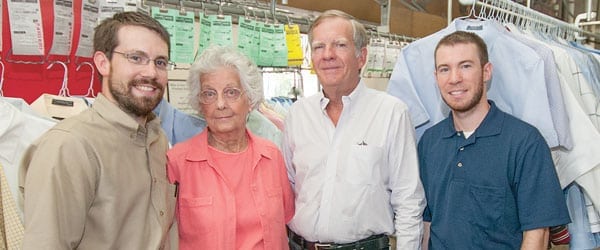
April McCarthy, who runs the Belmont Laundry Wilbraham Road store, shows off a 1912 wringer washing machine used when her great-grandfather ran the business.

The laundry was founded in 1907 by Harry Samble, who emigrated to the U.S. with his family from Scotland. It has withstood the test of time, an achievement that has taken Herculean resolve due to deaths, a devastating fire, and dramatic changes in the industry and economy.

The tragedies began when Harry died unexpectedly. At the time, his son Robert was 14, and his wife, Corrine, was forced to run the business. History repeated itself a generation later, when Robert, who had taken over the business, died at age 43 and his wife, Dorothy, had to run the laundry. Ironically, their son, Robert Jr., was also 14.

Today, 89-year-old Dorothy still spends Friday mornings at the business on 333 Belmont Ave., which is run by her son Robert (Rob) Jr. and his children, Matthew, Derek, and April McCarthy. The company has expanded and has two branches: Belmont Laundry and Custom Dry Cleaners, which has four storefronts — two in Springfield, one in Longmeadow, and one in West Springfield — as well as the Belmont Linen and Uniform Rental service, which comprises the majority of the business.

“There is a lot to this, and you have to be good at many things to survive, grow, and remain strong, because there is always something that needs attention and improvement,” Rob said. “But we have not only kept up with things, we’ve been pioneers in the latest advances.

Robert Samble, left, with his son Matthew

Robert Samble, left, with his son Matthew, says the 106-year-old business has persevered through tragedy and calamity by keeping a constant focus on innovation.

“At one point, we were the only ones in the world using radio frequency identification chips with bar codes in our garments and entrance mats. We were also the first in the Northeast to put in spot cooling for our employees,” he told BusinessWest, noting that his sons spent an entire summer installing thousands of electronic chips in the mats used by area businesses.

“Every new idea that comes out gets evaluated, and if it’s feasible, we jump on it,” Rob continued, adding that Belmont is a green company and has recycled 23.5 million gallons of water over the past five years, recovered thousands of BTUs of energy, recycled thousands of hangers and garments each year, and uses environmentally friendly detergents and chemicals.


In the Beginning

Harry’s business began as a home-based operation. “The laundry was picked up on bicycles, washed in a tub in a barn behind the house, and brought back to people while it was still wet,” Rob said.

As the customer base grew, Harry graduated to a horse and wagon, then an electric truck, and, later, a gas-powered vehicle.

His wife Corrine ran the business after his early death, until the couple’s oldest son, Harry Jr., took over. He was joined by his younger brother Robert (Bob) when he returned from serving as a fighter pilot with the Army Air Corps during World War II. “By the early ’60s, my father had become president,” Rob recalled, explaining that his dad took the helm when Harry Jr. retired.

Competition had always been stiff, as there were more than 20 laundries in Springfield, but many of the owners were friends, and Bob’s cronies included Russ Dale of Dale Brothers Laundry on Union Street and Bill Hamilton of Royce Superior Laundry.

When Maytag began running coin-operated laundromats in low-income neighborhoods in 1958, they all signed on to the program. “They thought they would get rich,” Rob said. “But the laundromats were left open 24/7 without any supervision, which proved to be a bad idea.”

He remembers accompanying his father in the middle of the night when windows were shattered or money was stolen from coin boxes. It wasn’t long before Maytag’s experiment failed, and when the company switched gears and began selling washing machines to the public, many local laundries went under. The D’Amato family was one of millions who purchased a washer, which meant they could do their own laundry.

“The last nail in the coffin came when polyester was introduced, as it didn’t need ironing,” Rob said. “By the early ’70s, there were only two commercial laundries left in Springfield.”

As a child, he wanted to follow in his father’s footsteps. But during his teens, his interests shifted, and after graduating from high school, Rob attended Springfield Technical Community College for six months, worked as an auto mechanic, then moved to Arkansas, where he revived and ran a catfish farm.

In time, he returned to Springfield and was working as a refractory mason when his mother told him she was tired of running the struggling laundry. The year was 1974, the economy was floundering, and she said he either had to take over or the business would be sold. So Rob entered the family enterprise at a time when other laundries were closing their doors.

“I had held things together for eight years,” Dorothy said. “My youngest son was only 8 when my husband died. He was killed on Saturday, and I went to work the following Tuesday. It was a crazy time. I had had nothing to do with the business when my husband was alive, but my dad gave me advice, and everyone there was friendly and worked very hard.”

She also received help from her mother-in-law, who was in a nursing home. She was still very interested in the business and wanted to see an itemized expense sheet every week. “She had been treasurer at one time and signed all the checks,” Dorothy recalled. “I signed them too, once I took over, but the place was much smaller then. It was homey, and a lot of ladies worked there. I knew everyone by name.”

When clothes came into the laundry, they went to a ‘marker,’ who put a number on every garment. Each family was assigned their own number, which ensured they got their laundry back. “We used to wash wool blankets and hang them over a big board suspended from the ceiling, because they couldn’t go into the dryer. It was so different back then. Everything was done by hand. Now we use pulleys, lifts, and belts,” Dorothy said.

Although it was all she could do to keep the laundry operational, her husband had purchased new machines and rebuilt the structure before he died.

Rob said the company’s expansion began when his grandfather sought and received a variance to put an addition onto his building, which was in a residential zone. His father purchased adjacent properties as they became available, but by the time Rob became vice president, some of them had been sold to meet expenses.


New Ventures

The business took a new spin when Dorothy sent Rob to the National Institute of Dry Cleaning in Joliet, Ill. He returned with new ideas, but the manager immediately shot them down.

However, a short time later, the man had a stroke, and the trustees at Security National Bank named Rob vice president. “I was only 21 at the time,” he said.

His first coup was landing a contract after union workers walked off the job at the Worcester State School. “One day, the school showed up with a 53-foot trailer filled with sheets,” he said, adding that the Worcester operation also did the laundry for the Belchertown and Northampton state hospitals.

Belmont also served as a backup for Baystate Medical Center’s laundry and “they always had work for us,” Rob said. “The revenue we made from those accounts allowed us to grow into the textile-rental business.”

That venture was in line with the training he had received at the Institute of Dry Cleaning, because it did the laundry for a nearby prison. Rob’s work as an auto mechanic also came into play as he purchased old equipment and rebuilt it to keep up with the expanding business, which soon grew more competitive.

Large, national firms began vying for hospital accounts, and as a result, Belmont lost its contracts. But the company was already branching out into new territory, and in 1980 Rob hired two salesmen for the textile business. One didn’t last, but Ernest Gagnon, who stayed with the company for 20 years, helped make Belmont Laundry a recognized name in the uniform- and linen-rental industry.

The family laundry storefront also remained open, and in 1977, when Dale Brothers Laundry closed, Rob purchased its routes and customer list. “It was a good decision because we had done family laundry for so long, we were on automatic pilot, so although it was a dying industry, we were able to keep up with it,” he said. However, the business was threatened as one-hour cleaners were coming into vogue and Rob’s competitors were going bankrupt.

The next blow came in 1981 when Belmont Laundry was devastated by a fire. “We lost our offices and the store, but were so efficient, we delivered laundry and dry cleaning the next day,” Rob said.

He set up a temporary office and “scrimped and saved” until he had enough cash to build again, which was possible because he served as general contractor. “I only had enough money for a down payment and went back into debt. But I was able to rebuild with help from friends in the trades, who guided me,” he told BusinessWest.

In 1988, Rob purchased the Shea/Flair Dry Cleaning chain. “It made us the market leader in dry cleaning. We took over three plants with stores, which brought up us to seven locations. Then, in 1989, the economy tanked, and although we continued to invest in the stores and plants, it was a futile effort,” he said.

Today, four of those stores are still open, including one on Wilbraham Road in Springfield, which is run by Rob’s daughter, April McCarthy. The Main Street store is being used as a storage facility, and the former Flair location at the ‘X’ in Springfield, as well as another store, were sold.

“But our rental business continued to grow — we specialize in uniforms, sheets, and patient gowns,” Rob said, adding that the company’s accounts include restaurants and auto dealerships.

Rob’s sons began working at Belmont when they were about 10, and Matthew, now vice president, recalls straightening out hangers, then manning the counter when he was in high school. Derek, who is the dry-cleaning division manager, said he and Matt painted the roof of the building when he was 12.

They have followed the family tradition of implementing change. “I pushed for green cleaning, and by 2009, we were totally green; it was the right thing to do,” Derek said, adding that the company needed new machines, and he felt it was ready to handle more business.

“We put in a new shirt department and revamped it twice within five years,” he said. “Technology is changing so quickly, and I wanted to have the highest level of quality for our customers. The market has slowed, but we’ve held our own. We have tried different styles of marketing and spent time learning how to implement new ideas. I spend about 55 hours a week here and look forward to coming to work every day.”

April began working in the Longmeadow store when she was 14. “I had a lot of responsibility,” she said, adding that she closed the store at the end of the day.

When she went to Westfield State University, she worked in the West Springfield store, and although she earned degrees in elementary education and psychology, “I could never leave. I’ve been here almost 22 years, and it’s a great business. We depend on each other and have customers who have been coming to us since I started working as a teen. This is such a part of my life.”


Forging Forward

Matt and Rob plan to visit a laundry in Davenport, Iowa in August to evaluate the operation and see what they can learn from it. “We have to work to stay ahead of things. There are a lot of different angles to the business,” Matt said.

Rob agrees. “I’ve made mistakes, but it was diversity that put us on the map in the rental business, and it’s diversity that allowed us to stay in the retail business. We have a good product and take care of our employees. They are very good to us, and if it wasn’t for them, we wouldn’t be here today. They take care of our customers, who can rely on a consistent product.”

Which is exactly what D’Amato experienced when the centenarian called them a month ago for the first time in about 25 years. “They still do a good job,” he said.

Education Sections
Colleges Increasingly Rely on Social Media to Interact with Students and Alumni

Janet Garcia

If colleges aren’t active in social media, Janet Garcia says, they’re not on prospective students’ radar.

In the age of smartphones and social media, Janet Garcia says, people are constantly on the lookout for information. College students are no different; in fact, they might embody that cultural shift more than anyone.

“This generation of students is on the Internet constantly,” said Garcia, director of Marketing at Westfield State University. “If you’re not on the Internet, you’re not on their radar screen.”

No worry of that at WSU, however, which uses Twitter as an information-sharing resource, LinkedIn as an alumni networking tool, and Facebook for — well, just about everything else.

“These social-media tools, are tremendously valuable to me from a marketing perspective because we’re able to engage with audiences while letting people know what’s going on and what’s coming up more efficiently,” said Garcia. “For us, it’s a great value that adds to the scope of our marketing.”

But while traditional marketing, advertising, or recruitment efforts have historically been one-way conduits, social media is, by definition, a back-and-forth effort, she noted. And that has turned the way colleges communicate with their various constituencies upside down.

“One of the best things about social media is that it facilitates a dialogue among groups that wouldn’t easily be in conversation with each other — current students, prospective students, alumnae, parents, friends of the college,” said Laurie Fenlason, vice president for Public Affairs at Smith College. “That lends authenticity and immediacy, which helps students considering Smith get a full and vivid picture of what life will be like in college and after college.”

She, like Garcia, emphasized the concept of engagement in describing her institution’s active use of Facebook, Twitter, Instagram, LinkedIn, and YouTube, as well as its lesser presence on Tumblr, Pinterest, and Foursquare.

Nancy Farrell

Nancy Farrell says the Elms is active on many social-media channels, but the common denominator is engagement.

“At Smith, we have an active social-media program that engages all of our key constituencies,” Fenlason said, including alumni, current and prospective students, parents, faculty, and staff among those groups. “Our goals are not only to maximize our followers, but to create engagement and dialogue.”

For example, “a Tweet or Facebook post about a Smith graduate’s achievements can go a long way toward making the case for Smith to a prospective student and her family; they can see an actual, vivid example of the value of the education we provide,” she explained. “And videos or Instagram images give prospective students a sense of what it feels like to be on our campus — what it feels like to be a Smithie — even if they’re half a world away.”

Nancy Farrell, director of the Office of Institutional Marketing at Elms College, also used that word engagement in noting why her school is active on Facebook, Twitter, YouTube, and Instagram. “Each one serves a unique function in our messaging, but the one commonality they have is engagement, which is the whole concept behind social media.

“The really important thing to understand is the behavior of this generation of students,” she added. “They want things immediately. You have to instantly respond and stay connected to them — to operate where they are, and work in their environment.”

For this issue’s focus on education, BusinessWest logs on to the world of social media, and how colleges have increasingly come to rely on it to inform, stay in touch, and, yes, engage.


Click Like

Take, for example, WSU’s comprehensive strategy for Facebook.

“We use it in a lot of different ways,” Garcia said. “Our admissions staff has their own Facebook presence and use that for their own purposes, for prospective students, to keep them apprised of what’s going on, let them know deadlines, open houses, things like that.

“We also create pages for each incoming class. For example, the 2017 page was just created this year. We invite prospective students to join the page and communicate with them,” she went on, noting that the college helps with planning and tries to increase their comfort level. “Then they use that page for four years here to communicate with their classmates, share information, talk about classes, sometimes try to sell books, and talk about events they’re going to and try to get their friends to go. It’s a real communication tool.”

It’s one that continues after graduation, only as an alumni page, she added. Meanwhile, the athletic department manages a page to keep students and the public up to date on games and athletes, while individual academic departments set up pages based around those students’ interests.

And, of course, “the university has a general Facebook page to keep the public engaged,” Garcia explained. “We provide information about events and keep people engaged with what’s happening on campus — everything from infrastructure changes to a faculty member getting a grant, that kind of thing … anytime we’re in the news. We really have quite a Facebook presence.”

The Elms also encourages a vibrant Facebook culture, said Karolina Kilfeather, web manager. She said today’s college-age generation doesn’t respond to traditional messaging like their predecessors did, but are looking for something more sincere — and, again, communication that runs in both directions.

“So we’re careful about not policing what students say, even if it’s something negative,” she told BusinessWest. “We do keep our eye out for inappropriate things, like bullying or being wantonly aggressive. But beyond that, we do the best we can to respond to complaints or negativity, but never try to shut anyone off. We don’t discourage students from being honest, and because of that, they stay engaged with us.”

In short, she said, colleges need to realize there’s been a seismic shift in the way young people communicate. “It has become much more of a dialogue. The hardest thing to learn is coming down from the mountain. The audience wants a two-way channel now.”

It’s gratifying, Garcia said, when that audience spans generations. “It’s interesting because we’ll have alumni go to a class page to talk to current students about when they were here, things they did, how much things have changed. That cross-generational communication happens on Facebook a lot.”


Press Play

Kilfeather said the Elms has certainly recognized the shift, using social media to make sure people know what’s happening on campus. “It’s been very instrumental getting crisis information out, if we have potential snow days … students look for information on Facebook and Twitter. We’ve learned we get a quick response to questions on social channels.”

Meanwhile, she said, Twitter has been a positive place to engage prospects, while YouTube is useful to showcase some of the campus programs with short videos, including footage of a cafeteria flash mob and a music video created by the field hockey team.

“These were student-driven, their idea, they came up with it, and for the most part, they produced it,” said Doug Scanlon, publications manager at the Elms. “It was organic.”

Social-media moments like that are useful in projecting a different side of campus life than someone might encounter in an official college publication, Kilfeather said.

“We have a reputation for a serious image, and this is an opportunity to use a lot more humor and candor and a more conversational tone. People have responded positively to that; students look for content after events, they want to see more videos, they want to see more photos. It has changed the tenor of the relationship between colleges and students.”

And they’re not waiting until they get back to their rooms, but living in virtual connectivity 24/7, Scanlon said. “These students all have smartphones, and they’re always checking in. It’s something that’s a part of their lives now.”

Managed correctly, Kilfeather said, social media can definitely pay dividends for a college, and that includes making sure the college’s website is not only accessible from various social-media sites, but optimized for smartphones and tablets. “Facebook and Twitter are very proactive about making sure they are successful on mobile devices. No longer does somebody have to be at the computer to interact with your message.”

As a result, “our percentage of mobile traffic to the website has more than doubled every year for the past five years,” she noted. “We know we have to be available that way, to make it easy to access and share that way. Mobile devices are certainly not going away.”

Neither, most marketing professionals seem to agree, is social media, and the constant challenge is learning how to use it and what platforms to adopt.

“It’s not about putting information out the way a lot of companies do when they get on the social-media bandwagon; they think of it as just another way of pushing, pushing, the way we use traditional marketing channels. This is very different,” Farrell said.

“As technology advances and different forms of social media come out,” she added, “we have to be very cognizant whether it’s the right move for us. Just because it’s there doesn’t mean we have to use it. That’s probably our biggest challenge moving forward: to carefully choose channels that work for us as an institution.”

That’s a challenge worth undertaking at Smith, Fenlason said, because colleges that don’t take social media seriously will find themselves at a competitive disadvantage.

“It’s vital to meet prospective students where they are, on the channels and devices they value,” she said, “with content that is truly social — visual, immediate, engaging, and real.”

Joseph Bednar can be reached at [email protected]

Education Sections
Holyoke Catholic Survives Through Its Close-knit Community

Theresa Kitchell’s quilt

Theresa Kitchell’s quilt, which showcases previous homes for Holyoke Catholic High School, tells only part of the story of this resilient institution.

Theresa Kitchell says she’s been quilting for decades now.

And like other practitioners of this time-consuming pastime, she enjoys it because it provides relaxation, as well as the ability to tell a story through one’s artistic expression.

The piece hanging in her office at Holyoke Catholic High School, which she has served as principal for the past three years, certainly does that. It features images of many of the historic buildings that were part of Holyoke Catholic decades before that name was ever put over a door — and there have now been several doors that have had that honor.

The only landmark missing is the current mailing address, 134 Springfield St. in Chicopee, said Kitchell, noting that she created the piece before the move to that location in 2008. (The quilt was created to be a featured prize at a fundraising auction, was given by the high bidder to his mother, an alum, and was then gifted back the school after she passed away).

But the quilt showcases only physical structures, Kitchell went on, so it tells only part of a remarkable story. The far more important chapters involve the perseverance and vision required for this school to live on through several forced relocations (more on those later), and the dedication of an alumni base and a current generation of parents who value quality and tradition more than a modern gymnasium and state-of-the-art auditorium — although those may also become reality in the not-too-distant future.

“I think ‘resourceful’ is a great adjective for us because we’ve had to make do for so many years,” said Kitchell, referring first to a move to Granby and the former St. Hyacinth Seminary, and later a move to the current address. “We had to start from scratch, in everything, and the faculty has been incredibly willing to do whatever needed to be done, in whatever facility we found ourselves.”

Today, Holyoke Catholic, with annual tuition of $8,000, boasts an enrollment of roughly 300, with students from 30 area communities and several from China. That number has remained steady in recent years despite a deep economic recession and the latest of those aforementioned moves.

Kitchell and Liz Adzima, director of Advacement, attribute this consistency to recognition among parents that, while the school still lacks some amenities, it is synonymous with value and excellence.

These are exemplified in the price tag — well below what is charged at area private schools — but also in the award-winning STEM (science, technology, engineering, and mathematics) curriculum, multiple partnerships with neighboring Elms College, and strong performing-arts and internship programs, among other initiatives.

“Parents make that decision to send their children here because they know that the sacrifices to be made are well worth it for the quality of education their children will receive here,” said Adzima.

For this issue and its focus on education, BusinessWest turns the spotlight on Holyoke Catholic, which has a rich, intriguing history and — because of that aforementioned resilience and vision — is adding new chapters to the story told by Kitchell’s quilt.


Quite a Yarn

Some of the institutions that came together to form what is now Holyoke Catholic High School can trace their histories back to the late 1800s, said Adizma, noting that Holyoke once had many small parish elementary schools and high schools.

These schools weren’t large enough to field their own sports teams, she went on, adding that, by the middle of the 20th century, several, including Holy Rosary, Sacred Heart, and St. Jerome’s, were bringing their athletes together to compete under the name ‘Holyoke Catholic.’ And as it became increasingly difficult for those smaller schools to exist on their own, discussions intensified about taking the concept of Holyoke Catholic beyond the playing field.

“Through that on-field unity, people started seeing that maybe it was time to come together,” said Adzima, adding that Holyoke Catholic High School was formed in 1963 on the campus of St. Jerome’s, located in the heart of the city’s downtown.

Eventually, however, those facilities became overcrowded and, worse, structurally unsafe — a determination made by Thomas Dupre, bishop of the Catholic Diocese of Springfield, in 2002.

The search for what all agreed would be temporary quarters eventually focused on the 500-acre St. Hyacinth College & Seminary in nearby Granby, said Kitchell, adding that, while the location was not ideal, especially for families in Holyoke, the school managed to maintain consistent enrollment numbers.

And while there was an initial push to raise funds to build a new Holyoke Catholic, fiscal constraints brought a focus on retrofitting an existing educational facility, Adzima went on, adding that sights were eventually set on a former elementary school on Springfield Street in Chicopee, between the Holy Name and Assumption parishes, and only a few hundred yards from Elms College.

The process of retrofitting the facility was completed in the summer of 2008, and the new Holyoke Catholic opened that fall, said Kitchell, adding that the move brings a number of advantages for the school, ranging from accessibility to the natural connection with the Elms.

“The parents have been most supportive; they wanted their children to go to Holyoke Catholic, and they made the move to Granby, which was really inconvenient, and then they made the move here,” Kitchell told BusinessWest. “The move to Chicopee was certainly the most feasible economically, and there were other real pluses; first, we’d be back in an urban setting, and second, we’d be in close proximity to the Elms.”

Elaborating, she and Adzima said the new location, just minutes off interstates 91 and 391, makes the school not only affordable, but also quite accessible, especially to major population centers such as Chicopee, Springfield, and Holyoke.

As for the Elms, that institution brings facilities and collaborative efforts that greatly enhance the value of a Holyoke Catholic education, she said.


Sewing Seeds

The partnership with the Elms only begins with Sr. Mary Reap, the college’s president, who serves on the Holyoke Catholic board of trustees.

It extends to the institution’s library — which extends full privileges to Holyoke Catholic students, who can now take in a number of exhibits and programs, such as last year’s Holocaust exhibit — and the Veritas Auditorium, which has become home to the high school’s performing-arts programs.

However, and ironically, due to construction at the Elms, those programs are utilizing facilities at the former MacDuffie School in downtown Springfield. (MacDuffie relocated two years ago to the former St. Hyacinth’s Seminary.)

The drive to Springfield is somewhat inconvenient, but such headaches are certainly nothing new for loyal parents and alums, said Adzima, adding that the performing-arts program has enjoyed great success.

She explained that students, including incoming freshmen, work throughout the summer to produce the popular annual fall performance; recent shows (there are three a year) have included Hello, Dolly!, How to Succeed in Business Without Really Trying, and Godspell, and this year The Wizard of Oz is on the schedule.

While quality and high expectations are the foundation of the Holyoke Catholic curriculum, and, historically, the English department has been very strong, Kitchell is proud of recent recognition from the state for the science department, which recently earned the 2013 Secretary’s Award for Excellence in Energy and Environment Education.

The award is fitting, she added, since 10 faculty members and 10 students were involved last year in a ‘technology frontier experiment,’ during which teachers and students used iPads daily in all departments to deepen their knowledge of that form of technology in a school setting.

“The use of handheld devices, not just pen and paper, is coming; that’s their world, and we just have to figure it out,” said Kitchell. “Students and faculty have been learning, literally, from each other across the board.”

Another perk of the school’s proximity to the Elms is the college’s advanced-placement program, which allows qualified area high-school students to take up to three college credits each semester in their junior and senior years, graduating from high school with a possible 12 college credits. Offered at reduced-credit cost, the late-afternoon and evening courses are a convenient walk across the street for about 30 Holyoke Catholic students per year, said Kitchell.

In addition to that program, Holyoke Catholic requires every senior to undertake a 50-hour internship at an area business or nonprofit. To fulfill that requirement, they must write a paper about their experience and present to members of a faculty panel.

“This year, we had students in the operating room with a surgeon at Baystate Medical Center, in court with attorneys — one student actually dug into the research and helped solve a case — and they really get put to work,” said Adzima. “It lets them see what it’s like in the real world, and the more time and attention that they give to identifying the correct spot for them, the better experience they have.”


Common Threads

Looking ahead, Kitchell said the school is looking at ways to fill in some of the missing pieces from its bricks-and-mortar presence, including a performance-arts facility and a gymnasium.

Two parishes in that section of Chicopee have merged, she noted, and this development may create opportunities for expansion down the road if the fiscal health of the diocese permits.

In the meantime, the school will continue to carry on and make do, something it has become quite proficient at in recent years, displaying vast amounts of imagination and resilience, skills that are among the many it tries to impart to its diverse student population.

Thus, while Kitchell says there are no plans to add new segments to that quilt on her wall, there are certainly new chapters to be written in the history of a school that has found its place — in more ways than one.


Elizabeth Taras can be reached at [email protected]

Features

SpringfieldExtremeWebMakeover-logoThere was a time when companies could reach their full potential without an effective website, but those days are long gone.

Unfortunately, website design — done correctly, anyway — costs money, and it takes time and talent to build a marketing or sales strategy around a web presence. For many small but growing businesses in Greater Springfield, extra money and time aren’t easy to come by.

However, one fortunate business or nonprofit will get a major helping hand from the Greater Springfield Extreme Website Makeover, a promotion sponsored by BusinessWest and DIF Design.

“The idea came to me last year,” said Peter Ellis, president of DIF Design, a web-development company based in the City of Homes. “We do a good amount of pro-bono work and in-kind work, especially for nonprofits. I know, through networking connections in the area, that many companies do a good share of that. So I’m always thinking of new ideas — how can we pull together our creativity and make a bigger splash?”

The result is a contest that will grant one winner — both for-profit businesses and nonprofits are eligible — $25,000 worth of web-design and marketing services from DIF Design and four co-sponsors: the Creative Strategy Agency, Christine Parizo Communications, Hadley Printing, and viz-bang! The goal is to help a deserving enterprise raise its online presence and help usher it to the next level.

“The idea is similar to Extreme Makeover: Home Edition, in that we’re pulling together resources,” Ellis said, noting that the companies involved in the project will provide services ranging from copywriting and printing to videography and social-media strategy.

“It’s a collaboration of creative minds in the area,” he added. “So if you can’t afford a website or the services involved, all these people will get a whole project finalized for you; it’s not just designing a website.”

Any business or nonprofit may be nominated, as long as it’s located in the Greater Springfield region and has fewer than 15 employees. In addition, nominees must either have no website, or a site that has not been updated for at least two years.

The nomination form may be found at the contest website, springfieldmakeover.com. The deadine for submissions is Sept. 23.

All nominations will be judged by a panel of independent judges working in different creative and business fields, Ellis explained. “One might have a marketing background, or a website background, or a technological background, and so forth, and some will have business backgrounds. The goal is to announce the winner at the Western Mass. Business Expo in November.”

That event, scheduled for Nov. 6 at the MassMutual Center in downtown Springfield, is BusinessWest’s premier business-to-business event. The third annual event will feature more than 100 exhibitors, seminars on timely issues, breakfast and lunch programs, and a event-capping networking social.

Ellis noted that he’s pleased to help organize a contest that brings together talent from different fields to benefit a deserving business or nonprofit.

“Collectively, I know we can make a bigger impact,” he said. “The hope is to do this annually — not only to promote collaboration between local creative businesses, but to give back to the community by giving someone an opportunity they might not otherwise have.”


— Joseph Bednar

Departments Picture This

Send photos with a caption and contact information to:  ‘Picture This’ c/o BusinessWest Magazine, 1441 Main Street, Springfield, MA 01103 or to [email protected]


That’s Cool!

AlexLemonNorthwestern Mutual Springfield Group recently teamed with Alex’s Lemonade Stand Foundation, a national fund-raising movement to raise money for childhood cancer research, by setting up a lemonade stand in front of the company’s 1351 Main St. offices in downtown Springfield. During the height of the heat wave, the public was invited to enjoy an ice-cold lemonade and offer donations. From left, Diane Barnes, recruiting and selection professional with Northwestern Mutual, receives a cold lemonade from Stephanie Killian, event planner and marketing assistant, and Jill Monson, owner, both of Inspired Marketing.

Photo by Ed Cohen


Teacher Report

TeacherQualityKate Walsh, president of the Washington D.C.-based National Council of Teacher Quality, recently addressed Springfield Business Leaders for Education and others at the Naismith Memorial Basketball Hall of Fame regarding a first-ever national report on teacher preparation. The report, developed in partnership with U.S. News & World Report, evaluated more than 1,100 colleges and universities throughout the U.S. that educate and prepare elementary- and secondary-school teachers, including 35 within Massachusetts. A panel discussion followed the presentation. The panel included, from left, Tom O’Brien, human relations administrator for Springfield Public Schools; Walsh; Paul Hyry-Dermith, interim assistant superintendent, Holyoke Public Schools; and Henry Thomas, president of the Urban League of Springfield.


Closing the Deal

PicThisClosingCooley Dickinson’s recent Closing Day marked the official start of the Northampton-based hospital’s system-wide affiliation with Massachusetts General Hospital. Pictured, CDH president and CEO Craig Melin, left, and Mass General President Dr. Peter Slavin sign off on the affiliation closing memorandum using telemedicine technology. The technology, already in place at Cooley Dickinson for telestroke and teleneurology consultations with Mass General physicians, is one way the affiliation will bring expanded services to the people of the Pioneer Valley. Noted Slavin, “Mass General and Cooley Dickinson have had a successful working relationship the past four years with the collaboration between the Mass General Cancer Center and Cooley Dickinson Cancer Care Program. We welcome the opportunity to build on that and other clinical services.”

Court Dockets Departments

The following is a compilation of recent lawsuits involving area businesses and organizations. These are strictly allegations that have yet to be proven in a court of law. Readers are advised to contact the parties listed, or the court, for more information concerning the individual claims.


CHICOPEE DISTRICT COURT

Arnold & Eddie’s Foods Inc. d/b/a Arnold’s Meats v. Moriarty’s Pub and Grill Inc. and Michael Moriarty

Allegation: Non-payment of goods sold and delivered: $4,633.23

Filed: 6/2/13


Universal Am-Can LTD v. Diecutting Tool Services Inc.

Allegation: Breach of contract relating to transportation services rendered: $2,475

Filed: 6/2/13


GREENFIELD DISTRICT COURT

Kathryn Bridges and Gregory Kingsbury v. Cheryl Ingersoll d/b/a Yankee Realty

Allegation: Defendants damaged, destroyed, and lost personal possessions while charged with the duty of moving the plaintiff’s possessions: $44,000

Filed: 4/15/13


Terry J. Johnson and Yvonne Johnson v. PanAm Railways Inc., Joseph Yukl, James Rae, and Charles Steinmeyer

Allegation: Breach of contract, wrongful termination, and fraud: $220,000

Filed: 5/10/13


HAMPDEN SUPERIOR COURT

Edna Richards v. Michael J. Craig, M.D., Mercy Medical Center, and Mercy Inpatient Medical Associates

Allegation: Negligent administration of morphine despite documented morphine allergy, causing permanent injury: $136,551.56

Filed: 6/5/13


McLaughlin Paper Co. Inc. v. Durga, LLC d/b/a CoCo Key-Fitchburg, Courtyard by Marriot-Fitchburg, Holiday Inn-Fitchburg, Midas Hospitalty, LLC, and Great Wolf Resorts

Allegation: Non-payment of goods sold and delivered: $29,808.75

Filed: 6/12/13


Northern Land Clearing Inc. v. NASDI, LLC

Allegation: Non-payment of rental equipment: $35,126

Filed: 5/28/13


PALMER DISTRICT COURT

Stiller Distributors Inc. v. Earth First Flooring Inc.

Allegation: Non-payment of goods sold and delivered: $1,390.94

Filed: 5/21/13


SPRINGFIELD DISTRICT COURT

Arthur J. Stevens Fine Furniture v. Krent/Paffett/Carney Inc. and John Carney d/b/a Experience Design

Allegation: Breach of settlement agreement: $21,019.15

Filed: 5/22/13


National Union Fire Insurance Co. of Pittsburgh, PA v. Foley Transport Inc.

Allegation: Breach of contract and failure to pay: $15,442.76

Filed: 5/22/13


Sanford and Hawley Inc. v. James D. Hall d/b/a Jim’s Renovation & Repair Services

Allegation: Non-payment of goods sold and delivered: $6,829.50

Filed: 5/21/13


United Rentals Inc. v. Jeta, LLC and Steven A. DeLisle

Allegation: Non-payment for materials, equipment, and services: $11,754.90

Filed: 5/21/13

Chamber Corners Departments

CHICOPEE CHAMBER OF COMMERCE

www.chicopeechamber.org

(413) 594-2101

• August 1: Part 3 of a five-seminar series: “Conquering the Challenge of Employment Law Compliance for Small Businesses: What You Need to Know and How to Stay in Compliance,” from 8 to 10:30 a.m. at the PeoplesBank Conference Room, 330 Whitney Ave. in Holyoke. Presenter will be Layla Taylor, Esq. This program will focus on:

• Identifying worker-classification issues (independent contractor versus employee);

• Wage-and-hour basics (minimum wage, overtime, exemptions, and child-labor laws);

• Immigration (I-9 compliance);

• Discrimination laws (federal and state, reasonable accommodation issues);

• Benefits (leave laws and health insurance);

• Communicating with employees without creating a contract; and

• How to stay in compliance (free resources and when to contact a professional).

• August 22: Part 4 of a five-seminar series: ‘Marketing Strategies that Lead to Growth,’ from 8 to 10:30 a.m. at PeoplesBank Conference Room, 330 Whitney Ave. in Holyoke. Presenter will be Mary McCarthy. Concerned about delivering your profit? Unsure how to reach your target audience? Overwhelmed with all the media options available? Smaller businesses often lack the time to execute their marketing tasks, and are challenged with budgetary constraints. This workshop is designed for businesses seeking cost-efficient and effective marketing strategies that lead to growth and seamless communication with their customers. Attendees will learn:

• Branding strategies that will effectively convey your marketing messages;

• How to distinguish your marketing plan from your competition;

• Effective ways to reach your target audience and foster loyal relationships;

• How to connect with today’s tech-savvy customers through social media; and

• Networking essentials that will help you get more business.


HOLYOKE CHAMBER OF COMMERCE

www.holycham.com

(413) 534-3376

• Sept. 18: Save the date! Chamber Annual Clambake, 5-7:30 p.m. Plan now to make the clambake your employee picnic or employee-appreciation event. Watch for more details.


MASSACHUSETTS CHAMBER OF COMMERCE

(413) 525-2506

• Nov. 12: Massachusetts Chamber of Commerce Annual Meeting & Awards Luncheon, 9 a.m., at the DoubleTree, Westborough. For more information on ticket sales and sponsorship opportunities, call the chamber office at (413) 525-2506 or e-mail [email protected]


WEST OF THE RIVER CHAMBER OF COMMERCE

www.ourwrc.com

413-426-3880

• August 19: West of the River Chamber of Commerce 10th Annual Golf Tournament, Springfield Country Club, West Springfield. Cost: $125 per golfer. Presenting Sponsor: Hard Rock Hotel and Casino of New England. For more information on registration and sponsorship opportunities, call the chamber office at (413) 426-3880 or e-mail [email protected].

• Sept. 4: Wicked Wednesday, hosted By E.B’s, 5-7 p.m. Wicked Wednesdays are monthly social events hosted by various businesses and restaurants. These events bring members and non-members together to network in a laid-back atmosphere. Cost: free for chamber members, $10 for non-members (event is open to the public; you must pay at the door if you’re a non-member). For more information, call the chamber office at (413) 426-3880, or e-mail [email protected].


GREATER WESTFIELD CHAMBER OF COMMERCE

www.westfieldbiz.org

(413) 568-1618

• Sept. 11: September WestNet, 5-7 p.m., at the Holiday Inn Express, 39 Southampton Road, Westfield. Come and meet chamber members and bring your business cards for a great networking opportunity. Cost: $10 cash for chamber members, $15 cash for non-members. Walk-ins are welcome. Call the chamber at (413) 568-1618, or e-mail Pam Bussell at [email protected]. Your first WestNet is always free.


Departments People on the Move

The Harold Grinspoon Foundation announced the following:

Kate Conn

Kate Conn

Kate Conn has joined the foundation in a newly-created position as Chief Executive Officer. Together with its founder, Harold Grinspoon, Conn will work to further the Foundation’s philanthropic mission to enhance Jewish and community life in North America, Israel, and beyond, and develop innovative strategies as the organization celebrates 20 years of philanthropy. Conn most recently served as founding Executive Director and President of the Aldo Leopold Nature Center Inc., an educational and entrepreneurial nonprofit in Madison, Wisc. Conn grew the organization into one of the region’s leading institutions as she established regional and statewide cooperative networks and strong national partnerships with community, government, and industry leaders. She is credited with the creation of a groundbreaking interactive museum and learning center and award-winning programs. Conn has served in leadership capacities at the University of Chicago, Northwestern University, and several cultural organizations, philanthropic endeavors, and policy institutions. In addition to her nonprofit and community work, Conn was a special consultant for an American Girl book series and an author for the Wisconsin Historical Press Badger Biography series. Since its inception in 1993, the foundation has given more than $120 million in philanthropic support of Jewish programs. HGF initiatives include PJ Library, Sifriyat Pijama (PJ Library’s sister program in Israel), JCamp180, Voices & Visions, and Life & Legacy; and

Arlene Schiff

Arlene Schiff

Arlene Schiff will lead the foundation’s new Life & Legacy Program, a legacy partnership effort that incentivizes Jewish agencies, synagogues, and day schools to secure legacy gifts and steward donors. With widespread recognition that a large transfer of generational wealth is taking place — about $41 trillion by 2020, according to a 1999 Boston Foundation study — the Life & Legacy program aims to assist Jewish organizations with proactively securing endowments through legacy gifts. Schiff will lead the program after a successful tenure as executive director of the Jewish Federation of the Berkshires, where she worked since 2001. At the federation, she increased the donor base and fund-raising substantially and directed many community initiatives. Nationally, she has been active in Jewish community service with the Jewish Federations of North America. Locally, she has served on the Berkshire Housing Development Corp., the Berkshire Immigrant Center Advisory Board, the Lenox School Committee, and others. The Life & Legacy is a partnership program that invites up to seven communities a year to apply to partner with HGF. The foundation commits funds to the selected program for two years. If fund-raising goals are met, the partner receives a matching grant from HGF that covers 50% of the partner agency’s annual budget, up to $150,000, for each year. In this first year, the partners are the Foundation for the Charlotte Jewish Community, the Jewish Foundation of Memphis, the Greater Miami Jewish Federation, the Jewish Foundation of Greater New Haven, the Orange County Jewish Community Foundation, the Oregon Jewish Community Foundation, and the Jewish Community Foundation of Greater Mercer.

•••••

Three new board members were recently inducted for three-year terms to the Gray House, a Springfield nonprofit that helps neighbors facing hardships to meet immediate and transitional needs by providing food, clothing, and educational services in a safe, positive environment. They are:

Richard Marcil

Richard Marcil

Richard Marcil, owner of Golden Ear Studios and the Minister of Music for the Wachogue Congregational Church. He also conducts the annual Holiday Grand Chorus as part of a benefit to raise money for cancer research;


Susan Mastroianni

Susan Mastroianni

Susan Mastroianni, Partner and Director of Media Services at FitzGerald & Mastroianni Advertising in Springfield. She is also a member of the Rotary Club of Springfield and previously served on its Board of Directors; and


Gregory Schmidt

Gregory Schmidt

Gregory Schmidt, an Attorney with Springfield-based Doherty, Wallace, Pillsbury & Murphy P.C. He also currently serves on the Board of Directors of the Children’s Museum at Holyoke Inc. and the Advisory Board of the Scibelli Enterprise Center at Springfield Technical Community  College.


•••••


Rosemary Nevins

Rosemary Nevins

Royal LLP, the woman-owned, boutique, management-side labor and employment law firm, announced that Attorney Rosemary Nevins has been selected as one of Massachusetts Lawyers Weekly’s “Top Women of Law.” The program celebrates outstanding achievements by exceptional women. Each year Massachusetts Lawyers Weekly honors women who have made great professional strides and demonstrated outstanding accomplishments in the legal community. Nevins will be honored at an event in Boston in October.

•••••

Kate Campiti

Kate Campiti

Human Resources Unlimited, a Springfield-area nonprofit corporation that helps more than 1,300 people per year with physical and mental disabilities, recently named Kate Campiti to the Board of Directors. Campiti is the Associate Publisher of BusinessWest and the Healthcare News and has extensive experience in management, leadership, and sales. She is a graduate of UMass Amherst with a bachelor’s degree in Communications with a minor in Political Science. Prior to her current position, she served as a Sales Executive with OneStar Communications. Campiti joins Timm Marini, Chairman; Patrick Leary, Vice Chairman; Michael Moriarty, Treasurer; Charlene Smolkowicz, Secretary-Clerk; and board members William Marsh, Thomas Bienkowski, Ed Wytrych, Francis Fitzgerald, Curtis Edgin, Amy Royal, Chester Wojcik, and Alfonso Santaniello.

•••••

Christina Tuohey

Christina Tuohey

Christina Tuohey was recently appointed Director of Annual Giving and Alumni relations at Springfield Technical Community College by the STCC Board of Trustees. A graduate of Georgia State University, Tuohey brings several years of experience working in a variety of development and annual-giving positions. She has served as the Annual Giving Associate and Corporate, Foundations, and Government Relations Associate for the Museum of Science in Boston; Membership Development Specialist and Volunteer Development Specialist for the Girl Scouts of Central/Western Massachusetts in East Longmeadow; and most recently as the Fundraising Coordinator for the Muscular Dystrophy Assoc. located in Glastonbury, Conn.

•••••

Westfield-based Tighe & Bond recently announced professional milestones reached by four employees:

Page Czepiga

Page Czepiga

Page Czepiga, a Land Use Planner in the Westfield office and member of the American Planning Assoc., recently became a Certified Land Use Planner after passing the American Institute of Certified Planners (AICP) exam. The AICP designation is the most highly regarded certification in the field of land-use planning, and the designation requires an intensive certification-maintenance and continuing-education program to keep certification valid. Czepiga provides planning and permitting support for a wide variety of the firm’s projects, and she regularly performs environmental and zoning analyses for renewable-energy feasibility and land-use/redevelopment studies. Her experience includes brownfields redevelopment, wetlands, and environmental-resource permitting, and she is currently active in the preliminary planning and permitting of the $800 million Hard Rock International hotel and casino complex proposed in West Springfield. Czepiga earned her BS in Community and International Development from the University of Vermont;

Elizabette Botelho, an Engineer, recently passed her PE exam to become a licensed engineer. Botelho currently provides engineering services for solid-waste landfill projects and has completed hydrologic and hydraulic analysis to assess the flood hazard of more than 40 high hazard dams in Massachusetts. She works out of the firm’s Westfield office and has been employed at Tighe & Bond since 2006, when she graduated from Northeastern University with a BS in Civil Engineering;

• Engineer Cynthia Castello also passed her PE exam. She has worked on water and wastewater projects, and has provided construction services in Connecticut and design and construction services in West Springfield. She has five years of industry experience, has worked out of the firm’s Middletown office since 2011, and received her BA in Physics from Colgate University and her MS in Environmental Engineering from UMass Amherst; and

Christina Jones, an engineer at the Westfield office, also passed her PE exam. She has worked on water-system modeling projects for the cities of Chicopee and Portsmouth, N.H., as well as water-system design projects for Amherst and Connecticut’s Metropolitan District Commission and the South Central Connecticut Regional Water Authority. She is a member of Engineers Without Borders and is on the New England Water Works Assoc. program committee and the New England Water Environment Assoc. student activities committee. Jones began her career at Tighe & Bond in 2009 after receiving her MS in Environmental Engineering from UMass Amherst.

•••••

Maureen Buxton

Maureen Buxton

Richard Collins, President and CEO of United Bank, announced that Maureen Buxton is the 2013 winner of the President’s Award, the highest honor bestowed by the institution. The annual award is presented to an employee who exemplifies professional excellence through teamwork, integrity, a positive attitude, and a strong commitment to United Bank.  Buxton, the Personal Banker for United’s Chicopee branch, was instrumental in the training and transition of New England Bank employees in Connecticut following that bank’s merger with United last fall. Earlier in her United career, Buxton received the bank’s quarterly Service Excellence Award in recognition of her exceptional job performance. Buxton joined United Bank in 1998 as a Customer Service Representative at the Holyoke branch and was promoted to become the Personal Banker for United Bank’s first Chicopee branch when it opened in 2009.

•••••

Corey Lomas

Corey Lomas

Palmer-based Vartanian Custom Cabinets announced the addition of Corey Lomas as the company’s newest Sales Representative. Lomas holds a BA in Visual Arts with a concentration in Painting and Drawing from SUNY New Paltz. He has previous work experience in sales, which, combined with his education in the visual arts, provides an excellent foundation for his new post selling fine kitchen design and custom cabinetry. Lomas is a past winner of the Monson Council of Arts Rising Artist Award, and has exhibited his portfolio of drawings and paintings at the Wilbraham Public Library.

Bankruptcies Departments

The following bankruptcy petitions were recently filed in U.S. Bankruptcy Court. Readers should confirm all information with the court.


Almeida, Eileen Mary

P.O. Box 712

Turners Falls, MA 01376

Chapter: 7

Filing Date: 06/19/13


Andino, Wendy Ivette

a/k/a Garcia, Wanda Ivette

325 Oakland St.

Springfield, MA 01108

Chapter: 7

Filing Date: 06/24/13


Axt, Jr., Louis A.

Axt, Terry J.

48 Jackson St.

North Adams, MA 01247

Chapter: 7

Filing Date: 06/19/13


Belanger, Brandy A.

97 Maebeth St.

Springfield, MA 01119

Chapter: 7

Filing Date: 06/17/13


Belanger, Jamie L.

a/k/a Buckland, Jamie L.

19 Bulat Dr.

Springfield, MA 01129

Chapter: 7

Filing Date: 06/19/13


Bennington Building Company

Bennington, Philip J.

Bennington, Margaret A.

1227 North Orange Road

Athol, MA 01331

Chapter: 7

Filing Date: 06/25/13


Bezares, William

Rosario, Coralie

40 Church St.

Westfield, MA 01085

Chapter: 7

Filing Date: 06/19/13


Bliss, George W.

Bliss, Laurie

84 North Main St., Apt. #1

Belchertown, MA 01007

Chapter: 7

Filing Date: 06/27/13


Bliven, Shannon C.

a/k/a Carey, Shannon M.

35 Martin St.

Holyoke, MA 01040

Chapter: 7

Filing Date: 06/24/13


Cameron, Lucretia D.

1259 Plumtree Road

Springfield, MA 01119

Chapter: 13

Filing Date: 06/25/13


Ciocca, Nicole M.

a/k/a McNally, Nicole M.

PO Box 473

Belchertown, MA 01007

Chapter: 7

Filing Date: 06/24/13


Collins, Michael A.

283 Wildermere St.

Chicopee, MA 01020

Chapter: 13

Filing Date: 06/25/13


Cook, Caroline

a/k/a Garrity, Caroline

P.O. Box 247

Lenox Dale, MA 01242

Chapter: 7

Filing Date: 06/26/13


Cotto, Regina

531 South Summer St.

Holyoke, MA 01040

Chapter: 7

Filing Date: 06/19/13


Dafler, Jason L.

P.O. Box 681

Ware, MA 01082

Chapter: 7

Filing Date: 06/24/13


Dallaire, Sylvain J.

18 Highland Village

Ware, MA 01082

Chapter: 7

Filing Date: 06/24/13


Desjardins, Nancy E.

32 Rochester St.

Chicopee, MA 01020

Chapter: 7

Filing Date: 06/20/13


Fairfield, David E.

56 New Road

Pittsfield, MA 01201

Chapter: 7

Filing Date: 06/21/13


Field, John R.

13 Murray St.

Adams, MA 01220

Chapter: 7

Filing Date: 06/25/13


Figueroa, Mildred

257 River St.

West Springfield, MA 01089

Chapter: 7

Filing Date: 06/21/13


Galbreath, Tiara S.

188 Jasper St.

Springfield, MA 01109

Chapter: 7

Filing Date: 06/24/13


Gurley, Antoinette L.

30 Hight St.

Agawam, MA 01001

Chapter: 7

Filing Date: 06/24/13


Hallums, Johnny R.

791 Armory St.

Springfield, MA 01107

Chapter: 13

Filing Date: 06/26/13


Hernandez, Ramonita

994 Montgomery St.

Chicopee, MA 01013

Chapter: 7

Filing Date: 06/19/13


Holcomb, Judith May

12D Colonial Park

Brimfield, MA 01010

Chapter: 7

Filing Date: 06/18/13


Hosking, Ana L.

367 St. James Ave.

Springfield, MA 01109

Chapter: 7

Filing Date: 06/27/13


Ingram, Mary M.

16 Moore St., Apt. 1

Chicopee, MA 01013

Chapter: 7

Filing Date: 06/27/13


Kratovil, Susan M.

94 Kensington St.

Feeding Hills, MA 01030

Chapter: 7

Filing Date: 06/17/13


Kreuser, Belinda A.

38 Rich St.

Chicopee, MA 01020

Chapter: 13

Filing Date: 06/25/13


LeBlanc, Tracey Turner

10 Crescent St.

Millers Falls, MA 01349

Chapter: 7

Filing Date: 06/27/13


McElligott, Sean Patrick

McElligott, Amy Leigh

PO Box 336

Goshen, MA 01032

Chapter: 13

Filing Date: 06/21/13


McMillan, Albert P.

842 East St.

Ludlow, MA 01056

Chapter: 13

Filing Date: 06/21/13


Miranda, Maritza

336 Springfield Road

Belchertown, MA 01007

Chapter: 7

Filing Date: 06/19/13


Moore, Pamela Jean

a/k/a Gouvan, Pamela Jean

a/k/a Tetrault, Pamela Jean

16 Stanley Place

Agawam, MA 01001

Chapter: 7

Filing Date: 06/20/13


Nascimento, Gisele C.

a/k/a Afonso, Gisele C.

44 Burns Ave.

Springfield, MA 01119

Chapter: 7

Filing Date: 06/27/13


O’Connell, Audrey N.

c/o Jewish Family Service

15 Lenox St.

Springfield, MA 01108

Chapter: 7

Filing Date: 06/24/13


Pena, Luis E.

Pena, Deborah I.

61 Ashley St., 1st Fl.

Springfield, MA 01105

Chapter: 7

Filing Date: 06/19/13


Perez, Felix

P.O. Box 6352

Holyoke, MA 01041

Chapter: 7

Filing Date: 06/27/13


Quinton, Jr., Thomas J.

58 Langlois Ave.

Williamstown, MA 01267

Chapter: 7

Filing Date: 06/25/13


Ruiz, Angel M.

a/k/a Ruiz Perez, Angel M.

Rosado, Maria A.

a/k/a Ruiz, Maria A.

38 Fox Woods Dr.

Springfield, MA 01129

Chapter: 7

Filing Date: 06/26/13


Salazar, Max

Salazar, Mercedes

130 Malden St., Apt. 2

Springfield, MA 01108

Chapter: 7

Filing Date: 06/19/13


Sanders, Richard H.

Sanders, Evelyn

11 Calvin St.

Springfield, MA 01104

Chapter: 13

Filing Date: 06/17/13


Santiago, Javier C.

39 Wait St.

Springfield, MA 01104

Chapter: 7

Filing Date: 06/19/13


Scyocurka, Michael F.

Scyocurka, Carolyn

212 Clearwater Circle

Ludlow, MA 01056

Chapter: 7

Filing Date: 06/17/13


Serna, Hernan

Serna, Ana D.

84 Sylvan St.

Springfield, MA 01108

Chapter: 7

Filing Date: 06/19/13


Smith, Shelly-Ann

163 Bristol St.

Springfield, MA 01109

Chapter: 13

Filing Date: 06/26/13


Smith, Thomas W.

Granger, Lisa

16 Coolidge Ave.

Greenfield, MA 01301

Chapter: 7

Filing Date: 06/25/13


Sousa, Carrie E.

97 Ohio Ave.

Chicopee, MA 01013

Chapter: 7

Filing Date: 06/24/13


Strom, Kristian Wayne

670b Haydenville Road

Leeds, MA 01053

Chapter: 7

Filing Date: 06/27/13


Tetreault, Joseph C.

650 Beaulieu St.

Holyoke, MA 01040

Chapter: 7

Filing Date: 06/17/13


Thompson, Jacqueline Regina

326 A Main St.

Easthampton, MA 01027

Chapter: 7

Filing Date: 06/24/13


Thompson, Robin L.

74 Village Park Road

Amherst, MA 01002

Chapter: 7

Filing Date: 06/28/13


Walker, Christopher P.

Walker, Parthena

51 Garden St.

West Springfield, MA 01089

Chapter: 7

Filing Date: 06/26/13


Williams, Barbara J.

1192 Bay St.

Springfield, MA 01109

Chapter: 13

Filing Date: 06/21/13


Zucco, Kathryn E.

39 D Meadow St.

Westfield, MA 01085

Chapter: 7

Filing Date: 06/27/13


Departments Real Estate

The following real estate transactions (latest avail­able) were compiled by Banker & Tradesman and are published as they were received. Only transactions exceeding $115,000 are listed. Buyer and seller fields contain only the first name listed on the deed.


FRANKLIN COUNTY


ASHFIELD


1734 Baptist Corner Road

Ashfield, MA 01330

Amount: $385,000

Buyer: Carl Bravmann TR

Seller: Stewart F. Walker

Date: 06/28/13


243 Main St.

Ashfield, MA 01330

Amount: $143,800

Buyer: Thomas J. Miner

Seller: Stockwell, Laura V., (Estate)

Date: 06/24/13


863 Spruce Corner Road

Ashfield, MA 01330

Amount: $145,000

Buyer: Daniel K. Ziegler

Seller: Theodore Bruland IRT

Date: 06/28/13


CONWAY


65 South Hill Road

Conway, MA 01341

Amount: $374,000

Buyer: Michael H. Merritt

Seller: David F. Guild

Date: 06/28/13


DEERFIELD


23 Beaver Dr.

Deerfield, MA 01373

Amount: $265,000

Buyer: Marit F. Harney

Seller: Jacqueline Urban

Date: 06/28/13


4 Braeburn Road

Deerfield, MA 01373

Amount: $124,250

Buyer: Kara R. Jurkoski

Seller: FNMA

Date: 06/17/13


9 Conway St.

Deerfield, MA 01373

Amount: $170,000

Buyer: Laura A. Kuzdeba

Seller: Sharyn A. Paciorek

Date: 06/14/13


45 King Philip Ave.

Deerfield, MA 01373

Amount: $338,000

Buyer: Burnley R. Jaklevic

Seller: Daniel Dewey

Date: 06/17/13


16 Lee Road

Deerfield, MA 01373

Amount: $365,000

Buyer: Cassy A. Cohoon

Seller: Richard W. Burke

Date: 06/21/13


138 North Hillside Road

Deerfield, MA 01373

Amount: $135,000

Buyer: Francis G. Sobieski

Seller: Julia A. Griswold

Date: 06/24/13


19 Stage Road

Deerfield, MA 01373

Amount: $219,500

Buyer: James W. Laughner

Seller: Daniel J. Fuqua

Date: 06/14/13


GILL


386 Main Road

Gill, MA 01354

Amount: $200,000

Buyer: Michael A. Travisano

Seller: Joseph T. Rafferty

Date: 06/21/13


GREENFIELD


441 Adams Road

Greenfield, MA 01301

Amount: $147,000

Buyer: Shane M. Powell

Seller: Carpenter, Dorothy I., (Estate)

Date: 06/14/13


219 Barton Road

Greenfield, MA 01301

Amount: $225,000

Buyer: Whitney Russell

Seller: Stephen A. Garanin

Date: 06/26/13


184 Chapman St.

Greenfield, MA 01301

Amount: $162,700

Buyer: Heidi Garfinkel

Seller: Michael J. Winn

Date: 06/21/13


17 Chestnut Hill

Greenfield, MA 01301

Amount: $260,750

Buyer: Jesse R. Duquette

Seller: Norman A. Welch

Date: 06/27/13


68 Crescent St.

Greenfield, MA 01301

Amount: $265,000

Buyer: Michael S. Penn-Strah

Seller: John H. Reese & Joni Denn TR

Date: 06/26/13


70 Fort Square

Greenfield, MA 01301

Amount: $149,900

Buyer: Jennifer A. Mielinski

Seller: Sharon L. Mendyk

Date: 06/14/13


34 Grove St.

Greenfield, MA 01376

Amount: $140,000

Buyer: Louis W. Peck

Seller: Wayne P. Chapln

Date: 06/28/13


31 West St.

Greenfield, MA 01301

Amount: $139,000

Buyer: Robert C. Catlin

Seller: Charles Chandler

Date: 06/28/13


44 Wildwood Ave.

Greenfield, MA 01301

Amount: $182,050

Buyer: Mark A. Shulenburg

Date: 06/21/13


LEYDEN


37 Alexander Road

Leyden, MA 01337

Amount: $650,000

Buyer: James Schoolenberg

Seller: Greenfield Savings Bank

Date: 06/28/13


MONTAGUE


24 Avenue C

Montague, MA 01376

Amount: $151,000

Buyer: James R. Clapp

Seller: Lisa M. Sakowicz

Date: 06/28/13


8 Avenue C

Montague, MA 01376

Amount: $167,000

Buyer: Janet L. Rendall

Seller: Gail M. Findlay

Date: 06/28/13


67 Crocker Ave.

Montague, MA 01376

Amount: $170,000

Buyer: Charles E. Dodge

Seller: Juraszek, Stanley M., (Estate)

Date: 06/28/13


87 East Taylor Hill Road

Montague, MA 01351

Amount: $255,000

Buyer: Jennifer R. Atlee

Seller: Norma L. Jablonski

Date: 06/27/13


25 H St.

Montague, MA 01376

Amount: $180,000

Buyer: Jaime A. Young

Seller: Richard A. Young

Date: 06/14/13


44 Oakman St.

Montague, MA 01376

Amount: $145,900

Buyer: Megan Dery

Seller: Mary L. Blumberg

Date: 06/28/13


48 Taylor Hill Road

Montague, MA 01351

Amount: $206,300

Buyer: Charles Y. Edwards

Seller: Clarkson S. Edwards

Date: 06/13/13


30 Union St.

Montague, MA 01351

Amount: $197,900

Buyer: Holly E. Anderson

Seller: James C. Lawlor

Date: 06/26/13


NEW SALEM


64 North Spec Pond Road

New Salem, MA 01355

Amount: $134,500

Buyer: Rene Arsenault

Seller: Joseph S. Bellantoni

Date: 06/27/13


NORTHFIELD


416 Millers Falls Road

Northfield, MA 01360

Amount: $277,000

Buyer: Bradley K. Woodward

Seller: Lynn M. Bassett

Date: 06/13/13


15 North Lane

Northfield, MA 01360

Amount: $225,000

Buyer: Joseph W. Bedard

Seller: Jane L. Abbott

Date: 06/14/13


750 Pine Meadow Road

Northfield, MA 01360

Amount: $152,000

Buyer: Kyle F. Pelis

Seller: Joseph E. Burt

Date: 06/28/13


804 Pine Meadow Road

Northfield, MA 01360

Amount: $225,000

Buyer: Sean J. Conlon

Seller: MW&MW Realty LLC

Date: 06/19/13


ORANGE


13 Howe St.

Orange, MA 01364

Amount: $117,318

Buyer: FNMA

Seller: William K. Whitmore

Date: 06/21/13


138 Main St.

Orange, MA 01364

Amount: $220,000

Buyer: Kevin M. McCann

Seller: Stephan E. Thompson

Date: 06/20/13


11 Memorial Dr.

Orange, MA 01364

Amount: $140,450

Buyer: Scott W. Green

Seller: Linda S. Whitesone

Date: 06/21/13


SUNDERLAND


121 N. Main St.

Sunderland, MA 01375

Amount: $655,000

Buyer: North Main 121 RT

Seller: Michael R. Skibiski

Date: 06/27/13


WARWICK


77 Hastings Heights Road

Warwick, MA 01378

Amount: $153,500

Buyer: Shawn M. Gonynor

Seller: Decoste, Stanley J., (Estate)

Date: 06/21/13


525 Old Winchester Road

Warwick, MA 01378

Amount: $134,000

Buyer: Michael Cloukey

Seller: US Bank

Date: 06/17/13


WENDELL


281 Jennison Road

Wendell, MA 01379

Amount: $250,000

Buyer: Wayne Rodrigues

Seller: Peter A. Redington

Date: 06/27/13


21 Plain Road

Wendell, MA 01379

Amount: $170,000

Buyer: Patrick R. Taylor

Seller: Todd D. Muller

Date: 06/26/13


HAMPDEN COUNTY


AGAWAM


335 Adams St.

Agawam, MA 01001

Amount: $245,000

Buyer: Donna M. Ferraiolo

Seller: Dennis M. Roberts

Date: 06/27/13


15 Allison Lane

Agawam, MA 01030

Amount: $293,000

Buyer: Richard J. Zina

Seller: Lance B. Dillard

Date: 06/21/13


105 Autumn St.

Agawam, MA 01001

Amount: $250,000

Buyer: Ryan J. Wood

Seller: Thomas W. Foley

Date: 06/21/13


47 Barbara Lane

Agawam, MA 01030

Amount: $284,900

Buyer: Amy L. Bishop

Seller: Shannon L. Page

Date: 06/25/13


60 Campbell Dr.

Agawam, MA 01001

Amount: $179,000

Buyer: Anthony T. Depalo

Seller: Cori A. Verteramo

Date: 06/17/13


55 Forest Ridge Lane

Agawam, MA 01001

Amount: $317,500

Buyer: Carol R. Lapolice

Seller: Jaclyn Pendergast

Date: 06/28/13


29 Highland Ave.

Agawam, MA 01001

Buyer: David M. Hadley

Seller: John J. Crean

Date: 06/21/13


50 Kanawha Ave.

Agawam, MA 01001

Amount: $120,000

Buyer: Gregory Ruge

Seller: FNMA

Date: 06/26/13


69 Line St.

Agawam, MA 01030

Amount: $265,000

Buyer: Peter Privedenyuk

Seller: Pavel Kuzmenko

Date: 06/28/13


1084 Main St.

Agawam, MA 01001

Amount: $208,000

Buyer: Ryan A. Lottermoser

Seller: Karen Marceau

Date: 06/19/13


46 Main St.

Agawam, MA 01001

Amount: $145,000

Buyer: Edward R. Dearborn

Seller: Michael Torcia

Date: 06/17/13


32 Maple Meadows Lane

Agawam, MA 01001

Amount: $370,000

Buyer: Jeffrey Kowarsky

Seller: FNMA

Date: 06/26/13


16 Morgan St.

Agawam, MA 01001

Amount: $158,000

Buyer: Joseph A. Bshara

Seller: Kelly Wilson

Date: 06/27/13


326 N. West St.

Agawam, MA 01030

Amount: $177,000

Buyer: Robert P. Ollari

Seller: Vincent L. Palange

Date: 06/18/13


23 Pembroke Lane

Agawam, MA 01001

Amount: $369,900

Buyer: Van Q. Nguyen

Seller: Alicemae V. Bell

Date: 06/19/13


76 Red Fox Dr.

Agawam, MA 01030

Amount: $220,000

Buyer: Kristy Ritson

Seller: Christina L. Trolio

Date: 06/27/13


40 Redwood Dr.

Agawam, MA 01001

Amount: $215,000

Buyer: Emmi Chaban

Seller: Beryl A. Robinson

Date: 06/28/13


71 Ridgeview Dr.

Agawam, MA 01030

Amount: $260,000

Buyer: Jennifer D. Dillard

Seller: Donald J. Pisano

Date: 06/27/13


353 River Road

Agawam, MA 01001

Amount: $166,500

Buyer: Seth T. Dihlmann

Seller: Robert Bouley

Date: 06/21/13


38 Roberta Circle

Agawam, MA 01001

Amount: $126,000

Buyer: Kent M. Burgess

Seller: Kent M. Burgess

Date: 06/27/13


521 S. West St.

Agawam, MA 01030

Amount: $210,000

Buyer: David J. Limero

Seller: Noreen A. Robinson

Date: 06/28/13


712 S. West St.

Agawam, MA 01030

Amount: $267,412

Buyer: Wells Fargo Bank NA

Seller: Tammy L. Martin

Date: 06/24/13


64 Spear Farm Road

Agawam, MA 01030

Amount: $485,000

Buyer: Stephen S. Page

Seller: Christopher R. Wargo

Date: 06/27/13


BLANDFORD


11 Kaolin Road

Blandford, MA 01008

Amount: $178,700

Buyer: William T. Ragusa

Seller: Douglas G. Jaeger

Date: 06/21/13


CHICOPEE


89 6th Ave.

Chicopee, MA 01020

Amount: $165,000

Buyer: Karen E. Archambault

Seller: Doris E. Piquette

Date: 06/25/13


159 Beauregard Terrace

Chicopee, MA 01020

Amount: $169,024

Buyer: Wells Fargo Bank

Seller: Luz M. Cotto

Date: 06/21/13


257 Broadway St.

Chicopee, MA 01020

Amount: $120,000

Buyer: Cabot Realty LLC

Seller: Thomas G. Langlois

Date: 06/17/13


135 Catherine St.

Chicopee, MA 01013

Amount: $229,000

Buyer: Ronald R. Belair

Seller: Bonnie Derosia

Date: 06/28/13


33 Chapel St.

Chicopee, MA 01020

Amount: $181,000

Buyer: Abbas M. Hamdan

Seller: Jeremy V. Kenneson

Date: 06/17/13


109 Chateaugay St.

Chicopee, MA 01020

Amount: $155,000

Buyer: Jomi V. Reis

Seller: 14 Jardine Street TR

Date: 06/27/13


134 College St.

Chicopee, MA 01020

Amount: $166,000

Buyer: Jeannette M. Sterniak

Seller: Richard V. Obuchowski

Date: 06/26/13


55 Cortland St.

Chicopee, MA 01020

Amount: $154,000

Buyer: Michelle A. Williams

Seller: Stephen J. Ritson

Date: 06/27/13


15 Dawn St.

Chicopee, MA 01020

Amount: $175,000

Buyer: Felix L. Padilla

Seller: Edward T. Winchester

Date: 06/21/13


213 Dayton St.

Chicopee, MA 01013

Amount: $155,000

Buyer: Bill M. Krasinkiewicz

Seller: Robert Morgan

Date: 06/20/13


271 Fletcher Circle

Chicopee, MA 01020

Amount: $179,900

Buyer: Michael M. Rivera

Seller: Shannon L. Page

Date: 06/27/13


10 Lavalle Ave.

Chicopee, MA 01020

Amount: $275,000

Buyer: Lauren G. Creanza

Seller: Waycon Inc.

Date: 06/28/13


164 Lukasik St.

Chicopee, MA 01020

Amount: $116,000

Buyer: DGL Properties LLC

Seller: Henry C. Lemanski

Date: 06/20/13


31 Macek Dr.

Chicopee, MA 01013

Amount: $182,000

Buyer: Janet M. Simard

Seller: Dolores R. Arcott

Date: 06/28/13


15 Marion St.

Chicopee, MA 01013

Amount: $124,250

Buyer: Stacy A. Aleixo

Seller: Walter H. Pirog

Date: 06/21/13


17 Marion St.

Chicopee, MA 01013

Amount: $124,250

Buyer: Stacy A. Aleixo

Seller: Walter H. Pirog

Date: 06/21/13


37 Moreau Dr.

Chicopee, MA 01020

Amount: $201,500

Buyer: Vicki Garrity

Seller: Mary T. Barrepski

Date: 06/20/13


63 Schley St.

Chicopee, MA 01020

Amount: $235,000

Buyer: Jeffery J. Corder

Seller: Lora B. Reyes

Date: 06/19/13


1 Springfield St.

Chicopee, MA 01013

Amount: $250,000

Buyer: Ames 2 Wing LP

Seller: Ames Privilege Assocs. LP

Date: 06/26/13


62 Stedman St.

Chicopee, MA 01013

Amount: $115,000

Buyer: Andrew N. Morrisette

Seller: Raymond F. Martel

Date: 06/20/13


29 Warregan St.

Chicopee, MA 01013

Amount: $154,650

Buyer: Preston L. Micks

Seller: Maria J. Martins

Date: 06/28/13


17 Whitin Ave.

Chicopee, MA 01013

Amount: $154,000

Buyer: Susanne D. Gagnon

Seller: RCS Props LLC

Date: 06/21/13


EAST LONGMEADOW


25 Anne St.

East Longmeadow, MA 01028

Amount: $185,000

Buyer: Melinda A. Mitton

Seller: Michael Nolan

Date: 06/25/13


4 Auburn St.

East Longmeadow, MA 01028

Amount: $176,000

Buyer: Karen Masi

Seller: John Carney

Date: 06/28/13


17 Betterley Lane

East Longmeadow, MA 01028

Amount: $413,000

Buyer: Christy L. Gilbert

Seller: Bretta Construction LLC

Date: 06/28/13


47 Deerfoot Dr.

East Longmeadow, MA 01028

Amount: $290,000

Buyer: Edward W. Moran

Seller: Jay C. Seyler

Date: 06/27/13


108 Gerrard Ave.

East Longmeadow, MA 01028

Amount: $195,000

Buyer: Dianne C. Lozier

Seller: Stacy L. Passmore

Date: 06/19/13


46 Highlandview Ave.

East Longmeadow, MA 01028

Amount: $185,000

Buyer: John R. Frazier

Seller: Warren, Francis B., (Estate)

Date: 06/28/13


31 James St.

East Longmeadow, MA 01028

Amount: $320,000

Buyer: Christopher M. Fenton

Seller: Mark D. Thomas

Date: 06/25/13


16 Meadowbrook Road

East Longmeadow, MA 01028

Amount: $200,000

Buyer: Mark A. Bilton

Seller: Johnson, Frances M., (Estate)

Date: 06/21/13


24 Old Pasture Dr.

East Longmeadow, MA 01028

Amount: $455,000

Buyer: Arne O. Arnesen

Seller: David S. Placzek

Date: 06/21/13


200 Porter Road

East Longmeadow, MA 01028

Amount: $265,250

Buyer: Anne M. Nolan

Seller: Matthew Campbell

Date: 06/25/13


16 Ramonas Way

East Longmeadow, MA 01028

Amount: $355,500

Buyer: Daniel Loftus

Seller: Longo, Theresa M., (Estate)

Date: 06/28/13


27 S. Brook Road

East Longmeadow, MA 01028

Amount: $424,500

Buyer: Dylan E. Bond

Seller: Anne M. Dunn

Date: 06/24/13


45 Somers Road

East Longmeadow, MA 01028

Amount: $232,000

Buyer: Apryl Thomas

Seller: Brian J. Stromwall

Date: 06/26/13


147 Tanglewood Dr.

East Longmeadow, MA 01028

Amount: $337,000

Buyer: Anne M. Dunn

Seller: Penelope Johnson

Date: 06/24/13


90 Waterman Ave.

East Longmeadow, MA 01028

Amount: $320,000

Buyer: Thevenin C. Beauzile

Seller: Peter M. Maruca

Date: 06/25/13


41 White Ave.

East Longmeadow, MA 01028

Amount: $194,900

Buyer: Derick T. Levesque

Seller: Trey M. Cushman

Date: 06/21/13


GRANVILLE


157 Hartland Hollow Road

Granville, MA 01034

Amount: $325,000

Buyer: Richard C. Hasko

Seller: Reine P. McCormick

Date: 06/28/13


HAMPDEN


41 Allen Crest St.

Hampden, MA 01036

Amount: $225,000

Buyer: Anthony M. Giacomoni

Seller: Flora M. Chechile

Date: 06/28/13


332 Bennett Road

Hampden, MA 01036

Amount: $380,000

Buyer: Christopher R. Faust

Seller: Jarrett Thomas

Date: 06/28/13


Chapin Road

Hampden, MA 01036

Amount: $150,000

Buyer: Annette L. Pafumi

Seller: Dorothea K. Radzicki

Date: 06/28/13


21 Colonial Village

Hampden, MA 01036

Amount: $258,000

Buyer: Krystyna S. Sullivan

Seller: Paul Vella

Date: 06/28/13


334 South Road

Hampden, MA 01036

Amount: $215,000

Buyer: Allison B. Thomas

Seller: Andrew G. Clines

Date: 06/28/13


75 Steepleview Dr.

Amount: $657,500

Buyer: Elia R. Sardella

Seller: Donald J. Collins

Date: 06/21/13


HOLLAND


9 Vinton Road

Holland, MA 01521

Amount: $145,000

Buyer: Sean G. Lewis

Seller: Michael McGeary

Date: 06/27/13


HOLYOKE


19 Anderson Ave.

Holyoke, MA 01040

Amount: $165,669

Buyer: Beneficial Mass. Inc.

Seller: Daniel J. Corliss

Date: 06/26/13


30 Breton Lane

Holyoke, MA 01040

Amount: $220,000

Buyer: Josue M. Salgado

Seller: Lisa R. Meidlinger

Date: 06/17/13


86 Brook St.

Holyoke, MA 01040

Amount: $170,000

Buyer: Austin Monett

Seller: Kenneth L. Fitzgibbon

Date: 06/17/13


34 Carol Lane

Holyoke, MA 01040

Amount: $265,000

Buyer: Nicole D. Fountain

Seller: David A. Kalicka

Date: 06/28/13


65 Eastern Promenade St.

Holyoke, MA 01040

Amount: $180,000

Buyer: Andrew S. Lafrennie

Seller: Brian A. Fournier

Date: 06/18/13


4 Lexington Ave.

Holyoke, MA 01040

Amount: $270,000

Buyer: Mary B. Annarella

Seller: Kevin A. Burke

Date: 06/21/13


28 Longwood Ave.

Holyoke, MA 01040

Amount: $135,000

Buyer: Shane M. Ezyk

Seller: MHFA


191 Lower Westfield Road

Holyoke, MA 01040

Amount: $308,000

Buyer: Douglas A. Clark

Seller: Ronald Canon

Date: 06/20/13


2 Lynn Ann Dr.

Holyoke, MA 01040

Amount: $250,000

Buyer: Roberta Krause

Seller: Louise T. McCleary

Date: 06/21/13


9 Meadowview Road

Holyoke, MA 01040

Amount: $188,000

Buyer: John A. Finn

Seller: Clement A. Messier

Date: 06/28/13


131 Norwood Terrace

Holyoke, MA 01040

Amount: $199,900

Buyer: Michael T. Dodge

Seller: James M. Moynihan

Date: 06/27/13


24 Old Ferry Road

Holyoke, MA 01040

Amount: $310,000

Buyer: Anthony J. Valentino

Seller: Candice Demers

Date: 06/26/13


12 Princeton St.

Holyoke, MA 01040

Amount: $345,000

Buyer: Jaimie A. Fallon

Seller: Jeffrey Falcon

Date: 06/17/13


24 Quinn Dr.

Holyoke, MA 01040

Amount: $125,000

Buyer: Bridgette O. Sullivan

Seller: Michael J. Quinn

Date: 06/26/13


369 South St.

Holyoke, MA 01040

Amount: $120,000

Buyer: 369 South St. Holdings LLC

Seller: Joseph G. Dafonseca

Date: 06/18/13


7 Thorpe Ave.

Holyoke, MA 01040

Amount: $367,500

Buyer: Hilltop Garden Apt. LLC

Seller: Jazab LLC

Date: 06/28/13


30 Vadnais St.

Holyoke, MA 01040

Amount: $237,000

Buyer: Jennifer L. Cooper

Seller: Marie E. Fallon

Date: 06/17/13


25 Vassar Circle

Holyoke, MA 01040

Amount: $187,500

Buyer: Patricia M. Dupont

Seller: Richard M. Pafik

Date: 06/28/13


LONGMEADOW


296 Ardsley Road

Longmeadow, MA 01106

Amount: $925,000

Buyer: Eric S. Shapiro

Seller: Todd M. Adelson

Date: 06/28/13


322 Blueberry Hill Road

Longmeadow, MA 01106

Amount: $337,000

Buyer: Ausher M. Kofsky

Seller: Brian C. Edgerly

Date: 06/26/13


28 Farmington Ave.

Longmeadow, MA 01106

Amount: $388,000

Buyer: Mary C. Carpenter

Seller: Scott Paquette

Date: 06/13/13


299 Frank Smith Road

Longmeadow, MA 01106

Amount: $286,000

Buyer: Peter C. Axtmann

Seller: Kathleen B. Crowley

Date: 06/20/13


16 Glenbrook Lane

Longmeadow, MA 01106

Amount: $495,000

Buyer: George E. Markoulakis

Seller: Patrick A. Barnett

Date: 06/28/13


679 Laurel St.

Longmeadow, MA 01106

Amount: $339,000

Buyer: Jonathan Han

Seller: Kenneth R. Holt

Date: 06/26/13


45 White Oaks Dr.

Longmeadow, MA 01106

Amount: $425,000

Buyer: Annika E. Piper

Seller: Shelly H. Stream

Date: 06/28/13


LUDLOW


73 Gaudreau Ave.

Ludlow, MA 01056

Buyer: Nicholas S. Assarian

Seller: Caleb E. Bresnahan

Date: 06/21/13


58 Georgetown Road

Ludlow, MA 01056

Amount: $190,000

Buyer: Heidi Morace

Seller: Elizabeth J. McGrath

Date: 06/27/13


76 Grimard St.

Ludlow, MA 01056

Amount: $155,000

Buyer: Matthew T. Forest

Seller: Kevin A. Hill

Date: 06/28/13


89 Grimard St.

Ludlow, MA 01056

Amount: $164,000

Buyer: Nicholas J. Gagne

Seller: Claire Duffy

Date: 06/28/13


45 Irla Dr.

Ludlow, MA 01056

Amount: $278,500

Buyer: Marnie J. Bovee

Seller: Melissa Miller

Date: 06/27/13


MONSON


113 Bogan Road

Monson, MA 01057

Amount: $230,000

Buyer: Paul Sullivan

Seller: Montgomery, Valerie W., (Estate)

Date: 06/25/13


22 Crest Road

Monson, MA 01057

Amount: $210,000

Buyer: Noreen A. Robinson

Seller: Curt M. Szado

Date: 06/28/13


3 Highland Ave.

Monson, MA 01057

Amount: $120,000

Buyer: John S. Fiester

Seller: Coolong, Robert J., (Estate)

Date: 06/27/13


118 Wales Road

Monson, MA 01057

Amount: $235,000

Buyer: Michelle L. Strum

Seller: Yvon J. Laliberte

Date: 06/20/13


144 Woodhill Road

Monson, MA 01057

Amount: $330,000

Buyer: Stephen Gallant

Seller: Kenneth P. Atkins

Date: 06/18/13


PALMER


77 Flynt St.

Palmer, MA 01069

Amount: $210,732

Buyer: Wells Fargo Bank

Seller: Jill M. Brochu-Conselino

Date: 06/28/13


1070 Pine St.

Palmer, MA 01069

Amount: $164,000

Buyer: Pamela T. Johnson

Seller: Karin E. Patenaude

Date: 06/26/13


2062 Pleasant St.

Palmer, MA 01080

Amount: $205,000

Buyer: Kevin P. Burdick

Seller: John J. Larose

Date: 06/27/13


37 Saint John St.

Palmer, MA 01069

Amount: $152,000

Buyer: Samantha J. Jacobs

Seller: FNMA

Date: 06/28/13


RUSSELL


71 Pine Hill Road

Russell, MA 01071

Amount: $175,400

Buyer: Danielle M. Lafond

Seller: Wayne Rodrigues

Date: 06/27/13


SPRINGFIELD


120 Abbott St.

Springfield, MA 01118

Amount: $130,000

Buyer: Twaila L. Meadows

Seller: Kenneth MacDonald

Date: 06/24/13


864 Alden St.

Springfield, MA 01109

Amount: $115,000

Buyer: FHLM

Seller: Denice Ranson

Date: 06/19/13


696 Allen St.

Springfield, MA 01118

Amount: $139,900

Buyer: Jose Rivera

Seller: Catherine Buendo

Date: 06/28/13


122 Atwater Terrace

Springfield, MA 01107

Amount: $168,250

Buyer: Maura E. McDonald

Seller: Radner, Stella T., (Estate)

Date: 06/28/13


98 Bacon Road

Springfield, MA 01119

Amount: $159,000

Buyer: Brian Fox

Seller: Matthew Fuller

Date: 06/28/13


511 Belmont Ave.

Springfield, MA 01108

Amount: $250,000

Buyer: Truong Nguyen

Seller: SCS Realty Corp.

Date: 06/26/13


115 Birchland Ave.

Springfield, MA 01119

Amount: $200,401

Buyer: PHH Mortgage Corp.

Seller: Daniel Soule

Date: 06/24/13


630 Bradley Road

Springfield, MA 01109

Amount: $115,250

Buyer: JB Squared LLC

Seller: Earl M. Dwyer

Date: 06/20/13


14 Bulat Dr.

Springfield, MA 01129

Amount: $160,500

Buyer: Mona M. Bradley

Seller: Jean E. Baclawski

Date: 06/27/13


27 Carroll St.

Springfield, MA 01108

Amount: $132,000

Buyer: Aaron Vo

Seller: Anthony L. Santaniello

Date: 06/28/13


30 Catalina Dr.

Springfield, MA 01128

Amount: $180,000

Buyer: Earl F. Hunt

Seller: Michael K. Glickman

Date: 06/25/13


223 Central St.

Springfield, MA 01105

Amount: $145,000

Buyer: Yellowbrick Property LLC

Seller: Marisel Olmeda

Date: 06/27/13


89 Cliftwood St.

Springfield, MA 01108

Amount: $280,000

Buyer: Scott Morrissette

Seller: DB Properties LLC

Date: 06/21/13


305 Denver St.

Springfield, MA 01109

Amount: $146,000

Buyer: Nilda M. Colon

Seller: Regina B. Tillery-Jenkins

Date: 06/20/13


83 Derryfield Ave.

Springfield, MA 01118

Amount: $165,000

Buyer: Kathryn A. Ellis

Seller: William Raleigh

Date: 06/25/13


12 Duffy Lane

Springfield, MA 01119

Amount: $135,000

Buyer: Erica T. Belder

Seller: Patricia A. Range

Date: 06/28/13


246 Dutchess St.

Springfield, MA 01129

Amount: $175,067

Buyer: Wells Fargo Bank

Seller: Jessica L. Vincent

Date: 06/28/13


265 Dwight St.

Springfield, MA 01105

Amount: $198,223

Buyer: BSC Realty Inc.

Seller: 265-271 Dwight Street Inc.

Date: 06/21/13


86 East St.

Springfield, MA 01104

Amount: $123,000

Buyer: Efrain P. Matias

Seller: Marie E. Bond

Date: 06/28/13


19 Eddy St.

Springfield, MA 01104

Amount: $158,875

Buyer: Egidio M. Robinson

Seller: Eddie A. Torres

Date: 06/17/13


168 Ellsworth Ave.

Springfield, MA 01118

Amount: $152,500

Buyer: Sean Ross

Seller: Benjamin S. Hemingway

Date: 06/21/13


11 Forbes Circle

Springfield, MA 01118

Amount: $185,000

Buyer: Ali Reza Vahadji

Seller: Brian L. Weigel

Date: 06/19/13


170 Jeffrey Road

Springfield, MA 01119

Amount: $125,000

Buyer: Enyoe Invst. Props. Inc.

Seller: US Bank NA

Date: 06/28/13


24 Jenness St.

Springfield, MA 01104

Amount: $116,000

Buyer: Jacob A. Saleh

Seller: Karen Rossini

Date: 06/28/13


38 Lester St.

Springfield, MA 01108

Amount: $159,900

Buyer: Donicia S. Hall

Seller: Sergey Savonin

Date: 06/27/13


26 Lockwood Ave.

Springfield, MA 01151

Amount: $150,000

Buyer: Edward R. Jalowski

Seller: Vincent D. Martins

Date: 06/17/13


56 Lois St.

Springfield, MA 01109

Amount: $125,000

Buyer: Deanna J. Silva

Seller: Sergey Savonin

Date: 06/24/13


87 Loretta St.

Springfield, MA 01118

Amount: $184,486

Buyer: Wells Fargo Bank

Seller: Jeffrey M. Goff

Date: 06/20/13


5 Mark St.

Springfield, MA 01129

Amount: $142,500

Buyer: Rodney L. Rodriguez

Seller: Krystyna S. Sullivan

Date: 06/28/13


27 Margerie St.

Springfield, MA 01109

Amount: $150,000

Buyer: FNMA

Seller: Josefina Fernandez

Date: 06/13/13


54 Melville St.

Springfield, MA 01104

Amount: $125,000

Buyer: Maribel Sanchez

Seller: Denise Silva

Date: 06/28/13


87 Newton Road

Springfield, MA 01118

Amount: $180,000

Buyer: Mark T. Quinn

Seller: Patricia E. Johnson

Date: 06/26/13


113 Pennsylvania Ave.

Springfield, MA 01118

Amount: $147,000

Buyer: Jeffrey J. Bienevenue

Seller: Donna K. Carlson

Date: 06/28/13


50 Princeton St.

Springfield, MA 01109

Amount: $128,000

Buyer: Jihad N. Islam

Seller: Michael L. Wiersma

Date: 06/24/13


177 Ramblewood Dr.

Springfield, MA 01118

Amount: $172,000

Buyer: Anthony C. Racco

Seller: Alexander D. Verbun

Date: 06/28/13


40 Ruthven St.

Springfield, MA 01128

Amount: $127,000

Buyer: Scott J. Silkey

Seller: Kasey A. Peters

Date: 06/27/13


22 South Tallyho Dr.

Springfield, MA 01118

Amount: $213,000

Buyer: Anne M. Lesueur

Seller: Jose O. Ramos

Date: 06/24/13


139 Saint James Circle

Springfield, MA 01104

Amount: $124,900

Buyer: Stacee L. Crane

Seller: Deborah A. Burrill

Date: 06/28/13


10 Sara Lynn Dr.

Springfield, MA 01129

Amount: $150,000

Buyer: Milta I. Sostre

Seller: Joseph E. Lemanski

Date: 06/27/13


26 Spencer St.

Springfield, MA 01118

Amount: $124,000

Buyer: Kristen H. Corbett

Seller: Ynosensio Banuelos

Date: 06/26/13


20 Standish St.

Springfield, MA 01108

Amount: $190,000

Buyer: Yulaina M. Valle

Seller: Hole In 1 Investments LLC

Date: 06/27/13


851 State St.

Springfield, MA 01109

Amount: $200,000

Buyer: Mason Square Apartments LP

Seller: MHFA

Date: 06/26/13


963 Sumner Ave.

Springfield, MA 01118

Amount: $118,575

Buyer: US Bank

Seller: Daniel Ayala

Date: 06/13/13


88 Tyler St.

Springfield, MA 01109

Amount: $137,371

Buyer: Wells Fargo Bank NA

Seller: Annmarie Martinez

Date: 06/20/13


115 Venture Dr.

Springfield, MA 01119

Amount: $218,900

Buyer: Cambel M. Berk

Seller: Scott D. Hathaway

Date: 06/28/13


147 Whittum Ave.

Springfield, MA 01118

Amount: $217,500

Buyer: Robert J. Bousquet

Seller: Dominic Arillotta

Date: 06/26/13


102 Woodmont St.

Springfield, MA 01104

Amount: $116,000

Buyer: Eliana Febus

Seller: Nancy A. Fonger

Date: 06/18/13


1134 Worcester St.

Springfield, MA 01151

Amount: $144,013

Buyer: Wells Fargo Financial

Seller: Larry F. Mathisen

Date: 06/19/13


SOUTHWICK


6 Chapman St.

Southwick, MA 01077

Amount: $140,000

Buyer: Joseph M. Doyle

Seller: Ralph T. Liptak

Date: 06/28/13


23 Congamond Road

Southwick, MA 01077

Amount: $129,349

Buyer: FNMA

Seller: Ryan Steinberg

Date: 06/20/13


16 Fenton Dr.

Southwick, MA 01077

Amount: $380,000

Buyer: Alicia M. Shelvay

Seller: B&E Aircraft Component

Date: 06/28/13


30 Lakeview St.

Southwick, MA 01077

Amount: $233,000

Buyer: Debra A. Croteau

Seller: Neighborhood Ent. LLC

Date: 06/28/13


52 Pineywood Road

Southwick, MA 01077

Amount: $139,000

Buyer: Chelsea B. Goforth

Seller: Doreen D. Maloney

Date: 06/26/13


6 Tree Top Lane

Southwick, MA 01077

Amount: $275,750

Buyer: Ross A. Gazzaniga

Seller: Theresa Marciel-Carr

Date: 06/25/13


WEST SPRINGFIELD


116 Almon Ave.

West Springfield, MA 01089

Amount: $169,500

Buyer: Uladzimir Loban

Seller: Michael A. Farella

Date: 06/28/13


229 Bear Hole Road

West Springfield, MA 01089

Amount: $320,000

Buyer: Sarah M. Fontana

Seller: Antonietta Santaniello

Date: 06/20/13


24 Birnie Ave.

West Springfield, MA 01089

Amount: $212,000

Buyer: Marilyn C. Castillo

Seller: John D. Lynham

Date: 06/28/13


621 Birnie Ave.

West Springfield, MA 01089

Amount: $184,000

Buyer: Todd N. Bajor

Seller: Orr, Carol A., (Estate)

Date: 06/21/13


48 Bonair Ave.

West Springfield, MA 01089

Amount: $232,000

Buyer: Joshua Gage

Seller: Mark S. Edwards

Date: 06/28/13


71 Bridle Path Road

West Springfield, MA 01089

Amount: $263,000

Buyer: Robert J. Miles

Seller: Keith G. Buoniconti

Date: 06/25/13


52 Chestnut St.

West Springfield, MA 01089

Amount: $175,000

Buyer: Patrick M. Connors

Seller: Timothy McGovern

Date: 06/21/13


349 Circle Dr.

West Springfield, MA 01089

Amount: $188,000

Buyer: Jessica L. Brodeur

Seller: Christy L. Gilbert

Date: 06/28/13


139 City View Ave.

West Springfield, MA 01089

Amount: $162,000

Buyer: Fred U. Sisson

Seller: Claire C. Lefebvre

Date: 06/21/13


363 Dewey St.

West Springfield, MA 01089

Amount: $259,000

Buyer: William M. Hartt

Seller: Vincent R. Rizzo

Date: 06/28/13


481 Dewey St.

West Springfield, MA 01089

Amount: $201,000

Buyer: Bryan M. Ghedi

Seller: Buddy L. Denison

Date: 06/27/13


1346 Elm St.

West Springfield, MA 01089

Amount: $355,000

Buyer: Peter A. Samberg

Seller: 1346 Elm Street Properties LLC

Date: 06/20/13


187 Elm St.

West Springfield, MA 01089

Amount: $240,000

Buyer: Gennaro Moccia

Seller: Stephen C. Lang

Date: 06/19/13


570 Elm St.

West Springfield, MA 01089

Amount: $151,500

Buyer: Dawn M. Spiegler

Seller: Brad A. Whitaker

Date: 06/28/13


22 Havenhurst Road

West Springfield, MA 01089

Amount: $282,000

Buyer: David M. Craven

Seller: Baatz, Jane B., (Estate)

Date: 06/21/13


7 High Meadow Dr.

West Springfield, MA 01089

Amount: $262,000

Buyer: Mark A. Tokarz

Seller: Amarinder Dhillon-Yadav

Date: 06/28/13


21 Hill St.

West Springfield, MA 01089

Amount: $162,000

Buyer: Samir A. Almoula

Seller: Rosemary F. Galary

Date: 06/24/13


96 Kelly Dr.

West Springfield, MA 01089

Amount: $315,000

Buyer: John F. Boisjolie

Seller: Kevin J. Smith

Date: 06/28/13


1312 Memorial Ave.

West Springfield, MA 01089

Amount: $160,000

Buyer: 1312 Memorial Avenue LLC

Seller: Kozar Realty LLC

Date: 06/27/13


23 Nelson St.

West Springfield, MA 01089

Amount: $180,600

Buyer: Matthew Flagg

Seller: Lori Laughran

Date: 06/26/13


1211 Piper Road

West Springfield, MA 01089

Amount: $218,000

Buyer: Jordan L. Marshall

Seller: Robert L. TR IRA

Date: 06/20/13


200 Poplar Ave.

West Springfield, MA 01089

Amount: $279,000

Buyer: Diane M. Leitao

Seller: Bruce L. Gendron

Date: 06/21/13


51 Rogers Ave.

West Springfield, MA 01089

Amount: $205,000

Buyer: Adam R. Bryant

Seller: Richard A. Guzzo

Date: 06/24/13


40 Smyrna St.

West Springfield, MA 01089

Amount: $175,000

Buyer: Courtney L. Santaniello

Seller: Sarah M. Fontana

Date: 06/20/13


261 Union St.

West Springfield, MA 01089

Amount: $250,000

Buyer: Bliny Crepes Tea House

Seller: John Huang

Date: 06/28/13


16 Wistaria St.

West Springfield, MA 01089

Amount: $129,900

Buyer: Aaron J. Fontana

Seller: US Bank NA

Date: 06/21/13


2019 Westfield St.

West Springfield, MA 01089

Amount: $296,549

Buyer: FNMA

Seller: Christopher C. Olko

Date: 06/13/13


6 Woodmont St.

West Springfield, MA 01089

Amount: $123,300

Buyer: Brian D. Hurt

Seller: Michael Forrest

Date: 06/19/13


95 Woodmont St.

West Springfield, MA 01089

Amount: $154,013

Buyer: FNMA

Seller: Crystal M. Minniear

Date: 06/24/13


WESTFIELD


20 Big Wood Dr.

Westfield, MA 01085

Amount: $348,000

Buyer: Jason W. Adams

Seller: David B. Smith

Date: 06/21/13


44 Camelot Lane

Westfield, MA 01085

Amount: $602,500

Buyer: Ryan C. Moltenbrey

Seller: John R. Gaudrault

Date: 06/27/13


13 Dubois St.

Westfield, MA 01085

Amount: $160,000

Buyer: Andrew L. Carmel

Seller: Glenn P. Wisniowski

Date: 06/28/13


119 Eastwood Dr.

Westfield, MA 01085

Amount: $282,500

Buyer: Keith G. Buoniconti

Seller: John M. Sinopoli

Date: 06/25/13


451 Falley Dr.

Westfield, MA 01085

Amount: $450,000

Buyer: Yaroslav Burkovskiy

Seller: Eoin B. Stafford

Date: 06/28/13


13 Florence St.

Westfield, MA 01085

Amount: $188,500

Buyer: Molly C. St.Peter

Seller: Kimberly A. Bailot

Date: 06/28/13


17 Hickory Ave.

Westfield, MA 01085

Amount: $167,000

Buyer: Vera P. Gavrilyuk

Seller: Jean C. Lynch

Date: 06/27/13


29 Joseph Ave.

Westfield, MA 01085

Amount: $176,000

Buyer: Kristen E. Browning

Seller: Kimberly A. Juden

Date: 06/28/13


19 Linden Ave.

Westfield, MA 01085

Amount: $141,000

Buyer: Bethany L. Fisher

Seller: Sturmer, Jane M., (Estate)

Date: 06/27/13


359 Montgomery Road

Westfield, MA 01085

Amount: $190,000

Buyer: Nicholas S. Orluk

Seller: Jo Ann M. Orluk

Date: 06/26/13


49 Montgomery St.

Westfield, MA 01085

Amount: $182,550

Buyer: Justin Alward

Seller: Normand P. Leblanc

Date: 06/28/13


71 Paper Mill Road

Westfield, MA 01085

Amount: $185,000

Buyer: Edwin Iserman

Seller: Jeffrey W. Porter

Date: 06/20/13


44 Pequot Point Road

Westfield, MA 01085

Amount: $195,000

Buyer: Carine Laverdiere

Seller: Bruce D. Martin

Date: 06/28/13


83 Pineridge Dr.

Westfield, MA 01085

Amount: $370,000

Buyer: Shahab Rastegar

Seller: John A. Lehman

Date: 06/26/13


61 Pontoosic Road

Westfield, MA 01085

Amount: $169,000

Buyer: Dianna M. Bolton

Seller: Ross E. Rogers

Date: 06/25/13


162 Reservoir Ave.

Westfield, MA 01085

Amount: $170,000

Buyer: David E. Gardner

Seller: TC Dev. LLC

Date: 06/26/13


188 Reservoir Ave.

Westfield, MA 01085

Amount: $187,500

Buyer: Deborah Bruce

Seller: Kevin E. Dunbar

Date: 06/28/13


63 Robinson Dr.

Westfield, MA 01085

Amount: $194,000

Buyer: Kelly Diaz

Seller: Kenneth J. Lebel

Date: 06/28/13


302 Russell Road

Westfield, MA 01085

Amount: $195,000

Buyer: Joseph A. Craven

Seller: Anne L. Treny

Date: 06/21/13


11 Sabrina Brooke Lane

Westfield, MA 01085

Amount: $324,000

Buyer: Joe Reyes

Seller: Tracy L. Hautanen-Kriel

Date: 06/19/13


9 Sherman St.

Westfield, MA 01085

Amount: $129,000

Buyer: Judith A. Lennon

Seller: Gary Drinkwater

Date: 06/28/13


7 Springdale St.

Westfield, MA 01085

Amount: $130,100

Buyer: Laura V. Iderstine

Seller: Sharon L. Burt

Date: 06/21/13


16 Violet Circle

Westfield, MA 01085

Amount: $382,100

Buyer: Heather E. Schnopp

Seller: Scarfo Construction Inc.

Date: 06/28/13


43 Waterford Dr.

Westfield, MA 01085

Amount: $360,000

Buyer: Jocelyn Harrelson

Seller: Karen M. Regan

Date: 06/28/13


152 Whitaker Road

Westfield, MA 01085

Amount: $335,000

Buyer: Kevin M. Daley

Seller: Michael Werman

Date: 06/28/13


89 White St.

Westfield, MA 01085

Amount: $137,000

Buyer: US Bank

Seller: Thomas Otero

Date: 06/25/13


55 Zephyr Dr.

Westfield, MA 01085

Amount: $195,000

Buyer: Deborah A. Fiorentino

Seller: Roberta M. Keane

Date: 06/28/13


WILBRAHAM


10 Bittersweet Lane

Wilbraham, MA 01095

Amount: $391,250

Buyer: Brian J. Stromwall

Seller: Judith A. Knapp

Date: 06/28/13


5 Burleigh Road

Wilbraham, MA 01095

Amount: $289,900

Buyer: Scott D. Hathaway

Seller: Kenneth W. Blanchard

Date: 06/28/13


123 Cherry Dr.

Wilbraham, MA 01095

Amount: $294,900

Buyer: Theresa C. Fall

Seller: 2301 Boston Road LLC

Date: 06/25/13


934 Glendale Road

Wilbraham, MA 01095

Amount: $213,500

Buyer: Benjamin S. Hemingway

Seller: Linda J. Cloutier

Date: 06/24/13


1 Pearl Dr.

Wilbraham, MA 01095

Amount: $262,500

Buyer: Margaret Labrode

Seller: Gregory P. Donovan

Date: 06/25/13


29 Stony Hill Road

Wilbraham, MA 01095

Amount: $163,000

Buyer: Michael J. Pluta

Seller: Thomas A. Pluta

Date: 06/18/13


5 Sunset Rock Road

Wilbraham, MA 01095

Amount: $142,405

Buyer: Matthew Thouin

Seller: Bank Of America FSB

Date: 06/27/13


24 Tinkham Glen

Wilbraham, MA 01095

Amount: $260,000

Buyer: Nicole M. Fusco

Seller: James Kaveney

Date: 06/28/13


HAMPSHIRE COUNTY


AMHERST


78 Aubinwood Road

Amherst, MA 01002

Amount: $405,000

Buyer: Luiz A. Amaral

Seller: Jan E. Servaes

Date: 06/21/13


615 Bay Road

Amherst, MA 01002

Amount: $500,000

Buyer: Town Of Amherst

Seller: Thomas Ricci

Date: 06/18/13


133 Chestnut St.

Amherst, MA 01002

Amount: $265,000

Buyer: Anita A. Fabos

Seller: Hugh S. Clark

Date: 06/27/13


66 Flat Hills Road

Amherst, MA 01002

Amount: $285,000

Buyer: Heath R. Hatch

Seller: William J. Gerace

Date: 06/13/13


81 Harlow Dr.

Amherst, MA 01002

Amount: $224,000

Buyer: Jasmine O. Kerrissey

Seller: Lung Nan Lin

Date: 06/21/13


21 Harris St.

Amherst, MA 01002

Amount: $295,000

Buyer: Edie Meidav

Seller: Lillian B. Silver

Date: 06/14/13


325 Leverett Road

Amherst, MA 01002

Amount: $667,500

Buyer: Kimball A. Prentiss

Seller: Marnie S. Dacko

Date: 06/28/13


9 Newell Court

Amherst, MA 01002

Amount: $307,000

Buyer: Noah B. Kuhn

Seller: Bette Abrams-Esche

Date: 06/20/13


10 Overlook Dr.

Amherst, MA 01002

Amount: $410,000

Buyer: Peter J. Everett

Seller: Robert M. Dimock

Date: 06/25/13


46 Pomeroy Lane

Amherst, MA 01002

Amount: $295,000

Buyer: Narayan Sampath

Seller: Ethan J. Nedeau

Date: 06/24/13


156 Pomeroy Lane

Amherst, MA 01002

Amount: $257,800

Buyer: Matthew D. Dobson

Seller: Andrew F. Thibault

Date: 06/14/13


42 Ridgecrest Road

Amherst, MA 01002

Amount: $416,000

Buyer: Michael E. Williamson

Seller: Virginia Kenney

Date: 06/14/13


327 Shays St.

Amherst, MA 01002

Amount: $699,000

Buyer: Emily Marsters

Seller: Burt W. Ewart

Date: 06/18/13


297 Shutesbury Road

Amherst, MA 01002

Amount: $456,000

Buyer: Bradley R. Brummett

Seller: Charles L. Nunn

Date: 06/26/13


39 Trillium Way

Amherst, MA 01002

Amount: $570,000

Buyer: David A. James

Seller: John S. Katzenbach

Date: 06/21/13


27 Van Meter Dr.

Amherst, MA 01002

Amount: $307,720

Buyer: Michael P. Hafferman

Seller: Robert C. Kleindienst

Date: 06/28/13


3 Willow Lane

Amherst, MA 01002

Amount: $220,000

Buyer: Ryan Harb

Seller: Ryan Harb

Date: 06/20/13


BELCHERTOWN


50 Aldrich St.

Belchertown, MA 01007

Amount: $212,500

Buyer: Paula C. Teixeira

Seller: Deborah M. Levheim

Date: 06/28/13


117 Clark St.

Belchertown, MA 01007

Amount: $225,000

Buyer: Christopher H. Newman

Seller: James F. Bush

Date: 06/18/13


23 Doe Hollow

Belchertown, MA 01007

Amount: $251,345

Buyer: FNMA

Seller: James M. Sorrell

Date: 06/21/13


172 Federal St.

Belchertown, MA 01007

Amount: $200,000

Buyer: Jonathan D. Marshall

Seller: Steven D. Lepage

Date: 06/28/13


148 Gold St.

Belchertown, MA 01007

Amount: $145,000

Buyer: Roy A. Balthzard

Seller: Roy A. Balthzard

Date: 06/17/13


6 Gulf Road

Belchertown, MA 01007

Amount: $192,000

Buyer: Robert V. Gallant

Seller: George W. Huber

Date: 06/28/13


9 Hemlock Hollow

Belchertown, MA 01007

Amount: $288,000

Buyer: Daniel Mejia-Martinez

Seller: James E. Tisdell

Date: 06/25/13


49 Henry Dr.

Belchertown, MA 01007

Amount: $265,000

Buyer: Richard J. Maldanis

Seller: Wesley Greene

Date: 06/25/13


3 Martin Circle

Belchertown, MA 01007

Amount: $265,000

Buyer: Zachariah J. Johnson

Seller: Gerard H. Biron

Date: 06/28/13


160 Old Enfield Road

Belchertown, MA 01007

Amount: $401,000

Buyer: Darrell Probst

Seller: Kathleen L. Scott RET

Date: 06/17/13


29 Pendleton Road

Belchertown, MA 01007

Amount: $325,000

Buyer: Steven J. Crowe

Seller: Gregory K. Johnson

Date: 06/28/13


17 Westview Dr.

Belchertown, MA 01007

Amount: $300,000

Buyer: Carolyn M. Tirreno

Seller: Marlaina H. Cataldi

Date: 06/14/13


CUMMINGTON


523 Stage Road

Cummington, MA 01026

Amount: $345,000

Buyer: James O. Wettereau

Seller: Anthony W. Coviello

Date: 06/18/13


EASTHAMPTON


19 Button Road

Easthampton, MA 01027

Amount: $125,000

Buyer: Bonnie G. Bleecher

Seller: EH Homeownership LLC

Date: 06/28/13


12 Fairfield Ave.

Easthampton, MA 01027

Amount: $136,000

Buyer: Audra Y. McGee

Seller: Anne D. Bialek

Date: 06/18/13


3 Fox Run

Easthampton, MA 01027

Amount: $412,400

Buyer: Justin M. Daly

Seller: David A. Hardy Construction LLC

Date: 06/24/13


45 Franklin St.

Easthampton, MA 01027

Amount: $170,491

Buyer: Strong Ave. LLC

Seller: Thomas S. Stuart

Date: 06/14/13


7 Gaugh St.

Easthampton, MA 01027

Amount: $140,000

Buyer: Michael S. Demarey

Seller: Michael J. Demarey

Date: 06/28/13


Easthampton, MA 01027

Amount: $225,000

Buyer: Sean K. Porth

Seller: Fortier, Michael T., (Estate)

Date: 06/28/13


6 McKinley Ave.

Easthampton, MA 01027

Amount: $269,500

Buyer: Elizabeth Lyford

Seller: Stan Samuelson

Date: 06/28/13


27 Northampton St.

Easthampton, MA 01027

Amount: $164,000

Buyer: Wen P. Zheng

Seller: Ken Hou Lin

Date: 06/28/13


120 Park St.

Easthampton, MA 01027

Amount: $180,000

Buyer: Jennifer R. Lavalley

Seller: Edmund F. Wanat

Date: 06/28/13


18 Park St.

Easthampton, MA 01027

Amount: $310,000

Buyer: Park Street NT

Seller: Peter M. Crisafulli

Date: 06/17/13


183 Park St.

Easthampton, MA 01027

Amount: $240,000

Buyer: Eric D. Fiedler

Seller: David P. Spring

Date: 06/28/13


5 Peloquin Dr.

Easthampton, MA 01027

Amount: $235,000

Buyer: Michael A. Morrow

Seller: Joseph P. Pouliot

Date: 06/28/13


165 Pleasant St.

Easthampton, MA 01027

Amount: $225,000

Buyer: George S. Hotz

Seller: Brian J. Campedelli

Date: 06/14/13


9 River Valley Way

Easthampton, MA 01027

Amount: $315,000

Buyer: Carey Morgan

Seller: EH Homeownership LLC

Date: 06/24/13


86 Torrey St.

Easthampton, MA 01027

Amount: $177,000

Buyer: Elodie L. Sammarco

Seller: William H. Chicoine

Date: 06/21/13


25 Westview Terrace

Easthampton, MA 01027

Amount: $270,000

Buyer: Samuel A. Masinter

Seller: Kay Brooke-Willbanks

Date: 06/26/13


GOSHEN


39 South Main St.

Goshen, MA 01032

Amount: $170,000

Buyer: Roger Perrault

Seller: Judith W. Wilson

Date: 06/28/13


GRANBY


153 Batchelor St.

Granby, MA 01033

Amount: $164,560

Buyer: FNMA

Seller: Stephen T. Howes

Date: 06/13/13


163 Kendall St.

Granby, MA 01033

Amount: $242,500

Buyer: Brion V. Over

Seller: Peter B. Blain

Date: 06/28/13


14 Pinebrook Circle

Granby, MA 01033

Amount: $136,000

Buyer: Brian W. Parent

Seller: Knap, Tadeusz, (Estate)

Date: 06/28/13


121 Taylor St.

Granby, MA 01033

Amount: $278,500

Buyer: George H. Regmund

Seller: Gino E. Lucchesi

Date: 06/14/13


HADLEY


168 Bay Road

Hadley, MA 01035

Amount: $285,000

Buyer: Marlaina H. Cataldi

Seller: Deborah M. Mokrezecki

Date: 06/14/13


7 Maplewood Terrace

Hadley, MA 01035

Amount: $299,000

Buyer: Christine E. Eustis

Seller: Hsu Tung Ku

Date: 06/21/13


337 Russell St.

Hadley, MA 01035

Amount: $575,000

Buyer: Florence Savings Bank

Seller: McDonalad Real Estate Co.

Date: 06/26/13


13 Shattuck Road

Hadley, MA 01035

Amount: $447,500

Buyer: Gary A. Vaughan

Seller: Sharon E. Beaulieu

Date: 06/25/13


5 West St.

Hadley, MA 01035

Amount: $535,000

Buyer: Thomas Brennan

Seller: John A. Holbrook

Date: 06/14/13


HATFIELD


43 Depot Road

Hatfield, MA 01038

Amount: $192,000

Buyer: Ross P. Beck

Seller: Alexander L. Goldstein

Date: 06/28/13


8 Gore Ave.

Hatfield, MA 01038

Amount: $410,000

Buyer: Lisa V. Berkman

Seller: Jeffrey C. Morrison

Date: 06/27/13


HUNTINGTON


30 Allen Coit Road

Huntington, MA 01050

Amount: $260,000

Buyer: Chad D. Cortis

Seller: Whitney, Lewis A., (Estate)

Date: 06/17/13


NORTHAMPTON


11 Arlington St.

Northampton, MA 01060

Buyer: Nira H. Elkins

Seller: Glenn Alper

Date: 06/14/13


137 Baker Hill Road

Northampton, MA 01062

Amount: $440,000

Buyer: Christopher T. Dole

Seller: Frederick H. Leonard RET

Date: 06/17/13


9 Berkshire Terrace

Northampton, MA 01062

Amount: $278,000

Buyer: Ann C. Sirignano

Seller: Larysa C. Bachinsky

Date: 06/13/13


1244 Burts Pit Road

Northampton, MA 01062

Amount: $324,900

Buyer: Paul S. Bourgeois

Seller: Steven T. Hoffman

Date: 06/27/13


10 Claire Ave.

Northampton, MA 01062

Amount: $217,000

Buyer: Adriana M. Brown

Seller: Barbara Pepin

Date: 06/14/13


150 Drury Lane

Northampton, MA 01027

Amount: $300,255

Buyer: Wells Fargo Bank

Seller: Stephanie K. Douglass

Date: 06/24/13


58 Fern St.

Northampton, MA 01062

Amount: $224,500

Buyer: Erik Valdes

Seller: Christopher R. Amato

Date: 06/20/13


76 Forest Glen Dr.

Northampton, MA 01062

Amount: $219,900

Buyer: Jean M. Martin

Seller: Lawrence A. Schoen

Date: 06/20/13


15 Franklin St.

Northampton, MA 01060

Amount: $207,500

Buyer: Benjamin R. Hersey

Seller: Tamara J. Bourgeoius

Date: 06/28/13


38 Franklin St.

Northampton, MA 01060

Amount: $675,000

Buyer: Elizabeth A. Roberts

Date: 06/17/13


38 High St.

Northampton, MA 01062

Amount: $366,750

Buyer: Michael V. Sola

Seller: Theresa R. Brodeur

Date: 06/14/13


28 Lilly St.

Northampton, MA 01062

Amount: $343,500

Buyer: Jessica L. Brady

Seller: Marilee A. Demaras

Date: 06/28/13


15 Mary Jane Lane

Northampton, MA 01062

Amount: $199,900

Buyer: Christopher M. Hunt

Seller: Jeanne E. Kumor

Date: 06/25/13


21 Mountain St.

Northampton, MA 01062

Amount: $242,000

Buyer: Stewart F. Walker

Seller: Ronald S. Adams

Date: 06/28/13


589 North Farms Road

Northampton, MA 01062

Amount: $367,000

Buyer: Dorian L. Gregory

Seller: Lauren Corbett

Date: 06/17/13


113 Nonotuck St.

Northampton, MA 01062

Amount: $261,500

Buyer: Alexander N. Papouchis

Seller: Mark Lane-Davies

Date: 06/26/13


27 Orchard St.

Northampton, MA 01060

Amount: $300,000

Buyer: Lauren M. Bonn

Seller: Rania Spade

Date: 06/27/13


85 Prospect St.

Northampton, MA 01063

Amount: $545,000

Buyer: Rachel Simmons

Seller: Rae Anne C. Butera

Date: 06/28/13


47 Revell Ave.

Northampton, MA 01060

Amount: $300,000

Buyer: Christopher W. Lucas

Seller: Helene J. Ruskoeski

Date: 06/28/13


266 Rocky Hill Road

Northampton, MA 01062

Amount: $225,500

Buyer: Lesley Schneider

Seller: Mary A. Tourjee

Date: 06/13/13


402 South St.

Northampton, MA 01060

Amount: $200,000

Buyer: W&N Summer LLC

Seller: Patrick C. Pucino

Date: 06/28/13


234 State St.

Northampton, MA 01060

Amount: $385,000

Buyer: Debra Orgera

Seller: Black Sheep Dev. LLC

Date: 06/20/13


8 Washington Ave.

Northampton, MA 01060

Amount: $700,000

Buyer: Denise Orenstein

Seller: Eric G. Arcese

Date: 06/14/13


60 Washington Ave.

Northampton, MA 01060

Amount: $370,000

Buyer: David J. Whitehill

Seller: Anne R. Mannarino

Date: 06/27/13


63 Willow St.

Northampton, MA 01062

Amount: $342,000

Buyer: James K. Sweeney

Seller: Gail M. Thomas

Date: 06/27/13


SOUTH HADLEY


45 Applewood Lane

South Hadley, MA 01075

Amount: $355,000

Buyer: Christopher M. Laflamme

Seller: Michelle L. Fitzell

Date: 06/14/13


24 Bolton St.

South Hadley, MA 01075

Amount: $134,000

Buyer: Anthony G. Schiappa

Seller: Jennifer A. Champagne

Date: 06/28/13


60 Fairview St.

South Hadley, MA 01075

Amount: $190,000

Buyer: Hoa N. Thai

Seller: Mary R. Newman

Date: 06/14/13


69 Granby Road

South Hadley, MA 01075

Amount: $170,000

Buyer: David Murphy

Seller: Donald Brown

Date: 06/27/13


59 High St.

South Hadley, MA 01075

Amount: $210,000

Buyer: Deborah A. Noyes

Seller: Robert E. Archambault

Date: 06/25/13


276 Morgan St.

South Hadley, MA 01075

Amount: $250,000

Buyer: Joseph F. Long

Seller: Kathleen M. Kerwin

Date: 06/13/13


135 Mosier St.

South Hadley, MA 01075

Amount: $180,000

Buyer: Sara L. Colglazier

Seller: Deborah A. Silvia

Date: 06/27/13


52 Mountain View St.

South Hadley, MA 01075

Amount: $249,900

Buyer: Kevin M. Litalien

Seller: Anne L. Zawacki

Date: 06/17/13


16 Normandy Road

South Hadley, MA 01075

Amount: $180,000

Buyer: Lauren I. Cochrane

Seller: Robert E. Baur

Date: 06/27/13


3 Paul St.

South Hadley, MA 01075

Amount: $300,000

Buyer: Edward W. O’Grady

Seller: Vision Inv. Props. LLC

Date: 06/17/13


99 Richview Ave.

South Hadley, MA 01075

Amount: $157,900

Buyer: Ezekiel W. Kimball

Seller: Chad A. Lopes

Date: 06/25/13


5 Spring Meadows

South Hadley, MA 01075

Amount: $365,000

Buyer: Paul R. Gallgher

Seller: James E. Sunderland

Date: 06/26/13


16 Sycamore Knolls

South Hadley, MA 01075

Amount: $295,000

Buyer: Sandra M. Annis

Seller: Satyananda J. Gabriel

Date: 06/14/13


9 Tampa St.

South Hadley, MA 01075

Amount: $180,000

Buyer: Stacy A. Italiano

Seller: Anthony J. Fernandes

Date: 06/27/13


SOUTHAMPTON


54 Coleman Road

Southampton, MA 01073

Amount: $250,000

Buyer: Peter M. Crisafulli

Seller: Joseph A. Brzys

Date: 06/18/13


85 High St.

Southampton, MA 01073

Amount: $308,000

Buyer: Andrew J. Bogacz

Seller: David Garstka Builders LLC

Date: 06/27/13


16 Jonathan Judd Circle

Southampton, MA 01073

Amount: $289,000

Buyer: Vincent Servaes

Seller: Gary C. Rehbein

Date: 06/25/13


4 Madison Ave.

Southampton, MA 01073

Amount: $259,900

Buyer: Normand P. Leblanc

Seller: Jeffrey L. Phaneuf

Date: 06/28/13


21 Middle Road

Southampton, MA 01073

Amount: $440,000

Buyer: Amy W. Burke

Seller: Cheryl L. Novak

Date: 06/21/13


123 Strong Road

Southampton, MA 01073

Amount: $276,500

Buyer: David L. Neal

Seller: FNMA

Date: 06/14/13


WARE


91 Church St.

Ware, MA 01082

Amount: $163,000

Buyer: Troy M. Poquette

Seller: GFA FCU

Date: 06/28/13


80 Old Belchertown Road

Ware, MA 01082

Amount: $150,000

Buyer: Michael Ferrell

Seller: Michael S. Sakowicz

Date: 06/28/13


WESTHAMPTON


86 Reservoir Road

Westhampton, MA 01027

Amount: $307,000

Buyer: Raymond E. Martin

Seller: Ralph B. Hancewicz

Date: 06/14/13


WILLIAMSBURG


27 Williams St.

Williamsburg, MA 01096

Amount: $196,000

Buyer: Tara M. Harlow

Seller: Eric A. Gougeon

Date: 06/14/13


WORTHINGTON


64 Harvey Road

Worthington, MA 01098

Amount: $193,000

Buyer: Andrew V. Iglesias

Seller: Catherine L. Servaes

Date: 06/25/13

 

Building Permits Departments

The following building permits were issued during the month of July 2013.


AGAWAM


Robert Fagin

700 Silver St.

$174,000 — Install new roofing system


GREENFIELD


Greenfield Corporate Center, LLC

101 Munson St.

$138,000 — Install new roofing system


Donna Pfeffer

223 Main St.

$7,500 — Strip and install new roofing system


Larry Pfeffer

207-209 Main St.

$7,500 — Install new roofing system


Rosenberg Properties, LLC

311 Wells St.

$98,000 — Install new roofing system


Town of Greenfield

125 Federal St.

$14,300 — Construct and install new fire escape stairs


LUDLOW


Town of Ludlow

500 Chapin St.

$4,800 — Commercial alterations


PALMER


AMC Building Construction, LLC

4063 Main St.

$14,000 — New roof, siding, windows, and insulation


Palmer Foundry

22 Mt. Dumplin Road

$14,000 — New roof


SOUTH HADLEY


Mount Holyoke College

50 College St.

$44,000 — Remodel of Reese Hall


SOUTHWICK


Tennessee Gas

248 Feeding Hills Road

$38,000 — Install noise barrier


SPRINGFIELD


FB Development, LLC

1537 Main St.

$372,000 — Renovation to third floor


WEST SPRINGFIELD


KK Reality

632 Westfield St.

$10,000 — New roof


Mitch Salamon

52 B Wayside Dr.

$118,500 — Renovate 20,694 square feet into adult daycare


Quality Inn

1150 Riverdale St.

$102,450 – Interior renovations

Columns Sections
Taking Steps Now Can Lessen Your Tax Burden for 2013

Jim Barrett

Jim Barrett

It may seem that you just filed or extended your 2012 tax return, but it isn’t too early to start planning for your 2013 return. There have been significant changes in tax law recently, so to avoid unpleasant and costly surprises, it makes more sense than ever to take a midyear look at your tax situation.

Even before the first dollar of income or deduction hits your return, be aware of the listed personal information, including Social Security numbers. Tax fraud through the use of identity theft tops the IRS 2013 list of tax scams. Tax returns and tax information should be safeguarded.

Shredding is the recommended means for disposing of unneeded records and returns. Keep in mind also that the IRS does not initiate contact with taxpayers by e-mail to request personal or financial information, so don’t be a victim of a phishing scam.

If you are on the move, notify the IRS of your change of address. For name changes because of marriage or divorce, for example, be sure to notify your local Social Security Administration office.

A number of new tax provisions referred to below apply at various thresholds, including certain levels of wages and self-employment income, adjusted gross income, and overall taxable income. Watch for the break points that might put you in a higher tax bracket or limit your deductions.

Tax planning to reduce income and/or consolidate deductions may avoid various limitations in the tax law. Contributing to qualified retirement plans, deferring income, investing for tax-exempt income, and grouping deductions into 2013 are just some of the midyear planning opportunities that could reduce your taxes. The new thresholds aren’t consistent through the various limitations, so it’s more important than ever to perform calculations to determine the best strategies.

Shifting income and future appreciation from investments to family members by means of gifting may be a tax-planning opportunity. For gift-tax purposes, the annual exclusion in 2013 has been increased from $13,000 to $14,000. Each year, this amount may be given to each of any number of recipients with no tax consequences.

In addition, the estate, gift, and generation-skipping transfer tax has been permanently set at a top rate of 40%, with a $5.25 million exemption for total lifetime gifts or for estates of decedents dying in 2013. However, when dependent children are still under 19, or under 24 while full-time students, the so-called ‘kiddie tax’ applies the parents’ tax rate to the children’s investment income in excess of $2,000 for 2013. That may reduce in the short term the income-tax benefit of shifting income.


Personal Income

First off, check your 2013 income-tax withholding or 2013 estimated tax payments, particularly if you receive self-employment income. An underpayment penalty will apply on April 15, 2014, if your 2013 withholding and estimated tax payments do not equal at least 90% of your 2013 total tax.

Other exceptions apply based on your prior-year tax. If your estimates equal or exceed 100% of your 2012 total tax (110% if your 2012 adjusted gross income exceeded $150,000), the penalty will not apply.

Be sure to report all of your income. The IRS is watching for unreported offshore bank accounts and brokerage accounts. There is nothing wrong with international investments, but all of the related income must be reported on Form 1040, and information about foreign accounts must be separately reported on Form TD F 90-22.1.

Starting in 2013, an additional 0.9% Medicare tax is being applied to wages and self-employment income for those whose earnings exceed certain thresholds:

• For single taxpayers, the tax applies to wages and self-employment income exceeding $200,000.

• For married taxpayers filing joint returns, the tax applies to wages and self-employment income on joint income exceeding $250,000.

Employers may not withhold this new tax if individual wages do not exceed the threshold. But if joint wages exceed the threshold, a tax underpayment may result if the new tax is not considered in estimated tax requirements.

Beginning in 2013, the top rate on dividend income and long-term capital gains has increased from 15% to 20% for taxable income in excess of $400,000 for single taxpayers and $450,000 for married taxpayers filing jointly.

In addition, the new 3.8% Medicare tax on net investment income will apply. Net investment income includes income from passive activities, so there may be an opportunity to take another look at your businesses and consider their classification, grouping elections, tax basis in these entities, etc., to help minimize this tax.

The application of the new 3.8% tax starts at adjusted gross income of $200,000 for single taxpayers and $250,000 for married taxpayers filing jointly. Consequently, for these higher-income individuals, a combined top tax of 23.8% on dividends and long-term capital gains can apply.

Reducing long-term capital-gain income by selling capital-loss investments to offset the capital gain is a tax-planning opportunity, resulting in a lower overall gain subject to tax. For taxpayers with taxable income (including capital gain and dividend income) of up to $72,500, the capital gain and dividend income is taxed at a 0% rate. In addition, the 15% rate applies at lower levels of taxable income. Therefore, planning techniques to shift income or deductions between years could affect the rate at which your capital gain and dividend income are taxed.

Other tax-planning opportunities to reduce the new 3.8% tax include:

• Investing in tax-free municipal bonds;

• Reducing investment income subject to tax with investment expenses and account-maintenance fees;

• Avoiding the tax with qualified plan contributions;

• Deferring the tax with installment sales and like-kind exchanges; and

• Grouping passive partnership profit-and-loss investments to minimize overall passive income subject to the tax.


Business Income

Several business provisions in the tax law are available only through 2013. For this reason, it may be prudent to plan to use them by the end of the year. They include:

• Section 179 expensing of up to $500,000 of new or used equipment when total fixed asset additions do not exceed $2 million for the year;

• Lesser expensing is available when fixed-asset additions exceed $2 million but are less than $2.5 million;

• No deduction is available when fixed asset additions equal or exceed $2.5 million;

• A 50% bonus depreciation on new equipment;

• A 15-year rather than a 39-year cost recovery on qualified leasehold improvements and restaurant and retail assets;

• Research and development credits; and

• The Work Opportunity Tax Credit.

Midyear and year-end planning may be especially important for Section 179 expensing, which is scheduled to drop from $500,000 in 2013 to $25,000 in 2014, and for bonus depreciation, which is scheduled to expire totally after year end.

Starting in 2013, taxpayers may deduct $5 per square foot of office space, up to 300 square feet, annually for as much as $1,500 in deductions in computing deductible expenses for a home office in lieu of actual expenses. While simplifying record keeping, a larger deduction might be computed on actual expenses. A home-office deduction generally is allowed only when a portion of a home is used as the principal place of business and exclusively for business — not just as a convenience for bringing work home.


Deductions from Gross Income

Certain deductions from gross income have been extended only through the end of the year, so it may be prudent to begin identifying opportunities to take advantage of those tax breaks. Among the provisions are:

• Deduction of up to $250 for K-12 teachers’ expenses; and

• Deduction of up to $4,000 of tuition and related expenses (limited at higher income levels).

Some of these deductions may not be available for taxpayers at various levels of higher income.


Retirement Savings

In a typical qualified retirement plan, a tax deduction is allowed when contributions are made to the plan, and future distributions are taxable. For a Roth IRA, no deduction is allowed for contributions, but distributions of original contributions and income are tax-free.

Last year, a qualified retirement plan could allow participants to contribute to a Roth account. Plans also could allow participants to convert pre-tax accounts to Roth accounts, but only for amounts participants had a right to withdraw, usually because they were at least 59 1/2.

Starting in 2013, any amount in a non-Roth account can be rolled over to a Roth account in the same employer plan, whether or not the participant is 59 1/2. The conversion is subject to regular income tax but not an early distribution penalty.


Personal Exemptions

Each taxpayer and dependent in a tax return is allowed a personal exemption of $3,900, which reduces taxable income and the related income tax. A limitation that was in the tax law several years ago has been resurrected in 2013. For single taxpayers with more than $250,000 of adjusted gross income and married taxpayers filing joint returns with adjusted gross income over $300,000, the amount of each personal exemption is reduced, causing an increase in total tax.

Personal exemptions are completely phased out at adjusted gross income of $372,501 for single taxpayers and $422,501 for married taxpayers filing joint returns. Tax planning that reduces taxable income may have the added benefit of preserving more of the personal exemptions.


Itemized Deductions

The total amount of itemized deductions — frequently consisting of state income taxes, real-estate taxes, mortgage interest expense, and charitable contributions — is reduced for single taxpayers with more than $250,000 in adjusted gross income and married taxpayers filing joint returns with adjusted gross income in excess of $300,000. A taxpayer may not lose more than 80% of itemized deductions.


State Taxes

Midyear and year-end tax projections are especially important for state taxes. Just like the IRS, states generally impose withholding and estimated-tax requirements, and they charge underpayment penalties if sufficient payments are not made during the year.

State taxes are deductible in computing federal income tax, but the timing of payments may be important. One tax-planning strategy is to prepay by Dec. 31, 2013 state-tax estimates (due in January 2014) and projected balances (due on April 15, 2014) to accelerate deductions into 2013.

However, this strategy is not beneficial for a year in which you are paying the alternative minimum tax, since the AMT doesn’t allow deductions for taxes, including state income taxes. If this sounds complicated, that’s because it is. A tax projection is the best way to approach this issue.


Charitable Contributions

A number of natural disasters have already occurred this year. Unfortunately, disasters bring out scam artists who impersonate charities to obtain money or private information under false pretenses. Be sure to verify charitable organizations before sending a check or providing a credit-card number.

Now is the time to document charitable contributions made so far this year. Receipts or canceled checks are required for donations of up to $250, and a separate acknowledgment letter from the charity is required for contributions of $250 or more. The acknowledgment letter must state whether any goods or services were provided to you by the charity.

Only your contribution in excess of the fair market value of anything you received is deductible. For example, if you buy a $250 ticket to a charity ball and a dinner valued by the charity at $75 is served, the excess payment of $175 is tax-deductible.

With an increase in the capital-gains tax from 15% to 20% this year for higher-income taxpayers, it may be advantageous to contribute appreciated stocks held longer than one year directly to a charity. In that case, the full, fair-market value of the contribution would be deductible, but the related capital gain is not subject to tax.

A transfer of IRA assets directly to a charity is also permitted through the end of the year. No charitable deduction is allowed because a deduction was permitted when the IRA originally was funded. However, the transfer is not a taxable distribution from the account, yet it fulfills the obligation of the required minimum distribution for taxpayers over age 70 1/2.


Tax Rates

The so-called Bush tax cuts have been extended permanently for most taxpayers, avoiding an increase in all tax brackets. But the top rate has increased from 35% to 39.6% for single taxpayers with more than $400,000 in taxable income and for married taxpayers filing a joint return with more than $450,000 in taxable income.

Coupled with the new 3.8% tax on net investment income and the expanded 0.9% Medicare tax, tax planning is an important midyear exercise, especially for higher-income taxpayers. However, midyear tax planning is important for all taxpayers who want to reduce their tax liability and avoid surprises at tax-return filing time.


Credits

The dependent care credit for children under 13 has been permanently extended. Eligible expenses of up to $3,000 for one child and up to $6,000 for two or more children are allowed.

The credit is reduced from 35% to 20% when adjusted gross income exceeds $43,000. A planning opportunity exists by first electing up to $5,000 in pre-tax dependent care during open enrollment in employee benefit plans this fall and then using the dependent-care credits for expenses above that amount.

The child-tax credit has been made permanent. The credit of up to $1,000 per child is available for dependent children under age 17. The credit is reduced and eventually eliminated when adjusted gross income exceeds $75,000 for single taxpayers or $110,000 for married taxpayers filing a joint return. Tax planning to reduce adjusted gross income may provide a larger child-tax credit for the year.

The American Opportunity Tax Credit for college costs has been extended for five years through 2017. A credit of up to $2,500 may be claimed during the first four years of college. The credit phases out for adjusted gross income in excess of $80,000 for single taxpayers and $160,000 for married taxpayers filing a joint return.

The $1,500 credit for new windows and doors has expired, but a credit of up to $500 for residential energy property is still available if prior years’ credits were not taken.

Credits in particular are valuable because they reduce taxes dollar-for-dollar, while deductions reduce the amount of income subject to tax.


Conclusion

To benefit from midyear tax planning, a projection of 2013 — and possibly 2014 — income and deductions and income taxes for the year can be performed now and then updated for a final year-end look. Taking some time to plan now can save real tax dollars in 2013 or, at the very least, push taxes to later years.

Contact your CPA to help you plan to take action now to reduce your 2013 tax burden.


James Barrett is managing partner of Meyers Brothers Kalicka in Holyoke; (413) 536-8510; [email protected]

Elder Care Sections
Adult Day Health Spa Offers Elders, Caregivers a Healthy Option

Sheryl Fappiano

Sheryl Fappiano says Golden Moments provides social and wellness services seniors need while giving their caregivers a measure of freedom.

When Shelley Parker and her husband, Jonathan Gottsche, took Parker’s elderly father into their home in Northampton last summer, it was a life-altering experience for all three.

A World War II Air Force veteran, the elder Parker had a two-year wait for placement in the Soldiers Home in Holyoke, a facility where all felt he would be comfortable for his remaining days, surrounded by other veterans. So the decision was made to make Parker’s and Gottsche’s home a bridge to that institution.

Richard Parker was 87 at the time and showing many symptoms of dementia, the same signs that other members of the family had shown in the past.  Shelley already knew what to expect, which would be eventual 24/7 care for her father, and the loss of freedom for her and her retired husband.

“I’d always considered myself a planner, and I did plan; I prepared the healthcare proxy, the living will, the power of attorney,” said Parker. “But I didn’t plan for the time in which my father would be living.”

And that is the lesson that Parker and her husband learned in just a few short months by having her father with them.

“Planning ahead is really key,” Parker went on, “because we learned very quickly that there was only so much we could do to keep him busy every day that first four months.

“And with the winter coming, we said, ‘OK, this isn’t going to work for very long; ‘somebody’ isn’t going to make it for these two years,’” Parker continued with a laugh, referring to the buildup of stress and anger among husbands and wives that is common when taking on an elder parent full-time.

What changed the equation for the caregivers and the elder Parker is an option that is becoming increasingly popular due to the growing numbers of family members caring for elderly parents.

It’s called ‘adult day care,’ and BusinessWest spoke with one such company that is adding some new and effective wrinkles to that concept.

The venture is called Golden Moments Adult Day Health Spa, which offers structured programs featuring more attentive and customized services than the typical senior center for those who are frail or suffering from dementia, and some unique offerings as well, from massage to Reiki, that explain the word ‘spa’ in the company’s name.

In doing so, it has given new meaning to the elder Parker’s life, and new freedom to his his younger caregivers.

Golden Moments is the creation of Sheryl Fappiano, a licensed social worker and care-management-certified geriatric-care manager, whose mission is to see elders remain safe in their homes — or their adult children’s homes — for as long as possible. She puts her skills to work to fashion a unique environment where seniors can socialize and remain active, physically and mentally.

Her parent company, a geriatric-care management and consulting firm, Elder Care Access LLC, just celebrated 10 years in business, providing alternatives for working families with elders that need to be safe, and feel safe, wherever home may be.

Over the years, Fappiano saw a need to go a step further than consulting through Elder Care Access and provide a physical place that would allow elders with a range of physical, mental, and social needs to go to during the day, which would in turn give caregivers their own freedom. And she also knew that a social fix for an elder would also be more desirable than living alone or with family, which could become unsafe at any point, or incurring the exorbitant costs of home care or an elder facility.

For this issue and its focus on senior living, BusinessWest visited Golden Moments to learn more about this emerging concept in elder care, and how Fappiano and her staff are adding new dimensions in service to seniors.


Home Away From Home

During the time that Elder Care Access has grown and evolved, Fappiano, who has been in the geriatric-care industry for two decades, has witnessed a somewhat disturbing trend involving caregivers and the frustration and burnout experienced by that constituency.

“I started doing a lot of work with protective services with Highland Valley Elder Services [a Northampton-area agency on aging], and its department is just swamped with people [seniors] who are being abused, neglected, and sometimes financially exploited for one reason or another, and need oversight,” Fappiano told BusinessWest, adding that it was her job to go into such situations, provide support, offer solutions and resources for both the senior and the caregiver, and monitor the situation.

And it was while doing so that she determined that a cutting-edge form of adult day care could be an effective answer for those on both sides of this equation. So she went about making this latest entrepreneurial urge a reality.

Just over a year ago, she and her husband acquired space in the Florence Medical Center building and opened Golden Moments Adult Day Health Spa, a rather long name, chosen because it accurately conveys all that goes on there.

The facility now boasts more than 20 clients, who attend anywhere from three to nine hours, one to five days a week. The service, which ranges in cost from $45 to $85 per day, is paid for by the client or family, or may be covered by long-term-care insurance. In any case, the cost is significantly less than for other elder alternatives, such as assisted living or home care.

“Not only do both parties do better on every level, but the cost is less than half what it would be to live in an assisted-living or nursing home,” said Fappiano, noting that 24/7 care at home with an agency costs more than $500 dollars per day, even more than a nursing home, which runs about $300 a day, or $9,000 to $10,000 a month.

Parker began her research online for a solution to her father’s care needs, but found Golden Moments through word-of-mouth referrals first.

She and her husband visited several adult day-care facilities in the Pioneer Valley, but determined that Golden Moments offered the best overall fit for all those concerned, especially her father.

While the Florence Medical Center building itself is fairly sterile in appearance, with its concrete walls, Golden Moments projects a warm, inviting look and feel.

The main room, with its flickering fireplace, multiple plush couches, and numerous interactive games like bowling, beanbag toss, and board games, resembles a typical American living room. Meanwhile, the open back room has large sunny windows, and is a gathering place for lunches, card games, storytelling, and interactive word trivia that Fappiano and her six employees say helps clients with memory retention.

But aside from all the fun and games, there is the primary prescription for elder depression that is the key to the adult day-care concept.

“It’s totally the socialization — it helps with depression, anxiety … it’s huge,” said Fappiano, adding that this element to elder care is often missing in the traditional caregiver situation.

Elaborating, she said that when she consults in clients’ homes for her Elder Care Access company, she will often find caregivers leaving the elder client to eat alone in their dining room or kitchen, while the caregiver busies themselves with some other chore.

“I would tell them they have to sit, eat with them, talk with the elder client,” said Fappiano. “But it is hard being with the same person for hour after hour, and they do run out of things to say and do.”

This problem doesn’t generally exist at Golden Moments, she went on, because clients have many comtemporaries with whom to talk and interact, and there are different faces on most days.

As if on cue, another client arrived at Golden Moments, dropped off by an adult child who offered an obvious smile of relief.

“Top of the morning to you,” Fappiano cheerily said to her client, who genuinely broke out into a wide smile and returned the greeting in an Irish brogue. As the client, who is near 90, passed by slowly leaning on his cane, he joined his friends in the back room, much as a young boy would join his friends in school.

In fact, Fappiano said the first time a caregiver, which is usually the adult child, drops off an elder client, it’s like dropping off a child at their first day of kindergarten.

“We give everybody a free, three-hour trial, and in the beginning, when the caregiver drops them off, they have that look in their eye, and I tell them, ‘a quick exit is better; trust me when I say they’ll be OK. Give me your cell number, and I’ll call if I have to.’”

The feeling for the elder client can be similar to a small child in kindergarten as well, but they soon adjust to a new way of life. In fact, Fappiano has never had a potential client not return for weekly visits.

Vicky Applebee, office manager at Golden Moments, is not one of the direct-care staff members, but from her point of view, the atmosphere exudes family, for both clients and employees.

“Sometimes, when people first walk in the door, they are lost, unsure, even worried,” she said. “But after a few visits, I see this stress on their faces go away after getting into a new routine; that’s the biggest joy for me.”


Alternative Options

Fappiano said one of the keys to success at Golden Moments is knowing and fully understanding each client’s needs, capabilities, limits, and expectations, and then personalizing care to reflect all this data.

A comparatively low client-to-staff ratio (5 to 1 is generally the norm) enables the facility to tailor exercises and programs to suit each individual’s needs, rather than implement something approximating one size fits all. This is one operating philosophy that appealed to Parker as she sought a solution to her father’s needs, and one that differentiates the facility from others she visited.

“If they were taking a walk outside and one of the people could only walk a few feet, then that’s all everyone would walk that day,” she said, referring to one facility she toured. “I said, ‘no, that doesn’t work for me; if my father wants to walk a mile, he should be able to walk a mile.’”

Golden Moments has an LPN or RN on duty a few times a week to take vitals, work with stroke patients and other clients with specific needs, and administer medications, injections, and wound care as ordered by a primary-care physician.

In addition to regular activities involving socialization, such as memory word games, singing, special outings, and physical exercises, Fappiano is integrating more spiritual and “energy-related” alternative treatments that are more commonly found in the typical health spa.

Some alternative treatments and healing modalities include massage (also available for caregivers), Reiki, foot care by a holistic foot nurse, weekly pet therapy, sound and aromatherapy, and meditation.

But she’s finding some generational kickback.

“Those in their 90s, they don’t tolerate it so much; they just don’t understand the whole pampering thing,” Fappiano explained. “The younger ones … they get it, and we do meditation together.”

But Fappiano knows that a very open-minded group of aging Baby Boomers is headed her way, and Golden Moments is prepared to accept them when they’re ready.

The overall feeling in Golden Moments, she noted, is one of family from the minute a client or staff member walks into the room.

“Everyone is smiling around here … not sometimes, but every day,” said Applebee. “It’s a happy place, even with the struggles some might have at home, because caregivers get a much-needed break, and their loved ones are safe, staying active, and socializing.”

For Parker and her husband, the decision to bring her father into their home is, by all accounts, working, but basically because this unique adult day-care facility provides both client and caregiver what they need most — socialization and room to breathe, respectively.

“People [caregivers] say they have no time for themselves; they’re too busy,” she noted. “And I just see that, if they don’t figure out how to make things work, these situations could destroy relationships and families. My father is here, and this is allowing me to have my life, too.”


Elizabeth Taras can be reached at [email protected]

Elder Care Sections
Mercy Life Aims to Keep Seniors in Their Homes

PACESenior citizens with health needs have plenty of options, running the gamut from home care to assisted living to nursing-home care.

But what about individuals who are struggling at home alone, but feel they’re not quite ready for residential care?

For such people, PACE — Medicaid’s Program of All-inclusive Care for the Elderly — could fill the gap.

“PACE is a program that’s designed for folks who would normally be living in a nursing home long-term, and provides everything they need to keep them at home,” said Joseph Larkin, executive director of Mercy Life, the PACE program recently established by the Sisters of Providence Health System (SPHS).

“The overall goal of PACE is to align the financial incentives of the PACE organization with the patient’s life goals — namely, to stay home and stay as independent as they possibly can be,” he explained, adding that the program relies on lower-cost preventive care to avoid higher-cost inpatient care. “The idea is to spend more money on preventive things and thereby avoid more expensive medication, hospital stays, and nursing-home placement.”

SPHS envisions Mercy Life — which will be housed, along with Mercy Home Care and Mercy Hospice, at the former Brightside for Children and Families campus in Holyoke — as a bustling facility, staffed by a host of medical professionals, where seniors can go to meet basic wellness needs. At the same time, PACE also provides in-home care when necessary.

Simply put, PACE programs serve individuals with long-term-care needs by providing access to the entire continuum of health services — preventive, primary, acute, long-term, and end-of-life care included. The model is centered around the concept that it’s better for the well-being of elders with chronic-care needs, and their families — to be served in the community whenever possible.

“PACE is a niche program,” Larkin said. “People who are doing well with home care or visiting nurses, or doing well with traditional adult day health programs, those aren’t necessarily good PACE enrollees.” On the other hand, people who find their needs aren’t fully met by such programs, yet don’t necessarily need to be in nursing-home care, are more likely to thrive in PACE.

Joe Larkin (right, with Chris McLaughlin)

Joe Larkin (right, with Chris McLaughlin) says Mercy Life will provide services both on site in Holyoke and in clients’ homes in an effort to keep them healthy and independent.

Christopher McLaughin, chief operating officer of the Mercy Continuing Care Network — which boasts a number of independent-living, assisted-living, and skilled-nursing facilities, as well as home-care, hospice, and adult day programs — says Mercy Life will fit well in that continuum when it opens later this year. “This gives seniors new options they have not previously had.”


Team Approach

Larkin noted that enrollment is open to anyone 55 or older who lives in the service area of a PACE organization, and who is also screened by Medicaid and determined to be eligible for nursing-home placement. An open house for Mercy Life coincided with a groundbreaking ceremony on June 17.

“People who enroll assign their Medicare and Medicaid benefits to PACE,” he said, “and the PACE organization provides everything they need, from hospitalizations to primary care to medications to help in the home — home modifications, pretty much anything the organization thinks makes sense to help people stay in their homes.”

Each client is typically served by an interdisciplinary team made up of a primary-care physician, the PACE center manager, a nurse, a social worker, a physical and/or occupational therapist, a home-care coordinator, a pharmacist, a dietitian, a transportation manager, a personal-care attendant, and other caregivers as appropriate.

If that sounds a lot like an accountable-care organization, it should, Larkin said, noting that PACE program fits well into the growing ACO movement in the healthcare industry, in which patient care is overseen by a similarly diverse group of providers.

The difference — and it’s a significant one — is who makes coverage decisions. While an ACO is still bound by payment limitations, PACE has none. In short, because the organization serves as both provider and insurer, the care team decides not only what services the patient needs, but which ones to pay for. There is no fee-for-service concept, as PACE takes on all the risk.

“That’s a huge difference from everything else; there’s not anything else I know of where that’s the case,” Larkin said, adding that PACE programs rely on a small-scale model of care, so enrollment is limited. “Once you get over 100, 120 patients, it’s harder. You need to know these people intimately to know what’s going to work for them. If you don’t, you underserve them, and they fail, or you overserve them, and PACE goes out of business. So it’s a real balancing act, and you have to know your patients well in order to strike that balance.”

But he emphasized that PACE does not scrimp on preventive services, which have been proven to save money over time. “Many times, the PACE organization pays for things that other insurance companies won’t pay for,” he noted, citing the example of a client whose dog’s flea dip was covered, because dealing with the health effects of fleas in the house would have been more expensive.

“The organization gets really creative in terms of what they do for people,” Larkin said. “They decide what is covered for each participant; there aren’t decision politics like you typically have with insurance. Decisions about what they pay for are made on a case-by-case, individual basis.”

To qualify, clients must dis-enroll from any managed-care programs and must meet Medicaid financial eligibility, or pay privately for that portion. They may also dis-enroll from PACE at any time, and PACE coordinates their insurance reinstatement.


Day and Night

During the day, Mercy Life will feature a host of wellness activities and morning and lunchtime meals, as well as offering treatments ranging from infusions to complex dressings, as well as routine medical appointments with doctors and nurses. “On average, people come to a PACE center 2.2 times per week — some every day, and some once a month,” Larkin said.

And sick people are welcome, he noted. “In adult day care, if you’re not feeling well, they tend to ask you to stay home. In PACE, if you’re not feeling well, that’s all the more reason to come in; they want to see you, to be able to help you.” In many cases, he added, “aides will go into the home, help people wash up, and bring them to the center.”

Indeed, “PACE also provides a lot of services in the home, as well as transportation,” Larkin said, adding that drivers often serve a critical role in observing and reporting clients’ unmet needs. And the level of services can change often; “there are no hard and fast rules, so it’s a negotiated process.”

PACE is not hospice care, he emphasized, but it’s a better fit for people who are focusing more on quality of life than for individuals who demand copious medical tests and workups for every physical symptom that arises. “It does tend to be people in the last four, five, six years of life who have made a decision to take this different approach. Having said that, there’s no limit to how long you can be with PACE.”

Clients are typically referred to PACE programs from a variety of sources, including healthcare providers, discharge materials, marketing materials, and word of mouth. “Some are people who have been calling their doctor with vague, non-specific complaints, and they’re lonely and scared,” Larkin said.

“Once people in a community get to know PACE, a lot of providers embrace it. It’s an opportunity to help those people providers know they’re not able to help anymore” in their current living situation, he added. “It’s an alternative to nursing-home placements for people who, if they just had a little more help, they could go on living in their own homes, where existing programs are not enough to fill that gap.”

Currently, Larkin said, there are 92 PACE organizations throughout the U.S., serving just over 200,000 people. “It actually started in the 1970s in San Francisco, where it was called On Lok,” he explained. “They did it as a charity, and then PACE regulations were developed, and by the ’90s, we started to see other PACE organizations. It’s really catch as catch can where you see PACE programs; there are six in Massachusetts, but none in Connecticut.”

McLaughlin said the Sisters of Providence — with its 140 years of local history — sees itself as a critical provider of senior care. Meanwhile, “our corporate parent, Catholic Health East, is the largest single provider of PACE programs in the country, so we had corporate support for this,” he added.

“When we think about this program, we think it complements other services we hold near and dear to us,” McLaughlin told BusinessWest, while also reflecting the Sisters’ philosophical emphasis on the dignity of the individual and the “spark of the divine” in each client.

“We feel this program does a really nice job providing services to people where they need it and respects their desire to live at home,” he said. “Basically, it allows them to live the fullest and most enriching type of life they can.”


Joseph Bednar can be reached at [email protected]

Education Sections
AIC Will Add Degree in Public Health to Its Roster of Options

Cesarina Thompson

Cesarina Thompson says AIC’s new program in Public Health is a strategic response to changes in the nation’s healthcare system, which stress prevention, not treatment.

Cesarina Thompson says the recently created program in Public Health at American International College in Springfield represents a coordinated response to ongoing trends in this region and across the country — specifically, a strong movement toward preventing disease rather than simply treating it.

“Healthcare is changing, and with the passage of the Affordable Care Act, it is projected that we’re going to be focusing more on disease prevention and keeping people healthy and out of the doctor’s office and the hospital,” said Thompson, dean of the college’s School of Health Sciences, noting that AIC’s decision to launch the program this fall is also a response to an anticipated surge in need for professionals in public health and what’s known as ‘health education.’

Indeed, projections show that demand for health educators in Massachusetts will grow by roughly 50% between 2010 and 2020, said Thompson, who pointed to a number of recent job postings to show what the job market looks like now — and what it will look more like in the future.

Fallon Community Health Plan, for example, recently advertised for an ‘employer group wellness specialist’ to “implement innovative educational strategies for general health and wellness, health promotion, and prevention for employees,” she noted, adding that Premier Health & Fitness Resources, with facilities in Springfield and Hartford, posted for a ‘health screening technician’ and ‘health educators,’ and Emerson Hospital in Concord advertised for a ‘manager of health and wellness programs.’

“We’re seeing more of these kinds of jobs, those focusing on wellness and community health,” she told BusinessWest. “And we’re going to see considerably more of them in the future. This is the direction that healthcare is taking, and there will be considerable demand for professionals who can work in this field.”


Recognizing a Need

Meeting that demand is the primary motivation behind the establishment of the bachelor’s degree program in Public Health, which will be launched this fall, said Thompson, adding that discussions about adding such an offering began soon after she came to AIC late last year from a position as associate dean of the School of Health and Human Services at Southern Connecticut State University.

She told BusinessWest that administrators at AIC have long sought to expand the School of Health Sciences, and a program in Public Health eventually emerged as the most logical and potential-laden option for doing so.

Careful due diligence revealed a need for such an offering in Western Mass., and specifically the Greater Springfield area, because, for starters, there is only one other undergraduate program in Public Health in this area (at UMass Amherst). But another motivating factor is Hampden County’s undesirable status as the least-healthy county in the state, as measured by the University of Wisconsin Population Health Institute and the Robert Wood Johnson Foundation.

“We’re at the bottom of everything in terms of mortality and morbidity, and health factors such as smoking, obesity, and quality of life,” said Thompson, a former nurse, referring to the latest data, from 2012. “These numbers were definitely part of our rationale for creating this program, and it seemed like a great fit for us as an urban institution in the heart of Springfield.

“What we’d like to do with this program is certainly reach out and serve the diverse community of students that we always serve,” she continued, “but also give back to the community, because I believe it will benefit this region to have more people educated as public-health professionals.”

Thompson said the initiative builds on AIC’s other offerings in its School of Health Sciences — Nursing, Physical Therapy, and Occupational Therapy — and uniquely positions these four programs under one roof.

“Although healthcare professions such as nursing, OT, and PT address health promotion and prevention concerns, given our current healthcare system, these professionals typically care for patients at the time of an illness or injury,” she explained. “Public health practice, on the other hand, focuses primarily on helping people to maintain and improve their health.

“What is unique about our new Public Health program is that it will be housed within the School of Health Sciences; students and faculty will have an opportunity to work and learn together, maximizing the expertise that each brings to healthcare, and collaborating to educate well-prepared professionals for our new healthcare system.”

Upon graduation from the program, which will include such courses as Global Health, Epidemiology in Public Health, and Community Health Promotion — as well as a required internship in the public-health arena — students will have amassed the skills needed for a number of well-paying positions, said Thompson, but also the option of gaining a master’s degree in Public Health, with the nearest such program located at UMass Amherst.

Employment opportunities for graduates of the bachelor’s program would come in a number of settings, including nonprofits, community health centers, municipal health departments, and many others.

“In public health, people work within towns and within states,” she explained, listing the state Department of Public Health as one potential landing spot. “If there’s an outbreak of some sort of health problem, these are the people out there providing information on what to do.”

Thompson said the college is projecting that enrollment in the program will likely be between 10 and 15 students this fall — it was not approved by the Board of Trustees until March, too late for the most recent recruiting cycle —  but the numbers are expected to swell to 50 within a few years.

And she expects interest from a number of constituencies — from high-school graduates to individuals looking to change careers to those already in the healthcare sector (or working their way there) who may see public health as an attractive option to clinical-care fields such as nursing.

“This is one of the fastest-growing careers in the healthcare field,” said Thompson. “And we expect that there will be a great deal of interest in this program.”


— George O’Brien

Education Sections
LTL Program Brings Businesses and Schools into Partnerships

Washington School

Stephanie Fitzgerald, left, had her picture taken after a read-aloud assignment at the Washington School, which is being sponsored by Fitzgerald Attorneys at law.

Stephanie Fitzgerald called it a “pleasant surprise,” and then an “unexpected benefit.”

She was talking about the relationship, or partnership, that has blossomed since Fitzgerald Attorneys at Law, with which she is a partner, signed on last spring to sponsor the Washington Street School in Springfield as part of an ambitious program launched roughly a year ago by the nonprofit group Link to Libraries (LTL).

Sponsorship entails a donation of $1,200 per year for three years, with that money used to help provide the school in question with roughly 300 new books each year. But beyond the monetary donation, companies are also asked to become engaged with the school in some way, with the most common methods being donations of time and imagination for read-aloud work in the classroom.

However, in this case, the engagement process has gone well beyond reading, said Fitzgerald, who summed up what’s happened in four short months by saying simply, “that’s our school — that’s how everyone here feels. We’re not just donating books.”

Elaborating, she said that the firm and individual staff members have done everything from bringing in school supplies and snacks for students to fulfilling a request that landed at the top of a recently compiled wish list — some picnic tables that would enable outdoor activities at the century-old school in the city’s Forest Park neighborhood.

There are now more than 30 area companies using the phrase ‘this is our school,’ or words to that effect (one area bank can say ‘these are our schools’), said Susan Jaye-Kaplan, co-founder of Link to Libraries with partner Janet Crimmins, who noted that, in every case, the experience has been heightened because it involves much more than writing a check.

“Banks are providing lessons in financial literacy, a technology company [Paragus Stratetic IT] is teaching kids about computers, and professionals are talking about their careers,” she said. “People are tutoring, mentoring, providing kids with mittens and gloves and fruits and veggies … this goes well beyond books, but that’s where it all starts.”

Many of these relationships are in the developmental stages, including the one involving Holyoke Community College and the Morgan School, in the Flats section of the city.

Erica Broman, HCC’s vice president of Institutional Development, said the college signed on as a sponsor in late spring, but a number of reading assignments have been undertaken, including a few involving HCC President Bill Messner.

Looking ahead, she said the college will explore ways to deepen the relationship in the fall, with, among other things, field trips to the campus that will provide an introduction to higher education aimed at inspiring students to make that a life goal.

businesses sponsoring schools

Among the many businesses sponsoring schools is the Springfield Falcons AHL hockey team, represented here by Sarah Pompea, second adult from left, the team’s coordinator of Marketing & Promotions, and player Cam Atkinson.

Kaplan said LTL’s goal is to have at least 50 companies in sponsorship agreements by the end of this year. That’s ambitious, but doable, she noted, adding quickly that, while response to the program has been tremendous, there are still dozens of area schools — including more than 20 in Springfield alone — that need sponsors.

“There is still a great deal of need out there,” she said, adding that these links between businesses and schools do much more than fill bookshelves. “It’s important for businesses to get involved with these schools and nonprofits because there are rewards for all those involved.”

For this issue and its focus on education, BusinessWest talked with many of those taking part in LTL’s Business Book Link program to get a good read on the latest chapter in an ongoing and quite inspiring effort to connect children with books and create excitement for reading.


The Latest Word

Kaplan told BusinessWest that the book-link program was a natural extension of LTL’s efforts to stock area school and nonprofit libraries and get area students started on their own collections.

Since the organization was launched in May 2008, it has relied on grant funding and donations from area businesses and foundations, gifts that have helped enable it to donate more than 165,000 new books and 3,000 used volumes to area schools and nonprofits.

The concept of business sponsorships was embraced to enhance fund-raising efforts, and it has certainly done that, said Jaye-Kaplan, but there were many other goals as well, especially a desire to directly involve businesses with area schools, thus making them an integral part of the solution to a region-wide challenge — properly stocking school library shelves and generating enthusiasm for reading.

Dr. Susan Landry, a physician who has put her medical practice aside at least temporarily, accepted Kaplan’s invitation to serve as project director for the program. She described her assignment as linking businesses to schools, and said that, with this endeavor, there hasn’t been a high degree of difficulty.

“This program has taken on a life of its own — the response has been tremendous,” she said, adding that, once the pitch is made — usually following a lead provided by Kaplan or Crimmins — businesses quickly understand that participation amounts to a win-win proposition. “And from new business partners we’ll get names of other businesses that might be interested … it has really snowballed.

“The schools benefit, and of course the students directly benefit, but the businesses do as well,” she went on. “The check is nice — it helps buy the books — but what we were really hoping for, and what we’ve seen, is that the business feels like a part of the school.”

In many cases, businesses are sponsoring schools in the communities where they’re based. Monson Savings Bank, for example, has taken on a school in that community, as well as another in Ware, the location of its latest branch. Holyoke-based Meyers Brothers Kalicka, meanwhile, is sponsoring that city’s Sullivan School, Dave’s Pet and Soda City has embraced the James Clark School not far from the company’s headquarters in Agawam, and Springfield College is sponsoring the nearby Kensington School. Some businesses have chosen to sponsor area nonprofits, as is the case with FieldEddy Insurance, which has partnered with the YMCA of Greater Springfield.

Fitzgerald Attorneys at Law is based in East Longmeadow, said Stephanie Fitzgerald, but the Washington School is just over the line in Springfield, and is an institution in far greater need than the schools in East Longmeadow.

The extent of those needs became apparent as lawyers and employees of the firm became engaged with the school, she continued, adding that, for many, the experiences were eye-opening and inspiring.

“Everyone is involved — from Frank Fitzgerald [her father in law], whose name is on the wall, to the assistant office manager,” she explained. “Everyone loves to read, the kids are so much fun, and the questions they ask … it’s just been a great partnership for everyone.”

Fitzgerald said the firm signed on in March, well into the school year, but has been “making up for lost time” with twice-weekly reading assignments, on average (a pace needed to include every student in the school), and other initiatives, such as talking with students about careers in law and the hard work it will take to make one reality.

Steve Lowell, president of Monson Savings Bank, said his original career ambition was to be a schoolteacher, so he is partial to endeavors involving education, as is the bank. And when Kaplan and then Landry made pitches for a sponsorship, the institution, which had made a few monetary donations to LTL in recent years, was quick to embrace the concept — in two communities.

Monson, as home to the bank’s headquarters, was a natural fit, he explained, and the experience there inspired the decision to also take part in Ware.

“We saw this as a great opportunity for us to do something really positive in that community,” he explained, “and for us to get involved in a very meaningful way.”


Epilogue

Looking back over the past year, Kaplan said the response from the business community has been inspiring, if not exactly surprising.

“We’ve always had strong support from area businesses, and we knew that this wasn’t going to be a hard sell,” she explained, adding quickly that the program has enabled LTL to broaden its reach, while also giving area companies license to say ‘this is our school.’

And each time that happens, it adds another chapter to what has been one of this best region’s best success stories.


George O’Brien can be reached at [email protected]

Banking and Financial Services Sections
Mobile Banking Is the Hot Trend in Personal Finance

MobileBankingDPartMore than ever, Susan Wilson says, people aren’t content to just get around. They want to get things done, even while moving from place to place.
“Everyone is on the go, and everyone’s got some kind of mobile device, whether it’s an iPad or an iPhone,” said Wilson, vice president of Corporate Responsibility at PeoplesBank. “Take a look out the window and watch people walking down the street.”
Indeed, smartphones and tablets have made it possible for individuals to e-mail and text friends, engage in social media, and play games while on the move. And, increasingly, get a little banking done.
“Right now, we have a mobile browser and mobile apps for both iPhone and Android,” said Mike Raposo, eChannel product manager at PeoplesBank. “They can use it for transaction history, transfers, and bill payments, and we have some graphs to track their expenses; these are the main components of the mobile app right now.”
Five years after introducing mobile products to customers, the bank has witnessed a dramatic rise in their use, he noted. “We typically see about 50% growth in mobile users each year, and that’s pretty consistent with what we’re forecasting going forward.”
Joan Klinakis, senior vice president of Operations at United Bank, said her institution also launched mobile banking about five years ago and has seen a steady increase in its use.
“It is definitely becoming more and more popular,” she told BusinessWest. “We have an app customers can use; you can find it in the iTunes app store or the Google Play shop if you have an Android.” Like most banks, United also has a text offering, where customers can text a code to check information like balance transfers.
The ubiquitous nature of mobile devices has most banks following suit, including Florence Savings Bank, which introduced what it considers a ‘basic’ mobile suite in March, said Becky Lynch, eproduct manager.
“The customer can either use the browser on their cell phone, use our app if they’re running iPhone or Android, and also do SMS texting to do basic functions like account history and transferring funds, as well as get the bank’s locations and that type of information.”

Becky Lynch says Florence Savings Bank will soon expand on its recently launched mobile platform.

Becky Lynch says Florence Savings Bank will soon expand on its recently launched mobile platform.

Increasingly, a smartphone culture is becoming more accustomed to moving functions once performed on desktops to the computers they carry in their pockets and purses. Rohit Sharma of Virtusa Corp., an information-technology consulting firm, recently wrote at banktech.com that mobile devices have already displaced desktop-based Internet access and will soon become the preferred vehicle for carrying out banking activities.
In fact, as far back as late 2010, according to research by Google, more consumers were using smartphones to access the Internet than PCs, and that trend has only accelerated. “As such,” Sharma said, “the tipping point for smartphones has already arrived.”
And banks, increasingly, are responding to that shift.

Smart Response
Klinakis said use of United’s mobile platform continues to grow every month, a direct result of people becoming more reliant on their smartphones and tablets. “That seems to be where everyone is going; we see a steady increase month after month in adoption rates.”
And the shift seems to be occurring across all age groups, not just the younger generations who were the first to embrace online banking a decade ago. “It doesn’t seem to be age-related any longer,” she told BusinessWest. “It may have started out that way, but these devices are popular across the board, and everyone is following suit.”
United is no stranger to technological change, having delivered online-banking options since 1997. “Back then, we still had to mail floppy discs to customers,” Klinakis said with a laugh. “I think mobile is still something that’s still up and coming; it hasn’t plateaued yet. It’s still moving in a forward direction.”
Raposo agrees. “As more and more mobile phones and tablets get in people’s hands, the age doesn’t really matter. Whoever has mobile devices use them for their banking,” he said. “Especially over the last few years, people are feeling more secure using mobile devices for everything.”
Data security is, of course, a concern, but it’s one that customers are less anxious about, according to the banks we spoke with.
In fact, “they say nothing. They just forge ahead and use these services,” Lynch said. “We have a level of trust with them. We consider mobile part of our online channel, even though it’s not Internet-based, because the service goes through all the same security reviews and risk assessment that our online banking does. Customers don’t ask about it because they know we’re securing their online banking session, and they think of them similarly.”
Wilson agreed, noting that, “based on our adoption rates, we would say it’s not a primary concern.”
Those rates, she added, have been strong. “We’ve seen tremendous growth. We started this journey in 2008 when we introduced the mobile app, and since then we’ve been adding to it. Last year we introduced the mobile triple play,” which is a combination of browser, app, and text services on one platform.

Joan Klinakis

Joan Klinakis says growth in mobile banking is largely related to Americans’ increasing reliance on their smartphones.

Although customers turn to mobile banking for a number of uses, Wilson noted, transferring funds seems to be one of the most popular, based on the bank’s internal statistics. “Sometimes people are making some sort of impulse purchase and want to transfer the funds to make sure they’re available.” Meanwhile, she added, mobile bill payment is on the rise as well.
Lynch said the majority of users of Florence Savings Bank’s mobile services check balances and transfer funds. “If you need to pay a bill, you can move money from one account to another to avoid fees. You can set up alerts based on low balance and any other kind of activity. You can move money into savings, that kind of thing.”

Making Connections
Chrissy Kiddy, eChannel specialist at PeoplesBank, told BusinessWest that even mobile users who don’t want to download an app can engage in commerce on their smart devices through a ‘responsive website.’
“In the past, PeoplesBank has always prided itself on offering customers the tools they need to be financially successful. In the case of mobile devices like smartphones and tablets, we’ve taken it upon ourselves to launch a new, responsive website that really optimizes to whatever mobile device you’re on, which makes navigation much simpler for our customers.”
The issue with many websites is that they’re optimized to be viewed on a PC screen, not on the smaller screen of a mobile device, but PeoplesBank has customized its website to be easily readable and navigable on any device.
“Whether they have a smartphone or tablet or desktop, they’re able to see all the information they need to see in order to make the transaction — do online banking, view products, view rates,” Kiddy explained. “No longer do customers have to pinch and zoom on mobile devices. Our customers are now able to receive accurate online information and view it on their mobile devices.”
She cited a report at mashable.com suggesting that many mobile users would rather use their browsers than an app, so providing both makes sense. “We’ve now optimized our website and app to cover all customer bases.”
Klinakis agreed that many customers still want to use a browser, and the banktech.com report suggested that online banking on desktops isn’t going away anytime soon.
“Smartphones are predominately used for transactional or quick access, such as looking up restaurants, products, or transit information. A consumer is more likely to use a tablet or a desktop for more analysis-based activity,” Sharma said. “In terms of banking, one can think of transactions being completed through mobile devices, but budgets or financial planning will still be done on desktops, potentially to be replaced by tablets.”
Klinakis added that more mobile features could be in the works, including the ability for customers to snap a photo of a check and send the image to the bank to deposit it. “That’s one of the key things I hear everyone moving toward. In general, customers seem to like that feature.”
As for Florence, it’s relatively new mobile platform won’t stay ‘basic’ for long.
“We will continue to enhance it, to offer solutions that will allow for some bill payments and mobile alerts — account alerts you set up yourself to deliver to your cell phone,” said Lynch. “You’ll eventually have the ability to deposit checks using the camera on your cell phone — what we refer to as ‘consumer deposit capture.’ That’s really kind of a next step. Big banks have been doing it for awhile. For us, we’re just trying to analyze risks and costs, and we’ll more than likely have more solutions soon.”

Rolling It Out
With only a few months under its figurative belt, Florence’s suite of mobile services are being used by only some 5% of customers, and the bank has tried to roll it out quietly as it evaluates user response and gauges what needs to be done next. But if the accounts of other banks hold true, the user rate won’t remain in the single digits for long.
“It really goes hand in hand with smartphone adoption, which isn’t surprising,” Lynch said. “If people are comfortable with a smartphone, they’ll want to get their banking done as well.”

Joseph Bednar can be reached at [email protected]

Construction Sections
Northampton-based Builders Make a Living on the Cutting Edge

Mark Ledwell, left, and Jonathan Wright

Mark Ledwell, left, and Jonathan Wright stand next to the remains of the entrance pillars to the former Northampton State Hospital, where the Village Hill mixed-use complex is taking shape.

It’s called the “home of the future” by its designer, Bruce Coldham of Coldham & Hartman Architests in Amherst, but it’s being lived in today.
This would be the 2,700-square-foot structure in Hadley that was honored by GreenBuilder magazine with one of its ‘Home of the Year’ awards in 2011, the only house in the Northeast to be so recognized. There are many numbers associated with this dwelling — and that prestigious award — but the most significant is 33, or minus 33, to be more precise.
That’s what the house earned for a Home Energy Rating, or HERS, which means that it produced 33% more energy than it consumed for the previous year, said Jonathan Wright, founder and president of Northampton-based Wright Builders, which constructed the home.
“Through an extremely well-designed plan, a very tight building envelope, and PV [photovoltaic] panels, we went way past zero,” said Wright, referring to the term ‘net zero’ — a benchmark used to describe structures that don’t consume more energy than they create — and putting heavy emphasis on the word ‘way.’
The GreenBuilder award judges were suitably impressed, noting that “this home’s building science is well ahead of the curve.”
That term is one increasingly used in association with projects undertaken by Wright, a nearly 40-year-old company that specializes in residential, commercial, and institutional building, and has a hard-earned reputation for being on the cutting edge of new building processes and techniques, especially with regard to energy consumption and conservation.
“Before these certifications were around, we just considered it smart building,” said Mark Ledwell, Wright’s long-time partner and the company’s co-principal, referring to LEED (Leadership in Energy and Environmental Design) and other building benchmarks used today. “We’ve tried to keep abreast of the materials and new technologies and stay on the cutting edge; we want to make buildings that last.”
This philosophy has guided the company through every project in a broad portfolio that includes everything from a host of buildings at Smith College (one of the firm’s many clients in the education sector) to several components of the multi-faceted initiative taking shape on the grounds of the former Northampton State Hospital.
For this issue and its focus on construction, BusinessWest talked with Wright and Ledwell about the business they’ve built, the philosophies that shape it, and where they want to take in the future, which, in many respects, as mentioned earlier, is already here.

Framework for Success
Wright was a member of the first graduating class at Hampshire College in 1970. He liked to write and was contemplating careers involving that skill, but a number of summers spent doing carpentry work eventually took him down a much different path.
“It was supposed to be a pause on the way to some other career that never happened,” he told BusinessWest, “because this one [building] got really interesting really quickly.”
Indeed, soon after graduating from Hampshire with a liberal arts degree, he started Wright Builders and, soon thereafter, another, somewhat related venture called Wright Architectural Millwork, also in Northampton, which created custom wood interiors for offices and private residences.
While he operated them both successfully, Wright eventually realized that he needed to focus his time and energy on one or the other, and in 1994 he sold the millwork operation to employees Walt Price and Mike Buell and concentrated solely on Wright Builders.

The award-winning Cave family home in Hadley

The award-winning Cave family home in Hadley was designed by Coldham & Hartman Architects of Amherst and built by Wright Builders.

And he was joined in that venture a few years later by Ledwell, who had started his own company, Ledwell Woodworking and Building, in 1985, but 15 years later was ready for a change and a new challenge.
“I was getting a little tired of pushing my own rock up the hill,” said Ledwell, who was looking for high-quality product output in a larger establishment — and found that all that at Wright Builders.
The two have been partners since 2007, and they’ve established the company as an innovator, not only in building techniques, but in operating philosophy and policies for its 28 employees.
For example, Wright was one of the first builders to offer health insurance in 1976, and later added maternity leave for both men and women. Today, employees are allowed a week’s vacation in the summer, a rare perk in an industry that must make the most of this region’s comparatively short building season.
“Part of our job as leaders is to see not only where we’re going, but where we want the business to go and where the people who are crucial to our business are going with their careers,” said Wright.
But that term ‘innovator’ is most often used in reference to the company’s leading-edge work in building strategies and processes, especially with regard to the environment.
And this is hardly a recent phenomenon.

LEED by Design
When Wright started out in the ’70s, he was already working on passive solar homes, and was recognized by then Gov. Michael Dukakis in the area of energy efficiency and high-performance building. While the science and technology of the emerging green-building trend has been a consistent theme for the company, the world has in some ways caught up with Wright Builders, which is nonetheless commited to staying ahead.
“We’re really able to focus on building the best-performing and most environmentally friendly buildings that we possibly can,” said Wright, adding that this mentality crosses into all aspects of the company’s work, from residential to institutional.
Ledwell concurred.
“Water is the enemy in our business, and today our homes are tighter, healthier, and more comfortable, and use a lot less energy,” he said, “which is easier on our customers’ pocketbooks and good for the overall health of the environment.”
Referencing their broad portfolio, Wright and Ledwell said their projects fall into three main categories: personal, institutional, and what they call ‘performance.’
In the personal category, especially with Wright’s and Ledwell’s carpentry background, are projects that allow them to get involved with an individual’s or organization’s creative process.
Wright said that perhaps the most gratifying example of such work was a recent project for New York Times bestseller and Emmy Award-winning children’s-book author Mo Willem, who penned Don’t Let the Pigeon Drive the Bus! and the Knuffle Bunny books. He needed a complete renovation and a writing studio created in his roughly century-old Northampton home, and commissioned Wright to handle the work.
In the institutional realm, the company has carved out an effective niche, handling work for a number of area schools. Wright said the work is rewarding and uniquely challenging because the buildings stand for decades and often become symbols of the institutions in question.
“You’ve got to do a good job there because that building’s going to be in service for the next 30 or 40 years,” said Wright, noting that some on the campus of Smith College joke with Wright and Ledwell, calling the main gate of the college ‘Wright’s Corner,’ because three of the four corners are Wright Builders projects.
Meanwhile, the partners consider the performance category to be the most intriguing in many respects, because it’s based on the technology that is enabling them to build amazingly sustainable buildings.
The aforementioned home in Hadley falls into this group, said Wright, noting that GreenBuilder selected 10 outstanding projects displaying the best and most cutting-edge green residential building.
Wright and Ledwell point proudly to two other sustainable projects, one brand new, the soon-to-be-constructed net-zero Welcome Center at Hampshire College  — the school’s first new building in a decade — and the Village Hill project.
Wright and his wife, Meg Kelsey Wright, a professional musician, now call Village Hill home, making them one of many to be drawn to the attractive mix of townhouses and single-family homes that are a key component of the massive, mixed-use endeavor.
“It’s a source of satisfaction for Mark and I,” said Wright, noting that the company has worked with Kuhn Riddle Architects and Berkshire Design Group, both of Amherst; Goggins Real Estate; Florence Savings Bank; MassDevelopment; and the City of Northampton to bring the project to life. “To put together the financing, the vision, and work with the state agencies and bring together all the talent that is needed to pull it off is very rewarding.”

Finishing Touch
Wright, now in his early ’60s, understands that this is the age when many people in business start to think about slowing down.
But he’s having none of that.
“I’m not done,” he laughed, “because there’s just really interesting stuff to do now. It’s different than it was five years ago, and I just wake up every morning, and I can’t wait to work on it all.”
This is the way it’s been from the start for this company, which has always been on the cutting edge, and has no intention of being anywhere else.

Elizabeth Taras can be reached at [email protected]

Construction Sections
Rebuilding Together Helps Transform a Springfield Neighborhood

Frank Nataloni

Frank Nataloni says the energy created on Tyler Street and the way the project brought people together was a gratifying benefit.

Frank Nataloni compared the bustling scene to a film set. But what the throngs of people created was far more impactful than a lively matinee.
“It was like a movie,” he said of the day in April when more than 1,000 volunteers descended on Tyler Street, in Springfield’s Old Hill neighborhood, to renovate, repair, and refurbish 25 homes there. The ‘cluster rebuild’ was a project of the Springfield affiliate of Rebuilding Together, a wide-reaching organization that promotes a National Rebuilding Day every spring.
According to Nataloni, owner of Curio Kitchens & Baths in Springfield and president of the local Rebuilding Together board, the organization had long participated in that event by helping dozens of needy homeowners around the city on a single day to repair their homes. But the group had never tackled an entire street at once.
“This was the first time we had tried this,” he told BusinessWest. “The reality was, it went far beyond what we anticipated. And we feel like it’s something we will continue to do.”
Colleen Loveless, executive director of Rebuilding Together Springfield — which restores houses year-round, including 71 in 2012 — said the project was modeled after a similar effort in another part of the Northeast.
“The Philadelphia affiliate did an excellent job the year prior. We’d gone and attended a conference training on cluster rebuilds, and it really made a lot of sense to revitalize a neighborhood,” she explained. “I know we do it house by house, but with a cluster, you can have a sustainable, profound impact on the entire community. And by really focusing on one block, we were able to leverage funding and volunteers, and increase our economies of scale and savings.”
Nataloni agreed. “I think it was probably one of the best ideas we’ve had in quite awhile because it promoted a lot of energy. Before, we’d fix a house, but it was still in an area where the next house could have been twice as bad. When we did one street, all of a sudden, it changed the neighborhood.”
Rebuilding Together Springfield referred to the project as a Green-N-Fit Neighborhood Cluster Rebuild, emphasizing a goal of creating energy-efficient and healthy homes, not just better-looking ones. Major renovations included the conversion from oil heat to natural gas, with street hook-ups as part of an in-kind donation by Columbia Gas and A-Plus HVAC, as well as new and proper insulation of homes and apartments.
About 70 area businesses donated resources to the project, which included new roofs, energy-efficient windows and doors, proper ventilation, mold remediation, pest control, painting, ‘age-in-place’ modifications, electrical and plumbing repairs, smoke and carbon-monoxide detector installation, deadbolt locks, vinyl siding and ramps, and yard cleanup, fencing, landscaping, and planting of shrubs and flowers.
“We focused on healthy and energy-efficient homes, and also reduced the carbon footprint, which helps everyone, not just the people in the neighborhoods,” Loveless said. “We did the full gamut of work, from exterior to interior — repairs, modifications, making things handicapped accessible, age-in-place modifications. We really improved people’s quality of life.”

Meeting a Need

Before-and-after shots

Before-and-after shots of 171 Tyler St. represent one of the 25 Old Hill homes that benefited from the recent ‘cluster rebuild.’

After deciding to do a cluster rebuild — which was totally funded by private businesses, organizations, and individuals — the question became where.
“We spoke with the city and also MassMutual, our largest sponsor,” Loveless said. “Old Hill is the poorest neighborhood in Springfield; it may be the poorest in Massachusetts. As far as median income, it’s in the bottom 15% nationwide. We were able to reach out to plenty of people; we have a good base of volunteers and a good board of directors who supported this effort financially.”
She noted that several homeowners in the neighborhood had benefited in the past from restoration and rebuilding projects funded by HAPHousing, Springfield Housing Services, and Habitat for Humanity, but plenty of opportunity remained. “People had lived there 35, 40, 45 years, through some hard times, and their neighborhood has seen its struggles. These people were in need. A lot of senior citizens there are on Social Security, and the cost to repair or replace a roof, for example, was really prohibitive, something they could not afford.”
Rebuilding Together has been assisting homeowners since the early 1990s, one at a time, all over the city and throughout the year, but the idea of a one-street cluster revitalization appealed to the organization, said Nataloni, noting that the choice of street was a good one, and not just for its economic demographics.
“In hindsight, it was perfect. It’s a long, level street,” he explained, adding that it was easy to establish a staging area to coordinate volunteers and deliveries. Meanwhile, residents from Tyler and surrounding streets regularly walked down the street to see what was going on, generating palpable energy in the neighborhood. “It was such a good thing. When I think about all the work we did, some of the houses were in tough shape, and we were able to improve them. It’s a modest-income area, and now that’s one concern they don’t have to have.”
Loveless said volunteers were able to close down the whole street to traffic. “That was helpful, because we were able to bring our deliveries up and down the street, dump large piles of mulch and topsoil on the street. Volunteers came up with wheelbarrows and planted shrubs and flowers.”
The neighborhood benefited in other ways as well. Volunteers spruced up a neighborhood playground on nearby Pendleton Avenue and created a community garden for growing fresh fruits and vegetables. They also made improvements to the Old Hill Neighborhood Council office on Eastern Avenue and Quincy Street, and to the Masonic Lodge on Tyler Street. “We put black fencing in and actually gave the neighbors a whole new look right down the street.”
Loveless said about 80% to 85% of the work was completed on that one April day, which was followed by a week of ‘punch-list’ activity in June, featuring volunteers from the New England Lutheran Synod Church, the United Methodist Action Reach-Out Mission by Youth, and Liberty Mutual.
“It was a true community effort — church groups, individuals, community centers, the neighbors themselves,” she told BusinessWest. “So many were involved, along with businesses and organizations throughout Massachusetts and even outside the state. It made such a profound impact, and we were able to get so many resources to people.”

Raising All Boats
Rebuilding Together is no stranger to amassing resources; it enlisted 5,000 volunteers last year in rebuilding 71 homes — in the process earning the Booz Allen Hamilton Management Excellence Award as the top affiliate of the year among some 200 Rebuilding Together chapters nationwide.
“When I first got involved with this, I was looking for something to put some energy into that would make an impact,” Nataloni said. “My business is on Boston Road in Springfield, and I know the needs in the city, so to me, this was a good fit.
“The people that we help, we’re happy to be involved with them,” he added, citing examples like a woman who simply needed to replace her windows to keep her home insulated, but couldn’t because of health and financial issues. Nataloni also finds it gratifying that so many people from the area are willing to lend a hand. “We had kids from the Western New England football team, kids from Springfield College … they’re in the city, and this helps the entire city. It’s a really good feeling.”
He said the cluster rebuild impacted Tyler Street in social ways as well. “There were a lot of residents who never knew who their neighbors were, never talked to them,” he noted. “One gentleman, who hadn’t been on his front porch for five years, actually came out and introduced himself to the others. It went beyond my wildest dreams. I couldn’t have planned that. Even in situations where the house was a rental and the landlord wasn’t participating in the total program, the tenants came out on their own and fixed up their yard. You can’t buy that. That’s the type of impact; it was just exponential, really.”
Rebuilding Together tracks the impact of its work every year, and much of it is fiscal. For instance, the 71 home projects in 2012 — 37 of them damaged by the June 2011 tornado — generated $75,500 in tax revenue for the city when 23 homeowners paid back taxes prior to work being completed on their homes, and another $49,000 in property taxes from 14 homeowners who were able to remain in their homes after repairs were completed.
“All year long, we work on houses throughout the city, depending on what funding comes through,” Loveless said, noting that those funds are typically leveraged so that every dollar spent generates $4 in the local economy.
“Every single month of the year, we’re working on homes, although some months are busier than others,” she said, noting that volunteers are generated through schools, churches, businesses, and old-fashioned word of mouth.
“A lot of people hear about us and say, ‘hey, I’d like to participate,’” she said. “It’s great because we do a full range of volunteer work on homes, so you don’t have to have special skills; you can plant trees, lay down mulch, help paint a house, do cleanups, things like that. Then there’s skilled work like installing kitchens and new roofs.”
Nataloni said the goal was to impact as many homes at once as possible, but the individual stories resonate. For instance, one of the repaired homes is owned by Oscar and Carol Granado, who have lived in their home for 32 years and raised their children there. Oscar is a U.S. Marine Corps veteran who still works full-time at age 72 to provide good health insurance for his wife, who is undergoing treatment for breast cancer. For families like this, home repairs — including efforts to simply make their residences healthier — often fall by the wayside.
“Go down the list: there’s all kinds of issues, big and small, and, again, you’re doing something and seeing an immediate impact,” Nataloni told BusinessWest, again explaining why he values the hands-on nature of Rebuilding Together. “It’s not like, ‘OK, here’s a check,’ and you don’t know where it goes.
“One thing I’ve heard throughout all this is that, in our country, we spend billions of dollars all over the world and do a lot of great things in a lot of great places,” he said. “But the reality is, there are a lot of things that need to be done right here that fall under the current of what people are aware of. That’s why I enjoy being a part of Rebuilding Together.”

Joseph Bednar can be reached at [email protected]

Business Management Sections
Clear Vision Alliance Helps Businesses Focus on Tomorrow

Ravi Kulkarni and Lynn Whitney Turner

Ravi Kulkarni and Lynn Whitney Turner say many business leaders make the mistake of focusing on their day-to-day operations instead of seeking answers about what it will take to grow in this economy.

Ravi Kulkarni and Lynn Whitney Turner say great vision is a journey, and business owners who create compelling visions focus as much on their personal growth as they do on business growth.
The owners of Clear Vision Alliance not only do consulting, but also speak across the nation, telling people that organizations stop growing when their leaders stop growing. They were once competitors, but joined forces in 2007 to help executives learn how to create new visions and strategies for growth.
Their advice is based on statistics gleaned from their clients’ histories, coupled with relevant case studies pertinent to each industry, and they told BusinessWest they have seen many business executives so focused on their day-to-day operations that they fail to seek — and grasp — opportunities for the future.
“We have asked CEOs in large organizations to tell us what their vision is, and none of them were able to articulate it,” said Kulkarni. “And leaders of nonprofits are all about immediate needs. They are not driven by passion and don’t know what is possible, so they aren’t able to come up with innovative programs.”
Turner agrees, and says many clients tell them that they ‘hope’ their business will do well. “But hope is not a strategy, and if you put all of your eggs in one basket and the plan falls through, the business can fail.”
They added that many businesses get stuck when their revenues reach between $2 million and $10 million, which often happens after the founder’s original goal is achieved. “The owner had a vision, took it to that point, and may not have looked beyond it,” Turner said.
Kulkarni concurs, and says many companies get into a comfortable niche once they know they can survive. “Some have been in business for 30 to 50 years and they justify their stagnation by saying they have reached market saturation, or, in the case of manufacturers, that there is an excess of things being outsourced.”
In addition, the many nonprofits in Western Mass. experience problems because their services often overlap, and competition to raise money through fund-raisers such as golf tournaments is fierce. “Although most of them do an excellent job in providing services, many are always in survival mode,” Kulkarni said.
Change is possible, but may never occur until a crisis looms, they said. This happened to a nonprofit in Kansas that called upon Clear Vision Alliance to help reformulate its business model when it was nearing bankruptcy.
“After they changed their marketing strategy, they were able to expand into Pennsylvania, Arkansas, Iowa, and Washington D.C., and grew from four employees to 23 employees,” Kulkarni said.
The basis of the nonprofit’s operation was an activity program used in schools, and it turned things around when it began marketing it by using up-to-date research findings showing there is a correlation between a child’s learning, behavioral problems, and the amount of activity they engage in (more about that later).
“People come to us when they run out of ideas; most of them have made strategic decisions based on emotion and opinions, but we are data-driven,” said Kulkarni, noting that applying principles of neuroscience, combined with the latest technology and a global market analysis, can make a world of difference.

Changing Paradigms
Many firms hold annual weekend retreats for their executives that never result in change. Although team members may seem to be in agreement during these meetings, Kulkarni and Turner say they are actually in “artificial harmony,” since power struggles, individual insecurities, egos, and biases play into what happens when they return to the office.
Teamwork needs to be inspired, she went on, by competent executives who hold healthy and honest debates, do research into best practices, and employ strict discipline.
But Kulkarni says problems arise because these leaders lack “strategic humility.” In the past, he explained, executives believed they had to have all of the answers and worked in isolation to find solutions to problems, with no one to challenge their assumptions.
Although that course of action is not effective in today’s marketplace, many don’t know what it will take to grow their business beyond the point it is at and don’t ask for help.
If they do, however, the first step is to make them understand it is critically important to invest in their own education, and Clear Vision Alliance accomplishes this goal through a series of questions.
“We ask clients how they will survive over the next 10 years, but many don’t have an answer,” said Kulkarni. “They cite past knowledge and experience, but that really isn’t relevant to the future. Technology has generated a gap between what they did and the way consumers will buy in the future, and their plans are not based on current data.”
He added that formulating a plan for continued growth should be an ongoing process, but when executives are queried about how their company is doing, 90% of them answer, ‘we are busy,’ and when they are asked, ‘are you making money?’ the typical answer is ‘we hope so.’
Turner says the word ‘hope’ is simply wishful thinking. and means the company is not using the right metrics to measure its growth.
Most of Clear Vision’s clients haven’t seen their revenues change much in the past 10 years, and although they think they are doing fine, when they are told to superimpose an annual rate of 2% to 20% in inflation over the next 10 years, they realize they will lose money if they don’t increase their earnings.
“It’s a wake-up call,” said Kulkarni, adding that one company he and Turner worked with had been in business for a century, but called upon the consultants because they felt they had reached market saturation. “We created an educational process for them,” Kulkarni said, explaining that they gave the executive team Harvard case studies and other reading materials applicable to their situation, then had them debate the cases.
“One CFO told us that, when he first did the reading, he became angry, then realized he had been doing something wrong,” he continued. “And this year, the owner told us, ‘you made me very uncomfortable, and it was a good thing,’ while the entire executive team had similar comments. When people say they are comfortable, it means they are complacent.”
Turner said many firms get into a mode of doing business as usual, and don’t snap out of it until a crisis occurs. “We try to circumvent that process,” she noted.
When a crisis does hit, many think it occurred without warning, but it usually happens because leaders have not looked ahead and kept up with changes in technology and the economy.
Kulkarni gave the example of a local precision manufacturer that invested $6 million in new equipment, hoping to get $10 million in business contracts from the defense industry during a time when the government was cutting back on military spending. “A catastrophe is often in the pipeline, but people don’t see it coming,” he told BusinessWest.
He gave another example of an area manufacturer who makes home insulation from newsprint. When its leaders called upon Clear Vision Alliance for help, home building was on the rise, but print newspapers were declining, so the owner was sending trucks to Pennsylvania to purchase outdated books, even though the quality of the paper in them was inferior to newsprint. “I asked him how long he thought it would be before his sources dried up,” Kulkarni said.
Another problem occurs when business owners want to retire and discover that no one in their family is interested in taking over, and there is a discrepancy between what they think their business is worth and what a buyer thinks is a fair price. As a result, they often keep working. “Some want to get out, but they can’t because they are attached to their employees,” Turner said.

Different Focus

Although it’s easy to get caught up in solving daily problems, many of Clear Vision’s clients make the mistake of directing their focus internally with the goal of improving their systems and productivity.
“They haven’t looked at the world outside and how it will impact them, which will not help them long-term,” Turner said.
Kulkarni said one client they worked with told them he learned that “bad strategy with great execution will get you in the wrong place that much faster.”
He said the Kansas nonprofit mentioned earlier was able to reach new heights by coming up with an innovative plan. But in order to create that, the top executives needed to see what was possible.
To facilitate that, Kulkarni and Turner took the company’s leaders to visit nonprofits in Connecticut and Tennessee, where research in neuroscience, technology, and behavioral science was being applied to improve programs.
“It opened new doors for them,” Turner said. “Once their minds were open, they began doing research, and a top university connected with them to work on a project.”
By keeping up with the times, she added, the nonprofit became eligible for federal and educational grants as well as other new sources of funding, because it had differentiated itself from other nonprofits.
“Private corporations want to invest in research projects which lead to project development and new partnerships,” Kulkarni said.
Although some executives think reading will keep them up with the times, Turner says it is not enough. “When they actually see and experience something, they are able to see what they can apply to their own business,” she said. “We make them do homework beyond their current direct competition.”
However, formulating a plan to move forward isn’t easy. It requires using objective data pertinent to a target market. In addition, bringing new ideas to the team members who will be responsible for implementing change and getting them to carry them out require honed leadership skills.
“It’s very common in large corporations for people to agree during a meeting, even though they will not pull in the same direction when they leave the room,” Turner said, as she continued to talk about how top executives need to become group facilitators, as opposed to the person with all the answers, which involves examining their style of communicating and whether they make people feel comfortable enough to speak honestly.

Bottom Line
Kulkarni said organizations grow stagnant due to a lack of focus and direction on the part of their leaders.
“They have no vision, have become comfortable looking inward, and don’t have knowledge of the skills and changes they need to have an impact,” he said.
“Great vision is a journey,” he reiterated, and the path executives choose can either inhibit growth or allow them to keep pace with today’s global economy.

Business Management Sections
Executive Coach Helps Clients Get to the Next Level

Anne Weiss

Anne Weiss says that, while she sometimes helps clients affect change, more often, she is engaged in “tweaking” their habits and thought processes.

Amy Jamrog remembers the first time she met Anne Weiss — and coming away both impressed and more than a little scared, which, in this case, was a good thing.
“She thinks really, really big,” recalled Jamrog, a wealth-management adviser and principal with the Jamrog Group, affiliated with Northwestern Mutual, adding that her career in financial services was then about five years old and at what could only be described as a crossroads, which is why colleagues had referred her to an executive coach and, specifically, Weiss.
“If you mention that someday, one day, you hope to accomplish ‘X,’ she’ll want to get that done in the first year,” said Jamrog while elaborating on what she found scary about her new coach. “And that’s what we did; I told her my three-year vision for my practice, and she said, ‘why don’t we do that in 12 months?’
“She’s synonymous with ‘tough love’ — if you say this is what you want to accomplish, she will not let up in seeing that you do,” Jamrog went on, adding that, overall, what Weiss helped her find professionally were consistency, accountability, and a calendar that consistently generated a proper work/life balance as her circumstances changed.
And because she’s been able to do that for a number of clients, she’s considered one of the most successful executive coaches in this area.
Over the years, she’s grown her client portfolio to include bank presidents, lawyers, accountants, architects, executives with large corporations, owners of small businesses, and even some business consultants.
They all have specific needs, and all were at some kind of proverbial crossroads when they decided to seek out her services, said Weiss, but there is a simple and basic pattern to the client-coach relationship, one that she has mastered to the point where she now counts nearly 20 clients from both inside this region and well outside it.
“It starts with both parties being clear about the result that they want to be accomplished,” she said, “and then creating a plan to have that goal accomplished, and then holding people to account for accomplishing it.”
Sometimes, this accountability process requires a phone call a week, other times one lengthy meeting each month, she went on, adding that, in general, having a coach makes them more effective, gives them peace of mind, or both.
She said her coaching role, which is a huge part of her consulting practice, involves working with clients on any number of issues or challenges, from teaching them how to network (a critical skill when it comes to building a business) to advising them on setting and reaching goals, to enabling busy professionals to effectively learn how to say ‘no’ to some of those requests for their invaluable time.
“A lot of times, I don’t have the answer,” she said as she said as she talked about her work. “But in talking with the client, we come up with something that would be an answer, and then we say, ‘this is good — let’s go for it.’”
Overall, Weiss said, while she sometimes brings about real change in people, more often she is “tweaking” their style when it comes to everything from how they interact with people to how they manage time to how to become more punctual.
“Sometimes people need to change, and other times people need to be tweaked, but even tweaking can often make a profound difference,” she said, referring to both an individual’s career and a company’s bottom line.
For this issue and its focus on business management, BusinessWest talked at length with Weiss about executive coaching and how she uses that tough love Jamrog described to help get through the crossroads and into the fast lane when it comes to personal and professional growth.

Getting Down to Business

Amy Jamrog

Amy Jamrog says Anne Weiss helped her with many aspects of career and business development, the most significant being the ability to work consistently.

Weiss told BusinessWest that executive coaching is certainly not a recent phenomenon — people have been doing it for decades, and in recent years, as in many fields, it has become a specialized profession, with individuals developing niches in sometimes quite specific aspects of business management.
What might be considered new, she went on, is a realization among a growing number of business owners and managers that, while they may know their industry and vocation, they don’t know everything about succeeding professionally.
And this is why her client list has grown steadily over the years, with the notable exception of the peak years of the Great Recession, when many executives decided that, despite apparent need, they felt they just couldn’t afford a coach during those lean times.
The portfolio is now larger than it was prior to the crash of 2008, said Weiss, adding that this is both a good barometer when it comes to the economy and an indication that a growing number of professionals are becoming comfortable with the concept of hiring a coach.
When asked how someone will know when they’re ready for that step, she said simply, “when you need to produce something you can’t produce on your own.”
And in the business world today, that’s most people, she went on, adding that a coach can provide such individuals with a unique, outside perspective not available from a mentor, per se, or from someone inside a company or organization.
“I’m not their advisory board, and I’m not their board of directors,” she explained. “So there’s a level of accountability and understanding, so they’re free to be able to say, ‘here’s what’s working, and here’s what’s not working.’”
Weiss brings a broad range of experience to her role as coach. Earlier in her career, she worked in sales and marketing, and eventually segued into consulting, with a heavy emphasis on executive coaching. In the mid-’90s, she partnered with two others in a venture called TLD Consulting, which was based in New York, but has been on her own for the past 16 years.
Most all of her business comes from referrals, she noted, adding that she works with individuals in a wide array of sectors, including financial services, education, and manufacturing, and has assisted a number of entrepreneurs as they have struggled to take ventures to the next level or juggle several initiatives simultaneously.
As she elaborated on what she does and how she does it, Weiss came back repeatedly to the phrase “holding people accountable” for meeting or surpassing the goals they have set for themselves.
And she does so with a passion that that prompted Jamrog to summon not only that word ‘scary’ but also ‘intimidating,’ and another business owner to note in an online testimonial that she has “ruthless compassion,” which sounds like a synonym for tough love.
“She asks really hard questions and then waits for you to figure out the answer,” said Jamrog, adding that, shortly after becoming a client, she developed a strong desire not to disappoint the coach.
“When I had to be accountable to her, and pay her, that became a real motivator for me — when I told her I was going to do something, I didn’t want to let her down,” she said. “And that made it an interesting relationship, different from anything I’d had before. She wasn’t my boss, she wasn’t my mom, she wasn’t even a colleague, but I wanted to do what I said I was going to do, because she was counting on me. The coaching relationship is very interesting like that.”

Accounting Lessons
When asked what problem, or professional weakness, Weiss was most helpful with, Jamrog said it was consistency in her work.
“I would work really hard, then I wouldn’t, then I’d work really hard again, and then I wouldn’t,” she explained. “It was a very inconsistent — and also very stressful — way to work. She helped me really build in consistent practices that became habits over time.”
But that proved to be simply one of many ‘projects’ the two would work on over a coaching relationship that would last eight years and ended only because Jamrog had reached a point professionally where she was comfortable and simply didn’t want to take on any more projects.
Weiss said her clients have different motivations for seeking out her services. Many, like Jamrog, had reached a point in their career where they realized that to get to the next level — whatever that might be — they would need some help getting there. Others, meanwhile, don’t feel accomplished in their career, despite a decent level of success, and need help reaching that station. And still others understand that, while they may be good at what they do professionally, they need a coach to help them to maximize their potential, set the bar higher, and then clear the bar.
Sometimes clients simply need some help with those people skills that are often as important as technical ability when it comes to growing a book of business.
“It’s not the same dynamic anymore,” she said of business in general. “What used to be a handshake now requires a contract, and what used to be an old-boys kind of network isn’t like that anymore. Being in business requires a lot more networking, and one of the trends I’ve seen is that people need to be trained in how to network, in how to grow their business.
“Lawyers went to school to practice law; they didn’t know that they were going to have to be accountable for going out and growing their business,” she continued. “Architects thought their job was just to draw and build. Instead, they need to be the ones on the street meeting with facility managers and learning that there’s a new job at Smith College, and that company should get it.”
Beyond these hard lessons and the broad assignments of holding clients accountable for their stated goals for themselves or their company, Weiss said she also helps with that ‘tweaking’ she described earlier, noting that, quite often, seemingly small changes in style and performance can bring about significant impact in both the efficiency of an operation and how a leader is perceived by employees, customers, and the business community in general.
“If someone alters some way that they act — they’re on time, they answer e-mails, they return phone calls — those little things will matter in how people interface with that individual and how they respond to that person,” she said. “If you show up to a meeting with an agenda, start it on time, and end it on time, there’s a respect that people will have for you, and as you keep doing that, people will start to respond very positively.”
As an example of such tweaking, Weiss cited a local banking executive who was consistently late for appointments and, more importantly, not feeling accomplished professionally.
“So we took apart his entire job to find out why,” she explained. “And what we found is that he had said ‘yes’ to more requests to be on boards, to be on committees, to be on subcommittees to committees … it’s no wonder he couldn’t handle it all. He said ‘yes’ to way too many things, so we had to unravel and undo and revoke some of the things he had said ‘yes’ to and replace him on some of those boards and committees, while keeping him on in the things that mattered most to him.”

Coach Class
Weiss noted that, while her work can at times be frustrating — over the years, a few clients have eventually been deemed ‘uncoachable’ — it is usually quite rewarding.
That’s because people come to her when they realize that they need to produce something and can’t produce it on their own, she said, adding that helping them get there by asking the hard questions, working with them to find answers, and then holding them accountable for results is very fulfilling work.
This is the essence of tough love, or “ruthless compassion” in the business world, and Weiss has it down to a science.

George O’Brien can be reached at [email protected]

Banking and Financial Services Sections
Sosik Succeeds Hogan at the Helm of Easthampton Savings Bank

Matt Sosik says he wasn’t looking for another job, and, in fact, didn’t have an up-to-date copy of his résumé at the ready.
“I didn’t need one — I loved what was I doing,” said Sosik, then CEO of Hometown Bank, formerly Webster Cooperative Bank, which he had guided to exponential growth since arriving in 1997. “We had a great professional family there that was certainly hard to leave, and frankly hard to even think about leaving behind.”
But when Bill Hogan initiated discussions with him several months ago about possibly joining the competition that would identify his successor as president of Easthampton Savings Bank, Sosik’s imagination took him to where he never thought it would.
And the reason was fairly simple, he told BusinessWest just a few weeks after assuming his new post at the institution on Main Street, in the shadow of Mount Tom.
“This particular opportunity caught my attention because I’ve known Bill for many years, and I’ve known others inside the bank for a number of years,” said Sosik, who took the helm on June 17. “And I’ve come to know a lot about Easthampton Savings Bank, and the cultural fit was perfect. Culturally, Hometown and Easthampton are very similar institutions.”
Sosik takes the helm at ESB at an intriguing time for the bank — and the region’s banking sector in general. “Hyper-competitive” was the word he used to describe the financial-services landscape in the region, noting that many communities are saturated with branches, if not oversaturated, and many institutions, including ESB, are flush with capital and looking for opportunities to grow in a region where there has been little economic growth.
Thriving in this climate will require a plan, said Sosik, who said that drafting a strategic initiative, or updating the one already in place, as the case may be, is at or near the top of his to-do list. But it will also require patience, he said, noting that this is one of the lessons he’ll take with him from his time at Hometown, were he shepherded the bank from a mere $33 million in assets to more than $340 million.
“This is a long-term process,” he told BusinessWest. “If you try to do this in six months, you will fail. I spent 17 years at Hometown building that balance sheet, and it’s a pretty attractive balance sheet. It’s going to take awhile, you have to be patient, and we have the business structure to be patient; we have a lot of things going for us.”
At present, Sosik is still in what he called “evaluation mode,” meaning that period when he comes to familiarize himself with the staff and the bank’s immediate goals — and strategies for reaching them.
“The next frontier here is really about leveraging the strengths of the institution,” he said, summing up what he’s learned — or already knew before he arrived. “We’re a well-capitalized bank, and we have plenty of growth opportunities because of that capital. Other banks of similar size in the Pioneer Valley don’t have that luxury.”

Person of Interest
Sosik began his career in financial services as a bank examiner with the Federal Deposit Insurance Corp., working in Massachusetts and Northern New England. In 1996, he joined Webster Cooperative, and a year later became its CEO.
Over the next 16 years, he implemented a wide-ranging strategic initiative that included a name change to Hometown Bank, as well as geographic growth (from one branch to six), acquisition of the Athol-Clinton Cooperative Bank in 2011, and more than tenfold growth in total assets.
When asked how all that was accomplished, he said simply, “from grinding it out.” He then elaborated, noting that the bank was very small when he arrived, and needed to grow simply to survive.
“That helps energize the team and yourself every day, knowing that you have to get to a certain place so that you can remain viable,” he said with a laugh. “It allowed the fire to remain well-lit, knowing that you were fighting for your long-term survival.”
The situation is much different at ESB, he acknowledged, adding quickly that there is still a strong need to grow, and the bank has the inclination, capital, and opportunity to do so.
And as he talked about what might come next, he said that, while he’s spent his entire banking career in Central Mass. and, more specifically, the Blackstone Valley (Webster is roughly 20 miles south of Worcester), he is quite familiar with the Western Mass. market, its challenges, and its opportunities.
He told BusinessWest that the Central Mass. and Western Mass. banking markets are similar in many respects — both regions have been experiencing relatively flat economic growth, he explained, while the respective banking sectors have been extremely competitive, with many players and some new arrivals in recent years.
But there are some distinctions, he said, adding that perhaps the most significant is that many of the community banks in this region are quite larger than the ones he encountered in Central Mass., with many at or well above the $1 billion mark in assets, a milestone ESB is now approaching.
And this makes them stronger competitors, he went on. “These larger banks simply have more resources, and they can make longer-term decisions and absorb more risk.”
Summing up the situation, Sosik said that ESB, like other banks in this region, must “manufacture their own market share,” which means, in essence, taking it from rivals.
And this ‘manufacturing’ is not easy, he said, noting both the amount of competition and the fact that many of the large regional and super-regional banks are becoming more effective competitors — a trend he expects to continue and accelerate.
“They got away from some of the things you need to do to be good competitors,” he explained. “And they recognized that, and now they’re seeing some of the value of banking on Main Street again, for a variety of regulatory and financial reasons. That shift has about run its course.”
But growth can be attained, he said, stressing again that whatever takes shape in ESB’s new strategic plan, the overriding philosophy will be slow and steady.
“We have to be the better competitor and the smarter competitor,” he said. “We have to do our job of serving the customers in the community better than the ladies and gentlemen down the street.”
When asked what direction the bank’s growth initiatives will take — meaning both strategically and geographically — Sosik was shy with specifics, as might be expected. He did say, though, that the bank, which has 10 branches stretching from Westfield to Belchertown, Agawam to Northampton, will be “open-minded” when it comes to future expansion, but also smart.
Elaborating, he said that means choosing potential branch locations carefully and, in general, avoiding those communities, or regions, that are already saturated — or worse.
“We’re certainly open-minded to going where we believe there are opportunities to leverage what Easthampton Savings Bank does best,” he said, leaving plenty to the imagination. “We won’t be relying on a strict geographic pattern — I don’t mind skipping over markets to get to a market we think we can find success in — but there are obviously places that are very much overbanked; we’re not going to stick our nose in there, but we go can beyond there and to places where we think we can do well with what we do best.”
And while likely expanding geographically, ESB will also be leveraging its capital to grow its commercial-loan portfolio, said Sosik.
He acknowledged that many other banks in the region, including those highly competitive community banks he mentioned, are looking to the same, but he said this represents one of the more solid growth opportunities at present, and a key element in bringing an effective mix to a balance sheet at a time of narrow margins.

By All Accounts
Summing up the challenge ahead for himself and the institution he now leads, Sosik said simply, “there is no quick fix for the hyper-competitive market, there is no quick fix for the fact that all of these bankers and banks are almost tripping over themselves.
“This is a long-term process to ensure that you stand out, and ensure that you are relevant in the marketplace,” he continued, hinting that his philosophy will be to attempt a slow-and-sure fix.
“Growth is definitely an important factor to running a community bank like Easthampton Savings successfully,” he said in conclusion. “It’s something we’re going to work hard to attain.”

George O’Brien can be reached at [email protected]

Banking and Financial Services Sections
Sumner & Toner Offers Generations of Insurance Expertise

The two generations of leaders at Sumner at Toner

The two generations of leaders at Sumner at Toner: From left, Warren Sumner, Bud Sumner, Bill Toner, and Jack Toner. Together, they’re charting a course for a company now 80 years old.

There’s an oversized postcard prominently displayed on the bookcase in the conference room at the Sumner & Toner Insurance Agency in Longmeadow. Its few words and accompanying photographs effectively tell the story of this enterprise and the recent history of the insurance industry in general.
Well, they begin to tell the story.
Pictured on one side of the missive is Warren Sumner, and on the other is William “Bill” Toner Jr. In between is a message, written in the form of a subtle warning: “Always treat your competitors with respect,” it reads. “You may end up sharing office space.”
That’s exactly what happened in 1998, when Sumner, a principal with the Sumner Spingler Insurance Agency, located on Williams Street, decided to join forces with Toner, a principal with Smith & Toner, located just a few hundred yards away on Bliss Road.
This merger, which came a few years after Richard Smith and Douglas Spingler both retired from the firms that bore their names, is typical of the many consolidation initiatives that have taken place in the insurance industry over the past few decades. Such unions have materialized with the knowledge that two companies can, theoretically, succeed better as one, with a shared office, computer network, telephone system — and philosophy about how to thrive in an increasingly competitive insurance landscape.
“We have me here, and Warren Sumner across the street,” said Toner, reflecting back on how and why the merger came about. “After three years of that, we said, ‘let’s merge.’ And when you put two businesses together, there are synergies — you don’t have to duplicate expenses.”
But what ultimately determines how successful such mergers are isn’t bottom-line savings on rent and utilities, said Sumner, but how well the new company melds the talents of the merged entities to effectively serve customers and negotiate the many challenges now facing those in a rapidly changing insurance industry.
And the company now known as Sumner & Toner — which sprung from an enterprise born 80 years ago — has been successful with this, Toner said, noting that his expertise in commercial products (especially with contractors’ needs), coupled with Sumner’s experience in personal lines and marketing, has given the company a competitive edge.
“There was and is good synergy between the two of us — we were able to bring our collective expertise to the table,” Toner noted, adding that the next phase of this process is greater use of social media to market the company and communicate with clients and potential clients.
And this is one of many assignments that will mostly fall to the next — and, in many respects, current — generation of leadership at the company, specifically Jack Toner (Bill’s son), and Bud Sumner (Warren’s son).
These younger principals have complementary skill sets as well, said the elder Toner, referencing Bud’s expertise in medical and professional offices on the commercial side of the ledger, and Jack’s work with younger individuals — both as an insurance executive and as current co-vice president of the Young Professional Society of Greater Springfield (YPS).
For this issue and its focus on banking and financial services, BusinessWest takes advantage of the recent milestone anniversary to offer an in-depth look at how Warren Sumner and Bill Toner came to be on that postcard, and what happens next for this enterprise, where things have certainly come together nicely, and in more ways than one.

Policy Makers
As he traced the history of the company, Bill Toner started with his transition from work within an insurance company to owning an insurance agency.
It’s a significant if not uncommon career shift, he said, noting that insurance companies, or carriers, assume the risk for the policyholder and pay the claim when something happens. The agency, or what he called the “intermediary,” helps to market the different insurance products and services of the insurance companies, selling on behalf of those corporations.
Toner said he was drawn to the agency side of the industry after working for one of the many large insurance companies in Hartford. After serving in the Army for three years, he acquired from his father the Angers Agency Inc., the Springfield-based entity founded in 1933 that the elder Toner purchased upon his retirement from the General Accident Insurance Co. in New York. (It is the 80th anniversary of that business venture that is being celebrated this year).
Bill Toner said he ran that agency for 14 years, before opting to merge with Smith in 1984, and then with Sumner in 1998.
Warren Sumner was a marketing and sales vice president for Milton Bradley for years, but, as with Bill Toner, the entrepreneurial bug was biting, and he decided to venture out on his own by purchasing the Spingler Insurance Agency in 1987. A few years later, he merged with his friendly competitor across the street to form Sumner & Toner.
“My father has the advertising, marketing, and sales background, which, with the product knowledge in insurance, makes him a great salesman and advocate for his clients when a claim arises,” said son Bud Sumner. Currently, the elder Sumner is starting to get a small taste of retirement by reducing his hours.
Bud Sumner, who started with Aetna but founded his own small agency in Needham, decided to merge that venture with Sumner & Toner in 2001, giving the company a foothold in Eastern Mass. and Rhode Island — geographical diversity that has benefited the company in a number of ways.
The current leadership team became complete when, after a brief stint as a leasing agent for a real-estate company directly after graduating from Georgetown University — his father’s alma mater — Jack Toner joined the company in 2007.
Together, the two generations of Sumners and Toners are doing what agency operators across the region are trying to do — maintain and ultimately grow market share at a time of change, heightened competition, challenge, and opportunity.
All of those dynamics come together amid the proliferation of online giants such as Geico and Progressive, said Jack Toner, adding that these companies present a challenge because their marketing pitches and promises of savings are alluring, and they essentially eliminate that intermediary role that agencies play.
But they also represent an opportunity, he went on, because those same agencies can let clients and potential clients know that they usually can’t click their way to solutions for their insurance needs. This is the message he’s imparting to many young professionals in YPS, some of whom are buying insurance for the first time.
“The product that we’re offering and the services that we promise to offer are sophisticated,” said Bill Toner, explaining his caution for online one-size-fits-all insurance products. “It’s a complex sale; people think that they can go online to buy auto and home insurance — and they can — but they don’t have the expertise to know what they are missing, and that sophistication of the sale brings us to the table because we can offer that advice.”
Bud Sumner agreed. “Anybody can save you 15%; just don’t call them when you have a claim, because all [national online companies] are doing is raising your deductible and lowering your limits.”
Or they’re taking away coverage, Bill Toner added. “We have the philosophy that we should take the time and labor, which is our capital, to invest in the relationship so that, six months to a year later, they’ll realize we’ve been something of value for them. That’s our general philosophy of business.”
The two terms ‘challenge’ and ‘opportunity’ could also be ascribed to other changes within the industry, said Bill Toner, specifically citing the deregulation of auto insurance in the Commonwealth in 2008, which allowed insurance companies to set their own rates, and agencies to offer package discounts for auto and home or auto and boat, Bill said.
“This was good for the consumer — they got discounts,” he explained. “But it was good for us because we were able to develop the entire account and develop relationships.”
But Sumner & Toner isn’t out to sell everything to everybody, he went on, noting that, with a client base that is 60% personal and 40% commercial, the agency would rather offer advice and good service instead of pushing what Bill calls the ‘horror-story’ campaign. That would be advertising by fear, as in, what would happen if someone came over to visit and fell down the stairs?
“Our proposition has always been a quality product and package that will fit into your financials, which you can afford and protects your assets,” said Jack Toner.
Still another challenge moving forward is creating a strategy for effectively using social media to promote the agency and its services and also communicate with clients and potential clients.
“That’s a whole other arena we’re entering into,” said Jack Toner. “I think that our industry has a place, or is finding a place, in social media, and while we’re not totally sure where we want to place ourselves, we’re very aware of it.”
Facebook, Twitter, blogging, and all the other forms of social technology have created new marketing avenues, but industry-wide, there is no clear consensus on how to best meld these vehicles, said Bill Toner, adding that the company is currently grappling with the question of whether to hire someone to devote specific time to social media.

Predicting the Future
Stating that he’s not an actuary or a meteorologist, Bill Toner explained that the future will only get more expensive for the consumer through property-insurance premium increases due to the many recent instances of Mother Nature’s wrath and the potential escalation of extreme weather globally.
“Obviously, the insurance companies set their rates contemplating catastrophic things, because no insurance company I know of went financially bankrupt or went out of business,” he said, referencing the recent past and its tornadoes, ice dams, freak October snowstorm, and more. “But they found that it was difficult and that, actuarially, they have to cover catastrophes like what we’ve all experienced, because they’re predicting scientifically that it’s going to happen moreso in the future.”
There is no crystal ball for Sumner & Toner to predict the weather, but putting clients together with the best products — and assisting them with their claims should catastrophes, large or small, happen — is the firm’s main mission.
And the effective way they’re varying that mission is proof positive of what’s written on that aforementioned postcard. Sometimes, companies do wind up sharing office space with their competitors, and, in this case, it brought together families, generations, and a shared formula for success.

Elizabeth Taras can be reached at [email protected]

Departments Incorporations

The following business incorporations were recorded in Hampden, Hampshire, and Franklin counties and are the latest available. They are listed by community.

CHICOPEE

Almonte Mini Market Inc., 47 Meetinghouse Road, Chicopee, MA 01013. Jose Almonte, 193 Cabot St., Holyoke, MA 01040. Retail store market and sales.

Church of God Restored of Man Inc., 10 Center St., Suite 207, Chicopee, MA 01013. William Javier Santiago, 708 Main St., Springfield, MA 01105. Preach, and teach the word of God.

Diecast Tool & Die Company, 896 Sheridan St., Chicopee, MA 01020. Beth Zastawny, 91 Irla Dr., Ludlow, MA 01056. Manufacturing of aluminum components and molds.

FEEDING HILLS

ATZ Payroll Solutions Inc., 525 Springfield St., Suite M, Feeding Hills, MA 01030. James Shea, same. Payroll services.

GREENFIELD

Dat Group Inc., 53 Silvio O. Conte Dr., Greenfield, MA 01301. J. Nicholas Filler, same. Manufacturing and distribution.

HOLYOKE

Cindy M. Bigras Inc., 1866 Northampton St., Holyoke, MA 01040. Cindy Bigras, same. Financial planning and investment management.

PITTSFIELD

Berkshire Mountain Lodge Owners Association Inc, 8 Dan Fox Dr., Pittsfield, MA 01201. Brian Heller, 901 La Tierra Dr., San Marcos, CA 92078. Association in connection with the timeshare plan for Berkshire Mountain Lodge.

SPRINGFIELD

Chak’s Peacock Inc., 338 Cooley St., Springfield, MA 01128. Kam Chak, 17 Cluster Circle, Springfield, MA 01128. Restaurant.

Chieftan Inc., 38 Brighton St., Springfield, MA 01118. Joseph Salvatore Tavella III, same. Estimating and sales.

Creative Minds Early Learning Program and School Age Inc., 322 Commonwealth Ave., Springfield, MA 01108. Saida David, same. Daycare program.

Debilitating Medical Condition Treatment Centers Inc., 11-13 Hampden St., Springfield, MA 01103. Herberto Flores, 833 Chestnut St., Springfield, MA 01107. To promote and support activities for the treatment of debilitating medical conditions.

Eli Serrano Ministries Inc., 30 Bowdoin St., Springfield, MA 01109. Eli Serrano, 20 Windermere Dr., Feeding Hills, MA 01109.

WESTFIELD

Chinese Association of Western Massachusetts Inc., 24 North Elm St., Westfield, MA 01085. Xiaoke Duan, 51 Laurel Lane, Longmeadow, MA 01106. To preserve Chinese culture and heritage, celebrate Chinese cultural events, and assist and connect its members in order to: organize culturally related social and recreational activities; promote a broader and deeper understanding of Chinese culture; offer advisory and education to enable members to become better citizens; provide information for academic, career, and business opportunities; and advocate for the rights of ethnic minorities and assist Chinese newcomers in Western Mass.

Departments People on the Move

Eric Gouvin

Eric Gouvin

University President Anthony Caprio recently announced the appointment of Eric Gouvin as the Dean of the Western New England University School of Law, effective July 1. Caprio praised Gouvin for having excelled as a faculty member and administrator at the law school since 1991. “Dean Gouvin brings a wealth of experience to the position — not only in the classroom, but also in the Springfield-area community, having worked in partnership with area entrepreneurs and small businesses as director of the University’s Center for Innovation and Entrepreneurship,” he said. The appointment from within helps assure a smooth transition from the leadership of Arthur Gaudio, who returned to the faculty after 12 years of service as Dean of the School of Law, said Caprio. Over the past two decades, Gouvin has served as Associate Dean for External Affairs and Associate Dean for Academic Affairs. Most recently, he served as Professor of Law and Director of the Center for Innovation and Entrepreneurship, which serves as a catalyst for small-business development in the region, drawing on resources from across the university to provide assistance to entrepreneurs. Gouvin’s scholarly writings cover a range of financial topics, including entrepreneurial policy, corporate law, banking, and international issues. He has taught internationally at the Universite Paris La Defense, Vytautas Magnus University in Lithuania, and the Southwest University of Political Science and Law in Chongquing, China as a Fulbright Specialist. As the practice of law is changing, Gouvin said his mission as Dean is to put even more focus on the students. “Western New England University School of Law has always had a student focus, and I want to redouble that. I want us to be always reminding ourselves that what we’re offering, what we’re teaching, and how we’re teaching it is geared toward the students, and geared toward the students becoming not just scholars but legal professionals.” Gouvin earned a bachelor’s degree from Cornell University, a master’s degree from Harvard’s Kennedy School of Government, and J.D. and LL.M. degrees from the Boston University School of Law.
•••••
Monica Curhan

Monica Curhan

Monica Curhan has been named Senior Vice President and Marketing Director for Florence Savings Bank (FSB). Curhan joined FSB in June, having worked previously at Citizens-Union Savings Bank in Fall River.  She attended Saint Anselm College in New Hampshire, where she earned a bachelor’s degree in English, and holds the Certified Financial Marketing Professional designation from the Institute of Certified Bankers, a nonprofit organization sponsored by the American Bankers Assoc. in Washington, D.C. She is also a member of the New England Financial Marketing Assoc. and the Harland North East Users Group.


•••••
Jeffrey Vocatura

Jeffrey Vocatura

United Fresh Foundation’s Center for Leadership Excellence recently chose Jeffrey Vocatura, Big Y World Class Market Produce and Floral Sales Manager in Stratford, Conn., as one of five top grand prize winners for its 2013 awards. Vocatura accepted the honor in San Diego, among 25 outstanding produce managers representing 21 different supermarket chains, commissaries, and independent retail stores within the U.S. and Canada. Vocatura, who has almost 16 years of supermarket experience, the past nine with Springfield-based Big Y, was the only United Fresh Retail Produce Manager Award winner from New England. In addition to several chain-wide sales and merchandising awards, he was also chosen to attend Driscolls University’s whole berry operation in California.
•••••
The Environmental Business Council of New England (EBC) recently elected Francis Hoey, senior vice president at Tighe & Bond, to the organization’s Board of Directors. Hoey leads Tighe & Bond’s efforts in the renewable-energy, real-estate-development, education, and healthcare markets. Already active in EBC, he is a member of the EBC Renewable Energy Committee Leadership Team, as well as a member of the EBC Connecticut Chapter Leadership Team. Hoey holds professional registrations in both civil and structural engineering, and has more than 20 years experience in the industry. The EBC is a nonprofit organization that was established in 1990, the first in the U.S., by environmental and energy-company executives who began meeting on a regular basis to exchange ideas and share experiences.
•••••
Kirk Smith

Kirk Smith

Kirk Smith, president and CEO of the YMCA of Greater Springfield, has joined the Board of Directors for Leadership Pioneer Valley (LPV). Formed in 2010 to build a network of emerging and existing leaders to address the challenges and opportunities of the entire Pioneer Valley, the LPV program is designed to raise awareness of the needs and challenges that affect the region, and enhance individual leadership skills. Smith took on his leadership role at the YMCA of Greater Springfield in 2011, and since then, he has committed himself to providing greater opportunities for youth development, healthy living, and social responsibility for youth, teens, families, and seniors throughout the Greater Springfield region. Smith also serves on the Board of Directors for the Springfield Chamber of Commerce and the Executive Committee for the Alliance of YMCAs of Massachusetts, and serves as head coach for the YMCA of Greater Springfield Buckeyes, a U16 AAU basketball team.

Chamber Corners Departments

AMHERST AREA CHAMBER OF COMMERCE
www.amherstarea.com
413-253-0700
• July 15: Amherst Area Chamber of Commerce 10th Annual Golf Tournament, 10:30 a.m. to 6:30 p.m., at Hickory Ridge Golf Course, Pomeroy Lane, Amherst.
Registration and lunch: 10:30 a.m. to noon; shotgun start: noon; reception and dinner: 5 p.m. Cost: $125 per player. Presented by the Hampshire Hospitality Group.

CHICOPEE CHAMBER OF COMMERCE
www.chicopeechamber.org
(413) 594-2101
• August 1: Part 3 of a five-seminar series: “Conquering the Challenge of Employment Law Compliance for Small Businesses: What You Need to Know and How to Stay in Compliance,” from 8 to 10:30 a.m. at the PeoplesBank Conference Room, 330 Whitney Ave. in Holyoke. Presenter will be Layla Taylor, Esq. This program will focus on:
• Identifying worker-classification issues (independent contractor versus employee);
• Wage-and-hour basics (minimum wage, overtime, exemptions, and child-labor laws);
• Immigration (I-9 compliance);
• Discrimination laws (federal and state, reasonable accommodation issues);
• Benefits (leave laws and health insurance);
• Communicating with employees without creating a contract; and
• How to stay in compliance (free resources and when to contact a professional).
• August 22: Part 4 of a five-seminar series: ‘Marketing Strategies that Lead to Growth,’ from 8 to 10:30 a.m. at PeoplesBank Conference Room, 330 Whitney Ave. in Holyoke. Presenter will be Mary McCarthy. Concerned about delivering your profit? Unsure how to reach your target audience? Overwhelmed with all the media options available? Smaller businesses often lack the time to execute their marketing tasks, and are challenged with budgetary constraints. This workshop is designed for businesses seeking cost-efficient and effective marketing strategies that lead to growth and seamless communication with their customers. Attendees will learn:
• Branding strategies that will effectively convey your marketing messages;
• How to distinguish your marketing plan from your competition;
• Effective ways to reach your target audience and foster loyal relationships;
• How to connect with today’s tech-savvy customers through social media; and
• Networking essentials that will help you get more business.

GREATER EASTHAMPTON CHAMBER OF COMMERCE
www.easthamptonchamber.org
(413) 527-9414
• July 26: The 29th Annual Golf Tournament, starting at 9 a.m. at Southampton Country Club. Reserve now before it sells out. Team fee: $400. Tee sponsorships available for $75/$125. Would you like to donate a raffle prize and/or to the golfer’s gift bag? Contact the chamber to sign up a team, arrange a tee sponsor, or with your raffle prize or gift donation.

HOLYOKE CHAMBER OF COMMERCE
www.holycham.com
(413) 534-3376
• July 17: Chamber Business Connections, 5-7 p.m. at the Volleyball Hall of Fame, 444 Dwight St., Holyoke. Networking, refreshments, door prizes, and 50/50 raffle.
• Sept. 18: Save the date! Chamber Annual Clambake, 5-7:30 p.m. Plan now to make the clambake your employee picnic or employee-appreciation event. Watch for more details.

MASSACHUSETTS CHAMBER OF COMMERCE
(413) 525-2506
• July 22: Massachusetts Chamber of Commerce Golf Tournament at Tekoa Country Club, Westfield. Shotgun start at 11 a.m. Cost: $100 per golfer. For more information on registration and sponsorship opportunities, call (413) 525-2506 or e-mail [email protected]
• Nov. 12: Massachusetts Chamber of Commerce Annual Meeting & Awards Luncheon, 9 a.m., at the DoubleTree, Westborough. For more information on ticket sales and sponsorship opportunities, call the chamber office at (413) 525-2506 or e-mail [email protected]

WEST OF THE RIVER CHAMBER OF COMMERCE
www.ourwrc.com
413-426-3880
• August 19: West of the River Chamber of Commerce 10th Annual Golf Tournament, Springfield Country Club, West Springfield. Cost: $125 per golfer. Presenting Sponsor: Hard Rock Hotel and Casino of New England. For more information on registration and sponsorship opportunities, call the chamber office at (413) 426-3880 or e-mail [email protected].
• Sept. 4: Wicked Wednesday, hosted By E.B’s, 5-7 p.m. Wicked Wednesdays are monthly social events hosted by various businesses and restaurants. These events bring members and non-members together to network in a laid-back atmosphere. Cost: free for chamber members, $10 for non-members (event is open to the public; you must pay at the door if you’re a non-member). For more information, call the chamber office at (413) 426-3880, or e-mail [email protected].

GREATER WESTFIELD CHAMBER OF COMMERCE
www.westfieldbiz.org
(413) 568-1618
• Sept. 11: September WestNet, 5-7 p.m., at the Holiday Inn Express, 39 Southampton Road, Westfield. Come and meet chamber members and bring your business cards for a great networking opportunity. Cost: $10 cash for chamber members, $15 cash for non-members. Walk-ins are welcome. Call the chamber at (413) 568-1618, or e-mail Pam Bussell at [email protected]. Your first WestNet is always free.

YOUNG PROFESSIONAL SOCIETY OF GREATER SPRINGFIELD
www.springfieldyps.com
• July 18: July Third Thursday, 5-7 p.m. at the Sheraton Springfield, 1 Monarch Place, Springfield. Cost: Free for members, $10 non-members.

Agenda Departments

Yidstock 2013
July 18-21: Yidstock 2013: The Festival of New Yiddish Music will bring the top names in klezmer to the stage at the Yiddish Book Center in Amherst. The Klezmer Conservatory Band will kick off Yidstock on July 18, and the festival will continue with Klezperanto and Margot Leverett & the Klezmer Mountain Boys; Brass Khazones: Steven Bernstein and Frank London; the Wholesale Klezmer Band; Golem; and the Yidstock All-Stars. The weekend will conclude with a massive jam, featuring a Yidstock All-Stars band with players from the weekend’s bands, under the musical directorship of Frank London. Among those all-stars are two of the greatest clarinetists in klezmer, Ilene Stahl of Klezperanto and Margot Leverett of the Klezmer Mountain Boys. A series of workshops and talks is also on the schedule, including a Yiddish folk-dance workshop led by internationally renowned Steve Weintraub; a lecture by Hankus Netsky, a founder of the Klezmer Conservatory Band; an instrumental klezmer workshop; and a talk by author and music critic Seth Rogovoy. Back by popular demand, Yosi’s Kosher Falafel Tent will once again be serving an assortment of great food. For more information and to purchase tickets, visit yiddishbookcenter.org/yidstock or call (413) 256-4900.

Golf Tournament
July 22: The Women’s Fund of Western Massachusetts will hold its Annual Golf Classic at Crestview Country Club in Agawam. Registration opens at 10:30 a.m. with a noon shotgun start for an 18-hole scramble. The cost is $140 per person, which includes golf and cart, lunch and tournament banquet, and team and skill prize eligibility. New this year is the Tee & Tan Golf Option, a nine-hole golf scramble followed by relaxation on a chaise at Crestview’s scenic pool area. The cost for the banquet only is $30. For registration and details, visit www.womensfund.net.

‘Second Chances’ Exhibit
Through July 25: Springfield Pulse Artspace presents a unique exhibition featuring innovative and colorful local artist Whitney Wood Rahm. “Second Chances: Balancing Passion, Purpose, and Obligation” features an eclectic range of original works by Rahm, including her whimsical and popular “Friendly Monsters,” made from barn board, scrap lumber, and found parts. Also on exhibit are Rahm’s highly inventive rescued and revived furniture, contemporary paintings, and unique photography. In addition, the exhibition will include a participatory art experience, where viewers will have a part in providing input for an upcoming piece to be created by Rahm. The exhibit is on display at 11 Pearl Street, Suite 235, Springfield, weekdays from 11 a.m. to 4 p.m. or by appointment.

Cars for a Cause
July 28: Berkshire Bank will sponsor Cars for a Cause, a community car-show event, in downtown Westfield from 11 a.m. to 3 p.m., rain or shine, at the bank’s Court Street branch. In addition to showcasing hundreds of classic and modern cars from across the region, the event will feature live music, food, and vendors along with hundreds of cars. Berkshire Bank’s Court Street parking lot will be closed to the public to allow for cars and vendors. Car enthusiasts interested in exhibiting their cars at the show should arrive between 10 and 11 a.m. the day of the event. There is no pre-event registration, and cars will be admitted until space runs out. Cars in the show are asked to enter the bank parking lot from Court Street, where volunteers will assist with parking. Cars for a Cause costs $3 per person to attend, and there is a $10 entry fee for car exhibitors; all funds raised will be donated to the One Fund Boston to benefit the victims of the Boston Marathon bombings in April. Awards will be distributed to the top cars. For more information on exhibiting a car, call Kyle Rosa at Berkshire Bank at (413) 564-6219.

Wistariahurst Exhibition
Through August: Wistariahurst Museum in Holyoke has unveiled its Summer Gallery Exhibition, “Behind the Scenery: Sketches to Cityscapes.” Local artist Caleb Colon gives an intimate look at the artist’s process of selection, direction, and creation, featuring displays of the works as paintings begin, progress, and finally reach completion. Works shown in the exhibition are inspired by local scenes and sites along the Connecticut River. Studies, sketches, and photos are also on view, showing another layer of the process. Gallery admission is $3.

Western Mass. Business Expo 2013
Nov. 6: Planning is underway for the Western Mass. Business Expo 2013, a day-long business-to-business event to take place at the MassMutual Center in downtown Springfield. This fall’s show, the third edition of the Expo, which is again being produced by BusinessWest, will feature more than 150 exhibitors, seminars on timely issues of the day, special Show Floor Theater presentations, breakfast and lunch programs, and the wrap-up Expo social, which has become a not-to-be-missed networking event. Details will be printed in upcoming editions of BusinessWest and can also be seen online at www.wmbexpo.com or www.businesswest.com. For more information on the event or to reserve booth space, call (413) 781-8600, ext. 100.

Court Dockets Departments

The following is a compilation of recent lawsuits involving area businesses and organizations. These are strictly allegations that have yet to be proven in a court of law. Readers are advised to contact the parties listed, or the court, for more information concerning the individual claims.

CHICOPEE DISTRICT COURT
Trustees of the Yorktown Condominium Trust v. US Bank National Assoc. Trustee RASC 2007 EMX1
Allegation: Claim to enforce a condominium lien for non-payment of common charges and for order of foreclosure of lien for non-payment: $5,000
Filed: 6/11/13

GREENFIELD DISTRICT COURT
Edwin C. Gray and Daniel Gray v. Feed Commodities International Inc.
Allegation: Breach of contract and breach of implied warranty pertaining to the sale of bird feed resulting in damaged game birds and eggs, lost profits, and physical and emotional harm: $532,511.55
Filed: 5/31/13

Lane Construction Corp. v. Northern Land Clearing Inc.
Allegation: Non-payment of materials and services rendered and breach of contract: $59,573.90
Filed: 5/24/13

HAMPDEN SUPERIOR COURT
Donna Berry v. NiSource/Columbia Gas of MA
Allegation: Employment discrimination: $25,000+
Filed: 5/17/13

Joan and Robert Blakeslee v. Main Street America Assurance Co.
Allegation: Insurer has failed to pay for losses under insurance policy: $106,000
Filed: 5/29/13

The Dollfus Mieg Co. Inc. v. The JannLynn Corp.
Allegation: Non-payment of goods sold and delivered: $27,746.67
Filed: 5/17/13

HOLYOKE DISTRICT COURT
Specialized Bicycle Components Inc. v. Competitive Edge Ski & Bike Inc.
Allegation: Breach of contract and non-payment of goods sold and delivered: $14,014.43
Filed: 5/6/13

PALMER DISTRICT COURT
City Electric Supply Co. v. Steven Soby, d/b/a Soby Electric
Allegation: Non-payment of goods sold and delivered: $17,645.98
Filed: 4/17/13

SPRINGFIELD DISTRICT COURT
Adelphia Graphic Systems Inc. v. W.S. Sign Design Corp.
Allegation: Non-payment of goods sold and delivered: $9,939.56
Filed: 5/8/13

Maria Tirado v. SJA Real Estate Investing, LLC
Allegation: Negligent maintenance of property causing injury: $5,774.32
Filed: 6/10/13

Nurses on Demand, LLC v. The Northeast Health Group Inc. d/b/a Chapin Center, Governors Center, Willimansett Center East, and Willimansett Center West
Allegation: Failure to pay for nursing services provided by plaintiff: $24,419.13
Filed: 6/3/13

WESTFIELD DISTRICT COURT
Martin Topor Oil Co. Inc. d/b/a Central Oil v. W & I Construction Inc.
Allegation: Suit on an unsatisfied judgment: $13,660.03
Filed: 6/5/13

Departments Picture This

Send photos with a caption and contact information to:  ‘Picture This’ c/o BusinessWest Magazine, 1441 Main Street, Springfield, MA 01103

or to [email protected]

Camp Hard Rock
PicThisHardRockRepresentatives of Hard Rock New England, a local subsidiary of Hard Rock International, the global company vying to build a destination casino resort on the grounds of the Big E in West Springfield, recently announced plans for a first-ever two-day summer music camp. The event, in partnership with the Fender Music Foundation, is limited to the first 150 participants, ages 9 to 16, with intermediate to advanced musical interest. The camp will take place on Aug. 14 and 15 at West Springfield High School. Pictured amid guitars and drum sets are Annie Balliro, senior director of brand philanthropy, and Tim Maland, president of Hard Rock Hotel & Casino New England. Maland explained that the two days will offer music classes, workshops, jam sessions, and a special open-to-the-public performance on Aug. 15 at 6 p.m., directed by Dan Lavery, a two-time Grammy nominee and a past performer with the bands Tonic and The Fray. Proceeds from the $20 tuition will support music-education initiatives in West Springfield and Western Mass.

Big Relief
PicThisARCBigYOKtornadoIn response to the massive destruction from recent tornadoes in parts of Oklahoma, Big Y World Class Markets hosted a special in-store customer and employee donation program in all Massachusetts and Connecticut stores. Including additional support from Big Y, a total of $40,000 was raised, which will be utilized by American Red Cross chapters in both Massachusetts and Connecticut in support of ongoing relief efforts in those devastated Midwest communities. Pictured at the formal check presentation on June 26 are, from left, Rick Lee, director of the American Red Cross Pioneer Valley Chapter; Donald D’Amour, CEO of Big Y Foods; and Mark Brinkerhoff, director of Community Support for the American Red Cross Pioneer Valley Chapter.