Home 2014 (Page 30)
Community Spotlight Features
Wilbraham Carefully Crafts a Plan for Growth
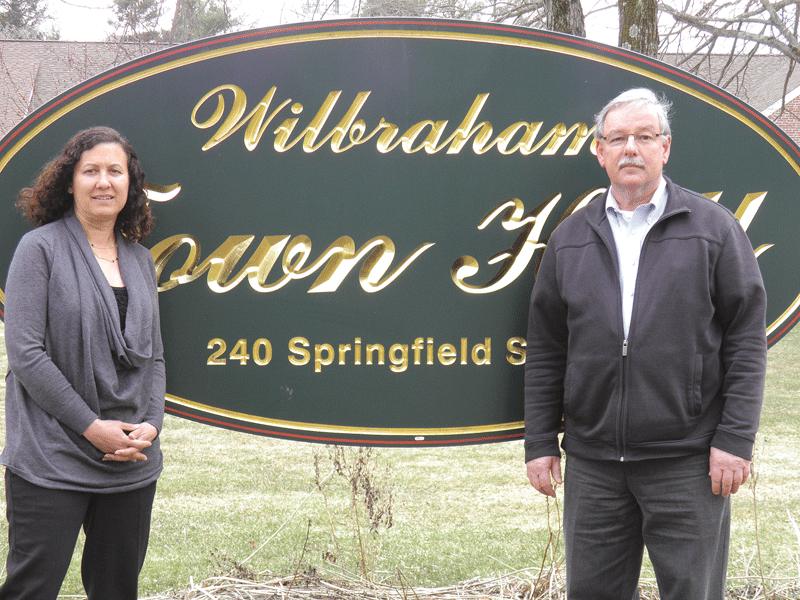
Tracey Plantier and John Pearsall

Tracey Plantier and John Pearsall say Wilbraham residents want to maintain the town’s historic New England charm.

John Pearsall says Wilbraham residents appreciate the town’s New England charm and want it maintained. But they’re equally thankful for the plethora of stores, businesses, and restaurants available to them on Boston Road.

“Wilbraham is primarily a residential community, and what attracts people here is the quality of life,” said the town’s planning director. “But people are also comfortable with the idea that Boston Road is very commercial, and they want growth there to continue.”

These opinions were voiced repeatedly in studies contained in a report released last September titled “Wilbraham Looks Forward.” It documents the results of surveys and focus-group meetings conducted by an all-volunteer vision task force over an 18-month period. Members of the panel were appointed by the Planning Board, and their goal was to solicit opinions from residents and business owners about what they appreciate about the town as well as change they would like to see in coming years.

“Our mission was to generate a consensus-based guiding vision to address Wilbraham’s current and evolving challenges and opportunities,” said vision team chair Tracey Plantier, who is a member of the Planning Board and volunteer for the Open Space and Recreation Plan Committee (more about the report later).

Wilbraham was devastated by the tornado that swept through Western Mass. in 2011, but the majority of that damage has been repaired. And although commercial and residential growth has been slow since 2008, Pearsall said, “last year, things started to rebound.”

In December, Lumber Liquidators opened on 2148 Boston Road, and two auto dealerships made significant investments in their properties. Balise Ford held a grand-opening ceremony to welcome the public to a new, 26,000-square-foot, $4.2 million dealership about 11 months ago. The expansion added about 20 new jobs and helped strengthen the town’s tax base.

“Officials from Balise told us they were impressed by the town’s streamlined permitting process,” said Pearsall. “They described it as effortless compared to other communities.”

In addition, Lia Toyota’s showroom on 2145 Boston Road got a $300,000 facelift last year. “And Baystate Self Store LLC on 2350 Boston Road is expected to open in June with 73,125 square feet of available storage space,” said Pearsall, adding that some of it will be climate-controlled.

Growth is also occurring in the residential sector, as 18 new homes and/or condominiums were built in 2013 at a cost of $4.74 million. “The majority were in the Gardens at Wilbraham and in Cedar Ridge, which are both on Boston Road,” Pearsall said.

Eric Fuller, the town’s planning director, told BusinessWest that the three-mile strip of Boston Road that runs through Wilbraham is zoned for commercial and industrial use and contains land and buildings available for purchase or for lease. “Properties for sale include the former Medeiros Williams Chevrolet Co. building and lot.”

Pearsall agrees that opportunity abounds on Boston Road, home to a significant amount of underutilized and/or vacant space. “The former Taylor Rental property next to Home Depot is available, and on a smaller scale, there is space for lease in a number of strip malls,” he said. “Plus, the site across the street from Post Office Park has been cleaned up and is for sale.”

Post Office Park is a horseshoe-shaped, planned commercial development on Boston Road with two entrances and traffic signals. The back of the property is home to many businesses that are attractive to families, including the YMCA’s Wilbraham branch, All American Gymnastics, a dance academy, some small retail shops, and a pediatric medical office.

But land is still available at the front of the park, which Pearsall said is suitable for a high-profile retail business, due to its visibility from Boston Road and the fact that 40,000 vehicles travel up and down the busy thoroughfare each day.

“It is a significant commuter route, with Springfield to the west, Palmer to the east, and the entrance to the Mass Turnpike in Palmer,” he said. “Jake’s Restaurant across the street feeds off the traffic from the people who attend recreational and sporting events at Post Office Park, and Eastfield Mall, just down the road in Springfield, attracts shoppers.”

Enhanced Value

Education is important to Wilbraham residents, and the town boasts three secondary schools, including the private Wilbraham-Monson Academy; the parochial Cathedral High, temporarily housed in the old Memorial School building; and the new, $50 million, state-of-the-art Minnechaug Regional High School, which serves students from Wilbraham and Hampden.

“When people come into my office, they always ask about our schools, and the high quality we offer is a really big draw,” Pearsall said, explaining that the new high school has a day-care facility, and the grounds of the old building have been turned into athletic playing fields.
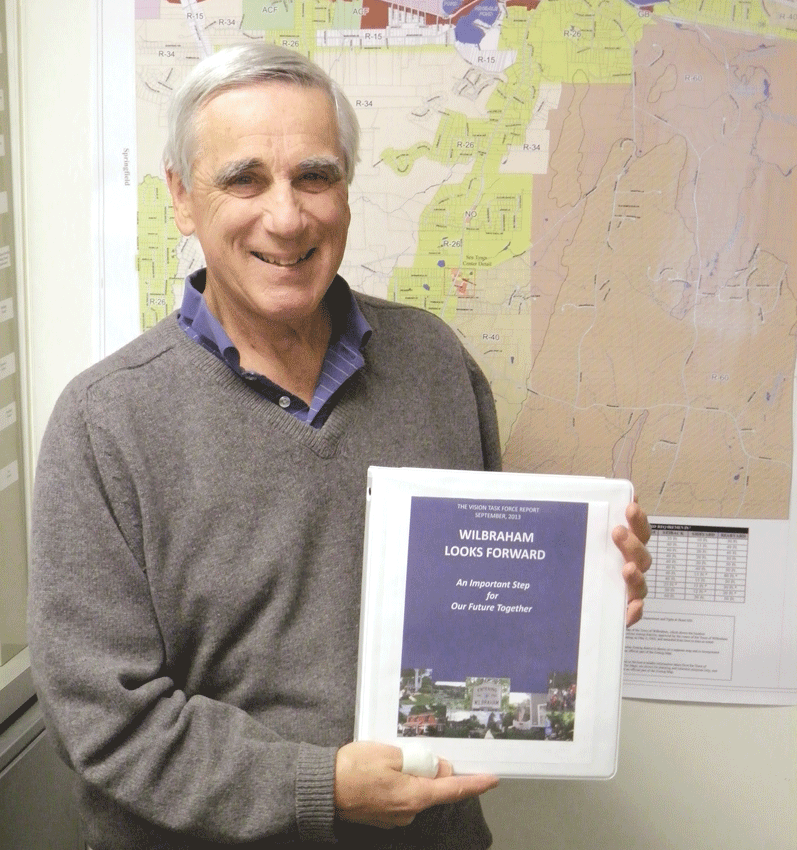
Eric Fuller

Eric Fuller shows off a copy of “Wilbraham Looks Forward,” which documents opinions solicited from residents and business owners.

“And Wilbraham Monson Academy continues to expand its campus,” he continued. “A brand-new dorm is under construction for students in their middle-school program, and they have put in new athletic playing fields.”

Major investments have also been made at Spec Pond, which is home to a summer day camp run by the Parks and Recreation Department. “More than $1 million has been spent in the park over the last few years,” said Fuller. “We have new pavilions, a new playground, and new playing fields for youth baseball, lacrosse, and softball. It’s a very large complex with lights that can also be used for night football. Plus, a spray park is being installed and will be ready by the time summer arrives.”

In another section of town, the iconic Rice Fruit Farm building is undergoing a major renovation. “The Rice family ran their farm for many generations and grew their fruit stand into a retail store,” Pearsall explained. But the storefront has been vacant since the family closed the business about five years ago.

Fuller said there was some interest in redeveloping the site, but its residential zoning was a stumbling block. However, that changed recently when the Planning Board revised the zoning based on the fact that the building had been operated as a farm stand. “It allowed the new owner to repurpose the structure and make it into a viable business,” he explained.

The retail establishment, called Heritage Farm Stand, is expected to open within the next few months. “They’ll sell fruit, ice cream, pies, and baked goods, and will have indoor and outdoor seating,” Pearsall said. “This is an adaptive reuse of a building that everyone in town wanted to reopen.”

Vision Quest

The town is comprised of a number of neighborhoods — Wilbraham Center, North Wilbraham, East Wilbraham, Wilbraham Mountain, South Wilbraham, the Boston Road Corridor, and the Pines section — and during the past year, residents and business owners from all sectors had the opportunity to voice their opinions about what type of change they would like to see in the future via surveys conducted by the Vision Task Force.

“We created subcommittees that did in-depth studies on education, land use, livability, and town services,” Plantier said. “The study was unique and something that few towns do, but we wanted to create a focused vision strategy.”

To that end, the task force developed an extensive questionnaire titled “Community Insights,” and residents were given the opportunity to respond online or in writing at town meetings, at concerts in Fountain Park, and during tours of the new high school held at the beginning of the 2012-13 school year.

The study was designed to provide input on what Plantier refers to as “the dynamics of change,” and answer the questions, “where are we going?” “what are we in the process of becoming if we follow the current course?” and “what will Wilbraham look like in 20 years and beyond if current trends continue?”

The task force also held focus-group sessions with business owners, members of the Boston Road Business Assoc., the Rotary Club, the East of the River Chamber of Commerce, and other organizations. In addition, a survey was mailed to 200 businesses.

The final event was called Imagine Wilbraham Day, which was attended by 100 people who had the opportunity to express or reiterate their opinions about what works well in town and what changes could prove beneficial. The results have been compiled in a report titled “Wilbraham Looks Forward,” and a new committee has been created to facilitate ways to implement desired change.

However, two items that emanated from the surveys are already on the town’s agenda and will be voted on during the May 12 town meeting. The first involves signage and would allow new businesses to erect temporary signs welcoming customers.

The second would permit an expansion of land use in Wilbraham Center. Pearsall explained that every plot of land in the neighborhood is currently zoned as either neighborhood/office space or neighborhood/shopping space. “We are not changing the zoning; we are homogenizing it,” he said, adding that the proposal would give property owners the ability to create food establishments or small shops in that section of town.

However, Plantier reiterated that, although residents want more shopping and restaurant options, they are deeply committed to maintaining the look and feel of Wilbraham, which she described as “a scenic, small New England town.”

“One of the biggest challenges to our economic development is balancing the change that residents want while keeping the look and feel of a scenic, historic small town with green, open space,” she said, adding that two requests voiced repeatedly in the survey are for additional sidewalks and bike lanes along the roadways.

The May town meeting will also give residents the chance to learn about volunteer opportunities with the town’s nonprofit organizations. Booths will be set up by representatives who will be ready and willing to share information. “This is important, as many people who responded to the survey expressed an interest in becoming more engaged in town, and said they want to see more events held in our community,” Plantier said.

Wilbraham also has two active committees pushing for a new safety complex and senior center. Although financial resources are limited, the Fire Department completed a $2.8 million renovation of its main fire station last year. “It was brilliantly done in a manner that didn’t require the town to borrow any money,” Fuller said. “It was a collaborative effort, and the fire chief was committed to adapting what he had to the needs of the department through the use of available funds.”

Pearsall added that the project set a precedent “to be creative and try to get the best results at the lowest cost to the taxpayers.”

Home-based Help

One thing that makes Wilbraham unique is the willingness of its residents to share their time to improve life in town.

“Many people own businesses or have professional expertise and are happy to contribute their talents or make donations to programs here,” said Pearsall. “There is a lot of community support to improve the quality of life.”

That trend is sure to continue as “Wilbraham Looks Forward,” paying due diligence to the opinions of residents who take great pride in the place they call home.

Wilbraham at a glance

Year Incorporated: 1763
<strong>Population: 14,868 (2010); 13,473 (2000)
Area: 22.4 square miles

County: Hampden

Residential Tax Rate: $20.44
Commercial Tax Rate: $20.44
Median Household Income: $90,670
Family Household Income: $102,557
Type of government: Open Town Meeting

Largest employers: Friendly Ice Cream Corp.; Town of Wilbraham; Wilbraham and Monson Academy; Life Care Center of Wilbraham
* Latest information available

Opinion
Some Steps in the Right Direction

Jay Minkarah, director of DevelopSpringfield, is right when he says that most of the projects currently in the agency’s portfolio don’t make much sense — financially, anyway.

The Gunn Block, the condemned 19th-century commercial building on the corner of State and Walnut streets that the agency acquired last year, is in horrific condition. Rehabbing it will be difficult, time-consuming, and expensive, and when that day comes, the property will sit on the edge of a mostly vacant, considerably underutilized block of buildings across State Street from Springfield Technical Community College.

No wonder the development community had no interest in it.

It’s also had very little, if any, interest in the property known as 83 Maple, the former residence of Ansel Phelps, Springfield’s fourth mayor, which DevelopSpringfield acquired last year and is currently rehabbing. Also long-condemned, the property has not been occupied for years, has resisted at least a few efforts at revitalization, and has become one of many symbols of stagnation in the city.

And then, there’s the former River Inn parcel just a few hundred yards down State Street from the Gunn Block. It has become an eyesore and a crime scene, and DevelopSpringfield acquired it at auction a year ago and razed it with the intention of selling the parcel for reuse, hopefully for retail.

All three of these projects would have to be described as very long shots and financial risks that traditional developers wouldn’t touch.

But as Minkarah told BusinessWest, they are also very symbolic, and therefore appropriate projects for this private, nonprofit agency to use to generate momentum and create a sense of accomplishment in the city.

And such victories are needed because, while we keep reading and hearing about the billions of dollars that will be spent in the city over the next few years — and those numbers are certainly impressive — there is still a sense of ‘seeing is believing’ in this city, and there still isn’t much to see.

‘Strategic’ was the word Minkarah used repeatedly to describe the agency’s current projects, and it’s an appropriate term to use. By revitalizing the Gunn Block and moving forward with a planned grocery store across Walnut Street, the city could spark a new development in Mason Square and change the face of that block just east of Commerce High School. And landing a major retailer in the former River Inn property could generate more momentum for a stretch of State Street that is showing some signs of life, and will show more when the old fire station just down the road is finally rehabbed.

Meanwhile, successfully converting the Ansel Phelps House into use for professionals could stimulate more progress in the Maple Heights area, an historic area that could use a dose of optimism.

At the very least, these projects should create more of a very important ingredient in the city’s efforts to bounce back from fiscal turmoil, natural disasters, a stagnant economy, and a gas blast: hope.

Minkarah’s theory is that, if people see that some of the most blighted properties in the city can be a given a new life, then just about anything is possible.

And he’s right.

These projects may not make sense financially, but they are certainly small — and potentially big — steps in the right direction.

Opinion
Rising Ocean Waters — and Rates

By JACK CLARKE

Bay State ocean waters and insurance rates are rising. Just ask those holding 25,000 federally subsidized coastal flood-insurance policies in Massachusetts. These contracts insulate people from the full risks of living on the shore — risks that private insurance companies have long refused to take, making taxpayers assume the burden.

Today, due to bigger and more frequent ocean storms, property loss has drowned the national program under $24 billion of debt. Much of this debt mounted after hurricanes Alex, Katrina, and Superstorm Sandy.

To ensure that future flood-insurance rates more accurately reflect the risks associated with living in hazardous coastal floodplains, in 2012, Congress experienced a rare moment of clarity and passed comprehensive flood-insurance reform.

When the new rate increases took effect, they sparked widespread panic, and Congress quickly backpedaled and then hit the snooze button on any serious rate reform. It seems that Congress is more than willing to step into the limelight to rebuild homes and businesses, but not to promote solutions that prevent or minimize property destruction in the first place. One thing is for certain — all this new attention to the risks of coastal living is a wake-up call, and we’d be wise to pay attention.

For those facing King Neptune’s inevitable onslaught of coastal destruction and havoc, options include moving buildings back from the shore, elevating structures on pilings, re-nourishing beaches with sediment to strengthen their natural storm-buffering capacity, and purchasing properties in harm’s way.

Evidence of completed federal coastal property-buyout programs from across the country shows that these investments pay for themselves within 10 years by permanently avoiding response, rescue, recovery, and repair costs from future floods. Most importantly, the lives of first responders and residents are spared.

Flooding causes almost half of all disaster-related property destruction in America — and it’s getting worse. A recent Federal Emergency Management Agency study found that sea-level rise will expand the nation’s flood-hazard areas by more than 50% by 2100, with the number of associated flood-insurance policies increasing by an astounding 130%. A growing coastal population exacerbates the problem. The U.S. Census Bureau reports that almost 40% of Americans now live in coastal counties. Here at home, according to the Massachusetts Coastal Zone Management Office, 85% of Massachusetts’ 6.7 million residents live within 50 miles of the coast.

A 2005 congressionally mandated study found that, for every $1 invested in hazard-mitigation activities, the national economy saves $4 in losses from future disasters, and saves an additional $3.65 in costs to the U.S. Treasury from avoided disaster-recovery expenditures and lost tax revenues. Last month, the New England Center for Investigative Reporting showed that, in this region, there are 534 properties considered ‘severe repetitive loss’ casualties — meaning that the flood insurance program has paid owners multiple times to repair and rebuild on site.

A bill championed by state Sen. Mark Pacheco, chair of the Joint Committee on Environment, Natural Resources, and Agriculture, includes coastal buyback simply because it is among the most cost-effective and pragmatic mitigation measures for addressing high-hazard coastal areas. The legislation proposes to fund the purchase, from willing sellers, of properties that are repeatedly and substantially damaged by storms. Specifically, a voluntary coastal buy-back program would:

• Invest in high-risk properties in advance of flood disasters;

• Clean up and restore properties to their natural conditions while conserving them for public benefits such as parklands, wildlife refuges, and public beaches;

• Provide storm buffers as repaired coastal resources absorb floodwaters and save uplands from flooding; and

• Capture and store heat-trapping carbon pollution within restored coastal ecosystems, mitigating some of the worst effects of climate change.

A coastal buy-back program would convert vulnerable and dangerous flood-prone properties from liabilities to valuable community assets while sparing lives, protecting the environment, and saving tax dollars.

The alternative is to continue pouring money into an undertow of debt.

Jack Clarke is director of public policy and government relations for Mass Audubon and a recent gubernatorial appointee to the Mass. Coastal Erosion Commission.

Law Sections
MassMutual Steps Up Its Pro Bono Work in the Community

Mark Roellig

Mark Roellig says one of the responsibilities any business has is to give back to the community, and MassMutual’s pro bono work is one example of doing just that.

Mark Roellig was adding up in his head the number of lawyers MassMutual has working for it in Western Mass., Northern Conn., and elsewhere.

He didn’t have an exact figure, but by doing some quick math, Roellig, the Fortune 100 company’s executive vice president and general counsel, could say without hesitation that the number for this region alone would far exceed that of any law firm in the Greater Springfield area.

And if this roster of attorneys comprised an actual firm, it would have a responsibility, he said, to give back to the community in a number of ways, but especially with pro bono work for residents who cannot afford to hire legal help. It is this thought process that helps explain why, during Roellig’s eight-year tenure as general counsel, MassMutual has certainly stepped up its participation in a number of pro bono initiatives and other efforts involving its legal team.

For starters, there’s something called Just the Beginning, a week-long program during which nearly two dozen area high-school students meet with lawyers from MassMutual, as well as area judges and other volunteers, to explore the different professional opportunities within the legal profession. The week includes a networking reception at the firm’s headquarters on State Street, a mock trial, oral appellate arguments, a courthouse tour, and visits to law firms. There is also something called the Pro Bono Partnership, a clearinghouse of sorts that works to connect in-house lawyers with area nonprofits for transactional work.

But perhaps the most significant undertaking by the company has been its multi-faceted commitment to the Hampden County Legal Clinic, a legal-aid program that assists individuals at no charge who have limited financial resources and who meet specific eligibility guidelines.

Support comes in many forms — from helping those facing eviction in Housing Court to assisting individuals appealing denial of unemployment benefits in District Court — and together, these avenues provide a natural, and highly effective, way for the company’s legal team to escalate its pro bono work in the community, said Roellig.

“If you are operating as a business in a community, whether it be a major corporation like MassMutual or a law firm, frankly, you want your community to be one that’s vibrant and strong and one that attracts and retains high-quality talent,” he explained. “In many ways, Springfield has been challenged over the years, so one of the things we want to do through our law department, and in keeping with our obligations as lawyers, is to ensure that we’re adding value to the community.

“When I arrived here, we didn’t have much of a program, or any program at all, really,” he went on. “And this is something I believe in; if you’re going to do business in a community, you need to give back to that community, and our legal team has been consistently ramping up its commitment.”

The company’s support for the legal clinic, for example, takes several forms, including financial assistance after the previous sponsor opted not to continue its commitment in 2011. Indeed, a $20,000 contribution for this year will help defray the cost of a support staffer at the Hampden County Bar Assoc. (HCBA) tasked with recruiting, scheduling, and assisting lawyers taking part in the various volunteer programs, and also directing consumers to these initiatives.

But the most visible form of support has been the steadily growing number of legal staff from the company — lawyers, paralegals, and other professionals — who have volunteered for the initiatives in Housing Court, District Court, and Probate Court.

More than 20 attorneys have volunteered for the various lawyer-for-a-day (LFD) programs involving those aforementioned courts, said Dorothy Varon, an in-house attorney who is part of that group, and the total number of hours donated by staff members increased from just over 100 in 2012 to more than 400 in 2013, a trend that is projected to continue in the year ahead.

For this issue and its focus on law, BusinessWest takes an in-depth look at how MassMutual and its large legal team are working with various partners, such as the bar association, to assist the rising number of people who need free legal assistance.

Strong Testimony

It’s called ‘eviction day.’

As that name suggests, this is the one day each week (Thursday) at Hampden County Housing Court that is devoted to eviction cases. It’s a long, often emotional day for tenants and landlords alike, one where many of those present aren’t sure if they will have a roof over their head when they leave.

Roellig has volunteered his services for a few eviction days, and can provide compelling testimony regarding the gravity of what’s taking place.

“It’s an intense day,” he said, “because people are coming in with serious problems on either side, whether it’s someone who’s being evicted or someone who feels that he needs to evict someone, and they need some help.”

Assistance in Housing Court has become one of the many ways in which MassMutual has stepped up its pro bono work within the community, said Varon, one of the company’s in-house attorneys, who credited Roellig with getting the ball rolling and keeping it rolling.

“He gave us the green light to propose to him how we could go about creating a pro bono program that would be effective,” she explained, noting that a pro bono committee was formed and a mission statement drafted. “And one of the things that we concluded early on was that connecting with our local bar association would be the most logical way of creating a pro bono program without reinventing the wheel; this was a very logical connection.”

And support from the corporate giant is needed, said Varon, because, while Springfield has a large and diverse legal community, the landscape lacks the very large firms found in Boston and Hartford that provide the critical mass of attorneys needed to effectively staff the many types of pro bono programs that have been created.

“If you think about Boston or New York or Chicago, there are a gazillion lawyers at these megafirms, and there’s all this support coming from these firms — associates can do pro bono work as part of their workload,” she noted. “In a market like Springfield, where you have a lot of solos and a lot of small firms, it’s not so easy to be out there doing a lot of pro bono work. It’s a very difficult market to generate income.”

Meanwhile, need within the community for volunteer legal assistance is growing, said Charles Cassartello, an attorney with Springfield-based Pellegrini, Seeley, Ryan & Blakesley, former HCBA president, and active participant in the legal clinic.

Indeed, while the economy has improved somewhat in the past few years, he said, there has been no decline in the number of people seeking help through various pro bono programs.

And while such initiatives help provide access to justice for people of low or no income, they also play a pivotal role in keeping the wheels of justice turning, said Cassartello, noting that, when individuals decide to represent themselves in legal matters — usually because they have no choice in the matter — the pace of business slows.

“The Springfield District Court is perhaps the second-busiest district court in the Commonwealth — lots of business is conducted there, criminal and civil, and many of the people who come there are unrepresented; they’re pro se litigants,” he explained. “We wanted to develop a program in the District Court to not only assist self-represented people, but take some burden from the court.

“It’s very difficult to deal with self-represented people,” he continued, emphasizing the word very.  “It slows things down, and it can really clog the court’s docket.”

To help unclog matters, the District Court lawyer-for-a-day program assists such pro se litigants outside the court, during regularly scheduled office hours, providing help with forms, general problem-solving, and legal advice in civil matters, said Cassartello.

“They walk away with a basic notion about how to approach their case, how to put together a defense, how to make a claim, and more,” he went on, adding that those seeking assistance may also get referrals to lawyers participating in programs featuring sliding fee scales and other vehicles for providing assistance to the poor.

MassMutual’s assistance, in terms of both volunteers and funding to support an administrative infrastructure, has enabled the LFD programs to continue and ultimately assist more individuals, said Cassartello, who used the term “force multiplier” to describe the firm’s impact on HCBA initiatives.

Varon agreed.

“MassMutual can contribute in a lot of ways,” she noted. “One of the ways is with volunteers, but the other way is with resources. To support the clinic means that there’s someone in the community trying to rally all the lawyers — not just the MassMutual lawyers, but also the broader community.

“If we can support the legal clinic and the bar association, we have a much bigger impact on how pro bono services are delivered than if we we’re just sending volunteers, and that’s our basic strategy,” she went on. “It’s important to volunteer, but we also want to support this on a community level.”

Bottom Line

The goal moving forward is for the firm and the bar association to continually look for ways to add new programs and assist more people, said Varon, who described the current roster of initiatives as a “work in progress.”

“We keep trying to grow what we’re doing and improve what we’re doing,” she told BusinessWest, adding that one priority is to improve data-collection efforts, one of the keys to tracking progress and gaining additional support.

In many ways, MassMutual has helped lay the foundation for a comprehensive system of legal assistance, she said, and now the mission is to build atop that foundation.

The financial-services giant is not a law firm, Varon said in conclusion, but its legal department is determined to act like one — and work within the community is certainly a big part of that assignment.

George O’Brien can be reached at [email protected]

Law Sections
New Regulations Aim to Level Playing Field for Veterans, IWDs

John S. Gannon

John S. Gannon

Last year, the U.S. Department of Labor’s Office of Federal Contract Compliance Programs (OFCCP) announced new rules intended to promote the hiring and employment of veterans and individuals with disabilities by federal government contractors. OFCCP is responsible for ensuring that employers doing business with the federal government comply with laws and regulations requiring affirmative action and nondiscrimination.

Two laws the agency oversees are Section 503 of the Rehabilitation Act of 1973, which prohibits employment discrimination against individuals with disabilities, and the Vietnam Era Veterans Readjustment Assistance Act (VEVRAA), which requires federal contractors to take affirmative action to employ specified categories of veterans.

Background

The Department of Labor (DOL) has stated that the new rules “help level the playing field” for veterans and individuals with disabilities (IWDs).  According to fact sheets released by the DOL, the unemployment rate in 2012 for Gulf War II-era veterans — those who served in the Armed Forces sometime since September 2001 and have since returned to civilian life — was 9.9%, compared to 7.9% for non-veterans.

The disparity increased for males ages 18 to 24.  Similarly, IWDs had high rates of unemployment; the unemployment rate for working-age IWDs in 2012 was 15%, compared to 8.8% for individuals without disabilities. The poverty rate for IWDs, ages 18 to 64, was 28.8%, compared to 12.5% for non-disabled people. The new rules are aimed at addressing both of these target populations.

Major Provisions

The new rules impose significant new obligations for covered federal government contractors and subcontractors. First, the final VEVRAA rule requires contractors to establish annual hiring benchmarks for protected veterans, a group that includes Vietnam-era veterans, special disabled veterans, veterans separated from service for three years or less, and veterans who served on active duty during a war or in a campaign or expedition for which a campaign badge has been authorized.

Contractors can either use the national percentage of veterans in the civilian workforce as a benchmark (currently 8%), or develop their own custom benchmarks using criteria outlined by OFCCP. Although progress toward the benchmark needs to be tracked, failure to meet the benchmark alone will not carry a penalty. A violation could result, however, from failure to establish a benchmark and collect corresponding data.

The final Section 503 rule contains a similar provision that establishes a 7% workforce utilization goal for employment of IWDs. The 7% goal applies to employees in each job group, unless the total workforce is under 100 employees.  Employers of fewer than 100 may apply the 7% IWD goal to the entire workforce.

Again, OFCCP states that failing to meet the IWD utilization goal alone will not constitute a violation of the regulation and won’t lead to a fine or penalty.  However, it may lead to an audit by OFCCP. Following an audit, OFCCP may request that the contractors enter into conciliation agreements with remedial benchmarks for hiring IWDs.

Self-identification

Both final rules require contractors to invite applicants to self-identify as a veteran or IWD during the application process. In addition, covered contractors must ask employees to voluntarily self-identify IWD status during the first year following the implementation of the new regulations and every five years thereafter. OFCCP has released a Section 503 self-identification form that contractors are required to use, which can be found at www.dol.gov/ofccp/regs/compliance/sec503/voluntary_self-identification_of_disability_cc-305_sd_edit1.24.14.pdf.

The agency has not released a similar VEVRAA form, but sample invitations to self-identify can be found in the new regulations. Contact employment counsel for guidance on creating this form.

Employers who are up to speed on their Americans with Disabilities Act (ADA) obligations might be concerned with the new Section 503 self-identification process. The ADA generally prohibits employers from asking applicants and employees to provide information concerning their physical and/or mental condition. However, the Equal Employment Opportunity Commission issued an opinion letter last year supporting OFCCP’s new self-identification requirements.  Therefore, covered contractors do not need to worry about ADA obligations when issuing Section 503 self-identification forms to applicants and employees.

Data Collection

The new regulations require contractors to document and annually update several quantitative comparisons for the number of veterans and IWDs who apply for jobs and are hired. This includes information about the number of veterans and IWDs who applied, the total number of applicants and the total number hired, and the total number of openings filled.


Who Must Comply?

The new VEVRAA rule impacts all employers who have federal contracts or subcontracts of $100,000 or more. Section 503 rules apply to employers with federal contracts or subcontracts of $10,000 or more.

Timing

The effective date for the new regulations was March 24, 2014. However, contractors with affirmative-action plans (AAPs) already in place on March 24 can keep them in place until the end of their current AAP year and defer compliance until their new AAP plan year.

Bottom Line

Federal contractors need to make sure their hiring and employment practices comply with the new rules. Additionally, AAPs need to be modified for compliance. Contact experienced counsel for assistance updating your AAPs or general information about the new OFCCP rules. n

John Gannon is an attorney at the management-side labor and employment firm Skoler, Abbott & Presser, P.C.; (413) 737-4753; [email protected]

Law Sections
Here Are 10 Important Points to Ponder — and Remember

By MICHELE J. FEINSTEIN and ANN I. WEBER

When you decide to get married for the first time, estate planning is probably the last thing on your mind. But if your marriage does not endure because of death or divorce and you later want to remarry, marriage, life, and death may be a little more complicated.

Here are some pointers to keep in mind if you or someone you love are contemplating remarriage.

• Do you have a will? If not, the Commonwealth has written one for you.

If a spouse in a second marriage dies without a will and has children from a prior marriage, under Massachusetts law, the survivor will receive the first $100,000 and one-half of the balance of the estate.

If this is not your plan of choice, you should have a will and perhaps a revocable trust which clearly sets out your wishes.

• If you want to leave your estate entirely to your children, your spouse may have the right to challenge your will and receive the share prescribed by statute.

Under Massachusetts law, a spouse can waive the provisions in the decedent’s will and elect to take the share prescribed by statute. For example, if you die leaving children from a prior marriage, your spouse can force a distribution equal to the income interest in one-third of your probate estate (and potentially the assets of your revocable trust if you have one) plus $25,000 distributed outright from that share.

Your spouse cannot benefit from any provisions in the will in his or her favor, but can continue to receive the benefit of property passing outside of the probate process, i.e., proceeds of life insurance or retirement plans and jointly held assets, etc.

• If you have a will which was signed prior to your marriage and you die before signing a new one, your spouse may receive a share of your estate even though he or she is not mentioned in the will.

In such a case, your spouse will receive the share he or she would have received if there had been no will from the portion of the estate not left to your children or grandchildren, unless your will was made in contemplation of the marriage or you provided for your spouse outside the will with life insurance, retirement benefits, jointly held assets, etc.

• Do you have minor or disabled children?

While your former spouse will probably be guardian of your children, your may not want him or her to control assets passing to or for the benefit of your children. You can name a conservator or a trustee of a children’s or special-needs trust to control these assets for the benefit of your children.

• Do you have a prenuptial agreement?

If so, you and your spouse may have relinquished rights to each other’s estates. You can, however, include your new spouse in your will, as any provisions in favor of your spouse will trump the prenup.

• Do you have a divorce decree or separation agreement?

If so, you may have obligations under these agreements. Your attorney should review these documents in order to be sure that your new plan does not contravene these obligations.

• Do the combined assets of you and your spouse exceed $1 million? Do they exceed $5.34 million?

If so, you may need a revocable trust or perhaps some additional planning to minimize your state and federal estate taxes, respectively.

• Are you receiving Social Security retirement benefits based on a former spouse’s earning records?

If so, your remarriage may affect your benefits. If you are receiving benefits based on your divorced spouse’s earnings record, your benefits will end upon your remarriage and be recalculated based on you or your new spouse’s earnings, whichever is higher. If your benefits are based on a deceased spouse’s record and you are 60 or older at your remarriage, you will receive the higher of the three worker’s benefits. However, if you are under 60 when you remarry, you will forfeit your widow’s benefits permanently.

• Are you concerned about the costs of long-term care? Your marital status may affect your eligibility for benefits.

MassHealth has different eligibility criteria for single and married persons applying for nursing-home coverage, with some very favorable options applying to married couples.  In particular, assets can be transferred to the well spouse without a transfer disqualification, special types of annuities can be purchased to accelerate eligibility, and the well spouse will be entitled to keep $117,240 of countable assets.

While this works well when the children likely to inherit belong to both spouses, traditional planning can cause problems down the line for blended families if the ill spouse’s children are excluded as beneficiaries of the well spouse’s estate.

• Do you want your children or other individuals to be beneficiaries of your qualified retirement plan(s)?

If so, your new spouse will need to sign a notarized waiver of these benefits in order for these beneficiaries to take. Qualified plans include defined benefit or contribution plans, profit-sharing plans, and 401(b) and 401(k) plans.

Attorneys Ann I. Weber and Michele J. Feinstein are partners with the Springfield-based law firm Shatz, Schwartz and Fentin, P.C. Weber concentrates her practice in the areas of estate-tax planning, estate administration, probate, and elder law; (413) 737-1131; www.ssfpc.com. Feinstein concentrates her practice in the areas of estate planning and administration, elder law, probate litigation, health law, and corporate and business planning; (413) 737-1131; www.ssfpc.com

Law Sections
There Are Discrimination Issues That Can, and Do, Sneak Up on You

By ANNIE L. LAJOIE, Esq.

Annie E. Lajoie, Esq

Annie E. Lajoie, Esq

Not all discrimination is open or obvious.

Sometimes it can sneak up on you in ways you have not imagined. In fact, you may face a viable discrimination claim even when you did not intend to discriminate against someone. 

Under a disparate-impact theory of discrimination, intent is irrelevant. Instead, liability is based upon the effects or impact of a policy or practice, rather than the employer’s motivation behind it. In other words, a disparate-impact claim arises when an employer’s policies and practices, seemingly neutral and non-discriminatory on their face, result in a negative impact on a protected class of employees, based on factors such as race or age.

Disparate-impact claims often arise in the context of employee-selection criteria, pre-hire assessments, employee testing, organizational restructuring, and reductions in force. 

In 1971, the U.S. Supreme Court noted for the first time that Congress directed the thrust of Title VII to the consequences of employment practices, not simply the motivation. At the end of the day, Title VII was enacted to protect a vulnerable group from overt or unintentional discrimination when practices that are fair in form have a discriminatory impact.

In this seminal case of disparate-impact discrimination, an employer required employees doing manual labor to have high-school diplomas. The court found that this requirement was discriminatory because this requirement was substantially limiting the amount of black applicants who could be hired. Why was this an issue? Because a high-school diploma did not correlate to how well someone would perform this manual-labor job. Therefore, a good practice for employers is to make sure that any requirements or policies are related to and necessary for the job.

Necessary Measures

When an employer’s policy is challenged as having a disparate impact on a specific group of people, the employer may defend itself by claiming that the policy is job-related and necessary. The types of policies that are necessary, even if they impact certain groups differently, are those that are related to safety or ensure that an applicant is qualified to perform the job. However, employers should be careful not to make such tests or policies more difficult than the actual job.

In one case, a company was experiencing a high rate of employee injury, so it implemented a strength test for applicants. After implementing these strength tests, the employment rate for women at that company decreased from 46% to 15%. While this appeared to be the result of a job-related and necessary strength test, the tests were substantially more difficult than the actual work.

Because a less difficult strength test would have determined if someone was able to do the job without disqualifying as many women, the court deemed the company liable for disparate-impact discrimination. To reduce the risk of a similar fate, employers should make sure their tests are commensurate with the difficulty of the job.

Even if a test is appropriately related to the job, it is still important to reassess whether it will cause the least amount of disparate impact of all the options. In another case, an employer implemented a test that measured verbal, numerical, and spatial reasoning skills to evaluate applicants’ mechanical aptitude. Before implementing this test, the employer undertook significant research and analysis to ensure that it was appropriately related to the job.

However, this test was found to exclude black applicants at a disproportionately high rate. Additionally, the court determined there was a less discriminatory method the employer could have used, but the employer never considered newer methods after implementing the original test. Since the employer was using a test that affected a protected group more than other groups, and there were other methods the employer could have used that would affect protected groups less, the employer was liable for disparate-impact discrimination.

With this example in mind, it would be wise for employers to re-evaluate their policies and procedures annually so that superior methods may be discovered and incorporated.

Finally, employers should also be careful when attempting to rectify situations where a protected class has been disparately impacted by a test or policy that is job-related and consistent with business necessity. In a U.S. Supreme Court case, a group of white and Hispanic firefighters sued their employer for disregarding test results where black firefighters failed the test at a significantly higher rate.

The employer feared that using the test results as the basis for promotions, as was originally planned, would bring a claim of discrimination. However, the court stated that, because the employer was careful to ensure that the test was job-related and consistent with business necessity, it was unlawful discrimination to disregard the results only because a protected class performed badly on it at a higher rate.

Steps to Take

As you can see, disparate-impact discrimination claims truly can sneak up on you. These claims are some of the most difficult to prepare for and deal with because they are often based on policies and tests that appear neutral. Further, as you can see from the case discussed above, trying to avoid a claim of discrimination can open you up to a different one.

To reduce their risk of disparate-impact discrimination claims, employers should:

• Make sure job requirements are job-related and necessary;

• Make sure physical tests are commensurate with job requirements;

• Review policies and procedures annually to make sure there is not an available practice with a less disparate impact;

• Train supervisors often; and

• Review any new policies or practices with employment counsel prior to implementation, then annually.

The bottom line is that you should keep track of your numbers. Statistics play a key role in disparate-impact analyses and disparate-impact claims. Employers would also be wise to review with their employment counsel any new policies or practices before implementation and conduct annual reviews of the same.

Annie E. Lajoie, Esq. specializes exclusively in management-side labor and employment law at Royal LLP, a woman-owned, SOMWBA-certified, boutique, management-side labor and employment law firm; (413) 586-2288; [email protected]

Sections Travel and Tourism
Six Flags New England Reaches Higher — Much Higher

By JOSEPH BEDNAR and ROBERT GEBO

Jennifer McGrath

Jennifer McGrath says the 400-foot-tall New England Sky Screamer will take the classic theme-park swing ride to the extreme.

Just cross the South End Bridge in Springfield and look south, and it’s easy to see how Six Flags New England already towers over the Connecticut River. On a clear day, Bizarro, Scream, Goliath, and the Cyclone are clearly visible in the distance.

The tallest of those, the award-winning Bizarro rollercoaster and the Scream drop ride, reach about 200 feet into the air, offering breathtaking — and, for some riders, nerve-wracking — views of the river, Mount Tom to the north, and Connecticut to the south.

Now imagine being twice that high.

Actually, visitors won’t have to imagine once the park unveils its newest attraction, the New England Sky Screamer, this summer. Lifting patrons 400 feet up and then swinging them around for two minutes at 35 mph, it’s touted as the world’s tallest swing ride.

Clearly, Six Flags has come a long way in the 15 years since the chain acquired historic Riverside Park, adding it to its international stable of destinations, adding numerous major rides and a bustling water park, and effectively doubling the property’s size. And now, it’s touting a new height record to boot.

“It’s taking that swing ride we know and love and adding every possible element of thrill and fear into it,” said Jennifer McGrath, communications manager for Six Flags New England. “Your arms and legs are exposed in the air, your swing is on chains, just like that classic family swing ride — except this is not classic.”

The ride, which is painted red, white, and blue, will glow with color-changing LED lights at night, she added. “We don’t feel it’s just a new ride for Six Flags New England; we feel it’s a new icon, something people will identify with Western Mass. You can see it from the Springfield area and well into Enfield and Suffield. Six Flags loves breaking records, and they feel this ride is something special, and they know Six Flags guests are going to love it.”

As a prominent chain in a highly competitive industry, Six Flags is always looking to the future, mapping out a national strategy of park additions to keep the buzz high at its 13 parks in the U.S., Canada, and Mexico. Not every park gets a major addition on the level of a Sky Screamer every year, but Agawam has received plenty of recent attention, adding the Bonzai Pipeline slides in the Hurricane Harbor water park in 2013, the Goliath switchback coaster in 2012, and the Gotham City Gauntlet mouse coaster in 2011.

“It’s amazing what we’ve evolved to, and we continue to grow,” McGrath said, noting that it’s a cornerstone of the Six Flags brand to continually invest new capital in its properties.

“In true Six Flags fashion, we’re going even bigger in 2014 with our new attractions,” added Jim Reid-Anderson, the chain’s chairman, president, and CEO, in a press statement. “Our promise to you is to bring something new to every single park every year.”

Work and Play

Economic-development and tourism officials have long pointed to Six Flags New England as a major economic engine for the region. While the park, as a publicly held company, does not release attendance figures, it easily outdraws the number-two tourist attraction in Western Mass., Yankee Candle Village, which records 1.5 million guests per year.

SixFlagsGoliathSign

Six Flags officials say they’re committed to introducing something new at all the chain’s parks every year.

“Six Flags has been a wonderful neighbor to Agawam. They’re one of the top five taxpayers in the community, they work closely with all our departments, and they are a huge economic boon to the Pioneer Valley as a whole,” Agawam Mayor Richard Cohen told BusinessWest. “And it’s a regional tourist attraction, so it’s not just great for Agawam, but for the whole Valley.”

Six Flags is a significant employer as well, with more than 100 year-round employees, about half of whom work in maintenance. In the offseason, they’re busy enhancing the grounds, from new painting and signage to landscaping and structural improvements.

In addition, the park hires more than 3,000 seasonal workers annually, giving a major boost to the region’s efforts to employ high-school and college-age individuals, who are facing an historically lean market for summer jobs.

“They’re one of the largest hiring employers in the summer for seasonal purposes, which is great in these economic times,” Cohen said, referring to not only young people, but older individuals who might be unemployed or between jobs. “They really are good neighbors, and we’re really proud to have them in Agawam.”

He noted that the public ownership group that bought Six Flags in 2010 has been much easier to work and communicate with than Premier Parks, which operated the chain from 1998 until its Chapter 11 bankruptcy and restructuring a decade later. That’s important, he said, when planning a project like the Sky Screamer, which has the potential of drawing bigger crowds to the park, but is also a significant change to this small town’s skyline.

“They came to us early, in a very timely manner, and answered all our questions,” the mayor said, adding that Agawam residents were largely supportive of the project. “There were some people — not many — afraid that this would change the landscape of the area. But we already have cell towers. And they did this in patriotic colors. They took our concerns into consideration, and it was done tastefully. I have not had many — if any — complaints at all.

“Everything was done expeditiously — the public announcement, meetings, permits,” he reiterated. “They don’t wait until the last minute. Since the new regime took over, they work well on the local level, answering the concerns that people have. The relationship is much healthier, and communication has been much better.”

That’s not to say the park hasn’t been growing all along. Since becoming a Six Flags property in 1998, it has introduced a raft of thrill rides, including Bizarro (formerly Superman: Ride of Steel), winner of five Golden Ticket Awards from Amusement Today as the nation’s top steel coaster, in 2000; Flashback, a switchback coaster, also in 2000; Batman: the Dark Knight, a floorless coaster, in 2002; Pandemonium, a kid-friendly spinning coaster, in 2005; and, of course, the recent additions.

Meanwhile, Hurricane Harbor, which now totals 33 waterslides in addition to a lazy river, two wave pools, and other watery fun, opened in 1998 as part of the Six Flags makeover.

The entire property now comprises more than 270 acres, and ranks as both the largest amusement park and largest water park in New England.

Food for Thought

Other recent changes are less flashy, but are significant to many patrons. For example, McGrath said, restaurant menus will add food items, including more vegetarian fare — a shift that guests had been asking for. Once again, the park will offer a $99 dining plan along with its popular season-ticket options, allowing guests one lunch and one dinner per visit throughout the season.

As for the season tickets, they are priced at different tiers — higher tiers include free parking all year, among other amenities — but tend to pay for themselves within two or three visits, making Six Flags an affordable recreation option for area families, McGrath said. That’s important in a stressed economy, when many families can’t afford to fly to vacation destinations. “This is a day trip for anyone, all the way up to Maine — down to Pennsylvania, even.”

Many of those visitors are parents and grandparents taking their kids to Six Flags and sharing their fond memories of Riverside Park, which existed as an amusement park alongside the Connecticut River for about 90 years.

Some relics remain on the grounds, McGrath said, from the 1909 carousel to the antique automobiles that rattle along a metal track and give youngsters the chance to experience driving a car. Then there’s the Thunderbolt, the 1941 wooden coaster — standing 70 feet tall and traveling up to 40 mph — that has been called a landmark by American coaster enthusiasts. Six Flags preserves rides like this, McGrath said, because the company understands the special memories they have for many.

No matter what a ride’s age, she noted, maintenance teams check each attraction daily, often from as early as 5 a.m. “Our staff is diligent in regard to checking safety, and it’s a main focus — before the park opens, during, after, every potential minute for our guests, it’s a thorough process.”

Besides its obvious link to families, Six Flags involves itself in the community through charity events as well, working with more than 3,000 organizations annually across its 13-park footprint. Locally, that includes school-supply drives and coat drives for children, as well as Cause for Paws, an event that raises money for the Dakin Pioneer Valley Humane Society, and an annual skin-cancer-awareness event.

But the main buzz right now is clearly on the rides, which opened to their first guests of the 2014 season on April 12. New England Sky Screamer will open a bit later in the season, and though it’s expected to be a hit, it won’t be the last one, McGrath said.

“Right now, we are well into the planning process of 2015, even though we are executing 2014,” she told BusinessWest. “When it comes to building a new attraction for the park, we listen to our guests, of course, and what they would like to see in the future. We want to entertain those of all ages.”

After all, at the end of the day, it’s all about reaching new heights of entertainment — literally and figuratively.


Joseph Bednar can be reached at [email protected]

Sections Travel and Tourism
Historic Deerfield Opens a Door to 18th-Century New England

By KEVIN FLANDERS

Philip Zea

Philip Zea says his mission at Historic Deerfield is to bring the heritage of the Connecticut River Valley to life.

For Historic Deerfield President Philip Zea and his staff, the yearly mission is not simply to preserve the heritage of the Connecticut River Valley, but instead to bring it to life.

And they do so with an intriguing, and always evolving, blend of education and entertainment.

“We’re a lot like a professional sports team in the sense that what we do for a living is other people’s recreation,” said Zea as he worked through an interesting analogy. “We want everyone who comes here to have a great time, but also an informative time.”

Once a bustling destination along the 18th-century Boston-to-Albany road, the 104-acre property is now one of the state’s most popular outdoor history museums. Zea, who has enjoyed two stints at Historic Deerfield, first as chief curator for 18 years and later as president — a position he has held for 11 years — oversees a staff of 47. His passion for researching history and sharing it with others has allowed the museum to steadily increase its attendance over the past five years, thus boosting the bottom line at a time when many museums struggle to gain the time and attention of families with plenty of entertainment options.

And Zea and his staff have a positive outlook for the museum, which saw its total income increase by more than $328,000 from 2012 to 2013 (excluding $510,000 awarded to the museum in 2012 through business-interruption proceeds disbursed as a result of Tropical Storm Irene; more on that later). The solid rebound year generated total revenues of more than $4 million for the facility, said Zea, noting that the biggest challenge facing his staff in future years is to continue to evolve and improve to better serve the community’s needs.

“We want to provide people with a sense of confidence that, if they invest their time and money in us, then they are going to come here and have a good time,” he said. “We’re constantly reinventing ourselves and learning more about the history of the area to ensure the public has a great experience here.”

Education is a primary focus for the museum staff, which hosts thousands of students each year from throughout Massachusetts, Vermont, and New Hampshire. Along with Plimoth Plantation and Old Sturbridge Village, Historic Deerfield ranks at the top of the field-trip list for teachers looking to bring their students to an outdoor history museum. Boasting 54 buildings and an expansive campus, students can view everything from hearth-cooking demonstrations to architectural woodworking.

“We have a very robust education program here. In addition to field trips, we also provide programs to help Girl Scouts earn their badges,” said Laurie Nivison, Historic Deerfield’s director of marketing. “We’re looking into arranging programs for the Boy Scouts as well.”

Drawing new visitors is an annual priority for the staff. Zea said the museum has seen an increase in school field trips since 2012, but family trips and private tours in the summer and fall months have also accounted for a significant percentage of visitors. While Historic Deerfield largely remains a hidden New England gem — residents of New England states represented just half of the museum’s total visitors in 2013 — national and international interest has picked up, with 10% of last year’s guests visiting from foreign countries.

The museum’s collection of early-American furniture, ceramics, textiles, and metalwork is a key draw for many guests. The collection was expanded in 2013 with the acquisition of 178 rare objects, including 48 items from the William T. Brandon Memorial Collection of American Redware and Ceramics. All but 30 of the items acquired this year were gifts to Historic Deerfield.

“What’s great about working here is that the setting is the story, with the meadows and village and buildings all adding up to be our biggest artifact,” Zea said. “We like to focus on what people’s lifestyles were like back in the 18th century, learning not only from the physical environment but also the temporal environment.”

Added Nivision, “depending on what your interests are, there’s something here for everyone.”

History Lessons

With ongoing research conducted daily by staff members, there’s something new to learn about the region’s history with each visit. From Benedict Arnold’s arrival in Deerfield to recruit troops (before his turncoat days) to the significance of Barnard Tavern as a political and social hub of the community, new knowledge is just waiting to be discovered at a very old place.

As early as the 1800s, Historic Deerfield, site of the infamous Indian raid of 1704 that claimed the lives of 50 settlers, was attracting history buffs, Zea said, describing letters in the museum’s research library that document Mount Holyoke College students traveling to the campus in the 1830s.

But in order to preserve and present history, the staff at Historic Deerfield must address a number of challenges — everything from Mother Nature (this is an outdoor facility) to that aforementioned competition for the time and dollars of 21st-century families.

For starters, said Zea, the staff must embrace the innate challenge of maintaining the buildings where history was made. Major renovations of two prominent buildings have topped the list of priorities in recent years. The Deerfield Inn, which was damaged by floodwaters during Tropical Storm Irene in 2011, was dramatically transformed, including a completely renovated kitchen, the installation of a new fireplace in the dining room, and significant upgrades to the terrace room. Built in 1884, the building continues to serve travelers as it did 130 years ago.

“Reactions to the new interior design have been overwhelmingly positive,” wrote Anne Groves, chair of Historic Deerfield’s board of trustees, in a letter for the museum’s annual report. “The project team did an exemplary job in managing the renovation and the financial analysis involved in bringing the Inn back online.”

Meanwhile, Barnard Tavern is in the process of undergoing an extensive makeover, which includes repairing the foundation, stabilizing the chimneys, restoring wall paneling, replacing the heating system, and reconstructing the stairway and railings. Completion of the project is scheduled for 2015, 220 years after the tavern was first constructed in 1795.

Meanwhile, attendance is an ongoing challenge, and the staff at the museum addresses it by establishing new and engaging programs and exhibits.

Last year, for example, introduced a three-day workshop called “Every Dish Has a Past,” focused on research of historical recipes — a program that concluded in tasty fashion, with participants cooking the meals they researched.

Moreover, the theme of the museum’s 2014 Dublin Seminar for New England Folklife will be sports and recreation in New England. Taking place June 20-22, the annual seminar will include presentations on hunting, fishing, hiking, climbing, marksmanship, horsemanship, and the paths to popularity of sports like hockey, baseball, and basketball. Lectures will also be given on the history of sports record keeping and statistics, as well as the evolution of sports apparel.

Along with these new additions to the museum’s lineup, Historic Deerfield will return many of its beloved events and activities from past years, beginning on April 26, when a Patriots’ Day re-enactment will feature a cannon-firing display, a parade, and colonial craft activities. The museum will also host its annual Columbus Day antique show, presented by the Antiques Dealers Assoc. of America.

“The Patriots’ Day event is always fun for families, usually drawing at least 300 people,” Nivison said. “It’s a great chance to come out and see several different groups take part in the re-enactment.”

Another goal for the staff in 2014 is to not only educate visitors about the setting and the historical events that have taken place in Deerfield, but to also accentuate the stories of the people who made those events significant.

Zea said it’s imperative to emphasize what people’s lives were like so visitors will have a better understanding of their motivations and interests. The rise of Deerfield as a cultural and political hub, for example, was contingent on geography and the arrangement of roadways, with Deerfield marking the intersection between the Boston-to-Albany road and the north-south Hartford-to-Hanover (N.H.) route, an 18th-century equivalent to the junction of I-90 and I-91.

“It’s important to focus on community history and also domestic history by sharing how people lived and traveled and encountered locations like Deerfield in the first place,” said Zea.

It Takes a Village

The phrase ‘living museum’ has come into use in recent years to categorize facilities like Historic Deerfield, and it’s an apt term.

It accurately describes how such museums show how people lived, but it also suggests that such facilities are constantly evolving and finding new ways to not only transport people back in time, but to help them understand what they’re seeing and put it into historical perspective.

It’s all a part of making the past come alive, said Zea, adding that Historic Deerfield’s imaginative work of the past several years will ensure a solid future for this key regional tourist destination.

Commercial Real Estate Sections
DevelopSpringfield Targets ‘Impactful’ Projects

Above, the Gunn Block on State Street; below, 83 Maple

Above, the Gunn Block on State Street; below, 83 Maple, also known as the Ansel Phelps House, after the city’s fourth mayor, who lived there.

Jay Minkarah says there’s a course of action, or series of steps, traditionally followed by developers as they are contemplating whether to acquire a piece of commercial real estate and ready it for tenants.

“Typically, you undertake your feasibility analysis and make sure the market’s there,” he said, adding that most developers will take a cautious, conservative approach to such work, especially in difficult financial times such as those experienced over the past several years. “Then, you go through your financial analysis, you line up your financing, get tenants or an end user in place, and then you start work.”

But when it comes to projects currently being undertaken by DevelopSpringfield — the private, nonprofit agency tasked with spurring development in the City of Homes, which Minkarah took over roughly 16 months ago — most, if not all, of those steps have been skipped.

This is especially true for initiatives involving two historic properties just outside the central business district — the Gunn Block on State Street, said to be one of the oldest commercial properties in the city, and a once-stately former residence known simply as 83 Maple — and there is a reason for this.

Actually, there are several.

For starters, these are properties deserving of the descriptive adjective ‘blighted.’ Both have been condemned, and, in the case of the Gunn Block, the large red ‘X’ above the door — placed there to warn firefighters that in the event of fire they are not to enter the building — is clearly visible. And bringing new life to blighted properties is one of the main tenets of DevelopSpringfield’s mission.

Jay Minkarah

Jay Minkarah says the current projects in the DevelopSpringfield portfolio don’t make sense financially, but they do from the standpoint of the agency’s mission.

What’s more, the properties are highly visible. The Gunn Block is located across State Street from the main entrance to Springfield Technical Community College, just a few hundred feet past Commerce High School, and around the corner from a planned Mason Square grocery store, another project with which DevelopSpringfield is involved. Meanwhile, 83 Maple is at the intersection of Maple and Union streets, meaning that thousands of people pass it every day and have watched it deteriorate.

These properties are, in many ways, symbolic, said Minkarah, adding that they have been vacant and underutilized for many years and thus have become signs of a city that is stagnant and in decline.

So, considering all of the above, Minkarah decided — and rather quickly after assuming directorship of the agency in December 2012 — to essentially bypass those due-diligence exercises listed above and acquire the properties. They are both undergoing extensive renovations with the goal of having them retenanted in the next few years.

“We skipped a few steps and went right to implementation,” he told BusinessWest. “And that’s important for a variety of reasons. I think it’s important to demonstrate that progress is possible, that we really can make great things happen, that we can actually change things on the ground.

“The projects that we have chosen have been designed to have maximum impact,” he went on, adding that another initiative — acquisition of the former River Inn further east on State Street, subsequent demolition of that property, and preparation of the site for resale — also fits this description. “And we believe that successfully developing these will create some real momentum in the city.”

Minkarah used that word ‘we’ repeatedly as he talked about these projects, and he used it to reference not only his agency, but the many constituencies it works with, from Springfield city officials to other development-focused organizations.

For this issue and its focus on commercial real estate, BusinessWest talked at length with Minkarah about the current roster of projects in the DevelopSpringfield portfolio, why they were chosen, and what they mean for the city moving forward.

A Developing Story

Minkarah told BusinessWest that he not only works downtown but lives there as well, and frequently walks the area.

He has a number of preferred routes, including a trek up State Street into Mason Square; another that covers a wide swath of Main Street, essentially from the South End past the Arch; a walk that covers the full length of Union Street; and still another that takes him along Maple Street and often to the Springfield Cemetery.

It was while taking some of these walks — and also many drives throughout the city —that Minkarah identified some potential priority initiatives for DevelopSpringfield, including those that are currently in progress.

“I made it a point to drive around the city and walk around the city and try to understand the dynamic of what was happening,” he explained. “I was looking at it strategically and saying, ‘if we were to intervene, where would it make the most sense to do so? Where could we, while staying within our means, have a maximum impact?’ And these buildings popped out right away.

“We have properties in this city that are very distressed,” he went on, “but because of their location, while they may have value to some people, an intervention on those buildings wouldn’t be strategic.”

He chose that word ‘intervene’ carefully, and summoned it to show how the agency has chosen to inject itself into situations where solutions are both necessary and elusive.

That was certainly the case at the River Inn, acquired at auction roughly a year ago, which had become not only an eyesore, but a frequent crime scene.

“This was a real source of problems for the city and the neighborhood,” said Minkarah, adding that the 1.5-acre property, enlarged through the acquisition of some adjacent parcels, is currently being readied for redevelopment and is officially on the market.

“We’ve had a few nibbles,” he went on, adding that retail is the likely eventual use, and if a deal comes together, it could help spur additional development in an area he believes should capture the attention of national chains, but historically hasn’t.

“State Street is a corridor with tremendous potential,” he said, “and part of what we’re trying to do is get that message out. A lot of things have happened that are really significant, but it can be a challenge to get national chains to recognize the value of that corridor and what a tremendous investment and development opportunity it is.”

“Part of the reason why we’re making these very strategic investments is to enhance the development potential of that corridor,” he went on. “Taking down a building like the River Inn, which was a blight in that area, is one step toward doing that.”

The River Inn site is just a few hundred yards east of the Gunn Block, another property that seemingly begged for intervention.

This landmark predates the Civil War, said Minkarah, adding that its historical significance — it’s on the National Register of Historic Places — coupled with its location and blighted condition made it a prime candidate for the agency’s attention.

“To me, having a condemned building of obvious historical significance, located on State Street at a major intersection, directly across from STCC and the Tech Park … that’s just not OK,” he said. “That’s a condition that has to change. Like the River Inn, the Gunn Block is a property that had deteriorated and was acting as a blight on the area, inhibiting future investment and development.”

Building Momentum

Acquired for $90,000, the property is part of a row of buildings between Commerce High School that are vacant or underutilized — the long-closed Cavanaugh Furniture building is part of the mix — and that Minkarah believes have great potential.

“When I look down that block, I realize that we have this whole row of historically significant buildings that, if they were revitalized, if they were rehabbed, could become a small but interesting and vibrant district that serves the college, serves the neighborhood, and serves the people who work in the area,” he told BusinessWest.

Many of the properties in that row present challenges, and the Gunn Block is clearly the most challenged, said Minkarah, adding that asbestos was found on the walls of the second and third floors, and the process of abating it is slowing the extensive process of stabilizing and then rehabbing the property.

The agency was able to secure a $200,000 brownfields grant from the Environmental Protection Agency through the Pioneer Valley Planning Commission, he noted, adding that it will pursue historical tax credits and grants to help finance what will likely be a $1.5 million project to ready the property for tenants.

A restaurant/pub is the most likely next use for the first floor, while residential development is eyed for the upper floors, said Minkarah, adding that a re-use plan will be created for not only the rest of that aforementioned area, but also a planned grocery store across Walnut Street and the surrounding blocks.

Meanwhile, work continues at 83 Maple, which was built in 1841 by Solymon Merrick, inventor of the monkey wrench (one of Springfield’s many firsts) and later bought by Ansel Phelps Jr., Springfield’s fourth mayor.

It has been vacant for several years and was also condemned by the city, said Minkarah, adding that there were two previous, and unsuccessful, attempts to redevelop the 4,500-square-foot brick structure.

This poor track record, coupled with the building’s location and its deteriorated state, made it another target for intervention by DevelopSpringfield, he noted, adding that, while the development community has essentially given up on the property, he sees vast potential.

“The house has a lot of attributes that I really like — it has floor plans that lend it to office use, and, on the whole, it’s structurally sound,” adding quickly that water that poured through two skylights damaged by the 2011 tornado caused significant, but not irreparable, damage.

Crews are currently restoring the large porches on the property and repointing the brick, said Minkarah, adding that the exterior work should be completed this summer, and the focus will then shift to the interior and readying the property for professionals, such as lawyers or accountants.

The price tag will likely reach $750,000, he went on, adding that he’ll try to mitigate that cost with historic tax credits and grants.


Impact Statement

As he talked about his agency’s current projects, Minkarah made early and frequent use of the phrase ‘if all goes well.’

It was summoned to qualify everything from the timelines for rehabilitation of the properties to the ongoing search for funding, to the intended future uses of these landmarks.

There are question marks in each realm, and therefore some uncertainty about whether all will go well. But Minkarah is sure that nothing would ever happen at these properties were it up to the private development community, because the bottom line is that these projects don’t make financial sense.

But they do make sense when it comes to this agency’s mission and its desire to undertake initiatives that will be, in a word, impactful for the neighborhoods that surround them.

“If these were properties that were attractive to private developers, they would be developed. But they’re not, and those are the conditions we have to change,” he said. “We haven’t accomplished anything yet, but with these projects, I believe there is a greater sense of hope, a greater sense of what the possibilities really are, a new appreciation of how far we can really take this community.”

George O’Brien can be reached at [email protected]

40 Under 40 The Class of 2014
Regional Program Manager, Raising a Reader Massachusetts, age 37

Francia-Wisnewski-01Francia Wisnewski takes pride in doing all she can to increase literacy and help families and children. “I’m a firm believer that providing high-quality, enriching opportunities for young children is critical for laying a strong foundation for their long-term health, well-being, and success,” she said, “and I am passionate about advocating for and promoting legislation that supports families and children.”

Passionate … and busy. The regional program manager for Raising a Reader is a 2008 Schott Fellow, an elected member/chair of the Greenfield School Committee, member of the Greenfield Democratic Town Committee, a three-time winner of Community Action’s Caught in the Act Award, an advisory board member of District Attorney David Sullivan’s Franklin County Children’s Advocacy Center, a 2012 participant in the Early Educator Fellowship Initiative, and a 2012 Emerge Massachusetts Fellow.

Wisnewski grew up in Colombia and worked as a biology teacher before moving to this country to pursue a master’s degree in education at UMass Amherst. After settling in Greenfield, she immersed herself in volunteer work and selflessly continues to give time and effort to causes she believes in. “You have to do whatever you can to be part of the community, and I enjoy being involved in an inclusive process,” she said, adding that she believes it is important to educate children to their full potential and raise the quality of life for families.

The wife of Mark Wisnewski and mother of Luke, 11, and Corin, 8, she was a developmental specialist for the REACH Early Intervention program at ServiceNet in Franklin County and served as coordinator of Family Center Programs for Community Action in Greenfield for 10 years before assuming her current job at Raising a Reader.

Wisnewski said her work at the Family Center, which included promoting literacy events, taught her that she could make a difference and empower others. “I learned the value of networking and building support,” she explained. “There are many people with voices that are unheard who just need a little push.”

She knows communities will always face challenges. “But when they come, you need to be flexible, make the best of everything, and move forward.”

— Kathleen Mitchell

40 Under 40 The Class of 2014
Consumer and Business Banking Center Manager, PeoplesBank, age 36

Jessica-Wales-01Associates at PeoplesBank are never surprised when Jessica Wales asks if they can volunteer for a special event or fund-raiser, and know it could mean they end up serving hot chocolate on a freezing day or wearing an elf suit.

“I have a lot of great friends and co-workers who are up for anything, and especially around the holidays, when you can make a difference in kids’ lives; everybody just wants to help out,” she said.

While donning an elf costume last fall, Wales helped lead one of the most successful branch openings in the history of PeoplesBank, and in the weeks leading up to the opening of the new LEED-certified branch in Northampton, she created and led TeamPossible, a group of branch associates that visited local businesses to perform random acts of kindness, treating customers to free burgers, ice cream, and coffee.

The effort resulted in a record $6 million in new deposits during the initial four months of operation. A driving force in efforts to implement environmentally friendly technology at the new branch, including iPad account opening and video drive-up teller service, Wales has applied those same leadership qualities to Northampton Area Young Professionals, securing speakers for its Leadership Luncheon Series, as well as assisting the FDIC Money Smart program at Junior Achievement and serving as a past member of the fund-raising and marketing committees for the United Way of Hampshire County. For the past seven years, she’s helped the United Way’s Allocation Committee, a group that qualifies organizations’ request for funds.

“You get your heartstrings tugged at these interviews,” Wales said. “I don’t know if people in Western Mass. understand all the services available to them, but there are amazing volunteers out there who put their heart and soul into the organizations they’re representing.”

It’s her love of her hometown of Northampton that has her recruiting PeoplesBank associates to volunteer at Santa’s Train and Earth Day Clean Up in Look Park, the Hot Chocolate 5K Run, and the Northampton Center for the Arts’ annual First Night event. Her own personal time has her sharing afternoons with her partner, Jeremy Cotton, scuba diving or skydiving.

By land, sea, or air, Wales is always up for a challenge and making a positive difference in peoples’ lives.

— Elizabeth Taras

40 Under 40 The Class of 2014
Principal, Corbin & Tapases, P.C.; Entrepreneur, age 31

Tony-Surretle-01Anthony Surrette has always juggled multiple roles with seeming ease. But maintaining balance in life is important to him, and he believes three factors pave the road to success. “If you’re passionate about what you do, have a solid work ethic, and put your family first, you can be successful,” he said.

The certified public attorney and certified fraud examiner, who has attained the title of principal at Corbin & Tapases, P.C., also owns real estate, is co-owner of 16 Acres Coin-Op Laundry, as well as the Nerdy Spoon in Springfield, and is a dedicated family man.

He loves people, enjoys working with start-up companies, takes pride in his ability to explain things in a simple or highly technical matter, and has an entrepreneurial spirit himself.

“I love working with new clients who are passionate about their interests,” he said. “You can seize their energy.”

During college, Surrette discovered that accounting and business were a good fit for his talents and personality. “Business is in my DNA. But the force that drives me is my family. It’s always been family first,” he reiterated.

After his 3-year-old daughter Andrea was born, Surrette became involved with the nonprofit group known as Angels Take Flight, which provides essential items, including luggage, to foster children moving from home to home. Surrette used his business expertise to establish the agency as a 501(c)3 organization, and served as vice president and treasurer.

Surrette recently became a member of the Young Professional Society of Greater Springfield, and is involved with several organizations focused on business, entrepreneurship, and accounting. In addition, he mentors young people — he’s currently working with an accounting major at Western New England University who works for Corbin & Tapases — and has worked as a business consultant to help companies expand.

Surrette and his fiancée, Nicole, are expecting their second child, and it’s important to him to give his family every opportunity possible, especially since his own father died when he was 10.

“I care about what I am doing and don’t see myself as limited,” he said. “My family has always been very supportive, and I just want to give back.”

— Kathleen Mitchell

40 Under 40 The Class of 2014
Business Insurance Broker, John M. Glover Agency, age 28

Kyle-Sullivan-01Kyle Sullivan’s photo shoot for 40 Under Forty includes a random assortment of props — or perhaps not so random, in the way they reflect his many priorities.

The blue stuffed bear signifies his son, expected in July. The silver clock was an award for being named ‘most valuable participant’ at the Hartford School of Insurance last year while receiving his commercial lines specialist designation. And the coffee mug is from his close friend Terra Missildine, owner of Beloved Earth, an environmentally friendly cleaning company he helped navigate the insurance landscape.

But Sullivan doesn’t like to think of himself as a salesman. “I’m someone who builds relationships with clients,” he said. “I provide business insurance, and I work with people who buy homes, rental properties, auto — any insurance besides health and life.”

He focuses mainly on commercial lines, however, and he’s working toward his certification as a construction risk insurance specialist. “That gives me more specific knowledge to work with contractors, which is something I like to do. I hit it off with them; our personalities just mesh.”

Sullivan is a third-generation member of this family business, which was started by his grandfather. But growing up, he wasn’t sure whether he wanted to follow the family path. Instead, he had a passion for entrepreneurship.

But his current role gives him a satisfying foothold in that world. “I like to learn about people’s businesses, and there aren’t many fields where you can learn about businesses in depth the way I do,” he said. “I need to understand a business to a great extent to make sure I have the right coverage for what they’ve built. I like to think, ‘they’ve put the last 10 years of their lives into this business. If they lost it all, do they have the right coverage to continue to be in business?’”

Sullivan helps people in other ways as well, through civic involvement that includes Western Mass. Junior Achievement, the Holyoke Blue Sox board, the Young Professional Society of Greater Springfield, and Leadership Pioneer Valley — all with a focus on building the region’s economic future.

“We’re doing anything we can do,” he said, “to better to the Pioneer Valley and build leadership skills and connect people in the Valley who are emerging leaders.”

— Joseph Bednar

40 Under 40 The Class of 2014
Owner and Performance Coach, Continuum Performance Center, age 32

Geoff-Sullivan-01Geoff Sullivan is all about performance. It’s in his title and his company’s name, after all. But it took a few career stops before he set his eyes on his most challenging goal — entrepreneurship.

After studying exercise science at UMass Amherst, and a stint in the Corporate Wellness division of Yankee Candle, he became a fitness director for Healthtrax. At the time, Healthtrax was partnering with Altheus, an innovative business model for personal coaching. “I loved what they brought to the table,” he said.

In fact, he assisted in implementing the Altheus model in 12 Healthtrax facilities in seven states, growing fitness-related revenues by more than 600% in the process. He also created and implemented what’s known as the Small Group Coaching model in 15 facilities.

Eventually, he felt like he could bring his skills and knowledge to his own enterprise, so he left Healthtrax and opened Continuum Performance Center in East Longmeadow in 2011. It proved to be a smart decision, as the business has quadrupled in size since then.

“We are very, I don’t want to use the word ‘prideful,’ but if we are attaching our name to a fitness program, we’re going to give the best we have; we’ll give extra time, do something that wasn’t agreed upon, to reach our goals,” he said. “Our success comes quite literally from the fact that we put the program first, and people achieving the results they want.”

His business also pours energy into the Season of Giving, an annual effort around the holidays that raises money for organizations like Toys for Tots, the Western Massachusetts Food Bank, the Red Cross, and Habitat for Humanity. Sullivan gives of his time, too, such as working with his employees on a Habitat house build and visiting regions affected by Hurricane Sandy to assist with cleanup efforts.

That’s gratifying, Sullivan said, but so is his everyday work, because it changes lives.

“Each time someone achieves something they always wanted to but didn’t think they could, you see the pure elation on their face,” he said. “You were an integral part of that — you mapped it out for them — but they were the ones who accepted the challenge and put in the work and accomplished their goal.”


— Joseph Bednar

40 Under 40 The Class of 2014
Attorney, Fitzgerald Attorneys at Law, P.C., age 37

Seth-Stratton-01Seth Stratton’s values are so important to him that he gave up a position with an international law firm that employed 1,100 attorneys and joined a firm in East Longmeadow with four lawyers.

“The work I do now is a lot more interesting and rewarding than working for Fortune 200 or 100 companies where I dealt with in-house lawyers for other firms,” he said. “Big firms are very lucrative, but you work all the time, and I came to realize that life is more than just working hard.”

Stratton grew up in East Forest Park in Springfield and earned a bachelor’s degree at Colgate University in New York, where he broadened his perspective by meeting people from many cultures, then received a master’s degree from UMass Boston and graduated magna cum laude from Suffolk University Law School.

After passing the bar exam, Stratton was hired by Brown Rudnick LLP in Boston, where he did business and commercial litigation. But seven years ago, Stratton and his wife, Jennifer, decided to move back to Western Mass. because they had an 8-month-old son and wanted to live closer to their families. He transferred to Bingham McCutchen LLP’s Hartford office, but found that the long hours and long commute prevented him from becoming part of the professional community in Greater Springfield.

So Stratton left Bingham McCutchen to work at Fitzgerald Attorneys at Law, P.C. He said there were challenges in moving from a big-city firm, because he no longer had hundreds of colleagues to collaborate with, but today he takes pride in representing local business owners — balancing work and family time (with his wife, Jennifer, and their children, Nolan and Caitlin) — and being involved in the community.

That’s an understatement, actually; he’s a board member of the World Affairs Council of Western Mass., on the board of trustees for First Church of Christ in Longmeadow, and a member of the leadership committee for Community Legal Aid’s Access to Justice Campaign 2013. He has also done work for Lawyers for Children America in Hartford.

Among its clients, Stratton’s firm represents MGM Resorts International’s Springfield casino project, and he is working again with attorneys from Brown Rudnick in Boston. “I’ve come full circle,” he said.

— Kathleen Mitchell

40 Under 40 The Class of 2014
President and CEO, Common Media Inc., age 31

Noah-Smith-01When one door closes, the old adage says, another door opens.

Noah Smith was on track to possibly be a part of some landmark artificial-intelligence application — think Apple’s Siri, the intelligent personal assistant and knowledge-navigator application. But his Tufts University computer-science graduate program advisor for machine learning and artificial intelligence passed away during his second year.

“I didn’t know where to go because he and his research were the reasons I’d come to Tufts,” Smith recalled. “There wasn’t a place for that work in the department after he was gone.”

However, there was the Tufts Business Plan Competition, and Smith and a deskmate decided to enter their recipe-bookmarking website called Common Kitchen. The site allows users to collect recipes from anywhere online as one master data source, facilitating future searches by category.

While they didn’t win the competition, they did win enough money to start a company, but soon realized they didn’t have the marketing savvy to do their great idea justice. That’s when the other door — one that enabled the partners to utilize their web-development skills to help other businesses achieve their goals — opened.

A connection with the editor of La Cucina Italiana’s American magazine started their web portfolio off with a bang, and by 2007, Common Media opened as a best-in-class integration partner with branding and communications agencies to deliver the technical component of websites.

“I used to say that I had an excellent business plan for a business that I didn’t have, and had no plan for the business I did have,” Smith said, laughing. “It’s the classic entrepreneurial story.”

Since 2008, Smith has been the lead software architect on more than 60 web projects, including work for the Bill and Melinda Gates Foundation, the Robert Wood Johnson Foundation, and higher-education projects with MIT, Harvard, and Yale. Smith chose to bring his business from Boston back to Western Mass., where he’s grown the firm to 14 employees.

Smith divides what little spare time he has between his family — wife, Rachel Beaupre, and 24-month-old son, Elliot — and several hobbies, including fishing and sailing. He has also served on the board of the Hartsbrook School, his alma mater, currently volunteering on the finance committee.

— Elizabeth Taras

40 Under 40 The Class of 2014
Attorney, Robinson Donovan, P.C., age 37

Michael-Simolo-01Mike Simolo admits he’s not the handiest person in the world, and has developed a decent sense of humor about that subject, especially regarding his work with Habitat for Humanity.

“You don’t want me on the build site,” he said. “If I do show up there, they say, ‘go paint in the corner over there, and we’ll paint over it after you leave.’”

Such remarks, real or imagined, don’t bother him, because there are many ways to contribute to Habitat without wielding a paintbrush, and he’s found them — everything from fund-raising to serving on the committee that hired the current director; from strategic planning to rewriting policies and procedures.

“It’s a great board and incredibly rewarding work,” he said of Habitat. “It’s an incredible difference you’re making in someone’s life; you’re taking some of these families from very poor living conditions and providing them with a home that they can afford. It’s a step up, not a handout, and that’s very appealing to me.”

Comments like those make it clear that Simolo, an attorney with Springfield-based law firm Robinson Donovan, chooses his work within the community carefully. “It has to be something I’m passionate about,” he said, adding that this description certainly applies to his latest assignment serving on the board of Dakin Pioneer Valley Humane Society; he has two miniature schnauzers, Obi and Hobbes, and is a serious dog lover.

Finding time for community work is somewhat challenging, but Simolo makes the time, while spending the most of what’s left building a law practice that specializes in estate planning, administration, and business. A graduate of Hobart College and Cornell Law School, he started with a small firm in Amherst called Brown, Hart & Kaplan, and eventually became a partner there. His move to Robinson Donovan has him doing more complex work and positions him to grow his client list. Overall, he believes he’s in the right place at the right time, and in the right specialty — estate planning.


“It’s an interesting time to be in estate planning,” he said. “If you look at the statistics about how much money is going to be passed from one generation to the next, it’s a staggering number, and it all has to be done right.”

— George O’Brien

40 Under 40 The Class of 2014
President, Click Workspace; Manager, River Valley Investors; Co-founder, Valley Venture Mentors, age 37

Paul-Silva-01It was a gift from his mother.

That might be motivation enough for Paul Silva to wear the bright yellow ‘rubber duckie’ tie that takes a small but increasingly significant role within his wardrobe. But he has other reasons — or at least one big one.

“Whenever my students are having a graduation ceremony or they’re presenting at a competition, I’ll wear this tie, and I usually have a rubber duckie with me, and I squeeze the duck,” he said. “It’s meant to relieve students’ stress; if the guy in front is wearing a rubber duck tie, how bad can it be?”

Silva has had to pull the tie from the closet more often in recent years, as his responsibilities, and business cards, within the broad realm of entrepreneurship and venture capital multiply. Currently, he is the president of the incubator and co-working space in Northampton known as Click Workspace. He calls it “an office without a boss.” He’s also manager of the River Valley Investors (RVI) angel-investor network and co-founder of the Valley Venture Mentors (VVM) entrepreneurship-mentoring program. He also advises the UMass Amherst Entrepreneurship Initiative and the Smith College Draper Business Plan Competition. Last fall, wearing his now-famous tie, he was emcee for the inaugural pitch contest at the Western Mass. Business Expo.

And while this father of two young girls carries a rubber duck with him to a host of events, Silva is quite serious about what he does, and he summons words and phrases from his college work in computational physics, such as ‘critical mass,’ to describe how the region has made strides to inspire entrepreneurship and then keep young business owners in Western Mass.

Summing things up with more humor, though, he said some have called him the “romantic comedy of entrepreneurship.”

“I’m at the colleges, I’m at the intro, where boy meets girl, someone has an idea and meets a business partner, and they start to explore it,” he explained. “They go to VVM to revamp their idea, and then they go to RVI, and if it all works out, they get investors, they get married. Then the hard work starts, and I’m not involved anymore.”

Until he reaches into the closet for the tie again.

— George O’Brien

40 Under 40 The Class of 2014
Associate Attorney, Doherty, Wallace, Pillsbury & Murphy, P.C., age 39

Michael-Schneider-01bMichael Schneider studied theology and political philosophy as an undergraduate, and considered heading to divinity school for his master’s studies.

Eventually, though, “I didn’t think some of the work was for me,” he said. “I was happy with the education, and I really enjoyed learning about that field, but I didn’t enjoy the prospect of writing those books. I decided I wanted to work with people a little more.”

So he switched gears in favor of law school, and is now an associate attorney with Doherty, Wallace, Pillsbury & Murphy, with a general business practice that encompasses everything from zoning and permitting in commercial real estate to mergers and acquisitions, especially in the precision-manufacturing field.

“We did two fairly large deals in 2012 that involved European buyers,” he recalled. “That was a lot of fun; it gives you an opportunity to punch above your weight class. In a Chicago or D.C. law firm, there might be 10 or 12 people on a team for that project; here, there’s one or two of us.”

In addition, Schneider was the lead attorney for the permitting and financial work for the Sisters of St. Joseph senior residences at Mont Marie in Holyoke.

“I enjoy getting people over the goal line on things that are difficult or complex, but ultimately very rewarding for them,” he said. “It’s a pretty intimate relationship, and we help them do some major things in their life. And it’s satisfying to help facilitate that with someone.”

Schneider enjoys helping people outside of work as well, including serving on the Longmeadow Conservation Commission and as vice president of the Children’s Chorus of Springfield. “This great group is in its seventh year,” he said, noting that it fills — or at least begins to fill — a serious need in Springfield, where fewer than half of grade-school students have access to music education in their curriculum.

“The kids in this chorus come from about 25 different schools,” he continued. “Countless studies show that kids with access to music education do better in school. My mother is a teacher, and my brother is an opera singer, so I have a lot of respect for it. Music education was something I took for granted, and to help fill that gap now is important.”

— Joseph Bednar

40 Under 40 The Class of 2014
President and CEO, the Creative Strategy Agency Inc., age 29

Alfonso-Santaniello-01October 2010. This was a time of extreme mixed emotions for Alfonso Santaniello.

On the one hand, he gained the first national client, Agway, for the Creative Strategy Agency, a digital marketing and communications firm with a focus on web, mobile, and video that he launched roughly a year earlier. But he also lost his only sister, Lucia. Looking back, he said Lucia ultimately became his “motivating factor” as he battled through a long and difficult stretch for his new venture and eventually put it on solid financial footing.

Today, his client portfolio includes Williams Distributing, the United Way, the Insurance Center of New England, and others who have benefited from Santaniello’s expertise in everything from website design to effective use of social media.

Recounting how his firm survived a slow start and has since enjoyed steady growth, Santaniello said that, when he started his venture, many firms, large and small, were still trying to find their way in the quickly changing landscape of social media, and were, by and large, unaware of how they could use the various vehicles to build brand awareness and reach new audiences.

So he started to educate them. Indeed, he launched and hosted an online webinar, which morphed into a web talk show, called Strictly Businews, focusing on local business with an entertainment-like feel. After two years of the show and preaching the many potential benefits of social media to companies up and down the Pioneer Valley, it all started to gel.

And while continuing to grow his company, Santaniello spreads what little time he has left among a number of area nonprofit organizations, including the United Way, Human Resources Unlimited, and the Young Professional Society of Greater Springfield, and assisting events such Valley Gives. A 2013 graduate of Leadership Pioneer Valley and a spinoff project called Next Generation Pioneers, a resource for young professionals in the Pioneer Valley, he’s leading by example and feels that Western Mass. has a solid corps of young leaders.

“There’s a lot of synergy going on … a good vibe,” he said. “And over the next five to 10 years, I see young people doing more in the community.”

— Elizabeth Taras

40 Under 40 The Class of 2014
Risk Oversight Officer, PeoplesBank, age 27

Robert-Raynor-01Armed with a business management degree from Springfield College, Robert Raynor said he wasn’t looking specifically at the banking world. “But it was definitely the most interesting option out there.”

So he joined PeoplesBank as a management development trainee in 2009 and was soon promoted to risk oversight auditor and then risk oversight officer. In that role, he develops and completes detailed financial and operational audits to evaluate the effectiveness of management controls, accuracy of financial information, and policy compliance.

“It’s a lot of testing, a lot of report writing, and a lot of interactions with various departments,” he said, adding that he enjoys this diversity because he has the opportunity to learn about many different areas of the bank, including ever-changing regulations, processes, and technology.

But Raynor also appreciates how PeoplesBank provides plenty of opportunities to improve its internal culture, which he takes by serving on the institution’s social committee, professional book club, employee appreciation committee, and especially the environmental committee, for which he’s currently co-president. On that group, he helped launch a program to promote and track employee carpooling, helps plan and run an annual environmental fair, contributes articles to a newsletter about green initiatives, and coordinates community events like cleanup days and tree plantings.

“Sometimes I feel like I really lucked out with where I work, and being able to come here directly after college,” he said. “I feel extremely lucky because not only do I have a number of opportunities professionally, but many opportunities to get involved in things like the environmental committee. I feel very good about the work I do and know I’m helping an organization involved in helping the community.

“It’s something that gets all the employees active,” he added. “The bank is great about giving us the time and resources to do these things.”

His community involvement extends to other organizations as well, including extensive work on the board of the Boys and Girls Club of Greater Holyoke.

“The Boys and Girls Club is such an amazing organization,” Raynor said. “I see the work that gets done there. It’s a great way to be involved in a community organization that directly helps children better themselves. It works.”

— Joseph Bednar

40 Under 40 The Class of 2014
Manager of Properties, Marketing and Human Relations, Century Investment Co., age 28

Liz-Cohen-Rappaport-01A chance encounter with an employee from W.F. Young led to Liz Rappaport working in that company’s Equine Division for a couple of years.

“There are few times when you have the opportunity to combine your vocation and your avocation,” said Rappaport, who has been riding horses since she was 10 and is an accomplished equestrian, including an Arabian Canadian championship. “I took it as a chance to work for a family business and get a lot of amazing opportunities at a young age; I was only 22.”

But another family business called —specifically, the commercial real-estate firm her grandfather started 70 years ago. So Rappaport went back to school to earn her MBA, then knocked on the door at Century Investment Co. “I said, ‘Dad, will you hire me? Because, if you don’t hire me, I’ll just apply to your competitors.’ That’s what got me hired.”

Over the past three years, Rappaport has managed the sale of more than $1 million in real estate and negotiated leases with a host of tenants at Century’s many properties.

“Technically, Dad calls me the assistant gofer,” she said. “One day, I’ll be doing a mortgage refinancing and signing tenants to 10-year leases, while the next day, I may have to go pick up trash somewhere or help out parking staff. I’m a jack of all trades, master of some, hopefully.”

One thing she has mastered is the technology of her industry, introducing new digital and print marketing materials and updating the bookkeeping system. “We’re bringing the company into the 21st century, updating accounting processes and establishing the first digital marketing campaign, getting us on the Internet.”

Rappaport also pours herself into civic volunteerism, most notably serving on the board of the Western Mass. Council of the Jimmy Fund, taking a leadership role in several fund-raising activities each year. She takes pride in helping to fight against childhood cancer, but is also proud of her place in her family’s business.

“I love working with my father, and I love real estate. I get to interact with tenants, but also get the finance side, the accounting aspects, the management side — a little bit of everything,” she said. “You’ve got to like what you do.”

— Joseph Bednar

40 Under 40 The Class of 2014
Director of Human Resources, Peter Pan Bus Lines Inc., age 35

Jason-Randall-01Jason Randall is deeply committed to his family, his job, and the Pioneer Valley. “I’m driven to continually improve things, whether it is myself, the community, or the business I work for,” he said.

Randall has a strong history of leadership, organizational change, and process improvement, and has been promoted repeatedly in the three years he has worked for Peter Pan Bus Lines.

He wants to make a mark, but thinks carefully before responding to ideas. “I get all the facts,” he said, adding that, when he works for nonprofits, he looks at the big picture. “I want to help nonprofits develop things that will affect them long-term.”

Randall is married, has a 5-year-old daughter, Aleksandra, and is expecting a new baby this summer. He is a member of Northampton Area Young Professionals and the Young Professional Society of Greater Springfield, and facilitates communication between the groups, leading them to co-sponsor events. He is also active in Next Generation Pioneers, a group with a mission to create a more vibrant culture within the Pioneer Valley for young professionals.

He said this is important because college graduates often leave Western Mass. and move to large cities. “Over the years, there has been an outpouring of talent from our region, and we need to have jobs, resources, and networking groups to keep young professionals here.”

Randall is a member of Springfield Business Leaders for Education, the Davis Foundation, the Resource Development Board, United Way of Pioneer Valley, the advisory board for the Holyoke Blue Sox, and the Children’s Study Home. He was a participant in the Leadership Pioneer Valley Class of 2013 and a 2006 recipient of the Harold Grinspoon Foundation Grant for Entrepreneurial Initiative, which he used to start the website countryclubcritics.com, which rates and reviews golf courses — one of his passions.

He is also a certified Green Belt in Six Sigma at American International College and hopes his efforts will help make Pioneer Valley a better place to live. “I don’t need the spotlight on me,” he said, “but I like to make sure it is shining.”

— Kathleen Mitchell

40 Under 40 The Class of 2014
Springfield City Councilor; District Director, Office of State Sen. James Welch, age 31

Orland-Ramos-01Orlando Ramos has always been a fighter.

He trained under local boxing legend Duke Belton and took plenty of punches. “But I think I’ve been hit harder in politics than in the ring,” he said. “I fought in the ring, and now I fight outside the ring for the people — for what I represent.”

After graduating from Putnam Vocational Technical High School, Ramos began his professional career as a carpenter, and was appointed union steward of the United Brotherhood of Carpenters Local 108 in 2007, followed by election to the executive board in 2008. But he eventually left the trade to focus on public service.

“It all started for me when I was involved in drafting a piece of legislation relative to construction unions, and I made friends in the process,” he said. “After I hurt my back, I got offered an internship in the Western Mass. governor’s office, and it took off from there for me.”

Broadening his passion for service, Ramos has been a member of the Indian Orchard Citizens Council, the Ward 8 Democratic Committee, and the Labor Council for Latin-American Advancement, as well as a stint as Springfield license commissioner.

“That was a great learning experience,” he said. “I was able to accomplish a lot in terms of making positive changes on the commission. Combined with the whole experience working in the governor’s office, I felt like that was the path I wanted to take — helping other people.”

He was then offered a full-time position as district director in the office of state Sen. James Welch, handling a number of constituent services, and was elected to the Springfield City Council last November.

“I’m a single dad, and my daughter just turned 9, so one of my priorities is education, and access to education equality,” he said. “My biggest motivation in doing what I do is providing a better future for my child and the other children in the city.”

That said, when Ramos considers Springfield, he sees a city on the rise, despite its challenges. “I love the way our future looks right now, with so many businesses willing to invest in our city. People are excited about what the future holds for Springfield.”

In other words, it’s a city worth fighting for.

— Joseph Bednar

40 Under 40 The Class of 2014
Assistant Vice President, Commercial Lending, PeoplesBank, age 39

Meghan-Gregoire-01Meghan Parnell-Gregoire says she just “fell into banking.” And she’s glad she did.

“It wasn’t planned; I just needed a job with benefits,” she explained. “So I got a job with Northampton Cooperative Bank.” She started as a teller, then moved into work as a processor, then an underwriter, then a mortgage originator. But that latter role meant long hours and too much time away from her young children, so she applied in 2008 to be a branch manager for PeoplesBank in Amherst.

“It was a huge shift; I had not really been in management — or in retail banking, except for five short months as a teller. So the bank took a huge risk on me, and I took a risk on them.”

The risk worked out well for both. In 2012, she was promoted to the commercial-lending arena, working closely with the bank’s Business Lending Center, a unique PeoplesBank program that focuses on small, local businesses.

“The Business Lending Center collaborates with branch staff and allows us to provide a higher level of services to businesses in our geographic footprint,” she said, adding that she finds a great deal of satisfaction helping commercial clients reach their goals.

“We might be helping small businesses in the growth stage and providing the financing needed to do that, or working closely with a business owner to identify ways to improve cash flow. On the flip side, with more mature businesses, they might need help sustaining cash flow, or maybe they’re getting ready to hand things over to the next generation,” Parnell-Gregoire said, adding that, in any case, it’s all about nurturing relationships, not making deals.

Being a single mother with a full-time job leaves limited spare time, but she still manages to work a number of volunteer efforts into her schedule, serving with the Amherst Area Chamber of Commerce, the Paolo Friere Social Justice Charter School, Family Outreach of Amherst, the Holyoke Children’s Museum, and the Holyoke Youth Soccer League, where she coaches preschoolers.

“I feel lucky,” she said. “I’ve been given a tremendous amount of opportunities, professionally and personally, and I want to take opportunities to give that back.”

— Joseph Bednar

40 Under 40 The Class of 2014
Mayor, City of Holyoke, age 25

Alex-Morse-01Looking back on his first 27 months in office, Holyoke Mayor Alex Morse says there’s been progress logged in many areas and some notable accomplishments for the team he’s assembled.

The Mass. Green High Performance Computing Center has opened its doors, a creative economy is taking shape, a long-awaited urban-renewal plan — a sweeping initiative to revitalize the downtown through the reincarnation of the Holyoke Redevelopment Authority — has been introduced, an Innovation District has been created, a Community Literacy office has been established, and a tax-incentive program to stimulate new growth has been launched.

But Morse, the youngest mayor in the Paper City’s history when he was elected in the fall of 2011, said that perhaps the most important development — and it results in part from all of the above — has been his administration’s ability to “change the language around Holyoke,” as he put it.

“The number-one thing we’ve done, and in a relatively short period of time, is change the perception of the city,” the Holyoke native told BusinessWest. “And it had to start from within — we needed the residents of the city to feel there’s a sense of progress and that the city is going to get better, and that’s happened.

“The most humbling, and exciting, thing for me is going around the Valley and across the state and hearing people talk about Holyoke in a positive way, with this energy and excitement,” he went on. “I promised to be the chief marketing officer of Holyoke, and I’ve fulfilled that.”

There is considerable work still to be done, but Morse believes the foundation for progress has been laid. And the process of doing so has been a fascinating learning experience for the Brown University graduate and urban studies major.

He said every day is different and uniquely fulfilling, that he’s encouraged by the way in which all those on his team are working toward the same goals, and that perhaps the biggest downside is the slow pace of government, something he wasn’t fully prepared for.

“I’m oftentimes impatient when it comes to implementing new things and programs and seeing changes,” he explained. “Sometimes it takes longer than you’d like.”

But he believes the needle is moving in the right direction and this city, steeped in history, is ready to write some more.

George O’Brien

40 Under 40 The Class of 2014
Vice President, Brand, Yankee Candle Co., age 39

Geoff-Medeiros-01Geoff Medeiros says he’s not the one who comes up with the scents for Yankee Candle, such as the one that recreates the aroma of sizzling bacon — one of the so-called ‘man candles.’ No, there’s a committee of five or six devoted to that. Nor does he come up with the names for these products, such as ‘Luau Party,’ one of the offerings in the Exotic Escapes collection; there’s another team that handles that assignment.

But you might say that it’s his job, as vice president of Brand, to position these products, myriad others, and the stores that sell them for success.

That’s a simple way to break down a rather long and quite deep job description, one that includes everything from brand positioning to media planning to global consumer research. It was his decision, for example, to use the company’s highly visible billboard on I-91 to promote the scent called MMM, Bacon! “It definitely drew some PR for the company,” he said with a laugh.

Overall, Medeiros manages a number of brands for the company. Beyond the Yankee Candle label, there is the Home Classics brand sold at Target; the Simply Home brand, sold in Kohl’s outlets; and new offerings including Pure Radiance and Relaxing Rituals, both sold in the company’s retail stores.

Medeiros, who leads an 11-member Brand team, has honed his skills in a 15-year career in brand management, one that also included stints with Hasbro and Nestlé. He joined Yankee Candle in 2006, working first as director of Brand Management and then general manager before assuming his current position.

At all those stops, and especially with Yankee Candle, he has balanced his professional career with a passion to give back to the community. A Big Brother while attending Providence College, he currently sits on the board of Big Brothers Big Sisters of Hampden County, and was instrumental in helping the agency increase its social-media presence for the 2013 Valley Gives event. Meanwhile, he has been an active member of the Mentor Program at Yankee Candle, which was established to create an environment that develops and advances talented young women at the company.

— George O’Brien

40 Under 40 The Class of 2014
Chief Financial Officer, Department of Veterans Affairs, age 33

Andrew-McMahon-01Sept. 11, 2001 changed many lives — Andrew McMahon’s included.

“I was in school and working a summer job cleaning air ducts,” he recalled. “The last job I worked was at the end of August; I was in New York City for a few days, working in the World Trade Center.”

Two weeks later, those towers were gone, America was shaken, and McMahon was reflective.

“I felt there was more that I could do. So, with some other guys at school, I joined the Air Force,” he said. “But there was a rush to get into the Air Force at that time, and it was hard to pick your job. I wanted to go be a fireman or an aerial gunner or something cool on the front lines, but I went in saying, ‘whatever you can give me.’”

Because of his accounting and business education, he was placed in a finance position — not exactly what he’d envisioned. But it turned out to be a good fit, and he managed, among other things, the finances of a special-operations unit — certainly a critical role.

Years later, working at Fort Bragg, McMahon and his wife had a son and wanted to return to their Western Mass. roots, where they both had extended families. So he became a reservist in the Air National Guard and took a job at Kollmorgen in Northampton, as a financial analyst working on defense contracts.

Three years later, he was hired by the VA Medical Center in Leeds, “which was more in line with all my training and would allow me to serve veterans in that capacity.” Veterans were close to his heart, especially because his brother — who did, in fact, end up with a ‘cool’ Air Force job, as a paratrooper — came home with a Purple Heart.

At the VA, McMahon manages close to $170 million in taxpayer funds. He has spearheaded efforts to centralize data, rebalance workloads, and automate processes, building the leanest fiscal department among all six VA medical centers in New England, and mentoring other managers in the organization to transform their service lines as well.

“I have a finance job, which I happen to be technically good at,” he said, “but I enjoy the fact that I’m still contributing to veterans, guys that served.”

— Joseph Bednar

40 Under 40 The Class of 2014
Attorney, Bacon Wilson, P.C., age 39

Kevin-Maltby-01Kevin Maltby remembers being in a courtroom watching a judge trying to give some advice to a pro-se litigant in a debt-collection matter — someone representing herself because she couldn’t afford to hire an attorney — and deciding that there was something definitely wrong with that picture.

“The judge isn’t supposed to give advice,” said Maltby, a litigator and employment-law specialist with Springfield-based Bacon Wilson, P.C. “And I knew she would wind up in the clerk’s office. The clerks aren’t supposed to give advice either, but they do, and that’s nice, but I sat there and said, ‘there should be somewhere for this person to go to get the answers they need in a relatively short period of time, for free, to get them on course.’”

That’s essentially how the District Court Lawyer for a Day Program was launched. It took some doing, and there are many parties and volunteers involved, but it was Maltby who got the ball rolling and kept it rolling. At last count, more than 250 individuals had received assistance from the initiative, which, as the name suggests, places volunteer lawyers in the District Court to assist pro-se litigants in non-criminal matters.

The program has been so successful that, in 2012, the Hampden County Bar Assoc. presented Maltby with its Access to Justice Pro Bono Publico Award for its efforts. That’s just one of many accomplishments inside and outside the courtroom for Maltby, an accomplished litigator who is a five-time recipient of the Super Lawyers Rising Star award from Boston magazine, and has also been honored by the Mass. Bar Assoc. as the 2013 recipient of its Community Service Award.

He earned that designation through a long list of contributions within the community. At the top of that list is work he and his wife, Eliza, undertook to create the Children’s Hemiplegia and Stroke Support Group of Western Mass. and take part in other initiatives to raise awareness of pediatric strokes.

“They happen right when children are born or right after, and they often go undiagnosed,” Maltby said. “Work in these areas has opened my eyes to a lot of things, and made me realize that we can make a difference if we just try.”

Suffice it to say that he does more than try.

— George O’Brien

40 Under 40 The Class of 2014
Assistant Director, Miller Worley Center for the Environment, Mount Holyoke College, age 33

Ruby-Maddox-01Ruby Maddox has always had a heart for the environment. These days, she’s trying to put it at the heart of every student’s experience at Mount Holyoke College.

Her role at the college’s Miller Worley Center for the Environment involves coordinating partnerships with the various academic departments, the community, and national organizations to create on-campus programs, community projects, and learning opportunities for students centered on environmental literacy.

“Our goal is to help students connect to the environment regardless of what academic discipline they’re in, so they understand the implications of their subject of study,” she said. For example, a political science student might learn about land rights, deforestation policy, and other issues. “All these things intersect with the environment so students can have a true liberal-arts education.”

Perhaps more significantly, Maddox spearheaded the creation in 2002 of a youth gardening program in Springfield that evolved into an entity known as Gardening the Community, which is centered on urban agriculture, sustainable living, and youth development.

At the time, she was a theater major at Holyoke Community College, but she was active in community service, and was inspired by a professor’s recommendation to start the gardening program.

“We operate in the Mason Square area and teach kids how to grow food on vacant and abandoned lots,” Maddox said, adding that the program, which also emphasizes building healthy communities and developing youth leadership, recently received a grant from the Mass. Department of Agriculture, and is one of the only urban community-supported agriculture programs in the area. “We employ about 30 youth each summer. It exposes them to the fact that building community is possible, and that they can be producers and not just consumers.”

Today, she still serves as chair of the GTC board of directors, while also maintaining a blog, thecbosector.wordpress.com, that focuses on community-based organizations with an emphasis on urban philanthropy. She has also volunteered with Habitat for Humanity and was an organizing committee member for the Undoing Racism Organizing Collective in Springfield.

In other words, Maddox believes in helping urban young people build a healthier future, in every way.

“My big thing is experiential learning, both for youth and adults,” she said. “I love my work.”

— Joseph Bednar

40 Under 40 The Class of 2014
CEO, Angela Lussier Enterprises, age 33

Angela-Lussier-01Angela Lussier wanted to be a leader from the time she was a young child. But she was shy and six feet tall by age 13, which affected her self-esteem. “I was ashamed of who I was and afraid to take a leadership position because I didn’t want to speak in front of people,” she said.

Lussier finally overcame that fear and found her voice after joining Toastmasters International in 2006. “I had something to say, started talking, and people starting listening,” she recalled. Today, she uses her strength and personal story to help others realize their potential.

“Success isn’t about talent — it’s about courage. Living a mediocre life shouldn’t be an option,” she said. “But so many people are waiting for their life to start, rather than creating what they want.”

Lussier believes everyone has a gift, and encourages people to move forward by thinking about how they can use it to solve a problem and “become an asset to a company or to the world.” That philosophy lies at the core of her book, The Anti-Resumé Revolution, and her advice has been featured on Yahoo!, NBC, ABC, The Ladders, About.com, and CBS Money Watch.

“We all deserve a happy, fulfilling life, but people have to get out of their comfort zone and try new things that lead to different thought patterns,” she said, adding that she shared her own story during a 2010 TEDx talk in Washington, D.C. She also does public speaking and personal coaching, leads a ‘mastermind’ group, is working on a second book, blogs for Virgin.com, and is a monthly columnist for Lioness magazine.

Lussier has won many awards, including first place in the Division E Humorous Speech Contest of District 53 Toastmasters International in 2009, and she was featured in Billboard magazine’s “Transcending the Ordinary” in 2006. She serves on the board of directors of Junior Achievement of Western Mass., sits on the Business Advisory Council for the Mass. Rehabilitation Commission, and is a mentor with Valley Venture Mentors.

“It’s time to stop waiting for the future to change,” she told BusinessWest. “It’s time to start creating it.”

— Kathleen Mitchell

40 Under 40 The Class of 2014
Author; Retinal Surgeon, Baystate Medical Center, age 37

Andrew-Lam-01Dr. Andrew Lam always wondered whether he’d work in medicine. Growing up in Illinois, he wasn’t the only one who wondered.

“My father was a cardiologist, and I could tell, just from being out in our small city, that being a physician was very, very gratifying,” he said. “We would literally be stopped at the mall by a patient saying, ‘your dad saved my life! Are you going to be a great doctor like your dad?’”

Lam’s passion, however, was history, which became the focus of his undergraduate studies. Still, he remained intrigued by medicine, and in particular wanted to be a surgeon. When he became fascinated with ophthalmology, he chose a field that isn’t particularly crowded — retinal surgery. He trained at the prestigious Wills Eye Hospital in Philadelphia and has worked at his practice, Baystate-affiliated New England Retina Consulants, since 2008.

“I can’t imagine any specialty more specialized than mine,” he laughed. “You don’t need too many of us; ours is the only practice performing retina surgery in Western Massachusetts, basically.”

But he still needed to scratch that history itch, which he has done by writing two books, with more to come. The bestselling Saving Sight is a history of eye-care innovators and the challenges they faced changing the status quo; the stories are interspersed with Lam’s own professional journey. Meanwhile, Two Sons of China, written first but published only recently, is a fictionalized account that brings to life the almost-forgotten Chinese theater of World War II.

“I felt like a lot of people don’t know about it, but tens of thousands of Americans served in China during the war,” he said. “I want people to know more about this history, and I thought the best way was to write a fast-paced, emotional, engaging war story.”

Lam also volunteers in his hometown of Longmeadow in a number of ways, from the Center School Council to the Longmeadow Soccer Assoc. to the Republican Town Committee. And speaking of history, he also serves on the town’s Historical Commission and Historical District Commission, helping to lead an effort to expand the town’s historical district and, in general, dedicating himself to the preservation of historic buildings and open spaces.

— Joseph Bednar

40 Under 40 The Class of 2014
Owner, Dani Fine Photography, age 34

Dani-Klein-01Danielle Klein-Williams has been taking pictures since she was a child.

“I’ve always been really fascinated with the ability to capture memories that will last a lifetime,” she said, recalling how she was inspired by a photo album that her mother received from close friends after her grandfather died. “It had photographs going back to when my grandfather was in the Navy. These black-and-white photographs told my whole family history. It made an impression on me.”

Soon after that, her parents bought her a camera for Christmas, and she dove headlong into taking pictures, learning about photography, and attending summer camps devoted to the craft. “I decided it was something I wanted to pursue after high school. My parents were definitely leery — ‘you’ll never be able to support yourself’ — but I made it work.”

But not right away. After high school, she trained at the Hallmark Institute of Photography in Turners Falls, then launched Dani Fine Photography with her husband in 1999.

“I was only 19. As with every business, it was hard to get started,” she said, adding that the first seven years were a struggle, with little profit to put back into the company; marketing consisted of delivering flyers door to door. “We did a lot of work for free; we wanted to build our portfolio and get our name out there.”

The enterprise eventually grew, however, and Klein-Williams started focusing more on event and wedding photography. The business now employs eight people, including four photographers, and has won a number of awards, including being voted “Best of Wedding Photographers” by The Knot, and landing on the cover of Connecticut Bride. Meanwhile, over the past couple of years, she has cultivated a niche in boudoir photography.

Klein-Williams is staying busy in other ways as well, donating time, money, and photography services to a host of causes, including the Easthampton Learning Foundation, the Assoc. for Community Living, the United Way, the Susan B. Coleman Foundation, the Shade Foundation, the Hot Chocolate Run, Stepping Out for Autism, the Cancer Connection, Safe Passage, Best Buddies Massachusetts, and more.

“Getting involved in local charities is a great way to give back to the community,” she said, adding that they inspire her. “They’re people who are trying to make a difference, and they really know the definition of hard work, so it’s great to work with them.”

— Joseph Bednar

40 Under 40 The Class of 2014
Owner, Beyond Green Construction, age 39

Sean-Jeffords-01They’re called ‘deep energy retrofits.’

That’s the name that’s been assigned to projects that bring 18th-, 19th-, and 20th-century buildings into the 21st century, at least when it comes to energy efficiency and ‘green’ practices. And that adjective ‘deep’ means that these endeavors go much further than conventional energy retrofits, and they achieve far greater energy savings.

Such retrofits have become a growing component of the portfolio for Easthampton-based Beyond Green Construction, a venture that founder and owner Sean Jeffords, the highest scorer in this year’s 40 Under Forty competition, has positioned for solid growth as demand continues to soar for reduced greenhouse-gas emissions and more clean-energy production for both residential and commercial buildings.

“I have a passion for wanting to be able to give homeowners options in the new landscape we live in, where we’re trying to reduce energy consumption,” said Jeffords, who has long had a fascination with historic-building restoration, and thus opted to focus his company’s energies on the huge inventory of older buildings rather than new construction.

“There’s a huge opportunity when it comes to the existing infrastructure,” he told BusinessWest. “We’ve got a lot of old Colonials around here, and people are spending tons of money shivering with multiple sweaters on. They don’t know what they can do, and many times there are inherent mold problems at the same time. We can give them a healthier, more efficient home.”

Jeffords’ growing reputation has earned him some airtime on the Discovery Channel’s Renovation Nation, among many other media outlets, and he’s taken home several awards, including the Green Giant Award from the local chapter of the U.S. Green Building Council. But he said his greatest reward is helping home and business owners find solutions to their energy and air-quality programs and become much more green and energy-efficient in the process.

And while such work is his business, it is also his passion, and he is eager to share his knowledge within the community. He partnered with Greenfield Community College in 2008, for example, to spearhead the development of the Western Mass. Green Consortium, an organization focused on connecting tradespeople, homeowners, business owners, and municipalities to new building-science information and networking opportunities.

Jeffords’ most recent voluntary focus is developing a trades alliance called ProjectRetroFIT, an envisioned partner to the NorthEast Sustainable Energy Assoc., advocating for high-performing buildings, while acting as a platform and resource association for tradespeople.

— George O’Brien

40 Under 40 The Class of 2014
Owner, Hurst & Crane Investments, LLC; Springfield City Councilor, age 35

Justin-Hurst-01Justin Hurst hasn’t exactly traveled a straight line to his current career.

First, he spent about 10 years in education, teaching English at Bridge Academy Alternative High School before moving to the Springfield High School of Science & Technology. Later, he earned his CAGS from UMass Amherst and went into administrative work, becoming the coordinator and later the director of Springfield’s Striving Readers Adolescent Literacy Initiative.

All the while, he was attending Western New England College School of Law at night, passing the bar in 2006. “But I was doing what I was passionate about,” he said. “The students were the driving force behind why I continued to teach for so long. It was a different challenge every day.”

But eventually, he found a different passion that would consume his time. He and a partner invested in a couple of houses, and that eventually became the enterprise known as Hurst & Crane Investments.

“What I love most is I that get to get dirty and use my hands,” he said. “I’m not one of those people who buys a property and hires someone to rehab it; I’m a hands-on guy, and I like to do a lot of the work myself.”

Having established deep roots in the city, Hurst eventually became interested in local politics and ran for Springfield City Council. He fell short on his first attempt, but in his second try, last fall, he was the top vote getter. “I love it,” he said. “In a classroom, you might impact 100 kids. But every single day as a city councilor, you have 150,000 residents to think about.”

Family is important to Hurst, who posed for his 40 Under Forty photo alongside his father, Frederick Hurst Sr. — publisher of the Point of View community newspaper — and his son, Justin Jr., to symbolize Springfield’s bright past, present, and future. Indeed, he and his wife, Denise, the first married couple to be named to the 40 Under Forty in the same year, are both vocal believers in their city’s future.

“I want to attract young professionals back to this city,” he said. “A lot of kids my age didn’t make it, or they made it out, but never came back. I think it’s imperative to do whatever we can to bring people back to the city.”

— Joseph Bednar

40 Under 40 The Class of 2014
Quality Improvement Manager and Human Rights Coordinator, Department of Mental Health; Vice Chair, School Committee, City of Springfield, age 34

Denise-Hurst-01To say Denise Hurst has a passion for advocacy would be an understatement.

“I started off volunteering at the Everywomen’s Center while studying at UMass Amherst; I was a trained rape and sexual-assault counselor and advocate,” she explained. “From there, I landed a position with the Hampden County District Attorney’s Office, doing a lot of work around domestic violence and restraining orders. But I realized I needed to go back to school in order to further my education and get the skills needed to really advocate for those in need, particularly children and families.”

So she earned her master’s degree in social work at Springfield College while working for the state Department of Children and Families, spent time overseas in London as a child protective supervisor, and eventually transitioned to the state Department of Mental Health, where she works on quality improvement and human-rights issues.

On top of that, Hurst won a spot on the Springfield School Committee in 2009, and was re-elected last fall.

“I’m passionate about education, in particular for children in the city of Springfield,” she said. “I graduated from the public school system, and did so at a time when Springfield’s public schools had a better reputation. Now we have a lot of challenges, and there’s a sense that your zip code could dictate your future or how successful you can be. I want to help fight that idea.”

Hurst and her husband, Justin — a business owner and Springfield City Council member — are the first married couple to be named to the 40 Under Forty in the same year, but that doesn’t surprise former winner Ryan McCollum, owner of RMC Strategies, who nominated both. “They are truly the first family of Springfield in my eyes,” he said. “They love Springfield dearly and show it through activism in government, nonprofit volunteerism, and their professional life.”

It’s all about that passion, Denise Hurst said.

“I know what I’m doing will have life-changing effects for the broader community, and that can only be beneficial to us all,” she told BusinessWest. “Having grown up in Springfield, being a child of color, I’m passionate because I’m not that far removed from the many ills that affect our city.

“My mother always made it very clear we’re to help others,” she added. “I think it’s our responsibility.”

— Joseph Bednar

40 Under 40 The Class of 2014
Vocal Music Director, Minnechaug Regional High School, age 29

Lee-Hogan-01Lee Hagon took her first piano lesson at age 9.

“As soon as I felt the keys under my hand, I fell in love with music,” she said. “I always wanted to be a musician, loved to sing, and loved music lessons in school.”

Since then, music and education have played major roles in Hagon’s life. The Hartford resident taught piano for a decade before becoming the vocal music director for Minnechaug Regional High School last August. There, she directs three choirs, teaches the history of pop music and guitar, and is faculty advisor for the a cappella group Vocal Vibe, which has performed in many venues.

Hagon has performed extensively herself in the U.S., Spain, England, Belgium, Italy, Mexico, and Portugal; is part of the piano duo Belo Som, which released a CD of Brazilian and Argentine music last summer; and leads an adult choir at Christ the King Lutheran Church in Wilbraham.

She became minister of music there while earning her master’s degree at the Hartt School in Hartford, which led to her civic leadership in Western Mass. She founded and directed the Girls Inc. Chorus in Holyoke and was vocal music director for the Children’s Chorus of Springfield until 2012. She also founded and directs the Veritas Children’s Chorus at Springfield’s Veritas Preparatory Charter School.

“I love watching kids learn music, build confidence, perform, and feel empowered by it; it’s really powerful to be part of the process,” she said.

Five years ago, Hagon founded and organized the Joy of Music concert series in Wilbraham, which has brought world-class musicians to the area and generated funds for local nonprofits. She is also co-founder and organizer of the Springfield Unity Festival Chorus and is looking forward to its October festival at Symphony Hall, aimed at promoting diversity and racial harmony through the arts.

Hagon has won many awards and loves making a noteworthy difference in people’s lives. “Music has a way of connecting people and helping us remember that we are all human,” she said. “And if it is part of someone’s childhood, they can create an adult community that values the arts.”

— Kathleen Mitchell